Page 802

New Caledonia votes to stay with France, but it’s a hollow victory that will only ratchet up tensions

Source: The Conversation (Au and NZ) – By David Robie, Associate Editor, Pacific Journalism Review / Te Koakoa, Auckland University of Technology

Clotilde Richalet/AP

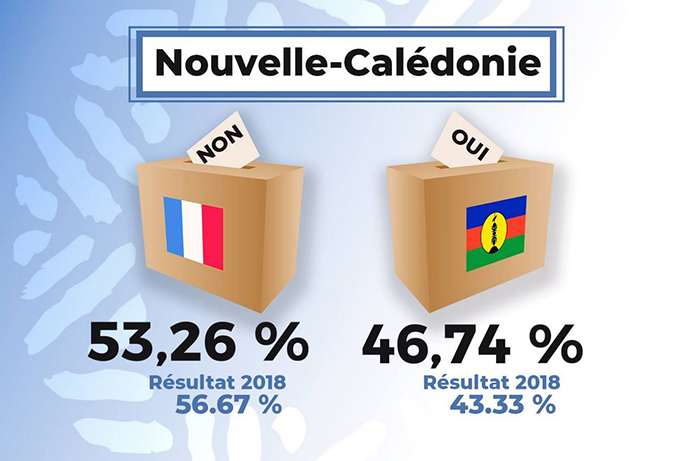
“Loyalist” New Caledonians handed France the decisive victory in the third and final referendum on independence it wanted in Sunday’s vote.

But it was a hollow victory, with pro-independence Kanaks delivering Paris a massive rebuke for its three-decade decolonisation strategy.

The referendum is likely to be seen as a failure, a capture of the vote by settlers without the meaningful participation of the Indigenous Kanak people. Pacific nations are unlikely to accept this disenfranchising of Indigenous self-determination.

In the final results on Sunday night, 96.49% said “non” to independence and just 3.51% “oui”. This was a dramatic reversal of the narrow defeats in the two previous plebiscites in 2018 and 2020.

However, the negative vote in this final round was based on 43.9% turnout, in contrast to record 80%-plus turnouts in the two earlier votes. This casts the legitimacy of the vote in doubt, and is likely to inflame tensions.

One of the telling results in the referendum was in Tiendanite, the traditional home village of celebrated Kanak independence leader Jean-Marie Tjibaou. He negotiated the original Matignon Accord in 1988, which put an end to the bloodshed that erupted during the 1980s after a similar failed referendum on independence. In his village, it was apparently a total boycott, with not a single vote registered.

In the remote northern Belep islands, only 0.6% of residents cast a vote. On the island of Lifou in the mainly Kanak Loyalty Islands, some of the polling stations had no votes. In the Kanak strongholds of Canala and Hiènghene on the main island of Grande Terre, less than 2% of the population cast a vote.

Electoral posters advocating a ‘no’ vote in the referendum in the capital, Noumea.
Clotilde Richalet/AP

Macron criticised for pressing ahead with vote

The result will no doubt be a huge headache for French President Emmanuel Macron, just months away from the French presidential elections next April. Critics are suggesting his insistence on pressing ahead with the referendum in defiance of the wide-ranging opposition could damage him politically.


Read more:
Why New Caledonia’s final independence vote could lead to instability and tarnish France’s image in the region


However, Macron hailed the result in Paris, saying,

Tonight, France is more beautiful because New Caledonia has decided to stay part of it.

He said a “period of transition” would begin to build a common project “respecting the dignity of everyone”.

Pro-independence Kanak parties had urged postponement of the referendum due to the COVID crisis in New Caledonia, and the fact the vote was not due until October 2022. The customary Kanak Senate, comprising traditional chiefs, had declared a mourning period of one year for the mainly Indigenous victims of the COVID surge in September that had infected more than 12,000 people and caused 280 deaths.

While neighbouring Vanuatu also called for the referendum to be postponed, the Pacific Islands Forum (PIF) provided a ministerial monitoring team. The influential Melanesian Spearhead Group (comprised of Papua New Guinea, Vanuatu, Fiji, Solomon Islands and New Caledonia’s independence coalition), refused to recognise the “unilateral” referendum, saying this was

a crucial time for Melanesian people in New Caledonia to decide their own future.

A coalition of Pacific civil society organisations and movement leaders joined the opposition and condemned Paris for “ignoring” the impact the health crisis had

on the ability of Kanaks to participate in the referendum and exercise their basic human right to self-determination.

A trio of pro-independence advocates had also travelled to New York last week with New Caledonia Congress president Roch Wamytan and declared at the United Nations that a plebiscite without Kanak participation had no legitimacy and the independence parties would not recognise the result.

Pro-independence leaders insist they will not negotiate with Paris until after the French presidential elections. They have also refused to see French Overseas Minister Sebastien Lecornu, who arrived in Noumea at the weekend. They regard the minister as pandering to the anti-independence leaders in the territory.

Why is New Caledonia so important to France?

Another referendum is now likely in mid-2023 to determine the territory’s future status within France, but with independence off the table.

Some of France’s overseas territories, such as French Polynesia, have considerably devolved local powers. It is believed New Caledonia may now be offered more local autonomy than it has.

New Caledonia is critically important to France’s projection of its Indo-Pacific economic and military power in the region, especially as a counterbalance to growing Chinese influence among independent Pacific countries. Its nickel mining industry and reserves, important for manufacturing stainless steel, batteries and mobile phones, and its maritime economic zone are important to Paris.

Ironically, France’s controversial loss of a lucrative submarine deal with Australia in favour of a nuclear sub partnership with the US and UK enhanced New Caledonia’s importance to Paris.


Read more:
Why the Australia-France submarine deal collapse was predictable


The governments in Australia and New Zealand have been cautious about the referendum, not commenting publicly on the vote. But a young Kanak feminist artist, Marylou Mahé, wrote an article widely published in New Zealand last weekend explaining why she and many others refused to take part in a vote considered “undemocratic and disrespectful” of Kanak culture.

As a young Kanak woman, my voice is often silenced, but I want to remind the world that we are here, we are standing, and we are acting for our future. The state’s spoken word may die tomorrow, but our right to recognition and self-determination never will.

The Conversation

David Robie does not work for, consult, own shares in or receive funding from any company or organisation that would benefit from this article, and has disclosed no relevant affiliations beyond their academic appointment.

ref. New Caledonia votes to stay with France, but it’s a hollow victory that will only ratchet up tensions – https://theconversation.com/new-caledonia-votes-to-stay-with-france-but-its-a-hollow-victory-that-will-only-ratchet-up-tensions-173646


New technology lets police link DNA to appearance and ancestry – and it’s coming to Australia

Source: The Conversation (Au and NZ) – By Caitlin Curtis, Research fellow, The University of Queensland

Helmut Straisil / Pixabay / James Hereward / Caitlin Curtis

The Australian Federal Police recently announced plans to use DNA samples collected at crime scenes to make predictions about potential suspects.

This technology, called forensic “DNA phenotyping”, can reveal a surprising and growing amount of highly personal information from the traces of DNA that we all leave behind, everywhere we go – including information about our gender, ancestry and appearance.

Queensland police have already used versions of this approach to identify a suspect and identify remains. Forensic services in Queensland and New South Wales have also investigated the use of predictive DNA.

This technology can reveal much more about a suspect than previous DNA forensics methods. But how does it work? What are the ethical issues? And what approaches are other countries around the world taking?


Read more:
DNA facial prediction could make protecting your privacy more difficult


How does it work?

The AFP plans to implement forensic DNA phenotyping based on an underlying technology called “massively parallel sequencing”.

Our genetic information is encoded in our DNA as long strings of four different base molecules, and sequencing is the process of “reading” the sequence of these bases.

Older DNA sequencing machines could only read one bit of DNA at a time, but current “massively parallel” machines can read more than six trillion DNA bases in a single run. This creates new possibilities for DNA analysis.

Massively parallel DNA sequencing has opened new frontiers for genetic analysis.
Shutterstock

DNA forensics used to rely on a system that matched samples to ones in a criminal DNA database, and did not reveal much beyond identity. However, predictive DNA forensics can reveal things like physical appearance, gender and ancestry – regardless of whether people are in a database or not.

This makes it useful in missing persons cases and the investigation of unidentified remains. This method can also be used in criminal cases, mostly to exclude persons of interest.

The AFP plans to predict gender, “biogeographical ancestry”, eye colour and, in coming months, hair colour. Over the next decade they aim to include traits such as age, body mass index, and height, and even finer predictions for facial metrics such as distance between the eyes, eye, nose and ear shape, lip fullness, and cheek structure.

Are there any issues or ethical concerns?

DNA can reveal highly sensitive information about us. Beyond ancestry and externally visible characteristics, we can predict many other things including aspects of both physical and mental health.

It will be important to set clear boundaries around what can and can’t be predicted in these tests – and when and how they will be used. Despite some progress toward a privacy impact assessment, Australian forensic legislation does not currently provide any form of comprehensive regulation of forensic DNA phenotyping.

The highly sensitive nature of DNA data, and the difficulty in ever making it anonymous creates significant privacy concerns.

According to a 2020 government survey about public attitudes to privacy, most Australians are uncomfortable with the idea of their DNA data being collected.

Using DNA for forensics may also reduce public trust in the use of genomics for medical and other purposes.


Read more:
Dramatic advances in forensics expose the need for genetic data legislation


The AFP’s planned tests include biogeographical ancestry prediction. Even when not explicitly tested, DNA data is tightly linked to our ancestry.

One of the biggest risks with any DNA data is exacerbating or creating racial biases. This is especially the case in law enforcement, where specific groups of people may be targeted or stigmatised based on pre-existing biases.

In Australia, Indigenous legal experts report that not enough is being done to fully eradicate racism and unconscious bias within police. Concerns have been raised about other types of potential institutional racial profiling. A recent analysis by the ANU also indicated that 3 in 4 people held implicit negative or unconscious bias against Indigenous Australians.

Careful consideration, consultation, and clear regulatory safeguards need to be in place to ensure these methods are only used to exclude persons of interest rather than include or target specific groups.

DNA data also has inherent risks around misinterpretation. People put a lot of trust in DNA evidence, even though it often gives probabilistic findings which can be difficult to interpret.

What are other countries doing?

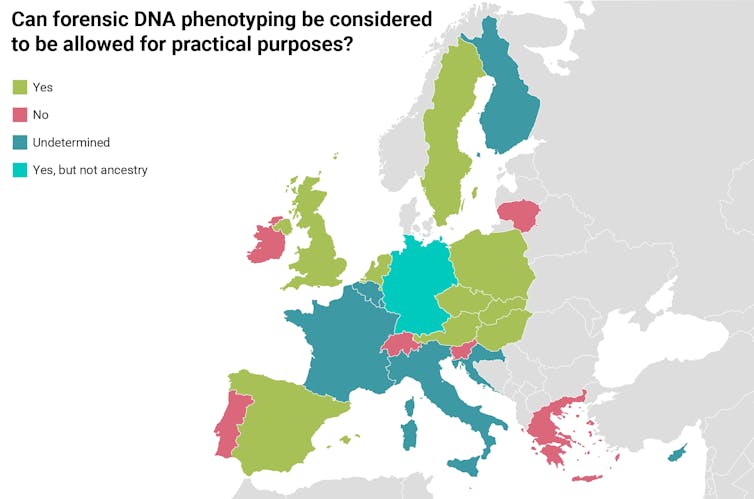
Predictive DNA forensics is a relatively new field, and countries across Europe have taken different approaches regarding how and when it should be used. A 2019 study across 24 European countries found ten had allowed the use of this technology for practical purposes, seven had not allowed it, and seven more had not yet made a clear determination on its use.

DNA-based prediction is used in some European countries and forbidden in others.
Adapted from Schneider, Prainsack & Kayser/Dtsch Arztebl Int.

Germany allows the prediction of externally visible characteristics (including skin colour), but has decided biogeographical ancestry is simply too risky to be used.

The one exception to this is the state of Bavaria, where ancestry can be used to avert imminent danger, but not to investigate crimes that have already occurred.

A UK advisory panel made four recommendations last year. These include the need to clearly explain how the data is used, presenting ancestral and phenotypic data as probabilities so uncertainty can be evaluated, and clearly explaining how judgements would be made about when to use the technology and who would make the decision.

The VISAGE consortium of academics, police and justice institutions, from eight European countries, also produced a report of recommendations and concerns in 2020.

They urge careful consideration of the circumstances where DNA phenotyping should be used, and the definition of a “serious crime”. They also highlight the importance of a governing body with responsibility for deciding when and how the technology should be used.

Safeguarding public trust

The AFP press release mentions it is mindful of maintaining public trust, and has implemented privacy processes. Transparency and proportionate use will be crucial to keep the public on board as this technology is rolled out.

This is a rapidly evolving field and Australia needs to develop clear and coherent policy that is able to keep up with the pace of technological developments – and considers community concerns.

The Conversation

Caitlin Curtis receives funding from the National Health and Medical Research Council (NHMRC).

James Hereward does not work for, consult, own shares in or receive funding from any company or organisation that would benefit from this article, and has disclosed no relevant affiliations beyond their academic appointment.

ref. New technology lets police link DNA to appearance and ancestry – and it’s coming to Australia – https://theconversation.com/new-technology-lets-police-link-dna-to-appearance-and-ancestry-and-its-coming-to-australia-173334

The end of coal is coming 3 times faster than expected. Governments must accept it and urgently support a ‘just transition’

Source: The Conversation (Au and NZ) – By Tim Nelson, Associate Professor of Economics, Griffith University

Shutterstock

Coal is likely to be completely gone from Victoria’s electricity system by 2032 with most other parts of Australia not far behind, a report from the Australian Energy Market Operator (AEMO) declared last week.

The report, called the 2022 Integrated System Plan, confirmed what many of us in energy policy have long known: the end of coal is coming, and the pace may take some industries and governments by surprise.

The Integrated System Plan (ISP) is effectively the planning “blueprint” the market operator publishes to help industry and policy makers assess how Australia’s electricity system might evolve. It’s an incredibly important document for guiding where and when investment is needed to unlock new renewable resources to meet demand.

Given ISP’s prediction for the rapid closure of coal-fired power stations, it’s critical governments don’t stick their heads in the sand. Continuing to deny the impending end of coal-fired generation is simply not in the interest of coal workers and their communities, who urgently need support.

What is AEMO predicting?

The most important aspect of the ISP is that what used to be called the “step change” has now become the “central scenario”. For the first time, this central scenario is consistent with Australia’s commitment under the Paris Agreement and limiting global temperature rise to under 2℃.

The ISP is forecasting that huge volumes of coal will be retired in the next ten years, including all brown coal and two-thirds of black coal, and significant investments in new renewables and “firming technologies” (such as batteries, gas, and pumped hydro) will take their place.

‘Firming’ technologies like pumped hydro are critical to ensure Australians have electricity when wind and solar aren’t available.
Shutterstock

Around 14 gigawatts (GW) of coal is now assumed to be exiting the National Electricity Market this decade – more than three times the amount of coal retirements the industry has announced.

Effectively, AEMO is saying (yet again) that the incumbent industry is likely to be caught by surprise by the speed of the transition.

It’s not just an explosion of renewables investment that AEMO predicts. Around 9GW of gas-fired generation and an extra 620GW hours of storage (provided by batteries or pumped hydro) will be required to provide backup generation capacity when solar and wind are unavailable.


Read more:
Coal plants are closing faster than expected. Governments can keep the exit orderly


Electricity demand is expected to surge out to 2050 and will double to at least 350 terrawatt hours. This includes from electric vehicles uptake, converting natural gas heating and hot water to electric in homes, and electrifying many industrial processes such as low-emissions steel and aluminium.

All these developments will require a major overhaul of the grid. The ISP states around A$12.5 billion in transmission spending needs to occur to unlock $29 billion in investment benefits.

Why is coal being left behind?

There are two main drivers for this significant substitution of coal for new technologies.

First, the cost of these technologies continues to fall rapidly and consumers are voting with their feet. Some of Australia’s largest and most iconic businesses are increasingly buying 100% of their energy from renewable resources, including Woolworths, BHP and Coles.


Read more:
Solar curtailment is emerging as a new challenge to overcome as Australia dashes for rooftop solar


Second, state governments have filled the void left by the lack of a nationally consistent energy and climate policy, and are now implementing ambitious policies to drive the uptake of renewable energy and firming.

The most ambitious of these policies is the NSW government’s 12GW energy roadmap, which effectively prepares for the retirement of ageing coal-fired power stations by facilitating investment in new capacity.

Tesla charging station
Electricity demand is expected to surge out to 2050.
Shutterstock

So what should governments be doing?

It is critical governments focus on a “just transition” to these new technologies, and provide support to communities and workers most impacted, such as those in the Hunter and Latrobe Valleys.

Structural adjustment policies such as job placements, relocation assistance, or financial support to transition local economies are vital to secure opportunities for these regions. Retraining ahead of closures will help workers transition to new or related industries.

Everyone who uses energy must be afforded access to the clean energy transition. At present, the biggest barrier to participating in the solar and battery revolution is owning your own home.

Governments have been absent from this important policy debate. Australian low-income and rental households should be prioritised in any future policies that support adoption of solar and battery storage.

Roofs with solar panels
Rental homes have been left out of policy debates on renewables.
Shutterstock

Governments must also ensure the private sector (rather than consumers) wear the risk of poor investments. Governments are increasingly taking on very significant risk (on behalf of consumers) through underwriting renewable energy and firming investments of large multi-national energy businesses.

Some economists (including us) have been providing alternative models for governments to achieve the same objectives, but with greater focus on reducing risks to consumers.


Read more:
Economists back carbon price, say benefits of net-zero outweigh costs


Given the surge in households and businesses voluntarily buying renewable energy, it’s important consumers know what they’re getting. The Clean Energy Regulator is doing some interesting work in this space by developing an emissions and renewable energy transparency register as part of the national greenhouse and energy reporting framework.

If governments really wanted to help, they could introduce a carbon price. Such a policy is considered political poison, but a carbon price would result in us reaching this future in a much less costly and more orderly way.

The end of the coal age

The ISP is forecasting a better and cleaner future. Australia has great opportunities from moving beyond the coal age and into the age of efficient renewable energy, as we’re blessed with some of the best renewable resources on the planet

With global leaders increasingly focused on rapidly reducing emissions, we have a lot to gain through new industries, such as green hydrogen and mineral processing. Both major political parties at the national level have targets that don’t really push beyond what AEMO now thinks is the status quo.

The stone age didn’t end because of a lack of stones. And the coal age is ending despite an abundance of it – whether governments believe it or not.


Read more:
Labor’s 2030 climate target betters the Morrison government, but Australia must go much further, much faster


The Conversation

Tim Nelson is an Associate Professor of Economics at the Centre for Energy Economics and Policy Research at Griffith Universtiy and the EGM of Energy Markets at Iberdrola Australia.

Joel Gilmore is an Associate Professor at Griffith University and the GM, Energy Policy & Planning at Iberdrola Australia, that develops renewable projects and firming assets.

ref. The end of coal is coming 3 times faster than expected. Governments must accept it and urgently support a ‘just transition’ – https://theconversation.com/the-end-of-coal-is-coming-3-times-faster-than-expected-governments-must-accept-it-and-urgently-support-a-just-transition-173591

Buying picture books as Christmas presents? These stories with diverse characters can help kids develop empathy

Source: The Conversation (Au and NZ) – By Helen Joanne Adam, Senior Lecturer in Literacy Education and Children’s Literature: Course Coordinator Master of Teaching (Primary), Edith Cowan University

Shutterstock

Gifting children books can be about more than just giving them something to read. Books are portals to adventure, imagination and new experiences. Importantly, books can help children understand and appreciate themselves, and those around them.

Sadly, books normalising racial, cultural, family or gender diversity and diverse abilities are few and far between.

When children see characters and stories reflecting their background, they can develop a stronger sense of identity. Research also shows reading books with diverse characters and story-lines helps children develop a greater understanding and appreciation of people different to themselves.


Read more:
Children’s books must be diverse, or kids will grow up believing white is superior


Here are some suggestions of diverse picture books you could buy for kids this Christmas.

1. Books with diverse characters


Hachette Australia

A student teacher I know was tutoring a nine-year-old Muslim girl and decided to share with her a book called The Rainbow Hijab. When the girl saw the book, her eyes lit up with excitement and she turned to her tutor and said, “I didn’t know they made books about Muslim girls like me.”

No child should feel invisible in books. All children should be able to see themselves and people different to them portrayed in positive and inclusive ways.

The best books for children are those containing enjoyable story lines and reflecting diversity without preaching about it.

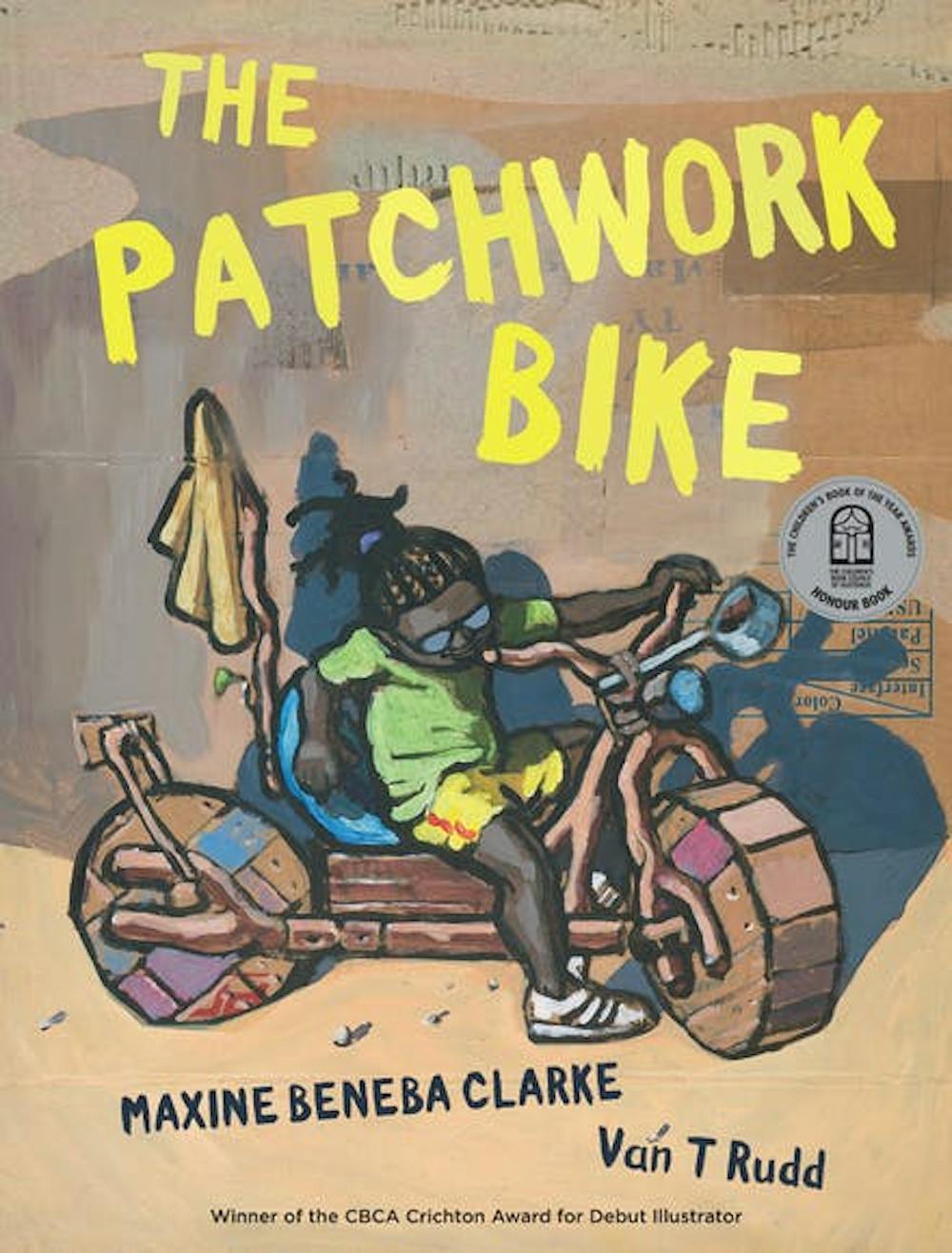
The Patchwork Bike by Maxine Beneba Clarke, illustrated by Van T. Rudd, is about children of African and Muslim background and the bike they build together from things they find around them. All children can relate to the joyful story of playing outside and being creative.

Other books containing relatable childhood stories are:

2. Books portraying diverse abilities


Magabala Books

Almost 5% of children in Australia live with a severe disability, while nearly 8% have some level of disability. This number is likely higher as there are many children with undiagnosed complex needs, such as autism.

Two Mates, written and illustrated by Melanie Prewett is about a young Aboriginal boy and his non-Indigenous best mate who has spina bifida. The story focuses on their mateship and adventures rather than highlighting their differences. All children benefit from seeing diverse abilities being portrayed in such a positive way.

Two others books in which diverse abilities are normalised rather than highlighted are:

3. Books portraying gender and family diversity


Larrikin House

Many adults find selecting books for children challenging. My, and others’, research shows adults generally select children’s books based on what they loved when they were children.

This can be a problem, as older books often reflect outdated views of gender, families, diverse cultures and abilities.

For example, there are close to 48,000 single sex families in Australia. yet children from these families rarely see characters like them in books.

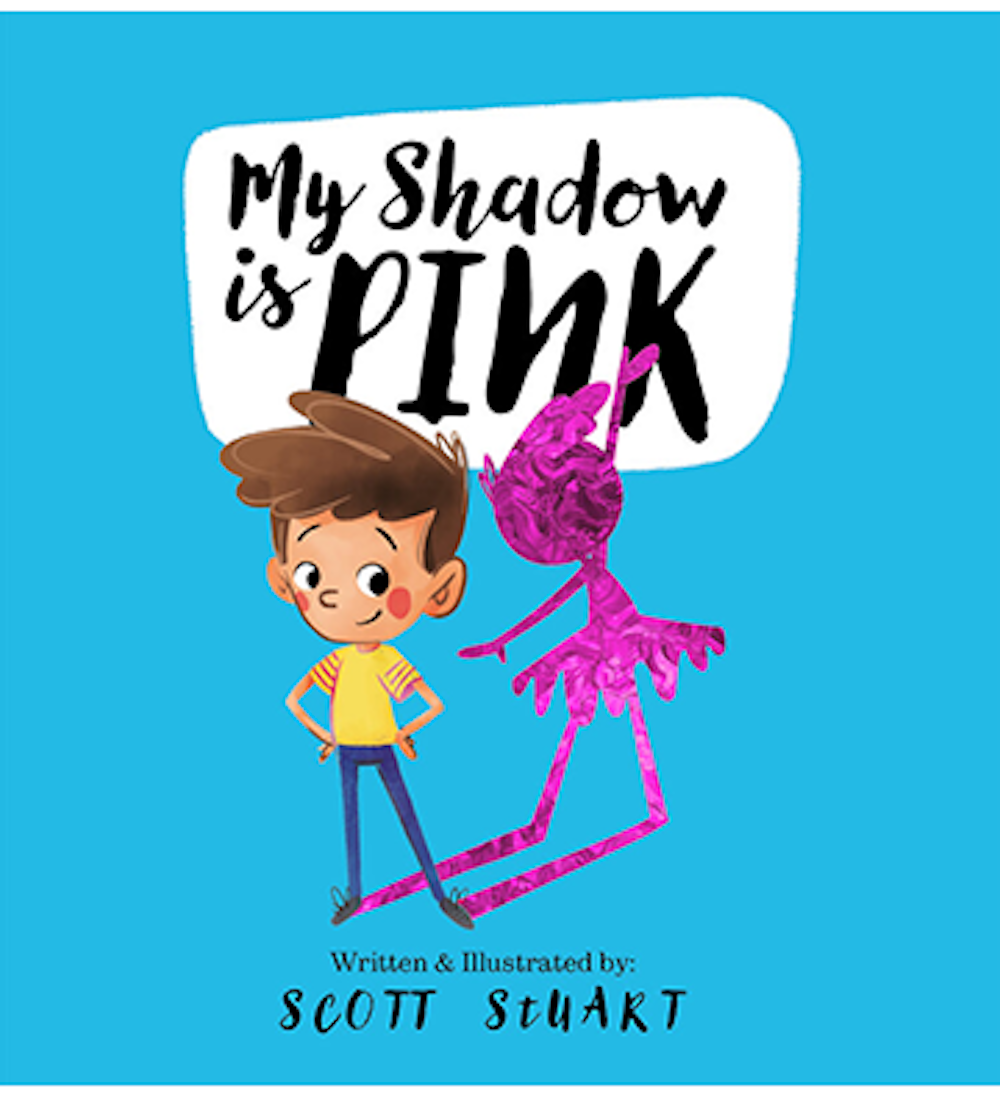
My Shadow is Pink, written and illustrated by Scott Stuart, is a rhyming book about a young gender-diverse child. This book beautifully explores his relationship with his father who helps him be proud of who he is.

Two other books that tell stories of gender or family diversity in supportive and informative ways are:

4. Books challenging gender stereotypes

I Want to be a Superhero by Breanna Humes, illustrated by Ambelin Kwaymullina tells the story of a little girl who wants to be a superhero. Her Grandpa encourages and supports her as she discovers it is OK to dream big. It is important for children to see that gender or race should not define who you are or what you can do.

Two others books promoting positive messages that disrupt traditional gender stereotypes are:

5. Books with messages about social justice

These books shed light on important social justice issues through gentle informative stories.

Other diverse books I simply must recommend

The Conversation

Helen Joanne Adam receives funding from the Freilich Project for the Study of Bigotry. She is a Board Director for the Primary English Teaching Association of Australia and serves in a voluntary capacity on the book selection panel for the Dolly Parton Imagination Library Australia.

ref. Buying picture books as Christmas presents? These stories with diverse characters can help kids develop empathy – https://theconversation.com/buying-picture-books-as-christmas-presents-these-stories-with-diverse-characters-can-help-kids-develop-empathy-171396

Doctors are trained to be kind and empathetic – but a ‘hidden curriculum’ makes them forget on the job

Source: The Conversation (Au and NZ) – By Eleonora Leopardi, Lecturer in Clinical Education, University of Newcastle

Shutterstock

Health-care professionals are often idealised, especially in recent times, as heroes. But meeting a physician can be an underwhelming experience.

Patients and families can find themselves on the receiving end of curt communications or seemingly uncaring attitudes. This is understandably disappointing. A worried, scared patient looks to the doctor not just as the person who will take the lead of the situation, but as someone who can understand their feelings and emotions.

The good news is doctors are trained to provide care and empathy. The bad news is the training doesn’t always make a difference in the long run: a “hidden curriculum” of medical education can explain this.


Read more:
Hospital emergency departments are under intense pressure. What to know before you go


Teaching students empathy and communication

In the 1990s, medical educators realised students’ training was too focused on biomedical sciences and did not take into account the experience of patients and their families. Most medical schools now invest considerable effort to make sure future doctors are well equipped to support their patients and be empathetic practitioners.

In the words of William Osler – who created the first residency program to get aspiring physicians out of the lecture theatre and bring them to the bedside:

The good physician treats the disease; the great physician treats the patient who has the disease.

This idea underpins most modern medical school curricula, with a focus on person-centred care. In our medical school we deliver an extensive communication skills curriculum across the five-year program. In the first two years, the training covers verbal communication and body language, making decisions with the patient, not for the patient, and listening actively. At the end of this initial training, we are confident that students are sensitive, empathetic, and caring.

The patient-centred approach has been a feature of medical training for several decades, so we should be seeing a system dominated by those trained in this way. But we’re not and unfortunately, it isn’t just veteran medicos who are the problem.

Don’t be like Doctor House.

Learning to fit in

Young and vibrant new graduates lose at least some of their empathy as they progress through medical school and postgraduate training. A series of unwritten and often unintended consequences of education, the “hidden curriculum” is what students learn without anyone teaching them.

First coined in 1968 for school settings by educational scholar Philip Jackson, the phenomenon went on to be identified in all areas of education, including medical training.

After medical school, learners who enter a new environment start changing their views and their behaviours to align with those of the more senior members of the profession and “become part of the team”. Students who learn the unofficial rules of a clinical environment might be more easily accepted within the social group. But there are also negative consequences.

In the classroom, our students learn to pick up on cues from their patients, to use reflective listening and ask about their patients’ concerns. In the clinical environment, research shows students do not see these skills used by the more experienced clinicians around them or the supervisors they look up to and want to impress. Soon, good habits can be replaced by poorer behaviours. And, when the students become supervisors and mentors themselves, the cycle can continue.

We are in the middle of a compassion crisis says this ICU doctor.

Making empathy the norm

Empathetic, warm clinicians definitely exist. The challenge is to make these clinicians the norm rather than the exception and to change the environment so the hidden curriculum has a positive influence on students and graduates.

Researchers, educational institutions, health-care institutions and patients can create and maintain a clear cultural and organisational expectation for doctors to meet a minimum standard of communication skills.

Firstly, researchers can challenge assumptions about the way the health system prevents doctors from being empathetic. Time pressure is often cited as an excuse to cut short on human connection, but the evidence tells us meaningful, person-centred communication doesn’t take more time than doctor-centred communication in a consultation. And strong empathetic connections can not only improve patient outcomes but also give doctors greater job satisfaction.


Read more:
True grit – we measured it and found it protected doctors from career burnout


Rewarding the good

Academic health-care institutions such as teaching hospitals should improve their programs to support the doctors’ communication skills, and flood the system with empathetic doctors. They should also support new doctors so that work and study stress don’t cause burnout that can block empathy.

Patients should be encouraged to provide reviews of their doctors’ communication, and identify both positive and negative examples of care. This feedback should be kept in consideration by the health-care system and professional organisations such as the Australian Medical Council. Good communication and empathy should be explicitly rewarded, recognised in employment and promotion processes.

It is each doctor’s responsibility to be the best doctor they can be – but they can’t do it alone. We can all contribute to make the environment better, and help medical students hold onto their empathy as they become doctors.


Read more:
You should care about your doctor’s health, because it matters to yours


The Conversation

The authors do not work for, consult, own shares in or receive funding from any company or organisation that would benefit from this article, and have disclosed no relevant affiliations beyond their academic appointment.

ref. Doctors are trained to be kind and empathetic – but a ‘hidden curriculum’ makes them forget on the job – https://theconversation.com/doctors-are-trained-to-be-kind-and-empathetic-but-a-hidden-curriculum-makes-them-forget-on-the-job-171942

WA’s new Aboriginal Heritage Act keeps mining interests ahead of the culture and wishes of Traditional Owners

Source: The Conversation (Au and NZ) – By Hannah McGlade, Associate professor, Curtin University

shutterstock

Only a year after the 46,000 year-old sacred Aboriginal site Juukan Gorge was destroyed by Rio Tinto, the West Australian Legislative Council in Perth will pass an Aboriginal Heritage Bill that puts the interests of mining companies above the wishes of Traditional Owners.

The Senate inquiry report into the destruction of Juukan Gorge “A way forward” called for a new national framework of Aboriginal heritage protection co-designed with Aboriginal people. It recommended the responsibility for Aboriginal heritage to be reverted to the minister for Aboriginal affairs.

The report also called for a review of the Native Title Act 1993 to address inequalities in the negotiating position of Aboriginal and Torres Strait Islander peoples under the future act regime. The report’s authors were clear future work should recognise the United Nations Declaration on the Rights of Indigenous Peoples.

This new law ensures mining companies can still apply to damage or destroy Aboriginal sacred sites, the minister for Aboriginal affairs still has the final decision making role to approve the damage or destruction of heritage sites, and non-Aboriginal “proponents” (mining companies and developers), can appeal if the result is not in their favour. Aboriginal groups have no such right of appeal if the ruling is not in their favour.


Read more:
A history of destruction: why the WA Aboriginal cultural heritage bill will not prevent another Juukan Gorge-like disaster


Aboriginal land councils ignored

The ALP majority government led by Premier Mark McGowan disregarded state Aboriginal land councils who expressed the bill was “unacceptable”.

An emergency request to the United Nations Committee on the Elimination of Race Discrimination outlining how the law entrenches systemic racial discrimination against Aboriginal Traditional Owners, was also ignored.

Aboriginal land council leaders called for a co-designed process to allow for Traditional Owners to increase protection of heritage sites. This was reflected in an Open Letter of Concern signed by 150 Aboriginal cultural leaders and renowned Australians. This letter pointed out the bill was weighted in favour of mining and economic interests over Aboriginal heritage, and breached United Nations treaty law.

However, Aboriginal Affairs Minister Stephen Dawson argued the bill would give better protection for Aboriginal heritage and was the right thing for his government to do.

The main concern with the bill is the ongoing role of the minister to grant approval to mining companies and developers to damage and destroy heritage sites. The new act has replaced the old section 18 process which allowed the approval of more than 1,000 permissions by the state to approve the damage or destruction of Aboriginal heritage sites.

Rarely had the minister refused a section 18 application and protected a site.

Since the Aboriginal Heritage Act commenced in 1972, mining companies and developers have always relied on the Aboriginal Heritage Act – and the minister’s final decision making power – to lawfully damage or destroy heritage sites, as Rio Tinto did with Juukan Gorge.

This new act adopts (and misuses) the language of international human rights law. It does this by referencing Indigenous people must be given the opportunity to provide “free, prior and informed consent” to the damage of sites.

However the United Nations says the test of free, prior and informed consent from Indigenous peoples includes the ability to exercise self determination, including over things which affect their lands. Given Indigenous peoples are not free to say “no” to harm, damage or destruction of their sites, this principle is not met by this bill.


Read more:
What climate change activists can learn from First Nations campaigns against the fossil fuel industry


The state’s relationship with Aboriginal people

Western Australia has made few meaningful attempts to respect First Nations people in its constitutional arrangements or systems of governance.

In 2015 the WA parliament, following extensive consultations, amended the state’s constitution to acknowledge Aboriginal people were the traditional custodians.

When he was opposition leader, McGowan said this was a “long overdue […] act of genuine reconciliation designed to reflect the historical reality of Western Australia.”

This act of genuine reconciliation appears to have been forgotten by the McGowan government during the passage of the Aboriginal Heritage Act.

In 2021 soaring iron ore prices led to a huge $5.6 billion budget surplus – with WA outperforming all other states. A further $2.8 billion was projected for the next financial year and ongoing budget surplus forecast through 2024 -25.

This staggering amount of income from mining underlines the state’s conflict with Aboriginal people who wish to protect significant cultural sites, and might explain why the views of Aboriginal people are not being heard and respected.

Unlike most of Australia, Aboriginal people have never had any land rights legislation in Western Australia. The mining industry’s impact on the state was and continues to be very influential.


Read more:
When native title fails: First Nations people are turning to human rights law to keep access to cultural sites


We have a right to protect and preserve our lands

Last Friday and The Environmental Defenders Office with a group of First Nations people formally contacted the United Nations Committee on the Elimination of Racial Discrimination about the urgent action needed to address WA’s new heritage act.

The United Nations Committee the same day formally contacted the Australian government to request they work with an expert body called the Expert Mechanism on the Rights of Indigenous Peoples to remedy the act.

What has happened in our state, to heritage lands and sacred sites, highlights our continued dispossession as peoples without recognised sovereignty and Treaty rights. Our peoples’ human rights are at the whim of a state acting with multinational mining interests in mind. Recent history shows the weakness and hypocrisy of the state’s reconciliation promise and symbolic constitutional recognition.

This reminds Aboriginal people we must continue to demand meaningful structural change and reform, as articulated in the Uluru Statement from the Heart’s claim for “Voice, Treaty and Truth”.

Substantive reforms, not hollow promises, are critical to Australia’s realisation of the UN Declaration on the Rights of Indigenous Peoples. This includes the urgent need to honour our right to protect and preserve our respective lands, and our ancient heritage and culture.

The Conversation

Hannah McGlade is a member of the United Nations Permanent Forum for Indigenous Issues.

ref. WA’s new Aboriginal Heritage Act keeps mining interests ahead of the culture and wishes of Traditional Owners – https://theconversation.com/was-new-aboriginal-heritage-act-keeps-mining-interests-ahead-of-the-culture-and-wishes-of-traditional-owners-173239

Courts around the world have made strong climate rulings — not so in New Zealand

Source: The Conversation (Au and NZ) – By Nathan Cooper, Associate Professor of Law, University of Waikato

Hagen Hopkins/Getty Images

New Zealand made two important climate commitments at the COP26 summit last month — to halve emissions by 2030 and to join the global methane pledge to cut methane emissions by at least 30% by 2030.

But what happens if these pledges are inadequate for the climate emergency we face? And how can we ensure future climate commitments are bold enough, and actually fully met, to bring about the transformation necessary to limit global warming to 1.5℃?

One response is climate litigation, the use of courts to compel governments and corporations to take greater action to mitigate climate change.

The number of climate-related court cases is increasing around the world. In some countries, it has achieved strong rulings, but in New Zealand, the courts recently pushed the responsibility back to policymakers.

New Zealand’s international pledges join obligations in domestic legislation, including the much vaunted Zero Carbon Act, which commits to reduce emissions (excluding methane from livestock) to net zero by 2050.

They also have to be matched against the Climate Change Response Act, which sets requirements around emissions budgets.

New Zealand’s pledge to cut domestic emissions by half by the end of this decade reflects the country’s revised commitment under the Paris Agreement, known as a Nationally Determined Contribution (NDC). It has already been criticised for its over-reliance on purchasing carbon credits from overseas.


Read more:
COP26: New Zealand’s new climate pledge is a step up, but not a ‘fair share’


The government’s commitment to “play its part” towards the global methane pledge may also be weaker than the promise suggests. It will likely mainly involve meeting its pre-existing target to cut methane emissions from livestock by 10% (on 2017 levels) by 2030.

The consequences of insufficient ambition globally will be felt at home. New Zealand’s natural environment will continue to degrade and climate instability become more severe.

Court action brings some progress

In various jurisdictions, climate litigation is achieving notable progress in environmental protection and forcing stronger action on emissions cuts. Just in 2021, court rulings in France, Australia and the Netherlands show the potential climate litigation has to bring significant change.

In May this year, in an action brought by eight children regarding plans to expand a coal mine, the Australian federal court agreed the government has a duty of care to protect young people from climate change. The court held that common law should impose responsibility on those who do harm through atmospheric pollution.


Read more:
In a landmark judgment, the Federal Court found the environment minister has a duty of care to young people


However, in New Zealand the courts recently declined to offer significant, let alone transformational, legal remedies for similar harm. They were not persuaded that using common law doctrines was suitable for this purpose. Instead, they signalled the response should come from appropriate regulation.

The case of Smith v Fonterra Co-operative Group Ltd 2021 was the first in New Zealand to target corporates for their greenhouse gas emissions. Mike Smith, spokesperson for the Climate Change Iwi Group, brought a claim against seven New Zealand companies. The claim was based on three points: public nuisance, negligence and breach of duty of care.

The High Court struck out the public nuisance and negligence claims in March 2020. The case proceeded to the Court of Appeal regarding the novel duty of care claim.
But the court was not persuaded this novel duty of care should be created for the purpose of requiring a small number of emitters to comply with more onerous requirements than those imposed by statute.

The court said such private litigation, if successful, would be a costly and inefficient response to climate change nationally and arbitrary in its impact. Instead of using tort law, the Court of Appeal stated climate change “calls for a sophisticated regulatory response at a national level supported by international co-ordination”.

Litigation isn’t an ideal response to climate change

Meanwhile, Lawyers for Climate Action New Zealand (LCANZI) have begun a judicial review of the Climate Change Commission’s recommendations to government on carbon budgets and other measures to reduce emissions.

LCANZI’s statement of claim emphasises the need for domestic laws to be interpreted consistently with the Paris Agreement, the right to life (in the New Zealand Bill of Rights Act), Te Tiriti o Waitangi principles (in particular the exercise of rangatiratanga) and tikanga Māori.

The outcome of this case remains to be seen. But following the decision in Smith v Fonterra, it’s important to concede litigation isn’t an ideal response to the climate crisis and won’t guarantee success. An effective “sophisticated regulatory response” would be preferable.

Whatever happens in the LCANZI case, its emphasis on integrating international law, human rights, treaty obligations and tikanga Māori offers a vision of how we might pursue ambitious climate change action.

The challenge will be to design regulation that is both robust enough to ensure all obligations (international and domestic) are sufficiently ambitious to achieve environmental protection and sophisticated enough to articulate the unique context of Aotearoa. But in the face of a climate emergency, it’s worth trying.

The Conversation

Nathan Cooper does not work for, consult, own shares in or receive funding from any company or organisation that would benefit from this article, and has disclosed no relevant affiliations beyond their academic appointment.

ref. Courts around the world have made strong climate rulings — not so in New Zealand – https://theconversation.com/courts-around-the-world-have-made-strong-climate-rulings-not-so-in-new-zealand-173485

Half of Australia’s gamers are women, but we know very little about mothers who game

Source: The Conversation (Au and NZ) – By Susie Emery, Lecturer, University of South Australia

Shutterstock

Women account for almost 50% of gamers in Australia, but the nuanced and varied experiences of mothers who game are lost among these statistics.

A 2020 global survey of mothers found more than 70% of mothers play games daily on consoles, smartphones and computers. The report highlighted the commercial benefits of marketing games to mothers – but did little to address the social factors that influence mothers’ gaming behaviours.

We think societal expectations and gendered perceptions of the mother’s role in the home may be an impediment for mothers wanting to game, and the reason why research in this area is scant.

But understanding what motivates mothers or deters them from gaming is important for comprehending how family dynamics are structured or negotiated in the modern digital home.

What a mother should be

In Australia, mothers continue to provide the majority share of household labour and care to children, often balancing these responsibilities with paid work. Time for gaming may be a luxury few mothers can afford.

The first and only known longitudinal study to research mothers who play computer games was conducted in 2009. The three year study involved analysing representations of gaming mothers in advertisements, news articles and blogs, and by interviewing mothers and observing their gaming practices in the home.

The study highlighted discourse related to gaming mothers is entrenched in gendered tropes about parenting and expectations about what a mother should be. Mothers are portrayed in popular culture as “domestic guardians” who should devote their time to the family instead of “self-indulgent” gaming.

This ideology is evident in the gaming industry today, where a game is said to have passed the “mum test” if it has a soft and feminised design.


Read more:
Debunking one of the biggest stereotypes about women in the gaming community


A decade later and limited or conflicting demands on a mother’s time remains an issue for those wanting to game. Even in households where gaming is an accepted part of family life, the games mothers play may be influenced by expectations about their role. Fast-paced games such as PUBG (Player Unknown’s Battlegrounds), Among Us, and Bloodborne, do not allow players to pause or save progress in the game, which means they are not conducive with child caring duties.

Managing time for gaming

Findings from a recent doctoral study (by one of the authors) about digital mothering suggests mothers’ gaming practices are associated with how they perceive their role in the home. In-depth interviews were carried out in the homes of 17 mothers in South Australia to uncover their experiences as both users of digital media, and as facilitators of children’s use.

Time constraints were identified as an issue that limits mothers’ opportunities for game play and implied a possible loss or relinquishing of a previously inhabited gamer identity:

My friend and I used to play Crash Bandicoot and Raiders of the Lost Ark like addicts before we had children, we were terrible […] But this was a long time ago, I just don’t have time anymore.

Several mothers mentioned playing games on a casual basis on their mobile phones, especially word games with friends. Unlike the more immersive experience of gaming on consoles, participants were able to dip in and out of mobile games at their convenience.

A woman on her phone
Mobile games are easier to dip in and out of between tasks.
Nguyen Dang Hoang Nhu/Unsplash

Mothers would, on the one hand, dismiss their gaming as nothing of consequence but, on the other, implied gaming is justified once other responsibilities have been attended to. This “time-filler” gaming profile is more common among female players – and especially those who live with children.

Guilt about the time spent gaming was associated with how a mother should and shouldn’t act. One participant explained the need to self-regulate her mobile gaming to protect its impact on her family:

Those real-time games are terrible. They play with your mind once you start. You realise you’ve been playing it for two hours and not got anything else done. It did become really addictive so I’ve learnt not to get caught up with it now.

Only one mother in the research study self-identified as a “hardcore gamer”, and described how she played action role-playing games, like Fallout 4 “daily and all day”.

Rather than defending or downplaying her gaming, she embraced gaming as an integral and valuable part of family life that strengthens her relationship with her children and husband:

I get frustrated sometimes when I hear parents, mothers in particular, complain about Minecraft and I just think ‘if you would spend a little bit of time trying to understand it you would know there is lot of really good potential there’.


Read more:
How parents can foster ‘positive creativity’ in kids to make the world a better place


Unmasking mother’s game play

Industry statistics show mothers enjoy gaming – or at least they do if given the time to do so. Yet, mothers’ participation in game culture is often underestimated and overlooked in academia.

To unmask mothers’ experiences of gaming we need to explore more fully how structural forces, such as stereotypical assumptions about mothering, may influence their perceptions and enjoyment of gaming.

We know when gaming is shared with other household members, family cohesion is enhanced. There are also significant health benefits from playing games, including a reduction in stress and anxiety levels, conditions mothers are all too familiar with.

A family of four look at a laptop.
Playing games together can be great for family cohesion.
Shutterstock

Exploring mothers’ gaming practices in more depth will also increase the visibility and representation of mothers in gaming culture and in game studies research.

But it’s not just about research, it’s also about what happens in the home. When you’re compiling your Christmas list for Mum this year, maybe give the novelty slippers a miss and think instead about giving her uninterrupted time to play – or you could offer to be her player two.

The Conversation

Susie is an International Ambassador for Women in Games.

Fae Heaselgrave’s PhD research was supported by an Australian Government Research Training Program scholarship.

ref. Half of Australia’s gamers are women, but we know very little about mothers who game – https://theconversation.com/half-of-australias-gamers-are-women-but-we-know-very-little-about-mothers-who-game-172498

Why wearable fitness trackers aren’t as useless as some make them out to be

Source: The Conversation (Au and NZ) – By Ben Singh, Research fellow, University of South Australia

Shutterstock

Wearable fitness trackers will be on many Christmas shopping lists this year, with a vast range of devices (and an ever-increasing number of features) hitting the market just in time for the festive season.

But what does the latest research say about how effective they are?

Fitness trackers are trendy

Currently, about one in five Australians own one of these wearables, and about a quarter use a mobile app or website to monitor their activity levels and health. And sales are predicted to grow over the next five years.

The landscape of the market is fast changing. For years, Fitbit and Garmin were the market leaders. But Australians now favour Apple watches (used by 43% of people owning a wearable tracker) over Fitbit (35%) and Samsung watches (16%) over Garmin (13%).

So far fitness trackers have mostly been taken up by younger people: about one in four Australians aged 20–40 report using one, compared to just one in ten people aged 60 or older.

However, manufacturers are on a mission to change this, by adding features that allow users to monitor not just their fitness activity, but several other aspect of their health.

For instance, recent wearable models from all the leading manufacturers claim to measure a host of medical metrics, such as blood pressure, body fat levels, the amount of oxygen in your blood, your heart activity, and even identify when you’ve taken a fall (with a feature that lets you call for help).


Read more:
Do we really need to walk 10,000 steps a day?


Wearables get the basics right

Firstly, a multitude of studies have looked at the accuracy of wearable fitness trackers for measurements related to physical activity, including step counts, heart rate and number of calories burned. They show step counts are generally highly accurate, while heart rate and calories burned are reasonably accurate.

When study participants wear two different activity trackers at the same time, the numbers of steps, minutes of activity and calories burned aren’t exactly the same, but they are correlated. That is, when one goes up so does the other, and vice versa. This suggests they are generally capturing the same information, albeit with slightly different sensitivity.

Evidence for sleep tracking is a little patchier. Wearables are pretty good at detecting bed time, wake time and overall sleep duration. But estimates for more technical metrics such as the “phases” of sleep – such as REM sleep – don’t marry with medical-grade measurements taken by polysomnography.

Sometimes wearables go beyond the basics

In a 2019 Apple-sponsored study reported in the New England Medical Journal, 419,297 participants without known atrial fibrillation wore an Apple Watch. During the study, 2,161 of them received an irregular pulse notification, of which 84% were subsequently confirmed to have atrial fibrillation (an irregular and rapid heart beat).

This is a serious medical condition that requires treatment to prevent stroke.
The ability to alert users of a potential undiagnosed cardiac condition seems highly beneficial. Although, others have cautioned the Apple Watch can also miss cases of undiagnosed atrial fibrillation – which emphasises the importance of never relying on wearable metrics for medical purposes.

Another study published in September reaffirmed the Apple watch’s electrocardiogram feature can detect serious cardiac irregularities. A similar study is currently underway to evaluate Fitbit’s electrocardiogram feature, but results aren’t out yet.

Building a more advanced tracker

In terms of detecting falls (which would be very useful for older individuals), scientists are developing wrist-worn devices that can accurately do this using accelerometer technology, which is the same underlying technology already used by wearables. So the technology is there, but at this point it’s unclear whether the promising lab results will translate to accuracy in commercial wearables.

Meanwhile, the newest Samsung watch claims to measure blood pressure and body composition (such as fat mass, muscle mass and bone mass). Body composition is measured using a method called bioelectric impedance analysis.

When the user touches the watch with their opposite hand, it passes a weak electrical signal through the body and back to the watch. The body composition is then calculated using algorithms and the manually entered body weight.

Calipers
Calipers can be used to try to measure body fat percentage.
Shutterstock

At this stage, there’s no data in the scientific literature to support the accuracy of these measurements, so we’d recommend taking them with a pinch of salt. Then again, only a few years ago the same criticism was made of electrocardiogram measurements from wearables – and these have subsequently shown to have merit.

Evidence says your effort will pay off

So that’s the run down on accuracy, but do fitness trackers make a difference in people’s lives?

Hundreds of studies have used wearable activity trackers to try to increase physical activity in various general and patient populations. Meta-analyses (which involve combining results of multiple studies) suggest the devices are effective in helping people become more physically active and lose weight.

A meta-analysis of 35 studies in various chronic disease populations suggested users added around 2,100 additional steps per day after they started using a wearable activity tracker. Other meta-analyses have suggested weight loss in the order of 1 to 1.5 kilograms, on average, over the duration of the studies (with the duration varying between studies).

And studies that look specifically at step-tracking over long periods suggest the benefits gained are still present (although smaller) up to four years after the device was first worn.

Accuracy and effectiveness aside, wearable users typically report being satisfied with their devices. So if you happen to get one in your Christmas stocking this year, keep in mind it could help with those New Year’s fitness resolutions.


Read more:
Health apps track vital health stats for millions of people, but doctors aren’t using the data – here’s how it could reduce costs and patient outcomes


The Conversation

Carol Maher receives funding from the National Health and Medical Research Council, the Medical Research Future Fund, the National Heart Foundation, the South Australian Department for Innovation and Skills, the South Australian Department for Education, Healthway and Hunter New England Local Health District.

Ben Singh does not work for, consult, own shares in or receive funding from any company or organisation that would benefit from this article, and has disclosed no relevant affiliations beyond their academic appointment.

ref. Why wearable fitness trackers aren’t as useless as some make them out to be – https://theconversation.com/why-wearable-fitness-trackers-arent-as-useless-as-some-make-them-out-to-be-173419

Farewell to 2021 in federal politics, the year of living in disappointment

Source: The Conversation (Au and NZ) – By Frank Bongiorno, Professor of History, ANU College of Arts and Social Sciences, Australian National University

Wes Mountain/The Conversation, CC BY-ND

Some will recall it as 2021. For more, it will be Year 2 of COVID. Either way, it will have been a time of disappointment for many. And the nation’s politicians need to bear a large share of the responsibility for that feeling.

It’s easy to imagine a different scenario. As 2020 ended, there were disappointments, too, with parts of Sydney in lockdown. But most imagined that, with vaccines on the way, our future would be brighter.

While there had been a tragic second wave of infections in Victoria that reflected poorly on its Labor government, the country’s decision-makers had taken advantage of Australia being an island nation, imposed external and internal border controls, and established an effective tracing system.

There had been some failures, and several hundred fatalities, and many Australians abroad were treated harshly. But governments succeeded in their primary duty of preserving our safety, and they seemed to have done well in propping up the economy in tough circumstances.

By the end of 2020, mistakes had been made – particularly in Victoria – but by and large governments had protected Australians from the worst of the pandemic.
James Ross/AAP

What an opportunity this scenario offered!

An efficient vaccination program delivered rapidly in the first half of 2021, targeting vulnerable groups first, then extending quickly to the rest, would have provided substantial protection from COVID’s Delta strain when it arrived. The construction of quarantine facilities could have allowed the safe return of Australians stranded overseas.

Instead, the federal government mismanaged vaccine procurement, muddled its messaging, did nothing much about quarantine and stuffed up the “rollout” – both of Australia’s national dictionaries embraced “strollout” as their Word of the Year.

Millions unnecessarily spent much of 2021 locked down. Some paid with their lives, and others with their health, jobs and businesses. The economy has suffered another multi-billion-dollar shock.

It would be easy to blame the Morrison government. After all, its indolence and squalor became increasingly plain during 2021.

But there is something more alarming at the heart of these failures: a basic frailty in national government. So energetic when chasing down “welfare cheats” and in persecuting whistleblowers, Australia’s federal government is just no longer very good at the hands-on delivery of anything of serious complexity.


Read more:
As Australia’s vaccination bungle becomes clear, Morrison’s political pain is only just beginning


The JobKeeper scheme acclaimed as a national saviour in 2020 was revealed this year as an efficient scheme whereby the already filthy rich could become even filthier and richer.

Unleashed in haste, it lacked basic mechanisms for checking whether those claiming its benefits had actually suffered their anticipated losses. The result has been an unprecedented looting of the country’s treasury, all within the law.

Hailed in 2020 as a national saviour, JobKeeper was soon revealed to be a way for the already rich to become even richer.
Mick Tsikas/AAP

JobKeeper contributed to a larger narrative that has gathered a hold: that the Morrison government lacks honesty and integrity. Its resistance to creating a proper anti-corruption commission is widely seen as prima facie evidence of its own fear of what one would find.

Scott Morrison instead raises the furphy of ICAC’s treatment of the former New South Wales premier, Gladys Berejiklian, as an objection to a federal body on anything like that model.

Australian conservatives and some on the Labor side, too, have long resolutely opposed the concept of a bill of rights, yet now we find just one right being elevated above others – religious freedom – which in the hands of the government amounts to an enhanced right to discriminate against sexual minorities.


Read more:
New religious discrimination bill will cause damage to Australian society that will be difficult to heal


Predictably, its effort has done little more than draw adverse attention to the expansive right that already exists to do just that in the Sex Discrimination Act, the result of lobbying of the Hawke Labor government by the churches.

The Morrison government is certainly interested in accountability, but not in the accountability of politicians to voters. Its preferred version is the accountability of the people to their political masters. So, far from protecting whistleblowers against government illegality and wrongdoing, it prosecutes them with vigour. It sought to impose US Republican-inspired voter ID laws to deal with a problem that only it seems to believe exists.

And it wants to make it easier for politicians to sue members of the public who say objectionable things about them on social media.

The same politicians who tell you that they believe resolutely in protecting women’s right to be free of sexual harassment maintain a workplace in Canberra, with its adjuncts in their electorate offices, that would disgrace the most rancid feudal regime.

Women have been harassed and even assaulted with impunity. Ministers have slept with staffers. Staffers have filmed themselves masturbating on desks. There is no recourse for the victims of this regime unless, like former Liberal staffers Brittany Higgins and Rachelle Miller, they go to the media.

Women have been treated disgracefully within Parliament House. This year some brave women, such as Brittany Higgins, called it out.
Lukas Coch/AAP

The reckoning in these matters has arrived, but the prime minister repeatedly displayed his inability to understand what is at stake. On one occasion, he began a media conference expressing his sympathies with the plight of women but ended up issuing a thinly veiled threat to the female journalist most prominent in reporting of the issue.

Which brings us to Morrison himself.

The idea that he routinely lies now clings to him like a politician to a freebie. The extraordinary attack on him by French President Emmanuel Macron, over the mismanagement of the submarine contract and the AUKUS agreement, confirmed a sense of Morrison as a small-time Sydney politician morally and intellectually out of his depth, and lacking in the necessary gravitas or judgment to deal with complex international affairs and major world leaders.

It seemed odd, at the beginning of 2021, that we still didn’t have a single book about him. Was he too uninteresting to bother?

Now we have several, but the turn in Morrison’s fortunes was so rapid that it defeated the efforts of authors to keep up. When Wayne Errington and Peter Van Onselen’s How Good is Scott Morrison? went off to the printers, the authors were convinced he was a shoo-in for the next election. By the time it appeared in the bookshops, the edited extract that appeared in The Australian suggested they were rather less sure.


Read more:
Is Morrison gaining a reputation for untrustworthiness? The answer could have serious implications for the election


The year saw a remarkable leeching of Morrison’s standing and authority, not least in relation to state and territory leaders.

But they too had their problems: Berejiklian lost her job when ICAC announced it had launched an investigation into her conduct. Daniel Andrews in Victoria suffered a serious back injury at the beginning of the year and faced large “freedom” protesters waving the Eureka Flag at the end of it. Mark McGowan seems a little less shiny than a year ago, as Western Australia’s severe border restrictions extend into 2022.

And we have a federal election to come.

Labor leader Anthony Albanese, having kept his powder dry for years, is beginning to drip-release policies, seeking just enough distance over issues such as climate policy for product differentiation without frightening the horses. He seems to wish to slip quietly into office rather as numerous Labor state and territory opposition leaders have done over the past 25 years.

Labor’s Anthony Albanese: hoping to slip quietly into office?
Dean Lewins/AAP

Morrison is now transformed from goofy Scomo into biblical Moses, leading his people out of the COVID desert into the Promised Land of “Freedom”.

But he still must try keeping the increasingly wild right flank of his Coalition government solid while attending to the threat that independent and Labor candidates pose to metropolitan Liberal seats.

His government ended the year by losing two ministers to scandals, with another announcing his retirement at the next election. Morrison’s grip on the Coalition party room was now so loose that it called into question his grip on the House of Representatives itself.

The election result seems less certain than in the months before the 2019 election when it was all rather obvious that Labor and Bill Shorten were heading for a famous victory.

Readers will understand if I refrain from offering a prediction.

The Conversation

Frank Bongiorno does not work for, consult, own shares in or receive funding from any company or organisation that would benefit from this article, and has disclosed no relevant affiliations beyond their academic appointment.

ref. Farewell to 2021 in federal politics, the year of living in disappointment – https://theconversation.com/farewell-to-2021-in-federal-politics-the-year-of-living-in-disappointment-172238

Older Australians are already bamboozled by a complex home-care system. So why give them more of the same?

Source: The Conversation (Au and NZ) – By Stephen Duckett, Director, Health and Aged Care Program, Grattan Institute

Shutterstock

More than a million older Australians need care at home each year. More than 1,000 agencies provide services to them.

Despite the federal government allocating significant extra funds to home care in the last budget, there is still a raft of problems with current home-care arrangements.

As we show in our new report, “Unfinished business: practical policies for better care at home”, the federal government is placing too much emphasis on expanding the market of services, and not enough on supporting people to access timely and quality services.


Read more:
Explainer: what is a home care package and who is eligible?


Home care support ranges from help with personal care and cleaning the house, to provision of mobility aids, and transport to social events and medical appointments.

People who need care at home can explore options via the federal government’s myagedcare website. Then they can get assessed, find a local provider to suit their needs, and manage their own care.

But this system is impersonal and cumbersome.

Assessment of people’s needs is divorced from planning their services. Older people get little advice and support to find services, and people who need more intensive and complex care often have to wait for more than a year.

Administrative and coordination costs for the 200,000 people who get home care packages are high, hourly service charges are unregulated, and there is more than A$1.6 billion in unspent funds that could be used to provide services.

The number of private services has grown dramatically, with little oversight of quality and value for money.

At the same time, home-care workers remain poorly paid and under-valued. Training is patchy, work is often insecure, and there’s insufficient supervision, support and staff development.

Not surprisingly, it is increasingly difficult to recruit and retain aged-care workers.


Read more:
Confused about aged care in the home? These 10 charts explain how it works


What’s wrong with the extra funding?

The federal government’s response to the landmark Royal Commission into Aged Care was substantial, but it doesn’t change the fundamentals of the home-care system. It expands a market that is not working for older people.

The government is putting its faith in a centrally regulated market model, dominated by private and non-government home-care businesses.

Even with the massively increased home-care funding, the market may still not provide enough to reduce waiting times for services to less than a month, as the royal commission recommended.

Elderly lady using laptop at home
Older people will still have to navigate a complex system and make market choices largely on their own.
Shutterstock

There are currently almost 75,000 waiting for the home care support they need, with some having waited up to nine months.

We calculate that up to 15% more home-care places than planned could be needed just to clear the waiting list. We call on the federal government to keep waiting times to 30 days or less.

The government’s budget package does include additional support to help older people navigate their way through the home-care system. But assessment, care finding, and care coordination will continue to be fragmented.

In the main, older people will still have to navigate a complex system and make market choices on their own.


Read more:
Budget package doesn’t guarantee aged-care residents will get better care


We need to go local to provide the best support

Australia needs a new home care model – one that provides much more personalised support to help older people get the services they need and that manages local service systems on their behalf.

It’s difficult to see this being done without establishing effective regional aged-care offices. These offices need to provide a one-stop shop for older people. Yet they also need to have the authority and responsibility to develop and manage local services to make sure older people can get what they need.

The federal government is aware of this problem, but its response is tepid – a trial of small, regional offices of up to ten people to plan, monitor and solve problems. But those regional offices have no responsibility for supporting older people, and no authority to manage service providers on their behalf.

We recommend the federal government establish a network of regional aged-care offices across Australia to plan and develop services, hold funds, pay providers, and administer service agreements for individual older people who need care. These offices should include assessment teams and care finders, to help people who are trying to navigate the home-care system.


Read more:
As home care packages become big business, older people are not getting the personalised support they need


Good quality home care depends on a well-qualified, secure and valued workforce. Again, the federal government is aware of this problem and has introduced a limited set of workforce reforms. But it has not yet agreed to support improved pay and conditions, minimum qualification standards or a full registration scheme for personal-care workers.

The government should develop and implement a revitalised workforce plan for aged care as part of the new Aged Care Act. Personal-care workers should be registered and hold suitable minimum qualifications.

The government should also make it clear it will fund the outcomes of the Fair Work Commission review of fair pay and conditions for aged-care workers, with a ruling expected next year.

As Australia’s population continues to age, many more people with complex needs will need care. The vast majority of them will prefer to be supported at home. Massively expanding home-care services without much stronger market management, and a much more secure workforce, is a risk Australia shouldn’t take.

The Conversation

Stephen Duckett is a member of the board of directors of the Brotherhood of St Laurence which, among other services, is a provider of aged care. He is also chair of the board of directors of the Eastern Melbourne Primary Health Network. Grattan Institute began with contributions to its endowment of $15 million from each of the Federal and Victorian Governments, $4 million from BHP Billiton, and $1 million from NAB. In order to safeguard its independence, Grattan Institute’s board controls this endowment. The funds are invested and contribute to funding Grattan Institute’s activities. Grattan Institute also receives funding from corporates, foundations, and individuals to support its general activities, as disclosed on its website.

Hal Swerissen is a non Executive Director of the Murray PHN and the Bendigo Kangan Institute. He is a Fellow in the Health Program at GRATTAN Institute.

ref. Older Australians are already bamboozled by a complex home-care system. So why give them more of the same? – https://theconversation.com/older-australians-are-already-bamboozled-by-a-complex-home-care-system-so-why-give-them-more-of-the-same-173326

Teacher gender bias is real and has lasting effects on students’ marks and study choices

Source: The Conversation (Au and NZ) – By Rigissa Megalokonomou, Lecturer in Economics, The University of Queensland

Shutterstock

Two important patterns in education are true world-wide. First, females outperform males in most subjects, and boys do not outperform girls in high school maths and physics. Second, more females than males enrol in higher education. However, female enrolments in science, technology, mathematics and engineering (STEM) degrees are disproportionately low.

My research with Professor Victor Lavy has shown teacher gender bias at least partly explains these low enrolments. We measured this bias in an innovative way based on how teachers graded different sets of students. We tracked the effects over many years, showing this bias distorts students’ grades in school and their post-school study choices.

We also found an association with teaching quality: the most effective teachers have a gender-neutral attitude.

What did the study look at?

There is evidence that beliefs about a specific group can determine individuals’ behaviours toward members of that group. And these behaviours, whether conscious or unconscious, may affect outcomes for the individuals exposed to them. So we explored the question: if you have a pro-boy maths teacher, how does it affect students’ performance in the subject a year later and their likelihood of enrolling in a maths degree two years later?

To answer this question, we used administrative data from Greece that match students, teachers and classrooms. Our study sample included more than 400 teachers from 21 high schools over eight years. The data record the progress of students from grade 10 through to grade 12, and are linked with university admission.

Thus, we can see students’ trajectory, including results in tests in year 11, standardised high-stakes exams in grade 12, attendance, the quality of the tertiary institution they enrol in, as well as degree choices.

How was teacher bias measured?

To measure teacher gender bias we exploited the difference between two tests that every student takes in all subjects in grade 11. One test is external, graded by an external examiner, and student names and thus gender are concealed. For the other test, graded by a school teacher, student names and their gender are revealed.

These tests cover the same curriculum and examine the same skills. Both tests are high-stakes, because results count for university admission two years later.

We calculated gender differences in outcomes in the two tests for each class a teacher taught in the sample. This measure shows whether teachers do consistently give higher or lower grades when they know the genders of students (compared to the external assessors who do not know this). In this way, we could identify a teacher’s gender biases in grading.

We were able to track outcomes for teachers over the eight years to get a persistent measure of their bias in different classes with different sets of students. We found teacher gender biases exist and are persistent. A teacher who acts in one class in a pro-boy way is very likely to act in the same way in a different class even seven or eight years later.

Our findings indicate these biases are deeply rooted in teachers’ attitudes and behaviours. Only 15% of teachers were gender-neutral in their behaviour.

Many teachers favoured boys, and many teachers favoured girls, with these behaviours varying by subjects. For instance, there was more pro-boy grading behaviour by teachers in algebra rather than in history or ancient Greek.

Teacher biases affect students a lot

We then investigated the impacts of these biases on students’ maths grades in high school and on university admission. We found lasting effects. Male students who had a pro-boy maths teacher in grade 11 did better in maths in grade 12. The opposite happened to female students in their maths class – they did significantly worse the next year.

Studies from France and Israel found a similar pattern. However, these studies used a weaker definition for teacher gender biases and could not follow the same teacher over time.

Using detailed student attendance data, we also found students with teachers biased in favour of their gender are less likely to miss classes without a reason and less likely to be expelled from the class. This suggest students exposed to biased teachers might be less motivated to attend class or less engaged with learning.

After school, teacher biases continue to have a significant effect on students’ probability of enrolling in tertiary education, quality of university and study program. These effects are similar for males and females.

However, only for female students do teacher biases have a significant effect on the chosen field of study. Female students who had pro-boy teachers in maths or physics in grade 11 were less likely to enrol in university maths or physics courses two years later. Teacher gender biases seem to have little effect on male students’ degree choices.

This could be partially explained by a discouragement effect on girls that lowers their self-confidence and their beliefs in their abilities and prospects of success.

The impacts are long-term

Teacher gender biases seem to have longer-term implications for females, affecting their career prospects and earnings.

In Australia, only 35% of university degrees in STEM disciplines are awarded to women. Although 58% of students in higher education are females, the rates are much lower in STEM subjects: 40% in architecture and building, 17% in information technology and 16% in engineering and related technologies.

These STEM degrees are associated with high salaries. This means women are underrepresented in high-paying occupations. This trend is true for most OECD countries.

Gender-neutral teachers are more effective

Our final important finding is that the most effective teachers have gender-neutral attitudes. This suggests less effective teachers can harm their students twice: first by being ineffective and second by discriminating against one of the genders.

From a policy perspective, training that improves teacher quality will also likely reduce gender discrimination in schools.

The Conversation

Rigissa Megalokonomou undertook the research discussed in this article with Professor Victor Lavy of the University of Warwick and the Hebrew University of Jerusalem.

ref. Teacher gender bias is real and has lasting effects on students’ marks and study choices – https://theconversation.com/teacher-gender-bias-is-real-and-has-lasting-effects-on-students-marks-and-study-choices-171827

Over 300,000 New Zealanders owe more than they own – is this a problem?

Source: The Conversation (Au and NZ) – By Max Rashbrooke, Research Associate, Institute for Governance and Policy Studies, Te Herenga Waka — Victoria University of Wellington

Shutterstock

New Zealanders, like many of their developed country counterparts, have built up significant debts in recent decades. There are differing views, however, on whether this constitutes a problem.

For some, indebtedness indicates a precarious situation – often described as being “underwater” – in which a person is unable to match their expenses to their income. For others, it represents investment: a temporary borrowing in order to be able to earn more in future.

To investigate this, we used data from the net worth module attached to the Household Economic Survey in 2014–15 and 2017–18. This provides information about individuals in “negative net wealth” – that is, those whose liabilities (debts) exceed their assets (wealth).

What is clear is that the number of New Zealanders with negative net wealth is both large and growing. In 2014–15, there were 314,000 indebted New Zealanders out of an adult (15+) population of 3.55 million, or 8.8%.

Just three years later, that number had increased to 363,000 out of 3.81 million, or 9.5%, despite the absence of a major economic shock – along the lines of the global financial crisis – in that time.

Where the debt sits

To establish whether this constituted a serious policy problem, however, we had to look more closely at these individuals’ characteristics.

Most of them have low incomes: 32% report incomes under NZ$13,240, and 68% under $36,596 (the median individual income at that time). Just 4% are in the highest tenth of income earners. Clearly, most of those in negative net wealth are not lavish-spending high-rollers.


Read more:
NZ’s unemployment insurance scheme will be the biggest welfare shakeup in generations – is it justified?


This might ring alarm bells: having a low income suggests an inability to repay debts. But that depends on a couple of further characteristics, including age and the nature of the liability.

Those in negative net wealth are disproportionately young: 58% are under 29, and a further 25% are aged 30 to 44. Just 3% or so are over 65.

Nearly two-thirds of the debts are in mortgages, whether for owner-occupied homes or investment properties (51.3% and 13.7%, respectively). This is followed by student loans (21.9%), “other” debts (11.7%), credit cards (1%) and hire purchase (0.4%).

Are debts backed by assets?

Combining the above two forms of analysis, we found that for people in negative net wealth aged 15 to 24, nearly three-quarters of their debts (73.4%) are in student loans, whereas for people aged 55 to 64, 80.6% are in mortgages on their own homes.

This suggests the problems of indebtedness may not be as great as they appear. The major forms of debt – mortgages and student loans – are both backed, at least in theory, by assets: housing, in the case of mortgages, and “human capital” (marketable skills and education) in the case of student loans.

This indicates that many of those in negative net wealth have the ability to repay their debts or, at the very least, are accumulating some kind of asset.


Read more:
NZ’s government plans to switch to a circular economy to cut waste and emissions, but it’s going around in the wrong circles


But there are still several reasons to be concerned. Firstly, the assets mentioned above may not be entirely solid. Although house prices generally rise, and have recently been soaring, they have also been known to fall (in New Zealand as elsewhere). And the long-expected correction in the housing market may finally be about to happen, if bank predictions are to be believed.

Human capital is also somewhat notional: while graduates do on average earn two-thirds more than those with no tertiary qualification, not all degrees lead to high incomes, especially in a labour market characterised by high levels of precarious, insecure and casual work.

Many young people will be burdened by both large student loan debts and significant mortgages (assuming home ownership is attainable at all).

Debt and poverty

It is also not difficult to imagine negative net wealth becoming a problem for, say, a mid-level office worker who suddenly loses their job at the same time that their home – which they borrowed heavily to buy – falls sharply in value.

One of the principal concerns about debt, after all, is that it often represents a vulnerability – in other words, a probable lack of resilience in the face of major economic shocks.

Secondly, even if the forms of debt more generally considered problematic – such as those incurred on credit cards and via hire purchase – are relatively marginal, they are also most likely to affect those in the most difficult financial situations.


Read more:
COVID-19 is predicted to make child poverty worse. Should NZ’s next government make temporary safety nets permanent?


Charities and NGOs have repeatedly warned about the problems faced by families forced to turn to payday lenders and finance companies charging high interest rates. Research has also highlighted debt as one of the central factors keeping families in poverty.

Thirdly, the burden of negative net wealth is not evenly distributed. Of the 363,000 individuals in that situation, 195,000 are women, against 168,000 men. Just 8.1% of people of European descent are indebted, compared to 11.5% of Asian New Zealanders, 13.3% of Māori and 14.5% of Pasifika.


Read more:
NZ’s second ‘Well-being Budget’ must deliver for the families that sacrificed most during the pandemic


The wealth gap

These inequalities then overlap, such that the proportion of Pākehā men in negative net wealth (7.5%) is less than half that for Pasifika women (17.5%). This reflects – and exacerbates – other economic disparities, such as ethnic and gender pay gaps.

Negative net wealth also has to be viewed against its counterpart, large wealth concentrations at the upper end of the spectrum. As discussed in my recent book, the wealthiest 1% of individuals hold 25% of all assets, once members of the “Rich List” are included.

Such large surpluses and deficits contribute to financial instability. One of the dynamics that caused the GFC, for instance, was the significant surpluses owned by wealthy Americans being lent to low-income families whose wages had been suppressed for several decades.

Negative net wealth, then, is part of the much larger story of economic inequality – one that is now centre stage in political debates, in New Zealand as elsewhere.


The author gratefully acknowledges Geoff Rashbrooke, of the Institute for Governance and Policy Studies, and Albert Chin, of Statistics New Zealand, who collaborated on this research.

The Conversation

Max Rashbrooke does not work for, consult, own shares in or receive funding from any company or organisation that would benefit from this article, and has disclosed no relevant affiliations beyond their academic appointment.

ref. Over 300,000 New Zealanders owe more than they own – is this a problem? – https://theconversation.com/over-300-000-new-zealanders-owe-more-than-they-own-is-this-a-problem-173497

Rugby player Dennis Tutty went to the High Court and changed Australian sport – but there’s still a tough issue left to tackle

Source: The Conversation (Au and NZ) – By David William Trodden, Chief executive of NSW Rugby League and PhD candidate, University of New England

www.nrl.com

Monday 13 December marks the 50th anniversary of a decision by the High Court of Australia that fundamentally altered the playing field for professional athletes in this country.

The case concerned 25-year-old rugby league star Dennis Tutty, who wanted to be freed from playing for the Balmain Tigers, to whom he was tied under the NSW Rugby League’s “retain and transfer” rules.

The ruling is “one of the more important human rights decisions of the High Court”, according to noted industrial relations academic Braham Dabscheck.

He ranked it among a handful of formative legal cases globally to do with economic and employment freedom in professional team sports. It has been cited in hundreds of Australian court cases involving football, cricket, rugby union, Aussie rules and hockey players.

In essence the High Court ruled professional athletes could not be treated as indentured labourers. They had the right, like other workers, to pick their employers and negotiate contracts freely.

However, the modern professional rugby players’ claim to equal human rights still isn’t quite the same as other employees, as more recent events have shown.

Tutty’s complaint

Dennis Tutty had made Balmain’s first grade team in 1964, as a 17-year-old. He’d played in his first grand final that season, another in 1966, and had gone on to represent Australia in 1967. He was Balmain’s player of the year in the 1966 and 1967 seasons.

But he was aggrieved by what he considered to be a lack of recognition (and money) at Balmain. At the end of the 1967 season his contract with the club expired, and he was put on its “retain” list. He would have to play for what the club was prepared to pay, or not play at all.

Dennis Tutty playing for the Balmain TIgers.
Rugby League Players Association

Effectively he was bound to the club a bit like a serf to the land. The NSW Rugby League’s rules precluded him from negotiating a new contract with Balmain or with another club.

Tutty thought that was unfair. He decided to sit out the 1969 season and initiated legal action in the Supreme Court of NSW against the Balmain Tigers and the NSW Rugby League to set aside those rules.

The High Court decides

The Supreme Court heard the case in May 1970 and handed down its decision in October 1970, in Tutty’s favour. NSW Rugby League, through its then president Bill Buckley, then appealed to the High Court.

This was the first case involving rugby league to come before the High Court. Led by Chief Justice Garfield Barwick, five judges heard the competing arguments over several days in April and May 1971.

Tutty’s lawyers argued the player contracting rules amounted an unreasonable restraint of trade. NSW Rugby League argued it was a voluntary association whose rules had no contractual effect, that its rules did not restrain trade, and if they did it was no more than was reasonable.

The High Court agreed with the lower court. The ruling is close to 10,000 words long but its essential point was that the rules binding Tutty to Balmain were “a restraint of trade which is unreasonable and unjustified”.

In the past 50 years Buckley v Tutty has been cited in more than 200 decisions by Australian courts, including every state and territory supreme court.

Jack de Belin’s stand-down case

But one case the ruling hasn’t positively affected is the 2019 Federal Court proceedings brought by St George Illawarra player Jack de Belin against the Australian Rugby League Commission (ARLC), the governing body of the National Rugby League. (The NRL is the elite competition successor to the NSW Rugby League.)

The NRL had stood down de Belin in February 2019 (with pay from his club) after it introduced a “no-fault stand-down” policy for players charged with serious criminal offences. This followed police charging de Belin (and a friend) with aggravated sexual assault in December 2018.

De Belin maintained the sexual encounter with the woman was consensual. His lawyers argued that the NRL standing him down was an unreasonable restraint of trade, because it went further than was reasonably necessary to protect the legitimate interests of the NRL, was imposed for an indefinite period, was done in retrospective way, and de Belin had no opportunity to make submissions or appeal.

He lost that case, with the Federal Court’s Justice Melissa Perry ruling in May 2019 that the stand-down rule went no further than was reasonably necessary to protect the legitimate interests of the NRL and ARLC.

The first of four reasons Justice Perry gave for why the NRL and ARLC had grounds to regard de Belin’s playing as a “clear and present danger to the legitimate interests” of the ARLC and the NRL was:

“while mindful of the presumption of innocence, an ordinary reasonable member of the public is likely to conclude from the fact that Mr de Belin has been charged with a serious offence that he is a person suspected by the police of having committed the offence and that the police have reasonable cause for laying the charge against him.”

You could be forgiven for interpreting this as saying that while the presumption of innocence until proven guilty is enshrined in the United Nations Universal Declaration of Human Rights, the fact people might suspect de Belin was guilty was enough grounds for the NRL to stand him down.


Read more:
Footy crowds: what the AFL and NRL need to turn sport into show business


De Belin ultimately had all charges against him dropped in May 2021.

We may not think of professional athletes as being just like other workers, but should that mean the fundamental right to a presumption of innocence is trumped by the primacy of the commercial rights of a governing body?

To resolve that question we may need another Dennis Tutty to take the matter all the way to the High Court.

The Conversation

David William Trodden is the chief executive of NSW Rugby League and a past chairman of the Balmain Tigers.

Michael Adams does not work for, consult, own shares in or receive funding from any company or organisation that would benefit from this article, and has disclosed no relevant affiliations beyond their academic appointment.

ref. Rugby player Dennis Tutty went to the High Court and changed Australian sport – but there’s still a tough issue left to tackle – https://theconversation.com/rugby-player-dennis-tutty-went-to-the-high-court-and-changed-australian-sport-but-theres-still-a-tough-issue-left-to-tackle-173250

Australia’s shortage of diesel additive Adblue is serious, but we can stop it going critical

Source: The Conversation (Au and NZ) – By Flavio Macau, Associate Dean Teaching & Learning, Edith Cowan University

shutterstock

Australia is going through another supply chain crisis. Stocks of AdBlue, an exhaust fluid used in newer diesel cars and trucks to reduce pollution, is getting dangerously low.

The culprit is a shortage of synthesised urea, an ingredient which local AdBlue makers import mostly from Russia and China. It has uses from plywood to cosmetics and fertilisers. High demand, particularly from farmers, has led to a global supply shortage.

In July, Chinese urea makers began restricting exports in response to fluctuations in the local market. International prices soared 50% between September and October, but that was not enough to stabilise supply and demand.

For Australia the alarm bells rang loudly last week when the Australian Trucking Association warned AdBlue stocks would run out in February. Some are more pessimistic, saying supplies will be gone by Christmas.

What happens if Australia runs out of AdBlue

AdBlue helps newer-model diesel vehicles meet emissions standards by breaking down harmful nitrogen oxides. If you own a diesel car with an AdBlue tank, your car’s engine is programmed to not start once you run out of it.

The good news is that a typical car can travel more than 1,000 km on 1 litre of AdBlue. Cars typically have tanks holding at least 10 litres. So one tank should keep you safe for at least six months.

For trucks it’s a different story. They typically clock up more kilometres on the road and are less efficient, using about 1 litre of AdBlue every 70 kilometres.

Last week the federal government said Australia has enough supplies for Adblue stock to last seven weeks.
Shutterstock

However, roughly half of Australia’s trucks don’t use AdBlue due to their age. The average age of Australia’s truck fleet is 15 years, compared with 13 years for Europe and less than 10 years for Germany. Also, emission regulation in Australia is less stringent than in the European Union.

In a worst-case scenario, where no solution is found and AdBlue supply stops, we may have to rely on these older trucks. Newer trucks could be remapped to run while polluting considerably more. But this is technically difficult, and will require temporary changes to Australian emission standards.

No one wants to go down that road. That’s why the federal government has established a taskforce to fix the problem.

How to solve the AdBlue supply crisis

Most supply chain crisis are based on hiccups in coordination.

Global AdBlue production, transportation and storage is under pressure but not disrupted. Federal energy minister Angus Taylor said last Thursday that Australia had enough AdBlue to last at least five weeks, and shipments en route would cover another two weeks. And more is yet to come.

Seven weeks will put us well into late January. By then we will be past Christmas, with less cargo and fewer parcels to move. This will bring relief to some logistic providers, who will be in a better position to stretch out their AdBlue stocks.

This should buy more time for the AdBlue taskforce to find solutions.

For example, it can recommend the Australian Competition and Consumer Commission suspend its usual anti-collusion rules that prevent competitors from talking to each other to cooperate. It did this in 2020 with the supermarkets, medical suppliers, banks and telecommunications companies to help them through the beginnings of the COVID-19 storm.


Read more:
Look who’s talking: Australia’s telcos, banks and supermarkets granted exemption to cartel laws


Another lesson to from past supply crises – particularly in supermarket supplies – is suppressing the chance of a self-creating crisis due to panic buying or stockpiling behaviour.

Limits on sales may be needed. If every transporter and diesel vehicle owner decides now is the time to fill their AdBlue tanks, stocks will deteriorate sooner.

The taskforce will be looking for suppliers less affected by the Chinese ban, and for ways to best distribute the stock we have. All these actions together should be enough to soon turn the corner on AdBlue shortages.

Is there a wider supply chain problem?

Whether this crisis points to a systemic problem that needs fixing depends on one’s perspective. It is a byproduct of globalisation, which expands supply chains but make them more vulnerable.

Economies of scale generally (but not always) make it more efficient and cheaper to have one big factory at one place than many small factories across the globe. The problem is when something happens to that one factory.

While there has been talk about a more strategic approach to “onshoring”, COVID-19 did not change the game much. The DHL Global Connectedness Index shows globalisation “has been much more resilient through the COVID-19 crisis than many predicted”.


Four pillars of global connectedness, 2001 – 2020

The DHL Global Connectedness Index, which tracks trade, capital, information and people flows, 2000 to 2020.
The DHL Global Connectedness Index tracks trade, capital, information and people flows.
DHL Global Connectedness Index 2021 Update

A Productivity Commission report published in August was relatively relaxed about the risks to Australia. It highlighted that only a few critical products were vulnerable, though did note Australia’s over-reliance on much-needed chemicals coming from overseas (without mentioning urea or AdBlue specifically).


Read more:
Mid-COVID, our investigation finds few vulnerabilities in Australia’s supply chains


The call for more manufacturing in Australia faces the hard truth that once a crisis passes and cracks in supply chains mend, most of the time the local industry can’t compete with imports.

COVID has, at least, pushed businesses to embrace a “China plus one” supply strategy. They have also increased inventories – moving from “just-in-time” to “just-in-case”.

So the two morals of this story, as with many others, is not put all your eggs in one basket, and put aside for a rainy day. AdBlue included!

The Conversation

Flavio Macau is affiliated with the Australasian Supply Chain Institute (ASCI).

ref. Australia’s shortage of diesel additive Adblue is serious, but we can stop it going critical – https://theconversation.com/australias-shortage-of-diesel-additive-adblue-is-serious-but-we-can-stop-it-going-critical-173588

Australia’s shortage of the diesel additive Adblue is serious, but there are ways to stop it going critical

Source: The Conversation (Au and NZ) – By Flavio Macau, Associate Dean Teaching & Learning, Edith Cowan University

shutterstock

Australia is going through another supply chain crisis. Stocks of AdBlue, an exhaust fluid used in newer diesel cars and trucks to reduce pollution, is getting dangerously low.

The culprit is a shortage of synthesised urea, an ingredient which local AdBlue makers import mostly from Russia and China. It has uses from plywood to cosmetics and fertilisers. High demand, particularly from farmers, has led to a global supply shortage.

In July, Chinese urea makers began restricting exports in response to fluctuations in the local market. International prices soared 50% between September and October, but that was not enough to stabilise supply and demand.

For Australia the alarm bells rang loudly last week when the Australian Trucking Association warned AdBlue stocks would run out in February. Some are more pessimistic, saying supplies will be gone by Christmas.

What happens if Australia runs out of AdBlue

AdBlue helps newer-model diesel vehicles meet emissions standards by breaking down harmful nitrogen oxides. If you own a diesel car with an AdBlue tank, your car’s engine is programmed to not start once you run out of it.

The good news is that a typical car can travel more than 1,000 km on 1 litre of AdBlue. Cars typically have tanks holding at least 10 litres. So one tank should keep you safe for at least six months.

For trucks it’s a different story. They typically clock up more kilometres on the road and are less efficient, using about 1 litre of AdBlue every 70 kilometres.

Last week the federal government said Australia has enough supplies for Adblue stock to last seven weeks.
Shutterstock

However, roughly half of Australia’s trucks don’t use AdBlue due to their age. The average age of Australia’s truck fleet is 15 years, compared with 13 years for Europe and less than 10 years for Germany. Also, emission regulation in Australia is less stringent than in the European Union.

In a worst-case scenario, where no solution is found and AdBlue supply stops, we may have to rely on these older trucks. Newer trucks could be remapped to run while polluting considerably more. But this is technically difficult, and will require temporary changes to Australian emission standards.

No one wants to go down that road. That’s why the federal government has established a taskforce to fix the problem.

How to solve the AdBlue supply crisis

Most supply chain crisis are based on hiccups in coordination.

Global AdBlue production, transportation and storage is under pressure but not disrupted. Federal energy minister Angus Taylor said last Thursday that Australia had enough AdBlue to last at least five weeks, and shipments en route would cover another two weeks. And more is yet to come.

Seven weeks will put us well into late January. By then we will be past Christmas, with less cargo and fewer parcels to move. This will bring relief to some logistic providers, who will be in a better position to stretch out their AdBlue stocks.

This should buy more time for the AdBlue taskforce to find solutions.

For example, it can recommend the Australian Competition and Consumer Commission suspend its usual anti-collusion rules that prevent competitors from talking to each other to cooperate. It did this in 2020 with the supermarkets, medical suppliers, banks and telecommunications companies to help them through the beginnings of the COVID-19 storm.


Read more:
Look who’s talking: Australia’s telcos, banks and supermarkets granted exemption to cartel laws


Another lesson to from past supply crises – particularly in supermarket supplies – is suppressing the chance of a self-creating crisis due to panic buying or stockpiling behaviour.

Limits on sales may be needed. If every transporter and diesel vehicle owner decides now is the time to fill their AdBlue tanks, stocks will deteriorate sooner.

The taskforce will be looking for suppliers less affected by the Chinese ban, and for ways to best distribute the stock we have. All these actions together should be enough to soon turn the corner on AdBlue shortages.

Is there a wider supply chain problem?

Whether this crisis points to a systemic problem that needs fixing depends on one’s perspective. It is a byproduct of globalisation, which expands supply chains but make them more vulnerable.

Economies of scale generally (but not always) make it more efficient and cheaper to have one big factory at one place than many small factories across the globe. The problem is when something happens to that one factory.

While there has been talk about a more strategic approach to “onshoring”, COVID-19 did not change the game much. The DHL Global Connectedness Index shows globalisation “has been much more resilient through the COVID-19 crisis than many predicted”.


Four pillars of global connectedness, 2001 – 2020

The DHL Global Connectedness Index, which tracks trade, capital, information and people flows, 2000 to 2020.
The DHL Global Connectedness Index tracks trade, capital, information and people flows.
DHL Global Connectedness Index 2021 Update

A Productivity Commission report published in August was relatively relaxed about the risks to Australia. It highlighted that only a few critical products were vulnerable, though did note Australia’s over-reliance on much-needed chemicals coming from overseas (without mentioning urea or AdBlue specifically).


Read more:
Mid-COVID, our investigation finds few vulnerabilities in Australia’s supply chains


The call for more manufacturing in Australia faces the hard truth that once a crisis passes and cracks in supply chains mend, most of the time the local industry can’t compete with imports.

COVID has, at least, pushed businesses to embrace a “China plus one” supply strategy. They have also increased inventories – moving from “just-in-time” to “just-in-case”.

So the two morals of this story, as with many others, is not put all your eggs in one basket, and put aside for a rainy day. AdBlue included!

The Conversation

Flavio Macau is affiliated with the Australasian Supply Chain Institute (ASCI).

ref. Australia’s shortage of the diesel additive Adblue is serious, but there are ways to stop it going critical – https://theconversation.com/australias-shortage-of-the-diesel-additive-adblue-is-serious-but-there-are-ways-to-stop-it-going-critical-173588

Australia’s Adblue shortage is serious, but there are ways to avoid the crisis going critical

Source: The Conversation (Au and NZ) – By Flavio Macau, Associate Dean Teaching & Learning, Edith Cowan University

shutterstock

Australia is going through another supply chain crisis. Stocks of AdBlue, an exhaust fluid used in newer diesel cars and trucks to reduce pollution, is getting dangerously low.

The culprit is a shortage of synthesised urea, an ingredient which local AdBlue makers import mostly from Russia and China. It has uses from plywood to cosmetics and fertilisers. High demand, particularly from farmers, has led to a global supply shortage.

In July, Chinese urea makers began restricting exports in response to fluctuations in the local market. International prices soared 50% between September and October, but that was not enough to stabilise supply and demand.

For Australia the alarm bells rang loudly last week when the Australian Trucking Association warned AdBlue stocks would run out in February. Some are more pessimistic, saying supplies will be gone by Christmas.

What happens if Australia runs out of AdBlue

AdBlue helps newer-model diesel vehicles meet emissions standards by breaking down harmful nitrogen oxides. If you own a diesel car with an AdBlue tank, your car’s engine is programmed to not start once you run out of it.

The good news is that a typical car can travel more than 1,000 km on 1 litre of AdBlue. Cars typically have tanks holding at least 10 litres. So one tank should keep you safe for at least six months.

For trucks it’s a different story. They typically clock up more kilometres on the road and are less efficient, using about 1 litre of AdBlue every 70 kilometres.

Last week the federal government said Australia has enough supplies for Adblue stock to last seven weeks.
Shutterstock

However, roughly half of Australia’s trucks don’t use AdBlue due to their age. The average age of Australia’s truck fleet is 15 years, compared with 13 years for Europe and less than 10 years for Germany. Also, emission regulation in Australia is less stringent than in the European Union.

In a worst-case scenario, where no solution is found and AdBlue supply stops, we may have to rely on these older trucks. Newer trucks could be remapped to run while polluting considerably more. But this is technically difficult, and will require temporary changes to Australian emission standards.

No one wants to go down that road. That’s why the federal government has established a taskforce to fix the problem.

How to solve the AdBlue supply crisis

Most supply chain crisis are based on hiccups in coordination.

Global AdBlue production, transportation and storage is under pressure but not disrupted. Federal energy minister Angus Taylor said last Thursday that Australia had enough AdBlue to last at least five weeks, and shipments en route would cover another two weeks. And more is yet to come.

Seven weeks will put us well into late January. By then we will be past Christmas, with less cargo and fewer parcels to move. This will bring relief to some logistic providers, who will be in a better position to stretch out their AdBlue stocks.

This should buy more time for the AdBlue taskforce to find solutions.

For example, it can recommend the Australian Competition and Consumer Commission suspend its usual anti-collusion rules that prevent competitors from talking to each other to cooperate. It did this in 2020 with the supermarkets, medical suppliers, banks and telecommunications companies to help them through the beginnings of the COVID-19 storm.


Read more:
Look who’s talking: Australia’s telcos, banks and supermarkets granted exemption to cartel laws


Another lesson to from past supply crises – particularly in supermarket supplies – is suppressing the chance of a self-creating crisis due to panic buying or stockpiling behaviour.

Limits on sales may be needed. If every transporter and diesel vehicle owner decides now is the time to fill their AdBlue tanks, stocks will deteriorate sooner.

The taskforce will be looking for suppliers less affected by the Chinese ban, and for ways to best distribute the stock we have. All these actions together should be enough to soon turn the corner on AdBlue shortages.

Is there a wider supply chain problem?

Whether this crisis points to a systemic problem that needs fixing depends on one’s perspective. It is a byproduct of globalisation, which expands supply chains but make them more vulnerable.

Economies of scale generally (but not always) make it more efficient and cheaper to have one big factory at one place than many small factories across the globe. The problem is when something happens to that one factory.

While there has been talk about a more strategic approach to “onshoring”, COVID-19 did not change the game much. The DHL Global Connectedness Index shows globalisation “has been much more resilient through the COVID-19 crisis than many predicted”.


Four pillars of global connectedness, 2001 – 2020

The DHL Global Connectedness Index, which tracks trade, capital, information and people flows, 2000 to 2020.
The DHL Global Connectedness Index tracks trade, capital, information and people flows.
DHL Global Connectedness Index 2021 Update

A Productivity Commission report published in August was relatively relaxed about the risks to Australia. It highlighted that only a few critical products were vulnerable, though did note Australia’s over-reliance on much-needed chemicals coming from overseas (without mentioning urea or AdBlue specifically).


Read more:
Mid-COVID, our investigation finds few vulnerabilities in Australia’s supply chains


The call for more manufacturing in Australia faces the hard truth that once a crisis passes and cracks in supply chains mend, most of the time the local industry can’t compete with imports.

COVID has, at least, pushed businesses to embrace a “China plus one” supply strategy. They have also increased inventories – moving from “just-in-time” to “just-in-case”.

So the two morals of this story, as with many others, is not put all your eggs in one basket, and put aside for a rainy day. AdBlue included!

The Conversation

Flavio Macau is affiliated with the Australasian Supply Chain Institute (ASCI).

ref. Australia’s Adblue shortage is serious, but there are ways to avoid the crisis going critical – https://theconversation.com/australias-adblue-shortage-is-serious-but-there-are-ways-to-avoid-the-crisis-going-critical-173588

New Caledonia votes in third ballot on independence from France

RNZ Pacific

Voting is under way in New Caledonia today in the last of three referendums on independence from France.

The pro-independence parties said they will not take part in today’s vote and will not recognise its result because Paris repeatedly refused to postpone the plebiscite to next year.

They argued that the pandemic with its lockdown and continuing restrictions did not allow them to conduct a fair campaign and therefore they asked their supporters not to vote.

New Caledonia referendum
NEW CALEDONIA REFERENDUM 2021

In last year’s second referendum, just over 53 percent voted against independence while turnout was almost 86 percent.

Irrespective of the outcome of today’s vote, France is keen to work towards a new statute for New Caledonia, with the French Overseas Minister Sébastien Lecornu at hand in Noumea in the days ahead, but pro-independence parties said the visit is unwelcome and just another “provocation”.

While the minister said he would outline details of the 18-month transition phase following the vote in upcoming talks, the pro-independence parties ruled out meeting him and said any negotiations would have to wait until after the French presidential election in April.

The customary Kanak Senate, which is a forum of traditional leaders, has now declared today as a day of mourning for the victims of the pandemic and called on Kanaks not to vote.

Its president Yvon Kona also appealed for calm so as there is no trouble on polling day.

An extra 2000 police and military personnel were flown in from France to provide security across the territory.

Complaint that Lecornu flouted covid-19 rules
A small pro-independence party lodged a formal complaint against Lecornu in France after reports that the minister flouted covid-19 restrictions during his previous New Caledonia visit in October.

The news site Mediapart reported that Lecornu went for drinks at a meeting with New Caledonian politicians.

The complaint alleges that by breaking the rules he endangered the health of others.

The ministry said the event was a work-related multilateral exchange.

It said in turn it intends to lodge a complaint against the party for defamation.

France without New Caledonia ‘less beautiful’, says Macron
French President Emmanuel Macron said that whatever the outcome of today’s referendum, there would be a life together.

He said the day after the referendum, they would be together to build the aftermath, in particular given the geopolitical reality of the region.

Macron said the role of the French government was not to be in either camp.

However, he said a France without New Caledonia would be “less beautiful”.

This article is republished under a community partnership agreement with RNZ.

Print Friendly, PDF & Email

Article by AsiaPacificReport.nz

I support Kanaky New Caledonian independence – but why I’m not voting

COMMENTARY: By Marylou Mahe, a Kanak supporter of independence for New Caledonia

When tomorrow’s referendum on independence for New Caledonia goes ahead, it won’t have my vote.

I am a young Kanak woman, a pro-independence and decolonial feminist who wants to stop the injustice and humiliation of my people, colonised for more than a century by France.

But this referendum is undemocratic, and should be postponed.

For more than 30 years, New Caledonia has undergone a unique process of decolonisation. After the Matignon (1988) and Nouméa (1998) agreements, the indigenous Kanak people and the various communities on the archipelago have worked to build a common society.

A process driven by constant dialogue, the spoken word, and recognition of the Kanak culture, which had long been ignored.

This was done under the watchful and “neutral” eye of the French state. The spoken word refers to a Melanesian way of navigating the world — it determines actions and assures the perpetuity of the collective existence of the group.

It is sacred, with a moral and spiritual commitment, and cannot be betrayed.

Three referendums on independence
The Nouméa agreements included up to three referendums, asking New Caledonians to vote on the sovereignty and independence of the islands.

The first took place in November 2018. The “No” vote, which “loyalists” had initially predicted would win by 70 per cent, ended up with only 56.7 per cent, while 43.3 per cent said “Yes” to independence.

In October 2020, the second referendum was held, in which 53.3 per cent voted “No” and 46.7 per cent voted “Yes”. There were only 10,000 votes between the two camps.

We felt that we were touching independence with our fingertips; the momentum was in our favour.

Touching independence
“We felt that we were touching independence with our fingertips; the momentum was in our favour.” Image: David Robie/APR

For this third and final referendum, the state initially announced that the consultation could not be held between September this year and August 2022, because of French presidential campaigns and elections taking place until April. It later contradicted itself by setting the date for December 12.

As the referendum campaign was about to begin, New Caledonia, which until then had been covid-free, recorded its first local cases on September 6.

The pandemic rapidly spread: 276 people have died since, and a light lockdown has been put in place. Despite this crisis, the state is maintaining the referendum date, and the pro-independence movement has called on its supporters not to vote.

And I wouldn’t vote. The future of New Caledonia cannot be built without its indigenous people. The Kanak voice is the cornerstone of New Caledonia’s common destiny.

Campaign conditions are not met
With covid-19 health restrictions, it is impossible to create the democratic conditions for a normal and fair election campaign. Large rallies are now impossible, and many pro-independence Kanak tribes do not have easy access to the internet.

The digital divide is real, and the idea of a “fair” online campaign is an illusion. Beyond this, the virus is likely to demobilise voters.

Time of mourning
This is a time for traditional Kanak mourning. More than 50 percent of the people who have died from the virus are Kanak. The Customary Senate, the representative body of the Kanak people, has declared a period of mourning of one year.

Yet the state has dismissed this issue. We felt this was a sign of contempt. I have the impression that my culture is being ignored, that my Kanak identity is being denied, and that we are being set back more than 30 years. To a time when our voice did not count. As if I and we didn’t exist.

Betrayal of the spoken word
The spoken word is of considerable importance in Kanak culture. Sunday’s vote will be perfectly “legal”, even if half the electorate does not participate. But what political and moral legitimacy can be given to an independence referendum without the participation of the colonised people?

The French state, with the support of local loyalists, is undermining 30 years of negotiations. It risks taking us back to the violence of the 1980s. The state’s failure to keep its word is bringing us closer to the shadows of the past.

As a young Kanak woman, my voice is often silenced, but I want to remind the world that we are here, we are standing, and we are acting for our future. The state’s spoken word may die tomorrow, but our right to recognition and self-determination never will.

Marylou Mahe is a decolonial feminist artist and student in English studies, in France. She was born in Houaïlou, in the Kanak country of Ajë-Arhö, of mixed Kanak and French descent. She is currently finishing her master’s thesis on Hawai’ian feminism. This article is published via the Pacific Cooperation Foundation and was previously published by Stuff.

Print Friendly, PDF & Email

Article by AsiaPacificReport.nz

9 children among 54 bodies in Port Moresby mass burial for unclaimed

By Grace Auka-Salmang in Port Moresby

Not a single tear was shed as 54 unclaimed bodies and 11 body parts were laid on top of each other in a single open grave dug out at the 9-Mile Cemetery in Port Moresby this week.

It was a rather undignified way to go for the corpses. What were once loved ones clearly had been forgotten — every single one of them.

But what was even sadder was the 9 bodies of children among the mass burial after six months had gone by with not a single family member coming forward to claim them.

A mass burial is unusual in Melanesian society such as Papua New Guinea, but without relatives collecting the bodies it had to be done.

Wrapped in plastic bags and put in standard plain box coffins, the bodies and body parts were taken to the cemetery from the Port Moresby General Hospital in two trucks.

The bodies have been at the mortuary and other makeshift storage containers.

The covid-19 situation in NCD also complicated matters for the hospital and the relatives of the deceased.

No time to waste
At the burial site, it was no time to waste for the morgue attendees as they unloaded the two truckloads containing the bodies and body parts and quickly lowered them stacked into the hole in the ground.

Port Moresby General Hospital director for medical services Dr Kone Sobi said the mass burial came into effect following several media announcements following the overwhelming burden at the morgue facility.

“We come from a Melanesian society and this kind of sending off our loved ones is not expected, however it has to be done,” Dr Sobi said.

“We had to go through due process as it takes time to comply with the processes to take place.

“The mass burial was for dead bodies that have been in the morgue since March, April and May this year.

“There were requests after the initial announcements for mass burial from relatives and friends of the deceased in the name list to reserve and claim their loved ones.”

He said the hospital allowed that process to take place and the period had lapsed.

An approved list
“We then provide the approved list from the coroner to the National Capital District Commission (NCDC) to conduct the mass burial.

“If the body is not claimed after two weeks, then this goes to the Coroner to give an authorisation and once it is authorised, the mass burial is carried out,” he said.

The mortuary is the function of the NCDC social services division and it is the responsible of the office of the governor who has appointed a contractor to carry out the mass burial and all the parties involved have allowed and assisted the hospital to carry out this exercise.

He said the usual costs for mass burial was about K90,000 (about NZ$38,000) because a mass burial is carried out on a quarterly basis during a year, so one mass burial costs about K30,000. However, for this year’s exercise, NCDC is responsible for the costs.

For these mass burials, there were 54 adult bodies, nine children and 11 body parts from individuals who have been involved in accidents and people who have had injuries resulting in amputation of upper and lower limbs.

This is a combination of two mass burials that were supposed to be carried out in the year.

Dr Sobi said that for this year, this was the first mass burial exercise to be carried out.

Grace Auka-Salmang is a PNG Post-Courier reporter. Republished with permission.

Print Friendly, PDF & Email

Article by AsiaPacificReport.nz

Nobel Peace laureates slam ‘Damocles’ sword’ threat to press freedom

Pacific Media Watch

Despite its champions being honoured with a Nobel Peace Prize, press freedom has a “sword of Damocles” hanging over it, warn this year’s two laureates.

Maria Ressa of the Philippines, co-founder of the news website Rappler, and Dmitry Muratov of Russia, editor of the independent newspaper Novaya Gazeta, will receive their prize in Oslo on Friday for “their efforts to safeguard freedom of expression”, reports AFP news agency.

“So far, press freedom is under threat,” Ressa told a press briefing, when asked whether the award had improved the situation in her country, which ranks 138th in the Reporters Without Borders (RSF) press freedom index.

The 58-year-old journalist mentioned her compatriot and former colleague, Jesus “Jess” Malabanan, a reporter for the Manila Standard Today, who was shot in the head on Wednesday.

Malabanan, who was also a Reuters correspondent, had worked on the sensitive subject of the “war on drugs” in the Philippines.

“It’s like having a Damocles sword hang over your head,” Ressa said.

Toughest stories ‘at own risk’
“Now in the Philippines, the laws are there but… you tell the toughest stories at your own risk,” she added.

Ressa, whose website is highly critical of Philippines President Rodrigo Duterte, is herself the subject of a total of seven lawsuits in her country.

Currently on parole pending an appeal after being convicted of defamation last year, she needed to ask four courts for permission to be able to travel and collect her Nobel in person.

Sitting beside her on Thursday, Muratov, 60, concurred with his fellow recipient’s words.

“If we’re going to be foreign agents because of the Nobel Peace Prize, we will not get upset, no,” he told reporters when asked of the risk of being labelled as such by the Kremlin.

“But actually… I don’t think we will get this label. We have some other risks though,” Muratov added.

‘Foreign agent’ label
The “foreign agent” label is meant to apply to people or groups that receive funding from abroad and are involved in any kind of “political activity”.

“Foreign agent” organisations must disclose sources of funding and label publications with the tag or face fines.

Novaya Gazeta is a rare independent newspaper in a Russian media landscape that is largely under state control. It is known for its investigations into corruption and human rights abuses in Chechnya.

Print Friendly, PDF & Email

Article by AsiaPacificReport.nz

Unpaid leave and toxic cultures: new research shows workplaces must do better on family violence

Source: The Conversation (Au and NZ) – By Kate Fitz-Gibbon, Director, Monash Gender and Family Violence Prevention Centre; Associate Professor of Criminology, Faculty of Arts, Monash University

Shutterstock

Brittany Higgins’s disclosure of an alleged rape in our nation’s most prominent workplace put all Australian employers on notice – they too must act to end violence against women and better support victim-survivors of domestic and family violence (DFV).

Throughout the last year, a sequence of valuable reports including Respect@Work and Set the Standard have established that violence against women is a serious workplace issue.

Research shows 62% of women who have or are currently experiencing DFV are in the paid workforce.

Workplace supports for family violence victim-survivors

Recognising workplaces can play a role in responding to DFV, in 2018 the Fair Work Commission introduced five days of unpaid family and domestic leave for 123 modern awards.

The commission is currently reviewing their DFV leave model. As part of this review, we surveyed 302 victim-survivors across Australia, and interviewed 42 of those, about their experiences of accessing DFV leave and other workplace supports.

This is the first Australian study examining what workplace supports (including paid DFV leave) victim-survivors have accessed, and what supports they believe are needed. We found toxic workplace cultures, financial insecurity and sessional contracts negatively affect victim-survivors and can compound the impacts of trauma.


Read more:
Victoria Police may soon be able to issue final intervention orders on the spot, but will this help victim-survivors?


Building understanding of an endemic problem

DFV can affect people’s everyday lives and cause significant harm to their mental and physical well-being. Victim-survivors in this research explained their experiences of DFV led to anxiety, difficulty concentrating at work and impacted their punctuality and attendance. These factors combined to damage their relationships with colleagues.

I would have a lot of time off work, be physically sick at work as well as
emotional and would cry easily.

Many of the research participants were not comfortable disclosing their experience of DFV at work. This contributed to inaccurate assumptions by colleagues and managers. Participants reported they were seen as lazy or flaky, and in some cases moved onto performance management plans. As one victim-survivor recalled:

I could not bring my full self to my work. I was unable to perform tasks I would normally do with ease due to ongoing anxiety and depression that I developed over a period of about a year […]I did not feel I could talk honestly about what was happening with me […] I appeared lazy and distracted to my workmates and towards management. They lost faith in my ability to perform.

Our findings underscore the need for workplace training in specialist DFV and trauma-informed practice. There is a need to create safe and supportive environments where employees feel comfortable to disclose that they are experiencing DFV in order to engage key supports (such as leave) that enable them to remain in the workforce.

Financial security is key to recovery

Our research shows DFV not only affects victim-survivors’ engagement in the workforce but also their work performance and their career progression.

Women are overrepresented in low-paid and casualised roles with limited leave entitlements. The COVID-19 pandemic has exacerbated this trend.

Only 20% of the victim-survivors surveyed accessed DFV leave. None of those surveyed who were working in casual roles or as contractors at the time they were experiencing violence had access to DFV leave. In addition, many employed in full or part-time ongoing roles identified the absence of paid leave as the key barrier to use.

This study highlights the critical role financial security plays in supporting victim-survivors to leave abusive relationships. While the introduction of unpaid DFV leave in 2018 was a welcomed first step, respondents stressed the benefits of paid leave entitlements as they recover from DFV.

Ideally, Australian workplaces would shift to introduce a minimum of 14 days paid DFV leave, and, where required, grant victim-survivors access to unlimited leave provisions.


Read more:
More help required: the crisis in family violence during the coronavirus pandemic


Safe and supportive workplaces

Beyond access to paid DFV leave, our research reveals the critical role workplace culture plays in ensuring the safety and participation of victim-survivors in the workforce.

Many respondents reflected on the stigma associated with accessing DFV supports, especially in workplaces where managers were not educated about, or sensitive to, the complexity of DFV. As one victim-survivor explained:

If you look at their DFV policy, leave and intranet page you’d give it full marks. The issue was, and is, that if you identify as a DFV victim in the legal profession – you’re marked and your career is over – it doesn’t matter what the policies say it matters what employers actually do and how they treat you.

There is significant work to be undertaken across Australian workplaces to provide a culture and a policy environment in which victim-survivors of DFV are safe and are supported to thrive in paid employment.

Key to this is ensuring employees are not penalised or ridiculed for seeking help at work. Trauma and DFV-informed workforce training to build awareness and understanding, particularly on how to respond sensitively and appropriately to DFV disclosures, is essential to the effectiveness of DFV leave policies. Such workplace models reinforce that family violence is everyone’s business, but also signal clear recognition of the ongoing effects of DFV.

The mounting evidence demonstrates Australian workplaces must implement change. Workplaces can play a key role in supporting employees’ trauma recovery while ensuring they have the financial security required to live free from violence.

If you or someone you know is impacted by sexual assault, family or domestic violence, call 1800RESPECT on 1800 737 732 or visit www.1800RESPECT.org.au. In an emergency, call 000. International helplines can be found via www.befrienders.org.

The Conversation

Kate Fitz-Gibbon is Director of the Monash Gender and Family Violence Prevention Centre. Kate currently receives funding for family violence related research from the Australian Research Council, Australian Institute of Criminology, Australia’s National Research Organisation for Women’s Safety and the Department of Social Services.

The findings presented here stem from a project funded by the Fair Work Commission. This project was led by Associate Professor Kate Fitz-Gibbon. The findings arise entirely from the work of Kate Fitz-Gibbon in her capacity as Director of the Monash Gender and Family Violence Prevention Centre and are wholly independent of Kate Fitz-Gibbon’s role as Chair of Respect Victoria.

Emma Jane McNicol and Naomi Pfitzner do not work for, consult, own shares in or receive funding from any company or organisation that would benefit from this article, and have disclosed no relevant affiliations beyond their academic appointment.

ref. Unpaid leave and toxic cultures: new research shows workplaces must do better on family violence – https://theconversation.com/unpaid-leave-and-toxic-cultures-new-research-shows-workplaces-must-do-better-on-family-violence-173583

Betrayal of Kanaky decolonisation by Paris risks return to dark days

ANALYSIS: By David Robie

After three decades of frustratingly slow progress but with a measure of quiet optimism over the decolonisation process unfolding under the Noumea Accord, Kanaky New Caledonia is again poised on the edge of a precipice.

Two out of three pledged referendums from 2018 produced higher than expected – and growing — votes for independence. But then the delta variant of the global covid-19 pandemic hit New Caledonia with a vengeance.

Like much of the rest of the Pacific, New Caledonia with a population of 270,000 was largely spared during the first wave of covid infections. However, in September a delta outbreak infected 12,343 people with 280 deaths – almost 70 percent of them indigenous Kanaks.

With the majority of the Kanak population in traditional mourning – declared for 12 months by the customary Senate, the pro-independence Kanak and Socialist National Liberation Front (FLNKS) and its allies pleaded for the referendum due this Sunday, December 12, to be deferred until next year after the French presidential elections.

In fact, there is no reason for France to be in such a rush to hold this last referendum on Kanak independence in the middle of a state of emergency and a pandemic. It is not due until October 2022.

It is clear that the Paris authorities have changed tack and want to stack the cards heavily in favour of a negative vote to maintain the French status quo.

When the delay pleas fell on deaf political ears and appeals failed in the courts, the pro-independence coalition opted instead to not contest the referendum and refuse to recognise its legitimacy.

Vote threatens to be farce
This Sunday’s vote threatens to be a farce following such a one-sided campaign. It could trigger violence as happened with a similar farcical and discredited independence referendum in 1987, which led to the infamous Ouvea cave hostage-taking and massacre the following year as retold in the devastating Mathieu Kassovitz feature film Rebellion [l’Ordre at la morale] — banned in New Caledonia for many years.

On 13 September 1987, a sham vote on New Caledonian independence was held. It was boycotted by the FLNKS when France refused to allow independent United Nations observers. Unsurprisingly, only 1.7 percent of participants voted for independence. Only 59 percent of registered voters took part.

After the bloody ending of the Ouvea cave crisis, the 1988 Matignon/Oudinot Accord signed by Kanak leader Jean-Marie Tjibaou and anti-independence leader Jacques Lafleur, paved the way for possible decolonisation with a staggered process of increasing local government powers.

A decade later, the 1998 Noumea Accord set in place a two-decade pathway to increased local powers – although Paris retained control of military and foreign policy, immigration, police and currency — and the referendums.

New Caledonia referendum 2020
The New Caledonian independence referendum 2020 result. Image: Caledonian TV

In the first referendum on 4 November 2018, 43.33 percent voted for independence with 81 percent of the eligible voters taking part (recent arrivals had no right to vote in the referendum).

In the second referendum on 4 October 2020, the vote for independence rose to 46.7 percent with the turnout higher too at almost 86 percent. Only 10,000 votes separated the yes and no votes.

Kanak jubilation in the wake of the 2020 referendum
Kanak jubilation in the wake of the 2020 referendum with an increase in the pro-independence vote. Image: APR file

Expectations back then were that the “yes” vote would grow again by the third referendum with the demographics and a growing progressive vote, but by how much was uncertain.

Arrogant and insensitive
However, now with the post-covid tensions, the goodwill and rebuilding of trust for Paris that had been happening over many years could end in ashes again thanks to an arrogant and insensitive abandoning of the “decolonisation” mission by Emmanuel Macron’s administration in what is seen as a cynical ploy by a president positioning himself as a “law and order” leader ahead of the April elections.

Another pro-independence party, Palika, said Macron’s failure to listen to the pleas for a delay was a “declaration of war” against the Kanaks and progressive citizens.

The empty Noumea hoardings – apart from blue “La Voix du Non” posters, politically “lifeless” Place des Cocotiers, accusations of racism against indigenous Kanaks in campaign animations, and the 2000 riot police and military reinforcements have set a heavy tone.

And the damage to France’s standing in the region is already considerable.

Many academics writing about the implications of the “non” vote this Sunday are warning that persisting with this referendum in such unfavourable conditions could seriously rebound on France at a time when it is trying to project its “Indo-Pacific” relevance as a counterweight to China’s influence in the region.

China is already the largest buyer of New Caledonia’s metal exports, mainly nickel.

The recent controversial loss of a lucrative submarine deal with Australia has also undermined French influence.

Risks return to violence
Writing in The Guardian, Rowena Dickins Morrison, Adrian Muckle and Benoît Trépied warned that the “dangerous shift” on the New Caledonia referendum “risks a return to violence”.

“The dangerous political game being played by Macron in relation to New Caledonia recalls decisions made by French leaders in the 1980s which disregarded pro-independence opposition, instrumentalised New Caledonia’s future in the national political arena, and resulted in some of the bloodiest exchanges of that time,” they wrote.

Dr Muckle, who heads the history programme at Victoria University and is editor of The Journal of Pacific History, is chairing a roundtable webinar today entitled “Whither New Caledonia after the 2018-21 independence referendums?”

The theme of the webinar asks: “Has the search for a consensus solution to the antagonisms that have plagued New Caledonia finally ended? Is [the final] referendum likely to draw a line under the conflicts of the past or to reopen old wounds.”

Today's New Caledonia webinar at Victoria University
Today’s New Caledonia webinar at Victoria University of Wellington. Image: VUW

One of the webinar panellists, Denise Fisher, criticised in The Conversation the lack of “scrupulously observed impartiality” by France for this third referendum compared to the two previous votes.

“In the first two campaigns, France scrupulously observed impartiality and invited international observers. For this final vote, it has been less neutral,” she argued.

“For starters, the discussions on preparing for the final vote did not include all major independence party leaders. The paper required by French law explaining the consequences of the referendum to voters favoured the no side this time, to the point where loyalists used it as a campaign brochure.”

‘Delay’ say Pacific civil society groups
A coalition of Pacific civil society organisations and movement leaders is among the latest groups to call on the French government to postpone the third referendum, which they described as “hastily announced”.

While French Minister for Overseas Territories Sebastien Lecornu had told French journalists this vote would definitely go ahead as soon as possible to “serve the common good”, critics see him as pandering to the “non” vote.

The Union Calédoniènne, Union Nationale pour l’independence Party (UNI), FLNKS and other pro-independence groups in the New Caledonia Congress had already written to Lecornu expressing their grave concerns and requesting a postponement because of the pandemic.

“We argue that the decision by France to go ahead with the referendum on December 12 ignores the impact that the current health crisis has on the ability of Kanaks to participate in the referendum and exercise their basic human right to self-determination,” said the Pacific coalition.

“We understand the Noumea Accord provides a timeframe that could accommodate holding the last referendum at any time up to November 2022.

“Therefore, we see no need to hastily set the final referendum for 12 December 2021, in the middle of a worldwide pandemic that is currently ravaging Kanaky/New Caledonia, and disproportionately impacting [on] the Kanak population.”

The coalition also called on the Chair of the Pacific Islands Forum, Prime Minister Voreqe Bainimarama to “disengage” the PIF observer delegation led by Ratu Inoke Kubuabola. Forum engagement in referendum vote as observers, said the coalition, “ignores the concerns of the Kanak people”.

‘Act as mediators’
The coalition argued that the delegation should “act as mediators to bring about a more just and peaceful resolution to the question and timing of a referendum”.

Signatories to the statement include the Development Alternatives with Women for a New Era, Fiji Council of Social Services, Melanesian Indigenous Land Defence Alliance, Pacific Conference of Churches, Pacific Network on Globalisation, Peace Movement Aotearoa, Pasifika and Youngsolwara Pacific.

Melanesian Spearhead Group team backs Kanaky
Melanesian Spearhead Group team … backing indigenous Kanak self-determination, but a delay in the vote. Image: MSG

The Melanesian Spearhead Group (MSG) secretariat has called on member states to not recognise New Caledonia’s independence referendum this weekend.

Fiji, Papua New Guinea, Solomon Islands and Vanuatu, which along with the FLNKS are full MSG members, have been informed by the secretariat of its concerns.

In a media release, the MSG’s Director-General, George Hoa’au, said the situation in New Caledonia was “not conducive for a free and fair referendum”.

Ongoing customary mourning over covid-19 related deaths in New Caledonia meant that Melanesian communities were unable to campaign for the vote.

Kanak delegation at the United Nations.
Kanak delegation at the United Nations. Image: Les Nouvelles Calédoniènnes

Hopes now on United Nations
“Major hopes are now being pinned on a Kanak delegation of territorial Congress President Roch Wamytan, Mickaël Forrest and Charles Wéa who travelled to New York this week to lobby the United Nations for support.

One again, France has demonstrated a lack of cultural and political understanding and respect that erodes the basis of the Noumea Accord – recognition of Kanak identity and kastom.

Expressing her disappointment to me, Northern provincial councillor and former journalist Magalie Tingal Lémé says: What happens in Kanaky is what France always does here. The Macron government didn’t respect us. They still don’t understand us as Kanak people.”

Dr David Robie covered “Les Événements” in New Caledonia in the 1980s and penned the book Blood on their Banner about the turmoil. He also covered the 2018 independence referendum.

Print Friendly, PDF & Email

Article by AsiaPacificReport.nz

French minister’s visit ‘a provocation’, say pro-independence parties

RNZ Pacific

New Caledonia’s pro-independence parties say the French overseas minister’s visit in the next few days is unwelcome, describing it as “another provocation”.

Overseas Minister Sebastien Lecornu announced his trip as New Caledonia readies for Sunday’s third and final independence referendum after rejected pleas by the pro-independence parties to postpone it to next year because of the pandemic.

While the minister said he would outline details of the 18-month transition phase following the vote in upcoming talks in Noumea, the pro-independence parties have ruled out meeting him.

They said any negotiations will have to wait until after the French presidential election in April.

The customary Kanak Senate, which is a forum of traditional leaders, has now declared Sunday as a day of mourning for the victims of the pandemic and called on Kanaks not to vote.

Its president, Yvon Kona, has also appealed for calm so there would be no trouble on polling day.

An extra 2000 police and military personnel have been flown in from France to provide security across the territory.

Complaint that Lecornu flouted covid rules
Meanwhile, a small pro-independence party has lodged a formal complaint against Lecornu in France after reports that the minister flouted covid-19 restrictions during his visit to New Caledonia in October.

The French investigative news site Mediapart reported that Lecornu had gone for drinks at a meeting with anti-independence New Caledonian politicians.

The complaint alleges that by breaking the rules he imperiled the health of others.

The ministry said the event was a work-related multilateral exchange.

It said in turn it intended to lodge a complaint against the party for defamation.

This article is republished under a community partnership agreement with RNZ.

Print Friendly, PDF & Email

Article by AsiaPacificReport.nz

Malaita’s M4D group declared illegal for alleged role in Solomons riots

By Robert Iroga in Honiara

The Malaita for Democracy (M4D) group has been declared an illegal organisation because of the alleged role of individuals in last month’s riots in the capital Honiara.

The Governor-General and Commander in Chief of Solomon Islands, Sr David Vunagi, declared M4D an unlawful society under section 66 (2) (ii) of the Penal Code from last Saturday.

The declaration was made after investigations conducted by Royal Solomon Islands Police Force (RSIPF) identified a number of people linked to M4D as having “played critical roles in the recent riots”.

In a media statement, the national government said that M4D was not and had never been formally registered under any laws of Solomon Islands.

The government said M4D also played the central role in organising and rolling out the protest in Auki which barred elected provincial members from entering the Provincial Assembly Chambers.

The actions of M4D were illegal and constituted acts against the good governance of Solomon Islands, the statement said.

The government added that the protest in Auki had hindered elected members of the Provincial Assembly from discharging their function under the Provincial Government Act 1997.

Suppression of constitutional rights
“This is an interference with or inciting to interfere with the administration of the law which resulted in the suppression of the constitutional rights of Malaita provincial members,” the government statement said.

Reports from the RSIPF had indicated that M4D had openly advocated for the protest in Honiara and was instrumental in the escalation of the riots.

“These actions also include strategic planning by staging disruptive actions such as setting of vehicles on fire and inciting violence. Also, M4D have openly advocating for the overthrow of a democratically elected government,” the national government stated.

The statement added that based on the findings of the RSIPF the Governor-General by virtue of his status as the Command in Chief of Solomon Islands had declared M4D an unlawful society.

The M4D was seen as the pressure group for the Malaita provincial government (MPG).

Robert Iroga is editor of SBM Online. Republished with permission.

Print Friendly, PDF & Email

Article by AsiaPacificReport.nz

Solomon Islands downgraded over riots, troubles in new CIVICUS report

By Sri Krishnamurthi for Asia-Pacific Report

The troubled nation of Solomon Islands, whose Prime Minister Manasseh Sogavare won a no-confidence vote 32 votes to 15 with two abstentions on Monday, has been downgraded from “open” to “narrow” in the people power under attack 2021 CIVICUS Monitor report.

While the majority of Pacific countries were rated open, of most concern was the increased use of restrictive laws that blighted the whole region the report released by the international non-profit organisation CIVICUS, a global research collaboration that rates and tracks rights in 197 countries and territories.

The People Power Under Attack 2021 report shows that civic freedoms are routinely respected in over half the countries in this region. Seven countries in the Pacific are rated “open”, the highest rating awarded by the CIVICUS Monitor.

An open rating means people are free to form associations, demonstrate in public spaces, and share information without fear of reprisals.

Concern in the report highlighted those civic rights are not respected across the region; Fiji, Nauru and Papua New Guinea remain in the “obstructed” category, meaning that restrictions of freedoms of expression, association and assembly have been raised by civil society in these countries.

Restrictions relating to media freedoms, access to information and the right to protest led to the Solomon Islands downgrade. Freedom of expression is of particular concern — in early 2021 the cabinet threatened to ban Facebook over worries about posts with “inflammatory critiques of the government”.

The government eventually backtracked after condemnation from civil society and the opposition.

Public Emergency extended
Freedom of assembly have been documented in the Solomon Islands. In July, the State of Public Emergency was extended for another four months in response to covid-19, even though there were only 20 reported cases in the country.

A march in Honiara to deliver a petition to the government by people from the Malaita province was disrupted and dispersed by the police.

Accessing information is not available to the media in the pandemic as Solomon Islands does not have freedom of information legislation. Additionally, the environment towards civil society groups is becoming more hostile in the country.

For example, in late 2019 the office of the Prime Minister called for an investigation into a number of civil society groups after they called for the prime minister to step down.

“Excessive restrictions on civic freedoms imposed by the government under the guise of preventing covid-19 led to the downgrade of the Solomon Islands. Constant threats to ban Facebook and attempts to vilify civil society have also resulted in the failure of the Solomon Islands to retain a top spot in our global rights rankings,” said Josef Benedict, Asia-Pacific civic space researcher at CIVICUS.

The use of excessive restrictions against activists and critics was the leading violation in 2021 with at least seven countries having been found to have transgressed in the report.

Asia-Pacific status in latest CIVICUS report
Asia-Pacific status in latest CIVICUS report. Image: APR screenshot CIVICUS

Target on Fiji journalists, activists and critics
In Fiji, provisions relating to sedition in the Public Order (Amendment) Act 2014 have been used to target journalists, activists, and government critics, while other sections of the act have been used to arbitrarily restrict peaceful protests.

The Fiji Trade Unions Congress (FTUC) was denied a permit to hold a rally in Suva, on International Labour Day, 1 May 2021 — no reason, written or verbal for the rejection was given.

The use of restrictive laws is a concern across the Pacific. New criminal defamation laws passed in Vanuatu and Tonga cast a chilling blow to freedom of expression.

In Australia, the government continues to hound whistleblowers through the courts, as seen in the case of Bernard Collaery, the lawyer of an ex-spy, who was charged with allegedly exposing Australia’s bugging of Timor-Leste.

In 2019, Australia was downgraded by the CIVICUS Monitor due to attempts to silence whistleblowers who reveal government wrongdoing, among other concerns.

New Zealand and Australia, which was downgraded in 2019, did not get off scot-free. The UN Special Rapporteur on the rights to freedom of peaceful assembly and of association said the pandemic was not reason enough to quell peaceful assembly of protesters.

Indeed, protesters to the lockdown rules were detained this year for violating covid-19 rules.

Intimidation of Pacific activists
Other civic rights violations highlighted by the CIVICUS Monitor include the harassment or intimidation of activists and critics across the Pacific, as documented in Fiji, Samoa and Papua New Guinea.

Fijian surgeon Dr Jone Hawea was detained for questioning after criticising the government’s response to covid-19 in his Facebook live videos, while Papua New Guinean lawyer Laken Lepatu Aigilo was allegedly detained and assaulted by police in April 2021 after lodging an official complaint against a politician.

“The state of civic space in the Pacific may seem relatively positive. However, over the year we have seen restrictive laws being used in several countries, including criminal defamation laws. Protests have also been denied or disrupted under the pretext of handling the pandemic, while activists have faced harassment and intimidation,” said Benedict.

However, there have been some positive developments this year. After strong civil society pressure, Tongan authorities moved swiftly to charge the alleged murderer of leading LGBTQI+ activist Polikalepo “Poli” Kefu, after his body was found on a beach near Tongatapu, Tonga’s main island

More than 20 organisations collaborate on the CIVICUS Monitor to provide an evidence base for action to improve civic space on all continents.

The Monitor has posted more than 500 civic space updates in the last year, which are analysed in People Power Under Attack 2020.

Civic space in 196 countries is categorised as either closed, repressed, obstructed, narrowed or open, based on a methodology which combines several sources of data on the freedoms of association, peaceful assembly and expression.

Print Friendly, PDF & Email

Article by AsiaPacificReport.nz

Fiji men advocates commit to ‘honour’ their roles in society

By Rohit Deo in Lautoka, Fiji

Made up of present and retired police officers, former school teachers, village headmen, community leaders and representatives from the District Council of Social Services (DCOSS), 25 male advocates in Fiji have made a commitment to change themselves and their perception of women and honour their roles in society.

This was the outcome of a one-day Fiji Women’s Crisis Centre (FWCC) dialogue with male advocates from the Western Division in Lautoka on Monday.

The advocates who were part of a dialogue on engaging men to end violence against women and girls have committed themselves to be agents of change in their communities.

At the conclusion of the dialogue, the advocates made commitments to be agents of change and work towards ending violence against women and girls in their respective communities.

“When we leave this room and return to our communities, we will ensure that we get our house in order first before calling for change in the communities,” the male advocates declared.

“In our own homes, we need to bring up our boys in a manner that they learn to respect their own sisters, mothers, and other women in the community.

“We should teach our sons to respect women and girls and live with high moral standards.”

Rohit Deo is a Fiji Times reporter. Republished with permission.

Print Friendly, PDF & Email

Article by AsiaPacificReport.nz

The uninvited Christmas guest: Is New Zealand prepared for omicron’s inevitable arrival?

ANALYSIS: By Matthew Hobbs, University of Canterbury and Lukas Marek, University of Canterbury

As New Zealand gets ready for the festive season under the new traffic light system, the emergence of the omicron variant is a reminder this pandemic is far from over.

The new variant of concern is already fuelling a new wave of infections in South Africa and there is some evidence hospitalisations are increasing.

Omicron has already arrived in Australia and the question now is whether it will get to New Zealand during the summer holiday season and potentially affect plans for border openings.

New Zealand is currently planning to start opening its borders and allowing quarantee-free entry from early 2022, first to fully vaccinated New Zealand citizens arriving from Australia after January 16, and then for New Zealanders arriving from all other countries after mid-February.

There is already some discussion about whether this plan may have to be reviewed.

Omicron contains 32 mutations in the spike protein alone. These are mutations that may make the virus more transmissible and better at evading immunity. There is also some evidence to suggest it poses a higher risk of reinfection.

Other anecdotal evidence suggests more children are being hospitalised with moderate to severe symptoms with omicron.

However, it is still too early to draw any firm conclusions. Data over the next few weeks will help determine the variant’s full impact.

Delta has taught us important lessons
New Zealand’s elimination strategy resulted in good economic performance, the lowest covid-19 mortality in the OECD and increases in life expectancy. However, the emergence of the delta variant forced us to abandon that strategy.

Data from the South African COVID-19 monitoring consortium show the impact of the Omicron variant.
Data from the South African COVID-19 monitoring consortium show the impact of the Omicron variant. Graphic: SACMC Epidemic Explorer, CC BY-ND

Perhaps most importantly, delta also taught us that when new variants emerge, they do not stay in one place for very long.

So, how prepared is New Zealand?

In the short term, New Zealand is well placed to deal with omicron. Our strong border controls, testing and rapid genome sequencing mean that when omicron arrives at our border, we can respond quickly and prevent community incursion.

It is unlikely it will be our unwanted guest this Christmas. Despite this, significant challenges lie ahead in the long term, including vaccination inequity and disruptions to routine healthcare.

Percentage of the double vaccinated
In several regions, including Auckland and Canterbury, 90 percent of the eligible population are now fully vaccinated. High vaccination rates may blunt the extent of future potential waves of infection, but significant inequities in vaccination levels remain.

[Go to The Conversation for the full interactive map.]

We know that vaccinated people transmit covid-19 less than unvaccinated people, but only 70 percent of Māori have received both doses.

Even without covid-19 spread widely, there is already pressure on hospital capacity and staff with delayed surgeries now more common, be that in Hawke’s Bay, Dunedin or Christchurch.

So far, New Zealand has been luckier than other countries where concerns are growing about disruptions to routine healthcare. Delays may leave patients with treatable conditions suffering illnesses that can become fatal.

New Zealand has one of the lowest ICU capacities in the world. While the government has announced $644 million to raise ICU capacity, it will take time to build capacity and train staff.

Although unlikely, should Omicron breach our border like Delta did, it will have to be tackled against the backdrop of trying to manage the current Delta outbreak.

Child vaccinations are set to start at the end of January. However, low vaccination levels are often in areas where health provision and hospitals are a long way away. This will need to be incorporated into the rollout strategy to ensure equitable childhood vaccination rates.

Looking forward to Christmas and beyond
The Auckland border will lift next week on December 15 and many are bracing themselves for a covid summer. Calls for staycations have emerged as popular summer holiday spots such as Matai Bay close and iwi are asking people to stay away from some destinations.

[See The Conversation for full interactive map.]

Our analysis by regional tourism areas supports this. It shows most regional tourism areas have low vaccination rates, especially for Māori and Pacific peoples.

As New Zealand heads into the holiday season, public health measures such as mask wearing, physical distancing, hand hygiene, contact tracing, case isolation and vaccination will remain essential.

Mandating the covid tracer app increased the number of scans while less than 1 percent of paid staff at St John’s ambulance service left due to the vaccine mandate.

Number of scans recorded on the NZ COVID Tracer app

CC BY-ND

Some experts have suggested the emergence of omicron could be a result of low levels of vaccine coverage in developing nations.

The root of this is that the world isn not doing enough to stop the spread of covid-19.

While some countries, including New Zealand, have had domestic success at controlling covid-19, wealthy countries around the world continue to hoard vaccines. This ultimately gives the virus more opportunities to replicate and mutate.

Omicron should act as a wake-up call to ensure worldwide equitable vaccine delivery before even more concerning variants emerge.The Conversation

Dr Matthew Hobbs is senior lecturer in public health and co-director of the GeoHealth Laboratory, University of Canterbury and Dr Lukas Marek is researcher and lecturer in Spatial Data Science, University of Canterbury. This article is republished from The Conversation under a Creative Commons licence. Read the original article.

Print Friendly, PDF & Email

Article by AsiaPacificReport.nz

COVID kilos: why now is the best time to shed them

Source: The Conversation (Au and NZ) – By Hoi Lun Cheng, Marie Bashir Clinical Research Fellow in Adolescent Health, University of Sydney

Shutterstock

If your clothes are feeling snug after lockdown, you’re not alone. A survey of more than 22,000 people across 30 countries found almost one-third of respondents gained weight during the COVID pandemic.

Major contributors include stress, takeaway and working from home. Sound familiar?

As you gain more freedom of movement post-lockdown, some of this extra weight may come off naturally. However, your body might need a nudge to return to its pre-lockdown weight, and it’s probably better to act now than wait until New Year’s resolutions time.


Read more:
You don’t have to be the biggest loser to achieve weight loss success


Harness your inner ‘fat brake’

Humans tend to maintain a steady weight over time, give or take a few kilos.

One scientific theory on how the body does this is the “set point” theory. It posits that whenever we deviate from our weight set point, our body activates defence mechanisms that tend to shift us back to base.

When your weight goes up, your body may react by:

  • reducing hunger and the amount of food needed to feel satisfied, possibly brought on by changing appetite hormones

  • increasing your propensity to be physically active, which can involve conscious activity like walking, or even subconscious activity like fidgeting

  • raising your metabolic rate, a change that some people exhibit more than others (you may notice feeling hot-under-the-collar if this happens to you).

This array of physiological responses, which we call the “fat brake” because it slows fat gain, has been documented in experiments where adults were overfed for periods spanning several hours to several weeks. This time frame is similar to the time frame of feasting over a holiday season.

A slice of pizza in an open box.
More takaways than usual contributed to lockdown weight gain.
Shutterstock

Practically speaking, this means in the aftermath of a brief period of overeating, you may find yourself having less interest in food and wanting to move more than usual.

In other words, a window of opportunity exists where your body is likely to work alongside you in shedding weight.


Read more:
Why now is the best time to go on a diet, or the science of post-holiday weight loss


What happens if we overeat for months?

The latest Sydney lockdown lasted almost four months (107 days). Melbourne’s lockdown was more fragmented, but no shorter in duration.

It’s not entirely clear how our bodies react to this length of potential overeating. This is because most human overfeeding experiments don’t last beyond two months.

One of the longest is a classic study where “lean young men” were fed an excess of 4,200 kilojoules (1,000 calories) per day for 100 days. At the end, their metabolic rate was found to be higher than before the overfeeding began.

Importantly, in the four months post-experiment, they lost 82% of the weight and 74% of the fat they had gained.

These results are encouraging because they suggest the “fat brake” can remain active even after several months of overeating.

Young man walks in front of a purple house.
A study of lean young men found they lost most of the weight they’d gained.
Shutterstock

All things, however, tend to come to an end. In animal studies, the effects of the fat brake have been shown to subside with time.

We can’t predict if or when this might happen in humans, but we do know genes play a major role in determining how our bodies respond to overeating.

We also know that loss of excess weight tends to be more permanent in children and young people, which could be related to a more flexible weight set point.

So, the aforementioned study in “lean young men” likely presents the best-case scenario in terms of recovering from prolonged overeating.

For those of us who don’t have genes or age on our side, being proactive about post-lockdown weight loss and seizing the window of opportunity our fat brakes offer could provide a path of least resistance, at least from a physiological view point.

How to go about losing COVID kilos

It’s important to listen to your body’s signals. Eat only when you’re hungry and stop as soon as you’re satisfied.

When you are hungry, aim for smaller portions and lighter foods. One way to do this at mealtimes is to prioritise and “fill up” on vegetables before eating any other food on your plate. You may be surprised by how little it takes to feel satisfied, especially if your fat brake is activated.


Read more:
Health Check: how to work out how much food you should eat


If you have an iPhone, a free app (Wink by Amanda Salis) can help you learn to eat according to your body signals.

The Australian Dietary Guidelines provide evidence-based information on what foods to eat and how much to eat. For more personalised information, this free quiz offers a quick assessment of your diet and tailored ideas on things you could improve on.

To avoid eating when you’re not hungry, it’s helpful to do things that are active and exciting. Think team sports, dancing, or other activities you couldn’t do during lockdown.

It’s also a good idea to remove snacks and temptations around the house to minimise “mindless” grazing.

If you’re carrying more weight than a few excess COVID kilos, consider professional help. Young people who have support from a dietitian tend to lose more weight than older adults who seek the same help.

For adults with related medical issues that would improve with weight loss, there are more intensive treatments that are effective for a majority of people, such as severely energy restricted liquid meal replacement diets but this must be done under medical supervision.


Read more:
Concerned about overeating? Here’s what you need to know about food addiction


The Conversation

Hoi Lun Cheng is affiliated with the the Wellbeing, Health & Youth (WH&Y) NHMRC Centre for Research Excellence. She receives competitive grant funding from the National Health and Medical Research Council.

Amanda Salis owns 50% of the shares in Zuman International, which receives royalties for books she has written about adult weight management, and income from education about adult weight management and research methodology. She also receives funding from the National Health and Medical Research Council (NHMRC) of Australia.

ref. COVID kilos: why now is the best time to shed them – https://theconversation.com/covid-kilos-why-now-is-the-best-time-to-shed-them-171933

Solar curtailment is emerging as a new challenge to overcome as Australia dashes for rooftop solar

Source: The Conversation (Au and NZ) – By Sophie Adams, Research Fellow, School of Humanities and Languages, UNSW

Shutterstock

Almost a third of Australia’s estimated ten million households now have solar on the roof. But as the nation moving fastest to produce energy on our homes, we are also encountering teething problems, such as “curtailment” of output.

This issue will be one we have to overcome as ever more Australians install solar. Our grids were designed primarily for large fossil fuel power stations transmitting electricity in one direction, while solar households both consume and export power.

That means in some conditions, household solar may contribute to spikes in voltage levels outside of the acceptable range, especially as voltage levels are typically already high.

To counter this, your solar system can stop exporting to the grid or even shut down temporarily if voltage levels are too high. This is called “curtailment”.

Solar technicians installing panels
The rush for solar shows no signs of slowing – but curtailment could be a stumbling block.
Shutterstock

So what’s the issue?

The average solar household lose less than 1% of its power production to curtailment – and even less for those with home batteries. While that sounds minor, an unlucky few households are losing as much as 20%.

Why the drastic difference? It depends on factors like the house’s location, the local electricity network equipment, home wiring, the number of solar systems in the area, and the size of a solar system and inverter settings, which can vary depending on the date of installation.

These findings are from our scoping study in South Australia, conducted in partnership with AGL, SA Power Networks and Solar Analytics as part of the RACE for 2030 research centre.

We analysed two out of three modes of automatic curtailment, with further research underway to assess the third mode, which may account for greater overall curtailment.


Read more:
Now they want to charge households for exporting solar electricity to the grid — it’ll send the system backwards


This issue is set to get bigger, as more and more solar systems are installed and export to the grid at the same time.

Given the different ways solar households experience curtailment, this research also raises issues of fairness.

Our research interviewed and ran focus groups with South Australians who have solar. We found most participants didn’t know about curtailment and hadn’t experienced it or noticed it.

But when we described curtailment, most people found it off-putting and questioned whether rooftop solar owners should be made to absorb any losses, given the contribution of rooftop solar to the renewable energy transition.

Not only that, our participants told us they believed the issue could slow down the adoption of solar and potentially undermine faith in the system.

Power pylons
Australia’s rapid renewable transition means challenges to overcome for the grid.
Shutterstock

Is this a problem for solar uptake?

The issue of curtailment means people may not get everything they expect out of their solar system. But this may not be a deal breaker, given earlier research and our study both show that people hope to benefit in many different ways from installing a solar system.

For instance, some want to reduce their reliance on fossil fuels and contribute to a cleaner grid. Others want to be less reliant on electricity providers and enjoy producing and using their own energy. And some just want cheaper electricity, and don’t mind whether they get these savings through selling their power or just buying less of what they need from the grid.


Read more:
Solar panels on half the world’s roofs could meet its entire electricity demand – new research


The good news is that as the solar sector matures, new ways are emerging of maximising value from our solar, including:

  • home energy management systems letting us time the use of appliances such as hot water tanks for daytime periods, when solar generates most power
  • batteries letting us store power for use in the home when it is needed, such as in the evening
  • virtual power plants enabling households to be paid for allowing their solar and battery systems to help stabilise the electricity grid.

While attractive in their own right, these options can also reduce how much your solar system is curtailed, and have the potential to help tackle challenges at a grid scale.

Other changes to electricity and grid access and pricing could also help us better manage curtailment.

Flexible export limits being trialled in South Australia and elsewhere would mean households could export electricity to the grid when it is needed, while occasionally being prevented from doing so when the network does not have capacity.

Flexible export limits also mean households can install larger solar systems regardless of their location within the network. They could stop curtailment affecting solar households in unexpected and uneven ways.

Other responses include programs to reward households for having their export curtailed, recognising it as a service to the market and the network.

There is no single solution to the issue of curtailment. But the different solutions described above may contribute to the successful integration of more rooftop solar energy and pave the way for a more renewable grid.

Now is the time to talk about the future of solar in Australia, and the ways we can value it, use it and manage it when abundant.

The Conversation

Sophie Adams receives funding from the Cooperative Research Centre (CRC) program, Reliable, Affordable, Clean Energy for 2030 (RACE for 2030), an Australian Government initiative. She has also received an Artificial Intelligence (AI) for Earth grant from Microsoft. Project partners include AGL, South Australia Power Networks and Solar Analytics.

Baran Yildiz receives funding from the Cooperative Research Centre (CRC) program, Reliable, Affordable, Clean Energy for 2030 (RACE for 2030), an Australian Government initiative. He has also received an Artificial Intelligence (AI) for Earth grant from Microsoft. Project partners include AGL, South Australia Power Networks and Solar Analytics.

Naomi Stringer receives funding from the Cooperative Research Centre (CRC) program, Reliable, Affordable, Clean Energy for 2030 (RACE for 2030), an Australian Government initiative. She has also received an Artificial Intelligence (AI) for Earth grant from Microsoft. Project partners include AGL, South Australia Power Networks and Solar Analytics.

Shanil Samarakoon receives funding from the Cooperative Research Centre (CRC) program, Reliable, Affordable, Clean Energy for 2030 (RACE for 2030), an Australian Government initiative. He has also received an Artificial Intelligence (AI) for Earth grant from Microsoft. Project partners include AGL, South Australia Power Networks and Solar Analytics.

ref. Solar curtailment is emerging as a new challenge to overcome as Australia dashes for rooftop solar – https://theconversation.com/solar-curtailment-is-emerging-as-a-new-challenge-to-overcome-as-australia-dashes-for-rooftop-solar-172152

Circus Oz is to close after 44 years. They irrevocably changed Australian circus, and brought it to the world

Source: The Conversation (Au and NZ) – By Jo Caust, Associate Professor and Principal Fellow (Hon), School of Culture and Communication, The University of Melbourne

In 1980, I was in London and working at the Roundhouse performing arts centre.

Thelma Holt, the legendary director of the Roundhouse, told me she had booked an Australian circus to perform. She asked me had I heard of them. I said no. I had been in England for a few years, so I was out of touch with what was happening in Australia. I knew though, of some former peers at Flinders, who had formed something called the New Circus. But I had not heard of Circus Oz.

Given I was the only Australian working at the Roundhouse at the time, I was self-conscious about who this group was, and what they would be like. Typical cultural cringe.

Of course, they were a revelation. So joyous, funny, imaginative, talented and witty. I felt so proud to be an Australian. They took something that was intrinsically Australian and showed it to the world. It was a moment in history when expatriate Australians such as myself could feel proud about who we were, and no longer needed to apologise for being lesser beings.

Established in December 1977, Circus Oz showed the world Australia was unique, Australians were capable of doing incredible things, and they had something special to offer on the world stage.

Circus Oz brought something uniquely Australian to the world stage.
Alan Simpson – PA Images/Getty

It brought to the stage a model of circus that didn’t exploit animals but joyously celebrated the human form. Outstanding individuals such as Jonno Hawkes, Robyn Laurie, Tim Caldwell, Anni Davey, Sue Broadway and numerous other wonderful performers, designers, musicians and directors were part of this world. Then there were the individuals on the administrative side, such as Linda Mickleborough, who committed herself to nurturing and supporting the company for more than 20 years.

Today, we heard Circus Oz is to be no more. Why this is happening, I am not sure. The official statement is rather full of management language that obfuscates rather than clarifies. No doubt a backstory will come out, but nevertheless it is very sad. It suggests the funders want the company to become something that is against its very nature. It may also be another arts victim of the past two years.


Leer más:
Rock Bang is a highly charged fusion of music, theatre, and circus


The end of an era

Circus Oz has been doing Australia a service for many years. We have all come to take it for granted. It has been travelling around the world promoting what is unique about Australia and winning acclaim in New York, London, Paris and everywhere in between. It has also been travelling around Australia making Australians feel proud about their culture.

It has shown countless young people there are alternative careers to being stuck in a factory or office. It has celebrated Indigenous culture, and protested about the things Australia is least proud of.

It has encouraged the creation of new circuses and the beauty of physical theatre around the country. Circuses such as the Flying Fruit Fly Circus in Albury/Wodonga, Gravity & Other Myths in Adelaide, Circa in Brisbane and numerous other groups that have been so important to the making of physical theatre in Australia.


Leer más:
Circus Oz’s Model Citizens is a triumph of skill and political satire


Generations of performers have trained with Circus Oz and then gone on to work with them and other circuses around the world. The National Institute of Circus Arts in Melbourne would not exist without Circus Oz, nor would Cirkidz in Adelaide.

Circus Oz also pioneered how a performing arts group could be organised and be self-managed. Everyone earned the same wage, and everyone participated in decision-making. It was a role model for collective and collaborative leadership. It gave performers a sense of being more than a performer: the artists were treated as adults who had something to contribute to how their world was constructed and managed.

Two trapeze artists dressed like cockatoos.
The artists were always an integral part of the company’s management.
AAP Image/Mick Tsikas

Business, or creativity?

Circus Oz was a pioneer in being acknowledged as a major player in Australian performing arts by being accepted into the hallowed framework of the Major Performing Arts Framework at the Australia Council. This meant it joined the opera companies, ballet and theatre companies and was granted on-going guaranteed funding.

But perhaps this acceptance into the mainstream has also been its downfall. It then had to conform to management expectations, that as an entity, are foreign to its own culture and framing. The corporatisation of the arts has been an ever-increasing challenge for arts practitioners. It is foreign to the very making of art when business paradigms rule instead of creativity. It is particularly foreign to an entity that was founded on worker entitlements, collective management models and democratic principles.

Circus Oz has been a special gift to Australia and the world. We will all miss it deeply.

The Conversation

Jo Caust is a member or the Arts Industry Council (SA) and NAVA. She has previously received funding from the Australia Council.

ref. Circus Oz is to close after 44 years. They irrevocably changed Australian circus, and brought it to the world – https://theconversation.com/circus-oz-is-to-close-after-44-years-they-irrevocably-changed-australian-circus-and-brought-it-to-the-world-173586

Sydney Theatre Company’s Death of a Salesman understands how our lives are defined by dreams and delusions

Source: The Conversation (Au and NZ) – By Huw Griffiths, Senior Lecturer in English Literature, University of Sydney

Prudence Upton

Review: Death of a Salesman directed by Paige Rattray, Sydney Theatre Company

Director Paige Rattray has made an interesting choice in the opening moments of Sydney Theatre Company’s new production of Arthur Miller’s Death of a Salesman. She provides us with a narrator (Brigid Zengeni) who directly addresses the audience with a kind of “voiceover” derived from Miller’s wonderful original stage directions.

This is an impactful decision, as it overlays the set with the dream-like visions of reality with which the play is so much concerned. David Fleischer’s well-executed set design provides us with an enormous, echoing school assembly hall that is well past its sell-by date. This empty space is the screen against which the Loman family’s faded hopes of schoolboy success are projected, and where they have come to die.

The most telling sentence from Miller’s opening stage directions describes the house in which the Lomans live: “An air of the dream clings to the place, a dream rising out of reality”. This elusive instruction from Miller is a tough brief for any set designer. But it is succinctly evocative of the terrible prison into which the Loman family have slowly drifted, a prison constructed out of ill-founded hopes and a cruelly competitive world.

Perhaps unusually, the stage directions for Death of a Salesman are fascinating in their own right. So it is an unexpected pleasure of this production to have them foregrounded and made use of in this way.

Dreams clashing with reality

Working in the middle of the 20th century, Miller’s plays arrive towards the exhausted end of a long tradition of realist dramatic writing in which stage directions had increasingly dominated the page, with the dialogue sometimes seeming to take a backseat. From Ibsen’s work in the late 19th century onwards, playwrights tried to ensure that the worlds they presented on the modern stage were as fully realised as possible.

Production image
For Miller, the promise of realism had frayed alongside American expectations of 20th century prosperity.
Sydney Theatre Company/Prudence Upton

But for Miller (as for his mid-century American contemporary, Tennessee Williams) the promise of realism had frayed alongside American expectations of 20th century prosperity.

The worlds that they both create through increasingly complex and demanding stage directions are worlds in which dreams clash with reality, worlds that neither we nor their protagonists are quite able to grasp.


Read more:
Sydney Theatre Company’s Julius Caesar is a clear-eyed look at the consequences of failed politics


Attention must be paid

Willy Loman, the 63-year-old travelling salesman of the play’s title, is never able to live in the present. His past keeps walking through the door. He is exhausted, “tired to the death”, unable to escape the memories that keep him trapped, hoping for success that has never – will never – come true.

Rattray and Fleischer, with the aid of Clemence Williams’ powerful score, make great use of the deep Roslyn Packer stage to bring this increasingly nightmarish experience to life.

The play centres on the four members of the Loman nuclear family. Jacek Koman captures Willy’s mercurial temperament, particularly the dangerously rapid shifts in his temperament: manic optimism, frustration at a world that has disappointed him, and foolish nostalgia.

Production image
Helen Thompson gives the standout performance of this production.
Sydney Theatre Company/Prudence Upton

Helen Thomson’s portrayal of Linda Loman, his wife, is the standout performance of the production. Thomson has found a pathos and a strength to the role that is not always realised in performance.

Linda Loman’s defiant defence of her husband, despite all his flaws, is the moral centre of the play. “He’s a human being”, she tells her sons, “and a terrible thing is happening to him. So attention must be paid.” Linda’s claims are the claims of the play: that an ordinary man’s suffering is worth something beyond its dollar value. At the very least, his life is worth having a play written about it. Thomson’s superb performance holds this heart of the play for us.

Callan Colley as the younger son, Hap Loman, does a great job of living up to another of Miller’s demanding stage directions. “Sexuality,” we are told, “is like a visible colour on him, or a scent that many people have discovered.”

Josh McConville’s performance of Biff, older brother and a faded high school jock, is the other stand out. His awareness that he can’t live up to his father’s dream that he will turn high school adulation into ever-increasing success provides the key journey of the play’s narrative, and McConville’s typically physical performance captures well Biff’s frustrations.

Production image
Josh McConville (left) captures the frustrations of the faded former jock.
Sydney Theatre Company/Prudence Upton

The director’s decisions here – to use the narrator, to ask the cast to use American accents, and also to populate the stage with extraneous cast members – are all carefully considered. They all point towards the theatrical nature of the experience.

Her choices provide us with the sense that, even though it is set in the kitchen of an ordinary house, what we are watching is not a slice of realism at all. Rather, it is an understanding of our lives as hemmed in by – controlled by – dreams and delusions.

Death of a Salesman plays at the Roslyn Packer Theatre until December 22.

The Conversation

Huw Griffiths does not work for, consult, own shares in or receive funding from any company or organisation that would benefit from this article, and has disclosed no relevant affiliations beyond their academic appointment.

ref. Sydney Theatre Company’s Death of a Salesman understands how our lives are defined by dreams and delusions – https://theconversation.com/sydney-theatre-companys-death-of-a-salesman-understands-how-our-lives-are-defined-by-dreams-and-delusions-173415

Safety, side effects, allergies and doses. The COVID-19 Pfizer vaccine for 5-11 year olds explained

Source: The Conversation (Au and NZ) – By Nicholas Wood, Associate Professor, Discipline of Childhood and Adolescent Health, University of Sydney

Shutterstock

Australian children aged 5-11 will start to receive the Pfizer COVID-19 vaccine from January 10, after it cleared the final regulatory step and was recommended for use in this age group by the Australian Technical Advisory Group on Immunisation (ATAGI).

ATAGI recommends children aged 5-11 receive two 10 microgram doses (which is one-third of the over-12s dose), eight weeks apart.


Read more:
COVID vaccines for 5 to 11 year olds are inching closer. Here’s what we know so far


What does the trial data say about safety and efficacy?

The Pfizer vaccine trial included 2,268 children aged 5-11. Of these children, 1,517 were given two doses of 10 microgram vaccine three weeks apart, and 751 who were given a placebo. The results found the vaccine was safe and had good efficacy.

Children given the vaccine had similar antibody levels after the second dose to older adolescents and young adults (aged 16-25). This indicates their immune system was able to recognise the lower amount of vaccine mRNA – the vital ingredient in the Pfizer vaccine – and still produce a good amount of antibody to protect against the virus.

There were no serious reactions in this trial, however the sample size wasn’t large enough to detect rare adverse events.

Boy smiles and cuddles his mother after being vaccinated.
The most common side effect is a sore arm.
Shutterstock

The most common side effects occurred in the first two to three days and included:

  • painful arm (around 70% at any time in the first week after vaccination but usually in the first few days)
  • headache (around 25%)
  • tiredness (around 35%).

The vaccine was around 90% effective at preventing confirmed COVID-19 infection, with three COVID cases in the vaccine group and 16 in the placebo group.

Based on this data, the Therapeutic Goods Administration (TGA) provisionally approved the vaccine for use in 5-11 year-old Australians on Sunday, following United States’ Food and Drug Administration (FDA) approval at the end of October.

How safe and effective has it been overseas?

Australia has around 2.3 million children aged 5-11. So we can look to the real-world experience of the Pfizer vaccine in the US to see what we can expect.

More than 5 million US children aged 5-11 have had one dose and more than 2 million have had a second dose.

Two children in masks wait by a door.
The US has administered more than 2 million second doses to 5-11 year olds.
Kelly Sikkema/Unsplash

One potential concern authorities are watching out for is the risk of heart inflammation, called myocarditis. This is a rare side effect after the second dose in young males aged 12-17, with an estimated risk of around ten cases per 100,000.

No cases of myocarditis, or the related condition pericarditis, were reported in the clinical trial of 5-11 year olds.


Read more:
The benefits of a COVID vaccine far outweigh the small risk of treatable heart inflammation


No data is yet available on the real world effectiveness of the vaccine to protect against hospitalisation or infection in children aged 5-11, however this will emerge.

Why an 8 week interval?

The US, European Union, Canada and Israel have approved Pfizer for younger children. The US has gone with a three week interval between doses, while Canada recommends eight weeks.

There are two reasons for a wider interval. The first is a potentially better immune response. Studies in adults have shown a larger gap between doses has resulted in a higher antibody immune response and better vaccine effectiveness, although this has not been shown yet for children under 12.

The second is a possible lower risk of developing myocarditis. In a Canadian study, young adults aged 18-24 had lower rates of myocarditis when the interval between dose one and two was greater than eight weeks compared to those who an interval of less than 30 days between doses.

While similar data for children under 12 is not yet available, a recommendation for a wider interval allows us to continue to monitor real-world international experience of the risk of myocarditis.

Who should be first in line to get the vaccine?

Some children with underlying medical conditions are more likely to get sicker with COVID. This includes those with obesity, diabetes, neurological diseases, heart and lung conditions. These children should be among the first to get the vaccine next January.


Read more:
It might be uncomfortable to talk about. But obesity puts children at risk of severe COVID


If my child is about to turn 12, should I wait?

There is no major difference in the immune systems of an 11 and 12 year old.

The age cut-off was chosen based on the ages of the children in the vaccine trials. These age groupings were most likely designed to match the ages children are when they attend primary and high school.

If your 11 year old is about to turn 12, they should get the dose at 11 and not wait.

Boy in a mask sits in a classroom.
Your child should get the dose recommended for their age.
Shutterstock

If they had the 10 microgram dose and turn 12 before their second dose is due, ATAGI says they may get a 30 microgram second dose when they are 12.

How will the vaccine be administered?

The lower (10 microgram) child’s dose has been packaged in orange-top vials so it doesn’t get confused with the purple- or grey-top (30 microgram) dose vial used for adults.

The vaccine will be given in the child’s upper arm, and you and child will need to wait for at least 15 minutes after vaccination in case of a reaction.

The vaccine will be available through general practices, Aboriginal Health Services, community pharmacies and state and territory clinics.


Read more:
Is your child frightened of needles? Here’s how to prepare them for their COVID vaccine


Your child can get other vaccines at the same time, if they’re due, but there is very limited data on the side effects when both a COVID and non-COVID vaccine are given at the same time.

If your child has had COVID-19 disease in the past they should still get vaccinated but it is important to make sure they have completely recovered before getting a vaccine. You can wait up to six months after natural infection before getting the vaccine. If in doubt talk with your GP.

Can my child with allergies still get the vaccine?

Children who have had an allergic reaction to a substance called PEG (polyethylene glycol) – which is a commonly used ingredient of other medications, hand sanitisers, cosmetics and bathroom products – should talk to their GP before getting the vaccine.

If your child has an allergic reaction after the first dose, talk to your GP before getting dose two.

Children who are allergic to foods such as nuts, milk or eggs, or those who have asthma or hay fever, can safely receive the Pfizer vaccine.

When will kids under 5 be vaccinated?

Results from clinical trials in children under five years old are expected soon.

A lower dose of 3 micrograms of the Pfizer vaccine is being trialled in children aged six months to two years.

Moderna is also trialling lower doses of its vaccine in children under five.

Vaccinating 5-11 year-old Australian children is is an important next step in our ability to protect both ourselves and the community against COVID-19. The safety of the vaccines will be closely monitored as we roll them out in January and aim to give first doses before children go back to school.

The Conversation

Nicholas Wood receives funding from the NHMRC for a Career Development Fellowship. He holds a Churchill Fellowship

ref. Safety, side effects, allergies and doses. The COVID-19 Pfizer vaccine for 5-11 year olds explained – https://theconversation.com/safety-side-effects-allergies-and-doses-the-covid-19-pfizer-vaccine-for-5-11-year-olds-explained-173323

A century on from the 1919 influenza inquiry, NZ needs a royal commission into its COVID-19 response

Source: The Conversation (Au and NZ) – By Alexander Gillespie, Professor of Law, University of Waikato

GettyImages

The National Party’s recent call for a royal commission of inquiry into New Zealand’s pandemic response may have been part of a wider political strategy, with former leader Judith Collins highly critical of the government’s handling of the Delta outbreak.

But the idea predated its recent advocate, and there are good, non-political reasons for holding such an inquiry – not least that it would be powerful and independent. Royal commissions reach further and dig deeper than parliamentary select committees, and are free from partisan sway.

Nor is this a novel recommendation. In 1919, the Influenza Epidemic Commission investigated what happened after the arrival of the disease in New Zealand the previous year. That commission’s influence can still be felt today.

The 1918-19 pandemic killed at least 8,831 people (still probably an underestimate), with Māori making up almost a quarter of the total, the single worst human disaster recorded in New Zealand history.

The 1918 Influenza Pandemic Memorial at Pukeahu War Memorial Park in Wellington.
GettyImages

The 1919 inquiry

Parts of the 1919 commission report read like they were written today. The virtues of masks, quarantine, ventilation, the importance of Māori settlements, and basic health education are all canvassed.

Other parts are simply curious, such as the discussion of whether alcohol helped, with some medical witnesses testifying two or three whiskeys and soda a day were the best medicine. But there are also surprisingly accurate predictions of what inoculation might look like in the future.

Mostly, however, the commission was concerned with questions of how the pandemic made it into the country, how local health systems had collapsed, and what could be done to prevent history repeating.

Its answers provided the foundations for the 1920 Health Act, which provided the basis for the current law, on which much of the contemporary legal and policy responses to COVID-19 have rested.


Read more:
As Aucklanders anticipate holiday trips, Māori leaders ask people to stay away from regions with lower vaccination rates


The right forum

A royal commission, then, is the appropriate forum for assessing New Zealand’s COVID response and making recommendations that will stick. It’s the highest form of official inquiry into matters of public importance, more powerful than a government inquiry.

Such commissions have been used extensively throughout the 20th and 21st centuries, including after the Christchurch terror attack, the Canterbury earthquakes and the Pike River mine disaster. Right now there is a royal commission investigating the historical abuse of children in state care.

There can be no doubt New Zealand’s handling of the pandemic justifies the same attention. It has overshadowed everything in the past two years, and no New Zealander has been untouched by it in some way.

But such a commission would certainly differ greatly from the 1919 influenza inquiry, if only because of the scale and duration of COVID-19 and the relative success of government policy in combating it.

Areas of inquiry

With 44 deaths recorded so far, the government’s first duty to keep its population safe appears to have been met, at least when compared to the horrors experienced in other countries, and indeed during the 1918-19 pandemic.

However, that success has come at a cost – to mental health, the economy, rights and freedoms and, to a degree, social cohesion. All of these will be important elements of an inquiry.

While most people suffered in some way, the burden has not been equally shared. In particular, the impact on Māori – currently the subject of a Waitangi Tribunal hearing – will be a focus of inquiry.

Similarly, a royal commission will need to look at how women, children, people with disabilities, the elderly, and anyone affected by international border closures or access to vaccines and health care have fared.

Of course, how the economy weathered the pandemic will form a significant part of an inquiry: how much was spent and where, who benefited or lost, and what will be the long term consequences?


Read more:
COVID disinformation and extremism are on the rise in New Zealand. What are the risks of it turning violent?


Lessons for the future

Finally, the entire legal framework surrounding the government’s response needs the scrutiny only a royal commission could provide.

In the past two years, the country’s legal system has creaked and groaned in response to the myriad decisions that affected the lives of ordinary New Zealanders in unprecedented ways.

Critical pieces of legislation curtailing personal rights and freedoms were rushed urgently through parliament, arguably weakening existing democratic safeguards. Where these decisions have been legally challenged (unsuccessfully so far), the courts have been left to find the delicate balance between individual and collective rights.


Read more:
Scotland’s COVID inquiry must be credible, timely and thorough – here’s what needs to happen


A royal commission would allow for these personal, economic and democratic costs to be fully documented, measured and evaluated. Most importantly, it can recommend improvements and remedies. And it should be scheduled to start on March 19, 2022 – two years exactly from when New Zealand first closed its borders to the outside world.

Present generations have learned some hard but valuable lessons from COVID-19. Given the possibility of future pandemics, it’s vital those lessons are passed on to future generations.

The Conversation

The authors do not work for, consult, own shares in or receive funding from any company or organisation that would benefit from this article, and have disclosed no relevant affiliations beyond their academic appointment.

ref. A century on from the 1919 influenza inquiry, NZ needs a royal commission into its COVID-19 response – https://theconversation.com/a-century-on-from-the-1919-influenza-inquiry-nz-needs-a-royal-commission-into-its-covid-19-response-173494

‘I say Tajikistan or Uzbekistan’: why Afghan refugees feel unwelcome in Australia, even after becoming citizens

Source: The Conversation (Au and NZ) – By Omid Rezaei, PhD Candidate, Edith Cowan University

Department of Defence/ AAP

In recent months we have seen images of Afghan people, fleeing their country and seeking refuge in Australia.

But people from Afghanistan have a long history in Australia. From the 1860s to the 1930s, they helped develop the outback with their camels. They also arrived during the Soviet invasion of Afghanistan in the 1970s and 80s, and after 1996, when the Taliban began persecuting ethnic and religious minorities.


Read more:
Incomplete strategy and niche contributions — Australia leaves Afghanistan after 20 years


As of 2016, there were are about 47,000 Afghanistan-born people in Australia, the majority of whom arrived as refugees.

Prominent Afghan-Australians such as cardiologist Homa Forotan, journalist Yalda Hakim and martial arts actor Hussain Sadiqi have highlighted the significant contributions Afghan refugees have made to Australian society.

However, despite the successful integration of some, our research shows other Afghan refugees still face serious challenges in Australia, even after receiving their citizenship.

Our new study focused on former Afghan refugees who are now Australian citizens to understand what integration challenges they still face after becoming citizens.

We surveyed 102 people, interviewed 13 and conducted two focus groups (one for men with eight participants and one for women with five) during 2020 and 2021. Our study was based on the Afghan community in Perth. On average, participants had been living in Australia for more than eight years.

Nearly 90% want to stay forever

Our survey research suggests respondents are settled in Australia – they want to be here and feel a connection to their new home.

About 87% “definitely” or “most probably” want to live in Australia for the rest of their lives, and only 1.6% wanted to move to Afghanistan if it becomes a peaceful country.

Afghan refugees line up at customs.
Nearly 90% of those surveyed said they wanted to stay in Australia forever.
Royal Australian Navy/AAP

This is not surprising, because the situation in Afghanistan has been unstable over the past four decades. In addition, at the time of our survey, the United States declared it was planning to withdraw its troops from Afghanistan. Therefore, returning home to the country was not a realistic option.

More than half of those surveyed (56%), considered both Australia and Afghanistan as their homelands, and 20% nominated only Afghanistan and 22% nominated just Australia as their homeland.

The participants considered safety and stability as the most attractive feature of Australian society.

More than half not satisfied with work

Employment emerged as a major issue for those surveyed. Only 42.5% of Afghan-Australians were satisfied with their current employment, and 17.4% of respondents were either unemployed or doing unpaid voluntary work. This is compared Australia’s overall unemployment rate of less than 5%.

Sydneysiders line up outside Centrelink.
Afghan interviewees reported difficulties finding work that suited their skills.
James Gourley/AAP

Many participants also faced problems in finding employment in their chosen fields or having their overseas qualifications recognised. As Sadiq, a chemistry graduate and former high school teacher explains:

I have to study eight years if I want to be a teacher [in Australia], but I don’t have time. I have to work and make money to support my family in Afghanistan. That’s why I’m working in construction field now.

Afghan women were over-represented of those unemployed, making up nearly 84% of that group, as well as having lower level of education and higher level of English language barriers, compared to men. Zari, a Hazara woman in her 20s, told us her hijab was severely limiting her employment options.

I haven’t been able to find a job mainly because of my hijab. Even some employers have said this to me directly. My uncle is an owner of a business in Perth, but even he doesn’t hire me for my hijab […] That’s why I have to look for a job only in Afghan community.

Sanam, another female interviewee, does not wear a hijab and describes herself as “modern”. But she nevertheless reported discrimination at work, and being overlooked for promotions.

You are a foreigner in the workplace, no matter how much you try to be similar to them.

‘Where are you from?’

Interviewees also reported being uncomfortable about revealing their identity either as Muslim-Afghan or as former refugees. This was particularly the case in the wake of the September 11 terrorist attacks. As Ali, a 39-year-old participant told us:

At first, people would ask me, ‘where are you from?’ And I would say, ‘Afghanistan’. Then they would say, ‘Oh, Taliban’, or ‘Do you know Osama Bin laden?’ So, I realised that I don’t have to tell them the truth. Since then, whenever somebody asks me where are you from, I say Tajikistan or Uzbekistan.

Saed, 41, told a similar story:

My younger brother is a [university] student […]. One day I was working with him in a construction project and the man that we were working for asked my brother, ‘What do you study?’ My brother replied, ‘Piloting’. Then the man said,‘Oh. Okay, you plan for hijacking’. It really made me sad […] and I decided not to tell people my nationality anymore.

There has been significant, negative media and political attention on “boat people” since the 1990s. Interviewees reported this has had an impact on public understanding of why refugees come to Australia. Sara is in her 60s and has been living in Australia for over 30 years. She had a pharmacy in Afghanistan in the 1970s, but had to flee as a result of the Soviet invasion.

It’s always been so difficult for me to explain people that we were fleeing from violence. We didn’t leave our country voluntarily, but we had to do that. People here don’t know anything about war […] they just blame refugees for coming to Australia.

Seeking acceptance

Adjusting to a new society is not an easy journey for everyone, particularly for refugees who have been forced to flee violence and trauma.


Read more:
We studied Afghan refugees for 3 years to find out what life is like for them in Australia


Since arriving in Australia, our participants have undeniably received support from the Australian government. As citizens, they have the same rights as other Australians and the vast majority regard Australia as home.

However, our study showed how former Afghan refugees continue to face serious challenges. This not only includes fulfilling employment, free from discrimination, but a sense of belonging as well. This suggests that while they are legally Australian citizens, they are not fully accepted in their new home.

The Conversation

Associate Professor Vicki Banham is Associate Dean in School of Arts and Humanities, Edith Cowan University

Omid Rezaei does not work for, consult, own shares in or receive funding from any company or organisation that would benefit from this article, and has disclosed no relevant affiliations beyond their academic appointment.

ref. ‘I say Tajikistan or Uzbekistan’: why Afghan refugees feel unwelcome in Australia, even after becoming citizens – https://theconversation.com/i-say-tajikistan-or-uzbekistan-why-afghan-refugees-feel-unwelcome-in-australia-even-after-becoming-citizens-170557

100 years ago, this man discovered an exquisite parrot thought to be extinct. What came next is a tragedy we must not repeat

Source: The Conversation (Au and NZ) – By Russell McGregor, Adjunct Professor of History, James Cook University

Mitchell Library

Exactly 100 years ago tomorrow, a bird that had been relegated to extinction made a comeback. The exquisitely beautiful paradise parrot was rediscovered by Cyril Jerrard, a grazier from Gayndah in Queensland’s Burnett district, on December 11 1921.

But its return was fleeting. Scattered pairs were seen around Gayndah until 1929. Some were seen around nearby Gin Gin in the 1930s. After that came only rumour and hope.

Lithograph of two male paradise parrots
Lithograph of two male paradise parrots by HC Richter, from John Gould’s 1848 book The Birds of Australia.
Mitchell Library

Today, the paradise parrot has the tragic status of extinct. It’s the only mainland Australian bird species known to have suffered that fate since colonisation.

On the 100th anniversary of the parrot’s rediscovery, we might revisit the event and consider why the bird’s resurrection was so brief. From that, we may gain insights into how to help the many species threatened with extinction today.

Our ‘avarice and thoughtlessness’

In 1924, a few years after rediscovering the paradise parrot, Jerrard identified the reasons for its decline. “Directly by our avarice and thoughtlessness,” he wrote, “and indirectly by our disturbance of the balance so nicely preserved by nature, we are undoubtedly accountable for the tragedy of this bird.”

Although a grazier, he acknowledged “the most fatal change of all” was wrought by the pastoral industry.

Jerrard’s collaborator in trying to save the bird, the journalist and birder Alec Chisholm, also nominated pastoralism – especially the burning of grasslands – as a main factor in the decline, along with trapping for the aviary trade and feral cats.

But while Jerrard and Chisholm could point out why the paradise parrot was sliding towards extinction, they were unable to do much about it. In books, newspapers and magazines, Chisholm publicised the parrot’s plight and pleaded for its preservation. His pleas didn’t exactly fall on deaf ears, but they were inadequate to counter a social ethos that privileged economic gain over avian loss.

bird on termite mound
The first ever photograph of a paradise parrot, taken by Cyril Jerrard, March 1922.
National Library of Australia

Besides, ornithologists in the 1920s and 1930s had a lamentably limited repertoire of strategies to save endangered species.

On the latter issue, things have changed dramatically. We now have comprehensive scientific studies of the risks facing endangered species, and a vast array of remedial measures.

There are gaps in the science and imperfections in the conservation strategies, but there is a potential to rescue endangered species today that was lacking when the paradise parrot was rediscovered.

Lessons for the golden-shouldered parrot

Take, for example, the paradise parrot’s close relative, the golden-shouldered parrot of Cape York Peninsula. Currently listed by the International Union for the Conservation of Nature as endangered, it faces threats similar to those that annihilated its southern cousin last century.

In the heartland of golden-shouldered parrot territory, pastoralists Sue and Tom Shephard are devoted to preserving the parrots on their station, as was Jerrard 100 years ago. But unlike the Gayndah grazier, the Shephards have scientific backup.

From the pioneering studies of environmental scientists in the 1990s to more recent investigations, scientists working on Cape York Peninsula have scrutinised the species’ needs and advised on how to safeguard them. They place particular stress on fire management.

The birds eat seeds from several preferred grasses, which require specific fire regimes to thrive. The availability of seed affects the parrot’s breeding success. Fire also helps maintain the birds’ grassy woodland habitat and leaves fewer places for predators to hide.

But since European colonisation, fire regimes in Australia have changed dramatically across northern Australia. It has meant the golden-shouldered parrot has less food and is more vulnerable to predators.


Read more:
Where to find courage and defiant hope when our fragile, dewdrop world seems beyond saving


The golden-shouldered parrot
We’re better equipped today to rescue species like the the golden-shouldered parrot than we were a century ago.
Russell McGregor

Chisholm in the 1920s knew fire had something to do with the paradise parrot’s demise, but his writings on the topic were sketchy and vague. There was then no clear understanding of the fire ecology of this land, still less of the role of Indigenous fire regimes or willingness to learn from them.

Now, we have detailed calibrations of the type and intensity of fires needed to ensure breeding success for the golden-shouldered parrot and to minimise its loss to predators. Traditional owners of its territory, the Thaypan and Olkola peoples, collaborate with pastoralists and ecologists, linking traditional knowledge with Western science to reestablish fire regimes beneficial to the parrot.

Male (lower) and female (upper) paradise parrots on their termite mound nest
Male (lower) and female (upper) paradise parrots on their termite mound nest, photographed by Cyril Jerrard, March 1922.
National Library of Australia

While we’re better equipped today to rescue endangered species than was the case for the paradise parrot last century, that’s no cause for complacency.

Despite the superior conservation strategies and technologies now available, the drivers of extinction identified by Cyril Jerrard in the 1920s – our “avarice and thoughtlessness” – remain stubbornly persistent.

Prioritising bird welfare

If we’re to ensure the golden-shouldered parrot and other endangered species do not go the way of the paradise parrot, we need scientific strategies and technologies. But we need more than those. Sometimes, at least, we need to subordinate avarice to avian welfare.

For that, we need to connect, emotionally and ethically, with the birds around us. Birds must matter to us – not merely in an abstract or objectified fashion but as beings of intrinsic worth.

That’s what Chisholm was getting at in his 1922 book, Mateship with Birds, the concluding chapter of which was titled “The Paradise Parrot Tragedy”. In the lavish language then fashionable among nature writers, he urged readers to:

“dispute the dangerous idea that a thing of beauty is a joy for ever in a cage or cabinet; and disdain, too, the lopsided belief that the moving finger of Civilisation must move on over the bodies of ‘the loveliest and the best’ of Nature’s children”.

He and Jerrard lacked the tools and technologies to avert the paradise parrot’s tragedy, but not an appreciation of our moral responsibility to try to do so. We now have the tools and technologies, but our moral compass seems as fickle as ever.


Read more:
More than 200 Australian birds are now threatened with extinction – and climate change is the biggest danger


The Conversation

Russell McGregor has received funding for the research underpinning this article from the State Library of New South Wales and the National Library of Australia.

ref. 100 years ago, this man discovered an exquisite parrot thought to be extinct. What came next is a tragedy we must not repeat – https://theconversation.com/100-years-ago-this-man-discovered-an-exquisite-parrot-thought-to-be-extinct-what-came-next-is-a-tragedy-we-must-not-repeat-171939

Unis offered as few as 1 in 100 casuals permanent status in 2021. Why aren’t conversion rules working for these staff?

Source: The Conversation (Au and NZ) – By Elizabeth Baré, Honorary Fellow, LH Martin Institute, The University of Melbourne

Shutterstock

Twenty years’ experience of casual conversion clauses in Australian universities’ employment agreements shows these have not reduced the number of casual staff they employ. No one should be surprised at how few offers of conversion to permanent employment have been made following changes to the National Employment Standards (NES) in March this year. Universities have reportedly offered fewer than 1 in 100 casual staff permanent status since then.

NES provisions require offers of continuing employment to staff members who meet several conditions. They must:

  • have been employed for the past 12 months

  • have worked a regular pattern of hours for six months

  • continue that pattern as a full-time or part-time employee. Grounds for non-conversion include the likelihood of a significant change to work requirements.

Academic conversion provisions include threshold and work pattern requirements similar to those in the NES. Some include other criteria such as:

  • being selected through an open (international) merit-based recruitment process

  • achieving specific performance standards

  • demonstrating potential for an academic career.

In part, this reflects a desire to protect the academic tenure system and the status of academic titles. Recruitment for continuing (tenured) teaching and research staff is based on open, merit-based competition. These academic staff serve a probationary period of three to five years.

Casual conversion could open “backdoor” access to a continuing academic role.


Read more:
The casual staff who do 80% of undergrad teaching need more support — here’s a way unis can help


Why are conversion rates so low?

Some might see the low rates of casual conversion as reflecting a managerial desire to retain a lower-cost teaching workforce, underpinned by a drive to increase research output of continuing and fixed-term staff. However, it is likely few conversions occurred because:

  • threshold requirements could not be met as casual engagement for teaching is trimester/semester-based (13 or 16 weeks)

  • future teaching requirements are unpredictable, given recent decline in international students and changing student interests

  • there are underlying concerns about the impacts on the quality and capacity of the teaching and research workforce.

A non-conversion decision could be challenged in the Fair Work Commission. A successful challenge would pose a problem if universities wish to maintain academic recruitment standards and provisions.

How many staff are we talking about?

At the time of writing, no Higher Education Statistics data for 2020 casual staff are available. The most recent are for pre-pandemic 2019. Furthermore, headcount data are not published.

Thus, a true understanding of the number of academic casuals depends on knowing the ratio of full-time equivalent (FTE) staff to actual headcounts.

We used a conservative ratio of 1:3 to calculate the headcounts in the chart below.

However, it is likely the ratio is 1:7 based on data provided to the Senate Select Committee on Job Security. Using these ratios, between 48,000 and 110,000 people worked as casual academic staff in Australian universities in 2019.

In 2020, their numbers decreased significantly due to the COVID pandemic. One report suggests 10,000 casual jobs were lost by late 2020. More than half are likely to have been academic staff.


Read more:
More than 70% of academics at some universities are casuals. They’re losing work and are cut out of JobKeeper


Casual academics are not a homogenous group. They can be broadly categorised as:

  • industry experts – professionals employed elsewhere who teach or supervise students in their discipline/area

  • faculty freelancers – work in multiple institutions, sometimes as consultants

  • returning academic staff – retired staff coming back on a casual basis

  • treadmill academics – qualified with research doctorates, aspiring to an academic appointment

  • apprentice academics – usually higher-degree candidates

In a NSW parliamentary inquiry in September 2020, the then University of Sydney vice-chancellor, Michael Spence, emphasised the diversity of the academic casual workforce. Based on his evidence, 30% of his university’s approximately 3,500 academic casual employees might be categorised as faculty freelancers and treadmill academics.

These staff are the ones most likely to be disadvantaged by current employment arrangements. Nationally, we conservatively estimate about 20% of all casual academic staff fall into these two categories.

diverse line-up of people
Casual academic employees fall into several categories, but two in particular are likely to be disadvantaged by the current arrangements.
Shutterstock


Read more:
Dependent and vulnerable: the experiences of academics on casual and insecure contracts


How can these problems be solved?

Put bluntly, arrangements for casual academic employment are messy. Universities struggle to fit modern teaching requirements into rigid 40-year-old industrial instruments. These were framed at a time when casuals were a small percentage of the workforce.

Casuals now form 31% of the university teaching workforce in full-time equivalent terms. As individuals, they outnumber full-time and part-time teaching staff.

The diversity of tasks they perform suggests a “one size fits all approach” is not appropriate.

Conversion processes are not the solution. We suggest universities and the union work together to review national and international practice. This would involve:

  • a census of casual academic staff to determine how many there are, who they are and what they do

  • a review of the work they do to determine appropriate pay and contemporary forms of engagement for academic work

  • changes to the Higher Education Industry – Academic Staff – Award to enable fixed-term employment for teaching

  • simplifying arrangements for annualised hours contracts

  • establishing guidelines or thresholds to be met for a staff member to work in a fixed term or continuing position that better reflect the pattern of teaching over the trimester/semester teaching year.

Such an approach requires vision, leadership and institutional and peer recognition of the valuable contribution of casual academic staff.


Read more:
COVID hit casual academics hard. Here are 5 ways to produce a better deal for unis and staff


The Conversation

Teresa Tjia is an Honorary Fellow with the LH Martin at the University of Melbourne and is employed as the Dean of Students and Registrar at Federation University.

Elizabeth Baré and Janet Beard do not work for, consult, own shares in or receive funding from any company or organisation that would benefit from this article, and have disclosed no relevant affiliations beyond their academic appointment.

ref. Unis offered as few as 1 in 100 casuals permanent status in 2021. Why aren’t conversion rules working for these staff? – https://theconversation.com/unis-offered-as-few-as-1-in-100-casuals-permanent-status-in-2021-why-arent-conversion-rules-working-for-these-staff-172046

Vital Signs: the case against death duties just got stronger

Source: The Conversation (Au and NZ) – By Richard Holden, Professor of Economics, UNSW

shutterstock

If you are worried about inequality you probably lament the end of death duties.

At first in Queensland and then in the rest of the country, Australia became one of the first nations in the world to abolish death duties in the late 1970s.

Surely an inheritance tax (that’s what a death duty is) would cut the size of inheritances, reducing the intergenerational transmission of inequality.

Actually no, according to a groundbreaking study released on Tuesday by the Productivity Commission.


Productivity Commission

The commission used datasets including tax returns and probate records to look at how much money is passed on in inheritances and gifts and where it goes.

The striking finding is that an awful lot is passed on.

In 2018 it was an astonishing A$120 billion, way in excess of the $80 billion the Australian government spent on health, and approaching the $170 billion it spent on social security and welfare.

An even more astounding finding is that these transfers actually reduced inequality.

I’ll say that again: “reduced inequality”.

One of the authors of the report, Commissioner Catherine de Fontenay, summarised the finding this way:

When measured against the amount of wealth they already own, those with less wealth get a much bigger boost from inheritances, on average about 50 times larger for the poorest 20% than the wealthiest 20%

It isn’t that the biggest inheritances don’t go to the already-wealthiest fifth of the population. Of course they do. This graph shows how big, in thousands of dollars.


Average wealth transfer by wealth quintile (in dollars)

Average equivalised wealth transfer received among all people in a three-year period, by initial equivalised wealth quintile.
Productivity Commission

The extra thing the commission discovered was that as a proportion of the wealth they already have, inheritances lift the wealth of the bottom fifth of the population far, far more than that of people better off.

And this isn’t a peculiarly Australian phenomenon. The commission finds it is true in most advanced economies.


Average wealth transfer as share of initial wealth

Average equivalised wealth transfer in a three-year period as a share of average initial equivalised wealth by initial wealth quintile.
Productivity Commission

So ought we to make sure inheritance taxes stay dead?

In our forthcoming book “From Free to Fair Markets: Liberalism after COVID”,
Rosalind Dixon and I argue that’s exactly what we should do.

In 2010 the late Emmanuel Farhi and Ivan Werning examined optimal taxation in a setting where society cared about current and future generations.

They found that in such a situation, the best death duty would be negative – that we should subsidise inheritances to stop parents consuming too much and children getting too little.

What about a progressive inheritance tax?

One way to get the benefits of inheritances and still fight inequality would be to exempt from tax modest-size bequests and tax larger bequests even more.

This could be done by making inheritances of up to, say, $100,000 tax-free, and everything over that taxed (increasingly) heavily.

But there would be a big incentive to come in just under the cap.

Just as retirees moved to Queensland to avoid death duties (and appeared to adjust the timing of their deaths) retirees with a lot of wealth would find it worthwhile to give big gifts to their children ahead of their deaths – which would have to be caught by a gift duty.


Read more:
Rethink inheritances. These days they go to the already middle-aged


The gift duty might have to take in deposits for houses and childcare and school fees (and to be equitable, perhaps childcare in kind provided by grandparents!).

And then you would get into really murky territory. People would want to exempt things such as homes, which could lead to even more upward pressure on home prices if more and more wealth got transferred in the form of homes.

It isn’t going to happen

In any event, in Australia, it isn’t going to happen.

Death duties are common around the world. Across the OECD, 24 countries have inheritance or estate taxes, among them the US, the UK, Korea and Germany.

Canada, New Zealand and Australia are among the smaller number of countries that had such taxes and then withdrew them.

The mere (incorrect) assertion that Labor would bring them back helped cost it the 2019 election.

A mobile billboard parked at locations around Canberra during the 2019 election.
Sally Whyte

Labor no longer has the stomach for a tax on emissions that would actually work.

It most certainly doesn’t have the stomach for one that would make it harder for parents to pass on things to their children, probably worsen inequality, and complicate the tax system even further.

The Conversation

Richard Holden is President of the Academy of the Social Sciences in Australia.

ref. Vital Signs: the case against death duties just got stronger – https://theconversation.com/vital-signs-the-case-against-death-duties-just-got-stronger-173409