Page 774

How China is manipulating the information war in the Pacific

ANALYSIS: By Sue Ahearn

As China seeks greater influence in the South Pacific, its manipulation of local news outlets is having a serious impact on media independence.

Most Pacific media organisations are struggling financially, many journalists have lost their jobs and China is offering a way for them to survive — at the cost of media freedom.

It’s not just the “no strings attached” financial aid and “look and learn” tours of China for journalists; it’s about sharing an autocratic media model.

Prominent journalists and media executives say Pacific leaders are copying Chinese media tactics and stopping them from doing their jobs.

China is one of the worst countries in the world for media freedom. It ranks 177 on the Reporters Without Borders World Press Freedom Index.

Now it’s trying to influence media around the world, especially in countries which have signed up to its Belt and Road Initiative. That includes 10 Pacific island nations. Four remain with Taiwan.

China has spent an estimated US$6.6 billion over 13 years strengthening its global media presence. It took over Radio Australia’s shortwave transmitter frequencies in the Pacific when the ABC shut down its shortwave service in 2017.

Satellite service for Vanuatu
China’s national television service is about to start broadcasting by satellite into Vanuatu.

In a 2020 report, the International Federation of Journalists warned that foreign journalists were wooed by exchange programs, opportunities to study in China, tours and financial aid for their media outlets. Beijing also provides free content in foreign newspapers and ambassadors write opinion pieces for local media.

The federation’s report found that journalists frequently think their media is strong enough to withstand this influence, but a global survey suggests that’s not the reality and China is reshaping the media round the world.

These attempts at ‘sharp power’ go beyond simply telling China’s story, according to Sarah Cook, research director for China, Hong Kong and Taiwan at Freedom House. Their sharper edge often undermines democratic norms, erodes national sovereignty, weakens the financial sustainability of independent media, and violates local laws.

Journalists say this is an ideological and political struggle, with China determined to combat what it sees as decades of unchallenged Western media imperialism.

There’s mounting evidence from the Pacific of the impact of Beijing’s worldwide campaign, particularly in Solomon Islands and Vanuatu.

The situation for journalists in Solomon Islands has rapidly changed since the country swapped diplomatic allegiance from Taipei to Beijing in 2019. Media freedom has deteriorated and journalists say leaders are now taking their cues from China.

Vulnerable media outlets
Media outlets are vulnerable to offers of financial help. Many journalists have lost jobs and others haven’t been paid for months. It’s estimated there are just 16 full-time journalists left in Honiara.

There’s been little advertising since the November 2021 riots, a situation exacerbated by the covid pandemic. The only income for one privately owned media outlet is from the small street sales of its newspapers.

Earlier this month, the Solomon Islands government held its first news conference for 2022 after months of pressure to talk to journalists. The government denied there were restrictions on media freedom.

As the media struggles to survive, China’s ambassador is offering support, such as more trips to China (after the pandemic) and donations including two vehicles to the Solomon Star and maintenance of the newspaper’s printing presses. In the experience of other media, these offers are often followed with pressure to adhere to editorial positions congruent with those of the Chinese embassy.

While some journalists are resisting the pressure and holding a strong line, others are being targeted by China with rewards for “friends”.

Chinese embassies throughout the South Pacific are active on social media. In Solomon Islands, the embassy’s Facebook site includes posts about its aid assistance for covid-19, joint press releases with the Solomons government and stories from official Chinese news outlets.

There are numerous examples of the growing impact on media freedom.

Harassment over investigation
A freelance journalist has relocated to Australia after her investigations into the relationship between Solomons Prime Minister Manasseh Sogavare and a Chinese businessman resulted in harassment from police. She said police told her an order for her arrest came directly from the prime minister.

She was advised by Australia’s high commissioner to move to Australia for her safety.

Veteran journalist Dorothy Wickham was among a group of Solomon Islands journalists who accepted an invitation for a “look and learn” tour of China soon after the Sogavare government swapped allegiance to China in 2019.

She said the trip left her concerned about how Solomon Islands would deal with its new diplomatic partner.

“By the time our tour concluded in Shanghai, I was personally convinced that our political leaders are not ready or able to deal effectively with China. Solomon Islands’ regulatory and accountability mechanisms are too weak,” she says.

“We have already shown some spirit with our attorney-general rejecting a hasty deal to lease the island of Tulagi, the capital of one of our provinces, to a Chinese company, but I fear how fragile and weak my country is against any large developed nation let alone China,’ she wrote in an article for The Guardian.

One senior media executive that said if his own government, Australia, and New Zealand didn’t assist, he would look to China.

“There is too much talk about the role of media in democracy,” he said. He thought the Chinese ambassador understood that his organisation had its own editorial policy.

Soon after that, though, he was asked to publish a press release word for word.

No expense spared
Another media executive said he only had to ring the Chinese embassy and help arrived. He said China was rapidly moving into his country’s media space with no expense spared.

High-profile Vanuatu journalist Dan McGarry says he has no doubt that some Pacific governments are following China’s lead and adopting its contempt for critical speech and dissent.

In 2019, McGarry left Vanuatu to attend a forum in Australia, but his visa was revoked and he was banned from re-entering Vanuatu. He told the ABC’s Media Watch programme at the time that he had no doubt it was because of a story he wrote about the secret deportation of six Chinese from Vanuatu.

The six were arrested and detained without charge on the premises of a Chinese company with numerous large government contracts before being escorted out of Vanuatu by Chinese and Vanuatu police. McGarry said he was summoned by the prime minister, who told him he was disappointed with his negative reporting.

McGarry said he had no evidence that China tried to influence the Vanuatu government over his residence, but he’d seen a tendency in Pacific leaders to emulate behaviour they saw elsewhere.

Now back in Vanuatu, he said the decision to refuse his work permit was still under judicial review and he’s seeking financial compensation.

In 2018, Papua New Guinea journalist Scott Waide was suspended by EMTV under pressure from Prime Minister Peter O’Neill for a story he wrote about a diplomatic Chinese tantrum and a scandal over the purchase of Maserati cars for the Asia-Pacific Economic Cooperation (APEC) meeting in Port Moresby.

Waide told the ABC that Pacific governments were taking lessons from China in dealing with their critics using media clampdowns and intimidation. That didn’t necessarily involve direct instructions from Beijing, “but people watch, people learn”.

Head of news sacked
A dispute over media freedom has escalated with the sacking of the head of news and 24 journalists at EMTV in PNG. They were initially suspended but later terminated for supporting their editor over interference from a government minister about a story involving an Australian man charged with drug trafficking.

On March 9, the EMTV news manager was sacked for insubordination. The network has since hired a new team of recent graduates with little experience — just months before the scheduled elections in June.

These examples give a sharper edge to concerns about China’s growing influence in the South Pacific and the lack of an Australian media voice there. The ABC’s presence has been described as a whisper.

There’s only one Australian journalist based in the region, the ABC’s Natalie Whiting in PNG. Meanwhile, Xinhua has a correspondent based in Fiji and China has recently been recruiting Pacific journalists for its global TV network.

The situation worries Australia’s national broadcaster. ABC managing director David Anderson told a Senate hearing in February 2022 of growing Chinese influence in the Pacific.

“The single biggest piece of information that comes back to us from the public broadcasters is concern over the pressure the Chinese government put on them to carry content,” he said.

In November 2019, the Melanesian Media Freedom Forum at Griffith University expressed concern about growing threats to media freedom. It called on Pacific governments to fund public broadcasters properly to ensure they have sufficient equipment and staff to enable their services to reach all citizens and to adequately play their watchdog role.

Australian journalist, media development consultant and trainer Jemima Garrett says media executives are at risk of being captured by China.

She has no doubt that China’s growing influence is a major story, but with so few Australian journalists based in the region, even significant developments in the China story are going unreported.

Sue Ahearn is the creator and co-editor of The Pacific Newsroom and co-convenor of the Australia Asia Pacific Media Initiative. She was a senior executive at ABC Radio Australia and is currently studying Pacific development at the Australian National University. Image: Media Association of Solomon Islands/Facebook. This article was first published by The Strategist and is republished with the author’s permission.

  • Author’s note: Some of the Pacific journalists in this story have asked not to be named or identified because of the sensitivity of the issue.

Print Friendly, PDF & Email

Article by AsiaPacificReport.nz

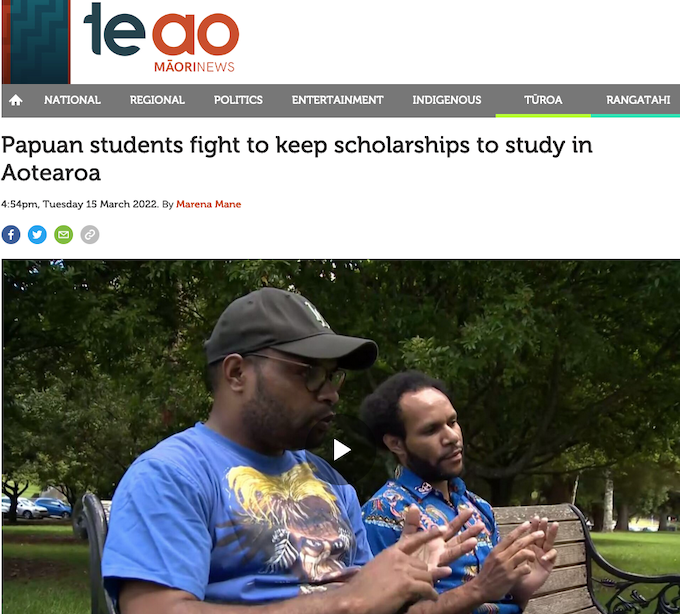
West Papuan students fight to keep scholarships to study in Aotearoa

By Marena Mane of Māori Television

Indigenous students from West Papua studying at universities across Aotearoa are defying an order from the Indonesian government to return home.

In January, more than 40 students were told that Indonesia would no longer be funding autonomous West Papuan scholarships so they had to pack up and leave.

Laurens Ikinia of the Hubula tribe and fellow student Esniel Mirin of the Kimyal tribe, both from the central highlands of West Papua, say they have been stripped of their dream for a brighter future.

“The government has terminated about 42 students here in Aotearoa New Zealand who are the recipients of Papua provincial government scholarships and I am one of the students who was terminated and this is really worrying me,” Ikinia said.

Ikinia and Mirin have both been struggling to support themselves since the scholarship decision was made. Living costs are rising and tuition fees are high for overseas students here.

“What we are trying to do just to survive is do some part-time jobs as long as we can but, unfortunately, some students cannot work because of their visa conditions. I don’t know how long it’s going to take us but that’s what we are doing just to survive,” Ikinia said.

Mirin said he found it hard to talk about the issue as he was not able to support himself and not able to work.

“I’m trying to communicate with my close friends from the campus or the churches I attend and they help me a lot,” he said.

“We are calling the Indonesian President, Joko Widodo, to respond to our request so in the future we can continue our programmes and success because this is kind of Indonesians trying to manipulate our education rights.”

The Indonesian embassy gave a written response to Māori Television’s request for comment, stating that the scholarships were wholly managed by Papua’s democratically elected provincial government. The embassy also said:

“These students are part of a total of 593 students from Papua province receiving the ‘Papua Special Autonomy Scholarship’… only those who have exceeded the allocated time of the scholarship and those who cannot meet the academic requirements are being recalled.

“The decision to repatriate certain students does not impact on those students who remain on track with regards to their studies abroad.

“The assessment is also conducted to ensure other eligible students from Papua province also obtain the same opportunity in pursuing their studies.”

The Māori Television story on the plight of West Papuan students in Aotearoa
The Māori Television story on the plight of West Papuan students in Aotearoa. Image: MTS screenshot APR

The embassy also said it had tried to resolve various aspects of the issue including possible outstanding tuition and living fees.

But for students such as Ikinia the suggestion he is being sent home because he has been failing, has no foundation.

“I came to New Zealand in 2016, I did my New Zealand language programme for five months and then I studied my international contemporary studies, bachelor programme, I studied in 2017 and then I finished in 2019 in three years and then I studied for my master’s programme in 2020,” he says.

“I’m just about to finish and then they put my name on the list and then they claim that I’m not making any progress, which is baseless. This is something that we have written a letter to the government to clarify — the evidence that the government used to categorise all these 42 students not making progress.”

Ikinia is reaching out to institutions, organisations and communities for their support on behalf of the Papuan Students Association of Oceania.

“We humbly request the people of Aotearoa, New Zealand to open your arms to welcome us as a Pacific family.

“It’s been a long, long time where West Papuans, indigenous peoples have not spoken about our education rights and we are calling for the sake of humanity.”

Marena Mane is a Te Ao Māori News reporter. Republished with permission.

Print Friendly, PDF & Email

Article by AsiaPacificReport.nz

Gavin Ellis: Fundamental flaws in public media plans call for big fixes

ANALYSIS: By Gavin Ellis of Knightly Views

The proposal for a new entity to replace Television New Zealand and RNZ has two fundamental flaws that must be fixed if it is to gain the public’s trust.

The first flaw is the assumption that an existing legal structure — the Autonomous Crown Entity — is an appropriate form of governance. The second is that it has provided inadequate protection from political interference. The two issues are related.

Let me say at the outset that I support the restructuring of public service media. It is an idea whose time has come. It is an opportunity to create, almost from the ground up, a public organisation designed to live up to a digital incarnation of BBC-founder Lord Reith’s dictum that public media should inform, educate and entertain (now, however, in a creative and clever mix).

My concern lies in the need for this new entity to demonstrate from the outset that it will be free-standing and free from influence. By treating its formation little differently from a stock-standard Autonomous Crown Entity (ACE) into which existing organisations are dropped, the government is sending the wrong signals. From Day One (i.e., right now) it needs to be treated very much as a special case.

Let’s not lose sight of what is possible here: The creation of a ground-breaking structure that can set new standards for public service media in the digital age – if it is born out of independent thinking, creativity, and wisdom.

And let’s not forget why it is vital that it succeed in that aim. Public trust in the institutions of democracy and a free society are being systematically undermined. We need to look no further than the darkly manipulated “protest” in front of Parliament.

Stirrers wanted the prime minister and journalists lynched and violent “protesters” set fires and threw paving bricks at police. They were supported throughout by a much wider social media narrative that neither politicians nor the media could be trusted.

Public trust in media eroding
Public trust in media is already on the way down. AUT’s Centre for Journalism, Media and Democracy polled trust in media last year and found it had declined across all four industry-wide metrics it had measured in 2020. RNZ and TVNZ remain the most trusted brands but both declined year-on-year. So, too, did all media included in the previous survey.

There is a real need for media institutions in which the public has trust and the JMaD studies point to public service media being at the pinnacle of that structure.

I have no doubt that the Minister of Broadcasting and Media, Kris Faafoi, is well-intentioned. As a former journalist he is only too well aware of the importance of trust and of the need to protect, nurture and champion media independence. Whether his cabinet colleagues have the same set of imperatives is harder to judge.

However, the restructuring requires a longer view than what might happen around the cabinet table over the next few months. We need to be concerned that the structure which emerges is not only fit for purpose now, but will endure for decades and be capable of withstanding winds of political change that on a global scale are showing more negative than positive signs.

In other words, it must be robust enough to survive not only known risks but also some conceivable unknowns: We had a Robert Muldoon, so could we have a Donald Trump?

Unfortunately, the announcement last week provides a less-than-reassuring beginning. The cabinet go-ahead was sparse on structural and operational detail. It did speak of a charter and proposed legislation that will contain a much-vaunted guarantee of editorial independence from ministerial control. However, that is undermined by other planned moves and much of the potential damage could be done even before the new structure is up and running.

Significantly, control of the governance of the implementation phase of the restructuring is one area of the cabinet paper and supporting documents in which there is real detail. Absence of detail elsewhere is explained away by saying these are matters for the Establishment Board to decide.

Seen as the architect
The draft terms of reference for the Establishment Board state it will be responsible for overseeing the detailed organisational design of the new entity and the transition to the new structure. In other words, it is to be seen as the architect. That was certainly the inference in Kris Faaoi’s announcement last week.

Yet the Establishment Board is precisely where the Minister (and his Cabinet colleagues) and the Ministry for Culture and Heritage have a potentially high level of influence.

The Establishment Board is expected to stay aligned to any cabinet decisions and is responsible for ensuring it “progresses government policy” and meets the minister’s objectives.

All members (up to nine) are to be appointed by the minister, who will also appoint the chair. The minister can terminate any member’s term before the expiry date and there is no requirement for him to state cause.

The board will not have its own staff but may ask the Ministry for Culture and Heritage – which will provide the secretariat — to appoint people to provide specialist or technical advice. MCH will also procure other services on the board’s behalf and its chief executive will decide what functions it will delegate to the board. Meanwhile MCH will continue to provide advice directly to the minister.

The Establishment Board will, according to the terms of reference, operate on a consensus basis — not a majority vote — and where it can’t reach consensus “the chair will advise the minister of the difference of opinion”. That begs the question: Does the minister effectively have a deciding vote?

He certainly has a tight hold on what the Establishment Board says in public. The section in the terms of reference relating to the Establishment Board’s relationship with the minister is devoted almost entirely to public statements. There can be “no surprises” (no surprise there) and the chair is the sole spokesperson.

The minister is to be informed of any public comment “either prior to, or as soon as possible after comment is made”, and all press releases must be sent to the minister in advance.

Multiple avenues for influence 
All of this suggests to me that both the minister and the ministry have multiple avenues through which they can influence the way the new structure is put together.

I freely admit there is good reason for liaison. For example, the early activity of the board will take place while the entity’s empowering Act and other law changes are working their way through the legislative process. The board’s thinking on the new entity should be reflected in that legislation and, if it isn’t, we might question why it is not.

However, there are equally good reasons why the Establishment Board should be seen to be independent. If the minister deflected questions on detail by saying they were matters for the Establishment Board, then let it be so.

The way it now stands, it looks (as my betting old dad would say) as though the government is trying to have a quid each way. Hedging bets is not a good way to begin the trust-building process.

Step one in that process should be an unequivocal statement from the minister that the Establishment Board does, in fact, have autonomy and, so long as its actions support the aims of the new entity, it will not be subject to ministerial or ministry direction. It should also have the power to appoint its own advisors.

Then there is the new entity itself. I was frankly surprised that work by a Chief Executives Working Party (to which I was an advisor), a Business Study group, and then a Business Case Governance Group did not produce a unique structure for what will be a unique organisation. Specifically, I expected to see the strongest recommendations for iron-clad protections, and I expected to see such protections accepted by cabinet. That hasn’t happened…yet.

Instead, cabinet has accepted the option of an Autonomous Crown Entity with a traditional minister-appointed board, with two board members appointed in consultation with the Minister for Māori Development. The only aspects that separate it from a stock-standard ACE is a charter (to which I’ll return) and a section that protects the entity’s editorial independence. As it stands, that section is less prescriptive that either the Television New Zealand Act or the Radio New Zealand Act.

Statement of good intentions
Cabinet has approved what is titled a “proposed basis for charter structure” that is little more than a statement of good intentions. Admittedly, no charter should be so detailed that it limits initiative or the ability to respond to changed circumstances.

However, what is missing from this document is an overarching statement that the organisation as a whole will be predicated on autonomy and independence. Instead there is a clause stating that the organisation itself should “demonstrate editorial independence”.

Also missing — or among the 12 redacted sections of the cabinet paper relating to financial implications — is how the new entity will be protected from the cudgel that governments here and elsewhere have used to bring recalcitrant public broadcasters to heel. That big stick is control of the purse-strings.

It is vital that there be some certainty of funding, both for operational reasons and to demonstrate to the public that the entity doesn’t kowtow to government in order to pay the bills.

We do not know what the core level of public funding will be, the term over which it will be paid, and who will set it. Funding, of course, is ultimately in Parliament’s hands and, as we’re talking taxpayer money, that is as it should be. However, it still needs protecting in some way from a vengeful ruling party – and here I want you to think forward to that Trump figure in our possible future. Multi-year funding, for example, is a pre-requisite.

There is still time to put right the governance shortfalls in the proposal.

The first step should be for the government to accept the need for an additional tier of governance that sits, effectively, above the board. Not to second-guess it, but to ensure that it meets the spirit of the charter under which the entity will operate, to review proposed budgets and Crown appropriations, and to act as a shield against external interference from government, the ministry or elsewhere.

Why Guardians are needed
The entity needs Guardians. RNZ’s board is described as guardians but they are effectively the equivalent of company directors (even if they are absolved from the need to turn a profit). The new entity will need something more akin to the Guardians of Lakes Manapouri, Monowai, and Te Anau that were established by Norman Kirk to protect those waters against detrimental effects from the hydro power scheme.

The Guardians of Public Media should, however, differ from that precedent in several fundamental ways.

First, they should not be appointed by a minister but by Parliament. In fact, the board of the entity should be similarly appointed, as is the case with a number of European public service media.

Second, they should produce an annual report, made not to a minister but to Parliament. It should include a judgement on funding adequacy and a review of the entity’s relationship with the minister, the ministry, and government as a whole.

This annual report should replace the proposed yearly review by at least four government departments, but not annual reports to Parliament by the entity itself.

The cabinet paper proposes a five-yearly review of the charter by Parliament. That can be read as a review by the politicians in power. Therefore any parliamentary review should be preceded by a Guardian review of the charter’s fitness for purpose and it is that review that should go to the House. That way, if a ruling party wants to mess unilaterally with the charter, it will be seen for what it is. In addition, each year the guardians should review performance against charter objectives, separate from any assessment by the entity itself.

They should also act as a bulwark against interference in decisions relating to any content produced or disseminated, and that is not limited to news. A shiver still runs down the spines of old broadcasters at the mention of Robert Muldoon’s undoubted role in the decision in 1980 not to screen the drama Death of a Princess to avoid upsetting the Saudi government.

More protection for news
News and current affairs, however, require more protection and guarantees of autonomy than other forms of programming. That was not apparent in the documents released last week. There must be explicit prohibitions — in legislation and in the charter — on both external and internal interference in news operations. A minister is not the sole potential source of pressure. Officials, board members, commercial staff, and management of the entity must be held at arm’s length.

Legislation should also preclude the chief executive from also holding the position of editor-in-chief. Paul Thompson holds both positions at RNZ and has done so without controversy, but the new entity will be both much larger and will be a hybrid of commercial and non-commercial functions.

I believe all of the entity’s news and current affairs functions and decision-making, including the position of editor-in-chief, must be kept within that department if autonomy and independence are to be seen to be real.

Details missing from last week’s announcement and document release created frustration but there may be a brighter side. If the detail has yet to be worked out, there is still time for Kris Faafoi, his cabinet colleagues, his ministry, and the Establishment Board to get it right.

Dr Gavin Ellis holds a PhD in political studies. He is a media consultant and researcher. A former editor-in-chief of The New Zealand Herald, he has a background in journalism and communications – covering both editorial and management roles – that spans more than half a century. Dr Ellis publishes a blog called Knightly Views where this commentary was first published and it is republished by Asia Pacific Report with permission.

  • Read the full Gavin Ellis article here:

Fundamental flaws in public media plans call for big fixes

Print Friendly, PDF & Email

Article by AsiaPacificReport.nz

What does it mean to be ‘neutral’ over Ukraine – and what responsibilities come with it?

Source: The Conversation (Au and NZ) – By Maartje Abbenhuis, Professor of History, University of Auckland

There’s a popular cartoon by Tom Toro that’s been doing the social media rounds since 2012, in which two historians sit in a book-lined library as one complains:

Those who don’t study history are doomed to repeat it. Yet those who do study history are doomed to stand by helplessly while everyone else repeats it.

As a historian, I don’t much prescribe to the histoire se répète (history repeats itself) school of thought. No two moments are ever “the same”. Context changes everything – and the complexities of context are as important to understanding an event as the potential similarities with another moment in time.

I find many of the historical analogies being bandied about over the war in Ukraine banal. There is nothing to be gained from equating Putin with Hitler or likening Russia’s invasion of Ukraine with Germany’s invasion of Poland in 1939.

But what is useful in studying past wars is that they help us understand what aspects of a current crisis might be worth asking critical questions about.

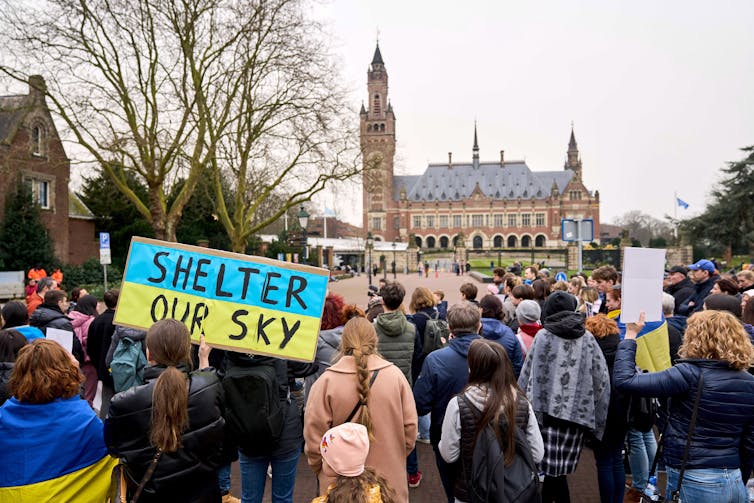
In that sense, Toro’s cartoon is apposite, especially when it comes to interrogating our collective responsibility for the war in Ukraine and its victims. Is watching in horror as the war unfolds all we can do? What responsibilities do we have as non-belligerent “neutrals”?

Neutrals and non-belligerents

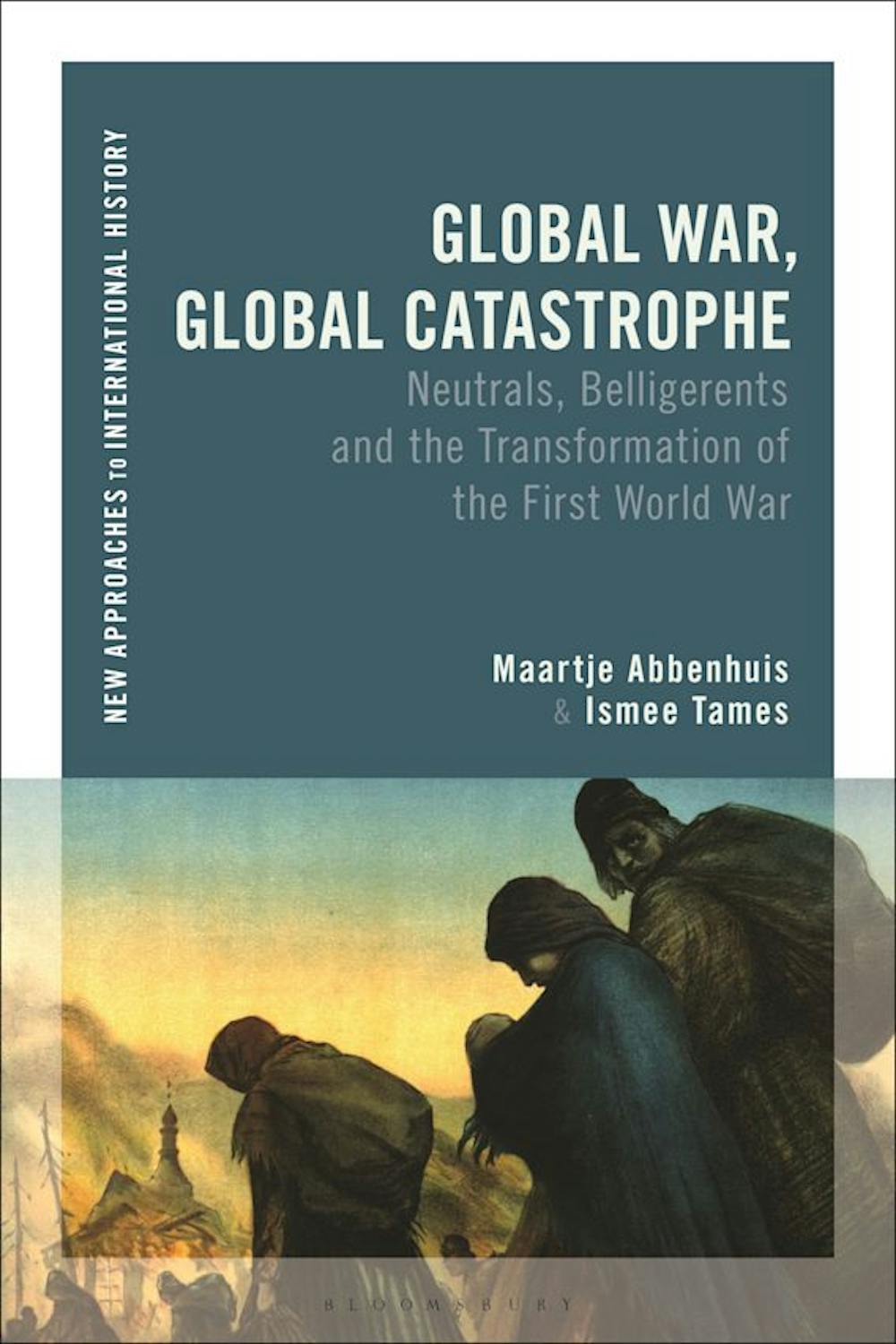
I’ve spent much of my academic career studying international systems and great power diplomacy, particularly in time of war. I’ve written several books about neutrality, peacemaking and avoiding war. My most recent (co-authored) title, Global War, Global Catastrophe, integrates the history of neutrals and non-belligerents into the global history of the first world war.

This research highlights the many ways in which governments and communities approach wars in which they’re not actively involved as belligerents. Neutrality is the formal term used for a state that chooses not to go war when other countries do.

While we rarely use the word “neutral” today to describe countries that are not fighting a war (preferring to reserve that term for non-aligned countries like Switzerland), in a legal sense everyone who remains non-belligerent in this conflict is neutral according to the laws of war.


Read more:
On the 3rd anniversary of the Christchurch attack, the Ukraine crisis asks the West to rethink its definitions of terrorism


Neutrals and non-belligerents feature in all international conflicts. Even in the age of collective security that evolved after 1918 and through the Cold War, there were always neutrals and non-aligned states.

But the world watching the war in Ukraine today is most akin to the 19th-century age of neutrality, when most wars were fought by a small number of states, while the rest opted out as neutrals, including many great powers.

Neutrality helped these wars stay localised and limited, preventing them turning into major conflicts involving more of the militarised world. Much like today, there were always more non-belligerents watching a war than belligerents fighting it.

Neutrality isn’t passive

This history reveals that neutrality was not (and cannot be) a value-neutral concept. Neutral countries and communities are never politically impartial or evenhanded in their response to a military conflict, even if they have legal obligations regarding the warring parties.

As such, sanctioning Russia and sending military equipment to Ukraine are not, on the face of it, anti-neutral acts – although they certainly send powerful messages to Russia about the limits of what the rest of the world will allow or endure over Ukraine.


Read more:
‘I have a need’: How Zelenskyy’s plea to Congress emphasized shared identity with US


As in the past, neutral countries and non-belligerent organisations and communities often take on a range of key responsibilities and actions to help alleviate the suffering of a war or bring it to an early close.

Neutral governments are often the mediators and arbitrators of international crises and offer safe spaces for the warring parties to negotiate a solution. They also offer humanitarian support for the victims of war, including front-line medical care and havens for refugees.

And since all wars are also information wars, independent media sources play an influential role: unmasking the extreme violence of war, establishing how the watching world understands what the war is about, and determining which belligerent is perceived as being on the side of “right”.

Neutrality and ending war

Neutrals, then, actively determine what is at stake in a war. Winning the “hearts and minds” of the people watching as non-belligerents is therefore vitally important to the warring parties.

At the moment, Ukraine’s president, Volodymyr Zelenskyy, is doing an exceptional job of influencing the watching world’s expectations and framing what the invasion of Ukraine is about. He needs that global support to help set the terms of any peace negotiations with Russia.

Historians of warfare almost always fixate on the actions of those actually doing the fighting or falling victim to the violence of a war. Today, too, we seem fixated on understanding Russia and Putin and on explaining why Ukraine is so important.


Read more:
Ukraine: Putin isn’t mad – he’s following a long-established great power playbook for conquest


But it’s as important to ask questions about the responsibilities and actions of the neutral and non-belligerent world – those of us watching the war unfold in real time – as it is to interrogate those of any warring parties.

Just as in the 19th century, neutral parties have a massive role to play in the conduct, outcome and terms of this war. Their assessments will help to determine how we understand the conflict in years to come.

Alongside asking serious questions about why Russia invaded Ukraine, we should therefore also train our mirrors on ourselves as non-belligerents. How are we shaping the contours of this conflict? How are we responding to it? Where are our responsibilities to bring its suffering to a successful and speedy close?

The Conversation

Maartje Abbenhuis receives funding from the Royal Society of New Zealand Marsden Fund and Waipapa Taumata Rau University of Auckland.

ref. What does it mean to be ‘neutral’ over Ukraine – and what responsibilities come with it? – https://theconversation.com/what-does-it-mean-to-be-neutral-over-ukraine-and-what-responsibilities-come-with-it-179457

Is there such a thing as the perfect alarm tone? We think so (and this is what it might sound like)

Source: The Conversation (Au and NZ) – By Stuart McFarlane, Researcher, Auditory Perception and Cognition, RMIT University

Miriam Alonso Pexels

With the return to office work – and no longer being able to roll out of bed and straight into a Zoom meeting – many of us will be waking up earlier to beat the morning rush. So it’s important to ensure we’re on top of our alarm game.

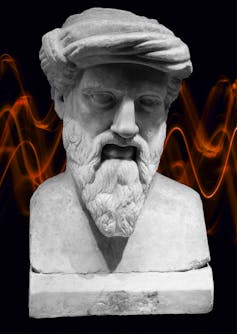
But what type of alarm provides peak alertness upon waking? Pythagoras posited this same question in around 500 BCE. He believed specific songs – melodies that roused the energies – had the ability to counteract the drowsiness waking may bring.

Pythagoras thought playing certain tunes helped his disciples wake up more alert.
Wikipedia, Pawel Czerwinski/Unsplash, Stuart McFarlane

And he appears to have had a point. Research has now shown certain alarm sounds can indeed enhance our alertness upon waking.

In particular, alarms that have the qualities of “tunefulness” (think ABC by The Jackson 5) have melodies that energise the listener, and are great for effective waking.

But to understand why this is the case, we first need to understand how our brains respond to complex stimuli when moving out of the sleep state.

Waking up right is important

Waking up groggy never feels right. And how we wake up can not only affect our mood and the day’s outlook, but also our cognition and mental performance.

In some instances, grogginess after waking has the potential to be dangerous several hours later, by reducing our performance in critical decision-making (such as in health settings, emergency responses, security or while driving).

This cognitive state of reduced alertness is referred to as “sleep inertia”. It’s a growing concern as it can have serious consequences while performing high-risk tasks, including driving.

How does the brain wake up?

Transitioning from sleep to alertness does not follow an on/off switch-like system, as brain imaging techniques have revealed.

Waking relies on complex biological processes, including increased blood flow allocation to the brain. Studies show the brain regions important for alert performance (the prefrontal cortical regions) take longer to “start-up” than other areas (such as the basal ganglia) which are important for arousal. This means you can be awake, but not quite with it.

Research has also shown blood flow activity within the brain to be diminished after waking, in comparison to the pre-sleep state. Thus, alert wakefulness may in part require mechanisms that encourage a redistribution of blood flow to the brain – something certain types of sound and music can do.

A positron emission tomography (PET) scan of the human brain can reveal areas with more activity (in red).
WikiCommons

Another factor that influences alertness upon waking is the stage of sleep at the time. You’re less likely to feel groggy if you wake up from a light sleep, compared to a deeper slow-wave or REM sleep.

A light sleep stage is characterised by Theta wave frequencies (as measured from the brain’s electrical activity) and can be associated with feeling drowsy. In this sleep stage, arousal from external stimuli such as an alarm can quickly draw a person out of sleep.

Conversely, deep sleep or slow-wave sleep consists of Delta wave frequencies, which are associated with unconsciousness. This is the more challenging sleep stage to fully wake up from.

Alarm effectiveness also depends on age. Young adults aged 18 to 25 need louder alarms than older people, and preteens need an even greater threshold than young adults. You may require an alarm as much as 20 decibels louder at 18 than you would at 80.

Preteens need louder alarms than young adults (aged 18–25), who in turn need louder alarms than older people.
Jason Rosewell/Unsplash


Read more:
Why do kids hate going to sleep, while adults usually love it?


Is sound frequency and tune important?

But when it comes to choosing an alarm, what exactly is the best choice? A growing body of evidence suggests different alarm sounds can positively influence human performance after waking.

Our systematic review published in 2020 showed temporal frequencies (the pitch of the sound as measured in Hertz) around 500 Hz are better at arousing young children than 2000+ Hz varieties.

We lack research to say whether this also applies to adults, but it’s assumed the same alarm types would be beneficial.

Example of a temporal T-3 alarm sound around 500 Hz.

Voice notifications such as a person yelling “wake up!” work better than higher frequencies. However, they are not as effective as 500 Hz tonal beeping alarms – similar to those preinstalled in most mobile phones.

Our research also explores how qualities of music, and specifically melody, play a role in encouraging alert wakefulness. We found that the way in which people interpret their alarms “tunefulness” also reflects how groggy they feel after waking.

Here, people who use alarms that carry a tune they will readily hum along to will experience less grogginess than those with a standard “beeping” alarm.

With this in mind, we developed a custom rhythmic melody that led to significantly better performance upon and after waking, when compared to standard beeping alarms.

We designed this experimental alarm tone to increase alertness and reduce morning grogginess. (Stuart McFarlane)

Other studies have also found popular music (which can be interpreted as being melodic) is good to counteract sleep inertia after a short nap, and even more yet if it is music the listener personally enjoys.

What can I do to improve my waking alarm?

What does all this mean for the day-to-day? Well, given all of the above, we believe the perfect alarm must sound something like this:

  • it has a a melody you can easily sing or hum along to
  • it has a dominant frequency around 500 Hz, or in the key of C5 and
  • it is not too fast or too slow (100 – 120 beats per minute is ideal).

Also remember the alarm must be louder for younger people (or for particularly deep sleepers).

If we consider the default alarms available on our devices, much more work is needed – especially since research in this area is relatively new. Hence, we suspect the availability of custom alarm downloads will increase with time.

Most pre-loaded alarms at the appropriate loudness will wake you, but specific designs (such as the one above) have been modelled on the latest research to not only encourage arousal, but also provide increased alertness.


Read more:
Snooze blues? How using your favourite song as an alarm can help you wake up more alert


The Conversation

Stuart McFarlane has received funding from the Australian Government Research Training Program Scholarship.

Adrian Dyer receives funding from the Australian Research Council.

ref. Is there such a thing as the perfect alarm tone? We think so (and this is what it might sound like) – https://theconversation.com/is-there-such-a-thing-as-the-perfect-alarm-tone-we-think-so-and-this-is-what-it-might-sound-like-178902

Russia’s bombardment and Ukraine’s departure ban leave children and those with disabilities most vulnerable

Source: The Conversation (Au and NZ) – By Amy Maguire, Associate Professor in Human Rights and International Law, University of Newcastle

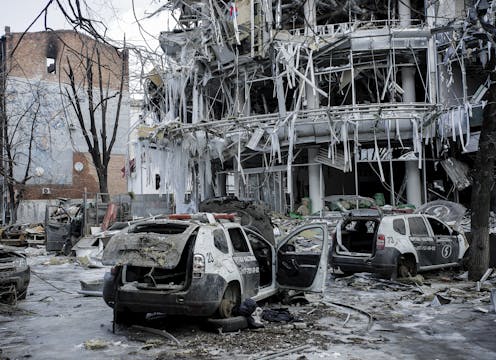
Russia’s war on Ukraine is driving some of the most rapid movement of refugees ever seen. Its invasion and increasingly intense bombardment is generating a dire humanitarian crisis. Over 3 million people have fled across borders to Poland and other surrounding countries since February 24.

Ukraine has accused Russia of blocking and bombarding a humanitarian escape corridor. It also claims Russia is holding 400 patients and staff hostage in a Mariupol hospital.

The scale of the exodus from Ukraine would be even greater if its government had not banned the departure of men aged 18-60.


Read more:
Why banning men from leaving Ukraine violates their human rights


Ukraine’s departure ban

I (Maguire) wrote about this ban earlier this month, noting it violates the right of conscientious objection to military service. It places Ukrainian women, many fleeing with children, under great strain. It also raises important strategic questions for Ukraine’s self-defence.

Since my earlier article, I have heard from two men in Ukraine who feel trapped by the ban and do not want to fight. One reports he is trapped between the approaching Russian army and the Ukrainian border service.

Another says he is hiding with relatives who are buying food for him. By order of the Lviv mayor, he says he is required to report for military service, but he cannot imagine using a weapon against another person. He says very few men are excused from service – only those with three or more children or severe health conditions.

I have also heard from three men who fear for their partners – gay men unable to flee Ukraine. These correspondents have asked me what organisations can help their partners to escape, because they fear persecution as Russian forces advance.

The ban on men aged 18-60 leaving Ukraine poses serious human rights questions.
Andrzej Lange/EPA/AAP

Ukraine’s departure ban heightens humanitarian risks

The UN Refugee Agency estimates four million people could flee Ukraine. But millions more are already displaced internally, and the western regions of the country are being overwhelmed.

One of my correspondents describes the situation in a small town near Lviv:

Ukraine’s current border policy is a major contributor to an ongoing humanitarian catastrophe. Millions of people are fleeing into west Ukrainian regions that are still relatively safe, but those regions simply can’t accommodate every fleeing person. The housing and other basic needs are getting less affordable and accessible, tents are now being erected to house people in Lviv, and the situation might only worsen, as Russian occupation of the country progresses and more people are displaced.

This man told me many families, including his own, do not want to separate and leave service-age men behind.

International human rights and humanitarian law confirm the right of all families – as the natural group units of society – to unity.

A children’s rights crisis

The ban on men leaving Ukraine should be lifted. But even if more people could escape from Ukraine, many will remain trapped and subject to humanitarian and rights violations resulting from Russia’s aggression.

As the fighting rages, Ukrainian children are particularly vulnerable.

There are 7.5 million children among Ukraine’s population of 44 million. Over 1.5 million children are among those who have fled across national borders – almost one new child refugee every second. As the departure ban on men aged 18-60 persists, the vast majority of children are travelling with their mothers, many of whom fear this separation will be permanent.

As the fighting rages and Ukrainians are forced to flee, children are particularly vulnerable.
Arkady Budnitsky/EPA/AAP

The number of separated child refugees without any family support also continues to rise in what has been termed an “escalating child protection crisis”. There are significant concerns for the safety of these children. In the absence of any family support, they are at a heightened risk of threats including homelessness, violence, abuse, sexual exploitation and human trafficking.

There are also serious and immediate concerns for the safety and well-being of the children who remain in Ukraine. The recent bombing of a children’s and maternity hospital in Mariupol serves as one of the most shocking and brutal examples of Russia’s war crimes against vulnerable people, including pregnant women and newborn babies.


Read more:
Remembering the past, looking to the future: how the war in Ukraine is changing Europe


Reports also suggest access to aid and evacuation corridors has been cut off. This has left millions of people without basic supplies including medicine, power and communication. Children have been unable to enjoy their right to education as schools and kindergarten buildings come under attack.

Children with disabilities are particularly vulnerable. A significant number live in residential care facilities and may be unable to flee due to their health conditions. Ukraine has an extensive network of institutional care settings, with an estimated 1.3% of all children living in out-of-home care – one of the highest rates in Europe.

As civilian buildings and infrastructure such as apartments, hospitals and schools come under increased attack, many Ukrainians are forced to seek shelter, often for hours on end, in nearby bomb shelters. The right of access to safety and shelter may not be available for those with disabilities who cannot relocate easily or quickly. Many shelters are also inaccessible to people with physical disabilities, and information on emergency evacuation protocols is not available in accessible formats.

The human rights implications of the war are incalculable, especially for children and vulnerable people. Children have the right to live with their families, the right to shelter, to be educated, to receive adequate health care and to be free from all forms of violence and abuse. The scale of the war and the atrocities inflicted by Russia will have a lifelong impact on all Ukrainian people, not least on the most vulnerable.

The Conversation

The authors do not work for, consult, own shares in or receive funding from any company or organisation that would benefit from this article, and have disclosed no relevant affiliations beyond their academic appointment.

ref. Russia’s bombardment and Ukraine’s departure ban leave children and those with disabilities most vulnerable – https://theconversation.com/russias-bombardment-and-ukraines-departure-ban-leave-children-and-those-with-disabilities-most-vulnerable-178991

Red dirt, yellow sun, green steel: how Australia could benefit from a global shift to emissions-free steel

Source: The Conversation (Au and NZ) – By John Pye, Associate Professor, School of Engineering, ANU, Australian National University

Getty

Australia is the world’s number one exporter of both iron ore and metallurgical coal, the key ingredients of traditional steel making. Together, these materials make up a very large part of Australia’s export income.

But as the world moves towards net-zero emissions by 2050, the conventional way of making steel, using coal to power a blast furnace, will come under question.

Iron and steel production, in total, account for close to 7% of the world’s greenhouse gas emissions. This is incompatible with a net-zero world economy, where residual emissions would need to be compensated through carbon dioxide uptake from the atmosphere. The mature technology of coal-fired blast furnaces currently dominates the steel industry, generating 90% of its emissions.

For years, decarbonising steel production has been seen as particularly challenging. But now, alternatives to the centuries-old practice of using coal to produce iron and steel are emerging. Researchers have been working on a number of new pathways to make steel with little or no emissions. The most promising process relying on the use of hydrogen.

Our new research shows the steel industry can develop and implement green steel production processes to contribute to the great decarbonisation effort needed. For Australia, this presents an enormous new opportunity to future-proof and expand our steel industry as the world acts on climate change.

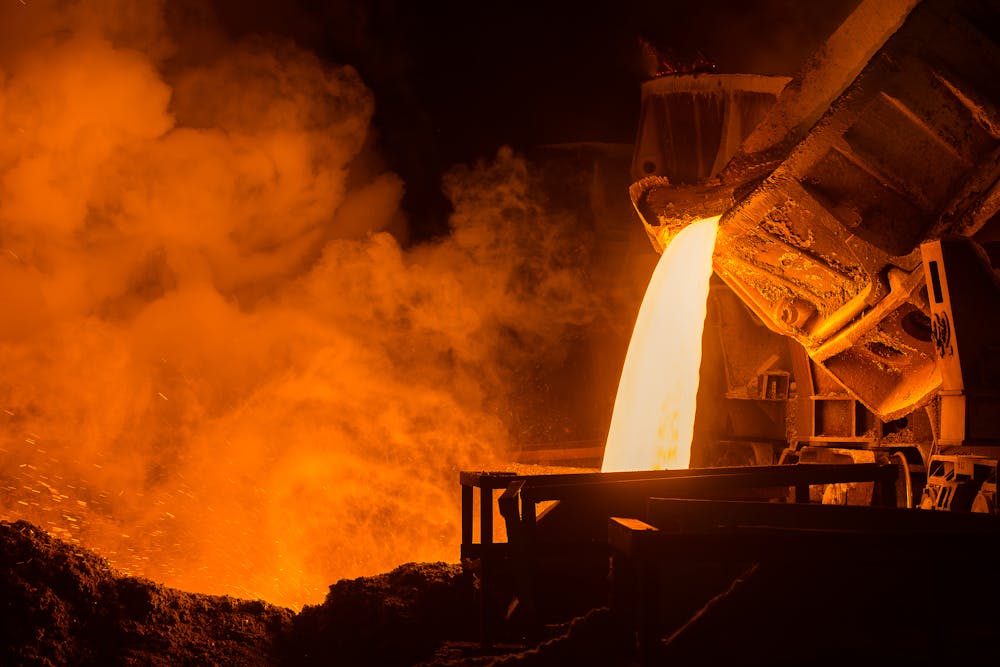
Molten steel being poured
Traditional steelmaking relies on coal.
Shutterstock

How can we produce green steel?

To eliminate emissions from this sector, several things are needed. First, we must use steel efficiently in well-designed structures. Second, we must recover and recycle steel after use. Thirdly, we must find the best and most scalable processes to reduce and eventually eliminate the emissions produced when making new steel.

In Australia, there have been several recent efforts to improve steel production processes. Rio Tinto developed the HIsarna technology, which can cut emissions by up to 80% – as long as the carbon is captured and stored. Other emission reduction technologies have also been developed here, such as dry slag granulation, polymer injection technology and charcoal-based reduction. However these technologies cannot scale up to decarbonise all steel produced globally.

Green plants peeping through steel
Green steel is edging closer.
Getty Images

Are there other options? Yes. We’re beginning to see real world trials of advanced green steel technologies which can make emissions-free steel.

These techniques rely on hydrogen to strip oxygen molecules from iron ore to produce metallic iron. Frontrunners include hydrogen shaft furnaces like HYBRIT and fluidised-bed systems such as HYFOR. Both of these processes are undergoing testing in Europe.

We could even see the direct electrolysis of steel, using electric currents to strip off the oxygen, and avoid the need for hydrogen.


Read more:
‘Green steel’ is hailed as the next big thing in Australian industry. Here’s what the hype is all about


How quickly do we need green steel?

Australia has recently pledged a 2050 net-zero target.
Over the last two years, many of Australia’s major trading partners also made ambitious emission reduction pledges, including major iron ore buyers China, Japan and South Korea.

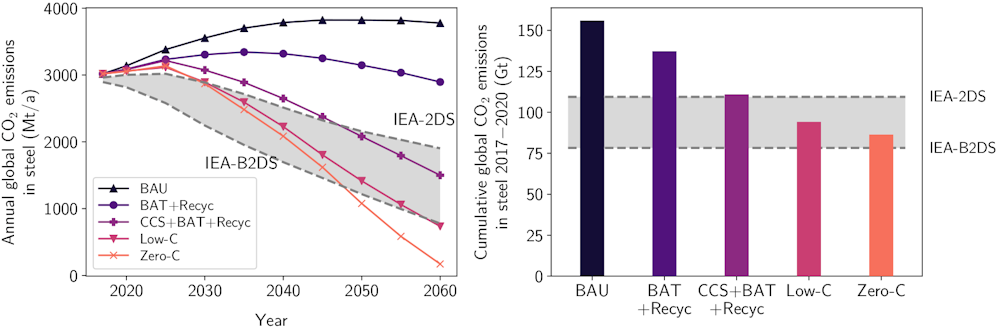
So how can the steel industry help? We examine five different decarbonisation scenarios in our recent paper. We found the only scenario compatible with keeping global warming to under 2℃ includes the aggressive development and adoption of green steel technologies.

This would mean ending the use of blast furnaces by 2060, maximising recycling of steel, as well as some transitional use of gas in direct-reduced iron making. Under this zero-carbon scenario, green steel technologies would take over by 2060.

Graphs of CO₂ emissions over time, for various model scenarios.
The five scenarios we tested: (i) business-as-usual (‘BAU’), (ii) best available technology with increased steel recycling (‘BAT+Recyc’), (iii) ‘BAT+Recyc’ integrated with carbon capture and storage (‘BAT+CCS+Recyc’), (iv) limited deployment of low- and zero-carbon technologies (‘Low-C’), and (v) complete decarbonisation (‘Zero-C’). The chart shows yearly and cumulative steel production emissions between 2017 and 2060.
Author supplied.

In creating our scenarios, we relied only on existing technologies, rather than promising but still unproven technologies such as direct air capture and storage of carbon dioxide.

Here’s how Australia could benefit

Australia need not lose from the transition away from metallurgical coal.

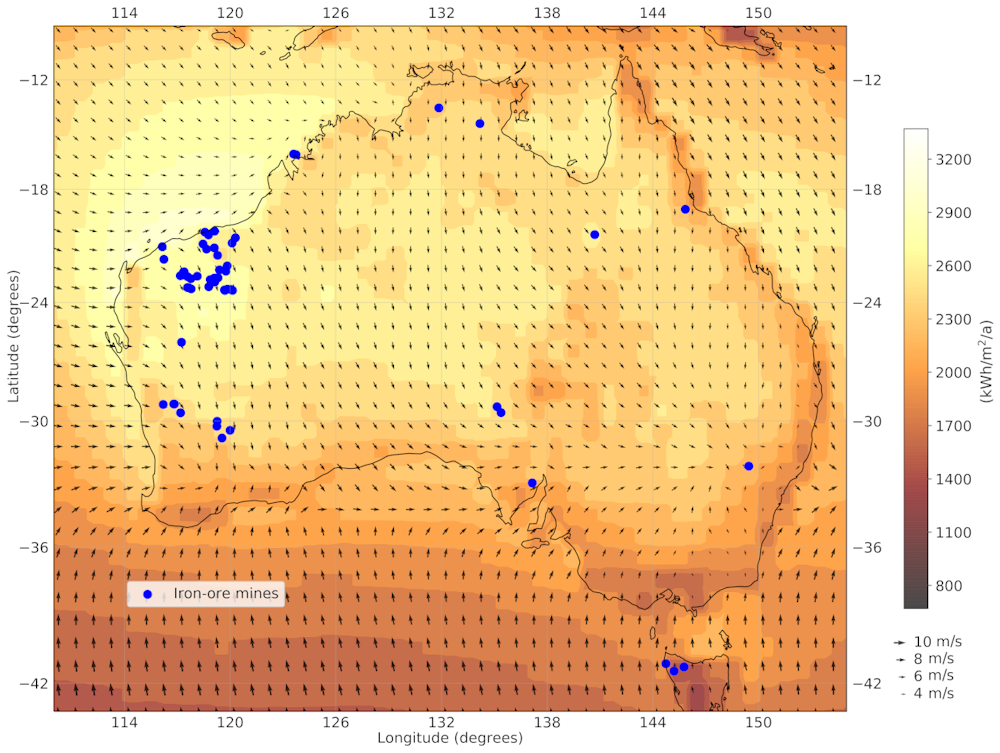
More than 95% of all our iron ore comes from Western Australia’s Pilbara region, which also happens to have excellent solar resources. Our modelling suggests we could produce electricity from solar panels almost a third cheaper than some overseas industrial hubs.

So Australia could be well positioned to become a green steel producer, adding significant value to our exports.

The Pilbara could become a region where iron ore is mined, smelted into iron and possibly into steel without producing carbon dioxide, and shipped overseas. We could export intermediate products, such as pellets or hot-briquetted iron, or perhaps even finished steel.

Map of Australia showing wind energy and solar energy potential, and iron ore mine locations.
Australian iron ore mines are concentrated in the Pilbara region, which also has excellent solar and on-shore wind wind resources.
Author supplied

Even if no green steel industrial operations develop in Australia, we will come up against a world shifting away from metallurgical coal.

Not only that, but we’ll have to make sure future green steel technologies can use Australian ores, or we risk losing market share. That’s because other major exporters have iron ores with different purity and chemistry, and it’s not clear yet how green steel processes will drive demand for different ores. It looks likely that low emissions steel will require high grade ore, but this is still an evolving area of research.


Read more:
Australians want industry, and they’d like it green. Steel is the place to start


Change is coming, like it or not. We need good policies in place now to ensure Australia can keep its major role in the global iron and steel supply chain.

We’ll need local research and development, international partnerships with leading technology producing and steel-consuming nations and government backing for the major investments required to establish a green iron or steel industry in Australia.

The world is changing rapidly. If we want to grasp the major opportunity presented by green steel, we must act now to explore the benefits of having iron ore mines, solar resources and ports close to each other.

The Conversation

John Pye receives funding from the Heavy Industry Low-Carbon Transition Cooperative Research Centre (HILTCRC) and the Australian Renewable Energy Agency (ARENA).

Alireza Rahbari receives funding from the Heavy Industry Low-Carbon Transition Cooperative Research Centre (HILTCRC) and the Australian Renewable Energy Agency (ARENA).

Emma Aisbett leads and has led research projects funded by a variety of funders. None present a conflict of interest on this topic

Frank Jotzo leads and has led research projects funded by a variety of funders. None present a conflict of interest on this topic.

Zsuzsanna Csereklyei received research funding by a variety of funders. None present a conflict of interest on this topic.

ref. Red dirt, yellow sun, green steel: how Australia could benefit from a global shift to emissions-free steel – https://theconversation.com/red-dirt-yellow-sun-green-steel-how-australia-could-benefit-from-a-global-shift-to-emissions-free-steel-179286

A bigger defence force will affect more military families’ children – their well-being must be protected

Source: The Conversation (Au and NZ) – By Marg Rogers, Senior Lecturer, Early Childhood Education, University of New England

Department of Defence/Commonwealth of Australia

The Australian Defence Force (ADF) is about to get a lot bigger. Defence Minister Peter Dutton has announced plans to expand the ADF by 18,000 members by 2040. This nearly 30% increase, the largest since the Vietnam War, will require not only a renewed focus on recruitment, but also on retaining current sailors, soldiers and aviators.

Families of these uniformed personnel will be crucial to the success of these efforts. The families of defence personnel, especially those with children, experience significant impacts as a result of their service. Our research has highlighted the experiences of young children and the pressures on defence families.

The increase in ADF personnel will require a major rethink of policies and procedures to protect the well-being and education of children in defence families. The ADF needs to become an employer of choice to retain these families as well as attract recruits with families. Our research findings offer some ideas that could inform the policy changes needed to achieve this boost to defence numbers.


Read more:
Government announces long-term boost to Australia’s defence numbers


Slaves to two greedy masters

Recruitment is challenging because the military is a “greedy institution” demanding great sacrifice from personnel and their families. Likewise, families are also “greedy institutions”, demanding enormous sacrifices from parents.

Defence families’ efforts to satisfy each master are doomed from the start and many personnel list “family reasons” when they leave.

Dutton acknowledged these issues last week:

“[W]e lose people at way too young an age after we’ve invested an enormous amount in them. I am very conscious of people being posted for two years, and their children being dragged from school to school. I’m conscious of the impact on predominantly mothers, wives, in that arrangement […]”


Read more:
‘Fit for service’: Why the ADF needs to move with society to retain the public trust


The kids are not alright

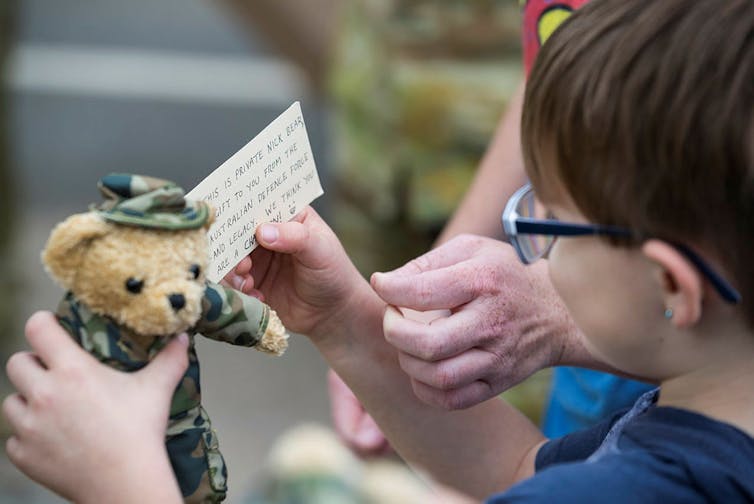
Child holds a bear wearing an army camouflage uniform
An Omeo boy reads the card attached to a Legacy bear presented to him by staff of the Latchford Barracks Relief Centre on January 21 2020.
Department of Defence/Commonwealth of Australia

Key aspects of military life, like deployments and relocations, have a big impact on children. It can seem like children’s well-being, education and special needs are sacrificed to ADF members’ career needs. This includes compromising secure relationships with their early childhood educators and peers.

The impacts on children’s learning are severe because quality early education relies on interactions within secure relationships with educators.

Young children can struggle to understand the changes at home when they relocate, or a parent goes away on deployment or extended training. The trouble children have in understanding the demands of military service is clear in this exchange between two-year-old Emily, one of our research participants, and her mother:

“But where’s Dad?”

“Daddy’s gone on the plane, darling. Remember, we took Dad to the airport yesterday.” (Emily starts crying and throws herself on the ground.)

While deployment is challenging, reintegrating defence parents back into the family can be harder. In the same study, one mother said her coping strategy was to have a very relaxed style of parenting when her partner deployed. They ate when they were hungry and her son went to bed in front of the TV.

“I go to pieces in the last month again. We have to sort of prepare for him
coming home. […] Paul is like a military man. You know, routines. There are
mealtimes, he says what we are watching when the TV is on. […] There are bedtimes. So I say to Jack, ‘You know what we do now is just our thing. When Daddy gets home we have to do it his way.’ ”

Sailor hugging family members after deployment ends
A sailor hugs family members after his deployment ends.
Department of Defence/Commonwealth of Australia

Relocation and a parent coming and going from the house for lengthy training sessions and deployments mean many transitions for the household. During these times, children can experience regressions in learning and social, emotional and physical skills. This also increases parent’s fatigue and their ability to cope.

“Bethany (four years old) has […] trouble sleeping. She has slept in our bed every night except two, when Ule (sibling) came in. It is really tiring. She was fine before deployment.”


Read more:
How to support children whose parent works away for long periods


As they move between schools and states, school-aged children can miss whole units of learning, putting them on the back foot. This often leads to children acting out as they struggle to keep up and make friends. Rates of behavioural and emotional difficulties are higher in children from military families.

Children also suffer from disrupted social networks as a result of relocations. They lose their connection with community groups and miss out on extracurricular activities.

A lack of understanding among children’s peers and the general community can also be harmful. One participant’s older sibling had been teased at school when the class found out her parent had deployed, which increased fears for the parent’s safety:

“Your Dad’s gonna get shot! Ha ha!”

Recommendations

Drawing on research, this report recommends policies that safeguard families. One recommendation is that families with children only be relocated up to three times until their youngest child is 18.

Also recommended is a flexible model for deployment, with longer, less frequent deployments. That way, training episodes of the military personnel can be built into deployment to reduce disruptive transitions at home.

These recommendations would provide more opportunities for children and their families to plug into protective supports. Sources of support include educators, extended family, community and defence friends, counselling, health and family workers, social media groups and ADF supports. They could then create a buffer to help families during rough times.

Parents and educators have complained about the lack of resources to support young children from military families, and their educators. Recent funding has meant free research-based resources are now available to build resilience. These also include resources to assist children whose parents have sacrificed their health in service, and their family workers.

Acknowledging and respecting the incredible resilience and contribution of children and partners in defence families should be the starting point for the policy changes needed to boost defence.

The Conversation

Marg Rogers receives funding from The Ian Potter Foundation, University of New England and The Association of Graduates in Early Childhood Studies for the Early Childhood Defence Program project.

Amy Johnson receives funding from The Ian Potter Foundation, University of New England and The Association of Graduates in Early Childhood Studies for the Early Childhood Defence Program project. She has lived experience as a member of the ADF Reserves and the spouse of an ADF veteran.

ref. A bigger defence force will affect more military families’ children – their well-being must be protected – https://theconversation.com/a-bigger-defence-force-will-affect-more-military-families-children-their-well-being-must-be-protected-179312

To really address climate change, Australia could make 27 times as much electricity and make it renewable

Source: The Conversation (Au and NZ) – By Paul Burke, Professor, Crawford School of Public Policy, Australian National University

shutterstock

Australia’s electricity system is on the road to becoming 100% renewable as coal-fired power stations close and wind and solar takes their place.

But as a proportion of electricity consumed domestically, it’s on the road to more than 100% renewable. That’s because renewable power set to be produced in Australia’s north could be exported in ways such as via subsea cables.

And if we get really serious about bringing down global emissions we will be doing much, much more.

In a newly-published study carried out as part of a multi-disciplinary team under the Zero-Carbon Energy for the Asia-Pacific project we analyse the potential for Australia to produce and export not only clean energy but also green value-added commodities, eliminating emissions that would have taken place elsewhere.

We find there is substantial scope for Australia to use its solar, wind and land endowments to become a major exporter of green electricity, green hydrogen, green ammonia, and green metals.

Australia’s exports are emission-intensive

Australia is the world’s largest exporter of coal and liquefied natural gas, mostly to countries in the Asia-Pacific. Each year, the emissions from overseas use of these fuels vastly exceed the total emissions from Australia itself.

Australia is also a major producer and exporter of other commodities that go on to be used in emissions-intensive ways in destination markets – among them iron ore, bauxite and alumina.


Read more:
Australia is in the box seat to power the world


The figure below shows our calculations of the “consequential emissions” associated with Australia’s exports of several key commodities.

To avoid double counting, coking coal is not shown. Its emissions are instead included in the emissions tied to the overseas use of Australian iron ore.

The consequential emissions associated with the key commodity exports shown below account for about 8.6% of total greenhouse gas emissions in the Asia-Pacific and about 4% of global emissions.


While importing countries are certainly not absolved from responsibility for emissions from use of Australian exports, the calculations show just how important Australia’s upstream role is.

Australia could export zero-carbon products and energy

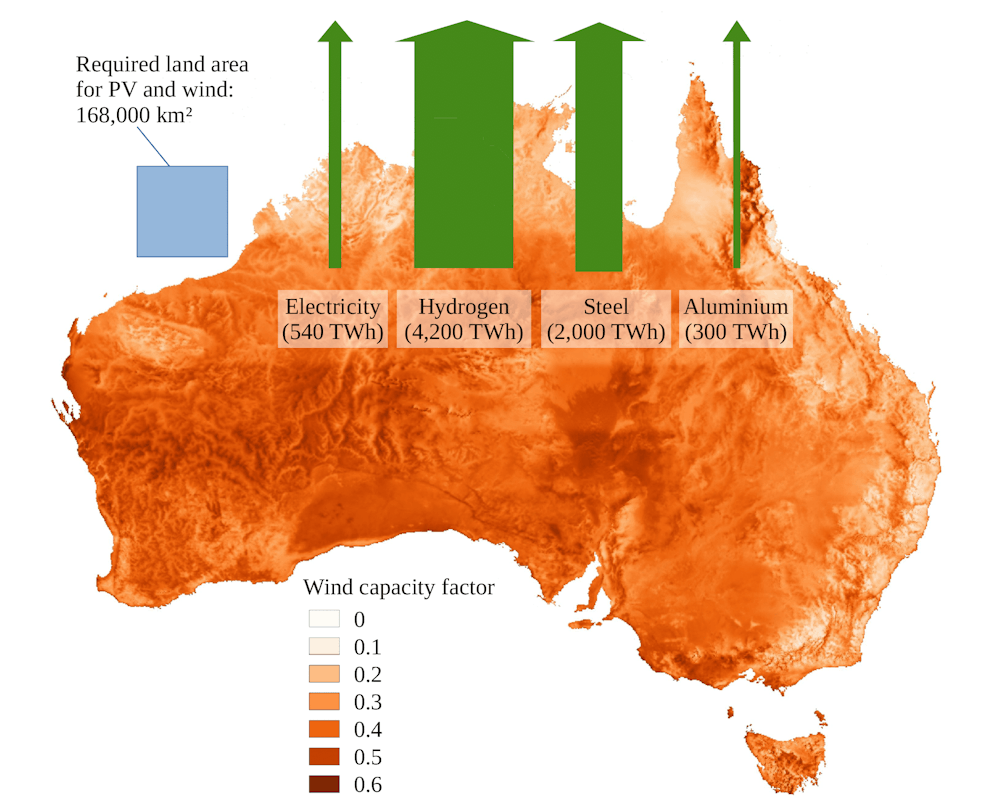
To get an indication of the production possibilities, we calculated the land area and energy requirements for an indicative scenario in which Australia:

  • exports the same quantity of energy in green electricity and hydrogen as it exports in thermal coal and liquefied natural gas.

  • processes currently-exported iron ore, bauxite, and alumina into green steel and green aluminium for value-added export.

Using 2018–2019 data, we calculate that about 2% of Australia’s land mass would be needed for solar and wind farms. This is a large area, although small relative to the area currently dedicated to livestock grazing and other agricultural activities.


Read more:
Why Aboriginal people have little say over energy projects on their land


The energy requirement would also be large, involving about 7,000 terawatt-hours of solar and wind generation per annum – about 27 times Australia’s current electricity output and use.

Water would be needed for electrolysis to produce hydrogen. This could be largely based on desalination of seawater, an activity that would involve minimal additional energy requirements.

The best locations for mega-scale solar and wind farms for export commodities are commonly in arid or semi-arid areas outside the most productive agricultural zones, so negative implications for food supply could be avoided.


Land and electricity requirements under a zero-carbon export scenario

The scenario involves exporting the same quantity of energy in green electricity and hydrogen as 2018–2019 exports of thermal coal and LNG plus processing our current exports of iron ore, bauxite, and alumina into green steel and green aluminium for export. Arrow widths are proportional to the electricity generation requirements shown. The wind capacity factor is from the World Bank. See the paper for details on calculations.
ANU/World Bank

Key priorities include ensuring that the sustainable development opportunities for Indigenous communities from these projects are harnessed and protecting the natural environment.

Reducing the need for new coal mines and other fossil fuel projects would be a major environmental benefit.

There’s private sector interest

Australia is already a world-leader in the adoption of solar and wind power, and there is substantial private-sector interest in zero-carbon export opportunities.

Proposals for exports of solar electricity (Sun Cable), green hydrogen (including Fortescue Future Industries and the HyEnergy Project) and green ammonia (including the Asian Renewable Energy Hub, Western Green Energy Hub, and Yara Pilbara) are pointing the way.

The combined renewable electricity peak capacity for these projects alone (>100 GW) already exceeds Australia’s present electricity generating capacity by a considerable margin.

They are opportunities we should grab

Achieving the rates of investment required to realise our clean commodity export potential will require world-class policy.

In 2019 Australia released a National Hydrogen Strategy, and most states and territories have similar plans. The Technology Investment Roadmap, the Australian Renewable Energy Agency and the Clean Energy Finance Corporation are further examples of “green industrial policy” at work.

To facilitate access to premium markets, we need to ensure it is easy for new industries to prove that their production is clean. Australia is currently undertaking efforts to develop hydrogen certification.


Read more:
Morrison has embraced net-zero emissions – it’s time to walk the talk


International regulatory collaboration is essential. Negotiations for an Australia-Singapore Green Economy Agreement are a step in the right direction.

In October 2021 Australia announced a target of net-zero emissions by 2050.

Our research finds domestic emissions are only part of the story. Australia has an opportunity to contribute to global net-zero emissions via clean exports.

The Conversation

Paul Burke has led and worked on research projects funded by a variety of funders. None present a conflict of interest on this topic.

Emma Aisbett leads and has led research projects funded by a variety of funders. None present a conflict of interest on this topic

Ken Baldwin has led and worked on research projects funded by a variety of funders. None present a conflict of interest on this topic.

ref. To really address climate change, Australia could make 27 times as much electricity and make it renewable – https://theconversation.com/to-really-address-climate-change-australia-could-make-27-times-as-much-electricity-and-make-it-renewable-179311

From cringe to binge: the ingredients that make Byron Baes compelling reality television

Source: The Conversation (Au and NZ) – By Phoebe Macrossan, Lecturer in Screen Media, University of the Sunshine Coast

Ben Symons/Netflix © 2022

Netflix’s first ever Australian reality docu-soap series Byron Baes follows a bunch of young, beautiful Instagram influencers in NSW beachside town Byron Bay.

As a reality series it ticks all the boxes for compelling content: picturesque trendy location, young conventionally-attractive (and slightly self-absorbed) cast, and a revolving schedule of fancy parties, fashion shows, product launches and competing love interests that let emotions spill over.

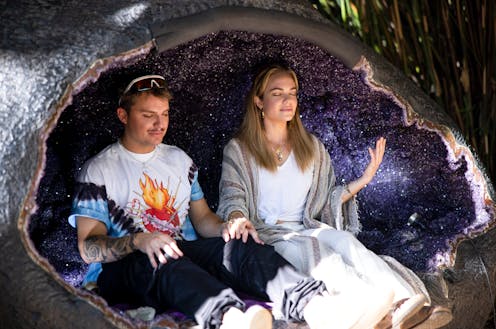
Throw in a side of alternative health and wellness, crystals, and performative caring about the environment that comes with Bryon and you have a cringe-filled but binge-worthy watch.

But while the show might be an easy watch, it’s worth thinking about what exactly goes into that Instagram-perfect “reality” television.

The ordinary celebrity

Discovering the “ordinary” person behind the big movie star has always driven narratives of fame. This is why magazines run exclusive in-depth interviews with Nicole Kidman and ask about her marriage, kids and cake recipes – to give us the behind-the-scenes look at who she “really” is.

This has been happening since the Golden Age of Hollywood. During the first half of the 20th century, fan magazines worked with studios to provide upbeat coverage of Hollywood stars’ “ordinary” lifestyles, hairstyles and love lives.

In recent years, social media has encouraged everyday people to engage in celebrity practices online. Everyone who posts on Instagram is consciously aware of an audience, and curates their content for their followers in the same way a celebrity would for their fans.

Two beautiful women hold crystals and take a selfie
‘Influencers’ create their own celebrity, and turn this into a business model.
Courtesy of Netflix © 2022

Instagram influencers – like most of the cast of Byron Baes – have turned this into a business model. Influencers build a brand and a following (much is made of Jade’s 1.2 million Instagram followers) then get paid by companies for sponsored posts or collaborations.

Byron Bay is host to big movie stars like the Hemsworth brothers but is also now believed to have more social influencers per capita than any other town in Australia.

The fact that many Australian viewers will have visited Byron Bay (or at least know of it) and definitely know someone who can be a bit “extra” on Instagram adds another layer of familiarity.


Read more:
Friday essay: why there’s still something about Byron, beyond Insta influencers and beige linen


Crafting the narrative

Reality television is, as the name suggests, sold on the basis of being a representation of “reality”.

New forms of stardom and celebrity created in reality television and on social media rely on the performance of “authenticity”: the idea that somehow we are seeing “real” people and accessing their true authentic self.

Three beautiful people walking arm in arm.
Are we seeing their true, authentic self?
Paul A. Broben/Netflix © 2022

In Byron Baes, this is helped along by the fact that a lot of these influencers are into wellness and spirituality – spheres where authenticity and being true to oneself are highly valued.

The fact is, of course, that Instagram and reality shows are just as manipulated, scripted and filtered as any fictional series or doctored photographic image.

Reality television constructs the illusion of authenticity through the idea it offers immediacy, intimacy and closeness. We often see reality television stars in extreme displays of emotion: losing their cool, rolling their eyes, bitching behind someone’s back, or confessing their secret love.

We are invited into their homes and businesses. We see photos of them as children, meet their parents and hear their struggles with bullying, loneliness and self-doubt.

The low-fi, offhand nature of the handheld camera footage and the direct one-on-one interviews where the cast speak directly to the camera calls on notions of the “real” associated with documentary genres. These one-on-ones are the show’s attempt to convince the audience these are genuine moments of real emotion behind the scenes – not staged for the camera.

But even the casting is an act of manipulation. There are types producers tend to cast: ones that cause drama and stir the pot (Alex, Jade); ones that bring energy, keep the story moving and are natural on camera (Jess, Nathan, Saskia); ones who are a little bit kooky and add flavour (Cai, Heather, Simba); villians (Elle) and heroes (Sarah) – and models (Elias) who just look really really good on camera.

A male model
One of the reality television tropes: the model who just looks really really good on camera.
Paul A. Broben/Netflix © 2022

Manipulating our perceptions

The beauty of reality television is that everything anyone says is captured on camera. When Elle denies calling Sarah fake, the series can conveniently cut back to the moment it happened.

Of course, this never happens in real life, so viewers delight in the delicious justice of a “real life” person being caught in a lie.

On reality TV, the tales we tell can be fact-checked against.
Paul A. Broben/Netflix © 2022

The producers can also manipulate our own perceptions of Elle by showing us one-on-one interviews where she describes herself as “one of the most generous, loving, open-hearted people that I know,” then follows up with “if someone dishonours me, I certainly wouldn’t want to be them.”

For viewers, while these manufactured conflict storylines make for dramatic content (there’s also a handy feud between Nathan and Elias over Sarah, and Jade and Alex over Instagram followers), the real appeal is in the illusion that these people are “just like us”.

Despite the community backlash during filming and mixed reviews, Netflix’s gamble on a Byron reality show paid off.

But while getting swept up in this “reality” it is worth remembering that, much like an Instagram filter, just because something is presented as real, it doesn’t mean it is “authentic” – a notion which is itself, just as constructed.

The Conversation

Phoebe Macrossan does not work for, consult, own shares in or receive funding from any company or organisation that would benefit from this article, and has disclosed no relevant affiliations beyond their academic appointment.

ref. From cringe to binge: the ingredients that make Byron Baes compelling reality television – https://theconversation.com/from-cringe-to-binge-the-ingredients-that-make-byron-baes-compelling-reality-television-179284

COVID has changed how we live, how we die, and how we grieve

Source: The Conversation (Au and NZ) – By Lauren Breen, Professor of Psychology, Curtin University

Shutterstock

Last week marked the second anniversary of the World Health Organization’s declaration of a pandemic.

In these two years, over 5,500 Australians have died from COVID, and approximately 300,000 Australians have lost their lives in total.

Necessary public health protections have affected people’s access to dying loved ones, limited their participation in important rituals like funerals, and reduced the physical social support they would otherwise receive from friends and family.


Read more:
COVID pandemic 2nd anniversary: 3 things we got wrong, and 3 things to watch out for


More than half reporting problematic grief symptoms

Australia has seen relatively low numbers of COVID infections and deaths, particularly prior to recent months. So understanding the impact of COVID deaths on the people left behind has meant looking overseas.

As a member of The Pandemic Grief Project, I partnered with overseas researchers to survey people in the United States who had a person close to them die from COVID.

We found more than half (57%) of those surveyed reported problematic grief symptoms such as a change in identity, feelings of meaninglessness, and wishes to die, to a degree where psychological therapy would be advised.

Further, 70% of the sample coped with their loss using drugs or alcohol for at least several days in the past two weeks.

In our second study of people in the US who had a person close to them die from COVID, we found most of the participants reported high levels of symptoms of generalised anxiety (70%), depression (74%), problematic grief (66%) and impaired functioning in key areas of life such as work, leisure and family relationships (63%).

Deaths from COVID versus other causes

These studies couldn’t tell us whether grief from a COVID death might be different to deaths from other causes. So we designed our next study to answer this question.

We surveyed people in the US who had a person close to them die from any cause during the pandemic. Nearly three-quarters (72%) reported problematic grief symptoms and 77% reported functional impairment.

When we compared those bereaved by losing someone to COVID to those whose loss was from another cause, we found no differences in levels of problematic grief symptoms or functional impairment.

Further, the three groups (those bereaved by COVID, another natural cause, or a violent cause) reported levels of functional impairment equal to or greater than bereaved people who had problematic grief prior to the pandemic.

We concluded grief from deaths during COVID may warrant similar clinical concern as deaths from COVID.

Two people grieving
People who experienced a loss during COVID are reporting higher levels of depression and anxiety compared to before the pandemic.
Shutterstock

What do these findings mean for Australia?

I’m part of team that designed a national study to answer this question. We aim to understand the grief experiences and support needs of people in Australia who have been bereaved from any cause during the COVID pandemic.

So far, more than 2,000 bereaved Australians have participated to tell us about their experiences of grieving, the support they needed, and the effects of COVID public health measures on their grief.

Early results suggest people who have lost a loved one during the pandemic are experiencing more grief, anxiety and depression than we would expect prior to the pandemic.

The study is open for recruitment until the end of March and you can access the survey here.

The team intends to develop a national bereavement action plan in coming months to help address grief support needs during the COVID pandemic and any future pandemics.


Read more:
Coping with loss: We need a national strategy to address grief beyond the coronavirus pandemic


Sustained struggles with grief

The international findings coupled with the preliminary Australian findings are a strong indicator that, as the pandemic continues, we’re likely to see sustained struggles with grief.

Bereaved people commonly seek support for their grief, yet my colleagues and I have found almost one-third report not receiving the support they would’ve liked. Research from the UK shows the pandemic has exacerbated this gap between support need and support received.

One reason for this gap is that all of us – individuals, health professionals and communities – need to be more grief literate. Grief literacy combines the knowledge of grief and loss, values of compassion and care, and skills to enable supportive action.


Read more:
As COVID-19 restrictions lift, grief literacy can help us support those around us


The pandemic has shown more than ever we must do more to understand and support grieving people, strengthen their supporters and boost collective well-being in the wake of everyday loss and large-scale disasters.

The Conversation

Lauren Breen works for Curtin University. She has received funding from Wellcome Trust, Medical Research Future Fund, Australian Research Council, Department of Health (Western Australia), Silver Chain, Royal Perth Hospital Medical Research Foundation, MND Research Institute of Australia, iCare Dust Diseases Board (New South Wales), Cancer Council (Western Australia). She is on the board of the Australian Centre for Grief and Bereavement and Lionheart Camp for Kids. She is the managing editor of Death Studies.

ref. COVID has changed how we live, how we die, and how we grieve – https://theconversation.com/covid-has-changed-how-we-live-how-we-die-and-how-we-grieve-177731

Frydenberg targets budget at cost of living and attacking debt

Source: The Conversation (Au and NZ) – By Michelle Grattan, Professorial Fellow, University of Canberra

The March 29 budget will contain “targeted and proportionate” help for families with cost of living pressures and move fiscal policy towards stabilising and reducing debt.

These are the messages in Treasurer Josh Frydenberg’s speech, released before its Friday delivery, laying out the priorities and fiscal setting of the budget, which will be a launch pad for the government’s campaign for the May election.

“The time for large scale, economy-wide emergency support is over,” Frydenberg says, pointing to where the government has already ended emergency measures and rejected requests for more support.

Fiscal settings “need to be normalised,” with the government moving to the next phase of its fiscal strategy.

Government sources stressed this doesn’t mean the government is planning to start cutting. Rather, they said, it aims to control new spending while continuing to grow the economy so there can be a steady then declining ratio of debt to GDP.

With the government under pressure over the cost of living, especially with the soaring of petrol prices, Frydenberg points to what it has done on power prices, child care and tax.

In the budget “there will be further measures to support families to meet the cost of living pressures, in a targeted and proportionate way”, he says.

His speech comes as unemployment fell to 4% in February, in figures released on Thursday. This is the equal lowest in 48 years.

“The Australian economy has recovered strongly and now has real momentum,” Frydenberg says.

“The initial phase of our fiscal strategy has delivered on its objective, with full employment in sight.” The budget “will show the fiscal dividend of this strong recovery.

“With our recovery well underway it is now time to move to the next phase of our fiscal strategy.

“This will see a focus on stabilising and then reducing debt as a share of the economy. Rebuilding our fiscal buffers without risking growth.”

Frydenberg says the budget “will confirm that this is the trajectory we are now on”.

The bottom line will show “substantial improvement”, he says, a result of more people in work and fewer on welfare.

Gross debt as a proportion of GDP will be forecast to peak lower than expected in the December budget update. It is projected to decline over the medium term.

“This is the fiscal dividend of a strong economy”.

Frydenberg stresses the uncertainties ahead, including the pandemic’s continued presence and the war in Europe which has heightened geopolitical risk and threatens global economic growth. Supply chains are strained, and energy prices and inflation are being driven up.

“As we saw entering this crisis, a strong budget and a strong economy put us in the best position to respond.

“That is why it is important to move to the next phase of our fiscal strategy, which will stabilise and reduce debt as a share of the economy”.

Frydenberg emphasises the need for the pace of fiscal consolidation to be gradual.

“It is about striking the right balance. A sharp and sudden tightening in the fiscal settings would likely be counterproductive, undermining the economic recovery and ultimately hurting the budget.”

He says Australia’s debt to GDP levels, even when they peak, will remain low by international standards. “Even as interest rates gradually rise, our debt servicing costs will remain manageable”.

The Conversation

Michelle Grattan does not work for, consult, own shares in or receive funding from any company or organisation that would benefit from this article, and has disclosed no relevant affiliations beyond their academic appointment.

ref. Frydenberg targets budget at cost of living and attacking debt – https://theconversation.com/frydenberg-targets-budget-at-cost-of-living-and-attacking-debt-179487

Grattan on Friday: Anthony Albanese is sitting pretty for the election – so what could possibly go wrong?

Source: The Conversation (Au and NZ) – By Michelle Grattan, Professorial Fellow, University of Canberra

Polls this week were once again music to Labor ears. Newspoll showed the opposition maintaining its strong election-winning margin. A poll in selected Western Australian seats had the Morrison government on the nose.

Polls, as everyone stresses, aren’t predictive – they register the mood of the moment. Nevertheless, and despite their unreliability in the last election, politicians and media take a lot of notice of them, and for Anthony Albanese their story is very positive.

So what could possibly go wrong on the opposition leader’s path to The Lodge? Plenty, as Labor knows, reinforced by that 2019 experience of false expectations. When voters really started concentrating during that campaign, they soured on the opposition.

Viewed from Labor’s campaign bunker, the weeks between now and election day in May are very high risk for Albanese, littered with both anticipated and unforeseeable hurdles.

There was a lesson this week in how damaging things can come out of the blue, when Albanese was confronted with (contested) allegations, reported in The Australian, that senior Labor women senators, including Penny Wong, had treated their colleague Kimberley Kitching badly.

While Kitching’s complaints had apparently circulated within Labor, it took her sudden death last week from a suspected heart attack for them to burst into the media.

The claims about Labor’s “mean girls” (the term the article said Kitching and her supporters used) were confronting when set against the background of a year’s debate about parliament house’s “toxic” culture.

Albanese and Labor generally sought to throw a blanket over the story, refusing to engage with it on the grounds of respect for Kitching. Scott Morrison tried to spur it along, saying these matters should be taken very seriously and addressed, and “I’ll leave that to the leader of the Labor Party”.

The so-called “mean girls” story will blow over, but it’s a reminder that in a campaign context (which is where we are, although the election hasn’t yet been called) the unexpected, in whatever form, often deals itself in.

An unknown of the coming weeks is how Albanese will perform under the intense hour-by-hour scrutiny that will build every day. “No one has seen Albanese under extreme pressure,” says one Labor man. “That’s the hinge-point around the campaign.”

Albanese is not, by nature, quite the relaxed character he might seem. The spring is coiled. This is not necessarily a criticism, but something to be managed. With the Liberals targeting him personally and mercilessly, his ability to perform without serious mistakes in a high political temperature will be pushed to the limit.

In a campaign, a small slip or awkward moment can quickly becomes negative news, as Bill Shorten found when a Queensland man challenged him about tax relief for higher-income workers. The media played the exchange repeatedly.

Campaigns “stress test” policies. Shorten’s 2019 climate policy did not contain enough detail to be campaign-resilient. A pesky journalist’s persistent questioning at one news conference had Shorten on the spot and showing the strain.

Spectacularly, in 1987 the Howard opposition’s tax policy had a double-counting error – the mistake dogged the Liberals’ campaign.

Campaigns are two-horse races: if one horse is lame (Malcolm Turnbull in 2016) it matters.

Two scheduled events will be significant in whether Albanese holds his advantage, or the government claws back ground: Tuesday week’s budget and the opposition leader’s budget reply two days later.

For a government in what seem dire straits, the budget is its chance to direct the voters’ attention to the economy, its preferred and stronger ground, and to offer some inducements.

But it’s become a balancing act for Morrison and Treasurer Josh Frydenberg. They’ve flagged the budget will address people’s concern about the rising cost of living, but they can’t afford to look profligate, given addressing the high level of debt must also be a priority.

Albanese will use his reply to counter the budget and announce some big-bang policy. His delivery will need to be well-pitched and the policy attention-grabbing and credible.

In the next few weeks Albanese, who’s still to define himself in the public’s consciousness, must convince people he’s a safe pair of hands on the economy. That might be more challenging than the issue of national security, on which the government’s efforts to damage him seem so far to have missed their mark.

While Labor is wary of being sucked in by the polls, the government is fearful of their consistent message.

Morrison finally got to Western Australia this week, coinciding with polling published in the West Australian newspaper showing several Liberal seats at high risk.


Read more:
Albanese level with Morrison as better PM in Newspoll as Labor maintains big lead


The poll, by Utting Research, indicated Labor was travelling strongly in Hasluck, Pearce (the seat Christian Porter is leaving) and Swan. In Tangney, held by Special Minister of State Ben Morton, a close confidant of Morrison, the numbers were knife-edge.

Morrison adopted a novel campaign strategy: a bromance with Labor premier Mark McGowan, who was returned last year in a stunning victory that all but wiped out the state parliamentary Liberal Party.

According to the prime minister’s “spin” on their partnership, the federal government’s joining Clive Palmer’s case against WA over its border closure should be seen as just part of the pandemic learning process. “The premier raised his concerns with me […] and we ultimately agreed with him”, and withdrew from the case, Morrison said.

The PM’s line to WA voters is that “federal Labor under Anthony Albanese is not the same as state Labor under Mark McGowan. There are two very different animals”. Regardless of who people vote for at the election, “Mark McGowan will be the premier the next day”.

When the two appeared together at a news conference, where new construction funds were announced, Morrison was effusive.

“I want to thank the premier for his partnership. It’s been a good partnership. It’s been an honest partnership. It’s been a candid partnership. Haven’t agreed on everything, but we’ve always been prepared to listen to each other and where […] I think I’ve had to change my view based on the premier’s representations, I certainly have.”

Appearing by himself later, McGowan reassured Labor he would be campaigning with and for Albanese.

Excluded by the closed border for so long, Morrison has been desperate to get to the west. But whether his physical presence and his largesse will erode those Labor leads is another matter.

In general, the federal Liberals in WA are a much-diminished bunch, in power and presence. They no longer have the sparkle of a Julie Bishop, or the strong dour presence of a Mathias Cormann. The star of Christian Porter burned brightly briefly, then fell to the ground spectacularly.

This weekend, eyes will be on another state. In South Australia, according to polling, Labor may dislodge the Marshall Liberal government.

While SA politics is anything but riveting for people outside that state, the outcome will be especially watched federally because if Labor wins it will be the first time since COVID struck that an incumbent government has been defeated. The symbolism wouldn’t be missed.

The Conversation

Michelle Grattan does not work for, consult, own shares in or receive funding from any company or organisation that would benefit from this article, and has disclosed no relevant affiliations beyond their academic appointment.

ref. Grattan on Friday: Anthony Albanese is sitting pretty for the election – so what could possibly go wrong? – https://theconversation.com/grattan-on-friday-anthony-albanese-is-sitting-pretty-for-the-election-so-what-could-possibly-go-wrong-179475

Grattan on Friday: Anthony Albanese is sitting pretty for the election – what could possibly go wrong?

Source: The Conversation (Au and NZ) – By Michelle Grattan, Professorial Fellow, University of Canberra

Polls this week were once again music to Labor ears. Newspoll showed the opposition maintaining its strong election-winning margin. A poll in selected Western Australian seats had the Morrison government on the nose.

Polls, as everyone stresses, aren’t predictive – they register the mood of the moment. Nevertheless, and despite their unreliability in last election, politicians and media take a lot of notice of them, and for Anthony Albanese their story is very positive.

So what could possibly go wrong on the opposition leader’s path to The Lodge? Plenty, as Labor knows, reinforced by that 2019 experience of false expectations. When voters really started concentrating during that campaign, they soured on the opposition.

Viewed from Labor’s campaign bunker, the weeks between now and election day in May are very high risk for Albanese, littered with both anticipated and unforeseeable hurdles.

There was a lesson this week in how damaging things can come out of the blue, when Albanese was confronted with (contested) allegations, reported in The Australian, that senior Labor women senators, including Penny Wong, had treated their colleague Kimberley Kitching badly.

While Kitching’s complaints had apparently circulated within Labor, it took her sudden death last week from a suspected heart attack for them to burst into the media.

The claims about Labor’s “mean girls” (the term the article said Kitching and her supporters used) were confronting when set against the background of a year’s debate about parliament house’s “toxic” culture.

Albanese and Labor generally sought to throw a blanket over the story, refusing to engage with it on the grounds of respect for Kitching. Scott Morrison tried to spur it along, saying these matters should be taken very seriously and addressed, and “I’ll leave that to the leader of the Labor Party”.

The so-called “mean girls” story will blow over, but it’s a reminder that in a campaign context (which is where we are, although the election hasn’t yet been called) the unexpected, in whatever form, often deals itself in.

An unknown of the coming weeks is how Albanese will perform under the intense hour-by-hour scrutiny that will build every day. “No one has seen Albanese under extreme pressure,” says one Labor man. “That’s the hinge-point around the campaign.”

Albanese is not, by nature, quite the relaxed character he might seem. The spring is coiled. This is not necessarily a criticism, but something to be managed. With the Liberals targeting him personally and mercilessly, his ability to perform without serious mistakes in a high political temperature will be pushed to the limit.

In a campaign, a small slip or awkward moment can quickly becomes negative news, as Bill Shorten found when a Queensland man challenged him about tax relief for higher-income workers. The media played the exchange repeatedly.

Campaigns “stress test” policies. Shorten’s 2019 climate policy did not contain enough detail to be campaign-resilient. A pesky journalist’s persistent questioning at one news conference had Shorten on the spot and showing the strain.

Spectacularly, in 1987 the Howard opposition’s tax policy had a double-counting error – the mistake dogged the Liberals’ campaign.

Campaigns are two-horse races: if one horse is lame (Malcolm Turnbull in 2016) it matters.

Two scheduled events will be significant in whether Albanese holds his advantage, or the government claws back ground: Tuesday week’s budget and the opposition leader’s budget reply two days later.

For a government in what seem dire straits, the budget is its chance to direct the voters’ attention to the economy, its preferred and stronger ground, and to offer some inducements.

But it’s become a balancing act for Morrison and Treasurer Josh Frydenberg. They’ve flagged the budget will address people’s concern about the rising cost of living, but they can’t afford to look profligate, given addressing the high level of debt must also be a priority.


Read more:
Albanese level with Morrison as better PM in Newspoll as Labor maintains big lead


Albanese will use his reply to counter the budget and announce some big-bang policy. His delivery will need to be well-pitched and the policy attention-grabbing and credible.

In the next few weeks Albanese, who’s still to define himself in the public’s consciousness, must convince people he’s a safe pair of hands on the economy. That might be more challenging than the issue of national security, on which the government’s efforts to damage him seem so far to have missed their mark.

While Labor is wary of being sucked in by the polls, the government is fearful of their consistent message.

Morrison finally got to Western Australia this week, coinciding with polling published in the West Australian newspaper showing several Liberal seats at high risk.

The poll, by Utting Research, indicated Labor was travelling strongly in Hasluck, Pearce (the seat Christian Porter is leaving) and Swan. In Tangney, held by Special Minister of State Ben Morton, a close confidant of Morrison, the numbers were knife-edge.

Morrison adopted a novel campaign strategy: a bromance with Labor premier Mark McGowan, who was returned last year in a stunning victory that all but wiped out the state parliamentary Liberal Party.

According to the prime minister’s “spin” on their partnership, the federal government’s joining Clive Palmer’s case against WA over its border closure should be seen as just part of the pandemic learning process. “The premier raised his concerns with me […] and we ultimately agreed with him”, and withdrew from the case, Morrison said.

The PM’s line to WA voters is that “federal Labor under Anthony Albanese is not the same as state Labor under Mark McGowan. There are two very different animals”. Regardless of who people vote for at the election, “Mark McGowan will be the premier the next day”.

When the two appeared together at a news conference, where new construction funds were announced, Morrison was effusive.

“I want to thank the premier for his partnership. It’s been a good partnership. It’s been an honest partnership. It’s been a candid partnership. Haven’t agreed on everything, but we’ve always been prepared to listen to each other and where […] I think I’ve had to change my view based on the premier’s representations, I certainly have.”

Appearing by himself later, McGowan reassured Labor he would be campaigning with and for Albanese.

Excluded by the closed border for so long, Morrison has been desperate to get to the west. But whether his physical presence and his largesse will erode those Labor leads is another matter.

In general, the federal Liberals in WA are a much-diminished bunch, in power and presence. They no longer have the sparkle of a Julie Bishop, or the strong dour presence of a Mathias Cormann. The star of Christian Porter burned brightly briefly, then fell to the ground spectacularly.

This weekend, eyes will be on another state. In South Australia, according to polling, Labor may dislodge the Marshall Liberal government.

While SA politics is anything but riveting for people outside that state, the outcome will be especially watched federally because if Labor wins it will be the first time since COVID struck that an incumbent government has been defeated. The symbolism wouldn’t be missed.

The Conversation

Michelle Grattan does not work for, consult, own shares in or receive funding from any company or organization that would benefit from this article, and has disclosed no relevant affiliations beyond their academic appointment.

ref. Grattan on Friday: Anthony Albanese is sitting pretty for the election – what could possibly go wrong? – https://theconversation.com/grattan-on-friday-anthony-albanese-is-sitting-pretty-for-the-election-what-could-possibly-go-wrong-179475

The International Court of Justice has ordered Russia to stop the war. What does this ruling mean?

Source: The Conversation (Au and NZ) – By Rowan Nicholson, Lecturer in Law, Flinders University

Pavel Dorogoy/AP

The International Court of Justice (ICJ), the top court of the United Nations, has ordered Russia to “immediately suspend” its military operations in Ukraine. What does the decision mean, and what happens next?

We already knew Russia’s invasion was illegal in international law. But the ICJ decision now makes it virtually impossible for anyone, including Russia, to deny that illegality. It is also impressive because Ukraine used a creative strategy to get the ICJ to hear the case, based on the Genocide Convention of 1948.

Russia’s legal arguments about the war

Russia’s president, Vladimir Putin, gave several justifications for invading Ukraine. Some had little to do with the law, such as his complaints about NATO. But two were legal arguments.

First, he claimed Russia was acting in “self-defence”. Self-defence is an established reason to use military force in international law. But Putin suggested Russia was defending the two breakaway parts of eastern Ukraine it recognises as sovereign states: Donetsk and Luhansk. Legally, these are still parts of Ukraine’s own territory, not independent states, which makes nonsense of this argument.

Second, Putin claimed Ukraine was committing genocide against ethnic Russians (where “genocide” means certain acts committed with “intent to destroy” an ethnic group or another defined group). This is just as factually and legally flimsy as the self-defence argument.

If both arguments are weak, why did Ukraine focus on genocide in the case before the ICJ? To understand, we have to look at the court’s jurisdiction: that is, its power to decide some legal issues but not others.

The jurisdiction of the ICJ

The ICJ hears disputes solely between sovereign states (in contrast to the separate International Criminal Court, which tries individuals for committing things like war crimes).

The ICJ does not automatically have jurisdiction over every state and every issue. There is no global government that could give it that power. Like many other aspects of international law, its jurisdiction relies on states giving consent – agreement – either directly or indirectly.


Read more:
Is international law powerless against Russian aggression in Ukraine? No, but it’s complicated


Some states have given consent by making general declarations. Other states have consented to particular treaties that give the ICJ the power to decide disputes related specifically to those treaties.

Since Russia has not made a general declaration, Ukraine could not ask the ICJ to rule on its self-defence argument. But Russia is a party to a relevant treaty, the Genocide Convention.

Ukraine’s creative strategy was to try to bring the case within the ICJ’s jurisdiction by arguing that Russia was making a false allegation of genocide to justify its illegal invasion.

People demonstrate in support of the Ukraine in The Hague.
People demonstrate in support of the Ukraine outside the ICJ, the UN’s top court, in The Hague.
Peter Dejong/AP

The order made by the ICJ

Russia did not turn up to the courtroom in The Hague for the initial hearing in early March (though it did write the ICJ a letter outlining its view).

That is a change in its behaviour. After Russia invaded Georgia in 2008, Georgia similarly brought a case to the ICJ and tried to use a different treaty to bring it within the court’s jurisdiction. Russia participated in the case and actually had significant success.

Its failure to turn up this time signals its disengagement from international institutions.

Of the 15 judges, almost all agreed to order Russia to “immediately suspend” its military operations. There were two dissenters: the judges of Russian and Chinese nationality.

This was what is called a “provisional measures” order – an emergency ruling made before the court hears the whole case. Provisional measures are binding. That is important. It means even if Russia maintains incorrectly that the invasion is legal, it is now breaching international law anyway by failing to comply with the ICJ’s order.

However, a binding ruling is not the same as an enforceable one. Just as there is no global government to give the ICJ more power, there are no global police to enforce its decisions.

For example, in 1999, the ICJ ordered the United States to delay executing a German man on death row. Although the court confirmed such a provisional measure was binding, it could not actually stop the execution.

But ICJ decisions can play a more subtle role. They shape the narrative for law-abiding states and within the United Nations.

This ruling might help to embolden other states, including some that until now have been sitting on the fence, to contribute to actions like suffocating Russia’s economy with sanctions and arming Ukraine.


Read more:
Civilians are being killed in Ukraine. So, why is investigating war crimes so difficult?


What happens next?

All the ICJ has done so far is to order provisional measures. It has not even found conclusively that it has jurisdiction in the case. It might be a long time before it decides the case as a whole.

But it has hinted it is receptive to Ukraine’s arguments. It has noted that it “is not in possession of evidence” to support Russia’s allegation that Ukraine has committed genocide.

Another strength of Ukraine’s case is that there is, in any event, no rule in international law automatically giving one state a right to invade another state to stop a genocide. One reason is that a cynical aggressor could manipulate or abuse such a rule. That is basically what this case is all about.

The Conversation

Rowan Nicholson does not work for, consult, own shares in or receive funding from any company or organisation that would benefit from this article, and has disclosed no relevant affiliations beyond their academic appointment.

ref. The International Court of Justice has ordered Russia to stop the war. What does this ruling mean? – https://theconversation.com/the-international-court-of-justice-has-ordered-russia-to-stop-the-war-what-does-this-ruling-mean-179466

Labor landslide likely in South Australian election, but Labor-Greens unlikely to control upper house

Source: The Conversation (Au and NZ) – By Adrian Beaumont, Honorary Associate, School of Mathematics and Statistics, The University of Melbourne

AAP/Matt Turner

The South Australian election is on Saturday, with polls closing at 6:30pm AEDT. A YouGov poll for The Advertiser, conducted March 7-13 from a sample of 835, gave Labor a 56-44 lead, compared with the 2018 election result of 51.9-48.1 to Liberal, so this poll would be about an 8% swing to Labor.

YouGov conducts Newspoll, so this poll can be compared with the Newspoll nearly three weeks ago. Labor gained three points after preferences, from primary votes of 41% Labor (up two), 33% Liberal (down four), 11% Greens (up one) and 15% for all Others (up one).


Read more:
Labor maintains big federal Newspoll lead and is likely to win in South Australia


Liberal Premier Steven Marshall was at 48% dissatisfied, 46% satisfied, for a net approval of -2, down three points on Newspoll. Labor leader Peter Malinauskas had a net +19 approval, down one point. Malinauskas led as better premier by 45-40 (46-39 in Newspoll).

Labor held a 42-26 lead as best party to handle health and hospitals, which was rated the most important issue by 39% ahead of cost of living on 28%. Poll figures are from The Poll Bludger.

There are 47 single-member seats in the SA lower house. The Liberals won 25 seats to Labor’s 19 with three independents in 2018, but they are already in minority owing to defections to the crossbench. If this poll is near the election result, Labor will win a thumping majority in the lower house.

It’s very likely this will be the first time Labor wins the SA statewide two party vote since the 2006 state election. Labor retained power in both 2010 and 2014 despite losing the two party vote (by 53.0-47.0 in 2014).

Only votes cast on election day can be counted on the night in SA. These votes will likely be a low proportion of the overall turnout. It won’t be possible to call the result on election night unless it is very decisive.

What about the upper house?

This is a lower house poll, but upper house vote shares are usually similar to the lower house, with some drop for the major parties. 11 of the 22 upper house seats will be elected by statewide proportional representation. A quota is one-twelfth of the vote, or 8.3%.

Optional preferential voting above the line is used, so a single “1” above the line will only count for the party it is cast for. To give preferences for more parties, voters must continue numbering “2”, “3”, etc above the line. Owing to optional preferential, many votes will exhaust and about half a quota (4.2%) is likely to be enough to win.

Labor’s vote in this poll is nearly enough for five quotas – the Liberals would win four quotas and the Greens one without enough surplus to be in the hunt for a second seat. The last seat would probably go to one of the Others, with One Nation or SA-Best most likely.

Such a result would give Labor and the Greens six of the 11 seats up at this election, but the 2018 result was four Liberals, four Labor, two SA-Best and one Green. As these members continue until the 2026 election, the most likely outcome is a total of nine Labor, eight Liberals, two Greens, two SA-Best and one Other.

In this case, Labor and the Greens would together hold 11 of the 22 upper house seats after the election, and need one more vote to pass legislation opposed by the Liberals.

Federal polls from Morgan and WA

A federal Morgan poll, conducted March 3-13 from a sample of 1,947, gave Labor a 56-44 lead, a 0.5-point gain for the Coalition since early March. Primary votes were 37% Labor (down 0.5), 33.5% Coalition (down 0.5), 11.5% Greens (steady), 3% One Nation (down 0.5), 1% UAP (steady), 10.5% independents (up 1.5) and 3.5% others (steady).

The fieldwork dates for this Morgan poll overlap with those in the previous Morgan (February 24 to March 6).

The Poll Bludger reported Wednesday that Labor pollster Utting Research conducted polls in the Liberals’ four most marginal WA seats from March 11-14 from a combined sample of 750. Combining these results suggests a 10% swing to Labor from the 2019 election.

A Greens-commissioned WA federal poll gave Labor 42% of the primary vote, the Coalition 33% and the Greens 11%. Greens-commissioned polls usually overstate the Greens’ vote.

The Conversation

Adrian Beaumont does not work for, consult, own shares in or receive funding from any company or organisation that would benefit from this article, and has disclosed no relevant affiliations beyond their academic appointment.

ref. Labor landslide likely in South Australian election, but Labor-Greens unlikely to control upper house – https://theconversation.com/labor-landslide-likely-in-south-australian-election-but-labor-greens-unlikely-to-control-upper-house-179376

Politics with Michelle Grattan: Stay calm, petrol is headed down, budget is improving – economist Chris Richardson

Source: The Conversation (Au and NZ) – By Michelle Grattan, Professorial Fellow, University of Canberra

Australia’s budget situation has been quietly improving. Deloitte Access Economics director Chris Richardson says the remarkable strength of the Australian economy means it no longer needs the emergency support it has been getting from the government and the Reserve Bank. Government spending fell by a record 10% in the year to January.

He counsels against emergency measures to protect Australians from the soaring price of petrol, saying today’s international oil price implies that in less than a fortnight petrol prices will be between 15 and 20 cents lower a litre.

While there is no guarantee they won’t climb again, the relief that’s in store is half as big as the relief the government could deliver by cutting fuel excise, a measure he says would be like applying a Band-Aid that would be difficult to rip off.

Rather than pumping more money into the economy, the March 29 budget should be withdrawing support in a measured fashion. Although government debt has climbed, low interest rates mean the payments on government debt cost less than before COVID.

With Australia just a “handful of months” away from an unemployment rate of 3.5% – Thursday’s February rate was 4.0% – Australia should celebrate its success in getting its economic policies right during COVID. While the reopening of borders will slow Australia’s success in bringing down unemployment, it is unlikely to reverse it.

After petrol prices, the next challenge for Australians will be higher mortgage rates, but they will be going up for a reason, Richardson says, because inflation is climbing and wage growth is climbing, which will improve the budget position further.

The Conversation

Michelle Grattan does not work for, consult, own shares in or receive funding from any company or organisation that would benefit from this article, and has disclosed no relevant affiliations beyond their academic appointment.

ref. Politics with Michelle Grattan: Stay calm, petrol is headed down, budget is improving – economist Chris Richardson – https://theconversation.com/politics-with-michelle-grattan-stay-calm-petrol-is-headed-down-budget-is-improving-economist-chris-richardson-179463

‘May you always taste the sweetest fruit’: uncovering the history and hidden delights of your neighbourhood

Source: The Conversation (Au and NZ) – By Shannon Foster, D’harawal Knowledge Keeper PhD Candidate and Lecturer UTS, University of Technology Sydney

Ilaria Vanni

Sydney’s Green Square is one of Australia’s biggest urban renewal projects. But it’s much more than a construction site. First Nations people know it by another name: nadunga gurad, or sand dune Country.

For millenia, the area has been known for its nattai bamalmarray: freshwater wetlands and seasonal ponds. This Country has always been an important refuge along the Songline routes that connect War’ran (Sydney Cove) to Gamay (Botany Bay).

To existing residents, Green Square is home. It’s also a place to walk, visit parks, shop, and talk to neighbours, shopkeepers and tradies.

But it can be hard to see the “green” in Green Square. It’s a disrupted place punctuated by huge pits in the ground, roadworks, scaffoldings, barriers and cranes.

We’ve been working on connecting residents, workers and visitors to the local environment. We hope our project becomes a template to help anyone engage more deeply with their neighbourhood.

aerial view of park with apartments in background
An image from 2013 showing plans for Green Square.
City of Sydney

An atlas for change

Green Square spans the inner east Sydney suburbs of Zetland, Beaconsfield, Rosebery, Alexandria and Waterloo. In 2020, the site was home to 34,000 people and this number is growing rapidly.

During lockdowns last year, we and the charity 107 Projects sought to connect residents, workers and visitors to nature and people in their suburb. It involved workshops, walks and a map for self-guided tours. We also collected stories in a book, just released. It includes stories about:

Atlases have historically been, and continue to be, tools of colonisation – cataloguing and archiving the status quo.

But done right, they can also help us understand places in new ways. In Australia, this includes recognising we are always on Indigenous Country.

In that vein, our atlas includes an important contribution by Shannon Foster, a registered Sydney Traditional Owner and local D’harawal eora Knowledge Keeper.


Read more:
Why arts schools matter, not just for art’s sake but for urban renewal in Sydney and other cities


here
Shannon Foster, middle, a Traditional Owner who contributed to the atlas.
Jo Kinniburgh

Ngeeyinee dingan duruwan bata

Foster tells how, amid dense urban development at Green Square, unique plants from ancient ecosystems still emerge from undeveloped gullies.

These include paperbark trees, casuarina groves, clumps of kangaroo grass and lomandra, and regenerated areas of Eastern Suburbs Banksia Scrub.

As Foster says in this edited extract:

One of my earliest memories of learning culture from my D’harawal eora father was about understanding plants and what you could and couldn’t eat. I was always amazed to realise that you could actually live off the gardens and earth around you.

Today, one of my favourite edible plants is bamuru (kangaroo grass), not just because you can make a delicious, gluten-free, light and tasty bread from it, but because it represents the un-forgetting of knowledges and stories that have been silenced and, sometimes, erased from our lives.

There are places across Sydney Country, especially on abandoned and neglected land, that bamuru and other edible crops like bundago (native daisy yam) flourish again. These plants begin to grow in vast fields, echoing their ancient, agricultural past and the careful management of Country by local custodians like my D’harawal eora family.

The awakening of these remnant crops is a reminder that Country is its own archive, holding seeds and stories as evidence that we do indeed exist and that we have long and complex relationships with Country that can never be erased.

Now, as I walk the streets of Green Square, I look for signs of old Country breaking through the centuries of colonial development.

I dream of this place as it was, sand dunes and wetlands, galumban gurad (sacred Country), and I marvel at the fragile seedlings who, against all odds, break through the oppressive concrete and pavers to stand tall, once again, with Country.

I also honour the same spirit in my elders and ancestors who have raised me to understand that it doesn’t matter how much concrete is laid down, Country is still here and is still nurturing and sheltering us, just as it always has been and always will be.

– Ngeeyinee dingan duruwan bata (May you always taste the sweetest fruit).

Always was, always will be

Foster reminds us no matter how much we build on Country, it has always been – and remains – vital to life and culture for local custodians.

More broadly, the atlas aims to show we can improve city life and the urban environment – just by how we interact with one another, and treat the plants, animals and insects around us.


Read more:
‘Although we didn’t produce these problems, we suffer them’: 3 ways you can help in NAIDOC’s call to Heal Country


woman walks past verge garden
Small actions can improve city life and the urban environment.
Ilaria Vanni

If this idea appeals to you, download a free copy of the atlas and try these activities to help you “tune in” to your local area:

  • find out whose Country are you on

  • save and exchange seeds from native plants and heirloom food varieties

  • get to know your local plant species, especially the endangered ones

  • make and maintain a verge garden

  • start or join a community garden

  • forage for wild foods, such as edible weeds

  • conserve water

  • create habitat for urban wildlife

  • spend time at nearby natural places such as ponds and parks

  • cut waste, to reduce pressure on city services and the planet

  • look for trees providing shelter on hot days.

These small, slow actions help create connections to nature and place, and opportunities to meet and share with people in your community. These connections are vital to overcoming the downsides of urban renewal.

And as we remake urban places, we must remember: our neighbourhood always was, and always will be, unceded Aboriginal land.


Read more:
Rosemary in roundabouts, lemons over the fence: how to go urban foraging safely, respectfully and cleverly


The Conversation

Shannon Foster is the founding partner and creative co-Director at bangawarra, Connecting with Country Spatial Design.

The Green Square Atlas of Civic Ecologies was funded by the Council of the City of Sydney and supported by the University of Technology Sydney Climate, Society and Environment Research Centre (C-SERC).

The Green Square Atlas of Civic Ecologies was funded by the Council of the City of Sydney and supported by the University of Technology Sydney Climate, Society and Environment Research Centre (C-SERC)

ref. ‘May you always taste the sweetest fruit’: uncovering the history and hidden delights of your neighbourhood – https://theconversation.com/may-you-always-taste-the-sweetest-fruit-uncovering-the-history-and-hidden-delights-of-your-neighbourhood-179308

The James Webb Space Telescope has taken its first aligned image of a star. Here’s how it was done

Source: The Conversation (Au and NZ) – By Themiya Nanayakkara, Chief Astronomer at the James Webb Australian Data Centre, Swinburne University of Technology

NASA

The James Webb Space Telescope (JWST) has finally been aligned to produce the first unified image of a single star – marking a huge milestone.

Most traditional telescopes these days (like one you might have in your backyard) have a single primary mirror that collects distant light from stars. But the JWST has 18 mirrors! These had to be aligned extremely precisely to capture the image NASA released today.

This gif shows the several intermediary images of stars used for the crucial JWST mirror alignment process.
NASA/Twitter

The challenge with JWST

The JWST is the largest telescope humans have ever sent into space. It’s so big that none of our rockets can carry it when fully extended. As such, it was designed to be neatly folded to fit inside the cargo hold atop an Ariane 5 launch vehicle.

The telescope uses segmented mirror technology. This technology has been in use for a few decades now by some of the largest optical telescopes in the world, including the Keck Observatory in Hawaii (which has two 10m-diameter mirrors, each made of 36 hexagonal segments).

The main challenge with the JWST was being able to unfold it to its fully extended form in space, under extreme conditions of heat and cold, and with no human assistance. This process began in January.

Once the mirror segments were unfolded, they had to be aligned so all 18 combined to form a single 6.5m-diameter curved mirror.

The JWST has now completed this alignment process, giving us the first unified image. The image was taken using the near infrared camera (NIRCam), one of the telescope’s four key science instruments.

Close-up view of the NIRCam instrument
The NIRCam is the optical system that captures images on the James Webb Space Telescope.
NASA, CC BY

But how was this done?

There are seven small motors fixed behind each of the JWST’s 18 slightly curved hexagonal mirrors. Their purpose is to move and reshape the curvature of each segment so that all 18 segments can act as a single large mirror.

Six of these motors are grouped in three equally distanced pairs, located around each mirror segment. These are used to move the mirror.

The seventh motor is at the centre, and is connected to the mirror’s six corners with struts. This motor can adjust the tension of the struts to optimise the curvature of that mirror segment.

The motors can move the mirrors very precisely, to within about 1/10,000th of the diameter of a human hair. This precision (to within a fraction of a wavelength of light) is important for obtaining high quality images from the telescope.

NASA scientists would have used a mathematical analysis called “phase retrieval” to study how the movement of each individual segment changed the sharpness of the final image.

Once they had this information, there were two crucial tasks to complete before the segments could function as a single, monolithic mirror: coarse alignment and fine alignment.

Coarse and fine alignment

In coarse alignment, the mirror segments were moved vertically (up and down) until they all aligned to form one giant mirror. However, there were still minute alignment errors that needed to be corrected to obtain the best possible image.

This is where the fine alignment happens. In this process, rather than moving the telescope’s mirror segments, the small optics inside NIRCam are moved instead.

When the JWST is pointed at a star, the light from the star first hits the primary mirror, in which the individual segments are now aligned reasonably well.

The light from the star then continues its path through the secondary and tertiary mirrors inside the telescope and enters the NIRCam instrument. During the fine alignment, the optics inside NIRCam are very carefully adjusted until the star is completely in focus.

There are four different types of mirrors on the Webb telescope: primary mirror segments, the secondary mirror, tertiary mirror and the fine steering mirror.
NASA/Ball Aerospace/Tinsley, CC BY

The coarse and fine alignment steps are both repeated until the sharpest image can be obtained. The image released by NASA this week shows how a star looks when these steps are complete.

Prior to the coarse and fine alignment being complete, NASA released a “stacked” image likely of the same star back in February.

For this, each of the individual mirror segments were fine-tuned to create 18 separate sharp images of the star, but each from a slightly different vantage point. The 18 images were then stacked to produce the image below.

Stacked image of a star taken by the James Webb Space Telescope
NASA scientists stacked the 18 individual images captured by the primary mirror segments to create a stacked image.
NASA

The next steps

While the successful testing of the NIRCam is a breakthrough for the JWST, there are many more steps to be completed before it can fulfil its potential.

Next NASA will look at how the other instruments perform with images of stars and do further fine tuning to the optics in those instruments. After this, the instrument commissioning phase will start. Apart from NIRCam, there are three other instruments on board the JWST: NIRSpec, NIRISS, and MIRI.

While NIRCam will primarily provide images of the Universe over the near-infrared part of the electromagnetic spectrum, NIRSpec can split that light to study different signatures (variations in the properties of the incoming light).

NIRISS will provide similar functionality to NIRCam, while MIRI will look at the Universe at much higher wavelengths (reaching the mid infrared range).

All the instruments will now be brought to their working temperatures and tested. Some initial steps have already begun and all indications so far are good. Many of the steps have redundancies built into them, which means if a system should fail, there will be another way to achieve the same objective.

You can keep up to date with the JWST’s activities online.


Read more:
NASA’s James Webb Space Telescope has reached its destination, 1.5 million km from Earth. Here’s what happens next


The Conversation

Themiya Nanayakkara is affiliated with the James Webb Australian Data Centre hosted at the Swinburne University of Technology.

ref. The James Webb Space Telescope has taken its first aligned image of a star. Here’s how it was done – https://theconversation.com/the-james-webb-space-telescope-has-taken-its-first-aligned-image-of-a-star-heres-how-it-was-done-178315

5 interview questions for the next RBA deputy governor

Source: The Conversation (Au and NZ) – By Isaac Gross, Lecturer in Economics, Monash University

shutterstock

Reserve Bank Deputy Governor Guy Debelle has left the building. Wednesday was his last day. Six days after his shock resignation, he has departed to become chief financial officer at the green energy firm Fortescue Future Industries.

Which leaves Treasurer Josh Frydenberg scrambling to find a replacement.

Do you have what it takes to be Australia’s number two central banker?

Whoever Treasurer Frydenberg picks will be in prime position to slide into the number one job when Governor Philip Lowe’s term ends in September 2023.

Traditionally the keys to the vault in a basement on Sydney’s Martin Place have been held tightly by insiders – a long apprenticeship toiling on the upper floors of the Martin Place headquarters has been the main prerequisite.

But if the process was more open, what would a formal job interview entail?

So you can try your monetary mettle at home, here’s what a formal interview might look like, complete with suggested answers so you can test yourself.

1. Under what circumstances would you hike the cash rate by 0.50 percentage points?

Hiking 0.50 percentage points for the first time in decades would be “courageous”. 0.50 is double the usual 0.25, but it might be necessary. Certainly a case could have been made for it when inflation was spiralling out of control during the mining boom ahead of the global financial crisis.

So when would be the right time? When inflation was running at 4%? At 5%?

While there is no single correct answer, the answer you give is an opportunity to demonstrate your inflation-fighting credentials.

2. What, in your opinion, was the biggest monetary policy mistake in the inflation-targeting era?

Crafting policy in real time is always fraught with difficulty, and mistakes are inevitable. But it is only by recognising our mistakes we can make fewer.

While the Reserve Bank has an enviable record in comparison to most other central banks, it is not a perfect one.

While the undershooting of inflation from 2016-2021 was perhaps the biggest policy error, the high inflation that occurred in the lead up to the global financial crisis was another.

3. If you had to choose between lowering the inflation target band to 1-2% or lifting it to 3-4% which would you choose?

The answer should be obvious. One of the biggest lessons from the past decade of macroeconomics has been that inflation targets have been set too low in most OECD economies, so low that interest rates have had to be set close to zero to get real interest rates (rates minus inflation) down.

While there are good reasons to be cautious about changing the inflation target, if forced to choose between increasing or decreasing it, there is only one correct answer.

4. If you were trapped on a desert island and could only pick one data series to guide your decisions what would it be?

It would be hard to walk past inflation, given its prominence in the RBA charter (though a good answer would choose the trimmed-mean over the headline rate).

If asked for a second data series, the answer should focus on the second part of the mandate and be a measure of real activity such as the unemployment rate, although that isn’t that useful without a firm idea of what the floor under unemployment should be. Alernatively a more crisis-minded candidate might choose a fast-moving financial variable (such as spreads on bank debt) so they could quickly respond to sudden shocks.

5. Suppose a board member starts leaking and backgrounding against the consensus position. What would you do?

An improbable scenario, but certainly possible. It would be a nightmare of a scenario with no clear-cut answers – especially if you didn’t know which board member was leaking.

Perhaps you could go to the treasurer and ask for a completely new slate of board members, even with the terrible look that would send to the country.

Or perhaps there’s a case for radically transparency where board members can vent their feelings (if not the bank’s confidential data). It’s not such a bad answer.

The treasurer is expected to announce the successful candidate before the government goes into election caretaker mode in April.


Read more:
Game of Loans: Australia’s Reserve Bank loses its heir apparent


The Conversation

Isaac Gross does not work for, consult, own shares in or receive funding from any company or organisation that would benefit from this article, and has disclosed no relevant affiliations beyond their academic appointment.

ref. 5 interview questions for the next RBA deputy governor – https://theconversation.com/5-interview-questions-for-the-next-rba-deputy-governor-179369

Why ‘freedom’ is not the only thing worth fighting for

Source: The Conversation (Au and NZ) – By Susan Harris Rimmer, Professor and Director of the Policy Innovation Hub, Griffith Business School, Griffith University

With just two months to go before a federal election is due, we are being bombarded by broadcast ads and yellow billboards around Australia. Funded by Clive Palmer and endorsing his United Australia Party (UAP), they carry a simple message: FREEDOM FREEDOM FREEDOM.

Commentators have talked about the potential demographic these ads are designed to attract, and the relationship of the messaging and Palmer to the anti-vax movement, “freedom rallies” and convoys.

Then there is the extraordinary amount of money spent on the ads: Palmer has spent more than $31 million since August 2021 on political attack advertising for the UAP. His spending dwarfs the outlay of the major parties by a hundred-fold. He has promised to run the most expensive election campaign in the nation’s history, based on “freedom”.


Read more:
Is it curtains for Clive? What COVID means for populism in Australia 


We should not underestimate the power of freedom messaging. As a society, we have experienced unprecedented constraints on normal freedoms over the past two years. Regardless of any justification for relevant restrictions, a visceral backlash from a significant number of people should not be surprising.

In late July 2021, we conducted a human rights survey of 1,000 people in Queensland. The following question, which was not mandatory, garnered about 800 valid responses: What are the human rights that are most important to you?


Made with Flourish

While issues relating to equality and discrimination attracted the most responses, the combined total for “freedom of speech” and “freedom” generally was 28.7%. If we add “freedom from vaccines”, that goes up to 29.9%.

While many have dismissed the “freedom protests” across Australia as fringe movements, this survey indicates that nearly 30% of those who responded to this question felt “freedom” of some sort to be the most important human right. And this was in Queensland, which did not have the same experience of lockdowns as Victoria and New South Wales.

“Freedom” tends to denote a preference for government non-interference. But the responses regarding vulnerability and safety (which a combined 12.3% listed as their top priority human rights issues, and, arguably, economic social and cultural rights and equality/discrimination, for a combined 31.97%), tend to favour greater government intervention and action.

There were divergent views on this question among different demographics. For example, men were significantly more concerned than women about freedom of speech (19.6% compared to 13.7%) and civil and political rights (20% compared to 12.2%).

The oldest respondents were those most likely to choose “freedom”, and especially “freedom of speech”. First Nations respondents were much more likely to choose economic social and cultural rights (19% compared to 12.6%), and less than one-third as likely to choose civil and political rights (4.8% compared to 15.6%).

We found the higher the respondents’ level of education, the less concerned they were with equality and discrimination, while concern with civil and political rights increased. As a final example, concerns about “freedom of speech” and “freedom” were much higher among lower-to-middle-income groups compared to wealthier respondents.

The demographic differences are not easy to interpret. The results might indicate the groups that are traditionally more vulnerable to rights abuses (for example, women, First Nations people, the less educated) are more likely to prioritise rights that seem to require proactive government.

However, the results are not entirely in keeping with this observation. Concerns over freedom were more apparent among lower-income groups compared to higher-income groups, and among older Queenslanders.

What it clearly tells us, though, is that it is vitally important to reclaim the word “freedom” as a human rights concept. The political conversation this year needs to remind people that “freedom” is important, but other concepts also inform human rights. These are, notably, equality, fraternity and dignity: freedom is not absolute.

“Freedom to” and “freedom from” are rights that must be balanced against one another: for example, the right to make religious statements and the rights of trans children to an education.


Read more:
The debate about religious discrimination is back, so why do we keep hearing about religious ‘freedom’?


Government non-interference might, for example, seem desirable to many when it comes to personal choices. But it is certainly undesirable when, for example, people need help recovering from floods or in gaining access to medical treatment.

Opponents of the UAP should avoid anti-freedom messaging. They should focus instead on reclaiming the word freedom as an emancipatory ideal that is a core component of human rights, but not the only one.

The Conversation

Susan Harris Rimmer receives funding from the Australian Research Council and ONI.

Sarah Joseph does not work for, consult, own shares in or receive funding from any company or organisation that would benefit from this article, and has disclosed no relevant affiliations beyond their academic appointment.

ref. Why ‘freedom’ is not the only thing worth fighting for – https://theconversation.com/why-freedom-is-not-the-only-thing-worth-fighting-for-179103

A poo dose a day may keep bipolar away. When it comes to mental health, what else could poo do?

Source: The Conversation (Au and NZ) – By Jessica Green, PhD Candidate and Consultant Psychiatrist, Deakin University

Shutterstock

In a world first, two Australians with bipolar have had poo transplants, their symptoms improved, and their cases written up in peer-reviewed journals.

One of us (Parker) treated the second of these patients with so-called faecal microbiota transplantation, and published his case study in recent weeks. The other (Green) is part of a team recruiting people with depression to a poo transplant clinical trial.

We’d be the first to admit it’s early days for this type of treatment for bipolar or other mental health issues. There are many hurdles before we could see poo transplants for these become commonplace.

So we do not advocate people abandon their existing medication, try this at home or demand their psychiatrist offer them a “crapsule” (a poo capsule and yes, that’s a word).

Yet the limited results for bipolar so far are promising. Here’s what the evidence tells us about the prospect of poo transplants for mental health.


Read more:
Poo transplants beyond the yuck factor: what works, what doesn’t and what we still don’t know


Let’s start with bipolar

There are different types of bipolar disorder. This is when people have distinct periods of mania (or a form known as hypomania) – with, for example, elevated mood, increased activity and decreased sleep – and periods of depression.

People with bipolar usually take medication to manage their symptoms, generally for life. These medications are mainly mood stabilisers (such as lithium), but many also take antipsychotics. These medications come with risks and side effects, which depend on the medication. Side effects can include weight gain, sedation and movement disorders.

What happened to the two patients?

In 2020, Russell Hinton, a private psychiatrist, described how he treated the first patient. This was a woman who had tried more than a dozen different medications for her bipolar. She had been hospitalised ten times, had gained considerable weight and judged she had no quality of life.

After a poo transplant from her husband, she became symptom-free over the next five years, lost 33 kilograms, required no medication and her career bloomed.

Gordon Parker and colleagues at the University of New South Wales reported their results with the second patient last month. This was a young man who developed bipolar as a teenager, had tried numerous medications and became progressively intolerant of their side effects.

After a poo transplant, he was able to progressively cease all medications over the next year, and had virtually no mood swings. He also noted an improvement in his anxiety and ADHD (attention deficit hyperactivity disorder).


Read more:
ADHD looks different in adults. Here are 4 signs to watch for


How could this possibly work?

Trillions of bacteria live in our guts. This so-called gut microbiome has a huge impact on our health in general, not just the health of our brain.

Differences in gut bacteria have been linked to obesity, diabetes and irritable bowel syndrome.

What is the human microbiome?

The idea behind poo transplants is to change the gut microbiome. You take poo, with all its micro-organisms, from a healthy person and give it to the one being treated.

You can do this “top down”, for example, by swallowing poo capsules (crapsules), or by delivering poo through a tube inserted into the nose, to the stomach or intestine.

Alternatively, you can insert the poo “bottom up”. You can do this with an enema, a simple, painless procedure in which a syringe transfers the poo into the rectum. Or you can use a colonoscopy, a procedure performed under a general anaesthetic involving inserting a tube higher up into the colon.

Poo transplants are already used to treat the often life-threatening gut infection caused by the bacterium Clostridium difficile.

They have also been trialled, with various degrees of success, in people with irritable bowel syndrome, ulcerative colitis, HIV and hepatitis, among other medical conditions.

Side effects from poo transplants are rare, and usually relate to the way in which they are given, for example side effects of the anaesthetic from poo transplants delivered by colonoscopy.

So how about mental health?

Abnormal gut microbiomes have been linked to bipolar, depression and schizophrenia.

When poo from depressed humans is given to rats, they appear to develop a rat version of depression. Likewise, when mice are given poo from someone with schizophrenia, they develop a mouse version of schizophrenia.

These are indirect findings. Yet they suggest poo transplants may have the potential to treat some mental health conditions.

So how exactly do bacteria in the gut impact mental health? There are many different ways, each complicated and interacting with each other.

For example, these bacteria act directly on the gut wall, sending signals to the brain via the vagus nerve. The bacteria also produce large quantities of chemicals (for example, short-chain fatty acids), which impact virtually all body systems including the immune system. We know brain function relies heavily on immune cells.


Read more:
Stomach and mood disorders: how your gut may be playing with your mind


Don’t try this at home

At this stage, any evidence suggesting poo transplants may help people with depression or bipolar is, essentially, anecdotal.

Some people have tried their own version at home, involving poo donors who have not been screened for diseases.

One high-profile example is Dave Hosking from the Australian band Boy & Bear. He used a “poo roadie” to provide him with transplants on tour to help manage his depression and anxiety.

We wouldn’t recommend this. Poo transplants should only be carried out under the supervision of medical professionals, using an approved and thoroughly screened poo product.

Poo transplants are tightly regulated in Australia. Donations must be screened for harmful bacteria, fungi, parasites or viruses. Donors must also not have any health condition thought to be associated with gut bacteria, such as an autoimmune condition, cancer or obesity.


Read more:
Boosting your ‘gut health’ sounds great. But this wellness trend is vague and often misunderstood


What happens next?

We need larger, well-designed studies to show poo transplants have a real effect, and any improved symptoms cannot be explained by other factors.

We also need to look for markers in the microbiome that could predict a successful result. If we knew those markers, we could optimise treatment and better measure the results.

The first author’s centre is recruiting people with depression to trial poo transplants. The study will randomise participants to have an enema or placebo enema. If successful, a larger study is planned.

In Canada, there are three such studies under way evaluating poo transplants. These are for bipolar, depression, with or without irritable bowel syndrome.

Though promising, we cannot conclude at this time whether poo transplants work for bipolar or depression.

Until the results of these studies are in, it’s too early to say if the early results with bipolar can be replicated on a larger scale.


If this article has raised issues for you, or if you’re concerned about someone you know, call Lifeline on 13 11 14.

The Conversation

Jessica Green is affiliated with:
1. Food & Mood Centre, IMPACT, Deakin University
2. Department of Psychiatry, Peninsula Health
3. Monash Alfred Psychiatry Research Centre, Monash University

Gordon Parker is affiliated with the Discipline of Psychiatry and Mental Health
School of Clinical Medicine, University of New South Wales

ref. A poo dose a day may keep bipolar away. When it comes to mental health, what else could poo do? – https://theconversation.com/a-poo-dose-a-day-may-keep-bipolar-away-when-it-comes-to-mental-health-what-else-could-poo-do-177748

Forget Patrick: March 17 is also St Gertrude’s Day, commemorating the patron saint of cats

Source: The Conversation (Au and NZ) – By Miles Pattenden, Senior Research Fellow, Institute for Religion and Critical Inquiry, Australian Catholic University

St. Gertrude de Nivelles, from the Hours of Cardinal Albrecht of Brandenburg. Simon Bening 1522-1523 Carnegie Museum of Art

These days many celebrate St Patrick’s Day, even if they’re not Irish.

Happily, the Catholic Church has a range of options for every day of its liturgical calendar so there’s an alternative celebration today for those who would forsake their Guinness, day drinking, and neon-green shamrocks.

Gertrude of Nivelles, daughter of Pippin the Elder, power behind the Merovingian throne, was both Patrick’s near contemporary and his pioneering equal.

Born around 628, she died on this day in 659 but in that short life had time to found a monastery and rule as its abbess. Her remarkable story provides as valuable record of events during a dark time deep in the European past as that of Olga of Kyiv.

And her abbey still stands today, having survived attack by the forces of Revolutionary France in 1794 and bombing by the German Luftwaffe in 1940.

Gertrude’s posthumous legacy also reveals something quirky about the Catholic Church: its unquenchable enthusiasm for having a saint for everything.

Yes, Gertrude is now an unofficial patron saint for cats.


Read more:
Saint Olga of Kyiv is Ukraine’s patron saint of both defiance and vengeance


A princess bride

Gertrude was born into what was to become the most illustrious dynasty of early medieval Europe. Her father was Mayor of the Palace of Austrasia (no, that’s not a typo). The mayor was the highest ranking official in the service of the Frankish King Dagobert. But the mayors soon usurped the kings to take the throne for themselves.

Gertrude’s great-great-great-nephew was Charlemagne, who became the first Holy Roman Emperor on Christmas Day 800.

Gertrude was only a minor player in this game of thrones, but her anonymous biographer tells us that as a 10-year-old girl she refused King Dagobert’s offer to find her a nice duke to marry. Indeed, she “lost her temper and flatly rejected him with an oath, saying that she would have… no any earthly spouse but Christ the Lord”.

Normally, such medieval powerbrokers took no notice of a child’s wishes when they had political alliances to arrange. But Gertrude struck it lucky or miraculous. King Dagobert died the following year with her own father following just months later.

The 640s were a perilous time to be a teenage girl or a widowed wife, but Gertrude and her mother Itta, liberated, managed to chart their own course in life.

Gertrude’s biographer tells us that Itta shaved her daughter’s hair, so that violent abductors could not tear her away by force. What was left behind looked suspiciously like a tonsure – the outward sign that pious men were already using to show their devotion to a celibate religious life.

And so, in due course, Gertrude and her mother established their monastery. After Itta died in 652 Gertrude became the sisters’ unchallenged abbess. She “obtained through her envoy’s men of good reputation, relics of saints and holy books from Rome, and from regions across the sea, experienced men for the teaching of the divine law and to practice the chants for herself and her people.”

She welcomed foreigners, lay or religious, in particular monks from Ireland whose flourishing communities represented the ongoing fruits of Patrick’s recent efforts.

A 1619 engraving of St Gertrude, standing, holding an open book and an abbot’s crook on which mice are seen climbing.
The Trustees of the British Museum, CC BY

From nuns to cats

Gertrude’s path to feline favour has been a circuitous one. In truth, little in the medieval version of her legend justifies it. Rather the association itself speaks to a particular pathology in certain forms of Christianity.

Catholics, Anglicans, and Eastern Orthodox all recognise patron saints: special figures among the avowedly blessed whom, by choice or by venerable tradition, particular groups have taken on as their primary intercessor with God.

The idea for such patron saints first emerged in the Middle Ages when certain saints became particularly associated with places where they lived (like Patrick in Ireland) or where they were said to work their miracles (like Thomas à Becket at Canterbury). Some saints were also recognised for particular efficacy when interceding to cure particular conditions.

Gertrude seems to have acquired a reputation of this latter kind after the time of the Black Death. In the Low Countries and Western Germany, she was said to protect against rats and the diseases they brought with them.

From there it was only a short leap to making her patron of the creatures that 15th-century folk used to keep those rats in check. And yet, there is no clear evidence that Gertrude was depicted in such a role until well into the 20th century.

Detail of a 15th-century wall painting with scenes from the life and legend of Saint Gertrude of Nivelles in a chapel of the south aisle in Kruisherenkerk, Maastricht, the Netherlands. This fragment depicts Saint Getrude quenching a fire.
Wikipedia

Her elevation to celestial guardian of the mousers speaks to a curious development in which popes themselves have encouraged the idea that there ought to be a saint for everything.

Pope Pius XII making Clare of Assisi patron saint of television in 1958 could be said to have been the unlikely event which sparked all that off.

Saints come in all shapes and sizes

Gertrude is by no means the Middle Ages’ strangest or most obscure saint. That honour surely still goes to St Guinefort, the “Holy Greyhound” – an actual dog – who gave his life to save a baby boy from a snake and whose local veneration in 13th-century France scandalised Church leaders in Paris and Rome.

Contemporary illustration of Saint Guinefort, a greyhound sainted by people in the Dombes region of France around the 13th century.
L. Bower/ Wikimedia Commons

Yet Gertrude’s example underlines the sheer quantity and variety of those whom Catholics claim to have reached Heaven.

There’s a medieval saint out there for everything and everyone: so why not go and find yours?

The Conversation

Miles Pattenden has previously received research funding from the British Academy, the European Commission, and the Government of Spain.

ref. Forget Patrick: March 17 is also St Gertrude’s Day, commemorating the patron saint of cats – https://theconversation.com/forget-patrick-march-17-is-also-st-gertrudes-day-commemorating-the-patron-saint-of-cats-177550

The Groundswell protest claimed regulation and taxes are unfair to farmers – the economic numbers tell a different story

Source: The Conversation (Au and NZ) – By Michael (Mike) Joy, Senior Researcher; Institute for Governance and Policy Studies, Te Herenga Waka — Victoria University of Wellington

GettyImages

Prime minister Jacinda Ardern is due to meetdue to meet the leaders of last year’s Groundswell protests, who argue that environmental regulation and the “ute tax” have hurt parts of the primary sector and, by extension, the rest of the country. But economic data tell a different story than the farmers claim.

The financial contribution the agriculture sector makes to society by way of tax paid is dwarfed by the financial benefit that the sector receives by way of subsidies, concessions and other forms of assistance.

Considering the net benefits already delivered to farmers, there’s no justification to provide more support for the sector by further subsidising their environmental damage.

Special concessions for the agricultural industry

In terms of support, there are several unique tax concessions offered to parts of the agricultural sector not extended to other industries. These include special rules for deductibility of housing and capital expenses that aren’t available for other businesses.

Prime Minister Jacinda Ardern speaking in front of media microphones and surrounded by other people.
In 2018, Prime Minister Jacinda Ardern announced an assistance package for farmers to combat mycoplasma bovis, a bacterial disease that affects cattle, causing mastitis and arthritis in adult cattle and pneumonia in calves.
Hagen Hopkins/Getty Images

In another tax workaround, agricultural industry access to an income equalisation scheme allows income smoothing.

Under this scheme, primary sector businesses are able to deposit money into the scheme during profitable years and build this up as a deduction. The money is then treated as income in the year it is withdrawn, reducing taxes in lean years.

More support during tough times

Government support for farmers is not limited to tax exemptions. Spending on primary services in 2019/20 was NZ$961 million and forecast to increase to $1.3 billion in 2020/21. Public money goes into biosecurity risk management, food safety and fisheries management.


Read more:
Why water quality should have been an issue when NZ government joined with farm sector to curb emissions


Between 2018 and 2021, the Ministry of Primary Industries (MPI) spent $368 million on mycoplasma bovis eradication. Farmers were compensated an additional $151 million during that time.

The cost of recovery was meant to be split 32%-68% by industry and the ministry respectively. But as of June 30 2021, MPI reported recoverable costs of $172.6 million, of which a $72.4 million bill to farmers remained outstanding.

Economic contribution comes with environmental cost

It is not that the agriculture industry does not add value. About 5.5% of total New Zealand jobs were in agriculture, forestry and fishing in March 2019, according to the Household Labour Force Survey. At the same time, the industry made up 10.6% of the national gross domestic product.

Two farmers with hats in front of New Zealand's parliament.
The co-founders of farming advocacy group Groundswell, Laurie Paterson (left) and Bryce McKenzie delivered a petition to Parliament on December 15, 2021 calling on the NZ Government to dump its proposed Three Waters reform.
Lynn Grieveson/Getty Images

Agriculture’s higher share of GDP than employment reflects the sector’s high reliance on our natural environment to produce its output. However, this economic value comes at both a significant financial and environmental cost, often hidden, much of which falls on future generations.

The decision-making around Te Waihora (Lake Ellesmere) in Canterbury is one example of an indirect subsidy to intensive farming. Te Waihora is dying due to excess nutrient inputs, 95% of which come from dairy farms.


Read more:
New Zealand government ignores expert advice in its plan to improve water quality in rivers and lakes


Analysis by the regional council Environment Canterbury (ECan) and the Ministry for the Environment (MfE) found two key measures to stop the lake declining would result in an annual loss of revenue for local dairy farmers of around $250 million.

ECan concluded this economic impact for farmers was too high and did nothing. By not charging the polluters for this harm, ECan effectively handed a subsidy to dairy farmers in this catchment to the tune of $250 million every year.

The ECan decision is similar to those made by other councils.

A recent study by Christchurch City Council estimated the costs to remove the nitrate from dairy farming from their drinking water to protect human health came in at $1.5 billion or almost $4,000 per person in the city.

Almost half of New Zealand’s greenhouse gas emissions come from agriculture in the form of methane and nitrous oxide from farmed livestock. Here, the decision to exempt livestock from New Zealand’s emissions trading scheme is another subsidy to the sector. In dollar terms, the 2019 annual net emissions from agriculture at today’s carbon price ($72/tonne CO2e) amounts to $878 million.

Uneven tax burden

There is no doubt agriculture provides some benefit to New Zealand but this benefit is declining, at the same time that subsidies to the sector are increasing.

Giant cow statue in front of a farming goods store.
About 5.5% of total New Zealand jobs were in Agriculture, Forestry and Fishing.
Lynn Grieveson – Newsroom via Getty Images

While the sector pays tax on income like everyone else, the amount paid by the dairy sector ($531.7 million in 2019/20 – or 0.7% of total tax revenue) looks to be substantially less than the costs associated with transfers from the government back to the sector and remediation of environmental damage caused by the sector.

A briefing paper to the Tax Working Group in 2019 observed that the tax deduction rules for agriculture had not been reviewed in 30 years, revealing a lack of appetite to challenge the industry’s privileged position.

The political reluctance to hold the sector to account for its environmental damage while passing the cost on to the rest of society is even more problematic. This damage reduces the standard of living of many people living in Aotearoa and increases the economic and environmental debt for future generations.

So, while some in the agricultural sector argue that environmental regulation hurts the industry and therefore the rest of the country, there is a clear counterproposal: harm is done to the country when the rest of society pays for the damage created in the agricultural sector.

The Conversation

The authors do not work for, consult, own shares in or receive funding from any company or organisation that would benefit from this article, and have disclosed no relevant affiliations beyond their academic appointment.

ref. The Groundswell protest claimed regulation and taxes are unfair to farmers – the economic numbers tell a different story – https://theconversation.com/the-groundswell-protest-claimed-regulation-and-taxes-are-unfair-to-farmers-the-economic-numbers-tell-a-different-story-179281

As South Australians head to the polls, Labor is favourite but there are many unknowns

Source: The Conversation (Au and NZ) – By Haydon Manning, Adjunct Associate Professor, Politics, Policy and Global Affairs, Flinders University

The combination of COVID fears and the appeal of so-called “convenience voting” will see record low numbers of South Australians attend polling booths on Saturday.

As a consequence, it is a safe bet we won’t know on election night whether Premier Steven Marshall’s Liberals are returned to office or Labor’s Peter Malinauskas manages to reassert Labor’s grip on SA politics.

Over the past 50 years, SA Labor has governed about 70% of the time. Essentially, Labor’s superior marginal seat campaign strategy combined with strong leadership – aided by the Liberals’ perpetual disunity – explains this success.

The Marshall government is in minority, and opinion suggests momentum is with Labor. But neither party would feel confident that majority government is likely.


Read more:
Labor maintains big federal Newspoll lead and is likely to win in South Australia


Marshall’s key achievement now lost

Significantly, at least until the past year, Marshall managed to unite his party room. It was a vital reason behind his victory in 2018 as finally, after four electoral defeats, the Liberals appeared ready to govern.

However, during 2021, three Liberals found themselves on the crossbench, either through choice or expulsion. Narungga MP Fraser Ellis found the heat of ICAC investigations of alleged electoral allowance fraud was not popular with the premier, while Kavel MP Dan Cregan was frustrated with Marshall’s lack of interest in his electorate’s needs.

Quite a saga enveloped Sam Duluk whose “drunken pest” behaviour at a 2020 Christmas party resulted in him being charged with assaulting SA Best MP Connie Bonaros. Acquitted of the charge, he is running a vigorous campaign in Waite against his old party and a prominent independent candidate.

Acquitted of an assault charge arising from a party, former Liberal Sam Duluk is running against his former party in the seat of Waite.
David Mariuz/AAP

In minority for much of 2021, the government suffered frequent embarrassment. The most notable was when Labor, with crossbench support, voted to oust Speaker Josh Teague in favour of Cregan.

All the independent MPs are contesting the 2022 poll and, if the result is a hung parliament, the question will be which way they and Troy Bell lean.

Marshall pegs his hopes on the economy and COVID management

Marshall’s campaign rests squarely on economic policy and his government’s handling of the pandemic. A year ago, the state’s growth rate outstripped the nation’s, a rarity for SA. This, combined with the lowest unemployment rate in 40 years and unprecedented nett migration to SA, now feature in Marshall’s pitch to voters.

Moreover, there is a certain dazzling element accompanying his frequent announcements relating to the space industry development on the old Royal Adelaide Hospital site in the heart of Adelaide.

The government’s management of COVID was, until borders opened in early November, set to follow recent state election results and render great electoral benefit.

However, within a few months this diminished, as opinion divided over whether or not the government opened the borders too soon last November. Throughout December and January, COVID-related hospitalisations and deaths increased, unnerving large sections of the community.

COVID management was once a strong plus for the government – but after SA’s borders were opened it became more controversial.
David Mariuz/AAP

Hospitalisation rates are now in steady decline. However, it seems many voters may be unforgiving, given Marshall rejected the state’s chief medical officer’s recommendation to close borders again once the outbreak in December looked to be unmanageable.

On the other hand, Marshall knew the Liberals’ core constituency – small businesses and in particular the hospitality sector – were desperate for the state to stay open.

Marshall is at pains to convince voters that ex-union leader Malinauskas has no economic credibility. The government hopes voters will focus squarely on matters of economic credibility, and to that end employs the classic campaign clarion call, “where’s the money coming from?”

This is a fair question, given Labor’s health spending approximates $1 billion and overall spending promises, as Malinauskas conceded during the leaders’ debate, have reached $2.7 billion.

Nevertheless, given we now live in a COVID-inspired era of big government and huge debt, it is doubtful this line of attack resonates as it may have in the past. Many voters simply want things fixed, especially in the health system.

Perhaps aware of this conundrum, the Liberal campaign seeks to remind voters of the former Labor government’s cuts to the health system, notably the closure of the popular Repatriation Hospital.

In a nutshell, the Liberals’ attack efforts appear rather lame compared with Labor’s sharper negative focus, as is evident in crude, but arguably devastating Labor messages.

On the question of supporting renewable energy, there is broad consensus – likewise on the matter of supporting a hydrogen hub in SA. However, the means to that end reflect a classic Liberal–Labor ideological divide. Labor proposes a state-owned green hydrogen venture next to Whyalla’s steelworks, while the Liberals prefer private sector investment.

Labor’s proposal is slated to cost nearly $600 million, with Marshall arguing this “should send a shiver up the spine of every single South Australian”.

Campaign vibe

Malinauskas orchestrated a profile coup by making his body the talking point.

With his young daughter Eliza in his arms, Malinauskas announced plans to redevelop the Adelaide Aquatic Centre in North Adelaide Labor wins the March election.

Cleverly designed to draw in disengaged voters, the Malinauskas pool pictures featured on the Sunday Mail’s front page and in evening bulletins, and are now frequently referred to.

Political science research argues that good looks matter in election campaigning, and there is no doubt Malinauskas’s profile improved among voters who, until that point, would struggle to name the opposition leader.


Read more:
How a candidate’s looks may be swinging your vote (without you even realising it)


In response, the premier quipped: “Right, that’s it, no more carbs.” Such are the lofty heights, at times, of this election’s campaign conversation.

The electoral equation

Momentum appears to be with Labor. A recent Newspoll indicated Labor’s primary vote is at 39 compared with the Liberals on 37, while two-party preferences favour Labor 53-47. Notably, Malinauskas is ahead as preferred premier. This poll combined with the campaign vibe points to it being difficult to see the Liberals taking seats off Labor.

To form a majority government, Labor requires a net gain of four seats, assuming it wins Florey. If Labor or ex-Labor independent Francis Bedford wins Newland, and Labor wins the ultra-marginal Liberal-held seats of Adelaide, King and Elder, they will be able to form majority government.

If none of this happens, it looks very difficult, requiring a swing of at least 6%.

Will Steven Marshall be returned for a second term as premier? There are many unknown elements in this year’s SA election.
Morgan Sette/AAP

The Liberals look set to defeat one Labor-leaning independent MP in Geoff Brock, who suffered an adverse boundary change and is compelled to contest Deputy Premier Dan van Holst Pellekaan’s safe seat of Stuart. Brock’s former seat of Frome is likely to return to the Liberal camp. If that happens, the Liberals are one short of a majority.

So we come to the intrigue of how the independents may act, and here we look to the two most likely to “betray” their Liberal Party roots. Cregan is the most obvious first port of call for Malinauskas, given his cosy relationship with Labor that saw him become Speaker. Labor recently promised to build a new hospital in his electorate, something the Liberals have not yet matched. The other is Troy Bell, in Mt.Gambier and here it is reported that Malinauskas has regularly visited the electorate, but who knows what deal he may offer Bell or what Marshall’s counter might be.

If Duluk wins Waite – and, among the independents, he is the least likely to prevail – he is more likely to back Marshall into government.

With these factors in mind, more evidence leans to a Labor win. But I am not advising a wager, as this election is harder to predict than usual.

The Conversation

Haydon Manning does not work for, consult, own shares in or receive funding from any company or organisation that would benefit from this article, and has disclosed no relevant affiliations beyond their academic appointment.

ref. As South Australians head to the polls, Labor is favourite but there are many unknowns – https://theconversation.com/as-south-australians-head-to-the-polls-labor-is-favourite-but-there-are-many-unknowns-177916

Beyond sanctions: 5 more ways New Zealand can help support Ukraine and punish Russia

Source: The Conversation (Au and NZ) – By Alexander Gillespie, Professor of Law, University of Waikato

The illegal Russian invasion of Ukraine has already seen New Zealand break with long diplomatic tradition and introduce an “autonomous” sanctions regime outside the normal United Nations process.

But as the war nears the one-month mark, there is more that can be done. In particular, the New Zealand government needs to look at five potential ways it can support the Ukrainian people and government and help international efforts to punish Russian aggression.

1. Offer non-lethal military assistance

The New Zealand government actively helped the governments of Afghanistan and Iraq to defend themselves. But the current administration seems unwilling to do the same for Ukraine, despite the fact it is the victim of an illegal invasion by a superpower.

If New Zealand doesn’t wish to match the kind of lethal military aid its allies are providing, it could certainly offer non-lethal military assistance: body armour, communications equipment, night-vision technology, rations, medical packs and even cyber-security tools.

It may be small-scale, but the symbolism of helping the Ukrainian defence matters. The excuse that New Zealand has no surplus kit is lamentable. It should provide whatever it has now (via Australia, which can deliver it) and restock as required. At this moment, Ukraine needs it more than New Zealand does.

Ukrainian Territorial Defence Force soldiers in Kyiv: NZ has equipment to spare.
GettyImages

2. Control New Zealanders wanting to fight

Both Ukraine and Russia are trying to internationalise the conflict by calling for foreign volunteers. Private contractors or mercenaries are also in high demand. There will undoubtedly be New Zealanders, including current or former Defence Force personnel, who are tempted to go.

While those with dual nationality (New Zealand and Ukrainian or Russian) will have some legal standing in the conflict, those without would risk execution if captured.


Read more:
On the 3rd anniversary of the Christchurch attack, the Ukraine crisis asks the West to rethink its definitions of terrorism


Current members of the New Zealand military risk being charged with mutiny if they attempt to serve a foreign power while still in uniform. Fighting as a mercenary overseas is also illegal under New Zealand law.

For New Zealanders motivated by ideology (rather than money), the government also needs to be explicit about the difference between fighting on the Ukrainian and Russian sides. One is acting like a terrorist organisation, and volunteers should be treated as such (much as New Zealand treated those leaving to join ISIS).

3. Open the door to refugees

The 2.8 million people who have already fled Ukraine is an exodus of unprecedented speed and scale. The government will need to extend its annual refugee quota (currently 1,500) and make some emergency decisions.

The recent approval of temporary sanctuary for around 4,000 family members of Ukrainians already in New Zealand is an excellent start. But the government needs to go further, with a focus on actual refugees, and commit to a number above the existing quota.

There is precedent to guide this, not least because the origins of New Zealand’s refugee policy lie in the same part of the world. In 1944 New Zealand accepted 733 Polish children and 102 adults fleeing war-torn Europe (including deportation to the Soviet Union).

The present generation can do better – at least double what was offered during the second world war.

4. Prepare for Russian vodka to become very expensive

Commendable as it is, the new Russian Sanctions Act, which targets specific individuals and entities supporting the Russian war effort, is only a first step.

As part of wider economic pressure already being applied internationally, New Zealand can still allow trade in some Russian products but use import duties to make them uncompetitive.


Read more:
Boycotting Russian products might feel right, but can individual consumers really make a difference?


A number of countries have already started down this road, with the removal of Russia’s “most favoured nation” trade status. New Zealand should be prepared to act similarly – and expect Russia to reply in kind against New Zealand exports.

5. Discourage anti-Russian hysteria

Despite calls by the parliamentary opposition, New Zealand should not unilaterally expel the Russian ambassador. Such actions are normally a last resort, when countries are actually at war or there has been extreme interference in the host nation’s sovereignty.

In the case of Ukraine, for now at least, diplomacy has not run its course. Furthermore, it’s highly likely such a step would result in the New Zealand ambassador in Moscow being made persona non grata in response. New Zealand’s multiple interests in Russia would be left without official representation or support.


Read more:
How will NZ’s law targeting sanctions against Russia work – and what are the risks?


At a domestic level, the government should lead by example and not allow anger at Putin’s aggression to harden into anti-Russian sentiment. This means clearly identifying who and what should be subject to sanctions, observing due process and acting as fairly as possible.

Most Russians with citizenship or links to New Zealand will not be sanctions targets, anyway. Many will be opposed to Putin’s war. Ensuring tolerance, respect and protection is not only the right thing to do, it will help avoid reciprocal action against New Zealanders living in Russia.

The Conversation

Alexander Gillespie does not work for, consult, own shares in or receive funding from any company or organisation that would benefit from this article, and has disclosed no relevant affiliations beyond their academic appointment.

ref. Beyond sanctions: 5 more ways New Zealand can help support Ukraine and punish Russia – https://theconversation.com/beyond-sanctions-5-more-ways-new-zealand-can-help-support-ukraine-and-punish-russia-179371

Flu, COVID and flurona: what we can and can’t expect this winter

Source: The Conversation (Au and NZ) – By Ian Barr, Deputy Director, WHO Collaborating Centre for Reference and Research on Influenza

Shutterstock

When it comes to respiratory viruses, COVID has been our greatest concern over the past two winters. So you might feel some aspects of déjà vu as winter 2022 approaches in Australia.

But this year is different. With relaxed public health measures and the opening of international borders, we will likely see a rise in flu cases. This is on top of a predicted rise in COVID.

The potential double-whammy has prompted the federal government to announce A$2.1 billion to target these expected spikes. The funding has been earmarked for measures including vaccination, testing and measures to protect aged care.

Here’s what to expect and how to protect yourself ahead of winter.


Read more:
Here’s why you might need a 4th COVID vaccine dose this winter


Why can we expect more flu?

The main reason behind the expected rise in flu in 2022 is the opening of Australia’s international borders.

Tourists and returning residents can arrive without quarantining, provided they have the required COVID vaccinations and have had a COVID test beforehand. However, new arrivals don’t have to be tested for the flu virus, which they may inadvertently bring with them.

Flu, a little like COVID, can be spread by infected others before symptoms arise or even if symptoms don’t appear, something we regularly see in children. So once flu arrives, it will inevitably spread, regardless of whether we use masks, hand sanitiser or other measures.

In the past two years, for instance, we’ve seen large outbreaks of other common respiratory viruses. These include respiratory syncytial virus, human metapneumovirus, adenoviruses and rhinovirus. We’ve seen these even with strict COVID measures in Victoria, New South Wales and Queensland during 2020-2021.


Read more:
We can expect more colds and flu as COVID restrictions lift. 5 germs to look out for


How bad will it get?

It’s highly likely we’ll see COVID and influenza circulating at the same time this winter. But less certain is the more catastrophic predictions in the media of a so-called twindemic or syndemic.

COVID is more likely to persist and increase during the winter, and sometime during this period influenza will pop up. But we’re uncertain about the details.

Will flu be mild or more concerning in 2022? Will we see a rise in cases during the usual June-September period, peaking normally in August? The answers to these questions rely on history, the current situation and a good deal of speculation.

History tells us that after two seasons of low or no influenza circulating, we should expect a more severe season. That’s because the majority of people are not vaccinated against influenza each year and peoples’ natural immunity after infection will have waned.

However, current evidence argues against this. In the Northern Hemisphere, there have been low levels of flu circulating in most countries, with shorter outbreaks, compared with pre-pandemic years.

We’ve also seen a number of countries in the Southern Hemisphere – including South Africa, Brazil and Chile – having out-of-season flu outbreaks, during their 2021-2022 summer.

So this may mean the timing of Australia’s normal influenza season might be delayed until spring or even later in 2022.

Will I get ‘flurona’?

We may also see dual infections – when someone has COVID and influenza at the same time – sometimes dubbed “flurona”.

While this has occurred, the rates of dual infections globally have been low. Generally, under 1% of people with COVID also have influenza at the same time. Even with dual infections, people do not seem to be sicker than if they had COVID alone.

We’ll have a better idea of how many people will be infected with both viruses at once with the use of broader laboratory tests now available at many sites. These so called multiplex tests will detect a range of respiratory diseases, including COVID and flu, in a single test.

Fortunately, there is no way a new “hybrid virus” can emerge containing parts of SARS-CoV-2 (the virus that causes COVID) and the influenza virus in people with dual infections. These are distinct viruses that cannot combine.


Read more:
Alpha then delta and now omicron – 6 questions answered as COVID-19 cases once again surge across the globe


How can I protect myself?

Despite the uncertainties around flu in Australia in 2022, the best way to protect yourself is to get your flu vaccine.

Everyone is susceptible to flu, no matter your age, health or lifestyle. However, some age groups and some people with underlying disease are likely to suffer more severe consequences if infected with influenza.

These include young children (especially those under two years old), people aged 65 and over, pregnant women, people with chronic lung and heart disease, those with asthma, diabetes and people who are obese.


Read more:
You can’t get influenza from a flu shot – here’s how it works


Different flu vaccines target different age groups with different formulations. These vaccines have a proven safety record and usually only cause very mild reactions, such as soreness at the injection site, mild fever or headache. These may last for a 12-24 hours and are easily treated with paracetamol or similar medications.

Flu vaccines are free for children aged six months to under five years of age, people aged 65 or older, pregnant women and all Aboriginal and Torres Strait Islander people six months and older. People not eligible for free vaccines can still get them via their GP or some pharmacies.

This year you won’t have to schedule different visits for your influenza and COVID vaccinations. If needed, you can get them at the same time.

Influenza vaccines will be available from late March and will provide protection for at least 6-12 months. While these vaccines are not perfect they help prevent infection and the more serious consequences of the flu, such as hospitalisation and even death. So in April to May this year, as the cool days and nights return, think about booking in and getting your flu shot.

The Conversation

Ian Barr owns shares in a vaccine producing company. His Centre receives funding from the Australian Government Department of Health as well as a number of commercial pharmaceutical companies.

ref. Flu, COVID and flurona: what we can and can’t expect this winter – https://theconversation.com/flu-covid-and-flurona-what-we-can-and-cant-expect-this-winter-177826

Thanks to heavy rain, Australia’s environment scores a 7 out of 10 – but the future remains bleak

Source: The Conversation (Au and NZ) – By Albert Van Dijk, Professor, Water and Landscape Dynamics, Fenner School of Environment & Society, Australian National University

Shutterstock

After the devastating floods, it’s hard to imagine only two years earlier many hard-hit communities suffered extreme heat, drought and unprecedented bushfires. Yet our report, released today, shows Australia’s environment has recovered dramatically since then.

Every year we use a supercomputer to analyse vast amounts of measurements from satellites and field stations to give the condition of Australia’s environment a score out of ten. For 2021, we score it 6.9 – four points higher than the year before.

The improvement is largely thanks to two years of plentiful rains that helped Australia’s forests, pastures and farmland recover well.

But as the rains only increased in 2022, inundating many parts of southeast Australia, you may well be wondering: can there be too much rain for our environment? And what might this all mean for the coming bushfire seasons?

First, let’s look back at 2021

We assessed Australia’s environment using 15 key indicators, such as water availability, bushfire, population pressures and vegetation health. Combined, these help determine the overall “environmental condition score”.

On our website, you can also find regional scores for your state or territory, local government area, catchment and electorate. Unusually, scores improved almost everywhere.

We confirmed that rainfall was near or above average nearly everywhere, thanks to back-to-back La Niña events – a natural climate phenomenon over the Pacific Ocean associated with wetter weather.

What’s more, in the winter and spring of 2021, parts of Australia also felt the effects of a “negative Indian Ocean Dipole” – a little like the Indian Ocean’s version of La Niña that also brings rainier weather.


Read more:
A wet winter, a soggy spring: what is the negative Indian Ocean Dipole, and why is it so important?


Here are a few ways all this rain benefited Australia’s environment:

  • it replenished parched soils that missed rainfall in 2020, and improved growing conditions in both natural and managed landscapes such as farms and plantation forests.

  • compared to 2020, drought conditions eased across previously drought-ravaged areas of inland northern Australia

  • river flows across Australia increased by 75% on 2020 figures, and urban water supplies increased for all capital cities

  • wetlands swelled to their greatest total extent since 2016 (although still 9% below the 20-year average), with no major algal blooms or fish kills

  • growth conditions in Australia’s cropping, grazing and irrigation lands were well above average and the best since 2000 in all major regions except South Australia and inland Western Australia.

Australia also experienced less population growth and carbon emissions in 2021, mainly as a result of the COVID-19 pandemic, translating to a slower increase of the pressure on our environment.

Dark clouds on the horizon

Unfortunately, some troubling trends did not get better in 2021. Biodiversity continued to decline. Twelve species were declared extinct, although ten of those probably went extinct more than 60 years ago. A more recent extinction was the Christmas Island pipistrelle, a tiny bat last seen in 2009.

Another 34 species were added to Australia’s list of threatened species, eight of which are birds from Kangaroo Island, which suffered extensive and severe bushfires in early 2020.

While the number of threatened species fluctuate with the condition of their habitat, their long-term decline continues unabated. This is largely driven by invasive species such as feral cats and foxes, logging, urban development, river water extraction and an increasingly hot climate.

For example, despite the good rains and increased wetland extent, researchers counted fewer birds in Eastern Australia than in the previous four years.


Read more:
1.7 million foxes, 300 million native animals killed every year: now we know the damage foxes wreak


Favourable conditions in the Great Barrier Reef led to the rapid, but fragile, recovery of hard corals after three bleaching events in five years. However, a recent heatwave in northern Queensland means a fourth coral bleaching event is on the cards for 2022.

And of course, despite the relatively benign weather conditions in 2021, the spectre of climate change on a global level has not lifted.

World economies recovering from the pandemic saw atmospheric carbon dioxide concentration increase by 2.5 parts per million, 6% faster than in 2020 and 11% faster than the average growth rate since 2000.

Because of La Niña, more of the excess heat went into the Pacific Ocean in 2021 than normal, rather than into the atmosphere. So while the atmosphere was 0.14 degrees cooler than in 2021, it was still almost one degree above the 2000-20 average and the sixth-warmest year on record.

Can there ever be too much rain?

Above-average rain already led to major flooding in Queensland and NSW in 2021, even before the more recent deluge. Indeed, the recent, record-breaking rains added more water to soils, catchments, rivers and dams already replenished in 2021.

Does Australia’s environment still benefit from so much rain? Mostly, it can.

Our ecosystems are generally better adapted to wild climate swings, shedding excess water efficiently and recovering quickly from damage.

In normally dry regions, more rain means more vegetation growth and uptake of carbon dioxide from the atmosphere – although much of it will be released again during droughts or fires.

River flooding is a source of life in inland Australia, which may mitigate some of the damage done by the diversion and over-extraction of floodwaters.


Read more:
Trees: why they’re our greatest allies against floods – but also tragic victims


The consequences of extreme rainfall for invasive plants and animals are poorly understood but probably very diverse. Invasive species less adapted to drought may spread faster.

But the biggest environmental impacts are where natural vegetation was cleared for farming, housing or mining. Unprotected, bare soil soaks up less excess rainfall, and the rain and runoff can loosen up more sediment.

This erosion degrades farmland, cuts away riverbanks and the washed-out sediment and nutrients end up in rivers and the sea, where it can smother marine life and encourages outbreaks of crown-of-thorns starfish that attack coral reefs.

What does this mean for bushfires?

The Bureau of Meteorology expects that La Niña conditions reached their peak and rainfall conditions may normalise soon. Some of the excess heat stored in the ocean will be released, causing air temperatures to quickly resume their warming trend.

Combined with the booming growth of vegetation, the extent of bushfires will likely pick up again next fire season: more vegetation means more fuel for fire. And it only takes a few hot and dry weeks for these conditions to increase fire activity.

Unfortunately, the pressures of vegetation destruction, invasive species and climate change will degrade our agriculture and ecosystems for decades to come. Incisive reductions in carbon emissions and more careful ecosystem management can avoid these impacts worsening.

Both are within reach, but require the sort of consensus and resolve shown in response to COVID-19 and Russia’s invasion. Our environmental crisis is no less severe.


Read more:
‘One of the most extreme disasters in colonial Australian history’: climate scientists on the floods and our future risk


The Conversation

Australia’s Environment is produced by the ANU Fenner School for Environment & Society with support from TERN, an NCRIS-enabled National Research Infrastructure. Albert Van Dijk receives or has previously received funding from several government-funded agencies, grant schemes and programmes.

Shoshana Rapley does not work for, consult, own shares in or receive funding from any company or organisation that would benefit from this article, and has disclosed no relevant affiliations beyond their academic appointment.

ref. Thanks to heavy rain, Australia’s environment scores a 7 out of 10 – but the future remains bleak – https://theconversation.com/thanks-to-heavy-rain-australias-environment-scores-a-7-out-of-10-but-the-future-remains-bleak-179085

To get to the rainforest canopy, it helps to have a crane

Source: The Conversation (Au and NZ) – By Nigel Stork, Emeritus Professor in the Centre for Planetary Health and Food Security, Griffith University

Johan Larson Author provided

When you walk through a rainforest, you might feel like you’re missing out. You can hear birdsong and insect noises from way up high. For decades, the rainforest canopy was called “the last biotic frontier,” due to the sheer difficulty of getting up there.

Just over 30 years ago, that began to change. Researchers from the Smithsonian installed an industrial crane in a Panama rainforest to give scientists access. Ten more were installed around the world over the next decade.

In 1998, Australia joined in, building a canopy crane in the Daintree rainforest, near Cape Tribulation. Our new research covers the story of how the canopy crane was installed, and what research has stemmed from it.

While canopies are hard to access, they are well worth the effort. The tree canopy is where the atmosphere meets the biosphere. As much as half of all biodiversity on Earth is found in tropical rainforests – and a large proportion of all these species are found in the canopy.

canopy crane
The Daintree’s canopy crane is Australia’s first.
Author provided

What’s it like riding a canopy crane?

Riding the crane is an eerily quiet experience, as the power driving the crane comes from offsite.

You step into a kind of dangling gondola, suspended from the rig of the crane. As you go up, you immediately notice how uneven the canopy is. The crowns of some trees are way higher than others. Some trees are covered in vines and epiphyte air plants. Birds and large insects are abundant, particularly around trees in flower.


Read more:
Tiny treetop flowers foster incredible beetle biodiversity


The tower crane is 45 metres tall. But even if you’re not great with heights, you may well find yourself too distracted by the sights to be worried. With a 55 metre jib, the crane can pivot to cover an area of forest larger than the size of a soccer field, with more than 80 species of trees.

The canopy crane is nestled so deeply in World Heritage-listed rainforest it can be hard to imagine the mammoth task involved in building a 70-tonne steel crane in the middle of the forest. In a serendipitous twist to the story, a heavy lift helicopter was available right when the crane was being erected, with the effort captured on film.

Funded by the Australian Research Council, the crane forms a key part of a nationally unique research and teaching facility at the Daintree Rainforest Observatory, where school and university students can stay for extended periods.

Rainforest canopy from the air
A view not often seen: the Daintree rainforest canopy from above.
Author provided

What knowledge has the crane unlocked?

Over the past 24 years, this industrious workhorse has made possible more than 120 studies across fields as varied as entomology, plant phenology and physiology.

Canopy crane gondola
Researchers examine the canopy.
Author provided

One important discovery has been the influence on ant communities by honeydew produced by bugs as well as nectar exuded from a plant’s glands other than flowers. Some ant species specialise in extracting these high energy foods to become the dominant species in the canopy.

Not only that, but studies from the crane have shown us our assumptions that rainforest canopies are unusually rich in species may not be entirely correct. It has allowed us to test the theory two thirds of all insect species are found in the canopy. In fact, intensive sampling of beetles showed both canopy and ground habitats are equally important for this hugely species rich group.

What will reduced rainfall mean for the Daintree?

Australia’s canopy crane has given us a bird’s eye view of how rainforests cope with a drying climate and drought conditions, with a large scale experiment under way.

Our Daintree experiment consists of two large areas covered by clear plastic roof panels which prevent almost all the rain from reaching the ground.


Read more:
High-value opportunities exist to restore tropical rainforests around the world – here’s how we mapped them


Researchers monitor what occurs in these areas. With much less rain, plant productivity drops. Plants change the way their wood grows to cope with lower water availability.

When shrubs and saplings in the understorey are water-stressed, we see reduced rates of photosynthesis occuring alongside higher levels of insect attack on leaves. Wood-boring insects are more common on these saplings, while termites were more active across the drought experiment area.

plastic sheets over rainforest
The Daintree drought experiment we are running examines the effect of much less rainfall on the rainforest.
Author provided

Up on the crane, we’ve discovered that insects in the canopy may respond differently to drought stresses compared to those lower down in the forest.

We found more insects feeding on sap and fungi in drought-stressed trees down in the understorey, while we found little change in the canopy insects. This suggests insects up high are either very mobile or that the large canopy trees are less affected by drought.

Australian research could benefit from more canopy cranes

If we are to answer important questions about how ecosystems will function as the climate changes, we could benefit from more cranes. Six cranes have proved vital to Western Sydney University’s large scale experiment on how Australian forests, animals and soils will fare at 550 parts per million of carbon dioxide (we’re currently at 400).

While nimble new technologies like drones give us exciting new data on canopies, canopy cranes will have a place for years to come. That’s because drones cannot give humans direct access to the canopy.

As the Daintree crane ages, questions will arise over whether it’s worth replacing when the time comes. The fact that understorey and canopy plants respond differently to drought shows us we cannot simply extrapolate what happens at ground level to what happens at height in the rainforest.

Canopy cranes give us vital access and make possible studies across whole forest ecosystems. Australia’s only tropical forest canopy crane has proven its worth.

The Conversation

Nigel Stork receives funding from the Australian Research Council

Claire Gely receives funding from the Australian Research Council.

Susan Laurance works for James Cook University that runs the Daintree Rainforest Observatory. Susan Laurance has received ARC funding to support her drought experiment at the Daintree Rainforest Observatory.

ref. To get to the rainforest canopy, it helps to have a crane – https://theconversation.com/to-get-to-the-rainforest-canopy-it-helps-to-have-a-crane-176253

‘Change the Course’ set out to end sexual violence and harassment on campus. 5 years on, unis still have work to do

Source: The Conversation (Au and NZ) – By Jessica Ison, Postdoctoral Research Fellow, Judith Lumley Centre, La Trobe University

Shutterstock

The damning findings of Change the Course, the first national report on sexual violence and harassment at Australian universities, were released in 2017. In response, universities adopted a raft of recommendations, policies and institutional changes. The findings of the second National Student Safety Survey, conducted in 2021 by Universities Australia, are due to be made public next Wednesday.

The 2017 report led to campaigns and interventions to prevent sexual violence on campus, as well as better support services for survivors. Yet much more work still needs to be done. Our research, which explores primary prevention initiatives and best-practice alternative reporting pathways, offers insights into how universities could improve their responses to sexual violence and harassment on campuses.


Read more:
Universities have made progress on responding to sexual assault, but there’s more to be done


What have universities done?

Many universities have reformed their policies and practices in response to Change the Course.

Most universities created divisions or units commonly known as “safer community”. These have a broad mandate to improve student safety and promote respectful engagement on campus. Safer community units also provide counselling and other therapeutic support for student survivors of sexual violence and harassment, as well as supporting them through internal investigations.

Universities have tried to make clearer their sexual violence reporting policies for students. Some have set up online portals for survivors and bystanders to report sexual harm.

A number of universities have introduced short, one-off online education modules. These include Consent Matters and “first-responder” staff training in how to respond to student disclosures of sexual violence. Universities have also implemented communications campaigns and bystander interventions.


Read more:
Making sexual consent matter: one-off courses are unlikely to help


Why aren’t these changes enough?

The 2021 Safer Communities Symposium highlighted that these units often have limited resources, high staff turnover and face institutional barriers. Some of their personnel lack training in sexual violence. There is little to no support for university staff who experience sexual harms at work.

As for reporting policies, these are not nationally consistent. The policies are not always written in plain language or easily accessible for staff and students. Reporting options need to be improved, too, to meet best-practice guidelines.

Student and staff training in respectful relationships and appropriate responses to disclosures is a welcome change. However, we know very little about its impact due to a lack of evaluation.

We don’t know, for example, how effective Consent Matters is at preventing sexual violence on campus. We also lack data on the effectiveness of first responder training in supporting survivors – from the perspective of both responders and survivors.


Read more:
Sexual assault: what can you do if you don’t want to make a formal report to police?


What needs to be done?

Our research points to the need for a whole-of-university approach to sexual violence. Such an approach factors in all elements of the institution from the individual to the structural, including its place within the broader community.

In practice, this might mean better safer community resourcing. We also need to ensure these services remain survivor-centred, trauma-informed and intersectional, meaning their services are appropriate for survivors with different experiences, identities, backgrounds and needs. Universities must reduce the institutional barriers that can and do undermine the potential for change.

Interventions should include evidence-based primary prevention initiatives. These initiatives must focus on staff as well as students and cover the costs for casual staff to attend training.

At the Safer Communities Symposium, one of us (Jessica Ison) presented findings of a study with staff members from safer community divisions across Australian universities. The study found few evidence-based interventions for staff or students. Nor are interventions consistently evaluated.

An important factor in this is we do not have a strong evidence base about what works in preventing sexual violence. Much of the attention to date has focused on community perceptions of violence against women or bystander interventions. But we still know very little about perpetrators.

Most of what we do know comes from research conducted with convicted sex offenders. Yet most people who perpetrate sexual assault will never be detected by the criminal justice system. We need to build a stronger base of evidence about all perpetrators to enhance prevention interventions.

As for reducing barriers to reporting, we know from the 2016 survey that 87% of those who were sexually assaulted and 94% of those who were sexually harassed did not make a formal report or complaint to their university. Many said they didn’t know where to go or how to make a report.

Survivors worry about possible repercussions and not being believed if they report sexual violence on campus. University hierarchies of power have a major impact on whether or not survivors choose to report. These include: gendered power relations, supervisory relationships (staff-student or staff-staff), employment status, and visa status for international students.

A whole-of-university approach is needed to counter the role that power plays in creating the conditions for sexual violence. Power relations also shape under-reporting and undermine survivors who do come forward.


Read more:
Politicians need expert help to change culture of sexual violence and impunity. We don’t need yet another review to tell us that


Centring survivors’ voices

In this article we have focused on structural change within universities. However, we don’t know whether or to what extent survivors have been (and remain) involved in bringing about change. Survivors continue to express frustration and disappointment at inaction and dismissal when they report sexual violence to their institutions, as well as when they’re left out of decision-making processes.

Universities need to involve survivors and advocacy groups such as End Rape on Campus in efforts to prevent sexual violence. Survivors should be included in policy design and implementation, advocacy work and improvement of reporting portals for students and staff.

At the same time, we should take care not to overburden survivors. Any engagement should be meaningful and grounded in a trauma-informed and culturally safe approach.

Sexual violence and harassment on campuses are preventable. Next week’s release of the National Student Safety Survey findings is an opportunity for universities to redouble their commitment to survivors and their communities.

The Conversation

Nicola Henry receives funding from the Australian Research Council and the Australian Institute of Criminology. She is also a member of the Australian eSafety Commissioner’s Advisory Group.

Rachel Loney-Howes receives funding from the Australian Institute of Criminology.

Jessica Ison does not work for, consult, own shares in or receive funding from any company or organisation that would benefit from this article, and has disclosed no relevant affiliations beyond their academic appointment.

ref. ‘Change the Course’ set out to end sexual violence and harassment on campus. 5 years on, unis still have work to do – https://theconversation.com/change-the-course-set-out-to-end-sexual-violence-and-harassment-on-campus-5-years-on-unis-still-have-work-to-do-179108

‘Rich with wonder’: the 2022 Sydney Biennale finds connection and relevance in troubled times

Source: The Conversation (Au and NZ) – By Felicity Fenner, Associate Professor at UNSW Art & Design, UNSW Sydney

Barthélémy Toguo,
The Generous Water Giant, 2022. Courtesy Bandjoun Station & Galerie Lelong & Co. Installation view, 23rd Biennale of Sydney, rīvus, 2022, Museum of Contemporary Art Australia.
Phot ography: Document Photography.

Review: the 23rd Biennale of Sydney, rīvus.

Artists for generations have shown vision and leadership in addressing society’s most wicked problems. Yet art by itself cannot change the world without a platform. International biennales are the most high-profile exhibition platforms of our times.

As the third oldest continuous international biennale, running since 1973, the Biennale of Sydney is one of the most authoritative and influential contemporary art exhibitions in the world.

Working collaboratively with a team of four Sydney-based curators from Arts & Cultural Exchange (ACE), Artspace, Museum of Contemporary Art (MCA) and the Art Gallery of NSW, the artistic director and Colombian curator José Roca has addressed some of the most pressing preoccupations of the day.

Specifically, the current 23rd edition shows how biennales can make a constructive contribution to debates around environmental sustainability and can advocate for a less ecologically combative inhabitation of Earth.

This is not a dry or didactic exhibition: it is rich with wonder, aesthetically captivating and, at times, viscerally immersive.

Equal status to science and art

Nyikina Warrwa woman Dr Anne Poelina recently co-authored an article about the growing recognition of the legal rights of rivers.

She is featured in one of several similar videos in the Biennale as the personification of the Martuwarra (Fitzroy) River.

The personhood of rivers is a key premise underpinning the entire 2022 Biennale, titled rīvus, or “stream” in Latin.

Leeroy New, Balete, 2022 (detail). Courtesy the artist. Installation view, 23rd Biennale of Sydney, rīvus, 2022, Arts and Cultural Exchange.
Photography: Document Photography.

At the entrance to each of the exhibition venues, a different river greets the viewer: its cultural significance and ecological woes embodied by a First Nations custodian narrator. It is a deft curatorial device that serves to link the exhibitions across Sydney and establish the equal status this biennale affords art, science, activism, traditional knowledge and bodies of water.

For the previous Biennale in 2020, artistic director Brook Andrew made a similar curatorial intervention with his “Powerful Objects” installation at each venue, which served to gently reiterate the exhibition’s postcolonial discourse.


Read more:
Sydney Biennale review: an incisive global perspective on deeper crises


This is just one element of continuity between the 2020 and 2022 editions; another is the foregrounding of First Nations cultural knowledge.

If biennales are to retain relevance in these difficult times, they must look to curatorial models that accumulate rather than discard strategies and knowledge gained with each edition.

By not wiping the slate entirely clean, the 2022 Biennale of Sydney strengthens messaging from the 2020 edition, key aspects of which were impacted by COVID-19 with closures and cancellations and for that reason also have been taken up by Roca and his team.

This signals a curatorial generosity not usually associated with biennales, more commonly perceived as the playground of individualistic artists and star curators.

Badger Bates with Anthony Hayward & David Doyle, Barkandji canoe , 2020; Badger Bates, Mungabuttaka, 2021; Karnka, 2021; Wanna, 2019; Coolamon, 2021; Nulla nulla, 2019. Courtesy Badger Bates, Anthony Hayward and David Doyle. Rear: Rex Greeno, Ningher (Reed canoe), 2020 (detail). Purchased 2021 with funds from Gina Fairfax through the Queensland Art Gallery | Gallery of Modern Art Foundation Collection: Queensland Art Gallery | Gallery of Modern Art. Installation view, 23rd Biennale of Sydney, rīvus, 2022, Art Gallery of New South Wales.
Photography: Document Photography

A legacy of oak trees

One former biennale legacy project built on in the 2022 edition is Joseph Beuys’ 7000 Oaks: City Forestation Instead of City Administration.

In 1982, Beuys – a German artist and environmental activist – launched the project by planting seeds for 7,000 oak trees in Kassel. In 1984, the planting of a single tree was commissioned for that year’s Biennale of Sydney.

Beuys’ work is referenced by two projects at the Art Gallery of NSW. The first is by English artist duo Ackroyd & Harvey, well known internationally for their ongoing tree-planting project Beuys’ Acorns, inspired by 7000 Oaks.

Ackroyd & Harvey, Lille Madden / Tar-Ra (Dawes Point), Gadigal land, Sydney, 2022. Courtesy the artists. Installation view, 23rd Biennale of Sydney, rīvus, 2022, Art Gallery of New South Wales.
Photography: Document Photography

For the biennale they have created monumental “living” portraits of environmentalist Lille Madden and her grandfather Uncle Charles “Chicka” Madden. Made in Sydney from a variety of grasses, the commanding portraits are ephemeral like grass itself and will likely fade over time.

The second work connecting back to Beuys is One Beat One Tree. A digital interactive installation by the late Belgian artist Naziha Mestaoui, it invites visitors to “plant” and “grow” a tree with dance-like moves. While these trees grow on the screen, the work also has real-world reforestation outcomes.

Naziha Mestaoui’s One Beat, One Tree, 2017.
Felicity Fenner, Author provided

Another response to Beuys’ tree is being performed by artist Mike Parr this week.

The 2022 biennale’s homage to Beuys resuscitates Australia’s iteration of one of the world’s earliest and most iconic environmental artworks, which will be relaunched with the opening of Sydney Modern later this year.

Flow and connection

This seamless flow across time, cultures and natural environments epitomises the 22nd Biennale of Sydney, making it is near impossible to single out individual works as highlights.

Those that conjure the concepts of flow and interconnectedness, inherent to bodies of water, most clearly articulate the exhibition premise. There is Bernie Krause’s audio feast titled The Great Animal Orchestra and Cave Urban’s suspended bamboo river at Barangaroo.

Left to Right: Nicole Foreshew, YIRUNG BILA (SKY HEAVEN RIVER),2022.
(detail). Courtesy the artist; Cave Urban, Flow, 2022 (detail). Courtesy the artists; Hera Büyüktaşçıyan, Fishbone IV, 2019- 2022 (detail). Courtesy the artist & Green Art Gallery, Dubai; and Ana Barboza and Rafael Freyre, Water ecosystem, 2019-2022 (detail). Courtesy the artists & Museode Arte Contemporáneo de Lima. Installation view, 23rd Biennale of Sydney, rīvus, 2022, The Cutaway at Barangaroo.

Photography: Document Photography.

Leanne Tobin’s film traces the journey of the Burramatta (Parramatta) River eels at ACE. Hannah Tuulikki’s equally hypnotic film depicts the artist singing to and swimming with seals in her native Scotland.

Carolina Caycedo’s expansive wall map of waterways at the National Art School Gallery is matched in its big picture vision by Barthélémy Toguo’s similarly sweeping painting, The Generous Water Giant, at the MCA.

Installation view Ngalawan – We Live, We Remain 2022.
Photograph: Lyndal Irons

The accompanying publication, rīvus: a glossary of water, encapsulates the exhibition’s interdisciplinary approach in a way that, like the exhibition itself, is non-hierarchical and interwoven.

The 2022 Biennale of Sydney invites new audiences through its attention to those international issues also impacting Australia, and in its extensive participation with local artists and communities.

Though still very much part of the international biennale network, this exhibition has all the ingredients to offer Australian visitors inspiration and meaningfulness at a time when art and exhibitions are all too easily overshadowed by the global challenges we face.

The 23rd Biennale of Sydney, rīvus, is at various venues until June 13.

The Conversation

The author’s journal article “De-Beuysed But Not Forgotten: Joseph Beuys in Sydney” (Public Art Dialogue, NY, 2019) appears in the 2022 Biennale of Sydney publication, “rivus: a glossary of water”.

ref. ‘Rich with wonder’: the 2022 Sydney Biennale finds connection and relevance in troubled times – https://theconversation.com/rich-with-wonder-the-2022-sydney-biennale-finds-connection-and-relevance-in-troubled-times-177133

PNG police arms, ammunition not yet ready for this year’s elections

By Claudia Tally in Port Moresby

Papua New Guinean police have made a startling revelation that firearms for the National Elections security operations in June have yet to be purchased.

Deputy Police Commissioner Anton Billie says the firearms might not be procured and received by the time the election writs are issued on April 28 when nominations and campaigns start in earnest.

“We haven’t purchased anything yet. I’ve been told that they are doing it (police procurement team) but they need time,” Billie said yesterday.

He said the normal process for procurement of ammunition and guns could take about six to eight months to organise because important procurement protocols that needed to be followed.

Billie believes, however, police will manage with the currently available stock until the new procurement arrives.

A senior employee of the Police Department, who requested anonymity, said there were strict procurement protocols in place. However, due to the urgency the police procurement team had come up with measures to bypass some of these procedures.

The source said this situation would not have come about had the funds for the purchase of the firearms been released in November or December last year.

Funding needed last year
“We were supposed to get the funding last year but because we got it this year in February, the funding delayed everything,” he said.

“It normally takes a long time to procure.

“To get the procurement for those major expenditures, like uniforms and guns and ammunitions, we don’t have the time to do that procurement.”

The issue is further complicated because the procurement committee has not approved the police procurement orders.

Items yet to be purchased include guns, ammunitions, and uniforms.

The three-week election is due to begin a week early on June 18.

Claudia Tally is a PNG Post-Courier reporter. Republished with permission.

Print Friendly, PDF & Email

Article by AsiaPacificReport.nz
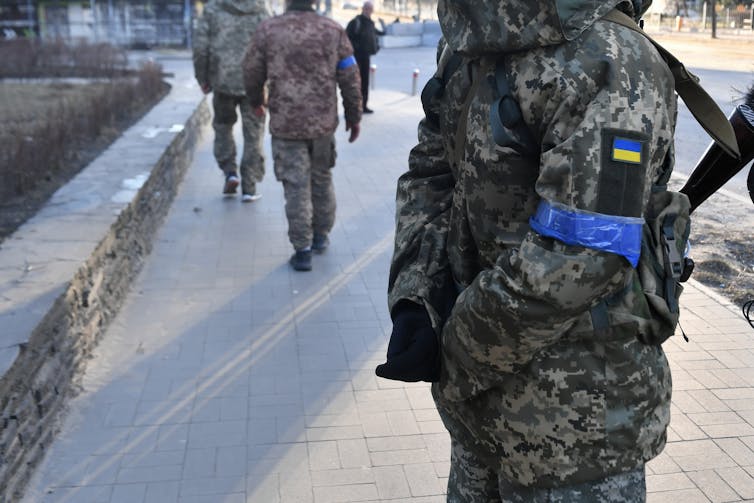
NZ reports 24 more covid deaths, 19,542 new cases – minister positive

RNZ News

New Zealand’s Ministry of Health has reported 19,542 new cases of covid-19 in the community and 24 more deaths today.

The ministry said eight people had died with covid-19 yesterday, while a further 16 people had died in the past three weeks.

“Local public health authorities have notified these deaths to the ministry in the past 24 hours as part of changes to the reporting of deaths announced last week. Delays to reporting can be associated with people dying with, rather than of covid-19, and covid being discovered after they have died,” the statement said.

The minister in charge of New Zealand’s covid-19 response has also now himself tested positive for the coronavirus.

Tweeting an image of a rapid antigen test, Chris Hipkins said: “The faint line seems out of keeping with how I currently feel!

“Day 7 of isolation and now it’s my turn. So I’ll be clocking off for another 7 days. Take care out there everyone.”

Hipkins would normally have fronted today’s covid-19 update, but the media conference has been cancelled for today.

MPs testing positive
Hipkins is the latest of several MPs to have tested positive, including Environment Minister David Parker, Police Minister Poto Williams, opposition National Party leader Christopher Luxon and National MP Simon Bridges.

In the ministry’s report today, a person in their 40s was one of the people with Covid-19 whose death was reported today, while another person was in their 50s. The others include four in their 60s, three in their 70s, eight in their 80s and six in their 90s.

Eleven were women and twelve were men. The ministry said the average age was 79 and this had been increasing over the last week.

Eight of the 24 deaths reported today were people who died at aged residential care facilities.

The total number of deaths of people with covid-19 is now 141.

The rolling seven-day average of deaths over the past seven days is seven, up from four yesterday.

The ministry said the trend of increasing numbers of deaths was sadly not unexpected.

Higher numbers
“As has occurred with omicron overseas, while covid-19 cases are usually seen in higher numbers among younger people early in the outbreak, over time the more severe and fatal consequences of the virus fall disproportionately on our older and more vulnerable populations.”

There are 971 people in hospital, 21 of whom are in ICU. The average age of the people with covid-19 in hospital is 57.

There were also 17 new cases identified at the border.

Yesterday there were 21,616 new cases of the novel coronavirus in the community and two more deaths. There were 960 people in hospital.

Asia Pacific Report adds: Covid-19 modeller Professor Michael Plank was quoted in news reports as indicating the ethnicity of cases could increase the number of severe cases.

Māori make up about 17 percent of the 5 million population, but 20 percent of all cases, and 25 percent of those hospitalised, reports the New Zealand Herald.

Pasifika make up 8 percent of the population, but 21 percent of all cases and 38 percent of those hospitalised.

This article is republished under a community partnership agreement with RNZ.

Print Friendly, PDF & Email

Article by AsiaPacificReport.nz
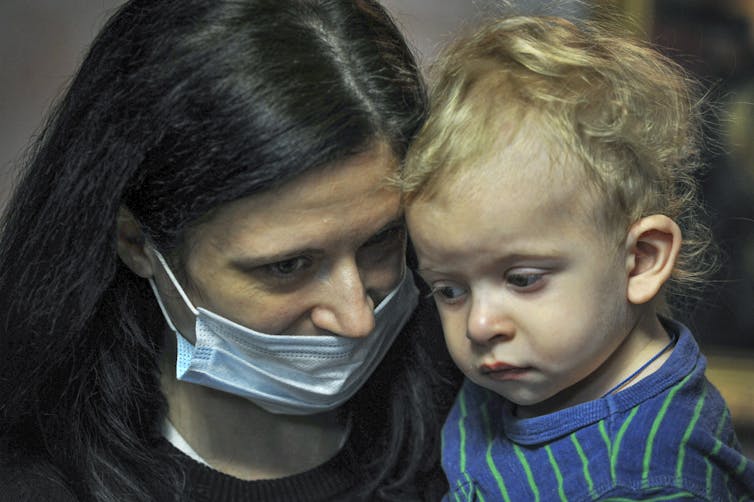
NZ terror attacks anniversary: A letter to my son – ‘Never be ashamed of your beliefs’

OPEN LETTER: By Mahvash Ikram

Three years on from the Christchurch terror attacks on 15 March 2019, Mahvash Ikram writes an open letter to her young son telling him one day he will learn how the Muslim community was targeted, but that shouldn’t scare him from going to a mosque.


Dear son,

You’re not yet two, but you’ve already been to the mosque several times. You don’t understand what happens there, but you love to copy what everyone does. You already know how to say Allah-o-Akbar, and it has become an essential part of your ever-growing vocabulary.

Some would say Muslims start early with their young and I agree wholeheartedly.

So, here’s your first lesson — never be ashamed of your beliefs.

But, remember your vocabulary also includes salam, which means peace. So, practise your faith in peace.

Not long from now, you will understand the concept of standing in prayer behind the imam.

And that’s when we will take you to the mosque for your first ever Friday prayer, Jummah.

We will most likely go as a family, and maybe a few friends will come along too. I will make a big deal out of it. Mothers are embarrassing in all cultures — especially your mum, just ask your older sister.

A white shirt
We will dress you in new clothes, probably a white shirt that will be a bit tight around your pudgy little tummy. It will no doubt get stained with your favourite lunch, which will be ready for you when you come home.

Soon you will learn Friday prayer is a bit of a celebration for Muslims — clean clothes, a hearty home-cooked meal and lots of people to meet at the mosque. It will be an important part of your social calendar, second only to the two big festival prayers.

I look forward to all of it, except one thing — one day you will learn about the March 15 terrorist attacks.

You will learn someone targeted innocent members of your community for their faith.

Al Noor Mosque
Al Noor Mosque in Christchurch … strewn with flowers and offerings honouring the victims of the terror attack there on 15 March 2019. Image: Alex Perrottet/RNZ

And that’s your second lesson, sometimes you will be treated unkindly for your beliefs. You are not alone, there are other communities that suffer the same fate.

Remember — this has nothing to do with you. You are not responsible for a fault in another person’s head.

Trust me, it will be a rude awakening — just like it was for the rest of our country. It is often called the end of Aotearoa’s innocence. Lots of people, including children, were killed and injured that day.

It still hurts
One of those who died was a three-year-old who went to the mosque with his older brother.

Another child was shot but survived. Lots of children lost their parents too. It still hurts.

Tributes and flowers left outside Al-Noor Mosque in Christchurch after the terror attacks.
Tributes and flowers left outside Al-Noor Mosque in Christchurch after the terror attacks. Image: Isra’a Emhail/RNZ

Most grown-ups around you are trying to make sure something like this never happens again in Aotearoa and around the world.

Sometimes we fail, but we are trying.

Hate is an ugly emotion, too big for one’s body. When it takes over, it makes people cruel. They say and do things that can seriously hurt for a very long time. The worst part is these people don’t even realise how horrible they are.

You will also hear of people who practise your faith, but carry a similar hatred. Stay away from them. They, too, destroy families. Denounce them openly.

People may call you names, they may provoke you to fight back and say your religion teaches violence. It is not true. Ignore them.

Keep this verse of the Quran close to your heart and have patience with what they say and leave them with noble (dignity).

Don’t be scared
Don’t let all of this scare you from going to the mosque.

In fact, when you are a bit older I encourage you to go to all sorts of places of worship, whether it’s a mosque, a temple or a church, you will find tranquility and calm.

Don’t be afraid to know others and learn about their views, it is how we rid the world of hate.

Our religion teaches us to respect all other humans regardless of their faith, race, ethnic origin, gender, or social status.

I understand all this information might make you a bit nervous. It is a lot to take in for a little boy your age. But some grown ups just never got on to it and look at what that’s done.

So, let’s get started. After all, we Muslims do start a bit early with our young.

All my love,

Xoxoxo

Mummy

Mahvash Ikram is on the staff at Radio New Zealand. This article is republished under a community partnership agreement with RNZ.

Print Friendly, PDF & Email

Article by AsiaPacificReport.nz

What is petrol excise, and why does Australia have it anyway?

Source: The Conversation (Au and NZ) – By John Freebairn, Professor, Department of Economics, The University of Melbourne

Bianca de Marchi/AAP

One government, in New Zealand, has already cut its fuel excise, by 25 cents per litre for the three months it hopes will be the worst of the oil price crisis, and in the United States and Australia there’s talk of the same sort of thing.

Before considering whether it should be cut, temporally waived, or removed in this month’s budget, it’s worth reacquainting ourselves with what it is.

As is the case with the goods and services tax, it isn’t explicitly quoted when we buy petrol or other fuels; it is rolled into the advertised price.

At the moment the excise on standard unleaded petrol is 43.3 cents per litre, an impost which itself is subject to the goods and services tax. This brings the total to 47.6 cents per litre, something that would have been significant a year ago when the price of petrol was lower, accounting for one third of the price.

It is now less important, accounting for 22% of the price of petrol.

The fuel excise is imposed by the Commonwealth government. As a matter of law and as required by the Constitution, all revenue raised by the Commonwealth goes into “one consolidated revenue fund”. But from 1926 to 1959 all or part of the fuel excise was earmarked for spending on roads.

Since then, it has generally been available for any sort of spending – although the impression remains that it is a crude form of user fee for roads and associated government-funded infrastructure, and for maintenance of that infrastructure.

Effectively a road user charge

The excise is collected at the points of distribution from local refineries and importers rather than at the petrol pump, making it easy to administer.

Making it much more difficult to administer are the substantial rebates offered to off-road users of petrol and diesel, which have the effect of making it a charge for using roads. They cut the total takings from about A$20 billion to A$11 billion.

State and territory governments impose another set of taxes on the use of motor vehicles. These include stamp duty on the registration, annual registration fees, the charge for drivers licenses, and taxes on vehicle insurance. State taxes on the use of motor vehicles amounted to A$11.3 billion in 2019-20.


Read more:
It’s hard to find a case for a cut in petrol tax – there are other things the budget can do


These taxes also go into general revenue, and with no specific link to state government decisions on road infrastructure and maintenance or the provision of services such as traffic police and hospitals.

Taken together, the Commonwealth’s takings from fuel excise and the states’ takings from special motor vehicle taxes appear to roughly equal their spending on roads and associated infrastructure and fall short of the total costs imposed by road users on others including the costs of noise, pollution and policing.

There are better ways to do it

In an ideal world we would charge explicitly for road use, pollution and congestion in the cities during peak hours.

Fuel excise is an increasingly inappropriate way of charging for road use because more and more cars (including hybrids) are using less fuel per kilometre, and some (including all-electric vehicles) are using none.

Some states, including Victoria, charge electric vehicles per kilometre travelled. Owners are required to provide a photo of their odometer and the fee is added to the cost of their registration.

While in the spirit of user charging, what Victoria and other states are doing is a limited first step.

Ideally, and subject to considerations of simplicity and operating costs, the user charge would vary by weight per axle, aggregate weight and distance travelled, and perhaps by road type.

Given the fixed cost of much road investment and maintenance, a modified version of current annual registration fees should continue.

The combustion of petrol and diesel generates external pollution costs not considered by businesses and individuals in their use of motor vehicles.


Read more:
High petrol prices hurt, but cutting excise would harm energy security


External pollution costs include particulates with adverse effects on health and smog, and emissions of carbon dioxide that contribute to climate change.

A pollution fee that is much smaller than the current 43.3 cents per litre excise should be imposed on fuel used for both off-road and on-road purposes as part of a comprehensive price on greenhouse gas emissions associated with the combustion of fossil fuels.

Congestion causes costs estimated to be in the tens of billions in terms of lost time, uncertainty, and extra fuel use, with only a small portion borne by the road user concerned. An important part of the reform package should be a congestion charge for peak hours along the lines suggested by the Grattan Institute.

This ideal set of changes would be imposed independent of the price of oil.

The Conversation

John Freebairn does not work for, consult, own shares in or receive funding from any company or organisation that would benefit from this article, and has disclosed no relevant affiliations beyond their academic appointment.

ref. What is petrol excise, and why does Australia have it anyway? – https://theconversation.com/what-is-petrol-excise-and-why-does-australia-have-it-anyway-179373