A group of citizens in New Caledonia has asked France’s highest administrative court to postpone next Sunday’s third and final independence referendum.
In an urgent submission, 146 voters and three organisations said that given the impact of the covid-19 pandemic, it was “unthinkable” to proceed with such an important plebiscite.
They said that because of the lockdown, campaigning had been unduly hampered as basic freedoms were impinged.
For weeks pro-independence parties have unsuccessfully lobbied Paris to delay the vote and they now say they will neither take part in the vote nor recognise its result.
They also say they will challenge the process at the United Nations.
France, which deems the pandemic to be mastered, last week flew in almost 250 magistrates and judicial officials to oversee Sunday’s vote.
It also flew in about 2000 extra police, including riot squads, to provide security for the referendum.
The party’s leader, Milakulo Tukumuli, said the vote should not go ahead as planned because the pandemic has made campaigning impossible and pro-independence Kanaks said they would not take part in the process.
The choice of the third and final referendum date is being challenged in court. Image: RNZ/FB
The party, which represents Wallisian and Futunians and holds the balance of power in New Caledonia’s Congress, said all the same, the plebiscite on December 12 could not be legally challenged.
Tukumuli also said his party was against independence now because there was not the capacity to assume full sovereignty.
The December 12 vote will be the third and final independence referendum under the terms of the 1998 Noumea Accord.
This article is republished under a community partnership agreement with RNZ.
The Royal Solomon Islands Police Force (RSIPF) has appealed to opposition leader Matthew Wale to “stop interfering” with police investigations in the wake of the rioting in Honiara last month.
“It is unfortunate that the leader of opposition, Mr Mathew Wale, attempted to question an ongoing investigation by police in the media,” said Police Commissioner Mostyn Mangau.
“Issues raised by Honourable Wale are legal issues that are best dealt with by the court.”
Commissioner Mangau said in a statement that the police reassured Solomon Islanders that the police were an independent body and did not pursue political agendas.
“RSIPF will not engage in legal arguments in the media,” he said.
“Police will not further comment on matters that are subject to ongoing investigations. A leader should not interfere with police investigations.”
Mangau said an accused would be provided with legal counsel and it was the duty of the lawyer to advocate for the rights of the accused in court.
He added that Solomon Islands was currently under a state public emergency and the rules were set out under the Emergency Powers (COVID-19) (No.3) regulation 2021.
Praise for AFP officers Meanwhile, the RSIPF Facebook page praised the help from the Australian Federal Police as part of their peacekeeping role.
“Officers from the @AustFedPolice are supporting the RSIPF on the streets of Honiara,” sid the Facebook page along with a gallery of photos of Australian police on duty in Honiara.
“Highly-skilled personnel have deployed from Australia, including the Specialist Operations Tactical Response team. Their mission is to support the RSIPF to protect the community and key infrastructure, and to peacefully restore order in Honiara.”
The AFP officers had helped the RSIPF “peacefully restore calm in the community”.
One week ahead of the Nobel Peace Prize award ceremony, the #HoldtheLine Coalition has called on the government of the Philippines to drop all pending cases and charges against veteran journalist and Nobel laureate Maria Ressa and grant her unrestricted permission to travel to Oslo to accept this international award.
The government of Philippine President Rodrigo Duterte has strongly opposed Maria Ressa’s application to travel to Oslo for the Nobel ceremony but three out of four courts have now granted her permission to fly out for the December 10 award ceremony.
While Ressa’s legal team is almost certain that the remaining court will permit her to travel this week, the #HoldtheLine Coalition is concerned that the Philippine authorities may yet attempt to undermine Ressa’s free expression and restrict her movement.
“The government’s relentless and retaliatory campaign against Ressa serves a sole purpose: to silence independent journalism and curtail the free flow of information in the country,” said the HTL steering committee.
“In keeping with its public claims of support for free expression, the Philippines should overturn its opposition to Maria Ressa’s application to travel to Oslo, and drop all remaining charges against her immediately.”
In its announcement of the prize, the Norwegian Nobel Committee said it was honouring Maria Ressa and Dmitry Muratov for their efforts to safeguard press freedom.
The #HTL Coalition comprises more than 80 organisations around the world. This statement is issued by the #HoldTheLine Steering Committee, but it does not necessarily reflect the position of all or any individual coalition members or organisations.
Pacific Media Watch collaborates with Reporters Without Borders.
An anti-vax protest that shut down the centre of Newmarket in New Zealand’s largest city Auckland today may have cost local businesses hundreds of thousands of dollars in lost customers, says the local business association.
Hundreds gathered at 11am at the Auckland Domain before heading to Westfield Newmarket shopping mall via Carlton Gore Road and Broadway.
After gathering outside the mall, they then moved towards Government House in Epsom.
Newmarket Business Association head Mark Knoff-Thomas said the local stores were “very disappointed” by the behaviour of the protesters.
“We all accept that everyone has got the right to protest, but not when your protest ends up bringing a town centre to a standstill, where retailers and hospitality providers have to shut their doors just to be safe because there’s so many people storming down the street,” he said.
“I think it is shameless behaviour and very, very misguided.”
He said stores had high expectations for the day which had been shattered – the second day of Auckland opening up under red alert under the new traffic lights covid-19 system after almost four months in lockdown.
‘People got fed up’ “This should have been one of the best Saturdays of the year for us and the protesters certainly put paid to that because after they moved through Broadway, everybody left because traffic was snarled up and people got fed up and went home.
“It potentially lost Newmarket many hundreds of thousands of dollars.
“I hope the protesters never come back to Newmarket ever again. If they want to protest, by all means do it somewhere where it doesn’t impact on business owners because it’s been one of the worst years for business people. Very stressful.
“A lot of people are financially on the ropes and all the protesters have done today is add more stress to those people.”
Earlier, Inspector Beth Houliston of Auckland police said officers were “closely monitoring” the protest activity.
“Our focus remains balancing the safety of all protesters and the public, with the right to peacefully protest.”
Traffic disrupted Houliston said traffic in the area had been disrupted by the protesters.
“We would like to thank members of the public who have deferred their travel today.
“We also acknowledge those that have been inconvenienced.
“Police will follow-up any incidents of offending or concern identified during the protest activity.”
The protest organisers were calling the rally ‘the Mass Exodus’.
Protest in New Plymouth Meanwhile, anti-vaccination protesters have again taken to the streets of New Plymouth.
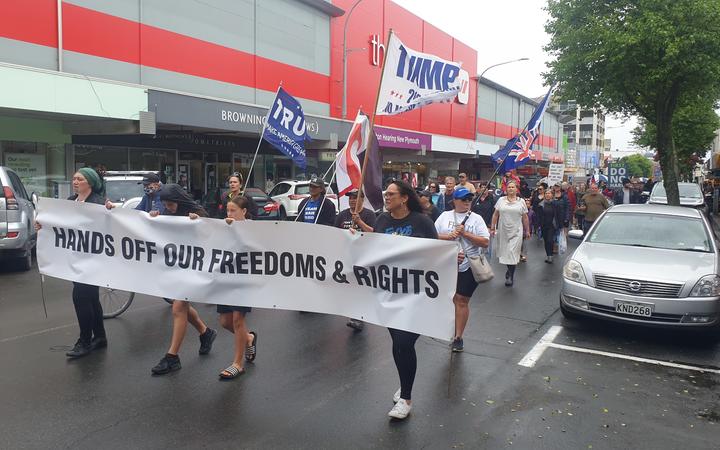
About 200 protesters gathered at Puke Ariki before marching up Devon Street, the city’s main shopping area.
They chanted ‘freedom’ and carried placards calling on the government to end the vaccine mandate.
Many waved flags including campaign banners for former US president Donald Trump and the tino rangatiratanga or Māori flag, and the United Tribes of NZ flag.
About 200 protesters marched up Devon Street in New Plymouth today, calling on the government to end the vaccine mandate. Image: Robin Martin/RNZ
Some of Auckland’s strict lockdown rules were eased yesterday, as the country moved to the new traffic light Covid-19 protection framework.
Police say fewer people converged on central Auckland last night compared to pre-covid-19 times.
But officers were kept busy dealing with disorder-related incidents, involving highly intoxicated people.
In one case, a person is in a serious condition after being assaulted on Karangahape Road.
A 22-year-old man has been charged with wounding with intent to cause grievous bodily harm.
He was due to appear in the Auckland District Court today.
98 new community cases The Ministry of Health reported 98 new community cases of covid-19 in New Zealand today, with cases in Auckland, Northland, Waikato, Bay of Plenty, Hawke’s Bay, Nelson Tasman and Canterbury.
In a statement, the ministry said there were 73 cases in hospital, including seven people in intensive care.
Today’s cases include three in Northland, 64 in Auckland, 21 in Waikato, six in the Bay of Plenty, one in Mangakino, two in Hawke’s Bay and one in Nelson Marlborough.
This article is republished under a community partnership agreement with RNZ.
Eight youths have been declared suspects on charges of makar (treason, subversion, rebellion) for flying the banned Papuan independence flag Morning Star at the Cenderawasih Sports Centre in the capital Jayapura this week on December 1.
The Morning Star is a symbol used as a flag by the Free Papua Organisation (OPM) and by most civil society organisations.
They have been identified by their initials MSY, YM, MY, MK, BM, FK, MP and MW — most of them university students.
Flag-raising protests across the world were staged in solidarity with West Papuan calls for self-determination.
The flag-raising commemorations marked the 60th anniversary of West Papua’s declaration of independence from Dutch colonial rule in 1961.
The Cenderawasih Sports Centre flag-raising incident took place on Wednesday afternoon. Prior to holding the action, on November 30, the eight youths held a meeting in the vicinity of Asmara Maro, claimed police reports.
The meeting was allegedly chaired by MY alias M who acted as the leader of the action and the flag raiser. MY also made the flag and the banner later carried by the suspects.
Parliamentary march planned After flying the flag above the Cendrawasih Sports Centre (GOR), the youths had planned to march to the Papua Regional House of Representatives (DPRD).
The banned Morning Star flag flies above Cenderawasih Sports Centre building in Jayapura, Papua, on “independence day” December 1. Image: Antara News
Papua regional police public relations division head Senior Commissioner AM Kamal explained that seven of the youths were tasked with flying the flag and marching towards the Papua regional police headquarters (Mapolda) while carrying a banner with the Morning Star drawn on it.
The eighth person meanwhile was tasked with documenting the action and spreading it on social media.
The eight have been charged under Article 106 of the Criminal Code (KUHP) in conjunction with Article 110 of the KUHP in conjunction with Article 87 of the KUHP on “plotting to commit crimes against state security”.
“Currently the eight suspects are being held at the Papua Mapolda detention centre for further legal processing,” said Kamal.
Amnesty International criticism On Friday, Amnesty International criticised the arrests, among 34 detentions this week of Papuan protesters, as well as 19 injuries sustained at demonstrations elsewhere in Indonesia.
“No one should be detained simply for peacefully expressing their political opinions,” said Amnesty’s Indonesia director Usman Hamid, news agency reports said.
Police did not immediately respond to media requests for comment on Amnesty’s statement.
In June 2020, Indonesia sentenced to prison seven Papuans for treason, while Papuan independence figure Filep Karma spent 11 years in prison after raising the banned flag publicly. He was released in 2015.
In Ambon, Maluku, Beritabeta reports that a demonstration by scores of Papuan students marking Independence Day ended in chaos after it was forcibly broken up by police.
The Papuan students, who are undergoing their studies in Ambon, refused to accept the police actions and fought back.
The police finally succeeded in forcing the demonstrators back, who were wearing clothing and accessories with the Morning Star flag on them.
Ambon and the Ambon islands municipal police public relations division head, Second Police Inspector Izaac Leatemia, told journalists that the demonstration was broken up because the protesters did not have a permit from police.
Attacked by vigilantes In the Balinese provincial capital of Denpasar, a protest by the Bali City Committee Papua Student Alliance (AMP-KKB) and the Indonesian People’s Front for West Papua (FRI-WP) ended in a clash with a vigilante group called the Nusantara Garuda Patriots (PGN), reports Detik.com.
The AMP-KKB said that 12 of its members were injured during the clash.
“Based on our data from the AMP there were 12 of our comrades (who suffered injuries). Some were kicked by the PGN, and then there were comrades who were hit by rocks,”, said AMP-KKB chairperson Yesaya Gobay.
Vanuatu’s Shefa province is recognising Benny Wenda as the interim president of a provisional “independent” West Papuan government.
In a country that has historically been the most vocal in support of West Papuan self-determination rights, Shefa province is the first authority in the country to officially recognise an independent West Papua government.
Wenda, a West Papuan pro-independence activist who fled persecution in his homeland under Indonesian control, was granted asylum in the United Kingdom in 2003.
A year ago, as the head of the United Liberation Movement for West Papua (ULMWP), Wenda announced that it was forming a “provisional government” of West Papua, with him as the interim president.
Shefa’s recognition of that government was announced by the Secretary-General of Shefa provincial government, Morris Kaloran, to mark the 60th aniversary of West Papua’s “declaration of independence” in 1961 which was soon overshadowed by a controversial US-brokered agreement which paved the way for Indonesia to take control of Papua.
Kaloran said the ULMWP provisional government and its interim president were the legitimate representatives of the people of West Papua and their struggle.
In a symbolic gesture, Shefa province had already adopted the indigenous Melanesian people of West Papua and their struggle for self-determination and liberation from Indonesian rule.
Melanesian ‘destiny joined’ “The destiny of our two Melanesian peoples of West Papua and Vanuatu is joined. The West Papuan people remain enslaved and colonised in 21st century, subject to discrimination, assassination and military operations,” Kaloran said.
“Their gallant freedom struggle, under the guidance and leadership of the ULMWP Provisional Government, is moving ever closer to victory. Until the people of West Papua are, no one in Melanesia is free.”
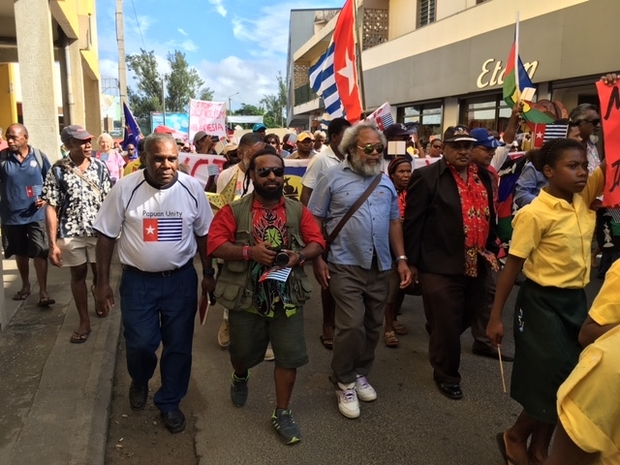
Hundreds of ni-Vanuatu, and West Papuan representatives, march for West Papuan independence in Vanuatu’s capital Port Vila. Image: Joe Collins/AWPA
Indonesia’s government opposes the ULMWP’s claims to represent West Papuans, saying the people of the Papuan provinces of Indonesia have democratic rights like other people in the republic.
Both Indonesia and the ULMWP have been granted membership in the Melanesian Spearhead Group, whose full members — Papua New Guinea, Fiji, Vanuatu, Solomon Islands and New Caledonia’s Kanak independence movement — have expressed a wish for Jakarta to engage in dialogue with West Papuans about their grievances.
This article is republished under a community partnership agreement with RNZ.
Labor’s Chris Bowen made a very pertinent contribution on Monday to the debate over whether the Liberals should run Gladys Berejiklian, the subject of an ICAC investigation, in the Sydney seat of Warringah.
What would the Liberals and the media be saying if it were a Labor figure in a similar position? Bowen asked.
Of course we know the answer. They’d be outraged And they’d be justified.
The push within the Liberal party, backed by Scott Morrison, for Berejiklian to stand is a case of the “whatever it takes” brand of politics.
The Liberals are desperate to get this seat back from independent Zali Steggall. And they are spurred by the continued high popularity of Berejiklian. The polling and focus groups tell them people think she was a good premier, and has been hardly done by.
She’s probably the only Liberal who would be competitive with Steggall, who’s dug in solidly since she ousted Tony Abbott in 2019.
The close of nominations for Liberal preselection for Warringah has been delayed from last Friday until January 14 to give the former premier time to make a decision.
The ICAC won’t bring down its finding before then, so if Berejiklian ran there’d be a cloud hanging over her.
Behind the scenes, some indication will come before Christmas about how things are likely to go, when counsel assisting the ICAC present their submissions to the parties and the commissioner.
But while this could be important in Berejiklian making up her mind, the material won’t be public. If she ran, the speculation about it would be rife, which would surely be unhelpful.
Morrison has this week returned to attacking the ICAC over Berejiklian’s treatment. In the recent parliamentary sitting he denounced this as “an absolute disgrace”. “The Australian people know that the former premier of New South Wales was done over by a bad process and an abuse of process,” he said.
On Monday he said her treatment had been “shameful”. There was no suggestion she’d done anything criminal, he said, and he found the playing of intimate conversations she had (with then secret boyfriend, Daryl Maguire) “just awful”.
Morrison’s opposition to giving a national integrity commission the right to hold public hearings was adamant during recent government discussions, which ended with no legislation being introduced into federal parliament.
Morrison said Berejiklian was “put in a position of actually having to stand down and there was no finding of anything. Now I don’t call that justice.”
Without saying it explicitly he creates the impression the ICAC forced her to quit her job. In fact, she chose to resign, judging that just standing aside while the inquiry was on was politically untenable.
Steggall on Monday pushed back strongly against Morrison, saying the words he’d used in parliament were “outrageous”. “We should be seeing leadership to raise trust, call for more accountability, not undermine accountability.”
The ICAC is investigating whether Berejiklian breached public trust in relation to two grants awarded to the electorate of Wagga Wagga, then held by Maguire. It is also inquiring into whether her conduct “was liable to allow or encourage” corrupt conduct by Maguire.
Berejiklian, when she was treasurer and then premier, did not disclose to her colleagues her close personal relationship with Maguire, and has defended her failure to do so, arguing “I didn’t feel it was of sufficient standing”.
The PM and some other Liberals dismiss her lapse basically on the grounds that here was a woman who’d just had a bad boyfriend.
In Morrison’s view integrity bodies should not be looking at “who your boyfriend is”, as he put in in parliament.
Leaving aside the rather patronising attitude this implies – the gullible woman as an explanation – it doesn’t wash in terms of political ethics. If you are premier, your relationships are relevant. With this relationship, private life impinged on public life.
Does Morrison really think it was okay for Berejiklian not to disclose her closeness to Maguire, who was well known as an urger of the first degree?
That certainly wasn’t the view of former NSW premier Mike Baird, a good friend of Berejiklian, who said in evidence at the ICAC “certainly I think [the relationship] should have been disclosed”. Baird is another high profile figure the Liberals have pursued to stand in Warringah, but without success.
If the Liberals fielded Berejiklian ahead of the ICAC report, they would be adding insult to injury in their performance on integrity issues.
Michelle Grattan does not work for, consult, own shares in or receive funding from any company or organisation that would benefit from this article, and has disclosed no relevant affiliations beyond their academic appointment.
Source: The Conversation (Au and NZ) – By Joshua Gilbert, Researcher (Indigenous Policy) Jumbunna Institute for Indigenous Education & Research and Higher Degree Research Student at Charles Sturt University, University of Technology Sydney
Much of the debate on Indigenous agriculture in Australia has focused on a contested pre-colonial definition as to whether Aboriginal and Torres Strait Islander people deserve the English title of “farmer”.
However this view stifles the real story of Indigenous engagement in Western agriculture. It also fails to recognise the inherent need for Indigenous peoples’ involvement in the sector.
In 2020, the Australian Department of Agriculture, Water and Environment conducted a series of roundtables to develop the National Agriculture Workforce Strategy.
The strategy noted the urgency of transforming the agricultural workforce into a “complex, modern, sophisticated sector”.
There is no doubt the agricultural workforce is changing.
However, there’s a worryingly unsophisticated understanding of workforce diversity within the sector – especially in terms of Indigenous involvement in agriculture.
This extensive landholding by First Nations people is an essential component of the continued practice of agriculture in Australia. But despite Indigenous people owning these vast areas of land, only 1% of the agricultural workforce identify as Indigenous.
The National Agriculture Workforce Strategy identifies solutions to this lack of Indigenous workforce. Solutions such as promoting Indigenous people in agriculture through marketing, and fostering Aboriginal and Torres Strait Islander leadership in this sector.
However, these proposed strategies fail to acknowledge broader concerns about inadequate Indigenous representation in the sector.
Better data and a pipeline of Indigenous graduates
To date, there has been no concerted effort across the agriculture sector to understand the size and scale of current Aboriginal and Torres Strait Islander involvement, nor their agricultural production.
For example, the Australian Bureau of Statistics’ Agriculture Census does not provide the opportunity for farmers to identify as Indigenous. Agriculture research and development corporations usually don’t collect these data, either.
There are also pipeline issues regarding Indigenous involvement in the sector. A recent study of 15 years of data by one of us (James Pratley) demonstrated universities had a low attraction and retention rate for Indigenous students. Fewer than five Indigenous students graduate in agriculture across Australia each year.
Despite the lack of university graduates, Australia has a growing Indigenous youth demographic, which could contribute to a much-needed workforce in future.
To encourage Indigenous people to enter agriculture, we need to show Aboriginal and Torres Strait Islander people belong in the sector. They need to feel welcome in our universities and TAFEs and we must better support those entering the industry.
Charles Sturt University has developed an Indigenous agriculture initiative drawing attention to the lack of Indigenous agriculture graduates. It also provides Indigenous students scholarships to study agriculture and/or do postgraduate research on aspects of Indigenous agriculture.
This provides Indigenous people with a pathway into agricultural industries and shows Indigenous people what opportunities exist.
Attracting and retaining Indigenous talent
It’s also imperative larger agricultural companies develop Reconciliation Action Plans (detailed, long-term strategies to meaningfully advance reconciliation between Indigenous and non-Indigenous people within an organisation). Big firms must also start or renew their efforts towards building more diverse workforces and supply chains.
Agricultural companies such as Incitec Pivot, OBE Organics and Bayer have recently developed Reconciliation Action Plans. Other agricultural businesses and industries need to ensure their houses are in order too.
Reconciliation Action Plans provide a pathway for organisations to advance reconciliation across their business. This can be done through identified actions such as increasing Indigenous staff and initiatives for staff. Organisations are accountable for these actions through the Reconciliation Action Plan they develop.
As these Reconciliation Action Plans mature, employers in the agricultural sector will seek out Indigenous talent to meet targets and to crucially provide new perspectives.
Indigenous people’s input and talent is vital to modernising the agricultural sector. There is a huge opportunity to build employment pipelines from schools through universities into the broader agrifood industry.
A clear understanding of the size and scale of current Indigenous agricultural contributions is sorely needed.
Industry leaders who work to establish and grow the talent pipelines and develop Reconciliation Action Plans will reap the rewards.
Josh Gilbert receives funding from the Food Agility CRC. He is affiliated with KU Children’s Services, the NSW Aboriginal Housing Office, Reconciliation NSW, and Bridging the Gap Foundation. Josh formally worked at PwC’s Indigenous Consulting.
James Pratley does not work for, consult, own shares in or receive funding from any company or organisation that would benefit from this article, and has disclosed no relevant affiliations beyond their academic appointment.
The Coalition and Labor took very different higher education policies to the 2019 federal election. The contest was between tightly capped total spending under the Coalition and a restored demand-driven system under Labor, letting universities enrol unlimited numbers of students for bachelor degrees.
Labor leader Anthony Albanese’s announcement yesterday of extra university places if Labor wins the 2022 federal election offers more money and slightly changed criteria for distributing it among universities. Unlike in 2019, it is not a radically different alternative to the government’s policies. But there are ways of better achieving its goals.
Up to 20,000 more places
Labor promises to deliver up to 20,000 extra student places over two years. Enrolment data for 2020 and 2021 are not yet available, but on 2019 figures Labor is offering, in theory, about a 3% increase in total places.
The expected cost is A$481.7 million over the new few years. To put this in context, the federal budget forecasts tuition subsidies of just over $7 billion a year.
Under the Coalition’s Job-Ready Graduates policy, which began in 2021, the link between funding and student places is not straightforward, which explains Labor’s “up to” caveat.
In earlier funding systems, the idea of a student place was central. A student place was the equivalent of one year’s study for a full-time student. Each university had a minimum number of places it had to deliver for its funding. New places were often allocated in specific numbers by discipline or course.
Under the current system, universities are funded without setting minimum numbers of student places. Universities decide how to distribute that money between student places, which under Job-ready Graduates have a wide range of dollar values.
In 2021, law, business and most arts student places have an annual public subsidy of $1,100. An extra $1 million in public funding would finance 909 of those places. But nursing, engineering and science have a public subsidy of $16,250, so $1 million would cover only 62 places.
The Job-ready Graduates framework creates a tension between maximising opportunities to study, which is done most effectively in courses with low subsidies, and promoting courses with in-demand skills, which consume more of each university’s available funding.
Labor sets out three broad criteria for allocating its new money to universities:
ability to offer extra places in areas of national priority and skills shortage, including clean energy, advanced manufacturing, health and education
efforts to target under-represented groups such as the first in their family to go to university, people in regional, remote and outer-suburban areas, and First Nations people
student demand.
Labor’s priority fields are high-subsidy courses, so will generate fewer student places per million dollars spent. This creates a tension with equity goals.
The most successful policy to date for increasing representation was demand-driven funding. After lifting funding caps, growth in enrolments of students from low socioeconomic status backgrounds outpaced the rate for other socioeconomic groups.
Enrolments in lower-subsidy courses would help meet access goals, even if these course choices do not match Labor or Liberal views of what students should be studying.
Student applications data reflect student demand, Labor’s third criterion for allocating funding. The data show increased student interest in the “society and culture” cluster of courses. This includes arts and law with the $1,100 public funding rate, despite their high student contribution of $14,500 a year.
Labor’s interest in using higher education policy to meet national priorities and skills shortages is conceptually similar to the Coalition’s “job-ready graduates” approach, although with slightly different lists of preferred courses.
Labor’s equity criteria for allocating funding to universities also have parallels with the Coalition. The current policy is to focus funding growth on regional universities and campuses in areas with relatively high population growth.
The main novelty in Labor’s list is that “first in family” has not explicitly been used in policy before. But new students have been asked about their parents’ education since 2010. The Coalition’s policy on regional and high population growth areas is likely to catch areas with relatively high proportions of first-in-family students.
The Coalition reintroduced demand-driven funding for Indigenous students from regional areas this year. They also have high rates of first-in-family enrolment.
The key difference between the parties is the amount of extra funding for the chosen universities rather than the underlying criteria for how it is distributed. But more funding converted into more places undoubtedly matters for under-represented groups.
A more ambitious agenda?
Demand-driven funding, as Labor promised in 2019, is the most effective funding policy response to the problems it sees. It best matches the supply of places with student demand, by giving the funding system the capacity to create enrolments in the courses students want to take.
Furthermore, applications tend to follow the labour market without any special policy incentives. With demand-driven funding there is no trade-off between access goals and priority shortages to overcome skills shortages.
Labor’s decision to abandon demand-driven funding is probably due to the Commonwealth budget being more stretched now, as a result of COVID-19, than it was in 2019.
Labor knows the so-called “Costello baby boom” students will reach university age in the mid-2020s. They create a real need for more student places, but also mean demand-driven funding could drive a big increase in higher education spending.
While demand-driven funding is probably not going to return in the next few years, Labor could make other changes that will ease current policy tensions and be fairer for students.
There is a direct relationship between student contributions and the subsidy rate. A modified funding system could narrow the range of contributions, which this year stretch from $3,950 to $14,500 a year.
Discipline-based subsidies that are less varied than the 2021 range of $1,100 to $27,000 would ease, although not eliminate, the tensions between promoting courses in areas of skill shortage and increasing student places.
Such a system could deliver more student places per $1 million of public funding in skill priority courses than under current policies.
Fundamental flaws remain in place
For universities and prospective students there is no obvious downside to Labor’s proposal. On the announcements to date it would not fix the structural problems created by Job-ready Graduates, but I doubt such a flawed policy will last long-term, regardless of who wins the next election.
Andrew Norton works in the higher education sector and has previously advised Coalition higher education ministers on policy issues.
Source: The Conversation (Au and NZ) – By Mike Lee, Professor in Evolutionary Biology (jointly appointed with South Australian Museum), Flinders University
Michael Lee, Author provided
How did the crocodiles survive the asteroid that killed the dinosaurs? – Éamonn, age 5, Western Australia
Hi Éamonn! This is a great question, and one many scientists have asked.
There are two main reasons. First, crocodiles can live for a very long time without food. Second, they lived in places that were the least affected when the asteroid hit Earth.
A battle-scarred saltwater crocodile resting near the Daintree River in North Queensland. Michael Lee
When the asteroid hit earth
About 66 million years ago, dinosaurs ruled Earth. But then a massive asteroid, more than 9 kilometres wide, slammed into the shallow sea near what is now Mexico.
The explosion from this was so huge, it led to global earthquakes, tidal waves, bushfires and even poisonous rain.
Also, the asteroid hit at one of the worst possible places, where the rocks could easily be “exploded” (or vapourised). This threw up massive amounts of dust into the sky, blocking out the Sun for many months and sending Earth into a long, dark and freezing winter.
Without sunlight, the green plants died, followed by the plant-eating animals that ate them to survive, and the meat-eaters that ate the plant-eaters.
But some managed to survive for a range of reasons.
One important group of dinosaurs sailed through, helped by their ability to fly and find food in faraway places. Their feathers protected them from the cold, and their beaks let them eat buried seeds found near dead plants.
Amazingly, these dinosaur survivors are still with us today. We call them birds!
Crocodiles were another group that famously survived the asteroid. Obviously they can’t fly, don’t have feathers, and don’t eat seeds! But they had other secrets to success.
Firstly, crocodile bodies use very little energy. They lie around a lot, breathe slowly and even have a very slow heartbeat. This is how they can hold their breath underwater for more than an hour.
It also means they can go without food for months, and sometimes more than a year. This would have been very helpful when food (such as other animals) became hard to find once the asteroid hit.
Dinosaurs such as Velociraptor would have struggled to survive without much food after the asteroid hit. That is, if they survived in the first place. Shutterstock
Crocodiles also lived in places where losing green plants didn’t make a big difference. Think of a forest or a grassland (where many dinosaurs lived): if the plants there die, then all the animals that need them die too, including the meat-eaters which are left with no food.
But the crocodile survivors mostly lived in places like rivers, lakes and coasts. The animals living in these places don’t need green plants as much. Dead plants and animal material washes in from surrounding land, which is eaten by tiny creatures, which are then eaten by larger creatures including crocodiles.
So unlike dinosaurs living on the land, crocodiles in a river would not have starved as soon as the green plants died.
Our mammalian ancestors also survived
A similar reason helps explain why human beings’ ancestors also survived the asteroid impact. These were the small mammals that lived near the end of the age of dinosaurs, which eventually gave rise to all the different kinds of mammals around today (including humans).
They were mainly small, rat-like things that scurried about in the dead leaf litter on the ground, eating insects and worms. These tiny creatures relied not on living green plants, but on dead leaves and bark falling from the trees, or being blown and washed in from elsewhere.
So just like the crocodiles, our tiny ancestors survived the asteroid partly because they didn’t depend heavily on living plants. A good thing too: these lucky survival skills are the reason you and I are here today!
Humans have had a long history – 3.8 billion years in the making. This video shows how humans evolved from the first life.
Mike Lee receives research funding from The Australian Research Council and Flinders University.
Source: The Conversation (Au and NZ) – By Adrian Beaumont, Honorary Associate, School of Mathematics and Statistics, The University of Melbourne
Dean Lewis/AAP
This week’s Newspoll, conducted December 1-4 from a sample of 1,518, gave Labor a 53-47 lead, unchanged since the previous Newspoll, three weeks ago. Primary votes were 38% Labor (steady), 36% Coalition (down one), 10% Greens (down one), 3% One Nation (up one) and 13% for all others (up one).
Prime Minister Scott Morrison’s ratings were steady at 52% dissatisfied, 44% satisfied, for a net -8 approval. Labor leader Anthony Albanese gained five points on net approval for a -6 rating. This is the first time since the pandemic began that Albanese’s net approval has been better than Morrison’s.
Morrison led Albanese by 45-36 as better PM (it was 46-38 three weeks ago). By 47-37, voters expected Labor to win the next election.
The Joyce factor
In late October, there was an increase in Labor’s poll lead across several polls. At the time, I thought the best explanation was the involvement of Nationals leader Barnaby Joyce in the Coalition’s internal climate change negotiations.
With Joyce fading from the limelight, the Coalition has recovered. Newspoll was 54-46 to Labor in late October, but is now 53-47. There has also been movement to the Coalition in the Resolve and Essential polls. The Morgan poll’s move to Labor is probably illusory.
Many expected the last two weeks of federal parliament, which included the release of the Jenkins report finding that one in three parliamentary staff had experienced sexual harassment, to be damaging for the Coalition.
However, we don’t know how much impact this has had on voters. And in April, I wrote that a backlash against political correctness could be making sexual misbehaviour more acceptable.
The economy and COVID will be important factors at the next election, due by May 2022. While the Australian GDP tanked 1.9% in the September quarter due to lockdowns, it will rebound in the current quarter. However, a rise in inflation could hurt the government.
Meanwhile, will the new Omicron COVID variant require restrictions to be reintroduced?
Coalition gains in Resolve poll
A Resolve poll for Nine newspapers, conducted November 16–21 from a sample of 1,606, gave the Coalition 39% of the primary vote (up two since October), Labor 32% (down two), the Greens 11% (steady), One Nation 3% (steady) and independents 9% (steady).
As usual with Resolve, no two-party vote was given, but analyst Kevin Bonham estimated a 50-50 tie, a two-point gain for the Coalition since October.
Despite the Coalition’s voting intentions gain, Morrison’s ratings slumped. His good rating for his performance in recent weeks was down seven to 40% and his poor rating up six to 49% for a net approval of -9, down 13 points.
Albanese also dropped four points to a net -14 rating. Morrison led Albanese by 40-29 as preferred PM, down from 44-26 in October.
Of those polled, 34% thought the government’s commitments on climate action were “not enough”, 28% “about right” and 16% “too far”. That’s a 44-34 lead for “too far”, plus “about right” over “not enough”.
By 49-16, voters supported raising the 26-28% emissions reduction target for 2030, but that’s down from 57-13 in October.
The Liberals and Morrison led Albanese and Labor by 40-24 on economic management (45-23 in October). On COVID, they led by 36-23 (40-22 in October).
Essential voting intentions
The Essential poll’s new website has a graph of voting intentions. We had a voting intentions release in late October, but there are two November data points on the graph.
The Coalition is behind according to the latest Essential poll figures. Dan Himbrechts/AAP
In late October, Labor led by 49-44 on Essential’s “two party-preferred-plus” measure that includes undecided voters – other polls exclude undecided to get their two party estimates. In early November, Labor’s lead was reduced to 46-44 and in mid-November it rose slightly to 48-45.
In the mid-November poll, the federal government’s ratings for handling COVID dropped to 45-29 good from 48-29 in early November. There was a 34-34 tie between the Coalition and Labor on managing the economy generally. When economic management was asked along with other issue questions in early November, the Coalition led by 41-33.
Morgan poll
In a mid-November Morgan poll from a sample of almost 2,800, Labor led by 55.5-44.5, a 2% gain since the early November poll. Primary votes were 35.5% Coalition (down 1%), 35.5% Labor (up 0.5%), 12% Greens (up 0.5%), 3.5% One Nation (up 0.5%) and 13.5% for all others (down 0.5%).
Morgan is using respondent allocated preferences, while Newspoll uses preference flows at the 2019 election. Bonham is very sceptical of Morgan’s blowout Labor lead.
Morgan Victorian poll: Labor extends huge lead
A Morgan SMS Victorian state poll, conducted November 24 from a sample of 1,105, gave Labor a 59.5-40.5 lead, a 1.5% gain for Labor since November 11. Primary votes were 45% Labor (up 2%), 29% Coalition (down 2%), 10.5% Greens (down 0.5%), 4% UAP (up 1%), 2% Derryn Hinch’s Justice (steady) and 6% independents (down 0.5%).
Premier Daniel Andrews had a 63.5-36.5 approval rating (60.5-39.5 on November 11). By 76-24, voters agreed with the health policy that an employee is not allowed to enter their employer’s workplace unless fully vaccinated.
In a NSW Resolve poll for The Sydney Morning Herald, the state Coalition had 41% of the primary vote (steady since September), Labor 31% (up one), the Greens 10% (down one), the Shooters 2% (steady) and independents 12% (up two). Bonham estimates 53-47 to the Coalition after preferences.
Premier Dominic Perrottet led Labor’s Chris Minns as preferred premier by 34-23 (48-21 to former premier Gladys Berejiklian in September). This poll would have been conducted with the federal Resolve polls in October and November from about 1,100 respondents.
“Almost two-thirds” supported voluntary assisted dying and just 11% were opposed. Of those polled, 43% said Berejiklian should not have resigned based on revelations before ICAC. Berejiklian’s net likeability (positive minus negative views) was between +30 and +40 before her resignation. It dropped to +20 before the ICAC hearings, but has rebounded to +31.
Adrian Beaumont does not work for, consult, own shares in or receive funding from any company or organization that would benefit from this article, and has disclosed no relevant affiliations beyond their academic appointment.
Many artists and arts workers have “portfolio careers”, piecing together a mixture of jobs while competing for limited funding and career opportunities in the arts.
In 2019, I set out to understand what “sustainability” means to Australia’s arts and culture sector. I analysed 564 annual reports published between 2010 and 2018 and over 2,700 submissions in the 2014 and 2015 Senate Inquiry into arts funding. I also interviewed 33 artists and arts managers representing all parts of the performing arts sector.
One interviewee defined a “sustainable career” as:
one in which you’re employed in your practice to the extent that you can live. For a lot of artists that’s just about a roof over their head and feeding themselves. […] I think we should be able to have mortgages and raise kids […] I look at some of the singers that I work with and that’s really hard for them to do.
Even artists who are successful in multiple facets of their career – including some of our most celebrated theatre directors – can feel like these careers are not sustainable.
One contributor to the Senate Inquiry observed:
Artists can have successful exhibitions, be collected by national and international institutions, and still not make a sustainable living.
Interestingly, I observed significant differences in how different arts companies wrote about sustainability in their annual reports. Career sustainability was mentioned more often by theatre companies than other art forms. Opera and circus tied in second place. While comparable data is not available for Australia, findings from the UK suggest a high percentage of freelancers working in theatre might explain this difference.
Inherent demands
Working in the performing arts involves both physical demands and mental strain. Artists described to me how they have to maintain “the body of an elite athlete” and how the “obsessive requirement to be excellent all the time” leads to “consistent performance-related anxiety.”
The inevitable long hours and extensive travel also make this a family-unfriendly career. Artists explained the expectation they work outside of ordinary business hours, the need to “travel where the work is” and feeling like they needed to leave the arts if they wanted to raise a family.
These pressures arise from both the limited opportunities and intense competition within the arts and culture sector, which make many people feel they have to accept any opportunity – and work under any conditions – in order not to be left behind.
In my research, I found all of these issues became compounded when measures of diversity were considered.
Gender inequity presents one barrier to career sustainability. Interviewees also told me First Nations artists, deaf and disabled artists, regional and remote artists, and artists from lower socio-economic backgrounds face even greater challenges. Recent research by the Australia Council for the Arts reveals the same is true for culturally and linguistically diverse artists.
In the interviews taken as part of my research, I repeatedly found financial constraints underpin three problems causing career unsustainability in the arts.
1. Low incomes:
being brutal about it […] I have as good a freelance load as anyone probably going around Australia […] and my wife needs to be working full-time for us to be financially sustainable.
2. Unpaid work:
you really only get paid if you’re performing and if you’re lucky enough, you might get paid for the rehearsals beforehand
3. Excessive workloads:
the level of burnout in this industry is pretty shocking […] we’re all overworked and constantly tired.
The obvious solution is more abundant and ongoing public and philanthropic support. As one interviewee explained:
Increased government funding for the arts is […] the first and most important step in the career sustainability of artists because it flows through everything else.
In 2019, the International Labour Organization began exploring what “decent work” means for arts and culture. Australian politicians, policymakers, and sector leaders need to do the same.
This would mean acknowledging artists and arts managers (like all people) are entitled to gain a living from their work, then developing policies to prioritise the creation of good jobs within the arts and culture sector.
France is persisting with its decision to hold the final of three independence referendums in New Caledonia on December 12, disregarding Indigenous independence leaders’ calls for a postponement of the vote and now for “non-participation” – effectively a boycott – due to the impact of the COVID pandemic on their communities.
The decision threatens France’s own 30-year peace process in the semi-autonomous territory, as well as stability in its preeminent Pacific possession. A boycott of the vote by the Indigenous Kanak population could potentially return the territory to the turmoil of the 1980s, with regional consequences.
Why is another independence referendum happening?
The Indigenous-based independence movement gathered strength in New Caledonia in the 1970s and early 1980s as France rolled back autonomy provisions it had agreed to and encouraged immigration from other parts of France to outnumber independence supporters.
By the 1980s, Kanak frustration led to violent protests in the territory and a boycott of an independence referendum in 1987. This was followed by deadly shootings between Kanaks and French militias months later during the French presidential elections.
The Matignon/Oudinot Accord in 1988, negotiated by the French government between pro- and anti-independence groups, ended the violence. This was followed by the Noumea Accord in 1998, which promised a three-vote process for independence.
The first two referendums, held in 2018 and 2020, delivered record turnouts (over 80%) and a slight majority for staying with France. There was, however, a large (and growing) Kanak support base for independence, rising from 43.3% to 46.7%. Just 10,000 votes separated the two sides in 2020.
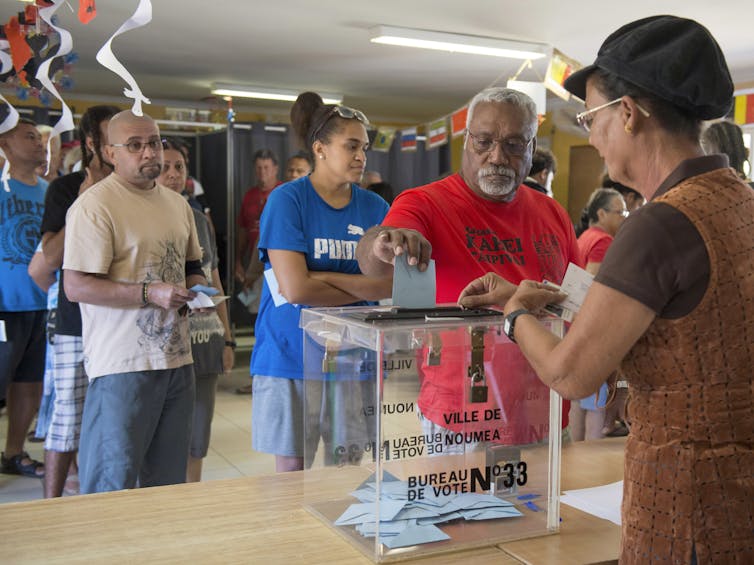
Voting at a polling station in Noumea in the 2018 independence referendum. Mathurin Derel/AP
A third vote was expected to be close, with both sides courting the 25,000 people who abstained in 2020 (of 180,000 total eligible voters). However, Kanak “non-participation” would render the vote politically void, as it did in 1987.
This final vote can be held any time before October 2022. The loyalist parties who support remaining a part of France favoured an earlier vote to consolidate their majority and allow for speedy recovery of the stagnating economy.
Independence parties preferred a later vote to maximise their chances to gain a majority.
To avoid overlap with French elections next year, the French government chose December 12 for the referendum over the opposition of independence parties.
France takes a less neutral approach
In the first two campaigns, France scrupulously observed impartiality and invited international observers. For this final vote, it has been less neutral.
For starters, the discussions on preparing for the final vote did not include all major independence party leaders. The paper required by French law explaining the consequences of the referendum to voters favoured the no side this time, to the point where loyalists used it as a campaign brochure.
The French government also selectively commissioned and released opinion polls on the role of France in New Caledonia, while the local media has highlighted the potential negative effects of independence on health and other services.
Visiting Tahiti in July, President Emmanuel Macron spoke in strong terms of the threats to small isolated Pacific islands without France to protect them. France is also deploying more security personnel to New Caledonia for this year’s vote.
The impact of the COVID pandemic has played a major role in this year’s referendum.
New Caledonia had experienced few cases and no deaths from the start of the pandemic until the Delta variant made its way to the territory in September. Since then, there have been nearly 300 deaths, most in the Kanak community.
Citing Kanak mourning rites involving lengthy community grieving, independence leaders sought a postponement of the December 12 vote, emphasising the potential effect on campaigning and turnout.
However, France’s overseas territory minister, Sebastien Lecornu, confirmed the December date. He said France’s non-compulsory voting system allowed anyone to choose not to participate if they wished.
The reaction among Kanaks was strong. Independence leaders reaffirmed their call for peaceful non-participation, eschewing the term “boycott” because of its association with the 1987 referendum boycott and the violence that followed. They noted, though, their 30,000 young Kanak supporters would not necessarily obey.
On December 5, a group of largely Kanaks asked France’s highest court of appeal to urgently review the decision and postpone the vote until after the June French elections.
The pro-independence parties have said they would contest the result if the referendum goes ahead, and would not participate in discussions about the territory’s future that France has proposed for the day after the vote.
What the referendum means for the region
If there is instability or violence in New Caledonia, or a contested referendum outcome, it will impact the region.
France’s role in the Pacific will again be at issue, as it was in the 1980s. Then, regional governments focused international attention on France’s handling of its territories’ decolonisation demands and its nuclear testing in French Polynesia, ultimately leading France to change its ways.
France’s revised policies and serious diplomatic efforts have enabled it to forge new partnerships with Australia, New Zealand and Pacific island governments. Thus, France’s treatment of its overseas territories ultimately underpins its role in the region and its Indo-Pacific vision.
Regional leaders and analysts have urged the French government to have a rethink of its handling of this decisive vote.
The Melanesian Spearhead Group, comprising Fiji, Papua New Guinea, Solomon Islands, Vanuatu and New Caledonia’s independence coalition, has called for postponing the referendum in the United Nations.
And late last month, over 60 international academics with years of experience working on New Caledonia expressed concern over the referendum date in an open letter published by Le Monde.
For France, Australia and the rest of the region, New Caledonia’s referendum may not be the democratic beacon for the future it was designed to be, but instead, a portent of instability.
Denise Fisher does not work for, consult, own shares in or receive funding from any company or organisation that would benefit from this article, and has disclosed no relevant affiliations beyond their academic appointment.
Mainstream media is often understood as a reflection of national identity. Television media in Australia has documented Australian lives since its inception in 1956.
In recent times, meaningful self-reflection by some elements of the media industry has seen improvements. However, there is still a need for greater representation of First Nations peoples’ perspectives in the media – particularly in relation to Indigenous issues.
The link between racism in the media and racism in our communities is no new thing. In 1991, the National Inquiry into Racist Violence in Australia found:
considerable evidence to indicate that racism in media reporting can damage community relations and create a social climate which is tolerant of racist violence.
Nearly 30 years later, Muruwari journalist Allan Clarke wrote about taking a break from Australian journalism due to the ongoing inequalities he observed in the Australian media industry. Clarke wrote:
Rarely are deaths in custody presented in context; rarely is our culture presented in context; rarely is our history presented in context.
The exclusion of Indigenous voices in the media causes more than minor discomfort. The under-representation of Indigenous perspectives contributes to the marginalisation of Indigenous peoples. Young Indigenous people turn on their television to see only scarce representation of their own people and culture. This sends a message that First Nations people come second to the white majority.
That message sticks.
In addition, non-Indigenous peoples who fail to think critically about what they see on mainstream media are similarly affected. The overwhelming representation of whiteness on morning breakfast shows, for instance, reinforces the notion that Australia is first and foremost a country of white people and excludes Indigenous peoples.
This is just one of the 47 conditions of daily experience non-Indigenous academic Jenny Tannoch-Bland outlined in her article in 1998 that characterises white race privilege.
Representation of Indigenous perspectives
Representations of Indigenous Australian peoples in mainstream media has been clumsy and offensive in many cases.
Bill Leak famously caused outrage with a racist cartoon depicting Indigenous fathers as disinterested alcoholics. Channel Seven made headlines for its 2018 discussion of adoption of Indigenous children where social commentator Prue McSween intimated she thought a new Stolen Generation might be necessary.
After much criticism of mainstream media, broadcasters in Australia are increasing Indigenous representation in their teams.
ABC News has also recently replaced sports anchor Paul Kennedy with Barranbinya man and ex-footballer Tony Armstrong. As Armstrong told the Sydney Morning Herald earlier this year,
I really look different. And that’s obviously a broader issue the Australian media’s got.
The introduction of NITV, launched by SBS in 2012, is described as both “a channel made by, for and about Aboriginal and Torres Strait Islander people”. And, “a channel for all Australians” has brought more Indigenous perspectives into Australian living rooms.
Researcher Amy Thomas and Indigenous researcher Yin Paradies noted recently the increased “inclusion” of Indigenous perspectives across mainstream newspaper and television networks. However, they found this often doesn’t go further than “surface level inclusion”.
According to Thomas and Paradies, surface level inclusion is:
absence of negative stereotypes, but excluding Indigenous authors, perspectives, historical and cultural contexts, and voices.
However, positives can be seen in the rise of social media. A recent report highlighted how Indigenous peoples saw social media as a rich site for self-publishing. This provides a platform for First Nations people to challenge mainstream media exclusion and misinformation about them.
Social media is fast becoming a viable alternative to mainstream media outlets, such as television and news platforms that continue to fail First Nations people. Those media outlets will slowly become less relevant as Indigenous peoples embrace new and innovative channels which allow self-publication of stories and opinions that matter to them.
Indigenous young people need to see their valuable place in society by seeing themselves better represented on television and in newspapers. Australian media need to take a close look at whose voices they are privileging.
Tristan Kennedy does not work for, consult, own shares in or receive funding from any company or organization that would benefit from this article, and has disclosed no relevant affiliations beyond their academic appointment.
New figures show global diabetes prevalence has increased by 16% in the past two years, with 537 million adults (aged 20-79) now estimated to be living with the chronic condition.
Over this same time period, COVID has stopped us doing some of the things that help prevent and manage diabetes. One particularly concerning example is an increase to sedentary behaviour (sitting down for long periods of time), which was already at dangerous levels pre-COVID. Some estimates indicate the pandemic added an average three hours to our sitting time each day.
Now lockdowns have eased in many places, it is vital we get moving again – and in the right way – to change this picture.
Reducing sitting time is a good starting place to help people with diabetes, pre-diabetes and other chronic conditions to reach healthier levels of physical activity.
Data from the International Diabetes Federation’s 10th Diabetes Atlas, officially launched today, shows about 10% of the world’s population aged 20–79 now live with diabetes, and diabetes prevalence is predicted to steadily increase to around 784 million adults by 2045.
Most of these people live with type 2 diabetes, a chronic condition that affects the way the body processes blood sugar (glucose). In type 2 diabetes, repeated fluctuations in blood glucose levels eventually mean the body doesn’t respond properly with insulin – the hormone produced that allows glucose to go from the blood to the cells.
This can progress to common diabetes complications such as blindness, nerve damage, heart disease and kidney disease. Recent reports point to an even wider range of diabetes impacts like increased risk of liver disease, dementia, depression, and some cancers.
Our research highlights regular movement as a key way to help manage diabetes and help prevent complications. Getting moving effectively improves glucose control, blood pressure, vascular health and memory.
Spending less time sitting down is an achievable first step to a healthier lifestyle. Shutterstock
As we transition to COVID-normal, we must leave lockdown levels of physical inactivity and sedentary behaviour behind.
Reducing sitting time is a good “first step” because it appears more achievable for many and less daunting than a new exercise regime, especially for people who have been highly inactive or who live with a chronic health condition.
Simple lifestyle strategies to reduce sitting time and replace it with either standing or, even better, light physical activity improve metabolism, and for people with type 2 diabetes can prevent and help “sponge up” rising blood glucose levels if insulin isn’t being produced properly.
Breaking up sitting every hour with just two or three minutes of walking can make a difference to glucose control compared with prolonged and uninterrupted sitting. And some evidence shows greater time spent doing light activities daily like household chores, playing with pets, or light garden work, can provide greater blood sugar control over 24 hours than structured workouts.
We are currently testing how these small changes influence diabetes in a clinical trial. Our goal is to help desk workers with diabetes reduce and break up their sitting time.
Desks that convert from sitting to standing position can help. Unsplash, CC BY
Lorys’ story
One of our trial participants, Lorys, 64, was gutted when he was diagnosed with type 2 diabetes 11 years ago.
Like many people, he was leading a sedentary lifestyle. A demanding job involving long hours at the computer meant he was sitting for most of the day, stressed and anxious about his health. Diabetes medication wasn’t improving his blood glucose levels as much as he would have liked. Then the pandemic arrived and working from home exacerbated the problem because he was doing less everyday activity, such as walking to and around the office.
As part of the trial, Lorys has started using a sit-stand workstation and an activity tracker to encourage regular short walks throughout the day. He’s focussed on gradual lifestyle changes, small steps that feel achievable and have already added up to make a big difference.
Since the start of this year, Lorys’ HbA1c level – a key diabetes health marker – has almost halved. He’s lost weight and says his mental outlook is more positive. He says he no longer thinks of diabetes as a “death sentence”.
Whether we have type 2 diabetes, pre-diabetes, or just want to get back to a healthier lifestyle post-lockdowns, most of us can benefit from some simple changes:
1. try using a height-adjustable (sit-to-stand) desk. Start standing for a few minutes each day and gradually scale up to standing or walking for 30 minutes of every hour
2. use phone meetings or phone calls as a prompt to stand
3. try walking work meetings or catching up with friends for a walk
4. after finishing a work task or an episode of your favourite TV show, take a short walk around the block
5. set a calendar reminder or use a wearable device to prompt you to stand up and move regularly throughout the day.
The body is made for motion.
It’s been a tough couple of years, especially for people living which chronic health conditions. But it’s not too late to make changes to prevent and manage diabetes and its complications.
Christian Brakenridge receives funding from a Research Training Program scholarship through Australian Catholic University and is supported by the Baker Heart and Diabetes Institute.
David Dunstan receives funding from National Health and Medical Research Council and Diabetes Australia.
Research has tremendous potential to help the estimated 93,000 autistic New Zealanders live the lives they want to live. The trouble is, funding for autism research is currently skewed away from the areas autistic people themselves say would be most useful.
When asked what future autism research should be prioritised, autistic people and autism communities often point to the need for support and services in education, health and well-being across all ages.
Yet we found a staggering two-thirds of funding for autism research awarded in Aotearoa New Zealand has been invested in projects that seek to understand biological differences associated with autism.
By contrast, 32% of total funding was invested in research into support for autistic people. There was no investment in research aimed at maximising the quality of life of autistic people by addressing the accessibility and quality of services, or into the needs of autistic people as they age.
Within Aotearoa there are multiple perspectives on autism. According to a Western viewpoint, it’s a neuro-developmental condition characterised by differences in the way people think, how they perceive the world and how they process social information, including communication and interaction with others. Indigenous understandings emphasise the valuing of such differences within the community.
A medicalised view that sees autism as a deficit may have contributed to a dominance of biological research. But looking through the window of biology gives us only one perspective on the vulnerabilities autistic people may face.
This is out of step with the preferences autistic people actually describe, yet the pattern is largely similar across Western countries.
In 2019, the International Autism Coordinating Committee published a report looking at autism research funding in the UK, Canada, US and Australia. Across all countries, the largest proportion of funding was allocated to basic science research, with 36% invested in biological research and 23% invested in causes and risk factors such as genetics and epigenetics. Only 16% was invested in supports, and 5% in services.
Support in daily life
For autism research to be more relevant to the autistic community, it must realign with their own priorities. To that end, an international movement toward genuine partnership in autism research has evolved. Autistic people are being included in the research process, from generating ideas through to carrying out the research and sharing the findings.
In the UK and Australia, researchers and autistic people have co-produced autism research priorities driven by community perspectives. The highest-rated priorities included more applied research, which seeks to find solutions to practical challenges autistic people face.
For example, research can address problems in education and the workplace, and how more inclusive spaces and practices might enable autistic people to be accepted and valued.
Research that aims to find ways of improving public knowledge and acceptance of autism could help address discrimination and stigma. Such a neurodiversity perspective frames neurological differences not as deficits but as natural variations of human experience.
Setting new priorities: a community partnership research project aims to inform the future direction of autism research in Aotearoa New Zealand.
Away from tokenism
To establish the research priorities of the autistic community in Aotearoa New Zealand, the Health Research Council has funded a project I’ve been leading throughout 2021, involving a team of autistic and non-autistic researchers.
From a series of community focus groups (including parents and whānau, Māori, healthcare and education practitioners, Pacific peoples and other researchers) we designed an online survey that is now open to the autism community.
We are also interviewing autistic young people to find out what they think. We plan to share all findings with the community, researchers and funders next year.
My hope is that this partnership project can inform the future direction of autism research in Aotearoa New Zealand – both in terms of the questions we ask and the way we try to answer them.
By listening to the preferences and priorities of the autistic community we hope to go beyond the tokenistic towards a genuine inclusiveness in research. Autistic partnership in the research moves us away from “research on” to “research with”, and can directly tackle the problems created by the present lack of balance in autism research.
Lisa Marie Emerson receives funding from the Health Research Council, Cure Kids and A Better Start.
Science, in the not-so-recent-past, has often had a bad press. It’s been personified, particularly by the political left, as Frankenstein, as agents of capitalism, classical liberalism, colonialism, sexism (yang over yin), eugenics, and god-like pretension. More recently though, in the zeitgeists of climate change awareness and covid, it’s had an unusually good press; although we retain this persistent worry that viruses such as SARS-Cov2 may be the unwitting or witting result of the work of careless or evil scientists.
Science is simply a method of acquiring knowledge; a method that complements other methods, such as direct observation, thematic storytelling (literature, humanities), and abstraction (eg mathematics, accounting and law). And applied science is the process of creating technologies and other interventions which make use of scientific knowledge. Almost no knowledge is absolute; knowledge, whether derived from science or otherwise, is contestable. The only kind of absolute knowledge is that of tautology, with the most important tautologies being those that make up the discipline of mathematics.
The mantra we hear much of these days is: ‘the science tells us …’. Actually, the science doesn’t tell us anything; rather scientists tell us things, and scientists are people with the same human foibles as other people. This idea of science (and therefore scientists) being the ‘arbiters of facts’ is what I call ‘scientism’. It is no different to the old medieval idea of popes, and archbishops, and ayatollahs as being the possessors of facts; the arbiters of truth. It seeds the idea of uncontested – indeed incontestable – truth. It is the idea that ‘facts’ represent truth, and that there cannot be ‘alternative facts’; it is the idea that if some statement (ie ‘claim’) conflicts with what the authorised science says, then that claim must be false.
This philosophy of science as absolute truth – ‘the facts’ – is practiced and supported by ‘scientistes’ (as I call them). Scientism is the religion of science; the ‘faith’ of science. Many people we call ‘scientists’ may also aptly be called ‘scientistes’; they practice their science as a faith as well as their approved method.
Scientific knowledge actually consists of ‘explanatory hypotheses’ which are ‘undisproven’. (This statement is an ‘abstract truth’ or tautology; it represents a ‘definition’ of science.) Thus science is a deductive method, where potential truths derive from theory, and are subject to testing. Scientific hypotheses may or may not be currently contested – in full or in part. But, to be scientific, the must be capable of being contested; and a resolution to such a contest should be conceptually possible, using the method of direct observation. The resolution need not be the discarding of one hypothesis in favour of another; it may be a synthesis of the contesting hypotheses. (Is ‘light’ made up of waves or particles? It turns out that the best current answer is ‘both’.) We use scientific knowledge – undisproven hypotheses – to make predictions; ‘making predictions’ may be to test hypotheses, or we may perform actions – or implement policies – on the basis that this knowledge is most likely true.
We might note that the concept of evolution in science is a tautology; it essentially says ‘what survives best survives best’. The disputes that involve evolution are around the initial origins of ‘things’ (such as the origins of life, or of matter); or around the mechanisms of evolutionary change, including whether those mechanisms involve intervention. (Charles Darwin prefaced ‘The Origins of the Species’ with a discussion about domestication, in which humans were the external agents for the evolution of domesticated species.)
A most useful metaphor for science is the ‘table’. Explanatory hypotheses that may be true – that are undisproven – sit on this table of potential knowledge. Scientific tension exists when there are two or more hypotheses on the table, both (or all) purporting to explain the same observations. A scientist welcomes alternative hypotheses, because science is all about testing and revising current knowledge. Scientistes, on the other hand, do whatever they can to prevent the emergence of alternative facts. Scientistes are invested in one set of facts, and – in line with human nature generally – are not happy to ‘write off’ past investment. Leading scientistes distil their wisdom into texts, which become ‘the truth’. In medical ‘science’, the truth for nearly two millenniums was revealed through the second century writings of Galen, arguably the greatest scientiste of all time. Ordinary scientistes, like priests, simply perpetrate or perpetuate the teachings of their antecedent mentors.
For practical convenience, science is divided into sciences, or scientific disciplines. The first division is into ‘natural science’ vis-à-vis ‘social science’; sometimes called ‘hard science’ versus ‘soft science’. The former includes physics, chemistry and biology. The latter includes economics, anthropology and psychology. By definition, these are empirical (subject to testing by observation) rather than cultural. However the practice of many people who are employed as ‘scientists’ may indeed include a cultural component; a component that reflects a belief system.
Belief systems can be regarded as forms of literary truths; truths which will typically conflict with other belief systems, and which by their very nature cannot be resolved as true or false. There are other kinds of literary truth: in particular those of ‘fiction’, such as the works of Shakespeare that uphold certain universal themes about human behaviour; and those of ‘non-fiction’, in particular history texts (historiography) which are highly contestable, and which often convey as much information about the zeitgeists and beliefs of the historians as they do about the times and mores that are being investigated.
Abstract truths may take the form of a tautology – true by definition or (as in algebra) by logical extension. Or they may arise from a belief system: for example, a set of laws such as the ‘Ten Commandments’ or ‘Sharia Law’; or an accounting methodology such as the ‘double-entry bookkeeping’ as practiced by the medieval Venetians, and attributed in particular to the renaissance texts of Luca Pacioli.
Belief systems can be overlayed, possibly in contradictory ways. It is perfectly possible to believe in both Christianity and primitive capitalism. It is also possible to believe in Christianity and be implacably imposed to primitive capitalism. (To avoid discursion, we may think of primitive capitalism as unevolved or unreimagined capitalism. See my Who’s The Thief? for a way out of unevolved capitalism.) While purely religious belief systems are not contestable, systems such as primitive capitalism – based on legal and accounting constructs around ‘property’ – are contestable but not in a strictly scientific sense. More in an ethical sense.
Who are Scientists?
Babies are scientists! Babies are unencumbered by previous investments, previously formed beliefs, so are free to learn about the world by forming hypotheses, testing them, and rejecting or modifying the hypotheses that don’t meet their evidential tests.
In an important sense, a scientist is anybody who revises what they believe to be true in the light of changing evidence. Police detectives are – or at least ought to be – scientists; yet, as a group, they have had a reputation for tunnel vision, for pursuing a single line of investigation while downplaying information that questions that investigative line.
Yet we normally think of scientists as people who are employed with a role labelled ‘scientist’, and as specialist scholars or practitioners within a scientific discipline such as physics or economics. Many people with this moniker are people we do not trust, in large part because of who they are employed by, or who they might hold an allegiance towards.
Any ‘scientist’ who instinctively acts to keep ‘alternative facts’ off the ‘table of knowledge’ is a scientiste rather than a scientist, whatever their formal title might be. They may have been corrupted by their employers’ belief systems; or by their own. Indeed their own belief systems might attract them to employers with compatible belief systems. Scientistes are the knowledge gatekeepers of liberal polities.
Another problem with scientific truth is that of ‘narrow-vision’. One test of a scientifically-informed policy relating to Covid19 might be that it minimises the number of people who die of Covid19, while neither caring about the number of people who die from (ie, as a result of, directly or indirectly) Covid19, nor being interested in non-fatal consequences of Covid19. The informing scientists may be unbiassed with respect to a belief system, but unintentionally biassed through an overly narrow criterion of the success of an intervention they support.
The scientiste problem is not just about biassed science; it’s also about the cheerleaders for scientism, who may include politicians, public servants, and journalists. Cheerleaders, inclined towards popular belief-systems, may express ‘confirmation bias’ towards certain kinds of scientific ‘facts’ relative to alternative scientific facts. They may not ask questions that do not align with the favoured narratives.
An interesting article of the bad scientist good scientist genre is ‘Reality Check: Vax Vexation’ by Stephen Davis (NZ Listener, 4 Dec 2021, p.12) which focuses on the Public Health Policy Journal, which is edited and published by ‘discredited’ scientists. (I use quote marks as a sign of my neutrality on this matter.) My sense is that much of the ‘science’ in this journal might be regarded as non-science or nonsense by many scientists; but much science published in other journals also reflects an agenda.
Indeed some bad science is used to push one agenda that I’m supportive of; namely that of concern about anthropogenic climate change, a reality which it is difficult to argue against based on the evidence that I’m aware of. Nevertheless, as an economic historian, I was disappointed by the infamous ‘hockey stick’ chart, that entirely removes the Little Ice Age which peaked in the seventeenth century, and has been widely argued to be an instrumental factor in the transition from feudalism to capitalism, especially in Europe. (A very worthwhile book here is Nature’s Mutiny by Philipp Blom, Picador 2019, about “How the Little Ice Age transformed the West and shaped the present”. Some people have played down the Little Ice Age by suggesting that it was mainly a northern hemisphere phenomenon; the state of New Zealand’s glaciers at the time of James Cook’s first voyage – 1769 – would suggest otherwise)
Another example of bad science good science rhetoric was Al Jazeera’s The Campaign Against the Climate (17 Apr 2021) where ‘bad scientists’ upholding naked capitalist agendas with pseudo-scientific falsehoods were pitted against good publicly-spirited agenda-free scientists. If only it were that simple! Actually, the requirement to look after Planet Earth is a difficult-to-contest ethical truth; the climate science is useful, but by no means the only reason to induce better behaviour.
(Mātauranga Māori is largely a mix of generalised inference from direct observation [the inductivemethod], much of which complements and facilitates science, and thematic storytelling which conveys ethical truths and true human foibles. That is not to claim that Māori before colonisation never used the scientific [deductive] method; rather it is to acknowledge that valid knowledge – truth – is much more than explanatory science, and that oral traditions of knowledge cannot easily convey methodology.)
Questions in need of an Improved Knowledge Base
I will mention four.
First on human origins, very little of what I have read properly acknowledges that a very large proportion of humans in the past will have lived, as today, in low-altitude habitats. The anthropalaeontologists don’t deny that sea levels are up to 100 metres higher today than they were between 90,000 and 10,000 years ago; but they continue to favour inductive reasoning based on available evidence (very little of which was from low-altitude habitats for the essential reason that those habitats are now under water), while showing little interest in more speculative theory-informed possibilities about the coastal lives of early humans.
Second, when it comes to epidemiology, there still seems to be a scientific bias in favour of explanations for epidemics based on the unique characteristics of micro-pathogens rather than in favour of explanations that focus on the different vulnerabilities of host populations to the likes of viruses and bacteria. Thus, I have yet to see any stories trying to explain why, in 2020 before new Covid19 variants emerged, Eastern Europe suffered much worse than Western Europe in late 2020 despite the west suffering much more initially; and I have seen few attempts to explain why South America was so vulnerable.
Third, there are many matters in economics that could be better understood by better practice in economic science. The one I will mention here is about the causes of inflation; and the alleged role of low interest rates in causing inflation, and of the widespread conviction that intervening in the market to raise interest costs will somehow make inflation go away. The commonsense approach is to see inflation as analogous to physiological pain, knowing that pain can have many possible causes. The ‘one remedy’ answer for inflation is no more scientific than was Galen’s famous blood-letting remedy for many types of medical ailment. Further, we only have to look at the relationship between interest rates and inflation in New Zealand (and elsewhere) in the years before the 2008 global financial crisis; then, higher interest rates were raising both general inflation and especially house price inflation.
Finally, an accounting matter. How can we know how much income-tax is paid by any New Zealander, and by all New Zealanders? It’s a question with no scientific answer, because it depends on the legal and accounting systems adopted. And these systems, as noted, are derived culturally, not scientifically.
Philosophers of Science
I will finish this essay by noting three classic works on the philosophy of Science; all works I learned about in my higher education.
The first work remains the seminal text on the scientific method, and was published in Nazi Germany in 1934, and translated into English in 1959. It is of course Karl Popper’sThe Logic of Scientific Discovery. We should note that Popper (born in Austria) was not a Nazi; he indeed also wrote a classic discourse on political liberalism – The Open Society and Its Enemies – while living as a political refugee in Christchurch, New Zealand. Popper will have been well aware of the Methodenstreit – the Battle of Methods – in economics in the 1880s, in which the deductive method promoted by the ‘Austrian school’ of economists was pitted against the inductive method favoured by the German ‘historical school’.
The second classic work on science was Thomas Kuhn’s The Structure of Scientific Revolutions(1962), which introduced the notion of ‘paradigm-shift’. Thus the reality is that most professional scientists work within paradigms all their careers, and that there is an innate conservatism within such scientific work. Scientists tend not to ask questions that might lead to uncomfortable answers; they build safer careers working within already well-researched territory.
Finally, Imre Lakatos introduced the idea of ‘Research Programmes’ which had a hard core, and a soft periphery. The hard core really represented a ‘scientific dogma’ (yes, it’s an oxymoron), a quasi-scientific belief system (doctrine) which was protected from the usual scientific methods of falsification. The Research Programme could, however, evolve in relatively incremental ways, through allowing changes to its soft outer veneer.
I have little doubt that Michael Corballis was familiar with the works of these three philosophers of knowledge. Of course, their works and his are subject to the principle of scientific contestability – subject to revision through argument and through counter-example – as are any works in the field of knowledge.
One of the ‘pseudo-sciences’ that Lakatos identified was ‘neoclassical economics’, which, at its core and as is practiced by its practitioners, is very much a doctrine – the doctrine of economic liberalism – rather than a science. Yet economics comes up with many useful hypotheses which are often tested, though not always rejected or modified when the scientific method suggests they should be. Take my example about inflation.
Indeed economics, which models itself on physics, contains truths that are more analogous to pure mathematical truths; truths that might be called advanced tautologies. An important such truth forms the basis for cost-benefit analysis: it says that if the benefit of doing more of something outweighs its ‘marginal’ cost, then more should be done. Otherwise more should not be done, and possibly too much of that something has already been done.
Coming back to the biggest scientific issue of 2020 and 2021, this core economic truth can help answer the question as to how long a nation facing a pandemic emergency should continue to stay in protective quarantine, or for how long people should continue to wear facemasks in confined public spaces. By definition, an emergency public health mandate has clear short-term benefits that outweigh its short-term costs. But, when it comes to the question of extending such an authority-led measure, calculations of diminishing benefits and increasing costs come into play.
Conclusion
There is much more to knowledge than science. Nevertheless, the scientific method has proved to be a major contributor to modern knowledge, both through the wonderful and otherwise unknowable insights into nature that it brings, and to the technologies and other human interventions which contestable knowledge makes possible. Science should neither be denounced nor deified. Scientism is not science. Scientific knowledge is contestable, by definition, and is tested and modified through observation and measurement.
——-
Keith Rankin (keith at rankin dot nz), trained as an economic historian, is a retired lecturer in Economics and Statistics. He lives in Auckland, New Zealand.
New Zealand Parliament Buildings, Wellington, New Zealand.
Editor’s Note: Here below is a list of the main issues currently under discussion in New Zealand and links to media coverage. You can sign up to NZ Politics Daily as well as New Zealand Political Roundup columns for free here.
A new era of space stations is about to kick off. NASA has announced three commercial space station proposals for development, joining an earlier proposal by Axiom Space.
These proposals are the first attempts to create places for humans to live and work in space outside the framework of government space agencies. They’re part of what has been called “Space 4.0”, where space technology is driven by commercial opportunities. Many believe this is what it will take to get humans to Mars and beyond.
There are currently two occupied space stations in low Earth orbit (less than 2,000km above Earth’s surface), both belonging to space agencies. The International Space Station (ISS) has been occupied since November 2000 with a typical population of seven crew members. The first module of the Chinese station Tiangong was launched in April 2021, and is intermittently occupied by three crew.
The ISS, however, is slated to retire at the end of the decade, after nearly 30 years in orbit. It has been an important symbol of international cooperation following the “space race” rivalry of the Cold War, and the first truly long-term space habitat.
Plans for multiple private space stations represent a major shift in how space will be used. But will these stations change the way people live in space, or replicate the traditions of earlier space habitats?
The International Space Station, humanity’s most intensively inhabited site in space. NASA
Commercialising life in space
The change is driven by NASA’s support for commercialising space. This emphasis really started about a decade ago with the development of private cargo services to supply the ISS, like SpaceX’s Cargo Dragon, and private vehicles to deliver astronauts to orbit and the Moon, such as SpaceX’s Crew Dragon, Boeing’s Starliner, and Lockheed Martin’s Orion capsules.
Starck compares it to “a nest, a comfortable and friendly egg”. There’s also a huge viewing area with two-metre-high windows for tourists to look out at Earth and space.
The first module is due to be delivered to the ISS in 2024 or 2025, with others following each year. By the time the ISS is decommissioned around 2030, Axiom’s modules will become a free-flying station.
An artist’s rendering of the new modules Axiom Space plans to add to the International Space Station in coming years. Axiom Space
But there’s more. Three other groups have just been selected for the first phase of NASA’s Commercial LEO Destinations competition to build free-flying space stations to replace ISS.
First, a group composed of Nanoracks, Voyager Space, and Lockheed Martin proposed a station called Starlab to provide research, manufacturing, and tourism opportunities. This was almost immediately followed by a competing project called Orbital Reef, by Blue Origin, Sierra Space, and Boeing. A third project, by Northrop Grumman, will be made of modules based on its existing Cygnus cargo vehicle.
The Lockheed Martin display at the 2021 International Astronautical Congress, with a billboard advertising the Starlab space station.
But how are space stations actually used?
Less clear is whether the private space stations will be more liveable than earlier generations of space stations, like Salyut, Mir, and ISS.
Typically, older space stations were designed to meet engineering constraints rather than starting with crew comfort. What lessons have been learned to make life better in space?
Until recently, there was little research that focused on the lived experience of astronauts on space stations. That’s where social science approaches, such as the ones we are using in the International Space Station Archaeological Project, come in.
Since 2015, we have developed new, data-driven understandings of how ISS crew adapt to life in a context of confinement, isolation, and microgravity. We observe and measure their interactions with built spaces and the objects surrounding them. What are the patterns of usage of different spaces and items?
Asking these kinds of questions reveals information never considered in habitat design before. It turns out the crew don’t necessarily use the spaces inside the ISS the way they were designed – for example, they personalise different areas with visual displays of items that reflect their beliefs, interests, and identity.
In this image from March 2009, two astronauts and a space tourist are seen in the Russian ISS module Zvezda. Behind them are a variety of different items placed by the crew over time.
The crew also doesn’t use all spaces inside ISS equally. People from different genders, nationalities, and space agencies appear in some modules more than others among the 16 that make up the station. These patterns are related to the way work is divided up between crews and agencies, as well as the layout of the modules themselves.
One big challenge of life in orbit is the lack of gravity. Objects like handrails, Velcro, bungee cords, and resealable plastic bags act as “gravity surrogates” by fixing objects in place while everything else floats around. Our research is mapping how crew adapt these gravity surrogates to make their activities more efficient, and how the placement of the surrogates changes the way different spaces are used.
Society and culture in space
Even with added luxury features like large windows, designers and engineers have a long way to go to make space stations efficient, comfortable, and welcoming, especially for the predicted space tourism market.
The plans for privately-owned and -operated space stations are undeniably ambitious and could transform how humans live in this environment. But it’s likely that the companies working on them don’t yet know what they don’t know about how people actually use space habitats.
Only by turning towards new kinds of questions and research from a social and cultural perspective will they be able to make real changes that can improve mission success and crew well-being.
The International Space Station Archaeological Project receives funding from the Australian Research Council. ISSAP is employing Axiom Space to help implement an experiment on ISS in 2022.
Alice Gorman receives funding from the Australian Research Council for the International Space Station Archaeological Project. She is a member of the Advisory Council of the Space Industry Association of Australia.
Underinsurance is more common than many realise. And if you live in an area where most people don’t have enough home and/or contents insurance, the financial and social catastrophe that follows a disaster can be community-wide.
Even if you’re well covered, your neighbourhood may struggle long after the dust has settled, as houses lie derelict, people struggle to bounce back and social cohesion frays.
So, do you live in one of these “pockets of underinsurance”?
Search our interactive map below by suburb name or by postcode to find out:
Suburb-by-suburb data on actual rates of underinsurance doesn’t exist (yet). But we combined data from the 2015 Australian Survey of Social Attitudes (AuSSA) and the Australian Bureau of Statistics to map predicted rates of underinsurance for each suburb in Australia.
In other words, the map shows whether you live in an area where underinsurance is likely to be more prevalent.
The darker the red, the more likely it is many in your neighbourhood do not have enough house and/or contents insurance.
Underinsurance can compound disadvantage. This dynamic is expected to worsen as home ownership drives more people into long-term renting and climate change makes disasters and extreme weather events more frequent – and more severe.
The data show that a poorer suburb with a high rate of rental properties will likely be the most underinsured. But, perhaps counter-intuitively, some wealthier suburbs are showing up as likely having high rates of underinsurance.
That’s because it is housing tenure (whether someone owns or rents) that contributes most significantly to the patterns seen in the map.
Areas with high levels of renting are more likely to be a “pocket of underinsurance” because while a landlord may buy home insurance, renters often don’t have contents insurance. In fact, around 40% of renting households don’t have insurance.
Many suburbs mapped as having higher rates of underinsurance have a high proportion of rental properties. This includes wealthier suburbs.
In fact, poorer suburbs with high rates of home ownership are more likely to appear as adequately insured.
For example, zooming in on the municipalities of Hobart and Glenorchy in Tasmania, reveals the more well-heeled Hobart area contains significant areas of underinsurance, similar to that in the more disadvantaged Glenorchy.
The take home message is that while income remains a significant indicator of underinsurance risk, renters (both poor or rich) are much more likely to be underinsured than home owners due to a lack of contents insurance.
What’s driving these trends?
As property values have climbed, many Australians have been priced out of home ownership and driven into long-term renting. And as rents go up, more of the household budget is spent on rental payments. When households are under financial stress, they are more likely to drop insurance.
The end result is a lot of renters don’t have contents insurance.
Climate-exacerbated disasters are also driving changes in the affordability and availability of house and/or contents insurance.
Together, these trends in housing, renting, climate change and insurance could potentially create new pockets of entrenched disadvantage.
A lot of renters don’t have contents insurance. Shutterstock
I’m well insured, so how does this affect me?
Without sufficient home and/or contents insurance, both renters and homeowners can struggle to recover from a disaster.
Repairs or rebuilds may be delayed (or too expensive) for homeowners and landlords. Renters may be unable to replace their stuff, or face eviction from a damaged property, and possible homelessness.
In a disaster like a massive bushfire, demand for emergency housing skyrockets. So even if a household can afford insurance and alternative accommodation, demand for housing may outpace supply.
An area dominated by damaged and uninhabitable properties can lose a sense of community. Those who are well insured may find rebuilding in an otherwise derelict area can be tough.
In contributing to homelessness and a loss of community, underinsurance can lead to loss of social connections and cohesion. It can fragment the collective responses so important for recovery.
There are many different types of insurance aimed at building individual and collective capacity to recover after disaster.
Some of these, like Flood Re in the United Kingdom and the National Flood Insurance Program in the United States, use the market to set premium prices and manage risk. The idea is if insurance prices are set according to a particular area’s level of risk, this will encourage people to take action to reduce their risk.
Others, for example in Europe, focus on enabling the collective good through insurance affordability and availability. These approaches, which aim to make insurance an option for everyone, better reflect the collective predicament underinsurance represents.
If Australia is to build resilience, then our dependence of individual insurance policies must end. Governments must shift their efforts to equitable, social insurance schemes.
Kate Isabel Booth receives funding from the Australian Research Council (DP170100096). She is a member of the Planning Institute of Australia and the Institute of Australian Geographers, and contributes to the activist platform, Just Collapse.
Source: The Conversation (Au and NZ) – By Patricia A. O’Brien, Visiting Fellow, Department of Pacific Affairs, Australian National University; Adjunct Fellow, Center for Strategic and International Studies, Washington DC; Adjunct Professor, Asian Studies Program, Georgetown University
“Pacific Ablaze” read Australian papers on December 8 1941, as the world learned about the monumental events that unfolded only hours before. Japan had simultaneously declared war against the United States and Great Britain, then immediately launched stunning attacks spanning 6,400 kilometres (and the international date line) from Singapore to Hong Kong, Malaya, Bangkok, Guam and the Philippines.
The most iconic attack was on Pearl Harbour. Within the US territory of Hawaii (where it was still December 7), Japanese forces decimated the immense naval base, drawing the US into the second world war that had begun in 1939.
The attack opened the war’s Pacific theatre, spanning the entire ocean. It brought untold devastation, loss and change to the Pacific’s remotest islands and its densest population centres.
Eighty years on, the prodigious history triggered on the “day which will live in infamy” is being revived in increasingly ominous ways.
Japan’s opening attacks triggered a cascading crisis of events. After the December 7 and 8 attacks, Australians were told that halting Japan’s southward expansion “all depends on Singapore”. Singapore fell in a matter of days, on February 15 1942. Prime Minister John Curtin described this event as “Australia’s Dunkirk”, leaving it wide open to invasion. New Guinea was then attacked on February 16.
Three days later, the war came to Australia’s mainland. Darwin was bombed for the first time on February 19, killing more than 230 people and destroying infrastructure.
Bombing raids across northern Australia followed, as did acute fears of Japanese submarine attacks along the industrial and heavily populated east coast. These fears were realised with attacks in Sydney Harbour in May and Newcastle in June 1942.
The arrival of American troops reversed Australia’s desperate situation. The first of nearly 1 million who rotated through Australia (then with a population of 7 million) began arriving in December 1941.
In the wake of the Pacific-wide attacks of December 7 and 8, Curtin recognised Australia’s grave defence vulnerabilities premised on deeply flawed British imperial plans. He declared “Australia looks to America” as its only hope against invasion.
The arrival of American troops ensured Australian soil would not be the battleground for defeating Japan. Instead, Pacific islands from the Alaska Territory’s Aleutian Islands, Kiribati, the Solomon Islands, Australia’s colonies of Papua and New Guinea to Japan’s former mandated territories colonies, like the Northern Marianas, saw four years of slaughter.
The blood-letting finally ended with the war’s greatest mass-casualty events of all, the US atomic bombs dropped on the Japanese cities of Nagasaki and Hiroshima in August 1945.
Throughout the war, Australia (first Melbourne and then Brisbane) served as America’s headquarters for prosecuting the war against Japan. The countless bonds forged in war were only solidified after the war’s end with the rapid escalation of the Cold War and the outbreak of proxy wars in the Pacific region involving the US and its allies against Communist Russia and China. These were most notably in Korea (1950-1953) and then Vietnam (1965-1975).
The war with Japan finally ended with the US bombing of Hiroshima and Nagasaki in 1945. Nagasaki Atomic Bomb Museum/AAP
Throughout the postwar era, the 1951 ANZUS Treaty served as the basis for the US and Australian relationship. During these decades, the Pacific islands faded into the geopolitical background, though they were littered with the war’s still deadly refuse. But China’s growing influence from the mid-2000s slowly reignited Australian and US attention to the Pacific Islands.
In 2021 we have seen an intense recalibration of the US-Australia relationship. The surprise September 2021 announcement of the AUKUS agreement between the US, Australia and the UK has led to an avalanche of debate about northern attacks on Australia from an Asian power (this time China), submarines and the Pacific’s nuclear legacies.
Then, on November 29 2021, the US Defence Department announced in its global posture review that it will concentrate military activities and infrastructure in Australia and select Pacific Islands.
There’s no question the US and the UK are returning to the Pacific at levels not seen since the second world war. The AUKUS agreement, initiated by the Morrison government, encapsulates the escalating tensions due to China’s troubling acts. These include its rhetorical and trade war with Australia, aggressions towards Taiwan, military expansion in the South China Sea and its deepening influence in the Pacific islands as a suspected veiled means to project its military power.
Australia’s prime minister and, most recently, defence minister have conjured up the Pacific War, saying “we live in the echoes of the 1930s”, citing “mistakes” that led to the war.
China has lashed back, criticising the Australian government for super-charging fears that history is repeating at a terrifying scale and pace.
The 2021 AUKUS announcement is the latest iteration of the Australia-US pact – this time including the UK as well. Mick Tsikas/AAP
The 80th anniversary of the Pearl Harbour attack is an opportune moment to take stock and think about some lessons of history. Here are some to consider.
Australia, the US and Britain were all woefully unprepared for Japan’s belligerence from late 1941. Securing Australia’s defences now is sensible, if not overdue.
However, addressing this security need does not have to be accompanied by the beating of war drums or the fracturing of other vital alliances, as with the Morrison government’s diplomatic “own goal” with France over the submarine deal scuttled by the AUKUS agreement. With AUKUS, the Biden administration got a taste of Australia taking the diplomatic lead – an enraged France withdrew its US ambassador for the first time in history. One of the vital mistakes that led to war was the failure of diplomacy.
The Pacific war was ruinous. It caused unimaginable suffering to Japan’s populace both in a defeated Japan and living around the Pacific region. Immediately after Pearl Harbour, Japanese people were “rounded up” into internment camps and their personal assets stripped.
In the case of Hawaii, where one-quarter of the population in 1941 was of Japanese descent, they lived under harsh military law. Pacific Islanders, whose islands were war fronts, also suffered immeasurably from the conflict.
Australian and American soldiers and their families also sustained terrible losses. For many who survived the war, its horrors never ceased.
For China, the war began years before 1941, in the 1930s, with Japanese aggression and a crushing invasion epitomised by searing events, like the 1937 Rape of Nanking.
The brutality and devastation sparked by the Pearl Harbour attacks should not fade from the minds of politicians from all sides. Eighty years on, there remain powerful lessons to be learned.
Patricia A. O’Brien received funding from the Australian Research Council as a Future Fellow, the Jay I. Kislak Fellowship at the John W. Kluge Center, Library of Congress, Washington D.C. and New Zealand’s JD Stout Trust.
Cigarette butts with filters are the most commonly littered item worldwide, with a staggering 4.5 trillion of them tossed into the environment each year. This is a huge problem; many end up on beaches and in the ocean, and the tar from burnt tobacco in the filter can be toxic to wildlife.
Fixing the problem has focused on changing the behaviour of people who smoke, but a new report shows making the tobacco industry responsible for the litter with a mandatory product stewardship scheme is likely to have a much greater impact.
In Australia alone, it’s estimated up to 8.9 billion butts are littered each year. Under the proposed scheme, we could potentially reduce this by 4.45 billion a year.
So how can it be done in practice? And what would the benefits be from a policy like this?
Smoked cigarette filters take months or even years to break down. Shutterstock
Social and environmental costs
Cigarette filters are made of a bioplastic called cellulose acetate, and they typically take years to break down. Smoked cigarette filters are infused with the same chemicals and heavy metals in the tar that harm humans when they smoke.
And exposure to cigarette filters (even unsmoked ones) are toxic to fish – research with two fish species found adding two to four smoked cigarette filters per litre of water could kill them.
Currently, the tobacco industry does not have to pay for the clean-up of cigarette butts polluting the environment. Rather, the community bears the cost. Cigarette litter and its management costs the Australian economy an estimated A$73 million per year.
Local councils in particular spend large amounts of money cleaning it up. The City of Sydney, for example, has estimated their cleaning crews sweep up 15,000 cigarette butts daily from city streets.
And volunteers spend countless hours picking up cigarette butts from parks, streets and beaches. In its 2020 Rubbish Report, Clean Up Australia Day found cigarette butts accounted for 16% of all recorded items.
Volunteers, such as for Clean Up Australia Day, spend countless hours picking up cigarette butts from the enviornment. Glengarry Landcare VIC/Clean Up Australia
Current strategies are ineffective
The tobacco industry response to product waste has been to focus responsibility on the consumer. Tobacco companies have created public education campaigns aimed at increasing awareness of the butt litter problem, supplied consumers and cities worldwide with public ashtrays, and funded anti-litter groups.
But given the amount of cigarettes that continue to be littered, it’s clear these strategies on their own have been ineffective. Many around the world are now calling for stronger industry regulation.
There have also been calls to ban cigarette filters completely. For example, lawmakers in California and New York have attempted to ban the sale of cigarettes with filters, and New Zealand is finalising their Smokefree Aotearoa Action Plan, which may include a cigarette filter ban.
Many jurisdictions in Australia and worldwide are starting to ban single-use plastics such as straws and takeaway containers, and have been criticised for not including cigarette filters in these laws.
If filters were banned, cigarette butt litter would remain, but without the plastic filter. Although, a recent trial of cigarettes without filters found that people smoked fewer of these than when they were given the same cigarettes with filters. More research is needed on the health impact of smoking filterless cigarettes and the environmental impact of filterless cigarette butts.
A pubic cigarette butt disposal facility in Salem, US. Shutterstock
What would a stewardship scheme look like?
The federal government’s National Plastics Plan, released in March this year, committed to initiate a stewardship taskforce that would reduce cigarette butt litter in Australia, and would consider a potential stewardship scheme. However, they proposed the stewardship taskforce be industry led.
Product stewardship schemes can be voluntary or written into law. For example, waste from product packaging is managed through a voluntary scheme, the Australian Packaging Covenant, which sets targets for reducing packaging waste that aren’t written into law. On the other hand, there is a law in Australia requiring companies who manufacture TVs or computers to pay some of the costs for recycling these products.
The new research, commissioned by World Wildlife Fund for Nature Australia, considered four regulatory approaches: business as usual, a ban on plastic filters, a voluntary industry product stewardship scheme, and a mandatory product stewardship scheme led by the federal government.
Cigarette litter costs the Australian economy an estimated A$73 million each year. Brian Yurasits/Unsplash, CC BY
Each of these options were ranked according to factors such as the regulatory effort required to implement them, their cost, consumer participation and the extent to which they would reduce environmental impacts on land and waterways.
A ban on plastic cigarette filters and a mandatory product stewardship scheme were assessed as having the greatest potential environmental benefit. While uncertainties remain about a filter ban, there is no such barrier to implementing a mandatory product stewardship scheme on cigarette waste.
This scheme could involve a tax that would pay for the recovery and processing costs associated with cigarette butt litter. The study suggested introducing a levy of A$0.004 – less than half a cent – on each smoked cigarette to manage the waste. Other studies from overseas, however, show this cost would need to be higher.
We can look to the UK for an example of where to start. The UK is currently considering implementing an extended producer responsibility scheme to address cigarette litter. In November this year, it released a consultation document on different options.
They proposed a mandatory scheme where the tobacco industry would pay for the full costs of cleaning up and processing cigarette waste. Other costs they might be made to pay are for gathering and reporting data on tobacco product waste, provision of bins for cigarette butts, and campaigns to promote responsible disposal by consumers.
It is time for the federal and state governments in Australia to make the tobacco industry pay for the mess they create.
Kylie Morphett is an affiliate of the NHMRC funded Centre for Research Excellence on Achieving the Tobacco Endgame. Her research has been funded by ARC and NHMRC grants. She is a member of The Society for Research on Nicotine and Tobacco.
Coral Gartner receives funding from the National Health and Medical Research and the Australian Research Council. She is the Director of the NHMRC Centre of Research Excellence on Achieving the Tobacco Endgame, is a member of the Society for Research on Nicotine and Tobacco and the Public Health Association of Australia.
William Clarke receives funding from the Australian Research Council through the ARC Training Centre in Bioplastics and Biocomposites.
Source: The Conversation (Au and NZ) – By Peter Banks, Professor of Conservation Biology, School of Life and Environmental Sciences, University of Sydney
Shutterstock
Dingoes are often demonised as a danger to livestock, while many consider them a natural and essential part of the environment. But is our most controversial wild species actually native to Australia?
Dingoes were brought to Australia by humans from Southeast Asia some 4,000 years ago. Technically, this means they are an introduced species, and an “alien” species by classic ecological definitions . By contrast, most legal definitions consider dingoes native, because they were here before Europeans arrived.
Though it sounds academic, the controversy has real consequences for this ancient dog lineage. In 2018, the Western Australian government declared dingoes were not native fauna due to crossbreeding with domestic dogs. This potentially makes it easier to control their numbers.
In a new research paper, I find dingoes do indeed fit the bill as an Australian native species, using three new criteria I propose. These criteria can help us answer questions over whether alien species can ever be considered native, and if so, over what time frame.
Why does alien or native status matter?
Humans have been moving animal species around for millennia. Thousands of years ago, neolithic settlers moved rabbits to Mediterranean islands, traders unwittingly took black rats from India to Europe and Indigenous Southeast Asian people took pigs to Papua New Guinea.
The rate of species introductions has ramped up with the movement and spread of people, with many recent arrivals posing a major threat to biodiversity.
Pigs were introduced to Papua New Guinea by Indigenous people thousands of years ago. Does that make them native? Shutterstock
Researchers often distinguish between alien and native using the year the species was introduced. There are obvious problems with this, given the dates used can be arbitrary and the fact perceptions of nativeness can be based on how much humans like the species, rather than its ecological impact. For example, there has been strong opposition to killing “friendly” hedgehogs in areas of Scotland where they are introduced, but less cute animals like American mink get no such consideration.
For conservationists, alien status certainly matters. Alien species act differently to native species in their new environments, which can give them an advantage over locals in terms of competition for food, predation and spreading new diseases. This can cause native population declines and extinctions.
As a result, species considered alien in their ecosystems are often targets for control and eradication. But species considered native are usually protected even if they have extended their range significantly, like eastern water dragons or the Australian white ibis.
Native status is, of course, a human construct. Past definitions of nativeness have not directly considered the ecological reasons for concern about alien species.
What I propose are three staged criteria to determine when an introduced species becomes native:
has the introduced species evolved in its new environment?
do native species recognise and respond to the introduced species as they do other local species?
are the interactions between introduced and established native species similar to interactions between native species (that is, their impacts on local species are not negative and exaggerated)?
For dingoes on mainland Australia, the answer is yes for all three criteria. We should consider them native.
Dingoes on mainland Australia meet the criteria for native status. Peter Banks, Author provided
Firstly, dingoes are not the same dogs first brought here. Dingoes are now quite different to their close ancestors in Southeast Asia, in terms of behaviour, how they reproduce and how they look. These differences have a genetic basis, suggesting they have evolved since their arrival in Australia. Their heads are now shaped differently, they breed less often and have better problem solving skills than other close dog relatives.
Second, it is well established that native prey species on mainland Australia recognise and respond to dingoes as dangerous predators – which they are.
Finally, dingo impacts on prey species are not devastating like those of alien predators such as feral cats and foxes. While hunting by dingoes does suppress prey numbers, they don’t keep them as low (and at greater risk of extinction) as do foxes and cats.
Of course, dingo impacts were unlikely to have always been so benign. Dingoes are linked to the extinction of Tasmanian tigers (Thylacines), Tasmanian devils and the Tasmanian flightless hen, which disappeared from mainland Australia soon after the dingo arrived.
In my paper, I argue such impacts no longer occur because of evolutionary change in both dingoes and their prey. We can see this in Tasmania, which dingoes never reached. There, prey species like bandicoots still show naiveté towards dogs. That means we should not consider dingoes to be native to Tasmania.
Native prey species on the mainland recognise and respond to dingoes. Shutterstock
Alien today, native tomorrow?
This idea challenges the dogma alien species remain alien forever. This is an unsettling concept for ecologists dealing with the major and ongoing damage done by newer arrivals. Some argue we should never embrace alien species into natural ecosystems.
This makes no sense for long-established introduced species, which might now be playing a positive role in ecosystems. But it’s a different story for recently introduced species like cats, given not enough time has passed to get past the exaggerated impacts on local species.
These ideas are not about considering all species present in an ecosystem to be native. Introduced species should still be considered alien until proven native.
Cats are a bigger threat to Australian wildlife than dingoes. Shutterstock
This approach suggests ways of classifying species which might be native to a country but have moved to new places within the country through mechanisms like climate change or re-wilding. For example, we can’t simply assume returning Tasmanian devils to mainland Australia more than 3,000 years after dingoes drove them extinct there would count as reintroducing a native species.
Defining nativeness in this ecological way will help resolve some of the heated and long-running debates over how to distinguish alien and native species.
How? Because it targets the key reason conservationists were worried about alien species in the first place – the damage they can do.
Peter Banks receives funding from the Australian Research Council and The Hermon Slade Foundation
Source: The Conversation (Au and NZ) – By Josephine Ryan, English/Literacy Education Lecturer and Deputy Head, School of Education (Victoria), Australian Catholic University
However, during the COVID-19 pandemic, thousands of pre-service teachers were unable to do any teaching placements. This breakdown of the placement system highlighted existing weaknesses in teacher education, which now threaten future teacher supply.
Schools are already short of teachers. A 2021 Victorian government advertisement tells us: “We’re looking for 4,000 new teachers.” New South Wales is on a similar search. Current shortages are worrying given that prospective teachers must make up the placements lost in 2020 and 2021 before they are ready to teach.
What is more concerning is that a three-year Australian Research Council investigation, “Teaching workforce development through integrated partnerships”, identified these problems facing teacher education before COVID hit.
The research project aimed to understand how schools and universities work together in teacher education. The researchers interviewed people from schools, including principals, as well as university academics, administrators and deans.
What did the research find?
The first significant weakness identified was that universities need teachers to do the daily work of supervising pre-service teachers.
The problem here is that schools must look after their own students first. Teachers’ work is demanding. For many teachers, supporting pre-service teachers is one job too many.
This means it is often difficult for universities to persuade schools to accept placements. A placement officer interviewed said:
You felt like the telemarketer that called people at seven o’clock at night and no one wanted to speak to you.
The research also found that all universities employ many placement workers whose job it is to secure placements for pre-service teachers in schools. But many universities do not have enough resources to support all those they place. One university administrator said:
We send students out, but we don’t send ongoing support or connection with the unit. It’s just a funding cut.
In other universities, pre-service teachers were better supported. However, the staff who visited schools were often casual staff who had limited contact with their universities themselves.
Unis and schools need to work closely together
The picture is one of schools and universities having limited connection as they work to educate future teachers. It certainly does not match the goal of “seamless integration of the work of staff in the two settings” proposed in a 2014 ministerial review of teacher education. The 2021 review agrees that school and university staff must work closely together to create strong teachers.
In the ARC investigation, researchers did find examples of close partnerships between schools and universities. Lecturers set up programs designed to give their students more in-depth experience in schools than the usual placement arrangements.
One lecturer, for example, arranged for her pre-service teachers to assist in a school’s sports program. She wanted future teachers to see “the reality of teaching […] through the more informal, team teaching”.
As a result she found her pre-service teachers “increase[d] their confidence” and “the year 5/6 class teachers […][were] grateful for support in coaching their students”. She felt proud to give her pre-service teachers “genuine experiences of teaching practice”.
But this useful collaboration relied on the commitment of the individual lecturer who as “instigator” felt “responsible for “massaging’ the relationships” between the school and university. She found she could not maintain the partnership once the pandemic hit.
[Pre-service teachers] and their school partnership learning were left behind in the dust.
A model for supporting placements
A group of school principals started a partnership with a particular university because they wanted to help educate the kind of graduate they wanted to employ. This project not only survived COVID, it was also useful during that difficult time.
The schools remained committed to taking placement students. They included them in online teaching at a time when many schools were not prepared to do so.
This partnership was also distinctive in that it was supported by federal funding for schools in low socieoconomic areas. This support allowed the schools and the university to set up processes that meant they communicated regularly and solved problems together.
People interviewed from both schools and universities agreed this close collaboration was ideal. But the research made clear these partnerships were on a small scale compared to the large placement network.
In 2021, one of the universities studied had placement relationships with more than 600 schools but had “integrated partnerships” with about 70 schools.
The large placement system was not able to do its job of securing placements during the pandemic. This is a problem if we want sufficient future teachers, let alone ones who have benefited from close links between university and school learning while completing their course.
What can be done to improve the system?
Governments need to work with schools to give teachers time in their workload to supervise pre-service teachers. Currently, most teachers receive a small payment for supervision, but this does not make it easier to manage the important work.
The ARC project showed the value of small-scale partnerships that support the larger placement system. These partnerships experiment with new practices and strengthen teacher education.
Adequate resources to sustain these partnerships would mean the individual work of teacher educators is not lost under pressure of circumstances.
Josephine Ryan participated in the investigation funded by the Australian Research Council “Teaching workforce development through integrated partnerships”.
You’ve found the perfect dress. You’ve tried it on before and you know it looks great. Now it’s on sale, a discount so large the store is practically giving it away. Should you buy it?
For some of us it’s a no-brainer. For others it’s an ethical dilemma whenever we shop for clothes. What matters more? How the item was made or how much it costs? Is the most important information on the label or the price tag?
Of the world’s industries that profit from worker exploitation, the fashion industry is notorious, in part because of the sharp contrast between how fashion is made and how it is marketed.
Some work in conditions so exploitative they meet the definition of being modern slaves – trapped in situations they can’t leave due to coercion and threats.
But their plight is hidden by the distance between the worker and the buyer. Global supply chains have helped such exploitation to hide and thrive.
Do we really care, and what can we do?
We conducted in-depth interviews with 21 women who buy “fast fashion” – “on-trend” clothing made and sold at very low cost – to find out how much they think about the conditions of the workers who make their clothes, and and what effort they take to avoid slave-free clothing. Well-known fast-fashion brands include H&M, Zara and Uniqlo.
What they told us highlights the inadequacy of seeking to eradicate exploitation in the fashion industry by relying on consumers to do the heavy lifting. Struggling to seek reliable information on ethical practices, consumers are overwhelmed when trying to navigate ethical consumerism.
Out of sight, out of mind
The 21 participants in our research were women aged 18 to 55, from diverse backgrounds across Australia. We selected participants who were aware of exploitation in the fashion industry but had still bought fast fashion in the previous six months. This was not a survey but qualitative research involving in-depth interviews to understand the disconnect between awareness and action.
Our key finding is that clothing consumers’ physical and cultural distance from those who make the clothes makes it difficult to relate to their experience. Even if we’ve seen images of sweatshops, it’s still hard to comprehend what the working conditions are truly like.
Garment workers sew clothes at a factory in Huaibei, Anhui province, China. Xie Zhengyi/AP
As Fiona*, a woman in her late 30s, put it: “I don’t think people care [but] it’s not in a nasty way. It’s like an out of sight, out of mind situation.”
This problem of geographic and cultural distance between garment workers and fashion shoppers highlights the paucity of solutions premised on driving change in the industry through consumer activism.
Who is responsible?
Australia’s Modern Slavery Act, for example, tackles the problem only by requiring large companies to report to a public register on their efforts to identify risks of modern slavery in their supply chains and what they are doing to eliminate these risks.
While greater transparency is certainly a big step forward for the industry, the legislation still presumes that the threat of reputational damage is enough to get industry players to change their ways.
The success of the legislation falls largely on the ability of activist organisations to sift through and publicise the performance of companies in an effort to encourage consumers to hold companies accountable.
All our interviewees told us they felt unfairly burdened with the responsibility to seek information on working conditions and ethical practices to hold retailers to account or to feel empowered to make the “correct” ethical choice.
“It’s too hard sometimes to actually track down the line of whether something’s made ethically,” said Zoe*, a woman in her early 20s.
Given that many retailers are themselves ignorant about their own supply chains, it is asking a lot to expect the average consumer to unravel the truth and make ethical shopping choices.
Confusion + overwhelm = inaction
“We have to shop according to what we care about, what is in line with our values, family values, budget,” said Sarah*, who is in her early 40s.
She said she copes with feeling overwhelmed by ignoring some issues and focus on the ethical actions she knew would make a difference. “I’m doing so many other good things,” she said. “We can’t be perfect, and I can only do so much.”
Other participants also talked about juggling considerations about environmental and social impacts.
“It’s made in Bangladesh, but it’s 100% cotton, so, I don’t know, is it ethical?” is how Lauren*, a woman in her early 20s, put it. “It depends on what qualifies as ethical […] and what is just marketing.”
Comparatively, participants felt their actions to mitigate environmental harm made a tangible difference. They could see the impact and felt rewarded and empowered to continue making positive change. This was not the case for modern slavery and worker rights more generally.
Fast fashion is a lucrative market, with billions in profits made thanks to the work of the lowest paid workers in the world.
There is no denying consumers wield a lot of power, and we shouldn’t absolve consumers of their part in creating demand for the cheapest clothes humanly – or inhumanly – possible.
But consumer choice alone is insufficient. We need a system where all our clothing choices are ethical, where we don’t need to make a choice between what is right and what is cheap.
The names of study participants have been changed to protect their anonymity.
The authors do not work for, consult, own shares in or receive funding from any company or organisation that would benefit from this article, and have disclosed no relevant affiliations beyond their academic appointment.
Your child’s experience of needles in their early years may impact how they feel about and react to subsequent vaccinations. So it’s important to reduce the chance of a negative experience.
But what can parents do to help prepare their child for the COVID-19 Pfizer vaccine or other injections?
Fear or phobia?
Most children are fearful of needles. But for some children, this fear is more serious and can be defined as a needle phobia.
Needle phobia is a very scary and distressing response to the presence of or reaction to a needle, for example, to take blood or have an injection. The anxiety and fear are out of proportion to the threat, and people will avoid needles as much as possible.
In severe cases, the level of anxiety caused by just the sight of a needle may result in feelings of dizziness, nausea, increased sweatiness, loss of consciousness, and fainting.
Almost one in five children (19%) aged 4-6 have a needle phobia, and this decreases to one in nine (11%) by age 10-11. Among adults, about 3.5-10% have a needle phobia.
Working as a nurse, I still remember Emma, a five-year old girl, who was petrified of needles. I recall her little face, the anger and fear, the tears and screams just at the sight of a needle.
Her increasing fear was due to previous blood tests, injections, and other medical procedures. And it didn’t get any easier until she got some professional play therapy help.
Reducing the chance of a negative experience
When booking vaccination appointments, consider asking the nurse to set aside extra time to prepare.
When children come for a vaccination, most nurses anticipate the child may be concerned and nervous, or very frightened of an injection.
Nurses may help by asking the child to tense and relax their muscles to prevent fainting. They may suggest taking a deep breath, holding it and breathing out slowly. They may also ask the child to wiggle their toes to provide some distraction.
Distraction can help take the child’s mind off it. Shutterstock
If the child is obviously distressed – for example, screaming, kicking and saying they don’t want it – parents can postpone the needle so the child has an opportunity to develop some coping strategies. This could potentially prevent a needle phobia from developing.
Parents are the best advocates for their child and know how to support them during their immunisations.
How can you prepare your child?
The first step is to consider when to give your child information about the vaccine. For children under five years, a shorter time frame works better; for example, the same day.
For children five to six years, you might tell them up a day or two before; and for those seven years, up to a week before.
Think about timing, based on your child’s age. Shutterstock
But if your child has a needle phobia, they may need significant help in a safe environment to play out their thoughts and feelings, and learn some stress management strategies.
Getting help from therapists
Qualified play therapists, child life therapists and child psychologists can help. After building a trusting relationship with the therapist, medical play therapy sessions involve role-playing scenarios to desensitise the child to medical equipment.
This often starts with toy medical equipment and moves towards more authentic medical equipment.
The therapist provides information to the child by showing them how things work. The child may then develop mastery by injecting their doll or teddy, while the therapist provides cues for coping strategies and resiliency.
Some children need one or two sessions, but those with a needle phobia may require up to ten sessions or more.
Therapists can also teach parents skills to support their child during a needle or other medical procedure.
Using play therapy techniques at home
Introduce some pretend medical equipment toys to your child’s playtime and notice if they’re curious or avoid them.
If they’re curious and seek more information, show and tell them about their upcoming vaccine and why they need it. You might say, for instance, it will help to stop them, and lots of other people, from getting the coronavirus, including their grandparents.
Children are aware from media and school that COVID has forced people to stay at home because it made many people sick, and they couldn’t breathe properly. You might explain that protection from the vaccine will help them stay at kinder or school and see their friends.
See how your child responds to medical toys. Shutterstock
For the child who avoids playing with the medical toys, distraction techniques may help. Consider introducing a new toy or object that can hold the child’s attention immediately before and during the injection. This might be sensory fidget toys, I-spy books, digital games or apps.
What tools do play therapists use?
For Emma, after developing a therapeutic play relationship, I introduced and practised the Magic Glove Technique. For children with good imaginations, they can learn to relax and pretend they have a magic invisible glove that makes their arm – and themselves – feel calm and relaxed.
Leora Kuttner practising the magic glove technique.
For other children, I have used Buzzy, a mechanical vibrating device that looks like a bee, developed by American physician and pain researcher Amy Baxter. It has a cold pack and the vibration inhibits the sensation of pain.
If your child has a negative experience during their vaccination, and you’d like to access professional help, ask your GP for suggestions of local playtherapists or child life therapists or child psychologists in your area.
Judith Parson does not work for, consult, own shares in or receive funding from any company or organisation that would benefit from this article, and has disclosed no relevant affiliations beyond their academic appointment.
Anthony Albanese on Sunday will unveil a plan for a Labor government to deliver up to 20,000 extra university places over 2022-23 and fund 465,000 free TAFE places, including 45,000 new ones.
The $1.2 billion “Future Made in Australia Skills Plan” will be directed at giving support in areas of skills shortages.
In his second major policy announcement in two days – the climate plan was announced on Friday – Albanese is both targeting the hard-hit university sector and playing to his central campaign themes of creating jobs and addressing skills.
The university initiative will cost $481.7 million over the forward estimates.
Labor says the free TAFE places will focus on areas suffering critical skills gaps.
It says the policy would help rebuild industries hardest hit by the pandemic, such as hospitality and tourism as well as meet current and future demand in occupations such as child care, aged care, disability care, nursing and community services.
It would provide opportunities for school leavers, people wanting to retrain, and unpaid carers seeking to get back into the workforce.
A $50 million TAFE technology fund would improve IT facilities, workshops, laboratories and tele-health simulators, providing infrastructure for students’ needs.
The cost of the TAFE places is $621 million over the forward estimates, which includes the $50 million for capital works fund.
The package includes about $100 million already announced to support 10,000 New Energy Apprenticeships.
The university sector has been particularly hard hit by the pandemic, with tens of thousands of job losses. The closed border cut off the flow of international students – which were vital to many universities’ finances – and public universities were not included in JobKeeper.
Labor says that currently there are not enough university places, yet Australia faces shortages of doctors, engineers, teachers, pharmacists and IT experts.
It says this year the offer rate fell to its lowest level in years, and more than 50,000 applicants missed out.
Extra funding would be allocated to universities based on
their ability to offer more places in areas of national priority and skills shortages, such as clean energy, advanced manufacturing, health and education
their efforts to target under-represented students – those who are the first in their family to go to university, Indigenous students, and people in regional, remote and outer-suburban areas
student demand.
Labor says Australia should be investing in opportunities for Australians to study and raise their skills rather than relying solely on migration to fill the skills gap.
It says one in four businesses are hit by critical skills shortages. Meanwhile nearly two million Australians are unemployed or under-employed.
Albanese will address a rally in western Sydney on Sunday.
Michelle Grattan does not work for, consult, own shares in or receive funding from any company or organisation that would benefit from this article, and has disclosed no relevant affiliations beyond their academic appointment.
Science, at its heart, is a collaborative effort. The eureka moments are headline-grabbing and enormously important, but they don’t come out of the blue. They emerge from years or even decades of testing, rejecting and refining ideas, painstakingly building a body of knowledge. Progress would be extremely slow if we all had to start at the beginning, or unknowingly tread paths others have already been down.
This is the nub of the argument for open science. The first step is open access to the research literature without fees or paywalls. My goal is for all Australian research to be open access, domestically and internationally, and for research conducted overseas to be freely available to read in Australia.
This year, in discussions with government, researchers, publishers and other stakeholders, I began the first steps towards a potential model. We are in the early stages, and the detail will take some time to emerge. But the appetite for change is strong, and I have no doubt that if we can realise an open access strategy, it will boost Australian discovery, innovation and prosperity.
As I wrote recently in Australian Quarterly, open science is a bigger and more transformative shift. As well as access to research papers, it means also sharing research data, code and software, and research infrastructure. You can think of it as scientists and researchers sharing the back story.
This has the potential to make science faster, more efficient and more accurate. It allows researchers to test findings and build on each other’s work towards an ever more sophisticated picture. It builds collaboration across disciplines, allowing new explanations and insights to emerge.
The COVID-19 pandemic offers a great example of these benefits. In January 2020, researchers began sharing the genetic code of the SARS-CoV-2 virus with colleagues around the world. Edward Holmes, a professor at the University of Sydney, won the 2021 Prime Minister’s Prize for Science for his role in this, after he worked with colleagues in China and Scotland to release the genetic code, catalysing work on a test and a vaccine.
Science publishers also played their part by bringing research out from behind paywalls and making it available for everyone to read. This is shared knowledge creation in action.
We remain in the grip of the pandemic, but the vaccines and therapies developed in record time through concerted, collaborative efforts will save countless lives and speed the recovery significantly.
The framework recognises the urgency of interconnected global challenges, such as climate change and the pandemic, and acknowledges the importance of science in providing solutions. It also recognises that open science is more efficient, improving quality, reproducibility and impact, and thereby increasing trust. Open science is also more equitable and inclusive.
Until now, there was no universal definition of open science, and standards existed only at regional, national or institutional levels. Countries have now agreed to abide by common standards, values and principles, and report back every four years on progress.
The recommendation calls on member states to set up regional and international funding mechanisms and invest in infrastructure for open science. Just as we are aiming to open access to research in Australia, it asks that nations ensure that all publicly funded research respects the principles and core values of open science.
I welcome this collaborative international approach. Open science is a great aim. Working together and sharing insights as a global science community is the best way to push the boundaries of knowledge and discovery.
Cathy Foley does not work for, consult, own shares in or receive funding from any company or organisation that would benefit from this article, and has disclosed no relevant affiliations beyond their academic appointment.
Labor’s “Powering Australia” climate policy, released on Friday, is carefully calibrated to the politics.
Anthony Albanese described it as “modest”, declaring “we do not pretend that it is a radical policy”. It is indeed risk averse.
Labor has learned heaps from its 2019 climate policy problems which caused it so much grief, just when the issue should have been favourable ground for it.
For one thing, don’t be over-ambitious. For another, have answers, in the form of modelling. Don’t say costs can’t be estimated.
Debate has raged within Labor about where to set the crucial medium term target. The attention internationally is now on 2030, not 2050.
An ultra cautious option would have been to just accept the government’s projection of a 35% cut on 2005 levels and turn that into a firm target. But that wouldn’t wash, given Labor has always elevated climate change as an issue.
The choice of a 43% target – compared to 45% in 2019 – is one that differentiates the opposition from the government, but still provides Labor with cover.
State governments and business have embraced targets that are more or equally ambitious. This makes it much harder for Labor’s opponents to easily demonise its policy.
Albanese promises a Labor government would take the 43% target to next year’s international climate conference, where nations have been asked to put forward new ambitions. He wraps this with some tinsel by saying Australia would seek to host the COP conference in 2023, perhaps in conjunction with Pacific countries, for which climate is a major issue.
Labor’s policy has strong economic, regional and consumer focuses. It’s pitched to appeal in terms of jobs and cost of living, rather than primarily to environmental arguments.
It estimates 64,000 direct jobs and 540,000 indirect jobs would be created by 2030. Job creation would be heavily skewed to regional areas: Labor said five out of six of the new jobs would be in the regions.
Household power bills would be lowered – the modelling estimates by $275 in 2025 and $378 in 2030.
Obviously such estimates should be read with some scepticism – modelling all depends on the assumptions and the real world can change very quickly.
The share of renewables in the national electricity market by 2030 would be 82%, the policy says.
Importantly, to achieve more robust emission reductions, Labor would use the Coalition government’s Safeguard Mechanism, adopting a Business Council of Australia recommendation to, in effect, give it teeth to bring down the emissions of the companies that are big emitters.
Leaving aside the government’s attack, the sharpest criticisms of the policy will come from the left and green groups. The immediate business reaction was benign.
This will suit Albanese just fine. He emphasised Labor wants to work with business on climate policy.
The BCA described the policy as a “sensible and workable plan”. The Australian Chamber of Commerce and Industry said it offered a “pathway to achieve the economic and technological transition towards a more sustainable future”.
But Greenpeace said the policy was a missed opportunity. Greens leader Adam Bandt said: “Labor now joins the Liberals with targets that have given up on the science, given up on Glasgow and given up on climate.
“Labor’s backdown shows the only way we’ll get climate action is kicking the Liberals out and putting Greens in balance of power to push Labor to go further and faster.”
The risk, which Labor has decided to take, is that a middle of the road policy gives the Greens the chance to pick up votes. Albanese’s calculation is that the battle for votes is in the centre.
But the Bandt line about the Greens’ ambition to assert pressure on a Labor government is one that Scott Morrison will run hard with.
Energy expert Tony Wood, from the Grattan Institute, says the choice of the 43% target of “is a sound next step as it gets Australia on track towards net zero emissions by 2050”.
But Wood says there remain a lot of questions despite the detail that’s been given.
He says the policy, having ruled out targeting transport as too politically fraught and agriculture as just too hard, homes in on electricity and industrial emissions, although results there are not easy to achieve.
“The policy announcement rests heavily on economic analysis done by Reputex. It is unclear what drives the additional investment in renewables.
“The claimed additional emissions reduction in the electricity sector and the claimed savings to consumers are hard to verify and seem to depend on government largesse,” he says.
“And, the assumption that this would occur without accelerating the closure of existing coal-fired generators is inconsistent with the government’s projections and likely to prove optimistic.
“Using the government’s own Safeguard Mechanism to impose an obligation on large emitters is a sound concept. Again, the details of how the changes would work in practice to deliver the claimed reductions and at what cost, are hard to identify without further analysis”, Wood says.
On early indications the government will have substantially more trouble scoring hits against this policy than it did against Labor’s 2019 one.
Unsurprisingly, energy minister Angus Taylor immediately went back to mining familiar ground.
“At the heart of today’s announcement is a sneaky new carbon tax on agriculture, mining and transport,” he said (he’d earlier road-tested the line when the BCA produced its policy). “A future Labor government will legislate to force the nation’s 215 largest industrial facilities to reduce their emissions by five million tonnes each year (to zero by 2050).”
The “sneaky carbon tax” is an easy line. But it does have the ring of returning to old campaigns to fight a new one.
Michelle Grattan does not work for, consult, own shares in or receive funding from any company or organization that would benefit from this article, and has disclosed no relevant affiliations beyond their academic appointment.
The following charts break the pandemic (23 months total; 21 months of mortality outside of China) into three 7-month periods: early, middle (covers the northern winter), and recent (mainly delta).
The countries included are those which report ‘total deaths’ on a weekly basis. Most of these have reported total deaths to the end of October 2021.
Chart by Keith Rankin.
The first chart shows the ‘low death’ countries. Of the selected countries, only Australia and New Zealand have had a negative death impact so far.
The black and grey represents the most recent seven months. It is clear that some countries that initially did particularly well at keeping death at bay were much less successful in recent months; especially Norway, Denmark, Finland and Cyprus. Sweden on the other had had a problematic 2020 experience, but has outperformed all its Nordic neighbours since May 2021.
In Finland and Denmark in particular, there are significant numbers of excess deaths in recent months that were not recorded as Covid19 deaths.
Chart by Keith Rankin.
The second chart looks at West Europe, with Iran and United States for comparison.
Italy is worst in West Europe, mainly due to its early experience of the pandemic. Greece is its opposite, with a good 2020 but a very poor 2021.
Of this group, Germany and Sweden are best overall. But we notice that Germany’s recent experience is problematic, starting to look worse than Italy’s. In recent months, the best countries are Sweden, France, Switzerland, and Portugal.
Chart by Keith Rankin.
The third chart looks at Eastern Europe, with USA as a comparator. Of these European countries, only Montenegro is not in the European Union. What is most noticeable here is how much Covid19 death East Europe managed to avoid in the first seven death months of the pandemic (March to September 2020).
In the delta period – May to October 2021 – the countries bordering West Europe performed easily the best; presumably a mix of higher (but not high) vaccination rates, and natural immunity gained from their grim winter experiences.
We also note that the United States experience is comparable with that of East Europe’s European Union countries.
Chart by Keith Rankin.
The final (Americas) chart is drawn on the same scale as the East European one. Again, we see that the United States’ experience is comparable with that of its southern ‘neighbours’. Peru, while worst overall because of its early experience, is consistent in recent months to the other large American nations shown. Guatemala’s recent experience reflects the generally problematic experience of the Caribbean region since May 2021. (Indeed the pandemic was still raging through Barbados in November; though that country still managed to celebrate becoming a republic.)
I have included South Africa as a comparator, and we can see that its covid experience was comparable with that of the American countries.
In general, we will need to monitor excess deaths at least until 2024, to get a realistic impression of the net loss of life due to the Covid19 virus, and our responses to it. Note the word ‘net’; just as the pandemic has cost lives, it has also saved lives. One reason for lives being saved is that we now know more about the impact on our lives of an unexpected silent pandemic, and our various under- and over-reactions to such an event, than we ever did before.
We should also note that the human impact – bad (mostly) and good – of Covid19 goes far beyond the pandemic’s mortality experience.
——-
Keith Rankin (keith at rankin dot nz), trained as an economic historian, is a retired lecturer in Economics and Statistics. He lives in Auckland, New Zealand.
Review: Platée, directed by Neil Armfiled, Pinchgut Opera
French master composer and theorist Jean-Philippe Rameau (1683-1764) created the opera Platée for the wedding of Louis, Dauphin of France, son of King Louis XV of France, and the Infanta Maria Theresa of Spain.
The work challenged the traditional French opera of the time, the tragédie lyrique by subverting Greek mythological characters and infusing 18th century comédie lyrique with dramatic integrity between text and music, harmonic sophistication and comic grandeur.
The naïve ugly swamp queen Platée (Kanen Breen) falls for the god Jupiter (Peter Coleman-Wright), who proposes to wed her to get into the good books of his jealous wife Juno (Cheryl Barker).
Steering the action are none other than a satyr and the king of Greece, Cithéron (Adrian Tamburini); the god of mockery and scorn, Momus (David Greco); the inventor of comedy, Thespis (Nicholas Jones); the messenger of the gods, Mercury (Jones), and Love and Madness (Cathy-Di Zhang). These characters set out in the prologue to “use laughter to teach these humans a lesson”.
Platée was well-received in Versailles in 1745 by both audience and critics, but has only been re-staged sporadically, mostly in festival programs in Europe and the United States. The last productions date from 2014 in both Paris and Vienna. This is the opera’s first ever staging in Australia
A stunning Australian cast
Tragedy makes us cry and feel empathy while comedy excites the mind’s inquisitiveness. Comedy exposes the truth and offers a space where we feel safe to not take ourselves too seriously so we can laugh at our own ignorance and transform.
Led by Erin Helyard (artistic director, conductor and harpsichord) and Neil Armfield (director), Pinchgut’s Australian production team blends the historically informed baroque sound with modern visual cues.
After-party clutter and hangovers, the projection of stage action (Sean Bacon) and wedding cake transformations (cake design by Jemima Snars), thunder and lightning effects (sound design by Alexander Berlage), and contemporary moves (choreography by Shannon Burns) swirl into a hotchpotch of plot twists that render Platée undone.
Platee blends baroque music with contemporary staging. Pinchgut Opera/Brett Boardman
Performing in drag, Kanen Breen’s Platée fuses cabaret, burlesque and an immense physicality. She is sexy, frivolous, ridiculous, pitiful and always entertaining.
The most touching aspect of Breen’s characterisation is the vulnerability of the character. His Platée is in constant physical movement, and his tenor voice displays a rich palette of colours, including a funny falsetto.
Jones, Tamburini and Greco deliver solid performances vocally and histrionically.
Chloe Lankshear sings beautifully and sincerely the obbligato air Soleil, fuis de ces lieu (Oh sun, flee this space), and performing both Love and Madness, Cathy-Di Zhang, has a commanding vocal and physical presence.
Cathy Di Zhang has a commanding presence. Pinchgut Opera/Brett Boardman
Beloved Australian opera singers Cheryl Barker and Peter Coleman-Wright grace the stage dressed as bride and groom to perform the virtues of marital commitment and fortitude. Coleman-Wright’s rendition of Jupiter’s opening air Aquilons trop audacieux (North wind, you are too bold) delights with a smooth and light tone throughout the range enhanced by an acute attentiveness to the meaning of the words and nuance of French pronunciation.
Barker’s charisma does not require much time on stage to conquer the audience as the goddess who protects the state, children and marriage.
Magical music
Helyard plays the harpsichord and conducts his orchestra, all dressed in white. Facing the audience, he spins Rameau’s music with abandon and holds the pulse of the audience’s emotions in his palm.
Pinchgut’s historical opera revivals have a world-class reputation for their exquisite musical interpretations. The Orchestra of the Antipodes’s baroque specialists give the audience vigorous and wide-ranging instrumental timbres and dance rhythms, honouring the subtleties of Rameau’s score. The solution to infuse the visual narrative with contemporary and local cultural clichés amuses with the ridicule of the familiar and keeps us on our toes.
The Cantillation Chorus has the most gorgeous sound and executes the force of Rameau’s choral writing to perfection. But it is unfortunate they are not trained actors, as their characterisations don’t stand up to their musical performances.
On their 20th anniversary, Pinchgut Opera has delivered another Australian premiere of a baroque gem in unprecedented trying circumstances. The arts heal the soul and Pinchgut’s storytellers and singers have done it again.
Platée is at City Recital Hall, Sydney, until December 8.
Daniela Kaleva does not work for, consult, own shares in or receive funding from any company or organisation that would benefit from this article, and has disclosed no relevant affiliations beyond their academic appointment.
Source: The Conversation (Au and NZ) – By Wesley Morgan, Research Fellow, Griffith Asia Institute and Climate Council researcher, Griffith University
The Labor opposition has pledged to reduce Australia’s greenhouse gas emissions by 43% this decade based on 2005 levels, claiming the plan will create jobs, cut power bills, boost renewables and provide business certainty.
Labor says the policy would create 604,000 jobs – mostly in regional areas – unlock A$52 billion in private sector investment in Australian industry, and cause electricity prices to fall by $275 per household by 2025.
Announcing the policy on Friday, Labor leader Anthony Albanese said the plan was backed by comprehensive modelling. He said Labor has produced a policy Australia can be proud of, while the Morrison government was “frozen in time while the world warms around it”.
Labor’s emissions-reduction goal is a significant step up on what the Morrison government has offered – 26-28% over the same time frame. And it’s a firm step to build on in coming years.
But it falls short of what experts say is needed for Australia to do its share on emissions reduction under the Paris Agreement, and is less ambitious than the targets adopted by Australia’s international peers.
What the science says is needed
While Labor’s 2030 target is higher than the Coalition’s, and provides a solid foundation on which to build, it still falls well below what the science says is necessary.
Earlier this year an independent Climate Targets Panel – made up of high-profile Australian climate scientists and experts – examined the action required by Australia if it’s to act consistently with the Paris Agreement goals.
To do its share in limiting global warming to below 1.5℃ this century, Australia must cut emissions by 75% below 2005 levels this decade. Limiting warming to well below 2℃ this century would require a 50% emissions reduction in the same time frame.
The last official government review of Australia’s climate targets was conducted by the Climate Change Authority, and updated in 2015. It found that to act in line with the 2℃ goal, Australia should aim for 45–65% emissions reduction by 2030, based on 2005 levels.
Notably, the Coalition government ignored this recommendation when it set Australia’s 2030 target of 26-28%. This recommendation is also more ambitious than the target announced by Labor today.
Australia should aim for 45–65% emissions reduction by 2030 to act in line with Paris. Shutterstock
The global picture
The Glasgow Climate Pact, agreed to at COP26 last month, called on nations to bring a stronger 2030 target to the next United Nations conference in November 2022. It said limiting global warming to 1.5℃ would require global emissions reduction of at least 45% below 2010 levels by 2030.
To play their part, wealthy nations need to cut emissions by much more than 45% this decade. This particularly applies to Australia – a skilled, wealthy, developed nation blessed with sunshine and wind.
While the Glasgow pact uses a baseline year of 2010 rather than Australia’s 2005, our national emissions were similar in both years. So Labor’s new 43% commitment approaches, but still falls short of, the Glasgow pact.
Pacific island countries have called on Australia to cut emissions by at least 50% by 2030. So again, Labor’s target comes close but does not actually fulfil what island states want to see from Australia to help ensure their survival.
Labor’s 43% target also brings us closer to, but not into line with, our major allies. Over the same time frame, the United States is aiming for a 50-52% reduction, Japan 46% and New Zealand 50%. The United Kingdom plans to reduce emissions by 68% below 1990 levels, and the European Union 55%.
And special treatment afforded Australia under the Kyoto protocol – the precursor to the Paris Agreement – means the country is uniquely advantaged. We are allowed to count emissions from land use change in the base year from which emissions reduction is measured – something most countries don’t do.
Because of this, an Australian commitment to 43% below 2005 levels – a year when land use emissions were high – involves far less real-world emissions reduction than that of our international peers.
Both the Morrison government’s target, and that of Labor, is below that of our international peers. Mick Tsikas/AAP
Building on the work of others
Thanks to the head-start gifted by the states and territories, Australia could achieve emissions reduction far beyond the target set by Labor with just a modest amount of federal effort.
The Morrison government may claim Australia’s woeful 2030 target is “fixed”, but state and territory commitments made it redundant long ago.
The two most populous states – New South Wales and Victoria – both plan to halve their emissions over the same period. South Australia and the ACT intend to outperform even that, and Tasmania is already at net-zero emissions.
Even in Western Australian – where energy sector emissions have grown by two-thirds since 2005 as a result of unrestrained gas expansion – the state government announced yesterday it will establish a process to set emissions reductions targets in line with its net-zero goal.
Assuming state targets are only met and not exceeded, Australia’s emissions would fall by 34% from 2005 levels by 2030 with no effort from the federal government whatsoever.
In 2019, the Business Council of Australia loudly opposed Labor’s 2030 target of 45% below 2005 levels in 2030. In the context of increased state and territory ambition, it has now adopted this target as its own. Far from being “economy-wrecking” or other such hyperbole, such a target is in fact a humble but important additional effort that builds on existing state and territory action.
As has been shown time and again – most recently just yesterday in research the Climate Council commissioned from Deloitte Access Economics – good climate policy is good economic policy, and will drive job creation in regional areas.
Setting a stronger 2030 target is important for driving investment in the clean energy economy of the future. Australia is well-placed to take advantage of a world shifting toward net-zero emissions, and it makes no sense to delay the inevitable transition. This is especially so when Australia is so acutely vulnerable to climate impacts.
Australia is well-placed to take advantage of a world shifting toward net-zero emissions. Shutterstock
Go further, faster
Announcing the policy on Friday, Albanese said the planned emissions reduction was consistent with that of Canada, which has a comparable economy.
If Labor wins government at next year’s election, Australia could “go to international climate conferences and not be in the naughty corner”, Albanese said. “I wanted to make sure we have a policy that doesn’t leave people behind, that supports industry, supports jobs and gets the balance right.”
There’s no question that Labor’s target is inadequate. But it provides a solid framework for further action in the next decade.
Any federal government that implements meaningful policy to reduce emissions will quickly realise it’s in Australia’s interests to go further, faster. Doing so will leave households better off, grow jobs in regional Australia, and ensure we play a role in the global effort to avert climate catastrophe.
2021 has been a milestone year for advocacy for a right to repair. In November, Apple announced its Self Service Repair program, through which it will offer parts, tools and manuals for consumers to repair their iPhones.
The announcement was cautiously welcomed by advocates, who have highlighted the company’s lacklustre record on repairability, and monopolistic strategies that force consumers to seek repairs at registered outlets.
The Australian Productivity Commission has also released the findings of a major inquiry that found “significant and unnecessary barriers” to consumers’ right to repair. It has recommended a range of measures on this front.
So what is a right to repair? And to what extent do the new recommendations address consumers’ rights, and manufacturers’ responsibilities?
Productivity Commission’s proposed reforms to overcome barriers to repair. Right to Repair Productivity Commission Inquiry Report Overview and Recommendations p5
The Right to Repair movement
Over the past decade, a coalition of tech entrepreneurs, farmers, repair enthusiasts, vehicle owners, designers and environmentalists have formed a global Right to Repair movement. They argue that a right to tinker is essential to owning technological devices.
The movement pushes against barriers such as commercial strategies that limit spare part availability, proprietary fittings, confusing warranty conditions and the increasing sophistication of products. Repair is also increasingly recognised as an urgent response to reducing global e-waste.
The commission has stopped short of recommending a clear “right to repair”, which advocates may see as a missed opportunity.
That said, many recommendations have significant potential to ensure consumers are provided durable products in the first place, or can get them repaired, replaced or refunded under existing Australian Consumer Law consumer guarantees. If enacted, consumers will likely benefit from requirements for:
product package labelling that sets out how durable or repairable a product is
warranties that say consumers won’t lose their rights to a repair, replacement or refund just because they used an unauthorised repairer or spare parts, and
software updates to be provided for a reasonable time for products with embedded software.
The proposed product labelling scheme would be particularly useful on bigger-ticket products such as washing machines. Properly implemented labels would allow consumers to compare products based on durability before buying them – similar to labels disclosing a product’s electricity or water-use efficiency.
Another significant set of recommendations would make it much easier for consumers to enforce their existing rights. This includes the introduction of more dispute resolution options as alternatives to making complaints directly to a court or a tribunal. They propose:
the ability for the Australian Competition and Consumer Commission to seek “pecuniary penalties” (a type of non-criminal fine) against suppliers and manufacturers
a “super complaints” process that will allow consumer organisations to take action on behalf of consumers, and
enforceable decisions by state and territory fair trading agencies.
There were also positive proposals for independent repairers, particularly in removing certain barriers to repair posed by the Copyright Act. The commission recommended a “fair dealing” exception that would allow repairers to copy and share repair information, as well as a ban on contractual terms that attempt to restrict these rights.
Also, diagnosis and repair information is currently often hidden behind “digital locks” in devices, or technological protection measures that aim to prevent outsider access and copying. The commission recommended changes to the Copyright Act’s technological protection measures regime, which would let repairers access this “locked” information.
Concerns raised about premature obsolescence in devices were doubted, and the commission didn’t support proposals to directly prevent this. It also wasn’t convinced competition in repair markets other than agricultural machinery were being hampered by manufacturer restrictions.
The commission merely recommended evaluating an existing information sharing scheme for motor vehicle repair, and further inquiry into repair markets for mobiles and tablets, medical devices and watches.
In the context of the international debate on the right to repair – which has centred on farmers’ rights to fix their tractors – the most radical proposal has been for the agricultural machinery repair market.
The commission recommended mandatory access to repair information and diagnostic software tools for all owners and repairers in this market “on fair and reasonable commercial terms”.
The agricultural machinery repair market has long been a battleground in the right to repair debate. Shutterstock
E-waste and the climate transition
Importantly, the commission considered right to repair issues in the context of wider e-waste concerns. Here the recommendations were that:
the government should use more tracking devices to figure our where e-waste ends up.
A striking feature of the report is the relatively brief treatment of “green” technologies. It notes the growing significance of solar waste, and that solar panels and lithium-ion batteries nearing their end of life will likely generate significant e-waste in coming years. Yet no specific recommendations are made for rights to repair renewable technologies.
It also had little to say about electric cars, despite the acknowledged repairability issues in the electric vehicle market.
Overall, the recommendations will help propel debate on the right to repair. But focusing on encoding these rights in already established sectors risks obscuring important repair issues associated with transitioning to climate-friendly technologies.
These problems will only become more obvious, as more households adopt rooftop solar and electric vehicles become the norm.
Matthew Kearnes receives funding from the Australian Research Council. This research is supported by the UNSW Allens Hub for Technology, Law and Innovation, Right to Repair Stream.
Kayleen Manwaring receives funding from the UNSW Allens Hub for Technology, Law and Innovation, Challenges for a Cyber-Physical World stream.
Paul Munro receives funding from the Australian Research Council.
Roberta Pala and Shanil Samarakoon do not work for, consult, own shares in or receive funding from any company or organisation that would benefit from this article, and have disclosed no relevant affiliations beyond their academic appointment.
University of Canberra Professorial Fellow Michelle Grattan and University of Canberra Vice-Chancellor Professor Paddy Nixon discuss the week in politics.
This week they discuss the new COVID variant that has arrived in Australia called Omicron. Because of this, the government as decided to delay opening the international border to skilled workers and international students for a fortnight. But Scott Morrison has stressed he wants Australia to keep moving to COVID normal and does not want any further lockdowns.
They also canvass the release of the highly anticipated Jenkins Report into the parliamentary workplace. The report exposed that one in three people have experienced some form of sexual harassment while working there. The release of the report didn’t stop politicians from acting badly though, with a Liberal Senator accused of barking at Independent Jacqui Lambi, and Greens Senator Lidia Thorpe making an offensive and sexist comment at Liberal Hollie Hughes.
The final sitting week for the year saw former Attorney-General Christian Porter and Health Minister Greg Hunt announcing they won’t contest the election. There were also new allegations against Education Minister Alan Tudge by his former staffer who accused the minster of acting violently towards her. Tudge has now stood aside pending an inquiry.
Michelle Grattan does not work for, consult, own shares in or receive funding from any company or organisation that would benefit from this article, and has disclosed no relevant affiliations beyond their academic appointment.
2021 has been a milestone year for advocacy for a right to repair. In November, Apple announced its Self Service Repair program, through which it will offer parts, tools and manuals for consumers to repair their iPhones.
The announcement was cautiously welcomed by advocates, who have highlighted the company’s lacklustre record on repairability, and monopolistic strategies that force consumers to seek repairs at registered outlets.
The Australian Productivity Commission has also released the findings of a major inquiry that found “significant and unnecessary barriers” to consumers’ right to repair. It has recommended a range of measures on this front.
So what is a right to repair? And to what extent do the new recommendations address consumers’ rights, and manufacturers’ responsibilities?
Productivity Commission’s proposed reforms to overcome barriers to repair. Right to Repair Productivity Commission Inquiry Report Overview and Recommendations p5
The Right to Repair movement
Over the past decade, a coalition of tech entrepreneurs, farmers, repair enthusiasts, vehicle owners, designers and environmentalists have formed a global Right to Repair movement. They argue that a right to tinker is essential to owning technological devices.
The movement pushes against barriers such as commercial strategies that limit spare part availability, proprietary fittings, confusing warranty conditions and the increasing sophistication of products. Repair is also increasingly recognised as an urgent response to reducing global e-waste.
The commission has stopped short of recommending a clear “right to repair”, which advocates may see as a missed opportunity.
That said, many recommendations have significant potential to ensure consumers are provided durable products in the first place, or can get them repaired, replaced or refunded under existing Australian Consumer Law consumer guarantees. If enacted, consumers will likely benefit from requirements for:
product package labelling that sets out how durable or repairable a product is
warranties that say consumers won’t lose their rights to a repair, replacement or refund just because they used an unauthorised repairer or spare parts, and
software updates to be provided for a reasonable time for products with embedded software.
The proposed product labelling scheme would be particularly useful on bigger-ticket products such as washing machines. Properly implemented labels would allow consumers to compare products based on durability before buying them – similar to labels disclosing a product’s electricity or water-use efficiency.
Another significant set of recommendations would make it much easier for consumers to enforce their existing rights. This includes the introduction of more dispute resolution options as alternatives to making complaints directly to a court or a tribunal. They propose:
the ability for the Australian Competition and Consumer Commission to seek “pecuniary penalties” (a type of non-criminal fine) against suppliers and manufacturers
a “super complaints” process that will allow consumer organisations to take action on behalf of consumers, and
enforceable decisions by state and territory fair trading agencies.
There were also positive proposals for independent repairers, particularly in removing certain barriers to repair posed by the Copyright Act. The commission recommended a “fair dealing” exception that would allow repairers to copy and share repair information, as well as a ban on contractual terms that attempt to restrict these rights.
Also, diagnosis and repair information is currently often hidden behind “digital locks” in devices, or technological protection measures that aim to prevent outsider access and copying. The commission recommended changes to the Copyright Act’s technological protection measures regime, which would let repairers access this “locked” information.
Concerns raised about premature obsolescence in devices were doubted, and the commission didn’t support proposals to directly prevent this. It also wasn’t convinced competition in repair markets other than agricultural machinery were being hampered by manufacturer restrictions.
The commission merely recommended evaluating an existing information sharing scheme for motor vehicle repair, and further inquiry into repair markets for mobiles and tablets, medical devices and watches.
In the context of the international debate on the right to repair – which has centred on farmers’ rights to fix their tractors – the most radical proposal has been for the agricultural machinery repair market.
The commission recommended mandatory access to repair information and diagnostic software tools for all owners and repairers in this market “on fair and reasonable commercial terms”.
The agricultural machinery repair market has long been a battleground in the right to repair debate. Shutterstock
E-waste and the climate transition
Importantly, the commission considered right to repair issues in the context of wider e-waste concerns. Here the recommendations were that:
the government should use more tracking devices to figure our where e-waste ends up.
A striking feature of the report is the relatively brief treatment of “green” technologies. It notes the growing significance of solar waste, and that solar panels and lithium-ion batteries nearing their end of life will likely generate significant e-waste in coming years. Yet no specific recommendations are made for rights to repair renewable technologies.
It also had little to say about electric cars, despite the acknowledged repairability issues in the electric vehicle market.
Overall, the recommendations will help propel debate on the right to repair. But focusing on encoding these rights in already established sectors risks obscuring important repair issues associated with transitioning to climate-friendly technologies.
These problems will only become more obvious, as more households adopt rooftop solar and electric vehicles become the norm.
Matthew Kearnes receives funding from the Australian Research Council. This research is supported by the UNSW Allens Hub for Technology, Law and Innovation, Right to Repair Stream.
Kayleen Manwaring receives funding from the UNSW Allens Hub for Technology, Law and Innovation, Challenges for a Cyber-Physical World stream.
Paul Munro receives funding from the Australian Research Council.
Roberta Pala and Shanil Samarakoon do not work for, consult, own shares in or receive funding from any company or organisation that would benefit from this article, and have disclosed no relevant affiliations beyond their academic appointment.
Source: The Conversation (Au and NZ) – By Chay Brown, Research and Partnerships Manager, The Equality Institute, & Postdoctoral fellow, Australian National University
The Northern Territory has the highest rates of domestic, family, and sexual violence in Australia.
Aboriginal women in the Northern Territory are among the most victimised groups of people in the entire world.
Programs and services in the Northern Territory attempting to address these unacceptable levels of violence must do so with little support and funding.
A recent report evaluated two community projects that aim to prevent violence against women by changing attitudes towards women and girls.
It found these Indigenous-led community projects were having some success in helping to shift attitudes about gender stereotypes.
The Tangentyere women’s group, a group of senior Aboriginal women from Alice Springs town camps that campaigns against family violence, has run two prevention projects that were recently evaluated: Girls Can Boys Can and Old Ways Are Strong. These projects aimed to increase positive strength-based representations of Aboriginal children and families.
Both of these projects were developed in partnership between the Tangentyere Family Violence Prevention Program, Larapinta Child and Family Centre, and iTalk Studio. The projects were also co-designed with Town Campers in Mparntwe/Alice Springs.
These prevention projects focused on the drivers of violence against Aboriginal women, such as:
• gendered factors, including gender inequality
• the impacts of colonisation on Aboriginal people, families and communities
• the power imbalance between non-Indigenous people and Aboriginal people, including systemic and structural inequalities.
Girls Can Boys Can developed gender-equitable messaging and resources for early childhood educators to be used in classroom and playgroup settings. This messaging aimed to help structure conversations around gender equality and challenge gender stereotypes.
Old Ways Are Strong developed animations to challenge the racist attitude that violence is a part of traditional Aboriginal cultures.
The messages and resources from these projects were distributed throughout the community through workshops, merchandise and posters, as well as across social media and local television networks.
The evaluation of these programs involved 60 surveys with local community members and 16 interviews with project staff. There were also 110 social media surveys, 18 animation audience surveys and 36 training feedback surveys.
The data from the surveys and interviews was compared to the data collected before the projects began (the baseline) to see whether they had any impact on people’s attitudes, beliefs and/or knowledge about gender, violence and Aboriginal cultures. These are three key findings:
1. Violence prevention staff lacks training and funding
The evaluation showed workforce capacity grew considerably through the projects. Most project staff were early childhood educators or working in learning centres, while some worked in specialist domestic, family, and sexual violence services.
Staff knowledge about violence against women, its drivers, and how to prevent it increased dramatically through their work on the projects.
However, the evaluation also found Northern Territory primary prevention work (which focuses on the causes of violence) receives limited funding, and there is also no funding for the workforce itself.
As a result, the staff do this prevention work on top of their usual roles. They were continuing to teach their classes or support women experiencing violence, while also planning and delivering primary prevention workshops.
As an analogy, this is akin to a doctor in the emergency department dealing with car crash casualties while also producing resources that explain the importance of wearing a seat belt.
The project staff essentially learned about violence prevention on the job. They received little or no prior training and received no support outside of the partner organisations. They also reported high levels of burnout and vicarious trauma, and felt unsupported in their primary prevention work.
One key participant reflected:
That’s generally how the roles transpire is that you do end up in a crisis response mode, rather than being given the tools to (actually do) that work.
2. Explicit direct messaging could shift people’s attitudes
A small number of the survey participants, who were mostly from Alice Springs Town Camps, were surveyed at the beginning and end of the evaluation. Although the sample size was small, there was a shift in their attitudes towards gender roles.
In the baseline survey, the respondents said things such as “girls can’t play footy” or “boys can’t cry”. In the survey at the end, 90% of the respondents demonstrated at least one positive shift toward the idea that girls/women and boys/men can do the same things.
The most positive changes were found among respondents who had a high level of participation in the projects. This perhaps shows repeated and intensive messaging is needed for messages to resonate among people.
The surveys also showed a high proportion of respondents justified violence against women in certain situations (44% in the baseline group, and 52% in the post-project group). It’s important to note these groups were made up of mostly different people.
The justification of violence was linked to jealousy or “jealousing”. Respondents were more likely to justify violence in cases or situations associated with real or imagined sexual misconduct, for example, if a woman comes home late or looks at another man. Said one participant:
It’s not alright (to use violence), but a lot of (jealous violence) does happen. A woman shouldn’t be texting another man if they have feelings for her.
The surveys showed how this concept of “jealousing” plays out in gendered ways. For men in particular, perceived sexual entitlement might play a role in justifying violence and coercive and controlling behaviour.
Although the projects were not targeted at the problem of “jealousing”, this finding could provide direction for future work.
How can we improve violence prevention programs?
The evaluation showed the importance of explicit and direct messaging – or “talking straight” as it’s called in Central Australia. Messaging about gender-based violence that was implied but not explicitly stated had less of an impact.
In future projects, explicit and accessible messaging should be used to challenge highly entrenched attitudes and beliefs, such as the misconception that traditional Aboriginal cultures condone violence against women.
The link between “jealousing” and justification of violence highlighted the need for education about healthy relationships in schools and communities. Explicit messaging must challenge the notion that possessiveness is “normal”, acceptable or even “desirable” in a partner.
This is one of the most important and urgent issues for the domestic, family, and sexual violence sector to tackle in the Northern Territory.
Funding for dedicated primary prevention workers is also important. These workers need a commitment from different levels of government to adequately fund, resource, and support their work.
Chay Brown receives funding from ANROWS and the Gender Institute at the Australian National University.
Carmel Simpson works for Tangentyere Council- Girls Can Boys Can Project. Carmel receives funding from Northern Territory Government Safe Respected Free from Violence Prevention Grant. Carmel is affiliated with Tangentyere Council- Girls Can Boys Can Project.
Shirleen Campbell is affiliated with
tANGENTYERE WONEMS SAFETY GROUP.
Dentists have reported a rise in teeth clenching and grinding since the pandemic began.
The symptoms of teeth clenching and/or grinding (also known as bruxing or parafunction) can include pain in teeth and gums, as well as jaw joints and muscles.
The pain it causes can be debilitating and significantly affect your daily life.
We’re specialist dentists who teach, research and practise in the areas of prosthodontics (Dale Howes) and community dentistry (Alexander Holden). Here’s what you need to know about clenching and grinding your teeth.
Our top and bottom teeth are only designed to meet when we need them to; for biting and chewing food.
We naturally spend only a small portion of the day chewing, with our top and bottom teeth making contact with each other.
As you read this article, think about how, subconsciously, you have positioned your teeth and jaws. Assuming you are not eating or chewing while reading, your teeth should be apart when you’re relaxed, whether or not your lips and mouth are shut.
If we grind or clench more than nature intended, the teeth can become worn over time, while the jaw muscles can become fatigued and tight.
The jaw joints (known as the temporomandibular joints) attaching the lower jaw to the skull contain a disc, which helps control the way the jaw joints move.
This disc can become distorted or dislocated, which can lead to clicking, reduce function and cause pain.
So why do we grind our teeth?
Stress is one of the main contributing factors.
When I (Alexander Holden) see patients who complain of soreness in their jaw joints and surrounding muscles, or who have obvious signs of grinding or wear on their teeth, I’ll ask about stress.
“No, I’m not stressed at all!” is often the answer, but then when we sit and talk about what’s really going in their life, the sources of stress quickly become apparent.
Starting a new job, challenges at home or with family, or coping with a life change are all common experiences that stress us more than we realise. It’s not always easy to identify when we’re experiencing tough times.
Stress can contribute to a habit of jaw clenching or teeth grinding. Shutterstock.
What can we do about it?
The first step is becoming aware you’re grinding and clenching, and making an often subconscious behaviour into one that we can control and stop.
Dental practitioners are trained to check the health and status of the jaw joints and the muscles that help you to chew.
A dental check-up can help reveal the signs of teeth grinding and jaw clenching, which can include cracked teeth and fillings, worn crowns or cusps (which is what the elevated edge of a tooth is called) and tender jaw muscles. Tender muscles around sides of the head and neck are also common.
If you grind at night (ask your partner), you might wake with sore teeth, jaw joints or head and neck muscles. Chat with your dentist about whether a bite guard (also known as a bite raising appliance or “splint”) might be right for you. These protect your teeth and jaws while you sleep.
For those who have issues with a sore jaw from clenching and grinding, avoid chewing gum for extended periods of time. Chewing sugar-free gum has been linked to reducing risk of tooth decay but for grinders, it can contribute to jaw pain.
At the end of the day, patients need to also address the stressors which may be the underlying cause.
For many people, teeth grinding is cyclical and periodically disappears after the source of their stress is managed or subsides.
For others, it might not be so straightforward.
That’s where the advice and care of a dentist can help get you the care you require.
Associate Professor Alexander Holden is engaged in funded research/evaluation activities for NSW Health and has received research funding from the Australian Skeptics Inc. and the Dental Council of NSW in the recent past. Alexander is also holds Director roles with the Australian Dental Association NSW Branch, Filling the Gap (a charity dedicated to providing care to undeserved community groups) and the Australasian College of Legal Medicine. He holds affiliate appointments as a Clinical Associate Professor with the University of Sydney and as Associate Professor (Status Only) with The University of Toronto Faculty of Dentistry.
Dale Howes does not work for, consult, own shares in or receive funding from any company or organisation that would benefit from this article, and has disclosed no relevant affiliations beyond their academic appointment.
Many people believe Australia’s shift to electric vehicles is stuck in the slow lane – another strollout, rather than a rollout. But while federal policies are still lacklustre, most Australians themselves are ready for the shift, according to our recent research.
We found most car-owning households will be able to charge their cars in their garage or driveway. Electric vehicles are also getting more attractive as purchase costs fall and battery range rises.
Australia’s world-beating solar uptake is another plus. Many of our three million solar households would be able to effectively charge their cars for free at daytime.
Surveys have found 56% of Australians would consider going electric with their next car purchase, while the share of consumers who would not purchase an electric car is declining quickly.
Charging at home will be key to boosting electric vehicle uptake. Shutterstock
Will electric vehicles come suddenly or slowly?
The shift will not be sudden and disruptive but gradual, as people trade in their old petrol clunkers for sleek new electric vehicles. Many will buy an electric car for everyday driving, while holding onto a petrol or diesel SUV for longer trips. No weekends need be sacrificed.
About half of Australia’s car-owning households live in houses with off-street parking and own more than one car. These households will be the first to shift to electric cars.
Almost all owners charge their electric vehicles at home. For most houses with off-street parking, charging a vehicle is as simple as getting an electrician to check your wiring and install an outlet in your garage or near your driveway. In most cases installation isn’t expensive.
While surveys still show drivers worry about battery range for electric vehicles, the underlying technology is improving year by year. As batteries get better and cheaper, these issues will fade into memory. Technology isn’t standing still.
This year, for instance, electric vehicles came on market in Australia with a battery range of up to 650km, and on average 400km. That’s more than enough for common weekend round trips, such as Melbourne to Phillip Island (280km), Sydney to Kiama (260km), or Brisbane to Sunshine Coast (200km).
While everyone knows running an electric vehicle is cheaper than petrol or diesel – due to much cheaper energy and vastly reduced maintenance costs – the upfront cost has to date been a deterrent. That, too, is changing.
The cost of an electric car is falling. Price parity in many market segments should be reached by the mid 2020s. That means one-car households who currently rely on utes or 4WDs for weekend trips will be able to easily switch in time to contribute to our target of net-zero by 2050 target.
Not only that, but our research has found the number of public electric vehicle chargers has soared to more than 2500 standard chargers. There are now almost 500 fast chargers, which can get your electric vehicle back to 80% charged in under an hour.
As range anxiety fades, electric vehicle road trips are set to grow. Pictured: Sea Cliff Bridge, north of Wollongong. Shutterstock
How can we shift to electric vehicles faster?
For us to reach net zero by 2050, we need electric vehicles to make up an increasing share of Australia’s cars. The federal government is belatedly embracing the technology as part of the new 2050 target.
While Australia is increasingly ready to shift, at present electric vehicles still make up less than 1% of new car sales. By contrast, Norway will sell its last fossil fuel-powered car next year if current trends hold.
At present, many manufacturers have skipped Australia entirely to focus on more attractive markets, leaving us with a limited range and older models.
So what needs to happen? As our report explains, the best way to bring down prices and increase the variety of electric vehicles is for the federal government to introduce an “emissions ceiling” on new vehicles.
This ceiling would limit the average emissions from vehicles and encourage manufacturers to bring Australia’s electric vehicle range up to par with the rest of the world.
Do these policies work? In a word, yes. Countries with emissions ceilings in place have a much wider range of electric vehicles for sale. Last year there were only 31 zero-emissions vehicles for sale in Australia, compared to more than 130 in the United Kingdom.
If we had an emissions ceiling in place, drivers would find it easier to switch to electric vehicles, as more choice brings cheaper cars and a wider range. Of course, no one would be forced to shift. Those who want to wait for an electric ute or SUV will be able to.
While people who own detached homes with off-street parking will find it easier to switch to electric cars, Australians who rent or live in apartments may find it harder or more expensive to get a charger installed at home.
Once homeowners with offstreet parking begin to shift to electric vehicles, charging will get easier for everyone else. Why? Because the increase in electric vehicles will prompt commercial operators to add more and more public chargers in accessible locations. The federal government’s Future Fuels and Vehicles Strategy also has plans to close gaps in the network.
If you want a glimpse of the future, look at South Korea. There, companies are building ultra-fast charging stations as a replacement for petrol stations, offering recharging in under 20 minutes and a cafe to fill the time. In the near future we’ll use clean, fume-free charging stations like these in the same way we use petrol stations today.
As a bonus for switching, the air in our cities will become ever cleaner, and traffic noise will plummet.
Even if our leaders drag their feet on electric cars, we don’t need to. Australians are ready to swap petrol for electric. And we’ll never look back.
Ingrid Burfurd does not work for, consult, own shares in or receive funding from any company or organisation that would benefit from this article, and has disclosed no relevant affiliations beyond their academic appointment.
Have you ever tried to do up a zip or button a shirt one-handed? Put on a pair of jeans while seated? Do you know someone with Autism Spectrum Disorder, who can’t stand the feeling of certain fabrics against their skin? If your feet are different sizes, or you only have one foot, how do you buy shoes?
Advances in “adaptive clothing” aim to address these problems.
Adaptive clothes are specially designed for people with a disability. This can mean providing one-handed zippers on shoes, replacing buttons with magnetic closures or designing clothing and footwear so you can get dressed while in a seated position.
The key to effective adaptive clothing is catering for the vast array of needs different consumers have, while maintaining style and fashionability. Recently, fashion brands have begun to provide on-trend clothing with new styles, combining fashion and technology for people with a variety of disabilities.
Here are five different ways fashion is approaching adaptive clothing.
1. Magnets, not buttons
Under Armour were one of the first to adopt a magnetic zipper in clothing. Their redesigned jacket zip called MagZip uses magnets to connect the ends of the zip, making clothing easier to do up one-handed.
Magnets have also been used in shirts, pants and other garments in lieu of buttons. These enable individuals who don’t have the dexterity or ability to use buttons to better dress themselves.
2. Shoes without laces
Different iterations of shoes also aim to make the process of tying laces easier, or remove the need all together. Zips can replace traditional laces, enabling shoes to be done up one-handed.
Another design is Nike’s Go FlyEase, a sneaker utilising a hinge design. The wearer steps into the shoe and the hinge opens, holding the shoe in place.
Many people with autism are sensitive to certain fabrics or to tags and clothing labels.
Adaptive brands, such as JAM the Label, screen-print labels, avoiding physical tags and offer a range of hyposensitive bamboo and linen fabrics.
Baby onesies and traditional bathers which cover the stomach are not always practical for everyone. Their design can be restrictive to people who are tube feed or use ostomy pouches.
Among other designs, Australian adaptive clothing manufacturer Wonsie sells garments with stomach access for both children and adults who require frequent access to the stomach, meaning medical devices need not be a barrier to fashion.
4. 3D printing and custom designs
In the past, adaptive products were often designed to be unobtrusive, such as black wheelchairs or flesh-coloured prostheses and hearing aids. But this is changing too.
Advances in 3D printing technology means devices, such as hearing aids, can come in many different designs and colours. Shutterstock
3D printing and advanced manufacturing are allowing for great flexibility and customised designs of various devices and fashion items.
Open Bionics used 3D printing to create the Hero Arm, a bionic arm powered by muscle movements. By using 3D printing to customise the arm to the user, the company is also able to provide users options around designs ranging from colours to branded content: a blend of function and fashion.
The technology behind adaptive fashion is not limited to product design: it is also used in sales and marketing, too.
Every Human’s Unpaired system allows consumers to purchase single shoes, while searching by size, width and a range of adaptive features such as easy to put on, and friendly for those who are wearing ankle/foot orthosis.
This can benefit people who have different sized or shaped feet or with prosthetics, where traditional shoes would not suit.
While it seems like a relatively simple idea, this requires brands to have more sophisticated ordering systems. Products must be itemised individually, rather than in traditional pairs, and tagged with additional features such as left or right shoe, and which adaptive features each side possesses, so consumers can search by their needs.
Adapting beyond technology
Like many consumers, people with a disability simply want to be able to shop in physical or online stores and find clothing they like and that fits. So while technology is helping retailers offer an increasing range of adaptive clothing, it is not the only solution.
The next step is to not only think about the clothing itself, but also about the wearer and how they want to shop.
All fashion brands should be adapting their items to the vast array of consumer needs: the technology is already here.
The authors do not work for, consult, own shares in or receive funding from any company or organisation that would benefit from this article, and have disclosed no relevant affiliations beyond their academic appointment.