Page 761

Take a closer look: how more and more students are catching the citizen science bug

Source: The Conversation (Au and NZ) – By Judy Friedlander, Adjunct Fellow, Institute for Sustainable Futures, University of Technology Sydney

Photo: Judy Friedlander, Author provided

This article is part of a series explaining how readers can learn the skills to take part in activities that academics love doing as part of their work.


Taxonomy was once the domain of white-coated scientists with years of university training. While this expertise is still important, everyday Australians are increasingly helping to identify species through citizen science apps. Rapid advances in smartphone and tablet cameras are helping to popularise this activity.

Biodiversity researchers are calling on citizen scientists to contribute data to fill information gaps, identify species declines and inform management decisions. And young researchers – some as young as infant school children – are stepping up to help.

Stories such as the experience of 14-year-old Luke Downey, of Canberra, inspire others to record and upload images to biodiversity databases. Earlier this year, Luke found a rare beetle, Castiarina testacea, last seen in the ACT in 1955. His observation was recorded in the Canberra Nature Map, an online repository of rare plants and animals.

I put a macro lens on my smartphone and I was hooked

My own inspiration to become a citizen scientist was an inexpensive macro lens now permanently affixed to my smartphone. This small portable lens photographs small subjects at very close distances. (Some newer smartphones have built-in lenses that can do this.)

I caught the “bug” of taking detailed close-up images such as the one below of stingless native bees, Tetragonula carbonaria, communing with one another and admiring – or minding – their beeswax. Sharing the images I have taken has converted others to this type of citizen science.

native stingless bees on the wax combs of their hive
By attaching a macro lens to your smartphone (some have close-up cameras built in), you can take photos like this one of the native stingless bee, Tetragonula carbonaria.
Photo: Judy Friedlander, Author provided

Anyone can now take close-ups of insects, plants and other species to contribute to citizen science databases. The clarity of these images means experts can often determine the species, adding to understandings of distribution and numbers to assist on-ground conservation.

Activities like these feature in the B&B Highway program, run by PlantingSeeds Projects. The program encourages school students in New South Wales and Victoria to participate in a citizen science project. It’s affiliated with the international iNaturalist biodiversity network and database and CSIRO’s Atlas of Living Australia.

Students are using smartphones and tablets in school playgrounds to capture extraordinary images of insects less than 1cm long, or tiny details of flower parts. There’s an online dashboard where students can see and share observations and knowledge. These images then contribute to our knowledge of species distributions and densities.


Read more:
B&Bs for birds and bees: transform your garden or balcony into a wildlife haven


Focusing on pollinators

The B&B Highway program has developed a biodiversity-based curriculum with the NSW Department of Education. The project includes plantings and constructed habitats at schools to form regenerative corridors. It has a target of over 60 hubs by mid-2022 to help counter the alarming decline in pollinators in Australia and around the world.

The B&B Highway program provides training for teachers and students. While students are often more at ease with smart devices and their camera functions than their teachers, separate instructions are given to school administrators to set up an iNaturalist account and upload observations. Having a school account ensures students’ identities are protected and all observations are listed as the schools’.

Children under the age of 13 cannot create an account or engage directly with many citizen science communities, including iNaturalist. This means an adult needs to upload observations.

An observation is regarded as research grade if at least two site users agree on the identification to the taxonomic species level. Observations on iNaturalist are shared with the Atlas of Living Australia.


Read more:
Want to teach kids about nature? Insects can help


close-up of yellow daisy
The photos you take can help fill the gaps in knowledge about the distribution and abundance of pollinators and the flowers they visit.
Photo: Judy Friedlander, Author provided

Taxonomists regularly report concern at the lack of data on the distributions and densities of insect pollinators. This month’s addition of 124 Australian species to the International Union for Conservation of Nature’s (IUCN) Red List of Threatened Species means urgent strategies – including citizen science – are needed to help regeneration.

Urban observations are important as about 30% of Australia’s threatened species occur in cities. Yet only about 5% of citizen science projects in Australia are urban-based. With three-quarters of Australia’s 23.4 million people now living in a capital city, the citizen science potential is enormous.


Read more:
Nature is hiding in every nook of Australia’s cities – just look a little closer and you’ll find it


Some tips from the experts

The following tips drawn from the iNaturalist teacher’s guide will help you get started.

Take identifiable photos. Try to fill the frame with your subject. It may help to use your hand to hold a flower or plant still, but make sure the plant is not dangerous.
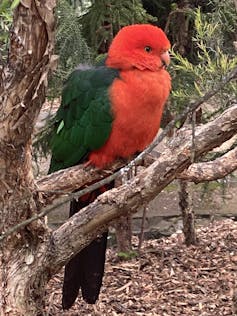
Red and green parrot sits on a branch
Observations of wild species, like this King Parrot, Alisterus scapularis, are of more scientific value.
Author provided

Take multiple photos. Many organisms, particularly plants and insects, cannot be identified to species level from a single photo. Take several photos from different angles. For plants, photos of flowers, fruit and leaves are all helpful for ID.

Focus on wild organisms. In general, the iNat community is more interested in wild organisms. Members respond more to pictures of weeds and bugs than cultivated roses and hamsters in cages.

Pay attention to metadata. This is the information associated with a photo that captures when and where (if location services are on) a photo was taken. Screen shots of photos will lose this data, which may result in incorrect data entry. Watch for locations and dates that don’t make sense. If your device’s time and date settings are wrong, the data will be wrong.

Don’t feel pressured to make research grade observations. Many organisms cannot be identified to the species level using only photographic evidence so observations of them may never attain research grade.

Be aware of copyright. Images should not be copied from books or the internet to illustrate what you observed. Post only your own photos.

Check out Seek. Seek is an educational tool built on iNaturalist. It does not actually post observations to iNaturalist but provides tools such as automated species identification (when possible) and nature journalling.


You can read other articles in this series here.

The Conversation

Judy Friedlander is the founder of PlantingSeeds Projects Ltd, a not-for-profit organisation focusing on biodiversity and regeneration. PlantingSeeds’ key initiative is the B&B Highway, which has received government and non-government grants.

ref. Take a closer look: how more and more students are catching the citizen science bug – https://theconversation.com/take-a-closer-look-how-more-and-more-students-are-catching-the-citizen-science-bug-171746


Explainer: what is corporate social responsibility or CSR – and what do investors need to know?

Source: The Conversation (Au and NZ) – By Limin Fu, Lecturer in Management, University of Newcastle

Shutterstock

With the world facing an ever-growing number of environmental and social challenges, investors are increasingly expecting corporations to “do the right thing” and contribute positively to the community.

This is known as corporate social responsibility or CSR.

Investors play an important role pushing firms towards becoming better corporate citizens.

So, what do investors (including those of us with superannuation invested in companies) need to know about corporate social responsibility? And why does it matter?


Read more:
Brands backing Black Lives Matter: it might be a marketing ploy, but it also shows leadership


What is CSR anyway?

US writer and economist Howard Bowen is often described as the “founding father” of CSR. He wrote in 1953 that business have a social responsibility, defined as:

the obligations of businessmen to pursue those policies, to make those decisions, or to follow those lines of action that are desirable in terms of the objectives and values of our society.

The concept was popularised in the US in the 1970s, especially after US think tank the Committee for Economic Development in 1971 noted there is a “social contract” between business and society, saying:

Business is being asked to assume broader responsibilities to society than ever before and to serve a wider range of human values. Business enterprises, in effect, are being asked to contribute more to the quality of American life than just supplying quantities of goods and services.

In other words, there was growing acceptance of the idea it was not enough for companies just to pay taxes. To gain a “social licence to operate”, firms should also actively “do good” in society.

In the mid-1990s, the term “triple bottom line” was brought to prominence by US author and advisor John Elkington, which he describes as

a sustainability framework that examines a company’s social, environment, and economic impact.

CSR and ESG investing

More recently, the term environmental, social and governance (ESG) has grown more common.

Although ESG and similar obligations are not necessarily legally compulsory for most companies, many investors see good policies in this area as a sign the firm is well positioned for the future.

Some common issues many investors care about include:

For many investors, ESG is fundamentally about how a company serves the environment, workers, communities, customers, and shareholders.

Why do some firms pursue some CSR goals while neglecting others?

We recently completed a study pondering the question: why do some firms ignore some stakeholders while courting others?

We categorised companies into six distinct “types”: the CSR vanguard, the opportunist, the generalist, the minimalist, the specialist and the laggard. Vanguards proactively pursue a wide range of CSR goals that address an array of stakeholder concerns, even without much pressure from investors. A generalist has genuine commitment to CSR goals but doesn’t really favour one area over another.

But if the company only pursues CSR goals on some issues while others are all below the industry or country average, this company might be what we termed a CSR “opportunist”.


Read more:
Getting out of liquor, pokies will cost Woolworths, but deliver lasting benefits


Big superannuation companies and investment professionals often have specialist research teams dedicated to identifying which companies have a good record on CSR.

They have access to search tools such as Refinitiv, MSCI KLD, Sustainalytics, Bloomberg ESG, and RepRisk AG to help them sort the wheat from the chaff.

So there’s a limit to how much an individual investor can expect to find out on their own about the firms they invest in.

A woman looks at a screen
How much do you know about the CSR record of firms you invest in?
Shutterstock

How do I research companies and their CSR record?

Expecting individuals to expertly navigate this topic on their own is unrealistic.

But you can try. Look in your investment platform (meaning the website or app through which you manage your investments) for ESG information about various firms.

Search online for more detail. Has media coverage revealed any scandals linked to companies you invest in, around issues such as environmental protection, Indigenous rights, social justice, employees’ rights, human rights or corporate governance?

Who runs the company? Who is on the board? Search their names and see if you’re happy with what you find.

Have a look through the company’s recent annual reports. Look for chapters with titles such as sustainability report, social impact report or corporate social responsibility report. Thanks to many years of pressure from investors, most companies will detail their efforts to some degree.

But beware greenwashing and slick marketing. Some companies can be quite deceptive in the way they talk about corporate social responsibility. For example, they may have improved their environmental record but continue to have a poor record of how they treat workers.

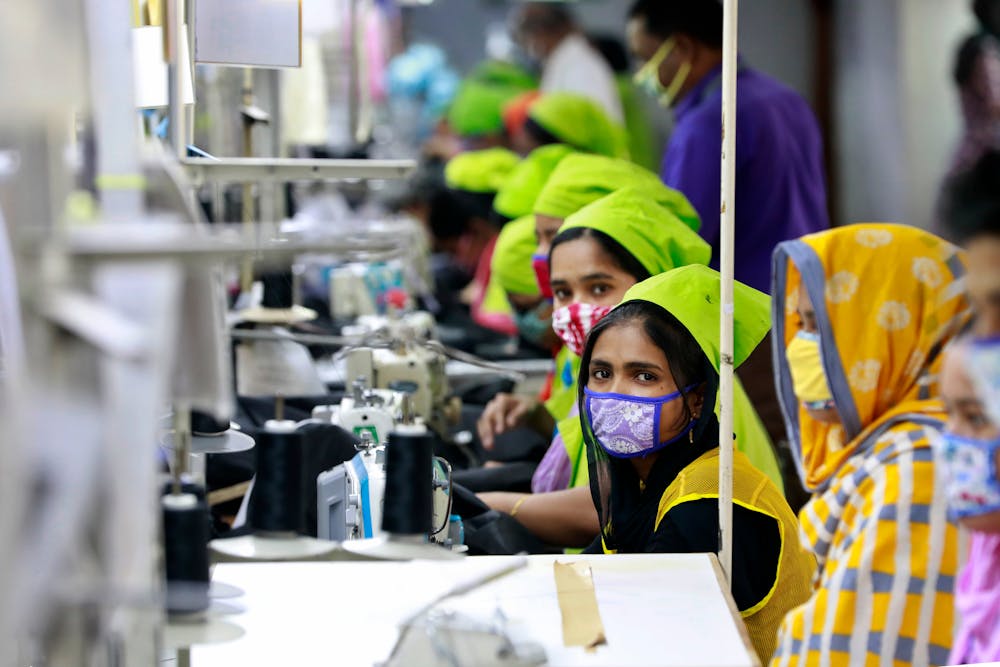
Workers in a factory
You might consider factors such as the company’s workers’ rights record.
Shutterstock

Our research has identified causes and consequences of such inconsistent CSR practices. An inconsistent record on CSR could pose risk to your money in the long run. Think carefully about how a firm’s irresponsible practices in one area can cancel out corporate social responsibility gains in another.

And if you see room for improvement, let the company know. You can do that by posting questions and comments on its social media platform and using their “contact us” option on its website.

Or, in the worst scenario, you can inform your investor community and collectively sell your shares to keep the company in check – share prices can convey your dissatisfaction.

Your voice may be one of many building to a groundswell and exerting pressure on the company to do better.

The Conversation

Dirk Boehe does not work for, consult, own shares in or receive funding from any company or organisation that would benefit from this article, and has disclosed no relevant affiliations beyond their academic appointment. This story is part of a series on financial and economic literacy funded by Ecstra Foundation.

Limin Fu does not work for, consult, own shares in or receive funding from any company or organisation that would benefit from this article, and has disclosed no relevant affiliations beyond their academic appointment.

ref. Explainer: what is corporate social responsibility or CSR – and what do investors need to know? – https://theconversation.com/explainer-what-is-corporate-social-responsibility-or-csr-and-what-do-investors-need-to-know-169256

River stories, culture wars, share house sagas: 5 of the best podcasts of 2021

Source: The Conversation (Au and NZ) – By Siobhan McHugh, Honorary Associate Professor, Journalism, University of Wollongong

The podcast Guardians of the River traverses the Okavango River from its source in Angola to its discharge into the Botswana Delta 1500 kilometres later Photo: Shutterstock

It has been another huge year for podcasts, with a rise in both fictional and celebrity-hosted podcasts, along with the perennial true crime ones. Themes of diversity, social justice, environmental issues and cancel culture were also prominent this year.

Here, then, are five of the best podcasts of 2021 – and some suggestions for companion listening.

1. Suave

From Serial to Ear Hustle (produced inside San Quentin prison) to Darwin’s Birds Eye View, the podcast medium has allowed us to fully hear prisoners’ stories, without any prior judgement based on their appearance. Suave extends the tradition with a deep dive into the story of a Latino-American man called David Luis “Suave” Gonzalez, sentenced to life imprisonment at Graterford State Correctional Institution, Pennsylvania, aged just 17.

It turns out that like other juveniles in that state, he pleaded guilty rather than be subject to a potential death penalty. Journalist Maria Hinojosa tracks Suave’s story over decades, until a new ruling means he may find freedom, at almost 50. A penetrating exploration of prison psychology, this podcast is anchored in a complex relationship between a journalist and her source.

Companion listening: In the Dark, Series 2, Episode: Curtis Flowers.
Years of investigation by this podcast team helped obtain the release of a Mississippi man, Curtis Flowers, who was wrongfully imprisoned for 23 years partly due to a racist district attorney. This long-awaited interview with a freed Curtis reveals a man who is sad, charming, clear-eyed and remarkably free of bitterness.


Read more:
Michelle Obama, podcast host: how podcasting became a multi-billion dollar industry


2. Things fell apart

Jon Ronson, the Louis Theroux of podcasting, provides a historical take on the culture wars in this carefully crafted BBC podcast (dropping Feb 9 in Australia). In the first five episodes (all I’ve heard), Ronson deploys his trademark ability to scratch a big theme and find the quirky human stories that flip common perceptions.

A televangelist espouses gay rights at the height of AIDS; the censoring of progressive school literature in America in the ‘60s gives way to a woke backlash decades on against a seminal black memoir; a reformed anti-abortion crusader rues his propaganda; and a 1980s proto-Q-anon-style conspiracy that sent an innocent childcare worker to jail for years shows that framing a victim does not need online hysteria. The series provides sobering context for the conflicts that have been so amplified by social media anarchy, delivered with a kind of wry wonder at our inhumanity.

Companion listening: The Eleventh from Pineapple Studios documents horrifying tales of contemporary cancel culture in its first series, The Inbox, while Limited Capacity from CBC is a more playful take on internet predations.

3. S***hole country

The title derives from then President Donald Trump’s vicious description of Haiti, El Salvador and some African countries in 2018. This spurred young Ghanaian-American Afia Kaakyire to delve into family history and self-discovery, telling “true tales dipped in entrepreneurial dreams, green card anxieties, complicated love”.

A slur from Donald Trump has sparked a wonderful podcast.
Jim Lo Scalzo/EPA

Though her name is made-up (for obvious reasons), Afia’s voice is utterly authentic. She chronicles with honesty and irony her ambivalent, evolving relationship with Ghana and her extended family, in a wide-ranging essay-memoir produced to the excellent standards we associate with the Radiotopia network of independent artists. Episode 3, in which she interviews her remarkable mother, Agnes, about her long journey to becoming a property-owner in New York, is a standout. And unlike many narrative podcasts, the ending doesn’t disappoint: the final two episodes positively sizzle.

Companion listening: Crackdown shares themes of being Other and wishing to be truly seen. This activist Canadian podcast is hosted by Garth Mullins, a drug user who is also a professional radio reporter. In collaboration with a community of drug users in Vancouver, the podcast robustly advocates for opioids and other drugs to be made legal, styling itself as “the drug war, covered by drug users as war correspondents”.

4. Guardians of the river

The Okavango river.
Shutterstock

This epic podcast traverses the Okavango River from its source in Angola to its discharge into the Botswana Delta 1500 kilometres later, through the eyes of local keepers and scientists dedicated to its conservation. Funded by the National Geographic Society and others, it’s a sound-rich portrait of the river as a vital, living artefact, narrated by two engaging African scientists who are emotionally and environmentally connected to it.

Companion listening: The Repair Season 5 of the always-on-the-Zeitgeist Scene On Radio tackles the climate emergency, starting at the Book of Genesis, which exhorted man to “subdue” nature.

5. Housewarming

Sometimes the Big Topics get a bit overwhelming and it’s nice to be reminded of what podcasting means to many: a chumcast/chatcast, where a couple of pals shoot the breeze on whatever takes their fancy. Countless chatcasts dabble in sport, pop culture and TV recaps.

With corporate heavies like Spotify, Audible and lately Facebook, muscling in on the medium, it’s refreshing to hear two homegrown Aussies randomly ruminating on a very pertinent theme – surviving the share house and riding out the rental crisis. Hosts Marty Smiley and Nat Demena have lots of fun with Karen bin nazis,(entitled white women who police bins on streets), food-tamperers and housemates that never flush.

Companion listening: Helen Garner reading Monkey Grip, her own tale of toxic share houses, set in Melbourne in the ‘70s. Deliciously observed, this gritty urban anthropology (disguised as a novel) makes you realise not much has changed, despite the internet. Free on ABC Listen app, or on Audible.

Siobhan McHugh’s book The Power of Podcasting will be released in February.

The Conversation

Siobhan McHugh is Consulting Producer on The Greatest Menace, a queer true crime history podcast launching Feb 2022 on Audible.

ref. River stories, culture wars, share house sagas: 5 of the best podcasts of 2021 – https://theconversation.com/river-stories-culture-wars-share-house-sagas-5-of-the-best-podcasts-of-2021-170781

Hunt down PNG’s sorcery torture ‘glassmen’ – charge them, says Juffa

By Rebecca Kuku in Port Moresby

Papua New Guinea’s “glassmen” — men who claim to identify and accuse women of sorcery — must be hunted down and charged with their crimes, says Northern Governor Gary Juffa.

He said PNG should not just continue expressing concern and outrage while doing nothing to address sorcery accusation-related violence (SARV).

He made these comments in response to a video showing five women being stripped naked, tied to poles and tortured being released on social media last week. The cruelty portrayed in the video has shocked the nation.

Both daily newspapers — the PNG Post-Courier and The National — published horrifying front page pictures of the torture today with the Post-Courier carrying a banner headline “Inhumane”.

An editorial note on the Post-Courier front page said: “This horrendous crime must not be seen as an isolated incident and such tortures and killings must be reported prominently.”

According to The National, Police Commissioner David Manning described the torture as “vile, inhumane, uncivilised, void of any human decency”.

The torture is believed to have occurred in Kagua, Southern Highlands Province.

Juffa said the perpetrators were visible in the video and it was not hard to identify them.

“They must all be rounded up and they must all be charged,” he said.

‘They are the guiltiest’
“And not only them, but those who claim to be ‘glassmen’, must also be brought in and charged.

“They are the guiltiest and must be apprehended and charged.”

Juffa also said the video was debated and discussed among MPs at great length.

“Member for Porgera has already assured us that he has sent this video to the provincial police commander of Enga.

“The Minister of Police has also advised us that he has already informed the Commissioner of Police and they are investigating.

“But now, something must be done, we must take action.”

PNG Post-Courier front page 28-12-2021
Today’s PNG Post-Courier front page report on the police investigation into the shocking alleged sorcery torture video. Image: PC screenshot APR

Deputy Commissioner Police Operations Anton Billie called on the public to come forward with any information they had about the torture.

He also called on churches, youth groups, community leaders and women’s groups to come forward and assist the police with any information they might have on the perpetrators or the status of the five women — and whether they were still alive.

According to Cultural Survival, traditional PNG spiritualists are known in the Tok Pisin language as ol glas man — “glassmen”, or seers — who practise soul travel characteristic of shamanism.

Rebecca Kuku is a a PNG Post-Courier reporter. Republished with permission.

Print Friendly, PDF & Email

Article by AsiaPacificReport.nz

Herald scolds world over contrast between space and earthly wins

Pacific Media Watch newsdesk

New Zealand’s leading daily newspaper has praised the “gift of inspiration” over global cooperation in launching the James Webb space telescope at the Christmas weekend, but has decried the failure of the international community to seriously tackle the growing covid-19 public health crisis cooperatively.

The New Zealand Herald declared today in an editorial that the timing, cooperation, and development work involved launching the successor to the Hubble telescope “is in marked contrast with the still muddled, individual country-based approach to the pandemic”.

The launch also could not help but “signify the yawning gap between what people are capable of and what they commonly settle for”, the newspaper wrote.

The launch of the James Webb telescope was a collaboration between the space agencies of the United States, Europe and Canada with people from 29 countries having worked on the project, reports AP.

“It blasted away from French Guiana on a European Ariane rocket. As with previous space missions, it involves vision, ambition and precise calculations that have to work perfectly to pull it all off,” the Herald said.

“The telescope has a 1.5 million km journey ahead, far beyond the moon, with a task of eventually gazing on light from the first stars and galaxies.

“It all hinges on the telescope’s mirror and sunshield unfolding on cue over nearly two weeks, having been tucked away to fit into the rocket’s nose cone.

“If that goes right, the telescope will be able to look back in time a mind-boggling 13.5 billion years.”

Fascinating year for science
The US$10 billion telescope project had capped a “fascinating year for space science” after the “incredibly precise landing of a rover and a helicopter drone on Mars, which resulted in the first powered flight on another planet”, said the Herald.

Noting Nasa’s science mission chief Thomas Zurbuchen’s comment welcoming the launch — “what an amazing Christmas present” — the newspaper contrasted the collaborative achievement with the “muddled, individual country-based approach” over covid-19.

“While the rocket was launching humanity’s imaginative time machine, hundreds of thousands of people on Earth were getting a ‘gift’ of covid at Christmas. Both Britain and France hit more than 100,000 cases on Saturday,” the Herald said.

“The cost of the space project is tiny compared to the US$725 billion the US spent on defence in the 2020 financial year — more than the next 11 countries combined. Next year’s bill is US$770 billion.

“It is closer to the US$50 billion amount the OECD has estimated it would cost to vaccinate the world’s population against the coronavirus and protect the global economy.

“Far more money than that — US$12 trillion — was spent by countries in financial support between March and November 2020.

Time to hatch global covid plan
“Although that support was urgently needed, surely there was also time to hatch a US$50 billion global plan for a coronavirus endgame before the vaccines came on stream in late 2020.

“Now, a year later, each country is dealing with the omicron wave its own way, and progress in distributing vaccines to poorer regions is slow. People feel frustrated the vaccines haven’t guaranteed a return to life as we knew it.

“The vaccines themselves are an amazing scientific achievement: developed quickly and still doing their job of protecting the vast majority of vaccinated people against severe covid disease.

“A study by the World Health Organisation and a European Union agency estimated in November that the vaccines had saved nearly half a million lives in a region of 33 countries.

“But it is hard for people to really absorb achievements that involve prevention: When they work as hoped, at least some people believe it’s proof the threat was overblown.”

Print Friendly, PDF & Email

Article by AsiaPacificReport.nz

Can China win back global opinion before the Winter Olympics? Does it even want to?

Source: The Conversation (Au and NZ) – By Jennifer Y.J. Hsu, Research fellow, UNSW

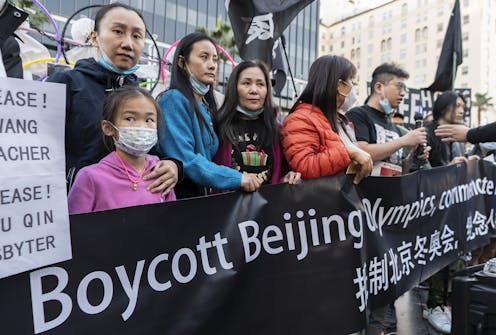
Protesters rally against the Beijing 2022 Winter Olympic Games in Los Angeles in December. Damian Dovarganes/AP

The Beijing Winter Olympics are only weeks away and China has been forced on the defensive by a diplomatic boycott called by the US, UK, Australia and other western countries.

There had been pressure for Western governments to announce a boycott for months over the Chinese party-state’s treatment of the Uyghurs and other ethnic minorities in Xinjiang, as well as human rights lawyers and individuals who dare to speak out against the government.

The push gained new momentum after the disappearance of Chinese tennis star Peng Shuai following her allegations of sexual assault against a former top Politburo official. The Women’s Tennis Association suspended all of its tournaments in China – the strongest stance yet against China by a sporting organisation that relies heavily on the Chinese market.

China’s international image was already at its lowest level in years in many western countries following the outbreak of the COVID pandemic and Beijing’s initial handling of the crisis.

So, given the increasingly negative views of the country in the west, how will Beijing respond with the Olympics only weeks away? Will it adopt a charm offensive? Or will it retaliate because it feels it has been treated unfairly?


Leer más:
China’s image problem is worsening globally. It’s time for Beijing to consider a diplomatic reset


Businesses still need access to China

Recent strategies adopted by the government suggest there are other avenues for Beijing to counter critics of its policies. Take economic pressure, for one.

In a virtual meeting between China’s vice foreign minister, Xie Feng, and US business lobby groups at the end of November, Xie asked US businesses to “speak up and speak out” for China with the US government.

The message was clear – Beijing expects the business community to lobby on its behalf to continue to have access to China’s lucrative market. As Xie said,

If the relations between the two countries deteriorate, the business community cannot ‘make a fortune in silence’.

This has long been the price the business community has been forced to pay to have a foothold in China – compliance with the demands of the party-state.

Remember back in 2019, when former Houston Rockets General Manager Daryl Morey tweeted in support of pro-democracy protesters in Hong Kong? The NBA initially issued a statement that was criticised by US politicians on both sides of the aisle for prioritising financial interests over human rights. (The league later clarified it stood for “freedom of expression”.)

The NBA still lost hundreds of millions of dollars over the fallout. NBA games haven’t been on Chinese state television since the episode.

Access to the lucrative Chinese market still matters hugely – this is leverage the Chinese government can still use against foreign interests. It says a lot that major Olympic sponsors have remained quiet over China’s human rights situation, while governments have announced diplomatic boycotts.


Leer más:
Olympic Games are great for propagandists – how the lessons of Hitler’s Olympics loom over Beijing 2022


China doesn’t care what the west thinks

Then there is the question of whether China still needs the west or cares what the west thinks of it.

China has framed the diplomatic boycott as “a blatant political provocation and a serious affront to the 1.4 billion Chinese people”. But it has also pointed to the 173 UN member nations that signed the UN Olympic truce to ensure conflicts do not disrupt the games.

Yes, Beijing is angry about the snub from Washington and others, but it is emphasising it still has broad international support for the Winter Olympics. Russian President Vladimir Putin has accepted the invitation to attend the opening ceremonies “with joy”. UN Secretary-General Antonio Guterres will also attend, and others will surely follow.

China’s model of development has long attracted admiration from African countries, particularly its form of state-directed capitalism. By hosting its second Olympics in less than 20 years, China is reinforcing this message to developing nations – that its model of development works.

By awarding China the games, the IOC is also showing the world it is unfazed by its close proximity to authoritarian regimes, further legitimising them.

The European Union’s dithering over its response to the boycott has also strengthened Beijing’s position and allowed it to exploit the west’s inconsistent stance on the matter.

The Olympics don’t bring dramatic change

There was great hope the 2008 Beijing summer Olympics would change China for the better – the government would become more accountable and have greater respect for human rights.

However, violent protests broke out in Tibet against the party-state’s repressive policies and then spread around the world in the run-up to the games. About 30 Tibetans were jailed, some for life.

The 2008 Olympics revealed the naivete of the international community: believing that sport can bring political change.

In fact, China stage-managed those games so well, it was deemed a soft power victory, announcing China as a superpower on the global stage. Historian Zheng Wang called the games “a symbol of China’s rejuvenation”.

Through the extravagant opening ceremony, the Chinese government showcased China’s historical glory and new achievements […] unassailable evidence that China had finally ‘made it’.

It would be mistake to think the current diplomatic boycott will lead to any substantial change in China’s domestic situation. Instead, the diplomatic boycott is a strategy of compromise – athletes are still able to compete, but western governments can be seen as taking a stand.


Leer más:
Why Australia’s diplomatic boycott of the Beijing Winter Olympics is important, but unlikely to have any significant impact


However, the silence of major sponsors shows there is no unified voice when it comes to the China’s human rights situation. This gap between the west’s political and commercial response plays to China’s advantage. It’s yet another way for China to demonstrate the weakness of the west – that professed democratic values and respect for human rights can be compromised when profits are at stake.

As such, China is unlikely to capitulate and make dramatic overtures to repair its international image. It’s more likely to go on the offensive.

Nonetheless, this should be a moment when sports fans, athletes, sponsors, and the broader international civil society question sporting bodies like the IOC in awarding sporting events to authoritarian governments.

The IOC didn’t learn its lesson in 2008. If it wants to be seen as upholding human rights, this starts with how it awards its biggest prizes – the right to play host to the rest of the world.

The Conversation

Jennifer Y.J. Hsu is affiliated with the Lowy Institute.

ref. Can China win back global opinion before the Winter Olympics? Does it even want to? – https://theconversation.com/can-china-win-back-global-opinion-before-the-winter-olympics-does-it-even-want-to-173145

How 2021 was the year governments really started to wise up against big tech

Source: The Conversation (Au and NZ) – By David Tuffley, Senior Lecturer in Applied Ethics & CyberSecurity, Griffith University

After all the bad press tech companies have received, would anyone still be surprised to learn the outwardly smiling face of social media conceals a sophisticated data-collection industry?

This year’s headlines delivered news of an array of concerning data and privacy violations from the world’s biggest tech players. But interestingly, it also seemed to be the year governments around the world addressed the problem head on.

Google in trouble with the ACCC

In April, Australia’s consumer watchdog, the Australian Competition and Consumer Commission, took Google to Federal court, citing Australian Consumer Law relating to consumer privacy.

It was alleged Google did not clearly identify how it collected and used users’ location data collected through Android devices in 2017 and 2018. Google was accused of leading users to mistakenly believe their personal location data was not being collected, when it actually is.

The Court found Google’s conduct was liable to misleading the public. Here’s how.

A tale of two settings

There are two settings on Android devices that govern how data is collected: location history and web and app activity.

Stepping through the setup screens, the user is shown their location history as being switched off by default. But it’s not made clear the web and app activity setting (located elsewhere) is on by default, and could also be used to collect location data – even if location history is switched off.

So the user might believe location tracking is switched off, but in reality tracking may still be performed because of the default web and app activity setting (which they might not know about).

Android 12 (released in October) now has a new privacy dashboard that goes some way towards remedying the permissions transparency issue. It shows the user which apps have accessed location services, and allows them to deny further access.

However, the web and app activity setting is still located elsewhere and not easily found. It is still switched on, by default, and able to track users’ movements.

To switch this setting off, follow the instructions here. But be aware that once you do this Google Maps might not work as well for you, and ads will become less relevant, along with search recommendations.

The legal position on the case against Google in Australia seems to remain unresolved.
freestocks-photos/Pixabay

In separate proceedings in July, Google was once again sued by the ACCC for allegedly not disclosing it receives sensitive information about users from third-party websites and apps. Google was accused of using this information commercially without making the process clear to users.


Read more:
The ACCC is suing Google for misleading millions. But calling it out is easier than fixing it


The company was also hit with yet another major antitrust lawsuit, in which its influence over app developers was called into question.

Specifically, the multi-state lawsuit accused Google of abusing its market power to stifle competition and force users and developers to engage with Google’s own high-fee payment processing system.

This was one in a number of US state and federal antitrust cases against the company, with the first one brought forward in October last year.


Read more:
The US is taking on Google in a huge antitrust case. It could change the face of online search


‘Astronomical profits before people’

Meanwhile, Meta Platforms (or Facebook) is still reeling from Francis Haugen’s damning testimony to the US Congress in October.

A former manager at Facebook, Haugen accused Facebook of a catalogue of antisocial behaviour, in which it knowingly allowed the amplification of hate speech, propagation of misinformation and instigation of political unrest on the platform.

Haugen claimed employees had expressed concerns internally, but these were disregarded, or at least were not enough to change the situation. She is due to give a follow-up testimony in December.

Meta CEO Mark Zuckerberg refuted the allegations, saying they are “just not true”. He wrote in a blog post:

The argument that we deliberately push content that makes people angry for profit is deeply illogical. We make money from ads, and advertisers consistently tell us they don’t want their ads next to harmful or angry content.

More recently, the Washington Post reported on another anonymous whistleblower and former Facebook employee, who came out with a sworn affidavit saying Facebook puts profits ahead of stopping hate speech, misinformation and other threats to the public interest.

Earlier this year US lawmakers confronted Facebook regarding its alleged advertising of military weapons to users in the wake of the Capitol riot.
Thomas Ulrich/Pixabay

TikTok and children’s data

In April, the former children’s commissioner for England, Anne Longfield, launched a legal action concerning the way video-sharing app TikTok collects and uses the data of children using the app.

The lawsuit alleges TikTok (which is now said to have more than one billion users) collects sensitive personal information including children’s phone numbers, where they live, and unspecified “biometric data” without sufficient transparency, and without asking consent as required by UK law.

TikTok’s policies simply state it will collect information “you share with us from third-party social network providers, and technical and behavioural information about your use of the platform”. But this does not sufficiently explain the nature and extent of the data collection.

The lawsuit also claims there’s no transparency regarding how users’ personal information is used. Longfield described TikTok as “a data collection service that is thinly veiled as a social network”.

TikTok responded by saying user privacy and safety were its top priorities, and it has “robust policies, processes and technologies in place to help protect all users”.

There’s also the larger debate on whether TikTok – owned by Beijing-based company ByteDance – may be using user data for censorship, spreading propaganda among users, or to spy on users by feeding data back to the Chinese government (which is a ByteDance shareholder).


Read more:
China could be using TikTok to spy on Australians, but banning it isn’t a simple fix


The essence of the problem

Currently, the fact people could read a terms and conditions document before clicking “agree” apparently amounts to informed consent, in the legal sense. The result is most users consent to their data being collected and used in numerous ways, but are none the wiser of the specifics.

Regulators must oblige platforms to be upfront and transparent about how user data is collected, used, and whom it is forwarded to (and for what purpose).

This could be achieved quite easily by including this information in plain language on the very same terms and conditions page. But as it stands it’s too easy for platforms to hide behind loose definitions of informed consent.

Although if the events of the past year are anything to go by, this may be starting to change.

The Conversation

David Tuffley does not work for, consult, own shares in or receive funding from any company or organization that would benefit from this article, and has disclosed no relevant affiliations beyond their academic appointment.

ref. How 2021 was the year governments really started to wise up against big tech – https://theconversation.com/how-2021-was-the-year-governments-really-started-to-wise-up-against-big-tech-172871

How hot is too hot? Here’s how to tell if your dog is suffering during the summer heat

Source: The Conversation (Au and NZ) – By Melissa Starling, Postdoctoral researcher, University of Sydney

Hot weather can be dangerous to our canine friends. Humans can sweat all over our body, but dogs can only sweat on their paw pads, which is not much use when it comes to shedding body heat.

So how hot is too hot to take your dog out? It depends on the dog and their individual risk factors (more on that in a minute). For me, 33℃ is where I start to consider whether or not to take my dogs outside, and try to think of cooler places we could visit.

If they were older or heavier, I might not take them out at all on days over 30℃. Dogs can struggle on very humid days so I factor that in, too.

Here’s what you need to know about how to care for your dog on a hot day.


Read more:
Nine dog breeds at higher risk of heatstroke – and what you can do to prevent it


spoodle dog
Dogs with long noses, like Fonzi, have more cooling structures.
Lucy Beaumont, CC BY

What are the risk factors?

A dog’s main cooling mechanism is panting, which draws air through the nasal cavity and the mouth and over the capillaries found there.

This allows for evaporative cooling, just as sweat on our skin does, but it happens inside rather than outside. It’s also a much smaller surface area than our skin, so dogs are generally not as good at shedding body heat as humans.

If the dog is overweight, they may have more trouble keeping cool than if they are lean.

A dog with underlying health issues such as heart problems may also be at greater risk.

Very young or old dogs may have more trouble with temperature regulation.

Dogs that have had a chance to get used to warmer temperatures over a month or so are less susceptible to heat distress.

Because some cooling occurs in the nasal cavities, dogs with short faces have fewer of these cooling structures and are more susceptible to heat distress.

Dogs with long noses have more surface area for cooling in their nasal cavities, and are theoretically more resistant to heat distress as a result. But much depends on the individual dog and its history.

labradoodle
Dogs with thick coats, like Stella, may struggle to shed heat on a hot day.
Lucy Beaumont, CC BY

Your dog’s coat plays a role but should we shave them?

Larger or heavier-bodied dogs generally shed heat more slowly than smaller dogs, as is the case across the animal kingdom. For example, smaller penguin species tend to visit warmer climates, while larger penguin species stay in colder climates.

Dogs from cooler climes – like Kivi Tarro, a Finnish lapphundtend – to have heavy, insulating coats while those from warmer places tend to have thin hair.
Melissa Starling, Author provided

Dogs from cooler climes tend to have heavy, insulating coats while those from warmer places tend to have thin hair, which helps shed heat quickly.

So, would your dog be cooler if you shaved them for summer?

It’s true insulation works both ways; cold or hot air outside the body cannot easily penetrate a thick coat and affect core temperature. But a dog is always producing body heat, especially when they are active or excited, and this internal heat may escape slowly through a thick coat.

Kivi Tarro, a Finnish lapphund, shows off his haircut.
Melissa Starling, Author provided

For many thick-coated, otherwise healthy dogs, it helps to keep their coat free of tangles and dead undercoat during warmer months. This reduces the insulating properties of the coat.

Clipping the coat shorter can allow them to stay cool more easily. You could also consider clipping the belly and groin very short. This won’t help much when the dog is active but could help when the dog lies on a cool surface. However, be mindful not to go too short on upper parts of the coat, or the skin can be exposed to sunburn.

How to ‘ask your dog’ how they’re doing

We should always “ask the dog” how they are doing.

Signs a dog is too hot include:

  • panting a lot during the warmer months, even when not exercising

  • seeming lethargic and reluctant to exercise

  • regularly seeking to cool themselves by getting wet, or lying on cool tile or wood floors with as much skin contact as possible.

Always consider the following rules of thumb:

  • if it’s too hot for you, it’s probably too hot for your dog

  • make sure water is available for drinking or immersing the body in when exercising on hot days

  • know your dog’s panting. Dogs usually have a pant cycle where they pant for a short period and then stop for a few breaths or more and then start again. If they start panting constantly, they may be struggling to cool themselves

  • if they can’t hold a ball or toy anymore, froth at the mouth because they can’t easily swallow, or have trouble drinking due to panting at the same time, get your dog to some shade and let them rest. Monitor for signs of heat stress

  • signs of extreme heat distress include: vomiting, diarrhoea, lethargy, being unsteady on their feet, or limping. Take your dog to the vet immediately if you see these signs. Heat injury can be lethal!

  • pick shady, cool places to let your dog have a run if it’s warm. Go early or late in the day when the temperature has come down a bit. Early mornings are typically cooler than the late afternoon

  • the lack of airflow in cars can turn them into deadly ovens within a few minutes, even if the windows are down. So never leave your dog alone in a car, even for a few minutes.


Read more:
At home with your dog? 3 ways to connect and lift your spirits


The Conversation

Melissa Starling has received funding from the Defence Innovation Network.

ref. How hot is too hot? Here’s how to tell if your dog is suffering during the summer heat – https://theconversation.com/how-hot-is-too-hot-heres-how-to-tell-if-your-dog-is-suffering-during-the-summer-heat-172957

Have you fallen for the myth of ‘I can’t draw’? Do it anyway – and reap the rewards

Source: The Conversation (Au and NZ) – By Darren C. Fisher, Lecturer in Animation, Swinburne University of Technology

Darren Fisher, Author provided

This article is part of a series explaining how readers can learn the skills to take part in activities that academics love doing as part of their work.


Drawing is a powerful tool of communication. It helps build self-understanding and can boost mental health.

But our current focus on productivity, outcomes and “talent” has us thinking about it the wrong way. Too many believe the myth of “I can’t draw”, when in fact it’s a skill built through practice.

Dedicated practice is hard, however, if you’re constantly asking yourself: “What’s the point of drawing?”

As I argue in a new paper in Closure E-Journal for Comic Studies, we need to reframe our concept of what it means to draw, and why we should do it – especially if you think you can’t.

Devoting a little time to drawing each day may make you happier, more employable and sustainably productive.

Automatic drawing – where one doodles without a specific aim – is a way to tap into flow states and become mindfully absorbed.
Darren C. Fisher, Author provided

The many benefits of drawing

I’m a keen doodler who turned a hobby into a PhD and then a career. I’ve taught all ages at universities, in library workshops and online. In that time, I’ve noticed many people do not recognise their own potential as a visual artist; self-imposed limitations are common.

That’s partly because, over time, drawing as a skill set has been devalued. A 2020 poll ranked artist as the top non-essential job.

But new jobs are emerging all the time for visual thinkers who can translate complex information into easily understood visuals.

Big companies hire comic creators to document corporate meetings visually, so participants can track the flow of ideas in real time. Cartoonists are paid to draft innovative, visual contracts for law firms.

Drawing without an intended outcome often ends with surprising results.
Darren C. Fisher

Perhaps you were told as a child to stop doodling and get back to work. While drawing is often quiet and introspective, it’s certainly not a “waste of time”. On the contrary, it has significant mental health benefits and should be cultivated in children and adults alike.

How we feel influences how we draw. Likewise, engaging with drawing affects how we feel; it can help us understand and process our inner world.

Art-making can reduce anxiety, elevate mood, improve quality of life and promote general creativity. Art therapy has even been linked to reduced symptoms of distress and higher quality of life for cancer patients.

And it can help you enter a “flow state”, where self-consciousness disappears, focus sharpens, work comes easily to you and mental blockages seem to evaporate.

Making simple repetitive marks is a great way to develop your drawing skills.
Darren C. Fisher

Cultivating a drawing habit

Cultivating a drawing habit means letting go of biases against drawing and against copying others to learn technique. Resisting the urge to critically compare your work to others’ is also important.

Most children don’t care about what’s considered “essential” to a functioning society. They draw instinctively and freely.

Part of the reason drawing rates are thought to be higher in Japan is their immersion in Manga (Japanese comics), a broadly popular and culturally important medium.

Another is an emphasis on diligent practice. Children copy and practise the Manga style, providing a critical stepping stone from free scribbling to controlled representation. Copying is not seen as a no-no; it’s integral to building skill.

As researcher and artist Neil Cohn argues, learning to draw is similar to (and as crucial as) learning language, a skill built through exposure and practice:

Yet, unlike language, we consider it normal for people not to learn to draw, and consider those who do to be exceptional […] Without sufficient practice and exposure to an external system, a basic system persists despite arguably impoverished developmental conditions.

Copying art styles adds to your ‘visual library’. From top left: Herge, Tezuka, Brunetti, Miller, Kirby, Woodring.
Darren C. Fisher

So choose an art style you love and copy it. Encourage children to while away hours drawing. Don’t worry about how it turns out. Prioritise the conscious experience of drawing over the result.

With regular practice, you may find yourself occasionally melting into states of “flow”, becoming wholly absorbed. A small, regular pocket of time to temporarily escape the busy world and enter a flow state via drawing may help you in other parts of your life.

Drawing doesn’t need to look a certain way. Here, I try different ways of holding the pen, and using my non-dominant hand to draw.
Darren C. Fisher

How to get started

Use simple tools that you’re comfortable with, whether it’s a ballpoint pen on post-it notes, pencil on paper, a dirty window, or a foggy mirror.

Times you’d typically be aimlessly scrolling on your phone are prime candidates for a quick sketch. Doodle when you’re on the phone, watching a movie, bored in a waiting room.

Follow along in this ten-minute video as I show you how to begin an automatic drawing.

Together with mindful doodling, drawing from observation and memory form a holy trinity of sustainable proficiency.

Drawing from life strengthens your understanding of space and form. Copying other styles gives you a shortcut to new “visual libraries”. Drawing from memory merges the free play of doodling with the mental libraries developed through observation, bringing imagined worlds to life.

With time and persistence, you may find yourself producing drawings you’re proud of.

At that point, you can ask yourself: what other self-limiting beliefs are holding me back?

Your drawing style is like a thermometer of how you’re feeling.
Darren C. Fisher

You can read other articles in this series here.

The Conversation

Darren C. Fisher does not work for, consult, own shares in or receive funding from any company or organization that would benefit from this article, and has disclosed no relevant affiliations beyond their academic appointment.

ref. Have you fallen for the myth of ‘I can’t draw’? Do it anyway – and reap the rewards – https://theconversation.com/have-you-fallen-for-the-myth-of-i-cant-draw-do-it-anyway-and-reap-the-rewards-172623

Remembering Geoffrey Giudice, the ‘bosses man’ who helped make Australia’s Fair Work Commission fair

Source: The Conversation (Au and NZ) – By Judy Hughes, PhD candidate in History, La Trobe University

In the turbulent world of industrial relations, Geoff Giudice was an oasis of calm.

An employers’ barrister and earlier a union researcher, the 13th president of Australia’s national workplace tribunal, now called the Fair Work Commission, had a knack for putting people at ease.

“He brought to his professional life a mixture of humility, sophisticated intelligence, integrity, personal likeability, a preparedness to work, and a suppleness of thinking that enabled him to adjust to change,” said lawyer Michael Tehan at his funeral in November.

And there was a lot of change. The newly-elected Howard Coalition Government appointed Giudice a judge and president of the Australian Industrial Relations Commission in 1997 within months of introducing its Workplace Relations Act.

The new law severely restricted the commission’s powers to resolve disputes and set wages and conditions and instead sought to encourage employers and employees to settle their differences at the workplace.

Further rounds of change followed – both by the Coalition Government
in its unpopular WorkChoices legislation and the Rudd Labor Government which reconstituted the tribunal as Fair Work Australia.

Calls for more change continue today.

Independent and impartial

In an oral history interview I conducted with him for the Sir Richard Kirby Archives in 2012 Giudice outlined his approach to leading the tribunal through contentious times. It was based on professionalism, integrity and setting an example.

“I didn’t want it ever to be said that while I was president of the commission there was any suggestion of corruption in the way decisions were made and that everybody would get a fair go based on the submissions they made,” he said.

Giudice regarded independence as not only being seen to be impartial by those who appeared before the commission, but also in dealings with government.


Read more:
The enduring myth of the industrial relations club


He strongly believed there was great danger for tribunal members in expressing views on government policy. To do so could “undermine confidence in the tribunal’s decisions” and lead to a perception of the tribunal pursuing an agenda rather than applying the law.

At the time of his appointment in 1997 some in the union movement were angry and suspicious given his earlier representation of high-profile business clients including Ansett and mining giant Rio Tinto.

When he retired in 2021, however, the Australian Council of Trade Unions praised his achievements, even describing him as a “good boss”.

Sir Richard Kirby Archive Oral History Program, treasures of the archives.

The commission was established as the Commonwealth Court of Conciliation and Arbitration in 1904 shortly after Federation and the great strikes of the 1890s.

Legislation aimed at abolishing it and returning its powers to the states in 1929 led to the defeat of the Bruce-Page Coalition government.

When the Howard government introduced WorkChoices in 2005 (which also contributed to its defeat), Giudice rolled out a series of briefings for unions and employers as well as some media in which, while not straying into discussion of government policy, he made it clear the commission had a continuing role.

Appointed by both sides

When the Rudd Labor government replaced the commission with Fair Work Australia in 2009, Rudd’s industrial relations minister Julia Gillard appointed Giudice inaugural president, saying he would deliver a “fair go”.

Geoffrey Guidice, appointed by both sides.

Born in Bendigo in 1947, Giudice accidentally fell into a career in industrial relations in 1970 by taking up a vacation job with the Hospital Employees’ Federation.

While he went on to represent mostly employers as a barrister, which is usual in labour law, he said the union experience gave him a “good idea of the difficulties faced by people who are on low incomes”.

Following his death on November 18 2021, friends and colleagues described him as intelligent, kind, thoughtful, humble, witty and even chivalrous.

Known for his signature bow tie and love of the Melbourne Football Club, it was revealed that in his final days he got to hold the premiership cup after Melbourne’s long-awaited win.

A staunch Catholic, his post-retirement positions included professorial fellow with The University of Melbourne, chair of Catholic Professional Standards Ltd and chair of the AFL Tribunal and AFL Appeal Tribunal.


Read more:
We should simplify industrial relations, but not in the way business wants


He was famously media-shy, refusing nearly all interview requests. But as the commission’s first media adviser – a role he created – I know he supported the work of journalists in communicating the work of the tribunal to the public.

For those who assume a previous professional background will predict the behaviour of an appointee to public office, his life is an invitation to think again.

The Conversation

Judy Hughes worked for the Australian Industrial Relations Commission and Fair Work Australia in media and communications from 1999 to 2012. She was the first media officer to be appointed to the tribunal in its century-long history and her role was created by then president Justice Giudice.

ref. Remembering Geoffrey Giudice, the ‘bosses man’ who helped make Australia’s Fair Work Commission fair – https://theconversation.com/remembering-geoffrey-giudice-the-bosses-man-who-helped-make-australias-fair-work-commission-fair-173059

Triumph of the mall: how Victor Gruen’s grand urban vision became our suburban shopping reality

Source: The Conversation (Au and NZ) – By Timothy Welch, Senior Lecturer in Urban Planning, University of Auckland

GettyImages

The holiday season is a time of merriment and joy, a time to gather with friends and family, when we’re encouraged to slow down and remember the simple things in life.

Ironically, it’s also when we spend hours in a car, driving to the mall for the sales and to spend those Christmas vouchers.

When it comes to mall irony, though, few people have felt it as profoundly as the “father of the suburban mall”, Victor Gruen, whose idealistic urban vision became the suburban reality we know today.

Gruen fled his native Vienna in 1938 after the rise of Nazism, eventually making his way to the United States. A trained architect, he was soon designing storefronts in New York.

But Gruen had a grander vision. He wanted to re-create in microcosm the walkable, diverse and liveable town centres he so loved in Vienna.

Part of his motivation was seeing how reliance on the automobile was affecting cities. In his classic book, Shopping Towns USA, Gruen rails against the development of drive-by shopping centres focused on catering to passing motorists:

Suburban business real estate has often been evaluated on the basis of passing automobile traffic. This evaluation overlooks the fact that automobiles do not buy merchandise.

Driven to distraction

Gruen was determined to get people out of, and away from, cars. He didn’t mince words in his dislike for automobiles, stating in a 1964 speech to the American Institute of Architects:

One technological event has swamped us. That is the advent of the rubber-wheeled vehicle. The private car, the truck, the trailer as means of mass transportation. And their threat to human life and health is just as great as that of the exposed sewer.

His first big attempt to get people out from behind the wheel and walking was Minnesota’s Southdale Center, hailed as the world’s first indoor shopping mall, part of an ambition to create a pedestrian-centred liveable community.


Read more:
Amazon and Tesco’s checkout-free stores are a niche idea that won’t save the high street


The original plan was for commerce to be broken up by numerous attractions like aviaries, fountains and works of art. The mall itself would be surrounded by residences, offices, medical facilities, schools and everything that made a community.

The mall was inward-looking, not to keep people focused on spending but to shelter pedestrians from cars and away from their fumes and noise.

Here’s the first painful irony, then. Rather than developing the new mixed-use centre envisioned by Gruen, the only thing built was the mall and car parks. The grand vision was reduced to a monoculture of big shopping brands surrounded by massive car parks, all accessible only by automobile.

What was meant as a refuge from the quickly dominating car culture instead became a shrine to automobilia.

Wanting to get people out of their cars, Gruen unintentionally gave them somewhere to drive to.
GettyImages

Triumph of commerce

Irony struck again when many of Gruen’s original plans for interesting features in the mall were whittled away to make room for more stores and merchandise. As the original floor plan became more chaotic and stuffed with goods to buy, shoppers became confused, forgetting their intentions and dropping their spending inhibitions.

Developers and economists found that disorienting shoppers and presenting them with lots of things to buy resulted in much higher revenue. Though Gruen had planned for an efficient mall experience and despised the blatant money grab, the phenomenon was named after him. It’s now known as the Gruen Transfer.


Read more:
Burnout by design? Warehouse and shipping workers pay the hidden cost of the holiday season


Gruen was disgusted by what suburban malls became and their impact on downtowns. He eventually disavowed malls and became involved in the US urban renewal movement to try to revitalise urban centres.

But he returned to the idea of the mall, creating a pedestrian-oriented redevelopment plan for Fort Worth, Texas, and several pedestrian-only corridors in cities across the US. By this time, Gruen had acquiesced to the idea that cars were likely the future for cities – most residents lived outside the CBD and needed to drive into downtowns.

His idea was to mitigate the impact of cars by planning for ring highways rather than bisecting dense urban developments with massive roads. He planned to use the highways in the way he’d first envisaged the mall, as a buffer between cars and people on foot.

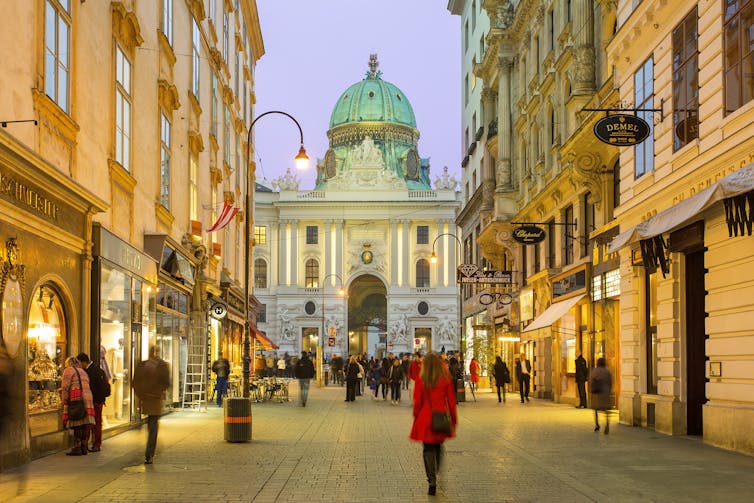
Gruen was inspired by Vienna and ultimately returned there when his dreams were dashed in the US.
GettyImages

Return to Vienna

Irony struck again. Gruen’s plans for Fort Worth were set aside. His plans to push cars out of downtowns largely failed. Urban renewal plans instead razed entire blocks of organic development for nondescript big-box stores and massive urban highways.

Worst yet, urban renewal became synonymous with the destruction of whole inner-city neighbourhoods to accommodate the car. Despite Gruen’s hopes and plans for the revitalisation of downtowns, many of the projects he was involved in led to a further decline in urban centres.

In 1964, Gruen lamented what had become of urban renewal, writing many cities:

have misinterpreted the aims of urban renewal legislation by demolishing whole districts and by replacing lively environments, which could have been rehabilitated, with sterile, inhuman and poorly planned projects.


Read more:
How high streets and shopping malls face a ‘domino effect’ from major store closures


Gruen perhaps saw the writing on the wall. His hopes of recreating Vienna had been dashed, so he returned to his hometown in the final decade of his life. Irony dealt him a final blow. Austria’s first and largest mall – Shopping City Süd – was already under construction just outside the old Vienna town centre.

While Gruen’s story is full of cruel twists, it’s not without the possibility of redemption. As malls across the globe die, many are being reborn as “lifestyle centres”. These reimagined malls bring back the elements lost from Gruen’s original plans, adding people and services to once desolate shopping zones.

Alas, the impacts of recessions and a pandemic have slowed grand plans for mall revitalisation. So it remains to be seen whether, in the end, Gruen’s is a redemption story – or whether irony remains his legacy.

The Conversation

Timothy Welch does not work for, consult, own shares in or receive funding from any company or organisation that would benefit from this article, and has disclosed no relevant affiliations beyond their academic appointment.

ref. Triumph of the mall: how Victor Gruen’s grand urban vision became our suburban shopping reality – https://theconversation.com/triumph-of-the-mall-how-victor-gruens-grand-urban-vision-became-our-suburban-shopping-reality-172393

Archbishop Desmond Tutu: A friend of Aotearoa NZ and a champion of Palestinian human rights

OBITUARY: By John Minto

Palestine has lost a champion of the struggle against Israeli apartheid with the death of South African Archbishop Desmond Tutu, aged 90.

Tutu is known internationally as a leader of the struggle against white minority rule in South Africa and won the Nobel Peace Prize for his work reconciling South Africans after the end of its brutal apartheid regime.

He was the moral conscience of the country and sometimes highly critical of South Africa’s African National Congress (ANC)-led government, saying that some in the ANC leadership had stopped the apartheid gravy train “just long enough to jump on”.

Relationship with New Zealand
Archbishop Tutu was a warm friend of New Zealand and many New Zealanders across our political divides will feel a deep sadness at his passing.

In the early 1980s when Tutu faced court action from the South African authorities, a delegation of church leaders from New Zealand, led by former Anglican Archbishop of Aotearoa New Zealand, the late Sir Paul Reeves, went to South Africa in an act of international solidarity.

This was deeply appreciated by Archbishop Tutu.

During the protests against the 1981 Springbok rugby tour, one of the three Auckland protest squads was called Tutu Squad in his honour.

Later he came to New Zealand and at one point gave evidence as an expert witness on apartheid during a trial arising from 1981 tour protests.

Such was his charisma, his mana and the deep respect he commanded everywhere that when he was called to the witness stand by Hone Harawira, the entire courtroom stood.

In this case all the activists on trial were acquitted after the jury deliberated.

John Minto talking to Archbishop Desmond Tutu
Former HART chair John Minto talking to Archbishop Desmond Tutu during 2009. Image: PSNA

Support for Palestinians
Tutu was outspoken against injustices all around the world and in particular he condemned the racist policies faced by Palestinians from the Israeli regime. He frequently described Israel’s treatment of Palestinians as “worse” than that suffered by black South Africans.

He said international solidarity with Palestinians such as through BDS (Boycott, Divestment and Sanctions) was critical to ending injustices like apartheid.

“I have witnessed the racially segregated roads and housing in the Holy Land that reminded me so much of the conditions we experienced in South Africa under apartheid,” said Tutu.

“We could not have achieved our democracy without the help of people around the world, who through… non-violent means, such as boycotts and disinvestment, encouraged their governments and other corporate actors to reverse decades-long support for the apartheid regime.”

In relation to Israeli policies towards Palestinians, Tutu said the world should “call it apartheid and boycott!”

In honouring Tutu’s legacy, freedom-loving people around the world should follow his advice and spurn Israel till everyone living in historic Palestine has equal rights.

Aotearoa New Zealand, the Palestinian struggle and the world have lost a dear friend and a great humanitarian.

John Minto is national chair of Palestine Solidarity Network Aotearoa (PSNA) and former national chair of HART (Halt all Racist Tours).

Print Friendly, PDF & Email

Article by AsiaPacificReport.nz

Professor Brij Lal: A champion of democracy and Fiji’s finest scholar

OBITUARY: By Professor Biman Prasad

Brij Vilash Lal, banished from the land of his birth by the Bainimarama government in November 2009 for championing democracy and barred from entering Fiji upon the orders of the Prime Minister, has died in Brisbane, 12 years after the draconian act of a heartless government.

The sudden and shocking death of Professor Brij Lal at the age of 69 should create a moment for all Fiji citizens to pause and reflect, even while we are distracted by our many personal challenges brought on by the pandemic and our other deep national problems.

Professor Lal was a giant on the international academic stage. But for the last 12 years of his life he was banned by the Bainimarama and FijiFirst governments from returning to the place of his birth.

Some of Fiji’s most outstanding people, with international reputations, are sporting figures, business people or international diplomats. But among historians and scholars, Professor Lal stood tall around the world.

From a poor farming family in Tabia, Vanua Levu, Professor Lal rose to be an emeritus professor of Pacific and Asian history at the Australian National University, one of the world’s highest-ranked places of learning.

He was an acknowledged expert on the Indian diaspora around the world. He was recognised as the pre-eminent historian on the history of indenture and Girmitiya.

Among his many books, he wrote authoritative biographies on A D Patel and Jai Ram Reddy, two of Fiji’s most influential political leaders.

1997 Fiji Constitution architect
Professor Lal will be remembered as one of the architects of the 1997 Fiji Constitution. His membership of the three-man Reeves Commission, with former Parliamentary Speaker Tomasi Vakatora, ushered in multiparty government and a national governing law strongly protective of good governance, human rights and multiracialism.

It is this constitution that current Prime Minister Voreqe Bainimarama, as Army Commander, twice abrogated in May 2000, only for it to be restored by the Fiji Court of Appeal in March 2001, and again in April 2009, bringing in a new legal order.

However, Professor Lal may be best remembered in Fiji as the target of a small-minded two-man government of Voreqe Bainimarama and Aiyaz Sayed-Khaiyum, which banned him and his wife Dr Padma Lal indefinitely from returning to Fiji.

This was because Professor Lal spoke up for democracy and rule of law at a time the Bainimarama government did not want to be criticised. Professor Lal remained excluded from Fiji to the day of his death because Fiji’s insecure political leaders could never say they were wrong.

And they repeatedly refused to reconsider their reprehensible act despite resumption of parliamentary democracy 7 years ago in October 2014.

Pettiness of Fiji leaders
The pettiness of Fiji’s leaders will not take away Professor Lal’s towering achievements and scholarship, for which he will one day be fully recognised in the place he was born. All of us in Fiji are the poorer for his irreplaceable loss.

The opposition National Federation Party will be organising a condolence gathering to remember Professor Lal and details on this will be announced soon.

The party offers its deepest sympathies and heartfelt condolences to Dr Padma Narsey Lal, children Yogi and Niraj and the Lal and Narsey families in Fiji and abroad.

“I do not know whether I will ever be able to understand the mystery that is Fiji, and whether I will ever be allowed to return to again embrace the land of my birth. But I know one unalterable truth whatever happens, the green undulating hills of Tabia will always be a special place for me. Home is where the heart is.”

– Professor Brij Vilash Lal, October 2020

Professor Biman Prasad is leader of the Fiji opposition National Federation Party (NFP) and a former colleague of Professor Brij Lal at the University of the South Pacific.

Print Friendly, PDF & Email

Article by AsiaPacificReport.nz

Christmas on the street for PNG survivor of jailed wife basher

By Rebecca Kuku and Marjorie Finkeo in Port Moresby

As families prepare to celebrate Christmas with their loved ones, a safe house in Papua New Guinea’s capital Port Moresby has kicked out gender-based violence survivors, leaving them homeless for the festive season.

One of the survivors, 37-year-old Gathy Peter from the Autonomous Region of Bougainville, told the PNG Post-Courier that they were informed by staff from the safe house (named) that the house would be closed for holidays.

“So for those of us who have no family here in Port Moresby, they just left us at the Boroko police station and I have been here as I have nowhere to go,” she said.

“Another woman, who had her two children with her, was also left here but she has since left the station premises.”

Peter is a mother of three, she met her husband (named) when he went to Bougainville for the crisis and they got married, and in 1997 they moved to her husband’s hometown in Southern Highlands province.

“We had three kids, one boy and two girls, but life was not good, my husband was violent, so after four years, in 2012, I took my two daughters and ran away back to Bougainville, leaving behind my son who was just nine years old at that time.”

She said that in 2017, she came to Port Moresby for work but her husband found her and forced her to move in with him again, so she moved in with him at Gereka.

Badly beaten by husband
“But the violence continued, he would tell me to remove my clothes before he started beating me, he even brought home his girlfriend to live with us, telling me that she was his niece,” Peter said.

In June this year, Peter was badly beaten by her husband, who cut her with a machete from her head down to her feet.

“He kicked me in the face when I cried out in pain — when I spat the blood out, three of my teeth fell out too.

“A neighbour came in and stopped him, and I took the opportunity to run away, and walked from Gereka to 6-Mile at around 11pm in the night.

“I passed out somewhere near 6-Mile in front of a small tucker shop.

“A woman from there assisted me to the Gordon police station to file an official report with the FSVU (Family and Sexual Violence Unit), and I was put into a safe house (named).”

With no family and friends in Port Moresby, she was left homeless but was assisted by the Boroko Juvenile Unit to win her case against her husband, who has since been sentenced to two years in prison.

In safe house for six months
Peter has been living in that safe house for more than six months but was dumped at the Boroko police station car park area.

She is living at the precinct of the Boroko police station. She is far from home and family.

“Christmas is near and I long for my children and the white sandy beaches of my home.”

Attempts made to get comments from the safe house were unsuccessful yesterday.

However, according to the sources — women who were given refuge at the safe house were all sent back to their families as the safehouse was closing for the festive season.

Only Gathy Peter and the mother of two were dropped off at Boroko Police Station as they do not have families in Port Moresby.

However, the mother of two has since been given refuge at another safe house, leaving Peter behind.

Rebecca Kuku and Marjorie Finkeo are PNG Post-Courier reporters. Republished with permission.

Print Friendly, PDF & Email

Article by AsiaPacificReport.nz

Māori vaccination rates in NZ still ‘dangerously low’, say advocates

RNZ News

New Zealand’s Māori vaccination rate continues to tick up, with several district health boards (DHBs) now past 90 percent for first doses.

But experts are warning rates are still far too low — with only 78 percent fully vaccinated — and with Omicron at the door, the danger the pandemic poses for Māori is still very real.

Christchurch GP Maira Patu has been at the forefront of the Māori vaccine rollout in Canterbury for much of the year, a rollout that this week hit 92 percent first doses for Māori.

“Man we’re exhausted,” she said. “It’s been hard work but it is great to see that our service and hard work has paid off. It’s amazing isn’t it.”

It was an amazing turnaround, she said, after a somewhat sluggish start.

“It’s been a struggle with getting funding and up and running. I have to admit that the CDHB has been very supportive and allowed us to operate with a kaupapa Māori service.

“But it has been a struggle, particularly around the age range. It should have been younger for Māori from the start. We should have had an opportunity to have more mobile clinics.”

‘By Māori, For Māori’ approach
In recent months, though, after a “By Māori, For Māori” approach kicked off and clinics went mobile, things changed rapidly, she said.

Six other DHBS have reached the 90 percent first dose milestone for Māori, including Auckland, the two Wellington DHBs, Wairarapa and Southern.

Another is MidCentral, based in Palmerston North but covering Tararua, Manawatū and Ōtaki, which passed the 90 percent threshold this week.

The DHB’s iwi and Māori engagement lead, Adele Small, said working at an equal level with Māori — as well as making sometimes cumbersome health services more agile — has been critical.

“Absolutely crucial, they know their communities and they’re so much closer to their communities and in touch with what their needs and requirements are.

“We just wouldn’t be able to get the buy in without working with them, and they’ve been in pivotal with telling us where we need to be; what times of the day, what businesses to approach.”

But while it’s a milestone to celebrate, no one is under any illusions.

Māori behind for full vaccination
This is just 90 percent for first doses — in MidCentral’s area, and nationally, Māori are still well behind for full vaccination.

This week, the Waitangi Tribunal blasted the government for the vaccine rollout, saying its very structure left Māori vulnerable.

The director of operations for Auckland’s Waipareira Trust, Irirangi Mako, said getting vaccinated was still too difficult for many.

“Those barriers to access just can’t be underestimated. It’s all very well to say. ‘you’ve got a vax centre here at this place’.

“But if you’ve got tamariki at home and you have no transport, even if the bus stop is right outside your house, that doesn’t mean access to being vaccinated, or an opportunity to speak to someone about that is easy.”

Covid data analyst Rawiri Taonui said it was important to bear in mind a statistical undercount of Māori.

He also said the covid outbreak is still very much a Māori outbreak. Most new cases each day are Māori, he said, and Māori hospitalisations are still increasing.

Risk over community transfer
“While overall numbers have been declining in recent weeks — including for Māori — he does not expect it to last.

“The likely scenario is as more people move from Auckland go to holiday spots, we’ll see a number of pockets and outbreaks. The risk is that will transfer over into some undervaccinated Māori communities.”

With Omicron at the door, the remaining work is even more urgent, particularly when it comes to the large tamariki Māori population.

In Palmerston North, Adele Small said they have to keep going.

“We’re just gonna keep going. We know we have a lot of work to keep doing and we know the vaccine is one of our best defences,” she said.

This article is republished under a community partnership agreement with RNZ.

Print Friendly, PDF & Email

Article by AsiaPacificReport.nz

Slip, slop, slurp! The surprising science of sunscreen, sand and ice cream

Source: The Conversation (Au and NZ) – By Shane Keating, Senior Lecturer in Mathematics and Oceanography, UNSW

Shutterstock

Ahh, summer at the beach! The sun on your face, sand between your toes, an ice cream in your hand.

For scientists young and old, a trip to the beach is also a perfect opportunity to explore the peculiar properties of some fascinating fluids.

Through thick and thin

Take sunscreen. When you first squeeze sunscreen from the bottle, it spreads easily over your skin, providing an even protective layer against the Sun’s rays. But once on your skin, sunscreen gains a thicker consistency – it has higher viscosity – preventing it from dripping off.


Read more:
Explainer: how does sunscreen work, what is SPF and can I still tan with it on?


Viscosity is the ability of a fluid to keep its shape when a force is applied. Sunscreen is what’s called a shear-thinning fluid, which means rubbing it makes its viscosity decrease so it flows more freely.

This effect typically occurs in fluids containing chain-like molecules called polymers. At rest, the polymers are tangled up in an irregular pattern; but when they are pushed around, they rearrange themselves into layers that slide past each other more easily.

Sunscreen is a ‘shear-thinning fluid’, which means it flows more easily under pressure.
Shutterstock

Shear-thinning fluids are quite common. Ketchup is a classic example: it has high viscosity at rest, making it stick to the sides of the bottle until you shake it so its viscosity decreases and it flows out the nozzle.

When the ketchup lands on your plate, its viscosity increases again so it forms a satisfying dollop. (If this is starting to make your mouth water, you’ll be interested to know that saliva is also a shear-thinning fluid.)

Footprints in the sand

The opposite of a shear-thinning fluid is a shear-thickening fluid, a material whose viscosity increases with applied force.

A familiar example is very wet sand: if you pick up a handful, it will flow between your fingers like grainy custard. When you squeeze it, however, the sand becomes firm and, counter-intuitively, appears dry.

This behaviour, called the wet-sand effect, occurs because the compressive force of your hand pushes apart tiny grains of sand, creating space that lets water drain away from the surface.

Wet sand is a ‘shear-thickening fluid’: under pressure (like from a footstep) it becomes firmer and less runny.
Shutterstock

The same effect allows you to run on wet sand, producing firm and dry patches where your feet land. But if you stand still and gently wiggle your toes, the wet sand reverts to a liquid state, allowing your feet to sink in – and make a pleasing slurp when you pull them out.

Newton on the beach

Simpler fluids, such as water, have a more or less constant viscosity. These are called Newtonian fluids, after Isaac Newton, who first wrote down the mathematical law to describe them in his famous 1687 book Principia.

To understand viscosity, imagine drinking water through a straw. When you suck, you create lower pressure at the top of the straw than the bottom, drawing water upwards.

The fluid near the walls of the straw experiences friction, so it flows more slowly than fluid near the centre. Newton reasoned the fluid separates into thin layers that slide over each other with a relative speed that depends on the applied force.


Read more:
Kitchen Science: the many wonders of humble flour


The viscosity measures the amount of friction between these different layers. The greater the viscosity (think of a milkshake), the more force you must apply to suck the fluid up the straw.

Newton’s law of viscosity, as it is known, is a mathematical ideal. No real fluid behaves exactly this way, but common fluids like water, alcohol, and vegetable oil come pretty close.

By contrast, non-Newtonian fluids — including shear-thinning and shear-thickening fluids — do not obey Newton’s law of viscosity: their viscosity changes depending on how much force is applied to them.

The scoop on ice cream

Time for some ice cream. Ice cream is a frozen mixture of cream, milk, sugar, and flavourings, but it is the unique behaviour of cream that is responsible for the dribbly joy of really good ice cream.

Cream is peculiar stuff. It is the fat-enriched portion of milk, separated from its watery base.

The resulting emulsion of fat globules and a small amount of liquid gives cream its silkiness. When cream is whisked, the applied force breaks the membranes of the fat globules, which glom together around trapped air, producing a suspension of bubbles and cream: whipped cream.

The light, silky texture of ice cream is all due to tiny air bubbles trapped inside little globules of cream.
Shutterstock

Whipped cream is a type of non-Newtonian fluid called a Bingham plastic: at rest, it is semi-solid, forming stiff peaks that are perfect for spooning onto strawberries or scones. But under sufficient force, it can flow like a liquid: through the nozzle of a can of instant whipped cream, for example.

As anyone who has made whipped cream by hand knows, the key ingredient is time. The transformation from liquid to semi-solid is caused by applying force over a period of time.

Air bubbles trapped in the cream give ice cream its pillowy softness. In fact, air can make up to 50% of the total volume of ice cream, which explains why it is less dense than water – and why you can use it to make an ice cream float.

Fantastic fluids

Non-Newtonian fluids are found in all sorts of useful substances from biofuels to body armour to blood plasma, and there is still much about them to discover. As Isaac Newton said:

To myself I seem to have been only like a boy playing on the sea-shore, and diverting myself in now and then finding a smoother pebble or a prettier shell than ordinary, whilst the great ocean of truth lay all undiscovered before me.

What better way to spend a summer day?


Read more:
The story of a wave: from wind-blown ripples to breaking on the beach


The Conversation

Shane Keating does not work for, consult, own shares in or receive funding from any company or organization that would benefit from this article, and has disclosed no relevant affiliations beyond their academic appointment.

ref. Slip, slop, slurp! The surprising science of sunscreen, sand and ice cream – https://theconversation.com/slip-slop-slurp-the-surprising-science-of-sunscreen-sand-and-ice-cream-169155

Learning to live with the ‘messy, complicated history’ of how Aotearoa New Zealand was colonised

Source: The Conversation (Au and NZ) – By Richard Shaw, Professor of Politics, Massey University

Mt Taranaki on the west coast of the North Island of New Zealand. Shutterstock

Not I, some child born in a marvellous year / Will learn the trick of standing upright here.

The final couplet in Alan Curnow’s poem “The Skeleton of the Great Moa in the Canterbury Museum, Christchurch” can be read in many ways. One is to see in it a gloomy acceptance of the impossibility of finding one’s place in another people’s land. Another is to find in Curnow’s words a bolshy refusal to even attempt the act at all.

But to remain resolutely non-upright, it seems to me, would require the awkward meshing of memories of some other land in which (once upon an earlier time) one did stand upright, with a sort of historical amnesia regarding the place in which it now seems so difficult to find one’s feet.

Here are some things about the land on which my people established themselves in Aotearoa that were, for a long time, forgotten.

My great-grandfather, Andrew Gilhooly, was one of the 644 members of the Armed Constabulary (AC) that invaded Parihaka on the morning of November 5 1881. He was there for the weeks and months that followed, during which women were raped, whare were torn down, crops destroyed and people’s possessions and treasures looted.

Parihaka is not just an invasion day story, and Andrew remained at Parihaka as part of an occupying force until the end of 1884. The occupation was not benign. On April 17 1882, for instance, the AC broke up an attempt by non-Parihaka Māori to distribute food at the pā. The parliamentary record has Native Minister John Bryce finding the idea of Māori taking supplies to Parihaka to be “in every way objectionable”.


Read more:
From Parihaka to He Puapua: it’s time Pākehā New Zealanders faced their personal connections to the past


And so, in retaliation for “this act of antagonism to the expressed orders of the Government” – in other words, to punish people whose gardens have been destroyed and whose stock have been stolen for having had the temerity to try to feed themselves – the AC pulled down a dozen more whare.

Andrew returned to the coast a decade or so after he left, this time to become a farmer. He and his wife Kate would eventually control three family farms. All were within a couple of kilometres of Parihaka and each part of the 1,275,000 acres of land confiscated from mana whenua by the colonial government under the provisions of the New Zealand Settlements Act and then granted to soldiers or sold to people like my great-grandparents.

An 1880s illustration of the village at Parihaka, sitting beneath Mt Taranaki.
GettyImages

Punishment for ‘sedition’

Andrew obtained title to the first farm – section 44, Block 12 of the Cape Survey District (CSD) – in 1895. It was on the seaward side of the South Road (he had participated in its construction when he was with the AC) and was therefore available for freehold purchase.

Had the road been further to the west, as originally surveyed, he might not have been able to buy the property, because it would have been part of the land on the mountain side of the road that was initially set aside for Māori reserves. But a surveying error meant the South Road wound up being closer to Taranaki maunga than it should have been, freeing up 5,000 additional acres for freehold sale – including section 44.


Read more:
Separatist or radically inclusive? What NZ’s He Puapua report really says about the Declaration on the Rights of Indigenous Peoples


My great-grandmother, Kate, purchased the third of the Gilhooly farms in 1921. Section 102, Block 12 of the CSD, which the Native Land Court named “Parihaka A”, was on the mountain side of the road but was not leasehold land. It did, however, contain an urupā. No-one seems to know whose people lay in it, or whether or not it still exists.

Furthermore, Parihaka A was part of the 5,000 acres of land the colonial government decided, in 1882, to hold back from any future Māori reserves as “an indemnity for the loss sustained by the government in suppressing the Parihaka sedition”.

The sedition, to be clear, that was non-violent and whose protagonists welcomed my great-grandfather and his AC comrades into the pā with gifts of food. (And for a time the food kept coming: on New Year’s Day 1882, mere weeks after their pā had been destroyed, the people of Parihaka prepared a hangi for members of the occupying force.)

But it is the second farm that I want to talk about here, because that was on Māori leasehold land.

Armed constabulary awaiting orders to advance on Parihaka pā, 1881.
Alexander Turnbull Library, CC BY-NC

Locked out of their own land

The history of the West Coast leasehold system is, I suspect, even less well understood than that of the invasion and plunder of Parihaka. Briefly, in 1882 the government began restoring to Māori some of the land it had confiscated 20 years earlier.


Puke Ariki, CC BY-ND

Bizarrely, however, responsibility for the administration of these West Coast reserves was vested not with the Māori owners but in the hands of a government-appointed public trustee, who was tasked with acting for the benefit of “the natives to whom such reserves belong” and for “the promotion of settlement”.

Those two requirements are, of course, fundamentally incompatible, and it was the second that won out. By 1912 some 193,996 acres had been notionally set aside in reserves in Taranaki, but 120,110 of them had already been leased to settlers by the trustee via 21-year leases.

And these were no ordinary leases. From 1887 they could be renegotiated without the approval of the land’s owners, and from 1892 they came with a perpetual right of renewal, effectively (and quite literally) locking Māori out of their own land.


Read more:
Can colonialism be reversed? The UN’s Declaration on the Rights of Indigenous Peoples provides some answers


There is more, as there always is with such things. Quite apart from enjoying security of tenure, leaseholders could also mortgage, sublet or transfer a lease to others – without the permission of the land’s owners. Under the Government Advances to Settlers Act 1894, Pākehā settlers could borrow money from the government to improve the land – but Māori landowners could not (the clue is in the title of the act). Māori were forbidden from negotiating leases, and the trustee systematically set rents at lower rates than would have been secured on an open market.

After 1892, the trustee could also charge Māori to live on what remained of their own land. Some Māori owners paid more for these occupation licences than some Pākehā farmers paid to lease Māori land, which led to people who owned land they could not live on sometimes finding themselves in debt.

Kate Gilhooly.
Author provided

This was land owned by Māori but controlled by the state, which was leased out at rates decided through a process the owners could play no part in, and which incurred debt over which those owners had little or no control, in part because they could not live on and work their own land. It is difficult – impossible, really – to imagine such a regime being applied to Pākehā landowners.

My family were beneficiaries of that system. In 1902, my great-grandfather signed the lease on a farm on the Opourapa Road for £35. The lease was renewed 21 years later, at which point its value increased to £47.

By the time the second leasehold period had elapsed the Māori owners of the land – of whom there is no mention in any of the archival material I have found – had endured a 42-year period during which the return on land that had been leased in perpetuity to someone else had grown by just £12.

The trick of standing upright here

Historian Vincent O’Malley has also pondered Curnow’s “trick” to standing upright in Aotearoa:

I would suggest a big part of it is reconciling ourselves with the history of this country. Not the imagined history of a plucky wee nation at the bottom of the globe, punching above its weight, egalitarian and forward-looking. I’m talking about the messy, complicated history of how Pākehā colonised this land.

For the better part of my life I have managed to avoid attempting this trick, much preferring both the orthodox settler story of thrusting progress and a personal history that began with the purchase of the family farms.

Lately, though, I have found myself trying to take O’Malley up on his suggestion, grubbing around in the archives, old cadastral maps and AC annual reports in an attempt to end the forgetting by putting together a more honest, less selective and self-serving historical narrative.

The story that is emerging is a very un-settling one. Things are still feeling a bit shaky, but I’m slowly getting better at standing on my own two feet here.


Richard Shaw’s The Forgotten Coast is published by Massey University Press.

The Conversation

Richard Shaw does not work for, consult, own shares in or receive funding from any company or organisation that would benefit from this article, and has disclosed no relevant affiliations beyond their academic appointment.

ref. Learning to live with the ‘messy, complicated history’ of how Aotearoa New Zealand was colonised – https://theconversation.com/learning-to-live-with-the-messy-complicated-history-of-how-aotearoa-new-zealand-was-colonised-172219

Meet the maggot: how this flesh-loving, butt-breathing marvel helps us solve murders

Source: The Conversation (Au and NZ) – By Michelle Harvey, Associate Professor, Deakin University

Michelle Harvey, Author provided

Am I not pretty enough? This article is part of The Conversation’s new series introducing you to Australia’s unloved animals that need our help.


Not all superheroes wear capes – some live in rubbish bins, garbage dumps and on dead bodies. Maggots are the offspring of the blowfly, the scourge of the Aussie picnic, nuisance of summer and feared by farmers for infesting and killing sheep.

However, these humble little legless larvae are actually nature’s antibacterial soldiers. Their ability to survive and thrive in decomposing matter is making them our new secret weapon in forensic entomology – the science of using insects to solve crimes – and for cleaning chronic wounds.

But their success in this field depends on us seeing past the “yuck” factor and appreciating what these unique organisms can do for us. So what do maggots actually do, and why do we need them?

Yes, they live in filth

Maggots hatch from eggs laid by female blowflies on moist, microbe-rich matter. This might be a corpse, a wound, food waste or anything else palatable or decomposing.

After hatching, the maggots spread enzymes and bacteria that break down their food source into a delectable soup. They drink this soup, heads down and bottoms up, with their cleverly designed bottoms adapted for breathing. This means non-stop voracious feeding in this high nutrient, bacterially rich soup can continue uninterrupted – there’s no need to come up for air.

Their efficiency in recycling decomposing matter so rapidly and effectively makes them a fantastic waste disposal system, but their love of flesh is multi-faceted.

Maggots cost Australian agriculture approximately A$173 million per year.
Shutterstock

Let’s start with the negative. Attracted to all things decomposing, from rubbish to human remains, they live in filth. Bacterially infected environments are their happy place.

Unfortunately, this can extend to live animals, with wounds becoming infected by maggots, which is known as myiasis. The Australian sheep blowfly (Lucilia cuprina), for example, is responsible for flystrike on our sheep following the soiling of fleece with rain and body fluids.

It can result in significant discomfort and ultimately death for the animals. This costs Australian agriculture approximately A$173 million per year .

But there’s a flipside

On the flipside, in forensic entomology we use the rapid attraction of female flies to lay eggs on human remains as a “biological clock”.

Flies are our detectives – moments after a person’s death decomposition begins, the odours produced from the remains quickly attract the flies. We determine the age of insects on remains to estimate the time since death.


Read more:
Trust Me, I’m An Expert: forensic entomology, or what bugs can tell police about when someone died


Forensic entomologists have provided valuable evidence in many death investigations, and this is possible purely because blowflies are attracted to decomposing organic matter rich in bacteria.

Curiously, the bacteria don’t kill the insects and the larvae feed almost invincibly. This ability is being exploited in human health care.

The most intriguing interaction of maggots and humans is in an area known as maggot therapy. Clean, medical-grade maggots are intentionally and carefully introduced to a chronic wound, where they remove dead tissue and overcome the need for invasive surgical treatment.

Maggots hatch from eggs laid by female blowflies.
Shutterstock

Research has shown maggots don’t just remove the dead tissue by debriding the wound, they simultaneously kill off the harmful bacteria responsible for the infection. This occurs in the very acidic stomach of the maggot, as well as in the wound itself, where highly specialised antibacterial substances are excreted and secreted by the feeding larvae.

So maggots are not just eating machines to eliminate dead tissue, they are medicinal, utilising their own, bespoke pharmaceuticals to clean up wounds that often fail to respond to other treatment – and all for a bargain. A wound may be healed for approximately A$200-500 with no need for a hospital stay or surgical intervention.

Why do they need more research?

Chronic wounds are an increasing burden in the health system, with 400,000 Australians estimated to have a chronic wound or ulcer at any point in time.

This bears an estimated annual cost of A$2-4 billion annually, with this figure likely to increase due to the ageing population and prevalence of chronic disease including diabetes. Additionally, antibiotic resistant “superbugs” are posing a challenge to effective wound treatment, which means surgery is needed where less invasive methods fail.

Nature’s little superheroes are ready to help us, if only we let them.
Shutterstock

The importance of maggot therapy has been recognised by some Aboriginal people, Central American Mayan tribes and wartime surgeons in the 1500s and 1800s, but was abandoned in favour of antibiotics.

In the United Kingdom, maggot therapy is approved for doctors to prescribe and could save the National Health Service an estimated A$2.5 billion per year. In the United States, maggot therapy has resurged and the US Food and Drug Agency provided clearance to market medicinal maggots in 2004.


Read more:
Meet the penis worm: don’t look away, these widespread yet understudied sea creatures deserve your love


In Australia, maggot therapy isn’t yet TGA approved, and we need to invest research dollars into understanding its mechanisms and conducting our own clinical trials before this will be achieved.

The maggots, while highly effective, are often misunderstood and clinical data is somewhat skewed by the fact maggots are always the last resort for a chronic, non-healing wound – right before amputation.

This life-saving service provided by the humble maggot all comes back to their love of bacteria and a good necrotic soup. So the next time you hose maggots out of your rubbish bin, pause to reconsider that “yuck” reaction, because nature’s little superheroes are ready to help, if only we let them.

The Conversation

Michelle Harvey does not work for, consult, own shares in or receive funding from any company or organization that would benefit from this article, and has disclosed no relevant affiliations beyond their academic appointment.

ref. Meet the maggot: how this flesh-loving, butt-breathing marvel helps us solve murders – https://theconversation.com/meet-the-maggot-how-this-flesh-loving-butt-breathing-marvel-helps-us-solve-murders-166518

Hunting galaxies far far away – here’s how anyone can explore the universe

Source: The Conversation (Au and NZ) – By Sara Webb, Postdoctoral Research Fellow, Centre for Astrophysics and Supercomputing, Swinburne University of Technology

Author provided

This article is part of a series explaining how readers can learn the skills to take part in activities that academics love doing as part of their work.


By far my favourite thing about my job as an astronomer is those rare moments when I get to see beautiful distant galaxies, whose light left them millions to billions of years ago. It’s a combination of pure awe and scientific curiosity that excites me about “galaxy hunting”.

In astronomy today, much of our work is handling enormous amounts of data by writing and running programs to work with images of the sky. A downside to this is that we don’t always have that “hands-on” experience of looking at every square inch of the universe while we study it. I’m going to show you, though, how I get my fix of wonder by looking at galaxies that only a select few people will ever have seen, until now.

In just our observable universe we estimate there are over 2 trillion galaxies!


Read more:
Curious Kids: how are galaxies formed?


Galaxies at your fingertips

Only a few decades ago astronomers had to tediously examine photographic plates after a long, cold and lonely night of observing. In the 21st century we have access to information any time, anywhere via the internet.

Automatic telescopes and surveys now provide us with so much data we require machines to help us analyse it. In some cases human eyes will only ever look at what the computers have deemed is interesting! Massive amounts of data are hosted online, just waiting to be admired, for free.


Read more:
New powerful telescopes allow direct imaging of nascent galaxies 12 billion light years away


Go online for a universe atlas

Aladin Lite is one of the greatest online tools available to look at our universe through the eyes of many different telescopes. Here we can scan the entire sky for hidden galaxies, and even decipher information about their stellar populations and evolution.

Let’s start our universal tour by searching for one of the most visually stunning galaxies out there, the Cartwheel Galaxy. In the Aladin interface, you can search for both the popular name of an object (like “cartwheel galaxy”) or known co-ordinates. The location will be centred in the interface.

Online view in Aladin Lite of the Cartwheel Galaxy, a lenticular/ring galaxy 500 million light years away from Earth discovered in 1941 by iconic astronomer Fritz Zwicky.

The first image of the Cartwheel Galaxy we see is from optical imaging by the Digitised Sky Survey. The colours we see represent different filters from this telescope. However, these are fairly representative of what the galaxy would look like with our own eyes.

A general rule of thumb as an astronomer is that “colour” differences within galaxies are because of physically different environments. It’s important to note that things that look blue (shorter wavelengths) are generally hotter than things that look red (longer wavelengths).

In this galaxy, the outer ring appears to be more blue then the centre red section. This might hint at star formation and stellar activity happening in the outer ring, but less so in the centre.

To confirm our suspicions of star formation we can select to look at data from different surveys, in different wavelengths. When young stars are forming, vast amounts of UV radiation are emitted. By changing the survey to GALEXGR6/AIS, we are now looking at only UV wavelengths, and what a difference that makes!

Online view in Aladin Lite of the Cartwheel Galaxy in GALEX UV wavelengths.

The whole centre section of the galaxy seems to “disappear” from our image. This suggests that section is likely home to older stars, with less active stellar nurseries.

Aladin is home to 20 different surveys. They provide imaging of the sky from optical, UV, infrared, X and gamma rays.

When I am wandering the universe looking for interesting galaxies here, I generally start out in optical and find ones that look interesting to me. I then use the different surveys to see how the images change when looking at specific wavelengths.

Universal Where’s Wally

Now you’ve had a crash course in galaxy hunting, let the game begin! You can spend hours exploring the incredible images and finding interesting-looking galaxies. I recommend looking at images from DECalS/DR3 for the highest resolution and detail when zooming further in.

The best method is to just drag the sky atlas around. If you find something interesting, you can find out any information we have on it by selecting the target icon and clicking on the object.

To help you on your galactic expedition here are my favourite finds of the different types of objects you might see.

Examples of spiral galaxies found using Aladin online. Spirals are the most iconic galaxy shape and include many of the brightest galaxies in the nearby universe, like the Andromeda Galaxy.

Spiral galaxies typically have a central rotating disc with large spiral “arms” curving out from the denser central regions. They are incredibly beautiful. Our own Milky Way is a spiral galaxy.


Read more:
Is our Milky Way galaxy a zombie, already dead and we don’t know it?


Examples of elliptical galaxies. This type of galaxy has an approximately ellipsoidal shape and a smooth, nearly featureless image.

Elliptical galaxies are largely featureless and less “flat” then spirals, with stars occupying almost a 3D ellipse at times. These type of galaxies tend to have older stars and less active star-forming regions compared to spiral galaxies.

Examples of lenticular galaxies. These are a type of galaxy intermediate between elliptical and a spiral galaxies.

Lenticular galaxies appear like cosmic pancakes, fairly flat and featureless in the night sky. These galaxies can be thought of as the “in between” of spiral and elliptical galaxies. The majority of star formation has stopped but lenticular galaxies can still have significant amounts of dust in them.

There are also other amazing types of galaxies, including mergers and lenses, which are just waiting for you to find them. I’d love to see what amazing things you find over on Twitter at @sarawebbscience.


Read more:
5 ways families can enjoy astronomy during the pandemic


You can read other articles in this series here.

The Conversation

Sara Webb does not work for, consult, own shares in or receive funding from any company or organization that would benefit from this article, and has disclosed no relevant affiliations beyond their academic appointment.

ref. Hunting galaxies far far away – here’s how anyone can explore the universe – https://theconversation.com/hunting-galaxies-far-far-away-heres-how-anyone-can-explore-the-universe-172233

Like songs, the best graphs tell stories. Here are my 10 favourites from 2021

Source: The Conversation (Au and NZ) – By Peter Martin, Visiting Fellow, Crawford School of Public Policy, Australian National University

sheetmusicdirect

“One of the first things you have to decide on with a musical is why should there be songs.”

The person speaking is Stephen Sondheim, the writer of some of the best songs for musicals in the 20th century, who died in November aged 91.

You can put songs in any story, but what I think you have to look for is, why are songs necessary to this story? If it’s unnecessary, then the show generally turns out to be not very good.

I’m no Sondheim, but as an editor I won’t put a graph into any story unless it is absolutely necessary to tell the story.

When I do, the picture can be worth at least the 800 words that accompany it.

So here are my 10 favourites from the business and economy stories I edited for The Conversation in 2021.

Some of the best graphs graphs remove doubt

This graph, from the Bureau of Statistics, leaves no doubt about what happens to consumer spending when lockdowns end.

Released in November, with the national accounts, it uses bank account data to show what happened to spending on clothes, furnishings, recreation, transport and restaurants and hotels.


Selected Victorian spending data

Aggregated bank data. Index for May 2020 = 100.
ABS

While the effect is clear, and beautifully illustrated, it can be interpreted in two ways. One is that lockdowns are to be avoided because they suppress ordinary life.

The other is that Victoria’s long lockdown was caused by the failure of the NSW government to lockdown quickly enough and hard enough as the Delta variant spread, meaning lockdowns are to be embraced, and quickly.

Another graph that removed doubt is this one showing what Australia’s July 2012 to July 2014 carbon price did to emissions per person, excluding those related to land use and forestry that are subject to government directives.


Australian emissions excluding land use, land-use change and forestry

Million tonnes of carbon dioxide equivalent per annum, updated quarterly.
Climate Council, Department of Industry

Whatever else is said about the carbon price, its effect on emissions is clear.

Also clear, and enormous when you look at it, is what our current system of adjusting JobSeeker only in line with the consumer price index will do to it compared to the age pension, which is adjusted in line with wages.

The projections in this graph derive from the mid-year intergenerational report which looks forward 40 years.

After 40 years – unless there’s an extra increase, and one wasn’t allowed for in the intergenerational report – JobSeeker will be a mere fraction of the pension.


JobSeeker and age pension as projected in intergenerational report

Payment for a single person, dollars per fortnight. JobSeeker, pension indexed to intergenerational report inflation projections.


Also shrinking, with unfortunate consequences for Australians with mortgages and Australians trying to get them, has been wage growth.

The government has been forecasting a return to the 3-4% wage growth we once had in every budget since 2012, save for the last two.

Right now public sector wages growth, which used to lead private sector growth, is well below 2%. Private sector growth has started to climb, but it is well short of where it was.


Wage price index

Annual seasonally adjusted growth in total hourly rates of pay excluding bonuses.
ABS

Up until the year 2000, buying a home cost between two and three times household after tax-income.

Then, after the headline rate of capital gains tax was halved and investors dived into the market, prices climbed to between three and four times income.

Six years ago they jumped again to between four and five times income, and in 2021 they climbed once again to more than six times disposable income.


Home prices as proportion of household disposable income

Household disposable income after tax, before the deduction of interest payments, including income of unincorporated enterprises.
Core Logic, ABS, RBA

While low wage growth should make it harder to pay off a loan than it used to be, just at the moment ultra-low interest rates are making it easier to service mortgages than it has been in decades.

But what the Reserve Bank calls housing accessibility (to distinguish it from housing affordability) is much worse.

Astounding price growth and a decade of weak wages growth have pushed up the cost of an average first home deposit from 70% of income to more than 80%.


Average first home buyer deposit

Owner-occupier; estimated as a share of average annual household disposable income using average first home buyer commitment size and assuming 20 per cent deposit. Seasonally adjusted and break-adjusted.
RBA, ABS

Other graphs surprise

If we start building more houses, it stands to reason that we will get more houses.

That’ll doubtless be the case eventually, but if you are expecting it to happen any time soon, you will be disappointed.

In the space of a year, the number of Australian houses (not apartments) under construction has jumped from 56,060 to 88,445 — the most ever.

But bizarrely, as has been the case for half a century, the number of houses completed each quarter has barely moved.

It’s as if homebuilding can’t scale up.


Houses under construction, houses completed, quarterly


Australian Bureau of Statistics

Another surprising graph shows the disconnect between crime and our desire to lock people up.

Nonviolent crime has plummeted. Between 2000 and 2020, armed robberies fell from 9,480 to 4,746, unarmed robberies fell from 13,850 to 4,666, and motor vehicle vehicle theft fell from 138,915 to 48,056.

Violent crime is falling too. The Productivity Commission believes homicide gives the best read on crime because almost all homicides are reported.

It found that while homicide has plummeted, imprisonment has doubled.


Homicides and imprisonment per 100,000 Australians

Number of prisoners per 100,000 population aged 18 years and over, number of homicides per 100,000 persons.
Productivity Commission

Another surprise is that the “great resignation” – the jump in the proportion of workers quitting their jobs in the United States – hasn’t been seen here.

It seems to be a real phenomenon in the US, where low vaccination rates have made public-facing jobs dangerous, but not here where resignations have been falling for decades.

Australians seem increasingly resigned to staying in the jobs they are in.


Proportion of Australians who changed jobs in the past year


Australian Bureau of Statistics

The very best graphs tell an entire story

When COVID took off in the first half of 2020 there was concern that many more people would die as a result of COVID than were recorded as COVID deaths.

Some of these “excess deaths” would be COVID deaths that were not classified as COVID; some would be extra deaths caused by measures such as lockdowns; and some would be caused by crowded medical facilities turning away patients.

Worldwide, there have been millions of excess deaths.

But not in Australia. In several months Australia’s excess deaths have been negative, with more deaths avoided than usual, in part because better health practices prevented deaths from the flu.


Read more:
You can’t fix it if you can’t see it: how the ABS became our secret weapon


To track excess deaths the Bureau of Statistics has graphed the number of doctor certified deaths actually recorded each week against the number that would be expected for that week given the average over the past five years.


Weekly deaths vs 2015-2019 average

Doctor certified deaths.
ABS Provisional Mortality Statistics

What is apparent is that in most weeks Australian deaths have been little more than would be expected given five-year averages, and in many weeks less.

If COVID has been killing people in ways we can’t see, the effect has been offset by the measures we have taken to combat COVID – saving lives in ways we can’t see.

It’s an important finding, not at all foreseeable, and illustrated beautifully.

The Conversation

Peter Martin does not work for, consult, own shares in or receive funding from any company or organisation that would benefit from this article, and has disclosed no relevant affiliations beyond their academic appointment.

ref. Like songs, the best graphs tell stories. Here are my 10 favourites from 2021 – https://theconversation.com/like-songs-the-best-graphs-tell-stories-here-are-my-10-favourites-from-2021-173245

Should I pay off the mortgage ASAP or top up my superannuation? 4 questions to ask yourself

Source: The Conversation (Au and NZ) – By Di Johnson, Lecturer in Finance, Griffith University

Shutterstock

At a certain point in life, many wonder what’s better: to pay off the home loan ASAP or top up your superannuation?

If your emergency cash buffer looks OK and you have enough to cover you for around three to six months if you lost your job, the super versus mortgage question is a good one to ponder. There’s no one-size-fits-all answer.

On the face of it, there’s a compelling case for building up your super; you can take advantage of the magic of compound interest (and, potentially, some tax breaks as well) – all while interest rates on mortgages are low.

If you’re getting 8% compound interest on super and paying only 3% on your mortgage, building up super might seem a good option.

But financial decisions are about psychology as well as numbers. Much depends on your debt comfort zone.

It’s best to seek professional assistance from a financial counsellor or adviser. But here are some questions to consider along the way.


Read more:
Why your ex may be able to claim half your superannuation, even if you aren’t married


1. Am I ‘on track’ to have enough super upon retirement?

Use the government’s Moneysmart retirement planners or your super fund’s calculator to check.

If it’s looking sparse – perhaps due to career breaks or part-time work – you might consider salary sacrificing extra into your super (on top of what your employer already puts in there).

An additional A$50 a week, for example – even just for a few years – can help remedy your meagre super projections.

According to Moneysmart:

The payments, called concessional contributions, are taxed at 15%. For most people, this will be lower than their marginal tax rate. You benefit because you pay less tax while you boost your retirement savings […] The combined total of your employer and salary sacrificed concessional contributions must not be more than $27,500 per financial year.

Try the Industry Super or Moneysmart calculators to see how much extra you’d have at retirement if you salary sacrificed into super for a few years. Consider seeking advice from your super fund on your super investment options and Age Pension entitlements.

You might also consider an after-tax personal super contribution (that is, putting extra money from savings or from your take-home pay into super). The contributions may be tax deductible, but even if not, the returns in super are tax friendly.

A middle aged couple do financial planning together on a laptop.
Are you ‘on track’ to have enough super upon retirement? Use online calculators to find out.
Shutterstock

2. What about the pension?

Are you expecting a full Age Pension? To find out if you’re likely to qualify for one, use an online calculator or ask your super fund. People with “too much super” don’t get the pension (although most retirees get some part pension). For some, the more you put into super, the less you get in Age Pension payments.

For single homeowners, the total asset threshold for a full Age Pension is $270,500 (including super but excluding your main residence), while the part-Age Pension threshold is $593,000. For couple homeowners, the combined total asset threshold for a part-Age Pension is $891,500 (also including super but excluding the main residence).

If you’re on a median income and your super balance is predicted to land between the lower and upper asset thresholds for the pension, some models predict that for every extra $1,000 put into super at age 40, you would only be around $25 per year better off in terms of retirement income (due to the tapering off in eligible Age Pension income).

For people on low incomes, extra super contributions may not be the answer at all if the result is more financial stress during your working life and immediate housing security risk.

3. If I retired with a mortgage, could I cope?

Many people end up retiring earlier than planned, due to health or other issues.

If you were still paying off your mortgage at retirement, would you feel comfortable about that? Or would it be a source of worry?

Traditionally, most people enter retirement having paid off their home loan but now more are approaching retirement with some mortgage remaining. It might not be the end of the world if you had $100,000 left on the mortgage when you stop working. After all, you can draw out up to $215,000 of your super tax free at retirement to pay off debt. Doing so can also increase your Age Pension entitlement (as your primary residence is exempt from pension assets tests while super is not).

The wealth accumulation in superannuation is going to outpace the interest on a mortgage in most cases for some time, even after you retire. Even so, you might feel it’s worth making the last vestiges of your debt go away in retirement so you can stop worrying about it.

An older same sex couple laugh together in the garden.
If you and your partner retired with a mortgage debt, would you feel OK about that or would it be a source of worry?
Shutterstock

4. Will the choices I make today cost me later – and am I OK with that?

Australian property values have skyrocketed and many have borrowed more to pay for renovations. The full “cost” of a renovation may not be apparent at first.

The true cost of a $150,000 renovation over the next 20 years could be more like $700,000. How? Well, if that $150,000 was put into a balanced allocation in super for a couple of decades, it would likely grow to be about $700,000. That’s compound interest for you. You’d hope to get that in capital gains from the renovation.

But it’s never just about the finances. The extra mortgage might be worth it because it paid for a home that brings comfort and joy (as well as the capital gains).

Likewise, paying off your mortgage ASAP might mean forgoing the extra you’d get if you’d put it in super. But for some, wiping out a mortgage will be worth it to be debt-free. Perhaps after the mortgage is gone, you can maximise salary sacrificing into super until retirement, while also reducing your tax bill.

At least do the sums

There’s always more than one solution. To know what’s right for you, you’ll need to get advice for your personal circumstances.

But it’s good to look at where your super is now and where it’s heading, and calculate your debt-to-income ratio (debt divided by income). It’s often used to guage how serious (or not) your debt is. Lenders and regulators might consider a debt-to-income ratio over six times your income to be “high”, but your personal debt comfort zone might be much lower.

Emotions play a bigger part in financial planning than many like to admit. Desire to pay off a mortgage quickly can be influenced by how you were raised, feelings of anxiety and stigma that often come with debt, and Australia’s cultural bias toward debt-free home ownership.

Depending on circumstances though, it may be time to rethink the bias to paying down housing debt over wealth accumulation in super. At least do the sums, so you can make an informed choice.


Read more:
My super fund just failed the APRA performance test. What’s next?


The Conversation

Di Johnson has received research funding in the past from the Financial Planning Education Council (FPEC), and contributed to projects partly funded or supported by financial planning industry partners. She is a Fellow of the Higher Education Academy, an academic member of the Financial Planning Association (FPA), a member of FPEC (Australia), the US Academy of Financial Services (AFS), and the Economics Society of Australia (ESA) including the Women in Economics Network (WEN). This story is part of a series on financial and economic literacy funded by Ecstra Foundation.

ref. Should I pay off the mortgage ASAP or top up my superannuation? 4 questions to ask yourself – https://theconversation.com/should-i-pay-off-the-mortgage-asap-or-top-up-my-superannuation-4-questions-to-ask-yourself-170470

Why are young people drinking less than their parents’ generation did?

Source: The Conversation (Au and NZ) – By Sarah J MacLean, Associate professor, La Trobe University

Shutterstock

As we head towards the end of the year, office get-togethers, Christmas lunches and New Year’s parties are upon us. It seems like a prime opportunity for young people to be drinking the night away.

But something unexpected has happened since the start of this century. Young people in Australia, the UK, Nordic countries and North America have, on average, been drinking significantly less alcohol than their parents’ generation did when they were a similar age.

During COVID lockdowns, some surveys indicate this fell even further.

Our research suggests this is unlikely to be due simply to government efforts to cut youth drinking. Wider social, cultural, technological and economic changes seem to be key to these declines.

Researchers conducting interview-based studies with young people in a range of countries have identified four main reasons for declining youth drinking.

These are: uncertainty and worry about the future, concern about health, changes to technology and leisure, and shifting relationships with parents.


Read more:
Forget the stereotypes. Our survey shows many young people are drinking less alcohol in lockdown


Uncertain futures

What it’s like to be young in developed countries is very different today than it was for previous generations. From climate change to planning a career and being able to afford a house, young people are aware their futures are uncertain.

Pressures to perform academically are starting earlier and rates of mental ill health are on the rise.

Many young people are thinking about the future in ways previous generations didn’t need to. They are trying to gain a sense of control over their lives and secure the futures they aspire to.


Read more:
Youth anxiety and depression are at record levels. Mental health hubs could be the answer


A couple of decades ago, getting really drunk was widely regarded by many young people as a “rite of passage” into adulthood and a good way of taking time out from the routines of work and study.

Now, young people feel pressure to present as responsible and independent at an earlier age and some fear drinking to intoxication, and the loss of control it entails, will jeopardise their plans for the future.

This emphasis on the future means young people limit how much time they spend partying and drinking.

Young people are health conscious

Health and well-being also seem to be increasingly important to young people.

Research from 15-20 years ago found young people viewed the consequences of heavy drinking (vomiting, unconsciousness) positively, or at least ambivalently.

More recent studies suggest this has changed, with young people expressing concerns about risks to mental health and long-term physical health related to their alcohol use.

However, Australian and Swedish research also found some young people regard the social benefits of drinking as important to their well-being.

For many young people, however, this seems to involve moderate alcohol consumption, in place of the “determined drunkenness” observed in the 1990s and early 2000s.

What if my employer sees that?

Technology has reshaped how young people socialise, with contradictory effects on youth drinking.

Social media provides new (less regulated) avenues for alcohol companies to promote their products. Holding a drink is de rigueur for a photo on social media celebrating a night out.

Yet, young people are also careful to manage their online images.

Our research found young people worry about who might see images of them drunk on social media (such as friends, family and future employers), a risk that is unique to this generation.

The internet exposes young people to a wider range of possibilities for their lives, including new perspectives from which to reflect on their drinking choices.

It also offers social alternatives that are less likely to involve drinking, including video games and other digital media.

Changing family relationships

Styles of raising teenagers and managing their introduction to alcohol have evolved over a generation.

Many parents monitor their children on a night out and appear to oversee their drinking more closely than in previous generations, which is enabled by the mobile phones most young people in high-income countries now possess.

Young people also spend more time with their parents, potentially developing more communicative relationships that reduce their need to drink and rebel.

Binge drinking not as ‘cool’ anymore

There are also a host of other reasons why young people limit alcohol consumption, including culture and religious affiliations, health conditions and personal motivations.

Altogether, these changes mean many young people do not regard heavy intoxication as “cool” and no longer see it as a key marker of independence and adulthood.

Alcohol abstinence has become more socially accepted among young people, along with choosing to consume alcohol moderately.

Two people cheersing glasses of water with lemon
Drinking less, or not at all, is more accepted by young people today than it used to be.
Shutterstock

These factors play out differently for young men and women. Some research points to loosening of gendered expectations of drinking, with new opportunities for men to demonstrate masculinity without drinking heavily.

Yet, differences remain in how young men and women use alcohol, with women having to navigate a range of gendered risks (such as unwanted sexual attention) and being judged more harshly when they are seen to be drunk (including online).

Of course, some young people continue to drink a lot and there will always be blips in alcohol use around holidays such as Christmas and New Year’s Eve.

But whether alcohol consumption among young people continues its overall decline may have more to do with the wider contexts of their lives than the sometimes poorly selected policies their governments implement.

The Conversation

Sarah J MacLean receives funding from the Australian Research Council and the Victorian Responsible Gambling Foundation. In the past she has also received funding from the National Health and Medical Research Council, the Victorian Health Promotion Foundation, the Foundation for Alcohol Research and Education and the National Drug Law Enforcement Research Fund

Amy Pennay has received funding from the Australian Research Council, the National Health and Medical Research Council, Beyond Blue, the National Drug Law Enforcement Research Fund, the Victorian Health Promotion Foundation, the Victorian Responsible Gambling Foundation, the Foundation for Alcohol Research and Education, and various state and local governments.

Gabriel Caluzzi has received funding from the Australian Research Council and the Foundation for Alcohol Research and Education.

John Holmes receives funding from the Wellcome Trust (208090/Z/17/Z), the National Institute for Health Research, Economic and Social Research Council, UK Prevention Partnership, Cancer Research UK, other Government bodies and third sector organisations working to improve public health.

Jukka Törrönen has received and receives funding from the Swedish Research Council for Health, Working Life and Welfare, under Grants no. 2016-00313 and 2020- 00457.

ref. Why are young people drinking less than their parents’ generation did? – https://theconversation.com/why-are-young-people-drinking-less-than-their-parents-generation-did-172225

Step away from the table – why you keep eating when you’re full

Source: The Conversation (Au and NZ) – By Amanda Salis, NHMRC Senior Research Fellow in the School of Human Sciences, The University of Western Australia

Shutterstock

Ever eaten that last slice of pizza, even though you’ve had enough? Or polished off kids’ leftovers, despite already feeling full?

To understand what’s happening – and how to fix it – let’s explore your body’s “stop eating signals” (satiety signals).


Read more:
Health Check: the science of ‘hangry’, or why some people get grumpy when they’re hungry


A woman covers her mouth while eating and looking full.
It’s helpful to understand how your body tells you it’s time to stop eating.
Shutterstock

The science of satiety signals

Your body’s satiety signals kick in when your brain senses you’ve consumed enough of the nutrients you need.

Your brain takes its cue from sources such as:

  • stretch signals from your gastrointestinal tract (like your stomach and intestines), which indicate the volume of foods and drinks you’ve consumed

  • “satiety hormones”, such as cholecystokinin (CCK) and peptide YY, which are released into your bloodstream when particular nutrients from your digested food come into contact with certain parts of your gastrointestinal tract

  • nutrients from your digested food, which pass into your blood stream and can exert satiety effects directly on your brain

  • leptin, the hormone primarily produced by adipose tissue, which stores excess nutrients from your food as fat. The more fat you have in your adipose tissue, the more leptin your adipose tissue releases into your blood stream, and the more your brain senses you’ve consumed enough of the necessary nutrients.

Your brain puts all those sources of information into a “satiety algorithm” and, at a certain point, sends you the signal that it’s time to stop eating.

This helps explain why, if you aren’t getting enough of the nutrients you need overall, you might feel unsatisfied and keep eating even when you’re full.

People click wine glasses at a feast
Add an alcoholic drink or two to the mix, and it may get even easier to ignore satiety signals.
Shutterstock

I’m eating nutritious foods so why can’t I stop?

Your body’s satiety signals are easy to ignore – especially when you’re tempted with varied and tasty foods and you feel social expectations to eat. Add an alcoholic drink or two, and it may get even easier to ignore satiety signals.

Other factors may include your ethics about not wasting food, and habits such as routinely eating dessert after dinner – regardless of how you feel.


Read more:
Concerned about overeating? Here’s what you need to know about food addiction


Eating is about emotions, too

If you’ve ever overeaten while feeling bored, fearful, stressed, lonely, tired or guilty, you’ve discovered that food can improve your mood (at least temporarily). Indeed, some of the hormones and natural brain chemicals involved in satiety signalling have been shown to affect mood.

If you regularly keep eating when you’re full, it’s worth exploring possible underlying psychological contributors.

Depression, anxiety and stress (check this test to see if you’re experiencing the symptoms) have been linked to overeating.

So has post-traumatic stress disorder – and no, you don’t have to be a war veteran to have PTSD. This survey has a checklist of symptoms.

Eating disorders such as binge eating disorder or bulimia nervosa are also linked to overeating (check this survey of symptoms to see if any apply to you).

Having had adverse experiences in childhood can also play a role in habitual overeating. Try this quiz if you suspect this may apply to you.

Ever eaten beyond the point of ‘satisfied’ just to ‘finish it off’?
Shutterstock

How to stop eating when you’re full

If you suspect psychological contributors to overeating, know there are scientifically proven treatments that can help.

For example, depression and anxiety now have well established treatment pathways. PTSD can be treated with proven therapies. Eating disorders can be treated effectively with cognitive behavioural therapy for eating disorders, among other treatments. Your local healthcare professional can help you find treatment options, and some are free.

Other strategies you may like to consider are listed below:

  • keep a diary of your satiety signals so you learn to recognise them. Every time you eat, note whether you feel unsatisfied, satisfied or over-satisfied. Aim for “satisfied” every time. If you have an iPhone, you can use the free app I co-designed with Zubeyir Salis (a contributor to this article), based on scientific evidence (Wink by Amanda Salis)

  • when you recognise yourself eating to the point of feeling “over-satisfied”, note what’s happening in your satiety diary (or app). Feeling unworthy? Jealous? Irritated? Tired? Or are you procrastinating about something? Think about what you really need; give yourself more of that instead of food

  • choose a nutrient rich diet with a minimum of ultra processed foods, and heed cravings for particular healthy foods. This will help deliver the nutrients you need so your satiety signals are activated. Use this free, evidence-based quiz to see if you’re on track for a nutrient rich diet

  • be the boss of how much food is served to you, so that only the amount you feel you can eat appears on your plate

  • unless you need to eat, put obstacles between yourself and food. Leftovers can be frozen or stored (safely). Move away from the table once your satiety signals have told you it’s time to stop.

May you always be “satisfied”.


Read more:
Health Check: how to work out how much food you should eat


Zubeyir Salis contributed to this article.

The Conversation

Amanda Salis owns 50% of the shares in Zuman International, which receives royalties for books she has written about adult weight management, and income from education about adult weight management and research methodology. She also receives funding from the National Health and Medical Research Council (NHMRC) of Australia.

ref. Step away from the table – why you keep eating when you’re full – https://theconversation.com/step-away-from-the-table-why-you-keep-eating-when-youre-full-170649

Convenience, comfort, cost and carbon: what’s the best way to travel, save money and cut emissions?

Source: The Conversation (Au and NZ) – By Ralph Sims, Emeritus Professor, Energy and Climate Mitigation, Massey University

Shutterstock/Matej Kastelic

As New Zealanders plan their summer holiday trips, it’s worth considering different travel options and their respective cost, both to the budget and the environment.

I’ve compared several travel modes (with all assumptions made found here) — a small diesel car, electric car, bus, train or plane — for a door-to-door 300km return journey. The process has identified limitations for each mode, which may help policymakers better understand the challenges involved in developing a low-carbon transport system.

New Zealand’s annual transport emissions have nearly doubled since 1990 and account for more than a fifth of total greenhouse gas emissions.

Emissions from cars, utes and vans have continued to increase even though the NZ Emissions Trading Scheme has been in place for 14 years and has added a “carbon levy” of around 10-15 cents per litre to petrol and diesel.

The Climate Change Commission has recommended the government should:

  • reduce the reliance on cars (or light vehicles) and support people to walk, cycle and use public transport

  • rapidly adopt electric vehicles

  • and enable local government to play an important role in changing how people travel.

But is it realistic to expect governments to change how people travel? Providing information is perhaps the key.


Read more:
We transformed a London borough into a game to get fewer people travelling by car — here’s what happened


Transport comparisons

A person’s choice of transport mode is based on a mixture of cost, comfort and convenience as well as speed and safety. But most New Zealanders choose their car out of habit rather than from any analytical reasoning.

Carbon dioxide emissions are rarely a factor in their choice. Although more people now agree that climate change is a major issue, few have been willing or able to take steps to significantly reduce their transport-related carbon footprint.

This analysis is based on my personal experiences travelling between my house on the outskirts of the city of Palmerston North to attend a meeting in the centre of Wellington. It relates to any other similar journey with a choice of transport modes, although the details will vary depending on the specific circumstances.

I compared a 1500cc diesel car I owned for ten years with an electric car which has a 220km range and is mainly charged at home, using rooftop solar. The airport is 8km away from the house, the railway station 7km and the bus station 5km. I included “first and last mile” options when comparing total journey time, cost, carbon emissions, comfort and convenience.

Things to consider before a trip

Travelling by car for one person is relatively costly but has good door-to-door convenience and can be quicker than the bus, train or plane, except during times of traffic congestion. Comfort is reasonable but the driver cannot read, work or relax as they can on a train.

Car drivers usually consider the cost of fuel when planning a journey, but few consider the costs of depreciation, tyre wear, repairs and maintenance as included here. Should more than one person travel in the car, the costs and carbon emissions will be lower per passenger.

Woman taking picture from small plane
A short plane journey, if nearly full, can have lower emissions per passenger than one person going by road in a diesel car.
Shutterstock/Peter Gudella

Taking a short-haul flight over this distance is relatively costly and the journey is no quicker since there is considerable inconvenience getting to and from the airports. The carbon dioxide emissions per passenger can be lower than for a diesel car (with just the driver), assuming the plane has around 80% occupancy.

For one person, taking a bus or train can be significantly cheaper than taking a car and also offers lower emissions. However, the longer overall journey time and the hassles getting to and from the stations are deterrents. Infrequent bus and train services, often at inconvenient times, can also be disincentives to choosing these modes.

Going electric

Car park reserved for electric cars to recharge
Electric cars offer convenience and low emissions.
Shutterstock/Ed Goodacre

The electric car has low carbon emissions, especially if charged from a domestic solar system. Coupled with reasonable comfort and convenience and the lowest journey cost per person when carrying two or more passengers, this supports the government’s policy to encourage the deployment of EVs.

Travelling by train is perhaps the best option overall for one person making this journey. The total cost is less than half that of taking a car. Emissions are around a third of the diesel car. Comfort is good, with the opportunity to work or relax.


Read more:
Electric cars alone won’t save the planet. We’ll need to design cities so people can walk and cycle safely


Making the whole journey more convenient will help encourage more people to travel by train and help reduce transport emissions. But this will require national and local governments to:

  • encourage Kiwirail to provide more frequent services

  • electrify all lines

  • provide cheap and efficient “first-and-last-mile” services to railway stations

  • undertake a major education campaign to illustrate the full cost, carbon emissions and convenience benefits resulting from leaving the car at home.

The Conversation

Ralph Sims does not work for, consult, own shares in or receive funding from any company or organisation that would benefit from this article, and has disclosed no relevant affiliations beyond their academic appointment.

ref. Convenience, comfort, cost and carbon: what’s the best way to travel, save money and cut emissions? – https://theconversation.com/convenience-comfort-cost-and-carbon-whats-the-best-way-to-travel-save-money-and-cut-emissions-165526

So you want to be a music producer? You can learn the skills online to do it at home

Source: The Conversation (Au and NZ) – By Brett Voss, Learning Designer- Technology Enhancement, Bond University

Shutterstock

This article is part of a series explaining how readers can learn the skills to take part in activities that academics love doing as part of their work.


Music technology has always fascinated me. My father’s reel-to-reel tape machine began a lifelong obsession that led to managing recording studios, teaching music technology and making music. It’s something I’ve never lost my passion for, as for me the studio opens up a world of creative possibilities.

The process of developing ideas, layering tracks and refining a mix delivers a certain satisfaction that only this creative process can fulfil. What’s involved in all of this, you might wonder?

Well, broadly, producing music entails writing, recording and mixing music to create a “track”. Initial musical inspiration is explored and could come in the form of a riff, a sound or a feel. Multiple layers of instrumentation are then added to develop the sound of the track, before being “mixed” or interpreted for creative effect.

Sound complicated? Well there are certainly some things you need to get your head around before delving into this world. The good news is that access to online learning has opened up the possibility of developing these skills at home. The other thing to note is that you can access the resources needed to begin for little or no cost.

Still not convinced? Well it doesn’t even really matter if you play an instrument or not. Loop-based music production has made it possible for anyone with a computer and some spare time to start producing music.

An introduction to creating a loop-based song.


Read more:
No musical talent, no problem — there are now apps for that


I grew up in an era when getting your music recorded to a release standard generally involved hiring an expert to record and mix your product. Setting up a home studio required a significant investment in music technology hardware.

Fast-forward to today, where my 16-year-old son is releasing his own albums via digital distribution services like Spotify and Soundcloud, using his computer and a bit of know-how. While I’ve shown him a few things, he has picked up a lot of his skills through learning the craft online.

So where do you begin?

There are many avenues to explore if you want to learn about producing music online and accessing the tools to make it happen.

Even if you don’t have a budget to start working on music, you could easily make a start by using one of the freely available digital audio workstations. Avid’s Pro Tools First is an introduction to the industry-standard recording software used in studios across the world.

If you have no idea where to start with Pro Tools, that’s not really an issue. Avid has produced free online tutorials to get you going.

Then there are other websites that focus on delivering information to up-skill users in the use of audio software. Pro Tools Expert offers a lot of supporting information and tutorials on a range of topics. It’s designed to support users from all backgrounds.

Pro Tools isn’t the only freely available software for producing music.

Reaper is a digital audio workstation that’s gained in popularity over recent years. It’s reasonably priced at US$60 for non-commercial users. However, you can try before you buy, with a free 60-day evaluation period on offer. The Reaper web page also includes a range of resources to help new users navigate the software.

FL Studio focuses on electronic music making with a view to freeing up creatives to produce music without the “constraints of other audio recording software”.

Many Apple users would be familiar with Garageband, a loop-based music creation studio. Working with loops involves using pre-recorded or programmed sounds to produce music. It has a surprising range of features in a simple package. It’s even available as a mobile phone application.

It’s possible to produce a whole album of music mixed on a mobile phone.


Read more:
Computing gives an artist new tools to be creative


Where can you find help?

Finding tutorials for platforms like Garageband is also simple. There’s a wide range of Garageband tutors to choose from online.

If you’re willing to invest a bit more in your learning there’s a plethora of music production courses available for a small fee. Udemy is a service where more experienced producers offer self-paced courses. These can be a great place to pick up skills relevant to your musical focus.

While these options focus more on using and getting the most out of your software, there are plenty more that cover recording techniques. Really, the opportunities for learning and developing your music production skills are endless.

When searching for tutorials you’ll find a number of options, but try finding an instructor who communicates effectively. The feedback within forums is also a great source of information that can guide you to the right tutor.

If you have no idea where to start with songwriting, then there are also plenty of experts available online to guide you through the process.

Work out your musical goals

What are the secrets of getting the most from all of these options? I’d start by considering what you want to achieve. Are you focused on electronic music production, or do you see yourself as a rock producer?

The answers to those sorts of questions would influence what digital audio workstation you choose to invest your time in learning.


Read more:
Music that you help make: composition for video gaming draws on tradition and tech


Pro Tools is used in most recording studios. If you want to take your work to a professional studio to polish, then working in Pro Tools would allow you to easily move between studios.

If you want to create beats, then you might want to focus on FL Studio. It has been a starting point for many contemporary electronic artists.

Ableton Live is another popular choice of electronic producers today. If you see yourself working in the electronic sphere, then you should definitely get to know Ableton’s capabilities.

The best thing about all this is most of it will cost you nothing to explore your interests. So, if you see music production as something for you, what are you waiting for?


You can read other articles in this series here.

The Conversation

Brett Voss does not work for, consult, own shares in or receive funding from any company or organisation that would benefit from this article, and has disclosed no relevant affiliations beyond their academic appointment.

ref. So you want to be a music producer? You can learn the skills online to do it at home – https://theconversation.com/so-you-want-to-be-a-music-producer-you-can-learn-the-skills-online-to-do-it-at-home-171220

Would Keynes have bought Bitcoin?

Source: The Conversation (Au and NZ) – By John Hawkins, Senior Lecturer, Canberra School of Politics, Economics and Society and NATSEM, University of Canberra

shutterstock

John Maynard Keynes (1883-1946) was the greatest economist of the twentieth century. Less well known is that he had a parallel career as a successful investor: fairly successful early in his career, and spectacularly successful later on when he changed his strategy.

After the first world war, his income depended more on his investments than his academic work.

In addition to his personal investments, he managed the investments of King’s College, Cambridge, of which he was a member.

Under his stewardship the value of the King’s College fund increased twelve-fold over a period in which broader markets failed to even double.

It was said Keynes achieved these high returns while only devoting half an hour every morning to the task, before he got out of bed.

Keynes quoted approvingly to his friends a line from Volpone, a classic poem:

I glory more in the cunning purchase of my wealth than in the glad possession

He most certainly did seem to more highly value the cleverness with which he made money than the money itself. He saw strategy as an alternative to art for someone without the requisite talent.

The younger Keynes

Keynes as a young man was very confident about his own abilities, and less so about those of the general investing public.

In his early investments he tried to benefit from market timing, staying just ahead of the crowd.

Compared to the crowd at this time, the young Keynes invested more in equities (shares) than in bonds (debt).

He also speculated on exchange rates and commodities. And he was far more willing than the crowd at the time to invest outside his country, being fond of Australian government bonds.


Read more:
What is Bitcoin’s fundamental value? That’s a good question


Among his portfolio were modern artworks. Some were by his friends but – judging by the records he kept of their prices – some also served as investments.

He spent ₤13,000 amassing art that was valued at ₤76 million in 2019.

Paul Cézanne’s 1877 Still-life with apples, bought by Keynes in 1918.
Fitzwilliam Museum

Keynes’s artistic judgements produced an annual real rate of return of 6%, which is similar to what he might have earned from shares. But it provided him with what shares could not – what the artistic and literary Bloomsbury Group, of which he was a part, called “the enjoyment of beautiful objects”.

This younger Keynes might certainly have thought about Bitcoin, believing he could buy into something before it got big, and then sell out in time.

But the formula didn’t always work, even for him.

The older, wiser Keynes

The older Keynes switched to value investing, carefully selecting and holding stocks offering prospects of good long-term returns. This proved more successful.

He now regarded trying to get the timing of cyclical investments right as “impracticable”, saying most who attempt it “sell too late and buy too late”.

He wrote that most who try it concentrate too much on capital appreciation and too little either on “immediate yield or on future prospects and intrinsic worth”.


Read more:
What is an ETF? And why is it driving Bitcoin back to record high prices?


One of today’s most successful investors, Warren Buffett, has written of his admiration for Keynes’ brilliance and emulated his style.

Shortly before his death, Keynes warned of the dangers for investors of joining bandwagons. As he put it

if everyone is agreed about its merits, the investment is inevitably too dear and therefore unattractive

During this most successful period Keynes avoided bets on products with no fundamental value.

And he was worried about them for broader reasons. As he put it in his 1936 General Theory

when the capital development of a country becomes a by-product of the activities of a casino, the job is likely to be ill-done

The latter-day Keynes would not have bought Bitcoin and might have even preached against it.

This was the Keynes whose investments were the most successful.

The Conversation

John Hawkins is a former central banker and Bloomsbury resident.

This story is part of a Conversation series on financial and economic literacy funded by Ecstra Foundation.

ref. Would Keynes have bought Bitcoin? – https://theconversation.com/would-keynes-have-bought-bitcoin-172065

Drugs and the sun – your daily medications could put you at greater risk of sunburn

Source: The Conversation (Au and NZ) – By Nial Wheate, Associate Professor of the Sydney Pharmacy School, University of Sydney

Shutterstock

With summer holidays underway, it’s time to think about the sun and your skin. Australia has the highest rate of skin cancer in the world, so we need to be doing more to protect ourselves from the damaging effects of ultraviolet radiation.

Unfortunately, some medicines can increase your risk of sunburn, because they either enhance UV absorption in your skin or cause you to have a light-activated reaction.

It’s important not to skim over the information provided with your medication, to speak to your pharmacist for on-the-spot advice and to take extra precautions if required.


Read more:
I can’t get sunburnt through glass, shade or in water, right? 5 common sunburn myths busted


What happens to your skin

There are two main ways that medications can increase your risk of sunburn; a phototoxic reaction and a photoallergic reaction.

A phototoxic reaction is the most common way for a medication to cause an increase in sun sensitivity. This is where the drug molecule is able to absorb UV light, and then releases it back into the skin. Once the oral medication has been absorbed into the blood stream, or after the topical medication is applied to the skin, a phototoxic reaction can occur anytime within minutes or hours of sun exposure. Typically, only the skin that is exposed to the sun will react.

The second, less common mechanism, is via a photoallergic reaction. This can occur with certain medications that are applied directly to the skin, or that are taken by mouth and then circulated to the skin.

After exposure to the sun, a drug can undergo structural changes. Once these structural changes happen, small proteins in our body can bind to the drug, resulting in our immune system recognising it as a foreign substance. Then antibodies are produced to fight it.

The resulting reaction in many cases resembles eczema or a red rash. This type of reaction can take anywhere between one to three days to occur, and will only occur on the parts of the body that are exposed to the sun.

Importantly, both phototoxic and photoallergic reactions are damage to the skin from UV exposure that can increase the risk of later developing skin cancer.

There are also some types of medicines that can cause heat sensitivity and increase your risk of dehydration. This can occur if a medicine has effects that increase urination, prevent sweating, or reduce blood flow to the skin. Examples of these medications include diuretics, some types of antihistamines and stimulant medications for ADHD.

Pharmacist with medications.
Your local pharmacist can give you advice on medications and sun sensitivity.
Shutterstock


Read more:
Common skin rashes and what to do about them


Which medicines can affect your skin?

There are many medicines that can affect your skin and make you more sensitive to the sun, so it’s important to know which ones to look out for.

The first are the antibiotics. Tetracycline-based drugs are particularly known to cause sensitivity. An example is the drug doxycycline which is used to treat infections, acne, and as a malaria prophylactic (or prevention) for those who are going to a tropical location (lots of sun).

Other antibiotics known to cause sun sensitivity are fluoroquinolones, like ciprofloxacin, and sulfamethoxazole, which treat a broad range of illnesses such as urinary tract infections, pneumonia or gastroenteritis.

The antifungals griseofulvin and voriconazole are known to cause sun sensitivity. You may be taking these medicines for skin or nail fungal infections.

For people who suffer from skin conditions such as acne, psoriasis, or eczema, the oral retinoid medications including acitretin and isotretinoin and the topical cream pimecrolimus will leave you sensitive to the sun.

Non-steroidal anti-inflammatory drugs, like diclofenac, can leave you sun sensitive, especially if applied on the skin, so you need to be sure you adequately protect those areas. The same applies for some opioid-based pain patches, like fentanyl. When you remove the patch, the skin underneath will be sensitive to the sun.

Amiodarone is a drug used to treat irregular heart beats and azathioprine is an immuno suppressing drug used for people who have inflammatory immune conditions or organ transplants. Both are known to cause sun sensitivity.

Finally, a large number of drugs used in cancer chemotherapy will sensitise your skin. These include: 5-fluorouracil, 5-aminolevulinic acid, vemurafenib, imatinib, mercaptopurine, and methotrexate.

It is important to note that not all people who use one of these medicines will have a sun sensitivity reaction – but extra precautions should be taken.

Woman wearing hat putting on sunscreen
It is much better to be sun safe than sun sorry.
Shutterstock


Read more:
Why does Australia have so much skin cancer? (Hint: it’s not because of an ozone hole)


Protect your skin

If you are taking a medicine that can make you more sensitive to the sun then always ensure you are sunsmart.

Remember the five S advice from the Cancer Council:

  • slip on suitable clothing
  • slop on sunscreen that is rated SPF30 or higher to exposed skin, especially on your face and arms
  • slap on a hat
  • seek shade when you can
  • slide on sunglasses.

And if you are concerned a medicine you are taking may be putting you at more risk of sunburn, speak to your pharmacist. They can confirm if your medicine does increase your risk of sunburn and discuss options. This could include having your doctor issue a prescription for a different drug.

Never just stop taking a medicine because you are concerned about the risk of sun damage or any other side effects; always discuss it first with your health care provider.


Read more:
Burnt is out, ‘skinscreen’ is in. How sunscreen got a beauty makeover


The Conversation

Associate Professor Wheate in the past has received funding from the ACT Cancer Council, Tenovus Scotland, Medical Research Scotland, Scottish Crucible, and the Scottish Universities Life Sciences Alliance. He is Fellow of the Royal Australian Chemical Institute and a member of the Australasian Pharmaceutical Science Association. Nial is science director of the medicinal cannabis company Canngea Pty Ltd, a board member of the Australian Medicinal Cannabis Association, and a Standards Australia committee member for sunscreen agents.

Elise Schubert is a registered pharmacist at Royal North Shore Hospital, and a PhD Candidate receiving scholarship from the University of Sydney and Canngea Pty Ltd.

Lisa Kouladjian O’Donnell is a registered consultant pharmacist (independent) and a research fellow in geriatric pharmacotherapy from The University of Sydney.

ref. Drugs and the sun – your daily medications could put you at greater risk of sunburn – https://theconversation.com/drugs-and-the-sun-your-daily-medications-could-put-you-at-greater-risk-of-sunburn-170559

From enormous tides to millions of shells, here are 6 unique beaches for your summer road trip

Source: The Conversation (Au and NZ) – By Hannah Power, Associate Professor in Coastal and Marine Science, University of Newcastle

A sandy beach with rocky headland. Hannah Power.

As lockdowns ease and we head into summer, many Australians have started thinking about their beach holiday. For most people, a beach involves sun, sand, salt, and waves. A beach is a beach – right?

For coastal scientists and engineers, it’s a little different. We wonder how these beaches are made and why they are so different.

Australia has over 35,000 kilometres of coastline to explore, and our beaches can differ radically. In Australia’s south, where tides are smaller and waves bigger, we get high energy beaches with lots of surf and sand. The north’s larger tides and smaller waves mean the beaches look quite different – they’re flatter, with big intertidal zones. Some even have mud instead of sand.

To pique your interest, here are six beaches from around the country with special characteristics, all well worth exploring on your summer road trip or beach holiday.

A map of Australia showing how wave height and tidal range vary around the country.
How wave heights and tides vary around Australia. The tidal range at each beach is shown by one point.
Author provided figure; mean significant wave height data from CAWCR wave hindcast, tide model data courtesy Robbi Bishop-Taylor.

1. Sandy Cape – end of the line for the sand islands

K’gari (Fraser Island), Queensland.

Waves and storms along the east coast, from the New South Wales/Victoria border to K’Gari in Queensland, usually come from the south and southeast. This drives longshore sediment transport, a process where sand is moved up the coast by waves and wave-driven currents.

As the sand moves along the NSW coast and into Queensland, it beach-hops its way north, encountering natural barriers like headlands as well as human barriers such as breakwaters. Sand will often skirt these barriers in pulses, as tends to happen at Byron Bay.

As the coast turns to the west in southeast Queensland, the sand keeps getting pushed north. That’s how Australia got the largest sand islands in the world: Minjerribah (South and North Stradbroke), Mulgumpin (Moreton), Yarun (Bribie), and finally K’gari.

The northernmost point of K’gari, Sandy Point, marks where the sand heads underwater, moving along the continental shelf before dropping off the edge and sliding down the slope into the deep abyssal plains.

If you make it to this beach, you can see sand being swirled away into deeper water – the very end of the above-water part of the cycle.

Sand flowing north from Sandy Cape on K’gari.
Data: Geoscience Australia Landsat 5 and 8 Geomedian. Compilation: Will Farebrother.

2. The Funnel – the biggest tides in Australia

Collier Bay, Western Australia

The Kimberley region of Australia is home to the biggest tides in the country. Unfortunately, there aren’t many tide gauges in this area, with over 1,000km between instruments in places. So, to find the beach with the biggest tides, we either have to collect more data or use a computer model.

When we model the tides for every Australian beach, The Funnel in Collier Bay comes out as the beach with the biggest tides. Its range is a whopping 13.5 metres!

Getting to this beach might be tricky as you’ll need to arrive by boat. But it would be worth the trip, as the beach at high tide is composed of cobbles and likely sand and mud at low tide. Watching the tide roar in would be something to see – just watch out for crocs!

Slider shows satellite images of The Funnel at low and high tide. Author supplied. Image Source: Planet.

3. Goolwa Beach – the high energy beach

South Australia

When rivers as big as the Murray – whose basin covers one-seventh of mainland Australia – meet the ocean, they normally form huge deltas like the Mississippi or the Nile.

But because of Australia’s age, low rainfall and water extraction for agriculture, the Murray-Darling Basin only delivers a relatively small amount of water and sediment to the coast. So instead of a classic river delta at the end of the Murray, unusually, we have a beach system.

Goolwa Beach is part of this system, its fine sands representing the last barrier to the mighty Murray River on its journey to the ocean. The beach is also exposed to the huge waves rolling in from the Southern Ocean. That makes it one of our highest energy beaches – so much so it’s the archetype of the high energy beach type called “dissipative” in our Australian beach classification system.

Panorama of a beach with lots of waves.
Panorama of Goolwa Beach.
Hannah Power.

4. Amity Beach – the beach with sinkholes

Minjerribah, Queensland

The islands of Minjerribah (North Stradbroke) and Mulgumpin (Moreton) form the barrier separating Moreton Bay near Brisbane from the Coral Sea. Between them lies Rainbow Channel through which the tide flows in and out of Moreton Bay.

These fast tidal currents cause large amounts of sand to form shifting sand shoals on both the ocean and bay sides of the channel.

Amity Beach sits on the edge of this channel and the constantly changing dynamics of this system cause “sinkholes” to occur regularly on this beach. Rainbow Beach near K’Gari is better known due to its habit of swallowing cars, but Amity Beach is unique. Why? Because the sinkholes always occur in the same place.

That makes it the only place in the world where scientists and engineers can reliably observe this amazing phenomenon to work out why sinkholes occur and how they work.

Satellite images of Amity Beach when the sinkhole is present or absent. Author provided. Image source: Google Earth.

5. Shell Beach – walk on millions of shells

Shark Bay, Western Australia

Most of us tend to think of beaches as being made up by sand, but they don’t have to be. Beaches can be made of mud or cobbles or even just shells.

Shell Beach in Shark Bay is a rarity as it’s almost entirely made up of trillions of shells, with the piles up to 10m deep.

These shells all come from one mollusc, the Fragum cockle. The reason there are so many of these shells is because the waters of Shark Bay are saltier than the ocean.

This hypersaline environment makes it hard for most species to survive. That means the Fragum cockle has very few competitors or predators and can proliferate. Just remember to bring some footwear!

beach made of shells
Shell Beach at Shark Bay.
Shutterstock

6. Bengello Beach – a time capsule made of sand

New South Wales

Coastal scientists and engineers love data about beaches, and especially long-term records of how much sand is on a beach.

Bengello Beach in southern NSW represents the longest record of beach surveys in Australia with measurements every 2-6 weeks since January 1972.

These measurements have captured beach erosion during storms and its subsequent recovery. Data like this underpins models forecasting how our beaches will respond to climate change.

Bengello is also a living snapshot of beach evolution, capturing the way many of Australia’s beaches have changed since sea level stabilised at about today’s level after the last ice age.

If you walk from the road to the beach, you pass over ridges of ancient sand dunes. These formed as the beach slowly built out towards the sea over the last 6,000 years, as waves and currents piled up more and more sand on the beach.

Three photos showing a beach before and after an erosion event and after the recovery.
The storm erosion and recovery cycle at Bengello Beach. Images show the beach before the June 2016 storm, after the storm, and after recovery in 2019. The graphs show a cross-section of the beach at the time of each photo.
Author provided figure; data and photos Roger McLean.

When road-tripping to Australia’s beaches, remember to check local weather and marine forecasts to make sure it’s safe to swim and leave only your footprints behind. And if you make it to any of these beaches, why not share your knowledge about their significance with your travel buddies?

The Conversation

Hannah Power receives funding from the Australian Research Council, the NSW State Government State Emergency Management Program, the Queensland Resilience and Risk Reduction Fund, the New Zealand Ministry for Business, Innovation and Employment Endeavour Fund, and ship time from Australia’s Marine National Facility. She is a member of the NSW Coastal Council.

ref. From enormous tides to millions of shells, here are 6 unique beaches for your summer road trip – https://theconversation.com/from-enormous-tides-to-millions-of-shells-here-are-6-unique-beaches-for-your-summer-road-trip-169164

Feeling stressed? It’s ‘a bit weird’, but tapping helps – and it’s easy to learn

Source: The Conversation (Au and NZ) – By Peta Stapleton, Associate Professor in Psychology, Bond University

Shutterstock

This article is part of a series explaining how readers can learn the skills to take part in activities that academics love doing as part of their work.


Almost two decades ago a colleague in the counselling field spoke of a technique that he said would help reduce stress. As a young academic and only a few years into my clinical career as a psychologist, I was keen to learn approaches that would help relieve stress. However, he added these words: “But it’s a bit weird.”

Those words did prevent me from exploring further for another year and I still did not know what this stress-relief technique was! Fast forward and the same colleague was helping me at a community support group for women with eating issues. During the session a young lady had a panic attack. My colleague took her outside to calm.

They returned within a few minutes and the young woman was indeed calm and composed! I was very surprised. After the session my colleague said: “I showed her the stress-relief technique I have been talking about.”

I proceeded to learn all about the approach known as Emotional Freedom Techniques (EFT) and have researched its use in clinical trials for many years now. It’s commonly called “tapping” because the technique stimulates acupressure points on the face and body with a gentle two-finger tapping process. I have now used tapping myself for more than 15 years.

The author goes through the technique of EFT tapping to reduce stress.

What is the evidence for tapping?

The evidence for this simple approach to stress reduction has been growing exponentially. Research now shows tapping is beneficial for food cravings, depression, anxiety, phobias and post-traumatic stress disorder.

What is even more interesting is that tapping affects the body’s biochemistry such as immunity and blood pressure. Just one hour of tapping decreases the stress hormone cortisol by 43%.

Better still, follow-up studies show the benefits of tapping last over time, even up to two years later.

It’s suggested tapping affects the stress centre in the brain (the amygdala) and the memory centre (the hippocampus). Both play a role in the decision-making process when someone decides if something is a threat.

Research has now examined primary school children who have used tapping in schools and found it helps with their focus and concentration. I was very interested in anything that would help my children at school and taught them tapping too.

So how can you get started?

Usually tapping is done when you have a feeling you would like to reduce. If you feel stressed, this would be a perfect time to start tapping. There are five steps:

Step 1. Rate your level of stress out of ten, where ten is the highest level and zero would represent complete calm. You can guess this number as it is just a way of you rating your feeling.

Step 2. We encourage people to state their feeling out loud in order to engage with it and pay attention to how you feel. Typically, you would say: “Even though I feel really stressed at the moment because of ______, I accept this is how I feel.”

It is important to be specific about why you feel stressed and think about that as you do the tapping process. As you say this statement out loud, tap on the point at the side of the hand, as shown below. Saying your problem out loud will not reinforce it; you are actually being honest with yourself in this moment and acknowledging how you feel.

Step 3. Tap with two fingers through the eight acupoints shown below and just say the feeling (not the whole sentence). For example, you may say “feel stressed” while you think about what is making you feel stressed in that moment.

Step 4. When you finish tapping on the last acupoint (top of the head), pause and take a breath. Re-rate your level of stress after that single round.

Step 5. If your rating out of ten is still high, continue tapping as many rounds as you want until it feels lower in number, or you notice a shift. If you were to think of other feelings as you are tapping, you can change the words. For example, you might start tapping on feeling stressed about a work task, but after a few rounds you notice you really feel overwhelmed and wishing you had support. You can change the words to reflect this and say “I feel overwhelmed” instead.

The underlying mechanism is that the tapping at these acupoints sends activating or deactivating signals to brain areas that have been aroused by the phrases. Tapping generates these electrical signals via the principle of “mechanosensory transduction”.

As a brief intervention that can be self-applied, tapping is now backed by more than 100 randomised clinical trials (the most accepted form of research). It appears highly effective and rapid compared to conventional treatments.

So, while it may look a little strange, tapping is equivalent or comparable to gold-standard approaches such as Cognitive Behavioural Therapy (CBT). It’s worth trying next time you feel stressed!


You can read other articles in this series here.

The Conversation

Peta Stapleton has received funding from The Association for Comprehensive Energy Psychology to investigate the topic in this article in research trials. She may be remunerated for keynote speeches due to expertise in the topic area.

ref. Feeling stressed? It’s ‘a bit weird’, but tapping helps – and it’s easy to learn – https://theconversation.com/feeling-stressed-its-a-bit-weird-but-tapping-helps-and-its-easy-to-learn-171219

Extraordinarily, the effects of the Spanish Inquisition linger to this day

Source: The Conversation (Au and NZ) – By Jordi Vidal-Robert, Lecturer in Economics, University of Sydney

Pedro Berruguete Saint Dominic Presiding over an Auto-da-fe. Wikimedia

From Imperial Rome to the Crusades, to modern North Korea or the treatment of Rohingya in Myanmar, religious persecution has been a tool of state control for millennia.

While its immediate violence and human consequences are obvious, less obvious is whether it leaves scars centuries after it ends.

In a new study we have attempted to examine the present day consequences of one of the longest-running and most meticulously documented persecutions of them all – the trials of the Spanish Inquisition between 1478 to 1834.

The records of 67,521 trials still exist, along with indicators of their locations and places of birth and residence of the people they tried.

We find that today – two hundred years after its abolition – the locations in which the inquisition was strong have markedly lower levels of economic activity, trust and educational attainment than those in which it was weak.

Secret denunciations

Charged with combating heresy, defined as deviation from Catholic doctrine, the Inquisition extended into every strata of Spain’s society and almost every corner of its global empire.

Trials originated with secret denunciations and lasted years. Penalties ranged from mild admonishments to burning at the stake. Sentences were usually handed down in large public ceremonies – ensuring widespread publicity.

The geographical distribution of inquisitorial intensity shows widespread variation over relatively small areas, but no broad geographical patterns.

We set the geographical distribution of inquisitorial intensity against a modern-day measure of gross domestic product per capita constructed using nighttime luminosity captured by satellite photography.

In Spain, estimating GDP at the municipal level from administrative data is fraught with data availability and compliance problems.

Night light is highly correlated with per capita income and widely used as a proxy for economic performance in the development literature.

Nightlights across Spain and Portugal shown from above.
The Iberian Peninsula at night, showing Spain and Portugal. Madrid is the bright spot just above the centre.
NASA

We find municipalities with no recorded inquisitorial activity as well those with inquisitorial activity in the lowest third have the highest GDP per capita today.

Those with persecution in the middle third have markedly lower incomes.

In those where the inquisition struck with highest intensity (in the top third) the level of economic activity is sharply lower.

The magnitudes are large. In places with no persecution, median GDP per
capita was €19,450 (A$30,100). In places where the inquisition was most active, it is below €18,000 (A$28,670).

Our estimates imply that had Spain not suffered from the inquisition, its annual production today would be 4.1% higher – €811 (A$1,290) for each man, woman and child.

More persecution, less education

To get an idea of why the inquisition continues to cast such a dark economic shadow centuries after it ended, we used data from the barometer surveys conducted by the Spanish Centre for Sociological Research.

Since the inquisition was particularly suspicious of the educated, literate middle class, its impact on Spain’s cultural, scientific, and intellectual climate was severe. (As was the impact of the Stasi, or secret police, in East Germany.)


Read more:
Policing the Berlin Wall: the photos taken by the Stasi’s hidden cameras


Once we control for other variables, we find that going from a region which had no exposure to the inquisition to one which had mid-range exposure cuts the share of the population receiving higher education today by 5.6%.

More persecution, less trust

The inquisition also changed the way civil society functioned. The prospect of secret denunciations by acquaintances made it harder for residents to cooperate. It diminished trust.

A standard trust question asked in the Spanish surveys is

In general, would you say people on average can be trusted, or would you say that one can never be too careful?

We analysed responses from more than 26,000 Spaniards interviewed between 2006 and 2015 and (after adjusting for time-specific effects) found that greater inquisitorial activity is still associated with somewhat less trust today. Although small, the effect is robust to different methods of calculation.

We also measured the frequency of church attendance, and found a related effect on religiosity. The greater the persecution in a location, the greater the level of church attendance today.

More persecution, less income

An objection that could be raised to our findings is that the inquisition might have been more active in poorer areas.

Standard histories suggest this is unlikely. The inquisition was self-financing. It had to confiscate property and impose fines to pay for its expenses.

Its mission was to persecute heresy, but it had strong incentives to look for it in richer places. Its early focus on persecuting Jews and later Protestants led it to target populations with higher levels of education.


Read more:
History repeating: toxic masculinity and Australia’s convict past


The inquisition’s persecution of perceived heretics is only one example of authoritarian intervention in people’s private lives. Other institutions, such as Stalin’s People’s Commissariat for Internal Affairs and Hitler’s Gestapo, instituted similarly intrusive regimes of thought-control.

While the suffering of the accused and convicted was the single most important result of persecution, our findings suggest its effects live on.

Even now, 200 years on from the Spanish Inquisition, the locations affected appear to be poorer, more religious, less educated, and less trusting.

The Conversation

Jordi Vidal-Robert acknowledges support from Humanities and Social Sciences Research
Council of Canada Grant 435-2015-0285. He is affiliated with the School of Economics at The University of Sydney and CAGE, University of Warwick.

Mauricio Drelichman acknowledges support from the Humanities and Social Sciences Research Council of Canada Grant 435-2015-0285.

Hans-Joachim Voth does not work for, consult, own shares in or receive funding from any company or organisation that would benefit from this article, and has disclosed no relevant affiliations beyond their academic appointment.

ref. Extraordinarily, the effects of the Spanish Inquisition linger to this day – https://theconversation.com/extraordinarily-the-effects-of-the-spanish-inquisition-linger-to-this-day-166170

5 things to know about Mary, the mother of Jesus

Source: The Conversation (Au and NZ) – By Philip C. Almond, Emeritus Professor in the History of Religious Thought, The University of Queensland

Jan van Eyck, The Ghent Altarpiece, 1432. Virgin Mary detail. Wikimedia Commons

Mary, the mother of Jesus, is unquestionably the senior saint within the Christian tradition. Yet we know remarkably little about her. In the New Testament, there is nothing about her birth, death, appearance or age.

Outside of the accounts of the birth of Jesus that only occur in the gospels of Matthew and Luke, she is specifically mentioned at only three other events in the life of her son.

She is present at a wedding where Jesus turns water into wine; she makes an attempt to see her son while he is teaching; and she is there at his crucifixion. Indeed, Mary is mentioned more often in the Qur’an than in the New Testament.

Here, then, are five things we do know about her.


Read more:
In spite of their differences, Jews, Christians and Muslims worship the same God


1. She was an accidental virgin

The gospel of Matthew is the only one to tell us Mary was pregnant before she and Joseph had sex. She was said to be “with child from the Holy Spirit”. In proof of this, Matthew quoted a prophecy from the Old Testament that a “virgin will conceive and bear a son and he will be called Emmanuel”.

Matthew was using the Greek version of the Old Testament. In the Greek Old Testament, the original Hebrew word “almah” had been translated as “parthenos”, thence into the Latin Bible as “virgo” and into English as “virgin”.

Whereas “almah” means only “young woman”, the Greek word “parthenos” means physically “a virgin intacta”. In short, Mary was said to be a virgin because of an accident of translation when “young woman” became “virgin”.

Guido Reni, Education of the Virgin.
Wikimedia Commons

2. She was a perpetual virgin

Within early Christian doctrine, Mary remained a virgin during and after the birth of Jesus. This was perhaps only fitting for someone deemed “the mother of God” or “God-bearer”.

Saint Ambrose of Milan (c.339-97 CE) enthusiastically defended the doctrine of the perpetual virginity of Mary:

Blessed Mary is the gate, whereof it is written that the Lord hath entered in by it, therefore it shall be shut after birth; for as a virgin she both conceived and brought forth.

The Lateran Council of 649 CE, a council held in Rome by the Western Church, later declared it an article of faith that Jesus was conceived “without seed” and that Mary “incorruptibly bore [him], her virginity remaining indestructible even after his birth” . All this in spite of the Gospels’ declaration that Jesus had brothers and sisters (Mark 3.32, Matthew 12.46, Luke 8.19).

Virgin and Child tempera on panel painting by Antonio Veneziano, circa 1380.
Museum of Fine Arts Boston

3. She was immaculately conceived

Within Western theology, it was generally recognised from the time of Saint Ambrose that Mary never committed a sin. But was her sinlessness in this life because she was born without “original sin”? After all, according to Western theology, every human being was born with original sin, the “genetic” consequence of the sin of Adam and Eve in the Garden of Eden.

The growing cult of devotion to the Virgin Mary in the medieval period led to fine-grained theological divisions on the issue. On the one hand, devotion to Mary led to the argument that God had ensured Mary did not have “original sin”.

But then, if Mary had been conceived without sin, she had already been redeemed before the redemption brought about by the death and resurrection of Jesus her son.

The Catholic Church only resolved the issue in 1854. Pope Pius IX declared

that the doctrine which holds that the most Blessed Virgin Mary, in the first instance of her conception… was preserved free from all stain of original sin, is a doctrine revealed by God and therefore to be believed firmly and constantly by all the faithful.

4. She ascended into heaven

The early centuries of the Christian tradition were silent on the death of Mary. But by the seventh and eighth centuries, the belief in the bodily ascension of Mary into heaven, had taken a firm hold in both the Western and Eastern Churches.


Read more:
Friday essay: what might heaven be like?


The Eastern Orthodox Greek Church held to the dormition of Mary. According to this, Mary had a natural death, and her soul was then received by Christ. Her body arose on the third day after her death. She was then taken up bodily into heaven.

For a long time, the Catholic Church was ambiguous on whether Mary rose from the dead after a brief period of repose in death and then ascended into heaven or was “assumed” bodily into heaven before she died.

Belief in the ascension of Mary into heaven became Catholic doctrine in 1950. Pope Pius XII then declared that Mary

was not subject to the law of remaining in the corruption of the grave, and she did not have to wait until the end of time for the redemption of her body.

The Assumption of the Virgin by Luca Giordano, circa 1698.
Wikimedia Commons

5. She is a sky goddess

The consequence of the bodily ascension of Mary was the absence of any bodily relics. Although there was breast milk, tears, hair and nail clippings, her relics were mostly “second order” – garments, rings, veils and shoes.

In the absence of her skeletal remains, her devotees made do with visions – at Lourdes, Guadalupe, Fatima, Medjugorje, and so on. Like the other saints, her pilgrimage sites were places where she could be invoked to ask God to grant the prayers of her devotees.

But she was more than just a saint. In popular devotion she was a sky goddess always dressed in blue. She was the goddess of the moon and the star of the sea (stella maris).

She was the goddess of the moon and the star of the sea.
Wikimedia Commons

She was related to the star sign Virgo (not surprisingly) – the Queen of Heaven and Queen of the angels.

The Conversation

Philip C. Almond does not work for, consult, own shares in or receive funding from any company or organisation that would benefit from this article, and has disclosed no relevant affiliations beyond their academic appointment.

ref. 5 things to know about Mary, the mother of Jesus – https://theconversation.com/5-things-to-know-about-mary-the-mother-of-jesus-172483

The sordid underbelly of Christmas past

Source: The Conversation (Au and NZ) – By James A. T. Lancaster, Lecturer in Studies in Western Religious Traditions, The University of Queensland

The Feast of the Bean King, painted by Jacob Jordaens around 1640-1645. Kunsthistorisches Museum, Vienna

When English Puritans outlawed Christmas in 1647, it was not without good reason. When American Puritans, in turn, outlawed Christmas in Massachusetts between 1659 and 1681, it too was not without good reason.

Christmas past was anything but innocent.

Until the mid-19th century, Christmas was a time for drunkenness and debauchery.

Men dressed like women, women dressed like men, servants dressed like masters, boys dressed like bishops, everyone else either dressed as animals or wore blackface – all to subvert the godly order in the safety of anonymity.

Christmas was a carnival of drink, cross-dressing, violence and lust during which Christians were unshackled from the ethical norms expected of them the rest of the year.

No wonder the Puritans wanted it banned.

The Origins of Christmas Revelry

It was not until the 4th century that the Church of Rome recognised December 25 as the date to celebrate the birth of the messiah. And it did so knowing well that there were no biblical or historical reasons to place Christ’s birth on that day.

There is some evidence the Romans worshipped Sol Invictus, their sun god, on December 25. But what the Romans really celebrated during the month of December was Saturnalia, an end of harvest festival that concluded with the winter solstice. As historian Stephen Nissenbaum pointed out in his acclaimed The Battle for Christmas, the early Church entered into a compromise: in exchange for widespread celebration of the birth of Christ, it permitted the traditions of Saturnalia to continue in the name of the saviour.

Gambling, as seen here in a fresco from Pompeii, was a hallmark of the Roman celebration of Saturnalia.
Wikimedia Commons

Gift-giving, feasting, candles, gambling, promiscuity and misrule were the hallmarks of Saturnalia. Add to this the holly, the mistletoe and (much later) the tree, and we have a Christmas inclusive of a variety of pagan traditions.

But as time went on, Church leaders became increasingly disillusioned by the way the carnival that was Saturnalia simply carried on under a thin veneer of Christian piety.

The 16th century bishop Hugh Latimer lamented that many Christians “dishonoured Christ more in the 12 days of Christmas than in all the 12 months besides.”

Lords and Ladies of Misrule

In early modern England, it was common practice to elect a “Lord of Misrule” to oversee Christmas celebrations. Revellers under the auspices of the “Lord” marched the streets dressed in costume, drinking ale, singing carols, playing instruments, fornicating and causing damage to property.

One account from Lincolnshire in 1637 relates how the revellers decided the Lord must have a “Christmas wife,” and brought him “one Elizabeth Pitto, daughter of the hog-herd of the town.” Another man dressed as a vicar then married the lord and lady, reading the entire service from the Book of Common Prayer, after which “the affair was carried to its utmost extent.” Had they not carried the matter so far, the account continues, “probably there would be no harm.” As it was, “the parties had time to repent at leisure in prison.”

Twelfth-night (The King Drinks), painted by David Teniers the Younger, between 1650 and 1660.
© Museo Nacional del Prado, CC BY-NC-SA

“December was called […] the Voluptuous Month” for a reason, wrote Reverend Increase Mather in 1687. Young men and women often took advantage of the moral laxity of the Christmas season to engage in late-night drinking and sex.

Not surprisingly, such seasonal merrymaking resulted in higher than usual birth rates in the months of September and October, as well as real rather than burlesque marriages.

Wassailing

Even Christmas charity was far from innocent. Gifting, this hallmark of the season, was rarely given freely, but demanded with threats of mischief or violence.

In the practice known as “wassailing” during the 17th and 18th centuries, roving bands of poor men and boys asserted their Christmas right to enter the houses of the prosperous and claim the finest food and drink, singing:

We’ve come here to claim our right,
And if you don’t open up your door,
We will lay you flat upon the floor.

A crowded 17thC interior, an old beggar leading a crowd of pauper musicians, standing with bowl held out and cap raised before a rich man and his family gathered at right
An depiction of wassailing from the Illustrated London News, 1856.
© The Trustees of the British Museum, CC BY-NC-SA

Though most wassailing ended without violence, the occasional stone was thrown through the window of an uncharitable lord. To the lord who was generous, the goodwill of the wassailers could be hoped for the rest of the year.

Domesticating Christmas

Ultimately, the efforts of Puritans to ban Christmas failed. The irreligious revelry that marked Christmas past was too deeply entrenched in Western culture. But where the forces of religion failed, the forces of the market would soon succeed in taming Christmas. The sordid behaviour of Christmas past would be substituted for another type of irreligion: consumerism.

Still, much of the sordid underbelly of Christmas past remains. That family member who always has a bit too much to drink, the overeating, the regretful rendezvous with a colleague at the office party – all telltale signs our oldest Christmas traditions are alive and well.

The Conversation

James A. T. Lancaster does not work for, consult, own shares in or receive funding from any company or organisation that would benefit from this article, and has disclosed no relevant affiliations beyond their academic appointment.

ref. The sordid underbelly of Christmas past – https://theconversation.com/the-sordid-underbelly-of-christmas-past-172873

NZ may need to tighten borders further to keep omicron at bay, says professor

RNZ News

More moves to tighten the New Zealand’s borders may be needed on top of the decision to delay the start of the self-isolation scheme for Australian travellers, a professor of public health says.

Today, the government announced cabinet has decided to delay the self-isolation scheme.

Instead of travellers being allowed to self-isolate from January 17 the change will take effect from the end of February.

For those who had booked to come home to New Zealand from Australia from January 17, the government would work with airlines to ensure some MIQ space was available, Covid-19 Response Minister Chris Hipkins said at a media update.

Air New Zealand has already cancelled about 120 flights, mostly from across the Tasman, as a result of the changes.

The rapid spread worldwide of the omicron variant of covid-19 is the main reason for the policy rethink.

It is among changes announced today that include a vaccine rollout for five to 11 year olds from January and a reduction in the time to wait for booster shots — from six months to four months.

Public health experts welcome change
The changes are being welcomed by public health experts, with Professor Nick Wilson from Otago University saying that the delay in self-isolation was the most important.

He said temporarily turning down the tap on international travellers from countries with the worst omicron outbreaks (at least for two to three months) may also be needed.

New South Wales officials over the weekend noted omicron was now likely the dominant strain in the state’s third outbreak, in which today alone it recorded more than 3000 cases.

But Professor Wilson said the government may also need to:

  • insist on rapid antigen tests at the airport for international travellers coming into Aotearoa;
  • make more improvements to MIQ facilities in terms of ventilation and avoiding shared spaces such as exercise areas; and
  • re-design the alert level system so that it can rapidly eliminate any outbreaks of the omicron variant that arise in the community.

“While there is still a lot of uncertainty around the omicron variant, especially the risk of severe disease, it is wise to try to keep it out of NZ as long as possible and until more is known about this variant,” Professor Wilson said.

No clear evidence of lower severity
Dr Matthew Hobbs, a senior lecturer in public health at the University of Canterbury, said he was concerned that a recent study from Imperial College London showed no clear evidence that omicron had lower severity than delta.

“Though it will be disappointing for many, through reviewing and postponing current border reopening plans, New Zealand has bought itself some much needed time while it works out how much of a problem omicron could be — like the last time we closed the Trans-Tasman bubble,” he said.

“It also provides us with a few more crucial months to get the booster shots up and roll out the paediatric vaccines.”

Dr Hobbs suggested the vaccination requirement for arrivals could be raised to three doses to reduce the risk of Omicron coming to New Zealand.

“More broadly, we also need to shift our domestic focus to a global perspective. The root of this issue is that the world isn’t doing enough to stop the spread of covid-19,” Dr Hobbs said.

“Wealthy countries around the world continue to hoard vaccines. This ultimately gives the virus more opportunities to replicate and mutate.

“Omicron should act as the wake-up call to ensure worldwide equitable vaccine delivery before even more concerning variants emerge.”

Omicron would ‘reach NZ quickly from Australia’
Professor Michael Plank, from Te Pūnaha Matatini and the University of Canterbury, said the rapidly growing omicron outbreak in New South Wales and its spread to other Australian states meant it would almost certainly get into the community in New Zealand within weeks if the country went ahead with border reopening plans in January.

“Delaying reopening plans to the end of February gives us a chance to keep omicron out until the majority of adults have received their third dose of the vaccine,” he said.

“Increasing the MIQ stay to 10 days and shortening the pre-departure test period from 72 to 48 hours are sensible ways to reduce the risk of the highly transmissible Omicron variant leaking out of MIQ. Adding a requirement for a rapid test on the day of the departure would be a useful extra measure.

“Hopefully these measures will keep omicron contained at the border. But if omicron does find its way into the community, the government has said it intends to use the red level of the traffic light system to try and control its spread.

“It’s unlikely this would be sufficient to prevent rapid spread of the variant if community transmission became established.

“Rolling out booster doses as quickly as possible is therefore essential to minimising the risk that omicron overwhelms our healthcare system.”

Hipkins also noted in the announcement today that the variant would spread quickly if it was in the community, and that public health advice suggested that soon every case coming into our border will be the omicron variant.

28 new covid-19 community cases
The Ministry of Health reported today there are 28 new cases of covid-19 in the community, and no new omicron cases in Managed Isolation and Quarantine (MIQ).

In a statement, the ministry said of the new cases, 21 were in Auckland, five in Bay of Plenty, and two in Taranaki.

There are 57 cases in hospital, 10 in North Shore, 25 in Auckland, 19 in Middlemore, one in Northland, and two in Waikato. Seven cases are in ICU or HDU (one in North Shore; two in Auckland; three in Middlemore, one in Northland).

The ministry has also revealed that a recent returnee who left Middlemore Hospital without discharge, after being transferred from MIQ, also took their young child with them.

The child was transferred in the ambulance with the parent because it meant they could not be left unattended in managed isolation due to their age.

Police are currently investigating the incident which happened early on Monday morning.

This article is republished under a community partnership agreement with RNZ. The public health comments in this report were put together by the Science Media Centre. Professor Michael Plank is partly funded by the Department of Prime Minister and Cabinet for research on mathematical modelling of covid-19.

Print Friendly, PDF & Email

Article by AsiaPacificReport.nz

Don’t fret about buying the ‘right’ toy – any toy is educational if you support kids in their play

Source: The Conversation (Au and NZ) – By Nicola Yelland, Professor of Early Childhood Studies, The University of Melbourne

Getty Images

It’s that time of the year again, and besides the new COVID-era concerns about retail supply chains comes the age-old question: what’s the best educational toy to buy for the child (or grandchild) in your life?

There’s a vast range of toys that claim to stimulate learning, or foster creativity, or boost kids’ STEM skills. The US$94.7 billion global toy market offers a bewildering amount of choice, while parenting blogs warn against “one and done” toys, Instagram influencers make us feel like we don’t measure up, and kids, being kids, pester us for whatever their friends have, or they’ve just seen on YouTube.

But here’s a simple truth: you know your child (and your budget) better than anyone. And here’s some reassuring advice: it doesn’t matter whether you choose a prescriptive toy such as a chemistry set or science kit, or an “open-ended” toy such as building blocks or plastic bricks. Any toy can be educational when you play with your children and talk to them about what they are doing and learning.

All you need to consider is what toys your child already has, what age they are, and what you think they would most enjoy playing with next.


Read more:
From robots to board games, it’s easy to do science this Christmas


Favourite toys

Each year, the Museum of Play in Rochester, New York, inducts toys into its hall of fame. This year, sand was recognised, following in the illustrious footsteps of the stick, which was inducted in 2006.

The full list includes Cabbage Patch dolls, Battleship, Risk, The Settlers of Catan, Mahjong and billiards, as well as the piñata, American Girl Dolls, Masters of the Universe and the Fisher-Price Corn Popper. One of my personal favourites, Uno, made it in 2018, and of course Lego is there, having been added in 2015.

Child playing with Lego
Lego: one of the classics.
Aedrian/Unsplash, CC BY-SA

Lego is in fact a good place to start! The blocks are good for a wide age range, and you can either buy highly prescriptive kits that involve closely following a plan, or general sets containing random blocks for building something totally new and improvised. Or, if you prefer, you can buy various other types of blocks on the market, such as wooden or magnetic ones.

Regardless of the specific type, playing with blocks encourages children to plan, construct and experiment with their engineering creations. And, crucially, they can learn even more if you help them along the way.

Parent power

While the children are playing with their blocks, parents or carers can play with them and engage them in conversation about the form and structure they are creating. Try using positional and relational language to extend their vocabulary by posing questions such as:

  • do you think we can build this tower so it’s as high as the table?

  • how many blocks are around the base of this building?

  • what shape of blocks do we need to build a fence around this house? Or could we use other materials?

  • what are you going to put at the top of the structure?

Talking with your child while they are playing helps them articulate their ideas and build their vocabulary. It introduces them to mathematical concepts such as numbers, space and measurement, and scientific processes such as observing, estimating, planning and problem-solving. It’s a wonderful chance to share ideas and talk with one another.

Grandfather doing a jigsaw puzzle with two grandchildren
Any toy is educational if you play and learn together.
Getty Images

In a similar way, I am an advocate for games such as Uno and board games that involve meeting a goal, whether it be getting rid of all your cards, or racing around a board. This lets children experience winning and losing, and gives them a chance both to plan and strategise, and contend with chance elements such as the roll of a dice. Snakes and Ladders and Ludo both involve counting and numbers, and the element of chance. They can often inspire children to make up their own games as well.

Then, of course, there are toys and materials designed specifically to foster learning about STEM (science, technology, engineering and mathematics). But these aren’t the only ways to boost these skills.


Read more:
Five things parents can do every day to help develop STEM skills from a young age


Being an effective STEM learner is important and relevant to the modern world. STEM learning gives young children a chance to indulge their natural curiosity about the world around them, investigate concepts, use critical and creative thinking in systematic ways, and acquire skills and confidence.

This brings us back to the sticks and sand, and of course the box the toys arrived in, not to mention the packaging of any new appliances you might have bought yourself as a Christmas present!

The fact that kids so often end up playing with cardboard boxes – turning them into a cubby house, racing car or fortress – is testament to the fact anything can be a good toy with the right mindset. What really counts is the opportunity to play and talk with your child. This will equip them with knowledge, skills and confidence that will stand them in good stead at any age.

The Conversation

Nicola Yelland receives funding from the Australian Research Council (ARC) and the Minderoo Foundation.

ref. Don’t fret about buying the ‘right’ toy – any toy is educational if you support kids in their play – https://theconversation.com/dont-fret-about-buying-the-right-toy-any-toy-is-educational-if-you-support-kids-in-their-play-173174

In 2021 #MeToo finally made it to #Auspol – what happens next?

Source: The Conversation (Au and NZ) – By Blair Williams, Research Fellow, Global Institute for Women’s Leadership (GIWL), Australian National University

Lukas Coch/AAP

It has been a momentous year in Australia as the #MeToo movement made its way across the globe and into Australian federal politics.

After years of silence and rumours, federal parliament was forced to grapple with its “man problem”.

It feels like we have seen history being made, but will 2021 result in permanent change?

2021: a momentous year

Grace Tame, a survivor of child sexual assault, set the tone for 2021 when she was named Australian of the Year in January for her role in raising public awareness about the impacts of sexual violence. A few weeks later, inspired by Tame, former Liberal staffer Brittany Higgins said she was raped by a colleague in a ministerial office in March 2019 (the man accused denies any sexual activity took place).

Grace Tame speaks at the National Press Club.
Grace Tame adressed the National Press Club in March.
Mick Tsikas/AAP

Higgins’ bravery was followed by other accusations. Within the the space of a month, former Attorney-General Christian Porter was accused of raping a 16-year-old girl in 1988 (a claim he strenuously denies) and Liberal MP Andrew Laming of harassing women (a claim he also denies). Video also surfaced of staffers masturbating on the desks of women MPs.

The government’s initial response was not encouraging. In fact, Higgins said she was distressed by Morrison’s “continued victim-blaming rhetoric”.

On March 15, more than 100,000 Australians participated in the March4Justice rallies to protest sexual assault and harassment in politics, while calling for an end to gendered violence. As an organiser of the Canberra contingent, I witnessed palpable anger but saw hope in the overwhelming desire for change.

But the public anger and ensuring debate had its faults. As Indigenous Studies Professor Bronwyn Carlson has rightly observed, “there is a noticeable silence in Australia when victims of violence are Indigenous”.

Not just parliament

Elite private schools also came under fire for what is known as the “misogyny pipeline” – whereby privileged boys follow a trajectory from expensive single-sex private schools to elite universities and then powerful professions, where they circulate with each other and reinforce their values.


Read more:
Could the Morrison government’s response to sexual assault claims cost it the next election?


In February, former private school student Chanel Contos spearheaded a petition demanding sexual consent education in Australian schools, inspiring over 5,000 victim-survivors to anonymously share stories of teenage sexual assault.

A common thread in these events is the abuse of power and entitlement in the hands of elite white men.

A fundamental shift?

Given all these shocking revelations and sustained public attention and debate, has there been a fundamental shift in the way we talk about gender, inequality, and sexual violence?

Parliament – especially under the Coalition – has certainly faced a reckoning this year, but it is very hard to argue there has been concrete change as a result (yet).

Prime Minister Scott Morrison speaks at the women's safety summit.
The Morrison government held a national summit on violence against women in September.
Lukas Coch/AAP

Prime Minister Scott Morrison claims to take these issues seriously, yet he has made some serious blunders, from begrudgingly empathising with Higgins only after his wife convinced him to “think about [it] as a father first”, to responding to the March4Justice protests by stating protesters should be grateful they weren’t “met with bullets”.

Even during his address at the Women’s Safety Summit, he came under fire for retelling survivors’ private disclosures of sexual assault. This was criticised as looking like an attempt to seem genuine, by using other people’s trauma.

Parliament’s big opportunity

Morrison has created new ministerial positions, such as Women’s Safety Minister and Women’s Economic Security Minister. He has also launched multiple inquiries into parliamentary work culture, including the recently released review by Sex Discrimination Commissioner, Kate Jenkins.

The Set the Standard report was handed down at the end of November. It revealed that one in two of those currently working in parliament have experienced bullying, sexual harassment, or sexual assault.

The report contains 28 independent, expert recommendations to improve the culture at parliament and make it safe and healthy for those who work there. This includes targets to increase gender balance among parliamentarians, a new office of parliament staffing and culture and a code of conduct for parliamentarians and their staff.


Read more:
The Jenkins review has 28 recommendations to fix parliament’s toxic culture – will our leaders listen?


But it remains to be seen if they will be implemented. Jenkins’ previous report on sexual harassment, Respect@Work, was ignored for more than a year after its release, before the Morrison government announced it would only agree to half the recommendations.

What’s in store for 2022?

The fundamental shift has occurred outside parliament. People in power are not controlling the agenda or the public attitude when it comes to gender equality and violence against women. Higgins and Tame, along with many women journalists, activists, and advocates, are now shaping public conversation and have inspired people across Australia to push for change.

As in our efforts to combat climate change, we are moving on, whether the government is with us or not.

Protesters at Parliament House during the 2021 March4Justice
More protests are expected ahead of the federal election.
Mick Tsikas/AAP

So, what’s in store for 2022? The organisers of the March4Justice protests have announced first anniversary marches on February 27 to put further pressure on this government in the lead-up to the federal election. If the government fails to implement recommendations from Set the Standard, expect this to be an election flashpoint.

However, identifying and acknowledging the problem is just the first step, and one that is still currently very much in progress as more allegations come to light.

The next stage is to create a more inclusive, diverse, and respectful workplace for everyone at parliament house – this will flow on to the laws that are made and the policy responses provided.

Making this happen is not easy, but it’s not a mystery either. Implementing every single recommendation from the Set the Standards report is the obvious place to start.


If you or someone you know is impacted by sexual assault, family or domestic violence, call 1800RESPECT on 1800 737 732 or visit www.1800RESPECT.org.au. In an emergency, call 000. International helplines can be found via www.befrienders.org.

The Conversation

Blair Williams does not work for, consult, own shares in or receive funding from any company or organisation that would benefit from this article, and has disclosed no relevant affiliations beyond their academic appointment.

ref. In 2021 #MeToo finally made it to #Auspol – what happens next? – https://theconversation.com/in-2021-metoo-finally-made-it-to-auspol-what-happens-next-173153

The real reason to worry about sharks in Australian waters this summer: 1 in 8 are endangered

Source: The Conversation (Au and NZ) – By Peter Kyne, Senior Research Fellow in conservation biology, Charles Darwin University

Andrew Fox

If you’re heading to the beach this summer, the thought of sharks might cross your mind. I don’t mean wondering whether a shark will take you for dinner (that’s very, very unlikely) but rather, how these remarkable creatures are faring in the marine ecosystem.

I recently led the first complete assessment of all species of sharks, rays and ghost sharks in Australian waters. My team and I found while most species are secure, about 12%, or 39 species, are threatened with extinction.

No country has a higher diversity of sharks than Australia. That means we have a special responsibility to protect them from threats such as fishing and damage to their marine habitat.

To prevent shark extinctions on our watch, Australia must invest far more heavily to close vast knowledge gaps and ensure threatened species are protected and recovered.

a stingray
The research examined all species of sharks, rays and ghost sharks found in Australian waters, including the bluespotted fantail ray, pictured.
Simon Pierce

Ancient ocean dwellers

Sharks are an ancient lineage of fishes that have roamed the oceans for around 450 million years. They occupy tropical, temperate and polar marine waters, while a small number have adapted to live in freshwater.

Sharks and their relatives, rays and ghost sharks, are known as cartilaginous fishes. Some 328 of the world’s cartilaginous fishes – comprising one-quarter of the world’s total – occur in Australian waters, including the sub-Antarctic and Antarctic waters. Of these, 138 are found nowhere else on Earth.

Globally, sharks face a dire conservation crisis. About 32% of species are threatened with extinction and less than half are assessed as “Least Concern” (not at risk of extinction).

The main threats around the world are overfishing combined with inadequate management such as a lack of fishing regulations, weak protections for threatened species and poor implementation of international agreements.

Australia’s relatively better position is a result of a long history of ocean policy and fisheries management. Australia also has extensive areas with only limited or no fishing pressure as well as a representative network of marine parks.

But some regions, particularly waters off Australia’s southeast, have experienced high levels of fishing pressure which threaten some species.

Other threats to sharks in Australian waters include shark control measures in some states, habitat degradation, aquaculture and climate change.


Read more:
New documentary recalls how Valerie Taylor played with sharks to prove a point


Sharks rays and ghost sharks are known as cartilaginous fishes. Pictured: the threatened Melbourne Skate.
Ian Shaw

What the research found

The research I led examined the national status of Australian sharks.

The news is a lot brighter than the global situation. Of all sharks occurring in Australian waters, 70% were assessed as “Least Concern”.

But we identified 39 Australian shark species threatened with extinction. And worryingly, most lack the protection or conservation plans needed for their populations to recover.

For example, only nine of the species are listed as threatened under Australia’s federal environment law, the Environment Protection and Biodiversity Conservation Act.

We identified five species where the data is robust enough to pass the threatened species nomination process, and recommend federal authorities consider these species for immediate listing. They consist of:

  • greeneye spurdog
  • eastern angelshark
  • whitefin swellshark
  • narrow sawfish
  • Australian longnose skate.

However, this still leaves a group of under-studied threatened species at risk of slipping through the cracks, because not enough data exists to support official listing nominations. We identified 12 species facing this predicament.

For example, we assessed three species of small rays from southeast Australia, known as stingarees, as vulnerable to extinction due to commercial fishing. The species’ decline has been recorded since the late 1990s. However, nominations to be listed as threatened under federal law will require more data, particularly contemporary catch levels and trends.

As with many other species we identified, there is currently no mechanism – or dedicated funding – in place to ensure such data is collected.


Read more:
How will sharks respond to climate change? It might depend on where they grew up


A small shark
Colclough’s Shark, a rare threatened shark at risk of falling through the cracks.
Nigel Marsh

How to save Australian sharks

Major investment is needed to recover Australia’s threatened sharks. Using the mean estimated cost of recovering a threatened fish species and accounting for inflation, I calculate the cost at about A$114 million each year.

The figure represents about 0.3% of the national defence budget – a benchmark against which the costs of environmental action are often compared.

More broadly, financial investment in threatened species in Australia has been shown to be inadequate.

Recent federal funding announcements include A$100 million to protect oceans and $57 million linked to the national threatened species strategy. This comes nowhere near the level of investment required.

Australia urgently needs a dedicated, adequately resourced fund with the aim of recovering and delisting threatened species. Such a fund should support the recovery planning process – in contrast to current federal government moves to scrap recovery plans for nearly 200 threatened species.

Our research is a call to action to secure all Australia’s sharks. It provides a benchmark from which changes can be measured, and hopefully will help guide management to prevent extinctions.


Read more:
Poor Filipino fishermen are making millions protecting whale sharks


The Conversation

Peter Kyne received funding from the Marine Biodiversity Hub, a collaborative partnership supported through funding from the Australian Government’s National Environmental Science Program (NESP). He is lead author of The Action Plan for Australian Sharks and Rays 2021 discussed in this article. He currently receives funding from Charles Darwin University and the Australian Marine Conservation Society.

ref. The real reason to worry about sharks in Australian waters this summer: 1 in 8 are endangered – https://theconversation.com/the-real-reason-to-worry-about-sharks-in-australian-waters-this-summer-1-in-8-are-endangered-161352