Page 757

Djokovic admits doing photoshoot knowing he was COVID positive

Source: The Conversation (Au and NZ) – By Michelle Grattan, Professorial Fellow, University of Canberra

Novak Djokovic on Wednesday admitted he undertook an interview and photoshoot in Serbia last month after a receiving a positive COVID test result.

He also conceded information on his Travel Declaration to Australian authorities was incorrect, attributing that to a “human error” by his agent.

Earlier, Serbian Prime Minister Ana Brnabić told the BBC it would be “a clear breach of Serbian rules” if Djokovic had been in public after a positive Covid test. “If you’re positive you have to be in isolation,” she said.

As the tennis star fought to resist a second cancellation of his visa, his lawyers submitted more material to Immigration Minister Alex Hawke.

Hawke’s office indicated the decision on Djokovic’s fate was delayed while the minister considered this.

“Mr Djokovic’s lawyers have recently provided lengthy further submissions and supporting documentation said to be relevant to the possible cancellation of Mr Djokovic’s visa. Naturally, this will affect the timeframe for a decision,” Hawke’s spokesman said.

Djokovic took to social media to address what he said was “continuing misinformation” about his activities in the lead up to his positive COVID test result in December.

He said this needed correction, “particularly in the interest of alleviating broader concern in the community about my presence in Australia, and to address matters which are very hurtful and concerning to my family”.

Djokovic said he had attended a basketball game on December 14 in Belgrade. After it was reported people there had tested positive, although he had no symptoms, he took a rapid antigen test (RAT) on December 16, which was negative. “Out of an abundance of caution” he also had a PCR test that day.

The following day he presented awards to children at a tennis event, after taking a RAT before the event, which was negative.

“I was asymptomatic and felt good, and I had not received the notification of a positive PCR result until after that event.”

On December 18 he fulfilled a commitment for a L’Equipe interview and photoshoot, but cancelled other events. He did not want to let down the journalist, he said, adding he wore a mask except when being photographed. He then isolated.


Read more:
Novak Djokovic: the legal problem of having one rule for some, another for everyone else


He said that “on reflection” he had made “an error of judgement” – “I accept that I should have rescheduled this commitment”.

Djokovic acknowledged the falsity of the information on his travel declaration, which Border Force has been probing. The declaration asks “Have you travelled, or will you travel, in the 14 days prior to your flight to Australia?” His form said he had not, when in fact he had been in Belgrade within the period before leaving Spain, where he lives, for Australia.

In his social media post, he said the declaration was submitted by his support team and “my agent sincerely apologises for the administrative mistake in ticking the incorrect box about my previous travel”.

“This was a human error and certainly not deliberate.” Additional information had been given to the federal government to clarify this matter, he said.


Read more:
Novak Djokovic’s path to legal vindication was long and convoluted. It may also be fleeting


Before his statement, Djokovic’s mother Dijana Djokovic appeared on Australian morning TV, saying she was very worried his visa would be cancelled again.

“Don’t throw him out, he is tennis player, he is not politician, he is not criminal, he is not murderer, he’s just tennis player, the best in the world, just let him play,” she said on the Seven Network.

Home Affairs Minister Karen Andrews said Border Force would “be looking at everything that happened in relation to timings of the interview process” that led to the cancellation of Djokovic’s visa at the border last week.

That decision was overturned in court on Monday, with the government conceding he had not been accorded procedural fairness in the interview process.

The Conversation

Michelle Grattan does not work for, consult, own shares in or receive funding from any company or organization that would benefit from this article, and has disclosed no relevant affiliations beyond their academic appointment.

ref. Djokovic admits doing photoshoot knowing he was COVID positive – https://theconversation.com/djokovic-admits-doing-photoshoot-knowing-he-was-covid-positive-174784
They live for a century and clean our rivers – but freshwater mussels are dying in droves

Source: The Conversation (Au and NZ) – By Alan Lymbery, Professor, Harry Butler Institute, Murdoch University

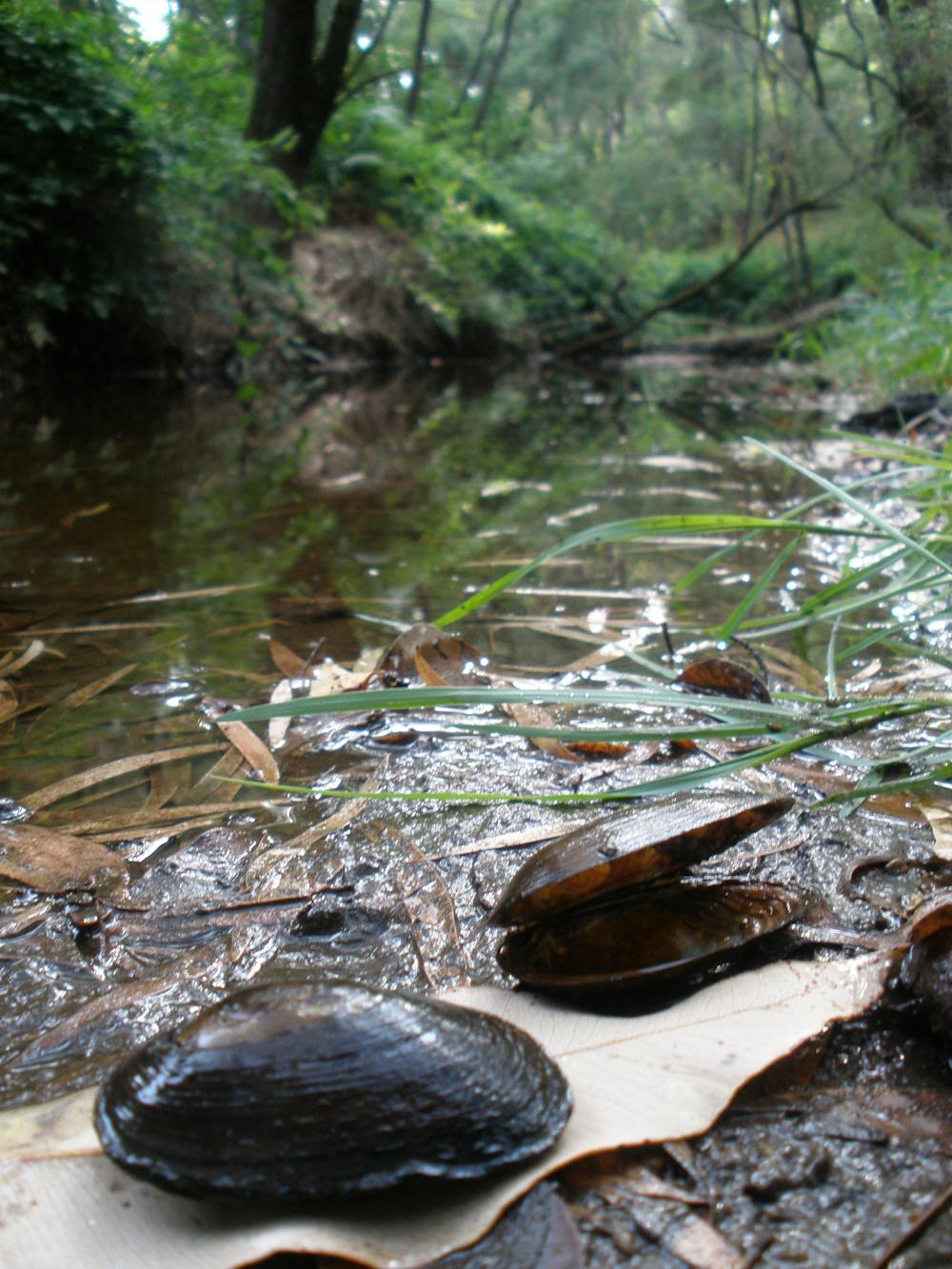
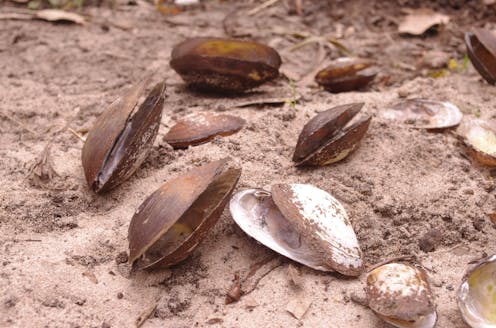
Carter’s freshwater mussel (_Westralunio carteri_) stranded on a dry river bed Alan Lymbery, Author provided

Am I not pretty enough? This article is part of The Conversation’s series introducing you to Australia’s unloved animals that need our help.


Freshwater mussels are dying suddenly and in the thousands, with each mass death event bringing these endangered molluscs closer to extinction. Tragically, these events rarely get noticed.

In March last year, for example, seawater was introduced into the lower Vasse River in south-western Australia to control harmful algal blooms. This killed the entire population of Carter’s freshwater mussel (Westralunio carteri) in this section of the river.

For me, this was particularly distressing for two reasons. First, the species was recently listed as vulnerable to extinction thanks to the work of my then graduate student Michael Klunzinger.

Second, among the 3,000-4,000 mussels killed were 160 my colleagues had previously collected from the river, kept alive in cages for nine months, then re-introduced so they would survive the construction of a new bridge.

Freshwater mussels are one of the most endangered groups of animals on the planet, with 47% either extinct or threatened with extinction. Yet we hear almost nothing about the extinction crisis they face.

I want to bring your attention to why freshwater mussels are important, why many will become extinct within our lifetimes, and why this will have dramatic consequences for freshwater environments throughout the world.

Under threat, yet poorly studied

Mass death events like the one in the Vasse River are not uncommon for freshwater mussels.

In 2019, the death of hundreds of thousands of pheasantshell mussels in the Clinch River in Tennessee, USA may have been caused by a virus, and prolonged droughts have killed mussels en masse throughout the USA and Australia.

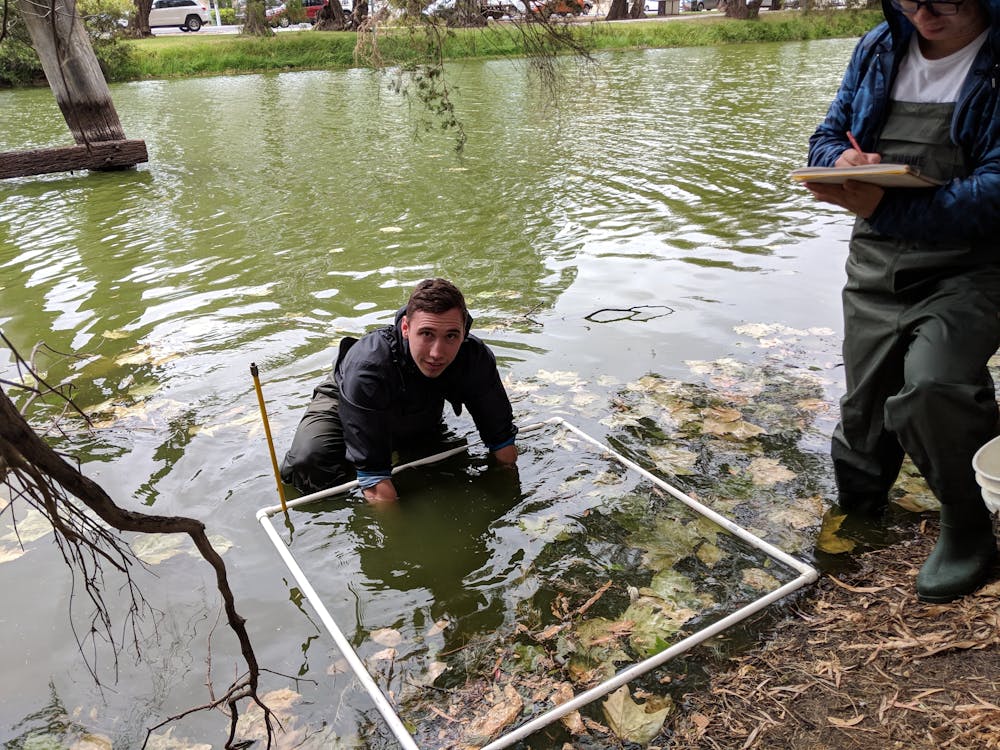
Researchers from Murdoch University taking samples from the Vasse River, where thousands of mussels died last year.
Stephen Beatty, Author provided

There are 18 species of freshwater mussels in Australia. Only two of these are listed as threatened under Australia’s environment law: Carter’s freshwater mussel and the Glenelg freshwater mussel (Hyridella glenelgensis).

Unfortunately, this doesn’t mean we’re doing better at mussel conservation than the rest of the world. It just means our freshwater mussels are very poorly studied. There have been no ecological assessments of the conservation status of most Australian freshwater mussels.

One of the most serious threats to freshwater mussel populations in Australia is climate change. Reduced rainfall has resulted in a dramatic reduction of water flow. In south-western Australia, for example, water flow has decreased by around 70% since the 1970s and climate change models predict at least a further 25% reduction by 2030.


Read more:
Drying land and heating seas: why nature in Australia’s southwest is on the climate frontline


This loss of flow means more of our rivers go without water over the dry season, and these drought conditions are lasting longer. Mussels can live for a short time without water by burrowing into the sediment, but longer and more severe dry spells will kill them.

Indeed, severe drought killed around 2.9 million freshwater mussels in the Murray Darling Basin between 2017 and 2020.

The livers of rivers

A big reason freshwater mussels are so vulnerable is because of their unique life cycle.

Unlike marine mussels (which release their eggs and sperm into the sea), female freshwater mussels fertilise their eggs internally. The embryos grow in special pouches of the gills until they’re released as tiny larvae that are parasitic on fish.

Many mussel species have marvellous ways to attract fish when the larvae are due to be released. For example, the US pocketbook mussel (Potamilus capax) uses part of it’s body to create a lure which looks like a small fish. This lure is waved about to attract the mussel’s host fish, bass, which are predators of smaller fish.

After spending several months as a parasite, the larvae then metamorphose into juvenile mussels and drop off their host into the sediment.

Fish near mussel
Mussels lure fish in to host their parasitic larvae.
Shutterstock

Most mussel species take five to ten years to reach sexual maturity. They are slow growing and long lived, often with a lifespan of 100 years or more. This combination of characteristics means mussel populations often cannot recover from large death events.

This can have devastating knock-on effects to the freshwater ecosystem, as mussels are considered “keystone” species.


Read more:
Buy Australian oysters and farmed barramundi: 5 tips to make your feast of summer seafood sustainable


When rivers cease to flow in dry summer months, freshwater fish and other animals find refuge in the remaining pools. Freshwater mussels behave like the livers of rivers, keeping these refuges clean and ensuring animals can survive until the rains return.

They maintain water quality by filtering and removing suspended sediments, nutrients, bacteria and algae. They also deposit nutrients on the river bottom, and their burrowing activity mixes and aerates the sediment.

Take more notice

I was distressed that thousands of endangered mussels died in the Vasse River. I was also distressed, but not surprised, at the general lack of attention to these deaths. If a pod of dolphins had died in an estuary because of human actions, we would have heard an outcry.

W. carteri in a stream
Carter’s freshwater mussel on a stream bank in south-western Australia.
Michael Klunzinger, Author provided

The plight of freshwater mussels illustrates a sad reality for freshwater life. Freshwater ecosystems are incredibly diverse. Per unit area, there are more than twice as many species of freshwater animals and plants than on land or in the ocean. But more than four times as many of these species are threatened with extinction.

Despite this, the conservation management of freshwater species lags far behind that of terrestrial or marine species. Freshwater environments are very poorly protected by conservation reserves and up to 71% of the world’s wetlands have been lost since 1900.

One urgent priority for Australia is to invest in freshwater protected areas, the same way as we invest in marine protected areas and terrestrial conservation reserves.

If you live near a stream, river or freshwater lake, go and visit it soon and appreciate the myriad forms of life that live below the surface. Chances are they won’t be there in the decades to come unless we develop policies and practices that protect our freshwater ecosystems.


Read more:
Why are there no true freshwater protected areas in Australia?


The Conversation

Alan Lymbery receives funding from the Australia and Pacific Science Foundation and the Water Corporation of Western Australia

ref. They live for a century and clean our rivers – but freshwater mussels are dying in droves – https://theconversation.com/they-live-for-a-century-and-clean-our-rivers-but-freshwater-mussels-are-dying-in-droves-164567

Legendary band Yothu Yindi and their trailblazing call for a treaty

Source: The Conversation (Au and NZ) – By Aaron Corn, Professor and Inaugural Director, Indigenous Knowledge Institute, The University of Melbourne

Yothu Yindi performing at the closing ceremony of the Sydney Olympic Games in 2000. Dave Hunt/AAP

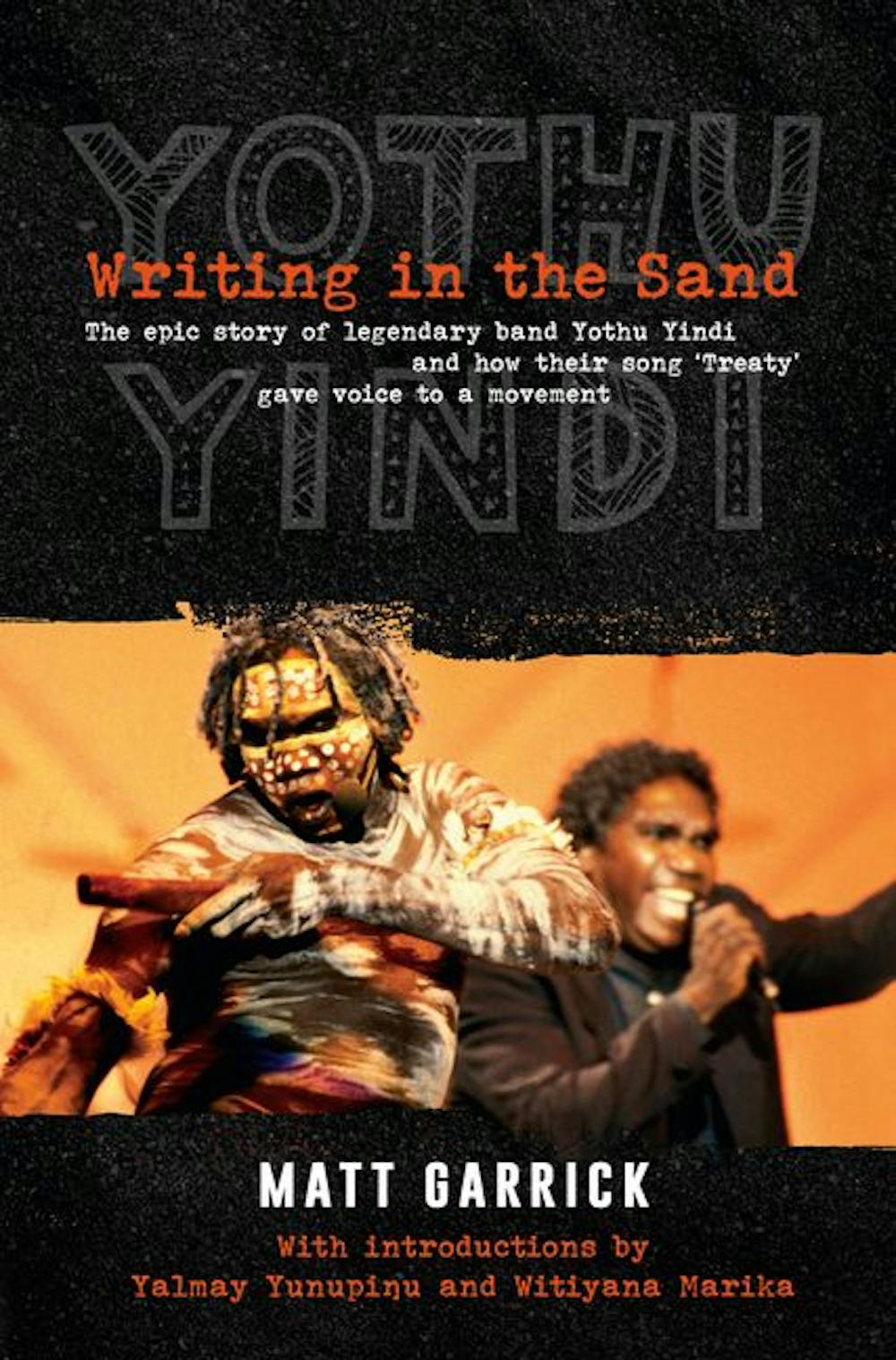
Review: Writing in the Sand: The Epic Story of Legendary Band Yothu Yindi and How Their Song Treaty Gave Voice to a Movement by Matt Garrick (ABC Books)

Readers are advised this article contains depictions of deceased people. Special thanks to Witiyana Marika of Yothu Yindi for confirming it is acceptable to publish the late Mandawuy Yunupiŋu’s name.


Few musicians have had as profound an impact on Australia’s cultural and political life as those in Yothu Yindi. Formed in 1986, this revolutionary band brought together Indigenous musicians from the Yolŋu town of Yirrkala in Northeast Arnhem Land and their non-Indigenous, or Balanda, friends who played in a Darwin band called the Swamp Jockeys.

Their union became fertile ground for new musical dialogues between very different styles, cultures and ideas with the band’s innovative songs drawing on Yolŋu musical elements and lyrics.

Their sources were Manikay, the ancestral Yolŋu song tradition performed in public ceremonies, and Djatpaŋarri, a playful and exuberant popular song form composed and performed by young men in Yirrkala from the 1930s to the 1970s. These overt borrowings afforded Yothu Yindi their distinctive sound.

Sung in both English and Yolŋu languages, Yothu Yindi’s early hits included spirited rock anthems such as Djäpana: Sunset Dreaming and Treaty. These songs affirmed traditional ideas and values for local Yolŋu audiences, while resonating across Australia with the Aboriginal Reconciliation movement of the early 1990s.

The band’s biggest hit, Treaty, released in 1991, was informed by the Yirrkala community’s deep sorrow over their 1971 Supreme Court loss in a case brought against the bauxite mine that had consumed their surrounding homelands.

The song contributed significantly to popularising calls for the Australian government to negotiate a treaty with Indigenous peoples in recognition of their human rights and unceded sovereignty.

Despite the gravity of such themes in many of Yothu Yindi’s songs, the band’s generosity of spirit towards people from all walks of life shone through.

Growing into a group of increasingly diverse musicians over time, Yothu Yindi advocated their own vision for an Australia in which Indigenous people and others could live together in mutual respect and harmony.


Read more:
My favourite album: Yothu Yindi’s Tribal Voice


An anthem for all Australians

Writing in the Sand: The Epic Story of Legendary Band Yothu Yindi and How their Song Treaty Gave Voice to a Movement is a new book by Matt Garrick, an award winning writer and ABC News journalist based in Darwin. It is both Garrick’s first book and the band’s first biography.

Book cover

Writing in the Sand marks 30 years since the release of Treaty. The book’s title is taken from the song’s first verse, which laments the failed 1988 promise of Australian Prime Minister Bob Hawke to make a treaty with Indigenous peoples within the lifetime of his parliament.

As the first book to comprehensively chronicle Yothu Yindi’s globetrotting career, Writing in the Sand deepens our understanding of this remarkable band’s achievements. It brings together a multitude of diverse voices to breathe life into this story, vividly illustrated by previously unpublished photos from the band’s archive.

Much love and care has been taken to respect and honour the memories of deceased musicians, including Yothu Yindi’s late singer Mandawuy Yunupiŋu, as well as Slim Dusty, who toured with the band.

Their contributions are contextualised by Garrick’s extensive interviews with Yothu Yindi musicians, including Witiyana Marika, Stu Kellaway and Jodie Cockatoo, as well as Yunupiŋu’s widow, Yalmay Marika-Yunupiŋu, and a wide array of collaborating artists, including Peter Garrett, Paul Kelly, Neil Finn, Joy McKean, Bart Willoughby and Andrew Farriss.

These interviews beautifully illustrate the humanity of Yothu Yindi’s creative process. For example, when Kelly joined Yunupiŋu on his ancestral homeland at Biranybirany, they wrote the first few lines of Treaty together as an anthem for all Australians.

The book also addresses the early musical influences that shaped Yothu Yindi’s sound, from the formative affinity of the band’s Yolŋu musicians with Slim Dusty, to the irreverent country originals of the Swamp Jockeys in a 1980s Darwin inundated with blues cover bands.

Finding a balance

The name Yothu Yindi means child and mother. The yothu–yindi relationship between children and mothers, and their respective mala, or clans, is fundamental to maintaining systemic balance within Yolŋu society.

This tenet provided a foundation for the band’s inclusion of musicians from a wide array of backgrounds and influences from around the globe. Its importance is engagingly explained in the book through the words of Witiyana Marika.


Read more:
Friday essay: how Indigenous songs recount deep histories of trade between Australia and Southeast Asia


The book also mentions the important Yolŋu concept of ganma, the balanced meeting of fresh and salt waters in certain estuaries. This metaphor for the meeting of different cultures and knowledges inspired and informed Yunupiŋu’s prolific career as an educator and a musician.

Even at this present time of widening hyper-partisanship on a global scale, when people’s perceived differences threaten to overwhelm our common humanity, Yothu Yindi offers us these quintessentially Australian lessons about the intrinsic value of social harmony and mutual respect in creating a more inclusive world for all.

In an Australia yet to make a treaty with Indigenous peoples, Yothu Yindi is more relevant now than ever.

The Gupapuyŋu App is a free download from Charles Darwin University that provides a Yolŋu language pronunciation guide.

The Conversation

Aaron Corn receives funding from the Australian Research Council and collaborated with Yothu Yindi personnel on a pilot study for the National Recording Project for Indigenous Performance in Australia. He explores the music of Yothu Yindi in his book Reflections & Voices (2009), published by Sydney University Press, and multiple other essays.

ref. Legendary band Yothu Yindi and their trailblazing call for a treaty – https://theconversation.com/legendary-band-yothu-yindi-and-their-trailblazing-call-for-a-treaty-173843

NZ police tighten rules on photos of youth, but concerns still for Māori

By Hamish Cardwell, RNZ News senior journalist

New Zealand police are being commended for tightening the rules for officers photographing young people, but there are concerns it could lead to the perverse outcome of more Māori being arrested.

The changes come after RNZ revealed in December 2020 that officers in Wairarapa were unlawfully photographing young Māori.

Police there admitted illegally taking pictures of young people on three occasions.

Whānau described their sons — some as young as 14 — walking alone in broad daylight, when police approached and insisted they take their picture.

The rangatahi were not doing anything wrong, nor being arrested.

Further RNZ reporting by Te Aniwa Hurihanganui suggested the practice was far more widespread than just in Wairarapa.

Police subsequently launched a review, and as a result of that, officers will no longer take pictures or fingerprints of young people unless they have been arrested or are being summonsed.

Photos being deleted
They will delete all photos of young people already taken on police-issued phones.

From now, when a picture is taken, only official cameras or photographers should be used.

At a pinch, a mobile device can still be used by officers, but the photo must be deleted off the phone once it has been uploaded into the police’s national intelligence database.

Barrister Marie Taylor-Cyphers said there was the risk it could lead to more Māori being arrested, rather than just being given a warning.

“If a police officer, in the course of their investigation, needs to for some reason identify the child by photographing them, then they’re going to be incentivised to place that child under arrest more readily than previously.”

Police deny there will be an increase in Māori arrests as a result, calling the changes a procedural issue.

Police community partnerships and prevention director Eric Tibbott told RNZ Morning Report the change would “definitely not” lead to more Māori youth being arrested.

Policy to reflect community expectations
“This is more about policy to reflect community expectations,” he said.

Taylor-Cyphers said the way the policy was worded appeared to give police permission to photograph young people in wider range of circumstances than adults.

Police said the law allowed them to take pictures of people under custody.

But Taylor-Cyphers said the new rules also let police snap photos of young people under summons — which often happened for lower level offences like traffic or driving infringements — and the policy needed to be tightened up.

Dr Karaitiana Taiuru, who has completed a PhD on indigenous ethics in data collection, described the changes by police as a “huge step forward”, but was also worried it could lead to more rangatahi facing charges.

Dr Taiuru said it would be necessary to wait and see how the policy was implemented.

“In a year’s time, it would be really interesting to see the statistics on … how many Māori youth were arrested for low-level crimes rather than non-Māori youth.

“And then compare the amount of photos taken of Māori youth compared to non-Māori youth.”

The full findings from the police’s internal review are expected early this year, as is a joint Independent Police Conduct Authority and Privacy Commission inquiry.

This article is republished under a community partnership agreement with RNZ.

Print Friendly, PDF & Email

Article by AsiaPacificReport.nz

‘Don’t enter Solomon Islands’ pleads Sogavare with Bougainvilleans

By Gorethy Kenneth in Port Moresby

Solomon Islands Prime Minister Manasseh Sogavare has appealed to his fellow Solomon Islanders at the western border not to allow Bougainvilleans into the country.

In his nation’s address last Friday, Sogavare recapped the country’s first covid-19 case recorded from a Shortland islander, dropped off by four Bougainvilleans in Shortland, who was automatically tested positive and is still in a 14-day quarantine with his seven family members who also tested positive.

The four Bougainvilleans returned home the same day and are back in their respective villages.

Sogavare singled out the New Year delta and omicron cases recorded in Solomon Islands which were brought in by citizens returning from outside Honiara.

“The western border continues to be an area of priority for health,” he said.

“For the Royal Solomon Islands Police Force and other border force agencies, it represents a potential source of covid-19 incursion into the country.

“For example, on New Year’s Day, a man from the Shortlands travelled with four Bougainville nationals from Bougainville to Shortland.

“The four Bougainvilleans returned straight after dropping off the man.

In quarantine facility at Nila
“The man is now held at the quarantine facility in Nila along with seven of his family members with whom he had made close contact.

“They will undergo 14 days of quarantine and only released if all tests results are returned negative.

“Five who had been held at the Nila isolation ward at Shortlands will be released after serving 14 days if their results return negative.

“These five individuals have made close contact with people from Bougainville.

“My good people, living along the western border, I ask you to refrain from going across the border to Bougainville.

“I also ask you to not allow any visitors from Bougainville to your villages during the period of the State of Emergency. Please continue to be vigilant to prevent the entry of covid-19 through our western border.”

ABG health chief ‘not aware’
Autonomous Bougainville Government (ABG) Health Secretary Dr Clement Totavun told the Post-Courier they were not aware of the incident singled out by Sogavare but also said the border had been closed since 2020 when the covid initial measures were released and PNG Immigration and other border offices had ordered immediate closure.

“There is currently a ban on traditional border crossing,” he said.

“The border is closed.

“The Border Protection Authority is supposed to man the border but surveillance at the moment is not effective.”

He said he would communicate with National Pandemic Controller David Manning on this issue.

Gorethy Kenneth is a senior PNG Post-Courier journalist. Republished with permission.

Print Friendly, PDF & Email

Article by AsiaPacificReport.nz

Guam breaks single-day record with 422 new covid cases – omicron fears

Governor Lou Leon Guerrero presents her covid update message … “Our focus remains on preventing severe illness, preventing increased hospitalisation and saving lives.” Video: Office of the Governor of Guam

By Mar-Vic Cagurangan in Tumon, Guam

Guam has reported its 273rd covid-19 death and 422 new positive cases on Tuesday, breaking its daily record for new infections and shooting up the island’s Covid Area Risk score to 189.3.

Despite the phenomenal increase in new infections, Governor Lou Leon Guerrero said she was not currently inclined to change the status quo.

“Our Public Health interventions and protective measures remain effective and as such, I am not announcing any new restrictions at this time,” the governor said.

“Our focus remains on preventing severe illness, preventing increased hospitalisation and saving lives,” she added.

A 90-year-old man died, who died at the US Naval Hospital on January 5, was Guam’s 273rd covid-related death. He was partially vaccinated and had underlying health conditions. He tested positive on December 27.

There are currently 14 covid-19 admissions within the island’s hospitals. One is receiving ICU level of care and “the remainder are not as severe,” the governor said.

The 422 coronavirus infections were detected in 2304 specimens analysed on January 10. This is the largest single-day result ever recorded on Guam. Of the total number of new positive cases, 126 were identified through contact tracing.

Speculated over omicron variant
Although data is not currently available, public health officials speculated that the omicron variant, described as highly transmissible, is already spreading on the island along with the delta variant.

To date, there have been a total of 21,540 officially reported cases, 273 deaths, 2062 cases in active isolation, and 19,205 not in active isolation.

The unprecedented surge of infections has prompted the Department of Public Health and Social Services to accelerate the testing in Tiyan, which has transitioned to an appointment-based system.

“Scheduling of appointments for Covid-19 testing will allow for more efficient processing and reduce long lines and wait times,” the department said.

Testing has been expanded to six days a week and six hours a day.

“We know that community testing helps us quickly identify new covid cases, so we can isolate the virus. Please get tested,” the governor said.

Guam public health
Although data is not currently available, Guam public health officials have speculated that the omicron variant, described as high transmissible, is already spreading on island along with the delta variant. Image: Pacific Island Times

Booster clinics at 6 schools
“To expand access and availability, we have added vaccination and booster clinics at six schools, in addition to clinics widely available at the University of Guam, Public Health community centers, and private providers.”

She reiterated her advice for residents to “wash your hands, wear your mask and watch your distance”.

Dr Rochelle Walensky, director of the Centers for Disease Control and Prevention, said last week that despite the astronomic rise in omicron-related covid cases nationwide, there was a possibility that the number would fall just as fast.

Mar-Vic Cagurangan is editor-in-chief of the Pacific Island Times. Republished with permission.

Print Friendly, PDF & Email

Article by AsiaPacificReport.nz

‘Enough is enough’, say PNG women over gender crimes by ‘callous men’

By Mark Talia in Port Moresby

“Enough is enough,” is the impassioned plea of the women, mothers and daughters of Papua New Guinea, says Mea Isaac, women’s representative in the Motu-Koitabu Assembly.

She has called for all forms of violence, abuse and discrimination against women to stop in the wake of the latest case of “barbaric torture” sparked by sorcery allegations.

Isaac made the call after witnessing National Capital District (NCD) Governor Powes Parkop hand over K50,000 (abut NZ$22,000) to the Police Department to assist with their operations to catch tribesmen in Southern Highlands alleged to have tortured five women accused of sorcery — killing two of them.

She said there were reports of far too much violence directed at innocent women, — especially the weak and helpless, ones who could not defend themselves.

“These are the very people who gave birth to you men, these are the very people who have nurtured you for nine months within their womb and the very people who help you men to grow up in feeding you, clothing you or when you cry and you fall they are there to embrace you,” she said.

“And here you are, callous men, you turn around and do this horrific act in return. Please, enough is enough,” Isaac said.

“No more violence, enough is enough; justice must be served and I am appealing to those who have committed this horrific crime to please surrender yourselves.

‘Your mothers, your sisters, your aunties …’
“These are your mothers, your sisters, your aunties and nieces why do you have to do such a terrible thing to them.”

Isaac said sorcery related, family and sexual related violence was also happening in the NCD. She cited an example such as in her village of Hanuabada, where a husband had beaten his wife to death.

She said there were many reported cases in the city settlements where women were attacked on the whim of so-called “glassman” on allegations of sorcery.

Moresby South women’s rep Rose Hagua shared these sentiments, saying that women and girls — despite so many barriers — wanted to take this challenge and to use their voice as a medium on behalf of the victims.

So they staged a march last December to raise their concerns relating to this “barbaric torture” of women in PNG’s Highlands.

Mark Talia is a PNG Post-Courier reporter. Republished with permission.

Print Friendly, PDF & Email

Article by AsiaPacificReport.nz

West Papuans to open branch office in Port Moresby, Wenda confirms

Asia Pacific Report newsdesk

The United Liberation Movement for West Papua (ULMWP) plans to open a government branch office in the neighbouring Papua New Guinean capital of Port Moresby along with diplomacy offices to be based in Europe and the United Kingdom.

In a New Year message from interim president Benny Wenda, he has confirmed a strategic office reshuffle around the world.

“The headquarters will be based inside West Papua, and the international office in Port Vila,” he said in the statement.

“We are opening a government branch in Port Moresby, and our diplomatic coordination offices will be based in the UK and Europe.

“This is another step in our long road to reclaiming the sovereignty stolen from us by Indonesia in 1963.

“With the formation of our constitution, provisional government, cabinet and Green State Vision, all Indonesian laws in West Papua are over.”

Wenda said the Indonesian presence was “totally illegal, and totally redundant”.

“With our clandestine government departments operating within our borders, all West Papuans and Indonesian migrants working under our jurisdiction are now governed by the ULMWP,” said Wenda.

Presidential demands
The West Papua military wing and any organisation affiliated to the West Papua National Coalition for Liberation, the West Papua National Parliament, or the Federal Republic of West Papua — the three constituent organisations within the ULMWP — were automatically considered part of the provisional government.

“Everyone must respect our constitution, whether you are inside West Papua or part of our international solidarity networks. The world must trust us and our constitution — we want peace for all in the region and internationally, and to democratically govern ourselves,” Wenda said.

“I encourage all NGOs, churches and religious leaders, every West Papuan inside and in exile, to unite and pray for the provisional government. Support everyone within the government working to end our long suffering and complete our 60 year struggle.”

Wenda said the demands to the Indonesian President in 2022 remained those that had been first issued during the West Papua Uprising in 2019:

1. Hold a referendum on West Papuan independence;
2. Allow international supervision of any referendum;
3. Allow the UN High Commissioner for Human Rights into West Papua in accordance with the demand of 84 UN member states;

4. Withdraw all troops from West Papua, including the 21,000 additional troops deployed since December 2018, and end the Indonesian military’s illegal war;
5. Release all political prisoners, including Victor Yeimo and the “Abepura Eight”; and
6. Allow all international journalists and human rights, humanitarian and monitoring groups into West Papua to visit internally-displaced people in Nduga, Puncak, Intan Jaya, Oksibil, Maybrat and elsewhere.

“In 2022, we will redouble all efforts in our long struggle for the liberation of our nation,” Wenda said.

“We will peacefully bring an end to this bloodshed.”

Print Friendly, PDF & Email

Article by AsiaPacificReport.nz

If my child or I have COVID, when can we get our vaccine or booster shot?

Source: The Conversation (Au and NZ) – By Margie Danchin, Paediatrician at the Royal Childrens Hospital and Associate Professor and Clinician Scientist, University of Melbourne and MCRI, Murdoch Children’s Research Institute

Shutterstock

As Omicron cases soar along Australia’s east coast, many people are faced with having to re-book their vaccination appointments.

If you or your child test positive for COVID, you clearly can’t go to the vaccination or booster appointment you had this week. So, when can you go?

There are no hard and fast answers on this; although there is some guidance, this question is still under current consideration by Australian Technical Advisory Group on Immunisation (ATAGI).

But here are some general principles to help guide your decision-making.


Read more:
How to talk to your child about a COVID diagnosis … and share the news with others


1. I’m an adult with COVID, and have had to postpone my booster appointment. So when can I get it?

The current ATAGI advice is that you can have your booster once you have recovered from the acute infection.

But based on vaccinology principles, it would be reasonable to consider waiting at least three months after you’re well to get your booster dose. A COVID infection stimulates the immune system like a vaccine, meaning you will produce antibodies that help increase your protection against COVID.

Vaccination can also be deferred for up to six months if preferred, as past infection does reduce the chance of reinfection for at least this amount of time, but there is still much we don’t know about the Omicron variant.

Currently, the booster dose is recommended four months after the primary course of two doses (meaning four months after you get your second dose).

By end of January, that will be changed to three months.

With Omicron, the duration of protection from natural immunity is unclear. So you should still get your booster shot and make sure you end up getting the required number of doses.

That’s because we can’t exactly quantify to what extent COVID infection stimulates your immune system.

People’s bodies respond differently to infection depending on age, underlying medical risk factors, the particular strain they’re infected with and a range of other factors.

That’s why, even if you get COVID, we still recommend vaccination and the required number of doses to ensure you get the best long-lasting protection.

So, after COVID, you could consider getting your booster 3-6 months later. But you may choose to bring your booster dose forward if:

  • you have underlying health conditions that place you at higher medical risk

  • you work in a workplace where you have higher risk of COVID exposure or

  • you are required to have a booster dose to go to work.

In those circumstances, you might consider having the booster a few weeks after you have recovered from the acute illness.

2. My child has COVID and will miss their vaccination appointment. So when can they get vaccinated?

Again, the current ATAGI advice is your child can have their vaccine once they have recovered from the acute infection but I would recommend waiting a minimum of four weeks before the first vaccine dose. This is also currently stated in the UK Joint Committee on Vaccination and Immunisation (JCVI) guidelines.

This is because we develop what’s known as “mucosal immunity” in the nose and throat from natural infection. Then, we can provide a boost to systemic immunity with the first dose of vaccine. The combination of both natural infection and vaccination gives longer and stronger protection.

This also provides a window for the child to recover, bearing in mind the risk of a rare but severe post-infectious inflammatory condition called paediatric multisystem inflammatory syndrome after SARS-CoV-2 or PIMS-TS (also known as multisystem inflammatory syndrome in children or MIS-C).

It occurs in about one in 3,000 children and can happen between 2-6 weeks after the acute infection. Waiting at least four weeks gives you more confidence your child has fully recovered.

If your child has persistent symptoms at a month, I would recommend waiting another month until getting them vaccinated. Then, wait eight weeks until the second dose.

A boy drinks from a drink bottle with a straw.
Staying hydrated is crucial for anyone with COVID.
Shutterstock

In general, a COVID infection is going to stimulate an immune response and the child will develop antibodies. But, as described above, we don’t yet know how much protection you get from natural infection versus vaccination in children. So, to get the best protection, they will still need to be vaccinated.

That said, we need to be pragmatic. Some parents may worry that if they cancel an upcoming appointment, they may not get another until much later.

So if a parent has an appointment coming up and their child has completely recovered, and has no symptoms, then – knowing the pressures on the system and approaching new school year – I wouldn’t decline that appointment. It’s about making a judgement call at the time of the appointment.

Hopefully, parents can use this information to make an informed decision. If they have concerns, they can speak to their GP or other healthcare provider.

To sum up: in general, I’d say wait four weeks after the initial infection and ensure the child has completely recovered – but if you have a slightly earlier appointment, then it’s reasonable to keep that as well.


Read more:
From faith leaders to office workers: 5 ways we can all be COVID vaccine champions


3. Anything else I need to know?

I think it’s worth highlighting an update to the CDC guidelines stating people are most infectious in the 1-2 days before they develop symptoms and 2-3 days after.

So the clear guidance is to adhere to the rules and isolate as a positive case or a close contact for seven days, but please check the guidelines in your state or territory.

I know there’s so much changing advice on that – for example in relation to critical workers – but the best advice is to stay isolated for at least five days if you’re a positive case or a close contact.

The Conversation

Margie Danchin receives funding from the NHMRC, WHO, DFAT and the Victorian and Commonwealth Departments of Health. She is Chair, Collaboration on Social Science and Immunisation (COSSI).

ref. If my child or I have COVID, when can we get our vaccine or booster shot? – https://theconversation.com/if-my-child-or-i-have-covid-when-can-we-get-our-vaccine-or-booster-shot-174690

3 in 4 people want to ride a bike but are put off by lack of safe lanes
Source: The Conversation (Au and NZ) – By Lauren Pearson, PhD Candidate, Monash University

Cycling is healthy and sustainable, but only 1.7% of trips in Melbourne are made by bike. Car use has soared since lockdowns were lifted.

We surveyed over 4,000 Victorians and found more than three-quarters are interested in riding a bike, but only in infrastructure that separates people from cars (such as off-road paths or protected bike lanes).

This proportion is far higher than previously thought, highlighting a huge opportunity to increase bike-riding rates by building separated bike lanes.

Our study, published in the Journal of Transport and Health, found high levels of interest in bike riding in groups with traditionally lower participation, including women and people living in outer-urban fringe areas.

However, these areas tend to have less access to safe, protective and supportive infrastructure than their higher socioeconomic counterparts.


Read more:
Bike kitchens: the community-run repair workshops that help build a culture of cycling


Infrastructure is key

Previous research has shown that how unsafe someone feels when riding a bicycle – particularly in the presence of motor vehicle traffic – is the key barrier to cycling.

Too much existing bike infrastructure is simply a strip of white paint; 99% of existing on-ride bike infrastructure in Melbourne is made up of painted bike lanes, which result in closer motor vehicle passes and do not protect cyclists from potential injury.

Providing high quality, connected and protected bike lanes or paths that separate people on bikes from motor vehicle traffic would greatly increase cycling rates in Melbourne.

Bike infrastructure must work for women, as well as men

For every woman that rides a bike in Melbourne, there are two men doing the same.

Despite lower participation, our study showed two-thirds of women are interested in riding a bike, and over half own a bike. Research suggests women are more likely than men to feel vulnerable to harassment by drivers when riding, may need more storage space than a bike usually provides, and may have more care-giving responsibilities than men. Differing perceptions of risk are also a factor.

Women have different infrastructure preferences to men, with a high preference for bike paths or lanes physically separated from motor vehicle traffic.

Taken together, these factors contribute to a pattern where many city bike paths and lanes are designed for the needs and confidence levels of male cyclists.

Common to many cities in Australia and around the world is what’s known as the “radial planning fallacy”, where transport systems are designed to optimise trips from outer-urban areas to city centres or businesses – rather than to facilitate local trips.

The majority of protected bike paths or lanes in Melbourne are radial in design, with a lack of connectivity between existing paths.

This kind of planning does not support the needs of many actual or aspiring cyclists, particularly women who tend to have more varied trips around places such as school, local shops and other locations close to home.

A woman cycles on the street.
We must plan bike infrastructure that supports the needs of women, as well as men.
Shutterstock

Outer suburbs are losing out

Despite lower participation, we found that interest in bike riding is high in the outer urban fringe areas of Melbourne.

These areas also have the lowest level of access to safe and comfortable bike infrastructure.

People who are inexperienced or new to bike riding prefer bike paths or lanes that are physically separated from motor vehicle traffic.

But a lack of infrastructure dedicated to active transport, coupled with longer distances to essential services, means people living in outer-suburbs are often required to drive long distances.

To address these health and transport inequities, it’s essential we plan and build protected and connected bike infrastructure across Melbourne, including new urban growth areas.

As well as boosting health outcomes, optimising social connection and reducing transport inequities, this would also contribute toward meeting Australia’s net-zero emissions targets.


Read more:
What Australia can learn from bicycle-friendly cities overseas


The Conversation

Lauren Pearson receives funding from the Australian Government Research Training Program.

Ben Beck receives funding from the Australian Research Council, the National Health and Medical Research Council, the Federal Office of Road Safety, the Transport Accident Commission, the Victorian Department of Health, VicHealth, RACV, Transport for New South Wales, and the British Columbia Centre for Disease Control, Canada. He is President of the Australasian Injury Prevention Network (AIPN).

ref. 3 in 4 people want to ride a bike but are put off by lack of safe lanes – https://theconversation.com/3-in-4-people-want-to-ride-a-bike-but-are-put-off-by-lack-of-safe-lanes-172868

We asked 6 scientists what inspired them to pursue a career in science. Here’s what they said

Source: The Conversation (Au and NZ) – By Michael Hopkin, Section Editor (Science + Tech) and Deputy Chief of Staff, The Conversation

Mael Balland/Unsplash, CC BY-SA

As you read this, scientists the world over are rushing to find out more about the COVID-19 Omicron variant.

Indeed, if there’s anything the pandemic has made clear, it’s that the importance of scientific research can’t be understated in today’s world.

As we embark on a new year, hopefully with more progress on the COVID-19 front, we asked six authors of The Conversation to reflect on what first sparked their interest in science.


Read more:
Hit hard by the pandemic, researchers expect its impacts to linger for years


Cathy Foley

Australia’s Chief Scientist

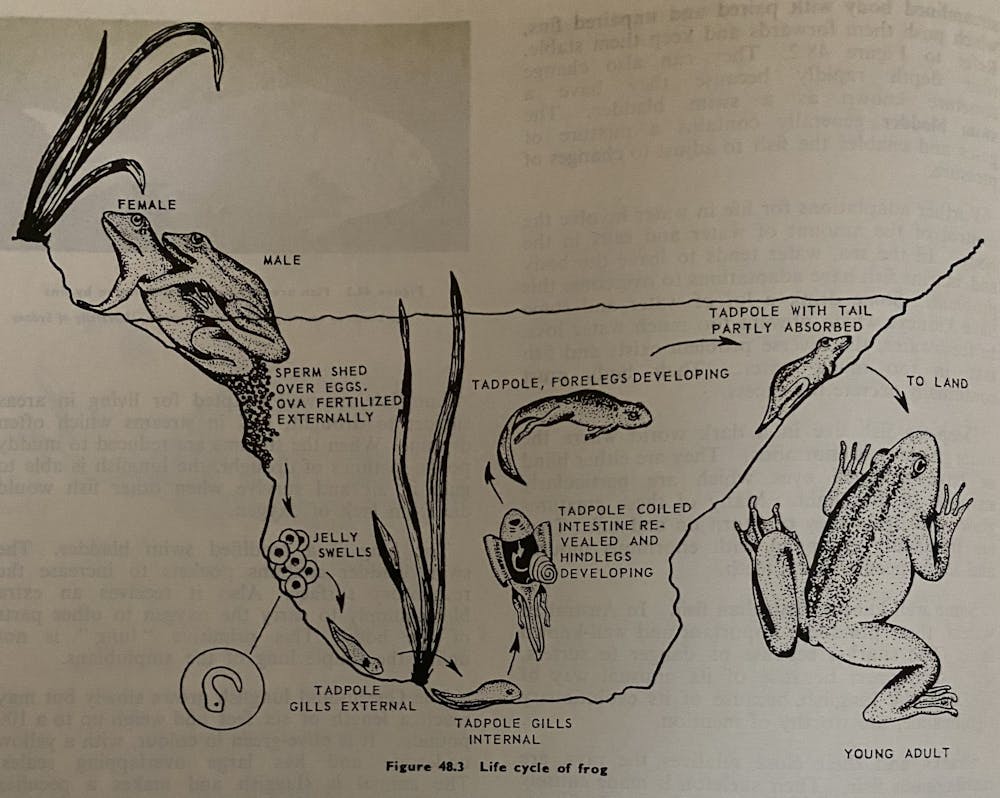
It was my brothers’ high-school textbooks, I kid you not! I loved poring over the Harry Messel textbooks as a 10- or 11-year-old. They were beautifully illustrated, with nature drawings and detailed experiments set out in a visual format. And I’ll never forget the photo of a dissected rat.

Then when I got to years 11 and 12 at school, the six-volume Harvard Project Physics sold me completely. It has a strong historical narrative, which is unusual in a science textbook and really worked for me.

I still have both sets of textbooks on the bookshelf in my home office. But even though I wanted to be a scientist from a young age, I didn’t know it was open to me so I didn’t dare express it. That final step only came in third-year experimental physics, when I discovered new properties of liquid crystals no one had found before. There was no going back.

Frog life cycle illustration
The life cycle of a frog, as featured in Science for High School Students by Harry Messel.
Reproduced courtesy of the University of Sydney

Bronwyn Carlson

Professor of Indigenous Studies and Director of The Centre for Global Indigenous Futures, Macquarie University

In 2008 I made my first Facebook post. I was in the middle of a PhD, conducting interviews with Aboriginal people about their identity and involvement in the Aboriginal community. Several spoke about how they expressed their Aboriginality on Facebook, by sharing images and forming connections.

This piqued my interest; Facebook was still new, having opened to the public just two years prior. I hadn’t considered issues of identity or community in these still-novel digital settings. Back then, people tended to separate life into the offline “real” world and the online “virtual” world – which by implication was not “real”.

I became interested in whether being Aboriginal online attracted the same sort of scrutiny as Aboriginal people regularly experienced offline. It turned out those with Facebook profiles experienced high levels of surveillance around their identity. I guess regardless of being online or offline, being Indigenous can attract violent behaviour from settlers.


Sara Webb

Postdoctoral Research Fellow at the Centre for Astrophysics and Supercomputing, Swinburne University of Technology

I have always been curious about the world and universe we live in. As a child I remember catching my poor mum off-guard, at 7.30am mind you, with the questions: “why do we exist?” and “What was there before the universe?”

It was a lot for 8-year-old me to be contemplating. But after watching all the Discovery Channel, National Geographic and History Channel documentaries I could possibly get my hands on, my mind was constantly in awe of such questions.

I genuinely can’t remember a time I haven’t been fascinated with the wonders of life. Learning physics in high school was the pinnacle of me beginning to understand why the universe is the way it is. This passion led me to where I am today – an astrophysicist and data scientist trying to make sense of the universe (and other things) via observations and data analysis.


Russell D.C. Bicknell

Postdoctoral Researcher in Palaeobiology, University of New England

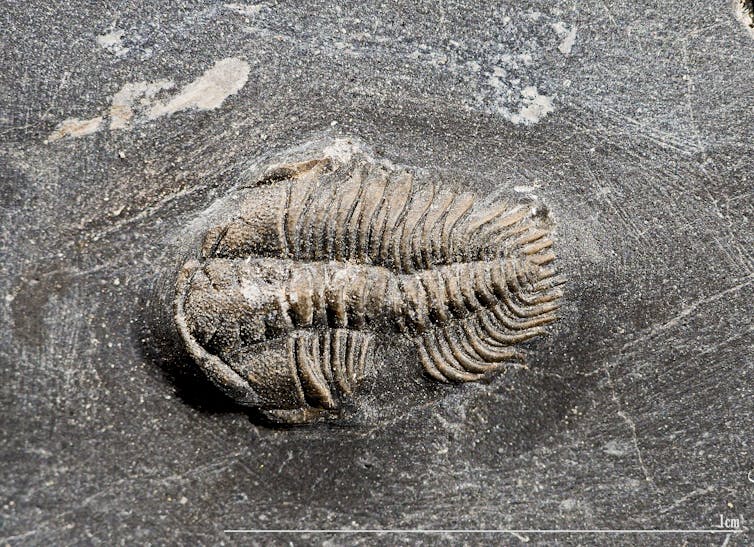
When I was about five years old, my father showed me the fossil of an extinct animal called a trilobite: ancient organisms that lived within even older oceans. They evolved long before the dinosaurs, and had gone extinct just before the first of the giant vertebrates (animals that have a backbone).

In doing so, my father had introduced me to the record of organisms that were no longer alive – and furthermore, that people who studied these animals are called palaeontologists. From this point on, I was motivated to understand more about these extinct groups.

This led me down the road of studying evolution, ultimately resulting in me becoming an evolutionary palaeontologist. Now, rather true to my childhood origins, I regularly study trilobites and am interested in documenting many different aspects of arthropod evolution.

Trilobite fossil
Trilobites make for fascinating fossils.
Didier Descouens/Wikimedia Commons, CC BY-SA

Jenny Graves

Distinguished Professor of Genetics and Vice-Chancellor’s Fellow, La Trobe University

I was a scientist for 20 years before I defined myself as “a scientist”. I was many things: harried lecturer, canny grant-seeker, cynical academic, chameleon mother and wife of shire president.

The event that stopped everything, and focused my attention on science, was a near-fatal brain bleed when I was 50 – followed by life-saving neurosurgery and an 18-month recuperation. During my rehabilitation, a kind visitor remarked comfortingly, “Now you have the space to decide what you really want to do with your life!”

I was overwhelmed by the realisation that what I really wanted to do was at the core of what I had been doing for 20 years: science! Just more, and better, with commitment and immersion.


Yvonne Wong

Associate Professor of Physics, University of New South Wales

The American physicist Sidney Coleman once said:

The career of a young theoretical physicist consists of treating the harmonic oscillator in ever-increasing levels of abstraction.

My journey into theoretical physics indeed began with a harmonic oscillator: the pendulum. Specifically, the formula relating the period of a pendulum’s swing (T) to its length (l) and gravity (g), which I found in a textbook at the age of about 15:

T = 2π√(l/g)

I was always good at maths. I also liked the idea that a set of universal principles governs all natural phenomena. But to see the latter expressed in terms of the former so cleanly was an epiphany.

I spent many hours pondering the 2π and the square root. More obsessions followed, from plucked violin strings to nuclear fission.

But what sealed it in the end was Douglas Giancoli’s textbook Physics: Principles with Applications, which I came across at about age 16. The last two chapters were on “Elementary Particles” and “Astrophysics and Cosmology”. The rest is history.


Read more:
There are 10 catastrophic threats facing humans right now, and coronavirus is only one of them


The Conversation

ref. We asked 6 scientists what inspired them to pursue a career in science. Here’s what they said – https://theconversation.com/we-asked-6-scientists-what-inspired-them-to-pursue-a-career-in-science-heres-what-they-said-172397

At long last, we can tear open the queen’s secret letters with Australia’s governors-general

Source: The Conversation (Au and NZ) – By Anne Twomey, Professor of Constitutional Law, University of Sydney

One consequence of the High Court’s 2020 judgement that caused the National Archives to release Sir John Kerr’s correspondence with Buckingham Palace was that the royal correspondence of other governors-general also had to be released.

More than a year and a half later, after the archives scoured every document for an embarrassing detail that could be redacted, these letters have now been made public.

They cover the terms of four governors-general: Lord Richard Casey (1965-69), Sir Paul Hasluck (1969-74), Sir Zelman Cowen (1977-82) and Sir Ninian Stephen (1982-89).

What is most remarkable about the letters is how similar they are to Kerr’s correspondence with the palace.

All the features that critics have picked on as unprecedented and inappropriate – the detailed political analysis, the obsequious deference, the focus on formalities, the discussion of reserve powers – are common features in the correspondence of Kerr’s predecessors and successors.


Read more:
‘Palace letters’ show the queen did not advise, or encourage, Kerr to sack Whitlam government


Frank political reports

This is unsurprising, because the palace encouraged the governors-general to write with “complete freedom and frankness” about political affairs in Australia and anything affecting the monarchy and the powers or status of the governor-general. This keeps the monarch well informed about her various realms.

Each governor-general, therefore, gave regular detailed and often quite critical reports on the political controversies of the day and the likely outcomes of elections.

Kerr’s analysis was, indeed, quite tame compared with that of his predecessors, Casey and Hasluck, who had stronger political pedigrees.

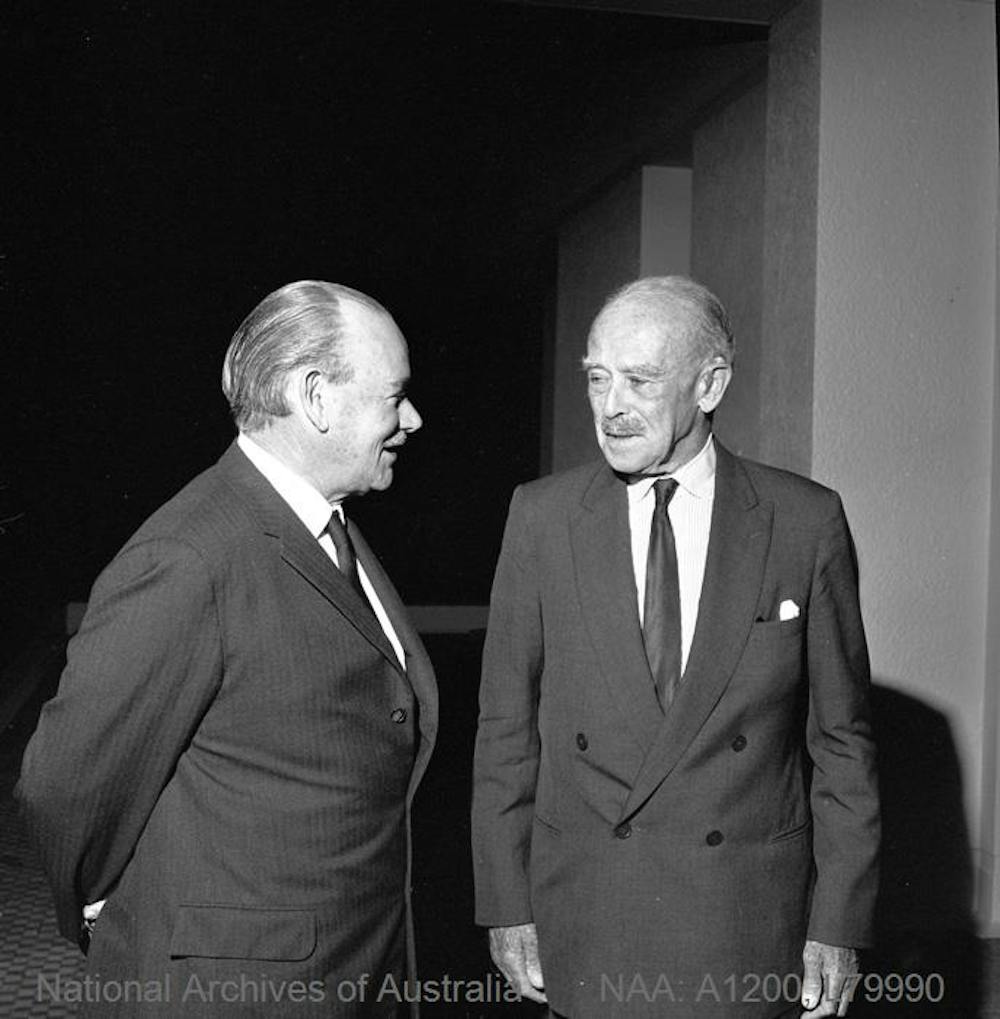
Sir Paul Hasluck (left) and Lord Casey (right) at Government House.
National Archives

Flattery and formality

To today’s eyes, the correspondence is often cloying and obsequious in its formality and deference, but this was standard for the time. The letters include many professions of “loyalty” and “devotion” to the monarch and every royal tour is a “great success” and “very well received”, especially by the “plain folk”.

Hasluck, in his comment about a prospective first meeting of Queen Elizabeth and Prime Minister Gough Whitlam, said:

If I may venture to say so, with due humility and respect, the wisdom and experience of Her Majesty will find here an opportunity to help make a promising Prime Minister into a better one and I believe he will prove responsive to Her counsel and guidance.

Not even Kerr could have topped that for flattery.

The excess of admiration also flowed the other direction. Governors-general are constantly praised for their “wisdom”. Deference is also given to their greater knowledge and understanding of the local political situation.

Letters from the palace praise and support the governor-general – they never criticise or instruct.

The focus on the formalities was strong throughout. This is because the monarchy represents itself to the people through such courtesies, pomp, honours and ceremony. Hence, a large part of the correspondence concerns changes to the oath of allegiance, the national anthem, the vice-regal salute, the royal anthem and the honours system.

Hasluck did his best in 1972 to dissuade the prime minister, William McMahon, from initiating a search for a “national song”, fearing it would replace “God Save the Queen” as the national anthem.

In 1984, Stephen was still having robust discussions with Prime Minister Bob Hawke about the use of “God Save The Queen” and the vice-regal salute. He even changed an Executive Council Minute by hand so that groups such as the Country Women’s Association and the RSL could continue to sing “God Save the Queen” without being in the presence of royalty.


Read more:
Explainer: what is the ‘palace letters’ case and what will the High Court consider?


The reserve powers

But what about the reserve powers, which allow a governor-general to act without, or contrary to, ministerial advice? Was it unprecedented or inappropriate to discuss their nature and hypothetical application? No, because the others did so, too.

Hasluck, for example, discussed what would happen if the prime minister, Sir John Gorton, was defeated in a vote of no confidence in 1970 (which had been a real prospect) and then requested the dissolution of parliament and an election.

Hasluck said he would have felt bound to ask whether it was impossible for Gorton to carry on the government without an election, and whether the governing parties might be able to continue to govern under a different leader.

Hasluck wanted to be satisfied all possibilities of forming a government without an election had been tried before granting one. If not, he would exercise his reserve power to refuse a dissolution and appoint a new prime minister. Hasluck said he had put down these thoughts on paper

so that Her Majesty may be aware of the way in which I interpret my constitutional duties.

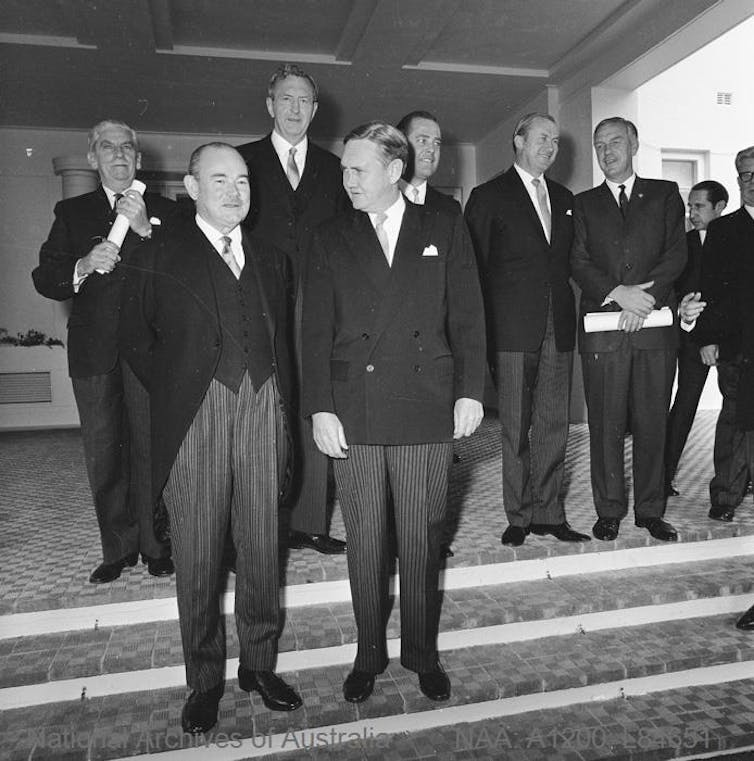
Sir Paul Hasluck (left) with Prime Minister John Gorton at the swearing in the Gorton ministry in 1970.
National Archives of Australia

He was not alone. Stephen also reported his views on his reserve power to refuse advice to hold a double dissolution election and made Prime Minister Malcolm Fraser come back with additional advice before he agreed to grant one in 1983.

Hasluck exercised a reserve power by refusing to sign an Executive Council Minute approving a US defence science base in Australia just 12 days before the 1969 election.

He deferred acting because it would breach the caretaker conventions. He only signed the papers after the Coalition won the election and wished to proceed.

As for the governor-general consulting the chief justice of the High Court on legal matters, this again was shown to be well precedented.

Casey, for example, consulted Chief Justice Garfield Barwick after the presumed death of Prime Minister Harold Holt in 1967 and also, more bizarrely, on whether a satirical magazine that ran a spoof interview with Prince Philip could be prosecuted under the Crimes Act.

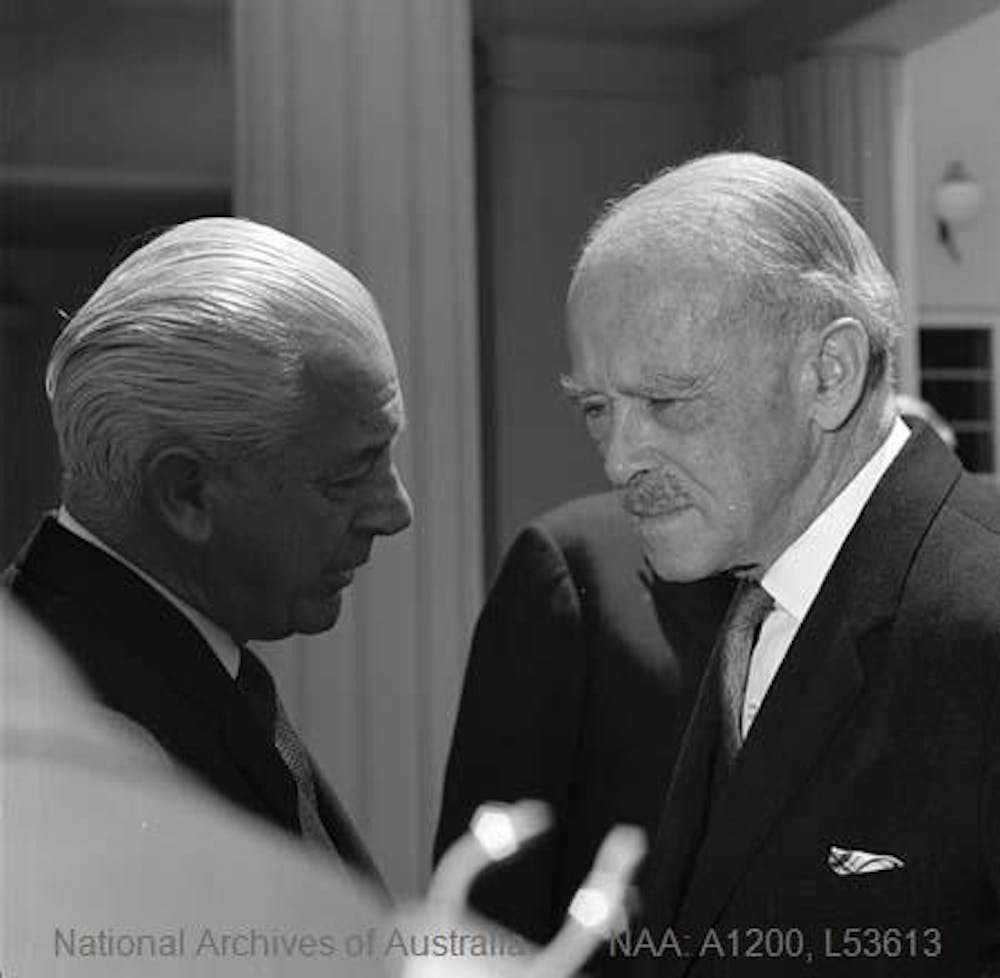
Prime Minister Harold Holt with Governor-General Lord Casey after swearing in of Holt as prime minister.
National Archives

A snapshot of Australian history

The letters of the governors-general provide a fascinating snapshot of political history. They add context to our understanding of the governor-general’s office and the relationship between the monarch and Australia. Seeing only Kerr’s correspondence led to distorted interpretations. Reading it in the context of his predecessors and successors gives a much more accurate picture.

While many of the reports are quite candid and frank, their release after so many years is hardly damaging, and the efforts to keep them secret for so long are again shown to be absurd.

Australia’s history should not be locked up forever in hermetically sealed boxes – it belongs to all of us and it is good that we can finally see some of it.

The Conversation

Anne Twomey has received funding from the Australian Research Council and occasionally does consultancy work for governments and inter-governmental bodies. She has written books on the reserve powers and the role of vice-regal officers in Australia.

ref. At long last, we can tear open the queen’s secret letters with Australia’s governors-general – https://theconversation.com/at-long-last-we-can-tear-open-the-queens-secret-letters-with-australias-governors-general-174584

What’s autophagy? It’s the ultimate detox that doesn’t yet live up to the hype

Source: The Conversation (Au and NZ) – By Tim Sargeant, Head, Lysosomal Health in Ageing research group, South Australian Health & Medical Research Institute

Shutterstock

“The anti-aging MIRACLE.” “Strengthen your immune system.” “Lose weight fast.”

These are some of the promises of autophagy, the silver bullet wellness influencers are saying is backed by Nobel-winning science.

In many cases, influencers say the best way to boost autophagy – the body’s way of recycling molecules – is with a product available from their online store.

While autophagy sounds too good to be true, the scientific reality may cross over with the hype – at least in laboratory mice and some other organisms.

Here’s where the science is up to and what we still need to find out to see if boosting autophagy helps humans.


Read more:
Research Check: can eating aged cheese help you age well?


Autophagy is the ultimate detox

Autophagy is a vital process that removes and recycles unwanted or damaged molecules from your cells.

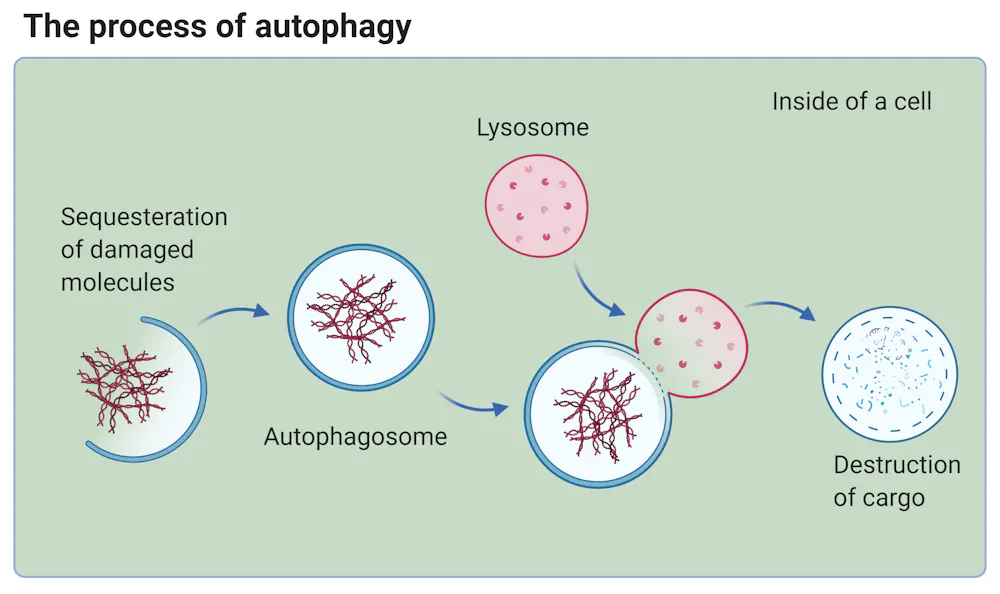
The process begins with the cell marking unwanted or damaged organelles (made from molecules like proteins, carbohydrates, lipids, and DNA or RNA) for removal.

These marked organelles are enveloped by a membrane, sealing them inside like a garbage bag, becoming what scientists call an autophagosome.

The autophagosome then moves closer to another organelle called a lysosome, a small acidic bag filled with powerful enzymes. When the two fuse, their contents mix. The enzymes break down the rubbish into recycled nutrients your cells can re-use.

It is the ultimate detox, and you’re doing it right now.

How autophagy works in the body. Created with BioRender.com.
Author provided

Mice benefit, but do humans?

Removing these waste products can potentially affect age-related diseases. For example, genetically engineered mice with less autophagy are more likely to develop tumours. Decreased autophagy also accelerates signs of dementia and heart disease in mice.

Autophagy degrades cellular components to re-use as an energy source during advanced stages of starvation in mice. And because autophagy is crucial for survival during starvation, it is sensitive to nutrient and energy levels. If we decrease nutrition in laboratory cells and laboratory animals, autophagy increases to compensate. This means diet can potentially modify autophagy.

It all sounds promising. But, and this is the big stumbling block, we don’t really know how it acts in humans.


Read more:
Of mice and men: why animal trial results don’t always translate to humans


How would we know if it’s the same in humans?

For us to know if fasting, taking a pill or some other activity affects autophagy in humans (and our health), we need to be able to measure if autophagy is increasing or decreasing.

And our group has developed the first test of its kind to measure how autophagy activity varies in humans. But even that is limited to blood samples. We’re still not sure about the levels of autophagy in tissues like the brain or whether the autophagy activity we see in the blood matches elsewhere in the body. We are working on it.


Read more:
There’s no magic way to boost your energy. But ‘perineum sunning’ isn’t the answer


How about those diets or pills then?

We simply do not understand enough about autophagy in humans, and there has not been enough time to test whether autophagy-boosting diets or supplements actually work in people. At best this makes various claims of boosting autophagy and its benefits premature, and at worst, completely incorrect.

Given the positive results in animals, and because autophagy is sensitive to nutrition, it is not surprising there is no end of advice and nutritional supplements that promise to increase autophagy for healthy ageing.

These tend to be books or material that explain how to diet your way to more autophagy (using intermittent fasting or keto-diets for example). Or, you can buy supplements claiming to increase autophagy with ingredients such as citrus bergamot.

Woman holding up dietary supplement
There is no end of advice and nutritional supplements that promise to increase autophagy for healthy ageing.
Shutterstock

As dubious as these claims might seem, a lot of them do tend to stem from a grain of truth. Indeed, work on the mechanisms of autophagy really did win the Nobel Prize in 2016.

But influencers’ claims wildly extrapolate from preliminary data without context. For example, a mouse can only go without food for two to three days before dying, while a human can go without food for weeks.

So exactly how much fasting is required to increase autophagy in humans is completely unknown: influencer claims of 16, 24 or 48 hours are stabs in the dark.
This is equally true for supplements. One prominent product for sale is spermidine, which can increase autophagy in the laboratory, such as in yeast and cultured human cells. However, nothing directly shows it can increase autophagy in humans.

Autophagy has only been widely studied for around 15 years. So far, we know it can slow biological ageing in laboratory animals. Because of this, it has the potential to address some of the biggest health issues our society currently faces. This includes dementia, cancer and heart disease.

But, at the moment, we just don’t know enough about autophagy in humans to make any claims about what we can do to increase it, or any health benefits.


Ben Lewis, science writer and communicator at the South Australian Health and Medical Research Institute, co-authored this article.

The Conversation

TJS and JB are listed as inventors on a related patent, PCT/AU2020/050908 for measurement of autophagy in humans.

ref. What’s autophagy? It’s the ultimate detox that doesn’t yet live up to the hype – https://theconversation.com/whats-autophagy-its-the-ultimate-detox-that-doesnt-yet-live-up-to-the-hype-172236

Experience the spectacular sounds of a Murrumbidgee wetland erupting with life as water returns

Source: The Conversation (Au and NZ) – By Mitchell Whitelaw, Professor of Design, School of Art and Design, Australian National University

Authors provided, CC BY-SA

In the southwestern corner of New South Wales, along the Murrumbidgee river, frogs are calling in a wetland called Nap Nap. This is Nari Nari country – nap nap means “very swampy” in traditional language.

Nap Nap is one of many inland wetlands across Australia to receive so-called “environmental water”: water allocated and managed to improve the health of rivers, wetlands and floodplains.

Long-term monitoring shows how these environmental flows sustain big old trees and cycle nutrients through the ecosystem. They drive breeding for frogs, waterbirds, reptiles and fish, and protect endangered species. This is a good news story for our inland waterways – but it’s mostly told through scientific reports.

We wanted to use ecological data to convey not just facts but feelings, and create a vivid digital portrait of life in Nap Nap. So we produced The Sound of Water, using audio, images and water data to reveal the patterns and rhythms of the swamp.

In part, this is about finding an engaging way to tell an important story. But there’s a bigger agenda here too: how might we use environmental data to amplify humanity’s attachment to the living world?

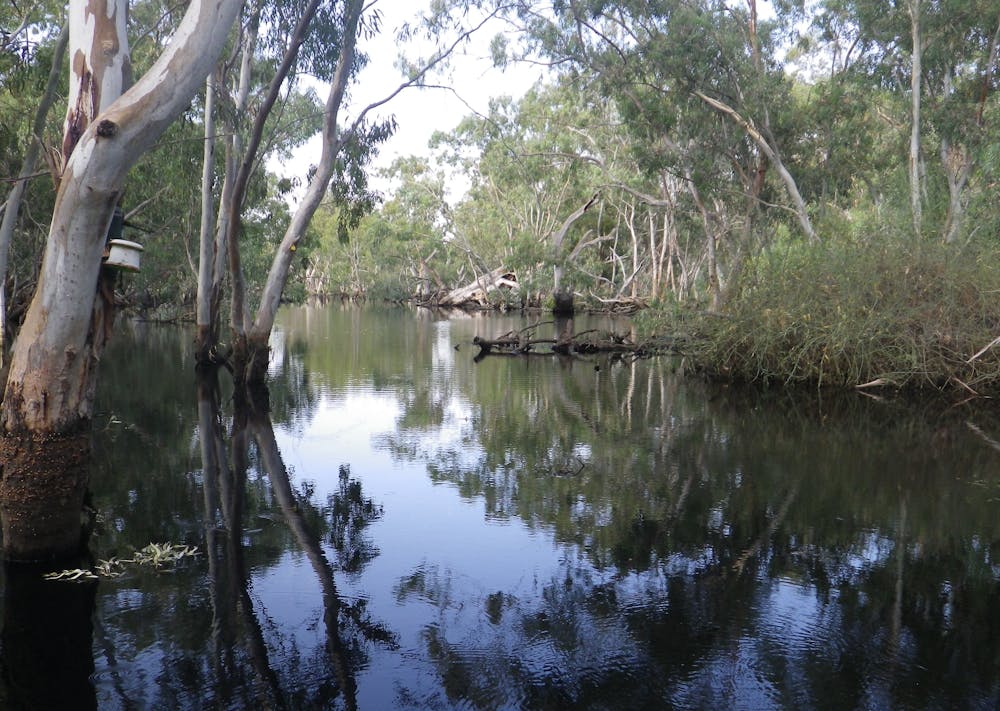
A view of a forest wetland, with water surrounded by tall gum trees
Nap Nap wetland, the name of which means ‘very swampy’ in traditional language.
Gayleen Bourke

Addressing an imbalance

Healthy wetlands rely on varying river flows. When a river is flooding or at high flow, water is delivered to wetlands, enabling seeds to sprout and animals to move and breed. When the river is at low flow, wetlands enter a natural drying phase.

But across Australia, thousands of wetlands have lost their natural connection to rivers. Lower river flows – the result of water regulation and diversions required to meet human needs – means many wetlands no longer experience these natural cycles.

Environmental flows seek to address this imbalance. Managed by water authorities, the flows involve strategically delivering water to replenish rivers, wetlands and floodplains.

Our project – a design-science collaboration – was funded by the Commonwealth Environmental Water Office’s Flow-MER program, which undertakes long-term monitoring of the ecological impact of environmental water allocations.

The Sound of Water

Across nine days in spring of 2020, an environmental flow of about 16,000 million litres rolled into Nap Nap swamp in the Lowbidgee floodplain after a brief dry spell. The Lowbidgee floodplain is near the confluence of the Kalari (Lachlan) and Murrumbidgee rivers in New South Wales.

The frogs began calling as the water returned. But don’t take our word for it – listen for yourself:

Frog chorus, Nap Nap Swamp, 7 September 2020, 7pm.
CC BY1.5 MB (download)

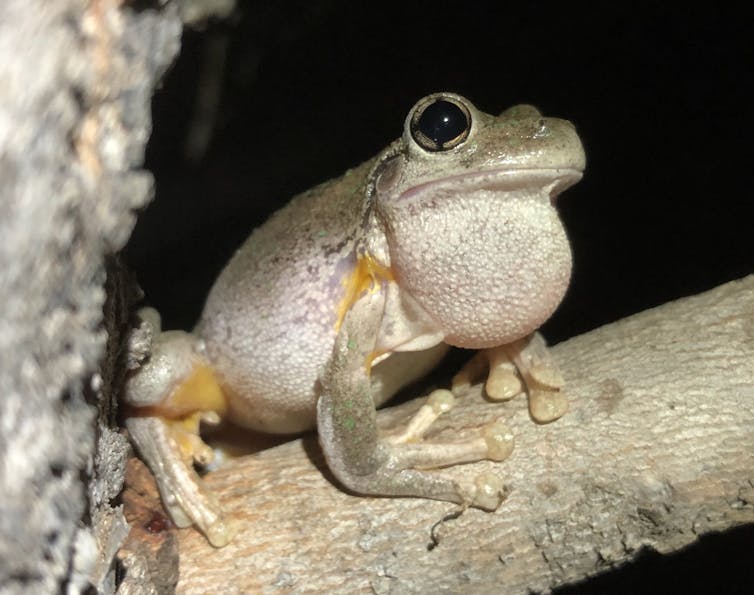
In this clip, you can hear the squelchy, “cree-cree” call of tiny, hardy Murray Valley froglets. You can also hear inland banjo frogs, whose “dok” call sounds a bit like a plucked string; spotted marsh frogs with a machine-gun like “duk-duk-duk”; and the shrill, rattling call of Peron’s tree frog.

This recording comes from an audio logger used in Flow-MER’s environmental monitoring. These automatic devices record for five minutes every hour, day and night – that’s two hours of sound captured every day.

A small light grey frog on a tree branch calling, with its throat puffed out
The Peron’s tree frog has a shrill, rattling call.
Damian Michael

Seeing wetland sounds

To reveal the content of all this audio, we used a visual representation of sound known as a spectrogram. We adapted a technique developed by researchers at the Queensland University of Technology which enables ecologists to visualise and analyse thousands of hours of recordings.

We visualised almost a year’s worth of audio from Nap Nap – more than 700 hours.

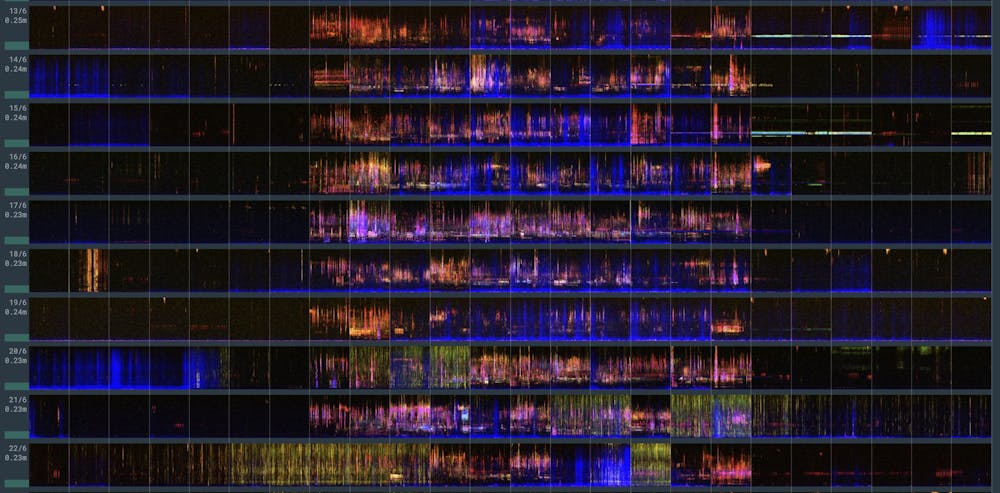
The below image contains spectrograms of audio from June 2020, which was a dry period in the swamp. The colourful central band corresponds to the noisy daylight hours, when woodland birds dominate.

The vivid blue areas are wind and rain noise. The pink and orange are mostly bird calls, and continuous sounds like cricket calls show up as strong horizontal bands (top right).

The mostly dark outer bands correspond to the nights, which in dry periods are fairly quiet.


Read more:
The Murrumbidgee River’s wet season height has dropped by 30% since the 1990s — and the outlook is bleak


Spectrograms of audio showing the patterns and variation of activity across 10 days
Spectrograms of Nap Nap audio from June 2020. Each row shows a single day, made up of 24 hourly segments.
Authors provided

But as the environmental water flow reached Nap Nap, the night lit up with frog calls. Our story focuses on this moment. We found a way to link the visuals to the source audio, creating interactive timelines in which we can see, hear and explore the wetland soundscape.

The stars of our story are Nap Nap’s frogs, and our most important find was a southern bell frog. Once widespread across southeastern Australia, these frogs are now found in only a few isolated populations.

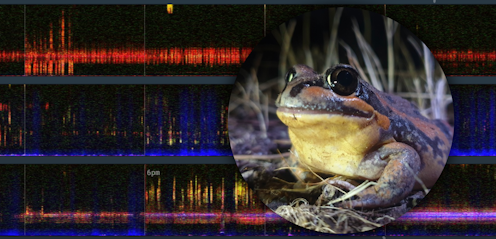
Their distinctive call indicates the ecological health of Nap Nap, and the value of these environmental flows. Here you can listen to its deep, growling call, which appears as a sequence of pink and purple blobs along the bottom of the spectrogram.


Read more:
We name the 26 Australian frogs at greatest risk of extinction by 2040 — and how to save them


Spectrogram of a southern bell frog calling at Nap Nap (3 September 2020, 8pm). Image: Gayleen Bourke.

A data portrait of a living place

Our design uses a scroll-based interaction technique sometimes termed “scrollytelling”. It works because it’s familiar (everyone can scroll) and translates well to all kinds of devices. It lets us lead the audience step by step into the place, the data and the spectrograms, while still encouraging exploration.

The Sound of Water builds on established techniques to create something new. It shows how design and science can unite to tell environmental stories in a richer way – with both facts and feelings. This matters because Nap Nap, and thousands of places like it, need people to care about their protection.


To explore the full version of The Sound of Water, click here.

The Conversation

Mitchell Whitelaw receives funding from the Commonwealth Environmental Water Office.

Skye Wassens receives funding from the Commonwealth Environmental Water Office

ref. Experience the spectacular sounds of a Murrumbidgee wetland erupting with life as water returns – https://theconversation.com/experience-the-spectacular-sounds-of-a-murrumbidgee-wetland-erupting-with-life-as-water-returns-174423

Healthy humans drive the economy: we’re now witnessing one of the worst public policy failures in Australia’s history

Source: The Conversation (Au and NZ) – By Jim Stanford, Economist and Director, Centre for Future Work, Australia Institute; Honorary Professor of Political Economy, University of Sydney

Shutterstock

Australians are getting a stark reminder about how value is actually created in an economy, and how supply chains truly work.

Ask chief executives where value comes from and they will credit their own smart decisions that inflate shareholder wealth. Ask logistics experts how supply chains work and they will wax eloquent about ports, terminals and trucks. Politicians, meanwhile, highlight nebulous intangibles like “investor confidence” – enhanced, presumably, by their own steady hands on the tiller.

The reality of value-added production and supply is much more human than all of this. It is people who are the driving force behind production, distribution and supply.

Labour – human beings getting out of bed and going to work, using their brains and brawn to produce actual goods and services – is the only thing that adds value to the “free gifts” we harvest from nature. It’s the only thing that puts food on supermarket shelves, cares for sick people and teaches our children.

Even the technology used to enhance workers’ productivity – or sometimes even replace them – is ultimately the culmination of other human beings doing their jobs. The glorious complexity of the whole economy boils down to human beings, using raw materials extracted and tools built by other human beings, working to produce goods and services.

A narrow, distorted economic lens

The economy doesn’t work if people can’t work. So the first economic priority during a pandemic must be to keep people healthy enough to keep working, producing, delivering and buying.

That some political and business leaders have, from the outset of COVID-19, consistently downplayed the economic costs of mass illness, reflects a narrow, distorted economic lens. We’re now seeing the result – one of the worst public policy failures in Australia’s history.

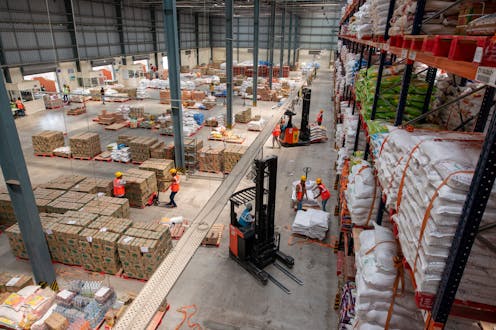
The Omicron variant is tearing through Australia’s workforce, from health care and child care, to agriculture and manufacturing, to transportation and logistics, to emergency services.

The result is an unprecedented, and preventable, economic catastrophe. This catastrophe was visited upon us by leaders – NSW Premier Dom Perrotet and Prime Minister Scott Morrison in particular – on the grounds they were protecting the economy. Like a Mafia kingpin extorting money, this is the kind of “protection” that can kill you.

Effect as bad as lockdowns

On a typical day in normal times, between 3% and 4% of employed Australians miss work due to their own illness. Multiple reports from NSW indicate up to half of workers are now absent due to COVID: because they contracted it, were exposed to it, or must care for someone (like children barred from child care) because of it. With infections still spreading, this will get worse in the days ahead.

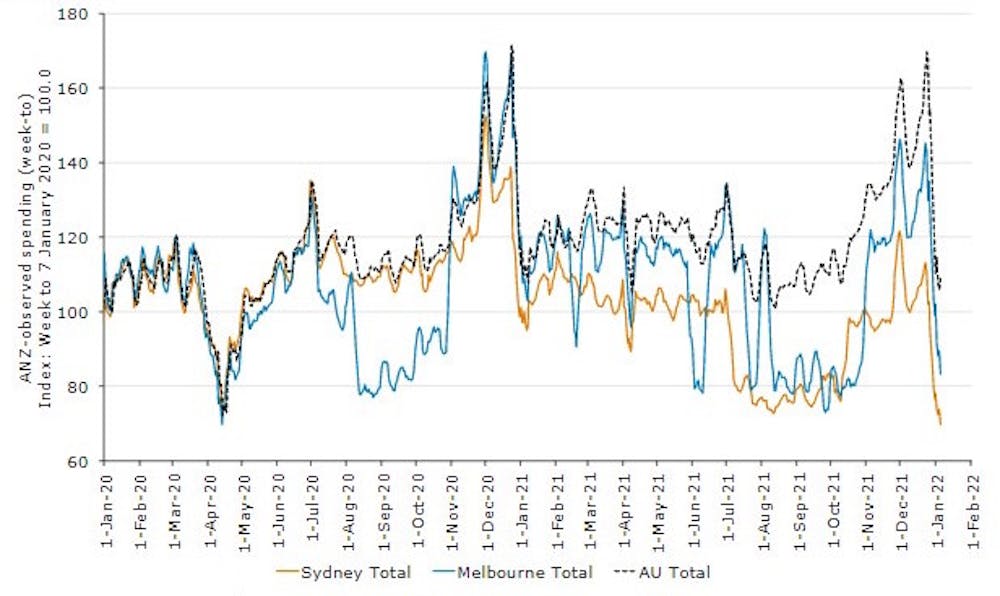
Staffing shortages have left hospitals in chaos, supermarket shelves empty, supply chains paralysed. ANZ Bank data, for example, shows economic activity in Sydney has fallen to a level lower than the worst lockdowns.


Spending in Sydney and Melbourne now near lockdown conditions

ANZ Bank data shows spending in Sydney and Melbourne has fallen to levels typical of lockdown conditions.

ANZ Research

If relaxing health restrictions in December (as Omicron was already spreading) was motivated by a desire to boost the economy, this is an own-goal for the history books.

Relaxing isolation rules

Now the response to Omicron ravaging labour supply is to relax isolation requirements for workers who have contracted, or been exposed to, COVID-19.

The first step was to shift the goalposts on “test, trace, isolate and quarantine” arrangements by redefining “close contact”.

On December 29 the Prime Minister said it was important to move to a new definition “that enables Australia to keep moving, for people to get on with their lives”. The next day National Cabinet approved a definition such that only individuals having spent at least four hours indoors with a COVID-infected person needed to isolate.


Read more:
It’s still not too late to fix the rapid antigen testing debacle. Why the national cabinet decision is wrong and must be reversed


Australians certainly want supply chains to keep moving. That won’t happen by simply pretending someone with three hours and 59 minutes of face-to-face indoor contact with Omicron is safe. Putting asymptomatic but exposed and potentially infected people back to work will only accelerate the spread.

The second step has been to reduce the isolation period for those who do pass this tougher “close contact” test. At its December 30 meeting National Cabinet agreed to a standard isolation period of seven days (ten days in South Australia), down from 14 days.

For “critical workers” in essential services including food logistics, the NSW and Queensland governments have gone even further, allowing employers to call them back to work so long as they are asymptomatic.

Snatching defeat from the jaws of victory

This follows a US precedent, despite scientific evidence indicating contagion commonly lasts longer than 5 days.

Employers will use this change to pressure exposed and even sick workers to return to work, risking their own health, colleagues, customers, and inevitably spreading the virus further.

Copying US COVID protocols only guarantees US-style infection rates. In fact, since 5 January, Australia’s seven-day rolling average infections per million now exceed that of the US.


Daily new confirmed COVID-19 cases per million people, Australia compared to United States.

Our Wold in Data, CC BY

From one of the best COVID responses in the world to one of the worst, Australia has snatched defeat from the jaws of victory.

It’s not to late to limit the carnage

The idea that health considerations had to be balanced with economic interests was always a false dichotomy. A healthy economy requires healthy workers and healthy consumers.

The Omicron surge has created an economic emergency that will be difficult to endure.

But it’s not too late to limit further avoidable contagion. Infection prevention practices (including masks, capacity limits, prohibitions on group indoor activities, PPE and distancing in workplaces, and free and accessible rapid tests) must be restored and enforced.


Read more:
From COVID control to chaos – what now for Australia? Two pathways lie before us


Income supports for workers who stay home must be restored. Staffing strategies need to emphasise steady, secure jobs, rather than outsourcing and gig arrangements which have facilitated contagion.

Above all, our policy makers need to remember the economy is composed of human beings, and refocus their attention on keeping people healthy. Protecting people is the only thing that can protect the economy.

The Conversation

Jim Stanford is a member of the Australian Services Union.

ref. Healthy humans drive the economy: we’re now witnessing one of the worst public policy failures in Australia’s history – https://theconversation.com/healthy-humans-drive-the-economy-were-now-witnessing-one-of-the-worst-public-policy-failures-in-australias-history-174606

Labor’s proposed $10 billion social housing fund isn’t big as it seems, but it could work

Source: The Conversation (Au and NZ) – By John Quiggin, Professor, School of Economics, The University of Queensland

Shutterstock

The centrepiece of Labor’s election program so far is its A$10 billion social housing policy, officially called the Housing Australia Future Fund.

In the first five years the fund would be used to build

  • 20,000 social housing properties for people on low incomes – 4,000 of the 20,000 for women and children fleeing violence and for low income older women at risk of homelessness

  • 10,000 “affordable” housing properties

  • $200 million for the repair, maintenance and improvements of housing in remote Indigenous communities

  • $100 million for crisis and transitional housing for women and children fleeing violence and for low income older women at risk of homelessness

  • $30 million to build more housing and fund specialist services for veterans who are experiencing or at risk of homelessness

Although needed, its a far short of the 100,000 extra social housing units we would have had if social housing been growing in line with total housing in recent years, a gap that is climbing by 4,000 homes a year.

And, like the frilled-neck lizard, the $10 billion looks much bigger than it is.

Labor could probably do what it has promised to do for $450 million per year.


Read more:
The compelling case for a future fund for social housing


Instead, it says it would borrow $10 billion at low interest rates, invest the money for much higher returns, and use the proceeds to pay for the program.

If the fund earns 4.5% more than the cost of borrowing it’ll get the $450 million per year. Rather than use the money to build the houses it will use the money to fund service payments to community housing providers who build them.

As Labor points out, it’s a mechanism used by the current government, which has set up five such funds in addition to the Future Fund used to fund public service pensions (of which more later).


Extract from Labor’s Housing Australia Future Fund election policy

Two of these funds, the Medical Research Future Fund and the Disability Care Australia Fund are actually bigger than the proposed Housing Fund.

A problem with this structure designed to make the commitment look bigger than it is is that spending on social housing will depend on the returns of the fund.

Allocating money from one source to spending on one particular purpose is called hypothecation, a word closely related to “hypothetical”.

Medicare funding is independent of the levy.
Dean Lewins/AAP

The Medicare Levy of 2% of most taxable incomes is intended to be for funding Medicare, but funds only part of it.

In contrast, there doesn’t appear to be any plan to guarantee payments for social housing if in any year the Social Housing Fund fails to make money.

The bigger question is whether it makes sense for governments to use funds like the Future Fund to put money into income-generating investments in private companies (the Future Fund invests in Apple, Microsoft and the Commonwealth Bank) or to use any available funds to pay down government debt.

The answer depends in part on whether the profits the funds earn are genuine or mere compensation for the risky business of investing in shares, which can always go wrong.

My work on the so-called “equity premium”, the excess return for investing in shares, suggests that is genuine and exceeds what’s needed to compensate for risk, making investment in the stock market an appealing option for governments in the absence of better opportunities.

But the premium is not limitless, for two reasons.

One is that if governments borrow enough and buy enough shares, we can reasonably expected the government’s cost of borrowing to rise and the rate of return on shares to fall, reducing the equity premium.

The other is that if buying shares is pursued far enough, governments will become major, or even majority, shareholders in large businesses, effectively becoming owners.

Future funds should invest in what governments do best

Long experience suggests that while governments are quite good at running some types of businesses (especially those involving infrastructure and requiring large amounts of capital) they are not nearly as good at running others. Retailing comes to mind.

If we accept that large debt-financed public investment can make sense, it follows that governments should own as much as 100% of some types of businesses (businesses such as Telstra come to mind) and little or none of others, such as shopping centres, which Australia’s government did indeed once own.


Read more:
People have lost faith in privatisation and it’s easy to see why


And that was generally the way Australia’s economy worked during the brief period of broadly shared-prosperity in the mid-20th century.

Governments borrowed at low rates and invested in physical and social infrastructure, such as roads and communications services.

The more funds there are like Labor’s proposed Housing Australia Future Fund the more likely it is we will get back there.

The Conversation

John Quiggin does not work for, consult, own shares in or receive funding from any company or organisation that would benefit from this article, and has disclosed no relevant affiliations beyond their academic appointment.

ref. Labor’s proposed $10 billion social housing fund isn’t big as it seems, but it could work – https://theconversation.com/labors-proposed-10-billion-social-housing-fund-isnt-big-as-it-seems-but-it-could-work-174406

Bark Ladies: how women’s Yolŋu bark paintings break with convention and embrace artists’ strong personalities

Source: The Conversation (Au and NZ) – By Sasha Grishin, Adjunct Professor of Art History, Australian National University

Installation view of Bark Ladies: Eleven Artists from Yirrkala from 17 December 2021 to 25 April 2022 at NGV
International, Melbourne.
Photo: Tom Ross

Review: Bark Ladies: Eleven artists from Yirrkala, NGV International

Aboriginal and Torres Strait Islander readers are advised this story includes names of people who have died.


Bark painting in Yirrkala is a tradition of some antiquity, but it is also one that constantly reinvents itself.

Although traditionally Yolŋu bark paintings and larrakitj (painted hollow poles) belonged in the male domain, by about 1970 the first women artists turned to these art forms. In 1990, the National Gallery of Victoria acquired its first bark painting by a Yolŋu woman artist, Nancy Gaymala Yunupiŋu’s Bäru story (1990), and over the next three decades it has built up one of the most significant collections of work by Yolŋu women artists in the world.

In recent years, many of these women artists have attained national and international reputations, have been awarded various prizes, and have been the subject of major survey exhibitions in public art galleries.

The show, as one has grown to expect from this gallery, is simply spectacular – dazzling, innovative and very beautiful. As you enter the NGV, the entire entrance foyer is occupied by a huge floor-based installation, Naminapu Maymuru-White’s Milŋiyawuy, (the Milky Way or River of Stars) where the souls of the deceased are turned into stars.

Installation view of Bark Ladies: Eleven Artists from Yirrkala from 17 December 2021 to 25 April 2022 at NGV International, Melbourne.
Photo: Tom Ross

This vast expanse of stars painted in white on the black floor is reflected above in a huge mirror so that the visitor is caught physically suspended between heaven and earth. This sets the mood for the whole exhibition as we negotiate a liminal space that lies somewhere between different spheres of being.

Strong personalities

Each of the 11 women artists included in this exhibition has their own personal imagery and individual stylistic orientation and, in this, it is an exhibition of strong artistic personalities. Although generalisations may be foolhardy, my impression is that the women artists appear less constricted by the binds of convention and more prepared to follow personal trajectories than their male counterparts.

Installation view of Bark Ladies: Eleven Artists from Yirrkala from 17 December 2021 to 25 April 2022 at NGV International, Melbourne.
Photo: Tom Ross

Dhambit Munuŋgurr – the blue lady – was badly injured in a car accident in 2005 and in view of her disability was given permission by the community not to gather and grind her own natural pigments but could use commercial acrylic paints.

She works almost exclusively in blue. On her cardboard palette, she has her colours divided into what she terms: “water blue, midnight blue, cobalt blue, ultramarine, Australian blue and Australian sky blue”.

Her bark paintings and larrakitj formed a highlight in the recent NGV Triennial.


Read more:
Enthralling, dystopian, sublime: NGV Triennial has a huge ‘wow’ factor


In this exhibition, in a striking recent painting titled Order (2021), she has tackled contemporary and topical imagery. The curator of the exhibition, Myles Russell Cook, decodes in his catalogue essay the imagery of this painting. It is a portrait of Julia Gillard, the former Australian prime minister, delivering her misogyny speech “surrounded by limp-faced, unnamed, seated politicians. Yolŋu people appear in the bottom left of the composition, storming the parliament in ceremony dancing with spears”.

Dhambit Munuŋgurr Order 2021. Synthetic polymer paint on Stringybark (Eucalyptus sp.) 201.0 × 100.0 cm. Purchased with funds donated by Janet Whiting AM and Phil Lukies, 2021.
© Dhambit Munuŋgurr, courtesy of Buku-Larrŋgay Mulka Centre, Yirrkala

There is a vibrancy, chromatic richness and intensity in the painting as there is in much of Munuŋgurr’s oeuvre.

The much-celebrated Ms M Wirrpanda, who last year passed from this life, devoted much of her art to preserving traditional knowledge concerning less well-known aspects of bush tucker and passing this on to future generations. The series of her painted barks titled Ŋäḏi ga Guṉdirr have a wonderful solemn majesty and crisp resolution.

As with many artists in this exhibition, there is a confidence and certainty of touch where through her striking designs she reveals her encoded wisdom.

Mulkun Wirrpanda Ŋäḏi ga Guṉdirr 2019. Earth pigments on Stringybark (Eucalyptus sp.). 186.0 x 82.0 cm. National Gallery of Victoria, Melbourne Purchased, Victorian Foundation for Living Australian Artists, 2020.
© Mulkun Wirrpanda, courtesy of Buku-Larrŋgay Mulka Centre, Yirrkala

Dhuwarrwarr Marika’s Birth of a Nation is a shimmering installation consisting of six huge bark paintings and five larrakitj that carry the Rirratjiŋu miny’tji design and relate to the landing site of the Djang’kawu Sisters, the major creator beings.

As you stand in front of this installation there is the sensation of being transported onto a different plain of existence. Other works are surrounded by walls of mirrors constantly reminding us of the spiritual and non-earthly frame of reference for much of this art.

Installation view of Dhuwarrwarr Marika Birth of a nation 2020 on display in Bark Ladies: Eleven Artists from Yirrkala from 17 December 2021 to 25 April 2022 at NGV International,
Melbourne.

Photo: Tom Ross

Transported from the gallery

There is always a challenge when displaying Yolŋu art to break from the conventions of the inappropriate white cube gallery and to create a new viewing experience where the audience will feel transported far from the terrestrial realm. In this exhibition, there is as much symbolism in the display with physically dissolving gallery walls, painted floors and numerous reflecting surfaces as there is in the art itself.

Possibly the most unexpected and quirky exhibitor is Eunice Djerrkŋu Yunupiŋu with her bark paintings titled I am a Mermaid (2020), New Generation (2021) and My Wedding (2021).

© Djerrkŋu Yunupiŋu, courtesy of Buku-Larrŋgay Mulka Centre, Yirrkala
Eunice Djerrkŋu Yunupiŋu I am a Mermaid 2020. Earth pigments and recycled print toner on Stringybark (Eucalyptus sp.). 255 x 57.0 cm.

They are painted in a mixture of earth pigments and recycled print toner with the unexpected combination of pinks and greens. The artist’s father once speared a fish that bled human blood and in a dream he was visited by a mermaid who revealed to him that his wife was with child. His daughter came into this world with the knowledge that she was a mermaid. This and other imagery could keep a whole generation of Freudian psychologists employed for years!

The Bark Ladies exhibition is provocative, absorbing and inspirational – as well as a lot of fun.

Bark Ladies shows at NGV International until April 25.

The Conversation

Sasha Grishin does not work for, consult, own shares in or receive funding from any company or organisation that would benefit from this article, and has disclosed no relevant affiliations beyond their academic appointment.

ref. Bark Ladies: how women’s Yolŋu bark paintings break with convention and embrace artists’ strong personalities – https://theconversation.com/bark-ladies-how-womens-yolnu-bark-paintings-break-with-convention-and-embrace-artists-strong-personalities-174340

Morrison government investigating whether Djokovic made erroneous travel declaration

Source: The Conversation (Au and NZ) – By Michelle Grattan, Professorial Fellow, University of Canberra

The Morrison government is now investigating the possible inaccuracy of Novak Djokovic’s travel declaration, as Serbia continues its pressure on Australia over the treatment of the tennis star.

Serbian Prime Minister Ana Brnabić told Scott Morrison in a call on Tuesday morning Australian time that Djokovic’s rights should be respected.

Brnabić, who sought the call, asked Morrison to do all in his power to ensure Djokovic would have humane and dignified treatment in Australia, according to a report from a Serbian news agency.

A readout from Morrison’s office described the call as “constructive”.

“The PM explained our non-discriminatory border policy and its role in protecting Australia during the COVID-19 pandemic,” the readout said.

“They both agreed to stay in contact on the issue, and to further strengthening the bilateral relationship.”

Djokovic’s visa was restored in a federal circuit court win on Monday, when the Commonwealth admitted Border Force had not afforded him procedural fairness last week when his visa was cancelled.

The cancellation was on the grounds he had not met the criteria for a medical exemption from vaccination.

Attention turns to the word ‘no’

But now official attention has also turned to his travel declaration.
The declaration asks arrivals, “Have you travelled, or will you travel, in the 14 days prior to your flight to Australia?” His form said no.

Djokovic, who lives in Spain, left from there for Australia on January 4, transiting through Dubai. Social media had him in Belgrade on December 25.
Border Force is looking into whether the information in the declaration was inaccurate.

Immigration Minister Alex Hawke is currently considering whether to use his discretion to cancel Djokovic’s visa again.


Read more:
Novak Djokovic’s path to legal vindication was long and convoluted. It may also be fleeting


The government concedes Border Force blundered on procedural fairness but it still contends Djokovic has not met the vaccination exemption criteria.

Hawke’s spokesman on Tuesday said the visa issue was “ongoing”.

The minister is considering a brief that contains material from both the Home Affairs department and Djokovic.

Meanwhile, despite the uncertainty about his prospects of playing in it, after his days of enforced confinement Djokovic is now back on court preparing for the Australian Open.

After Monday’s result, he posted on social media that “despite all that has happened, I want to stay and try to compete” at the Australian Open.

“I remain focused on that. I flew here to play at one of the most important events we have in front of the amazing fans,” he said.

There are mixed views in the government on whether it should cancel Djokovic’s visa again.


Read more:
Vaccinated or not, Novak Djokovic should be able to play


Liberal backbencher and former professional tennis player John Alexander said that after the court outcome it would be a mistake for Hawke to use his ministerial power to deport Djokovic.

Alexander pointed the finger at Border Force, telling the ABC that “the person who processed Novak possibly made an error, late at night”.

The Conversation

Michelle Grattan does not work for, consult, own shares in or receive funding from any company or organisation that would benefit from this article, and has disclosed no relevant affiliations beyond their academic appointment.

ref. Morrison government investigating whether Djokovic made erroneous travel declaration – https://theconversation.com/morrison-government-investigating-whether-djokovic-made-erroneous-travel-declaration-174698

Scrutiny on whether Djokovic made erroneous travel declaration

Source: The Conversation (Au and NZ) – By Michelle Grattan, Professorial Fellow, University of Canberra

The Morrison government is now investigating the possible inaccuracy of Novak Djokovic’s travel declaration, as Serbia continues its pressure on Australia over the treatment of the tennis star.

Serbian Prime Minister Ana Brnabić told Scott Morrison in a call on Tuesday morning Australian time that Djokovic’s rights should be respected.

Brnabić, who sought the call, asked Morrison to do all in his power to ensure Djokovic would have humane and dignified treatment in Australia, according to a report from a Serbian news agency.

A readout from Morrison’s office described the call as “constructive”.

“The PM explained our non-discriminatory border policy and its role in protecting Australia during the COVID-19 pandemic,” the readout said.

“They both agreed to stay in contact on the issue, and to further strengthening the bilateral relationship.”

Djokovic’s visa was restored in a federal circuit court win on Monday, when the Commonwealth admitted Border Force had not afforded him procedural fairness last week when his visa was cancelled.

The cancellation was on the grounds he had not met the criteria for a medical exemption from vaccination.

Attention turns to the word ‘no’

But now official attention has also turned to his travel declaration.
The declaration asks arrivals, “Have you travelled, or will you travel, in the 14 days prior to your flight to Australia?” His form said no.

Djokovic, who lives in Spain, left from there for Australia on January 4, transiting through Dubai. Social media had him in Belgrade on December 25.
Border Force is looking into whether the information in the declaration was inaccurate.

Immigration Minister Alex Hawke is currently considering whether to use his discretion to cancel Djokovic’s visa again.


Read more:
Novak Djokovic’s path to legal vindication was long and convoluted. It may also be fleeting


The government concedes Border Force blundered on procedural fairness but it still contends Djokovic has not met the vaccination exemption criteria.

Hawke’s spokesman on Tuesday said the visa issue was “ongoing”.

The minister is considering a brief that contains material from both the Home Affairs department, and Djokovic.

Meanwhile, despite the uncertainty about his prospects of playing in it, after his days of enforced confinement Djokovic is now back on court preparing for the Australian Open.

After Monday’s result, he posted on social media that “despite all that has happened, I want to stay and try to compete” at the Australian Open.

“I remain focused on that. I flew here to play at one of the most important events we have in front of the amazing fans,” he said.

There are mixed views in the government on whether it should cancel Djokovic’s visa again.


Read more:
Vaccinated or not, Novak Djokovic should be able to play


Liberal backbencher and former professional tennis player John Alexander said that after the court outcome it would be a mistake for Hawke to use his ministerial power to deport Djokovic.

Alexander pointed the finger at Border Force, telling the ABC that “the person who processed Novak possibly made an error, late at night”.

The Conversation

Michelle Grattan does not work for, consult, own shares in or receive funding from any company or organisation that would benefit from this article, and has disclosed no relevant affiliations beyond their academic appointment.

ref. Scrutiny on whether Djokovic made erroneous travel declaration – https://theconversation.com/scrutiny-on-whether-djokovic-made-erroneous-travel-declaration-174698

We shouldn’t delay the start of school due to Omicron. 2 paediatric infectious disease experts explain

Source: The Conversation (Au and NZ) – By Fiona Russell, Senior Principal Research Fellow; paediatrician; infectious diseases epidemiologist; vaccinologist, The University of Melbourne

Shutterstock

With Omicron daily infection rates in the tens of thousands, there have been calls for states to delay the start of the school year, which begins at the end of January.

The vaccination program for children aged 5-11 began on Monday but appointments are already being delayed. And even with everything running on time, not all children will have received their first dose by the time term 1 starts in the most affected states.


Read more:
Why has my child’s vaccination been cancelled? We’re reliant on overseas supply and a complex logistics network


Queensland has moved its start date back by two weeks for younger students until February 7, with Premier Annastacia Palaszczuk saying it is too risky for children to return on January 24, when the Omicron outbreak will likely peak. South Australia may also delay the school year start, although the details are still uncertain.

We know the known harms of school closures: decline in mental health, increase in obesity and child abuse, impaired social development, and of course the loss of learning. The longer-term harms we don’t know, but may include poorer job prospects and shorter life-span. This is a critical issue moreso for children in Victoria and New South Wales. Yet two years into this pandemic, we’re again discussing whether schools should be prioritised for opening.

Currently, children are not the main drivers of Omicron – it is the 20–29 year old age group . Although with mobility patterns changing after the holiday period, the age distribution may change. Previous studies have found school staff are at no higher risk of infection than the general population. This may be due to mitigation measures being in place at school, such as social distancing and mask mandates.

Transmission is most common in households. Studies have found secondary infections from children are lower in schools than in households, which is probably due to school mitigation measures.


Read more:
From WW2 to Ebola: what we know about the long-term effects of school closures


Before Omicron, evidence for school closures reducing community transmission was inconclusive. And with Omicron infection currently existing in all settings, it is uncertain school closures will be effective in combating its spread.

Over summer, hundreds of thousands of spectators will attend major sporting events, while nightclubs, gyms and karaoke bars remain open. To suggest schools cannot open while these events go ahead says a lot about how we value children’s education.

Omicron seems less severe in children than Delta

For the vast majority of children, COVID has been a mild disease. We’ve seen severe disease occur more often with the Delta variant, but this is still rare.

Data on the severity of Omicron in children is still emerging. A US study suggests Omicron is less severe in children compared with Delta. Children are 70-80% less likely to attend an emergency department for care with Omicron infection and about 50-60% less likely to be hospitalised for treatment. Nevertheless, this is still being closely monitored.

Because Omicron is highly infectious, many more children will get infected, and a small percentage of them will be admitted to hospital. Often they may have COVID but be admitted for another reason. In the US, paediatric hospitalisations are at their highest rate than at any point during the pandemic with alarming headlines of exponential growth rates.

However, data from the state of New York on COVID hospitalisation shows that for children aged 0-4, rates have increased from 0.4 to 4 per 100,000 during Omicron. For children aged 5-11, the increase has been from 0.2 to 0.8 per 100,000. The increase for adolescents aged 12-18 has been from 0.1 to 1.5 per 100,000. Despite this exponential growth, these rates are very low.


Read more:
No, we shouldn’t worry too much about getting COVID from young kids


Victoria has around 500,000 primary school-aged children and 500,000 secondary school students. Based on the US data, we can expect an equivalent of around 5-20 admissions with and for COVID per week in unvaccinated primary school age children and one to four admissions per week in unvaccinated teenagers in the coming month.

These numbers would decline rapidly with vaccination. This is the case even after a single dose, which is projected to provide over 80% protection.

Vaccinations are important in kids

Vaccination is good at preventing severe illness, even though severe illness is rare in primary school.

Of the children hospitalised in New York state, 91% of 5-11 year olds were unvaccinated and 4% fully vaccinated. There were few admissions in children who had received one or both doses of vaccine.

Among hospitalised 12-17 year olds, 65% were unvaccinated. And 55% percent of hospitalisations were in unvaccinated children aged 0-4.

Vaccination protects children from a serious, but rare and treatable, COVID-linked condition that involves inflammation of multiple organs (multi-system inflammatory syndrome, MIS-C). A French study found a single dose of mRNA vaccine reduced the risk of developing MIS-C in teenagers by 91% and there were no MIS-C cases in fully vaccinated teenagers.

A review compared the symptoms of illness in children who had COVID with those who didn’t. Several months after the acute infection, children who had had COVID were only slightly more likely than children who hadn’t to have headache, cognitive difficulties, loss of smell and sore throat. But there was no difference in previously COVID positive and COVID negative kids when it came to other symptoms such as abdominal pain, cough and fatigue.

These persistent symptoms after COVID infection are what’s considered as long COVID. But this does not mean they are permanent. It might mean they just take a little longer to resolve than acute symptoms. It is not known whether vaccination prevents this.


Read more:
Do kids get long COVID? And how often? A paediatrician looks at the data


For school staff, two doses of the AstraZeneca or Pfizer vaccine provides moderately high protection (around 70%) against severe disease by Omicron, and this increases further after a booster (to around 90%). Hospitalisations occur primarily in unvaccinated, older people.

As most school staff are vaccinated, they are well protected from severe disease.

We need a national plan

Australia is way overdue for a national, sustainable way of living with COVID.

Although vaccines are highly effective against severe disease they provide little protection against Omicron infection itself, which is now the dominant variant.

So additional measures are needed to prevent infections and school outbreaks.

Staying home if symptomatic is critical and remain a policy. Symptom surveillance should be established. Infections will be more common in coming weeks, which means workforce planning is urgently needed in schools, as in all sectors.

Right now, testing and cohorting (split kids into groups in the classroom and allow no mixing across year levels) are key to limiting transmission.

New South Wales has launched a “test to stay” program. This reduces the number of close contacts required to isolate. If a child is in a cohort with someone who has tested positive, they have a rapid antigen test daily. If the test is negative and they have no symptoms, they can still attend school. All states should employ this system when there is high transmission in the community.

Social distancing of student desks and staff should be continued along with indoor masks for students and staff. Other mitigation measures such as improving airflow are important. More expansive measures using HEPA filters should be funded, but that should not delay schools reopening.

Schools should be classified as an essential service and be the first to open and the last to close. Managing to pull off the cricket and the tennis but not opening schools on time would be a policy failure.

The Conversation

Fiona Russell receives funding from NHMRC, the Wellcome Trust, DFAT and the World Health Organization.

Robert Booy consults to all vaccination companies in Australia and works one day a week for Vaxxas. He has received funding from NHMRC and ARC in relation to vaccine research.

ref. We shouldn’t delay the start of school due to Omicron. 2 paediatric infectious disease experts explain – https://theconversation.com/we-shouldnt-delay-the-start-of-school-due-to-omicron-2-paediatric-infectious-disease-experts-explain-174330

How the kidnapping of a First Nations man on New Year’s Eve in 1788 may have led to a smallpox epidemic

Source: The Conversation (Au and NZ) – By Toby Raeburn, Associate Professor in Nursing (mental health), University of Notre Dame Australia

R. Cleveley. View in Port Jackson.
Dixson Library, State Library of New South Wales

First Nations people please be advised this article speaks of racially discriminating moments in history, including the distress and death of First Nations people.


Research continues to show that First Nations people’s burden of disease is more than double that of non-Indigenous Australians. This is despite widespread awareness of health inequalities experienced by First Nations people and successive governments’ efforts to “Close the Gap.”

Strengthening our awareness of history can help us understand how historical trauma contributes to the poor health of First Nations people today.

This New Year’s Eve, Sydney once again hosted an extraordinary party with a fantastic display of light and colour. However, many Australians were probably unaware that New Year’s Eve also marks the anniversary of the British invaders’ first capture of a First Nations person in Australia in the 1700s.

This kidnapping preceded a smallpox epidemic that killed more than 50% of the Aboriginal people in the Sydney Basin, along with large numbers further inland.

In our new research published in the international journal History of Psychiatry, we describe evidence supporting the theory that smallpox was deliberately unleashed by the British invaders.

We also introduce a new theory that ground zero for the smallpox epidemic of 1789 began during the kidnapping of Aboriginal man Arabanoo on New Year’s Eve in 1788.


Read more:
Friday essay: it’s time for a new museum dedicated to the fighters of the frontier wars


Deception leading to kidnapping and death

When the British invaded in early 1788, they struggled to survive. As they were establishing their colony, British convicts stole fishing nets and canoes from local Aboriginal people of the Eora nation, causing minor altercations.

The colonists were concerned about future quarrels with Aboriginal people when their early expeditions indicated much higher numbers of Aboriginal people inhabiting the Sydney Basin than they had anticipated.

As 1788 drew to a close, British food supplies were dwindling and, although land-clearing had begun at Parramatta in November, the colonists were unsure if they would be able to cultivate crops. By December, it had been several months since any Aboriginal people had come near the colonists’ camp, and Governor Arthur Phillip became anxious they might attack his fledgling colony.

So, on New Year’s Eve he decided to go on the offensive, sending a group of soldiers to take Aboriginal people as prisoners in order to gain information.

Led by lieutenants Henry Ball and George Johnston, a squadron of British marines rowed to Manly Beach, where they began handing out gifts to a group of Aboriginal people gathered on the shore. Using the gifts as a distraction, the soldiers captured a young Aboriginal man named Arabanoo.

Captain Arthur Phillip Fountain, Sydney.
shutterstock

When word spread about the deceptive kidnapping of Arabanoo, animosity towards the British increased. Then, a few weeks after receiving the gifts at Manly, fear broke out when several Aboriginal people fell ill with smallpox.

Referred to by the Eora as “galgalla”, smallpox was well known by the British, who used a process called variolation for immunisation. The treatment involved either sniffing smallpox scabs into the nose, or inserting scabs under a small cut in a person’s skin in order to contract a mild form of the disease and trigger the immune system.

There was no record of anyone suffering smallpox during the voyage of the First Fleet. However, as a precautionary measure, British surgeons on the First Fleet carried jars of smallpox flakes in their medical cases.

When the colonists received news smallpox had broken out among the Eora, Judge Advocate David Collins took a surgeon and Arabanoo to inspect the effects of the disease around Port Jackson. Collins described Arabanoo’s reaction as an expression of agony impossible to forget.

The expedition looked anxiously for survivors, but found nothing besides rotting corpses of people who had fallen victim to smallpox all around the harbour. When the colonists ventured north and south of Manly over the coming months, they continued to find dead bodies.

It remains unclear whether the British deliberately infected the First Nations people they encountered. Historians have posited a range of theories about what caused the outbreak.

Following exposure to the smallpox virus, it takes one to two weeks for symptoms to appear. Our theory is the epidemic had been spreading for several weeks before the British became aware of it, and it may have originated from the gifts handed out when Arabanoo was kidnapped about 12–13 weeks earlier.

This theory is supported by Aboriginal oral history from the Manly area. According to other research, several British marines had also previously fought battles in North America, where they may have heard stories about spreading smallpox as a strategy against First Nations people there.


Read more:
Oral testimony of an Aboriginal massacre now supported by scientific evidence


The death of Arabanoo

As April passed, a hut near the British tent hospital was used to accommodate two Aboriginal men and two children suffering from smallpox. The men died, but with Arabanoo’s care, a young girl named Abaroo (also known as Boorong), and little boy named Nanbaree, managed to recover. Sadly, in the process of nursing them, Arabanoo contracted smallpox himself and subsequently died on May 18.

It is important for us to remember that First Nations people’s earliest interactions with British health care did not occur in response to injury, accident or natural disaster. Instead, it occurred because of deception, kidnapping and disease in the context of invasion by the British.

First Nations people’s relationship with white health care has been haunted by this and continuing malpractices ever since.

Remembering Arabanoo each New Year’s Eve may assist Australians to better understand our nation’s traumatic history and the intergenerational effects of colonisation.

Improving our understanding of history also has potential to create better communication with First Nations people. It makes us more ready to listen when Aboriginal people tell us what they need to close the gap in health care, and when they tell us how we can build better relationships through messages such as the Uluru Statement from the Heart.

The Conversation

Aunty Kerrie Doyle receives funding from the Commonwealth Government for her research. Aunty Kerrie is also a board member for Ngarra Mura Indigenous Corporation, CASTINaM and AIATSIS.

Paul Saunders and Toby Raeburn do not work for, consult, own shares in or receive funding from any company or organization that would benefit from this article, and have disclosed no relevant affiliations beyond their academic appointment.

ref. How the kidnapping of a First Nations man on New Year’s Eve in 1788 may have led to a smallpox epidemic – https://theconversation.com/how-the-kidnapping-of-a-first-nations-man-on-new-years-eve-in-1788-may-have-led-to-a-smallpox-epidemic-173732

New Zealand summers are getting hotter – and humans aren’t the only ones feeling the effects

Source: The Conversation (Au and NZ) – By Cate Macinnis-Ng, Associate Professor, University of Auckland

Shutterstock

It’s not a mirage, our summers are getting hotter on average and we are experiencing more extremely hot days. News from NIWA that 2021 was New Zealand’s hottest year on record fits with the long term trend.

Analysis of 70 years of data has shown extreme hot days are increasing at a rate faster than average temperature increases across Aotearoa. At the same time, rainfall is decreasing in many areas.

Recent heat waves are associated with a current La Niña event. Warming ocean waters around Aotearoa and northeasterly winds drive warmer air temperatures.

A second contributing factor is atmospheric blocking slowing air movement and allowing air to warm further. Together with global warming, these processes will cause more frequent heat waves in coming years.

What is a heatwave?

While the answer may seem obvious (it’s a hot day), defining a heatwave scientifically is a little more complicated because “hot” is a relative term.

In hotter parts of the world, where temperatures are often above 30℃, a heat wave may be well above 40℃. However, in cooler climates, a hot weather event is likely to cause physiological stress at lower temperatures.

Here in Aotearoa, our climate is milder and the current definition of a hot day is above 25℃. This threshold has been identified as the point at which beef and dairy cattle suffer heat stress.

A more sensible approach is to define extreme temperatures relative to mean temperature. This statistical method allows identification of patterns in heatwaves in different areas in different months. February and March have had more heatwaves in recent decades, and Waikato is the most vulnerable region.

bull kelp clinging to rocks at beach
Marine impacts: the 2017-18 summer heatwave caused local extinctions of bull kelp.
Shutterstock

How do heatwaves affect biodiversity?

Atmospheric and marine heatwaves often coincide in maritime climates such as New Zealand’s. Marine heatwaves during the 2017-18 summer were the worst in 38 years and caused local extinctions of bull kelp (Durvillaea) in Lyttelton Harbour.

This event is likely to have wide longer term impacts on marine ecosystems because bull kelps form complex forests that support a range of organisms.

Experiments testing thermal tolerance of sea urchins (Evechinus chloroticus) showed they were reasonably tolerant of heat stress but had limited ability to adapt as ocean extremes continue to warm.

Less is known about the impacts of atmospheric heat waves on terrestrial and freshwater organisms. Our recent review of literature describing the effects of climate change on our native biodiversity found some studies of average warming in alpine regions.


Read more:
Courts around the world have made strong climate rulings – not so in New Zealand


For instance, warmer winters may allow invasive mammal species to expand their ranges, reducing the availability of cool, safe hiding places used by forest birds, in a process known as thermal squeeze.

Similarly, warmer fresh water may change competition between invasive and native fish. Warmer temperatures can also change the flowering time in native plant species, causing overlap with invasive plant flowering, potentially decreasing pollination opportunities and reducing the size of the next generation of plants.

More local research needed

While we did not find any literature specifically focused on heatwaves in Aotearoa, we can look overseas to understand what the expected impacts might be.

For trees, extreme heat causes reductions in photosynthesis and stress in leaves. In the worst cases, it can cause a loss of leaves or tree death.

Different species have different vulnerabilities because some trees have adaptations allowing them to survive extreme events. But we have very little data on our native tree species.


Read more:
Why climate change must stay on the news agenda beyond global summits


Unlike plants, animals (including birds, reptiles and insects) are mobile and may be able to avoid the worst effects of a heatwave. But again, we currently have very little information confirming this.

In the longer term, when plants are affected, this will cause a loss of food supplies and habitat for animals, so heatwaves may have long-lasting effects.

Native forest: stressed plants may also be more vulnerable to diseases and pathogens such as kauri dieback and myrtle rust.
Shutterstock

Why are heatwaves so damaging?

Extreme heat can cause significant physiological stress. But heat is not the only problem. Heatwaves often happen at the same time as droughts. Multiple stressors together can be hugely damaging, especially for plants.

Closing stomata (leaf pores) is a strategy used by plants to save water when soils are dry. However, loss of water through stomata is important for avoiding high temperatures, as transpiration from the leaf acts like evaporative cooling to reduce leaf temperature.

Plants with access to adequate soil water are better able to avoid lethal overheating than plants that are in drought. Experimental studies show drought-affected plants may open (rather than close) their stomata in response to heat, exacerbating water stress and making plant death more likely.


Read more:
The best time to water your plants during a heatwave


Stressed plants may also be more vulnerable to diseases and pathogens such as kauri dieback and myrtle rust. An added risk is fire, since dead and dry plant material is more flammable, increasing the incidence and severity of fires.

Extreme climate events are highly influential in ecology. Small populations of rare plants and animals can be particularly vulnerable to extreme climate events. We need more research to understand their potential impacts in a changing climate in Aotearoa.

close up of leaf
Plants can save water when soils are dry by closing their ‘pores’, but this can also reduce their ability to shed heat.
Shutterstock

What about our gardens?

Ensuring garden plants are well-watered will help them survive the hottest days. Watering in the late afternoon or early evening gives them time to absorb the water from the soil overnight. Check water restrictions in your area to make sure you are using water wisely.

Our research shows many native trees are well-adapted to dry conditions as they may have developed water-saving strategies in response to low-nutrient soils. These traits make them ideal for low maintenance gardens suitable for local conditions.

Finally, when planning or changing a garden, choosing plants that are less vulnerable to drought will help your garden survive in a future climate.

The current summer conditions we are experiencing are here to stay, so preparing for heatwaves will pay off in the long term.

The Conversation

Cate Macinnis-Ng receives funding from Ngā Rākau Taketake and a Rutherford Discovery Fellowship.

ref. New Zealand summers are getting hotter – and humans aren’t the only ones feeling the effects – https://theconversation.com/new-zealand-summers-are-getting-hotter-and-humans-arent-the-only-ones-feeling-the-effects-174530

Gomes calls for ‘consensus’ in charting Kanaky New Caledonia’s future

RNZ Pacific

A New Caledonian member of the French National Assembly says a consensus needs to be found on Kanaky New Caledonia’s future statute after last month’s referendum saw a third rejection of independence from France.

The vote formally concluded the decolonisation process provided under the 1998 Noumea Accord.

Philippe Gomes, a former New Caledonian territorial president, was speaking in Paris in the first parliamentary debate after the December vote, which had been marked by the boycott of the pro-independence camp determined not to recognise its outcome.

While 96.5 percent voted against independence, more than 56 percent of the electorate did not take part in the referendum.

Because of the impact of the pandemic on the indigenous Kanak people, the pro-independence parties wanted the vote to be deferred until September this year — after the French presidential election in April, but Paris insisted on the December date.

Gomes said that in the Pacific, political decisions build on consensus, and New Caledonia could become a nation without becoming a state.

He said the anti-independence side expected to remain under the protection of the French state while the rival pro-independence parties want a sovereignty which restored their dignity.

Joint approach needed
Gomes said a joint approach needed to be found to sidestep a process such as referendums.

Speaking on behalf of New Caledonia’s Kanaks, French Polynesian member of the National Assembly Moetai Brotherson said the latest referendum was of “no consequence” to them, and likened the vote to a “recolonisation”.

Rejecting the outcome of the plebiscite as illegitimate, the pro-independence parties last month mounted a court challenge in France, and plan to campaign internationally for its annulment.

France Unbowed leader Jean-Luc Melenchon
France Unbowed leader Jean-Luc Melenchon … the 1998 Noumea Accord should remain in force for another 10 years to avoid confrontation. Image: RFI

Leader of French left-wing party La France Insoumise (LFI – France Unbowed) and candidate for the presidential election Jean-Luc Melenchon said New Caledonia should be maintained for another 10 years under the provisions of the Noumea Accord to avoid any confrontation.

French Overseas Minister Sebastien Lecornu said it would take time to assess the abstention but added that it must be noted that voters had rejected independence three times.

Paris plans to draw up a new statute by June next year and submit it to a vote.

Pro-independence leaders have ruled out any formal negotiations with Paris before this year’s French presidential and legislative elections.

They have also said they would not discuss another statute within the French republic but negotiate independence.

This article is republished under a community partnership agreement with RNZ.

Article by AsiaPacificReport.nz

Protesters in New Caledonia target state vax mandates, health card

RNZ Pacific

An estimated 1000 people in New Caledonia joined a protest march against the French government’s policies to fight the pandemic.

The unauthorised march in Noumea was held just a day after the government imposed a limit of 30 people for any outside gathering.

Police said that while the meeting was illegal, they did not intervene because many children were in the crowd.

However, according to the public broadcaster, police used teargas after the end of the rally to disperse some demonstrators.

The march was called to oppose a health pass required to enter venues, such as restaurants and museums, and to protest against the law making vaccinations mandatory.

The law, which is yet to be applied, was adopted last September just days before the territory’s delta outbreak, which rapidly infected thousands and killed more than 280 people.

Last Thursday, the first cases of the omicron variant were detected, renewing calls by the authorities to be prudent as the virus is expected to raise infection rates.

From yesterday, vaccinations have opened for children aged five and older.

Children aged 11 and older must wear masks in indoor settings.

About 65 percent of New Caledonia’s population has had at least two jabs, making it the most vaccinated French Pacific territory.

This article is republished under a community partnership agreement with RNZ.

Print Friendly, PDF & Email

Article by AsiaPacificReport.nz

Pacific media dangers: ‘I had death threats and my tyres slashed for my reporting’

SPECIAL REPORT: By Joyce McClure in Guam

I spent five years as the lone journalist on the remote Pacific island of Yap. During that time I was harassed, spat at, threatened with assassination and warned that I was being followed.

The tyres on my car were slashed late one night.

There was also pressure on the political level. The chiefs of the traditional Council of Pilung (COP) asked the state legislature to throw me out of the country as a “persona non grata” claiming that my journalism “may be disruptive to the state environment and/or to the safety and security of the state”.

During a public hearing of the Yap state legislature in September 2021, 14 minutes of the 28-minute meeting was spent complaining about an article of mine that reported on the legislature’s initially unsuccessful attempt to impeach the governor.

One politician then posted about me on his Facebook page, under which a member of the public posted a comment saying I should be assassinated.

American Bill Jaynes, editor of the Kaselehlie Press in Pohnpei, one of Yap’s sister states in the Federated States of Micronesia (FSM), has had his share of death threats over the years, too.

Several death threats
“In the 15 or so years I’ve been at this desk I have had several death threats,” he said.

“Early on in my tenure, some angry individual carved a request for me to perform an act of physical impossibility into the hood of my car which then rusted for posterity. Most of that was during the early days before I came to be trusted to view things from an FSM rather than a foreigner’s point of view and to handle things factually rather than sensationally.”

Freedom of the press is included in both the FSM and the Yap State Constitution, but as Leilani Reklai, publisher and editor of the Island Times newspaper in Palau and president of the Palau Media Council, says: “Freedom of the press in the constitution is pretty on paper but not always a reality.”

These incidents are shocking, but sadly are not isolated. Journalists in the Pacific face imprisonment, loss of employment and banishment from their homes.

“While there might not be assassinations, murders, gagging, torture and ‘disappearances’ of journalists in Pacific island states, threats, censorship and a climate of self-censorship are commonplace,” professor David Robie, founding editor of Pacific Journalism Review, wrote in a 2019 article for The Conversation.

A Fijian journalist, who asked to remain anonymous, said that after he posed questions to a politician during a public forum, the politician replied that he knew where the reporter lived. The following day, the reporter’s car was broken into.

Soon after, the reporter was told that if he didn’t stop being critical, he would be kicked out of his job “and can go bag groceries instead” and he was evicted from his housing. The reporter believes all of these incidents stemmed from the questions he asked of the politician.

“Within one week my life changed completely,” he said. “I do not see a future for me or any other journalist who is curious and questioning to make a career in journalism in Fiji.”

Fiji ranked 55th in world
According to the Reporters Without Borders’ 2021 World Press Freedom Index, Fiji is ranked as 55th out of 179.

The index highlights the “draconian” Media Industry Development Decree, introduced in 2010 and turned into law in 2018. “Those who violate this law’s vaguely-worded provisions face up to two years in prison. The sedition laws, with penalties of up to seven years in prison, are also used to foster a climate of fear and self-censorship,” said Reporters Without Borders.

In 2018, senior journalist Scott Waide of Papua New Guinea was suspended by EMTV after the airing of his report critical of the government for purchasing 40 luxury Maseratis and three Bentleys to drive attendees during the APEC conference.

Reinstated after a public and media outcry, Waide stated during an interview on ABC’s Pacific Beat programme: “Increasingly, not just EMTV, but nearly every other media organisation in Papua New Guinea has been interfered with by their boards or with politicians, or various other players in society.

“They’re doing it with impunity. It’s a trend that’s very dangerous for democracy.”

Daniel Bastard, Asia-Pacific director of Reporters Without Borders, said the situation is complicated by how small and connected many Pacific nations are.

“The fact is that political leaders are also economic bosses so there’s a nexus. It’s symptomatic of the small journalistic communities in the Pacific islands that need to deal with the political community to get access to information. They have to be careful when they criticise knowing the government can cut advertising, publicity, etc. There’s still a strong level of intimidation.”

While there are particular dangers faced by local journalists, foreign reporters living in the Pacific are not safe either.

Denied renewal of work permit
Canadian Dan McGarry, former media director of the Vanuatu Daily Post and a resident of the island nation for nearly 20 years, was denied renewal of his work permit in 2019. The reason given was that his job should be held by a local citizen.

But McGarry said he believed it was politically motivated due to his reporting on “Chinese influence” in the small nation. He was then denied re-entry to Vanuatu after ironically attending a forum on press freedom in Brisbane.

Regional and international news organisations came to his defence and the court granted McGarry re-entry, but the newspaper’s appeal to have his work permit renewed is ongoing.

I have written about some sensitive and difficult topics and like to think of myself as pretty fearless. In 2018 I wrote about illegal fishing by Chinese commercial fishing boats around the Outer Island of Fedrai. That coverage resulted in the expulsion of the fishing vessel and significant political consequences.

I’ve written about issues in the customs and immigration processes in FSM, that were potentially jeopardising tourism to Yap, which is so important to so many people’s livelihoods, and also about a huge and controversial proposed resort that would have seen thousands and thousands of Chinese tourists flown in to that tiny island on charter flights.

These stories matter and just because some Pacific nations are small and remote does not mean that they do not need or deserve the scrutiny of a free press.

But eventually, the threats to my safety were too much to handle. I spent too much time looking over my shoulder, living behind locked doors and never going out alone after dark.

In mid-2021, I moved to Guam for greater peace of mind where I am continuing to write about this largely invisible, but crucial part of the world.

Joyce McClure is a freelance journalist based in Guam. This article was first published by The Guardian’s Pacific Project and has been republished with permission.

Print Friendly, PDF & Email

Article by AsiaPacificReport.nz

Post-pandemic, ‘small business fetishism’ could cost us jobs, wages

Source: The Conversation (Au and NZ) – By Saul Eslake, Vice-Chancellor’s Fellow, University of Tasmania

shutterstock

Small business is “the engine room of Australia,” the “backbone of our economy,” the “hope of the side”.

They are the words used by the then treasurer and now prime minister Scott Morrison to justify special treatment for small businesses, an approach shared by leaders in every political party from Labor to One Nation to the Australian Greens

It’s a belief that underpins a wide range of grants and subsidies, free advice programs and preferential tax treatments, including

  • exemptions from payroll tax

  • a lower rate of company tax

  • discounts on personal income tax if unincorporated

  • exemptions in prescribed circumstances from capital gains tax

  • up-front tax-deductibility of capital investments

  • less onerous arrangements for remitting the goods and services tax.

What is extraordinary about the “engine room of the economy” doctrine is the complete absence of any evidence for it.

Advocates point to the large number of people who work for small businesses.

According to the Bureau of Statistics’ most recent count (in which small businesses are defined as those with fewer than 20 employees), they employed 4.67 million people as at the end of June 2020. That’s equivalent to 37.7% of total employment.

The ‘engine room’ that sheds jobs

What is less often pointed out is that number – 4.67 million – is smaller than it has been in all but four of the past 13 years. At no stage in the past 13 years have more Australians been employed in small businesses than in June 2007.

Rather than being the engine room of job creation, small business has presided over job destruction, creating not one single net new job in aggregate in 13 years.

Employment in small businesses has declined 6.3% in 13 years in which employment in medium-sized businesses has increased by 46.4% and employment in large businesses has increased by 48.4%.


Employment in small businesses as a share of total employment

‘Small businesses’ are those with fewer than 20 employees.
ABS Australian industry 2019–20

Nor has the “instant asset write-off” advanced to small businesses in the 2015-16 budget done anything to enhance capital expenditures by small businesses.

Gross fixed capital expenditure by small businesses fell 16.1% between 2014-15 (the year before the instant asset write-off) and 2018-19 (the year before the pandemic) – a much larger decline than in capital expenditures by medium-sized businesses (2.7%) and large businesses (6%).

Another pervasive myth is that small businesses are more innovative.

Less productive, less innovative

While some small businesses undoubtedly are innovative, the ABS surveys of innovation activity have consistently found small businesses are less likely to engage in any form of innovative activity than medium-sized or large businesses.

Productivity is lower at small businesses than at larger ones.

The ABS puts gross value added per person employed in small businesses at A$24,000, or 21% below the average for all businesses in 2019-20. Gross value added per person in large businesses was almost $41,000 – 36% above the average.

Lower productivity might be one reason why, in 2019-20, small businesses paid their employees 35% less than the average wage or salary paid by all businesses. Medium-sized businesses paid an average of around 12% more, and large businesses paid almost 34% more.


Apparent average annual wage or salary by size of business

Average annual wage or salary is obtained by dividing total wages and salaries paid by each category of business in 2019–20 by the average number of employees as at 30 June 2019 and 30 June 2020. In the absence of relevant data, no allowance is made for differences in the proportion of full or part-time employment between businesses of different size.
ABS Australian industry 2019–20, and author’s calculations

The obvious conclusion outlined more fully in my new piece in the Australian National University journal Agenda is the widely held belief small business is the “engine room of the economy” is simply wrong – as is the corollary that increased assistance to businesses simply because they are small is a good way to boost employment, investment, innovation and economic growth.

Less keen to pay tax

One thing small businesses are not particularly good at is paying the required tax.

The Australian Taxation Office Tax Gap program finds small businesses (which it defines as those with incomes of up to $10 million per year) voluntarily paid only 86.3% of the personal and company income tax they should have paid if they had fully complied with its interpretation of the 2018-19 tax law.

This is larger than any of the tax gaps calculated by the ATO.

The ATO finds high wealth voluntarily paid 91.4% of what should have been paid had they fully complied. Large corporations paid 91.7%.


Read more:
Is small business really the engine room of Australia’s economy?


The Tax Office numbers suggest small businesses accounted for 49% of what it defines as uncollected money. Large corporations and high wealth individuals accounted for only 10% and 3%.

Again, this is strikingly at odds with the popular perception that small businesses are unfairly persecuted by the ATO and that all of Australia’s fiscal problems would disappear if only “the top end of town” paid its fair share of tax.

During the pandemic, small businesses needed support

That’s not to say the substantial assistance provided to small businesses during COVID-19 were unjustified. Small businesses account for a disproportionately large share of most of the sectors that were hardest hit by the restrictions imposed in order to suppress COVID-19, hospitality among them.

Had governments not provided the extensive support for small businesses they did, it is highly likely the economy would have contracted by more, and the unemployment rate would have risen by more in the middle of last year.

However, it will be important to ensure this support does not become entrenched.

Policies that serve to prolong the existence of small businesses – which, as noted, on average have lower levels of productivity than larger businesses – will slow down the rate at which factors of production can move to higher productivity uses within industries and across the economy.

Post-pandemic, new businesses will matter most

Ideally, existing schemes of preferential tax treatment and other forms of assistance to small businesses, simply because they are small, should be scrapped entirely and replaced with preferential tax treatment for new businesses.

There are at least five reasons for this:

  • first, new businesses are more likely to be started in sectors of the economy with more sustainable economic prospects – whereas small businesses are typically in the sector they started in

  • second, new businesses are much more likely to create jobs than small businesses – one recent study showed firms aged less than two years created 1.44 million Australian full time equivalent jobs between 2006 and 2011 while firms aged three years or older shed around 400,000 jobs

  • third, new businesses are much more likely to innovate than small ones – indeed, the desire to introduce a new product or service, or to produce an existing product or service in a new way, is one of the principal motives for starting a new business

  • fourth, since there is no way new business can prevent itself from eventually becoming older, assistance can’t be gamed by new businesses staying new in the same way as it can be gamed by small businesses staying small

  • fifth, since almost all new businesses are inevitably small and most small businesses are not new, the budgetary cost of measures designed to help new businesses will be much less than the cost of measures designed to help small businesses, leaving more room to assist all businesses.

The Reserve Bank has repeatedly stressed the importance of lifting wages growth. The government in last year’s Intergenerational Report stressed the importance of lifting productivity growth.

We will emerge from COVID badly if we don’t take the opportunity to realign our programs in line with reality so they best achieve this.

The Conversation

I am a member of the Australian Taxation Office’s “Tax Gap” Expert Advisory Panel

ref. Post-pandemic, ‘small business fetishism’ could cost us jobs, wages – https://theconversation.com/post-pandemic-small-business-fetishism-could-cost-us-jobs-wages-173653

ARC grants: if Australia wants to tackle the biggest issues, politicians need to stop meddling with basic research

Source: The Conversation (Au and NZ) – By Toby Walsh, Professor of AI at UNSW, Research Group Leader, UNSW

In countries like Denmark and Germany, gifts are given on Christmas Eve, rather than Christmas morning. Likewise, on Christmas Eve 2021, 587 groups of researchers at universities around Australia received a festive gift from the Australian Research Council (ARC), in the form of news that their 2022 Discovery Projects were to be funded.

More brutally, 2,508 other groups of researchers also received the less than festive news that their proposed Discovery Projects were to be denied funding.

This acceptance rate was even lower than it should have been. Among the 2,508 unlucky applications were six that had passed the ARC’s rigorous peer-review process, but were vetoed by Stuart Robert, acting federal education minister, on the grounds they “do not demonstrate value for taxpayers’ money nor contribute to the national interest”.

In an open letter published today, I and 62 of my fellow ARC laureate fellows – including one who is also a Nobel Laureate – complain vigorously to the minister and to the chief executive of the ARC about this political interference in the funding of basic research.


Read more:
Ministerial interference is an attack on academic freedom and Australia’s literary culture


Discovery Projects are one of the main mechanisms to fund basic research in the sciences and humanities in Australia. They are an especially vital source of funding for early-career researchers. The Australian government spends around A$250 million of public money each year on these grants. With an acceptance rate of just 19%, these awards are highly competitive and prestigious.

The last time such ministerial intervention became public was in October 2018, when it emerged the then education minister Simon Birmingham denied funding to 11 ARC grants over the preceding two years. There was understandable outrage.

In response to significant criticism about that intervention, the government introduced a national interest test. And it was this very test that Robert used to veto funding last month.

The six grants rejected last month were all in the humanities, and included two on understanding modern-day China, and a third on the mass mobilisation of school students in climate change protests and what that means for their participation in democracy.

It’s hard to think of two topics more important for Australia’s future than understanding China and the climate change movement. But let’s put that aside for a moment.

The value of basic research

How and why should a nation decide to spend its precious tax revenue on basic research? The “why” is easy. Life expectancy has roughly doubled in the past 200 years because of investments governments have made in basic research. These investments have given us vaccines, for example, eliminating many diseases that used to kill us at a young age.

Besides being longer, our lives are also more enjoyable, thanks to inventions such as lasers and smartphones, and more knowledgeable, because of insights about everything from dinosaurs to political history.

The “how” is admittedly trickier. By the very nature of research, you don’t know the outcome before you start. But time and again, it has been shown that the best way to pick winners is not to pick winners. Instead, just let bright minds follow their curiosity.

Let me come back to the laser. It’s hard to imagine our lives without lasers. They are used everywhere from eye surgery to industrial welding, from the undersea cables that connect the internet, to barcode scanners in your supermarket checkout. Charles Townes, who won the Nobel Prize for helping discover them, never imagined these myriad uses when he set out to research the phenomenon of “light amplification by stimulated emission of radiation”.

In 1999, he wrote in his book How the Laser Happened:

The truth is, none of us who worked on the first lasers imagined how many uses there might eventually be […] Many of today’s practical technologies result from basic science done years to decades before. The people involved, motivated mainly by curiosity, often have little idea as to where their research will lead. Our ability to forecast the practical payoffs from fundamental exploration of the nature of things (and, similarly, to know which of today’s research avenues are technological dead ends) is poor. This springs from a simple truth: new ideas discovered in the process of research are really new.

Three laser pointers
Lasers: amazingly useful, and produced by basic research.
Wikimedia Commons, CC BY-SA

I am lucky enough to have the opportunity to do such research. In 2021, I won an ARC Laureate Fellowship, the largest individual grant awarded by the ARC, to learn about how to build trustworthy AI systems. I don’t know yet how it will work out.

But what I do know is there’s no place for government interference in the ARC’s funding decisions. Comparable countries don’t let governments interfere in this way. In the United Kingdom, for example, this is enshrined in the Haldane Principle, whereas in the United States, it is guided by engineer and science administrator Vannevar Bush’s stirring postwar manifesto, Science, the Endless Frontier, which helped power that country’s economic rise.

If Australia wants to come out of the pandemic healthier and stronger, and to tackle the many wicked problems we now face – including societal challenges like dealing with the politics of a changing climate and managing our troubled relationship with China – we must ensure basic research is not subject to political interference.


Read more:
Research funding announcements have become a political tool, creating crippling uncertainty for academics


You can read our open letter here.

The Conversation

Toby Walsh receives funding from the Australian Research Council in the form of a 5 year ARC Laureate Fellowship.

ref. ARC grants: if Australia wants to tackle the biggest issues, politicians need to stop meddling with basic research – https://theconversation.com/arc-grants-if-australia-wants-to-tackle-the-biggest-issues-politicians-need-to-stop-meddling-with-basic-research-174607

Are you one of the many Australians who never learned to swim? Here’s how to get started

Source: The Conversation (Au and NZ) – By Chris Zehntner, Lecturer in Health and Physical Education, Southern Cross University

Shutterstock

As a kid growing up in one of the hottest parts of Australia, I was always in the water – pond, pool or creek. It was the only way to get cool. I was lucky enough to pick up swimming as I went along – but plenty don’t. As a coach and teacher of swimming for over 30 years I regularly meet adults who can’t swim.

Swimming is one of the most popular physical activities undertaken by Australians, but a large number of Australians are poor swimmers or cannot swim at all. Recent research for for Royal Life Saving Australia found one in four adults are either weak swimmers or can’t swim.

If you’re an adult non-swimmer, you’re not alone. Many new Australians and Australians from non-swimming families don’t have a connection with the water. Some had a fright when learning to swim and avoid the water out of fear, some just never got the opportunity to learn as many Aussie school kids do today.

The good news is people of any age can learn to swim. With patience, perseverance and some expert help, it can be fun too. Just as when kids learn to swim, adults must first get familiar with the different sensations in and underwater.


Read more:
Why should my child take swimming lessons? And what do they need to know?


A swim coach teaches a lady how to swim.
Most learn to swim schools will run classes for adults.
Shutterstock

Start small

It is natural to feel anxious with your face in the water; after all, life is no fun without air. But with practice, the fear will diminish and having your face in the water will feel more natural.

Start with something simple like putting your face in the full flow of the shower. With your eyes open, put your face in the water stream and gently blow air out your nose while your mouth stays shut. Don’t forget to pop your face out for your next breath in (using the mouth).

Once you have developed confidence with fast-flowing water around your mouth and nose, you might try experimenting with how you can balance your body in the water.

Try a shallow pool at your local aquatic centre with a rail along the edge. Holding on to the rail, let your body relax into and be supported by the water.

For most people, the big parts of our body will want to float and our legs will probably sink. Finding your “balance” in the water and relaxing while you put your face under is a big hurdle for many non-swimmers. But try to take your time, have fun, and blow bubbles with your nose while your face is under. That keeps the water out of your nose.

Once you’re confident with your face in the water and want to get better at moving forward, it’s time for the next step. Use a floating aid like a pool noodle to help you balance, and experiment with using your arms and legs to push and pull your body through the water. Flippers can help with propulsion if you feel confident with them.

A man kicks in a pool with fins on.
Flippers can help with propulsion if you feel confident with them.
Shutterstock

Getting expert help and setting a goal

At this stage it is a great idea to get some expert help. Most learn to swim schools will run classes for adults.

These classes will accelerate your learning so your strokes develop effectively. A few classes will get you started and then it will just be a matter of practice. The more you practice, the better you will get.

Having a goal is a good idea. You might start by trying to get to 10 good strokes in freestyle. Then 20, then 30 and so on.

Next, try to do one lap of the pool. It’s okay if you don’t make it at first, or if your technique isn’t perfect. Once you’ve made it to one lap, try again and see if you can make your technique a little better.

When you feel ready, you might try for multiple laps. See if you can set a goal to go swimming once a week – even better if you can team up with a friend and go together.

Being a swimmer provides huge physical fitness benefits and reduces your drowning risk – but it’s also just a lot of fun.

Don’t spend another summer sitting high and dry on the poolside while others have all the fun in the water. Make 2022 the year you learn to swim!

Three young women have fun underwater at the pool
Don’t let others have all the fun at the pool this summer.
Shutterstock


Read more:
Health Check: why swimming in the sea is good for you


The Conversation

Chris Zehntner does not work for, consult, own shares in or receive funding from any company or organisation that would benefit from this article, and has disclosed no relevant affiliations beyond their academic appointment.

ref. Are you one of the many Australians who never learned to swim? Here’s how to get started – https://theconversation.com/are-you-one-of-the-many-australians-who-never-learned-to-swim-heres-how-to-get-started-173055

Without urgent action, these are the street trees unlikely to survive climate change

Source: The Conversation (Au and NZ) – By Renée M. Prokopavicius, Postdoctoral Researcher in Plant Ecophysiology, Western Sydney University

Shutterstock

Cities across the world are on the front line of climate change, and calls are growing for more urban cooling. Many governments are spending big on new trees in public places – but which species are most likely to thrive in a warmer world?

Numerical targets such as “one million trees” dominate tree-planting programs in cities such as Los Angeles, New York, Shanghai, Melbourne and Sydney. But whacking a million trees into the ground won’t necessarily mean greener suburbs in decades to come.

Often, not enough attention is paid to selecting the right trees or providing enough water so they survive a hotter, drier climate in future.

In our recent research, we assessed the effects of extreme heat and drought on urban tree species. Some much-loved tree species, widely planted across our cities, did not handle the conditions well. It shows how important decisions must be made today for urban greening programs to succeed in a warmer world.

City suburb with road and trees
We must pay more attention to ensuring urban trees survive climate change.
Shutterstock

A hothouse experiment

Dead tree near tram lines
Intense heat and drought can damage urban trees.
David Ellsworth

In January 2020, following several years of drought, Penrith in Western Sydney hit 48.9℃ – the hottest temperature ever recorded in Greater Sydney. Researchers later assessed about 5,500 street trees and found more than 10% displayed canopy damage. Exotic deciduous species fared the worst.

The event showed how simultaneous intense heat and drought can damage urban trees.

Trees cool down in hot temperatures by losing water through microscopic openings in their leaves called stomata. Sufficiently watered trees can often tolerate extreme hot temperatures, while drought-stressed trees may struggle to survive.

Our research involved stress-testing 20 broadleaf evergreen tree species from habitats ranging from tropical rainforests to semi-arid woodlands.

Seedlings were grown in a coordinated glasshouse experiment. After the plants were established and acclimatised, half of them – five plants per species – were exposed to a gradual, five-week drought.

In the final week of water deficit, all plants were exposed to conditions simulating a six-day heatwave.

What we found

The 20 plant species varied widely in their ability to handle these conditions.

Of the plants exposed to both heat and drought, two species suffered modest crown dieback (a decline in health of the canopy) and another four species suffered extensive crown dieback.

Most plants resumed growth after the heatwave but several individual plants died: two swamp banksia (Banksia robur) and one crimson bottlebrush (Callistemon citrinus).

Species with dense wood and small, thick, dense leaves use water efficiently and are drought-tolerant. The species which fared best in our study included orange jasmine (Murraya paniculata), inland rosewood (Alectryon oleifolius) and Australian teak (Flindersia australis).

Even when plant species had access to water, their tolerance of heat stress varied widely. Swamp banksia (Banksia robur) and powderpuff lilly pilly (Syzygium wilsonii) suffered extensive crown dieback even with access to water. This shows warmer heatwaves may threaten urban trees in both wet and dry years.

While some species may fare well in heat and drought, they may not necessarily be the best choice for cooling our cities. Many drought-tolerant species such as leopardwood (Flindersia maculosa) grow slowly and have sparse foliage that provides little shade or cooling. But these species could be planted in sunny, dry areas to create habitat and improve biodiversity.


Read more:
More green, more ‘zzzzz’? Trees may help us sleep


So what about trees like the weeping fig (Ficus microcarpa) and London plane tree (Platanus x acerifolia), which are widely planted in Sydney, Melbourne and other Australian cities?

These trees are at greater risk during heat and drought, because they have soft, low-density wood and thin, large leaves that are vulnerable to heat. But they grow quickly and form extensive canopies that help cool urban areas.

So these trees should be planted where water is available, either from rain or through active management such as irrigation.

Microscope image of leaf
Microscopic image of leaf damaged by heat in the glasshouse study.
Agnieszka Wujeska-Klause

Looking ahead to a hot future

Our research highlights how access to water is crucial for the survival of urban trees during hotter and drier summers.

That means urban greening programs must also incorporate elements of so-called “blue” infrastructure – retaining water in urban landscapes via engineered solutions and making it available for plant uptake. Such infrastructure comes together under the umbrella of “water sensitive urban design”.

Examples include passive irrigation (where trees draw water from storage pits containing stormwater) or raingardens – garden beds that filter stormwater runoff. Planting young trees in locations where such design is applied will improve their odds of survival.

Such methods offer multiple benefits: increasing the health of trees, helping prevent flooding during storms and reducing the need for additional irrigation from local water supplies.

Across the world, extreme heat in cities will affect citizens, infrastructure and natural environments. Effective planning for urban trees is needed now to strike the right balance between trees that cool our cities and those that will survive increasingly harsh conditions.


Read more:
The years condemn: Australia is forgetting the sacred trees planted to remember our war dead


The Conversation

Renée M. Prokopavicius receives funding from the Australian Government as recipient of an Australian Research Council Discovery Early Career Researcher Award (project DE200100649) and from a NSW Government Greening our City grant (project GoC0000000101); the views expressed herein are those of the author and are not necessarily those of the Government or the Australian Research Council. R. M. Prokopavicius worked on the Which Plant Where project from 2017-2020, which is funded by the Green Cities Fund, as part of the Hort Frontiers Strategic Partnership Initiative developed by Hort Innovation, with co-investment from Macquarie University, Western Sydney University, and the NSW Department of Planning, Industry and Environment.

d.ellsworth@westernsydney.edu.au receives funding from Hort Innovation Australia via the Green Cities Fund, as part of the Hort Frontiers Strategic Partnership Initiative developed by Hort Innovation, with co-investment from Macquarie University, Western Sydney University, and the NSW Department of Planning, Industry and Environment. He also receives funding from the Australian Research Council that can be related to this work.

Sebastian Pfautsch does not work for, consult, own shares in or receive funding from any company or organization that would benefit from this article, and has disclosed no relevant affiliations beyond their academic appointment.

ref. Without urgent action, these are the street trees unlikely to survive climate change – https://theconversation.com/without-urgent-action-these-are-the-street-trees-unlikely-to-survive-climate-change-172758

Scientists call for a moratorium on climate change research until governments take real action

Source: The Conversation (Au and NZ) – By Bruce Glavovic, Professor, Massey University

Mario Tama/Getty Images

Decades of scientific evidence demonstrate unequivocally that human activities jeopardise life on Earth. Dangerous anthropogenic interference with the climate system compounds many other drivers of global change.

Governments concur: the science is settled. But governments have failed to act at the scale and pace required. What should climate change scientists do?

There is an unwritten social contract between science and society. Public investment in science is intended to improve understanding about our world and support beneficial societal outcomes. However, for climate change, the science-society contract is now broken.

The failure to act decisively is an indictment on governments and political leaders across the board, but climate change scientists cannot be absolved of responsibility.

As we write in an article about this conundrum, the tragedy is the compulsion to provide ever more evidence when the phenomena are well understood and the science widely accepted. The tragedy is being gaslighted into thinking the impasse is somehow our fault, and we need to do science differently: crafting new scientific institutions, strategies, collaborations and methodologies.

Yet, global carbon dioxide emissions are 60% higher today than they were in 1990, when the Intergovernmental Panel on Climate Change (IPCC) published its first assessment. At some point we need to recognise the problem is political and that further climate change science may even divert attention away from where the problem truly lies.

Graph that shows governments' lack of action on climate change
Governments agree that the science is settled but scientists are compelled to do more research despite inadequate government action and worsening climate change.
Author provided, CC BY-ND

Was COP26 too little, too late?

The outcome of COP26, summarised in the draft Glasgow Climate Pact, includes some progress, including an agreement to begin reducing coal-fired power, removing subsidies on other fossil fuels, and a commitment to double adaptation finance to improve climate resilience for countries with the lowest incomes.

But many of the world’s leading scientists argue that this is too little, too late. They note the failure of COP26 to translate the 2015 Paris Agreement into practical reality to keep global warming below 1.5℃ above pre-industrial levels.

Even if COP26 commitments are fulfilled, there is a strong likelihood that humanity and life on Earth face a precarious future.

What are climate change scientists to do in the face of this evidence? We see three possible options — two that are untenable, one that is unpalatable.


Read more:
The ultimate guide to why the COP26 summit ended in failure and disappointment (despite a few bright spots)


Where to from here for climate change scientists?

The first option is to collect more evidence and hope for action. Continue the IPCC process that stays politically neutral and abstains from policy prescriptions. A recent editorial in Nature called on scientists to do just that: stay engaged to support future climate COPs.

However, this choice not only ignores the complex relationship between science and policy, it runs counter to the logic of our scientific training to reflect and act on the evidence. We know why global warming is happening and what to do. We have known for a long time.

Governments just haven’t taken the necessary action. In a recent Nature survey, six in ten of the IPCC scientists who responded expect 3℃ warming above pre-industrial levels by 2100. Persisting with this first option is therefore untenable.

The second option is more intensive social science research and climate change advocacy. As Harvard historian Naomi Oreskes recently observed, the work of the IPCC’s Working Group I (WGI, on the physical science basis of climate change) is complete and should be closed down. Attention needs to focus on translating this understanding into action, which is the realm of WGII (on impacts, adaptation and vulnerability) and WGIII (on mitigation of greenhouse gas emissions).

In parallel, growing numbers of scientists are getting involved in diverse forms of advocacy, including non-violent civil disobedience.

However, albeit more promising than option one, there is little evidence of impact thus far and it is doubtful this pathway will lead to the urgent transformative actions required. This option is also not tenable.

Halt on IPCC work until governments do their part

The third option is much more radical, but unpalatable. We call for a moratorium on climate change research that does little more than document global warming and maladaptation.

Attention needs to focus on exposing and re-negotiating the broken science-society contract. Given the rupture to the contract outlined here, we call for a halt on all further IPCC assessments until governments are willing to fulfil their responsibilities in good faith and mobilise action to secure a safe level of global warming. This option is the only way to overcome the tragedy of climate change science.


Read more:
Where to find courage and defiant hope when our fragile, dewdrop world seems beyond saving


Readers might agree with our framing of this tragedy but disagree with our assessment of options. Some may want greater detail on what a moratorium could encompass or worry it may damage the credibility and objectivity of the scientific community.

However, we question whether it is our “duty” to use public funds to continue to refine the state of climate change knowledge (which is unlikely to lead to the actions required), or whether a more radical approach will serve society better.

We have reached a critical juncture for humanity and the planet. Given the unfolding tragedy, a moratorium on climate change research is the only responsible option for revealing and then restoring the broken science-society contract. The other two options are seductive but offer false hope.


We would like to acknowledge the work by Andrés Alegría in preparing the graphic.

The Conversation

Bruce Glavovic acknowledges the support of the New Zealand Earthquake Commission in enabling his contribution to this research, and the support by the New Zealand Ministry of Business, Innovation & Employment through the National Science Challenge: Resilience to Nature’s Challenges.

Iain White acknowledges the support by the New Zealand Ministry of Business, Innovation & Employment through the National Science Challenge: Resilience to Nature’s Challenges.

Tim Smith acknowledges support by the Australian Research Council’s Discovery Projects Funding Scheme (Project FT180100652). The views expressed herein are those of the authors, and are not necessarily those of Massey University, the University of the Sunshine Coast, the University of Waikato, the governments of New Zealand or Australia, the Earthquake Commission, or the Australian Research Council.

ref. Scientists call for a moratorium on climate change research until governments take real action – https://theconversation.com/scientists-call-for-a-moratorium-on-climate-change-research-until-governments-take-real-action-172690

Post-pandemic, ‘small business fetishism’ could cost us jobs

Source: The Conversation (Au and NZ) – By Saul Eslake, Vice-Chancellor’s Fellow, University of Tasmania

shutterstock

Small business is “the engine room of Australia,” the “backbone of our economy,” the “hope of the side”.

They are the words used by the then treasurer and now prime minister Scott Morrison to justify special treatment for small businesses, an approach shared by leaders in every political party from Labor to One Nation to the Australian Greens

It’s a belief that underpins a wide range of grants and subsidies, free advice programs and preferential tax treatments, including

  • exemptions from payroll tax

  • a lower rate of company tax

  • discounts on personal income tax if unincorporated

  • exemptions in prescribed circumstances from capital gains tax

  • up-front tax-deductibility of capital investments

  • less onerous arrangements for remitting the goods and services tax.

What is extraordinary about the “engine room of the economy” doctrine is the complete absence of any evidence for it.

Advocates point to the large number of people who work for small businesses.

According to the Bureau of Statistics’ most recent count (in which small businesses are defined as those with fewer than 20 employees), they employed 4.67 million people as at the end of June 2020. That’s equivalent to 37.7% of total employment.

The ‘engine room’ that sheds jobs

What is less often pointed out is that number – 4.67 million – is smaller than it has been in all but four of the past 13 years. At no stage in the past 13 years have more Australians been employed in small businesses than in June 2007.

Rather than being the engine room of job creation, small business has presided over job destruction, creating not one single net new job in aggregate in 13 years.

Employment in small businesses has declined 6.3% in 13 years in which employment in medium-sized businesses has increased by 46.4% and employment in large businesses has increased by 48.4%.


Employment in small businesses as a share of total employment

‘Small businesses’ are those with fewer than 20 employees.
ABS Australian industry 2019–20

Nor has the “instant asset write-off” advanced to small businesses in the 2015-16 budget done anything to enhance capital expenditures by small businesses.

Gross fixed capital expenditure by small businesses fell 16.1% between 2014-15 (the year before the instant asset write-off) and 2018-19 (the year before the pandemic) – a much larger decline than in capital expenditures by medium-sized businesses (2.7%) and large businesses (6%).

Another pervasive myth is that small businesses are more innovative.

Less productive, less innovative

While some small businesses undoubtedly are innovative, the ABS surveys of innovation activity have consistently found small businesses are less likely to engage in any form of innovative activity than medium-sized or large businesses.

Productivity is lower at small businesses than at larger ones.

The ABS puts gross value added per person employed in small businesses at A$24,000, or 21% below the average for all businesses in 2019-20. Gross value added per person in large businesses was almost $41,000 – 36% above the average.

Lower productivity might be one reason why, in 2019-20, small businesses paid their employees 35% less than the average wage or salary paid by all businesses. Medium-sized businesses paid an average of around 12% more, and large businesses paid almost 34% more.


Apparent average annual wage or salary by size of business

Average annual wage or salary is obtained by dividing total wages and salaries paid by each category of business in 2019–20 by the average number of employees as at 30 June 2019 and 30 June 2020. In the absence of relevant data, no allowance is made for differences in the proportion of full or part-time employment between businesses of different size.
ABS Australian industry 2019–20, and author’s calculations

The obvious conclusion outlined more fully in my new piece in the Australian National University journal Agenda is the widely held belief small business is the “engine room of the economy” is simply wrong – as is the corollary that increased assistance to businesses simply because they are small is a good way to boost employment, investment, innovation and economic growth.

Less keen to pay tax

One thing small businesses are not particularly good at is paying the required tax.

The Australian Taxation Office Tax Gap program finds small businesses (which it defines as those with incomes of up to $10 million per year) voluntarily paid only 86.3% of the personal and company income tax they should have paid if they had fully complied with its interpretation of the 2018-19 tax law.

This is larger than any of the tax gaps calculated by the ATO.

The ATO finds high wealth voluntarily paid 91.4% of what should have been paid had they fully complied. Large corporations paid 91.7%.


Read more:
Is small business really the engine room of Australia’s economy?


The Tax Office numbers suggest small businesses accounted for 49% of what it defines as uncollected money. Large corporations and high wealth individuals accounted for only 10% and 3%.

Again, this is strikingly at odds with the popular perception that small businesses are unfairly persecuted by the ATO and that all of Australia’s fiscal problems would disappear if only “the top end of town” paid its fair share of tax.

During the pandemic, small businesses needed support

That’s not to say the substantial assistance provided to small businesses during COVID-19 were unjustified. Small businesses account for a disproportionately large share of most of the sectors that were hardest hit by the restrictions imposed in order to suppress COVID-19, hospitality among them.

Had governments not provided the extensive support for small businesses they did, it is highly likely the economy would have contracted by more, and the unemployment rate would have risen by more in the middle of last year.

However, it will be important to ensure this support does not become entrenched.

Policies that serve to prolong the existence of small businesses – which, as noted, on average have lower levels of productivity than larger businesses – will slow down the rate at which factors of production can move to higher productivity uses within industries and across the economy.

Post-pandemic, new businesses will matter most

Ideally, existing schemes of preferential tax treatment and other forms of assistance to small businesses, simply because they are small, should be scrapped entirely and replaced with preferential tax treatment for new businesses.

There are at least five reasons for this:

  • first, new businesses are more likely to be started in sectors of the economy with more sustainable economic prospects – whereas small businesses are typically in the sector they started in

  • second, new businesses are much more likely to create jobs than small businesses – one recent study showed firms aged less than two years created 1.44 million Australian full time equivalent jobs between 2006 and 2011 while firms aged three years or older shed around 400,000 jobs

  • third, new businesses are much more likely to innovate than small ones – indeed, the desire to introduce a new product or service, or to produce an existing product or service in a new way, is one of the principal motives for starting a new business

  • fourth, since there is no way new business can prevent itself from eventually becoming older, assistance can’t be gamed by new businesses staying new in the same way as it can be gamed by small businesses staying small

  • fifth, since almost all new businesses are inevitably small and most small businesses are not new, the budgetary cost of measures designed to help new businesses will be much less than the cost of measures designed to help small businesses, leaving more room to assist all businesses.

The Reserve Bank has repeatedly stressed the importance of lifting wages growth. The government in last year’s Intergenerational Report stressed the importance of lifting productivity growth.

We will emerge from COVID badly if we don’t take the opportunity to realign our programs in line with reality so they best achieve this.

The Conversation

I am a member of the Australian Taxation Office’s “Tax Gap” Expert Advisory Panel

ref. Post-pandemic, ‘small business fetishism’ could cost us jobs – https://theconversation.com/post-pandemic-small-business-fetishism-could-cost-us-jobs-173653

Appearance, aroma and mouthfeel: all you need to know to give wine tasting a go

Source: The Conversation (Au and NZ) – By Ursula Kennedy, Lecturer of Wine Science, University of Southern Queensland

Kelsey Knight/Unsplash

So you like drinking wine, but don’t actually know much about it? You want to feel more confident when talking about wine? You would like to know how to choose a “good” wine? You are not alone – but I am here to help.

Many of us enjoy drinking wine but do not really understand or appreciate the complexity of this amazing beverage. And many feel nervous about discussing wines, thinking they may say the wrong thing.

Fear not – there is no right or wrong when appreciating wine, however the more you know and understand, the more you will really treasure and enjoy the experience of wine tasting.

Here are my top tips for giving wine tasting a go.

Appearance, aroma and mouthfeel

When appreciating wine, all of the senses are employed.

Formal wine judges and critics will appraise the appearance, aroma and taste (or “mouthfeel”) of a wine, and anyone who has heard the pop of a cork from a bottle of sparkling has appreciated the sound.

A white wine.
Check to see if the wine is clear and free of solids.
Corina Rainer/Unsplash

A wine should be clear: free of any haziness or solids (“natural” wines may have some haziness due to yeast residue).

The colour of a wine is also important. A young white wine should be a very pale yellow or “straw” colour, and a young red may have purple notes. Brown tinges of a young wine indicate that the wine may be spoilt – possibly premature ageing due to poor storage.

There are hundreds of aroma compounds which all contribute to the smell of a wine. The term “aroma” refers to the smells originating from the grape, and “bouquet” from the smells resulting from the wine making process.

A good wine should not be simple – it should have an interesting array of aromas. A wine should not have any undesirable or off odours, as this can also indicate spoilage. The smell of a wine should make you want to have a taste of it!

A wine barrel.
Wines can take on oaky tastes and smells from the barrelling process.
Dan-Cristian Pădureț/Unsplash

While you are tasting, you can observe how wines range in style from dry (lacking any sugar) to very sweet, still to sparking, and may have varying concentrations of alcohol (ethanol). Pay attention to how acidic the wine is, and notice if the wine has an astringency or bitterness – these are the tannins found particularly in red wines.

Notice the different flavours derived from both the grape and the winemaking process.

All of these components contribute to the mouthfeel of a wine and should be in “balance”: no one component should over-dominate the others.


Read more:
Australians are embracing ‘mindful drinking’ — and the alcohol industry is also getting sober curious


How to taste

There are a number of factors which will improve your wine tasting experience, and three main steps taken when wine tasting.

Make sure you have clean wine glasses which can hold a reasonable volume of wine – at least 100mL with room to swirl! Wine should not be cold or too hot – room temperature is best.

Step 1: look

Is the wine clear and free from any deposits or solids? Does it have any bronzing? Does it have bubbles when it is not a sparkling style?

Step 2: smell

Swirl the glass to coat the insides with wine. This helps to release the aroma compounds. Put your nose right into the glass and take a deep sniff. Does it smell good? Free from any off odours? Can you smell fruity and floral aromas that come from the grape? Are there any oak or yeasty aromas from the winemaking process?

Step 3: taste

Take a big sip and move it about your mouth. Can you taste grape flavours, acid, warmth, some viscosity or oiliness? You can even suck some air in through your teeth which helps to release aroma compounds in your mouth, which can then travel through your nose to help you taste and smell the wine even better.

Is the wine complex? Does the taste last for a long time in your mouth, or does the wine taste quickly disappear?

There are also tools such as aroma wheels and tasting guides which may be beneficial to have on hand when tasting wines – these provide suggestions of wine descriptors. It may also be useful to write down your thoughts in a journal.

And how to appreciate

Friends drinking
The best way to really appreciate wine is to talk about it/
Kelsey Chance/Unsplash

The best way to really appreciate and enjoy wine is to talk about it. Enjoy wine with others such as a group of friends or a local wine enthusiast group. Taste wines side by side so you can compare the differences.

There is a wealth of information on wine appreciation available – wine critics give reviews of wines in print and online, and most larger wine retailers will also provide wine reviews. Or get out to wineries and talk to the cellar door staff or winemakers about their wines. It is very useful to talk to other people as this helps you to build up your “wine vocabulary”.

Consider the appearance, aroma and taste and then the overall impression of the wine. Your opinion is your opinion – nobody is right and nobody is wrong. If you want to go back for another taste, or another glass, then you have found the wine for you.

The Conversation

Ursula Kennedy does not work for, consult, own shares in or receive funding from any company or organisation that would benefit from this article, and has disclosed no relevant affiliations beyond their academic appointment.

ref. Appearance, aroma and mouthfeel: all you need to know to give wine tasting a go – https://theconversation.com/appearance-aroma-and-mouthfeel-all-you-need-to-know-to-give-wine-tasting-a-go-172500

View from the Hill: Morrison government considering whether to cancel Djokovic’s visa – again

Source: The Conversation (Au and NZ) – By Michelle Grattan, Professorial Fellow, University of Canberra

Michael Probst/AP

A sense of proportion is a very useful quality in politics. In the case of Novak Djokovic, the Morrison government has lost that sense entirely.

Late Monday in the Federal Circuit Court, Judge Anthony Kelly quashed last week’s cancellation of the tennis star’s visa, done on his arrival in Australia to play in the Australian Open.

The judge read a minute, agreed to by both sides, which said Djokovic wasn’t given sufficient opportunity to respond at the border (the saga went through the early hours, when he couldn’t contact people).

With Djokovic’s court win, the government immediately faced an invidious choice – accept its humiliation or launch a fresh, hairy-chested offensive.

Immigration Minister Alex Hawke has the power to move, under his ministerial discretion, to cancel the now-restored visa.

On Monday night, a spokesman for Hawke said “the minister is currently considering the matter and the process remains ongoing”.

Surely, it would have been better for the government to just cut its losses at once. The speaker of Serbia’s parliament, Ivica Dacic, made some sense in saying “the process should have ended when the court ruled”.

Most Australians – in a highly vaccinated population – would struggle with the tennis star’s resistance to the jab. It seems perverse and irresponsible. Many would say he should not have been allowed to get on a plane to come to Australia, whether or not he had met the (unclear) technicalities of the medical exemption criteria.

All fair enough. But the government shenanigans after he was granted a visa and arrived at Melbourne airport blew the matter into a diplomatic incident, and the theatre of the absurd.

Some commentators argue the government calculated that throwing Djokovic out would be a political distraction from the horrors of the escalating Omicron crisis.

But really? Would people struggling with illness, the search for tests, and the disruption to employment and businesses, have their attention so readily diverted? Certainly not for more than an instant.

Looked at rationally, it is near impossible to understand why the government chose to get itself into this mess. Or why it left things hanging after the court decision.

It would be a stretch to argue Djokovic is a danger to public health. Earlier in the pandemic, the unvaccinated player might have been a COVID risk – that is, when we had more or less “suppressed” the virus. That’s hardly the case now, when the latest COVID wave is spreading – and being allowed by the authorities to spread – like wildfire.

The government may have wanted to use a tall poppy to reinforce that “tough-borders” message – you don’t get in if you don’t follow “the rules”, as Prime Minister Scott Morrison said.

But the evidence given in Monday’s court case indicated Djokovic arrived thinking he had followed the rules. And it turns out the government got its comeuppance from the court for not abiding by procedural rules.

Kelly declared during the hearing, “The point I’m somewhat agitated about is what more could this man have done” to comply with the rules. Anyway, it defies common sense to believe Djokovic would have undertaken the trip unless he thought things were in order.

The federal and Victorian governments, Tennis Australia, Border Force and Djokovic himself all share responsibility for this inglorious episode, which has been laced with confusion.

Assuming Djokovic arrived on a sincere misapprehension, the sensible course would have been for the government to have found a way through rather than resorting to its heavy handedness at the border. This has made Australia look like hicksville, and been bad for the reputation of the Australian Open.

Serbia mightn’t be France, but its president can also pack a punch when national pride is at stake.

Turning Serbia’s national hero into Australia’s national villain has been harder than the government thought. It’s become an own goal for the government’s latest “operation sovereign borders” chapter.

The Conversation

Michelle Grattan does not work for, consult, own shares in or receive funding from any company or organisation that would benefit from this article, and has disclosed no relevant affiliations beyond their academic appointment.

ref. View from the Hill: Morrison government considering whether to cancel Djokovic’s visa – again – https://theconversation.com/view-from-the-hill-morrison-government-considering-whether-to-cancel-djokovics-visa-again-174604

Novak Djokovic’s path to legal vindication was long and convoluted. It may also be fleeting

Source: The Conversation (Au and NZ) – By Joe McIntyre, Associate Professor of Law, University of South Australia

Hamish Blair/AP

Novak Djokovic is – at least for now – free to defend his title at the Australian Open after Judge Anthony Kelly of the Federal Circuit and Family Court quashed the cancellation of his visa following an agreement between the tennis star’s lawyers and the government.

After a confusing day-long hearing involving dense legal arguments, Djokovic was ordered to be released from immigration detention on procedural grounds – the judge said he hadn’t been given enough time to contest the original cancellation of his visa last Thursday morning.

But this left unresolved the bigger question of whether Djokovic was entitled to rely upon a medical exemption from Tennis Australia to enter the country and compete in the tournament without being vaccinated against COVID-19.

It is entirely possible Djokovic’s success in these proceedings is a hollow victory, with the government’s lawyer flagging Immigration Minister Alex Hawke will now consider whether to exercise his personal power to cancel the tennis star’s visa for a second time.

Grounds to challenge the visa cancellation

The saga surrounding the nine-time Australian Open champion has gripped the sporting world since Djokovic was detained upon arriving in Melbourne last week due to questions about his medical exemption from vaccination to play in the tournament starting on January 17.

Djokovic was moved to immigration detention in Melbourne’s notorious Park Hotel following the cancellation of his visa. His lawyers then lodged an application to challenge that cancellation through judicial review proceedings.

Protest outside hotel where Novak Djokovic is being detained.
Protesters gather outside an immigration detention hotel in Melbourne where Serbia’s Novak Djokovic has been held since last week.
Hamish Blair/AP

The process of judicial review allows a judge to examine the lawfulness of government decision-making. It is a limited process, not concerned with whether a right, preferable or fair decision has been made, but only whether the decision followed the proper legal processes and requirements.

Before the hearing began today, Djokovic’s lawyers had put forth eight distinct grounds for why, in their submission, the decision to cancel Djokovic’s visa was not lawful.

These included some technical issues, such as a contention the notice given to Djokovic to cancel his visa was invalid and the decision was based on nonexistent grounds under the Migration Act.

Similarly, his lawyers argued the process was unfair as Djokovic was “pressured” to agree to a decision on his visa without first consulting his lawyers.

The bigger question around a medical exemption

The substance of Djokovic’s challenge, however, revolved around his assertion that by testing positive to COVID-19 on December 16, he was exempt from any requirement to be vaccinated for six months.

His lawyers based this argument on guidelines set by ATAGI, the Australian Technical Advisory Group on Immunisation, which said:

COVID-19 vaccination in people who have had PCR-confirmed SARS-CoV-2 infection can be deferred for a maximum of six months after the acute illness, as a temporary exemption due to acute major medical illness.

In response, the government argued this approach was an inaccurate reading of the guidelines, saying that mere previous infection would not be enough to allow an unvaccinated person entry into Australia. In essence, the guidance provides for a deferment of vaccination, not a reason to avoid it altogether.

Moreover, the Commonwealth argued Djokovic’s reliance on the Tennis Australia exemption letter was misguided, and ultimately he did not provide sufficient information to justify entry without vaccination.


Read more:
Secrecy surrounding Djokovic’s medical exemption means star can expect a hostile reception on centre court


The medical exemption from Tennis Australia was a matter of significant disagreement between the parties. In the hearing, Kelly seemed to show some deference to Djokovic’s argument, saying:

Here, a professor and an eminently qualified physician have produced and provided to the applicant a medical exemption. Further to that, that medical exemption and the basis on which it was given was separately given by a further independent expert specialist panel established by the Victorian state government […] The point I am agitated about is, what more could this man have done?

The Commonwealth argued that irrespective of what Tennis Australia or the Victorian government may have decided, it is the federal government’s decision whether a visa ought be cancelled on public health grounds.

And this highlights the significant powers of the federal government in immigration matters, and that ultimately, according to the government’s court filings, there is “no such thing as an assurance of entry by a non-citizen into Australia”.

What could happen next

Both sides agreed late in the day Djokovic hadn’t been given enough time to respond to the notification to cancel his visa. He was informed by border officials he would have until 8:30am on Thursday to respond, but his visa was cancelled at 7:42am. On this basis, Kelly ordered Djokovic to be released.

But the government’s lawyer immediately foreshadowed Hawke would consider using his personal power to cancel Djokovic’s visa again.

If such a decision is made, we should expect further litigation. Kelly said he expected to be “fully informed in advance” if he is required for future proceedings, ominously observing “the stakes have risen rather than receded”.

Kelly also noted Djokovic could be barred from re-entering Australia for three years if the personal power of the minister was used, though reports suggested this exclusion period could be waived.

For now, Djokovic is a free man. But it remains to be seen whether he will be spending the next few days on a tennis court or back in a federal court.


Read more:
Who can’t have a COVID vaccine and how do I get a medical exemption?


The Conversation

Joe McIntyre does not work for, consult, own shares in or receive funding from any company or organization that would benefit from this article, and has disclosed no relevant affiliations beyond their academic appointment.

ref. Novak Djokovic’s path to legal vindication was long and convoluted. It may also be fleeting – https://theconversation.com/novak-djokovics-path-to-legal-vindication-was-long-and-convoluted-it-may-also-be-fleeting-174603

Why has my child’s vaccination been cancelled? We’re reliant on overseas supply and a complex logistics network

Source: The Conversation (Au and NZ) – By Archa Fox, Associate Professor and ARC Future Fellow, The University of Western Australia

Shutterstock

Reports of GPs cancelling or postponing COVID vaccine appointments for 5-11 year olds are piling up, with desperate parents expressing anger and fear about how their as-yet unvaccinated children will fare as Omicron case numbers explode.

Federal COVID-19 Task Force Commander Lieutenant General John Frewen said on Monday:

Supply isn’t the issue; we’ve got enough vaccines. The real challenge now is just getting the distribution to where the demand is greatest.

South Australia’s health deputy chief executive Don Frater, however, has reportedly said that state has “more demand than what we have supply”.

The child’s dose comes in different vials to the adult dose, with different packaging.

The rollout of the Pfizer vaccine for children has come at a difficult time, from a logistics perspective. Many GPs have said “delivery delays” are behind the need to reschedule appointments.


Read more:
Australia may miss out on several COVID vaccines if it can’t make mRNA ones locally


What might be behind the delays?

This is a specialised product, which needs to be stored in special freezers at -80℃, and obviously needs to be transported in a certain way.

There are a lot of steps in the transport process – from the supplier overseas to the shipping service bringing them to Australia, from their landing spot in the country, to specialised storage, to individual GPs.

Each of those steps require staff on the ground to ensure the system works – and many workers in this system are likely being affected by Omicron.

The same staffing issues resulting in empty supermarket shelves could be affecting the vaccine distribution network too.

Thousands of drivers, administration staff, packers and logistics planners could be furloughed, off sick or in isolation because a household member is.

The rollout of the 5-11 year old vaccination program, timed in an effort to get kids vaccinated before school starts, also comes hot on the heels of the Christmas and New Year break; even without Omicron, it’s possible staffing numbers across the supply chain and logistics network are still yet to return to pre-Christmas levels.

There have been anecdotal reports of some people having their booster appointments being cancelled too, so it seems it is not only 5-11 year olds who are affected.


Read more:
Safety, side effects, allergies and doses. The COVID-19 Pfizer vaccine for 5-11 year olds explained


It’s hard to know how widespread the issue is. Frewen told Sunrise on Monday

if you’re having trouble at the moment, maybe with your normal healthcare provider, your GP, then please do try pharmacies, maybe try one of the state and territory clinics as they come online.

He told RN Breakfast that:

We will have more than enough vaccines for every kid to have their first dose before the end of the year.

This must be very frustrating for people who have tried to get in early and are keen to have their children vaccinated as soon as possible.

Clearly, something has fallen over somewhere in the distribution. It would be good to have some clarity from government and industry on exactly where the systemic problems are and what’s being planned to address them.

Domestic production of mRNA vaccines

The Therapeutic Goods Administration (TGA) only just provisionally approved the use of Pfizer’s COMINARTY COVID vaccine for people aged 5-11 years on December 3.

Moderna’s application for the use of SPIKEVAX COVID vaccine for children under age 12 is still under evaluation, according to the TGA.

Hopefully, once that is approved, parents of children in the 5-11 year old age bracket will have more choice on where and how they can get their child vaccinated.

Both Pfizer and Moderna’s COVID vaccines are mRNA vaccines, and experts have long called for a boost in domestic mRNA manufacturing capacity so Australia is less reliant on overseas supplies.

Promisingly, Moderna and the Australian government late last year announced an in-principle agreement to build a mRNA manufacturing facility in Victoria. The site will hopefully be up and running by 2024, according to media reports.

That’s something to be celebrated, and domestic manufacturing would hopefully mean a shorter and less complex supply chain with less opportunity for difficulties in future. But it does highlight it would have been good to have something worked out earlier.

It would also be prudent for the government to consider what it might take to lure Pfizer to develop mRNA manufacturing capability in Australia. You could argue, from a market point of view, it could be strategic for Moderna to have a manufacturing competitor here in Australia too.

If we are serious about building our biotechnology sector in Australia, then having monopoly of just one player in the country might not be ideal.


Read more:
Supermarket shortages are different this time: how to respond and avoid panic


The Conversation

Archa Fox receives funding from the Australian Research Council. She is a member of the Australia New Zealand RNA Production Consortium that has lobbied for establishment of onshore mRNA vaccine manufacturing in Australia

ref. Why has my child’s vaccination been cancelled? We’re reliant on overseas supply and a complex logistics network – https://theconversation.com/why-has-my-childs-vaccination-been-cancelled-were-reliant-on-overseas-supply-and-a-complex-logistics-network-174605

(The most social) bird of the year: why superb fairy-wren societies may be as complex as our own

Source: The Conversation (Au and NZ) – By Ettore Camerlenghi, PhD student, Monash University

Kaspar Delhey, Author provided

One mystery many biologists want to solve is how complexity develops in nature. And among the many social systems in the natural world, multilevel societies stand out for their complexity. Individuals first organise into families, which are members of bands, which are organised into clans.

At each level, associations between components (individuals, families and clans) are structured and stable. In other words, individuals within families usually stay together, and families usually interact with other specific families in a predictable way, to form stable clans.

Such social organisation has probably characterised much of human evolution (and is still common among many hunter-gatherer societies around the world).

In fact, multilevel societies likely played a fundamental role in human history, by accelerating our cultural evolution. Organising into distinct social groups would have reduced the transmission of cultures and allowed for multiple traditions to coexist.

In our research, published today in Ecology Letters, we studied social behaviours in a wild population of superb fairy-wrens. We found these birds also organise into multilevel societies – a level of complexity once thought to be exclusive to big-brained mammals.

Male superb fairy-wrens are noticeable due to their brilliant blue breeding plumage.

Cooperatively breeding birds

Although we have ideas about the advantages of multilevel societies, we know relatively little about how and why they form in the first place.

Of the few species known to live in multilevel societies, there is one characteristic shared among all. That is, they live in stable groups, in environments where food availability is inconsistent and difficult to predict.

This is also true for many cooperatively breeding birds, including the superb fairy-wren – familiar across southeastern Australia’s parks and gardens. They breed in small family groups, with non-breeding helpers assisting a dominant breeding pair. And this social system is common among Australian bird species.

The superb fairy-wren is a well-studied species and is beloved by Australians, even being crowned bird of the year in this year’s Guardian/BirdLife Australia poll.

These birds are notorious for their polyamorous approach to sex, despite being socially monogamous. Breeding pairs form exclusive social bonds, yet each partner will still mate with other individuals.

Our work now reveals this complex arrangement during the breeding season is just the tip of the iceberg.


Read more:
It isn’t easy being blue – the cost of colour in fairy wrens


Associating by choice

We tracked almost 200 birds over two years, by attaching different-coloured leg bands to each individual. We recorded the birds’ social associations and, from our observations, built a complex social network that let us determine the strength of each relationship.

We found that during the autumn and winter months, some breeding groups – (which include the breeding pair, one or more helpers and last summer’s offspring), stably associated with other breeding groups to form supergroups. And this was usually done with individuals they were genetically related with.

In turn, these supergroups associated with other supergroups and breeding groups on a daily basis, forming large communities. In the following spring, these communities split back into the original breeding groups inhabiting well-defined territories – only to join again next winter.

Just like humans, these little birds don’t associate with each other randomly during the long winter months. They have specific individuals and/or groups they choose to be with (but we’re currently not sure how they make this choice).

While it’s not yet clear why superb fairy-wrens form upper social units (supergroups and communities), we suspect this might allow individuals to exploit larger areas during winter, when food is scarce. It would also provide additional safety against predators, such as hawks and kookaburras.

This theory is supported by our literature study, which shows that multilevel societies are likely common among other Australian cooperatively breeding birds, such as the noisy and bell miners and striated thornbills.

Striated thornbills form larger flocks outside of breeding season.
Kaspar Delhey

Cooperative breeding is another strategy to deal with harsh condition such as food scarcity. So the conditions that favour cooperative breeding are the same as those that favour multilevel societies.

Multilevel societies in other animals

There are several other species which seem to have a similar social organisation. They include primates such as baboons, and other large mammals that exhibit rich animal cultures, such as killer whales, sperm whales and elephants.

For a long time, researchers thought living in complex societies might be how humans evolved large brains. They also thought this characteristic may be exclusive to mammals with large brains, since keeping track of many different social relationships is not easy (or so the reasoning went).

Consequently, other animals with whom we are less closely related have mostly been excluded from this field of investigation.

The bell miner is endemic to south-eastern Australia.
Kaspar Delhey

This might reflect a bias that we, humans, have towards our own species and species which are similar to us.

As it turns, you don’t need to be a mammal with a big brain to evolve complex multilevel societies. Even small-brained birds such as the tiny superb fairy-wren can do this – as well as the vulturine guineafowl a chicken-like bird from northeast Africa.

We strongly suspect quite a few birds will join their ranks in the coming years as more research is done.


Acknowledgement: we would like to thank our colleagues Alexandra McQueen, Kaspar Delhey, Carly Cook, Sjouke Kingma and Damien Farine who are co-authors on this research.

The Conversation

Ettore received funding from the Holsworth Wildlife Research Endowment and the Ecological Society of Australia.

Anne Peters receives funding from the Australian Research Council Discovery Program.

ref. (The most social) bird of the year: why superb fairy-wren societies may be as complex as our own – https://theconversation.com/the-most-social-bird-of-the-year-why-superb-fairy-wren-societies-may-be-as-complex-as-our-own-171494

Wearable resistance: how to get stronger by simply moving, with a little help from small weights

Source: The Conversation (Au and NZ) – By John Cronin, Professor, Strength and Conditioning, Auckland University of Technology

AUT Running Jul MCrawford

It’s the time of year to make resolutions to improve fitness and strength, but this may not require a gym membership or even hard work.

Strength training can be effective with small weights, provided by household items like a small can of spaghetti or wearable resistance loads incorporated into clothing.

You might remember from your school physics classes that strength and force are fairly synonymous. The formula for force was given to us by Sir Isaac Newton: force = mass x acceleration.

When you think of getting stronger or improving the force of certain muscles, you may have visions of lifting relatively heavy weights. But because of the large mass, you can’t move a heavy load quickly. As a result your movement velocities and accelerations are small.

But the Newtonian formula shows there is another possibility for improving strength. This type of training highlights the velocity and acceleration of movement, which means the masses have to be small or light – like the wearable resistance 600g weights the sprinter in this video is using on his thighs.

A sprinter training with 600g wearable resistance weights on his thighs.

Depending on whether he is doing a tempo run or a sprint, the angular velocity at his hip can be between 400 to 1000 degrees per second, in other words very fast.

Wearable resistance

From a physics perspective, there are two ways to develop strength. You either move heavy loads slowly or light loads quickly.

Bodybuilder doing strength training in the gym
A bodybuilder is training by lifting heavy weights.
Shutterstock/AAR Studio

Wearable resistance refers to strength training where you affix a load to your body in some manner. It takes advantage of the concept of moving small masses (micro-loading) at high velocities.

Athlete wearing shorts with small weights incorporated
An athlete wears small loads as part of strength training.
Author provided, CC BY-ND

That small mass is being accelerated and decelerated at high rates, which in turn loads the muscles substantially.

Let’s add one more layer of physics to show how micro-loading with wearable resistance trains strength. Have you heard of inertia? It describes the resistance to a change in motion. Resistance is a function of mass.

For example, if you place a 400g weight on your mid-thigh, then your thigh is 400g heavier and therefore requires more muscular effort to accelerate and decelerate. If you place the same weight further away from the rotating hip joint, you’ll need to put in more muscular effort to get it going because that loading has greater rotational inertia.

It’s this rotational inertia you are really interested in when it comes to assessing the muscle training with limb-loaded wearable resistance. It is important to understand so you can use it safely and effectively.

The formula here is: rotational inertia = mass x radius²

Let’s take the thigh as an example. The thigh requires rotational force (torque) to move it. The larger the thigh mass, the more muscular effort (torque) is required by the hip flexors and extensors.

By simply adding more wearable resistance to the thigh you can increase the rotational inertia, which means more muscular effort or turning force (torque) is required at the hip joint.

But let’s not forget the second part of the formula (r²), which describes where we put the mass. This has a bigger influence on rotational inertia (muscular effort) because the distance between the joint and the added weight (radius) is squared.


Read more:
Resistance band workouts are everywhere – but do they work?


Increasing the training effect

I have modelled the rotational inertia associated with the thigh of a 86kg athlete. In the table you can see the rotational inertia for a variety of loads when they are placed mid-thigh.

This table shows values for rotational inertia associated with different loads placed mid-thigh
This table shows how rotational inertia changes with heavier loads placed mid-thigh.
Author provided, CC BY-ND

By shifting the load further down the leg, you can increase the rotational inertia, for example from 4.7% to 12.1% for a 400g load.

This table shows values for rotational inertia associated with different loads placed above the knee
When the load is placed further away from the hip joint, the muscles have to work harder.
Author provided, CC BY-ND

This is called distal loading and it is one of the most important parameters to understand with wearable resistance. For every centimetre you move from the axis of rotation, the distance is squared and hence has a substantial effect on rotational inertia and therefore the muscular work required.


Read more:
Four ways older adults can get back to exercising – without the worry of an injury


Wearable resistance micro-loading provides an alternative to traditional strength training with heavy loads. It also has the added bonus of happening as part of what you are doing anyway, such as walking or swimming. For the time-poor, this is good news as the gym can take on less importance.

By slipping a weight further away from the rotating joint, you can systematically and progressively increase the training effect on your muscles without adding weight.

As a result of the greater mechanical load, your metabolic activity and calorie burning increase. There are many possible applications of wearable resistance training beyond strength and fitness building, including for general health, injury prevention and recovery.

The Conversation

John Cronin has worked for Lila Movement Technology, Malaysia and received shares in the company previously. He no longer receives funding or shares from this organisation.

ref. Wearable resistance: how to get stronger by simply moving, with a little help from small weights – https://theconversation.com/wearable-resistance-how-to-get-stronger-by-simply-moving-with-a-little-help-from-small-weights-166350

Covid-19 experts fear omicron may soon be in NZ community as border cases jump

By Jean Bell, RNZ News journalist

New Zealand covid-19 experts are nervously observing an ever-increasing number of cases at the border, as the threat of an omicron outbreak looms.

The highly transmissible variant has rapidly spread around the globe and New Zealand has dodged a community outbreak so far.

But with the escalating number of overseas returnees testing positive, there are fears a new wave of the virus could be out in the community within weeks.

Epidemiologist and University of Otago professor Michael Baker called the variant a “huge threat” and said it was not a matter of if there was an outbreak, but when.

Professor Baker was concerned there may have been undetected transmission of the virus — whether that was the delta or omicron variant — during the Christmas and New Year period.

“It will take a while for people to people to develop symptoms if they were exposed. Everyone should be aware of getting any cold or flu symptoms, which is unusual for this time of year.”

Daily new community Covid-19 cases 090122
Daily NZ new covid-19 community cases since 18 August 2021. Graph: RNZ News

MIQ hotels well set up
A Managed Isolation and Quarantine (MIQ) spokesperson told RNZ the hotels were well set up to cater for omicron cases and a number of precautionary measures were in place to manage the risk.

This included travellers staying 10 days in MIQ and undergoing four tests during that time.

Anyone who tested positive was treated as an omicron case until proven otherwise by genome sequencing.

Despite these measures, Dr Baker was doubtful the country could make it through the month without the omicron variant escaping.

“We’re getting more than 20 cases a day in the last three days. That’s going to put huge strain on the MIQ system, as we know every infected that arrives increases the risk of border failure.”

Microbiologist Dr Siouxsie Wiles, who is an associate professor at the University of Auckland, told RNZ Morning Report that rather than embracing the arrival of the new variant as some have done, Aotearoa needed to be prepared for its arrival.

‘Back to where we started’
“We’re kind of back where we started again, and what we really need to be doing is trying to delay that coming into our community for as long as possible so we can get everybody with that third booster dose and so that we can also get the vaccine rollout started and hopefully finished with our children,” she said.

“There is no controlled spread with omicron, I think it’s an absolutely ridiculous idea.

“There’s being prepared for it to come and then there’s welcoming it with open arms and all we have to look at is everywhere around the world doing open arms and it’s just not working at all.”

There were 64 new border-related cases in MIQ during the weekend, bringing the total to 227.

University of Otago senior lecturer Dr Lesley Gray said this did not bode well.

“We know that for every approximately 100 that we have in MIQ there is a risk that there might be one that might end up in the community.”

From January 7, travellers to New Zealand must return a negative test within 48 hours of their departure, down from 72 hours.

Catching virus in short time-frame
Director of Public Health Dr Caroline McElnay had previously said that people may have been incubating covid-19 before their flight or been exposed during their travel.

Dr Gray was concerned people were catching the virus within that short-time frame.

“We do have to ask the questions of ‘how, what, when, and why’. As these people travel, they’re distanced for the most part on the planes, when they’re in airports they’re wearing masks and they have to take a reasonable number of precautions,” she said.

She urged New Zealanders to ask themselves if they were ready for an omicron outbreak.

This included having adequate supplies and a suitable place to quarantine if needed.

She said getting a booster shot, scanning in, mask-wearing, and testing were among the best tools to tackle omicron.

This article is republished under a community partnership agreement with RNZ.

Print Friendly, PDF & Email

Article by AsiaPacificReport.nz