Page 753

5 ways climate change increases the threat of tsunamis, from collapsing ice shelves to sea level rise

Source: The Conversation (Au and NZ) – By Jane Cunneen, Adjunct Research Fellow, Curtin University

Shutterstock

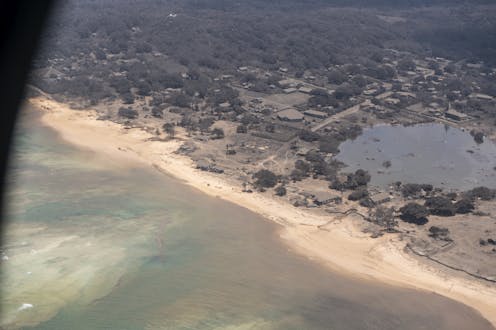
The enormous eruption of the underwater volcano in Tonga, Hunga Tonga-Hunga Ha’apai, triggered a tsunami that reached countries all around the Pacific rim, even causing a disastrous oil spill along 21 beaches in Peru.

In Tonga, waves about 2 metres high were recorded before the sea level gauge failed, and waves of up to 15m hit the west coasts of Tongatapu Islands, ‘Eua, and Ha’apai Islands. Volcanic activity could continue for weeks or months, but it’s hard to predict if or when there’ll be another such powerful eruption.

Most tsunamis are caused by earthquakes, but a significant percentage (about 15%) are caused by landslides or volcanoes. Some of these may be interlinked – for example, landslide tsunamis are often triggered by earthquakes or volcanic eruptions.

But does climate change also play a role? As the planet warms, we’re seeing more frequent and intense storms and cyclones, the melting of glaciers and ice caps, and sea levels rising.
Climate change, however, doesn’t just affect the atmosphere and oceans, it affects the Earth’s crust as well.

Climate-linked geological changes can increase the incidence of earthquakes and volcanic eruptions which, in turn, can exacerbate the threat of tsunamis. Here are five ways this can happen.

1. Sea level rise

If greenhouse gas emissions remain at high rates, the average global sea level is projected to rise between 60 centimetres and 1.1m. Almost two thirds of the world’s cities with populations over five million are at risk.

Rising sea levels not only make coastal communities more vulnerable to flooding from storms, but also tsunamis. Even modest rises in sea level will dramatically increase the frequency and intensity of flooding when a tsunami occurs, as the tsunami can travel further inland.

For example, a 2018 study showed only a 50 centimetre rise would double the frequency of tsunami-induced flooding in Macau, China. This means in future, smaller tsunamis could have the same impact as larger tsunamis would today.

2. Landslides

A warming climate can increase the risk of both submarine (underwater) and aerial (above ground) landslides, thereby increasing the risk of local tsunamis.

The melting of permafrost (frozen soil) at high latitudes decreases soil stability, making it more susceptible to erosion and landslides. More intense rainfall can trigger landslides, too, as storms become more frequent under climate change.

Tsunamis can be generated on impact as a landslide enters the water, or as water is moved by a rapid underwater landslide.


Read more:
Waves from the Tonga tsunami are still being felt in Australia – and even a 50cm surge could knock you off your feet


In general, tsunami waves generated from landslides or rock falls dissipate quickly and don’t travel as far as tsunamis generated from earthquakes, but they can still lead to huge waves locally.

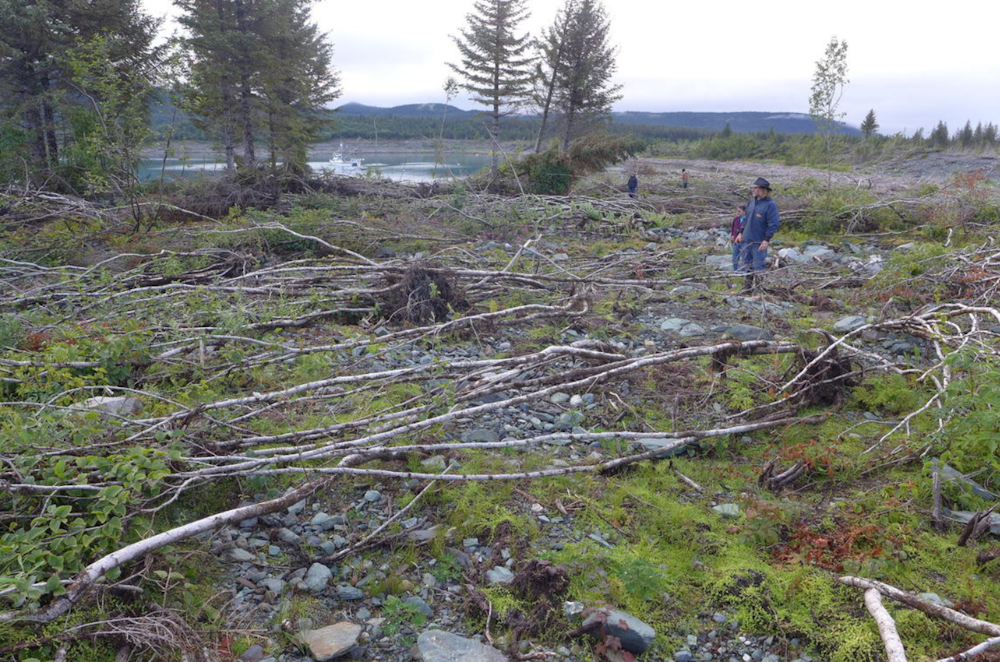
In Alaska, US, glacial retreat and melting permafrost has exposed unstable slopes. In 2015, this melting caused a landslide that sent 180 million tonnes of rock into a narrow fjord, generating a tsunami reaching 193m high – one of the highest ever recorded worldwide.

Scientists survey damage from a megatsunami in Taan Fiord that had occurred in October, 2015 after a massive landslide.
Peter Haeussler, United States Geological Survey Alaska Science Center/Wikimedia

Other areas at risk include northwest British Columbia in Canada, and the Barry Arm in Alaska, where an unstable mountain slope at the toe of the Barry Glacier has the potential to fail and generate a severe tsunami in the next 20 years.

3. Iceberg calving and collapsing ice shelves

Global warming is accelerating the rate of iceberg calving – when chunks of ice fall into the ocean.

Studies predict large ice shelves, such as the Thwaites Glacier in Antarctica, will likely collapse in the next five to ten years. Likewise, the Greenland ice sheet is thinning and retreating at an alarming rate.

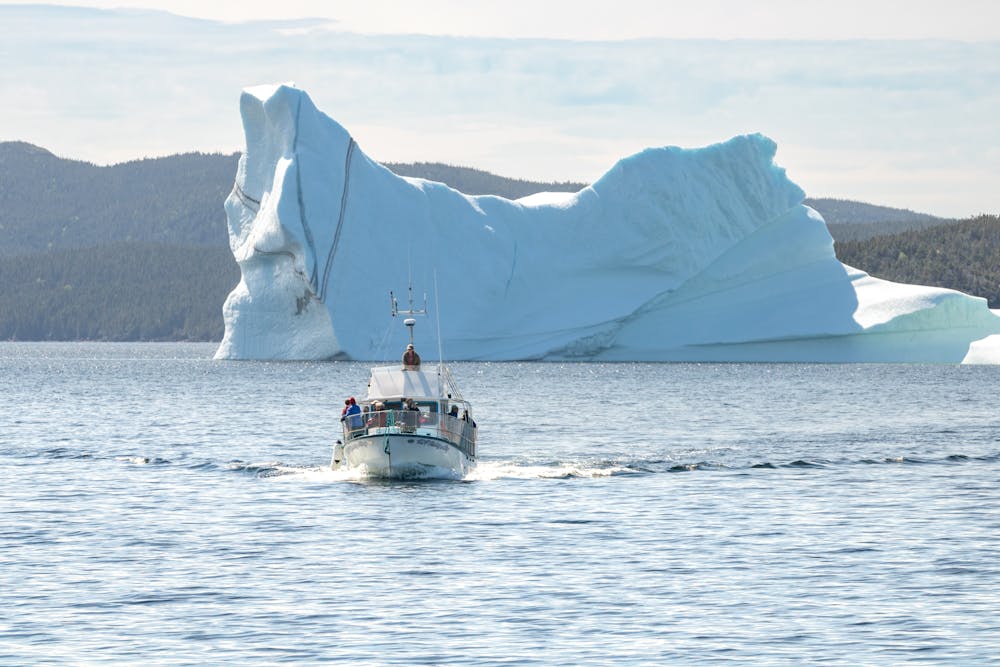
Iceberg near ship
Icebergs colliding with the seafloor can trigger underwater landslides.
Shutterstock

While much of the current research focus is on the sea level risk associated with melting and collapse of glaciers and ice sheets, there’s also a tsunami risk from the calving and breakup process.

Wandering icebergs can trigger submarine landslides and tsunamis thousands of kilometres from the iceberg’s original source, as they hit unstable sediments on the seafloor.

4. Volcanic activity from ice melting

About 12,000 years ago, the last glacial period (“ice age”) ended and the melting ice triggered a dramatic increase in volcanic activity.

The correlation between climate warming and more volcanic eruptions isn’t yet well constrained or understood. But it may be related to changes in stress to the Earth’s crust as the weight of ice is removed, and a phenomenon called “isostatic rebound” – the long-term uplift of land in response to the removal of ice sheets.

If this correlation holds for the current period of climate warming and melting of ice in high latitudes, there’ll be an increased risk of volcanic eruptions and associated hazards, including tsunamis.

5. Increased earthquakes

There are a number ways climate change can increase the frequency of earthquakes, and so increase tsunami risk.

First, the weight of ice sheets may be suppressing fault movement and earthquakes. When the ice melts, the isostatic rebound (land uplift) is accompanied by an increase in earthquakes and fault movement as the crust adjusts to the loss of weight.

We may have seen this already in Alaska, where melting glaciers reduced the stability of faults, inducing many small earthquakes and possibly the magnitude 7.2 St Elias earthquake in 1979.

Another factor is low air pressure associated with storms and typhoons, which studies have also shown can trigger earthquakes in areas where the Earth’s crust is already under stress. Even relatively small changes in air pressure can trigger fault movements, as an analysis of earthquakes between 2002 and 2007 in eastern Taiwan identified.

So how can we prepare?

Many mitigation strategies for climate change should also include elements to improve tsunami preparedness.

This could include incorporating projected sea level rise into tsunami prediction models, and in building codes for infrastructure along vulnerable coastlines.

Researchers can also ensure scientific models of climate impacts include the projected increase in earthquakes, landslides and volcanic activity, and the increased tsunami risk this will bring.


Read more:
What causes a tsunami? An ocean scientist explains the physics of these destructive waves


The Conversation

Jane Cunneen does not work for, consult, own shares in or receive funding from any company or organization that would benefit from this article, and has disclosed no relevant affiliations beyond their academic appointment.

ref. 5 ways climate change increases the threat of tsunamis, from collapsing ice shelves to sea level rise – https://theconversation.com/5-ways-climate-change-increases-the-threat-of-tsunamis-from-collapsing-ice-shelves-to-sea-level-rise-175247

Covid-infected PNG doctor arrested in Solomon Islands as border crosser

By Gorethy Kenneth in Port Moresby

A Papua New Guinean doctor, who is alleged to be covid-19 positive, has been arrested and charged in Solomon Islands for illegally crossing the border.

The doctor, from Bougainville and employed at Nonga Provincial Hospital in East New Britain province, was arrested and charged in the Solomon Islands capital, Honiara, for illegally crossing, authorities from both countries have said.

Solomon Island Prime Minister Manasseh Sogavare made reference to the case in a statement he had made, saying the doctor was now being quarantined.

Sogavare had, in his covid-19 update address to Solomon Islands on January 18, said: “…according to our contact tracing information, the index case that brought in the infection to Pelau is a medical doctor from Papua New Guinea who hails from Tasman Island and has traditional ties with the people of Pelau.

“This doctor with nine other people, including members of his family crossed the border illegally from Tasman to come to Paleu on 9th January 2022 and it is quite disturbing that such a highly qualified person a medical doctor, blatantly disregarded our laws, breached our covid-19 regulations, and crossed our border illegally.”

“He has now started a community transmission of covid-19 to his relatives and people in Pelau.

“It is extremely disappointing that the relatives of this doctor in Pelau completely disregarded the instructions from the government to not allow any person from the other side of the border to land at or stay in any of their villages and homes.

“By allowing the doctor to enter the village they have provided the platform to start the community transmission of covid-19 in Pelau.

In this regard the relatives of this doctor have also breached the covid-19 by allowing this doctor and his family to land and stay in Pelau and started the community transmission of covid-19.”

Confirmed by Bougainville
Autonomous Bougainville Government Health Secretary Dr Clement Totavun has confirmed that the doctor, from Tasman Island, works at Nonga Hospital, and travelled to Bougainville during Christmas, got on a ship to Tasman and then on to Pelau in Solomon Islands.

“I have been advised by my covid-19 team that this is true.

“The doctor from Tasman who works at Nonga General Hospital, Rabaul, came here during Christmas and got on the ship to Tasman and on to Pelau,” Dr Totavun said.

“He was arrested by Solomon Island police for crossing the border, which is currently closed, and is currently in Honiara. Doctors at Honiara Hospital have contacted our CEO Buka Hospital and confirmed.

“I have alerted our surveillance team to check out Tasman in the coming week as the virus might be spreading there,” Dr Totavun said.

Buka Hospital chief executive officer Dr Tommy Wotsia told the Post-Courier he was advised of the reports.

Traditional border crossing banned
Traditional border crossing between Bougainville and Solomon Islands has been banned since November last year following claims that Bougainvilleans had been smuggling arms into that country to arm and train Malaita islanders seeking to overthrow the Sogavare government.

Bougainville Police Commissioner Francis Tokura said he confirmed with Solomon Islands police about the incident but could not elaborate further.

Nonga Hospital chief executive officer Dr Ako Yap and his deputy Dr Patrick Kiromat also confirmed the doctor was working with them and had been on holiday since December.

They said they had not been officially notified of the incident involving the doctor in Honiara but said he was due to return to work soon.

Gorethy Kenneth is a senior journalist on the PNG Post-Courier. Republished with permission.

Print Friendly, PDF & Email

Article by AsiaPacificReport.nz

Honour and masculine pride for the country: how the Bollywood sports biopic 83 furthers India’s nationalist cause

Source: The Conversation (Au and NZ) – By Radhika Raghav, Sessional Lecturer and Tutor in Gender Studies and Sociology, University of Otago

IMDB

Contemporary Bollywood films tend to focus on stories of the Indian underdog emerging triumphant after facing adversity or a threat from an “outsider”: the triumph of the charismatic masculine Hinduised hero who fulfils his duty, saves the nation and reclaims India’s lost pride.

This isn’t a new phenomenon. Bollywood’s formula of promoting nationalist rhetoric via glorification of past heroes or events can be traced back to the early years of the Marathi theatre.

In the 19th century, Marathi theatre staged historical events still within living memory: re-telling stories of the great Maratha Empire, which covered much of the Indian subcontinent from 1645 to 1818.

With the subcontinent under British rule, popular plays furthered the calls of the “extremist” political leader Bal Gangadhar Tilak (1856-1920) for swaraj, or self-rule. The ever-present Maratha past became a major source of inspiration for the playwrights and served the cause of emergent Hindu nationalism.

Today, Bollywood is demonstrating a renewed purpose of creating new national myths, and it is on full display in the new film 83, a sports biopic based on India’s first win at the cricket world cup in 1983.

We follow the team in the months leading up to their defeat of the West Indies at Lord’s Cricket Ground in London under new captain Kapil Dev (Ranveer Singh).

A team of seemingly inglorious young Indian men emerge victorious on the cricket field in a film about regaining honour and masculine pride for the country.

It is a film about much more than just the 1983 world cup. Like a propagandist tool, 83 draws on the rich sport tradition of India and serves the nationalist cause.

Sports, the final frontier of masculinity

This celebration of the nationalist cause is most visible in 83’s representation of gender.

At the centre of the film is team captain Kapil Dev, a popular sports hero of the 80s. His authenticity and gentlemanly demeanour warrant affection from people of all ages, and the film shows his masculinity acting as a stabilising force for the nation in flux.

But also inherent in this masculine ideal is a belief in the Hindu nationalist vision of hegemonic masculinity: a belief in the “normality” of men’s subordination of women and other minorities.


Read more:
Indian men are swapping ‘tall, dark and handsome’ for ‘tall, fair and debonair’


83 celebrates the boys club with masculine banter. Each player is focused on proving their masculine status as an ideal son who wants to make his father proud; a responsible husband who protects and provides for his wife; and, most importantly, a worthy son of the motherland the whole nation reveres.

Four Indian men at a pub.
The banter of the boys club is celebrated throughout 83.
IMDB

The players are often called “freedom fighters” to underline their combative spirit, and Kapil Dev’s iconic bat is referred to as his “sword”: politically charged language which reverbs in calls from some Hindu leaders for Muslim genocide.

The female ideal is also depicted according to the nationalist view: Indian women should be dignified, docile and a possessor of superior spirituality.

Kapil Dev’s wife, Romi (Deepika Padukone), is a morale booster. She is a virtuous cheerleader who remains subordinate. Her responsibility is to remind the dispirited Kapil of the importance of his duty as she asks him to “play for that little boy inside you”.

Three cricketers in front of the Indian flag.
There is never any doubt as to which team the audience should be cheering on.
IMDB

This trope of the little boy, who embodies and helps channel the hopes and dreams of a young nation, is exploited throughout the film. This boy lends an air of innocence and purity to the cause of winning.

The audience is called on to align with his hopes and disappointment – and ultimately support the Indian heroes out there to win.

Typical of nationalist rhetoric, 83 depicts rival teams and other nationalities as caricatures. West Indies fans are invariably seen wearing bright prints and dancing to African drums – the Indian fans let go of differences and unite to support the team. The West Indies’ cricketers are chewing gum – the Indians are routinely speaking to their families on long distance calls.

This stereotyping aligns more with the current brand of Hindu nationalism, and less with the country’s dynamism of the 1980s.

Brand nationalism

Globally, Bollywood provides a lens to understand Indian culture and has proved to be India’s most effective soft power in maintaining diplomatic ties.

But in India, Bollywood often acts as an agent of the ideological work of the far-right nationalist government. Biopics and period films emphasise the cult of personality and celebrate patriotic feats.

Given the growing spectacle of communal violence in India and the increased popularity of depicting Bollywood heroes as mercenaries, one ought to question what 83 says to and about the audience.

83 is not simply a retelling of the story of a sports team. It is a product of both the emerging brand nationalism and Bollywood’s tapping into the political zeitgeist.

With its celebration of Hindu masculine power, 83 feels like a film which is working to win consent for the populist and controversial leader Narendra Modi
– and make the audience more susceptible to political manipulation and control.


Read more:
As pressure builds on India’s Narendra Modi, is his government trying to silence its critics?


The Conversation

Radhika Raghav does not work for, consult, own shares in or receive funding from any company or organization that would benefit from this article, and has disclosed no relevant affiliations beyond their academic appointment.

ref. Honour and masculine pride for the country: how the Bollywood sports biopic 83 furthers India’s nationalist cause – https://theconversation.com/honour-and-masculine-pride-for-the-country-how-the-bollywood-sports-biopic-83-furthers-indias-nationalist-cause-174783

‘No silver bullet against omicron’ – expect big numbers, says Hipkins

RNZ News

People should do everything they can against omicron, but it is likely large numbers will be infected, New Zealand’s Covid-19 Response Minister says.

Speaking to RNZ Morning Report today, Chris Hipkins said masks, booster shots, isolating and good preparation for isolation were all vital steps people should take to slow the spread of the virus.

But “the cat is out of the bag to some extent, and we know that we’re likely to see more cases, and potentially significantly more cases associated with these ones.

“There’s no silver bullet we are going to experience a large number of cases.”

The entire country is now in the red Covid-19 Framework setting, with the news announced yesterday that omicron is likely spreading in the community.

“There are some unavoidable realities about this, and one of those unavoidable realities is that we will see omicron spreading much more quickly than previous variants of the virus,” Hipkins said.

Booster vaccinations were going strongly, he said, but there was still a chunk of those eligible who weren’t getting them as soon as they could.

“Our main message is once you’re eligible come forward and get your booster dose.”

Covid-19 vaccination providers have been warned to prepare for high demand today in response to the news of omicron spread in the community, and have been asked to consider staying open late to meet demand.

“We do know from our delta experience that when an outbreak is happening or is imminent, that drives a lot more [vaccinations].”

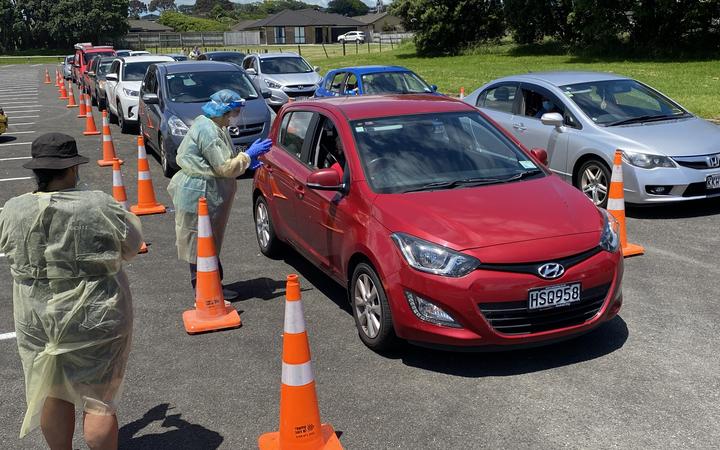
Anxious locals queue for nasal swabs in Bell Block.
Queues for testing in Bell Block, Taranaki, in December. Image: RNZ/LDR

Making people eligible for the booster three months after their second Covid-19 shot, rather than the current four months would only shift about 100,000 people forward, Hipkins said, and while it had been considered, the benefit was not considered worthwhile at this stage.

Testing strategy shifts expected

Hipkins said it was expected that as the situation changed, the public will be asked to make changes in their response.

In this future this was likely to include whether those experiencing symptoms get tested.

Right now, Hipkins said, the government wanted everyone to continue to get tested if they had any cold or flu symptoms, or if they were a contact. But if daily case numbers rose considerably not everyone would be tested.

“A lot more people will get it, but many of those people — particularly those who’ve been boosted … are likely to be able to recover by staying at home,” he said.

“There will be some … further down the line … that we’ll be saying: ‘Don’t worry about getting tested … just stay home and get better’.”

National Party leader Christopher Luxon told Morning Report the 4.6 million rapid antigen test kits (RATs) currently in the country was an alarmingly low number and the government should have acted sooner to stockpile them and authorise private importing.

Christopher Luxon at a public meeting in Nelson
National Party leader Christopher Luxon… “We need [rapid antigen test kits] now, and we needed them months ago.” Image: Samantha Gee/RNZ

“We need them now, and we needed them months ago. Now we’re in a place where it’s quite an urgent situation,” Luxon said.

“Many countries … you actually upload the result of your rapid antigen test you do at home … and that’s how the government tracks what’s actually happening with cases.”

Hipkins said there were widespread international issues with RAT supplies; “Countries that are relying on them are now running out.”

But before Christmas the government had begun efforts to purchase as many as possible

“We know that as this situation unfolds we’re going to want to use rapid antigen testing a lot more.”

Luxon said the National party supported the government’s shift to the red framework setting “reluctantly”.

But he said the government must act more quickly at adopting international learning in how to respond to the virus: “We’ve got to keep going forward.”

He said once daily case numbers rose drastically, managed isolation and quarantine facilities (MIQ) at the border could become redundant. If that happens, National want the government to reconsider MIQ, and in particular to allow all New Zealanders overseas to return without having to go through it.

Mask use tutorials
Hipkins said experts strongly advised surgical masks were still the best for the public to use, and: “We’ve got plenty of those available.”

He said while testing showed N95 masks were more effective against Covid-19, in real world application it was not that simple.

“An N95 mask needs to be the right fit, otherwise it can be potentially less effective. If you buy the wrong shape or the wrong size and it doesn’t sit properly, then actually the extra protection that you could be getting from that – you won’t necessarily get that.”

The country has plenty of N95 masks for health workers and frontline workers in stock, and they were given professional fitting tutorials and had their fit checked by others.

Hipkins said the government would enact any new advice around masks and omicron quickly as it came in, but research on masks was still evolving.

Hipkins did not have any new updates on the Nelson Tasman region cluster of cases at this stage.

This article is republished under a community partnership agreement with RNZ.

Print Friendly, PDF & Email

Article by AsiaPacificReport.nz

NZ to move to red light setting tonight at midnight over omicron outbreak

RNZ News

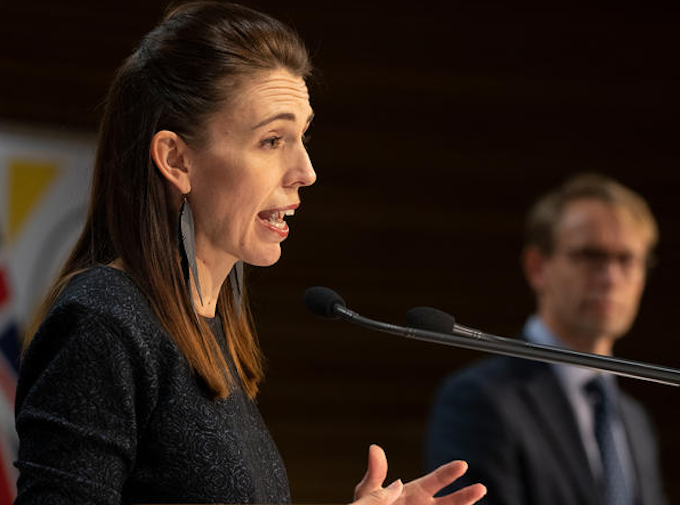
Prime Minister Jacinda Ardern has confirmed that the whole of New Zealand will move into the red light covid-19 setting at midnight Sunday night (January 23, 2022) in response to the covid-19 pandemic.

Nine covid-19 cases in Nelson yesterday have been confirmed as the omicron variant, Ardern said.

Another household member has since tested positive.

They are one family and recently attended a wedding and other events in Auckland and there is no clear link to the border.

Ardern said there were well over 100 people at these events.

The family was on the same flight as an Air New Zealand flight attendant who tested positive. All members of the family who were eligible have been double vaccinated, Ardern said.

“That means omicron is now circulating in Auckland and possibly the Nelson-Marlborough region, if not elsewhere,” Ardern said.

Focus on slowing the spread
Ardern said the focus is on slowing the spread of the omicron variant and the strategy includes rapid tests, contact tracing and isolating cases and contacts.

New Zealand’s system has “significant capacity” to work on stamping out outbreaks due to low case numbers, she said.

Watch the NZ government media briefing today. Video: RNZ News

“We know we will see far more cases than we have in the two years to date, but the difference to previous outbreaks is we are vaccinated and we are better prepared.”

Ardern encouraged New Zealanders to get their boosters saying it will help limit the spread and limit the likelihood of someone getting sick or needing to go to hospital.

She also encouraged parents and caregivers to seek out information about vaccines for their children.

Already, 20 percent of children aged 5-11 have been vaccinated or are booked to receive their vaccination.

Red light setting
Ardern reminded people the red light settings was not a lockdown.

She said it had restrictions, but business was still open, gathering numbers were reduced and differed depending on whether people were vaccinated or not.

Hospitality was seated and required a single server.

She said schools remained open, with mask wearing for everyone from year 4 upwards.

Ardern said school ventilation systems would be assessed.

Ardern encouraged households to have a “buddy” to help with food, for example, if someone in a household was unwell from covid-19.

The government had been preparing for three stages in its response to omicron, Ardern said.

Phase one includes the period up to 1000 cases a day or less. This is expected to take up to 14 days to arrive, and involves a “stamping-out approach”, she said. That includes contact tracing, isolation and testing anyone with symptoms at a community testing station or primary health provider. PCR tests will be used, but rapid antigen tests will also be rolled out to these providers.

In stage one people will need to isolate for 14 days if they are a case or a contact.

Stage two is a transition stage where the system is adjusted to identifying those at greater risk of omicron and where there is the greatest risk of severe illness from omicron.

When asked, Ardern said her wedding would not be going ahead under the red setting.

Ardern said New Zealand was not likely to enter stage three for a few weeks.

Stage three will involve changes to contact tracing. It will include the definition of contacts and isolation requirements and more details will be provided on Wednesday.

“It’s important to remember covid is a different foe to what it was at the beginning,” Ardern said.

Because of vaccinations, it would be a mild to moderate illness which could be managed at home, she said.

But she said the “team” still needed to do what it could to slow it down, as some people are immuno-compromised and more vulnerable to the virus.

When asked if cabinet had considered funding N95 masks, Ardern said there would be an assessment on mask advice to consider if there needed to be an update.

The government's Covid-19 site scooped the prime minister's announcement as the press conference began on Sunday.
The government’s covid-19 site scooped the prime minister’s announcement as the press conference began today. Image: RNZ/Covid-19.govt.nz

Risk of undetected omicron transmission ‘high’ – Bloomfield
Director-General of Health Dr Ashley Bloomfield said anyone with symptoms should get tested for Covid-19.

He said the risk of undetected transmission of the omicron variant in Auckland was considered high, because the Nelson family that had tested positive spent time at a wedding there.

New locations of interest will be listed on the Ministry of Health’s website.

There are five Air New Zealand flights that are locations of interest, which include the flights the infected family took, and the flights the flight attendant worked on.

  • Flight NZ5083 from Auckland to Nelson at 5.20pm on 16 January
  • NZ5080 Nelson to Auckland at 4pm on 19 January
  • NZ5077 Auckland to Nelson at 2pm on 19 January
  • NZ5049 Auckland to New Plymouth at 7.50pm on 19 January
  • NZ5042 New Plymouth to Auckland at 1.50pm on 20 January

Contacts who have been at a location of interest were legally required to isolate and get tested as per Section 70, Dr Bloomfield said.

The risk of undetected transmission was judged as being high, as it was unclear how they became infected and they attended a wedding, he said.

As of 11pm last night, 150 of 192 people on the Air New Zealand flights had been contacted by health officials.

Attendees at the wedding have attended other venues with high numbers of people, including a funeral, an amusement park, the Sky Tower and domestic airports.

It is expected the number of cases and contacts will grow, Dr Bloomfield said.

Dr Bloomfield said people who needed medical care could receive it, and urged them to not put it off. Hospitals are at 84 percent occupancy, which was typical at this time of year, and ICU occupancy was under 70 percent.

Wage subsidy scheme for sick/isolating workers – Robertson
Deputy Prime Minister and Minister of Finance Grant Robertson said the economic disruption from the omicron variant was expected to be more on the supply side of things — as seen overseas.

He said the initial focus was on those unable to be at work because they were infected or were a close contact isolating.

Support for these people included the Covid-19 Leave Support Scheme, which was paid at the same rate as the Wage Subsidy Scheme.

There would also be a scheme in place for people unable to work from home when waiting on covid-19 test results.

Robertson said New Zealand could afford the financial support the government was providing — and if anything, cannot afford to not provide it.

He said the country’s debt is lower than expected in part because of the wider covid-19 action taken in New Zealand.

Robertson said the scenario planning shows there could be 350,00 people self-isolating at once at the mid-point scenario planning, which would be with 25,000 cases.

Samoa announces 48-hour lockdown
In Samoa, RNZ Pacific reports that Prime Minister Fiame Naomi Mata’afa had announced the country would be going into lockdown from last night at 6pm until 6pm on Monday evening.

Only essential services would be allowed but all offices and shops, including all public transport, would be closed. Churches were also closed.

“No vehicles will be allowed on the roads during his time and police will be monitoring,” she said.

The prime minister said the decision was to ensure proper measures were in place to avert community transmission.

This article is republished under a community partnership agreement with RNZ.

Print Friendly, PDF & Email

Article by AsiaPacificReport.nz

Microsoft buys Activision Blizzard: with the video game industry under new management, what’s going to change?

Source: The Conversation (Au and NZ) – By Brendan Keogh, Senior Lecturer, Queensland University of Technology

Shutterstock

In 1979, a group of disgruntled Atari employees decided to quit and create their own company. Activision was the world’s first “third-party” game development company, producing and publishing titles for other companies’ platforms.

Fast-forward 43 years and the company that is now Activision Blizzard has been bought by one of the major platform owners in the industry, Microsoft, for a blistering US$68.7 billion dollars (around A$95.6 billion) – the largest sale in the history of the video game industry.

This sale is also massive in terms of the game franchises Microsoft now has control over; it now owns blockbuster franchises such as Call of Duty, Diablo, Starcraft, Candy Crush and World of Warcraft. And tens of millions of fans of these titles will now be wondering: what does this change in ownership mean for them?

Why now?

Big dollar acquisitions aren’t new in the video game industry. Activision Blizzard itself became one of the largest video game companies in 2008, when Activision merged with Blizzard in a US$18.9 billion dollar deal. Microsoft and Sony regularly buy successful pre-existing development studios to take over their intellectual properties (IP) and make them available exclusively on their platforms.

But Microsoft has become particularly aggressive in its approach. In the last decade alone it has made a number of high-profile purchases, including Minecraft developer Mojang in 2014 for US$2.5 billion, and Elder Scrolls and Doom publisher ZeniMax in 2020 for US$7.5 billion. With the Activision Blizzard acquisition, Microsoft is now the third-largest company in the industry, behind TenCent and Sony.

This is all part of Microsoft’s current video game business strategy, which is less about selling game products and more about increasing subscriptions to its Game Pass service. Similar to services like Netflix and Spotify, Game Pass gives subscribers access to a massive digital catalogue of games in exchange for a monthly fee.

In its announcement of the Activision Blizzard purchase, Microsoft also boasted Game Pass has surpassed 25 million users. With each user paying US$16 a month, that’s about US$400 million (or A$556 million) in monthly revenue.

With Activision Blizzard, Microsoft now owns a huge new range of franchises it can make available through Game Pass, attracting even more users.

While Microsoft owns Activision Blizzard, players can still play the company’s games on other consoles and platforms such as Sony’s PlayStation or Valve’s Steam, but it remains to be seen if this will continue.
Shutterstock

Gaming landlords

If it wanted, Microsoft might even make these franchises only available through Game Pass, forcing customers away from other consoles like PlayStation and distribution platforms like Steam. In other words, it could pull consumers into its own exclusive sphere.

This is now a common strategy. Now, through subscription-based digital platforms, we have all stopped being owners of product and instead have become renters.

This is also true of individual video games. Call of Duty, Hearthstone, Fortnite (and many others) are no longer games that players purchase once, but are instead their own ecosystems in which players are encouraged to continuously spend money on battle passes, cosmetics and access to new content.

Meanwhile, the companies that own these titles can constantly farm new data from their millions of players, further increasing their company value.

With the purchase of Activision Blizzard, Microsoft has effectively purchased a city of existing renters in the player ecosystems of Call of Duty, Hearthstone, World of Warcraft and many other titles.

That’s tens of millions of players already committed to closed ecosystems, including many in the difficult-to-penetrate Chinese market playing Blizzard titles Hearthstone and World of Warcraft. All of these players can be farmed for more personal data and more rent.


Read more:
The war between Xbox and Playstation is no longer about consoles. It’s about winning your loyalty


So what does it mean for players and developers?

In the short term, probably not a whole lot.

Over the coming years, however, Microsoft might decide to keep more of these newly acquired franchises for its own platforms. For a PC player, this might simply mean having to transition away from Steam to the Microsoft Game Store if they want to access the franchises: an inconvenience, but hardly a radical change.

For PlayStation and Mac players, the situation could be more dire, and they might find themselves having to purchase a PC or an Xbox if they want to play new entries to these franchises in the future.

Some are also worried ongoing giant mergers will stifle creativity and innovation across the video game industry. But this is unlikely since the bulk of the revenue generated by the industry has always been concentrated in a relatively small number of risk-adverse companies.

In her book Global Games, researcher Aphra Kerr estimated that in 2015, the top ten video game companies accounted for 49% of the entire industry’s revenue. In spite of this concentration of capital, the creativity and innovation that produces new genres almost always emerges at the periphery, in much smaller, independent groups working with far fewer resources.

The explosion of new and diverse genres we’ve seen over the past decade occurred, in large part, because independent creators are now able to access far more powerful tools, such as game engines Unity and Unreal, and greater audiences through digital marketplaces, such as Steam or Xbox Game Pass.

The situation is far from ideal, but the companies that control most of the capital in the video game industry – and the companies that are the most innovative – have rarely been the same. So this latest acquisition is unlikely to stifle creativity.

But there’s more at stake in this historic sale. Activision Blizzard is facing accusations and lawsuits of harassment, abuse and sexism across its offices, and CEO Bobby Kotick has been under intense pressure to resign for months. Kotick is now set to walk away from the company with US$400 million; the allegations of a toxic workplace are now Microsoft’s responsibility to clean up.

Perhaps this is the important question coming out of the recent sale: not which piece of hardware will have access to which games, but whether Microsoft will take responsibility for improving the work culture and working conditions for game developers? We’ll have to wait and see.


Read more:
Activision Blizzard’s sexual harassment scandal is not a one-off for the gaming industry


The Conversation

Brendan Keogh has previously received funding from the Australian Research Council.

ref. Microsoft buys Activision Blizzard: with the video game industry under new management, what’s going to change? – https://theconversation.com/microsoft-buys-activision-blizzard-with-the-video-game-industry-under-new-management-whats-going-to-change-175433

Ancestral Remains of First Nations people were once stolen for trophies. Now they will have a national resting place

Source: The Conversation (Au and NZ) – By Heidi Norman, Professor, Faculty of Arts and Social Sciences, University of Technology Sydney

First Nations people please be advised this article speaks of racially discriminating moments in history, including the distress and death of First Nations people.

In early January, the prime minister and minister for Indigenous Australians announced their government would build a National Aboriginal and Torres Strait Islander Cultural Precinct. The precinct will be known as “Ngurra”, a word meaning home, a place of belonging, inclusion.

The Ngurra precinct will encompass a new National Resting Place. The Resting Place will serve as a site for the care of Ancestral Remains returning from collections in Australia and around the globe whose cultural groups are unknown and are unable to make the journey home to Country.

The National Resting Place will be unique in the world, incorporating aspects of a memorial, repository, educational facility and research institute, but transcending all of these. For Indigenous people, it will provide an Indigenous-centred place to visit, care for and honour Ancestors.

The National Resting Place will also provide an opportunity for non-Indigenous Australians to reflect on the history and impact of their knowledge systems, laws, moral standards and practices in relation to Indigenous peoples.


Read more:
Mungo ancestral remains reburial proposal disrespects the Elders’ original vision


The Ngurra Precinct has the potential to be transformative in assisting our nation to discover a new perspective on what it means to be Australian.

As Ken Wyatt is the first Indigenous person to occupy the position of minister for Indigenous Australians, this is a significant legacy of his tenure. The National Resting Place is also a culmination of the work by generations of Indigenous peoples to stop the theft of bodies and advocate for the repatriation of thousands of remains stored in institutions around the world so they can be returned home.

Why a National Resting Place for Ancestral Remains?

Over a period spanning more than 200 years, Indigenous remains were collected as trophies of empire, in the interest of science and anthropology, and as “curios” of a supposedly dying race. Thousands of Ancestral Remains were exhumed without the consent of their descendants, in practices that went against the laws and moral codes for the treatment of deceased Europeans.

Historical reasoning for the collection of Ancestral Remains in Australia include:

“Discovery”

From 1770 onwards, the collection of Aboriginal remains was informed by ideas aligned with science and “discovery”. The collection and classification of people, plants and animals that occurred on expeditions of scientific discovery and empire expansion contributed to ideas of European “superiority”.

Imperialism

Aboriginal bodies also became “trophies of empire”. Leaders of First Nations’ resistance, such as the Pemulwuy and Yagan, were beheaded and their heads were sent to the United Kingdom. First Nations peoples’ Ancestral Remains were displayed by some frontier families on mantlepieces or used as cranial sugar bowls and ashtrays. The perception of Ancestral Remains as “rare” also contributed to their appeal to collectors and their market value in auction houses, where they were viewed as commodities.

“Racial science”

The increase in collecting First Nations peoples’ remains from the 1850s was also propelled by the rise in racial “science”. Overseas interest in Ancestral Remains stemmed largely from notions of a hierarchy of race, which perceived Indigenous Australians to be at or near the bottom of the racial order.

This mindset continued to cause harm throughout the 20th century. Despite growing condemnation of racial “science”, collecting of Ancestral Remains continued after the second world war.


Read more:
Will your grandchildren have the chance to visit Australia’s sacred trees? Only if our sick indifference to Aboriginal heritage is cured


The post-war era

In the wake of the second world war, atrocities committed in the name of science and eugenics reverberated throughout scientific institutions. Collections of Ancestral Remains had been carefully classified before. But after the war, they were bundled together in crates and boxes. This contributed to a further loss of the provenance and records of Ancestral Remains.

The DNA era

From around the late 1980s, Aboriginal remains held in collections were defended on the grounds they were of scientific interest. Breakthroughs in dating technologies offered the possibility of extracting scientific information about human evolution over longer timeframes, and the human genome project sought to provide a complete genetic blueprint of humanity.

Where earlier interest in Ancestral Remains sought to prove theories of evolution and racial hierarchy, scientists from the late 20th century argued their research would prove beneficial for the entire human race.

A key debate emerged in this period between some scientists and Indigenous people, who asserted their right to bury their ancestors.


Read more:
Friday essay: grief and things of stone, wood and wool


Decolonisation and recognition

By the 1970s, Aboriginal people were organising locally and nationally for land and a “rightful place” in the political life of the nation.

Independent Aboriginal organisations such as the since-disbanded Aboriginal and Torres Strait Islander Commission (ATSIC) and the Foundation for Aboriginal and Islander Research Action (FAIRA) were critical in advocating for the return of Ancestral Remains.

Calls for repatriation posed significant provocations to the history, role and purpose of collecting institutions. This led to the development of protocols and policies guiding repatriation in the 1980s.

The return of Ancestral Remains is now widespread, with many repatriations negotiated with community and family of origin. However, many remains are yet to find their way home. The precise number of Ancestral Remains in institutional and private collections has been difficult to determine.

Collections continue to be revealed, with recent information coming to light about Ancestral Remains in India and Russia, along with unknown numbers held in private collections around the world. Recent research commissioned by AIATSIS, and yet to be published, counted tens of thousand of remains awaiting return from public institutions in Australia and the world.

Ngurra’s National Resting Place will serve as an initial landing place for Ancestral Remains on their journey home. The National Resting Place will support community-led research to achieve the identification and repatriation of these remains, aiding their return to Country where possible.

Removed Ancestral Remains are powerful reminders of the historical dehumanisation, objectification and commodification of Indigenous peoples. The National Resting Place will enable this story to be more fully understood.

The story of the ideas and practices that informed the stealing of Indigenous bodies, as well as the long struggle by First Nations peoples to bring their Ancestors home, will finally gain national recognition through the Ngurra precinct.

The Conversation

Heidi Norman received funding from AIATSIS to write a history of the ideas for a national resting place. She is a member of AIATSIS and on the editorial board of their journal, Australian Aboriginal Studies (AAS).

Anne Maree Payne received funding from AIATSIS to examine truth-telling and the National Resting Place in the context of public infrastructure around the world dealing with trauma and respecting the deceased.

ref. Ancestral Remains of First Nations people were once stolen for trophies. Now they will have a national resting place – https://theconversation.com/ancestral-remains-of-first-nations-people-were-once-stolen-for-trophies-now-they-will-have-a-national-resting-place-174537

There have always been arguments about who gets what: the surprising history of Australia’s honours system

Source: The Conversation (Au and NZ) – By Karen Fox, Senior Research Fellow at the National Centre of Biography, Australian National University

www.shutterstock.com

Australia Day honours will be announced this week, and, if recent announcements are any indication, they are likely to generate considerable public debate.

In 2014, there was the reestablishment of knighthoods and damehoods in the Order of Australia under then prime minister Tony Abbott. The next year, Prince Philip was infamously awarded one of the revived titles.

The past decade has seen increasing scrutiny of the gender balance in the awards, while individual honours, such as those given to writer Bettina Arndt and tennis champion Margaret Court, have also drawn criticism.

This is not necessarily out of keeping with the longer history of the honours system. Australians have long been arguing about both the shape of the honours system, and how it ought to be used.

In my new book, Honouring a Nation, I provide the first detailed history of honours in Australia, from the First Fleet to 2021.

Should Australia have titles?

Australians have always been ambivalent about having an honours system that sets some people above others.

In particular, the question of whether titles of honour — like knighthood and damehood — are appropriate in an egalitarian democracy has been a mainstay of debates. A common argument in the Australian colonies before Federation was that such titles did not belong here. As the South Australian Kapunda Herald put it in 1890,

titular distinctions are not in sympathy with the spirit of young democracies, in which the reputation of known achievements is the most, if not the only, valued one.

Opposition to titles was not merely rhetorical. David Buchanan, a member of the New South Wales House of Assembly, tried on several occasions to get the house to pass resolutions against them. In April 1884, for instance, he made an unsuccessful motion that granting titles was

inconsistent with the spirit of our democratic institutions, and ought to be discontinued.

Of course, not everyone agreed — particularly if titles were merited rewards for real service or achievement, which might inspire others. Rockhampton’s Morning Bulletin in 1887, for example, considered it entirely appropriate

[t]o mark out a man who has distinguished himself above his fellows in the public service […] because it provokes emulation.

Women under-recognised

The paper’s reference to “a man” was not coincidental. In the 19th century, women were largely ineligible to receive honours or titles in their own right. By the final years of the century, some were advocating for this to change.

With the establishment of the Order of the British Empire — created in Britain as a means to reward the war services of the population in 1917 — women began to enter the honours system in significant numbers. Australians, too, received this new honour, as Australians received awards solely through the British system until 1975, when the Order of Australia was established.

Women sitting in a meeting.
Concerns about women’s under-representation in honours are more than 100 years old.
www.shutterstock.com

Eerily familiar complaints about women’s poor treatment in honours lists were soon appearing, however. In 1930, Australian newspapers reported protests from women’s activists in Britain, who argued aviator Amy Johnson wasn’t given an award commensurate with her achievement of flying solo from England to Australia. The Women’s Freedom League described this as “inadequate and inappropriate”, while also expressing “disappointment” that “so few honors have been conferred on women”.

Such criticisms have been increasingly evident in Australia in recent years. In 2017, lobby group Honour a Woman was established to seek gender parity in the system.

While there is still some way to go, there have been signs of change. The proportion of recipients who are women has increased from 21% of the total in 1975 to 42% in 2020. And in June 2018 women outnumbered men in appointments to the highest grade, the Companion (AC), for the first time.

What type of service gets honoured?

One factor explaining women’s unequal experience of the honours system has been the tendency for local community service to be rewarded at the lower levels of the system. Meanwhile, contributions in professional fields like politics and business, which have historically been dominated by men, tended to attract higher-level awards.


Read more:
Whitlam didn’t really end our old honours system. We’re still handing Orders of Australia to the wrong people


Calls for better recognition of community work, and especially volunteers, are a common thread in conversations about honours. Research conducted for a federal government review of the system in 1995, for instance, showed Australians wanted the system to reward those who served the community, acted with heroism, or achieved medical or scientific advances – rather than those who simply did a prominent job.

Others across the decades have expressed their desire to see particular occupational fields attract more awards. Teachers, doctors and nurses, clergy, and those in the arts — as well as, more recently, those working on the COVID-19 frontlines — are among those who have been suggested at various times to deserve greater numbers of honours.

When the Queen visited in 1954

One of the most distinctive aspects of Australia’s experience of honours was the divide over their use between Labor and non-Labor parties for many years. While non-Labor governments regularly recommended Australians for British honours prior to the creation of the Order of Australia in 1975, Labor governments tended not to do so.

Queen Elizabeth in Hobart in 1954.
Queen Elizabeth and Prince Philip made a high-profile visit to Australia in 1954.
AP/AAP

This divide led to a short but intense controversy in 1954, during the highly anticipated tour of Australia by Queen Elizabeth II and Prince Philip. As was common during such tours, the Queen issued a number of awards in connection with her visit, including to some involved in organising it.

In Victoria, however, then Labor premier John Cain blocked decorations for royal tour staff in his state. While Cain cited Labor’s “long-standing” policy against imperial honours in explanation, the leader of the Victorian Liberal Party, Henry Bolte, lambasted the decision as “stupid and ridiculous”.

Proxies for larger debates

The history of honours in Australia shows that, both before and after the creation of the Order of Australia as the nation’s own unique honour, Australians have been debating the system’s form, function and fairness.

These debates have often been proxies for other, larger conversations about identity and values, the country’s relationship to its British heritage, and concepts of merit and recognition.

The history of honours is, in many ways, a history of Australia itself.

The Conversation

Karen Fox does not work for, consult, own shares in or receive funding from any company or organisation that would benefit from this article, and has disclosed no relevant affiliations beyond their academic appointment.

ref. There have always been arguments about who gets what: the surprising history of Australia’s honours system – https://theconversation.com/there-have-always-been-arguments-about-who-gets-what-the-surprising-history-of-australias-honours-system-174768

1,100 Australian aged care homes are locked down due to COVID. What have we learnt from deaths in care?

Source: The Conversation (Au and NZ) – By Lyn Gilbert, Honorary Professor Faculty of Health and Medical Science, Univeristy of Sydney; Senior Researcher Sydney Institue for Infectious Disease, University of Sydney., University of Sydney

Shutterstock

Australia’s aged care homes are being devastated by the current wave of COVID infections, with more than 1,100 outbreaks affecting over 7,000 residents and staff. Fear of outbreaks has prompted other homes to lock down and their residents are suffering the serious physical and psychological effects of isolation and, sometimes, inadequate care, due to major staff shortages.

Government responses to last May’s Aged Care Royal Commission’s recommendations have only begun to scratch the surface of longstanding problems in the aged care sector. Major workforce issues remain and responses of aged care providers to the threat of COVID in their facilities are highly variable.

Government decisions about broader community public health can have significant and damaging impacts on the health and well-being of aged care residents and staff.

A high risk group

Early in the COVID pandemic it became clear that residents of aged care homes were at high risk of serious illness and death. During 2020, Australia had a relatively low rate of COVID deaths at 3.6 per 100,000 population. However, three quarters of all deaths (685 of 910) were aged care residents, at a rate of around 309 per 100,000 residents.

Infections and deaths are not the whole story. Independent reviews of COVID outbreaks in agedcare identified other serious adverse effects of lockdowns.

Residents were confined to their rooms and visitors excluded. Family members were often unable to communicate with loved ones for weeks. Staff who were infected or close contacts were replaced by “surge” workers, many of whom had no experience in aged care or infection control. Many residents became depressed, confused, or deconditioned from lack of exercise.

In some homes, remaining staff were overwhelmed by excessive workloads and could not provide adequate care. Some were abused by angry relatives or vilified by the media.

A special report into COVID by the Aged Care Royal Commission, in September 2020, concluded

The COVID-19 pandemic has been the greatest challenge Australia’s aged care sector has faced […] Thousands of residents […] have endured months of isolation which has had a terrible effect on their physical, mental and emotional wellbeing.


Read more:
Older Australians are already bamboozled by a complex home-care system. So why give them more of the same?


What went wrong?

The reviews identified leadership and communication failures, shortages of properly trained staff and poor infection control as major problems – but there was wide variation between homes.

Support from commonwealth and state government agencies was essential during outbreaks – for public health and infection control advice, laboratory testing and staff replacements. But many homes were let down by poor communication and coordination, inadequate planning and preparation and contradictory advice.

elderly woman's hand
Although the special report into what went wrong in aged care during 2020 was damning, conditions have only changed marginally.
Shutterstock

Not much has changed

In response to the Royal Commission’s recommendations, the federal government promised nearly $18 billion in additional funding over five years – a fraction of what was recommended, and most of it yet to be allocated.

Aged care homes must now employ a nurse with approved infection control training, but their responsibilities and ongoing support and training remain undefined. There have been no moves to improve pay, working conditions or training of aged care workers, whose numbers have fallen since 2020.


Read more:
Budget package doesn’t guarantee aged-care residents will get better care


There is a plethora of advice from expert committees and government agencies but little information about how effectively or consistently it is being implemented. To date, about 90% of aged care residents and almost all aged care staff have received two vaccine doses but earlier delays in the vaccine rollout mean many are yet to receive boosters.

Despite improvements, the aged care sector is currently under extreme pressure. The number of homes with COVID outbreaks more than doubled between January 7 and 14.

There have been relatively few deaths, so far, but government assurances that Omicron is not significantly impacting residents’ health, contradicts reports from the frontline. Many facilities are in lockdown, whether or not there is an outbreak and staff shortages are critical.

The serious adverse effects of isolation and neglect are potentially as severe and more widespread than in 2020 and likely to contribute to premature deaths. Unlike cases and deaths from Omicron, they will not be documented as COVID-related but likely attributed to old age or other underlying conditions.

It is not clear whether political leaders who advocated lifting restrictions and “pushing through” the Omicron wave considered the human rights of aged care residents.


Read more:
Grattan on Friday: Scott Morrison’s ministerial team looks far from match-fit


An urgent need for reform and future planning

Measures introduced to protect the community from Omicron have been widely criticised as too little, too late and easing of restrictions too premature. Aged-care residents and other vulnerable groups have been disproportionately affected by the massive surge in community transmission. They will be again, in future waves, unless their needs are considered through more nuanced, proactive strategies than either “let it rip” or lockout/lockdown.

There is an urgent need for the Royal Commission’s recommendations to be fully implemented as soon as possible and for aged care reform to be coordinated with reform of the whole care system: hospitals, aged, disability and primary care, and public health.

The Royal Commission highlighted longstanding deficiencies in the aged care sector, but they can’t be fixed during a crisis. Aged care providers need support to build resilience and ensure service continuity. This will require significant financial commitment from government.

Addressing the aged care staff crisis will require an effective campaign – planned in consultation with frontline workers, managers and clients – to attract workers by offering better pay, conditions, training and career structures.

The Conversation

Lyn Gilbert (and Adj/Professor Alan Lilly) received funding from the Department of Health to undertake independent reviews of COVID-19 outbreaks in residential aged care facilities. The Department had no input into the selection of participants, interviews, survey or workshops conducted during the reviews or analysis and reporting of findings.

ref. 1,100 Australian aged care homes are locked down due to COVID. What have we learnt from deaths in care? – https://theconversation.com/1-100-australian-aged-care-homes-are-locked-down-due-to-covid-what-have-we-learnt-from-deaths-in-care-175141

5 ways climate change boosts tsunami threat, from collapsing ice shelves to sea level rise

Source: The Conversation (Au and NZ) – By Jane Cunneen, Adjunct Research Fellow, Curtin University

Shutterstock

The enormous eruption of the underwater volcano in Tonga, Hunga Tonga-Hunga Ha’apai, triggered a tsunami that reached countries all around the Pacific rim, even causing a disastrous oil spill along 21 beaches in Peru.

In Tonga, waves about 2 metres high were recorded before the sea level gauge failed, and waves of up to 15m hit the west coasts of Tongatapu Islands, ‘Eua, and Ha’apai Islands. Volcanic activity could continue for weeks or months, but it’s hard to predict if or when there’ll be another such powerful eruption.

Most tsunamis are caused by earthquakes, but a significant percentage (about 15%) are caused by landslides or volcanoes. Some of these may be interlinked – for example, landslide tsunamis are often triggered by earthquakes or volcanic eruptions.

But does climate change also play a role? As the planet warms, we’re seeing more frequent and intense storms and cyclones, the melting of glaciers and ice caps, and sea levels rising.
Climate change, however, doesn’t just affect the atmosphere and oceans, it affects the Earth’s crust as well.

Climate-linked geological changes can increase the incidence of earthquakes and volcanic eruptions which, in turn, can exacerbate the threat of tsunamis. Here are five ways this can happen.

1. Sea level rise

If greenhouse gas emissions remain at high rates, the average global sea level is projected to rise between 60 centimetres and 1.1m. Almost two thirds of the world’s cities with populations over five million are at risk.

Rising sea levels not only make coastal communities more vulnerable to flooding from storms, but also tsunamis. Even modest rises in sea level will dramatically increase the frequency and intensity of flooding when a tsunami occurs, as the tsunami can travel further inland.

For example, a 2018 study showed only a 50 centimetre rise would double the frequency of tsunami-induced flooding in Macau, China. This means in future, smaller tsunamis could have the same impact as larger tsunamis would today.

2. Landslides

A warming climate can increase the risk of both submarine (underwater) and aerial (above ground) landslides, thereby increasing the risk of local tsunamis.

The melting of permafrost (frozen soil) at high latitudes decreases soil stability, making it more susceptible to erosion and landslides. More intense rainfall can trigger landslides, too, as storms become more frequent under climate change.

Tsunamis can be generated on impact as a landslide enters the water, or as water is moved by a rapid underwater landslide.


Read more:
Waves from the Tonga tsunami are still being felt in Australia – and even a 50cm surge could knock you off your feet


In general, tsunami waves generated from landslides or rock falls dissipate quickly and don’t travel as far as tsunamis generated from earthquakes, but they can still lead to huge waves locally.

In Alaska, US, glacial retreat and melting permafrost has exposed unstable slopes. In 2015, this melting caused a landslide that sent 180 million tonnes of rock into a narrow fjord, generating a tsunami reaching 193m high – one of the highest ever recorded worldwide.

Scientists survey damage from a megatsunami in Taan Fiord that had occurred in October, 2015 after a massive landslide.
Peter Haeussler, United States Geological Survey Alaska Science Center/Wikimedia

Other areas at risk include northwest British Columbia in Canada, and the Barry Arm in Alaska, where an unstable mountain slope at the toe of the Barry Glacier has the potential to fail and generate a severe tsunami in the next 20 years.

3. Iceberg calving and collapsing ice shelves

Global warming is accelerating the rate of iceberg calving – when chunks of ice fall into the ocean.

Studies predict large ice shelves, such as the Thwaites Glacier in Antarctica, will likely collapse in the next five to ten years. Likewise, the Greenland ice sheet is thinning and retreating at an alarming rate.

Iceberg near ship
Icebergs colliding with the seafloor can trigger underwater landslides.
Shutterstock

While much of the current research focus is on the sea level risk associated with melting and collapse of glaciers and ice sheets, there’s also a tsunami risk from the calving and breakup process.

Wandering icebergs can trigger submarine landslides and tsunamis thousands of kilometres from the iceberg’s original source, as they hit unstable sediments on the seafloor.

4. Volcanic activity from ice melting

About 12,000 years ago, the last glacial period (“ice age”) ended and the melting ice triggered a dramatic increase in volcanic activity.

The correlation between climate warming and more volcanic eruptions isn’t yet well constrained or understood. But it may be related to changes in stress to the Earth’s crust as the weight of ice is removed, and a phenomenon called “isostatic rebound” – the long-term uplift of land in response to the removal of ice sheets.

If this correlation holds for the current period of climate warming and melting of ice in high latitudes, there’ll be an increased risk of volcanic eruptions and associated hazards, including tsunamis.

5. Increased earthquakes

There are a number ways climate change can increase the frequency of earthquakes, and so increase tsunami risk.

First, the weight of ice sheets may be suppressing fault movement and earthquakes. When the ice melts, the isostatic rebound (land uplift) is accompanied by an increase in earthquakes and fault movement as the crust adjusts to the loss of weight.

We may have seen this already in Alaska, where melting glaciers reduced the stability of faults, inducing many small earthquakes and possibly the magnitude 7.2 St Elias earthquake in 1979.

Another factor is low air pressure associated with storms and typhoons, which studies have also shown can trigger earthquakes in areas where the Earth’s crust is already under stress. Even relatively small changes in air pressure can trigger fault movements, as an analysis of earthquakes between 2002 and 2007 in eastern Taiwan identified.

So how can we prepare?

Many mitigation strategies for climate change should also include elements to improve tsunami preparedness.

This could include incorporating projected sea level rise into tsunami prediction models, and in building codes for infrastructure along vulnerable coastlines.

Researchers can also ensure scientific models of climate impacts include the projected increase in earthquakes, landslides and volcanic activity, and the increased tsunami risk this will bring.


Read more:
What causes a tsunami? An ocean scientist explains the physics of these destructive waves


The Conversation

Jane Cunneen does not work for, consult, own shares in or receive funding from any company or organisation that would benefit from this article, and has disclosed no relevant affiliations beyond their academic appointment.

ref. 5 ways climate change boosts tsunami threat, from collapsing ice shelves to sea level rise – https://theconversation.com/5-ways-climate-change-boosts-tsunami-threat-from-collapsing-ice-shelves-to-sea-level-rise-175247

Where’s the meat? Employers and governments should have seen this supply crisis coming, and done something

Source: The Conversation (Au and NZ) – By Ema Moolchand, PhD Candidate, RMIT University

Australian Day barbecues are under threat as Omicron infections continue to cripple meat-processing operations.

Most off the menu are chicken dishes. Australia’s biggest poultry processor Ingham’s (with a 40% market share) has had to stop producing some items and curtail production of others. It’s affecting clients such as KFC, and supermarket meat shelves are largely bare. The Australian Chicken Meat Federation said last week breast fillets, drumsticks and chicken wings will be hard to find for at least several weeks.

The response of employers and government has been to relax health protocols for meat workers, reducing isolation times and keeping them on the line if they have been in contact with someone infected with COVID-19, or indeed even if they have the virus themselves.

Teys Australia told COVID-positive staff at its Naracoorte beef abattoir in South Australia on January 9 they were required to work “as normal unless you are feeling unwell”.

The Australian Meat Industry Employees Union warned this would see all 400 workers at the site infected. Woolworths, concerned about the bad look, suspended supplies from the abattoir (which resumed last week).


Read more:
Healthy humans drive the economy: we’re now witnessing one of the worst public policy failures in Australia’s history


This crisis in the industry was entirely predictable. Employers and the government should have seen it coming. Now, having failed to pursue reforms that could have helped mitigate it, they are grasping at quick fixes that compound the underlying problem.

It’s as if nothing has been learned from the outbreaks of COVID-19 in meat-processing facilities in Australia and elsewhere since 2020.

Meat works as transmission hotspots

In 2020, meat-processing facilities ranked alongside cruise ships and health-care facilities as hotspots for COVID-19 transmission in Australia. Abattoirs were the major initial source of infections for the June infection wave in Melbourne that led to Victoria’s 112-day lockdown.

Things were the same elsewhere. In the US, researchers have estimated meat-processing plants were associated with 6-8% of COVID-19 cases and 3-4% of deaths from early 2020 to July 2021. This is a highly disproportionate number given the industry employs less than 0.15% of the US population.

In that time, according to an analysis published by Reuters this month, 90% of the plants owned by the five biggest meat-processing companies had COVID-19 cases.

The experience in other countries reflects this to a greater or lesser degree – with infection outbreaks in Brazil, Canada, France, Germany and Spain.

High-risk environment

Numerous studies have shown working conditions in meat-processing plants are ideal for spreading COVID-19.

The low temperatures and low humidity of food-processing facilities increase viral transmission, while the poor air quality increases the prevalence of respiratory disorders, which means workers are more susceptible to illness if infected. The rate of asthmatic symptoms among chicken-processing workers, for example, has been estimated as being four times that of all adults.

These risks are heightened by working in close proximity to others on production lines where the work is physically demanding and the pace hectic.

The low temperature and low humidity of abattoirs increase the risk of viral transmission.
Shutterstock


Read more:
Workplace transmissions: a predictable result of the class divide in worker rights


Insecure work, exploitable workers

The poor working conditions are exacerbated by the prevalence of labour-hire practices that make it difficult for workers to stand up for their rights.

Few workers are employed as permanent employees. Statistics from a 2015 report by the Australian Meat Processor Corporation put the percentage of the workforce on casual contracts at 20%, with no sick leave benefits and the ability to be sacked “on any given day part-way through a shift”. The rest were “daily hires”, able to be sacked with a day’s notice.


Read more:
Treating workers like meat: what we’ve learnt from COVID-19 outbreaks in abattoirs


Submissions to the Senate’s select committee inquiry into job security suggest industry employment practices have not improved since then.

The submission from the Australasian Meat Industry Employees Union argues Australian processors have sought to replicate the industry in North America in using a migrant workforce to undermine wages and conditions, on the basis non-English-speaking migrants are vulnerable to exploitation, and to manipulation and intimidation over visa status concerns.

Real reform needed

Putting meat workers in greater jeopardy should not have been the solution to the poor working conditions and practices that have made meat-processing facilities high-risk vectors for COVID-19 transmission.

These conditions were well-documented and understood. This current crisis should have been foreseeable, even allowing for the Omicron variant.

Other major meat-producing countries have taken structural legal reforms and collaborative initiatives to address these risks.

In Denmark, sub-contractors and casual workers are paid the same wages as directly employed staff, and meat plant workers receive up to five weeks paid holidays a year.

In 2020, Germany banned the subcontracting of workers for core businesses in the meat processing industry in 2020.

It’s not too late for Australia to follow these examples and make meaningful reforms that can reduce the likelihood of this mistake being repeated, by ensuring better working conditions across the meat industry.

The Conversation

Shelley Marshall receives funding from the Australian Research Council to research the meat-processing industry.

Ema Moolchand does not work for, consult, own shares in or receive funding from any company or organisation that would benefit from this article, and has disclosed no relevant affiliations beyond their academic appointment.

ref. Where’s the meat? Employers and governments should have seen this supply crisis coming, and done something – https://theconversation.com/wheres-the-meat-employers-and-governments-should-have-seen-this-supply-crisis-coming-and-done-something-175144

Global aid effort underway for Tonga’s recovery from the Hunga tsunami

By Lydia Lewis, RNZ Pacific journalist

A global aid effort is underway for Tonga with vessels en route to the Pacific kingdom from Australia, the United Kingdom, Japan and the US as well as New Zealand.

NZ Defence Force Maritime Component Commander Commodore Garin Golding told RNZ Pacific nearby Fiji was also assisting in the relief efforts.

“Fiji is assisting Tonga, they are providing land forces which are going to be embarked on the Adelaide,” he said.

Three New Zealand Navy vessels have departed already and a second C-130 Hercules dropped aid off yesterday following the devastating undersea eruption of Hunga Tonga-Hunga Ha’apai volcano and tsunami on January 15.

The HMNZS Canterbury set sail for Tonga on Friday night, the latest to assist with the aid effort.

The ship has two NH90 helicopters, personnel and supplies onboard.

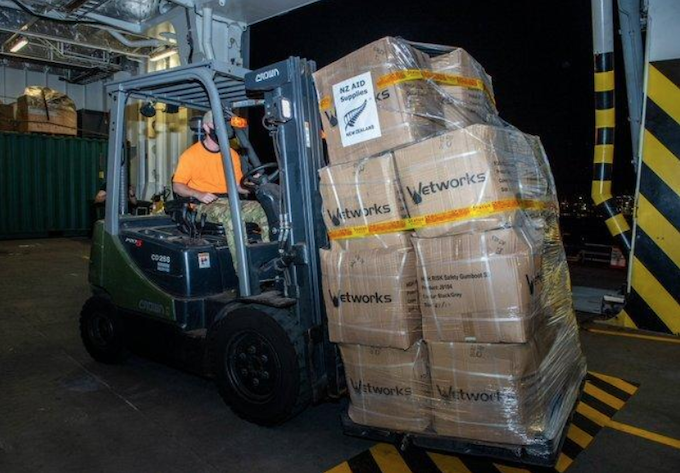
“On board the HMNZS Canterbury is water, milk powder and tarpaulins, but due to her size they have also embarked vehicles and forklifts which are needed to help distribute aid around the airport and port,” Commodore Golding said.

Engineer task force embarked
“We have also embarked an engineer task force and they can help purify water.”

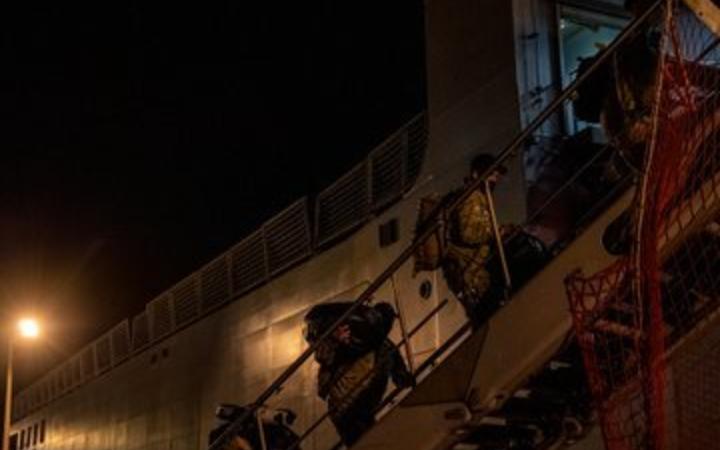
Defence Force personnel board the HMNZS Canterbury.
Defence Force personnel board the HMNZS Canterbury. Image: RNZ Pacific/NZ Defence Force

The HMNZS Wellington and Aotearoa are already in Tonga.

Commodore Golding said the team onboard the Aotearoa had successfully offloaded five containers of stores and spent Saturday offloading bulk water supplies to be distributed across the island.

“They will be doing that today right through to early next week,” Golding said.

“The HMNZS Wellington sailed overnight [Friday], they received another survey task to the island ‘Eua which is the south east of Tongatapu, they will spend the whole day using their hydrographic and diving personnel just to verify that it is safe for shipping to go in and out.”

Wellington was set to return to Nuku’alofa to continue the survey task, with Aotearoa to stay alongside to continue to offload water supplies.

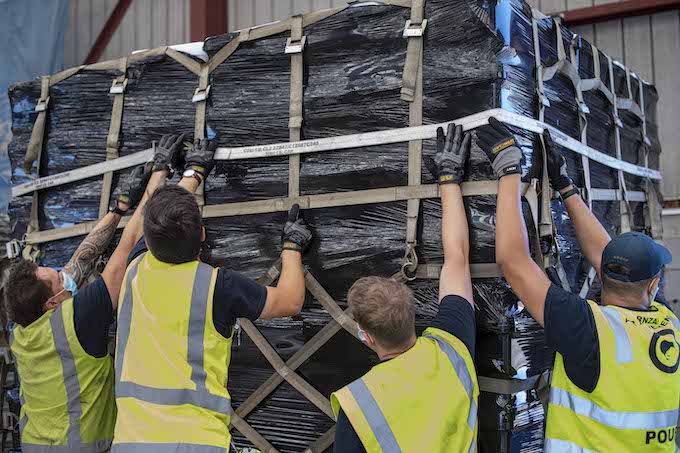
Supplies are loaded on board the HMNZS Canterbury
Supplies are loaded on board the HMNZS Canterbury for Tonga’s relief effort. Image: RNZ Pacific/NZ Defence Force

Australian efforts
The Royal Australian Navy is supporting the effort too, while HMNZS Adelaide is on its way.

“My understanding is, in addition to the three ships we will have, [the] Adelaide from Australia, the [Royal Navy ship HMS] Spey from the UK, and the US already has the Sampson [there] and a coast guard vessel is on its way down. I understand a Japanese vessel is on route. I have no information with respects to China,” Commodore Golding said.

The Tongan government has requested covid-19 measures be observed during the effort and Golding said that was a major focus of the team.

“We will be receiving tasks from the Tongan government and we will be responsive to whatever these tasks are.”

This article is republished under a community partnership agreement with RNZ.


Tagata Pasifika on the latest aid efforts for Tonga. Video: Tagata Pasifika

Print Friendly, PDF & Email

Article by AsiaPacificReport.nz

Tulagi bans betel nut selling as covid fears grow in Solomon Islands

By Robert Iroga in Honiara

Tulagi in the Central Islands province of Solomon islands is the first provincial capital to ban the sale of betel nut — for an indefinite period — as a measure to help control any potential spread of covid-19.

Premier Stanley Manetiva told SBM Online that the measure became effective yesterday as news reports indicated fears of a community spread of the virus in parts of the capital Honiara.

A 60 hour lockdown was declared in the city and was due to be lifted today.

He said that this was to avoid people chewing and spitting which potentially would spread the virus and from sharing lime as well.

He said that this was to avoid people chewing betel nut and spitting which potentially would spread the virus — and from sharing lime as well.

Manetiva said the ban stopped people from bringing in their betel nut to the Tulagi market and from selling it in the town.

The ban is only for betel nut while other local produce is still sold at the market.

Tulagi starts curfew
Meanwhile, the premier also confirmed that Tulagi had started its own curfew — banning or limiting all movements by people in the town after 10pm.

He said it was an understanding among the residents in Tulagi that there should be no movement after that time.

The old capital has also monitored ships entering its shores and now has only two designated places for canoes to land on the island town at Taporo and the market.

Besides Guadalcanal, the Central Islands province, is the closest to Honiara, which is experiencing community transmission of covid-19.

RNZ Pacific reports Solomon Islands had reported 48 new cases of covid-19 on Thursday.

It took to 81 the number of cases in the country, which until this week had had just a handful of people with the virus.

Robert Iroga is editor of SBM Online. Republished with permission.

Print Friendly, PDF & Email

Article by AsiaPacificReport.nz

Second day of NZ’s Tonga tsunami emergency fundraiser today

RNZ Pacific

The second day of a drive to receive emergency supplies in Aotearoa New Zealand to be sent to Tonga has started in Auckland this morning.

Hundreds queued for hours at Mount Smart Stadium in Penrose yesterday to deliver emergency goods that will be sent to their families in Tonga.

Almost six shipping containers were filled yesterday and organisers say at one point queues of more than 400 cars stretched three kilometres.

Aotearoa Tonga relief committee secretary Pakilau Manase Lua said it had been heartening to see the support and today was expected to see an even bigger turn out.

He said only vaccinated people can enter the stadium but donations from unvaccinated people can be dropped off at the stadium gates from 9am to 8pm.

Mepa Vuni said it was a long wait yesterday and many people had taken the day off work to make their deliveries for Tonga to the stadium.

“I haven’t spoken to my Mum since the eruption on Saturday. We are all doing this for the time being. We have been queing here for more than two hours. People have been queuing since 7 o’clock,” she said last evening.

Pasifika doctors ready
The Pasifika Medical Association is ready to mobilise the necessary support for Tonga, following the devastating volcanic eruption and tsunami.

PMA’s Medical Assistance Team is ready to send an experienced and specialised team of doctors, nurses and technical support workers.


Watch today’s report on Tagata Pasifika. Video: Tagata Pasifika

The medical team has previously been deployed to Tonga to help with the measles outbreak and Cyclone Gita.

PMA chief executive Debbie Sorensen said they are prepared and are on standby.

She said the volcanic ash is a major concern for people with asthma or respiratory conditions, who will require extra health assistance.

Concerns about covid threat
Tonga’s Minister of Trade and Economic Development is reassuring the public there is minimal threat of covid-19 being imported into the kingdom via the international emergency response to last week’s volcanic eruption and tsunami.

Emergency assistance from the international community is ramping up with navy vessels and flights arriving into the kingdom from Australia, New Zealand and other countries.

Tonga has had a strict border closure in place since the start of the pandemic and has so far had no community transmission of covid.

Ulu’alo Po’uhila, editor and publisher of the Tongan newspaper Kakalu O Tonga, is in New Zealand and said he managed to speak with minister Viliame Latu and put to him concerns raised by the public about covid-19 protocols around the international relief effort.

“I was asking because there is a concern throug these [emergency] aid and these people going to Tonga it might take the virus, covid virus, to Tonga.

“And I was told that they, all they do is just, it is a contact-less delivery,” he said.

This article is republished under a community partnership agreement with RNZ.

Print Friendly, PDF & Email

Article by AsiaPacificReport.nz

Rangitīkei Māori leader urges rural NZ people to prepare now for omicron

By Moana Ellis, Local Democracy Reporting journalist

A New Zealand iwi development and social services leader in Taihape is urging rural people to prepare urgently for self-isolation or infection as the threat of omicron looms.

Mōkai Pātea Services general manager Tracey Hiroa, who is also a Rangitīkei District councillor, says country people think of themselves as self-sufficient but must make plans for extended periods of isolation or sickness.

She said people must connect now with family, friends and neighbours to put practical measures in place for a worst-case scenario.

Local Democracy Reporting
LOCAL DEMOCRACY REPORTING

“We’ve been very, very lucky in this region so far, but it’s just a matter of time,” Hiroa said.

“Probably one of the key things that people need is their own whānau plan. Be prepared as opposed to sitting back and thinking, ‘oh no, that’s not going to happen to me’.

“Preparation really is the biggest thing. If you’re self-isolating, if you are diagnosed with [covid-19], think about things that in theory are going to be able to keep you going.

“If you’ve got animals, have you sorted out anything to make sure that they’ve got food? Make sure you’ve got kai to last you over that two-week period. Make sure you’ve got a chilly bin or something like that — with a lid — that can be left out by the front gate that kai or anything else is able to be put in, so that you’re not in contact with people.”

Two weeks of supplies
Hiroa said people should get in two weeks of supplies and items such as torches and batteries or candles, as well as sanitiser, masks and medicines for fever, congestion, muscular pain and sore throats or coughs.

And she said it is vital for people to make sure they have support at hand if needed.

“Making sure that you’ve got those relationships already in place if something was to happen. Have you made the connections out with your whānau to say here’s some of the things outside of the home that I need you to be picking up on.

“It might mean you’ll need somebody to go and feed out your cattle. Go and meet your neighbours so that if something happens you’ve got somebody to call on.”

Local Democracy Reporting is a public interest news service supported by Asia Pacific Report, RNZ, the News Publishers’ Association and NZ On Air.

Print Friendly, PDF & Email

Article by AsiaPacificReport.nz

Tonga’s King Tupou VI offers hope to families who lost relatives in deadly tsunami

Kaniva News

King Tupou VI has offered sympathy and prayers to all those who lost relatives in last weekend’s Tongan volcano eruption and tsunami disaster or are still waiting for news about their families.

He said the whole of Tonga was devastated by the tsunami and it wiped out some of the islands, homes, plantations and possessions.

His Majesty’s first speech to address the nation following last week’s volcanic eruption has been delivered in Tongan in a video clip which was shared on Facebook last night as New Zealand and international aid programmes have stepped up.

The tsunami on Saturday killed three people and injured many. Waves of up to 15 metres flattened houses and caused extensive damage to Tongatapu’s western district.

It wiped out the islands of Mango, Fonoifua and ‘Atatā.

The king mentioned some biblical texts in his attempt to encourage his people to stand together to rebuild the nation.

“Let’s start with Jehovah as Jehovah is our refuge”, the king said referring to Psalm 91 of the Bible.

Facing new challenges
He said he could not say whether the natural disaster’s damage itself was less than the damage it caused to the environment and the evacuation of the people “as there was supreme over all in nature”.

“But it is astonishing, and I am grateful that the death toll was at a minimum,” the king said.

Tonga's King Tupou VI
King Tupou VI … “I am grateful that the death toll was at a minimum.” Image: Kaniva News/File

“While we feel and sympathise with immediate families and relatives of the deceased, we have been facing new challenges,” the king said.

He said the Armed Forces’ boats which transported people from the islands were affected by the pumice stones from the volcanic eruptions.

He said the people of ‘Eua valued their wharf more than their airport. And that was because that was what they mostly used for transportation and trade.

Standing together
“In times of trouble, people stand together so they could withstand the consequences,” the king said.

“It is not who have much money or assistance from overseas but the will of the people

“It is the determination to live on top of believing in God and show love, helping each other, have patience and be self-possessed”.

“In the aftermath of the disaster, we have to all stand up and work,” he said.

“It is our nation and the place where we grew up and it is only you and me who would treasure that”.

The king congratulated people from other countries and various partnerships, churches and businesses for helping Tonga.

Aid is coming from Australia, New Zealand, Japan and the United States. New Zealand’s Defence Force continues to coordinate with its partners.

New Zealand aid stepped up
HMNZS Aotearoa berthed today at Nuku’alofa port following successful wharf and harbour inspections conducted by Navy divers and hydrographers on board HMNZS Wellington.

Hydrographers were deployed to survey approaches to Nuku’alofa after the Wellington’s arrival, with Navy divers also conducting checks on the integrity of wharf infrastructure.

Once Aotearoa arrived, Humanitarian Aid and Disaster Relief (HADR) stores, including bulk water supplies, were being offloaded as a priority and will undergo appropriate covid-19 sanitation by Tongan authorities.

Aotearoa is also able to provide continuous water supply while it is berthed.

HMNZS Canterbury was due to depart Devonport Naval Base tonight and is expected to arrive in Tonga early next week.

Supplies on board Canterbury include water, tarpaulins and milk powder. Vehicles and several containers of construction equipment are also on board.

Another C130 Hercules flight is also set to depart Auckland on Saturday with more stores on board.

Asia Pacific Report collaborates with Kaniva News.

NZ Defence Force staff stack disaster relief supplies for Tonga
NZ Defence Force staff stack and secure pallets of disaster relief supplies to be sent on an RNZAF C-130 Hercules flight to Tonga tonight. Image: NZDF
Print Friendly, PDF & Email

Article by AsiaPacificReport.nz

Safety at Tonga port being checked for arrival of more humanitarian supplies

RNZ News

Specialist New Zealand Defence Force staff will be checking Tonga’s shipping lanes are passable and the wharf is safe so desperately needed humanitarian supplies can get through.

Three deaths have been confirmed after Saturday’s massive volcanic eruption. There are reports of significant injuries, but no details yet.

UN officials said 84,000 people – more than 80 percent of Tonga’s population — had been impacted by tsunami and the ashfall that followed the eruption.

New Zealand Defence Force Rear Admiral Jim Gilmour said there were fears for food security, with reports ash was killing crops.

Ash and sea water have also contaminated water supplies.

Offshore patrol vessel HMNZS Wellington, which is carrying a helicopter, technical gear, and teams, has arrived in Tongan waters.

“They commenced clearing the outer part of the Nuku’alofa harbour and they’ll be working in towards the wharf area and terminal area,” Admiral Gilmour told RNZ Morning Report.

Scoping shipping channels
It will scope the shipping channels and wharves at the main port to see if they safe enough to use to drop off supplies, in time for HMNZS Aotearoa due today, which is carrying a range of stores including water, long life non-perishable foods, hygiene kits and shelter.

“Water is among the highest priorities for Tonga, and the Aotearoa can carry 250,000 litres, and produce 70,000 litres per day through a desalination plant,” Admiral Gilmour said.

“I feel that the most value that she’s going to provide today is bring able to discharge fresh water into water tanks for distribution around Tongatapu.”

Admiral Gilmour said staff did not need to set foot on Tonga at all, in an effort to avoid spreading covid-19 to the currently coronavirus-free country.

Sanitised containers will be moved by crane from the ship onto the dock or hauled by personnel in full PPE.

They will then withdraw and Tongans will pick up the goods.

Hundreds of people, including the Tongan Armed Forces, cleared ash off the international runway allowing a Defence Force Hercules to land yesterday afternoon.

Water containers, shelters
It carried the most urgently needed supplies including water containers, temporary shelters, generators, and communications equipment.

It was expected to be on the ground for about 90 minutes before returning to New Zealand.

The Hercules will be decontaminated today with a plan to head out again tomorrow, Gilmour said.

Admiral Gilmour said ash that was moved off the runway was sitting nearby and in a fine powder form. Some of this was picked up in the wind.

HMNZS Aotearoa leaves Auckland for Tonga.
HMNZS Aotearoa is due to arrive in Tonga today with water supplies. Image: RNZ/NZDF

A Royal Australian Air Force C-17 also landed yesterday.

A third New Zealand Defence Force vessel, HMNZS Canterbury, is being prepared to be deployed this evening or on Saturday to arrive on Tuesday.

It is carrying two helicopters which can be used to distribute supplies and survey Tonga’s outer islands.

Self-sufficient force
The Defence Force intends to be self-sufficient to not put pressure on Tonga’s food, water and fuel supply.

It has enough stores to stay at sea for at least 30 days without any external assistance. If it stays that long plans will be made to resupply.

“We’re very mindful of the sensitivities about covid and its transmission. I’m 100 percent confident that none of our deployed forces have covid, they’ve all been PCR tested, at least double jabbed, some, if not many triple jabbed,” Admiral Gilmour said.

He said the NZDF respected Tonga’s decision whether or not to allow troops on the ground.

“If Tonga decides that they would like boots on the ground and our operators will be operating ashore, then will will do that and obviously still maintain a contactless approach delivering any assistance that is required.”

Australia’s high commissioner to Tonga Rachael Moore has described the loss of property as “catastrophic”.

Tonga's Prime Minister Siaosi Sovaleni (right) joined by Australia's High Commissioner to Tonga Rachael Moore (left) to witness the arrival of the first Royal Australian Air Force C-17A Globemaster III aircraft from Australia delivering humanitarian assistance on January 20, 2022.
Tonga’s Prime Minister Siaosi Sovaleni (right) joined by Australian High Commissioner to Tonga Rachael Moore to witness the arrival of the first Royal Australian Air Force C-17A Globemaster III aircraft from Australia delivering humanitarian assistance yesterday. Image: RNZ/Australian Defence Force/AFP

“Along the western beaches there is a moonscape where once beautiful resorts and many, many homes stood,” Moore said.

Tonga has only just begun to re-establish global contact after five days cut off from the rest of the world.

Mobile phone company Digicel has confirmed re-establishing communications between Tonga and the rest of the world, but lines have been clogged with heavy traffic, leaving many still unable to get through to loved ones.

Work to improve the satellite capacity and improve communications at the New Zealand High Commission in Nuku’alofa was being done Thursday evening.

Food and water woes
MP for Panmure-Ōtāhuhu and the co-chairperson of the Aotearoa-Tonga Relief Committee Jenny Salesa said Tongans in New Zealand were hearing from their families back home for food and bottled water.

“We’re also told by some of our relatives that the ash from the volcano is everywhere. A lot of the ash has now hardened like cement on some of the surfaces and cleaning up is a challenging task,” she said.

“Some of the worry is that it would also affect the crops and the traditional food sources that a lot of our Tongan people back home rely on.”

The relief committee is asking families from the most effected islands to head to the appeal at Mt Smart Stadium today. People from the rest of Tonga are asked to come from Sunday.

Each family being allocated a 44-gallon drum to send supplies to Tonga and eight containers have been given to the relief committee.

This article is republished under a community partnership agreement with RNZ.

Print Friendly, PDF & Email

Article by AsiaPacificReport.nz

Australia approves two new medicines in the fight against COVID. How can you get them and are they effective against Omicron?

Source: The Conversation (Au and NZ) – By Elise Schubert, Pharmacist and PhD Candidate, University of Sydney

On Thursday, health minister Greg Hunt announced Australia’s drug regulator had provisionally approved two new medicines for the treatment of COVID.

These are Lagevrio, made by American pharmaceutical company Merck Sharpe & Dohme, and Paxlovid, by Pfizer.

With the number of hospitalisations and deaths due to the virus continuing to rise, the approval of these drugs comes at a good time.

The federal government has purchased a combined 800,000 courses of the pills, and said the drugs will initially be prioritised for the elderly and other high risk groups.

Both companies say their drugs will work against the Omicron variant, though this is based on preliminary lab-based research.

What are they and how do they work?

Merck’s Lagevrio (generic name: molnupiravir) is an antiviral drug that causes errors to be copied into the COVID virus whenever it replicates. This makes the virus less effective in causing disease.


Read more:
Take-at-home COVID drug molnupiravir may be on its way — but vaccination is still our first line of defence


Pfizer’s Paxlovid is a two tablet combination of a new drug called nirmatrelvir, and a drug already used to treat HIV called ritonavir.

Nirmatrelvir stops the function of a key protein the virus needs to replicate itself, while ritonavir is there to stop the body from breaking down nirmatrelvir.

According to clinical trial data, Lagevrio and Paxlovid are useful in reducing viral load, the severity of COVID symptoms, and thus, the number of people hospitalised and/or dying from the virus.

Many of Omicron’s concerning mutations are on the “spike protein”, which is what the coronavirus uses to enter our cells. So one reason these drugs are still expected to be effective against variants like Omicron is they don’t target the spike protein.

Are these medications effective against Omicron?

This week Pfizer published a media release detailing preliminary results suggesting Paxlovid is still effective against the Omicron variant.

The results of two laboratory studies by Pfizer researchers and released as pre-prints (yet to be reviewed by other scientists) shows that the nirmatrelvir can interrupt viral replication across all COVID variants of concern.

One independent lab-based study released online as a pre-print looked at both Pfizer and Merck’s drugs.

It found the key drug in Pfizer’s Paxlovid, nirmatrelvir, is still active against its protein target in Omicron, and can still reduce overall viral load.

The study also found Merck’s Lagevrio showed activity against Omicron. The president of Merck Research Laboratories said the company is very confident Lagevrio will be effective against Omicron.

It’s important to note this research was undetaken in a lab, so we’re still yet to see data on how effective it is in people with Omicron under real world conditions. With both drugs approved in the United States and United Kingdom earlier than Australia, it’s likely we’ll see in-person outcomes data on the effectiveness and safety of these drugs in the near future.

In clinical trials, before Omicron emerged, Paxlovid reduced the risk of hospitalisation and death by 88% in high-risk patients, and Lagevrio by 31%.

What are the side effects?

It’s important to note no medicine is perfectly safe and side effect free.

From clinical trials so far, we know fewer than 7% of patients taking Lagevrio experienced a serious side effect. Commonly reported were diarrhoea, nausea, and dizziness.

Different side effects were observed with Paxlovid, such as vomiting, diarrhoea, and headache, and fewer than 2% of patients in the trials experienced a serious side effect.

The risk of side effects with Paxlovid can be higher if patients are also taking other medicines at the same time. The list of medications that shouldn’t be taken with Paxlovid includes some anti-cancer, anti-inflammatory and cardiovascular medications, and even some herbal medicines such as St John’s Wort.

Am I eligible for these treatments?

Vulnerable people such as the elderly and aged care residents will be prioritised for access to the medication.

The government hasn’t stated when it expects other groups of people may be able to get the medicines, possibly due to the limited number of courses the government has purchased and because of supply difficulties being experienced in other countries.

Lagevrio and Paxlovid are both oral tablets which may mean you’ll be able take these at home, rather than spending time in hospital.

For both drugs, the tablets must be commenced as soon as possible and within five days of the first symptoms for them to be of any use.

Both medicines have also only been approved for use in adults. There’s no clinical trial data on the safety of Lagevrio or Paxlovid in children so we don’t know how effective and safe they would be in this age group.

There’s also uncertainty as to the potential impact either medicine may have on pregnancy and breastfeeding, so the Therapeutic Goods Administration (TGA) advises patients avoid these medicines in these circumstances. The TGA also recommends avoiding becoming pregnant soon after the use of either medicine.

How and where can you get them?

We don’t yet know whether people can obtain a prescription from any general practitioner or whether only specific doctors will be able to prescribe them (for example, geriatric specialists).

The government says the first deliveries of these medicines will arrive “over the coming weeks”.

The health minister also said both medicines will be free for patients.

Despite the promising treatment opportunity these drugs provide in the fight against COVID, vaccination will still remain the front line of defence against the virus.

The Conversation

Elise Schubert is a registered pharmacist and a PhD Candidate receiving scholarship from the University of Sydney and Canngea Pty Ltd.

Associate Professor Kellie Charles is a Director of the Board of the Australasian Society of Clinical and Experimental Pharmacologists and Toxicologists (ASCEPT). She has previously held research grants and provided research advice to Johnson and Johnson (unrelated to the products discussed here).

Associate Professor Wheate in the past has received funding from the ACT Cancer Council, Tenovus Scotland, Medical Research Scotland, Scottish Crucible, and the Scottish Universities Life Sciences Alliance. He is Fellow of the Royal Australian Chemical Institute and a member of the Australasian Pharmaceutical Science Association. Nial is the science director of Canngea Pty Ltd, chief scientific officer of Vairea Skincare LLC, a board director of the Australian Medicinal Cannabis Association, and a Standards Australia panel member for sunscreen agents.

ref. Australia approves two new medicines in the fight against COVID. How can you get them and are they effective against Omicron? – https://theconversation.com/australia-approves-two-new-medicines-in-the-fight-against-covid-how-can-you-get-them-and-are-they-effective-against-omicron-175321

When humans compete with television, Yung Lung proves the liveness of bodies wins out

Source: The Conversation (Au and NZ) – By Kate Maguire-Rosier, Honorary Associate, Department of Theatre and Performance Studies, School of Literature, Art, and Media, Faculty of Arts and Social Sciences, University of Sydney

Yaya Stempler

Review: Yung Lung, choreographed by Antony Hamilton, Chunky Move

The word “yung”, according to the urban language dictionary, variously means “dope” or “cool” as popularised in the Chico area of California, a “legend” or (my favourite) a “lowercase god”.

The lung of course is a vital organ, but also metonymic for an open space in the city where dwellers may breathe fresh air.

In turn, then, the term “yung lung” might refer to a rebel’s breath – or their sanctuary.

A grand orchestral overture announces people standing like action figures atop a grotesque monster’s head-shaped rock. Oozing anarchy, the group is styled with bleached, shaved or braided hair and skintight clothing flashing neon yellow.

The aesthetic summons that of Mad Max or The Bad Batch.

A virtual sunrise on a dozen TV monitors, displayed outwards in a panopticon-like circle surrounding the rock, accompanies the string instruments and the defiant looks on the performers’ faces.

A grotesque monster’s head-shaped rock dominates the space.
Yaya Stempler

As the bodies start to travel around the rock, we circle it too, as if two packs of wolves – cautiously suspicious, slightly hesitant but mostly curious.

Music becomes operatic and the image of gladiators at the Colosseum appears as a woman at the rock’s zenith raises her arm gloriously. Other arms stretch outwards and the figures climb, hang, swing and pose, physically domineering. Fierce facial expressions scare an absent enemy and posturing bodies overemphasise their musculature.

Shared aliveness

Chunky Move’s radical immersive experience, choreographed and directed by Antony Hamilton, is a dance manifesto that borrows from Black and Queer clubbing to expose – and make fun of – today’s existential crises.

The work’s visceral effort reasserts a shared aliveness in the here and now.

The standout element is Chiara Kickdrum’s thrashing soundscape, inviting the audience into a trance. Light by Bosco Shaw, video by Kris Moyes, Hamilton and Nickolas Moloney, costumes by P.A.M. and set design by Callum Morton work solidly together to produce surreal scenes that unfurl in the heart of the space.

But it is the fervent performance of the cast emboldened by the soundscape and punctuated by vogue and waacking who render the rave mesmerising and wondrously odd.

Yung Lung is mesmerising and wonderfully odd.
Jacquie Manning

The mood shifts slightly when a young woman hugs herself. Another hangs suspended upside down like an infant from monkey bars in a park playground. I see now a Mardi Gras float travelling down Sydney’s Oxford Street in late summer as a slender man with a ponytail places one hand on hip looking down at the crowd, mouth ever so slightly ajar, sexually titillating.

The virtual sun repeated on the monitors has nearly set, and I notice a rainbow lightshow behind.

A woman crushes her face into a scowl and sticks out her tongue as if the star of a death metal band. We are her fans, but also the system that criticises her for glamorising violence.

Clearly, the group wants to captivate us.

My attention snaps back to the images flickering on screen. Burning cigarettes. A cityscape. Volcanic lava. The book title Devolution of Mankind. The solar system. Japanese animé. Military activities. Green palm trees against blue sky. A dead dog on a beach stared at by young boys. Later, on every second screen, Ned Kelly full body shot in the bush. Pop-art depictions of the Kremlin, unfamiliar yet quintessentially Andy Warhol. A blackout.

The live performers must compete with the allure of the screens.
Jacquie Manning

On screen, human heads mutate. On the rock, bodies pick up pace, glued to the sculpture like insects in formation. A thumping beat cuts the air in sharp bursts, speeding up the tempo and movement. Bodies bounce with hip-hop gestures. In sync, two women explicitly sign “eat my dick”.

Video recalls my gaze. The furious onslaught of images reveals otherwise non-memorable scenes from cult pop culture. One pair flashing to and fro, however, stings: a duet of sorts between a heavily pixelated quadruped robot Spot and a headshot of a Black man – is it Martin Luther King? The images flicker back and forth, passing by too quickly to tell. I am acutely aware of the lure of the screen, accentuating the liveness of bodies in space. And aggressive drums storming the space now seem like gunshots.


Read more:
Is ‘Spot’ a good dog? Why we’re right to worry about unleashing robot quadrupeds


The presence of the live performers is heightened by the mediatised spectacle; the relationship between the two is key to the concept, integrity and rigour of this artwork. And this is in spite of their competing for dominance from one moment to the next.

The slanted text disappearing into the universe at the beginning of every Star Wars movie, “Since the beginning…” gives way to the thought of science fiction creating reality. Are the dancers trying to sell us this violent world? These spoiled images, decomposed like off fruit? Dancers hold neon poles, baby blue just like Anakin Skywalker’s lightsaber. “Jupiter” reads the label graffitied on one dancer’s trouser leg. Poles now burn red like Darth Vader’s lightsaber, one raised under a dancer’s eyes like a child with a torch telling a ghost story in a circle of friends.

Dancers exit like robots streaked through the crowd. And a final question flurries through my mind: “or was the Black face George Floyd?”

Yung Lung is at Carriageworks for Sydney Festival until January 23, then at the Substation in Melbourne from February 1 to 12.

The Conversation

Kate Maguire-Rosier does not work for, consult, own shares in or receive funding from any company or organisation that would benefit from this article, and has disclosed no relevant affiliations beyond their academic appointment.

ref. When humans compete with television, Yung Lung proves the liveness of bodies wins out – https://theconversation.com/when-humans-compete-with-television-yung-lung-proves-the-liveness-of-bodies-wins-out-173986

Kids whose grandparents are overweight are almost twice as likely to struggle with obesity

Source: The Conversation (Au and NZ) – By Edmund Wedam Kanmiki, PhD Candidate, The University of Queensland

Shutterstock

School holidays can be a special time for extended families to gather. Children may see their grandparents at seasonal gatherings or as part of childcare arrangements to help working parents. New research suggests the biology, environment and the food they share contributes to children’s future health.

According to the World Health Organization, 39 million children under five years are overweight. Some 25% of Australian children and adolescents are overweight or obese.

How parents contribute to their offspring’s obesity risk is well established but the link between grandparents and grandchildren has been less clear. Our systematic review of studies involving more than 200,000 people around the world confirms obesity is transmitted across multiple generations of families. We still need to figure out why and how to break this cycle.


Read more:
4 ways to get your kids off the couch these summer holidays


Setting up for a lifetime of health issues

Obesity among children and adolescents is associated with developing health problems. These include high blood pressure, cholesterol imbalance, insulin resistance, diabetes mellitus, accelerated growth and maturity, orthopaedic difficulties, psychosocial problems, increased risk of heart disease and premature mortality.

We examined the current global evidence on the association between grandparents who are overweight or obese and the healthy weight status of their grandchildren. We looked at 25 studies that involved 238,771 people from 17 countries. The combined data confirms obesity is transmitted multigenerationally – not just from parent to child but also from grandparent to grandchild.

We found children whose grandparents are obese or overweight are almost twice as likely to be obese or overweight compared to those whose grandparents are “normal” weight.


Read more:
Should we ban junk food in schools? We asked five experts


Nature and nurture?

Further research is needed into how children’s obesity status is influenced by their grandparents but there are likely two pathways at work. The influence could be indirect via parents’ genes or occur directly through the roles played by grandparents in children’s upbringing.

Let’s start with biological factors. Both egg and sperm cells contain molecules that respond to the nutritional intake of parents. This means traits that are susceptible to high weight gain can be passed on from grandparents to parents and then to their grandchildren. And evidence shows genetics, environmental factors, lifestyle and eating habits all play key roles in predisposing individuals to obesity.

What we eat and feed our family members can lead to the expression of certain genetic traits (a term referred to as epigenetics) which can then be transferred to successive generations. Due to shared familial, genetic, and environmental factors, obesity tends to aggregate within immediate families and studies have consistently reported an intergenerational transmission of obesity from parents to children.

Food intake can also influence health and biology across multiple generations. In Sweden, a study reported adequate food for paternal grandparents at ten years of age reduced heart disease and diabetes and increased longevity among their grandchildren.

baking cupcakes pulled from over by adult and child
Grandparents’ influence on their grandchildren’s obesity risk may be biological or a result of dietary choices.
Shutterstock

Food and family

So, grandparents’ weight status and choices about what and how much is eaten in their home could influence their grandchildren’s weight directly or via the children’s parents. These influences may be greater or less significant depending on the role grandparents play as primary care givers or in shared living arrangements. According to the recent Australia’s Seniors’ survey, one in every four Australian grandparents provides primary care to their grandchildren.

Grandparents’ role as caregivers significantly affects children’s healthy eating knowledge, attitude, and behaviours. This might be seen in the meals shared, recipes passed down or special treats for loved ones. Such habits can add to childhood obesity risks, above and beyond genetic factors.

family table with older man feeding young child
Grandparents regular provide childcare and therefore meals.
Shutterstock


Read more:
More than one in four Aussie kids are overweight or obese: we’re failing them, and we need a plan


Working on prevention

Our research shows the importance of including grandparents in obesity prevention strategies. In addition to parents, grandparents could be oriented to provide guidance on responsible feeding, recognising hunger and fullness, setting limits, offering healthy foods and using repeated exposure to promote acceptance. They can help encourage regular exercise and discourage coercive feeding practices on their grandchildren.

While our study shows a multigenerational link in the transmission of obesity, most of the available evidence comes from high-income countries – predominantly America and European countries. More studies, especially from low-income countries, would be helpful.

Further investigation into the effect of grandparents on grandchildren’s obesity across different races and ethnicities is also needed. Grandparents have varied social and cultural roles in the upbringing of their grandchildren around the world. More data could help design effective obesity prevention programs that recognise the vital importance of grandparents.

The Conversation

Edmund Wedam Kanmiki does not work for, consult, own shares in or receive funding from any company or organisation that would benefit from this article, and has disclosed no relevant affiliations beyond their academic appointment.

Abdullah Mamun receives funding from NHMRC, ARC, Queensland Health, and Health and Wellbeing Queensland.

Yaqoot Fatima received funding from NHMRC, MRFF, Western Queensland Primary Health Network, Tropical Australian Academic Health Centre, Queensland Health, and Health and Wellbeing Queensland. She is a member of the Indigenous Sleep Health Working Party of the Australasian Sleep Association.

ref. Kids whose grandparents are overweight are almost twice as likely to struggle with obesity – https://theconversation.com/kids-whose-grandparents-are-overweight-are-almost-twice-as-likely-to-struggle-with-obesity-173739

Australian art has lost two of its greats. Vale Ann Newmarch and Hossein Valamanesh

Source: The Conversation (Au and NZ) – By Catherine Speck, Professorial Fellow (Honorary), The University of Melbourne

Ann Newmarch, born Adelaide 1945, died Adelaide 2022, Self-portrait. 1/60th of a second, 1981, Adelaide, photo-etching on paper, 26.4 x 34.7 cm (plate), Public Donations Fund 2015, Art Gallery of South Australia, Adelaide, © Ann Newmarch; and Hossein Valamanesh with his work Untitled, Gallery 6, Art Gallery
of South Australia, Adelaide, 2019

In the past ten days Australia has lost two important artworld figures. Both were senior artists working in Adelaide but with a reach extending far beyond the city or the nation.

Celebrated feminist artist, Ann Newmarch OAM, born June 9 1945, passed away on Thursday January 13 2022.

Hossein Valamanesh AM, born March 2 1949, died suddenly on January 15, just weeks before he and his partner Angela Valamanesh are due to exhibit their work in the Adelaide Biennial of Australian Art – Free/State at the Art Gallery of South Australia.

Although they work in mostly different genres, a similar sense of restraint imbues the work of each, and both artists are equally celebrated.

Vale Ann Newmarch

The life and career of Newmarch was marked by political activism, and her energy in steering community projects such as the anti-rape mural Reclaim the Night (1980) and the Prospect Mural Group’s postcolonial History of Australia (1982).

In 1969, she joined the staff of the South Australian School of Art, and while continuing in the tradition of a long line of women lecturers, her appointment was different. She ushered in the optimism and “voice” second-wave feminism gave women artists and over three decades she mentored female students who in turn have had brilliant careers.

Ann Newmarch, born Adelaide 1945, died Adelaide 2022. Women hold up half the sky!, 1978, Prospect, Adelaide. Colour screenprint on paper, 91.5 x 65.0 cm (sheet), South Australian Government Grant 1981.
Art Gallery of South Australia, Adelaide, © Ann Newmarch

In 1974, Newmarch was a founding member of the politically-active Progressive Art Movement (PAM) and, in 1976, of Adelaide’s Women’s Art Movement. In each she pushed the boundaries of the print medium to develop an accessible art form. In PAM, along with Mandy Martin, Newmarch produced political posters in her Prospect studio advocating for change such as a nationalised car industry and Australian Independence.

As an artist and mother of three young children in the 1970s and 1980s, her work across all media areas epitomises second-wave feminism’s mantra “the personal is political”. Her Three months of interrupted work, shown in WAMs ground-breaking 1977 exhibition, The Women’s Show, best describes the juggling act of domestic labour, motherhood and working as an artist.

Ann Newmarch, born Adelaide 1945, died Adelaide 2022,
Maralinga: poisoned rations, 1988, Adelaide, oil on canvas, 168.0 x182.8 cm, Gift of the artist through Art Gallery of the South Australia Contemporary Collectors, 2021.

Art Gallery of South Australia, Adelaide, © Ann Newmarch

Her children became her subjects, along with pressing social issues such as damage to the landscape from atomic testing and uranium mining as in Maralinga: poisoned rations (1988).

Later in life, she confronted the invisibility of ageing women in a powerful series Risking 50 (1995).

Newmarch’s 1978 print Women hold up half the sky!, the title a riff on Mao Zedong’s famous phrase, was the only Australian work selected for the all-important 2007 Los Angeles exhibition WACK! Art and the Feminist Revolution. It featured again in the National Gallery of Australia’s 2021 exhibition Know My Name.


Read more:
Beauty and audacity: Know My Name presents a new, female story of Australian art


Her work is held by all major public and private collections, and she was the first woman artist honoured by a major retrospective at the Art Gallery of South Australia in 1997. She was awarded a Medal of the Order of Australia for her services to the Arts in 1989.

Colleagues have taken to social media with the words:

Rest in Power Ann Newmarch: one of the great Australian second-wave feminist artists.

Vale Hossein Valamanesh

Hossein Valamanesh, was born in Iran and educated at the School of Art in Tehran, and immigrated to Australia in 1973.

From his initial base in Perth, he travelled to remote Aboriginal communities in 1974 where his brush with an ancient culture resonated with his age-old Persian heritage. He relocated to Adelaide the following year, and attended the South Australian School of Art.

Hossein Valamanesh, born Tehran 1949, died Adelaide 2022, Untitled, 1994, Adelaide, lotus leaves on gauze, synthetic polymer paint, 60.0 x 145.0 x 3.5 cm, Faulding 150 Anniversary Fund for South Australian Contemporary Art 1995.
Art Gallery of South Australia, Adelaide, © Hossein Valamanesh

By 1997, he synthesised his connection to place in Longing belonging by lighting a campfire on Persian rug placed in the Australian bush. The charred burnt circle of the rug stands testament to his dual identities.

Valamanesh’s work is known and loved for its spare aesthetic sensibility, parred back form and poetic visual imagery. His materials are frequently found natural materials: ochres, sands, stones and leaves, branches and twigs animated by a Sufi philosophy exploring the ineffable and the impermanent underpinned by Persian poetry.

Hossein Valamanesh, born Tehran 1949, died Adelaide 2022, Fallen branch, 2005, Adelaide, bronze, 152.0 x 156.0 x 7.0 cm, Gift of the Art Gallery of South Australia Contemporary Collectors assisted by Jane Ayers, Candy Bennett, Jan Frolich, David and Pam McKee, Jane Michell and Michael and Tracey Whiting through the Contemporary Collectors 2005.
Art Gallery of South Australia, Adelaide, © Hossein Valamanesh

A shadow of the human form is an enduring theme, as in his wall piece Untitled (1995) consisting in a folded shirt made from lotus leaves set against a Sufi love poem painted in the shape of human shadow (when viewed diagonally). Beneath the philosophy, mathematics is inevitably at play in his work.

Over five decades, in sculpture, painting, installation and video (recently with his son Nassiem at Buxton Contemporary) Valamanesh’s work explores the paradoxes of selfhood, existence and being. Collaborative work with his wife Angela Valamenesh includes several public art commissions including the Fourteen pieces (2005) outside the South Australian Museum, referencing the vertebrae of an extinct marine reptile in the museum’s collection.

Hossein Valamanesh, born Tehran 1949, died Adelaide 2022, After Rain, 2013, Adelaide, suspended tree and electric motor.
On loan from the artist’s estate, © Hossein Valamanesh

Hossein’s work is held in national and international collections and he was a prolific international exhibitor, with his work currently on show in a major solo exhibition Puisque tout passe (This Will Also Pass), at the Institut des Cultures d’Islam in Paris.

His numerous awards include an Order of Australia (with Angela) in 2010 for outstanding artistic practice, and he too was a generous mentor of young artists. His contemplative work will live on, he has been described as “a finder of beautiful things in a world that hides them well”.

The Conversation

Catherine Speck received ARC funding to research Australian art exhibitions.

ref. Australian art has lost two of its greats. Vale Ann Newmarch and Hossein Valamanesh – https://theconversation.com/australian-art-has-lost-two-of-its-greats-vale-ann-newmarch-and-hossein-valamanesh-175435

Laws governing undersea cables have hardly changed since 1884 – Tonga is a reminder they need modernising

Source: The Conversation (Au and NZ) – By Karen Scott, Professor in Law, University of Canterbury

An aerial view of heavy ash fall on the Tongan island of Nomuka. GettyImages

Since the catastrophic volcanic eruption on January 16, Tonga has been largely cut off from the world due to a break in the undersea cable that links Tonga with Fiji (and from there with the world). A complete fix may take weeks.

Aside from the distress and inconvenience this is causing, Tonga’s predicament demonstrates a more general vulnerability of our global communication system.

Over 95% of the world’s data travels along the 436 submarine cables – around 1.3 million kilometres long in total – that connect all continents except Antarctica. These cables carry data integral to the internet, communication, and financial and defence systems worldwide.

There are natural hazards, as the Tonga eruption so graphically demonstrated. But the greatest threat to submarine cables is from fishing. Despite the cables being clearly marked on maritime charts, about 70% of damage is caused accidentally by gear such as trawl nets, dredges, long lines and fish aggregation devices.

But there is also concern that the cables are increasingly vulnerable to terrorism and cyberwarfare by private and state actors. As the head of the UK’s armed forces warned very recently:

Russian submarine activity is threatening underwater cables that are crucial to communication systems around the world.

An outdated convention

Given their fundamental importance to modern global communication, then, it would be natural to assume the international rules protecting submarine cables have been revised to respond to new technology and new challenges.

Not so. The international legal regime for protecting and managing submarine cables has remained largely unchanged since 1884 when the Convention for the Protection of Submarine Telegraph Cables was adopted. It remains in force today, with 36 party states (including New Zealand and Australia, which acceded in 1888 and 1901 respectively).


Read more:
Why the volcanic eruption in Tonga was so violent, and what to expect next


The convention makes it an offence to break or damage a submarine cable, wilfully or by culpable negligence (unless such action is necessary to save life). It also provides that only the state within which a vessel is registered (the “flag state”) can take action against its vessels and those on board.

If the owner of a cable breaks or damages another cable when laying or repairing their own, they must bear the cost of repairing the breakage or damage. Vessel owners who sacrifice an anchor, net or other fishing gear to avoid damaging a cable can receive compensation from the owner of the cable.

Cable-laying ships navigate complex but outdated maritime laws.
Shutterstock

Who controls a cable?

These provisions go back to not long after the first international submarine communication cable was laid between Britain and France in 1850 – it was destroyed by a French fishing vessel within 24 hours.

By 1858, the age of submarine cables and international communication had begun with the laying of the first transatlantic cable connecting Britain and the US, although it failed after about a month and was replaced in 1866.

In 1902, the so-called “All Red” route linked New Zealand and Australia with Vancouver through the Pacific Ocean and on to Europe through the Trans-Canada and Atlantic lines.

In 1986, the first fibre optic cable was laid between the UK and Belgium, beginning the modern revolution in global communication.


Read more:
The Tonga volcanic eruption has revealed the vulnerabilities in our global telecommunication system


The 19th-century principles governing undersea cables have since been incorporated into the modern law of the sea, codified by the 1982 United Nations Convention on the Law of the Sea (UNCLOS), ratified by 168 nations.

Under UNCLOS all states have a right to lay cables and pipelines on the seabed and continental shelf up to the 12 nautical mile limit. To run a cable to shore through another state’s territorial sea, a state needs the permission of the coastal state.

But beyond the territorial sea, the power of the coastal state to prevent or impose conditions on where a cable is laid is extremely limited. The 1884 convention rules relating to offences and liability have been incorporated into UNCLOS with minimal amendment.

Time for modern laws

There are a number of problems with the current rules. First, outside of the territorial sea, the only state that can take action against a vessel that breaks a cable is the vessel’s own flag state.

While some flag states are responsible and have adopted appropriate legislation – as New Zealand has done with the Submarine Cables and Pipelines Protection Act 1996 – many others have not.

Moreover, the state with an interest in the cable – through ownership or because the cable ultimately connects to its shore – is normally not able take action against a vessel damaging the cable.


Read more:
Undersea internet cables connect Pacific islands to the world. But geopolitical tension is tugging at the wires


Generally, the law does not address issues such as physical separation between different cables or their distance from other undersea activities such as mining. Nor does it cover maintaining consistent information on maritime charts, or co-ordination between industries and states.

The International Cable Protection Committee, a private organisation comprising 180 state and commercial members representing 97% of the world’s submarine telecom cables, issued a voluntary guide to best practice in 2021 that addressed some of these issues – but is this enough?

Given the potentially catastrophic impact on communications, the economy and defence of losing major cables to accident or nefarious activity, the answer is arguably no. The rules, largely unchanged since 1884, need modernising.

The Conversation

Karen Scott does not work for, consult, own shares in or receive funding from any company or organization that would benefit from this article, and has disclosed no relevant affiliations beyond their academic appointment.

ref. Laws governing undersea cables have hardly changed since 1884 – Tonga is a reminder they need modernising – https://theconversation.com/laws-governing-undersea-cables-have-hardly-changed-since-1884-tonga-is-a-reminder-they-need-modernising-175312

Why do we find making new friends so hard as adults?

Source: The Conversation (Au and NZ) – By Anastasia Hronis, Clinical Psychologist, University of Technology Sydney

GettyImages

If you’ve ever tried to make new friends as an adult, you’ll probably see why loneliness is at an all-time high. Making new friends feels just plain hard.

In school, making friends can be as simple as going on the monkey bars together. But as adults, making, developing and maintaining friendships can be much more difficult.

This matters, because we need friends. And while old friends are golden, nothing stays the same forever. Old friends move away, or have their time taken up by child-rearing or their careers. Without action, loneliness can quietly grow around you. It’s worth taking seriously, because evidence now suggests chronic loneliness can be lethal – the equivalent impact of 15 cigarettes a day on mortality rates.

It’s not just you, either. In many countries, loneliness is at epidemic proportions. And that was before COVID-19 made it much harder for us to see our friends.

The challenge of trust

Before COVID, around a third of Australians reported feeling at least one episode of loneliness. Since COVID brought widespread disruption to our work and social lives, loneliness has soared. Surveys now find over half (54%) of Australians report experiencing greater loneliness since the start of the pandemic.

As we reach for a new COVID-normal, it’s worth taking stock of your friendships – and assess whether you feel your social life is fine, or could use a little help.

When researchers interviewed adults about making friends in a recent study, the most important challenge cited was a lack of trust. That is, people found it harder to put their trust in someone new and fully invest in them as a friend compared to when they were younger.


Read more:
‘I tell everyone I love being on my own, but I hate it’: what older Australians want you to know about loneliness


Perhaps that’s why many people try to keep their circle of old friends as long as possible, given the trust they may have built up over many years.

Who found it harder? Women were more likely than men to say they didn’t make new friends easily because they struggled to trust others.

So what is it about adulthood? Well, as adults, we have greater self-awareness than children. While that is often a positive, it also means we’re more aware of the risks of being judged by others, of not being liked, of being rejected, and of being hurt. Or perhaps it just means we’ve been through high school and our 20s.

If we’ve had previous rejections as friends or suffered a breach of trust, we may find it harder to be trusting of others in the future. To trust a new friend means opening ourselves up and being vulnerable, just as we do in relationships.

Two women becoming friends
Building new friendships requires vulnerability, trust and time.
Getty Images

Friendships need time

After the trust issue comes time. “Lack of time” was the second-most common reason people gave after “lack of trust” when asked why they found it hard to make friends as adults.

This won’t be news to many of us. When we have demanding work schedules, very involved family lives or a combination of the two, our time for investing in friendships drops. Even when we meet a promising new friend, it can be hard to carve out time to invest in it. This is a bigger problem for older adults, given most people find their obligations increase with age.


Read more:
It’s hard to admit we’re lonely, even to ourselves. Here are the signs and how to manage them


How long does it actually take to make friends? It shouldn’t surprise us that closer friendships take longer to build than casual acquaintances. US researchers have tried to quantify this, estimating it takes roughly 50 hours of shared contact to move from acquaintances to casual friends. To be a close friend? More than 200 hours.

What’s more, the hours you spend together need to be quality. While you may well put in the time with work colleagues, professional interactions don’t count for much. To develop a new friendship, you need personal connection. It doesn’t have to be an intimate conversation to strengthen a friendship. Casual check-ins and joking around can be just as important.

Two men running in from surfing
Shared pursuits can help cement new friendships.
Getty Images

There are many other barriers stopping us from having the friendships we want. This can include having an introverted personality, health barriers, personal insecurities, or maintaining a formal facade and not allowing potential friends in.

Older people are more likely to cite illness and disability as a barrier to socialising, while younger adults are more likely to be stopped by introversion and fears of rejection.

How can we get better at making friends as adults?

It’s entirely possible to overcome these barriers as adults and build meaningful, long-lasting friendships. We don’t have to accept loneliness as inevitable. And while you might think everyone else is having a great social life, remember loneliness is widespread.

So how do you do it?

Build friendships for ten minutes a day

You don’t have to be climbing mountains or bonding intensely over a shared hobby to solidify a new friendship. If you put in ten minutes a day, you can maintain existing friendships and build new ones. Send a text, forward a meme, add to the group chat or give someone a quick call. Don’t get caught up on how much effort, energy and time goes into building friendships. Ten minutes a day may be all you need.

Make the most of any quality time

When you do get to properly spend time with a friend or acquaintance, make the most of it. Avoid distractions if possible, keep Instagram for the couch at home, and be present with your new friend.

Lean into your vulnerability

We’re often scared by the idea of being vulnerable. I think we should embrace it. Remember you are in control of how much you trust and how much you open up. If you struggle with trust, consider sharing personal information slowly, rather than all at once.

Yes, there is a risk in being vulnerable – but there is also the potential to connect on a meaningful level with another person who may very well become a good friend. And that is a fine reward.

The Conversation

Anastasia Hronis does not work for, consult, own shares in or receive funding from any company or organisation that would benefit from this article, and has disclosed no relevant affiliations beyond their academic appointment.

ref. Why do we find making new friends so hard as adults? – https://theconversation.com/why-do-we-find-making-new-friends-so-hard-as-adults-171740

Nicaragua: A Renewed Partnership with China Defangs US Regime Change Tactics

Source: Council on Hemispheric Affairs – Analysis-Reportage

Print Friendly, PDF & Email

By Ben Gutman
From Washington D.C.

In a bold and consequential decision with rippling geopolitical implications, Nicaragua recognized the “One-China Principle” and resumed diplomatic relations with the People’s Republic of China (PRC) for the first time since the beginning of the neoliberal period in 1990.[1] This was announced December 9, 2021 shortly after a meeting of the China-CELAC Forum in which CELAC’s 32 Latin American member states[2] agreed to adopt a China-CELAC Joint Action Plan for Cooperation. The strengthening of Chinese ties with Western Hemisphere partners in a forum without US presence comes as a red flag for US hegemony and control over its own “backyard,” which, since the Monroe Doctrine of 1823, has been firmly fenced off from other “external” global actors seeking influence in the region. However, unlike the last two centuries of US imperialism, China offers an approach that respects the rule of law and national sovereignty.

Last January 16, the replacement of Taiwanese investment with the sustainable socio-economic development model of the PRC’s “Belt and Road Initiative” in Nicaragua is particularly threatening to regional US economic domination. In 2014, Nicaragua partnered with a Chinese firm to initiate construction of a second shipping lane connecting the Atlantic and Pacific Oceans in addition to the current US-dominated Panama Canal.[3] The anti-Sandinista opposition party Unamos (formerly known as the Sandinista Renovation Movement or MRS), whose leaders frequently met and provided information to the US embassy, helped organize  an NED-engineered pseudo-movement in opposition to the project, which eventually came to a halt during the political violence of 2018.[4] The potential relaunch of the Nicaraguan canal project could prove to be a pivotal point in the US’s New Cold War and flailing bid to remain the world’s lone superpower.

Nicaragua leaves the OAS, the de facto diplomatic branch of the US in the Americas

On November 19, following the re-election of President Daniel Ortega, the Nicaraguan government announced its withdrawal from the US-dominated Organization of American States (OAS), joining Venezuela and Cuba in what former Bolivian president Evo Morales called “an act of dignity.”[5] In an official letter to OAS Secretary-General Luis Almagro, Nicaragua’s Foreign Minister Denis Moncada repeated previous condemnation of the OAS as an “instrument of interference and intervention” with the “mission to facilitate hegemony of the United States with its interventionism against the countries of Latin America and the Caribbean.”[6]

As reported by John Perry for COHA, the OAS produced a 16-page report within 48 hours of the alleged “illegitimate elections” that contained no evidence of fraud on election day. In lockstep with the White House’s perverse and ridiculous claim of support for the “inalienable right to democratic self-determination of the Nicaraguan people,” Almagro’s coup-fomenting false narrative of fraud came straight out of the US/OAS playbook used during their facilitation of the 2019 coup d’état against Morales’ MAS party in Bolivia.[7] Constructed by the US as an anti-socialist alliance of right-wing regimes at the onset of the First Cold War, the OAS and its delegitimization of the 2021 Nicaraguan election reflects continuity of its role as “Ministry of Colonies” of the United States, as it was referred to by Fidel Castro.[8]

Nicaragua’s withdrawal from the OAS and its reestablishment of relations with the PRC are bold decisions that flex Nicaraguan sovereignty and communicate to developing countries that a path of resistance against Western coercion leads to independence, inclusive development, and promising new opportunities. The Sandinista Front’s defeat of a three-year long US regime change operation, which culminated in the inauguration of Nicaraguan President Daniel Ortega on January 10, 2022, has translated the sacrifices made by the Nicaraguan people into a concrete plan to further the egalitarian principles of the Sandinista Revolution.

Against a militarized and neoliberal model for Central America

With support from the fastest growing economy in the world with a population of 1.4 billion, in addition to an array of other governments and solidarity movements, Nicaragua has earned the ability to lead a more aggressive charge against Washington’s proposed militarized security and neoliberal development model for Central America.[9] Such a model which aims to enrich corporations through private investment and austerity to the detriment of the poor and working-class remains the antithesis to the Chinese and Sandinista revolutions. During his inauguration speech, President Ortega elucidated this key point, stating that the “Chinese revolution and the Sandinista revolution [have] the same north, the same path, the same destiny, which is to end poverty.”

As the process of poverty alleviation runs contrary to the exploitative goals of Western imperialists, the US and EU levied coordinated unilateral coercive measures against Nicaraguan officials on the day of President Ortega’s inauguration.[10] However, the strategy of relentless hybrid warfare used to isolate and punish “enemy states” like Nicaragua has lost some of its impact. “The unipolar world is over. It’s a multipolar world,” said Black Alliance for Peace’s Margaret Kimberley at the inauguration. The Nicaraguan people’s defeat of US regime change attempts over the last three years is a remarkable accomplishment that helped the paradigm shift towards a multi-polar world. However, it is important to recognize the inevitable sacrifices that come with resistance, to dissect imperial destabilization strategies, and to reflect on the manufactured policies that have brought us to where we are today.

Revisiting the 2018 Attempted Coup, and the US media supported narrative

In Nicaragua-based journalist Ben Norton’s investigation titled “How USAID Created Nicaragua’s Anti-Sandinista Media Apparatus, Now under Money Laundering Investigation,” Norton presents documented evidence that the Violeta Barrios de Chamorro Foundation received more than $7 million of the $10 million funneled to Nicaraguan opposition media from the US’s soft-power arm the US Agency for International Development’s (USAID) between 2014 and 2021.[11] The majority of this funding was distributed amongst some 25 publications including Chamorro Foundation-owned outlets that are widely quoted by the international press and elite US think tanks like the Open Society Foundation, which characterized El Nuevo Diario, Confidencial, and La Prensa (all Chamorro owned) as “the most important online news providers” in Nicaragua.[12] As reported by Norton, the foreign funding and cultivation of these opposition and media groups led to arrests under Nicaragua’s law 1055, which was then framed by the corporate media as an authoritarian crackdown against opposition leaders.

Many international corporate media outlets like the BBC framed “Nicaragua’s worsening crisis” in 2018 as “unexpected” and a result of grassroots movements peacefully protesting against a corrupt dictatorship.[13] This false narrative was exposed by John Perry in a report for The Grayzone titled “A Response to Misinformation on Nicaragua: It Was a Coup, Not a ‘Massacre.’” First, Perry points out that even anti-Ortega mainstream academics had admitted that US institutions like the USAID and NED were “laying the groundwork for insurrection,” debunking the narrative that the protests were organic and fortuitous.[14] Second, Perry makes it clear that in an attempt to facilitate the established “peaceful protester” narrative by white-washing violence perpetrated by coup-supporters, academics and corporate media engaged in the systematic omission of inconvenient facts including the murder of 22 police officers and the torture of Sandinista civilians. The Nicaragua-based anti-imperialist collective Tortilla con Sal published independent researcher Enrique Hendrix’s in-depth analysis of this bad-faith framing as well as additional evidence backing claims of torture used against Sandinistas.

Much like corporate media and billionaire-funded foundations, a Nicaraguan human rights industry intricately connected and funded by US and European governments pushed propaganda, including the decontextualization of deaths and faulty death count figures, to provide cover for US regime change goals masquerading as unprovoked government repression.[15] In the article “The Rise and Fall of Nicaragua’s ‘Human Rights’ organizations” published in the Alliance for Global Justice’s NicaNotes, John Perry relays how three vocally anti-Sandinista human rights groups wielded disproportionate influence over the narratives presented in international bodies such as Amnesty International and the UN Commission for Human Rights (UNCHR). For example, included in the UNCHR’s 2018 report on Nicaragua were detailed references to the Nicaraguan Association for Human Rights (ANPDH), which was created by the Reagan administration to whitewash Contra atrocities and received $88,000 from the NED and $348,000 from other US sources in 2018.

In June of 2019, to the dismay of many Sandinistas whose family members were murdered during the coup attempt, the Nicaraguan government passed an Amnesty Law pardoning and expunging the records of those involved in violent and treasonous acts as part of a national dialogue with the opposition.[16] This clemency came even after the opposition refused to ask the United States to end illegal unilateral coercive measures packaged as the 2018 NICA Act (passed in the US House of Representatives with zero opposition by a 435-0 margin), which opposition activists themselves had requested in 2015.[17] During coverage of the peace and reconciliation process and in a continuation of the 2018 information warfare campaign, corporate media outlets like Reuters took a rather one-sided approach highlighting the law’s “protection to police and others who took part in a violent clampdown on anti-government protesters,” but failed to mention the violent acts committed against the police by these so-called anti-government protesters.[18]

US Hybrid Warfare Revisited during the 2021 Nicaraguan Presidential Election

In the months prior to the November 7 election, the US government and its affiliated ecosystem of obedient corporate media, social media, and hawkish think tanks took aim at Nicaragua in an effort to further isolate the nation with the ultimate goal of regime change to a more business-friendly neoliberal leadership.

A USAID regime change document leaked to independent Nicaraguan journalist William Grigsby in July 2020 and analyzed in John Perry’s “The US Contracts Out its Regime Change Operation in Nicaragua” provides useful insight into US destabilization plans. This RAIN or Responsive Assistance in Nicaragua document provides Terms of Reference for a contract to hire a company to oversee the “transition to democracy” in Nicaragua. The word “transition,” an obvious euphemism for regime change, is used more than 60 times throughout the document to describe different post-election scenarios. In the case of a “delayed transition” or Sandinista victory, the hired company would provide “research and planning for USAID and for civil society leadership with discrete technical assistance.” In other words, the company would continue USAID’s work subverting Nicaragua’s democratic process by funding, training, and directing opposition groups and media hostile to the FSLN.

However, despite clear evidence that the US was engaged in a multidimensional destabilization campaign before, during, and after the 2018 coup attempt, even progressive publications like NACLA failed to accurately report on events in Nicaragua. In the article “How Can Some Progressives Get Basic Information About Nicaragua So Wrong?” John Perry and Rick Stirling dismantle a popular State Department narrative promoted by NACLA that the November 7 election was rigged because seven potential candidates were prevented from running for president, by laying out the real crimes of which they are accused and the dubiousness of their candidacies. While the corporate media pushed this narrative ad nauseum regarding Nicaragua, it was almost completely absent prior to the 2021 Ecuadorian presidential election during which neoliberal president Lenin Moreno jailed, exiled, and banned Correístas from running in elections.[19]

In addition to news media propaganda, a bizarre censorship campaign launched by social media monopoly Facebook in the days leading up to the November 7 election silenced around 1,300 Nicaragua-based accounts run by pro-Sandinista media outlets, journalists, and activists on Facebook and Facebook-owned Instagram, as reported by The Grayzone’s Ben Norton.[20] Facebook justified this action by claiming that the censored accounts were part of a “troll farm run by the government of Nicaragua and the Sandinista National Liberation Front (FSLN) party.”[21] In John Perry’s COHA article titled “Facebook Does the US Government’s Censorship Work in Nicaraguan Elections”, Perry points out that “many commentators suffered double censorship: blocked because they were falsely accused of being bots, then prevented from proving that the accusations were false when they posted videos of themselves as real people.” Facebook and other tech giants like Google and Microsoft have an extensive history of collaboration with the U.S. security state, often enjoying lucrative U.S. Defense Department contracts, and are known to have a revolving door with the public sector.[22] Norton shows this connection by exposing Facebook’s Head of Security Policy Nathaniel Gleicher as the former director for cybersecurity policy at the White House National Security Council who had also worked at the U.S. Department of Justice.

Despite intense and ongoing hybrid warfare targeting the integrity of Nicaragua’s 2021 presidential election, 65% of the eligible 4.4 million Nicaraguans voted and 75% of those voters chose to re-elect Comandante Daniel Ortega of the Sandinista Front. While the Nicaraguan government did prevent the OAS from sending observers given its role in the 2019 Bolivian coup, there were 165 election observers and 67 journalists from 27 countries present on November 7.[23] Members of delegations from the U.S. and Canada, including COHA’s Jill Clark-Gollub, who observed the elections held a press conference during which they characterized the election process as “efficient, transparent, with widespread turnout and participation of opposition parties.”[24] In the COHA report “Despite US led Dirty Campaign, Nicaraguans Came Out in Force in Support of the FSLN”, Clark-Gollub expressed her disbelief that corporate media and the Biden administration had declared the vote a fraud with as few as 20% of the electorate turned out to vote. “This flies in the face of my own experience,” Clark-Gollub said.[25] However, despite US and NATO rejection of the election results, 153 sovereign nations around the world supported Nicaraguan democracy by recognizing the election results at the United Nations.[26]

Conclusion: A Brighter Future for Inclusive Economic Development in Nicaragua?

After more than a century of US aggression, including three decades of global hegemonic control, Obama’s “pivot” to Asia in 2016 marked a paradigm shift and the start of a New Cold War against China. The People’s Republic of China’s unparalleled economic growth and eagerness to use its deep coffers to jumpstart economic development projects in the “third world” is a direct threat to neoliberal capitalist hegemony, as China offers developing nations an alternative to the predatory debt traps sprung by western lending institutions like the World Bank and IMF.

Mere weeks after Nicaragua’s resumption of diplomatic relations with the PRC, Chinese government representative Yu Bo extended an invitation to Nicaragua to join its Belt and Road Initiative during the newly established Chinese embassy’s flag-raising ceremony in Managua. Nicaragua’s Foreign Minister Denis Moncada responded to the invitation with approval stating, “we are sure that we will continue working together, strengthening each day the fraternal ties of friendship, cooperation, investment, [and] expanding communication channels with the Belt and Road…”.

This bilateral economic partnership brings a potential scaffolding with which the “pueblo presidente” can “start with a clean slate” and get back on the road to the progress being made prior to April 2018. In the words of Comandante Ortega, this means “building peace to combat poverty…so that there can be roads and paths…so families can feel confident; their children can feel confident in their work; [and so] they feel confident in having a dignified life.” Nicaraguans can also feel confident that economic development in partnership with the Chinese will not come with the relinquishment of national sovereignty through coerced neoliberal structural adjustment programs or debt trap gangsterism.

If the Sandinista government chooses to reject future development proposals put forth by China through Belt and Road, they can expect good faith negotiation without the threat of violent hybrid warfare favored by the U.S. and NATO. In a 2019 interview,  Jamaican-British rapper Akala explains this key difference in the context of Jamaican participation in the Belt and Road Initiative: “there are several projects that the Chinese have proposed in Jamaica that the Jamaican people said ‘no’ to [so] the Jamaican government had to say ‘no’… what was the Chinese response? Was it to send the CIA in? Was it to overthrow the Jamaican democracy? Was it to cut off aid to Jamaica? No. They said ok, we proposed a business deal and you said no. Here’s another one.”

Ben Gutman is an independent writer, researcher, and organizer pursuing an MA in Global Communication from The George Washington University. He is currently working on his capstone research and digital media project on the outsourcing of US border militarization to Guatemala in collaboration with the Guatemala Solidarity Project and the Promoters of Migrant Liberation.    

Jill-Clark Gollub, COHA’s Asistant Editor, and Patricio Zamorano, COHA’s Director, contributed as editors of this essay

[Main photo: video-screenshot from Kawsachun News]


Sources

[1] Escalante, Camila. “China and Nicaragua to Collab on New Multipolar World.” Kawsachun News, 10 Dec. 2021, kawsachunnews.com/china-and-nicaragua-to-collab-on-new-multipolar-world.

[2] Officially formalized in 2011 as an alternative to the OAS, CELAC (the Community of Latin American and Caribbean States) is a cooperative venture among developing nations.

[3] Voltaire Network. “Nicaragua Could Bring Canal Project Back to Life.” Voltaire Network, 12 Dec. 2021, www.voltairenet.org/article215032.html.

[4] Norton, B. (2021, November 18). From Nicaraguan revolutionaries to US embassy informants: How Washington recruited ex-sandinistas like Dora María Téllez and her mrs party. The Grayzone. Retrieved January 15, 2022, from https://thegrayzone.com/2021/11/05/nicaragua-us-informant-dora-maria-tellez-mrs/

[5] JF, teleSUR/. “Withdrawal of Nicaragua from OAS Is an Act of Dignity: Morales.” News | teleSUR English. teleSUR, November 22, 2021. https://www.telesurenglish.net/news/Withdrawal-Of-Nicaragua-From-OAS-Is-An-Act-Of-Dignity-Morales-20211122-0002.html.

[6] Norton, Benjamin. “Nicaragua Leaves US-Controlled, Coup-Plotting OAS: ‘We Are Not a Colony.’” Medium, 19 Nov. 2021, benjaminnorton.medium.com/nicaragua-leaves-us-controlled-coup-plotting-oas-we-are-not-a-colony-2ffe83c319ae.

[7] Curiel, John, and Jack Williams. “Bolivia Dismissed Its October Elections as Fraudulent. Our Research Found No Reason to Suspect Fraud.” Washington Post, 27 Feb. 2020, www.washingtonpost.com/politics/2020/02/26/bolivia-dismissed-its-october-elections-fraudulent-our-research-found-no-reason-suspect-fraud.

[8] Staff, Reuters. “Castro Says Cuba Doesn’t Want to Rejoin ‘Vile’ OAS.” U.S., 15 Apr. 2009, www.reuters.com/article/us-cuba-castro-oas-sb-idUKTRE53E07K20090415.

[9] Chomsky, A. (2021, March 30). Will Biden’s central american plan slow migration (or speed it up)? TomDispatch.com. Retrieved January 15, 2022, from https://tomdispatch.com/will-bidens-central-american-plan-slow-migration-or-speed-it-up/

[10] Al Jazeera. (2022, January 10). US slaps new sanctions on Nicaragua on Ortega’s Inauguration Day. Elections News | Al Jazeera. Retrieved January 16, 2022, from https://www.aljazeera.com/economy/2022/1/10/us-slaps-new-sanctions-on-nicaragua-on-ortegas-inauguration-day

[11] Norton, Ben. “How USAID Created Nicaragua’s Anti-Sandinista Media Apparatus, Now under Money Laundering Investigation.” The Grayzone, 26 June 2021, thegrayzone.com/2021/06/01/cia-usaid-nicaragua-right-wing-media.

[12] Perry, John. “NPR Should Ask Where Nicaraguan Non-Profits’ Money Comes From.” CounterPunch.Org, 23 May 2021, www.counterpunch.org/2021/05/24/npr-should-ask-where-nicaraguan-non-profits-money-comes-from.

[13] BBC News. “Downward Spiral: Nicaragua’s Worsening Crisis.” BBC News, 16 July 2018, www.bbc.com/news/world-latin-america-44398673.

[14] Waddell, Benjamin. “Laying the Groundwork for Insurrection: A Closer Look at the U.S. Role in Nicaragua’s Social Unrest.” Global Americans, 10 July 2020, theglobalamericans.org/2018/05/laying-groundwork-insurrection-closer-look-u-s-role-nicaraguas-social-unrest.

[15] Perry, John. “NicaNotes: The Rise and Fall of Nicaragua’s ‘Human Rights’ Organizations.” Alliance for Global Justice, 21 Aug. 2019, afgj.org/nicanotes-the-rise-and-fall-of-nicaraguas-human-rights-organizations.

[16] teleSUR/ov-MV. “Nicaragua Approves Amnesty Law To Bring Peace.” News | TeleSUR English, 9 June 2019, www.telesurenglish.net/news/Nicaragua-Approves-Amnesty-Law-To-Bring-Peace-20190609-0001.html.

[17] Nicanotes: The revolution won’t be stopped: Nicaragua advances despite US unconventional warfare. Alliance for Global Justice. (2020, July 22). Retrieved January 16, 2022, from https://afgj.org/nicanotes-the-revolution-wont-be-stopped-nicaragua-advances-despite-us-unconventional-warfare

[18] Lopez, Ismael. “Nicaraguan Congress Approves Ortega-Backed Amnesty Law.” U.S., 9 June 2019, www.reuters.com/article/us-nicaragua-amnesty-idUSKCN1TA00U.

[19] Emersberger, J. (2021, February 16). Ignoring repression and dirty tricks in coverage of Ecuador’s election. FAIR. Retrieved January 19, 2022, from https://fair.org/home/ignoring-repression-and-dirty-tricks-in-coverage-of-ecuadors-election/

[20] Norton, Ben. “Meet the Nicaraguans Facebook Falsely Branded Bots and Censored Days before Elections.” The Grayzone, 2 Nov. 2021, thegrayzone.com/2021/11/02/facebook-twitter-purge-sandinista-nicaragua.

[21] Company, Facebook. “October 2021 Coordinated Inauthentic Behavior Report.” Meta, 5 Nov. 2021, about.fb.com/news/2021/11/october-2021-coordinated-inauthentic-behavior-report.

[22] Levine, Yasha. Surveillance Valley: The Secret Military History of the Internet. Icon Books Ltd, 2019.

[23] Norton, Ben. “Debunking Myths about Nicaragua’s 2021 Elections, under Attack by USA/EU/OAS.” The Grayzone, 12 Nov. 2021, thegrayzone.com/2021/11/11/nicaragua-2021-elections.

[24] Escalante, Camilla. “North Americans Debunk US & OAS Claims on Nicaragua Election.” Kawsachun News, 10 Nov. 2021, kawsachunnews.com/north-americans-debunk-us-oas-claims-on-nicaragua-election.

[25] Clark-Gollub, Rita Jill. “Despite US Led Dirty Campaign, Nicaraguans Came Out in Force in Support of the FSLN.” Council on Hemispheric Affairs, 12 Nov. 2021, www.coha.org/despite-us-led-dirty-campaign-nicaraguans-came-out-in-force-in-support-of-the-fsln.

[26] Kohn, Richard. “NicaNotes: Nicaragua’s Election Was Free and Fair.” Alliance for Global Justice, 2 Dec. 2021, afgj.org/nicanotes-12-02-2021.


Omicron will be a ‘different foe’, PM Jacinda Ardern warns NZ

Former New Zealand Prime Minister, Jacinda Ardern. Image: RNZ.

By Katie Scotcher, RNZ News political reporter

Prime Minister Jacinda Ardern is warning New Zealand’s covid-19 case numbers in 2022 will be unlike anything seen here before.

Jacinda Ardern today delivered her first speech of the year — to Labour MPs gathered in New Plymouth for their annual caucus retreat.

The speech was largely focused on covid-19 and the omicron variant, which she described as a “different foe”.

“We know … that omicron is in every corner of the world at the moment. And we also know that there will be other variants. And we know that we will experience in New Zealand cases at a level that we haven’t experienced before.”

Ardern stressed the government had and was continuing to prepare for an omicron outbreak in the community.

“But it will not be without its challenges, though, we are facing a trickier enemy given it keeps evolving,” she said.

“But in my view, and I’m sure in the view of everyone in this room, we can move into 2022 feeling resolute about what is required, because we’ve seen what is required and confident because on reflection of what we’ve gone through, we know that when we build a plan, that it will end can make an absolute difference and that’s exactly what we’re doing.”

Progress needed in other areas
Despite the challenges thrown up by the pandemic, Ardern stressed the government must continue to make progress in other areas.

Its attention would be on keeping the economy “humming”, progressing health reforms, lifting children out of poverty, as well as having a sharp focus on climate change and mental health, Ardern said.

The government was also looking to expand its trade arrangements, with Ardern participating in EU trade talks over summer.

“Our eye is on the prize with EU this year. I was in talks even over summer, so that’s an agreement that I know will continue to make a difference for exporters and will be a big focus.”

Work on the EU trade deal will work alongside the government’s plan to re-open the borders, Ardern said.

There would be an increased amount of international travel for the government and exporters in 2022, she said.

“Labour has demonstrated our ability to manage challenges and change and will continue to demonstrate our ability to manage challenges and change when it comes to climate, housing, poverty, and everything that we continue to face as a nation.”

Northland to join orange setting
Prime Minister Ardern later announced Northland would join the rest of the country in the orange traffic light setting from 11.59pm tonight, and signalled plans for omicron.

Cabinet ministers met yesterday to assess the traffic light settings across the country, including whether Northland would drop to the orange setting.

Ardern announced this afternoon the region would change settings tonight.

“Vaccination rates have continued to increase in Northland and are now at 89 percent first dose. The easing of the Auckland boundary over summer did not drive an increase in cases so we believe it is safe for Northland to join the rest of the country at orange,” she said.

Testing has found 39 new community cases of covid-19 and one new possible omicron case in Palmerston North, the Ministry of Health announced today.

This article is republished under a community partnership agreement with RNZ.

Print Friendly, PDF & Email

Article by AsiaPacificReport.nz

Ukraine might be far away, but a security crisis in Europe can still threaten Aotearoa New Zealand

Source: The Conversation (Au and NZ) – By Sascha-Dominik (Dov) Bachmann, Professor in Law and Co-Convener National Security Hub (University of Canberra), University of Canberra

GettyImages

A geopolitical earthquake could begin within weeks. As a string of bilateral crisis talks predictably falter, further military aggression by Russia against Ukraine seems all too probable.

If this comes to pass, the shock waves will likely be fast, wide and highly disruptive, potentially activating “tripwires” in the global security environment far beyond the edge of Europe.

Aotearoa New Zealand’s geographical distance will be no defence against the rolling consequences of a protracted crisis involving great powers and their allies. Yet there has been relatively little discussion in New Zealand about these threats.

This leaves the country at risk of being blindsided by events in an increasingly polarised world. New Zealand’s enviably peaceful and prosperous way of life depends on secure maritime trade routes, reasonable market conditions and a stable global security order.

The Ukraine situation carries the real risk of snowballing into a crisis on many fronts, shaking that stability in the process.

While speculation is always risky, there are real indications that trouble is coming. So it is worth mapping a range of scenarios that could emerge if Ukraine becomes a test of wills involving multiple major powers – and what this could mean for Aotearoa.

A chain reaction

Moscow surely knew its ultimatums to NATO were only ever going to be rejected; there is little room left for successful negotiation. If Russia opts to invade, it will happen sooner rather than later, eliciting an instant punitive response from the West.

Russia has already warned of “grave consequences” if Washington makes good on its threats of unprecedented, far-reaching sanctions that could even include expelling Russia from the SWIFT banking system.


Read more:
Russia-Ukraine tensions: power posturing or trouble on the home front for Putin?


In reply, the Kremlin would almost certainly further weaponise energy supplies to European nations, including de facto EU leader Germany.

A war in Ukraine and the need to counter Russia’s aggression would, without doubt, affect the global COVID-19 economic recovery. For example, Europe derives around 40% of its natural gas from Russia. Disruptions in energy flows would magnify destabilisation far beyond the borders of Europe.

In turn, this would shake financial markets and supply chains, raising the prospect of increased inflationary pressure in an already COVID-battered world economy. The closure of the SWIFT banking system for any transactions with Russia, as well as trade sanctions, will only add to this economic disruption.

A widening crisis

As a nation that derives much of its prosperity from exports and relies on the stable functioning of the global trade system, Aotearoa New Zealand would clearly be affected by this. But if the standoff between Russia and the US persists, matters could get much worse.

To punish Biden, Moscow – and/or Beijing as Russia’s current security partner – may well use its sway over Tehran to dampen the prospects of a nuclear deal with Iran. The Biden administration has hoped to secure such a deal, but Russia has arguably never even wanted it, despite pretensions otherwise.


Read more:
Explainer: what is ‘hybrid warfare’ and what is meant by the ‘grey zone’?


This could precipitate a wider international security crisis across multiple domains, altering the strategic calculations of key Middle Eastern states.

The US would then face a fresh set of dilemmas, weakening its hand as it tries to manage the tensions between allies that such a situation would create. And a protracted stress test for the US-led security alliance would present a tempting opportunity for China to exploit.

If US allies vacillate over Ukraine, China may use the moment to escalate non-military aggression against Taiwan, or increase its provocative posturing in the South China Sea. This would increase the challenges for the global rule-based order.

Impact on the Indo-Pacific region

New Zealanders are resilient and may be able to weather the ripple effects of one or more of the above. But if crisis spreads to the Indo-Pacific, another layer of pressure will be added.

A drawn out naval exchange in either location would potentially disrupt shipping and the flow of much of the world’s manufactured goods, delivering yet another blow to societies vulnerable to market turbulence.

And a direct invasion of Taiwan – unlikely but not unthinkable in the near term – would alter the strategic architecture of the region permanently.


Read more:
Russia and the West are at a stalemate over Ukraine. Is Putin’s endgame now war?


While this risk may seem remote, it is not a paranoid projection: Kremlin think tanks, such as Russtrat, have boasted of Sino-Russian capacity for overwhelming Washington and its allies through multiple-front confrontation.

And there is evidence already of concerted cyber and information operations from Moscow and Beijing against Western targets, ranging from cyber attacks to information warfare aimed at undermining democratic societies’ trust in their institutions and leaders.

Forewarned is forearmed

Of course, none of this may happen. The purpose of this article is to call for greater awareness and debate concerning these geopolitical challenges to a liberal democracy and its way of life.

Aotearoa New Zealand occupies a strategically important space in the Indo-Pacific region, set to be the key theatre of 21st century great power competition. The threat of an increasingly militarised South Pacific looms, as do the economic and security risks of a falling out with China, as New Zealand’s foreign minister has warned.

Collective resilience is only possible when citizens are reasonably aware of a threat well in advance of it reaching a critical state. By contrast, a limited public conversation about future risk is a virtual invitation for trouble.

A forewarned, empowered citizenry will be better placed to face the future, and more likely to deal with its challenges rationally. So, whether or not the situation in Ukraine is resolved, we should turn up the volume on this conversation.


The author acknowledges the assistance of Emanuel Stoakes, affiliate researcher with the National Security Hub at the University of Canberra, in the preparation and writing of this article.

The Conversation

Sascha-Dominik (Dov) Bachmann has received and is receiving funding from the Australian Department of Defence for research regarding grey zone and information operations targeting Australia. He is a Research Fellow with the Security Institute for Governance and Leadership in Africa, Faculty of Military Science, Stellenbosch University.

ref. Ukraine might be far away, but a security crisis in Europe can still threaten Aotearoa New Zealand – https://theconversation.com/ukraine-might-be-far-away-but-a-security-crisis-in-europe-can-still-threaten-aotearoa-new-zealand-175310

Dinosaur food and Hiroshima bomb survivors: maidenhair trees are ‘living fossils’ and your new favourite plant

Source: The Conversation (Au and NZ) – By Gregory Moore, Doctor of Botany, The University of Melbourne

Zhang Kaiyv/Unsplash, CC BY

Most of us are captivated by the thought of a “living fossil”, which is any organism that appeared millions of years ago in the fossil record and survives today, relatively unchanged.

The maidenhair tree, Ginkgo biloba, ticks all the boxes of this definition. The genus Ginkgo is well known in China and Japan where it has special significance in Buddhism and Confucianism, and first became known to European botanists in the late 1600s.

Today, ancient ginkgo fossils can be found all over the world, some of which are almost 300 million years old – a time when dinosaurs roamed the planet. Let’s delve further into what makes this species so remarkable: from its ability to survive nuclear bombs, to its vomit-smelling seeds, to it’s beautiful autumn display.

Hardy survivors

The ancestral ginkgo evolved so long ago it spread across the super continent Pangaea and was present in both the northern component (Laurasia) and the southern part (Gondwana, which included Australia) when the continents fragmented.

As a result there are fossils, Ginkgo australis, from the cretaceous period about 65-140 million years ago in the Koonwarra Fish Fossil beds near Leongatha, Victoria. There are also much more recent (about 20 million years old) fossils from Tasmania.

Ginkgo biloba has an intriguing appearance. It can grow up to 35 metres tall with a spreading canopy, and its leaves are a wonderful fan shape, often with a little cleft or notch.

The wonderful fan shape of their leaves.
Photoholgic/Unsplash, CC BY

As you might imagine for a genus dating back almost 300 million years, the maidenhair tree is both hardy and resilient, tolerating a wide range of soil and climatic conditions.

The tree is known to be very long-lived and some specimens at temple sites are thought to be over 1,000 years old which, in part, explains the mystique associated with the species.

They have a lignotuber – a modified stem at the base of the trunk containing lots of buds – which allows for sprouting at ground level and multiple stems. The lignotuber allows for rapid recovery from serious environmental stresses such as fire and defoliation.


Read more:
Tree ferns are older than dinosaurs. And that’s not even the most interesting thing about them


In fact, six trees not only survived the bombing of Hiroshima, but recovered quickly, are healthy and growing still. Their survival showed the resilience of the ginkgo and the trees became an important symbol that recovery from disaster was, indeed, possible.

Australians can empathise with this as the vibrant re-sprouting of trees after bushfires often plays a similar symbolic role.

Stinky seeds and dinosaur food

Things continue to get interesting when you consider there are separate male and female trees; a relatively rare feature in modern trees. The male reproductive structures have mobile sperm that swim to the ovule for fertilisation, which is considered a primitive or ancient characteristic.

If fertilisation occurs, the female tree produces a seed that resembles a fruit. The seed’s soft fleshy layer is malodorous, with people often describing it as being revolting or smelling of human vomit.

The seeds, resembling fruits, are known for its repulsive smell.
Shutterstock

A pair of female maidenhair trees was planted outside the entrance to the Old Geology building at the University of Melbourne in the 1920s. Since then, staff and students have had to use the side entrance when trees held seeds. This will probably continue for decades to come.

Likewise, I know of a couple of female trees that were planted outside the entrance to a major bank branch in Hawthorn, Victoria. It was considered karma by disgruntled customers, until their sudden removal by a desperate manager.

The male tree doesn’t smell but produces pollen, which has been known to cause allergies, so be wary of which sex you plant and where you plant them.

The seed’s strong scent has been linked to its dispersal, as many animals are drawn to strong, even rancid smelling fruits. There’s little evidence as to which animals or birds eat ginkgo seeds today, but there has been speculation the seeds may have been eaten by dinosaurs.


Read more:
Friday essay: trees have many stories to tell. Is this our last chance to read them?


Ginkgos coexisted with dinosaurs for millions of years. It’s easy to imagine a huge herbivorous dinosaur munching on tall maidenhair trees. Sadly, there’s no evidence of gingko seeds in fossilised dinosaur droppings. But for those who are captivated by the connection of a living fossil and dinosaurs, perhaps that fossil is still to be found.

Ginkgo biloba in Huishan Temple of Huishan Ancient Town, China.
Jerry Wang/Unsplash, CC BY

Ginkgo for gardeners

Ginkgo biloba has been cultivated for more than 3,000 years, and so whether it grows naturally in the wild is uncertain. Even in China, it grows most often in homes and temples, and there’s very little genetic diversity within the plants suggesting they’ve been grown from cuttings.

The tree has been so widely planted it now occurs in major cities and botanic gardens around the world. In Australia, many of us live within a few kilometres of a recent planting.

Many of the ginkgo trees planted in urban landscapes are males grown from cuttings. But there are different cultivars available from nurseries, with some being all female varieties that are highly prized for their brilliant yellow autumnal colour.

Bright yellow Ginkgo tree
Female trees have a stunning autumn display.
Shutterstock

Apart from allergenic pollen and vile smelling seeds, Ginkgo biloba can have another very annoying or perhaps frustrating habit for gardeners. Young plants can grow very tall before their side branches begin to grow and develop. This form of growth, called bolting, is considered an adaptation to stressed environments, but it’s little consolation when you’ve been growing a gingko for 20 years, it’s over 6m tall and still looks like a bean pole.

You have to be patient with slow-growing, long-lived trees, but they’re worth the wait! They rarely, if ever, have pest or disease problems, they are hardy and, despite being cultivated in Europe and North America for centuries, have never become weedy.


Read more:
Running out of things to do in isolation? Get back in the garden with these ideas from 4 experts


They may well be described as living fossils, but they are in fact a resilient genus of modern plants that can cope with whatever the environment has thrown at them for over 300 million years.

They are the epitome of great survivors and I would not be betting against their chances of surviving for millennia to come.

The Conversation

Gregory Moore does not work for, consult, own shares in or receive funding from any company or organisation that would benefit from this article, and has disclosed no relevant affiliations beyond their academic appointment.

ref. Dinosaur food and Hiroshima bomb survivors: maidenhair trees are ‘living fossils’ and your new favourite plant – https://theconversation.com/dinosaur-food-and-hiroshima-bomb-survivors-maidenhair-trees-are-living-fossils-and-your-new-favourite-plant-164630

Vital Signs: disclosure please, we shouldn’t be playing bingo with COVID statistics

Source: The Conversation (Au and NZ) – By Richard Holden, Professor of Economics, UNSW

Shutterstock

Given how much COVID-19 is dominating Australians’ lives, our governments should be telling us everything they know about infections, hospitalisations and deaths. So why aren’t they?

Full disclosure is important for public health, and also for public confidence in government and our leadership.

An example of what not to do comes from NSW, Australia’s most populous state, where daily updates are delivered by government health officials, sometimes with the premier or health minister in attendance, sometimes not.

The information provided at these events is also inconsistent.

For example, Tuesday’s briefing this week delivered by NSW chief health officer Kerry Chant reported the deaths of 36 people – 22 men and 14 women. She provided age breakdowns and said “33 were vaccinated” but “only a handful, four, had had their boosters”.

All this – and more – is important information that should be public. We need comprehensive data to know how the hospital system and emergency services are coping, and about risks based on factors such as age and vaccination status.

NSW's Premier Dominic Perrottet, health minister Brad Hazzard, chief health officer Kerry Chant at a press conference on January 18 2022.
NSW Premier Dominic Perrottet, health minister Brad Hazzard and chief health officer Kerry Chant at a press conference on January 18 2022.
NSW Health/Vimeo

But these daily briefings have been rather hit and miss.

Some days we have been told about the vaccination status of those who died. On January 2, for example, Chant mentioned the two people who died had both received shots. On January 5 she didn’t mention the vaccination status of the eight deaths she reported. The January 10 update, given by NSW’s director of health protection, Jeremy McAnulty, didn’t provide it either.

Even on the best days we still don’t know as much as we should.
What is mentioned and what is omitted is all over the place. Information about sewage surveillance? No problem. Information about whether people died in hospital, a nursing home, or at home? Good luck.

It’s like health-information bingo: “Number 8, garden gate, we’ll tell it straight. Number 25, duck and dive.”

Cheap talk and noisy information

When is it reasonable for those with information to obscure it?

In general, decision theory says decisions are best made with all the relevant information. But there are – at least in principle – some exceptions. One involves strategic considerations. Another involves imperfect cognitive ability on the part of decision makers.

The first exception has to with “cheap talk” – which in game theory is defined as direct and costless communication among players.

In economic models of cheap talk there is an expert (who is informed about what right thing to do) and a decision maker (who is not informed but makes the decision). If the expert and the decision maker have the same goals it makes sense for the expert to share all their information.


Read more:
You can’t fix it if you can’t see it: how the ABS became our secret weapon


However, a classic paper in game theory – by American economists Vincent Crawford and Joel Sobel, published in 1982 – showed that an expert with a different agenda has an incentive to “noise up” the information they give to sway the decision maker.

In the case of the NSW government’s daily briefings, think of this dynamic as playing out not between health experts and politicians, but between government officials (politicians and bureaucrats) and the voters – who will decide the outcome of the next election.

One can certainly imagine a wedge between what government officials and the public want.

The public wants to be told the truth. But the NSW government might want the public to focus on information leading to certain behaviour. Perhaps it wants to encourage people to get out and spend money. Or perhaps it wants to speed up the rate at which people are getting their booster shots.

Choice overload

There is a second good explanation for not providing complete information: too much information can be counterproductive.

People suffer from “choice overload”. They have difficulty processing all the information they have in front of them and do better with fewer choices.

The classic study demonstrating this involved an experiment using jam by psychologists Sheena Iyengar and Mark Lepper. They set up a jam-tasting booth in a Californian grocery store. The display of jams to sample was rotated hourly between a set of six and a set of 24 flavours.

Research shows shoppers given more choices of jams to sample bought less than shoppers given fewer choices.
Shutterstock

The key results were that shoppers were more likely to stop at the booth with the 24-flavour selection (60% of passers-by, compared with 40% when the booth had six flavours). But they scarcely sampled more jams (an average of 1.5 compared with 1.38 for the six-sample range), and just 3% subsequently bought a jar of jam, compared with 30% who stopped at the six-jam booth.


Read more:
Does choice overload you? It depends on your personality – take the test


Perhaps the NSW government thinks we will all get overwhelmed with knowing whether people died of COVID-19 at home or in hospital.

We need to know where people are dying

Neither of these reasons strike me as very good explanations for “noising up” information about COVID-19.

Where people are when they die, in particular, is valuable information. It tells us if people are getting to hospital when very sick with COVID-19, or not getting admitted for some reason. Suppose many people dying of COVID-19 are not in hospital or do so relatively shortly after arriving. This would raise important questions.

Is it because the disease strikes quickly? Is it because the ambulance system is overloaded? Is it because people are being turned away from hospital because of stress on the system? Is it because people over a certain age are typically not being admitted to the intensive care unit?

If this all sounds rather speculative, it is. Without the relevant information being disclosed to public all we can do is speculate.

The Conversation

Richard Holden is President of the Academy of the Social Sciences in Australia.

ref. Vital Signs: disclosure please, we shouldn’t be playing bingo with COVID statistics – https://theconversation.com/vital-signs-disclosure-please-we-shouldnt-be-playing-bingo-with-covid-statistics-175230

Grattan on Friday: Scott Morrison’s ministerial team looks far from match-fit

Source: The Conversation (Au and NZ) – By Michelle Grattan, Professorial Fellow, University of Canberra

It sounded a touch desperate – Prime Minister Scott Morrison imploring backpackers to “come on down” to Australia, as the Omicron crisis escalated.

“Enjoy a holiday here”, said the one-time managing director of Tourism Australia, and “at the same time join our workforce and help us”. The backpacker flow is slow, so there’ll be a $3 million advertising campaign (minus Lara Bingle) to lure them, and they’ll get a rebate on their visas if they come soon.

People were quick to see the irony – while Morrison was spruiking working holidays, travel advice in the US was updated to say “avoid travel to Australia”.

“Come on down” wasn’t Morrison’s only trite line. Another was that “we must respect” Omicron. This accompanies his insistence we shouldn’t “fear” it, part of the pitch for a “balanced” response to the pandemic’s latest ogre.

There’s a lot of fear on the loose. Fear in the health sector about coping in the coming weeks. Families’ fear for relatives shut away in aged care homes. Fear in some businesses that shortages of workers or customers or both could kill them.

And then there are the people feeling vulnerable to the disease itself, even if it is mild in a majority of cases.

Morrison says he and the government understand the frustration of Australians going through this disrupted summer. Polling reflects feelings well beyond frustration. Nine’s Resolve poll, published this week, had the Coalition’s primary vote (34%) falling behind Labor’s (35%).

Apart from unforeseen events, the PM’s future will be a gamble on voter volatility. They’re in a very grumpy mood now. But where will they be in May?

To exacerbate his troubles, as he fights his way through the coming hazardous months, Morrison is surrounded by a team that looks far from match-fit, once you get beyond Treasurer Josh Frydenberg.

Frydenberg has returned to the fray after his bout of COVID; Morrison will have to depend on him for much of the heavy lifting, beyond crafting the budget.

Key to the Coalition’s re-election campaign will be a massive attack on Anthony Albanese. But where are the effective attack dogs to back up the leader?

Mathias Cormann, now watching the unfolding Australian drama from the luxury of his OECD job in Paris, was regularly deployed to land punches; his replacement, Simon Birmingham, is diligent without Cormann’s impact.

In canine terms, Barnaby Joyce is of a breed that poses risk to their owners. He may or may not hold up the Nationals’ regional vote but could be costing the Coalition support in the cities, where independent candidates make much of declaring their Liberal opponents “vote with Barnaby”.

Peter Dutton, who still carries a leadership baton, is a classic head kicker but seems to be keeping his own head down. He is expected, however, to step up his activity soon and will be central to the national security theme in the government’s election campaign.

On climate policy, Angus Taylor, a poor communicator, will need to be wary of miscuing in trying to demolish Labor’s policy. The Coalition won’t get away with exaggerations like 2019.

Given Morrison’s vulnerability among female voters, the PM also needs ministers who can mount a convincing case on women’s policy. But Minister for Women Marise Payne hasn’t shown herself up to the task – she hates venturing into the media, and is tied up with her main portfolio of foreign affairs. There is no Julie Bishop in the ranks.

As Morrison tries to pressure states to open their schools on time and keep them open, Education Minister Alan Tudge remains sidelined while an inquiry examines an allegation (which he denies) from a former staffer and ex-lover that he was violent towards her (kicking her out of bed). There’s no official word on the report’s timing. If Tudge isn’t definitively cleared, Morrison will have yet another problem.

In the vital health area, the hyperactive Greg Hunt will run hard to the finishing line. But he’s retiring, leaving the pertinent question of who’d be his successor in a re-elected Morrison government.

Chief Medical Officer Paul Kelly this week described what that person, or Labor’s Mark Butler if there’s a change of government, can expect to face.

“I think [in] winter we will see more COVID. That’s been the case in every winter so far in all parts of the world. Whether that will be Omicron for people that have not yet got it during this wave or another variant, I can’t tell that.

“What I do know, though, is we’re almost certainly going to have a flu season this year as well in winter. And flu and coronavirus together, as has been seen in several countries in the northern hemisphere right now, is a challenge.”

Meanwhile, Morrison, having waved the populist flag by dispatching the unvaccinated Novak Djokovic, is undermined by homegrown vaccine rebels in his ranks.

This week he denounced the views of the Nationals’ George Christensen, who said parents should not have their children vaccinated, and Christensen has been forced to stand down from a parliamentary committee.

With a February parliamentary sitting looming, who knows whether Christensen will play up in the House? Certainly the two Coalition senators, Alex Antic and Gerard Rennick, who late last year boycotted votes on government legislation because Morrison wouldn’t try to override state vaccine mandates, remain defiant.

The fortnight February session will be brief but brutal. There’ll be Senate estimates hearings, always full of grenades. In the lower house, it will be hard for Labor to “lose” question times.

In the middle of the fortnight, on February 12, will be a “super Saturday” – four state byelections in NSW. These results will have significant fallout for the mood federally.

The seats are Willoughby (Liberal, 21%), Strathfield (Labor, 5%), Bega (Liberal, 6.9%) and Monaro (Nationals, 11.6%). All have high-profile departees – respectively, Gladys Berejiklian, Jodi McKay (former Labor leader), Andrew Constance (former state minister now running federally) and John Barilaro (former Nationals leader).

The NSW government has been hand-in-glove with Morrison in wanting to “push through” the Omicron crisis with everything as open as possible.

Super Saturday will be a referendum on NSW leader Dominic Perrottet’s handling of Omicron, a test of whether COVID management is turning from an electoral positive to a negative. It will also be an indirect judgement on Morrison’s handling of it too – or at least it will be seen as such.

While Super Saturday will be an important real-time barometer before the May federal election, it won’t be the last. South Australia goes to the polls on March 19, with the Liberal government on the ropes as it struggles with COVID and the fallout from scandals.

A big Super Saturday swing against the NSW government would send deep shock waves through the federal Coalition, which (on conventional wisdom) needs to make gains in that state to survive. If a bad result in SA brought a double hit, the mood in the Morrison ranks would be extremely bleak.

The Conversation

Michelle Grattan does not work for, consult, own shares in or receive funding from any company or organisation that would benefit from this article, and has disclosed no relevant affiliations beyond their academic appointment.

ref. Grattan on Friday: Scott Morrison’s ministerial team looks far from match-fit – https://theconversation.com/grattan-on-friday-scott-morrisons-ministerial-team-looks-far-from-match-fit-175343

Queensland’s ‘Path to Treaty’ has some lessons for the rest of Australia

Source: The Conversation (Au and NZ) – By Morgan Brigg, Associate Professor, Peace and Conflict Studies, The University of Queensland

After decades of calls, a patchwork of treaty processes are being developed across Australia. However, without a history of treaty-making or treaty law in Australia, serious questions arise about the best approach.

Getting treaties right is crucial for First Nations peoples’ well-being and for building a reflective, assured, and confident nation. This is urgent work, and yet the best way forward might involve working in longer time frames than is usual in policy reform.

Taking time with these processes is important because developing meaningful treaties requires negotiating political authority between Indigenous peoples and Australian governments, and the balance of power and resources between them.

Indigenous peoples have political authority going into treaty processes as the original peoples governing this continent for tens of thousands of years. However putting this authority into action is challenging because white Australian political forms and processes are pervasive.

In addition, many Aboriginal and Torres Strait Islander peoples have been systematically disconnected from their sources of authority and each other. This can make for challenging issues surrounding Indigenous representation in treaty processes.


Read more:
A short history of the Aboriginal Tent Embassy – an indelible reminder of unceded sovereignty


Queensland’s approach

Victoria is acknowledged for being the first Australian state to begin developing a treaty, having passed the first legal framework for treaty negotiations. A treaty process has progressed relatively quickly since then.

Queensland began a “pathway” to treaty process in 2019. The Queensland government’s announcement of an open ended process as part of NAIDOC week was generally well-received at the time, but was no guarantee of success.

The Eminent Panel and the Treaty Advancement Committee have carefully listened to voices of First Nations communities and managed the complex politics involved with these consultations. The Queensland government has responded positively with a key next step to include the establishment of a “Treaty Institute” to invest in the state being treaty-ready over a ten year period.

Sustaining the Queensland approach

While the Queensland treaty process has thus far proceeded well, it stands at a crossroads as backroom negotiations to give shape to the Treaty Institute continue. Previous collaborative work in Indigenous-settler relations in Queensland suggests sustaining a meaningful treaty process requires following these three principles:

• the Treaty Institute needs to be as separate from government as possible and affirm the distinct political authority of Aboriginal and Torres Strait Islander peoples

• the Treaty Institute should focus on engaging with and supporting Indigenous peoples and their place-based forms of political authority, including to re-establish peer-to-peer treaties among Indigenous nations. (Existing Indigenous organisations have a role to play in this process but fresh, creative, and demanding work is also required)

• the governance and work of the Treaty Institute must be inclusive, recognising men’s and women’s law and their respective leadership as well as including the views of people of diverse ages, genders, sexualities, and abilities.

Navigating political authority and power

Developing meaningful treaties with First Nations peoples requires at least partly remedying the dominance of white Australian political forms and power. If this is not done it is not possible to negotiate political authority of First Nations peoples and Australian governments and the power relations between them.

Australian governments exercise sovereignty and have an abundance of power and resources, but they struggle with legitimacy and thus authority within treaty processes. As Professor of Law Irene Watson asks, “by what lawful authority do you … dispossess us?”

White Australia needs to grapple with the legitimacy of its claims to authority, including addressing past injustices and imbalance of power and resources in treaty processes.

Queensland’s proposed process allows time for the Queensland government to recognise Indigenous political authority while nurturing trust in the treaty process within Queensland’s diverse political communities.

The process is also broadly aligned with many First Nations peoples because of an affinity with continuity, a careful approach to change, and regard for protocol borne of tens of thousands of years of governing this continent. Additional time in these processes also allows space from immediate pressures of negotiating with government.

Most importantly, the proposed Treaty Institute provides Aboriginal and Torres Strait Islander peoples the necessary time and resources to consider how to preserve and strengthen Indigenous ideas and institutions in Australian policy and decision-making processes.

This can enable the pursuit of placed-based approaches to decision-making that draw on respective First Nations’ Countries.


Read more:
Australia has a heritage conservation problem. Can farming and Aboriginal heritage protection co-exist?


As Australia’s treaty deliberations continue to develop, we will begin to see advantages and disadvantages of different approaches.

For now, the comparatively slower approach in Queensland looks to address fundamental challenges which could potentially be overlooked in a more rushed process.

The Conversation

The authors do not work for, consult, own shares in or receive funding from any company or organization that would benefit from this article, and have disclosed no relevant affiliations beyond their academic appointment.

ref. Queensland’s ‘Path to Treaty’ has some lessons for the rest of Australia – https://theconversation.com/queenslands-path-to-treaty-has-some-lessons-for-the-rest-of-australia-174464

Boris Johnson and ‘Partygate’: he who lives by the Brexit sword, dies by the Brexit sword

Source: The Conversation (Au and NZ) – By Ben Wellings, Senior Lecturer in Politics and International Relations, Monash University

Kirsty Wigglesworth/AP

Boris Johnson’s time as the United Kingdom’s prime minister is under immediate threat. Johnson, who likes a classical analogy, will know that civil servant Sue Grey’s imminent report into the “Partygate” scandal is the bureaucratic equivalent of the Sword of Damocles hanging over his head.

Johnson has been gravely damaged by the revelations of recent weeks that he attended gatherings and parties his own government had banned during the COVID lockdown of 2020, while some Britons’ loved ones died alone.

Significantly, pressure on Johnson is mounting from within his own party. During an acrimonious prime minister’s questions on Wednesday, David Davis, a former Tory minister and arch-Brexiteer, told Johnson “in the name of God, go!

Yet, for all the public anger about Johnson’s lack of leadership during the pandemic and inability to grasp the need for full contrition about “Partygate”, his weakened position actually has a lot more to do with the aftershocks of Brexit in three major ways.

Fear of a crumbling ‘Red Wall’

The first is the extent to which Brexit contributed to Johnson’s election victory in December 2019.

The commanding majority he secured in that election – a major political achievement – enabled Britain to withdraw from the European Union. Much of this success was attributed to a swing in support from so-called “Red Wall” constituencies in the north and Midlands parts of England, which had a history of voting Labour and switched their allegiance to the Conservatives.


Read more:
Boris Johnson polling is now so bad that it makes sense for Conservative MPs to get rid of him


The twin sources of this historic switch were believed to be a desire to complete Brexit and a hostility towards Labour’s left-wing leader Jeremy Corbyn.

The problem for Johnson is the perception, among the new cohort of Conservative MPs elected in the “Red Wall” constituencies, that their newfound support among voters may be fragile.

With Brexit now done and Corbyn no longer Labour leader, many are asking themselves whether these voters will now revert back to Labour. The fear of an embarrassingly short parliamentary career may be convincing many to consider giving Johnson the push.

A ‘technopopulist’ who could bring the party down

The second Brexit-related weakness concerns Johnson’s style of leadership itself and the part this played in the Conservatives’ 2019 election win.

This style has been described by political scientists Chris Bickerton and Carlo Invernizzi Accetti as “technopopulism”. That is to say Johnson is a leader who both appears to reject “normal” politics, while at the same time professing an unorthodox competence to get things – like Brexit – done.

This was a major part of his appeal to Conservatives who elected him party leader in 2019 and voters who made him prime minster later that year.

Yet, this now leaves him vulnerable. There’s a big question many Conservatives may be asking themselves: was the 2019 election Johnson’s victory, or the party’s more broadly?

Boris Johnson during the 2019 election.
Boris Johnson speaking during the Conservative Party’s final election campaign rally in London in 2019.
Kirsty Wigglesworth/AP

If they feel it was Johnson’s victory, they could decide to eject him before he permanently contaminates the Conservative brand ahead of local elections in May and a general election two years from now.

Johnson’s populist nod and wink that “I am with them but not of them” could now come back to bite as Conservative politicians decide whether to amputate the Johnsonian rot to save the Conservative body.


Read more:
Boris Johnson’s big election victory: academics on what it means for the UK and Brexit


In doing so, they will be in tune with public opinion. Johnson’s chaotic leadership style was always linked with a sense of self-advancement. If this was visible to some during Brexit, it became even more evident during the pandemic.

During 2020, the Conservative leadership invoked the second world war “Spirit of the Blitz” to make it through the darkest days of the pandemic.

From the perspective of 2022 and the “Partygate” scandal, another wartime analogy looks more apt – “lions led by donkeys”. This is a popular memory of the first world war in which stoical British soldiers were led to their deaths by incompetent commanders.

Brexit is only half-baked

Lastly, Johnson’s position has been weakened because, despite the rhetoric, Brexit is only half-done.

Johnson is a famous over-promiser. He told parliament in 2017 that Brexit meant Britain could have its cake and eat it. The reality is the Brexit cake is half-baked (in both senses of the word).

For one, the status of Northern Ireland as a full part of the UK is still in the balance because the EU-UK border question has yet to be resolved.


Read more:
State of Stormont: can Northern Ireland trust in Truss?


Second, it is hard to see what material benefit Brexit has brought the UK. Admittedly, the pandemic has clouded the ability to make firm judgements about the UK economy. However, it is hard to imagine, amid all the shortages of food and truck drivers, that a free-trade agreement with Australia is giving UK citizens much more than they had when Britain was part of the EU.

This means true believers in Brexit might like someone like Foreign Secretary Liz Truss as PM to fully realise what they perceive as the real benefits of the decision to leave the EU.

Who might replace Johnson?

Truss, currently in Australia for the annual Australia-UK ministerial meetings, is probably considering her position, along with other potential contenders to replace Johnson: Chancellor of the Exchequer Rishi Sunak, Home Secretary Priti Patel, Health Secretary Sajid Javid, Business Secretary Kwasi Kwarteng, Education Secretary Nadhim Zahawi and former Foreign Secretary Jeremy Hunt, who was defeated by Johnson in the 2019 Conservative leadership contest.

Former Conservative MP Enoch Powell, hero of the Conservative right and a vociferous critic of the UK’s entry into the European Economic Community in the 1970s, once said all political lives end in failure.

Johnson’s downfall would be a case of the revolution eating itself. The irony is the man who promised to get Brexit done, may well get done in by Brexit.

The Conversation

Ben Wellings does not work for, consult, own shares in or receive funding from any company or organisation that would benefit from this article, and has disclosed no relevant affiliations beyond their academic appointment.

ref. Boris Johnson and ‘Partygate’: he who lives by the Brexit sword, dies by the Brexit sword – https://theconversation.com/boris-johnson-and-partygate-he-who-lives-by-the-brexit-sword-dies-by-the-brexit-sword-175323

Schools can expect a year of disruption. Here are 7 ways they can help support the well-being of students and staff

Source: The Conversation (Au and NZ) – By Elizabeth J Edwards, Senior Lecturer in Education, The University of Queensland

Shutterstock

There’s just over a week to go before term one starts across the country – except in Queensland which has pushed back the start of the school year. We are yet to see states and territory plans for how to open schools safely, and to minimise the inevitable Omicron-induced teacher shortages, but one thing is clear: even with plans in place, schools will continue to experience disruptions in 2022.

As such, they will bear the consequences for the mental health of their staff and students.


Read more:
COVID and schools: Australia is about to feel the full brunt of its teacher shortage


We investigated what schools have done during the pandemic to help support and maintain the well-being of their students and staff. We reviewed studies world-wide on the initiatives they used and listened to 25 experts – school leaders, teachers and school psychologists and counsellors – from public, independent, primary and secondary schools across Australia. Most participants (80%) were from Queensland schools and all had experienced school disruptions during the pandemic.

We pulled out seven steps schools can take to mitigate mental ill health during COVID-related disruptions and help staff, students and the school community deal with uncertainty.

1. Have clearly outlined plans for certain events

School staff need a clear protocol for what to do when certain events occur, so all staff are on the same page.

For example, what happens if the school closes for face-to-face teaching (fully or partially)? What roles will each staff member play? What happens when a child or teacher gets very sick or even dies?

These guidance documents must be easily accessible and every staff member must know where to look.

One teacher whose school had such plans in place told us:

we had excellent protocols […] it was great to just get that folder off the shelf and go.

2. Help staff maintain their own well-being and emotionally support students

Schools must provide staff with the skills they need to have difficult conversations with students, identify those at risk, and incorporate some psychological and emotional strategies into their teaching practice.

Our interviewees described such professional development being part of their weekly after-school staff meetings (sometimes termed learning lounges). They recommended many of these meetings could focus on self-care and provide opportunities for teachers to share their experiences of stress and how to deal with it.

At weekly staff meetings teachers could share their experiences and coping strategies.
Shutterstock

This time could also be used to give teachers strategies to manage their own well-being. One study we looked at examined the effectiveness of a reframing intervention to build resilience and reduce burnout in teachers in Israel. Teachers would identify their stressful thoughts and then find evidence for opposing these thoughts. Teachers reported increased resilience and improved well-being relative to the control group who reported greater burnout.


Read more:
Is learning more important than well-being? Teachers told us how COVID highlighted ethical dilemmas at school


School psychologists and counsellors and other professionals could also share strategies with teachers for how to incorporate mindfulness techniques into classes.

And they can help teachers have difficult conversations with kids. It is normal for students to feel worried or sad after loss of any kind. In the initial stages, they need to have a conversation with a familiar person who can empathise with their worry and grief. Teachers who know a student well can be helped on how to have these early conversations and refer the student for further support when needed.

3. Be patient with students who may need time to adjust

Children and young people benefit from a secure school environment and familiar routines, but returning to school after a disruption requires flexibility.

Schools and teachers must understand it won’t be possible to get back to normal right away, so be patient with all students and their unique responses. Students may have had different COVID-related experiences and where one student takes disruption in their stride, another might need more support and time to adjust.


Read more:
A familiar place among the chaos: how schools can help students cope after the bushfires


4. Incorporate mindfulness and calming techniques into classes

Incorporating activities to teach self-calming, emotion regulation, and other coping skills into regular class time can help. Mindfulness has been shown to be particularly effective for reducing anxiety, depression and stress in 14-18 year olds.

A review of numerous studies recommends 35 minute group mindfulness sessions, twice a week for eight weeks (including basic stress management education, yoga, and breathing and relaxation techniques) delivered by trained teachers as part of typical classroom routine. There are also free smartphone apps tailored to young people that offer mindfulness and other exercises.

Practicing relaxation and mindfulness techniques such as art therapy or going for a walk can help kids feel less stressed.
Shutterstock

One teacher we interviewed told us “a pandemic feels like you’re out of control”, and recommended “normalising that […] using mindfulness, gratitude and going for walks.”

A study of teenagers in China found listening to daily mindfulness increased students’ resilience and emotional intelligence. In another study, primary school students in Canada received two forms of online art therapy which showed a reduction in their anxiety.


Read more:
A place to get away from it all: 5 ways school libraries support student well-being


5. Put together a team to address school community’s concerns

Principals (or a senior leader) should be available for teachers and parents to express their concerns to.

The school can bring together a leadership team of school psychologists/counsellors, chaplains, health nurses and other support people to share the burden of addressing them.

Schools may have to close due to infections, but keeping the community informed in a timely way can help them cope with uncertainty.
Shutterstock

Regular communication is also important. Anxiety will be high and keeping the school community regularly informed of any changes or protocols will go some way to calming the sense of uncertainty.

One school leader told us:

It’s really important to communicate regularly and the same message over and over again to everybody.

6. Have a support system in place for teachers

We found an effective way to help support teachers is to have a buddy system so teachers can support each other.

Another way is to make sure the leadership team checks in with all the staff members regularly. As one school leader told us:

we had a group list of […] every single staff member and we made a commitment that we would ring each one of those people once a week.


Read more:
Teachers are expected to put on a brave face and ignore their emotions. We need to talk about it


7. Identify and keep an eye on students at risk

Watch for signs when a student is not coping in the weeks and months following a disruption. Young people don’t always ask for help, but their behaviours can be a sign when something is wrong.

For example, a younger child might say they have a tummy ache, become aggressive, or disinterested in the things they usually enjoy. An adolescent might be moody, irritable, say negative things about themselves, and isolate from friends. If you see students whose behaviour is telling you they are having mental-health issues, refer them to specialised services.


Read more:
More children are self-harming since the start of the pandemic. Here’s what parents and teachers can do to help


The authors would like to thank Professor Annemaree Carroll from The University of Queensland for her involvement in all aspects of the project.

The Conversation

Elizabeth J Edwards received funding from Queensland Department of Education under the Education Horizon Grant scheme.

Marilyn Campbell received funding from Queensland Department of Education under the Education Horizon Grant scheme.

ref. Schools can expect a year of disruption. Here are 7 ways they can help support the well-being of students and staff – https://theconversation.com/schools-can-expect-a-year-of-disruption-here-are-7-ways-they-can-help-support-the-well-being-of-students-and-staff-174886

Omicron is overwhelming Australia’s hospital system. 3 emergency measures aim to ease the burden

Source: The Conversation (Au and NZ) – By Stephen Leeder, Emeritus Professor, Menzies Centre for Health Policy, University of Sydney

Public hospitals – never with much spare capacity – have been severely stressed by the latest COVID wave.

The current Omicron outbreak has loaded even heavier demands on hospital beds, both for those who need oxygen and for the severely ill in intensive care wards, as well as those who cannot be cared for at home or in an aged-care facility.

Shortages of beds and hospital equipment are matched by staffing problems as front-line workers catch COVID, are contacts of cases, or are emotionally and physically exhausted.

Staff are angry having to provide intensive care beds for people who choose not to be vaccinated and then get seriously ill.

Intensive care nurses in Sydney began strike action outside Westmead Hospital on Wednesday to protest dangerous work conditions and low staffing levels.

Many of our hospitals were not equipped to face an enemy like COVID.

Now, three emergency measures will help us muddle through the crisis, caused in part by the removal of public health controls just before the social festive season which commentators have referred to as “letting it rip”.

The combined effects of these short-term measures should enable us to cope with the pressures of increased numbers of patients requiring care.

But the sheer number of cases of Omicron, even if is milder than the Delta variant and assuming case numbers decline, will test these arrangements to the limit.


Read more:
From COVID control to chaos – what now for Australia? Two pathways lie before us


1. Reinforcing the front line

In Victoria, a “Code Brown” has been implemented across the hospital system.

It means staff of major city and regional public hospitals may have their leave cancelled and be allocated to work where needs are greatest. Non-urgent care may be postponed.

It’s designed to allow the hospitals to compensate for thousands more patients and several thousand fewer staff, off work because of COVID.

This is the first time the code has been used statewide.

It’s designed to respond to an emergency, such as a road accident, bushfire or other natural disaster.

2. Recruiting the private sector

The federal government has agreed private hospitals should work with public hospitals to care for COVID patients.

During the pandemic, most COVID patients have been treated in the public sector.

Health minister Greg Hunt said this week up to 57,000 nurses and thousands of support staff from private hospitals would be available to work in public hospitals.

This contingency plan was enacted in 2020 and held in reserve. Now it’s needed because of short staffing in the public sector because of the load and absenteeism of staff.

The details – including wages – would be left to the states to determine.

This move should ease the pressure on public hospitals. But a nurse or other health worker from a private hospital working in a public hospital environment encounters yet more stress. It’s rather like moving between countries – language and customs vary, and in the strict, protocol-driven environment of the modern hospital, these differences can be dangerous.

The workers to be drawn from the private sector were not idle before the call-up. It is not clear who, if anyone, will do the work these people did previously in the private sector, which provides much elective surgery. Further delays and cancellations of surgery may result.


Read more:
We’re two frontline COVID doctors. Here’s what we see as case numbers rise


3. Elective surgeries postponed

Elective surgery – that is, non-urgent surgery – will be reduced in public hospitals across many parts of the country, if not completely cancelled. This includes hip and knee replacements and surgery for many problems other than emergencies.

This action has been taken at several stress points in the past two years.

For those people depending on Medicare and public hospitals for hip surgery, for example, this will mean further delays.

There’s much to be learned from the experience in all sectors of the health enterprise – hospitals, general practice, public health, and health service management – from the successes and mistakes in how we’ve managed COVID.

When the COVID war is over, it will be time for forensic soul searching to enable us to build a modern and better health system.

We have done well, but not as well as we might.

The Conversation

Stephen Leeder does not work for, consult, own shares in or receive funding from any company or organisation that would benefit from this article, and has disclosed no relevant affiliations beyond their academic appointment.

ref. Omicron is overwhelming Australia’s hospital system. 3 emergency measures aim to ease the burden – https://theconversation.com/omicron-is-overwhelming-australias-hospital-system-3-emergency-measures-aim-to-ease-the-burden-175233

Voice to Parliament design report still doesn’t meet international human rights standards

Source: The Conversation (Au and NZ) – By Dominic O’Sullivan, Adjunct Professor, Faculty of Health and Environmental Sciences, Auckland University of Technology and Professor of Political Science, Charles Sturt University

Last month, the Australian government published the Indigenous Voice co-design final report. It’s the latest step in the debate about how Australia should and shouldn’t recognise a distinctive Indigenous presence in public life.

Some of the report’s recommendations, which the government accepts, will help policy-making to work better for Indigenous people. But they don’t go far enough to meet international human rights norms by supporting self-determination as a right that belongs to Indigenous peoples as much as to anybody else.


Read more:
From dispossession to massacres, the Yoo-rrook Justice Commission sets a new standard for truth-telling


What is self-determination and why is it so important?

Self-determination is the right to exercise authority over one’s own affairs and to participate fairly in public decision-making. It encompasses the right to make decisions about things like health, education, natural resource management and economic development. It doesn’t stop the state’s right to govern. But as the International Covenant on Civil and Political Rights puts it, the state’s right to govern doesn’t override an obligation to recognise that:

All peoples have the right to self-determination. By virtue of that right they freely determine their political status and freely pursue their economic, social and cultural development.

The Voice co-design report is limited in the opportunities it provides for Australia to meet these obligations. Furthermore, it doesn’t give effect to the UN Declaration on the Rights of Indigenous Peoples, which says:

Indigenous peoples have the right to maintain and strengthen their distinct political, legal, economic, social and cultural institutions, while retaining their right to participate fully, if they so choose, in the political, economic, social and cultural life of the state.


Read more:
Most Australians support First Nations Voice to parliament: survey


The Uluru Statement from the Heart

One limitation is the local and regional bodies will be referred to as “Indigenous”, not “First Nations” Voices. The co-design committee wasn’t allowed to consider First Nations’ Voices, as the Referendum Council proposed in its Uluru Statement from the Heart in 2017.

The Referendum Council was established in 2015 by then-Prime Minister Malcolm Turnbull and the leader of the opposition, Bill Shorten. Its job was to recommend amendments to the Constitution to “recognise” Australia’s first peoples.

The significance of the term “First Nations” is that nationhood implies distinctive and enduring political community, whereas the term “Indigenous” refers only to prior occupancy.

Under instruments like the Declaration on the Rights of Indigenous Peoples, “Indigenous” is a politically significant concept. But it’s not the same as nationhood. This is important because the Referendum Council made its recommendations after widespread consultation with First Nations people and most said they preferred to be recognised as members of First Nations because of its more significant political meaning.

The Uluru Statement from the Heart recommended amending the Constitution to create a permanent First Nations’ Voice to Parliament. However, amending the Constitution requires a referendum.

The Voice was to be complemented by Makarrata, a process of “coming together after a struggle”. Makarrata would lay the foundation for agreement-making.

Discussions are underway on what agreement-making through treaties might look like in Queensland, Victoria and the Northern Territory. However, the Commonwealth doesn’t like the idea of recognising Indigenous peoples’ nationhood, which treaties would require.

The co-design report

The Uluru Statement from the Heart was a plan to recognise human equality by accepting that enduring nationhood, cultural perspectives and colonial experiences legitimately influence the way people want to participate in public life. However, the Coalition government immediately rejected the statement.

More than four years later, the co-design report proposed to create 35 local and regional voices to government. How these voices will collectively appoint a 24-member National Voice to Parliament and government is yet to be worked out.

There isn’t time to pass the legislation to set up these Voices before the federal election, due by May. However, the Labor party says if it is elected, it will support a referendum to establish a national Voice to Parliament as a permanent institution.

The co-design committee wasn’t allowed to consider a referendum to change the Constitution. However, it did report that constitutional entrenchment was what many of the 9,400 people it spoke to actually wanted.


Read more:
What did the public say about the government’s Indigenous Voice co-design process?


The next steps for the Voice to Parliament

There is potential for these Indigenous regional voices to help improve public administration and contribute to better policy-making. But it’s not a guaranteed contribution at a national level. Also, because the plan is to set them up by legislation, not by referendum, they could be abolished at any time.

Standalone concepts like “co-design” and “partnership” can’t assure First Nations people of the decision-making authority that self-determination requires. An entrenched Voice to Parliament also won’t provide this, but the Voice was only one part of the Referendum Council’s proposal. Taken alongside truth-telling and Makarrata, there is potential for politics to work differently and inclusively.

For example, in New Zealand, there are guaranteed Maori seats in parliament. In Victoria, the First Peoples’ Assembly is considering whether it wants to propose a similar kind of arrangement so First Nations people actually get to make policy.

This is why, in spite of consultation’s benefits for effective policy-making, the co-design report is not significant from a human rights perspective.

Only a positive referendum vote would give Australia a better chance at recognising Indigenous peoples human rights.

The Conversation

Dominic O’Sullivan does not work for, consult, own shares in or receive funding from any company or organisation that would benefit from this article, and has disclosed no relevant affiliations beyond their academic appointment.

ref. Voice to Parliament design report still doesn’t meet international human rights standards – https://theconversation.com/voice-to-parliament-design-report-still-doesnt-meet-international-human-rights-standards-174861

2021 was one of the hottest years on record – and it could also be the coldest we’ll ever see again

Source: The Conversation (Au and NZ) – By Andrew King, Senior Lecturer in Climate Science, The University of Melbourne

Well, it’s official: 2021 was one of the planet’s seven hottest years since records began, the World Meteorological Organization (WMO) declared this week. The year was about 1.11℃ above pre-industrial levels – the seventh year in a row that the average global temperature rise edged over 1℃.

The WMO report echoes two separate official US analyses released last week that found 2021 was the sixth hottest year on record, tied with 2018.

For many of us in Australia and overseas, however, 2021 may have felt generally colder and rainier than usual. This is because of the effect of back-to-back La Niña events, a natural phenomenon that brings cooler, rainier weather in our region.

The fact 2021 was among the world’s hottest years despite these cooling forces shows just how strong the long-term warming trend is. Indeed, 2021 may well be the coldest year we’ll ever experience again. Let’s reflect on the year that was, and what we can expect for this year and beyond.

2021 was one of the seven warmest years on record, WMO consolidated data shows.

La Niña dampens the heat, but not enough

2021 started and ended with La Niña events. While it’s unusual for this climate phenomenon to occur two years in a row, it’s not unheard of.

In La Niña years, we see the global average temperature decrease by about 0.1-0.2℃. So how does it work?


Read more:
Back so soon, La Niña? Here’s why we’re copping two soggy summers in a row


During La Niña we see cool water from deep in the Pacific Ocean rise to the surface. This happens when wind strength increases at the equator, which pushes warmer water to the west and allows more cool water to rise off the coast of South America.

Essentially, the net transfer of energy from the surface to the deeper ocean brings the average global surface temperature down. While La Niña is a natural phenomenon (it’s not the result of human activities), human-caused climate change remains a constant underlying influence that sets a long-term warming trend.

A schematic showing interactions between the atmosphere and ocean during a La Niña.
Bureau of Meteorology.

The La Niña conditions of 2021 took the edge off the global average surface temperature. Parts of Australia, southern Africa and northwestern North America saw cooler temperatures during 2021 compared to recent years as the effects of La Niña kicked in.

Unless we have another strong La Niña very soon, we’re going to keep seeing even hotter years than 2021 for the foreseeable future until net global greenhouse gas emissions cease.

A year with massive, extreme events

As the world warms we’re becoming more accustomed to extreme events, especially severe heatwaves. This was no different for 2021, which was characterised one incredibly extreme heat event in particular, which occurred in western North America.

In late June and early July, heat built over northwest United States and southwest Canada. New temperature records were set across the region – at some sites, by several degrees. A staggering 49.6℃ was recorded in Lytton, British Columbia, which is Canada’s highest temperature measurement.

This heatwave was disastrous, including in Seattle and Portland where death rates spiked. Soon after, wildfire destroyed the town of Lytton.

While many other parts of the world also saw heatwaves, including significant events in Europe and Asia, the western North American heatwave stands out. The scale of this event would have been virtually impossible without human-caused climate change.

Severe floods were also a feature of 2021 in many places. Short bursts of extreme rainfall that bring flash flooding are becoming more frequent and intense due to the human influence on the climate. We saw especially devastating events in central Europe and in China in July.

Australia’s coolest year since 2012

Australia not only experienced back-to-back La Niña events, but also the negative Indian Ocean Dipole – a bit like the Indian Ocean’s version of La Niña, bringing cool, rainier weather to Australia during winter and spring.

Both left their mark, with Australia experiencing its coolest year since 2012 and its wettest year since 2016.

And still, 2021 was warmer than any year in the observational series prior to 1980. In fact, Australia is warming faster than the world as a whole, with Australian temperatures already up about 1.4℃ since 1910.

We also saw major floods in Australia that inundated eastern New South Wales in March, and Queensland more recently.

However, the influence of climate change on extreme rainfall in Australia is less clear than for other parts of the world because Australia has a high climate variability – swinging from drought to flooding rains and back again. Another reason is because our major floods are often caused by extreme rain that falls for several days, and the effect of climate change on this type of rain is difficult to unpick.

What’s in store for 2022 and beyond

We can’t forecast the weather beyond about ten days, but we can make a couple of forecasts for 2022 with confidence.

First, while 2022 may experience a slight cooling influence from the ongoing La Niña, it will still be among our warmest years. To have an individual year as cool as those we experienced as recently as the 1990s is exceptionally unlikely due to our high greenhouse gas emissions.

Second, there will be more extreme heat events somewhere on Earth this year, because our influence on the climate has greatly increased the odds of record-breaking heatwaves occurring.

Even if we start acting on climate change with more urgency, we will experience more frequent and intense heatwaves in coming years. This means we need to build greater resilience to these extremes and adapt cities and towns to a hotter world.

Beyond 2022, we know we will see continued global warming until we stop emitting greenhouse gases into the atmosphere. And with global carbon dioxide emissions rebounding to near-record levels in 2021 after a brief drop in 2020 from the pandemic, we’re a long way off stopping global warming.

Rapid decarbonisation is needed to reduce further warming of the planet. It’s not too late to avoid the most dangerous climate change impacts.


Read more:
Adapting cities to a hotter world: 3 essential reads


The Conversation

Andrew King receives funding from the Australian Research Council and the National Environmental Science Program.

ref. 2021 was one of the hottest years on record – and it could also be the coldest we’ll ever see again – https://theconversation.com/2021-was-one-of-the-hottest-years-on-record-and-it-could-also-be-the-coldest-well-ever-see-again-175238

Indonesia will take a big step on the global stage this year – are Australians paying enough attention?

Source: The Conversation (Au and NZ) – By Ian Kemish, Former Ambassador and Adjunct Professor, School of Historical and Philosophical Inquiry, The University of Queensland

Tracey Nearmy/AP

Many Australians are probably unaware that neighbouring Indonesia has assumed the G20 presidency and will host the crucial meeting of the world’s largest economies for the first time in October.

The theme for the summit in Bali will be “Recover Together, Recover Stronger”. We can all hope this will more closely match global realities by then.

Indonesia is well-positioned to ensure the world focuses on the gap in the global pandemic response between developed and lower-income countries, which threatens to prolong the crisis. Its overall growth trajectory has earned it international respect, and it has made solid efforts to combat extremism and maintain a vibrant democracy at home.

Jakarta has also showed diplomatic skill on the international stage, for example, in mustering ASEAN support for the Regional Comprehensive Economic Partnership – a free-trade agreement among more than a dozen countries in the Asia-Pacific region.

And it has carved out a potentially influential role in the region by maintaining constructive relations with both China and the United States.

Public disengagement

But this isn’t the way Australians tend to think about their next-door neighbour. Australians seem little engaged in what is generally considered a very important relationship for the country.

The Lowy Institute’s poll of Australian attitudes to the world reveals limited knowledge about Indonesia’s system of government and national experience. Recent annual surveys indicate only 39% of Australians agree that Indonesia is a democracy, and just 37% believe its government has worked hard to fight terrorism.


Read more:
Jokowi’s visit shows the Australia-Indonesia relationship is strong, but faultlines remain


Another sign of this disengagement is the steady decline in Indonesian language enrolments in Australian universities. Only 178 university students were undertaking Indonesian language studies in 2019, down 63% from a peak of 503 in 1992.

Australian businesses also lack interest or capability when it comes to Indonesia. There has been little evidence of change since an Asialink business report in 2017 found 90% of the top Australian public companies were not adequately equipped to do business in Asia.

Australia isn’t front of mind for many Indonesians, either. They are naturally more focused on the pressing challenges and opportunities in the rest of Asia, specifically Southeast Asia and China.

Bipartisan efforts to prioritise the relationship

It wasn’t always like this. Enthusiasm for Bahasa Indonesia grew rapidly in the early 1990s when it became the third-most studied language in Australian schools.

Its rise was spurred by a national languages policy introduced by the Hawke government, which highlighted the importance of Indonesian. The establishment of the New Colombo Plan by Foreign Minister Julie Bishop provided fresh momentum after 2013, supporting significant numbers of Australians to study Indonesian and other regional languages while extending their studies abroad.

Governments can clearly play a role in stimulating public interest.

Successive Australian administrations have certainly prioritised the official relationship between the countries, with both the Keating and Howard governments signing security agreements with Indonesia in 1995 and 2006, respectively.

The Morrison government has joined its predecessors in prioritising Jakarta as a destination for ministerial travel. During a recent visit by Foreign Minister Marise Payne and Defence Minister Peter Dutton to Jakarta last September, the two countries agreed to collaborate more closely on defence training and efforts to combat terrorism and cybercrime.

And a new trade agreement, called the Indonesia-Australia Comprehensive Economic Partnership Agreement, came into force in mid-2020, which built on a range of important economic and security arrangements between the countries.

By reducing barriers to trade, this agreement provides the framework to boost bilateral trading links – if business is willing.


Read more:
It’s more than a free trade agreement. But what exactly have Australia and Indonesia signed?


Fresh opportunities for trade

Despite these efforts, the two countries are still “strangers next door.” Australians stand to lose most if the two countries remain this way.

Indonesia is projected by some to be the world’s fifth-largest economy by 2030, and fourth-largest soon after that. It is already host to many mega-cities and a thriving digital economy. In fact, a number of tech “unicorn” companies are developing relationships with the largest global tech platforms.

There are other areas of growth potential in the trade relationship, including textiles, fashion, food processing, healthcare services and infrastructure development.

But, overall, bilateral trade remains too skewed towards “traditional” items, such as petroleum, minerals and live animals. The economic relationship is under-performing as a result.

In fact, trade between the two countries has declined to the point where Indonesia is now Australia’s 14th largest trading partner, behind Thailand, Vietnam and Malaysia. This cannot be fully explained by the pandemic’s impact on the tourism and education markets.

Indonesia should be factored into any Australian strategy to diversify its trading links away from China. But Australians will be poorly positioned to take advantage of these opportunities unless something is done to address the lack of knowledge about Indonesia’s language, culture and governance.

Greater public awareness is what’s needed

A truly mature relationship requires high levels of public participation and awareness, and this needs work.

The challenge is for Australians to stay informed about what Indonesia is becoming. This involves understanding the effort it has made to put its security challenges in the past, while also recognising there are some areas where we may differ. The death penalty is an obvious case in point, and a really strong relationship should allow for frank discussion on this and other human rights concerns.


Read more:
Indonesians’ support for the death penalty declines with more rigorous survey methods


While there’s a lot of ground to make up, there are some positive ingredients to work with. The 2021 Lowy Institute poll indicates Australian trust in Indonesia as a nation has lifted recently, even if Australian knowledge of the country and trust in its leaders remain low.

Science and technology ties remain strong, with some exciting joint research projects by Australian and Indonesian universities underway through the Partnership for Australia-Indonesia Research. And programs such as the Australia-Indonesia Youth Association indicate growing interest by young people in both countries to learn more about each other.

Before the last Australian federal election in 2019, there were calls for any incoming government to stimulate fresh community understanding and awareness of this important relationship. This case remains strong. Indonesia is changing, and Australians need to keep up.

The Conversation

Ian Kemish is a director of the Australia-Indonesia Centre and a senior adviser with Bower Group Asia. He is also a nonresident fellow at the Lowy Institute and an adjunct professor at the University of Queensland. He is a former Australian diplomat who served as Head of DFAT’s Southeast Asia Division, as Head of the Prime Minister’s International Division, and as an Ambassador in both the Asia Pacific and Europe. After leaving government service he worked for several years as a member of the leadership team at Newcrest Mining Limited, which had operational interests in eastern Indonesia.

ref. Indonesia will take a big step on the global stage this year – are Australians paying enough attention? – https://theconversation.com/indonesia-will-take-a-big-step-on-the-global-stage-this-year-are-australians-paying-enough-attention-174866

André Leon Talley dreamed of a life ‘in the pages of Vogue, where bad things never happened’

Source: The Conversation (Au and NZ) – By Peter McNeil, Distinguished Professor of Design History, UTS, University of Technology Sydney

Photo by John Lamparski/Getty Images

Every time we see a “fashion moment”, we use the words of André Leon Talley, from his description of Galliano’s 1994 Japonisme show.

Talley, who died yesterday age 73, was a flamboyant, over-the-top figure from the fashion industry, inclined to snobbery and rather overbearing. He had a longstanding love of French culture and the cross-fertilisation of fashion, art, poetry and life.

Most prominently, he worked at Condé Nast for four decades, where, as creative director and editor-at-large of Vogue, he shaped the way we understand and talk about fashion.

Born in Washington in 1948, Talley was raised by his modest grandmother in segregated North Carolina and graduated high school in 1966. Slight and bookish, he dreamed of:

living a life like the ones I saw in the pages of Vogue, where bad things never happened.

A regular church-goer, he later said that particular ritual was akin to going to a royal court. The bright women’s clothes and careful accessories seen there were filed away mentally.

Talley went to college at the historically black university, North Carolina Central University, before completing his masters at Brown University, Rhode Island – the first in his family to attend an Ivy League School.

At Brown he wrote his thesis on black models in the poetry of Charles Baudelaire, a figure who upheld fashion as the epitome of modernity.

New fashion narratives

Talley’s first fashion job was as an assistant with Diana Vreeland at the Metropolitan Museum of Art.

The “fashion empress”, as he called her, had been fired as editor of American Vogue (1963-1971) for her over-literary imagination and costly fashion shoots. In her second life as a curator in the Costume Institute at the Met, she pioneered a theatrical approach to fashion exhibitions in which dress was connected to epic themes.

She was the perfect mentor for Talley and suffused his imagination with stories of refined luxury, fashion figures from past and present, and the sweep of world culture.

Diana Ross and Andre Leon Talley dancing at Studio 54, New York City, circa 1979.
Photo by Sonia Moskowitz/Getty Images

In 1975, Talley was employed by Andy Warhol’s Interview magazine. Earning US$50 a week, he wore preppy clothes, striped shirts and tight jeans.

He soaked up this world of the regulars of Studio 54, where the young man was regularly photographed with the jet set and older movie icons, whose myth Warhol foregrounded in new and unusual ways.


Read more:
Halston: The glittering rise – and spectacular fall – of a fashion icon


In the 1970s and 1980s, American fashion magazines were performing important work in recovering older stylistic histories and fashion narratives.

Talley rose to cover the Paris fashion shows for Women’s Wear Daily and Vogue, becoming the first African-American man to work at this level, and began wearing bespoke suits after the Duke of Windsor.

For Women’s Wear Daily, in addition to writing Talley began to style photographs. He was skilled at capturing the languid sensuality of 1970s fashion, but his eye was not always appreciated.

In France, his closeness to the fashion aristocracy of Yves Saint Laurent and Betty Catroux caused jealousy. Talley was intimidated by rumours suggesting he was only popular because he slept with people as a black man; he was called “Queen Kong” by some.

Wider worlds

In 1978, his report on the Yves Saint Laurent Broadway collection saw Vreeland write it was the best report on fashion she had read: “a masterpiece of description”.

Talley had a talent for a very close reading of fashion. Not simply how it looked, but where it came, how it resonated, and what wider worlds it might allude to.

In 1983, Talley joined Vogue as fashion news director, later becoming creative director and editor-at-large, wearing Savile Row regimental dress or capes in the manner of Balenciaga.

To Talley, Vogue was about more than fashion. In his time, as in Vreeland’s, “it became also a literary world”. He was one of the first to mix couture with inexpensive clothes in fashion shoots, styling Chanel couture with the model’s jeans in a Helmut Newton spread for Vogue.

For Vanity Fair’s 1996 Gone with the Wind shoot, shot by Karl Lagerfeld, Talley swapped out black for white. Naomi Campbell became Scarlett O’Hara as the first supermodel, being nasty to her servant, a pretty white boy. The fashion designer Gianfranco Ferré played a black maid. British designer John Galliano was another housemaid, and shoe designer Manolo Blahnik played the gardener.

The background and decorations were authentic antiques from Lagerfeld’s fine collection, creating a visual narrative that surprised readers used to spreads more aligned with advertising and marketing.

Falling out of fashion

Talley faced unhappy times in recent years. He found himself spurned by Anna Wintour at the Met Ball, when his regular commentary was replaced by that of an influencer.

“I had suddenly become too old, too overweight and too uncool” he wrote in his 2020 memoir, The Chiffon Trenches.

The book covered many difficult phases of his life. He recounted childhood sexual abuse, reflected on what it was like to be the only black man in the echelons of high fashion, and his sadness with “falling out of fashion” with many. He was evicted from a home in which he believed he had an arrangement to inhabit.

Anna Wintour and Andre Leon Talley, photographed here in 2007, were regular fixtures in the front row at New York Fashion Week.
Jemal Countess/WireImage

He wrote of his disappointment with both Lagerfeld and Anna Wintour. Nonetheless, he pushed back at the idea that Wintour was reactionary, saying she “crashed the glass ceiling” when she made him the first African American man to be named as creative director of Vogue in 1988.

In recent decades, Talley embraced his size, appearing on the red carpet in caftans and capes by designers including Lagerfeld for Chanel and Tom Ford. Talley encouraged freedom in dressing with a degree of care and self-reflection. As he remarked:

There’s not necessarily a certain way one must dress. One must dress well according to how you see yourself in society.

The Conversation

Peter McNeil does not work for, consult, own shares in or receive funding from any company or organization that would benefit from this article, and has disclosed no relevant affiliations beyond their academic appointment.

ref. André Leon Talley dreamed of a life ‘in the pages of Vogue, where bad things never happened’ – https://theconversation.com/andre-leon-talley-dreamed-of-a-life-in-the-pages-of-vogue-where-bad-things-never-happened-175237

Tonga eruption: Airport runway cleared of ash, says WHO official

RNZ Pacific

A World Health Organisation representative in Tonga says the international airport has been cleared of volcanic ash which will allow humanitarian aid flights to arrive.

Hundreds of volunteers, workers and Tongan Defence Force personnel have been clearing the debris from the runway by hand.

WHO liaison officer in Tonga Dr Yutaro Setoya, who is in the capital Nuku’alofa on the main island Tongatapu, said there had been a thick layer of ash on the runway preventing planes from landing.

“The runway, I understand, was cleared to be able to be used from outside [the country]. I understand humanitarian flights are coming in,” Dr Setoya told RNZ by satellite phone.

A New Zealand Defence Force C-130 Hercules is on standby and will be able to to take off once the all clear has been given, bringing supplies of water, hygiene kits and other goods.

Two Australian Air Force Hercules are also ready to depart.

One of Tonga’s main communications providers, Digicel, said it had restored international calls to Tonga via satellite.

Undersea communications cable delay
But until the undersea communications cable is restored its network services will not be fully operational, it said.

It is expected to take at least a month to complete repairs on the cable that carries the bulk of internet and phone communications to Tonga.

Digicel Tonga is giving out free sim cards from Thursday morning, with the company saying it knows how desperate family and friends overseas are to connect with relatives.

Three people are confirmed to have died after Saturday’s massive volcanic eruption and tsunami.

Houses on the island of Mango in the Ha’apai group were destroyed, and the majority of structures on Atatā on Tongatapu, about 6km north Nuku’alofa, were all but wiped out by the tsunami.

There has been extensive damage to Fonoifua and Nomuka Islands. Evacuations of residents are underway.

Western parts of the main island of Tongatapu are also badly hit, with dozens of houses destroyed.

New Zealand Defence Force ships HMNZS Wellington and HMNZS Aotearoa are due to arrive in Tonga on Friday, carrying water and other immediate supplies, as well as engineers and helicopters.

‘Contactless’ aid
Their first task is to offload desperately needed water, but distributing supplies will be complicated by the need to maintain covid-19 protocols.

Tonga is free of the virus, and Tongan and New Zealand officials are still working out how foreign assistance can be done in a contactless way.

A second New Zealand Defence Force P3 Orion surveillance flight was carried out on Wednesday and also included Fiji’s southern Lau Islands, at the request of the government of Fiji.

The Tongan government has begun a huge cleanup operation in the capital.

Dr Setoya said Tonga needed access to emergency funding and immediate humanitarian supplies from overseas, but he believed most of the response to the devastating volcanic eruption could be handled domestically.

He said people affected by the volcanic eruption were resilient and strong and were helping others clean up.

“Tongan people are strong and very quick to react,” he said.

“People are cleaning ashes from the ground and the roof … hand in hand, cleaning the houses together. So I think there’s a good energy in Tonga.”

He said Tonga needed rain to wash away the ash.

“Because ash is everywhere and has to be washed away before we get clean water [from roofs] … many people depend on rain water in Tonga.”

This article is republished under a community partnership agreement with RNZ.

Print Friendly, PDF & Email

Article by AsiaPacificReport.nz