Page 752

Omicron: Modelling suggests NZ could face peak of 80,000 daily infections

By Jane Patterson, RNZ News political editor

New Zealand could be facing 50,000 daily omicron infections by Waitangi weekend, according to modelling by US-based health research organisation, peaking at about 80,000 each day just a few weeks later.

The Institute for Health Metrics and Evaluation (IHME) projections, updated last Thursday, predicts an outbreak in New Zealand lasting about three months, with death rates projected to total more than 400 by May 1.

Daily fatalities are predicted to spike at about 10 through mid-March.

There are also warnings this country’s ICU capacity will come under “extreme stress” through February and March.

These are of course predictions and should be viewed as such, however they have been given credence by New Zealand’s leading experts, including University of Otago professors Nick Wilson and Michael Baker: “Our impression is that this work is of high quality and should be considered by NZ policy-makers … [it’s] an organisation with a very strong track record for analysing health data (with some of the best epidemiologists, health data scientists and computer scientists in the world).”

The modelling by the IHME at the University of Washington shows the “most likely” scenarios are based on vaccinations carrying on at the expected pace, mask use staying about the same, and 80 percent of those already vaccinated getting a booster within six months — the numbers do drop if 100 percent get their booster and then again with 80 percent of people using masks whenever they’re out in public.

Under the ‘most likely’ scenario, daily infections start to rapidly take off almost immediately: by February 1 at just over 13,000, by the 9th hitting about 62,000, and peaking in mid-February at over 81,000.

Numbers drop slightly
The numbers drop slightly if everyone gets their booster shot, but there is a significant difference when 80 percent of people are wearing masks.

These are the two public health controls taken into account, so the modelling does not include other measures in place, for example, under New Zealand’s red setting; the different responses around the world vary considerably and compliance would be difficult to accurately gauge.

After peaking in mid-February, infections are projected to fall back to around 50,000 by the first week of March, then tailing off through the rest of that month and April.

The government has been preparing for up to 50,000 cases a day and this week unveiled the “three phase” response, under which testing, contact tracing and isolation requirements will change once cases start to rapidly increase.

Dr Ayesha Verrall
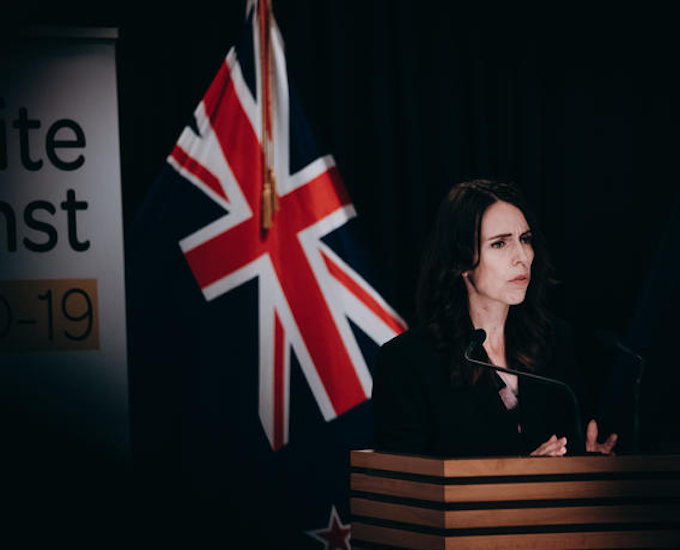
Associate Health Minister Dr Ayesha Verrall gives details of the three-phase government response to the Omicron outbreak. Image: Angus Dreaver/RNZ

There was much political debate late last year about ICU capacity and these latest figures should sound the alarm.

In the face of criticism the government had failed to increase the number of fully resourced ICU beds, Health Minister Andrew Little said there were 289 ICU or High Dependency Unit beds available, insisting that could be increased to up to 550 under surge capacity if needed.

Strongly challenged
That was strongly challenged by clinicians and ICU experts who said the extra capacity was more like 67 — totalling 356 — mainly due to an acute shortage of highly skilled ICU nurses

At the peak of the outbreak, in early March, the modelling estimates 458 ICU beds could be needed, and occupancy could come under “extreme stress” for a number of weeks.

Experts from the University of Otago summarised and analysed the findings, saying the government should take heed and consider police settings accordingly.

They noted socio-economic status and ethnicity were not taken into account, so the modelling would not highlight potentially disproportionate impacts on Māori, New Zealand specific data is incomplete, if delta cases start emerging again and we end up with a “dual variant” outbreak the numbers could be worse, and ICU capacity — outlined in classified Across Government Situation Report leaked to Māori Television — may be underestimated so the predicted pressure on the healthcare system may be even greater.

The authors also draw attention to the “high uncertainty” in the data, for example “the number of cases in hospital might peak at 2790 in early March 2022 … but the 95 percent confidence interval around this 2790 figure is large at: 120 to 9,070”.

“As well as considering the strengths and weaknesses of this IHME modelling, policy-makers will need to consider the potential social and economic disruption from an Omicron outbreak,” they conclude.

Stronger border approach
They also call for a stronger approach at the border, as a key area of vulnerability.

“The NZ government is obviously taking this threat seriously with a recent suspension of future places in MIQ. However, this change will not have an impact on arriving cases until March 2022.

“Therefore, substantially reducing the risk now will probably require a rapid and marked reduction of incoming international flights from some countries (ie, until their outbreaks subside in coming weeks).”

Professor Baker also says the phased opening of the border, due at the end of February, should be pushed out, and the time between the second vaccine dose and booster reduced from four to three months.

This article is republished under a community partnership agreement with RNZ.

Print Friendly, PDF & Email

Article by AsiaPacificReport.nz

Don’t say the Aboriginal flag was ‘freed’ – it belongs to us, not the Commonwealth

ANALYSIS: By Bronwyn Carlson, Macquarie University

We woke to the news yesterday that the Australian government has negotiated with the designer of the Aboriginal flag Harold Thomas, and copyright for the flag will be transferred to the Commonwealth.

The government has now stated the flag is freely available for public use. Prime Minister Scott Morrison stated:

We’ve freed the Aboriginal flag for Australians.

While many Indigenous people are celebrating today and rejoicing in the idea the flag has been “freed,” I am not so sure.

I think we should all take a moment to pause and consider what this new “ownership” might represent.

The flag was first flown at Victoria Square on Kaurna Country, on National Aborigines Day in July in 1971.

A brief history of the flag
The flag was first flown at Victoria Square on Kaurna Country, on National Aborigines Day in July in 1971.

In 1972, it became the official flag for the Aboriginal Tent Embassy which was established on Ngunnawal Country.

In 1995, William Hayden, Governor-General of Australia proclaimed both the Aboriginal flag and the Torres Strait Islander flag (designed by the late Bernard Manok as) “Flags of Australia” under the Flags Act 1953.

But the truth is the Aboriginal flag has always been our flag. We didn’t need an act of Parliament to recognise its significance.

A national flag?
National flags are seen as sacred objects by many: in many countries, to desecrate the flag carries penalties. As citizens, we are expected to revere the national flag and to be proud of what it represents.

But the Australian national flag represents white sovereignty and a belief in national unity.

The national flag symbolises both patriotism and nationalism. Nowhere was this more evident than when Morrison wore a mask sporting the design of the flag. The flag/mask drapes his face with the most prominent national symbol for all to see.

When wearing this mask, the prime minister literally embodies the symbolism of nation and all that stands for.

The national flag is flown at schools and all prominent government buildings. It is, for many Australians, a site of heightened emotion where the main response is a sense of belonging to what Benedict Anderson called an “imagined community”.

Of course, the Union Jack is another nation’s flag. It belongs to the United Kingdom. It represents our dispossession and is a constant reminder of our forced and continued colonisation.

The Union Jack does not represent us, our history or our future aspirations.

A symbol of strength
The Aboriginal flag is a symbol of our strength as an ancient people who preceded the symbolic and real effects of national borders.

The Aboriginal flag does not belong to all Australians. It belongs, like the land, to us as a symbol of our sovereignty. Morrision’s statement about having “freed” the flag for all is offensive.

It is ours; he has no authority to “free” it. The Aboriginal flag cannot just be “freed”. It is an emblem of our emotion, our loves and losses. It holds our faith, our hope and our future.

I grew up in the 1970s and 80s. When I saw the Aboriginal flag, I felt a sense of pride and belonging. As a young person, I wasn‘t aware there were any copyright issues or that there were legalities that needed to be considered.

I always knew I belonged to what the flag stood for: our survival, our resilience as Indigenous people, and our steadfastness in the face of the on-going and omnipresent colonial struggles that continue to affect us today.

Our sorrows and our unity
On Australia Day, we see the Australian national flag waving take place. There is both banality and symbolism to this ritual.

For some, the flag is waved without thought as to what it might mean to others: it is just part of the ritual of the national holiday. For many, it is emotionally charged and can generate fervour and national pride.

I am not sure many people stop to think about the flag’s design, its history or what it might mean to some non-white Australians.

But the design of the Aboriginal flag is intimately connected to our struggle for land rights.

The red represents the land, the yellow the life-giving sun and the black Aboriginal people.

The flag is a symbol of our unceded sovereignty of our lands. It represents a powerful symbol of resistance in our ongoing battle with the Crown in terms of the unlawful claiming of our lands as terra nullius.

How is it possible it can be so seamlessly hijacked in order to be incorporated — “freed” — into another set of meanings? Allowed onto the market for anyone to use? I see this act of “freeing” our flag as an act of arrogance at the very least.

One could also say it is a violent appropriation of what Aboriginal people deem to be a symbol of reverence.

Our flag contains our sorrows and our unity as a colonised people. It is not a “free-for-all” symbol. Nor is it a symbol that can be neatly injected into the national psyche as a means of expressing some kind of racial unity that overshadows the injustice and inequality Aboriginal people experience on a daily basis.

It is the fabric of our souls. When it flies, we can see ourselves in flight as we once were, free nations.The Conversation

Dr Bronwyn Carlson is professor of Indigenous studies and director of the Centre for Global Indigenous Futures, Macquarie University. This article is republished from The Conversation under a Creative Commons licence. Read the original article.

Print Friendly, PDF & Email

Article by AsiaPacificReport.nz

Lawyers threaten PNG police with contempt over settlers eviction halt

PNG Post-Courier

A Supreme Court ordered mass eviction of settlers on land between Papua New Guinea’s University of PNG, Gerehu Stage 3B and Morata stage one in the National Capital District has been stopped at the 11th hour by Chief of Police Operations and Deputy Police Commissioner Operations Anton Billie.

Deputy Commissioner Billie’s orders to stop this mass eviction have put him in a collision course with two separate orders of country’s highest court — SCA 19 of 2018 and SCA 77 of 2015 — unless he reviews and rescinds his orders within 72 hours.

Lawyers representing the land developers have threatened the police with a contempt lawsuit.

Deputy Commissioner Billie ordered a freeze on the mass eviction citing concerns that the court order was not clear and that the legal ramifications of police involvement were not properly clarified in such a large scale operation involving many families.

In a minute sent to NCD Central Commander, Deputy Commissioner Billie said: “After having been briefed on the matter involving the occupants of the portion of land, NCDC, Sixth Estate Limited and Lands and Physical Planning Department, I believe it is a very complex issue as it is.

“If a request with clear court orders have been presented for police assistance, then we have to engage our Legal Directorate to clarify our legal standing in the matter first before engaging our men.

“There is no real need for impetuosity.”

Land dispute settled in 2016
But the registered proprietor of the land — as determined and settled by a three-man Supreme Court bench in 2016 — the Sixth Estate Limited, through its chairman and chief executive officer Philip Mark Paguk, said the Deputy Commissioner may not have been privy to the history of the issue.

In a detailed, five-page letter, including attachments, lawyers of Sixth Estate Limited, Kandawalyn Lawyers, explained the background to all the court proceedings from the district, national and Supreme Court and two police operational orders for the eviction exercise.

The law firm urged the Deputy Commissioner to revoke his earlier orders within 72 hours or contempt proceedings in the Supreme Court would be filed against him and others who were hindering the mass eviction.

“There is no stay order of the Supreme Court Decision in Otto and Others vs Sixth Estate Limited and Others; SCANO. 19 of 2018 and SCA. NO.77 of 2015, hence the runway is clear for the proposed eviction to progress in compliance with the Supreme Court Order,” the lawyers advised.

The letter went on further and stated that: “As far as we are concerned, there is no court order in place stopping/hindering/restraining the pro-posed eviction exercise.

“There is a Supreme Court order in place as mentioned in our letter for police assistance, and that paves the way for the eviction to commence with the assistance of police.”

CEO Paguk said that while he appreciated the concerns raised by Deputy Commissioner Billie in his minute freezing the eviction exercise, his company had spent millions of kina in mobilisation for this eviction after almost 10 years of court battles.

Republished with permission.

Print Friendly, PDF & Email

Article by AsiaPacificReport.nz

Fiji deaths ‘a stark reminder’ of the seriousness of the pandemic

By Luke Rawalai in Suva

Fiji has recorded 987 covid-19 cases, says Ministry of Health permanent secretary Dr James Fong who says the latest deaths are a “stark reminder” of the seriousness of the pandemic.

Fiji’s government reported on Monday 11 more people had died from covid-19, including a four-month-old girl and 15-year-old boy.

Dr Fong said 656 cases were recorded last Saturday while 81 new cases were recorded on Sunday and 250 new cases in the past 24 hours ending at 8am on Monday morning.

Dr Fong said it was known there remained a high risk of resurgence of endemic variants and the arrival of new variants.

“Our socioeconomic survival depends on our ability to build and sustain individual and community-wide resilience. We should expect that covid-19 will be endemic, however we need to appreciate that ‘endemic’ doesn’t mean harmless,” he said.

“Endemic means that we expect continued circulation of the disease in the community, the baseline levels of which are yet to be determined.

“Leptospirosis, typhoid and dengue are endemic in Fiji and they are associated with serious outcomes, especially when the number of cases increases to outbreak levels.

“Building resilience means that we must adopt healthier lifestyles, make covid-safe behaviour a habit that we adopt and support others to adopt. Our objective is to live with the virus and, at the same time, ensure a high level of transmission suppression and prevention of severe outcomes.”

Luke Rawalai is a Fiji Times journalist. Republished with permission.

Print Friendly, PDF & Email

Article by AsiaPacificReport.nz

Covid will dominate, but New Zealand will also have to face the ‘triple planetary crisis’ this year

ANALYSIS: By Nathan Cooper, University of Waikato

As the New Zealand government prepares to deal with a looming omicron outbreak, this will not be the only major issue it will have to tackle this year.

The year 2022 will be important for environmental and climate action.

Several key developments are expected throughout the year, both in New Zealand and internationally, focusing on climate change and biodiversity — and how these crises overlap with the impacts of the covid-19 pandemic.

In February and early April, the Intergovernmental Panel on Climate Change (IPCC) will publish the next two parts of its Sixth Assessment (AR6).

These reports will provide the basis for global negotiations at the next climate summit scheduled to be held in Egypt in November.

The February report will focus on impacts and adaptation and the April report on mitigation of climate change. Together, they will assess the global and regional impacts of climate change on natural ecosystems and on human societies, as well as opportunities to cut emissions.

They will identify points of particular vulnerability, consider the practicalities of technological innovations and weigh the costs and trade-offs of low-carbon opportunities. Both reports will present a definitive statement of where impacts of climate change are being felt and what governments and other decision makers can do about it.

Multiple crises
Climate change tends to dominate headlines about the environment. But biodiversity loss and accelerating rates of species extinction pose an equal threat to our economies, livelihoods and quality of life.

A UN Global Assessment Report on biodiversity and ecosystem services predicts the loss of one million species during the coming decades. It foresees serious consequences for our food, water, health and social security.

New Zealand is not immune from this global crisis. About one third of our species are listed as threatened.

In April, the UN Biodiversity Conference in Kunming, China, will launch a new global biodiversity framework to guide conservation and sustainable management of ecosystems until 2030.

Expect to see intense negotiations on the current draft framework as states try to balance the need to address the underlying causes of biodiversity loss, without endangering economic priorities, including post-covid recovery.

New Zealand’s plan to cut emissions
In May, the government is expected to release its first emissions reduction plan (ERP), in response to the Climate Change Commission’s advice on how New Zealand can meet its domestic and international targets.

The plan will set out policies and strategies to keep the country within its emissions budget for 2022-25 and on track to meet future budgets.

Under the Climate Change Response Act 2002, the government is required to set emissions budgets for every three to four-year period between 2022 and 2050 and to publish emissions reduction plans for each.

The first plan looks likely to come at a difficult time for the economy. Businesses have already contended with covid-related lockdowns and uncertainty and may soon be challenged by staffing shortages in the wake of the omicron outbreak.

It will be tricky to balance the need for significant action to reduce emissions while keeping business and the wider community on board. Expect a wide-ranging plan with sector-specific strategies for transport, energy, industry, agriculture, waste and forestry, but little detail on agriculture.

Half a century since first environment summit
In 1972, the UN Conference on the Human Environment took place in Stockholm, Sweden. It was the first international conference to make the environment a major issue.

Fifty years on, in June this year Stockholm +50 will mark a half-century of global environmental action, and refocus world leaders’ attention on the “triple planetary crisis” of climate, biodiversity and pollution.

The aim is to accelerate progress on the UN’s Sustainable Development Goals, the Paris Agreement and the global biodiversity framework, while making sure countries’ covid-19 recovery plans don’t jeopardise these. Expect growing demand for more global recognition of a “human right to a healthy environment” to leverage more effective environmental action.

On the domestic front, the national adaptation plan (NAP) is due in August. This will set out how the government should respond to the most significant climate change risks facing Aotearoa.

These risks range from financial systems to the built environment and have already been identified in the first national climate change risk assessment. Public consultation will take place in April and May.

The decade of action
The UN’s annual climate summit, COP27, will take place in Sharm el-Sheikh, Egypt, in November. Last year, COP26 drew unparalleled public attention and generated some positive new climate pledges.

One major success was an agreement that nations revisit and strengthen their nationally determined contributions by the end of 2022. But the summit was generally criticised for failing to secure commitments from high-emitting countries to keep global temperatures from climbing beyond 1.5℃.

The overarching aim to “keep 1.5℃ alive” will be more urgent than ever. A particular concern is how effectively civil society will be able to bring pressure to bear on governments.

Protests and activities are likely to be significantly limited by the Egyptian host government.

In the build-up to COP27, expect significant pressure on big polluter states to deliver more ambitious commitments to cut emissions, but also less flamboyant and free protests in Egypt.

The UN has called 2020-2030 the “decade of action”. The chance remains to avoid runaway climate change, protect biodiversity and stabilise our ecosystems. It’s imperative that this year, the third of this decade, is one that really counts.The Conversation

Dr Nathan Cooper is associate professor of law at the University of Waikato. This article is republished from The Conversation under a Creative Commons licence. Read the original article.

Print Friendly, PDF & Email

Article by AsiaPacificReport.nz

This object in space flashed brilliantly for 3 months, then disappeared. Astronomers are intrigued

Source: The Conversation (Au and NZ) – By Natasha Hurley-Walker, Radio Astronomer, Curtin University

Artist visualisation Author provided

“Holy sharks, Batman, it’s periodic!”

I exclaimed on Slack.

It was the first lockdown of 2021 in Perth, and we were all working from home. And when astronomers look for something to distract themselves from looming existential dread, there’s nothing better than a new cosmic mystery.

In 2020 I gave an undergraduate student, Tyrone O’Doherty, a fun project: look for radio sources that are changing in a large radio survey I’m leading.

By the end of the year he’d found a particularly unusual source that was visible in data from early 2018, but had disappeared within a few months. The source was named GLEAM-X J162759.5-523504, after the survey it was found in and its position.

Sources that appear and disappear are called “radio transients” and are usually a sign of extreme physics at play.

The mystery begins

Earlier this year I started investigating the source, expecting it to be something we knew about – something that would change slowly over months and perhaps point to an exploded star, or a big collision in space.

To understand the physics, I wanted to measure how the source’s brightness relates to its frequency (in the electromagnetic spectrum). So I looked at observations of the same location, taken at different frequencies, before and after the detection, and it wasn’t there.

I was disappointed, as spurious signals do crop up occasionally due to telescope calibration errors, Earth’s ionosphere reflecting TV signals, or aircraft and satellites streaking overhead.

So I looked at more data. And in an observation taken 18 minutes later, there the source was again, in exactly the same place and at exactly the same frequency – like nothing astronomers had ever seen before.

At this point I broke out in a cold sweat. There is a worldwide research effort searching for repeating cosmic radio signals transmitted at a single frequency. It’s called the Search for Extra-Terrestrial Intelligence. Was this the moment we finally found that the truth is … out there?

One of the brightest pulses from the new radio transient detected with the Murchison Widefield Array.

The plot thickens

I rapidly downloaded more data and posted updates on Slack. This source was incredibly bright. It was outshining everything else in the observation, which is nothing to sniff at.

The brightest radio sources are supermassive black holes flaring huge jets of matter into space at nearly the speed of light. What had we found that could possibly be brighter than that?


Read more:
Experts solve the mystery of a giant X-shaped galaxy, with a monster black hole as its engine


Colleagues were beginning to take notice, posting:

It’s repeating too slowly to be a pulsar. But it’s too bright for a flare star. What is this? (alien emoji icon)???

Within a few hours, I breathed a sigh of relief: I had detected the source across a wide range of frequencies, so the power it would take to generate it could only come from a natural source; not artificial (and not aliens)!

Just like pulsars – highly magnetised rotating neutron stars that beam out radio waves from their poles – the radio waves repeated like clockwork about three times per hour. In fact, I could predict when they would appear to an accuracy of one ten-thousandth of a second.

So I turned to our enormous data archive: 40 petabytes of radio astronomy data recorded by the Murchison Widefield Array in Western Australia, during its eight years of operation. Using powerful supercomputers, I searched hundreds of observations and picked up 70 more detections spanning three months in 2018, but none before or after.


Read more:
Tuning in to cosmic radio from the dawn of time


The amazing thing about radio transients is that if you have enough frequency coverage, you can work out how far away they are. This is because lower radio frequencies arrive slightly later than higher ones depending on how much space they’ve traveled through.

Our new discovery lies about 4,000 light years away – very distant, but still in our galactic backyard.

Interstellar space slows down long wavelength radio waves more than short.
ICRAR

We also found the radio pulses were almost completely polarised. In astrophysics this usually means their source is a strong magnetic field. The pulses were also changing shape in just half a second, so the source has to be less than half a light second across, much smaller than our Sun.

Sharing the result with colleagues across the world, everyone was excited, but no one knew for sure what it was.

The jury is still out

There were two leading explanations for this compact, rotating, and highly magnetic astrophysical object: a white dwarf, or a neutron star. These remain after stars run out of fuel and collapse, generating magnetic fields billions to quintillions times stronger than our Sun’s.

And while we’ve never found a neutron star that behaves quite this way, theorists have predicted such objects, called an “ultra-long period magnetars”, could exist. Even so, no one expected one could be so bright.

We think the source could be either a magnetar or a white dwarf, or something completely unknown.

This is the first time we’ve ever seen a radio source that repeats every 20 minutes. But maybe the reason we never saw one before is that we weren’t looking.

When I first started trying to understand this source, I was biased by my expectations: transient radio sources either change quickly like pulsars, or slowly like the fading remnants of a supernova.

I wasn’t looking for sources repeating at 18-minute intervals – an unusual period for any known class of object. Nor was I searching for something that would appear for a few months and then disappear forever. No one was.

As astronomers build new telescopes that will collect vast quantities of data, it’s vital we keep our minds, and our search techniques, open to unexpected possibilities. The universe is full of wonders, should we only choose to look.

The Conversation

Natasha Hurley-Walker is supported by an Australian Research Council Future Fellowship (project number FT190100231) funded by the Australian Government.

ref. This object in space flashed brilliantly for 3 months, then disappeared. Astronomers are intrigued – https://theconversation.com/this-object-in-space-flashed-brilliantly-for-3-months-then-disappeared-astronomers-are-intrigued-175240

How accurate is your RAT? 3 scenarios show it’s about more than looking for lines

Source: The Conversation (Au and NZ) – By Ashwin Swaminathan, Senior Lecturer, Australian National University

Shutterstock

As Omicron surges through the community, getting the right answer from a Rapid Antigen Test (RAT) is not as straightforward as reading one or two lines off the kit.

RATs are a convenient diagnostic tool to detect COVID virus fragments in nasal secretions or saliva. They are designed to be self-administered and give an answer in minutes. Detecting infection early is critical to preventing spread and allowing persons at risk of severe disease to get timely access to close monitoring and new life-saving therapies.

As governments plan to distribute tens of millions of RAT kits to schools and workplaces in coming weeks to help Australians work and study safely, it is important that we understand how to best use this diagnostic tool to reduce transmission and unnecessary disruptions to our lives and economy.


Read more:
Australia approves two new medicines in the fight against COVID. How can you get them and are they effective against Omicron?


Key concepts

There are three key concepts to understanding how accurate RATs (or any diagnostic test) are: sensitivity, specificity and pre-test probability.

Let’s imagine we line up 100 people who definitely have COVID infections. Applying a RAT kit with 80% sensitivity would lead to a positive result in 80 people – with 20 receiving a “false negative” result. So the term “sensitivity” refers to how well a test picks up the presence of a disease or condition.

If we line up 100 people who are definitely free of COVID infection, using a RAT test with 98% specificity would mean that 98 would test negative – and two people would have a “false positive”. So “specificity” is whether a test correctly identifies the absence of a disease or condition.

The “pre-test probability” of infection is the likelihood a person has COVID infection based on their clinical symptoms, exposure history and/or the background community rate of infection. The pre-test probability (otherwise known as “disease prevalence”) varies between households, workplaces and communities and provides context to a RAT kits sensitivity and specificity.


Read more:
How to look after your mental health if you’re at home with COVID


3 people, 3 tests

Let’s look at how we can apply the above concepts to three typical Australian scenarios. Let’s assume a TGA-approved self-test RAT kit with a minimum sensitivity of 80% and specificity of 98% was used. Probability calculations are performed using an online tool.

These scenarios are not intended as medical advice but as illustrations of key concepts only.

1. Ahmed is a 48 year-old office worker, double vaccinated and booked in for a booster shot

He lives in a household of four with two COVID-positive teenagers. He has developed a fever and sore throat. He has undertaken a RAT and has a positive result. What should he do next?

The pre-test probability of COVID for Ahmed is high (at least 80% – an educated estimate based on risk factors) given he is a household close contact, has developed typical symptoms and has not been boosted. In this situation, a positive RAT result is >99% likely to represent true infection. The best thing Ahmed can do is register the positive result, rest up, keep up his fluids, take paracetamol if required and quarantine for at least seven days.

2. Kim is 15 years old and lives in a capital city with her family

She recently received her second vaccination. She does not have COVID symptoms and has no known contacts. She self-tests with a RAT kit distributed by her school and returns a positive test. What does this mean?

The pre-test probability of COVID in Kim is low given her recent vaccination, lack of symptoms or exposure history. The current population rate of COVID in Canberra is around 2% based on reported cases and factoring in likely under-reporting. This prevalence is likely similar to that in Sydney or Melbourne. So Kim’s positive RAT result would only be 50% likely to represent true infection. In this instance, Kim should confirm the result by getting a PCR test. She should quarantine until she receives that result but a negative PCR result might mean she and her family avoid unnecessary isolation.

3. Margaret is a 63 year-old disability support worker who has received a booster vaccination

She is on medication for arthritis that affects her immune system. Three days ago, while intermittently wearing a surgical mask, she cared for a man in his home for six hours. He was later diagnosed with COVID. Margaret is asymptomatic and self-tests with a RAT kit that returns a negative result. What should she do?

Margaret’s pre-test probability of COVID is estimated to be moderate to high (~50%) given she was a close contact, had inadequate mask protection and her medication may reduce vaccine protection. A negative result is 83% likely to be accurate. Margaret should err on the side of caution by isolating then repeating the RAT 48 hours later. As it happens, she has developed a cough and runny nose within that time and returns a positive test.

How else can I improve my RAT accuracy?

The accuracy of RATs can be affected by factors such as how well the sample is taken, the timing of the sample (RATs are relatively insensitive early or late in infection) and the evidence particular brands have differing ability to detect the Omicron variant. The TGA is currently reviewing and reporting the evidence provided for kits on sale and how sensitive they are to specific COVID variants.

So, to get the most out of your RAT, do the following:

  • follow the kit instructions closely

  • time your test – don’t perform within 48 hours of exposure to COVID and preferably wait or repeat between 5–7 days post exposure

  • if your test result is a surprise based on your assessment of pre-test probability (you think there is a good chance of a false positive or negative result), then take appropriate precautions and repeat the test 24–48 hours later or have a PCR test done.

The Conversation

Ashwin Swaminathan has received funding from the National Health and Medical Research Council.

ref. How accurate is your RAT? 3 scenarios show it’s about more than looking for lines – https://theconversation.com/how-accurate-is-your-rat-3-scenarios-show-its-about-more-than-looking-for-lines-175515

Children whose parents smoke have lower test scores and more behavioural issues than kids of non-smokers

Source: The Conversation (Au and NZ) – By Preety Pratima Srivastava, Senior Lecturer, RMIT University

Shutterstock

Children whose parents smoke have lower academic test scores and more behavioural issues than children of non-smokers.

These are the findings of our research published in the journal of Economics and Human Biology. Smoking is prevalent in lower socio-economic groups whose characteristics (such as lower IQ and poorer motivation on average) are correlated with lower academic scores and more behavioural issues in children. This can bias the results as the sample of children whose scores are lower is no longer random.

After addressing such concerns, our broad finding remained the same. Because of the model we used, this means there is a causal – rather than merely correlational – relationship between parental smoking and children’s academic scores and behavioural outcomes.

How we did our study

We used data from the Longitudinal Study of Australian Children (LSAC), which tracks children from birth to monitor their development and well-being. It also surveys them and their parents on a range of cognitive (such as academic) and non-cognitive (such as behavioural) performance measures, and records other data such as their NAPLAN test results.

We wanted to find the effects of parental smoking on children’s cognitive and non-cognitive skills in early life – from 4-14 years old.

We measured children’s cognitive skills using the given NAPLAN literacy and numeracy test scores in grades 3, 5, 7 and 9. We also used the Peabody Picture Vocabulary Test (PPVT), which is designed to measure a child’s knowledge of the meaning of spoken words and his or her receptive vocabulary. The test is carried out as part of the LSAC survey when the children are 4-9 years old.

Non-cognitive skills include social behaviour, hyperactivity or inattention, and peer problems. We took the measures of these as reported by parents.

What we found

We found, across all measures of cognitive skills, children living with non-smoker parents had a higher average score than children living with at least one smoker parent. We found smoking can reduce academic scores by up to 3%.

Girl writing test at desk.
Kids’ test scores were lower if their parents were smokers than those of non-smoking parents.
Shutterstock

Likewise, we found children with at least one parent who smokes are likely to experience more behavioural issues. We found smoking can reduce behavioural scores by up to 9%.

Our findings are consistent even when we look at mums’ and dads’ smoking behaviour separately. But the effect is stronger for mothers, as expected. Maternal smoking in pregnancy has direct effects on the child’s brain development and birth weight. Pre-natal ill-health and sickness in early childhood may affect cognitive, social and emotional outcomes through poorer mental well-being.

Second-hand smoke exposure at home can also cause numerous health problems in infants and children, such as asthma and ear infections. This could lead them to take more time out of school.

We used information on the number of school days missed because of health reasons and children’s physical health assessments in the LSAC survey to test whether parental smoking and absenteeism due to health were related.

We found children from households with at least one smoker were more likely to have lower school attendance and poorer physical health, both of which have adverse consequences on their cognitive and non-cognitive development.

Our findings did not change across various measures, such as the frequency or number of cigarettes parents smoked per day.

But we did find parental smoking had a stronger influence on boys than girls. This is consistent with growing evidence that girls are more resilient to environmental pressures than boys.

How parental smoking affects kids’ skills: the three pathways

Top of shopping trolley with woman's hand on it.
Spending on tobacco can leave less money for food.
Shutterstock

There are three pathways through which parental smoking has an effect on children’s academic, social and emotional skills.

The first is that the child’s health may already have been affected before birth if the mother was a smoker. And some other negative effects of ill health come from exposure to second-hand smoke, as described above.

The second pathway for parental smoking affecting a child’s acquisition of cognitive and non-cognitive skills is through a reduction in household income. Tobacco spending can displace spending on food, education and health care.

The third pathway is that children’s ability to develop skills depends on their parents’ cognitive and non-cognitive skills, which are determined by their own health and education. Parental smoking can affect their own well-being, such as through impacting their respiratory health. This, in turn, can influence the way they parent.

Our findings highlight the role of the family environment in early childhood development, which sets the foundation for long-term health, as well as social and economic success. Campaigns, programs and policies aimed at reducing tobacco use should emphasise the inadvertent harm smoking habits can have on children’s present and future.

The Conversation

Preety Pratima Srivastava does not work for, consult, own shares in or receive funding from any company or organization that would benefit from this article, and has disclosed no relevant affiliations beyond their academic appointment.

ref. Children whose parents smoke have lower test scores and more behavioural issues than kids of non-smokers – https://theconversation.com/children-whose-parents-smoke-have-lower-test-scores-and-more-behavioural-issues-than-kids-of-non-smokers-172601

Once a form of ‘social camouflage’, school uniforms have become impractical and unfair. Why it’s time for a makeover

Source: The Conversation (Au and NZ) – By Johanna Reidy, Lecturer, Department of Public Health, Wellington School of Medicine, University of Otago

Shutterstock

As the start of a new school year looms, school uniforms are being dusted off or new ones bought. At the same time, age-old debates about the pros and cons of school uniforms are being dusted off, too.

But questions about practicality, cost or conformity tend to overshadow the bigger underlying issue of how uniforms – and rules about wearing them – actually affect educational outcomes.

In other words, does wearing (or not wearing) a uniform contribute to students being mentally well, physically comfortable, healthy and active – and therefore better equipped to learn?

After all, academic learning is a key reason children go to school in the first place. Given the heated arguments and the insistence on particular types of garments being worn, we might expect uniforms to directly enhance academic performance.

They don’t. There is no persuasive evidence that school uniforms are among the factors that directly improve learning. However, there is evidence uniforms might indirectly support classroom management – for example, by helping remove distractions so students settle more quickly to their tasks.

Instead of arguing about whether uniforms are good or bad, then, let’s refocus our energy on making better garment designs and fairer school uniform rules, with an eye to supporting educational outcomes.

Uniforms as a form of class disguise: an illustration of students in a classroom from The Illustrated London News in 1891.
GettyImages

From equality to equity

Since there’s no direct link between uniforms and academic achievement, why insist on dressing students the same? History provides some of the answer.

In the 19th century, when school uniforms became common alongside compulsory education, a kind of equality was achieved by treating all students the same. Uniforms provided “social camouflage” by removing outward signs of class differences.

One enduring benefit of school uniforms is that they reduce “competitive dressing” by students – the social pressure to wear certain clothes.


Read more:
Does wearing a school uniform improve student behavior?


Nowadays, however, the debate about uniforms sidesteps the issue of how treating students the same is not necessarily the same as treating them fairly. In fact, the research highlights a need for equity: to achieve more equal outcomes can require treating students differently.

Logically, if equality and sameness were directly correlated, school uniforms and school uniform policies should have a neutral or positive impact on all students. But this isn’t the case.

Garment design or policies about which garments can be worn when and by whom disadvantage poorer students, girls, religious minorities and gender-diverse students. Together, these student groups make up over half the school population.

Studies have shown girls are more active when wearing a sports uniform.
Shutterstock

Students are not uniform

We know uniforms are less expensive than non-uniform alternatives over a student’s total school career. But the high upfront cost of uniforms can be a significant burden for students from low-income families.

Some students even attend on alternate days because they share a uniform with a sibling, or skip school until they can buy a missing uniform item. It’s a sad irony that the very tool meant to encourage equal access to education has become a barrier for some even before they walk through the school gates.

But beyond the cost, uniform design and policy can directly affect girls’ ability to participate in physical activity or lunchtime play.


Read more:
Why do schools want all students to look the same?


At a basic level, boys simply don’t risk flashing their underwear if they bike to school in regulation uniform. By contrast, girls’ uniforms often restrict a full range of movement and inhibit playtime sports or the ability to enjoy the jungle gym.

Studies have shown girls are more active when wearing a sports uniform (over and above timetabled sport) than on ordinary uniform days, and are more willing to bike or choose active transport if they have a sports-style uniform.

For older girls, feeling comfortable and not exposed is a key factor in participating in sports or games at break times. Yet some schools still offer no alternative choice to a skirt. For overweight children, unflattering clothing can create a disincentive to participating in physical activity.

Religious minority groups, despite being members of the school community, are often not accommodated by school uniform design and policy. And inflexible school uniform policies routinely ignore the needs of transgender students.


Read more:
4 reasons schools should let students wear sports uniforms every day


Better uniforms for better learning

Clearly, same treatment no longer means fair treatment. We should rethink our approach to equity and allow for flexibility to achieve similar outcomes.

Indeed, all students could benefit from a general rethink, from ensuring uniform garments are sun-safe to allowing students to dress for the weather conditions. There’s no need to freeze during an unseasonable cold snap in November simply because it’s school policy that summer uniforms must be worn in summer months.

Ultimately, we should get beyond binary debates about whether school uniforms are good or bad, and focus on improving uniform garments and policies with equity, well-being and fairness in mind.

This means designing uniforms that are comfortable to wear, allow free movement, permit physical activity and encourage active transport choices to and from school.

Above all, uniform wearing should support mental and physical comfort and, most importantly, learning.

The Conversation

Johanna Reidy does not work for, consult, own shares in or receive funding from any company or organization that would benefit from this article, and has disclosed no relevant affiliations beyond their academic appointment.

ref. Once a form of ‘social camouflage’, school uniforms have become impractical and unfair. Why it’s time for a makeover – https://theconversation.com/once-a-form-of-social-camouflage-school-uniforms-have-become-impractical-and-unfair-why-its-time-for-a-makeover-175320

An unemployment rate below 4% is possible. But for how long?

Source: The Conversation (Au and NZ) – By Jeff Borland, Professor of Economics, The University of Melbourne

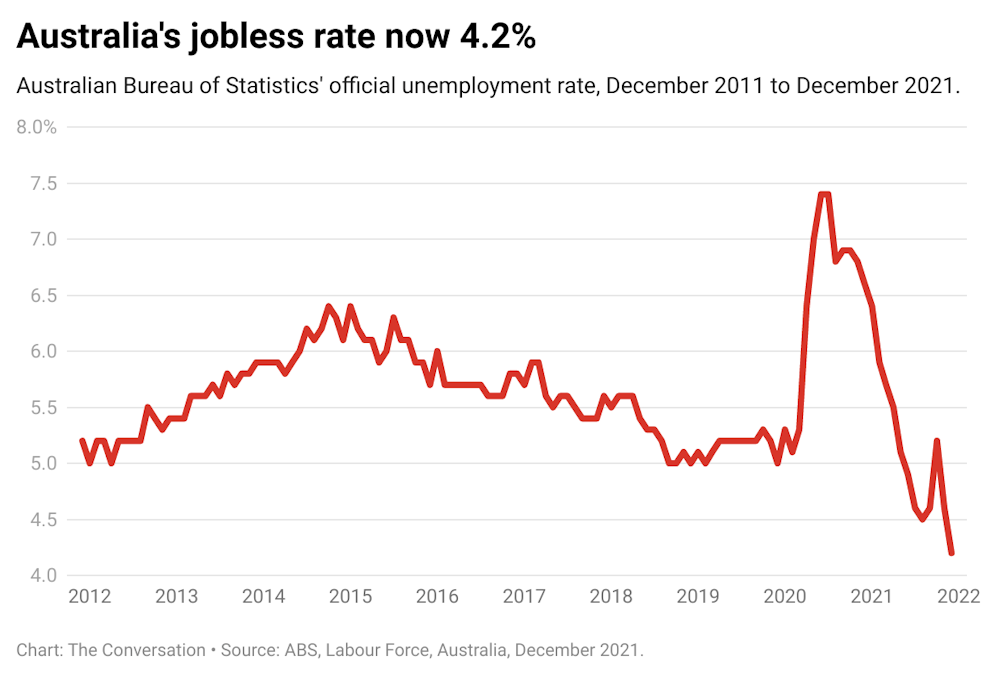
It would be nice to think Australia’s low unemployment rate – now 4.2%, the lowest since August 2008 – is here to stay.

We’ve been waiting a long time to see this. In the decade before the onset of COVID-19 the jobless rate hardly moved. In March 2010 it was 5.4%. Ten years later, in March 2020, it was 5.3%. In between the lowest the rate was to 4.9% – and then just for two months.


Graph showing Australia's unemployment rate from December 2011 to December 2021.

CC BY

In 2021 the unemployment rate was under 5% in six out of 12 months.

A lower rate of unemployment makes us all better off. It means more of the nation’s productive resources are being put to work, and higher living standards for those extra people employed and their families.

Even with the effects of Omicron, there are good reasons to think the rate will fall further in 2022.

The bigger question is whether whatever lower rate we achieve can be sustained once all the effects of the pandemic are behind us. This will depend largely on how macroeconomic policy makers handle the transition.

High job vacancies

One reason to expect the rate to go lower in 2022 is recent employment growth – 365,000 in November, and 65,000 in December. With that pace of growth it’s likely there’s more to come, especially given the high level of job vacancies.

Had the vacancy rate at the end of 2021 been the same as before COVID-19, an extra 158,000 jobs would have been filled. Just half of those jobs going to the unemployed would have seen the December unemployment rate drop to 3.6%.


Read more:
Australia has record job vacancies, but don’t expect higher wages


Uncertainties make it difficult to predict exactly how much lower the jobless rate could go, or for how long. That will depend on macroeconomic policy – the reason the unemployment rate is where it is now.

Government action has been crucial

The big reason the unemployment rate has fallen is due to growth in the proportion of the population who are employed accelerating since mid-2021.

When you think about what changed in 2021 to make this happen, government policy has to be the main explanation.

Government spending on COVID-related programs has added considerably to gross domestic product, increasing employment.

Closed borders may also have added to GDP – by as much as 1.25% per annum, according to economist Saul Eslake – due to Australians redirecting spending from international travel to domestic consumption.

What follows is that a low rate of unemployment will depend on the policy makers being willing to continue to provide stimulus to economic activity.

An opposing force

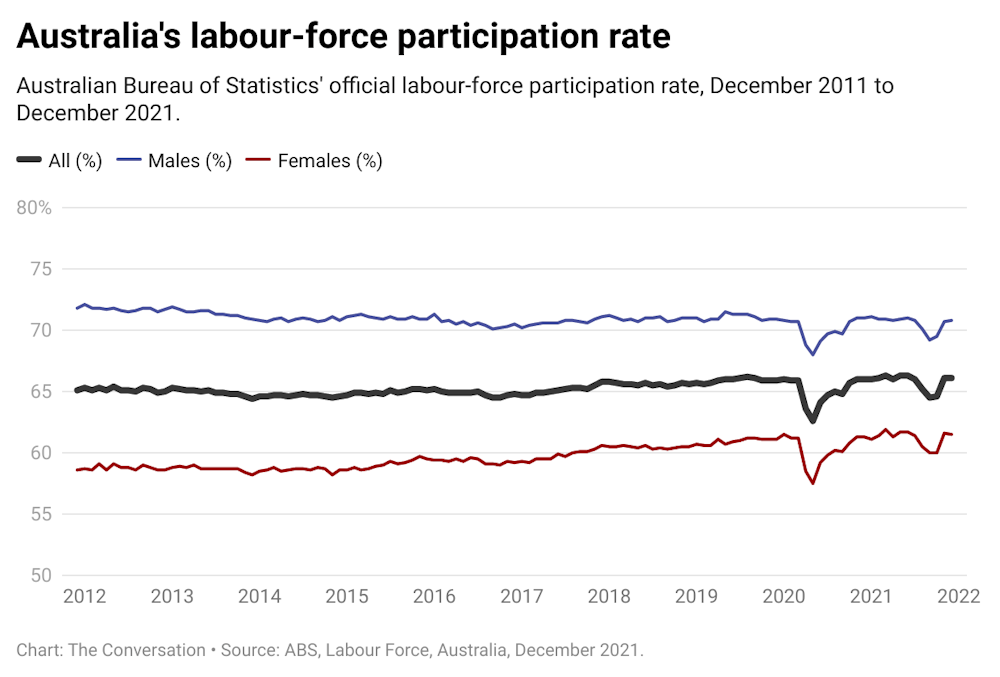
One headwind blowing the unemployment rate higher may be faster growth in the labour-force participation rate, which measures the proportion of the population who want to work.

Before COVID-19 the participation rate had been increasing rapidly. With COVID-19 it slowed, due to reasons such as parents having to withdraw from the labour force to care for children.


ABS labour force participatin rate, December 2021.

CC BY

Should growth in the labour-force participation rate return to its previous pace once the impact of COVID-19 recedes, the rate of unemployment will be pushed back up.


Read more:
Just 4.5% during lockdowns? The unemployment rate is now meaningless


Statistics for young workers

Issues to do with measurement may also be temporarily making the rate of unemployment artificially low.

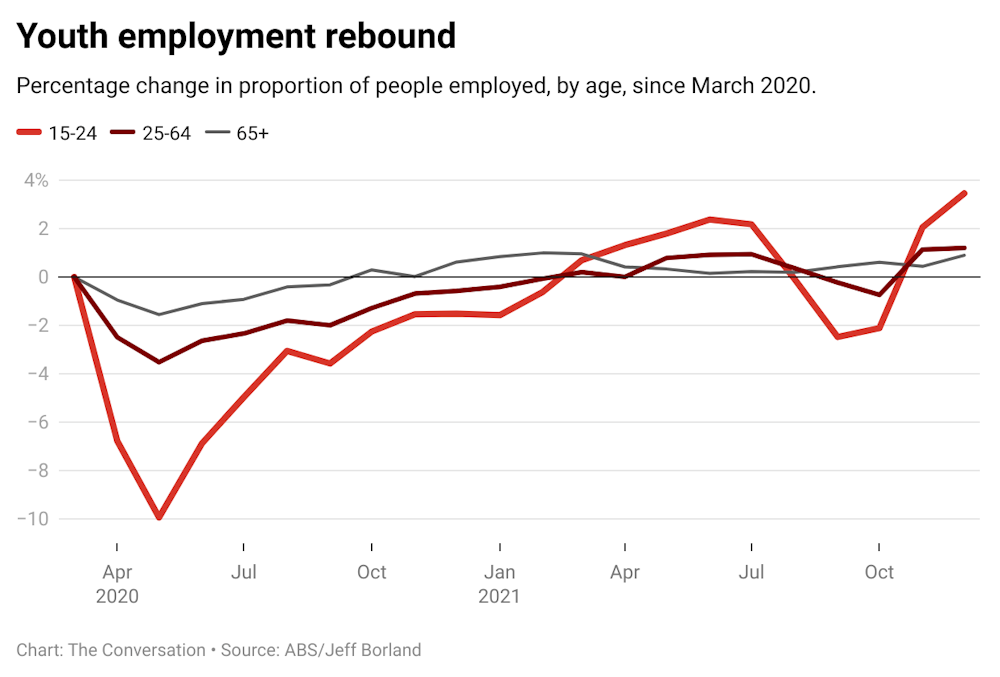
The strongest employment growth from March 2020 to December 2021 was for those aged 15 to 24 years.

Younger workers were hardest hit during the 2020 downturns associated with COVID-19. But by December 2021 the proportion of young people employed was 3.5 percentage points higher than in March 2020. This compares with the employment rate being 1.2 percentage points higher than before the pandemic for those aged 25-64 years, and 0.9 percentage points higher for those 65 years and older.


Percentage change in proportion of people employed, by age, since March 2020.

CC BY

The strength of employment growth for the young – given all we know about the increasing difficulties they faced in the labour market in the 2010s – is surprising.

My guess is it may in part be due to young Australian permanent residents taking over jobs previously held by international students and working holiday makers, and being more likely to be captured in official surveys.


Read more:
The economy can’t guarantee a job. It can guarantee a liveable income for other work


In that case,total employment of the young may not actually have changed by much, but the statistics show it increasing because of who is doing the work.

Before COVID-19 we could reasonably have expected the rate of unemployment today to be 5%. Instead, we’re at 4.2% and looking ahead in 2022 to further falls in unemployment. What lies beyond that is less certain.

The Conversation

Jeff Borland receives funding from the Australian Research Council. He is a Board member of the Committee for Economic Development of Australia.

ref. An unemployment rate below 4% is possible. But for how long? – https://theconversation.com/an-unemployment-rate-below-4-is-possible-but-for-how-long-175618

Police location sites on Facebook are helping drivers avoid detection for drug driving

Source: The Conversation (Au and NZ) – By Laura Mills, PhD Candidate, University of the Sunshine Coast

Shutterstock

The internet allows us to check the surf, the news, traffic on the road, what our friends have been up to – all before getting out of bed. While this has made several aspects of life easier, it can also come at a cost.

The last decade has seen a growing number of Facebook groups and pages dedicated to revealing the locations of police traffic operations.

These Facebook communities rely on users to alert the group or page when they drive past a random breath testing or roadside drug testing operation, as well as speed and mobile phone cameras.

Our study, published recently in the journal Safety Science, aimed to find out more about how these sites were being used by a sample of 890 people who take drugs.

We found 25% of them reported using police location groups or pages on Facebook; of these people, 43% reported using the sites to avoid roadside drug testing operations (while others used the pages for other purposes, like traffic updates and avoiding speed cameras).

Our results suggest police location groups and pages on Facebook are helping drivers avoid detection for drug driving – a traffic offence recognised as contributing to 106 fatal injuries in 2019 in Australia.


Read more:
Speeding drivers keep breaking the law even after fines and crashes: new research


What we did

With increases in drug-related traffic fatalities across Australia in the last decade, we chose to focus our study on drug driving behaviours, and investigate how people use Facebook police location groups and pages to avoid roadside drug testing operations.

Our study involved 890 Queensland motorists who reported consuming either marijuana, MDMA and/or methamphetamines in the past 12 months. These are the three drugs tested for on roadside drug tests across all Australian states.

Participants were recruited through Facebook and completed an online survey.

We found:

  • 59% of the sample (521 participants) reported at least one instance of drug driving in the previous 12 months
  • 25% of the sample (219 participants) reported using Facebook police location communities
  • of these 219 participants, almost two-thirds (142 participants) were drug drivers, however only 43% (94 participants) reported using the police location information to avoid roadside drug testing
  • other reasons for using these sites included for traffic updates, viewing locations of speed and mobile phone cameras and to avoid random breath testing sites.
A man in a car looks at his phone.
While not all offenders use these sites, there is a small proportion of drug drivers who do use the sites to actively avoid being detected.
Shutterstock

How drivers use police location sites is important

How drivers use police location sites is more important than whether they use them or not. Some drivers use them to actively avoid roadside drug testing, while others use them for different reasons (such as for traffic updates or information on speed cameras).

We found those who use these police location Facebook sites aren’t engaging in drug driving any more than people who don’t use these sites at all. And both groups considered it unlikely they would be caught if they were to drug drive.

A difference was found, however, when we compared those who reported using police location communities to avoid roadside drug testing and those who used the sites for a different reason (such as traffic updates or speed camera location information).

Those who used the police location Facebook sites to avoid roadside drug testing:

  • offended more in the past (75 drug driving events on average, compared to 31 drug driving events)
  • reported being more likely to offend again in the future
  • viewed the Facebook police location posts more frequently (“few times a week” vs “few times per month”) and
  • were more likely to believe the posts were accurate and reliable (a score of 6.57 out of 10 vs 5.20 out of 10).

What does this mean for road safety?

This study provides the first steps in exploring the use of police location sites on Facebook in relation to drug driving.

While not all offenders use these sites, there is a small proportion of drug drivers who do use the sites to actively avoid being detected.

This suggests the use of police location sites is a problematic area that needs more research to see how to further prevent drug driving.

Overall, participants considered it “unlikely” they would be caught for drug driving, regardless of whether they used Facebook police location groups and pages or not.

This is a significant problem as a core component of deterrence theory requires that for the legal punishment to effectively deter people, they need to believe the chance of being caught to be high.

Regardless of police location pages, there remains a fundamental need to increase motorists’ perceptions of being caught for drug driving.

This may be achieved through increasing awareness of drug testing operations when they are occurring on the roadside.

A recent study by the same research team found even just driving past a roadside drug testing operation two or more times within a year increased perceptions of being caught for drug driving.

Many motorists, however, are not aware that roadside drug testing often occurs alongside random breath testing.

Increasing roadside drug testing related signage during active operations may prove to be an important ingredient for enhancing the impact of roadside operations.

Taken together, while police location pages may prove to be a cause for concern, motorists’ already low estimations of being caught should not be overlooked.


Read more:
A new approach to cut death toll of young people in road accidents


The Conversation

Laura Mills receives funding from the Motor Accident Insurance Commission (MAIC).

James Freeman receives funding from the Motor Accident Insurance Commission (MAIC).

Verity Truelove receives funding from the Motor Accident Insurance Commission (MAIC).

ref. Police location sites on Facebook are helping drivers avoid detection for drug driving – https://theconversation.com/police-location-sites-on-facebook-are-helping-drivers-avoid-detection-for-drug-driving-174869

‘Life finds a way’: here’s how rainbowfish survive in Australia’s scorching desert

Source: The Conversation (Au and NZ) – By Catherine R. M. Attard, Lecturer in Molecular Ecology, Flinders University

shutterstock

A trip into central Australia involves packing your 4WD to the brim with survival gear, water and food. Yet fish have managed to persist in that parched landscape for thousands of years – how do they do it?

We at the Flinders Molecular Ecology Lab went about finding out. Our recent research examined rainbowfish in Australia, to discover how they hold onto life in isolated pockets of water in the desert.

Pockets of water in the desert can only hold small fish populations. A small population means a small gene pool – which can lead to inbreeding and poor health, as we sometimes see in endangered species.

But we found even small populations can adapt to the harsh environments of water holes and small creeks. Life finds a way – even in one of the most extreme and unpredictable environments on Earth.

Prospering in central Australia

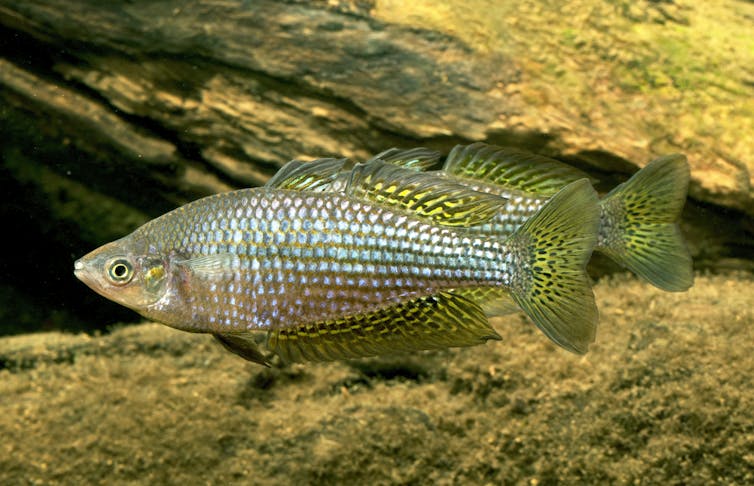
Native desert rainbowfish (Melanotaenia splendida tatei) live in the deserts of central Australia. They grow to about 9cm and are usually silver and iridescent, with a yellow and green chequered pattern on the fins.

Desert rainbowfish populations live in slow-flowing and still habitats, including impermanent rivers, waterholes, lakes, flowing bores and stock dams.

Their populations fluctuate during boom-bust cycles. During rare flooding events in the desert, rainbowfish breed in large numbers and spread along temporary streams and floodwaters.


Read more:
Australia’s smallest fish among 22 at risk of extinction within two decades


Desert rainbowfish
Desert rainbowfish live in slow-flowing and still habitats.
Gunther Schmida

Our findings

Our research sought to determine how rainbowfish populations persist in desert regions of central Australia, and whether their genomes show evidence of adaptation to the local harsh conditions.

We collected 344 desert rainbowfish from 18 rivers and waterholes from across the vast and arid Lake Eyre Basin, and from semi-arid regions of the Murray-Darling Basin.

We then compared the variation in the genomes of these fish with data from satellite images about the presence of surface water in central Australia.

We found that natural selection in rainbowfish is stronger in regions of the desert that have drier conditions. Fish from the very arid western region of central Australia adapt differently to dry conditions than those from the semi-arid eastern region.

We also found these gene variations are carried by the fish as they disperse during the floods. The fish that were pre-adapted to very harsh conditions retreated with the floodwaters to wait out the often extended drought periods in small, isolated waterholes.

This suggests genes adapted to the most arid conditions may help small populations to persist in harsh environments. These adaptations might also help the species persist in future climates, which are expected to become drier and with more extreme events.

The most intriguing adaptive difference involved a mutation in a gene coding which leads to some fish producing a slightly different guanine nucleotide-binding protein. Fish use these proteins for taste and smell, to detect salinity and water flow, and to control light sensitivity for vision.

Rainbowfish in Central Australia may survive the harsh conditions because of this difference in the protein and other adaptations. This would improve their ability to sense the environment and how it varies across seasons.

The variation can be compared to the recent Omicron COVID-19 variant. Research has found mutations in the spike protein in some variants may aid its spread among humans.

shallow pool in desert landscape
Genes adapted to the most arid conditions may help small populations persist in harsh environments.
Chris Brauer

Looking ahead

Our research found the genetic variation can be maintained in small rainbowfish populations to allow the species to survive in the desert.

The findings suggest that the population size of desert rainbowfish, at least during very dry periods of the year, is less than that commonly thought necessary in nature for species conservation and for adaptation to future climate changes. This turns on its head traditional thinking that small populations are evolutionary dead ends.

As climate change worsens, our findings highlight the importance of conserving natural river flows to enable freshwater species to respond and adapt.


Read more:
2021 was one of the hottest years on record – and it could also be the coldest we’ll ever see again


The Conversation

Catherine R. M. Attard has received funding from the Australian Government and other organisations. She is affiliated with organisations other than Flinders University.

Luciano Beheregaray receives funding from the Australian Research Council.

Peter Unmack receives funding from Australian Research Council.

Chris Brauer, Jonathan Sandoval Castillo, and Louis Bernatchez do not work for, consult, own shares in or receive funding from any company or organisation that would benefit from this article, and have disclosed no relevant affiliations beyond their academic appointment.

ref. ‘Life finds a way’: here’s how rainbowfish survive in Australia’s scorching desert – https://theconversation.com/life-finds-a-way-heres-how-rainbowfish-survive-in-australias-scorching-desert-173590

From rock carvings to rock music – the prevalence of bees in art throughout human history

Source: The Conversation (Au and NZ) – By Adrian Dyer, Associate Professor, RMIT University

Wikimedia Commons

With a looming biodiversity crisis and concerns over food security and sustainability, bees are frequently making news headlines.

The importance of bees in our society as pollinators and honey producers appears to have led to their increased popularity in many artistic endeavours, such as film, social media, gaming and contemporary art.

Is this new fascination with bees a recent phenomenon? In our new study, we explored how bees are represented throughout different cultures, time periods and art mediums.

Their representation in art would tell us how people at different times perceived bees, which we also found has led to bees being a source of inspiration for different art forms.

Modern graffiti bee art shown in a photo by Louis Masai and Jim Vision. Images provided by authors.

Bee art throughout time and cultures

Bees have been depicted in carvings, jewellery, coins, songs, tools and sculptures for thousands of years. One of the first known depictions of bees is in the form of rock art from 8000 BCE in the Spider Caves (Cuevas de la araña) in Spain. It shows a person climbing a ladder to collect honey from a hive.

Bees in the ancient world are represented in a) cave art, and in b-c) hieroglyphics of ancient Egyptian names and architecture.Image by Jair Garcia. Reproduced under creative commons license 4.0.

We examined the history of bees in culture and art from China, Central America, South America, and Australia. Centuries before the introduction of European honeybees, human societies in Central and South America had a close relationship with native stingless bees (Meliponini).

Advanced agricultural societies like the Mayans developed apicultural techniques (The raising and care of bees for commercial or agricultural purposes) and kept native bees in their homes. Some gods in their pantheon were consecrated as protectors of the hives, while others were often represented in postures resembling landing bees in sculptures adorning temples.

Native stingless bees in Mayan culture
Stingless bees in Mayan culture.
Image a by Dr Enrich Legner reproduced under creative commons license 4.0

While Chinese art has a long history of representing plants, it was during the Tang Dynasty (618-907) that honeybees started to be represented in poetry and painting, when formal beekeeping and the use of bee products in traditional medicine increased.

Prior to the Tang Dynasty bees were regarded with suspicion due to the capacity of some bees to sting, revealing how a positive aesthetic representation of bees developed with an improved understanding of the value of bees to our environment and well-being.

Bee sounds in art culture and music

The buzzing sounds and signals bees make have intrigued humans for centuries. Indeed, the “drone” music style popularised by the Beatles Tomorrow Never Knows in name originates from Old English words representing male bees.

To the ear, ancient instruments like Australia’s First Nations Didgeridoo, Scottish Bagpipes, and India’s Tanpura resemble the rich and mesmerising drone sound of bees, and the ethnic communities of Southwestern China made special bee drums to celebrate cultural links to bees.

Bee-inspired music and song vary to accommodate the wide variety of experiences and emotions humans attempt to convey. In Britain during the 17th Century, Charles Butler scored the angelic Melissomelos from his keen observations of bee “voices” and their societal structure.

In popular music, bees have been called upon to express human emotions, and explore musical dynamics and mastery.

Today, co-species collaborations like “Into” by the music group Be directly employ honeybee sounds to present new ways of making music, while also promoting the plight of the precious providers.

Bees and architecture

Bees are some of nature’s best architects. The hexagonal structures in honeybee hives have inspired building design and architecture throughout the world, as well as futuristic designs for Mars. These bee-inspired buildings are evidenced across time and cultures, and represent different design goals. In some cases, bee inspired architecture forms the most stable and efficient structures.

Other buildings aim to highlight the importance of bees to humans. For example the New Zealand parliament’s “beehive” building pays homage to the efficiency and cooperation of bees, and the experimental architecture of The Hive, which is a 14 metre aluminium lattice cuboid built to bring attention to honeybee decline. Modern designs such as these reflect the perceived value of living or working like honeybees.

Skep beehive, a classic.
design inspiring humans for over 2,000 years. Wikimedia Commons

Bees in film and video games

Bees are increasingly represented in screen culture for both entertainment and environmental messaging like in the Bee Movie (2007). In the worldwide gaming phenomenon, Pokémon, the designs of a number of the imaginary creatures are based on bees, like female Combees that collect resources for their colony.

Minecraft allows players to create bees and interact in an open world environment. Image by Amelie Dyer. Creative Commons.

Our work reveals bees have long played an important role in human society as pollinators, sources of nutrition as well as artistic inspirations and muses.

However, as many bee species are not as common as they once were in the environment, there has never been a more important time to understand and communicate about bees.

The Conversation

Adrian Dyer receives funding from the Australian Research Council.

Scarlett Howard receives funding from the Alfred Deakin Postdoctoral Research Fellowship.

Jair Garcia, Kit Prendergast, and Stuart McFarlane do not work for, consult, own shares in or receive funding from any company or organisation that would benefit from this article, and have disclosed no relevant affiliations beyond their academic appointment.

ref. From rock carvings to rock music – the prevalence of bees in art throughout human history – https://theconversation.com/from-rock-carvings-to-rock-music-the-prevalence-of-bees-in-art-throughout-human-history-173069

Despite Omicron arriving, keeping schools open as safely as possible should be the goal

Source: The Conversation (Au and NZ) – By Jin Russell, Community and Developmental Paediatrician, University of Auckland

Shutterstock

The Omicron variant has caused serious disruption to schooling overseas. As Aotearoa New Zealand prepares for an Omicron outbreak, we expect calls to close schools as case numbers rise.

In our research report, we assess the impacts of school closures on children and young people and make policy recommendations.

From a child-centred perspective, the goal should be to protect children from both direct and indirect harms from the pandemic. Direct harms refer to COVID-19 illness among children and their whānau. Indirect harms include educational impacts, social isolation and loneliness, financial strain and family stress – all of which children can experience during isolation or school closures.

It’s important to protect children from both types of harm.

It’s helpful to understand that children have consistently experienced less severe illness compared to older age groups. Infection in children typically resembles a cold, with cough, fever, sore throat and gastrointestinal symptoms that can be managed at home.

Many children have no symptoms at all. Of the 4,960 children who had COVID-19 in the Auckland Delta outbreak in August, between 1% to 2% were hospitalised. One child was admitted to an intensive care unit.

Hospitalisations will be much less common with vaccinations now available for all school-aged children. More than 90% of 12-18 year olds have already had two Pfizer doses.


Read more:
Should my child have a COVID vaccine? Here’s what can happen when parents disagree


The Omicron variant appears to cause less severe illness, including for children, than previous variants. Vaccinations are effective at protecting children from serious illness and are very safe.

In adolescents, two doses of the Pfizer vaccine are 94% protective against hospitalisation, 98% against ICU admission and 91% against the rarer complication of multisystem inflammatory syndrome. It is reasonable to expect similar vaccine protection for 5-11-year-olds.

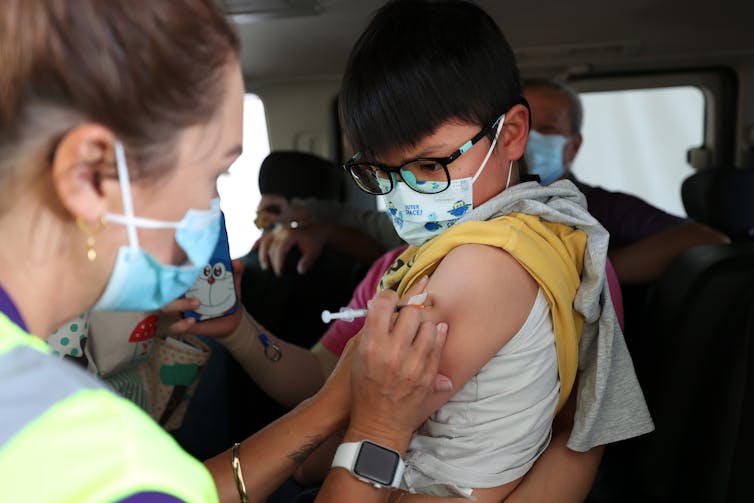
Vaccines for primary school children need to be rolled out rapidly and equitably, especially for Māori and Pacific children who have borne a larger burden of illness and hospitalisation.

Vaccines for eligible children need to be rolled out rapidly and equitably, especially for Māori and Pacific children.
GettyImages

As vaccination coverage for 5-11-year-olds rises and adults are increasingly vaccinated and boosted, it’s time to pay more attention to protecting children from the indirect harms of the pandemic.

Prolonged closures are not a sustainable strategy

During the first 18 months of the pandemic, Aotearoa New Zealand topped the OECD for the number of days schools remained fully open. The successful elimination strategy used lockdowns, including school closures, to stamp out community transmission. This resulted in schools being fully open for long periods.

In a post-elimination context, with a highly vaccinated population and vaccines available for all school children, prolonged school closures are not an optimal or sustainable strategy.

Schools have not been major drivers of community transmission, compared to churches, gyms, restaurants and bars, probably due to protective measures in schools to prevent transmission. A systematic review was inconclusive as to whether school closures significantly affected community transmission.

It does not make sense to close schools while allowing other higher-risk indoor venues to stay open. School closures should be a last resort to control community transmission.

Schools should be considered as “essential services” for children and young people. Beyond formal education, they provide friendships, meals, social support, and therapists for children with disabilities.

Due to educational disadvantages, Māori and Pacific children are more affected by school closures and have the most to gain from ongoing in-person learning.

Lost learning from school closures can be considerable. While catch-up learning can occur, students from disadvantaged backgrounds can continue to lag behind, exacerbating existing inequities, with potentially life-long occupational impacts.

Children’s mental health

School closures also affect children’s emotional and mental health. Many children are resilient, but a substantial proportion experience poorer mental health and behavioural problems.

Social isolation, financial stress and divided attention at home can also contribute to worsening parental mental health and family violence. One in ten New Zealanders surveyed during the 2020 national lockdown reported directly experiencing some form of family violence. In all of these, disadvantaged children are disproportionately affected.

These indirect impacts are harder to quantify than case counts and hospitalisations but they are very real. Toxic stress – prolonged, stressful experiences in childhood – can lead to permanent changes in the architecture of the developing brain and stress-hormone systems, with life-long impacts on health and development.

Ventilation, masks and outdoor learning

We need to optimise the multi-layered approach to reducing COVID-19 transmission in schools in light of Omicron’s increased transmissibility.

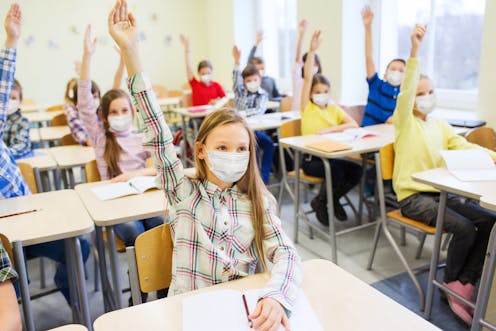
Improving natural ventilation, maximising outdoor learning, using well-fitted masks and avoiding high-risk activities such as singing indoors are all known to reduce transmission within schools, particularly when these preventative measures are layered.

Maximising outdoor learning opportunities, along with masks and classroom ventilation, will reduce COVID-19 transmission within schools.
GettyImages

Natural ventilation is easier in summer through opening windows and doors. Carbon dioxide monitors can identify where ventilation needs to be improved and portable HEPA air cleaners for hard-to-ventilate rooms will be part of a clean-air strategy for schools.


Read more:
Schools need to know classrooms’ air quality to protect against COVID. But governments aren’t measuring it properly


Schools also need a robust mask strategy and teachers would benefit from access to strong mask protection. Booster vaccines for teachers are mandated and provide another strong layer of protection.

We also need to understand whether using rapid antigen tests to reduce the number of infected children attending schools is workable, as using these can be difficult to implement successfully. Surveillance testing, where students and staff are tested at home regularly, and test-to-stay policies, where students and staff who are close contacts test daily and only attend school if they test negative, are based on sound public health principles and deserve careful consideration.


Read more:
How to help your child get the most protection out of their face mask


We are calling for school closures to be a last resort to control community transmission. But this does not mean we believe schools should remain open for onsite learning at all costs.

Despite best efforts, schools may need to close temporarily during significant outbreaks or if large numbers of staff fall ill or isolate. But even if a school needs to revert to online learning, this doesn’t mean all in-person learning has to end.

Regular outdoor sessions could continue for all students even if indoor learning pauses, such as physical education classes, games for primary schoolers, and small group learning sessions. Such opportunities for interacting with friends and teachers would maintain relationships and bring many benefits for children at very low risk.

Doing our best for children and young people in 2022 means thinking about their health holistically. As vaccination coverage rises, keeping schools open as safely as possible is the most equitable plan for children.


This article was co-authored by public health physicians Dr Subha Rajanaidu (Auckland and Waitemata District Health Boards) and Dr Philippa Anderson (Counties Manukau DHB), and paediatricians Dr Danny de Lore (Ngāti Tuwharetoa, chair Royal Australasian College of Physicians’ Indigenous Child Health working group), Dr Emma Best, Dr Alison Leversha and Dr Rachel Webb (all at the University of Auckland).

The Conversation

Jin Russell does not work for, consult, own shares in or receive funding from any company or organisation that would benefit from this article, and has disclosed no relevant affiliations beyond their academic appointment.

ref. Despite Omicron arriving, keeping schools open as safely as possible should be the goal – https://theconversation.com/despite-omicron-arriving-keeping-schools-open-as-safely-as-possible-should-be-the-goal-175512

Should new Australians have to pass an English test to become citizens?

Source: The Conversation (Au and NZ) – By Matteo Bonotti, Senior lecturer, Monash University

Prime Minister Scott Morrison with new citizens in 2020. Mick Tsikas/AAP

On Australia Day each year, thousands of people become Australian citizens at ceremonies around the country.

Prospective citizens have to meet a number of eligibility criteria, including passing a citizenship test to show they have a reasonable knowledge of Australia and basic English.

But there are persistent suggestions those applying to be citizens should also pass a separate formal English test to prove their language skills.

In a newly published article with colleague Louisa Willoughby, we explain why this poses a range of problems and why it would not boost English proficiency among new Australians.

What do other countries do?

Language tests for citizenship have become increasingly common overseas: for example, 33 of 40 Council of Europe member states surveyed in 2018 had one.

In 2017, the Australian government also proposed adding a language test to the citizenship requirements. It backed away from the idea following a public backlash, although it continues to put a strong emphasis on the importance of English ability across the visa system.

Person completing a test.
Many European countries already have language tests for citizenship.
www.shutterstock.com

Proponents of language tests for citizenship see them as promoting migrant integration and social inclusion. Requiring prospective citizens to pass an English test seems like an easy way to ensure they can be educated, employed and participate in society more generally.

But there are some real issues with this approach.

Why language tests don’t work

Language testing scholars have repeatedly criticised the tests, saying there is no evidence they help people integrate.


Read more:
The new Australian citizenship test: can you really test ‘values’ via multiple choice?


Furthermore, it is not clear what kind of language skills a citizenship language test should include.

As our article notes, language tests for jobs or entry to higher education have been developed by experts to reflect the linguistic demands of the relevant discipline or profession.

For example, doctors are tested on medical language and their ability to communicate respectfully and empathetically with patients, prospective university students on their academic reading and writing abilities, and so on.

But what are the language skills required to be a good citizen? We might think skills like being able to follow a political debate are a good starting point, but this is a very high bar that would exclude many people – including, potentially, some native English speakers.

What about testing basic skills?

And even if – like many European countries – we set the bar lower and asked for more basic, conversational language skills, this would still raise a number of problems. We know many factors beyond people’s control influence their ability to learn a second language after migration.

Teacher at blackboard setting out components of English.
Learning English is not necessarily as simple as signing up to a class.
www.shutterstock.com

Among those who find it particularly difficult are older people, those with limited education or who are illiterate in their first language, and those who have experienced significant trauma (such as refugees and asylum seekers). Language tests risk putting citizenship out of reach for these vulnerable groups, an outcome that seems inequitable at best, discriminatory at worst.

This is complicated by the huge variation in the way people around the globe speak English, and how we avoid situations where those who speak English with particular accents (including, sometimes, well-educated native speakers), fail English tests because their accents are deemed too different from what the test thinks is “normal” or “standard”.

Tests as an incentive to learn English

What of the idea that tests motivate prospective citizens to learn the language of their new society?

Migrants’ motivation to learn the language of their new country cannot be assessed independently of contextual factors, especially incentives and rewards. Furthermore, migrants often face barriers around eligibility, scheduling, transport, work and childcare commitments, or lack of good quality classes.

Moreover, there is no guarantee tests actually work as an incentive. The Netherlands, for example, introduced a tough system that fines new migrants if they do not pass a Dutch test within three years of their arrival. Despite this, around one in four migrants still fails to pass the test within the required time.

Older migrants, especially those from countries where schooling is commonly interrupted (such as Afghanistan and Somalia), are particularly likely to fail the test. This reinforces the view that social and cognitive factors are more reliable predictors of language learning than lack of motivation.

What to do instead

Forcing people to pass an English test in order to become Australian citizens creates a range of practical and ethical problems, while producing little benefit for migrants and their host society.


Read more:
Australian values are hardly unique when compared to other cultures


Instead, the federal government should use other measures – such as extending eligibility for its adult migrant English program – to support English learning.

Meanwhile, COVID-19 has reinforced the importance of migrant language media and migrant associations. To better support and include this part of our population, we also need to ensure people with lower English skills are able to get the information they need and fulfil the expectations and duties of citizenship.

The Conversation

Matteo Bonetti does not work for, consult, own shares in or receive funding from any company or organisation that would benefit from this article, and has disclosed no relevant affiliations beyond their academic appointment.

Louisa Willoughby was co-author of the original research article. She is Associate Professor in linguistics at Monash University and the Greens candidate for Hotham at the upcoming federal election.

ref. Should new Australians have to pass an English test to become citizens? – https://theconversation.com/should-new-australians-have-to-pass-an-english-test-to-become-citizens-175324

Some endangered species can no longer survive in the wild. So should we alter their genes?

Source: The Conversation (Au and NZ) – By Tiffany Kosch, Research Fellow, The University of Melbourne

Melbourne Zoo

Around the world, populations of many beloved species are declining at increasing rates. According to one grim projection, as many as 40% of the world’s species may be extinct by 2050. Alarmingly, many of these declines are caused by threats for which few solutions exist.

Numerous species now depend on conservation breeding programs for their survival. But these programs typically do not encourage species to adapt and survive in the wild alongside intractable threats such as climate change and disease.

This means some species can no longer exist in the wild, which causes major downstream effects on the ecosystem. Consider, for example, how a coral reef would struggle to function without corals.

What if there was another way? My colleagues and I have developed an intervention method that aims to give endangered species the genetic features they need to survive in the wild.

bleached coral with fish
Genetically altering coral may help them survive in a warmer world.
Rick Stuart-Smith

Bringing theory into practice

Over generations, natural selection enables species to adapt to threats. But in many instances today, the speed at which threats are developing is outpacing species’ ability to adapt.

This problem is especially apparent in wildlife threatened by newly emerging infectious diseases such as chytridiomycosis in amphibians, and in climate-affected species such as corals.

The toolkit my colleagues and I developed is called “targeted genetic intervention” or TGI. It works by increasing the occurrence or frequency of genetic features that impact an organism’s fitness in the presence of the threat. We outline the method in a recent research paper.

The toolkit involves artificial selection and synthetic biology. These tools are well established in agriculture and medicine but relatively untested as conservation tools. We explain them in more detail below.

Many tools in our TGI toolkit have been discussed in theory in conservation literature in recent decades. But rapid developments in genome sequencing and synthetic biology mean some are now possible in practice.

The developments have made it easier to understand the genetic basis of features which enable a species to adapt, and to manipulate them.


Read more:
We name the 26 Australian frogs at greatest risk of extinction by 2040 — and how to save them


frog on wet rock
Some animal species cannot adapt in time to survive threats such as disease.
Shutterstock

What is artificial selection?

Humans have long used artificial (or phenotypic) selection to promote desirable characteristics in animals and plants raised for companionship or food. This genetic alteration has led to organisms, such as domestic dogs and maize, that are dramatically different from their wild progenitors.

Traditional artificial selection can lead to outcomes, such as high inbreeding rates, that affect the health and resilience of the organism and are undesirable for conservation. If you’ve ever owned a purebred dog, you might be aware of some of these genetic disorders.

And when it comes to conservation, determining which individuals from a species are resistant to, say, a deadly pathogen would involve exposing the animal to the threat – clearly not in the interests of species preservation.

Scientists in the livestock industry have developed a new approach to circumvent these problems. Called genomic selection, it combines data from laboratory work (such as a disease trial) with the genetic information of the animals to predict which individuals bear genetic features conducive to adaptation.

These individuals are then chosen for breeding. Over subsequent generations, a population’s ability to survive alongside pervasive threats increases.

Genomic selection has led to disease-resistant salmon and livestock that produce more milk and better tolerate heat. But it is yet to be tested in conservation.


Read more:
How this little marsupial’s poo nurtures urban gardens and bushland (and how you can help protect them)


cows in green field
Artificial selection has been used to develop traits that humans desire in livestock.
Shutterstock

What is synthetic biology?

Synthetic biology is a toolkit for promoting change in organisms. It includes methods such as transgenesis and gene editing, which can be used to introduce lost or novel genes or tweak specific genetic features.

Recent synthetic biology tools such as CRISPR-Cas9 have created a buzz in the medical world, and are also starting to gain the attention of conservation biologists.

Such tools can accurately tweak targeted genetic features in an individual organism – making it more able to adapt – while leaving the rest of the genome untouched. The genetic modifications are then passed on to subsequent generations.

The method reduces the likelihood of unintended genetic changes that can occur with artificial selection.

Synthetic biology methods are currently being trialled for conservation in multiple species around the world. These include the chestnut tree and black-footed ferrets in the United States, and corals in Australia.

I am working with researchers at the University of Melbourne to develop TGI approaches in Australian frogs. We are trialling these approaches in the iconic southern corroboree frog, and plan to extend them to other species if they prove effective.

Worldwide, the disease chytridiomycosis is devastating frog populations. Caused by the fungal pathogen Batrachochytrium dendrobatidis, it has led to the extinction of about 90 frog species and declines in as many as 500 others.

Many frog species now rely on conservation breeding for their continued survival. No effective solution for restoring chytrid-susceptible frogs to the wild exists, because the fungus cannot be eradicated.

gloved hand removed portion of DNA strand
CRISPR technology could potentially be used to edit the genes of endangered species.
Shutterstock

Looking ahead

As with many conservation approaches, targeted genetic intervention is likely to involve trade-offs. For example, genetic features that make a species resistant to one disease may make it more susceptible to another.

But the rapid rate of species declines means we should trial such potential solutions before it’s too late. The longer species are absent from an ecosystem, the greater the chance of irreversible environmental changes.

Any genetic intervention of this type should involve all stakeholders, including Indigenous peoples and local communities. And caution should be taken to ensure species are fit for release and pose no risk to the environment.

By bringing the concept of TGI to the attention of the public, government, and other scientists, we hope we will spur discussion and encourage research on its risks and benefits.


Read more:
5 major heatwaves in 30 years have turned the Great Barrier Reef into a bleached checkerboard


The Conversation

Tiffany Kosch is a member of One Health Research Group at the University of Melbourne. Her research is currently funded by the Australian Research Council (grants FT190100462 and LP200301370). Additionally, the genome of their target species, the Southern Corroboree frog is currently being sequenced at no cost to the group by the Vertebrate Genomes Project.

ref. Some endangered species can no longer survive in the wild. So should we alter their genes? – https://theconversation.com/some-endangered-species-can-no-longer-survive-in-the-wild-so-should-we-alter-their-genes-175226

We asked hundreds of Aussies whether they’d eat insects, and most said yes – so what’s holding people back?

Source: The Conversation (Au and NZ) – By Jessica Danaher, Lecturer in Nutrition, RMIT University

Shutterstock

Insects are sustainable, nutritious and delicious. They’re eaten by more than two billion people worldwide, mostly in the tropics, and have been a staple in Indigenous Australians’ diets for tens of thousands of years.

Yet eating insects isn’t mainstream in Australia. Why?

We surveyed 601 Australians on their experience with, and attitude towards, edible insects. Our findings offer insight into which factors might convince people to add edible insects to their diet.

Importantly, we found Australians are not deterred by the “ick” factor of eating insects, and would be willing to try them as a protein alternative if not for a “lack of opportunity”.

Of the adults we surveyed, 56.2% reported they would be “likely” to eat insects in the future (a much more promising result than that from a recent European Union survey) – and this figure increased to 82.2% among those who had already tried them.

Missed opportunities

Although insects don’t commonly feature on Aussie menus, there are 60 insect species which have been recorded as a traditional food source for Indigenous Australians, including witjuti grubs, bogong moths and honey pot ants.

The ancient Romans and Greeks ate insects, too. It’s thought Westernised countries may have lost their taste for edible insects during the shift from the hunter-gatherer lifestyle to agriculture and urbanisation.

Insects went from fulfilling the role of a staple food to being pests that destroy crops, and this may have prompted a shift in our attitudes towards eating them.

Research conducted with older Australians has revealed a tendency to view the practise as disgusting and incompatible with their personal beliefs, raising concern there may be reluctance for edible insects to return to being a normalised and viable protein alternative.

The edible witjuti grub is the larva of the large cossid wood moth (Endoxyla leucomochla), native to Australia.
Shutterstock

As it turns out, most people aren’t that squeamish

But our research (mainly with participants aged 25 to 44 years) shows Aussies have begun to adopt a more positive outlook towards insect-based foods.

Of those surveyed, 35% had previously tried insects, most commonly crickets and grasshoppers. And people who had already tried them were also more open to eating them again, which suggests a “taste” for bugs can be developed. Of those who hadn’t tried insects, only 16% reported “disgust” was holding them back.

This paradigm shift may be linked to people expressing more concern for the environmental cost of their food, and a greater interest in adopting healthy dietary habits.

Participants also reported they would be willing to eat insect-based products if it was easier to find out how such foods are beneficial, both from a nutrition and sustainability standpoint.

They said endorsements from governing bodies, as well as more prominence of edible insects in mainstream media, would boost their interest in eating insects – as well as “try before you buy” promotions.

For those willing to give insects a go, insect-based flours (such as bread and biscuits), chocolate-coated ants and crickets were the top choices. Not all species were received the same way, however, with moths and fly larvae not generating such a buzz.

Still, the shift towards a willingness to try insects is promising for Australia’s growing edible insect market.

Embracing future foods

With the global population still growing, we will need alternative sources of protein to sustainably meet future food production requirements.

The demand for protein is on the rise and, according to the UN Food and Agriculture Organisation, will have to increase by 76% by 2050. But production is restricted due to Earth’s finite resources.

Edible insects have potential as an important future food, offering a nutritious protein source that’s more sustainable to produce – using less land, energy and water.

The Conversation

The authors do not work for, consult, own shares in or receive funding from any company or organisation that would benefit from this article, and have disclosed no relevant affiliations beyond their academic appointment.

ref. We asked hundreds of Aussies whether they’d eat insects, and most said yes – so what’s holding people back? – https://theconversation.com/we-asked-hundreds-of-aussies-whether-theyd-eat-insects-and-most-said-yes-so-whats-holding-people-back-173595

Cracking joints isn’t bad for you and could even serve a useful purpose

Source: The Conversation (Au and NZ) – By Neil Tuttle, Musculoskeletal Physiotherapist & Senior Lecturer, University of Tasmania

Shutterstock

Some people habitually crack their joints, others can’t, and many are irritated by those who do.

So what’s going on? Why do people do it, is it harmful, what makes the noises, and what would happen if our joints weren’t able to crack?

Before going on, it’s important to note we’re talking here about people cracking their own joints. This is also known as “self-manipulation”. But when a physiotherapist or chiropractor cracks (or manipulates) your spine, what makes the noises is the same, but the implications can be very different than what’s being discussed here.

Although it may irritate friends and family, self-manipulating our joints is probably neither useful nor harmful for the individual.

Why do we crack our joints?

People crack their joints because they feel better, looser, or less stiff afterwards.

The relief is temporary and they typically repeat it at some point after 20 minutes, when the effects wear off.

While joint cracking may seem incomprehensible to us non-crackers, we all do similar behaviours.

“Pandiculation” is the nearly universal type of stretching we do after being inactive – even dogs, cats, elephants, spiders and unborn sheep do it.

The drive to “pandiculate” and it’s transient effects are similar to joint cracking. However, pandiculation is thought to have positive effects on the body, by restoring and resetting the structural and functional equilibrium. The same is not the case for cracking joints.

Even spiders need to stretch now and then.

It doesn’t cause arthritis

Probably everyone who self-manipulates has been told – usually by someone irritated by the behaviour – not to do it because it will cause arthritis.

It’s now clear this isn’t the case.

American doctor Donald Unger famously cracked knuckles only on one hand for over 50 years, and found no sign of increased arthritis compared to the other hand. For this he received an IgNoble Prize in Medicine in 2009, an award for unusual achievements in research.


Read more:
Monday’s medical myth: cracking your knuckles causes arthritis


In another study, knuckle cracking was not found to increase the incidence of arthritis in an elderly population who had cracked their knuckles compared to those who didn’t. Also, the incidence of arthritis was not greater in the knuckles they did crack, compared to the other joints of the hand that weren’t cracked.

There are a few reports of injury from knuckle cracking, but these are probably too minor and infrequent to be of much concern.

Put simply, there don’t appear to be significant adverse effects to cracking your joints.

What makes the noise?

When people crack their knuckles they separate the joint surfaces and the pressure within the joint decreases. At a certain point the surfaces suddenly separate and a bubble forms by a process known as cavitation.

A simulated joint cracking.

A similar effect can also occur with a simulated joint, as in the video above.

It’s not entirely clear however which part of the process causes the actual cracking noise in humans. One theory is the noise is produced by the formation of the bubble itself. Another theory suggests it’s the breaking of the fluid “adhesive seal” between the joint surfaces as occurs with pulling a suction cup off of a wall.

High speed MRI image of knuckle cracking. As the joint surfaces are separated the volume suddenly increases and a bubble (the dark area that appears in the middle of the joint) is formed.

Why have our joints evolved to crack?

Perhaps the most interesting question is why our joints developed in such a way that they’re able to crack.

I had a conversation recently with Jerome Fryer, a Canadian researcher who was involved in the above study with the simulated joint. He raised an interesting idea which hasn’t been published. Could the ability of our joints to crack actually serve a useful purpose?

When the simulated joints in his study were filled with normal water, the joint surfaces separated easily, which formed bubbles but didn’t produce the cracking sound.

But when the water was treated to remove all of the dissolved gasses and microscopic bubbles, the simulated joint performed more like a real joint. That is, much more force was needed to separate the surfaces, and only then did it produce a cracking sound.

Perhaps the fact it requires a large force to separate our joints, which happens to also produce a cracking sound, may be very useful by assisting in joint stability and thereby providing protection from our joints being damaged.

The Conversation

Neil Tuttle does not work for, consult, own shares in or receive funding from any company or organization that would benefit from this article, and has disclosed no relevant affiliations beyond their academic appointment.

ref. Cracking joints isn’t bad for you and could even serve a useful purpose – https://theconversation.com/cracking-joints-isnt-bad-for-you-and-could-even-serve-a-useful-purpose-162437

Why online groups are parents’ best friends in getting ready for the school year

Source: The Conversation (Au and NZ) – By Violetta Wilk, Lecturer & Researcher in Digital Marketing, Edith Cowan University

Shutterstock

If you’re a parent, chances are that, like me, you are frantically trying to get a head start on the new school year. In coping with the stress of COVID-19 lockdowns, restrictions, empty shelves in stores, working from home and minimal communications by schools over the holidays, we’ve turned to our virtual community of friends for help.

Let’s face it, most of us probably don’t have the time to or simply can’t pop in for a cuppa with one of the other parents to just have a chat. And there are pressing things to discuss, such as the school book list that has gone missing over the holidays, where to get the best deal on a headset with a microphone suitable for an eight-year-old, which brand of white sport shoes will last more than a week in the dusty schoolyard, or where to get the two boxes of facial tissues the teacher asked children to supply when there are none at the shops!

This is where our online friends can help.

Our digital ‘tribes’

People have formed tribes since the dawn of time. We are no different in this digital age. Members of a tribe typically share some similarities, which are like glue that holds the group together. Our online groups, or digital “tribes”, connect us based on a common interest, topic, location or school. They include:

The pandemic has fuelled the rise in online tribes, as people have been restricted in their movement, locked down in their homes and limited in their access to family and friends. They now rely on their online connections for information, advice, help and friendship.

My team’s recent research into online communities suggests these are rife with “prosumers”. Proactive consumers (“prosumers”) create and share online content, which makes them influential members of social networks. Our prosumer-friends are well informed, quick to respond and supportive when the school-work-life juggling act overwhelms us.

These are people like us. The digital tribe is much bigger than our real, physical community. We don’t have to know each member personally to be able to connect with them digitally.

And as our lives are so digitally integrated, we no longer differentiate between our real and virtual friends. Linda Thomas, who has two primary school-aged children, says:

“As a full-time working mum, I’m often unable to keep in touch with my friends in person, which can be quite isolating, especially now during COVID. Facebook and WhatsApp groups have been so important to me in maintaining contact and community support by networking with parents similar to me.”

Mrs Linda Thomas
Linda Thomas says online networking with other parents has been very important to her as a mother of two children in primary school.
Linda Thomas, Author provided

Online marketplaces help with the budget

With the rise in online groups comes a rise in online consumer marketplaces. Facebook groups, such as Sustainable School Shop and Perth Buy and Sell, can help parents manage the return-to-school budget.

Items that are no longer needed or unused, such as uniforms, books, electronics and stationery, are often given away, swapped or sold at a fraction of the original cost. An example is a Facebook local community group post by a mum giving away a spare laptop to someone who needs it for school.

In our research, my colleagues and I found social media users’ exchanges have not been all negative during the pandemic – there has been a lot of positivity. The support, information and advice that social media users provide one another in these online groups have been invaluable for navigating purchasing at stores affected by supply disruptions.

Such positivity often reflects online brand advocacy (OBA), with online group members recommending brands they have tried to others. This sort of advocacy is authentic as it is freely given and based on online group member’s actual experience with the brand. It is also influential as it is trusted more than brand-generated content, such as when a parent suggests trying Officeworks to find that headset for our eight-year-old.

Interestingly, targeted advertising is also rife online. When you interact with content on a school-related topic, be it kids’ shoes, school labels, tutoring or kids sports, the platform’s algorithm will serve you ads that mirror your engagement. Such advertising is not necessarily a nuisance as it can help us in deciding what to buy.

As parents, we are in this “get our child ready for school” mission together. Online groups provide support, information and friendships beyond what we have access to in real life during these trying times.

So, if you haven’t already, join a digital tribe! It might make the start of the new school year that little bit easier.

The Conversation

Violetta Wilk does not work for, consult, own shares in or receive funding from any company or organisation that would benefit from this article, and has disclosed no relevant affiliations beyond their academic appointment.

ref. Why online groups are parents’ best friends in getting ready for the school year – https://theconversation.com/why-online-groups-are-parents-best-friends-in-getting-ready-for-the-school-year-175434

Makeshift screens, censored films and ASIO: how the Melbourne International Film Festival began 70 years ago

Source: The Conversation (Au and NZ) – By Lisa French, Professor & Dean, School of Media and Communication, RMIT University

Author provided.

On the Australia Day weekend in 1952, a group of die-hard film buffs put on a film festival. They had selected the leafy hills of Olinda in Victoria’s Dandenong Ranges for the event. They expected 80 people – but more than 600 turned up!

In the 1950s, very few Australian films were being made. Those that were produced were largely documentaries, with narrative features extremely rare. Despite this, an avid film culture flourished through local film societies.

Australian film buffs were thirsty to see international films from Europe and Asia, but local cinemas only screened Hollywood fare. Australian authorities would, however, allow international films to enter the country for exhibition at a film festival.

A crowd outside a mechanic's institute.
80 film fans were expected. More than 600 showed up.
Author provided

So a festival in Melbourne was excitedly planned.

That first event, as ambitious as it was popular, is now celebrating its 70th anniversary. It grew into the internationally renowned Melbourne International Film Festival, which will commemorate its 70th anniversary in August this year, making it one of the world’s oldest film festivals.

Sleeping in a church hall

The Australian Council of Film Societies, who convened the festival, chose Olinda because it was a popular tourist destination with plenty of accommodation.

Due to the numbers of film buffs who flocked there, the guest houses were fully booked. Many locals threw open their doors to accommodate the influx, but it was not enough.

My mother was one of many who went along and had to bed down in a church hall.

A crowd outside a country church.
The town accommodation was so booked up, some had to sleep in the church.
Author provided

The appeal of the film festival was so great that some people travelled back and forth from Melbourne daily.

Among the attendees were many who would become prominent Australian filmmakers, like Tim Burstall, John Heyer and Stanley Hawes.

Interviewed in the documentary Birth of a Film Festival, Burstall remembered making the journey to Olinda with artist Arthur Boyd. They packed their families into Boyd’s 1929 Dodge and headed for the hills.

A man stands in front of a screen, talking to a crowd
Many of Australia’s future filmmakers attended the event.
Author provided

The large attendance forced the organisers to arrange additional screening venues. They set up a makeshift screen under the stars, and borrowed another hall in a neighbouring town.

Frank Nicholls, who was president of the Australian Council of Film Societies, had to rush reels from the hall in Olinda to another in Sassafras by car, causing a delay mid-screening if he was late with the next reel.

The festival was so popular, extra screens needed to be set up – including an outdoor cinema.
Author provided

Organisers invited national and international luminaries including Australian filmmaker Charles Chauvel. Although Chauvel did not attend, his telegram was included in the “programme alterations”:

My best wishes to all and my regrets not being able to be present.

Prime Minister Robert Menzies was invited but in a letter to Nicholls (kept in a scrapbook by volunteer Mary Heintz), he delegated the invitation to the Minister for the Interior, Mr W.S. Kent Hughes.

Hughes presented the Juilee Awards for films made in Australia. He gave a speech outlining government plans to support documentary and independent producers, and stayed to watch the opening night under a canopy of stars.


Read more:
Australian cinema for Australia Day


The first film festival program

Jean Cocteau’s famous 1946 film Beauty and the Beast opened the festival to great acclaim. Others screened included Robert J. Flaherty’s Louisiana Story (1948), as well as many Australian documentaries, clips from early Australian films, and some historic French short works by Georges Méliès.

An exhibition of film stills was set up at the local school.
Author provided

One of the local highlights was a film made for the Department of Immigration titled Mike and Stefani (1952), directed by Ron Maslyn Williams. It won a prize for its depiction of two war-broken refugees granted visas to come to Australia.

The festival weekend also included talks and an exhibition of film stills at the local school.

The press picked up on the vigorous debate swirling around the festival that weekend. On January 31, the Adelaide News reported attendees expressed dismay at censors banning films like Roberto Rossellini’s The Miracle (1948), which was deemed sacrilegious.


Read more:
The great movie scenes: Rome, Open City – fascism, tragedy and the birth of Italian neo-realism


Success – and suspicion

The Olinda Film Festival was a huge success.

Nicholls described Olinda in The Sun of January 29 1952 as “the most comprehensive” film festival ever held in Australia, screening “hundreds of Continental, English, Australian and Oriential films and even a Russian propaganda production”.

But not everyone celebrated the festival’s success. Even with Menzies’ support, it was discovered after the event that, while cinema enthusiasts were enjoying the event, ASIO was watching. Evidently the Australian government regarded the film festival as a prime draw-card for subversive characters intent on overthrowing authority.

A man and a woman read a program
The festival screened hundreds of films from around the globe.
Author provided

Still, the success of Olinda – far greater than anyone could have foreseen – earned the festival a permanent place in Australian and international screen culture. It demonstrated that non-commercial films could interest large audiences, and Australian films could do the same.

Nicholls went on to become the first chairperson of the Melbourne Film Festival and later of The Australian Film Institute. At the 50th celebration of the 1952 event, Nicholls said:

The festival was a goer, and it’s still going strong. But there was never quite one like Olinda.


Material in this article was sourced in interviews and research for Birth of a Film Festival (directed by Mark Poole and produced by Lisa French in 2003), about the first festival and it’s 50th anniversary celebrations.

The Conversation

Lisa French is the producer of the film mentioned in this article ‘Birth of a Film Festival’ 2003.

ref. Makeshift screens, censored films and ASIO: how the Melbourne International Film Festival began 70 years ago – https://theconversation.com/makeshift-screens-censored-films-and-asio-how-the-melbourne-international-film-festival-began-70-years-ago-175440

Tennis champ Dylan Alcott is 2022 Australian of the Year

Source: The Conversation (Au and NZ) – By Michelle Grattan, Professorial Fellow, University of Canberra

Dylan Alcott, wheelchair tennis star and leading advocate for people with a disability, is the 2022 Australian of the Year.

With 23 quad wheelchair Grand Slam titles, including singles and doubles, Alcott, from Melbourne, last year became the first man, in any form of tennis, to win a Golden Slam.

He won the singles titles at the Australian Open, the French Open, Wimbledon and the US Open. He also won the singles gold medal at the  Tokyo Paralympics.

On Thursday Alcott, 31, competes to his eighth straight Australian Open quad wheelchair singles final, playing Dutchman Sam Schröder. He has said he will retire from professional tennis after the Australian Open.

In earlier years he played in the Australian men’s national wheelchair basketball team, The Rollers. He was a member of the Rollers team that won gold at the 2008 Beijing Paralympics.

Alcott, a motivational speaker, founded the Dylan Alcott Foundation to provide scholarships and grant funding to marginalised Australians with a disability, and co-founded Get Skilled Access.

Ability Fest, Australia’s only completely inclusive and fully accessible music festival, was his brainchild. He has a widely-based media profile.

Alcott made a flying visit to receive the award from Prime Minister Scott Morrison in Canberra on Tuesday night.

This is the first time in the 62 years of the award that a person with a disability has been named Australian on the Year.

Chair of the National Australia Day Council Danielle Roche said: “Dylan is an inspirational Australian on and off the tennis court. Through the Dylan Alcott Foundation, he is giving young Australians facing disadvantage the promise of a better future.”

Receiving the award, Alcott said that as Australia opened up from the pandemic, “we’ve got to think about and prioritise people with disability – some of the most vulnerable people in our community. We’ve got to get them the vaccines and the tests and whatever else they need so they can get out there and start living their life.

“If a person with a disability needs a free daily RAT test so they feel confident going out and doing things that we all might take for granted, they’ve got to get that RAT test. We’ve got to keep improving more employment opportunities for people with a disability as well.”

Earlier on Tuesday, at a morning tea for finalists at The Lodge, Grace Tame, outgoing Australian of the Year and passionate advocate for victims of sexual abuse, set off an intense social media debate when she delivered a very deliberate snub to Morrison.

Her face was grimly unsmiling as she posed with Morrison and his wife Jenny, with her side-eying of the PM clear in the photos. Tame has been highly critical of Morrison at times over the past year.

The Senior Australian of the Year is Val Dempsey, 71, from Canberra, a St John Ambulance volunteer for more than half a century, starting as a cadet volunteer while at primary school.

Young Australian of the Year is Dr Daniel Nour, 26, from Sydney, founder of Street Side Medics, a not-for-profit, GP-led mobile medical service for homeless people. It has 145 volunteers and four clinics across NSW.

The 2022 Australia’s Local Hero is founder and CEO of Sober in the County, Shanna Whan, 47, of Narrabri, NSW.

The Conversation

Michelle Grattan does not work for, consult, own shares in or receive funding from any company or organisation that would benefit from this article, and has disclosed no relevant affiliations beyond their academic appointment.

ref. Tennis champ Dylan Alcott is 2022 Australian of the Year – https://theconversation.com/tennis-champ-dylan-alcott-is-2022-australian-of-the-year-175657

Don’t say the Aboriginal flag was ‘freed’ – it belongs to us, not the Commonwealth

Source: The Conversation (Au and NZ) – By Bronwyn Carlson, Professor, Indigenous Studies and Director of The Centre for Global Indigenous Futures, Macquarie University

Shutterstock

Today we woke to the news the Australian government has negotiated with the designer of the Aboriginal flag Harold Thomas, and copyright for the flag will be transferred to the Commonwealth. The government has now stated the flag is freely available for public use. Prime Minister Scott Morrison stated:

We’ve freed the Aboriginal flag for Australians.

While many Indigenous people are celebrating today and rejoicing in the idea the flag has been “freed,” I am not so sure.

I think we should all take a moment to pause and consider what this new “ownership” might represent.

A brief history of the flag

The flag was first flown at Victoria Square on Kaurna Country, on National Aborigines Day in July in 1971.

In 1972, it became the official flag for the Aboriginal Tent Embassy which was established on Ngunnawal Country.

In 1995, William Hayden, Governor General of Australia proclaimed both the Aboriginal flag and the Torres Strait Islander flag (designed by the late Bernard Manok as) “Flags of Australia” under the Flags Act 1953.

But the truth is the Aboriginal flag has always been our flag. We didn’t need an act of parliament to recognise its significance.

A national flag?

National flags are seen as sacred objects by many: in many countries, to desecrate the flag carries penalties. As citizens, we are expected to revere the national flag and to be proud of what it represents.

But the Australian national flag represents white sovereignty and a belief in national unity.

The national flag symbolises both patriotism and nationalism. Nowhere was this more evident than when Morrison wore a mask sporting the design of the flag. The flag/mask drapes his face with the most prominent national symbol for all to see. When wearing this mask, the prime minister literally embodies the symbolism of nation and all that stands for.

The national flag is flown at schools and all prominent government buildings. It is, for many Australians, a site of heightened emotion where the main response is a sense of belonging to what Benedict Anderson called an “imagined community”.

Of course, the Union Jack is another nation’s flag. It belongs to the United Kingdom. It represents our dispossession and is a constant reminder of our forced and continued colonisation.

The Union Jack does not represent us, our history or our future aspirations.

A symbol of strength

The Aboriginal flag is a symbol of our strength as an ancient people who preceded the symbolic and real effects of national borders.

The Aboriginal flag does not belong to all Australians. It belongs, like the land, to us as a symbol of our sovereignty. Morrision’s statement about having “freed” the flag for all is offensive.

It is ours; he has no authority to “free” it. The Aboriginal flag cannot just be “freed”. It is an emblem of our emotion, our loves and losses. It holds our faith, our hope and our future.

I grew up in the 70s and 80s. When I saw the Aboriginal flag, I felt a sense of pride and belonging. As a young person, I wasn‘t aware there were any copyright issues or that there were legalities that needed to be considered.

I always knew I belonged to what the flag stood for: our survival, our resilience as Indigenous people, and our steadfastness in the face of the on-going and omnipresent colonial struggles that continue to affect us today.

Our sorrows and our unity

On Australia Day, we see the Australian national flag waving take place. There is both banality and symbolism to this ritual.

For some, the flag is waved without thought as to what it might mean to others: it is just part of the ritual of the national holiday. For many, it is emotionally charged and can generate fervour and national pride. I am not sure many people stop to think about the flag’s design, its history or what it might mean to some non-white Australians.

But the design of the Aboriginal flag is intimately connected to our struggle for land rights.

The red represents the land, the yellow the life-giving sun and the black Aboriginal people.

The flag is a symbol of our unceded sovereignty of our lands. It represents a powerful symbol of resistance in our ongoing battle with the Crown in terms of the unlawful claiming of our lands as terra nullius.


Read more:
Henry Reynolds: Australia was founded on a hypocrisy that haunts us to this day


How is it possible it can be so seamlessly hijacked in order to be incorporated – “freed” – into another set of meanings? Allowed onto the market for anyone to use? I see this act of “freeing” our flag as an act of arrogance at the very least.

One could also say it is a violent appropriation of what Aboriginal people deem to be a symbol of reverence.

Our flag contains our sorrows and our unity as a colonised people. It is not a “free-for-all” symbol. Nor is it a symbol that can be neatly injected into the national psyche as a means of expressing some kind of racial unity that overshadows the injustice and inequality Aboriginal people experience on a daily basis.

It is the fabric of our souls. When it flies, we can see ourselves in flight as we once were, free nations.

The Conversation

Bronwyn Carlson does not work for, consult, own shares in or receive funding from any company or organization that would benefit from this article, and has disclosed no relevant affiliations beyond their academic appointment.

ref. Don’t say the Aboriginal flag was ‘freed’ – it belongs to us, not the Commonwealth – https://theconversation.com/dont-say-the-aboriginal-flag-was-freed-it-belongs-to-us-not-the-commonwealth-175623

Australia and Norway were once tied in global anti-corruption rankings. Now, we’re heading in opposite directions

Source: The Conversation (Au and NZ) – By A J Brown, Professor of Public Policy & Law, Centre for Governance & Public Policy, Griffith University

In a worrying sign, Australia has plummeted in Transparency International’s latest Corruption Perceptions Index – the world’s most widely cited ranking of how clean or corrupt every country’s public sector is believed to be.

In the 2021 index released today, Australia has repeated its largest-ever annual drop – falling four points on the 100-point scale, from 77 to 73. Zero is considered highly corrupt, while a score of 100 is very clean.

Overall, Australia has dropped 12 points on the index since 2012, more than any OECD country apart from Hungary, which also fell 12 points. Australia’s rate of decline is also similar or steeper than other countries with far worse issues, including Cyprus, Lebanon, Syria and Venezuela.

Australia was ranked seventh in the world in 2012, level with Norway. This year, Australia has fallen to 18th out of 180 countries. In contrast, Norway’s global standing has improved, climbing from seventh to fourth on the index.

It’s a clear sign Australia has missed a huge chance to correct our failing anti-corruption reputation. And this will likely continue to fall unless integrity policies are turned around at this year’s federal election.


Author provided

What the index shows

The Corruption Perceptions Index (CPI) is compiled annually by Transparency International using the most credible, independent, long-running corruption measures in the world. Sources include the Economist Intelligence Unit, Freedom House, the World Justice Project and the World Bank.

These surveys focus on levels of public sector corruption, as well as the strength of mechanisms for preventing and controlling corruption. This makes the index not simply a list of which countries are more or less corrupt, but also an evaluation of their current anti-corruption efforts.

The CPI is recognised as a key indicator of Australia’s integrity performance – not only by reform advocates, but by the federal government itself.


Read more:
As a NSW premier falls and SA guts its anti-corruption commission, what are the lessons for integrity bodies in Australia?


In September 2018, then-Attorney-General Christian Porter famously tried to defend the nation’s anti-corruption record by telling parliament the CPI had placed Australia “consistently in the top 20 countries on Earth for low corruption”.

It took Centre Alliance MP Rebekha Sharkie to point out Australia used to be not only in the top 20, but the top ten.

Instead of maintaining its high score, like Norway, Australia has gone in the other direction – and it now risks falling out of the top 20 altogether.


Author provided

Australia had the chance to stem the fall

Before this year, Australia’s score on the index had levelled off as the federal government finally made pledges to address integrity issues and other efforts to root out corruption took place.

In that period, there was hope things might turn around:

  • corrupt politicians and officials were successfully convicted in several states (including NSW’s prosecution of former ministers Eddie Obeid and Ian Macdonald, while action was taken against local government corruption in Queensland)
  • after many years, the major parties finally pledged to establish a federal integrity commission (Labor in February 2018 and the Coalition in December 2018)

  • long-overdue legislation was introduced to parliament to enhance laws against bribery of foreign officials

  • bipartisan recommendations were made to strengthen whistleblower protections, with new laws on private sector whistleblowing and promises of reform for the federal public sector

  • high-profile federal enforcement action was taken against money laundering through Australian banks, while growing evidence of money laundering in casinos and real estate raised hopes of further reform.

But the last year has seen progress stalled

The latest drop in the CPI shows business and expert confidence in Australia’s official responses to corruption has collapsed again.

Since 2020, when the data for this year’s index were mostly collected, the expected progress has not happened. Instead, Australia has seen:

Why leadership is key

It doesn’t have to be this way. Transparency International has used this year’s global index to highlight the need for countries to improve checks and balances through strong integrity institutions and to uphold people’s rights to hold those in power to account.

When countries show serious leadership in anti-corruption reform – such as the United Kingdom during David Cameron’s Conservative government from 2012–17 – their scores on the index can climb.

Clearly, the world now fears this type of leadership is lacking in Australia.

The priorities and potential solutions are increasingly understood by experts, observers and the community. For example, Griffith University and Transparency International Australia recently assessed Australia’s national integrity system and developed a reform blueprint to follow.

With the 2022 federal election now just months away, the quality of the parties’ anti-corruption commitments – and leaders’ willingness to implement them – will matter as never before.

Key issues still hang in the balance. As recently as November, the prime minister and attorney-general revealed they were shelving any improvements to their Commonwealth integrity commission plan.

This announcement came despite the government having spent yet another year consulting over the plan’s obvious problems.


Read more:
Explainer: what is the proposed Commonwealth Integrity Commission and how would it work?


Anti-corruption reform is no longer the “fringe issue” Prime Minister Scott Morrison claimed it was several years ago.

For confidence in Australia’s public integrity to improve, the winner of the election is going to need to promise – and deliver – more convincing solutions than we’ve seen in the last two years.

The Conversation

A J Brown is a board member of Transparency International, globally and in Australia. He has received funding from the Australian Research Council, all of Australia’s Ombudsman offices, most of Australia’s anti-corruption agencies, other Commonwealth and State regulatory agencies, parliaments and private sector peak bodies for his research on integrity, anti-corruption and public interest whistleblowing relevant to this article, including the Australian Research Council Linkage project ‘Strengthening Australia’s National Integrity System: Priorities for Reform’ (https://transparency.org.au/australias-national-integrity-system/)

ref. Australia and Norway were once tied in global anti-corruption rankings. Now, we’re heading in opposite directions – https://theconversation.com/australia-and-norway-were-once-tied-in-global-anti-corruption-rankings-now-were-heading-in-opposite-directions-174966

Inflation hits 3.5%, but one high number won’t budge the Reserve Bank on interest rates

Source: The Conversation (Au and NZ) – By John Hawkins, Senior Lecturer, Canberra School of Politics, Economics and Society and NATSEM, University of Canberra

Shutterstock

Australia’s Consumer Price Index rose 1.3% in the three months to December, bringing inflation for the full 2021 year to 3.5%.

This is above the Reserve Bank of Australia’s medium-term target range of 2-3% inflation. It will excite speculation about the central bank lifting interest rates far sooner than 2024, as the bank’s governor Philip Lowe suggested was most likely in 2020.

But don’t expect Lowe and the Reserve Bank’s board to be spooked into a rate rise so easily.

Central banks like a little inflation but not too much. History shows prices either falling or increasing too rapidly are bad for an economy. When inflation rises above the sweet spot, the normal response of a central bank would be to cool demand by lifting interest rates (through the interbank interest rate known as the cash rate, which then flows into many other interest rates such as on home loans).

These, however, are not normal times.

The CPI (which measures inflation using a weighted “basket” of consumer goods and services bought by the typical household) has been distorted by the COVID-19 pandemic and government responses.


À lire aussi :
What’s in the CPI and what does it actually measure?


As the Australian Bureau of Statistics notes, the two biggest contributors to the CPI lift have been automotive fuel and new dwelling purchases.

Fuel prices fell markedly due to people driving less, and have now rebounded to an all-time high. The federal government’s HomeBuilder grant scheme introduced as part of its COVID-19 response distorted the cost of buying new homes.

The Reserve Bank therefore concentrates on a measure of “underlying inflation”, which is less affected by atypical movements in a few prices. The ABS measures this using a “trimmed mean” – excluding those items with the largest and smallest price increases before taking an average of the remainder.


Australia's CPI data, December 2013 to December 2021

CC BY

Compared with the headline CPI rate of 3.5%, the trimmed mean is 2.6% – well within the Reserve Bank’s target range.


À lire aussi :
Now that Australia’s inflation rate is 3.8%, is it time to worry?


So how will the Reserve Bank respond?

At its most recent meeting (on December 7), the Reserve Bank’s board reiterated it “will not increase the cash rate until actual inflation is sustainably within the 2 to 3 per cent target range”.

Lowe said the same in a speech on December 16. “We are still a fair way from that point,” he said, adding a rate rise probably wouldn’t happen in 2022:

It is likely to take time for that condition to be met and the Board is prepared to be patient.

These latest quarterly figures are unlikely to convince the Reserve Bank board the time for patience is over.


À lire aussi :
Vital Signs: RBA governor Philip Lowe’s dangerous game on interest rates


Omicron influences

Financial markets have been pricing in an interest rate rise in the first half of 2022 for months.

Given this is contrary to the signals from the Reserve Bank, it is worth assessing how the latest CPI figures fit with the central bank’s story about what is driving inflation.

In November 2021, Lowe pointed out that the pandemic had prevented households spending on services such as holidays, cinemas and restaurants. Consumers had therefore switched to spending more on goods. This exacerbated the pressures on supply chains (already affected by workers being sick or confined to home) and bid up some prices on goods. But these effects, he said, were likely to be temporary.

The CPI numbers are consistent with that story. While the price of services grew by 2.3%, goods rose by 4.3%.


Changes in household consumption of good and services in G7 nations

Changes in household consumption of good and services.

Reserve Bank of Australia, CC BY

Inflation should decline once supply chains are operating more normally.

Granted, the Omicron outbreak has complicated the outlook – exacerbating supply problems while lowering consumer confidence and hence demand. The impact on inflation is unclear. But this too should be temporary.


À lire aussi :
Inflation will probably melt away in 2022 – central banks will do far more harm trying to tackle it


Few signs of wages growth

The unemployment rate ended 2021 at 4.2% (albeit measured before the impact of Omicron). It may go up again in January due to Omicron’s effect, but should then get even lower during the course of 2022.

Yet so far there’s no sign of low unemployment translating into large wage increases, with average wages in the 12 months to September 2021 (the latest data) growing by just 2.2%.

This subdued wage growth contrasts with the US, where annual growth is almost 5%. Part of this is to do with a drop in labour force participation, dubbed the “great resignation”.

In the UK, wage growth is about 4%, with contributing factors including worker shortages due to Brexit.

Measures of wages growth in New Zealand are between 2% and 4%.


À lire aussi :
It’s great to want wage growth, but the way we’re going about it could stunt the recovery


The inflationary pressures from rising wages has led some central banks to raise their cash rates. But things are different here.

Lowe has said “it is likely wages will need to be growing at 3 point something per cent to sustain inflation around the middle of the target band”.

So the prospect of the Reserve Bank of Australia lifting interest rates any time soon continues to look doubtful.

The Conversation

John Hawkins formerly worked for the Reserve Bank.

ref. Inflation hits 3.5%, but one high number won’t budge the Reserve Bank on interest rates – https://theconversation.com/inflation-hits-3-5-but-one-high-number-wont-budge-the-reserve-bank-on-interest-rates-175045

What drove Perth’s record-smashing heatwave – and why it’s a taste of things to come

Source: The Conversation (Au and NZ) – By Jatin Kala, Senior Lecturer and ARC DECRA felllow, Murdoch University

Shutterstock

Perth smashed its previous heatwave records last week, after sweltering through six days in a row over 40℃ – and 11 days over 40℃ this summer so far. On top of that, Perth has suffered widespread power outages and a bushfire in the city’s north.

While the heatwave was unprecedented and extreme, for climate scientists like myself, it’s not surprising. Southwest Australia is considered a hotspot for climate change, as the long-term warming and drying trend is extremely pronounced.

Over the last century, the average global temperature has risen by more than 1℃. This has seen the number of days over 40℃ more than double in Perth.

To definitively state whether last week’s heatwave is a direct result of climate change, we’d need to carry out a formal attribution study. But we do know from climate models that these sorts of extreme events will only become more frequent.

What’s driving this heatwave?

Easterly winds travelling over the hot, dry desert bring very hot, dry weather conditions to Perth.

These winds are brought about by “anti-cyclones” (or high pressure systems), which are a prominent feature of Perth weather, and we see these almost every day in our weather charts. Their impact depends on where they’re located and how they move.

This heatwave was caused by a strong and stationary anti-cyclone sitting in the Great Australian Bight. But that’s not the whole story, as the so-called “west coast trough” – another key feature of Perth summers – also plays a key role in determining how hot it gets.

Troughs are elongated regions of relatively low atmospheric pressure. When located offshore, the west coast trough will essentially block and weaken the afternoon sea breeze.

When it’s stationary at the coast, it tends to bring warm north-easterly winds, which was the case during the heatwave. As the trough moves inland, we get cooler conditions, as we’ve been feeling this week.


Read more:
The world endured 2 extra heatwave days per decade since 1950 – but the worst is yet to come


According to climate change models, these anti-cyclones are becoming more frequent and intense. Indeed, a 2018 study confirmed the frequency of anti-cyclones is increasing between 30-40⁰ south of the equator, which includes southern Australia.

The hot, dry winds from the east are also projected to get more intense, bringing still more heat to WA.

The outlook from here

Australia has already warmed by about 1.4℃ since 1910. Under a high emissions scenario, where global emissions continue to rise unabated, the hottest day of the year will be as much as 4 to 6℃ warmer by 2080–2099, compared to 1995–2014.

For WA, both regional and global climate projections suggest it will not only become even warmer in summer, but also drier in winter.

While climate models typically have large uncertainties when it comes to predicting rainfall, southwest WA is one of few regions worldwide where the vast majority of climate models agree we’ll see a marked decline in winter and spring rainfall – by up to 30% under a high emissions scenario.

All this implies we’re further increasing the chances of more consecutive days above 40℃, as we in Perth have just experienced.


Read more:
Drying land and heating seas: why nature in Australia’s southwest is on the climate frontline


Extreme heatwaves and dry spells can take a heavy toll on wildlife. For example, the region endured an exceptionally dry winter in 2010, followed by a hot summer in 2011, and then a marine heatwave in March, 2011.

Their combined impact led to mass tree deaths and coral bleaching occurring simultaneously. Plants on land, seagrass and kelp also died en masse, along with a population crash of an endangered terrestrial bird species, plummeting breeding success in marine penguins, and outbreaks of terrestrial wood-boring insects.

What does this drying, heating trend mean for bushfires? Research published late last year has shown, for the first time, that climate change has markedly increased the frequency of forest megafires in Australia since 2000. A forest megafire is a bushfire that burns over 1 million hectares (or 10,000 square kilometres).

The study found that over the past 90 years, Australia has experienced four megafire years. Three of these occurred after 2000.

Given most of WA is prone to bushfires, further warming and drying not only exacerbates bushfire risk, but will also bring longer fire seasons.


Read more:
Climate change has already hit Australia. Unless we act now, a hotter, drier and more dangerous future awaits, IPCC warns


What can we do about this?

The science could not be any clearer. We need to reach net zero emissions as soon as possible to avoid catastrophic climate change, otherwise extreme heat events, like we in Perth experienced, will simply become more normal.

But there is hope, as our models show we can avoid the worst of these impacts under a low emissions scenario, which could see global warming limited to 1.5℃ this century. This requires bold and urgent action now.

Under the inevitability of future heatwaves, Australia must urgently implement a national policy on housing and urban greening that takes into consideration more frequent and intense extremes so we can better manage the heat.

And with a month of summer still left, finding ways to keep cool is crucial, such as improving home insulation and air conditioning, if affordable. Simple steps can go a long way, too, such as keeping blinds closed and shutting doors in rooms you’re not using.


Read more:
Cities could get more than 4°C hotter by 2100. To keep cool in Australia, we urgently need a national planning policy


The Conversation

Jatin Kala receives funding from the Australian Research Council and State Government Departments

ref. What drove Perth’s record-smashing heatwave – and why it’s a taste of things to come – https://theconversation.com/what-drove-perths-record-smashing-heatwave-and-why-its-a-taste-of-things-to-come-175516

COVID will dominate, but New Zealand will also have to face the ‘triple planetary crisis’ this year

New Zealand Prime Minister Jacinda Ardern. Image; RNZ.

Source: The Conversation (Au and NZ) – By Nathan Cooper, Associate Professor of Law, University of Waikato


Lynn Grieveson – Newsroom via Getty Images

As New Zealand’s government prepares to deal with a looming Omicron outbreak, this won’t be the only major issue it will have to tackle this year.

2022 will be important for environmental and climate action. Several key developments are expected throughout the year, both in New Zealand and internationally, focusing on climate change and biodiversity — and how these crises overlap with the impacts of the COVID-19 pandemic.


Read more:
New Zealand summers are getting hotter – and humans aren’t the only ones feeling the effects


In February and early April, the Intergovernmental Panel on Climate Change (IPCC) will publish the next two parts of its Sixth Assessment (AR6). These reports will provide the basis for global negotiations at the next climate summit scheduled to be held in Egypt in November.

The February report will focus on impacts and adaptation and the April report on mitigation of climate change. Together, they will assess the global and regional impacts of climate change on natural ecosystems and on human societies, as well as opportunities to cut emissions.

They will identify points of particular vulnerability, consider the practicalities of technological innovations and weigh the costs and trade-offs of low-carbon opportunities. Both reports will present a definitive statement of where impacts of climate change are being felt and what governments and other decision makers can do about it.

Multiple crises

Climate change tends to dominate headlines about the environment. But biodiversity loss and accelerating rates of species extinction pose an equal threat to our economies, livelihoods and quality of life.

A UN Global Assessment Report on biodiversity and ecosystem services predicts the loss of one million species during the coming decades. It foresees serious consequences for our food, water, health and social security.

New Zealand is not immune from this global crisis. About one third of our species are listed as threatened.

In April, the UN Biodiversity Conference in Kunming, China, will launch a new global biodiversity framework to guide conservation and sustainable management of ecosystems until 2030.


Read more:
Biodiversity: world leaders are negotiating new targets to protect nature by 2030 – the story so far


Expect to see intense negotiations on the current draft framework as states try to balance the need to address the underlying causes of biodiversity loss, without endangering economic priorities, including post-COVID recovery.

New Zealand’s plan to cut emissions

In May, the government is expected to release its first emissions reduction plan (ERP), in response to the Climate Change Commission’s advice on how New Zealand can meet its domestic and international targets.

The plan will set out policies and strategies to keep the country within its emissions budget for 2022-25 and on track to meet future budgets.

Under the Climate Change Response Act 2002, the government is required to set emissions budgets for every three to four-year period between 2022 and 2050 and to publish emissions reduction plans for each.

The first plan looks likely to come at a difficult time for the economy. Businesses have already contended with COVID-related lockdowns and uncertainty and may soon be challenged by staffing shortages in the wake of the Omicron outbreak.

It will be tricky to balance the need for significant action to reduce emissions while keeping business and the wider community on board. Expect a wide-ranging plan with sector-specific strategies for transport, energy, industry, agriculture, waste and forestry, but little detail on agriculture.

Half a century since first environment summit

In 1972, the UN Conference on the Human Environment took place in Stockholm, Sweden. It was the first international conference to make the environment a major issue.

Fifty years on, in June this year Stockholm +50 will mark a half-century of global environmental action, and refocus world leaders’ attention on the “triple planetary crisis” of climate, biodiversity and pollution.

The aim is to accelerate progress on the UN’s Sustainable Development Goals, the Paris Agreement and the global biodiversity framework, while making sure countries’ COVID-19 recovery plans don’t jeopardise these. Expect growing demand for more global recognition of a “human right to a healthy environment” to leverage more effective environmental action.

On the domestic front, the national adaptation plan (NAP) is due in August. This will set out how the government should respond to the most significant climate change risks facing Aotearoa.

These risks range from financial systems to the built environment and have already been identified in the first national climate change risk assessment. Public consultation will take place in April and May.

The decade of action

The UN’s annual climate summit, COP27, will take place in Sharm el-Sheikh, Egypt, in November. Last year, COP26 drew unparalleled public attention and generated some positive new climate pledges.

One major success was an agreement that nations revisit and strengthen their nationally determined contributions by the end of 2022. But the summit was generally criticised for failing to secure commitments from high-emitting countries to keep global temperatures from climbing beyond 1.5℃.

The overarching aim to “keep 1.5℃ alive” will be more urgent than ever. A particular concern is how effectively civil society will be able to bring pressure to bear on governments. Protests and activities are likely to be significantly limited by the Egyptian host government.

In the build-up to COP27, expect significant pressure on big polluter states to deliver more ambitious commitments to cut emissions, but also less flamboyant and free protests in Egypt.

The UN has called 2020-2030 the “decade of action”. The chance remains to avoid runaway climate change, protect biodiversity and stabilise our ecosystems. It’s imperative that this year, the third of this decade, is one that really counts.

The Conversation

Nathan Cooper does not work for, consult, own shares in or receive funding from any company or organisation that would benefit from this article, and has disclosed no relevant affiliations beyond their academic appointment.

ref. COVID will dominate, but New Zealand will also have to face the ‘triple planetary crisis’ this year – https://theconversation.com/covid-will-dominate-but-new-zealand-will-also-have-to-face-the-triple-planetary-crisis-this-year-175044

Concern grows over psychological trauma amid Tonga’s recovery

RNZ Pacific

As Tonga’s recovery from the recent volcanic eruption and tsunami ramps up there is growing concern for the psychological and emotional wellbeing of survivors.

According to the government, 84 percent of the population has been impacted, with assessments of the widespread destruction still being conducted.

Two Tongans and a British national were killed during the disaster.

RNZ Pacific’s Tonga correspondent Kalafi Moala said that while the recovery was building up steam a lot of people were still visibly shaken.

“For example near here, where there were homes in the waterfront that were destroyed, when you go over to inspect the place you see people that are just staring,” he said.

“With looks in their faces not only of disappointment, but it is a look of hurt,” he added.

French aid
A French Navy ship is to take relief supplies to Tonga following the volcanic eruption and tsunami.

The Red Cross in Noumea has readied 21 pallets which the patrol boat La Glorieuse will deliver to Nuku’alofa.

The 10 tonnes of goods include tents for about 100 families, hygiene kits, solar-powered lights as well as masks.

Ash and debris covering houses and a road in Nuku'alofa, Tonga.
Ash and debris covering houses and a road in Nuku’alofa, Tonga. Image: RNZ Pacific/Consulate of the Kingdom of Tonga

A coordinator, Vincent Lepley, has told the local broadcaster that as Tonga was covid-19 free, no staff would be sent.

He said the delivery would be made within the French partnership with New Zealand and Australia as well as Tonga’s Red Cross.

Help from Fiji on the way

The first contingent of 51 Fiji soldiers are still awaiting approval from the Tongan government to assist New Zealand and Australia in their relief efforts in the kingdom.

The Fijians arrived in Brisbane last Saturday to join Australia’s Defence Force deployment to Tonga.

Fiji army commander Major-General Ro Jone Kalouniwai said the group consisted of engineers, medics and other specialists.

He said they would carry out rehabilitation and further assessments in Tonga.

The Fiji military said the soldiers had completed covid-19 tests and isolation requirements before heading to Australia.

“Looking at the damage and the things that happened in Tonga so far, we are going engineer heavy so we taking a lot of plant operators, we are looking at construction workers, civil engineers and also medical staff. The rest are all part of the manpower that can assist these specialists’ engineers in the work they are doing,” he said.

Volunteers needed
Twelve shipping containers bound for Tonga have been fully packed with food and water by Aotearoa Tonga Relief Committee volunteers.

Thirteen additional containers are being sent to Auckland’s Mount Smart Stadium today.

The drop off points for the public remain closed as the hundreds of drums already onsite need loading.

Committee co-chair Jenny Salesa said volunteers worked until 10pm last night.

But she said more people power was needed for the final push today, with packers expected to work until midnight.

 Alt text: The Aotearoa Tonga Relief Committee is coordinating shipping containers at Auckland's Mt Smart Stadium to be filled with donations, including emergency supplies from family in New Zealand to relatives in Tonga.
The Aotearoa Tonga Relief Committee is coordinating shipping containers at Auckland’s Mt Smart Stadium to be filled with donations for Tonga. Image: Lydia Lewis/RNZ Pacific

All volunteers must be fully vaccinated.

This article is republished under a community partnership agreement with RNZ.

Print Friendly, PDF & Email

Article by AsiaPacificReport.nz

NASA’s James Webb Space Telescope has reached its destination, 1.5 million km from Earth. Here’s what happens next

Source: The Conversation (Au and NZ) – By Karl Glazebrook, Director & Distinguished Professor, Centre for Astrophysics & Supercomputing, Swinburne University of Technology

Artist’s conception NASA

Since its launch on Christmas day, astronomers have eagerly followed the complex deployment and unfurling of NASA’s James Webb Space Telescope – the largest to ever take to the skies.

Right around the time this article is published, it’s expected Webb will have reached a place called the Earth-Sun “second Lagrange point”, or “L2”. This is a point in space about 1.5 million kilometres away from Earth (in the opposite direction from the Sun) where the gravity from both the Sun and Earth help to keep an orbiting satellite balanced in motion.

Now the astronomical community – including my team of Swinburne University astronomers – is preparing for a new epoch of major discoveries.

This is an approximation of the path Webb will take at the L2 point, as it orbits around the Sun and Earth.

30 years and US$10 billion

In 2012, I wrote an article for The Conversation looking forward to the launch of Webb, and reminiscing about the amazing early days of its predecessor, the Hubble Space Telescope.


Read more:
Hubble, Webb and the search for First Light galaxies


Back then, Webb’s planned launch date was in 2018. And when the project was originally conceived in the 1990s, the goal was to launch before 2010. Why did it take nearly 30 years, and more than US$10 billion (roughly A$14 billion), to get Webb off the ground?

First, it’s the largest telescope ever put into space, with a gold-coated mirror 6.5m in diameter (compared with Hubble’s 2.4m mirror). With size comes complexity, as the entire structure needed to be folded to fit inside the nose cone of an Ariane rocket.

The James Webb Space Telescope hanging in space after separating from the Ariane launch vehicle over the Gulf of Aden, between Yemen and Somalia.
NASA/ESA

Second, there were two major engineering marvels to accomplish with Webb. For a large telescope to produce the sharpest images possible, the mirror’s surface needs to be aligned along a curve with extreme precision. For Webb this means unfolding and positioning the 18 hexagonal segments of the primary mirror, plus a secondary mirror, to a precision of 25 billionths of a metre.

Also, Webb will be observing infrared light, so it must be kept incredibly cold (roughly -233℃) to maximise its sensitivity. This means it must be kept far away from Earth, which is a source of heat and light. It must also be completely protected from the Sun – achieved by a 20m multilayered reflective sunshield.

All of Webb’s major spacecraft deployments, including the unfurling of the primary mirror and sunshield, were completed on January 8. The entire process involved more than 300 single points of failure (mechanisms that had only once chance to work). The remaining tiny motions will take place over the next few months.

Deployment sequence of the James Webb Space Telescope. Credit: NASA.

The main mission

Webb’s primary mission will be to witness the birth of the first stars and galaxies in the early Universe. As the light from these very faint galaxies travels across the vast gulf of space, and 13.8 billion years of time, it gets stretched by the overall expansion of the Universe in a process we call “cosmological redshift”.

This stretching means what started out as extremely energetic ultraviolet radiation from young, hot and massive stars will be received by Webb as infrared light. This is why its mirrors are coated in gold: compared with silver or aluminium, gold is a better reflector of infrared light and red light.

Webb will see much farther into the infrared than Hubble could. It’s also up to a million times more sensitive than ground-based telescopes, where the light from distant galaxies is drowned out by the infrared emission of Earth’s own hot atmosphere.

Because of these previous technological limitations, the first billion years of cosmic history has barely been explored. We don’t know when or how the first stars formed. This is a complex question as stars produce heavy elements when they die. These elements pollute the interstellar gas in galaxies and change how this gas behaves and collapses to form later generations of stars.

All current star formation we can observe, such as in the Milky Way, is from enriched interstellar gas. We haven’t yet seen how stars form in pristine gas, which is without any heavy elements – as such a state hasn’t existed for more than 13 billion years.

But we think formation from pristine gas likely had a large effect on the properties of the first stellar populations.

Compared to these Hubble images, Webb will provide a much clearer view of the first billion years after the Big Bang (bottom row), wherein Hubble could barely detect the most luminous objects from this time.
NASA/ESA

A deep space observatory

In addition to studying the early Universe, Webb will be a NASA “Great Observatory” and will support a diversity of other projects.

It will allow scientists to peer into regions obscured by dust, such as the centres of galaxies where supermassive black holes lurk, or regions of intense star formation in our galaxy and others. Webb will also be sensitive to the coldest objects, including very low mass stars, and planets orbiting other stars within the Milky Way.

One big improvement on Hubble is that Webb will be well-equipped for spectroscopy, dissecting light into its component wavelengths. This will let us measure the cosmic redshift of galaxies precisely, and figure out what elements they’re made of.

Closer to home, Webb will help us find molecules such as water, ammonia, carbon dioxide (and many others) within the solar system, the Milky Way and nearby galaxies. It will be able to see these in the atmospheres of planets around nearby stars, which is particularly exciting for the search for extraterrestrial life.


Read more:
The James Webb Space Telescope will map the atmosphere of exoplanets


Astronomers await with anticipation for the first data to be collected in the next few months. While the most dramatic and risky mechanical motions have been completed, the telescope continues to move, and the mirror segments are making tiny nanometre-sized motions to bring it into a focus. This will take many weeks as the telescope cools to its operating temperature.

For myself, perhaps the most exciting aspect to look forward to is the completely unknown. With Webb, we’ll be observing a previously murky cosmic era, when physical conditions were very different to those in the modern Universe.

The history of astronomy suggests we can expect paradigm-shifting discoveries.

The launch of the James Webb Space Telescope. Credit: NASA.

The Conversation

Karl Glazebrook receives funding from The Australian Research Council and W.M. Keck Observatory.

ref. NASA’s James Webb Space Telescope has reached its destination, 1.5 million km from Earth. Here’s what happens next – https://theconversation.com/nasas-james-webb-space-telescope-has-reached-its-destination-1-5-million-km-from-earth-heres-what-happens-next-175327

60% of Australians want to keep Australia Day on January 26, but those under 35 disagree

Source: The Conversation (Au and NZ) – By David Lowe, Chair in Contemporary History, Deakin University

Dean Lewins/AAP

The issue of when or whether to celebrate Australia Day seems to have become stuck in a loop of fierce debate without resolution.

There are those who want to mark January 26 as the start of modern Australia, while others view it as the start of systematic dispossession of Indigenous Australians.

What does the broader public think? A new national survey shows at the moment, the majority of Australians want the day left as it is. But it also suggests a groundswell for change is in the works.

Our study

During November 2021, we polled a representative, random sample of more than 5,000 Australians as part of the Deakin Contemporary History Survey.

Fireworks go off over the Opera House, illuminated with the Aboriginal Flag.
The debate about the date has become a part of Australia Day each year.
Dan Himbrechts/AAP

In contrast to previous surveys, which have focused on what to call Australia Day, we asked a more general question – is January 26 the right date for something called Australia Day?

We also asked other questions about respondents’ knowledge of and interest in Australian history. Our collective understanding of history can explain why some stories seem more important than others. For example, consider how frequently, and in how many different forms, we learn of Australian military history due to ANZAC Day.

Our findings

Overall, 60% of our respondents want to continue celebrating “Australia Day” on January 26.

Made with Flourish

But the generational differences are significant. More than half (53%) of millennials (those born between 1986 and 2002) think we should not celebrate Australia Day on January 26.

By contrast, 74% of those over 75 said “disagree” or “strongly disagree” to any change with 70% of baby boomers (born 1946–65) also against change. The generation X cohort (born 1966–195) was also decisively against change (64%), revealing a gulf between millennials and the rest of those surveyed.

One possible explanation for this is older people being more resistant to change. Their familiarity with Australia Day as an established end-of-summer day for social gathering is possibly stronger than their interpretation of the day’s historical significance or a political stance on the debate.

What does this mean?

These results also mirror other polls (with smaller sample sizes of about 1,200), including one by Roy Morgan in January 2021 and another by CoreData released over the weekend.

Younger Australians are more readily accepting of marriage equality, gender diversity and other kinds of progressive social change.

Recognising and responding to past injustices or complicated histories is familiar terrain for them. Rap group A.B. Original’s call-out of Australia Day, “January 26th,” came 16th place in Triple J’s Hottest 100 songs of 2016.

In 2018, the Hottest 100 was moved from the traditional January 26, after listeners expressed discomfort with holding the celebration on this date.

Other differences

Beyond generational differences, we also found gender and geography matter when it comes to attitudes about Australia Day.

Women were significantly more likely than men to want to change the date of Australia Day (43% compared to 33% men).

This is in keeping with studies showing women are more progressive than men.

Meanwhile, about 66% of those living outside capitals cities were opposed to changing Australia Day. This reduces to 60% opposed to change in capitals. This is driven by boomers in regional areas, who are significantly more opposed than boomers in cities.

More history, please

Importantly for the Australia Day question, we also asked about Aboriginal and Torres Strait Islander history. More than 80% of those polled agreed more of this history should be taught in schools. Here there is less of a generation gap: almost 90% of millennials want more of this education, for boomers, it is nearly 80%.

Made with Flourish

Women and non-binary interviewees were still more likely to agree than men, by eight percentage points, and those in cities were six points ahead of those in regions.

But Australians are relatively united in their enthusiasm for greater teaching of Aboriginal and Torres Strait Islander history.

Change is coming

We suggest our findings indicate a slow burn to change the date, based on strong foundations. While there remain differences among Australians, the combination of younger generational desire for change to Australia Day and strong enthusiasm among the broader population for more Aboriginal and Torres Strait Islander history may suggest that change is not so far off.


Read more:
Why Australia Day survives, despite revealing a nation’s rifts and wounds


This slow pace for change probably suits the major political parties (but not so much the Greens).

A growing appetite for change may also indicate a discomfort with celebrating “Australia Day” at all. Luke Pearson, Gamilaroi man and founder of media organisation IndigenousX opposes simply changing the date. As he explained in 2019, there is still too little recognition of the harmful impact of colonisation and too little justice for Indigenous peoples for there to be any day to celebrate.

So, change the country first and then we can talk about a date.

The Conversation

David Lowe receives funding from the Australian Research Council.

Andrew Singleton receives funding from the Australian Research Council and the Gandel Foundation.

Joanna Cruickshank receives funding from the Australian Research Council.

ref. 60% of Australians want to keep Australia Day on January 26, but those under 35 disagree – https://theconversation.com/60-of-australians-want-to-keep-australia-day-on-january-26-but-those-under-35-disagree-175503

For an Indigenous perspective on ‘Australia Day’, here’s a quick guide to First Nations media platforms

Source: The Conversation (Au and NZ) – By Tanja Dreher, Associate Professor, UNSW

First Nations people generally refer to January 26 as the beginning of invasion and subsequent dispossession of Country. It marks the start of much violence and 234 years of resistance.

Every year, as “Australia Day” nears, there is a sense of foreboding among First Nations people, which is widely expressed on social media. The lead-up to the day is always accompanied by high levels of confrontation and racism, especially online.

The mainstream media can fuel harmful debates, such as the comments about the 2019 Invasion Day marches by Kerri-Anne Kennerley on breakfast television that prompted protests outside Channel 10 and complaints to the regulator.

First Nations media, on the other hand, provide information from Indigenous communities, journalists and experts that better reflects what is happening in response to events like “Australia Day”.

Indigenous media provide a wide range of coverage and programming on and leading up to the day. From community radio live broadcasts of Invasion Day speakers to NITV’s week of dedicated programming #AlwaysWasAlwaysWillBe, First Nations media present self-determination in action.

Recent changes to what January 26 represents

In recent years, there has been a significant push across the continent to change the date as a way of recognising it is not a day of celebration for First Nations peoples.

In 2017, Triple J announced it would move the Hottest 100 music countdown, which had always been on Australia Day. They did so after consultations with listeners and a poll of 65,000 people, in which a significant number voted in favour of moving the countdown to another day.

Also that year, Fremantle’s city council decided it would replace its usual Australia Day celebrations with a “One Day” celebration on January 28 out of respect for First Nations people. The Darebin, Yarra and Moreland councils in Naarm (Melbourne) did the same.

In 2019, Sydney’s Inner West council encouraged residents to attend the Yabun festival instead of local Australia Day celebrations.

First Nations people and growing numbers of allies attend Invasion Day rallies on January 26, with the resurgent campaign to stop Black deaths in custody increasingly at the forefront.

First Nations media have contributed to the growing awareness of issues like this, which disproportionately affect Indigenous people and communities. First Nations media also speak to the strength and tenacity of Indigenous people.


Read more:
Media inclusion of Indigenous peoples is increasing but there is still room for improvement


Sovereign voices on the airwaves

The First Nations media sector is extensive and vibrant. Like Aboriginal community-controlled legal and medical services, Indigenous community broadcasting emerged from political struggles for self-determination in the 1970s and ‘80s. Today, there are more than 130 Indigenous community-controlled radio stations across the continent.

Community radio is a bedrock of First Nations media and provides one of the easiest and most accessible ways to hear a diverse range of sovereign First Nations voices — on every day of the year, not just January 26.

A look at some of what’s available this week and beyond

Invasion Day events

Koori Radio will present a livestream from the Yabun festival on Gadigal Country (Sydney). Now in its 20th year, it celebrates First Nations people’s survival and resilience.

Meeanjin (Brisbane) station Triple A Murri Country presents the Original 100 “Always Was Always Will Be” countdown. This features music and songs that articulate the histories, experiences, struggles and strengths of First Nations peoples.

In the lead up to the annual Share the Spirit Festival in Naarm (Melbourne), 3KND showcases conversations with Indigenous artists and performers.

3CR features annual special programming by Indigenous broadcasters, live coverage of speeches from the Naarm rally, and news from local and interstate Survival/Invasion Day events and concerts.

Lastly, there are hourly Indigenous news bulletins broadcast nationally via the National Indigenous Radio Service.

Online streaming for every day

The online media platform Indigitube (also available as an app) hosts a smorgasbord of First Nations music, news, interviews, special features and more.

Indigitube also streams content from almost 30 contributing stations, including:

Find your local Indigenous station here or tune in online via station websites.

Blak podcasts

A few podcasts that provide a First Nations perspective of what “Australia Day” really means are:

First Nations voices across media

Beyond the extensive community radio sector, Indigenous voices are centred in diverse forms of First Nations media.

The Koori Mail is a fortnightly national Indigenous newspaper wholly owned by five Bundjalung Aboriginal community organisations. This platform aims to give Indigenous Australians a voice often missing in mainstream media. There is the Koori Mail print and online editions, and also the podcasts Koori Mail News and The Big Dorrie.

IndigenousX is an online platform and rotating Twitter handle (@IndigenousX) showcasing a wide diversity of First Nations voices. Founder and CEO Luke Pearson has shifted the focus from #changethedate to #changethenation.

The IndigenousX Twitter host this week is Spearim of Triple A Murri Country. This Invasion Day, the IndigenousX website also features young First Nations contributors, alongside regular authors and an ongoing article collection debunking myths about Invasion Day.

First Nations journalists are also increasingly setting the agenda in some mainstream media outlets, including Lorena Allam, a Walkley award-winning Indigenous Affairs editor for The Guardian Australia.

The Guardian Australia has a track record of expanding boundaries in Indigenous news by providing space for First Nations opinions and voices every day and covering protests and rallies as they happen.

Over at The Age, Latimore is the Indigenous affairs journalist. He recently covered attempts by alt-right groups to hijack the Aboriginal Tent Embassy in Canberra, the longest-running protest for Indigenous land rights, sovereignty and self-determination in the world, as it approaches its 50th anniversary on January 26.


Read more:
First Nations kids make up about 20% of missing children, but get a fraction of the media coverage


NITV offers dedicated programming from January 19-26 under the slogan, #AlwaysWasAlwaysWillBe, which dates back to the Aboriginal land rights movement in far-western New South Wales in the 1970s.

NITV’s programming includes a live broadcast of the 2022 sunrise ceremony, rolling news reports, a film premiere, online content and its flagship current affairs programs The Point and Insight.

So, if you want to hear the conversation and change the nation, #ChangeTheStation and listen up to Black media.

The Conversation

Tanja Dreher receives funding from the Australian Research Council. Research that contributed to the development of this article was funded by an ARC Future Fellowship grant (https://www.listeninginproject.org/).

Poppy de Souza works for Tanja Dreher, and has received funding from Dreher’s ARC Future Fellowship.

Bronwyn Carlson does not work for, consult, own shares in or receive funding from any company or organisation that would benefit from this article, and has disclosed no relevant affiliations beyond their academic appointment.

ref. For an Indigenous perspective on ‘Australia Day’, here’s a quick guide to First Nations media platforms – https://theconversation.com/for-an-indigenous-perspective-on-australia-day-heres-a-quick-guide-to-first-nations-media-platforms-174704

Will an Omicron-specific vaccine help control COVID? There’s one key problem

Omicron Variant. Image via WIKIMEDIA.ORG.

Source: The Conversation (Au and NZ) – By Deborah Burnett, Research Officer, Garvan Institute; Senior Lecturer, UNSW., Garvan Institute

In November last year, Australians began to feel a wave of optimism that COVID would no longer define their everyday existence.

Soaring vaccination rates provided some measure of confidence the threat from COVID was beginning to recede.

But by mid-December, this wave of hope had been swept away by a surge of Omicron infections.

Emerging research showed there was only around 20% protection from Omicron infection four months after two doses of AstraZeneca, Pfizer or Moderna vaccines (though protection against hospitalisation and death remains much higher, and a booster dose increases protection against infection, but possibly only short-term).

Since the emergence of Omicron, both Pfizer and Moderna have announced they’re working on vaccines to specifically target the variant, with production promised as early as March of this year.

So, are variant-specific vaccines the way we regain control of COVID?

A vaccine targeting Omicron will increase immunity to the variant on both an individual and population level.

However, variant-specific vaccines are ultimately a reactive measure that could always leave us behind the eight ball. By the time we roll out any variant-specific vaccine, a wave of infections driven by that variant may already have peaked, and a new variant will likely be on the way.

The solution to this problem may be “variant-proof” vaccines, also known as “universal” COVID vaccines. These are vaccines which work across different variants, rather than being targeted to a specific variant. These are in development and could be a proactive way to prevent new variants from taking hold.

Variant-specific vaccines could take too long to roll out

Scientists have little doubt vaccination with an Omicron-specific vaccine will provide enhanced immunity to Omicron.

Approvals of these new vaccines should be comparatively rapid because they’re similar to previously approved vaccines, though some additional data on safety and efficacy will be required.

However, the question remains as to whether the rollout of these new vaccines would necessarily be useful to Australian society.


Read more:
A single vaccine to beat all coronaviruses sounds impossible. But scientists are already working on one


Following the approval of COVID vaccines in Australia, it took nine months to vaccinate 70% of the adult population. In contrast, Omicron cases in Australia peaked in less than two months.

Although there are plans to develop local manufacturing facilities by 2024, Australia doesn’t yet have the capacity to mass produce mRNA vaccines (like Pfizer’s and Moderna’s). So, we can expect the rollout of these vaccines to begin significantly later here than in other countries.

Reactively relying on developing variant-specific vaccines, even under idealised production and distribution systems, would always leave Australia vulnerable to disruptive waves of infection and pose ongoing challenges to health strategies.

Waves of new variants would engulf the population faster than variant-specific vaccines could ever be deployed.

Mass infection isn’t likely to protect against future variants

Health officials predict almost all Australians will soon be exposed to Omicron.

This has left many wondering if mass exposure could finally provide Australians with the antibody protection required for the fabled “herd immunity”, making the need for future variant-specific vaccines unnecessary.

A small-scale pre-print study, yet to be reviewed by other scientists, suggests infection with Omicron did produce some antibodies that could neutralise Delta, but only around a quarter the magnitude of those produced against the infecting variant.

Whether these antibodies would be sufficient to protect against the infection from the Delta or other variants, remains to be established.

Most antibodies induced by vaccination and natural infection predominantly target regions of the virus that can easily mutate.

It’s plausible the next variants that emerge could be even more different in this region than Delta or Omicron. This means it could evade current antibody responses induced by infection, or by vaccines specific for either the original virus or the Omicron variant.

So it’s likely mass infection with Omicron won’t protect us from catching future variants.

Here’s where a variant-proof vaccine comes in

Several teams around Australia and the world are currently working on efforts to produce “universal” COVID vaccines, including our own research team at the Garvan Institute.

These are vaccines which generate antibodies to regions of the virus that cannot be easily mutated.

The goal of using such vaccines across the population is to protect us not just against current variants of the virus, but also against future variants.

Unlike the current reactive strategy of generating variant-specific vaccines following the emergence of a new invasive threat, a universal vaccine could be used to prevent a new variant from ever taking hold.

Australia should aim to produce such vaccines locally, so we could avoid the current supply and distribution delays.

As Australia continues to “ride the Omicron wave”, we can only wonder what challenges the next variant will pose for us.

The Conversation

Deborah Burnett receives funding from the Australian National Health and Medical Research Council (NHMRC).
Deborah is current working on efforts to develop a “Universal” COVID-19 variant-proof vaccine.

ref. Will an Omicron-specific vaccine help control COVID? There’s one key problem – https://theconversation.com/will-an-omicron-specific-vaccine-help-control-covid-theres-one-key-problem-175137

Ancient knowledge is lost when a species disappears. It’s time to let Indigenous people care for their country, their way

Source: The Conversation (Au and NZ) – By Teagan Goolmeer, PhD Candidate, The University of Melbourne

Nicolas Rakotopare/Karajarri Traditional Lands Association

Indigenous people across Australia place tremendous cultural and customary value on many species and ecological communities. The very presence of a plant or animal species can trigger an Indigenous person to recall and share knowledge. This is crucial to maintaining culture and managing Country.

But as species disappear, ancient knowledge built up over thousands of years also fades away – and fragments of our culture are lost forever.

For years, Indigenous groups have pushed for the right to partner with government authorities to “co-manage” culturally significant species and communities. Such recognition of Indigenous rights would require amendments to environment and land management laws.

Unfortunately, changes to Australia’s federal environment laws currently underway fall short of what’s needed. To protect Australia’s imperilled species, the law must chart a new course that allows Indigenous groups to manage their Country, their way.

A woman welcomed to Country
Ngurrara Ranger Mary is welcomed to Paruku Country in the Great Sandy Desert. A meeting between many groups discussed threatened and culturally significant species.
Nicolas Rakotopare/Yanunijarra Aboriginal Corporation

Managing the Indigenous estate

Australia’s Indigenous estate takes in about 51% of the range of the nation’s threatened vertebrate species.

The Indigenous estate refers to the assets held, or reasonably likely to be held, by or for the benefit of Aboriginal and/or Torres Strait Islander people. It includes land and sea held through such means as traditional ownership, native title and land rights organisations. It also includes intangible values such as cultural rights, practice and expression, as well as Indigenous knowledge and traditional management.

A range of state and federal programs involve Indigenous participation in land and sea management, offering invaluable protection to the Indigenous estate. These include Indigenous Protected Areas and the successful Indigenous Ranger program.

And many governments and other groups recognise that species and ecological communities can have significant cultural, spiritual and customary value to Indigenous Australians. But often, no legal mechanism exists to protect these entities.


Read more:
Why the Australian government must listen to Torres Strait leaders on climate change


Some species and other entities of significance to Indigenous Australians are listed as threatened under Australia’s federal environment law, known as the Environment Protection and Biodiversity Conservation (EPBC) Act. But authorities are not required to engage Indigenous Australians in the listing, management or recovery of these species.

Indigenous Australians have successfully managed this continent’s landscapes and seascapes for tens of thousands of years. Their approach is holistic and integrated – considering the whole cultural landscape with a deep understanding of the interconnected relationships between species and Country.

In contrast, management actions under federal environment law focus on the outcomes of the listed species instead of the overall health of Country.

All this has left Indigenous groups underfunded and at the mercy of national-level management decisions, as opposed to place-based Indigenous-led action.

Men sitting around a map
Ngurrara Rangers map potential night parrot habitat. The meeting was hosted by Paruku Rangers and Traditional Owners in the Great Sandy Desert.
Nicolas Rakotopare/Yanunijarra Aboriginal Corporation

‘Surprising and disappointing’

The EPBC Act was recently reviewed by Professor Graeme Samuel, who was commissioned by the federal government. His final report in 2020 found the law was failing in many ways.

Samuel recommended a suite of reforms. Among other goals, they aimed to “respect and harness the knowledge of Indigenous Australians”. One year on and progress on implementing the 38 recommendations is slow.

Among the recommendations were that the EPBC Act adopt a set of legally enforceable “national environmental standards” – clear rules that protect the environment and enable sustainable development. The standards would cover matters such as threatened species, compliance, environmental data and Indigenous engagement and participation in decision-making.

It was both surprising and disappointing that Indigenous knowledge was not embedded across all proposed environmental standards. The omission means Indigenous perspectives will continue to be relegated to a stand-alone standard of “participation”.

In particular, the national standard pertaining to threatened species made no reference to Indigenous knowledge or the Indigenous estate.
And proposed interim standards completely omit Indigenous engagement, participation and values.

Without a mandate to include Indigenous people in threatened species planning and recovery, biodiversity will remain at risk. What’s more, significant gaps in the application of Indigenous Knowledge and protection of the Indigenous estate will continue.


Read more:
Fixing Australia’s shocking record of Indigenous heritage destruction: Juukan inquiry offers a way forward


hands with green turtle eggs
Rangers collecting green turtle eggs on Yanyuwa Country in the Gulf of Carpentaria.
Nicolas Rakotopare

A new kind of recognition

During the submission process of the review, many Indigenous and non-Indigenous organisations lobbied for the recognition of “culturally significant entities”. These groups include the government’s own Indigenous Advisory Committee and Threatened Species Scientific Committee.

“Culturally significant entities” are species and sites of great or exceptional cultural importance to Indigenous Australians. They might be a source of identity, a medicine, lore, an important traditional food or required for cultural practices. They usually feature prominently in Indigenous knowledge, language and ceremonies.

Submissions to the review called for these entities to be formally recognised under the EPBC Act and afforded a far higher level of protection. They also called for the mandatory participation of Indigenous Australians in threatened species nominations, listings, policy and management.

Many Indigenous Australians were disappointed this measure was not mentioned in Samuel’s final report. Without proper legal protection, culturally significant entities will not be assessed and can be damaged by threats such as climate change, inappropriate land management and poorly conceived development proposals.


Read more:
Australia’s plants and animals have long been used without Indigenous consent. Now Queensland has taken a stand


Man holds lizard
A yellow-spotted monitor – a culturally significant bush tucker species – on Karajarri Country.
Sarah Legge

From engagement to empowerment

It’s time for governments and conservation groups to recognise the enduring value of the Indigenous estate and knowledge in curbing Australia’s parlous record of biodiversity loss.

While many of Samuel’s recommendations attempted to address issues raised by Indigenous Australians, they fall short of true empowerment and global best practice.

As the size and scale of the Indigenous estate continues to grow, so to does the opportunity to arrest biodiversity decline. Rather than sitting in the back seat, Indigenous Australians must be up front in managing the recovery of Australia’s unique and precious environment.


The authors acknowledge and thank the following people for their contributions to this work and article: Oliver Costello, a Bundjalung man; and Cissy Gore-Birch, a Jaru, Nyikina and Balanggarra woman, and Executive Manager Aboriginal Engagement at Bush Heritage Australia.

The Conversation

Teagan Goolmeer receives funding from Agilent Australia PhD scholarship. She is affiliated with Department of Agriculture, Water and the Environmental Indigenous Advisory Committee and NESP Threatened Species Recovery Hub.

Assoc Prof Bradley J. Moggridge is affiliated with Department of Agriculture, Water and the Environment’s Committee on Aboriginal Water Interests (CAWI), a member of the Wentworth Group of Concerned Scientists, a Governor with WWF Australia.

Stephen van Leeuwen receives funding from NESP Northern Australia Environmental Resources Hub, NESP Resilient Landscapes Hub and the Australian Research Council via the Healing Country Industry Transformation Training Centre.

Stephen is also a member of the Department of Agriculture, Water and the Environmental Indigenous Advisory Committee and the Threatened Species Scientific Committee.

ref. Ancient knowledge is lost when a species disappears. It’s time to let Indigenous people care for their country, their way – https://theconversation.com/ancient-knowledge-is-lost-when-a-species-disappears-its-time-to-let-indigenous-people-care-for-their-country-their-way-172760

How unis can save millions by tackling the biggest causes of online students’ high dropout rates

Source: The Conversation (Au and NZ) – By Steven Greenland, Professor in Marketing, Charles Darwin University

Shutterstock

The COVID-19 pandemic has simply added to the ever more rapid growth in online learning since 2005. Online education generates massive income, with the global e-learning market estimated at US$144 billion in 2019 and predicted to reach US$374 billion by 2026. However, universities have struggled to reduce high online student dropout rates – online students are 2.5 times more likely than on-campus students to withdraw without a qualification.

Advances in online educational technology have helped universities tap new and lucrative markets. Students with complex lives who are unable to attend on-campus classes prefer online learning. Yet introductory online modules frequently have a dropout rate of more than one in five students.

This high dropout rate costs universities millions in lost revenue every year. It also creates a poor perception of online education. Yet universities are still neglecting the main causes of dropout identified in our research.


Read more:
Supporting part-time and online learners is key to reducing university dropout rates


The scale of online dropouts means small improvements can be worth a lot to universities. As COVID-19 forced many programs online and reduced revenue from international students, universities have increased efforts to improve online retention. Current interventions include massive investment in learning technology.

However, these efforts are having little if any impact on the persistently high dropout rate.

There has been substantial research on this issue. Shallow understanding and universities not responding to the root dropout causes have been identified as the underlying problem.

Past online retention studies have often failed to provide insights into all drivers of dropout or ways to overcome them. The small samples often used in qualitative studies have been identified as a shortcoming that explains this deficiency.

Our research on open online education dropout can help.

The study included 200 in-depth interviews with online dropout students. This sample is much larger than past qualitative retention studies. It enabled us to explore the full range of dropout reasons down to those that explain 5% of dropouts.

What did the study reveal about causes?

The CDU-led study identified more than 40 dropout causes within ten broad themes. Personal circumstances were the major drivers. Over 65% of the main dropout reasons fell into this category.

Personal circumstances include broad dropout themes relating to students’ employment, family and relationships, health, personal situation and location. We identified many subthemes that provide more detailed insights into each of these aspects.

Father working at desk looks back at daughter sitting behind him on couch
Some of the main reasons for dropping out of online courses are the demands of family and employment.
Shutterstock


Read more:
Student employment and inflexible university policies drive online drop out


Learner context aspects accounted for almost one-quarter of the main dropout reasons. These include the students’ enrolment approach and motivation, study time management and learning resources and experience.

Only 10% of main dropout reasons related to administrative issues and module design and delivery. Yet universities’ retention efforts often focus primarily on these aspects.

What did the study reveal about reducing dropout?

To be effective, retention initiatives must respond to the major dropout causes. However, personal circumstance are often seen as being an “uncontrollable” dropout dimension and beyond universities’ ability to accommodate.

Our study sought students’ suggestions about how the university could have helped to prevent their dropout. We identified 19 dimensions within five dropout intervention themes. Many of these relate to the students’ personal struggles and study-life challenges, which retention initiatives often ignore.

A common suggestion was to develop students’ study skills and build their resilience before they start their courses. This would help students set realistic study goals and develop strategies for coping with study-life challenges and personal commitments.

The students often mentioned that university policies and processes did not allow for their personal challenges. At the end of the day, even the best learning technologies can’t help a parent looking after a sick child, or an employee covering for a sick colleague. Universities need to pay much more attention to such issues.

mother with laptop on her knee offers a toy to a baby in nappies next to her
Even the best learning technologies can’t help a parent who has to care for a child while studying.
Shutterstock

Students with sudden temporary increases in personal demands need simpler processes for requesting extensions and adjusting hand-in dates.
For longer-term disruptions, offering flexible semesters and micro-credentialling modules – breaking courses into smaller credit-bearing components – can help. This will allow students to drop out part-way in one semester and later resume study where they left off.


Read more:
Microcredentials: what are they, and will they really revolutionise education and improve job prospects?


Students wanted such interventions to be made available without financial or academic penalty. They could then easily resume study once a personal challenge has subsided.

They also frequently mentioned assessment design and policies in relation to module completion. For example, providing alternative assessment options and more flexible submission dates would allow for students’ unpredictable changing personal circumstances.

Unis need to rethink their approach

Universities can do more to reduce the persistently high dropout rates that plague online education. First, however, they must recognise the shortcomings of their intervention strategies. Currently, their focus is mainly on “controllable” dropout dimensions and learning technology and design.

To reduce online dropout universities must respond to the main dropout causes, which relate to students’ personal circumstances. Universities need to appreciate dropout from the students’ perspective. They can then give priority to interventions that respond effectively to students’ complex life circumstances.

The Conversation

Nothing to disclose.

Ninh Nguyen, Roopali Misra, and Steven Greenland do not work for, consult, own shares in or receive funding from any company or organisation that would benefit from this article, and have disclosed no relevant affiliations beyond their academic appointment.

ref. How unis can save millions by tackling the biggest causes of online students’ high dropout rates – https://theconversation.com/how-unis-can-save-millions-by-tackling-the-biggest-causes-of-online-students-high-dropout-rates-173139

Codecracking, community and competition: why the word puzzle Wordle has become a new online obsession

Source: The Conversation (Au and NZ) – By Erin Sebo, Lecturer in Medieval Literature, Flinders University

Shutterstock

Wordle is a quick English-language word game developed by software engineer Josh Wardle, as a unique gift for his partner, released in October 2021. It’s easily accessible online.

The game, in which players guess a five letter word through linguistic inferences, became an unlikely success, suggesting a change in how we communicate – both in terms of how we socialise, and in our relationship with language.

The popularity of Wordle

Wordle has nearly 3 million players across the world and versions of it are appearing in other languages.

People love talking about it – the number of Wordle tweets increases 26% a day on average – even when they hate playing it (a significant number of Wordle tweets are complaints, usually about the volume or smugness of Wordle tweets).

Because the game allows you to share your result without spoilers, it has inspired fierce competition, with social media being flooded with results, especially high scores.

In fact, recently, NBC assured us that being “bad” at Wordle doesn’t make you “dumb”.

This is a perplexing idea from a linguistic point of view: solving the puzzle in fewer guesses involves more luck – not more skill.

How to play Wordle

Wordle is often compared to crosswords but the mental process of solving is closer to code-cracking.

Players are able to narrow down possibilities by calculating the probability of different letter combinations. If your first guess produced, say, two letters both yellow, you can make an educated guess about the most likely positions for those letters in English words.

Since the game is based around five letter words, the words almost always involve consonant clusters. These are typically fairly specific to individual languages. In English, “spl” and “spr” are common, for example, but “slr” or “prl” are impossible.

But players also need to be flexible enough not to exclude less likely combinations entirely – and to keep them in mind as you play.

The difficulty of each puzzle depends on the relationship between the solution and the player’s first guess. A lot of this is luck but you can improve your chances statistically by using frequency analysis, a cryptolinguistic technique based on which letters are commonest.

I use “share” as my first guess because it includes the two most common vowels, “s” which is the third most common letter and most common final letter in English words, while “h” and “r” are common individually and even more common in consonant clusters, so their presence or absence instantly knocks out a range of possibilities.

But I admire people who play with less strategy. Lots of people guess on whim.

Once you’ve got past your first guess, players use their knowledge of spelling conventions and sound patterns in English to solve the word – another linguistic technique used in code-breaking. After all, some of the most successful code breakers of the pre-computer age were linguists, precisely because of this skill.

John Chadwick, who is famous among academics for his role in deciphering the ancient script known as Linear B, was also involved in cracking the most famous WWII code, Enigma.

Linear B was the earliest Greek writing, dating from 1450 BC, an adaptation of the earlier Minoan Linear A script. The script is made up of 90 syllabic signs, ideograms and numbers. This and other tablets were fortuitously preserved when they were baked in the fire that destroyed the palace around 1200 BC. It is on display at the National Archaeological Museum of Athens.
Wikimedia Commons, CC BY

Language and linguistics

Puzzles are always popular. What is, perhaps, surprising is that a game which relies on such specific linguistic knowledge has become so popular.

Although there is an anxiety about the decline of reading for pleasure, this generation of adults actually consumes more written text than any generation in history. The internet means many previously spoken interactions, both social and business, now happen in writing. It also means mass communication, which means a much greater awareness of writing conventions.

The more people reading a text, the more important conventions become.

That doesn’t mean a greater number of people are using formal English correctly – that would only happen if they were reading more examples of formal English – but it does mean a greater awareness of conventions. You can see this in the way people write differently in text message, to Instagram, to Twitter, according to the conventions developing around each platform. In some online contexts, alternative spellings or misspellings can be used deliberately for specific semantic purposes – a technique which has the paradoxical effect of highlighting the spelling conventions and sound patterns Wordle depends on.

You can see this reliance on conventions develop over the history of written English. In early medieval manuscripts, often intended for only a few readers, there aren’t many rules. No standardised dialect or spelling, no one even cares if you split a word in two. You don’t need standardised rules because the specialised audience understands.


Read more:
Orright you spunkrats, here’s where all our Aussie summertime language came from


With the invention of printing which allows more books to be produced more cheaply, there is a corresponding development of widely-understood conventions, such as standardised spelling. By sticking to these, publishers make their books readable to a wider audience.

The global audience created by the internet is the next step in this process, increasing our use of conventions like those you need to understand in order to solve Wordle.

Community

The game’s popularity ultimately has to do with community. The fact everyone is solving the same puzzle means people discuss strategies and individual puzzles in friend groups and share their results online on social media.

For many people who aren’t able to see friends and family in person, it gives a focus for socialising. For people isolated by the pandemic, it creates an online community.

The pandemic has meant everyone in the world is facing the same problem, COVID, even if the resources for dealing with it are vastly different, so it’s nice to have a small, fun thing in common as well.

The Conversation

Erin Sebo does not work for, consult, own shares in or receive funding from any company or organisation that would benefit from this article, and has disclosed no relevant affiliations beyond their academic appointment.

ref. Codecracking, community and competition: why the word puzzle Wordle has become a new online obsession – https://theconversation.com/codecracking-community-and-competition-why-the-word-puzzle-wordle-has-become-a-new-online-obsession-174878

Albanese pledges $440 million to help schools and children ‘bounce back’ and outlines aspirations for a ‘legacy’

Source: The Conversation (Au and NZ) – By Michelle Grattan, Professorial Fellow, University of Canberra

As attention turns to pupils’ return to the classroom, Anthony Albanese on Tuesday will promise a Labor government would spend $440 million on better ventilation in schools, building upgrades, and mental health support for children.

The plan is in two parts: a fund to upgrade schools in the age of COVID, worth $238 million and spent by the end of 2023, and $201.5 million to boost student wellbeing, which an ALP government would spend this year.

Albanese will outline the plan in a National Press Club pre-Australia Day address, billed as a scene-setter for election year in which he aims to give an idea of what kind of prime minister he would be.

Scott Morrison will address the club next week.

The start of the school year will see a fresh challenge for dealing with Omicron. NSW and Victoria have plans for the regular testing of children but appeals are being made to parents to be patient given the shortage of rapid antigen tests.

“Parents are worried sick about sending their kids back to school,” Albanese and shadow education minister Tanya Plibersek say in a statement. “Scott Morrison’s delays getting a COVID vaccine for young people means many students will be more exposed than they should be.”

In his speech, extracts of which were released ahead of delivery, Albanese says every school would stand to benefit from Labor’s proposed funding.

“The schools themselves will decide how to use the extra money to best help their students,” he says.

“Part of this funding will be allocated directly to activities that get our children back on track. This could mean more funding for school counsellors and psychologists, and for camps, excursions, sporting and social activities that improve children’s wellbeing.”

Labor would fund a “free, expert-developed, voluntary mental health check tool” that schools could choose to use to help identify children needing extra support.

An ALP government would have the Education Department conduct a review of COVID’s impact on students with disability, so they get the necessary help.

The upgrade plan would cover funding for better ventilation and projects such as more outdoor classrooms, replacing boarded-up windows and doors and buying air purifiers.

Labor’s initiatives would help schools and students “bounce back,” Albanese says.

Albanese says his speech title “Australia’s best days are ahead”, refers to “not just the better days that we’re all hoping for right now, but the best our nation has ever seen”.


Read more:
Politics with Michelle Grattan: A very bad start to 2022 for Morrison, but can Albanese win?


Referring to Morrison’s statements we must “push through” the Omicron wave, Albanese says “‘pushing through’ this pandemic is not enough. We need to learn from it, we need to use what the last two years have taught us to build a better future”.

Australians have been “magnificent” in the pandemic, he says.
If elected PM, he would see it as his fundamental responsibility to repay the sacrifices, reward the efforts, and “to prove worthy of the generosity and bravery of the Australian people”.

This would mean building on the lessons of the pandemic, he says. These include the importance of a strong public health system; the role of insecure work in undermining many families’ confidence; the need for Australia to be more self-sufficient; the importance of a high quality NBN and affordable childcare; and the consequences of stripping TAFE and training for skills gaps and worker shortages.

“In a recent profile, when asked to reflect on his time in office, Scott Morrison suggested he is not interested in leaving a legacy. For him, having no legacy is a conscious choice.

“If given the opportunity, I will make a different choice.
I want a better future.

“And if I’m successful, that future will be clear to Australians by the end of Labor’s first term,” Albanese says.

“An Australia with rising living standards across the board, lifted by more secure work, better wages, stronger Medicare and cheaper childcare.

“An Australia with more secure jobs in both existing and new industries – industries that will be reaping the benefits of cheap, renewable energy created in abundance here at home.

“An Australia that is secure in our place in the world, standing up for Australian democratic values and for human rights on the global stage.

“An inclusive society, where gender, race or religion are no indication of a person’s opportunities or possibilities.

“An Australia reconciled with ourselves and with our history, and with a constitutionally recognised First Nations’ Voice to Parliament.

“The desire to deliver that legacy for Australians, with the lessons of this moment at its core, will be a driving force of a Labor government.”

The Conversation

Michelle Grattan does not work for, consult, own shares in or receive funding from any company or organisation that would benefit from this article, and has disclosed no relevant affiliations beyond their academic appointment.

ref. Albanese pledges $440 million to help schools and children ‘bounce back’ and outlines aspirations for a ‘legacy’ – https://theconversation.com/albanese-pledges-440-million-to-help-schools-and-children-bounce-back-and-outlines-aspirations-for-a-legacy-175526

Natural wines: how are they made and what’s the deal with sulfites? An expert explains

Source: The Conversation (Au and NZ) – By Geoff Scollary, Adjunct Professor, Charles Sturt University

Shutterstock

I was first introduced to natural wines in Paris about 20 years ago. My initial tasting experience did little to convince me this approach to winemaking would survive. Many showed faults reflecting oxidation or yeast- or bacterial-derived odours that smelled “off”.

The natural winemaking strategy has matured dramatically since then and the wines are now making significant inroads in Australia. In Paris and in France generally, natural wines have gone from strength to strength.

The natural wine movement in Australia is being driven by consumers from varied backgrounds who, according to one winemaker, demand “transparency and truth around the winemaking process”. Authenticity of the final product is key.

But how are natural wines made, and what makes them “natural”?


Read more:
What drives our wine choice – taste, or the price tag?


Natural winemaking

The overall goal in natural wine production is to have as little human intervention as possible in the journey from the vineyard to the wine.

Grapes must be harvested manually from a vineyard managed by either organic practice or under biodynamic principles (such as those outlined here).

Once the grapes are crushed, fermentation is carried out by indigenous – sometimes called “wild” – yeasts on the skin of the grapes. In some styles, grape stalks may be included in the ferment.

These practices alone, however, are not unique to the natural winemaking process; they’re sometimes used in production of conventional wines, too.

But in conventional winemaking, a wide range of processing aids and additives may be used.

And this is the point of difference: in natural winemaking, no additions are made.

A person holds a bunch of red grapes.
Once the grapes are crushed, fermentation is carried out by indigenous – sometimes called ‘wild’ – yeasts on the skin of the grapes.
Shutterstock

Processing aids and additives

The image here demonstrates this clearly. The list of processes and additives decreases markedly as one moves from conventional through organic, biodynamic to natural winemaking.

For natural wines, once the fermentation is finished, the wine is left enclosed for the waste grape material and dead yeast cells to settle before being decanted into clean vessels for bottling.

Some winemakers will use a simple cloth-type filtration to remove larger particles. High-tech filtration techniques, such as membrane or cross-flow filtration, are not allowed.

The resulting unfiltered wine in bottle will be cloudy.

For a conventionally made wine, this would be a definite marketing negative. But for natural wines, it is the norm.

On the tricky question of sulfites

A lot of wines contain a compound called sulfites, which can cause an allergic reaction in some people. In winemaking, they serve to reduce oxidation and limit bacterial growth.

The use of sulfites, also commonly called sulfur dioxide, in natural wines is a point of contention. There are many who refuse to use it, because they see it as an additive. Others argue a small addition to what is already present as a by-product of the fermentation can be beneficial.

Wine expert Isabelle Legeron – the first woman in France to have conferred upon her the prestigious title of Master of Wine – is a great advocate for natural wines.

In 2012, she established the RAW WINE community to support low intervention winemakers. In her monthly wine recommendations, Legeron lists those with no added sulfites and those with sulfites up to 70 mg/litre, somewhat higher than the more common upper limit of 30 mg/litre.

People pour wine into a glass.
In conventional winemaking, a wide range of processing aids and additives may be used. In natural winemaking, no additions are made.
Shutterstock

In France, natural wines are now mainstream. Natural wine has, after many years of debate, been given formal recognition there under the designation “Vin Méthode Nature”, a strictly defined term now accepted by key government agencies and regulatory bodies.

There is a 12-point commitment charter to which winemakers must adhere to obtain the Vin Méthode Nature endorsement.

There is even a sticker that can be affixed to the bottle, one version of which indicates sulfur dioxide has been added to the wine.

The taste profile

Natural wines are different in appearance and taste. Although my early experience to these wines was not always favourable, production methods have matured. While many remain cloudy, as they are unfiltered, the palate structure can show the length and depth that I chase when selecting wine.

In 2017, wine media outlet Decanter reviewed 122 natural wines. The reviewers’ comments were overall positive, endorsing and reinforcing the place of natural wines in an expanding market.

Natural sparkling wines – commonly referred to Pétillant-Naturel or simply Pet Nat – are one of my favourites. Made by the ancestral method, fermentation begins in an open tank and, at some point, it is transferred to bottle to finish.

The wine is amazingly refreshing, albeit cloudy and lightly sparkling (about half the pressure of champagne). There is no secondary fermentation and no additives – the yeast is indigenous to the grape.

This is pretty much grapes into wine with minimal human intervention.


Read more:
Appearance, aroma and mouthfeel: all you need to know to give wine tasting a go


The Conversation

Geoff Scollary does not work for, consult, own shares in or receive funding from any company or organisation that would benefit from this article, and has disclosed no relevant affiliations beyond their academic appointment.

ref. Natural wines: how are they made and what’s the deal with sulfites? An expert explains – https://theconversation.com/natural-wines-how-are-they-made-and-whats-the-deal-with-sulfites-an-expert-explains-174879

A healthier heart can protect your brain too. 5 lifestyle changes to prevent dementia

Source: The Conversation (Au and NZ) – By Dr Alexandra Wade, Research associate, University of South Australia

When we think of dementia, we often fear a loss of control. But the reassuring news is up to 40% of dementias can be prevented or delayed if we change our health habits.

Nearly half a million Australians are living with dementia. Without a cure, this number is expected to reach 1.1 million by 2058.

Dementia shares key risk factors with cardiovascular (of the heart and blood vessels) disease, including high blood pressure, high blood sugar, being overweight and smoking. Inflammation and oxidative stress (where protective antioxidants are losing their fight with damaging free radicals) follow. This damages blood vessels and reduces the flow of blood and oxygen to the brain.

Without enough oxygen, brain cells can’t function effectively, and eventually die. Reduced blood flow also leaves the brain vulnerable to the plaques and tangles seen in forms of dementia.

But by changing our habits, we can both improve heart health and reduce the risk of dementia. Here are five lifestyle changes we can make now …

1. Eat 2–3 serves of oily fish each week

Oily fish, like salmon, sardines and mackerel are rich in omega-3 polyunsaturated fatty acids. Omega-3’s have anti-inflammatory effects and have been shown to significantly reduce blood pressure.

Omega-3s are also needed to support the structure and function of our brain cells and are “essential nutrients”. This means we need to get them from our diet. This is especially true as we age, because reductions in omega-3 intake have been linked to faster rates of cognitive decline.

2. Eat plant foods with every meal

Plant foods – like leafy greens, extra virgin olive oil, blueberries, nuts and pulses – contain a range of vitamins and minerals, including polyphenols, flavonoids, carotenoids, vitamin C and vitamin E. These micronutrients have both antioxidant and anti-inflammatory effects that protect and improve our blood vessel functioning.

Diets high in plant foods, like the Mediterranean diet, have been shown to improve blood pressure, glucose regulation and body composition, and have also been linked to lower rates of cognitive decline, better markers of brain health and lower risk of dementia.

3. Eat less processed food

On the other hand, saturated fats, refined carbohydrates and red and processed meats are believed to trigger inflammatory pathways and highly processed foods have been linked to hypertension, type 2 diabetes and obesity.

Eating more of these foods means we’re also likely to miss out on the benefits of other foods. Whole grains (like whole oats, rye, buckwheat and barley) provide fibre, vitamin B, E, magnesium and phytonutrients which have anti-inflammatory and antioxidant properties. Refined grains (like white bread, rice and pasta) are highly processed, meaning many of these beneficial nutrients are removed.


Read more:
Why people with dementia don’t all behave the same


4. Get physical and make it fun

Physical activity can reduce inflammation and blood pressure, while improving blood vessel functioning. This helps the body deliver more oxygen to the brain, improving memory and other cognitive functions affected by dementia.

Guidelines suggest adults should engage in physical activity on most days, break up long bouts of inactivity (like watching TV) and incorporate some resistance exercises.

The key to forming long-term exercise habits is choosing physical activities you enjoy and making small, gradual increases in activity. Any movement that raises the heart rate can be classified as physical activity, including gardening, walking and even household chores.


Read more:
Aiming for 10,000 steps? It turns out 7,000 could be enough to cut your risk of early death


5. Quit smoking

Smokers are 60% more likely to develop dementia than non-smokers. This is because smoking increases inflammation and oxidative stress that harm the structure and function of our blood vessels.

Quitting smoking can begin to reverse these effects. In fact, former smokers have a significantly lower risk of cognitive decline and dementia compared to current smokers, similar to that of people who have never smoked.


Read more:
COVID-19 has offered us an unexpected opportunity to help more people quit smoking


Is it too late?

It’s never too early, or too late, to begin making these changes.

Obesity and high blood pressure in midlife are key predictors of dementia risk, while diabetes, physical inactivity and smoking are stronger predictors later in life. Regular physical activity earlier in life can reduce blood pressure and decrease your risk of diabetes. Like giving up smoking, changes at any stage of life can reduce inflammation and change your dementia risk.

brains scans
PET scans show the brain changes seen in Alzheimer’s disease, the most common form of dementia.
AP Photo/Evan Vucci

Little by little

It can be overwhelming to change your whole diet, start a new exercise program and quit smoking all at once. But even small changes can lead to significant improvements in health. Start by making manageable swaps, like:

  • use extra virgin olive oil in place of butter, margarine and other cooking oils
  • swap one serve of processed food, like chips, white bread, or commercial biscuits, for a handful of nuts
  • swap one serve of meat each week for one serve of oily fish
  • swap five minutes of sedentary time for five minutes of walking and slowly increase each day.

The Conversation

Ashleigh Elizabeth Smith receives funding from the National Health and Medical Research Council (NH&MRC) and the Hospital Research Foundation.

Maddison Mellow receives funding from the Dementia Australia Research Foundation (PhD scholarship).

Dr Alexandra Wade does not work for, consult, own shares in or receive funding from any company or organisation that would benefit from this article, and has disclosed no relevant affiliations beyond their academic appointment.

ref. A healthier heart can protect your brain too. 5 lifestyle changes to prevent dementia – https://theconversation.com/a-healthier-heart-can-protect-your-brain-too-5-lifestyle-changes-to-prevent-dementia-175142

How this little marsupial’s poo nurtures urban gardens and bushland (and how you can help protect them)

Source: The Conversation (Au and NZ) – By Anna Hopkins, Senior Lecturer in Molecular Ecology, Edith Cowan University

Narelle Dybing, Author provided

Wildlife encounters can be few and far between in cities but, if you’re lucky, you might catch sight of a small Aussie marsupial in Perth that’s helping keep urban bushland healthy.

Quenda, a rabbit-sized digging mammal native to southwestern Australia, are found in patches of bushland, parkland and even backyard gardens. And our latest research shows just how important these unassuming marsupials are to Australian ecosystems.

We found quenda eat a huge variety of specialised fungi called mycorrhiza, which play a key role in helping native vegetation, including eucalyptus trees, absorb water and nutrients. The fungal spores survive in quenda droppings, which can then colonise eucalypt roots. In fact, we found one little scat with over 100 types of fungi in it – that’s some very efficient fungal dispersal!

Quenda are considered rare or near threatened due to habitat clearing and predation by introduced predators – cats, dogs and foxes. It’s crucial we manage and maintain their population in and around cities to ensure they have a positive influence on urban ecosystems.

Nature’s gardeners

Many different Australian mammals dig in the soil for food or shelter, including bettongs, potoroos, bandicoots and echidnas.

Sadly, most of Australia’s digging mammals are threatened with extinction, and many now have very restricted distributions as their habitat is cleared for urban development and they are preyed on by cats and foxes.

One quenda can dig 45 pits each night, such as this one.
Natasha Tay, Author provided

Once thought to be a subspecies of the southern brown bandicoot, the quenda was recognised as its own distinct species (Isoodon fusciventer) in 2018, and is found only in the southwestern corner of Australia.

Quenda are prolific diggers in their search for dinner – a single quenda can dig up to 45 small pits per night. Although each pit is small, one quenda can dig over four tonnes of soil each year in total, almost 30 wheelbarrow loads.


Read more:
Dig this: a tiny echidna moves 8 trailer-loads of soil a year, helping tackle climate change


Quenda and other digging mammals are like nature’s gardeners. Their digging helps break the water repellent layer on the soil surface, allowing more water to infiltrate the soil, and decreases soil compaction and erosion.

Quenda digs also incorporate leaf litter and seeds into the soil, and this improves conditions for native plants to grow and thrive.

45 species in each scat

But perhaps the biggest way they help Australian ecosystems is by dispersing fungal spores in their droppings.

We examined quenda scats from urban bushland south of Perth, and found they contained a large variety of fungi. Quenda scats are only 3-5cm long, but had an average of 45 different fungi species in each that the quenda would have deliberately sought out and eaten.

Quenda were recognised as their own distinct species in 2018.
Lilian Tay, Author provided

These include fungi that produce underground truffle-like fruitbodies, much like the famous black truffles we eat. Because the truffle-like fruitbodies are found underground, they cannot easily disperse their spores. This means they rely almost entirely on quenda and other animals to dig them up and disperse the spores in their poo.

This is a wonderful example of a mutually beneficial – or “symbiotic” – relationship: the quenda gets a delicious meal and the fungus has their spores dispersed far and wide.


Read more:
How fungi’s knack for networking boosts ecological recovery after bushfires


We found more than half of the fungi species in quenda scats are “mycorrhizas”. These fungi form a mutually beneficial relationship with the roots of over 90% of the world’s plants including most native Australian species.

In this mycorrhizal relationship, the plant gives the fungus carbohydrates – a product of photosynthesis. In return, the fungus takes nutrients and water from the soil and passes them to the plant.

Mycorrhizas include Cortinarius species, which can come in bright purple, orange or green.
Shutterstock

The mycorrhizal fungi are essential to healthy forests and bushland. When plants such as eucalypts team up with mycorrhizal fungi, the plants grow taller and faster and are better protected from stresses such as drought and pathogens.

Given very few other species of digging mammals survive in urban bushland, it’s clear quenda play a vital role to disperse mycorrhizal fungi.

How you can keep quenda safe

Quenda are extremely important ecosystem engineers in our urban bushland, so it’s crucial we help them thrive by making quenda friendly gardens.

Quenda feel safest in dense vegetation, so if you have a garden and want quenda to visit, plant a dense native understory. This provides both food and habitat for the quenda.

It’s also important to keep your cats indoors (especially at night) and to teach your dogs not to attack quenda. Make sure any water sources – think ponds, fountains, swimming pools – have an escape route or ramp for quenda, in case they fall in.


Read more:
Don’t let them out: 15 ways to keep your indoor cat happy


Finally, at dawn and dusk, when quenda are most active, drive slowly and keep your eyes peeled to avoid collisions.

They are one few remaining digging mammals in Australian urban bushlands, so the next time you spot a quenda, remember all the wonderful ways it’s making our corner of the world a better place.

The Conversation

The authors do not work for, consult, own shares in or receive funding from any company or organisation that would benefit from this article, and have disclosed no relevant affiliations beyond their academic appointment.

ref. How this little marsupial’s poo nurtures urban gardens and bushland (and how you can help protect them) – https://theconversation.com/how-this-little-marsupials-poo-nurtures-urban-gardens-and-bushland-and-how-you-can-help-protect-them-175064