Page 750

My child has croup. Could it be COVID? What do I need to know?

Source: The Conversation (Au and NZ) – By Thea van de Mortel, Professor, Nursing and Deputy Head (Learning & Teaching), School of Nursing and Midwifery, Griffith University

Shutterstock

With the surge in Omicron cases, doctors are finding presentations of croup in children seeking hospital care for COVID in Australia and internationally.

In some cases, children presenting to hospital with croup are infected only with SARS-CoV-2, the virus that causes COVID.

In other cases, they’re co-infected with SARS-CoV-2 and another virus that typically causes croup.

What is croup and what are the symptoms?

Croup (laryngotracheobronchitis) occurs when there is inflammation and swelling in the upper respiratory tract of young children (usually aged under five years) in response to a viral infection.

The most common cause is the parainfluenza virus. Other culprits include adenoviruses and respiratory syncytial virus (RSV).


Read more:
Move over flu, there’s more than one respiratory virus around


A typical sign of croup is a barking cough, which sounds like a seal or barking dog.

Croup is more common in boys and typically lasts about three to five days.

Here’s what a typical croup cough sounds like.

Croup often presents initially as a respiratory tract infection, with a runny nose, sore throat, cough and fever.

As the inflammation progresses, the inflammatory chemicals that are produced cause capillaries (small blood vessels) to leak fluid, leading to swelling of air passages in the larynx (voice box), trachea (windpipe) and the bronchi (upper airways of the lungs).

Because young children have narrower airways than older children and adults, this swelling can lead to partial airway obstruction, particularly in younger or smaller children.

Graphic of croup airways.
Swelling can block the airways .
Shutterstock

This may lead to inspiratory stridor (a high pitched noise when breathing in) and increased work of breathing.

Their respiratory rate (number of breaths per minute) may increase and they may show signs of increased respiratory effort, for example, their nostrils flaring when taking a breath, and the area at the base of the throat sucking inwards when breathing in (tracheal tug).

As it gets more difficult to breath, the child uses their tummy muscles and muscles between their ribs to help them breath. They may also become anxious or distressed.

Why might croup be related to COVID?

Anything that causes inflammation and swelling in the upper airways of small children can lead to croup symptoms.

The Omicron variant, like the typical viruses that cause croup, is also a respiratory virus.

And unlike the Delta variant, Omicron causes causes most of its inflammation in the upper airways rather than the lungs.


Read more:
Got a child with COVID at home? Here’s how to look after them


Croup from illnesses other than COVID is typically more common in autumn and winter.

How is croup treated?

Mild croup – where your child does not have breathing difficulties and is able to eat and drink – can be managed at home.

Fevers and sore throats can be treated with ibuprofen (in children over three months of age) or paracetamol. Your doctor may also prescribe a steroid medication to reduce inflammation.

Make sure your child has plenty of fluids as they will lose fluid through fever.

Keep your child as calm as possible as crying and distress make the condition worse.

Dad takes African-Australian boy's temperature while he lays in bed.
Croup can often start with a runny nose and fever.
Shutterstock

If the symptoms become worse, in moderate croup, steroids are used to reduce inflammation and swelling.

In more severe cases, children are given nebulised adrenaline, which works rapidly to reduce airway swelling.

Prevention of croup relies on preventing viral infections, so practice good hand hygiene and respiratory etiquette (coughing into your elbow).

Other measures to prevent SARS-CoV-2 infection include vaccination of eligible family members, good ventilation at home (get a good through draft with doors and windows open where possible), and having kids play outdoors.

When to see a doctor or call an ambulance

Seek immediate medical advice if your child is having trouble eating or drinking, showing signs of respiratory distress, is sick for more than four days, or aged less than six months of age. Or if you’re concerned for another reason.

(For a more complete list of when to see a doctor for croup, see the government’s Healthdirect fact sheet).

Call an ambulance if your child is struggling to breathe, becomes pale and drowsy, looks very sick, starts drooling or can’t swallow, or develops cyanosis (blue lips).

The Conversation

Thea van de Mortel teaches into the graduate infection prevention and control program at Griffith University.

ref. My child has croup. Could it be COVID? What do I need to know? – https://theconversation.com/my-child-has-croup-could-it-be-covid-what-do-i-need-to-know-176141

Building back better: how RBA Governor Philip Lowe sees the year ahead

Source: The Conversation (Au and NZ) – By Isaac Gross, Lecturer in Economics, Monash University

Reserve Bank Governor Philip Lowe has painted an optimistic view of where the Australian economy is heading after a turbulent 2021.

Just how crazy last year was is highlighted by the differences between the bank’s forecasts at the start of last year and what has actually happened.

Despite the Delta and Omicron waves of COVID, which were unexpected and knocked things around, economic growth has been much higher and unemployment much lower than expected in February 2021.

The bank expected economic growth of 3.5% and might have got 5%. It expected unemployment of 6% and got 4.2%.

It has been a superb economic performance, offset by a higher than expected inflation with a headline rate of 3.5%.

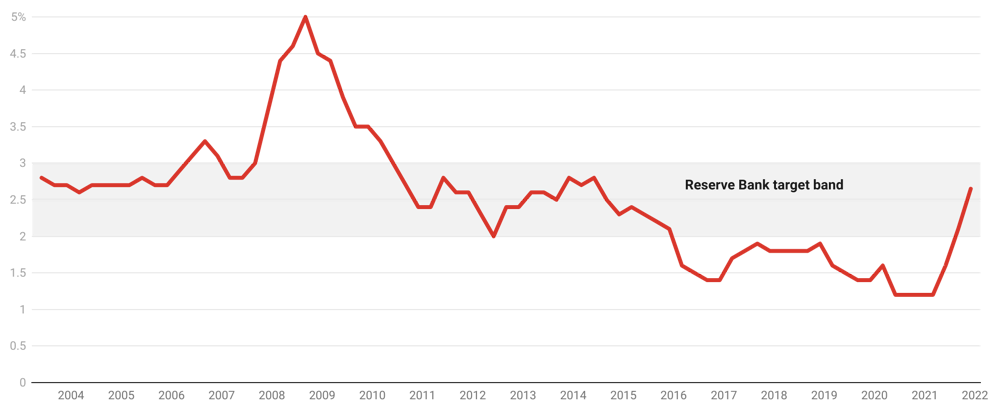
While this looks as if we might be on the road to the high inflation seen in the rest of the developed world (in the US inflation is 7%), at a touch under 2.7% Australia’s so-called underlying rate of inflation is much lower than in the US, UK or New Zealand. It also happens to be in the middle of the bank’s 2-3% target band.

This might be because inflation has been well below the Reserve Bank’s target band for the past half decade.


Underlying inflation

Annual, average of trimmed mean and weighted median.
ABS

Addressing the National Press Club on Wednesday, Philip Lowe said he expects Australia’s gross domestic product to continue growing at a rapid rate in the year ahead, around 4.5%. He also sees unemployment to continue falling – down to as little as 3.75% by the end of this year.

He expects underlying inflation to peak at just over 3%, before returning to the 2-3% target band.

Better than before

What explains this optimistic outlook? In many ways, the economy of 2022 resembles a return to normality.

Experts expect the Omicron wave to continue to diminish and the rollout of vaccine boosters and new anti-viral drugs to push COVID into Australia’s rear-view mirror.

This means Australia slowly returning to its pre-pandemic state with open borders and no lockdowns and restrictions.

Things shouldn’t be dismal, like before.
Shutterstock

It would also mean returning to the sub-par economic growth of 2-2.5% we had before COVID, were it not for two things.

One is what the crisis did in forcing the government to end its budget surplus fetish and spend to support the economy.

The other is what it did in persuading the Reserve Bank to rekindle its pursuit of full employment.

Before the pandemic, the bank worried excessively about the risks low interest rates posed to financial stability. Today, it rightly prioritises supporting the labour market.

These twin developments mean the 2022 economy is being supported by two coordinated boosters.

Combined, monetary (interest rate) stimulus and fiscal (budget spending) stimulus has pushed the unemployment rate well below 5% and will continue pushing it down over the months to come.


Read more:
Unemployment below 3% is possible for the first time in 50 years – if Australia budgets for it


Dr Lowe finished his speech turning to monetary policy and how it might unfurl over the year to come.

The bank has finished its use of unconventional monetary policies – bond-buying measures such as “yield curve control” and “quantitative easing”. But it remains committed to keeping its cash rate at the current low of 0.1% for a while yet.

So why keep interest rates low?

Why keep interest rates so low if the outlook is so positive? The governor put forward two reasons.

One is that, while the bank has an optimistic outlook for 2022, there is still a great deal of uncertainty around what the year will bring.

The bank wants to make sure these gains are locked in before it takes its foot off the accelerator. The costs of overheating the economy are relatively minor compared to what would happen if it hit the brakes too early and a new variant of COVID tipped the economy back into a recession.


Read more:
Top economists expect RBA to hold rates low in 2022 as real wages fall


The second is that wage growth remains very weak. The economy won’t be on a stable upward trajectory until wage growth picks up from its historic lows.

Although the bank expects wage growth to lift, it believes it will be a while yet before it climbs above the minimum of 3% needed to keep inflation within the target band.

Australia’s economy survived 2021 better than most expected. On Wednesday, Dr Lowe gave us good reasons to believe that this year it will do better still. And he has committed the bank to supporting households and businesses to try and ensure it does. He wants to deliver on his great expectations.

The Conversation

Isaac Gross does not work for, consult, own shares in or receive funding from any company or organisation that would benefit from this article, and has disclosed no relevant affiliations beyond their academic appointment.

ref. Building back better: how RBA Governor Philip Lowe sees the year ahead – https://theconversation.com/building-back-better-how-rba-governor-philip-lowe-sees-the-year-ahead-176006

Labor’s plan to green the Kurri Kurri gas power plant makes no sense

Source: The Conversation (Au and NZ) – By Bruce Mountain, Director, Victoria Energy Policy Centre, Victoria University

Shutterstock

Is it possible to have your cake and eat it too? Federal Labor is certainly giving it a go by supporting government plans for a fossil gas/diesel peaking plant in the Hunter Valley currently under construction – as long as the plant switches to green hydrogen by 2030.

This is disappointing for three reasons.

One, we don’t actually need the Kurri Kurri power station. It will be a government-built white elephant.

Two, retrofitting it to burn hydrogen would be so expensive as to be unrealistic.

And three, burning hydrogen for power is about the least useful thing you can do with it.

The gas/diesel plant under construction and Labor’s hydrogen proposal came from the realm of politics. It should have stayed there.

Why did Labor switch its position?

Labor has long been split on the Kurri Kurri power station, which has been touted as a way to augment dispatchable generation. At first, Labor denounced the Morrison government’s plans, with climate change spokesman Chris Bowen describing it as a “cynical attempt to pick a fight on gas and continue the climate wars, or to reward the major Liberal donor who owns the Kurri Kurri site”.

Now they say it will create jobs and help provide reliable and affordable electricity.


Read more:
Government-owned firms like Snowy Hydro can do better than building $600 million gas plants


As a nod to climate change action, Labor leader Anthony Albanese and climate spokesman Chris Bowen announced the switch with the caveat that Kurri Kurri will use green hydrogen to power 30% of its production when the plant enters service in 2023 and 100% by 2030. Labor says it is prepared to spend up to another $700 million on the plant.

It has been widely suggested the proposed plant is the government’s way to take advantage of Labor’s internal divide.

When the plant was first proposed for the small town 35 km inland from Newcastle, Energy Security Board chair Kerry Schott questioned its viability. “Nobody is going to build it from the private sector because it doesn’t stack up,” she said.

She’s right. It didn’t stack up then and doesn’t stack up now, regardless of how it’s powered.

coal power station seen from above
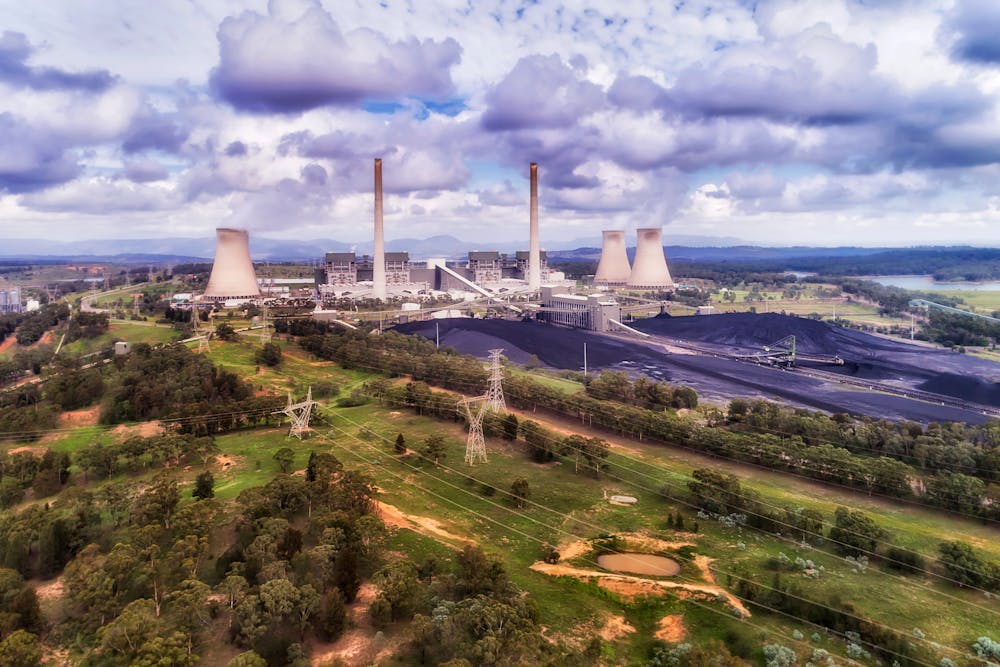
The Hunter Valley has long been a site for fossil fuel power stations, such as the Bayswater coal station.
Shutterstock

The power plant no one needs

When my colleagues and I took a deep dive into this proposed power station, we found there was no need for it until at least 2030. That’s the best case. But as time goes by it is increasingly unlikely it will ever be needed as much cheaper and more efficient alternatives including batteries come to meet the increasing demand for stored energy.

That’s to say nothing of the fact the initial proposal would only have had enough gas stored to run for six hours and then take a day to recharge. Snowy Hydro has since upped these plans to 10 hours of storage.

And Snowy Hydro’s price tag of $600 million? Fiddlesticks. It will cost vastly more. We estimate well over $1bn when costs of the pipelines, storage and other infrastructure are included, even without hydrogen. As a result, there is no way Kurri Kurri would attract enough income to recover its costs. It’s hardly surprising private investors are steering clear. Why bankroll a dud?

But isn’t it good to make gas plants greener?

You can add up to 10% of hydrogen to conventional gas fired turbines without trouble. And you can use hydrogen as the primary fuel in turbine-based power plants, as South Korea has done using hydrogen produced as a by-product in the process of refining oil.

The problem is the two Kurri Kurri turbines ordered by the government can run on a maximum of 15% hydrogen. Snowy Hydro suggests the turbines could be extended to a maximum 30% hydrogen mix, with changes to the internal equipment and piping. But the gas lateral pipeline/storage system is only being constructed to accommodate a 10% mix, and would need to be completely rebuilt to transmit a higher blend.

In short, converting Kurri Kurri to hydrogen means completely rebuilding the plant and its pipeline and storage infrastructure. These are not minor changes.

gas fired plant
The Kurri Kurri plant as depicted in Snowy Hydro planning documents.
Environmental Impact Statement, Snowy Hydro Hunter Power Project

Let’s imagine Labor is elected and proves determined to press ahead with these plans. Where, exactly, will they get the green hydrogen from and how will it be stored to run the plant? At present, the world has no large scale source of climate-safe hydrogen produced from water. While there is a great deal of interest in large scale electrolysis – the process where we split water to get hydrogen and oxygen – there is a long road ahead.

Let’s not waste time on distractions

Is that the end of the issues plaguing this plant? Nope. Even if we get to the point where green hydrogen is plentiful, burning it in a combustion turbine is one of the most wasteful ways to use it.


Read more:
International Energy Agency warns against new fossil fuel projects. Guess what Australia did next?


That’s because combustion turbines are very inefficient ways to produce electricity. They waste half the energy they consume in the form of heat vented to the atmosphere. That alone makes the use of hydrogen in turbines uneconomic. In fact, we doubt hydrogen will ever be used in combustion turbines to produce electricity. There is absolutely no need to bother doing so, given much better alternatives already exist. Batteries already dominate the market for new storage in Australia and elsewhere and this will surely continue.

We’d be much better off using green hydrogen to decarbonise more difficult industries, such as the production of fertiliser, in industrial processes and chemical manufacturing, and for long-distance land or sea heavy freight where hydrogen still has a weight advantage over batteries.

There are enormous challenges to be met in the transition towards renewable energy and away from fossil fuels. These kinds of obviously economically and technically infeasible proposals serve only to set us back. We should give these plans short shrift.

Independent engineer Ted Woodley contributed to this article.

The Conversation

Bruce Mountain does not work for, consult, own shares in or receive funding from any company or organisation that would benefit from this article, and has disclosed no relevant affiliations beyond their academic appointment.

ref. Labor’s plan to green the Kurri Kurri gas power plant makes no sense – https://theconversation.com/labors-plan-to-green-the-kurri-kurri-gas-power-plant-makes-no-sense-176157

Who is Joe Rogan, and why does Spotify love him so much?

Source: The Conversation (Au and NZ) – By Liz Giuffre, Senior Lecturer in Communication, University of Technology Sydney

Joe Rogan Experience/YouTube

Joe Rogan is described on his website as “stand up comic, mixed martial arts fanatic, psychedelic adventurer, host of The Joe Rogan Experience podcast.” It’s the last of these that has really made his name, and for many audiences, made the medium of podcasting too.

An estimated 200 million people download Rogan’s podcast each month, making him the most popular podcaster in the US.

When Spotify signed a US$100 million (A$140 million) deal with Rogan in 2020 for the exclusive rights to his podcast the industry took notice. Before this, podcasts were everywhere, and their “platform agnostic” status was central to their appeal for creators and audiences.

The deal was a gamble, but one based on the numbers. As music journalist Ted Gioia put it in May 2020, “Spotify values Rogan more than any musician in the history of the world”. The reason? “A musician would need to generate 23 billion streams on Spotify to earn what they’re paying Joe Rogan for his podcast rights”.

Spotify can justify the spectacular outlay: there is a ton of advertising dollars to be made in spoken word audio, where podcasting is eating up what was once radio’s domain. Spotify’s other stellar podcast hosts include Barack Obama and Bruce Springsteen, Prince Harry and Meghan Markle.


Read more:
Michelle Obama, podcast host: how podcasting became a multi-billion dollar industry


Why is Joe Rogan so popular?

What’s important about Joe Rogan is also the type of listener he attracts. Media Monitors says Rogan’s listenership is “71% male and evenly split between high school and post-secondary graduates. Some 57% of his audience reports earning over $50k per year, with 19% making over $100k”, with an average age of 24.

The Atlantic places gender at the heart of his appeal, suggesting “[Rogan] understands men in America better than most people do. The rest of the country should start paying attention.”

Prior to Rogan signing for Spotify, exclusivity in podcasting was unheard of. In 2001, US “media hacker” Dave Winer made public RSS, the Really Simple Syndication feed that could automatically “drop” a podcast episode online to a subscriber. Winer made the conscious decision to make RSS free and universal, in order to preserve a democratic ethos for podcasting similar to the recently created blogs he loved.

Signing an exclusive deal with Rogan could “make” Spotify as a podcasting platform of choice (and audio empire generally), or it could see Rogan lose fans who couldn’t be bothered to move with him. A study by The Verge showed Rogan gained fans when he first made the exclusive podcasting deal.

Part of Rogan’s appeal is his rawness – with episodes regularly two to three hours long and with minimal (if any) editing. He says what he thinks and feels in the moment, harnessing the compelling emotional power of the voice in a similar way to the great radio broadcasters of any age.

So, what’s the problem?

Rogan often makes pernicious claims. One ironic example occurred when Rogan circulated a fake ad made by Gruen to represent Australia’s pandemic propaganda – made funnier given the ad parodied people who relied on Rogan’s advice rather than medical professionals.

He added a correction, albeit a small one, and these types of mistakes have become memes since then.

Far more seriously, Rogan has peddled egregious conspiracy theories and disinformation. He amplified disgraced radio host Alex Jones’ lie the Sandy Hook massacre did not happen (apparently causing internal conflict at Spotify last year as a result).

According to a report by Media Matters, which studied the Joe Rogan Experience for a year, Rogan regularly trafficks misinformation and bigotry. The author drew particular attention to Rogan’s “right-wing misinformation and bigotry”, “anti-trans rhetoric” and “COVID-19 misinformation”.

A collection of medical professionals have campaigned against misinformation on the platform, and artists including Neil Young and Joni Mitchell have removed their work from Spotify.


Read more:
Neil Young’s ultimatum to Spotify shows streaming platforms are now a battleground where artists can leverage power


In response, Spotify have finally released some “platform rules”, but they are generalised statements that avoid infringing the freedom of creators such as Rogan.

Most important in all of this is the audience. Rogan maintains he is just a comedian having long form conversations. This sounds fine on the surface (and similar to the infamous “not a journalist, but an entertainer” claims made by Australian shock jocks John Laws and Alan Jones), but in practice Rogan’s words are heard by many more people than the average comedian just having a chat.

Podcasting’s wild west

Podcasting is still the relative wild west as an industry and medium. With ties to both the music industry and radio, podcasting remains mostly unregulated and diverse.

In a podsphere that now counts around three million titles, multi-million dollar projects with immaculate audio production and slick scripting co-exist alongside amateurs uploading rambling, barely audible chats. A near-global and cross-platform phenomenon, podcasting often evades the laws of any one jurisdiction.

Dave Winer’s open origin principle for podcasts has been at stake since Joe Rogan sold his name to Spotify. The question now is: where does editorial freedom sit? Should podcasters be regulated? And if so, how?

In response to the recent Spotify controversy Rogan says he is “not interested in only talking to people that have one perspective”. But as a public figure with such a large platform, should he really give equal weight to voices that clearly have unequal evidence to support them?


Read more:
Spotify’s response to Rogan-gate falls short of its ethical and editorial obligations


The Conversation

Siobhan McHugh received funding from the Australian Research Council to produce the podcast Heart of Artness, about crosscultural relationships in the production of Australian Aboriginal art.

Liz Giuffre does not work for, consult, own shares in or receive funding from any company or organisation that would benefit from this article, and has disclosed no relevant affiliations beyond their academic appointment.

ref. Who is Joe Rogan, and why does Spotify love him so much? – https://theconversation.com/who-is-joe-rogan-and-why-does-spotify-love-him-so-much-176014

How snowboarding became a marquee event at the Winter Olympics – but lost some of its cool factor in the process

Source: The Conversation (Au and NZ) – By Holly Thorpe, Professor in Sociology of Sport and Physical Culture, University of Waikato

GettyImages

The mass appeal of creative, youth-oriented events such as snowboarding and freestyle skiing at the Winter Olympics is a virtual case study of how the once radical can go mainstream.

And while audiences have come to love these relatively new sports, the story of snowboarding’s inclusion in the Olympics also reveals the unintended consequences of “success” for the image of the sport itself.

When snowboarding first emerged in the late 1960s and ’70s in North America, most of its early pioneers were young people who rejected competitive, organised sport. Inspired by surfing and skateboarding rather than skiing, they were seeking something that offered fun, self-expression and an alternative identity.

Despite some initial resistance from skiers and resorts, snowboarding’s popularity grew during the 1990s. Television and corporate sponsors identified its huge potential to attract the elusive young male market. Increasingly, transnational media corporations and events likes the X-Games and Gravity Games controlled and defined snowboarding.

While some snowboarders initially resisted “selling out”, many embraced the opportunities to develop the sport and carve out new careers for themselves as “extreme sport” athletes.

Early resistance

Meanwhile, the Winter Olympics (always a more niche event compared with its summer counterpart) recognised snowboarding’s potential to attract younger viewers and international sponsors.

The International Olympic Committee (IOC) first included snowboarding in the 1998 Winter Olympics, but under the governance of the International Ski Federation (FIS) rather than the International Snowboard Federation. The loss of autonomy and control infuriated many snowboarders.

The world’s best halfpipe rider at the time, Norwegian Terje Haakonsen, was particularly vocal, refusing to be turned into a “uniform-wearing, flag-bearing, walking logo”. Many other snowboarders echoed his sentiments.


Read more:
How the Winter Olympics expanded – and brought growing pains with them


And while snowboarding’s assimilation continued, the four events that debuted in 1998 – men’s and women’s halfpipe and giant slalom – were largely treated as a sideshow. The athletes were perceived and portrayed as interlopers in the Olympic program. As The Washington Post put it:

Snowboarders are the official curiosity of the Nagano Winter Games. They’re totally new to the Olympics. They look different, they sound different, they are different.

When Canadian Ross Rebagliati tested positive for marijuana after winning the first snowboarding gold medal, the IOC revoked his medal, only to return it a few days later when Rebagliati’s lawyers found a loophole in the IOC/FIS drug policies. The scandal confirmed the view – of snowboarders as well as mainstream commentators – that snowboarding was not ready to become an Olympic sport.

Acceptance and growth

By the 2002 Winter Olympics in Salt Lake City, however, the packaging of snowboarding had evolved and the sport’s second mainstream outing was deemed a resounding success. Nearly 32% of the US population (92 million people) watched the halfpipe competition in which Americans won gold, silver and bronze in the men’s event and gold in the women’s event.

Official broadcaster NBC reported a 23% ratings increase among 18-to-34-year-olds. For the IOC, the inclusion of snowboarding had become a game-changer, showcasing cool new sports celebrities for Olympic audiences, especially in the lucrative US market.


Read more:
Get caught up in the Olympic spirit, but keep your (political) eyes wide open


By the 2010 Winter Olympics in Vancouver, snowboarders were front and centre, with Shaun White from the US deemed the most “recognisable athlete”.

When White won his third gold in the halfpipe at the 2018 Olympics in Pyeongchang it attracted a record 22.6 million viewers in the US alone. Having qualified for his fifth Olympics, White will bring his star power to Beijing this year.

Women on board

Women snowboarders have competed in all Olympic events since 1998, expanding opportunities for women in the sport and industry.

Olympic snowboarders such as Kelly Clark, Hannah Tetter, Torah Bright and Chloe Kim build on the efforts of previous generations of female snowboarders, carving out new space for girls and women in the sport.

In the process of wowing audiences, they’ve also inspired the next generation of stars like New Zealand’s Zoi Sadowski-Synnott and Japan’s Ono Mitsuki.

It’s estimated women will make up 45% of the athletes competing in Beijing this year, including in the new mixed team snowboard cross event, added as part of a broader IOC initiative to achieve gender parity.

Zoi Sadowski-Synnott in the snow
Zoi Sadowski-Synnott after her winning final run of the Dew Tour at Copper Mountain, Colorado, in 2021.
GettyImages

Victim of its own success?

While the IOC held the line with certain rules and regulations (no stickers on snowboards, no large corporate logos on clothing or equipment), it has been increasingly willing to accommodate snowboarders’ individuality – allowing more clothing choices and athletes to select their own music for halfpipe runs.

Snowboarding’s success has also helped open up the Winter Olympics to other youth-focused sports, particularly free-skiing disciplines, as well as influencing the Summer Olympics’ embrace of BMX, surfing, skateboarding, sport climbing and breaking.


Read more:
Alt goes mainstream: how surfing, skateboarding, BMX and sport climbing became Olympic events


But there’s an irony to snowboarding’s mainstream success, too. While it has become popular with broader audiences, and companies and athletes have done very well from Olympic exposure, it appears to have lost its appeal among younger people.

Participation has been declining steadily in recent years – to the point where former pro snowboarder and action sports agent Circe Wallace has said the sport’s commodification and institutionalisation have been “the death knell of the unique culture and beauty of snowboarding”.

It’s a familiar story – youth-culture cool incorporated by mainstream businesses and organisations for profit. As the IOC continues to search out the latest youth-oriented sports to help it stay relevant, bring back younger viewers and attract corporate sponsors, we would do well to ask who, ultimately, are the real winners and the losers.

The Conversation

The authors do not work for, consult, own shares in or receive funding from any company or organisation that would benefit from this article, and have disclosed no relevant affiliations beyond their academic appointment.

ref. How snowboarding became a marquee event at the Winter Olympics – but lost some of its cool factor in the process – https://theconversation.com/how-snowboarding-became-a-marquee-event-at-the-winter-olympics-but-lost-some-of-its-cool-factor-in-the-process-175053

Spotify’s response to Rogan-gate falls short of its ethical and editorial obligations

Source: The Conversation (Au and NZ) – By David Tuffley, Senior Lecturer in Applied Ethics & CyberSecurity, Griffith University

Pixabay, CC BY-SA

Audio streaming giant Spotify is getting a crash course in the tension between free speech and the need to protect the public from harmful misinformation.

The Swedish-founded platform, which has 400 million active users, has faced a hail of criticism over misinformation broadcast on its most popular podcast, the Joe Rogan Experience.

Rogan, a former ultimate fighting commentator and television presenter, has argued healthy young people should not get a COVID vaccination. This is contrary to medical advice from governments all over the world, not to mention the World Health Organization.

A recent episode of his podcast, featuring virologist Robert Malone, drew criticism from public health experts over its various conspiracist claims about COVID vaccination programs.

There were widespread calls for Spotify to deplatform Rogan and his interviewees. Rock legend Neil Young issued an ultimatum that Spotify could broadcast Rogan or Young, but not both.

Spotify made its choice: the Joe Rogan Experience is still on the air, while Young’s music is gone, along with Joni Mitchell and Nils Lofgren, who removed their content in solidarity.


Read more:
Neil Young’s ultimatum to Spotify shows streaming platforms are now a battleground where artists can leverage power


Spotify’s response

Spotify co-founder Daniel Ek has since promised to tag controversial COVID-related content with links to a “hub” containing trustworthy information. But he stopped short of pledging to remove misinformation outright.

In a statement, Ek said:

We know we have a critical role to play in supporting creator expression while balancing it with the safety of our users. In that role, it is important to me that we don’t take on the position of being content censor while also making sure that there are rules in place and consequences for those who violate them.

Does it go far enough?

Freedom of expression is important, but so is prevention of harm. When what is being advocated is likely to cause harm or loss of life, a line has been crossed. Spotify has a moral obligation to restrict speech that damages the public interest.

In response to the controversy, Spotify also publicly shared its rules of engagement. They are comprehensive and proactive in helping to make content creators aware of the lines that must not be crossed, while allowing for freedom of expression within these constraints.  

Has Spotify fulfilled its duty of care to customers? If it applies the rules as stated, provides listeners with links to trustworthy information, and refuses to let controversial yet profitable content creators off the hook, this is certainly a move in the right direction.

Platform or publisher?

At the crux of the problem is the question of whether social media providers are platforms or publishers.

Spotify and other Big Tech players claim they are simply providing a platform for people’s opinions. But regulators are beginning to say no, they are in fact publishers of information, and like any publisher must be accountable for their content.

Logos of big tech platforms
Tech platforms like to claim they’re not publishers.
Pixabay, CC BY

Facebook, YouTube, Twitter and other platforms have significant power to promote particular views and limit others, thereby influencing millions or even billions of users.

In the United States, these platforms have immunity from civil and criminal liability under a 1996 federal law that shields them from liability as sites that host user-generated content. Being US corporations, their actions are primarily based on US legislation.

It is an ingenious business model that allows Facebook, for example, to turn a steady stream of free user-posted content into US$28 billion in quarterly advertising revenue.

Established newspapers and magazines also sell advertising, but they pay journalists to write content and are legally liable for what they publish. It’s little wonder they are struggling to survive, and little wonder the tech platforms are keen to avoid similar responsibilities.

But the fact is that social media companies do make editorial decisions about what appears on their platforms. So it is not morally defensible to hide behind the legal protections afforded to them as platforms, when they operate as publishers and reap considerable profits by doing so.

How best to combat misinformation?

Misinformation in the form of fake news, intentional disinformation and misinformed opinion has become a crucial issue for democratic systems around the world. How to combat this influence without compromising democratic values and free speech?

One way is to cultivate “news literacy” – an ability to discern misinformation. This can be done by making a practice of sampling news from across the political spectrum, then averaging out the message to the moderate middle. Most of us confine ourselves to the echo chamber of our preferred source, avoiding contrary opinions as we go.

If you are not sampling at least three reputable sources, you’re not getting the full picture. Here are the characteristics of a reputable news source.


Read more:
Merchants of misinformation are all over the internet. But the real problem lies with us


Social media, meanwhile, should invest in artificial intelligence (AI) tools to sift the deluge of real-time content and flag potential fake news. Some progress in this area has been made, but there is room for improvement.

The tide is turning for the big social media companies. Governments around the world are formulating laws that will oblige them to be more responsible for the content they publish. They won’t have long to wait.

The Conversation

David Tuffley does not work for, consult, own shares in or receive funding from any company or organisation that would benefit from this article, and has disclosed no relevant affiliations beyond their academic appointment.

ref. Spotify’s response to Rogan-gate falls short of its ethical and editorial obligations – https://theconversation.com/spotifys-response-to-rogan-gate-falls-short-of-its-ethical-and-editorial-obligations-176022

Why the Winter Olympics are so vital to the Chinese Communist Party’s legitimacy

Source: The Conversation (Au and NZ) – By Yan Bennett, Assistant Director for the Paul and Marcia Wythes Center on Contemporary China, Princeton University

Zhang Ling/Xinhua/AP

Aside from fake snow and COVID-19, the Beijing Winter Games are controversial for many reasons.

They are a potent political symbol of the Chinese state’s ambitions and authority. Held just a year after the triumphalist 100-year anniversary of the Communist Party’s founding, General Secretary Xi Jinping is using the Olympics to showcase to the world that China is powerful and on track to fulfil its Chinese Dream of national rejuvenation.

How will the Chinese Communist Party (CCP) use the games domestically to push this narrative and how will it be viewed by the rest of the world? What does the party hope to gain by the games being perceived as a success?

Competing narratives at home and abroad

Some observers see China’s rise as generating a strategic power conflict and threatening the liberal world order.

Others see China’s rise as more benign, even appropriate for a country possessing 4,000 years of history and having made astonishing economic progress in the past 50 years.

These contrasting interpretations have generated much debate internationally before the Olympics. Several western countries have declared a diplomatic boycott because of concerns over the shocking human rights violations of the Uyghur minority and deep repression in civil society, particularly in Hong Kong.

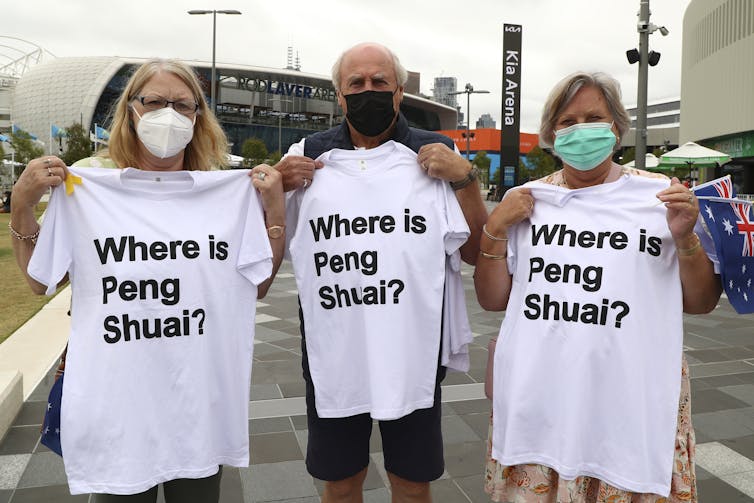
China’s reputation worsened after the safety of tennis star Peng Shuai, an alleged sexual assault victim, became a matter of international concern.

Supporters of Chinese tennis player Peng Shuai
Supporters of Chinese tennis player Peng Shuai hold up T-shirts at the Australian Open last month.
Tertius Pickard/AP

Domestically, however, the Olympics are portrayed as something that benefits the Chinese people – a way for Chinese athletes to achieve glory and to showcase the Communist Party’s ability to execute a world-class sporting event. The underlying narrative glorifies the regime and legitimises the CCP’s institutions and practices.

The party’s central role in the Chinese Dream

Chinese media have struck back at the international criticism, saying the US is being dumb and mean for criticising China’s highly restrictive zero-COVID policies and the Americans weren’t invited to the Olympics in the first place.

The domestic objective of these aggressive narratives is to reaffirm the primacy of the Communist Party as the best protector of China and its people against provocative elements in the international community.

At the same time, the games represent an opportunity for Xi to reset the global rhetoric on China by welcoming the world to Beijing’s “smart, environmentally friendly” Olympics.

China’s so-called “wolf-warrior diplomacy” has hurt more than helped its interests abroad. As a result, Xi has pleaded with party members, Chinese diplomats and the Chinese media to “set the tone right” by being more modest and humble, to promote a more “credible, lovable and respectable image of China,” a request with which they have grudgingly complied.

For Xi, he needs both the party’s compliance and acceptance. The party is at the core of everything he wants to do – primarily, to deliver his “Chinese Dream” to the people.


Read more:
Xi Jinping’s grip on power is absolute, but there are new threats to his ‘Chinese dream’


While the Chinese Dream has often been compared to the “American Dream”, it is most emphatically not an American Dream with Chinese characteristics.

The American Dream emphasises individual freedoms, social mobility and material success brought about by one’s own efforts. In the Chinese Dream, national well-being supersedes individual desires and achievements. As such, the CCP spins a narrative that only the party can achieve the Chinese Dream for the Chinese people.

So, when someone or something is perceived as a threat to the party’s centrality, the regime launches into self-preservation mode. For example, when some in the west raised the prospect COVID may have been engineered in a Chinese lab, the Chinese Foreign Ministry struck back hard by endorsing a conspiracy theory the US Army introduced the virus to Wuhan.

In Xi’s speech on the 100th annversary of the CCP’s founding last year, party members were reminded the CCP leadership, with Comrade Xi Jinping, at its core is

the foundation and lifeblood of the Party and the country, and the crux upon which the interests and well-being of all Chinese people depend.


Read more:
The Communist Party claims to have brought prosperity and equality to China. Here’s the real impact of its rule


The People’s Games?

The presentation of the Beijing Winter Olympics to the Chinese people is crucial to this overarching narrative that Xi and the party are creating. They need the Chinese people to adhere to the Chinese Dream as their dream.

This need is evident in the language Xi uses in public statements. Xi uses a great deal of imagery to exhort the Chinese people to march together with the party on the same difficult path toward this shared vision of the future.

The speed-skating oval in Beijing
China is projecting the Beijing Olympics as a symbol of its strength.
Shuhei Yokoyama/AP

As China continues to build its economy and burnish its great power status with high-profile events such as these Winter Olympics, it is also attempting to show the world that its model of governance is supreme.

These games are a giant advertisement for the Communist Party, exemplifying the kind of sharp efficiency that high-tech, authoritarian governments can bring to events of this magnitude. It can also demonstrate how successful the government has been in containing COVID, though this has involved blockading people in their own homes and the discriminatory treatment of Africans living in China.

So, when global audiences cheer for their winter heroes, they will also be cheering for the CCP – whether they like that or not.

The Conversation

The authors do not work for, consult, own shares in or receive funding from any company or organisation that would benefit from this article, and have disclosed no relevant affiliations beyond their academic appointment.

ref. Why the Winter Olympics are so vital to the Chinese Communist Party’s legitimacy – https://theconversation.com/why-the-winter-olympics-are-so-vital-to-the-chinese-communist-partys-legitimacy-176130

How will China handle the dual threats of COVID and political protests at the Winter Olympics?

Source: The Conversation (Au and NZ) – By David S G Goodman, Director, China Studies Centre, Professor of Chinese Politics, University of Sydney


David J. Phillip/AP

The Beijing Winter Olympics and Paralympics start on Friday – the first time in history the same city has hosted both the summer and winter games.

Compared to the 2008 summer games, the upcoming Winter Olympics face two major challenges: the global pandemic and a dramatically different geopolitical setting. For the Communist Party of China (CCP), which always draws a long bow on reputation and international impact, both of these challenges may seem insurmountable.

But when it comes to the pandemic, the likelihood is the regime will safely manage the event, despite the potential for operational difficulties and even minor COVID outbreaks.

China has responded to the pandemic with a strongly enforced policy of zero tolerance for the past two years. Public health may well have prompted it to continue with a zero-COVID policy long after the world gave it up. At the same time, two major events this year could have also been a factor: the Winter Olympics and the party’s 20th National Congress in late 2022.

To cope with the pandemic during the Olympics, the government has gone to even further lengths than the Tokyo Olympic organisers to try to minimise the spread of infection. Whole villages have been built for the competitors, officials and service personnel, together with transport and testing services for movement to, within and between the Olympic sites.

Even before the arrival of the sports delegations, Chinese staff moved in at the start of January to establish what has been described locally as “closed loops” – the now-familiar “bubbles” we’ve seen at other sporting events. A sophisticated surveillance system will ensure everyone complies with the rules.

Given these preparations, there is less of a chance of the Olympics becoming a superspreader event, at least for the competitors and officials.

As for crowds, the government has severely restricted spectators. As of mid-January, the Olympic organisers announced tickets would not be on sale at all; instead, tickets would go to “selected” Chinese spectators (with no fans from other countries permitted). Those lucky enough to be invited would

strictly abide by the COVID-19 countermeasures before, during and after each event so as to help create an absolutely safe environment for the athletes.

Muted boycott

The changes in the geopolitical atmosphere since the 2008 summer Olympics present a greater challenge.

For much of the English-speaking world, China seems to have become an existential threat that must be vigorously opposed. China has been harshly criticised for
its expansion into the South China Sea, the end to Hong Kong’s previous degree of political autonomy, and its restrictive policies towards the Uyghurs in the western Xinjiang region.

The government’s treatment of the Uyghurs has been labelled by many a genocide. In this context, there’s an obvious parallel with the hosting of the 1936 summer Olympics by Nazi Germany. Josh Rogin, the noted Washington Post columnist, recently argued against those he describes as “atrocity deniers”:

the actions of the athletes, companies and international organisations at the 2022 Beijing Olympics will be remembered for generations, as they were after the Games in 1936. Each of them — and each of us — must think hard about which side of history we want to be on.

Despite these criticisms, the calls for an Olympic boycott have been surprisingly muted, particularly in contrast to the US-led boycott of the 1980 Moscow Olympics after the Soviet invasion of Afghanistan.

No national Olympic committees have called for a boycott, and the so-called “diplomatic boycott” of government representatives has remained limited in scale. It has been weakened somewhat by the reported visa applications for 46 US officials – most from the State Department – to visit China during the games as part of the US Olympic team support.


Read more:
As the Beijing Winter Olympics countdown begins, calls to boycott the ‘Genocide Games’ grow


On the other hand, the boycott calls have not been resisted as stridently as they were by Olympic supporters in 1936. Avery Brundage, then-president of the US Olympic Committee, described a proposed boycott of the Berlin games a “Jewish-Communist conspiracy”.

The reason there’s more restraint today is likely due to globalisation – China and the US may see themselves as competitors for world leadership, but they are still more closely economically integrated than the US and USSR were in 1980.

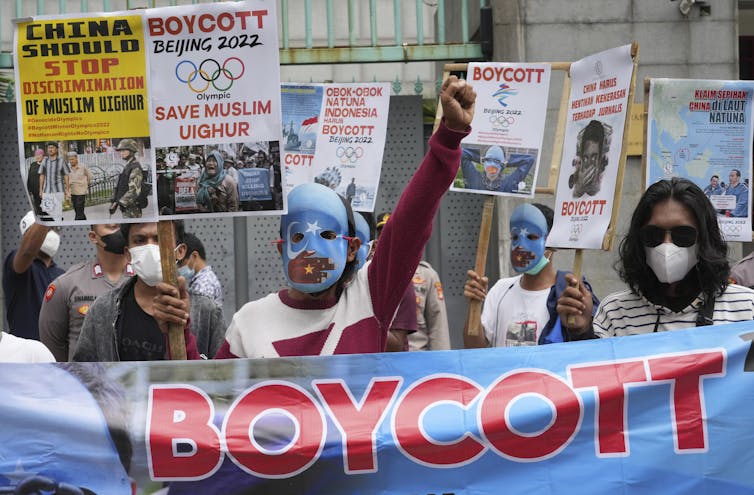
Protesters outside the Chinese embassy in Jakarta.
Protesters wearing masks with the colours of the pro-independence East Turkistan flag shout slogans outside the Chinese Embassy in Jakarta.
Tatan Syuflana/AP

How will China respond to protests?

Even if there is no major boycott, the chance for political statements during the games remains high.

Athletes and sports officials have been warned not to speak out or they could be punished under Chinese law. Athletes have also been advised to leave their mobile phones at home and use burners instead.

While no athletes have yet publicly criticised China, it would be surprising if there were no such incidents. Olympic athletes have made political statements in the past, and given the current geopolitics, the Beijing Olympics present a large stage with an enormous potential audience.

It’s unlikely a medal winner would drape the flag of former East Turkestan (now used by those advocating Uyghur resistance to Beijing) around their shoulders, but there may be complaints about the strict controls on athletes in China.

In the short term, China’s critics will express their views, while the Chinese government will expound on the significance of harmonious world interaction at a great sporting event such as the Olympic Games.

The limited diplomatic boycott of the games certainly has annoyed the CCP. But neither it, nor operational problems, nor criticisms of China that may emerge at the games, are likely to have any longer-term consequences.


Read more:
Why the Winter Olympics are so vital to the Chinese Communist Party’s legitimacy


They will certainly not shake the regime to its foundations, or even adversely affect Xi’s leadership. In fact, any attacks on the CCP will only reinforce the position of Chinese leaders arguing for the need to ensure stability and strength in the face of an external threat – both in terms of politics and public health.

The more likely outcome is the Chinese government will revel in its ability to hold a prestigious international event under difficult conditions.

It is a message that will speak to many parts of the world, especially those attracted by or envious of China’s economic growth. These will even include some in liberal democracies, though certainly not China’s harshest critics – the governments of the US, Australia, Canada and United Kingdom.


The China Studies Centre at the University of Sydney is holding an online roundtable discussion on the Beijing Winter Olympics on Thursday, Feb. 3, at 1pm. To register or for more information, visit here.

The Conversation

David S G Goodman does not work for, consult, own shares in or receive funding from any company or organisation that would benefit from this article, and has disclosed no relevant affiliations beyond their academic appointment.

ref. How will China handle the dual threats of COVID and political protests at the Winter Olympics? – https://theconversation.com/how-will-china-handle-the-dual-threats-of-covid-and-political-protests-at-the-winter-olympics-175637

Women make up half the disability population but just over a third of NDIS recipients

Source: The Conversation (Au and NZ) – By Sophie Yates, Research Fellow, UNSW

Shutterstock

Australia’s National Disability Insurance Scheme (NDIS) provides individualised funding to nearly 500,000 Australians with disability.

Despite an even male-female split among under-65s with a disability (49% female), only 37% of NDIS participants are women and girls.

To better understand what’s behind the disparity, we interviewed 30 women about their experiences with the NDIS.


Read more:
Women, rural and disadvantaged Australians may be missing out on care in the NDIS


The thing that struck us the most was how many women talked about what hard work it was being on the NDIS, or applying for it. Three women told us it was like “a full time job”.

We already knew the NDIS was very administratively complex, and increasingly people have needed to appeal their budgets to get the right supports.

So we started thinking about “administrative burden”, or load, and how it fits into the story of women’s experiences with the NDIS.

What is administrative burden?

Administrative burden is the work people have to do when they access government programs. This can manifest as:

  • learning costs (how hard it is to learn how to apply for and use a program)
  • psychological costs (how emotionally draining or confronting it is) and
  • compliance costs (how difficult it is to comply with program rules and requirements).

Research has increasingly explored how administrative burden falls unevenly on different groups, finding those with the least resources have the largest administrative burden. This includes Aboriginal and Torres Strait Islander people, people with disability, people with lower socioeconomic status, and people from non-English speaking backgrounds.

These groups are more likely to be gatekept from government programs because of how difficult it is to access and manage them.

Time consuming and difficult

Some women we interviewed experienced a smooth, supportive NDIS experience. However, this wasn’t the norm.

Women told us being on the NDIS took a lot of time and effort. They said communicating with the National Disability Insurance Agency (NDIA) was difficult, and the application process was challenging and emotionally draining.

Young woman with autism and other learning disabilities using laptop for remote learning.
Very few of the women interviewed had a smooth experience with the NDIS.
Unsplash/Sharon McCutcheon

Interviewee January said it was impossible to phone or contact any specific person:

The NDIA is like dealing with…you know those octopuses that live a thousand metres down in the ocean, and no one’s ever seen them? So we don’t actually know how they work, just every so often they’ll put a little piece of themselves above the surface and like, wreck a ship. But then you don’t know which animal it’s attached to and you’ve got no way of contacting it, to try and do peace talks. … So it just seems like this faceless monster.

Administrative burden can be gendered

Although all people accessing and applying for the NDIS (and their families and carers) face administrative burden, our results show this can manifest in gendered ways.

While men and women experience disability at similar rates, men are more likely to be diagnosed with disabilities that are more straightforward to gain access to the NDIS for.

Autism, for example, is male-dominated and comprises about a third of the scheme (although this may reflect gender bias in diagnosis rather than true prevalence).

Women are more likely to be diagnosed with disabilities that don’t fit as well within the medicalised model of disability that has taken over the NDIS. One analysis, for example, found “painful and socially disabling disorders” such as arthritis, fibromyalgia and chronic fatigue syndrome are more common in women – but it’s difficult to get support for these conditions.


Read more:
Why it is “reasonable and necessary” for the NDIS to support people’s sex lives


Support needs are supposed to be assessed according to the person’s level of functioning, but applicants are required to provide extensive medical evidence. This means it is more administratively burdensome to apply for support for those disabilities, and women may not be willing to expend so much effort for such an uncertain outcome.

A new analysis of the NDIS application form shows it is long and complicated, partly because it makes assumptions about people’s lives being relatively straightforward. Seemingly simple questions like “does the person require assistance with self-management because of their disability?” can be difficult to answer if you have fluctuating support needs, as is often the case with disabilities more common in women.

Women have less time to manage their own disabilities

Another gendered dimension is that balancing administrative labour and family care is often harder for women, who shoulder more of the caring work.

Women represent over 70% of primary carers to people with disability and older people. Of those providing primary care to children with disability, nearly 90% are female. And 35% of female primary carers have a disability themselves.

Mother shows son something on a tablet, while playing with blocks on the table.
Women take on more caring and administrative work in their households, leaving less to coordinate their own disability care.
Shutterstock.

Women also tend to take on more of the administrative work of family, which includes managing the government-related administration of family members.

This leaves them less time to manage their own disabilities.


Read more:
Planning, stress and worry put the mental load on mothers – will 2022 be the year they share the burden?


Some of the women we talked to said it was sometimes too hard to balance self-care, life responsibilities, and fighting for what they needed on the NDIS.

Peta, a mother of young children, told us:

I called the NDIS the other day and said I just need some more therapy… She listed this litany of things you had to do. I was like, so I’ll just add that to the list of death by admin tasks. And I said, thanks but no thanks, I’ll just pay for it myself. And I just hung up.

While Peta could luckily afford to pay for the support herself, many women on the NDIS are not in a similar position.

Women with disability are less likely to be in paid work than men with disability, and more economically disadvantaged overall, so if they give up on accessing a support because it’s too hard, they are more likely to just go without.

This was not the first work to examine the administrative burden of the NDIS, but it was the first to do so through a gendered lens. We need more evidence on the nature of administrative barriers for women in the NDIS and what can be done to address them.

The NDIA should also develop and implement an NDIS gender strategy, in partnership with women’s disability organisations.


Read more:
NDIS independent assessments are off the table for now. That’s a good thing — the evidence wasn’t there


The Conversation

The authors do not work for, consult, own shares in or receive funding from any company or organisation that would benefit from this article, and have disclosed no relevant affiliations beyond their academic appointment.

ref. Women make up half the disability population but just over a third of NDIS recipients – https://theconversation.com/women-make-up-half-the-disability-population-but-just-over-a-third-of-ndis-recipients-173747

Queensland has an important network of private conservation areas, but they’re dangerously exposed to mining

Source: The Conversation (Au and NZ) – By Rebecca Louise Nelson, Associate Professor in Law, The University of Melbourne

Tarcutta Hills Reserve Bush Heritage Australia, Author provided

Australia has the world’s largest network of privately owned conservation areas that protect a range of rare wildlife, from bilbies to endangered fish.

There are some 6,000 non-government conservation areas across the continent, which are owned by Aboriginal and Torres Strait Islander groups, individuals and NGOs. They build a more comprehensive protected area network than public protected areas can achieve alone, ensuring more species have a fighting chance against the changing climate.

These lands cover more area in Queensland than any other state. But our new research finds Queensland’s laws fail to protect them from the hidden impacts of mining on the groundwater sustaining them.

This is because private investments in conservation land aren’t legally protected in the same way as commercial assets or capital, nor like national parks. To safeguard these crucial habitats and ecosystems against the threats of mining, we need legal reform in Queensland and an urgent exploration of these vulnerabilities across Australia.

Beyond national parks

Governments rightly encourage growth in Australia’s privately protected areas. Conservation landholders invest in restoring degraded land, re-introduce ecologically and culturally important species, and carefully design innovative habitat protection measures.

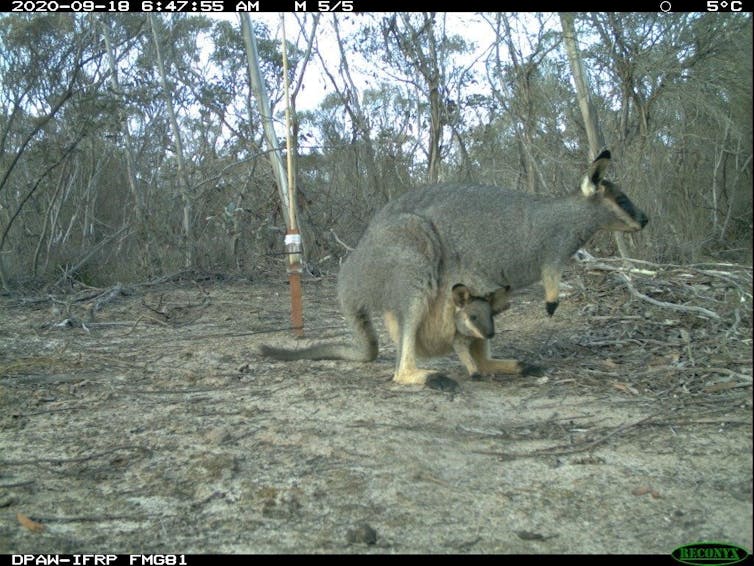
Camera trap photo of a Black-Gloved Wallaby at Fitz-Stirling Reserves, Noongar Country, WA.
Bush Heritage Australia

For example, the Olkola Aboriginal Corporation of Cape York has developed a successful carbon abatement project and a long-term plan to save the totemic endangered Alwal (golden-shouldered parrot), and defend it from mining.

Likewise, a non-profit organisation owns the Mount Rothwell reserve. After successfully reintroducing the mainland eastern barred bandicoot in 2004, the reserve now protects over 80% of the species’ population in the largest feral predator-free ecosystem in Victoria.


Read more:
Here’s a good news conservation story: farmers are helping endangered ecosystems


Privately protected areas also safeguard some of Australia’s most threatened and under-protected habitat types. This includes critically endangered grassy box woodlands in New South Wales, and the Fitz Stirling biodiversity hotspot in Western Australia.

Investing in privately protected areas also makes economic sense. A 2020 Ernst & Young report shows investing in privately protected areas can provide significant stimulus to support Australia’s recovery from COVID.

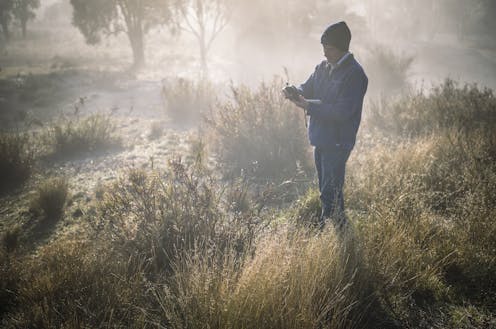
Bush Heritage ecologist Dr Matt Appleby at Tarcutta Hills Reserve, Wiradjuri Country, NSW.
Annette Ruzicka

Why private conservation land is vulnerable

But Australia’s environment laws leave privately protected areas exposed to resource development projects, both within and outside the boundaries of the land.

Unlike national parks, mining projects are allowed to be developed within privately owned nature refuges against the land owner’s wishes. This has been a longstanding concern of conservationists worldwide.

Only very small areas of environmentally valuable private land in Queensland are protected from mining under legal arrangements that are very rarely applied. This includes a single declared Special Wildlife Reserve (a recent legal upgrade from nature refuge arrangements), and parts of Queensland’s strategic environmental areas.

Both privately protected land and national parks are also at risk from development projects operating outside their boundaries. One of the biggest threats is the impact of mining on groundwater, the focus of our research.


Read more:
Aren’t we in a drought? The Australian black coal industry uses enough water for over 5 million people


Groundwater is natural life support for arid Australia, with ecosystems and landscapes – such as desert springs, wetlands, rivers and forests – dependent on it. Alongside the potential for water contamination, a major threat mining and gas developments pose on groundwater is over-extraction.

Mines and gas developments can require billions of litres of fresh water each year to operate, competing with water that ecosystems need to survive. These impacts can last for hundreds or even thousands of years, though the details aren’t always fully disclosed.

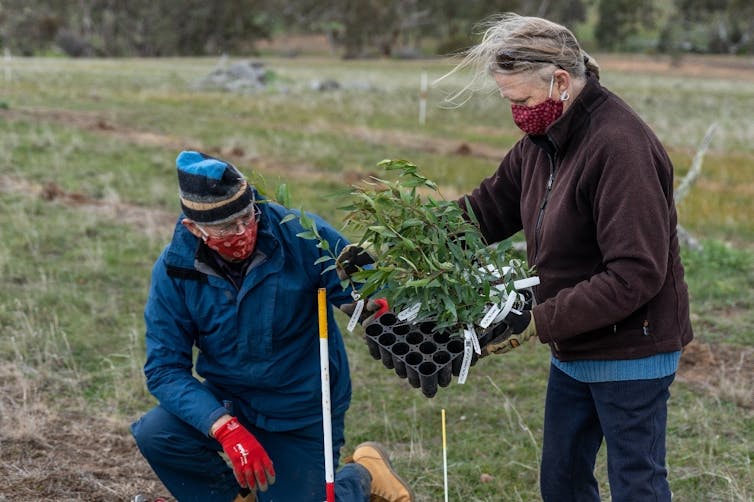
Volunteers plant trees as part of Bush Heritage’s climate-ready revegetation experiment at Nardoo Hills Reserves, Dja Dja Wurrung Country, Vic.
Bush Heritage Australia

We untangled the complex web of environmental, mining and water laws regulating mining and gas developments in Queensland, and found three key biases that leave nature refuges vulnerable.

1. Land title boundaries can act like legal blinkers on risk

Even if there are scientific studies predicting long-range impacts, there are no requirements for miners or governments to tell conservation landholders that a mine will likely affect them, unless their land is next door.

If a conservation landholder isn’t aware of an impact to their land, then they can’t object to a project or appeal a decision to approve it, and might make futile ecological investments. They also can’t protect infrastructure like bores, which miners’ assessment processes have overlooked in the past.

2. Policies focus on damage to built and commercial infrastructure

This includes damaged roads and fences, or dead livestock. Laws and policies don’t consider or require compensation for damage to ecological investments in conservation areas. This is despite governments claiming progress in private conservation land towards international conservation targets.

3. Cumulative impacts can be ignored

Queensland’s environmental laws don’t require a government decision-maker deciding on whether to approve a mining project to consider cumulative effects. The damage from one project might seem tolerable on its own, but not when it’s considered alongside others in the region. Some policies briefly mention this, but they aren’t detailed or legally binding.

Queensland’s water laws are better, but still only require companies and governments to predict impacts to springs, and suggest strategies to respond. This means preventing and mitigating impacts – such as shrinking or drying spring-fed wetlands – is legally optional and they can ignore other groundwater-dependent ecosystems and climate change.

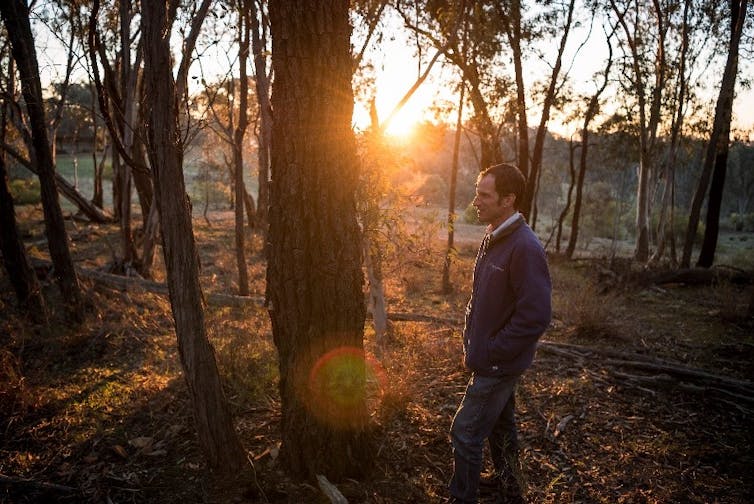
Bush Heritage Reserve Manager Greg Carroll at Naree Station Reserve, Budjiti Country, NSW after a major rainfall event.
Rebecca Spindler

What needs to change?

Removing these legal blinkers requires law reform:

  • all landholdings scientifically predicted to experience changes due to a mine should be notified

  • any protection, mitigation and compensation provisions should recognise investments in conserving and restoring native species and ecosystems, not just houses, fences and livestock

  • risks to nature refuges must be understood as cumulative to avoid a death by a thousand cuts.

In the meantime, conservation landholders can take steps to protect themselves. For example, sector leaders could aggregate public information about resource development applications and alert conservation landholders who might miss them.

Landholders should document how they rely on bores and how they invest in conserving and restoring ecological assets. They could apply for licences to use groundwater for ecological or wildlife purposes to better defend their water resources.

Our complex laws haven’t kept up with Australia’s increasing reliance on private investment in wildlife conservation. Securing permanent environmental benefits from private land means protecting it from the compounding, long-term effects of extractive industries.

The Conversation

Rebecca Louise Nelson is a volunteer director of the Board of Bush Heritage Australia. She receives funding from the Australian Research Council (#DE180101154).

Rebecca Spindler receives government and Trust funding for the protection of the natural values mentioned in the article as part of her work with Bush Heritage.

She works with Bush Heritage and collaborates broadly with the conservation sector mentioned throughout the article.

ref. Queensland has an important network of private conservation areas, but they’re dangerously exposed to mining – https://theconversation.com/queensland-has-an-important-network-of-private-conservation-areas-but-theyre-dangerously-exposed-to-mining-175519

Why we resigned from the ARC College of Experts after minister vetoed research grants

Source: The Conversation (Au and NZ) – By Andrew Francis, Professor of Mathematics, Western Sydney University

Shutterstock

On Christmas Eve 2021, the pub-test folly struck again. The two of us found ourselves, angry and heartsore, resigning from the Australian Research Council’s (ARC) highly respected College of Experts in protest at the minister’s rejection of grant funding recommendations.

This was not a comment on the college, a laudable body of experienced research leaders committed to supporting the best and most worthwhile research. Nor on the ARC, whose dedicated, knowledgeable staff operate on a shoestring to maximise how much of the organisation’s limited funding is spent on research.

We were prompted by the acting minister for education and youth disregarding the expertise of Australia’s best by blocking six grants they had recommended for funding. The explanation? Unsupported statements about “value for taxpayers’ money”, and “the national interest”. That is, a pub test: if the imagined average punter can’t immediately spot its value from a potted summary, then it’s not in the national interest.


Read more:
ARC grants: if Australia wants to tackle the biggest issues, politicians need to stop meddling with basic research


You can’t pick good-value research with a pub test

Deciding what research to support is hard. As argued previously, it is difficult, maybe impossible, to predict what lines of inquiry will bear the best fruit – or even what fruit to grow. As is generally attributed to Oren Harari:

“The electric light did not come from the continuous improvement of candles.”

It is only obvious in hindsight that understanding electricity represented “value for money”. Likewise, as Ofer Gal explains, the national interest in understanding history and culture may only become visible after the fact, through the tragic consequences of ignorance.

In an ideal world, we could just do all the research. But research costs money: for equipment, lab space, consumables, travel to collaborate with experts elsewhere, and capacity, typically in the form of postdoctoral researchers. The investment repays itself many times over in future economic activity, but we must live within our means. So we must choose.

And there is much to choose from. How do we fight COVID-19? Research. How can we achieve a carbon-free future? Research. What lifestyle choices maximise health in old age? What factors led to the emergence of the modern state of China? Research, and more research.


Read more:
Latest government bid to dictate research directions builds on a decade of failure


Sometimes only experts can understand even the questions. How can we construct symmetric informationally complete positive operator valued measures in arbitrary dimensions? It sounds abstruse, but this research could enable reliable error correction in quantum computing.

How are grant applications assessed?

Of course, government should be involved in setting strategic research funding directions. It should determine funding parameters and areas of immediate priority, and clear rules, procedures and criteria. For example, the research should be:

  • original – don’t re-invent the wheel
  • significant – not just minor tweaks to existing understandings
  • feasible – anyone can make grandiose claims, but funding requires a reasonable expectation of results
  • of benefit – a positive impact on the field or society.

These criteria have been at the core of ARC funding decisions for decades.

But assessing these criteria is wickedly difficult. In particular, assessing value for money requires expertise: the expected benefit of research can be deep and very real, without being superficially visible. The ARC’s College of Experts provides, and facilitates, this expertise.

At least two college members assess each proposal, running to 50-100 pages, in detail. They read every word.

College members also select four subject experts to assess each proposal. The members then meet over multiple days to discuss the applications in detail and make funding recommendations.

By and large this arduous process, though imperfect, works. It taps both the expertise of college members – in assessing grants and in selecting detailed assessors – and of those assessors. The resulting funding recommendations represent the collective best judgment of world-leading minds and experience that Australia has proudly cultivated over generations.


Read more:
‘Disappointment and disbelief’ after Morrison government vetoes research into student climate activism’


Political meddling does lasting damage

The minister spurned this in favour of a pub test. It’s already been argued strongly that ministerial veto compromises academic freedom. But it also betrays ignorance of the complexity of assessing cutting-edge research and shows contempt for the expertise, time and diligent effort embodied in the college’s recommendations.


Read more:
Ministerial interference is an attack on academic freedom and Australia’s literary culture


Further, it compromises our capacity to assess in future. Will international leaders in their fields continue to give their time to assess applications knowing their recommendations may later be overturned on a ministerial whim?

The damage to our international reputation is apparent. The minister’s decision has been condemned by international voices and numerous Australian bodies: the Australian Mathematical Society, members of the ARC College of Experts, Australian Laureate Fellows, the Australian Academy of Arts and Humanities, and more.

Of course researchers must communicate the goals and value of publicly funded research to the public who fund it. The ARC has long published such benefit statements. But these statements, divorced from the nuance and detail in the applications, and from the expertise needed to understand their implications, cannot be the test for funding.

Such meddling is unheard of in comparable democracies (like Canada, New Zealand, the UK, the US). Per Britain’s Haldane Principle, once funding parameters, rules and assessment processes are set, the complex and wickedly hard decision as to which research represents the best mixture of originality, significance, feasibility and, yes, benefit should be left where it belongs: in the hands of experts.

As mathematicians, we are not experts in the areas of the vetoed grants – we are the mythical “pub-goers”. So we trust the expertise of those who assessed them. We resigned from the College of Experts because we could not be complicit in a process that does otherwise.

The Conversation

Andrew Francis served on the Australian Research Council’s College of Experts from January 1 2018 to December 26 2021, during which time he served on several assessment panels for grant schemes. He also served on Research Evaluation Committees for the ARC during the Excellence in Research for Australia (ERA) exercises in 2015 and 2018. His university was financially compensated for his time performing duties for the ARC, and he received some of that compensation as a salary loading. He has received competitive research funding from the Australian Research Council to support his research projects.

Aidan Sims served on the Australian Research Council’s College of Experts from January 1 2019 to December 29 2021, during which time he served on several assessment panels for grant schemes. His university was financially compensated for his time performing duties for the ARC, and the university made these funds available to him in the form of research-support funding. He has received competitive research funding from the ARC to support his research projects.

ref. Why we resigned from the ARC College of Experts after minister vetoed research grants – https://theconversation.com/why-we-resigned-from-the-arc-college-of-experts-after-minister-vetoed-research-grants-175925

Volcanoes, plague, famine and endless winter: Welcome to 536, what historians and scientists believe was the ‘worst year to be alive’

Source: The Conversation (Au and NZ) – By Miles Pattenden, Senior Research Fellow, Institute for Religion and Critical Inquiry/Gender and Women’s History Research Centre, Australian Catholic University

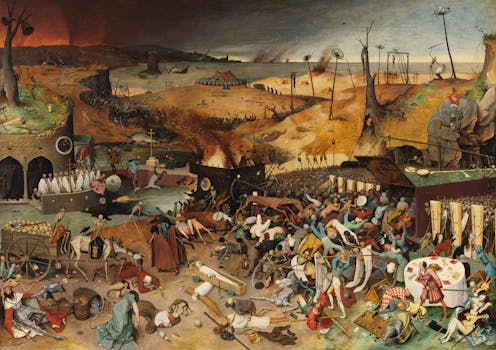
Wikimedia Commons

It’s only February and already 2022 is shaping up badly. A huge volcanic eruption off the coast of Tonga, the prospect of war with Russia, the ongoing pandemic (and its economic disruptions). And that’s even before we touch on Chinese sabre-rattling over Taiwan or Sex and the City’s disastrous reboot.

Welcome to the New Year: as ghastly as the old one.

A history of bad times

I write not to make light of our world’s very real problems, but rather to put them into some perspective. 2020, 2021 and perhaps now 2022, have all been bad.

But they have not been worse years than, say, 1347, when the Black Death began its long march across Eurasia. Or 1816, the “year without a summer”. Or 1914, when the assassination of an obscure Habsburg archduke precipitated not one but two global conflicts – one of which brought about millions of deaths in the world’s most horrific genocide.

There have been plenty of other bad years, and decades, too. In the 1330s, famine set in and ravished Yuan China. In the 1590s a similar famine devastated Europe, and the 1490s saw smallpox and influenza begin to work their way through the indigenous populations of the Americas (reciprocally, syphilis did the same amongst inhabitants of the Old World).

Life has often been “nasty, brutish, and short”, as the political philosopher and cynic Thomas Hobbes observed in his Leviathan in 1651. And yet historians, even now, sometimes point to one particular year as worse than the others.

Yes, there may have been a time within historical memory when it really was the worst hour to be alive.

Inspired by the Black Death, The Dance of Death, or Danse Macabre, an allegory on the universality of death, was a common painting motif in the late medieval period.
Wikipedia

536: the worst year in history?

536 is the current consensus candidate for worst year in human history. A volcanic eruption, or possibly more than one, somewhere in the northern hemisphere would seem to have been the trigger.

Wherever it was, the eruption precipitated a decade-long “volcanic winter”, in which China suffered summer snows and average temperatures in Europe dropped by 2.5℃. Crops failed. People starved. Then they took up arms against each other.

In 541 bubonic plague arrived in Egypt and went on to kill around a third of the population of the Byzantine empire.

Even in distant Peru, droughts afflicted the hitherto flourishing Moche culture.

Increased ocean ice cover (a feedback effect of volcanic winter) and a deep solar minimum(the regular period featuring the least solar activity in the Sun’s 11-year solar cycle) in the 600s ensured that global cooling continued for more than century.

Many of the societies living in 530 simply could not survive the upheavals of the decades that followed.

A volcanic winter is a dramatic drop in temperatures experienced globally, in the aftermath of a massive volcanic eruption as the ash particles and gases such as sulfur dioxide, injected into the stratosphere during the eruption and spread globally by winds, blot out the sun and prevent solar energy from reaching the earth’s surface.
Shutterstock

The new ‘science’ of climate history

Historians now take a particular interest in subjects such as this because we can collaborate with scientists to reconstruct the past in new and surprising ways.

Only a fraction of what we know, or think we know, about what happened during such murky moments now comes from traditional written sources. We have a few for 536: the Byzantine historian Procopius wrote that year that “a most dread portent has taken place”, and the Roman senator Cassiodorus noted in 538

[…] the sun seems to have lost its wonted light and appears a bluish colour. We marvel to see no shadows of our bodies at noon and to feel the mighty vigour of its heat wasted into feebleness.

Yet the real strides in historical understanding of this “worst ever year” are emerging through application of such advanced techniques as dendroclimatology and analysis of ice cores.

Dendroclimatologist Ulf Büntgen detected evidence of a cluster of volcanic eruptions, in 536, 540 and 547, in patterns of tree-ring growth. Likewise, “ultraprecise” analysis of ice from a Swiss glacier undertaken by archaeologist Michael McCormick and glaciologist Paul Mayewski has been key to understanding just how severe the climate change of 536 was.

Such analyses are now seen as important, even essential, resources in the historian’s methodological toolkit, especially for discussing periods without an abundance of surviving records.

Some historians – including Kyle Harper, Jared Diamond and Geoffrey Parker – use developments in this growing field to construct whole revisionist narratives about the rise and fall of particular societies. For them, conditions on our planet are far more significant in driving our history forward than we ever realised.


Read more:
Natural disasters are affecting some of Australia’s most disadvantaged communities


Coping with adversity

But what was it like living through a climate-changing event such as that which began in 536? It’s a question historians continue to ponder as we sift through our sources.

Most of those alive in 536 probably didn’t know they had it so bad. As historians, we are prone to over-rely on anecdotal doom-laden snippets like the quotations from Procopius and Cassiodorus.

Yet, like the proverbial frog in boiling water, the average person back then may only have realised slowly just how grim conditions in their world were getting. The worst moment would not in fact have been in 536 but some time after – when the full effects of plagues and droughts, chills and famines had truly set in.

The Conversation

Miles Pattenden has previously received research funding from the British Academy, the European Commission, and the Government of Spain.

ref. Volcanoes, plague, famine and endless winter: Welcome to 536, what historians and scientists believe was the ‘worst year to be alive’ – https://theconversation.com/volcanoes-plague-famine-and-endless-winter-welcome-to-536-what-historians-and-scientists-believe-was-the-worst-year-to-be-alive-175654

The most challenging phase of the Omicron outbreak is yet to come, but New Zealand may be better prepared than other countries

Source: The Conversation (Au and NZ) – By Matthew Hobbs, Senior Lecturer in Public Health and Co-Director of the GeoHealth Laboratory, University of Canterbury

Fiona Goodall/Getty Images

Within a month of the first community exposure to Omicron in Aotearoa New Zealand, the variant has already become the dominant strain of COVID-19.

We are yet to see the rapid and steep rise in new Omicron cases that has been predicted. This could be because of asymptomatic transmission, but it is equally likely because public health measures included in the first phase of the “stamp it out strategy” have been effective.

For now, managed isolation and quarantine (MIQ) at the border is successfully stopping hundreds of cases from entering the community. While MIQ may soon change in purpose, border restrictions may not lift until the Omicron wave passes.

The country-wide return to red settings under the COVID-19 protection framework has bought New Zealand time to learn from experiences abroad. The most challenging phase is yet to come but New Zealand could be well placed to tackle it.

The best way forward is to limit widespread transmission for as long as possible. This reduces opportunities for the virus to replicate, which is when mutations occur, potentially extending the pandemic.

What we know about Omicron

Omicron is more transmissible than earlier variants. New Zealand can expect a rapid and steep rise in infections, especially as we’ve already had several potential superspreading events.

As shown below, Omicron quickly replaces earlier variants.

A graph showing the rise of Omicron (red) and its displacement of earlier COVID-19 variants in the UK.
The graph shows the rise of Omicron (red) in the UK, displacing earlier COVID-19 variants.
Our World in Data, GISAID, CC BY-ND

Omicron’s transmission advantage is thought to be due to its ability to evade immunity (acquired through infection or vaccination) and quickly infect the upper respiratory tract.

The risk of reinfection also appears higher than for Delta, particularly in the unvaccinated and those with lower viral loads during previous infections.


Read more:
What we know now about COVID immunity after infection – including Omicron and Delta variants


Symptoms to watch out for

Omicron symptoms include a runny nose, headache, fatigue, sneezing and a sore throat.

However, New Zealand’s high vaccination rates mean some people may not have any symptoms at all. The danger here is that they will still be able to pass on the virus to others, unaware they have Omicron.

It is best to assume that any symptoms, especially a sore throat, are COVID-19 until proven otherwise through a test. For Omicron, this may require saliva swab tests as recent evidence suggests they are more sensitive than nasal swabs because the viral load peaks earlier in saliva than nasal mucus.

By testing and isolating, we can avoid spreading it to others who may be at higher risk of severe illness.

Compared to Delta, Omicron has caused lower hospitalisation and death rates in many countries. This may be because it reproduces in the upper respiratory tract instead of the lungs.

Omicron is also meeting populations with immunity acquired through previous infection or vaccination.

In New Zealand, 67% of eligible people have now received their booster, which offers high levels of protection from hospitalisation and death. Boosted individuals are up to 92% less likely to be hospitalised with Omicron, compared with unvaccinated people.

Vaccination is especially important in New Zealand as we have had minimal prior exposure to COVID-19 in the community.

This graph shows the geographical and ethnic difference in the uptake of booster vaccinations.
Author provided, CC BY-ND

Where to from here

Omicron is a “double-edged sword”. It is vastly more transmissible but less severe. However, it is not a mild infection and there is no guarantee the next variant will be less severe.

In a poorly controlled outbreak, a small percentage of a large number of cases risks overwhelming healthcare systems, increasing inequities and disrupting essential services.

Healthcare workers are already over-burdened and exhausted from previous outbreaks, which have distracted from other services and exacerbated entrenched inequities.

There are several things each of us can do:

  • Anybody eligible should prioritise getting boosted

  • we should all continue using the COVID-19 tracer app

  • we should keep indoor spaces well ventilated by opening windows and doors

  • mask wearing remains important, especially where physical distancing is difficult.

  • and anybody who feels unwell, should get tested and isolate.

Vaccinating children

As children return to school, we need equitable vaccinations and ventilation.

Data out of Australia indicate children aged five to 11 tolerated the vaccine well, with fewer side effects than adults.

Unfortunately, our analysis, along with other evidence, documents a concerning trend with lower childhood vaccination rates for Māori and Pasifika, as well as large variation between regions.

ALT
This graph shows the geographical and ethnic difference in the uptake of childgood (five-11-year-olds) vaccinations.
Author provided, CC BY-ND

This is concerning as some countries, including the US, have seen increases in childhood hospitalisation rates for COVID-19. In the UK, one in eight pupils have missed school as COVID-related absences rise.


Read more:
Despite Omicron arriving, keeping schools open as safely as possible should be the goal


The success story of the Delta outbreak

Unfortunately, there’s been little time to celebrate the rather remarkable demise of Delta. Even as Auckland opened up, hospitalisations and case numbers dropped.

Summer will have helped as people spent more time outdoors. However, public health measures such as border closures, managed isolation and quarantine and contact tracing have no doubt helped stamp out much of Delta, allowing a relatively normal summer holiday period for many.

Continuing to keep Delta low also means we should not have to deal with a “double epidemic”.

This success may also fill us with some hope that, just perhaps, we might be able to avoid the worst of Omicron during this next phase of the pandemic response, with robust and continually refined public health measures in place.

The Conversation

Dr Matthew Hobbs receives funding from New Zealand Health Research Council, Cure Kids, A Better Start National Science Challenge and IStar. He was previously funded as a postdoctoral researcher by the New Zealand Ministry of Health.

Dr Anna Howe receives funding from the Health Research Council. While not the principal investigator she has been involved in research projects funded by GSK and was the first KPS Research Fellow. She is affiliated with the Immunisation Advisory Centre.

Dr Lukas Marek has previously received funding from the Ministry of Health, New Zealand Health Research Council, Cure Kids and National Science Challenges.

ref. The most challenging phase of the Omicron outbreak is yet to come, but New Zealand may be better prepared than other countries – https://theconversation.com/the-most-challenging-phase-of-the-omicron-outbreak-is-yet-to-come-but-new-zealand-may-be-better-prepared-than-other-countries-175819

Word from The Hill: On Scott Morrison admitting some regrets

Source: The Conversation (Au and NZ) – By Michelle Grattan, Professorial Fellow, University of Canberra

As well as her interviews with politicians and experts, Politics with Michelle Grattan now includes “Word from The Hill”, where she discusses the news with members of The Conversation politics team.

This week Michelle and Amanda Dunn discuss Scott Morrison’s Press Club performance, when he spoke about “resilence” and faced some difficult questioning.

Knowing how hostile many voters have become towards him, Morrison admitted that in retrospect he would have done some things differently. But the list was limited and, unsurprisingly, there was no “apology”.

He conceded that talking up too optimistically the prospect of a great summer had heightened people’s disappointment when it turned out to be anything but. He also regretted not putting the vaccine rollout under the military from the start – an admission the health bureaucracy hadn’t been up to the job.

Michelle and Amanda also canvass Morrison’s economic pitch, in which he held out the prospect of the unemployment rate having a “3” in front of it in the second half of this year.

The Conversation

Michelle Grattan does not work for, consult, own shares in or receive funding from any company or organisation that would benefit from this article, and has disclosed no relevant affiliations beyond their academic appointment.

ref. Word from The Hill: On Scott Morrison admitting some regrets – https://theconversation.com/word-from-the-hill-on-scott-morrison-admitting-some-regrets-176158

Politics with Michelle Grattan: Peter Dutton on US combat assets in Australia, China, and Vladimir Putin

Source: The Conversation (Au and NZ) – By Michelle Grattan, Professorial Fellow, University of Canberra

Defence Minister Peter Dutton says he would like to see more American combat capability based in Australia.

Speaking on the “Politics with Michelle Grattan” podcast, Dutton says: “I’d be very open to it. I would be very, very happy to have that discussion with the US if they saw a strategic advantage in doing so.”

He says there is significant visiting by US airforce, navy and army forces (together with the current marine rotation). “And if that is accompanied by, or there’s a subsequent decision to base further numbers, we’d be very happy to have that discussion with the US – or with the UK, for that matter.”

Last September’s AUSMIN talks committed “to significantly advance Australia-United States force posture cooperation”.

Dutton also reiterates he’s working on the acceleration of the timetable for the nuclear-powered submarines, a centrepiece of last year’s AUKUS agreement between Australia, the US and Britain. “I can assure you, the 20 year timeline is nonsense. I believe that we will be able to acquire well before that”.

Discussions with the US and UK have been “very productive” and “I’ll have more to say on that in due course once the discussions continue”.

“Everything [is] on the table with the US and the UK at the moment, and we will achieve capability well ahead of what the critics are pointing out at the moment.”

“I’ve been driving the process, receiving weekly updates, engaging with our counterparts. And this has momentum. It has buy-in from the US and the UK. It has an urgency because of the way in which the Chinese government is positioning in the Indo-Pacific”.

Asked about criticism that his language on China is too belligerent, Dutton says, “I do believe that China is on a pathway of aggression, particularly toward Taiwan, and I want to be part of what I think is a majority view around the world to stop that from taking place.

“I want China to continue to grow economically. I want to see people lifted out of poverty, but I don’t want to see a clash, particularly between great powers. And I think again, we’re better off to be frank in our assessments and to argue from a position of strength, not weakness, because otherwise, we will find ourselves in conflict in the Indo-Pacific, and that’s not what anybody wants.”

Dutton doesn’t step back from his description of Russian President Vladimir Putin as an ageing dictator who is becoming more and more irrational.

“People only need to look at his track record and concerning human rights abuses in Russia. There’s no sense when we’re dealing with a bully of any nature, believing that if we just close our ears and our mouth, that somehow the bully will become a good person.”

The Conversation

Michelle Grattan does not work for, consult, own shares in or receive funding from any company or organisation that would benefit from this article, and has disclosed no relevant affiliations beyond their academic appointment.

ref. Politics with Michelle Grattan: Peter Dutton on US combat assets in Australia, China, and Vladimir Putin – https://theconversation.com/politics-with-michelle-grattan-peter-dutton-on-us-combat-assets-in-australia-china-and-vladimir-putin-176150

When aged care workers earn just $22 an hour, a one-off payment won’t fix the wage problem

Source: The Conversation (Au and NZ) – By Hal Swerissen, Emeritus Professor, La Trobe University

Shutterstock

The federal government’s promise of up to A$800 between now and May for aged care workers is a short-term political “fix” designed to cover over a long-term policy failure.

Numerous reports have pointed out Australia’s more than 260,000 aged care workers are poorly paid and under-valued.

Women make up more than 80% of the aged care workforce. About a fifth of the workers have culturally and linguistically diverse backgrounds. Their work is often devalued as “women’s work”, with expectations they will work unpaid additional time, split shifts and highly variable hours.

Personal care workers and nurses in aged care are paid 10–15% less than those in health care. Pay rates start at A$22 an hour for personal care workers.


Read more:
Paid on par with cleaners: the broader issue affecting the quality of aged care


The Commonwealth’s market model for aged care has also led to high and increasing casualisation and job insecurity, particularly in home care.

Not surprisingly, it’s increasingly difficult to attract and retain staff. Most staffing categories in aged care now have vacancy rates above 10% and staff turnover of between a quarter and a third each year.

Mismanagement of the COVID crisis in aged care has made the problem worse. COVID infections in aged care facilities are now widespread, leading to severe workforce shortages and risks to the quality of care. Basic preventive measures such as the use of boosters for residents, rapid antigen tests and the delivery of proper masks remain problematic.


Read more:
1,100 Australian aged care homes are locked down due to COVID. What have we learnt from deaths in care?


So what needs to change?

The need to improve pay and conditions, training and career paths for aged care workers has been recognised for years. A workforce strategy was prepared in 2018 and a work value case for aged care workers was lodged with the Fair Work Commission in 2020. The Royal Commission into Aged Care Quality and Safety reinforced the importance of addressing these issues.

But in practice, little has been done. Pay rates have not been increased. Personal care workers are not required to have formal aged care qualifications or to be registered. Career paths have not been reformed. And employment standards to prevent casualisation and job insecurity have not been introduced.

In the short term, emergency measures are needed to manage the COVID crisis in aged care. Rapid antigen tests, personal protective equipment, and visits by partners, family and volunteers urgently need to be supported. All residents and the workforce need to be fully (three dose) vaccinated. A quick drive-by, vaccinating only whoever is around, is not good enough.

In the medium term, demand for aged care workers will increase dramatically, particularly in home care where an additional 58,000 workers are likely to be needed to meet planned expansion. Most of these staff will provide personal and domestic care services, and such workers are already hard to find.

The federal government’s one-off A$800 pre-election commitment is unlikely to be enough to fix the problems. What’s needed is better pay and conditions for aged care staff on an on-going basis. A one-off payment doesn’t even scratch the surface.


Read more:
Morrison announces bonus of up to $800 to encourage workers to stay in highly stretched aged care system


When will aged care workers get a pay rise?

The Fair Work Commission is still considering a 25% pay increase, after aged care worker unions put their case for a pay rise forward in November 2020.

The federal government should explicitly state it will fund whatever the independent umpire determines is a fair day’s pay for a fair day’s aged care work. Not to do so would reduce the availability of aged care services.

A new Aged Care Act is due to be introduced shortly. The Aged Care Workforce Industry Council should implement a workforce plan as part of the new Act. The plan should adjust staff roles and workforce organisation to reflect the much greater emphasis on older people’s rights and the delivery of support at home and in the community, rather than in residential facilities.

A more secure, better trained and properly paid aged care workforce will cost the taxpayer more. But without a high-quality, well-supported workforce it will be impossible to deal with the aged care crisis.


Read more:
Our ailing aged care system shows you can’t skimp on nursing care


The Conversation

Hal Swerissen is a non executive director of the Murray PHN and the Bendigo Kangan Institute.

Stephen Duckett is a member of the board of directors of the Brotherhood of St Laurence which, among other services, is a provider of aged care. He is also chair of the board of directors of the Eastern Melbourne Primary Health Network. Grattan Institute began with contributions to its endowment of $15 million from each of the Federal and Victorian Governments, $4 million from BHP Billiton, and $1 million from NAB. In order to safeguard its independence, Grattan Institute’s board controls this endowment. The funds are invested and contribute to funding Grattan Institute’s activities. Grattan Institute also receives funding from corporates, foundations, and individuals to support its general activities, as disclosed on its website.

ref. When aged care workers earn just $22 an hour, a one-off payment won’t fix the wage problem – https://theconversation.com/when-aged-care-workers-earn-just-22-an-hour-a-one-off-payment-wont-fix-the-wage-problem-176136

Unemployment below 3% is possible for the first time in 50 years – if Australia budgets for it

Source: The Conversation (Au and NZ) – By Peter Martin, Visiting Fellow, Crawford School of Public Policy, Australian National University

The Morrison government could achieve unemployment rates once seen under Australia’s longest-serving Prime Minister Robert Menzies. National Library of Australia

What’s the boldest thing the Morrison government could do in next month’s budget?

It would be to forecast an unemployment rate below 4% (a rate of three-point-something), then to pledge to go further, to two-point-something.

Neither have happened for half a century; not since the long Coalition reign of Robert Menzies and his successors from the 1950s to the early 1970s, when unemployment was between 2 and 3%.

Astoundingly, both are now within Treasurer Josh Frydenberg’s reach in a way they weren’t mere weeks ago.

This time last year, the official budget strategy (its formal title is fiscal strategy) pledged to maintain economic support until the unemployment rate was “comfortably below 6%”.

Frydenberg ditched that target on the ground it was unambitious in the May budget, replacing it with a commitment to spend until the recovery was “secure and the unemployment rate is back to pre-crisis levels or lower”.

But – even projecting forward all the way out to 2025 – Frydenberg couldn’t promise an unemployment rate below 4%. There wasn’t the demand for workers to support it.

Suddenly, below 4% is possible

Even as late as December last year in the mid-year budget update, the best the treasury could forecast was an unemployment rate of 4.25%, which wouldn’t be reached until mid-2023 and wouldn’t be bettered in forecasts stretching out to mid-2025.

Then in January, we learnt that in December itself the unemployment rate had dipped below the forecast to 4.2% a year and a half early.

And it was the real thing. The unemployment rate hadn’t been cut artificially by people withdrawing from the search for work because of lockdowns (as had happened temporarily earlier in the year). Unemployment fell by 62,200 in December because an extra 64,800 people found work.


Unemployment touching 4%

Seasonally adjusted unemployment rate.
ABS Labour Force

The proportion of the population aged 15 and over in work is the truest measure of employment, because it’s unaffected by whether or not someone calls themselves unemployed. In December last year, that had climbed to 63.3% – a record high.

Several countries, including Singapore, South Korea and New Zealand, do even better, suggesting we can push employment higher still.

And the jobs have come with hours. All but a few of the extra jobs created over the past year have been full-time. In December the total number of hours worked hit an all-time high. The proportion of workers underemployed (not getting the hours they want) sank to a record low.

The 50-year low is closer than it seems

The unemployment rate was better than it looked. Calculated to several decimal places rather than the usual single place, the December rate was 4.157% – within a hairsbreadth of the historic low of 3.981% achieved in February 2008 at the height of the mining boom; the only time in the modern era the rate slipped below 4%.

To get below 4% from here on, and to get below the previous long-term low, would only require an extra 25,000 people in jobs.

That’s what makes a budget forecast of an unemployment rate beginning with a “3” – the first since the 1970s – suddenly plausible. On Tuesday the prime minister said he expected it this year.

More vacancies than ever

Making something much better plausible – what until recently was a barely imaginable unemployment rate beginning with “2” – is the number of vacant jobs on offer.

In November, the Bureau of Statistics survey found a record 396,100 jobs on offer, so many as to mean one job for every 1.7 people looking. The more usual ratio, back in the days before COVID, was one vacancy for every three unemployed people looking.


More vacancies than ever


ABS job vacancies, seasonally adjusted

If half of those vacancies (198,000) were filled by someone presently unemployed, the unemployment rate would fall to 2.7%.

Which is another way of saying an unemployment rate lower than 3% – an unemployment rate beginning with “2” – is within reach.


Read more:
An unemployment rate below 4% is possible. But for how long?


A budget that forecast a rate lower than 4%, but adopted as a target or stretch forecast an unemployment rate lower than 3%, would make history.

It would have to set out the means to achieve it, one of which would be to adopt a new fiscal strategy that committed the government to “invest in a stronger economy” (the words in the existing fiscal strategy) until unemployment is between 2% and 3%.

What’s missing? A target and more help for job-seekers

The existing strategy commits the government to invest in a stronger economy until unemployment is down to “where it was prior to the pandemic or lower”.

The commitment would delay budget repair by only a few years, and it would make that repair quicker when it started because hundreds of thousands more Australians would be paying tax and no longer claiming JobSeeker.

And it would lock in an expectation of permanently lower unemployment, in the same way as the Reserve Bank’s success in crushing inflation in the 1990s locked in an expectation of permanently low inflation.


Read more:
Top economists expect RBA to hold rates low in 2022 as real wages fall


If the government articulated the target, the Reserve Bank would be likely to assist. Full employment is the second of the three goals spelled out in its charter.

The government would also have to do much more of what it started in its last budget, which is to set up programs to make unemployed workers more job-ready and make employers more likely to hire them.

Some of that is already happening as the large number of vacancies and low number of unemployed forces employers to take on people they wouldn’t have before. Many will be glad.

It’s within reach for Labor, or the Coalition

Often the only thing that’s “wrong” about a worker who has been out of work for a long time is that they have been out of work for a long time. As employers discover that, they are likely to find it is easier to fill vacancies than they thought.

An unemployment target of 2-3% would be game-changing, and it’s within reach. The last side of politics to preside over ultra-low unemployment was the Coalition, making it natural that Morrison and Frydenberg should take up the mantle of Robert Menzies and his treasurer Harold Holt.

If they won’t, it’s an opening for Labor. There’s a chance to all but eliminate unnecessary unemployment in Australia. Not in 50 years have we been this close.

The Conversation

Peter Martin does not work for, consult, own shares in or receive funding from any company or organisation that would benefit from this article, and has disclosed no relevant affiliations beyond their academic appointment.

ref. Unemployment below 3% is possible for the first time in 50 years – if Australia budgets for it – https://theconversation.com/unemployment-below-3-is-possible-for-the-first-time-in-50-years-if-australia-budgets-for-it-176025

Inflation is raising prices and reducing real wages – what should be done to support NZ’s low-income households?

Source: The Conversation (Au and NZ) – By Murat Ungor, Senior Lecturer, Department of Economics, University of Otago

Shutterstock

There is no doubt life is becoming much more expensive in New Zealand as inflation hits a three-decade high, influenced by both domestic and international factors such as increased food, energy and housing costs, pent-up demand for consumer goods, and ongoing supply-chain disruptions.

In the 12 months to December 2021, Consumer Price Index (CPI) inflation
surged to 5.9%, compared with 4.9% in September, 3.3% in June, and just 1.5% in March.

Price increases have been led by the essential goods and services — food, housing and transport. Annual food prices were 4.5% higher in December 2021 than they were a year previously, rents increased 3.8% and petrol prices leapt 30%.

But as Prime Minister Jacinda Ardern has rightly said, “we are not alone in experiencing high rates of inflation”.

Australia’s CPI rose 3.5% over the 12 months to the December 2021 quarter, and the UK’s CPI rose by 5.4%. Inflation has reached 5% in the Eurozone and 7% in the US.

The question will be: how do we support those lower-income households most disadvantaged by these trends?

Same problem, many causes

This global inflation has many causes, including the effects of trillions of dollars of fiscal and monetary stimulus, pent-up demand, increases in shipping costs, ongoing supply-chain disruptions, and rising energy prices.

According to the Freightos Baltic Index, which reports daily prices of containers shipped by ocean and air, shipping costs in May 2021 were more than 200% higher than in May 2020.


Read more:
Inflation inequality: Poorest Americans are hit hardest by soaring prices on necessities


A 20-foot container from Shanghai to New Zealand, which cost around US$500 prior to the pandemic, was costing businesses around US$5,000 in September 2021.

Energy prices in the OECD soared by 27.7% in the year to November, the highest rate since June 1980.

The cost of moving a container from Shanghai to NZ rose from US$500 before the pandemic to about US$5,000 in September 2021.
Shutterstock

Interest rates will keep rising

Generally, when inflation rises, central banks intervene and raise interest rates to slow the economy and reduce inflation. The Reserve Bank of New Zealand (RBNZ) implements monetary policy by setting the official cash rate (OCR), which is reviewed seven times a year.

In October last year it raised the OCR by 25 basis points (a quarter of a percentage point) to 0.50% – significantly, the first OCR rise in seven years, followed soon after in November with another hike to 0.75%.

This was expected, and I anticipate a follow-up hike of the same magnitude in February.

In fact, the most likely scenario is that the RBNZ will continue to raise the OCR in measured steps of 25 basis points, with the cash rate reaching 2% following its August 2022 policy decision.

That said, if economic risks increase at the domestic and global levels, we can expect to see increases of 50 basis points from some of the policy decision meetings.


Read more:
Omicron will only add to looming workforce shortages already faced by key New Zealand industries


Inflation affects rich and poor differently

Recent research suggests American households in different income groups did not experience the 7% inflation rate the same way: it felt like 7.2% for the lowest-income households and 6.6% for the highest-income families. The main cause of this gap is the increase in grocery and gas prices.

I think we have a similar situation in New Zealand, where price increases for food, transport and housing are particularly harmful for low-income households.

On top of that, real wages are shrinking for those same households.

Wages are measured in dollars – known as the nominal wage – but what matters when you go to a supermarket is your real wage, measured in terms of the goods you can afford to buy.

The real wage is calculated by dividing the nominal wage by a price index such as the CPI. A concern with inflation is that real wages can fall even if nominal wages don’t. And this is happening in New Zealand.

While wages have increased, they haven’t come close to keeping pace with inflation.

Raise the minimum wage?

How should the government address the impact on low-income households? Already there have been calls for an increase to the minimum wage. But would this work?

An earlier survey of the effects of the minimum wage on prices reviewed several US studies and summarised that a 10% minimum wage increase raises food prices by no more than 4%.

This sounds promising: minimum wage increases may not cause real wages to decline. However, it’s only one side of the story.

As has been discussed elsewhere, the short-run gains of higher minimum wages can be completely offset by the harmful long-term effects: increasing costs for firms, higher unemployment in the post-COVID era.


Read more:
Inflation: why it could surge after the pandemic


Targeted relief for low-income households

An alternative is directly targeting relief funds for short-term support. An example of this has been the University of Otago’s Pūtea Tautoko Student Relief Fund, helping with rent and food for students experiencing financial hardship due to the pandemic. I expect many students will apply again in 2022.

Such schemes could be applied more widely, with local government agencies working with local businesses to identify households that need urgent relief. I would support this as a short-run relief option.

But while it’s true inflation and declining household purchasing power will be pressing concerns in 2022 (and possibly into 2023), we should not forget the future well-being of New Zealanders will be determined by sustainable long-run economic growth.

Many of the same headwinds we faced before COVID-19, such as low productivity growth, demographic challenges (including population ageing) and the lack of investment options, will still be with us in the years ahead – even if the Reserve Bank can control the pace of price increases in the short term.

The Conversation

Murat Ungor does not work for, consult, own shares in or receive funding from any company or organisation that would benefit from this article, and has disclosed no relevant affiliations beyond their academic appointment.

ref. Inflation is raising prices and reducing real wages – what should be done to support NZ’s low-income households? – https://theconversation.com/inflation-is-raising-prices-and-reducing-real-wages-what-should-be-done-to-support-nzs-low-income-households-175915

$177 million flowed to Australian political parties last year, but major donors can easily hide

Source: The Conversation (Au and NZ) – By Kate Griffiths, Deputy Program Director, Grattan Institute

Lukas Coch/AAP

The Australian Electoral Commission has updated its database of financial disclosure information for 2020-21.

This happens once a year and is keenly watched by political observers because it includes information about who is donating what to whom.

And yet, despite Australia’s political parties collectively reporting A$177 million in income, only a tiny fraction of this is identifiable. So the public is left with a woefully inadequate picture of what is actually going on with political funding in Australia.

What does the data tell us?

State elections attracted the big bucks

Queensland, Western Australia, Tasmania, the Australian Capital Territory and Northern Territory all went to the polls last year. So it is perhaps no surprise that most of the donations in Tuesday’s data release were made to political party branches in these states.

The Queensland election in particular attracted some very large donations, including almost $4 million from entities directly associated with the Labor Party. These associated entities are controlled by the party and their income is opaque, but usually includes money from fundraising functions and investments.

Typically, the party in power receives slightly more income than the opposition, but donations last year were particularly skewed towards the incumbents – at both state and federal levels.

Who are the major donors?

The biggest donor for the Coalition was Pratt Holdings, with more than $1.2 million in donations to the Liberal Party.

Other significant donations to the Coalition were received from fundraising vehicles and investment bodies (for example, the National Policy Forum and Cormack Foundation). Liberal candidate Scott Edwardes also made a large donation ($224,000), presumably to support his own (ultimately unsuccessful) campaign in the WA election.

Labor’s biggest support came from its associated entities and several unions, including the Shop, Distributive and Allied Employees’ Association, United Workers Union, and the Construction, Forestry, Maritime, Mining and Energy Union.

Some companies such as ANZ bank and Wesfarmers regularly contribute more than $100,000 to both major parties and did so again this year. Village Roadshow cinemas is also a regular donor in election years. Indeed, despite cinemas suffering substantial losses during the pandemic, Village managed to stump up $25,000 for both sides in the Queensland state election.

Donations open powerful doors. Australia’s political parties typically rely on just a handful of major donors, and these donors can achieve significant access and influence. In 2020-21, the top five donors represented 39% of the Coalition’s declared donations and 57% of Labor’s.

Beyond the political parties, two major grassroots political movements declared substantial funding: the right-wing movement Advance Australia raised $1.3 million, mainly from companies with no public presence, and left-wing movement GetUp! raised $553,000, all from individuals.

War chests

Political donations help parties campaign and spread their message at election time. Four of the past five federal elections have been won by the major party with the bigger war chest.


Read more:
How big money influenced the 2019 federal election – and what we can do to fix the system


The Coalition was the big winner in 2020-21 with 23% more income than Labor, despite declaring fewer donations. The Coalition has raised more in both financial years since the last federal election, with about 20% more than Labor in 2019-20 too.

Is this the full picture?

The two major parties declared income totalling more than $150 million to the AEC in 2020-21. But the data released on Tuesday shows declared donations make up just 9% of this.

Most political party income is undeclared or falls into a messy bucket called “other receipts”. This includes money contributed by individuals and corporates at fundraising functions – money clearly intended to support the party and buy access. Parties declare their “other receipts” but it is impossible for the public to distinguish between money raised at fundraising events and income associated with party investments or services.

Another major problem is donations received below the threshold of $14,300 do not need to be declared by the party. This enables large donors to split their donations into several below-threshold payments to avoid scrutiny.

Together, these loopholes mean major donors can hide, and Australian voters cannot be sure who is really backing our political parties.

Election to shine spotlight on integrity

Australia’s major parties will be scrambling right now to bring in funds for this year’s federal election campaign.

Yet this 2020-21 data release does not tell us who is donating now in the lead up to the federal election. Nor who is likely to get priority access to the next government. Unless the rules are changed, voters won’t know the answers to these questions until it’s too late.


Read more:
More than half of funding for the major parties remains secret — and this is how they want it


Despite consistent calls for donations reform from many minor parties and independents over more than a decade, the major parties continue to resist greater transparency.

The federal Coalition has a terrible track record on transparency. Meanwhile, Labor may have proposed lowering the donations disclosure threshold, but it has failed to put any pressure on the government to close loopholes and make the data more timely.

However, there is some hope for reform. Many independents and minor parties will be campaigning on integrity issues in the 2022 election, and this could force pre-election commitments from the major parties. If crossbenchers end up with the balance of power after the election, they are likely to demand much greater transparency from the next government.

The Conversation

The Grattan Institute began with contributions to its endowment of $15 million from each of the Federal and Victorian Governments, $4 million from BHP Billiton, and $1 million from NAB. In order to safeguard its independence, Grattan Institute’s board controls this endowment. The funds are invested and contribute to funding Grattan Institute’s activities. Grattan Institute also receives funding from corporates, foundations, and individuals to support its general activities as disclosed on its website.

Owain Emslie does not work for, consult, own shares in or receive funding from any company or organization that would benefit from this article, and has disclosed no relevant affiliations beyond their academic appointment.

ref. $177 million flowed to Australian political parties last year, but major donors can easily hide – https://theconversation.com/177-million-flowed-to-australian-political-parties-last-year-but-major-donors-can-easily-hide-176129

It’s summer, so bushfires and COVID collide. 3 ways one affects the other

Source: The Conversation (Au and NZ) – By Brian Oliver, Research Leader in Respiratory cellular and molecular biology at the Woolcock Institute of Medical Research and Professor, Faculty of Science, University of Technology Sydney

It’s summer in a pandemic. So as Australia opens its borders and COVID case numbers rise, we’ll likely see the interplay of COVID and bushfires.

Our bodies react to SARS-CoV-2, the virus that causes COVID, and bushfires in similar ways.

Both affect the lungs. Both can have serious health consequences in vulnerable populations, such as elderly people. Both can have long-term health consequences.


Read more:
How does bushfire smoke affect our health? 6 things you need to know


What we know so far

From a simple health perspective, if you have been seriously ill with COVID your response to bushfire smoke is likely to be more serious, and vice versa.

However, because COVID is still a new disease, the evidence for these effects is still sparse.

So far, the best evidence for the impact of COVID on people affected by smoke is from studies in communities that burn biomass (such as plant material or animal dung) as an energy source. In this scenario, a person is exposed to smoke constantly rather than the intermittent smoke that occurs during bushfire seasons.

How about for someone who is exposed to a one-off bushfire? Or who has COVID for the first time? Here are three ways one affects the other.

1. Bushfires and risk

Bushfire smoke causes respiratory symptoms. In people with existing respiratory or heart disease this increase in symptoms can be life-threatening. The same is true for COVID.

However, if a person was to be infected with the virus that causes COVID and exposed to bushfire smoke at the same time it would be quite difficult to work out if the symptoms were the result of one or the other or both.

What studies have looked at so far is if bushfire smoke increases the likelihood of catching COVID.

A study based on the 2020 bushfire season in New South Wales found an association between living in a bushfire-burned area and the incidence of COVID. In other words, it was more likely for bushfire-burned areas to have more COVID cases than unburnt areas. But there was no link between exposure to particulate matter from all forms of pollution and COVID.

Studies in the United States have also found associations between short-term exposure to smoke from bushfires and COVID cases and deaths.

The reasons for these patterns might be as simple as bushfire smoke causing what would have been asymptomatic COVID to become symptomatic.

Alternatively, the link could be related to the virus “hitching a ride” on pollution particles. Or air pollution may increase the numbers of ACE2 receptors (or special enzymes) in the body, which SARS-CoV-2 uses to infect cells.


Read more:
Revealed: the protein ‘spike’ that lets the 2019-nCoV coronavirus pierce and invade human cells


2. COVID spread

During a bushfire, if people stay inside at home to avoid smoke exposure, it can decrease the spread of the virus.

However, if people move from house to house to check on other people, it could increase transmission.

In catastrophic bushfires, evacuation often occurs. Again, this could increase transmission by bringing big groups together.

We know outdoor transmission of COVID is very rare. So taking people who normally would be outdoors and placing them indoors (with an infected person) could increase transmission rates.

Another consideration is vaccination rates, which are lower outside cities in Australia. So in areas with bushfires, the population is more vulnerable to COVID. In these areas, people are more likely to have underlying health conditions that make them more vulnerable to COVID, such as heart or lung disease.


Read more:
Pregnant women should take extra care to minimise their exposure to bushfire smoke


3. Testing rates rise

If we accept people are getting tested for COVID because they have symptoms, then we also have to accept people are more likely to have tests during a bushfire. That’s because smoke makes people cough and irritates their nose (both are COVID symptoms) and people with heart problems are often breathless, another COVID symptom.

It would also be reasonable to expect volunteers from different regions and first responders from different regions would have surveillance COVID testing. If you do more testing, you find more COVID. Once again, COVID numbers would increase.

In a nutshell

The link between COVID and bushfires is complex. Symptoms may overlap and our behaviour in response to one emergency affects the other. Then there’s the complex biology of how our body reacts to particulate air pollution released during bushfires.

The best advice to avoid the adverse health effects of COVID and bushfires is to avoid exposure to both. Wearing a N95/P2 mask is a good way to safeguard yourself from bushfire smoke and COVID.

The Conversation

Brian Oliver receives funding from The NHMRC and the ARC.

ref. It’s summer, so bushfires and COVID collide. 3 ways one affects the other – https://theconversation.com/its-summer-so-bushfires-and-covid-collide-3-ways-one-affects-the-other-169833

‘Theatre of the real’: how artists at Perth Fringe World are stripping down to reveal their vulnerabilities

Source: The Conversation (Au and NZ) – By Claire Fench, Postdoctoral Research Fellow of multilingual theatre and performance, University of the Witwatersrand

At this year’s Fringe World festival in Perth, the “theatre of the real” is everywhere: theatre, comedy and drag all speak directly to our reality, played against a background of survival.

Real stories provide moments of honesty, introspection and clarity. In bringing true stories to the stage, artists are creating an intense connection between audience and performer.

In a normal year, the festival would play host to artists from across Australia and around the world. With borders closed indefinitely, 42 shows have been cancelled.

The result is a decidedly local festival.

For those of us locked in, it is an opportunity to see ourselves mirrored from the stage, to learn about our neighbours and to delve into how they have navigated their lives.

The real makes up for where the news fails

British theatre director Nicolas Kent has said theatre has taken over the role of the news. While this is contentious, theatre audiences grapple with information differently: we want to suspend our disbelief, believe in the hero and hear the full story.

Joe White draws on his own stories as master of ceremonies for stand-up show Best of Africa, presenting gags awash with admiration for his family and community.

White’s open door to his past invites us into the living rooms of communities a few suburbs over, something the news often does with undulating fear.

My mates in Melbourne were saying to me “You have to isolate for 14 days by yourself in a four-star hotel – you are going to hate it!” And I responded with “as an ex-Ethiopian refugee, I’m pretty sure I’m gonna love it!”

White reflects honestly and with humility, pausing comfortably to make his audience feel seen. Vulnerability is at the heart of his performance, and feels like a measure of courage.

Ella Randle’s play 28 Grams draws from a similar place of vulnerability. The one-hander covering her battle with anorexia walks us from healthy child to dying adolescent to counter the romanticisation of the illness in the media.

Actor Georgia Condon tells Randle’s story like it was her own.

It wasn’t the first time I’d been called ugly. The first time was by a girl who told me that her mum thought I was ugly.

The toxicity of this culture is all the harder to digest because of how it rests in Randle’s reality. Although the words are spoken by Condon, our knowledge this story is based on Randle’s life motivates us to listen with open ears. We feel the weight of responsibility for parents in our community who should know better.

Justin Sider’s Dickless similarly blurs the boundaries between artist and character. Sider is trans, and he explores this identity through the story of a man who has lost his penis. Performed in an elevated drag king aesthetic, Dickless is an exploration of trans validity and a rejection of the heteronormative hero’s journey.

While drag performers have traditionally lip synced, Sider sings and raps live, seducing us with resonance and range. By using his real voice, we are brought closer to his body, celebrating his queer and trans identity.


Read more:
‘RuPaul’s Drag Race’ and lip-syncing: A once controversial practice is no longer taboo


The real helps us see ourselves in others

Michelle Hall’s play The Dirty Mother tells her birth story to reframe how childbirth trauma can be dismissed.

When Hall’s son was born, his heart stopped for three minutes. We are held captive by the harsh metal scream of a flatline. We feel the anxiety of waiting for her baby’s heart to start beating again … before it does.

The Dirty Mother by Michelle Hall.
Photo © Megan Hyde and Georgi Ivers

Hall is left in pieces, vomiting uncontrollably into a kidney dish.

Hall’s visceral narrative is performed with imaginative physicality. As she stands on her head, rotating her ankles and flexing her toes, she forms an image of a womb. She transforms into a mooing and chewing cow to the rhythm of Land of Hope and Glory and surrenders her body to the British medical system.

Through Hall’s use of her own body to create these images, she encourages the audience to respect the autonomy of the body found in the act of childbirth.

Marie-Muriel Hillion Toulcanon’s musical theatre show Island Vibrations: from Maloya to Séga travels through the colonised timeline experienced by the people of Réunion Island.

The concert of percussion, dance and story celebrates hybridisation as a cultural strength. As the narrator, Vishwa Hewage tells us:

There is no need to find a meaning to our music and dance: it simply expresses a form of freedom that no one can take away from us.

Island Vibrations by Marie-Muriel Hillion Toulcanon.
Photo © Nic Casta

Throughout the show, the audience steps in to dance with the ensemble. Through conflict and celebration, we experience ways to find happiness through adversity.

A-call-and-response with the audience brings me to tears as I am reminded of the performers who have guided me in South Africa. The command of Toulcanon’s voice brings to mind all those I have missed while being separated during the pandemic.

Time and time again at this year’s festival, artists are stripping down to reveal their vulnerability. In the audience, we lean in to offer our understanding.

Unlike the news, theatre of the real tells the stories of yesterday. Next year’s Fringe World will tell of the trials of today.

The Conversation

Claire Fench does not work for, consult, own shares in or receive funding from any company or organisation that would benefit from this article, and has disclosed no relevant affiliations beyond their academic appointment.

ref. ‘Theatre of the real’: how artists at Perth Fringe World are stripping down to reveal their vulnerabilities – https://theconversation.com/theatre-of-the-real-how-artists-at-perth-fringe-world-are-stripping-down-to-reveal-their-vulnerabilities-175652

Compelling even to his critics: Mission by Noel Pearson explores rights, land and justice

Source: The Conversation (Au and NZ) – By James Blackwell, Research Fellow (Indigenous Diplomacy), Australian National University

How does one tell the story of a life lived well in public service, and in service of your community?

That is the broad ambition of Mission, the latest book from Noel Pearson, First Nations lawyer, activist and founder of the Cape York Institute.

Mission, a series of Pearson’s essays, speeches and eulogies, is not as disjointed or disconnected as such collections sometimes are.

Instead, the collection presents a unified and coherent story of his life in public, his advocacy and the consistent views he has held over this time.

Mission portrays Pearson as only he himself could – a towering figure within the First Nations community, and one whose work has shaped decades of policy and debate on the issues most important to us and our communities: rights, land and justice.

It’s well worth your time to read to get an understanding of the man himself, and of the last several decades of First Nations affairs in this country.

A yellow book cover titled 'Mission' by Noel Pearson.

Black Inc. Books

Pearson the man, Pearson the politics

I should be upfront at the outset of this review. I do not share much of Pearson’s politics, especially his idea of the “radical centre”, and his views on some topics I strongly disagree with. I very much find myself to the left of politics, and see that as a legitimate way forward for First Nations communities.

This, however, is not a reason to discount what I have to say in this review. I would argue it is much better to be reviewed by people with whom you do not always see eye-to-eye, rather than devoted fans. Indeed, throughout this collection, Pearson outlines his positions in such clear and commonsense ways, even I found myself coming around on some of them.

It opens with the titular namesake essay, a 75-page reflection on his upbringing, early life and devotion to his community. The book then delves into many of the key parts of Pearson’s life and politics, including sections entitled After Mabo, The Radical Centre, Labor and Social Democracy, Profiles in Power and A Rightful Place.

All of these contain many essays on key issues of their time, and of today, all of which maintain their relevance to a contemporary audience.

His eulogy of former Prime Minister Gough Whitlam, praised at the time it was given as one of the best speeches ever in Australian politics, channels Pearson’s usual intellectual rigour alongside his wit, and his clear values in advancing his own community. Apart from all the successes of the Whitlam government, he asked, what did that “Roman ever do for us?”

An excerpt from Pearson’s speech:

Only those who have known discrimination truly know its evil. Only those who have never experienced prejudice can discount the importance of the Racial Discrimination Act. This old man was one of those rare people who never suffered discrimination but understood the importance of protection from its malice.

Noel Pearson remembers Gough Whitlam.


Read more:
A closer look at Noel Pearson’s eulogy for Gough Whitlam


A call for constitutional recognition

A number of Pearson’s pieces in Mission are much less known and also much more recent. The newest and final essays present some of the clearest and best language on the recognition of First Nations people in the Constitution.

Pearson is a strong advocate for constitutional recognition and a Voice to Parliament, and alongside Professor Megan Davis and Aunty Pat Anderson, will receive the 2021 Sydney Peace Prize this March on behalf of the Uluru Statement from the Heart.

Pearson writes strongly on why a Voice to Parliament is not only desired by First Nations people, but necessary for our full inclusion in this country, and to move forward on advancing issues of change for Blackfullas nationwide.

Pearson states:

Why recognition? The answer is straightforward: because the Indigenous peoples of Australia have never been recognised.

This is not a dumbing down of complex issues to be palatable for an audience, it is presenting true and undoubtable facts about this nation and First Nations peoples’ place within it.

As Pearson writes in one of the essays entitled A Rightful Place,

history is never resolved, and we should not make a shared future contingent on a shared path.


Read more:
Most Australians support First Nations Voice to parliament: survey


This series of essays on Uluru, recognition and the true place of First Nations people are the most powerful. They speak to a disenfranchisement, detachment and degradation of our people throughout history, and why a Voice to Parliament as a form of recognition is so necessary.

Constitutional recognition of Indigenous Australians is not a project of woke identity politics, it is Australia’s longest-standing and unresolved project for justice and inclusion.

These words should be burned into the retinas of every politician, journalist and academic across the country. This project on First Nations constitutional recognition is not merely one in which we are engaged because we feel it is good politics. It is a project to fundamentally reshape the nation for the better, and to achieve justice and equity for our people after many centuries of dispossession and disregard.

The power of his voice

The only thing really lost in this collection is something which is not the fault of anyone but the format. In reading these essays, rather than listening to Pearson speak them, you lose the power of his presence and his articulation, and the way he captures an audience the way very few can. But what you don’t lose is his voice, which is as clear and consistent in his convictions, as if he were standing right before you.

Pearson is a strong advocate for his views and values, and presents them in a way that would be compelling even to his critics.

I’m not saying I walked away a changed man, but I definitely got a much better sense of who Pearson is from this book. On some things, I have come around more to his point of view, while on others, I feel even more sure of my own positions that counter Pearson’s.

Mission is a book worth reading whether you know of Pearson strongly or not, and whether you agree with him or not. You’ll find much to engage with here.

The Conversation

James Blackwell is affiliated with the Uluru Statement From the Heart Campaign, and is a member of the Australian Greens.

ref. Compelling even to his critics: Mission by Noel Pearson explores rights, land and justice – https://theconversation.com/compelling-even-to-his-critics-mission-by-noel-pearson-explores-rights-land-and-justice-172384

The $1 billion Great Barrier Reef funding is nonsensical. Australians, and their natural wonder, deserve so much better

Source: The Conversation (Au and NZ) – By Jon C. Day, PSM, Adjunct Senior Research Fellow, ARC Centre of Excellence for Coral Reef Studies, James Cook University

Tane Sinclair-Taylor

Today, the federal government is due to report back to UNESCO on its efforts to protect the Great Barrier Reef. The government’s announcement last week of A$1 billion of additional funding is welcome, but it will do little to allay UNESCO’s concerns.

Climate change is the number one threat to the Great Barrier Reef. While the new funding is meant to address other threats to the natural wonder and may improve its resilience, failing to address the climate threat is both disappointing and nonsensical.

As the below graph shows, ocean temperatures on the reef in December last year were the warmest on record. With this comes the risk of a fourth mass bleaching event this decade.

The Great Barrier Reef came close last year to being put on a list of World Heritage “in danger” sites. The funding announcement seems primarily about appeasing UNESCO, with one eye also on the upcoming federal election. But saving the Great Barrier Reef is not about throwing money at it – what matters is how the dollars are spent.

Graph showing ocean temperatures on the reef since 1900

By the numbers

The $1 billion package proposed by the government comprises:

  • 58% to address the land-based causes of water quality issues impacting the World Heritage Area

  • 26% to reduce crown-of-thorns starfish and prevent illegal fishing

  • 9% for new scientific technologies

  • 7% allocated to local communities – including Traditional Owners – for habitat restoration, citizen science and reducing marine debris.

The measures to be funded are all important. But they’re nowhere near as important as addressing the root cause of climate change: greenhouse gas emissions. Most of the $1 billion should have been used to help Australia phase out fossil fuels.

What’s more, the federal and Queensland governments continue to approve new coal and gas projects. Doing all this, while knowing the grave threat climate change poses to the Great Barrier Reef, demonstrates the incoherence of government policies.

steam billows from coal stacks
The best way for the federal government to help the Great Barrier Reef is to phase out fossil fuels.
Shutterstock

Devil in the detail

When we drill further into the detail, it becomes even more clear the funding package is not as impressive as it may first appear.

The $1 billion funding has been allocated over nine years. This is far beyond the time frame to which any government can sensibly commit, given four-year election cycles. A major funding increase is needed urgently, and certainly within a single term of government.

Also, federal Labor’s funding proposal for the Great Barrier Reef must be increased.

Another concern is the funding allocation for new scientific technologies such as coral seeding, developing heat-resistant corals and cloud brightening. Some of these technologies may have produced positive results at a small scale. But none has yet proved feasible at the wide scale necessary to make a real difference for the Great Barrier Reef.

Efforts to address water quality are important. After climate change, poor water quality is the most pressing problem facing the reef. It’s largely caused by nutrients, pesticides and sediment runoff from agriculture and coastal development.


Read more:
Not declaring the Great Barrier Reef as ‘in danger’ only postpones the inevitable


But governments have already spent hundreds of millions trying to improve water quality, with only limited success. Reducing water pollution requires more effective spending, not just more funds.

This is just one example of how money alone cannot fix all the Great Barrier Reef’s problems. Improving water quality requires the right balance between voluntary industry-led approaches and enforcing the rules.

The Queensland government must greatly increase its compliance and enforcement on matters such as fertiliser runoff entering creeks that flow to the reef. While many farmers are doing the right thing, others clearly are not.

And to improve water quality, governments must be prepared to limit clearing and agriculture expansion in reef catchment areas.

brown plume of pollution in blue waters
Flood plume extending into the Great Barrier Reef. Improving water quality requires better enforcement of the rules.
Matt Curnock

Learning from our mistakes

For years, the federal government has known the pressures facing the Great Barrier Reef. But it continues to maintain a “business as usual” attitude in the face of the worsening climate crisis. Governments worldwide must dramatically increase their climate ambitions – and for the Great Barrier Reef, this action should start at home.

As the Murray-Darling Basin experience shows, throwing funding at an environmental catastrophe does not fix the problem, especially if the core issue remains unaddressed.

The government must also better allocate funds to achieve effective and timely “adaptive management”. This involves decision-making that can be adjusted as outcomes become better understood.

Such management should include considering both the good and bad outcomes of reef interventions to date – both those controlled by government agencies and those managed by external groups such as the Great Barrier Reef Foundation.


Read more:
Is Australia really doing enough for the Great Barrier Reef? Why criticisms of UNESCO’s ‘in danger’ recommendation don’t stack up


bleached coral
Preventing further damage to the Great Barrier Reef means learning lessons from the past.
AP

This latest government funding boost is welcome, but suspiciously timed. Environmental policy and budget allocations should not be about a government’s reputation and firming up its electoral prospects – especially when so much is at stake.

UNESCO is likely to welcome the additional efforts to address water quality. But it has specifically urged Australia to take “accelerated action at all possible levels” to address the climate threat. It remains to be seen whether UNESCO will continue to pressure the federal government on that front.

Amid all this, a key question remains. As the the Great Barrier Reef continues to decline, will Australians re-elect a federal government that supports industries harming the environment?

One thing is certain: Australians, and their Great Barrier Reef, deserve so much more.


Read more:
5 major heatwaves in 30 years have turned the Great Barrier Reef into a bleached checkerboard


The Conversation

Jon Day previously worked for the Great Barrier Reef Marine Park Authority between 1986 and 2014, and was one of the Directors at GBRMPA between 1998 and 2014. He represented Australia as one of the formal delegates to the World Heritage Committee between 2007-2011.

Scott Heron receives funding from the Australian Research Council and NASA ROSES Ecological Forecasting.

ref. The $1 billion Great Barrier Reef funding is nonsensical. Australians, and their natural wonder, deserve so much better – https://theconversation.com/the-1-billion-great-barrier-reef-funding-is-nonsensical-australians-and-their-natural-wonder-deserve-so-much-better-175924

Omicron will only add to looming workforce shortages already faced by key New Zealand industries

Source: The Conversation (Au and NZ) – By David Dyason, Senior Lecturer in Property Studies, Lincoln University, New Zealand

GettyImages

The Omicron wave about to wash across New Zealand will exacerbate an already tightening labour market. High employment and ongoing border restrictions mean regional labour forces are nearing peak capacity – and the country is running out of time to find solutions.

With border restrictions in place for much of the past two years, the domestic labour market has been the main source of human capital – and will likely continue to be for some time.

Combined with an ageing workforce, this is causing labour market tightening in most industries. Some form of intervention will be required to find skilled workers to fill the gaps emerging in specialised jobs – especially as the economy grows and older workers retire.

By looking at the Canterbury region as an example of how successive disasters influence the labour force, we can see how immigration policies can affect short- to medium-term labour requirements. Since the earthquakes of 2010 and 2011, Canterbury has been able to rely on skilled workers from outside the region to support economic activity.

According to a recent study of the region’s ability to navigate the pandemic, this pre-pandemic labour influx, coupled with slower economic activity in 2019-20, meant there was still a sufficient labour supply – even after the rebuild when employment opportunities decreased.

But this buffer is quickly reducing. It is estimated the region’s labour market is likely to peak as soon as 2023 due to more workers retiring and border restrictions limiting new labour supply.

The Christchurch rebuild offers a snapshot of how immigration policies affect economic growth.
Shutterstock

The ageing workforce

What is taking place in Canterbury is reflected on a national level as well. Labour force projections to 2033 reveal an increasing proportion of people above the age of 65 in the workforce.

This reflects lifestyle changes and could offset some of the current labour tightening – especially at a time when there has been a net outward migration of people from New Zealand, even with border restrictions in place.


Read more:
Pandemic disruption to PhD research is bad for society and the economy – but there are solutions


But job vacancies are higher than pre-COVID levels, and population projections show the international labour market remains key to future population growth in New Zealand.

These projections show natural population change – numbers of births minus numbers of deaths – is expected to tip into negative growth in the long run. Hence, net inward migration is expected to be the main driver of population and labour force growth.

The ageing workforce also needs addressing, especially at an industry level. As the labour market peaks and unemployment remains low, pressure on industry-specific labour supply is emerging, as the graphs below show.


Made with Flourish

Some industries will be harder hit

The growing proportion of workers over 60 is visible in some industries, but not all. Manufacturing, hospitality and construction have a noticeably lower share of people in the 60-plus age group.

On the other hand, four industries stand out as having a high and growing share of over-60s:

  • health care and social assistance

  • education and training

  • rental and hire services and real estate services

  • transport and storage (with possible supply chain disruption stretching beyond an Omicron wave).

In the short term, this trend is not surprising and aligns with the ageing population and baby boom generation moving through. But it is still worrisome in the context of a peaking labour force.

The likely impact of the Omicron variant, ongoing border closures and an ageing labour force are generating substantial shocks that are likely to cause further transformation in the economy.

While the ageing of the labour force is to be expected, restrictions on the movement of labour during the pandemic have created a labour market peak earlier than anticipated.

Aside from replacing retiring workers, immigration (including expats returning to New Zealand) further benefits the economy through the new skills and improved systems and production techniques that skilled migrants bring, which all enhance productivity.


Read more:
COVID will dominate, but New Zealand will also have to face the ‘triple planetary crisis’ this year


Urgent action needed

How will the gaps be addressed? We could see industries replace labour with other means of capital or technology. But this will take time and is expensive. It’s possible some businesses might relocate, while others might even have to close.

Without significant changes in productivity, regions and countries that have historically relied on immigration to support their economies are likely to continue to rely on labour supplies from beyond their borders.

But New Zealand’s window to act is closing. While less stringent border restrictions would provide short-term relief, identifying likely shortages and implementing practical solutions should be the longer-term goal.

This should include encouraging vocational training in key industries, and providing the incentives and support to retain and train skilled workers in key industries – thus reducing potential outward migration when borders do reopen.

The Conversation

David Dyason does not work for, consult, own shares in or receive funding from any company or organisation that would benefit from this article, and has disclosed no relevant affiliations beyond their academic appointment.

ref. Omicron will only add to looming workforce shortages already faced by key New Zealand industries – https://theconversation.com/omicron-will-only-add-to-looming-workforce-shortages-already-faced-by-key-new-zealand-industries-175612

Can the world stop Myanmar from becoming a failed state?

Source: The Conversation (Au and NZ) – By Catherine Renshaw, Professor, School of Law, Western Sydney University

Myanmar is on the brink of collapse. One year after the coup, half the population does not have enough food. The local currency has lost 50% of its value. Foreign companies are pulling out of Myanmar. The military is shooting civilians in the streets and opponents of the military are carrying out bombings and assassinations.

With every week that passes, the suffering becomes greater, grievances mount and distrust between the military and its opponents increases. A full-scale civil war appears inevitable.

A failed state in the heart of the Indo-Pacific would be a blow to the security and economic interests of Myanmar’s neighbours (China, India, Thailand and Bangladesh). This would also be profoundly damaging to the credibility of the Association of Southeast Asian Nations (ASEAN), of which Myanmar is a member.

For the United States, Myanmar’s collapse would undermine the effort to forge an Indo-Pacific strategy capable of balancing China’s deep interests in the region.

For the United Nations, civil war would lead to further questions about its effectiveness at a time when it is already under scrutiny over its handling of the COVID-19 pandemic and the failure to avert crises in Yemen, Sudan and Afghanistan.

If Myanmar is the epicentre of stability in Southeast Asia – a region critical to the security and interests of so many nations – why has such little progress been made in resolving the conflict? Why has the world failed to act?

Anti-coup protesters carry an injured man.
Anti-coup protesters carry an injured man following clashes with security forces in Yangon last March.
Stringer/AP

ASEAN’s stalled roadmap to resolution

Most commentators lay blame at the feet of ASEAN. Last April, the organisation negotiated a “five point consensus” with the Myanmar military to lead the country away from destruction. This agreement included an immediate ceasefire, the appointment of an ASEAN special envoy to Myanmar, and the start of talks between the two sides.

But days after agreeing to the consensus, the military walked back on its commitment to a ceasefire, saying it could not follow through until the country’s security situation was under control.

Then it took almost four months for the special envoy to even be named. His first visit to Myanmar was subsequently cancelled because the military refused to allow him to meet with leaders of the ousted National League for Democracy, including Aung San Suu Kyi.


Read more:
A year after Myanmar’s coup, the military still lacks control and the country is sliding into an intractable civil war


In October, ASEAN won plaudits for excluding military chief Min Aung Hlaing from its biannual leader’s summit.

The summit is a prelude to the larger, annual East Asia Summit, which includes China, the US, Australia, India, Japan and Russia. The presence of the coup leader at the ASEAN summit would have been an embarrassment to the regional bloc – and possibly imperilled US involvement in the East Asia Summit to follow.

China’s leverage over the generals

Historically, ASEAN has had limited success in influencing the behaviour of Myanmar’s generals. China, on the other hand, has been vital to Myanmar’s economic survival.

During the long decades of Myanmar’s previous military dictatorship, which ended in 2011, China’s support ameliorated the punishing raft of sanctions imposed by Western powers. From China’s perspective, Myanmar provides abundant natural resources and access to oil and gas shipments through pipelines from the Bay of Bengal and the Andaman Sea, which are vital for Beijing’s energy security.


Read more:
Myanmar coup: how China could help resolve the crisis


Myanmar is also a key plank of China’s Belt and Road Initiative, and the military has enjoyed Chinese (and Russian) support on the UN Security Council.

China’s interests would be served by political stability in Myanmar. Beijing also has links to both the military and the ousted National League for Democracy (and ethnic armed groups in the border region). But among ordinary people in Myanmar, anti-Chinese sentiment runs high. After the coup, there was a wave of arson attacks on Chinese businesses.

Although China’s credibility as a formal peace broker is limited, there is much it could do behind the scenes to get the generals to the negotiating table.

Japan has credibility on both sides

As potential negotiators, the US and European Union are constrained by the sanctions they have imposed on the junta leaders and their business interests.

However, Japan is in a different position. It has a historical obligation to Myanmar stemming from the second world war, when it occupied the country – and a strategic interest in limiting China’s influence in the region.

For decades, Japan has made considerable efforts to support the people of Myanmar by walking a middle path between Western sanctions – which had little effect – and China’s exploitation of Myanmar’s resources and geostrategic advantages.

Although some Japanese companies exited Myanmar following last year’s coup, Japanese aid has continued to flow into Myanmar. Unlike China and the US, Japan has a degree of diplomatic credibility with both sides to the current conflict.

All eyes remain on ASEAN

For all its shortcomings, ASEAN will remain pivotal in efforts to end the crisis.

Cambodia has assumed the chairmanship of the organisation this year, and its hardline leader, Hun Sen, has already opened a line of communication with the junta leaders, inviting them to the next ASEAN summit if progress is made on last year’s peace plan.

However, this likely won’t make him palatable to the military’s opponents as a potential peace broker.

In this context, the UN and the major powers with the most influence in the region – China, the US and perhaps Japan – must act concertedly to end the crisis in Myanmar. They must work through ASEAN, and leverage the bloc’s efforts, to bring the generals to the negotiating table.

In the year since the coup, the ASEAN strategy to resolve the crisis has paid few dividends. Nonetheless, it remains the primary hope for a political resolution.

The bloc must at least ensure humanitarian aid reaches Myanmar’s long-suffering people. That at least might be a flicker of hope in the country’s increasingly desperate conflict.


The author will be speaking on a panel about Myanmar’s future organised by the Sydney Southeast Asia Centre and ANU’s College of Asia and the Pacific on Wednesday, Feb. 2, at 12pm.

The Conversation

Catherine Renshaw has received funding from the Community of Democracies, the Australian Department of Foreign Affairs and Trade, the Konrad Adenauer Foundation and Rotary International. She is a member of the Australia Myanmar Constitutional Democracy Project, a consortium of academics from the University of Sydney, the University of New South Wales, the Australian National University and Western Sydney University. She is a member of the Australian Labor Party and is Labor’s candidate for the federal seat of North Sydney.

ref. Can the world stop Myanmar from becoming a failed state? – https://theconversation.com/can-the-world-stop-myanmar-from-becoming-a-failed-state-174868

Would you pass this financial literacy quiz? Many won’t – and it’s affecting expensive aged care decisions

Source: The Conversation (Au and NZ) – By Henry Cutler, Director, Centre for the Health Economy, Macquarie University

Shutterstock

Paying for residential aged care accommodation in Australia is complex. Residents can pay a lump sum payment known as a refundable accommodation deposit (RAD), a rental style payment known as a daily combination payment (DAP), or a combination of both.

Deciding between the two is an important, complex financial decision and influenced by a host of factors unique to each person. And the stakes are high; it’s common to sell the family home to pay for aged care accommodation. Making the wrong accommodation payment decision could lead to reduced income and wealth, paying more for care, and having less to leave in bequests when you pass away.

Many residents get help from loved ones to navigate their way into residential aged care because they are experiencing age-related cognitive decline. So how do people make this decision and what role does financial literacy play?

To find out, colleagues and I measured financial literacy among 589 informal carers that substantially helped a resident decide.

Our study found less than half of all respondents were financially literate. Many were underconfident in
their financial literacy. Others were overconfident, potentially leading to accommodation payment decision mistakes.

Many residents receive help from loved ones to navigate their way into residential aged care.
Shutterstock


Read more:
We’ve had 20 aged care reviews in 20 years – will the royal commission be any different?


The role of financial literacy

Our study explored whether financial literacy influenced the decision to consult a financial adviser and whether financial literacy impacted decision confidence, stress, and perceived decision complexity.

We used a validated financial literacy measure known as the “Big Three” questions. You can do the quiz below; we defined someone as financially literate if they got three questions correct.

This measured literacy on inflation, interest rate, and risk diversification. We also asked respondents to rate their financial literacy.

We found:

  • nearly one third of respondents were not certain the accommodation payment decision was the best for the resident financially

  • around 60% of respondents found deciding on how to pay for accommodation complex, and over half found deciding how to pay for accommodation stressful

  • less than half of all respondents were financially literate. Many were overconfident in their financial literacy, which could lead to worse financial outcomes for the resident.

Many respondents may have ignored complex information or used a mental shortcut (what researchers call “simplifying heuristics”) when making an accommodation payment decision. For example, they might sell their home and choose a RAD without considering the capital gain they could have received if they had kept the home.

Getting advice

Just over one third of respondents used a financial advisor. More financial literacy was unlikely to have increased the use of a financial adviser. Highly financially literate individuals were more likely to use a financial adviser if they perceived their financial literacy as low.

Residential aged care providers also played a role. A respondent was more likely to use a financial adviser if the aged care provider suggested using a financial adviser, or informed them the resident had 28 days to make a payment decision once they entered care. While this condition should be in the final accommodation agreement, it may not be explicitly stated by the provider when discussing accommodation payment options.

We found higher financial literacy may help respondents understand the difference between a RAD and DAP, but was unlikely to increase decision confidence or reduce decision stress.

High financial literacy was associated with greater confidence only if respondents thought they had been enough time to make the decision. This suggests some people could make better decisions if aged care providers gave people more time to make a decision.

Respondents with high financial literacy were also more likely to be confident in their decision if the aged care provider didn’t say whether it preferred the resident to pay a RAD or a DAP.

Financial literacy education may help some people, but our study suggests benefits will be limited.
Shutterstock

So what would help?

It’s not possible to say whether RAD, DAP, or some combination of both is better; the answer depends on your circumstances. Selling the home when entering care may not be the best option financially.

The Financial Information Service run by Services Australia can help people better understand their financial affairs and how to use financial planning advice, but does not advise on which accommodation payment type is best.

Financial literacy education may help some people, but our study suggests benefits will be limited.

Each resident has unique financial and personal circumstances. To make an informed accommodation payment decision, you need to factor in and predict the future value of financial assets.

The Australian government is still exploring whether it should remove RADs, as suggested by the Royal Commission on Aged Care Quality and Safety. This would simplify the accommodation payment choice but likely take years to implement.

The Royal Commission on Aged Care Quality and Safety recommended RADs be phased out.
https://agedcare.royalcommission.gov.au/sites/default/files/2021-03/final-report-recommendations.pdf

When discussing accommodation payment options, all residential aged care providers should ensure residents know they have 28 days to make a decision once they enter care.

That will help reduce decision complexity and stress and increase decision confidence.

Providers should also not express their preference for receiving a RAD or DAP, as our results show, this can make the decision more complex for people and give them less confidence in their decision.

The Australian government should also explore subsidising access to financial advice or establishing its own financial adviser service.

This would align with other Australian government programs to improve health and wealth outcomes for older Australians, such as prostate and breast cancer screening and Life Checks.

When moving into residential aged care, good financial outcomes are as important.


Read more:
Older Australians are already bamboozled by a complex home-care system. So why give them more of the same?


The Conversation

This research was funded using an unconditional grant from the Ecstra Foundation. MUCHE has received government funding for aged care related work. This story is part of a series on financial and economic literacy funded by Ecstra Foundation.

ref. Would you pass this financial literacy quiz? Many won’t – and it’s affecting expensive aged care decisions – https://theconversation.com/would-you-pass-this-financial-literacy-quiz-many-wont-and-its-affecting-expensive-aged-care-decisions-175063

PNG interim restraining order over eviction of homeless Morata settlers

PNG Post-Courier

Papua’s Guinea’s National Court has issued an interim restraining order stopping the planned eviction of thousands of Morata settlers on portion 2733 in the capital of Port Moresby.

MSaka Lawyers, engaged by National Capital District (NCD) Governor Powes Parkop, went to court last Friday in light of the looming eviction by First Estate Limited, a company owned by a local individual and his Chinese business partner.

Governor Parkop, a former human rights lawyer before entering politics, said the interim orders should give the settlers “some comfort”.

Clarifying his government’s stance, he reiterated that people claiming title to land and their investment partners should provide alternative solutions to the thousands of affected families who are made homeless due to eviction.

He called on title holders and their investor partners to have talks with him on how this humanitarian crisis could be addressed.

“Our people cannot be left homeless for corporate greed or just for the benefit of one title holder,” he said.

More proactive action
“Lands Department and National Land Board should ensure too that they don’t award title to individuals over land which already has thousands of people in occupation,” said Governor Parkop.

Governor Parkop has also directed the Physical Planning Division and Regulatory Department of NCDC to be more proactive in stopping illegal occupation and settlement of both state and customary land in the city.

He made the call yesterday during the first Physical Planning Board Meeting for NCD for 2022.

“Many of these issues could have been avoided had NCDC and Department of Lands cooperated to prevent or stop all illegal occupation and settlements of state and customary land in the city,” he said.

First Estate Limited will be moving a motion on NCDC standing and abuse of court process while NCDC will be moving a motion on the legality of the UDL.

Justice Kariko ordered that:

  1. The matter is adjourned to 2 Feb 2022 for hearing of the Plaintiff’s Notice of Motion (NOM) filed on 10/04/21 and the First Defendant’s NOM filed on 02/07/21;
  2. Parties shall file and serve any further affidavits for the hearing by Monday 31/01/22;
  3. Parties should settle and hand up to the court on the return date a chronology of all related litigation in all courts in relation to the dispute in this proceeding;
  4. The hearing of the motions shall not be further adjourned except for good reasons; and
  5. Until the return date, the First Defendant, its servants and agents including members of the police force are restrained from entering into the subject land and carry out steps to evict the residents on the land formerly known as Portion 2733, Morata, NCD.

Republished with permission.

Print Friendly, PDF & Email

Article by AsiaPacificReport.nz

Cryptocurrency has an impact on economies. That’s why some are afraid of it – and some welcome it

Source: The Conversation (Au and NZ) – By Kelsie Nabben, Researcher / PhD Candidate, RMIT Blockchain Innovation Hub / Centre for Automated Decision Making & Society / Digital Ethnography Research Centre, RMIT University

Shutterstock

One month into 2022 and the debate on cryptocurrency is already heating up, with calls for regulation causing a rift between jurisdictions that are “crypto friendly” and those that aren’t. Which will determine the future of the market?

Russian Deputy Prime Minister Dmitry Chernyshenko has reportedly signed a roadmap to regulate crypto operations in Russia. The news comes after Russia’s central bank published a consultation paper that proposed a blanket ban on crypto-related activity in the country.

The paper, titled Cryptocurrencies: Trends, Risks, and Regulation, states “a wider adoption of cryptocurrencies creates significant risks for the Russian financial market”. It says non-state-based currencies pose a threat to citizens’ well-being, through loss of investments as a result of market volatility, scams and cyber attacks.

Jurisdictions have grappled with the idea decentralised digital currencies provide an alternative to sovereign currency – and thus pose a threat to central banks’ power over monetary policy.

Although Russia has stopped short of completely stifling operations inside its borders, the latest events follow a broader trend of nations struggling to embrace cryptocurrency. Future bans or regulations will determine the future of the industry.

Crypto ban or crypto friendly?

China has banned cryptocurrency trading multiple times. An outright ban on crypto mining last year was a massive loss to the industry, as most crypto mining happened in China.

Mining involves running software on computer servers to solve cryptographic algorithms. This process validates transactions and maintains a shared record of transactions across the blockchain network. People who participate, the “miners” are automatically rewarded in cryptocurrency.

Mining is an international industry, and large capital outlay goes towards the land, power and infrastructure needed to set up mining warehouses.


Read more:
Why is Bitcoin’s price at an all-time high? And how is its value determined?


The mining ban in China drove miners to sell or ship their equipment overseas and invest capital in friendlier jurisdictions, particularly the United States. One consequence was the strengthening of the network, as mining operations were diversified. As such, future bans may have less of an effect on the market.


Made with Flourish

Currently, most Bitcoin mining occurs in the US, Kazakhstan, Russia, Canada, Malaysia and Iran. Some networks face great challenges. In Kazakhstan, for instance, power has reportedly been rationed away from miners to conserve energy during electricity shortages, forcing miners to leave the country.

Reports estimate this will cost Kazakhstan’s economy US$1.5 billion (or A$2.14 billion) over the next five years, including US$300 million in tax revenue.

Cryptocurrency transactions exist on the blockchain, an immutable database not governed by banks or governments.
Shutterstock

Crypto isn’t entirely ‘anonymous’

Crypto has come a long way since Bitcoin’s anonymous launch in 2009. There are now thousands of cryptocurrencies, with an estimated total market cap of US$1.66 trillion (about A$2.36 trillion).

It’s often stated, including in the recent report from Russia’s central bank, that the anonymity of cryptocurrencies enables illegal activity such as money laundering, terrorism financing and drug trade.

This isn’t entirely true. In fact transaction history on public blockchains, such as Bitcoin and Ethereum (the largest by market capitalisation), is public.

Many governments (including those of Australia and the US) collaborate with large private blockchain analytics firms to monitor citizens’ crypto wallet addresses and transactions. They do this to mitigate risks of money laundering and tax evasion.


Read more:
Around the world, regulators are realising Bitcoin is money


Contrary to popular belief, most cryptocurrencies aren’t anonymous; they are pseudonymous. If a person’s identity is linked to their wallet address via a central touch point, such as a cryptocurrency exchange or an email, that wallet is traceable to the individual.

Research (commissioned by Zcash but carried out by the Rand corporation) found there isn’t widespread illicit use of “privacy coins” preserving users’ anonymity.

Policy will determine future directions

Cryptocurrency continues to become increasingly mainstream as an investment asset class, technological infrastructure and a social experiment in non-state-based infrastructure.

With this, crypto communities hold growing influence in public policy debates. For example, crypto advocates were able to slow down a major federal government infrastructure bill in the US last year.

Yet jurisdictions are choosing different pathways regarding policy and regulation. Some such as China and Russia view it as a fiscal and ideological challenge to sovereign monies. Others view it as an opportunity for innovation, investment and economic growth.

As different approaches emerge, 2022 may be a defining year for both the crypto industry and those competing to either ban or welcome it.

Past examples suggest countries that welcome crypto networks reap economic benefits through innovation, investment, jobs and taxes. Business benefits of adopting crypto as a digital asset include access to new demographics and technological efficiencies in treasury management.

At the same time, the effects of policy and regulation on the industry demonstrates cryptocurrency isn’t a completely decentralised thing that exists only on the blockchain.

Australia’s position

In the competition to limit but benefit from cryptocurrency, Australia has emerged as a potential destination of “crypto friendliness”. A report published in October by the Senate Select Committee on Australia as a Technology and Financial Centre looks favourably on cryptocurrencies.

It proposes market licensing for crypto exchanges, streamlined taxation arrangements and a regulatory structure for “decentralised autonomous organisations”, or DAOs. These function using the same philosophy of self-governance as decentralised cryptocurrency networks, using blockchain technology and cryptocurrency tokens to manage participation and enforce rules.

Australia’s choice is to capture the enormous economic potential of decentralised digital assets. How this will impact the national economy remains to be seen. But if history is a lesson to be learned from, we can expect policy to shape outcomes.

The Conversation

Kelsie Nabben works for the RMIT University Blockchain Innovation Hub.

ref. Cryptocurrency has an impact on economies. That’s why some are afraid of it – and some welcome it – https://theconversation.com/cryptocurrency-has-an-impact-on-economies-thats-why-some-are-afraid-of-it-and-some-welcome-it-175911

A year after Myanmar’s coup, the military still lacks control and the country is sliding into an intractable civil war

Source: The Conversation (Au and NZ) – By Nicholas Farrelly, Professor and Head of Social Sciences, University of Tasmania

myan

In the year since Myanmar’s coup on February 1 2021, the country’s prospects have deteriorated sharply, with untold misery for millions: deaths, arrests, detention, sickness, displacement, poverty and trauma.

The military’s misjudgement of the popular mood means the coup leader, Senior General Min Aung Hlaing, and his lieutenants still have only a loose grip on power.

The regime’s heavy-handed and often callous response to the initially peaceful defiance also means protest groups have been forced underground, where they have linked up with the exiled National Unity Government.

The ongoing detention of the eternally popular State Counsellor Aung San Suu Kyi, President Win Myint, and scores of other senior figures in the National League for Democracy government, including Australian economics advisor Professor Sean Turnell, has required a new generation of activists and leaders to step up the resistance both on the ground and online.


Read more:
Aung San Suu Kyi: Myanmar’s democracy figurehead could face life imprisonment in ‘politically motivated’ prosecution


While many of these activists have successfully evaded arrest, and some have found sanctuary with sympathetic ethnic armed groups in the borderlands, others have been detained and paraded as “terrorists”.

They then disappear deep into the regime’s prisons and torture centres. To confront the military regime takes untold courage. This includes the countless supporters who are not on the front line, but quietly use their networks, resources and skills to undermine the confidence of the dictatorship.

A new and torrid civil war

With the regime’s brutality on daily display, peaceful protests have been largely abandoned as a tactic.

There are now relentless counterattacks by ethnic armies and the new People’s Defence Force, which mean it is a dangerous time to be wearing a Myanmar army or police uniform, or even to be serving in the government in a civilian role. Assassinations and other reprisals are now a part of the unpredictable security landscape.

The military needs to keep up its fighting strength, although it has reportedly struggled to recruit fresh cadets for its top training school.

However, it has been securing new weapons from Russia and China. Attack planes and helicopters are regularly used against civilian populations. The military has even been accused of destroying unarmed humanitarian convoys.

Military commanders at every level must now fear the prospect of being held to account for this violence, whether by their own people or a future international tribunal.


Read more:
Sanctions against Myanmar’s junta have been tried before. Can they work this time?


Historically, Myanmar military units have acted with impunity in remote ethnic minority regions far from the gaze of journalists and civil society. Much of the fighting in the past year, however, has been well-documented, with special attention to actions that could be deemed war crimes.

In Chin State and Sagaing Region, both sites of alleged atrocities against civilians, tens of thousands of people have been newly displaced and now hunker down under the protection of the People’s Defence Forces.

They join the Rohingya and others who have suffered similar fates too often over the years.

Deteriorating conditions and weak responses

While the Association of Southeast Asian Nations (ASEAN) has discussed a diplomatic response to the deteriorating situation, there are no indications the military leadership is listening to advice or considering surrendering its power. Instead, the generals talk vaguely of scheduling an election in 2023.

With an ailing economy, a public health care system in disarray and a shattered international reputation, Myanmar faces a difficult path back from this crisis. Even if the generals eventually succeed in consolidating their rule – a big “if” – they will remain pariahs for their unflinching attacks on their own people.

There is now also momentum behind the resistance forces and, for the first time in many decades, it is plausible the army could be defeated.

However, it is more likely Myanmar’s humanitarian, political and security situation continues to deteriorate in the months ahead, with large-scale battles, tit-for-tat ambushes, and continued military campaigns against civilians.

Under these trying and tragic circumstances, the regional and global diplomatic response is vital.

So far, ASEAN has frustratingly vacillated between important expressions of disapproval and its more traditional stance of non-interference in members’ internal affairs.

Russia, meanwhile, has provided the coup leaders with direct support, such as arms and firm diplomatic endorsement.

China appears to have taken a more watchful posture, but also recently transferred a second-hand submarine to the junta.

Beijing is no doubt concerned about how an ongoing civil war could imperil its interests, including the gas and oil pipelines running from Myanmar’s coast to China’s Yunnan province. It has the extra challenge of dealing with the often unruly borderland populated by some of Myanmar’s most powerful armed groups.

Where does it end?

For the western democracies, and for the more progressive ASEAN countries, the best medium-term outcome is the military regime being forced from power in a negotiated settlement. This could limit the bloodshed, but many people in Myanmar are now fully committed to defeating the junta on the battlefield.

This would require western countries to recognise the National Unity government and offer the People’s Defence Force more humanitarian, and perhaps military, support. Without that type of backing, the NUG is likely to remain isolated and under-resourced against the relative might of the Myanmar military machine.


Read more:
Myanmar’s coup might discourage international aid, but donors should adapt, not leave


Getting the right balance will be difficult for western governments sympathetic to the anti-coup forces, but mindful that ill-timed moves against the military will only generate more retribution against civilians. And this could spiral into a great power proxy war.

On the other hand, this risk could give China and other players reason to proceed more cautiously. China can hardly afford a global flashpoint on its backdoor.

It is an immense pity the people of Myanmar now carry such a heavy burden in fighting for the future of their country. International observers can provide material support for the opposition movement or push their governments to act more strongly in response to the crimes against humanity being committed in Myanmar.

But the hard reality, at this moment in geopolitics, is Myanmar’s people will be the ultimate authors of their own destiny.

The Conversation

Nicholas Farrelly has previously received funding from the Australian Research Council for Myanmar-focussed work. He is on the board of the Australia-ASEAN Council, which is an Australian government body. These are his personal views.

Adam Simpson does not work for, consult, own shares in or receive funding from any company or organisation that would benefit from this article, and has disclosed no relevant affiliations beyond their academic appointment.

ref. A year after Myanmar’s coup, the military still lacks control and the country is sliding into an intractable civil war – https://theconversation.com/a-year-after-myanmars-coup-the-military-still-lacks-control-and-the-country-is-sliding-into-an-intractable-civil-war-174766

COVID will soon be endemic. This doesn’t mean it’s harmless or we give up, just that it’s part of life

Source: The Conversation (Au and NZ) – By Hassan Vally, Associate Professor, Deakin University

We have experienced many bumps in the road since 2020 and one would have to be extremely brave to predict what the pandemic may throw at us next.

But in terms of the endgame, many experts believe COVID will eventually become an endemic disease.

However, what this actually means is a source of considerable confusion. One of the main reasons for this is a misunderstanding of endemicity itself, and what COVID being an endemic disease would actually look like in the real world.

Let’s break it down.

What does ‘epidemic’ actually mean?

A disease is either epidemic or endemic.

The most straightforward explanation of an epidemic disease is that it’s one in which the number of cases in the community is unusually large or unexpected. When this occurs, it signals a need for public health action to bring disease transmission under control.

In the case of a pandemic – a worldwide epidemic – this occurs on a much larger scale. Depending on the infectiousness and severity of the disease, it can represent a global public health emergency, as we’ve seen with COVID.

When you have the emergence of a completely new virus like SARS-CoV-2 that has the potential to cause severe illness while also being highly transmissible, the lack of any immunity among the population results in the drivers for disease spread being incredibly strong.

A disease being epidemic indicates there’s an imbalance between these drivers of disease spread and the factors limiting spread in the community. In short, it means the drivers for disease spread overpower the factors limiting spread.

As such, the disease spreads like a raging bushfire. It’s explosive and hard to bring under control once it has seeded.

From epidemic to endemic

However, over time, the underlying forces driving an epidemic alter.

As immunity begins to increase across the population – ideally in a controlled way by vaccination, but also by natural infection – the pathogen starts to run out of fuel and its ability to transmit falls.

Pathogens can include a variety of microorganisms, such as viruses, bacteria and parasites. In this case, let’s assume we’re talking about a virus.

On top of immunity, we can also reduce a virus’ ability to spread by behaviour changes, such as limiting contact with others, mask wearing and improved hand hygiene.

In addition to lowering the virus’ ability to transmit, immunity also reduces its ability to cause disease, meaning fewer people become really sick or die.

And finally, if we are lucky, over longer periods of time, the virus may also evolve to become intrinsically less severe.

The net result of this is we move from an imbalance in terms of the forces driving disease to a more steady state of equilibrium.

Instead of explosive and unpredictable disease spread, we reach a point where the presence of circulating disease represents a lower threat to the community than it did at the beginning of an epidemic.

Transmission becomes more predictable, but not necessarily constant – we may still see some waves, especially seasonally. But these are expected and manageable.

In short, we start to live alongside the virus.

This is what we mean by an endemic disease. Examples of endemic diseases include the common cold, influenza and HIV/AIDS.


Read more:
COVID will likely shift from pandemic to endemic — but what does that mean?


Endemic doesn’t mean we drop our guard

The discussion around COVID becoming endemic becomes even more complicated by very different views about what this actually translates to in practice.

It’s important to emphasise it doesn’t mean we drop our guard, surrender to the virus or downgrade the threat the virus poses to individuals and the community.

We remain vigilant and respond to surges in cases when they occur, doing what’s needed to keep transmission as low as possible.

Importantly, a disease being considered endemic doesn’t mean we consider it mild. It just means it remains a part of our lives, and therefore we still protect the vulnerable from severe illness, as we do with other diseases.

It’s crucial we understand living with the virus isn’t the same thing as ignoring the virus. Instead, it represents an adjustment in the way in which we respond to the disease.

It’ll be a bumpy ride

It’s also important to highlight this transition may not necessarily be smooth and there will no doubt be challenges along the way.

One of the main obstacles we’re going to face is the possible emergence of new variants and how these will impact the infectiousness and severity of the disease.

In order to reduce the likelihood of new variants emerging, it’s vital we really step up our rollout of vaccines globally to reduce virus transmission.


Read more:
Will an Omicron-specific vaccine help control COVID? There’s one key problem


To aid us in our transition to this next stage of the pandemic, we will, thankfully, be able to draw on many new weapons which are in the pipeline. This includes next-generation vaccines which will be more effective against the latest variants, or universal vaccines that cover all variants. We expect new vaccines will also be better at controlling transmission.

We’ll also have ever-improving treatments, and better infection prevention and control engineered for specific environments.

The big question, of course is when will this transition to endemicity happen? Many experts believe huge strides will be made along this path in 2022.

The Conversation

Catherine Bennett receives funds from the NHMRC and MRFF, is a COVID-19 Scientific Advisory Board member for ResApp Health, and was on the Australian independent covid-19 vaccine advisory committee for AstraZeneca.

Hassan Vally does not work for, consult, own shares in or receive funding from any company or organisation that would benefit from this article, and has disclosed no relevant affiliations beyond their academic appointment.

ref. COVID will soon be endemic. This doesn’t mean it’s harmless or we give up, just that it’s part of life – https://theconversation.com/covid-will-soon-be-endemic-this-doesnt-mean-its-harmless-or-we-give-up-just-that-its-part-of-life-175622

The ancient, intimate relationship between trees and fungi, from fairy toadstools to technicolour mushrooms

Source: The Conversation (Au and NZ) – By Gregory Moore, Doctor of Botany, The University of Melbourne

_Cortinarius kula_ Mark Brundrett, Author provided

Environmental scientists see flora, fauna and phenomena the rest of us rarely do. In this series, we’ve invited them to share their unique photos from the field.


You may be familiar with the red toadstool with white spots, which are often the homes of fairies in children’s stories. These toadstools are also a small part of grander magical story: they are striking examples of mycorrhizas.

Mycorrhizas (pronounced my-cor-rye-zas) is the name for fungi associated with the root systems of many plants including trees, shrubs, groundcovers and grasses. These relationships are mutually symbiotic, which means both members benefit.

Fungi have a deeply ancient evolutionary origin, and colonised land with the first plants around 500 million years ago to form these partnerships. We humans often underestimate their importance to the ecosystems that have shaped life on earth.

So let’s take a closer look at how this relationship works and why it’s so important for Australian ecosystems.

An intimate relationship

Fungi come in a beautiful diversity of shapes, sizes and colours. The following photos by my co-author Mark Brundrett are just a few examples of those growing in southwest Australia.

Mycorrhizas are not to be confused with fungi that decompose dead plant matter (saprophytes) or those that cause disease (pathogens).


Read more:
The glowing ghost mushroom looks like it comes from a fungal netherworld


Saprophytes are fungi that recycle nutrients, and these can also be large and impressive. They can create tree hollows, which provide shelter for nesting birds and other animals such as possums.

The ethereal ghost fungus, for example, is a saprophyte. It famously glows green in the dark, and recycles nutrients in ecosystems by breaking down dead wood.

The bioluminescent ghost fungus growing on a tree stump.
Mark Brundrett, Author provided

The primary role of mycorrhizas, on the other hand, is to provide resources such as phosphorus and nitrogen to flowering plants. They also effectively increase the absorptive surface area of the plant’s root system, allowing plants to take up much-needed water and nutrients so they grow better and more quickly.

In return, the plants provide carbohydrates, a product of photosynthesis, which mycorrhizas require to grow.

The yellow navel fungus Lichenomphalia chromacea forms a protective crust on soils in association with lichen fungi and algae.
Mark Brundrett, Author provided
Cortinarius vinaceolamellatus is a beautiful fungus that supports the growth of of tall eucalyptus forests.
Mark Brundrett, Author provided
This saprophyte is a relative of the common mushroom sold in shops (a species of Agaricus). Australian fungi can be toxic so leave them where they grow.
Mark Brundrett, Author provided

There are five different types of mycorrhizas, and two of these are particularly important in Australian ecosystems. One type is called “ectomycorrhiza”, where fungi wrap their hyphae (long, very fine hair-like structures that contact the soil) around the plant roots underground but don’t penetrate the root cells.

The other, called “endomycorrhiza”, is where fungi grow into the plant root, penetrating and branching within the root cells to form what look like little, microscopic trees. This is about as intimate a relationship between different types of organisms as you can get!

Microscopic cross-sectional view of an ectomycorrhizal pine tree root about 0.5 millimetres wide. This revels a labyrinth of black stained fungus hyphae surrounding root cells to form a nutrient exchange zone.
Mark Brundrett, Author provided
Arbuscular mycorrhizas are tiny tree-like growths inside the root cell where materials are exchanged with the host plant.
Mark Brundrett, Author provided

Mushrooms as big as dinner plates

We often become aware of the presence of mycorrhizas only when conditions for reproduction are right, and a mushroom or toadstool emerges from the ground. Such conditions may only occur every five to ten years. For some species, there may be centuries between reproductive events.

For many of us, our experience with mycorrhizal fungi begins in very early childhood when we first catch sight of those spotty red and white toadstools, called the fly agaric or Amanita muscaria.

These fungi are often depicted in children’s book illustrations, such as Little Red Riding Hood, Jack and the Beanstalk, and a number of Enid Blyton’s tales. I recall conifers, such as pine trees, often growing nearby in the background of these pictures. This was no coincidence, Amanita muscaria forms mycorrhizal associations with many conifers, as well as oaks.

The fly agaric or Amanita muscaria is a striking fungus often seen in children’s books.
Mark Brundrett, Author provided
The fame of Amanita muscaria also arises from the hallucinogenic properties it sometimes has, but this fungus is most likely to have toxic consequences for those who eat it. It was also used as a natural insect killer.
Mark Brundrett, Author provided

The mycorrhizal fungi associated with eucalypts can be less showy, with many being 75-100 millimetres across and a creamy, light tan in colour. They quite often pop up in home gardens, frequently in lawns, where they’re very obvious and usually within 4 to 5 metres of a tree trunk.

Others are spectacular, including the bright purple, orange or green Cortinarius species shown in the photos below. In fact, the beauty and diversity of our fungi now supports a new ecotourism industry in Australia, particularly in Tasmania.

The bright green mushroom Cortinarius austroveneta is found in tall eucalypt forests.
Mark Brundrett, Author provided
Cortinarius erythrocephalus is another brilliantly coloured mycorrhizal forest mushroom.
Mark Brundrett, Author provided
Cortinarius rotundisporus, also known as the elegant blue webcap, can be found in southern Australia.
Mark Brundrett, Author provided

Some fungi are most impressive in the spring following bushfires, such as the abundant orange cup fungus shown below that stabilises ash beds.


Read more:
How fungi’s knack for networking boosts ecological recovery after bushfires


The orange cup fungus Anthrocobya muelleri is found briefly after severe fires.
Mark Brundrett, Author provided

Indeed, most plants form mycorrhizal associations. Those that don’t include plants from the common vegetable families brassicaceae (think broccoli, cauliflower, kale) and chenopodiaceae (spinach, beetroot, and quinoa). Neither do members of the proteaceae family, such as native banksias and grevilleas. These plants invest in very complex roots rather than fungal associations.

This is a species of Ramaria, a mycorrhizal genus comprising approximately 200 species of coral fungi.
Mark Brundrett
Phlebopus marginatus is possibly Australia’s largest terrestrial mushroom, with one found in Victoria weighing in at 29 kilograms.
Mark Brundrett, Author provided

Who’s really in control?

Because we are so familiar with many of the plants in our environment, we are inclined to think it’s them that control their relationship with mycorrhizal fungi.

But it is possible mycorrhizal fungi exercise much more control. Or perhaps, the relationship is a perfect mutualistic symbiosis where partners share everything, including control, equally. We just don’t know yet.


Read more:
5 ways fungi could change the world, from cleaning water to breaking down plastics


Members of the fungus kingdom work in synchrony with the plant kingdom to support all terrestrial life, including animals such as ourselves. We may not think about fungi very often, but we cannot survive without them.

One of the surprise elements of Douglas Adam’s Hitchhiker’s Guide to the Galaxy, was that the Earth and its inhabitants existed as part of an experiment designed and controlled by white laboratory mice.

I sometimes wonder if the fate of the Earth’s terrestrial ecosystems rests on mycorrhizal fungi. If so, perhaps we need to show them greater respect.

The Conversation

He is affiliated with the University of Western Australia.

Gregory Moore does not work for, consult, own shares in or receive funding from any company or organisation that would benefit from this article, and has disclosed no relevant affiliations beyond their academic appointment.

ref. The ancient, intimate relationship between trees and fungi, from fairy toadstools to technicolour mushrooms – https://theconversation.com/the-ancient-intimate-relationship-between-trees-and-fungi-from-fairy-toadstools-to-technicolour-mushrooms-165974

COVID halved international student numbers in Australia. The risk now is we lose future skilled workers and citizens

Source: The Conversation (Au and NZ) – By Nancy Arthur, Dean of Research, UniSA Business, University of South Australia

The saying “you don’t know what you’ve got ’til it’s gone” reminds us not to take things for granted. It is often when we no longer have something or someone that we recognise the value of what we’ve lost. This is true of international students in Australia whose numbers halved during the pandemic.

Can hindsight help us understand what we had and help to guide our future? That question lingers as tens of thousands of new and returning international students arrive back in Australia now that borders have reopened.


Read more:
Border opening spurs rebound in demand from international students


Students pursue international education for a variety of reasons. The main one is to improve their employment prospects.

International students are looking for high-quality, relevant curriculum and credentials that will best serve their career plans. While studying, they also seek social connections that help them to navigate local education and employment systems.

The pandemic created chaos and uncertainty about enrolments, border closures, flight availability and quarantine requirements. Over the past two years, many international students had to put their plans on hold. They hung on to the possibility of studying and working in Australia.

Let’s not forget, they can choose other countries that will be seeking highly educated and skilled graduates. Some have already moved on to countries where borders were open, such as Canada. These countries offered access to high-quality international education with fewer complications and greater certainty about transitioning to work visas.


Read more:
International student numbers hit record highs in Canada, UK and US as falls continue in Australia and NZ


Their absence hit us hard

Consider what Australia lost when so many international students were gone. In 2019, they contributed an estimated $40.3 billion to the economy. International education supported about 250,000 jobs in Australia.

Border closures reduced enrolments by up to 70% in some parts of the higher education sector.


Read more:
Australia’s multilingual identity is an asset for selling our English-language teaching to the world


The financial impacts on Australian universities have been smaller than originally predicted, but the loss of billions in revenue should not be discounted. Universities were exposed to the risks of depending on a never-ending flow of new international students and their tuition fees. The pandemic’s impacts on university finances led to the loss of as many as 35,000 academic and professional jobs.

Local communities and businesses also missed the consumer power of international students and visiting family members who purchased goods and services. Employers have struggled to find enough local workers for job vacancies that these students would fill.

Australia must extend the welcome mat

The Australian government recently announced incentives for international students to return soon to help overcome labour shortages and stimulate market growth. Visa fee rebates and relaxed restrictions on allowable working hours are aimed at recovery in the international student market, while filling gaps in the workforce. What remains to be seen is how well entry-level and part-time jobs in service and hospitality will translate into future employment opportunities that match these students’ qualifications.

The fall in international student numbers also meant losing key resources for intercultural learning. Although many of us are longing to travel abroad for a dose of intercultural exposure, learning at home between local and international students is a relatively untapped resource. Increasing the numbers of international and local students studying together is part of the solution identified by the Australian Strategy for International Education.


Read more:
Australia’s strategy to revive international education is right to aim for more diversity


Many international students will need extra support to develop social capital – the friendships, community contacts, mentors and networks that help to build a sense of belonging now and in the future.

International students have been treated like commodities for higher education and the labour market. But they are people, whose choice of international education is connected to their hopes and plans after graduating.

The global pursuit of talent will increase graduates’ opportunities to decide which country they choose for education, for employment and for permanent migration. Not every international graduate will choose to stay in Australia. Fluctuating immigration policy makes it difficult to predict who will be allowed to stay and who will not.

Chart showing type of visa held by international graduates working in Australia by year of course completion

Source: Australian Strategy for International Education 2021-2030, CC BY


Read more:
As international students return, let’s not return to the status quo of isolation and exploitation


This is not a short-term issue

Many countries, including Australia, need to attract talented graduates to make up for low birth rates, low immigration due to the pandemic and skilled worker shortages. International students are preferred immigrants because they combine experience from their home countries with experience studying and living locally.

As international students return to Australia, the welcome mat needs to stay out longer. It matters how we support them, not only upon arrival, but throughout their academic programs and as they prepare for their future employment.

International students invest in their education and the country where they study. We in turn need to recognise their many contributions and invest in their potential.

The longer-term view requires strategy for supporting them as students, employees and future associates, within and beyond Australia’s borders. Let’s think carefully about what can be improved as international students return to Australia.


Read more:
Why the international education crisis will linger long after students return to Australia


The Conversation

Nancy Arthur received funding from the Social Sciences and Humanities Research Council of Canada for research on the education to employment transitions of international students.

ref. COVID halved international student numbers in Australia. The risk now is we lose future skilled workers and citizens – https://theconversation.com/covid-halved-international-student-numbers-in-australia-the-risk-now-is-we-lose-future-skilled-workers-and-citizens-175510

Things look worse for casual workers than at any time during the pandemic

Source: The Conversation (Au and NZ) – By Ariadne Vromen, Professor, Crawford School of Public Policy, Australian National University

At the national Australia Day ceremony in 2021, Prime Minister Scott Morrison spoke of the contribution by frontline workers during the pandemic. He mentioned health workers, the defence forces, the police and farmers, as well as “the truck drivers, the wholesale and the retail workers keeping our supermarket shelves stocked”.

In his 2022 Australia Day speech only defence personnel and health workers got a mention – possibly due to the disappearing government support for retail and logistics workers during the Omicron wave.

With Omicron crippling supply chains and businesses being forced to shut due to lack of staff, eligibility rules for the last remaining COVID-related support payment (the Pandemic Leave Disaster Payment) have been tightened, and the payments available cut.

The definition “close contact” has been weakened and tens of thousands of workers have been made exempt from isolation protocols by now being classified as “essential”.

Many frontline workers – namely those on casual contracts – are facing the toughest circumstances since the the pandemic began.

With no right to guaranteed minimum hours, sick leave or the other entitlements, those employed as casual workers or as subcontractors are likely to lose income – either due to having to take time off to get tested or self-isolate, or because their workplace hasn’t got enough staff to stay open. There is also a much higher proportion of casual workers in the retail sector, than in the Australian workforce as a whole.

Our research on the effects of the pandemic on income and conditions for workers between March 2020 and September 2021 shows 55% of those working in retail, fast-food and distribution were forced to take time off work for COVID-related reasons – with a significant percentage losing income as a result.


During this time just 1% of retail workers were diagnosed with COVID-19, and the the financial support available included the lockdown-specific Covid-19 Disaster Payment.

Now, with infection rates running significantly higher – a quarter of Coles warehouse staff, for example, have been reported absent due to COVID-19 – there’s less support.

Casual retail workers thus face losing hours, being put at greater risk of contracting COVID-19, and dealing with abusive customers over mask, QR code and other requirements.


Read more:
Content from confrontation: how the attention economy helps stoke aggression towards retail workers


What our survey showed

The purpose of our survey of nearly 1,160 retail, fast-food and distribution workers was to gauge how the pandemic had affected employment and income.

Polling company Ipsos conducted the survey in September 2021, during the peak of Sydney’s Delta wave (which sparked suburb-based lockdowns in mid-July 2021) and the start of Melbourne’s Delta wave (with the Andrews government declaring a lockdown on August 5, 2021).

The survey was nationally representative. About 61% of respondents were women, 44% were younger than 30, and 19% were from a non-English-speaking background. About 39% were permanent full-time, 21% permanent part-time and 38% casuals (45% of women were casual, compared with 22% of men).  


Because it was nationally representative, about 40% respondents were not in an lockdown area (NSW, Victoria and the Australian Capital Territory) at the time of the survey. This make the results even more stark compared with now.

From March 2020 to September 2021, 55% of retail, fast food and distribution workers had to take time off for a COVID-19 related reason:

  • 1% did so due to having COVID-19. Of these, about a third said they took unpaid leave.
  • 7% did so due to being a close contact of someone with COVID-19. Of these, 51% of permanent workers and 78% of casuals took unpaid leave.
  • 11% took time off because they had COVID-19 symptoms. Of these, 45% of permanent workers and 91% of casuals took unpaid leave.
  • 10% were absent due to working at an exposure location. Of these, 27% of permanent workers and 60% of casuals took unpaid leave.
  • 30% took time off because they had to take a COVID-19 test and isolate while waiting for a result. Of these, 42% of permanent workers and 89% of casuals took unpaid leave.

Clearly while very few workers were actually sick with COVID-19, it had a significant affect on livelihoods. This a key point to reflect on now more workers have COVID-19 and an even larger number are (or should be) isolating.


Read more:
Where’s the meat? Employers and governments should have seen this supply crisis coming, and done something


Short shift for precarious work

At the time of our survey the risks of catching COVID-19 were relatively small, even for essential frontline workers.

Omicron has substantially increased that risk – along with the risk of losing work hours.

Registering a positive result is the only way ill, casually employed workers can access extra support when they aren’t able to work. But getting a test – and results has been difficult, with workers in NSW and Victoria only been able to officially register positive RAT results since January 10.

The Pandemic Leave Disaster Payment is still available to those who don’t qualify for employer-paid leave. But to qualify you must be directed to isolate and stay at home due to having tested positive or been in close contact with someone with COVID-19.


Read more:
What a disaster: federal government slashes COVID payment when people need it most


You also only qualify for the full $750 a week (for two weeks) if you lose 20 hours or more of paid work a week. If you lose 8-19 hours, you get $450 a week. If you lose less than eight hours, you get nothing.

This highlights the precarious and unsustainable position of Australians employed on casual contracts, especially those in the retail, fast food and distribution sector. Many unwell or at-risk precarious workers are likely to have gone without income while they struggle to get access to tests or lose paid work for other reasons.

The Conversation

Ariadne Vromen currently receives funding from the Australian Research Council for research into gender equality and the future of work.

Meraiah Foley is a Chief Investigator on two grants funded by the Australian Research Council. She has also received research funding from the Australia New Zealand School of Government.

Rae Cooper currently receives funding from the Australian Research Council for research into gender equality and the future of work and as an ARC Future Fellow.

Briony Lipton and Serrin Rutledge-Prior do not work for, consult, own shares in or receive funding from any company or organisation that would benefit from this article, and have disclosed no relevant affiliations beyond their academic appointment.

ref. Things look worse for casual workers than at any time during the pandemic – https://theconversation.com/things-look-worse-for-casual-workers-than-at-any-time-during-the-pandemic-175065

Scott Morrison pursues commercialisation of Australian research with $2 billion new money

Source: The Conversation (Au and NZ) – By Michelle Grattan, Professorial Fellow, University of Canberra

Scott Morrison will continue to tip out large dollops of money when he addresses the National Press Club on Tuesday, with his theme “building national resilience”.

He will announce the government will fund a $2.2 billion Research Commercialisation Action Plan, which includes about $2 billion in new money

The centrepiece is a 10-year $1.6 billion competitive program – called Australia’s Economic Accelerator – directed at the so-called “valley of death”. That is where research is not advanced towards commercialisation because of risk.
The package also includes

  • $150 million to expand CSIRO’s Main Sequence Ventures program. This assists start-ups and promotes commercial opportunities for research

  • $296 million for 1800 industry-focused PhDs and 800 fellowships, funded over 10 years

  • the previously announced $247 million Trailblazer Universities programme for selected institutions to work with industry on national manufacturing priorities.

Last week Morrison opened the purse strings to announce $1 billion over nine years for the Great Barrier Reef, as the government seeks both to fend off international attempts to declare the reef formally “in danger” and to shore up its vote in north Queensland.

With Newspoll this week showing the government trailing Labor 44-56% and his personal approval plummeting, the Prime Minister is facing a massive test of his own resilience as he pursues re-election.

Targeted spending, provided for in the December budget update’s multi-billions for unannounced decisions, will be a major part of the government’s strategy.

Morrison will stress that his latest commitment “is not an election promise – these are funded programmes already in the budget, incorporated into the mid year budget update”.

It’s a tradition that both leaders appear at the start of the year at the NPC and Anthony Albanese delivered his address last week.

In his speech Morrison will canvass the storms, floods and Omicron wave that disrupted people’s summer, pointing to lessons that build into the government’s plans for the economy and the health system.

He will say the government is taking its manufacturing strategy to the next level, “by fusing it with greater investment in our world-class university research capabilities”.

The strategy is directed to areas “where Australia has significant comparative advantage and capacity to harness new opportunities,” Morrison says in an excerpt of the speech released ahead of delivery.

These include medical products, food and beverage, recycling and clean energy, resources technology and critical minerals processing, defence and space.

Morrison says 85% of Australian research is rated at or above world standard. “Yet we continue to underperform in achieving commercialisation outcomes.”

Better linkages are needed between Australian industry and university researchers, he says.

Importantly, “we need to find and develop a new breed of researcher entrepreneurs in Australia”.

“The government’s University Research Commercialisation Plan will align research priorities with our Modern Manufacturing Strategy. It will focus research effort on the same six National Manufacturing Priorities.”

Morrison announced the first element of this plan, the Trailblazer Universities program late last year, to promote commercialisation between selected universities and industry partners. This initiative is underway, with eight university proposals shortlisted.

Morrison says that in driving commercialisation, “the key policy challenge concerns the so-called ‘valley of death’ – where early-stage research is frequently not progressed to later stages of development because of the risk and uncertainty about commercial returns.

“We know this is not insurmountable. Other countries have made a better fist of solving this problem.”

He says Australia’s Economic Accelerator is “designed to attract projects at proof-of-concept or proof-of-scale level of commercial readiness”. They will need to have high potential.

“The fund will allow Australian innovators to access funding opportunities for each stage of their project – provided they can continue to prove project viability and commercial potential.

“Industry involvement and engagement is required at every stage.”

In the first two stages projects will compete against a diminishing number of other projects.

“Stage 1 allows us to capture a large number of ideas from innovators and industry partners.  Stage 2 requires more skin in the game from industry.”

The third stage will operate through CSIRO’s Main Sequence Ventures, “for high-value opportunities to be taken to market”.

The government is also trying to change the “culture” in research.
 
Presently, only 40% of Australia’s researchers work in private industry, Morrison says – well below the OECD average.

“This together with low mobility between industry and the university sectors leads to culture and capability gaps that reduce the ability of Australian businesses to innovate.

“To tackle this issue, the government will invest in a new suite of industry PhD and research fellowships schemes to create Australia’s new generation of research entrepreneur,” Morrison says.

“This $296 million investment aims to fundamentally reshape the workforce of Australia’s universities and career options, encouraging mobility and collaboration between university researchers and industry.”

The Conversation

Michelle Grattan does not work for, consult, own shares in or receive funding from any company or organisation that would benefit from this article, and has disclosed no relevant affiliations beyond their academic appointment.

ref. Scott Morrison pursues commercialisation of Australian research with $2 billion new money – https://theconversation.com/scott-morrison-pursues-commercialisation-of-australian-research-with-2-billion-new-money-176033

Morrison announces bonus of up to $800 to encourage workers to stay in highly stretched aged care system

Source: The Conversation (Au and NZ) – By Michelle Grattan, Professorial Fellow, University of Canberra

With COVID deaths in aged care mounting and reports of neglect of residents due to acute workforce shortages, Scott Morrison on Monday announced bonus payments totalling up to $800 for staff.

Two payments of up to $400 each will be made on a pro rata basis, according to hours worked. The first payment will be provided this month, with a second by early May. The cost will be $209 million.

A main aim of the payment is to try to encourage qualified workers to stay in the system.

Both workers, who are low paid, and facilities have again been hit hard in recent weeks, as Omicron has raged. Aged care residents were early casualties of the pandemic, with many hundreds of deaths in Victoria in 2020. Now they are again in the frontline of casualties. In January some 447 people in residential aged care have died with COVID.

Staff shortages have been acute in the sector during Omicron with many workers having COVID or furloughed because of being close contacts. There have been reports of residents missing showers and meals being delayed, and many families are not able to visit when facilities have outbreaks.

On Monday NSW Premier Dominic Perrottet expressed concern about the significant number of aged care deaths. NSW Chief Health Officer Kerry Chant stressed the need for residents to receive their boosters and Perrottet offered state support to get the jabs finalised.

Aged care is a federal government responsibility.

Announcing the bonus, Morrison said none of Australia’s health outcomes “would be possible without the hard work, long hours and dedicated care offered by our frontline health and aged care workforce.

“Their resilience over the past two years has been inspiring.”

Morrison said the latest commitment built on the $393 million provided over three payments to 234,000 aged care workers earlier in the pandemic.

The payment will be for workers in government-subsidised home care and to aged care workers providing direct care, food or cleaning services in government-subsidised residential care.

Health Minister Greg Hunt said on Monday that about 99% of aged care facilities were expected to have had their boosters available by the end of the day, with the rest in “coming days”.

Hunt said 60% of the aged care deaths were people who were receiving palliative care.

He said there was a 99% vaccination rate among aged care staff (this means two shots).

Anthony Albanese said at the weekend the government should be supporting an increase in wages for age care workers in the case currently before the Fair Work Commission.

The Conversation

Michelle Grattan does not work for, consult, own shares in or receive funding from any company or organization that would benefit from this article, and has disclosed no relevant affiliations beyond their academic appointment.

ref. Morrison announces bonus of up to $800 to encourage workers to stay in highly stretched aged care system – https://theconversation.com/morrison-announces-bonus-of-up-to-800-to-encourage-workers-to-stay-in-highly-stretched-aged-care-system-176029

Insect repellents work – but there are other ways to beat mosquitoes without getting sticky

Source: The Conversation (Au and NZ) – By Cameron Webb, Clinical Associate Professor and Principal Hospital Scientist, University of Sydney

Shutterstock

Summer can be hot and sticky. And insect repellent creams, lotions, and sprays can make it stickier.

Stopping mosquito bites is key to avoiding itchy bumps and mosquito-borne disease. Thankfully, there are several methods can you try – and some things to avoid – for a mozzie bite-free summer.

Topical insect repellents are safe and effective

Insect repellents are a safe, effective, and affordable way to prevent mosquito bites.

They are promoted by health authorities in Australia as the best way to avoid mosquito bites.

Products sold in Australia must be approved for sale by the Australian Pesticides and Veterinary Medicines Authority (APVMA) which checks products for safety and effectiveness. If applied as recommended – a thin and even coat over all exposed areas of skin – insect repellents can prevent mosquito bites. How long bite protection lasts varies with the strength of the formulation but research has shown it can last for many hours.

But insect repellents aren’t always the perfect solution. Despite being recommended by health authorities and experts around the world and many studies demonstrating registered repellents cause minimal adverse reactions, there remains a perception they can pose a health risk, contaminate the natural environment or they’re unpleasant to use.

In Australia, not much has changed with regard to the active ingredients used in repellent formulations but the cosmetic constituents have greatly improved, making them more pleasant to use.

For those who find insect repellents a challenge, there are alternatives to creams, lotions and sprays.

Insecticide sprays ✅

Insecticides can help knock down or repel buzzing and biting mosquitoes. But, be warned, these products aren’t specific to mosquitoes so using them too frequently will reduce the beneficial insects around your home.

Mosquito coils and other devices ✅

Mosquito coils have been a mainstay of the Australian summer. They will certainly assist in reducing bites in sheltered areas and those with insecticides will work best.

But never burn them inside, especially not beside the bed at night. The smoke you inhale can be bad for your health.

A range of alternative devices work like “smoke free” mosquito coils. These devices are either battery or plug in powered and rely on heating an insecticide treated pad or reservoir of oil to release product that knocks out or repels mosquitoes. These can be a useful option indoors and can even be paired with a timer to work for only a few hours during the evening.

Portable devices are that can be clipped to your belt when out and about. It’s important to remember that as soon as you’re outside, especially in windy conditions or close to wetland or bushland areas, these products become less effective.

mosquito coil
Never use smoking coils inside.
Shutterstock


Read more:
Curious Kids: When we get bitten by a mosquito, why does it itch so much?


Dress for success ✅

Probably the best alternative to putting repellents on your skin is to cover up. This is always tricky when it is hot and humid but the physical barrier clothing provides may be the best option in areas where mosquito activity is high.

Long sleeved shirts, long pants, and covered shoes are key to this approach.

Protection against mosquito bites can be improved by applying an insecticide to clothing. For extra protection, clothing can be treated with the insecticide permethrin – the same insecticide used to treat bed nets in countries prone to malaria. Always use as directed and do not apply directly to the skin.

Wrist bands and sound emitting devices ❌

For those wanting to avoid topical repellents, the coloured wrist bands sold in many pharmacies and supermarkets may seem an desirable option. Unfortunately, there is no scientific evidence these devices, irrespective of the active ingredients they contain, can provide whole body protection against mosquitoes.

Mosquitoes don’t seem put off by sound either. For decades small sound-emitting devices have been sold, and repeatedly shown to be ineffective. “Mosquito repellent” smart phone apps don’t work either.

girl runs in sprinkler outside
Summer fun is quickly ruined by mosquito bites.
Elena Rabkina/Unsplash, CC BY

Changing your diet ❌

It would be wonderful if there was a pill we could take to prevent us being bitten by mosquitoes. It would overcome the challenges of getting you to apply sticky and unusual smelling solutions throughout summer. Problem is, such a thing doesn’t exist. There is no scientific evidence anything you can eat or drink will prevent mosquitoes biting you.

You can still enjoy your gin and tonic, bananas, or vegemite on toast – just don’t expect the mosquitoes to stop biting!


Read more:
Bzzz, slap! How to treat insect bites (home remedies included)


The final word (give repellents a chance)

It is important to remember mosquitoes are more than just a nuisance. Viruses spread by mosquitoes in Australia can cause debilitating disease. There are few treatments available for these illnesses, so prevention is vital.

You may not like applying insect repellent, but it is probably the best strategy we’ve got. Just as we’ve developed the habit of using sunscreen on a regular basis, we need to get into the swing of smearing or spraying on some insect repellent during the warmer months too.

The Conversation

Cameron Webb and the Department of Medical Entomology, NSW Health Pathology, have been engaged by a wide range of insect repellent and insecticide manufacturers to provide testing of products and provide expert advice on mosquito biology. Cameron has also received funding from local, state and federal agencies to undertake research into mosquito-borne disease surveillance and management.

ref. Insect repellents work – but there are other ways to beat mosquitoes without getting sticky – https://theconversation.com/insect-repellents-work-but-there-are-other-ways-to-beat-mosquitoes-without-getting-sticky-171805

‘We are a nation of jailers’: Jurrungu Ngan-ga is a whirlwind of bodily resistance

Source: The Conversation (Au and NZ) – By Kate Maguire-Rosier, Honorary Associate, Department of Theatre and Performance Studies, School of Literature, Art, and Media, Faculty of Arts and Social Sciences, University of Sydney

Abby Murray

Review: Jurrungu Ngan-ga, directed by Dalisa Pigram and Rachael Swain for Marrugeku

Jurrungu Ngan-ga, a Yawuru kinship concept meaning “straight talk”, is a throbbing protest about the violence experienced by Indigenous, racial, trans and queer Australia.

At its heart, a group of misfits share painful experiences in a way that reasserts their being-in-the-world, in this powerful performance from Broome-based dance company Marrugeku.

Directed by Dalisa Pigram and Rachael Swain, with Behrouz Bouchani and Omid Tofighian (author and translator, respectively, of No Friends but the Mountains) as cultural advisors, Jurrungu Ngan-ga weaves themes of violence traversing verbal, sexual, physical and psychological abuse, depicting scenes with slurs, humiliation, shame, and murder. In passing, rape culture, self-harm and suicide are also referenced.

The result is a whirlwind ride of bodies perpetually resisting.

Guards’ voices and murmurs from cells punctuate the space. The inmate (Chandler Connell) stays still and quiet. His sudden yell raises goosebumps. He repeats this yell, and it becomes the start of a dance, a corroboree-like stomping sequence, accessorised with a shimmy of the shoulders.

Now he screams “get out!” and whispers “I can’t breathe”. Invisible hands tie his own hands behind his back. A prison alarm interrupts and yellow, rectangular back lights shine bright.


Read more:
‘I can’t breathe!’ Australia must look in the mirror to see our own deaths in custody


Movement soars through the space. Convulsions akin to orgasmic and spastic trembling; zombie-like expression where bodies collapse in on themselves. A classical pas de deux rigorously executed by Miranda Wheen and Luke Currie-Richardson, but satirical so gestures are stunted and lines are clunky. Sinewy traditional Filipino dance reminiscent of Singkil. A low and fierce Torres Strait Islander warrior-like dance led by Czack (Ses) Bero. Joyful Middle-Eastern dabke folk dance. Awkward drunken Australian pub breaks.

The cast
Jurrungu Ngan ga draws influences from a global dance history.
Abby Murray

An explosive rendition of Childish Gambino’s This is America substitutes America for Australia: hypersexualised fetishising of the group’s oppression. A costume morphs into a camp Captain Cook or a fabulous Arthur Phillip. Like Donald Glover’s nightmare, the music, dance and lighting are all perversely enjoyable.

Krump – a fierce energy simulating a body in battle – explodes through the bodies of these now-aggressive human beings, forcing onlookers to confront and resist the racist stereotype of angry black and brown people.

The whole cast passionately convey their resilience, but it is Benji Ra’s presence that resonates.

In one scene, she gasps her own soundscape. She travels across stage like a doll, and through words that sexually and racially exoticise her. Her body and her words deteriorate into a dog growling, barking. Then back to a robotic voice, she playfully stutters “some of my best friends are delicious MILFs”. She smiles, allowing the audience to giggle at this with her – but her self-objectification is laid bare, ripe for exploitation.

The cast
Benji Ra (right) has a presence that resonates.
Abby Murray

Elsewhere, she recounts the death of a friend, Yolanda Jourdan, “the woman with lemon-blonde hair”.

This story elicits a long list of names with similar stories.

A person shot in Northern Territory.

…driven 350km in extreme heat in the Kimberley.

…found dead in his cell with four broken ribs.

…chased by NSW police officers before being impaled on a fence right here in Redfern.

…who set himself on fire in Nauru prison.


Read more:
Self-immolation incidents on Nauru are acts of ‘hopeful despair’


How do we embody fear?

It would be easy to witness the suffering bravely portrayed by the cast as yet another display of Black trauma porn, relying on shock value rather than a coherent concept.

In turn, it would be easy for me as a white spectator to report experiencing feelings I can readily dismiss.

But the audience in Jurrungu Ngan-ga are never just spectators. The audience vocalises our response by snapping our fingers, stomping the floor and yelling words of encouragement more common at a hiphop cipher or a vogue ball.

The cast
The audience are not just silent spectators.
Abby Murray

What transpires, then, is a radically provocative piece of dance theatre where audiences learn in emotive detail about systems of power and control.

We learn of the disproportionate incarceration of Aboriginal people – including children – and their deaths in custody. Of the continued imprisonment of refugees seeking asylum in Australia pushing many to self-harm or suicide. We learn of media misrepresentation and lies, harmful tropes and oppressive policies that sustain white supremacy in this country.


Read more:
Not criminals or passive victims: media need to reframe their representation of Aboriginal deaths in custody


At times, the audience is cast as complicit. At other times, we are allies. No-one remains a victim. Every person on stage speaks back to violence. Spectators leave after being literally encouraged to act.

The most arresting resource of Swain and Pigram’s dance theatre work is speech. Towards the end, Connell speaks with rawness that is unmistakably real, even if his words are someone else’s.

“Jugun” he explains, “is when you lay between two fires… I’m Koori. What do you see?”

He instructs us to close our eyes and speaks in Language. He returns to English: “the most important thing [is] to live in this moment and breathe.”

Jurrungu Ngan-ga asks “how do we embody fear?”.

“We are a nation of jailers,” Patrick Dodson says. “We lock up that which we fear”. As Lilla Watson puts it, “your liberation is bound up with mine”.

There is more jurrungu ngan-ga – straight talk – to be done about our nation of jailers, but this piece propels an urgent call.

Jurrungu Ngan-ga played at Carriageworks, Sydney. Season closed.

The Conversation

Kate Maguire-Rosier is affiliated with Treehouse Theatre, a performance group with young refugees based in South-West and Western Sydney.

ref. ‘We are a nation of jailers’: Jurrungu Ngan-ga is a whirlwind of bodily resistance – https://theconversation.com/we-are-a-nation-of-jailers-jurrungu-ngan-ga-is-a-whirlwind-of-bodily-resistance-173987

Electronic surveillance law review won’t stop Border Force’s warrantless phone snooping

Source: The Conversation (Au and NZ) – By Niamh Kinchin, Senior Lecturer, School of Law, University of Wollongong

Shutterstock

Australia’s electronic surveillance laws are being reformed with a goal of making them “clearer, more coherent and better adapted to the modern world”.

However, there is one significant set of powers beyond the scope of the reforms: the Australian Border Force’s (ABF) broad powers to search personal digital devices and copy electronic information without a warrant.

One man who had his phone searched by the ABF on entering the country recently told The Guardian he had “no idea what officials looked at, whether a copy of any of the data was made, where it would be stored and who would have access to it”.

The surveillance reform aims to deliver better protection of individuals’ information and ensure law enforcement agencies have the powers to investigate serious crimes and threats to security. So why has the privacy of travellers and migrants who cross Australia’s border been left so exposed?

A notable omission

The reform aims to replace the “current patchwork of laws” governing electronic surveillance, including the Telecommunications (Interception and Access) Act 1979 and the Surveillance Devices Act 2004, with a single piece of streamlined, technology-neutral legislation.

However, the reform’s scope is limited to accessing information and data covertly. Activities that fall under this definition include “intercepting phone calls, remotely accessing a person’s computer or using a listening or tracking device”.


Read more:
National security review recommends complete overhaul of electronic surveillance – but will it work?


The Deparment of Home Affairs gives as an example of an activity not covered by the reform an agency accessing a computer when executing a search warrant. This scenario may not involve covert surveillance, but some protection is provided by the need to apply for a warrant.

In contrast, the ABF’s powers to access electronic information and data do not require a warrant. The Customs Act 1901 allows ABF officers to examine any goods subject to customs control, including digital devices such as mobile phones and laptops.

ABF officers can also make copies of documents that may be relevant to prohibited goods, the commission of an offence, or “security”. A “document” includes mobile and other phones, sim cards, personal electronic recording devices, computers, written material and photographs.

Under the Migration Act 1958, ABF officers can search a person and their property if the officer suspects there are reasonable grounds for considering cancelling the person’s visa. The person must either be detained or has not been cleared by immigration. “Property” includes digital devices.

Intrusive powers

A guiding principle of the reform is to develop a law that “contains appropriate thresholds and robust, effective and consistent controls, limits, safeguards and oversight” of “intrusive” powers.

Electronic surveillance powers are described as “intrusive” because they can reveal sensitive information about an individual or organisation. The ABF’s powers are arguably equally as intrusive, but have less protection and lack transparency.

ABF officers do not require your permission to search your devices. If you refuse, you may be referred “for further law enforcement action”.

The ABF also has no obligation to inform you what information was examined or copied.

The ABF can pass information gathered from searches of digital devices to other federal and state departments, agencies, police forces or a coroner if it falls within a broad category of “permitted purposes”. Permitted purposes include the rather far-reaching “information relating to immigration, quarantine or border control between Australia and a foreign country”.

Notably, it is more difficult for police within Australia to search your mobile phone. Although police have general search powers, if they want to unlock your mobile phone or electronic device they must apply for a warrant first.

According to a Freedom of Information application made by the transparency activist organisation Right to Know, between July 1 2009 and June 30 2019 there were 436 incidents where electronic devices were examined. In the same period, the contents of electronic devices were copied 109 times.

An opportunity missed

By limiting the reform to covert electronic surveillance powers, the government has missed an opportunity to strengthen accountability of equally intrusive surveillance powers at Australia’s border.

Why the omission? Officially, because the ABF’s powers aren’t covert. This is despite individuals not knowing what information is accessed, copied or stored.

Unofficially, because the government is unlikely to dilute its migration and border control powers. According to the ABF, it “exercises its functions and powers at the border in order to protect the Australian community and deliver its mission to enable legitimate travel and trade”.

As the recent Novak Djokovic deportation case shows, “strong borders” are popular with the public.

What should you do if the ABF wants to search your mobile phone or laptop? Considering you may face a criminal sanction if you refuse, be smart about your data protection. You may wish to use two-factor authentication and store sensitive information in the cloud on a secure European server while you are travelling.


Read more:
Travelling overseas? What to do if a border agent demands access to your digital device


Public submissions on the reform of Australia’s electronic surveillance framework are due by February 11 2022. Unfortunately, there is no space for a conversation about the ABF’s extraordinary surveillance powers.

The Conversation

Niamh Kinchin does not work for, consult, own shares in or receive funding from any company or organisation that would benefit from this article, and has disclosed no relevant affiliations beyond their academic appointment.

ref. Electronic surveillance law review won’t stop Border Force’s warrantless phone snooping – https://theconversation.com/electronic-surveillance-law-review-wont-stop-border-forces-warrantless-phone-snooping-175833