In his election victory speech, Prime Minister Anthony Albanese pledged to “fix the crisis in aged care”.
One of the biggest challenges facing incoming aged care ministers Mark Butler and Anika Wells is addressing widespread staffing shortages.
But our latest research shows a mammoth effort will be needed to increase staffing across the sector. Only a fraction of aged care homes currently have staffing levels above new minimum ratios that will be mandatory from October next year.
What has Labor promised?
Following the revelations during the aged care royal commission and thousands of COVID deaths in aged care, much of the public’s attention has focused on the lack of adequate staffing.
Our recent report, based on a survey of 1,192 residential aged care homes and 55,821 home care packages, shows providers are struggling to improve staffing levels.
In the past year, total care time grew by only 1.9% across surveyed residential aged care homes.
The average care time (178 minutes per resident per day) is well short of the mandatory thresholds of both the previous and incoming governments.
To reach the 2023 target (set by the previous government) of 200 minutes, providers will have to increase total care staffing by roughly 12.4% by October next year.
When we considered the staffing requirements in combination, we found only 5% of surveyed homes had staffing levels that exceeded all three of the incoming 2023 ratios, and only 3% were above the 2024 thresholds proposed by Labor.
Concerningly, little has changed since our analysis of 2019 staffing levels.
In home care, care staffing time has continued to fall. On average, home care package clients received about 33 minutes of care per day, which is 32% lower than five years ago.
A perfect storm
Staffing shortages have been an issue in aged care for years. Providers have struggled to attract and retain workers, having to compete with other health and disability sectors that offer higher comparative award rates.
Workers are also put off by poor working conditions, limited career pathways and negative perceptions of the industry.
These long-term issues have have been compounded by COVID which severely disrupted the supply of aged care workers. Border lockdowns closed migration pathways, outbreaks forced staff into self-isolation, and health-care workers were diverted towards the pandemic response.
Working during the pandemic also placed substantial pressure on existing staff. A recent survey by the Australian Nursing and Midwifery Federation found 21% of aged care staff reported planning to leave their position within the next 12 months. A further 37% said they planned to quit the sector within the next one to five years.
The final pressure point is the rapid expansion of home care services. Compared to June 2017, there are 126,000 more people receiving support through home care packages.
Increasing the availability of home care is critical to clearing the current waiting list and enabling more senior Australians to receive support in their own homes.
However, the release of more packages has intensified competition for workers, with reports that providers are unable fill shifts to meet demand.
This perfect storm is unlikely to ease soon. In the next year, a further 57,876 new home care packages will be assigned to senior Australians, at the same time as residential care providers try to lift their staffing to meet the minimum requirements.
While setting minimum staffing requirements is a crucial first step, it will not improve staffing unless the more fundamental issues in attracting and retaining aged care workers are addressed.
One such issue is workers’ pay. It’s no surprise that on her first day as minister, Wells began work on the government’s submission to the Fair Work Commission in support of workers claim for a 25% increase in the award.
Another issue is the need for more training opportunities for aged care nurses in Australia.
Although border openings may allow for skilled migration to resume, COVID has increased demand for workers in all countries resulting in a global shortage of nurses.
Finally, working conditions need to improve to stop the high levels of staff turnover across the sector. Figures from the 2020 Aged Care Workforce Census reveal an annual attrition rate of 29%, meaning around one in three aged care workers leave their job each year.
Without meaningful improvements to working conditions in rostering, shift lengths and travel times, shortages of these vital workers who deliver care and support to senior Australians will persist.
The UTS Ageing Research Collaborative acknowledges the financial support from StewartBrown to assist with the establishment costs of producing this independent report.
Nicole Sutton is the Treasurer of the Palliative Care Association of N.S.W.
The UTS Ageing Research Collaborative acknowledges the financial support from StewartBrown to assist with the establishment costs of producing this independent report.
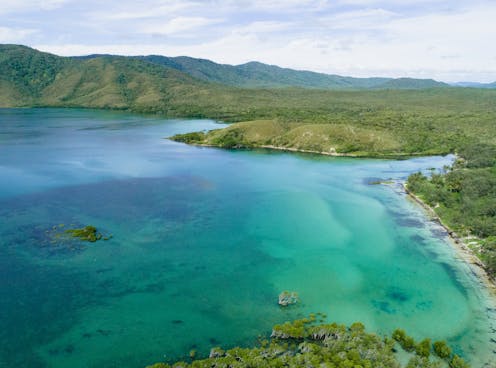
Yuku Baja Muliku Country, Archer Point, North QueenslandAuthor provided
Traditional Owners in Australia are the creators of millennia worth of traditional ecological knowledge – an understanding of how to live amid changing environmental conditions. Seasonal calendars are one of the forms of this knowledge best known by non-Indigenous Australians. But as the climate changes, these calendars are being disrupted.
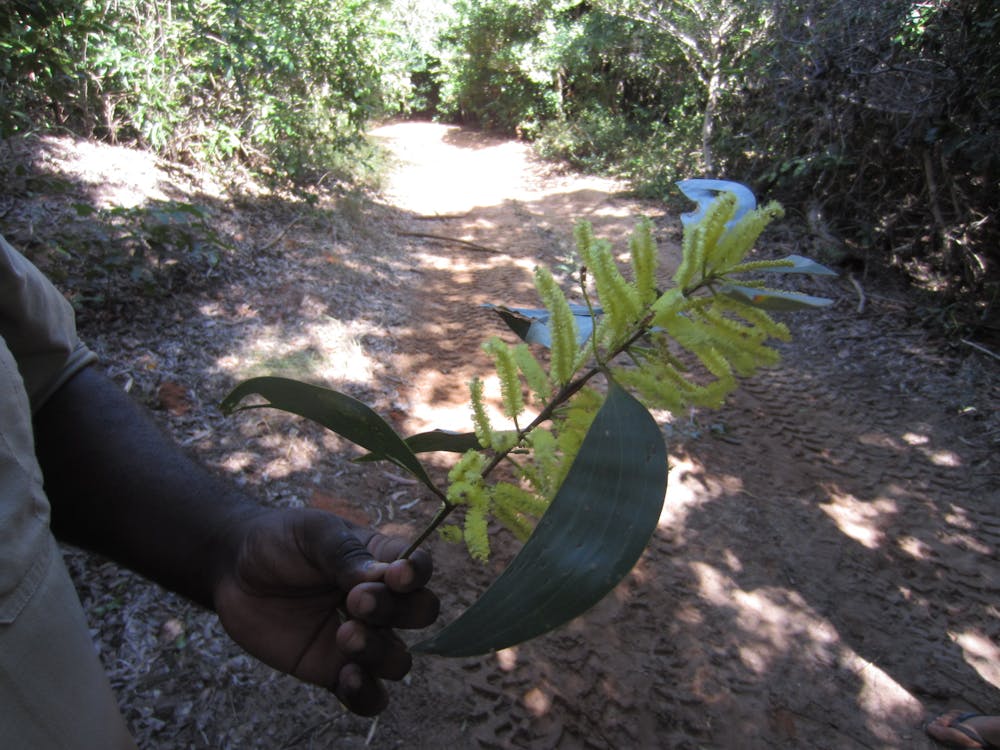
How? Take the example of wattle trees that flower at a specific time of year. That previously indicated the start of the fishing season for particular species. Climate change is causing these plants to flower later. In response, Traditional Owners on Yuku Baja Muliku (YBM) Country near Cooktown are having to adapt their calendars and make new links.
That’s not all. The seasonal timing of cultural burning practices is changing in some areas. Changes to rainfall and temperature alter when high intensity (hot) burns and low intensity (cool) burns are undertaken.
Seasonal connections vital to Traditional Owners’ culture are decoupling.
To systematically document changes, co-author Larissa Hale and her community worked with western scientists to pioneer a Traditional Owner-centred approach to climate impacts on cultural values. This process, published last week, could also help Traditional Owners elsewhere to develop adaptive management for their Indigenous heritage.
A YBM Traditional Owner showing the wattle flower which used to be an indicator species for good fishing. Author provided
Climate change threatens First Nations – their perspectives must be heard
Australia’s First Nations people face many threats from climate change, ranging from impacts on food availability to health. For instance, rising seas are already flooding islands in the Torres Strait with devastating consequences.
The most recent Intergovernmental Panel on Climate Change report on impacts and adaption noted in the Australasia chapter that climate-related impacts on Aboriginal and Torres Strait Islander peoples, their country and cultures are “pervasive, complex and compounding.”
While it is important these impacts are recorded, the dominant source of the data is academic literature based on western science. Impacts and pressures Traditional Owners are seeing and managing on their country must be assessed and managed from their unique perspective.
Traditional Owners have survived and adapted to climatic shifts during their 60,000+ years in Australia. This includes sea-level rise that flooded the area that is now the Great Barrier Reef and extreme rainfall variability. As a result, they have developed a fine-tuned sense of nature’s variability over time.
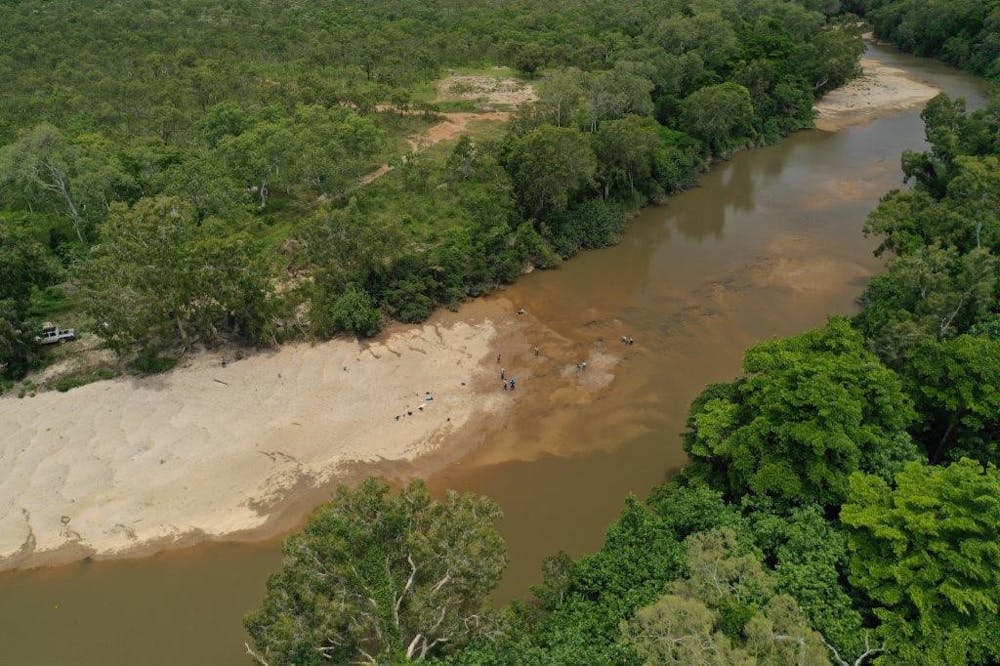
YBM Traditional Owners and scientists surveying freshwater mussel populations on Annan River near Cooktown. Author provided
So what did we do?
Worried about the changes they were seeing on their Land and Sea Country around Archer Point in North Queensland, the YBM people worked with scientists from James Cook University to create a new way to assess impacts on cultural values.
To do this, we drew on the values-based, science-driven, and community-focused approach of the climate vulnerability index. It was the first time this index had been used to assess values of significance for Indigenous people.
YBM people responded to key prompts to assess changes to their values, including:
What did the value look like 100 years ago?
What does it look like now?
What do you expect it will look like in the climate future around 2050?
What management practices relate to that value and will they change?
We then discussed what issues have emerged from these climatic changes.
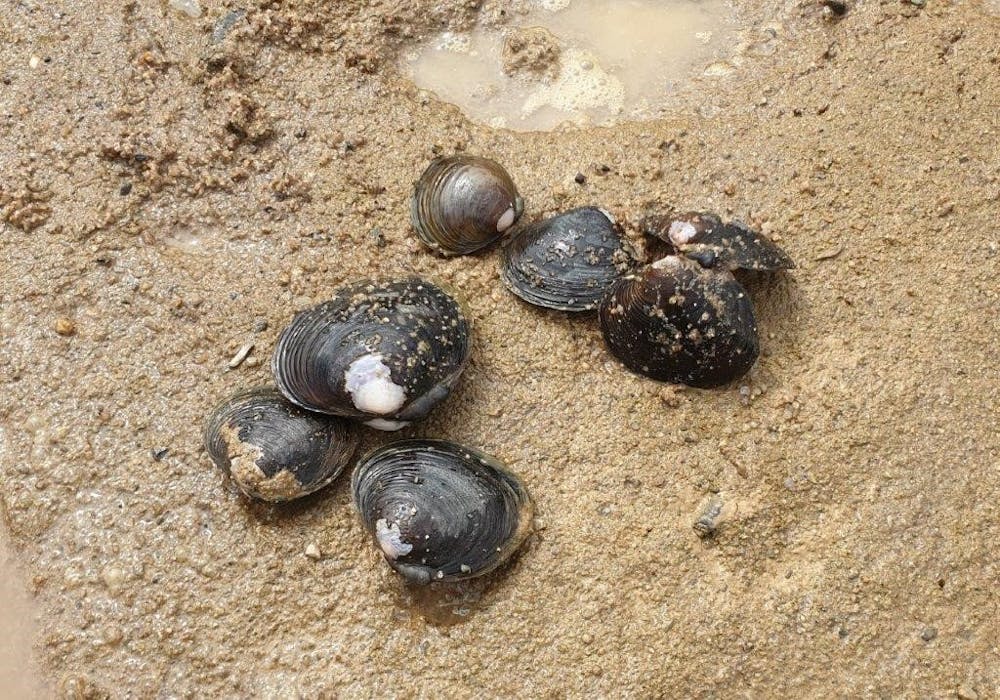
Using this process, we were able to single out issues directly affecting how YBM people live. For instance, traditional food sources can be affected by climate change. In the past, freshwater mussels in the Annan River were easy to access and collect. Extreme temperature events in the last 10 years have contributed to mass die-offs. Now mussels are much smaller in size and tend to be far fewer in number.
Freshwater mussels used to be more common. Author provided
Through the process we also documented that changes to rainfall and temperature have altered the time when some plant foods appear. This is particularly true for plants that depend upon cultural burns to flower or put up shoots. This in turn has meant that the timing of collecting and harvesting has changed.
The timing of when some bushfoods appear is changing. Author provided
These climate-linked changes challenge existing bodies of traditional knowledge, altering connections between different species, ecosystems and weather patterns across Land and Sea Country.
A key part of this process was developing a mutually beneficial partnership between traditional ecological knowledge holders and western scientists. It was critical to establish a relationship built on trust and respect.
Walking the country first – seeing rivers, mangroves, beaches, headlands, bush, wetlands, and looking out at Sea Country – helped researchers understand the perspectives of Traditional Owners. Honouring experience and knowledge (especially that held by Elders and Indigenous rangers) was important. Indigenous cultural and intellectual property protocols were recognised and respected throughout the assessment.
Respecting and working collaboratively with Traditional Owners as expert scientists in their own knowledge system was critical for success. Any effort to incorporate traditional ecological knowledge in climate change assessments must protect sensitive traditional knowledge.
As climate change will continue and accelerate, we must work together to minimise resulting impacts on the cultural heritage of First Nations peoples.
Karin Gerhardt is currently completing her PhD on a collaborative project with Yuku Baja Muliku Traditional Owners. She works for the Great Barrier Reef Foundation and has previously worked for the Great Barrier Reef Marine Park Authority.
Jon Day previously worked for the Great Barrier Reef Marine Park Authority between 1986 and 2014, and was one of the Directors at GBRMPA between 1998 and 2014. Together with Scott Heron, Jon developed the Climate Vulnerability Index (CVI) for World Heritage that has also been applied to assess climate impacts upon other heritage areas.
Larissa Hale is a Yuku Baja Muliku Jalunji Warra Traditional Owner and is currently the Managing Director for Yuku Baja Muliku Landowner & Reservers Ltd. Larissa Hale is currently serving her second term as a Local Government Cook Shire Counicllor.
Scott F. Heron has received funding from Australian Research Council and NASA ROSES Ecological Forecasting. Together with Jon Day, Scott developed the Climate Vulnerability Index (CVI) for World Heritage that has also been applied to assess climate impacts upon other heritage areas.
One of Labor’s key education pledges is A$50 million to encourage school leavers with an ATAR over 80 to study teaching. This is part of the new government’s plan to “fix teacher shortages”.
The teacher shortage in Australia has reached crisis levels. But this must be addressed by improving the working conditions for existing teachers, not by cash incentives to university students.
Thousands of vacancies
Teaching is no longer an attractive profession for many people. Survey after survey of teachers shows how the joy of working with children and for the community has been sucked out of schools. Many teachers feel increasingly stressed, disengaged, and undervalued in their work.
Teachers are leaving the profession in droves, blaming high stress and high workloads. Paul Miller/AAP
According to the NSW Teachers Federation, at the beginning of this school year, there were 2,300 vacant teacher positions in the state’s public schools. More than half of all 2,200 NSW public schools had at least one teaching post unfilled.
The problem is bigger in some areas than others. Almost 10% of Australian high school students will never be taught by a qualified maths teacher. Experienced science teachers are also high demand, and three out of four public schools don’t have a qualified music teacher.
Dropping enrolments
At the same time, enrolments in initial teacher education in NSW reduced by almost 30% from 2014 to 2019. If the downward trend in teacher education enrolments in NSW continues, it means a loss of thousands of teachers by 2030. This comes amid increased demand for teachers due to growing student numbers.
A 2021 Australian Institute for Teaching and School Leadership report found one in ten registered teachers were not currently employed in schools. There are many more qualified teachers who are not registered in the first place.
This is explained by the fact that in Queensland, for example, more than one-third of early career teachers quit teaching within the first five years in the career. Most of these qualified teachers start excited and depart exhausted. Most will never return to teaching unless the issues behind their departures are resolved.
State governments are currently developing teacher supply strategies, such as mid-career pathways into teaching, and like the federal government, attracting “best and the brightest” high school graduates to teach.
What is the root cause?
But attracting high-performing high school graduates into teaching, paying great teachers extra bonuses, or importing experts from other fields to teaching are expensive and mostly ineffective solutions.
Fixing the teacher shortage needs to get to the root cause – what the job is like. Erik Anderson/AAP
This is because the root cause of this current crisis is not a shortage of teachers:it’s the lack of adequate compensation and support for existing teachers. If we don’t understand why teaching is not an attractive career, current strategies and promises funded by the governments will not be enough to solve the crisis.
In the United States, the Learning Policy Institute recommends offering competitive compensation, better initial teacher education, and supporting existing workforce to address the issue of teacher shortages. These lessons can be applied in Australia, too.
What Jason Clare should do
The incoming Albanese government and new Education Minister Jason Clare have an opportunity to reset the discussion and the policy response to teachers shortages. This is what he should do:
1. Improve conditions for teachers
A recent Grattan Institute study reported 86% of all teachers feel they don’t have enough time for planning and collaboration at school.
In world’s leading education systems, teachers have time to prepare themselves better for teaching, and opportunities to work with colleagues to address challenges. International evidence shows the more teachers can collaborate with colleagues, the better they teach.
2. Prepare new teachers better for the job
As in medicine and other high professions, teachers need to see and practise good teaching while learning about the theory. Extensive work with mentor-teachers who can model effective practices needs must be a core part of modern teacher education. Australian medical doctors learn the core skills in university teaching hospitals. Why couldn’t teachers be prepared similarly?
3. Make teachers’ pay more competitive.
Many teachers step down after just a few years in teaching because of inadequate pay for a demanding and stressful job. Teacher pay is competitive with other professions at the start of their career, but this erodes by the mid-career point.
Teachers’ salaries must reflect better the demanding nature of teaching if we want to see smart young people choose teaching as a career and keep experienced teachers in schools.
It is estimated a 10-15% increase in teacher salaries is required to restore the attractiveness of teaching compared to other professions.
Teaching once was an attractive profession. Making it so again would probably bring some great teachers back to schools. This is the best way to help schools around the country to hit the brakes before more children suffer from absent teachers and school results continue to drop any further.
Pasi Sahlberg does not work for, consult, own shares in or receive funding from any company or organisation that would benefit from this article, and has disclosed no relevant affiliations beyond their academic appointment.
The Reserve Bank has lifted the cash rate for the second time in two months, this time by 0.50 points to 0.85%.
It won’t be the last such hike. Forecasters expect the cash rate to hit 2.5% by the end of next year. This would lift the typical variable mortgage rate to near 5%.
Cue the claims that the new generation of borrowers are entitled – they don’t know how good they’ve had it with such low rates.
But the refrain misses the full story. High house prices have changed the game, making it much harder for today’s borrowers.
It is true that even a mortgage rate of 5% is well below the peak of about 17% earlier generations paid at the start of the 1990s.
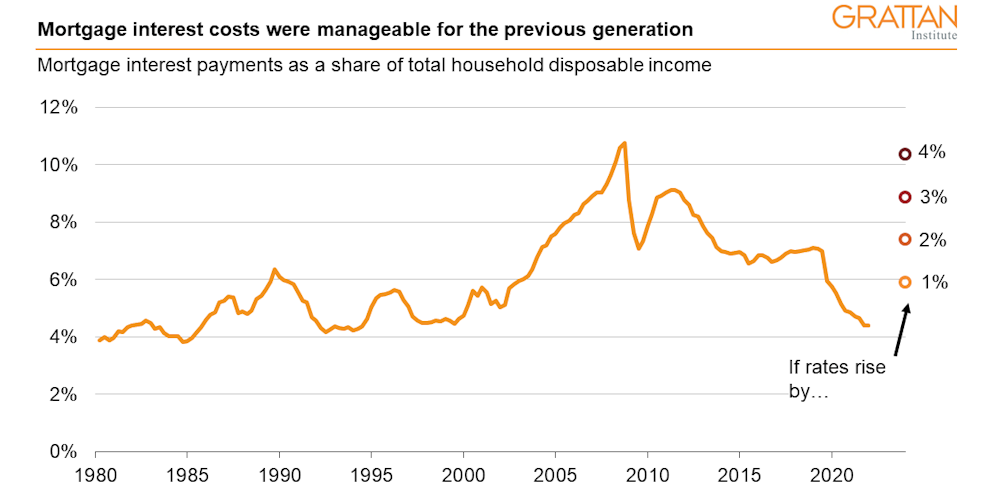
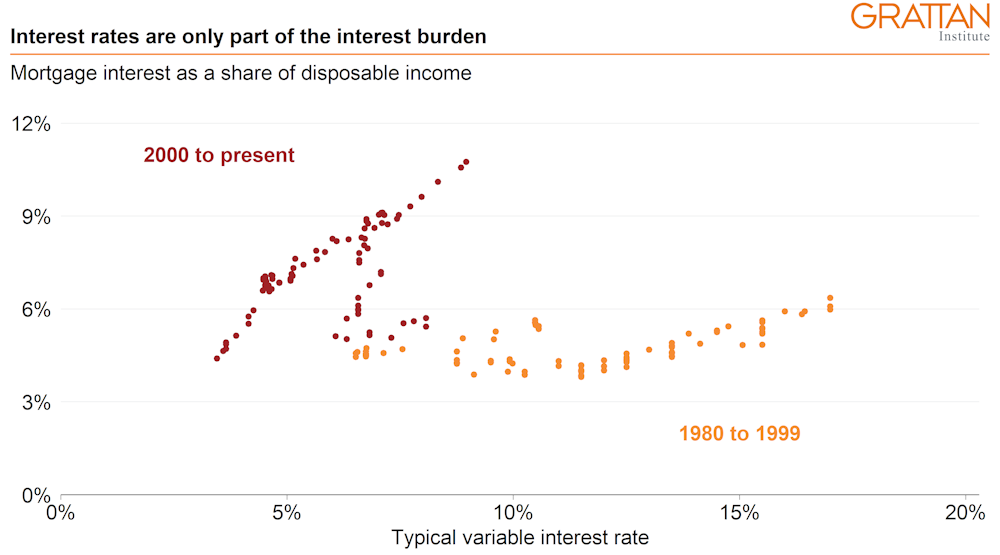
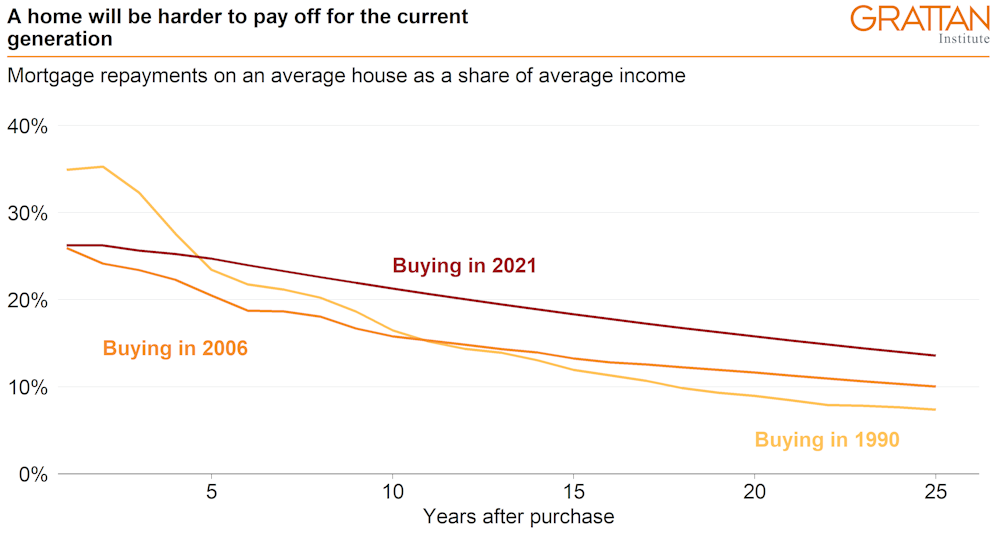
But the impact of those high rates on overall mortgage interest payments as a share of income was modest, because house prices were much lower then, and mortgages were much smaller.
Projection is for December 2023. It uses the average mortgage interest rate as at December 2021 and assumes household debt-to-income ratio is stable at December 2021 levels. RBA Tables E2 and F6; ABS National Accounts; Grattan analysis.
Typical house prices used to be about four times incomes. Now they’re more than eight times incomes, and more in Melbourne and Sydney.
This has meant that for any given mortgage rate, the share of income taken up by mortgage payments is much, much higher.
Each dot represents a 3-month period. Source: RBA Tables E2 and F6
If you have a small loan with a high rate, all you need is a cut in rates, some inflation and decent income growth, and your mortgage burden can fall sharply.
That’s how it was for borrowers in the 1990s. High rates stung, but not for long.
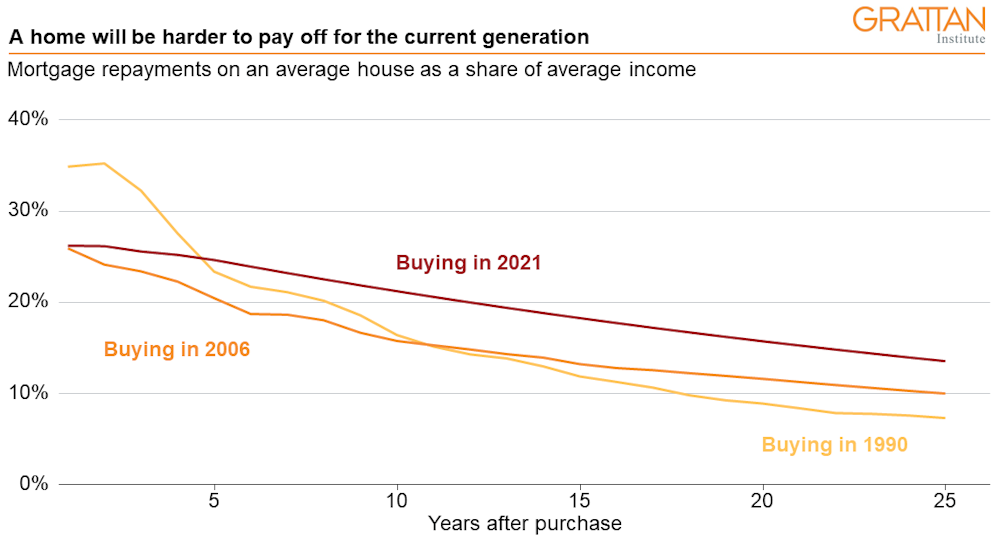
Borrowers in the 1990s who started out devoting more than 30% of their income to paying off a mortgage found themselves devoting just 12% by the time the loan was halfway through.
Assumes 80% LVR 25-year loan on average house price in year of borrowing, taken from Yates (201 1) for pre-2010, and ABS thereafter. No lenders mortgage insurance.
Income is gross disposable income from ABS National Accounts. Historical interest rates are rolling 3-year averages of standard variable rates (discounted from 2004).
Projected interest rates are average of past 10 years. Projected income growth is 3%. Sources: ABS National Accounts and Residential House Prices; RBA Table F6; Yates (2011); Grattan Analysis
It’s different if you’ve borrowed recently.
If you’ve taken out a big loan at today’s ultra-low interest rates, there’s only one way your mortgage payments can go – and that’s up.
5% would hurt like it didn’t used to
Even if mortgage rates stabilise at around 5% – which is implied by some of the things the Reserve Bank governor has said – and wages grow faster than they have for a decade, the mortgage burdens of millennials who’ve bought houses recently won’t much decline.
The extraordinary increase in house prices and debt means mortgage rates of 7% would be as painful to borrowers today as rates of 17% were decades ago.
It’s a common barb that newer generations are struggling with home ownership and housing costs because of profligate spending, on smashed avos and the like.
But millennials spend less of their incomes on “discretionary” items – such as alcohol, clothes and household services – than people of the same age did decades ago.
What millennials are spending much more on is housing, simply because houses are so much more expensive.
So as the Reserve Bank continues to increase rates, it’s important to keep in mind that comparisons between then and now miss the full story.
Skyrocketing house prices have changed the game. For millennials, even historically small increases in interest rates will hurt.
Grattan Institute began with contributions to its endowment of $15 million from each of the Federal and Victorian Governments, $4 million from BHP Billiton, and $1 million from NAB. In order to safeguard its independence, Grattan Institute’s board controls this endowment. The funds are invested and contribute to funding Grattan Institute’s activities. Grattan Institute also receives funding from corporates, foundations, and individuals to support its general activities, as disclosed on its website.
Joey Moloney ne travaille pas, ne conseille pas, ne possède pas de parts, ne reçoit pas de fonds d’une organisation qui pourrait tirer profit de cet article, et n’a déclaré aucune autre affiliation que son organisme de recherche.
Access to cannabis-based products for medical reasons is technically legal in New Zealand. But changes to the legislation in 2020 have failed to make this potentially life altering option a reality for many.
Researchers from the University of Otago and Victoria University are exploring the therapeutic use of cannabis in New Zealand through interviews with people who use it to alleviate pain and the symptoms of debilitating illnesses.
Listening to stories of painful, highly complex medical conditions, and the efforts people have made to control their pain with various opioid-based drugs that left them feeling like zombies, has been hard.
But hearing how using cannabis products changed people’s lives and meant they could cut down or, in some cases, completely stop the use of pain killers and other drugs with crippling side effects, has been very positive.
Often these stories involved the work of so-called “green fairies” who focus on producing quality health products and have caring relationships with their patients – but who grow the cannabis illegally.
The role of ‘green fairies’
Some green fairies also have a great deal of knowledge about the potency of their products, what different varieties of cannabis can be used for, and how to prepare and use cannabis products for various conditions.
Those patients who have taken part in the research project so far have talked about cannabis products as a “miracle” and a “life saver” – literally, as some were so overwhelmed by living a life with chronic pain that they sought to end it.
Parents whose children suffered from difficult and sometimes debilitating medical conditions said using cannabis products eased suffering and enabled their children to live “normal” lives.
Cannabis-based products can technically be prescribed by doctors but new research shows most people still access items from illegal sources. David Trood/Getty Images
Miracles at the margins
Yet all these stories – these “miracles” – exist on the margins, as cannabis products are often unattainable outside of the underground illicit market.
Green fairies provide access for patients under constant threat of prosecution themselves.
Ironically, many of those who now sit outside the legal system advocated for the Medicinal Cannabis Bill in 2018. Their success meant the introduction of legislation aimed at large, for-profit corporations with the resources to make products following strict guidelines and complex regulations, but which excludes smaller producers.
Cannabis was first made available in New Zealand for therapeutic purposes in 2010, albeit under strict guidelines.
It was not until 2017 that cannabidiol (CBD) products containing non-psychoactive cannabis compounds were able to be prescribed more widely by general practitioners (GPs) without the approval of either the minister or the Ministry of Health.
It took a further three years for products containing tetrahydrocannabinol (THC), the psychoactive cannabis compounds, to be prescribed by GPs without the approval of the government.
For people living with painful, chronic conditions, this was a long time to wait.
Available and accessible? Not quite
The Misuse of Drugs (Medicinal Cannabis) Amendment Act of 2018 and the 2020 Medicinal Cannabis Scheme (MCS), should mean medicinal cannabis products are available and accessible.
Sadly, this is not the case for a large number of people.
Problems include the cost of prescribed cannabis products and the reluctance of GPs to prescribe them, alongside the complex regulatory and compliance scheme accompanying the new law.
Only a small number of products have been approved under the 2020 scheme, mainly due to stringent standards and licence requirements that exclude small producers and growers.
Although the cost has reduced in the past few years, the price of products – around $200 per month regardless of whether they are CBD or THC based – is still too high for those on limited incomes.
Research conducted in 2019 found fewer than 5% of respondents got their cannabis products via a GP, with most still accessing cannabis via the underground market or being gifted it by family or friends.
Only 1.56% of interview respondents involved in the current research project access cannabis products through their GP, with several citing cost as a barrier.
GPs are reluctant to prescribe cannabis as an alternative to conventional medications given the lack of clinical studies into its efficacy – despite studies showing the majority of those who used some type of cannabis product therapeutically did so to ease chronic pain.
The issues involved in developing a more affordable and accessible scheme to enable therapeutic use of cannabis in New Zealand are complex, fraught with seemingly insurmountable barriers, as well as bound by bureaucracy.
However, cannabis-based products could be made available without the need for a GP’s prescriptions.
Some therapeutic cannabis products could also be reclassified as natural health products, allowing them to be purchased over the counter as has happened in the United States and Europe.
This approach could bring relief to thousands and give legitimacy to patients, growers and producers seeking to alleviate pain and suffering.
This would also allow clear labelling about dosage, CBD/THC content and warnings about incompatibility with other medications.
Patients would be able to access affordable products more easily and the need for GPs to prescribe products they may not be comfortable with is removed.
Recent legalisation on drug checking also means cannabis products could be tested to ensure some level of product safety.
Such alternative pathways urgently need to be developed, alongside clinical trials.
In the meantime, the bureaucratic processes around what is and isn’t acceptable under complex and onerous regulation grind slowly on, and those with severe and debilitating conditions risk criminalisation or financial hardship to use products that ease their suffering.
Fiona Hutton does not work for, consult, own shares in or receive funding from any company or organisation that would benefit from this article, and has disclosed no relevant affiliations beyond their academic appointment.
There are many angles from which we can celebrate Judy Garland’s 100th birthday on June 10.
We can see her as iconic interpreter of the Great American Songbook, mother of a showbiz dynasty, gay icon, a sad symbol of the excesses of Hollywood control or a classic movie star.
But one of the most interesting things about her is not her place as the star of individual movies, or as a persona, but as a co-creator of a specific style of movie musical.
When looking at Garland’s varied filmography, I am struck by how many “integrated” musicals she starred in. These are movies where the songs contribute to telling the story as opposed to being simply attractive diversions: the songs are integrated into the plot.
Somewhere Over the Rainbow is specific to the plot of The Wizard of Oz (1939). No other character could sing it, and Dorothy could only sing it when she does, early in the film before her journey to Oz.
Similarly, The Boy Next Door in Meet Me In St Louis (1944) only fits where it is in the film: an expression of the wonder of a new crush.
Music for music’s sake
The earliest movie musicals of the late 1920s were either adaptations of preexisting stage shows, or backstage dramas about the staging of musicals replete with elaborate production numbers that have nothing to do with the plot.
The most famous among these were from Warner Bros with numbers staged by Busby Berkeley.
As the genre developed in the 1930s, there was usually a mix of plot numbers and pure spectacle, such as in the Fred Astaire/Ginger Rogers musicals made by RKO.
A few of Garland’s musicals fit this style, but most of the best known ones are strikingly void of musical numbers that exist purely for their own sake.
The makers of films like The Wizard of Oz, Meet Me in St Louis and The Pirate (1948) seem to have responded to Garland’s particular acting talents, writing stories and music that suited her storytelling style.
In this, she had an influence on both the form and the content of the film musical genre.
Even in her backstage musicals – where songs usually happen as performance, as opposed to being in musically-enhanced reality mode – Garland’s songs have double meanings as both performances and as character milestones.
The most famous example from Garland’s later career is undoubtedly The Man That Got Away from A Star is Born (1954).
In the film, Garland’s character Esther is rehearsing with her band, but it is clear the character is feeling the specific meaning of the song composed by Harold Arlen and George Gershwin for Garland to sing in this film.
A fully rounded character
Take one of Garland’s less familiar films, 1943’s Girl Crazy.
This is not a great film by any means, but it has a stack of classic Gershwin songs and the most interesting plot of Garland’s pre-Meet Me In St Louis films (other than The Wizard of Oz, of course).
Garland plays the postmistress of a small college town somewhere in the American West, to which Mickey Rooney’s character has been banished for having too much non-academic fun at Yale.
Each of Garland’s numbers shows off a different side of her talent while still allowing her to stay entirely in character.
Her comedy duet with Rooney, Could You Use Me?, is a masterclass in under-acting. Even though Rooney is hamming it up at his usual 110%, Garland gives hyperactive Rooney a run for his money by keeping quite still. Focus remains on her even during Rooney’s verses.
In Embraceable You, Garland has fun charming the entire student body of the men’s college where her grandfather is dean. She also shows off her dancing talents in the number.
The melancholic ballad But Not For Me is Garland in her miserable mode, but numbers like this (there is one in almost every Garland musical) never come across as cloying or full of self-pity.
Instead, the subtlety of her portrayal of heartbreak means the audience’s hearts break right along with hers.
Finally, I Got Rhythm shows how powerful she was as an anchor for a huge production number, here a five-minute extravaganza complete with singers, dancers and Tommy Dorsey’s big band, brought to the college to celebrate the fact that it is staying open (and will now be coeducational!).
Unlike many such production numbers, which exist only to show off the performers, this serves as a fitting climax to the film: Garland has found her man, and who indeed could ask for anything more?
That even a relatively minor movie such as Girl Crazy lets Garland play a fully rounded character through her singing demonstrates her influence as a singing actress.
Her considerable talents pushed her collaborators to give her their best work, integrating song and story and pushing the movie musical genre to greater sophistication.
Gregory Camp does not work for, consult, own shares in or receive funding from any company or organisation that would benefit from this article, and has disclosed no relevant affiliations beyond their academic appointment.
The Reserve Bank has lifted the cash rate for the second time in two months, this time by 0.50 points to 0.85%.
It won’t be the last such hike. Forecasters expect the cash rate to hit 2.5% by the end of next year. This would lift the typical variable mortgage rate to near 5%.
Cue the claims that the new generation of borrowers are entitled – they don’t know how good they’ve had it with such low rates.
But the refrain misses the full story. High house prices have changed the game, making it much harder for today’s borrowers.
It is true that even a mortgage rate of 5% is well below the peak of about 17% earlier generations paid at the start of the 1990s.
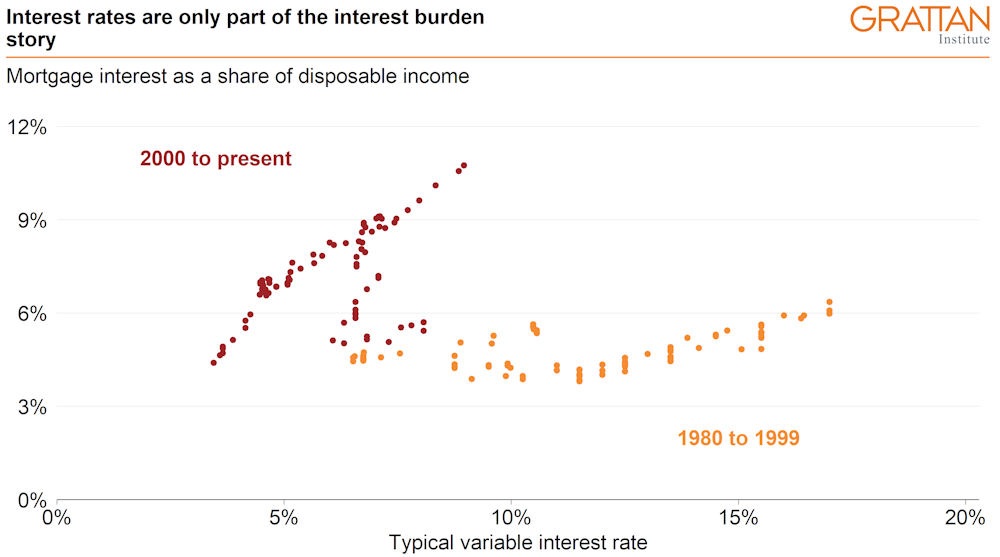
But the impact of those high rates on overall mortgage interest payments as a share of income was modest, because house prices were much lower then, and mortgages were much smaller.
Projection is for December 2023. It uses the average mortgage interest rate as at December 2021 and assumes household debt-to-income ratio is stable at December 2021 levels. RBA Tables E2 and F6; ABS National Accounts; Grattan analysis.
Typical house prices used to be about four times incomes. Now they’re more than eight times incomes, and more in Melbourne and Sydney.
This has meant that for any given mortgage rate, the share of income taken up by mortgage payments is much, much higher.
Each dot represents a three-month period. Source: RBA Tables E2 and F6
If you have a small loan with a high rate, all you need is a cut in rates, some inflation and decent income growth, and your mortgage burden can fall sharply.
That’s how it was for borrowers in the 1990s. High rates stung, but not for long.
Borrowers in the 1990s who started out devoting more than 30% of their income to paying off a mortgage found themselves devoting just 12% by the time the loan was halfway through.
Assumes 80% LVR 25-year loan on average house price in year of borrowing, taken from Yates (201 1) for pre-2010, and ABS thereafter. No lenders mortgage insurance.
Income is gross disposable income from ABS National Accounts. Historical interest rates are rolling 3-year averages of standard variable rates (discounted from 2004).
Projected interest rates are an average of past 10 years. Projected income growth is 3%. Sources: ABS National Accounts and Residential House Prices; RBA Table F6; Yates (2011); Grattan Analysis
It’s different for someone who has borrowed recently.
If you have a big loan with today’s ultra-low interest rates, there’s only one way mortgage payments can go – and that’s up.
5% would hurt like it didn’t used to
Even if mortgage rates stabilise at around 5% – which is implied by some of the things the Reserve Bank governor has said – and wages grow faster than they have for a decade, the mortgage burdens of millennials who’ve bought houses recently won’t much decline.
The extraordinary increase in house prices and debt means mortgage rates of 7% would be as painful to borrowers today than rates of 17% were decades ago.
It’s a common barb that newer generations are struggling with home ownership and housing costs because of profligate spending, on smashed avos and the like.
But millennials spend less of their incomes on “discretionary” items – such as alcohol, clothes and household services – than people of the same age did decades ago.
What millennials are spending much more on is housing, simply because houses are so much more expensive.
So as the Reserve Bank continues to increase rates, it’s important to keep in mind that comparisons between then and now miss the full story.
Skyrocketing house prices have changed the game. For millennials, even historically small increases in interest rates will hurt.
Grattan Institute began with contributions to its endowment of $15 million from each of the Federal and Victorian Governments, $4 million from BHP Billiton, and $1 million from NAB. In order to safeguard its independence, Grattan Institute’s board controls this endowment. The funds are invested and contribute to funding Grattan Institute’s activities. Grattan Institute also receives funding from corporates, foundations, and individuals to support its general activities, as disclosed on its website.
Joey Moloney does not work for, consult, own shares in or receive funding from any company or organisation that would benefit from this article, and has disclosed no relevant affiliations beyond their academic appointment.
As well as her interviews with politicians and experts, Politics with Michelle Grattan includes “Word from The Hill”, where she discusses the news with members of The Conversation politics team.
While Anthony Albanese this week continued to receive a warm reception abroad, at home the new government faced more difficult news. In this podcast Michelle and politics + society editor Amanda Dunn canvass Tuesday’s 50 basis points rise in interest rates – the latest cost of living blow for many families – and Albanese’s trip to deepen Australia’s relationship with Indonesia. They also take a look at the new shadow ministry, announced by Peter Dutton and David Littleproud on Sunday.
Michelle Grattan does not work for, consult, own shares in or receive funding from any company or organisation that would benefit from this article, and has disclosed no relevant affiliations beyond their academic appointment.
We all have different preferences for when it’s the right time to bring out the winter blankets. And the thermostat’s setting often forms the basis of office arguments between women and men regarding the “correct” temperature for it to be set.
But is there any science backing up the widespread belief women “feel the cold” more than men?
Biological differences between men and women
At around the same body weight, women tend to have less muscle to generate heat. Women also have more fat between the skin and the muscles, so the skin feels colder, as it’s slightly further away from blood vessels.
Women also tend to have a lower metabolic rate than men, which reduces heat production capacity during cold exposure, making women more prone to feeling cold as the temperature drops.
The hormones oestrogen and progesterone, found in large quantities in women, contribute to the core body and skin temperatures.
Oestrogen dilates blood vessels at the extremities. This means more heat can be lost to the surrounding air. And progesterone can cause the vessels in the skin to constrict, meaning less blood will flow to some areas to keep the internal organs warmer, leaving women feeling cooler. This hormone balance changes throughout the month alongside the menstrual cycle.
The hormones also make women’s hands, feet and ears stay around three degrees Celsius cooler than men’s.
The core body temperature is highest in the week after ovulation, as progesterone levels increase. This means that around this time, women may be particularly sensitive to cooler outside temperatures.
Although the hands and feet are cooler, women do have warmer average core temperatures than men. This is likely the source of the saying “cold hands, warm heart”.
Women’s hands are around three degrees colder than men’s. Shutterstock
The phenomenon that some of us prefer warmer temperatures to others isn’t unique to humans. Studies on many species of birds and mammals report that males commonly congregate in cooler areas where there is shade, while females and offspring stay in warmer environments where there is sunlight.
Male bats prefer to rest at the cool, high peaks of mountains, whereas females remain in the warmer valleys.
Female mammals may have developed a preference for warmer climates to encourage them to rest with offspring during stages when the young are unable to regulate their own body temperature.
So the difference between heat-sensing mechanisms may provide an evolutionary advantage.
So how do we agree on the ideal temperature?
The “Scandinavian sleep method”, where couples sleep with separate blankets, is one way to overcome the differences in temperature preferences.
In the workplace, personal comfort systems are thermal systems that heat or cool and can be locally positioned in individual work stations such as desktops, chairs, or near the feet and legs. Examples include small desk fans, heated chairs and blankets, or footwarmers.
These systems provide individualised thermal comfort to meet personal needs without affecting others in the same space, and have been found to produce higher comfort satisfaction in the workplace.
They may also be an energy-efficient method to balance thermal comfort and health in office environments.
The authors do not work for, consult, own shares in or receive funding from any company or organisation that would benefit from this article, and have disclosed no relevant affiliations beyond their academic appointment.
By lifting its cash rate 0.5 points from 0.35% to 0.85%, the Reserve Bank has added about another $120 per month in payments for a A$500,000 mortgage.
If financial markets are to be believed, by the end of this year it will have added a total of $800 per month – and, by the end of next year, a total approaching $1,000 per month.
Those figures are for variable mortgages, but homeowners on fixed rates won’t escape them long. Those rates are typically fixed for up to three years.
Many of the fixed-rate mortgages were taken out during COVID at annual rates as low as 2%. When those fixed rates end (and many will end in the next year or so) those homeowners will find themselves paying 5% or 6% per year, shelling out as much as $3,000 per month instead of $2,000.
Unless financial markets are wrong. The good news is, I think they are.
The pricing of deals on the futures market factors in an increase in the Reserve Bank’s cash rate from 0.10% to 3.5% by June next year, enough to push up the standard variable mortgage rate from around 2.25% to 5.65%.
We couldn’t afford the rates the market expects
One reason for suspecting it won’t happen is that many homeowners simply couldn’t afford the extra $1,000 per month. Most of us don’t have that much cash lying around.
US President Richard Nixon had an economic adviser by the name of Herbert Stein with an uncommonly-developed sense of common sense. In his later years he wrote an advice column for Slate magazine.
To a reader wanting a cure for unrequited love, he wrote that the best solution was “requited love”. To a reader concerned about her inability to make small talk, he wrote that what people want most is a “good listener”.
In economics, Stein is best known for Stein’s Law, which says: “if something cannot go on forever, it will stop”.
Mortgage rates can’t keep climbing to the point where homeowners pay an extra $1,000 per month.
For new homeowners, it’s worse. The typical new mortgage taken out to buy a home in NSW has climbed to $700,000. In Victoria, it has climbed to $585,000. These people will be paying a good deal more than an extra $1,000 per month if the bets on repeated rate hikes made on the futures market come to pass.
The Reserve Bank says it lifted its cash rate from 0.35% to 0.85% today to withdraw the “extraordinary monetary support” put in place during the pandemic.
But the bank says from here on it will be guided by data, and, in a nod to homeowners concerned about continual rate hikes, said it expected inflation to climb just a bit more before declining back towards its target next year.
The bank will be guided by data
Financial markets don’t see it that way. They have priced in (in other words, bet money on) rate hikes in July, August, September, October, November, December, February, March, April and May.
But there are reasons to believe the bank is right about inflation.
It doesn’t seem that way with electricity prices set to climb 8-18% in NSW, 11% in Queensland, 5% in Victoria, and as much as 20% in South Australia. (The only jurisdiction without an increase in prospect is the Australian Capital Territory, which has 100% renewables and fixed long-term contracts.)
Fortunately for overall inflation, electricity accounts for less than 3% of the typical household budget. Gas accounts for less than 1%. Even low earners spend little more than 4% of their income on electricity.
While the price of vegetables is soaring (heads of lettuce are selling for $10), we spend less than 1.5% of our income on vegetables.
The best measure of overall price increases remains the official one of 5.1% for the year to March, calculated by the Bureau of Statistics.
It is a more alarming increase in inflation than Australians are used to. But what matters for the Reserve Bank is whether the 5.1% is set to turn down and head back towards the target of 2-3%, or climb further away from it.
Australia is almost uniquely disadvantaged among developed nations in getting a handle on what’s happening to inflation, being one of only two OECD members (the other is New Zealand) to compile its consumer price index quarterly, instead of monthly.
By the time Australia’s index is published, several of the measures in it are months old, and they don’t get updated for another three months.
Fortunately the Bureau of Statistics is gearing up to produce a monthly index. Meanwhile, in the United States – which is subject to the same international price pressures as Australia – most measures of inflation eased in April.
Wages growth, which the Reserve Bank said last month seemed to be “picking up”, remained dismal in the figures released a few weeks later – at just 2.4% in the year to March. That was well short of the 2.7% forecast in the budget for the year to June, and not enough to do anything to further fuel inflation.
Australia has a history of aggressive interest rate hikes to tame inflation.
In 1994, Reserve Bank Governor Bernie Fraser rammed up the cash rate from 4.75% to 7.5% in a matter of months. But that was when wage growth was well above inflation and the bank was trying to dampen “demands for wage increases” to prevent a wage-price spiral.
We don’t even have the beginnings of that yet. Unless the bank wants to needlessly impoverish Australians, and keep going until it pushes them out of work, it will increase rates cautiously from here on.
Peter Martin does not work for, consult, own shares in or receive funding from any company or organisation that would benefit from this article, and has disclosed no relevant affiliations beyond their academic appointment.
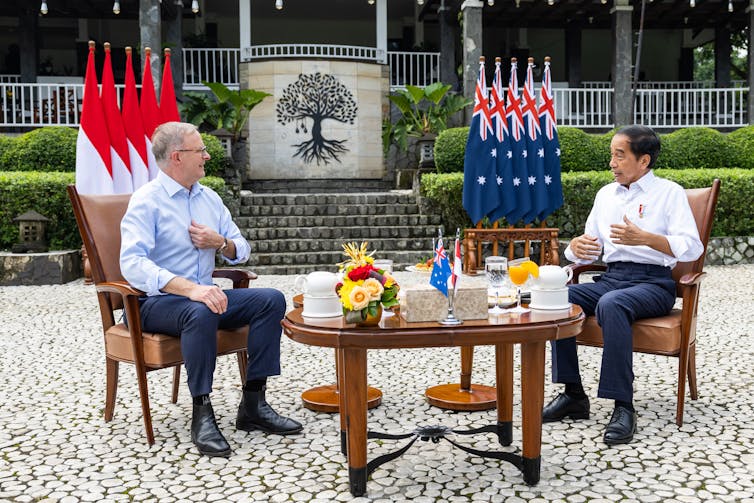
Indonesia may be the world’s fourth most populous nation – with more than 270 million people – but Australian news coverage of it typically involves three things: beef, boats and Bali.
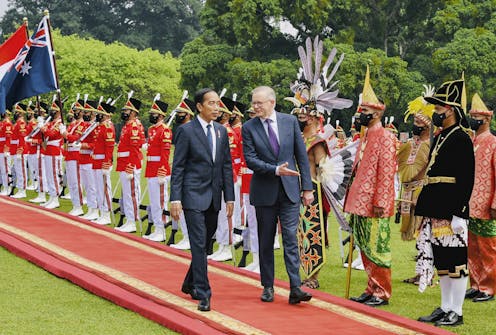
Anthony Albanese’s visit to Indonesia in his third week as prime minister is an important sign the relationship can’t be defined by domestic concerns about asylum seekers, live cattle exports and drug smuggling.
Accompanied by Foreign Minister Penny Wong (who speaks Bahasa) and Science and Innovation Minister Ed Husic (whose Muslim faith was of interest to the Indonesian press), Albanese has made it clear Indonesia is of utmost diplomatic importance to Australia.
Albanese has followed a recent tradition of Australian prime ministers heading to Jakarta early, before London or Washington. His predecessor, Scott Morrison, visited Indonesia in September 2018 as his first port of call. So too did Malcolm Turnbull and Paul Keating.
Indonesia is perhaps the Australian continent’s first trading partner.
Evidence from the 1600s shows the indigenous fishers of Arnhem land traded sea cucumber and other goods with counterparts from Makassar – on the island now known as Sulawesi – which the Makassarese then sold to Chinese merchants. Makassar remains an important port, which Albanese visited after meeting Indonesia’s President Joko Widodo at his presidential palace.
Australia’s interest in close ties with Indonesia were established immediately after the second world war.
Future President Sukarno and Vice-President Mohammad Hatta issued their Proclamation of Indonesian Independence on August 17 1945, six weeks after the surrender of the occupying Japanese.
By November 1945, an Australian diplomatic mission headed by William MacMahon Ball was in Jakarta (then still called Batavia) to meet with them and other independence officials.
Economist Joe Isaac, who would go on to become deputy president of the Australian Industrial Relations Commission and deputy chancellor of Monash University, was part of the delegation. He later recalled the meetings with Sukarno:
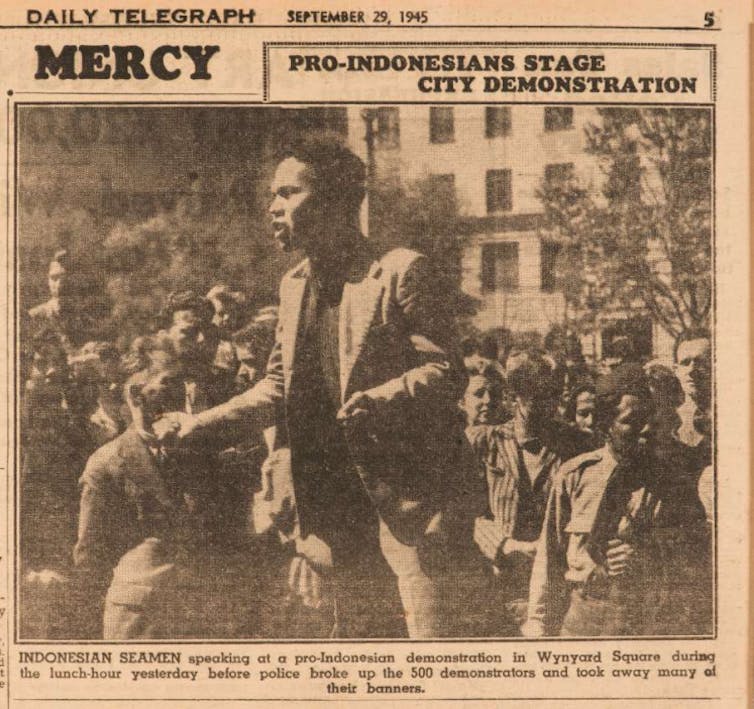
Mac [MacMahon Ball] outlined the purpose of his mission […] and that Australia was sympathetic to the political aspirations of the Indonesians; and he canvassed Sukarno’s reaction to the despatch by the Australian Government of a boat load of medical supplies. No doubt thinking of the action of the Australian waterside workers (who refused to load Dutch ships hostile to Indonesian independence) Sukarno expressed gratitude for the support of the Australian people.
This support was a big deal at the time (the Netherlands only gave up attempts to reassert its colonial control in 1949). According to Isaac, the action of the waterside workers against Dutch ships as well as Australia’s support for Indonesian independence in the UN Security Council were instrumental in shaping a positive view of Australia in Indonesia.
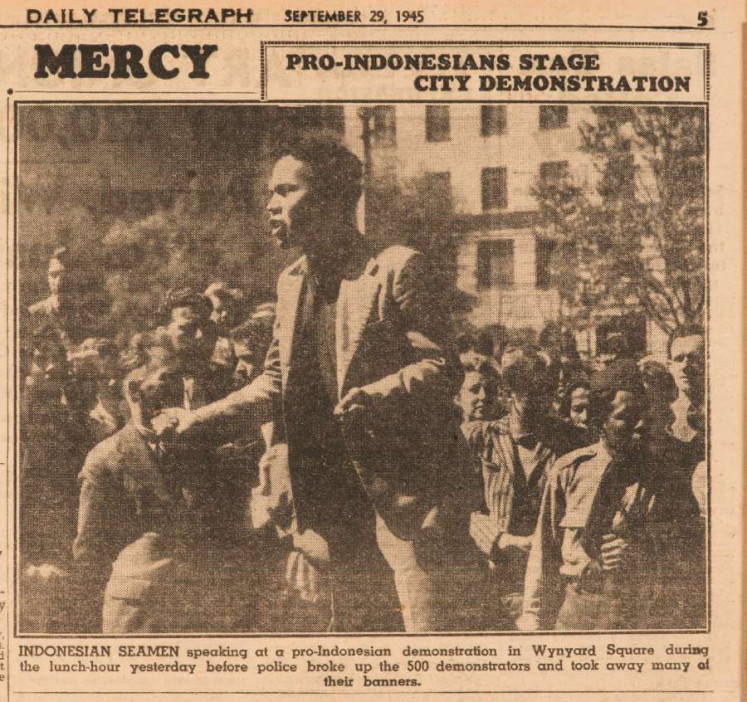
A newspaper report from September 29 1945 about a rally in Sydney in support of Indonesian independence. Daily Telegraph/ivens.nl, CC BY
Recent economic assistance
Australia’s desire for close relations with Indonesia has been challenging – in particular over Indonesia’s annexation of West Papua in 1969 and of East Timor in 1975.
But in recent decades there have been some great occasions of economic co-operation.
During the Asian financial crisis of 1997-99, Australia went into bat for Indonesia against the International Monetary Fund (IMF) and the Clinton administration, which both wanted to impose severe fiscal austerity measures.
Australia favoured more expansionary policies – partly informed by Reserve Bank deputy governor Stephen Grenville, who had been a diplomat in Indonesia and understood the Indonesian economy.
The Australian view prevailed, and the Indonesian economy fared much better as a result, avoiding the pitfalls of the developing economies subject to the IMF prescription.
But in many ways Indonesia is still underdone as an economic partner – not just when compared with China and India, and our longstanding partners in Japan and South Korea, but also with southeast Asian neighbours Singapore and Thailand.
More Australian small and medium sized companies export goods to Fiji than Indonesia. And despite Indonesia’s massive population, just 250 Australian companies have a presence in Indonesia. This compares to more than 3,000 in China.
Indonesia hasn’t attracted manufacturers looking for low-cost opportunities like China, Vietnam and Bangladesh. Foreign companies have mainly gone there for its massive domestic consumer market, especially the urban middle class in cities like Jakarta, Yogyakarta and Surabaya.
So, there’s still a great potential for Australian trade and foreign investment to help build capacity way beyond boats, beef and Bali.
Tim Harcourt does not work for, consult, own shares in or receive funding from any company or organization that would benefit from this article, and has disclosed no relevant affiliations beyond their academic appointment.
Why did people think cannibalism was good for their health? The answer offers a glimpse into the zaniest crannies of European history, at a time when Europeans were obsessed with Egyptian mummies.
Driven first by the belief that ground-up and tinctured human remains could cure anything from bubonic plague to a headache, and then by the macabre ideas Victorian people had about after-dinner entertainment, the bandaged corpses of ancient Egyptians were the subject of fascination from the Middle Ages to the 19th century.
Mummy mania
Faith that mummies could cure illness drove people for centuries to ingest something that tasted awful.
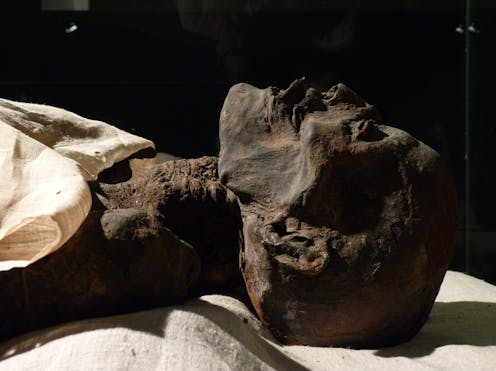
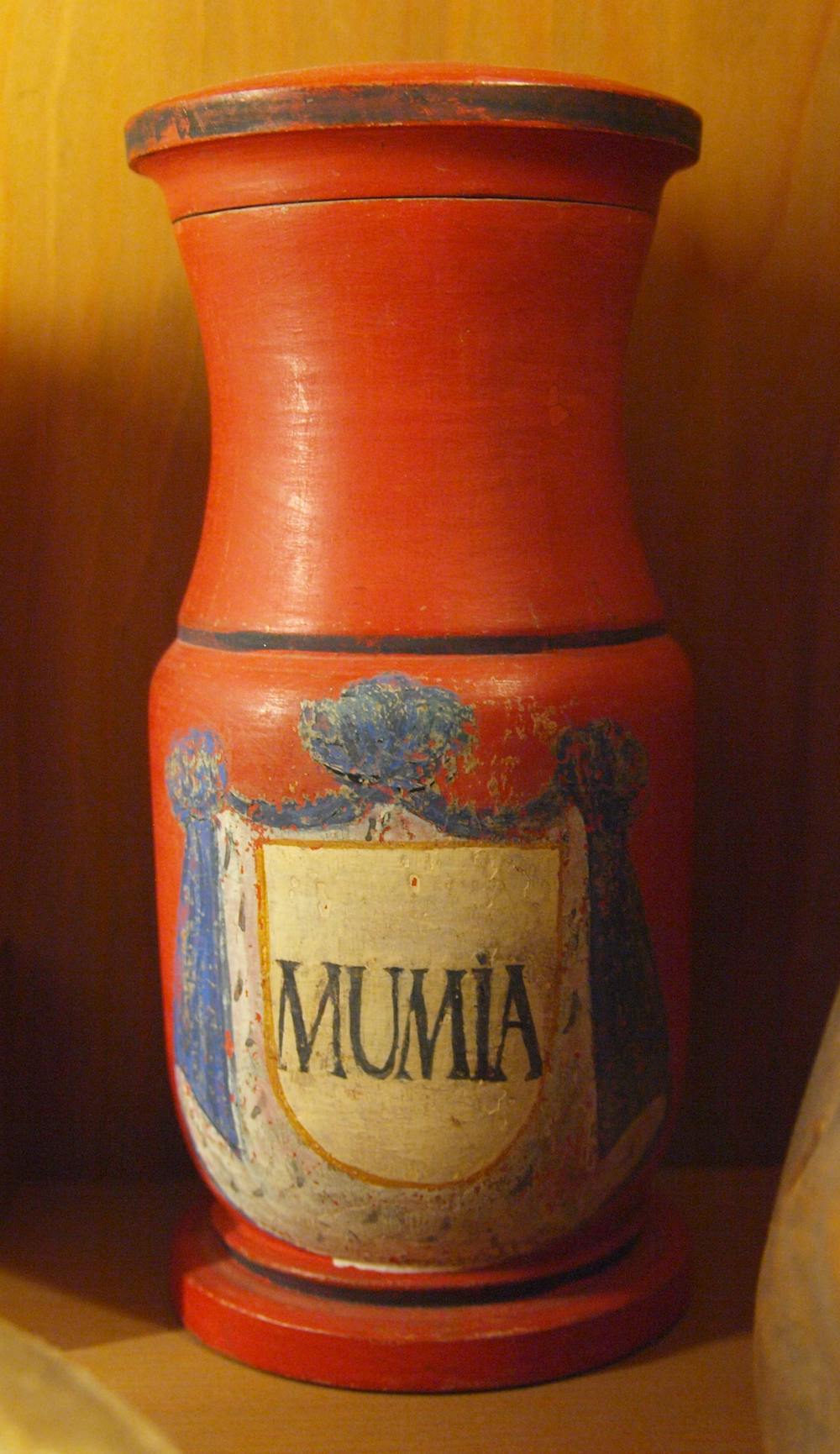
Mumia, the product created from mummified bodies, was a medicinal substance consumed for centuries by rich and poor, available in apothecaries’ shops, and created from the remains of mummies brought from Egyptian tombs back to Europe.
By the 12th century apothecaries were using ground up mummies for their otherworldly medicinal properties. Mummies were a prescribed medicine for the next 500 years.
A jar used for storing mumia, a medicine made from the ground up remains of mummified humans. Wikimedia Commons, CC BY
In a world without antibiotics, physicians prescribed ground up skulls, bones and flesh to treat illnesses from headaches to reducing swelling or curing the plague.
Not everyone was convinced. Guy de la Fontaine, a royal doctor, doubted mumia was a useful medicine and saw forged mummies made from dead peasants in Alexandria in 1564. He realised people could be conned. They were not always consuming genuine ancient mummies.
But the forgeries illustrate an important point: there was constant demand for dead flesh to be used in medicine and the supply of real Egyptian mummies could not meet this.
Not all doctors thought dry, old mummies made the best medicine. Some doctors believed that fresh meat and blood had a vitality the long-dead lacked.
The claim that fresh was best convinced even the noblest of nobles. England’s King Charles II took medication made from human skulls after suffering a seizure, and, until 1909, physicians commonly used human skulls to treat neurological conditions.
For the royal and social elite, eating mummies seemed a royally appropriate medicine , as doctors claimed mumia was made from pharaohs. Royalty ate royalty.
Dinner, drinks, and a show
By the 19th century, people were no longer consuming mummies to cure illness but Victorians were hosting “unwrapping parties” where Egyptian corpses would be unwrapped for entertainment at private parties.
An Egyptian street mummy seller in 1875. Félix Bonfils/ Wikimedia
Victorians held private parties dedicated to unwrapping the remains of ancient Egyptian mummies.
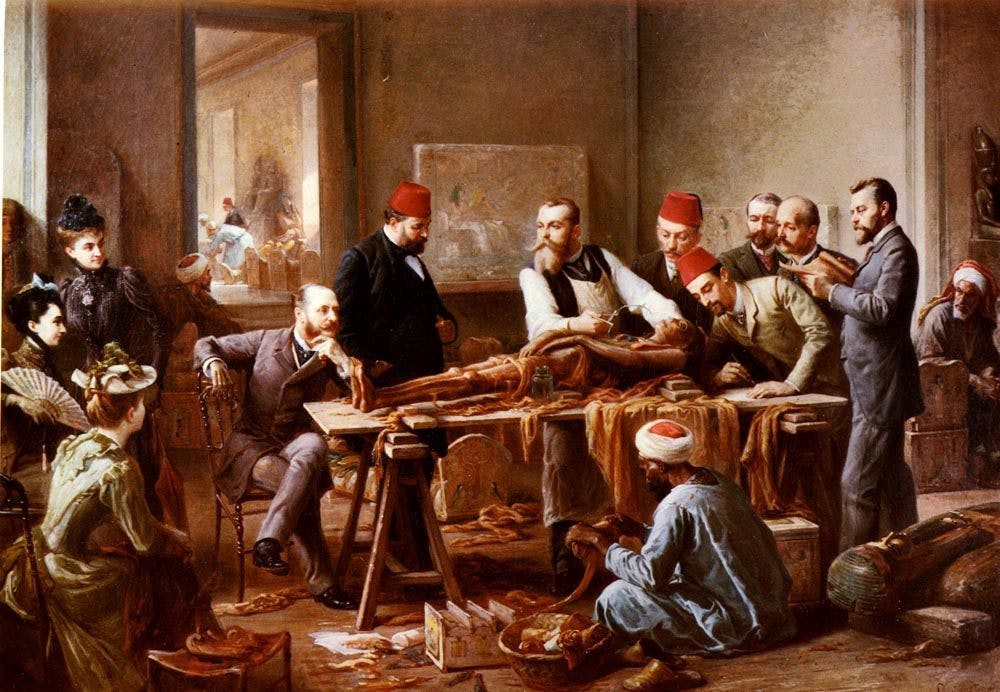
Early unwrapping events had at least a veneer of medical respectability. In 1834 the surgeon Thomas Pettigrew unwrapped a mummy at the Royal College of Surgeons. In his time, autopsies and operations took place in public and this unwrapping was just another public medical event.
Soon, even the pretence of medical research was lost. By now mummies were no longer medicinal but thrilling. A dinner host who could entertain an audience while unwrapping was rich enough to own an actual mummy.
The thrill of seeing dried flesh and bones appearing as bandages came off meant people flocked to these unwrappings, whether in a private home or the theatre of a learned society. Strong drink meantaudiences were loud and appreciative.
Examination of a Mummy by Paul Dominique Philippoteaux c 1891. Wikimedia
The mummy’s curse
Mummy unwrapping parties ended as the 20th century began. The macabre thrills seemed in bad taste and the inevitable destruction of archaeological remains seemed regrettable.
Then the discovery of Tutankhamen’s tomb fuelled a craze that shaped art deco design in everything from the motifs of doors in the Chrysler Building to the shape of clocks designed by Cartier. The sudden death in 1923 of Lord Carnarvon, sponsor of the Tutankhamen expedition, was from natural causes but soon attributed to a new superstition – “the mummy’s curse”.
Howard Carter opens the innermost shrine of King Tutankhamen’s tomb. The New York Times photo archive/ Wikimedia
Modern mummies
In 2016 Egyptologist John J. Johnston hosted the first public unwrapping of a mummy since 1908. Part art, part science, and part show, Johnston created a an immersive recreation of what it was like to be present at a Victorian unwrapping.
It was as tasteless as possible, with everything from the Bangles’ Walk Like an Egyptian playing on loud speaker to the plying of attendees with straight gin.
The mummy was only an actor wrapped in bandages but the event was a heady sensory mix. The fact it took place at St Bart’s Hospital in London was a modern reminder that mummies cross many realms of experience from the medical to the macabre.
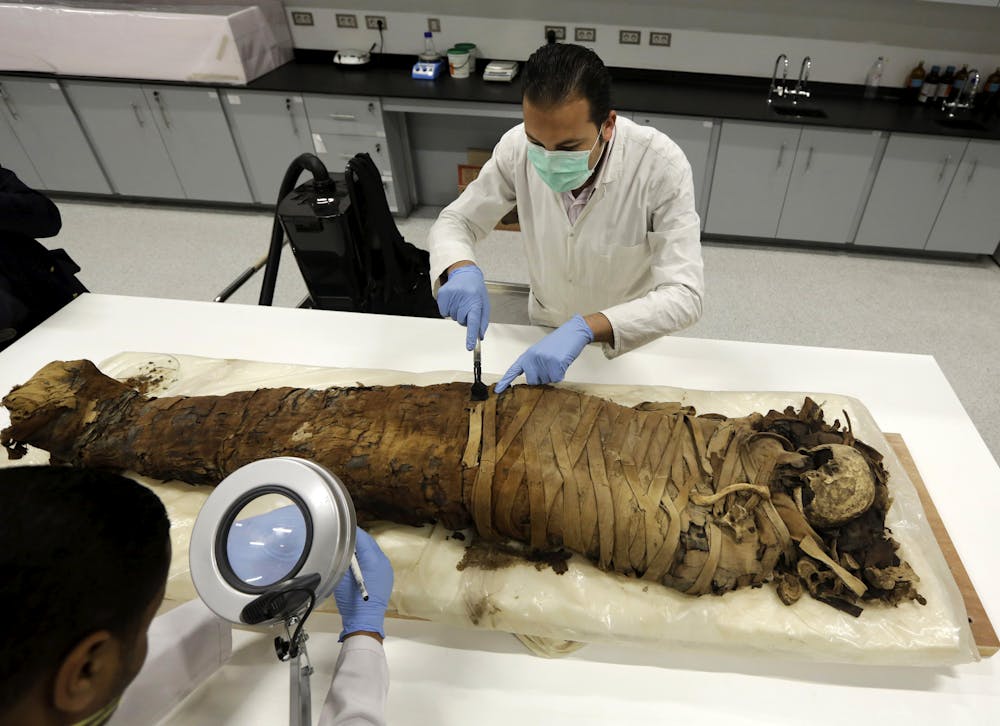
Egyptian conservators clean a female mummy dated to Pharaonic late period, (712-323 BC), in the conservation centre of Egypt’s Grand Museum. Amr Nabil/AP
Today, the black market of antiquity smuggling – including mummies – is worth about US$3 billion.
No serious archaeologist would unwrap a mummy and no physician suggest eating one. But the lure of the mummy remains strong. They are still for sale, still exploited, and still a commodity.
Marcus Harmes does not work for, consult, own shares in or receive funding from any company or organisation that would benefit from this article, and has disclosed no relevant affiliations beyond their academic appointment.
One of the rare complications of COVID in children is an inflammatory illness called paediatric inflammatory multisystem syndrome (PIMS-TS) that occurs in the weeks following the time of infection with SARS-CoV-2 (the virus that causes the disease). It’s also been called multisystem inflammatory syndrome in children (MIS-C).
Two years on from the first reported cases of this complication, about 120 children have been diagnosed with it in Australia. Paediatric inflammatory multisystem syndrome is being actively monitored by a paediatric hospital surveillance system in Australia, called PAEDS, that includes eight children’s hospitals.
PAEDS has estimated the syndrome affects roughly one in every 2,500 children who are infected with COVID. However, the rate may be lower following infection with the Delta or Omicron variant compared to the original strain.
What it looks like in kids
For most children, COVID infection is mild – even more so for the Omicron variant. It is very unlikely a child will need to be hospitalised due to infection.
However, a small number of children experience an inflammatory illness that usually begins within the first six weeks after COVID infection. We are not sure why, but the body “turns on” an inflammatory response and this inflammation occurs in several different parts (systems) of the body at once: the skin and eyes, gastro-intestinal tract, heart, lungs, kidneys, brain. These children nearly always require hospitalisation.
The inflammation can cause a variety of symptoms and often several signs are seen at the same time. These include:
fever – usually for more than three days
vomiting
diarrhoea
abdominal pain
headaches
conjunctivitis – red, watery eyes
rashes
lymphadenopathy – swollen lymph glands in the neck or other sites around the body
sore throat
cough.
The symptoms resemble another inflammatory condition in children called Kawasaki disease, to which multisystem inflammatory syndrome was compared early on. Unlike Kawasaki disease, which most often occurs in infants, this condition happens most often in school-aged children, involves gatrointestinal symptoms and shows slightly different changes on blood tests.
These symptoms might be seen in other illnesses too – so it’s important parents and doctors recognise when to seek specialist care.
Sore, red eyes can be a symptom of multisystem inflammatory syndrome in children. Shutterstock
If your child has a fever lasting more than three days in the two to six weeks after a COVID infection, especially if they also have a red eyes, rash and abdominal pain, it is possible the symptoms may be due to multisystem inflammatory syndrome.
In this situation, it is important to seek medical care for your child to understand what may be causing the symptoms. These symptoms can also be caused by other viruses or bacterial infections.
Blood tests will usually need to be done to look for markers of inflammation such as C-reactive protein. Blood tests also pick up changes in the blood cell counts (including low platelets and white cell counts) and mild increases in liver enzyme levels that all indicate inflammation. Doctors will also be watchful because inflamed blood can be more prone to form clots, seen in some cases.
Most children under investigation will also have a heart ultrasound to assess how well the heart is functioning and to look for a complication where there are changes (dilation) in the arteries of the heart. Changes in heart arteries occur in 8-24% of multisystem inflammatory syndrome cases.
As yet, we don’t know what predisposes some children to develop the condition following COVID infection. So we can’t predict which children might be at heightened risk.
Parents should watch for prolonged fever in kids who’ve recently had COVID. Unsplash, CC BY
Multisystem inflammatory sydrome can make children very unwell, and children with it will need to be cared for in hospital. The good news is we have anti-inflammatory treatments that are very effective in treating children with these symptoms. Doctors across Australia have been sharing their experiences and expertise in caring for children with the condition.
Children are treated with medications often used to treat Kawasaki disease, including steroids and intravenous immunoglobulin. These medications reduce the body’s excessive immune response, lowering fever and inflammation and allowing heart function to return to normal.
It’s also reassuring that almost all children will recover without complications – even if they are very unwell initially.
If your child has been diagnosed with multisystem inflammatory syndrome, you should wait until they have fully recovered, then discuss with your doctor whether to proceed with COVID vaccination if they have not already been vaccinated. Researchers are still investigating the risk of vaccination triggering another inflammatory event.
Preliminary data from the US Centers for Disease Control indicates two doses of the Pfizer COVID vaccine can protect children against developing multisystem inflammatory syndrome after COVID infection (roughly 80% protective in children aged 5-11 years and about 90% protective in adolescents 12-18 years old).
Paediatric inflammatory multisystem syndrome is a rare but potentially serious event following COVID infection. Doing our best to prevent infection through the use of vaccines and other public health measures remains vitally important to protect everyone in our society.
Nicholas Wood received funding from the NHMRC for a Career Development Fellowship. He holds a Churchill fellowship awarded in 2019.
Philip Britton receives funding from the National Health and Medical Research Council, the Medical Research Future Fund, the Royal Australasian College of Physicians and the Commonwealth Department of Health
Why did people think cannibalism was good for their health? The answer offers a glimpse into the zaniest crannies of European history, at a time when Europeans were obsessed with Egyptian mummies.
Driven first by the belief that ground-up and tinctured human remains could cure anything from bubonic plague to a headache, and then by the macabre ideas Victorian people had about after-dinner entertainment, the bandaged corpses of ancient Egyptians were the subject of fascination from the Middle Ages to the 19th century.
Mummy mania
Faith that mummies could cure illness drove people for centuries to ingest something that tasted awful.
Mumia, the product created from mummified bodies, was a medicinal substance consumed for centuries by rich and poor, available in apothecaries’ shops, and created from the remains of mummies brought from Egyptian tombs back to Europe.
By the 12th century apothecaries were using ground up mummies for their otherworldly medicinal properties. Mummies were a prescribed medicine for the next 500 years.
A jar used for storing mumia, a medicine made from the ground up remains of mummified humans. Wikimedia Commons, CC BY
In a world without antibiotics, physicians prescribed ground up skulls, bones and flesh to treat illnesses from headaches to reducing swelling or curing the plague.
Not everyone was convinced. Guy de la Fontaine, a royal doctor, doubted mumia was a useful medicine and saw forged mummies made from dead peasants in Alexandria in 1564. He realised people could be conned. They were not always consuming genuine ancient mummies.
But the forgeries illustrate an important point: there was constant demand for dead flesh to be used in medicine and the supply of real Egyptian mummies could not meet this.
Not all doctors thought dry, old mummies made the best medicine. Some doctors believed that fresh meat and blood had a vitality the long-dead lacked.
The claim that fresh was best convinced even the noblest of nobles. England’s King Charles II took medication made from human skulls after suffering a seizure, and, until 1909, physicians commonly used human skulls to treat neurological conditions.
For the royal and social elite, eating mummies seemed a royally appropriate medicine , as doctors claimed mumia was made from pharaohs. Royalty ate royalty.
Dinner, drinks, and a show
By the 19th century, people were no longer consuming mummies to cure illness but Victorians were hosting “unwrapping parties” where Egyptian corpses would be unwrapped for entertainment at private parties.
An Egyptian street mummy seller in 1875. Félix Bonfils/ Wikimedia
Victorians held private parties dedicated to unwrapping the remains of ancient Egyptian mummies.
Early unwrapping events had at least a veneer of medical respectability. In 1834 the surgeon Thomas Pettigrew unwrapped a mummy at the Royal College of Surgeons. In his time, autopsies and operations took place in public and this unwrapping was just another public medical event.
Soon, even the pretence of medical research was lost. By now mummies were no longer medicinal but thrilling. A dinner host who could entertain an audience while unwrapping was rich enough to own an actual mummy.
The thrill of seeing dried flesh and bones appearing as bandages came off meant people flocked to these unwrappings, whether in a private home or the theatre of a learned society. Strong drink meantaudiences were loud and appreciative.
Examination of a Mummy by Paul Dominique Philippoteaux c 1891. Wikimedia
The mummy’s curse
Mummy unwrapping parties ended as the 20th century began. The macabre thrills seemed in bad taste and the inevitable destruction of archaeological remains seemed regrettable.
Then the discovery of Tutankhamen’s tomb fuelled a craze that shaped art deco design in everything from the motifs of doors in the Chrysler Building to the shape of clocks designed by Cartier. The sudden death in 1923 of Lord Carnarvon, sponsor of the Tutankhamen expedition, was from natural causes but soon attributed to a new superstition – “the mummy’s curse”.
Howard Carter opens the innermost shrine of King Tutankhamen’s tomb. The New York Times photo archive/ Wikimedia
Modern mummies
In 2016 Egyptologist John J. Johnston hosted the first public unwrapping of a mummy since 1908. Part art, part science, and part show, Johnston created a an immersive recreation of what it was like to be present at a Victorian unwrapping.
It was as tasteless as possible, with everything from the Bangles’ Walk Like an Egyptian playing on loud speaker to the plying of attendees with straight gin.
The mummy was only an actor wrapped in bandages but the event was a heady sensory mix. The fact it took place at St Bart’s Hospital in London was a modern reminder that mummies cross many realms of experience from the medical to the macabre.
Egyptian conservators clean a female mummy dated to Pharaonic late period, (712-323 BC), in the conservation centre of Egypt’s Grand Museum. Amr Nabil/AP
Today, the black market of antiquity smuggling – including mummies – is worth about US$3 billion.
No serious archaeologist would unwrap a mummy and no physician suggest eating one. But the lure of the mummy remains strong. They are still for sale, still exploited, and still a commodity.
Marcus Harmes does not work for, consult, own shares in or receive funding from any company or organisation that would benefit from this article, and has disclosed no relevant affiliations beyond their academic appointment.
to ensure that inflation in Australia returns to the target over time
Some increase in interest rates is justified simply because with higher inflation, real interest rates are now negative. But the idea of returning to the old target range does not stand up to scrutiny.
Once the current spike in inflation is over, we need to reconsider both the target range and the whole idea of inflation targeting.
How much inflation are we aiming for now?
The Reserve Bank’s inflation target is consumer price inflation of 2-3%, on average, over time.
Yet for most of the past ten years that target has been missed, on the downside, as you can see below.
But, just recently, consumer price inflation has jumped to 5.1%, and the so-called “trimmed mean” measure of underlying inflation watched closely by the bank has jumped to 3.7%.
Recent inflation is partly a sign of success
While too much inflation can be a problem, it is important to remember that the jump is partly an unintended consequence of success.
Massive public spending offset the impact of COVID and lockdowns on household outcome, and set the stage for a rapid economic recovery.
This spending was necessary, but inevitably went to businesses that didn’t need it.
Further, the success of working from home meant many households suffered no reduction in income and were freed of the need to spend as much on travel and clothes, and things such as makeup that go with travelling to work.
As restrictions have eased, households and businesses have been keen to spend some of their accumulated savings, at a time when goods production has been disrupted, especially by the anti-COVID measures in China.
The result has been classic inflation of the kind where “too much money chases too few goods”.
It is very different from Australia’s last major episode of inflation, in the 1960s and 1970s, which was commonly seen as a “wage-price spiral” or “cost-push inflation”.
This isn’t wage-driven inflation
Cost-push inflation was generally seen as arising when powerful unions demanded large wage rises, which were passed on to consumers by corporations with monopoly power.
In the current environment, while monopoly power is still a problem, unions are a shadow of their former selves, with little power to extract out-sized increases.
The result is that wages, as measured by the Bureau of Statistics wage price index, grew by only 2.4% in the year to March, well behind inflation of 5.1%.
This has continued a long downward trend in the wage share of national income.
Despite the obvious absence of wage-push, many commentators are still working on the wage-price spiral model, and arguing against allowing wages to rise in line with inflation.
Such a policy would not only be unfair, it would be economically disastrous – similar to the austerity policies introduced in many countries in the wake of the global financial crisis, and earlier, when Britain returned to the gold standard in the wake of World War I, helping precipitate and deepen the great depression.
In the current context, real wage cuts brought about by less than full compensation for inflation would lead workers to quit and seek new jobs, worsening labour shortages.
It is striking that many of the same employer representatives who are saying wage increases are unaffordable are also complaining it’s hard to find workers.
The correct response to the huge expansion in the amount of money in the economy during the crisis is to accept a once-off increase in prices and wages, as well as incomes indexed to wages and prices, such as pensions.
For now, prices should flow through into wages
This would share the real costs of the pandemic spending more evenly across the community than if wage-earners were expected to bear the burden.
Later, we can return to the use of monetary policy, based on adjustments in the Reserve Bank cash rate, to maintain inflation at an acceptable level. But what should that level be?
For the past 30 years or so, the RBA has targeted an inflation rate of 2-3%, but the rationale for a rate that low was always weak, and has since broken down.
In the 1990s, the main argument for a low target rate of inflation was the need to break expectations created by decades of high inflation.
By contrast, the current inflationary episode is more like the brief inflationary bursts of the 1950s, which vanished once the drivers of inflation were removed.
Even during the heyday of inflation targeting, critics argued that low inflation in goods and services prices contributed to asset price instability, potentially giving rise to financial crises.
Many, including myself, have long preferred an inflation target of 4%. Now there’s a new argument for it.
In time, we will need a new target
A central concept in monetary policy is the neutral real rate of interest: that is, the interest rate adjusted for inflation at which monetary policy is neither expansionary nor contractionary.
Over the past twenty years the neutral real rate is believed to have fallen to close to zero, or possibly even less, meaning that if inflation is 2-3%, the neutral actual rate should be 2-3%.
But the nail is hard to hit. Actual rates of interest set by central banks tend to vary around the neutral rate, by as much as three percentage points either way.
This raises the prospect of the target cash rate going negative, and interest rates can’t usually go far below zero. We’ve seen this “zero lower bound” operating in Australia and elsewhere for years now.
So, if we are to continue with inflation targeting, and get it right, it will be necessary to raise the 2-3% inflation target.
Given the obvious political difficulties of doing this, it may be better to abandon inflation targeting altogether, as suggested for some time by myself and economists backed by former Senator Nick Zenophon.
It’s one of a number of ideas likely to be put to the independent review of the Reserve Bank promised by Treasurer Jim Chalmers during the election.
John Quiggin does not work for, consult, own shares in or receive funding from any company or organisation that would benefit from this article, and has disclosed no relevant affiliations beyond their academic appointment.
Migrants and overseas Filipinos in Aotearoa New Zealand today called on the governments of both Australia and New Zealand to halt all military and security aid to the Philippines in protest over last month’s “fraudulent” general election.
At simultaneous meetings in Auckland and Wellington, a new broad coalition of social justice and community campaigners endorsed a statement pledging: “Never forget, never again martial law!”
“Bongbong” Marcos Jr, the son of the late dictator Ferdinand Marcos Sr, was elected President in a landslide ballot on May 9 and will take office at the end of this month.
Philippine President-elect Bongbong Marcos Jr wooing voters at a campaign rally in Borongan, Eastern Samar. Image: Rappler/Bongbong FB
His father ruled the Philippines with draconian leadership — including 14 years of martial law — between 1965 and 1986 until he was ousted by a People Power uprising.
Marcos Jr – along with his mother Imelda – has long tried to thwart efforts to recover billions of dollars plundered during his father’s autocratic rule.
“Police and military forces should be investigated for their participation in red-tagging, illegal arrests on trumped up charges, extrajudicial killings, and all forms of human rights abuses,” the statement said.
“We call on the International Criminal Court to pursue investigation and trial of outgoing President Rodrigo Duterte for massive human rights breaches in its drug war and systematic attacks against political activists, human rights advocates and anti-corruption crusaders.”
Call for ‘transparent government’ The statement called for “transparent government” and for all public funds to be accounted for.
“We specifically call for realignment of the national budget in favour of covid aid, public health and social services instead of wasting billions for the National Task Force to End Local Communist Armed Conflict (NTF-ELCAC) and other government machineries that aim to suppress critics of its corruption and human rights abuses.”
The statement urged the “dismantling” of NTF-ELCAC.
Philippines Senate candidate Luke Espiritu … technology advances mean martial law by stealth. Image: David Robie/APR
The Supreme Court of the Philippines was called on to “act on the petitions lodged by various persons and groups regarding the disqualification of Ferdinand Marcos Jr to run for office due to his conviction” for tax evasion.
The statement called on the Department of Justice and Supreme Court to provide for immediate and unconditional release of the unjustly jailed Senator Leila de Lima — an outspoken critic of Duterte — “following the recantation of the testimonies of three key witnesses”, and also freedom for more than 700 political prisoners “languishing in jail on trumped-up charges”.
The gathered Filipino community also sought an official Day of Remembrance and Tribute for all the victims of Marcos dictatorship to mark the 50th year commemoration of the declaration of martial law on 21 September 2022.
‘Truth army’ to monitor social media “We call on all Filipinos to remain vigilant as a truth army, to tirelessly monitor and report social media platforms in serious breach of community standards, and to push for stronger laws in place for disinformation to be punished,” the statement said.
Filipinos in the two cities — Auckland and Wellington — pledged support for the Angat Buhay cause of defending Philippines “history, truth and democracy”.
Outgoing Vice-President and unsuccessful presidential candidate Leni Robredo – the only woman to contest the president’s office last month – on screen at today’s Auckland meeting. Image: David Robie/APR
Speakers included Filipino trade unionist Dennis Maga; Mikee Santos of Migrante Aotearoa; an unsuccessful Filipino Labour candidate in the 2020 NZ elections, Romy Udanga; and speaking by Zoom from Manila, Senate candidate Luke Espiritu, who said the new Marcos regime would be able to achieve virtual “martial law” without declaring it.
“All Marcos needs to do is suppress dissent, and he has all the sophisticated technology available to do this that his father never had,” Espiritu said.
Northland Kakampink coordinator Faye Bañares said the new Angat Buhay NGO should not take over the responsibility of providing for the poor in the community, although the aim is to help them.
“The NGO should push the Philippine government to face their responsibility and be transparent about what they do,” she said.
Many speakers told how shocked they were in the general election over a “massive breakdown of vote counting machines and voter disenfranchisement” and the “incredibly rapid count of COMELEC transparency servers” to award the “unbelievable final tally” of 31 million votes in favour of Ferdinand Marcos Jr as president and Rodrigo Duterte’s daughter Sara as vice-president.
Social media troll farms Denouncing the social media troll farms, the meeting critics said “all the worst lies, disinformation and red-tagging were committed against [outgoing vice-president] Leni Robredo, opposition candidates and parties who stood up against [Rodrigo] Duterte and the Marcos-Duterte tandem.”
In November 2021, the Philippines and New Zealand agreed to boost maritime security cooperation during the 6th Philippines-New Zealand Foreign Ministry Consultations hosted by the Philippines.
Both sides acknowledged the growing breadth and depth of Philippines-New Zealand bilateral cooperation, particularly in the areas of defence and security, health, trade and investments, development cooperation, people-to-people and cultural engagements.
The Philippines “defending democracy” public meeting in Glenfield, Auckland, today. Image: David Robie/APRFilipinos in the Wellington meeting make their pledge simultaneously with the Auckland group for “history, truth and democracy” in the Philippines. Image: Del Abcede/APRNorthland Kakampink coordinator Fe Bañares speaking at the Auckland meeting. Image: Del Abcede/APR
Source: The Conversation (Au and NZ) – By Aaron J. Snoswell, Post-doctoral Research Fellow, Computational Law & AI Accountability, Queensland University of Technology
A new generation of artificial intelligence (AI) models can produce “creative” images on-demand based on a text prompt. The likes of Imagen, MidJourney, and DALL-E 2 are beginning to change the way creative content is made with implications for copyright and intellectual property.
While the output of these models is often striking, it’s hard to know exactly how they produce their results. Last week, researchers in the US made the intriguing claim that the DALL-E 2 model might have invented its own secret language to talk about objects.
By prompting DALL-E 2 to create images containing text captions, then feeding the resulting (gibberish) captions back into the system, the researchers concluded DALL-E 2 thinks Vicootes means “vegetables”, while Wa ch zod rea refers to “sea creatures that a whale might eat”.
These claims are fascinating, and if true, could have important security and interpretability implications for this kind of large AI model. So what exactly is going on?
Does DALL-E 2 have a secret language?
DALL-E 2 probably does not have a “secret language”. It might be more accurate to say it has its own vocabulary – but even then we can’t know for sure.
First of all, at this stage it’s very hard to verify any claims about DALL-E 2 and other large AI models, because only a handful of researchers and creative practitioners have access to them. Any images that are publicly shared (on Twitter for example) should be taken with a fairly large grain of salt, because they have been “cherry-picked” by a human from among many output images generated by the AI.
Even those with access can only use these models in limited ways. For example, DALL-E 2 users can generate or modify images, but can’t (yet) interact with the AI system more deeply, for instance by modifying the behind-the-scenes code. This means “explainable AI” methods for understanding how these systems work can’t be applied, and systematically investigating their behaviour is challenging.
What’s going on then?
One possibility is the “gibberish” phrases are related to words from non-English languages. For instance, Apoploe, which seems to create images of birds, is similar to the Latin Apodidae, which is the binomial name of a family of bird species.
This seems like a plausible explanation. For instance, DALL-E 2 was trained on a very wide variety of data scraped from the internet, which included many non-English words.
Similar things have happened before: large natural language AI models have coincidentally learned to write computer code without deliberate training.
Is it all about the tokens?
One point that supports this theory is the fact that AI language models don’t read text the way you and I do. Instead, they break input text up into “tokens” before processing it.
Different “tokenization” approaches have different results. Treating each word as a token seems like an intuitive approach, but causes trouble when identical tokens have different meanings (like how “match” means different things when you’re playing tennis and when you’re starting a fire).
On the other hand, treating each character as a token produces a smaller number of possible tokens, but each one conveys much less meaningful information.
DALL-E 2 (and other models) use an in-between approach called byte-pair encoding (BPE). Inspecting the BPE representations for some of the gibberish words suggests this could be an important factor in understanding the “secret language”.
Not the whole picture
The “secret language” could also just be an example of the “garbage in, garbage out” principle. DALL-E 2 can’t say “I don’t know what you’re talking about”, so it will always generate some kind of image from the given input text.
Either way, none of these options are complete explanations of what’s happening. For instance, removing individual characters from gibberish words appears to corrupt the generated images in very specific ways. And it seems individual gibberish words don’t necessarily combine to produce coherent compound images (as they would if there were really a secret “language” under the covers).
Why this is important
Beyond intellectual curiosity, you might be wondering if any of this is actually important.
The answer is yes. DALL-E’s “secret language” is an example of an “adversarial attack” against a machine learning system: a way to break the intended behaviour of the system by intentionally choosing inputs the AI doesn’t handle well.
One reason adversarial attacks are concerning is that they challenge our confidence in the model. If the AI interprets gibberish words in unintended ways, it might also interpret meaningful words in unintended ways.
Adversarial attacks also raise security concerns. DALL-E 2 filters input text to prevent users from generating harmful or abusive content, but a “secret language” of gibberish words might allow users to circumvent these filters.
Recent research has discovered adversarial “trigger phrases” for some language AI models – short nonsense phrases such as “zoning tapping fiennes” that can reliably trigger the models to spew out racist, harmful or biased content. This research is part of the ongoing effort to understand and control how complex deep learning systems learn from data.
Finally, phenomena like DALL-E 2’s “secret language” raise interpretability concerns. We want these models to behave as a human expects, but seeing structured output in response to gibberish confounds our expectations.
Shining a light on existing concerns
You may recall the hullabaloo in 2017 over some Facebook chat-bots that “invented their own language”. The present situation is similar in that the results are concerning – but not in the “Skynet is coming to take over the world” sense.
Instead, DALL-E 2’s “secret language” highlights existing concerns about the robustness, security, and interpretability of deep learning systems.
Until these systems are more widely available – and in particular, until users from a broader set of non-English cultural backgrounds can use them – we won’t be able to really know what is going on.
In the meantime, however, if you’d like to try generating some of your own AI images you can check out a freely available smaller model, DALL-E mini. Just be careful which words you use to prompt the model (English or gibberish – your call).
Aaron J. Snoswell does not work for, consult, own shares in or receive funding from any company or organisation that would benefit from this article, and has disclosed no relevant affiliations beyond their academic appointment.
Source: The Conversation (Au and NZ) – By Marlee Bower, Research Fellow, Matilda Centre for Research in Mental Health and Substance Use, University of Sydney
The new Labor government arrives at a time of mounting mental health strain: Australians have endured COVID, extreme weather events and financial stress from increased living costs.
The new government has a lot to fix in the mental health system but policy priorities should be guided by the voices of Australians.
To learn more about the nation’s priority mental health concerns, our new research surveyed more than 1,000 adults aged 18 to 85 across the nation.
Without being prompted, participants consistently highlighted three major issues: the mental health service system, financial stress, and social disconnection.
The COVID pandemic added pressure to an already strained mental health-care system. Countless Australians – many experiencing mental ill-health for the first time – were left without appropriate support.
Participants described overwhelming barriers to accessing treatment, including high costs, wait-lists and inaccessibility:
The out of pocket expense makes receiving regular, effective psychological treatment prohibitive, especially as a single parent.
– female, late 30s, NSW
When people are in crisis, they need the help at that time. Not six months down the track when an opening finally becomes available at the counselling centre.
– non-binary person, early 70s, Tasmania
Financial stress
Respondents shared how the pandemic “pressurised” other mental health triggers, like financial stress, as JobKeeper and the Coronavirus Supplement were wound back and cost of living increased.
A NSW woman in her late-20s living with a disability shared that prior to receiving the Coronavirus Supplement: “I felt it would be better to kill myself than try and make it work”, but with the supplement, “For the first time in years money wasn’t so tight.”
The removal of the supplement was described by another as:
crushing and damaging to your mental health
– female, late 20s, Tasmania
The low payment amount after the supplement was removed was not seen as “sufficient income to live a ‘reasonable life’”.
Cost of living pressures have had a significant impact on Australians’ mental health. Unsplash/Ümit Bulut
Together, the stress of low incomes and the return of demanding mutual obligation requirements for JobSeeker (the often-unrealistic set of job-related tasks which recipients must undertake to keep receiving payments) worsened some peoples’ mental health, making recovery difficult.
The social welfare system isn’t equipped to support those of us who struggle to work because of mental health issues. I cry every day at my full-time job and would like to focus on recovery, but the tiny rate of Centrelink payments means I keep struggling through
– female, early 30s, Victoria
With increasing living costs, a NSW man in his late 20s reported “stressing about having money to make ends meet […] the cost of food going up, and not having money to heat my home in winter”. He described making difficult financial decisions like choosing to “not eat” in favour of “making sure my dog is fed”.
Many spoke of financial stress in relation to housing as a key priority for their mental health, particularly “unaffordable housing prices” (female, early 30s, NSW) and “prohibitive rent” (female, late 60s, Victoria).
Social disconnection
Many described a lack of social and community connection as a mental health priority, perhaps unsurprising with COVID lockdowns and strict border controls.
Some felt this was linked to a lack of physical spaces for socialising:
We need facilities for people and communities to socialise in a healthy environment. Get rid of the poker machines and make pubs a place where people can openly socialise again
Others sensed a broader cultural shift away from valuing community:
We need supportive communities […] We are too ‘private’ don’t share our troubles, don’t ask for help
– female, late 40s, NSW
[S]ociety has become very individually focused and less about support
– male, late 40s, Victoria.
Building resilience
The voices of diverse Australians included in our study provide clear guidance for the government to build a more resilient and mentally healthy future.
Labor’s election promise to re-instate the telepsychiatry Medicare item in regional and rural areas is important, but the government must address other pressing service issues, including long wait-times and high costs.
The government also needs to address the causes of mental ill-health, such as financial insecurity and social disconnection.
While Labor has promised to tackle job security and housing affordability, it didn’t back an increase to income support benefits. This should be revisited.
In 2021, Labor committed to addressing loneliness and social isolation, although no related election promises were made. Doing so would require changes outside the “health” portfolio. We need a whole-of-government social and emotional well-being lens on all federal policies.
Finally, our study highlighted that drivers of poor mental health are further strained in disaster settings, such as pandemics or extreme weather events. As the Labor government develops its disaster readiness plan, mental health impacts – in addition to economic and infrastructure impacts – must be a key consideration.
If this article has raised issues for you, or if you’re concerned about someone you know, call Lifeline on 13 11 14.
The research outlined in this article was conducted with Australia’s Mental Health Think Tank. Marlee Bower is Academic Lead, Australia’s Mental Health Think Tank, which is funded philanthropically by the BHP Foundation. She is a board member of The Haymarket Foundation. This story is part of The Conversation’s Breaking the Cycle series, which is about escaping cycles of disadvantage. It is supported by a philanthropic grant from the Paul Ramsay Foundation.
Maree Teesson is Chair of Australia’s Mental Health Think Tank which is funded by the BHP Foundation. She is Director of The Matilda Centre, The University of Sydney. She is chair of the Million Minds Mission. She receives funding from the National Health and Medical Research Council, the Australian Government, BHP Foundation, Paul Ramsay Foundation and other research organisations. She is co-director of CLIMATESchools PTY LTD a company established in 2015 to distribute evidence resources to education organisations.
Scarlett Smout is a Research Program Officer for Australia’s Mental Health Think Tank. The Think Tank is funded philanthropically by the BHP Foundation. Scarlett receives a PhD Stipend from the Health4Life project at The Matilda Centre, funded philanthropically by the Paul Ramsay Foundation.
Amarina Donohoe-Bales is a research assistant for Australia’s Mental Health Think Tank. The Think Tank is funded philanthropically by the BHP Foundation.
Source: The Conversation (Au and NZ) – By Matthew England, Scientia Professor and Deputy Director of the ARC Australian Centre for Excellence in Antarctic Science (ACEAS), UNSW Sydney
Shutterstock
Climate change is slowing down the conveyor belt of ocean currents that brings warm water from the tropics up to the North Atlantic. Our research, published today in Nature Climate Change, looks at the profound consequences to global climate if this Atlantic conveyor collapses entirely.
We found the collapse of this system – called the Atlantic meridional overturning circulation – would shift the Earth’s climate to a more La Niña-like state. This would mean more flooding rains over eastern Australia and worse droughts and bushfire seasons over southwest United States.
East-coast Australians know what unrelenting La Niña feels like. Climate change has loaded our atmosphere with moister air, while two summers of La Niña warmed the ocean north of Australia. Both contributed to some of the wettest conditions ever experienced, with record-breaking floods in New South Wales and Queensland.
Earth’s climate is dynamic, variable, and ever-changing. But our current trajectory of unabated greenhouse gas emissions is giving the whole system a giant kick that’ll have uncertain consequences – consequences that’ll rewrite our textbook description of the planet’s ocean circulation and its impact.
What is the Atlantic overturning meridional circulation?
The Atlantic overturning circulation comprises a massive flow of warm tropical water to the North Atlantic that helps keep European climate mild, while allowing the tropics a chance to lose excess heat. An equivalent overturning of Antarctic waters can be found in the Southern Hemisphere.
Climate records reaching back 120,000 years reveal the Atlantic overturning circulation has switched off, or dramatically slowed, during ice ages. It switches on and placates European climate during so-called “interglacial periods”, when the Earth’s climate is warmer.
Since human civilisation began around 5,000 years ago, the Atlantic overturning has been relatively stable. But over the past few decades a slowdown has been detected, and this has scientists worried.
The main components of the Atlantic meridional overturning circulation. The northward flowing upper branch (red arrow) transports warm salty waters to the North Atlantic, and forms the North Atlantic Deep Waters (NADW) at high latitudes. The southward flowing NADW lies above the Antarctic Bottom Water (AABW). Stefano Crivellari, University of São Paulo/Research Gate
Why the slowdown? One unambiguous consequence of global warming is the melting of polar ice caps in Greenland and Antarctica. When these icecaps melt they dump massive amounts of freshwater into the oceans, making water more buoyant and reducing the sinking of dense water at high latitudes.
Around Greenland alone, a massive 5 trillion tonnes of ice has melted in the past 20 years. That’s equivalent to 10,000 Sydney Harbours worth of freshwater. This melt rate is set to increase over the coming decades if global warming continues unabated.
A collapse of the North Atlantic and Antarctic overturning circulations would profoundly alter the anatomy of the world’s oceans. It would make them fresher at depth, deplete them of oxygen, and starve the upper ocean of the upwelling of nutrients provided when deep waters resurface from the ocean abyss. The implications for marine ecosystems would be profound.
With Greenland ice melt already well underway, scientists estimate the Atlantic overturning is at its weakest for at least the last millennium, with predictions of a future collapse on the cards in coming centuries if greenhouse gas emissions go unchecked.
The ramifications of a slowdown
In our study, we used a comprehensive global model to examine what Earth’s climate would look like under such a collapse. We switched the Atlantic overturning off by applying a massive meltwater anomaly to the North Atlantic, and then compared this to an equivalent run with no meltwater applied.
Our focus was to look beyond the well-known regional impacts around Europe and North America, and to check how Earth’s climate would change in remote locations, as far south as Antarctica.
An Atlantic overturning shutdown would be felt as far south as Antarctica. Shutterstock
The first thing the model simulations revealed was that without the Atlantic overturning, a massive pile up of heat builds up just south of the Equator.
This excess of tropical Atlantic heat pushes more warm moist air into the upper troposphere (around 10 kilometres into the atmosphere), causing dry air to descend over the east Pacific.
The descending air then strengthens trade winds, which pushes warm water towards the Indonesian seas. And this helps put the tropical Pacific into a La Niña-like state.
Australians may think of La Niña summers as cool and wet. But under the long-term warming trend of climate change, their worst impacts will be flooding rain, especially over the east.
We also show an Atlantic overturning shutdown would be felt as far south as Antarctica. Rising warm air over the West Pacific would trigger wind changes that propagate south to Antarctica. This would deepen the atmospheric low pressure system over the Amundsen Sea, which sits off west Antarctica.
This low pressure system is known to influence ice sheet and ice shelf melt, as well as ocean circulation and sea-ice extent as far west as the Ross Sea.
A new world order
At no time in Earth’s history, giant meteorites and super-volcanos aside, has our climate system been jolted by changes in atmospheric gas composition like what we are imposing today by our unabated burning of fossil fuels.
The oceans are the flywheel of Earth’s climate, slowing the pace of change by absorbing heat and carbon in vast quantities. But there is payback, with sea level rise, ice melt, and a significant slowdown of the Atlantic overturning circulation projected for this century.
Now we know this slowdown will not just affect the North Atlantic region, but as far away as Australia and Antarctica.
We can prevent these changes from happening by growing a new low-carbon economy. Doing so will change, for the second time in less than a century, the course of Earth’s climate history – this time for the better.
Matthew England receives funding from the Australian Research Council. Matthew is a Chief Investigator and Deputy Director of the ARC Centre for Excellence in Antarctic Science.
Andréa S. Taschetto receives funding from the Australian Research Council. Andréa is a Chief Investigator of the ARC Centre of Excellence for Climate Extremes and is affiliated with the Australian Government’s National Environmental Science Program.
Bryam Orihuela-Pinto received a scholarship from the University of New South Wales.
As universities engage in the current round of enterprise bargaining, it is timely to remember the importance of joy at work. It seems everywhere you turn workers are walking away from their jobs. Industries like hospitality and health have been hit particularly hard. But no sector is exempt, including higher education.
What’s causing staff turnover? Long hours, low pay, negative workplace cultures, job insecurity, lack of recognition, no work-life balance and the impacts of COVID are all leading people to reassess their lives.
The harsh and unrelenting demands on employees have stripped away joy at work. This is also true for academics. As one told us:
“It’s becoming more and more difficult to feel joyful in this workplace.”
What do academics say about their work?
We interviewed 35 academic staff across the five Western Australia universities for a research project. We wanted to know how they experienced working in a university during pandemic lockdowns and their aftermath – a time of crisis, change and complexity.
Our participants represented a broad range of disciplines and levels of academic leadership. They discussed the work environment, university management during the pandemic, the challenges they and colleagues encountered, and how they coped.
Participants described their universities as being exploitative, oppressive, toxic and fiscally driven. They felt themselves being dehumanised and demoralised by management. Most reported experiencing feelings associated with burnout, including anxiety, cynicism, depression and exhaustion.
One academic observed:
“Colleagues are tired. They are burnt-out. That’s my observation. There’s a lot of burnout. But they’re still going.”
So what gives them joy?
Joy at work is linked with employee well-being and good mental health, and is often used as a proxy for employee engagement. We asked: “What brings you joy at work?”
Some find little joy at work. The “craziness of university decisions and processes”, “the absurdity”, the conflicting demands and constant institutional change have led to them losing interest, spirit and hope.
However, most participants said “my students”, “my teaching”, “my research” and “my colleagues” give them joy.
The joy-student dynamic is about a sense of purpose associated with seeing students learn, grow and succeed. It’s building the future in a deeply personal and gratifying way. One participant explained:
“I said to my colleagues, I feel like I got my soul back because I had that exposure to the students again.”
Our participants expressed the joy-teaching dynamic through the emphatic words of love: “I love teaching!” It’s knowing and being known by your students. It’s connection. It’s the feeling of knowing you are making a difference. Participants described this experience as “nourishing”, “rewarding” and “sustaining”.
The joy of teaching is real, but it’s being sapped by all the other demands on academics’ time and energy. Shutterstock
The joy-research dynamic is expressed through the language of “passion”. It is the joy of exploration, discovery and dissemination. It’s the “agency” and satisfaction of developing research and seeing it make a difference. It’s the relationships built with doctoral students and seeing them succeed.
“My research focuses on consumer neuroscience. That’s my passion. The joy of it is we’re actually developing new research and supervising students.”
Participants expressed the joy-colleague dynamic through words of belonging – collegiality, solidarity and unity.
“We cry together, we laugh together, we support and motivate each other.”
Why is the joy of work being lost?
All of these joys, not just one or two, have become areas of diminishing returns. Academics are working at optimum capacity but unhappily so.
University responses to COVID have compounded their transformation by the ideologies, policies and practices of neoliberalism, economic rationalisation and managerialism over the past two decades. Academics reported feeling alienated, disenfranchised and exploited.
The pivot to online learning, bigger classes and increased workload demands have decreased academics’ opportunities to build connections and deliver quality in the education they provide. Research workload allocations are being cut, yet research productivity expectations have increased. Job-shedding, centralisation of services and organisational restructuring add to the burden on academics, increasing the psychological demands on them.
Due to greater demands on their personal resources, most participants reported they have less time to connect with colleagues and family. But they also felt increasingly disconnected from their university. The majority said they were looking to exit the sector or wanted to leave.
“Everybody’s in the same boat. Everybody’s feeling extremely anxious, very unhappy, demoralised, stressed out. Many people are at breaking point. I don’t think many people can take much more of this. So people will, if they can, leave the profession. People with options of getting other jobs or retiring early will do so.”
Academic staff are burnt-out. They are stoic, resilient and hopeful, but the things in their work that give them joy are ever-diminishing.
Our research highlights the toll on academics as they struggle to meet the increased demands and expectations imposed on them. The university structures and services that support them are being stripped away and the activities they find joy in eroded.
To manage, many sacrifice their work-life balance, withdraw or isolate themselves. They invest less in their students, teaching and/or research. This causes them to feel they must compromise on their personal and professional standards and values.
It doesn’t have to be this way
The antithesis to burnout is engagement – joy at work. Successful organisations navigate a similarly competitive landscape, but their employees feel valued and the workplace culture is positive. If universities follow these examples, their employees will stay, productivity will be high and the great resignation avoided.
The challenge for Australian universities in this post-COVID round of enterprise bargaining is to ensure their staff can still experience joy in their work. That will assure a sustainable legacy for those who follow.
The authors would like to acknowledge the contribution of the two other members of our research team: Professor John Williams, Director, Graduate Research, Curtin School of Education, and Associate Professor Scott Fitzgerald, Curtin Business School.
The authors do not work for, consult, own shares in or receive funding from any company or organisation that would benefit from this article, and have disclosed no relevant affiliations beyond their academic appointment.
to ensure that inflation in Australia returns to the target over time
Some increase in interest rates is justified simply because with higher inflation, real interest rates are now negative. But the idea of returning to the old target range does not stand up to scrutiny.
Once the current spike in inflation is over, we need to reconsider both the target range and the whole idea of inflation targeting.
How much inflation are we aiming for now?
The Reserve Bank’s inflation target is consumer price inflation of 2-3%, on average, over time.
Yet for most of the past ten years that target has been missed, on the downside, as you can see below.
But, just recently, consumer price inflation has jumped to 5.1%, and the so-called “trimmed mean” measure of underlying inflation watched closely by the bank has jumped to 3.7%.
Recent inflation is partly a sign of success
While too much inflation can be a problem, it is important to remember that the jump is partly an unintended consequence of success. Massive public spending offset the impact of COVID and lockdowns on household outcome, and set the stage for a rapid economic recovery.
This spending was necessary, but inevitably went to businesses that didn’t need it.
Further, the success of working from home meant many households suffered no reduction in income and were freed of the need to spend as much on travel and clothes, and things such as make-up that go with travelling to work.
As restrictions have eased, households and businesses have been keen to spend some of their accumulated savings, at a time when goods production has been disrupted, especially by the anti-COVID measures in China.
The result has been classic inflation of the kind where “too much money chases too few goods”.
It is very different from Australia’s last major episode of inflation, in the 1960s and 1970s, which was commonly seen as a “wage-price spiral” or “cost-push inflation”.
This isn’t wage-driven inflation
Cost-push inflation was generally seen as arising when powerful unions demanded large wage rises, which were passed on to consumers by corporations with monopoly power.
In the current environment, while monopoly power is still a problem, unions are a shadow of their former selves, with little power to extract out-sized increases.
The result is that wages, as measured by the Bureau of Statistics wage price index, grew by only 2.4% in the year to March, well behind inflation of 5.1%.
This has continued a long downward trend in the wage share of national income.
Despite the obvious absence of wage-push, many commentators are still working on the wage-price spiral model, and arguing against allowing wages to rise in line with inflation.
Such a policy would not only be unfair, it would be economically disastrous – similar to the austerity policies introduced in many countries in the wake of the global financial crisis, and earlier, when Britain returned to the gold standard in the wake of World War I, helping precipitate and deepen the great depression.
In the current context, real wage cuts brought about by less than full compensation for inflation would lead workers to quit and seek new jobs, worsening labour shortages.
It is striking that many of the same employer representatives who are saying wage increases are unaffordable are also complaining it’s hard to find workers.
The correct response to the huge expansion in the amount of money in the economy during the crisis is to accept a once-off increase in prices and wages, as well as incomes indexed to wages and prices, such as pensions.
For now, prices should flow through into wages
This would share the real costs of the pandemic spending more evenly across the community than if wage-earners were expected to bear the burden.
Later, we can return to the use of monetary policy, based on adjustments in the Reserve Bank cash rate, to maintain inflation at an acceptable level. But what should that level be?
For the past 30 years or so, the RBA has targeted an inflation rate of 2-3%, but the rationale for a rate that low was always weak, and has since broken down.
In the 1990s, the main argument for a low target rate of inflation was the need to break expectations created by decades of high inflation.
By contrast, the current inflationary episode is more like the brief inflationary bursts of the 1950s, which vanished once the drivers of inflation were removed.
Even during the heyday of inflation targeting, critics argued that low inflation in goods and services prices contributed to asset price instability, potentially giving rise to financial crises.
Many, including myself, have long preferred an inflation target of 4%. Now there’s a new argument for it.
In time, we will need a new target
A central concept in monetary policy is the neutral real rate of interest: that is, the interest rate adjusted for inflation at which monetary policy is neither expansionary nor contractionary.
Over the past twenty years the neutral real rate is believed to have fallen to close to zero, or possibly even less, meaning that if inflation is 2-3%, the neutral actual rate should be 2-3%.
But the nail is hard to hit. Actual rates of interest set by central banks tend to vary around the neutral rate, by as much as three percentage points either way.
This raises the prospect of the target cash rate going negative, and interest rates can’t usually go far below zero. We’ve seen this “zero lower bound” operating in Australia and elsewhere for years now.
So, if we are to continue with inflation targeting, and get it right, it will be necessary to raise the 2-3% inflation target.
Given the obvious political difficulties of doing this, it may be better to abandon inflation targeting altogether, as suggested for some time by myself and economists backed by former Senator Nick Zenophon.
It’s one of a number of ideas likely to be put to the independent review of the Reserve Bank promised by Treasurer Jim Chalmers during the election.
John Quiggin does not work for, consult, own shares in or receive funding from any company or organisation that would benefit from this article, and has disclosed no relevant affiliations beyond their academic appointment.
How does an image become an icon? It is estimated that we now produce more images in two minutes than we did in the entire 19th century. How, then, can one image be so powerful it can symbolise the horror of war and help mobilise anti-war sentiment?
June 8 marks the 50 year anniversary since Associated Press photographer Hyung Cong “Nick” Út captured one of the Vietnam War’s defining images.
Titled “Accidental Napalm”, the black-and-white still photograph has since been repeatedly reproduced and continues to survive in collective memory.
Despite its age, the image continues to retain the capacity to shock. A little girl is naked and running directly towards the spectator. She is leaning slightly forward, and her arms are held out from her body.
Her proximity to the camera’s lens is a direct address to the viewer: her agony and terror is unambiguous.
Phan Thị Kim Phúc
A battle was underway in South Vietnam between the South Vietnamese Army and the Viet Cong.
Several journalists had assembled just outside the village of Trảng Bàng, which had been occupied by North Vietnamese forces. South Vietnamese planes flew overhead and dropped four napalm bombs.
A few moments later, a group of terrified survivors – including children – came running through the smoke and down the road towards the group of journalists.
In the immediate left foreground, there is a boy screaming in terror. To the right, holding hands, two more children are running.
The spectator’s eye moves restlessly around the photograph, searching for details. A photographer reloads film into his camera.
Holding hands, two children are running. A photographer reloads film into his camera. AP Photo/Nick Ut
Soldiers are walking casually behind the children, seemingly indifferent to their distress. The juxtaposition is striking and raises the photograph’s emotional register: soldiers are expected to help and provide assistance.
The image has a grainy texture very different to the smoothness of contemporary digital photography. The depth of field is truncated due to the screen of billowing smoke. With no horizon to offer respite, the spectator’s gaze is forced to return to the little girl.
After taking the photographs, Út was able to take the girl to a local hospital where she received treatment for her burns.
Gradually, details surrounding the children began to emerge: the little girl’s name was Phan Thị Kim Phúc and she was nine years old. She had been hiding with her family and other village members. She tore her clothes off when they caught fire in the strike.
Initially the photograph was rejected because of the girl’s nakedness. AP Photo/Nick Ut
Informally known as “Napalm Girl”, the confronting image almost didn’t reach the rest of the world. Initially the photograph was rejected by the Associated Press because of the girl’s nakedness. Newspapers are bound by strict conventions, and frontal nudity was considered a breach in propriety.
A few hours later, this decision overruled by Horst Faas, Associated Press’s chief photo editor in Vietnam and the photograph was reproduced by newspapers across the world.
The war in Vietnam was the first to be televised. Television crews documented Kim Phúc’s escape, but Út’s still image achieved notoriety and became embedded in collective memory.
The photograph had an immediate and widespread impact. It appeared in influential newspapers and magazines including Life and Newsweek. Its place in the history of photojournalism was secured when it won both the Pulitzer Prize for Spot News Photography and the World Press Photo in 1973.
As art historian Julian Stallabrass has observed, very few napalm victims reached a hospital. It was the broad circulation of Út’s photograph that led to Kim Phúc receiving the advanced medical treatment that saved her life.
Kim Phúc visited by Associated Press photographer Ut in 1973. AP Photo
Kim Phúc has become the subject of television documentaries, as well as a biography documenting her life and defection from Vietnam to Canada.
In her book Regarding the Pain of Others Susan Sontag argued the photograph “belongs to the realm of photographs that cannot possibly be posed.”
In the 50 years that have passed, our attitudes towards photography have shifted.
Today, with phone photography so ubiquitous, most of us can take reasonable images. Our trust in photography’s “truth” status has declined. This can partly be attributed to the ubiquity of social media content that is regularly “embellished” or “enhanced”.
In 2016, the photograph was in the news again, this time for violating Facebook’s censorship rules on nudity.
In 1972, “Accidental Napalm” became the generation-defining image that captured the futility of the war in Vietnam.
When we turn our attention to Ukraine, it is perhaps still too early in the conflict for one photograph to emerge as the iconic symbol of Ukrainian resistance to the Russian invasion.
Chari Larsson does not work for, consult, own shares in or receive funding from any company or organisation that would benefit from this article, and has disclosed no relevant affiliations beyond their academic appointment.
Lettuce prices are skyrocketing. Twitter users are posting photos of iceberg lettuces for A$10 and $11.99, well above the more usual $2.80.
It’s not new, and it’s not only lettuce. The peak body for Australian vegetable producers, AUSVEG, says between 2006 and 2016 costs – and most likely prices – more than doubled.
Some of what’s happening now is due to transport. Vegetables are moved by truck and are sensitive to diesel prices, pushed high by Russia’s invasion of Ukraine.
A US Department of Agriculture study found a doubling in the diesel price would lead to a short-term increase in wholesale prices of 20% to 28%.
Australia’s increase in diesel prices has been nearer 60%. Since mid-2020 they have climbed from $1.30 a litre to $2.10 a litre.
Also hitting vegetable prices has been the price of fertiliser, again pushed up by Russia’s invasion of Ukraine.
Fertiliser accounts for about 10% of the cost of vegetables.
Austrade reports that throughout 2021 the price of urea, a key ingredient in fertiliser, climbed from $256/tonne to $1,026/tonne. Phosphate and potassium prices more than doubled.
The most important cost in farming is labour, accounting for one quarter of total cash costs. It has been hit three ways.
On April 28 the Fair Work Commission changed the horticulture award to guarantee farm workers a minimum rate of pay, something they hadn’t been entitled to before.
And agriculture is facing labour shortages as workers have fallen ill with COVID and foreign workers have been denied entry for the almost two years.
Farmers are selling up
Vegetable farming doesn’t pay much in Australia. The average return is just short of 4%, less than the average super fund.
As a result, small farmers have been selling up to larger producers.
Transport, fertilisers, labour and industry concentration all point to a step up in prices, with little relief in sight. But combined they probably explain no more than half of what’s happened. The other half is the climate.
Climate change is not only reflected in global warming, it is also reflected in the increased frequency of extreme weather events such as bushfires and draughts, and most recently in extreme floods across NSW and Queensland.
Extreme weather is more commmon
What were once once-in-a-century weather events are happening more often.
Australia can help slow the pace of climate change by controlling carbon emissions, but that will take a lot of time. There is something else we can do.
The lettuce price featured in election campaign advertisements. Campaign Edge
Hydroponic farming, thriving in Europe, can allow an 8,000 square metre vertical farm to produce as many as 15 million lettuce in a year.
If located near clean energy sources such as wind farms, as Sundrop Farms is near Port Augusta in South Australia, costs can drop. If located near cities, transportation costs can go down as well.
Controlled environments are conducive to automation and remove the need to follow the seasons. Hydroponic farms can cut produce times by half for some vegetables, enabling up to 13 growth cycles a year.
For the moment, shop around
While hydroponic farms look like the future, there is little they can do right now to contain prices.
Be prepared to pay more. Shop around. Different supermarkets source products from different locations, affected by the elements in different ways. And consider buying local, helping farmers close to you stay in business.
Also, think about switching vegetables, at least for a while. Not all of them are doubling in price.
Source: The Conversation (Au and NZ) – By Tim Lindsey, Malcolm Smith Professor of Asian Law and Director of the Centre for Indonesian Law, Islam and Society, The University of Melbourne
Indonesian President Joko Widowi takes Prime Minister Anthony Albanese for a tour of Bogor Palace in West Java. Alex Ellinghausen/SMH pool via AAP
A new Australian prime minister flying to Indonesia to “reset” relations is now so routine it would probably raise hackles in Jakarta if it didn’t happen.
Prime Minister Anthony Albanese’s determination to go there as quickly as he could is therefore laudable – and necessary – if he wants to do better than the outgoing government in dealing with Indonesia.
But the visit is so essential because most previous “resets” have not lasted. The government-to-government relationship between Australia and Indonesia is a fragile one, easily broken when tensions arise. There are many differences – from history, religion, ethnicity, and language, to legal systems, political systems, global alliances, and strategic interests.
In fact, very few Australian governments in recent years have made it to the end of their term without a bust-up with Indonesia of some kind. This is not all Australia’s fault. Like Albanese, most Australian leaders since Paul Keating have accepted a strong relationship with Indonesia is critically important to our foreign policy.
But Indonesia is much less concerned about its neighbours – its relations with Singapore and Malaysia are equally bumpy – and that is unlikely to change any time soon.
Indonesia does not need Australia
Indonesia is a huge country of more than 270 million people and has the world’s largest Muslim population. It dominates ASEAN and this year is chair of the G20. If it returns to its pre-COVID levels of 5% annual economic growth, it will be back on track to be a top five economy by 2050. It is located across key air and sea lanes and will be strategically vital if conflict breaks out in the South China Sea.
Rightly or wrongly, this means Indonesians now see their country as a rising global player that can go it alone. Many will tell you that they don’t see why Australia deserves their attention. They see us as a low-ranked trade and investment partner more focused on the United States and United Kingdom than Southeast Asia.
And why wouldn’t they? Australia does not rank within Indonesia’s top ten trading partners. Moreover, the recent AUKUS agreement only served to reinforce the view in Indonesia that Australia will always put its relations with Anglophone countries ahead of those with its closest neighbours.
That is why the ritual reset visit by Albanese and Foreign Minister Penny Wong will not be enough to get Indonesia’s attention and build deep engagement between our countries.
Albanese is right to say he wants the relationship to be about more than symbolism and his announcement he will attend the G20 summit in Bali in November was a smart move. But rhetoric is not enough: everyone has heard it before and it rings hollow without action, and that means expenditure.
The prime minister’s new A$200 million “climate and infrastructure partnership” with Indonesia is good start – improving Indonesia’s patchy infrastructure is a project close to Jokowi’s heart.
Climate change is also a pressing concern for Indonesia. However, its record on efforts to reduce deforestation and emissions means there will be challenges. For example, in 2021, Indonesia terminated a US$1 billion (A$1.4 billion) deal with Norway aimed at preserving its forests.
What Albanese should do now
But there are other ways Australia can make meaningful investments in the bilateral relationship. There are plenty of proposals that have been kicked about for years and are well known to policymakers in Canberra. They need to be acted on now. Here are just five:
1. Increase aid to Indonesia
Indonesia is understandably hostile to any attempts to use aid as leverage, but the once-generous programs we ran in Indonesia did provide us with extraordinary access and respect in Jakarta.
Albanese and Widodo have a drink after a bike ride around Bogor Palace. Alex Ellinghausen/SMH pool via AAP
This has been diminished by savage cuts over the past decade. And there is real need. Indonesia may be an emerging middle-class country but it has tens of millions still living in poverty, an inadequate social safety net, and a struggling health system. While the amount of aid Australia can offer will always be tiny compared to Indonesia’s budgets, our aid can help Indonesia test new approaches, and ensure its most marginalised communities are not left behind.
The new Labor government has promised an extra $470 million of aid over four years for South East Asia. A significant portion of this needs to be committed to Indonesia.
2. Focus on soft diplomacy
Despite the occasional problems in the government-to-government relationship, there are strong people-to-people links in the arts, education, academic, and community sectors that create cohesion in the relationship. They need to be increased ten-fold or more up to have real impact, and that will mean returning the funding stripped out of soft diplomacy over the last decade, tripling it and then some.
3. Open an Australia Centre
The Australian embassy in Jakarta is a fortress, closed to the public. Australia needs an accessible place where we can showcase our arts and culture, with theatres, cafes, libraries, and where Indonesians can get information about education and business in Australia in a casual, welcoming environment. European countries on the other side of the globe like Germany and the Netherlands have set these up in Jakarta – it is crazy that we have not.
4. Make it easier for Indonesians to visit
Australians can get a visa on arrival in Indonesia but even Indonesians wanting to visit Australia on a tourist visa face an expensive, complicated and demeaning application process. This means few make it here. We need easy-access, cheap visas for Indonesians, including for working holidays.
And as we try to wean our education sector off China, we need to make it much easier for Indonesians to study here. We already offer scholarships to study in our universities, and Albanese’s announcement of ten more is good news, but it is a drop in the ocean.
5. Start funding Indonesian studies again
Much has been written about the collapse of Indonesian studies in schools and universities in Australia. The number of Australians with language skills and deep knowledge of the country is now tiny, even though we need a pool of Indonesia expertise to engage effectively.
The lessons of the Keating and Rudd programs on Asian languages in schools are clear: only funding support can revive Indonesian studies. Keating did it with the equivalent of about $100 million annually, but Rudd’s $20 million per year was not enough.
Albanese has announced support for the The Australian Consortium for ‘In-Country’ Indonesian Studies – a program that gives Australian university students chances to study and complete short courses in Indonesia. But that is nowhere near enough to fix the lack of language expertise. Albanese must dig deeper.
The free trade agreement
A longer-term challenge is implementing the long-awaited free trade agreement with Indonesia, the Indonesia-Australia Comprehensive Economic Partnership, which Albanese has made a focus of his visit, bringing with him a large delegation of Australian business leaders and Trade Minister Don Farrell.
Anthony Albanese has a breakfast meeting with Australian business leaders in Jakarta on Monday. Lukas Coch/AAP
There are no quick fixes here. Australian businesses are very nervous about investing in Indonesia. Although big profits are possible, setting up in Indonesia is complex and expensive, and they don’t trust the Indonesian legal system to protect them, especially against Indonesia’s powerful oligarchs.
While Australian businesses are perhaps too cautious, Indonesia also has a lot of work to do its reform its systems before it can expect Australian businesses to help it meet its ambitious and elusive foreign investment targets. The free trade agreements needs to be a priority for both countries.
So, while Albanese and Wong’s meetings in Jakarta matter, they are just the start of the work needed for deeper engagement with Indonesia. And without a real budget commitment to back that up, we can expect things to revert to the usual stalemate soon enough – at least until the next new prime minister gets on the plane to Jakarta again.
Tim Lindsey has previously received funding from the Australian Research Council and the Department of Foreign Affairs and Trade.
Tim Mann does not work for, consult, own shares in or receive funding from any company or organisation that would benefit from this article, and has disclosed no relevant affiliations beyond their academic appointment.
Source: The Conversation (Au and NZ) – By Tim Lindsey, Malcolm Smith Professor of Asian Law and Director of the Centre for Indonesian Law, Islam and Society, The University of Melbourne
Indonesian President Joko Widowi takes Prime Minister Anthony Albanese for a tour of Bogor Palace in West Java. Alex Ellinghausen/SMH pool via AAP
A new Australian prime minister flying to Indonesia to “reset” relations is now so routine it would probably raise hackles in Jakarta if it didn’t happen.
Prime Minister Anthony Albanese’s determination to go there as quickly as he could is therefore laudable – and necessary – if he wants to do better than the outgoing government in dealing with Indonesia.
But the visit is so essential because most previous “resets” have not lasted. The government-to-government relationship between Australia and Indonesia is a fragile one, easily broken when tensions arise. There are many differences – from history, religion, ethnicity, and language, to legal systems, political systems, global alliances, and strategic interests.
In fact, very few Australian governments in recent years have made it to the end of their term without a bust-up with Indonesia of some kind. This is not all Australia’s fault. Like Albanese, most Australian leaders since Paul Keating have accepted a strong relationship with Indonesia is critically important to our foreign policy.
But Indonesia is much less concerned about its neighbours – its relations with Singapore and Malaysia are equally bumpy – and that is unlikely to change any time soon.
Indonesia does not need Australia
Indonesia is a huge country of more than 270 million people and has the world’s largest Muslim population. It dominates ASEAN and this year is chair of the G20. If it returns to its pre-COVID levels of 5% annual economic growth, it will be back on track to be a top five economy by 2050. It is located across key air and sea lanes and will be strategically vital if conflict breaks out in the South China Sea.
Rightly or wrongly, this means Indonesians now see their country as a rising global player that can go it alone. Many will tell you that they don’t see why Australia deserves their attention. They see us as a low-ranked trade and investment partner more focused on the United States and United Kingdom than Southeast Asia.
And why wouldn’t they? Australia does not rank within Indonesia’s top ten trading partners. Moreover, the recent AUKUS agreement only served to reinforce the view in Indonesia that Australia will always put its relations with Anglophone countries ahead of those with its closest neighbours.
That is why the ritual reset visit by Albanese and Foreign Minister Penny Wong will not be enough to get Indonesia’s attention and build deep engagement between our countries.
Albanese is right to say he wants the relationship to be about more than symbolism and his announcement he will attend the G20 summit in Bali in November was a smart move. But rhetoric is not enough: everyone has heard it before and it rings hollow without action, and that means expenditure.
The prime minister’s new A$200 million “climate and infrastructure partnership” with Indonesia is good start – improving Indonesia’s patchy infrastructure is a project close to Jokowi’s heart.
Climate change is also a pressing concern for Indonesia. However, its record on efforts to reduce deforestation and emissions means there will be challenges. For example, in 2021, Indonesia terminated a US$1 billion (A$1.4 billion) deal with Norway aimed at preserving its forests.
What Albanese should do now
But there are other ways Australia can make meaningful investments in the bilateral relationship. There are plenty of proposals that have been kicked about for years and are well known to policymakers in Canberra. They need to be acted on now. Here are just five:
1. Increase aid to Indonesia
Indonesia is understandably hostile to any attempts to use aid as leverage, but the once-generous programs we ran in Indonesia did provide us with extraordinary access and respect in Jakarta.
Albanese and Widodo have a drink after a bike ride around Bogor Palace. Alex Ellinghausen/SMH pool via AAP
This has been diminished by savage cuts over the past decade. And there is real need. Indonesia may be an emerging middle-class country but it has tens of millions still living in poverty, an inadequate social safety net, and a struggling health system. While the amount of aid Australia can offer will always be tiny compared to Indonesia’s budgets, our aid can help Indonesia test new approaches, and ensure its most marginalised communities are not left behind.
The new Labor government has promised an extra $470 million of aid over four years for South East Asia. A significant portion of this needs to be committed to Indonesia.
2. Focus on soft diplomacy
Despite the occasional problems in the government-to-government relationship, there are strong people-to-people links in the arts, education, academic, and community sectors that create cohesion in the relationship. They need to be increased ten-fold or more up to have real impact, and that will mean returning the funding stripped out of soft diplomacy over the last decade, tripling it and then some.
3. Open an Australia Centre
The Australian embassy in Jakarta is a fortress, closed to the public. Australia needs an accessible place where we can showcase our arts and culture, with theatres, cafes, libraries, and where Indonesians can get information about education and business in Australia in a casual, welcoming environment. European countries on the other side of the globe like Germany and the Netherlands have set these up in Jakarta – it is crazy that we have not.
4. Make it easier for Indonesians to visit
Australians can get a visa on arrival in Indonesia but even Indonesians wanting to visit Australia on a tourist visa face an expensive, complicated and demeaning application process. This means few make it here. We need easy-access, cheap visas for Indonesians, including for working holidays.
And as we try to wean our education sector off China, we need to make it much easier for Indonesians to study here. We already offer scholarships to study in our universities, and Albanese’s announcement of ten more is good news, but it is a drop in the ocean.
5. Start funding Indonesian studies again
Much has been written about the collapse of Indonesian studies in schools and universities in Australia. The number of Australians with language skills and deep knowledge of the country is now tiny, even though we need a pool of Indonesia expertise to engage effectively.
The lessons of the Keating and Rudd programs on Asian languages in schools are clear: only funding support can revive Indonesian studies. Keating did it with the equivalent of about $100 million annually, but Rudd’s $20 million per year was not enough.
Albanese has announced support for the The Australian Consortium for ‘In-Country’ Indonesian Studies – a program that gives Australian university students chances to study and complete short courses in Indonesia. But that is nowhere near enough to fix the lack of language expertise. Albanese must dig deeper.
The free trade agreement
A longer-term challenge is implementing the long-awaited free trade agreement with Indonesia, the Indonesia-Australia Comprehensive Economic Partnership, which Albanese has made a focus of his visit, bringing with him a large delegation of Australian business leaders and Trade Minister Don Farrell.
Anthony Albanese has a breakfast meeting with Australian business leaders in Jakarta on Monday. Lukas Coch/AAP
There are no quick fixes here. Australian businesses are very nervous about investing in Indonesia. Although big profits are possible, setting up in Indonesia is complex and expensive, and they don’t trust the Indonesian legal system to protect them, especially against Indonesia’s powerful oligarchs.
While Australian businesses are perhaps too cautious, Indonesia also has a lot of work to do its reform its systems before it can expect Australian businesses to help it meet its ambitious and elusive foreign investment targets. The free trade agreements needs to be a priority for both countries.
So, while Albanese and Wong’s meetings in Jakarta matter, they are just the start of the work needed for deeper engagement with Indonesia. And without a real budget commitment to back that up, we can expect things to revert to the usual stalemate soon enough – at least until the next new prime minister gets on the plane to Jakarta again.
Tim Lindsey has previously received funding from the Australian Research Council and the Department of Foreign Affairs and Trade.
Tim Mann does not work for, consult, own shares in or receive funding from any company or organization that would benefit from this article, and has disclosed no relevant affiliations beyond their academic appointment.
We used to believe the world’s resources were almost limitless. But as we spread out across the planet, we consumed more and more of these resources. For decades, scientists have warned we are approaching the limits of what the environment can tolerate.
In 2009, the influential Stockholm Resilience Centre first published its planetary boundaries framework. The idea is simple: outline the global environmental limits within which humanity could develop and thrive. This concept has become popular as a way to grasp our impact on nature.
For the first time, we have taken these boundaries – which can be hard to visualise on a global scale – and applied them to Australia. We found Australia has already overshot three of these: biodiversity, land-system change and nitrogen and phosphorus flows. We’re also approaching the boundaries for freshwater use and climate change.
The nation’s land use is a key contributor to these trends, with natural systems under increasing pressure as a result of many land management practices. Luckily, we already know many of the solutions for living within our limits, such as waste management, conservation and restoration of natural lands in conjunction with agriculture, and shifts in food production.
What are planetary boundaries?
In 2015, scientists took stock of how humanity was tracking, warning four of nine boundaries had already been crossed.
While such warnings make global headlines, they can also leave people wondering, “What does this actually mean for me?”
This TED talk on planetary boundaries has helped popularise this approach.
This is the question we have sought to answer for Australia and its land use sector. We took five of these global boundaries and calculated what Australia’s “share” of those would be in our new technical report.
We then went one step further, breaking down what these boundaries mean for Australia’s land use industries, such as agriculture and forestry.
Logging and other land-system change can pose major threats for nature. Shutterstock
These limits are not abstractions – they’re real
These are real-world limits. Pushing past them has real-world consequences.
Take nitrogen and phosphorus flows, which refers to the levels of these chemicals in the nation’s waterways.
In around 50% of our river catchments, we already have concentrations of nitrogen and phosphorus past the safe level for the health of the environment. These chemicals are applied as fertiliser to cropland and pasture. If there’s too much, it can run off into waterways. Once in our rivers, these chemicals can fuel dangerous algal blooms which can force the closure of popular recreational areas, fill lakes with weeds and hurt fish and other wildlife.
Tackling one environmental issue often has benefits for others. Improving water quality has benefits for biodiversity, because the plants and animals supported by those rivers have better water to live off and in.
Why does biodiversity matter? The diversity of life on our continent plays a critical role in keeping ecosystems stable and sustaining vital services – such as fresh air and water – they provide to wildlife and to us.
It’s well known areas with lower numbers of species and lower genetic diversity prove generally less resilient to shocks. That means these environments are at higher risk of tipping into a state where they can no longer provide the services vital to life.
Different species occupy different niches within ecosystems, meaning the loss of one or two can erode the functioning of the system as a whole.
Protecting and restoring biodiversity is therefore critical to achieving planetary health. Unfortunately, biodiversity is among the boundaries Australia has already overshot. The number of species threatened by our activities is growing, and many of our endangered animals are at risk of extinction.
Fertiliser overuse can trigger algal blooms and kill fish and other water species. Shutterstock
We know what we need to do
With this report, we contribute to the national conversation about how Australia can stay within its fair share of planetary limits and contribute to the global effort for sustainable development.
Agriculture, forestry and other land use industries also have a critical role to play in reducing emissions and sequestering carbon. But the land use sector is under increasing pressure from growing populations, the impacts of climate change and extreme weather events.
Understanding what sustainability means in practical, measurable terms for Australia’s land use sector is vital to enable humanity to continue to prosper.
Romy Zyngier does not work for, consult, own shares in or receive funding from any company or organisation that would benefit from this article, and has disclosed no relevant affiliations beyond their academic appointment.
While there is widespread nervousness at the victory of Ferdinand Marcos junior in the Philippines, for many of us it was a reminder that “blood” is still an important element in the politics of the developing world.
Before you get smug, it’s called “political dynasties” in the developed world. In the US, it’s the Kennedy, Bush and Clinton families.
In much of Southeast Asia, the idea of political blood is taken much more seriously. Despite the modernisation process, politics is still stuck in the old ways.
A brief look is disturbing. In the Philippines, Gloria Macapagal Arroyo and Benigno “Noynoy” Aquino III both succeeded their parents as president of the Philippines. In Indonesia, Megawati Sukarnoputri is the daughter of the country’s first president, Sukarno. In Thailand, Yingluck Shinawatra succeeded her brother Thaksin as prime minister. Singapore is ruled by Lee Hsien Loong, son of Lee Kuan Yew. Najib Razak is the son of Malaysia’s second prime minister, Abdul Razak Hussein. And Hun Manet, the son of Hun Sen, is almost certain to take over Cambodia soon.
These are the most prominent ones. The truth is thousands of others in the region hold high political office due to their bloodline.
Others are waiting: Mahathir Mohamad’s son Mukhriz in Malaysia, Agus Harimurti Yudhoyono, the son of former Indonesian president Susilo Bambang Yudhoyono (SBY), Panthongtae Shinawatra, the only son of Thaksin, all have a shot at their nation’s highest office. Hishammuddin Hussein, son of Malaysia’s third prime minister, is in the same boat. If they did not come from rich and powerful families, it is unlikely they would ever attain high office.
Are they simply a natural product of political families? The argument goes that if you grow up in that kind of household you cannot escape your “calling”. Some even liken it to “national service”. The other argument is that since it’s a democracy, if the polity voted for them, that should be the end of the argument.
But the reality is that political dynasties are created, and often accompanied by formalities steeped in custom and traditional political culture. They are nothing to do with meritocracy. In Southeast Asia, it’s often linked to “patron-clientism”, where a powerful person (patron) and a follower (client) mutually benefit from the relationship.
In a nutshell, why should you hold high office just because you are born with a certain surname or lucky enough to be born into a particular family?
In almost all cases, political dynasty members use their superior wealth, connections and education to rise. Along the way, they attract the followers of their forebears and keep them loyal with patronage, sometimes called the “coat-tail effect”. I take the view that political dynasties, in all societies, are bad in the long run and have negative consequences for political development.
First, political dynasties hinder meritocracy and fair competition. In rural areas of Southeast Asia, it is extremely rare for a political unknown to defeat a “name” that has been in power for generations. This explains why the power bases of many political dynasties are often found in rural constituencies.
Second, political dynasties promote the idea of political elitism. That is, the selection process is closed and the leaders are drawn from the same pool of people.
Third, political dynasties are closely linked to economic power. Concentration of political power among a few families benefits a narrow set of economic interests. This process institutionalises economic and income inequalities and creates a culture in which “connections” become the most important criteria for everything. These political families are able to claim a major portion of the state’s resources legally through their control of the political system, leaving the country vulnerable to corrupt practices.
However, it seems political dynasties’ hold on politics in Southeast Asia remains unshakeable. Some countries have “term limits” to stop political dynasties, but they are totally ineffective in practice. For example, there is nothing to stop a brother or sister from the same political family succeeding each other.
Will social media and the internet change the situation? It is very unlikely. The most important criterion for political change is probably education, which means an education system that teaches citizens to be critical and think in a rational way.
But in Southeast Asia, state education is about producing citizens who obey authority – in bureaucratic speak they are called “loyal” or “patriotic” citizens.
So, should we be surprised by Bong-Bong Marcos’s victory? Not in the least. There will be similar victories by people with very familiar names in the future.
James Chin does not work for, consult, own shares in or receive funding from any company or organisation that would benefit from this article, and has disclosed no relevant affiliations beyond their academic appointment.
Daniel Boyd’s solo exhibition Treasure Island, now on at the Art Gallery of New South Wales, is a deeply political and personal interrogation of Australia’s colonial history.
Boyd is a Kudjala, Ghungalu, Wangerriburra, Wakka Wakka, Gubbi Gubbi, Kuku Yalanji, Yuggera and Bundjalung man, with ni-Vanuatu heritage. His work knocks over the apple cart of accepted white Australian history and presents the tumbled mess of bruised fruit.
For many, the true tales of racism, exploitation and violence towards First Nations people in Australia will not be a surprise, but Boyd charges the data with emotion and affect.
One of the featured artworks presents a large Aboriginal map showing multiple language group areas, and with the words “Treasure Island” across its flank. This refers to the imperial notion of Australia as Terra Nullius, a land of free resources to steal or extract.
Drawing on iconic tales of Robert Louis Stevenson (author of Treasure Island and collector of what Boyd describes as “Pacific fetish objects”) and countless ethnographic images from archives, Boyd creates his disruptions.
The works on display reflect the range of Boyd’s critical inquiry into the cosmos, patterned navigational maps, Plato’s cave allegory and dark matter in space and history.
We Call Them Pirates Out Here (2006) presents the viewer with a familiar image of Cook’s first landing at Kamay (Botony Bay), in 1770. Boyd re-presents Cook as a pirate, unlawfully stealing unceded land.
In Boyd’s hands the scene becomes chaotic rather than messianic. But the stain of power is still there.
The false truth can be disrupted, but the violence has already been done. De-colonialism has not yet been achieved.
I asked Daniel Boyd if non-Indigenous people will ever be able to understand life in the same way that First Nations people do – as multiple and complex, as holistic and connected and as poetic? He replied:
when Indigenous people situate themselves with place, with the sea, the land and the sky, then that knowledge can be transferred.
Boyd’s exhibition is exactly that transference of knowledge to audiences. He presents a middle room of artworks dedicated to the period of “blackbirding” in Australia, where people from South Sea Islands were brought to Queensland as slave labour to work on sugarcane plantations.
Boyd tells me that his own great-great-grandfather Samuel Pentecost was forcibly taken from Malakula Island, Vanuatu, and brought to Queensland to work for no pay.
In Secret Cures of Slaves, historian Londa Schiebinger writes about slaves being tossed into mass graves at the end of cotton or sugarcane rows if they died from exhaustion or malnutrition on site. I’ve read of slaves being only fed bananas or dumb cane which made their tongues swell and stopped verbal backlash.
As Boyd tells me, the Queensland economy was built on the backbone of free labour of First Nations and Pacific Island peoples. Wages were stolen and people were exploited.
Along with domestic servitude, this free labour created capital and profit for generations of white Australians.
Boyd continues these disturbing tales with a painting of an imperial ship, full of produce. The artist tells me that Joseph Banks “discovered” Tahitian breadfruit as a useful species to feed to plantation slaves, so the breadfruit was transported aboard the Bounty ship to Jamaica, another site of plantation slavery.
The brutality continued through Australian history and in Boyd’s own family lineage. Samuel’s son, Boyd’s great-grandfather, was stolen from his parents up in Mossman Gorge and taken to Yarrabah Mission.
Boyd transfers an image of Harry Mossman, photographed by anthropologist Norman Tindale, for this exhibition. This is one of the most unadorned and plain portraits of the exhibition: it has a calm, proud and direct appeal.
Adjusting our focus
Boyd’s use of tiny glue dots on the surface of his artworks references traditional painting but also acts as lenses. These adjust our focus and help us see the true stories, painful and sorrowful and shameful as they are.
They are emblematic of the way light (western knowledge) can blind us from what we need to see (Black truth). The mostly white dots are portals to better see the hidden stories.
Boyd’s art dispels white Australian propaganda that erases information about slavery, the stolen generation and the early years of white settlement. He encourages audiences to see the true stories lurking in the shadows.
It’s not easy, but facing the truth is the first step to decolonising our Australian history.
Daniel Boyd Treasure Island is at the Art Gallery of New South Wales until January 2023.
Prudence Gibson does not work for, consult, own shares in or receive funding from any company or organisation that would benefit from this article, and has disclosed no relevant affiliations beyond their academic appointment.
Netflix’s nostalgia-laden thriller Stranger Things returned last month and with it came the revival of another classic from the 1980s, Running Up That Hill by Kate Bush. The song plays a prominent part in the narrative connected to one of the show’s leading teen cast members and is featured in a climatic, and visually stunning scene that has been making the rounds on the internet.
In a post shared to her website over the weekend, Kate Bush showered praise on the show and Netflix:
You might’ve heard that the first part of the fantastic, gripping new series of Stranger Things has recently been released on Netflix… It features the song, ‘Running Up That Hill’ which is being given a whole new lease of life by the young fans who love the show – I love it too!
Making a deal with TikTok
One thing missing from the acknowledgement is mention of another digital platform helping to boost the song’s presence: TikTok. A thirty-second version of the Stranger Things clip has been posted and reposted on TikTok, gaining millions of views in just over a week, and Kate Bush’s song has been used in over 500,000 short videos.
Videos featuring the song depict teens cosplaying as characters, acting out scenes from the shows, and making humorous meme videos (“my friends playing my favourite song trying to save me… my airpods die”).
Others engage less with Stranger Things and more with Kate Bush, in videos depicting connecting with parents over a shared love, recommending more of Bush’s music, and sharing joy that a new generation of audiences might be discovering the influential artist for the first time. The song speaks to misfits and of desperation, themes as relevant to teens in 2022 as they were in 1985.
Running up that hill and going viral
The runaway resurgence of Bush’s 1985 classic could be a signal to film and TV producers to make clips more “TikTokable”.
Songs with short catchy hooks that are attached to eye-grabbing visual sequences in clips that are sixty, or better yet thirty, seconds maximum are more likely to be picked up on and shared on TikTok.
The chances of going viral can be improved by choosing classic chart-toppers that may find a revival among younger audiences. Naturally when a beloved artist is found by Gen-Z audiences, it leads to gatekeeping by longtime fans as well as counter-gatekeeping by fans who are thrilled to see a younger audience connecting with one of their favourite artists’ music.
Stranger Things is not the first to capitalise on the power of musical nostalgia. The success of films like Guardians of the Galaxy have proven to be powerful tools to give older a reprisal on the radio and popular charts. TikTok challenges and audio memes have helped catapult other classics back into vogue such as Harry Belafonte’s Jump in the Line, The Shangri-Las’s Leader of the Pack remixed into Oh No by Kreepa, and, of course, Fleetwood Mac’s Dreams.
TikTok is a music-centric platform. It takes advantage of musical innovations pioneered on earlier short video platforms, like Flipagram, Dubsmash, and Musical.ly. These platforms allowed users to draw from an internal library of popular songs, creatively add them to video creations, and use features like Duet to place themselves side-by-side their favourite artists.
Unlike streaming services like Apple Music or Spotify, users can take a more active and playful role interacting with music on TikTok.
As with other musical TikTok phenomena, Running Up That Hill might be more than a momentary flash in the pan. In 2020, TikTok claimed over 70 artists who first emerged on the platform had secured record deals an the Billboard charts now frequently feature songs that went viral.
Kate Bush being reserviced to radio, physically or digitally delivering music to radio stations by her label, is a significant development. In the past much money and influence has been involved in getting music onto the radio. For a song that has not received play for decades to spontaneously reappear is a “watershed moment” according to a Warner Music label executive. Despite the growth and dominance of streaming, radio still plays a pivotal role for curation and discover in music markets such as the US, Australia, and around the world.
Radio play brings songs like to those who might not use TikTok or haven’t gotten around to watching the new season of Stranger Things.
While much focus in the music industry has centred on how to make songs go viral on TikTok, labels and artists might want to reconsider the radio as the true measure of success for songs traveling through the pipeline from TV to TikTok to Top 40.
D. Bondy Valdovinos Kaye does not work for, consult, own shares in or receive funding from any company or organisation that would benefit from this article, and has disclosed no relevant affiliations beyond their academic appointment.
Recently developed artificial intelligence (AI) models are capable of many impressive feats, including recognising images and producing human-like language. But just because AI can perform human-like behaviours doesn’t mean it can think or understand like humans.
As a researcher studying how humans understand and reason about the world, I think it’s important to emphasise the way AI systems “think” and learn is fundamentally different to how humans do – and we have a long way to go before AI can truly think like us.
Developments in AI have produced systems that can perform very human-like behaviours. The language model GPT-3 can produce text that’s often indistinguishable from human speech. Another model, PaLM, can produce explanations for jokes it has never seen before.
Most recently, a general-purpose AI known as Gato has been developed which can perform hundreds of tasks, including captioning images, answering questions, playing Atari video games, and even controlling a robot arm to stack blocks. And DALL-E is a system which has been trained to produce modified images and artwork from a text description.
These breakthroughs have led to some bold claims about the capability of such AI, and what it can tell us about human intelligence.
For example Nando de Freitas, a researcher at Google’s AI company DeepMind, argues scaling up existing models will be enough to produce human-level artificial intelligence. Others have echoed this view.
In all the excitement, it’s easy to assume human-like behaviour means human-like understanding. But there are several key differences between how AI and humans think and learn.
Neural nets vs the human brain
Most recent AI is built from artificial neural networks, or “neural nets” for short. The term “neural” is used because these networks are inspired by the human brain, in which billions of cells called neurons form complex webs of connections with one another, processing information as they fire signals back and forth.
Neural nets are a highly simplified version of the biology. A real neuron is replaced with a simple node, and the strength of the connection between nodes is represented by a single number called a “weight”.
With enough connected nodes stacked into enough layers, neural nets can be trained to recognise patterns and even “generalise” to stimuli that are similar (but not identical) to what they’ve seen before. Simply, generalisation refers to an AI system’s ability to take what it has learnt from certain data and apply it to new data.
Being able to identify features, recognise patterns, and generalise from results lies at the heart of the success of neural nets – and mimics techniques humans use for such tasks. Yet there are important differences.
Neural nets are typically trained by “supervised learning”. So they’re presented with many examples of an input and the desired output, and then gradually the connection weights are adjusted until the network “learns” to produce the desired output.
To learn a language task, a neural net may be presented with a sentence one word at a time, and will slowly learns to predict the next word in the sequence.
This is very different from how humans typically learn. Most human learning is “unsupervised”, which means we’re not explicitly told what the “right” response is for a given stimulus. We have to work this out ourselves.
For instance, children aren’t given instructions on how to speak, but learn this through a complex process of exposure to adult speech, imitation, and feedback.
Childrens’ learning is assisted by adults, but they’re not fed massive datasets the way AI systems are. Shutterstock
Another difference is the sheer scale of data used to train AI. The GPT-3 model was trained on 400 billion words, mostly taken from the internet. At a rate of 150 words per minute, it would take a human nearly 4,000 years to read this much text.
Such calculations show humans can’t possibly learn the same way AI does. We have to make more efficient use of smaller amounts of data.
Neural nets can learn in ways we can’t
An even more fundamental difference concerns the way neural nets learn. In order to match up a stimulus with a desired response, neural nets use an algorithm called “backpropagation” to pass errors backward through the network, allowing the weights to be adjusted in just the right way.
Some researchers have proposed variations of backpropagation could be used by the brain, but so far there is no evidence human brains can use such learning methods.
Instead, humans learn by making structured mental concepts, in which many different properties and associations are linked together. For instance, our concept of “banana” includes its shape, the colour yellow, knowledge of it being a fruit, how to hold it, and so forth.
As far as we know, AI systems do not form conceptual knowledge like this. They rely entirely on extracting complex statistical associations from their training data, and then applying these to similar contexts.
Efforts are underway to build AI that combines different types of input (such as images and text) – but it remains to be seen if this will be sufficient for these models to learn the same types of rich mental representations humans use to understand the world.
There’s still much we don’t know about how humans learn, understand and reason. However, what we do know indicates humans perform these tasks very differently to AI systems.
As such, many researchers believe we’ll need new approaches, and more fundamental insight into how the human brain works, before we can build machines that truly think and learn like humans.
James Fodor is a PhD candidate at the Brain, Mind & Markets Laboratory, Department of Finance, Faculty of Business and Economics, University of Melbourne.
An indigenous legal challenge in a bid to annul the result of last December’s referendum on New Caledonia’s independence from France has failed.
The highest administrative court in Paris has rejected a claim by the Kanak customary Senate that the impact of the covid-19 pandemic was such that the referendum outcome was illegitimate.
More than 96 percent voted against independence in the third and last referendum under the Noumea Accord, but more than 56 percent of voters abstained.
The pro-independence parties had called for a boycott of the referendum after France had rejected pleas for the vote to be postponed until this year.
When the first community outbreak of the pandemic was recorded in September, a lockdown was imposed, which was extended into October, as thousands contracted the virus and hundreds needed hospital care.
The court in Paris found that the epidemiological situation had improved in October and November and that by the time of the referendum on December 12, more than 77 percent of the population had been vaccinated.
It also said the year-long mourning declared by the Kanak customary Senate in September was not such as to affect the sincerity of the vote.
No minimum turnout The court added that neither constitutional provisions nor the organic law make the validity of the vote conditional on a minimum turnout.
In the week before the referendum, 146 voters and three organisations filed an urgent submission to the same court, seeking to postpone the vote.
They said given the impact of the pandemic, it was “unthinkable” to proceed with such an important plebiscite.
They said because of the lockdown, campaigning had been unduly hampered as basic freedoms impinged.
However, the court rejected the challenge and voting went ahead as intended by the French government.
Rejecting the referendum outcome, the pro-independence side said apart from court action, it would seek to win the support for its position from the Pacific Islands Forum and the United Nations.
A pro-independence delegate to last month’s UN decolonisation meeting said French President Emmanuel Macron had declared after the referendum that New Caledonia showed it wanted to stay French although it was known that 90 percent of Kanaks wanted independence.
French Senate mission planned The French Senate is hearing experts this week as its law commission prepares work on a new statute for New Caledonia following last year’s rejection of independence.
The commission, which is chaired by François-Noel Buffet, has also formed a team that will travel to New Caledonia in two weeks for talks with all stakeholders.
The team is expected to stay for a week and complete its work by the end of July.
In December, more than 96 percent voted against independence in the third and last referendum under the Noumea Accord, which had been the decolonisation roadmap since 1998.
However, the pro-independence parties refuse to recognise the result, saying their abstention had rendered the outcome of the process illegitimate.
Paris plans to hold a referendum next June on a new statute for a New Caledonia within the French republic.
Buffet said his mission to Noumea was to consider the institutional situation by consolidating the dialogue initiated by the Matignon and Noumea Accords between France and New Caledonia.
Electoral rolls issue A key issue will be the fate of the electoral rolls.
The Noumea Accord, whose provisions have been enshrined in the French constitution, restricts voting rights to indigenous people and long-term residents.
Migration this century has added about 40,000 French citizens who remain excluded from referendums and from provincial elections.
The anti-independence parties want the rolls to be unfrozen, but the pro-independence side is strongly opposed to this.
It told the UN Decolonisation Committee that France’s intention to open the electoral rolls to French people who arrived after 1998 was the ultimate weapon to “drown” the Kanak people and “recolonise” New Caledonia.
It warned the Kanaks would be made to disappear, which would not be accepted but inevitably lead to conflict.
This article is republished under a community partnership agreement with RNZ.
A flurry of peaceful rallies and protests erupted in West Papua and Indonesia on Friday, June 3.
Papuan People’s Petition (PRP), the National Committee for West Papua (Komite Nasional Papua Barat-KNPB) and civil society groups and youth from West Papua marched in protest of Jakarta’s plan to create more provinces.
Thousands of protesters marched through the major cities and towns in each of West Papua’s seven regions, including Jayapura, Wamena, Paniai, Sorong, Timika/Mimika, Yahukimo, Lanny Jaya, Nabire, and Merauke.
As part of the massive demonstration, protests were organised in Indonesia’s major cities of West Java, Central Jakarta, Jogjakarta, Bandung, Semarang, Surabaya, and Bali.
Demonstrators said Papuans wanted an independence referendum, not new provinces or special autonomy.
3/6/22 Wamena, West Papua
“Papua: freedom!” “Referendum: yes!”
Thousands of protestors are rejecting Jakarta’s arbitrary plan to create new provinces and Special Autonomy status. They are demanding an independence referendum. pic.twitter.com/QnxBu8egHp
— Veronica Koman 許愛茜 (@VeronicaKoman) June 3, 2022
According to Markus Haluk, one of the key coordinators of the United Liberation Movement for West Papua (ULMWP), almost all Papuans took to the streets to show Jakarta and those who want to wipe out the Papuan people that they do not need special autonomy or new provinces.
[CW: blood]
This student protestor is the embodiment of West Papuan spirit. Indonesian forces beat him bloody but he will not be silenced.
— Veronica Koman 許愛茜 (@VeronicaKoman) June 3, 2022
Above is a text image that captures the spirit of the demonstrators. A young man is shown being beaten on the head and blood running down his face during a demonstration in Jayapura city of Papua on Friday.
The text urges Indonesia’s president Jokowi to be tagged on social media networks and calls for solidarity action.
Numerous protesters were arrested and beaten by Indonesian police during the demonstration.
Security forces brutalised demonstrators in the cities of Sorong, Jayapura, Yahukimo, Merauke, and elsewhere where demonstrations were held.
Hi Prof. Dr. MAHFUD….. where you get 82% people of West Papua supporting your government’s DOB and Otsus Jilid Il? Even in these pictures can tell you the real fact that 99, 99% of indigenous West Papuans REJECTED your DOB and the Otonomi Jilid Il. pic.twitter.com/e9SS1QTi71
An elderly mother is seen been beaten on the head during the demonstration in Sorong. Tweet: West Papua Sun
People who are beaten and arrested are treated inhumanely and are not followed up with proper care, nor justice, in one of Asia-Pacific’s most heavily militarised areas.
Among those injured in Sorong, these people have been named Aves Susim (25), Sriyani Wanene (30), Mama Rita Tenau (50), Betty Kosamah (22), Agus Edoway (25), Kamat (27), Subi Taplo (23), Amanda Yumte (23), Jack Asmuru (20), and Sonya Korain (22).
Root of the protests in the 1960s The protests and rallies are not merely random riots, or protests against government corruption or even pay raises. The campaign is part of decades-old protests that have been carried out against what the Papuans consider to be an Indonesian invasion since the 1960s.
The Indonesian government claims West Papua’s fate was sealed with Indonesia after a United Nations-organised 1969 referendum, known as the Pepera or Act of Free Choice, something Papuans consider a sham and an Act of No Choice.
In spite of Indonesia’s claim, the Indonesian invasion of West Papua began in 1963, long before the so-called Act of Free Choice in 1969.
It was well documented that the 1025 Papuan elders who voted for Indonesian occupancy in 1969 were handpicked at gunpoint.
In the six years between 1963 and 1969, Indonesian security forces tortured and beat these elders into submission before the vote in 1969 began.
Friday’s protesters were not merely protesting against Jakarta’s draconian policy of drawing yet another arbitrary line through Papuan ancestral territory, but also against Indonesia’s illegal occupation.
The Papuans accuse Jakarta of imposing laws, policies, and programmes that affect Papuans living in West Papua, while it is illegally occupying the territory.
Papuans will protest indefinitely until the root cause is addressed. On the other hand, the Indonesian government seems to care little about what the Papuans actually want or think.
Markus Haluk said Indonesia did not view Papuans as human beings equal to that of Indonesians, and this mades them believe that what Papuans want and think, or how Jakarta’s policy may affect Papuans, had no value.
Jakarta, he continued, will do whatever it wants, however, it wishes, and whenever it wishes in regard to West Papua. In light of this sharp perceptual contrast, the relationship between Papuans and the Indonesian government has almost reached a dead end.
Fatal disconnect The Lowy Institute, Australia’s leading think-tank, published an article entitled What is at stake with new provinces in West Papua? on 28 April 2022 that identifies some of the most critical terminology regarding this dead-end protracted conflict — one of which is “fatal disconnect”.
The conclusion of the article stated, “On a general level, this means that there is a fatal disconnect between how the Indonesian government view their treatment of the region, and how the people actually affected by such treatment see the arrangement.”
It is this fatal disconnect that has brought these two states — Papua and Indonesia — to a point of no return. Two states are engaged in a relationship that has been disconnected since the very beginning, which has led to so many fatalities.
The author of the article, Eduard Lazarus, a Jakarta-based journalist and editor covering media and social movements, wrote:
That so many indigenous West Papuans expressed their disdain against renewing the Special Autonomy status … is a sign that something has gone horribly wrong.
The tragedy of this irreconcilable relationship is that Jakarta does not reflect on its actions and is willfully ignorant of how its rhetoric and behaviour in dealing with West Papua has caused such human tragedy and devastation spanning generations.
The way that Jakarta’s leaders talk about their “rescue” plans for West Papua displays this fatal disconnect.
KOMPAS.com reported on June 2 that Vice-President Ma’ruf Amin had asked Indonesian security forces to use a “humanist approach” in Papua rather than violence.
Ma’ruf expressed this view also in a virtual speech made at the Declaration of Papua Peace event organised by the Papuan Indigenous Peoples Institute on June 6.
In a press release, Ma’ruf said he had instructed the combined military and police officials to use a humanist approach, prioritise dialogical efforts, and refrain from violence.
Ma’ruf believes that conducive security conditions are essential to Papua’s development, and that the government aims to promote peace and unity in Papua through various policies and regulations.
The Papua Special Autonomy Law, he continued, regulates the transfer of power from provinces to regencies and cities, as well as increasing the percentage of Papua Special Autonomy Funds transferred to 2.25 percent of the National General Allocation Fund.
Additionally, according to the Vice-President, the government is drafting a presidential regulation regarding a Papuan Development Acceleration Master Plan (RIPPP) and establishing the Papuan Special Autonomy Development Acceleration Steering Agency (BP3OKP) directly headed by Ma’ruf himself.
He also underscored the importance of a collaboration between all parties, including indigenous Papuans. Ma’ruf believes that Papua’s development will speed up soon since the traditional leaders and all members of the Indigenous Papuan Council are willing to work together and actively participate in building the Land of Papua.
Indonesia’s new military commander
General Andika Perkasa. Image: File
Recently, Indonesia’s newly appointed Commander of Armed Forces, General Andika Perkasa, proposed a novel, humanistic approach to handling political conflict in West Papua.
Instead of removing armed combatants with gunfire, he has vowed to use “territorial development operations” to resolve the conflict. In these operations, personnel will conduct medical, educational, and infrastructure-building missions to establish a rapport with Papuan communities in an effort to steer them away from the independence movement.
In order to accomplish Perkasa’s plans, the military will have to station a large number of troops in West Papua in addition to the troops currently present.
When listening to these two countries’ top leaders, they appear full of optimism in the words and new plans they describe.
But the reality behind these words is something else entirely. There is, as concluded by Eduard Lazarus, a fatal disconnect between West Papuan and Jakarta’s policymakers, but Jakarta is unable to recognise it.
Jakarta seems to suffer from cognitive dissonance or cognitive disconnect when dealing with West Papua — a lack of harmony between its heart, words, and actions.
Cognitive dissonance is, by definition, a behavioural dysfunction with inconsistency in which the personal beliefs held, what has been said, and what has been done contradict each other.
Vice-chair of Papuan People’s Representative Council Yunus Wonda. Image: File
This contradiction, according to Yunus Wonda, deputy chair of the Papuan People’s Representative Council, occurs when the government changes the law and modifies and amends it as they see fit.
What is written, what is practised, and what is in the heart do not match. Papuans suffer greatly because of this, according to Yunus Wonda.
Mismanagement of a fatalistic nature Jakarta continues to mismanage West Papua with fatalistic inconsistent policies, which, according to the article, “might already have soured” to an irreparable degree.
The humanist approach now appears to be another code in Indonesia’s gift package, delivered to the Papuans as a Trojan horse.
The words of Indonesia’s Vice-President and the head of its Armed Forces are like a band aid with a different colour trying to cover an old wound that has barely healed.
According to Wonda, the creation of new provinces is like trying to put the smoke out while the fire is still burning.
Jakarta had already tried to bandage those old wounds with the so-called “Special Autonomy” 20 years ago. The Autonomy gift was granted not out of goodwill, but out of fear of Papuan demands for independence.
However, Jakarta ended up making a big mess of it.
The same rhetoric is also seen here in the statement of the Vice-President. Even though the semantic choices and construction themselves seem so appealing, this language does not translate into reality in the field.
This is the problem — something has gone very wrong, and Jakarta isn’t willing to find out what it is. Instead, it keeps imposing its will on West Papua.
Jakarta keeps preaching the gospel of development, prosperity, peace, and security but does not ask what Papuans want.
The 2001 Special Autonomy Law was supposed to allow Papuans to have greater power over their fate, which included 79 articles designed to protect their land and culture.
Furthermore, under this law, one important institution, the Papuan People’s Assembly (Majelis Rakyat Papua-MRP), together with provincial governments and the Papuan People’s Representative Council (Dewan Perwakilan Rakyat Papua-DPRP), was given the authority to deal with matters that are most important to them, such as land, population control, cultural identity, and symbols.
Section B of the introduction part of the Special Autonomy law contains the following significant provisions:
That the Papua community is God’s creation and is a part of a civilised people, who hold high human rights, religious values, democracy, law and cultural values in the adat (customary) law community and who have the right to fairly enjoy the results of development.
Three weeks after these words were written into law, popular independence leader Theys H. Eluay was killed by Indonesian special forces (Kopassus). Ryamizard Ryacudu, then-army chief-of-staff, who in 2014 became Jokowi’s first Defence Minister, later called the killers “heroes” (Tempo.co, August 19, 2003).
In 2003, the Megawati Soekarnoputri government divided the province into two, violating a provision of the Special Autonomy Law, which was based on the idea that Papua remains a single territory. As prescribed by law, any division would need to be approved by the Papuan provincial legislature and MRP.
Over the 20 years since the Autonomy gift was granted, Jakarta has violated and undermined any legal and political framework it agreed to or established to engage with Papuans.
Governor Lukas Enembe … not enough resources to run the five new provinces being created in West Papua. Image: West Papua Today
Papuan Indigenous leaders reject Jakarta’s band aid On May 27, Governor Lukas Enembe of the settler province of Papua, told Reuters there were not enough resources to run new provinces and that Papuans were not properly consulted.
As the governor, direct representative of the central government, Enembe was not even consulted about the creation of new provinces.
Yunus Wonda and Timotius Murid, two Indigenous Papuan leaders entrusted to safeguard the Papuan people and their culture and customary land under two important institutions — the Papuan People’s Assembly (Majelis Rakyat Papua-MRP) and People’s Representative Council (Dewan Perwakilan Rakyat Papua-DPRP) — were not consulted about the plans.
Making matters worse, Jakarta stripped them of any powers they had under the previous autonomous status, which set the precedent for Jakarta to amend the previous autonomous status law in 2021.
This amendment enables Jakarta to create new provinces.
The aspirations and wishes of the Papuan people were supposed to be channelled through these two institutions and the provincial government, but Jakarta promptly shut down all avenues that would enable Papuans to have their voices heard.
Governor Enembe faces constant threats, terrorism Governor Enembe has also been terrorised and intimidated by unknown parties over the past couple of years. He said, “I am an elected governor of Indonesia, but I am facing these constant threats and terror. What about my people? They are not safe.”
This is an existential war between the state of Papua and the state of Indonesia. We need to ask not only what is at stake with the new provinces in West Papua, but also, what is at stake in West Papua under Indonesia’s settler-colonial rule?
Four critical existential issues facing West Papua There are four main components of Papuan culture at stake in West Papua under Indonesia’s settler-colonial rule:
1. Papuan humans 2. Papuan languages 3. Papuan oral cultural knowledge system 4. Papuan ancestral land and ecology
Papua’s identity was supposed to be protected by the Special Autonomy Law 2001.
However, Jakarta has shown no interest or intention in protecting these four existential components. Indonesia continues to amend, create, and pass laws to create more settler-colonial provincial spaces that threaten Papuans.
The end goal isn’t to provide welfare to Papuans or protect them, but to create settlers’ colonial areas so that new settlers — whether it be soldiers, criminal thugs, opportunists, poor improvised Indonesian immigrants, or colonial administrators — can fill those new spaces.
Jakarta is, unfortunately, turning these newly created spaces into new battlegrounds between clans, tribes, highlanders, coastal people, Papua province, West Papua province, families, and friends, as well as between Papuans and immigrants.
Media outlets in Indonesia are manipulating public opinion by portraying one leader as a proponent of Jakarta’s plan and the other as its opponent, further fuelling tension between leaders in Papua.
Yamin Kogoya is a West Papuan academic who has a Master of Applied Anthropology and Participatory Development from the Australian National University and who contributes to Asia Pacific Report. From the Lani tribe in the Papuan Highlands, he is currently living in Brisbane, Queensland, Australia.
Good news, Australia – the environment is back. Our new government has introduced a new super-department covering climate change, energy, the environment and water.
But while the ministry move sounds great in theory, it’s risky in practice. Having one super-department supporting two ministers – Tanya Plibersek in environment and water, and Chris Bowen for climate change and energy – is likely to stretch the public service too far.
If a policy area is important enough to warrant its own cabinet minister, it also warrants a dedicated secretary and department. This is especially true for the shrunken environment department, which has to rebuild staff and know-how after having over a third of its budget slashed in the early Coalition years.
Supporting two cabinet ministers stretches department secretaries too thinly. It makes it hard for them to engage in the kind of deep policy development we need in such a difficult and fast-moving policy environment.
What are the politics behind this move?
Tanya Plibersek’s appointment last week as minister for the environment and water was the surprise of the new ministerial lineup.
Even if Plibersek’s move from education in opposition to environment in government was a political demotion for her, as some have suggested, placing the environment portfolio in the hands of someone so senior and well-regarded is a boon for the environment.
Having the environment in the broadest sense represented in Cabinet by two experienced and capable ministers is doubly welcome. It signifies a return to the main stage for our ailing natural world after years of relative neglect under the Coalition government.
It also makes good political sense, given the significant electoral gains made by the Greens on Labor’s left flank. While ‘climate’ rather than ‘environment’ was the word on everybody’s lips, other major environmental issues need urgent attention. Threatened species and declining biodiversity are only one disaster or controversy away from high political urgency.
When released at last, the 2021 State of the Environment Report will make environmental bad news public. Former environment minister Sussan Ley sat on the report for five months, leaving it for her successor to release it.
Now comes the avalanche of policy
Both ministers have a packed policy agenda, courtesy of Labor’s last minute commitment to creating an environmental protection agency, as well as responding to the urgent calls for change in the sweeping [2020 review] of Australia’s national environmental law (https://epbcactreview.environment.gov.au/resources/final-report).
That’s not half of it. Bowen is also tasked with delivering the government’s high-profile 43% emissions cuts within eight years, which includes the Rewiring the Nation effort to modernise our grid. He will also lead Australia’s bid to host the world’s climate summit, COP29, in 2024, alongside Pacific countries.
Plibersek also has to tackle major water reforms in the Murray Darling basin and develop new Indigenous heritage laws to respond to the parliamentary inquiry into the destruction of ancient rock art site Juukan Gorge by Rio Tinto.
Can one big department cope with this workload?
Creating a super-department is a bad idea. That’s because the agenda for both ministers is large and challenging. It will be a nightmare job for the department secretary tasked with supporting two ministers. It’s no comfort that the problem will be worse elsewhere, with the infrastructure department supporting four cabinet ministers.
Giving departmental secretaries wide responsibilities crossing lines of ministerial responsibility encourages them to reconcile policy tensions internally rather than putting them up to ministers, as they should.
The tension between large renewable energy projects and threatened species is a prime example of what can go wrong. Last year, environment minister Sussan Ley ruled a $50 billion renewable megaproject in the Pilbara could not proceed because of ‘clearly unacceptable’ impacts on internationally recognised wetlands south of Broome.
Ley’s ‘clearly unacceptable’ finding stopped the project at the first environmental hurdle. That’s despite the fact the very same project was awarded ‘major project’ status by the federal government in 2020.
The problem here is what might have been the right answer on a narrow environmental basis was the wrong answer more broadly.
If Australia is to achieve its potential as a clean energy superpower and as other renewable energy megaprojects move forward, we will need more sophisticated ways of avoiding such conflicts. This will require resolution of deep policy tensions – and that’s best done between ministers rather than between duelling deputy secretaries.
Super-departments also struggle to maintain coherence across the different programs they run. While large departments bring economies of scale, these benefits are more than offset by coordination and culture issues.
An early task for Glyn Davis, the new head of the prime minister’s department, will be to recommend a secretary for this new super-department of climate change, energy, the environment and water. In addition to the ability to absorb a punishing workload, the successful appointee will need high level juggling skills to support Plibersek and Bowen simultaneously.
Ironically, in dividing time between two ministers, she or he will be the least able to accept Plibersek’s call for staff of her new department to be ‘all in’ in turning her decisions into action.
Peter Burnett does not work for, consult, own shares in or receive funding from any company or organization that would benefit from this article, and has disclosed no relevant affiliations beyond their academic appointment.
“Chronic conditions” and “disability” are not just words. They can determine the funding and supports we can access, how we’re treated and how we feel about ourselves.
For population data purposes, disability is defined as a limitation or impairment lasting at least six months that impacts everyday activities. Using this definition, 18% of Australians have a disability. But nearly half of all Australians (47%) have at least one chronic condition that restricts ability, and 19% have two or more.
Although definitions serve an important administrative purpose, they can also be misleading, discriminatory, dehumanising, distressing, and even dangerous. They oversimplify complex issues with significant ramifications.
It turns out people do not fit neatly into categories – but these boxes can determine who receives support and who does not.
What’s the difference?
Chronic conditions are long-lasting health issues with persistent impacts that are likely to worsen over time.
They are not immediately life-threatening, but they are a leading cause of premature death. The management of chronic conditions typically rests with state and territory health systems and general practice funded via Medicare.
The National Disability Insurance Scheme was implemented in 2013 to address serious disability, which they define as as a permanent and medically diagnosed impairment that substantially reduces what a person can do.
Physical and psychological injury – which may or may not result in permanent disability – is addressed through state and territory schemes such as the National Injury Insurance Scheme, Transport Accident Commission and Workcover. These injury schemes focus on loss of economic capacity (or earning potential) and provide the supports needed for a person to recover to their most productive state.
People may also hold private health insurance, which they can use to fund preventative or therapeutic services.
It sounds like a comprehensive system that should address everyone’s needs. But schemes don’t always match up, and eligibility gaps can raise insurmountable challenges. In extreme cases, the gaps can mean the difference between life and death.
Ironically, disability definitions that are meant to help can promote harmful stereotypes and low expectations by incentivising “deficit models” of thinking that focus on what a person can’t do, rather than what they can do.
The physical and social barriers that exclude people from society affect all people with impairments, whether they are labelled as chronic conditions or disability.
The reality for many Australians is there is no clear distinction between the two labels and, in fact, they often co-exist. Chronic conditions can result in disability and disability can increase vulnerability to a range of chronic conditions.
Separate definitions lead to misunderstandings about the reality of impairment in Australia, leaving us poorly prepared to manage its consequences.
If we consider common impairments that are rarely labelled as disability (deafness, visual decline, allergy, and chronic pain), then a massive 79% of Australians experience impairment. So, it makes little sense to refer to, and plan for, this population as though it is a minority.
Doing so promotes the marginalisation of disability and reduces any real pressure to redesign the way we support and engage with all members of our society.
People are messy
Even the most tangible aspect of these definitions – permanence – is not consistently or clearly determined.
People are not labels, but systems find that hard to absorb. Getty/Jessie Casson
In the NDIS, the disability label can only be applied to people who are under 65 years, but where does that leave the 50% of over 65s with disability? They contend with the Aged Care system and its equally complex criteria.
As a participant in the Dignity Project, a disability citizen science initiative, said:
[…] my age makes my disability invisible. I don’t have the same rights as under 65s.
The way in which disability occurs (and when) seems to determine how “deserving” an individual is of services – but this is not just and equitable.
Forcing people into categories removes humanity – but these are people whose lives have been affected by impairment, illness or trauma. The use of labels belittles people, dehumanises their experiences and homogenises their unique needs, interests, and sociocultural circumstances.
Our understanding of disability should be underpinned by the desire for everyone to enjoy dignified and personally meaningful lives. To achieve this, we need to harmonise definitions and build a deliberately inclusive society that can accommodate everyone.
We need to de-emphasise prescribed differences, join up fragmented systems and focus on universal design, while simultaneously acknowledging each person’s context, nature and needs.
Angel Dixon: ‘It’s really important for the people with lived experience, of our experiences, to be involved and help researchers without disability’.
Kelsey Chapman receives funding from The Motor Accident Insurance Commission, The Department of Transport and Main Roads, and the Gold Coast Hospital Collaborative Grant Scheme.
Connie Allen, Elizabeth Kendall, and Maretta Mann do not work for, consult, own shares in or receive funding from any company or organisation that would benefit from this article, and have disclosed no relevant affiliations beyond their academic appointment.
Greens supporters celebrate on election night. James Ross/AAP
The 2022 federal election saw a significant move away from the two major parties, with a host of independent and Greens candidates taking seats from Labor and the Coalition.
Amid predictions about a “youthquake” before May 21, what role did young voters play in this radical electoral shift? And how important could they be by the next election?
The trend was there
Even before the election, researchers had noted major differences between younger and older voters.
Long-term voting patterns showed Labor was more likely to attract young voters. But surveys also showed how both the major parties have been losing their youth vote to the Greens.
Younger voters were trending away from the major parties before the 2022 poll. Dean Lewins/AAP
As the Australian Election Study found after the 2019 election, 42% of voters under 24 did not vote for Labor or the Coalition. Of those aged 25 to 34, 35% did not vote for Labor or the Coalition. This compares to just 12% of those aged over 65.
We also know younger voters were more concerned about environmental issues and property prices than older voters. None of these were adequately addressed during the last term of parliament, which was marred by frightening bushfires, heat waves and floods, and saw inadequate action on climate change and rising intergenerational inequality.
So it is not surprising that electorates with the highest rate of voters under 30 saw unprecedented support for Greens in 2022. An analysis of AEC enrolment data shows seats with four of the top five highest proportions of young voters (18-29 year-olds) went to the Greens. This includes:
Melbourne with a youth vote of 26.9% (Greens retain)
Brisbane with a youth vote of 25.7% (Greens gain from the Liberal Party)
Griffith with a youth vote of 24.7% (Greens gain from Labor)
Ryan with a youth vote of 22.5% (Greens gain from the Liberal Party)
Also in the top five was the seat of Canberra with a youth vote of 23.1%. This was an easy Labor retain. However, here the Greens primary vote was almost 25% and the Greens, not the Liberal Party, were used for the two-party-preferred calculations.
There were also a relatively high rate of youth enrolment in key seats likes Kooyong (20.8%, independent gain from Liberals) and Fowler (19.5%, independent gain from Labor). There were other Liberal-turned-teal seats with a relatively lower proportion of youth voters (Curtin 17.7%, Wentworth 17.1%, Goldstein 16.3%, North Sydney 16.3% and Mackellar 15.6%). But it is important to acknowledge the women’s vote may have been a stronger driving force in these seats.
So, what does this mean electorally going forward?
The big debate about young voters
Leading up to the election there was a lot of speculation about young people’s voting behaviour. As other countries recorded a worrying decline in youth electoral participation, I argued young Australians are different.
Still, there was concern the backdrop of COVID suffering, economic inequality, climate inaction and decaying trust in political leaders would culminate in youth political disengagement. Clearly, this did not happen.
Parties and politicians now are on notice
The election shows how the centre of gravity of Australian politics has shifted. The various swings away from the major parties revealed just how discerning voters can be. It also showed voters are likely to act based on policy concerns, rather than political allegiances.
The oldest millennial voters were 42 at this election, while first-time voters of 18 years of age included members of Generation Z. So, some of this can be attributed to generational replacement as the polls populate with more progressive, apartisan younger voters.
Ahead of the election, there were fears young people would disengage with voting. Dean Lewins/AAP
This trend is only going to increase. A basic analysis of current enrolments, plus expected future enrolments suggests that by the next election, millennial voters and younger (those under 45) will make up about 44% of the voting population. This is similar to this election – where they made up 43% – but significantly up from ten or 20 years ago. That means what we consider to be younger generations are replacing their older counterparts – and their more conservative values – over time in the electorate.
The 2022 election also sends a crucial political signal to the younger voters. The results show them the power of their actions to affect change in Australia’s democracy – and that the vote, in an aggregate sense, is an effective tool to do so. The 2022 federal election was one to restore young people’s hope and faith in the Australian democratic system.
Major parties need to acknowledge that younger voters do not like what they are offering, especially in response to climate change. If Labor is hoping to woo them back in 2025, it is interesting that “Minister for Youth” is not a cabinet position.
In the lead-up to their electoral success, the Greens worked hard in Brisbane – courting voters with young, personable candidates who went door-to-door to speak to voters directly. But they need to keep working. The Greens and teal victories were a virtue of issue-based voters, who will be watching whether these new MPs make change in Canberra.
Young voters in Australia can no longer be ignored.
Intifar Chowdhury does not work for, consult, own shares in or receive funding from any company or organisation that would benefit from this article, and has disclosed no relevant affiliations beyond their academic appointment.
By age 44, endometriosis affects around one in nine women and people assigned female at birth in Australia.
It’s caused by the presence of tissue similar to the lining of the uterus found outside the uterus. While endometriosis is most commonly found in the pelvic cavity, it can sometimes be found in the diaphragm, lungs and elsewhere.
Symptoms include severe period pain, pain below the belly button when not menstruating, fatigue, digestive problems (often mistaken for irritable bowel syndrome), pain with bowel motions and/or urination, painful intercourse, and infertility.
It previously took, on average, 6.4–8 years for endometriosis to be diagnosed with surgery. But with doctors now able to give a clinical diagnosis of “suspected endometriosis” based on symptoms and a physical examination, the time to diagnosis is likely to reduce.
The most common surgical procedure for endometriosis is laparoscopy (or key-hole surgery). A thin telescope (called a laparoscope) is inserted into the belly button to see and access the organs inside the abdomen and pelvis.
Ideally, when the surgeon sees abnormal tissue during the procedure, they biopsy or remove a sample and send it to a lab. The pathologist then looks for endometrial-like cells under a microscope to provide confirmation of endometriosis. Occasionally, what a surgeon sees is not confirmed to be endometriosis but something else or normal tissue.
Sometimes endo will be diagnosed and treated in the same surgery, but this isn’t always the case. Shutterstock
The endometriosis might be fully treated during that same diagnostic surgical procedure, or it might be incompletely treated or not treated at all. This depends on the extent of the endometriosis and the surgical skill of the surgeon, among other things.
However surgery is a very expensive way to achieve a diagnosis, both for the patient and the health system.
Laparoscopic surgery also comes with the risks of infection, major bleeding, and injury to important structures like the bowels or bladder. Recovery takes about four weeks.
How is the diagnostic process changing?
Some experts have argued surgery shouldn’t be used as a diagnostic test. This has prompted a move in recent years towards a “clinical diagnosis”, where a doctor makes an assessment based on symptoms and/or abnormal findings during a physical examination.
For most people, endometriosis symptoms begin with cyclical pain with their periods. That pain process evolves and pain can exist every day, with bowel motions or urination (often worse during the period), and during intercourse.
On physical examination, the doctor can sometimes feel endometriosis nodules in the vagina with the tips of their fingers. The lack of movement of the uterus as the doctor tries to move it with two hands may also raise suspicion, as can tenderness during this examination.
There are some drawbacks to clinical diagnosis. Most notably, the wrong diagnosis may lead a person down an incorrect treatment plan, inevitably delaying treatment for the true diagnosis.
People who receive a clinical diagnosis may also feel less able to access surgery, if that’s their preferred treatment, as a clinical diagnosis usually prioritises hormonal medications and other drug treatments in place of or before surgery.
Imaging techniques
Over the past five to ten years, there has been an increasing ability to “see” endometriosis using imaging such as transvaginal ultrasound (an internal scan where the ultrasound wand is inserted into the vagina) and magnetic resonance imaging (MRI).
Diagnosing endometriosis through medical imaging is gaining popularity because it allows doctors and patients to understand the diagnosis and extent of the endometriosis without having to perform surgery.
Some endometriosis can be see on MRIs. Shutterstock
The ability to see endometriosis relies heavily on the expertise of the person doing and interpreting the imaging test, just as seeing endometriosis at surgery relies on the expertise of the surgeon.
Not all types of endometriosis are yet reliably seen on an imaging test. For example, severe endometriosis with deep nodules and adhesions (bands of scarring which can attach to other organs) is easier to see than superficial endometriosis, which sometimes consists of a few deposits no larger than a few millimetres.
If the imaging is done by someone with expertise, it is generally possible to “rule out” moderate to severe endometriosis but minimal to mild disease may not be detected.
Ideally, an imaging-based diagnosis should eliminate the need to have a two-step surgery (diagnostic surgery followed by treatment surgery), as the surgeon has a better understanding of the location and extent of the disease before starting the first surgery. This increases the likelihood of success with a single treatment surgery.
However, there are legitimate concerns that a move to use an imaging-based diagnosis will leave those with a “normal scan” falsely reassured because the disease is not visible on the scan. So, doctors should never tell someone they don’t have endometriosis based on an imaging test alone.
Mike Armour is the chair of the Endometriosis Australia research committee. He reports receiving funding from Metagenics, Canopy Growth, and Sci-Chem, outside the submitted work.
Cecilia Ng receives funding from the Medical Research Future Fund (MRFF).
ML reports receiving grant funding from OZWAC, Endometriosis Australia, AbbVie, CanSAGE, MRFF, HHS; honoraria for lectures/writing from GE Healthcare, Bayer, AbbVie, TerSera, consulting fees from Imagendo, outside the submitted work.
When COVID forced Melburnians to isolate during large parts of 2020 and 2021, many took the opportunity to walk around parks, creeks or remnant bush.
In your walks, you may have noticed the wonderful and diverse range of fungal fruiting bodies on display. Victoria’s display of puff balls, bracket fungi and fairy rings has been nothing short of splendid.
The fun’s not over, either. This year has been a particularly good one for fungus too, and here’s why. As you may recall, the harsh 2019-20 summer dried our soils, stressed much of our vegetation and led to major bushfires. In 2021, this switched abruptly to one of the wettest starts to a year on record in many places, courtesy of the La Niña climate pattern.
With the rains, the weather became ideal for fungal reproduction. We had warm, very moist soils and lovely warm and sunny autumnal days, perfect for fungi to send up their reproductive structures (you might know these as mushrooms and toadstools) and spread their spores. Conditions this good may not occur again for years so seize the opportunity to see them.
Puffball mushrooms emit a cloud of spores into the air when stepped on. Shutterstock
What you can see in a walk in the park
Fungi are not just for adults. Oh no! They can entertain children for hours.
In 2020, our family group took a walk in Brimbank Park, in Melbourne’s northwest. The five year old leader waved his lucky stick/sword/wand in the air as we entered, declaring, “today we hunt fungus!” He was still doing so two hours later, closely followed by his younger brother.
Their first findings were puff balls, some brown and others like little white pebbles. If you squeeze these puff balls, a fine dust of spores can emerge like a mist. You don’t want to breathe them in but at a distance they are mostly harmless.
We spotted some like ordinary field mushrooms, but when you scratched their light tan surface a bright yellow colour emerged. If you were to eat these yellow-staining mushrooms you would be sick and potentially seriously ill. Some contain very powerful toxins and can prove to be deadly if eaten. Unless you know exactly what fungus you have, don’t even think of eating them. It’s advisable to wash hands well after handling any kind of fungi.
Yellow-staining mushrooms are the most common cause of mushroom poisoning in Australia, given their resemblance to field mushrooms. Shutterstock
Spores are the means by which fungi reproduce themselves. Most are tiny but they can be dry like powder, damp and sticky, dull or brightly coloured, plain or ornately decorated and sometimes quite smelly. The dry spores can easily be dispersed by even a gentle breeze, but the sticky ones often adhere to an unsuspecting passer-by such as a bird, rabbit, dog or human sock.
We gave the little ones extra points if they looked at the fungus but left it intact, even if they couldn’t resist giving one or two a poke. Their next discovery gained even more points because you had to look up: it was a bracket fungus growing on a dead branch. Some of these are snowy white, but others are yellow or bright orange, almost like traffic lights. Some have an almost velvety outer texture while others appear to be made of woody rings like the tree upon which they are growing.
On dead trees, bracket fungi have the role of recycling old dead wood. Some don’t even wait until the tree dies. They gain access to the old wood at the tree’s centre and begin the decay process while the tree is still living. The fruiting bodies of these fungi look like little shelves on the trunk of the tree and can persist for decades. On some trees, multiple brackets form a veritable stairway to heaven. If you have a large bracket fungus on a large old branch or tree, it’s a good idea to get arboricultural advice about the safety of the tree.
Fairy rings, basket fungus and symbiotic relationships
Our little posse of fungal hunters had travelled 100 metres into the park, but in the zigzag pattern of explorers, it had taken us an hour. A brown dried star-like structure was revealed as a dried puff ball, its spores well and truly blown and what was once a ball had peeled back as it dried into a near perfect star. In a section of mown grass, we come across the delicate mushrooms of a fairy ring. Excitement ensues.
Why is it a ring?
Where are the fairies?
Can you eat them?
Not the fairies, the mushrooms!
The fairies of course heard us coming and so they are hiding.
No, you can’t eat them because they might be poisonous and make you sick.
Fairy rings form into a circle because they came from a single starting point and expanded outward from the centre at more or less the same rate.
Fairy rings of mushrooms come from a common source. Shutterstock
Is that a pebble? No it’s a fungus doing a brilliant impression of a pebble. We were camouflage experts now, and it couldn’t hide from us. Then a squeal. What is that? A soccer ball? No, old plastic. No, a dome. It’s a magnificent white basket fungus shaped like an intricate geodesic sphere. We left it for others to discover. With the mighty stick/sword/wand high in the air, we head for home.
Fungi are always there in our soils. Their fine thread structures, called hyphae, lie underfoot all year, but their fruiting bodies only appear under the right conditions. Many of these fungi entwine around the roots of specific plants and in many cases into the plant root cells themselves. The fungus offers water and nutrients to the plants and in return the plants give the fungus some of the carbohydrates they produce from photosynthesis. It’s a marvellously beneficial relationship.
The smooth cage stinkhorn (Ileodictyon gracile) has a fruiting body like a geodesic dome. Michael Jefferies/Flickr, CC BY
We went a-hunting several more times, and the young ones never tired of the sport. Interacting closely with plants and fungi meets basic physical, mental and psychological needs hailing back to our early travel through natural ecosystems.
Finding and poring over plants and fungi engages all our senses – sight, hearing, smell, touch – and for experts only, taste. It’s no wonder all of us in the hunt feel the better for this purposeful forest bathing.
Spotting fungi above ground is a rare treat. If the weather gets too chilly, or if La Niña gives way to hot and dry El Niño, the fungi will vanish. But if we get a mild, wet winter, the fungal season can just roll on. That’s the thing about fungi, you can never be sure. They play by their own rules.
Gregory Moore does not work for, consult, own shares in or receive funding from any company or organization that would benefit from this article, and has disclosed no relevant affiliations beyond their academic appointment.
In general, taking this time to get policy right and build support for it is a good approach. But when current policy is causing problems and lacks significant support there is a case for acting more quickly. This is the situation with the previous government’s Job-ready Graduates student funding policy enacted in late 2020.
Job-ready Graduates imposes unfair HELP debts on some students, adds to the government’s costs of running the HELP loan scheme, and distorts university incentives in distributing student places between courses.
The government sets Commonwealth contributions, which vary by academic discipline. The government pays universities according to their enrolments up to a capped total grant amount.
Universities set student contributions up to a legal maximum, which also varies by discipline. Universities are paid directly by students or through HECS-HELP loans. Total student contribution revenue is not capped.
Once universities reach their maximum Commonwealth contribution grant they can still increase enrolments, but on student contribution revenue only. These extra students are called “over-enrolments”. Historically, over-enrolments have been an important source of flexibility in meeting student demand.
In its basic architecture, Job-ready Graduates has similarities with previous funding policies, other than the demand-driven system, which uncapped both Commonwealth and student contributions.
Where Job-ready Graduates differs is in the setting of Commonwealth and student contributions.
Job-ready Graduates increases student places by keeping total university grants at roughly the same level but reducing the average Commonwealth contribution. Universities need to deliver more student places for each million dollars in public funding.
Labor has already promised a small, and possibly temporary, increase in total Commonwealth contribution funding. Given the government’s overall budget position, a significant increase per student may not be feasible.
For universities, increases in student contributions at least partly offset reductions in Commonwealth contributions under Job-ready Graduates.
Student contributions changed radically
The most radical element of Job-ready Graduates was a further change to student contributions. Before this policy took effect, a mix of assumed private financial benefits and course costs explained student contribution levels by discipline. The price gap between the cheapest and most expensive discipline was about $4,500 a year.
Job-ready Graduates abandoned this system. Instead, it uses student contributions to manipulate student demand.
In nursing and teaching, “job-ready” courses the previous government favoured, student contributions were cut by about $2,700 a year. In disfavoured courses they went up. The biggest increases of $7,800 a year were in humanities other than languages.
The gap between the cheapest and most expensive course more than doubled, to $10,550 a year.
Higher or lower Commonwealth contributions partly offset these changes to student contributions, so overall funding rates changed by less than the student contribution levels.
The Job-ready Graduates assumption that students would respond to these price signals and change enrolment patterns was never sound. Course preferences still depend on student interests. For financially motivated students, differences in job and salary prospects are also more significant than how much they pay for their course.
Job-ready Graduates annually shuffles hundreds of millions of dollars in HELP debt between students. Some students, like those in nursing or teaching, will owe less than previously and repay their debt earlier.
Others, like those taking humanities courses, will owe much more and keep repaying for years longer than before. Some may never fully repay their HELP debt.
While HELP is designed to allow slow or incomplete repayment, this should reflect varying individual circumstances. It is not sensible or fair to assign repayment periods and risks based on course choices.
Slow or no repayment increases the cost of HELP to the government. This is not prudent when it already faces large budget deficits.
The system also affects the economics of over-enrolment.
In fields such as arts, law or business, the student contribution covers more than 90% of the maximum revenue a university could get per student. These fields are close to a de facto demand-driven system, with only minor financial constraints on increased enrolments for universities already earning their maximum Commonwealth grant.
In fields such as education and nursing, less than 25% of maximum per student revenue comes from the student. Over-enrolments in these fields are almost certainly loss-making, creating a deterrent to accepting more students.
How can this system be fixed?
To fix the system we need student and Commonwealth contributions that vary within a narrower range.
This change can be close to budget-neutral. Course that are too expensive, relative to other fields, would have student contributions decreased and Commonwealth contributions increased. Courses that are too cheap would have student contributions increased and Commonwealth contributions decreased.
Estimates of 2022 enrolments could be used to ensure contribution increases and decreases balance each other, leaving the government and universities in the same financial position.
A fast or slow change?
Student contribution increases are normally “grandfathered”, so only new students are affected and continuing students are retained on the old rates.
Grandfathering is generally preferable, so students partway through their course are not suddenly hit with unexpected extra charges to finish it. But Job-ready Graduates creates so many problems that it should be ended as quickly and comprehensively as possible.
If the new student pricing system was introduced for 2023, students facing higher charges would have benefited from up to two years of discounted student contributions. Their total course cost at graduation would still be lower than for other students.
A fast fix for the problems of Job-ready Graduates does not preclude later changes coming from the accord process. It is an interim measure to correct errors rather than a long-term policy.
Andrew Norton does not work for, consult, own shares in or receive funding from any company or organisation that would benefit from this article, and has disclosed no relevant affiliations beyond their academic appointment.
The Coalition’s debt truck from 2009, when net government debt was 6% of GDP – instead of the 30% of GDP it climbed to under the Coalition.Andrea Hayward/AAP
The Australian Labor Party is Australia’s oldest political party, and Anthony Albanese is only its seventh prime minister.
He would do well to recall the experiences of his predecessors.
Incoming Labor prime ministers have invariably faced immediate and serious economic challenges, some of them bequeathed by conservative governments that styled themselves as superior economic managers.
In October 1929, Labor leader James Scullin defeated the conservative Stanley Melbourne Bruce, 12 days before Wall Street began the great crash that set off the Great Depression.
The reverberations put the skids under the new government.
Even its brightest star, mercurial treasurer Edward Theodore, could not save it from annihilation two years later as the grip of the depression tightened.
It didn’t help that the prices of Australia’s major export commodities, wool and wheat, were in free-fall while the Commonwealth and the states owed millions in foreign loans and servicing costs to London.
Bruce wouldn’t have been the only politician – before or since – to have thought privately that the election he won was a good one to lose.
Labor often inherits problems
The Albanese government faces economic challenges of its own.
When the Reserve Bank board meets on Tuesday June 7, it is likely that interest rates will climb yet again. It will be part of a reckoning neither side faced up to squarely during the campaign.
Like Scullin and Theodore in 1929, Albanese and his treasurer Jim Chalmers have inherited a mountain of public debt and a stubborn budget deficit.
In Scullin’s time the Commonwealth and states had borrowed heavily for projects such as railways. The debt was mostly owed to British banks, and had to be honoured.
At least for the moment Albanese will enjoy high commodity prices.
But what if overseas credit agencies decide to send a message about what they believe to be overspending? They have done it before during the 1980s, removing Australia’s AAA credit rating under (Labor) Prime Minister Bob Hawke, restoring it under (Coalition) Prime Minister John Howard.
It would fit in with the widely-held belief (even in financial markets) that Labor governments are spendthrift, and push up the cost of borrowing.
It is here we see the great asymmetry in Australian politics at play. Labor governments are perceived to be poor economic managers, regardless of what circumstances require them to do, compared to Coalition governments who are supposedly superior, regardless of what circumstances require them to do.
The sentiment has plagued Labor since Scullin’s day.
The Whitlam Labor government had the misfortune to come to power just as the long post-war boom was about to end. Within a year, a 1973 oil price hike by members of the Middle East oil producing cartel supercharged inflation and unemployment, derailing the Labor’s planned spending on social programs and solidifying the perception that it couldn’t manage money.
Labor has a history of managing well
But the necessary cutbacks in spending began with Labor itself, in Treasurer Bill Hayden’s contractionary August 1975 budget, implemented months later by the Fraser Coalition government after it took office in November 1975.
Bob Hawke wound back spending as a share of the economy. National Archives of Australia
In March 1983, the Hawke Labor government took power only to be informed by Treasury Secretary John Stone that the budget deficit was far greater than the figure which departing Coalition treasurer John Howard had claimed.
Treasurer Paul Keating faced the need to restrain expenditure to relieve pressure on borrowing and on interest and exchange rates.
A fall in Australia’s terms of trade in early 1985 made the need for deep budget cuts more urgent.
The Hawke cut government spending as a proportion of gross domestic product while putting in place a prices and incomes accord, which successfully moderated pay rises in return for Medicare and superannuation.
Months after being elected in late 2007, the Rudd Labor government was warned of a looming financial crisis in the United States. It held off on its plans to slash government spending and developed a stimulus package that prevented mass unemployment, avoided recession, and kept Australia’s financial institutions alive.
The Coalition is treated more gently as economic managers
This success didn’t deter the Coalition from demonising the borrowing required to fund the package, even though Labor left office with net debt of 10% of GDP, compared to the 31% of GDP forecast in the Coalition’s 2022 budget.
Like Scullin in 1929, Albanese has been bequeathed a formidable list of problems. They include rising interest rates, stagnating wages and soaring inflation.
He also has to attend to a stubborn budget deficit while fulfilling his promises of increased funding for childcare, education, housing and aged care.
As has become the norm in Australia, these challenges have been made harder by the different ways in which the Coalition and Labor are judged.
Alex Millmow does not work for, consult, own shares in or receive funding from any company or organisation that would benefit from this article, and has disclosed no relevant affiliations beyond their academic appointment.
Angus Taylor will take the key shadow treasury post in a 24-member shadow cabinet containing 10 women and six Nationals.
The lineup was announced by opposition leader Peter Dutton and Nationals leader David Littleproud on Sunday.
In a sign the opposition may consider throwing its weight behind nuclear power, Queensland Liberal Ted O’Brien, a supporter of nuclear energy, becomes shadow minister for climate change and energy.
O’Brien chaired a parliamentary inquiry into nuclear power and wrote in 2020: “Rather than being perpetually divisive, I believe nuclear technology has the capacity to unite Australians. It is a proposition that brings together progressives and conservatives within the Coalition.”
Julian Leeser, from NSW, is promoted from the backbench to shadow attorney-general and shadow minister for Indigenous Australians. This will give him a key role in the opposition’s response to the government’s planned referendum to enshrine an Indigenous Voice to Parliament.
Leeser has had a long term interest and involvement in the Indigenous affairs area. He co-chaired with Labor’s Patrick Dodson a parliamentary inquiry on the constitutional recognition of Indigenous Australians where he was involved in the co-design process for a Voice to Parliament.
The Coalition has only one indigenous member of the federal parliament, Jacinta Price, who will sit with the Nationals. Asked about her at his news conference, Dutton pointed out she had only just been elected, but signalled her likely future elevation.
The Nationals will have six members of the 24 member shadow cabinet – compared to five in the Morrison cabinet – reflecting their larger proportion of the Coalition, thanks to holding their seats and gaining a senator.
They have also seized back trade, a long term ambition, and a portfolio they had held in earlier times. Trade and tourism goes to NSW Nationals Kevin Hogan.
Littleproud, who chose his frontbenchers, has included in shadow cabinet Barnaby Joyce, whom he defeated for the leadership. Littleproud’s decision was presumably partly driven by his desire to keep the outspoken Joyce from making too much trouble. Joyce will be spokesman on veterans’ affairs.
Another former Nationals leader, Michael McCormack, is spokesman for international development and the Pacific in the outer shadow ministry.
Having 10 women matches the number in the Albanese 23-member cabinet.
Deputy Liberal leader Sussan Ley will be shadow minister for industry, skills and training, and for small and family business, as well shadow minister for women, where she will be charged with trying to win back the support of female voters who deserted the Coalition at the election.
A notable absence from the frontbench is former immigration minister Alex Hawke, a factional numbers man for Scott Morrison. Stuart Robert, another close ally of Morrison, has been demoted to the outer shadow ministry, becoming shadow assistant treasurer and shadow minister for financial services.
Morrison had indicated publicly he did not want a frontbench post. Colleagues do not expect him to serve out the full term.
Former Nationals resources minister Keith Pitt is off the frontbench. The shadow resources minister will be Queensland Nationals senator Susan McDonald.
Darren Chester, who ran for Nationals leader, remains on the backbench, to which Joyce consigned him last year.
Dutton prevailed on former foreign minister Marise Payne, who had not sought a frontbench position, to become shadow cabinet secretary.
Littleproud will continue in agriculture, an area he held in government.
Foreign Affairs goes to opposition Senate leader Simon Birmingham, where he will shadow his Senate opposition number, Foreign Minister Penny Wong. Birmingham is the leader of the diminished band of moderates in the Liberal party, after several fell to “teal” independents.
Former attorney-general and industrial relations minister Michaelia Cash becomes shadow minister for employment and workplace relations.
Karen Andrews will shadow her old area of home affairs, and also become shadow minister for child protection and the prevention of family violence.
Deputy Nationals leader Perin Davey takes water and emergency management.
Former trade minister Dan Tehan becomes shadow minister for immigration and citizenship.
Health and aged care goes to Anne Ruston, who in the election campaign was nominated by Morrison for the health portfolio if the government remained in office.
The Nationals leader in the senate, Bridget McKenzie, will be shadow minister for infrastructure, transport and regional development.
Sarah Henderson – a one-time ABC journalist who has become a strong critic of the public broadcaster – will become shadow minister for communications.
Former member of the SAS, Andrew Hastie, becomes defence spokesman. He was assistant minister for defence before the election.
Victorian Jane Hume will be shadow minister for finance and shadow special minister of state.
Alan Tudge, whose status became confused in government after he stood aside following claims made by a former staffer, will be education spokesman.
Paul Fletcher becomes shadow minister for science, the digital economy and government services. He will also have responsibility for the arts.
Michael Sukkar takes social services, the NDIS, housing and homelessness.
The environment shadow will be Jonathon Duniam, a senator from Tasmania.
Dutton said the opposition had “incredible depth of talent”. “I’m cognisant of trying to bring people through for an opportunity,” he said.
Littleproud said the Nationals team he brought forward was “about renewal and generational change”.
He was enthusiastic about getting trade back: “The trade portfolio has had a long and proud history with the Nationals, including with party greats John McEwen and Doug Anthony”.
Michelle Grattan does not work for, consult, own shares in or receive funding from any company or organisation that would benefit from this article, and has disclosed no relevant affiliations beyond their academic appointment.