Alan Tudge faces the sack from the frontbench over seeking to promote his lover while they were in an undisclosed relationship, according to a Channel 10 report on Tuesday.
Channel 10 journalist Peter van Onselen said the investigation into allegations by ex-staffer Rachelle Miller that Tudge was emotionally, and on one occasion physically, abusive towards her had not supported her claim.
But according to van Onselen, the inquiry by Vivienne Thom had pointed to the promotion, and this could be used to dismiss him on the grounds of breaching the ministerial standards code.
Scott Morrison ordered the investigation late last year after Miller made her claims, which took further earlier allegations she made against Tudge in an ABC Four Corners program in 2020. Miller did not participate in the inquiry.
Tudge stood aside from his position as education minister pending the outcome of the investigation. Morrison has had the report since late January.
A spokesman for Morrison said “the matter is still in process”.
It was being undertaken “without prejudice to ensure it is being dealt with fairly,” the spokesman said.
He said Stephanie Foster, a deputy secretary in the Department of Prime Minister and Cabinet, had told a Senate estimates hearing on Monday she intended to release the report.
“The Prime Minister supports her view and approach,” the spokesman said.
Foster told the hearing the department had advised that if the government wanted to provide the report to Tudge and Miller, the department should consult those who provided the inquiry with confidential information.
Foster said the Commonwealth had told Miller “that, to the extent that it was within the Commonwealth’s power to release the report, it would but that we had to be conscious that there may be third-party concerns to take into account”.
Asked in an estimates hearing about the Channel 10 report, Senate leader Simon Birmingham said: “We’re not going to respond to a news report in a way that undermines the rights of those who engaged in a review process.
“We want to ensure that review is concluded and Mr Tudge and Ms Miller receive the findings of Dr Thom, which will be more substantive than that [media] report if it is accurate.”
Meanwhile at Tuesday’s government parties meeting, Morrison stressed his troops must be focused in the run up to the election. “You haven’t seen me as focused as I can be yet.”
“We have a job to do – I’m going to do mine, I need you to do yours. I need you to focus on your seats.”
As it continued its attacks on Anthony Albanese’s credentials on national security, the government homed in on its legislation to make it easier to cancel visas of people convicted of serious crimes.
Speaking on 2SM, Morrison said Labor’s home affairs spokeswoman Kristina Keneally “wants people who have been convicted of domestic violence to stay in the country because the judge gave them a soft sentence”.
He said the government had cancelled 10,000 visas since it first came to office, 4,000 just since the 2019 election.
But criminals were using a loophole to help them stay when the government tried to cancel their visa, Morrison said.
He said if a judge gave them a sentence of less than two years for crimes such as domestic violence, assaulting police officers, concealing child abuse offences or date rape, even though the crime carried a two-year sentence, they could appeal against the decision to cancel their visa.
“Anthony Albanese likes to talk about […] whose side is he on – well he is clearly on the side of criminals. And if that’s what side he wants to choose, well, he can explain that to the Australian people.”
Labor has said the legislation is not necessary, because the immigration minister has adequate powers already. However in parliament on Tuesday, minister Alex Hawke pointed to a limitation on his power.
This limitation would give Labor a way out, to prevent being wedged, if it wants to take it and support the legislation.
The legislation will be debated in the House of Representatives on Wednesday. The Senate is not sitting so it could not be considered there before the very brief budget sitting.
Michelle Grattan does not work for, consult, own shares in or receive funding from any company or organisation that would benefit from this article, and has disclosed no relevant affiliations beyond their academic appointment.
As well as her interviews with politicians and experts, Politics with Michelle Grattan now includes “Word from The Hill”, where she discusses the news with members of The Conversation politics team.
This week she and politics editor Amanda Dunn discuss the government’s torpedoed religious discrimination legislation. Scott Morrison thought he could press the issue and hopefully get the package through parliament. But he found he couldn’t control his backbench, with rebels backing an amendment to protect transgender children. As a result, Morrison then abandoned the package.
Amanda and Michelle also canvass the Morrison family’s appearance on Nine’s 60 Minutes, which brought more debate (and blowback) than ratings.
Meanwhile, as parliament winds down, the government is waging a shock-and-awe attack on Anthony Albanese, with Defence Minister Peter Dutton and Treasurer Josh Frydenberg working in tandem to try to undermine his credentials on national security and economic issues.
Michelle Grattan does not work for, consult, own shares in or receive funding from any company or organisation that would benefit from this article, and has disclosed no relevant affiliations beyond their academic appointment.
After significant delays in production and approval, Novavax – the first protein-based vaccine against COVID approved in Australia – is now available.
Unvaccinated Australians can receive Novavax for their first and second doses, at least three weeks apart, at pharmacies, GP clinics and vaccination hubs.
So what makes Novavax different from the other vaccines? And why are some people waiting for it to get vaccinated?
What is Novavax?
Novavax (or Nuvaxovid) is a protein-based vaccine, meaning it contains a protein fragment of the COVID spike protein.
These fragments are taken by specialised immune cells which direct an immune response against the SARS-CoV-2 virus which causes COVID.
While these proteins are from the SARS-CoV-2 virus, there is no live virus in the vaccine, and it cannot cause COVID.
Each of the two 0.5ml doses contain 5 micrograms of the spike protein and 50 micrograms of an adjuvant called Matrix-M. An adjuvant is a compound which stimulates the immune system. It ensures the immune system picks up the protein fragments.
Matrix-M is a compound derived from the soapbark plant (Quillaja saponaria). It forms part of the plant’s defence against insects and is used to improve the immune response with protein vaccines.
After injection, immune cells rapidly move to the injection site and clear both the adjuvant and viral proteins.
In Australia, Novavax is only approved for use in adults aged 18 and over, and only as a primary course of treatment – for doses one and two.
To date, there is no published data available on its efficacy and safety in children, or as a booster for adults.
This may change in coming months as paediatric and booster dose studies continue and additional data on this is provided to Australia’s regulator, the Therapeutic Goods Administraion (TGA).
How effective is it?
Novavax has been shown to be effective in clinical trials, particularly against the original, Alpha and Beta variants. In these studies, Novavax offered 90-92% protection against symptomatic disease, and higher protection against hospitalisation.
A study later showed a lower efficacy (60%) in South Africa against Beta, though it was small and complicated by a large HIV-positive population.
However, there is no specific evidence of Novavax’s efficacy against Omicron. The company reported in a press release its ongoing trial in 12 to 17 year olds has shown “robust immune responses”, though these reports are unverified by scientists.
Is it safe? What are the side effects?
Novavax has a similar safety profile to the other vaccines, with a number of common immediate side effects. These occurred in around 60% of those receiving a first dose and 80% with second dose.
The most common side effects were injection site pain and tenderness, headache, fatigue and muscle pain.
The most common side effect is pain and tenderness at the injection site. Shutterstock
To date, no rare serious conditions are associated with Novavax. This includes blood clots associated with AstraZeneca. While there were three cases of heart inflammation in the trials, one was in the placebo group and the other two are yet to be clearly linked to the vaccine, due to the rarity of the adverse event.
However, further side effects may emerge as the vaccine rolls out across a larger population, as was the case with the other vaccines.
Why are some waiting?
Some people have been waiting for Novavax to get vaccinated against COVID, because of fears about the mechanisms by which other vaccines work.
While Novavax directly places the COVID spike protein in reach of the immune system, the mRNA (Moderna and Pfizer) and vector (AstraZeneca and Johnson & Johnson) vaccines take advantage of our bodies’ own protein-making systems to produce it in the body.
This has been the centre of a mass misinformation campaign falsely claiming they cause permanent changes to our genetics, and therefore have long-term consequences. This is untrue but has still caused concern and vaccine hesitancy in some people.
Others who are unable to receive the mRNA or vector vaccines, such as those with polyethylene glycol (PEG) allergies, may be able to receive Novavax.
Further, some religious believers have concerns about how some COVID vaccines were developed using human embryonic cell lines, however these are cell lines grown in a lab from samples collected decades ago. No embryonic cells are included in the actual vaccines.
Novavax, in contrast, was developed using a moth cell line.
Whatever the reasons for choosing Novavax, its a welcome addition to Australia’s suite of vaccines and will likely boost our protection against COVID.
Vasso Apostolopoulos COVID-19 research has received internal funding from Victoria University place-based Planetary Health research grant and from philanthropic donations.
Jack Feehan does not work for, consult, own shares in or receive funding from any company or organisation that would benefit from this article, and has disclosed no relevant affiliations beyond their academic appointment.
If you told someone a year ago unemployment was about to dive below 5%, to just above 4%, they wouldn’t have believed you.
If that person was an expert, and you said it would happen despite a Delta outbreak and lockdowns in our two biggest states, they might have said you had little idea of how the economy worked.
At the beginning of last year, The Conversation asked 21 of Australia’s leading economists what would happen in 2021 and 2022. At the time, the published unemployment rate was 6.6%.
None of them thought it would slip below 5% in 2021 or 2022.
Asked when the unemployment rate might eventually even touch 5%, none nominated 2021. Only two nominated 2022. The rest picked dates years into the future. Three picked “not for the foreseeable future”.
Six months later unemployment was 4.9%, six months after that it was 4.157%.
And yet many experts – many of whom use the models that failed to foresee how quickly unemployment would fall – are now using the same models to warn against doing too much to push it down further.
Experts concerned
They are worried about absurdly high inflation along the lines of the 7.5% now being experienced in the United States and the danger that authorities will push up interest rates too late and too hard to crush it, bringing on a recession.
In their sights are the Reserve Bank’s ultra-low cash rate and the government’s A$7 billion per year tax offset, introduced in 2018 to provide tax relief ahead of the more comprehensive tax cuts now in effect, then extended twice to support the economy during COVID.
Removing them – removing the economic support set to push it down to where it hasn’t been in half a century – is said to be essential in order to bring down government debt and avoid disastrous inflation.
Governor relaxed
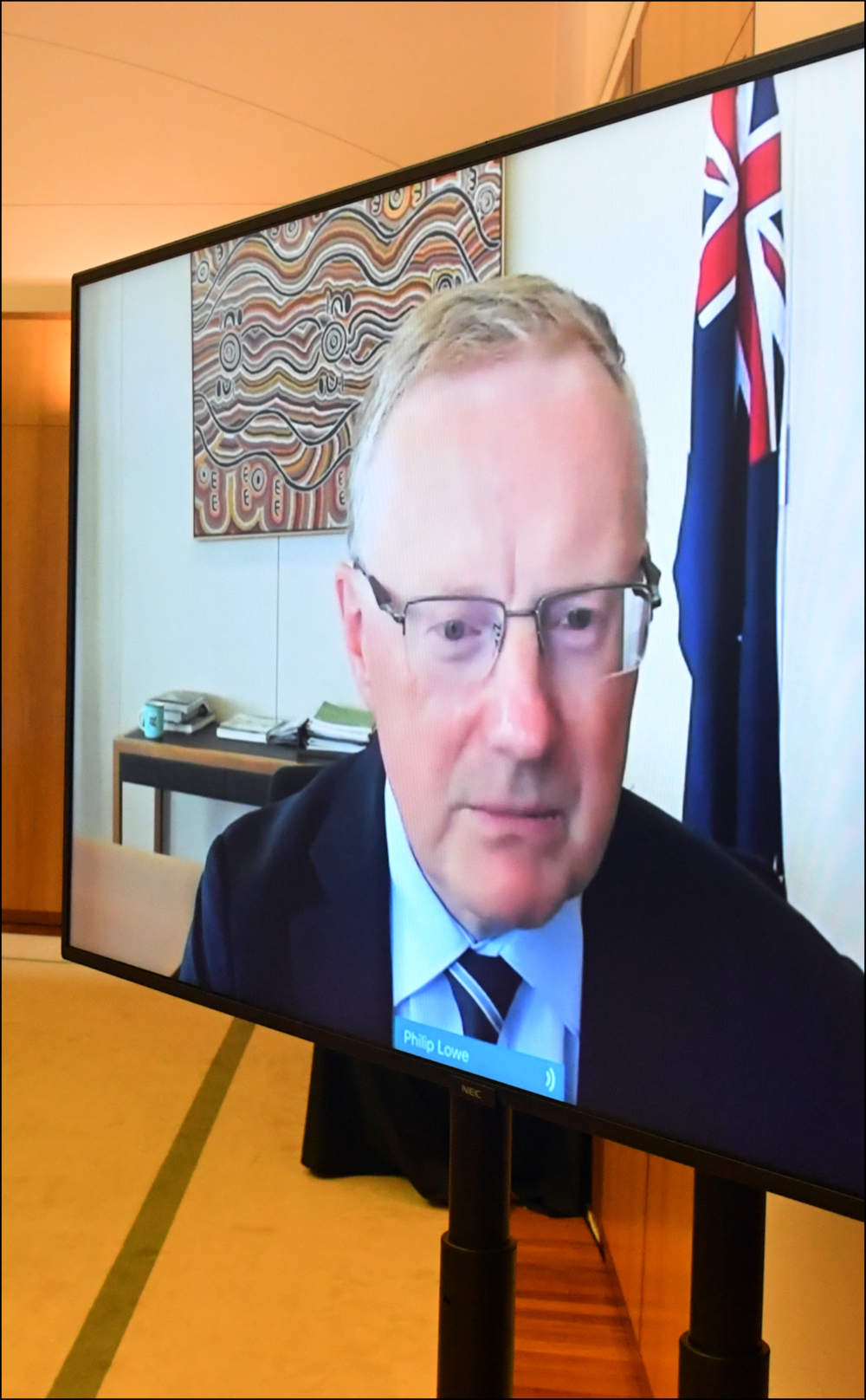
Reserve Bank Governor Philip Lowe dealt quickly with the idea of cutting back government support to reduce government debt on Friday.
Reserve Bank Governor Philip Lowe, giving evidence on Friday. Mick Tsikas/AAP
He told a parliamentary committee that while this was an option “conceptually”, a better idea would be to use government spending to grow national income quickly so the debt-to-income ratio shrank.
That’s the way the debt-to-income ratio has been shrunk in the past – by expanding national income through, among other things, putting more people into jobs.
Dr Lowe also has ideas about tightening settings to stymie inflation, which don’t accord with those of the experts who warn of a US-style takeoff in inflation if we eat further into unemployment.
The case for caution was summed up this way by economist Andrew Charlton on Radio National’s Saturday Extra a few weeks back:
Running the economy is a bit like driving a car around a racetrack. You want to go as fast as you can, but you don’t want to go too fast or you will crash.
Go too fast and you’ll get rising inflation, authorities will be forced to lift interest rates quickly, and you’ll bring on a recession. Ease off on boosting employment – be less ambitious – and you won’t crash.
It’s the way many of those who responded to The Conversation’s survey see it. It’s the way many economists with eyes on the US see it. But it isn’t the way the governor sees it.
Dr Lowe told parliament last week that Australia was not the United States.
Australia is not the US
In the US, utility prices jumped 25% over the past year. In Australia it was 2%. In the US new car prices jumped 12%. In Australia it was 6%. The US price increases are largely one-offs caused by shortages. In Asia, inflation has scarcely moved.
In Australia wage growth is no higher (at 2.2%) than it was before COVID, even though unemployment is dramatically lower. That’s because, unlike the US, Australia kept workers in their jobs through JobKeeper and measures to keep jobs safe. Employers haven’t had to offer more to get workers back.
The Reserve Bank’s model says inflation should be climbing much higher than it is with unemployment as low as it is. That that hasn’t happened suggests the model is wrong.
On Friday, Reserve Bank chief economist Luci Ellis said if there was a floor under unemployment that couldn’t be breached without setting off an inflationary spiral, that floor was not “set in stone”.
One of the reasons is that as people previously unemployed become employed, the floor of people employers regard as unemployable sinks.
The longer the Reserve Bank and the government’s budget keeps supporting the economy, the lower the floor will sink and the fewer Australians will be kept unemployed.
Dr Ellis said while her model was telling her the floor under unemployment was 5%, it was not “the right way to think about it”. The floor might be four-point something, it might be three-point something. Until we get there, we won’t know.
Given that we are in uncharted territory we owe it to ourselves to chart it. This is the Reserve Bank’s view, and it might well be the government’s view.
We owe it to ourselves to see just how low unemployment can be.
Peter Martin does not work for, consult, own shares in or receive funding from any company or organisation that would benefit from this article, and has disclosed no relevant affiliations beyond their academic appointment.
For more than two decades the International Space Station (ISS) has been the mainstay of human presence and research in space. More than 100 metres long, it’s the largest object ever placed in space, and its construction brought together the space agencies from the United States, Europe, Russia, Japan and Canada.
The ISS has hosted research that could not have been done anywhere else, in the fields of microgravity, space biology, human physiology and fundamental physics. It also provides a base for deep space exploration.
Now, the end of its life has been planned. According to NASA, the station is expected to be de-orbited by 2031 (an extension from the original plan to de-orbit by 2020). But if the ISS is so important, why is there an end-of-life plan at all?
In short, the ISS is getting old
The first components of the ISS were launched in the 1990s. And although many parts have been updated and replaced, it’s not feasible to replace everything.
In particular, the main structural components can’t be replaced. While they are checked, monitored and repaired, there are limits to this. The ISS was not designed to last forever.
It survives in a harsh environment, travelling at 27,500 kilometres per hour, with a day/night cycle every 90 minutes (the time it takes the ISS to orbit Earth).
The temperature differences experienced during each cycle put a small fatiguing load on the structure. Over a few years, this is not significant. But over the course of decades this can cause fatigue failures in the metal structure.
So there comes a time when the costs and risks of maintaining the ISS become too high, and this has been determined to be in 2030.
How will the de-orbiting work?
As with all objects under the influence of gravity, given time the ISS would simply fall down to Earth. This is because, even at the orbital altitude of 400km, there is some drag due to small particles. In fact, the ISS currently requires a regular boost to lift its orbital altitude, which is slowly – but constantly – decreasing.
A natural re-entry would be a completely uncontrolled process, and there would be no way of predicting where this would take place. The responsible (and planned) approach is to use thrusters to slow the ISS down, causing the de-orbit to happen much faster and in a specific location decided in advance.
The slowing down will initially be done using thrusters on the station, and on support vehicles docked to the station. This process may take a few months and will slowly reduce the orbital altitude of the ISS, preparing it for the final re-entry phase.
In the final phase, the deceleration will be much more rapid, and will determine the ISS’s final re-entry trajectory. Although it hasn’t been decided exactly how the ISS will reach its final deceleration, the favoured option is to use three modified Russian Progress spacecraft.
The three spacecraft will be docked to the ISS and fire their propulsion systems to achieve the required deceleration – controlling the trajectory of the re-entry and the re-entry location.
Artificial fireballs
It will take a couple of minutes for the ISS to pass through the atmosphere. It’s likely the higher-altitude phase of this will take place near or above Australia.
The re-entry will be a visually spectacular event, resembling multiple large shooting stars. An increasing number of space debris breakup events have been observed and videoed over the last few years.
But these re-entries have been small objects, sized in the order of metres, such as the ATV-1 and Cygnus spacecrafts. Meanwhile, the ISS is about the size of a football field, and will be correspondingly more spectacular.
The ISS will burn up into many smaller ‘fireballs’ as it passes through the atmosphere – creating a spectacular view. Shutterstock
Crashing at Point Nemo
Due to the danger of components reaching the surface, it will be important to make sure they fall where there is minimal risk to people or property. Even a controlled re-entry will potentially spread pieces of debris over an area of hundreds, if not thousands, of kilometres.
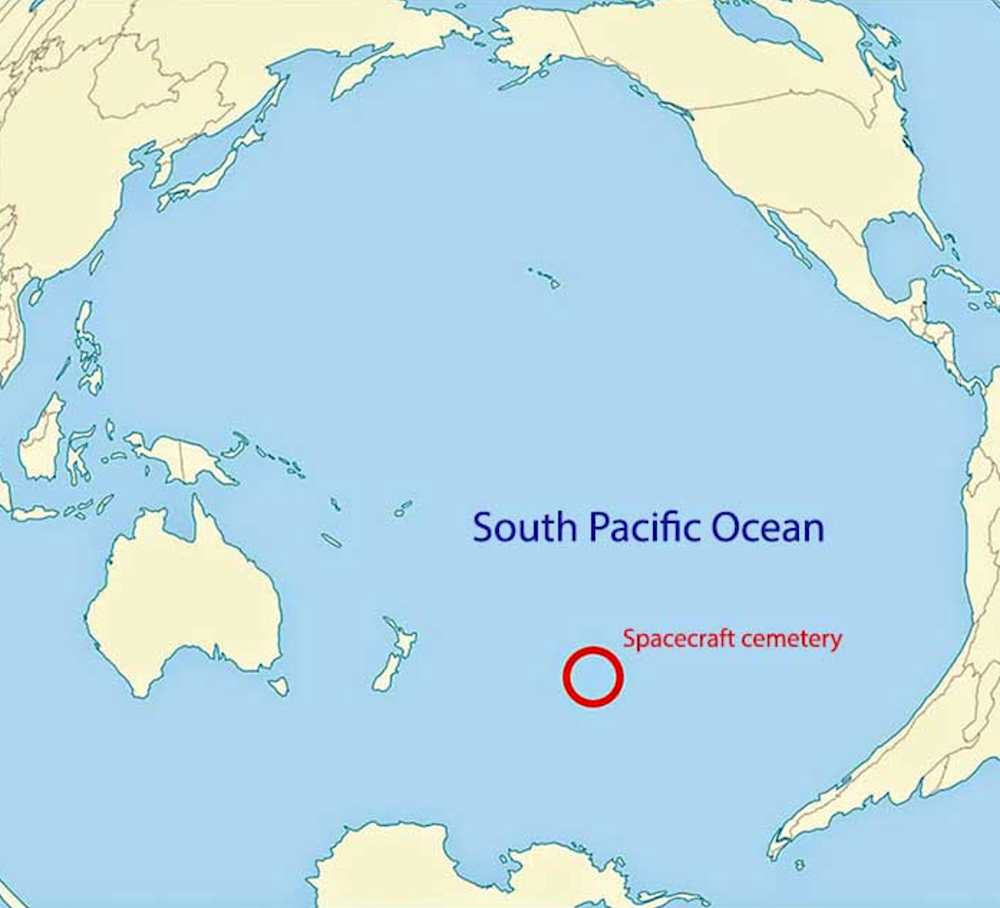
This is why the ISS re-entry (and most space debris de-orbits) will target an area known as the South Pacific Ocean Uninhabited Area (SPOUA), the centre of which is known as Point Nemo, or the “Spacecraft Cemetery” .
The SPOUA is used as Earth’s dumping ground for space debris. It’s the largest uninhabited area on Earth, and hence has the lowest risk associated with debris from re-entry.
Point Nemo, known as ‘the oceanic pole of inaccessibility’, is a point in the ocean which is the farthest away from any land. NASA
The ISS will be travelling at something like 6km per second when it hits the atmosphere. This high speed will cause the air in front of the structure to heat up significantly, reaching temperatures in excess of 10,000℃.
This will cause the structure to break into smaller pieces. Most of it will burn up as it falls, but it’s very likely some small pieces will survive – especially some of the heavier and denser internal components.
Any surviving debris will eventually sink into the ocean and disappear.
The Cygnus spacecraft is an uncrewed cargo ship that brings supplies to the ISS and removes unwanted waste. For disposal, the spacecraft and waste burn up upon re-entry.
Fabian Zander receives funding from the Australian Research Council.
Kenneth Branagh’s new adaptation of Death on the Nile arrives with a lot of preconceived baggage. We know Agatha Christie. We know Poirot.
Christie’s influence on the murder mystery genre cannot be understated. Her stories feature heavily in the contemporary media landscape; reruns of various incarnations regularly appear in television schedules. David Suchet’s portrayal of her detective Hercule Poirot is iconic – as are Julia McKenzie, Geraldine McEwan and Joan Hickson as Miss Marple.
The first cinematic adaptation of a Christie mystery. IMDB
The author of 66 detective novels, 14 short story collections and six bittersweet romance novels under the pseudonym Mary Westmacott, Christie has sold over two billion books. The first film adaptation of her work was The Passing of Mr Quinn in 1928. Her mysteries have been a staple of the big and small screen ever since.
Key to the Agatha Christie narrative – on screen and on the page – is the puzzle. The murder mystery is ultimately a game where you have to guess the killer before the detective does.
For many fans of Christie, adaptations are judged according to the degree to which they conform to their source text. How close is the adaptation to Christie’s original puzzle? Do the clues “fit together” in a similar fashion?
Reactions to Branagh’s adaptations of Christie complicate this picture even further. We aren’t just comparing these films to the novels themselves but other screen adaptations – the portrayals of Poirot we are more accustomed to.
Past Poirots
David Suchet is known as the quintessential Poirot, having played the role on television from 1989 to 2013. Suchet is faithful to Christie’s description of Poirot in her writing and fantastic in portraying Poirot’s iconic “rapid, mincing gait” and particular mannerisms.
This is Branagh’s second performance as Poirot. In 2017’s Murder on the Orient Express, the importance of the clues given by the suspects in the interviews became secondary to Branagh’s own peculiar portrayal of Poirot.
Branagh’s adaptations are more concerned with Poirot himself than any of the suspects.
The method of the crime in Death on the Nile, the puzzle Poirot (and we) must solve, is very intricate. It is one of Christie’s best in my opinion. In Branagh’s film, the central murder happens far too late in the narrative: the murder happening 70 minutes into a two hour film leaves insufficient time for the investigation.
What I love about the books and many of the adaptations, particularly Suchet’s versions, is how each clue is slowly considered.
How do we interpret each clue? What are its implications? This is where having an assistant for Poirot to bounce ideas off (and to show off as well) comes in handy. In the book of Death on the Nile it is Colonel Race. In this film, Poirot doesn’t really engage with anyone in any meaningful manner.
Rather than just a mystery, this film functions more as an exploratory narrative into Poirot. We get an absurd origin story for his moustache. We learn of his lost love. This theme about the extremities heartbreak can drive us to permeates throughout all the suspects.
It is an interesting narrative device but, in the end, it is still all about Poirot. There is no care given to these suspects or the importance of several clues.
But the biggest crime with Branagh’s portrayal of Poirot is the lack of charm. While the Poirot audiences are used to is peculiar, pompous and obsessed with order, he is above all else charming. He gets to know each suspect, asks them seemingly irrelevant questions and makes them lower their guard.
In this version he is gruff, unfriendly and often mean.
As with Murder on the Orient Express, Branagh again has the film veer into absurd action sequences. These moments break the narrative tone. The Poirot we are accustomed to does not chase suspects as if he was an action hero.
The visual effects are notably poor. The green screen is laughable at times. With the exception of a wonderful scene in Rameses II’s tomb, there is no genuine sense of place. There is no depth given to Egypt here.
There is so much potential to this film. The cast is superb and harks back to the incredible cast of the 1978 version, which featured Maggie Smith, Bette Davis, Mia Farrow, Angela Lansbury and Jane Birkin.
The Murder on the Orient Express performed well at the box office but received mixed critical reviews. The negative response was centred largely around the notion of fidelity. As the Atlantic described it, the film was “self-indulgent and thoroughly unnecessary”.
Branagh’s adaptation of Death on the Nile has been met with an equal amount of trepidation. The adapted work can never fully forget the original source.
It is interesting, then, that Christie’s name isn’t as present on the promotional material for Death on the Nile as, say, the BBC’s recent collection of miniseries adapted by Sarah Phelps.
Perhaps this is to signal Christie is no longer the sole author of this mystery, or maybe we are supposed to believe this version of Christie is elevated above the quaint, televisual fare that we may be accustomed to.
Fidelity informs the critical responses of Agatha Christie fans to adaptations of her work because, as film academic Christine Geraghty argues, “faithfulness matters when it matters to the viewer”.
Branagh’s adaptations of Christie are for an audience that haven’t read the original book and don’t already adore Suchet’s portrayal of Poirot. This film is for a new audience: an audience which isn’t hoping for fidelity.
If many go on to read her work and watch the rich history of Agatha Christie screen adaptations, that can only be a good thing – it gets a lot better than this attempt.
Stuart Richards does not work for, consult, own shares in or receive funding from any company or organisation that would benefit from this article, and has disclosed no relevant affiliations beyond their academic appointment.
Trent Zimmerman is one of the five Liberal moderates who crossed the floor to vote to amend the religious discrimination package to protect trans children. Scott Morrison’s response was to abandon his legislation.
Asked whether he regrets his decision to vote against the government Zimmerman, who crossed the floor on some other proposed amendments, says he was “standing up on a couple of points of principle for me – and first and foremost was seeking to support amendments to the Sex Discrimination Act, which would have protected trans kids, but also broadened the limitation of the discrimination that’s allowable for children more generally.”
Zimmerman also voted for an unsuccessful amendment (not supported by Labor) to “remove the current provisions which allow teachers to be discriminated in schools as well”.
But he does “support the principle of a Religious Discrimination Act”.
“I think it’s a no-brainer that you shouldn’t be allowed to be discriminated [against] based on your religious beliefs. But I just thought that this went above and beyond an orthodox discrimination law, and that’s where my problems arose. And I hope that at some stage we can have the debate again with a more orthodox bill.”
The rebels have come under some sharp attack from their own side but Zimmerman says they didn’t take their decisions lightly. His colleagues were “very emotionally committed to taking the action that they did because of their perceived concerns, but they recognised the magnitude of what they were doing.”
Zimmerman expects his battle against high profile independent Kylea Tink to be “a very tightly contested campaign”. “I’ve never taken elections in North Sydney for granted.”
With the government’s failure to deliver a national integrity commission an issue, he hopes a commission will be a fresh promise for the election.
“Having a national integrity commission, I think, is very important for our community and for politics.”
On the issue of trust, Zimmerman says: “I think what people are looking for is really the answer to the question of who you trust to get certain jobs done that they expect of their government. And I think that when we get to the election, people will be judging the government on its performance in managing the economy, on its overall performance in managing the pandemic.”
Michelle Grattan does not work for, consult, own shares in or receive funding from any company or organization that would benefit from this article, and has disclosed no relevant affiliations beyond their academic appointment.
Source: The Conversation (Au and NZ) – By Nicole Shackleton, PhD candidate; Research Officer, Australian Research Centre for Sex Health and Society, La Trobe University
www.shutterstock.com
Discussions about online sex often make it sound like the “dark side” of the internet.
But this isn’t the whole story. Our new study looks at how Australians use technology in their sex lives and the many benefits of this.
A regular part of life
We recently conducted a survey of Australian adults (ages 18 years or older). The study involved 445 people, with an average age of 42. More than half were women (58.5%), and 61% identified as heterosexual.
Sending sexual texts and using apps to find partners have become common practice, particularly among younger people. www.shutterstock.com
We found digital media was a common part of people’s sex lives.
60% had watched porn online
35% had used dating apps
34% had sent sexual texts or naked selfies to another person.
Better connections
People also reported how digital technology benefited their sex lives and relationships.
38% felt more emotionally connected to their partners
27% felt more sexually connected with their partners
31% said they found it sexually gratifying to share or receive sexual text messages with someone they met online.
Others reported using the internet to find information about relationships or sexual health.
54% said information they found online had helped them feel more comfortable about sex
49% said the internet had enabled them to explore new or different sexual cultures.
Yes, there are risks
That being said, while reporting many benefits, participants were also aware of risks of sexual activity or communication online.
59% agreed sharing naked or explicit images or videos could cause them embarrassment
51% agreed online sexual engagement could cause them problems in the workplace
51% were worried their search history could be seen by others if they searched for pornography
24% were worried about providing personal contact details when shopping for sex products online.
What is happening in Australia?
In 2021, federal parliament passed the Online Safety Act, expanding the eSafety Commissioner’s powers to combat cyberbullying and image-based abuse.
The commissioner can now demand that social media services, hosting services providers and individuals remove online material deemed to be harmful, dangerous or abusive within as little as 24 hours.
New federal laws are aimed at making the internet safer, but experts fear there will be unintended consequences. www.shutterstock.com
This is an important step in improving digital safety given the global, unregulated nature of the internet.
However, there are serious concerns these expanded powers will lead to restrictive acts, prohibiting consensual online sexual activity or information.
Current eSafety Commissioner Julie Inman Grant says she will use the new powers to target child exploitation material and is not interested in policing the sexual interests of consenting adults. Nevertheless, the potential exists for such assurances to shift over time, or as a new appointee fills the position.
Why does this matter?
Decades of research show sexual health education is most effective if it teaches sex should be pleasurable.
Messages that focus on abstinence or disease and problems can undermine people’s confidence about pursuing healthy, consensual sexual relationships.
The same can be said for digital sexual literacy. Education about online safety will be most effective if discussions about risk occur in the context of sex in the digital world being a broadly positive thing.
How do we balance risk and pleasure?
Our findings add to the growing body of research that shows how the internet and digital technologies can benefit relationships and sex lives.
These are places where people explore their sexuality, learn about sex, and engage with diverse communities. It can also be a space to facilitate conversations about consent, safety and sexual health.
Managing digital risk should not be about sanitising the internet but supporting people’s choices.
Nicole Shackleton receives funding from the Australian Research Council.
Anne-Maree Farrell receives funding from the Australian Research Council, British Academy, Royal Society of Edinburgh and the Economic and Social Research Council.
Jennifer Power receives funding from the Australian Research Council, the Australian Department of Health and Fairer Victoria. She has previously received funds from ViiV Healthcare.
Source: The Conversation (Au and NZ) – By Cristyn Davies, Research Fellow in Child and Adolescent Health, Faculty of Medicine and Health, University of Sydney
While the bill has been shelved, the debate is a continuation of a discussion in which the existence, rights, and lives of trans children and adolescents have been called into question both in Australia and overseas.
These young people have endured intensified stigma and discrimination that negatively impacts their health and well-being.
Trans people make up between 2.3% to 3.7% of Australia’s youth population.
Although many trans people live healthy, fulfilled lives, research from overseas shows a disproportionate number have poorer mental health than their peers.
Recent Australian studies paint a similar picture. One study found:
90% of trans young people experienced high or very high psychological distress in the previous four weeks
54% had self-harmed
71% reported suicidal ideation
14% had attempted suicide in the preceding 12 months
38% reported having attempted suicide at some point in their life.
Another study found trans young people in Australia were 15 times more likely to attempt suicide than the general population.
Minority stress
Minority stress arises from the social, psychological and structural discrimination associated with belonging to a stigmatised minority group.
Negative media commentary can directly contribute to minority stress among trans people, as can legislation and policies that seek to exclude trans individuals from schools and workplaces.
Negative representations of trans children and adolescents in the media shape public attitudes and practices. This can not only stoke fear and mistrust that further marginalises trans young people, but also lead to violence against them.
Negative media representations marginalise young trans people. Shutterstock
In Australia, one study found 89% of trans young people had experienced peer rejection. Some 74% had experienced bullying, while 69% had experienced discrimination.
Another study found 68% of trans young people in Australia had felt uncomfortable or unsafe in their educational setting because of their gender or sexuality diversity.
A third study found young trans Australians were four times more likely to have experienced sexual violence or coercion.
Public debate about trans young people also impacts their families. For instance, a recent study reported parents of trans children and adolescents in the United States experienced significant stress as a result of legislation introduced to prevent young trans people accessing medical and surgical gender affirmation.
Not surprisingly, parents viewed these bills as increasing stigma towards their child and the broader trans community.
Public debates about trans rights can be distressing for trans young people and their families. Shutterstock
Health harms of public debate
Apart from fostering stigma and discrimination, public debate about trans people can also negatively impact their health.
Physical activity in adolescence is important for long-term health. Trans young people already experience multiple barriers to participating in sport and physical activity. Public commentary questioning involvement of trans people in sport acts as a further obstacle.
Negative press coverage about affirmative health care for trans young people has also been associated with reduced referral rates to specialist paediatric gender clinics overseas, and highlights the role public debate is likely to play in reducing access to such care.
Finally, trans young people report exposure to negative news stories adversely affects their mental health by provoking experiences of depression, anxiety, and/or fear.
So what can we do to help?
Strikingly, previous research has shown when trans young people are supported and their gender is affirmed, they have similar mental health outcomes to their cisgender peers.
School safety and connectedness, for example, are protective factors against depression, self-harm, and suicide.
Similarly, peer and school support provide a buffer against the negative impact of gender-related victimisation on mental health.
Policies and procedures that enable a trans young person’s gender, name and pronouns to be accurately recorded are also important. Research shows having identity documents that match one’s affirmed gender is associated with lower rates of serious psychological distress and suicide.
Finally, the media itself may help to promote better health for trans young people. For instance, trans adolescents have reported experiencing happiness and increased hope after exposure to positive news reports about other trans people.
Trans young people flourish with support from family, friends, and the broader community. Hopefully, future commentary about trans young people’s rights takes this into account.
Cristyn Davies reports voluntarily being co-chair of the Human Rights Council of Australia; co-chair of the Child and Youth Special Interest Group for the Public Health Association of Australia; an ambassador to Twenty10 Incorporating the Gay and Lesbian Counselling Service of New South Wales; and a member of the Australian Professional Association for Trans Health (and its research committee).
Alessandra Chinsen does not work for, consult, own shares in or receive funding from any company or organisation that would benefit from this article, and has disclosed no relevant affiliations beyond their academic appointment.
Ken Pang is a paediatrician at the Royal Children’s Hospital in Melbourne. He receives research funding from the Australian National Health and Medical Research Council, the Royal Children’s Hospital Foundation, and the Hugh D T Williamson Foundation. He is a member of the Australian Professional Association for Trans Health (and its research committee).
Rachel Skinner is a paediatrician in Adolescent Medicine at Sydney Children’s Hospital Network and Senior Clinical Advisor in Youth and Wellbeing at the NSW Ministry of Health. She holds research funding from the Australian National Health and Medical Research Council. She is a member of the Australian Association for Adolescent Health; the Australian Professional Association for Trans Health, the Society for Adolescent Health and Medicine and the World Professional Association for Transgender Health.
Kerry H. Robinson does not work for, consult, own shares in or receive funding from any company or organization that would benefit from this article, and has disclosed no relevant affiliations beyond their academic appointment.
New Zealand Parliament Buildings, Wellington, New Zealand.
Editor’s Note: Here below is a list of the main issues currently under discussion in New Zealand and links to media coverage. You can sign up to NZ Politics Daily as well as New Zealand Political Roundup columns for free here.
And that’s important, because it is the special properties of curling ice that allow the heavy curling stones to glide and curve in ways that seem to defy physics. In fact, scientists are still not sure what puts the “curl” in curling.
Chess on ice
Curling’s origins date back to 16th-century Scotland, making it one of the world’s oldest team sports. Like golf – invented around the same time in the same part of the world – curling seems both amusingly pointless and deceptively simple to the untrained eye.
It has been called “chess on ice”, although to many Australians it most resembles frozen lawn bowls. Athletes take turns sliding circular 20-kilogram granite stones along the ice toward the centre of a horizontal target 28 metres away. Teams are awarded points for getting their stones closest to the centre of the target, or “house”.
The slippery science behind curling starts with the ice itself. Curling ice must be perfectly flat – far flatter than a typical ice hockey rink – and is sprayed with droplets of water before each game to produce a pebbled surface. This minimises the contact area between the ice and the heavy curling stone.
Curling stones also have a concave lower surface – like the bottom of a beer bottle – that further reduces the contact area between the stone and the ice. The effect is to increase the pressure at the base of the stone, partially melting the ice and reducing friction in a similar way to how ice skates work.
Uniquely among Olympic sports, curling players can change the path of the stone after it has been “thrown”. This is achieved by vigorously sweeping the ice in front of the stone with special brooms that warm the ice and reduce friction, allowing the stone to travel farther and straighter along its path.
Deciding when, where, and how hard to sweep has a big influence on the stone’s trajectory; so naturally it is accompanied by a great deal of enthusiastic yelling.
Give it a spin
By adding a small amount of spin, skilled players can make their stone “curl” along a curving path to block an opponent’s stone or knock it out of the way. Even a small amount of rotation can deflect the path of the curling stone by as much as a metre and a half. How exactly the curling stone does this is something of a puzzle.
Let’s start with a (literal) tabletop experiment. Slide an upturned glass along a table, adding a little spin as it leaves your hand. With a little practice (and perhaps a few replacement glasses) you will be able to make the glass trace a curving path across the table, deflecting to the left when you spin it clockwise or to the right when you spin it anticlockwise.
The reason for this is explained by a branch of science called tribology, which studies the effect of friction on moving and sliding objects.
As the glass spins, it rubs against the table top, generating friction that tries to slow down the rotation of the glass. The friction forces are directed opposite to the direction of motion: for a clockwise-rotating glass, friction will be directed to the left at the front of the glass and to the right at the back of the glass.
When the spinning glass slides across the table, it leans forward slightly in the direction of travel, pushing the front lip of the glass down a little harder on the table than the trailing lip. The extra pressure generates extra friction at the front compared to the back. The resulting imbalance of friction forces causes the glass to deflect in the direction of stronger friction – to the left in the case of a clockwise-rotating glass.
A twist in the tale
But curling stones behave in exactly the opposite way: a clockwise rotation causes the stone to deflect to the right, not the left. For a long time, scientists assumed this was because of an effect called asymmetrical friction.
The theory goes like this: like a glass pushed across a table, a curling stone leans forward slightly. The extra pressure at the front of the stone partially melts the ice at the leading edge, creating a thin film of water that reduces the friction at the front of stone compared with the back.
The curling stone will still deflect in the direction of stronger friction. But in this case, it is the trailing edge that wins, resulting in a deflection to the right rather than the left, for a clockwise-rotating stone.
Scratch that
Like many theories, this explanation was widely accepted until someone got around to actually testing it. In 2012, a team at Uppsala University in Sweden made detailed calculations of the friction forces acting on a sliding stone.
The problem they found is that curling stones rotate quite slowly, only completing a couple of turns before coming to a stop. This spin is far too small to cause a sideways deflection of a metre or more. Even odder, more rotation does not lead to more curl – in fact, spin a stone too hard and it won’t curl at all. Asymmetrical friction cannot explain such behaviour.
The researchers used an electron microscope to look more closely at the ice under a curling stone. They discovered that the front edge of the stone leaves behind miniscule scratches on the ice in the direction of rotation. These scratches act as a guide for the back edge of the stone, causing the stone to deflect in the direction of rotation.
Curling stones make microscopic scratches in the pebbled surface of the ice – and according to one theory, these scratches deflect the stone’s path to the left or right. H. Nyberg, et al., Wear (2013)
The Swedish team then showed that, using this “scratch-guide” mechanism, they could “steer” the sliding stones by adding artificial scratches to the ice in different directions. In one experiment, a stone was made to travel along a zigzag path by laying down scratches in alternating directions.
Their findings ignited a minor controversy in the admittedly niche world of curling physics.
In 2020, a Japanese team attempted to clear things up by systematically testing each theory in a curling hall using sophisticated motion-tracking equipment, a laser scanning microscope, and some sheets of sandpaper to modify the surface of the curling stone.
However, no clear winner emerged. When it comes to the science of curling, it appears we are just scratching the surface.
Shane Keating does not work for, consult, own shares in or receive funding from any company or organisation that would benefit from this article, and has disclosed no relevant affiliations beyond their academic appointment.
As the 2022 federal election draws nearer, there are many factors that may shape the outcome.
This is not Australia’s first experience of a pandemic, nor the first time this has played a role in state divisions and elections: the 1919 Spanish Influenza pandemic is a case in point.
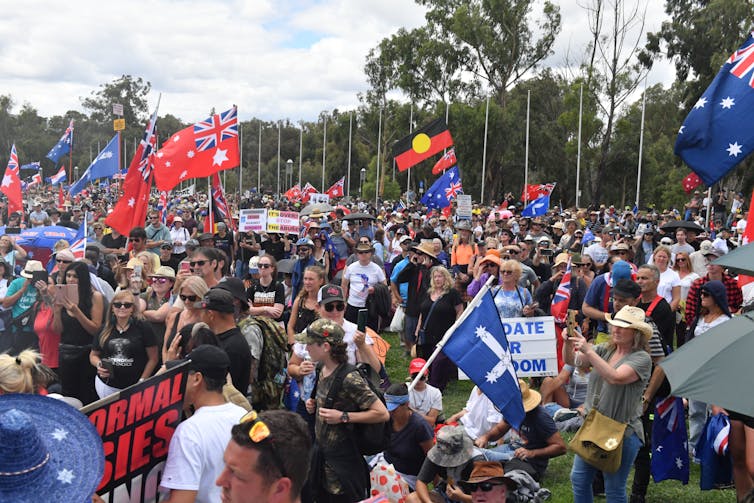
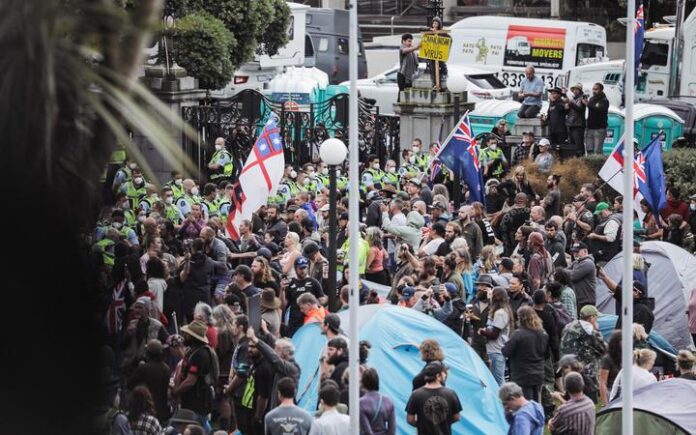
However, this is the first election in which the immense economic and social damage of a pandemic has combined with a global far-right populist surge, an increase in far-right-wing extremism and the disruptive power of social media. The most recent and visible example is the so-called “Canberra convoy”, which has just concluded.
In seeking to understand the potential influence of these factors, we cannot look at any one of them in isolation; they have to be understood as part of a symbiotic relationship. This is evident when we look at the make-up of the protesters.
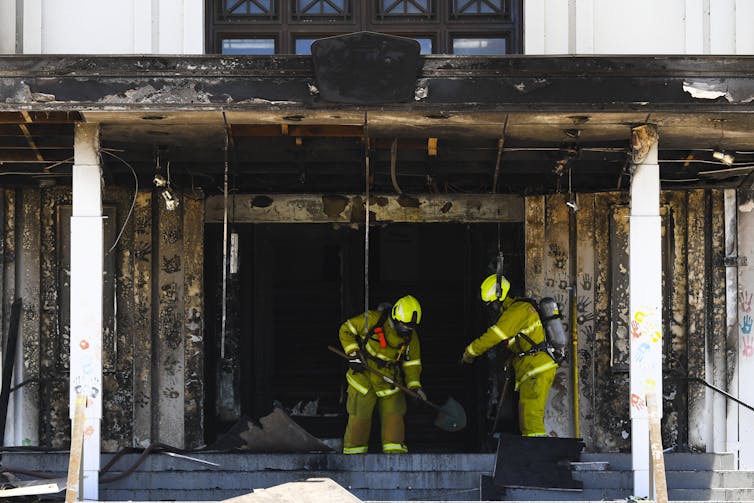
They first gathered at old Parliament House, site of the Aboriginal tent embassy, the longest protest for Indigenous rights anywhere in the world. There, the “sovereign citizen” protesters initially sought to cloak themselves in the legitimacy of Aboriginal calls for sovereignty. Shortly after, in December 2021, old Parliament House, which holds significance within some sovereign citizen conspiracy theories, was set on fire. Several people have been charged over the incident.
While featuring a very small number of Indigenous activists, the fire and recently arrived protesters were roundly condemned by Aboriginal leaders at the Tent Embassy.
Since these events, anti-vaccine mandate protesters and other “freedom rally” protesters, including Q-Anon conspiracy theorists, militant wellness groups, religiously inspired actors and far-right extremists such as the Proud Boys, have converged on the nation’s capital. They have protested outside the old and new Parliament House, seeking to cause mass disruption.
The fire in December 2021 caused damage to the entrance to Old Parliament House. Lukas Coch/AAP
Protesters on the ground are highly diverse. Many are keen to paint themselves as concerned “mums and dads”. Others frame their actions as an act of “love”, a pattern seen globally at “freedom” protests.
Indeed, many may be merely exercising their democratic right to protest.
However, it is important to understand that the ideological underpinnings of the freedom movement range from libertarianism to far-right ideologies. We need to move beyond the notion of anti-vaxxers as left-wing hippies from Brunswick or Byron Bay (though they may well be concentrated there).
Many from the “wellness” communities are educated, wealthy, hold strong convictions and are active consumers in a highly profitable enterprise.
Likewise, it is important to move beyond the association of the far right as black-clad, swastika-wearing skinheads (though some may be).
The modern far right is well organised and more sophisticated in its tactics (including the use of “citizen journalists”, memes and encrypted messaging applications). Most importantly, beyond the traditional neo-Nazi groups, it is multiracial. Restoring the “nation”, rather than race, to an imagined past greatness is central to their extremism.
Protesters have joined the ‘freedom’ convoy for many different reasons. Lukas Coch/AAP
This is evident in groups such as the Proud Boys, who are present at the Canberra protests, and who were led in the US until recently by Enrique Tarrio, a Cuban American. We have witnessed numerous Ustaše flags at the protests, representing a resurgent Croatian ultranationalist fascist and antisemitic organisation that was active during the second world war, perpetrating acts of genocide. The group also holds a wide variety of groups and individuals from QAnon conspiracy theorists and sovereign citizens (known for their use of the red ensign) to evangelical and Orthodox Christians. They represent a highly multicultural cluster who have opposed the use of vaccines from the earliest days of the pandemic.
Importantly, this broad coalition, and the far right in particular, must be understood as part of a transnational movement. Even a cursory analysis of protest message boards indicates the protesters have been heavily influenced by groups and events overseas. They share a common vocabulary and symbology.
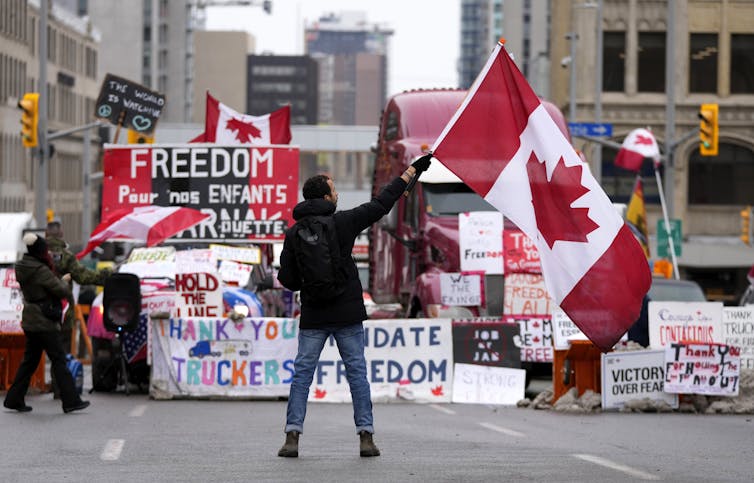
It is clear the January 6 2021 storming of the Capitol Building in the United States, and the more recent Ottawa “freedom convoy”, described by Ottawa police as a “threat to democracy”, have inspired some protesters.
Many in the Canberra convoy have been influenced by similar protests in Ottawa, Canada. Justin Tang/AP/AAP
Many actors within these movements have track records of violent rhetoric and extremist sentiment, and the threat of future violence cannot be discounted. Indeed, it must be considered likely.
These movements must be also be understood as associated with the global right-wing populist surge that has resulted in the election of authoritarian governments, led by “strong men”, in countries ranging from the United States, Hungary and Poland to the Philippines, India and Brazil.
These leaders claim to speak for the “people”, framing themselves as outsiders to a corrupt and broken political system. They promise to deliver radical change, though merely aim to replace the current powers. We saw this most famously with Donald Trump’s promise to “drain the swamp”.
While a key element of winning democratic elections is indeed to be the most “popular” party, far-right authoritarian populists prey on social division and seek to exploit anger and fear to gain political capital. We see this in the actions of United Australia Party leader Craig Kelly and some fringe members of the Liberal Party such as George Christensen. These men have sought to frame themselves as champions of the protest movement, but their actions may be understood as cynically stoking social division for political gain.
In this case, the prize is seats in parliament and the potential to hold the balance of power, forcing major parties to negotiate favourable outcomes for mining magnate Clive Palmer, via the United Australia Party.
In the Canberra convoy, we are witnessing the consolidation of an alliance between diverse, yet highly political, groups infected with conspiracy and far-right ideas. They then intersect with right-wing populist politicians intent on exploiting these events for political gain.
This is, in many respects, new ground in Australian politics. The question remains as to how successful this alliance will be at the ballot box.
Josh Roose is part of a project funded by The Australian Research Council: ‘Far Right in Australia: Intellectuals, Masculinity and Citizenship’ (DP200102013).
Babies who get bad lung infections are at higher risk of developing asthma later on, a condition that affects 10% of Australian kids and costs Australia A$28 billion a year.
Our new paper, published overnight in the Journal of Allergy and Clinical Immunology, looked at how OM85 improves babies’ defences against bad lung infections. OM85 is a mix of molecules extracted from bacteria that commonly infect the respiratory tract.
This follows our previous research which found treatment with OM85 protected susceptible babies from severe lung infections. This latest work shows OM85 provided babies with an early immune boost, leading to stronger defences against severe infections. This meant when these babies got a lung infection, their immune system could respond more effectively and they didn’t get as sick.
So taking the treatment could halt the development of asthma by protecting babies’ lungs from damaging infections in the early years of life.
What is OM85?
OM85 is a treatment made from a mixture of crushed up bacteria. It was first used in Europe in the 1970s, and since then, it has been used to prevent recurrent and wheezy lung infections in susceptible adults and kids. It’s commonly sold across the world under the brand name Broncho-Vaxom, but it’s not yet available in Australia.
Clinical trials have shown it can reduce the rate of lung infections in asthmatic children by around 40%.
A small number of people taking OM85 may get gastrointestinal upset, but overall, trials have shown the treatment is safe and any side effects are mild.
Strategies to prevent lung infections are extremely limited in babies, because there aren’t any vaccines against the most common respiratory viruses, such as RSV and rhinovirus. OM85, and other similar treatments in clinical trials, may provide a promising solution.
Despite this, there has been ongoing scepticism.
OM85 is a non-conventional medicine. Most drugs contain known active ingredients. However, OM85 contains multiple components that are likely to synchronise to stimulate the immune system.
Until now, there was no strong evidence for how the treatment actually works. We set out to find this missing piece of the puzzle and learned OM85 trains the “innate immune system”.
What’s the innate immune system?
Our immune systems have two key components.
The innate immune system is the defensive line that pathogens (like viruses and bacteria) first encounter when they enter our body.
While the innate immune system is taking shots at invading microbes, the second line – the adaptive immune system – is mobilising its elite fighters.
We have known for a long time that vaccines can provide a training system for the adaptive immune system.
But recently, scientists have discovered the innate immune system can be trained in a different manner. This is an exciting and emerging field.
Our previous clinical trial, conducted with collaborators at The University of Queensland, found OM85 protected high-risk babies from bad lung infections.
We found the strongest protection was when they took OM85 in their first winter, when babies were between five and nine months old.
But nobody has ever looked at how the treatment actually works in this context, which was the focus of our new work.
To pinpoint how the treatment worked, we studied how these babies’ immune systems reacted when faced with a range of infections.
Babies who got OM85 had a number of key changes to their first-line defences. They had a mild boosting of “interferons” – proteins that are critical early in an infection. They also had reduced amounts of inflammatory proteins, which can be damaging when levels get too high.
These two components of the innate immune system (interferons and inflammation) play a critical role in immune defence. Problems with either component have been implicated in an increased risk of developing asthma.
OM85 comes in a powder form that the parents in our study mixed with water or milk for their babies to ingest. OM85 then enters the gut, which contains lots of immune cells and gut bacteria. Signals travel from the gut to the bone marrow where more immune cells are made. We think OM85 can communicate through this messaging system to ultimately provide the positive benefits we discovered.
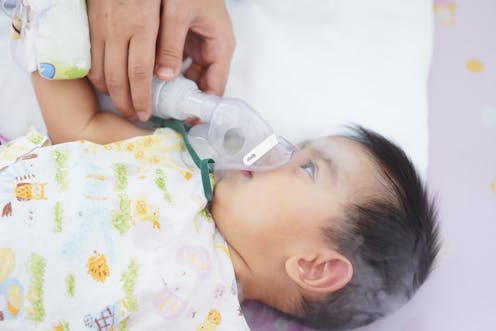
OM85 boosted babies’ first-line immune defences, improving their protection against severe lung infections. Shutterstock
Babies are beginners when it comes to fighting infections – their immune system has to rapidly learn how to behave and strike a balance between clearing infection quickly while minimising damage to the lungs.
From the moment babies are born, they are exposed to microbes that bombard the immune system, sending critical messages that guide the immune system to develop and mature.
A lack of these beneficial exposures in early life makes kids more susceptible to asthma (and other chronic diseases). Our innate immune system has evolved alongside bacteria, but our modern lifestyle often reduces the contact that we have with these bacteria that are needed for healthy immune development.
OM85 acts as an “immune trainer”, replacing these vital microbial signals that shape the immune system early in life.
Niamh Troy does not work for, consult, own shares in or receive funding from any company or organisation that would benefit from this article, and has disclosed no relevant affiliations beyond their academic appointment.
The COVID pandemic has had a huge impact on people living with dementia and their family carers around the world. Our study, published today, found people with dementia experienced worse symptoms after the pandemic began.
Carers reported their loved ones were more disoriented, restless and withdrawn. They also reported poorer mental health themselves as a result of the pandemic.
Dementia is an umbrella term that describes a range of progressive neurological disorders, such as Alzheimer’s disease and frontotemporal dementia.
The number of people living with dementia has more than doubled in the past 20 years worldwide. Dementia currently affects approximately 480,000 Australians, and one in ten people over the age of 65.
Nearly 1.6 million people in Australia care for someone living with dementia.
Given the progressive, neurodegenerative nature of dementia, deterioration of symptoms generally occurs gradually over time. However, we found an accelerated decline of symptoms over a short period of time (within a few months) during the pandemic, which may not be attributable to the typical course of dementia.
Why is the pandemic particularly challenging?
People with dementia can have difficulties understanding why public health measures are important. They may not understand why they can no longer hug or kiss their loved ones, or see them in person.
Symptoms of dementia such as perseverative behaviour (which might manifest as inflexibility to changes in routines) and disinhibition (which might involve approaching or touching strangers) can make it harder to follow public health guidance for social distancing, washing hands and wearing masks.
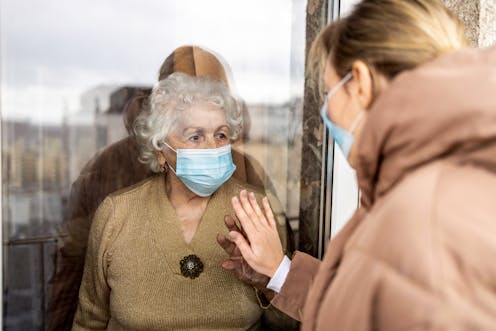
Lockdowns and bans on visitors in aged care facilities have led to increased social isolation.
Loss of access to health, respite and community services have removed essential sources of support for both people with dementia and their family carers.
Worsening symptoms of dementia
From April to November 2020, we conducted an online survey of 287 carers of people with dementia, from clinics in Australia, Spain, Germany and the Netherlands.
We asked carers about the impact of the pandemic on the person they were caring for, as well as their own mental health, social support and knowledge about the COVID pandemic.
We found 39% of people with dementia had worse depression since the COVID pandemic.
More than one-third of people with dementia had worse apathy (loss of motivation) and anxiety. They also had worse delusions, that is, unshakeable beliefs about things that are not true. For example becoming increasingly paranoid or suspicious of unfamiliar surroundings, such as people wearing personal protective equipment (PPE), and changes to their daily routines, such as not being able to see their families.
Many carers saw their loved ones’ symptoms worsen during the pandemic. Shutterstock
More than one-quarter had worse irritability and agitation compared to before the pandemic.
People with dementia who weren’t living with their carer (for example, those in aged care facilities) had a higher risk of worse outcomes. These symptoms may be exacerbated by the reduction in meaningful contact with their loved ones, and disconnection from their usual social activities and routines.
What about carers?
More than half of carers reported they had worsened mental health since the pandemic began and 63% had a reduced social network.
Carers said they had difficulty managing day to day, due to the social isolation and the relentlessness of the condition.
For those caring for someone living in an aged care home, not being able to visit their loved ones was distressing and added to their stress.
Interestingly, carers in Spain were less likely to report worsened mental health than carers in Australia and Germany. Intergenerational living and greater familial support networks for those living at home may have helped lessen the impact on carers’ mental health.
Carers have had difficulty managing, day to day. Shutterstock
Balancing protection and social connection
Compassionate care is vital during the pandemic, and helps to maintain cognitive and physical stimulation, and meaningful social connections.
To help support carers and people with dementia during the pandemic, we have developed a free, evidence-based toolkit, with tips on communicating health messages, managing symptoms and staying connected.
Understanding the lived experience is key to inform policy and health settings to balance risk and quality of life. Our findings suggest COVID restrictions, particularly on visits to aged care facilities, may lead to an accelerated decline for people with dementia, and poorer mental health outcomes for carers.
Fiona Kumfor receives funding from the National Health and Medical Research Council.
Grace Wei does not work for, consult, own shares in or receive funding from any company or organisation that would benefit from this article, and has disclosed no relevant affiliations beyond their academic appointment.
Debates about how schools acknowledge gender and sexuality diversity have been ongoing in Australia. It’s often claimed parents oppose the inclusion of gender and sexuality diversity content in the teaching of their children. But our research shows four out of five parents support such content being included in the relationships and sexual health curriculum.
Debate about these issues has been revived by the federal Religious Discrimination Bill and the NSW One Nation’s Education Legislation Amendment (Parental Rights) Bill. The now-shelved federal bill would have allowed religious schools to expel transgender and gender-diverse students. The NSW bill seeks to revoke the accreditation of educators who discuss gender and sexuality diversity in a public school.
Both bills would have the same effect: the erasure of gender and sexuality diversity from schools.
Until now there has been no comprehensive research in Australia that examines what parents actually want in relation to such topics in their child’s education. This lack of research-based evidence has meant even teachers are unsure about whether or not they are allowed to discuss gender and sexuality diversity.
Our landmark study, published in the journal Sex Education, sheds light on this issue. Our findings challenge the idea that most parents oppose the inclusion of gender and sexuality diversity-related content in school.
What did the study find?
We surveyed 2,093 parents of students attending government schools across the nation. To ensure results could be considered nationally representative, data were weighted using a probability panel of Australian adults. Both demographic markers (including gender, location and languages spoken at home) and attitudes to education that’s inclusive of gender and sexuality diversity were used to weight the final data set.
The survey asked fundamental questions about parents’ views on the “who, what, when” of relationships and sexuality education. There was a specific focus on how parents felt about including gender and sexuality diversity in the curriculum.
The findings show 94% of parents want relationships and sexuality education in schools, in keeping with the current Australian Curriculum. When asked about gender and sexuality diversity across six different topic areas, on average, 82% of parent respondents support their inclusion as part of the relationships and sexual health curriculum from kindergarten through to year 12.
In terms of understandings of gender diversity by students at different ages, two-thirds of parents (68%) want this topic introduced in the curriculum by the end of stage 4 of schooling (years 7 and 8). In keeping with other areas, over 80% of parents support its inclusion by the end of year 12.
Parents’ reasons for supporting inclusion were apparent in their views on the purpose of relationships and sexual health education. Given a choice of four central purpose statements, the largest group of parents (nearly 50%) felt this curriculum area should focus on student “empowerment, choice, consent, and acceptance of diversity”.
It’s about fairness, inclusion and safety
These findings reflect the culture of fairness and inclusion that most Australians believe in. The results point to parents’ understanding of the importance of inclusion. They object to the school-based harassment of gender and sexuality diverse students in this country.
These young people are rarely represented in curriculums. They are not only invisible, but also experience discrimination by omission.
Parents are likely to know Australia has one of the highest rates of youth suicide in the world. Tragically, the rate is even higher for gender and sexuality diverse young people. Their experiences at school are undoubtedly linked to this outcome.
In our study, nearly 90% of parents wanted to see the curriculum address discrimination and bullying of gender and sexuality diverse people. This finding speaks to their desire to create safe and welcoming schools for all students.
What does this mean for teachers?
This research has important implications for teachers of relationships and sexual health education. Many report they avoid gender and sexuality diversity and fear community backlash.
Teachers’ unease prevails despite federal government guidance that promotes the well-being of students. The guidelines encourage schools to create positive learning environments that foster diversity and respectful relationships and support students to feel safe, connected and included.
The public response to the Religious Discrimination Bill and its subsequent shelving highlights how it is inherently anathema to punish and exclude children and young people from school based on their identity. Australian teachers need to be supported to create a school culture where these students can feel safe, welcome and informed about their relationships and sexual health.
Educators across the country would benefit from additional guidance and support to feel confident that discussing these topics is in line with the views of the majority of their students’ parents.
Tania Ferfolja has received funding for this research from the Australian Research Council.
Jacqueline Ullman received funding from the Australian Research Council for the research discussed in this article.
Channel Nine’s 60 Minutes segment about the prime minister and his family, broadcast on February 13, was political confectionery so laden with sugar as to be a serious hazard to Scott Morrison’s political health.
It also raised questions about Nine’s commitment to impartial election coverage.
This is a live issue, given that the company is chaired by Peter Costello, the long-serving treasurer in John Howard’s Liberal-National Coalition government.
Nine is promising an equivalent program on the leader of the opposition, Anthony Albanese. It will be interesting to see whether it turns out to be just more confectionery or whether it will contain some political fibre.
One problem is, if it wishes to be seen as even-handed, 60 Minutes will have to dish up the same schmaltzy fare on him too.
Another problem runs deeper.
The Morrison program was framed not around the prime minister but around his wife Jenny, described in the trailer and in the program itself as the prime minister’s “secret weapon” for the election.
This played into Morrison’s hands. He has already fashioned her into a political asset by repeatedly referring to her in press conferences as someone to whom he turns for advice.
The most notorious example was when he sought her counsel about how to deal with the Brittany Higgins rape allegations and she advised him to think about it as the father of two daughters.
Jenny is thus much more, in political terms, than the prime minister’s wife: her persona has become a central part of his political strategy, and the “secret weapon” description reinforces the point. Bizarre, though. She is neither a secret nor a weapon. She has been well tested as a cast member in Morrison’s political theatre.
How 60 Minutes provides a counterpoint to this in the promised Albanese program we will have to wait and see, but it presents Nine with an awkward challenge if it wants to be seen as genuinely even-handed. Will it find some way to promote a central feature of his election campaign strategy too?
The Morrison program was such a naked piece of political marketing that it also raises questions about what demands were made by the prime minister, and what undertakings were given by Nine about how it would be done.
For instance, why was Karl Stefanovic the interviewer and not one of Nine’s serious political journalists, such as Chris Uhlmann?
Why was there no follow-up questioning of Jenny Morrison on the issue of manners?
The need was obvious.
She was free enough with her criticism of the former Australian of the Year Grace Tame for failing to smile for the cameras with Morrison on Australia Day. Bad manners, apparently.
What about Morrison turning his back on Tanya Plibersek in the House of Representatives while she was speaking at the Despatch Box, or grabbing the hands of unwilling Black Summer bushfire survivors when they point-blank refused to shake his hand?
The soft questions to Morrison were cringe-making. “Do you feel our pain?” asked Stefanovic. In answer, Morrison channelled Shylock in the Merchant of Venice: “I bleed”.
Stefanovic gave Jenny a gratuitous boost by telling her what a straight shooter she was.
And indeed she did come across as a thoroughly decent person, giving a mixture of straight and carefully parsed answers, including a convincing apology for the notorious Hawaiian holiday.
Speaking of which, given this damaging history, it seemed odd of the prime minister to choose to play the ukulele.
The risk to Morrison’s political health lies in the heavy public-relations packaging of the program.
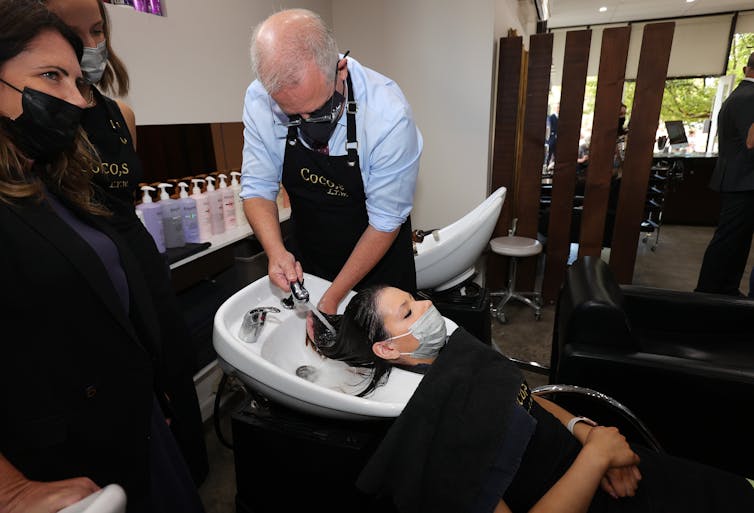
A stereotype of him as little more than a PR song-and-dance man has already taken hold, as was seen in the blow-back to his recent foray into hairdressing. He was mocked – on Rupert Murdoch’s news.com, no less – as someone who didn’t hold a hose, the clear inference being that he could evidently hold a salon’s shower attachment.
Scott Morrison’s recent foray into hairdressing was not warmly received. AAP/Con Chronis
From the point of view of political strategy, more PR is not what Morrison needs. He needs to look prime ministerial.
60 Minutes gave us only a fleeting glimpse of him in this role, welcoming Stefanovic into his office. But even then it consisted mainly of Stefanovic giving him yet another free kick: “You’re under the pump right now.”
This kind of pap is not what voters want or need as they approach the election, something that was obvious from the program’s dismal ratings.
The preceding program was Married at First Sight, which attracted 961,000 viewers, giving 60 Minutes a strong springboard. However, when it came on, viewer numbers plummeted to 574,000, less than the ABC’s imported whodunnit Vera, and on par with the ABC’s Muster Dogs.
Denis Muller does not work for, consult, own shares in or receive funding from any company or organisation that would benefit from this article, and has disclosed no relevant affiliations beyond their academic appointment.
At the heart of the present geopolitical conflict centred on Ukraine is a divergent set of views as to what constitutes a ‘nation’.
Rival Views of Nationality
Keith Rankin.
Firstly, ‘nation-states’ as we know them today arguably date to the 1645 Peace (or Treaties) of Westphalia, which negotiated the end of the bloody and chaotic Thirty Years War in Europe. Before that there was a mix of overlapping empires, kingdoms, emirates, and principalities. The empires (including caliphates) were often linked to a religion (eg the Holy Roman Empire, and the Ottoman Caliphate) subscribed to by the vast majority of the population; a hegemonic religion (such as in Mughal India; and a key to understanding tensions in India today); or a quasi-religious worldview (eg Confucius), as in the Celestial Empire (China) and the Hermit Kingdom (Korea). And, in the 1600s, there were the semi-secular nationalist republics of Japan (Tokugawa Shogunate) and Netherlands (Dutch United Provinces). Other empires – including emergent global empires – were linked to a hegemon sovereign; especially European kingdoms such as Spain, France and England.
It was in this time – from the 1600s – that national bureaucracies emerged, and with them de factoand de jure international borders. It was World War One – 1914 to 1918 – that, in its wake, ushered in the Wilsonian system of territorial nation states, including many new republics. This new system – named after United States President, Woodrow Wilson – in which territorial borders (rather than nationalities) defined nations, was in its emergent phase just 100 years ago. The Wilsonian ‘territorial’ system soon became sacred, reflecting the increasing dominance of the United States on the world stage. The United States was of course a nation with many resident nationalities, noting that, 100 years ago, a person’s nationality was the most important component of their ‘identity’. After 1918, an Italian American was first and foremost an American; secondmost an Italian (or perhaps secondmost a Sicilian, and thirdmost an Italian). Other important components of identity the were biological ‘sex’, ‘race’ and ‘religion’ (including denomination, such as Catholic or Shia). Within territorial structures, persons’ identity profiles remained a critically important component of their lives.
The forty years after World War Two (1945-1985), represented the heyday of the Wilsonian territorial system, with many new postcolonial nation states emerging – albeit with borders that were somewhat arbitrarily drawn, more reflecting colonial boundaries than local nationalities. ‘Assimilation’ of diverse identities into new territorial nationalities was the byword of the first post-WW2 decades.
The Tyranny of Borders
The new tyranny was a ‘tyranny of the borders’. For many people, their nation’s territorial boundary became a prison wall (a literal wall in the former East Germany). Otherwise, people’s freedom of movement was both increasingly restricted (more bureaucratic controls) and increasingly enhanced (lower travel cost; the development of the tourism industry). Bureaucratic controls initially allowed people to retain relative freedom of movement within the former imperial structures; eg passages were eased for some, based on individual or collective ancestry. By the 1980s and 1990s, economic criteria were largely superseding heritage criteria for immigration; and people from rich nation states were finding it much easier than people from poor ‘countries’ to get tourism permits. (A ‘country’ became the most widely used word for a territorial nation state, reflecting nations being increasingly defined by their countrysides, their landmasses, their territories.)
The Wilsonian system is widely loved by bureaucrats, especially foreign-office bureaucrats, because of the ease it gives to creating rules that form the basis of a ‘rules-based’ political order.
It was the 1980s that saw the first challenge to the Wilsonian system, under the rubric of ‘globalisation’. In the 1980s, finance and neoliberal economics superseded territorial politics. Followed in the 1990s by the communications revolution that was the internet. International borders effectively diminished, as financial capital, traded goods and services, and labour (to a lesser but substantial extent) moved at increasing scale across these borders. Nevertheless, to the foreign office bureaucrats, the national security institutions, and the international economists (who posited a world of trade between territorial nations rather than between businesses and their customers), the Wilsonian territorial world order continued. How else to occupy the machinators of Washington and other federal capitals?
The globalisation process – which some, especially left-wing critics, took to be an anti-state ideology – came to a semi-abrupt halt after the global financial crisis of 2008. Governments got their mojo back. Finance became increasingly subsumed to perceived national interests, and regulations. Territorial public debt reasserted itself as an issue through which national governments could regain control over their domains. And the developing international labour system became increasingly directed by the national immigration bureaucracies. Global ‘pipelines’ of extraterritorial workers flourished, largely but not only managed by the territorial authorities. ‘People-trafficking’ became an issue as two kinds of failed states emerged – those riven by ‘civil’ war or other problems such as ‘terrorism’ that generated a supply of refugees, and those riven by debt and austerity whose people turned to crimes such as people-smuggling and drug-smuggling as a means to provide for their families. With the re-intensification of the border-system, these smuggling operations became more violent, and less-evoking of sympathy.
A Return to Identity Nationalism
At the same time, a new threat to the rules-based territorial world order has emerged, especially in the ‘new world’; with Aotearoa New Zealand, Canada, and South American territories leading the way. This process epitomised through television programmes such as Nations Without Borders, on Māori Television. Thus, this new development focusses on indigenous peoples representing themselves as ‘nations’, and as such represents a return to ‘identity’ rather than ‘territory’ as a basis for the way nations are defined. In my memory, this idea of ‘nations within nations’ began in apartheid South Africa, when the ruling race-based minority defined the indigenous majority as a set of semi-independent subject nations. (We may note that, in 2004, then National Party leader Don Brash made his infamous Orewa speech expressed concern about the threat – as he saw it – to New Zealand as a singular territorial nation within a world order of territorial nation-states. Notethis recent [2018] commentary in stuff.co.nz.)
In Aotearoa New Zealand, this is taking an interesting turn, on account of the bi-national Treaty of Waitangi as the national foundational document, and, as such, the basis of an inchoate constitution. The possibility emerges of constitutionally equal co-nations within a single territory. Indeed, such an arrangement clearly fits the present philosophy of the leadership of New Zealand’s governing Labour Party. While the government is absolutely committed to territorial sovereignty – as per the Wilsonian post-WW1 system – it is flexible about internal nation-building based on partnership rather than the apartheid-like subservience of one domestic nation to another.
Further, we can already see how this concept of nationhood based on identity rather than territory may evolve, away from being strictly internal to territorial borders. We may consider the international labour system, which has been compromised but not eliminated by the Covid19 pandemic. This system is predicated on international labour contracts, with limited rights and obligations between contract workers and host nations; last century the labour system had been based much more on emigration/immigration, with eventual rights to permanent residence in host countries.
In New Zealand there is an RSE scheme (recognised seasonal employer), which is essentially a way in which territorial states such as Vanuatu, Fiji and Tonga export services to foreign host countries. These workers cross New Zealand’s territorial border with strictly limited visas, which are completely dependent on the terms of pre-arranged labour contracts. So, within its territorial boundary, New Zealand is moving towards two (or more, if tribally-based) nations with citizenship rights, and denizen enclaves of foreign nations providing labour services to citizens.
In Australia we see similar patterns, although indigenous nationhood there is much less advanced. Australia contains large denizen enclaves which include both indigenous and non-indigenous New Zealanders. The rights of New Zealanders in Australia have diminished since 2001; New Zealanders, in recent years, have been detained in and deported from Australia on various grounds, including ‘bad character’. Thus, the emerging perception is that New Zealanders living in Australia belong to the New Zealand nation, not the Australian nation. This is part of a process whereby ‘people’ are morphing into ‘labour’. In ancient Rome, even former slaves had rights of host citizenship.
Background Understanding of the Geopolitical Crisis centred on Ukraine
The central problem here is, firstly, that the political leader of Russia – and his subjects, by and large – adhere to a pre-WW1 view of nationhood. Clearly Vladimir Putin has pretensions of being an emperor; an emperor of the Slavs, in essence. That does not mean he wants to incorporate all Slavic people into a greater Russian national territory; ie there is no evidence that he wants a return of the ‘Iron Curtain’. But it does suggest that ‘Slavic nations’ seemingly form a natural family of nations, with shared interests through shared identity. This is not a nationalistic view as in the Indian sense (whereby Indian nationals would reserve citizenship only to people of the Hindu faith); it’s fully inclusive of ethnic minorities within both core and peripheral ‘Slavic’ territories.
Secondly, the central problem is that the United States’ federal bureaucrats – as self-appointed custodians of the rules-based system of nations – hold to a purely territorial view of what constitutes a nation. Thus, to them, officially recognised borders – even accidental borders – are sacrosanct, and defensible by military means.
The United States geopolitical strategy – of facilitating, through sanctions, the creation of an “axis of evil” out of countries that refuse to conform with its vision of a territorial rules-based world order – is very twentieth century; is ‘Cold War’ without the explicitly ‘Communist’ bogey. While the Russian imperial worldview is also outdated, it might be slightly more in tune with an emerging twentyfirst concept of nationhood based foremostly – as pre-twentieth century – on identity rather than on the sacrosanctity of national borders.
*******
Keith Rankin (keith at rankin dot nz), trained as an economic historian, is a retired lecturer in Economics and Statistics. He lives in Auckland, New Zealand.
It has been 14 years since then prime minister Kevin Rudd delivered his apology to the Stolen Generations from parliament house. Words which were so longed for from survivors and descendants of horrific government policies, and which echo through to today.
For the pain, suffering and hurt of these Stolen Generations, their descendants and for their families left behind, we say sorry. To the mothers and the fathers, the brothers and the sisters, for the breaking up of families and communities, we say sorry. And for the indignity and degradation thus inflicted on a proud people and a proud culture, we say sorry.
Scott Morrison’s speech today on the anniversary of this momentous day made headlines for a different reason. Many have taken umbrage with this line:
Sorry is not the hardest word to say. The hardest is ‘I forgive you’.
Scott Morrison almost demanding forgiveness belies a false understanding of both how apologies work, and the nature of what it is the government apologised, and is apologising, for.
The policies of the Stolen Generations were acts of government, designed to assimilate us and deprive us of culture. They are also actions which can be remedied by government. To frame the apology in this way is, as Greens Senator Lidia Thorpe tweeted, “outright disrespect”, and “not an apology”.
A stain upon the nation
The Stolen Generations remain a national shame for this country. Over several decades, roughly one in five First Nations children were taken from their families between 1910 and 1970, countless communities broken up, and our cultures forcibly suppressed.
In some jurisdictions such as Western Australia, the figure is over one in three First Nations children removed. Nationally, these generations and their descendants make up close to two in five First Nations people, according to a report from The Healing Foundation.
The apology, which many thought would not come, and many sadly did not live to see, remains an important part of Australian and First Nations history. Finally the wrongs of the Stolen Generations were not only acknowledged by the government, but apologised for. The apology was, and shall remain, in the words of Linda Burney, a “cultural moment shared by the country”.
Kevin Rudd’s 2008 Apology to the Stolen Generations was a watershed moment.
However, it is easy to remember the apology as a moment of national unity, free from dissent, which is not the case. John Howard, who proceeded Rudd as prime minister from 1996-2007, famously refused such an apology, alongside other measures including a treaty, partly due to the practices of removal being “believed to be in the best interests of the children concerned”.
Howard has continued to defend this failure to issue an apology even decades later, declaring the apology “meaningless” in a January interview.
Howard was of course, not present in the parliament in 2008, having lost his seat at the 2007 landslide election which saw Labor gain government. However, some members of the Liberal and National parties boycotted the event, including controversial former MP Sophie Mirabella, and most notably current Defence Minister Peter Dutton, both of whom have defended their boycott of the apology.
For those survivors of the Stolen Generations, and their descendants, the effects of these policies are ongoing, and not confined merely to the removal of children and the destruction of families.
The trauma and pain of these policies, and of being disconnected from country, culture, and community, extends down to their children, and their children’s children.
According to The Healing Foundation’s Make Healing Happen report from 2021, Stolen Generations survivors are more likely to not own a home, have worse finances, have experienced violence, suffer from a disability, and to have a criminal record.
Additionally, rates of child removal in Australia have continued to rise over the last decade, with First Nations children ten times more likely to be removed, with over 21,000 in out of home care as of December 2021. This number is projected to increase by a further 54% by 2031. We are going in the wrong direction, and worse, we are doing very little about it.
All of these problems are fixable, and by the government. Presuming forgiveness on the part of those you have wronged, is not going to solve any of these issues. Indeed they are likely to have the opposite effect, reducing the ability of the government to engage with these communities, and impacting upon the mental and physical health of Stolen Generations survivors and their families.
What is needed is a national approach to healing, including reparations for survivors and their descendants (something the government has begun to deliver on). However, increased services for ageing survivors and a national strategy addressing intergenerational effects of child removal are also needed.
In addition, there needs to be accountability going forward on current child removal practices, with an effort to reduce the number of First Nations children removed, and greater supports and structures for those who are, and a Voice for First Nations peoples within our political system.
Action is a much greater apology than words. Forgiveness can only truly come when there is action.
Scott Morrison’s comments today show he does not understand that. I’m not sure if he ever will.
James Blackwell is a member of the Australian Greens, and a member of the Uluru Dialogue at UNSW.
The royal commission into veteran suicide returned for its second session of hearings on Monday.
With one veteran dying by suicide every two weeks in Australia and evidence veterans have poorer mental health than Australians overall, this work is urgent and important.
But as the royal commission investigates the risk factors around veterans’ mental health, it is missing a key part of the puzzle: contact with the criminal justice system.
Prison, veterans and mental health
A key part of minimising the risk of veteran suicide is keeping veterans out of jail.
Nationally, it has been estimated nearly 3% of defence force personnel are arrested within a few years of finishing their military service. About 5% of those who have left full-time military service are reported as being arrested or imprisoned.
We know many veterans have complex mental health disorders – such as PTSD – as a result of their military service, and this can lead to criminal conduct and time in prison.
In Australia, the mental health of veterans who have been in prison is not well understood. Prison and military service separately increase the chance of suicide, and this tends to indicate that veterans who have been in jail have a significantly increased risk of suicide.
Recognition is not enough on its own
Military service – including training and deployment – can of course be traumatic and dangerous. It is also done on behalf of Australia. Because of this, veterans are owed a particular debt by government and society.
The royal commission held its first session in November 2021. Jono Searle/AAP
In 2019, new federal legislation recognised the need to support veterans and their families. But this was largely a symbolic act. We need proper investigations into the complex, continuing, and uncomfortable consequences of military service on veterans’ health and welfare.
The key issue is how society can best support veterans returning to civilian life. This includes strategies to prevent veterans ending up in the criminal justice system, but also offer specialised support to those who do.
Specialist veterans courts
This sort of support already exists in the United Kingdom and United States. In the US, for example, eligible veteran defendants have a specialist pathway out of the criminal justice system through veterans’ treatment courts.
In general, these courts provide treatment to veterans who have committed nonviolent crimes and are suffering mental health disorders related to military service. A growing body of evidence suggests these courts are more successful at preventing re-offending than jail time, and also improve the health and well-being of participants.
Could this work in Australia?
There are several similar models in operation in Australia, including the NSW drug court and mental health courts for other at-risk groups such as those with drug addictions and serious mental illnesses.
A veterans’ court would be a problem-solving court, with an emphasis on rehabilitation, allowing service providers and veteran peers to work with veterans to move away from criminal conduct.
Individuals participating in veterans’ court processes may have their sentence suspended or their sentencing hearing deferred while they complete a drug treatment program or other treatment option. On successful completion of the program, the individual may even avoid a prison term.
What next for the royal commission
The royal commission will provide an interim report by August 11 2022 and a final report by June 15 2023 – so there is still time for a thorough consideration of veterans’ contact with the criminal justice system.
This is relevant under the terms of reference. While they do not specifically mention the courts or criminal justice system, they do include “systemic issues and any common themes among defence and veteran deaths by suicide”.
Further work with veterans’ bodies in Australia will be necessary to determine the feasibility of and demand for veterans’ courts. But once this work is done, such courts could provide a practical, evidenced-based way to help those who have served our country.
If you or anyone you know needs help or is having suicidal thoughts, contact Lifeline on 131 114 or beyondblue on 1300 22 46 36.
The authors do not work for, consult, own shares in or receive funding from any company or organisation that would benefit from this article, and have disclosed no relevant affiliations beyond their academic appointment.
The continued occupation of parliament’s grounds by anti-vaccine mandate protesters (and others) provides a unique problem for police: how to lawfully and legitimately remove the occupiers without making the situation worse.
The Speaker of Parliament has authorised police to clear the grounds, which grants the operation legitimacy. But tactically the options are not as clear-cut.
In the background is an ever-present policing conundrum: taking action in favour of one group within society risks alienating another. The longer police tolerate the occupiers’ right to protest, the more frustrated the affected homeowners, businesses and workers become.
Some commentators and critics (especially on social media) have been quick to criticise police command decisions and the seeming unwillingness to use more force. But weighing up the rights of competing groups is never simple.
Nor is undertaking an operation that risks injury to police personnel (and protesters), and where perceived excessive force can lead to subsequent legal action against individual officers.
Logistical impossibilities
Despite the standoff, however, police and parliamentary security have successfully prevented the breach of parliamentary buildings – something that would have been on the minds of security planners since the storming of the US Capitol in Washington DC a year ago.
But police also face the problem of the occupiers’ unclear objectives and the apparent lack of leadership with whom to negotiate. The disparate motives of the various protest groups preclude the kind of rational negotiation that would normally be undertaken in a siege situation.
Widespread arrests might be lawful, but appear logistically impractical. The arrest, custody and charging process is resource-heavy (especially when those arrested refuse to comply with vaccination or mask mandates).
Even moving occupiers’ vehicles has been a challenge beyond the capabilities of the Wellington Council and adding to police concerns.
Moreover, the arrest of 122 people last Thursday did not result in the remaining body of occupiers dispersing. There have been reports some of those arrested and bailed have returned to the site, contrary to their bail conditions.
And the parliamentary speaker’s own tactics (not endorsed by police) of turning on the ground’s water sprinklers and playing supposedly annoying music over the PA system have not worked, either.
The arrests, charges, court appearances and even Barry Manilow have not acted as a sufficient deterrent, and have possibly even hardened protesters’ resolve. Clearing the occupation in a way that prevents protesters from returning to the site simply adds another layer of challenge.
Managing perceptions
All force used by police must be necessary, proportionate and reasonable in the circumstances. Police will be rightly cautious about this, given the presence of children and young people at the site.
Furthermore, the actions of the protesters sit within the definitions of passive resistance (refusing to comply with verbal directions to move) and active resistance (pulling or pushing away). Even in the face of someone resisting arrest, force by police must be proportionate to the resistance offered.
As such, police procedure limits officer responses. For officers to employ tactics involving the use of weapons – batons, sprays or tasers – they would need to be responding to more assaultive behaviours from individual protesters.
Force used to arrest those who have made death threats against MPs and media must also be made on the same basis of being proportionate and necessary. Police would need to weigh up the likelihood of a threat to justify immediate action.
Less common paramilitary-style tactics were on display last Friday when some police carrying batons assembled, again fodder for mainstream and social media debate.
Squads marching into position like this are a necessary overt display of organised coercive power in response to a perceived level of threat. But they have the potential to be portrayed as state oppression – something police commanders are aware of. The same day batons appeared, the Wellington police district commander instructed officers not to carry them.
A waiting game
How to break such an impasse? Parliament could pass emergency legislation giving police special powers to use all force necessary to clear and detain protesters en masse.
But such a tactic would be an affront to the constitutional and constabulary independence of police that is valued in Aotearoa New Zealand. As the Policing Act specifically prohibits ministerial interference in operational matters, some might perceive emergency legislation as an overreach.
Using chemical irritants like pepper spray may well disperse the crowd but might also only displace the problem to another site, with police bound to provide aftercare and medical treatment.
Mounted police units, as used by Australian and British police, are an effective means of moving large groups of people, but no such capability exists in New Zealand.
The problem will not be resolved by arresting every occupier, given the significant financial cost and required resources. The police themselves have acknowledged they cannot arrest their way out of the problem.
Police are well resourced to wait the occupation out. While this might be the safest option, it may not be the most politically amenable one. So far, though, the police can be applauded for their patience, professionalism and commitment to maintaining the peace.
Ross Hendy has previously worked for and received research funding from New Zealand Police.
Review: And the Earth will Swallow Them Whole, choreographed by Rachel Arianne Ogle
The first act of And the Earth will Swallow Them Whole, performed in Perth’s aptly-named Studio Underground, positions the audience around the edge of a three-sided balcony looking down into the black space and an open-topped grand piano.
Pianist and composer Gabriella Smart begins with a solo rendition of Beethoven’s Moonlight Sonata. She is subsequently joined by composer Luke Smiles who manipulates and extends the piano sound to co-create a live score that transforms the familiar piano sonata into something new and unrecognisable.
Music from the prepared piano is unsettling and deeply engaging. Emma Fishwick/Perth Festival
Created on an electronically prepared piano, the score is a disconcerting amalgam of classical piano and electronic distortion. At times we see the pianist’s hands at work but no longer hear sounds that you’d usually associate with a piano.
It is an unsettling and deeply engaging prelude to the entrance of the dancers.
As the ensemble of six dancers come into view they seem, at first, weightless, almost adrift. The added plane provided by watching them from above creates an almost vertiginous effect in the viewer.
The longer you look down the more your sense of perspective is challenged and unmoored. Akin to that tingling sensation in the soles of your feet when you keep your eyes on the track as the train pulls into the station, there is a sense of simultaneously falling and standing still. The movement of the dancers seems to mirror that state.
Watching from above, your sense of perspective is challenged and unmoored. Emma Fishwick/Perth Festival
They warp and weft between connection and disconnection, evoking rescue and sacrifice, of each other and themselves.
From our perspective the dancers sometimes seem almost supine. They create images that hold and then just as quickly disintegrate. Their exquisite ensemble work is beautifully sculptured by Bosco Shaw’s lighting design that seems to both hide and reveal.
The work segues seamlessly through variations of movement until the haze lifts to reveal a kind of landscape of markings on the floor. I am reminded of Gertrude Stein’s response upon first looking down at the flat landscape from the window of an aeroplane, of how it consolidated her resistance to the specificity of time and place.
Without familiar reference points we are all time, all space. And so the dancers are individuals, pairs, whole nations, falling away and raising again, together and alone, history passing.
The first act finale introduces another layer to the view from above making gorgeous use of a piece of fabric that billows and falls, engulfs and retracts around the lone figure of dancer (Zee Zunnur). Facilitated by the other dancers it is a mesmerising allusion to the title of the piece.
We are frail in the face of unstoppable external forces. Emma Fishwick/Perth Festival
Equal parts hypnotic and repellent, it speaks to a sense of temporality and frailty in the face of unstoppable external forces and it is a particular highlight.
Immersive patience
The second act provides an immediate change of perspective as the audience enters through different doors to arrive on the floor with the dancers. Standing or sitting, we circle the dancers as they enact rituals of devotion, death and burial around the figure of Zunnur.
For the audience, it is an exercise in immersive patience. By the end the actions and focus of the performers have transformed both the space and the atmosphere so there is a sense that we are all breathing together, as equal observers and participants.
We are all breathing together, as equal observers and participants. Emma Fishwick/Perth Festival
Here again the lighting, sound and design work together exquisitely. The live score, like the bodies of the dancers, builds and breaks down and builds again, constantly transforming, like all of us.
In collaboration with her dancers and creative team, choreographer Rachel Arianne Ogle’s adherence to an exploration of mortality and death is steadfast and all-encompassing.
Casting a cartographical eye on the space between life and death And the Earth will Swallow Them Whole is an impressive collaboration between artists, a work that deals in images and sounds that leave an indelible imprint on the senses.
And the Earth will Swallow Them Whole plays at Perth Festival until February 14.
Leah Mercer does not work for, consult, own shares in or receive funding from any company or organisation that would benefit from this article, and has disclosed no relevant affiliations beyond their academic appointment.
For more than a decade we’ve been deeply immersed in a love affair with social media. And the thought of ending things can be painful. But like any relationship, if social media is no longer making you happy – and if curating your online persona is exhausting instead of fun – it might be time to say goodbye.
Late last year Meta (previously Facebook) came under intense scrutiny after leaked documents revealed the company was fully aware of the negative impact its products, Instagram in particular, can have on users’ mental health.
Meta went straight into damage control. But it seemed no one was particularly surprised by the news – not even teenage girls, who Meta identified as most at risk. Was the leak just confirming what we already suspected: that social media has the potential to be much more harmful than helpful?
How did our once carefree relationship with social media turn sour? And perhaps most importantly, can (or should) it be salvaged?
Spotting the red flags
Relationship counsellors will often ask troubled couples to think about what made them happy in their relationship. Social media, for all it’s annoying peccadilloes, does have some redeeming features.
Throughout the pandemic, the ability to stay connected to people we can’t see in person has become incredibly valuable. Social media can also help people find their tribe, particularly if the people in their offline world don’t share their values and beliefs.
With so many social platforms available – and millions (or even billions) plugged in – our FOMO can takeover. Shutterstock
But if you can’t go a day without trawling through the sites, feeling compelled to “like” or be “liked”, your relationship is in trouble.
Though far from settled, the bulk of screen time research focuses on the detrimental effects of excessive or problematic screen use on well-being and mental health. A 2021 meta-analysis of 55 studies, with a combined sample size of 80,533 people, found a positive (albeit small) association between depressive symptoms and social media use.
An important finding was that negative consequences were more likely to come from how social media use made participants feel, rather than how long they used it.
Information overload
In trying to understand why social media can leave us feeling less than content, we can’t look past the effect of the 24/7 news (and fake news) stream on our collective psyche.
A 2021 Deloitte survey of Australians found 79% thought fake news was a problem, and only 18% felt information obtained via social media was trustworthy. Having to navigate content that deliberately aims to perpetuate fear and dissent only adds to people’s cognitive and emotional burden.
But here’s the rub. It seems while we’re generally concerned about technology having a negative impact on our well-being, this doesn’t translate to behaviour change on an individual level.
My own research published last year found more than two-thirds of survey participants believed excessive smartphone use can negatively impact well-being, yet individual usage was still very high, averaging 184 minutes per day. There was no relationship between the belief and the behaviour.
What leads to this apparent cognitive-behavioural dissonance? The results of a long-term study by University of Amsterdam researchers might provide a clue. They found living in a “permanently online” world leads to decreased self-control over social media use and, subsequently, lower well-being.
In other words, we know what we’re doing might be bad for us, but we do it anyway.
Simple steps you can take
How do you know when it’s time to reevaluate your relationship with social media? There’s one deceptively simple question to ask yourself: how does it make you feel?
Think about how you feel before, during, and after you use social media. If you feel like you’re wasting large chunks of your day, your week (or dare I say, your life) on social media – that’s a clue. If you feel negative emotions like sadness, anxiety, guilt, or fear, you have your answer.
But if divorcing social media abruptly feels like a step too far, what else can you do to slowly break away, or potentially salvage the relationship?
1) Start with a trial separation
A “soft delete” lets you see how you’ll feel without your social media before committing to a hard delete. Let friends and family know you’re taking a break, remove the apps from your devices, and set yourself a goal of maybe one or two weeks where you don’t access the account/s. If the world is still turning at the end of this trial, keep going! Once you no longer feel the pull of social media, you’ll be ready to hit delete.
2) Reduce the number of platforms you engage with
If you have Facebook, Instagram, Twitter, TikTok, YouTube, Snapchat, WhatsApp, Tumblr, Pinterest and Reddit on your phone, tablet and computer, then you’re probably past saturation point and into drowning territory. Pick one or two apps that genuinely serve a meaningful purpose for you and ditch the rest. Gen X’ers find it hard to say goodbye to Facebook, but Gen Z have largely bid it farewell. If they can do it, so can you!
3) If steps 1 and 2 are still too much, try to reduce your time spent on social media
First and foremost, turn of all your notification (yes all of them). If you’re conditioned to respond to every notification “bing”, you’ll find it almost impossible to stop responding to it. Set aside some time each day and do all your social media catching up or browsing. Set an alarm for your predetermined time allocation and when it sounds, put the phone down until the same time tomorrow.
None of this will be easy, and walking away from social media might hurt at first. But if the relationship has become uncomfortable, or even abusive, it’s time to take a stand. And who knows what untold happiness you might find, beyond the four walls of your screen?
Failing to disconnect from social media can end up hurting more the alternative.
Sharon Horwood does not work for, consult, own shares in or receive funding from any company or organisation that would benefit from this article, and has disclosed no relevant affiliations beyond their academic appointment.
New Zealand Parliament Buildings, Wellington, New Zealand.
Editor’s Note: Here below is a list of the main issues currently under discussion in New Zealand and links to media coverage. You can sign up to NZ Politics Daily as well as New Zealand Political Roundup columns for free here.
Source: The Conversation (Au and NZ) – By Jonathan W. Marshall, Postgraduate Research Coordinator, Western Australian Academy of Performing Arts, Edith Cowan University
Dana Weeks/Perth Festival
Aboriginal and Torres Strait Islander readers are advised this article contains names of people who have died.
Review: Panawathi Girl, written by David Milroy and directed by Eve Grace Mullaley, Perth Festival with Same Drum and Yirra Yaakin Theatre Company.
Viewing David Milroy’s new musical Panawathi Girl, the production is inevitably refracted through the fame of Jimmy Chi’s equally ground-breaking 1990 Perth Festival premiere Bran Nue Dae.
Both are comedic music theatre works authored by First Nations artists from northern Western Australia, set in 1969, and staged with a live, rocking band.
This aside, they are very different.
Bran Nue Dae is a tropical love story which, while alluding to the complex racial divisions and crossings typical of Broome, offers a feelgood portrayal of the protagonist’s sexual and romantic awakening.
In contrast, Panawathi Girl is a buoyant yet cynical depiction of racial conflicts in the Western Australian countryside, self-consciously set in a fantasy of an Australian past: violence free, brightly coloured and populated by surprisingly sympathetic white politicians.
Through this fantasy, however, comes a telling critique of our own times.
The rodeo comes to town
It is 1969. Reformist Labor leader Gough Whitlam (Luke Hewitt) is heading for election against lacklustre Liberal prime minister John Gorton (Geoff Kelso).
The 1967 referendum passed, but Aboriginal people still don’t have equal rights. Dana Weeks/Perth Festival
As Gorton confides to Whitlam, despite the Labor minister’s support for land-rights, it seems an impossibility to “close the gap” – a clever if depressing reference to the 2008 Closing the Gap agreement and its woeful implementation.
A rodeo has come to the town of Chubb Springs, where the places in which people can drink and live are divided between the “blacks” and “whites”.
Although the 1967 referendum means Aboriginal and Torres Strait Islander people are now formally part of the national population, they are often excluded from voting and other rights.
Molly arrives in Chubb Springs, hoping to connect with Country. Dana Weeks/Perth Festival
Molly Panawathi (Lila McGuire) is the estranged daughter of local white farmer Chubb (Peter Docker). Molly has come to Chubb Springs to learn about her presumed dead mother Pansy (Angelica Lockyer). Having been brought up in Perth away from Country and culture, she is not welcomed by the local Aboriginal community.
Billy (Wimiya Woodley) is sick of the flack he gets from other mob for playing the role of loudmouthed rodeo drunk and has decided he will “head out bush… get my head straight.”
His sister Ada (Teresa Rose) has chosen to keep working for her lanky but intimidating boss Buckley (Maitland Schnaars), who passes as white.
Molly eventually stages a joyous rebellion of sorts at the rodeo ball, complete with a wonderful drag turn by her queer city friend Jojo (Manuao TeAotonga). Like a true panto villain however, Buckley is unrepentant.
“50 years from now,” he explains, leaning comfortably back in his tall frame, “nothing will have changed.”
Idiosyncratic and appealing
The gentle country-and-western twang of pedal steel guitar (played by Lucky Oceans) competes with the more rhythmic strums of conventional guitars (electric and acoustic) to take us from uncertain, yearning songs performed by Molly and others, to party pieces, and other tunes.
There is even a dash of tuba to underpin the sillier moments, some Andrews Sisters-style harmonies with Ava’s slightly awkward turn at the ball, and a particularly demented elegy to a Palomino pony who has become sandwich-meat from Molly’s hippy friend Beth (Grace Chow).
Panawathi Girl draws on many musical references. Dana Weeks/Perth Festival
Gorton and Whitlam come together as a recurring double-act, adding political depth and humour to proceedings. Their song and dance routine The Land of the Long White Sock is a particular highlight.
Rodeo broncho buster Knuckles (Gus Noakes) gives some impressive boot scooting in the style of Oklahoma! and Noakes has the finest voice in the cast.
While other actors have beautiful character voices, their vibrato and sustain is not strong. Even in the climactic moments, they don’t belt it out.
But despite this lack of strength, the casts’ voices are idiosyncratic, appealing, and either crack or soar as required, adding to the vaudevillian feel.
Milroy’s canny political references and criticisms are woven throughout an enjoyably diverse array of styles and references, from Oklahoma! to electrified country, from vaudeville double acts, to wistful solos, set in a kind of Neverland past where everything from the safari suits, to the stripey clothing and Whitlam’s reformist rhetoric, are amplified and celebrated.
But although much of the play feels like a celebration, with an engaging tone and musical appeal, underneath it is truly a critique of how far those dreams have receded in 2022.
As Milroy states in the program, “fifty years on it is difficult to maintain the same optimism.”
Panawathi Girl played as part of the Perth Festival. Season closed.
Jonathan W. Marshall does not work for, consult, own shares in or receive funding from any company or organization that would benefit from this article, and has disclosed no relevant affiliations beyond their academic appointment.
However, widely spoken contact languages – creoles and dialects – have emerged. One example is Aboriginal English, which is a broad term used to describe the many varieties of English spoken by Aboriginal people across Australia. Another example is Kriol, which is a creole language spoken across northern Australia.
These contact languages are not always recognised as the full languages they are by some educators and society generally.
Because of this, many First Nations children are not treated as second language learners. Their languages are sometimes viewed as deficient forms of Standard Australian English and can be “invisible” to teachers and education systems.
To improve educational outcomes for Aboriginal and Torres Strait Islander children who do not speak Standard Australian English as their first language, their language backgrounds must be recognised and valued.
Contact languages form when communication is essential between speakers of two or more languages. In Australia, this occurred between the speakers of Aboriginal and Torres Strait Islander languages and English speakers after the British invasion in 1788.
A variety of contact languages developed which are both similar to, and different from, each other. Some languages are more closely related to English, while others have more features of Aboriginal and Torres Strait Islander languages. Many of these contact languages are not officially named.
The features of contact languages often reflect the impacts of colonisation for communities across Australia. These factors contribute to their lack of recognition in Australian society, including school systems.
Little is known about contact languages, but many First Nations children all over Australia come to school speaking them as their first language.
Our research was conducted at three primary school sites in Far North Queensland. One group was made up of monolingual Standard Australia English speaking children. The other two groups were Aboriginal and Torres Strait Islander children who spoke Indigenous contact languages. The First Nations groups were located near each other, but despite their proximity, they differed.
One of the two First Nations groups was in a rural town where Standard Australian English is widely spoken and the children had a diverse range of language backgrounds. The other was in an Aboriginal community where one contact language was primarily spoken and exposure to Standard Australian English was limited.
Our research is intended to make the Standard Australian English language learning needs of many First Nations children more “visible” to educators. We identified some of the linguistic differences between Standard Australian English and the contact languages these First Nation children speak for testing.
Because of language differences, First Nations students’ achievements as Standard Australian English speakers may not be recognised in the classroom. GettyImages
First, we compared the short-term memory capacities of the three groups. The short-term memory capacities of all groups were the same, demonstrating all the children had the ability to store language in their short-term memories for immediate use.
Next, these students were asked to orally reproduce a range of simple sentences given to them in Standard Australian English to gauge their proficiency. There were 18 simple sentences of different syllable lengths – six, nine and 12.
Sample sentences included:
• The dog barks at the cats (six syllables)
• In the bush, they built houses from sticks (nine syllables)
• He always eats mangoes in the park with his friends (12 syllables).
Each sentence was marked for grammatical accuracy in Standard Australian English. The speaking ability of all three groups differed significantly. On average, the Standard Australian English-speaking group recorded 71.1% accuracy, the group of First Nations children with diverse language backgrounds scored 45.1% and the others who spoke the same contact language and lived in an Aboriginal community scored 29.6%.
We also examined students’ knowledge of four Standard Australian English grammatical features:
• the prepositions “at”, “in” and “on”
• plural “s” on nouns, for example cats
• simple present tense with a third-person singular “s”, for example, she runs
• simple irregular past tense, for example, they ate.
The Standard Australian English-speaking group and the speakers of contact languages differed significantly in all aspects except for the prepositions “at”, “in”, and “on” where there was no difference.
For the other grammatical features, the difference of accuracy between the Standard Australian English speakers and second group ranged from 12.1% to 20.8%, and for the third from 20.1% to 45%. Simple present tense with the third-person singular “s” was the most difficult feature for the speakers of Indigenous contact languages, and plurals the easiest.
These findings highlight the close relationship that exists between Indigenous contact languages and Standard Australian English, as well as the significant differences.
Speakers of Indigenous contact languages may be proficient in some aspects of Standard Australian English, as demonstrated by their use of prepositions but not others. The findings also showed significant differences between the two groups of First Nations children, which probably reflect their diverse language backgrounds and their differing levels of exposure to Standard Australian English.
Language backgrounds of First Nations children need to be recognised and valued in Australian classrooms. GettyImages
Our findings showed the Standard Australian English speaking ability of Aboriginal and Torres Strait Islander students improved over their primary school years. However, it never reached the levels of their monolingual Standard Australian English speaking peers.
As children progress through school, the Standard Australian English language and literacy demands increase at such a rate that language gains are unlikely to be identified in either classroom-based or standardised assessments. Consequently, students’ achievements may not be visible or recognised in the classroom.
The impact of this can be seen in continued narratives of deficiency surrounding Aboriginal and Torres Strait Islander learners. The educational and social implications of this are considerable, and the educational outcomes for First Nations children who speak contact languages are a national disgrace.
To meet the Standard Australian English learning needs of First Nations students who speak contact languages, their languages must be recognised and valued in the classroom. Contact languages need to be treated with respect and understanding, and not viewed as incorrect forms of Standard Australian English.
To show respect and promote learning, we encourage teachers to learn about students’ first language/s and include them in the classroom. Students should feel free to express themselves in whichever language they choose, recognising their first language/s play an important role in learning.
All teachers need to understand how language is learned and should be supported to effectively teach Standard Australian English alongside curriculum content. Language skills are the cornerstone of literacy and educational development. Teachers should explicitly teach Standard Australian English and provide students with the opportunity to practise their language skills.
Targeted training needs to be delivered in initial teacher education courses and through professional development for those already teaching.
In the current climate of heavy responsibilities on time-poor teachers, sufficient funding and time must be given for teachers to gain the skills required.
To provide a fair and equitable education for all, the language backgrounds of First Nations children should be embraced in their education settings and the broader systems.
Carly Steele received funding from the Australian Government Research Training Program and the Australian Research Council Centre of Excellence for the Dynamics of Language to conduct this research as part of her PhD at the University of Melbourne.
Gillian Wigglesworth receives funding from the Australian Research Council (ARC) as a Chief Investigator on the Centre of Excellence for the Dynamics of Language (CE140100041) and also holds two Discovery Projects funded by the ARC related to her work with Indigenous children whose first language is not English.
Dr. Graeme Gower does not work for, consult, own shares in or receive funding from any company or organisation that would benefit from this article, and has disclosed no relevant affiliations beyond their academic appointment.
The days of speedily updating your Facebook status the moment a new relationship is made official are long gone. In fact the Facebook relationship update could be described as somewhat passé, replaced instead by a new form of social media relationship documentation – the “soft” or “hard” launch.
Social media oversharing has become a commonplace occurrence – and the trend of PR speak creeping into the realm of relationships and intimacy is only growing. The soft and hard launch trend combines both.
Love, labour and the consumer marketplace have always been intrinsically linked, and the evolution of “public dating” via social media documentation is worthy of investigation. The internet, and platforms like Instagram and TikTok, give rise to a new visual language of relationship milestones. A language which is highly nuanced, and interlaced with semiotics, gender scripts and cultural capital.
You’ve most likely seen examples of celebrity hard or soft relationship launches discussed in the media, and copied by regular people on their own social media.
The ‘soft’ or ‘hard’ launch – a definition
For those unfamiliar with the relatively new celebrity-led trend of soft or hard launching a relationship (predominately) on Instagram or TikTok, it sees users subtly (“soft”) or explicitly (“hard”) revealing a new relationship via a photograph or video and accompanying caption.
A soft launch might involve an image of two hands clasped together, think the Kourtney Kardashian/Travis Scott intimacy reveal, while a hard launch might feature the lucky couple locking lips (think Jennifer Lopez and Ben Affleck). Zendaya and Tom Holland’s Instagram soft launch was widely reported and speculated on – the use of the phrase “my Spider-man” a subtle choice.
This trend made famous perhaps by two of the greatest Instagram lovers and documenters – actress Megan Fox and musician Machine Gun Kelly – has ushered in a new age of seemingly unhinged, cringeworthy lovers posts on Instagram from ordinary people.
It might seem another strange social media phenomenon, but it’s a noteworthy cultural episode. Not only is it a way for media and tabloids to report on celebrity relationships, but it’s become a widely used tactic for regular people to broadcast to families, friends and followers their intimate lives.
Insta-official internet guides
If you’re looking to dive right into the new trend of social media relationship documentation – caution, you’re entering a maelstrom of complex relationship milestones.
You might want to follow one of the many “Insta-official” internet guides which handily outline the best way to launch and document your relationship on social media.
You might also want to consider in advance what to do with the content if the relationship falls apart – will it be an erasure of the evidence? Or a public statement announcing the end of the relationship?
The digital dating breadcrumbs left behind require attention.
PR speak creeping into intimacy
Love as a marketable commodity is by no means a new concept. Nor the entrenchment of labour and love. In Labor of Love: The Invention of Dating, author Moira Weigel writes that dating as we know it came about in the late 19th century, when there was a shift from private to public courtships.
Romantic encounters moved from cloistered exchanges in the home, under the supervision of family and friends, to public and commercial spaces like restaurants, bars and the movies. Weigel writes, “Almost everywhere, for most of human history, courtship was supervised. And it was taking place in non-commercial spaces” – until the explosion of public dating.
This public shift, meant that love came to be characterised by the consumer market-place. The signs, symbols and milestones of dating intertwined with consumption, and the visual economy. The visual economy applies to being seen – engaging in the romantic consumer spectacle.
However, the internet gives rise to a whole new sharing of visual consumer romantic signposts. In the digital domain, the language of love, the visual and the marketplace become truly entangled.
Your romantic social stocks
Use the Instagram-official blueprint correctly, and your social stocks will likely soar. Take as evidence Kourtney Kardashian’s Instagram account which grew by 44 million in 2021 following her relationship Insta-reveal. Love is after all the most popular hashtag on Instagram.
Cultural theorist Lauren Berlant reminds us that when we’re told to “get a life”, it usually refers to the need for a person to find an intimate relationship. The milestone of finding a life-partner, is indeed, seen as a critical one which continues to hold cultural and social relevance. When we narrativise our lives, there are a number of acceptable pathways available, and the romantic union is a highly recognisable one, which has developed a certain visual formula within the social media space.
My own research into dating apps and intimacy demonstrate how users come to recognise these signs as an indicator that an important relationship has commenced.
However, one might question in this highly scripted domain, is there room for subversion? For living an intimacy outside of the realm of super-saccharine and contrived Instagram-moments?
My research would indicate that in the space of dating and the digital domain, there are disruptions, but there are also continuities. This means new dating behaviours emerge in the digital space, but for the most part dating narratives remain the same – for example, a romantic proclivity for finding the one. Often these continuities reflect an update from an IRL (in real life) space to the digital realm.
The “soft” or “hard” launch of a relationship could be seen as an extension of a key courtship milestone – becoming official, building on and surpassing more traditional milestones like meeting the friends or family or anniversaries. However, the focus on the self as a brand, and the self-in-love as the premium brand, requires our vigilance.
Lisa Portolan does not work for, consult, own shares in or receive funding from any company or organisation that would benefit from this article, and has disclosed no relevant affiliations beyond their academic appointment.
In an analysis recently released to News Limited newspapers, the Morrison government claims banning new coal and gas projects in Queensland would risk 53,000 jobs and A$85 billion in investment.
But we checked the job claims and found them highly exaggerated.
The government analysis, released by federal Resources Minister Keith Pitt, came in response to a call by the Greens for a six-month moratorium on new coal, oil and gas projects.
We analysed the most recent government data. We found even in an extreme scenario where all new coal and gas projects are banned, reductions in future Queensland jobs would be at most one-tenth of what the minister claims.
A ban won’t affect every project
The most recent government dataset lists 44 coal projects and nine gas projects in Queensland. Two of the gas projects have already started production, so we discounted these from our analysis.
The rest of the dataset comprises the following projects:
six “committed” projects: those with environmental and planning approvals and a final investment decision
29 “feasible” projects: undergoing detailed analysis on their commercial viability, and awaiting environmental and planning approvals
16 “announced” projects with no detailed work behind them yet.
Committed projects wouldn’t be affected by a ban, because authorities have already approved them. That means associated jobs won’t be affected either. Some 2,700 construction jobs and 2,086 operational jobs are associated with these projects.
The ban would only affect projects not yet approved – the 45 projects classified “feasible” or “announced”. From now on we’ll refer to these projects as “uncommitted”.
If all 45 of these projects went ahead, it would create 26,853 additional construction jobs in Queensland and 19,131 operational jobs – or about 46,000 jobs in total.
Most of these uncommitted projects will only ever exist on paper.
Official data reveals 29 of the 45 uncommitted projects have been on the books for five years or more without moving to “committed” status.
Of the projects that were uncommitted in 2017, only five were listed in 2021 as committed or operating. This progress rate is much worse for coal than gas. Half the gas projects on the books in 2017 are now committed or operating, compared to just 6% of coal projects.
If this trend is repeated over the next five years, just one in two Queensland gas projects and one in 16 Queensland coal projects would proceed. This would mean Queensland could expect 4,406 new coal and gas jobs, comprising:
3,013 additional jobs in construction (1,488 in coal and 1,525 in gas)
1,393 additional operational jobs (1,168 jobs in coal and 225 in gas).
It’s these 4,406 jobs that wouldn’t be created if there was a ban on new coal and gas projects – a far cry from the 53,000 estimated by the Morrison government.
Some 18 projects in the dataset don’t report job numbers, and our analysis doesn’t assume any jobs from these projects. Three of these are committed or complete (so there are more jobs locked in than our estimate of 4,786 suggests). Fifteen are uncommitted, meaning our estimate of the jobs impacted by a ban might be slightly low.
We also examined historic data for the small number of committed projects where job number estimates were provided. None created more jobs than their initial estimate, and some provided fewer.
In one case, Adani’s Carmichael mine, there were 975 fewer construction jobs and 2,270 fewer operational jobs in the 2021 data than estimated in 2017.
So, all this suggests even the more realistic job numbers we calculated aren’t guaranteed to come to fruition.
The progress rate is much worse for coal projects than gas. Shutterstock
Bigger worries for regional Queensland
Overall, at least 4,786 jobs are locked in for Queensland from committed projects. A further 4,406 could be expected over the next five years if other projects go ahead.
Those 4,406 jobs, most in regional areas, are a lot to give up. In a small regional town, even an extra ten jobs can mean the local primary school retains all its teachers, the bank stays open and the pub remains viable. We shouldn’t dismiss the importance of this.
Queensland relies on coal and gas jobs more than some other states. But scaremongering and inflated claims about foregone jobs don’t help the debate – or help people who live in regional areas.
If the world is serious about achieving its collective goal of net-zero emissions, we can expect Australia’s coal exports to fall by 60% between 2020 and 2030.
It is this falling demand, not a moratorium or a ban, which will have the biggest effect on jobs and regional communities. And it is here that whichever party wins the 2022 election must focus its attention.
Tony Wood owns shares in a range of companies, including in energy and resources, through his superannuation fund.
Alison Reeve ne travaille pas, ne conseille pas, ne possède pas de parts, ne reçoit pas de fonds d’une organisation qui pourrait tirer profit de cet article, et n’a déclaré aucune autre affiliation que son organisme de recherche.
Most doctors encourage physical activity, maintaining a healthy weight and short-term use of a simple painkiller like paracetamol to manage the pain.
Opioids, like codeine, morphine or oxycodone, have a reputation as powerful painkillers and are commonly prescribed for persistent osteoarthritis pain. Up to 40% of people with knee osteoarthritis in the US are treated with opioid medicines.
People who begin taking opioid medicines to treat chronic pain conditions like osteoarthritis may end up taking them on an ongoing basis and expose themselves to serious harms including dependence, overdose and even death.
In our new study, published today, we reviewed all the relevant research and found opioids only offer very small benefits for the relief of osteoarthritis pain. Patients – and their doctors – need to carefully weigh up the risks and benefits of taking these commonly prescribed medicines for the treatment of osteoarthritis.
Opioids are types of narcotic drugs that work on the central nervous system to relieve pain. Our team from the University of Sydney and Sydney Musculoskeletal Health conducted a large review of 36 randomised controlled trials that compared opioid medicines to a placebo (or inactive pill) for osteoarthritis pain of the knee or hip. This kind of review represents the highest level of research evidence.
The combined trial results show the overall effects of opioid medicines compared to placebo on important outcomes such as pain and function.
The review found opioid medicines provide a very small improvement in pain and function compared with placebo. This improvement amounted to approximately 5 points or less on a 0 (no pain) to 100 (worst pain imaginable) pain scale. These modest effects are similar to what is expected if using paracetamol for osteoarthritis and less than one-third as effective as certain non-steroidal anti-inflammatory pills or creams including ibuprofen.
Our findings add weight to other research into the effectiveness of opioids. Australian researchers observed late last year that opioids were no more effective than mild painkillers after surgery for fracture.
Patients may get just as much pain relief from paracetamol or ibuprofen. Shutterstock
Importantly, we found no significant link between the dosage amount of opioid medicine and the level of pain relief. So, if an opioid medicine isn’t helping manage pain, increasing the dose is not likely to provide any further benefit.
The harms of opioids are well known, particularly at higher doses. Common side effects include nausea, constipation and fatigue. The review revealed the risk of experiencing unwanted effects like these when taking an opioid is almost 1.5 times greater than when taking a placebo.
Opioids also carry a risk of tolerance, which happens when the current dose is no longer helpful in managing the pain and a larger dose is needed to achieve the same effect.
These medicines can also lead to dependence, where stopping the opioid suddenly can lead to unpleasant withdrawal symptoms such as an inability to sleep, agitation, sweating and heart palpitations.
The risk of life-threatening overdose events is high with regular use of opioid medicines, as opioids inhibit the part of the brain that regulates our breathing. Opioids are the most common cause of drug-induced deaths in Australia, with 1,121 deaths reported in 2019 alone. The majority of these deaths (around 56%) resulted from prescription opioid medicines rather than illicit opioids such as heroin.
Scientists are working on new pain-relieving compounds that activate opioids receptors but are safer for patients.
With long-term use, the risk of adverse effects is greatly increased, especially as it is likely people will need higher doses to achieve the same level of pain control.
Chronic pain conditions like osteoarthritis are also commonly treated with long-acting formulations of opioid medicines such as OxyContin. However these types of opioids, which are intended to be taken regularly instead of only when needed, are associated with a six-fold increased risk of overdose compared with short-acting formulations.
Choose wisely
Our new findings will provide people with realistic expectations about the benefits these drugs can provide for chronic pain. Then they can carefully weigh this up with the risks.
Opioid medicines provide modest benefits for osteoarthritis which is similar to, or considerably less than, more simple analgesics like paracetamol or ibuprofen.
If you do choose or are prescribed to start an opioid medicine, discuss the benefits and potential harms with a doctor first. If you are concerned about the amount of opioid medicines you are using, or the duration you have been using them, speak with your doctor about a dose-reduction plan.
Christina Abdel Shaheed receives funding from the National Health and Medical Research Council
Christopher Maher holds funding from Government (e.g NHMRC) and not-for-profit agencies (e.g HCF Research Foundation) to support investigator-initiated research.
Wasim Awal does not work for, consult, own shares in or receive funding from any company or organisation that would benefit from this article, and has disclosed no relevant affiliations beyond their academic appointment.
Source: The Conversation (Au and NZ) – By Chiara Neto, Professor of Physical Chemistry and Australian Research Council Future Fellow, University of Sydney
Dan Himbrechts/AAP
Snow machines have exploited the laws of thermodynamics to paint the slopes of Beijing white for this year’s Winter Olympics.
Beijing might seem like an odd place for the winter games. The city receives almost no annual snowfall and has an average temperature just below 0℃, even in the winter month of February.
But isn’t all this artificial snow terribly expensive? If you own an air conditioner and keep half an eye on your energy bill, you’d expect snowmaking to be hugely energy-intensive. The uninitiated might think of snow machines as giant freezers with fans attached, guzzling cities’ worth of electricity to refrigerate entire mountainsides.
This isn’t really the case. Efficient machines in suitable climates (such as Beijing’s) can use as little as 1.5 kilowatts per cubic metre of snow produced. In Beijing’s climate, you could coat a Sydney apartment in a few inches of snow with the same energy the air conditioning would use in an hour.
But that’s not to say there’s no environmental cost. More on that later.
How do snow machines work?
Artificial snow is no chemical trick. The slopes of this year’s event are coated in pure frozen water.
Artificial snow is shot out in blower-type machines. Shutterstock
Fundamentally, snow machines work by using a clever thermodynamic exploit, leveraging the natural cooling that happens when water evaporates. And because their cooling power comes from evaporation, they can operate at relatively warm temperatures, up to 1℃ (provided the humidity is low enough).
Here’s how it works. Snow machines expel a fine water mist into the cold, dry atmosphere. Some of the water in each droplet quickly evaporates, carrying away heat and lowering the temperature of the rest of the droplet to below its freezing point. This process is known as “evaporative cooling”, and is the same mechanism that cools us when we sweat.
Because the energy loss required to form ice in this process is driven by evaporation, snow machines don’t have to expend energy to freeze water. They only require energy to power the fans and compressors that disperse the water droplets.
However, as any winter Olympian will tell you, snow is more than just frozen water. And snow machines must produce a blanket of powder worthy of the world’s greatest athletes.
They achieve this by using a “nucleator”, which is basically any substance that makes it easier to form an ice crystal. Without this, the droplets in the mist would end up as supercooled water and clump into large droplets before freezing. This would create undesirably dense and icy snow.
Supercooled water is water which is cooled below freezing point, but which remains liquid because nucleation of the new solid phase is difficult.
Nucleators can be chemical or biological, but in Beijing no such aids are being used. Instead, tiny ice crystals are being used as nucleators. These nucleator ice crystals themselves are formed by yet more thermodynamic manipulation, wherein pressurised water is forced through a nozzle, quickly reducing the pressure and breaking it into tiny droplets.
When the pressure of a gas is rapidly reduced, its temperature also drops – which is why deodorant from a pressurised spray can feels cold. In this case, the sudden drop in temperature cools the atomised water well below 0℃, rapidly freezing it into the nucleator ice crystals.
In the final step of the snow-making process, these ice crystals mix with the water mist and are propelled through the air, with the water freezing and falling as artificial snow. Propulsion is achieved either through the use of compressed air, in the case of snow lances, or through blower-type machines with large fans.
The snow that forms in this process isn’t quite the same as real snow, because artificial snow forms quickly from liquid droplets, instead of slowly from water vapour. As a result, the shape of artificial snow particles is different to that in natural snow. The former has no beautiful single-crystal structures, only tiny (polycrystalline) snowballs.
The image on the left shows mostly natural snow crystals with some artificially produced snow underneath, whereas the right shows only snowball shaped artificial snow. Eric Erbe/USDA/NASA
The sustainability question
As our climate warms and weather patterns shift, we’re becoming increasingly dependent on artificial snow to meet the demands of holidaymakers and sportspeople. These Winter Olympics are the first ever to rely on 100% fake snow. And while snowmaking isn’t as environmentally catastrophic as it might first seem, it’s not without drawbacks.
First, artificial snow is made of water, which is undeniably a critical resource. The International Olympic Committee’s (IOC) sustainability report for this year’s games estimates the city of Zhangjiakou, the epicentre of the Beijing games, will use 730,000m³ of surface water for snowmaking alone (almost 300 Olympic size swimming pools).
The amount of water used across the entire Beijing area will be much greater (although there are significant efforts to recapture snow melt, and avoid using an excessive amount of drinking water to make snow).
Second, in warmer climates chemical additives are required to help snow form and stay frozen. And while these aren’t actively toxic, there’s still doubt regarding their safety.
Finally, snow machines produce a lot of snow. Early reports from Chinese media claimed only 200,000m³ of water would be needed for snowmaking. But the IOC’s pre-game report indicates this figure is upwards of 800,000m³.
Depending on which figure is used, the density of the snow created, and how much water is lost to evaporation, the total amount of snow produced could be anywhere from 0.5 to 3 million cubic metres. So while the machines do produce snow efficiently, the total energy usage is still significant.
According to the IOC, in Beijing this electricity demand is being met through 100% sustainable production. This is encouraging, and will hopefully help accelerate the global adoption of environmentally friendly technologies.
The authors do not work for, consult, own shares in or receive funding from any company or organisation that would benefit from this article, and have disclosed no relevant affiliations beyond their academic appointment.
Kangaroos have such a taste for leaves that they have evolved the ability to eat them on at least four separate occasions during their evolutionary history, a new fossil discovery reveals.
Today, there are more than 60 species of kangaroos, wallabies, bettongs and rat-kangaroos living throughout Australia and New Guinea. But their diversity in time is even more incredible: just 100,000 years ago, Australia had many species of giant kangaroos, including the giant short-faced kangaroos which, bizarrely enough, didn’t hop but instead walked rather like a theropod dinosaur such as Velociraptor.
Going further back in time, to around 20 million years ago, there were plenty more interesting kangaroos, some of which were direct ancestors of today’s species. Generally, these species were no larger than a wallaby, but they were impressively diverse, including kangaroos with fangs, kangaroos that could eat meat, and more besides.
We know all this thanks to the amazing fossils discovered at Riversleigh World Heritage Area in north-western Queensland – arguably Australia’s most celebrated fossil location. So far, around 30 species of prehistoric kangaroos have been found here. And the two most recently discovered ones add another interesting twist to their evolutionary tale.
Our latest discovery, published today, names two new species of ancient kangaroos: Gumardee webbi and Gumardee keari, which lived alongside one another around 18 million years ago in the Riversleigh rainforest.
They are represented by a few partial skulls and several jaws, which can tell us a lot about the biology of these extinct animals.
Two new fossil kangaroos from Riversleigh World Heritage Area (Queensland), Gumardee webbi (top) and Gumardee keari (bottom), with their fossilised skull and jaw (left) and reconstructions (right) Reconstructions by Nellie Pease, Author provided
These kangaroos would each have weighed 3–4 kilograms, roughly the size of a quokka. But what’s most intriguing about them is their teeth. The pattern of blades on their molars is best suited to eating leaves from trees and bushes. This is surprising, because their ancestor, Gumardee springae, which lived around 6 million years earlier at the same location, had teeth better suited to a wider range of foods such as fruits, fungi and insects.
Two previously discovered species, Gumardee pascuali and Gumardee richi, were intermediate to these two groups, both in terms of their evolutionary age and the patterns of their teeth. This means the Riversleigh fossils, taken together, reveal the evolutionary process of kangaroos’ teeth changing and adapting to different foods.
Remarkably, this is not the first time this has happened in the fossil record of kangaroos. In the late 1990s and early 2000s, the late palaeontologist Bernie Cooke studied Riversleigh’s kangaroos in great detail and discovered that the ancestors of modern kangaroos were generalists, eating mostly forest fruits, fungi and insects, and slowly evolved the ability to eat leaves over time.
Today, kangaroos and wallabies only eat leaves from bushes or grass, whereas rat-kangaroos, bettongs and potoroos eat fungi, fruits and insects, similar to ancient kangaroos.
He even demonstrated that another family of ancient kangaroos at Riversleigh, the fanged kangaroos, independently evolved the same ability to eat leaves at roughly the same time.
Another independent evolution of leaf-eating was also identified from fossil sites in South Australia – the third documented instance in kangaroos.
The two new species discovered at Riversleigh therefore now represent the fourth time leaf-eating has been seen to develop in the kangaroo fossil record.
Only one of these four groups (the Riversleigh species studied by Cooke) is a direct evolutionary ancestor of today’s kangaroos and wallabies. The other three groups that pioneered leaf-eating all eventually died out: the South Australian species around 23 million years ago; the Gumardee group around 15 million years ago; and the fanged kangaroos around 10 million years ago.
The obvious questions that arises are: why did these groups all die out, and does this mean today’s kangaroos and wallabies have evolved to eat a risky and highly specialised diet?
We know their ancestors ate fruits, fungi and insects, but then again so would have many other species of marsupials, such as bandicoots and possums. In fact, there were so many of these various marsupial competitors that would have made evolutionary sense for ancient kangaroos to branch out into other foods – particularly leaves, which would have been available all year round, as opposed to seasonal fruits.
So why didn’t they survive? They weren’t the only ones evolving the ability to eat leaves at the time. It happened in possums, koalas and wombats, so the competition was tough.
We have always known Australia is a tough place to survive. Riversleigh’s fossils, which span more than 10 million years of Australia’s evolutionary history, shows just how tough it would have been.
Kenny Travouillon receives funding from Western Australian Museum. This study was funded by the Robert Day Postdoctoral Fellowship at the University of Queensland. Facilities for the completion of this research were provided by the University of Queensland, Queensland Museum, Western Australian Museum and the University of New South Wales.
Source: The Conversation (Au and NZ) – By Ullrich Ecker, Professor of Cognitive Psychology and Australian Research Council Future Fellow, The University of Western Australia
Mick Tsikas/AAP
Claims Prime Minister Scott Morrison is a liar have been piling up.
From French President Emmanuel Macron, to former Prime Minister Malcolm Turnbull and most recently, Deputy Prime Minister Barnaby Joyce, there have been high profile accusations Morrison has not been truthful. Some media outlets have even started a dossier of Morrison’s “lies and falsehoods”.
(Asked last November if he had ever told a lie in public lie, Morrison said, “I don’t believe so”.)
We are cognitive psychologists who study misinformation. What impact do politicians’ lies have on voters? What happens when their lies are exposed?
Lying as an everyday event
It is important to note that people lie all the time. Some studies show the average person lies about twice a day.
This is not without its advantages. In fact, people who are brutally honest can find themselves in socially awkward situations (“You look terrible in those pants, love”).
Most lies are harmless and serve mainly to avoid uncomfortable moments, help people make a good impression, or make others feel good (“Of course I remember you!”).
But lies of course can also be more sinister. For example, I can mislead you in order to make you do what I want you to do. (“Can you deal with the paperwork? I have so much going on…”)
These lies can have negative consequences – the person lied to may feel duped or the liar may be caught out. However, some studies claim lies of this sort have helped humans develop the ability to work together.
Politicians who lie
Lies can be used to get others to form false beliefs and garner their support. It is well known that false information can influence people’s thinking even after they come to realise the information is false.
This makes it particularly concerning when people in leadership positions lie. Former United States President Donald Trump famously made more than 30,000 false or misleading claims during the four years of his presidency. This is an average of more than 20 a day.
Donald Trump is estimated to have lied about 20 times a day while in office. Jacquelyn Martin/AP/AAP
But isn’t that just what we’ve come to expect of politicians? They rank as one of Australia’s least trusted professions. They spin the truth to make themselves seem more capable and successful than they are and appeal to whoever they are talking to at the time. They make promises they know they won’t be able to keep. Much like us, really (“We’ll catch up soon, for sure!”).
What do voters think?
So, the big question is: do voters care? The answer is not straightforward.
Our research has shown identifying a lie reduces people’s belief in it, even if the lie comes from a politician they support. However, this does not necessarily translate into a reduction in voter support or a change in voting intentions.
In one study, we exposed American participants to lies (and true statements) Trump made in the lead up to the 2016 presidential election, followed by fact-checks of these statements.
Although fact-checks led to reduced belief in inaccurate claims, this did not translate to reduced voting intentions in Trump supporters.
A follow-up study used lies from both Trump and Democrat candidate Bernie Sanders. It found when Trump and Sanders supporters were shown many more lies than accurate statements, they began to feel more negatively towards the politician they support – but only slightly.
What about Australian voters?
However, in a parallel study conducted in Australia in 2018, a different picture emerged.
When participants were shown the fact-checks, they significantly reduced their support for the politician in question (in this case Turnbull or Labor’s Bill Shorten) – regardless of their own partisan position. In other words, when voters thought Australian politicians were mostly telling lies, their feelings and voting intentions changed.
The next federal election is expected to be in May 2022. Bianca De Marchi/AAP
A similar pattern emerged in our forthcoming UK-based study. While this study has not yet been peer-reviewed, we found participants reduced their feelings and voting intentions for politicians following fact-checks, particularly for politicians they support (likely due to low baseline support for opposition politicians).
The truth does matter
So it turns out voters do penalise Australian politicians for lying, particularly if they make a habit of it. We think that is a good thing, for several reasons.
First, the things leaders lie about often matter to many people. Our prime minister, for example, has been accused of deviating from the truth on issues including the vaccine rollout, our response to climate change and the use of public funds.
Second, politicians have power and are supposed to represent us. Ideally, their decisions should be based on facts and evidence in pursuit of the common good. If politicians develop a laissez-faire relationship with the truth, it means they are abusing their position, not accountable, and failing as role models (“If the leader can lie – and get away with it – so can I, right?”).
At a broader level, a functional democracy depends on common appreciation of basic facts. Yes we can debate how to respond to climate change, but genuine debate is only possible if we first accept the evidence that the climate is changing. If truth is seen as unattainable, anything goes. And if politicians ultimately do and say whatever they want, why bother engaging with politics at all?
As we have also seen recently, in times of crisis, mutual trust between government and the public produces greater compliance and better outcomes for everyone. Lies poison this trust.
From this perspective, then, we should not accept lying politicians, and the media is well advised to hold our elected representatives to account. And if our Australian study is anything to go by, how our politicians deal with truth may end up affecting voters at the ballot box in May.
Ullrich Ecker receives funding from the Australian Research Council.
Toby Prike does not work for, consult, own shares in or receive funding from any company or organisation that would benefit from this article, and has disclosed no relevant affiliations beyond their academic appointment.
We’ve seen it in our favourite romantic comedy – and for many of us, we’ve even felt it in real life. The door of the café swings open, in walks the person of your dreams. Momentarily you’re paralysed. Temporarily overwhelmed. And then you feel it, in your chest.
Is it love at first sight? Is your heart really beating faster than normal? Does it feel – even just for a second – like it’s skipped a beat?
It turns out the movie scenes, songs and poems are right to some extent. Feelings of love and attraction do affect the heart.
A heartful of feelings … also blood affected by hormones
It’s actually quite normal for your heart to beat faster (or race) – and can happen when you are excited, nervous, angry or even if you’ve had too many coffees.
You’ve probably heard of the fight or flight response. Well, that also explains the feeling of your heart racing during a romantic moment.
Your brain sends a signal to your adrenal glands, two little hormone-producing organs that sit on top of your kidneys. This produces a small boost of the hormone adrenaline. It moves via your bloodstream directly to your heart, where its action is to temporarily make your heart beat faster.
The body appears to react this way, even though you’re not necessarily in danger. If you were running away from a bear, the increased heart rate would prepare your muscles to run. When love or attraction strikes, this might be your body’s way of preparing you to run into the arms of your perfect match.
The heart wants what the heart wants.
Phew! So, it’s not life threatening?
Probably not. Particularly if you don’t notice it happening frequently and are otherwise in good health.
In response to a surge of adrenaline, your heart racing is almost certainly due to sinus tachycardia. This is when your heart is still beating in a normal rhythm, but faster – like what happens during a good gym session or a run around the block.
In response to a surge of adrenaline, your heart racing is almost certainly due to sinus tachycardia. Shutterstock
There are other conditions which can cause someone to feel their heart is racing. Supraventricular tachycardia (SVT) is a condition which results from someone having an extra electrical circuit in the heart. We are all born with natural electrical circuits, but some people have an extra circuit. In certain situations, that circuit activates and causes palpitations. While the symptoms of SVT can be disconcerting, it is usually benign and can be easily treated with a small surgical procedure.
Another condition is atrial fibrillation (AF), which results in an irregular and sometimes very rapid heart rhythm. AF is the most common arrhythmia seen in clinical practice by cardiologists and its prevalence increases with age.
Approximately 5-10% of Australians will develop AF in their lifetimes. AF can vary in severity, from occasional episodes of electrical disturbance, to a more serious condition that can result in impairment of how the heart pumps, leading to poorer quality of life and a risk of stroke or heart failure. Some AF is effectively managed with medication, while other people may require cardioversion (delivering a small shock to the heart) or ablation (a procedure which deactivates cells in the heart that cause AF).
The best thing you can do for your love life is stay heart healthy. Unsplash, CC BY
That explains the electricity. But can it actually skip a beat?
Yes. It’s absolutely possible for the heart to skip a beat. That can be triggered by the same things that make your heart race – stress, anxiety, dehydration and a range of other things. These premature beats are almost always benign, meaning they aren’t life-threatening or the sign of a heart attack in the making.
So, whether it’s love, or the excited thrill in anticipation of love – your heart really does behave differently when romance walks in the door. The best thing we can do for our hearts is maintain a healthy lifestyle. That means exercising regularly, quitting smoking and checking in with your doctor for a heart health screen to make sure it’s just love, and nothing more sinister.
Your heart really does behave differently when love walks in the door. Shutterstock
The authors do not work for, consult, own shares in or receive funding from any company or organisation that would benefit from this article, and have disclosed no relevant affiliations beyond their academic appointment.
Many Australians who have survived a disaster feel more confident their communities are prepared for the next one. But a third of those living in disaster prone areas don’t feel at all prepared for a disaster, or confident in their ability to recover well.
These are just some of the findings from the national Fire to Flourish survey run by Monash University, which asked more than 3,500 Australians about their perceptions of preparedness and resilience to disasters.
Our research suggests one of the greatest assets following a disaster is the people who experience them. But this asset is hugely underutilised.
Climate projections indicate disasters are going to increase in frequency and severity. But rather than waiting for disaster to strike, there’s an opportunity to be working directly with communities now to build pre-disaster resilience.
Australia has experienced and recovered from many disasters in the past. But rather than wait for the next one, now’s the time for communities to build pre-disaster resilience. Shutterstock
‘Post-traumatic growth’
The Fire to Flourish National Survey surveyed an even split of men and women, and an even division across age ranges and socioeconomic positions.
The biggest difference in perceptions of preparedness and resilience came down to prior experience of disaster.
We found evidence of “post-traumatic growth”, where people experience positive change after adverse events.
Experiencing a disaster in the past greatly influenced how prepared and confident people felt about the future. While disaster survivors are often depicted as victims, this is not how they see themselves.
Disaster survivors:
reported higher confidence that their communities were prepared for the next disaster (71% of disaster survivors compared with 51% of those who have never experienced one).
reported higher confidence in their household preparedness (68% versus 43% of those who hadn’t experienced disaster).
shared information with their communities about local problems and initiatives more regularly (61% versus 49%).
knew local people who were equipped to step up and lead recovery efforts if they needed to (62% versus 49%).
When asked about future disasters, 67% of survivors said they would cope “well” or “very well” if they experienced a disaster event in the next year. Only 48% of those who had never experienced disaster felt the same way.
Challenging experiences can become a source of strength
When people and communities experience extreme adversity they often develop new skills and capabilities. That makes it more likely they will have a resilient response to their next challenge.
People often perceive an increase in community cohesion after disaster, peaking dramatically in the immediate aftermath.
Even ten years after a disaster, both women and men surveyed recalled higher levels of community cohesion than before the event.
However, not everyone reported similar levels of preparedness or resilience.
Particularly concerning is that one third of respondents living in high disaster prone areas don’t feel at all prepared for a disaster, or confident in their ability to recover well. Nearly half of survey respondents said they wouldn’t cope well, or at all, if they experienced a disaster event in the next year.
Nearly half of survey respondents said they wouldn’t cope well, or at all, if they experienced a natural disaster event in the next year. Shutterstock
Having a say in your own community’s disaster planning
These results shine a light on the need for tailored investment to build community-level disaster resilience.
Disaster-affected communities form the backbone of any disaster response. But survivors are often underutilised in shaping plans for their community’s longer-term resilience and preparedness efforts.
In other words, they may be left out of the long term planning. Nearly half of all people surveyed in our study don’t believe they have the agency to improve their
community. Only a minority believes their community tries new ways of dealing with crises, or that their community has the opportunity to be actively involved in the planning its own future.
Community resilience will increase if disaster survivors are supported to contribute their strengths and unique lived experiences to lead recovery investments tailored to local priorities and place.
Recent research demonstrates the health and economic harms from disasters in Australia are ameliorated if pre-disaster levels of social cohesion and support are high. These foundations need to be supported.
Communities cannot afford to wait for disaster to strike before they start preparing. Yet many communities are not confident they have the support and resources needed to recover from a crisis.
Learning from and supporting other communities
More focus is needed from government, councils and communities themselves on increasing the disaster preparedness of those likely to face a disaster. Building cross-sectoral connections is key.
Another strategy is to strengthen networks between Australia’s communities so we can better support and learn from each other in community-led resilience building.
This means creating opportunities for disaster survivors to share experiences, knowledge and skills to help their own community recover and contribute to the preparedness efforts of Australian communities more broadly.
The survey findings will inform Fire to Flourish’s ongoing program of work, finding new ways to support communities to lead their own local initiatives to strengthen disaster recovery and resilience.
As the survey showed, people living in disaster-affected communities have crucial knowledge and skills, which should be central to any planning and decision-making on disaster responses and preparation.
Fire to Flourish is funded by the Paul Ramsay Foundation and Metal Manufactures Pty Ltd. Additional funding is provided by the Lowy Foundation.
David Johnston receives funding from the Australian Research Council
Jane Fisher receives funding from the National Health and Medical Research Council, Grand Challenges Canada, Vic Health, the Finkel Family Foundation, the Paul Ramsay Foundation, Ramsay Hospital Research Foundation, Victorian Department of Jobs, Precincts and Regions, the Medical Research Futures Fund, and the World Bank Group and Sexual Violence Research Initiative
Rebecca Wickes receives funding from the Australian Research Council and the Victorian Government. This story is part of a series on disaster and resilience, supported by a philanthropic grant from the Paul Ramsay Foundation.
Source: The Conversation (Au and NZ) – By Rupert Sutherland, Professor of tectonics and geophysics, Te Herenga Waka — Victoria University of Wellington
forams
We think of trees and soil as carbon sinks, but the world’s oceans hold far larger carbon stocks and are more effective at storing carbon permanently.
In new research published today, we investigate the long-term rate of permanent carbon removal by seashells of plankton in the ocean near New Zealand.
We show that seashells have drawn down about the same amount of carbon as regional emissions of carbon dioxide, and this process was even higher during ancient periods of climate warming.
Humans are taking carbon out of the ground by burning fossil fuels deposited millions of years ago and putting it into the atmosphere as carbon dioxide.
The current rate of new fossil fuel formation is very low. Instead, the main geological (long-term) mechanism of carbon storage today is the formation of seashells that become preserved as sediment on the ocean floor.
The continent of Zealandia is mostly submerged beneath the southwest Pacific Ocean but includes the islands of New Zealand and New Caledonia.
The continent of Zealandia is about twice the size of India, but most of it lies more than 1000m deep in the southwest Pacific Ocean. Author provided, CC BY-ND
Carbon dioxide emissions from burning fossil fuels on the continent add up to about 45 million tonnes per year, which is 0.12% of the global total.
Our work documents a project that was part of the International Ocean Discovery Program (IODP). Expedition 371 drilled into the seabed of Zealandia to investigate how the continent formed and to analyse ancient environmental changes recorded in its sediments.
Drawing carbon to the ocean floor
Organic carbon in the form of dead plants, algae and animals is mostly eaten by other creatures, mainly bacteria, in both the ocean and in forest soils. Most organisms in the ocean are so small (less than 1mm in size) they remain invisible, but as they die and sink, they transport carbon to the deep ocean. Their shells can accumulate on the seabed to make vast deposits of chalk and limestone.
The sediments we cored were many hundreds of metres thick and formed during warmer climates that might resemble the decades and centuries to come. We know the past environments from analysis of fossils.
Seashells, which are made of calcium carbonate, sequester significant amounts of carbon. The accumulation rate of shells averaged over the last million years was about 20 tonnes per square kilometre per year.
Researchers Xiaoli Zhou (US) and Yu-Hyeon Park (Republic of Korea) take samples of water from sediment cores during IODP Expedition 371. Laia Alegret, IODP, CC BY-ND
The total area of the Zealandia continent is about 6 million square kilometres, so the average rate of calcium carbonate storage was about 120 million tonnes per year, which is equivalent to 53 million tonnes of carbon dioxide per year.
This is about the same as emissions from burning fossil fuels on the continent today, within errors of calculation. However, a much larger area than just Zealandia is accumulating microscopic seashells.
This map shows global ocean surface currents and regions of seabed (shaded) where calcium carbonate shells are accumulating. Rupert Sutherland, CC BY-ND
The planetary carbon cycle
Earth naturally expels carbon dioxide from mineral springs and volcanoes, as rocks are cooked at depth. This is unlikely to be affected by climate change. The Earth stores carbon dioxide when rocks are altered at the surface and as seashells accumulate on the seabed. Both these mechanisms might be affected by climate change.
The biosphere and oceans also hold significant carbon stocks that are sure to change. It is a complex system and many scientists are trying to understand how it will respond to human activities.
Different parts of the carbon system will respond in different ways and at different rates. Our work provides clues as to what might happen in the ocean.
This cartoon illustrates how carbon moves through the Earth system. Rupert Sutherland, CC BY-ND
About 4-8 million years ago, the climate was warmer, carbon dioxide levels were similar or even higher than today, and the ocean was more acidic. However, we found the average accumulation rate of seashells on Zealandia was more than double that of the most recent million years.
This is a pattern seen elsewhere around the world. Warmer climates during this period had oceans that produced more seashells, but these data are average accumulation rates over million-year time scales.
The mechanism by which these ancient warmer oceans produced more seashells remains a subject of ongoing research (including ours).
Rivers and the wind deliver nutrients to the ocean, especially during extreme weather events, and changes can occur over short time scales. At the other extreme, fully integrated climate models show that large-scale reorganisation of ocean currents to enhance the supply of nutrients from deep waters could take centuries or even millennia.
Our work highlights and quantifies the important role the ocean, and particularly the microscopic life within it, will eventually play in restoring balance to our planet. The rate at which dead plankton draw carbon to the deep ocean and small seashells permanently store it on the seabed is a significant proportion of human carbon dioxide emissions and it is likely to increase in the future.
Palaeontologist Laia Alegret (Spain) and co-chief scientist Gerald Dickens (US) discuss a sediment core at the sampling table during IODP Expedition 371. Tim Fulton, IODP/JRSO, CC BY-ND
Our work reveals that a warmer ocean may eventually produce more calcium carbonate shells than today’s ocean does, even though ocean acidification will almost certainly occur.
How quickly natural carbon sequestration in the ocean might change remains highly uncertain. It will take many centuries before we reach an ocean state similar to that found 4-8 million years ago.
More work is needed to understand how this transition might occur and whether it is possible and sensible to enhance biological productivity in our oceans to mitigate climate change and maintain or increase biodiversity.
Rupert Sutherland has received research funding from the New Zealand Government and IODP Expedition 371 was funded by a collaboration of international governments.
Laia Alegret received funding from the Spanish Ministry of Science and Innovation and FEDER funds, project PID2019-105537RB-I00.
But there are still about 300,000 fewer international students in Australia than before the pandemic. Around 147,000 current student visa holders remain outside Australia.
It’s not just education institutions that will be anxiously watching the rate at which these students return.
International students are a vital part of the workforce in many industries. In particular, many work in hospitality and carer roles. The Australian government is trying to entice international students to return by offering visa refunds and easing limits on their access to the workforce.
These temporary arrangements highlight the sometimes uneasy relationship between international education, migration and the workforce.
What has changed since the borders opened?
The loosening of border restrictions in December 2021 has reversed the steady decline in international students.
At its lowest point, there were 248,750 international students in Australia. This was a fall of about 57% compared to before the pandemic, and the lowest level since 2007.
Since the borders reopened, students have returned to Australia in larger numbers from some countries than others.
The numbers of students from India and Nepal have increased the most. Students from these two countries account for over 50% of the increase in the past six weeks.
By comparison, Chinese international students have not returned to Australia as quickly. Over 86,000 of them remain outside Australia. That’s about 60% of all international students who are still overseas.
But this doesn’t mean Chinese students will not return. China recorded the largest increase of any country in student visa holders since borders opened, up by about 5,500. This suggests many new Chinese students have applied for and been granted visas.
These students may be waiting until the start of semester before travelling to Australia.
One reason students are returning at different rates may be due to the labour market.
According to 2016 census data, Indian and Nepalese students are much more likely to be part of the workforce than Chinese students. About 78% of Indian and 87% of Nepalese students are employed in the Australian workforce. This compares to less than 21% of students from China.
The government’s efforts to get international students back to Australia more quickly highlights how important their labour is to many parts of the economy.
The 2016 census showed current and recently graduated international students made up about 2% of the total labour force. This student workforce is concentrated in areas reporting shortages.
Before the pandemic, about 15% of waiters, 12% of kitchen hands and 10% of cooks and chefs were current or recently graduated international students. About 11% of commercial cleaners were current or recent international students.
International students also work in important carer roles. Before the pandemic, about 9% of all nursing support staff and personal care workers in aged care were current or recent international students.
Many other occupations where the pre-pandemic workforce included large numbers of international students are recording vacancies at well above pre-pandemic levels.
What are the implications of students’ role as workers?
Access to the Australian labour market has been a controversial aspect of international education.
International students are required to demonstrate they are a “genuine” student, and not using a student visa to enter the country primarily to work.
Yet the reasons for international students to select Australia as a destination are varied and complex. The ability to work is an important consideration.
Australia uses access to the labour market to compete with other countries for students. In 2008, Australia removed the need for students to apply for a separate work visa. International students have been able to work 20 hours a week. That limit has now been lifted until at least April 2022.
Following the 2011 Knight Review, many international students have been able to apply for a post-study visa. This lets them work in Australia for between one and five years after finishing their course.
Competitor countries are also using post-study work rights to attract a bigger share of international enrolments.
The need to temporarily loosen work restrictions shows it is not just universities that rely on international students. Many Australians will benefit from their labour.
In welcoming international students back to the country, it is important to ensure their rights are protected. These students can be particularly vulnerable to exploitation in the workplace. Current visa arrangements can encourage international students to cycle through cheap courses so they can stay in Australia.
As international education recovers, a better understanding of the link between international education, migration and employment can help inform policy that protects everyone’s interests in the sector.
Peter Hurley does not work for, consult, own shares in or receive funding from any company or organisation that would benefit from this article, and has disclosed no relevant affiliations beyond their academic appointment.
The disruption of the COVID pandemic has led many of us to reconsider our relationship to work, as well as our spending priorities.
Some are eager to return to pre-pandemic “normality”. Others have found working from home to be liberating and are keen to preserve their newfound autonomy.
Still others, such as health workers, are simply exhausted after two years dealing with the ever-changing demands of the pandemic. One manifestation of this exhaustion has been the rise of the “anti-work’ movement”, which rejects the whole idea of paid employment as a way to organise necessary labour.
A less radical response is increased interest in the idea of a four-day working week. A growing number of companies – typically in technology or professional services – are embracing the idea.
Unlike the end of paid work, a four-day week is well within the realm of economic feasibility. But how much, if anything, would it cost in terms of lost production and lower wages?
How did we get to a five-day work week?
In 1856, Melbourne stonemasons became the first workers in the world to achieve an eight-hour working day. It’s a landmark we commemorate with a public holiday in most states and territories (called Eight Hours Day in Tasmania and Labour Day elsewhere).
It took almost a century before the eight-hour day became the norm, and for the six-day week those stonemasons still worked to be reduced. But finally, in 1948, the Commonwealth Arbitration Court approved a 40-hour, five-day working week for all Australians.
A five-day week brought us that great boon, the weekend. Thanks to steady increases in productivity, all this was achieved even while living standards improved steadily.
Increases in leisure continued over the next few decades. In 1945 Australian workers were granted two weeks’ annual leave. This was extended to three weeks in 1963, and to four weeks in 1974. Sick leave, long service leave and an increased number of public holidays all reduced the number of hours worked per year.
But the standard work week remained fixed at five days.
In 1988, the Conciliation and Arbitration Commission cleared the way for the working week to be cut from 40 to 38 hours.
Unionised workers in industries such as construction were able to negotiate slightly shorter hours – 36 hours a week – that made a nine-day fortnight possible (by continuing to work eight hours a day). So while they were still doing the same daily hours as in the 19th century, they were working about one-third fewer days a year.
All this progress came to a halt with the era of microeconomic reform (often called neoliberalism) beginning in the 1980s.
There has been no significant reduction in standard hours since. The actual number of hours worked has ebbed and flowed according to the state of the labour market, but without any clear trend. Employers have consistently favoured longer hours for their core full-time workforce, while workers and unions have pushed for better work-life balance.
Benefits and costs
Some Australian workers already work a nine-day fortnight. (There are no solid numbers on how many, but Australian Bureau of Statistics data suggests it is fewer than 10% of the workforce.) For these workers shifting to a four-day week would reduce their total hours worked by a little more than 10%.
There is a lot of evidence to suggest that reducing working hours, if implemented correctly, can be partly offset by an increase in output per hour. Large-scale trials in Iceland reducing weekly hours from 40 to 36, for example, found no drop in productivity.
About 2,500 workers participated in two Icelandic trials that involved reducing the standard working week from 40 hours to 35 or 36 without reducing pay. Shutterstock
However, despite some optimistic claims, there is insufficient evidence to show there will be no reduction in output in all circumstances.
A plausible guess is that reducing hours by 10% will be associated with a 5% reduction in output.
If this cost were shared equally between employer and employee, workers would have to forgo wage increases of 2.5%. This would correspond to somewhere between two and five years of real wage growth based on recent history in Australia.
The cost to employers would reduce their profits. But over the past 20 to 30 years the share of national income going to the owners of capital as profits (instead to labour as wages and salaries) has increased considerably. This cost would be just a fraction of those gains.
Making the transition
For most Australians working a standard full-time job – a little more than seven hours a day, Monday to Friday – moving to a four-day work week could occur in two stages.
The first stage would be to be shift to a nine-day fortnight with no change in total weekly hours. So the average working day would increase by 50 minutes (from seven hours 36 minutes to eight hours 26 minutes).
The second stage would be to shift to a four-day week with eight-hour working days (a 32-hour working week).
A lot of more detailed questions would still need to be resolved.
Should we choose to extend the weekend to three days, or stick with a five-day week – having different workers taking different rostered days off? Should schools continue to operate five days a week? How will working from home fit in? Will there be even more pressure than there is already to deal with work-related demands on notional days off?
These problems, and others, do complicate the shift to a four-day week. But they are not insurmountable.
The real question, 70 years after the arrival of the weekend, is whether we are ready to trade in some of our increased productivity for a life with more free time for family, friends and fun. Or we do we want to keep on working so we can consume more and live in bigger houses with room to store the stuff we buy to make ourselves feel better about working so much.
There’s a lot of evidence that experiences give us more happiness than material goods. But experiences require time as well as money. A four-day week would be one way to get that time.
John Quiggin does not work for, consult, own shares in or receive funding from any company or organisation that would benefit from this article, and has disclosed no relevant affiliations beyond their academic appointment.
Scott Morrison has said he is “devastated” by failing to deliver the religious discrimination legislation but declared he would rather lay down the attempt than see the protections compromised.
He confirmed the legislation is dead for this term – the government will not attempt to revisit it in budget week.
The Prime Minister abandoned the package, which also involved change to the sex discrimination act, after five Liberal defectors combined with Labor and crossbenchers to amend it in the House of Representatives to protect transgender students at religious schools.
The five – Trent Zimmerman, Dave Sharma, Fiona Martin, Katie Allen, and Bridget Archer – acted despite strong pressure from Morrison and have come under attack from some colleagues.
Morrison on Sunday attended St Maroun’s Maronite Church in Adelaide to say he was “devastated” by the result and explain his refusal to compromise .
He said much of his passion for seeking to protect Australians of religious faith from discrimination was based in his deep appreciation of the Maronite community and many of the eastern Orthodox faiths.
Many in these communities had known persecution at home and come to Australia seeking religious freedom.
“That freedom is here. But we sought to add to those protections and we were unsuccessful. And that is a bitter disappointment,” he said.
But he did not regret bringing the legislation forward.
He said it was disappointing this bid to provide more protections “was undermined by those who would seek to undermine the very religious institutions upon which so much of Christian community depends”, including schools and charitable organisations.
Morrison said he’d had to make a very important decision about the legislation, and in doing so “I felt very much like the woman before Solomon”.
According to the biblical story two women had babies, one of whom was smothered when the mother rolled on it during the night. The mother of the dead child put it next to the other woman, and took the living one.
When the women went before Solomon each claiming to be the mother of the living child, he proposed cutting the baby in half.
“And the woman whose child it was said, no, the other woman can have my child. And at that moment, Solomon knew who the mother was,” Morrison said.
“So, I would rather lay down our attempt to secure those additional protections, than see them compromised or undermined.
“And I’m sure that communities of faith all around this country, you all understand that.
“I share your disappointment, but I have not forgotten upon which everything else rests, and that is not something that I would forsake.
“So there will be those who will say that I have been humiliated and all of those things. But [I am] happy to suffer those things in a cause that I believe strongly in and that I know you share. We will see where this goes in the future.”
Michelle Grattan does not work for, consult, own shares in or receive funding from any company or organisation that would benefit from this article, and has disclosed no relevant affiliations beyond their academic appointment.
Hundreds of anti-mandate protesters remained on the New Zealand Parliament lawn today as health officials reported a big increase in covid-19 cases nationally.
The Health Ministry reported that the number of new community covid cases in New Zealand had almost doubled today, with a record 810 new cases.
In a statement, the ministry said there were 32 new cases in hospital, with cases in Auckland, Tauranga, Rotorua, Wellington and Christchurch hospitals.
None are in ICU and the average age of current hospitalisations is 62.
Plastic mats being used to cover the mud at the protest occupation are being picked up by the wind and thrown across the precinct.
A man began speaking through a megaphone at lunchtime, but demonstrators do not have the full sound system setup of previous days.
Calling for PM Ardern Some are calling out to Parliament and asking where Prime Minister Jacinda Ardern is.
Deputy Prime Minister Grant Robertson, who is also the local MP for Wellington Central, earlier warned that although people had a right to protest when “they threaten, harass and disrupt people and a whole city they lose that right”.
Parliament’s buildings are largely empty with politicans not returning to the capital until Tuesday.
The playlist booming through Parliament’s loudspeakers changed about 11am, and now includes an out of tune recorder rendition of “My Heart Will Go On”, the Titanic theme song by Celine Dion.
UK musician James Blunt earlier posted on Twitter telling the New Zealand police to contact him if the Barry Manilow music, which was playing, did not deter protestors.
His suggestion has been enacted, with his song ‘You’re Beautiful’ now on rotation.
Both songs and the government’s spoken message advising the crowd to leave the grounds are being met with loud booing and chants of “freedom”.
Streets blocked by cars Molesworth Street remains blocked by cars, campervans and trucks and Metlink has stopped all buses using its Lambton Interchange until further notice because of the protest.
Retailers say disruption to surrounding streets has also affected their trade.
Superintendent Scott Fraser said police would continue to have a significant presence at Parliament grounds and are exploring options to resolve the disruption.
In its regular statement today, the Health Ministry noted that there had been a number of rumours circulating about possible cases of covid-19 linked to the protest.
However, the Regional Public Health Unit had confirmed that there were currently no notified positive cases linked to it.
The current cases are in the Northland (13), Auckland (623), Waikato (81), Bay of Plenty (11), Lakes (11), Hawke’s Bay (8), MidCentral (3), Whanganui (6), Taranaki (5), Tairawhiti (3), Wellington (15), Hutt Valley (10), Nelson Marlborough (2), Canterbury (3), South Canterbury (2) and Southern (14) district health boards (DHBs).
There were also 18 cases in managed isolation — five of them are historical.
The United States insists it is a Pacific nation and has unveiled a raft of new strategies to better engage with other nations in the Region.
US Secretary of State Antony Blinken is the first Secretary of State to visit Fiji in nearly 37 years.
During his historic visit, Blinken announced that the US was pursuing deeper engagement plans with Pacific nations.
A key element and motivation for those plans is the strengthening of the US presence to match the growing influence of China in the Pacific.
In its engagement strategy, he said that China had combined its economic, diplomatic, military, and technological might to pursue “a sphere of influence in the Indo-Pacific and seeks to become the world’s most influential power”.
During an eight-hour visit to Fiji, while returning from a Quadrilateral Security Dialogue (QUAD) meeting in Australia, Blinken announced climate change financing, military and other exchange initiatives and plans for a new embassy in the Solomon Islands among other foreign diplomacy engagements.
Blinken has been on a world tour for the past several months to discuss two main issues: covid-19 and China, with his counterparts including Australian Foreign Affairs Minister Marise Payne, Indian Minister of External Affairs Dr S. Jaishankar and Japanese Minister for Foreign Affairs Hayashi Yoshimasa.
New Indo-Pacific engagement strategy While in Fiji, Blinken met with acting Prime Minister Aiyaz Sayed-Khaiyum and 18 Pacific Island leaders virtually, during which he announced the US government’s brand new Indo-Pacific engagement strategy, calling the region “vital to our own prosperity, our own progress”.
Blinken said that the new strategy was the result of a year of extensive engagement in the Asia Pacific region and would reflect US determination to strengthen its long-term position in the region.
“We will focus on every corner of the region, from Northeast Asia and Southeast Asia, to South Asia and Oceania, including the Pacific Islands,” he said.
“We do so at a time when many of our allies and partners, including in Europe, are increasingly turning their own attention to the region; and when there is broad, bipartisan agreement in the U.S. Congress that the United States must, too.”
This American refocus is a direct response to the increasing influence of China in the Pacific.
Since 2006, Chinese trade and foreign aid to the Pacific has significantly increased. Beijing is now the third largest donor to the region.
Although Chinese aid still represents only 8 percent of all foreign aid between 2011 and 2017 (according to The Lowy Institute), many Pacific island governments have favoured concessional loans from China, to finance large infrastructure developments.
Chinese ‘coercion and aggression’ In Solomon Islands, where Blinken announced the latest US Embassy would be opened, almost half of all two-way trade is with China.
In describing China’s actions toward expanding its influence, Blinken stated:
“The PRC’s coercion and aggression spans the globe, but it is most acute in the Indo-Pacific. From the economic coercion of Australia to the conflict along the Line of Actual Control with India to the growing pressure on Taiwan and bullying of neighbours in the East and South China Seas, our allies and partners in the region bear much of the cost of the PRC’s harmful behaviour.
“In the process, the PRC is also undermining human rights and international law, including freedom of navigation, as well as other principles that have brought stability and prosperity to the Indo-Pacific.”
When questioned by reporters about US intentions for “authentic engagement that speaks to the real needs of the islanders”, Blinken replied that the US sees the Pacific as the region for the future, and that their intentions were beyond mere security concerns.
“It’s much more fundamental than that. When we are looking at this region that we share, we see it as the region for the future, vital to our own prosperity, our own progress.
“Sixty per cent of global GDP is here, 50 percent of the world’s population is here. For all the challenges that we have, at the moment we’re working on together, it’s also a source of tremendous opportunity.”
Democracy and transparency Blinken insisted that Washington’s new strategy was about using democracy and transparency to build a free and open Indo-Pacific which was committed to a “rules based order”.
Moving onto economics, the Secretary of State stated that the US intends to forge partnerships and alliances within the region, which will include more work with ASEAN, APEC and the Pacific Islands Forum.
Despite being headquartered in Fiji, the Forum was not invited to be part of Blinken’s visit.
At the Pacific Leaders meeting, Blinken announced a commitment to deeper economic integration including measures to open market access for agricultural commodities from the islands.
“It’s about connecting our countries together, deepening and stitching together different partnerships and alliances. It’s about building shared prosperity, with new approaches to economic integration, some of which we talked about today with high standards.”
Washington’s new Indo Pacific engagement strategy also includes commitments to develop new approaches to trade, which meet high labour and environmental standards as well as to create more resilient and secure supply chains which are “diverse, open, and predictable.”
Climate change strategy Regarding climate change, Blinken announced plans to divert substantial portions of the US$150 billion announced at COP26 last year to the Pacific and also plans to make shared investments in decarbonisation and clean energy.
The Indo Pacific strategy announced commitments to “working with allies and partners to develop 2030 and 2050 targets, strategies, plans, and policies consistent with limiting global temperature increase to 1.5 degrees Celsius”.
Blinken stated that the US was committed to reducing regional vulnerability to the impacts of climate change and environmental degradation.
On security matters, Blinken said the Pacific could expect power derived from US alliances in other parts of the world to come to the islands.
“The United States is increasingly speaking with one voice with our NATO allies and our G7 partners, when it comes to Indo Pacific matters, you can see the strength of that commitment to the Indo Pacific throughout the past year.”
This article is republished under a community partnership agreement with RNZ.
Police say a protester who needed medical attention within New Zealand’s Parliament grounds last night had to wait for ambulance staff to get through the roads blocked by vehicles.
The protest against covid-19 protection measures has continued through its fifth day with police saying new tents and marquees had been erected while police have strengthened protective barriers.
There are now three barriers between protesters and police in some places on Parliament grounds. This morning concrete blocks were placed before the orange and white plastic barriers.
A Ministry of Health statement said daily covid-19 cases in the community had reached a new high, up slightly to 454 today.
The new cases were in Northland (12), Auckland (294), Waikato (72), Bay of Plenty (23), Lakes (8), Hawke’s Bay (7), MidCentral (5), Taranaki (1), Wellington (5), Hutt Valley (12), Wairarapa (2) and Southern (13).
There are 27 people in hospital with the coronavirus, although none are in ICU.
There were just eight cases reported at the border today, with travellers from India (3), Australia (1), Saudi Arabia (1), United Arab Emirates (1) and the United Kingdom (1).
Ambulance for protester blocked on road In a statement, Superintendent Scott Fraser said police remained at Parliament grounds overnight to monitor the activity of protesters.
Earlier in the evening, a protester within the grounds needed medical attention, but this was delayed because an ambulance was unable to drive directly to him due to the protesters’ vehicles blocking the surrounding roads.
Molesworth Street remains blocked by more than 100 vehicles including large trucks, campervans and cars.
Fraser said ambulance staff had to walk “some distance” to get to the man, who was waiting with officers.
‘Empathy and professionalism’ “Despite the very difficult environment, our staff, and our Wellington Free Ambulance colleagues, acted with empathy and professionalism, ensuring this man got the medical treatment he needed.”
Fraser said there was one arrest overnight for a breach of bail conditions, but there had been no arrests this morning.
A deluge from Cyclone Dovi has drenched anti-mandate protesters.
MetService issued a heavy rain warning for Wellington which will be in place until 3pm Sunday and strong winds were forecast in the capital today.
More people joined the crowd today in spite of the rain, taking numbers up to about 1000.
Now under a sea of tents and umbrellas, the Parliament lawn is beginning to resemble a monsoon-sodden marketplace.
A battle of the music speakers started up at Parliament this evening as Speaker Trevor Mallard played the likes of Barry Manilow and the Macarena through speakers inside Parliament buildings. He has also been playing covid-19 vaccination advertisements.
Mallard said the 15-minute loop of music and covid-19 ads would be on repeat and possibly play through the night.
Most of the protesters greeted the tunes with boos and played back We’re Not Going to Take It by Twisted Sister on their own speakers.
Use of haka criticised The New Zealand Herald reports that protesters had performed Ka Mate — New Zealand’s most famous haka — in spite of requests from the Ngāti Toa iwi for anti-vaxxer protesters to stay away from it.
Ngāti Toa has condemned the use of their haka at anti-vaccination protests.