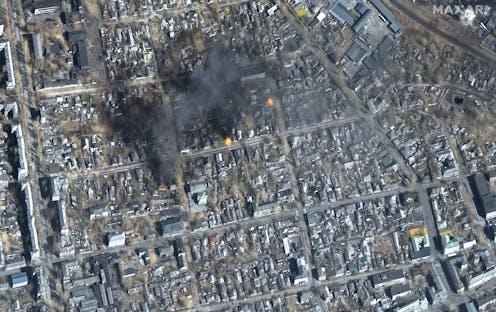
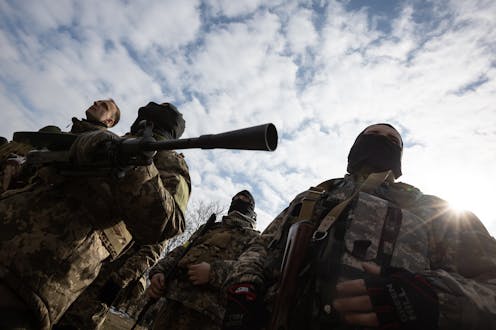
About three weeks into the Russian invasion of Ukraine, it’s safe to say things aren’t going Russia’s way – and it has yet to achieve objectives that were planned to be completed in the first few days.
The longer Russia’s advance is bogged down, the greater the chance it will consider taking drastic action, which may potentially include using weapons of mass destruction.
As improbable as this is, it’s not impossible. Under what circumstances might weapons of mass destruction be used?
The weapon of mass destruction most likely to be used is a chemical weapon. Russia once possessed the world’s largest stockpile of chemical weapons, ranging from nerve agents such as Sarin and VX, to mustard gas and the toxic gas phosgene.
Although Russia claims to have destroyed its arsenal by 2017, the use of the nerve agent Novichok during assassination attempts in 2018 and 2020 demonstrates it continues to possess chemical weapons, although the quantities and types (aside from Novichok) are unknown.
According to reports, US and allied officials suspect Russia may be planning (or considering) a “false flag” operation involving the use of chemical weapons, to establish a belated justification for the invasion of Ukraine, despite the obvious logical inconsistency.
In this context, Russia could launch a chemical weapon attack and blame Ukrainian forces, or attack a small portion of its own forces with chemical weapons to “justify” a response in kind.
Or it may locate a stockpile of “Ukrainian” chemical weapons and use this as a post-hoc justification of the invasion, similar to how the United States used the claim of alleged weapons of mass destruction to justify the invasion of Iraq in the second Gulf War.
While this is all speculation for now, it demonstrates how the spectre of chemical weapons looms over the Ukraine invasion.
If chemical weapons were used, the effects would be horrific – not just in terms of loss of life, but also because the areas impacted would become uninhabitable.
Many chemical weapons persist in the environment. In the case of some (nerve agents in particular), a single touch on the skin is enough to cause death in seconds or minutes. Decontaminating affected areas would be enormously difficult and dangerous.
For now, we have not seen Russian soldiers equipped with the protective equipment needed to operate in a chemical-hazard environment. This suggests chemical weapons use is not imminent.
The other mass destruction threat relevant here is nuclear weapons, both tactical and strategic. It’s estimated Russia has the world’s largest nuclear arsenal, with a total of 4,477 nuclear weapons (of which 1,912 are thought to be tactical nuclear weapons).
Tactical nuclear weapons are intended for use on the battlefield, whereas strategic nuclear weapons are used to destroy strategic targets such as cities. In practical terms, the only key difference between them is the delivery system. Tactical nuclear weapons are deployed using shorter-range delivery systems such as artillery, short-range ballistic missiles, cruise missiles or tactical aircraft.
Given their focus, they may have lower explosive yields than strategic weapons – but not necessarily. Most modern tactical nuclear warheads have far greater explosive power than the nuclear bombs dropped on Hiroshima and Nagasaki by the US during the second world war.
Operationally, tactical nuclear weapons would be capable of blowing wide, deep holes in opposing lines. As such, they could facilitate a breakthrough of Ukrainian defences, or provide a way to destroy significant targets such as airfields or key staging areas.
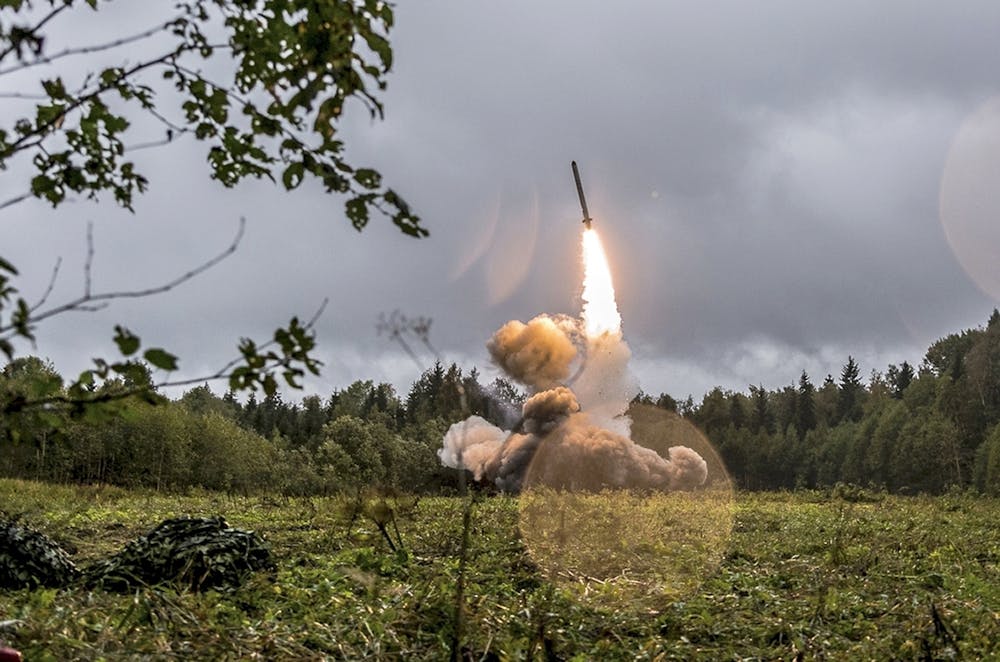
Preparations for such an attack would be difficult to detect. Many of the weapons systems being used by Russia are “dual-capable”, meaning they can deliver conventional and nuclear weapons.
The Iskander short-range ballistic missile is a ‘dual-capable’ weapon. Defense Ministry Press Service/AP
While nuclear weapons use is unlikely, Russian President Vladimir Putin has increased the alert level of his nuclear forces, and issued poorly veiled threats alluding to Russia’s nuclear arsenal as a deterrent to NATO intervention in the conflict.
The risk of nuclear weapons use by Russia could increase, however, if Putin is further backed into a wall and Russia feels its progress is being increasingly derailed. This is extremely unlikely, but not impossible.
What is unknown is how the West would react to the use of nuclear weapons. While there would be justified outrage, it may well deter the West from further involvement so as to avoid being drawn into a full-scale nuclear conflict.
This would well and truly be uncharted territory. Nuclear weapons have never been used during a time when multiple nations possess them.
Russia’s ‘de-escalation’ doctrine
Should the conflict escalate and NATO get involved, the worst possible outcome would be a strategic nuclear exchange between NATO and Russia. In this scenario, both sides would seek the complete destruction of the other, targeting cities and other key strategic targets.
If a conventional conflict between NATO and Russia occurred (which Russia would almost certainly lose), Russia would immediately seek to “de-escalate” the conflict as per its nuclear doctrine.
While this might sound great on paper, in practice it is anything but. What this strategy actually alludes to is: escalate to de-escalate. Russia would aim for a rapid escalation, to the point of using nuclear weapons, to force NATO to back down.
While this is alarming, it’s also coldly logical. Russia calculates NATO may be willing to risk conventional conflict, but not nuclear war. So an immediate escalation across the nuclear threshold could well give NATO pause.
Should it come to this, Russia would likely not target cities or large troop concentrations (as this would risk galvanising support among NATO populations for retaliation).
Instead, Russia would either conduct a final warning shot (such as by detonating a nuclear weapon over the ocean), or hit several strategic targets while minimising NATO and civilian losses. This could include important airfields, ports, road and rail junctions, munitions dumps or fuel storage facilities, as some examples.
NATO intervention may prove disastrous
The Russian government of course denies it would use this strategy. It insists it would only use nuclear weapons to defend Russia, and not in a preemptive manner.
However, various statements by Russian defence officials over the years indicate a doctrine of de-escalation and preemptive nuclear threats. The US has openly said it considers de-escalation to be Russia’s guiding nuclear doctrine.
Events may transpire that could easily lead to the situation escalating, in which case the risk of a full nuclear exchange is significant.
For example, there have been demands for NATO to enforce a no-fly zone over Ukraine. While this might initially sound reasonable, it means NATO aircraft would need to engage and shoot down Russian aircraft operating over Ukraine. Russia would likely retaliate, and the conflict may well spiral out of control.
NATO intervention of any kind would bring the world closer to nuclear war than at any time in the post-Cold War era. And the potential devastation can’t be ignored.
James Dwyer does not work for, consult, own shares in or receive funding from any company or organisation that would benefit from this article, and has disclosed no relevant affiliations beyond their academic appointment.
Source: The Conversation (Au and NZ) – By Nathan Bartlett, Associate Professor, School of Biomedical Sciences and Pharmacy, University of Newcastle
When I began drafting this article, COVID cases in Australia were coming down and the situation was stabilising.
New research released in February showed a fourth COVID vaccine dose didn’t add much extra protection on top of a third dose. It looked as if doling out fourth doses to all Australians was unnecessary.
Unfortunately, the situation has changed again, and so has the risk calculation.
New South Wales Health Minister Brad Hazzard said last week Omicron sub-variant called BA.2 was on the rise in Australia, and NSW should expect the variant to overtake Omicron and for cases to more than double in the next six weeks. Experts expect BA.2 to become Australia’s dominant strain in the next few months.
Early estimates suggest BA.2 is between 25% and 40% more transmissible than Omicron (BA.1), and is already taking off in countries including Denmark, Sweden and the United Kingdom.
The Australian Technical Advisory Group on Immunisation (ATAGI) doesn’t yet recommend fourth doses for everyone, but they’re already available for severely immunocompromised Australians.
Coupled with new research detailing the quick waning of our third dose immunity, it’s likely the coming surge means we’ll need a fourth COVID vaccine as we hit winter.
But new research published this month in the New England Journal of Medicine shows immunity from third doses is waning quickly. Vaccine effectiveness against Omicron dropped to around 45% ten weeks after a Pfizer third dose.
The main reason for this is because Omicron has many mutations which mean it looks very different to the original strain, from which our vaccines are based.
Only a subset of the immune cells these vaccines generate can effectively tackle Omicron, which means our immunity wanes quicker. Specifically, we generate fewer “neutralising antibodies” that can tackle Omicron. These are a type of antibody important for protection against infection.
This is almost certainly the case for BA.2, as well, which shares similar mutations to Omicron but some different ones too. Research is only just beginning into BA.2 so we don’t yet know how effective our vaccines are against it. But it’s likely their effectiveness is similarly reduced as with Omicron BA.1.
But by Australian winter – normally the height of cold and flu season – most people will have had their third dose more than four months ago, leaving us at greater risk of infection. So it makes sense to boost our antibodies again.
One pre-print study, yet to be reviewed by other scientists, showed a fourth dose tops up your antibody response to the peak level provided by the third dose.
Though it doesn’t give additional protection, restoring antibodies to third-dose levels will be important as winter approaches and risk of virus transmission increases. But this of course must be weighed against the ethics of dispensing fourth doses when many people in developing countries haven’t had their first two doses.
It’s hard to tell how vulnerable we are
In 2021 health authorities broadly knew the population’s level of immunity against COVID. Authorities knew how many people had two vaccine doses at any one time and how well the vaccines worked against Delta, and there were very low rates of infection.
But now, millions of us have been infected, at different times, some with a third dose and some without. It’s also likely many of us have been infected without knowing it.
So it’s very hard for us to know the level of immunity the population has.
This makes estimating how vulnerable Australia is to BA.2 and future variants very difficult.
In this environment of uncertainty, allowing Australians to get a fourth dose would increase collective immunity and help us weather the rise of BA.2 during a winter where other cold and flu viruses are expected to make a comeback.
Too late for an Omicron-specific vaccine
Evidence suggests Omicron is good at evading the immunity we get from our current COVID vaccines.
This is because the variant has many mutations which means it looks very different to the original strain, from which our vaccines are based.
A vaccine tailored to Omicron would, in theory, provide better protection.
But the question is, how much better than a boost with current vaccines? Early evidence suggests not much.
And by the time an Omicron-specific vaccine is rolled out, BA.2 will likely already be dominant.
So how do we a tackle a virus adept at mutating and evading immunity?
These are vaccines targeting a part of the virus that’s required for infection but that doesn’t readily change (scientists call this “conserved”), meaning they’re more likely to work across different variants. These are in development.
It’s possible we’ll have a prototype for such a vaccine in the next couple of years.
Nasal sprays could be a game changer
The fact mRNA vaccines could achieve over 90% protection against the original strain of SARS-CoV-2 is exceptional, because it’s very challenging for a vaccine injected into your arm to ward off a respiratory virus.
Respiratory viruses replicate in the cells lining the airways. That begins in the nose and throat, and if infection progresses, down into the airways in the lungs.
The airways are at the interface of the body and the outside environment. Getting specialised immune cells from your bloodstream to the airways, particularly the nose and throat, is a big ask for an immune response initiated in your arm.
This is where intranasal vaccines and treatments come in. My team has helped develop an immune-stimulating nasal spray that’s entering phase 2 clinical trials for COVID and influenza.
This works by boosting innate immunity in the tissue lining your airways to attack the virus at the point of entry in the nose and throat.
The aim is to prevent the virus from replicating there and making its way deeper into the respiratory tract where it can cause severe lung disease. It also reduces the amount of virus shedding in the nose and throat which should reduce the risk of onward transmission.
Where to from here?
Managing COVID is becoming more complicated now, and it’s impossible to predict where we’ll be a few months from now. As new variants continue to arise, it’s very difficult to understand how immune we are.
Monitoring and characterising new variants is essential. As new variants emerge, we need to understand how infectious and severe they are, and then adapt our vaccination strategy. This type of surveillance is what we do for the flu every year.
It could take years, but as time goes on and our immunity continues to mature, hopefully COVID settles to become a more stable, predicable, milder disease that can be effectively managed with the help of a range of new variant-proof vaccines and treatments.
Nathan Bartlett consults to and has share options in ENA Respiratory. He has received funding from ENA Respiratory.
Foxes kill about 300 million native mammals, birds and reptiles each year, and can be found across 80% of mainland Australia, our devastating new research published today reveals.
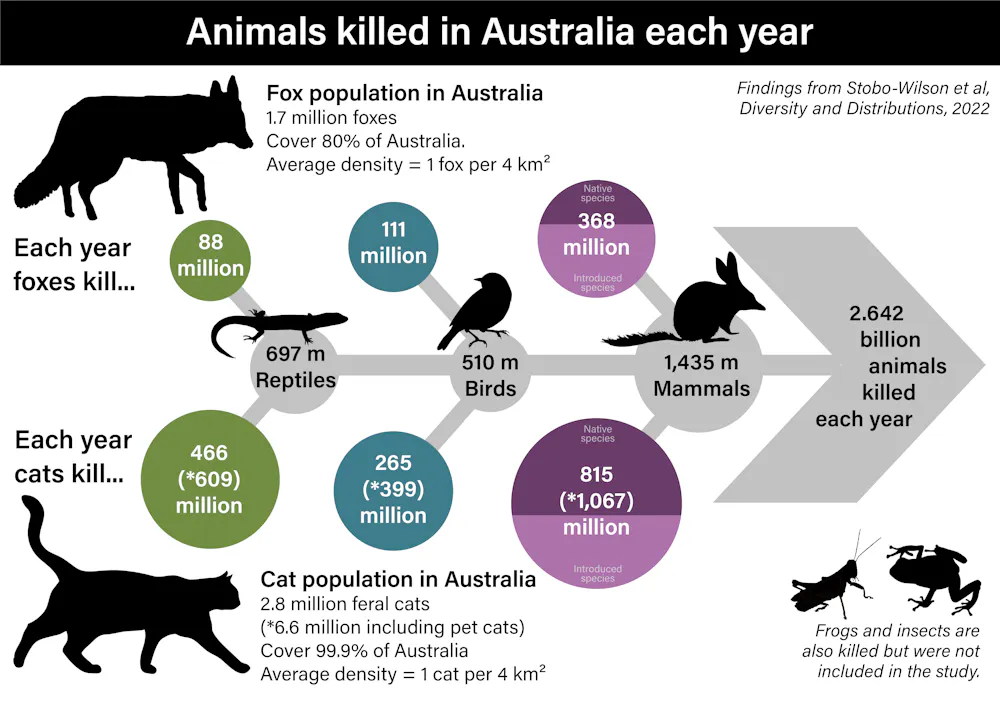
This research, the first to quantify the national impact of foxes on Australian wildlife, also compares the results to similar studies on cats. And we found foxes and cats collectively kill 2.6 billion mammals, birds and reptiles every year.
This enormous death toll is one of the key reasons Australia’s biodiversity is suffering major declines. Cats and foxes, for example, have played a big role in most of Australia’s 34 mammal extinctions, including the desert rat-kangaroo which rapidly declined once foxes reached their region.
Australia must drastically scale up the management of both predators, to give native wildlife a fighting chance and to help prevent future extinctions.
Australia is home to 1.7 million foxes
European colonisers brought foxes (and cats) to Australia. From 1845, foxes were released into the wild in Victoria for the “sport” of hunting them on horseback with a pack of hounds.
Fox populations soon exploded, thanks to the deliberate introduction of rabbits and hares in the 1800s. Rabbits and hares are not only a food source for foxes, they also eat the vegetation that native animals need for food, habitat, and to hide from predators. They continue to boost fox numbers today.
Our study estimates there are now 1.7 million foxes in Australia, spread across 80% of the mainland and on 50 Australian islands. They’re largely absent from tropical northern Australia and Tasmania.
By comparison, cats occur over more than 99.9% of the country, including on far more islands.
Fox densities are highest in temperate mainland regions, including forests and farms, and near urban areas where food and shelter are abundant. The Victorian government estimates there are as many as 16 foxes per square kilometre in Melbourne.
Cats and foxes eat almost 2 million reptiles across Australia every day, such as the central netted dragon. Nicolas Rakotopare (Lerako.net)
What are foxes eating?
The 300 million native animals that foxes kill every year consists of:
reptiles: foxes kill 88 million reptiles each year, and all are native. They’ve been recorded killing 108 different species – or 11% of all Australian reptile species – including the tjakura (great desert skink) and loggerhead turtle
birds: foxes kill 111 million birds each year, and 93% of these are native. They’ve been recorded killing 128 species – or 18% of all Australian bird species – including the mallee-fowl and little penguin
mammals: foxes kill 368 million mammals each year, and 29% of these are native. They’ve been recorded killing 114 species, or 40% of all land mammal species and half of all threatened mammal species. This includes the mankarr (greater bilby), quenda (southern brown bandicoot) and warru (black-footed rock-wallaby).
Foxes and feral cats together kill 2.6 billion animals every year. Stobo-Wilson et al, Diversity and Distributions, 2022.
Foxes also kill another 259 million non-native invasive animals every year, predominately house mice and rabbits. They also kill livestock, such as lambs, piglets and chickens.
While rabbits and house mice form a major part of fox diets, there’s no evidence foxes (or cats) limit their numbers. Changes in rabbit and mice populations are largely driven by climate fluctuations.
Our findings are underpinned by modelling data assembled from almost 100 field studies. This included 49,458 fox poo and stomach samples, and fox density estimates at 437 locations.
Foxes are also known to eat bird and reptile eggs, and threaten the breeding success of many turtle species. However, we didn’t tally their impact on turtle eggs (or on fish, frogs or insects) because of insufficient data – they’re highly digestible and often hard to identify in fox poo.
Carrion (dead animals) account for an average of 10% of fox diets, but we excluded carrion in the estimated numbers of animals killed.
Fairy wrens and other birds that nest and feed near the ground are vulnerable to foxes and cats. Nicolas Rakotopare (Lerako.net)
Foxes and cats: a deadly combination
Although they eat many of the same species, foxes take larger prey than cats and have a bigger toll on kangaroos, wallabies and potoroos.
Cats eat smaller prey, so eat a lot more of them. Nationally, feral cats kill about five times more reptiles, two and a half times more birds and twice as many mammals than foxes.
In total, feral cats kill 1.5 billion animals every year (not including invertebrates and frogs). Pet cats kill another 500 million animals.
The impacts of both predators are concentrated in some regions more than others. And although cats kill more animals overall nationally, in some areas foxes take a greater toll.
This includes the Warren and Jarrah Forest in Western Australia, the Eyre and Yorke Penninsula in South Australia, across Victoria and in NSW’s Blue Mountains.
This is why foxes take a larger toll on forest animals such as possums and gliders, and kill over 1,000 animals per square kilometre each year in these areas.
Cats are widespread across Australia, while foxes are widespread everywhere except Tasmania and tropical northern Australia. Northern Territory Government
To understand and manage these threats, it’s essential to take the cumulative impacts of both introduced predators into account. Many species fall prey to both cats and foxes.
Each day across Australia their combined death toll includes 1.9 million reptiles, 1.4 million birds and 3.9 million mammals.
So what needs to change?
The only way to stem these losses, and prevent the extinction of many vulnerable species, is to step up targeted and integrated cat and fox management.
Foxes and cats kill 4 million mammals every day across Australia. The bridled nailtail wallaby was once common throughout eastern Australia, but foxes and cats (and habitat loss) pushed it close to extinction. Nicolas Rakotopare (Lerako.net)
Cat and fox eradication programs have had success in fenced areas and on islands. For example, cat eradication on Dirk Hartog Island is enabling many native animals to be reintroduced.
And long-term broad-scale management programs have enabled the recovery of threatened species in wider landscapes, such as the Bounceback Program helping yellow-footed rock wallabies and other wildlife in SA’s Flinders Ranges.
Our new research highlights the urgent need to increase investment for cat and fox management across Australia. Management will need to be large-scale and strategically coordinated as both species breed like rabbits, so to speak, and travel great distances.
This means patchy, or small-scale lethal programs can allow their numbers to quickly rebound.
We also need to protect and recover habitat for native animals. Evidence shows good habitat supports healthier native animal populations and gives them more places to hide from predators.
23 scientists contributed to the research described in this article. The research received funding from the Australian Government’s National Environmental Science Program through the Threatened Species Recovery Hub (which ended in Dec 2021). Jaana Dielenberg previously received funding from the Threatened Species Recovery Hub but does not currently work for, consult, own shares in or receive funding from any company or organisation that would benefit from this article.
Brett Murphy receives funding from the Australian Research Council. He received funding from the Australian Government’s National Environmental Science Program through the Threatened Species Recovery Hub (which ended in Dec 2021). He is a member of the Australian Government’s Threatened Species Scientific Committee.
John Woinarski is the director of the Australian Wildlife Conservancy. The research received funding from the Australian Government’s National Environmental Science Program through the Threatened Species Recovery Hub (which ended in Dec 2021).
The research received funding from the Australian Government’s National Environmental Science Program through the Threatened Species Recovery Hub (which ended in Dec 2021).
Alyson Stobo-Wilson and Trish Fleming do not work for, consult, own shares in or receive funding from any company or organisation that would benefit from this article, and have disclosed no relevant affiliations beyond their academic appointment.
The long-standing practice of restricting temporary sponsorship to occupations classified as “in shortage” should be abandoned. Instead, temporary sponsorship should be reserved for higher-wage jobs in any occupation.
The government use these classifications of Australia’s 13 million jobs for a range of purposes.
The National Skills Commission (which advises the federal government on workforce skills needed) and the Department of Home Affairs (which oversees visa programs) use them to compile three lists of skills wanted by Australia’s skilled migration schemes. One list is focused on short-term needs, another on longer-term needs and the third on skills needed in regional areas.
Defining needed skills by occupation, however, is an inflexible way to meet shortages in a rapidly changing labour market – and flexibility is the very thing temporary skilled migration programs are meant to provide.
This rigidity is becoming ever more of a problem as more highly skilled service industries develop. New tasks and roles take time to be classified as official occupations. For example, ANZSCO didn’t recognise the developing and in-demand profession of “data scientist” as an occupation until September 2019.
An occupation ‘shortage’ is hard to measure
For occupations that do exist, deciding which are “in shortage” isn’t clear-cut.
when employers are unable to fill or have considerable difficulty filling vacancies for an occupation, or significant specialised skill needs within that occupation, at current levels of remuneration and conditions of employment, and in reasonably accessible locations.
This is unsound. Wages change over time. Wages for a job where demand is greater than supply will probably increase relative to other jobs. Pegging the definition to “current levels of renumeration” will overstate the roles in which there is a genuine shortage.
But even with a better definition, Australian policy makers would still lack the data – such as timely vacancy and wage data for each of the 1,000 occupations – to identify skills shortages in real time.
Without this information it is difficult to see what, beyond input from industry lobby groups, determines which occupations become eligible for temporary sponsorship.
A system that looks at occupations rather than jobs also misses crucial parts of the story.
A senior accountant working for a multinational corporation in a capital city and a graduate accountant working for a local business in a country town have the same occupation. But the level of education and experience, responsibilities and remuneration offered for each job will vary dramatically.
Grattan Institute
Temporary visas should prioritise high-wage jobs
To get a better deal, Australia must rethink its approach. Temporary sponsorship should be reserved for higher-wage jobs in any occupation.
Our new report calls for the Temporary Skilled Shortage visa – which enables employers to sponsor a employee to stay in Australia for up to four years – to be replaced with a new visa, the Temporary Skilled Worker visa.
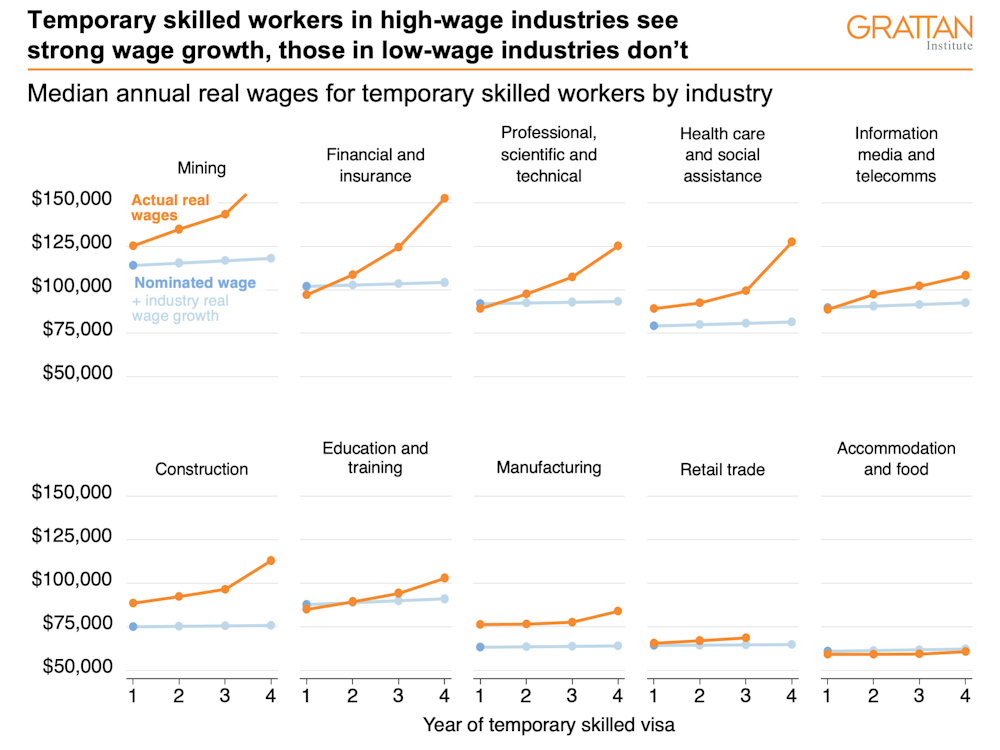
This new visa would allow employers to sponsor workers in any occupation, provided the job pays more than $70,000 a year and at least equal to what an Australian doing the same job would earn. This threshold reflects the median earnings of 25-34 year olds working full-time in Australia, and the fact those on temporary visas earning more than $70,000 will experience bigger wage increases than those earning less.
Grattan Institute
By removing occupation lists, the proportion of full-time jobs open to temporary skilled migrants would rise from 44% to 66%.
Conversely, the number of jobs that employers would no longer be able sponsor a temporary migrant to fill – those now on the list paying below $70,000) is tiny. In accommodation and food services, the sector that uses temporary skilled visas the most, these jobs make up just 1.5% of the labour force; in other sectors it’s less than 0.5%
Grattan Institute
Given migrant workers in lower-paid jobs are most likely to be exploited, this reform should reduce employer abuses and increase public confidence in the temporary skilled program.
Targeting higher-wage migrants will better address most genuine skills shortages that emerge. Removing cumbersome and uncertain occupation lists will give businesses greater certainty and a simpler application process to access the skills needed in emerging industries.
High-skilled migrants pay more in taxes than they receive in public services and benefits. Targeting temporary migrants with higher skills will also increase the pool of high-quality candidates for Australia’s permanent skilled migrant intake.
Australia can get the best of both worlds from its temporary skilled migration program by making it simpler for everyone. It will to deliver more for Australian businesses, workers and the economy.
Grattan Institute began with contributions to its endowment of $15 million from each of the Federal and Victorian Governments, $4 million from BHP Billiton, and $1 million from NAB. In order to safeguard its independence, Grattan Institute’s board controls this endowment. The funds are invested and contribute to funding Grattan Institute’s activities. Grattan Institute also receives funding from corporates, foundations, and individuals to support its general activities, as disclosed on its website.
We would also like to thank the Scanlon Foundation for its generous and timely support of this project.
Grattan Institute began with contributions to its endowment of $15 million from each of the Federal and Victorian Governments, $4 million from BHP Billiton, and $1 million from NAB. In order to safeguard its independence, Grattan Institute’s board controls this endowment. The funds are invested and contribute to funding Grattan Institute’s activities. Grattan Institute also receives funding from corporates, foundations, and individuals to support its general activities, as disclosed on its website. We would also like to thank the Scanlon Foundation for its generous and timely support of this project.
Will Mackey does not work for, consult, own shares in or receive funding from any company or organisation that would benefit from this article, and has disclosed no relevant affiliations beyond their academic appointment.
Military bands, with their shiny instruments, formal uniforms and precision marching are one of the most instantly recognisable symbols of a nation’s defence forces. As such, throughout much of history, their membership as been limited to men: Australian defence force bands only formally welcomed women into their ranks after the introduction of the Sex Discrimination act in 1984.
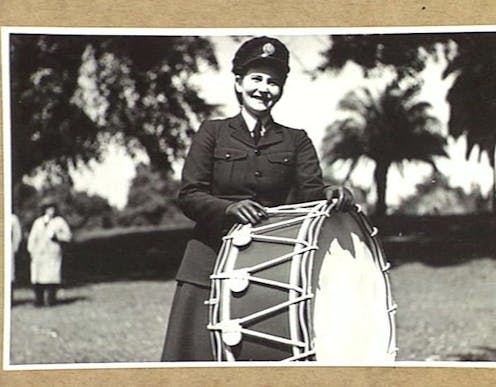
Despite this, during World War II, a groundbreaking group of women serving in the Women’s Auxiliary Australian Air Force (WAAAF) performed alongside their male Royal Australian Air Force (RAAF) counterparts to form some of the earliest documented mixed-gender defence force bands in the world.
At the beginning of World War II women were only allowed to serve in the defence force as nurses. As the war progressed, women’s auxiliary services were formed by the army, navy and air force to fill non-combat positions left vacant by men serving overseas.
I first became aware of the existence of WAAAF performers in supposedly all-male RAAF bands while I was conducting research on the history of Australia’s defence force bands. I was contacted by Olive Jardine (née McNeil), who had joined the WAAAF during World War II and who had played with her local RAAF band during that time.
I was so sure that these bandsmen had, indeed, all been bandsmen that I almost dismissed her, politely informing Olive the parameters of my study meant I couldn’t include women’s auxiliary bands.
But Olive was resolute.
She assured me that although she had served with the WAAAF, she had been invited to join her base’s RAAF band due to a shortage of male musicians during the war.
I was soon to discover she was just one of many such women: up to a quarter of RAAF bands had at least one female member during World War II.
World War II saw a rapid increase in the number of all-female bands and orchestras, and in Australia the army, navy and air force all formed women-only auxiliary bands. While women-only bands were becoming a more familiar sight, mixed-gender military bands were much rarer.
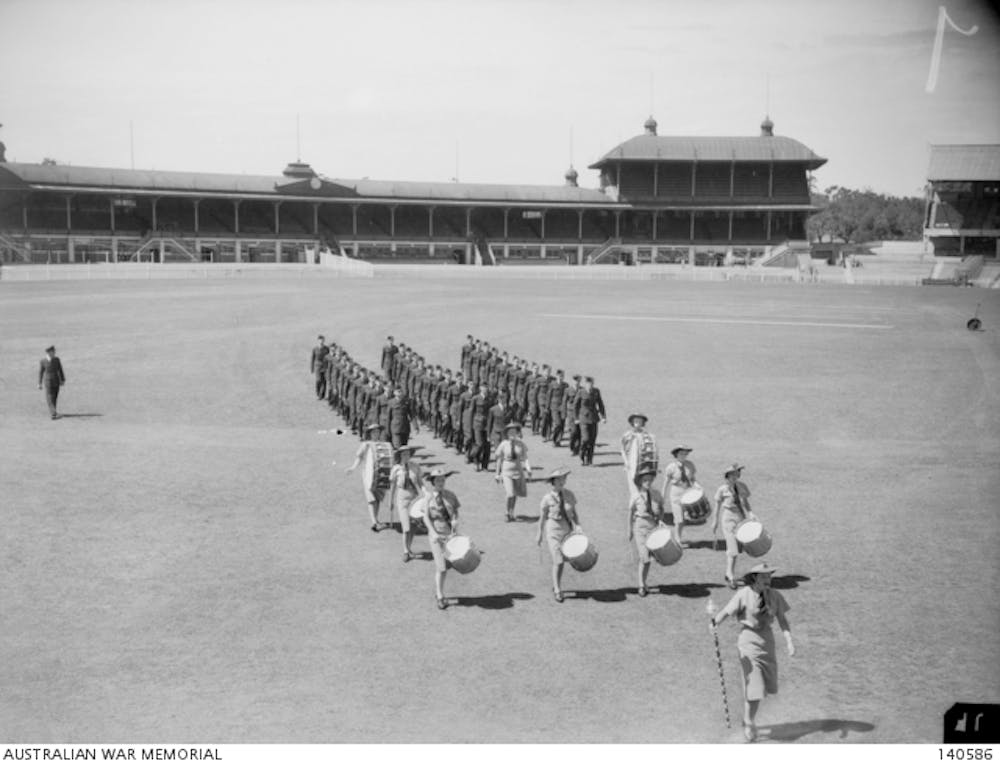
Women’s only bands, pictured here leading RAAF personnel in 1944, were common.
In the USA, a couple of bands featured visiting women – but RAAF bands are the only defence force bands known to regularly feature men and women playing together at this time.
Australia’s army and navy were well established by World War II, and so had more ingrained traditions, including professional bands. But as a newer division of the defence force, only formed in 1921, RAAF bands were still volunteer bands made up of any interested members serving on base.
In the army and navy, musicians served together as a unit and the different regulations for members of women’s auxiliary forces made it impossible for them to join these bands.
However RAAF bands worked more like the many volunteer sports clubs on bases, with little (if any) oversight from air force hierarchy, opening the door for members of the WAAAF to join.
Ladies to the front
Olive’s story is typical of the young women joining these bands.
Keen to help with the war effort, she signed up to the WAAAF as an accounts clerk and was stationed at Uranquinty in New South Wales. An experienced piano teacher, she volunteered to play organ at church services where she was approached by members of the base band who were looking for new musicians. They offered to teach her to play tenor horn, and she became the band’s only female member.
It wasn’t always a case of the odd-woman out. The Mallala band in South Australia had as many as six female members at any one time.
A combined RAAF and WAAAF Band marching in 1944. Australian War Memorial
Other women even held leadership positions in their bands. In Perth, Hannah Colley, whose father was a bandsmen in World War I, was given the prestigious role of playing the bugle calls at Perth’s 1944 Armistice Day ceremony, a role usually given to the most skilled bugler in the band.
She would go on to post-war career playing in concert parties as a musician in the Army’s Entertainment Unit.
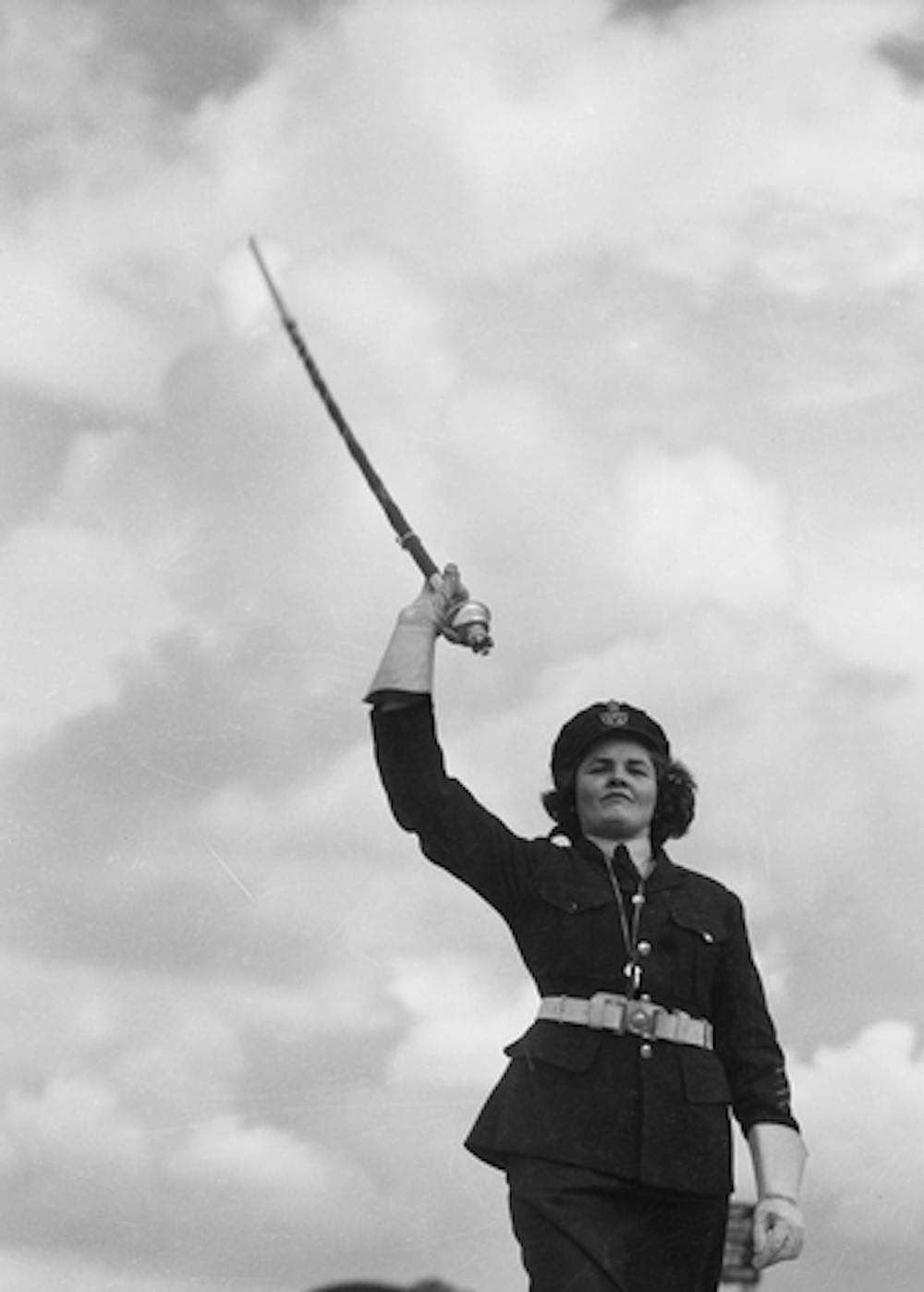
Meanwhile, Mary Palmer stood in as acting Drum Major in her band in Ascot Vale, Victoria, after learning to swing a mace by practising with a broom.
Drum Major Mary Parker, photographed in Melbourne in 1943. Australian War Memorial
The loss – and return – of women
The pioneering women serving in RAAF bands during World War II performed proudly, and even held leadership positions alongside men.
After the war, the RAAF introduced its first professional band service. Entry was now restricted to men who had auditioned and who were employed by the air force solely for their musical skills. The WAAAF was discontinued in 1947 and reformed as the Womens Royal Australian Air Force (WRAAF) in 1950, however, women were not eligible to join the band corps until the introduction of the Sex Discrimination Act some 40 years later.
Perhaps one of the most refreshing aspects of these stories is the way these ground-breaking women were supported by their communities. Olive’s male bandmates taught her to play tenor horn, local newspapers proudly reported on the performances of their local WAAAF members and Hannah chose to follow in her father’s footsteps to become a defence force musician.
The musicians of the WAAAF proved to the Australian public that women could work as equals alongside men, both on the parade ground and on stage, paving the way for the generations who came after them.
Anthea Skinner is a McKenzie Fellow at the Victorian College of the Arts, University of Melbourne. She also receives funding from the Australian Research Council and the Australia Council for the Arts.
With recent polling showing National edging ahead of Labour for the first time in two years, Jacinda Ardern’s previously strong support has eroded rapidly since winning a remarkable outright majority at the 2020 general election.
But the dip in electoral fortunes is only part of the story. It’s probably not an overstatement to say Ardern is presently one of the most reviled people in Aotearoa New Zealand, attracting vitriol that violates the bounds of normal, reasoned political debate.
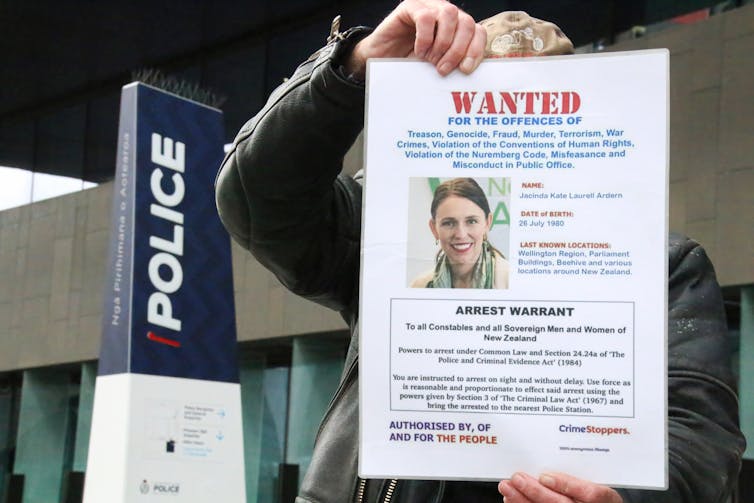
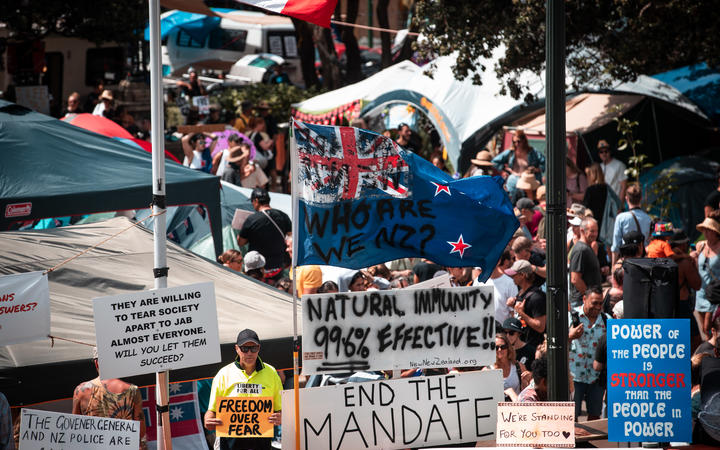
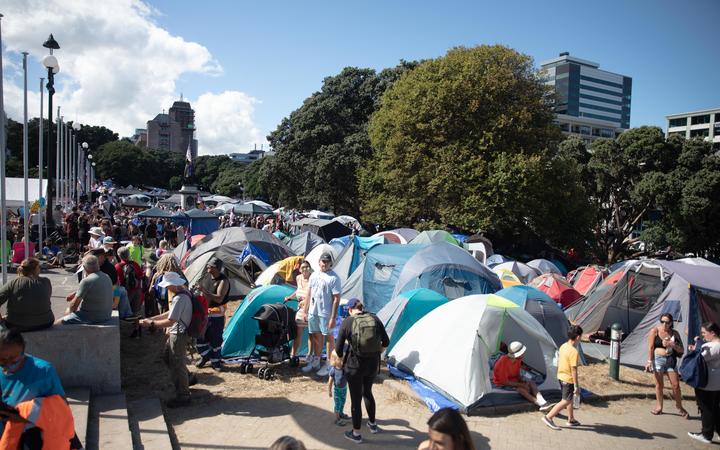
During the recent illegal occupation of parliament grounds, the apparent hatred was fully evident. There were ludicrous claims the prime minister is a mass murderer, and demands she be removed from office and executed for “crimes against humanity”.
Even on the supposedly professional social networking site LinkedIn, false claims that Ardern is a “tyrant” or “dictator” have been increasingly commonplace. For those making such claims, factual, constitutional, electoral and legal realities seemingly hold no weight.
So, what fuels these levels of antagonism? I suggest three factors are at play.
A protester with a fake arrest warrant in Christchurch. GettyImages
Context matters
How a leader is judged and what they can achieve is never simply a reflection of their individual characteristics and abilities.
Rather, as leadership scholars have long emphasised, the expectations of followers and the wider political, economic, social and historical context influence both how they are judged and their ability to achieve desired results.
In Ardern’s case, the public’s main concerns right now – food and fuel prices, rental and home ownership costs, and the effects of the Omicron outbreak – are beyond the direct control of any political leader. Some will require years of transformative effort before significant improvements are seen.
A paradox of leadership is that while followers will often hold unrealistic expectations that leaders can solve complex problems quickly, they are also quick to blame leaders when they fail to meet those unrealistic expectations.
Ardern is caught in the maw of these dynamics, and that’s one of the factors fuelling the attacks on her.
COVID controversies
The second obvious reason lies in the COVID-related policies – including vaccine mandates, crowd limits and border controls – that have disrupted people’s lives and been heavily criticised by vested interests such as expat New Zealanders and various business sectors.
Anti-mandate protests, in particular, have become a front for wider anti-vaccine movements and extreme right-wing conspiracists. While the prime minister must balance restrictive policies with the greater public good, detractors are not bound by such considerations.
Ironically, by demonstrating a firmness of resolve to act in the nation’s best interest – something leaders might normally expect praise for, and for which Ardern has won international admiration – leaders become open to accusations of being inflexible and unresponsive.
Echoed by opposition politicians and some media commentary, these elements combine to feed a sense of growing frustration.
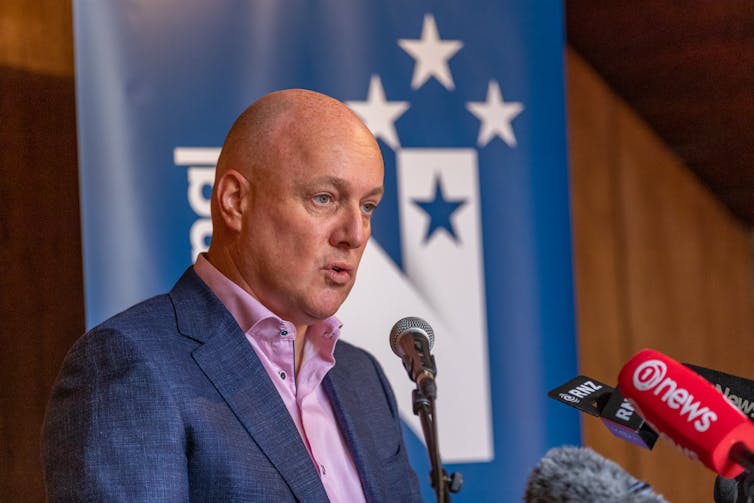
National Party leader Christopher Luxon: up in the polls and a good fit for traditionalist voters? GettyImages
Old-fashioned sexism and misogyny
But these first two factors alone, while significant, don’t explain the full extent of the violent and hateful rhetoric directed at Ardern, albeit by a minority. Rather, it’s clear this is rooted in sexist and misogynistic attitudes and beliefs, further amplified by conspiratorial mindsets.
Research shows both men and women with more traditional views desire “tough”, “bold” and “authoritative” leadership. A man displaying traditionally masculine behaviours, who is an assertive risk-taker, dominating and commanding others, is their ideal leader. This aligns with an assumption that women should follow, not lead.
Ardern’s emphasis on traditionally feminine ideals, such as caring for vulnerable others, and her strongly precautionary COVID response run counter to what traditionalists respect and admire in leaders.
What’s known as “role incongruity theory” further suggests that Ardern jars with what traditionalists expect of “good women”. Overall, the sexism and misogyny inherent in these traditionalist beliefs mean Ardern is treated more harshly than a male prime minister pursuing the same policies would be.
Worryingly, the 2021 Gender Attitudes Survey (carried out by the New Zealand National Council of Women) showed such traditional views about leadership and gender are on the rise.
Traditionalist myths
Insults and abuse commonly directed at Ardern on social media reflect the generally gendered nature of cyberviolence, which disproportionately targets women. These insults translate traditionalist beliefs into sexist and misogynistic acts.
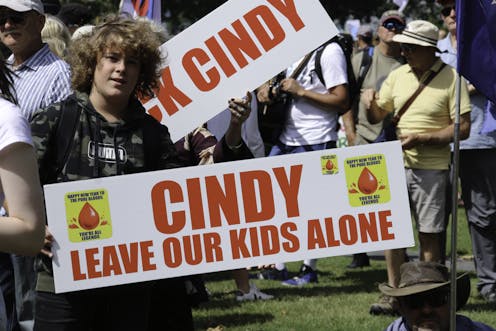
Referring to Ardern as “Cindy”, for example, infantilises her. Calling her a “pretty communist” not only reflects the sexist and misogynist view that a woman’s worth is measured by her appearance, but also suggests her looks disguise her real aims.
This plays on the traditional trope of woman as evil seductress. From there it’s a short leap to the conspiracy theories that depict Ardern as part of an evil international cabal.
Unfortunately, for traditionalists and extremists alike, the evidence shows that effective leaders do not conform to their ideal or play by their rule book. Instead, they tend to be collaborative, humble, team-oriented and able to inspire others to work for the common good – qualities women often exhibit.
Of course, Ardern’s performance is not beyond criticism. But a fair-minded analysis, free from sexist and misogynist bias, would suggest the hatred directed toward her says more about the haters than Ardern.
Suze Wilson does not work for, consult, own shares in or receive funding from any company or organisation that would benefit from this article, and has disclosed no relevant affiliations beyond their academic appointment.
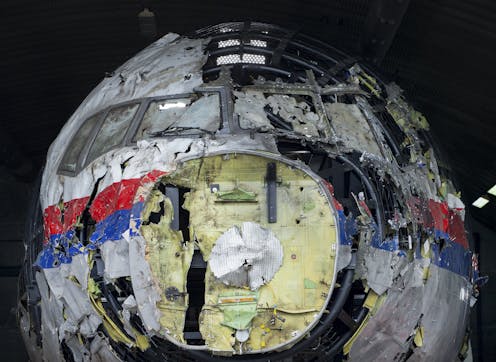
Australia and the Netherlands have launched legal proceedings against Russia over the downing of flight MH17, which killed 298 people in 2014.
What’s so unusual about this new legal action is that it’s being brought before the International Civil Aviation Organisation (ICAO). Australia, the Netherlands and Russia are all contracting parties to what is known as the Chicago Convention of 1944, which set up the ICAO to provide standards and recommended practices for international aviation.
Normally, proceedings like this would be brought in domestic courts like the existing prosecution being mounted by the Dutch authorities against the four individuals they believe were responsible for the downing of MH17.
But the ICAO is a body responsible for setting standards for international aviation and doesn’t frequently settle disputes between nations.
ICAO doesn’t police the skies
The ICAO has been quite successful in its role. There are 192 nations that are contracting members to the Chicago Convention and are obliged to comply with its various standards and recommended practices.
And we have a very harmonised international aviation sector as a result, with requirements for flight crew licensing, aircraft manufacturing and environmental regulations that are all routinely met by the member states.
The ICAO does have provisions for settling disputes between member countries under article 84 of the convention. This is where the Australian and Dutch authorities have brought their action.
Normally, if there’s a dispute brought before the organisation, it’s against a particular airline, not a country itself. So, if an airline has done something wrong, ICAO can impose restrictions on where it can fly. This can’t happen when you bring a case against another nation.
In the 78 years of ICAO’s existence, only five disputes have been brought under this article. It’s not used that often because ICAO can’t really compel states to comply with it. It’s a bit of a toothless tiger when it comes to disputes of this nature.
Russia could also be held accountable under article 3bis of the Chicago Convention, an amendment signed in 1984 after the Soviet military shot down a South Korean airliner the previous year.
This article says member states “must refrain from resorting to the use of weapons against civil aircraft in flight”. A state can initiate proceedings to the ICAO Council, which could then be appealed to the International Court of Justice.
But the council has previously been described as “less as a court of law than as a facilitator for settlement”, limiting itself to technical issues and avoiding political matters. Only one council dispute has ever been referred to the ICJ.
So what can ICAO do in this case?
Australia and the Netherlands are using the legal action to try to force Russia back to the negotiating table to resolve the dispute over compensation for the families of the MH17 victims. Russia unilaterally withdrew from the talks in 2020.
Attorney-General Michaelia Cash said the ICAO is “the sole body that has jurisdiction to deal with this matter”, asking the body to order
the parties immediately enter good faith negotiations to resolve expeditiously the matters of full reparation for the injury caused by Russia’s breach.
ICAO can say to Russia that it must return to the negotiating table, but in terms of being able to enforce it, the most it can do is suspend Russia’s voting rights in the ICAO Council and ICAO Assembly.
Russian President Vladimir Putin is unlikely to care very much about that because Russia would still be part of the Chicago Convention.
And expelling a member from ICAO has never been tested to date.
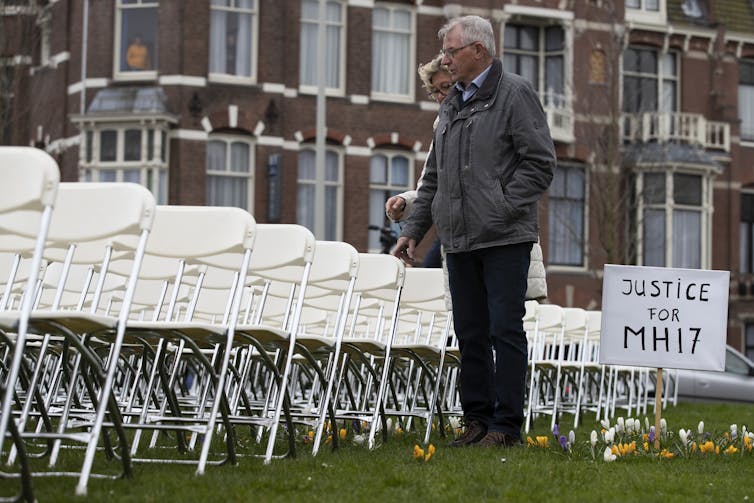
Relatives of the victims of flight MH17 walk along 298 empty chairs in a park opposite the Russian embassy in the Netherlands, each chair representing one of the 298 people killed. Peter Dejong/AP
Other international treaties that could be relevant
This convention imposes an obligation on states to provide for the safety of civilian flights and refrain from using weapons against civilian aircraft. It also has near-universal ratification, including Russia.
Article 14 of the Montreal Convention also allows disagreeing states to refer their dispute to the ICJ when negotiations fail. As Russia withdrew from negotiations with Australia and the Netherlands regarding the liability for the downing of MH17, this is an increasingly possible route.
The current case being brought before the ICAO demonstrates what the Chicago Convention was designed to do and what it wasn’t designed to do.
The fundamental objective is to increase cooperation and standardisation between states with respect to international aviation. We’re talking here about a specific dispute over compensation for an act of aggression – it’s outside the ambit or jurisdiction of what the ICAO was set up to do.
This is probably a last-ditch attempt by Australia and the Netherlands to get an outcome for the victims of the tragic MH17 crash.
Ron Bartsch AM does not work for, consult, own shares in or receive funding from any company or organisation that would benefit from this article, and has disclosed no relevant affiliations beyond their academic appointment.
The federal court today unanimously decided Federal Environment Minister Sussan Ley does not have a duty of care to protect young people from the harms of climate change.
The ruling overturns a previous landmark win by eight high school students, who sought to stop Ley approving a coal mine expansion in New South Wales. While the judge did not prevent the mine expansion, he agreed the minister did indeed have a duty of care to children in the face of the climate crisis.
Ley’s successful appeal is disappointing. As legal scholars, we believe the judgment sets back the cause of climate litigation in Australia by two decades, at a time when we urgently need climate action to accelerate.
So why was Ley successful? The federal court’s 282-page judgment offers myriad reasons for why no duty should be imposed on the minister. But what emerges most clearly is the court’s view that it’s not their place to set policies on climate change. Instead, they say, it’s the job of our elected representatives in the federal government.
This required the minister to take reasonable care when exercising her powers to avoid causing Australian children under 18 personal injury or death from carbon dioxide emissions.
Ley appealed this decision in July last year. She also approved the coal mine extension, arguing her decision wouldn’t contribute to global warming because even if the mine was refused, other sources would step in to meet the coal demand.
And today, in a live-streamed proceeding, the full bench of the federal court ruled in her favour: the stated duty should not be imposed on the minister. While the outcome was unanimous, the three judges had separate reasoning.
One judge saw climate change as a matter for government, not the courts, to address, saying the duty would be an issue “involving questions of policy (scientific, economic, social, industrial and political) […] unsuitable for the Judicial branch to resolve”.
Another said there was insufficient “closeness” and “directness” between the minister’s power to approve the coal mine and the effect this would have on the children. But he left open the possibility of a future claim if any of the children in the class action suffered damage.
The third judge had three main reasons. First, the EPBC Act doesn’t create a duty-of-care relationship between the minister and children. Second, establishing a standard of care isn’t feasible as it would result in “incoherence” between the duty and the minister’s functions. Third, it’s not currently foreseeable that approving the coal mine extension would cause the children personal injury, as the law is understood.
The good news: climate science remains undisputed
In the original case, the judge made landmark rulings about the dangers of climate change, marking a significant moment in Australian climate litigation.
He found one million of today’s Australian children are expected to be hospitalised due to heat stress, they’ll experience substantial economic loss, and when they grow up the Great Barrier Reef and most eucalypt forests won’t exist.
According to the judge, this harm was “reasonably foreseeable”. This is important from a legal point of view, as courts have previously considered climate change to be speculative, and a future problem.
As part of her appeal, Sussan Ley argued that these findings, based on presented evidence, were incorrect and went beyond what was submitted to the court. Today, these arguments were unanimously rejected.
The federal court found all the minister’s criticisms on the evidence of climate change were unfounded and all of the primary judge’s findings were appropriate to be made. As Chief Justice Allsop concluded:
[B]y and large, the nature of the risks and the dangers from global warming, including the possible catastrophe that may engulf the world and humanity was not in dispute.
But while this reaffirms acceptance that climate science is unequivocal, it does nothing to prevent mounting climate change harms, most recently made clear by the devastating floods across NSW and Queensland.
Indeed, it only turns this responsibility back to the current federal government, which has policies increasingly at odds with what the science and concerned citizens say is needed.
Bucking the trend
This was a test case in Australian law, as it explored a novel legal argument. Its failure will likely put a dampener on innovative climate litigation in Australia.
Today’s judgment asserts that the courts are limited in what they can do to address climate change. It goes against the trend of successful climate change court rulings overseas, and the widespread mobilisation across community groups, business and local governments for action.
Just last year, for example, we saw a court in The Hague order oil and gas giant Shell to reduce carbon dioxide emissions by 45% by 2030, relative to 2019 levels, and a German court ruling that the government’s climate goals were not strong enough.
Today’s federal court finding that dealing with coal mine emissions is for governments alone seemingly reimposes barriers to climate litigation in Australia, carefully dismantled by the previous two decades of climate change cases.
We’ve seen a number of landmark climate cases in Australia. This includes the Rocky Hill verdict where a judge rejected a new coal mine on climate grounds, and the Bushfire Survivors case where the court found the NSW government had a legal obligation to take meaningful action on climate change.
These brought the glimmer of hope that where the federal government fails to act, the courts will step in. Today’s ruling suggests this is no longer the case.
In the lead up to the Australian federal election, the appeal outcome emphasises the importance of changing government policy if we’re going to get better outcomes on climate change in this country. Climate change certainly will not wait – the fight for a safe climate future continues.
Jacqueline Peel receives funding from the Australian Research Council for projects on climate change litigation and investor action on energy transition.
Rebekkah Markey-Towler previously worked as an associate at the Federal Court of Australia.
Australia and the Netherlands have launched legal proceedings against Russia over the downing of flight MH17, which killed 298 people in 2014.
What’s so unusual about this new legal action is that it’s being brought before the International Civil Aviation Organisation (ICAO). Australia, the Netherlands and Russia are all contracting parties to what is known as the Chicago Convention of 1944, which set up the ICAO to provide standards and recommended practices for international aviation.
Normally, proceedings like this would be brought in domestic courts like the existing prosecution being mounted by the Dutch authorities against the four individuals they believe were responsible for the downing of MH17.
But the ICAO is a body responsible for setting standards for international aviation and doesn’t frequently settle disputes between nations.
ICAO doesn’t police the skies
The ICAO has been quite successful in its role. There are 192 nations that are contracting members to the Chicago Convention and are obliged to comply with its various standards and recommended practices.
And we have a very harmonised international aviation sector as a result, with requirements for flight crew licensing, aircraft manufacturing and environmental regulations that are all routinely met by the member states.
The ICAO does have provisions for settling disputes between member countries under article 84 of the convention. This is where the Australian and Dutch authorities have brought their action.
Normally, if there’s a dispute brought before the organisation, it’s against a particular airline, not a country itself. So, if an airline has done something wrong, ICAO can impose restrictions on where it can fly. This can’t happen when you bring a case against another nation.
In the 78 years of ICAO’s existence, only five disputes have been brought under this article. It’s not used that often because ICAO can’t really compel states to comply with it. It’s a bit of a toothless tiger when it comes to disputes of this nature.
Russia could also be held accountable under article 3bis of the Chicago Convention, an amendment signed in 1984 after the Soviet military shot down a South Korean airliner the previous year.
This article says member states “must refrain from resorting to the use of weapons against civil aircraft in flight”. A state can initiate proceedings to the ICAO Council, which could then be appealed to the International Court of Justice.
But the council has previously been described as “less as a court of law than as a facilitator for settlement”, limiting itself to technical issues and avoiding political matters. Only one council dispute has ever been referred to the ICJ.
So what can ICAO do in this case?
Australia and the Netherlands are using the legal action to try to force Russia back to the negotiating table to resolve the dispute over compensation for the families of the MH17 victims. Russia unilaterally withdrew from the talks in 2020.
Attorney-General Michaelia Cash said the ICAO is “the sole body that has jurisdiction to deal with this matter”, asking the body to order
the parties immediately enter good faith negotiations to resolve expeditiously the matters of full reparation for the injury caused by Russia’s breach.
ICAO can say to Russia that it must return to the negotiating table, but in terms of being able to enforce it, the most it can do is suspend Russia’s voting rights in the ICAO Council and ICAO Assembly.
Russian President Vladimir Putin is unlikely to care very much about that because Russia would still be part of the Chicago Convention.
And expelling a member from ICAO has never been tested to date.
Relatives of the victims of flight MH17 walk along 298 empty chairs in a park opposite the Russian embassy in the Netherlands, each chair representing one of the 298 people killed. Peter Dejong/AP
Other international treaties that could be relevant
This convention imposes an obligation on states to provide for the safety of civilian flights and refrain from using weapons against civilian aircraft. It also has near-universal ratification, including Russia.
Article 14 of the Montreal Convention also allows disagreeing states to refer their dispute to the ICJ when negotiations fail. As Russia withdrew from negotiations with Australia and the Netherlands regarding the liability for the downing of MH17, this is an increasingly possible route.
The current case being brought before the ICAO demonstrates what the Chicago Convention was designed to do and what it wasn’t designed to do.
The fundamental objective is to increase cooperation and standardisation between states with respect to international aviation. We’re talking here about a specific dispute over compensation for an act of aggression – it’s outside the ambit or jurisdiction of what the ICAO was set up to do.
This is probably a last-ditch attempt by Australia and the Netherlands to get an outcome for the victims of the tragic MH17 crash.
Ron Bartsch AM does not work for, consult, own shares in or receive funding from any company or organisation that would benefit from this article, and has disclosed no relevant affiliations beyond their academic appointment.
As well as her interviews with politicians and experts, Politics with Michelle Grattan now includes “Word from The Hill”, where she discusses the news with members of The Conversation politics team.
This week Michelle and politics + society editor Amanda Dunn talk about the continuing “blame game” after the floods, the pressure on the government over petrol prices, the coming weekend’s South Australian election, and the PM’s campaigning in Western Australia, now its border is finally open.
Then there’s that Morrison crack about Anthony Albanese’s ‘makeover’!
Michelle Grattan does not work for, consult, own shares in or receive funding from any company or organisation that would benefit from this article, and has disclosed no relevant affiliations beyond their academic appointment.
One of the important indicators of a society’s living standards is the ability of its people to stay alive. Covid19 is seen as a problem mainly because, like the road toll, it represents a cause of death that has the potential to reduce that society’s life expectancy. Deaths averted may indeed represent a key performance indicator (KPI) for a government.
The objective exists in the context that all deaths are, by definition, a failure with respect to this KPI. In principle, all deaths are treated equally – deaths from one cause are no less tragic than deaths from another cause. Deaths averted treat all causes of death equally, and all ages of death equally. Yet this KPI is somewhat artificial. Everyone must die sometime, deaths of young people represent more years of life lost; and most of us think that some deaths are more horrible than others.
New Zealand is a country, more than most, with rising annual deaths. This is mainly because New Zealand has more rapid population growth than most economically developed countries, and because older people are becoming a bigger proportion of that rising population.
Actual deaths
Chart by Keith Rankin.
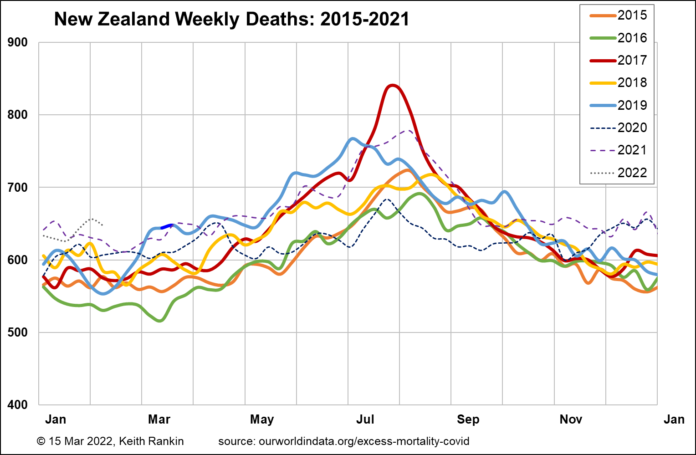
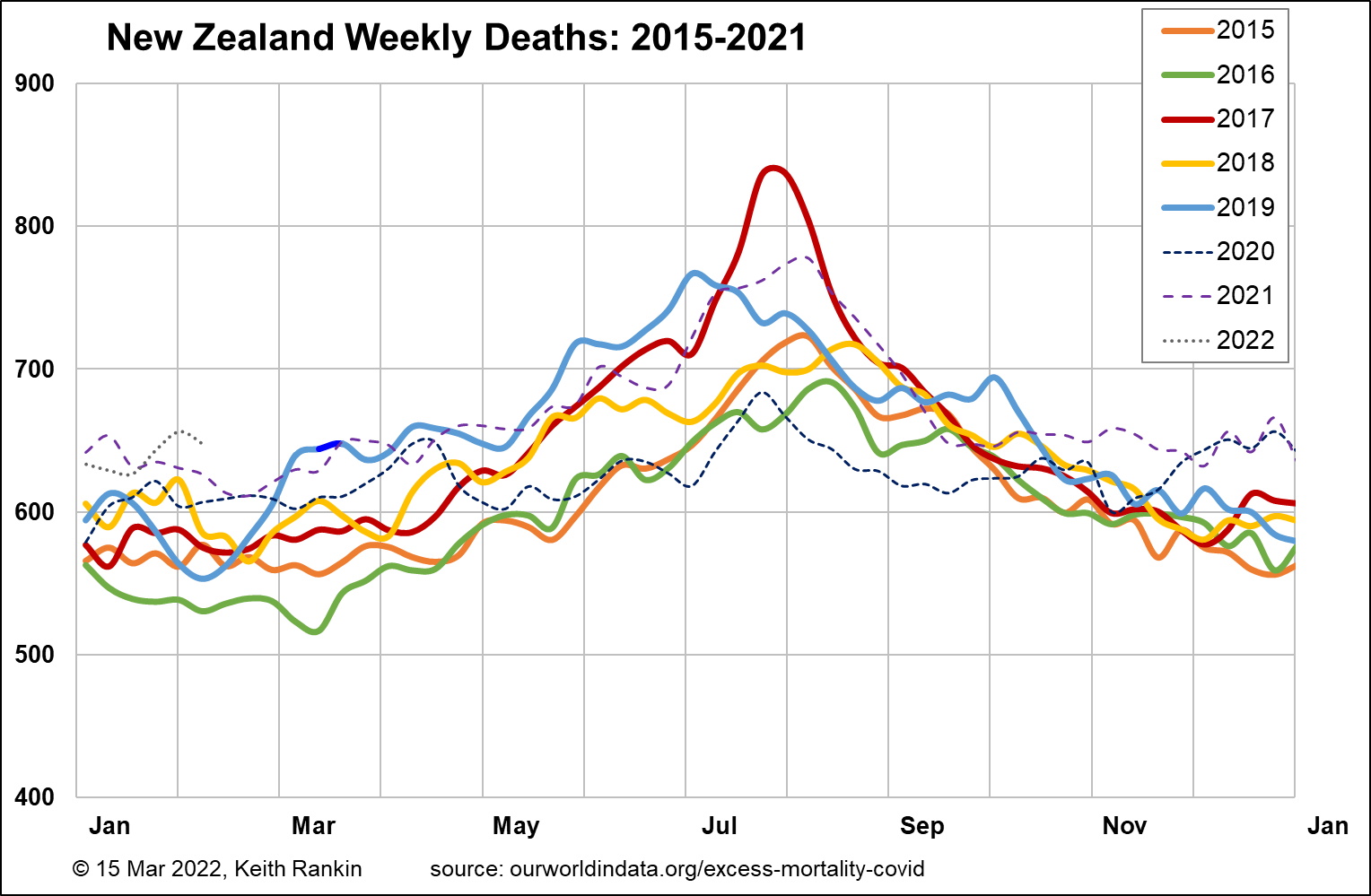
The first chart shows weekly deaths in New Zealand for each year from 2015. The first thing most people will notice is the winter peak, and in particular how large that peak was in 2017. (This was in fact an influenza pandemic – much worse than the 2009 pandemic – though it was never labelled a pandemic by the World Health Organisation.) In general, this chart tells us that ‘winter infections’ contribute significantly to deaths in New Zealand.
The second main feature of the chart is that the general tendency is for deaths to be higher in more recent years. This is, as already noted, exactly what would be expected in a country with both a rising and an aging population. Having noted this, we can also say that 2016, 2018, and 2020 were good years on the mortality front.
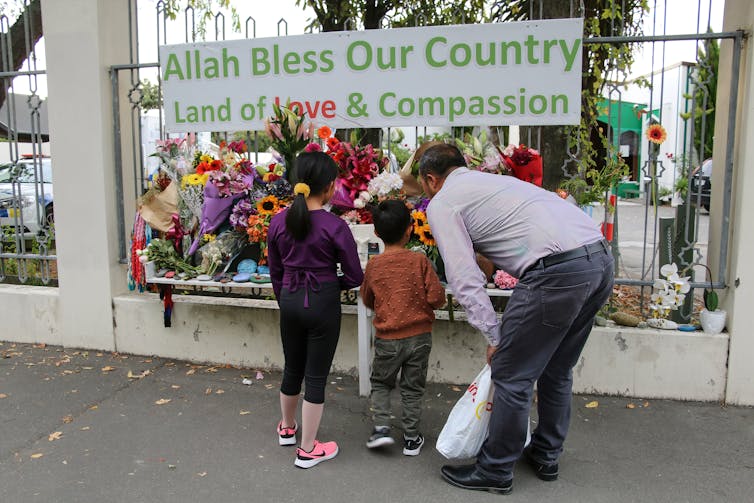
Two more points to note. The impact of the Christchurch mosque tragedies (three years ago today) is shown, in dark blue, as an upward blip in mid-March of 2019. And the winter peak in 2021 looks rather high, given that there were very few deaths that winter from either coronaviruses or influenza.
Chart by Keith Rankin.
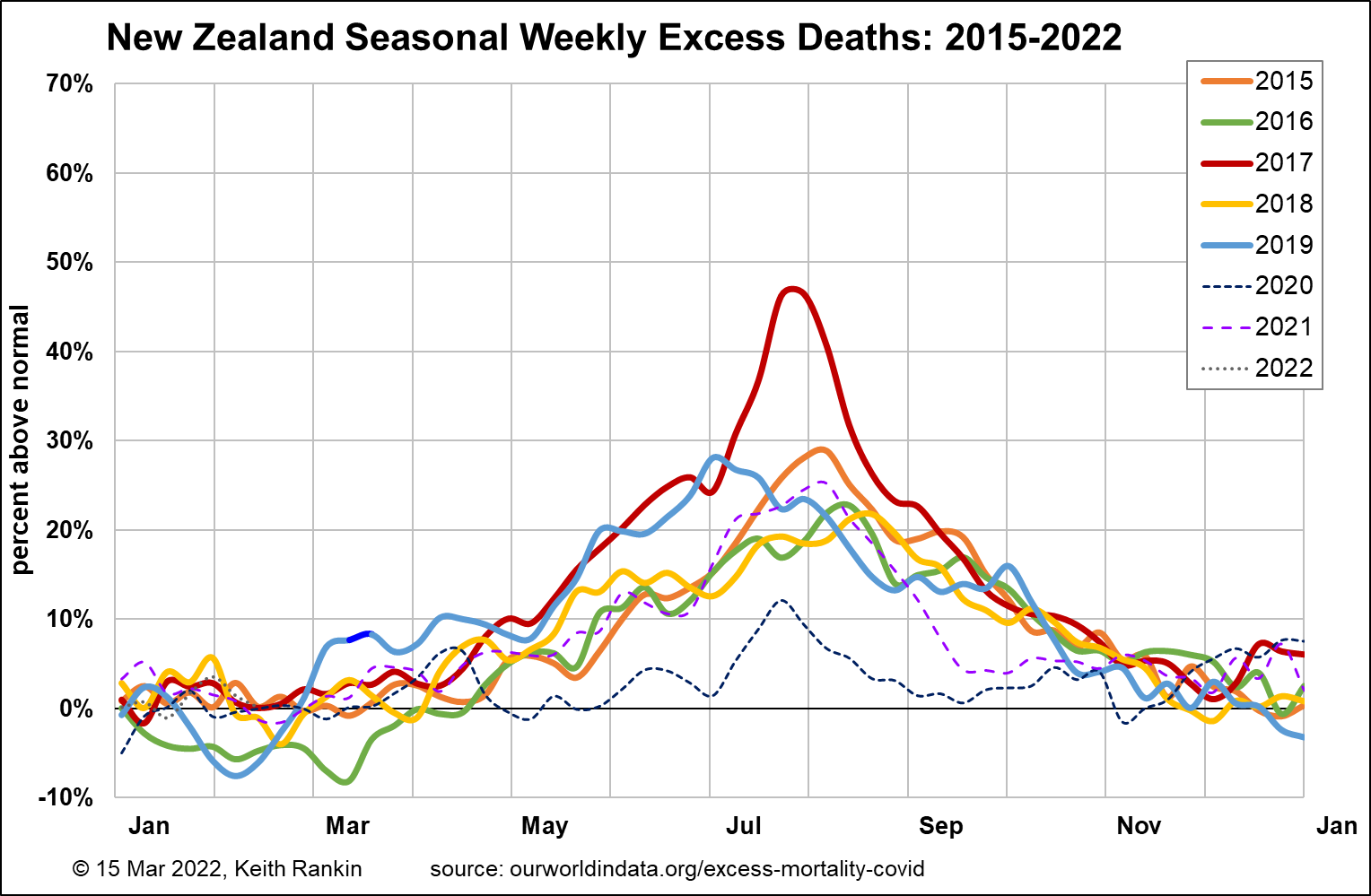
The second chart estimates baseline ‘normal’ for each year (meaning deaths not resulting from seasonal or one-off factors), and then shows ‘excess deaths’ relative to that norm. Thus, both seasonal and one-off death events will show. The normal demographic rise in death numbers is corrected for (so does not show).
While all years show seasonal mortality peaks in winter, 2020 has easily the smallest peak, mainly due to Covid19 pandemic public health measures largely keeping out colds and influenzas. The main direct impact on deaths of the lockdowns shows as low deaths in May and September 2020, as well as a generally lower winter death toll that year.
2021 was surprisingly normal; no impact in New Zealand of Covid19, nor much impact of the ‘delta’ lockdown (except that delta-covid itself had no discernible influence on mortality, thanks to the lockdowns). The winter mortality peak in 2021 is a matter of concern, though; a matter that needs further explanation from our small community of expert epidemiologists.
So far, 2022 is looking completely normal. Omicron-covid will probably see March 2022 looking much like March 2019.
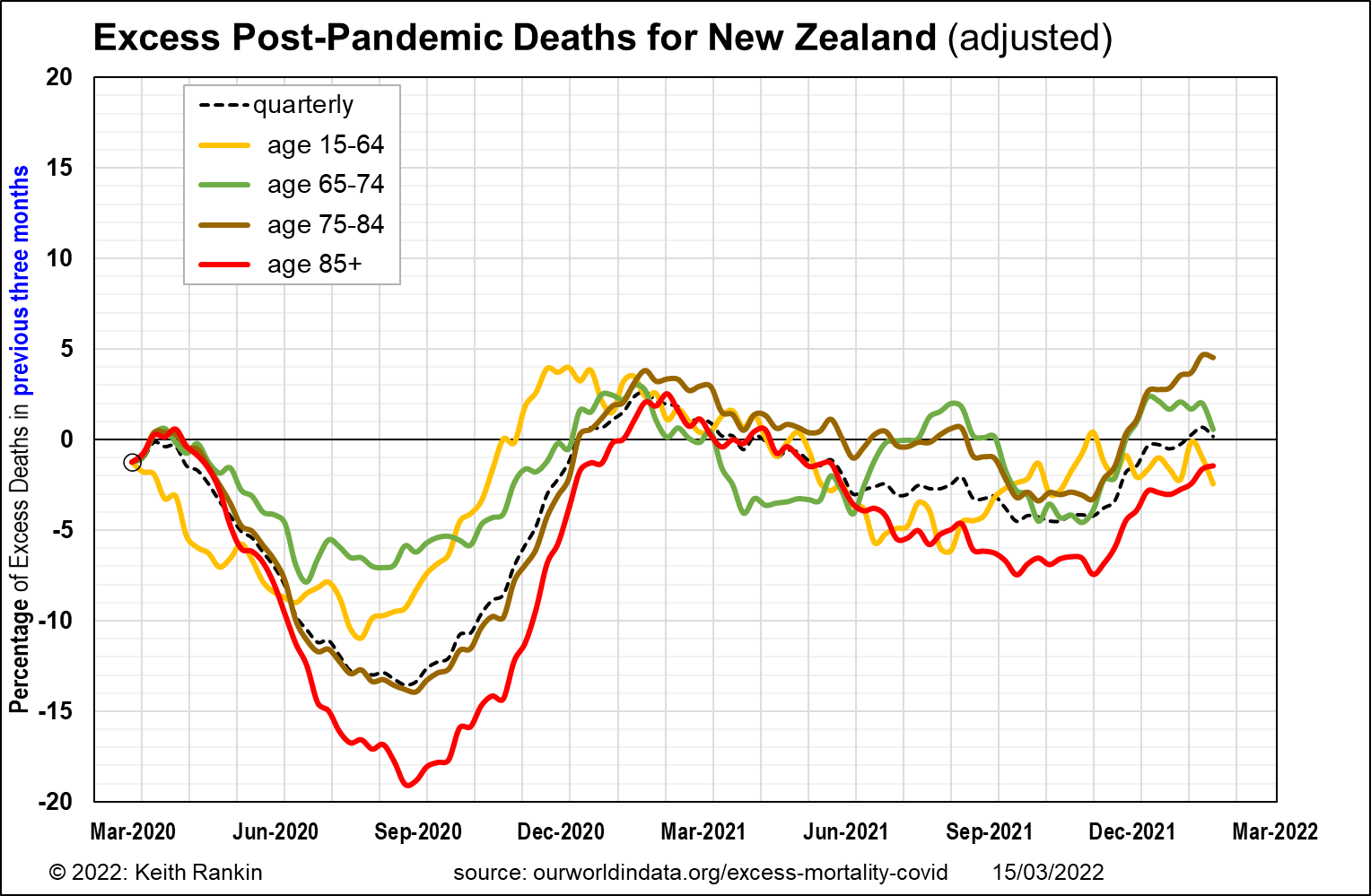
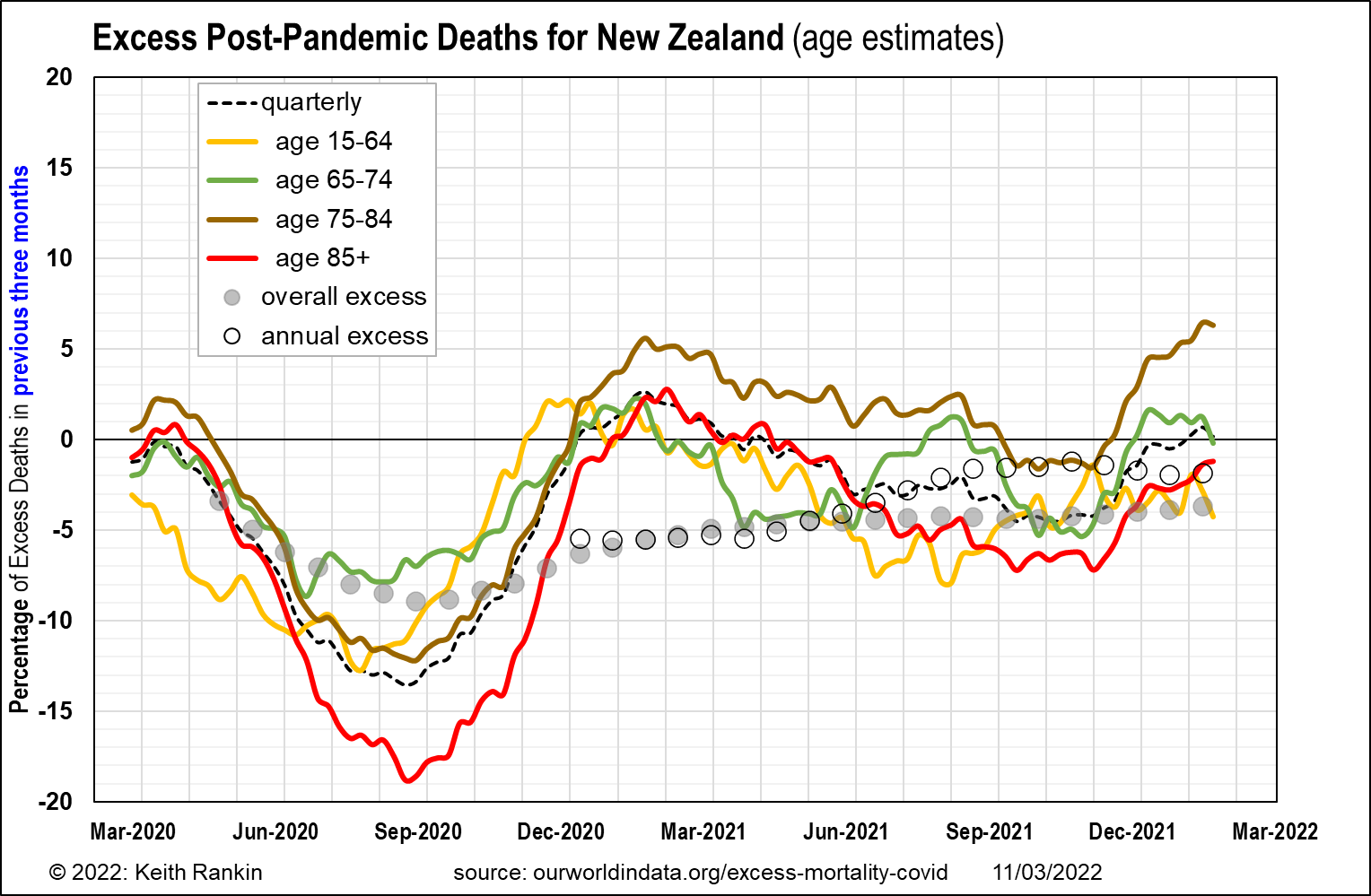
Excess Death by Age
Chart by Keith Rankin.Chart by Keith Rankin.Chart by Keith Rankin.
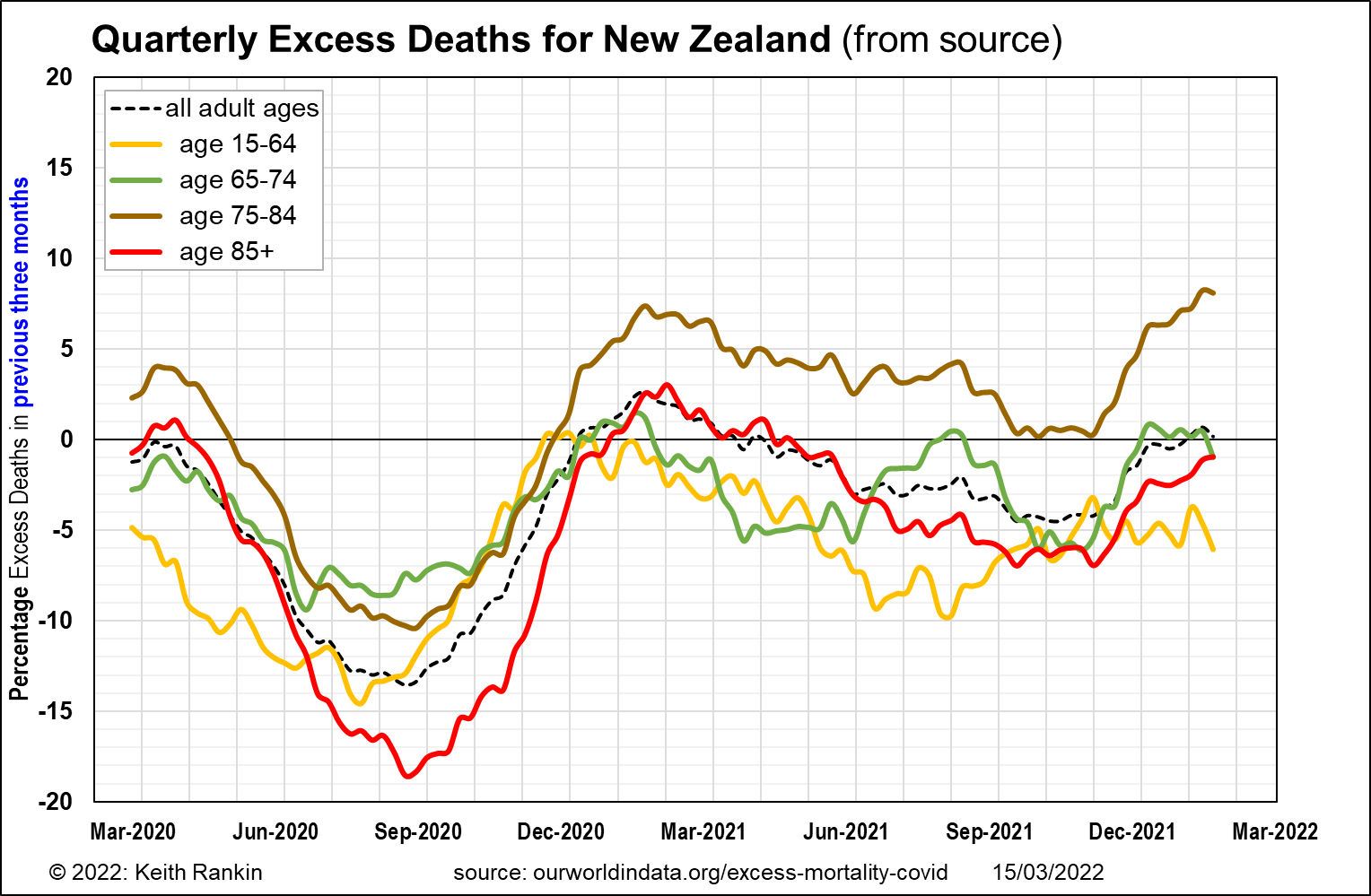
These three charts use ‘excess death’ estimates published by ourworldindata.org. I have been unable to locate the raw data used to calculated ‘projected deaths’ for each age group. ‘Excess deaths’, for each age group, is actual deaths minus projected deaths, calculated as a percentage of projected deaths.
In the first chart, we see that, in the first quarter of 2020, there were excess deaths of people aged 75 to 84; but an apparent shortfall for other age groups, especially working-age adults (15-64). It is likely that some of these differences are random, though we also know that there will be more deaths of people aged 75-84, because there are now many more New Zealanders in that age group. It is therefore surprising how few deaths there were, in 2020 pre-covid, of people aged 65-74.
The second chart adjusts these estimates to put all age groups on an equal footing at the beginning of the pandemic. It suggests a dramatic fall in deaths of older New Zealanders, compared to what would have been had there been no Covid19 modifications to New Zealanders way of life.
In the final chart, I simply average the previous two charts, giving a more robust estimate of excess deaths. It looks as though people aged 75 to 84 have died in slightly larger numbers in 2021 and 2022 than would have been expected had normal times prevailed until 2022. People in that age group who avoided death triggered by colds or influenza in 2020 may have died in 2021 from underlying conditions, and perhaps in some cases from treatment delays.
In addition, there are signs that the other older age groups may be dying in slightly larger numbers this summer than would have been expected given the public health mandates.
Finally, this last chart shows the overall mortality ‘excess’, which has been negative through out the pandemic period. Thus, lives have been saved. It does not mean that lives will continue to be saved. Indeed, we see that the annual excess of deaths in New Zealand to October 2021 was close to zero. My prediction is that in the year to October 2022, excess deaths in New Zealand will be significantly above zero, even if the Russian conflict has not by then brought about World War Three.
A word of caution. Until January 2022, Hong Kong – with similar covid policies to New Zealand – will have had a similar profile of excess deaths to New Zealand. That is certainly not the case in February and March. In the last week, Hong Kong’s recorded Covid19 death toll has been five times worse (per capita) than the next worst country (Brunei, which has a similar story to Hong Kong).
*******
Keith Rankin (keith at rankin dot nz), trained as an economic historian, is a retired lecturer in Economics and Statistics. He lives in Auckland, New Zealand.
In February this year, reports surfaced on Twitter and Facebook that the Ukrainian government was undertaking a mass genocide of civilians. Around the same time, conspiracy theorists began saying Ukrainian president Volodymyr Zelenskyy was an agent of the “New World Order”.
These claims have been thoroughly debunked, but not before attracting millions of views and offering a purported justification for Russia’s invasion of Ukraine. More recently, Russian and Chinese officials have claimed the United States has funded bioweapons research in Ukraine.
Social media has played a crucial role in the spread of these and other false claims. We have identified a network of dozens of Russian government Twitter accounts using a loophole in the platform’s rules to run a coordinated program of disinformation.
The dangers of disinformation
By “disinformation”, we mean factually incorrect material distributed with the aim of unsettling or damaging something or someone: a politician, a political party or system, or a way of life.
Democracy relies on citizens’ ability to make informed decisions about policy, politics and world affairs. This ability is severely compromised when fake and (deliberately) misleading claims are promoted as fact.
Disinformation itself is not new, but over the past decade it has found an ideal place to flourish on social media platforms.
Why disinformation loves social media
Facebook, Twitter, YouTube and many other platforms are designed as amplification systems. They are built to be open to all comers and increase the volume on any type of content.
Anyone with an internet connection can access social media, where all kinds of content can be shared with a speed and reach that was impossible with heritage media.
The sheer speed at which disinformation is disseminated – especially via automated “bot accounts” – makes it hard for content moderators to keep up. The emotive, partisan nature of much online disinformation also means internet users and journalists are more likely to spread it without checking it too closely.
Russian accounts on Twitter
Russian government Twitter accounts have played a key role in the spread of pro-Russia disinformation. While Twitter has fewer users than Facebook or Instagram, it is a pivotal site for the production and dissemination of news.
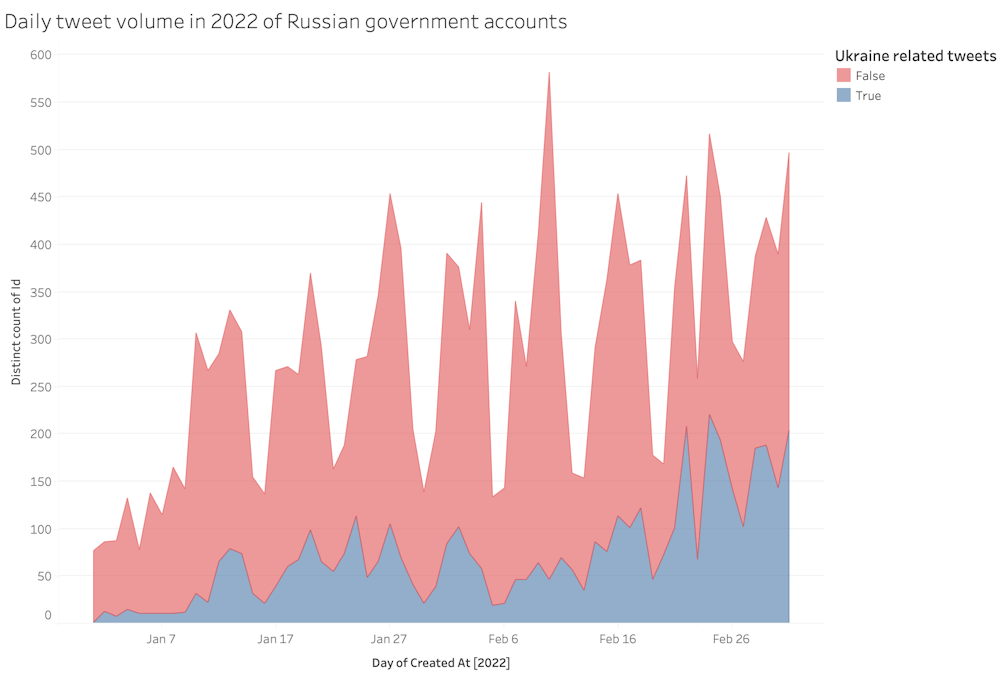
We tracked the Twitter activity of 75 official Russian government accounts and found they are a major source and amplifier of disinformation. At time of writing these accounts together have a total of 7,366,622 followers. They have been retweeted 35.9 million times, received 29.8 million likes, and 4 million replies.
Between 25 February and 3 March 2022, about these accounts made 1,157 tweets – and around three quarters were about Ukraine. The accounts have tried to spread false narratives to justify the invasion.
Daily tweet volume in 2022 of Russian government accounts (coloured by tweets about Ukraine versus other).
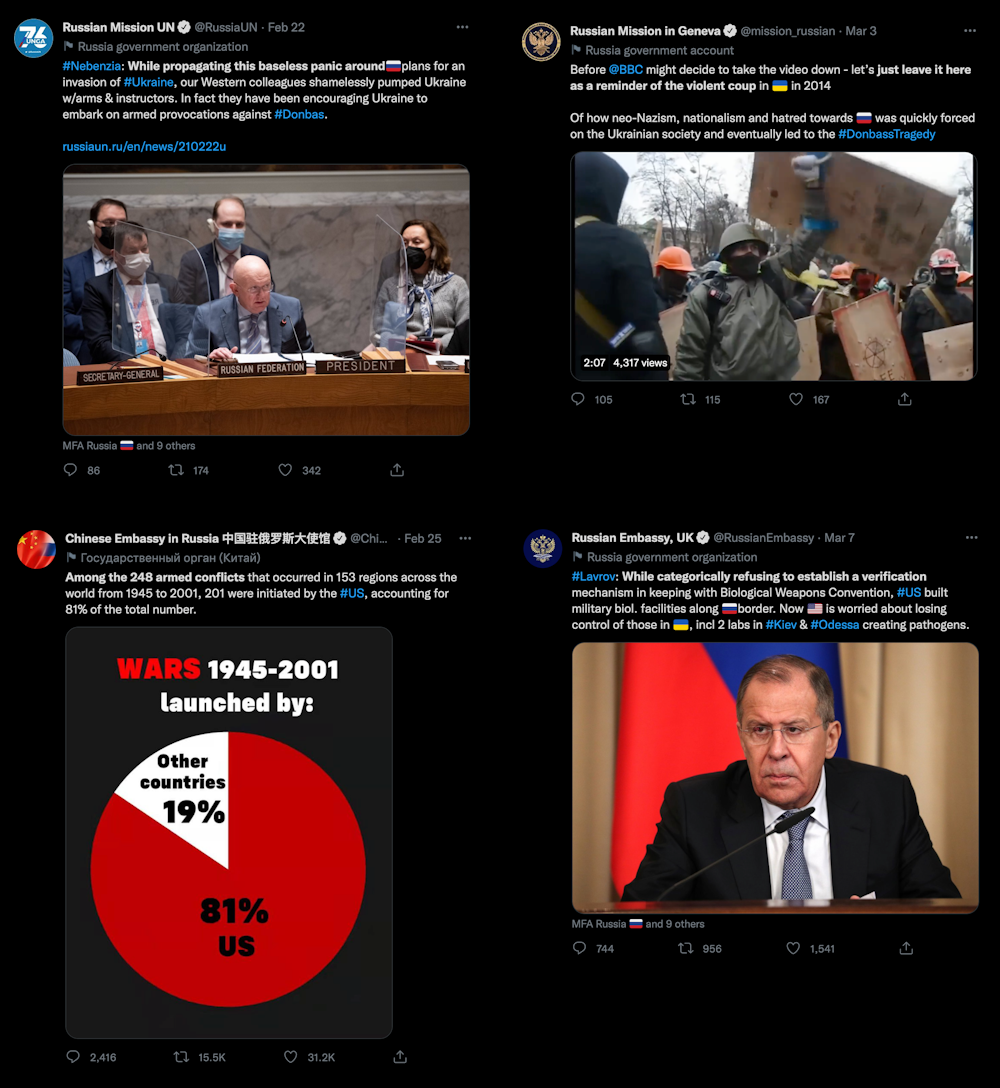
The tweets below show Russian government accounts spreading disinformation narratives: delegitimising Ukraine as a sovereign state, sowing doubt and mistruths about the Ukraine government and neo-Nazi infiltration, spreading “whataboutisms” that downplay the Ukraine invasion by drawing attention to alleged war crimes by other countries, and spreading conspiracy theories about Ukraine/US bioweapons research.
Russian government accounts have tweeted and retweeted disinformation about Ukraine.
A loophole for governments
Twitter has recognised the disinformation possibilities of state-affiliated media, putting warning labels on their content and not recommending or amplifying them.
However, these rules do not apply to government-controlled accounts not labelled as media, such as foreign embassies.
As a result, these accounts are flooding the platform with propaganda. This is a critical gap in Twitter’s moderation practices, and one that has received little attention.
A coordinated network
The 75 Russian government accounts we studied are also working together to amplify disinformation. We analysed their tweets and found they often retweet the same content at about the same time.
This is a well-known tactic of coordinated disinformation or “astroturfing”, where a network of accounts retweet content together repeatedly to amplify it and maximise its reach.
Coordinated retweeting of disinformation by official Russian government Twitter accounts.
The picture above shows a network visualisation of coordinated retweet behaviour among the 75 Russian government accounts. Larger nodes coordinate more often, links indicate retweeting within 60 seconds of one another, and the colours represent “communities” of accounts that tend to co-retweet especially frequently.
The most prominent accounts re the two Russian Ministry of Foreign Affairs accounts (@mfa_russia and @mid_rf), the Russian Mission in Geneva (@mission_russian), and the Russian Embassy in USA (@rusembusa).
What can be done?
Twitter needs to do more to safeguard the platform from harmful content by state actors. Government accounts are still free to flood the space with false information.
Twitter’s policies and rules need to be modified to suit special circumstances such as war. They also need to adapt to non-Western contexts where disinformation is easily missed by automated moderation tuned to the English language and the norms of the US and western Europe.
Platforms have traditionally taken their cues from the techno-libertarian adage that “information wants to be free”. This has turned out to be a disaster for liberal democracy and public health.
Some positive changes have been made, particularly after the January 6 Capitol riots in the US, but platforms are still designed on the principle that the other side should always be heard.
This design is not simply the result of an impoverished understanding of political theory by young white male Silicon Valley entrepreneurs. It’s good for business: blocking government disinformation could result in governments blocking platforms in retaliation, cutting off valuable users.
Do your homework
Individual Twitter users can also help stem the spread of state-issued disinformation by doing exactly what conspiracists and disinformation actors have long encouraged: their own research.
Users can and should ask themselves: How accurate is this claim? How can the claim be verified? Who is posting this information about Russia? What stake does that person or persons have in Russian state affairs? How might amplifying this content, even to criticise it, unwittingly spread it further?
If a piece of information cannot be verified, or appears to be driven by bias or prejudice, it is in everyone’s best interest not to tweet or retweet.
Timothy Graham receives funding from the Australian Research Council for his Discovery Early Career Researcher Award (DE220101435), ‘Combatting Coordinated Inauthentic Behaviour on Social Media’. He also receives funding from the Australian Government Department of Defence.
Jay Daniel Thompson does not work for, consult, own shares in or receive funding from any company or organisation that would benefit from this article, and has disclosed no relevant affiliations beyond their academic appointment.
The Russia-Ukraine crisis is already a human catastrophe. And it could also prove disastrous for climate action by slowing the global energy transition.
Both Russia and Ukraine are key suppliers of crucial metals used in the manufacture of green technologies such as solar panels, wind turbines and electric vehicle batteries. The conflict threatens global supplies of these materials.
Concerns over energy security are also spurring fossil fuel imports and have triggered calls in Australia to delay emissions reduction efforts.
But the war in Eastern Europe must not cause global climate action to falter. We must ensure the renewables industry is better able to withstand such global shocks – which in the long run will aid the transition.
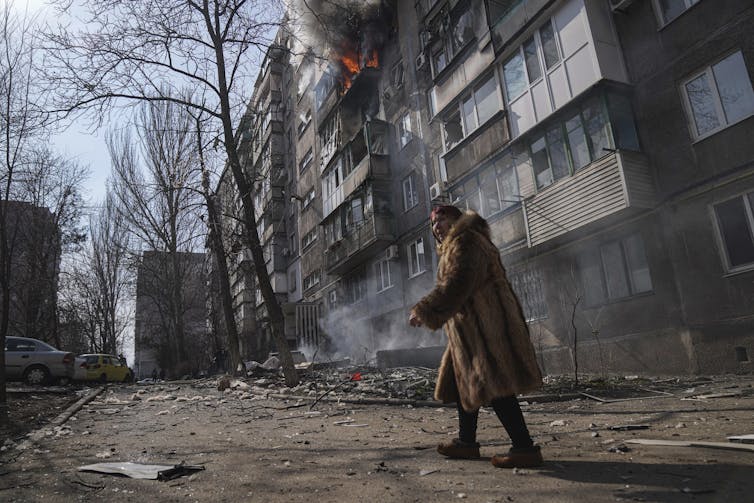
The Russian-Ukraine conflict is a disaster for humanity, and may slow the energy transition. Evgeniy Maloletka/AP
The threat of sanctions
The world needs a secure, steady and affordable supply of clean energy to meet emissions reduction targets. This supply relies on access to so-called “energy transition metals” such as copper, nickel, platinum, palladium, aluminium and lithium.
The Russian-Ukraine conflict has already prompted nations to impose trade sanctions on Russian oil and gas, coal and other commodities, affecting global energy security.
Russia’s metals have so far escaped this punishment. But such sanctions are not out of the question. In 2018, sanctions were imposed on Russian aluminium producer Rusal, causing global prices to skyrocket.
Russia accounts for 7% of the world’s mined nickel – a scarce metal needed to make electric vehicle batteries. The current conflict reportedly pushed nickel prices up 250% in 48 hours last week.
Russia also produces a third of the world’s palladium. The metal is used in the car industry to control vehicle emissions. Palladium prices reached an all-time high following the Ukraine crisis, but have since slumped.
Ukraine is the world’s largest supplier of a group of chemical elements known as “noble gases”. These include neon and krypton, and are used to make semiconductor chips. The latter are a critical component of all electronic systems including those found in automobiles, renewables machinery and other technology.
Russia’s annexation of Crimea in 2014 triggered a rise in neon prices. Some chip manufacturers reportedly stocked up on neon ahead of the current Russia-Ukraine conflict, but the longer-term outlook is uncertain.
Global nickel prices have soared since the Russia-Ukraine crisis began. Courtney Crow/AP
A boost for fossil fuels
Before the Russia-Ukraine conflict, global progress towards reducing our reliance on fossil fuels was already too slow. In just one example, the development of solar and wind projects was recently found to be 30% below what’s needed to achieve the world’s climate targets this decade.
A shortfall in materials used to produce such technologies will only put the world further behind.
Concerns over energy security are also driving coal imports as nations race to shore up fossil fuel supplies. In Europe, for instance, fears over disruptions to Russian gas supplies led to a rush on coal imports.
The German government is also under pressure to reconsider its short-term plans to exit coal and end the use of nuclear power.
And in Australia, rising fuel prices have prompted calls by pro-coal members of the federal government for Australia to pause its plan for net-zero carbon emissions by 2050.
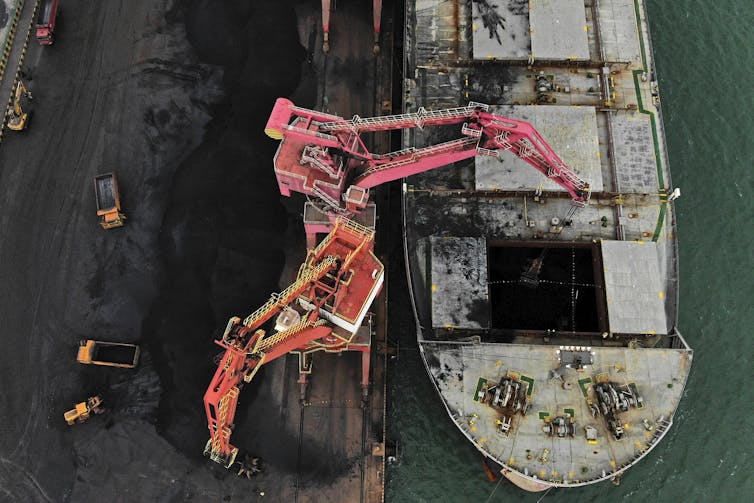
The Ukraine conflict is driving demand for coal imports. Wang Kai/Xinhua-AP
Ripple effects
Despite all the bad news for the energy transition, disruptions caused by the Eastern European conflict provide important lessons in the longer term.
Together with the COVID-19 pandemic, the crisis has highlighted the need for countries to strengthen their domestic capacity to build clean technologies.
And in Australia, the federal government’s manufacturing strategy supports investments in critical resources processing.
The crisis has also provided a wake-up call for countries to reduce their reliance on Russian fossil fuels by investing in renewable energy, and better managing domestic energy demand.
The spike in the prices of critical minerals is likely to drive new mining, manufacturing and renewable energy projects outside Russia. In the Philippines, for example, a dozen new nickel mines are expected this year.
This push may indeed diversify global supplies. But it could also unleash a suite of environmental and social harms.
So wherever these large projects are undertaken, communities and environments must be protected.
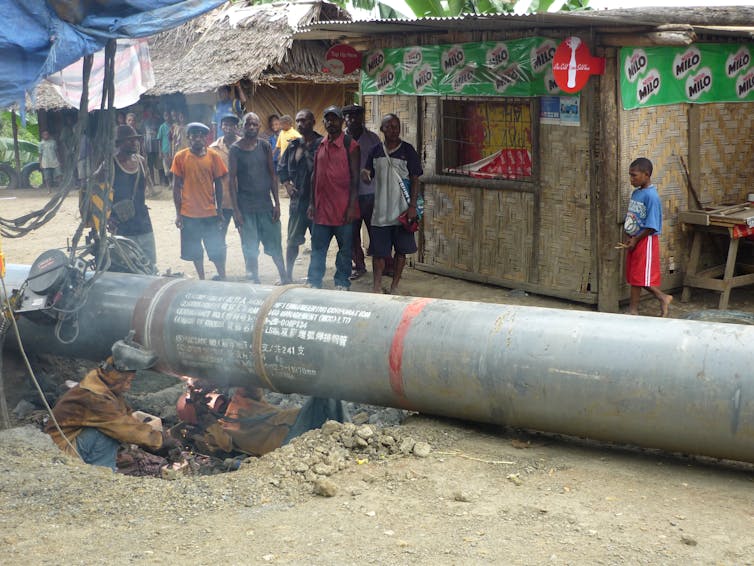
Vulnerable communities must be protected when expanding any mining operations. ILYA GRIDNEFF/AAP
Where to from here?
The Russia-Ukraine conflict casts a cloud of uncertainty over the world’s supply of resources necessary for the energy transition.
Investors, governments, and industry must ensure any disruptions to the world’s transition goals are short-lived. And we must seize this opportunity to make the renewables sector more resilient in the longer term.
We cannot afford to let the Russia-Ukraine conflict derail our focus on an even broader crisis: Earth’s worsening climate catastrophe.
Vigya Sharma thanks Professor Deanna Kemp for her insights and helpful feedback on earlier drafts of this article.
Eleonore Lebre receives funding from the Australian Research Council.
Julia Loginova does not work for, consult, own shares in or receive funding from any company or organisation that would benefit from this article, and has disclosed no relevant affiliations beyond their academic appointment.
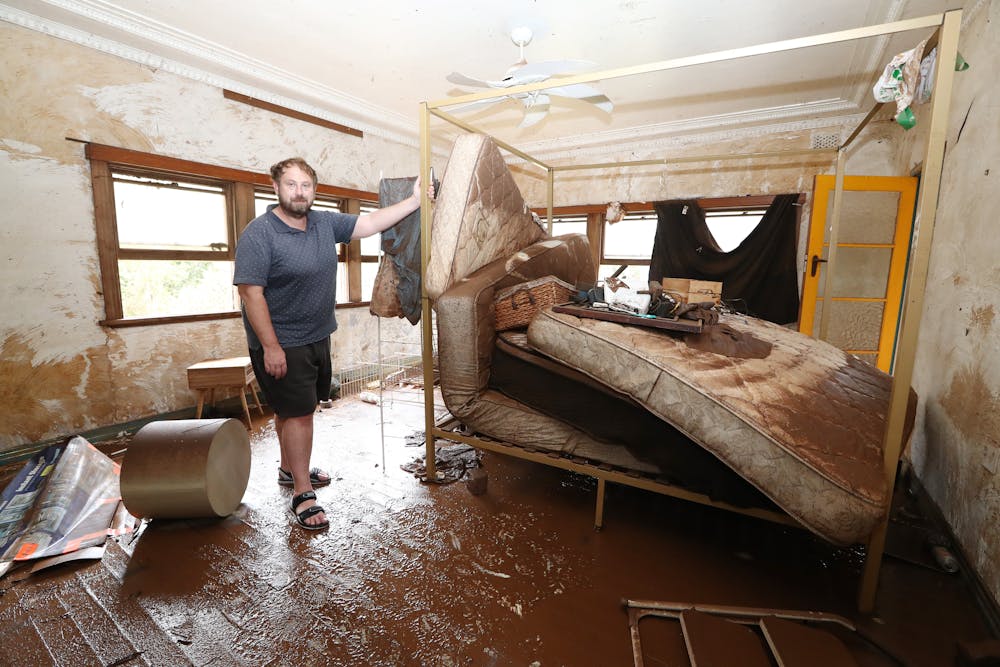
Thousands of people have been displaced from the floods in New South Wales and Queensland. Across the Northern Rivers, the floods have damaged at least 5,500 homes, with at least half of these expected to be uninhabitable.
Floods expose social inequities and exacerbate the housing crisis for people with disability and carers in the region.
In 2020, the disability royal commission raised concern that people with disability were more at risk of homelessness during emergencies.
This followed our research after the 2017 Northern Rivers floods, which showed people with disability and carers were more likely than others to have their homes flooded, to be evacuated and still displaced from their homes six months after the flood.
We found people with disability and carers were at greater risk of post-traumatic stress disorder (PTSD).
People with disability are disproportionately impacted by flooding because of socioeconomic disparities.
Floods intersect with social, cultural and economic factors to shape people’s exposure to risk and their ability to prepare for, respond to, and recover from flooding events.
Housing in flood-prone areas is generally cheaper to buy and to rent, which means people with the least resources – including those with disability and carers – are more likely to be living in areas prone to flooding.
People with disability are more likely to live in cheaper, flood-prone areas. Shutterstock
As one person told us:
Some of my friends lived in places in the centre of Lismore CBD that perhaps should never have been rented due to the vulnerability of their buildings in floods. These types of rooms/places were really vulnerable in the flood, it would have been impossible to get possessions to safety quickly enough. And people who rent these types of places have the least resources (mental, emotional, physical –cars etc – financial) to cope with this type of event quickly.
– Person with disability
Stories from the ground
Due to socioeconomic disparities, people with a disability or carers affected by flooding have greater need for emergency housing in the short term and more secure housing in the long term.
In many cases, people affected by this flooding event will have experienced other climate-related traumas. It was only five years ago the Northern Rivers experienced its last major flood event and just over two years since bushfires devastated the region.
Following a disaster, people with disability must navigate two complex and often inaccessible bureaucracies: the emergency response and recovery arrangements, and disability services, which which are likely to be compromised by the same disaster.
In the 2017 flood, people felt left behind. As one person explained to us:
The disgusting way people were left to fend for themselves and then the lack of proper response from our federal government […] The lack of help for the homeless and vulnerable. The anxiety and stress that occurred and the amount of people left homeless and still trying to find a home five months later. Services that were desperately needed were very hard to find.
– Person with disability
The lack of affordable and accessible accommodation resulted in people with disability and carers returning to, or moving into, unsafe accommodation. Floods can affect the integrity of buildings: they are more likely to leak, develop mould, and suffer from draughts.
Our research highlighted the lack of affordable accommodation for displaced people with disability, a situation exacerbated by many temporary accommodation and homeless services being flooded.
Where the flood did affect me was the housing crisis borne of a shortage of rental properties. I was given notice to move from my rental property just before the flood. It was extremely tough to find anything affordable on the pension […] in the months after. I am currently in temporary accommodation till March, then who knows?
– Person with disability
People with disability may not be able to access affordable accommodation. Shutterstock
Some become homeless.
I am currently homeless with three children, looking for help from community organisations and there are big waiting lists.
The right to safety and well-being in emergencies is now built into Australia’s Disability Strategy 2021-31. It includes, for the first time, targeted action on disability inclusive emergency planning. This must include safe and accessible housing.
Improving housing outcomes for people with disability affected by flooding requires the removal of pre-existing barriers that increase inequitable access to safe living situations. This should happen during pre-planning, and we have direction with the new disability strategy.
6 steps to minimise the housing crisis when disasters strike
But we’re in the middle of an unfolding flood disaster now. So here are six steps governments could take now to minimise the housing crisis for people with disability and carers:
provide accessible short-term emergency housing and support access to secure, safe and accessible long-term housing options
relocate displaced people with their family, carers and support networks to ensure continuity of support from the people they rely on for personal, practical, and emotional support
include local housing and homelessness services in human and social recovery planning now and for long-term recovery
resource disabled people’s organisations to enable person-centred emergency preparedness (P-CEP) tailored to people’s local flood risk, living situation, and other support needs to increase choice and control during recovery
support social housing and homelessness services to develop effective emergency plans for how they will sustain services and continuity of supports during and after disasters.
Jo Longman has received research funding from the NSW Dept. of Planning, Industry and Environment.
Michelle Villeneuve receives funding from the Australian Research Council to support partnership research on Disability Inclusive Disaster Risk Reduction with support from Resilience NSW. Michelle leads partnership research on inclusive emergency planning with people with disability, the services that support them, and emergency personnel in Queensland and Victoria. This research receives funding support from the Queensland and Victorian governments.
Ross Bailie receives research grant funding from the NHMRC and the ARC.
Jodie Bailie does not work for, consult, own shares in or receive funding from any company or organisation that would benefit from this article, and has disclosed no relevant affiliations beyond their academic appointment.
Many people with attention deficit hyperactivity disorder (ADHD) may not receive a diagnosis until adulthood. Adult symptoms can look a little different to those of childhood.
Knowing what to look for is important, so people can get support to help them better understand themselves and meet their full potential.
People, including some clinicians, may not be aware of adult ADHD and how symptoms may change as a person develops and grows. We aim to change this through the development of an Australian ADHD guideline, which is based on evidence and now open for feedback.
ADHD is a neurodevelopmental condition that impacts the brain’s executive functions – like the ability to focus and sustain attention, plan and organise, and exert self-control.
It affects around 6–10% of children and is the most common neurodevelopmental condition in childhood. Yet many people with ADHD don’t receive a diagnosis in childhood, for a variety of reasons. Some may have grown up in an environment well-suited to them, so symptoms were not obvious.
For example, they may have been interested and motivated by academic topics, allowing them to focus and sustain their attention on schoolwork. They may have had high intellectual capacity which can mean minimal independent study is needed to pass school subjects. They may have only had ADHD inattentive symptoms – like daydreaming, or trouble completing tasks – which can be less noticeable than hyperactive-impulsive symptoms.
ADHD symptoms in childhood can include having difficulties focusing attention. This might appear as not taking in or remembering the teacher’s instructions, being forgetful about homework or losing things like school jumpers, and being disorganised with a messy bedroom or desk at school.
Children with hyperactive-impulsive symptoms may have difficulty sitting still during school lessons or when eating dinner at home, being noisy and talkative, intruding on other people or interrupting them, and finding it hard to wait their turn.
A clinical guideline that is evidence-based and can help guide treatment is needed. Shutterstock
By adulthood, symptoms may still be present but they may be more internalised and less obvious. Here are some ways adult ADHD symptoms may present that are slightly different to childhood:
1. No time to stop
Rather than climbing on things and being obviously hyperactive, adults may have an inner sense of restlessness. They may have difficulty relaxing and have a constantly busy mind. They may feel driven to always be doing something, and to try and be constantly productive. This can mean even on a holiday, there is an inability to relax and the person needs to be busily doing activities.
2. Organised, then overwhelmed for a bit
Rather than always being disorganised, adults may experience periods of being highly organised to overcompensate for their ADHD symptoms, followed by periods of feeling overwhelmed and not being able to get things done. This period of overwhelm, which may last a few days, can be due to the extra effort required to be organised when one has ADHD.
3. Severe procrastination
This can result in failing university subjects and struggling to complete work tasks. Procrastination can impact on completing chores around the house and getting severely behind in general life administration, like paying important bills. Putting things off to an extreme degree – such that an impending deadline results in a last minute “smash it out”, “all nighter” effort – is common in ADHD.
4. A poor sense of time
In adults, this can result in constantly underestimating how long things will take, causing frequent lateness. A person might not factor the coffee stop and traffic into their calculations.
Many of us experience occasional times when we feel or act in the ways described above. When multiple instances of these occur, and result in significant negative impacts across different areas of life – like our ability to study, work, socialise, take care of the house – or cause a negative self-view, it may be time to consider the possibility of ADHD.
Recently, there has been greater public awareness of adult ADHD, including on social media and websites with people describing their lived experience. This has increased demand for adult ADHD assessment and treatment services and highlighted a significant gap in Australian health care provision.
There are simply not enough clinicians with expertise in ADHD, no public services for adults with ADHD and no uniform standards of care for ADHD. This creates long waitlists for diagnosis and treatment.
Receiving the right diagnosis, treatment and support is crucial. Evidence-based treatment for adult ADHD can include making lifestyle changes and environmental modifications, medication and psychological treatments, such as cognitive behaviour therapy. The right treatment for ADHD results in better outcomes including improvements in life expectancy, reduced accidents, and reduced substance use disorders.
A key barrier to effective care for people with ADHD has been the lack of an Australian guideline for clinicians that outlines evidence-based, best practice diagnosis, treatment and support.
The Australian ADHD Professionals Association has developed a practice guideline for the identification, diagnosis and support of children, adolescents and adults with ADHD. The public can now comment on and contribute to the draft guideline.
Public consultation is important to ensure the Australia guideline addresses issues relevant to those with a lived experience of ADHD, and those involved in the diagnosis and support of people with ADHD. It is hoped these guidelines can help people identify their ADHD as early as possible and receive the support they need to fulfil their potential.
Tamara May works in private practice as a psychologist with people with ADHD. She is affiliated with the Australian ADHD Professionals Association.
Mark Bellgrove receives research funding from the NHMRC and the Australian Government’s Department of Health. He is Director of Research and Professor at the Turner Institute for Brain and Mental Health, School of Psychological Sciences, Monash University. He is President of the Australian ADHD Professionals Association (AADPA). He is the Project Lead for AADPA for the development of an evidence-based clinical practice guideline for ADHD.
Cutting petrol tax to bring down the cost of living used to be the political version of a joke. Failed US presidential candidates John McCain and Hillary Clinton both tried it in 2008. Their bipartisan advocacy of a “summer gas tax holiday” was derided as dumb, a turkey and a “metaphor for the entire campaign”.
When 230 economists released a letter opposing it in 2008, Clinton said: “I’ll tell you what, I’m not going to put my lot in with economists”.
Her opponent for her party’s nomination, Barack Obama, labelled it a gimmick and went on to win both the nomination and the presidency.
But it isn’t being treated as a joke now. There’s talk about it in the US, New Zealand has just cut in its fuel excise 25 cents to ease cost of living pressures, and Australia is considering a budget measure along the same lines.
What has happened to the price of petrol is shocking. In capital cities the unleaded price is about A$2.18, up from $1.60 at the start of the year. That means that whereas it might have cost $80 to fill up a Toyota Corolla at the start of the year, it now costs one third as much again – $109.
If you fill up fortnightly, as many people do, the extra impost is greater than if the Reserve Bank lifted its cash rate by 0.25% and pushed up the cost of payments on your mortgage.
If you own an SUV, by now Australia’s biggest selling type of new car, the extra impost will be greater. And (as with interest rates) there’s every chance petrol prices will climb further.
In New Zealand, where petrol costs more than NZ$3 per litre (A$2.80) the government has cut petrol excise by 25 cents per litre for three months, in the hope that by then the worst effects of the Russia-Ukraine war will have passed.
Australia taxes petrol lightly
Eagle-eyed readers will have noticed that even with the cut, New Zealand petrol prices will still be way above Australia’s. That’s because, like most developed nations, New Zealand charges more in tax for using roads than does Australia.
Until the cut on Tuesday, New Zealand petrol excise was a touch over NZ$0.77 per litre (A$0.72) compared to around A$0.43 in
Australia.
The goods and services tax charged on top of that in both nations brings the NZ excise to about NZ$0.89 per litre (A$0.83) compared to Australia’s A$0.48.
If these figures sound low, it’s because the price of petrol has soared. One of the peculiarities of taxes that are set in cents per litre (climbing only with inflation) is that when the petrol price jumps, the tax as a proportion of the total price shrinks.
N ew Zealand prices exceed NZ$3 per litre. Benjamin McKay/AAP
A year ago fuel excises accounted for 40% of the cost of New Zealand petrol, and 35% of the cost of Australian petrol. At 28% and 22%, they’ve become self-cutting.
If we abolished fuel excise altogether, cutting the Australian unleaded price 22%, we would only bring the price back to where it was five weeks ago.
And then (as I imagine will happen in New Zealand after three months) the government would find it hard to reintroduce it.
It is finding it difficult to end the $1,080 low and middle earner tax break that was meant to finish two years ago.
The mess it has got itself in by hinting that it will cut the excise and by not ending the A$7.8 billion per year low and middle earner offset hint at a way out.
The offset is poorly designed. It is paid out as a tax refund after the end of each financial year, making it the opposite of the “stimulus measure” Treasurer Josh Frydenberg said it was when he last extended it. If he extends it again for the coming financial year, it won’t get paid out until the second half of 2023.
The petrol component of the fuel excise brings in A$5.8 billion per year. The government might be able to hang on to that and use the A$7.8 billion that would have been spent on the offset to support people now when they need it and when petrol prices are high, rather than a year into the future when they might not be.
The A$7.8 billion would be directed to Australia’s lowest earners, the ones who are being hit hardest by the horrendous petrol prices. Low earners (the bottom 40%) on average spend more than 3% of their income on petrol. High earners spend less than 2%.
Support shouldn’t be tied to petrol use
The direct support to low earners should be delivered in cash rather than as a subsidy to petrol prices. Recipients would be able to spend it on petrol should they need to, but would be able to spend it on other things.
If it was delivered as a petrol subsidy it would go disproportionately to the highest earning households for whom high petrol prices are a mere annoyance. High income households spend more on petrol in absolute terms (on average 50% more) than low income households.
If it is delivered as cash rather than a petrol subsidy it won’t blunt the push that high prices give for people will switch to more efficient cars and use petrol less by doing things such as working more from home.
It’s hard to find a case for a cut in Australia’s petrol tax, but it is easy to create a mechanism to help the people high prices are hurting. The budget is due in a fortnight.
Peter Martin does not work for, consult, own shares in or receive funding from any company or organisation that would benefit from this article, and has disclosed no relevant affiliations beyond their academic appointment.
Review: Sex and Death_ and the Internet, directed by Samara Hersch
My last experience as an audience of one at an Adelaide Festival show was the Belgian theatre company Ontroerend Goed’s The Smile Off Your Face in 2013.
Strapped to a wheelchair, we were led from room to room blindfolded. When the mask was taken off we were confronted with a series of unexpected and sometimes shocking encounters.
Unlike the Belgian’s wacky work, which featured multiple performers, the encounter in Sex and Death_ and the Internet is strictly between you and one other person. It is also far gentler – though no less powerful.
“Performers” here are simply people being themselves. Listed as “protagonists” in the program, the 17 seniors participating in the project possess a willingness to ask and answer some of life’s most delicate questions.
Billed as an opportunity for frank conversations, the pre-show publicity prepares us for an encounter along the lines of truth or dare, You Can’t Ask That or a Catholic confession.
To choose to participate in such an encounter with one’s self and a stranger is itself an act of self-selection.
Totally disarming
Conceived and directed by Melbourne-based performance maker Samara Hersch with key artistic collaborators Bec Reid (dramaturgy) and Ponch Hawkes (photography), participants select a time to be paired with a senior. In the weeks prior to the show participants are asked to send in a photo of themselves taken at least ten years ago.
Participants are given instructions on where to meet and told to arrive no more than 15 minutes early. Upon arrival, an attendant seats us, provides us with a headset, and asks us to listen to a short audio file with our eyes closed.
We hear children responding to a series of questions. Many answers are unexpected, even shocking in their insight, occasionally funny, and ultimately totally disarming. I find myself crying and the show hasn’t even started. Fortunately, there’s a box of tissues nearby.
A gentle, kind woman (who I later recognise as Hersch) lets me collect myself and leads me into a narrow, heavily draped, dimly lit room. Lit dramatically, I seat myself at a small desk in front of a computer monitor. Beside it sits a pad of paper. Some clear and simple verbal instructions are given.
The encounter takes place alone and through a screen. Roy Vandervegt/Adelaide Festival
What unfolds next is a face-to-face encounter with a senior at an undisclosed remote location.
After two years of COVID, we are all used to talking to people on screens.
Set up as a game, participants ask set questions of one another. Four cards linked to questions appear on the screen, and both parties can shuffle the deck for another question if it is not to their liking. Patrons have the option of passing on any question asked by their senior.
The “truth”, we are told, is “whatever it means to you today”. The process feels remarkably safe, ethical and fair, a far cry from being strapped down in a wheelchair (mind you, I loved that experience — but that’s a story for another day).
Given that this work is still running and future iterations are likely to follow a similar format, it would be inappropriate to restate any of the questions. The truth and the willingness to tell it come from not knowing what is coming next.
These questions act to unlock our most deeply held dreams, goals and values. They have the potential to reveal both what we fear and what we cherish most.
As a newly minted “senior” myself, I came into the experience with a bit of suspicion around what someone older than I am could offer me. I expected something sweet, perhaps cute, but not particularly moving.
My human pairing in our all-too-short Q and A was beautiful and deeply impactful. What happened felt like a kind of deep communion, a sharing of what matters in life, safely revealed under the conditions of an ethics of care that Hersch and her team set up.
As for what happens with the photo, to say anything here would undermine the power of the final moments of the encounter.
Leaving the venue, I walked down the steps into the open courtyard of the Adelaide University Union building. It was 5.30pm on a Friday and the place was packed with young people: vibrant, noisy and full of energy after two years of COVID restrictions.
Usually, when walking through such a crowd I would have felt a bit old and alone. Instead, I felt connected to youth and age, even old age. And it was a good feeling, one that is still with me.
In that respect, Sex and Death_ and the Internet was less a performance event than a gift.
Sex and Deathand the Internet plays at Union House, University of Adelaide, for Adelaide Festival until March 20.
William Peterson does not work for, consult, own shares in or receive funding from any company or organization that would benefit from this article, and has disclosed no relevant affiliations beyond their academic appointment.
In a speech to the United Kingdom’s House of Commons on March 9, Ukrainian President Volodymyr Zelensky quoted Shakespeare’s Hamlet:
The question for us now is to be or not to be. Oh no, this Shakespeare question. For 13 days this question could have been asked, but now I can give you a definitive answer. It’s definitely yes, to be.
That Bell Shakespeare’s production of Hamlet – a domestic revenge tragedy set against the larger political backdrop of Denmark’s invasion by its neighbour, Norway – re-opened after two years of COVID delay on the day Zelensky made this speech is an extraordinary coincidence.
When originally mounting this production two years ago, director Peter Evans could not have foreseen the peculiar timeliness of this Hamlet. But, as Hamlet tells Polonius, actors “are the abstract and brief chronicles of the time”.
Alongside reflecting global politics, this stylish and understated production plays upon the melancholy prince’s youthfulness and his emotional sensitivity.
As Hamlet, Harriet Gordon-Anderson continues a 300-year tradition of women playing Hamlet. The first recorded female Hamlet was Charlotte Clarke’s London performance in the early 18th century.
The French actress Sarah Bernhardt, the first female Hamlet on film in 1900, said the prince had to be played by a woman:
I cannot see Hamlet as a man. The things Hamlet says, his impulses, his actions, all indicate to me that he was a woman.
This perception of Hamlet’s femininity is not so much produced by his initial distaste for violence and inability to avenge his father’s murder, but by his unrestrained mourning for his losses.
In casting Harriet Gordon-Anderson as Hamlet, the prince’s emotions are able to come to the fore. Brett Boardman/Bell Shakespeare
Hamlet’s “fruitful river of the eye” – his crying – is mentioned at several points in the text. Disturbed by his nephew’s tears, the murderer King Claudius tells Hamlet “‘tis unmanly grief” to weep for those lost.
Hamlet’s copious weeping goes beyond the bounds of acceptable masculinity. Perhaps it is only with a female Hamlet that the intensity of the prince’s tears can be depicted.
In her bravura portrayal of the melancholy prince, Gordon-Anderson is unafraid to show Hamlet’s sensitivity. Delivering soliloquies directly to the audience, Gordon-Anderson plays Hamlet as an extraordinarily emotional young man. This Hamlet is acting more in sorrow than in anger, crying freely and wiping his eyes.
The performance is disturbingly realistic. How else should one respond to their father’s murder and their mother’s marriage to their uncle?
This Hamlet highlights the love and loss shared by two families. Besides playing Hamlet as the text directs – at various points tearful and manic – what is also remarkable about Gordon-Anderson’s prince is his youthfulness.
Unlike most staging and films of Hamlet, the young characters in Bell Shakespeare’s production are performed by people in their 20s, rather than actors in their 30s or 40s.
A young cast helps anchor this production in realism. Brett Boardman/Bell Shakespeare
This youthful casting gives the production a sense of domestic realism many others lack.
Throughout the text the characters are keen to point out how “young” the prince, Laertes, Ophelia, Rosencrantz and Guildenstern all are. When we first meet Hamlet, he is in the midst of his university degree.
As the foil to Hamlet, “the very noble youth” Laertes is equally young, and is played by Jack Crumlin with a brash, boyish energy. Rose Riley plays Ophelia as a sassy and self-aware young woman who rolls her eyes at Polonius’ moralising.
The older Polonius is touchingly played by Robert Menzies: he does not appear as a conniving political operator, but instead as a naïve and tender old father.
The performances make the characters feel like people we know, rather than legendary, tragic characters from a faraway world.
The generational difference is played to tender effect. Brett Boardman/Bell Shakespeare
But while this realism is refreshing – and what draws the audience to connect with the characters – paradoxically, these performances make the revenge at the play’s core seem somewhat unrealistic. It is difficult to believe these gentle and sensitive-seeming characters could commit a series of murders.
Evans’s Hamlet is more interested in claustrophobic personal dynamics than the terror of invading forces that concludes the play. But it is a testament to this production’s power that it can make the audience reflect on the world beyond while witnessing personal, familial breakdowns.
“The time is out of joint”, Hamlet tells the audience. Not so for this most timely production.
Bell Shakespeare’s Hamlet plays at the Sydney Opera House until April 2, before touring to Canberra and Melbourne.
Gabriella Edelstein does not work for, consult, own shares in or receive funding from any company or organisation that would benefit from this article, and has disclosed no relevant affiliations beyond their academic appointment.
Today we release the third Islamophobia in Australia report. We are doing this on the third anniversary of the Christchurch terror attacks to once again highlight the ongoing threat to Muslim people in their everyday lives.
This report is based on incidents reported to the Islamophobia Register Australia by victims, proxies and witnesses during 2018 and 2019.
This includes 247 verified incidents (138 physical and 109 online). It follows 349 incidents in the second report (published in 2019) and 243 incidents in the first report (published in 2017).
Although the analysis of reported cases may not represent all incidents occurring across Australia, they remain a critical and valuable source for understanding manifestations of Islamophobia in the Australian context.
Men attacking women
The third report found perpetrators were predominantly men (74%), while victims were predominantly women (82%). Of the 103 victims, 85% were women wearing hijab, 15% were children and 15% were women with children.
A Queensland woman reported she was yelled at when walking past three young boys.
I was with my two small children and they started saying ‘let’s rip it [her hijab] off her head!’ I quickly got nervous and started pacing to get away with my children before the incident escalated. Alhamdullilah [thank God] we made it to safety before anything serious happened.
Another woman reported this comment after the Christchurch massacre:
I have had the father of my eldest daughter friend say to me directly […] ‘the Muslims had it coming’. I was shocked and could only stare back in disbelief. The daughter of that gentleman would call me ‘ghost’ in front of myself and my daughter, referring to my hijab/scarf.
Perpetrators were overwhelmingly Anglo-Saxon (91%) and they were mostly aged in middle and late adulthood (57%). In contrast, victims tended to be in early and middle adulthood (61%).
In most cases, the victim was alone with the perpetrator (54%), and in one in five cases, there was an existing relationship between the perpetrator and victim such as a work (10%), school (5%) or social (3%) relationship.
According to the reported incidents, the perpetrator profile was diverse, ranging from homeless people to university staff and art gallery visitors. Some perpetrators carried out hate while in the presence of their own families, showing how socially acceptable this form of racism can be.
Where is safe?
The location of incidents showed anti-Muslim harassment often happens in crowds and busy public places (63%).
Since incidents were first logged in 2014, reports of anti-Muslim abuse have risen in areas with security guards and surveillance cameras – from 37% in the first report to 75% in the present report.
Incidents occurred in places including shopping centres, public transport, pools and playgrounds and education settings. This suggests there is no public space that is safe from Islamophobia.
Christchurch’s impact
The abuse Muslims suffer is centred on the unfounded and highly offensive idea that Muslims are “terrorists” and “killers” – this is despite Muslims suffering from white supremacist terrorism in the Christchurch attacks.
Unfortunately, in the wake of the Christchurch massacre, the Islamophobia Register Australia saw a spike in reporting of offline and online incidents. Reports of offline cases increased four fold – this included ten mosque vandalism cases.
Mass shootings in Christchurch mosques in 2020 killed 51 people. Mark Baker/AAP
Reports of online cases increased 18 fold within the two weeks of the attacks.
Especially in online platforms, sympathisers with the Christchurch terrorist justified or glorified his attack, called for more deadly and bloody attacks on Muslims or declared their willingness to follow the Christchurch terrorist by killing Australian Muslims once a “civil war” starts in Australia.
Along with this hyper-violent rhetoric, we saw an escalation in xenophobic language, from telling people to “go home” to expressing supremacist conspiracies such about a “demographic invasion by Muslims”. These xenophobic attacks was the most popular form of online hate rhetoric (43%) after associating Muslims with terrorism (58%).
Not a ‘Muslim’ problem, a social cohesion risk
The Islamophobia report is yet more evidence of the abuse Muslims face in Australia – just for going about their lives.
Positive action from our political leaders is required to safeguard the dignity, equality and safety of every citizen and minority group, including Muslim Australians.
The increase in Islamophobia in the aftermath of the Christchurch attacks is not a coincidence. The incitement to violence on social media suggests the need for intense monitoring and strategic moves by counter-terrorism organisations.
Islamophobia is not a “Muslim” problem, it is a risk to our social cohesion. It requires national engagement if Australia is to live up to its multicultural legacy.
Derya Iner works at Charles Sturt University and provides consulting for the Islamophobia Register Australia.
Editor’s Note: Here below is Dr Bryce Edwards’ New Zealand Political Roundup – which analyses one prominent topic being debated in New Zealand and links to media coverage. You can sign up to NZ Political Roundup for free here.
Political Roundup: Labour responds to the “Costpocalypse, but should it go further?
The “Costpocalypse” is finally getting serious Government attention. Yesterday’s announcement of cuts to fuel taxes and cheaper public transport was a response to rising electoral pressure on Labour over the “cost of living crisis” – something the Government had until now refused to accept existed. Last week’s shock opinion poll obviously helped focus minds around the Cabinet table.
It’s a smart move. As the Herald’s Thomas Coughlan writes today, the cut to fuel taxes “was the right thing to do, easing short-term pain on struggling households… and it makes sense for the Government to smooth the impact of those price rises by lowering fuel costs. It’s not difficult to do either.”
Something had to give. Pressure from across the political spectrum was proving too much for Jacinda Ardern to keep up the pretence that there was no crisis and therefore no action was required. Crucially, this political pressure reflects a reality that the public, especially those on lower incomes, are really struggling at the moment.
Stuff political editor Luke Malpass sees the Government’s shift as a return to political flexibility: “For Labour, this is a significant move and shows that it might be regaining some of its political agility that has been lost over the past year or so as it has become tied up with Covid and wedded to the righteousness of to its big bang reforms in water, health, climate change, housing and elsewhere.”
Government decision widely welcomed, but more is demanded
There is a consensus today that the Government’s announcement is a step in the right direction but more is needed.
Te Pāti Māori co-leader Debbie Ngarewa-Packer pointed out that there are much bigger problems in terms of food and housing that the Government appears unwilling to address. She complains, “Fuel is the last thing on the list creating real material hardship for our families.”
The Green Party is relatively cold on the fuel tax cuts – not because of climate change, but because they would prefer direct welfare payments. They argue that petrol retailers could also just take the 25 cent per litre cut in taxes for themselves in profits.
Many consider the level of the fuel tax cuts are inadequate and that three months might not be enough, with an extension likely. BusinessDesk’s Ian Llewellyn suggests the 25 cent cut could be bigger, saying “Someone paying $3.20 a litre at the pump on Monday was paying about $1.42 in levies, taxes, GST and carbon prices.”
Blogger Martyn Bradbury urges the Government to go further and make public transport entirely free: “Here’s the reality, Putin is in this for the long haul and the face saving measures Labour have scrambled together will inoculate us for about 2 weeks before more measures are required.”
Bradbury emphasises the need to go beyond transport costs, saying today: “Great. Do Child Poverty, Inequality and Housing next! Isn’t it amazing how fast a Government will move when polls tank? We need this same urgency on a whole raft of issues.”
Leftwing blogger Steven Cowan points out that electricity costs are about to increase for poor people: “at least 40 percent of Kiwi households will see a jump in their power bills as the electricity industry, with the blessing of the government, does away with low-use plans. Those whose power use is very low will be hardest hit. As part of the phasing out, power companies will be able to double the daily fixed rate for low users from 30c a day to 60c a day, which works out to an increase of around $110 over the next year.”
Should public transport fares be permanent cut, or made entirely free?
The cuts to public transport fares have been met with particular enthusiasm. Thomas Coughlan sees this element of the package as the “most politically significant”, and points out it’s occurring despite fares not actually increasing at the moment.
Here’s his explanation for the fare cut: “That detail was a signal to households to consider public transport use to cut energy bills (public transport will now be far, far cheaper in many places than driving), and it was a clear signal that the Government was wedded to its “mode-shift” approach to transport, which seeks to economise road use by shifting people from private vehicles on to bikes and public transport.”
But many feel public transport should be made entirely free, and permanently rather than for three months. Today’s Stuff newspaper editorial says “with our climate change commitments in mind, that should arguably be a permanent change.”
In Auckland it’s set to become a core part of the local government election campaign, with mayoral contenders Leo Molloy and Labour-endorsed Efeso Collins both pushing for this. There is also hope that the Government will deliver something for public transport in the upcoming Budget (which Grant Robertson gave some hints about yesterday).
Currently, the Government is only budgeted to allocate about a tenth of the cost of the petrol tax cut to public transport. While the tax cut will cost about $350m, the fare cut is estimated at around $35m. It wouldn’t cost too much more to make all such transport free, and only cost a tiny fraction of the Government’s climate change budget and roading costs.
How does the drop in fuel taxes work with climate change?
There’s always going to be tension between cost of living problems and climate change. In the case of yesterday’s announcement, there is a major problem, because the Government’s climate change strategy is based on the need for fossil fuels to increase in price significantly. So, was the tax cut a mistake for the environment?
Richard Harman writes today, “The decision to lower the fuel price does raise questions about the Government’s commitment to phasing out our dependence on fossil fuels.” He says this paradox is why the Government also had to cut public transport fares – so that it would be less vulnerable to criticism about their climate change agenda.
Rightwing commentator Matthew Hooton says it’s hypocrisy, as the tax cuts come just as the price of fuel was seeing people talk about not driving as much: “When it comes to it, the polls will always trump the Labour-Green Government’s commitment to Jacinda Ardern’s ‘nuclear-free moment’ and climate change ’emergency’, and her fake pledge to halve net greenhouse-gas (GHG) emissions by 2030. For anyone who is serious about climate change, the one silver lining of the Russian invasion of Ukraine is the surge in the price of oil”.
So, perhaps the bigger lesson from yesterday’s announcement is that at least in the short term, cost of living politics trumps the climate change agenda.
Chris Trotter (Daily Blog): A Fork in the road: Which way should Labour go?
Responding to the latest shock poll for Labour, Chris Trotter says that Labour should embrace radicalism as well as a close working relationship with Te Pāti Māori and the Greens.
Verity Johnson (Stuff): Why I am thinking of ditching Labour
A former Government supporter feels very disappointed by how the Government has dealt with non-Covid issues over the last few years.
Michael Johnston (Stuff): Teaching children to participate in the contest of ideas
An educationalist argues “the importance of teaching students how, rather than what, to think” particularly when it comes to contentious areas of politics, history and current affairs.
Martyn Bradbury (Waatea News): Why Labour are slumping?
Labour needs to go back to leftwing basics to beat National, according to Martyn Bradbury.
Shane Jones (Herald): Beware – Treaty co-governance is contagious (paywalled)
The former New Zealand First Cabinet Minister argues against the Three Waters reforms and other areas of constitutional change involving co-governance, saying the “public does not recall giving the Labour Party permission to impose its Treaty of Waitangi co-governance master plan. A dogma that thrives where visibility is weak, debates are shallow and agendas are murky.”
ODT: Editorial – Turbulent Three Waters for Government
The Otago Daily Times argues the Government’s water reform programme could “become a lightning rod on Māori issues”, and it’s now time to explore some alternatives.
Gavin Ellis: Fundamental flaws in public media plans call for big fixes
Media commentator and scholar Gavin Ellis argues that the Government has got it wrong in the way RNZ and TVNZ are being merged, and he worries about the new organisation’s political independence.
Will Trafford (Māori TV): ‘Tragedy’ if TVNZ destroys RNZ amid mega merger – CEO
RNZ boss Paul Thompson is warning that it will be a “tragedy” if RNZ is taken over in the merger with TVNZ by commercially-minded TV executives. Thompson says the merger is “bittersweet” as his preference for the new entity was for it to be a fully-funded public broadcaster, though it’s still a big step forward.
Graham Adams (The Platform): The ‘Listener’ professors chalk up another win
The Royal Society has dropped its disciplinary action against 2 academics, and Graham Adams argues that they had little choice if it wanted to avoid further embarrassment
Source: The Conversation (Au and NZ) – By Frank Bongiorno, Professor of History, ANU College of Arts and Social Sciences, Australian National University
It is premature to be discussing the legacy of the Morrison government. While it is well behind in the polls, there is still an election to be fought. Most commentators are understandably wary of prediction, not only because many got it wrong last time round, but because we are living in uncertain times.
But there is another reason to be wary of pronouncing on legacies. What is seen to matter changes with the passage of time. The failures can shrink in collective memory over the years, while achievements that seemed modest during government loom larger as circumstances change.
When Robert Menzies retired in January 1966, everyone seemed to be able to agree it was an end of an era, but they struggled to discern a likely legacy. The Australian, then in its infancy, asked: “Has anything happened to Australia in the last 16 years of which we can say: ‘This was Menzies’?”. It offered education as one possibility, but was not otherwise able to find much:
There was his Midas touch, his fantastic run of success since 1949, his unerring political touch, his judgement of the right moment, his talent for survival, his overpowering domination of politics.
Menzies’ greatest achievement seemed to lie in his political nous rather than his policy achievement.
The reputations of other governments have moved this way and that. The Whitlam government’s reputation was mediocre in the late 1970s and 1980s; its failures in economic management seemed a permanent black mark against it. By the time Whitlam died in 2014, the legacy seemed exceptional – from health and education through Aboriginal and women’s rights, environment and heritage, family law, consumer affairs and much else – partly because the achievements of recent times were so meagre.
The Hawke and Keating legacy looked better by the early 2000s, as Australia enjoyed some of the dividends of their reforms, than it had in the era of corporate collapse and recession of the early 1990s.
Gun laws loom much larger today as a Howard legacy than they did in 2007, in the wake of continuing carnage in the United States.
Much of Malcolm Turnbull’s memoir was given over to setting out a prime ministerial legacy. He even invited readers to include marriage equality: an issue on which others had worked for a generation to reshape public opinion in the face of political class obstruction.
Malcolm Turnbull is keen to claim marriage equality as a legacy of his prime ministership: others would disagree. Lukas Coch/AAP
What of Morrison? He went to the 2019 election promising little. Unsurprisingly, when returned to office, the parliament was not flooded with initiatives. There were tax breaks. This is a legacy of sorts: a more regressive income tax and budget deficits further into the future than anyone can see.
On the handful of other matters the government did promise to attend to, we are still waiting. It has failed to establish an anti-corruption commission, with its draft legislation being treated with justified contempt by anyone interested in improving government integrity.
It has also failed to deliver on religious freedom. This failure was Turnbull’s legacy, too, for he granted the defeated side in the same-sex marriage postal survey of 2017 a sop in the form of an inquiry which led, after years of toing and froing, to the recent humiliation of the Morrison government by members of his own backbench.
Something like this should have been predictable from the outset. The existing exemptions in the Sex Discrimination Act, which are in large part the result of church lobbying in 1983 and 1984, are wide. If Christian conservatives were more pragmatic and less inclined to culture wars, they would have left them alone.
Of course, the Morrison government was quickly overtaken by what British Prime Minister Harold Macmillan called “events, dear boy, events”. There were the Black Summer bushfires. They have formed a difficult legacy for Morrison.
Scott Morrison’s response to the Black Saturday fires has become a difficult legacy. Steven Saphore/AAP
If we work backwards from Scott and Jenny Morrison’s recent appearance on 60 Minutes, it seems likely the Liberal Party’s research is revealing Morrison’s leadership failure and trip to Hawaii remain imprinted on the public imagination.
Then there is COVID-19. Morrison will claim a legacy in which fewer Australians died than in most other places and the government’s support managed to prevent economic catastrophe. The government’s opponents will point to failures in the vaccine procurement and rollout, in aged-care policy and in supplying testing kits.
Labor will also point to the precarious state of an economy in which inflation and debt are rising, and to the need for stronger action on climate change and renewable energy than Morrison has so far been willing to take.
The government will place foreign relations and defence in the foreground. The Australian’s Paul Kelly recently produced a Lowy Institute Paper, Morrison’s Mission, in which he manages to discern so much coherence in the government’s foreign policy, with its growing belligerence toward China and cloying relationship to the United States, that it deserves to be called “The Morrison Doctrine”.
His colleague Greg Sheridan is more insistent on the government’s failure to attend to Australia’s defence capabilities in a world unlikely to wait around for Australia to acquire a nuclear submarine fleet several decades into the future.
National security is predictably alluring for Morrison. It plays to a traditional Coalition strength. It has formed the basis for some outrageous attacks on Labor and its leader, Anthony Albanese, as Chinese Communist Party favourites.
It appeals to the grandiosity from which almost no prime minister is immune and which Morrison has in spades. And it is consistent with his reduction of politics to a form of public relations, one less preoccupied with implementation and achievement than the theatre of the announcement. Even Kelly, broadly favourable to Morrison’s foreign policy direction, says that he “constantly oversells his initiatives”.
But Morrison will be long out of politics before anyone is called to serious account for the decisions being made today.
There is danger in this for Morrison’s government. Few today recall Australia’s security agreement with Indonesia as a Keating legacy. Abrogated by Indonesia during the later Timor crisis, at the time of its signing a few months before the 1996 election it fed into an image of Keating as too concerned with “the big picture” at the expense of the everyday concerns of mainstream Australians. This became an idea that John Howard deployed with devastating effect.
Morrison may well find that voters who – to take just another example of failure – are unimpressed with their leaders’ response when their homes are inundated by flood waters have a strictly limited interest in any boats other than those being sent to help them.
Frank Bongiorno does not work for, consult, own shares in or receive funding from any company or organisation that would benefit from this article, and has disclosed no relevant affiliations beyond their academic appointment.
As the Russian invasion unfolds, a deep vein of Ukrainian nationalism – already irritated by the annexation of Crimea and a Russian-backed insurgency in the Donbas region – has been unleashed.
Ordinary civilians have called themselves to arms, vowed to kill Russians in vengeance for their aggression, and promised to fight to the death.
Improvised explosive devices – as desperately simple as Molotov cocktails – have been produced. A foreign legion has been raised, and foreign fighters invited to join the cause.
Not so long ago, actions like this met with international scorn. United Nations resolutions and legislation in many countries were passed against those improvising explosives and travelling into war zones to fight – because those doing it were supporting ISIS.
For nearly two decades, the notion of “radicalisation” has prevailed as a careless label – describing an apparently irrational and inexplicable determination to incite, perpetrate and endure physical violence.
Yet here it is materialising on our television screens. Not only is the Ukrainian determination to fight to the end understandable, the desire of outsiders to help them makes sense.
The lesson of ISIS
The Ukrainian situation demonstrates the normality of rational human beings advocating and perpetuating violence in circumstances they perceive as unacceptable.
No judgement is made here on the relative merits of ISIS and the terrible circumstances in Ukraine. We obviously see the two causes as a world apart – though ISIS would see them as absolutely aligned.
Regardless, it is not necessarily a character flaw that causes people to advocate and perpetuate dreadful violence, to kill and maim, and go to their own deaths to achieve an outcome they will not survive to see.
The Ukrainian defence is inspiring, courageous and, however it ends, it will be an exhibition of the human will against impossible odds.
But ISIS saw themselves the same way.
Social cohesion as remedy: people leave flowers at the Al-Noor Mosque on the second anniversary of the terrorist attack. GettyImages
Terrorism and social cohesion
New Zealand’s royal commission of inquiry into the Christchurch attacks of March 15 2019 trapped itself – and has since trapped policymakers – into thinking terrorism’s sole cause is irrational extremism.
This position presumes terrorism largely emerges from ideological or religious extremism, and that it is a social problem – so pursing policies to encourage “social cohesion” will help avoid future terrorism.
As similar and cohesive as the peoples of Russia and Ukraine were, it has taken no time at all to turn them into bitter enemies as the result of Putin’s decision to invade. Peaceful, law-abiding Russian people living cohesively in New Zealand have suddenly found themselves the targets of abuse and threats.
The Race Relations Conciliator’s response urging New Zealanders to “be kind” suggests a failure to understand the deep emotional attachment many are starting to feel for the people of Ukraine as we witness the injustice unfolding there.
State-sponsored terrorism
Putin has never lost a war. He has never won one without causing untold devastation and suffering. In the past, his victims have resorted to insurgencies and ultimately terrorism.
If Russia presses on to victory, Ukrainians will have little option but to fight back in any way they can. They have already breached the Geneva Conventions by filming their captives.
Terrorism may become a tactic they will ultimately see themselves having little choice but to adopt.
Given the reluctance of NATO to engage directly, Western powers will almost certainly covertly fund, supply and assist an insurgent or terrorist movement resisting Russia. This happened in Afghanistan with Western support of the Mujahadeen following the Soviet invasion in 1979.
All those UN resolutions of the past two decades – aimed at discouraging, punishing and preventing terrorism – will now become an inconvenience, to be circumvented using “plausibly deniable” actions by the governments that voted for them.
Our governments may become the new sponsors of terrorism. And we will support them doing so.
Since Volodymyr Zelenskyy addressed the European Parliament in early March, he has increasingly called for more action from the West. GettyImages
A return of ‘old school’ terrorism?
Historians have warned of the risk of sponsoring terrorism as a short-term expedient with uncontrollable long-term consequences.
But the recent change in Ukrainian president Volodymyr Zelenskyy’s tone was unmistakable: the West is not doing enough and is sitting by while Ukrainians are sacrificed in the interests of greater European security and world peace.
Ultimately, who are Ukraine’s enemies? The Russian state? Or those who sit on the sidelines doing just enough to stay out of the war?
Not only are conditions ripe for the future emergence of a nationalist terrorist movement in the region, it may not feel restrained about where its targets lie.
Old school terrorism could be set to revive (not that it ever really died). New Zealand’s Countering Terrorism and Violent Extremism Strategy may sit at odds with what our friends and allies are doing, and where our sympathies actually lie.
John Battersby does not work for, consult, own shares in or receive funding from any company or organisation that would benefit from this article, and has disclosed no relevant affiliations beyond their academic appointment.
Source: The Conversation (Au and NZ) – By Joseph Ibrahim, Professor, Health Law and Ageing Research Unit, Department of Forensic Medicine, Monash University
“It’s my life and I’ll do what I want,” sang Eric Burdon of The Animals to the baby boomer generation. Unfortunately, that’s not always the case. As we get older, sometimes we are no longer capable of making our own decisions. Diseases that affect the brain such as dementia, stroke and head injury can impair cognition and thinking.
Who is the right person to take on this important role? Is it the family member or partner who knows you best? Or someone with time and energy? Perhaps someone who understands the services you need – like a nurse, accountant or real estate agent?
The role of a decision-making representative has changed significantly in recent years, shifting from a paternalistic approach to a more person-centred focus. Our research looks at the differences between these approaches and how subconscious bias can influence decision-making.
These days, guardianship has moved from deciding what’s deemed to be in the individual’s “best interests” to what best reflects their “will and preferences”.
While previously, decisions were made for the person by their guardian or representative, new laws require representatives to enact the person’s “will and preferences”. That is, to make decisions with them.
This is an important difference. The newer model gives the represented person more autonomy over personal, financial and other decisions. It recognises that even though a person may struggle with aspects of decision-making, they should not be excluded from decisions about how they live their life. This fundamental shift was earlier adopted by the United Nations in the Convention on the Rights of Persons with Disability, to which Australia is a signatory.
The will and preferences framework may sound simple, but it can be challenging in practice, when concepts of empowerment are tricky to define and the will of someone with cognitive difficulties is hard to discern.
Representatives bring their own biases, perceptions and lived experience to the role of supporting another person to make decisions. This subjectivity is a natural and an inherent part of decision-making. The representative faces the challenge of setting aside their own opinion and, instead, stepping into the shoes of the represented person to give effect to what they want.
A mismatch between the age, gender, ethnicity, religion or socioeconomic status of the representative and the represented person can exacerbate this challenge.
It’s important a representative can put themselves in the shoes of the person they’re representing. Shutterstock
An older able-bodied female, who is deeply religious and from a middle-to-high income background might find it difficult to represent a young man with a disability who is an atheist and from a working-class background. Now, imagine a scenario where the young man expresses a desire to go bungee-jumping or parachuting, despite previously showing a fear of heights. What’s his representative to do?
Older people and women generally have a lower appetite for risk, as do those who have a faith and with a high socioeconomic status.
A heightened perception of danger or a feeling the activity as frivolous, may lead to the representative reframing the situation with their subconscious bias. They may fail to respect the younger person’s will and preferences.
Understanding what might shape a representative’s approach to decision-making is essential. Especially when decisions involve health or living arrangements.
3 things to look for when selecting a legal decision-making representative
1. Deep understanding
An intimate understanding of your situation is crucial. An ideal representative is someone who actively listens and has a holistic view of your circumstances. This may come from discussions with you and your loved ones. The representative must be careful your views are not outweighed by those of family or friends who are often more vocal. They should have a deep sense of who you are as an individual.
2. Self-awareness
The person you choose should be able to describe their personal views and values and understand how their perspective may influence their decisions. This is vital to mitigate the effects of pre-existing bias. They should be able to reflect on their own lived experiences, to understand how their history shapes their approach to decision-making. They should be able to assess whether what you would do is the same as what they think you should do, and why.
3. Effective documentation
A record of conversations between the representative and represented person often helps to illuminate a person’s will and preferences. Writing or recording compels us to commit to an idea and explain what we mean. It helps to clarify what is intended far better than a one-time conversation that may be remembered differently by participants.
Further research is needed to better match representatives with represented persons. Improved tools are needed to identify the role of bias in decision-making and evaluate whether the represented person’s wills and preferences are being respected.
Joseph Ibrahim received funding from Commonwealth Social Service (2015–17) and State Health Department (ongoing) for research, education and consultancies into residential aged care services and health care services. He also is an independent advocate for age care reform.
Amelia Grossi does not work for, consult, own shares in or receive funding from any company or organisation that would benefit from this article, and has disclosed no relevant affiliations beyond their academic appointment.
As the floodwaters recede, mountains of debris are left behind – sheets of plaster, loose clothes, mattresses and, of course, trees. Some debris I’ve seen in floods includes massive tree trunks weighing 5 tonnes of more, bobbing along like corks in the rapidly flowing waters.
The trees that line our creeks, rivers and floodplains are on the front line when major flooding occurs, and bear the brunt of the flood’s mighty forces. But while they are often victims of floods, trees are also our greatest allies.
From stabilising river banks with the strong grip of their roots to changing the course of floodwater, here’s how trees influence floods – and how floods can kill them.
How trees influence floods
The large and fine roots of trees, such as river red gums, bind and consolidate soil, stabilising river banks and reducing erosion. This reduces the amount of sediment entering waterways, and prevents waters down-stream becoming muddied and clogged with silt.
Large trees can also protect smaller plants such as shrubs by acting as a physical barrier, shielding other vegetation from the forceful momentum of floodwater.
This is because the presence of trees slows the floodwaters’ speed, as their trunks, roots and branches block and deflect water, and change the direction of flow.
However, slowing floodwaters can also cause the flood front to widen, inundating areas further away from the usual river course. This is a major consideration when creek and river banks are being revegetated – we want to capture the benefits trees provide, but also ensure that if floodwaters slow down there’s no greater risk to property or life.
Another different but related role is that trees can prevent landslides or landslips. Indeed, landslides have occurred across flood-affected regions such as Illawarra and Kangaroo Valley in NSW, and continue to threaten people and homes.
On slopes, tree root systems consolidate soils and help prevent the movement of super saturated soil, which can flow like a liquid down hill. So it can be a problem when people remove trees from around their homes or along roads as a part of bushfire prevention programs, without thinking that cleared sites and roadside verges might be prone to landslides.
Sometimes a compromise might be a better management option. Rather than removing all trees on a slope or verge, leave some of those with large roots systems and plant trees that might slow fires or resist them. Also consider planting species that resprout after fires such as tree ferns, so their roots systems aren’t lost and the soil doesn’t erode.
Trees are also flood victims
Some trees won’t survive major floods as the water’s brute force undermines their root systems, bringing them down.
In other cases, the debris, including whole trees and large branches, acts as a battering ram on large trunks. Most big trees will survive this, but some will be repeatedly battered until the trunk, major branches or root systems fail.
These then become part of the debris that damages infrastructure, such as bridges and other trees downstream.
For most trees, floods are a fleeting event that lasts a few days or perhaps a couple of weeks. Many tree species cope well with this situation, but what happens to those that might be inundated for weeks or even months in the wake of floods?
River red gums can survive for months in flood. Shutterstock
Soils can remain very wet for a long time after flooding. Some trees, such as river red gum (Eucalyptus camaldulensis) and swamp gum (Eucalyptus ovata), can tolerate inundation for many weeks. We’ve seen populations of river red gum, for example, cope with up to nine months of inundation.
Others may not do so well if they remain under water for long periods of time. This includes older and stressed trees, some fruit trees like citrus and stone fruit species, or some conifers.
Water-logged soils have low levels of oxygen, which means roots struggle to maintain their normal metabolism, health and function. This also affects the fungi associated with healthy roots. The longer low oxygen levels persist, the less suitable conditions are.
Low oxygen in soils lead to anaerobic respiration – when cells break down sugars to generate energy without oxygen, producing alcohol and lactic acid. Both alcohol and lactic acid are only mild poisons, but as their level rises, root and fungal cells can be killed.
Water-logged soils also mean roots are deprived of their usual sources of energy and die of starvation. And once the roots start to go, there’s a rapid downward spiral in the tree’s condition.
Trees can die very quickly, over a matter of days, and such rapid deaths are much more likely in older, stressed trees. Little can be done to help trees survive under these conditions.
Take care around trees after floods
When trees that survived the flood die in its aftermath, they can cause riverbanks to collapse. This creates a danger for those who approach at the wrong time.
And as roots die, the trees are less stable. This means if winds pick up speed, the compromised root system in soggy soil can lead to windthrow, which is where whole trees are blown over.
This can happen weeks or even months after a flood, so take care on these sites on windy days.
The major floods inundating NSW and Queensland are not the first – and will certainly not be the last – many of us will experience in our lifetimes.
For those of us who have been acutely aware of the prediction of major flooding events as part of climate change, these events haven’t come as a surprise. They were inevitable, just as fiercer bushfires and ferocious storms are inevitable.
In this land of extremes, trees have always been part of floods and flood prone ecosystems. Yet trees are disappearing at an alarming rate along many waterways.
While climate change poses new threats to trees, it also creates new opportunities for us to work with trees as allies in dealing with climate change and its consequences. We must not work against them.
Gregory Moore does not work for, consult, own shares in or receive funding from any company or organisation that would benefit from this article, and has disclosed no relevant affiliations beyond their academic appointment.
When asked to estimate their own intelligence, most people will say they are above average, even though this is a statistical improbability. This is a normal, healthy cognitive bias and extends to any socially desirable trait such as honesty, driving ability and so on. This pattern is so common that it’s known as “the above-average effect”.
In a recent study, my colleagues and I explored how consistently men and women estimated their own intelligence or IQ (intelligence quotient). We also assessed measures of general self-esteem and masculine and feminine personality traits.
We found the strongest predictors of overestimating IQ were biological sex and then psychological gender. Being born male and having strong masculine traits (both men and women) were associated with an inflated intellectual self-image.
Despite people’s overall tendency to overestimate their own intelligence, individuals vary. Some doubt their intellectual ability while others greatly overestimate their talents. In general, though, when asked to estimate their IQ, men think they’re significantly brighter than they are, while women’s estimates are far more modest.
Our findings are consistent with those of other studies. Psychologist Adrian Furnham has termed this effect the male hubris, female humility problem. It’s true of many cultures.
Why do men see themselves as so much brighter, while women consistently underestimate their intelligence?
Psychology and intelligence researchers are unequivocal: men and women do not differ in actual IQ. There is no “smarter sex”. However, it was only with the development of objective measures of assessing intelligence that this notion was invalidated.
Historically, women were believed to be intellectually inferior as they had slightly smaller skulls. By the same logic, an elephant’s intelligence dwarfs ours! Bigger is not necessarily better when it comes to brain size.
In the past century, gender stereotypes have changed greatly. Today, when asked explicitly, most people will agree men and women are equally intelligent. Overt endorsements of gender stereotypes about intelligence are rare in most countries.
But there is quite a difference in implicit beliefs about gender and intellect. Covert and indirect endorsement can still be widely seen.
In the past, men were openly declared to be the ‘smarter sex’. Even today many people still implicitly accept this stereotype. Shutterstock
In a classic social psychology study, researchers asked parents to estimate the intelligence of their children. Sons were rated significantly more intelligent than daughters. This finding has been replicated across the world.
Parental expectations may be particularly important in influencing their children’s intellectual self-image, and are also predictive of later academic achievement.
Gender differences in self-esteem might also be an important factor, as people with higher self-esteem tend to see all aspects of their life (including intellectual ability) more positively. Girls and women rate their general self-esteem significantly lower than boys and men. This difference emerges early in adolescence.
What did our study find?
In our study, we asked participants to estimate their IQ after briefing them on how intelligence is scored. The average score is 100 points. We showed participants that two-thirds (66%) of people score in the range between 85 and 115 points to give them a frame of reference for estimates.
Where our study differed is that we told participants they would complete an IQ test after estimating their own IQ. This would help counter false bragging and inflated estimates, and allow us to test the accuracy of the male and female self-estimates.
Participants also completed a measure of general self-esteem, and the Bem Sex-Role Inventory, which measures masculine and feminine personality traits. We had a hypothesis that psychological gender (specifically masculinity) would be a better predictor of self-estimates than biological sex (male or female at birth).
Our sample reported a mean IQ score of 107.55 points. This was slightly above average, as expected.
First, we examined the accuracy of their judgments, as one possibility might simply be that one gender (males or females) had completely unrealistic estimates of ability. Looking at the lines plotting self-estimated IQ against actual IQ, we can see men and women in our sample were fairly consistent in their accuracy. The difference was that male scores (in blue) were more more often overestimates (above the line) and females scores (in green) were more often underestimates (below the line).
Scatterplot of the relationship between self-estimated and actual IQ, by gender (blue line is men, green is women). Author provided
After statistically controlling for the effects of actual measured IQ, we next examined the strongest predictors of self-estimated intelligence. The results showed biological sex remained the strongest factor: males rated their intelligence as higher than females. However, psychological gender was also a very strong predictor, with highly masculine subjects rating their intelligence higher (importantly, there was no association with femininity).
There was also a strong contribution of general self-esteem to participants’ intellectual self-image. As noted above, males report higher self-esteem than females.
Why does all this matter?
Educational psychologists pay attention to intellectual self-image because it’s often a self-fulfilling prophecy: if you think you can’t, you won’t.
When girls undervalue their intelligence in school, they tend to choose less challenging course content – especially in science, technology, engineering and mathematics (the STEM subjects). These decisions limit their education and career choices after school.
These gender differences may in part explain the gender gap in wages and bargaining power with employers.
We need to lift girls’ aspirations if they are to go on to solve the complex problems our society faces, while achieving equal pay. It starts early with gendered parental expectations of intelligence, and differences in self-esteem between boys and girls.
Wouldn’t it be nice if, as parents, educators and a society, we could build the confidence of girls and young women to a level where they believe in themselves and are free of those doubts?
David Reilly is a member of the American Psychological Association, and an Associate Member of the Australian Psychological Society. There was no external funding of this study, and no financial interests to declare.
Russia and Ukraine between them account for almost a quarter of the world’s wheat exports.
Russia and Ukraine are also big exporters of maize (corn), barley, and other grains that much of the world relies on to make food.
Wheat alone accounts for an estimated 20% of human calorie consumption.
Since the start of February, as war became more likely, the grains and oilseed price index compiled by the International Grains Council has jumped 17%.
The big drivers have been jumps of 28% in the price of wheat, 23% in the price of maize and 22% in the price of barley.
Russia and Ukraine account for one fifth of the world’s barley exports. Maize is a common substitute for wheat and barley.
Russia and Ukraine are also enormous producers of sunflower oil, between them accounting for around 70% of global exports.
Among the world’s biggest wheat importers are Egypt, along with its North African neighbours Algeria and Nigeria, one of the world’s poorest nations.
Indonesia, Turkey and the Philippines are also big importers.
Supplies from Russia might come through – and Russia is in desperate need of foreign exchange. But Ukraine’s ports are closed, transport infrastructure is disrupted and might not be working when harvest season begins in July, and barley planting would normally begin about now.
Rationing and riots have happened before
Sudden shortages and price hikes will hit poor countries and their poorest citizens hard. Low income households spend far more of their income on staples such as bread than high income households.
The effects will flow through to meat and egg prices, as cereal grains are used as feed of livestock and poultry production.
Throughout history, violence and unrest have flowed from hikes in commodity prices. Egypt was racked with bread riots and rationing in 2017. Kazakhstan suffered massive protests in January after a spike in liquefied gas prices.
Humanitarian organisations are set to face greater calls for food aid, which will be more expensive to provide.
Fortunately, the big southern hemisphere wheat producers, Australia and Argentina, have produced bumper crops.
The value of Australian wheat production is set to hit an all-time high.
But food supply chains and global stability are certain to be tested.
It will take a village to stop this war and mitigate its repercussions. The rich and powerful of the village should do all they can to hold it together.
David Ubilava does not work for, consult, own shares in or receive funding from any company or organisation that would benefit from this article, and has disclosed no relevant affiliations beyond their academic appointment.
Giovanni Bellini, Young Woman at Her ToiletteKunsthistorisches Museum Wien
In this new series, Remaking History, academics explain the ways they are recreating historical practices, and how this impacts their research today.
The desire to appear youthful and beautiful has provided impetus for extraordinary chemical experimentation with cosmetics for millennia. Historical cosmetic recipes list an array of plant, animal and mineral ingredients from roses and rosemary to donkey milk and calves’ hooves, gold and sulphur.
The beauty industry developed dramatically in Renaissance Europe from around 1500. Recipes were widely published and recorded in manuscripts. And there was ready availability of a range of ingredients and pre-made formulas, some of them marketed as “secret”.
Recipes claimed to treat a whole arsenal of beauty concerns, including dying hair, removing hair, whitening teeth, clearing blemishes and removing wrinkles. While women were the primary audience for such beautifying recipes, there were also recipes for men to cure baldness and facilitate beard growth.
Titian, Venus with a Mirror, c. 1555. National Gallery of Art, Washington, D.C., Andrew W. Mellon Collection
Renaissance artworks provided templates of ideal beauty – above all associated with women and the classical figure of Venus. Recipes offered the possibility the female user might also appear as beautiful as her.
(It is not a coincidence Gillette makes a Venus razor and shaving products – Venus was typically depicted with soft, smooth skin with no bodily hair.)
It is remarkable just how closely Renaissance beauty ideals – and aggressive marketing strategies promising cures – parallel those of today. The principles for treating such concerns and ingredients used in historical beauty recipes are the same as they were many hundreds of years ago. And yet other ingredients seem to have been forgotten or abandoned over time.
Vénus à sa toilette, c.1525 – 1550. Musée du Louvre
One would expect, then, a flurry of scientific research into historical cosmetics. And yet despite some scholarly interest in historical cosmetics, there has been a dearth of scientific, academically-rigorous, lab-based analysis.
Make it beautiful
In the Beautiful Chemistry Project, we recreate and analyse popular beautifying recipes recorded in Renaissance Europe: the ingredients, the working processes and the final products.
The project grew out of a study of cosmetic recipes recorded between 1500-1700 across Europe in a range of sources: medical and surgical texts, herbals, popular “books of secrets”, cosmetic recipe collections and domestic manuscripts of family recipes.
A book containing cosmetic recipes, published in 1526. Author provided
There is a colossal amount of material so our study does not aim to be comprehensive. Instead, we have focused on recipes for the skin that promised to “make it beautiful” (a common promise in recipes of the time) as well as those claiming to remove wrinkles and rejuvenate the skin.
While the recipes we study were recorded in European sources in Latin, Italian, French and English, many of the recipes were based on earlier sources. And so ancient Egyptian papyri, Roman, Byzantine and medieval sources have also been consulted to establish patterns and trace changes in the recipes through the ages.
We take an integrated approach that joins history and science, the library and the lab, recipe texts and recipe formulas, and teams up senior researchers and students. First year chemistry students and graduate students work together with postdoctoral researchers with expertise in the analytical, synthetic and physical fields of chemistry.
Chemist Ruth Cink working on the Beautiful Chemistry project. Author provided
The approach involves identifying commonly recorded Renaissance beauty recipes and having the enthusiastic students – alongside and guided by the research scientists – recreate them in the lab and/or at home, carefully documenting every step of their thinking, working process and results.
The recreated formulas are then chemically analysed using laboratory analytical techniques in the School of Chemical Sciences, and the effect of these products on skin quality is tested in the Photon Factory at the university.
Making a recipe
Renaissance cosmetic recipes are often frustratingly short and vague. The nature of the ingredients, the measurements and even the processes are rarely self-evident.
Take, for example, a very popular recipe we have worked on, which sounds straightforward: rosemary flowers boiled in white wine. This version of the recipe is recorded in the runaway bestselling book of secrets by the pseudonymous “Alessio Piemontese”, published around the same time Titian painted his dazzling Venus at Her Mirror.
The recipe is entitled, A far bella faccia, or, to make a beautiful face.
The recipe ‘to make a beautiful face’ De’ Secreti del reverendo donno Alessio Piemontese, Venice, 1555
Take rosemary flowers and boil them with white wine and with this wash the face very well, and also drink it, it will make your face very beautiful, and the breath good.
For a cultural historian, the recipe leads to questions about the textual tradition of the recipe, the perceived properties of the ingredients, the role of smell, the power of beauty.
For a scientist, there are so many variables: quantities, boiling procedure and length of time, type of white wine and equipment used. Note, too, its beautifying powers are not solely accomplished through application on the skin but through drinking it and making your breath sweet.
Boiling the rosemary flowers with white wine. Author provided
Variations of the Renaissance formula included steeping and boiling rosemary flowers and/or leaves in white wine. When we recreated these steps and analysed the resulting mixtures, we found both methods extracted a wide variety of essential oils, amino acids and sugars.
These included many chemicals, such as camphor, eucalyptol and linalool you could find in modern skincare products.
Today, we know these substances can have antibacterial, moisture-binding, collagen-growth stimulating, anti-inflammatory, anti-oxidant, brightening and soothing effects.
Renaissance experimenters mixed concoctions of potent, often seemingly unusual ingredients together in their pursuit of beauty. By recreating their experiments, we can see how much modern beauty standards and practices can be traced back many hundreds of years.
Michel Nieuwoudt received funding from the Ministry of Business, Industry and Enterprise (MBIE) and the Health Research Council (HRC) NZ.
Cather Simpson, Ruth Cink, and Erin Griffey do not work for, consult, own shares in or receive funding from any company or organisation that would benefit from this article, and have disclosed no relevant affiliations beyond their academic appointment.
Australia and the Netherlands have started legal action against Russia in the International Civil Aviation Organisation for the downing of Malaysia Airlines Flight MH17 on July 17, 2014.
The two countries are seeking to have Russia’s action declared a breach of the Convention on International Civil Aviation, Russia ordered into “good faith” negotiations on reparations and its ICAO voting power suspended until the negotiations reached “a satisfactory outcome”.
The missile attack, over eastern Ukraine, killed 298 people, 38 of them Australian citizens and permanent residents. The plane was flying from Amsterdam to Kuala Lumpur.
Australia and the Netherlands hold Russia responsible under international law.
Foreign Minister Marise Payne told a news conference on Monday evening this latest action was an “important step in the fight for truth, justice and accountability” for the victims.
The ICAO is a United Nations agency funded by more than 190 governments to support co-operation in air transport.
Attorney-General Michaelia Cash, speaking at the news conference, said the Russian action had been a clear breach of the convention, which required states to refrain from using weapons againt civil aircraft in flight.
In October 2020 Russia withdrew from negotiations with Australia and the Netherlands about the plane’s downing, and refused to return.
In a statement Scott Morrison, Payne and Cash laid out the evidence on which the two countries will rely. This includes that
the plane was shot down by a Russian Buk-TELAR surface-to-air missile system
that system was transported from Russia to an agricultural field in eastern Ukraine, an area controlled by Russian-backed separatists, on the morning of July 17, 2014
the missile system belonged to Russia’s 53rd Anti-Aircraft Military Brigade, and was accompanied by a Russian crew
the missile fired from the launch site brought down the plane
the missile could only have been fired by the trained Russian crew of the Buk-TELAR, or at least by someone acting under their instruction, direction or control
the missile system was returned to Russia soon after the plane was downed.
The government said in its statement: “The Russian Federation’s refusal to take responsibility for its role in the downing of Flight MH17 is unacceptable and the Australian Government has always said that it will not exclude any legal options in our pursuit of justice”.
It said the joint action under Article 84 of the Convention on International Civil Aviation was in addition to the Dutch national prosecution of four suspects for their individual criminal responsibility
“Russia’s unprovoked and unjustified invasion of Ukraine and the escalation of its aggression underscores the need to continue our enduring efforts to hold Russia to account for its blatant violation of international law and the UN Charter, including threats to Ukraine’s sovereignty and airspace,” the statement said.
It reaffirmed that Australia would “pursue every available avenue to ensure Russia is held to account” over MH17.
Also on Monday the government announced fresh sanctions on 33 Russian oligarchs, prominent businesspeople and their immediate families.
Michelle Grattan does not work for, consult, own shares in or receive funding from any company or organisation that would benefit from this article, and has disclosed no relevant affiliations beyond their academic appointment.
In the present conflict that has huge potential to escalate into a global catastrophe, it is appropriate to impose the highest level of opprobrium on Russia’s present military agenda, and on Russia’s president, Vladimir Putin. However, that does not excuse us from the need to critique problematic behaviour by other ‘actors’, and to reflect on structural weaknesses in the geopolitical order as presented by ‘the west’.
The geopolitical order as presented by ‘the west’ has two overlapping components: the ‘territorial fundamentalism’ and the ‘rules-based-international-order’. The rules-based-order is problematic on the basis of who sets the rules, and in which zeitgeist they were they set. When the rules are either too rigid or plain wrong, how do they get corrected? And territorial fundamentalism is based on a historically peculiar early twentieth century American-centred worldview; a view that makes the democratic process to change countries’ boundaries about as difficult as making changes to the United States’ electoral-college-based electoral system. (We may note that, especially but not only in the United States, the process of changing state and county boundaries is almost equally challenging.)
Under the postcolonial ‘territorial system’, new nations form mainly as a result of dissolutions and reunifications, mainly dissolutions. The dissolutions with which we are most familiar are those of the former Soviet Union (USSR) and the former Yugoslavia.
On the reunification side, one of the best post-1950 examples is that of Germany. Last week I watched the Netflix docuseries ‘A Perfect Crime’, which is about the early 1990s’ reunification of Germany, which involved the merging of the smaller and poorer East Germany with a capitalist West Germany that was already economically dominant in Europe. [The ‘perfect crime’ itself was the murder of Detlev Karsten Rohwedder, the managerial (but himself politically centrist) appointee to oversee the integration of East German (GDR) assets into what was essentially the West German system.] Indeed, the reunification was, for all practical purposes, a takeover of the east by the west; and, as such, was opposed by many in East Germany, and not only diehard ‘communists’. While the murder remains unsolved – and both Red Army Faction (leftist radicals) and former Stasi (GDR secret police) conspirators were investigated as likely culprits – the program finished with the sense that the main beneficiaries of Rohwedder’s death were the rightist-radicals with a privatisation agenda that was part of the zeitgeist around 1990 (vis the privatisation agendas in New Zealand and Russia). Rohwedder’s successor was a more radical privatiser than Rohwedder ever was.
In an important sense, what Russia’s Putin is trying to do is similar; to reunify Russia, with the larger partner effectively swallowing the smaller. And with the smaller ‘partner’ (ie Ukraine in this case) having ‘many elements’ who are unconstructive (from the larger partner’s viewpoint), needing to be bullied into submitting to the reunification project. From Putin’s viewpoint, the main difference is that the ‘radical rightists’ are within the smaller (bullied) rather than the larger (bully) partner.
The central issue, which makes such ‘reunifications’ contemplatable despite the territorial system, is that one party is significantly larger than the other. Asymmetry, in other words, has been the key prerequisite for rare recent reunifications. In Vietnam after 1975, that asymmetry arose after South Vietnam was a defeated puppet state. Other post-1950 reunifications I can think of are post-colonial Yemen, which has now resplit; and the partial reunification of Israel and Palestine; both continue to be highly fraught political situations. Another is the evolving – and asymmetric, and fraught – reunification of China and Hong Kong. (There are examples of post-war unification – not reunification – which are less fraught: Tanzania and Malaysia come to mind, both practical realities of post-colonial circumstance.)
Asymmetry in History
One of the more obvious asymmetries has been that of the United States with respect to ‘Pan-America’. This asymmetry includes, in the nineteenth century, a failed war to incorporate what is now Canada, and successful action to incorporate Texas and annexe large parts of Mexico. There was also the bloody US Civil War of reunification, following the secession of the plantation south from the industrial north. In a wider twentieth century sense, the United States adopted an informal hegemony over the Latin American and Caribbean states; a hegemony that has weakened in recent decades, due to the stronger assertion of national sovereignty in the Americas’ region (perhaps due to weakening asymmetry in the Americas).
Another is India, which – after decolonisation – split into two and then three identity-based sovereign states. (If India, Pakistan, and Bangladesh had remained a single country, it would be easily the world’s most populous.) The split in 1947 has aggravated rather than resolved the differences; and modern India has a clear asymmetry in the region, enabling it to prevail through the ‘might over right’ asymmetry that size grants to India. Another is China, which will never let any of its present territory go (such as East Turkestan or Tibet), while using bullying tactics to keep alive its outstanding unification claims.
Germany was unified in the early 1870s, when German nationalist proclivities in the more economically backward east of the German-speaking territories pushed to incorporate the more traditionally autonomous western principalities. (Switzerland, the most traditionally autonomous of these, staunchly maintained its ‘mountain’ independence, having a greater sense of commonality with similarly predisposed French and Italian speaking ‘cantons’.) And Austria, through its own heterogeneous empire and its alliance with Hungary, also was able to resist incorporation into the powerful new Prussian state. In the twenty-first century, Germany is no longer asymmetric. If today’s Federal Republic of Germany was to split into its constituent provinces (Länder), they would probably be able to operate as independent nations without inter-territorial conflict.
Ethiopia provides an interesting case; a Soviet Union aligned state in the 1980s. It even became the ‘communist’ People’s Democratic Republic of Ethiopia in 1987. In and before the 1980s, Eritrea fought an eventually successful war of independence and liberation against the increasingly repressive Ethiopian state. The irony today is that it is now Ethiopia that sees itself as a progressive member of the world’s community of nations, and Eritrea has joined the ranks of the weird. When adjusted for its population, Eritrea has posibly been the largest source country for refugees in the last ten years, and was the one African country to vote with Russia in the recent General Assembly vote to condemn Russia’s invasion of Ukraine.
Another African country to note is Sudan, which fought a long and futile ‘civil war’ which ended in the internationally recognised secession of South Sudan. Sadly, the war exhausted the new state, which is now one of the poorest and least secure nations of the world.
Other Federations
If we imagine the split-up of most other Federations, such as Australia, Canada, Brazil and Mexico, then it seems unlikely that an asymmetric Russia-Ukraine situation could materialise from them. Although Canada might be interesting, given its uneasy and ongoing Anglo-French history.
In Australia, the covid pandemic has surprised us in New Zealand just to what extent the different states could maintain territorial and administrative independence from each other. In any new unfederated future, presumably Canberra would be absorbed by New South Wales (NSW); and Victoria and NSW would maintain a balance of regional power that would facilitate the security of the smaller states.
It might not have been so well-balanced, though, if history had taken a different course. Victoria broke away from NSW in 1851. Queensland later broke away from NSW in 1859. In the twentieth-century world of territorial fundamentalism, it would be hard for such secessions to have taken place. The counterfactual Australia today would be made up of four states: New South Wales, Western Australia (probably as New Holland), South Australia (including its ‘northern territory’), and Tasmania. In an imaginary break-up of such an Australia, NSW would have dominated much as Russia dominated when the Union of the Soviet Socialist Republics (USSR) broke up. We could imagine such an NSW coveting the prosperous wheatlands of South Australia.
A breakup of Canada could be interesting, with Ontario dominant with respect to its western neighbours, and Quebec (formerly New France) similarly so with respect to its small eastern neighbours.
It’s worth noting that New Zealand – opposite to Australia – effectively defederalised (in 1876); not by breaking up, but by abolishing the provincial governments; an exercise in centralisation, and probably not the last. (We still remember those colonial times through our respective provincial anniversary holidays.) Had New Zealand not defederalised, and it were now set to breakup, there would be a major asymmetry. Auckland would outpopulate the other eight provinces combined, giving it the opportunity to form hegemonic relationships with, in particular, Taranaki and Hawkes Bay.
Netherlands is an interesting case. Europe’s first republic was comprehensively dominated by Holland, to the extent that the names Netherlands and Holland were almost interchangeable to many outsiders. This situation has been rationalised however – not unlike the New Zealand situation. Netherlands can no longer be regarded as a federation, and Holland has been split into two administrative divisions. Netherlands still has its imperial realm in the Caribbean, much as New Zealand has its realm in the South Pacific.
Kurdistan
Kurdistan is a natural nation that has no hope of being able to achieve that aspiration in the post-twentieth century world of sacrosanct territorial borders and inter-territorial rules. Its formation would require a degree of deunification in four countries and then a unification of those four parts. Too complex for the international community of nations to envisage, especially given the precedents it might set to separatist forces elsewhere.
Russia and England
Russia has always been a source of asymmetric instability in the far east of Europe and the north of Asia; certainly, since the sixteenth-century times of Ivan the Terrible, and Tsar Peter the Great in the seventeenth century. Most important, in the Tsarist period, was Russia’s far-eastwards expansion in the nineteenth century, an expansion that matched the simultaneous westward expansion of Europeans into the ‘wild west’ of United States. The result is that in, whatever its form might have been at the time, Russia was always substantially bigger – in land and population – than any of its varying neighbours. It is hard to imagine how that asymmetry may end, although the Netherlands’ and Australian examples do suggest that it is possible; just difficult.
An interesting comparator to Russia is that of England. Indeed, both the concepts of Russia and England were cemented by Scandinavian settlers and kings, in the years between 960 and 1020. And, just as this history of Russia is not well known outside of Russia, the English story is even less well known, even by the English themselves.
Here’s a potted account. The Anglo-Saxon ‘settlement’ of Britain dates to around the year 500, and eventually dominated the island of Britain. Britain divided into six loosely-defined polities (plus a few smaller places such as Kent and Cornwall): Scotland, Wales, Mercia, Wessex (West Saxony), East Anglia, and Northumbria. The last four of these were Anglo-Saxon (ie English). So, already, the English were dominant in Britain.
Around 920, Aethelstan – grandson of King Alfred the Great, of Wessex – became the first ‘King of the English’. But there was no England as such, and much of the English lands were dominated by Danish settler families, under the Danelaw. The Danelaw was particularly centred around the area known today as the East Midlands, but extended through into what is now Lancashire.
By and large, in the tenth century, the Anglo-Saxons and the Danes lived in these English lands in relative harmony; though Danes from Denmark continued to raid and draw tribute (Danegeld) from the settled population. In the year 1002, King Aethelred, ordered an act of ethnic cleansing which became known as the St Brice’s Day massacre. While little is known about the true extent of the massacre, it is known for sure that it was particularly bad in the town of Oxford.
This event aroused the King of Denmark – Sweyn Forkbeard (son of Harald Bluetooth, after whom the comms technology is named) – to act in support of the Danes in Britain. By 1013, Sweyn had conquered the English lands, and was recognised as King of the English after King Aethelred fled to Normandy (where Aethelred’s wife Emma was from). Soon after ,Sweyn died suddenly; most likely from natural causes. He was in his fifties, not a young man in those days. The result was an all-out struggle for what was becoming ‘England’ Aethelred returned, but died. So the war was essentially embarked upon by the two sons, Edmund (son of Aethelred) and Cnut (son of Sweyn, later sometimes known as Cnut the Great, the North Sea Emperor). Cnut prevailed when Edmund died, though the military outcome had been a draw. Cnut went on to marry Edmund’s ‘stepmother’ Emma, as his second wife. (These event of the early 1000s are now covered, as historical drama, in the new Netflix series Vikings: Valhalla.)
In a book written for children – Who Made England? – Chip Colquhoun answers ‘Knut’, who became a popular monarch. (Colquhoun uses the Scandinavian spelling ‘Knut’ rather than the more commonly accepted English spelling.) It was under Cnut that England became a single administrative entity, and not just a collection of English kingdoms or earldoms. The link to Normandy through Queen Emma eventually led to the subsequent Norman Conquest of 1066. Had Sweyn lived, the millennial history of England could have been very different; probably even more English, and without the Norman interlopers.
Either way, England had been made, and could not be easily unmade. England’s dominance of the British Isles led to the subjection of Ireland in the twelfth century; Wales and Scotland in the thirteenth. Scotland – still a kingdom, albeit a puppet kingdom – fought back in the early fourteenth century, creating a new line of kings. The two kingdoms were then reunited in the seventeenth century, and Scotland was annexed by England in the eighteenth. In the nineteenth century the United Kingdom of England, Scotland and Ireland was formed. In the twentieth century that was reduced to United Kingdom of England, Scotland and Northern Ireland; this followed a centuries-long secessionary movement for Ireland’s political independence.
Although Scotland retained (and extended in the 1990s) a degree of autonomy from England, the relationships between the component nations of the British Isles remains fraught, and the major single reason is the asymmetry in size between England and its neighbours. England has three-quarters of the population of the British Isles.
One long-run solution here would be for England to revert to its four ‘earldoms’: Mercia, Wessex, East Anglia, and Northumbria; maybe not using the exact same boundaries that applied in the year 1000. Under that scenario, the United Kingdom would become a federation of seven states, including Scotland, Wales and Northern Ireland. And with an option to Ireland to rejoin (in case the European Union eventually ‘turns to custard’), much as the door remains open in Canberra for New Zealand to join the Commonwealth of Australia.
One particular anomaly in the United Kingdom is that three of its four members have their own national assemblies (devolved parliaments), but that England does not. Thus, the Parliament of the United Kingdom simultaneously serves as the Parliament of England. The problem is that, if there was a separate English Parliament, there would not seem to be much for the (federal) parliament at Westminster to do. And that remains an issue for federal parliaments in general. Does Australia really need Canberra? Does Canada need Ottawa? Does Brazil need Brasilia?
Back to Russia
The Soviet Union collapsed after the reconstitution in 1990 of the Supreme Soviet of the Russian Soviet Federative Socialist Republic, with Boris Yeltsin as its first reconstituted chairman. Mikhail Gorbachev was Chairman of the Soviet Union. In United Kingdom terms, this would have made him Prime Minister of England, coming up against the Prime Minister of the United Kingdom. If, in the United Kingdom, both positions existed, and both were held by headstrong political rivals, then the Prime Minister of the United Kingdom – and hence the United Kingdom itself – would have been undermined. That is simply not a stable configuration of political power. I think we can say that Boris Yeltsin gaslighted Mikhail Gorbachev.
The solution I have suggested for the United Kingdom would be for England to reverse its unification under Cnut, and to split into four state polities, based around the historical states of Mercia, Wessex, East Anglia, and Northumbria. Then these four polities could become equals to Scotland and Wales within the United Kingdom.
Likewise, the region of Eurasia, long-dominated by Russia, can probably never be stable in a liberal way unless Russia itself splits up. Then a stable eastern union could form around some form of liberal principles; not necessarily the same form that underpins the European Union, but a comparable set of principles.
It would be unrealistic to see something like this happening this decade, maybe even this century. Further, the Russian Federal Republic is more complicated than England. It is made up of a mix of 26 sub-republics (eg Chechnya) and autonomous districts, 55 oblasts (like British counties or Japanese prefectures), and three ‘federal cities’ (including Sevastopol in Crimea). (We note that Chechnya was dealt to rather severely, when it attempted to secede from Russia.)
So, if Russia was to split, then it would split into 27 nation-states, with one republic – ‘Russia’ (made up of the 55 oblasts) – still completely dominant!
There’s no obvious route towards a liberal decentralisation of Russia based on existing sub-national borders. Rather, a pragmatic decentralisation of Russia would require recourse to a set of (at least two) more distantly historical nation states; again, comparable with the states of Mercia, Wessex et.al. (If just two sub-Russias – like North Holland and South Holland – they would need to be of similar size, creating a balance of regional power.)
Conclusion
No matter how difficult to achieve in practice, a recourse to history (and to a vision of balanced politics in action) can allow people to imagine a stable world order, with a mix of large and small nation states, and with allowance for the use of democratic processes to adjust international borders when the benefits to the local people of doing so would outweigh the costs.
*******
Keith Rankin (keith at rankin dot nz), trained as an economic historian, is a retired lecturer in Economics and Statistics. He lives in Auckland, New Zealand.
Source: The Conversation (Au and NZ) – By Matthew Hall, Senior Researcher, Environmental Law Initiative and Visiting Scholar, Faculty of Law, Te Herenga Waka — Victoria University of Wellington
The government’s plans to fast-track a long overdue review of large tracts of ecologically important land, known as “stewardship land”, could result in the loss of legal protections for some conservation land.
A third of all land in Aotearoa New Zealand is managed by the Department of Conservation (DOC). When DOC was formed in 1987, it was allocated land that had been carefully assessed for conservation values and then classified into national parks, scenic reserves or similar. But this classification job was only two-thirds completed at the time.
The remaining third of the land was called “stewardship land”, which takes in pristine areas such as the Southern Alps between Mount Aspiring and Aoraki/Mount Cook national parks.
About 2.7 million hectares (9%) of New Zealand’s land area is stewardship land. Officials put stewardship land in a holding pen with the same level of protection as other conservation land to make it relatively easy to add protections and hard to sell or swap.
Only 100,000ha of this has been reclassified since the 1980s, including recent additions to the Kahurangi National Park, but successive governments have not had the appetite to finish the job.
Last year, the government announced plans to reclassify all remaining stewardship land, but we argue the process is flawed. It opens the door to vested interests, including sale or disposal of public conservation land, in particular for mining.
Speed versus care
The government appointed national panels to assess the land and make recommendations to the minister. Cabinet papers show the assessments were supposed to be a “genuine technical assessment” of conservation values.
But the panels are due to report their recommendations on all of Westland by next month, before moving on to other regions at similar speed. The need for speed has never been explained in light of the care required for this once-in-a-generation task.
The panels replace the statutory reclassification and advisory functions of conservation boards and the New Zealand Conservation Authority (NZCA) – without changing the Conservation Act. The process was never put out for consultation.
The panels’ terms of reference are loose, with expertise that does not fully overlap with conservation boards or the NZCA. The information the panels used and the stakeholder consultations they have been undertaking have yet to be made public.
The conservation values the panels should be assessing have not been clarified, despite long established guidelines.
Most importantly, buried in the cabinet paper, the minister has given interim direction that panels must prioritise “the assessment for reclassification of any stewardship land where applications are sought for mining access arrangements”.
Any disposals for mining will automatically compromise later assessments of conservation values for surrounding land, resulting in weaker classifications. This could pave the way for fragmentation of ecosystems at the margins of conservation land like Kahurangi, Paparoa and Westland/Tai Poutini national parks.
Stewardship land often borders national parks, and if any is opened up to mining it would fragment ecosystems at the margins of conservation land. Mike Dickison/Wikimedia Commons
In South Westland, any weak classifications, or disposals for mining within the world heritage area Te Wāhipounamu/South-West New Zealand would endanger its very status.
The Environmental Law Initiative (ELI), of which we are members, raised these and other concerns directly with DOC.
Our view is that, when combined, these flaws undermine the assessment process and could open the door to vested interests. This may lead to weak classifications, sale or disposal of public conservation land to mining interests. Although stewardship land can only be disposed of if it has low or no conservation values, if there is no genuine assessment, this seems more likely.
More mining on conservation land
Our concerns are reinforced by key issues in a current DOC consultation on improving the reclassification process and disposing of stewardship land through legislative reform.
This consultation places disposal on the table by proposing to remove a key Conservation Act barrier. This would make it easier to dispose of land before any value assessments have actually been made.
In other proposals, the hand of vested interests is clear. DOC proposes to leave commercial activities, including mining proposals, on reclassified land unaffected. This means if stewardship land were to be designated as a national park, this reclassification would have no effect on existing concessions or mining permits.
In our view, this could undermine the very conservation values the reclassification process is supposed to protect. It would also allow for even more mining on conservation land, decisively ending the 2017 Labour/New Zealand First government’s policy of “no new mines on conservation land”.
The current proposals would also cement the ouster of conservation boards and the NZCA, and shorten public consultation time frames. The combined effect of these proposals is that the public will have less say on the fate of large swathes of public land.
We call on the government to slow down the reclassification and increase the transparency of the process, particularly with regard to vested interests. Failure to confront these issues is likely to attract years of delay, serious legal challenges and possibly even new mines in pristine areas.
Matthew Hall is a Senior Researcher at the Environmental Law Initiative.
Allan Brent is on the executive of Federated Mountain Clubs (FMC) and has been a member of the New Zealand Labour Party.
New Zealand Parliament Buildings, Wellington, New Zealand.
Editor’s Note: Here below is Dr Bryce Edwards’ New Zealand Political Roundup – which analyses one prominent topic being debated in New Zealand and links to media coverage. You can sign up to NZ Political Roundup for free here.
Political Roundup: Time for a “Save public broadcasting” campaign
There was a fair amount of enthusiasm and optimism several years ago when the Government announced a restructure designed to boost public broadcasting. Many hoped it might result in a BBC-like, non-commercial public media organisation that operated on multiple platforms.
Labour’s goals made a lot of sense, and the National Party complaints that Labour was trying to fix something that wasn’t broken didn’t resonate. After decades of RNZ being underfunded, with TVNZ and NZ On Air operating an experimental public broadcasting model that produced ever-worsening commercial television, Labour looked set to bolster democracy with this reform.
But that was 2017, when the idea of a transformational Labour Government still had currency. After years of corporate consultancy reports and working groups, the result of the public media investigations were announced last week and effectively killed off the dream of a cohesive and comprehensive non-commercial public broadcasting media organisation.
What we are going to get is a mish-mash of RNZ and TVNZ, where the two will be initially brought under an umbrella company, and possibly amalgamated under one brand in the future. Funding isn’t likely to change, with a commercial imperative remaining, especially for television, and likely for the new online future media services.
This once in a lifetime opportunity to reverse decades of underfunding and a neoliberal media model has been squandered, and the Government has gone for an extremely compromised and moderate project, which could end up worse than the current situation.
“Is that it?” was the response of most commentators, experts and insiders to Thursday’s announcement. This wasn’t helped by the Minister of Broadcasting and Media refusing to answer basic questions from journalists about the future of the organisation.
Faafoi employed a neat trick – replying that questions about the shape of the new RNZ-TVNZ merger would be left for the Establishment Board (whose personnel has apparently been chosen, but Faafoi is leaving that announcement until next month).
Questions about core issues – such as whether the new merged digital platform will be commercial-free – were deemed to be for the appointed bureaucrats, not for the minister accountable.
Despite all the missing detail, there are a few disturbing things we can now be certain about. First, government funding for the new broadcaster will be entirely inadequate. Although public broadcasting advocates have long asked for a fully-funded radio and TV service, and Labour have made noises about wanting this, the Government won’t put their money where its mouth is. A proper commercial-free public broadcaster might cost $150m a year – three times the current cost – but that’s beyond what Labour are willing to fund.
What’s more, annual funding for the new organisation will be decided by the finance minister of the day, competing against all other government priorities, making this core part of the media vulnerable to the agendas of politicians. This has led to some raising the strong possibility of political interference in the broadcaster.
Second, the model will be a hybrid, in which the television side will continue to be reliant on advertising and audience ratings, and RNZ will remain ad-free. Although there are some similar broadcasting models elsewhere in the world, it’s a fraught and contradictory model for a public broadcaster – to exist as both “for the public good”, and at the same time make money from commercials.
Third, the emphasis of the new organisation will be the push to digital – recognising quite rightly that online platforms will eventually take over linear radio and television broadcast components of the service. But although a commitment has been made to keep RNZ commercial-free, the digital element of the public company is likely to involve commercial advertising.
RNZ’s boss Paul Thompson has been reported as saying, “RNZ could be involved in producing commercial digital content”. Unsurprising the watchdog campaigner for RNZ, the Better Public Media Trust, has responded with alarm about the “gradual weakening” of the non-commercial element of public media under the new model. The worry is that the TVNZ model and culture will become dominant, instead of the traditional RNZ ethos.
And there are things missing from the new model. Whatever happened to the promised non-commercial youth music radio network? It’s been “parked” of course (to use the current language of Labour about transformative policies).
Of course, last week’s politically centrist and unsatisfactory announcement is unsurprising – it aligns with the Government’s approach to other reforms in housing, inequality, climate change, transport, and so forth.
Faafoi has a huge workload, and he was made responsbile for key issues on the basis that he is a “safe pair of hands”. Yet he is failing in them all. As Justice Minister he has bungled reforms on hate speech, not even being able to explain them to the public, and his electoral law reforms seem muddled. On immigration his promised “reset” has been widely panned.
A few months ago, the Herald’s Audrey Young updated her regular ratings of Cabinet Ministers, downgrading Faafoi’s previous 7/10 rating to just 5/10, saying the minister had “gone from a star performer in the first term to a bit of a worry in the second term”.
Similarly, two months earlier, the Herald’s Fran O’Sullivan reported on the annual Mood of the Boardroom survey to say that “Faafoi has lost reputational footing with CEOs”. In 2020 he had been the highest rating minister on 3.58/5, but in 2021 plummeted to a 2.17/5 rating. One CEO said “Faafoi in Immigration is an absolute disaster”, with another stating “If there was a score lower than 1, I would give it to Faafoi.”
Amongst journalists – and of course, Faafoi used to be one himself – the Minister had become known as “missing in action” for generally refusing to do interviews about his portfolio issues. The explanation amongst journalists was that he had given up his electorate to be a list MP, moved to the Wairarapa for a slower life, and no longer really wanted to be a Cabinet Minister.
If this is the case, how much confidence can the public have in what he’s doing?
The question of “Why fix something that isn’t broken?”, is actually now becoming more compelling, especially once the public learns that the new model might be even worse than the current one.
Perhaps it’s time for a campaign to save RNZ and public broadcasting.
Stuff: Editorial – A surprising poll in bleak times
Much of what is causing unpopularity for the Government is not their own fault – but is just a Covid malaise in society. Nonetheless this editorial argues the Government will have to drop some of its problematic reforms, as the political focus is now all on economics.
Luke Malpass (Stuff): Christopher Luxon’s surge reveals inflexible and stale Labour in need of a reset
It might be time for a reshuffle and reset in the Government according to Stuff’s political editor. He says that Labour hasn’t really made any big mistakes lately, but all of the problems of Covid, inflation, Ukraine, and the Parliamentary protest are adding up.
Claire Trevett (Herald): Favourable Luxon, National poll is Ardern, Labour’s wake-up call (paywalled)
The Herald’s political editor says that the 1News poll was a useful wake up call for Labour, and the party will need to regain control of the narrative over inflation and Covid, and maybe ditch policies like Three Waters and Fair Pay Agreements which were to be part of the Government’s legacy.
Fran O’Sullivan (Herald): Jacinda Ardern’s rote response to thorny issues wearing thin (paywalled)
The Prime Minister has made a mistake by continuing to deny that there is a “cost of living crisis”. The Herald’s head of business also calls out that “Ardern’s rote response to thorny issues — sometimes the facts even — is to automatically ‘refute’ or ‘reject’ (often ‘absolutely’ too) propositions put to her by interviewers or political opponents.”
Andrea Vance (Stuff): Never rule out Winston Peters. But there’s a new kingmaker in town
New Zealand First is “stoking a culture war”, especially on the Government’s “Māori separatist” and co-governance agenda says Andrea Vance, and it could put them back into power to decide the next government. But Te Pāti Māori are also in the picture.
Thomas Coughlan (Herald): Act party donations drive nets almost $1 million from rich listers
The rightwing Act Party has raised nearly $1m in its latest fundraising drive – mostly through seven $100,000 donations from wealthy New Zealanders including from billionaire Graeme Hart.
Thomas Coughlan (Herald): Labour starts fundraising drive with $25 a ticket Zoom call
The Labour Party is raising money by getting the Prime Minister to appear on a Zoom call to answer hundreds of questions, and anyone can join in by donating $25 to the party.
Kate MacNamara (Herald): Government’s Covid PR spin machine, murky transparency need dismantling (paywalled)
The Herald’s Kate MacNamara has just finished a series of reports on the problematic role of PR in Government communications. She says that Comms is necessary in government, but after two years of Covid management it’s got out of control.
Justin Duckworth (Stuff): Why we must all take responsibility for the Parliament protest
The Anglican Bishop of Wellington met with protestors, who occupied his Cathedral of St Paul, and says: “I met amazing people who were beautiful and generous. I was challenged to reflect upon my own views on vaccine and mandates. I met people who paid a huge price for their beliefs: losing jobs, houses, relationships. Although I may disagree, I must not diminish that many people were prepared to put so much on the line.”
Gerard Hindmarsh (Stuff): Violent clashes an integral part of New Zealand’s history
Journalist Gerard Hindmarsh stands up for the protesters at Parliament in this very useful history of protest in the country, and concludes: “It’s time the Government came off its high-horse and started a dialogue with all the factions of the disaffected. Labelling them ‘ferals’ and a ‘river of filth’ is nothing short of an epic fail and does not address the real problems bubbling away under the surface.”
Alastair Reith (Stuff): Let’s be clear. Protesters in 1981 used violent tactics too
A veteran of leftwing protests, Alastair Reith, disputes the narrative that the recent parliamentary protest was in some way out of line with the history of progressive protests due to its violence or aggression.
Liam Dann (Herald): Inflation is now Jacinda Ardern’s biggest problem (paywalled)
The Herald’s business editor argues that inflation is not the fault of this Government, but they need to stop talking about who is to blame, and “start talking about strategies to mitigate the pain.”
Damien Grant (Stuff): Things are bad enough to make me care who wins the next election
Who is to blame for the current economic crisis? This columnist says “Untethered, this administration has become unhinged. The Ardern government is doing sustained and serious damage to New Zealand.”
Leah Tebbutt (RNZ): Tauranga city commissioners retained until July 2024, minister says
Local Government Minister Nanaia Mahuta has decided to leave her appointed commissioners in place for at least another two years in Tauranga, leaving the City Council without elections this year.
1News: Mahuta admits getting things wrong with Three Waters reform
The Minister of Local Government went on TVNZ’s Q+A yesterday saying that she got some things wrong about the Three Waters reforms, but one of these she “got wrong” amounts to the idea that she overestimated the knowledge and intelligence of the public.
Mary Paul (Newsroom): The pandemic has highlighted inequality but nothing has changed
Social historian Mary Paul says the Labour government has not used the Covid crisis to remedy inequalities, and this has some interesting parallels to that of 100 years ago after World War I when acknowledgement of “unequal sacrifice” helped force progressive change.
Police will not give details about finances and their investigation into the New Zealand protest against covid-19 public health measures which occupied Parliament’s grounds and surrounding streets.
Large sums of money traded hands during and leading up to the 23-day occupation, but it is unclear how it has been spent and who has benefitted.
FACT Aotearoa spokesperson Lee Gingold said groups like Voices For Freedom had been flexing their financial muscle.
“I think it’s a mistake to think they’re unsuccessful in their search for funding or that it’s too ramshackle because Voices For Freedom have splashed a lot of money around,” he said.
“They funded the court case which led to the exemption for the police, which I believe was $90,000 and in Wellington … there are a number of billboards from Voices For Freedom up around town.”
Voices For Freedom is the trading name of TJB 2021 Limited, which Voices For Freedom founders Claire Deeks, Libby Jonson, and Alia Bland served as its sole directors and shareholders.
The anti-vax group admitted they had been behind the distribution of two million flyers, thousands of large rally signs seen at the Parliament protest and other protests around the country, as well as billboards in Wellington, Auckland and Christchurch.
Protesters wave signs and flags outside Parliament, February 2022. Image: Samuel Rillstone/RNZ
Its director, Jonathon Drumm, told RNZ he did not want to comment other than to say the company complied with all the rules of the Advertising Standards Authority.
Drumm said Voices For Freedom were “probably not” one of the company’s larger clients, but he would not comment on whether the group received any kind of discount compared to other customers.
Financial transparency of Voices For Freedom On their website, Voices For Freedom claim they intend to be transparent about their finances.
“VFF is funded through individual donations from thousands of concerned Kiwis. Funding is put towards the various projects we facilitate and the general running costs and overheads of the organisation,” the website said.
“Like any well run organisation receiving funding we intend to provide basic information on finances such as to provide accountability and transparency at appropriate junctures and at least annually.”
However, no financial statements for the group were available online.
RNZ tried contacting Deeks — who was third on the list for Billy Te Kahika and Jami-Lee Ross’ failed Advance New Zealand Party — but was unsuccessful.
Voices For Freedom did not respond to a set of questions sent to them regarding their finances and promises of transparency.
Protesters camped on Parliament grounds as part of their occupation in February 2022. Image: Angus Dreaver/RNZ
During a 2020 podcast which guested Deeks, host Pete Evans pushed people to sign up as distributors of dōTERRA, a multi-level marketing company selling essential oils, of which Deeks was apparently a platinum “Wellness Advocate” for.
Early in the pandemic, dōTERRA International was warned by the US Federal Trade Commission for social media posts made by reps claiming essential oils could prevent or treat covid-19.
Gingold said the various groups involved in the protest and the movements surrounding it had a variety of motivations.
“I think an awful lot of it is a grift. I think of Billy TK quite early on in the pandemic asking for money in every single post. You have to question whether or not some of these people actually believe what they’re pushing or whether it’s just another thing for them to push,” he told RNZ.
“It’s pretty hard to know their motivation, but you do start to get a bit of a vibe for it. If someone is just asking for a lot of money and they’re prepared to flip-flop their views pretty easily then it feels like a grift to me.”
A protester from Whangārei told RNZ he had heard there were “big donations” for the occupation.
“But I don’t really know what’s going on … I honestly don’t know where the money is going.”
On the other hand, the protester said he instead had concerns about government spending and transparency of that.
‘No financial links” to Freedoms and Rights Coalition, says Destiny Church
Destiny Church leader Brian Tamaki has previously spoken at several events organised by The Freedoms and Rights Coalition. File image: Rebekah Parsons-King/RNZ
The Freedoms and Rights Coalition, which was also involved in protests during the pandemic, did not respond to RNZ inquiries about their finances and donations.
Ashleigh Marshall, who is listed as the sole director and shareholder of The Freedoms and Rights Coalition Limited, worked as an administrator for Destiny Church.
Church spokesperson Anne Williamson said there was no relationship between the two.
“Freedoms and Rights had a presence down at Parliament virtually from day one, but there was no financial involvement that I know of. I can check this all up for you.
“And there certainly is no financial or other tie up with Freedoms and Rights and the church.”
She said any further questions should be emailed to the church. But there was no response to further inquiries.
Self-proclaimed Apostle Brian Tamaki had spoken at several events organised by the group and shared many of their posts on his personal social media in the past.
‘They robbed those Māori whānau’ – National Māori Authority chair National Māori Authority chairperson Matthew Tukaki said such groups were taking advantage of disaffected and vulnerable New Zealanders, particularly Māori.
Protesters link arms in front of police outside Parliament, February 2022. Image: Angus Dreaver/RNZ
Protesters link arms in front of police outside Parliament, February 2022.Photo: RNZ / Angus Dreaver
“They were targeting vulnerable Māori. Māori that are more predisposed because of our history, because of colonisation — some of our people are already down that bloody hole,” he said.
National Māori Authority chair Matthew Tukaki … Photo: RNZ / Rebekah Parsons-King
“What that group did, those leaders in that coalition, they robbed those Māori whānau not only of what little money they probably had, but also their mana.”
Tukaki said considering the precursor activities to the Parliament protest, there was probably “about tens of thousands of dollars that had already been raised for that first stage”.
He said he suspected there was probably even more involved once the occupation began, with all sorts of supplies being provided on a daily basis.
“Even individual donations by February 22 had hit about $30,000 and so it might’ve been $10 from mum here, $20 from old mate down the road, whatever the case, but to sustain the enterprise for those couple of weeks down in Wellington it would have required hundreds of thousands of dollars.
“For example, we know Wellington City Council was handing out parking fines for vehicles that were illegally parked. We know at its height the police estimated there were roughly 800 vehicles down there. If you do the maths … you’re getting up to a huge amount of money per day.
“What was happening is people were going into one of the tents, they were presenting people in that tent with those parking fines and those parking fines were being paid. So that tells me for just the tens of thousands of dollars per week for just parking fines, there was money ready to go.”
Protesters’ vehicles blocked some of the streets in nearby Parliament during the occupation in February 2022. Image: Angus Dreaver/RNZ
‘Where did the money come from?’ Some businesses had fronted up on their financial involvement, but Tukaki said he believed there was more to it than individual donations.
“We also know those attending were less likely to have oodles of savings and money in their pocket to sustain themselves for a long protest,” Tukaki said.
“That $30,000 raised by February 22 from individual donations, that was probably the sum total of how much you could expect from individuals.
“So that comes down to where did the money come from? Well because we’ve got pretty lax laws in understanding money flow of overseas donations or overseas funds for these sorts of protests we are never going to actually know the true extent of what came in from overseas, but I would argue that a significant amount of money was being raised offshore.”
Social media posts among protesters speculated that some donations, potentially tens of thousands of dollars, had gone missing.
RNZ asked one of its organisers, who fronted up on social media to the issues surrounding the movement, if she would comment on the situation.
She declined, but in a post to Facebook said: “The original [bank] account was someone’s who turned out couldn’t be trusted and him and another organiser for the north took that money”.
She understood it was being investigated.
RNZ asked police whether any theft, fraud or financial crimes formed part of their investigation into the protest.
In a statement, a spokesperson said police were not in a position to comment on specific aspects of their investigation.
“The investigation phase into the criminal activity during the operation is underway,” the spokesperson said.
“Police are appealing for the public’s help to identify anyone involved in criminal activity during the operation and anyone with information is urged to report it to police.”
This article is republished under a community partnership agreement with RNZ.
It is too early to say New Zealand has peaked, and declining tallies are no reason to celebrate as covid-19 is still rife in our communities with a record eight deaths reported in a day, an epidemiologist says.
University of Auckland professor Rod Jackson said the coronavirus is occurring so frequently right now that anyone with covid-like symptoms can assume they have virus, unless they get a negative PCR test.
The reported cases are thought to be a fraction of the actual cases out there in the community, he said.
In the past three days, 22 people with covid-19 have died – nearly a 5th of the country’s total death toll of 113 since the virus arrived in New Zealand more than two years ago.
And while the number of people dying with the virus is a small percentage of those who test positive, the huge volume of people catching the virus at the moment means experts have warned there will be increasing deaths over the coming weeks.
So, early celebrations about a dip in case numbers are both premature, and rely on an incomplete picture of what is actually happening.
Yesterday was the fifth day in a row the Ministry of Health said recorded case numbers had declined, with 14,494 new covid-19 cases reported on Saturday, and the total number of infections dropping by 9000 to 197,251 people currently infected.
Dip marked for Auckland The dip was especially marked for Auckland, which on March 8 reported 10,000 cases, but was down to 4509 yesterday.
Professor Jackson said from the data available, he could not tell if New Zealand and Auckland’s case numbers had peaked, or not.
“The cases can go up and down from day to day. The most important thing for all the people to realise is that we’re only reporting a quarter or a third of all the cases. So, if you’ve got 20,000 cases reported — there could be 40,000 to 60,000.
“I think it’s too early to call. I’d love to believe it’s on the decline in Auckland, it’s clearly still going up elsewhere, but I just don’t think we have any clear idea — we’re shooting in the dark because people are either not getting tested, or if they’re getting tested many of them are not reported, and the rate at which we report could change over time.
“So it is possible that in Auckland we’re still going up.”
Epidemiologist Professor Rod Jackson … “it is possible that in Auckland we’re still going up.” Image: Nick Monro/RNZ
Professor Jackson points out covid-19 tends to run in ongoing waves, and since the start of the pandemic there had been ongoing waves throughout countries that had battled it around the world.
“We’re seeing it not just in NSW, we’re seeing it in most of Europe as well, we’re just beginning to see the numbers climb again.”
‘Too many restrictions lifted’ “I think governments have taken too many restrictions off too early. I think we’re going to see more waves of omicron — hopefully not as bad, but I’d strongly recommend that we keep some of the basic restrictions in place, the ones that are not too disruptive.
“Certainly masks in public places, certainly people should make an effort to keep their distance.”
It is vital that everyone who qualifies for a booster vaccine goes and gets one, he said.
“It’s by far the most important thing anyone can do – make sure they’re vaxxed to the max. Make sure you’re ready for it, you’re fully immunised.”
University of Otago epidemiologist Professor Michael Baker, told RNZ First Up today that protecting the older and more vulnerable parts of the community from exposure to the virus was important, to try to prevent deaths.
University of Otago epidemiologist Professor Michael Baker … Photo: University of Otago, Wellington / Luke Pilkinton-Ching
About a million people have been slow getting their booster, he said, but the difference in immunity for those who had it could be lifesaving.
“We know that hospitalisations lag about seven to 10 days after the rise of cases, but unfortunately deaths lag even longer, three to four weeks, so we haven’t seen the peak of deaths yet.
10 to 20 deaths a day “This may rise into that range of 10 to 20 deaths a day for several days, based on international experience.”
Professor Baker does believe there is rising evidence to say New Zealand’s case numbers may have peaked, with Auckland peaking about nine days ago, and the rest of the country about five days ago.
But he said it will take four to six weeks to flatten the high case numbers down.
“Remarkably, yesterday was the first day in six weeks where we saw a drop in cases in every DHB across New Zealand. Obviously you need a few more days to be sure that’s a pattern, but that’s looking positive.”
He said the figures could still sit around 5000 new cases a day for months.
Areas close to Auckland like Hamilton and Tauranga would not be too close behind, but the rest of the country was likely about a week and a half behind, he said.
Settling of numbers needed Microbiologist Dr Siouxsie Wiles said there needed to be a settling of the numbers before it could be declared that Auckland had peaked. But she was worried about what is happening in Europe.
Microbiologist Associate Professor Siouxsie Wiles … Europe “had a wave and it dropped quite quickly and now it’s rising again.” Image: Dan Cook/RNZ
“They had a wave and it dropped quite quickly and now it’s rising again.
“We’re obviously going into winter and that really concerns me because as well as having covid, we’re also soon opening our borders, so we’re going to have more things like influenza coming in, so it could be a very difficult winter ahead and I think people really need to be preparing themselves for that,” she said.
“The other thing we have to remember is a lot of people who have been infected in this wave in New Zealand have been younger people, so if it moves from younger people into older age groups then we’re much more likely to see an increase in deaths.”
This article is republished under a community partnership agreement with RNZ.
Journalism students from Australia’s Macleay College programme with 50 participants are saying their degrees have been cancelled just two weeks into the course.
Macleay is a private tertiary institution with campuses in Sydney and Melbourne. Macleay students say that on Friday afternoon they were sent an email saying their Bachelor of Journalism degree course would be cancelled due to low enrolment numbers.
The email states that first-year students can either switch to a digital media course or withdraw and receive a statement of attainment for their completed units.
Macleay College also requests that the students inform it of their decision by the census date on March 18.
This would leave the students with an extremely short time to make such an important decision.
Since the unexpected email on Friday afternoon, the university has not provided any further support to students, student Ezra Bell told Pedestrian.TV.
“There’s been no communication from the uni they’ve really just hung us out to dry,” she said.
“Why couldn’t they have said this to our faces?”
Bell doubted that enrolment numbers — about 48 are on the programme — were the reason for the shutdown.
“What’s the real reason because we all know low enrolments is not the case.”
This point was echoed by another Macleay journalism student, Kelsey Richmond. Richmond claimed that student enrolment numbers had actually increased.
Part of the Macleay College journalism school closure statement on Friday. Image: PTV
Macleay students have taken to Twitter to vent about the experience.
The Media Entertainment and Arts Alliance (MEAA) confirmed on Saturday that the degree had been cancelled. The union estimated about 48 students would be impacted.
Student Chelsea Caffery claimed the college told students to reach out to psychologists if they need it. But the university’s mental health services do not re-open until Monday.
Chelsea further alleged that staff were not aware that the degree was going to be cancelled.
“To be told on a Friday afternoon after hours is really heartless,” Chelsea told news.com.
“The head of Journalism [Sue Stephenson] only found out minutes before the students did… after 5pm… on a Friday.”
After spending the day at @MacleayCollege just found out that my journalism degree has been canned two weeks in due to “low enrolments”. Absolutely devastated. 1/2
The college has not released a statement about the situation yet, but it is already copping flack online.
Macleay College advised the dumped journo students to reach out to the psychologist if needed. Funny that. The psychologist isn’t open until Monday morning, and we were informed of the cancellation Friday afternoon. So I guess mental health can just wait til Monday, right?
It’s a very difficult time for this decision to have been made with first semester enrolments now closed at most universities – and it’s a long weekend in Victoria. Not sure what offer other unis can make but am looking into it.
This means it could be really hard for those students to re-enrol in other degrees.
On top of everything else, Macleay college’s degree in journalism is not cheap.
It costs $54,000 to complete all 24 units so the potential financial burden on students is high.
The private university is owned by fashion entrepreneur Sarah Stavrow. She told news.com that she would not be commenting.
Asia Pacific Report adds: A statement by the Australian Tertiary Education Quality and Standards Agency (TEQSA) said it was seeking further information about Maclean’s decision and support that was being offered to affected students to complete their studies.
“The timing and manner of how this was communicated by Macleay College to their students is also of concern to TEQSA,” said the statement.
It added that if there had been a breach of the Higher Education Standards Framework, “appropriate enforcement action” would be taken to protect the students’ interests.
Kathleen Farmilo and Sweeney Prestonare writers for Pedestrian.TV.
Source: The Conversation (Au and NZ) – By Adrian Beaumont, Honorary Associate, School of Mathematics and Statistics, The University of Melbourne
AAP/Mick Tsikas
This week’s Newspoll, conducted March 9-12 from a sample of 1,520, gave Labor a 55-45 lead, unchanged since last fortnight. Primary votes were 41% Labor (steady), 35% Coalition (steady), 8% Greens (down one), 3% One Nation (steady), 3% Clive Palmer’s UAP (down one) and 10% for all Others (up two).
55% were dissatisfied with Scott Morrison’s performance (steady), and 41% were satisfied (down two), for a net approval of -14, down two points. Anthony Albanese’s net approval improved one point to +2.
The biggest news was the shift on the incumbent-skewed better PM measure, from a 42-40 Morrison lead last fortnight to a 42-42 tie now. This is the first time Morrison has not led as better PM since the 2019-20 summer bushfires. Newspoll figures are from The Poll Bludger.
There is a large difference between the three most recent polls in the vote for all Others. Newspoll has all Others at 10%, but Essential last week gave them only 4%, while Morgan had them at 12.5%.
The recent flood crisis has not damaged the Coalition’s vote in the way the bushfires did, but they were already in a dreadful polling position. If Newspoll is right, the Coalition’s final chance to make up ground before the election campaign for an expected May election will be the March 29 federal budget.
Vladimir Putin’s Ukraine invasion has had little impact on Australian polls. The conflict is a long way from Australia, and we can’t do much to affect it. Last week’s Essential poll had a 24-24 tie between the major parties on who voters thought best to handle this conflict.
I wrote about Putin’s invasion twice for The Poll Bludger, on March 3 and last Friday. The earlier article said invading other countries has not been uncommon historically, while the later one said Ukraine could face a terrible fate with massive atrocities if conquered.
The articles also covered polling reaction in the US and France, where there are April elections. In a US poll at the beginning of the invasion, 62% thought Putin would not have invaded had Donald Trump still been president.
Essential: Labor leads by 49-44, but primary vote down
In Essential’s “2PP+” measure, which includes undecided voters, Labor last week led the Coalition by 49-44 (49-45 three weeks ago). Primary votes were 36% Coalition (up one), 35% Labor (down three), 10% Greens (up one), 3% One Nation (down two), 3% UAP (steady), 4% all Others (steady) and 7% undecided (up one).
Labor did better on preference flows than previously. This poll was conducted March 2-6 from a sample of 1,020.
39% gave the federal government a good rating for its response to COVID, and 35% a poor rating (40-34 in early February). After dropping from a 78% good rating in mid-December to 64% in February, WA recovered to a 71% good rating.
32% (down two since November) thought the federal government deserved to be re-elected, while 48% (up three) thought it was time to give someone else a go. The Coalition and Labor were tied at 24% each on preferred party to handle the Russia/Ukraine conflict.
Two Morgan polls both gave Labor a 56.5-43.5 lead
Morgan conducted two polls to ascertain the effect of the Ukraine invasion. The first poll was done before the invasion began, and gave Labor a 56.5-43.5 lead, a 0.5-point gain for the Coalition since the early February Morgan poll.
The second poll was conducted February 24 to March 6 from a sample of over 1,900. Labor led by 56.5-43.5, unchanged on the pre-invasion poll. Primary votes were 37.5% Labor (steady), 34% Coalition (up 1.5), 11.5% Greens (down one), 3.5% One Nation (steady), 1% UAP (down 0.5), 9% independents (up 0.5) and 3.5% others (down 0.5).
Queensland federal YouGov poll
Last fortnight, I reported a Queensland state YouGov poll had Labor leading 52-48. In the federal poll, both Morrison and Albanese were at net -6 approval in Queensland. A Morrison Coalition government was thought better for Queensland by 43-39 over an Albanese Labor government.
This poll was conducted February 18-23 from a sample of 1,021 for The Courier Mail. Figures from The Poll Bludger.
Additional questions from last Newspoll, and GDP report
In additional questions from last fortnight’s Newspoll, voters favoured Morrison and the Coalition by 33-26 over Albanese and Labor on handling the threat of China (31-26 in late January). The Coalition was favoured by 30-24 on Russia. By 74-18, voters thought China posed a national security threat, while for Russia it was 64-27. Figures from The Poll Bludger.
The ABS reported on March 2 that Australia’s GDP increased 3.4% in the December quarter, rebounding from a 1.9% contraction in the September quarter that was caused by COVID lockdowns in Sydney and Melbourne. For the full year 2021, GDP increased 4.2%.
SA election on Saturday
The South Australian state election will occur Saturday. I have not seen any statewide polls since last fortnight’s SA state Newspoll that gave Labor a 53-47 lead.
The only additional publicly released polling I am aware of are two small-sample seat polls for the Shoppies union by Labor pollster Utting Research (400 per seat surveyed).
The Poll Bludger reported last Tuesday that one showed Liberal Premier Steven Marshall trailing 51-49 in Dunstan, a swing of 9% to Labor. The other in Colton had the Liberals ahead by 55-45, a swing of 1% to Labor.
Only votes cast on election day can be counted on the night in SA. These votes will likely be a low proportion of the overall turnout. It won’t be possible to call the result on election night unless it is very decisive.
Tasmanian EMRS poll: Liberals slump
A Tasmanian state EMRS poll, conducted February 28 to March 1 from a sample of 1,000, gave the Liberals 41% (down eight since December), Labor 31% (up five), the Greens 12% (down one) and all Others 16% (up four). Liberal incumbent Peter Gutwein led Labor’s Rebecca White as preferred premier by 52-33 (59-28 in December).
Adrian Beaumont does not work for, consult, own shares in or receive funding from any company or organisation that would benefit from this article, and has disclosed no relevant affiliations beyond their academic appointment.
Two weeks into Russia’s invasion of Ukraine, it has become apparent Russia’s military is experiencing failures – both technical and strategic – that are perhaps unexpected from one of the world’s largest military forces.
There are multiple issues one could look at in relation to Russia’s poor military performance in Ukraine to date, such as being unable to effectively counter Ukrainian drones, or failing to deliver on the kind of cyber warfare expected.
But failings in three specific categories warrant a closer look.
Organisational failures
The first issue that became quickly apparent was the poor performance of Russia’s armed forces. There has been, at times, a complete lack of logistical support for Russia’s forces on the front lines – bogging down the Russian advance and at times completely stalling it.
There have been numerous reports of Russian tanks and armoured personnel carriers running out of fuel, leading Russian soldiers to request, commandeer and steal diesel to continue progress.
Russian soldiers, many of them conscripts, have been forced to forage for food, with reports of soldiers being forced to steal chickens, and special forces soldiers breaking into shops to loot food.
Rations provided to Russia’s troops have reportedly only been sufficient for a few days, and video has emerged claiming some rations seven years out of date.
Russia had a significant amount of time to prepare its invasion and move logistical support into place, with months of open buildup. But scenes of enormous, stalled convoys being unable to progress speak volumes to Russia’s astonishing mismanagement.
This series of logistical failures are as embarrassing for Russia as they are beneficial for Ukraine.
There have also been extraordinary communication failures, both between military units, and to soldiers prior to the conflict. Reports emerged following the initial stages of the invasion, revealing many Russian soldiers were completely unaware they were invading.
Rather, captured Russian soldiers claim they were under the impression it was a military exercise, up until the moment they came under fire from Ukrainian units.
Many Russian communications have also been transmitted over unencrypted mediums. Russian bombers transmitting over open high-frequency radio have had their conversations listened in on by amateur radio enthusiasts.
Even communication between Russian units on the ground are being transmitted in the open, leading to easy interception by Ukraine. Overall, this paints a clear picture of Russian incompetence.
To top it all off, the lack of morale (with many Russian soldiers surrendering or abandoning vehicles and equipment) has only exacerbated the effects of Russia’s poor military performance.
One of Russia’s most significant failures, and potentially the most damaging to its campaign, has been its inability to achieve air superiority.
In military terms, this refers to a state having a sufficient degree of dominance to conduct aerial operations (such as close air support or air strikes) without significant interference from opposing forces and air defence systems.
Before the invasion began, it was widely anticipated Russia would quickly achieve air superiority. This is because on paper Russia’s air force is vastly superior to Ukraine’s.
Prior to the invasion, Ukraine possessed Europe’s seventh-largest air force. While this sounds potent – and in relative terms, it is – it amounts to some 200 aircraft of all types (fighters, close air support, helicopters, transport aircraft and others). In comparison, Russia possesses about 1,500 combat aircraft alone.
The backbone of Ukraine’s air force are older Soviet era fighters, namely 50 MiG-29s and 32 Su-27s. Meanwhile, Russia employs modern versions of Soviet aircraft, such as the Su-30, Su-33 and Su-35 (updated variants of the Su-27 Ukraine operates).
Russia also has modern strike aircraft such as the Su-34 (another update on the Su-27, optimised for strike operations) as well as long-range strategic bombers like the Tu-22, Tu-95 and Tu-160.
However, images have emerged suggesting Russia’s strike aircraft are reliant on generic, consumer-grade GPS units. If this is true, it only reinforces Russia’s lack of capability.
Just prior to the war, US Intelligence anticipated an invasion would commence with a blistering assault by Russia on Ukraine’s air power.
Yet two weeks into the conflict, Ukraine still reportedly possesses the bulk of its air and missile defences. This has raised questions about why Russia did not make full use of its air power. Is it holding back in case the conflict broadens?
Regardless of the reason, Russia’s lack of air superiority early in the conflict may be one of its most significant strategic errors, to the benefit of Ukrainian defenders.
Russian aircraft are struggling to provide the support needed by Russian ground forces, giving Ukrainian forces an opening to counter Russia’s advance.
Weapons performance and failures
Russia’s high-tech offensive capabilities have also demonstrated lacklustre performance.
The initial stages of the invasion included a strategic bombardment of Ukrainian targets using cruise missiles and Iskander short-range ballistic missiles.
Reports indicate that as of March 1, Russia had fired as many as 320 missiles, the majority being Iskander short-range ballistic missiles – making this the largest and most intense short-range ballistic missile bombardment between two states.
The Iskander is estimated to have a range of 500km and an accuracy of 2-5 metres. Prior to the invasion, it was expected to be an effective and devastating weapon system. Intriguingly, its performance has been lacking.
For example, Iskanders were used to attack Ukrainian air bases, to destroy runways and prevent Ukraine’s air force from operating effectively. But as can be seen below, the previously vaunted accuracy of the Iskander appears far less impressive than what was anticipated.
As the conflict has progressed, Russia has made more frequent use of lower-tech weapons systems, such as unguided “dumb” bombs and cluster munitions. This might indicate Russia has either expended its limited number of high-tech weaponry, or is holding back reserves in case the conflict escalates.
The Ukrainian air force remains in the fight, despite all odds. Russia will no doubt learn from its issues and attempt to correct. Unfortunately, it does still have the advantage with numbers, in terms of both troops and equipment.
However, it’s likely the conflict can’t be sustained for long on Russia’s part, particularly with the impact sanctions are having on the Russian economy. For Ukraine, the delays caused by Russia’s errors may well lead to better outcomes.
James Dwyer does not work for, consult, own shares in or receive funding from any company or organisation that would benefit from this article, and has disclosed no relevant affiliations beyond their academic appointment.
But access to vaccines is still extremely uneven across the world. And now similar problems are emerging with inequitable access to COVID-19 treatments.
Meanwhile, negotiations at the World Trade Organization (WTO) for a waiver of intellectual property rights for COVID-19 health products and technologies, underway for almost 18 months, are still in a state of paralysis. And there is a risk that any agreement reached at the WTO might only apply to vaccines, leaving treatments unavailable or unaffordable for around half the global population.
Access to vaccines is still vastly unequal
Almost 11 billion COVID-19 vaccine doses have been administered worldwide, but more than a third of the world’s population remains unvaccinated and only 13.7% of people in low-income countries have yet received one or more doses.
While the supply flowing through COVAX has been increasing over the last few months, there is still a long way to go to reach the WHO target to vaccinate 70% of the population of every country by the end of June 2022.
And with effective treatments now entering the market, we are likely to see similar patterns of inequity unless we address the dynamics that prevent equitable access.
Global access to the COVID-19 vaccine has been vastly unequal. AAP/Richard Wainwright
Antiviral treatments have become increasingly important
Treatments such as the oral antivirals Paxlovid, made by Pfizer, and Lagevrio, made by Merck Sharpe & Dohme with Ridgeback Biotherapeutics, are an increasingly important part of the toolkit for fighting the pandemic.
Pfizer’s Paxlovid is a combination of a new chemical entity called nirmatrelvir, and ritonavir, an older drug used to treat HIV. Paxlovid works by binding to an enzyme that is needed for viral replication. Pfizer reported that clinical trial participants who received the drug within three days of symptom onset had an 89% lower risk of hospital admission or death.
While both drugs have limitations, they have been shown to reduce the risk of severe illness among adults who are at higher risk, and have the advantage over other types of treatment in that they can be taken at home. This is particularly important for countries without strong health systems, and where vaccination coverage is less than ideal.
Patents on treatments enable high prices and profits
Pfizer has signalled it has filed, or intends to file, patent applications covering Paxlovid in at least 61 countries as well as a number of regional patent offices.
It may take years for some of these patent applications to be either rejected or granted, but the uncertainty makes it difficult for generic companies to enter the market.
Merck is selling a course of molunpiriavir to high income countries such as the United States for US$712 (A$970), around 40 times the cost of production. Pfizer is charging US$530 ($A722) for a course of Paxlovid.
While both Pfizer and Merck have offered tiered pricing based on a country’s income level, it remains unclear what prices will be set and whether they will be affordable. Tiered pricing has been criticised for failing to lower prices sufficiently for middle-income countries in the past.
Paxlovid is another huge money-spinner for Pfizer, which expects to generate US$22 billion (A$30 billion) in revenue from sales of the drug in 2022. And Merck’s 2022 revenue forecast for Lagevrio is $5-6 billion (A$6-8 billion).
Paxlovid is a COVID-19 treatment expected to be another huge money-earner for its maker, Pfizer. AAP/AP/Pfizer
Generic antivirals for low-income countries, but middle-income countries miss out
Both Pfizer and Merck have entered into voluntary licensing agreements with the Medicine Patents Pool which will enable generic companies anywhere in the world to make cheaper copies of the drugs for certain low-income countries.
But these license agreements are tightly restricted. Merk’s agreement with the Medicines Patent Pool permits supply of the generic copies to only 105 countries. Pfizer’s license agreement for Paxlovid restricts its supply even more tightly, to 95 low and middle-income countries covering only 53% of the global population.
These licensing agreements both exclude middle-income countries such as Thailand, China, and Mexico – countries where the prices for the patented products risks putting them out of reach.
High income countries have pre-purchased large quantities
Making the situation even worse, rich countries are buying up the limited supplies of the patented products, as they did for vaccines.
Pfizer expects to manufacture 120 million courses of Paxlovid this year. At least 30 million of the treatment courses have already been pre-purchased by rich countries, including 20 million contracted to the United States. In contrast, Pfizer has promised to provide only 10 million doses for low-income countries, a very inadequate amount in comparison with the burden of disease.
Australia’s Health Minister announced advance purchase agreements for 500,00 doses of Paxlovid and 300,000 courses of molnupiravir in October 2021.
In 2021, federal Health Minister Greg Hunt announced purchase agreements for Paxlovid and molnupiravir. AAP/Con Chronis
Stalemate at the WTO
Unfortunately, the effort invested in creating new products has not been matched by efforts to share them equitably.
A proposal to waive WTO rules that require countries to provide patents and other intellectual property rights for COVID-19 health products and technologies, first made by India and South Africa in October 2020, is now co-sponsored by 63 of the WTO’s 164 countries and supported by more than 100.
Adoption of this proposal, known as the TRIPS waiver, would enable manufacturers to enter the market without fear of litigation over infringing intellectual property rights. It would clear the way for far more widespread production of COVID-19 vaccines, treatments, diagnostic tests and other technologies to fight the pandemic.
And the US is only supporting a waiver for vaccines. This is a limited approach that would leave many middle-income countries unable to either afford patented drugs or to buy the generic versions.
Two years into the pandemic, it’s well past time for a global solution that provides access to all the products and technologies the world needs to manage COVID-19.
Deborah Gleeson has received funding in the past from the Australian Research Council. She has received funding from various national and international non-government organisations to attend speaking engagements related to trade agreements and health. She has represented the Public Health Association of Australia on matters related to trade agreements and public health
Brigitte Tenni receives PhD scholarship funded by the Australian government. She is affiliated with the People’s Health Movement and the Public Health Association of Australia.
Within two months, Australians will vote in a federal election. It comes after a political term marked by major societal challenges, including catastrophic drought, bushfires and floods.
Such natural hazards are expected to become worse under climate change. So how does a person’s experience of disasters affect the way they vote?
This is the question I set out to answer in my new research into the last federal election. I found when people experienced drought, they tended to place more importance on economic security, not environmental policies, in deciding how to vote.
Crucially, on election day this translated to more votes for micro-parties and fewer votes for the incumbent Coalition. The findings may provide insight into how the current floods in southeastern Australia will influence the next election.
Prime Minister Scott Morrison talking to a drought-affected farmer. Such voters often prioritise economic security. Dan PeledAAP
Cast your mind back
Heading into the May 2019 election, much of Australia was gripped by heatwaves and drought.
The four months to April had been the hottest period on record.
Dams were low and farmers were barely getting by.
The parched Murray–Darling Basin had experienced mass fish kills and nationally, rainfall in Australia that year would be 40% below average, the lowest on record.
In light of these conditions, political parties and candidates took drastically different drought strategies to the election.
Labor and the Greens promised significant cuts to Australia’s greenhouse gas emissions, to varying degrees. Labor also pledged to promote renewable energy and offered farmers climate adaption programs, and the Greens promised to help farmers implement sustainable agricultural systems.
In contrast, the Liberal-National government largely offered economic relief for rural communities, rather than pledging to mitigate climate change and future drought.
Various micro-parties largely favoured the Coalition’s compensation approach. But importantly, they also tended to advocate strongly for local measures.
For example, Katter’s Australian Party agitated for more money to local councils. One Nation said Australia should withdraw from international climate agreements and advocated for greater local ownership of water resources.
Research shows a local experience of abnormal weather tends to increase public belief in climate change, as does low rainfall.
In some cases, extreme weather events lead to support for “green” policies and politicians. And incumbent governments that fail to prepare for or remedy harm from disasters can do worse in elections.
But belief in climate change does not always translate into political support for climate action. For example, previous research has shown how after a natural disaster, voters in the United States favour politicians who offer disaster relief spending over those who invest in disaster preparedness.
I wanted to discover whether the same dynamic played out in Australia. Specifically, how did voters affected by drought in 2019 change their voting patterns compared with the drought-free 2016 election?
In 2019, micro-party candidates such as Bob Katter promised voters economic relief and strong local advocacy. Dave Hunt/AAP
What I found
My research drew on the Australian Election Study’s first ever panel survey of Australian voters. The study surveyed the same 968 participants after both the 2016 and 2019 elections.
By matching the participants’ postcodes with rainfall maps from the Bureau of Meteorology, I separated voters into those who were impacted by drought in 2019, and those who were not.
I found that if voters experienced drought, they placed more importance on the management of the economy and government debt when deciding how to vote. In addition, counter to my expectations, they placed less importance on the environment.
The Coalition is traditionally seen as better at economic management than other parties. And as the incumbents, the Coalition could credibly promise drought compensation and relief to Australians.
But this apparent advantage did not translate into voting patterns in 2019.
Compared with the 2016 election, the Coalition lost votes in drought-affected areas. I calculated that drought decreased first-preference vote share by 3% in the House of Representatives and 1.6% in the Senate, across 7,443 national polling places.
Support for local micro-parties in drought-exposed areas increased by almost 5%. Drought did not significantly impact the vote share of Labor or the Greens.
I looked for reasons, other than the drought, which might explain the trend.
These included a region’s employment profile and population density, climate scepticism, and rates of political disaffection such as the number of blank ballots cast.
But the voting patterns remained consistent across these variables.
A lot changed for the Liberal-Nationals between 2016 and 2019, including a fall in the party’s vote share in drought-affected areas. Pictured: Nationals leader Barnaby Joyce with then-wife Natalie in 2016. Dan Himbrechts/AAP
Balancing short and long horizons
So while drought-hit voters at the 2019 election were worried about economic security, they did not reward the Coalition for its promises of economic relief. Instead, they favoured smaller parties that emphasised both economic security and strong local leadership.
Minor party support may indeed bring local economic benefits. For example, analysis has found since 2013, electorates represented by independents or minor parties received the most per-capita funding from national grant programs with ministerial discretion.
My research suggests in the aftermath of a natural disaster, voters place higher importance on economic security than climate solutions.
Yet, prioritising relief and recovery, without disaster prevention and preparation, is highly detrimental in the long run.
Climate change threatens to supercharge both droughts and heavy rain which leads to floods. And as the latest report by the Intergovernmental Panel on Climate Change shows, Australia is on the frontline of these worsening disasters.
So what does all this mean for politicians and parties wanting to tackle climate change?
My research suggests they should pursue policies that not only reduce emissions and protect Australians from the effects of an unstable climate, but bring immediate and tangible economic benefits.
A major federal government review into how we train our teachers has just been released.
This is part of the government’s push to improve Australia’s standing in the international education rankings.
The first two recommendations focus on the important role of Indigenous teachers. Namely, specifically targeting Aboriginal and Torres Strait Islander peoples in a national recruitment campaign.
The government has a history of trying to increase the numbers of Indigenous teachers. We must build on these earlier attempts and centre the voices of Indigenous peoples in implementing programs to support these recommendations if these are to lead to successful outcomes.
There is no shortage of media coverage about Closing the Gap in education. Yet we hear little about the role Indigenous teachers have been playing in Indigenous education over decades.
Australia’s professional standards for teachers highlight the importance of having a teacher workforce capable of teaching Indigenous students, and teaching about Australia’s full histories and the importance of reconciliation.
Research also shows Indigenous teachers and support workers in schools bring a wealth of additional knowledges and skills to Australian schools. These knowledges can include local knowledge of Country, kinship groups, Indigenous languages, community dynamics and politics and embodied knowledges acquired through lived experiences of being an Indigenous person.
However, we also know some Indigenous teachers are encountering racism, have all Indigenous-related issues diverted to them and feel isolated.
Indigenous education provides all students with a rich and well-rounded knowledge of Australia’s history. GettyImages
What are the ‘gaps’?
In the last Australian Census in 2016, Indigenous students accounted for 6.2% of all students.
At the same time, 2% of Australian teachers identified as Indigenous. The data clearly show there is a gap in equality between Indigenous student numbers and Indigenous teacher numbers.
Currently, there is no national database on teacher retention. The recent Australian Teacher Workforce Data report provides an insight into the difference in retention rates between Indigenous and non-Indigenous teachers. Indigenous teachers were considerably more likely to intend to leave the profession before they retired (36%), in comparison to the overall teacher workforce (25%).
These are gaps we should be focusing on in Indigenous education policy.
Past programs
The severe shortage of Indigenous teachers has been on government radars for some time. In 2011-2015 the federal government spent A$7.5 million to increase Indigenous teachers in Australian schools.
This was a large investment and the only program of its kind. It was led by three of Australia’s leading Indigenous education scholars. The number of Indigenous teachers increased by 16.5% during this initiative. This improvement demonstrates what can be achieved under Indigenous leadership.
An evaluation of the funding later found we need program reform and more policy on how to increase and retain Indigenous teachers. This includes a focus on improving graduation rates and leadership and workplace opportunities for current Indigenous teachers.
It also needs to include Indigenous teachers’ voices in understanding how to increase and retain Indigenous teachers.
But there has been limited action since this program ended in 2016 until now.
Much of the existing research has been on Indigenous teachers leaving the profession. But a critical resource is those who have remained despite the challenges. Ren Perkins’ PhD research is looking at this group and what we can learn from them.
Through listening to Indigenous teachers, this research explores why this cohort is staying in the profession beyond the average of six years.
While the study is not yet complete, one of the key themes emerging from this research has been the strength of identity and culture.
Jemimah* shared her perspective on how identity is connected to her role as a teacher:
I think it’s important for me to enter the field of education, to become part of the community that is Indigenous educators, in the hopes that one day, too, I can help a student find their own place in the schooling system […]
Another Indigenous teacher, Sarah, shared how her identity informs how she teaches the curriculum, enriching learning experiences for all students:
Quality teachers should know who all of your students are, but, in particular, why this subject is so important is because of where we are, whose land we’re on and what Country we’re teaching on. It’s a really important part of knowing our history and why we’ve come to this position.
What next?
The recommendations from this latest report are timely. However, more support through specific programs and funding is needed to transform these recommendations into action.
There is expertise among Indigenous peoples about how to grow the Indigenous teacher workforce – we need to listen and use it.
*Names have been changed
Marnee Shay receives funding from the Australian Government and Edmund Rice Education Australia. She is a member of QATSIETAC Department of Education Queensland and a board member of the Xavier Flexi School Network.
Ren Perkins does not work for, consult, own shares in or receive funding from any company or organisation that would benefit from this article, and has disclosed no relevant affiliations beyond their academic appointment.
From Brisbane to Sydney, many thousands of Australians have been reliving a devastating experience they hoped – in 2021, 2020, 2017, 2015, 2013, 2012 or 2010/11 – would never happen to them again.
For some suburbs built on the flood plains of the Nepean River in western Sydney, for example, these floods are their third in two years.
Flooding is a part of life in parts of Australia. But as climate change intensifies the frequency and severity of floods, fires and other disasters, and recovery costs soar, two big questions arise.
As a society, should we be setting up individuals and families for ruin by allowing them to build back in areas where they can’t afford insurance? And is it fair for taxpayers to carry the huge burden of paying for future rescue and relief costs?
Doing something about escalating disaster risks require multiple responses. One is making insurance as cheap as possible. Another is investing in mitigation infrastructure, such as flood levees. Yet another is about making buildings more disaster-resistant.
The most controversial response is the policy of “managed retreat” – abandoning buildings in high-risk areas.
In Australia this policy has been mostly discussed as something to consider some time in the future, and mostly for coastal communities, for homes that can’t be saved from rising sea levels and storm surges.
It’s a sensitive subject because it uproots families, potentially hollows outs communities and also affects house prices – an unsettling prospect when economic security is tied to home ownership.
But managed retreat may also be better than the chaotic consequences of letting the market alone try to work out the risks to individuals and communities.
Grand Forks: a case study
The strategy is already being implemented in parts of western Europe and North America. An example from Canada is the town of Grand Forks, a community of about 4,000 people 300 kilometres east of Vancouver.
The town is located where two rivers meet. In May 2018 it experienced its worst flooding in seven decades, after days of extreme rain attributed to higher than normal winter snowfall melting quickly in hotter spring temperatures. Deforestation has been blamed for exacerbating the flood.
Flooding in Grand Forks, British Columbia. Shutterstock
The flood damaged about 500 buildings in Grand Forks, with lowest-income neighbourhoods in low-lying areas the worst-affected.
In the aftermath the local council received C$53 million from the federal and provincial governments for flood mitigation. This included work to reinforce river banks and build dikes. About a quarter of the money was allocated to acquire about 80 homes in the most flood-prone areas.
The decision to demolish these homes – about 5% of the town’s housing – and return the area to flood plain has been contentious.
Some residents simply didn’t want to sell. Adding to the pain was owners being paid the post-flood market value of their homes (saving the council about C$6 million). There were also long delays, with residents stuck in limbo for more than year while authorities finalised transactions.
A sensitive subject
Grand Forks shares similarities to Lismore, the epicentre of the disaster affecting northern NSW and southern Queensland.
Lismore is also built on a flood plain where two rivers meet. Floods are a regular occurrence, with the last major disaster being in 2017. Insuring properties in town’s most flood-prone areas was already unaffordable for some. In the future it may be impossible.
Lismore resident Robert Bialowas cleans out his home on March 3 2022. Jason O’Brien/AAP, CC BY
Last week NSW premier Dominic Perrottet said about 2,000 of the town’s 19,000 homes would need to be demolished and rebuilt, a statement the local council general manager downplayed, saying in the majority of cases “people will not have to worry”.
For a community traumatised by loss, overwhelmed by the recovery effort and angry at the perceived tardiness of government relief efforts, discussing any form of managed retreat is naturally emotionally charged.
But there’s never an ideal time to talk about bulldozing homes and relocating households.
Lismore residents Tim Fry and Zara Coronakes and son Ezekiel outside their home on March 11 2022. Jason O’Brien/AAP, CC BY
Uprooting communities
Managed retreat has far-reaching financial ramifications. As in Grand Forks, the first questions are what homes are targeted, who pays, and how much.
Some residents may be grateful to sell up and move to safe ground. Others may not, disputing the valuation offered or being reluctant to leave at any price.
Managed retreat policies also affect many more than just those whose homes are being acquired. Demolishing a block or suburb can push down values in neighbouring areas, due to fears these homes may be next. Those households are also customers for local businesses. Their loss can potentially send a town economy into decline.
No wonder many people want no mention of managed retreat in their communities.
Pricing in climate change
Markets, however, are already starting to “price in” rising climate risks.
Insurance premiums are going up. The value of homes in high-risk areas will drop as buyers look elsewhere, particularly in the wake of increasingly frequent disasters.
The economic fallout, both for individual households and local communities, could be disastrous.
The Reserve Bank of Australia warned in September 2021 that climate-related disasters could rapidly drive house prices down, particularly in areas that have previously experienced rapid house price growth.
These disasters are also amplifying inequality, with poorer households more likely to live in high-risk locations and also to be uninsured.
In Lismore, for example, more than 80% of households flooded in 2017 were in the lowest 20% of incomes. These trends will intensify as growing climate risks translate into higher insurance premiums and lower house prices.
A deliberate strategy of managed retreat, though distressing and difficult, can help to minimise the upheaval in housing markets as climate risks become increasingly apparent.
We can do better than leaving the most socially and economically vulnerable households to live in high-risk areas, while those with enough money can move away to better, safer futures. Managed retreat can play a key role.
Antonia Settle ne travaille pas, ne conseille pas, ne possède pas de parts, ne reçoit pas de fonds d’une organisation qui pourrait tirer profit de cet article, et n’a déclaré aucune autre affiliation que son organisme de recherche.