Amnesty International Australia has condemned the “unnecessary and disproportionate” and “shocking” use of force by the NSW police against peaceful protesters demonstrating against the visit of Israeli President Isaac Herzog to Australia.
In a statement, it said the human rights organisation strongly opposed the unnecessary and excessive force used by police, and called for an urgent, independent investigation of police conduct.
“The rights to freedom of expression and assembly are protected under international law,” the statement said.
“As a state party to the International Covenant on Civil and Political Rights (ICCPR), Australia has a clear obligation to respect and uphold these fundamental human rights — this includes facilitating people exercising their right to peaceful protest.”
At least 10,000 people gathered in the Sydney Town Hall Square — although other sources said thousands more were prevented from joining the main demonstration — to protest against Israeli President Isaac Herzog’s four-day visit and to demand justice and accountability for the political leader.
In an earlier statement, Amnesty International said the Israeli President who Amnesty, the International Court of Justice and the UN Independent Commission of Enquiry had determined had overseen and directly incited genocide against Palestinians in Gaza, resulting in more than 70,000 deaths, should be investigated.
At Monday night’s protest in Sydney, at least 27 people were arrested, and many suffered from and were subjected to extreme and unnecessary police violence.
Police targeting Amnesty International Australia said it was “deeply alarmed” by reports of police targeting already vulnerable and marginalised communities.
“First Nations Peoples, Muslim worshippers and leaders, as well as elderly protesters, were among those subjected to police use of force, including the use of pepper spray, police on horseback charging into crowds, and officers boxing protesters in with no avenue to safely disperse before launching attacks.
“The right to protest is protected under international law. What we witnessed last night was a serious assault on those rights and a deeply troubling display of State-sanctioned violence.”
— Amnesty International Australia’s Occupied Palestinian Territory Spokesperson, Mohamed Duar
“Scenes of police officers using excessive force on Muslim worshippers who were peacefully praying are shocking,” it said.
Amnesty called for accountability and for the protection of freedom of religion. Protesters who had their hands raised and were clearly surrendering were subjected to punches and disproportionate force.
Amnesty activists and supporters, including teenagers, sustained injuries after being surrounded by police at Sydney Town Hall and prevented from leaving, before being charged from all sides.
The excessive use of force by police occurred against the backdrop of recent rushed protest laws passed by the NSW Parliament.
Amnesty warned that these laws risk criminalising peaceful protest and enabling arbitrary and discriminatory enforcement, particularly against vulnerable and marginalised communities.
“The events of last night demonstrate that our fears were well-founded,” the statement said.
‘State-sanctioned violence’ Amnesty International Australia’s Occupied Palestinian Territory Spokesperson Mohamed Duar said: “The right to protest is protected under international law. What we witnessed last night was a serious assault on those rights and a deeply troubling display of state-sanctioned violence.
“Police brutality and the use of excessive force by police have no place in Australia.
“Law enforcement officials should be protecting people’s right to protest, not violently suppressing peaceful protest and harming those demonstrating.
“As Australia rolled out the red carpet for Isaac Herzog, tens of thousands of people took to the streets to demand accountability for the genocide he has incited and overseen against Palestinians over the past two years.
“The NSW government is more concerned with punishing those protesting genocide, occupation and apartheid than those responsible for these war crimes.”
Sussan Ley always seemed set to be only an interim Liberal leader. If, as is likely, Angus Taylor wins the ballot on Friday morning, he could suffer the same fate.
Taylor as leader would be under intense heat in coming months. He would be stalked by the ambitious Andrew Hastie, who had wanted to be the one taking on Ley, before he was told by the conservative faction’s leadership to step back.
Ley has had much less than a year to try to prove herself. So how did the Liberals’ first female leader find herself on the canvas so quickly and dramatically?
Some of her problems have been self-imposed, reflecting her own limitations. Others have come from the circumstances in which she found herself.
In a nutshell, Ley has failed to project leadership authority. But she is also a victim of the Liberal Party’s deep internal ideological fracture, leaving what it stands for a void. The combination has prompted a huge slump in its support, with the related surge of One Nation.
Add to this the difficulties posed by the Nationals. Ley emerged from the two Coalition splits looking better than Nationals leader David Littleproud. But the crises, especially the most recent one centred on the Nationals defiance of shadow cabinet solidarity, took a toll on her.
From the beginning, Ley faced relentless undermining, from critics within the party, right-wing commentators, and the bad and worsening opinion polls.
In the divided party, the conservatives are dominant. They overwhelm the branches and have a clear edge among the parliamentarians.
Yet Ley, from the small centre-right faction, managed last May to win the leadership, with the backing of the moderates. Many of the conservatives never accepted this outcome.
Ley was quickly taken hostage. Once a supporter of net zero, she had to accept the party’s overthrow of the commitment. The policy change was probably inevitable. But Ley failed to get ahead of the issue, or state her own view before hearing everyone else’s. It left her looking weak.
She has been under constant criticism for not bringing forward policies. Partly this comes from the (accurate) perception that she does not personally have a strong policy framework. She’s a politician who shifts with the sands.
While the demand for policy is to an extent reasonable, it is not entirely so. The Dutton opposition was appallingly inadequate in formulating policy – late and lazy. But it also unrealistic to demand an opposition that’s been substantially wiped out at an election have an extensive policy slate within months.
The opinion polls have been a major weapon used in the assault on Ley. In modern times, polls have invariably been central in leadership choices. Nowadays they operate on steroids, and there are many more of them.
Key conservative James Paterson delivered a stark warning on Thursday:
Almost five million Australians voted for us. They put their trust in us. Over the last nine months, according to the most recent opinion polls, 2.1 million of those people have since deserted the Coalition. That’s more than 200,000 votes a month. It’s more than 50,000 votes a week. It’s more than 7,000 votes a day. This cannot go on. If it goes on, there’ll be nothing left of the Liberal Party by the next election.
There used to be an old line that behind every successful man is a strong woman. In a leadership battle, behind every candidate you’ll find a factional heavyweight or two. The contemporary Liberal Party is as factionalised as Labor ever was, even in its heyday of players such as the late Graham Richardson.
Taylor’s leading factional “second” is Paterson, a senator from Victoria; Ley has Alex Hawke, who as part of the centre-right faction once was Scott Morrison’s “spear carrier” (Morrison’s description).
Paterson in opposition has stood out as a strong performer, inside the parliament (especially in Senate estimates) and in the media.
Recent weeks have highlighted his factional role, most publicly at that Melbourne meeting attended by Hastie, Taylor, fellow right-wing factional player Senator Jonno Duniam, and former MP Michael Sukkar. The meeting had been called to sort out who would challenge Ley. Paterson was central in demonstrating to Hastie that he did not have the necessary support.
Hawke, who once belonged to the hard right in New South Wales, has a chequered history and is deeply unpopular with a wide range of Liberals. He acted for Morrison in delaying some preselections in NSW before the 2022 election (which backfired on the then prime minister). As Ley’s numbers man he helped her win the leadership and has been a tactical adviser in the mounting crisis of recent weeks. One of the key staffers in her office is seen as a “Hawke man”.
People ask: has Ley been a victim of sexism? If we think back to the harsh treatment dealt out to various leaders, probably not in terms of substance. But it is hard to avoid the conclusion she has been treated with more disrespect than a man would have been. The plotting has been extraordinarily open. Those seeking to bring her down haven’t even felt the need to whisper behind their hands.
It’s notable that two high-profile Liberal women have been to the fore in the move on Ley’s leadership: Jane Hume, a moderate, and Sarah Henderson, a conservative. Both are Victorian senators. Each had senior jobs on Peter Dutton’s frontbench: Hume was finance spokeswomen (a role in which she formed a bond with Taylor). Henderson was shadow minister for education. Ley excluded both women when she formed her shadow ministry.
Who is rewarded and who is penalised when frontbench jobs are handed out often has political fallout.
One thing to watch for in a Taylor front bench would be who is not in, and whether they would be likely to cause trouble.
Also significant, in the event of Ley losing, will be whether she says she will stay in parliament for the rest of the term. A byelection in her regional NSW seat of Farrer, if there were a strong independent candidate, could be ugly for a new leader.
Michelle Grattan does not work for, consult, own shares in or receive funding from any company or organisation that would benefit from this article, and has disclosed no relevant affiliations beyond their academic appointment.
A bevy of Liberal frontbenchers supporting Angus Taylor’s leadership challenge resigned their positions on Thursday, ahead of Friday’s 9am party vote.
With momentum moving towards Taylor, his backers and those of Sussan Ley were working on the relatively small number of people whose votes were regarded as in play.
The Ley camp said she would not resign.
The concern for the Taylor camp was not the actual leadership vote, but to ensure support for the preceding vote to get a “spill” of the leadership. A few Liberals committed to voting for Taylor were more equivocal about voting for the spill motion.
The Taylor camp pointed out that if the spill were to fail, it would simply be put again when parliament was back in a fortnight. Meanwhile, frontbenchers who had quit would not go back into the shadow ministry, so the situation would be chaotic for Ley.
The resignations were spread over the day. They included:
James Paterson (shadow minister for finance)
Jonno Duniam (shadow minister for home affairs)
Michaelia Cash (shadow foreign minister)
Dan Tehan (shadow minister for energy and emissions reduction)
James McGrath (shadow special minister of state)
Matt O’Sullivan (shadow assistant minister for infrastructure)
Phil Thompson (shadow assistant minister for the NDIS and defence)
Claire Chandler (shadow minister for cyber security and science)
Leah Blyth (shadow assistant minister for stronger families and stronger communities)
Dean Smith (Shadow Assistant Minister for Energy, Emissions Reduction, Foreign Affairs and Trade).
Paterson, a conservative factional chief, said the polls showed votes had been lost at a rate of more than 200,000 a month. If this went on “there’ll be nothing left of the Liberal Party by the next election”.
Paterson described Taylor as “the smartest policy brain in the shadow cabinet. He is a man of deep conviction and courage and values.”
“Angus understands that this is a change or die moment for the Liberal Party. We must change or we will not continue to exist,” Paterson said.
Taylor issued a video in which he said “I believe we need strong and decisive leadership that gives Australians clarity, courage, and confidence in providing a vision for the future”.
Ley put out multiple social media posts.
The position of deputy leader is being keenly contested, with the present deputy, Ted O’Brien, coming under challenge from Tehan and Senator Jane Hume, a backbencher who was finance spokeswoman last term. The deputy leader gets to choose their own portfolio.
If Hume won, she would be the first deputy to be in the Senate since Fred Chaney, who was deputy under Andrew Peacock in 1989-90.
Fellow Victorian senator Sarah Henderson said Hume “is a magnificent woman. She is very experienced. Of course she is a Victorian senator. She has been a great advocate for our party and for our country. She has a wonderful track record and I do think that we need to promote a senior woman.”
Cash said: “Following the events of recent days I believe the matter of the Liberal Party Leadership needs to be brought to a head.”
She said she was not resigning as Leader of the Opposition in the Senate, “a role bestowed upon me by the Senate party room”.
In his resignation statement Duniam said, “I have consistently and publicly said over the last two weeks that the commentary and debate relating to internal party matters, especially the Liberal Leadership, must come to an end”.
Michelle Grattan does not work for, consult, own shares in or receive funding from any company or organisation that would benefit from this article, and has disclosed no relevant affiliations beyond their academic appointment.
The jetboat sank on the Waiau River. File picture.123RF
An investigation is underway into the sinking of a Fiordland Jet commercial jetboat on the Waiau River, Maritime New Zealand says.
It happened on Tuesday afternoon, and Maritime New Zealand staff are talking to people, examining the vessel and the scene of the incident, reviewing documents and gathering information.
There were 13 people on board, including 11 passengers, a guide and the driver. No one was injured.
Once assessments are completed, it will decide if action will be taken.
Sky TV says it conducted a full investigation into the issue.Supplied / Richard Parsonson
Sky TV is apologising for what it says is a processing error that meant some Sky Sport Now annual pass customers were not given enough information about their contracts rolling over.
RNZ reported last year that some customers were not happy they did not receive notice of the automatic rollover of their contracts, including the information that they would shift from the promotional price of $365 a year to a new rate of $549.
“I emailed within two hours of our card being charged yesterday to see if they would offer us the promotion, but they have not and are sticking to charging us the full $549,” one customer said.
“I am particularly concerned regarding the price aspect here, and whether an annual rollover is fair when the price of the contract increases by 50 percent. We can’t find any notice of that price increase either.”
Sky TV said this week it had looked into the issue and conducted a full investigation.
“Due to a process error, we didn’t send some Sky Sport Now Annual Pass customers – those whose pass renewed between June 6 and December 15, 2025, the usual reminder email before renewal.
“This should have been sent 30 days before payment was taken and would have both confirmed the renewal and notified them of the new Annual Pass price of $549.99 effective from March 21, 2025.
“We’re sorry for this and are taking steps to make it right.”
The Sky TV spokesperson said affected customers had been sent an apology email.
This would also let them know they would receive a $50 refund, which took them back to the standard price before the price increase.
“We have also let these customers know that if they don’t wish to continue with their annual pass, they can choose to cancel their pass early. Customers who opt for this will receive a pro rata refund but will lose access to Sky Sport Now from the day of cancellation.
“Finally, we have let customers to know that we are sorry this has happened, we’ve fixed the issue and have strengthened our renewal notification processes to avoid this happening again.”
A beloved early 2000s heart-throb, Dawson’s Creek actor James Van Der Beek never shook off the character that shot him to fame.
But how he leaned into it, playing himself in Don’t Trust the B in Apartment 3 and numerous other cameos, enshrined his legacy as one of TV’s most sensitive leading men, baring his soul on and off the screen.
“It’s tough to compete with something that was the cultural phenomenon that Dawson’s Creek was,” he told Vulture in 2013.
“It ran for so long. That’s a lot of hours playing one character in front of people. So it’s natural that they associate you with that.”
James Van Der Beek, star of Dawson’s Creek, has died. The news was shared in an Instagram post.
Instagram
– Published by EveningReport.nz and AsiaPacificReport.nz, see: MIL OSI in partnership with Radio New Zealand
The school block destroyed in a suspected arson is being demolished.Taupō-nui-a-Tia College
Students from a Taupō secondary school that lost a classroom block in a suspected arson will continue learning from home next week.
Roads around Taupō-nui-a-Tia College, on Spa Road, were closed for about four hours on Sunday while firefighters battled the blaze.
Since Monday the school’s 1200 students have been doing lessons online at home.
Principal Ben Claxton said demolition of the destroyed block began on Tuesday and was continuing – meaning students couldn’t yet return.
“The demolition was expected to take a while and for all sorts of health and safety reasons we’ve asked our students to remain home for the remainder of this week and next week, at this point.
“We’re going to review it on Wednesday.”
Principal Ben Claxton says students will continue to learn online into next week.RNZ / Jimmy Ellingham
The destroyed classroom block had 11 teaching spaces, as well as housing the school’s health and counselling services.
Claxton said he expected online learning to ramp up next week, and the school would communicate its expectations about that.
“Learning from home is a good option to have, but nothing beats face to face, so we are literally today starting to look at what we can do for the rest of the year.”
Some students and staff members were affected by what had happened and on Wednesday staff came together to share stories and plan for the future.
Although, Claxton said this week had been negotiated step by step, especially when the school was still in crisis mode.
Firefighters could be seen on the roof at Taupō-nui-a-Tia College during the fire.LES WILLS / SUPPLIED
In the short term some classes could be held in a nearby tertiary institution, which had volunteered its space. Claxton said that was getting finalised.
“The medium to long term is we’re hopeful of getting some form of relocatable-classroom situation onsite, to the number that we need.
“That’s all happening in the background with the ministry at the moment.”
Claxton said rebuilding projects could take time to plan and then begin.
A Ministry of Education spokesperson said it was exploring a range of temporary classroom options.
“The school continues to deliver online learning while the site is cleared and the best approach is determined.
“We understand the significant impact the fire has had on staff, students, and the wider community, and we are working with urgency to make sure any disruption to teaching and learning is minimised.”
A Checkpoint investigation has revealed how easy it is to get potentially dangerous nitrous oxide or nangs in large quantities from dairies, vape stores and convenience stores.
The gas has legitimate medical uses and is also used in catering to whip cream, however it is illegal to supply, possess or use the gas recreationally.
Checkpoint visited 16 stores across three areas in Auckland and found at least half were willing to sell canisters of the gas in a range of sizes with virtually no checks.
One vape store sold 1.1L and 3.3L canisters of the gas, for $50 and $150 respectively. It also offered a “combo” price of $170 for the pair.
At another dairy visited by Checkpoint, the shop keeper had a range of products available to buy – from packs of the small, silver tubes of nitrous oxide to the larger, thermos-sized 1.1L canister. The shop-keeper also said the 1.1L was the most popular size.
Several dairies offered packs of the silver tubes, with prices ranging from $10 for the 10-pack to about $60 for a 50-pack.
The gas was also available to purchase on its own, without cream dispensers. Only one dairy clarified verbally that the canisters were only to be “used for baking”.
Nitrous oxide products available to purchase one of the stores visited by Checkpoint in Auckland.RNZ / Teuila Fuatai
Doctors and community leaders have been particularly concerned about the availability of the thermos-sized 1.1L and 3.3L canisters.
Dr Nicholas Jones is the medical officer of health in Hawke’s Bay, where two cases of nerve damage have recently been linked to huffing of nitrous oxide.
At a recent community meeting on the issue, he said people were alarmed to hear that recycling services in the region were collecting around 300kg of empty canisters a fortnight.
That does suggest “there’s quite a significant amount of this being used”, he said.
Large canisters of nitrous oxide can be easily purchased.Supplied
While nitrous oxide has traditionally been viewed at the lower end of the harm-spectrum for psychoactive substances, Jones highlighted the potential risks around large amounts of the gas being accessible and available.
“What seems to have changed recently is the availability of these large canisters, you know, up to 3.3L of gas, whereas in the past people may have used the small silver canisters about, I think it’s about 8 grams or something, a relatively low amount.”
“You’re able to then actually access 3.3L, you could be using it for a prolonged period of time over a long period of time.”
That increased risks significantly, he said.
Dr Nicholas Jones.RNZ / Anusha Bradley
“Although it’s not known for being a drug that causes, you know, psychological dependence, obviously the longer you use it and the more you use it, the higher the risk of, you know, becoming dependent on it.
“With chronic use you can start developing nerve damage associated with vitamin B12 deficiency.”
He suspected this could become more common, especially as people may not understand the risks of nitrous oxide-use.
“One of the problems is that people may be ringing up with concerns, health concerns, but not necessarily identifying the fact that they’re associated with, you know, the use of nitrous oxide.”
Checkpoint also spoke to a woman whose adult child became a heavy user of nitrous oxide last year.
The woman asked to remain anonymous but wanted to share her family’s experience in the hope more could be done to prevent abuse of the substance.
She said her daughter became hooked the gas and was using the large, thermos-sized canisters.
It caused physical problems for her daughter like anaemia, numbness in the her fingers and toes, and issues with bumping into things, she said.
Her daughter also ended up in hospital because of nerve damage, and the addiction had severe mental health impacts and led to self-harm.
The woman said the family found the gas was being purchased from a vape store.
When they went in to see what checks were in place, they found customers were asked to write down their name and the intended use for their purchase on a piece of paper.
She said people had written down names like “John Smith” and that they wanted the gas for a “21st birthday cake”
The woman said police investigated the store, which was eventually closed down. However, she remained concerned about the availability of the gas, and pointed out the closed-vape shop was simply one outlet selling nitrous-oxide products.
She also said her daughter had recovered after quitting “cold turkey” and getting help. The family now want the government to be more proactive and shut down illegal sales.
For anyone affected by issues discussed in this story, free call or text 1737 any time to speak to a trained counsellor. Or call 0800 Lifeline or text HELP to 4357.
A baby was the person killed in a devastating crash involving a car and school bus in the Hawke’s Bay township of Wairoa.
The collision happened at about 3pm on State Highway 2 on Tuesday, at the intersection of Black Street and Archilles Street.
A person in the car, which RNZ sources have confirmed was a baby, died and two others in it were left fighting for their lives.
Wairoa Mayor Craig Little said he had heard that a baby had died in the “horrendous crash” and that the close-knit community was completely devastated.
“It has just causes absolute devastation, and Wairoa is a small town, everyone knows everybody.
“The whole town is in shock to be quite honest, we are just here in whatever way or form to look after these families who are really going through a hard time, and that’s even the bus driver as well.
“These families will probably never get over this.”
Little said he had spoken to family, locals and emergency services.
“Everybody is struggling with this one, they are all well known families, good families.”
Little said no one really knows how the crash happened and that it was a very odd accident.
Only minor injuries were reported from the driver and two passengers on the school bus.
The Ministry of Education said it had engaged a traumatic incident team to work with the school that had its students on the bus.
Moeaia Tuai was sentenced to jail for more than 16 years on Thursday.RNZ / Marika Khabazi
This story discusses details of slavery and sexual abuse.
Two young people have told how they were held in slavery by an Auckland man for several years.
Former prison officer Moeaia Tuai, who is 63, was found guilty by a jury last year of two charges of slavery, two counts of rape and a string of other sexual assaults. He was on Thursday jailed for more than 16 years.
In a victim statement, one of the complainants said he took her youthful happiness, her voice and virginity, and she sometimes felt like her soul had left her body. “A lot of the time, I wish I wasn’t here,” she said, adding she wished she was living a normal girl’s dreams and living her life.
“But sadly, instead, I am one of those girls fighting demons and emotions I don’t deserve, every day,” she said.
“I find it very hard to communicate with others because I was always stopped from speaking with anyone and everyone… I often have flashbacks that just hold me back and I’d rather be home alone.
“To hear my mother’s heartbreak after 10 plus years of being kept apart – my mother’s first time in New Zealand was for a court case.”
She described Tuai and his relatives as a “narcissistic and hypocritical family”.
Suppression orders prevent any information likely to identify the victims from being published.
The second victim, a young man, spoke through tears about the good Samaritans who helped him when he ran away, frightened and not able to sleep at night.
The High Court in Auckland was packed with family and friends of Tuai and his victims, with several crying while the details of the offending were read out.
‘False testimony’
“My parents are now trying to rebuild the good life that was broken because of these people… A glass that has been shattered into tiny pieces cannot be put back together again.”
He spoke through an interpreter to the defendant and his relatives – some of whom gave evidence to the jury, but also faced allegations during the trial that they too were involved in the offending.
“To anyone who has given false testimony here, I pray that you feel repentance in your heart. A glass that has been shattered into tiny pieces cannot be put back together again.”
Only Tuai has been charged in connection to the offending, which occurred from 2016 to 2024.
The court heard he might face poor treatment, and need to be segregated if prisoners found out he was a Corrections officer.
Justice Michele Wilkinson-Smith was asked to consider whether Tuai could have a shorter sentence because of that, and also due to the effect his sentence would have on his sick wife. She granted a small reduction to the jail term – and noted his wife had also benefited from the offending.
Funding Tuai’s lifestyle
Sentencing Tuai, Wilkinson-Smith said the older complainant had been assured before arriving in New Zealand that he could finish his secondary school education, but he was immediately put to work at a boarding lodge that his wife’s sister owned.
After moving to Australia, Tuai took control of the male complainant’s internet banking, his bank card and passport, allowing him only $100 of his weekly pay for full-time work.
“He was funding your lifestyle,” she told Tuai, saying that only ended when the man ran away and managed to get a new passport to return to New Zealand.
Tuai, his wife and the second victim also returned to New Zealand, where she was told she could not go to school – and instead must supplement his state benefits by working cash in hand jobs.
“At one point, the female victim worked 57 consecutive days without a single day off, including weekends,” Wilkinson-Smith said.
“The evidence for that came from your own diary which recorded her working hours…You were using her as a source of labour and income, as you had previously used the male complainant. She had no autonomy and no access to the money she was earning.”
When she had a formal job, her estimated (lost) wages were $80,000.
Saddled with debts
She was ‘treated as property in every way’ by Tuai, who made her work for free, have sex with him, controlled her movements and restricted her ability to get help or report him.
Before he raped her, he bought alcohol to ply her with, using money from her own bank account.
“It is clear that as far as you were concerned, she was in New Zealand only for your benefit,” Wilkinson-Smith added.
He felt entitled to the money the two earned, ‘drained their bank accounts’ and threatened them with deportation, she said, leaving them saddled with debts through loans they were forced to take out.
Both young people suffered threatened and actual violence, and were told they would lose the right to stay in New Zealand if they did not “obey his orders” or alerted authorities.
The judge said slavery was not a “cultural misunderstanding” and she was worried about how widespread it might be.
“I hope that this case highlights for others that this is slavery. It is not legal. You cannot bring people to New Zealand to exploit them for their labour and income.”
Where to get help:
Need to Talk? Free call or text 1737 any time to speak to a trained counsellor, for any reason
Suicide Crisis Helpline: 0508 828 865 / 0508 TAUTOKO. This is a service for people who may be thinking about suicide, or those who are concerned about family or friends
Roads around Mauao at Mount Maunganui reopened on Friday 6 February.RNZ/Angie Skerrett
The owner of a Mount Maunganui pizzeria which has only just reopened after the deadly Mauao landslide says revenue is half what it would usually be in summer.
Michele Delaini is the owner of Rustica Italian Food pizzeria on Adams Avenue opposite Mauao which has only just re-opened this week.
He said it was like winter trading conditions at the height of summer.
“We’re lacking like all the people from the campground, the hot pools and definitely like all the people that every day come to the Mount.”
The Mount track was still closed and the streets in the area were very quiet compared to what it was usually like in the summer, he said.
Usually during summer the Mount’s population at least doubles but now the area was lacking visitors and tourists, he said.
It was more like a winter season and the cruise ships were choosing to go elsewhere because people could not explore the Mount, he said.
“It’s just not enough business to be opened all day long, or like what we usually do.”
Delaini said he was having ongoing conversations with Tauranga City Council which was trying to support businesses in the area.
But he said he was not sure if the council alone would be able to bear the cost of helping all the businesses in the affected area.
Central government needed to provide some financial support for businesses, he said.
“For us businesses it’s very hard because summer time is where we collect all the money also for the winter, to carry us through the winter.”
With businesses being hit so hard at the height of the summer, “the government will have to understand that council alone cannot do it,” he said.
Rustica Italian Food pizzeria on Adams Avenue in Mount Maunganui is located opposite Mauao.Google Maps
Businesses were not able to turn to their insurers to fix the situation, he said.
If the business was not directly affected by the disaster but was “closed because of a consequence” only 10 percent of their losses would be covered, he said.
It was very worrying that there was no clear indication of when or if Mount Maunganui or the hot pools would reopen, he said.
Locals were sensitive about the situation and wanted to mourn what had happened, he said.
“There is the dichotomy, so you know like there is the grief and there is the wanting to go back to normal life and it can be challenging.”
But locals are trying to support local businesses and want to see the community return to how it was, he said.
Wellington councillors, national industry groups and drivers are sounding the alarm over immigration settings for bus drivers, warning of a looming shortage.
Drivers have been warning the test is too hard, more than 500 presented a petition to Parliament in January urging the rules to be relaxed.
According to the capital’s bus operator Metlink, the future of about 45 Wellington bus drivers is currently unclear as they try to stay in the country.
Bus drivers applying for residency must score 6.5 in IELTS, a standard international test, or exceed equivalent scores in four other English-language exams.
That’s the same level as many universities require for post-graduate international students.
In a council meeting today, Greater Wellington regional council public transport committee chair Ros Connelly said she’s worried the settings will force drivers to leave the country.
“It’s an extremely high level that involves not only english language understanding, but also comprehension of quite difficult concepts, so this is the problem that we are in, it was misjudged how difficult it would be to get drivers across that threshold.”
Paul Tawharu, senior manager operations at Metlink, told councillors operators were “extremely confident” there was no risk to service, that they had good domestic recruitment plans, and were training people through the system well.
Tauwharu said operators are setting up schools within bus depots to help teach English, and using New Zealand drivers on long-term sick leave to help with other drivers’ language skills.
Connelly said she feared a shortage in two years’ time, when visa extensions run out.
If drivers sit the residency test now, and fail it, they can apply for a visa to stay in New Zealand for two more years, she said.
But if they fail again they’ll be gone.
“I have ongoing concerns that this just kicking the can down the road for another two years and that at the end of that period, they won’t be able to stay in New Zealand and we’ll be back to the situation we were.”
New Zealand was in the grip of a significant driver shortage in 2022 and 2023 which caused regular bus cancellations and suspensions.
In Wellington, in 2022, 59 Metlink weekday bus services were suspended due to a lack of drivers.
The Bus and Coach Association chief executive, Delaney Myers, said no one wants to return to those days.
“In Wellington that got as bad as sometimes almost half of all peak morning services being cancelled or running late, it was incredibly frustrating.
“And our concern is that if we don’t take a long term approach to how we’re going to secure drivers going forward, then we may be in that situation again.”
Myers said no one anticipated the level of difficulty the bus driver residency pathway required, when it was announced in 2022.
She said skilled bus drivers don’t need academic level English to do a good job, and she wanted the government to lower the requirements.
Auckland bus driver Ryan Jay Carumba, who’s from the Phillipines, said he tried sitting the residency test and failed, and is now on a 2-year visa extension.
Carumba said the test was difficult, requiring him to write a 300-word essay in one part of it.
He thinks the level is too high for what the job needs.
“For sure it’s too much for us, personally we do not communicate a lot with passengers, we say good morning, hi, hello, and then if the passengers have some concerns with us they just talk to us, maybe a bit.”
Carumba said seven of his Filipino colleagues have recently left Ritchies, the company he works for, because they couldn’t meet the visa-level English requirements.
Immigration Minister Erica Stanford said she was not considering relaxing the language settings.
She said the pathway had been established under the previous government, and bus drivers had always known it required a higher level of English.
“There is an expectation in New Zealand that people who are staying have a certain level of English, and they need to work to get that.
“I would also say there are hundreds of bus drivers who have met the English standard, who have worked hard, and who have met that standard.”
Stanford said she wasn’t worried about another bus driver shortage, because there were many bus drivers from many parts of the world who will be able to meet the English language requirements.
Sign up for Ngā Pitopito Kōrero, a daily newsletter curated by our editors and delivered straight to your inbox every weekday.
– Published by EveningReport.nz and AsiaPacificReport.nz, see: MIL OSI in partnership with Radio New Zealand
Blues coach Vern Cotter confirmed today that the side he’s named for Saturday night’s season opener is very much in line with what he’s expecting from their opponents. Cotter identified the Chiefs’ ability to change gears in the back end of games.
“We’re very conscious of the Chiefs’ ability to go 60 minutes and apply pressure to have a very good 20 minutes at the end,” he said at Blues training on Thursday.
“I think the bench represents what they intend to do. So locking in for 60 and having players with experience and energy is going to be important to finish this game.”
Chiefs coach Jonno Gibbes has named All Blacks Samipeni Finau and Cortez Ratima to come on in the second half, with Cotter explaining that the decision to select rookie flanker Torian Barnes to start was part of the plan to combat their effectiveness. Barnes will presumably make way for the experienced Anton Segner in the second half.
“Having Anton there is great. He’s glued to the team, he’s experienced he’s good at defensive line outs. He’s good at calling his own lineouts. He can get over a ball when the team seems a little bit tired, he can get those turnovers needed.”
Cotter said that the new law variations, which they have played under for their two preseason hit outs, “haven’t made much of a difference at all”.
“But we don’t think it’ll have a too big effect. I’m sure that there’ll be a referee at some stage or another, will stamp as mark on the game. So we’re prepared.”
Cotter’s selections include Stephen Perofeta at first five, with Beauden Barrett not due back until round four due to All Black rest. Cotter said that Perofeta should play a big role in the Blues’ game.
We want to put in a good performance and Stevie will be key to that. Everybody sitting around and trying to contribute, and Stevie will be directing play, and it’s just nice to have him back in. And with Fin (Christie), a combination at halfback gives us a nice little bit of balance around how we want to control the match.”
The Chiefs are without their first choice first five as well, with Damian McKenzie on paternity leave. Josh Jacomb will wear the 10 jersey, with Xavier Roe starting at halfback.
Christchurch Hospital car park.Supplied / Ngāi Tahu Property
Health New Zealand has dropped plans to charge market rates for hospital car parking.
In a statement, the health agency said it had received “constructive and detailed input from staff during the consultation process”.
It thanked staff for their feedback, and assured them the focus remained on ensuring patients, visitors and staff could access safe, secure, and sufficient parking.
“Any changes to hospital parking must be considered carefully, particularly in the context of cost-of-living pressures,” it said.
“Health New Zealand’s Health New Zealand will not be progressing any changes at this time.”
The Press is reporting management of the car parks was to have been outsourced to private firms.
Association of Salaried Medical Specialists executive director Sarah Dalton said the national consultation document had landed within the past week, and there had been a “really strong response from staff”.
“People were really fired up about it,” she said.
Parking was already a difficult issue for patients and staff for many hospitals around New Zealand, she explained.
“If you work at night, or you’re a patient with a disability or who’s got limited mobility because of your condition, it’s not always an option to use public transport – if it’s available.”
Parks reserved for doctors on-call or who needed quick access to the hospital because of the nature of their work were not always respected, she said.
New Zealand Nurses Organisation delegate and Christchurch health care assistant Al Dietschin called it an “embarrassing U-turn for Te Whatu Ora”, but said it was heartening to see they had listened to members.
“Last year there were several shocking attacks on hospital health workers forced to walk to their cars because they can’t park at or near their workplaces. This includes a Palmerston North nurse being carjacked and a Christchurch nurse being left with a concussion.
Members had provided “robust feedback”, pointing out that charging market rates would leave those unable to pay even less safe.
The government has been forced to backdown after trying to hike hospital parking fees for patients, visitors and health workers already squeezed by rising costs.
Māori, maritime and fishing rights, international obligations, economic benefits and environmental sustainability were looked at.
Professor Richard Easther of Auckland University said the new 1000 cap was good for the tech industry – albeit it was over a long period of time.
“You could easily imagine it taking two decades to get through a thousand launches.”
However, he said New Zealand had yet to match its leading launch position globally with taking some sort of lead on the related environmental issues, such as launches and what satellites and other vehicles they take up impacting the nightsky and the chemistry of the upper atmosphere.
“It certainly gives us a seat at the table that otherwise we wouldn’t have … and I would like to think that we were leading on that.”
But the country was not.
“As a country that regulates orbital launch New Zealand should be at the front of these discussions. However, the announcement is silent on this context,” Easther said on Thursday.
There appeared to still be limited opportunity for oversight of launches.
“Firstly, we need to look at whether we trust the New Zealand Space Agency to do the right thing in private.”
Widespread concerns remained the agency had not been forthcoming about a methane-measuring satellite that taxpayers put $32m into but which got lost in space last year.
“They have shown that they can overly deferential to international partners.
“It seems that they didn’t insist on transparency and clarity when they had the ability to do that.
“The question of what gets launched is different from the MethaneSAT question but it is true that it is roughly the same people who are giving advice on both things and so if we don’t have confidence in one it’s very hard to have confidence in the other.”
Source: The Conversation (Au and NZ) – By Mehmet Ozalp, Professor of Islamic Studies, Head of School, The Centre for Islamic Studies and Civilisation, Charles Sturt University
The recent unrest in Iran, with the third mass protests in the past six years, has left the theocratic regime wounded but not out.
Iran is no stranger to such unrest. In 1979, similar circumstances led to the Iranian revolution. However, Iranians soon became disappointed that the revolution did not deliver what they had been promised. So while the ideology of the revolution collapsed, the regime remains in place.
To understand this, we need to go back to the emergence of modern Iran.
The recent popular unrest reflects the Iranian people’s desire for self-determination, freedom and progress. The fight for self-determination goes back to the late 19th century and the rise of the Persian Constitutional Revolution.
In 1906, this push succeeded in forcing Qajar Shah to instate a constitution and one of the first parliaments in the Muslim world.
Later, in the turbulent aftermath of the first world war, Shah Mohammad Reza Pahlavi led a military coup establishing modern Iran. He was an authoritarian leader, in keeping with the trend of the 1920s and 30s. At the same time, he also tried to modernise Iran with a series of reforms and developments.
During the second world war, Pahlavi was deposed with the Anglo-Soviet invasion of Iran in 1941. Iran was too important geopolitically – for the war in Russia against the Nazis and Indian Ocean against the Japanese – with a constant and free supply of oil for the British war machine.
This importance did not wane after the war. Now, the Cold War dominated geopolitics and Muslim countries found themselves in the middle of it. Iran and Turkey were key countries where communist Soviet expansion efforts were intensified.
In response, the United States provided both countries with economic and political support in return for their membership in the democratic western block. Turkey and Iran accepted this support and became democratic in 1950 and 1951, respectively.
Later in 1951, Mohammad Mosaddeq’s National Front became the first democratically-elected Iranian government. Mosaddeq was a modern, secular-leaning, progressive leader who was able to gain the broad support of both the secular elite and the Iranian ulama (Islamic scholars).
He was helped by a growing public disdain for Pahlavi monarchy and rising Iranian anger at British exploitation of their oil fields. Iranians were only receiving 20% of the profits.
Mosaddeq made the bold move to address this issue by nationalising the British-owned Anglo-Iranian Oil Company (AIOC). This did not work out in his favour, as it attracted British and US economic sanctions, crippling the Iranian economy.
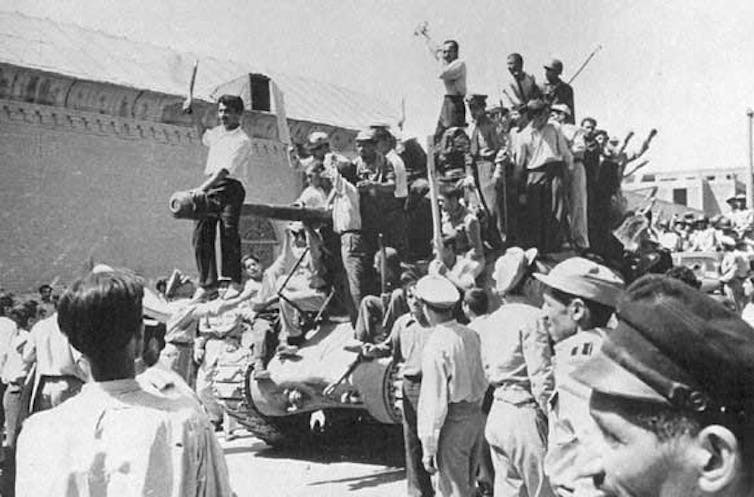
In 1953, once again, Iranian people were denied self-determination. The Mosaddeq government was replaced in a military coup organised by the CIA and British intelligence. The shah was returned to power and the Anglo-Iranian Oil Company became BP, British Petroleum, with a 50-50 divide of profits.
Tanks on the streets of Tehran, 1956. Wikicommons
This intervention sent the unintended message that a democratically elected government would be toppled if it did not fit with Western interests. This narrative continues to be the dominant discourse of Islamist activists today, in Iran and beyond.
The Islamic Revolution
Between 1953 and 1977, the shah relied heavily on the US in his efforts to modernise the army and Iranian society, and transform the economy through what he called the White Revolution.
But it came at a hefty cost. Wealth was unequally distributed, with a large underclass of peasants migrating to urban centres. The economy could not keep up with the growing population, unplanned urbanisation and lack of an open economy.
Having tasted democracy for a brief period during 1951–53, many Iranians wanted democratic rights and economic progress. This uprising resulted in large-scale political suppression of dissent.
Disillusioned religious scholars, such as Ayatollah Ruhollah Khomeini, were alarmed at the top-down imposition of a Western lifestyle, believing Islam was being completely removed from society.
In a 1978 interview with a US news program, Khomeini characterised the shah’s regime as one that deprived Iranians of independence and freedom, stating that “we don’t have the true independence, we are suffering […] we want the liberty of our people.”
Ironically, Iranian protesters say almost the same things about the current regime created by Khomeini: that it is the cause of their suffering and lack of freedoms.
The revolution promised true independence, freedom, a more Islamic social and political order, and greater economic prosperity. The failure to deliver on these promises is at the heart of the popular unrest in Iran today.
The 1979 Islamic Revolution ended Iran’s strategic alignment with the US and the West, leading to decades of political and economic isolation. While the Islamic Republic maintained its ideological stance of “neither East nor West”, sustained Western sanctions gradually pushed Iran closer to Russia and China.
The 45 years of a theocratic regime have been equally or even more oppressive than the shah’s rule. People’s freedoms and rights have regressed significantly. While strict public dress codes for women remain in law and are still enforced — sometimes harshly, as seen in the 2022 protests following the death of Mahsa Amini — compliance has loosened over time, with many women pushing the boundaries in major urban centres.
The most important premise of Islamism – making society more religious through political power – has also failed. Nearly two-thirds of Iranians today were born after the 1979 revolution. Yet, a 2020 GAMAAN survey found state-driven Islamisation has not produced a more religious society. Identification with organised religion appears to have declined, particularly among younger people.
Khomeini and his supporters promised economic prosperity and to end the gap between rich and poor. Today, the Iranian economy is in poor shape, despite the oil revenues that hold it back from the brink of collapse. People are unhappy with high unemployment rates, hyper-inflation and never-ending sanctions. They have little hope for the country’s economic fortunes to turn.
As a result, Iranians have lost hope in the ruling elite’s ability to ensure a brighter future.
Will the theocratic regime collapse any time soon?
So, the main ideology of the revolution has collapsed. What about the regime itself?
For any regime to collapse, including the current one in Iran, four key forces and factors, or a combination of them, have to exert sufficient force: popular mass protests, an army coup, external interventions and division among the ruling elite.
Iran has seen many mass protests in the past 40 years. While these did not bring down the regime, their frequency is increasing.
The November 2019 protests, triggered by a sudden fuel price hike, rapidly spread across the country. The 2022–23 protests, sparked by the death of Mahsa Amini in morality police custody, evolved into a sustained nationwide movement under the slogan “woman, life, freedom”. Most recently, the 2025–26 protests have been driven primarily by a severe economic downturn.
But protests are not sufficient to cause a collapse of the regime. They are usually met with countrywide internet blackouts and violent crackdowns leading to hundreds of deaths. This happened again in the recent unrest, with the death toll reaching at least 5,000.
International interventions
Iran has been under extensive economic sanctions for decades, yet these have failed to bring about major political change or weaken the Islamic Republic’s hold on power. In the aftermath of the revolution, Iraq — backed politically and materially by United States and its allies — invaded Iran in 1980 in a bid to contain and possibly topple the new regime before it consolidated. After eight years of devastating war, this effort also failed to dislodge the Islamic Republic.
Other countries have launched short military interventions in the past, with the last one by the United States and Israel in June 2025 targeting the army headquarters and nuclear facilities. These did not lead to a regime change.
It seems anything short of a full-scale war or land invasion is unlikely to lead to a regime change in Iran. And we know from the experience in Iraq and Afghanistan that such interventions don’t end well.
Could Iran’s Islamic Revolutionary Guard Corps (IRGC) stage a coup? It seems highly unlikely. The IRGC is structurally oriented toward preserving and reshaping the system from within, not overthrowing it. Created as a parallel force to prevent coups, the IRGC is intentionally kept fragmented, bound by layered chains of command, and vertically loyal to the supreme leader, making unified action very difficult.
Then, there is the potential for a leadership struggle within the regime itself. For now, this is not a factor, but it could be soon if the elderly Supreme Leader Ali Khamenei dies.
Khamenei, who succeeded Khomeini in 1989, is Iran’s longest-serving leader. His power comes from being part of the original revolution, drawing respect within the leadership and supporters in the government.
He is 86 years old and has health issues. When he goes, there will be many vying for the role. Whoever becomes leader is likely to purge those who supported others, leading to political persecution and instability at the top.
It is very hard to predict when and if the current Islamic Republic will collapse. Iran may continue as is, but moderate over time. Such a trajectory is more likely to emerge through greater integration with the international community rather than continued isolation through sanctions.
Hard social, political and economic realities have an uncanny ability to test and smooth ideologies. If the regime stays hardline and unwilling to evolve, change is inevitable, and will probably occur at the least expected moment.
Mehmet Ozalp is the Executive Director of ISRA Academy.
Even if you’ve never used these companies’ software tools, there’s a good chance your employer has. These tools manage key data about customers, employees, suppliers and products, supporting everything from payroll and purchasing to customer service.
Now new “agentic” artificial intelligence (AI) tools for business are expected to reduce reliance on traditional software for everyday work. These include Anthropic’s Cowork, OpenAI’s Frontier and open-source agent platforms such as OpenClaw.
But just how important are these software-as-a-service companies now? How fast could AI replace them – and are the jobs of people who use the software safe?
The digital plumbing of the business world
Software‑as‑a‑service systems run in the cloud, reducing the need for in‑house hardware and IT staff. They also make it easier for businesses to scale as they grow.
Software-as-a-service vendors get a steady, recurring income as firms “rent” the software, usually paying per user (often called a “seat”).
Software-as-a-service providers help with a wide range of functions, from paying staff to managing customer relationships. Austin Distel/Unsplash
Sometimes firms are locked into using them for a decade or more.
Digital co-workers
Agentic AI systems act like digital co-workers or “bots”. Software bots or agents are not new. Robotic process automation is used in many firms to handle routine, rules-based tasks.
The more recent developments in agentic AI combine this automation with generative AI technology, to complete more complex goals.
This can include selecting tools, making decisions and completing multi-step tasks. These agents can replace human effort in everything from handling expense reports to managing social media and customer correspondence.
What AI can now do
Recent advances, however, are even more ambitious. These tools are reportedly now writing usable software code. Soaring productivity in software development has been attributed to the use of AI agents like Anthropic’s “Claude Code”. Anthropic’s Cowork tool extends this from coding to other knowledge work tasks.
In principle, a user describes a business problem in plain language. Then agentic AI delivers a code solution that works with existing organisational systems.
If this becomes reliable, AI agents will resemble junior software engineers and process designers. AI agents like Cowork expand this to other entry-level work.
These advances are what recently spooked the market (though many affected stocks have since recovered slightly). How much of this fall is a temporary overreaction versus a real long-term shift, time will tell.
How will it affect jobs and costs?
Since the arrival of OpenAI’s ChatGPT in November 2022, AI tools have raised deep questions about the future of work. Some predict many white-collar roles, including those of software engineers and lawyers, will be transformed or even replaced.
Agentic AI appears to accelerate this trend. It promises to let many knowledge workers build workflows and tools without knowing how to code.
Software-as-a-service providers will also feel pressure to change their pricing models. The traditional model of charging per human user may make less sense when much of the work is done by AI agents. Vendors may have to move to pricing based on actual usage or value created.
Hype, reality and limits
Several forces are likely to moderate or limit the pace of change.
First, the promised potential of AI has not yet been fully realised. For some tasks, using AI can even worsen performance. The biggest gains are still likely to be in routine work that can be readily automated, not work that requires complex judgement.
Where AI replaces, rather than augments, human labour is where work practices will change the most. The nearly 20% decline in junior software engineering jobs over three years highlights the effects of AI automation. As AI agents improve at higher-level reasoning, more senior roles will similarly be threatened.
Second, to benefit from AI, firms must invest in redesigning jobs, processes and control systems. We’ve long known that organisational change is slower and messier than technology change.
Ironically, the loss of knowledge and expertise could make it harder for companies to assure AI systems comply with company policies and government regulations. The checks and balances that help an organisation run safely and honestly do not disappear when AI arrives. In many ways, they become more complex.
Technology is evolving quickly
What is clear is that significant change is already under way. Technology is evolving quickly. Work practices and business models are starting to adjust. Laws and social norms will change more slowly.
Software companies won’t disappear overnight, and neither will the jobs of people using that software. But agentic AI will change what they sell, how they charge and how visible they are to end users.
Michael J. Davern has received funding from CPA Australia and Chartered Institute of Management Accountants (CIMA) for research on the impacts of AI.
Ida Someh receives research funding from the Australian Research Council and the software company SAP.
Ida is a Research Fellow with MIT Sloan Center for Information Systems Research.
Colonel Paul Hayward, the assistant chief of army for training, was questioned on the intensity of training required of SAS soldiers.
He set out the different levels of training capability expected of soldiers.
“The three descriptors of levels of training we normally use are BLOC, DLOC and OLOC,” he said.
“BLOC first is the basic level of capability, initial entry training and some lower-level training courses, DLOC is a directed level of capability, what you would do subsequent to [BLOC] training, and DLOC is where most of the army sits at any given time.”
He explained the third level of capability, OLOC, was meant for soldiers preparing to deploy on specific operations.
“Most of the army will not be at OLOC unless they’ve been specified for a particular mission,” he said.
“The difference is the special forces always sit within OLOC, so they sit at a much higher level because of the complexity of what they’re required to.
“[They must be] ready to go, they’re basically the 111 of the military.”
Central to the inquiry was the decision to allow the soldiers to attempt the so-called “bump landing” at nighttime and while wearing heavy equipment.
The Coroner was earlier told Kahotea was carrying between 20 and 35 kilograms of equipment and was wearing night vision goggles as he stepped off the helicopter.
It was the first time the SAS troopers had attempted the manoeuvre, in which a helicopter balanced one wheel on the edge of a building and attempted to hold steady as the soldiers stepped off.
The NZDF’s “crawl, walk, run” policy requires soldiers to start with the easiest iteration of an exercise during daylight hours with minimal equipment, before moving onto gradually more difficult scenarios.
In the years since the fatal accident, Colonel Hayward said additions had been made to the army’s training rules to ensure the policy was followed.
“They specify in mandatory language some of the requirements down to the number of rehearsals required wearing various kit before an activity can be conducted, they are specified in both the training and safety manual and the mobile air training manual,” he said.
In addition, he said the NZDF performed a full assessment of the facility where the training took place, minimising tripping hazards and other potential issues.
Colonel Hayward addressed the family and admitted the Defence Force had made a mistake by allowing the training exercise to occur.
“Your loss is profound, and the NZDF deeply regrets the devastating impact that Nik’s death has had, and the irreversible consequences of this tragedy,” he said.
“NZDF acknowledges failures on our part in relation to the planning and authorising of the activity.”
A former All Black believes it’s time for a Pacific Islander to take the reins as New Zealand coach.
In 2024, players with Pacific Island heritage made up 14 of the 32-man All Blacks squad, with Christian Lio-Willie, Timoci Tavatavanawai and Du’Plessis Kirifi earning caps in 2025.
Star Moana Pasifika signing Ngani Laumape wants to see Tana Umaga given the job in the wake of Scott Robertson’s sacking in January.
With such a predominant Pasifika contingent in the squad, Laumape said it’s time for a cultural change and that Umaga is the inspirational leader needed.
“For sure. 100 percent. When ‘T’ speaks, everyone listens. When he talks about our purpose, it gives me goosebumps. When he talks like that, the boys are pretty revved up to go out and play for him. I feel like he’ll be an awesome coach for the All Blacks.”
Fellow former All Black Sonny Bill Williams also touted Umaga as the man for the role.
Tana Umaga has been touted by former All Blacks as the ideal candidate as Scott Robertson’s replacement.Brett Phibbs / www.photosport.nz
“We need some more flavour in the coaching group. I’m a big believer that in order to correct, you must connect, and these players at this level know how to play rugby. But what got the best out of me was believing in the coaches, wanting to go out there and run through a brick wall,” Williams said on Instagram.
The man himself was coy on the prospect when asked this week, shifting the focus to his side’s round one clash with the Fijian Drua.
“I’ve got a big enough job doing what I’m doing right now.”
Umaga said through the love of his parents and his Māori wife, he is privileged to understand what New Zealand means on “a lot of different levels.”
“I am a very proud New Zealander, born in Aotearoa, but I am passionate about my heritage.”
Like Robertson, Laumape himself also had a tumultuous tenure with the All Blacks, playing just 15 tests and arguably leaving at the peak of his powers in 2021 after being consistently overlooked.
Ngani Laumape.PHOTOSPORT
However, Laumape said he has put that chapter of his career to bed.
“I feel like it doesn’t matter if you played one game or 100, you still achieved that jersey. You still achieve that dream of representing the All Blacks. But I think for me now, I’ve closed that chapter and It’s been an awesome journey being overseas the last couple of years, but it’s really refreshing being back representing Moana.”
The powerful midfielder is now setting his sights on representing Tonga at next year’s World Cup.
“You can have more than one dream, and for me, I I still have one more goal that I want to achieve in my rugby career and that’s representing Tonga and I feel like this is the closest way that I can build to that dream.”
As the big name signing for Moana, Laumape said he won’t be trying to replicate the influence of Ardie Savea in 2025.
“I don’t think anyone can fill those shoes, but I think for me what he did not only inspired the young Pasifika kids but also inspired a whole generation of old and young and I just want to credit my brother for being the leader that he is.”
Laumape said he was annoyed by the narrative surrounding Savea and Robertson’s departure.
“I’ve seen that he’s been getting a lot of backlash in the media, there’s more people that were in those meetings and I feel like it’s pretty bull crap that only his name was out there and I know there’s probably about 10 players in that leadership group who were also in that review, and if one name comes out, all of them should come out.”
As for the season ahead, Laumape said they are far from a one man band and will not let the standards set by Savea in 2025 drop.
“We’re not here to make numbers. We’re here to carry on what the boys did last year.”
The independent review will look at the Reserve Bank’s response to the pandemic.RNZ / Alexander Robertson
A review into the Reserve Bank’s monetary policy decisions during the Covid-19 pandemic was originally intended to be completed by March.
The Finance Minister says the delay was due to how long it took to appoint the right people to lead the review.
On Wednesday, Nicola Willis confirmed she had commissioned an independent review into the Reserve Bank’s response to the pandemic, including cuts to the Official Cash Rate, and the Large Scale Asset Purchase programme.
The opposition has criticised the government for the timing of the review, given it is set to be published in September, just weeks before the election.
The review will be led by monetary policy experts Athanasios Orphanides and David Archer.
Orphanides was a former governor of the Central Bank of Cyprus, and member of the Governing Council of the European Central Bank.
Archer was a former Reserve Bank assistant governor and former head of the Central Banking Studies Unit at the Bank for International Settlements in Basel, Switzerland.
On Thursday, the Treasury released a series of documents related to the review’s establishment, which show Willis first informed the Reserve Bank in July 2025 she was considering a review, and took the matter to Cabinet for sign-off in August 2025.
At the time, Willis expected the review would be completed by March 2026.
The documents also show parts of the review’s terms of reference were changed to factor in the benefits of its decisions, after a suggestion from the Reserve Bank.
Why the delay?
Willis told RNZ the hold-up was due to the appointment of the international reviewer.
She said following the Cabinet mandate, it was her job to find the appropriate reviewers, with Treasury making recommendations.
“First, people we approached weren’t available in the appropriate timeframe. We then had a challenge where one reviewer we proposed was available in the timeframe, but another wasn’t. And so we were both trying to balance getting a balance of someone with domestic perspective and international perspective, the appropriate international credentials, and being available for their time period,” she said.
“So there was a bit of a back and forth on finding appropriate reviewers. And at all times, I was very mindful of Treasury advice on the credentials that they needed to fulfil.”
Finance Minister Nicola Willis says the delay was due to the appointment of the international reviewer.RNZ / Samuel Rillstone
Willis said it was “frustrating,” but ultimately felt the most important thing for the credibility of the review was the quality of the reviewers.
“I’m satisfied that we’ve landed on very credible reviewers. No one’s questioning their authority, their credibility. Clearly, these are people who are independent. There’s not a political bone about them.”
The Cabinet minute shows Willis had the authorisation to approve the selection of the experts and make changes to the terms of reference, in consultation with the associate finance ministers.
What do the documents say?
In a letter dated 10 July 2025 and sent to then-Reserve Bank chair Neil Quigley and Governor Christian Hawkesby, Willis said the Monetary Policy Committee took “unprecedented” actions in response to the “significant economic challenges” caused by the pandemic.
She acknowledged the Bank’s review and assessment of its monetary policy performance between 2020 and 2022, which commissioned independent experts to provide peer review but was not independent of the Bank.
“As such, I am considering an external review to provide the Government with an independent perspective on the MPC’s performance during 2020 to 2022. This will ensure there is appropriate transparency over the MPC’s performance during a period of significant economic challenges, and will help identify lessons for future episodes of instability,” she wrote.
Feedback from then Governor Christian Hawkesby about changing the terms of reference were taken on board.RNZ / Dom Thomas
In response, Hawkesby said the Bank had made “significant progress” in implementing the recommendations of the 2022 review, but would fully cooperate with the external review if Willis chose to proceed with it.
Hawkesby had suggested the draft terms of reference be amended, particularly a section on whether the “stimulus” provided by the Large Scale Asset Purchase and Funding for Lending programmes “justified the risks to the public balance sheet and other costs”.
“We note that this frames the benefits and costs associated with these tools in narrow terms and should be widened to capture the impact LSAPs played in stabilising markets, and their broader fiscal benefits through lowering Crown borrowing costs and increasing tax revenue,” he wrote.
This feedback was taken onboard, with the final terms of reference changed to reviewing whether the “benefits” provided by the programmes “justified the risks and costs”.
Hawkesby also raised another section which referred to the review making “recommendations to improve the monetary policy response to future shocks, including commentary around potential changes to the frameworks, having regard to the benefits of hindsight”.
He said the Monetary Policy Committee’s remit was an important part of the policy framework, and while it could be reviewed at any time there were benefits to stability in the objectives of monetary policy.
“We suggest that any recommendations related to the objectives of monetary policy would be best addressed as part of the 5-yearly formal review of the MPC Remit, which is due by mid-2028.”
This was not changed.
On 9 February she told the new chair Rodger Findlay and new Governor Anna Breman that the government had finalised the establishment of the review, with the final terms of reference showing the new expected completion date of August.
“Independent monetary policy is a central pillar of New Zealand’s macroeconomic frameworks. The review strengthens this by supporting accountability and public confidence in the operational independence of monetary policy and informing its ongoing effectiveness,” Willis wrote.
She told Findlay and Breman she had adopted the Bank’s suggestion to broaden the review’s assessment of the costs and benefits of alternative monetary policy.
Willis told RNZ she thought it was important to engage with the Bank about how to get the best lessons out of the review.
“I think the final terms of reference allow for a full and penetrating review. So the questions will be asked, the information will be furnished, and those reviewers will be able to reach conclusions.”
She said it was up to former governor Adrian Orr and former chair Neil Quigley to decided if they wanted to front up to the inquiry, but said “if they’re wise, they will.”
The Chinese Year of the Fire Horse has a new, unexpected mascot: Draco Malfoy.
Associating the Harry Potter antagonist with China’s Year of the Fire Horse might seem odd or whimsical. But it has much to teach us about the complexities of Chinese Mandarin wordplay, online participation and meme-making culture.
A search for Malfoy memes manifest his youthful head floating jubilantly, amid a background of red, gold and black calligraphy.
Meaning in images
In China, Lunar New Year decorations are designed to summon luck, prosperity and protection into the home – and visual puns and homophones are a common feature.
Classic New Year prints often include images of names that sound like phrases for good fortune or prosperity. You will commonly see images of the Zodiac, red lanterns, golden carp, fleshy pink peaches and gold ingots – all symbolising abundance.
Prior to the annual festival, the Chinese character fu 福 (good fortune) is often displayed upside-down on doors and walls in Chinese homes.
This is because the word for “upside-down” (倒, dao) is word play on the word “arrive” (到, dao) in Mandarin. Hanging the fu 福 upside down means “Good fortune has arrived”.
There is other word play, too. Yu 魚 (fish) sounds like the word for surplus, so fish imagery suggests abundance.
During last year’s Year of the Snakewordplay used snake (蛇, shé) and earthly beings/humans (巳, sì) to pair snake imagery with phrases about time, events or letting go.
This Year of the Fire Horse is historically linked with energy, momentum and breakthrough.
In Mandarin, Malfoy 马尔福 (Ma er fu) contains phonetic elements that resonate with words associated with horses (马, ma) and good fortune (福, fu). Hanging Malfoy upside-down on a door or wall extends the same pun, suggesting “good horse fortune has arrived” in your home.
In this way, Malfoy sheds his snake skin from villain to a serendipitous linguistic fit for a year defined by fiery horses and potential prosperity: a modern good luck poster.
Visual remixing
Humour, wordplay and visual remixing are a key feature of Chinese internet culture.
Memes thrive on shared visual references, which can be easily remixed. Malfoy’s titanium white hair and sharp features make him iconic, even in small or edited images.
Another example of homophonic wordplay was during the #MeToo movement.
Facing political sensitivity in China, activists embraced phonetic wordplay to visualise the phrase #MeToo, juxtaposing images of a bowl of rice (米饭, mi fan) with a rabbit (兔子, tuzi). The Chinese meme, Mi Tu (literally rice bunny) is visually coded “cute” on the surface, yet functions with the potency and strategic agility of a Trojan Horse.
The memes became a political statement, to visually disrupt and address sexual abuse or harassment.
The Grass Mud Horse (草泥马m cǎonímǎ) is a mythological alpaca co-created in 2009 as a linguistic and visual protest symbol.
Its name is a homophone for a well known insult, enabling users to express defiance while circumventing censorship. It became a playful yet powerful emblem of resistance to information control, widely circulated through music videos, memes and satirical narratives.
The homophonic wordplay of Draco Malfoy performs a similar cultural function – with celebration that evolves tradition, rather than political protest. Users paste Malfoy’s face onto fire horse emojis, Chinese calligraphy or zodiac themed layouts. Others animate him riding red horses or link his image with auspicious greetings.
Chinese culture has a long history of playful symbolism. The Malfoy memes fit into that tradition using humour and visual puns to express good wishes. It does not replace sacred rituals or religious practices.
Lunar New Year is not only about preserving tradition. Malfoy as a literary villain may be ironic through a Western lens. However, his image becomes a shared entry point into cross-cultural exchange.
It is about renewing hope for the future, and memes are a clever example of how language shapes visual culture and how traditions evolve.
Visual literacy enables us to unlock the cultural keys embedded within symbols and myths, revealing layers of meaning that might otherwise remain obscured.
Online spaces are where a fictional wizard can temporarily join a centuries-old symbolic system built on flexible wordplay and visual humour for the Year of the Fire Horse.
Justine Poplin does not work for, consult, own shares in or receive funding from any company or organisation that would benefit from this article, and has disclosed no relevant affiliations beyond their academic appointment.
Regenerative sheep farmers could muster an above-market pay cheque for their sustainable wool clip, thanks to a new industry deal.
Wools of New Zealand signed a new contract to supply American-owned company Keraplast, based in Ōtautahi, with hundreds of tonnes of strong wool over the next five years.
Keraplast extracted keratin, the main protein in wool, that was then used as an ingredient in haircare, skincare, nutraceuticals and medical products.
Wools of New Zealand chief executive John McWhirter said the contract linked growers to high-value end uses, rather than the traditional textile markets based on commodity prices, to improve returns.
“This agreement demonstrates how strong wool can move beyond traditional textile markets into advanced, high-value applications.
“It shows strong wool has a future when we combine quality farming and innovative global manufacturing.”
Regenerative farmers focussed on enhancing the health of their soil, waterways and their animals, practices which were auditted for certified farmers.
The new super-premium wool contract was paying 40 percent or $2 a kilogram above market pricing for 2025, at $6.88 per kilo clean – and prices will increase $0.50 a kilo each year.
Keraplast chief executive, Howard Moore said the deal was about shoring up the supply of low-carbon New Zealand strong wool.
John McWhirter of Wools of New Zealand and Howard Moore of Keraplast.SUPPLIED
“We really do want to encourage the supply of regeneratively-farmed wool, but we also do feel it as an obligation from the company for us to to share in the value that we are adding to wool, sharing that with our farmer suppliers.”
Moore said the wool-only company was committed to net positive, a business strategy about creating more positive impacts than negative on the environment, society and the economy.
He said its industrial American customers were very focussed on sustainability.
Read more
“We sell to industrial customers and these industrial customers are concerned about their carbon footprint,” he said.
“And so we are able to demonstrate to these industrial customers of ours that we are doing our bit to source wool that’s got a reduced carbon footprint.
“That commitment to sustainability through using regeneratively farmed wool does help us with with our customers.”
Overseas competitors making products from keratin instead sourced the protein from chicken feathers, he said.
Moore said its 40 employees were working towards processing up to 100 tonnes of wool each year at its new factory near Hornby.
Since around August, wool prices in the North and South Islands had increased, exceeding levels in 2023 and 2024.
However, the national sheep flock was continuing to decline and major broker PGG Wrightson announced last month it was going to end its historic North Island from May.
Sign up for Ngā Pitopito Kōrero, a daily newsletter curated by our editors and delivered straight to your inbox every weekday.
– Published by EveningReport.nz and AsiaPacificReport.nz, see: MIL OSI in partnership with Radio New Zealand
New Zealand First leader Winston Peters speaking at Waitangi Treaty Grounds last week. (File photo)RNZ / Mark Papalii
New Zealand First will campaign on a referendum on the Māori seats this year, with the party saying the time had come for a decision on their future.
Te Pāti Māori said it was “race baiting” and “rage baiting” and Labour said it was a “cheap and cynical” attempt to gain votes.
New Zealand First made the announcement on Thursday, saying it believed it had an “opportunity now” to ensure the policy was implemented after the election.
On Thursday, NZ First leader Winston Peters referenced the Royal Commission into the electoral system in 1986, which stated the MMP system would create a more representative Parliament and the original justification for the Māori seats would no longer exist.
He also said there’d been a dramatic increase in the number of Māori in Parliament.
“We’re massively over represented. Now please take the advantage that you’ve got, be pleased about that and move on.”
He called Te Pāti Māori’s behaviour over the past two years the “last straw.”
“They hold the majority of the Māori seats and do not turn up to parliament, disregard the rules and processes, and show utter disdain for the system that gives them the very seats they hold – they represent no one.
“They have proven the seats they hold are no longer relevant nor serve their original purpose.”
He referenced outgoing Labour MP Peeni Henare’s losses in the Tāmaki Makaurau seat recently, saying he was “robbed blind” and there was “nothing to defend” in regards to the seats.
Peters said a referendum was necessary because that was how MMP was introduced in the first place.
“I’m saying to people in this country, if you want a dramatic, unified electoral system, vote for it,” he said.
Peters rejected it could be a breach of Te Tiriti o Waitangi “because it wasn’t in there in the first place.”
He said everything he had done for Māori was on the basis of need not race.
Asked how quickly a referendum would take place after this year’s election, Peters indicated he wouldn’t want the Māori seats during the 2029 election.
Politicians react
Te Pāti Māori co-leader Rawiri Waititi accused NZ First of “race baiting”. (File photo)VNP / Phil Smith
Te Pāti Māori co-leader Rawiri Waititi said it was “race baiting” and “rage baiting” to suit New Zealand First voters.
“The types that Winston Peters represents is a dying cohort of people in Aotearoa.
“I would hope that New Zealand is mature enough to see the value in the Māori seats sitting here in Parliament.”
He said the timing of the announcement showed Peters was “threatened” by the fact it would be the Māori electorates that decide the next Prime Minister.
“He likes to sit in that position as the king maker, but unfortunately, every poll is saying that he is no longer in that position.
“This country should be celebrating the maturity of te iwi Māori in this democracy.”
On representation in Parliament, Waititi said the Māori seats allowed for a “unique Māori voice in Parliament.”
“Quite often we’ve had Māori in those Māori seats without being tied to party lines.
“What this allows us is a unique opportunity for Māori to have an independent voice in Parliament.”
Waititi suggested there should be a referendum on list seats, because it wasn’t clear who they represented, “they don’t have a mandate from constituents.”
“The Māori seats are clear. They have a clear mandate.”
Labour’s Kieran McAnulty said Peters was quite happy with Māori seats when he stood for one in 1975, and when New Zealand First won them all in the 90s.
“But now he wants to pretend to New Zealanders that they don’t like them and want to get rid of them. I don’t think Kiwis will buy it.”
Labour’s position was that Māori should decide whether to keep the seats or not, and “that position will remain firm.”
“It’s a cheap and cynical attempt to try and get some cheap votes,” McAnulty said.
Prime Minister Christopher Luxon said a referendum on Māori seats wasn’t something the National party had discussed.
“What we’re really focused on is fixing the basics and building the future at the moment.”
He acknowledged the seats had been a feature of the political system for some time.
National deputy leader Nicola Willis said National planned to run candidates in the Māori seats this election, but no one had been selected yet.
In terms of a referendum, she said the policy would need to be taken to caucus for discussion.
ACT’s deputy leader Brooke van Velden said ACT wouldn’t take it to referendum, it would get rid of the seats through Parliament.
“It’s been an ACT party position – and a longstanding position – that we should abolish the Māori seats, because it goes against what the ACT party philosophy is, which is that there should be all people equal before the law and that it’s wrong to have separate seats based on people’s ethnicity.”
ER Report: Here is a summary of significant articles published on EveningReport.nz on February 12, 2026.
Yes, men have a biological clock too. But it’s not just age that affects male fertility Source: The Conversation (Au and NZ) – By Theresa Larkin, Associate Professor of Medical Sciences, University of Wollongong joyce huis/Unsplash When we talk about a biological clock ticking, it usually means the pressure women feel to fall pregnant before a certain age. It’s linked to the decline in eggs (ova) and fertility as females age.
That e-bike you bought your teen might be an illegal electric motorbike – and the risks are real Source: The Conversation (Au and NZ) – By Dorina Pojani, Associate Professor in Urban Planning, The University of Queensland A “health emergency”. A “total menace”. “Take them away and crush them”. E-bikes are in the news for all the wrong reasons. A spate of deaths and injuries linked to e-bike crashes have led to widespread
Italy hosted the Winter Olympics 70 years ago. What was it like, and what’s changed? Source: The Conversation (Au and NZ) – By Richard Baka, Honorary Professor, School of Kinesiology, Western University, London, Canada; Adjunct Fellow, Olympic Scholar and Co-Director of the Olympic and Paralympic Research Centre, Institute for Health and Sport, Victoria University Italian skier Bruno Burrini at the 1956 Winter Olympic Games in Milano Cortina. Getty Images The
Italy hosted the Winter Olympics 70 years ago. What was it like, and what’s changed? Source: The Conversation (Au and NZ) – By Richard Baka, Honorary Professor, School of Kinesiology, Western University, London, Canada; Adjunct Fellow, Olympic Scholar and Co-Director of the Olympic and Paralympic Research Centre, Institute for Health and Sport, Victoria University Italian skier Bruno Burrini at the 1956 Winter Olympic Games in Milano Cortina. Getty Images The
Why do I get ‘butterflies in my stomach’? Source: The Conversation (Au and NZ) – By Amy Loughman, Senior Lecturer in Psychology, The University of Melbourne Alfonso Scarpa/Unsplash “Butterflies in the stomach” is that fluttery, nervous feeling you might have before a job interview, giving a speech or at the start of a romance. It’s a cute description for one part of the
Why do I get ‘butterflies in my stomach’? Source: The Conversation (Au and NZ) – By Amy Loughman, Senior Lecturer in Psychology, The University of Melbourne Alfonso Scarpa/Unsplash “Butterflies in the stomach” is that fluttery, nervous feeling you might have before a job interview, giving a speech or at the start of a romance. It’s a cute description for one part of the
For $40, you can name a star for your Valentine. But it won’t mean much Source: The Conversation (Au and NZ) – By Laura Nicole Driessen, Postdoctoral Researcher in Radio Astronomy, University of Sydney With Valentine’s Day around the corner, romance is in the air. And what could be more romantic than a picnic under the stars, pointing up to the night sky, and gazing at a star you’ve named
4 lessons NZ should take from another summer of weather disasters Source: The Conversation (Au and NZ) – By Iain White, Professor of Environmental Planning, University of Waikato DJ Mills/ AFP/Getty Images Another summer of extreme weather has destroyed and damaged homes, cut off communities and, in the most tragic cases, left families mourning their loved ones. It reminds us that New Zealand is one of
How Indigenous ideas about non-linear time can help us navigate ecological crises Source: The Conversation (Au and NZ) – By Philip McKibbin, PhD Candidate, Sydney Environment Institute, University of Sydney Noel Nesme/Pexels, CC BY It is common to think of time as moving in only one direction – from point A, through point B, to point C. However, many Indigenous peoples – including Māori, the Indigenous people
How bird poo fuelled the rise of Peru’s powerful Chincha Kingdom Source: The Conversation (Au and NZ) – By Jo Osborn, Assistant Professor of Anthropology, Texas A&M University Islands off the coast of Peru are home to millions of seabirds. Their droppings were an important fertiliser for Indigenous people in the Andes. Jo Osborn In 1532, in the city of Cajamarca, Peru, Spanish conquistador Francisco Pizarro
Will Ozempic-style patches help me lose weight? Two experts explain Source: The Conversation (Au and NZ) – By Nial Wheate, Professor, School of Natural Sciences, Macquarie University Kate Wieser/Getty Could a simple patch, inspired by the weight-loss drug Ozempic, really help you shed excess kilos without the pain and effort of an injection? Promotions of these Ozempic-style, weight-loss patches are popping up online, promising dramatic
Deep-sea fish larvae rewrite the rules of how eyes can be built Source: The Conversation (Au and NZ) – By Fabio Cortesi, ARC Future Fellow, Faculty of Science, The University of Queensland A _Maurolicus muelleri_ viewed under fluorescent light. Dr Wen Sung Chung The deep sea is cold, dark and under immense pressure. Yet life has found a way to prevail there, in the form of some
Natural hydrogen can make decarbonising industry cheaper – NZ’s turbulent geology could give it an edge Source: The Conversation (Au and NZ) – By Ian Wright, Professor in Marine Geology, University of Canterbury Hydrogen is seeping from the seabed in Poison Bay in Fiordland. Department of Conservation, CC BY-NC-ND Hydrogen is emerging as a critical part of the low-carbon transition for industries where electrification is not a straightforward solution. This includes
Why Australia’s trade deal with Europe hinges on a forgotten promise – and a handshake Source: The Conversation (Au and NZ) – By Nathan Howard Gray, Senior Research Fellow, Institute for International Trade, Adelaide University Pixabay, Canva, The Conversation, CC BY-NC Australian Trade Minister Don Farrell is in Brussels this week, trying to close a trade deal that has been nearly a decade in the making. The EU–Australia Free Trade
Who is Angus Taylor and could he cut it as opposition leader? Source: The Conversation (Au and NZ) – By Michelle Grattan, Professorial Fellow, University of Canberra Angus Taylor has all the on-paper qualifications to be opposition leader. But there are big questions over how well he could do the job, when a miracle worker is needed to lift the struggling Liberal Party from its existential crisis.
Southern right whales are having babies less often, but why? Source: The Conversation (Au and NZ) – By Claire Charlton, Leader of Australian Right Whale Research Program, College of Science and Engineering, Flinders University Ivan Stecko/Pexels, CC BY-SA For decades, southern right whales have been celebrated as one of conservation’s success stories. Once driven to the brink of extinction by commercial whaling, southern right whales
NSW Premier Minns’ police attack Muslims in prayer, peaceful Gaza protesters By Pip Hinman in Gadigal Country/Sydney NSW Premier Chris Minns is sounding even more defensive after videos of NSW police violence towards peaceful protesters in Australia went viral — including attacks on Muslims praying in Sydney’s Town Hall Square after the rally on Monday. His “primary concern”, he told ABC TV, was to prevent the
US designates two Micronesian leaders over corruption allegations RNZ Pacific The United States has designated two high-profile public office holders from Palau and the Marshall Islands for “significant corruption”, the US Department of State says. Palau’s Senate president Hokkons Baules has been designated “for his involvement in significant corruption on behalf of China-based actors,” while the former mayor of the Kili/Bikini/Ejit community in
‘New Zealanders are inventive by necessity’: how the master clown Philippe Gaulier shaped NZ theatre Source: The Conversation (Au and NZ) – By Hannah Joyce Banks, Lecturer in Creative Industries, University of the Sunshine Coast Brig Bee/A Slightly Isolated Dog Master clown and French theatre guru Philippe Gaulier has passed away aged 82, but his influence will live on around the world – particularly in Aotearoa New Zealand. The performance
It comes after RNZ was approached by former pupils of St Patrick’s Silverstream with concerns about former priest Rowan Donoghue.
RNZ earlier revealed Donoghue had admitted six charges including indecent assault on a boy aged 12-16, indecent assault on a boy 16 and over and sexual violation by unlawful sexual connection. He is awaiting sentencing.
The offending related to four boys who were boarding at St Bede’s College in Christchurch between 1996 and 2000.
Before he was at St Bede’s College, Donoghue worked at St Patrick’s Silverstream in Wellington between 1982 to 1992.
Do you know more? Email sam.sherwood@rnz.co.nz
In a statement to RNZ Detective Senior Sergeant Karen Simmons said police were appealing for anyone with information on offending by Donoghue to come forward.
A suppression order on Donoghue’s guilty plea was lifted last month.
“Following the lifting of all suppression, Police have been made aware that former students of Wellington school St. Patrick’s College Silverstream, have alleged similar offending by Father Donoghue,” Simmons said.
“We know it can be incredibly difficult and at times distressing to talk about these matters, but we would like to reassure any victims of offending that we will take them seriously.
“Police has a number of officers and detectives dedicated to these cases, and we provide a safe space to report offending in confidence.”
St Patrick’s Silverstream rector Rob Ferreira earlier told RNZ the school had not been made aware of any allegations of abuse in care while Fr Donoghue worked at the school between 1982 to 1992.
“We have not had any inquiries from the police either.
“We operate according to clearly set out guidelines and best practice and you should note that our primary concern is the wellbeing of our students. Given that – our protection of the privacy and any other rights of survivors of abuse and other individuals would be paramount.”
He said the school had informed the community that Donoghue’s name suppression had lifted.
He was also on the college staff at St Patrick’s College Wellington from 2003 to 2007.
RNZ earlier revealed that Donoghue admitted sexual abuse to leaders of his religious order, the Society of Mary, in 2007. However, he was unable to identify the anonymous complainant and instead of notifying police, the order sent him to Australia for a six month-programme that provided “professional risk assessment and therapy” for people accused of sexual abuse.
St Bede’s College rector Jon McDowall told RNZ it was brought to his attention by police in recent weeks that the college had previously been notified of concerns relating to Donoghue.
“On learning this, I immediately took steps to establish clearly what was known by the school, when it was known, and how it was handled. I was not in this role at the time, and records from that period are limited. This work is ongoing; I am committed to gaining as much clarity as possible and doing so with care and integrity.
“I will say again, if there was inaction, and any failure to respond appropriately, then I am appalled. My thoughts remain with the victims and survivors who continue to live with the impact of this harm.”
A Society of Mary spokesperson has also confirmed that while Donoghue could not identify the complainant in 2007, he was “certain” they were from St Bede’s College.
“No year was specified, but he was at St Bede’s from 1993-2000, The Society of Mary leader at the time advised schools with which Donoghue had been associated that he had been withdrawn from ministry.”
The spokesperson said two schools were told of the allegations.
“Our records show that the schools were told that Donoghue was withdrawn from ministry immediately. To the best of our knowledge, and cognisant of the policy and practice of the SM leadership at the time, we are confident the reason would have been made very clear.”
The spokesperson said the Society was not aware of the allegations to which Dongohue pleaded guilty until police laid charges.
“At the time of the initial complaint the Society made strenuous efforts over many months to encourage the complainant to contact the Police.
“As reported by RNZ previously, our first thoughts have always been with Donoghue’s victims and their families. We deeply regret the hurt and harm caused. We extend our sincere apologies to them, and will seek to provide appropriate support when they decide the time is right.”
Anyone with any information about Donoghue or who would like to report similar offending, is asked to contact police.
Where to get help:
Need to Talk? Free call or text 1737 any time to speak to a trained counsellor, for any reason
Suicide Crisis Helpline: 0508 828 865 / 0508 TAUTOKO. This is a service for people who may be thinking about suicide, or those who are concerned about family or friends
When we talk about a biological clock ticking, it usually means the pressure women feel to fall pregnant before a certain age. It’s linked to the decline in eggs (ova) and fertility as females age.
But sperm numbers and fertility similarly decline with age in men. When a heterosexual couple experiences fertility issues, it’s equally likely due to male and female factors. Yet the woman is usually tested first.
But this is changing. New male infertility guidelines for Australian GPs recommend the male and female partner undergo investigations at the same time.
A growing body of research highlights the role of men in infertility and how a man’s age and health matters when trying to conceive. Let’s look at the evidence.
Semen and sperm health decline with age
Sperm are produced in the testes continuously from puberty, but sperm count (the average number of sperm in an ejaculate) starts to decline when a man is in his early twenties. Men over 55 have average sperm counts close to or below the threshold for infertility.
But it’s not just the number of sperm that matters.
Sperm need to be alive, have good motility (movement or “swimming ability”) and be the correct shape to reach and fertilise an egg in the female reproductive tract.
An adequate volume of semen (sperm and seminal fluid together) is also necessary because this provides nourishment to sperm.
From around age 30, the number of sperm with good motility and correct shape, and semen volume decline, while the number of dead sperm increases. The biggest changes generally occur from around 35 years of age.
Genetic damage and miscarriage risk increase with age
Though a sperm might have reached and fertilised an egg, if it contains genetic damage, this can also affect fertility or the baby.
As men age, their sperm accumulate more genetic damage, including damage to DNA and chromosomes (coils of DNA that carry genes). This is because sperm stem cells replicate hundreds of times during their life. Each time a cell replicates, there is a risk of genetic damage.
Several environmental and lifestyle factors also affect semen and sperm measures, and therefore fertility.
Oxidative stress (too many damaging chemicals and not enough antioxidants) disrupts sperm production and increases sperm DNA damage, and is strongly linked to male infertility.
The World Health Organization recognises the importance of addressing infertility in everyone, regardless of sex or gender.
Australia’s first male infertility guidelines support this by recommending infertility is investigated in both partners in heterosexual couples. For the male, this includes examination of the penis, scrotum and testes, and semen and blood analyses.
avoiding excessive exposure to environmental toxins and pollutants.
Reducing unnecessary stress or pressure around falling pregnant is also important. In Australia, most pregnancies are normal and most babies are healthy, regardless of the age of the parents.
Theresa Larkin does not work for, consult, own shares in or receive funding from any company or organisation that would benefit from this article, and has disclosed no relevant affiliations beyond their academic appointment.
The vehicles authorities are concerned about aren’t really e-bikes at all. They’re effectively illegal electric motorbikes, able to accelerate rapidly — some to more than 100 kilometres per hour — and often without the safety standards of a legal motorbike. For years, these vehicles were imported through a loophole allowing them to be used on private land. But once in Australia, most end up on roads, bike paths and public space.
The thrill of these vehicles can be a potent cocktail for young people. Their range and speed gives teens more independence before they can legally get a car. That’s great. But teens are also generally more likely to take risks and test boundaries, and less likely to comply with rules. Unsurprisingly, injury and death rates among younger e-bike riders are rising given widespread access to cheap, fast, unlicensed vehicles – often by their well-meaning parents.
A looming crackdown on overpowered e-bikes comes after a spate of injuries and controversial ride-outs, such as last week’s ride across Sydney Harbour Bridge. Sur Ronster/Youtube, CC BY-NC-ND
How did we get here?
Many people associate e-bikes with parents ferrying kids around on electric cargo bikes, or commuters in business attire zipping to work without raising a sweat. These types of legal vehicles are pedal-assisted and limited to 25km/h.
But the term “e-bike” covers a huge range of vehicles in a booming sector. In 2017, around 9,000 e-bikes were sold across Australia. This year, sales are tipped to be close to 300,000, worth A$1.3 billion.
One reason for the boom: national import standards on high-powered models were loosened in 2021 to reduce red tape at the border.
In late 2025, a more stringent import standard was reintroduced. But because thousands of overpowered vehicles are already here, this won’t be an overnight fix.
If we think of non-compliant e-bikes as illegal electric motorcycles, the risks make more sense. Legal motorbikes, whether electric or petrol, are notoriously dangerous. In 2024, 278 riders died, representing 21% of Australia’s road fatalities despite being just 4.5% of registered vehicles. This is one reason the licence test and safety requirements for motorbikes are rigorous. By contrast, riders of these electric motorbikes don’t sit any test and don’t have to register their vehicle.
Australia doesn’t collect national statistics on e-bike injuries and deaths. What we do know suggests young, usually male e-bike riders are more likely to be injured. Data from the Netherlands and China indicates e-bike riders are more likely to be injured or die than riders of unpowered bikes.
In the United States, e-bike injuries tend to be much more severe, more like motorbike rider injuries than pedal bikes: pelvic fractures, brain injuries, concussion. When pedal bike riders are injured, just 0.3% die. When e-bike riders are injured, the US figure is 11%.
High powered e-bike ride-outs have become popular in Australian cities.
How are young people getting access?
One way young people have been getting these bikes is as gifts from parents.
Why? Reasons include a lack of knowledge about how fast the bikes can go and the risks they present. E-bikes broadly promise more independence for teens and less driving for parents, a benefit many “chauffeur” parents appreciate. The blanket term “e-bike” can make parents think of the overpowered models as just bicycles with a boost.
The spike in popularity means peer pressure is reportedly a factor. “Rideouts” organised and popularised through social media can draw many riders. On TikTok, these vehicles have become status symbols – “tools of identity and rebellion”.
Closing Pandora’s box?
Coverage in recent months has verged on moral panic. But it’s not helpful to think of e-bikes as a threat. The challenge is protecting the excellent uses of e-bikes while weeding out unsafe models.
As we have argued, the word “bike” in “e-bike” is misleading. E‑bikes should be treated as a separate category to pushbikes.
To help parents and other buyers, we should distinguish between street-legal pedal-assisted e-bikes capped at 25km/h, and illegal electric motorcycles with a throttle and much higher top speeds.
What should authorities do?
To get illegal electric motorbikes off the roads, police would benefit from the ability to test the voltage or top speed of e-bikes, as their UK counterparts do.
On the legal front, enforcing the newly adopted standard will be essential – not only at the border, but also at points of sale.
But this won’t be enough, given riders can overclock legal e-bikes by removing built‑in speed restrictions.
Here, authorities could require importers to ensure e-bike software can’t be altered without manufacturer authentication. We already have models for this, such as Queensland’s anti-tampering laws for regulated vehicles such as heavy freight trucks.
E-bike sellers should be required to display prominent, standardised labels and advise buyers that tampering with speed limiters will void their warranty, insurance and legal road access. It must be clear responsibility falls on the owner and rider.
New laws could be useful to restrict higher-powered e-bikes to adults, while teens aged 13-17 could access lower-powered pedal-assist models, ideally with mandatory training or licensing.
Real safety requires infrastructure
E-bikes are here to stay. Even if authorities successfully clamp down on the illegal electric motorbikes, there’s much to be done to use these vehicles safely and effectively.
It might make sense for slower e-bikes to be able to access shared paths and bike lanes, while legal higher-powered e-bikes can use roads.
But in most parts of most Australian cities, bike infrastructure is poor. Bike lanes peter out into traffic and gaps are common. Cycling infrastructure has long been grossly underfunded.
If we are to keep everyone safe on roads, trails and bike lanes, it won’t be enough just to ban overpowered e-bikes. Safety requires careful laws – and real infrastructure.
Dorina Pojani has received funding from the Australian Research Council, the Australian Urban Research Infrastructure Network (AURIN), the Queensland Department of Transport and Main Roads (TMR), and iMOVE Australia Cooperative Research Centre.
Richard J. Buning has received research funding from the the Australian Urban Research Infrastructure Network (AURIN), the Queensland Department of Transport and Main Roads (TMR), Brisbane City Coouncil, and iMOVE Australia Cooperative Research Centre.
Flight attendants working on Air New Zealand’s Boeing 777 and 787 long range aircraft are striking on Thursday and Friday after failing to agree on pay conditions.Supplied/ Air NZ
An Air New Zealand customer has been left upset after discovering at the last minute that a cabin crew strike had disrupted her travel plans.
“I have a flight tonight with Air NZ from Tonga,” the traveller who wanted to be identified only as Lia said. “I haven’t received any contact either via email or phone about my flight cancellation. I only found out about it when I went online to add a bag only to find out my flight date has been changed.
“I called customer service and they say email has gone out on Wednesday for a flight on Thursday, really? However, I didn’t receive any of that.
“There is a flight tomorrow. The customer rep said this morning there is one seat left but there is a possibility that it will be cancelled… If it will be cancelled the flight on Saturday is fully booked. I might lose my seat on the Saturday flight and the earliest I can go is Monday.”
Lia said it seemed to be very poor customer service and no compensation had been offered.
Flight attendants working on Air New Zealand’s Boeing 777 and 787 long range aircraft are striking on Thursday and Friday after failing to agree on pay and conditions.
Air New Zealand chief customer and digital officer Jeremy O’Brien told Morning Report it had proactively contacted all customers affected by the flight cancellations and offered alternative flights across its airline as well as its partner airlines.
The “vast majority” had been offered travel dates within a few days either side of the strike action.
Flights most affected were heading to North America and Asia, he said.
O’Brien said he appreciated that not all offered flights would suit every customer and a full credit or refund was available for those in that situation.
They could also claim “reasonable costs” involved with the disruption, like if accommodation was impacted by the changes.
A Consumer NZ spokesperson said in its view an international cabin crew strike was an event that within the airline’s control, and should be covered by the Montreal Convention.
“Under the Montreal Convention, if a flight is cancelled or delayed, impacted passengers can ask for a refund, or an alternative flight. They can also claim back any additional costs they incur as a result of the disruption – up to set limits. Passengers should retain receipts for any extra costs they incur to ensure they can get this back from the airline.”
Massey University marketing expert Bodo Lang said the strike could be an issue for Air New Zealand’s brand.
“On the one hand, passengers have been vocal about rising fares, with some complaints attracting headline coverage. On the other hand, staff are seeking improved conditions, including higher pay.
“For some consumers, this creates a perceived inconsistency: if ticket prices are increasing, why are staff arguing that pay and conditions need improvement? The inference some may draw is that Air New Zealand is generating excessive profits.
“However, the financial reality is more nuanced. Profit expectations for Air New Zealand have recently been revised downward, not upward. Explaining the intricacies of Air New Zealand’s financial statements to the public in an engaging manner is difficult. Some consumers may interpret the current strikes as profiteering, which could reduce the brand’s equity.”
The case was taken to the High Court but had been referred to independent arbitration. (File photo)RNZ / Dan Cook
A High Court Judge has won the right to have a dispute over a family bach heard in private, rather than open court.
In 2022, Justice Anne Hinton sold her share of the bach to two of her four sisters – but her other sister, Gillian Gatfield and niece, Emma Pearson (who inherited her mother’s share) argued Hinton had, years earlier, promised to transfer her share to them.
They took their case to the High Court, but Hinton successfully applied to have it referred to independent arbitration.
Hinton wanted arbitration because it was faster and cheaper than going through the courts – and private.
Her lawyers argued any judge hearing Hinton’s case in court would be put in a difficult position: either risking the perception of favouring a colleague, or ruling against her which would effectively question her credibility.
But Gatfield and Pearson disagreed.
Lawyer Matanuku Mahuika said “significant weight” was placed on Hinton’s role as a judge in her request for arbitration, which was “not appropriate”.
He urged the judges to be mindful of open justice and warned them against being seen to give preference to a fellow judge.
Mahuika also pointed out arbitration had never been ordered – as opposed to agreed to – in a trust dispute.
But in Thursday’s decision, the judges said the Associate Judge who ordered the arbitration was following the correct procedure.
“We consider that the court has power to order that an arbitration take place and to appoint an arbitrator, even when there is no agreement to arbitrate.
“We also consider there is nothing inherently inappropriate in doing so.”
The Judges said it was “unnecessary” to explicitly address all the matters Gatfield and Pearson’s lawyers raised as reasons against private arbitration.
“We agree with the decision made by the High Court,” their judgement said.
Mediation and arbitration were appropriate options in a case involving “strongly felt personal allegations”, it said.
The project management office for the new Dunedin Hospital.RNZ / Delphine Herbert
Health New Zealand says two of its flagship hospital rebuilds are on track despite red alerts put on them months ago.
The red ratings on the Nelson and Dunedin projects were in the latest publicly available investment report from Treasury dated mid-2025.
Around that same time, the central health agency had rated itself badly with Treasury for how it managed its billions in assets, joined in the dog-house by Police and Defence on the latest measurement known as the Chief Executive Annual Attestations.
The Treasury investment report meanwhile showed the Dunedin outpatients building project under cost pressure, by a sum that was blanked out.
It also redflagged Nelson to ministers for not having its business case ready in time for Budget 2026 decisions.
Health NZ said on Wednesday that this related to Nelson’s future stages of work and there was no impact on construction timelines or the expected operation of new facilities.
“The project continues to progress as planned,” said head of delivery of infrastructure, Simon Trotter.
In Dunedin’s new hospital build, the cost risks had since been managed and it was expected to open within budget on time later this year, Trotter said.
The wider programme that included the bigger inpatients build was also expected to be delivered within approved funding.
The total budget was set at $1.88 billion a year ago after the government rescoped it in the face of public protest, on the grounds sticking with the previous plan would blow it out to maybe $3b.
Health Minister Simeon Brown (R) and Nelson Mayor Nick Smith (second from right) open the new emergency department at Nelson Hospital in November 2025.Samantha Gee / RNZ
Trotter also commented that a red rating reflected an assessment against specific reporting measures at a point in time and “does not necessarily indicate a delay to delivery”.
However, Treasury’s description of a red rating was that: “Successful delivery appears to be unachievable. There are major issues which at this stage do not appear to be manageable or resolvable. The programme may need re-baselining and/or overall viability re-assessed.”
Falling short on keeping up
In the other Treasury pulse-taking reports to ministers – the attestations – Health, Defence and Police scored the worst for meeting higher standards for managing their billions of dollars of assets.
Infrastructure experts have castigated public agencies in general for not keeping across the state of their buildings or spending enough on maintenance – the country’s leaky courts have been an egregious example of lack of maintenance, which a series of expensive projects were now trying to sort out.
Since 2023, 62 agency chief executives have had to attest to Treasury annually on how they measure up in 25 areas such as taking care of really critical assets.
A minnow like Antarctica NZ that has been caught up in stop-start rebuilding was non-compliant in only one of the 25 (some measures did not apply) in the latest attestations done last July.
One or two non-compliances were common, such as at Internal Affairs, and perhaps surprisingly Justice, and Kainga Ora, which has massive assets. Education complied with all 25.
By contrast, Health NZ failed in more than half – for 13 out of 25 measures, including being too slow setting up investment assurance standards for its failure-prone digital services; and not properly keeping track of “the identity, condition, and risk exposure” of its service-critical assets.
This last was a black mark against the Defence Force, that missed on seven measures, even as it struggled with a $2-3b refurbishment of rundown housing and other facilities.
Police were non-compliant with the watchdog’s demands on eight fronts, telling Treasury they were five-10 years away with some, such as getting all their asset management plans done or having an IT set-up that could keep track.
Sign up for Ngā Pitopito Kōrero, a daily newsletter curated by our editors and delivered straight to your inbox every weekday.
– Published by EveningReport.nz and AsiaPacificReport.nz, see: MIL OSI in partnership with Radio New Zealand
Clothing is among the most popular things to sell.Rawpixel Ltd
The rising cost of living is seeing New Zealanders increasingly choosing to buy and sell goods in the secondhand marketplace.
According to TradeMe’s latest report on the circular economy which surveyed 4000 people, 64 percent cite financial pressure as the reason for looking to buy and sell pre-loved items more often, up 4 percent on last year.
Younger generations are leading the trend, with 83 percent of those aged 24 to 39 having offloaded items in the last six months.
“The younger generations are the real power players in this space,” says Lisa Stewart, TradeMe head of marketplace.
“Many in that generation are not just selling their unwanted goods, but they’re looking at them as a side hustle and proactively hunting out things that they could upcycle to make some extra profit.”
Concern for the impact on the environment of buying new and a desire to recycle was also a big factor in younger people’s choice to buy and sell secondhand.
Time to clean out the garage?
The report suggests 75 percent of people have unused, unwanted items in their homes they could sell, which adds up to 76 million items ready for a new home.
Stewart said on average, each person has 19 items to sell, with an estimated value of $1300 per person. And when it comes to decluttering, clothing and home and living are the most popular items to sell.
“In terms of the things that are flying off our digital shelves, we’re seeing lots of demand for outdoor furniture this time of year, and also for fashion brands like Kowtow or Lululemon,” Stewart said.
“For many households, $1300 isn’t a small amount, it’s a flight to see family, a significant buffer against rising bills, or a kickstart for a savings goal.”
The report also points to conservative spending behaviour, with 56 percent saying the cost of living has directly led them to extend the life of their household goods through upcycling, repurposing, or restoring them.
Sign up for Ngā Pitopito Kōrero, a daily newsletter curated by our editors and delivered straight to your inbox every weekday.
– Published by EveningReport.nz and AsiaPacificReport.nz, see: MIL OSI in partnership with Radio New Zealand
Clothing is among the most popular things to sell.Rawpixel Ltd
The rising cost of living is seeing New Zealanders increasingly choosing to buy and sell goods in the secondhand marketplace.
According to TradeMe’s latest report on the circular economy which surveyed 4000 people, 64 percent cite financial pressure as the reason for looking to buy and sell pre-loved items more often, up 4 percent on last year.
Younger generations are leading the trend, with 83 percent of those aged 24 to 39 having offloaded items in the last six months.
“The younger generations are the real power players in this space,” says Lisa Stewart, TradeMe head of marketplace.
“Many in that generation are not just selling their unwanted goods, but they’re looking at them as a side hustle and proactively hunting out things that they could upcycle to make some extra profit.”
Concern for the impact on the environment of buying new and a desire to recycle was also a big factor in younger people’s choice to buy and sell secondhand.
Time to clean out the garage?
The report suggests 75 percent of people have unused, unwanted items in their homes they could sell, which adds up to 76 million items ready for a new home.
Stewart said on average, each person has 19 items to sell, with an estimated value of $1300 per person. And when it comes to decluttering, clothing and home and living are the most popular items to sell.
“In terms of the things that are flying off our digital shelves, we’re seeing lots of demand for outdoor furniture this time of year, and also for fashion brands like Kowtow or Lululemon,” Stewart said.
“For many households, $1300 isn’t a small amount, it’s a flight to see family, a significant buffer against rising bills, or a kickstart for a savings goal.”
The report also points to conservative spending behaviour, with 56 percent saying the cost of living has directly led them to extend the life of their household goods through upcycling, repurposing, or restoring them.
Sign up for Ngā Pitopito Kōrero, a daily newsletter curated by our editors and delivered straight to your inbox every weekday.
– Published by EveningReport.nz and AsiaPacificReport.nz, see: MIL OSI in partnership with Radio New Zealand
Source: The Conversation (Au and NZ) – By Richard Baka, Honorary Professor, School of Kinesiology, Western University, London, Canada; Adjunct Fellow, Olympic Scholar and Co-Director of the Olympic and Paralympic Research Centre, Institute for Health and Sport, Victoria University
Italian skier Bruno Burrini at the 1956 Winter Olympic Games in Milano Cortina.Getty Images
The 2026 Milan Cortina Winter Olympics are Italy’s fourth as Olympic host and come 70 years after the region first welcomed the world’s best winter athletes.
The 1956 winter games were originally scheduled for 1944 but were postponed due to the second world war, eventually taking place in Cortina d’Ampezzo.
It was groundbreaking in several ways.
The games ran for 11 days, far shorter than this year’s 17-day program.
Italian skier Giuliana Chenal-Minuzzo became the first woman to recite the Olympic Oath at an opening ceremony.
For the first time, the Winter Olympics were broadcast live on television, albeit in black and white, to nine European nations.
In 1956, winter and summer games were held in the same year, (Melbourne hosted the Summer Olympics that year).
This changed in 1994, when the International Olympic Committee (IOC) moved them to alternating even-numbered years, significantly boosting the profile, commercial appeal and growth of the Winter Olympics.
From centralised to decentralised hosting
Cortina 1956 featured a highly centralised model, with eight venues clustered within the Dolomites mountain range.
In contrast, Milan Cortina in 2026 reflects the IOC’s modern strategy of decentralisation and sustainability.
The spread-out nature of the 2026 event features:
four main geographical clusters (Milan, Cortina d’Ampezzo, Valtellina and Val di Fiemme) plus Verona (opening and closing ceremonies)
15 competition venues
two host cities – the first time in Olympic history, separated by 413 kilometres
six Olympic villages
four opening ceremony locations.
With Milan as a major metropolitan hub, the 2026 games are far more urban than their alpine predecessor.
New, youth-friendly and broadcast-driven sports such as short-track speed skating, snowboarding and freestyle skiing have transformed the program.
The only new sport in 2026 will be ski mountaineering.
Near-gender parity will be achieved through expanded women’s events and mixed-gender competitions.
Leading nations on the medal table
In 1956, the dominant nations were mainly European – the Soviet Union, Austria, Norway, Finland, Sweden and Switzerland as well as the US.
This year, the podium will likely be owned by Norway, the US, Germany, Italy, China and Canada – the latter two making huge improvements in recent times.
Even Australia, a summer games powerhouse, which never made the podium until 1994, has improved dramatically and is expected to have its best result of around six medals, placing it in the top 15.
The Russians will be noticeably absent, forced out by the IOC due to the Ukrainian invasion. They will be allowed to have neutral athletes who can win medals but as a nation they are on the outer.
Paralympics, professionalism and equity
The 2026 Winter Paralympics will follow immediately after the Olympics – something that did not exist in 1956.
The Winter Paralympics first appeared in 1976 and only began sharing host cities with the Olympics in 1992.
Other major shifts since 1956 include:
expanded women’s participation, including ice hockey (introduced in 1998)
the end of strict amateur-only participation (phased out after 1986)
Media coverage has exploded since 1956 with the ability to follow every sport, every event on television and radio, digital platforms, newspaper and print media, blogs, podcasts and social media.
Technological changes over the past seven decades have been dramatic. This includes:
Most Olympic hosts end up losing money. The list is long, with Montreal (1976), Nagano (1998), Athens (2004), Sochi (2014), Rio (2016), Tokyo (2020/21) and others all going well over budget.
Sustainability and legacy – barely considered in 1956 – are now central.
Climate change remains a long-term concern. While snow was imported for some events in 1956, global warming now threatens the future pool of viable hosts.
Geopolitics, governance and security
The election of Kirsty Coventry as the first woman president of the IOC underscores the organisation’s broader push toward gender equity in leadership.
No major boycotts by nations are expected despite tension caused by the expulsion of Russia and Belarus.
Several international sport federations – supported by some European nations – have even restricted these two banned national Olympic teams from participating as individual neutral athletes.
For the 2026 games, doping controls are stricter than ever, led by the IOC and the World Anti-Doping Agency.
Security planning is at an all-time high. It now includes cyber-threats as well as physical risks.
Watch this space
Seventy years after Cortina d’Ampezzo hosted a modest, alpine-focused winter games, Milan Cortina 2026 represents a vastly expanded, technologically sophisticated and globally connected Olympic festival.
Despite challenges – climate, cost and geopolitics – all indicators suggest the games will deliver a compelling, inclusive and memorable celebration of winter sport.
Richard Baka does not work for, consult, own shares in or receive funding from any company or organisation that would benefit from this article, and has disclosed no relevant affiliations beyond their academic appointment.
“Butterflies in the stomach” is that fluttery, nervous feeling you might have before a job interview, giving a speech or at the start of a romance.
It’s a cute description for one part of the fight-or-flight response that can kick in if you’re excited or afraid.
But what exactly are these butterflies? Why can we feel them in our stomach? And is there anything we can do about them?
Threat alert
These “butterflies” – along with a raised heart rate, sweating and feeling “jumpy” – are part of your survival mode. That’s when the part of your body known as the autonomic nervous system gets involved.
When you sense a possible threat – whether it’s physical or social, real or imagined – information is sent to the brain’s amygdala region for emotional processing. If the amygdala perceives danger, it sends a distress signal to another part of the brain, the hypothalamus, which kick-starts a cascade of changes to help the body prepare.
The adrenal glands on top of each kidney send the chemical messengers adrenaline and noradrenaline into the bloodstream, activating receptors in the blood vessels, muscles, lungs and heart. The heart rate and blood flow increase, blood sugar levels go up, and muscles are primed for strength (fight) and speed (flight).
Digestion can wait
Digestion can wait until after you have escaped from the tiger (or the job interview). So while all this is happening, your body reduces blood flow to your stomach and intestines, and pauses the constant digestive pulsing of the gut (known as peristalsis).
The autonomic nervous system also stimulates the stomach (and other organs) via the vagus nerve, the nerve that runs down from the brainstem alongside the vertebra, sending signals back and forth between the brain, heart and digestive system.
There isn’t direct evidence to explain which part of this cascade leads to the feeling of butterflies. But it is likely to be related to how the autonomic nervous system pauses the pulsing of the gut, and the vagus nerve sends signals about this change up to the brain.
The feeling of butterflies is technically a “gut feeling” but it’s just one of the signs of the gut communicating back and forth with the brain, along the so-called gut-brain axis. This is the system of communication pathways that shares signals about stress and mood, as well as digestion and appetite.
Gut microbes are one part of this complex communication system. It’s tempting to think that the action of microbes is what causes the fluttery, butterfly feeling, but it’s unlikely to be that simple.
Microbes are, well, microscopic, as are the actions and changes they undergo from moment to moment. There would need to be coordinated microbial movements en masse to explain the sudden onset of that anxious feeling, like a flock of geese in formation, and there isn’t any evidence that microbes work like that.
In humans, there is modest evidence from a small study linking microbes with the stress response. This showed that sticking to a microbiome-targeted diet – a diet, rich in prebiotic fibres, designed to feed fibre-loving members of your gut microbiome – could reduce perceived stress compared to a standard healthy diet.
But this single study isn’t enough on its own to definitively tell us exactly how this would work, or if this diet would work for everyone.
What can I do about the butterflies?
How can we manage those nervous bodily feelings?
The first thing to consider is if you need to manage them at all. If it’s a once in a blue-moon, high-stress situation, you might be able to just say “hi” to those butterflies and keep going about your day until your body’s rest-and-digest response kicks in to bring your body back to baseline.
Self-guided techniques can also help.
Mindfully observing your fluttery butterflies may help you notice subtle cues in your body about how you’re feeling, before you become overwhelmed.
By then moving through any actions in your control – from noticing your breath through to taking the next steps towards the plunge you fear most – you show your brain you can overcome the threat.
Sometimes it can be worth turning to the cause of the anxiety-causing situation itself. Could some extra interview prep (for example) help you feel more in control? Or is it more about reminding yourself of how getting through these situations aligns with your values? Sometimes a shift in perspective makes all the difference.
If anxiety is more frequent or is getting in the way of doing the things that matter to you, try the evidence-based method of “dropping the struggle”.
This means sitting with, instead of trying to fight or resist, anxiety and any other bothersome feelings. You might even thank your mind (and body) for its attempt to help, and for the reminder about what is important to you.
Or you can seek help from a psychologist to ease anxiety (as well as other common mental health struggles) using an evidence-based approach commonly known as ACT or acceptance and commitment therapy. This involves developing skills for living a meaningful life in spite of difficult emotions and situations. It helps people work with, rather than control, tricky thoughts and feelings.
In addition to her academic role, Amy Loughman delivers therapies including ACT (acceptance and commitment therapy) as a psychologist in private practice.
The judge argues she did not shout, did not recognise Peters’ voice when she responded to remarks she overheard, and did not know it was a political event.
Appearing on Thursday morning, NZ First MP Casey Costello gave evidence about the night.
She was not appearing as a government Minister, Jonathan Orpin-Dowell, who is assisting Special Counsel for the hearing, said.
Costello recalled being at her table when she heard someone yelling. She assumed they were yelling at her.
“Whatever she was saying, it was loud enough for me to hear and take notice of her,” she said.
“If it had only been in a normal speaking tone, I would not have heard the comments at that distance or taken any notice.”
NZ First MP Casey Costello.RNZ / Samuel Rillstone
Costello said the judge must have known who she was yelling at.
“From my observation of the events, the judge must have known that it was Winston Peters who was speaking,” she said.
“Mr Peters has, I believe, a distinctive voice, and had been speaking for some time when the judge began yelling.”
She said the judge would have also been able to see Peters through the doorway when she first came down the stairs.
Costello described another incident from the evening where she encountered who she later learnt was Judge Aitken’s husband, Dr David Galler.
Costello said Galler had confronted her, blocking her way and calling her despicable.
NZ First MP Casey Costello’s notes in her diary about the evening’s disruptions.Supplied
“He said ‘you are despicable, I hope you’re ashamed of yourself, you disgust me’,” she said.
Costello could tell the man was drunk by smell and described the altercation as particularly hostile.
“I asked the man why he had that opinion of me, he replied ‘you are responsible for killing hundreds of people, you should be proud’,” she said.
Galler went on to make other comments about Costello paying dues to the tabacco industry, and said she had no medical knowledge.
She said she had made a note in her diary about the evening’s disruptions but particularly about what had happened with Dr Galler.
“As a politician, whenever I have a public interaction with someone who is difficult, I tend to take a note of the interaction at the time, so I have a record of reference should it be needed.”
Judge Aitken’s lawyer David Jones KC cross-examined Costello, questioning whether the judge had in fact directed comments to her.
Judges called as witnesses
Thursday morning began with lead panellist Brendan Brown KC issuing a minute requesting other judges give evidence before the panel.
It comes after Special Counsel for the Inquiry requested the panel ask other District Court judges to give evidence.
KC requested District Court judges David McNaughton and Pippa Sinclair to appear and give evidence.
Those called had been among the people sitting at Judge Aitken’s table at a function of District Court judges that had brought her to the Northern Club that night.
Special Counsel Tim Stephens KC had told the panel earlier in the week some of the Judges and their partners who sat at Judge Aitken’s table may have relevant evidence to give.
Brown KC also indicated he would also call Judge Sinclair’s partner to give evidence, as well as the partner of another judge present.
Sign up for Ngā Pitopito Kōrero, a daily newsletter curated by our editors and delivered straight to your inbox every weekday.
– Published by EveningReport.nz and AsiaPacificReport.nz, see: MIL OSI in partnership with Radio New Zealand
Fifty-one people were killed in two attacks on mosques in Christchurch in 2019.RNZ / Nathan Mckinnon
Lawyers acting for the terrorist who massacred 51 worshippers at two Christchurch mosques say their client suffered a “complete destruction of his identity” because of his prison conditions, leading to an irrational decision to plead guilty.
Australian Brenton Tarrant wants the Court of Appeal to overturn his convictions and sentence for the March 2019 shootings at Al Noor Mosque and Linwood Islamic Centre.
After initially pleading not guilty in June 2019 to 51 counts of murder, 40 of attempted murder and one of committing terrorism, he changed his pleas in March 2020.
The terrorist was sentenced to life imprisonment without parole in August 2020.
The 35-year-old now claims he pleaded guilty only because he was irrational as a result of the solitary nature of his prison conditions, which were torturous and inhumane.
One of the terrorist’s lawyers, who can only be identified as counsel A, quoted Nelson Mandela in laying out their argument to Justices Christine French, Susan Thomas and David Collins.
“No one truly knows a nation until he’s been inside its jails. A nation should not be judged on how it treats its highest citizens but how it treats its lowest ones,” the lawyer said.
The lawyer argued there were minimum conditions that all prisoners were entitled to, regardless of the crime they were accused of, and the terrorist’s rights had been breached.
“Those conditions apply to everyone. They apply to everyone, even Mr Tarrant, who has been described as the most reviled person in New Zealand. He is entitled to the rule of law and to be treated in accordance with the same standards that attach to all prisoners in New Zealand,” the lawyer said.
“Even in this most terrible of cases there are minimum expectations – minimum – which we say were ignored in this unprecedented case. These principles and standards include the New Zealand Bill of Rights Act, as well as international agreements as to how prisoners are to be held and treated.
“It is submitted that we must hold fast to those ideals that form this nation and not be pulled away by the undoubtedly strong and no doubt justified emotions that attach in this particular case. We must hold fast, especially in the most difficult of cases and circumstances which this case undoubtedly is. It is these most difficult of cases which test and strain at the rule of law the most.”
Counsel A claimed that the terrorist had lost all ability to defend himself in court as a result of his prison conditions, including total isolation aside from transactional contact with corrections staff, constant surveillance and limited activity.
“His guilty pleas were not entered voluntarily. They were entered as a direct result of the oppressive conditions in which he was held,” the lawyer said.
“It is said that these oppressive conditions impacted upon his mental health to such a severe extent that it prevented him from being able to participate in court process properly.
“It is Mr Tarrant’s evidence that due to his isolation and the associated conditions, he suffered a complete destruction of his identity. He describes this as nervous exhaustion or a nervous breakdown.”
The court has heard the terrorist initially raised the possibility of pleading guilty on 31 July 2019 – which came as a surprise to one of his then-lawyers – but four days’ later he again changed his mind and maintained his not guilty stance.
On Tuesday his former lawyers Shane Tait and Jonathan Hudson told the court from that point they were clear the terrorist always intended to plead guilty but he wanted to control the timing of his plea.
The terrorist claimed his mental state had declined to such an extent he felt forced into pleading guilty and he feared embarrassing himself at trial.
“It is his evidence that he had lost his sense of who he was and the capacity, the resilience if you like, to be able to run an effective defence by himself,” counsel A told the court on Thursday morning.
“There was also the point made that he believed if he did plead guilty that he might be able to ameliorate or improve those prison conditions under which he was being held.”
On Wednesday the court heard from other lawyers who had previously acted for the terrorist and described his conditions as unsatisfactory.
A psychologist said the terrorist’s prison conditions were not positive but were not as harsh as some prisons globally and did not amount to torture.
The terrorist appearing at the hearing earlier this week.Supplied
The terrorist was housed in the prisoners of extreme risk unit (PERU) at Auckland Prison.
He was cut off from meaningful interaction with other people, including fellow prisoners.
Another lawyer acting for the terrorist, who can only be identified as counsel B, said the conditions her client was held under before pleading guilty were unprecedented in modern New Zealand history.
“Make no mistake, Mr Tarrant’s circumstances are like no other. They are far more extreme, in our submission, than any other prisoner in the PERU or any other prisoner in New Zealand history,” counsel B told the court.
The terrorist, in his own subjective assessment, was not acting rationally at the time of pleading guilty but had only become aware of that with the benefit of hindsight, counsel B said.
The terrorist’s lawyers will continue their submissions on Thursday afternoon.
Sign up for Ngā Pitopito Kōrero, a daily newsletter curated by our editors and delivered straight to your inbox every weekday.
– Published by EveningReport.nz and AsiaPacificReport.nz, see: MIL OSI in partnership with Radio New Zealand
The case was taken to the High Court but had been referred to independent arbitration. (File photo)RNZ / Dan Cook
A High Court Judge has won the right to have a dispute over a family bach heard in private, rather than open court.
In 2022, Justice Anne Hinton sold her share of the bach to two of her four sisters – but her other sister, Gillian Gatfield and niece, Emma Pearson (who inherited her mother’s share) argued Hinton had, years earlier, promised to transfer her share to them.
They took their case to the High Court, but Hinton successfully applied to have it referred to independent arbitration.
Hinton wanted arbitration because it was faster and cheaper than going through the courts – and private.
Her lawyers argued any judge hearing Hinton’s case in court would be put in a difficult position: either risking the perception of favouring a colleague, or ruling against her which would effectively question her credibility.
But Gatfield and Pearson disagreed.
Lawyer Matanuku Mahuika said “significant weight” was placed on Hinton’s role as a judge in her request for arbitration, which was “not appropriate”.
He urged the judges to be mindful of open justice and warned them against being seen to give preference to a fellow judge.
Mahuika also pointed out arbitration had never been ordered – as opposed to agreed to – in a trust dispute.
But in Thursday’s decision, the judges said the Associate Judge who ordered the arbitration was following the correct procedure.
“We consider that the court has power to order that an arbitration take place and to appoint an arbitrator, even when there is no agreement to arbitrate.
“We also consider there is nothing inherently inappropriate in doing so.”
The Judges said it was “unnecessary” to explicitly address all the matters Gatfield and Pearson’s lawyers raised as reasons against private arbitration.
“We agree with the decision made by the High Court,” their judgement said.
Mediation and arbitration were appropriate options in a case involving “strongly felt personal allegations”, it said.