Like Earth, planetary bodies such as the Moon, Mars, asteroids and comets contain substantial deposits of valuable resources. This has caught the attention of both researchers and industry, with hopes of one day mining them to support a space economy.
But setting up any kind of off-Earth mining industry will be no small feat. Let’s look at what we’re up against.
In-situ resource utilisation
When you think of off-Earth mining, you might imagine extracting materials from various bodies in space and bringing them back to Earth. But this is unlikely to be the first commercially viable example.
If we wanted to establish a permanent human presence on the Moon, as NASA has proposed, we would need to resupply astronauts living there. Resources such as water can only be recycled to an extent.
At the same time, resources are extremely expensive to launch from Earth. As of 2018, it cost about A$3,645 to launch one kilogram of material into low Earth orbit, and more to launch it higher, or onto the Moon. It’s likely materials mined in space will be used in space, to help save on these costs.
Harvesting materials required on-site is called “in-situ resource utilisation”. It can involve anything from mining ice, to collecting soil to build structures. NASA is currently exploring the possibility of constructing buildings on the Moon with 3D printing.
Mining in space could also transform satellite management. Current practice is to de-orbit satellites after 10–20 years when they run out of fuel. One lofty goal of space companies such as Orbit Fab is to design a type of satellite that can be refuelled using propellant collected in space.
It would be difficult to achieve a complete overhaul of how satellites are designed. But in the long term, doing so may revolutionise the industry. Shutterstock
Even for low-Earth orbit satellites, the energy required to reach them from the Moon is less than that needed to reach them from Earth.
When it comes to off-Earth mining opportunities, there are a few resources that are both abundant and valuable. Some asteroids contain vast amounts of iron, nickel, gold and platinum group metals, which can be used for construction and electronics.
Lunar regolith (rock and soil) contains helium-3, which may become a valuable resource in the future if nuclear fusion becomes viable and widespread. British company Metalysis has developed a process which could extract oxygen from lunar regolith.
Ice is expected to exist on the Moon’s surface, at permanently shadowed craters near its poles. We also think there’s ice beneath the surface of Mars, asteroids and comets. This could be used to support life, or be broken down into oxygen and hydrogen and used as propellant.
My (Michael’s) PhD thesis involved testing how exploration techniques would operate on the Moon and Mars. Our other work has included economic modelling for ice mining on Mars, and computer modelling on the stability of tunnels on the Moon.
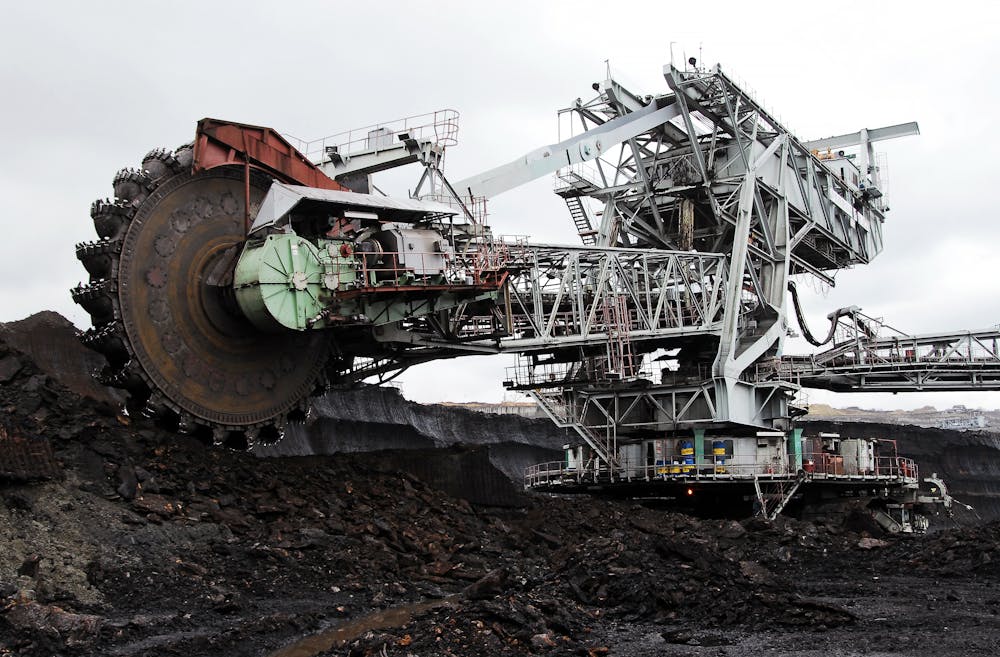
Some proposals for off-Earth mining are similar to mining on Earth. For instance, we could mine lunar regolith with a bucket-wheel excavator, or mine an asteroid using a tunnel boring machine.
Bucket-wheel excavators are large machines used in surface mining, including coal mining, which allow continuous digging. Shutterstock
Other proposals are more unfamiliar – such as using a vacuum-like machine to pull regolith up a tube (which has seen limited use in excavation on Earth).
Researchers from the University of New South Wales Sydney and the Australian National University propose using biomining. In this, bacteria introduced to an asteroid would consume certain minerals and produces a gas, which could then be harvested and collected by a probe.
Huge challenges persist
Our work at UNSW’s Australian Centre for Space Engineering Research involves finding ways to reduce risks in a space resources industry. Needless to say, there are many technical and economical challenges.
The same launch costs that have so many eager to begin off-Earth mining also mean getting mining equipment to space is expensive. Mining operations will have to be as light as possible to be cost-effective (or even feasible).
Moreover, the further something is from Earth, the longer it takes to reach. There is delay of up to 40 minutes when sending a command to a Mars rover and finding out whether it was successful.
The Moon only has a 2.7 second delay for communications, and may be easier to mine remotely. Near-Earth objects also have orbits similar to Earth, and occasionally pass by Earth at distances comparable to the Moon. They’re an ideal candidate to mine as they require little energy to reach and return from.
Off-Earth mining would need to be mostly automated, or remotely controlled, given the additional challenges of sending humans to space – such as needing life support, avoiding radiation, and extra launch costs.
However, even mining systems on Earth aren’t fully automated yet. Robotics will need to improve before asteroids can be mined.
While spacecraft have landed on asteroids several times and even retrieved samples – which were returned to Woomera in South Australia, during the Hayabusa 1 and 2 missions – our overall success rate for landing on asteroids and comets is low.
In 2014, the Philae lander sent to comet 67P/Churyumov/Gerasimenko famously tumbled into a ditch during a failed landing attempt.
The European Space Agency’s Philae lander, which accompanied the Rosetta spacecraft, bounced back twice before settling in an awkward position inside a ditch. Wiki Commons, CC BY
There are also environmental considerations. Mining in space may help reduce the amount of mining needed on Earth. But that’s if off-Earth mining results in fewer, and not more, rocket launches, or if the resources are returned to and used on Earth.
Although collecting resources in space might mean not having to launch them from Earth, more launches may inevitably take place as the space economy grows.
Then there’s the question of whether proposed mining techniques will even work in space environments. Different planetary bodies have different atmospheres (or none), gravity, geology, and electrostatic environments (for example, they may have electrically charged soil due to particles from the Sun).
How these conditions will affect off-Earth operations is still largely unknown.
But work is underway
While it’s still early days, a number of companies are currently developing technologies for off-Earth mining, space resource exploration, and for other uses in space.
The Canadian Space Mining Corporation is developing infrastructure required to support life in space, including oxygen generators and other machinery.
US-based company OffWorld is developing industrial robots for operations on Earth, the Moon, asteroids and Mars. And the Asteroid Mining Corporation is also working to establish a market for space resources.
Michael Dello-Iacovo is affiliated with the Animal Justice Party and Sentience Institute.
Serkan Saydam receives funding from ARC, ACARP, CRC-P, ESA, Australia – Korea Foundation. He is affiliated with UNSW Sydney (Australian Centre for Space Engineering Research) and School of Minerals and Energy Resources Engineering, International Society of Rock Mechanics (ISRM) Commission on Planetary Rock Mechanics, Society of Mining Professors, and the Fellow member of the AusIMM, member of AaEe, Engineers Australia, Australian Geomechanics Society, and AIAA.
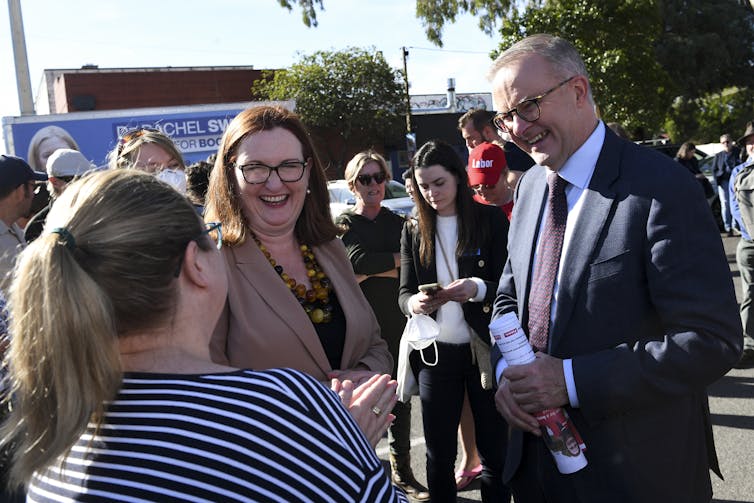
Today we are running two longer articles looking at the men who are vying to be the next Australian prime minister. You can read Michelle Grattan’s profile of Scott Morrison here.
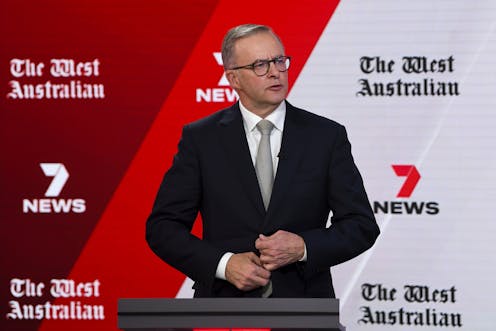
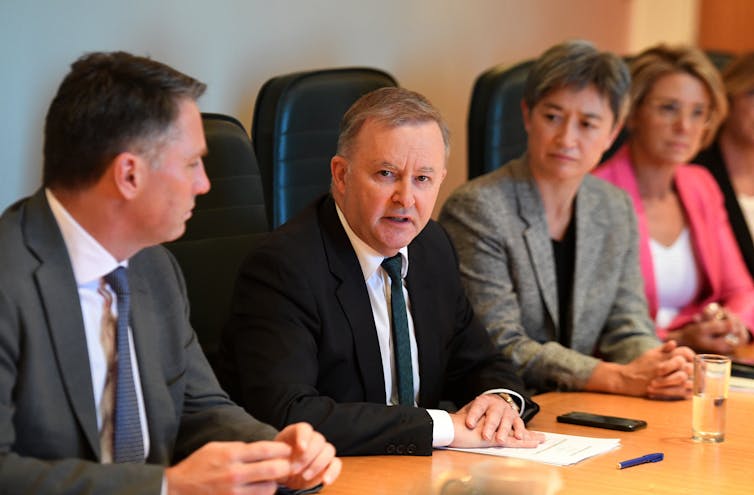
Karen Middleton’s 2016 biography of Anthony Albanese concludes with a speech he made that year, on the 20th anniversary of his election to parliament.
“I’m patient”, he told his clapping audience, “I’m patient — I’m a Souths fan”. The South Sydney Rabbitohs are the Rugby League club Albanese supports, which for the greater part of his adult life was notorious for its competitive under-performance.
The audience realised, of course, that in proclaiming his long-suffering dedication, Albanese was really alluding to his political vocation and his other underachieving “tribe” — the Labor Party.
Albanese’s journey in Labor politics has indeed been long and arduous. He was still a boy when he began accompanying his mother and grandparents to local branch meetings of the Labor Party; he remembers handing out for Gough Whitlam in 1972 when only nine. He formally joined the ALP as a teenager. Up to his ears in student Labor politics as an undergraduate, upon leaving Sydney University he went to work for the elder statesman of the New South Wales left faction, Tom Uren. By his mid-20s he was assistant secretary of New South Wales Labor, and won the seat of Grayndler for the ALP in 1996 on his 33rd birthday.
Even his path to leadership has been unusually slow. One has to go back to the middle of last century for an opposition leader who was older (56) and who had served for longer in the parliament (23 years) when first elected to that position.
His wait for the chance to become prime minister has been of far longer duration than most of Australia’s recent national leaders. Kevin Rudd, Julia Gillard, Malcolm Turnbull and Scott Morrison averaged only around a decade between entering parliament and attaining office. For Albanese, it will be a quarter of a century if Labor wins Saturday’s election.
To continue the slow burn theme, if Albanese is to be believed, his ambition for leadership formed late. Those who reach leadership positions are typically consumed with an aspiration for the top job from early in their parliamentary careers — if not before. They are fuelled by a sense of their own prime-ministerial destiny.
Albanese is different. On his telling, it was only in 2013, on the defeat of Rudd’s second government, that he first entertained thoughts of becoming leader. Until then he had contented himself with the role of “counsellor and kingmaker”.
And still he had to wait. Despite winning a comfortable majority of the rank-and-file vote, he narrowly lost the leadership to Bill Shorten in 2013 because several of his left faction Caucus colleagues defected to support Shorten. Albanese then had to stay his hand in 2016 when Shorten’s better-than-expected performance at that year’s election insulated him from a leadership contest. When Shorten seemed poised for victory in 2019, Albanese must have figured his chance to be party leader had passed. But then came “Morrison’s miracle” and Albanese emerged as the only candidate to succeed Shorten within a demoralised Labor caucus.
Playing the long game has also been the hallmark of Albanese’s leadership over the past three years. Beginning with “listening tours” of the regions where Labor badly faltered in 2019 — most notably in Queensland — it has been painstaking and unglamorous graft.
As journalist Katharine Murphy has observed, to his detractors his approach has been akin to a campaign of “attrition”. Those critics have harped on the theme of his leadership being a small target and his program prosaic. This is not how Labor wins office, they have insisted. Drawing on a sample size of three — the number of times Labor has claimed government from opposition since the end of the second world war under the leaderships of Whitlam, Bob Hawke and Rudd — the critics have argued the template for Labor success is a bold, transformative reform program and a charismatic, popular leader. Under Albanese, they complain, Labor has neither.
Albanese became leader of a demoralised Labor Party after its unexpected 2019 election defeat. AAP/Dan Peled
One can quibble at the edges of the critics’ reading of history. Though Whitlam unquestionably heralded an expansive reform program in 1972, the Labor Party was sufficiently concerned about his image that it launched an unprecedented advertising blitz to humanise him in the eyes of the public.
When Hawke won in 1983, Labor’s program for government was all but subsumed by the leader’s messianic appeal as encapsulated in the slogan, “Bob Hawke Bringing Australia Together”.
Rudd’s victory in 2007 was on the back of a campaign in which Labor selectively staked out policy differences with the Coalition. The nerdy Rudd painted himself as more of a fiscal conservative than John Howard, and was reassuringly perceived as a kind of youthful version of the prime minister. In short, the idea of Labor relying on larger-than-life platforms and leaders to win government is exaggerated.
This is not to deny that under Albanese, Labor is running on a considerably less daring agenda than it did in 2019. Indeed, it is an irony — or confirmation that ideological tags count for nothing in the contemporary Labor Party — that the right faction’s Shorten campaigned on an aggressively redistributive program spiced by “class war” rhetoric about the “big end of town”. In contrast, the left faction’s Albanese has abandoned those redistributive measures and has been emollient in his language towards business.
The plan to curb franking credits was first to go under Albanese, followed by the dumping of plans for changes to negative gearing, capital gains and, most recently, family trusts. As well, Labor has announced that in government it will not repeal the third tranche of the Coalition’s tax cuts that benefit high income earners. Simultaneously, Albanese has portrayed himself as a friend of aspiration. He believes, he says, in an Australia “where nobody is held back and nobody is left behind”.
To be fair to Albanese, it makes sense Labor changed tack from 2019. The party’s review of that defeat blamed it on “a cluttered policy agenda that looked risky and an unpopular leader”. In a speech to the National Press Club on the release of that review, Albanese indicated he had got the message: “too many people were confused or even frightened by our policies”. Elsewhere, he has pointedly noted none of Labor’s past successful opposition leaders campaigned on increases in taxes.
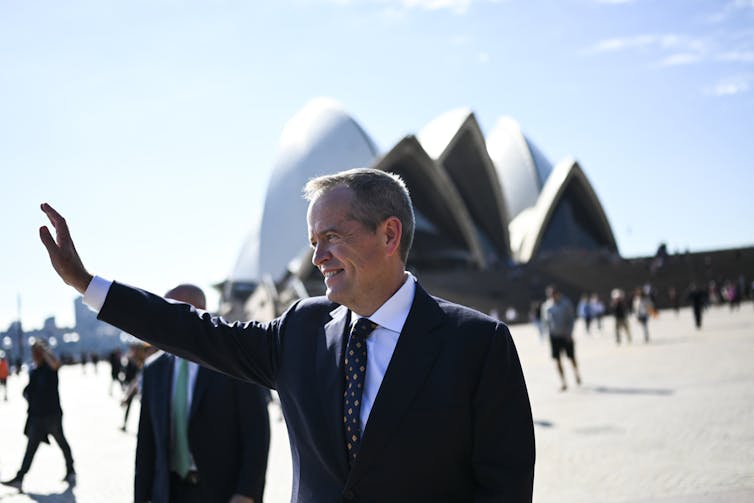
It is little surprise Albanese has walked away from the crowded policy agenda that helped thwart Bill Shorten’s bid to be prime minister in 2019. AAP/Lukas Coch
If there is a playbook to Albanese walking away from the Shorten program, then it is from the other side of politics. In 1996, heeding the lesson of John Hewson losing the unlosable election three years earlier on a radical neoliberal manifesto headlined by a new tax (the GST), John Howard renounced the GST as well as other contentious policies from Hewson’s Fightback! program. Howard determinedly narrowed the points of difference with Prime Minister Paul Keating, driving the latter to distraction.
Albanese has been unabashed about his strategy of not rejoining the battles of 2019, declaring he has no intention to “relitigate the past”. To those who cavil that Labor has abandoned its ideals by dropping the redistributive policies he has been equally blunt: “One of my Labor principles is for Labor to win elections”. Paul is there a link for this pls? This might not be as caustic as Whitlam’s famed put-down of the Labor hard left: “Only the impotent are pure”, but the point is fundamentally the same. To change the nation, Labor first has to win at the ballot box.
The abandonment of the Shorten-era revenue measures has curtailed Labor’s scope for campaign initiatives. According to the Coalition, Albanese is like a thief in the night, trying to steal his way into office on a meagre policy program. This is largely unfair. Beginning at a leisurely pace, Albanese gradually accelerated the roll out of policies.
Another conclusion of Labor’s review of its 2019 election campaign was that there was an absence of a clear narrative binding together the party’s policies. Albanese too has struggled in that space. In the second half of 2021, he seemed to be feeling his way there by talking about the reconstructive role of government following the crisis of the pandemic. This was potentially redolent of a great Labor reformist era (post-war reconstruction) and a sharp contrast to Morrison’s “can-do capitalism” mantra. Yet his prosecution of the case for the transformative power of government has remained inchoate.
Albanese’s predilection, as exposed on the hustings, for wandering into verbal marshes has not helped either in providing coherence of theme. But the lack of a compelling story line also goes back to the abiding caution of his approach.
The party’s policy on a 2030 carbon emissions reduction target is an illustration. This is another area where Labor kept its powder dry, delaying the release of its target until after the Glasgow Climate Change Conference. When Albanese finally announced a reduction target of 43%, it was almost as if the policy dare not speak its name. He declared it “a modest policy. We do not pretend it is a radical policy”. Hardly the inspirational stuff of “the great moral challenge of our time”.
Making amends for the disappointment of 2019 brings us squarely to the subject of leadership. If Shorten was a millstone on Labor’s vote, a perusal of opinion poll leadership ratings indicates Albanese, though not popular, has not been subject to anything like the antipathy that dogged his predecessor.
In the first half of this year, his leadership ratings edged into positive territory and, unusually for an opposition leader, he was nipping at the heels of the incumbent on the question of preferred prime minister. This was a good place to be.
While Albanese is not wildly popular, he’s also not as unpopular with voters as Bill Shorten was in 2019. AAP/Lukas Coch
Probably the most consistent take-out from the leadership polling over the past three years, however, is that Albanese has not made a major impression on the public. The relatively high number of respondents who have nominated “don’t know” when asked to rate his performance has been an indicator of this. The pandemic is one reason Albanese remained indistinct in the electorate’s mind. For stretches of the past parliamentary term, and particularly during 2020, he struggled for oxygen.
Yet undoubtedly the tepid response towards Albanese is also a function of the fact he has bent over backwards to be a non-threatening rather than arresting figure. For someone once styled as a warrior of the left, there has been nothing remotely incendiary from him.
That Albanese has journeyed a long way from his pugilistic younger days is a sign of maturity. But the charisma he displayed as a firebrand student politician has also leached away. He presents as a slightly rough-hewn, inoffensive type, workmanlike rather than exceptional. One senses he is more visceral than cerebral, with reserves of emotional intelligence. Colleagues testify that authenticity and decency are his defining attributes: a shorthand way of saying he is the antithesis of Morrison.
Altogether, Albanese’s is an unusually modest persona for an aspiring prime minister, which goes with his insistence he never had a sense of entitlement to leadership. At the same time, there is a core of resilience and self-belief. His inner strength is rooted in his hard scrabble backstory to which he routinely harks back. This is the story of being brought up as the only child of a single mother and invalid pensioner in council housing. His mother’s struggles are the lodestar of his political vocation.
In another way, though, Albanese was blessed as a child. Like past Labor luminaries, Whitlam, Hawke and Keating, he was the recipient of maternal special investment: what he remembers is his mother’s “absolute unconditional love” for him.
While he might not have believed it was his destiny to be prime minister, his mother harboured that ambition for him. Middleton’s biography records that she “believed he could go far — as far as a person can go in the Australian political system”.
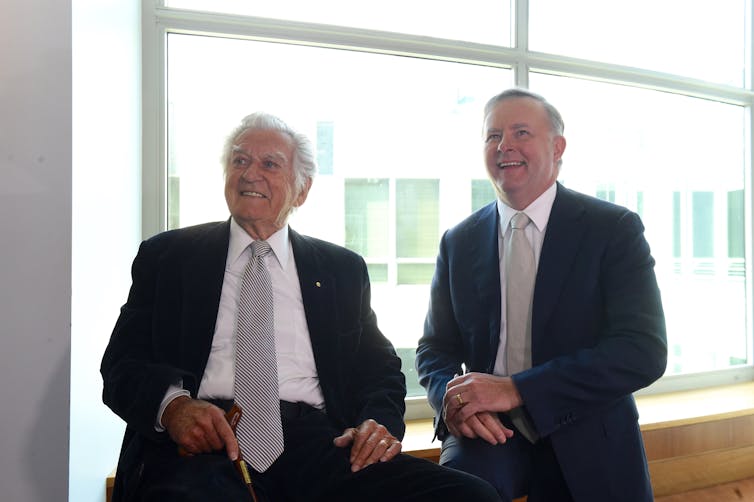
What sort of prime minister can we expect Albanese to be if he wins power on Saturday? He has referenced Hawke and, to the gall of Liberals, even invoked Howard as prime ministers he will take a leaf from. The gold standard of modern Labor prime ministers, it is hardly surprising that Albanese looks to Hawke as a role model. He says that, like Hawke, he will govern by consensus, bringing business, unions and civil society together.
The transactional business of forging networks of support is second nature to Albanese: a craft he mastered as a left faction operative in the hostile environment of the right dominated New South Wales Labor Party.
There is evidence of his capacity for wrangling a middle ground. As leader of the House of Representatives during Gillard’s prime ministership, he was integral to the functioning of Labor’s minority government by closely liaising with the crossbenches. Gillard later remarked: “Albo is a very persuasive person. He’s good at talking people into things”.
Albanese has said he will govern like his role model, Bob Hawke. AAP/Mick Tsikas
While Albanese’s leadership style over the past three years has largely escaped analysis, it is notable he has mostly kept Labor united in common purpose. The walking away from the redistributive policies of the Shorten era required extensive consultation to work through the changes within the parliamentary party and beyond.
In the end, the result was achieved with surprisingly little rancour. Albanese’s collaborative abilities are also attested to by the strong leadership team he has assembled around him. In addition to his deputy, Richard Marles, and Labor’s talented shadow treasurer, Jim Chalmers, that leadership group includes Katy Gallagher, Mark Butler, Kristina Keneally, Penny Wong and Tony Burke.
Like all Labor leaders since Rudd, Albanese insists he has learnt the lessons of the dysfunction of that period of government. He will observe “proper” processes allowing genuine debate in Cabinet. Albanese’s team approach is a welcome contrast to the Coalition side, with Morrison giving the impression of running the show himself. If elected, Albanese’s ability to orchestrate consensus will hold him in good stead for tackling thorny policy challenges of which there will be many ahead.
Still, questions linger about whether Albanese has the stuff to be a substantial prime minister. Although a gifted transactional politician, does he boast the erudition and imagination to meaningfully shape the nation? He has demonstrated a flinty pragmatism over the past three years, but less certain is whether he has the driving sense of purpose required to achieve hard-fought reform.
And, like the best leaders, has he the ability to modulate his approach? Can he switch to a more dynamic galvanising mode of leadership or will the circumspection that has defined him in opposition shackle him in government? On the other hand, just maybe his unassuming leadership will provide for a dogged but conscientious form of government that suits Australia’s purposes.
With Labor enjoying a substantial lead in the opinion polls, Albanese’s patience looks set to be rewarded on Saturday. If the polls are right, on two-party preferred terms, the ALP is on track to achieve at least as handsome a victory as when the party won office in 1972, 1983 and 2007. Albanese will have defied the critics and bent the template of how the ALP wins government from opposition. Non-heroic in leadership style, he will nonetheless be celebrated as a Labor hero.
But there remain gnawing fears in the Labor camp that a low primary vote, fickle preference flows and a patchy swing might yet deny them majority government. Should a hung parliament result from Saturday’s contest, Albanese’s persuasive capacities will be tested immediately in wooing the crossbenchers. The probability is that in any negotiations he will have a stronger hand than Morrison because of an edge in numbers and the fact he is unencumbered by the same baggage as the prime minister.
It will be a final minor delay in Albanese’s protracted journey to the political summit.
Paul Strangio does not work for, consult, own shares in or receive funding from any company or organisation that would benefit from this article, and has disclosed no relevant affiliations beyond their academic appointment.
Today we are running two longer articles looking at the men who are vying to be the next Australian prime minister. You can read Paul Strangio’s profile of Anthony Albanese here.
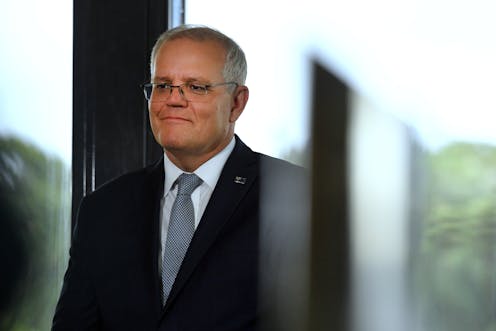
Revealing insights into Scott Morrison’s political character and tactical approach are coming through as the prime minister finds himself on the ropes towards the end of this campaign.
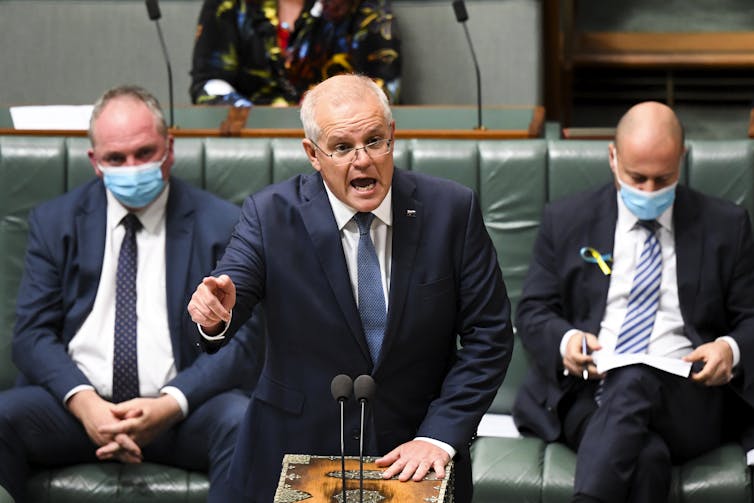
In last Wednesday’s final debate between the two leaders, when they were asked to speak to the other’s strengths, Morrison praised Albanese’s never forgetting where he came from – but then launched, unwisely, into why his opponent was unfit to be prime minister.
When he sensed he’d misjudged with the jibe, he quickly reached for an excuse, suggesting he “must have misunderstood the question”.
On Friday and Saturday, with polling continuing to show Labor in a winning position, he held out the promise of a reshaped Scott.
He said on Friday “Australians know that I can be a bit of a bulldozer” and pledged some change if re-elected. The following day he declared, “I will seek to […] explain my motives and my concerns and empathise a lot more”.
It was a brazen bid, but would it be believed by an electorate deeply sceptical about him? Or would he be seen as the chameleon willing to say anything in the moment?
Morrison’s prime ministership is the story of a leader who has lost, to an extraordinary degree, community trust as well as personal support within his party.
The PM who in 2019 clawed his way to victory, against expectations, to become the hero who delivered the “miracle” win for the government, is now widely seen among many Liberal MPs as a major drag on their vote.
He’s become so disliked in the city seats where moderate Liberals are under siege from “teal” independents that he can’t campaign in those electorates.
In March 2020, Roy Morgan conducted a survey of Australians asking respondents to name, unprompted (with no list), any politicians they trusted and any politicians they distrusted. This research measures not just trust or lack of trust, but also the far more toxic measure of distrust. The March 2020 survey found that only 8% of respondents trusted Morrison while more than twice the percentage of respondents, at 17%, distrusted him. When the survey was repeated in March 2022, Morrison’s unprompted trust had fallen to just 6% of respondents, with the unprompted distrust level increasing to 25% – more than four times the percentage of respondents who trust him.
Morrison was the most distrusted politician in both surveys.
The most common reason for distrust in both years was telling lies, being dishonest or misleading – this reason for distrust increased from 35% of the reasons for distrust in Morrison in March 2020 to 46% in March 2022.
As prime minister, Morrison has been non-ideological, totally focused on winning, ruthless, transactional, controlling. It’s “always tactics” rather than strategy, says a source who’s observed him closely in government.
As prime minister Scott Morrison has been non-ideological but ruthless, and completely focussed on winning. AAP/Mick Tsikas
A Liberal who has dealt extensively with him says: “He’s completely unencumbered by belief and values – which makes him so effective. His beating heart is a focus group.”
Morrison might be “unencumbered by belief” but he’s well endowed with self-belief, bolstered in considerable part by his Pentecostal faith.
In 2021 he recounted, in a video speech to a Christian audience, how when visiting a photographic gallery late in the 2019 campaign he was looking for a sign from the Lord.
“And there right in front of me was the biggest picture of a soaring eagle that I could imagine and of course the verse hit me […]. The message I got that day was, ‘Scott, you’ve got to run, to not grow weary, you’ve got to walk, to not grow faint, you’ve got to spread your wings like an eagle to soar like an eagle.’”
As this campaign draws to its challenging close, Morrison – who says he prays every day – might be again looking for a sign.
On his way to the prime ministership, Morrison positioned himself adroitly in the coups against predecessors Tony Abbott and Malcolm Turnbull. His henchmen in his small, tight factional group looked to his advancement. Morrison himself wore gloves, giving him superficial deniability, although the evidence suggested otherwise.
Turnbull, in his autobiography A Bigger Picture, describes a dinner in December 2014 when Morrison felt Abbott “would have to go by the middle of 2015 if his performance didn’t improve. […] He was closely in touch with the key figures at News, he told me, and said they were getting ready to dump Abbott.”
In both coups, there were indications of tactical voting by the Morrison allies to promote change, while Morrison himself could stay “loyal”.
Before the 2019 election, Morrison successfully projected his “ordinary Joe” personal story – Sharks-tragic, curry-cooking dad from The Shire. Sean Kelly writes in The Game: A portrait of Scott Morrison: “When he became prime minister, we did not know much about him. Quickly, he set about helping us to know him […] We were given just a few details; we were given them over and over again.”
The family motif is central in the Morrison story. Wife Jenny is mobilised – literally as his better half, because people like her – when he’s trying to smooth away trouble. His mother Marion was flown interstate to make an appearance at a rally on Mother’s Day.
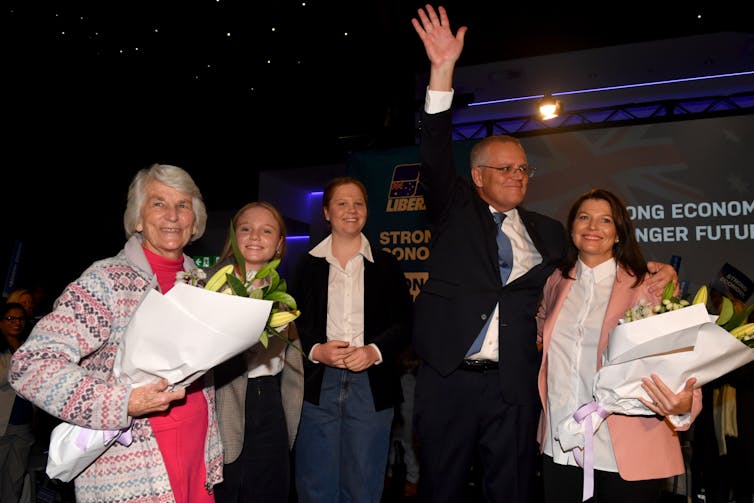
Morrison pitches himself as the ultimate ‘family man’, even flying in his mother Marion for a Mother’s Day event during the campaign. AAP/Mick Tsikas
Morrison is arrogant, and naturally reluctant to admit error, but started to do so, to a limited degree, when tactics required. Asked by Anthony Albanese during the second campaign debate about his infamous “it’s not a race” claim on the vaccine rollout, he said: “It was a race, Anthony, and we shouldn’t have described it in those terms”. While the dominant narrative has been his dodging of personal responsibility, now, when lauding the Coalition’s achievements, he admits that the government, and he, didn’t get everything right.
His dodging responsibility was dramatised during the 2019-20 bushfires, when the Morrison family went on a December holiday to Hawaii. This incident has become totemic in defining him negatively in the public mind.
Not only was the trip’s timing misjudged, but the Prime Minister’s Office shrouded it in in secrecy and lied to the media about it. Trying to justify himself, Morrison delivered the line that would hang around his neck for the rest of the term, “I don’t hold a hose, mate”.
From then on, his critics repeatedly accused him of refusing to accept personal responsibility for mistakes and problems, especially the delays and other failures in the vaccine rollout and the shortage of RATs.
In a symbolic gesture when he became leader, one of Morrison’s first acts was to take his team to Albury, where Robert Menzies and other Liberal party founders had met. Paying homage to Menzies is a ritual for Liberal leaders.
But Morrison is a long way from Menzies in his thinking. A notable example is their views on education. Menzies respected learning and culture, and greatly expanded Australia’s university system. Morrison is dismissive of intellectuals and the humanities, and sees universities in large part as education factories to turn out job-ready workers.
Morrison has accelerated the trend, that began under John Howard and continued under Tony Abbott, of taking the Liberal party away from its earlier middle class base, to pitch to outer suburban male “tradies”.
The rise of the “teal” independents, fighting especially on issues of climate change and integrity, is in part a reaction to this. These candidates, mostly professional middle class women and including two from Liberal “royalty” (Allegra Spender and Kate Chaney), are also a contrast to Morrison’s “blokey” pitch.
Judith Brett, emeritus professor of politics at La Trobe University, says that “under Menzies, the ‘moral middle class’ saw its vote in terms of its perception of the national interest, not simply self interest. The teal independents are all running on national policies – climate change, integrity – not hip pocket issues.”
Morrison has increasingly alienated many female voters. Their antipathy is not just driven by the scandals involving politicians and bad behaviour at parliament house. Women know they are not Morrison’s primary constituency and the polling suggests they respond in kind. In counterpoint, Morrison has been anxious to find and run female candidates.
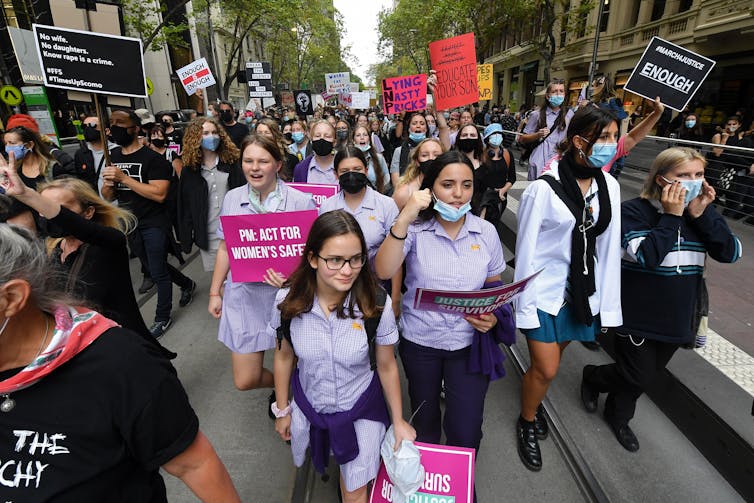
Morrison has increasingly alienated women during his time in office, despite much attention on the treatment of women in the past two years. AAP/James Ross
An analysis last week by the Australian Financial Review of its Ipsos polls found Morrison’s approval, “which was 44% among women at this same time of the 2019 election campaign, now averages just 29% over the past three polls”.
Just as women voters are secondary to male voters in Morrison’s sights, so too inner city Liberal electorates have been relegated as he pitches to the outer suburbs and ethnic voters.
Morrison has appeared willing to cut loose the moderate Liberals in the “leafy” seats. This was notable in his captain’s pick of Katherine Deves as candidate for Warringah (held by independent Zali Steggall) who had posted offensive comments about trans people. Morrison believed her crusade to protect women and girls in sport from trans competitors would resonate in areas with high ethnic populations.
One politically strange aspect of Morrison’s behaviour has been the contempt with which he has treated his home-state NSW Liberal party, of which he was once state director.
His factional ally Alex Hawke frustrated for months the party membership’s aspirations for rank-and-file preselections, because Morrison wanted to install his favoured candidates, in what was seen as some long-term ploy to boost his numbers.
Eventually he got his way: candidates for a clutch of seats were chosen by a committee he headed. But this triggered a party crisis, as well as giving the candidates little time to establish themselves with voters. There’s now deep anger among many NSW party members, making it difficult for the party to muster enough volunteers to help during the campaign, especially in Warringah.
Morrison’s attitude to the NSW party is typical of his wider desire for control. Ministers such as Peter Dutton chafe at the Prime Minister’s Office’s interference, as it attempts to drive the government’s messaging.
Morrison eschews transparency and accountability. The government fought, unsuccessfully, legal proceedings brought by crossbench senator Rex Patrick, as it tried to keep the minutes and other documents of the national cabinet immune from freedom of information requests. It argued (ludicrously) that the national cabinet was a committee of the federal cabinet.
Even after the defeat, Morrison’s department has blocked attempts to get additional material, beyond the documents in the case. Patrick says: “The prime minister’s conduct is an affront to the rule of law. He’s usurped the judgement to satisfy his secrecy addiction.”
Morrison regards the public service as part of the “Canberra bubble”, there to deliver but not to free range with its advice. His choice for head of his department, Phil Gaetjens, who was his chief of staff when Morrison was treasurer, is viewed by the bureaucracy as basically a political operative.
The widespread push for a national integrity commission has run foul of Morrison’s deep animosity towards the NSW Independent Commission Against Corruption. He’s been highly critical of its inquiry into Gladys Berejiklian’s conduct, and condemns ICAC as a “kangaroo court”. In turn, he has been on the receiving end when an ICAC commissioner, Stephen Rushton, labelled those who used that term “buffoons”‘. Morrison refuses to compromise on his restrictive model for a federal commission, which has been widely criticised.
The PM is a media manipulator par excellence. He and his office are intimately tied into the Murdoch media, and particular journalists. They use The Australian and the News Corp tabloids to place exclusives and deploy dirt. His communications chief Andrew Carswell was formerly with the Daily Telegraph. Sky haranguer Paul Murray is a personal friend.
The Morrison camp sidelines the ABC to the maximum extent possible, despite its chairwoman, Ita Buttrose, being the PM’s choice. During the campaign Morrison refused to do a debate on the ABC, and mostly avoided its programs, although he has a 7.30 interview on Monday night. It is not just a matter of alleged bias. Being against the ABC is part of the culture wars.
Morrison argues the election isn’t a referendum on the government, but he regularly reprises its record of successfully handling the pandemic, saying some 40,000 deaths were prevented.
Undoubtedly, the government’s early closure of Australia’s international border was a crucial and correct decision that saved many lives.
But on the health side, it was the premiers who were often forward-leaning, whether in pushing hard for the initial shutdown (Victoria’s Daniel Andrews, and NSW’s Berejiklian), shutting schools, or closing their own borders. Morrison was routinely in favour of keeping things as open as possible.
He denounced Queensland premier Annastacia Palaszczuk over her tough border policy. He joined Clive Palmer’s court case against the Western Australian government over its border closure (although the federal government subsequently withdrew, realising how much support premier Mark McGowan had).
The federal government’s economic response to the pandemic was strong; JobKeeper kept many businesses and workers afloat (although design flaws meant a good deal of waste).
Morrison is not shy of playing politics against some on his own side. At various times during the bushfires and the pandemic his office briefed against Berejiklian. During the fires, in a (leaked) text Berejiklian called him “a horrible horrible person” who was more concerned with politics than people.
When the NSW environment minister Matt Kean irritated him over climate change, the PM declared slightingly “most of the federal cabinet wouldn’t even know who Matt Kean was”. Current NSW premier Dominic Perrottet is no fan – Morrison swore at him during a dispute when Perrottet was treasurer. In the campaign, Perrottet has not hesitated to stand up for ICAC.
The attacks on Morrison’s character have been particularly devastating politically, because of where they have come from, the terms in which they’ve been cast, and the fact they are documented.
French President Emmanuel Macron declared unequivocally Morrison lied to him over the submarine project. A Barnaby Joyce text (sent to a third party after the Brittany Higgins rape allegation and before Joyce returned to the Nationals’ leadership) described Morrison as “a hypocrite and a liar”, who “I have never trusted”. Morrison “rearranges the truth to a lie”, Joyce said in the text. Turnbull said: “Scott has always had a reputation for telling lies”.
It’s hard to recall any recent prime minister who has been “nailed” so comprehensively by credible figures on the “character” issue.
Leaving aside pandemic management, the Morrison government goes to this election with a limited record and an even slimmer fourth term agenda.
Under pressure from moderate Liberals and the Biden and Johnson administrations, Morrison forged a deal with the Nationals to embrace the target of net zero emissions by 2050. But the Coalition’s climate policy remains weaker than those of various states, and Australia is still seen internationally as a laggard.
Morrison had a crack at trying to get business-union consensus on some modest industrial relations reform but little came of it when a limited package went to parliament.
In defence and foreign affairs, Morrison negotiated the AUKUS agreement with the United States and Britain, a major achievement that will also (eventually) bring nuclear-powered submarines. But the government’s Pacific “step up” has been less than successful, with a China-Solomon Islands agreement a substantive problem, and a political challenge in the campaign.
Like Labor, Morrison is not putting forward any ambitious plan for the future. His approach to governing is managerial.
He’s running hard on the government’s economic record. He can point to an unemployment rate of 4%, set to go lower, and an economy that’s come out of the worst of the pandemic in much better shape than those of most other countries.
His central election mantra is the risk of change. But the headwinds against him are strong. Any government seeking a fourth term is up against an “it’s time” factor. One with a leader such as Morrison is heavily burdened.
Morrison notes that since Howard “I’m the first prime minister that has been able to stand for election at the last election and then stand for election again”.
Normally, the end of the prime ministerial “rotisserie” would be seen as a good thing. But a few Liberals would reckon they’d be better off if there’d been a chance to put their leader on the spit in the last year.
Michelle Grattan does not work for, consult, own shares in or receive funding from any company or organisation that would benefit from this article, and has disclosed no relevant affiliations beyond their academic appointment.
Source: The Conversation (Au and NZ) – By Martin Hensher, Henry Baldwin Professorial Research Fellow in Health System Sustainability, University of Tasmania
The rapid development and deployment of COVID vaccines has been one of the greatest achievements of the pandemic.
However, Australia risks relying on COVID vaccines from two main companies – Pfizer and Moderna – and that’s a problem.
While the need for COVID vaccines is not going away anytime soon, we need to shape the market to drive more competition for better access to improved vaccines.
Here’s what Australia needs to do to break free from an effective duopoly dominating the local market, especially when many of us are likely to need boosters.
When COVID finally broke out at scale in Australia late last year, the vaccines (and high levels of adult vaccination) worked extremely well to reduce deaths and severe illness.
Since January 1 this year, there have been more than 5.9 million confirmed COVID infections nationwide, but about 5,300 deaths.
Yet current vaccines aren’t 100% effective at protecting against infection; new viral variants (and sub-variants) continue to emerge; protection via vaccination and prior infection wanes quite quickly, meaning reinfection is becoming more common and booster shots may remain part of the landscape for some time to come.
Meanwhile, vaccine inequity remains an unresolved problem. This has led to a situation where rich countries, such as Australia, are giving booster shots where some poorer countries don’t even have enough vaccine for first doses.
In a recent article in the Medical Journal of Australia, we outline the need to break free from the handful of powerful players still dominating Australia’s COVID vaccine market.
While the number of approved COVID vaccinesis growing around the world, Australia largely still relies on only two, namely vaccines from Pfizer and Moderna.
More than 95% of Australian adults have received two doses of COVID vaccine already. So future requirements are primarily for boosters and child vaccines. Australia, therefore, continues to face an effective duopoly.
Future supplies of COVID vaccines will be used for booster shots and children. Shutterstock
The power of patents
This effective duopoly further reinforces the already considerable power these manufacturers hold via the intellectual property rights to their vaccines.
These vaccine patents are protected by the World Trade Organization under the Agreement on Trade-Related Aspects of Intellectual Property Rights (or TRIPS). This prevents international competitors from replicating patented technologies.
These patent rights allow companies to earn higher profits (or “economic rents”) than if their technologies were freely available to allow open competition.
The intellectual property dimensions of COVID vaccines have been controversial.
Yet Moderna found itself in dispute with the United States government, conceding US government employees had directly developed several technologies key to the Moderna vaccine (not to mention years of publicly-funded basic research).
Moderna has also resisted sharing the formulation of its vaccine to allow key middle-income countries to manufacture it.
Meanwhile, Pfizer has negotiated advantageous and secretive vaccine contracts with governments, shifting liability and risk onto governments and controlling nations’ ability to redistribute stock between themselves.
Critics argue the opponents of a TRIPS waiver are largely concerned about avoiding setting any precedents that might allow the profits of Big Pharma to be limited in future.
In Australia, the reality that current COVID vaccines only partially prevent transmission leaves us dependent on this effective duopoly for ongoing boosters. Boosters also remain mandated for people in many occupations.
Australia can escape this captive vaccine market in three steps.
1. Approve more vaccines
Australia needs to expand the supply of new COVID vaccines by actively assisting a wider range of manufacturers to bring their products to the Therapeutic Goods Administration for approval. This would increase competition for boosters and stimulate the development and supply of more effective “sterilising” vaccines (ones that prevent viral transmission).
Meanwhile, Australia must extract maximum value from all existing vaccine contracts, and insist upon full freedom to transfer supplies to our regional neighbours.
2. Push for patent reform
Australia should use its influence to vigorously drive a TRIPS waiver at the World Trade Organization. It should also explore strategic options with a coalition of partners to consider how the current global intellectual property regime could be rapidly reformed or, if necessary, circumvented.
Australia should institute an economic “mission” to establish publicly-owned, not-for-profit vaccine and essential pharmaceuticals research, development and manufacturing infrastructure and capability in Australia. This would serve domestic and wider regional needs for COVID and beyond.
Sadly, the Australian government’s recent agreement with Moderna for the company to establish mRNA manufacturing here is not such an example. It may risk entrenching existing power. The agreement is also still secret.
In an increasingly insecure world of growing disruptions – ecological and health crises, fracturing supply chains and heightened military tensions – Australia can provide a safe and resilient vaccine and pharmaceutical manufacturing capability to protect the health of Australians and our neighbours.
However, old models that privilege shareholders, via excess profits and intellectual property protection, will not deliver this new vision.
Sithara Dona, an associate research fellow at Deakin University, co-authored the research mentioned in this article.
Martin Hensher has received an honorarium from Novartis SA (Brazil) for a lecture delivered to the Novartis Access 2021 conference. He is a member of the South Australian Health Performance Council and a board member of Glenview Community Services, Tasmania (a not-for-profit aged care provider).
Labor might be leading in the national polls, but a hung parliament after the May 21 election remains a distinct possibility.
So-called “teal” independents, whose blue conservatism is tinged with green concern for climate change, may well join Greens MP Adam Bandt and current independents on the lower house crossbench. Under that scenario, any minority government would need their support.
With the support of advocacy group Climate 200, the teals are campaigning on issues relevant to their electorates and raising funds locally. But high on their agendas is a strong, science-based response to the climate crisis.
A weekend report by Nine newspapers suggested most independents seeking a lower house seat would not strike a formal power-sharing deal with either the Coalition or Labor. This would leave a major party in minority government negotiating with the crossbench on every piece of legislation it wants to pass.
Almost all the 12 independents who were polled nominated climate change as a key priority they would seek progress on in any negotiations with a minority government.
Prime Minister Scott Morrison claims the election of more independents to parliament would lead to “chaos”. But, as the experience of the Gillard Labor government shows, minority government can break intractable policy logjams.
Climate policy U-turn
The Gillard minority government reversed years of climate policy failure by delivering carbon pricing and other reforms. This came at the behest of the Greens and with the support of independents Andrew Wilkie, Rob Oakeshott and Tony Windsor.
Carbon pricing prompted Australia’s greenhouse gas emissions to fall for the first time.
But from 2013, under successive Coalition governments, climate policy hit reverse. Renewable energy targets diminished. Carbon pricing was abandoned and is now considered a political poisoned chalice.
The past decade of majority government has left Australia isolated on the world stage for its lacklustre climate efforts.
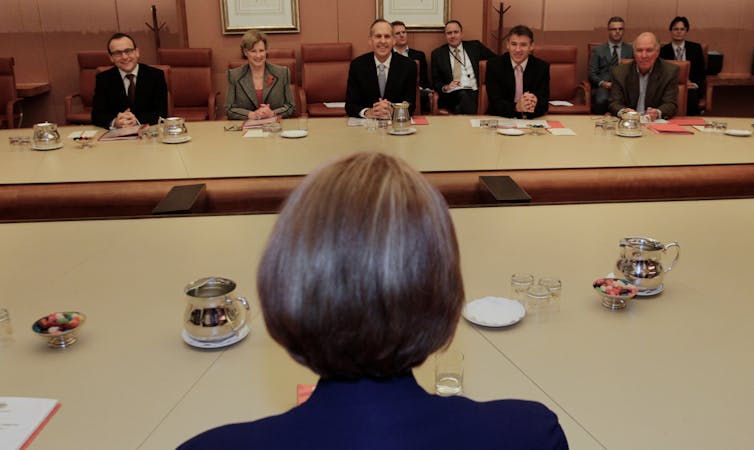
Independents and the Greens helped Julia Gillard form minority government in 2010. Fairfax pool/AAP
Major parties forced to the negotiating table?
Heading into the election, neither major party’s climate policy is aligned with the emissions reduction ambition of the global Paris Agreement.
The Coalition’s policy is consistent with 3℃ to 4℃ of global warming by 2050. Importantly, it has failed to ramp up its 2030 emissions target from the paltry figure adopted by the Abbott government – of 26% to 28% on 2005 levels.
Labor has a steeper 2030 emissions reduction target of 43% on 2005 levels. It is based upon reputable modelling but falls somewhat short for being consistent with 2℃, not 1.5℃, of global warming.
Neither major party would relish re-negotiating its climate policy with teal independents and the Greens. But consensus and policy action, on climate and other big issues, is possible under minority government.
As Tony Windsor this month pointed out, the Gillard minority government passed more legislation than any other, aside from John Howard’s in its final term. Former Queensland Premier Peter Beattie also insists minority government can work.
And former Coalition Prime Minister Malcolm Turnbull this month hailed the rise of the teal independents, who would sit on the cross bench, calling it “direct, democratic action from voters. People power, you might say.”
The Morrison government’s emissions reduction policy is aligned with 3℃ of global warming. Mick Tsikas/AAP
What the teals and Greens are offering
Climate change is a front-and-centre concern for the Greens and teal candidates, and any minority government would need to negotiate with them to form government and to manage their agendas.
Polls suggest independent teal MP Zali Steggall will be easily re-elected in the previously blue-ribbon Liberal seat of Warringah. She will reintroduce her ambitious climate change bill, likely with the support of any other elected teal MPs and most of the crossbench.
This bill is modelled on the United Kingdom’s Climate Change Act. It provides a means of coordinating climate policy action in line with the legislated targets of net zero emissions by 2050, and at least 60% emissions reduction by 2030.
cleaning up transport and getting to 76% new vehicle sales being electric by 2030
halving industry emissions
regenerating and future-proofing agriculture by rolling out 8 million hectares of tree planting and soil carbon storage, and investing in low-carbon agriculture practices and technologies.
The Greens would replace coal and gas with renewables, and ban political donations from the fossil fuel industry. The party would fund households and small business to transition to renewables, implement a coal export levy and eventually phase out thermal coal exports.
The Greens want Australia to reaching net zero emissions by 2035 (compared to the government’s goal of 2050) and to reach 100% renewable energy by 2030.
Zali Steggall’s climate change bill includes a target of 80% renewable energy by 2030. Lukas Coch/AAP
Shifting the needle
The fate of effective national climate policy in Australia – policy that actually reduces emissions – now rests largely on the mix of members in the next parliament and the actions they support.
A majority Coalition win at the election would consign Australia to another term of climate inaction, leaving the state and territory governments the only ones making progress.
If a minority Coalition government eventuates, the Greens won’t offer it support. If any teal independents did, we can expect them to cross the floor on climate policy to support any workable proposal from Labor that had the numbers to succeed.
Labor, the Greens and Steggall’s plans share common ground. But if Labor forms minority government, it will be pressured to accelerate the phase out fossil fuels and to steepen its 2030 emissions reduction target in line with the science.
One thing is clear: in the event a major party forms minority government after the election, it better be prepared to shift the needle in favour of more effective climate policy.
Kate Crowley does not work for, consult, own shares in or receive funding from any company or organisation that would benefit from this article, and has disclosed no relevant affiliations beyond their academic appointment.
Aged-care workers are notoriously underpaid for the level of skill, responsibility, and judgement they exercise. Even employers acknowledge it.
The aged care royal commission found low wages, poor conditions, lack of training and poor career pathways to be the principal causes of substandard care.
The Fair Work Commission is now considering a claim by unions to increase award rates in aged care by $5.40 to $7.20 an hour, to an average of $29 an hour.
That will go some way to alleviating the situation. But it won’t fix the deeper problem that has led to rampant underpaying of caring work for decades.
The problem is that heavily-feminised occupations are undervalued.
In residential aged care, 86% of the workers are women.
Labor is promising to do something about the underpayment of heavily-feminised occupations more generally, pledging at its campaign launch to make gender pay equity an objective of the Fair Work Act.
It says it will also set up two new expert panels within the Fair Work Commission backed by research units to advise on equal remuneration cases; one specialising in the care and community sector, and the other specialising in gender pay equity.
Women’s work is undervalued
In a Queensland judgement in 2009, Industrial Relations Commissioner Glenys Fisher said it went back to the “nature of care work being seen as an extension of “women’s work in the home; an inherent part of mothering.
Care work was predominantly performed by women who put notions of vocation and the commitment to service “over and above the industrial needs of the community services workers themselves”.
Women in care industries had been awarded low wages that “would not have been endured” by workers in the electricity and rail industries.
Enterprise bargaining benefits men
Up until the 1990s wages and conditions for most workers were set by industrial awards. Changes to awards were argued by union and employer representatives but decided by state and federal industrial relations commissions.
Breakthroughs, such as minimum standards for the termination of employment and the right to carers’ leave, were achieved through “test cases” whose results flowed through to awards.
But from the early 1990s onwards enterprise bargains became the main way wages and conditions were lifted. Most agreements were hammered out between the unions and employers in each enterprise and approved by the commissions.
So-called modern awards have continued to exist, but have been stripped back to a bare minimum of “safety net” standards. For workers relying on these awards, wages and conditions have stagnated.
Enterprise bargaining helps most the workers with strong unions prepared to take industrial action. Construction workers are an example. Care workers, less keen on threatening industrial action, have been left behind.
This week’s walk out by aged care workers in Queensland and South Australia and Western Australia was unusual.
The Fair Work Commission recognised in 2011 that residential aged care enterprise agreements gained workers little, finding they paid 5–10% above the award, but were often accompanied by conditions that had “an offsetting effect”.
The industry practice of on-call rostering, where even part-time workers get fewer hours and less regular work than they want, means many aged care workers live below the poverty line.
As well, “care industries” such as childcare and aged care are funded by a dominant federal government purchaser that funds mainly non-government providers to deliver services on their behalf.
It means even employers who would like to pay their workers more have trouble finding the funds.
Labor’s proposals are a start
Labor’s proposal should give the Fair Work Commission a greater understanding of the distinctive nature of care-sector employment and the importance of awards in providing decent pay and working conditions.
Labor has also promised to fully fund any pay increases awarded by the Commission in the aged care work value case.
The Coalition has so far limited its promises to a aged care funding model it says will also cover the costs the Fair Work Commission’s decision.
Both Sara Charlesworth and Elizabeth Hill receive funding from the Australian Research Council. They are the co-convenors of the Work+Family Policy Roundtable. Sara has provided expert evidence for the Health Services Union claim in the current aged care work value case
Elizabeth Hill does not work for, consult, own shares in or receive funding from any company or organisation that would benefit from this article, and has disclosed no relevant affiliations beyond their academic appointment.
The world reacts over the assassination of Palestinian journalist Shireen Abu Akleh and the desecration of her funeral by Israeli security forces. Video: Al Jazeera
OPEN LETTER to the Foreign Minister of Aotearoa New Zealand, Nanaia Mahuta:
Kia ora Nanaia,
We have been informed that the Wellington City Council has been advised by the Ministry of Foreign Affairs not to light up the Michael Fowler Centre in the colours of the Palestinian flag tomorrow — which has been arranged through councillor Tamatha Paul and approved by council — because Aotearoa New Zealand does not recognise a Palestinian state and this will cause offence to the Israeli Embassy in Wellington.
This is outrageous advice. We want you to intervene and immediately override this advice from your ministry officials so the Fowler Centre can be lit up tomorrow.
Firstly New Zealand’s official policy is to support a “two-state” solution in historic Palestine and this policy in effect recognises a Palestinian state. You cannot have a “two-state solution” with just one state.
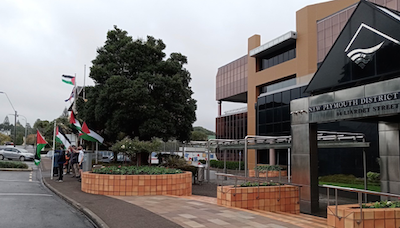
The New Plymouth City Council flies the Palestinian flag today after being requested by the local PSNA group to mark Nakba Day. Image: PSNA
Secondly it is deeply insulting to Palestinians to have official recognition of their national day — Nakba Day — effectively vetoed by ministry officials and the “sensitivities” of the Israeli embassy. It is Israel which is refusing to allow a Palestinian state to be formed.
The current Israeli Prime Minister, Naftali Bennett, has said he refuses to meet with Palestinian leaders, refuses to negotiate a peace deal and will refuse to recognise a Palestinian state while he is Prime Minister.
Why should Israel’s veto over a Palestinian state dictate Aotearoa New Zealand’s support for Palestinians?
Why would we take any notice of the “sensitivities” of an embassy which is supporting and promoting what every international human rights organisation has declared to be an apartheid state?
Parliament has flown the Ukrainian flag in recent weeks over Russia’s invasion and occupation of Ukraine so why shouldn’t New Zealand fly the Palestinian flag in recognition of Israel’s ongoing brutal military occupation of the entire area of historic Palestine?
Aotearoa New Zealand is bigger than the venal, self-serving advice of cowardly MFAT officials.
Please direct your ministry officials to approve Wellington City Council lighting up the Fowler Centre tomorrow in the colours of the Palestinian flag.
Asia Pacific Report editors join the Palestine Solidarity Network Aotearoa (PSNA) in solidarity with this open letter protest over the Nakba Day censorship and in memory of the Palestinian journalist Shireen Abu Akleh assassinated by Israeli troops last Wednesday.
Today is Nakba Day — this is the day marking the ethnic cleansing of over 750,000 Palestinians from their homes and off their land by Israeli militias in 1948.
For 74 years Israel has refused to allow them to return to their homes and land in Palestine despite dozens of United Nations resolutions requiring them to do so.
The Nakba has continued every day since 1948 as Israel seizes more Palestinian land and creates more Palestinian refugees every day.
A random selection of photograph’s from today’s action in Auckland’s Aotea Square that also mourned the assassination of Palestinian journalist Shireen Abu Akleh by Israeli troops last Wednesday.
When he mounted the stage as a warm-up speaker at Sunday’s Liberal launch, Josh Frydenberg received a reception beyond the obligatory enthusiasm required of the handpicked party faithful at these affairs.
“Wow – I wish I got that reception in Kooyong,” the deputy Liberal leader and treasurer quipped.
Frydenberg, fighting a desperate battle to survive against the teal invasion in his Melbourne seat, had already been on ABC Insiders with a defence of Scott Morrison, and various government policies, that wouldn’t do him much good with his local voters.
It might have been all hands to the wheel for launch day, but the Brisbane gathering failed to project the image of a party on the verge of defying the odds to score a triumph.
Morrison’s message was that he and the government had seen the country successfully through the pandemic, and now he had plenty of ideas for the future.
He’d already told us he won’t be such a bulldozer if he wins again, though it’s unlikely people will be convinced we’d get the purring engine of a Mercedes.
In his overlong Sunday speech (about 50 minutes) with too much detail, Morrison thanked his audience for their patience, “but as you can see, I’ve got a big plan. I’m seeking a second term because I’m just warming up.”
Outlining the government’s achievements during COVID, Morrison said: “Not everything went to plan but, you know, when it didn’t, and while others were criticising, we just worked feverishly to turn it around and make up the ground. What followed was the largest economic and public health response in Australia’s history.
“We now stand on a different edge […] One where fear doesn’t dominate, but aspiration. […] We stand on the edge of a new era of opportunity.”
The launch’s policy centrepiece – allowing first home buyers to access up to 40% of their superannuation, to a maximum of $50,000 – is likely to be popular.
It acknowledges housing affordability as a big issue with many people, and also contrasts with Labor’s offering of the government taking a slice of ownership to help some people into homes.
There’s been a good deal of pressure to allow first home buyers to access their super. When the government allowed people to dip into this asset to cushion them through the pandemic that was welcomed by many.
But there is the counter argument that it is desirable to keep super savings intact for their purpose – to provide for retirement. The government’s partial answer is that the money (with a portion of any capital gain) would have to be put back into super if the house was sold.
And critics will point to another issue. By helping on the demand side, the scheme may drive prices higher. The central problem is on the supply side, but solutions to that lie mainly with state governments rather than the federal government.
Morrison did unveil a modest measure on supply – reducing from 60 (which is coming in July 1) to 55 the age at which “downsizers” can make contributions to superannuation of up to $300,000 per person from the proceeds of a sale.
Pensioners would also have longer (two years instead of one) to restructure their assets after selling their home, without affecting their pension.
The opposition immediately matched the empty nesters and pensioner initiatives.
But Labor predictably rejected the plan for dipping into super. Former prime minister Paul Keating denounced it, as a “frontal assault” on the superannuation system.
“The superannuation taxation concessions exist solely to produce a retirement income for people. Its key is preservation. Accumulated funds preserved to age 60 so working people secure the power and benefit of compounding,” Keating said in a statement.
The government immediately circulated Labor’s 1993 election housing policy, which undertook to “allow all home buyers to fund up to 49% of the deposit for a home from their accumulated superannuation savings.”
What’s old is new again, as often happens with political promises.
.
Michelle Grattan does not work for, consult, own shares in or receive funding from any company or organisation that would benefit from this article, and has disclosed no relevant affiliations beyond their academic appointment.
The battles in the most high-profile teal seats have become nail-biters, not least because some “soft” voters in these previously safe Liberal heartland electorates are leaving their decisions until very late.
In the third and final round of our Wentworth Project focus group research, done May 11-12, more than half – eight of the 15 participants – had not definitely locked in their voting intention. Of the seven who were very certain, six were for independent Allegra Spender and one for Liberal incumbent Dave Sharma.
The previous few weeks had done little to move voters towards Sharma or the Morrison government. Rather, support had moved towards Spender.
On a two-candidate basis, Spender received nine votes and Sharma six. This compared to a two-candidate breakdown in the first round, done early in the campaign, of eight leaning towards Spender and seven towards Sharma.
“Soft” voters – who’d not firmly decided their vote or were considering switching – were recruited for the three rounds of focus group research. There was only one replacement, between the first and second rounds. The work, sponsored by the University of Canberra’s Centre for Change Governance and The Conversation, was done by Landscape Research.
Focus group research is not predictive, but rather a deep dive into attitudes.
While some of our Wentwoth voters were still hesitating about their final choice, people were sure about one thing – Spender had run a better campaign than Sharma.
Half way through the campaign, in the second round of research, nine of the 15 participants thought Spender had done the better job in the campaign and five judged the two campaigns pretty even. But in the penultimate week before the May 21 election, Spender was seen, hands down, as having the superior campaign. All bar one person said so.
Spender has gained momentum and there is a mood for change. She is “out and about everywhere,” (female disability support worker, 51). “Every time I see Dave Sharma he’s doing something cringeworthy […] everyone must have seen that Indian home diner on Oxford street. I think it was completely staged” (male fraud analyst, 30).
A retired female health worker found it “quite a powerful thing when you see all these [Spender] posters on people’s fences because that’s very much standing up and saying ‘this is the person I support’”.
“She’s gone to the trouble of engaging a lot of the volunteers for social and very publicly-visible gathering, […] and I think that pulls people together and they talk. It’s a very subtle way of infiltrating the community” (retired female state public servant, 68).
Sharma is still in the fight but only has a week to shore up waverers or change the minds of those who are only somewhat sure they’ll vote for Spender.
Some voters seemed to have little awareness their vote for Spender and the loss of the seat could help deliver government to Labor.
The concept of minority government and the need for crossbench support to guarantee supply was poorly understood. When explained, these soft voters and switched Liberal-turned Spender voters put the independent on notice.
Eleven of the 15 want her, if she wins, to support a Coalition government for supply in the event of a hung parliament. They indicated they would feel betrayed if she supported Labor. “If she was to do that, I won’t be overly impressed” (a male Spender voter, 52).
But the spectre of a hung parliament, coupled with Spender refusing to say who she would support, is an ongoing concern for some, and is having an impact on the way they are thinking about voting.
“That’s what’s making me wonder whether I should maybe just throw my support behind Dave, because it worries me that if it is going to be a hung parliament it’s going to be Labor and Greens with independents backing them, so it’s a Labor-Green government which is exactly what happened under the Gillard government” (female part-time receptionist, 48).
Some agreed with the proposition the Coalition was already a minority government, with the Liberals having to negotiate with the Nationals and different factions within the Liberals.
“They’re pretty much hamstrung by the extremes that they have in the Liberal and National party which is making it hard for them to get a lot of their legislation through” (female health worker, 63).
The national campaign is seen as close and something of a race to the bottom in a policy free zone. These voters were divided on who between Scott Morrison and Anthony Albanese has run the better campaign so far, with seven giving it to Morrison and the Coalition and eight to Albanese and Labor.
“[The Liberals] have had fewer slip ups and a consistent message about the economy,” (male IT worker, 34). “I sort of feel like Albanese is more sincere but less polished and I think that works for him” (male insurance worker, 57).
With polls pointing to a Labor win, some welcome the prospect of change, but others have concerns about Labor’s ability to manage the economy. “Higher costs, higher inflation, higher interest rates.” (semi-retired male, 70).
While confident a returned Coalition would be a plus for economic management, some fear a win would empower Morrison to continue without changing his ways.
“I’m concerned about the underlying religious influence and the Nationals’ influence – they are overly conservative” (retired female state public servant, 68).
These Wentworth voters hope a Coalition loss would be seen as a big wake up call. There is a strong intent to punish the Liberal party because they feel the moderate Liberals aren’t being listened to.
They believe responsibility for a Liberal loss would be squarely at Morrison’s feet and he must bear the brunt of the fallout. They also consider what the Liberal party needs to do to make itself more relevant to voters.
“For me it’s about taking ownership and accountability. You know, during COVID was a key example where Scott Morrison just kept blaming the states. You need to be a leader and you need to stand up” (female part time accountant, 39).
“The buck has to stop with him as leader” (male insurance worker, 57).
Michelle Grattan does not work for, consult, own shares in or receive funding from any company or organisation that would benefit from this article, and has disclosed no relevant affiliations beyond their academic appointment.
Israel’s fatal shooting of leading Al Jazeera reporter Shireen Abu Akleh as she covered clashes in the West Bank city of Jenin is a serious violation of the Geneva Conventions and UN Security Council Resolution 2222 on the protection of journalists, says the Paris-based media freedom watchdog Reporters Without Borders (RSF).
It has called for an independent international investigation into her death as soon as possible.
Witnesses said Abu Akleh, a Palestinian American, was killed by a shot to the head although she was wearing a bulletproof vest with the word “PRESS” that clearly identified her as a journalist.
Ali al-Samudi, a Palestinian journalist working as an Al Jazeera producer who was beside her at the time, was also targeted, sustaining a gunshot wound in the back, RSF reported.
Samudi, who is now in hospital, said in a video: “We were filming. They did not ask us to stop filming or to leave. They fired a shot that hit me and another shot that killed Shireen in cold blood.”
Following Abu Akleh’s death, Israeli security forces raided her East Jerusalem home as her family was making arrangements for her funeral.
Her body was transferred to Nablus for an autopsy prior to be taken to Jerusalem, where her funeral took place yesterday in emotional scenes with massive crowds. She was buried beside her parents in Mount Zion.
Israeli riot police attacked the pallbearers and a hearse carrying her coffin in the peaceful march, and ripped away Palestinian flags. International protests have followed this latest attack.
Popular in Middle East Abu Akleh was very popular in the Middle East and was respected by fellow journalists for her experience in the field.
Al Jazeera issued a statement accusing the Israeli security forces of “deliberately” targeting Abu Akleh and of killing her “in cold blood.”
Palestinian American journalist Shireen Abu Akleh … assassinated in “cold blood” in Jenin. Image: AJ screenshot APR
The Israel Defence Forces announced an investigation into her death, but IDF spokesman Amnon Shefler said Israeli soldiers “would never deliberately target non-combatants”.
Several witnesses, including an AFP photographer, denied seeing any armed Palestinians at the place where Abu Akleh was killed. Palestinian Authority president Mahmoud Abbas said he held the Israeli authorities “fully responsible” for her death.
“RSF is not satisfied with Israeli Foreign Minister Yair Lapid’s proposal of a joint investigation into this journalist’s death,” said RSF secretary-general Christophe Deloire.
“An independent international investigation must be launched as soon as possible.”
The shooting of these two Palestinian reporters during an IDF “anti-terrorist operation” in Jenin is the latest of many disturbing cases.
Two journalists fatally shot In the spring of 2018, two Palestinian journalists were fatally shot by Israeli snipers while covering the weekly “Great March of Return” protests near the Israeli border in the Gaza Strip.
Also in 2018, Ain Media founder Yaser Murtaja was killed on the spot on March 30, while Radio Sawt al Shabab reporter Ahmed Abu Hussein died in hospital on April 25 from the gunshot injury he suffered on April 13.
According to RSF’s tallies, more than 140 journalists have been the victims of violations by the Israeli security forces on Friday’s marches since 2018, and at least 30 journalists have been killed since 2000.
And now they won’t even let one of Palestine’s giants in journalism have a dignified and peaceful funeral — all in plain sight. (There’s a reason Reporters Without Borders ranks Israel 86th in Press Freedom.) https://t.co/y8SLL1qY7P
New Zealand Prime Minister Jacinda Ardern has confirmed that she has tested positive for covid-19.
Her daughter Neve tested positive on Wednesday, she added in the post. Her partner Clarke Gayford tested positive on Sunday.
“Despite best efforts, unfortunately I’ve joined the rest of my family and tested positive for covid-19,” Ardern wrote on social media.
Reports of her covid status follow a statement yesterday by Director-General of Health Dr Ashley Bloomfield that thousands of new cases of covid-19 were being reported every day in New Zealand, but this was likely to be half of the number of actual cases.
With a further 29 deaths with covid-19 and 7441 new cases yesterday, Dr Bloomfield said the impact of the severity of omicron was still visible.
Prime Minister Ardern has been symptomatic since Friday night, according to a statement, and has “moderate” symptoms. She returned a weak positive Friday night and a clear positive this morning on a RAT test.
Ardern will be required to isolate until the morning of Saturday May 21.
Missing the Budget Ardern, who has been isolating since Gayford tested positive, will now have to miss the Budget announcement on Thursday and the release of the government’s Emissions Reduction Plan on Monday.
“There are so many important things happening for the government this week,” she wrote.
“I’m gutted to miss being there in person, but will be staying in close touch with the team and sharing some reckons from here.
“To anyone else out there isolating or dealing with covid, I hope you take good care of yourselves!”
Former Labour Party president Mike Williams hopes she will be well enough to travel.
“After two years of isolation, internationally she’s a rock star attraction, and it does the country a hell of a lot of good to get her out and about.”
Williams said Ardern, 41, was young and fit, so should be fine.
Deputy Prime Minister Grant Robertson will take the post-cabinet press conference on Monday.
This article is republished under a community partnership agreement with RNZ.
Aotearoa New Zealand’s chair of the Māori Council, Matthew Tūkākī, has revealed the degree of “horrific abuse” he has been facing in a Today FM radio discussion about the forthcoming Tauranga byelection in the city claimed to be a hotspot of white supremacy and racism.
He joined Lloyd Burr on Today’s Lloyd Burr Live programme to discuss the safety reasons why the opposition Te Pāti Māori will not contest the byelection.
The party says it is because they feel “too unsafe” in the area, reports Today FM.
They say racist leaflets and threats are common.
Tukaki defended Te Pati Māori’s decision, saying: “I think they’ve done the right thing.”
He said he hoped that New Zealand could address racism, or the Tauranga controversy could be an indicator of things to come with next year’s general election.
“As somebody who himself, who’s been on the back end of a significant amount of racist correspondence, emails, letters and messages from people who sadly reside in my former hometown of Tauranga, [Te Pati Māori] are absolutely justified,” Tūkākī said.
All New Zealanders ‘should be concerned’ “All Māori, all New Zealanders should be concerned.
“Not every person in the beautiful city of Tauranga is a racist or a white supremacist. I don’t think anyone’s alluding to that.
“What we do have is great concern for the activity that’s unfolding in that by-election.”
Presenter Burr asked Tūkākī about his first-hand experience with racism and hatred and supremacy.
“I get called n****r every single day in Facebook messages on fake profiles to my account. I had a six-page letter arrive at my home in Point Chevalier that was handwritten,” he told Today FM.
“He was emboldened enough so much to write his name, contact details and even sign the letter and the content. In that basically called me a black bastard. And I and any number of other things under the sun.
“I get messages calling me a dirty black bastard, you filthy gang mongrel. You this, you that.
‘It’s relentless’ “It’s relentless. It is absolutely relentless for the last couple of years, just because I choose to represent my people and pushed kaupapa that I know is going to change their lives for the better.”
Tūkākī told Today FM: “I don’t want [the abusers’] children to listen to this crap and then go to school and repeat it to little Māori kids or Pasifika kids or Asian kids — I’m tired.”
The byelection, for the seat left vacant by the resignation of former opposition National Party leader Simon Bridges, is on June 18. Tauranga is one of New Zealand’s most affluent and fastest growing cities with a population of more than 132,000.
Activists have condemned alleged terror and intimidation against Papuan human rights activists and called the police to thoroughly investigate an alleged arson attack at Papua Legal Aid Institute (LBH Papua) on Monday.
The Foundation of the Indonesian Legal Aid Institute (YLBHI) and Papua Humanitarian Coalition, condemned the alleged attack of burning a motorcycle in the garage of the LBH Papua office on Monday morning in Abepura district, Jayapura, Papua.
The Papua Humanitarian Coalition, which comprises a number of human rights organisations and activists, including Amnesty International Indonesia, Kontras and Public Virtue Research Institute, called on the police to thoroughly investigate the incidents and prevent similar attacks from recurring, reports The Jakarta Post.
“The Humanitarian Coalition for Papua is urging the Indonesian police to immediately and fully investigate the alleged attack on the LBH Papua office”, said the coalition in a statement.
The coalition is also urging the police to quickly arrest and bring the alleged perpetrators to court to be tried in a fair and open manner.
It is also asking the government to take firm measures to prevent similar attacks against human rights defenders, reports CNN Indonesia.
Early on Monday, a motorbike parked in the garage of the LBH Papua office in Jayapura was set ablaze. LBH Papua staff found a fuse smelling of kerosene and a plastic bottle containing left over petrol.
Not the first attack The coalition said this was not the first incident of its kind to occur against human rights defenders, both in Papua and other parts of Indonesia.
Looking at the pattern of these incidents, it was reasonable to suspect that the attack was related to LBH Papua’s work handling cases of human rights violations and assisting victims of these violations, the statement said.
The victims include students, workers, traditional communities and activists.
In November 2021, the Jakarta home belonging to the parents of exiled human rights lawyer Veronica Koman, who has been actively speaking out about human rights violations in Papua, was attacked by two unidentified individuals who threw a packet containing explosive materials into their garage.
In September the same year, the LBH office in the Central Java city of Yogyakarta was attacked by a Molotov cocktail bomb.
“To this day, no one has been declared [a suspect] in these two cases”, said the coalition.
“Attacks against Papuan human rights defenders also represent an attack on democracy. So the government cannot be allowed to view this problem lightly, especially since the government has repeatedly pledged to immediately resolve the Papua problem, including the problem of human rights”, the coalition said.
New Zealand Parliament Buildings, Wellington, New Zealand.
Analysis by Dr Bryce Edwards.
Political Roundup is entirely subscriber-funded. The ethos behind this public service is to help foster a robust and informed public debate, with a great diversity of perspectives. If you appreciate what we are doing in providing non-partisan analysis and information about politics, economy, and society, please consider helping us keep going, by donating via Victoria University of Wellington’s fundraising page here: https://bit.ly/VUWDemocracyProject
Political Roundup: What happened to the big “immigration reset”?
The Government promised a major reform of New Zealand’s immigration system, but when it was announced this week, many asked “is that it?”
Over the last two years Covid has turned the immigration tap off, and the Government argued this produced the perfect opportunity to reassess decades of “unbalanced immigration”. A “reset” was promised, and expectations built up that something quite significant was in the works.
Last year a “pathway to residency” was created for up to 165,000 existing visa workers. This had a hugely positive impact for those migrants, and was also a pragmatic solution when borders were closed, and labour shortages hit home. It was, however, a “one-off”, and the real issue has always been what will happen once borders fully re-open.
When the announcement finally came on Wednesday, the Government had rebranded their “reset” as a lesser “rebalancing”. This downgrade of terminology was warranted – rather than a “re-set”, the reforms turned out to be more like tweaks. From a big picture point of view, the new settings equate to “business as usual”, with some new mechanisms for selecting and encouraging migrants to this country.
Cementing in the status quo appears to have pleased the business community overall, which is highly reliant on immigrant labour. But there are a number of sectors that are disappointed with the business as usual approach and lack of vision displayed by Immigration Minister Kris Faafoi.
What’s in the reforms?
The progressive theme of Labour’s shift is a move away from low-skilled migrant labour to an economy based on higher-skilled workers and higher pay. In theory, the Government is prioritising the use of immigration to fill gaps in the labour market, especially at the higher end, and trying to shift away from bringing in low-paid immigrants who will be exploited and push down the wages of existing New Zealanders.
To do this, Faafoi announced a “Green List” of high-skilled occupations, whereby immigrants would be lured to New Zealand with the promise of fast-tracked residency. A second list of less desired occupations requires having to work for two years before applying for residency. According to Faafoi, these new categories would be uncapped, allowing for significant levels of migration.
In addition, the Government announced an end to the previous rorting of international students coming here to do low-value diplomas as a way to get residency while working in exploitative jobs.
Under the new rules, employers bringing in immigrants would have to pay a minimum wage of about $27 an hour. In the interim, some sectors such as hospitality and tourism would have to pay a lesser amount of $25.
Faafoi explained the vision behind these reforms: “The rebalance will make it easier to attract high skilled migrants while supporting some sectors to transition away from the reliance on lower-paid migrants, which Covid-19 has shown is not a sustainable business model.”
He also said the new model would increase the speed of visa processing – as the current system has become extremely slow, with visas that should take days or weeks taking many months, or years.
Will the reforms make a big difference?
Do the new immigration rules really even do much “rebalancing”? Some have argued that this amounts to a lot of upheaval for little gain, as the end result is merely a tweaking of the status quo. For example, journalist Dileepa Fonseka, who specialises in immigration issues, asks: “So what will the country actually gain from this reset that couldn’t have been achieved a lot faster by simply tweaking the old rules and system?”
He reports that Faafoi couldn’t point to a single thing the new system for work visas could do which couldn’t have been achieved with the old one. Except that he believes the new system will be faster. And it’s worth noting that the promised speed and efficiency of the new system is strongly doubted by many commentators and stakeholders.
The new settings are certainly a long way from what the Labour Party had campaigned on – cutting immigration back from 70,000 arrivals a year to 20,000. Of course, Covid has now done that for them, but the idea of having tight caps on immigration has gone.
Leftwing commentator Martyn Bradbury reacted to the announcement with astonishment, saying “we have learned nothing from Covid”, and that the Government was opening “the floodgates to cheap lazy immigration to create the sense of growth with none of the planned building of infrastructure to cope with that mass immigration.”
Certainly, there is a sense of Labour wanting to turn the taps of immigration back on in order to give the economy a quick injection of growth.
It’s unclear to what extent the new uncapped immigration categories will lead to mass immigration again. Faafoi didn’t deal with this in his announcement, and surprisingly, journalists haven’t asked.
As one immigration advisor has noted, this could be a huge change to the settings. Iain MacLeod comments today: “If indeed the Government no longer intends to have caps, quotas, or targets of Resident Visas, it is a first in my 30 years of practice. For a government obsessed about managing ‘numbers’, to abandon that would be the biggest immigration news story in decades.”
MacLeod says: “I’d applaud any removal of an artificial ceiling on numbers but given recent years has shown how fragile the country’s infrastructure is to higher than normal population increases and migrant flows, coupled with the fact this Government has laid the blame for house price inflation, traffic congestion, stretched infrastructure, and shortages of teachers and nurses (and likely the drought in Southland) largely at the feet of migrants because migrants create demand, means that is highly unlikely.”
However, it is notable that when Faafoi appeared on the AM Show this week to talk about the reforms he essentially refused to be drawn on whether the new policy would fulfil Labour’s campaign promise to slash immigration numbers.
Criticisms of a “two-tier” immigration system
The Migrant Workers Association have labelled the new rules “discriminatory”, with spokesperson Anu Kaloti saying, “It kind of seems like the more you earn, the higher privileges you already have, the higher rights you will get… It should never be like that”.
According to Dileepa Fonseka, the goal of preventing migrant exploitation has “arguably gone backwards”, because officials will now only have a short timeframe for vetting employers that wish to bring in immigrants. What’s more, he says the old system may have been tougher on preventing exploitation: it “had criteria around wage rates, it had blacklists of employers who weren’t able to hire migrant workers, there were checks on employers, and there were rules around who could or couldn’t get residency”.
In contrast, “Linking employer visas to jobs will leave migrant workers with less power to leave exploitative employers, and more incentive to go along with arrangements where they get paid an attractive salary on paper, but cycle those wages back to their employer.”
Could the new system make migrant exploitation worse? Some think so. Fonseka points out that “High wage requirements encourage this sort of thing.” He concludes: “after several years of political acrimony we are mostly back to where we started: employer-linked visas, inconsistent carve-outs for favoured industries and occupations, and an immigration system where low-wage workers can come into the country, but can’t stay.”
The Green Party is calling the re-set a “white immigration” policy, and “racist”. Co-leader Marama Davidson points out the prioritisation of high-skilled and high-paid immigrants will western countries. She has called, instead, for “a tiriti-centred approach where Tangata Whenua is at the heart of decision-making” on who gets to come to this country.
In addition, because lower-paid immigrants will be able to come here with less ability to get residency, Greens immigration spokesperson Ricardo Menendez March says this makes New Zealand more like places that run guest worker programmes, such as the United Arab Emirates.
Occupations that have been deprioritised in the reforms
An argument is being made that New Zealand now has a “two-tier” system of immigration that favourites certain groups on the “Green List”, and discriminates against those on the “Poor list”. And there is criticism about which occupational groups have been relegated to the poor list.
Green List occupations include those in construction, engineering, and science. But it’s in the health area that the divide is particular contentious – with doctors, and plenty of other medical professions given the fast track, but nurses and midwives put on the slow track.
Many have reacted to the Government’s deprioritising of nurses with outrage and surprise. This is because New Zealand is said to be short of about 4000 nurses, and the aged care sector is in desperate need of them to keep rest homes operating. In contrast, other countries are now becoming the recipients of immigrant nurses – in Australia, for example, nurses who move there are promised immediate residency.
What has driven the reform process?
In explaining why nurses are being deprioritised, Faafoi referenced the lobbying of those in the aged care sector asking that nurses not be given residency too easily, as this would lead to them too quickly shifting to different employers (presumably the higher paying district health boards).
However, there is very little clarity about this process, with many aged care businesses saying that they provided the opposite feedback to the Government. And Health Minister Andrew Little has said that he’s not aware of any consultation with the health sector.
In any case, it exposes that the Government is content to keep using restrictions on migrant workers to force them to stay in lower paid jobs. This has been clearly identified as a major cause of migrant worker exploitation and undermines the claimed goal of ending such exploitation.
Overall, the whole process of the reforms has been strangely opaque and irregular. Certainly, the public has never been consulted. And while the reset has been developed, the Government has had its Productivity Commission working on the immigration issue, but in announcing the new reforms, that work was conspicuously absent.
Although the new reforms are being sold as being good for wage levels of both existing workers and new migrants, there are some reasons to doubt that. The new policy settings appear to be entirely business-friendly – which is why they were announced in a speech to the Business New Zealand lobby group. This ensured that there was some instantly positive feedback, but also gave the impression that Labour’s rebalancing was an attempt to win over a vested interest.
For a once in a generation opportunity to fix one of the biggest issues of contention in politics and the economy, it looks as if Kris Faafoi has again carried out a poor process which has been captured by elites. The problem is that it’s a missed opportunity for us all.
Source: The Conversation (Au and NZ) – By Adrian Beaumont, Honorary Associate, School of Mathematics and Statistics, The University of Melbourne
AAP/Lukas Coch
A Newspoll, conducted May 10-13 from a sample of 1,532, gave Labor a 54-46 lead, unchanged from the previous week’s Newspoll. Primary votes were 38% Labor (down one), 35% Coalition (steady), 11% Greens (steady), 6% One Nation (up one), 3% UAP (down one) and 7% all Others (up one).
53% were dissatisfied with Scott Morrison’s performance (down two) and 42% were satisfied (up one), for a net approval of -11, up three points. Anthony Albanese’s net approval dropped five points to -11. Morrison led as better PM by 43-42 (44-42 the previous week). Newspoll figures are from The Poll Bludger.
This Newspoll will be the second last of the election campaign. The final pre-election Newspoll will be released online next Friday night, the evening before the election, and there are likely to be other national polls released late next week. This Newspoll was released two days earlier than usual.
This poll was taken after the widely criticised leaders’ debate on May 8. The shouting and interrupting appears to have damaged Albanese. It didn’t hurt Morrison as his ratings were already poor, and people had formed an opinion of him.
The leaders’ debate on Wednesday was more civilised. Half the fieldwork in this poll would be after this debate and half before.
Despite Albanese’s ratings slide, Labor retains a large Newspoll lead with just one week remaining before election day. Even if Newspoll is understating the Coalition by three points, as occurred in 2019, Labor would still lead by 51-49 – probably enough to win in a minority government.
If Newspoll and other polls are accurate this time, Labor will win a large majority of House of Representatives seats. I believe high inflation (5.1% in the 12 months to March) is a key reason for Labor’s large poll leads.
Economic data out next week includes the March quarter wage price index (to be released Wednesday) that will show how nominal pay has changed, and the April jobs report (out Thursday).
The Poll Bludger reported Wednesday that YouGov conducted Australia’s first ever MRP poll (multi-level regression with post-stratification) for The Australian. This used a large national sample of almost 19,000, and aims to forecast the results in each electorate using demographic modelling.
The Poll Bludger said this model performed well in the 2017 UK general election, correctly forecasting that the Conservatives would lose their majority. However, it understated the Conservatives at the 2019 UK general election.
Data for this poll was collected over three weeks, from April 14 to May 7. The long fieldwork period means this poll could be missing recent gains for Labor.
Results for all seats can be viewed at The Australian (no paywall). The overall prediction is that Labor would win 80 of the 151 House of Representatives seats (up 11 from the post-redistribution 2019 results), the Coalition would win 63 (down 13), and there would be eight Others (up two). This would be a Labor majority of nine.
The Poll Bludger said that the 11 seats Labor is projected to gain are Bennelong, Lindsay, Reid and Robertson in NSW, Chisholm and Higgins in Victoria, Brisbane in Queensland, Swan and Pearce in WA, Boothby in SA and Bass in Tasmania.
The six existing elected crossbenchers are expected to hold their seats, with Kooyong and Goldstein in Victoria gained by “teal” independents. I don’t count Craig Kelly, as he was elected as a Liberal in Hughes before defecting to the UAP.
A YouGov poll shows Kooyong as a gain by the teal independent and a Liberal loss. AAP/Andrew Henshaw
Some seats are tied at 50-50, and these cases are shaded to indicate which party is ahead. Bennelong and Lindsay are very close for Labor, with Longman (Qld), Ryan (Qld) and Sturt (SA) just remaining with the Coalition, while Corangamite (Vic) is a potential Labor loss.
While the Greens are shown as winning just their one existing seat of Melbourne, they are only one point behind Labor on primary votes in both Brisbane and Ryan. If they passed Labor, they would gain Brisbane on Labor preferences and Ryan would be close.
Last week’s Morgan narrowed due to methods change
A Morgan poll, conducted May 2-8 from a sample of 1,401, gave Labor a 54.5-45.5 lead, a one-point gain for the Coalition since the previous week. However, Morgan switched to using 2019 preference flows instead of respondent preferences as the headline figure.
Had 2019 preferences been used in the previous poll, Labor would have led by 54-46, so this poll was a 0.5-point gain for Labor by that method. By respondent preferences in the current poll, Labor led by 56-44, a 0.5-point gain for Labor.
The ABC’s Raf Epstein tweeted Tuesday that a Redbridge poll of Kooyong in May for the campaign of independent Monique Ryan gave current Treasurer Josh Frydenberg 40.5%, Ryan 32.3%, the Greens 8.4%, Labor 6.7% and UAP 5.2%. Ryan’s vote has jumped from 17.5% in March, but at the expense of Labor and the Greens.
Redbridge says Ryan is ahead after preferences, but her lead is within the margin of error. The narrow lead for Ryan in Redbridge contradicts a 59-41 lead for her in a uComms poll taken April 12.
NT chief minister resigns
Labor’s NT chief minister Michael Gunner resigned on Tuesday, and was replaced on Friday by Natasha Fyles after a meeting of Labor’s NT parliamentary caucus. Fyles was elected unopposed.
Adrian Beaumont does not work for, consult, own shares in or receive funding from any company or organisation that would benefit from this article, and has disclosed no relevant affiliations beyond their academic appointment.
An existential moment for the Liberal party? Another female leader for Labor? In this episode of our election podcast Below the Line, our expert panel talk us through what might happen to the major parties if they do not win government.
Led by award-winning broadcaster Jon Faine, the panel talks through the potential configurations of the next federal parliament, including the possible balance of power in both chambers.
Polling expert Simon Jackman analyses the latest voter surveys and tells us why a Labor victory still looks very likely at this stage. Anika Gauja maps the key contests in the Senate and the likelihood of minor parties and independents holding decisive votes.
Andrea Carson scores the final leaders’ debate and argues that Channel Seven’s format gave voters a better look at policy issues than the previous debate on Channel Nine. Some 811,000 Australians tuned in to watch Wednesday night’s event, but Faine wonders whether voters have heard enough about the issues they truly care about.
“The debate’s range of topics was still pretty narrow,” says Carson. “I think it was noted for what wasn’t debated rather than what was,” says Faine, who lists tax reform, industrial relations and Indigenous affairs as important but missing policy issues.
The panel also contemplates the Liberal party’s future if key moderates lose their seats, and whether it will move further to the right. Gauja lists the likely names to lead Labor if Anthony Albanese suffers a shock defeat on May 21.
Below the Line is brought to you by The Conversation and La Trobe University. It is produced by Courtney Carthy and Benjamin Clark.
Image credit: Lukas Coch/AAP; Mick Tsikas/AAP
Disclosure: Simon Jackman is an unpaid consultant on polling data for the Climate 200 network of independent candidates.
Source: The Conversation (Au and NZ) – By Joanna Mendelssohn, Principal Fellow (Hon), Victorian College of the Arts, University of Melbourne. Editor in Chief, Design and Art of Australia Online, The University of Melbourne
In 2020, the year Vincent Namatjira was awarded the Archibald for his double portrait with Adam Goodes, I was also impressed by the painting hanging next to it, Blak Douglas’ (aka Adam Hill) Writing in the Sand. It was both passionately political and visually very clever, incorporating the speech that the 12-year-old Dujuan Hoosan gave to the United Nations.
One of the many unwritten rules of the Archibald is that the winner is often an artist who has exhibited an outstanding (non-winning) work in previous years.
But this year, Blak Douglas’s winning portrait is the standout entry, head and shoulders above the rest.
It is not just the subject that makes it significant and topical, although that helps. Karla Dickens, a Wiradjuri woman, lives in Bundjalung Country in northern New South Wales.
When the prize was announced, Dickens described herself as “a grumpy white sperm whale in muddy water ready to rip the leg off any fool with a harpoon who comes too close”.
The people of Lismore and surrounding districts have every reason to be enraged at the politicians who come with platitudes instead of help. The people are left to wade through muddy waters with leaky buckets. Dickens herself harboured three homeless families in the immediate aftermath of the floods.
Douglas has painted Dickens standing under a dark grey sky patterned with 14 stylised clouds, symbolising the 14 days of continuous rain that brought the floods.
Douglas’s style owes a great deal to commercial art. The subject is outlined in black for emphasis, even the mud forms a pattern. Dickens stands full frontal, scowling at the viewer, uncompromising in her anger at the folly that has led to this mass destruction. Her feet are concealed by mud, the kind of sludge that still fills and stinks the houses as people try to survive.
I can’t think of a more timely painting, as it so effectively encapsulates the current mood of the country.
In his acceptance speech, Blak Douglas noted he has spent “20 years of taking a risk” before he stood on the winners podium with a prize of $100,000. He reminded the gathering of media and patrons that, especially in recent years, the lives of artists are both hard and uncertain. Not all are winners.
Nicholas Harding, who has been awarded the Wynne Prize is not an Indigenous artist, but his painting, Eora, also references Australia’s Aboriginal heritage.
The subject is based on the Narrabeen Lakes walk, north of Sydney. It is one of the largest works exhibited. Harding’s characteristic impastoed surface evokes the lush vegetation of the land before the colonists came to fell the trees and kill the ferns.
Interestingly the painting was not painted for the prize but as a commission for two private collectors who are long-term admirers. Harding is a nine time finalist in the Wynne, and says the decision to enter was “a last minute thing”.
His hesitation is understandable as every year, even being hung can be a bit of a lottery.
The Archibald and the Wynne are judged by the Trustees of the Art Gallery of NSW. Not so the Sulman Prize, which was established as a bequest of Sir John Sulman – one of the Gallery’s most conservative trustees. The brief is for a “subject or genre painting”, but over the years that distinction has become meaningless.
Because it is judged by a different person every year, its outcome is less predictable.
It is worth noting that this year, 69% of the Sulman entries were by artists who had never before been hung. This is in marked contrast to the Archibald (27%) and Wynne (50%) finalists.
As is common practice this year’s judge, Joan Ross, was a previous winner and is also an Archibald finalist.
The winner is unusually a duo – Claire Healy and Sean Cordeiro – who formed their artistic collaboration when they were undergraduate students. Over the last 20 years they have created installations both large and small, including at the Venice Biennale.
Raiko and Shuten-doji is painted on a piece of an army surplus helicopter, so that the Japanese legend of the warrior Raiko and the demon Shute-doji can be viewed through the lens of military conflict. But then they turn it back into a kite: a playful thing.
Joanna Mendelssohn has received funding from the Australian Research Council
On the eve of Papua New Guinea heading into its 2022 national general elections, the bearer of one of the highest offices in the country has tragically died.
Deputy Prime Minister Sam Basil died in a head-on vehicle collision along the Bulolo Highway in Morobe Province on Wednesday night.
With his death, the people of Wau-Bulolo and PNG have lost a patriotic and vibrant leader, who had also been a prime ministerial hopeful.
As investigations continue from Wednesday night into the cause of the incident, police said the driver of the vehicle that collided with Basil’s told them that he had attempted to avoid fallen rocks on the Wau-Bulolo Highway when he swerved into Basil’s vehicle at Sumsum village, Bulolo.
The driver has been identified as Mathew Barnabas, originally from Madang and married to a local woman from Banglum, also in Bulolo.
Killed in the accident were Basil and his close protection officer (CPO) Sergeant Neil Maino.
Northern Command Assistant Commissioner of Police (ACP) Peter Guinness has confirmed that Barnabas had been charged with two counts of dangerous driving causing death and four counts of dangerous driving causing grievous bodily harm.
Rocks ‘blocked road’ “It is alleged that when he [Barnabas] allegedly approached a section of the highway, fallen rocks had rolled over and blocked the road, Assistant Commissioner Guinness said.
He attempted to avoid the rocks and went into the other lane when he collided with the vehicle Mr Basil was driving.”
It is alleged that the suspect had been travelling at high speed and with small rocks like gravel on the road, his attempt to avoid the collision failed when the vehicle swerved into Basil’s vehicle, ACP Guinness said.
Barnabas is currently being treated for a chest injury sustained from the accident.
“A passing PMV truck helped rush the victims to Bulolo health centre for medical treatment,” ACP Guinness said.
Police Commissioner David Manning also confirmed that Basil had been driving at the time of the accident.
“From preliminary reports, Basil was driving the vehicle and was in the company of his two close protection officers and a publicity officer,” Manning said.
“They left Bulolo around 7pm and the accident occurred around 8pm.
A tribute by PNG journalist Scott Waide.
Passing PMV helped out “It was fortunate that a passing PMV was able to assist and transported them to Bulolo where they were received and emergency medical attention was provided.
“Unfortunately, Mr Basil suffered extensive injuries, and as to the extent of that, a post-mortem will be able to ascertain how and what caused his demise.”
Sergeant Maino was confirmed dead an hour before the announcement of the passing of Basil, Commissioner Manning said.
“It is unfortunate [that Basil] succumbed to the injuries and he was confirmed clinically dead at 11:30pm,” he added.
Three roadblocks at Gabensis were removed by police who appealed for calm.
Morobe provincial police commander Superintendent Jacob Singura said police officers from Lae had been deployed to monitor the situation in Bulolo and along the highway.
PPC Singura also said that police had removed roadblocks and barricades set up by angry locals along the highway.
“A roadblock at Markham Bridge was also removed yesterday by police and I am now calling on everyone to refrain from such activities since the incident is before the police and investigation is still ongoing,” he said.
Miriam Zarrigais a PNG Post-Courier reporter. Republished with permission.
Vanuatu’s outgoing president, Obed Moses Tallis, has urged the government not to abolish the Ministry of Justice, warning against a “dictatorial system”.
His opening speech to Parliament’s first “ordinary” session of 2022 is his final duty of his mandate which will end in July.
“In my observation during my five-year term as a Head of State, the judiciary in Vanuatu under the leadership of Chief Justice has played an important role in stability, growth and progress of the nation for it uniqueness of it its independency,” he said.
“To cherish the stages of the third pillar of the constitution, I urge the government to carefully consider its decision to abolish the Ministry of Justice.
“It is important that the government maintain the Ministry of Justice. Without the judiciary, there will no effective work from the government and there will be no prosecution.
“The work of the Vanuatu Police force will have no bases and there will be a dictatorial system in place,” he said.
In his speech, Tallis also praised the country’s frontline workers for their hard work during the community outbreak of covid-19.
Frontline workers risked lives He said frontline workers risked their lives and their families by being exposed to the virus.
He also hailed their efforts in challenging disinformation about the omicron variant.
Tallis said the hard work of the frontline workers had contributed to stabilising the outbreak in the affected provinces.
Meanwhile, Vanuatu’s Ministry of Health reports 37 new cases of covid-19.
Tallis told Parliament Vanuatu had gone through several challenges because of the covid pandemic.
He acknowledged the tourism sector for its contribution to the recovery of Vanuatu’s economy.
“Tourism has contributed a lot to economic growth but the only problem is that it is a fragile industry and cannot sustain us during total border restrictions which restricted the mobility and the movement of the tourists.
Tourism a ‘fragile industry’ “We experienced a high rate of unemployment with the closure of hotels and caused financial difficulties of the family.
“The other reason why I am saying that tourism is a fragile industry is the ongoing climate change impact across the globe which could affect this industry.
“In my humble view, I want to see government to invest more in vibrant industry such as agriculture, fisheries and utilising the natural resources in land and marine,” Tallis said.
He acknowledged government initiatives to redirect its focus in the agriculture sector and the programme of coconut replanting and cattle restocking and the establishment of the connection of the cooperative to the local farmers in order to participate effectively in the country’s economic growth.
The Prime Minister, Bob Loughman, and the Leader of the opposition, Ralph Regenvanu, both thanked Tallis for his role as Head of State during his five-year mandate.
This article is republished under a community partnership agreement with RNZ.
The absolute impunity which the Aotearoa New Zealand government has given to Israel’s racist apartheid regime over many decades and the cowering of the Aotearoa New Zealand media in the face of threats of false smears of anti-semitism from the racist pro-Israel lobby are key factors in the daily murder and mayhem conducted by Israeli troops in Palestine.
This veteran journalist has been the “voice of the voiceless” as she has fearlessly reported for Al Jazeera on Israel’s military occupation of Palestine over many decades.
Her fearlessness is in sharp contrast to local media reporting on Israel/Palestine which includes multiple, repeated inaccuracies which reinforce Israel’s “justifications” for its brutality.
Most New Zealanders do not even know that Israel runs a military occupation over the entire area of historic Palestine.
With rare exceptions, our media simply provide a safe portal for Israeli propaganda.
Israel’s unbridled brutality Meanwhile, our Ministry of Foreign Affairs, if they say anything at all about Israel’s occupation or unbridled brutality are much more likely to criticise Palestinians than they are to criticise Israel.
If they spoke out about the Russian invasion of Ukraine like they do with the situation in the Middle East, they would be blaming Ukrainians for “provocations against Russian troops” and asking Ukrainians to exercise “maximum restraint” in the face of Russian brutality.
It’s hypocrisy on a grand scale.
We call out human rights abuses to a US agenda. We condemn Russia and China but look the other way with Israeli or Indonesian brutality (as in West Papua).
None of this has changed under the current minister Nanaia Mahuta who has been silent for more than 18 months on the Palestinian struggle.
Silence is never an option when it comes to human rights. It is the position of cowards.
Until Israel is called out for its racist apartheid policies and the consequences which flow from that, it will continue to murder with impunity.
We have yet again asked the minister to speak out and demand an independent investigation and accountability for Shireen Abu Akleh’s assassination.
John Minto is a political activist and commentator, and spokesperson for Palestine Solidarity Network Aotearoa. This article was first published by The Daily Blog and is republished with the author’s permission.
Papua New Guinea’s policemen and women around the country have been ordered to arrest and charge anyone in possession of illegal firearms — which carries life imprisonment under the amended law — from the May 19 deadline.
Police Commissioner David Manning, who is also the Registrar of Firearms, said that the directives were now being enforced.
Manning is urging all police officers around the country to enforce the law and implement the Firearms Amendment Act 2022 that was tabled and supported by all members of the 10th National Parliament recently.
“I gave a two-week amnesty period for people to come forward and surrender their firearms to the nearest police station,” he said.
“I am now appealing to anyone who has any information about the existence of any such illegal firearms to please come forward and assist your police force to remove these individuals and firearms from our communities.”
Papua New Guinea faces a general election starting in late July and security is an issue.
Miriam Zarrigais a PNG Post-Courier reporter. Republished with permission.
Papua Legal Aid Foundation (LBH) director Emanuel Gobay says a participant of a demonstration in Jayapura opposing the creation of new autonomous regions (DOB) in Papua is in a critical condition after being shot by a rubber bullet allegedly fired by a police officer.
Earlier, police forcibly broke up a demonstration opposing new autonomous regions in Papua.
“Yes [the critical injury] was at an action in Waena,” said Gobay when contacted by CNN Indonesia.
Although Gobay said he did not know the exact chronology of events leading up to the shooting, he confirmed that the victim was taking part in an action in front of Mega Waena department store in Jayapura.
“So right when they arrived in front of Mega Waena [the protest] was forcibly broken up, it was at this time that police used rubber bullets and the like. When a rubber bullet was fired it hit one of the protesters,” he said.
According to Gobay, the victim was immediately taken to a Mimika boarding house for treatment by students. He did not have any further information on the victim’s condition.
Gobay added that aside from the person shot by a rubber bullet, another participant suffered injuries after being assaulted by police.
Kicked in the chest He said the victim was kicked in the chest by a police officer.
“This person ended up unconscious, then they were picked up and taken to the boarding house. Earlier I managed to meet with them, they complained that their chest still hurt because of being kicked. There were several others who were injured,” said Gobay.
Demonstrations against the creation of new autonomous regions and Special Autonomy (Otsus) in several parts of Jayapura were forcibly broken up by police on Tuesday.
One incident, in which police forcibly broke up a peaceful action using a water cannon, was recorded on video and shared on Twitter by Papuan People’s Petition (PRP) spokesperson Jeffry Wenda.
At least seven people were arrested by police during the action, including Wenda, West Papua National Committee (KNPB) spokesperson Ones Suhuniap and Omizon Balingga.
Police have yet to provide detailed information on the person shot by the rubber bullet.
So far they have only announced that they sized a number of pieces of evidence in the form of sharp weapons and materials with the banned Morning Star independence flag motif on them, which were confiscated during a sweep of demonstrators in the Sentani area of Jayapura regency.
Scott Morrison has acknowledged his style has alienated people, describing himself as “a bit of a bulldozer” and suggesting Australians would see a change of “gears” if he is re-elected.
The admission – though he qualified it by defending his approach in the circumstances he has faced – reflects the extent to which the prime minister’s character has damaged the government’s brand.
In “teal” seats especially, Liberal incumbents have been reporting voters saying they don’t have anything against the local MP but they don’t like Morrison. But the anti-Morrison sentiment has been coming through much more widely and his colleagues see him as a drag on the Coalition vote.
Morrison was asked at a news conference in Melbourne whether part of his problem was that he kept telling people what they should know rather than listening.
He insisted he had listened but went on: “Over the last three years, and particularly the last two, what Australians have needed from me going through this pandemic has been strength and resilience.
“Now, I admit that hasn’t enabled Australians to see a lot of other gears in the way I work.
“And I know Australians know that I can be a bit of a bulldozer when it comes to issues.
“But over the last few years that’s been pretty important, to ensure we’ve been able to get through some of the most important things that we’ve had to do and land some really big security agreements.”
But, he said, after the election “I know there are things that are going to have to change with the way I do things.”
He said this was “because we are moving into a different time.
“We are moving into a time of opportunity. And working from the strong platform of strength that we’ve built and saved in our economy in the last three years, we can now take advantage of those opportunities in the future.”
Anthony Albanese had a blunt comment on Morrison’s bulldozer self-description. “A bulldozer wrecks things. A bulldozer knocks things over. I’m a builder. If I’m elected prime minister, I will build things in this country.”
Albanese said the PM was saying “if you vote for Scott Morrison, I’ll change.”
“Well, if you want change, change the government,” the opposition leader said.
Michelle Grattan does not work for, consult, own shares in or receive funding from any company or organisation that would benefit from this article, and has disclosed no relevant affiliations beyond their academic appointment.
Scott Morrison has acknowledged his style has alienated people, describing himself as “a bit of a bulldozer” and suggesting Australians would see a change of “gears” if he is re-elected.
The admission – though he qualified it by defending his approach in the circumstances he has faced – reflects the extent to which the prime minister’s character has damaged the government’s brand.
In “teal” seats especially, Liberal incumbents have been reporting voters saying they don’t have anything against the local MP but they don’t like Morrison. But the anti-Morrison sentiment has been coming through much more widely and his colleagues see him as a drag on the Coalition vote.
Morrison was asked at a news conference in Melbourne whether part of his problem was that he kept telling people what they should know rather than listening.
He insisted he had listened but went on: “Over the last three years, and particularly the last two, what Australians have needed from me going through this pandemic has been strength and resilience.
“Now, I admit that hasn’t enabled Australians to see a lot of other gears in the way I work.
“And I know Australians know that I can be a bit of a bulldozer when it comes to issues.
“But over the last few years that’s been pretty important, to ensure we’ve been able to get through some of the most important things that we’ve had to do and land some really big security agreements.”
But, he said, after the election “I know there are things that are going to have to change with the way I do things.”
He said this was “because we are moving into a different time.
“We are moving into a time of opportunity. And working from the strong platform of strength that we’ve built and saved in our economy in the last three years, we can now take advantage of those opportunities in the future.”
Anthony Albanese had a blunt comment on Morrison’s bulldozer self-description. “A bulldozer wrecks things. A bulldozer knocks things over. I’m a builder. If I’m elected prime minister, I will build things in this country.”
Albanese said the PM was saying “if you vote for Scott Morrison, I’ll change.”
“Well, if you want change, change the government,” the opposition leader said.
Michelle Grattan does not work for, consult, own shares in or receive funding from any company or organisation that would benefit from this article, and has disclosed no relevant affiliations beyond their academic appointment.
Modern ‘western’ governments are known as ‘liberal democracies’. While each political party in a liberal democracy has a ‘policy agenda’ which it would like to implement, only single-party governments have a realistic opportunity to fully implement their agenda; and they typically need multiple terms of single party (or near single party) government to do this. Such agendas – commonly, solutions looking for problems – are implemented when it is politically possible, and not as a timely response to a critical problem.
The dominant agendas we became used to were ‘globalisation’, associated with the ‘centre-right’, and ‘social democracy’ associated with the ‘centre-left’. Social democracy emphasised the necessity to address ‘market failure’, while never questioning the property right assumptions of economic liberalism. Both agendas, as we have come to know them, are ‘neoliberal’, and are underpinned by shared assumptions that are best described as liberal mercantilist.
In the twentyfirst century, as liberal globalisation collapses, we have seen the re-emergence of another agenda, which is a form of political nationalism. New Zealand, with its first single-party government in 25 years, is at the vanguard of this ‘neonationalism’; of neonationalist politics. The agenda in New Zealand is to implement the 1840 Treaty of Waitangi in terms of bicultural nationalism. It represents a significant shift away from the neoliberal globalisation agenda for which a former New Zealand single-party government, in the 1980s, was also forging an ideological path which some other countries’ governments consciously followed.
Neonationalism represents both an extension of and a narrowing of the politics of diversity. The extension typically focusses on domestic ancestry and gender identities. The narrowing represents a de-emphasis on attention to socio-economic diversity, and an accentuation of the differences in rights between ‘citizens’ (commonly inclusive of ‘permanent residents’) and foreigners; in neonationalist polities, ‘foreign’ denizens represent an important component of neonational workforces.
While some liberal democratic governments are dogmatic, and others (especially coalitions) are pragmatic, three principles dominate the day-to-day governance in the liberal democracies. I call these the three ‘O’s: order, optics, and oeconomy.
Order
All governments – liberal democracies or otherwise – require an orderly and predictable environment, so will act to suppress disorder. Their inclination is to transfer disorder, and risk, to private sector minorities; eg households with particular health or housing needs, small business sectors, and the denizen labour force.
I will give four examples, here, of global crises for which national governments have emphasised the maintenance of domestic order over attempts to address the underlying issues.
In 2008, the Global Financial Crisis (GFC) hit the western world – with apparent suddenness – as a grey rhino event. For a few weeks there was panic in the halls of western power, and governments took swift decisions – in this case, for unorthodox financial policies – which allow the maintenance of order in emergencies but not in normal times. (In normal times, such unorthodox financial policies disrupt the domestic balance of power.) As soon as the GFC panic was over, these policies were withdrawn in indecent haste. Except in emergencies, it was the orthodox fiscal and monetary policies which suppressed the opportunities for market-led challenges to the existing state of order.
The Covid19 pandemic represented an event which had the potential to spark an outbreak of global disorder; or, from a neonational point of view, simultaneous disorder in most domestic polities. Initially largely ignored in ‘the west’ – ie treated as a mainly Chinese problem that would soon go away – suddenly in March 2020, after eventually realising that one in a thousand of the population dying could represent over 50,000 people in each of the world’s largest western nations, there was an awareness that an unpredictable panic could take place. Countries’ hospital systems could be overwhelmed by a ‘spike’ of coronavirus-infected people. Hence quite draconian policies were pursued, to protect already overextended public hospital-systems; the call was to ‘flatten the curve’, so that Covid19 victims could gain medical attention in a more orderly sequence. Raised death tolls can be politically managed if they do not all happen in a compressed time period.
We also note that, in this kind of pandemic, international travel itself represented an ‘excessive risk’ for disorder. Nations became fortresses.
Thirdly, in 2022, we have a renewed ‘cost of living’ panic; comparable with the global panic of 1973/74. As in 1973, this is a panic triggered by a war. In the present case, it is also a panic exacerbated by a predictable – but not well-predicted – consequence of the Covid19 pandemic; the present barely suppressed disorder in China directly caused by the China government’s suppression of disorder two years ago. ‘Inflation’ – as any event of rising prices is called in the media – is a trigger point for widespread and unacceptable (to governments) levels of disorder. Governments will not allow their conservative or progressive policy agendas to be disturbed by panics over prices. Indeed, it was through the playing of this ‘inflation card’ that the neoliberal policy extremists were able to justify and get away, in the 1980s, with their rulership policy agenda.
Finally, the climate crisis. Governments pay lip-service to this, while taking fright at, for example, rising fuel prices. Rising petrol prices – the marketplace in action doing what it should be doing to resolve the problem – are one of those ‘lightning rod’ issues that are seen to threaten public order and thereby understood to threaten extant governments. Their security takes precedence over ours; the security of the rulers inevitably takes precedence over the security of the ruled.
Optics
While all governments rely on optics – the art of managing perceptions through narrative – the ‘opticisation’ of politics is especially important for governments seeking to maintain their liberal credentials.
Framed narratives are required as the first (and preferably) only line against disorder; and second, to promote the policy agenda. Narratives help to define ‘the enemy’; they help governments to appear to be doing something about a widely accepted problem – such as housing – while in reality they are only addressing that problem through the optics of bureaucratic budgets. Taskforces and their like are important for sugar-coating what may otherwise be a divisive policy agenda; they represent the politics of delay.
It is widely understood that democratic governments should be responsive to people’s current concerns; in reality governments are really most interested in implementing their policy agendas. Optics generated from on high – effective ‘spin’ and framing, including the diversion of attention to stories which are media-friendly but ultimately unimportant – are widely used to pacify the people. Such stories claim that lots of money has been allocated to a problem of concern to the people, and they distract the ‘free’ media. ‘Enemies’ form useful distractions, be they covid variants, gangs and other miscreants, or geopolitical enemies committing violence on some of their own or their neighbours’ peoples. If there are not enough real enemies, then it can be useful to manufacture one or two.
Another technique is repetition, as in pushing the line that rising interest rates must follow a bout of rising prices, as surely as night follows day. A further technique is the ‘escalating counterfactual’ – widely used by Roger Douglas in New Zealand in the 1980s – to present the principal alternative to his failing policy as being the greater evil; the alternative reality becomes more evil the more the actual reality disappoints. We had that with Covid19 too, as an over-the-top quarantine system was justified through escalating rhetoric about what would have happened in New Zealand had that ‘sledgehammer’ policy not been in place. (The Swedish counterfactual was quietly ignored.)
(The better approach to a pandemic is a set of smart and proportional restrictions, not a dumb sledgehammer; restrictions with a proper scientific evaluation of which restrictions work best, and in which contexts. And which restrictions are unnecessary ‘extra layer of protection’ add-ons. And, a clear understanding that, as time passes, the benefits of emergency measures wane whereas the costs of such measures wax. The predilection of governments for order at any cost – or at least the appearance of order – means that they are risk-averse, like a football team that is more interested in preventing its ‘enemy’ from scoring goals than it is in itself scoring goals.)
Political optics include ‘virtue-signalling’, like labelling bureaucratic Budgets as ‘Well-being Budgets’. And, in the pandemic we saw optics around being “kind” and protecting the old and vulnerable; protecting our collective “grandparents”. The reality is that the wider pandemic response saw the New Zealand government adopt policies of labour scarcity around aged-care facilities – and under-resourcing of chronic health care – which adversely target the very people we were meant to be protecting. When the government itself that feels vulnerable, it likes to delegate risk to individual households and businesses; especially the most vulnerable as long as they each vulnerable group can be contained as a minority. This year the aged-care industry is imploding due to lack of staff. It will not be long before we hear similar stories about palliative care – hospice care of the terminally ill – which relies far too much on community charity. Dental care also largely by-passes the most vulnerable. Management of these issues through optical strategies is becoming increasingly untenable.
Oeconomy
Here I am using the old-fashioned spelling of the word ‘economy’ to harken back to its original Greek meaning: ‘housekeeping’. In our context, then, oeconomy means ‘public finance’ rather than ‘the economy’. (We may note that the conventionally understood meaning of ‘the economy’ is a neonationalist expression, in the sense that it is most usually applied to individual ‘nation-states’ rather than to either the global or the local. Indeed, it is very common in the neonationalist world of neoclassical economics to refer to nation-states as ‘economies’; international economics becomes a set of mainly-market interactions between economies, as distinct from the usual market interactions between households and businesses.)
In liberal political economy, it is a given that governments should command as little as possible of ‘the economy’; it is also given that, for centre-left governments, ‘as little as possible’ is a bigger share of the economy than it is for centre-right governments. It is also accepted in liberal economics, at least since the 1930s, that governments should command bigger shares of the economy in national emergencies – including during a global emergency, which is understood as a simultaneous collection of national emergencies.
Nevertheless the liberal presumption is that, as soon as possible after the emergency, governments should get their oeconomic houses back into financial order. That means things like ‘balanced budgets’, or preferably fiscal surpluses as governments ‘pay back’ their financial debts.
This is treating a macro issue as if it’s a micro issue. Debt is the classic case because, at the macro (global) level, there is no net debt. Some parties are in debt to other parties, who are in credit; while its seen as a problem for the debtor parties, it’s rarely seen as a problem for the creditor parties. Because creditors like being creditors. Debtor balances can only be reduced if creditor balances are also reduced.
Individual neonational governments choose to see their debtor balances as huge problems. And while they also see private debtor balances as being problems, such private balances are by definition non-governmental problems.
In general, any problem where the action of one party if replicated by all others causes an existential crisis may be called a macro problem. The burning of fossil fuels represents such a problem in a global economy the size of ours. (The existential crisis is also known as ‘the bottom’, as in the expression ‘race to the bottom’.) At the micro level, it makes sense to steal from your neighbours, and to kill people – or countries – who are in your way. At the macro level these actions are clearly indefensible – they are criminal – and require moral/legal codes to ensure that crimes are not committed.
Modern global capitalism requires the global public sector to be a substantial net debtor, contrary to the widely disseminated narrative.
Debts can only be eliminated – paid back – by reducing the global financial balance sheet to zero on both sides. That’s tantamount to the non-existence of human civilisation. Yet we continue to talk about government debt as a great evil (albeit ‘a necessary evil’ in some circumstances); and liberal-democratic governments perpetuate that perception, that public debt is a problem that must be prioritised over the many real, chronic, and growing problems faced by the ruled classes. Oeconomy – public oeconomy, debt minimisation – is the third ‘O’ of liberal democratic politics; it’s an excuse for public inaction, except for when faced with those acute problems which threaten public disorder. This preponderant public debt narrative is the ‘Achilles heel’ which will eventually prove to be the downfall of liberal nationalism – of neonationalism – and of its centre-left variant ‘social neonationalism’.
Neonationalism
In an important sense, liberal-democratic governments have always been neonationalist. (Orthodox ‘neoclassical’ economics has always used a neonationalist language, whereby nation-states are anthropomorphised as economic or military agents; as in ‘Russia does this’, or ‘Australia does that’.) Neonationalism – like neoclassical economics and neoliberalism – is not all that new. But we are now seeing a new social neonationalism, which is much more than the old hat liberal nationalism of economics textbooks.
Social neonationalism is about focussing on constitutional change to create a national society – a neo-nation – that sees itself as distinctly separate from, and exceptional to, the other neo-nations of the world. The relationship with the rest of the world becomes essentially one of economic exchange; that is the liberal exchange of goods and services rather than of labour and capital. But it’s also a relationship in which certain other liberally democratic nation states are identified, from the point of view of any one such state, as being ‘like us’. (New Zealand, and other western liberal democracies, have recently – and suddenly – discovered that Ukraine is ‘like us’!)
While neonationalism creates clear divisions between countries, especially ‘unlike countries’, it also creates divisions within countries. Most obviously, it creates division between a country’s citizens and its resident denizens (refer Two-tier visa system a ‘kick in the guts’, RNZ, 12 May 2022, for New Zealand’s latest episode in separating new citizens from new denizens); people without political rights who perform much of the country’s essential labour. Such denizens are being treated essentially as ‘foreign labour’, with minimal economic rights in the neo-nation, typically a liberal democracy, within which they are labouring. Under neonationalism, such denizens are officially treated as temporary expedients. But, as we have seen in the Gulf States and Singapore, migrant labour becomes integral to a form of nationalism whereby labourers represent accounting costs, and citizens are entitled beneficiaries.
Neonationalism may also create divisions within the formal citizenry, especially if the neonational identity is derived from historical documents which, over the centuries, morph into the centrepiece of a national mythology. This is most obvious in the case of the United States – where the first modern liberal democracy was forged, with Greek classical liberal democracy in mind – where the constitution was forged in an environment in which slavery was normal and not seen as contrary to the principles of a property-owning liberal democracy. George Orwell said in Animal Farm, “all pigs are equal, but some are more equal than others”. In modern liberal democracies, not all people are ‘pigs’; denizens are not equal to citizens. Denizens aside, it is a widespread problem of nationalism that ‘citizens’ in nation-states have been – and may continue to be – differentiated on the basis of their ancestry as well as their gender.
Conclusion
The three ‘O’s – order, optics, oeconomy – represent the core principles of liberal neonational public administration. Globalisation has gone. Governments have reasserted themselves as national rulers, governing by narrative.
The public – the ruled – however are made up of individuals and civil society groups seeking individual and collective goods and services, and space/time to enjoy them. That’s what we mean by living standards; by well-being. Rather than oecomomising and obfuscating, liberal governments should facilitate and mediate, promoting equity and efficiency (which are not opposites, as some economics textbooks claim). Democratic development is bottom up. Governments need to listen and respond, and should deploy information and science without bias. Democratic governments – constitutionally – are servants, not masters.
*******
Keith Rankin (keith at rankin dot nz), trained as an economic historian, is a retired lecturer in Economics and Statistics. He lives in Auckland, New Zealand.
Gambling and homelessness are clearly linked. Australians over 50 are particularly vulnerable. They have high rates of regular gambling, and are the fastest-growing age group of Australians experiencing homelessness.
Data from homelessness services across Australia reveals older service users have the highest rates of gambling problems.
Until now, little attention has been given to the issue. For example, there’s no mention of gambling in any current state or territory homelessness strategy. This is a startling oversight, especially given Australia ranks highest globally for gambling losses per capita, according to 2016 data.
To better understand this issue, myself and a research team at Monash University studied how gambling and homelessness are linked in older adults.
We found gambling and homelessness often occur together, but the problem is generally hidden and not well measured in Australia. So it’s often overlooked by policymakers and service providers.
Higher rates of harmful gambling
We reviewed the international research on how commonly gambling and homelessness occur together, and explored the possible reasons for this in older Victorians.
Research suggests up to 60-80% of the general population gambled in the past year in countries including Australia (64%), New Zealand (86%) and the United States (82.2%). But studies find less than 30% of people experiencing homelessness report any gambling.
Research consistently finds up to 80% of people have gambled. Shutterstock
However, the prevalence of harmful gambling is higher in people experiencing homelessness (10–20%) compared to the general population (approximately 1–7%). Harmful gambling is repetitive gambling resulting in recurring harms. These include financial problems, addiction, and mental health issues.
This paradox – of lower rates of past-year gambling among people experiencing homelessness but higher rates of harmful gambling – was evident across the dozen countries we examined.
The body of research we reviewed also shows the rate of experiencing periods of homelessness is disproportionately high in people who gamble harmfully.
On average, around one in six people who gamble harmfully experience housing problems or periods of homelessness.
Two-way relationship
To more deeply understand the relationship between gambling and homelessness in older age, we interviewed 48 workers in health care, financial counselling, gamblers’ help and homelessness services across Victoria. We looked for reasons why gambling and homelessness often occur together and what can be done to prevent the harm.
We found experiencing homelessness into older age is often accompanied by gambling. We also found gambling can contribute to older adults becoming homeless.
However, the link between gambling and homelessness in older age is often complex and indirect. Frequently, it depends on personal circumstances and societal factors outside an individual’s control.
For example, a key factor is the isolation and hardship of homelessness for older adults. This makes gambling seem attractive.
Often added to this is a mix of individual vulnerabilities, including early life adversity, substance use, mental health disorders, and relationship breakdown.
The fact that gambling is readily available also contributes, along with poverty and housing insecurity.
This aligns with previous research showing gambling during homelessness is sometimes motivated out of desperation and in the hope of financial gain.
Studies also show the psychological effects of poverty, such as chronic stress, can create a feedback loop of behaviours and economic decision-making that reinforces disadvantage. For example, in our research we heard basic necessities such as shelter, food and medications were sometimes forgone because an individual had lost all of their money gambling. As one participant, who works for Gambler’s Help, said:
[…] They become that desperate that even if they have $20 left, that they can use on food, they’d rather put that in there to double it up or make some sort of jackpot.
For some people, gambling also contributes to becoming homeless for the first time in their lives at an old age. As another Gambler’s Help worker said:
[…] I’ve come across people who specifically blame their entire homelessness on gambling and basically say “I’m homeless because I gamble”. It’s pretty much just as straightforward as that.
Often, those who experience homelessness for the first time later in life have had significant, rapid losses from high-intensity gambling such as online betting or pokies.
Major life events and changes can also trigger harmful gambling in older adults, including bereavement, job loss, or relationship difficulties. Recognising these as potential markers for increased risk of gambling and homelessness in older age is important for prevention.
Gambling during homelessness is sometimes motivated out of desperation. Shutterstock
What can be done?
Moves signalled by Victoria’s regulators to introduce new pre-set time and loss limits on Crown Casino pokies may be a step towards preventing harm.
There’s also a need for developing and testing interventions on an individual level for people who are experiencing homelessness and gamble. However, this can be challenging, because gambling is often hidden in older homeless adults, in part because of the stigma and shame that surrounds it. This can hinder service providers’ attempts to effectively identify gambling issues and offer help.
A related challenge is that homelessness services sometimes neglect tackling gambling issues because they lack the capacity to respond, or view it as a lower priority for older homeless adults with many other pressing needs.
The recent Victorian parliamentary inquiry into homelessness acknowledged more should be done to measure how many people gamble and experience homelessness. The inquiry’s final report echoed our call to expand routine screening and early detection of gambling issues in the homeless population.
The state government’s response to the inquiry is now overdue.
It’s time to strengthen policies and improve services that can prevent and reduce the substantial but avoidable harm from gambling and homelessness in older age.
Brian Vandenberg receives funding from the Victorian Responsible Gambling Foundation.
University of Canberra Professorial Fellow Michelle Grattan and Associate Professor Chris Wallace look at how the election battle stands as we enter the final campaign week.
They canvass the ever-present Katherine Deves, after Scott Morrison has once more come out in support of her, and the impact of the PM’s decision to run her in an apparent broader “dog whistle” tactic that’s backfired in Warringah and elsewhere. In the wake of two leaders’ debates this week – one shouty, the other more civil – Chris and Michelle also discuss whether these debates matter in campaigns. And they look at the explosion of the two-coffees-a-day wages argument, which will matter to low paid workers.
Michelle Grattan does not work for, consult, own shares in or receive funding from any company or organisation that would benefit from this article, and has disclosed no relevant affiliations beyond their academic appointment.
You want to help Ukrainians in need. Should you donate to UNICEF, UNHCR, Red Cross, World Vision, Caritas, Save the Children or some other charitable organisation?
There are so many charities, and charitable causes, to choose from.
Australia, for example, has more than 57,500 registered charities (for a population of 25 million). The UK (population 67 million) has more more than 200,000. The US (population 350 million) has close to 1.5 million.
They’re vying against direct competitors as well as every other charity and cause. Suicide prevention is up against wilderness conservation. Cancer research against climate change activism. Refugee aid against the arts.
Not all actively fundraise – in Australia only about 40% do – but that still leaves thousands competing for your money.
And that competition is hurting them.
The downsides of competition
Research by University of Washington economist Bijetri Bose suggests greater competition among non-profits marginally increases aggregate donations but reduces average donations per organisation. Fundraising costs also escalate with greater competition.
There are concerns aggressive marketing, from phone calls to junk mail to “edgy” advertising, is turning people off donating to any charity.
A classic example is the UK Pancreatic Cancer Action’s “I wish I had” campaign. It compared the 3% survival rate for pancreatic cancer to 97% for testicular cancer and 85% for breast cancer. The campaign attracted attention, but not in the way the organisation hoped.
The UK Pancreatic Cancer Action’s ‘I wish I had breast cancer’ campaign proved controversial. UK Pancreatic Cancer Action, CC BY
Though there’s no hard data proving competition is contributing to donor fatigue, there is strong anecdotal evidence.
The UK’s Fundraising Regulator has been cracking down on aggressive fundraising since a 2015 case in which a 92-year-old woman committed suicide after receiving 466 mailings from 99 charities in a year. Last month it updated its service to stop direct marketing communications from charities, allowing people to block ten charities at a time.
In the US, the Indiana University Lilly Family School of Philanthropy has found that even though total donations have been increasing, the share of Americans donating has declined – from two-thirds in 2000 to half in 2018.
The report doesn’t speculate on the causes, but given the well-established phenomenon of choice overload, it’s reasonable to assume too much competition plays a part.
As well as the issues already mentioned, competition generally disadvantages smaller charities.
This was highlighted in a 2020 report by Britain’s National Council for Voluntary Organisations, warning of competitive behaviour’s “negative impact on the sector, people and places”.
The report’s focus was mostly on competition in bidding for government service contract. but its conclusions also apply to competition for public donations
The “uncool” causes also lose out. This is well-known in conservation fundraising, where large and cute animals outdo ugly ones.
Most people would rather save dolphins than blobfish. WWF
It also occurs with diseases. The breast cancer lobby in Australia, for example, has been likened to a “pink steamroller”, diverting funding and public awareness away from other forms of cancer.
Olivia Newton-John addresses the Victorian Comprehensive Cancer Centre Research Conference in Melbourne in September 2019. David Crosling/AAP, CC BY
So too has champion cricketer Glenn McGrath, who established the McGrath Foundation after his wife Jane died of breast cancer. The foundation has a high-profile association with Cricket Australia, which hosts the annual Sydney Pink Test to raise money for breast cancer services.
Is more co-operation possible?
Could charities compete less less and co-operation more?
Co-operative marketing structures are common in sectors such as agriculture. They are also used in retailing, where small independent stores, travel agents and newsagencies have pooled their marketing resources to compete with large corporate rivals.
Applying this approach would mean, for example, that cancer charities – breast, bowel, leukaemia, lung, myeloma, ovarian, pancreatic and prostate – would fund campaigns coordinated by an umbrella organisation. Proceeds could then be split more equitably, based on expert input about research and support needs.
The benefits of greater co-operation have been talked about for years with no much progress made.
But there’s nothing like an idea whose time has come, and with passing year the case for charitable co-operation grows.
The authors do not work for, consult, own shares in or receive funding from any company or organisation that would benefit from this article, and have disclosed no relevant affiliations beyond their academic appointment.
Source: The Conversation (Au and NZ) – By Bethaney Turner, Associate Professor, Centre for Creative and Cultural Research, Faculty of Arts and Design, University of Canberra
Shutterstock
Before you squash or poison the next slug or snail you see in your garden, consider this: The British Royal Horticultural Society no longer classifies these gastropods as pests. Why on earth would a leading gardening organisation do that, you might wonder. After all, slugs and snails are usually seen as a problem, given their eagerness to devour the plants you’ve lovingly nurtured.
The issue is that they are part of nature. Slugs and snails play a key role in healthy ecosystems, acting to break down organic material as well as providing a source of food for blue-tongued lizards, frogs and kookaburras.
So can we learn to live with slugs and snails? Yes, if we reframe how we see these invertebrates. After all, the definition of “pest” is based on our perception and can change over time. By rejecting the “pest” status of many invertebrates and advocating planet friendly gardening, the horticultural society directly connects the local actions of gardeners to our global biodiversity crisis.
Their principal entomologist, Andrew Salisbury, has argued that “now is the time to gracefully accept, even actively encourage, more of this life into our gardens”.
This doesn’t have to mean letting them destroy your lettuces. Nature can help. Enticing lizards, frogs and birds to your garden can help control slugs and snails and boost biodiversity.
Attracting birds like kookaburras and magpies to your garden can keep slugs and snails in check. Shutterstock
Are these ‘pests’ actually legitimate garden inhabitants?
Gardening increased in popularity during the pandemic. With widespread rainy weather across Australia’s east coast, gardeners are more likely to see – and potentially be annoyed by – slugs and snails.
So should Australian gardeners follow the UK’s example? Should we try to welcome all species into the garden? Responses to these questions typically describe slugs and snails as “pests”, invoke the idea of a native/non-native species divide or describe the perceived damage done by invasive species.
Let’s tackle the pest argument first. We define pests based on perception. That means what we think of as a pest can change. The garden snail is a good example. Many gardeners consider them a pest, but they are cherished by snail farmers who breed them for human consumption.
By contrast, many scientists consider the concept of an invasive species to be less subjective. Australia’s environment department defines them as species outside their normal distribution (often representing them as non-native) which “threaten valued environmental, agricultural or other social resources by the damage it causes”. Even this definition, however, is a little rubbery.
In recent decades, researchers in the humanities, social sciences and some natural sciences have shown our ideas of nativeness and invasiveness also undergo change. Is the dingo a native animal, for instance, after being introduced thousands of years ago? Would it still be considered a native if it was introduced to Tasmania where it does not occur?
Despite these questions over their worth, the ideas of “pest” and “invasive species” have proven remarkably persistent in ecological management.
Australia has a wealth of native land gastropods like this red triangle slug, found up and down the east coast. Shutterstock
What exactly are the slugs and snails we find in our gardens?
Australia has a huge diversity of land snails, with many species yet to be described. Many species are in decline, however, due to introduced predators and loss of habitat, and now require conservation efforts.
Does that include our gardens? Well, most snails and slugs found in gardens are considered non-native species which were introduced accidentally. The ability of snails to spread far and wide means these humble gastropods are listed on Australia’s official list of priority pests. We already have biosecurity measures in place to avoid unwanted introduction of new snail species.
The common garden snail, which hails from the Mediterranean, has now spread to every state and territory. But other species are still spreading, such as the Asian tramp snail on the east coast or the green snail, which is currently limited to Western Australia. So if we accept the existence of all kinds of snails and slugs in the garden, we could be undermining efforts to detect and control some of these species.
While slugs and snails don’t usually seriously threaten our home gardens, some species are known agricultural pests. The common garden snail can cause major damage to citrus fruit and young trees, while slugs such as the leopard slug or the grey field slug can devastate fields of seedlings. The damage they can do means farmers and their peak bodies would feel uneasy about changing how we think of these land molluscs.
Some snails can also carry dangerous parasites like the rat lungworm or the trematode worm Brachylaima cribbi. These can hurt us, particularly if a snail is accidentally eaten, or if vegetables in the garden are contaminated. If we let snails move around unhindered, we could increase the number of infections. Pets and children are the most at risk.
So should we follow the UK’s example?
It is not straightforward to rethink how we view and respond to creatures typically considered pests in the garden. But it is worthwhile thinking this through, as it requires appreciating how humans and nonhumans are interdependent. And we can gain a better understanding of how our simple actions in our gardens can scale up to affect human and planetary health and well-being.
The world’s ongoing loss of biodiversity and the steadily changing climate must inform how we relate to and care for the nonhuman life – from mycelium in the soil to gastropods – that enliven our gardens.
This does not mean everything must have an equal opportunity to flourish. But it does require us to pay attention. To observe, to wonder and to be curious about our entangled lives. This kind of attention could help us take a more ethical approach to the everyday life and death decisions we make in our patch.
What does that look like? By understanding gardens as interconnected natural and cultural spaces, we can work to limit our resident slug and snail population and promote biodiversity. A perfect way to start is to design a lizard, frog and bird friendly site.
Bethaney Turner has received funding for research into urban agriculture from the ACT Government.
Valerie Caron receives funding from Grain Research and Development Corporation to work on Cochlicella acuta, an invasive snail species and the Department of Agriculture, Water and the Environment to work on other invertebrate invasive species.
How often should we poo? If you Google this question, you’re likely to find an answer along the lines of three times a day to once every three days. But this leaves room for substantial variation. The true answer is: when you feel the urge.
In fact, habitually putting off the urge to poo and slowing the bowel “transit time” may be associated with a higher risk of problems such as bowel cancer, diverticulosis (small pouches of the bowel lining protruding through the bowel wall), haemorrhoids and anal tears, and prolapse.
That’s why the golden rule of gastroenterology is to always heed the “call to stool” when the urge strikes.
Back in the early 20th century, physiologists determined that a powerful stimulus to open your bowels was eating food and they referred to this this as the gastro-colic reflex. It’s often most potent after a fast and, thus, after breakfast.
Babies generally void their bowels when the need presents itself. However, as soon as we can make decisions for ourselves – around the same age we start to walk – we learn to suppress this “call to stool”.
Learning to control one’s bowels is an important developmental step, but some of us take it too far; we discover we can sometimes make this urge go away temporarily if we ignore it for a while, because now doesn’t seem like a convenient time.
But habitually suppressing this urge can be associated with symptoms including:
Habitually suppressing the urge can be associated with health problems. Shutterstock
Knowing your ‘transit time’
We probably know how often we open our bowels, but not many of us are aware of our “whole gut transit time”. In other words, how long it takes for residue from the food you eat to come out the other end.
This transit time is important because having problems with urgency (a sudden, frantic urge to poo), diarrhoea and constipation can all be signs of slow transit.
There’s a simple way to measure it; swallow a handful of raw sweetcorn kernels and then look out for the yellow kernels in your poo.
How long should it take for them to show up? It should be somewhere between eight and 24 hours.
A longer transit time
No one is arguing you should void your bowels wherever and whenever you like. But getting into the habit of putting it off means the residue from the food you eat stays in your body longer than it should. Your transit time lengthens and your quality of life deteriorates.
On average, we produce about six tonnes of poo in our lifetimes, composed of water, bacteria, nitrogenous matter, carbohydrates, undigested plant matter and lipids (fats).
The longer this mix of stuff sits inside us, the more it is prone to fermentation and decomposition. This produces not just wind but also chemicals known as metabolites, which then sit in contact with the bowel lining and can be absorbed.
You can improve your bowel habits by increasing the amount of fibre and fluids in your diet and exercising regularly. Shutterstock
The idea of auto-intoxication from the colon is not new. From the time of the ancient Greeks, waste products in the intestine were thought to contribute to an imbalance of the four body humors (blood, yellow bile, black bile and phlegm) critical for good health.
Kellogg’s, part of the temperance movement in the United States in the 19th century, developed breakfast cereals to deal with both constipation and poor morals, which they believed to be connected.
A longer transit time has been linked to a higher risk of significant gastrointestinal problems such as:
Recent interest in the microbiome has also linked dysbiosis (or changes in the bacteria that live in our intestines) with slow transit. So slow transit may also be associated with a wider range of disease linked to gastrointestinal dysbiosis.
A healthy habit
You can improve your bowel habits by increasing the amount of fibre and fluids in your diet, exercising regularly and being in touch with your colon.
Amid the talk about tax changes set to cut the middle-income rate to 30%, a shortage of workers and incomes not keeping up with the cost of living, one common threat shines through.
It’s the cost of childcare, which, according to new calculations, imposes an effective tax as high as 70% on a second-earner wanting to work a fourth or fifth day a week.
The example in this chart is for a family on average male and female wages with two children under five, whose mother is considering working an extra day.
Such a mother with two children needing childcare would lose 32% of her first day’s wage in reduced family tax benefits, and a further 11% in childcare fees (net of subsidy) amounting to an effective marginal tax of 43%.
On her second day she would also pay tax (earning above the tax free threshold), and on her third day would lose 47% of her earnings, made up of 23% in tax and 24% in extra net childcare fees.
If she worked a fourth day, this would jump to 67% of that day’s earnings, made up of 36% in tax and 31% in extra net childcare fees.
If she worked a fifth day, the impost would climb to 70% of that day’s earnings, made up of 35% in tax and 35% in extra net childcare fees.
The 67% and 70% effective marginal tax rates are severe, and beyond what we would normally consider to be a reasonable take from a day’s pay packet.
More women could be working
In the past few months the proportion of working-age Australian women in paid work has climbed to a record high of 60%, but it remains well below that in some of the countries to which we normally compare ourselves, including New Zealand in which 64.2% of working-age women are in paid work.
If Australia’s rate of female employment was lifted to New Zealand’s, an extra 460,000 Australian women would be in paid work.
Employed women in Australia are more likely to work part time than employed women in any other member of the 38-nation OECD apart from Japan, Switzerland and the Netherlands.
It’s childcare that holds women back
Asked why they are unable to work more hours, almost half the women surveyed by the Australian Bureau of Statistics nominate “caring for children”.
Asked to nominate the incentive that would do the most to help them work more hours, half pick “access to childcare”.
The high cost of childcare steers women away from full-time work toward the role of primary caregiver at home. This in turn limits their career progression, their economic security, their retirement savings and their ability to afford housing.
It is also likely to limit fertility, which has fallen to 1.6, well below replacement levels, and limits tax revenue and Australia’s access to skills.
An analysis prepared for Chief Executive Women found that if women’s employment reached that of men’s, an extra one million full-time equivalent workers would become available, 800,000 of them with diplomas or more.
Separate modelling prepared for the National Foundation for Australian Women finds that expanding the provision of childcare (including by lifting the wages of childcare workers) would boost Australia’s labour supply 2%.
After ten years it would boost gross domestic product 1.6%.
Minor progress
In response to sustained calls for reform, the government last year boosted the childcare subsidy for families with two or more children in childcare, and removed the annual subsidy cap.
While addressing some of the most egregious effective marginal tax rates, these changes have not brought down the high costs for workers on average wages.
Labor and the Greens have promised to cut childcare costs. The so-called teal independents are also campaigning on the issue.
To work, such policies will need to be backed by an investment in the pipeline of childcare workers that will be needed.
Miranda Stewart receives funding from the Australian Research Council.
Angela Jackson has received funding to undertake research related to childcare costs and female participation from Chief Executive Women, Parenthood and the Minderoo Foundation, and is affiliated with the Women in Economics Network, the National Heart Foundation, the National Federation of Australian Women and Gender Equity Victoria.
Leonora Risse is affiliated with the Women in Economics Network, the Economic Society of Australia, the National Foundation for Australia Women, and Gender Equity Victoria.
Early voting has begun and election day is looming. Many of us were disillusioned with politics well before the campaign even began, and it’s been going for almost five weeks.
To the ordinary Australian, voting may appear to be ineffective and a waste of time.
The costs of voting – waiting in line or being hassled by volunteer campaigners – can easily seem to outweigh the benefits. It is also highly unlikely an individual vote will directly determine the behaviour of elected representatives.
So, you may be asking yourself, “what’s the point?”.
It is your civic duty
In a representative democracy like Australia, voting gives citizens the power to elect officials, appoint legitimate governments, and have their political concerns heard.
The purpose of voting is not always conclusively to decide the outcome of an election. In fact, the odds of doing so are next to nothing.
But casting your vote fulfils your civic duty. It also spares you an unnecessary A$20 fine for not voting, as compulsory voting is strictly enforced in Australia.
Australia is a representative democracy in which the government is elected by and for the people. Alexandru Nika/Shutterstock
You could be in a marginal seat
Candidates in marginal seats need every vote they can get.
Marginal seats, as opposed to safe seats, are those where the successful candidate beat their closest opponent by winning no more than 6% of the formal vote at the last election.
That means the electorate would need to convince this handful of voters to change hands this time around. That also means marginal seats could see a party win or lose the election.
For example, the 2019 election saw electorates with margins of less than 1% – including Gilmore, Corangamite, Herbert, Ford, Capricornia, and Cowan – swayed by hundreds of votes.
According to the ABC’S 2022 election pendulum there are almost 50 seats (21 Coalition-held, 26 Labor and two independent) on a margin of 6% or less.
Even if your candidate doesn’t win, your opinion is noted
But even if you don’t live in a marginal seat, your vote could still be influential.
In the upcoming federal election, many traditionally safe Liberal seats are being challenged by teal independents dissatisfied with the Coalition’s policies on key issues like climate change.
From previous elections, we know many voters are too. In the millennial-dominated Victorian electorate of Kooyong, for example, every vote counts as Liberal Treasurer Josh Frydenberg fights hard to hold his seat against independent Monique Ryan.
Voting also allows ordinary Australians to express their views and opinions – sometimes convincing others to vote similarly. Social network research suggest that voters are influenced by events and people around them. They can change their vote based on political discussions with family or friends.
Don’t forget the Senate
Importantly, the Senate also provides an avenue to make your voice heard.
The upper house – comprising 76 senators – is a powerful body responsible for checking and reviewing the elected government. The Senate employs a proportional representation voting system which allows greater scope for independents and smaller-party candidates to be elected.
This system also enables a diverse range of issues across multiple states and territories to be included in the political agenda.
Many voters may not appreciate that voting is not an automatic right, but one for which Australian suffragists had to fight and campaign.
Some ancient scholars like Socrates didn’t like the idea of non-expert citizens – let alone women or young people – shaping the functioning of government.
Australian ‘suffragettes’ led the charge for female enfranchisement through legislation passed in South Australia in 1895. Shutterstock
In 1924, compulsory voting was introduced for eligible citizens over 21 years of age to improve the low rates of voter turnout across the newly federated Australia. Shamefully, Aboriginal and Torres Strait Islander peoples were only granted the right to vote in 1962.
In 1973, the minimum voting age was lowered to 18 years.
It’s been a long campaign, but …
Mounting political distrust and pandemic fatigue may lead many Australians to view their vote as irrelevant. Those voting for the first time (there are more than 400,000 in 2022) may find navigating complex policy issues and candidate promises a challenge.
However, it is crucial all voters show up to the ballot box to ensure the issues of most concern to them make it onto the political agenda. This includes housing affordability, education costs, and climate change.
Just as little drops make a mighty ocean, your individual vote does contribute to a stronger democracy.
Intifar Chowdhury does not work for, consult, own shares in or receive funding from any company or organization that would benefit from this article, and has disclosed no relevant affiliations beyond their academic appointment.
Though oysters may be brainless bivalves, they can “hear” and swim towards attractive sounds of the sea.
We played the crackling sound of snapping shrimp, which indicates a healthy reef, to baby oysters using underwater speakers. We discovered the oysters swim towards the sound.
This opens the possibility of playing marine sounds to attract oysters to reef restoration projects, accelerating their recovery.
This story of using the sounds of the sea begins in World War II, when US submarines detected a mysterious crackling sound over the sonar.
At first, it was feared to be jamming by the enemy. Other guesses were the crackling was created by shipworms (a type of mollusc), clams clapping, or pebbles rolling on the sea floor. But the true culprit? Snapping shrimp.
Snapping shrimp use their large snapping claws to rapidly shoot out a jet of water to stun prey. This snap is so rapid it creates a flash of light nearly as hot as the Sun (shrimpoluminescence) and generates a loud snapping sound that can exceed 210 decibels – louder than a rock concert!
The sound of snapping shrimp indicates a healthy reef. Shutterstock
When snapping shrimp aggregate, as they do on healthy reefs, their intense snapping sounds like bacon crackling on a frying pan.
Once the source of the sound was understood, Allied submarines even used the crackling chorus of healthy reefs to acoustically mask their location from the enemy. Today, many snorkellers and divers will be familiar with this crackle.
Swimming oysters
Baby oysters have no ears, but we found they can still detect snapping shrimp crackle and swim towards it. They swim using fine hairs called cilia that act as paddles, allowing them to move not only up and down in the water column, but also from side to side.
This discovery tells us baby oysters have more control over where they go in the ocean than was previously thought.
Oyster larvae can swim using tiny hairs called cilia. Brittany Williams, Author provided
To conduct our research, we built affordable underwater speakers with engineers at the non-profit environmental organisation AusOcean to broadcast the snapping shrimp crackle in the ocean. When we used these speakers in places with little background noise, we attracted high numbers of baby oysters.
By contrast, places with high levels of human-made background noise, such as from outboard motors and shipping, made our speaker sounds harder to hear, resulting in fewer baby oysters being attracted.
Marine animals have broad vocal repertoires. Fish honk, drum and pop; whales whistle and moan; and seals groan, grunt and growl.
These sounds, combined with those of waves, wind and rain, create the marine soundscape. A soundscape filled with snapping shrimp crackle indicates to marine animals a healthy place to live, with plenty of food and habitat.
Like many marine animals, fur seals have broad vocal repertoires. Pseudopanax/Wikimedia
More than visual and chemical cues, sound is a useful sensory cue for marine animals in their day-to-day lives, because it travels a long way underwater. Sound can be heard by animals from afar and act as a beacon for them to follow.
Ocean music and conservation
The sounds produced by marine animals, such as the snapping shrimp, are fading due to habitat loss and climate change. At the same time, human-made ocean noise is on the rise, from activities such as shipping, sonar and offshore pile-driving.
This means animals such as the baby oyster are becoming lost at sea, not knowing where to find healthy habitats to settle and live in.
Using acoustic technology to broadcast ocean music in the form of snapping shrimp crackle presents an opportunity to lead animals along highways of sound, all the way to coasts where we are trying to restore healthy habitats.
Sound technology offers a relatively inexpensive way to help speed up the recovery of oyster reef habitats. This would allow us to sooner experience the benefits provided by reefs.
The perfect playlist?
We still have much to learn about marine sound and how human activities pollute the marine soundscape.
The future of ocean restoration could be full of rhythms and melodies engineered to attract animals. Who knows what we will find on the playlist of the best sounds for habitat restoration?
Perhaps Mozart and Taylor Swift will make the cut.
Brittany Williams is a PhD candidate at the University of Adelaide.
Dominic McAfee receives funding from the Australian Research Council, and from the South Australian Department for Environment and Water.
Sean Connell receives funding from the Australian Research Council and the South Australian Department for Environment and Water.
This election campaign has been somewhat different to most past campaigns. Traditionally, the Coalition campaigns on the economy and defence, while the Labor Party tenders its credentials on health and education.
However, this time around has seen a dearth of announcements across all portfolios, and from both parties.
Health care is no exception, despite COVID blowing out surgery wait times and a health-care workforce close to collapse.
Why are political parties and voters so apathetic to the health-care debate?
Health policy announcements so far
The Coalition promises to reduce out-of-pocket costs for medicines listed on the Pharmaceutical Benefits Scheme and will give more people access to the seniors’ health-care card. These policies are targeted at older Australians.
Labor has also promised to reduce out-of-pocket costs for pharmaceuticals and increase access to the seniors’ health-care card. It will introduce GP urgent care clinics and will support aged-care wage increases and mandating nurse time in residential care homes.
These are mostly promises to increase funding. No party has sought to engage in serious debate on reform, despite a long list of identified system issues and intense pressure points.
Why isn’t there more health-care debate?
It seems health care is just not as important to voters in this election.
On average, voters ranked it their sixth most important issue, which is three down from the last election, when it was ranked third.
That is not surprising when there are big issues at front of mind, such as climate change, cost of living increases, and rising interest rates.
Most people feel comfortable with the state of health care. A consumer sentiment survey found 84% of respondents were satisfied with the health services they received.
Parties are also hamstrung this election. Health care reform is expensive, and promising big spends when the budget is at a record deficit, opens the potential for being labelled fiscally irresponsible.
Labor seems to be low-balling its health policy given it leads the polls. It learned from the last election that proposing complex policy through campaign soundbites is risky, because it’s too easy to criticise step-change reform.
The Coalition launched its health campaign in the budget. It took a grassroots approach to wooing voters, with no big policy announcement but lots of smaller funding promises dispersed across electorates. Battling Labor on health in the election lead-up seems unattractive for the Coalition given its poor handling of vaccine purchasing and rollout.
But whoever wins, health care remains a problem that needs to be addressed.
Long surgery wait lists
People are waiting longer than ever before for public hospital elective surgery, with COVID blowing out waiting lists in 2020-21.
Increase in public hospital elective surgery waiting times across states and territories. The Australian institute of Health and Welfare Elective Surgery Waiting Times 2019-20
A key reason is the initial suspension of non-urgent elective surgery to deal with COVID in 2020.
Victorian waiting times were hardest hit. They experienced a threefold increase in the number of people waiting more than a year for elective surgery in 2020-21. New South Wales was hit next hardest, experiencing a twofold increase.
Non-urgent elective surgery was also suspended during the Delta and Omicron waves. These will have blown waiting times out further, which is not yet reflected in the data. All states and territories are still playing catch-up.
Most of Australia’s health workforce seem weary, demotivated and burned out. Some 92% of 431 clinicians surveyed in January 2022 agreed health-care workers have a right to feel abandoned by government.
With unemployment at 4%, the labour market has little spare capacity to increase the supply of workers.
Health care and medical job advertisements are at an all-time high and there are not enough candidates to fill these roles. Workforce shortages are being experienced all over Australia, in rural and remote regions and major cities. Psychiatrists are particularly in short supply – a key concern when 24% of Australians reported in October 2021 they were experiencing serious psychological distress.
Sectors with significant workforce gaps are buckling under pressure, such as nursing, and in some places would collapse if a mutated COVID strain were to outmanoeuvre current vaccines.
Workforce shortages lead to poor care quality, worse health outcomes and sometimes avoidable death. Poor workforce planning and funding constraints by governments over the last decade are mostly to blame.
The Coalition government has released several health workforce strategies, but has not seriously implemented or funded promised activities.
Solutions the parties could offer
As a matter of urgency, any new government should lead collaboration with state government, private sector, non-government agencies, and specialist medical colleges to reduce surgery wait times and reduce workforce strain.
It is not ideological to suggest the public hospital system should strengthen its integration with private hospitals. Even a public hospital system that returns to full capacity will not have enough resources to shorten waiting times.
Public hospitals need more targeted money to streamline processes and patient journeys, improve wait-list management and prioritise strategies, and reduce low-value care.
Proactively matching patients with hospital resources by giving patients explicit public hospital choice would reduce waiting times. Many patients will travel to a non-local hospital for a shorter wait.
More investment in hospital-in-the home programs would free up hospital beds. And increasing training places at hospitals and ramping up migration would attract more nursing and specialist time.
Voters have not yet had the opportunity to signal their support for major health-care policy reform in this election. The real work leading health-care reform will be up to whoever’s in government after May 21.
Jeffrey Braithwaite receives funding from:
Jeffrey has received various funding from NHMRC Research Funding Grants and other Government research funding bodies however in no way does this cause any conflict of interest for this particular paper.
Jeffrey is not an active member of any associations but has been involved in NHMRC Research Committee activities but in no way does this cause any conflict of interest for this particular paper.
Henry Cutler does not work for, consult, own shares in or receive funding from any company or organisation that would benefit from this article, and has disclosed no relevant affiliations beyond their academic appointment.
Widespread coral bleaching has now occurred on the Great Barrier Reef for the fourth time in seven years. As the world has heated up more and more, there’s less and less chance for corals to recover.
This year, the Morrison government announced a A$1 billion plan to help the reef. This plan tackles some of the problems the reef faces – like poor water quality from floods as well as agricultural and industrial runoff. But it makes no mention of the elephant in the room. The world’s largest living assemblage of organisms is facing collapse because of one major threat: climate change.
Our window of opportunity to act is narrowing. We and other scientists have warned about this for decades. Australia has doubled down on coal and gas exports with subsidies of $20 billion in the past two years. When these fossil fuels are burned, they produce carbon dioxide and other greenhouse gases that trap more heat in the atmosphere that also warms the ocean.
If our next federal government wants to save the reef, it must tackle the main reason it is in trouble by phasing out fossil fuel use and exports as quickly as possible. Otherwise it’s like putting bandaids on an arterial wound. But to help the reef get through the next decades of warming we’ve already locked in, we will still need that $1 billion to help reduce other stressors.
Why is this new bleaching event such bad news?
Past bleaching events have been linked to El Niño events. Stable atmospheric conditions can bring calm, cloud-free periods that heat up the water around the reef. That can bring extreme summer temperatures – and that is when corals bleach.
This year is a La Niña, which can bring warmer-than-usual temperatures but also tends to bring more clouds, rain, and storms that mix up the waters. These usually spread the heat to the deeper parts of the ocean and mean lower temperature for corals. Not this time.
Global warming means corals are already close to their bleaching threshold, and it doesn’t take much heat to tip the balance. Water temperatures across the reef have been several degrees hotter than the long-term average. And the corals are feeling the heat.
Four times in seven years means that bleaching events are accelerating. Predictions have suggested that bleaching will become an annual event in a little over two decades. It may not be that long.
You always remember the first time you see bleaching in real life. For co-author Jodie, that was in 2016, off Lizard Island, a previously pristine part of the reef far from human impacts or water quality issues. The water was shockingly warm. Looking at our dive computers, we saw that the temperatures we had been simulating in our laboratories for 2050 were already here.
For a week, the marine heatwave pushed the corals to their limits. When corals experience heat stress, some initially turn fluorescent while others go stark white. Then the water goes murky – that’s death in the water. It’s heartbreaking to see. Grief is common among marine scientists right now.
Corals can recover from bleaching if they get a recovery period. But annual bleaching means there is not enough time for proper recovery. Even the most robust corals can’t survive this year after year.
Some people hope the reef can adapt to hotter conditions – but there is little evidence it can happen fast enough to outpace warming. While some fish can move to cooler waters further south, corals face ocean acidification, yet another problem caused by carbon dioxide emissions. As CO₂ is absorbed by the ocean, the changed chemistry makes it harder for corals to build their skeleton (and for other marine organisms to form a shell). There’s no safe place for corals to go.
More acidic seawater makes it harder for coral polyps to build their skeletons. Shutterstock
What does the next government need to do?
The evidence is clear. We see it with our own eyes. We’re barrelling towards catastrophic levels of warming, and there’s not enough action.
As it stands, policies on offer by our two major parties will not save the reef, according to new research by Climate Analytics. Current Coalition emissions reduction targets of 26-28% by 2030 would lead to a 3℃ warmer world, which would be devastating for the Great Barrier Reef.
Labor’s policies of a 43% reduction by 2030 still lead to 2℃ of warming. The teal independents and the Greens have policies compatible with keeping warming to 1.5℃, though how to achieve those goals is unclear. What is clear is that every tenth of a degree matters.
We need leaders who are serious about climate action. Who can acknowledge the truth that the problem is real, that we’re causing it, and that it’s hurting us right now.
There are still a few people sceptical that humans can change the climate. But today the changes are apparent.
The words “unprecedented” and “record-breaking” are starting to lose relevance for natural disasters because they are used more and more. Australians faced the 2019/20 Black Summer of megafires. This year we’ve had major flooding. Marine heatwaves have killed off almost all of Tasmania’s giant kelp.
But climate impacts are also being seen around the world – extraordinary drought gripping California, fires in melting Siberia and events scientists consider to be “virtually impossible without the influence of human-caused climate change”. That includes the accelerating impacts on coral reefs worldwide.
We need government policies matching the scale and urgency of the threat. That means getting to net zero as soon as possible. It isn’t only about the reef – it’s about all land and sea natural systems vulnerable to climate change, and the people who rely on them.
No developed country has more to lose from inaction on climate than Australia. But no country has more to gain by shifting to clean energy, through new economic opportunities, new jobs, and better protection for our natural treasures.
Jodie L. Rummer has received funding from the Australian Research Council (ARC) and the ARC Centre of Excellence for Coral Reef Studies. She is also affiliated with the Australian Coral Reef Society.
Scott F. Heron has received funding from Australian Research Council and NASA ROSES Ecological Forecasting.
In the title we quote Michelle Martin (with her permission), who is a proud Kija woman and passionate educator. She sees a system that does not adequately recognise Aboriginal students’ worldviews or knowledge. Instead, the education system measures Aboriginal students according to white language and cultural systems.
We know that languages other than English have features that do not exist in English, and use diverse modes of communication. This is particularly true of many Aboriginal languages. According to Centre for Aboriginal Policy Research fellow Inge Kral, these languages have complex ways of conveying meaning, including:
[…] language, sign, gesture and gaze, special speech styles and registers, non-verbal communication and the iconic representations found in body painting, carved designs and sand drawings.
But the school system – and the way it assesses students – does not recognise this.
This is certainly the case for NAPLAN testing, which is limited in what it tests and how. And, due to the “backwash effect” of high-stakes standardised assessment on teaching practices, teachers are also inclined to set their students tasks that closely align with NAPLAN-style assessments. This is commonly known as “teaching to the test”.
In our new paper, we argue the languages and methods of classroom assessments need to be expanded. Such changes will make assessment more inclusive and fairer for all, particularly First Nations students.
Why are current school assessment practices ‘unfair’?
One test, one language
Most assessment practices currently follow a “one test, one language” principle. We argue this is inherently unfair to users of multiple languages.
Consider the following example from New York University researchers.
“Paco” is a child with a linguistic repertoire of both Spanish and English. But when judged in each of these languages separately, his knowledge is considered deficient. The assessment does not accurately judge Paco’s knowledge and skills or recognise and value his bilingual identity.
In this example, the purposes of assessment are not fully met. The assessment also privileges the monolingual student. They can use the full extent of their language knowledge, whereas a bilingual student is only permitted to use half of their’s.
One mode of communication
Current assessment practices are not only monolingual, but they tend to be in writing. Therefore a “one test, one language, one mode” approach is used. For some users of Aboriginal languages, this means their messages cannot be fully communicated because culturally it is appropriate to use gesture or signing to communicate certain information.
For example, some Aboriginal languages use cardinal direction – the use of compass directions such as north, south, east and west. In English a left/right system is used which is centred on personal location. In contrast, cardinal direction in these languages are not centred on personal location but true compass directions.
In Guugu Yimithirr, an Aboriginal language in Far North Queensland, cardinal direction can be communicated using only body position and gesture with compass-like accuracy.
This is just one example of how languages can differ, and why English-based testing might disadvantage speakers of these other languages.
How can we make assessment fairer for all?
We propose two main ways to make school assessment fairer for all:
assessment practices should allow students to use all their available linguistic resources to express their knowledge and understanding.
methods of assessment need to be expanded to embrace linguistic practices in other languages.
Some might argue that if assessment includes languages other than English, the teacher will not be able to understand and grade the student’s work.
However, we respond that it provides teachers with an opportunity to engage in meaningful dialogue with children to learn about their social, linguistic and cultural backgrounds. This will help teachers to see what these children are capable of in their additional language/s. This can be supported by using “translanguaging” education and “two-way” learning in the classroom.
Translanguaging education
“Translanguaging” is a term used to describe the ways individuals will use all their available meaning-making resources to communicate – such as signs and languages. In a classroom that uses a translanguaging approach to learning, this practice is not only allowed, but actively valued.
Translanguaging has been shown to improve learning and foster inclusivity in the classroom. It is used to demonstrate that all languages and therefore all children, are welcome in this classroom.
Translanguaging also strongly aligns with the “two-way” approach to learning – one that has been advocated for in First Nations educational contexts for over half a century. Two-way learning is premised on dialogue between teacher and student and an equal exchange of knowledge about language and culture.
Storytelling practices in schools are currently dominated by Western narrative writing. This represents just one storytelling style in a written mode. There are many styles of narratives across many modes, such as sand drawings, art, drama, singing and dancing.
This example from Ngaanyatjarra, an Aboriginal language group in Western Australia, shows the telling of a traditional sand story:
As part of a research project with Aboriginal youth, Inge Kral and her colleagues documented ten young First Nations women who used iPads to record traditional sand stories. In doing so, they used multiple ways of communicating.
Kral and her colleagues comment on the way these young people seamlessly blended and integrated to create new ways of communicating:
The films burst with colour, energy and originality, and we see traditional iconography merging with contemporary symbols as the young storytellers recount stories of trips out bush collecting traditional foods with humorous memories of flat tyres and seeing scary animals.
This example shows school children are skilled at representing their knowledge and understanding across multiple modes of communication like oral, digital, drawing.
It is important to note these innovative and creative practices were produced outside the classroom, not inside. It is time for that to change.
By allowing linguistic freedom of expression and expanding modes of communication in assessment, we can enrich our understanding of the world and make classroom assessment fairer.
Rhonda Oliver receives funding from Australian Research Council. She is affiliated with Curtin University and supports the not-for-profit organisation “Kate Mullin Association” which supports Education and Literacy initiatives for Aboriginal students and their teachers.
Carly Steele, Graeme Gower, and Sender Dovchin do not work for, consult, own shares in or receive funding from any company or organisation that would benefit from this article, and have disclosed no relevant affiliations beyond their academic appointment.
Artist Sofia Minson working on a mural of musician Tiki Taane in downtown Auckland.Getty Images
The past two years have made it impossible to ignore the problem in Aotearoa New Zealand’s arts sector. The pandemic has been brutal, with venues shut, festivals cancelled and audiences staying home.
At the same time, art in all its forms – books, music, TV, film, even the visual and performing arts – helped people through lockdowns and uncertainty. We were reminded how vital art is for our well-being, sense of belonging, education and aspirations for a better world.
The government acknowledged this with emergency relief packages in 2020 and earlier this year.
Yet the basic model for arts funding hasn’t changed and still doesn’t deliver equitable, sustainable income for artists or arts organisations. Nor is it delivering equitable and sustainable access to the arts for all people.
The evidence has been stark. People working in the creative arts earn just NZ$35,800 a year on average, with only $15,000 of that coming from their creative practice. It’s hard to be hopeful about support for up-and-coming artists when the funding system and wider arts economy is geared towards an elite few.
The existing funding model has also been questioned for the amount that ultimately reaches artists themselves, and what this means for audiences and everyone involved the sector.
The pandemic brought this all to a head, with arts sector advocates calling for more than a temporary lifeline, and nothing less a long-term vision and strategy for a sustainable, diverse, equitable future for the sector.
Rather than ask what the arts should receive in next week’s budget, we propose instead a complete revamp of Aotearoa New Zealand’s arts policy and funding systems.
The Laneway Festival in Auckland in 2019, before the pandemic threw live entertainment into turmoil. Getty Images
New world, old models
As we emerge (tentatively) from a world-changing experience, now is the perfect moment to listen to those calls for action. The government has already indicated an understanding of the multiple ways in which the arts are important to society, beyond just the economic.
And while the pandemic placed immense financial pressure on those working in the arts, it also showed how the sector could be funded at an unprecedented level that acknowledges the vital relationship between the arts, society and well-being.
According to a 2021 survey by Creative New Zealand, most New Zealanders support public funding of the arts. But despite the many social and political changes since the country adopted the British arts council model in 1963, the essential funding rationale has barely changed from its colonial origins.
Specifically, and in spite of the official rhetoric, the government’s arts policy initiatives still rely on a calculus, embedded in policy over the past 40 years, that measures the primary value of art based on its direct or indirect contribution to the economy and GDP.
How about we set 2023 – the 60th anniversary of the Arts Council – as the year we come up with a completely new system?
10 ways forward
Change needs to start with the state genuinely listening to artists, others involved with the sector, and the wider population, about the role and function of the arts beyond purely economic measures. That should include Māori views of art as integral to, and integrated with, all aspects of life and society.
Genuinely listening implies an open-ended process, not one where there is already a plan waiting in the wings to be implemented regardless. Such a process could draw on marae-based decision making and consensus-based democracy models, with the process guided by Te Tiriti o Waitangi.
But we can also look overseas for inspiration with alternative ways of resourcing the arts. Research we’re involved with has thrown up ten tangible ways New Zealand’s support for the arts could be improved:
Revamping government policies and structures will ideally involve a more holistic recognition of the multiple ways the arts benefit society. For example, the Treasury’s Living Standards Framework considers individual and collective well-being and wealth beyond the merely financial.
Similarly, we might listen to the late Manuka Henare’s proposal for a Māori economic model that placed mana, well-being and self-determination at its centre. Or the Māori adaptation of so-called “doughnut economics”, based on fairness, sustainability and social well-being.
Applying these kinds of values to arts policies and funding would help avoid tokenism and the risk of sliding back towards the economic status quo.
In 2017, the government promised it would be transformative, although the catchphrase was quietly dropped. It’s time to revive that transformative ideal and begin the change that would make a difference, for and through the arts, for generations to come.
Mark Harvey is affiliated with Arts Makers Aotearoa.
Molly Mullen is affiliated with Te Ora Auaha: Creative Wellbeing Alliance Aotearoa.
Source: The Conversation (Au and NZ) – By Joanna Mendelssohn, Principal Fellow (Hon), Victorian College of the Arts, University of Melbourne. Editor in Chief, Design and Art of Australia Online, The University of Melbourne
Elioth Gruner (1882–1939), Spring Frost, 1919. Oil on canvas Art Gallery of New South Wales
It is fair to say that Richard Wynne, who died in 1895, would not recognise many recent entries in the art prize that he endowed with £1,000 to reward a “landscape painting of Australian scenery”.
Since 1999, when Gloria Tamerre Petyarre was awarded the Wynne Prize for her magical sequence of Leaves, the Wynne has been dominated by works by Indigenous artists living in communities in central and northern Australia.
Rather than inhibiting artists from different traditions, the presence of such superb art appears to have inspired non-Indigenous artists to also be their best. It is therefore well worth a visit to see the full range of entries in the Art Gallery of NSW’s annual festival of prizes.
Not all appreciate this liberation of landscape. In 2017, the veteran Australian artist John Olsen attacked the awarding of the Wynne Prize to Betty Kuntiwa Pumani for Antara, a painting of her mother’s Country.
He claimed the “real” Australian landscape tradition was represented by artists such as Elioth Gruner and Brett Whiteley, while Pumani’s painting was of “a cloud cuckoo land”.
From memory this may have been the year that the gallery changed the design of the exhibition spaces so that the most exciting Wynne entries – almost all by Indigenous artists – filled the large central court.
As a young man in the 1950s, Olsen had demonstrated against the reactionary conservatism of the Trustees of the Art Gallery of NSW; in his old age he objected to their openness to new ideas.
Both Olsen’s pomposity and the dreariness of an Australian landscape tradition that colonises the land was mocked by Abdul Abdullah in his painting A Terrible Burden, a Wynne finalist in 2019.
Abdul Abdullah, A terrible burden (2019). Oil on linen. 180 x 240.5 cm. Courtesy of the Artist and Yavuz Gallery’
Abdullah has expressed surprise at Olsen’s strident defence of the conservative tradition of Australian landscape as his own paintings are so abstract, although he tells me “his cultural contribution doesn’t hold a flame to Ken Done, who is very good at painting ‘place’.”
As with its more famous partner competition, the Archibald Prize, the Wynne is not quite what its benefactor envisaged.
Richard Wynne’s will originally designated the Art Society of NSW as the body to administer the prize, not the Art Gallery of NSW. In 1895, shortly after Wynne’s death, the Art Society experienced an acrimonious split when a number of artists led by Tom Roberts and Julian Ashton established a rival body, The Society of Artists.
By the time the prize was first awarded in 1897 the executors, Perpetual Trustees, decided it was more prudent to have it administered by the Art Gallery than a group of squabbling artists.
The winner of the first Wynne Prize in 1897. Walter Withers, The Storm, 1896. Art Gallery of New South Wales
The tensions between artists is perhaps one reason why for many years there was no formal exhibition of entries. Walter Withers was awarded the first prize in 1897 for a painting that had already been bought by the Art Gallery. As he wrote to the Argus:
I was unaware that such a prize existed until I read the telegram in your issue of November 24, announcing the honour that had been done to my work.
A search through both the National Library’s Trove and the Art Gallery of NSW’s digital archive shows that, as with all art prizes judged by a committee, on many occasions considerations other than merit influenced the judges’ decisions.
In 1898 the Trustees began the practice of both visiting Art Society exhibitions and inviting interested artists to deposit their offerings for consideration. This was also the first year the prize was awarded to William Lister Lister, a stalwart of the Art Society (later renamed the Royal Art Society of NSW). He was awarded the prize a total of seven times.
The winner of the 1906 Wynne Prize. William Lister Lister, The golden splendour of the bush.
(circa 1906). Art Gallery of New South Wales
With the exception of the 1898 award, Lister Lister was a trustee and therefore a judge on each of the other six times he won. He was not alone in this.
Sydney Long, a fellow trustee and fellow member of the Royal Art Society, was awarded the Wynne in 1938 and 1940. The only artist to be awarded the Wynne more often than Lister Lister was the South Australian, Hans Heysen, who was awarded the prize eight times. Heysen, from South Australia, exhibited with the Society of Artists.
For many years, it is fair to say many of the decisions governing the Art Gallery of NSW were a fine balance between two competing factions, with each taking it in turn to award the various prizes to their members and supporters.
In 1899, the young George Lambert, associated with the Society of Artists, was awarded the Wynne for his heroic painting of horses ploughing through mud, Across the Black Soil Plains. He was also awarded the NSW Government’s newly established Travelling Art Scholarship, a recognition of his precocious talent.
Elioth Gruner, Valley of the Tweed, 1921. Art Gallery of New South Wales
The eccentric nature of the management of the prize led to the situation in 1921 when the Trustees commissioned Elioth Gruner to paint The Valley of the Tweed, with the prize as a part of the commission.
The cosy duopoly of the art societies was challenged in 1943 after William Lister Lister’s sudden death.
Instead of replacing him with another representative of the Royal Art Society, the minister for education, Clive Evatt, appointed his sister-in-law, the collector and painter of modern art, Mary Alice Evatt, to be the first woman trustee in the gallery’s history.
In January 1944, Evatt advocated for William Dobell’s portrait of Joshua Smith to win the Archibald Prize. The following year she voted for the Wynne to go to Sali Herman’s urban landscape, McElhone Stairs, a painting with a complete absence of gum trees, painted by a Jewish immigrant who exhibited with the Contemporary Art Society.
The Wynne continued to reward interesting paintings when Russell Drysdale won with Sofala (1947), and Lloyd Rees for The Harbour from McMahon’s Point(1950).
A changeable landscape
By the early 1960s, the old exhibiting societies were less relevant to artists trying to establish a career. But the new dealer galleries understood the value of prizes to their artists’ profiles.
The new superstars of Australian art, John Olsen, Fred Williams and Brett Whiteley, began to be listed as prize winners.
The Wynne was still very much a “boy’s club”, as if the Australian landscape could only be captured by one gender. Lorna Nimmo had won in 1941, but her watercolours did not appeal to the Trustees.
It took until 1971 for Margaret Woodward to be the next woman winner, with her painting, Karri Country.
She was followed in 1994 with Suzanne Archer’s Waratah Wedderburn.
(While the prize is most well known for its landscapes, figurative sculptures can also enter, and Rosemary Madigan had won with her classic stone torso in 1986.)
Ann Thomson, Yellow sound. Oil on canvas. Courtesy of the artist
Ann Thomson was awarded the 1998 prize with her abstract painting, Yellow Sound, which may have encouraged the Trustees to cast their net wider. For the following year the Wynne Prize was awarded to Gloria Tamerre Petyarre.
This bastion of the Australian landscape tradition was never the same again.
Easily the most memorable painting to be awarded the Wynne in recent years was in 2016, when the Ken family collaborative painted Seven Sisters, the grand narrative of protecting country.
Ken Family Collaborative (Tjungkara Ken, Yaritji Young, Maringka Tunkin, Freda Brady, Sandra Ken), Seven Sisters, 2016. Acrylic on linen. 240 x 150 cm (each), 244 x 303.5 cm (overall) Courtesy of the Artists, Tjala Arts and Jan Murphy Gallery
Although some non-Aboriginal artists have won this century, Aboriginal art continues to dominate. The gallery now also hosts the Roberts Family prize, specifically for work by Indigenous artists.
What we are seeing here in this oldest, and potentially crustiest of art prizes, is concrete evidence of a whole new tradition of Australian art – or rather evidence that the oldest tradition is using art as a means to reclaim the land.
The Liberals have used John Howard extensively during this campaign. These days, they celebrate their party hero as the great winner. He was, however, the last Liberal prime minister to take his party into the wilderness.
There are comparisons and contrasts between 2007 and 2022. In each election the Coalition government was “old” – in 2007 it was seeking a fifth term; now it’s asking for a fourth.
People were “over” Howard, as they’re “over” Scott Morrison. But the feeling against Howard was that he’d had his time – it’s visceral against Morrison.
Kevin Rudd was a fresh face, plugged into the rising issue of the times, climate change. Anthony Albanese often projects more as old Labor than future Labor.
Oh, and interest rates went up by 25 basis points during each campaign – to 6.75% (an 11 year high) in 2007 and to 0.35% in 2022 (still at rock bottom).
Despite Albanese’s campaign hiccups, at the end of this penultimate week, based on the objective evidence, the election appears his to lose.
The Australian newspaper’s YouGov poll, which surveyed almost 19,000 people across all lower house seats between April 14 and May 7, had Labor on track to majority government.
This is not predictive – it’s a snapshot. Both sides know the final campaign days provide risks and opportunities.
A sizeable number of voters have yet to firm up their decisions. In particular, how will soft Liberal voters who are put off by Morrison break? Between those who opt to swallow hard and stick with the government and those who can’t stomach the PM any longer?
But to state the obvious, Morrison has a short time in which to try reduce a big margin. Last minute scare campaigns can play effectively; unexpected developments can change the dynamics. But that’s only if enough voters in the right seats retain an open mind.
The Liberals have left their launch, to be held in Brisbane on Sunday, until the last moment. New policy will be announced. Morrison needs to garner some momentum from it for the home run.
Next week will see the release of important economic data, on unemployment and wages. The government will be hoping the unemployment figure, most recently 4%, will have a three in front of it. That would be good news for the Coalition’s economic pitch.
The wages number could play to Labor.
Wages growth was 2.3% in the year to December. Any increase on that for the year to March would be expected to be small. The Reserve Bank has forecast wage growth of 2.7% in the year to June, indicating it doesn’t anticipate much in March.
If next week’s figure is modest, Labor will be able to use it to highlight its case that many people are going backwards in real terms, given the 5.1% inflation rate.
One skill in politics is to be able to turn a negative into a neutral, or a positive, and Albanese did this in the argument over wages and inflation this week.
He initially slipped up, when he embraced the desirability of the minimum hourly wage being increased by 5.1%, to match inflation. The reasons he should not have been so precise have been well canvassed.
But when subsequently he translated such a rise into “two coffees a day”, the proposition would look to many voters more than reasonable (regardless of some counter economic arguments).
Morrison jumped on Albanese’s wages position as evidence the opposition leader did not understand economic matters, with the derogatory put down that “Anthony Albanese is a loose unit on the economy.” But that meant the prime minister was advocating a real wage cut for the lowest paid workers.
The Albanese-as-risk claim is about the best attack line the government has got, but when the debate is about wages, the government is fighting on Labor’s preferred turf.
If Albanese’s campaign has had mistakes and glitches, Morrison’s is undermined by the very obvious fact he’s leading a divided party.
Hardly any Liberals would have heard of Katherine Deves before she shot to prominence as Morrison’s captain’s pick for Warringah. Now her views on transgender issues, which the PM thinks will work for him among some ethnic voters, are causing the Liberals serious internal and external angst.
In a video, former prime minister Tony Abbott, who lost Warringah to independent Zali Steggall in 2019, has urged reluctant Liberal members in the seat to get behind Deves.
“The more I see of Katherine Deves the more impressed I am with her courage, with her common sense, with her decency and with quite frankly her capacity to win this seat back for the Liberal Party,” Abbott says.
Voters’ disgruntlement with Abbott’s high profile campaign against marriage equality was a factor in his defeat in 2019. His words about Deves suggest he remains tone deaf to the views of many in the party and the public within his old seat.
While Abbott lavishes praise on Deves, treasurer Josh Frydenberg, fighting for his political life against a teal candidate in Kooyong, was again distancing himself from Morrison’s defence of her.
“I myself have been very clear in rejecting what Katherine Deves has been saying. Her comments have been insensitive, they’ve been inappropriate,” he reiterated on the ABC.
Morrison has said that in his “captain’s pick” candidates for various NSW seats he was anxious to run women.
A study by the Australian National University’s Global Institute for Women’s Leadership, released Thursday, of candidates from the major parties found only about 20% of female Coalition candidates are running in safe seats. This compares with 46% of male candidates. More than half (51%) of Coalition women candidates are running in marginal seats – under 6% – compared with 25% of male candidates.
Some “80% of female candidates in the Coalition are […] running in seats they are unlikely to win, or that are precarious to hold. The equivalent proportion of men running in these seats is 54%,” the study says.
If the Liberals lose this election, addressing the women problem will be among many issues confronting a shattered party.
Meanwhile women present a major obstacle in Morrison’s attempt to pull this election out of the fire.
The female teal candidates will be attractive to women voters in those seats. More generally, Morrison is significantly more unpopular with women than with men. Women voters could be in the vanguard if May 21 delivers him a mortal blow.
Michelle Grattan does not work for, consult, own shares in or receive funding from any company or organization that would benefit from this article, and has disclosed no relevant affiliations beyond their academic appointment.