Page 702

Super co-contribution has cost $10 billion to help the wrong Australians – so let’s scrap it

Source: The Conversation (Au and NZ) – By Cain Polidano, Senior Research Fellow, The University of Melbourne

Shutterstock

Concerned that many people won’t have enough retirement savings even with compulsory superannuation, since 2003 the Australian government has had a scheme to encourage low and middle-income earners to voluntarily put more into superannuation.

The Superannuation Co-Contribution Scheme currently provides 50 cents for every dollar voluntarily contributed, up to A$1,000, by anyone earning less than $42,000. (There are tapered co-contributions for those with incomes up to $57,000.)

To date the scheme has cost more than $10 billion – or $12.7 billion in today’s dollars. Last financial year it paid out about $127 million. Over the next three years it is expected to cost $365 million.

So what is it achieving? Not much, it turns out.

Our analysis of taxation data since 2000 suggests the scheme has made little difference to lifting voluntary super contributions by low and middle-income earners.

Most significantly, our findings indicate the scheme does little more than provide a bonus to those who would have put money into super anyway.

Given the need to rein in public debt, the new Albanese government should consider discontinuing the co-contribution scheme as “low-hanging fruit” – an easy budget cutback that will harm few people.


Read more:
How to camouflage $150 billion in spending: call it ‘tax expenditure’


How we analysed the scheme

The co-contribution scheme was introduced 2003-04 by the Howard government as part of its “Better Superannuation System” reforms meant to encourage higher contributions.

Initially the co-contribution was dollar-for-dollar. In 2004-05 it was increased to $1.50 for every dollar. In 2009-10 the Rudd government reduced it to $1 and in 2012-13 the Gillard government cut it to 50 cents.

To evaluate the scheme, we used a data set from the Australian Taxation Office known as the Australian Longitudinal Information Files (ALife). This contains a 10% anonymised sample of Australian superannuation and tax records that currently goes back to 1991.

We analysed records from 2000 onwards, looking at the super contributions of anyone who earned less than $80,000 for at least one year between 1999-2000 and 2016-17.
This totalled 1.3 million individuals. Of these, 730,000 were eligible for a co-contribution in at least one year.

Before the scheme began, about 14.5% of those subsequently eligible for the co-contribution made voluntary contributions to superannuation.

Our analysis shows only marginal effects on the rate of voluntary contributions – even when the co-contribution rate was double or three times higher than it is now.

At a co-contribution rate of 50 cents on the dollar, the scheme has increased contributions by 1 percentage point.

At the previous rate of $1, the increase in super contributions was 1.5 percentage points. Even at the past rate of $1.50, it was just 3.5 percentage points.

In reading these estimates it’s important to note they aren’t simply percentage changes to the 14.5% contribution rate prior to the scheme. They are generated by an econometric model that has allowed us to measure changes in super contributions when people gain or lose eligibility for the co-contribution scheme, then compare those to changes in contributions of people whose eligibility did not change.

Who has benefited most?

The biggest increases in contributions were by high-income earners who happened to qualify in a particular year due to a temporary drop in income, as well by partnered women.

Those normally in the top 25% of income earners were four times more likely to take advantage of the scheme than those normally in the bottom 25%.

Women with partners were more than twice as likely to contribute as single women or men with partners, and four times more likely than single men. The likely explanation for this is that the scheme has been used by women with higher-earning partners.

The following chart shows these average effects across the life of the scheme.


Impacts on sub-group voluntary after-tax contribution rates
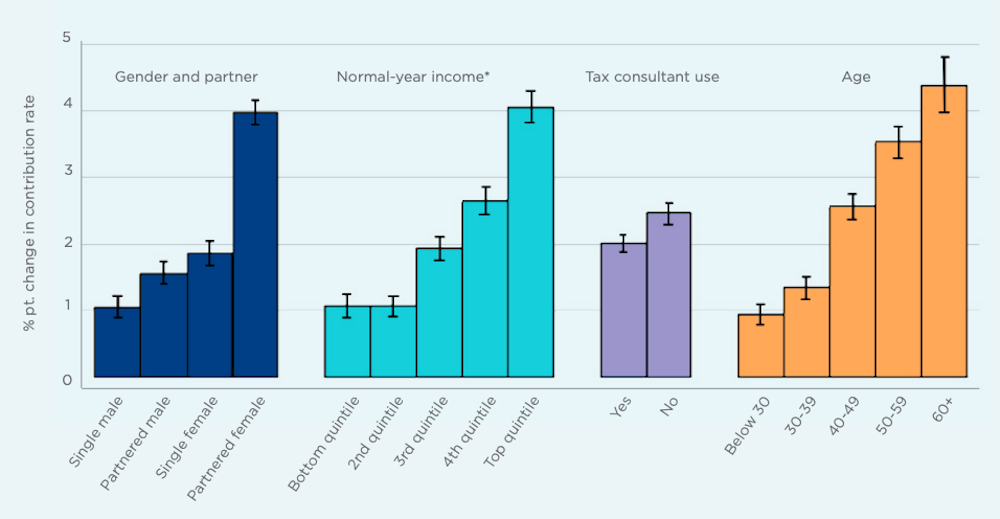
Impacts of the Superannuation Co-contribution Scheme on sub-group voluntary after-tax contribution rates, average across match rates.

Melbourne Institute, CC BY

Strikingly, our analysis indicates those taking advantage of the scheme would have made slightly higher voluntary super contributions without any co-contribution.

The difference is slight – on average of $20 to $50 a year, depending on the co-contribution rate – but the whole point of the scheme is to encourage higher contributions, not provide a subsidy for people to contribute at the same (or a marginally lower) rate.


Read more:
Yes, women retire with less than men, but boosting compulsory super won’t help


Failing to make a difference here and overseas

These disappointing results from the scheme are in line with findings of similar schemes in the United States and Germany.

There are two possible reasons.

The first is that people may be unaware of the scheme. But we find no evidence for this. For example, our analysis indicates those who use tax agents – who are likely to be aware of the scheme and pass on such knowledge to their clients – are no more likely to use the scheme than those who do their own tax return.

The second reason is the more obvious one.

Most people on lower incomes don’t have spare cash to put into super. This is why increases have been minor even with a matching payments rate three times higher than now. If you don’t have the spare cash, it doesn’t make much difference a what rate the co-contribution is set.

Our findings cast serious doubt on the point of the superannuation co-contribution scheme. Despite its relative simplicity and generosity, it has done little to lift the retirement savings of low and middle-income Australians as intended.

The real beneficiaries of the scheme have been the small minority of eligible people who were already contributing. For them, this has been a windfall that has allowed them to reduce their personal contributions while still achieving their desired contribution levels.


Read more:
Retirement incomes review finds problems more super won’t solve


The Conversation

Cain Polidano receives funding from Australian Research Council.

Ha Vu receives funding from the Australian Research Council.

Marc Chan receives funding from the Australian Research Council.

Roger Wilkins receives funding from the Australian Research Council.

ref. Super co-contribution has cost $10 billion to help the wrong Australians – so let’s scrap it – https://theconversation.com/super-co-contribution-has-cost-10-billion-to-help-the-wrong-australians-so-lets-scrap-it-180680


The singing was great – but what was it about? Why opera companies should explain themselves better

Source: The Conversation (Au and NZ) – By Peter Tregear, Principal Fellow and Professor of Music, The University of Melbourne

Jeff Busby/Opera Australia

Opera Australia has received outstanding reviews for its Melbourne season of Richard Wagner’s opera Lohengrin.

The casting of German singer Jonas Kaufmann in the title role has been universally praised. Kaufmann demonstrates to the hilt the kinds of vocal skill and dramatic artistry that have led him to be considered by many to be the greatest tenor in the world today.

The staging, however, has not been received so positively.

The opera is directed by Frenchman Olivier Py, in a co-production with the national opera of Belgium, the Théâtre Royale de la Monnaie in Brussels.

Wagner drew inspiration for Lohengrin from Wolfram von Eschenbach’s 13th century rendering of the legend of the Knight of the Swan, alongside actual events from the foundation years of the Holy Roman Empire around the 10th century.

The production is set in an apocalyptic post-second world war landscape.
Jeff Busby/Opera Australia

In Cy’s rendering, however, we are presented with an apocalyptic post-World War II landscape where death reigns. Graffiti daubed on walls quotes from Paul Celan’s poem Todesfuge (1945). Other scenic interpolations are drawn from esoteric Nazi iconography – such the Celtic Cross and the Black Sun (Schwarze Sonne).

This is not unusual. Over the past 80 years or so, operas have increasingly been reframed to provide a vehicle for commentary: either on the composer and society that created them, or on our own times. The original plot and setting is something to be riffed off, rather than revered or reproduced.

In Europe, useful background and context for these interpretative overlays is usually provided to the audience through accompanying program essays.

In Australia, we seem to be missing out on such outreach.

The director’s opera

This kind of opera production is commonly known in opera circles as Regieoper, or director’s opera.

The most influential early practitioner was Richard Wagner’s grandson, Wieland Wagner (1917–1966). In the years immediately after the second world war, Wieland tried to distance his grandfather’s operas – and the festival theatre he built for them in Bayreuth, Germany – from their prominent appropriation by the vanquished Nazi regime.

Typically, he substituted the naturalistic settings of the original works with minimalist stagings that foregrounded their underlying psychological meanings.

A 1973 performance of Wieland Wagner’s 1951 production of Parsifal for Bayreuth.

Subsequent Regieoper directors have been more interested to draw our attention precisely to the historical and ethical fault lines in these (and other) operatic works. Such productions commonly ask the audience to reassess the value (and values) which may have been simply presumed in the opera’s original staging.

Melbourne-born director Barrie Kosky’s 2017 production of Wagner’s Die Meistersinger von Nürnberg is a celebrated recent example. Here the opera’s plot – based around a medieval music competiton – is re-framed to put aspects of the composer’s infamous antisemitism on trial.


Read more:
Why we must keep talking about Wagner and antisemitism


But such directorial interventions rely on the presumption that audiences are already aware of the history and context of the original.

In the case of a German opera-going public watching a German opera, this may be a reasonable assumption. In Australia, arguably, it is less so.

The importance of the program essay

In many other countries, helpful background information and context is offered to audiences in the accompanying program.

It seems folly to assume a Melbourne audience will instinctively be able to appreciate how an 1848 opera based on a German medieval fable might serve as a commentary on events from 1945.

When this Lohengrin opened at the Théâtre Royale it was accompanied by substantial program essays that detailed not only why the Lohengrin story first attracted the attention of its notoriously politically minded composer, but also why Py now saw fit to link the work to Germany’s more recent past.

No such explanatory material was found in the program supplied by Opera Australia.

An otherwise fine essay by Wagner scholar Heath Lees provided some general historical background, but it offers no bridge between the work and what the audience now sees on stage. No mention was made, either, of the remarkable first Australian performances of Lohengrin in Melbourne in 1877.

The production’s symbolism was explained in extensive program essays at its run in Belgium.
Jeff Busby/Opera Australia

As much as the opportunity to witness Kaufmann’s vocal mastery might yet have been “enough to justify the price of the tickets”, Opera Australia does the art form no favours if it gives the impression it is first and foremost just a vehicle for a vocal superstar.

Ironically, such an impoverishment of theatrical, and indeed social, ambition for opera was a danger that Wagner himself famously rallied against.

An informed audience

Opera Australia should have enthusiastically seized the opportunity to educate its audience about why this production took the form it did. Its public role, after all, should not be just to entertain us, but also to inform and at times – as Regieoper seeks to do – challenge us.

By actively helping to set the scene, as it were, Opera Australia can also show how historic works like Lohengrin – nominally separated from our everyday lives by content, time or place – can still speak meaningfully to us, whether or not they are presented in a “traditional” or Regieoper garb.

Heritage art forms like opera ought to be able to sit comfortably alongside cutting-edge contemporary work as part of a fully rounded national culture but audiences should always be encouraged to understand and engage with that heritage critically.

Ultimately, encouraging a healthy and honest dialogue between our various pasts and our multifaceted present is one sure way we have to imagine a better future.


Read more:
How Australian opera lost the plot


The Conversation

Peter Tregear is chair of Melbourne-based not-for-profit chamber opera company IOpera.

ref. The singing was great – but what was it about? Why opera companies should explain themselves better – https://theconversation.com/the-singing-was-great-but-what-was-it-about-why-opera-companies-should-explain-themselves-better-183133

Dutton, set to become Liberal leader, wants people to see ‘the rest of my character’

Source: The Conversation (Au and NZ) – By Michelle Grattan, Professorial Fellow, University of Canberra

Peter Dutton has declared there is more to him than his tough side, as he formally announces he will stand for the Liberal leadership.

Dutton, set to be unopposed when the Liberals meet next week, also included with his statement a testament from wife Kirilly, who described him as compassionate and witty, saying he hid a lot of his emotion from the public.

The former defence minister, who is from Queensland, portrayed himself as more complex that his hard-man public image. But he also said that in a prime minister, “you need someone who won’t buckle in hard times and will stand up for our country and I have proven that in the portfolios I’ve had”.

Although accepting there is no one else, Liberals are divided over the prospect of Dutton, from the right, as leader.

This reflects the differences within the party about whether, after being defeated by Labor and losing seats to a wave of teals, it should now tack right or left.

There is concern about the entrenched negativity towards Dutton in the public mind, shown in his low rating in polls, and the difficulty of selling him in Melbourne and Sydney.

The Liberals had expected that if they lost the election Josh Frydenberg would become leader, but he was defeated by teal independent Monique Ryan.

Former home affairs minister Karen Andrews said on Wednesday Dutton would be elected unopposed and predicted former environment minister Sussan Ley, from NSW, would be deputy.

Dutton’s bid to broaden his image echoes a similar attempt during his challenge to Malcolm Turnbull in 2018, when he welcomed the chance to “smile and maybe show a different side”.

In his statement Dutton highlighted that he came from the suburbs, as some in the party are arguing its future lies more in the suburbs than in the urban seats that have been lost in this election.

Dutton said his “work ethic is second to none and I have the skill and experience having served five leaders and have learnt from each. I have held portfolios in government and opposition, including: defence, home affairs, health, finance, assistant treasurer, sport and employment.”

He said he’d had “tough jobs – firstly as a policeman dealing with serious sexual assaults and murders, to home affairs minister where I deported drug traffickers and child sex offenders”.

But “most people have only seen that side of me.

“I hope now, in moving from such tough portfolios, the Australian public can see the rest of my character. The side my family, friends and colleagues see.

“The side my community sees where they have elected me eight times. I come from the suburbs and I have never changed my values or forgotten where I have come from.”

Dutton also indicated he accepted the Liberal party’s broad nature.

“We aren’t the Moderate Party. We aren’t the Conservative Party. We are Liberals. We are the Liberal Party.

“We believe in families – whatever their composition. Small and micro businesses. For aspirational hard working ‘forgotten people’ across the cities, suburbs, regions and in the bush.”

Dutton said he was raised by political mentors John Howard and Peter Costello.

“I was a minister under John and assistant treasurer under Peter.

“Things are going to be tough under Labor – higher interest rates, cost of living, inflation and electricity prices.

“Labor talked a big game on the economy. They now have to deliver and we will hold them to account.

“We will be a strong alternative at the next election with economic policies to help, not harm people. This will be in stark contrast to what we will get under Labor.”

Kirilly Dutton said her husband was “an amazing father and the kids adore him.

“He has a great sense of humour – very dry and witty but he also has an incredible compassion. Particularly when it comes to the protection of women and children.

“He hides a lot of his emotion from the public but he gets most upset at reports of children or women being sexually abused or harmed. It obviously stems from his time as a policeman working in that area but it’s also from being the eldest of five kids growing up in the suburbs.”

On Wednesday Dave Sharma, who lost Wentworth to “teal” candidate Allegra Spender, said people had been “almost visceral” in their reaction to Scott Morrison.

“They would say that he is too religious, didn’t like he carried coal into parliament, they didn’t believe his sincerity on climate change and didn’t like our handling of Brittany Higgins and Grace Tame,” Sharma said.

The Conversation

Michelle Grattan does not work for, consult, own shares in or receive funding from any company or organisation that would benefit from this article, and has disclosed no relevant affiliations beyond their academic appointment.

ref. Dutton, set to become Liberal leader, wants people to see ‘the rest of my character’ – https://theconversation.com/dutton-set-to-become-liberal-leader-wants-people-to-see-the-rest-of-my-character-183838

PNG faces K105m Indonesian penalty for illegal black oil shipments

By Melisha Yafoi in Port Moresby

The Papua New Guinean government can expect to be fined a hefty US$5 million (K17.6 million) each for six illegal shipments (K105 million total) of waste oil being transported to Singapore through Indonesian waters.

A formal notice was issued by Indonesia’s Ministry of Environment and Forestry last Friday to PNG’s Conservation and Environment Protection Authority.

This is after six shipments of waste oil from two large gold mines and a state utility company in PNG were seized in Singapore and Indonesia.

These shipments were fuel oil delivered as vessel slops, refined oil and fuel oil claimed to be illegally shipped and labelled as fuel oil or refined oil to avoid the costly permit process.

The issue is that these materials require different clean-ups in the event of a spill and could potentially cause significant delays in cleaning up.

A letter from Indonesia’s chief compliance officer Basel Protocol Department Siti Muhammad, the Basel Protocol Department of the Ministry of Environment and Forestry (Indonesia) to CEPA, obtained by this newspaper, read that Indonesia was “highly disturbed” that this practice was continuing with no hindrance from the relevant authority (CEPA) in PNG.

Muhammad said that next week their consular-general would deliver initial paperwork for the penalty of US$5 million per shipment to Prime Minister James Marape’s office for payment as they had been tolerant long enough.

No document flow
She claimed several of the shipments were sent with a clearance from CEPA, yet with no document flow as required under the Basel Convention.

“This is highly irresponsible as not even basic analysis samples were provided,” she said.

“Given that we have been absorbing the illegal materials from Papua New Guinea while this process was followed, we are no longer able to do so seeing as there is no actual program in place from PNG to manage their own hazardous materials.”

PNG, as a signatory to the Basel/Waigani Conventions (international agreements) that outline conduct requirements for waste management, should be held liable or comply with strict guidelines regarding the trans-boundary shipments of waste oils in place.

A Hachiko Efficiency Services spokesperson confirmed with the PNG Post-Courier that there were regular shipments of waste oil from PNG being transported to Indonesia and Singapore, and other international destinations.

The spokesperson claimed that while they had been given the export permit by CEPA in 2019, they had not exported since, as their programme was put on hold pending approval from the PNG government.

The Singapore-based company, Hachiko, has been working closely with the Singapore National Environmental Agency (NEA) and the Indonesian Department of Environment and Forestry under a blanket agreement that the refineries in Singapore can take in waste oil from PNG to be recycled using its export permit.

Risk of illegal shipment oil spills
“Until PNG has a formal waste oil management programme in place, it holds the risk of any illegal shipments causing spills and will be liable for any demurrage and cleanup costs (in the case of Singapore this would be US$40 million a day or K140 million),” the spokesperson said.

“This is similar to the Simberi oil spill in Honiara a few years ago.”

Last year, a shipment allegedly carrying Ok Tedi fuel oil shipped from Tabubil to a contractor in November and then left PNG for Malaysia in December.

The containers were trans-shipped through Singapore and were inspected by the NEA as one of them was leaking.

The Post-Courier was informed that the NEA conducted an investigation as the product was shipped in flex bags, which is illegal for fuel oil.

The containers upon testing were found to contain contaminated waste oil (contaminated with glycol, cyanide, water and metal content) and were seized by the Pollution Control Department (PCD) in Singapore.

CEPA acting managing director Gunther Joku said his office had not been informed of this issue and had not signed on any shipments as per the Basel Convention or given export permit to anyone.

Commercial not regulatory issue
He said this was a commercial and not a regulatory issue as the only company CEPA was aware of was Total Waste Management.

Ok Tedi Mining Limited (OTML) in response to these reports said it did not export waste oil directly outside of PNG, maintaining the process was satisfactorily completed from its end before the waste oil was disposed.

“OTML does not export waste oil directly from PNG,” the company said.

“We have a certified contractor that provides this service for us, just as it does for other clients in PNG, which are then all combined and shipped to India, and not Indonesia and Singapore as claimed.

“We have a robust industrial waste management system managed by a dedicated waste management team that ensures any industrial waste material is managed onsite following stringent environmental and health management guidelines before they are disposed.”

According to industry sources, any given year around 15 million litres of waste oil is produced in Papua New Guinea from various industries using high volumes.

Melisha Yafoi is a PNG Post-Courier reporter. Republished with permission.

Print Friendly, PDF & Email

Article by AsiaPacificReport.nz

Top level Chinese delegation headed to Kiribati – questions over Kanton

By Barbara Dreaver, TV1 News Pacific correspondent

Chinese Foreign Minister Wang Yi is to visit Kiribati on Friday for four hours as part of a Pacific tour to strengthen security ties in the region.

It is the first top level bilateral meeting between the two countries since Kiribati switched allegiance to China from Taiwan in 2019.

Concern is mounting over a potential security deal following the PRC’s recent controversial agreement with Solomon Islands which allows it to have military presence in the island nation if requested.

Speaking to 1News, Kiribati Opposition leader Tessie Eria Lambourne said she was “gravely concerned” about any potential security arrangement as she believed it would involve the militarisation of one of its atolls, Kanton Island, and Chinese control over the area.

“Our rich marine territory in the Phoenix Islands Protected Area (PIPA) will be under China’s control for sure,” she said.

The area is valuable for its geo-strategic location, including proximity to United States military installations, along with its rich fisheries resources.

Last year, 1News revealed how the Kiribati government was ditching PIPA, a marine reserve and World Heritage site to open up to commercial fishing in a move believed to have been driven by Beijing.

China funding feasibility study
China is also funding a feasibility study to upgrade the runway and causeway on Kanton Island which has raised alarm in the US and Australia.

Friday’s bilateral meeting which is expected to include discussions about the Kanton Island development was announced late on Tuesday.

A Facebook post from President Taneti Maamau’s office said the high-level state visit was “an important milestone for Kiribati-Chinese relations, as it will strengthen and promote partnership and cooperation between our two countries”.

An exemption is being made for the delegation as Kiribati borders remain closed as a covid-19 safety measure.

While the group will undergo PCR testing when they arrive at the airport, Lambourne said the visit demonstrated the influence the superpower had there.

“Since the lockdown there have been exemptions extended to Chinese nationals who have been coming in and going out of our country without restrictions while our seafarers and other nationals had to wait more than three years to be repatriated,” she said.

“Our democratic system, in fact our very sovereignty , is under attack and we need support to ensure our survival as a democratic nation.”

Delegation arriving in Honiara tonight
The Chinese delegation is expected to arrive in Solomon Islands tonight and meet with the government on Thursday. The group will also be visiting Fiji on Sunday and Monday and Papua New Guinea next week.

Speaking to media from New York today, Jacinda Ardern said it was no surprise Yi was set to visit a number of Pacific countries.

Asked if it was a concern, Ardern said: “We’re very firm that yes of course we want collaboration in areas where we have shared concerns.

“Issues like climate mitigation and adaptation, we want quality investment and infrastructure in our region.

“We don’t want militarisation, we don’t want an escalation of tension, we want peace and stability so we will remain firm on those values.”

Republished with permission.

Print Friendly, PDF & Email

Article by AsiaPacificReport.nz

PM Jacinda Ardern launches US tour with NZ ‘open for business’ message

RNZ News

Prime Minister Jacinda Ardern has spoken to media to demonstrate to the US market that New Zealand is “open for business”, having arrived in the US yesterday.

Her trip includes meeting members of Congress and the UN Secretary-General, attending a launch event for sustainable meat exports, delivering the Harvard Commencement speech, meeting with California governor Gavin Newsom, and meeting with executives of tech giants like Twitter and Microsoft.

With US President Joe Biden in Japan for the launch, and Ardern having only just recovered from covid-19, the hoped-for meeting between the two is still up in the air, but there is optimism from the New Zealand side it will happen.

Ardern’s first event was a sit down with major American tourism media, as part of the drive to update the US market about New Zealand, and she will later meet meet with representatives of US multinational investment management firm BlackRock.

Ardern said the message of New Zealand being open for business and open for travel was really important at this time.

Travelling with a business delegation and doing as much as possible to open doors on their behalf is important, she said.

“Our high level meeting with BlackRock enabled our business delegation to sit face-to-face with a number of influential individuals in their investor sector from the United States. A really thoughtful, interesting discussion and dialogue which all of our business representatives had the chance to participate in.”

Ardern said the dominant issue discussed was sustainability.

Watch the PM speaking

PM Ardern in the US.      Video: RNZ News

One-on-one with UN chief
Ardern also had a one-on-one with the United Nations Secretary-General Antonio Guterres, where Ukraine was top of the agenda.

Ardern was keen to hear the secretary-general’s perspective on the war in Ukraine and to offer New Zealand’s support in the ongoing diplomatic work.

She said it was a chance to “discuss everything from the conflict in Ukraine to climate change and more broadly, the role that New Zealand can play in UN reform which we’ve long been an advocate and supporter of”.

“A really fruitful discussion but really useful to hear the secretary general’s reflections on the current conflict,” she said.

Ardern said that predominately the focus was on issues of climate sustainability and the war on Ukraine.

“Any reflection on the relationship between China and the United States whilst ultimately that is a matter for them, what we will continue to advocate is for peace and stability in our region, including any discussions around increasing tensions around Taiwan.”

Ardern said NZ would continue to be strong advocates of the US using the CPTPP as its port of call for a meaningful trade option.

‘An alternate framework’
“They have proposed an alternate framework, our mission as a country needs to be to keep our aspirations high but also work with what’s on the table,” she said.

“Ultimately the CPTPP is an existing framework that offers a significant amount from New Zealand’s perspective. However we will also engage with what’s currently on the table.”

Ardern does not yet have an update on a meeting with Biden.

Ardern said that having an independent foreign policy meant New Zealand had been very consistent in maintaining its values of peace, stability, the use of dialogue and the importance of multilateral institutions like the UN as an honest broker in difficult situations.

“There is tension in our region, we have our various periods of time seen escalation in language, we will constantly call, on New Zealand’s behalf and ours, on peace and stability in our region.”

The Chinese foreign minister is doing a tour of a number of Pacific nations. Ardern is not surprised by this.

“It’s not necessarily just presence, it’s the nature of that presence and the intention around it,” she said.

‘We want collaboration’
“From our perspective within our region, we’re very firm that yes, of course, we want collaboration in areas where we have shared concern, issues like climate adaptation and mitigation, we want quality investment and infrastructure in our region, we don’t want militarisation, we don’t want an escalation of tension.

“We want peace and stability so we will remain firm in our values.”

She said the question would continue to be whether some of those engagements were necessary.

Ardern’s day will be rounded off with a repeat appearance on The Late Show with Stephen Colbert.

Just before departing New Zealand, she virtually attended the launch of the Indo-Pacific Economic Framework, an alliance of 13 countries including New Zealand that proposes joint efforts on climate change and digital issues but is widely considered a US attempt to limit China’s economic influence.

The IPEF also includes the members of “the Quad” – the US, Australia, India and Japan – who have been meeting in Tokyo, along with Brunei, Indonesia, Malaysia, the Philippines, Singapore, South Korea, Thailand and Vietnam.

Together, the grouping represents 40 percent of the world’s GDP.

This article is republished under a community partnership agreement with RNZ.

Print Friendly, PDF & Email

Article by AsiaPacificReport.nz

Police warn PNG public about robbers after attack on Unitech students

PNG Post-Courier

Papua New Guinea police have warned the public to take precaution with criminals now operating in large numbers in some suburbs of the second city Lae after an attack on University of Technology students.

Metropolitan police commander Chief Superintendent Chris Kunyanban issued the warning following the attack on Unitech when more than 30 armed criminals entered the female dormitory and robbed the students.

He warned such crimes were taking place at particular areas of Igam block, Stone Gat and East and West Taraka.

“These are the areas that criminals are operating in large numbers to steal small things such as household items to breaking and entering a store,” Chief Superintendent Kunyanban said.

According to police reports, the criminals stole mainly personal belongings such as laptops, phones and bags.

A female student was injured during the robbery when she tried to scream for help.

The student was admitted to hospital and police are continuing investigation.

‘Serious security breach’
“It is a serious security breach and the institution must be very considerate with the safety of its students, especially with female students or employees living in the campus,” Chief Superintendent Kunyanban said.

“Security should be sufficient to guarantee the students’ safety.”

He said police investigations were still underway to determine what really happened and how many things were stolen.

“It is also dangerous when you have a large number of people going around causing damage in the communities because the impact can be great and people can get injured like the recent incident,” he said.

Chief Supt Kunyanban said security measures on campus were internal matters of the institution.

According to police, more than 30 criminals went into the dormitory on early Friday morning and held up the students.

A student victim, who requested anonymity, said there were more than 10 men who broke into her room as she could not count.

‘Pointed guns at me’
“They pointed guns at me and were asking for my laptop,” she said.

She described the guns as brand new and almost all of the men had one.

“We couldn’t scream or call for help as we had guns pointed at us,” she said.

“One of the burglars asked for my phone and I told him that it was outside and he hit me on my side with a crowbar.”

She said the Uniforce arrived about 20 minutes later.

Men from the staff residential area arrived earlier and tried to pursue the robbers but without success.

Republished with permission.

Print Friendly, PDF & Email

Article by AsiaPacificReport.nz

‘We’re listening and we’ll do better’, new minister Wong tells Pacific

RNZ Pacific

Australia’s newly sworn-in Foreign Minister, Penny Wong, says the new Labor government “will be a generous, respectful and reliable member of the Pacific family”.

In a message addressing the region on Monday, Wong set the tone for Australia’s renewed priorities for its island neighbours.

Wong said Australia recognised climate change was “central to the security and well-being of the Pacific”.

She said the Labor government had heard the Pacific and would act to address the climate crisis.

She added Australia would also boost assistance to support the region’s pandemic recovery, enhance defence and maritime cooperation, as well as expand opportunities and improve the working conditions for more than 24,000 Pacific workers in Australia.

“I’ve become foreign minister at a time when our region faces unprecedented challenges. But we will face these challenges together, and we will achieve our shared aspirations together,” she said.

“We want to help build a stronger Pacific family. That is why we will do more, but we will also do it better. We will listen because we care what the Pacific has to say.”

The Australian Labor Party’s win in the 2022 general elections was its first such victory in almost a decade, defeating a conservative coalition government led by Scott Morrison.

While the count continues, Labor currently has 74 seats with independents holding 15 and the Liberal Coalition 53.

Labor needs 76 for an outright majority.

This article is republished under a community partnership agreement with RNZ.

Print Friendly, PDF & Email

Article by AsiaPacificReport.nz

Fiji tourism back on its feet with a fresh focus on sustainability

By Sheryl Lal and Akansha Narayan in Nadi, Fiji

Although Fiji was unaffected by the first wave of covid-19, its tourism sector — the lifeblood of the economy — has been devastated by border closure across the world due to the pandemic in the past two years.

Thus, when the Fijian Tourism Expo (FTE) returned after a break of two years, Fiji Tourism’s CEO Brent Hill was in an upbeat mood, especially because they have been able to attract more than 500 participants to the Expo in these competitive times for the travel industry.

But, having experienced the vulnerabilities, sustainability was very much in focus during presentations at the event here.

In 2022, Tourism Fiji comes with a vision to “inspire the world to come and experience Fiji — where happiness finds you” and our purpose is to “ensure that Fiji is promoted and marketed as a tourist destination for the purpose of maximising sustainable and long terms benefits to Fiji”, said Hill, in presenting a brief overview of their past achievements and their two-year strategic plan to the FTE.

The 8th FTE was held on May 11-13 at the luxury Sheraton Beach Golf and Spa Resort near Nadi, the gateway to Fiji where its international airport and many tourist resort islands are located.

The three-day event attracted more than 88 exhibiting companies, 90 buyers and 10 media delegates eager to learn the strategic plan Tourism Fiji has set for the small island nation.

The semi-government agency was supported by Fiji’s Ministry of Commerce, Trade, Tourism and Transport and was declared opened by Minister Faiyaz Koya, who highlighted the negative impact of covid on the tourism industry.

‘Guided by robust policies’
“During this time, we were guided by robust policies that led to our border re-opening,” he said in his opening address.

“Our out-of-work tourism workers were among those supported by half a billion dollars (US$230 million) in direct and indirect assistance paid by the Fijian government. We took the last two years as an opportunity to re-invest.

“From upgrading our tourism facilities and renowned hospitality, to piloting new products.”

Hill’s presentation at the FTE highlighted that during the pre-pandemic period, the tourism sector represented 38 percent of the Fijian economy bringing in 36.5 percent employment making up over 118,000 jobs in a population of just over 896,000.

In 2019, the overseas visitor economy in Fiji was worth F$3 billion (US$1.37 billion) and had attracted 960,000 international arrivals, mainly from Australia, New Zealand, Europe and the United States.

Fast forward two years later into the post-pandemic period, the plan of tourism Fiji is to increase the visitor economy to F$3.37 billion.

Also, a high end goal of attracting 1 million international visitors by 2024 has been set. Hill highlighted that the two year strategic plan, 2022 to 2024, was strategised after consultations were done by meeting with tourism industry and also seeking people’s feedback on what Tourism Fiji’s priorities should be.

Six key priorities
From these consultations, they have pulled out six key priorities for the two year plan.

Sustainability is a key ingredient of the plan that includes shaping perceptions of Fiji, promoting the value of tourism to Fiji and enabling an efficient, high performing and innovative team to take the industry forward.

“For Tourism Fiji, it is very important as an organisation that we set our values. As a team, we really wanted to identify the core of who we are as a true Fijian and I’m very proud of the values that we actually came up with as a team and we want to make a difference,” said Hill.

Citing data from the global benchmarking agency Smith Travel Research (STR), Hill said that in 30 of Fiji’s key hotels that accounts for about 8500 rooms, the occupancy was running at 20 percent levels.

“That is a stunning rebound recovery and not to be sneezed at,” he points out, adding, “I know that there is dozens of tourism organisations around the world that would be begging to have their occupancy at those kinds of levels.”

Many of the exhibition booths at the FTE represented luxury boutique type resorts in small “paradise” islands that surround Fiji’s main islands of Viti Levu and Vanua Levu.

Many of these islands are so small that it may include just the resort which is usually privately owned (leased from traditional land owners).

Resort occupies whole island
One such resort is Beachcomber Island, just 17 km and 40 minutes by fast ferry from Port Denarau, the site of the Expo.

The resort occupies the whole of the privately owned 8 ha island, where staff works on a 21 day shift followed by 7 days leave to go back to “civilisation”. The resort which is very popular with foreign tourists was closed from 20 March 2020 until April 1 this year.

The resort manager, Nemia Merani, that she had to keep a skeleton staff of 5 during this time to help maintain its facilities, even though they had no income coming.

Pre-pandemic they used to employ 50-60 staff but now they only have 15-20 staff on the island.

“People from overseas are still hesitant to come,” she said. “Things that help us are day visitors not only weekends but weekdays too.

“We are selling to locals everyday. During the weekend we have a surge in numbers and after this we go right down again.”

Ironically, this resort was too expensive for local tourists pre-pandemic but the prices have been reduced for locals now.

‘Overseas visitors slowly picking up’
“Overseas visitors — especially from Australia — are slowly picking up and if that continues we will survive,” Merani said optimistically.

From presentations made at the Expo, the pandemic has also raised awareness among tourism operators here about the sustainability of the industry and the need to tap into local resources much more.

Even the five-star Sheraton hotel where the Expo was held made a special presentation on how they are developing a supply chain of local farmers feeding into their menus.

Since the borders were opened on December 1 last year, according to government figures, 119,000 tourists have arrived in Fiji, with 46,000 coming in April alone.

“I believe that we can work together collectively for providing the value of tourism to Fiji,” argues Hill pointing out the networking that took place here.

“Part of that is that we need to continue to tell the story of tourism and tell the story of what it is that we’re all about.”

Sheryl Lal and Akansha Narayan are final year journalism students at the University of the South Pacific in Suva, Fiji. This story ror In-Depth News was initially published in USP’s student journalism newspaper Wansolwara. Both IDN and Wansolwara collaborate with Asia Pacific Report.

Print Friendly, PDF & Email

Article by AsiaPacificReport.nz

Eden-Monaro and Gippsland are next-door neighbours: why is one seat safe and the other marginal?

Source: The Conversation (Au and NZ) – By Erik Eklund, Professor of History, Federation University Australia

The recent federal election saw some close calls but few surprises in the regions, where wild electoral swings are rare.

But we should look closer at two regional seats that straddle the NSW/Victorian border: Eden-Monaro and Gippsland. Despite their geographic proximity, these two seats repeatedly return very different results.

Gippsland shows the risk for Labor of never seriously contesting a “safe” Nationals seat, while the example of Eden-Monaro shows it’s possible for Labor to win regional seats if enough resources and time are put in over the long term.

A bellweather seat and a ‘quiet’ regional

The New South Wales seat of Eden-Monaro takes in the far south coast, the Monaro region, and the town of Queanbeyan bordering the ACT.

It’s widely regarded as a bellwether seat because it is usually held by whichever party wins government. This election, sitting Labor member Kristy McBain was returned, with her primary vote up 4.4% and her two-party-preferred vote up by 7.8% to 58.7%.

The neighbouring seat of Gippsland, by contrast, is the typical”quiet” regional, being held by Nationals and their predecessors for more than 100 years.

Gippsland is next to Eden-Monaro on the southern side of the border from Mallacoota and Cann River in the east, through to the Latrobe Valley towns of Traralgon, Morwell and Churchill in the west. At the 2022 election, long-standing Nationals MP Darren Chester increased his primary vote by 1.3% and two-party-preferred vote by 4.4% to 71.1%.

How can we explain such differences across these neighbouring regional electorates?

Gippsland: home to a long-standing incumbent

Chester has been the member for Gippsland since 2008. This level of incumbency gives him a great advantage.

Major parties have increasingly run targeted seat campaigns funnelling resources and volunteers into metropolitan marginals. In other words, marginal city seats get all the love.

This becomes a self-fulfilling prophecy. Safe seats are not contested and the incumbent is easily returned, often with an increased majority. This makes future efforts even less likely.

The last major campaign that saw a federal Labor leader visit the seat of Gippsland was Kevin Rudd’s visit before the Gippsland by-election in June 2008. At that time the seat was still within striking distance for Labor with only a 5.9% swing needed.

Eden-Monaro: a short drive from parliament

Eden-Monaro by contrast has a high profile and national standing. Parties want to win it, academics have often studied it and senior politicians are regular visitors.

Proximity to Canberra is a key factor: Eden-Monaro is just a short drive from parliament house.

In the early stages of Anthony Albanese’s leadership, he staked his reputation as a new opposition leader on a “captain’s pick” in Eden-Monaro – former Bega Valley Shire Mayor Kristy McBain.

The strategy paid off. McBain won a narrow victory at the July 2020 by-election.

Drilling down into specific booth votes in Eden-Monaro reveals further important differences.

Both Queanbeyan and the Latrobe Valley towns have a bloc of Labor voters. But while Labor wins decisively in most Queanbeyan booths, it barely outpolls the Nationals in the Valley, and in some cases comes in second. This is likely due to the privatisation and de-industrialisation in the energy sector, which affects jobs in that area.

Both electorates have a small though committed band of Greens who secure 6% to 10% of the vote, and another 10% goes to minor parties such as the United Australia Party and One Nation. But Labor’s capacity to remain competitive in the small rural towns of Eden-Monaro stands out.

Labor polled 43% of the primary vote at Bombala in the southern portion of Eden-Monaro, beating the main Liberal rival at 38%.

Just two hour’s drive south in Orbost, in the Gippsland electorate, Labor polled less than 16% of the primary vote. The incumbent Nationals won 58%.

This strong Labor vote in the small towns of Eden-Monaro hint at the continuation of a deeper tradition, which equated rural working people with the Labor interest.

This tradition is alive and well in Eden-Monaro, as former Prime Minister Scott Morrison’s poor 2020 reception in fire-ravaged Cobargo showed. (Incidentally, Cobargo returned a Labor vote of 38%, beating the main Liberal challenger at 29%.)

A tale of two electorates

So small town Eden-Monaro votes Labor while small town Gippsland votes National – even though they’re so geographically close. Why?

Incumbency in Gippsland has enabled the Nationals to oust Labor as the main party of small business owners and small town working class families.

Fewer resources and fewer high profile visits have shaped a long tradition of Labor underperformance, while the Nationals are buoyed and replenished by regular electoral success.

Chester’s performance in the lower house undoubtedly assists the state-wide Senate vote helping the Coalition secure at least two Senate quotas.

By not seriously contesting the safe regionals, Labor worsens its declining primary vote.

But the example of Eden-Monaro however shows this is not necessarily the case, and that a well resourced campaign over many elections could turn an otherwise safe Nationals seat.

The Conversation

Erik Eklund’s partner was the Labor candidate for Gippsland at the 2019 federal election, and he worked as a volunteer on her campaign.

ref. Eden-Monaro and Gippsland are next-door neighbours: why is one seat safe and the other marginal? – https://theconversation.com/eden-monaro-and-gippsland-are-next-door-neighbours-why-is-one-seat-safe-and-the-other-marginal-183724

Clive Palmer and One Nation flopped at the election. What happened?

Source: The Conversation (Au and NZ) – By Benjamin Moffitt, Associate Professor, Australian Catholic University

Many commentators tipped Clive Palmer’s United Australia Party (UAP) and Pauline Hanson’s One Nation to perform well this election by scooping up the “freedom” and anti-vax vote from voters angry about how the pandemic was handled.

But this wasn’t the case.

The parties did see a modest rise in their vote, but not enough to translate into significant electoral success. Neither party won any seats in the lower house.

UAP candidate Ralph Babet is likely to pick up Victoria’s sixth Senate seat – in part thanks to preferences from the Coalition, who put UAP second on their how to vote cards in the state. But this may be all Palmer gets for his obscene campaign spending.

UAP leader and former Liberal MP Craig Kelly lost his seat of Hughes, and Palmer failed in his bid for a Queensland Senate spot.

One Nation also failed to pick up any extra Senate seats. Pauline Hanson is projected to hold onto her Senate seat, only just, while Malcolm Roberts continues as a Senator having earned a six year term in the 2019 federal election.

As a populism researcher, I’ve taken a keen interest in these minor parties. Here’s why I think they did so badly.


Read more:
What actually is populism? And why does it have a bad reputation?


United Australia Party

UAP garnered about an extra 0.7% of the national primary lower house vote compared to 2019 (for a total of 4.1%), after spending an estimated A$70$100 million. In Queensland the party has thus far secured just 4.3% of the Senate vote – and this is where Palmer himself was the lead Senate candidate.

While in 2019, the party didn’t have much of a platform outside of being anti-Bill Shorten, this wasn’t the case in 2022. They had visible policies on cost-of-living, such as housing affordability and investing Australian superannuation funds in Australian companies.

The party also tried to position itself as the voice of the “freedom” movement, opposing COVID lockdowns and vaccine mandates.

The fact that none of this seemed to resonate – particularly their interest rate policies – surprises me.

I expected the party’s populist, anti-major party, “freedom” agenda to resonate in some parts of the country. For example, many predicted UAP would poll well in the outer suburbs of Melbourne where there’s high levels of anti-lockdown and anti-Dan Andrews sentiment.

While it did poll better than it has before in some of these areas, it didn’t translate into electoral success, nor make much of a dint in preferences as it did last election.

One Nation

One Nation struggled despite fielding candidates in 149 of 151 House of Representatives seats.

The party’s national primary lower house vote increased a bit – up about 1.8% to 4.9% – but this was mostly because it ran in many more seats than last election.

Early in the Senate vote count it looked like Hanson might lose her Senate seat, but now she’s projected to just hold on.

She faced fierce competition from Palmer, former Queensland Premier Campbell Newman, and a relatively unknown minor party called Legalise Cannabis Australia. Hanson is very well known – particularly in Queensland – so it was also surprising to see her fighting for her political life against a little known party.

6 reasons why UAP and One Nation flopped

So why did both parties fail to perform as well as some thought they might? Here are some of the key reasons:

  1. They were competing for the same small segment of the electorate. Both are populist right parties, they tried to brand themselves as the parties of the “freedom” movement, and likely took votes off each other in the process.

  2. They were also competing for votes against the right wing of the Coalition, some of whose candidates share very similar views in terms of sentiments regarding immigration and vaccination mandates.

  3. The wind has been taken out of the sails of the “freedom” movement. Since lockdowns finished and almost all COVID restrictions have been phased out, the cause is not as urgent. This freedom banner brought together disparate groups – spanning from the far-right to “wellness” and alternative health groups – but the links between the groups were always tenuous. Now the shared enemy of lockdowns has disappeared, there doesn’t seem to be social, class or political linkages holding them together. If this election was held last year – or even a few months ago – both parties might’ve had more success.

  4. Populists often campaign against the “corruption” of the ruling classes. However, it was hard for UAP or One Nation to get much traction on this as almost every non-Coalition party or candidate – from Labor, to the Greens to the teal independents – was also campaigning on the same issue.

  5. One Nation’s anti-immigration stance is one of its key policies. The fact that Australia had barely any immigration since the beginning of the pandemic made campaigning on the party’s bread-and-butter issue very difficult.

  6. There’s been a lot of talk about parties using “microtargeting” in this election, but UAP’s strategy was the opposite. Their mass advertising and huge billboards were the modern equivalent to throwing a bunch of leaflets out of a moving plane. This election suggests this doesn’t work – you can’t just bombard people.


Read more:
Is this the end of the two-party system in Australia? The Greens, teals and others shock the major parties


None of this means we should write UAP or One Nation off for good. Hanson has proven herself a mainstay of Australian politics, and returned from the political wilderness before.

Meanwhile, Palmer has now contested three separate federal elections – each time, seemingly with a completely different platform. With his deep pockets, who knows whether or what he will run on in 2025.

This federal election, however, was not a “populist moment” for these parties. The real story in 2022 is not on the right, but on the other side of politics.

The Conversation

Benjamin Moffitt receives funding from the Australian Government through the Australian Research Council’s Discovery Early Career Researcher Award funding scheme and from the Marianne and Marcus Wallenberg Foundation.

ref. Clive Palmer and One Nation flopped at the election. What happened? – https://theconversation.com/clive-palmer-and-one-nation-flopped-at-the-election-what-happened-183722

After many false dawns, Australians finally voted for stronger climate action. Here’s why this election was different

Source: The Conversation (Au and NZ) – By Matt McDonald, Associate Professor of International Relations, The University of Queensland

Getty

Before the 2019 federal election, many people expected Australia would vote for faster climate action. That, of course, didn’t happen. But just three years later, the climate election arrived at last. The question is – what changed?

In short: Reality hit. Over the Morrison government’s term, the east coast was ravaged by the Black Summer of megafires. Then came the devastating floods. These disasters proved to us what scientists have long predicted: climate change isn’t a future threat, it’s here, now.

Since 2019, Australia has been under growing international pressure to do more on climate, given we have (correctly) been seen as a laggard. With Biden replacing Trump, our isolation became clear at the Glasgow summit. Polls showed the result: more and more Australians named climate change as an important issue.

Morrison shrugged off these concerns with a non-binding “goal” of net zero by 2050. As Saturday’s election showed, Australians saw through these half-hearted measures and voted accordingly.

Three years of public concern and international pressure

Unexpected wins by the Greens in flood-affected seats along the Brisbane river gave a snapshot of voter sentiment. But earlier images of disaster – pensioners on rooftops in Lismore, overwhelmed firefighters and dying koalas – were hard to shake for many across the country.

In many ways, this election was a perfect storm for the Coalition. Since 2019, the impatience of the international community with Australian delay tactics was clear. Our Pacific neighbours had been consistently critical of Australia’s fossil fuel protectionism, regardless of promises of new funding for the region and the so-called Pacific step-up. Scott Morrison’s speech to a nearly empty room at the climate summit at Glasgow made our isolation clear.


Read more:
If 80% of Australians care about climate action, why don’t they vote like it?


Joe Biden’s victory in the US meant Australians increasingly saw our government as holdouts at the back of the international pack.

These changes came through in growing public concern. Polling in 2021 showed a substantial majority of Australians supported stronger emissions reduction commitments and a commitment to net zero emissions by 2050. Similarly, a YouGov poll in late 2021 found a majority of voters in every Australian seat wanted stronger action on climate change from the government. More than a quarter of voters rated climate change as the most important issue in determining their vote.

A day late, a dollar short

Despite the pressure and clear signals from voters, the Coalition went to the 2022 election with the emissions reduction targets announced by former Prime Minister Tony Abbott in 2015. In addition, they had a non-binding ‘goal’ to reach net zero emissions by 2050, announced only after serious pressure and internal haggling.

The public was sceptical of this promise, due to efforts by segments of the Coalition to immediately walk this back. Outspoken Nationals senator Matt Canavan suggested on election eve the government would consider walking away from its own net zero commitment.


Read more:
The election shows the conservative culture war on climate change could be nearing its end


With Nationals leader Barnaby Joyce leading the internal opposition to net zero, there were concerns the Nationals could hold Australia to ransom on climate even after the election.

We can’t say it was all climate – but it was a key factor

For the Coalition, navigating climate change during the election campaign proved far more challenging than in 2019.

Crucially, they found themselves fighting on multiple fronts. In blue ribbon seats in Sydney and Melbourne the Coalition was confronted and in many cases, beaten, by well-resourced ‘teal’ candidates. These independents appealed to a traditionally conservative electorate concerned about climate change but less likely to switch to a left-leaning party. Liberal candidates in these electorates promised more action on climate, but not much beyond that.

The Greens seemed an easier target for the government. Even so, the concentrated support for the third party in inner-city areas meant attacks by the government didn’t hurt.

Labor’s targets were more ambitious than the Coalition’s, which put them ahead for middle of the road voters concerned about climate change. But stung by their 2019 defeat, Labor actually went to the election with less ambitious emissions reductions targets than they had at the previous election: a 43% reduction by 2030. This made them a smaller target than in 2019 and able to avoid a Coalition scare campaign on costs to jobs and the economy. This might have cost them in inner-city seats like Brisbane’s Griffith with strong Greens campaigns. But it allowed them to hold seats with strong mining constituencies, like Hunter in NSW.

For the Coalition, the changing facts on the ground made it much harder to even run a scare campaign on the costs of climate action. The anticipated declining market for fossil fuels, significant and well-publicised government subsidies for the fossil fuel sector, the plummeting cost of renewables and the ballooning costs of climate change impacts all undermined the power of the narrative that Australia had to choose between economy and jobs or climate action.

Young voters registered to vote in record numbers, while we saw formidable ground campaigns from the Greens and teal independents.

Does this spell the end of toxic climate politics?

If 2022 was the long-anticipated climate election, is it also the end of the toxic politics of climate change in Australia?

That depends on how the Coalition deals with the sting of this defeat. Will they seize the chance for a reset on climate? Or will we see a further shift to the right? Nationals leader Barnaby Joyce has already signalled the possibility of abandoning net zero. With moderate Liberal MPs now thin on the ground, there’s no guarantee of bipartisanship.

If the Coalition doubles down on climate delaying tactics, it would ensure its electoral irrelevance and make genuine climate action easier to achieve in Australia, one of the world’s last holdouts.

The Conversation’s #Settheagenda poll of more than 10,000 readers found more than 60% rated climate change as the top concern for them this election

The Conversation

Matt McDonald has received funding from the Australian Research Council and the Economic and Social Research Council (UK)

ref. After many false dawns, Australians finally voted for stronger climate action. Here’s why this election was different – https://theconversation.com/after-many-false-dawns-australians-finally-voted-for-stronger-climate-action-heres-why-this-election-was-different-183645

When is a COVID mutation a new variant, and when is it a subvariant? And what’s a recombinant?

Source: The Conversation (Au and NZ) – By Paul Griffin, Associate Professor, Infectious Diseases and Microbiology, The University of Queensland

Shutterstock

We’ve all become familiar with virus mutations over the course of the pandemic, and can all probably list off the COVID variants including Alpha, Delta and Omicron. But now we’re hearing more and more about subvariants, as Omicron mutates into Omicron BA.2, Omicron BA.4, Omicron XE, and more.

We know the virus is mutating as it spreads, but when is a new mutation a new variant, and when is it a subvariant? And what happens when they combine?


Read more:
What’s the new Omicron XE variant and should I be worried?


First, what are mutations?

When cells reproduce, they use a set of genetic instructions (made of DNA or RNA) to replicate. But given this is happening at such a rapid rate, sometimes errors can occur.

These errors, or changes in the genetic code, are also called mutations.

In complex organisms such as humans, we are pretty good at finding and fixing these mistakes. But when these finding and fixing processes fail, we see diseases such as cancer arise.

When mistakes happen during the copying of the genetic material in viruses, most of them leave the genetic material too broken to go on replicating, and that virus doesn’t survive.


Read more:
Why are there so many new Omicron sub-variants, like BA.4 and BA.5? Will I be reinfected? Is the virus mutating faster?


Occasionally, by random chance, these errors can happen in a section of the code that allows the virus to survive, and in the process, changes occur in the virus.

When it’s in a part of the virus that determines how it behaves, it can change the properties of the virus.

It may change the severity of the disease it causes, our ability to diagnose the virus with our current tests, or even how well treatments work.

Since it was first reported in the Chinese city of Wuhan in December 2019, there have been more than 520 million recorded cases of COVID worldwide (and probably many more unrecorded cases). That’s a lot of virus replication, and a lot of opportunities for these types of changes to occur.

Man in PPE swabbing man on street
With more than 520 million infections worldwide, the virus has had plenty of opportunity to replicate.
Shutterstock

One of the reasons we have heard so much about these types of changes is our access to genomic sequencing, to determine the genetic code of the virus. This has allowed us to find even small changes in the 30,000-letter code of the virus, essentially in real time.

When these changes are found, the new virus can be described in many ways, mostly depending on how different the genetic code and the resulting properties of the virus are from the parent virus from which it arose.

Some terms also essentially mean the same thing and can be used interchangeably, depending on what field someone works in. While there are many agreed terms that are commonly used, there are not simple universal definitions.

What are variants? Are they different to strains?

A variant is where the genetic code has changed due to a mutation, or a number of mutations. A variant, while different genetically, does not necessarily differ in its behaviour from the parent virus.

The virus that causes COVID is a single species of coronavirus named SARS-CoV-2. For many other viruses (and other organisms), there are multiple “strains” where there have been very significant changes not only in the genetic code, but also in the biological properties and behaviour of the virus. Similarly, all dogs are the same species but there are different breeds, which look and act very differently.

Some researchers would say that so far there has not been a type of SARS-CoV-2 found that differs sufficiently to meet this definition, hence, for now, there is only one strain.

Other researchers, however, have suggested the variants that have displayed different behaviours satisfy the definition of being different strains.

Others again say a new variant that becomes dominant in a population earns the right to be called a strain.

Labrador and chihuahua
The same species can have different types that behave differently.
Shutterstock

What about variants of ‘interest’ and ‘concern’?

To describe the impact of the genetic changes on the behaviour of the virus, there have been a range of different types of variants described.

In collaboration with expert networks, in late 2020, given the emergence of variants that posed an increased risk, the World Health Organization (WHO) characterised “variants of interest” and “variants of concern”.

According to these WHO definitions, a “variant of interest” is a variant with genetic changes that are known or predicted to affect important virus characteristics. These include transmissibility, disease severity, protection from immune responses, reduced ability to find with diagnostic tests, or reduced effect of treatment.


Read more:
Why the COVID-19 variants are so dangerous and how to stop them spreading


To become a variant of concern, a new variant must also have been identified to cause significant transmission and be thought to pose an emerging risk to public health.

Basically, once the potential concerning property that made it a variant of interest has been found to be the case, a variant of interest will then become known as a “variant of concern”.

What are subvariants?

Omicron has been shown to be more infectious than its predecessors, hence has spread swiftly worldwide. Given the resulting abundant opportunities to reproduce, Omicron has had the opportunity to acquire specific mutations of its own.

These have not been deemed significant enough to satisfy the definitions to call them new variants. However, they have had some slightly different properties.

For this reason they have been referred to as “subvariants”. Initially we saw BA.2 arise, which was found to be slightly more infectious than the original Omicron, BA.1


Read more:
BA.2 is like Omicron’s sister. Here’s what we know about it so far


What are recombinants?

There are now a large number of Omicron subvariants, including BA.4, BA.5 and BA.2.12.1. BA.4 was detected in January and is essentially a mixture of BA.1 and BA.3 with some new mutations, making it slightly more infectious than preceding subvariants.

When viruses reproduce inside host cells, they can randomly collect pieces from multiple strains or variants when they reproduce, if the host cell happens to contain both strains or variants.

Given this is basically forming a combination of both virus this process is called recombination. When this happens, the resulting “recombinant” can have properties of either or both viruses.

The Conversation

Paul Griffin does not work for, consult, own shares in or receive funding from any company or organisation that would benefit from this article, and has disclosed no relevant affiliations beyond their academic appointment.

ref. When is a COVID mutation a new variant, and when is it a subvariant? And what’s a recombinant? – https://theconversation.com/when-is-a-covid-mutation-a-new-variant-and-when-is-it-a-subvariant-and-whats-a-recombinant-182333

Planetary waves, cut-off lows and blocking highs: what’s behind record floods across the Southern Hemisphere?

Source: The Conversation (Au and NZ) – By Tess Parker, Research Fellow, Monash University

From February to May 2022, many places in Queensland, New South Wales and Western Australia have seen record-breaking daily and monthly rainfall. Repeated periods of persistent and intense rain have caused devastating and widespread floods.

In Queensland and New South Wales alone, the floods and storms caused an estimated AU$3.35 billion in insured losses, making these the costliest floods in Australia’s history and the fifth most costly natural disaster. More than 20 people lost their lives.


Read more:
The east coast rain seems endless. Where on Earth is all the water coming from?


Similar events have occurred around the Southern Hemisphere. Brazil was hit with heavy rain, flash flooding and landslides in February and March, killing more than 200 people. In April and May it was South Africa’s turn, as torrential downpours destroyed homes and infrastructure, resulting in some 400 deaths and US$1.5 billion in property damage.

Behind most of these intense rain events lies a particular combination of weather conditions: a “cut-off low” over the coast, pinned in place by a “blocking high” out to sea. This configuration itself is not uncommon, but this year’s repeated events and their high impact have been unusual.

What caused the extreme rainfall this year?

Outside the tropics, weather is mainly driven by what are called “Rossby waves” or “planetary waves”. These are wiggles in the jet stream, which is a band of strong winds the upper atmosphere that goes right around the globe.

When winds are displaced to the north or south by mountains or weather systems, they can push part of the jet stream out of its normal position. This undulation in the jet stream is a Rossby wave.

Rossby waves usually then move eastward, guided by the jet stream. Under the right conditions the waves can amplify and break, just like ocean waves at the shore.

When this happens, the breaking wave can form a region of high pressure air at ground level, which may stay in one place for some time. This high-pressure region can in turn cause other weather systems (such as low-pressure systems bearing rain) to stall over one location.

Stalled weather systems that stay put for a long time can lead to prolonged downpours, but also to lengthy heat waves.


Read more:
The North American heatwave shows we need to know how climate change will change our weather


During the flooding on the east coast of Australia, an amplifying Rossby wave formed a high-pressure system over the Tasman Sea, as well as a low-pressure region in the upper atmosphere known as a “cut-off low”.

Three weather maps showing Australia and surrounds.
Australia’s weather on 26 February 2022. A Rossby wave (in pink, left) forms a cut-off low (COL). A region of high pressure forms over the Tasman Sea (H, middle and right) and easterly winds (arrows, middle) around the high bring moisture to the coast (blue/green shading, middle). Heavy rainfall is evident over the east coast (colour shading, right).
Michael Barnes, Author provided

This setup provided the two ingredients required for rain: a supply of moisture, in the form of easterly winds around the high carrying moist air from the ocean to the land; and a mechanism to lift that moisture, provided by the presence of the cut-off low. As the low moved between southern Queensland and northern New South Wales, so did the rain.

The same fingerprint was also seen during the floods in South Africa and Brazil. For the flood events in south-west Western Australia, the moist onshore flow was boosted by a low between the coast and the high to the west over the Indian Ocean.

What does climate change mean for these events?

One of the most difficult challenges for atmospheric scientists is understanding how global warming will change the weather at the regional scale.

Weather forecasts are a crucial tool for mitigating the effects of extreme weather, providing predictions of such events up to a week in advance. Accurate forecasts are vital to afford critical time for response mobilisation, such as warnings, evacuations and deployment of emergency services.

At present, the El Niño–Southern Oscillation, a measure of sea surface temperatures in the Pacific Ocean, is in the La Niña phase for the second year in a row. La Niña is associated with rainier-than-normal conditions over north-eastern Australia, south-eastern Africa and northern Brazil.


Read more:
Stalled weather: how stuck air pressure systems drive floods and heatwaves


In addition, global warming is likely to lead to more intense rainfall because warmer air can hold more moisture. However, we still have a lot to learn about where that rain is likely to fall, and how frequent and intense the rainfall is likely to be.

To understand how extreme weather like this year’s Southern Hemisphere deluges will change as the climate warms, we must understand the underlying physical processes responsible for their development.

At present, different climate models show different things about what climate change means for Rossby waves and wave breaking. The models don’t yet have high enough resolution to explicitly include some of the detailed physical processes related to rainfall, jet streams and Rossby waves.

While the models agree that climate change will alter the position and speed of the jet stream winds, they disagree about what will happen to Rossby waves. Investment in the research necessary to answer these questions is therefore imperative.

The Conversation

Tess Parker receives funding from the Australian Research Council through the Centre of Excellence for Climate Extremes.

Michael Barnes receives funding from the Australian Research Council through the Centre of Excellence for Climate Extremes.

ref. Planetary waves, cut-off lows and blocking highs: what’s behind record floods across the Southern Hemisphere? – https://theconversation.com/planetary-waves-cut-off-lows-and-blocking-highs-whats-behind-record-floods-across-the-southern-hemisphere-183632

Politics with Michelle Grattan: Treasurer Jim Chalmers on the ‘spiky’ parts of Australia’s inflation problem

Source: The Conversation (Au and NZ) – By Michelle Grattan, Professorial Fellow, University of Canberra

New treasurer Jim Chalmers has been in multiple briefings since Sunday, and the message he sends in this podcast is that he is not going to try to gild the economic lily with the Australian community.

He intends to deliver a “pretty blunt, pretty frank” assessment of Australia’s challenges in an economic statement to parliament soon after it returns in June or July.

Chalmers highlights two particularly “spiky” bits of Australia’s inflation problem that are under “extreme pressure” at the moment – power prices and the building industry as the cost of materials rise.

Ahead of his first budget planned for October, Chalmers reaffirms he is “highly unlikely” to be able to renew the temporary six-month cut in petrol excise when it expires in September.

If there was “more we can responsibly do, we will”, but people shouldn’t assume that the cost of living relief in the March budget will continue forever.

Meanwhile Chalmers and finance minister Katy Gallagher are already combing through the numbers to get savings from areas they identify as wasteful spending.

He also speaks about the employment summit planned for early in Labor’s term – which he wants to have a “broad focus” – and cautions against assuming the unemployment rate (at present 3.9%) will be “on a kind of a permanent downward trajectory” given rising interest rates and international uncertainly.

He raises the prospect of changes to the Reserve Bank’s mandate which at present encompasses full employment and price stability, saying that would a matter for an inquiry he promised in opposition and will shortly set up.

The Conversation

Michelle Grattan does not work for, consult, own shares in or receive funding from any company or organization that would benefit from this article, and has disclosed no relevant affiliations beyond their academic appointment.

ref. Politics with Michelle Grattan: Treasurer Jim Chalmers on the ‘spiky’ parts of Australia’s inflation problem – https://theconversation.com/politics-with-michelle-grattan-treasurer-jim-chalmers-on-the-spiky-parts-of-australias-inflation-problem-183813

Surprise! How men react when becoming a dad isn’t part of the plan

Source: The Conversation (Au and NZ) – By Imogene Smith, Casual academic, provisional psychologist and Doctor of Psychology (Clinical) candidate, Deakin University

Shutterstock

For many dads, having a child is unplanned. What happens next can vary. One man said:

We broke up and she called me soon after to tell me she was pregnant […] she just asked me if I wanted to be in our baby’s life and I accepted without thinking twice.

Another said:

I wanted to have an abortion, since we weren’t ready, but it wasn’t my choice, it was hers […] but the resentment was there for a long time.

These two comments came from tens of thousands of posts on the social media site Reddit we analysed as part of our research into men’s experiences of unplanned pregnancy.


Read more:
We studied 100 years of Australian fatherhood. Here’s how today’s dads differ from their grandfathers


Unplanned pregnancies are common

Having an unplanned child is more common than you might think. In Australia 40% of pregnancies are mis-timed, unexpected or unwanted. That’s an estimate comparable with rates worldwide.

Most research on the impact of unplanned pregnancies focuses on mothers. We wanted to know about the experiences of dads. So we turned to two forums specifically for new and expecting dads on Reddit.

We “scraped” tens of thousands of posts, spanning a year, then applied an innovative machine learning technique to group the data into meaningful topics. This allowed us to identify themes in the men’s online discussions.


Read more:
Machine learning is changing our culture. Try this text-altering tool to see how


Here’s what we found

Our research showed men who reluctantly or unexpectedly became fathers experienced a complex range of emotions and reactions. Many needed support.

The dads in our study posted to Reddit using pseudonyms. So they were free to be honest and raw as they shared their emotions on a topic many consider taboo.

Some were “filled with regret”, “sadness”, “guilt” and hopelessness of a “never-ending, soul-crushing grind”. Some lacked bonds with their infants, one feeling “like the tin man without a heart”.

One man said:

I keep on having really bad breakdown episodes. There are days when I just sit and cry thinking how miserable my life has become.

Unplanned fatherhood and postnatal depression

Earlier research shows it’s common for dads to have short periods of negative thoughts after their baby is born. Feelings of loss about their previous life are common.

However, persistent negative and intense emotions may indicate depression and anxiety at this time.

Baby in cot with father in background clutching cushion, holding head
Unplanned fatherhood increases a man’s risk of postnatal depression.
Shutterstock

In fact, unintended fatherhood is linked to an increased risk of a man having postnatal depression.

Paternal depression is, in turn, linked to a higher risk of depression in their partners and more behavioural problems in their children.


Read more:
Dads get postnatal depression too


Let’s debunk some myths

Like earlier research, ours debunks the myth that men do not seek help when in need. Men sought and received advice and support from other dads about everything from night feeds and nappies to reassurance that what they were feeling was normal.

Studies show peer support, often online, can be a foot-in-the-door for men who feel uncomfortable disclosing vulnerability. This is particularly important for a taboo subject such as unwanted parenthood.

In our study, not all men were distressed. Some reported feeling happy “but freaking out” and simultaneously “scared, hopeful, excited, terrified”.

Sharing experiences allowed these fathers to validate and normalise the full spectrum of their emotions and sometimes re-frame a sense of hopelessness.

Men told each other “you are not alone”, “I felt the same”, “it does get better” and “it’s not as bad as people say”.


Read more:
Children’s well-being goes hand in hand with their dads’ mental health


How to reduce the stigma

In this study and our earlier research men said they were concerned that not wanting children would be seen as abnormal.

We hope our work raises awareness that desire for children is not universal. We can do more to normalise and destigmatise varied narratives that represent how people feel about parenthood.

When it comes to family planning, a first step is to include men in discussions about reproductive health before they become fathers and are expecting a child.

Pre-conception planning with health professionals involves becoming physically and psychologically ready for parenthood and is important for mothers, fathers and, ultimately, their offspring.

Once the baby is born, it is important dads have access to support. Family and health-care systems are mainly focused on mothers and infants, and could be better equipped, resourced and trained to detect fathers at risk of mental health problems. Father-inclusive practice is beneficial to fathers, mothers and children.

When things go right

When fathers have access to the right help at the right time, it can make all the difference. One man said:

I ended up going to a psychiatrist after a suicide attempt. It did some good, it faced me with my own immaturity. May I suggest trying it? Everybody is different, but it seriously helped in my case.


If this article has raised issues for you, or if you’re concerned about someone you know, call Lifeline on 13 11 14.

The Conversation

Jacqui Macdonald is convener of the Australian Fatherhood Research Consortium.

Imogene Smith does not work for, consult, own shares in or receive funding from any company or organisation that would benefit from this article, and has disclosed no relevant affiliations beyond their academic appointment.

ref. Surprise! How men react when becoming a dad isn’t part of the plan – https://theconversation.com/surprise-how-men-react-when-becoming-a-dad-isnt-part-of-the-plan-182141

Whose ‘identity’ are we preserving in Auckland’s special character housing areas?

Source: The Conversation (Au and NZ) – By Carolyn Hill, Teaching Fellow, Environmental Planning, University of Waikato

Getty Images

A minor culture war has broken out over Auckland’s urban identity since Auckland Council responded to the government’s new housing rules: on one side, defenders of “special character” areas of historic housing; on the other, advocates for higher-density development with fewer constraints.

The debate can be heated, as people identify with their city in different ways and want different outcomes for its future.

To recap, the recently passed Resource Management (Enabling Housing Supply and Other Matters) Amendment Act seeks to ease the housing crisis by setting “medium-density residential standards” (MDRS) across all of Aotearoa’s major cities. This allows three storeys and three dwellings per site in all residential areas – except where councils can demonstrate “qualifying matters” apply.

In response, Auckland Council has identified “special character” as a qualifying matter that would shield parts of the city from MDRS intensification. But it also reduced special character coverage by about 25% to carve out room for inner-suburban intensification.

A key line of argument against reducing special character protection involves the importance of Auckland’s old housing neighbourhoods – with their Victorian and Edwardian villas and bungalows – to the city’s “identity”.

Appeals to collective identity can pack a pretty powerful punch when it comes to influencing urban decision-making, so they need to scrutinised whenever they’re asserted.

Identity politics

The preservation of our cities’ built form is not a politically neutral remembrance of yesteryear for future generations. Just as history is written by the victors, decisions about what is important to collective identity have always been made by those with the power to decide.

It’s worth remembering that Auckland’s first formal protection of historic places in the 1950s occurred in the same decade as the Crown seized the last papakāinga (Māori housing on ancestral land) of Ngāti Whātua Ōrākei at Ōkahu Bay, part of preparations for a visit from the queen.


Read more:
Using valuable inner-city land for car parking? In a housing crisis, that just doesn’t add up


Buildings like Mission Bay’s Melanesian Mission were preserved and Ngāti Whātua Ōrākei’s remaining ancestral homes were demolished for closely related reasons – preserving “historical interest and natural beauty” on the one hand, and removing “an eyesore” on the other.

Two decades later, as Auckland Council first created zoning controls to protect “areas of special character”, Ngāti Whātua Ōrākei protesters were occupying Takaparawhau/Bastion Point to oppose the Crown’s plans to develop high-income housing on their remnant rohe (tribal district).

While it may be convenient to hold these two legacies separately, it’s an important reminder that buildings have the power to reinforce dominant expressions of identity – and to silence others.

Disputed heritage: the view from Takaparawhau/Bastion Point with Auckland’s CBD in the background.
Shutterstock

New kinds of heritage

Uneven power is nothing new for Māori in Aotearoa’s cities, and it increasingly plays a role in intergenerational tension as young adults excluded from home ownership – or even an affordable place to rent – challenge the entitlement of those invested in the status quo.

It’s telling that young adults are commonly identifying what used to be called “historic” houses as “colonial” houses, a deliberate word shift from neutral to political. It’s also a recognition that built form, like identity itself, does not have a fixed meaning.


Read more:
Wellington’s older houses don’t deserve blanket protection — but 6-storey buildings aren’t always the answer


Auckland’s population is getting younger and more culturally diverse. These trends present an opportunity for new ways of making a future heritage for the city. Cultures, communities and different age groups need be celebrated by more than just festivals, arts and sports. They must be built into new neighbourhoods that can permanently house and home them.

This is already happening in projects such as Ngāti Whātua Ōrākei’s Kāinga Tuatahi residential development on tribal land, and COHAUS, a high-density co-housing development in Grey Lynn. Special character may be a part of Tāmaki Makaurau’s identity, but it’s time for other versions of urban life to be recognised too.

What identity are we celebrating?

After all, what are now considered special character areas largely began as part of Auckland’s “ordinary” story – places on the tramlines where people built a house, put down roots, aspired to a stable and prosperous future.

According to Auckland Council, their built character “shows past social values, influences, fashions and philosophies that have shaped Auckland over time”. What they now most obviously highlight, however, is Auckland’s divide between rich and poor.


Read more:
How a bias towards built heritage threatens the protection of cultural landscapes in New Zealand


It’s no coincidence special character suburbs are some of Tāmaki Makaurau’s most expensive, commanding a price premium precisely because of the expectation their historical look and feel will be retained.

Also, because of its emphasis on pre-1940s housing, the “special character” designation is almost entirely absent from the city’s poorer areas.

According to the council, special character areas “have importance to people beyond those who live there” due to the role they play in illustrating the history of the city. That may be true, but it’s also important to acknowledge that urban areas are overwhelmingly experienced by those who live there, not by those passing through.


Read more:
Auckland is the world’s ‘most liveable city’? Many Māori might disagree


A city for all

While historic residential neighbourhoods may be part of the city’s broad identity, it is the residents of special character areas who really get to experience their qualities. The good tree cover, proximity to the central business district, high-quality outdoor spaces and access to public transport are in stark contrast to other parts of Tāmaki Makaurau.

And yet most of the densification burden will be directed into communities already lacking nature, amenity and infrastructure.

The next two decades will decide Auckland’s future identity. The council’s response to the government’s new directives go some way to opening up new possibilities, but more will be needed to stop social and spatial fragmentation being baked into its character.

Making space, in both the decision-making and the built environment, for radical priorities – housing people, transport reform, reforesting urban spaces – will be essential in forging an identity that brings meaning and security for more people who call Tāmaki Makaurau home.

The Conversation

Carolyn Hill does not work for, consult, own shares in or receive funding from any company or organisation that would benefit from this article, and has disclosed no relevant affiliations beyond their academic appointment.

ref. Whose ‘identity’ are we preserving in Auckland’s special character housing areas? – https://theconversation.com/whose-identity-are-we-preserving-in-aucklands-special-character-housing-areas-183207

When self-driving cars crash, who’s responsible? Courts and insurers need to know what’s inside the ‘black box’

Source: The Conversation (Au and NZ) – By Aaron J. Snoswell, Post-doctoral Research Fellow, Computational Law & AI Accountability, Queensland University of Technology

Shutterstock

The first serious accident involving a self-driving car in Australia occurred in March this year. A pedestrian suffered life-threatening injuries when hit by a Tesla Model 3 in “autopilot” mode.

In the US, the highway safety regulator is investigating a series of accidents where Teslas on autopilot crashed into first-responder vehicles with flashing lights during traffic stops.

A highway car crash at night with emergency lights flashing
A Tesla model 3 collides with a stationary emergency responder vehicle in the US.
NBC / YouTube

The decision-making processes of “self-driving” cars are often opaque and unpredictable (even to their manufacturers), so it can be hard to determine who should be held accountable for incidents such as these. However, the growing field of “explainable AI” may help provide some answers.


Read more:
Who (or what) is behind the wheel? The regulatory challenges of driverless cars


Who is responsible when self-driving cars crash?

While self-driving cars are new, they are still machines made and sold by manufacturers. When they cause harm, we should ask whether the manufacturer (or software developer) has met their safety responsibilities.

Modern negligence law comes from the famous case of Donoghue v Stevenson, where a woman discovered a decomposing snail in her bottle of ginger beer. The manufacturer was found negligent, not because he was expected to directly predict or control the behaviour of snails, but because his bottling process was unsafe.

By this logic, manufacturers and developers of AI-based systems like self-driving cars may not be able to foresee and control everything the “autonomous” system does, but they can take measures to reduce risks. If their risk management, testing, audits and monitoring practices are not good enough, they should be held accountable.

How much risk management is enough?

The difficult question will be “How much care and how much risk management is enough?” In complex software, it is impossible to test for every bug in advance. How will developers and manufacturers know when to stop?

Fortunately, courts, regulators and technical standards bodies have experience in setting standards of care and responsibility for risky but useful activities.

Standards could be very exacting, like the European Union’s draft AI regulation, which requires risks to be reduced “as far as possible” without regard to cost. Or they may be more like Australian negligence law, which permits less stringent management for less likely or less severe risks, or where risk management would reduce the overall benefit of the risky activity.

Legal cases will be complicated by AI opacity

Once we have a clear standard for risks, we need a way to enforce it. One approach could be to give a regulator powers to impose penalties (as the ACCC does in competition cases, for example).

Individuals harmed by AI systems must also be able to sue. In cases involving self-driving cars, lawsuits against manufacturers will be particularly important.

However, for such lawsuits to be effective, courts will need to understand in detail the processes and technical parameters of the AI systems.

Manufacturers often prefer not to reveal such details for commercial reasons. But courts already have procedures to balance commercial interests with an appropriate amount of disclosure to facilitate litigation.

A greater challenge may arise when AI systems themselves are opaque “black boxes”. For example, Tesla’s autopilot functionality relies on “deep neural networks”, a popular type of AI system in which even the developers can never be entirely sure how or why it arrives at a given outcome.

‘Explainable AI’ to the rescue?

Opening the black box of modern AI systems is the focus of a new wave of computer science and humanities scholars: the so-called “explainable AI” movement.

The goal is to help developers and end users understand how AI systems make decisions, either by changing how the systems are built or by generating explanations after the fact.

In a classic example, an AI system mistakenly classifies a picture of a husky as a wolf. An “explainable AI” method reveals the system focused on snow in the background of the image, rather than the animal in the foreground.

(Right) An image of a husky in front of a snowy background. (Left) An 'explainable AI' method shows which parts of the image the AI system focused on when classifying the image as a wolf.
Explainable AI in action: an AI system incorrectly classifies the husky on the left as a ‘wolf’, and at right we see this is because the system was focusing on the snow in the background of the image.
Ribeiro, Singh & Guestrin

How this might be used in a lawsuit will depend on various factors, including the specific AI technology and the harm caused. A key concern will be how much access the injured party is given to the AI system.

The Trivago case

Our new research analysing an important recent Australian court case provides an encouraging glimpse of what this could look like.

In April 2022, the Federal Court penalised global hotel booking company Trivago $44.7 million for misleading customers about hotel room rates on its website and in TV advertising, after a case brought on by competition watchdog the ACCC. A critical question was how Trivago’s complex ranking algorithm chose the top ranked offer for hotel rooms.

The Federal Court set up rules for evidence discovery with safeguards to protect Trivago’s intellectual property, and both the ACCC and Trivago called expert witnesses to provide evidence explaining how Trivago’s AI system worked.

Even without full access to Trivago’s system, the ACCC’s expert witness was able to produce compelling evidence that the system’s behaviour was not consistent with Trivago’s claim of giving customers the “best price”.

This shows how technical experts and lawyers together can overcome AI opacity in court cases. However, the process requires close collaboration and deep technical expertise, and will likely be expensive.

Regulators can take steps now to streamline things in the future, such as requiring AI companies to adequately document their systems.

The road ahead

Vehicles with various degrees of automation are becoming more common, and fully autonomous taxis and buses are being tested both in Australia and overseas.

Keeping our roads as safe as possible will require close collaboration between AI and legal experts, and regulators, manufacturers, insurers, and users will all have roles to play.


Read more:
‘Self-driving’ cars are still a long way off. Here are three reasons why


The Conversation

Aaron J. Snoswell’s research is funded by the Australian Research Council Centre of Excellence for Automated Decision-Making and Society (CE200100005). Aaron was also an author or contributor to an academic article referenced here.

Henry Fraser’s research is funded by the Australian Research Council Centre of Excellence for Automated Decision-Making and Society (CE200100005). Henry was also an author of an academic article referenced here.

Rhyle Simcock receives research support through a higher degree scholarship funded by the Digital Media Research Centre. Rhyle was also an author or contributor to an academic article referenced here.

ref. When self-driving cars crash, who’s responsible? Courts and insurers need to know what’s inside the ‘black box’ – https://theconversation.com/when-self-driving-cars-crash-whos-responsible-courts-and-insurers-need-to-know-whats-inside-the-black-box-180334

How the ‘reality-distorting machinery’ of the federal election campaign delivered sub-par journalism

Source: The Conversation (Au and NZ) – By Denis Muller, Senior Research Fellow, Centre for Advancing Journalism, The University of Melbourne

Wes Mountain/The Conversation, CC BY-ND

The nightly television news coverage of the 2022 federal election was among the most juvenile and uninformative in 50 years.

Given that about 61% of Australians get their news from television in an average week, this matters.

The pattern was set early on: unimaginative, slavish PR-stunt footage of the leaders, combined with young go-getters in the travelling media packs trying to make a name for themselves with gotcha questions.


Read more:
As News Corp goes ‘rogue’ on election coverage, what price will Australian democracy pay?


It is a pattern that has been developing for a long time, and for which editorial leadership in Australia’s main newsrooms is responsible – leadership of my own generation included.

More than 30 years ago, it became obvious to editorial executives that having their senior political correspondents travelling with the leaders was a waste of time and resources.

Instead, the senior correspondents were encouraged to base themselves in Canberra and to be selective about where and when they went on the road.

They attended campaign launches and major set-pieces such as leaders’ debates or National Press Club appearances, but otherwise they focused on analysing issues and trends as they emerged.

Relatively junior staff took their places “on the bus”.

The reason it became a waste of time and precious resources to keep the senior people on the bus was that the party apparatchiks and campaign managers imposed increasingly limited access to the leaders, and increasingly absurd secrecy about the travel schedule.

The pattern was set early on, with some journalists fixated on asking gotcha questions.
Rick Rycroft/AAP

It got to the point where the itinerary for the day would be slipped under journalists’ hotel doors in the early hours of the morning.

In these ways, the parties became able to exert a high degree of control over the media coverage. It is very difficult to prepare questions to put to the leaders if you have no idea where you will be the next day, what the leaders will be doing, or what opportunity you will get to ask a question.

As a result, journalists and camera crews have become hostage to the party machines – news takers rather than news makers.

They find themselves trailing around factories, building sites, hospitals, playgrounds, shooting footage of the most banal but politically self-serving kind: helmets and hi-vis vests; Scott Morrison as a welder, pastry cook, hairdresser or whatever else he is dressed up as; Albanese having an earnest cup of tea with an elderly voter or bent over some unsuspecting child at a daycare centre.

Then comes the fleeting stand-up media conference, often outdoors against random background noise.

Journalists travel around with the leaders to the photo op of the day, in which hi-vis vests feature prominently.
Con Chronis/AAP

Ten metres away and robbed of any meaningful preparation, the reporters shout questions that may or may not have anything to do with what they have just seen or with any issue of the remotest relevance to voter concerns.

Was there a question about climate change, corruption or gender equality at any of those stand-ups? Fitting such questions into the scenario controlled by the party machines is next to impossible.

So the stage is set for the gotcha question.

They have their place, as the one to Albanese in the first week about the unemployment level showed. It revealed him as astonishingly ill-prepared, but as John Howard said that night: “So what?”


Read more:
View from The Hill: Albanese trips, Morrison claims ignorance of huge payout in Tudge affair


After that, Albanese was peppered with them, and seemed quite unable to muster anything like Adam Bandt’s classic response when confronted with something similar: “Google it, mate.”

But as Howard implied, it told us nothing about Albanese’s capabilities as a potential prime minister.

His confidence strong once he had won the prime ministership, Albanese asserted himself in the face of the media pack: “You will not get the call earlier if you yell. Day one. Let’s get that clear.”

This unedifying routine affects all news coverage, but television journalists suffer from it the most. The exigencies of television news bulletin production leave them little scope for persistent questioning and little time to prepare their scripts. It is all about grabs and pictures.

Newspaper journalists at least have the luxury of a little more time to prepare their print-edition stories, even if they have to file quickly for their online editions.

What can editorial executives do in the face of this?

For one thing, they do not have to run the tiresome, cliched footage of politicians doing stunts. Shoot it by all means, but there is no need to use it unless something newsworthy happens.

For another, they need to do a lot more to brief their junior staff on the bus about questions that might constructively inform the audience.

Take the unemployment figures. The outgoing prime minister and treasurer were understandably proud of the 3.9% unemployment figure that came out in the last week of the campaign.

But this statistic is in part an artefact of the participation rate. When people are so discouraged they stop looking for work, the unemployment rate looks better. So why not a question to the prime minister or treasurer about the participation rate? Or about under-employment?

Relatively inexperienced reporters being herded and hustled on the ground need not only guidance but also support in the form of necessary background information.

More strategically, it is time to call a halt to arrangements that co-opt the media into acting as a publicity arm for the two main parties.

The new reality is that there are three main forces in Australian politics: Labor, the Liberal-National Coalition and the Greens/Independents. Each attracted roughly one-third of the primary vote at the 2022 election.

This means the media will be paying more attention to the third force than they traditionally have, and so gives the media more leverage in dealing with the two main parties, which no longer have the power of a duopoly.

The media should insist on receiving travel schedules in reasonable time, on having media conferences held in settings where the exchange can be conducted civilly, and where there is time for the leaders to be subjected to questions of substance, including follow-up questions.

As the COVID-19 media conferences showed, these can elicit useful information because journalists are, on the whole, not piranhas but intelligent people keen to do right by the public.

It is not they, as individuals, who are to blame for the appalling television coverage we have seen over the past six weeks but the whole reality-distorting machinery in which they are caught up.

The Conversation

Denis Muller does not work for, consult, own shares in or receive funding from any company or organisation that would benefit from this article, and has disclosed no relevant affiliations beyond their academic appointment.

ref. How the ‘reality-distorting machinery’ of the federal election campaign delivered sub-par journalism – https://theconversation.com/how-the-reality-distorting-machinery-of-the-federal-election-campaign-delivered-sub-par-journalism-183629

Soon Australian doctors will be allowed to advertise with patient testimonials – but beware the hype

Source: The Conversation (Au and NZ) – By Alexander Holden, Clinical Associate Professor, University of Sydney

Shutterstock

It’s a common scenario: you decide to go out for dinner and fancy something different. So, you look to online reviews to help you make your dining choice.

If you trust a review of a restaurant and then it doesn’t reach your expectations, it’s probably not a huge deal. But should we feel as comfortable about testimonials about health-care services?

These are commonplace in other countries, and the law banning positive reviews of medical services is about to change here in Australia.

Removing the ban

Much of Australia’s health-care workforce is regulated by the Australian Health Practitioner Regulation Agency (AHPRA). The agency’s registration scheme is broad, including medical doctors, dental practitioners, nurses and midwives, as well as many others.

The scheme is set out by nationally consistent law, enacted in each state and territory, commonly referred to as the National Law.

A recent bill tabled in the Queensland Parliament will change the National Law. One of the amendments is the removal of the current ban on regulated health services advertising using positive testimonials from patients.

tweet shows smiling woman and positive review of dental practice
Patient testimonials are more common overseas.
Twitter

Testimonials already exist in health-care

Despite the current ban, a quick search on Google reveals there are lots of reviews about a huge variety of health-care services already, apparently written by patients and carers.

The current regulations around health-care advertising don’t prevent patients from independently voicing their opinions and feelings about the care they’ve received. But health providers are banned from using testimonials to advertise on platforms that they control, such as a practice website or social media page.

Furthermore, there are health practitioners who use testimonials to advertise already; they either don’t know about the regulations or choose not to follow them.

Another reason lifting the ban makes sense is that AHPRA simply doesn’t have the resources to monitor all health-care advertising in Australia. It relies on complaints from the public or other health practitioners to notify against advertising that breaches the current standards.

Along with AHPRA holding practitioners who are flagged as doing the wrong thing to account, health businesses misusing testimonials may also face regulatory action.

In 2020, the Australian Competition and Consumer Commission fined review and booking website HealthEngine $2.9 million for publishing misleading patient reviews and ratings.

But in a digitally interconnected world, online testimonials from other jurisdictions such as the United Kingdom and the United States, where health-care testimonials are not as strictly regulated, are easily accessed by Australian consumers. So enforcement is hugely challenging.

dentist and patient
Health promotion laws apply to medical doctors, dental practitioners, nurses and midwives.
Shutterstock


Read more:
Googling for a new dentist or therapist? Here’s how to look past the glowing testimonials


‘Word of mouth’ might not be that powerful

The prevailing marketing wisdom is that testimonials are powerful persuaders. Our research was the first to examine how health consumers might engage with testimonials to make decisions about what services to access. We asked more than 1,500 health consumers about the ways they used health advertising and testimonials.

We found that while participants found testimonials helpful, there was concern about their reliability in the context of health care. Only a small number of participants felt they could spot a “fake” review.

Previous research suggests online testimonials help consumers save time in decision-making.

Our study also found most participants felt health-care comparison websites were trustworthy sources of information and reviews of services.

Is removing the ban a bad idea?

Despite the intention of the National Law being to protect the public, the 2014 review of the National Scheme found a wide range of stakeholders did not support the outright ban on testimonials in health advertising. Many said this prohibition meant consumers couldn’t comment much on their health-care experiences.

It could be argued testimonials about health services are an important instrument in the democratisation of health care. Patients are empowered to access the experiences of other consumers and share their feelings about their own care.

When we examined the attitudes of private dentists to commercial practices like advertising, many felt such engagement could promote equality between patients and professionals.

This might be true in part, but advertising is fundamentally designed to sell. When it comes to advertising health care, we might value the potential for marketing to provide education on what services might be available – but we should be careful people are not sold care they don’t really want or need.

hands on laptop keyboard
Consumer testimonials have the potential to be empowering or misleading.
Unsplash/Kaitlyn Baker, CC BY


Read more:
Dr Google probably isn’t the worst place to get your health advice


The potential for misleading reviews

In short, we probably don’t need to be more concerned about “word of mouth” health reviews than we are now – even if the law changes.

It is clear testimonials in any sector can be misleading. And we also know some members of the public will struggle to assess the legitimacy of health-care reviews and testimonials.

Consumers should be able to use testimonials to inform themselves about health services, but no one should rely on them exclusively. Health consumers should also be guided by other sources of information, such as advice from a trusted health practitioner, to help inform their decision-making process. There is also nothing inherently unscrupulous about a health-care provider using a sincere testimonial or review to spread the word about the care they offer.

But ultimately, if something seems too good to be true, it possibly is. Health-care consumers should feel empowered to research their options without feeling they are being oversold care that might not be right for them.

The Conversation

Alexander Holden has received funding from the Australian Skeptics supporting research into health advertising. He has also received research funding from the Dental Council of NSW and NSW Health.

Alexander is a Director of the Australian Dental Association NSW Branch, Filling the Gap and the Australasian College of Legal Medicine.

ref. Soon Australian doctors will be allowed to advertise with patient testimonials – but beware the hype – https://theconversation.com/soon-australian-doctors-will-be-allowed-to-advertise-with-patient-testimonials-but-beware-the-hype-183126

The election shows the conservative culture war on climate change could be nearing its end

Source: The Conversation (Au and NZ) – By Matthew Hornsey, Professor, University of Queensland Business School, The University of Queensland

Former Treasurer Josh Frydenberg’s shock loss to an independent running on a climate action platform wasn’t a fluke event. “Teal” independents have ousted five of Frydenberg’s colleagues, all harvesting votes from conservative heartland and all calling for more action on climate change.

Amid the wreckage, Frydenberg was asked whether the Liberals needed to rethink their policies on climate change. His response – that he didn’t believe Australia had been “well served by the culture wars on climate change” – deserves analysis.

Who started the culture war on climate change? And are we nearing its demise? Our research, published this month, provides some clues.

We found that approximately a third of Australians – predominantly conservatives – maintain that climate change is not caused by human activity, but rather by natural environmental fluctuations.

Crucially, however, we also found signs the conservative position against climate science has weakened over time. The election results reinforce this message, with a projection of six teal independents nationwide and two new Green seats in Queensland.

As such, this election may well be remembered as the first cracks in the dam wall of conservative-led climate scepticism.

How climate science became political

Historically, science has been excluded from “left” and “right” political culture wars. Science, it was agreed, was best left to the scientists.

For example, shortly after definitive evidence emerged that chlorofluorocarbons (CFCs) were eroding the ozone layer, an international treaty committed to phasing them out. The response was swift and apolitical: in the 1980s you couldn’t tell how someone voted from knowing their stance on CFCs.

Unfortunately, this can’t be said for climate science. In 1965, there was enough scientific buzz about the dangers of carbon emissions that US President Lyndon B. Johnson delivered a message to Congress sounding the alarm.


Read more:
The big teal steal: independent candidates rock the Liberal vote


But the seeds of climate culture wars were sown soon after. With the ear of senior politicians – and supported by think tanks and private corporations – a campaign of misinformation was started that came straight from the Big Tobacco playbook: to convince people to do nothing in the face of impending danger, you need to convince them the science is not yet in.

The campaign to scramble the science on climate change was remarkably effective: in the 2000s, 97% of climate scientists agreed about anthropogenic climate change, but people incorrectly believed scientists were divided on the issue. A scientific conclusion had been effectively positioned as a “debate”.

John Oliver hosts a mathematically representative climate change debate in 2014 | Last Week Tonight.

Originally, this had little to do with conservatism. In the early 1990s, educated Republicans saw more scientific consensus around climate change than Democrats. But this pattern has since dramatically reversed.

Climate mitigation became perceived by conservative elites as ideologically toxic – a Big Government response designed to regulate industry and the freedoms of individuals. Among the Right, politicians, think tanks, and media all started to coach other conservatives how to think about climate change.

The consequence was that a scientific issue became a political issue. Researchers investigating the predictors of climate scepticism found political allegiance blew everything else out of the water: more important than people’s personal experience of extreme weather events, their levels of education, or even their science literacy.


Read more:
The teals and Greens will turn up the heat on Labor’s climate policy. Here’s what to expect


Australia and the climate divide

In the early 2010s, the culture wars on climate science in Australia escalated dramatically.

It became routine for conservative politicians to question climate science (former Prime Minister Tony Abbott famously proclaimed climate science as “absolute crap” in 2009) and one-third of mainstream newspaper articles were climate sceptical.


We recently analysed 25 polls conducted by Essential Research over ten years, collecting representative data on Australians’ beliefs about climate change.

We found scepticism levels were staggeringly high by international standards. Over the last 10 years, about four in ten Australians either said climate change isn’t driven by human activities, or that they “don’t know” what’s causing it. Most of these people were conservatives.

But scepticism has tailed down from the high-water mark in 2013, and particularly among conservatives. Our data suggest the trigger for this change was the string of record-breaking annual global temperatures since 2015.


Read more:
Climate wars, carbon taxes and toppled leaders: the 30-year history of Australia’s climate response, in brief


Climate scepticism isn’t inherently conservative

As the Liberal party and conservative voters ponder what happens next, it’s worth remembering that rejection of climate science is not an inherently conservative position. International data suggest the link between conservatism and climate scepticism is largely an issue for the US and Australia.

In most countries there is no reliable relationship. Indeed, in the UK it was the conservatives who led the phasing out of coal in their country.

Pro-climate conservative leaders around the world – such as Malcolm Turnbull, Arnold Schwarzenegger and John Kasich – remind us that mitigating climate change is something that dovetails with conservative values: protecting traditional ways of life, maintaining national security and independence, and catalysing green jobs and innovation.

The success of the teal independents highlights that many conservative Australians want climate action. The election result could pressure the Liberal party into deleting climate science from the culture wars.

This will not be easy. Australia is the world’s leading exporter of coal, and in the past inaction on climate change has been an effective wedge issue to harvest traditionally left-leaning, blue-collar votes.

But extracting climate policy from the culture wars would be game-changing in terms of our ability to unite in the face of the climate crisis, and conservatives are the ones most equipped to do so.

As the Liberals reflect on the loss of a generation of future leaders in blue ribbon seats, they may just decide that now is the time.


Read more:
The election showed Australia’s huge appetite for stronger climate action. What levers can the new government pull?


The Conversation

Matthew Hornsey receives funding from the Australian Research Council.

Cassandra Chapman and Jacquelyn Humphrey do not work for, consult, own shares in or receive funding from any company or organisation that would benefit from this article, and have disclosed no relevant affiliations beyond their academic appointment.

ref. The election shows the conservative culture war on climate change could be nearing its end – https://theconversation.com/the-election-shows-the-conservative-culture-war-on-climate-change-could-be-nearing-its-end-183450

Almost 60% of teachers say they want out. What is Labor going to do for an exhausted school sector?

Source: The Conversation (Au and NZ) – By Jessica Holloway, Senior Research DECRA Fellow, Institute for Learning Sciences and Teacher Education, Australian Catholic University

During the 2022 federal election campaign, schools barely rated a mention.

While the Labor government’s cabinet will not be finalised until next week, we expect Tanya Plibersek to become education minister. She will have plenty to do.

The education sector presents the new government with several pressing challenges. These range from teacher shortages to concerns about school funding and student and teacher safety and well-being.

Here are some of the good, the bad, and the missing from Labor’s existing plans.

The good

With COVID still circulating widely, health experts say there is more to be done to ensure students and teachers are safe in schools.

To answer this call, Labor has promised A$440 million for new ventilation systems and open-air learning spaces, as well as support for mental health services. This is a good start.


Read more:
‘It’s almost like a second home’: why students want schools to do more about mental health


Labor will also spend $6 million on a digital licence for school students. As Plibersek explained, “this is the pen licence for the digital age”, helping kids stay safe and use the internet wisely. There will also be a program for secondary students to think more critically online.

Schools and parents are likely to embrace this initiative, especially given how much virtual and in-person learning have become intertwined during the pandemic. However, some computer experts say it needs greater funding to be effective.

Tanya Plibersek speaks to school children.
Tanya Plibersek has been Labor’s education spokesperson since 2016, and is expected to be the new education minister.
Glenn Hunt/AAP

Labor’s proposal also focuses on individual student privacy and safety, which some experts claim oversimplifies the issue.

There is mounting concern about the increased involvement of private ed-tech companies in education. A recent analysis found that data collected through Google Classroom, for example, can be used for improving other Google products. As these actors play an increasingly important role in schools, the government has a responsibility to make sure private involvement is held to account and monitored closely.

The bad

The greatest emergency in education right now is the growing teacher shortage across Australia.

Teachers are leaving the profession in record numbers, with no end in sight for when this might turn around. Monash University education researcher Amanda Heffernan and colleagues recently surveyed 2,444 Australian primary and secondary school teachers, and found a staggering 59% said they intended to leave the profession.


Read more:
COVID and schools: Australia is about to feel the full brunt of its teacher shortage


Labor campaigned on this awareness but offered a solution that many experts warn is misguided. The plan is to offer high-achievers (based on ATAR scores over 80) $10,000 per year of study to do an education degree. Students who commit to remote teaching will be offered $12,000 per year.

Labor is right to acknowledge this looming crisis, and to consider financial supplements as a potential remedy. However, the proposal fundamentally misunderstands the reasons teachers are leaving in droves.

Their narrow focus on recruitment fails to address the unbearable workloads, poor working conditions and excessive testing that created the problem in the first place. Teachers are feeling demoralised, exhausted and undervalued, which has only been exacerbated by increased responsibilities during COVID.

Since the time of the announcement, no education expert or major teacher organisation has publicly praised this initiative, which is quite telling. If Labor ignores the root causes of declining retention numbers, and fails to establish a long-term and meaningful recruitment strategy, this problem will continue to worsen over the coming years.

What’s missing?

Labor has been surprisingly quiet on the issue of school funding, despite this being one of its major priorities in the past.

A teacher speaks to primary students, who are sitting on the floor.
School funding has been an elephant in the room during the campaign.
Erik Anderson/AAP

Concern about inequitable funding between government and non-government schools continues to be a hot topic for education experts and parents alike. Earlier this year, public school advocacy group Save our Schools analysed ten years of funding data. It found funding for public schools increased by $703 per student, while Catholic and independent schools increased by $3,338 per student.

Now with concerns over “learning loss” from COVID, these disparities are even more troubling. Therefore, it is disappointing Labor hasn’t more forcefully addressed the need for greater equity of funding and resources across the various school sectors.

However, with the Greens potentially having more influence in federal parliament, this issue may receive more attention. The Greens campaigned on fully funding the Gonski recommendations with a promise of $49 billion for public schools.

What now?

There are other important issues glossed over in Labor’s education plans, which also boil down to equity.

At the top of this list is the need to redress the historically under-resourced schools that primarily serve Aboriginal and Torres Strait Islander students. Similarly, schools are becoming more segregated based on students’ relative advantage. This means disadvantaged students are concentrated in disadvantaged schools, which has big implications for students’ achievement and a “fair go”.


Read more:
3 big issues in higher education demand the new government’s attention


Having Labor education ministers at the federal and most of the state levels might mean greater policy coherence overall. However, I would be reluctant to predict a complete ceasefire over some contentious matters, such as the ongoing curriculum wars.

The Conversation

Jessica Holloway receives funding from the Australian Research Council.

ref. Almost 60% of teachers say they want out. What is Labor going to do for an exhausted school sector? – https://theconversation.com/almost-60-of-teachers-say-they-want-out-what-is-labor-going-to-do-for-an-exhausted-school-sector-183452

Low staff turnover, high loyalty and productivity gains: the business benefits of hiring people with intellectual disability

Source: The Conversation (Au and NZ) – By Elaine Nash, PhD Candidate, University of South Australia

Shutterstock

There are many reasons to employ people living with intellectual disability. Most obvious is that it’s the right thing to do – it helps promote social justice, diversity, corporate social responsibility, and equal opportunity.

Even so, data released in 2020 (the latest available) show just 53.4% of people with disability are in the labour force, compared with 84.1% of people without disability.

The situation is worse for people living with intellectual disability; only 32% of this group are employed.

Persons aged years a labour force status by disability group.
Australian Bureau of Statistics

People living with intellectual disability are ready, willing and able to work.

What employers often don’t realise is that hiring from this oft-neglected segment of the workforce can also bring benefits for business.


Read more:
‘Don’t shove us off like we’re rubbish’: what people with intellectual disability told us about their local community


Resilience, perseverance and positive outlook

The recent Australian television documentary series, Employable Me, highlighted the employment difficulties faced by people living with a disability.

It’s hard not to admire the incredible resilience, perseverance and positive outlook of this group.

Despite these qualities, people living with intellectual disability who want to work face barriers such as:

  • employer attitudes
  • stigma
  • preconceived beliefs
  • discriminatory work practices and
  • a limited knowledge of their capabilities.

It’s true employers may need to make workplace adjustments to accommodate these employees’ needs, such as:

  • communicating in pictures rather than words (for example, using signage with symbols to indicate who and what goes where)
  • breaking tasks down into simple steps
  • specialised training for workers living with an intellectual disability, as well as supervisors and co-workers.

Yes, these changes may represent an initial cost. But research shows the profound benefits of hiring people living with intellectual disabilities, which can include:

The organisations highlighted in such studies include retail organisations, the military, small and medium enterprises, professional services and landscaping.

To achieve such results though, requires employee support, changes to work procedures, flexibility in supervision, and – perhaps most importantly – an open mind.

‘A massive waste of human resource’

People living with intellectual disability can and do make a significant contributions at work when given the opportunity.

Many tend to be employed part-time, and in segregated settings – often in Australian disability enterprises or what used to be called “sheltered workshops”.

One of us (Elaine Nash) has been researching the business benefits of employing people living with intellectual disability. The (yet to be published) research has involved interviews with policy makers, leaders, disability advocates, managers, employers, and staff.

One interview was with Professor Richard Bruggemann, a disability advocate and last year’s South Australia Senior Australian of the year. He described the low labour force participation rate of people living with an intellectual disability as “a massive waste of human resource”. He said:

People living with intellectual disability are ready, willing, and able to make a difference to organisations beyond the traditional sheltered workshop setting. All they need is an opportunity to do so.

Bruggemann’s observations are supported by international research about workers living with intellectual disability. Many studies have called for a whole-of-government approach to boost employment rates in this cohort.

Many studies have called for a whole-of-government approach to boost employment.
Shutterstock

Making it happen

Employing people living with intellectual disability won’t always be suitable.

It is not a silver bullet for corporate success, higher efficiency, or greater profits. But in some settings, it may help address problems that have been concerning employers.

As Simon Rowberry, CEO of Barkuma (a not-for-profit that supports people with disability) told us in an interview:

There are costs and benefits in any employment decision. Incorporating workers living with intellectual disability into your workforce is no different. Preparation, understanding what the upsides as well as the downsides are, and a need to be flexible are non-negotiables.

Perhaps the most critical success factor is a genuine desire to make it happen. Where there’s a will, there’s usually a way.


Read more:
Employable Me has struck a chord but will it change employers’ attitudes to disability?


The Conversation

Elaine Nash used to work with Professor Richard Bruggemann when he was CEO of Intellectual Disability Services Council (IDSC). This story is part of The Conversation’s Breaking the Cycle series, which is about escaping cycles of disadvantage. It is supported by a philanthropic grant from the Paul Ramsay Foundation.

Basil Tucker received funding from Accounting and Finance Association Australian and New Zealand (AFAANZ) for this project.

ref. Low staff turnover, high loyalty and productivity gains: the business benefits of hiring people with intellectual disability – https://theconversation.com/low-staff-turnover-high-loyalty-and-productivity-gains-the-business-benefits-of-hiring-people-with-intellectual-disability-180587

‘I want an orgasm but not just any orgasm’: How To Please A Woman shifts the way we depict the sexuality of older women

Source: The Conversation (Au and NZ) – By Debra Dudek, Associate professor, School of Arts and Humanities, Edith Cowan University

Madman

Australian writer and director Renée Webster’s new film How to Please a Woman turns much of what we think we know about sexual desire – especially for older women – on its head.

How to Please a Woman features 50-something Gina (Sally Phillips), who hasn’t had sex with her husband (Cameron Daddo) in over a year because he is no longer interested in sexual relations – with her or anyone.

Gina’s main source of intimacy comes from the regular beach swims she has with a group of three women (Tasma Walton, Caroline Brazier, and Hayley McElhinney) and their changing-room conversations that cover everything from peeing on jellyfish stings to the multipurpose use of coconut oil, including as a natural lubricant.

When Gina’s friends rent a stripper (Alexander England) to dance for her on her birthday (a much more intimate present that the two $50 bills she receives from her husband), and he offers to do anything for her (“Anything?” “Totally …”) she asks him to clean her house.

Realising the pleasure she experienced having her house cleaned by a shirtless, handsome man, Gina starts her own male cleaning business and her swimming crew become her first clients.

But they want more than their houses cleaned.

The sexual desire of women over 50

One of the strengths of this film is the sensitive way it represents the different desires of individual women. After all, the title of the film is How to Please a
Woman not How to Please Women.

For Gina to ensure her clients receive the pleasure they want, she meets individually with them and writes down their preferences. One woman wants to take it slow and start with gin and tonic. Another woman does not want her breasts touched. A third woman wants a very specific orgasm: she does not want just any orgasm that sneaks up on you, but one you ease up to and pull away from, ease up to and pull away from until total annihilation. Another client says that after several bookings with men she is starting to feel all kinds of things, so she wants to book a session with a woman.

Hayley McElhinney, Tasma Walton, Sally Phillips and Caroline Brazier in How To Please A Woman.
Madman

It is rare to see in popular culture a range of mostly older women being frank about what gives them sexual pleasure and to see how their desire become more adventurous and diverse. Sadly, the sexual desire of women over 50 is often unrepresented, misrepresented, and/or shown as comedic.


Read more:
Grace and Frankie is the longest running series on Netflix – and a show for women who don’t see themselves on television


The socially transmitted disease of ageism

According to Foley, Kope & Sugrue,

The greatest barrier to a woman’s sexuality in midlife is the socially transmitted disease of ageism.

Older women are represented as asexual and past it. They are “cougars” or ageing femme fatales, like Blanche Du Bois in Tennessee William’s A Streetcar Named Desire, who set a tone for generations as a figure of fun whose desires are twisted, ridiculed, and ultimately punished.

Older age is by far the largest developmental human period plagued by misconceptions and stereotypes, kept alive by incessant jokes.

And no gender absorbs these jokes more than the female. Sexiness is equated with youth, and older women and their sexuality are made invisible. When older women are represented in popular media, their sexuality is often not shown or is aligned with deviance, such as in the relationship between Darlene and Wyatt in Netflix’s highly-acclaimed Ozark.

Depictions in media trivialising desirous or sexually active older women, or women who seek sex outside of loving and steady relationships as abnormal, contribute to negative stereotypes and to judgemental attitudes about older sexuality.

Alexander England and Sally Phillips.

And just like that…

Fortunately, we are starting to see the lives of women over 50 appear more positively in stories on television, recent examples including And Just Like That the reboot of Sex and the City, and the hugely popular Netflix comedy series Grace and Frankie – and in films like It’s Complicated and Girl’s Trip.


Read more:
Frank, unapologetic, and female-oriented: the cultural legacy of Sex and the City, and the lure of the reboot


The tone of these stories plays more for laughs, though, while How to Please a Woman balances between comedy and drama. As director Renée Webster says,

The best comedy comes from truth and a little bit of pain.

How to Please a Woman shows older women’s sexual desire as respectful and tender for both women and men, even though it is set within a comedy.

But the women aren’t being laughed at, they’re the ones laughing. This depiction seems new and significant. Stories impact and inspire relationships and images about ageing and sexuality influence individual behaviour.

Webster herself says she is “starting to get unsolicited texts of my friends’ husbands vacuuming the carpet and hearing from people that they took something home from the movie, and it opened up some new conversations for them.”

Female sexuality is seen as part of a rich fabric of women’s lives, not its single orgasmic culmination. As Steve (Erik Thomson) says in the film while eating a croissant, “one is never enough.”

The Conversation

Debra Dudek receives funding from the Australian Government through the Australian Research Council’s Discovery Projects funding scheme (project DP190102435). The views expressed herein are those of this author and are not necessarily those of the Australian Government or the Australian Research Council.

Elizabeth Reid Boyd and Madalena Grobbelaar do not work for, consult, own shares in or receive funding from any company or organisation that would benefit from this article, and have disclosed no relevant affiliations beyond their academic appointment.

ref. ‘I want an orgasm but not just any orgasm’: How To Please A Woman shifts the way we depict the sexuality of older women – https://theconversation.com/i-want-an-orgasm-but-not-just-any-orgasm-how-to-please-a-woman-shifts-the-way-we-depict-the-sexuality-of-older-women-183129

New Zealand has just joined an overtly anti-China alliance – are the economic risks worth it?

Source: The Conversation (Au and NZ) – By Jane Kelsey, Professor of Law, University of Auckland

The uncertainty over whether Jacinda Ardern might land a White House meeting and photo opportunity with US President Joe Biden was perhaps fitting, given the lack of clarity about one of their main topics of discussion.

On Monday in Tokyo Biden launched his Indo-Pacific Economic Framework (IPEF). He was flanked by the three other leaders from the “Quad” alliance: Japan, India and Australia, whose new prime minister, Anthony Albanese, was speedily sworn in so he could reach Tokyo in time.

Ardern joined by video and plans to discuss the IPEF directly with Biden in Washington next week, White House COVID rules permitting. But despite the high-profile launch, the IPEF remains an enigma, a high-level idea in search of substance.

We know it has four pillars: trade, supply chain resiliency, clean energy and decarbonisation, and tax and anti-corruption. We also know 13 countries have signed up: the Quad plus New Zealand, Brunei, Indonesia, South Korea, Malaysia, the Philippines, Singapore, Thailand and Vietnam.

The next few months will be spent scoping the framework – something you’d expect might happen before countries opt in. But the lack of substance doesn’t matter for now. The launch was symbolic, applauding US re-engagement with the Asia-Pacific (now rebranded Indo-Pacific) region.

That was the easy part. Actually bringing the IPEF to fruition faces major hurdles.

US versus China

Most commentators have homed in on the geopolitical conundrum. The Indo-Pacific Strategy issued by the White House in February complained that:

[China] is combining its economic, diplomatic, military, and technological might as it pursues a sphere of influence in the Indo-Pacific and seeks to become the world’s most influential power.

The US views the IPEF as the vehicle to reassert its economic primacy. And Australia and Japan are fully on board.

The IPEF gives Albanese an early opportunity to dispel election campaign suggestions he is soft on China, while distinguishing himself from his predecessor Scott Morrison’s belligerence as trade tensions with China escalated.

Indian Prime Minister Narendra Modi is more cautious, especially about China. Biden’s announcement was reportedly rewritten to launch “collective discussions towards future negotiations”, which leaves India’s options open.


Read more:
New drives to counter China come with a major risk: throwing fuel on the Indo-Pacific arms race


NZ’s China tightrope

Aotearoa New Zealand has a bigger dilemma. For years successive governments have sat on the fence, assuming they could divorce the country’s economic dependency on China from strategic alliances that were increasingly anti-China.

That dependency is now overwhelming, making the IPEF’s overtly anti-China strategy a real economic liability.


Read more:
ANZUS without NZ? Why the new security pact between Australia, the UK and US might not be all it seems


To have credibility, the US also needs broader buy-in from the region. Seven of the ten ASEAN countries have agreed to participate. But these are early days. Few will want to jeopardise their relationship with China for nothing tangible in return.

US unions have already targeted Malaysia, Indonesia and Vietnam for their poor human rights and labour records. They are hardly likely to accept US demands that they accept “gold standard” labour laws.

Setting the agenda: US Trade Representative Katherine Tai at a Senate Finance Committee hearing in March.
Getty Images

Domestic US politics

The second hurdle is US domestic politics. There is no question the IPEF will put “America first”. But internal US consultations reveal a battle between two camps on what this means.

The Democrats’ core labour and environment base has been promised a new trade model that prioritises workers, the environment and domestic communities ahead of US corporate profits.

They’re rallying behind US Trade Representative Katherine Tai who is responsible for the trade pillar of the IPEF. Its broad scope includes the digital economy and emerging technology, labour commitments, the environment, trade facilitation, transparency and good regulatory practices, and corporate accountability.

These are all chapters in the Trans-Pacific Partnership Agreement (TPPA), including the super-sensitive issue of cross-border data flows and data localisation. But Tai’s trade mandate excludes the domestically volatile issues of market access for goods, including agriculture, which is what most countries, including New Zealand, really want.

Corporate agendas

The US corporate lobby, on the other hand, wants to revive the tariff-cutting agenda of the TPPA, which Tai rejects as a 20th-century model that is not fit for purpose.

And corporate America wants to secure strong rules to protect Big Tech from new regulation, something that falls within Tai’s “trade” mandate. They seek a champion in Secretary of Commerce Gina Raimondo, who oversees the other three pillars.

During this week’s White House briefing on the IPEF, Tai made the administration’s priorities crystal clear. While traditional stakeholders have to be part of the solution, she said, they will be

ensuring that other stakeholders, like our workers, like our environmental organisations, the ones who are the smartest about climate and the policy solutions that we need, that they have premier seats at the table and that they will be influencing and shaping the policies that we create.


Read more:
With a new Australian government and foreign minister comes fresh hope for Australia-China relations


Is the IPEF worth it?

Of course, the IPEF may never be concluded. It has no bipartisan support in the US. Even if the Biden administration has the best of intentions, it cannot give an assurance that future administrations will maintain improved environmental and labour standards in the US or honour commitments to other countries taking part in IPEF.

The Biden White House wants to avoid putting the deal to a vote in Congress. But once it drags into the next presidential election cycle it risks falling into the abyss behind the TPPA.

Realistically, the IPEF is a “pig in a poke”. Aotearoa New Zealand and Australia need to take a deep breath and realistically assess the opportunities and threats from such an arrangement.

That means assessing it next to pressing challenges like the climate emergency, lessons from the pandemic, successive global financial crises, the largely unregulated private power of Big Tech, geopolitical rivalries in a multi-polar world, New Zealand’s obligations to Māori under Te Tiriti o Waitangi, and more.

Then they must weigh up the options: stand aside from the negotiations, pursue alternative arrangements, or establish a clear, public negotiating mandate that would truly maximise the nations’ interests for the century ahead.

The Conversation

Professor Kelsey was a prominent critical commentator on the Trans-Pacific Partnership Agreement.

ref. New Zealand has just joined an overtly anti-China alliance – are the economic risks worth it? – https://theconversation.com/new-zealand-has-just-joined-an-overtly-anti-china-alliance-are-the-economic-risks-worth-it-183716

QUAD praises Albanese government’s higher ambition on climate

Source: The Conversation (Au and NZ) – By Michelle Grattan, Professorial Fellow, University of Canberra

The QUAD summit in Tokyo has praised Australia raising its ambition on climate change, after Anthony Albanese told fellow leaders his government would do more to assist Pacific countries address it.

Albanese stressed Australia’s revised climate policy during the meeting, attended by US president Joe Biden, Prime Minister Narendra Modi of India, and Prime Minister Fumio Kishida of Japan. Albanese was there just a day after being sworn in.

The Joint Leaders’ Statement said: “We welcome the new Australian Government’s commitment to stronger action on climate change, including through passing legislation to achieve net zero by 2050 and lodging a new, ambitious Nationally Determined Contribution”.

In his opening remarks to the meeting, Albanese said the change of government would not change Australia’s commitment to the QUAD.

But he differentiated the new government on the climate issue.

“The region is looking to us to work with them and to lead by example. That’s why my government will take ambitious action on climate change and increase our support to partners in the region as they work to address it, including with new finance, ” he said. (Labor announced in the election campaign that it would boost aid to the Pacific.)

“We will act in recognition that climate change is the main economic and security challenge for the island countries of the Pacific.

“Under my government, Australia will set a new target to reduce emissions by 43% cent by 2030, putting us on track for net zero by 2050.”

Albanese said the government would bring “more energy and resources to securing our region as we enter a new and more complex phase in the Pacific’s strategic environment.

“And we will continue to stand with you, our like-minded friends. And collectively, we will continue to stand up for each other. We will stand firm on our values and our beliefs.”

Speaking at a news conference later, Albanese emphasised climate change as a security issue and in the context of China’s seeking more influence in the Pacific.

“I share the view that this is a national security issue. Climate change is not just about the environment. It’s about the shape of our economies, but also our national security going forward.”

Albanese also said climate change was the main topic discussed when he and British Prime Minister Boris Johnson spoke on Monday. “He welcomed, very much welcomed, the fact that we will have stronger action on climate change, including with a higher 2030 target.”

He and Johnson also discuss the AUKUS agreement, which Labor supports.

Albanese said he looked forward to hosting the QUAD leaders in Australia for their meeting next year.

The Conversation

Michelle Grattan does not work for, consult, own shares in or receive funding from any company or organisation that would benefit from this article, and has disclosed no relevant affiliations beyond their academic appointment.

ref. QUAD praises Albanese government’s higher ambition on climate – https://theconversation.com/quad-praises-albanese-governments-higher-ambition-on-climate-183743

Word from The Hill: Biden impressed by Albanese’s energy (even if the Liberals weren’t)

Source: The Conversation (Au and NZ) – By Michelle Grattan, Professorial Fellow, University of Canberra

As well as her interviews with politicians and experts, Politics with Michelle Grattan includes “Word from The Hill”, where she discusses the news with members of The Conversation politics team.

In this podcast Michelle and politics + society editor Amanda Dunn canvass new Prime Minster Anthony Albanese’s climate pitch to the QUAD, China’s reaction to the Labor government, and what the election defeat has done to the Coalition.

The Conversation

Michelle Grattan does not work for, consult, own shares in or receive funding from any company or organization that would benefit from this article, and has disclosed no relevant affiliations beyond their academic appointment.

ref. Word from The Hill: Biden impressed by Albanese’s energy (even if the Liberals weren’t) – https://theconversation.com/word-from-the-hill-biden-impressed-by-albaneses-energy-even-if-the-liberals-werent-183727

Below the Line: Has Australia’s political landscape changed forever? – podcast

Source: The Conversation (Au and NZ) – By Benjamin Clark, Deputy Engagement Editor, The Conversation

Politics can be slow-moving, until all of a sudden it isn’t. As political scientist Simon Jackman says in today’s episode of Below the Line, “politics is very non-linear. You get these steady, secular trends in voter sentiment, and then you’ll have that breakthrough election where that will convert into seats”.

2022 was that breakthrough election. The Liberal party was turfed out, not just from government but also from many of its blue-ribbon seats, and we saw a historic wave of climate-focused candidates elected from outside the major parties.

In this episode of Below the Line, our expert panel dissects the results of this surprising federal election, from Anthony Albanese’s victory, to the breakthrough of independents and the Queensland Greens, and Scott Morrison “bulldozing” his way to the worst Liberal result since the second world war.

Our regular panellists recorded this final episode live at La Trobe University, which we are releasing in two parts. Part one focuses on the election results and their fallout, while the concluding edition of our limited-edition podcast series will examine the policy consequences going forward for the new federal parliament.

Our political experts also critique the media’s coverage of the campaign in light of the historic results. Host and former ABC Radio host Jon Faine believes the national broadcaster’s coverage was “below standard”, while he agrees with Western Australian Premier Mark McGowan’s criticisms of the unprofessional conduct of the national press gallery. Andrea Carson also calls out News Corp’s partisan coverage, the media’s “gotcha” questions, and their belated focus on women, while Simon Jackman and Anika Gauja take issue with their “presidentialised” approach that focused too much on the parties’ respective leaders.

Below the Line is a limited-edition election podcast brought to you by The Conversation and La Trobe University. It is produced by Courtney Carthy and Benjamin Clark.

To become one of more than 190,000 people who get The Conversation’s journalism by experts delivered straight to their inbox, subscribe today.


Disclosures: Simon Jackman is a consultant on polling data for the Climate 200 network of independent candidates.

Image credit: Dean Lewins/AAP

The Conversation

ref. Below the Line: Has Australia’s political landscape changed forever? – podcast – https://theconversation.com/below-the-line-has-australias-political-landscape-changed-forever-podcast-183730

Halsey’s record label won’t release a new song until it goes viral on TikTok. Is this the future of the music industry?

Source: The Conversation (Au and NZ) – By D. Bondy Valdovinos Kaye, Lecturer, Queensland University of Technology

On Sunday, popular American singer songwriter Halsey shared a video on TikTok with tinny music in the background, the on-screen text reading:

Basically I have a song that I love that I wanna release ASAP but my record label won’t let me. I’ve been in this industry for 8 years and I’ve sold over 165 million records. And my record company is saying that I can’t release it unless they can fake a viral moment on TikTok. Everything is marketing. And they are doing this to basically every artist these days. I just wanna release music, man. And I deserve better tbh. I’m tired.

The 30-second video did what Halsey’s label wanted – though probably not how they wanted. It gained over 8 million views in 24 hours and sparked massive interest among fans, TikTok users and industry observers.


Comments on the video were divided between those expressing support for Halsey’s predicament and indignation at the record label, and those who saw the post as the actual marketing scheme the label wanted all along.

In a second video shared two hours later, Halsey pushed back against accusations of fake outrage with a recording of someone speaking off screen, ostensibly a label representative, explaining how the viral TikTok campaign would need to play out for the song to get scheduled for release.

Throughout the explanation, Halsey stares despondently into the middle distance before finally saying “I hate this. It just sucks.”


Whether staged or not, the fact that these two videos went viral so quickly shows people are willing to believe a major artist would be so frustrated with their label forcing them to “do TikTok” that they decided to expose their label on TikTok.

Like MTV or top 40 hits radio stations before it, TikTok is where popular music lives right now. Labels understand that.

To them, the allure of TikTok is that musical content can go viral quickly, offering the potential to save millions on other types of marketing campaigns.


Read more:
Love it or hate it, TikTok is changing the music industry


An uneasy relationship

Halsey is not the first high profile artist to vent about this on TikTok.

In his first video posted last month, American singer songwriter, Gavin DeGraw shared a parody version of his 2003 hit, singing “I Don’t Want to Be on TikTok but my label told me that I have to.”


Just last week, English singer-songwriter FKA Twigs claimed her label was not only making her create and post TikTok videos but they wanted her to post videos multiple times a day.

In some cases artists do seem to enjoy being on TikTok.

Lizzo regularly shares memes, vlogs and recipe videos on TikTok, and heavily promoted her most recent release It’s About Damn Time. She even participated in a dance challenge for the song choreographed by another TikTok creator.


Going viral on TikTok can be a double-edged sword for musical artists. It can catapult them to unprecedented visibility in markets around the world, but the content making them famous could be the video, not the music.

In 2019, Australian singer Inoxia went “accidentally viral” when a passer-by recorded her performing on the street and uploaded it to TikTok. The street-performer-turned-TikTok sensation was offered deals that seemed too good to be true and told by her manager she’d need to become more of a content creator to maintain her success.

Her passion was singing, not making videos to post on social media. Ultimately, she returned to busking on the street.

Is all publicity good publicity?

Halsey’s self-described “TikTok tantrum” tests the shock advertising theory that any and all publicity is good publicity for brands.

Star power is an effective bargaining tool to create change for artists who command it.

For independent artists without the same leverage, a viral venting video could be the very thing they need to ditch their label and share their music on their own – provided they aren’t locked into the kind of exclusive record deal that has become standard in the music industry over the past decade.

Fake or genuine, Halsey’s video shows fans and artists are willing to have a conversation about how labels exert influence over artists when it comes to marketing, the nature of obligations artists contractually owe to their labels and the power artists wield to push back against labels if they feel they are being treated unfairly.

Viral rants on TikTok are not going to become the new normal for selling songs, just like video never actually killed the radio star. Label executives watching this unfold are likely more nervous about their own artists publicly airing grievances online than they are excited about a new trend in viral music marketing.

Regardless, as long as audiences continue discovering new music on TikTok, labels will continue searching for new ways to promote their music to the top of the feed.

The core job of the artist – making music – remains the same. Only now the video needs to go viral.


Read more:
Adele has successfully asked Spotify to remove ‘shuffle’ from albums. Here’s why that’s important for musicians


The Conversation

D. Bondy Valdovinos Kaye does not work for, consult, own shares in or receive funding from any company or organisation that would benefit from this article, and has disclosed no relevant affiliations beyond their academic appointment.

ref. Halsey’s record label won’t release a new song until it goes viral on TikTok. Is this the future of the music industry? – https://theconversation.com/halseys-record-label-wont-release-a-new-song-until-it-goes-viral-on-tiktok-is-this-the-future-of-the-music-industry-183720

Good timing and hard work: behind the election’s ‘Greenslide’

Source: The Conversation (Au and NZ) – By Kate Crowley, Adjunct Associate Professor, Public and Environmental Policy, University of Tasmania

During Saturday’s election, 31.5% of the voters deserted the major parties, with a swag of female teal independents tipping Liberal MPs out of their heartland urban seats.

By contrast, the underestimated Greens had a sensational election, surprising many pundits with the strength of their support.

Even though their lower house vote increased by just 1.5% overall, their concentrated support saw the Greens gain two, potentially three, seats in Brisbane. Their traditional strength in the Senate is set to grow, potentially to an all time high of 12 senators. That would give them the balance of power.

So, how did the Greens do it? A combination of good timing and hard work. The climate election arrived at last, Scott Morrison was deeply unpopular, and the third party of Australian politics harnessed support it had been quietly building for years, especially in conservative-leaning Queensland. The only surprise is that many of us weren’t paying attention.

How did the Greens do it?

The Greens have hit a new high-water mark in the lower house with 11.9% of the vote. While good, it’s barely better than their 2010 best of 11.76%. Even so, because of the concentration of their support, their leader Adam Bandt will likely be joined by two other Greens in the lower house and possibly one more.


Read more:
The big teal steal: independent candidates rock the Liberal vote


If Labor is unable to secure a majority, the Greens will likely support minority government. Australia’s only other Greenslide election was in 2010, when the Greens shared the balance of power in the lower house, and held it in the Senate. They were on board then with Labor’s reformist agenda and smoothed the passage of its bills.

As a result, the minority government was our most productive government in recent years.

Playing to party strengths

Are these results a shock? Not really. The party has played to its strengths by targeting specific seats at least since 2010, when they had the biggest swings to their party across the country. That was when 85% of us wanted climate action, before the climate wars set us back a decade.

Every election since has been about growing the Green vote across the country whilst expanding their inner-city strongholds, with very specific targeting of seats like Melbourne (Adam Bandt’s safe seat), Kooyong, Goldstein, Sydney, MacKellar, Warringah, Brisbane, Curtin and Grayndler.

In March 2021, the Greens released their election strategy in a largely neglected but extremely clear press release. They identified nine priority lower house seats, three additional Senate seats, and the balance of power in both houses as party goals. Notably, their campaigning efforts only overlapped the teal independents in the seat of Kooyong.

It looks like they’ll win the three Queensland seats of Ryan, Griffith and Brisbane from, respectively, the Liberals, Liberal National Party and Labor. Adam Bandt is now confident the Greens are “on the march” in the sunshine state. That’s quite a turnaround from 2019, where Queensland proved critical to Morrison’s miracle victory.

From the ground up

Crucially, Green politics is built from the ground up, beginning with participation at local council level and in state parliaments.

In 2020, the party won two state seats, following their gain of a seat on Brisbane City Council, and have continued to build on that momentum into this election with sophisticated grass roots campaigning.

This is a long term effort. In the seat of Ryan, for example, which takes in much of Brisbane’s leafy west and hinterland, the Greens have been slowly building up strength since reaching just under 19% in 2010. On Saturday, Elizabeth Watson-Brown wrested Ryan from the LNP with a primary vote of 31.1% and a two-party-preferred vote of 53.2%.

Traditionally, the Greens have posed more of a threat to Labor. While they have done most damage to the Liberals this election, Labor knows that it is not immune to this rising third force. Adam Bandt’s seat was solidly Labor for over one hundred years.

A Green mandate

Gaining the balance of power in either or both houses would give the Greens greater leverage to introduce parts of their agenda. The election result was clearly a mandate for strengthened climate action, and they will seek that immediately.

What could this look like? Think of the key achievements of the Gillard minority Labor government, which included Green initiatives such as clean energy legislation, carbon pricing and the establishment of the Climate Change Authority, Renewable Energy Agency and Clean Energy Finance Corporation.


Read more:
Is this the end of the two-party system in Australia? The Greens, teals and others shock the major parties


In 2022, Greens preferences to Labor across the country proved vital in unseating Liberal MPs. Despite Labor’s traditional discomfort with Green incursions into “their” seats, this trend is here to stay. Labor will have to deal with it. The Greens back much of the teal independents’ agenda of climate action and political integrity, making them collectively a powerful crossbench for change.

In his post election speech, Bandt made clear what he wants: a principled, stable Labor government, with an end to coal and gas, a just transition for displaced workers, and investment in climate resilience.

Greens leader Adam Bandt speaking after the 2022 federal election.

By neglecting environmental issues and failing to adequately tackle Australia’s growing inequality, both major parties have created the political space which Green politics fills.

Over the last decade, as climate-linked crises have intensified, public concern has soared. The economic cost of this neglect is already in the billions and climbing.

The Greens and teal independents will likely seek to end fossil fuel subsidies and to ban fossil industry donations to political parties. Had the political parties kept a distance from corrosive fossil fuel influence in the first place, they would not find Greens and teals replacing them.

The Conversation

Kate Crowley does not work for, consult, own shares in or receive funding from any company or organisation that would benefit from this article, and has disclosed no relevant affiliations beyond their academic appointment.

ref. Good timing and hard work: behind the election’s ‘Greenslide’ – https://theconversation.com/good-timing-and-hard-work-behind-the-elections-greenslide-183719

Pay ‘with a smile or a wave’: why Mastercard’s new face recognition payment system raises concerns

Source: The Conversation (Au and NZ) – By Rita Matulionyte, Senior Lecturer in Law, Macquarie University

Shutterstock

Mastercard’s “smile to pay” system, announced last week, is supposed to save time for customers at checkouts. It is being trialled in Brazil, with future pilots planned for the Middle East and Asia.

The company argues touch-less technology will help speed up transaction times, shorten lines in shops, heighten security and improve hygiene in businesses. But it raises concerns relating to customer privacy, data storage, crime risk and bias.

How will it work?

Mastercard’s biometric checkout system will provide customers facial recognition-based payments, by linking the biometric authentication systems of a number of third-party companies with Mastercard’s own payment systems.

A Mastercard spokesperson told The Conversation it had already partnered with NEC, Payface, Aurus, Fujitsu Limited, PopID and PayByFace, with more providers to be named.

The 'Fujitsu' logo in red is displayed on a building's side
Mastercard has partnered with Fujitsu, a massive information and communications technology firm offering many different products and services.
Shutterstock

They said “providers need to go through independent laboratory certification against the program criteria to be considered” – but details of these criteria aren’t yet publicly available.

According to media reports, customers will have to install an app which will take their picture and payment information. This information will be saved and stored on the third-party provider’s servers.

At the checkout, the customer’s face will be matched with the stored data. And once their identity is verified, funds will be deducted automatically. The “wave” option is a bit of a trick: as the customer watches the camera while waving, the camera still scans their face – not their hand.

Similar authentication technologies are used on smartphones (face ID) and in many airports around the world, including “smartgates” in Australia.

China started using biometrics-based checkout technology back in 2017. But Mastercard is among the first to launch such a system in Western markets – competing with the “pay with your palm” system used at cashier-less Amazon Go and Whole Foods brick and mortars in the United States.


Read more:
AI facial analysis is scientifically questionable. Should we be using it for border control?


What we don’t know

Much about the precise functioning of Mastercard’s system isn’t clear. How accurate will the facial recognition be? Who will have access to the databases of biometric data?

A Mastercard spokesperson told The Conversation customers’ data would be stored with the relevant biometric service provider in encrypted form, and removed when the customer “indicates they want to end their enrolment”. But how will the removal of data be enforced if Mastercard itself can’t access it?

Obviously, privacy protection is a major concern, especially when there are many potential third-party providers involved.

On the bright side, Mastercard’s customers will have a choice as to whether or not they use the biometrics checkout system. However, it will be at retailers’ discretion whether they offer it, or whether they offer it exclusively as the only payment option.

Similar face-recognition technologies used in airports, and by police, often offer no choice.

We can assume Mastercard and the biometrics provider with whom they partner will require customer consent, as per most privacy laws. But will customers know what they are consenting to?

Ultimately, the biometric service providers Mastercard teams up with will decide how they use the data, for how long, where they store it, and who can access it. Mastercard will merely decide what providers are “good enough” to be accepted as partners, and the minimum standards they must adhere to.

Customers who want the convenience of this checkout service will have to consent to all the related data and privacy terms. And as reports have noted, there is potential for Mastercard to integrate the feature with loyalty schemes and make personalised recommendations based on purchases.


Read more:
Fingerprint login should be a secure defence for our data, but most of us don’t use it properly


Accuracy is a problem

While the accuracy of face recognition technologies has previously been challenged, the current best facial authentication algorithms have an error of just 0.08%, according to tests by the National Institute of Standards and Technology. In some countries, even banks have become comfortable relying on it to log users into their accounts.

Yet we can’t know how accurate the technologies used in Mastercard’s biometric checkout system will be. The algorithms underpinning a technology can work almost perfectly when trailed in a lab, but perform poorly in real life settings, where lighting, angles and other parameters are varied.

Bias is another problem

In a 2019 study, NIST found that out of 189 facial recognition algorithms, the majority were biased. Specifically, they were less accurate on people from racial and ethnic minorities.

Even if the technology has improved in the past few years, it’s not foolproof. And we don’t know the extent to which Mastercard’s system has overcome this challenge.

If the software fails to recognise a customer at the check out, they might end up disappointed, or even become irate – which would completely undo any promise of speed or convenience.

But if the technology misidentifies a person (for instance, John is recognised as Peter – or twins are confused for each other), then money could be taken from the wrong person’s account. How would such a situation be dealt with?

There’s no evidence facial recognition technology is infallible. These systems can misidentify and also have biases.
Shutterstock

Is the technology secure?

We often hear about software and databases being hacked, even in cases of supposedly very “secure” organisations. Despite Mastercard’s efforts to ensure security, there’s no guarantee the third-party providers’ databases – with potentially millions of people’s biometric data – won’t be hacked.

In the wrong hands, this data could lead to identity theft, which is one of the fastest growing types of crime, and financial fraud.

Do we want it?

Mastercard suggests 74% of customers are in favour of using such technology, referencing a stat from its own study – also used by business partner Idemia (a company that sells biometric identification products).

But the report cited is vague and brief. Other studies show entirely different results. For example, this study suggests 69% of customers aren’t comfortable with face recognition tech being used in retail settings. And this one shows only 16% trust such tech.

Also, if consumers knew the risks the technology poses, the number of those willing to use it might drop even lower.

The Conversation

Rita Matulionyte receives funding from Lithuanian Research Council for the research project ‘Government Use of Facial Recognition Technologies: Legal Challenges and Possible Solutions’ (2021-2023). She is affiliated with Australian Society for Computers and Law (AUSCL).

ref. Pay ‘with a smile or a wave’: why Mastercard’s new face recognition payment system raises concerns – https://theconversation.com/pay-with-a-smile-or-a-wave-why-mastercards-new-face-recognition-payment-system-raises-concerns-183447

Lifting the minimum wage is anything but reckless – it’s what low earners need

Source: The Conversation (Au and NZ) – By Peter Martin, Visiting Fellow, Crawford School of Public Policy, Australian National University

Shutterstock

Stand by for something “reckless and dangerous”.

That’s what former prime minister Scott Morrison said Prime Minister Anthony Albanese would be if he asked the Fair Work Commission to grant a wage rise big enough to cover inflation. It would make Albanese a “loose unit” on the economy.

Yet Albanese and his industrial relations spokesman Tony Burke are preparing to do just that ahead of the commission’s deadline of June 7, in time for the increase to take effect on July 1.

The increase would amount to a dollar an hour, lifting Australia’s minimum wage from A$20.33 an hour to A$21.36. New Zealand has just lifted its minimum from NZ$20.00 to NZ$21.20.

Despite what Morrison and his team said about in the campaign about previous governments avoiding recommending specific recommendations, Morrison’s predecessors Fraser, Hawke and Howard did it for years, and state governments are still doing it.

Back in March, when Australia’s official inflation rate was 3.5%, before it had climbed to 5.1%, Victoria recommended 3.5%.


Read more:
Inflation hits 5.1%. How long until mortgage rates climb?


And the government of which Morrison was a part wasn’t shy about telling employers what to pay.

In 2014 its employment minister Eric Abetz counselled “weak-kneed” employers against “caving in” to union demands, setting off a “wages explosion”.

Of course, there’s no guarantee that the Fair Work Commission will heed the new government’s push for a $1 an hour increase.

The commission is perfectly capable of determining what wage rises to grant, after taking into account all submissions. In all but one of the past ten years it has granted more than the prevailing rate of inflation at the time.


Whether it will do that again remains to be seen next month. But to get ahead of that announcement, here’s how the commission explained its thinking in its most recent decision in June last year.

Most workers aren’t on awards

In ruling on a minimum wage increase, what matters most to the commission is employers’ ability to pay (the profits share of national income had climbed during five years in which the wages share had shrunk) and the living standards of Australia’s lowest paid.

Only the lowest paid 2% of workers get the national minimum wage, and a further 23% get the minimum award rates the commission adjusts at the same time.

Last year, the commission found some households on the minimum wage had disposable incomes below the poverty line, and it was reluctant to see them fall further.


Read more:
Are real wages falling? Here’s the evidence


It was also reluctant to grant a flat dollar increase that would boost the position of low earners relative to higher earners, saying past flat dollar increases “compressed award relativities and reduced the gains from skill acquisition”.

A percentage rather than a flat increase would particularly benefit women, because, at higher levels, women were “substantially more likely than men to be paid the minimum award rate” and less likely to be paid via contract or an enterprise bargain.


Read more:
It’s not just women at the top who are paid less than men


In deciding what percentage increase to award, it gave considerable weight to the most recent increase in the consumer price index (CPI). Right now, that’s 5.1%.

The Commission dismissed suggestions, put forward again in the context of the latest 5.1% increase in the CPI, that it should use the separately calculated “employee living cost” index, which has come in at 3.8%.

The employee living cost index has been climbing by less than the CPI because it includes mortgage rates, which have been falling, whereas the CPI does not.

Low earners aren’t mortgagees

The commission made the point that low-paid workers were less likely to own a home than higher-paid workers, making the CPI a better measure for them.

But not a perfect measure. The Australian Bureau of Statistics has begun dividing the CPI into “discretionary” (non-essential) purchases and other, essential, purchases.

The commission says low income households spend more of their income on essentials than higher earning households, making “non-discretionary” inflation especially relevant. Non-discretionary inflation is running at 6.6%.


The commission rejected suggestions the increase it proposed could push Australians out of work or make it harder for young Australians to find work.

Which isn’t to say that couldn’t happen. During the 1970s and 1980s high wage growth fed both high inflation and high unemployment, so-called stagflation.

Wages aren’t destroying jobs

But back in the 1970s and 1980s, wages were climbing faster than the combination of price growth and productivity growth, making increases hard for employers to pay. Of late, the profits share of national income has been climbing rather than falling, giving employers an increasing ability to pay.

And whereas back then most workers were paid via the awards set by the commission, today most are paid via enterprise agreements negotiated firm by firm, meaning increases in awards only flow through to workers on agreements to the extent that they and employers are able to agree on them.


Read more:
Proof positive. Real wages are shrinking, these figures put it beyond doubt


And what the government is proposing is not an increase markedly greater than inflation of the kind that fed stagflation though the 1970s and early 1980s, but an increase in line with prices – even though employers might be able to pay more.

If what the government is proposing strikes the commission as reckless or dangerous, it will reject it. The increases it has granted to date have added to neither unemployment nor (particularly) to overall wages growth.

Low earners versus homeowners

The commission will certainly reject any suggestion that it ignore the next increase in compulsory superannuation contributions, due to lift employers’ contributions from 10% of salary to 10.5% in July.

The contributions are a cost to employers and a benefit to employees. It has taken them into account in the past.

And it should reject, as repugnant, Morrison’s suggestion that it should clamp down on wage rises for Australia’s least paid so homeowners can continue to enjoy historically unprecedented low mortgage rates.

Homeowners, almost all of them, are much better off than Australia’s least paid.

The Conversation

Peter Martin does not work for, consult, own shares in or receive funding from any company or organization that would benefit from this article, and has disclosed no relevant affiliations beyond their academic appointment.

ref. Lifting the minimum wage is anything but reckless – it’s what low earners need – https://theconversation.com/lifting-the-minimum-wage-is-anything-but-reckless-its-what-low-earners-need-183643

Why do my armpits smell? And would using glycolic acid on them really work?

Source: The Conversation (Au and NZ) – By Christian Moro, Associate Professor of Science & Medicine, Bond University

Shutterstock

You showered this morning, are wearing fresh clothes and having an otherwise normal day, when suddenly you notice that stench.

Why do our armpits smell, and why more at some times than others?

It all comes down to an oily secretion from special glands beneath our skin, which are very prevalent under the armpits, and more active at certain times.

And despite what you might have heard on Instagram or TikTok, wiping under your arms with glycolic acid is not the best long-term solution.


Read more:
Explainer: why do I sweat so much and how can I stop it?


The oily paste

The main sweat glands (called “eccrine” sweat glands) covering most of our body secrete primarily water, which is odourless and evaporates to cool us down.

However, our body is also equipped with a second type of sweat gland, called “apocrine sweat glands”.

They’re mostly around areas with lots of hair follicles, such as the armpits and groin. These glands secrete an oily compound, and become more active in response to stress, fear, anxiety, pain, and sexual stimulation.

Initially odourless, this oily secretion provides great food for bacteria living on our skin.

The bacteria convert this sweat into fatty acids, and compounds that produce scents, giving off an odour with smell traces reminiscent of onion, cumin, and rotten meat.

The type of bacteria is relatively consistent between people, but the balance between each type can be different.

Genetics play a prominent role in how we smell.

And because our apocrine glands respond to emotions, our thoughts and lifestyle can influence on their activity.

Even some foods, such a lot of red meat, can alter the smell.

For both men and women, underarm hair can also cause a more prominent smell.

Our apocrine glands respond to emotions.
Shutterstock


Read more:
Curious Kids: why do our toes and fingers get wrinkly in the bath?


But what’s the role of this smell?

Apocrine sweat glands don’t generally activate until puberty, which is why body odour isn’t really a concern when we’re young.

The scent also changes with the production of hormones.

For example, during the menstrual cycle, the most “attractive” smell occurs around the time of ovulation, when women are most fertile. However, the sexual function of body odour doesn’t appear to play a major role in humans.

Nonetheless, there may be some social relevance to our unique scent. Newborn babies can recognise their mother’s armpit smells a few weeks after delivery, and mothers can distinguish the smell of their own baby by about three weeks.


Read more:
What causes dry lips, and how can you treat them? Does lip balm actually help?


How to avoid the odour?

Our sweat gland secretions are odourless, so the longer the bacteria on our skin have to process the oils, the more scented compounds they can produce.

That’s why showering every day helps reduce odour.

Antiperspirants reduce the amount of sweat released by the glands. This is usually due to ingredients such as aluminium, which form a temporary blockage in the glands.

Deodorants work to mask the odours with stronger, pleasant scents. They often also contain alcohols or ingredients that can turn your skin slightly acidic, or make the area less hospitable to bacteria.

Choose clothing wisely. If your skin is moist for a long time it gives bacteria a chance to grow. Clean clothes that allow for good airflow can help keep you smelling fresher for longer during the day.

Caffeine, some medications, as well as some illicit drugs such as methamphetamine, MDMA, heroin and cocaine can increase sweating, which will affect body odour.

Our sweat gland secretions are odourless, so the longer the bacteria on our skin has to process the oils, the more scented compounds it can produce.
Shutterstock


Read more:
Curious Kids: why do we have eyebrows?


What about antiperspirants and glycolic acid?

You may have heard antiperspirants containing aluminium could cause cancer. The Cancer Council has called this a myth and a rumour, with no scientific studies specifically linking the use of these products to cancer.

Nonetheless, it is wise to consider the cosmetics or chemicals we put on our skin. If you find your antiperspirant or deodorant is causing irritation or rashes, try a product with different ingredients or consult a doctor.

A recent trend on Tik Tok and Instagram suggests using glycolic acid (often used as an exfoliant for the face) on the armpits to reduce smell.

Theoretically, adding this chemical to your armpit will alter the environment under the arms. This can inhibit bacteria growth, and assist to reduce body odour. However, it could irritate the skin, particularly under the arms where there is a lot of friction, and especially if the area was recently shaved.

It will also not inhibit the amount you sweat.

Glycolic acid straight from the bottle will not act for long, as sweat from the armpits will dilute and neutralise its activity. This means even if it works temporarily, you’ll likely be back to your odorous ways pretty soon.

If you’re aiming to avoid chemical products, the best steps to an odour-free life are the obvious ones. Shower daily with soap (and dry off thoroughly), wear breathable fabrics (like cotton, linen or moisture-wicking sportswear), keep your clothes clean, reduce stress and limit your caffeine intake.


Read more:
We know hand dryers can circulate germs through the air. Why are they still used everywhere?


Thank you to PhD Candidate Charlotte Phelps for her assistance with this article.

The Conversation

Christian Moro does not work for, consult, own shares in or receive funding from any company or organization that would benefit from this article, and has disclosed no relevant affiliations beyond their academic appointment.

ref. Why do my armpits smell? And would using glycolic acid on them really work? – https://theconversation.com/why-do-my-armpits-smell-and-would-using-glycolic-acid-on-them-really-work-183354

Writing for our (digital) lives: war, social media and the urgent need to update how we teach English

Source: The Conversation (Au and NZ) – By Lucinda McKnight, Senior Lecturer in Pedagogy and Curriculum, Deakin University

Pixabay

The war in Ukraine is being described as the first social media war, even as “the TikTok war”. Memes, tweets, videos and blog posts communicate both vital information and propaganda, potentially changing the course of history. This highlights the importance of agile and critical social media use.

English in schools, in contrast, still focuses on reading books and writing exam essays. Despite mentions of media in the Australian Curriculum for English, the study of digital writing via social media is not prioritised in senior assessment or national high-stakes testing. This approach seems increasingly out of touch with modern communication.

Meme-ification is a feature of media coverage of the Ukraine war. This new word describes the explosion of ordinary people creating shareable, and potentially influential, digital content.

Anyone with a smartphone and internet access can participate in a war that is being fought both on the ground and on digital platforms. And this content frequently references other popular digital culture. For example, Ukrainian President Volodymyr Zelenskyy is portrayed as Captain Ukraine by photoshopping his head onto Marvel’s Captain America’s body and tweeting this image.


Read more:
Guns, tanks and Twitter: how Russia and Ukraine are using social media as the war drags on


English education for our age

This “writing” contributes to narratives and debates about heroism, military morale, fan fiction and US cultural imperialism. This kind of immediate, vibrant and global communication needs to be the basis of study in English.

The ability to critically consume and strategically create social media is vital to the health of democracies. Yet writing for social media posts and powerful platforms such as Twitter, TikTok and Facebook is not central to how we teach English.

Students need to be able to create memes, write rolling news blogs and produce digital news podcasts, all for networked audiences. They need to determine aims, invent concepts, manipulate images, combine different media, compose compelling text and respect copyright law. This is impactful and purposeful writing to achieve influence in the world.

Research initiatives such as the Digital Self Portrait project demonstrate how students can create vivid new forms of “writing” that explore tensions between their own digitally rich lives and traditional literacies.

Digital writing is often collaborative, and a recent Australian Education Research Organisation review recommends more collaborative writing in classrooms. Community organisations such as Write4Change are making this possible by connecting youth to write together using digital media via private, communal and moderated sites on mainstream platforms.


Read more:
In an age of digital disinformation, dropping level 1 media studies in NZ high schools is a big mistake


Our approach is outdated

Yet education’s high-stakes assessment regimes don’t value these forms of writing. Sadly, the National Assessment Program – Literacy and Numeracy (NAPLAN) has narrowed the kinds of writing taught in schools even further. One sample NAPLAN writing task says, basically, “Here is a picture of a box. Write a story about it.”

This approach needs to change so students are practising the forms of writing and communication that are meaningful in today’s world. This will support citizens of the future to participate fully in workplaces and, most importantly, in democracies.

The Australian government, through the Australian Research Council, has recognised this and funded a new study into the importance of contemporary writing in education. This is through a Discovery Early Career Research Award (DECRA) titled Teaching digital writing in secondary English. This project will explore how teachers can conceptualise and enact the teaching of real-world writing.


Read more:
How well does the new Australian Curriculum prepare young people for climate change?


It’s not a choice of classics or digital writing

Of course, studying the classics remains important, as does mastering basic skills. Zelenskyy himself quoted Hamlet in a recent address to the British parliament. So this is not an either/or situation, but what digital writing expert Professor Troy Hicks calls “both/and”. We can study both Hamlet as a play and how other media quote its main character in powerful ways.

Students can themselves explore making strategic literary references in their own social media posts and interventions. The study of rhetoric (argument and persuasion) and aesthetics (cultural value) needs to include diverse media for contemporary relevance.

Human conflicts, projects, imaginings and achievements are now happening in new forms. The devastating theatre of war playing out in Ukraine and online has offered “a masterclass in message”.

If a key aim of Australia’s compulsory literacy education is to “create confident communicators, imaginative thinkers and informed citizens” then students need to learn to communicate in the modes of contemporary society. They need to enjoy the engagement and learning that comes from participating in genuinely important dialogues and situations, even if just in protected classroom and school-based versions of these.

Social media use potentially both threatens and supports democracy. Yet media education remains devalued in the English curriculum and classroom, largely in favour of reproducing print literature forms and essays.

It is time for English to join the 21st century and embrace all the diverse and digital means of communication that are part of our lives today. Our freedom and futures depend on it.

The Conversation

Dr Lucinda McKnight receives funding from the Australian government through the Australian Research Council (ARC). She is a Discovery Early Career Researcher Award (DECRA) recipient.

ref. Writing for our (digital) lives: war, social media and the urgent need to update how we teach English – https://theconversation.com/writing-for-our-digital-lives-war-social-media-and-the-urgent-need-to-update-how-we-teach-english-180679

Wages and women top Albanese’s IR agenda: the big question is how Labor keeps its promises

Source: The Conversation (Au and NZ) – By Andrew Stewart, John Bray Professor of Law, University of Adelaide

Industrial relations issues were front and centre when federal Labor last won office from opposition in 2007. The backlash against John Howard’s “Work Choices” reforms cost both his government and his own seat. Kevin Rudd and Julia Gillard’s detailed “Forward with Fairness” policy provided a blueprint for the Fair Work Act that is still in force today.

Workplace issues were nothing like as prominent in the 2022 election. Still, Labor campaigned on the need to address three key issues: wage stagnation, insecure jobs, and gender inequality.

Lifting wages will be a priority for the Albanese government, to help ease the cost of living. But it may also be pressured by both unions and the Greens to go further in addressing problems with the “Fair Work” system.

Tackling the wages crisis

There are many reasons for Australia’s low wage growth over the past decade, not least a loss of bargaining power for workers. Clearly though the problem is not going to fix itself. Policy action is needed. The question is whether Albanese and his colleagues have the answers.

In the first instance, they will look for help from the Fair Work Commission in its upcoming annual wage review. Albanese has expressed support for a minimum wage increase that at least keeps pace with inflation. That could potentially benefit everyone in the workforce whose pay is set by, or linked to, an award.

Beyond that, there are plans to improve pay equity for women. Proposed reforms include requiring large employers to report their gender pay gap publicly, prohibiting pay secrecy clauses, and broadening the Fair Work Commission’s power to redress the undervaluation of work in female-dominated industries.

Labor has also undertaken to improve the enforcement of minimum wage laws. It has committed to introducing criminal penalties for “wage theft” – something the Morrison government promised but failed to do – and ensure workers have a “quick and easy way” to recover underpayments.

What is less clear is whether the Albanese government can bring itself to set a lead for the private sector, both by paying public servants more and by supporting decent wage growth in the many sectors affected by public funding and procurement.

Doing so could have a rich economic and social dividend. But the cost will be a challenge, especially with Labor already committed to supporting and funding significant pay increases for aged-care workers.


Read more:
Proof positive. Real wages are shrinking, these figures put it beyond doubt


Enterprise bargaining

Then there is the decline of enterprise bargaining, the process supposed to be the main way of gaining wage rises under the Fair Work system. Just 11% of private-sector employees are now covered by a current (non-expired) enterprise agreement.

Albanese has spoken of a business-union summit – echoing the “consensus” approach taken by the Hawke Labor government in the 1980s – to discuss how to revitalise the bargaining system.

It could certainly be simplified, and much could be gained from a new emphasis on co-operation. Yet much as the new prime minister would like to channel Bob Hawke and rediscover the virtues of tripartism – with employer organisations, trade unions and governments working together – it will take a herculean effort to find consensus.

Many in the labour movement would like to see a reversion to industry-level bargaining, at least in sectors where enterprise negotiations are impractical, as well as a greater role for the tribunal in breaking deadlocks. It will be fascinating to see if those ideas gain any traction over the next three years.

Making work less precarious

In contrast to its silence on bargaining and the role of trade unions, Labor has clear plans to address insecure forms of work. Among other things, it has promised to:

  • limit casual and fixed-term employment to jobs that are genuinely temporary or irregular

  • ensure labour-hire workers are paid the same as those directly employed by the business to which they are assigned, and

  • empower the Fair Work Commission to set minimum wages and conditions for “employee-like” workers, including those finding work through digital labour platforms such as Uber or Deliveroo.

The complexity of many of these issues should not be underestimated. There are many long-term casuals, for example, who prefer to take a pay loading in lieu of leave entitlements they may never use.

Allowing the Fair Work Commission to make an award for certain types of gig worker will not fully address the potential for “sham contracting” arrangements opened up by recent High Court decisions.


Read more:
The truth about much ‘casual’ work: it’s really about permanent insecurity


It will be interesting to see if the new government moves on these reforms immediately, or perhaps looks for some of them to be explored in greater depth by its promised white paper on the labour market.

A focus on women at work

Post-election analysis has rightly focused on the crucial role played by female voters and candidates. The new government will be doubly keen to implement the parts of its platform that address issues of particular significance to women.

Besides the policies already mentioned on pay equity and insecure work, there is a pledge of cheaper childcare, plus a new right to paid family and domestic violence leave.

Labor will also fully implement recommendations from the Australian Human Rights Commission’s Respect@Work report on sexual harassment. That includes amending the Sex Discrimination Act to create a positive duty on employers to take reasonable measures to eliminate sexual harassment.


Read more:
Explainer: what is a ‘positive duty’ to prevent workplace sexual harassment and why is it so important?


Possibly the greatest challenge, however, will be to make a difference in the workplace over which the government has most control – parliament house. Staffers and MPs are entitled to expect not just protection from violence and harassment but greater respect and accommodation.

It will be a very public forum in which to judge the new government’s commitment to fair pay and conditions for working women.

The Conversation

Andrew Stewart does not work for, consult, own shares in or receive funding from any company or organisation that would benefit from this article, and has disclosed no relevant affiliations beyond their academic appointment.

ref. Wages and women top Albanese’s IR agenda: the big question is how Labor keeps its promises – https://theconversation.com/wages-and-women-top-albaneses-ir-agenda-the-big-question-is-how-labor-keeps-its-promises-183527

We’re about to have Australia’s most diverse parliament yet – but there’s still a long way to go

Source: The Conversation (Au and NZ) – By Tim Soutphommasane, Acting Director, Sydney Policy Lab & Professor of Practice (Sociology and Political Theory), University of Sydney

The message from Saturday’s election result was clear: Australians want a political reset. And not just about issues such as government integrity and climate change.

While much attention has been directed at the teal wave of independents, another change is taking place to the composition of parliament.

This Australian parliament is shaping to be the most diverse yet in its ethnic and cultural background. Capital Hill is about to see a substantial injection of colour.


Read more:
Did Australia just make a move to the left?


A fitting result

Newly elected members Sally Sitou, Michelle Ananda-Rajah, Sam Lim, Zaneta Mascarenhas, Cassandra Fernando and Dai Le will bolster the non-European representation of the House of Representatives.

The Indigenous ranks of parliament are also set to swell, with the additions of Marion Scrymgour and Gordon Reid in the House, and Jacinta Price in the Senate.

In many ways, it is a fitting result to an election that had its share of controversies about representation.

Labor caused consternation when it parachuted former Senator (and ex-NSW Premier) Kristina Keneally into its then safe southwest Sydney electorate of Fowler, cruelling the prospects of local Vietnamese-Australian lawyer Tu Le.

A second captain’s pick from Anthony Albanese, millionaire former political adviser Andrew Charlton, ran in the western Sydney seat of Parramatta, to the chagrin of local aspirants from multicultural backgrounds.

Such picks left many asking, with good reason: if worthy candidates from non-European backgrounds can’t get preselected in multicultural electorates like Fowler and Parramatta, how can we get more diversity into parliament?

It’s a question that lingers, notwithstanding what this election has delivered.

Still a long way to go

If it feels like a surge of diversity will flow through the parliament, it’s only because there was so little to begin with.

While those from a non-European background make up an estimated 21% of the Australian population, they made up just a tiny fraction of the 46th parliament.

The 47th parliament could feature up to 13 parliamentarians with a non-European, non-Indigenous background, along with nine or ten (depending on final results) parliamentarians of Indigenous background.

That may sound like a strong result – it’s certainly an improvement, and better than how many other major institutions in Australian society perform – but we should put it in perspective.

It would still mean just a tiny fraction of the parliament (no more than 10%) having a non-European or Indigenous background – far less than what you’d see if the parliament actually reflected our society accurately. Australia lags significantly behind the US, UK and Canada and New Zealand.

It’s not all about numbers, of course. We can’t judge the calibre of our parliament solely on whether it’s proportionately representative.

Yet when sections of society can’t see themselves within our public institutions, it is a problem. The very legitimacy, and quality, of those institutions can suffer.

A new phase?

For a long time, calls for greater multicultural diversity in politics have been typically greeted with indifference. It wasn’t an urgent problem. Gender diversity was a higher priority. Political parties didn’t feel the pressure from those supposedly excluded from the system.

That now has changed. Labor has been brutally punished for its Fowler move. A swing of more than 16% saw the seat fall to independent (and former Liberal) Dai Le.

Clearly, being from a non-European background isn’t the electoral handicap political parties have sometimes feared.

Something generational is at play. Australia may once have comfortably accepted that newer arrivals were expected to play the role of the grateful supplicant in their “host society”.

But the children and grandchildren of yesterday’s migrants don’t see themselves as guests in their own country. They aren’t happy refugees or cheerful migrants who are content to know their place. They’re taking their lead less from the Anh Dos of the world and more from the AOCs (Democrat politician Alexandria Ocasio-Cortez) of US politics.

Demands about access and equity for non-English speaking background people have been replaced with calls for the equal treatment of “people of colour” and for attention to “intersectionality”.

We could be seeing a new phase in the evolution of Australia’s multicultural project.

While a triumph in many respects, Australian multiculturalism has to date fallen short on several counts. A celebration of cultural diversity has never been accompanied by a sharing of Anglo-Celtic institutional power. Or, for that matter, by a full reckoning with racial inequality and injustice.

That’s why it will be interesting to observe this new parliament. The very presence of this new ethnic and cultural diversity will, in subtle and not so subtle ways, be felt in Canberra and beyond.

Critical mass matters. It is hard, for example, to imagine a more diverse parliament trying to wind back racial hatred laws (as parliament has done on more than one occasion with respect to the Racial Discrimination Act).

Or to imagine a diverse parliament indulging other periodic bouts of race politics (think of the scaremongering over African gangs in Melbourne or the McCarthyist targeting of Chinese-Australians).

All such excesses become much harder when the people debating such matters have skin in the game.

So don’t mistake the wave of multicultural politicians for being a mere symbolic adornment in Canberra – like the political equivalent of having exotic foods and festivals.

It may feel like a subplot for now, but this could end up being just be as significant as the teal revolution.


Read more:
Explainer: what does ‘intersectionality’ mean?


The Conversation

Tim Soutphommasane receives funding from the Australian Research Council. He is affiliated with the Australian Labor Party.

ref. We’re about to have Australia’s most diverse parliament yet – but there’s still a long way to go – https://theconversation.com/were-about-to-have-australias-most-diverse-parliament-yet-but-theres-still-a-long-way-to-go-183620

Attention managers: if you expect First Nations’ staff to do all your ‘Indigenous stuff’, this isn’t support – it’s racism

Source: The Conversation (Au and NZ) – By Kelly Menzel, Assistant Professor – First Nations Health, Bond University

GettyImages

Workplaces can be hostile, overwhelming and unwelcoming places for many First Nations Peoples. My research has explored how this is the case in many organisations, including universities.

White organisations often expect First Nations People to take on additional unpaid work such as providing cultural expertise, educating colleagues and additional networking with First Nations organisations. Often this is done without the First Nations person being given any avenue to be promoted to a leadership role.

White people can react negatively when a person of colour questions or tries to change what white people consider common understandings. Due to these environments, it often feels like as academics, we’re unable to examine complicated or complex issues caused by ongoing effects of colonisation – such as racism.

Additional strain for First Nations Peoples

It is not uncommon for First Nations academics to have complaints made about us when we discuss issues such as racism and whiteness. Because the concepts (us) make people feel “uncomfortable”.

Because of the skills First Nations academics gain through education and our positions in universities, there is additional pressure from our families and communities to solve all of the problems we set out to address. However, we have limited power.

First Nations people are often not given opportunities for promotions by the organisation they work for. If we are in leadership roles, we are undermined by white colleagues. However, when First Nations employees try to broach these issues with their employer, we are frequently ignored, framed as “difficult” or labelled a liar.

This can lead to what is called Indigenous identity strain. This is the strain Indigenous employees feel when the perception of their identity is seen as not meeting the expectations of the dominant culture in the workplace.

Identity strain

The consequences that come with this strain are significant:

  • not being in leadership positions but expected to lead all things Indigenous-related
  • lack of financial recognition for this, or recognition of the extra work hours
  • high levels of stress navigating both professional and community roles
  • having to be a cultural educator, capacity builder or cultural interpreter for colleagues and other staff – including more senior staff
  • First Nations people are often not considered for promotions because working with Indigenous communities is often not valued, not seen as legitimate or essential to our roles. In addition, there is no support for Indigenous staff when undertaking community responsibilities
  • when a non-Indigenous staff member is racist, the Indigenous staff member is sometimes expected to address this with no protection from the organisation

Indigenous people having to undertake these additional tasks, and educate white people on the socio-political history of Australia can be traumatic for everyone involved. Often with the Indigenous person having to comfort the non-Indigenous person.


Read more:
With COVID restrictions easing, should Black professionals have to return to hostile workplaces?


Cultural loads and emotional labour of First Nations people

Cultural loads are the additional responsibilities carried by Indigenous Peoples such as health inequities, racism, socio-economic issues and cultural responsibilities. This can also include white people expecting us to represent and be responsible for all First Nations people. This can be detrimental when certain First Nations individuals act in certain ways – it becomes representative of all us.

Comparatively, white culture seems to not have these kinds of cultural loads. Whiteness does not have a universally accepted definition, and to be white is to be invisible or a neutral presence compared to people of colour.

In addition to these cultural loads, there can be further pressures from white colleagues regarding cultural content.

It is often expected that we will:

  • always be comfortable doing Acknowledgement of Country – or consistently asked to provide pronunciations and wording for said acknowledgements
  • understand all the cultural norms of the Country we work on
  • always be available to share our knowledge (including out of work hours)
  • be the Indigenous representative on every committee
  • additional engagement with Indigenous students, clients, and families
A person in a suit sits with a laptop and a mobile phone.
People of colour are often expected to undertake additional responsibilities combined with their formal role.
GettyImages


Read more:
Racism at work: a call to anti-racist action for Australian organisations


How can whitefellas address this?

Although it is important to recognise white privilege, not getting paralysed by white guilt is paramount. White guilt is motivated by recognition of unearned privilege but blocks critical reflection because white people end up feeling they are individually to blame for all forms of racism.

However, white people must stop using “good intentions” to excuse lack of knowledge and understanding of diverse peoples’ cultures and issues.

To be an effective ally, one must go beyond being well-intentioned actions, and perceived outcomes such as recognition for their efforts. What is critical is being conscious of values such as respect, humility, and commitment.

Allies are not wanted if they only want to be performative or being viewed by others as “supportive”. Being dedicated to creating a world with justice and equity requires white people take accountability and responsibility. This includes self education about First Nations issues and learning to sit with the discomfort of uncomfortable truths.

If First Nations Peoples and People of Colour are to have additional responsibilities or tasks in the workplace, we should be paid and compensated accordingly for the additional workload. Alternatively, there should be a designated person for that kind of work. In addition, more First Nations People must to be provided pathways to leadership roles .

To do this, organisations need to draw on the abilities, knowledges, governance and leadership of First Nations Peoples without exploitation.

This requires commitment to social and structural change and investing in diversity and inclusion. It is vital for organisations to de-centre whiteness and be more accessible for the cultural needs of First Nations Peoples.

The Conversation

Kelly Menzel does not work for, consult, own shares in or receive funding from any company or organisation that would benefit from this article, and has disclosed no relevant affiliations beyond their academic appointment.

ref. Attention managers: if you expect First Nations’ staff to do all your ‘Indigenous stuff’, this isn’t support – it’s racism – https://theconversation.com/attention-managers-if-you-expect-first-nations-staff-to-do-all-your-indigenous-stuff-this-isnt-support-its-racism-176143

To protect vulnerable Australians from COVID this winter, we need to pick up the pace on third doses

Source: The Conversation (Au and NZ) – By Peter Breadon, Program Director, Health and Aged Care, Grattan Institute

CDC/Unsplash

Anthony Albanese campaigned on better pandemic management. Giving the vaccination program a shot in the arm will be his first test.

Not long ago, every shipment of vaccines was a news item and people were queuing around the block to get a jab.

Today, despite rising COVID cases and deaths, Australians seem to have lost interest. The vaccination rate for third doses has almost stalled.

Speeding up third doses will be critical to protecting Australians against Omicron variants as we move into winter. But without a focus on equal access, that protection will remain uneven.


Read more:
COVID has killed 5,600 Australians this year and the pandemic isn’t over. Ethics can shape our response


Australia is losing the race

After a shaky start, Australia got near the top of the charts for second dose coverage.

But only about half the population has had a third dose. That puts us back in the middle of the OECD pack, and we’re falling further behind the leaders.

At the current rate, it would take about two years for every Australian who had a second dose to get their third. That’s not nearly fast enough to improve protection before winter.

Vaccination still matters

Thousands of hospital beds across Australia are occupied by people with COVID. Freeing up those beds is urgent.

The flu season is looming, and hospitals are facing a perfect storm heading into winter: emergency departments overflowing, elective surgery wait lists ballooning, and the health workforce stretched to the limit.


Read more:
Cases are high and winter is coming. We need to stop ignoring COVID


Data from the United Kingdom show third doses substantially reduce symptomatic infections and hospitalisations.

Against Omicron, protection falls quickly after the second dose, until a third dose boosts it and keeps it higher for longer.

That makes high third dose coverage important. It’s also easier than the other steps required for a comprehensive plan to reduce severe illness from COVID, such as national ventilation standards, better access to tests, more antiviral doses, and promoting mask use.

Compared to those measures, vaccination is straightforward. We’ve bought the doses, we’ve done it before, and it’s effective and safe.

But we’re moving too slowly overall, and parts of the country are being left behind.

There are wide gaps in coverage

The Department of Health publishes data on the proportion of the eligible population that has received second and third doses in different parts of Australia (the international comparison above uses the share of the whole population).

Our analysis shows that the share of eligible Australians without a third dose is three times higher in the least-vaccinated areas compared to the most-vaccinated.

This problem isn’t new. By early November in 2021, half of the local areas in Australia had reached 80% second dose coverage. Today, about one in 20 still haven’t made it.

It’s not random who misses out. Poor areas are more likely to have low vaccination rates (see chart below), even though they should have the highest.

People living in poor areas are more exposed, because more of them have in-person jobs and live in larger households. If they get infected, their chance of severe illness is higher, because they are more likely to have risk factors such as chronic disease. Low vaccination coverage only adds to their risk of harm.

Likewise, people living in remote areas have lower vaccination, as do Aboriginal people in many parts of Australia, even though these groups are at greater risk.

A key lesson of Victoria’s second wave in 2020, and NSW’s in 2021, is the importance of vaccinating people at higher risk, including those in lower-income areas, to slow the spread of COVID and reduce severe illness. The data show this critical lesson of the pandemic has not been learned.


Read more:
Australia is failing marginalised people, and it shows in COVID death rates


How can we get faster … and fairer?

Getting higher – and fairer – vaccination rates will require national and local action.

Government advertising and political leadership helped raise the vaccination rate before. The Albanese government should lead the way on third doses, promoting the importance, safety, and impact of vaccination.

The government should set ambitious coverage targets for vulnerable groups and areas, and support tailored, local solutions to achieve them.

Primary Health Networks (PHNs) are regional bodies responsible for improving primary care, which is health care given outside a hospital, typically without a referral. That includes vaccinations at GP clinics and community pharmacies. Their role includes improving access to care for people at risk of missing out. PHNs should work with local communities to lift third dose rates, with new funding for the PHNs that have the lowest rates in their area, linked to targets they must hit.

Local barriers are different from place to place, but there are many proven ways to overcome them. Clinics reaching out to people is effective. Aboriginal-controlled services can play a critical role in their communities. There is experience here and overseas about partnering with community leaders and organisations, countering distrust, and vaccinating in different community settings.

Tough vaccine mandates have worked to increase uptake. If other measures fail, and hospitalisations rise, they should be considered again.

Without strong leadership, the vaccination rate will remain low and uneven. Getting it right will make a difference now and give us the playbook for the next dose, the next vaccine, and the next pandemic.

The Conversation

Peter Breadon does not work for, consult, own shares in or receive funding from any company or organisation that would benefit from this article, and has disclosed no relevant affiliations beyond their academic appointment.

ref. To protect vulnerable Australians from COVID this winter, we need to pick up the pace on third doses – https://theconversation.com/to-protect-vulnerable-australians-from-covid-this-winter-we-need-to-pick-up-the-pace-on-third-doses-183609

Don’t believe the backlash – the benefits of NZ investing more in cycling will far outweigh the costs

Source: The Conversation (Au and NZ) – By Simon Kingham, Professor, University of Canterbury

Shutterstock/Tanya NZ

The Dutch have long been recognised as leaders in cycling. Denmark is not far behind, with more bikes than cars in its capital Copenhagen. This is the result of many years of investment. Even the UK, with less of a cycling tradition, is investing and showing growth in cycling.

New Zealand is starting to follow suit. The Emissions Reduction Plan, released last week, includes NZ$350 million to encourage walking, cycling and public transport.

Investment in cycling is often motivated by the need to curb emissions and to increase rates of active transport. But the backlash can sometimes seem as large as the level of spending.

New Zealand spends around $5 billion per year on transport. On average, over the past decade, 41% was spent on maintaining existing roads, 38% on building new roads, 17% on public transport and 1.7% on walking and cycling.

Some critics argue cyclists do not pay for cycle infrastructure.
But transport funding comes from several sources, including central government funds such as fuel excise duty (paid on petrol purchased), road user charges (paid by diesel vehicle owners), vehicle registration and licensing, and local government funds from rates. One-off investments have come from the NZ Upgrade Programme and the Provincial Growth Fund.

Many of these sources come from general taxation, which cyclists pay. Most people who commute by bike usually also own a car and therefore pay for registration and licensing.

Increasing the number of cyclists will benefit the economy since research shows cities with more physically active people are more productive. The evidence for investing in cycle infrastructure is compelling.

This graph shows the annual government spending on transport.
Road building and maintenance take up most of transport funding, with less than 2% spent on cycling and walking infrastructure.
Author provided

Health benefits from cycling

Active commuting has been shown to reduce the risk of disease and to enhance mental health. Research has even found that cycling is the happiest way to travel.

Bike lanes separated from the main road.
Cycling has benefits for physical and mental health.
Shutterstock

A recent review of over 170 studies found places designed to encourage walking and cycling have lower rates of obesity and diabetes.

New Zealand research confirms overseas findings that cyclists are exposed to healthier air than car drivers. Segregated cycle lanes, even a small distance from traffic, improve air quality.

Some people raise concerns about the safety of cycling, with data showing injury and fatality rates are higher for cyclists for each kilometre travelled. However, the more people cycle, the safer it becomes for all road users.


Read more:
Will the budget be another missed opportunity to get more New Zealanders out of their cars?


Build it and they will come

The standard tool to inform transport decisions is the benefit-cost ratio. A UK government report found the average benefit-cost ratio for walking and cycling projects delivers benefits 13 to 35 times the cost.

In New Zealand, transport planners estimate money spent on high-quality cycling infrastructure yields benefits between ten and 25 times the costs.

Research clearly shows the biggest barrier to cycling is perceived safety. Segregated cycleways are key to feeling safe, and infrastructure should be a mix of separate cycling facilities along roads with heavy traffic and at intersections, combined with extensive traffic calming of residential neighbourhoods, coupled with lower speed limits.

The physical separation from traffic comes at a higher cost and these expensive projects tend to attract the headlines, such as the proposed Auckland Harbour crossing.

But many cycle routes use lower speeds and simple traffic management to create a cycle-friendly environment. Overall, cycleways are cheap compared with other transport infrastructure.

Evidence shows the number of people cycling is related to the quality and quantity of infrastructure provided. This has been demonstrated in the US, UK, Denmark and most recently in a European study which examined the impact of temporary cycle infrastructure “popping up” as a COVID transport solution.


Read more:
3 in 4 people want to ride a bike but are put off by lack of safe lanes


Registration for cyclists

The issue of whether cyclists should be registered or licensed has generated debate. The arguments for registration include:

  • some form of registration would provide legal accountability

  • registration could raise funds to pay for cycle infrastructure

  • the process would include a cycling test to improve cyclists’ safety.

The arguments against include:

  • complication and confusion deciding who and what to include (children, tricycles, people who never ride on the road etc)

  • creating a barrier to people on low incomes who use a bike because they cannot afford a car

  • cyclists already paying for cycle infrastructure through their taxes.

Ultimately, the main reasons against registration are bureaucracy and cost. The UK government concluded the cost and complexity of introducing such a system would significantly outweigh the benefits.


Read more:
Electric cars alone won’t save the planet. We’ll need to design cities so people can walk and cycle safely


Cycleways and business

One frequent complaint is that when cycleways replace on-street parking, businesses suffer. But research does not support this.

According to Bloomberg CityLab, multiple studies have reached a similar conclusion: replacing on-street parking with a bike lane has little to no impact on local business, and in some cases might even increase business.

Evidence from the US suggests people who travel by bike spend more. A small New Zealand study supports this.

A study in London found “an increase in cycling trips significantly contributes to the emergence of new local shops and businesses”. In New Zealand, there is some evidence a growing number of businesses appreciate the benefits of cycleways.


Read more:
Electric cars alone won’t save the planet. We’ll need to design cities so people can walk and cycle safely


Safety is the main barrier

Poor weather is a barrier for some people, but not one of the most significant ones. Rates of commuter cycling do not vary dramatically by season. Cycling rates in Christchurch in winter are only 10% lower than during other times of the year.

While US research has shown cycling declines in bad weather, a New Zealand study calculated that someone cycling to work every day in the main cities would only get wet six times a year.

What really stops some people hopping on a bike is that they don’t feel safe cycling in traffic. As Chris Boardman, an Olympic gold medallist cyclist and now commissioner for Active Travel England, said, we can tackle our biggest crisis and “all we have to do is make nicer places to live”.

The Conversation

Simon Kingham is seconded to the New Zealand Ministry of Transport as their Chief Science Advisor

ref. Don’t believe the backlash – the benefits of NZ investing more in cycling will far outweigh the costs – https://theconversation.com/dont-believe-the-backlash-the-benefits-of-nz-investing-more-in-cycling-will-far-outweigh-the-costs-181053