Page 694

The teal independents want to hold government to account. That starts with high-quality information

Source: The Conversation (Au and NZ) – By Stephen Bartos, Professor of Economics, University of Canberra

The election of a record number of independents to the House of Representatives will undoubtedly increase pressure on parliament to change how it operates. Already the newly elected independent member for Goldstein, Zoe Daniel, has called for more resources for two key institutions, the Parliamentary Budget Office (PBO) and the Parliamentary Library.

The younger of the two, the PBO, was created in 2012 to provide “independent and non-partisan analysis of the budget cycle, fiscal policy and the financial implications of proposals”. In practice, it focuses heavily on the last of those tasks – assessing the financial implications of new plans. And it won’t have escaped the independents’ attention that its findings are rarely out of step with the views of Treasury.

What this means, says Daniel, is that “backbenchers of all shades struggle to get the quality of information and objective advice they need to make decisions based on their merits and on the evidence”. She wants to see a broader, US-style body producing forecasts and other economic research independent of Treasury and the government.

This isn’t just a federal problem. Australia’s two other PBOs – in Victoria and New South Wales – also have a much narrower focus than their overseas counterparts.

Federally, two of three items on the PBO’s “about” page concern costings (the first explicitly; the second via a post-election compilation of election commitments) and the third relates to public education. In Victoria, according to a parliamentary committee, “policy costings are a key legislative function of the office” despite being “not widespread” in other OECD countries.


Read more:
We’re about to have Australia’s most diverse parliament yet – but there’s still a long way to go


The NSW PBO is even more tightly focused: parliament’s website describes its work as providing “costings of election policies in the lead-up to NSW general elections”. Reflecting successive NSW governments’ belief that costings only matter before elections, it operates only one year in four. (The NSW system’s pluses and minuses are discussed in the PBO’s 2015 post-election report.)

Best practice?

Many of the PBOs’ counterparts overseas have much broader mandates and more influence on public policy. The most important by far, as Daniel implies, is the US Congressional Budget Office, whose reports and advice to Congress have had a major impact on budgetary policy in the United States. The CBO produces economic forecasts, research papers and fiscal analysis across all areas of government.

The Netherlands has an even older institution, the Bureau for Economic Policy Analysis. Dating back to 1945, its role takes in budget projections and forecasting. Across the North Sea in Britain, the independent Office for Budget Responsibility prepares the economic forecasts that accompany the government’s budget, evaluates the government’s performance against fiscal targets, analyses fiscal sustainability and risks, and – yes – provides costings of tax and welfare measures.

The most striking contrast is with the Canadian PBO, which had a habit of criticising government, especially when led by the independently minded economist Kevin Page. That came at some peril – the government slashed its budget and changed its reporting lines – but the body was always supported by parliament.

Australia’s federal PBO has a narrow focus primarily because the public service convinced parliament to keep it that way. Treasury resisted any notion that another body should have a role in economic forecasting, and so the legislation expressly prohibits the PBO from preparing economic projections or budget estimates.

The Business Council of Australia was an early advocate for a more powerful PBO. In its 2011–12 budget submission, based on a research report I wrote that included a survey of international practice, it argued unsuccessfully for a broader remit.

Since then, the PBO has largely been captured by the bureaucracy. Headed by a career public servant, it is part of the “official family”. Its research and statements don’t come even close to challenging official orthodoxies.

If parliament wants a more independent federal PBO it has power to act. The PBO reports to the Joint Committee of Public Accounts and Audit, which also approves its work plan. The JCPAA has traditionally been a staunch defender of the legislature’s right to question ministers and public servants. But it has retreated from that position as parliament has become more polarised. The arrival of a record number of independents could reverse the trend and strengthen parliament’s role.

And the Parliamentary Library?

Judged by its independence from government, the Parliamentary Library is a much better performer. Established in 1901, it has been part of the Commonwealth’s institutional furniture from the first parliament. Its long history of rigour and independence gives it a solid basis on which to keep offering MPs information that doesn’t necessarily follow the government line.

The library’s record is a good illustration of what is known as path dependence: the way an institution is established and works in its early days has a huge influence on how it continues to operate. Having set out on a path of impartiality and rigour, the library has maintained it. But that doesn’t mean it would knock back that extra funding Daniel has called for.

The Conversation

Stephen Bartos does not work for, consult, own shares in or receive funding from any company or organization that would benefit from this article, and has disclosed no relevant affiliations beyond their academic appointment.

ref. The teal independents want to hold government to account. That starts with high-quality information – https://theconversation.com/the-teal-independents-want-to-hold-government-to-account-that-starts-with-high-quality-information-184559

‘Make history’ and vote in a woman instead of ‘failed’ men, says PNG’s Siwinu

By Kolopu Waima in Mendi, Papua New Guinea

She is brave — no other word can describe this Papua New Guinean woman.

Ruth Undi Siwinu isn’t only challenging the norms and a huge field of male candidates in Southern Highlands, but knows the task ahead and she is prepared to take them head on.

In a province where leadership is regarded as “men’s business”, Siwinu takes on everyone –– including the sitting MP and Pangu strongman William Powi.

“Let’s make history and vote a woman candidate into Parliament,” Siwini told hundreds of supporters at her rally in Mendi, Southern Highlands Province.

An independent candidate, Siwinu told the huge group that poverty was real in this province  and a country that were blessed with vast resources that were bringing in billions of kina every year.

“I have travelled to the length and breadth of this province. I have been to all the five districts in the province and I saw that my people are still struggling to live,” she said.

“Why are my people struggling when Southern Highlands is blessed with all resources and the country is sitting on the resources Southern Highlands produce.

‘A mistake somewhere’
“There is a mistake somewhere and we have to find out. We want a women leader to lead the province, we have given enough time to the men to lead the province but they have failed us big time,” she said.

Siwinu said male leaders in the province were not providing services that the people deserved.

“They are playing too much politics and did not serve the people for many years. We have to stop this,” she added.

She said that the national election has provided the opportunity for the people to change the leadership and vote in a women leader to drive Southern Highlands forward into the future.

She urged all mothers, girls, aunties and youths to vote in a women candidate in this election to effect change in the province. She called on all women to rally behind her for a better Southern Highlands.

‘Representing the marginalised’
“I am standing here representing you women, the marginalised. Women are the people who suffer most in this province and I want you all women to make a strong stand and make your vote count in Ruth Undi,” she said.

She said she had spent K1 million (NZ$446,000) investing in Southern Highlands, helping women through her Mama Helpim Mama Charity organisation.

“I have Mama Helpim Mama charity organisation, though this organisation I spent K1 million helping Southern Highlands mothers.

“I have seen the real struggle in the villages, I serve the people already, I am only need the political power to continue what I am doing,” she said.

Eighty six of the 2351 candidates registered for next month’s general election are women.

Kolopu Waima is a PNG Post-Courier reporter. Republished with permission.

Print Friendly, PDF & Email

Article by AsiaPacificReport.nz

Switzerland bans most Vanuatu visa free entry over ‘golden threat’

RNZ Pacific

Switzerland will not allow visa-free entry for Vanuatu citizens whose passports were issued on or after May 25, 2015.

The ban will stay in place until February 3, 2023.

This follows a decision in March by the European Union’s Council to partially call off the visa waiver agreement with Vanuatu.

The EU had concerns that Vanuatu’s investor citizenship programmes, known as “Golden passports”, is a threat to the EU countries.

Switzerland’s Federal Department of Justice and Police, which works alongside the Swiss State Secretariat for Migration, stated that those with passports issued before May 25, 2015, are not affected by the decision.

Both the EU and Swiss authorities said Vanuatu has been granting passports to foreigners without proper security clearance, and this may represent a risk to public order and internal security.

In March, when the EU Council published its decision to suspend the visa-free travel agreement with Vanuatu, it highlighted that in many cases, authorities in Vanuatu had granted citizenship to applicants who were listed in Interpol databases.

The council also claimed applications were quickly processed without security checks, and those who obtained Vanuatu golden passports were not obliged to be physically present in Vanuatu.

The EU has also urged its member states operating golden passports to stop the practice, calling the schemes “objectionable ethically, legally and economically”.

This article is republished under a community partnership agreement with RNZ.

Print Friendly, PDF & Email

Article by AsiaPacificReport.nz

Samoa and China have no plans for military ties, says Fiamē

RNZ Pacific

Samoa and China do not have any plans for military ties, Samoa Prime Minister Fiamē Naomi Mataʻafa says.

Fiamē — who is on a three-day trip to Aotearoa — is making her first official bilateral trip abroad since becoming leader last year.

Her visit marks 60 years of diplomatic relations between New Zealand and Samoa and the 60th anniversary of Samoa’s independence.

At a media briefing after talks with New Zealand Prime Minister Jacinda Ardern yesterday, Fiamē said: “There are no discussions between Samoa and China on militarisation at all.”

She said the Pacific nations would discuss China’s security proposals at the Pacific Islands Forum due to take place from July 12.

“The issue needs to be considered in the broader context,” she said.

Ardern said there was capability in the region to deal with security issues and they could be addressed together, while stressing that Pacific nations still had the sovereign right to decide their own future.

“We have convergence on our regional priorities,” Fiamē said, adding that Samoa believed in the region taking a collective approach to issues.

She said the anniversary of the Treaty of Friendship signed by the two countries would coincide with Samoa opening its borders fully on August 1.

Watch the media briefing

Ardern and Fiamē hold a joint media briefing. Video: RNZ News

The talks with Ardern had covered a lot of ground, she said, and the two countries would work together on tourism, education and in other economic areas.

“Targeted assistance from New Zealand has enabled us to open our borders.”

From August 1 flights to Samoa would increase from the current weekly flight for passengers to daily flights by the end of the year.

Her message to Samoans living in New Zealand was that the anniversary celebrations will take place over 12 months so they had plenty of time to come home.

Asked what Samoa required of New Zealand, Fiamē said “she was not in a rush to come up with a shopping list”.

Instead it might be time just to reflect on reprioritising issues while saying climate change and education remained important as well as “building back stronger” after covid-19.

Time for a rethink on RSE scheme
On the subject of seasonal workers, which Samoa has “slowed down”, she said the New Zealand scheme was well run. But there were some concerns and Samoa was noticing the impact of the loss of workers in its own development sectors.

Originally it was intended to send unemployed workers to Australia and Aotearoa for the RSE programme, but now the civil service and the manufacturing sector in Samoa were being hit by experienced employees leaving.

“We need to have a bit more balance,” Fiamē said, adding that the new government wanted to hold new talks with both the Australia and New Zealand governments on the issue.

Referring to the Dawn Raids, Fiamē welcomed Ardern’s formal ceremonial apology last year.

“When we all live together it’s important to settle grievances and differences,” she said.

Ardern said the visit has come at a special time for the two countries, referring to the Treaty of Friendship and Samoa’s 60th anniversary.

She announced the launch of a special fellowship in Fiamē’s name and the New Zealand prime minister’s award plus the start of new sports leaders’ awards with an emphasis on women and girls.

Discussions had covered their shared experiences on Covid-19 with Ardern praising the high vaccination rates among young Samoans.

Climate change had also been discussed and New Zealand will increase funding for Samoa’s plans to tackle it.

Invitation to Ardern
On her arrival at Parliament yesterday morning, Fiamē invited Ardern to Samoa to take part in the independence celebrations next month and she repeated the invitation at the media briefing.

Fiamē’s visit comes ahead of the Pacific Island Forum meeting.

After welcoming Fiamē, Ardern acknowledged the importance of that meeting which will discuss issues like climate change and the current “strategic” situation across the Pacific.

China’s growing presence in the Pacific is among topics sure to be covered by the two leaders during their talks.

This article is republished under a community partnership agreement with RNZ.

Print Friendly, PDF & Email

Article by AsiaPacificReport.nz

Fijians ‘no longer want FijiFirst in power’, says former party MP

By Arieta Vakasukawaqa in Suva

Former FijiFirst party member and parliamentarian Alifereti Nabulivou claims many Fijians across the country have only one thing in mind: “They no longer want the FijiFirst party in power.”

A staunch supporter of the Unity Fiji party since 2018, Nabulivou highlighted this during a recent campaign meeting in Mokani, Bau, Tailevu.

He said the people expressed their views about the current administration and “they are tired”.

“Even those that voted for the FijiFirst party in the last elections don’t want them in government anymore,” Nabulivou claimed.

“In Naitasiri, the majority of villages want a change in government and this is the feedback we get from people during our visits.

“People base their views on what they are experiencing every day and the changes brought about by this government.”

He told people that any change in government would depend on how they would vote in the 2022 General Election.

He said he was part of the government and knew how they did things in Parliament, including the changes made to the Parliamentary Standing Orders.

“We were even dictated as to what to say in Parliament.”

Fiji is due to hold a general election by November.

Arieta Vakasukawaqa is a Fiji Times reporter. Republished with permission.

Print Friendly, PDF & Email

Article by AsiaPacificReport.nz

First Nations mothers are more likely to die during childbirth. More First Nations midwives could close this gap

Source: The Conversation (Au and NZ) – By Pamela McCalman, PhD Candidate and Midwife, La Trobe University

shutterstock

While Australia is one of the safest places in the world to give birth, First Nations women are three times more likely to die in childbirth than other Australian women (17.5 vs 5.5 per 100,000 women from 2012-2019).

And First Nations infants are almost twice as likely to die in the first month of life (16% vs 9% per 1,000), with preterm birth the biggest cause of mortality.

The causes of these gaps in life expectancy are complex and stem from colonisation, including:

  • racism and lack of cultural safety in hospitals and from healthcare providers

  • pregnant First Nations women avoiding antenatal care for fear of child protection services taking their children. This is a legacy of the “stolen generations” with continuing high rates of child removals

  • closures of regional and remote birthing services requiring more First Nations women to leave home and travel long distances to give birth, often alone. Some women opt to give birth without a midwife, which can have significant issues for mother and baby.

Ensuring First Nations children are born healthy and strong is the second Closing the Gap target – a critical foundation for “everyone enjoying long and healthy lives”. A much needed step to guarantee this is to increase First Nations health workers, particularly midwives and nurses.


Read more:
Does the pre-election budget address ways to realistically ‘close the gap’ for Indigenous people?


Addressing the health impacts of colonisation

Before colonisation, in some First Nations, new parents were supported using principles of “Grandmothers” law. This is traditional childbearing knowledge held by senior community women. Children’s development was nurtured through extended kinship and community care.

These holistic care systems have been disrupted and western maternity services are informed by research conducted “on” First Nations people instead of in collaboration with or by First Nations people. This has led to a focus in the medical literature on the “five Ds” – disparity, deprivation, disadvantage, dysfunction and difference, rather than evidence reflecting the strengths of First Nations people and culture.

This is reflected in Australia’s policies, health and education systems which reinforce the legitimacy of “western” knowledge over First Nations knowledges. This leads to ongoing failures to improve First Nations people’s health and maternity services.

Western maternity services are often too busy and task-orientated with rigid structures not suited to providing holistic women-centred maternity care that enables flexibility for cultural birthing practices.

The “Birthing in Our Community” study showed culturally-safe models which enable care from a known midwife throughout pregnancy, birth and up until six weeks after birth, can significantly improve health outcomes for First Nations women and babies.

This research found women were approximately 50% more likely to attend the recommended number of antenatal visits, 38% less likely to give birth prematurely, and 34% more likely to be “exclusively” breastfeeding when they leave hospital.

The key to this success was leadership and care provision that included First Nations midwives. Similar improvements in access for women have been reported from similar models including the Baggarrook Yurrongi program, Waminda South Coast Birthing on Country program, and Waijungbah Jarjums program.


Read more:
The Uluru Statement must be core to promises made by all parties in the lead-up to the federal election


The vital role of First Nations nurses and midwives

First Nations midwives and nurses foster a sense of cultural safety and trust in maternity services for First Nations women. In addition to western midwifery training, First Nations midwives draw on cultural and community knowledge systems, including understanding the importance of including key family members and cultural practices specific to that community.

First Nations nurses and midwives currently represent 1.1% of the workforce. If we want to close the gap in outcomes and ensure a culturally safe birthing experience for First Nations women, we need a much bigger proportion of First Nations midwives.


Read more:
First Nations children are still being removed at disproportionate rates. Cultural assumptions about parenting need to change


How can we increase the number of First Nations midwives and nurses?

Universities need to increase their proportion of First Nations students by:

  • providing better support for First Nations students from application through to graduation

  • implementing all 32 recommendations from the Gettin em and keepin em report into First Nations nursing education, which includes integration of First Nations health issues into core midwifery curricula and having streamlined application and enrolment
    procedures

  • promoting scholarships to attract students.

Maternity services need to increase the number of First Nations midwives employed, through:

  • implementing the government’s woman-centred care strategy to ensure Australian maternity services are equitable, safe, woman-centred, informed and evidence-based; that women are the decision-makers in their care; and maternity care reflects women’s individual needs

  • directing cadetship and graduate midwife programs at First Nations nurses

  • supporting midwifery career development, leadership roles, and representation at all levels of governance.

Both universities and maternity services need to:

  • improve cultural safety, as per the National Aboriginal and Torres Strait Islander health workforce strategic plan

  • ensure midwifery academics undertake cultural safety training as part of professional development

  • regularly assess health providers’ behaviours and parent experiences to ensure cultural safety training results in a culturally safe workplace.

Now is a great time for First Nations people to think about a midwifery career. Let’s work towards a future where every pregnant First Nations woman has access to a First Nations midwife, so they and their baby can have the best possible start in life.

The Conversation

Pamela McCalman receives funding from the Lowitja Institute.

Catherine Chamberlain receives funding from the National Health and Medical Research Council (Fellowship and project funds), the Ian Potter Foundation and the Medical Research Future Fund. She is a member of the Nursing and Midwifery Board of Australia.

Machellee Kosiak is affiliated with Rhodanthe Lipsett Indigenous Midwifery Charitable Fund
http://indigenousmidwives.org.au
First Nations woman, Wiradjuri and Ngunnawal
Midwifery lecturer -The Away from Base Bachelor of Midwifery Programme Australian Catholic University.

Member of Research Project -Birthing in our Community

ref. First Nations mothers are more likely to die during childbirth. More First Nations midwives could close this gap – https://theconversation.com/first-nations-mothers-are-more-likely-to-die-during-childbirth-more-first-nations-midwives-could-close-this-gap-182935

Governments usually win a second term. But could the new Labor government be an exception?

Source: The Conversation (Au and NZ) – By Murray Goot, Emeritus Professor of Politics and International Relations, Macquarie University

Addressing the first meeting of Labor’s new caucus, Anthony Albanese held out the prospect of “back-to-back premierships”. But a second-term in government isn’t a given, he implied – it is something Labor will have to earn. Does he really believe Labor might not be re-elected?

Not since 1931 has any government failed to win a second term. So predictable has the victory become that political commentators routinely refer to the “reluctance” of voters to despatch a government after just one term. Given the historical record, one journalist has even argued Albanese’s focus should be on a third term.

Predictably, Peter Dutton was having none of it. His plan, he told his troops, was to limit Labor to just one term. To anyone looking at the Coalition’s numbers, this may have sounded fanciful. Yet, some observed, this may not have been a bad election for the Coalition to lose. Labor has often won office only to be buffeted by economic forces beyond its control – after 1929, obviously; but also after its 1972 and 2007 wins. With declining economic growth in the United States and China, perhaps 2022 will prove to be no different.

Governments seeking a second term lose votes

What happens to electoral support for governments seeking a second term is rather different from what we might imagine if all we knew was that they almost always win.

Since the war, seven governments have sought a second term. Three were led by Labor prime ministers (Gough Whitlam, 1974; Bob Hawke, 1984; Julia Gillard, 2010), and four by Liberal prime ministers (Robert Menzies, 1951; Malcolm Fraser, 1977; John Howard, 1998; Malcolm Turnbull, 2016).

On every occasion, the government’s two-party vote went backwards. In the 1950s and in the 1970s and 1980s this loss of votes wasn’t particularly large: 0.3 percentage points (1951), 1.0 (1974), 0.9 (1977) and 1.4 (1984) – an average of 0.9. But since the late 1990s, the loss of votes has been greater: 4.6 percentage points (1998), 2.6 (2010) and 3.1 (2016) – an average of 3.4.

The contrast between the two periods is even sharper if we think of prime ministers rather than parties seeking second terms. In 2013, when Gillard sought a second term, Labor’s two-party vote declined by 3.6 points. In 2022, when Morrison sought a second term, the Coalition’s two-party vote declined by 3.3 points. In all the other elections, the prime minister seeking a second term was the same prime minister who had secured a first term.

It’s governments seeking third or fourth terms that have sometimes gained votes

Why might postwar governments have always been returned on their first attempt? Is it because the swings against them have been more muted at the end of their first term than at the end of their second or third terms?

For Labor, yes. Labor governments have shed 1.7 percentage points, on average, after their first term; after their second, the average figure is 4.0 points.


Read more:
Confused polling distorts the debate on an Indigenous Voice to Parliament


However, for the Coalition, the contrary is true. At the end of their first terms, Coalition governments have shed an average of 2.2 percentage points. But at the end of their second terms, having increased their vote on two occasions, their average loss has been just 0.7 points. And at the end of their third terms – again, having twice increased their vote – they have actually gained a point.

On this evidence, the idea that voters are reluctant to throw out first term governments is mistaken.

So why do governments win second terms?

Governments fail to fall at the end of their first term because of the margins by which they are elected in the first place.

Elected in 1996 with a 40-seat majority, the Howard government hung on in 1998 despite a swing of 4.6 points that should have seen it lose. In 2010, Gillard survived because of the size of Rudd’s 2007 win, though she now headed a minority government. In 2016, Turnbull survived by the narrowest of majorities, saved by the size of Abbott’s win.

The idea that close results reflect voters’ “ambivalence” is a category mistake: electorates aren’t “ambivalent” even if some voters are. The view that close elections show that voters think neither side “deserves” to govern is another category mistake. Very likely, most voters think one side or the other deserves to govern. It’s just that those who think the Coalition deserves to govern are matched, more or less, by those who think Labor deserves to do so.

Labor get a second term?

If the swings endured by first term governments in 2010 or 2016 – or the swing endured by a first term Morrison government – are any guide, the chances of an Albanese government being returned as a majority government are low.

Although Labor won 51.9% of the two-party vote, it would take only small swings – 0.2 percentage points in Gilmore (New South Wales) and 0.8 in Lyons (Tasmania) – for it to lose its majority.

How many other seats could it afford to lose and still govern in minority? A two-party swing of 3.1 percentage points – the smallest swing suffered by any of the last three first-term governments – could see the government lose eight seats to the Coalition, leaving Labor with 69 seats and the Coalition with 66. A swing of 4.6 points – the biggest swing suffered by any of these three governments – could see it lose another four: Labor 65, the Coalition 70. Because the electoral pendulum is not a perfect predictor, these are estimates.


Read more:
It’s been called the worst job in politics. Can Peter Dutton buck the trend?


Were the Coalition to win back a few of the seats won narrowly by the “teal” independents, then Labor’s position would become even more precarious. It might be able to count on the four Greens plus Andrew Wilkie to claim the support of 70 MPs. But if the Coalition won 72 or 73 seats and a bigger vote share (primary and two-party) than Labor, it might be better placed than Labor to strike an agreement with the remaining independents. Where Labor would need almost all eight or nine independents to form a minority government, the Coalition might need only three or four.

Other possibilities could weaken Labor’s position even further: a loss of a seat or two to the teals or to the Greens; or the Coalition’s winning back a seat or two from the Greens. If either of these things happened, Labor’s hold on government might be beyond saving.

The last one-term Labor government was a casualty of the Great Depression. Having secured 48.8% of the first preference vote and 46 of the 75 seats in the House in 1929, Labor managed only 37.7% of the vote and 18 seats in 1931 – even if we include the breakaway party, Lang Labor.

Will economic circumstances come to the aid of the non-Labor parties again?

The Conversation

Murray Goot does not work for, consult, own shares in or receive funding from any company or organisation that would benefit from this article, and has disclosed no relevant affiliations beyond their academic appointment.

ref. Governments usually win a second term. But could the new Labor government be an exception? – https://theconversation.com/governments-usually-win-a-second-term-but-could-the-new-labor-government-be-an-exception-184845

Which flu shot should I choose? And what are cell-based and ‘adjuvanted’ vaccines?

Source: The Conversation (Au and NZ) – By Tin Fei Sim, Senior Lecturer, Curtin Medical School, Curtin University

CDC/Unsplash

With Australians learning to live with COVID and resuming international travel, cases of influenza are steadily rising.

Getting a flu shot reduces your chance of catching the flu caused by four flu virus strains covered by the vaccine, and reduces the risk of severe complications and hospitalisations.

An annual flu vaccine is recommended for adults and children six months and older – unless you have a history of anaphylactic reactions to the vaccine or your doctor advises against it.

There are different brands and types of flu vaccines. So when booking in for your shot, your health provider will discuss the best option for you.

What are the options?

If you’re over 65, you’re likely to be offered an “adjuvanted” (Fluad Quad) vaccine. Those aged over 60 can also access the high-dose vaccine (Fluzone High-Dose Quad).

If you want to avoid vaccines made with eggs, you can ask for a cell-based vaccine (Flucelvax Quad).

But for most other Australians, there isn’t much of a difference between brands – Vaxigrip Tetra, Fluarix Tetra, Afluria Quad, FluQuadri, Influvac Tetra – aside from their suitability for different age groups.

GPs and pharmacists will generally stock one or two of these brands or whichever their state or territory governments supplies.


Read more:
Should I get the 2022 flu vaccine? And how effective is it?


Unlike in previous years, all eight flu vaccines available this year are “quadrivalent”, meaning each vaccine protects against four strains of flu viruses.

The strains are predicted to be the most commonly circulating strains, based on trends observed in the Northern Hemisphere winter.

Flu vaccines are “inactivated”, which means they don’t contain live viruses and can never give anyone the flu.

Over 65s

For people 65 years and older, “adjuvanted” or immune-boosting (Fluad Quad®) or high-dose vaccines (Fluzone High-Dose Quad®) are recommended, as older people tend to have weaker immune systems.

Vaccines work by activating a person’s own immune system. The “adjuvanted” vaccine activates a stronger immune response and is therefore more effective at preventing the flu in older age groups than the standard vaccines.

High-dose vaccines deliver a higher dose than standard flu vaccines and are also more effective than the standard vaccines at reducing transmission and preventing severe disease in older age groups.

Adjuvanted vaccines are free for over-65s under the National Immunisation Program.

If you’re 60 or over, you can choose a high-dose vaccine, although you may have to pay for it, depending on local government programs.

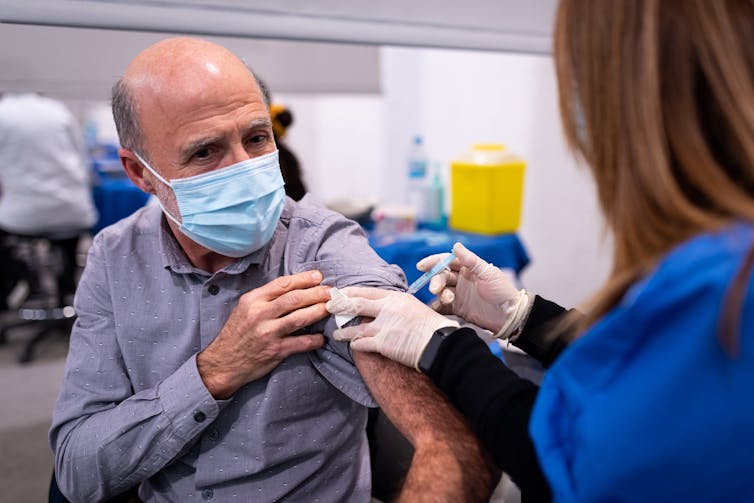
Nurse vaccinated older man in a facemask
Adjuvanted vaccines boost older people’s immune systems to better protect against the flu.
Shutterstock

Cell-based vaccines don’t use eggs

The flu vaccines are either egg-based or cell-based. Traditionally, flu vaccines were egg-based, meaning the flu viruses were grown in fertilised hens’ eggs.

But people with egg allergies can safely get the egg-based flu vaccine. The amount of egg protein left in each vaccine at the end of the production process is less than 1 microgram, much less than the estimated amount of 130 micrograms required to cause an allergic reaction.

In recent years, newer medical technology has led to the production of cell-based flu vaccines. Here, the virus is grown in host cells. So people who wish to avoid egg products may choose a cell-based vaccine instead.

Currently, Flucelvax Quad is the only cell-based flu vaccine approved for use in Australia and is also suitable for children from two years of age.


Read more:
Flu vaccine won’t definitely stop you from getting the flu, but it’s more important than you think


Some studies have shown cell-based vaccines are better at triggering the body’s immune response.

This is because the viruses used to make cell-based vaccines are more similar to circulating wild flu viruses – and the closer it resembles the real thing, the more effective it is.

However, Flucelvax Quad isn’t currently funded under the National Immunisation Program, so you’ll need to pay yourself, even if you’re eligible for a free vaccine under the national program.

When is the best time to get vaccinated?

It takes seven to 14 days for our body to respond to a vaccine. Once you receive the vaccine, your body starts to recognise the four strains of flu viruses and starts to develop an immune response over the course of about two weeks.

Once this occurs, when you come into contact with one or more of these four strains of viruses, your body’s own immune response will be able to protect and prevent you from getting sick.

The flu season typically peaks in Australia between July to September. The vaccine will provide the highest level of protection for three to four months. So late May to early June is generally the best time to get it.

For people travelling overseas, your doctor or pharmacist can advise you on what’s best for you based on where and when you’re travelling.

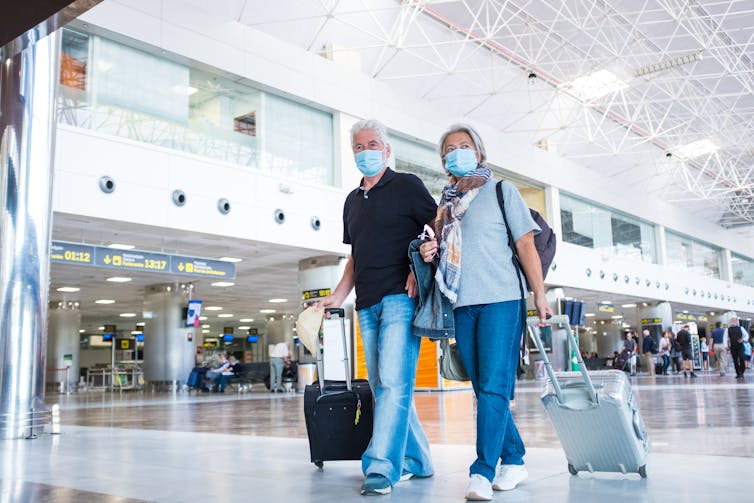
Older couple wheel suitcases through an airport.
Consider getting the flu shot before heading overseas.
Shutterstock

The flu vaccine can also be given at the same time as most other vaccines, including COVID vaccines. It’s also safe – and recommended – in pregnancy.


Read more:
Should I get the flu shot if I’m pregnant?


What are the side effects?

People may experience cold and flu-like symptoms for up to 24–48 hours after getting the vaccine. This shows the body’s immune response is kicking in and the vaccine is working.
You can take over-the-counter pain medications such as paracetamol or ibuprofen to relieve these symptoms.

Other common side effects may include local injection site reactions such as redness, mild swelling and tenderness. This should subside within 48 hours without any treatment. Applying ice or a cold pack can help.

Some people may develop more severe reactions, including anaphylaxis (a severe, life-threatening allergic reaction) in extremely rare circumstances. This is also why your doctor or pharmacist recommends waiting on-site for 15 minutes after vaccination for monitoring.

If you’ve had a severe reaction to any vaccine in the past, it’s important to tell your doctor or pharmacist.


Read more:
As flu cases surge, vaccination may offer some bonus protection from COVID as well


The Conversation

Tin Fei Sim is affiliated with Curtin University and the Pharmaceutical Society of Australia.

ref. Which flu shot should I choose? And what are cell-based and ‘adjuvanted’ vaccines? – https://theconversation.com/which-flu-shot-should-i-choose-and-what-are-cell-based-and-adjuvanted-vaccines-184325

Greyhound racing: despite waning public support, governments are spending big to keep the industry running

Source: The Conversation (Au and NZ) – By Alexandra McEwan, Lecturer: Law, CQUniversity Australia

Tonia Kraakman/Unsplash, CC BY

An e-petition against greyhound racing to the Tasmanian parliament reached a record number of signatures last week, with 13,519 people demanding the state government end public funding of the industry. The previous record in Tasmania was 11,699 signatures, for an e-petition supporting end-of-life choices.

It is clear that public opposition to greyhound racing isn’t going away. In May 2021, a petition opposing greyhound racing in the Western Australian parliament attracted similar support. A second petition to ban greyhound racing in WA opened in March 2022.

Yet, recent history doesn’t bode well for the success of these petitions. Despite over a decade of public outcry and animal cruelty revelations, greyhound racing is still legal in all Australian states and territories, except the ACT.

It seems governments are doggedly committed to providing financial support to an industry that is arguably out of step with community values, and has struggled to make ends meet on its own. Let’s take a closer look at government support of greyhound racing.

A black greyhound snoozing on a couch
Greyhounds make great pets, and spend most of the day snoozing.
Annie Spratt/Unsplash, CC BY

Government support for greyhound racing

The greyhound racing industry was put under the spotlight in 2015 after ABC Four Corners revealed instances of using live baits, such as possums and piglets, to train greyhounds.

This led to public protests and a New South Wales Special Commission of Inquiry in 2016, which found the industry had lost its social licence. Among its disturbing findings was that of the 97,783 greyhounds bred in NSW over 12 years, up to 68,448 dogs were killed.

Yet, these developments were not enough to effectively ban the greyhound racing industry in NSW.

Following a hugely contentious legislative turnaround in which greyhound racing was reinstituted after being banned, the NSW government contributed A$500,000 in prize money to the inaugural Million Dollar Chase in 2018. This is considered the richest greyhound race event in the world.


Read more:
New South Wales overturns greyhound ban: a win for the industry, but a massive loss for the dogs


Queensland’s government followed suit. In 2019 it pledged an extra $4.1 million to the state’s greyhound racing industry in prize money for 2019-2020, and to build a $39 million racing venue in southeast Queensland.

Apart from generous financial support to the greyhound racing industry and public opposition to the industry, other issues continue to attract debate.

These include calls for mandatory collection and publication of birth, death, and injury data, and a ban on exporting greyhounds. In 2021, the integrity unit of Greyhound Racing Victoria investigated alleged illegal export of greyhounds, involving greyhounds being flown to the United Kingdom and then rerouted to China.

Is it really benefiting the economy?

Any claimed economic benefits of the greyhound racing industry, and justifications for government support, require scrutiny. Let’s take Tasmania as an example. This month, Tasracing chief executive Paul Eriksson told the Mercury:

while there were other costs associated with the industry, including track maintenance, administration and welfare, it ultimately generated economic benefits to the state of $53.2m and supported 433 full-time equivalent workers.

The figures Eriksson quotes are consistent with those presented in a 2021 economic impact evaluation on the size and scope of the Tasmanian racing industry by consulting business IER.

But how reliable are these estimates? The IER report used Input-Output (I-O) methodology, which focuses on industry spending. It is used to estimate the direct and indirect impacts of an industry according to the value added, income and employment created.


Read more:
Be suspicious of claims the mining industry creates non-mining jobs


Although widely used, the I-O methodology has significant limitations, such as restrictive assumptions about supply and demand to the industry.

For the greyhound racing industry, on the demand side, medium-term projections point to a decline due to falling greyhound racing day attendances and animal welfare concerns. In terms of the labour force contribution, greyhound racing represents only 0.19% of the Tasmanian labour force (433 full-time equivalent jobs).

A light brown greyhound races on a track
Greyhound racing is legal everywhere in Australia except the ACT.
Shutterstock

Transitioning the industry

Only the ACT has successfully banned greyhound racing, as of April 30 2018. Compared to other states, the ACT greyhound racing industry was a soft target for reform, due to is size.

In 2017, only 70 Canberra residents were actively participating in greyhound racing (owners, breeders and trainers). And only around [52 racing greyhounds] were based in the ACT.

Australia’s situation sits in stark contrast to the United States, where only two dog tracks remain across the country after a track in Iowa closed last month.

Greyhound racing’s popularity is highest in regional areas where it, for example, provides an important opportunity for social connection. Government financial support seems to lie in the industry’s role as a social hub and as a key form of recreation.

Rather than contributing prize money, governments could instead consider supporting other forms of recreation that fulfil similar community functions – ones that avoid overbreeding dogs, gambling, and that encourage positive well-being outcomes.

Decisions about what this might look like ought to be the result of community consultation at a local level.

The future of Australia’s greyhound racing lies in the balance of government willingness to provide ongoing support using taxpayer money. But this cannot be taken as a given in our changing and unpredictable political landscape.


Read more:
Greyhound pups must be tracked from birth to death, so we know how many are killed


The Conversation

I own a rescue greyhound.

Jayanath Ananda does not work for, consult, own shares in or receive funding from any company or organization that would benefit from this article, and has disclosed no relevant affiliations beyond their academic appointment.

ref. Greyhound racing: despite waning public support, governments are spending big to keep the industry running – https://theconversation.com/greyhound-racing-despite-waning-public-support-governments-are-spending-big-to-keep-the-industry-running-184849

Time in hospital sets back tens of thousands of children’s learning each year, but targeted support can help them catch up

Source: The Conversation (Au and NZ) – By Rebecca Mitchell, Associate Professor Health and Societal Outcomes, Macquarie University

Shutterstock

NAPLAN scores can tell us about a child’s learning, but can they also help us to support learners who have had a serious injury or a long-term chronic illness like asthma or epilepsy?

Children who spend time in hospital for these reasons miss out on time in class and are at risk of performing below the national minimum standard (NMS) in numeracy and literacy as measured by NAPLAN. A serious injury or chronic illness can have a cumulative effect, resulting in lower educational performance, non-completion of high school, and potentially limiting their social, educational and later employment opportunities.

Knowing these risks in advance means parents and educators can plan to support children before the shock of poor school or NAPLAN results.


Read more:
Every teacher needs to be a literacy teacher – but that’s not happening in most Australian schools


Serious injury, asthma, mental health, epilepsy and diabetes impact more than a million children each year. More than 100,000 end up in hospital.

We compared their NAPLAN results with kids of the same age and gender who lived in the same area but who had not been hospitalised for those conditions. We found spending time in hospital for these conditions did set back learning, with the exception of type 1 diabetes.

What did the study find?

Injury

About 70,000 people under the age of 16 are hospitalised with an injury each year in Australia. This can disrupt their ability to attend school or concentrate and learn.

Recovery from injury can be unpredictable. Some young people may fully recover. Others experience ongoing difficulties at school.

Compared to matched peers, students who had been hospitalised with an injury had a 12% higher risk of not achieving the NMS in numeracy on NAPLAN and a 9% higher risk of not achieving the NMS in reading.

Asthma

Around 460,000 young people have asthma in Australia. If asthma is not adequately controlled, it can have a wide-ranging impact on their lives, including on their performance at school.

Our analysis of 28,114 young people hospitalised with asthma showed a difference between the sexes. Young males’ risk of not achieving the NMS was 13% higher for numeracy and 15% higher for reading compared to matched peers. In contrast, females hospitalised with asthma showed no difference.

Mental illness

Around 14% of young people experience a mental illness in Australia that can affect their health, relationships and school life. In our study of 7,069 young people hospitalised with a mental illness, young males had almost twice the risk of not achieving the NMS on NAPLAN for both numeracy and reading compared to their peers. Young females had a 1.5 times higher risk of not achieving the NMS for numeracy and those with diagnosed conduct disorder had twice the risk of not achieving the NMS for reading.


Read more:
The transition into adolescence can be brutal for kids’ mental health – but parents can help reduce the risk


Epilepsy

Across the country, about one in 200 children are living with epilepsy. Epilepsy can affect attention, concentration and memory, all which can be a barrier to performing well at school.

Our study of 2,383 young people hospitalised with epilepsy found young males and females had a three times higher risk of not achieving the NMS on NAPLAN for both numeracy and reading compared to peers.

Type 1 diabetes

Type 1 diabetes was the exception and showed no adverse impact on school performance. In Australia, an estimated 6,500 young people have type 1 diabetes. Our analysis of 833 young people hospitalised with type 1 diabetes did not find any difference in achieving the NMS in numeracy or reading on NAPLAN compared to matched peers.

This finding is likely explained by improved glucose control and type 1 diabetes management. It is also possible that school assessments, such as NAPLAN, do not capture everyday difficulties that students with diabetes experience.


Read more:
What parents can do to make a child’s chronic illness easier


How can we support these students’ learning?

It is essential that we identify students who are likely to need learning support because of an injury or chronic illness. Supports can include online learning options, flexible programming or mobilising peer support to enable sharing of class notes and homework activities.

Monitoring students’ progress when they return to school will help to identify ongoing learning support needs.

There are also ways to manage symptoms and enhance performance at school. With asthma, for example, a comprehensive asthma management plan, using medication to manage symptoms, and healthcare co-ordination between GPs, hospitals and community services can all reduce the chance of ending up in hospital. For epilepsy, learning to identify seizure triggers, lifestyle and medication management are key.

Improving teachers’ understanding of symptom management for chronically ill or injured students is important too. For example, a New South Wales program, Aiming for Asthma Improvement in Children, encourages self-paced training for school staff on asthma management and first aid, along with resources for managing asthma in schools. For epilepsy, Strong Foundations provides advice on the skills children with epilepsy need to manage in the classroom and playground.

Early identification and recognition that an injured or chronically ill student may need learning support at school and at home are critical to ensure they are not left behind academically.

The Conversation

Rebecca Mitchell has received funding from the NHMRC, the MRFF, the ARC, and various state and federal government departments for past projects. This research was funded by a philanthropic donor to Macquarie University.

Anne McMaugh has received funding from the Australian Research Council for past projects. This research was funded by a philanthropic donor to Macquarie University

ref. Time in hospital sets back tens of thousands of children’s learning each year, but targeted support can help them catch up – https://theconversation.com/time-in-hospital-sets-back-tens-of-thousands-of-childrens-learning-each-year-but-targeted-support-can-help-them-catch-up-184313

5 charts on Australian well-being, and the surprising effects of the pandemic

Source: The Conversation (Au and NZ) – By Kate Lycett, NHMRC Early Career Fellow, Centre for Social and Early Emotional Development, Deakin University

Since 2001 our research group has asked 2,000 Australians every year how they’re doing. Are they satisfied with their standard of living, their relationships, purpose in life, community connectedness, safety, health and future security?

We’ve asked them through good times and bad, through wars and global financial downturns, fires and floods. And now through years of pandemic – the worst economic crisis in a generation, and the worst health crisis in a century

Using an internationally regarded methodology, we combine their subjective ratings across seven life areas into a single score out of 100. These results form the basis of the Australian Unity Wellbeing Index, a collaborative partnership between Deakin University and mutual company Australian Unity.

Our latest results may surprise you. Over the pandemic Australians’ average subjective well-being has barely deviated from remarkably stable levels maintained over 20 years.


Made with Flourish

That doesn’t make for an exciting graph. But it is significant.

It shows that while well-being is, on average, quite high, it won’t get any better by just continuing along the same path.

This is where our survey gets more interesting. Beneath the headline result is a more pronounced story – of notable differences in people’s subjective well-being based on their circumstances and life experience.

In these differences lie important lessons about the need to look beyond averages as a measure of a nation.

Why is average well-being so stable?

First, though, it’s worth understanding why the national average score is relatively high, and so stable. This pattern is consistent with life satisfaction scores across most OECD countries.

It reflects both biological and situational factors.

At the biological level it is thought that humans have evolved to maintain a relatively optimistic and happy mood. This is controlled by homeostatic mechanisms like those that maintain an optimal body temperature.

But like body temperature, well-being can be undermined by situational factors. In particular, it declines without sufficient levels of three key resources: enough money, connection with others, and a sense of purpose.

Because not everyone has equal access to these resources, inequities drive very different patterns of well-being in disadvantaged groups.

Well-being by living arrangements

Our second graph shows subjective well-being levels by living arrangements. These are perhaps our most predictable results. Those living alone, in share houses and single parents have the lowest scores overall. But there are also less intuitive results, with the well-being of those living alone and single parents increasing significantly in 2020.


Made with Flourish

Perhaps because these groups are more likely to be socially isolated, the effects of lockdowns had less impact. But the more obvious reason is likely to do with income, as our next graphs show.

Well-being by occupation

Year in, year out, certain groups show lower levels of subjective well-being. Most evident are those who are unemployed. But in 2020 this group reported considerably better well-being – nine percentage points higher than 2019.


Made with Flourish

There are three possible explanations. First, the composition of the unemployed cohort changed due to pandemic-related job losses. Second, the stigma of being unemployed was reduced.

The third reason, however, seems most obvious. In 2020 the JobSeeker payment was doubled from $550 to $1,100 a fortnight. For those struggling to even pay for necessities such as rent and food, this would have been a huge relief.


Read more:
The economy can’t guarantee a job. It can guarantee a liveable income for other work


However, in 2021, the JobSeeker payment was cut back to about $620 a fortnight. At the same time well-being for those who were unemployed fell. To a level lower than in 2019 in fact.

This is consistent with economic theory of loss aversion – that people feel losses more deeply than gains in income.

Losing really hurts

Our next graph demonstrates this loss-aversion effect. Those who lost income during the pandemic reported lower well-being than the national average. But those whose household income increased during the pandemic reported well-being levels identical to those whose income remained the same.


Made with Flourish

Marginal diminishing gains

Our final graph shows well-being levels by income. The largest well-being increases were in the lowest-income households in 2020. Well-being for those on the highest incomes didn’t change.

Made with Flourish

Thus, governments allocating more money to people who already have their financial needs met is unlikely to improve subjective well-being. On the other hand, lifting people out of poverty is likely to make a big difference to their well-being.


Read more:
Our top 1% of income earners is an increasingly entrenched elite


The importance of measuring well-being

These results show why it is important to look past headline figures, such as GDP or national averages, to judge whether policies and programs are actually contributing to well-being and societal progress.

This is why countries such as New Zealand, Scotland, Wales, Iceland and Finland are now incorporating well-being measures into their budgets and policy frameworks. Like the OECD, these countries have recognised that improving the well-being of society, particularly of disadvantaged groups, is a core marker of societal progress.

We’d like to see Australia do the same.

The Conversation

Kate Lycett receives research funding from the NHMRC, government partners and industry partners Dyson and Australian Unity. She has previously worked on the Australian National Development Index.

Craig Olsson is currently supported by funding from the NHMRC, ARC and industry partners Australian Unity and the Victorian Department of Education and Training.

Delyse Hutchinson receives research funding from the NHMRC, ARC and other research council grants, in addition to industry partner Australian Unity.

Matthew Fuller-Tyszkiewicz receives research funding from the NHMRC and ARC, in addition to industry partner Australian Unity.

robert.cummins@deakin.edu.au has received research funding from Australian Unity and numerous other sources including research council grants.

Sarah Khor was previously funded on a Research Training Stipend by the Australian Government.
She is a member of the Australian Psychological Society.

Mallery Crowe and Tanja Capic do not work for, consult, own shares in or receive funding from any company or organization that would benefit from this article, and have disclosed no relevant affiliations beyond their academic appointment.

ref. 5 charts on Australian well-being, and the surprising effects of the pandemic – https://theconversation.com/5-charts-on-australian-well-being-and-the-surprising-effects-of-the-pandemic-183537

How we invented ‘unemployment’ – and why we’re outgrowing it

Source: The Conversation (Au and NZ) – By Anthony O’Donnell, Adjunct Senior Lecturer, School of Law, La Trobe University

Shutterstock

When Labor leader Anthony Albanese couldn’t quote Australia’s unemployment rate in the first week of the election campaign, many said it didn’t matter: the Australian Bureau of Statistics figure was “meaningless”; “fudged”; “manipulated”; and didn’t count all those who had registered for JobSeeker.

The truth is the official measure of unemployment does what it says on the box. It counts those without any work who are available to work and looking for work.

The result of an astonishingly large survey of 26,000 households covering 50,000 people each month, there’s little reason to question its accuracy.

But there are good reasons to question why the bureau does it in the way it does.

“Unemployment” as we have come to understand it is a fairly new concept.

Until the 1900s much work was intermittent.
Rachel Claire/Pexels

As I outline in my book, Inventing Unemployment, before the second world war censuses tended to divide the population differently – into breadwinners and dependants.

A breadwinner who wasn’t employed would be recorded as a breadwinner rather than unemployed (with their usual occupation noted).

That’s probably because until the 20th century, irregular work was the norm.

Late-19th-century Sydney had no extensive manufacturing. Work such as wool washing, tanning, meat preserving and loading sea cargo was seasonal and tied to rural rhythms.

Even in more stable occupations, many workers were little more than or sub-contractors or day labourers, their work intermittent.

Unemployment as we know it

The 1947 census introduced three distinct categories: employed, “unemployed” and “not in the labour force”. To be “unemployed” you had to describe yourself as willing and able to work, but without work.

Carried into the quarterly labour force surveys which started in the 1960s and continue monthly to this day, the change enabled the creation of an unemployment rate, which is the number of unemployed divided by the total of the number of employed and unemployed, which is called the “labour force”.

The categorisation made more sense by then as work was becoming full-time and ongoing. Being “unemployed” (workless but in the workforce) had come to be seen as unusual and worthy of government support. The Curtin Labor government introduced unemployment benefits in 1945.


Read more:
Memories. In 1961 Labor promised to boost the deficit to fight unemployment. The promise won


The changes were in line with International Labour Organisation recommendations which themselves followed changes in the United States which in 1937 had asked all non-workers who’d expressed a desire to work whether they were able to work and were actively seeking work.

The context was United States President Franklin D Roosevelt’s determination to fight unemployment through job creation schemes. The advantage of the new measures was that they gave a measure of immediate unmet demand for work.

Excluding both those who were unwilling to work at present and those who had any work at all yielded a measure of the minimum number of jobs needed. Policy drove the definition rather than the other way around.

Messy by design

But the definitions were messy. Labour markets confound easy distinctions between working and not working, and there’s no particular degree of desire for work that clearly distinguishes the “unemployed” from “not in the labour force”.

Looking back, what was exceptional about the post-war decades is that most of the time the new definitions were easy to apply. If you were in work, the chances were you were in full-time work; if you weren’t in full-time work the chances were you weren’t working at all, and that you were either wanting work or none.

And the idea of the “labour force” summed up fairly stable social categories: men who entered at 15 years and were expected to work or look for work for 50 years, and women who also entered in their mid-teens only to permanently withdraw upon marriage or childbirth.

Not now. As social researcher Monica Threlfall points out, whereas once the labour force was an identifiable category,

today it is more like an unbounded space that a variety of people of different ages enter, leave and re-enter at a variety of rates.

When the headline monthly unemployment rate changes, what has moved is often not the numerator – the number of unemployed – but the shape-shifting denominator, which depends on whether people define themselves as looking and available for paid work at the particular time they are asked.

And the main questions don’t pick up underemployment. Australia has one of the largest part-time work forces in the OECD, which is why the Bureau of Statistics also asks workers whether they would like more hours, and reports the answers alongside the unemployment rate.

It also measures “discouraged workers”, people who are available for and wanting work but have given up the search and so aren’t counted as “unemployed”.

The only way to really understand whether we are succeeding or failing in providing paid work is to take all three measures together – unemployment, underemployment and the count of discouraged workers.

Messier by the month

What this total tells us will be quite different to the count of the number of Australians on unemployment benefits.

After tracking each other closely, the number of “unemployed” and the number on unemployment benefits has diverged over the past 25 years and that divergence became even more pronounced during COVID.

Australian experts Peter Whiteford and Bruce Bradbury point out most unemployed people aren’t on benefits, and increasingly unemployment benefits are available to people who are not unemployed.


Read more:
How can more people be on unemployment benefits than before COVID, with fewer unemployed Australians? Here’s how


These days unemployment benefits are available to people not seeking paid work but engaged in voluntary work, study, or providing home schooling.

And people who once would not have been considered unemployed – such as single parents and people with disabilities – are now put on unemployment benefits and required to search for work in order to get them.

After holding together for decades, the post-war administrative and legal construction of unemployment is failing us. We’re outgrowing it.

The Conversation

Anthony O’Donnell does not work for, consult, own shares in or receive funding from any company or organisation that would benefit from this article, and has disclosed no relevant affiliations beyond their academic appointment.

ref. How we invented ‘unemployment’ – and why we’re outgrowing it – https://theconversation.com/how-we-invented-unemployment-and-why-were-outgrowing-it-183545

This 5.2% decision on the minimum wage could shift the trajectory for all workers

Source: The Conversation (Au and NZ) – By John Buchanan, Professor, Discipline of Business Information Systems, University of Sydney Business School, University of Sydney

Shutterstock

Barely a month ago Anthony Albanese was derided as a “loose unit” for endorsing a 5.1% increase in the minimum wage.

His rationale was, with 5.1% inflation, the incomes of the lowest-paid Australians at least shouldn’t be going backwards.

Now the Fair Work Commission’s expert panel, which reviews the minimum wage each year, has announced a 5.2% increase.

A “loose” decision? No. The reasons for lifting the pay of workers on the minimum wage by $40 a week are laid out in a long document. The essence is this: even with rising inflation, the economy is strong. If we can’t lift wages to stop the lowest paid going backwards in these conditions, when will they ever rise?


Reasons for the rise

The economic factors considered by the expert panel include:

  • real wages have fallen by about 2.5% over the past two years
  • economic growth is strong and appears set to continue
  • employment and vacancies are growing
  • unemployment and underemployment are falling
  • productivity has returned to steady growth of 1–2% a year
  • profits increased by 25% in the past year.

While precise estimates are difficult, the minimum wage increase will affect about 2% of Australian workers. The sectors most impacted will be retail and hospitality.

However, the Annual Wage Review also decides pay rates for those on awards. This is about 23% of Australian employees (19% of males, 27% of females). To these workers the panel has granted a 4.6% pay rise.

This will help workers in aged care, disability care and other forms of non-government provided (but predominantly government-funded) care work.

Indirect impacts

For the majority of workers – about 35% of whom are covered by an enterprise bargaining agreement and 38% on over-award payments or individual contracts – the decision’s impact will be indirect, though potentially significant.


Read more:
There’s one big reason wages are stagnating: the enterprise bargaining system is broken, and in terminal decline


Wage setting involves a combination of both market and institutional forces.

The lower bound of wages is set by the social security system – unemployment benefits, aged pensions and the like. The upper bound is set by profitability in the most prosperous enterprises.

Institutional forces such as employers’ policies, unions, labour laws and customary notions of “the going rate” – as well as the level of supply and demand for workers with particular skills – shape the ultimate outcome within these upper and lower bounds.


Read more:
How market forces and weakened institutions are keeping our wages low


This is where the expert panel’s decision is significant. It has implicitly challenged the strictures placed on wage increases by both federal and state governments over the past decade.


Annual wage review 2021-22 decision.

Protecting a principle

The panel’s decision follows a long-standing principle of Australian wages policy – pursued at least since the 1990s, when enterprise bargaining became the primary basis for wage increases.

This principle holds that some workers don’t and never will have the capacity to bargain effectively with their employers. They need to be protected. As the decision states:

We agree with the RBA’s assessment and remain of the view that moderate and regular increases in minimum wages do not result in significant disemployment effects.

This point doesn’t apply just to the lowest paid.

Reading the nation

Most Australians are concerned about the cost of living.

After more than a decade of stagnant wages, people are looking for new directions. Albanese’s election campaign recognised this, and pushed the issue constantly.


Read more:
Wages and women top Albanese’s IR agenda: the big question is how Labor keeps its promises


When Scott Morrison derided Albanese as a loose unit for endorsing a $40-a-week pay rise for the lowest paid, he fundamentally misread the national mood.

The Fair Work Commission’s expert panel has not.

This decision is a welcome continuation of its role to protect the lowest paid. It could well contribute to moving Australia to a trajectory of higher, but sustainable, wages growth.

The Conversation

John Buchanan does not work for, consult, own shares in or receive funding from any company or organization that would benefit from this article, and has disclosed no relevant affiliations beyond their academic appointment.

ref. This 5.2% decision on the minimum wage could shift the trajectory for all workers – https://theconversation.com/this-5-2-decision-on-the-minimum-wage-could-shift-the-trajectory-for-all-workers-185117

Australia’s National Electricity Market was just suspended. Here’s why and what happens next

Source: The Conversation (Au and NZ) – By Joel Gilmore, Associate Professor, Griffith University

Australia’s energy market operator has just suspended the National Electricity market. That means instead of the price for wholesale electricity being set competitively, the market operator (AEMO) sets fixed prices and will take a greater role in directing which power stations generate energy and when.

This is the first time the market has been suspended across all states, and reflects the depth of the price and supply crisis plaguing Australia’s biggest electricity grid.

How did we get here?

All electricity on Australia’s east coast is traded through the National Electricity Market (NEM), a wholesale market where generators are paid for the electricity they produce. Prices are set by an auction between generators held every five minutes.

Prices typically average around $A80/MWh (per megawatt hour), but can vary between -$1000/MWh (where generators actually pay to stay online) and $15,100/MWh. Retailers buy the energy from this auction and manage the price risk on behalf of households and energy-using businesses.

Over the past week, wholesale prices surged due to two main factors: high coal and gas prices (driven by the Russian invasion of Ukraine) and roughly 25% of coal power stations being out of action. The coal power stations are unavailable because of maintenance as well as the sudden exit of 3,000 MW of power due to breakdowns (unplanned outages).

This led AEMO to trigger a pricing “safety net” and capping prices at $300/MWh (much less than the normal cap of $15,100/MWh).

Unfortunately, $300/MWh is currently less than the cost of generating power from gas power stations and possibly even some coal power stations. Some generators subsequently withdrew their availability from the market, leading to further shortfalls.

The low price cap also meant there were weaker price signals as to when power stations with limited “fuel” should use it. This includes some diesel generators as well as batteries and hydro.


Read more:
If the opposition wants a mature discussion about nuclear energy, start with a carbon price. Without that, nuclear is wildly uncompetitive


Power lines
The electricity wholesale market has been suspended.
Shutterstock

All this makes it much harder for AEMO to operate the market. On Tuesday, AEMO was forced to direct power stations when to run and when not to run. This intervention applied to roughly 20% of demand yesterday, or 5,000 megawatts.

AEMO has now decided suspending the market will make it simpler to operate the grid during this crisis. Generators will now provide their availability and AEMO will tell generators when to run to ensure secure supply. Market prices are then fixed at the average of the past 28 days for that hour of the day – between $150/MWh and $300/MWh across the day.

If generation costs are higher, power station owners will be able to apply for additional compensation, which will be later recovered from consumers.

Although this is the first time it has been done nationally, AEMO has previously suspended the market in individual states such as in South Australia this year when control systems failed.

What’s likely to happen next?

AEMO will continue to monitor the system, and will restart the market when it is appropriate.

This has been a perfect storm of factors – high input costs, significant capacity being unavailable, and a cold snap with high demand. It’s not clear any market would have been able to handle these extreme conditions unless the generation in the market is more modern and less susceptible to breaking down.

What this does point to is that, longer-term, it may be time to buy some insurance for the energy market, as energy ministers have proposed. This would help manage periods like this when so much capacity is unexpectedly offline.

Although coal owners are advocating for additional payments, it’s clear this would not have helped avoid the current crisis. As AEMO CEO Daniel Westerman pointed out, coal plant reliability is “slowly declining”.

This crisis shows we need to make sure we have modern new plant (like batteries and gas turbines), not ageing coal power stations. We also need reserves for when coal unexpectedly breaks down and for other extreme events. This means investing in new flexible capacity which is ready for when we need it.

A coal fired power station
The very high cost of coal and gas is driving up energy bills.
Shutterstock

What does it mean for energy users?

These extreme prices in the National Electricity Market will ultimately impact on energy consumers, particularly larger energy users. Households are already being hit by up to a 20% rise in bills next month due to the very high cost of coal and gas.

Given the stresses on the grid, however, it’s sensible for Australians on the east cost to conserve energy if safe to do so, particularly during the peak hours of 5-8pm.


Read more:
If you’re renting, chances are your home is cold. With power prices soaring, here’s what you can do to keep warm


The Conversation

Joel Gilmore is an Associate Professor at Griffith University and General Manager Energy Policy & Planning at Iberdrola Australia, which develops renewable projects and batteries.

Tim Nelson is an Associate Professor at Griffith University and the EGM, Energy Markets at Iberdrola Australia, which develops renewable projects and batteries.

ref. Australia’s National Electricity Market was just suspended. Here’s why and what happens next – https://theconversation.com/australias-national-electricity-market-was-just-suspended-heres-why-and-what-happens-next-185136

Bunnings, Kmart and The Good Guys say they use facial recognition for ‘loss prevention’. An expert explains what it might mean for you

Source: The Conversation (Au and NZ) – By Dennis B Desmond, Lecturer, Cyberintelligence and Cybercrime Investigations, University of the Sunshine Coast

CC BY

Once the purview of law enforcement and intelligence agencies, facial recognition is now being used to identify consumers in Australian stores.

If you’ve seen the movie Minority Report, you’ll remember how Tom Cruise’s character John Anderton is identified through iris recognition to perform his duties, and later tracked with it when he’s a wanted man. When he replaces his eyes to evade identification, Anderton is bombarded with advertisements targeting his new assumed identity.

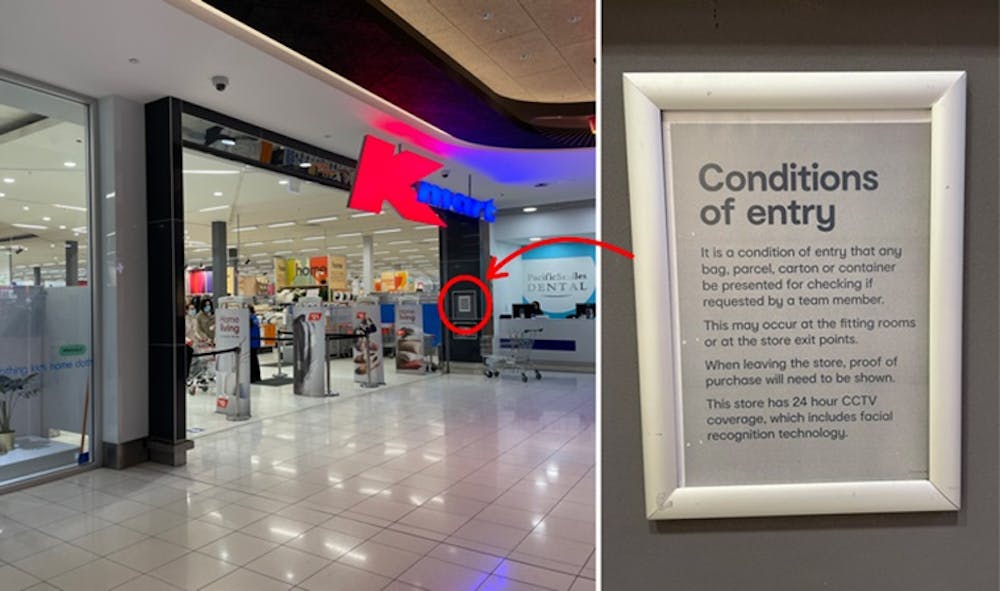
This once-futuristic idea from a movie could soon be a reality in our lives. An investigative report published by consumer magazine Choice reveals three major retailers (out of 25 queried), Kmart, Bunnings and The Good Guys, have admitted using facial recognition technology on customers for “loss prevention”.

The companies say they advise consumers of the use of the technology as a condition of entry. But do consumers really know what this entails, and how or where their images could be used or stored?

What is facial recognition and why do we care?

We’ve grown accustomed to our phones and cameras using facial detection software to put our faces into focus. But facial recognition technology takes this a step further by matching our unique identifying information to a stored digital image.

Facial recognition has come a long way. It was initially used in 2001 to identify relationships between gamblers and employees in Las Vegas casinos, where there was suspected collusion.

The United States government would eventually use the same technology to identify the 9/11 hijackers. It’s now widely adopted by law enforcement and intelligence communities.

Currently, software such as Clearview AI and PimEyes are being used in highly sophisticated ways, including by Ukrainian and Russian forces to identify combatants in Ukraine.

But what is this technology doing in Bunnings?

As with its early use in casinos, Kmart, Bunnings and The Good Guys told Choice their facial recognition software is used for “loss prevention”.

Images captured on store surveillance devices and body cameras could be used to identify in-store individuals engaged in theft, or other criminal activities. Real-time identification could allow law enforcement to quickly identify shoppers with unpaid tickets, outstanding warrants, or existing criminal complaints.

Bunnings chief operating officer Simon McDowell told SBS News the technology was used “solely to keep team and customers safe and prevent unlawful activity in our stores”. Both The Good Guys and Kmart told news outlets they were using it for the same reasons, in a select number of stores – and that customers were notified through signage.

Choice supplied this photo of a sign, which it said was taken at a Kmart in Marrickville, NSW.
CHOICE

Choice confirmed there were some signs disclosing use of the technology – but reported these signs were small and would be missed by most shoppers.

The news has stoked shoppers’ fears of how their image data may be used. As in Minority Report, images captured in a store could theoretically be used for targeted advertising and to “enhance” the shopping experience.

It’s likely images and video collected through standard in-store surveillance are either matched immediately against a remote database using specialised facial recognition software, or analysed against a database of tagged and catalogued images later on. Ideally, the images would be encoded and stored in a file that’s readable only by the algorithm specific to the device or software processor.

Potential for misuse

We have already seen online retailers use this tactic through cookies and linking our purchase history on electronic devices.


Read more:
Is your phone really listening to your conversations? Well, turns out it doesn’t have to


We have also seen companies correlate our social media profiles and our other online experiences across various websites. Australian stores employing facial recognition could use collected information internally to track:

  • the number of visits by a person
  • the times of those visits
  • pattern or behavioural analysis (such as a consumer’s reaction to pricing or signage) and
  • associations with other shoppers (such as friends, family and anyone else with them).

Retailers could also use this identity data to extract information from social media, where most people have images of themselves uploaded. They could then perform risk analysis based on the credit and financial reporting access of that specific shopper.

Externally, the images and associated consumer information could be merged with financial, economic, social and political data already collected by commercial data aggregators – adding to the already massive data aggregation market.

Current Australian privacy laws require retailers to disclose what data are being collected, retained and protected, as well as how it might be used outside of a loss prevention model.

A Bunnings spokesperson told The Guardian the technology was being used in line with the Australian Privacy Act. Choice has reached out to the Office of the Australian Information Commissioner to determine whether the use of the technology is indeed consistent with the Privacy Act.


Read more:
Shadow profiles – Facebook knows about you, even if you’re not on Facebook


What to do?

While the retailers highlighted in Choice’s investigation state consumers must agree to the collection of their images as a condition of entry, the reality is the collection, retention, and use of their images are not usually disclosed in any explicit way.

As far as data collection in retail settings goes, there should be a precondition for all stores to make sure consumers are made aware of:

  • the specific information that is collected while they are visiting
  • how it might be aggregated and combined with other relevant information from third parties
  • how long the images or data will be retained, retrieved, or accessed and by whom, and
  • what security precautions are being used to secure the data.

Furthermore, as with their online shopping experience, consumers should be given the option to opt-out of such data collection.

Until then, consumers may try to avoid collection by donning hats, sunglasses and face masks. But considering the rate at which facial recognition technology is advancing – and how large the personal data market has already grown – retail cameras may soon be able to see through these disguises, too.

The Conversation

Dennis B Desmond previously received funding from the United States Department of Defense.

ref. Bunnings, Kmart and The Good Guys say they use facial recognition for ‘loss prevention’. An expert explains what it might mean for you – https://theconversation.com/bunnings-kmart-and-the-good-guys-say-they-use-facial-recognition-for-loss-prevention-an-expert-explains-what-it-might-mean-for-you-185126

Cybersecurity in the Pacific: how island nations are building their online defences

Source: The Conversation (Au and NZ) – By Carsten Rudolph, Associate Professor for Cybersecurity, Monash University

Shutterstock

Leaders of several Pacific nations met in Fiji last week to strengthen ties and promote unity in the region.

The Pacific faces numerous challenges, such as the threat of climate change and major powers jostling for influence in the region. Against these adversities, Pacific countries have shown determination to preserve their own (and the region’s) identity and sovereignty.

One less-appreciated aspect of Pacific security is cybersecurity. Some cyber threats are financially motivated, such as ransomware or phishing attacks, but others aim at critical infrastructure. Still other attacks threaten society and democratic processes through spreading misinformation and disinformation.

We are working with Pacific governments to assess their current cybersecurity situations – and make recommendations for a path forward.

An broader idea of security

In 2018, the 18 member states of the Pacific Islands Forum signed the Boe Declaration on Regional Security. After noting climate change as “the single greatest threat”, the declaration lays out an “expanded concept of security” which includes cybersecurity.

The declaration set the scene for cybersecurity as a shared priority for the region. The response to the COVID-19 pandemic has raised the stakes even further, as online services and remote work have rapidly increased.

Cybersecurity will be necessary to enable continued economic development amid natural disasters, changes in the global security situation, and worldwide economic upheavals.

Security and sovereignty

The countries of the Pacific depend on fragile undersea cables for broadband internet access. Bringing government processes online, modernising digital infrastructure, and promoting e-commerce will introduce further security risks.

At the same time as securing their digital spaces, Pacific nations may wish to maintain sovereign control of their data. Often, digitisation means data is controlled outside the country.


Read more:
Undersea internet cables connect Pacific islands to the world. But geopolitical tension is tugging at the wires


Introducing digital currencies and mobile payments may also reduce a country’s control over money-related policies.

Working with overseas suppliers for cybersecurity may mean the country has to hand over the keys to sensitive data, networks, and systems.

Cybersecurity assessments

At the invitation of Pacific island nations, we and our colleagues at Monash University and the Oceania Cyber Security Centre (OCSC) are working to help countries understand and strengthen their cybersecurity situation.

Using the University of Oxford’s Cybersecurity Capacity Maturity Model for Nations (CMM) and our own research, we help countries assess their current situation, identify their priorities and determine how to strengthen local capacity and sovereign capability.

These assessments are a crucial first step. Each nation is different.
Tailored approaches to cybersecurity that consider the local culture, context and preservation of national sovereignty are needed.

Mapping the way forward

So far, eight of these reviews have been conducted in the Pacific. Seven of these where conducted by the OCSC. Worldwide, more than 87 nations have worked through similar reviews.

In the Federated States of Micronesia, for example, the OCSC completed an assessment in collaboration with the Asia-Pacific Telecommunity in 2020.

After the assessment, we worked with the Federated States of Micronesia in 2021 to co-develop a National Cybersecurity Roadmap. The roadmap sets a path to build local capacity and sovereign capability to protect the country’s national interests and citizens who are most at risk from cyber harms.


Read more:
Fight for control threatens to destabilize and fragment the internet


In 2019 we conducted an assessment in Vanuatu. Since then, Vanuatu has strengthened its cybersecurity in several ways, including:

Frameworks and funding

We and our colleagues are in the process of developing a regional framework for island state cybersecurity. It will help Pacific countries build effective emergency response teams, strengthen cyber resilience, and ensure data sovereignty.

As well as assistance with assessments and planning, Pacific nations will also need funding – including from countries like Australia – to address their own identified priorities.

As the Boe Declaration underlines, we are all on the journey to developing digital resilience. If we work together, the whole Pacific family can strengthen regional security while maintaining sovereignty.


Read more:
What skills does a cybersecurity professional need?


The Conversation

Carsten Rudolph works for Monash University and is the Research Director for the Oceania Cyber Security Centre OCSC.

James Boorman is Head of Research and Capacity Building at the Oceania Cyber Security Centre and an affiliate of Monash University.

Monica Whitty works for Monash University.

ref. Cybersecurity in the Pacific: how island nations are building their online defences – https://theconversation.com/cybersecurity-in-the-pacific-how-island-nations-are-building-their-online-defences-185046

If you’re renting, chances are your home is cold. With power prices soaring, here’s what you can do to keep warm

Source: The Conversation (Au and NZ) – By Cynthia Faye Isley, Postdoctoral Research Fellow, Australian Centre for Housing Research, University of Adelaide

Shutterstock

If you’re feeling the cold this winter, you’re not alone. About a quarter of all Australians have trouble keeping their homes warm enough in winter. That figure is likely to soar this year, due to poor quality housing and the rapidly escalating energy crisis.

Renters are particularly at risk, but our research has shown many home owners are in the same boat as well. We’ve collected data over the last few years on how many Australians have cold homes, find it difficult to stay warm, and can’t afford their heating bills.

What counts as cold? The World Health Organization recommends a minimum home temperature of 18℃ for health and wellbeing. About a fifth of Australian renters, for example, have cold homes. Our current research has shown this applies to home owners as well, with 26% of people across all housing types unable to stay warm at least half of the time during winter.

Australia’s energy crisis is likely to see soaring rates of energy poverty, meaning being unable to keep your home warm or cool enough. Here’s why this is such a problem – and what you can do about it.

Cold homes affect our health

If you’re cold at home, you have a higher risk of developing respiratory problems and high blood pressure. People in the coldest homes face a higher risk of dying in winter. Cold can have a flow-on impact on our health system, which is is already struggling.


Read more:
Energy poverty in the climate crisis: what Australia and the European Union can learn from each other


Australia’s south-east has had the coldest start to winter in decades. Melbourne hasn’t been this cold this early since 1949, while Sydney hasn’t seen these temperatures in early June since 1989.

old couple cold high bills
Low income households who are renting are particularly vulnerable to energy price spikes.
Shutterstock

Double trouble: cold weather and the energy crisis

If you’ve been hit by the recent cold snap, chances are you’ll have been reminded how cold your home can get. This is not a surprise given how badly existing homes and new housing perform in keeping an even temperature.

The cold has made many people doubly worried, because the energy required to heat our leaky, poorly insulated homes is about to get very expensive.

Early results from our survey of over 350 Australians found 25% of people were experiencing shortages of money to the point they will be unable to adequately heat their homes. One third of our respondents said energy was unaffordable. Some reported making trade-offs, such as skimping on food or healthcare to pay energy bills.

These people are experiencing energy poverty, where a household is unable to properly heat or cool their home or face significant financial difficulty doing so.

While data about energy poverty in Australia is patchy, we know around 180,000 households in Victoria had persistent bill payment issues as of 2018, and 45,000 households were consistently unable to heat their homes.

Energy price increases hit lower income households hardest

Lower income households are more at risk from the cold. That’s because they’re more likely to live in homes that are in poor condition and hard to heat. One quarter of low income households told us they struggle to stay warm. Insulation may be a key factor, with 25% of our respondents reporting their rental properties did not have insulation.

Insulation matters, because heat escapes homes through single-pane windows, or poorly insulated walls and ceilings. As a result, poorly insulated homes cost more to heat.

This makes life harder for low income renters, given they have little control over insulation or other home modifications. Worse still, heaters that are cheap to buy are often the most expensive to run.

While an efficient reverse cycle air conditioner would save money and heat the space better over the longer term, it is often difficult for renters to negotiate installation with property managers or landlords – especially given the intense competition for rentals at present in many cities. That can mean renters will suffer in silence, unwilling to ask for something that will make their lives better.

Reverse cycle air con
Efficient reverse cycle air conditioners can be the cheapest form of heating. But renters face challenges in getting landlords to install them.
Shutterstock

What can renters do?

Low income renters face real threats from energy poverty this year. While we need systemic change to improve the outlook for Australia’s renters, there are low-cost DIY ways to improve how your house retains heat this winter.

The first step: check your current heating appliances are working efficiently. Many people don’t clean the filters on their reverse cycle air conditioners. This makes them less efficient, and can drive up energy bills.

Poorly sealed windows and doors make it hard to stay warm.

Using thermal curtains, and keeping them closed makes a big difference. Putting a piece of plywood or even a scarf between the curtain rail and the wall to make a DIY pelmet also helps keep the heat in. If you have single glazed windows, consider window films as a way to improve performance for a fraction of the cost of double glazed windows.

Sealing the cracks around windows, under doors and around the wider home is also important. Silicon or expanding foam can be used for gaps and cracks. Draughts under doors can be stopped with door seals or door snakes.

Thick curtains
Thick curtains, DIY pelmets and door snakes are cheap ways to make your home keep its heat.
Shutterstock


Read more:
10 ways to keep your house warm (and save money) this winter


Close the doors to your bathroom, laundry and other rooms not in use to keep the heat where you need it most. Hanging a blanket over a doorway can also be a cheap way to seal off a room and concentrate heat.

It’s also worth checking what rebates and concessions your state government or council is offering. These might include energy efficiency improvements or extra help with heating costs. If you’re renting, your home must meet minimum standards, so make sure you check what you are entitled to as these vary by state.

Everyone deserves a warm home. Our health and well-being depend on it. Building new, energy efficient homes is only part of the answer. We also have to make our 10.8 million existing dwellings warmer.

The Conversation

Emma Baker receives funding from the Australian Research Council, the National Health and Medical Research Council, and the Australian Housing and Urban Research Institute. She is on the Board of Habitat for Humanity SA.

Lyrian Daniel receives funding from the Australian Research Council, the National Health and Medical Research Council, and the Australian Housing and Urban Research Institute.

Trivess Moore has received funding from various organisations including the Australian Research Council, Australian Housing and Urban Research Institute, Victorian Government and various industry partners. He is a trustee of the Fuel Poverty Research Network.

Cynthia Faye Isley does not work for, consult, own shares in or receive funding from any company or organisation that would benefit from this article, and has disclosed no relevant affiliations beyond their academic appointment.

ref. If you’re renting, chances are your home is cold. With power prices soaring, here’s what you can do to keep warm – https://theconversation.com/if-youre-renting-chances-are-your-home-is-cold-with-power-prices-soaring-heres-what-you-can-do-to-keep-warm-184472

ACT releases Australian-first draft law to protect intersex children from irreversible medical harm

Source: The Conversation (Au and NZ) – By Aileen Kennedy, Lecturer in Health Law, University of New England

Pexels

The Australian Capital Territory government has released a consultation draft law to protect the rights of intersex people.

If passed, the bill would ban deferrable medical interventions on children with intersex traits until they’re old enough to decide treatments for themselves. There will be exceptions for emergency and urgently necessary procedures. The bill will criminalise unnecessary medical interventions, and create an independent body to determine whether other proposed procedures are urgently necessary.

Following the consultation period, a bill is likely to be introduced into the ACT parliament later this year. The ACT is the first Australian jurisdiction to move ahead with such laws. It delivers on long-standing community demands, and recommendations by the Australian Human Rights Commission.

So far, only a handful of jurisdictions such as Malta, Portugal, Germany and Iceland have passed similar reforms, making the ACT a global leader.

What are intersex traits?

Innate variations of sex characteristics include a wide range of traits affecting chromosomes, sexual anatomy or hormones. They’re also referred to as “intersex” traits or “differences of sex development”. For example, these include people born with both testicular and ovarian tissue, and people born with atypical genitalia.

Because these characteristics are stigmatised, children with intersex traits are at risk of medical interventions in early childhood.

In some situations, the presence of a visible intersex trait at birth can raise questions about sex assignment. In these situations, some Australian doctors consider surgical options to be an acceptable factor in determining sex assignment. This presumes sex assignment for children with visible intersex traits must always be reinforced by early irreversible surgeries. In countries like Australia, this frequently leads to female assignment, on the basis it’s easier to construct female-typical anatomy than male-typical anatomy.

Early surgeries are aimed at changing appearance or function in line with social and cultural norms for female and male bodies.

For example, in Australia, girls with intersex traits have been subjected to cosmetic surgeries to “enhance the appearance” of their genitalia.

Infant boys may undergo surgeries to ensure they’re able to urinate “appropriately” – that is, while standing.


Read more:
Intersex children in New Zealand are routinely undergoing unnecessary surgery – that needs to change


Sterilising surgeries have been performed to reinforce sex assigned or observed at birth, and gender identity. For example, in one case, the sterilisation of a pre-school child was justified by reference to her long, blonde hair and enjoyment of Barbie toys, and prior surgery that had according to the judge “enhanced the appearance of her female genitalia”.

Some surgeries are performed in the belief they can improve bonding between parents and child, produce certainty about future identity, or reduce risks of stigma.

There’s poor evidence for such medical interventions, and they’re often grounded in gender stereotypes.

They’re also poor substitutes for psychological and social support.

Early surgeries can cause lifelong harm, including impaired sexual function and sensation, shame, and a need for ongoing interventions or treatment.

Until now, the law has been complicit in supporting early interventions before a child is old enough to express their own preferences.

Building on a long history

The intersex movement has been challenging such interventions for decades, in Australia and internationally. It has won allies and increasing recognition from human rights institutions.

The ACT government made a commitment to reform in 2019. It builds on a 2017 intersex community declaration known as the Darlington Statement.

It also responds to a 2013 Senate committee report, statements to Australia by UN Treaty Bodies, and international norms expressed in the Yogyakarta Principles plus 10.

It implements recommendations of a landmark 2021 report by the Australian Human Rights Commission on promoting health and bodily integrity for people born with variations of sex characteristics.

A group of people smiling at the end of an event where they drafted the Darlington Statement, an intersex community declaration for Australia and Aotearoa New Zealand.
The group that drafted the Darlington Statement, a community declaration to support the human rights and health of intersex people.
Dr Phoebe Hart, Author provided

If the law passes, families and their clinical teams will be able to develop individual treatment plans for their children, or rely on general treatment plans.

General treatment plans are intended to facilitate access to low-risk treatments, or treatments that preserve options for the future. An example might be surgery for undescended testes, to relocate testes in the scrotum to help to preserve future fertility.

All treatment plans will be evaluated by a panel of experts in medicine, ethics, human rights, psychological and social support, people with intersex traits and parents of children with intersex traits. This is intended to provide accountability and transparency, while protecting the privacy of people undergoing treatment.

The laws will provide a detailed definition of “consent to treatment” for the first time in the ACT. In line with the Convention on the Rights of Persons with Disabilities, it represents an important shift towards supported decision-making, in place of substitute decision-making where parents or carers make decisions about treatment.

Supported decision-making processes respect that we all need information, resources and support in order to make informed decisions for ourselves. Some people, including youth, may need access to additional supports to work through such information to reach a balanced and authentic decision.

The reforms have been developed through consultation with community as well as clinical, ethics, human rights and legal experts. They are part of a package aimed also at improving access to peer support for individuals and families.


Read more:
Will things be better for LGBTIQ+ people under Labor? Here’s what the new government has promised


Where to next?

The Victorian government has committed to similar reforms. The New South Wales government has acknowledged a need to respond to these developments in its first LGBTI Health Strategy.

All Australian jurisdictions should engage in legislative reform programs.

The federal government must proactively support these reforms and ensure national consistency. It should act to improve information and peer support access for parents and individuals. Reforms by states and territories need to be underpinned by changes to paediatric Medicare codes, and support for development of national standards of care that affirm human rights.

More can also be achieved through meaningful inclusion of accurate information about intersex traits in schools to reduce stigma, and promote better understanding amongst youth and future parents.

The Conversation

Aileen Kennedy Is a Director on the Board of Intersex Human Rights Australia (IHRA)

Alice de Jonge is a director on the board of Intersex Human Rights Australia (IHRA).

Morgan Carpenter is the executive director of Intersex Human Rights Australia, a national charity which is funded by foreign philanthropy and a service contract with the Victorian Department of Health. He has been contracted to the ACT government in connection with this legal reform project.

ref. ACT releases Australian-first draft law to protect intersex children from irreversible medical harm – https://theconversation.com/act-releases-australian-first-draft-law-to-protect-intersex-children-from-irreversible-medical-harm-184566

‘I couldn’t see a future’: what ex-automotive workers told us about job loss, shutdowns, and communities on the edge

Source: The Conversation (Au and NZ) – By Helen Dinmore, Research Fellow, University of South Australia

Shutterstock

Economies are forever changing and the loss of some industries or businesses is part of that transformation. But change often comes at great cost for workers, many of whom are already vulnerable.

The stories of retrenched workers give us important insights into the often complex effects of job loss. To find out more about these experiences, we interviewed 28 workers made redundant from the auto sector around South Australia and Victoria over the past five years, as part of a larger research project about disadvantaged communities.

Our paper, published in the journal Regional Studies, Regional Science, reveals how economic change interrupts careers and life plans, casting people into new worlds of precarious work and long, indefinite journeys in search of security.

The stories of these automotive workers are not unique; they reflect the experiences of many workers in Australia who have faced retrenchment and redundancy as industries and businesses have closed.


Read more:
What the departure of Toyota, Holden and Ford really means for workers


Bad jobs are easy to find

Since being retrenched, many of our interviewees have struggled to find a job that is secure, safe and pays a decent wage.

Bad jobs – with undesirable hours and low pay – are easy to find, and many are forced to take them. Many are also shocked by what they find at their new workplaces – poor safety standards, toxic cultures and boring or “disgusting” work. These included jobs as diverse as food processing, cleaning, warehousing, chicken killing and grout manufacturing.

As one worker who’d been made redundant three years before told us:

I got a job as a prefabrication supervisor […] And that was absolutely horrible, horrible, horrible […] just the safety stuff, you know, like they talked a lot of safety, but there was never much action […] just a bullying culture.

Another left a processing job with a food company after just two days, saying:

I couldn’t do that job. It was absolutely disgusting. It was hot. They were arrogant towards you.

Workers often left jobs quickly, or struggled through while looking for something else. The result was a high level of employment instability, as people cycled through multiple jobs searching for one they could tolerate long term.

Two men working on automotive engineering.
Ex-automotive workers shared their experiences candidly.
Shutterstock

‘It really, really scarred me’

Workers at the bottom of the labour market often experience demanding or demoralising recruitment processes for casual positions through labour hire agencies. These workers are made to feel feel they can’t afford to be choosy:

So labour hire, I just pretty much I just said yes to everything. And that’s the way, that’s the work in labour hire. If you start saying no, then you go to the back of the list.

Casual jobs often serve as a kind of probation, but there are no guarantees:

I couldn’t see a future. Yeah. So I would just continue to look around […] because I couldn’t see them taking me any further than casual.

One worker who had already experienced bad employers described the difficult choice she faced:

I would like [to leave this job and look for something] permanent. But I really don’t want to go into another workplace like [company name], it really, really scarred me.

Workers want their old lives back – even if that’s not the “real world” any more. As one put it:

I just think there’s a lot of work out there that, there’s just bits and pieces, and it doesn’t really support someone to have a proper job or be able to afford a decent life […] I’ve probably had maybe six, seven, eight jobs since [the closures]. And none of them have been that good. And I mean, I’ve hated most of them.

A new world of precarious work

In many established sectors, workers once enjoyed good working conditions – often over decades of employment in what they believed were “jobs for life”. Job loss thrust them into a new world of precarious work very different from what they’d known.

Many were downhearted about this new reality:

It’s just very, very dodgy […] it’s sad, really sad to think that there’s, like, these places out there. And there’s so many of them and they’re operating the way they do and, and nobody’s really controlling any of it.

Some never stopped longing for a job that made them feel the way their old job did:

I just miss [my old firm], I miss their way of working. Building up you as a person, as a team.

Even those who had adjusted to their new working lives admitted that you needed to be willing to do anything:

[T]here is work out there […] Too many people are too choosy, that’s the problem […] I didn’t give a shit what sort of work I did […] There’s money in shit.

Better jobs – not just more jobs

At the start of the pandemic, the nation’s leaders talked about “building back better”.

For those living on the margins of our workforce and those made redundant through processes beyond their control, “building back better” means finding ways to create better – not just more – jobs.

Australian workers want security, decent conditions and job satisfaction, not a choice between one “shit” workplace and another.

Most of all, they want work they can build their lives around. If we don’t listen to the voices of those living on the fringe, the problems we know all too well today will haunt our communities into the future.


Read more:
Australia’s choice: pay for a car industry, or live with the consequences


The Conversation

This story is part of The Conversation’s Breaking the Cycle series, which is about escaping cycles of disadvantage. It is supported by a philanthropic grant from the Paul Ramsay Foundation.

Andrew Beer receives funding from Australian Research Council.

ref. ‘I couldn’t see a future’: what ex-automotive workers told us about job loss, shutdowns, and communities on the edge – https://theconversation.com/i-couldnt-see-a-future-what-ex-automotive-workers-told-us-about-job-loss-shutdowns-and-communities-on-the-edge-180884

What did COVID do to my feet? How to fit back into shoes after wearing ugg boots at home and piling on the kilos

Source: The Conversation (Au and NZ) – By Caroline Robinson, Associate Professor Podiatry, Charles Sturt University

Shutterstock

If you’ve been spending a lot of time at home in ugg boots, not doing so much exercise and stacking on the coronakilos over the past two years or so, you may have noticed something strange going on with your feet.

They may not fit back into leather shoes. Or if you do manage to squeeze them in, your shoes feel really stiff and look set to give you blisters.

What’s going on? Have your feet expanded? Is this permanent? Do you need to buy new shoes?


Read more:
What is toe jam? From harmless gunk to a feast for bugs


Can your feet really widen?

Our feet are flexible structures and adapt over time to our footwear – or lack of shoes.

That’s what happened during COVID lockdowns and long periods of being at home, when many people swapped regular shoes for comfortable options such as thongs, slides and ugg boots. Our feet responded by spreading out and becoming wider.

Row of ugg boots in different colours
Still wearing ugg boots?
Shutterstock

That wasn’t a big surprise for podiatrists like us, health professionals who specialise in looking after people’s feet.

We’ve long known that people who walk barefoot – or wear wide shoes that give the foot plenty of room to spread out – have a much wider
front of the foot (forefoot) than people who wear narrow shoes.

Bones of the feet, showing metatarsals
Your metatarsals (in red) have freedom to align normally when you go barefoot or wear ugg boots.
Shutterstock

That’s because the lack of pressure from shoes allows the five, long metatarsal bones in each of your feet to align normally; each metatarsal head (end of the metatarsal bone) takes the load as you walk.

Once your forefoot becomes wider, it stays like this unless you force it to adapt by wearing narrow shoes.

How much wider a foot becomes, if given the space, depends on how elastic your ligaments are. Some people are “hypermobile” and have very “loose” joints because their ligaments are more stretchy.

Some people have described this as “Flintstone feet” or “ugg boot foot”.

What else is going on?

Being less physically active and leading a more sedentary lifestyle while at home for long periods may have also led to weaker core muscles.

Core muscles are the ones around our buttocks, hips, abdomen and lower back. They are particularly important in controlling the position and function of our legs and feet.

If you lose core fitness, your legs can rotate internally (your knees face each other), causing your feet to roll in (or pronate).

As this happens, your feet can become flatter, changing their shape to become longer and wider.


Read more:
Core strength: why is it important and how do you maintain it?


How about the coronakilos?

Many of us have also put on coronakilos (also known as COVID kilos or quarantine kilos) during the pandemic. In fact, one in three Australians gained weight during this time.

An increase in body weight creates more force on the feet. If your feet have a normal or low arch, your feet will become flatter (will pronate more), creating increased pressure, particularly under the mid-foot.

So if you put on weight, your feet can become longer and wider.


Read more:
COVID kilos: why now is the best time to shed them


Why won’t my work shoes or boots fit?

We’ve seen how, over time, our feet adapt to our shoes (or lack of shoes). But shoes can also adapt to our feet. This depends on what the shoes are made of.

Leather shoes are flexible and gradually mould to the shape of your feet. That’s because they absorb sweat from our feet and soften. But when we take a break from wearing them, the leather gradually dries and they harden.

So if you haven’t worn leather shoes or boots for a while, you need to “wear them in” again to soften them and avoid blisters.

If you’ve been storing your shoes in a hot, dry environment, the leather will also gradually dry out and your shoes will feel much tighter when you next wear them.

Shoes made from synthetic materials and textiles or vegan leather made from polyurethane, recycled plastic, cactus or mushrooms tend to keep their shape, even when you don’t wearing them for some time.


Read more:
Vegan leather made from mushrooms could mould the future of sustainable fashion


Any tips for my feet?

Getting back into your work shoes might take a bit of time, particularly if your feet have changed shape during the past two years.

It’s unlikely you’ll need new shoes unless they are damaged from drying out, you have put on a significant amount of weight, or your shoes were very narrow or a size too small pre-pandemic.

Here are some suggestions to build foot strength and ensure your shoes don’t damage your feet:

  • make time to exercise your feet and ankles. You can try this conditioning program or watch these videos of foot strengthening exercises

  • focus on your core strength to improve your posture when sitting, standing and walking. Here’s a ten-minute workout for beginners

  • visit a shoe store to measure your feet accurately. Some 63-72% of the population are wearing shoes the wrong length or width

  • invest in a pair of good quality shoes, runners or work boots and look after them well, rather than buying lots of cheap footwear that might cause foot deformity and a lifetime of pain.

The Conversation

Caroline Robinson is affiliated with the Australasian Council of Podiatry Deans and the Australian Podiatry Association.

Emma Baker does not work for, consult, own shares in or receive funding from any company or organization that would benefit from this article, and has disclosed no relevant affiliations beyond their academic appointment.

ref. What did COVID do to my feet? How to fit back into shoes after wearing ugg boots at home and piling on the kilos – https://theconversation.com/what-did-covid-do-to-my-feet-how-to-fit-back-into-shoes-after-wearing-ugg-boots-at-home-and-piling-on-the-kilos-182129

Fair Work Commission gives a 5.2% – $40 a week – increase in the minimum wage

Source: The Conversation (Au and NZ) – By Michelle Grattan, Professorial Fellow, University of Canberra

The Fair Work Commission has announced a rise in the minimum wage of 5.2% or $40 a week, taking it to $812.60 a week or $21.38 an hour.

The rise will take effect on July 1.

The increase is slightly above the increase the government had publicly supported for the minimum wage, which was 5.1%, the rate of inflation.

But award minimum wages will be increased by less – 4.6%, with a minimum rise of $40 a week. This means workers on award minimum wages above $869.60 will get a 4.6% rise, while those earning less will receive a $40 increase. The 4.6% will cut in at trade level.

Only the lowest paid 2% of workers are on the national minimum wage, while a further 23% receive the minimum award rates.

For workers generally the award increases will also take effect on July 1, except for those in aviation, hospitality, and tourism where the increases will take effect on October 1 because of what the commission describes as “exceptional curcumstances” in these industries.

The 5.2% rise is above the latest inflation number of 5.1%. But workers face further substantial rises in inflation in coming months.

Reserve Bank Governor Philip Lowe said on Tuesday inflation is likely to increase to 7% by the end of the year.


Employers argued for smaller increases, and the Master Grocers Association and Restaurant & Catering Australia argued for no increase, while the ACTU wanted a 5.5% increase.

The Albanese government said in its submission low income workers should not go backwards. In the election campaign, Albanese said he would “absolutely” support an increase for the lowest-paid to match the 5.1% inflation rate.

The commission said the most significant changes since last year’s decision had been the sharp increase in the cost of living and the labour market’s strengthening. “The sharp rise in inflation impacts business and workers,” it said.

“The low paid are particularly vulnerable in the context of rising inflation.”


Annual wage review 2021-22 decision.

“The panel accepted the need for moderation in order to contain the inflationary pressures arising from our decision,” the commission said.

It acknowledged the increases would mean a real wage cut for some workers on awards and some, though minor, compression of relativities.

“The panel concluded that given the current strength of the labour market the increases it has decided to make will not have a significant adverse effect on ‘the performance and competitiveness of the national economy’”.

The Commission is required by the Fair Work Act to take into account “the performance and competitiveness of the national economy, including productivity, business competitiveness and viability, inflation and employment growth”.


Read more:
Lifting the minimum wage isn’t reckless – it’s what low earners need


Reserve Bank Governor Lowe told the ABC that the 7% expected inflation was “a very high number and we need to be able to chart a course back to 2-3% inflation”.

On interest rates, Lowe said it would be “reasonable” for the cash rate to reach 2.5%. But how fast that was reached or indeed, if it were reached, would be “determined by events”.

He said inflation would peak in the December quarter and start to come off “by the first quarter next year”.

“By the time we get into the second half of next yer, inflation will clear be coming down. But in the first quarter, we’ll see lower rates of headline inflation.”

The Conversation

Michelle Grattan does not work for, consult, own shares in or receive funding from any company or organisation that would benefit from this article, and has disclosed no relevant affiliations beyond their academic appointment.

ref. Fair Work Commission gives a 5.2% – $40 a week – increase in the minimum wage – https://theconversation.com/fair-work-commission-gives-a-5-2-40-a-week-increase-in-the-minimum-wage-185119

A major new law aims to ‘improve the health of all New Zealanders’ – so why doesn’t it include the basic human right to health?

Source: The Conversation (Au and NZ) – By Claire Breen, Professor of Law, University of Waikato

Getty Images

The new Pae Ora (Healthy Futures) Act, due to take effect from July 1, will be a once-in-a-generation chance to reset New Zealand’s public health system. It’s a welcome effort to protect, promote and improve the health of all New Zealanders, reduce health disparities (in particular for Māori) and give effect to Te Tiriti o Waitangi.

These aims align with the international legal framework of human rights and the rights of Indigenous peoples. Yet New Zealanders will continue to miss out, as the new act fails to explicitly incorporate the right to health.

This would have provided another (legal) mechanism to hold the government and its various health authorities accountable for their actual delivery on those noble objectives.

The act will set out a series of obligations and expectations for health providers and consumers, which are to be applauded. But how can we know if these new initiatives are delivering without a clear understanding of the basic rights of individuals?

After all, those obligations are based on and informed by everyone’s right to fair and equitable treatment in the health system. What can be done if the obligations are not met?

Health as a human right

The failure to include the right to health may derive from a view that this is not a “real” right. Various reasons are advanced to support such a view, but they can be refuted.

For starters, the right to health is enshrined in the Universal Declaration of Human Rights 1948 (thanks in part to the efforts of the then New Zealand prime minister, Peter Fraser). It became a legally binding obligation when the United Nations adopted the International Covenant on Economic, Social and Cultural Rights in 1966.

The right is also contained in human rights law instruments relating to race, women, children, persons with disabilities and Indigenous peoples. Aotearoa New Zealand has agreed to protect and respect the rights contained in each of these legal instruments.


Read more:
COVID-19, risk and rights: the ‘wicked’ balancing act for governments


One argument in Aotearoa New Zealand is that the specialist decision-making involved in complex and expensive economic and social policy is (perhaps understandably) the purview of the government and not the courts.

Nonetheless, the courts do retain a scrutinising role in such matters. The explicit incorporation of the right to health in the legislation would have further facilitated this role.

Nurse standing in front of a computer while a doctor sits beside a patient.
The Pae Ora bill needs to include health as a legal right, giving New Zealanders a way to hold the health system accountable.
Getty Images

Cost shouldn’t be an insurmountable hurdle

Cost is another reason given for not enshrining a right to health. It’s a legitimate concern, too, especially as the financial burdens that accrued to the district health boards seem to have been a significant factor driving the law change.

This logic only takes us so far, however. The massive costs that go into an effective court system are not an argument for not upholding the right to a fair trial, for instance.

And international law actually allows countries a fair amount of leeway in upholding the right to health. Subject to their available resources, they must show progress is being made in implementing health rights.


Read more:
Should we be forcing people with severe mental illness to have treatment they don’t want?


It’s also argued that the right to health is too vague; that it’s impossible for the courts, for example, to determine its legal meaning. But this can also be countered.

To begin with, the right to health doesn’t mean the right to be healthy. What it does mean is that everyone has freedoms and entitlements to ensure they can enjoy “the highest attainable standard of physical and mental health”.

4 key elements to health

The United Nations Committee on Economic, Social and Cultural Rights breaks these rights and obligations down even further into four key elements:

  1. availability: countries must have sufficient functioning public hospitals and other medical facilities, goods and services, as well as programs

  2. accessibility: everyone must be able to access health facilities, goods and services without discrimination – accessibility doesn’t just mean physical access, to a hospital (for example), it also means health care must be affordable

  3. acceptability: for example, health care must be sensitive to cultural beliefs, as well as age and gender

  4. quality: for example, the right to skilled medical personnel, scientifically approved drugs and hospital equipment.

Sick person in a hospital bed.
Health as a human right includes four key elements: availability, accessibility, acceptability and quality.
Ruben Bonilla Gonzalo/Getty Images

Courts have a role in health

As with all human rights, the rights to equality and non-discrimination underpin the right to health. New Zealand’s Human Rights Act also prohibits discrimination on a variety of grounds.

Understanding the right to health in this way can lead to improved healthcare practices, as well as practical and constructive efforts to ensure a more robust and effective health system. This would seem to be in accordance with the aims of the new act.

This doesn’t mean the battle to recognise New Zealanders’ right to health is totally lost. The presumption must remain that parliament didn’t intend the Pae Ora (Healthy Futures) Act – like any legislation – to be contrary to international law and New Zealand’s international obligations.

We must believe that the courts, where possible, will uphold those rights. But the failure to incorporate the right to health denies the ultimate recipients of health care – the people themselves – a clear legal mechanism to uphold their right to health.

It also serves to limit the accountability of the government and its new health entities for the kinds of failures that led to the need for new legislation in the first place.

The Conversation

Claire Breen does not work for, consult, own shares in or receive funding from any company or organisation that would benefit from this article, and has disclosed no relevant affiliations beyond their academic appointment.

ref. A major new law aims to ‘improve the health of all New Zealanders’ – so why doesn’t it include the basic human right to health? – https://theconversation.com/a-major-new-law-aims-to-improve-the-health-of-all-new-zealanders-so-why-doesnt-it-include-the-basic-human-right-to-health-184842

Climate change the issue on which Australians do not want both sides of the argument: new research

Source: The Conversation (Au and NZ) – By Sora Park, Associate Dean of Research, Faculty of Arts & Design, University of Canberra

Should journalists always treat an issue even-handedly? Our research reveals that when it comes to climate change, many Australians would prefer they didn’t. For general news, people want news outlets to reflect a range of views so they can make up their own mind about an issue. However, when it comes to news about climate change, four in ten say news outlets should pick a side.

That’s according to new research that surveyed 2,038 Australians about their news consumption in relation to climate change. The Digital News Report: Australia 2022 survey was conducted by the University of Canberra between January 21 and February 16 2022.

There is a divide driven by political orientation on how people think news outlets should be reporting on climate change. More than half (51%) of those who identify as left-wing and 42% of those who identify as centre of politics say news outlets should take a clear position. In contrast, only 24% of right-leaning audiences say so.


Read more:
The number of climate deniers in Australia is more than double the global average, new survey finds


In fact, the majority of those on the right (66%) are in favour of news remaining impartial and leaving it up to people to decide. Revealingly, however, those who identify with the centre are not on the same page as those on the right. Only 41% of those who identify with the centre support impartiality on climate change.


Made with Flourish

These differences may partly be explained by varied levels of concern and where people get news about climate change.

Concern about climate change is becoming increasingly polarised across the political spectrum. On the left, 81% express concern, but only 32% of right-leaning consumers do. There is a disconnect on climate change between people who identify with the centre of politics and those who identify with right-wing beliefs, particularly among those with higher incomes and in urban areas.

While more than a third (38%) of right-wing consumers regard climate change as a “not very” or “not at all” serious problem, centrists are more concerned, attentive to climate change news and willing to see journalists take a clear position on the issue. This may help understand the success of teal independents in the 2022 federal election, many of whom campaigned on climate action in traditionally centre-right urban electorates.


Read more:
Is this the end of the two-party system in Australia? The Greens, teals and others shock the major parties


News consumers in regional areas remain less concerned about climate change than those in cities, despite extreme weather events and bushfires disproportionately affecting regional areas. This may reflect the fact that higher proportions of older and more conservative Australians live in the regions.

It must be stressed the survey was in the field after a mild summer and before the severe floods in Queensland and News South Wales. This is possibly why the proportion considering climate change as a serious problem dropped by three percentage points. from when? Now, three in four (76%) Australians regard climate change as a serious issue.


Made with Flourish

Encouragingly, rather than relying on celebrities and political parties, people go to experts and traditional news outlets for news about the climate crisis. The most popular sources of climate change news are scientists, experts and academics (50%), documentaries (33%) and major news outlets (27%).

There seems to be a small but important minority of Australians who have disengaged from the issue entirely. One in five Australians say they don’t pay any attention to climate change news.

Again, we see a steep political divide in whether people pay attention to climate change news. Almost one-third (29%) of right-wing consumers are disengaged from climate change news, while 97% of left-wing consumers access news about climate change. This polarisation has persisted and widened since 2020.


Made with Flourish

When it comes to reporting about climate change, Australians want less focus on individual responsibility (16%) and more attention on what governments and large companies should do about it (42%). Younger generations and left-wing Australians are particularly keen on both of these things.

The issue of climate change turned out to be serious enough to convince many to vote against traditional two-party lines, reshaping the political landscape and placing action on climate change as a spotlight issue for the incoming Labor government.


Digital News Report: Australia is produced by the News & Media Research Centre (N&MRC) at the University of Canberra. It is part of a global annual survey of digital news consumption in 46 countries, commissioned by the Reuters Institute for the Study of Journalism at the University of Oxford. YouGov conducted the survey in January and February 2022. In Australia, this is the eighth annual survey of its kind produced by the N&MRC.

The Conversation

Sora Park receives funding from the Australian Research Council, Australian Community Media and Google News Initiative.

Kerry McCallum receives funding from the Australian Research Council, the ACT Government, and Australian Community Media.

Kieran McGuinness has received funding from Google News Initiative and the Australian Communications & Media Authority.

ref. Climate change the issue on which Australians do not want both sides of the argument: new research – https://theconversation.com/climate-change-the-issue-on-which-australians-do-not-want-both-sides-of-the-argument-new-research-184172

Curious Kids: why do frilled sharks look more like sea snakes?

Source: The Conversation (Au and NZ) – By Culum Brown, Professor, Macquarie University

Wikimedia

Why do frilled sharks look more like sea snakes? – Will, age 6, Darlington, Western Australia

Hi Will. Thanks for this question!

Frilled sharks are very strange looking sharks. You’re right – they look much more like an eel or a sea snake than a shark.

Both are quite long and skinny, with adults growing to about two metres. You’ll find frilled sharks have their fins a long way back towards their tail, which adds to their weird shape. They’re certainly not very sharky looking!

A ‘living fossil’

Frilled sharks are considered “living fossils”, because they haven’t changed for about 80 million years! They get their name from the frilly gills on their throats, which look a bit like lace. They have six pairs of gills which they use to breathe under water.

There are two species of frilled shark. Both might look like sea snakes, but they’re actually very different up close. For one, frilled sharks have gills to breathe under water, while sea snakes have to come to the surface to breath air into their (one) lung – but they’re amazing at holding their breath.

Also, frilled sharks have fins, and snakes have no arms or legs at all. And snakes have a bony skeleton, whereas shark skeletons are made of cartilage (like what you’ve got in your nose).

And while both have loads of sharp and pointy teeth, sea snakes are highly venomous – and frilled sharks are not.

Black and white striped sea snake glides around coral underwater
Sea snakes can be highly venomous, and look quite similar to their cousins that roam on land.
Shutterstock

Life as a frilled shark

Frilled sharks are rarely seen in the wild, so we don’t know that much about them. Although they are occasionally caught in fishing nets since they like to live in places with lots of fish.

During the day frilled sharks rest on the bottom of the ocean, but as night approaches they swim close to the surface to chase prey such as octopus, squid and fishes. While swimming, they bend their body like an eel.

Their mouth is full of needle-like teeth that they use to grab their prey, which they swallow whole!

Frilled sharks have many small pointy teeth.
Wiki Commons

Baby frill sharks hatch in an egg inside their mother’s tummy and keep growing until they are ready to be born. This takes about three and a half years, which is more than four times longer than a human baby takes, and possibly the longest of any animal.

A large female can have up to 15 babies, or “pups”, which are about 50cm long when they are born. Scientists think frilled sharks live for about 25 years, but no one knows for sure.

What about sea snakes?

Sea snakes are found in warm, shallow waters around coral reefs near Australia and New Zealand. They’re closely related to venomous land snakes in Australia.

Snakes have a funny history if you look a long way back in time, because their ancestors originally lived on the land and looked a bit like a goanna. On the other hand, the ancestors of frilled sharks were always in the ocean.

Snakes’ ancestors then started to live in the water, where they got their snakey shape: they lost their legs and arms and began to swim like eels.

Eventually they came back to live on land, and to this day most snakes still move on land the same way they used to in the water – slithering from side to side.

But at some point, sea snakes decided to go back to live in the water again, where they still slither around today. I guess they couldn’t make up their minds!


Read more:
Curious Kids: Do sharks sneeze?


The Conversation

Culum Brown does not work for, consult, own shares in or receive funding from any company or organization that would benefit from this article, and has disclosed no relevant affiliations beyond their academic appointment.

ref. Curious Kids: why do frilled sharks look more like sea snakes? – https://theconversation.com/curious-kids-why-do-frilled-sharks-look-more-like-sea-snakes-184741

Battered by 9 years of Coalition government, the ABC now has a hard road of repair ahead

Source: The Conversation (Au and NZ) – By Denis Muller, Senior Research Fellow, Centre for Advancing Journalism, The University of Melbourne

Joel Carrett/AAP

The Liberal-National Coalition government has been defeated, but the legacy of its nine-year onslaught on the ABC remains.

That onslaught consisted of relentless accusations of left-wing bias, a succession of pointless and enervating inquiries, punitive funding cuts, and the use of the ABC for target practice in the Coalition’s interminable climate and culture wars.

The government also joined with News Corporation in a pincer attack on the ABC. But worst of all, it stacked the board.

The Turnbull and Morrison governments routinely appointed to the board people not recommended by the independent merit-based selection process introduced by the Abbott government in 2013, in what turned out to be a piece of rank window-dressing.

Even so, when Scott Morrison took over from Turnbull as prime minister, he wasted no time in using an appearance on ABC television to warn the ABC board to “expect a bit more attention from me” if it didn’t “do better”.

In fact, the board was already stacked with people appointed by Turnbull’s communications minister, Mitch Fifield, outside the independent merit-based system.

Documents obtained at the time by The Guardian Australia showed Fifield had directly appointed five of the eight members then on the board, some of them having been rejected by the nominations panel. Fifield’s appointments included Vanessa Guthrie, chair of the Minerals Council of Australia, a fossil fuel lobby group.

On top of this, to replace chair Justin Milne, Morrison parachuted in his own captain’s pick for chair, Ita Buttrose, disregarding three recommendations from the merit panel.

In May last year, Morrison’s communications minister, Paul Fletcher, appointed three further members to fill vacancies on the board. Two of those – Peter Tonagh and Mario D’Orazio – were recommended by the independent nominations panel and one – Fiona Balfour – was not.

ABC chair Ita Buttrose was one of those appointed outside the usual merit process.
Dan Himbrechts/AAP

The net effect of these comings and goings is that the minister directly appointed three of the seven current non-executive directors – Buttrose, Balfour and Joseph Gersh – outside the nominations process.

A fourth, Peter Lewis, was recommended by a politically loaded panel, including News Corp columnist and former board member Janet Albrechtsen and former Liberal minister Neil Brown, after Lewis had produced a report showing how the Abbott government could cut the ABC’s funding.

None of this is to question the integrity of the individuals appointed – in fact, Buttrose has been a robust defender of the ABC. But it raises legitimate questions about how well equipped they are for the job.

For example, does the board as a whole have the guts to stand up for the ABC’s editorial independence, or even a decent understanding of what the term means? The backgrounds of its members, aside from staff member Jane Connors, do not suggest they have any experience of what it is like to do the heavy lifting in journalism, where editorial independence really counts.

Buttrose, Tonagh and Lewis have a ton of experience in corporate media management, and Buttrose of course was a journalist, but not of the kind that makes programs for 4 Corners.

Investigative journalism exposes the journalists doing it to a degree of sometimes personal risk and often severe political and legal pressure. It is essential they have a rock-solid belief that the organisation they work for has their backs. As the founding editor of The Sydney Morning Herald’s investigative unit in 1984, I can personally attest to this.


Read more:
As News Corp goes ‘rogue’ on election coverage, what price will Australian democracy pay?


The ABC’s journalists would be entitled to harbour doubts about this after the board announced in May it was appointing an ombudsman to oversee the complaints system.

Not only is this yet another layer of bureaucracy on top of an onerous complaints system already in place, but worse by far is that the ombudsman will report directly to a board that has been politically stacked.

Given most of the complaints that cause trouble for the ABC come from politicians or well-connected people with partisan political interests, that amounts to an outright betrayal of editorial independence.

The decision to appoint an ombudsman was based on a recommendation by a former Commonwealth ombudsman, John McMillan, and Jim Carroll, an experienced commercial television executive, who carried out a review of the complaints process. However, they did not recommend the direct reporting line to the board.

This board decision had all the hallmarks of a pre-emptive buckle, the cutting witticism coined long ago by a radio producer to describe the way ABC management reacts to threats and pressure, real or anticipated.

Former NSW ombudsman John McMillan, along with TV executive Jim Carroll, carried out a review of the ABC’s complaints handling process.
David Moir/AAP

In this case it had the desired effect. A month after the ombudsman proposal had been announced, an attempt by Liberal Senator Andrew Bragg to set up a Senate inquiry into the ABC’s complaints system was abandoned.

The decision to review the complaints system was taken in the aftermath of an earlier external review into a complaint about a three-part television series called Exposed: The Ghost Train Fire. The ABC’s complaints unit rejected the complaint, but this decision was vociferously challenged by a group of people anxious to protect the legacy and reputation of the deceased former premier of New South Wales, Neville Wran. One segment in part three of this series contained an unjustifiable implication that Wran was an associate of an organised crime figure, Abe Saffron, who the program alleged was connected with the fire.


Read more:
How Ghost Train Fire exposed remarkable police corruption, yet also failed ABC’s high journalistic standards


The review was conducted by distinguished political scientist Rodney Tiffen of the University of Sydney and the celebrated investigative journalist Chris Masters.

They found against that one segment but were otherwise generous in their praise of the series.

The ABC accepted the praise but rejected the negative finding.

Shortly afterwards, in October 2021, the board established the complaints system review by McMillan and Carroll.

It is important that ABC journalists feel the broadcaster’s management has their backs.
Shutterstock

The upshot is that ABC journalists are now working in an environment where, if their story generates a complaint, it can end up in the hands of an ombudsman appointed by, and answerable to, a board, four of whose members have been either appointed by ministerial fiat outside the independent merit-based system or by a politically loaded panel.

Former ABC Melbourne broadcaster Jon Faine has described the existing complaints process as:

a burdensome sledgehammer that chews up work time on sometimes vexatious and often trivial […] things.

The process is also prone to being bypassed by powerful people who get in the ear of senior managers, leading to investigations outside the system.

McMillan and Carroll say their anecdotal impression is the ABC often resists criticism, particularly of high-profile programs. Doubtless there is truth in this. The self-serving reaction to the Ghost Train Fire report is an example.

However, a simple solution would be to have someone with substantial expertise in investigative journalism seconded to the complaints unit to deal with complex cases like that.

There are many ways to destroy a media institution, but weak boards and uncertain editorial direction are two of the most effective. Look at the Fairfax newspaper company. For more than 150 years it seemed impregnable. Then in 1987, a Fairfax scion, “young” Warwick, privatised the company. It could not sustain the ensuing $1.6 billion debt and its bankers had it auctioned off.

Then a succession of purblind boards and senior management left it mortally exposed to the digital revolution that gutted its classified advertising revenue. Journalistically it struggled to harmonise its print and online content, staff were laid off in droves, and the shrunken remains were absorbed into the Nine Entertainment organisation.

At the ABC a reset is necessary but will take time. The recent appointment as news director of Justin Stevens, a journalist with real runs on the board, encourages the belief that at least the journalists in his division will be given a safe place in which to do good journalism.

However, the big test for the ABC is whether the board as a whole can engender confidence in its willingness to defend the ABC’s editorial independence and send the message to senior management and all ABC journalists that this a place where journalists can do good work without having to look over their shoulder to see if the corporation has their back.

The Conversation

In 2021 I unsuccessfully applied for a position on the ABC board.

ref. Battered by 9 years of Coalition government, the ABC now has a hard road of repair ahead – https://theconversation.com/battered-by-9-years-of-coalition-government-the-abc-now-has-a-hard-road-of-repair-ahead-184637

Has COVID affected your sleep? Here’s how viruses can change our sleeping patterns

Source: The Conversation (Au and NZ) – By Gemma Paech, Conjoint Senior Lecturer, School of Medicine and Public Health, University of Newcastle

Shutterstock

During the early phases of the pandemic, and especially during lockdowns and stay-at-home orders, many people reported disruptions to sleep and their sleeping patterns. As COVID infections have increased, we’re again seeing reports of people experiencing poor sleep during and following COVID infection.

Some people report insomnia symptoms, where they struggle to fall or stay asleep, with this commonly being referred to as “coronasomnia” or “COVID insomnia”. Others report feeling constantly fatigued, and seemingly can’t get enough sleep, with this sometimes being referred to as “long COVID”.

So why is our sleep impacted by COVID infections, and why do the impacts differ so much between individuals?

Sleep and immunity

When our body is infected with a virus this causes an immune, or inflammatory response. As part of this response, our cells produce proteins such as cytokines in order to help fight the infection. Some of these cytokines are also involved in promoting sleep and are known as “sleep regulatory substances”. In this way, when there are more of these cytokines in our bodies this tends to make us sleepier.

It gets a little more complicated though, because like many things, sleep and immunity are bidirectional. This means sleep, in particular poor sleep, can impact immune function, and immune function can impact sleep. During sleep, especially during the non-rapid eye movement stage slow wave sleep (a deep stage of sleep), there is an increase in the production of some cytokines. As such, sleep increases the immune response which may increase our chance of survival from the infection.

Sleep and COVID

While we are still learning about the specific effects of COVID on sleep, we do know about what happens to sleep with other viral infections.

One study that looked at rhinovirus infections, or the “common cold”, in healthy adults, found individuals who are symptomatic had a reduced sleep duration, less consolidated sleep, and poorer cognitive performance than asymptomatic individuals.

Another study that looked at people with respiratory infections showed that while symptomatic, people spent more time in bed and had increased sleep time, yet had more awakenings during sleep. People also reported increased difficulties falling asleep, poorer sleep quality, more restless sleep and more “lighter” sleep.

A more recent study found patients with COVID reported more trouble sleeping compared to patients without COVID.

Woman in bed on phone
Poor sleep hygiene will worsen COVID insomnia.
Shutterstock

COVID insomnia and long COVID

While the changes in sleep with viral infections such as COVID are likely to be due to our bodies’ immune response, it’s possible the sleep disturbances, such as the fragmented sleep and waking frequently, may lead to poor sleep habits, such as using phones or electronic devices at night.

Poorer night time sleep may also lead to some people having more frequent daytime naps, which could further impact night time sleep. And taking longer to fall asleep, or waking up at night and struggling to fall back asleep can lead to frustrations around not being able to sleep.

All of these factors, either independently or in combination with each other, may lead to the insomnia symptoms people with COVID are experiencing. In the short-term, these insomnia symptoms are not really a big issue. However, if poor sleep habits persist this can lead to chronic insomnia.


Read more:
Explainer: what is insomnia and what can you do about it?


On the other side, there are people who experience long COVID, where they are constantly fatigued even though they may be getting sufficient sleep well after their COVID infection has passed. Unfortunately, more research is needed to determine why some people experience lingering fatigue after viral infections, but it may be due to an excessive immune response.

Factors such as genetics, other health concerns and mood disorders such as anxiety are the likely culprits as to why some people experience “COVID insomnia”, whereas others are more likely to develop “long COVID”. Much more research is needed to fully understand the causes of poorer sleep with COVID.

How to deal with sleep disruptions caused by COVID

During the acute phase of infections, it’s important to accept we may experience some sleep disturbances. Try not to get too frustrated about sleeping poorly or taking longer to fall asleep.

When you start to feel better, aim to go back to your regular, pre-COVID, sleep-wake pattern, and avoid daytime napping, or at least too much daytime napping. Try to avoid looking at the clock when in bed, and go to bed when you feel sleepy.
Reduce light exposure at night, and aim to get some bright light in the morning, ideally outdoors. This will help you get back to a normal routine faster.

For more tips on how to improve sleep and to avoid chronic insomnia, the Sleep Health Foundation has some resources specifically dedicated to COVID and sleep.
If you’re still struggling with insomnia or excessive sleepiness following a COVID infection, especially if it’s been a few months, it’s always good to see your GP, who can offer you more specific advice and work out if more testing is required.

The Conversation

Gemma Paech is a board member of the Sleep Health Foundation.

ref. Has COVID affected your sleep? Here’s how viruses can change our sleeping patterns – https://theconversation.com/has-covid-affected-your-sleep-heres-how-viruses-can-change-our-sleeping-patterns-184323

‘We want to be part of that movement’: residents embrace renewable energy but worry how their towns will change

Source: The Conversation (Au and NZ) – By Rebecca Pearse, Lecturer, Australian National University

Shutterstock

Amid soaring energy costs, the new Labor government is working to deliver a A$20 billion pledge to rebuild and modernise Australia’s electricity grid. It will help deliver a plan for 122 gigawatts of new renewable energy in the National Electricity Market by 2050, eventually replacing coal generation.

The transition will bring significant social, economic and environmental change. Electricity generation in New South Wales, for example, will shift from the concentrated coal power of the Hunter Valley and Central Coast to multiple sites across the state’s centre, north and southwest.

The shift also entails a host of new infrastructure. According to our calculations, the predicted extra renewable energy capacity will require nationally 24,000 large wind turbines or around 2,000 large solar farms, as well as new large-scale batteries.

So, in the first major study of its kind, we travelled to where renewable energy is expanding in NSW to ask communities how they feel about the changes. While their outlook was generally positive, governments can do more to ensure community support for the transition.

girl looks at wind turbines
The renewables transition will bring significant social, economic and environmental change.
Shutterstock

What our work involved

Most new energy infrastructure will be concentrated in designated “renewable energy zones”. These are areas where both renewable energy is generated, and the high-voltage poles and wires exist to deliver it where needed.

The national pilot zone will begin in NSW’s Central-West Orana region from 2023, followed by another zone in New England. Three more zones will be established in the Riverina, Hunter-Central Coast and Illawarra regions.

Our research involved travelling to and staying in affected towns including Wellington, Glen Innes, Inverell, and Uralla. New wind and solar farms are already built near these places and many more are proposed in the coming years in the Central-West Orana and New England.

We spoke to a broad range of residents. All together we conducted 44 semi-structured interviews, several group interviews and a community forum. We also visited solar and wind farm sites and landowners’ properties (both hosts of new utilities and their neighbours).


Read more:
3 key measures in the suite of new reforms to deal with Australia’s energy crisis


Positive, but unsure what lies ahead

Overall, people were generally positive about the future development of renewable energy zones and the opportunities they presented. One resident told us:

“There are hundreds of small rural communities throughout Australia that are struggling, and most won’t have an opportunity like this development. We want to be part of that movement, we want to grow and evolve in a rapidly changing world.”

But some people were unsure about how the energy transition would affect their communities. This is unsurprising, given the lack of transition planning by the last federal government.

In places where multiple renewables projects have been built or planned, changes to land use and public assets were a concern to some. As one community member said:

“Rural views are a big issue out here. And bush fires. There’s a question mark over the viability of agricultural land, particularly with the solar farms. And wear and tear on the roads and infrastructure.”

State planning review processes will be tested as more closely located projects are proposed. This cumulative problem that needs to be addressed to ensure community support for renewable energy zones.

Local councils have fine-grained knowledge about their areas and should be key to these new planning processes. However, they have little co-ordinating power. As one council officer put it:

“It’s really market forces deciding when [projects] get built, or don’t get built.”

On transmission projects, Labor has said it will require the Australian Energy Regulator to take a broader view of costs and benefits and increase community engagement on transmission decisions.

turbines behind sheep in field
Some residents feared reduced agricultural production.
Shutterstock

How are benefits shared?

Landowners are paid to host wind or solar projects and this can form a big part of a farm’s income. One host landholder told us:

“The proposed solar development on our property is a massive positive. It allows us to drought proof our farm and continue as a viable business for the next generation.”

However, renewables projects can cause conflicts with neighbours who may be affected by the development but are only eligible for much smaller payments – or sometimes none at all.

Areas designated as renewable energy zones have a much higher proportion of Aboriginal residents than the NSW average. To maximise socioeconomic benefits and protect heritage during the energy transition, Traditional Owners and other Aboriginal residents should be better included and consulted, in culturally appropriate ways, than they have been in the past.

Communities were generally positive about the broad economic benefits that flow from renewable energy projects during the construction phase. A local worker told us:

“The workers would fill their vehicles [with fuel] in town before they left, or they’d get local caterers, or they’d sponsor local activities, that sort of thing.”

But renewable energy projects have a lifetime of up to 30 years. Ensuring they create local benefits beyond the construction phase requires a broader industrial strategy and more carefully coordinated development to spread out the construction phases over time.

Some renewable energy companies run small grants schemes to contribute to local community organisations. We support proposals to formalise and combine some of these schemes. This would create a very significant pool of funds that could make substantial investments within a renewable energy zone.


Read more:
How can Aboriginal communities be part of the NSW renewable energy transition?


man installs solar panels
Renewable energy zones have a much higher proportion of Aboriginal residents than the NSW average.
Lucy Hughes Jones/AAP

Planning for equitable change

The pilot renewable energy zones embody a bold vision for Australia’s clean energy future. They should be used as a policy test-bed to ensure we get the transition right.

In particular, the pilots must ensure all residents can participate and share in the benefits, that socioeconomic development is sustainable and co-ordinated, and projects give back to communities over their full lifespan.

If we can nail all this at the pilot stage, renewable energy zones can bring significant benefits to other host communities and Australia as a whole.


Read more:
Laggard to leader? Labor could repair Australia’s tattered reputation on climate change, if it gets these things right


The Conversation

Rebecca Pearse receives funding from the Australia Research Council.

Daniel J Cass is Energy Policy & Regulatory Lead at the Australia Institute and Senior Advisor to the Clean Energy Investor Group.

Linda Connor receives funding from Australian Research Council.

Riikka Heikkinen receives receives funding from UTS for her PhD. She has student memberships in the Australian Institute of Energy, Smart Energy Council and RE-Alliance.

ref. ‘We want to be part of that movement’: residents embrace renewable energy but worry how their towns will change – https://theconversation.com/we-want-to-be-part-of-that-movement-residents-embrace-renewable-energy-but-worry-how-their-towns-will-change-184743

Ethereal, evocative, and inventive: why the music of Kate Bush spans generations

Source: The Conversation (Au and NZ) – By Lorna Piatti-Farnell, Professor of Film, Media, and Popular Culture, Auckland University of Technology

Wikimedia

Keen observers of popular culture will have become aware of the recent inclusion of Kate Bush’s 1985 song Running Up That Hill into the storyline of the widely-watched Netflix show Stranger Things. As a result of this inclusion, Kate Bush’s classic song was catapulted (again) into the mainstream musical scene, experiencing a true resurgence in popularity and ranking highly in download charts around the world.

Kate Bush herself provided a response by issuing a rare message on social media about the whole affair, not only declaring her enthusiasm over Stranger Things, but also her gratitude for its ability to bestow “a new lease of life” upon her now famous song.

As a result of the boost in popularity of Running Up That Hill, there has been great talk of a whole new group of music listeners from the Gen Z demographic “discovering” Kate Bush’s work, and becoming instantly enamoured with it.

An anecdotal look would seem to suggest that, somehow, Kate Bush is reaching greater fame in 2022 than she did during the 1980s, a prolific creative period that many would rank (unkindly) as the peak of her musical journey. And yet, while there is no denying the instant hold that Kate Bush’s music seems to be having on current listeners, there is definitely something strange in suggesting that her fame was only moderate in previous decades.

Indeed, Kate Bush was popular during and after the ‘80s, especially in the UK, and her music has been continuously well-received by a growing number of avid fans since.

In and out of the mainstream

Since her debut in the late 1970s, Kate Bush has released over 25 UK Top 40 singles, including Babooshka (#5, 1980), Hounds of Love (#18, 1986), Rubberband Girl (#12, 1993), The Red Shoes (#21, 1994), and King of the Mountain (#4, 2005).

The 2022 impact of Stranger Things on fans of her music only signals cycles of discovery, re-discovery, and re-appreciation that have been characteristic of Kate Bush’ music and performances ever since she first broke onto the scene as a decidedly avant-garde artist in 1978. Her now well-known hit Wuthering Heights, reached #1 in the UK Singles charts.

So, one is left to wonder as to the reason for Kate Bush’s long-standing appeal. While there are likely many different reasons for this – undoubtedly including the ever-changing circumstances of individual music listeners – there are certainly aspects of Kate Bush’s music, performances and perhaps even persona that feed her enduring attraction.

Experimental and innovative

Kate Bush’s music was undoubtedly experimental and innovative in the late ’70s and ’80s. Its seemingly open disregard for the dominant musical trends of the time conferred upon her songs a certain out-of-time quality, which transformed and materialised into a timeliness appeal.

Her music’s refusal to fit into strict categories of genre and audience classification is perhaps what makes it able to seemingly morph according to situation, attuning itself to changing tastes, and squeezing itself into the evolving bounds of cultural relevance.


Read more:
Running Up That Hill: How Stranger Things and TikTok pushed Kate Bush’s 1985 pop classic back to the top of the charts


In addition to the very particular sound qualities of her music, one must also take into account the visual appeal of Kate Bush’ actual performances. Her music videos, where she is known to display arresting, sinuous choreographies and floating gowns, create a dream-like atmosphere.

While a touch of the late ’70s and ’80s can certainly be spotted in her videos, with the typical soft-focus lenses of the time making an obvious appearance, her performances are beautifully strange and suggestively haunting. The choreography seen in the video for Wuthering Heights is particularly well-known in this respect. Here, Kate sports an arresting, floaty red dress, and dances lithely in a natural landscape, incorporating mesmerising movements into her routine, while a light mist surrounds her.

The recurring combination of unconventional sounds and visuals is arguably what established Kate Bush as a distinct icon: one who is not only instantly recognisable for her almost intoxicating individuality, but who is also seemingly unfettered by the restrictions of neither time nor space.

A contemporary icon

There is no doubting the fact that Kate Bush’s lyrics speak to a variety of identities and desires. She has been credited as an extremely influential figure by contemporary artists such as Lady Gaga, Tori Amos, and Florence + The Machine.

Unavoidably, there is a lot of nostalgia involved in the constant re-discovery of Kate Bush’s music as well, especially for those fans whose memories are attached to her songs from different moments in time. And yet, there also seems to be something more peculiar at play. Kate Bush’s music has a certain nostalgic feel to it, even if new fans and listeners do not have any actual memories of the past associated with her songs.

There is an intimate sense of longing that is interlaced within the fabric her work: a desire to feel, to experience, and to find oneself, which makes her performances so captivating. It is perhaps this definitive characteristic that maintains Kate Bush’s multi-generational appeal, as her music continues to speak to a multitude of fans across the years.

The Conversation

Lorna Piatti-Farnell does not work for, consult, own shares in or receive funding from any company or organisation that would benefit from this article, and has disclosed no relevant affiliations beyond their academic appointment.

ref. Ethereal, evocative, and inventive: why the music of Kate Bush spans generations – https://theconversation.com/ethereal-evocative-and-inventive-why-the-music-of-kate-bush-spans-generations-184571

NZ men get sick or injured more and die sooner than women – a targeted health policy is long overdue

Source: The Conversation (Au and NZ) – By Fiona Doolan-Noble, Co-Director Centre for Men’s Health and Senior Research Fellow, Rural Health, University of Otago

Getty Images

Successive New Zealand governments have failed to develop a policy or strategy focused on men’s health, falling behind countries like Mongolia, Australia, Ireland, Iran, Malaysia, South Africa, Brazil and the state of Quebec.

The consequences of this failure for New Zealand men are dire, with research showing men falling behind women in terms of access to health care, diagnoses and overall life expectancy.

The picture is even more bleak for Māori and Pacific men.

This week is Men’s Health Week – a good time to consider how New Zealand men might be better served by a targeted health policy and how this might benefit the country as a whole.

Male inequalities in health

In New Zealand there are significant differences in poor health and life expectancy between men and women, between men of different ethnicities and those who are gender diverse.

Women outlive men by four years, and for men aged between 50 and 75 years the death rate is 30% higher than for women. The life expectancy for Māori and Pacific men is between seven and five years less than other men.

Additionally, men are more likely to live with an illness or injury and, as a result, die prematurely.

Doctor checks pulse of man in hospital bed.
Men’s life expectancy in New Zealand is significantly lower than women’s.
David Sacks/Getty Images

These health inequalities were highlighted during the COVID-19 pandemic, with men contracting COVID at higher rates, experiencing more severe symptoms and being more likely to die.

In New Zealand, there is also a stark disparity between male and female deaths by suicide. In 2018, 446 men died by suicide, compared to 177 women.

For men, this grim statistic is not just youth related – older men are also at high risk. And men with disabilities report higher rates of suicidal ideation than non-disabled men.


Read more:
Sometimes it’s hard to be a man


Gender diverse research is in its infancy, but recent research shows trans men are more likely to report psychological distress than trans women.

Biological sex differences alone, however, can’t explain men’s higher risk of premature death and poorer overall health status. These outcomes are irrefutably linked to cultural and socioeconomic factors.

What stops men going to the doctor?

Many men are reluctant to seek care and support from the health system, arguably because it is not structured around their needs.

Primary care services are generally only open at times men are at work, and the feminine atmosphere of many waiting areas reinforces the perspective that health is women’s work.

Generally, men only think about their health if an issue prevents them from undertaking an important practical aspect of their lives – be that sport, playing with their children or doing their job.


Read more:
Building healthy relationship skills supports men’s mental health


Consequently, they are unlikely to seek help unless their functional ability is affected.

Ultimately, this means men are seeking help for health problems much later, resulting in higher levels of potentially preventable health issues, reduced treatment options and greater use of more expensive hospital services.

Sadly, men are also at higher risk of being fatally injured through their occupation. Between 2005-2014, 955 workers were fatally injured, of which 89% were men.

Unfortunately, the lifestyle choices of men, including smoking, poor diet, unsafe alcohol consumption and the abuse of other substances, frequently have negative consequences on their health and well-being. While these lifestyle behaviours can be linked to perceptions of what it means to be a man, these choices are by and large modifiable.

An effective men’s health policy would explicitly recognise that health promotion programmes need to be designed specifically for men.

Injured worker in high visible vest.
In New Zealand, almost 90% of work injuries happen to men.
Monty Rakusen/Getty Images

Where policy can help

Globally, there are a number of gender-specific health promoting programmes that have proved their usefulness in relation to men’s health.

The Rugby Fans in Training healthy lifestyle programme, resulted in changes to men’s physical activity levels and diet, leading to weight loss.

The male-focused Farmers Have Hearts cardiovascular health programme in Ireland resulted in improved outcomes for farmers, with over 80% successfully making some form of lifestyle behaviour change.

Research on the “Men’s Shed” movement has shown its ability to foster a sense of community, nurture a sense of belonging and reduce the negative health impacts of loneliness.

While some successful initiatives and programmes that target men are currently established in New Zealand, a cohesive approach is lacking despite mounting national and international evidence that gender specific initiatives are effective.

Focusing on men’s health doesn’t have to come at the cost of women’s health initiatives and it is commendable the government has committed to a women’s health strategy as part of the Pae Ora (Health Futures) Bill.

However, men’s health musn’t be forgotten.

The government also needs to implement a men’s health policy that facilitates a cohesive, equitable approach, enabling men to enhance their lives, not only for their benefit but also the benefit of their families, communities and for society as a whole.

The Conversation

Elaine Hargreaves has received funding from the Health Research Council of New Zealand.

Ally Calder, Fiona Doolan-Noble, and Hui Xiao do not work for, consult, own shares in or receive funding from any company or organisation that would benefit from this article, and have disclosed no relevant affiliations beyond their academic appointment.

ref. NZ men get sick or injured more and die sooner than women – a targeted health policy is long overdue – https://theconversation.com/nz-men-get-sick-or-injured-more-and-die-sooner-than-women-a-targeted-health-policy-is-long-overdue-184237

Rival New Caledonian sides left in run for French National Assembly seats

RNZ Pacific

New Caledonia’s first round of the French National Assembly election has seen surprise advances of the pro-independence Kanak and Socialist National Liberation Front (FLNKS) whose two candidates both made it to next Sunday’s run-off round.

Wali Wahetra came second in the constituency made up of the anti-independence stronghold Noumea plus the mainly Kanak Loyalty Islands and the Isle of Pines.

Her success marks the first time in 15 years that an FLNKS candidate has qualified for the second round there.

“The goal was attained for the first round”, she said and thanked “those who think our struggle is legitimate and noble”.

Sunday’s voting was the first since the referendum on independence from France in December when the FLNKS boycotted the event, which then saw 96 percent vote against independence.

The election was open to all French citizens in New Caledonia, in contrast to the referendum, for which the roll was restricted to indigenous people and long-term residents.

Turnout was 33 percent, which was a one-percent drop over the previous National Assembly election in 2017.

Lift in independence vote
However, there was a slight lift in areas traditionally voting for independence because last time a key FLNKS party, the Caledonian Union, had called for abstaining.

With the joint FLNKS call to go out and vote, Wahetra secured 22 percent of the vote while the winner in the constituency Philippe Dunoyer got 41 percent.

Seeking re-election for another five-year term, Dunoyer stood for a newly formed Ensemble, which is a four-party coalition linked for the purpose of this election to French President Emmanuel Macron.

In the other constituency, encompassing the main island minus Noumea, the anti-independence candidate Nicolas Metzdorf won 34 percent of the vote, a narrow advantage over the FLNKS candidate Gerard Reignier with 33 percent.

Reignier said: “We gave us a goal of making it to the second round and we made it to the second round”.

Seventeen candidates contested Sunday’s election, including a former president Thierry Santa of the Rassemblement, which had historically been the key anti-independence party.

He won, however, just 22 percent, clearly distanced by Metzdorf and Reignier.

The Rassemblement’s other candidate, Virginie Ruffenach, also came third in her southern constituency, winning 14 percent of the vote.

Reacting to her defeat, Ruffenach urged her supporters to back Dunoyer in the run-off to ensure the anti-independence parties keep being represented in Paris.

Single candidate tactic
The success of the FLNKS has in part been explained by its member parties agreeing to run a single candidate in each of the two constituencies.

After shunning the referendum in December, it campaigned for the two seats in the hope of getting a representative elected to the French Assembly to have its quest for sovereignty heard.

The result also confirmed the political divide entrenched for years and largely along geographical and ethnic lines.

The polarisation is such that Reignier won more than 90 percent of votes in the northern electorates known for their pro-independence stance.

The anti-independence camp has been riven for years by varying rivalries but for the National Assembly election, four parties formed the Ensemble group, which Metzdorf considered to be a success.

Metzdorf, who is mayor of La Foa and the leader of Generations NC, joined as did Dunoyer of Caledonia Together Party, which had won both seats in 2017.

In the 2018 provincial election, Caledonia Together was weakened and the party leader, Philippe Gomes, who had held one of the two Paris seats for a decade, did not seek re-election this year.

First round victories hailed
Sonia Backes, who is the president of the Southern Province and the anti-independence politician representing the French president in New Caledonia, hailed the first-round victories of the Ensemble candidates.

She welcomed the support immediately expressed by the defeated Rassemblement politicians, saying there must be a united “loyalist” camp.

Backes added that perhaps the new French overseas minister might visit next week while the law commission of the French Senate will conduct a fact-finding mission in preparation of a new statute for New Caledonia.

Many candidates expressed concern about the low turnout, saying some thought has to be given to finding ways of engaging the public.

With campaigning resuming for next Sunday’s run-off, the two camps are aware that a large pool of voters could be mobilised on both sides.

The anti-independence side is however poised to bolster the support for its two candidates as the losing contenders in its ranks can add their backing for Dunoyer and Metzdorf.

This leaves scant hope for the FLNKS to win a seat in Paris — one of 577 on offer.

This article is republished under a community partnership agreement with RNZ.

Print Friendly, PDF & Email

Article by AsiaPacificReport.nz

Word from The Hill: Bowen says “bumpy” time ahead for power supply – but don’t turn the heater off

Source: The Conversation (Au and NZ) – By Michelle Grattan, Professorial Fellow, University of Canberra

As well as her interviews with politicians and experts, Politics with Michelle Grattan includes “Word from The Hill”, where she discusses the news with members of The Conversation politics team.

This week Michelle and politics editor Amanda Dunn discuss the apparent early signs of a thaw in China’s attitude towards Australia. But Anthony Albanese has responded by saying China needs to do something tangible – removing trade restrictions it has imposed on Australia.

On the domestic front, Energy Minister Chris Bowen warns of a “bumpy” time ahead for power supplies but says you should keep the heater on (just switch off outside lights if they’re not needed).

Amanda and Michelle also canvass the people smugglers testing the new government on border protection, and Friday’s national cabinet meeting where premiers will be pressing the federal government for more funds for their struggling health systems.

The Conversation

Michelle Grattan does not work for, consult, own shares in or receive funding from any company or organisation that would benefit from this article, and has disclosed no relevant affiliations beyond their academic appointment.

ref. Word from The Hill: Bowen says “bumpy” time ahead for power supply – but don’t turn the heater off – https://theconversation.com/word-from-the-hill-bowen-says-bumpy-time-ahead-for-power-supply-but-dont-turn-the-heater-off-185044

Comic anticlimax in Nat Randall and Anna Breckon’s Set Piece

Source: The Conversation (Au and NZ) – By Sarah Balkin, Lecturer, English and Theatre Studies, The University of Melbourne

Rising 2022

Review: Set Piece, by Nat Randall and Anna Breckon, for Rising.

Nat Randall and Anna Breckon’s Set Piece explores female intimacy through the relationship between screen and stage, drawing on dinner party conversation, improvisation and lesbian pulp fiction. Its generic situation and looping repetition combine to stage lesbian fantasy with a comic anticlimax.

In theatre, a set piece can refer simply to a piece of freestanding scenery. But it is also a genre term that suggests a formally composed scene or speech. In film, a set piece is sometimes defined as an elaborate scene “in which several plot elements are brought to a climax and resolved” (such as the ending sequence of The Godfather, in which the Don’s enemies are killed).

But Marshall Thornton argues against this definition; he instead links the filmic set piece to its origins in vaudeville acts where comedians would have a collection of “set pieces” they could perform on demand, often several times a night. A set piece is sometimes a highlight, Thornton argues, but the essential element is that it is self-contained; rather than resolving everything, “usually, it’s something a little bit tangential that could be removed from your film”. Classic set pieces include food fights, weddings and party scenes.

Set Piece at Rising 2022.
Prudence Upton/ Rising

Randall and Breckon play with multiple definitions and connotations of a set piece. The whole play is the tangential scene. It is set at the tail end of a party in a freestanding apartment with transparent walls.

The trendy apartment in a gentrified neighbourhood belongs to a long-term lesbian couple played by Maude Davey and Dina Panozzo. Their guests are a younger, married lesbian couple played by Carly Sheppard and Randall. I forgot the characters’ names immediately, but it didn’t much matter: they are de-idealised or “compromised” lesbian archetypes more than fully realised characters.

Randall’s babified drunkenness also seemed patterned on Honey from Edward Albee’s Who’s Afraid of Virginia Woolf, which loosely inspired Set Piece. The intergenerational seductions in Set Piece reference lesbian fantasy and explore queer possibilities for the genre of the “marriage drama”, as Breckon and Randall note in their Q&A with Arts House. Indeed, one of the older characters briefly questions the younger couple about whether marriage is still heteronormative, but the younger characters don’t respond beyond brief annoyance and an assertion that “it isn’t, anymore”.

The production treads lightly over this gap in perspective, which it juxtaposes with the eroticism of intergenerational relationships.

The see-through set gives audiences and simulcasting cameras views of mundane and erotic details: characters use the toilet, bring snacks and drinks from the kitchen, dance, and seduce each other’s partners.

While I generally find the use of simulcast film in theatre makes it difficult for me to watch the live actors, that wasn’t the case here. It helped that I sat in the front row on the same level as the set and the screens were mounted above it. The cameras were a reminder of the highly mediated nature of the seemingly intimate, interior action.

They were also a source of comic realism, especially when providing a bird’s-eye view of what was arguably Set Piece’s best bit: when Randall’s character, lying under a transparent table, painstakingly navigated a potato chip from the table to her mouth. The moment of drunken focus perfectly encapsulated the feeling of a party winding down — the “end of night dregs”, as Breckon described it in an interview.

The see-through set gives audiences and simulcasting cameras views of mundane and erotic details.
Prudence Upton/ Rising 2022

While the characters are drunk and high, the actors are tightly choreographed, hitting their marks for the cameras and cycling through several iterations of the same scene, with slightly different dialogue and outcomes each time. Breckon described the looping iterations as a kind of “edging”, a sexual practice where a person brings themself or their partner to the edge of orgasm and then backs off, with the aim of making the eventual orgasm more intense.

But Set Piece builds to a series of anti-climaxes: in its final iteration, Sheppard and Panozzo’s characters finally do have sex after an erotic build-up through the other loops. “They’re really going for it”, Randall’s character – who has donned a glass strap-on dildo but was not invited to join in – confides to Davey, a jaded writer who accepts all with equanimity. But the play casts doubt on whether anyone achieves orgasm. “Did you …?”, Sheppard says in the afterglow, and Panozzo replies, “I’m sorry … I’m just so drunk”.

Meanwhile, Davey and Randall share their own scene of comically failing to have sex. Randall, who is lying on the floor, asks if she can lick Davey’s ankle. “I think that would be all right”, Davey replies. They then try kissing, but Randall finds she doesn’t want to keep going. “I’m sorry”, she says. “It’s all right”, Davey replies.

When the younger couple reunite outside the toilet, Randall is still wearing the strap-on beneath her wine-stained button-down shirt. Sheppard laughs out loud at her – it didn’t feel like a mean-spirited laugh, to me – and the scene blacks out. It was the only time I believed Sheppard and Randall’s characters were married.

Set Piece takes place during the ‘end of night dregs’ of a dinner party.
Prudence Upton/ Rising 2022

This deflationary ending undercuts lesbian fantasy with what Breckon and Randall call the queer ordinary. Set Piece’s iterated edging and low-affect intimacy suggest the queer possibilities of its marriage drama may lie in maintaining a tone where emotion isn’t “pushed to a dramatic level”.

Set Piece is at the Meat Market until June 12.

The Conversation

Sarah Balkin does not work for, consult, own shares in or receive funding from any company or organisation that would benefit from this article, and has disclosed no relevant affiliations beyond their academic appointment.

ref. Comic anticlimax in Nat Randall and Anna Breckon’s Set Piece – https://theconversation.com/comic-anticlimax-in-nat-randall-and-anna-breckons-set-piece-183624

Australia already has a UK-style windfall profits tax on gas – but we’ll give away tens of billions of dollars unless we fix it soon

Source: The Conversation (Au and NZ) – By Peter Martin, Visiting Fellow, Crawford School of Public Policy, Australian National University

The really bizarre thing about calls for a UK-style windfall profits tax on gas is that Australia’s already got one.

Gas prices have soared to levels never envisioned in the lead-up to 2015, when three resource giants spent A$80 billion building terminals in Queensland with the potential to export three times the east coast gas Australia had been using.

At the time, the “netback” international gas price (net of the cost of liquefying and shipping) was barely A$10 a gigajoule, and wasn’t expected to climb much higher.

Suddenly, in the space of a year, it has jumped to three times that level. Local industrial customers are now being asked to pay an barely-credible $382 a gigajoule – and gas suppliers were about to ask for $800, before the energy market operator stepped in and capped prices at a still “crippling” $40 a gigajoule.

Gas generators aren’t keen to power up

So expensive is gas that on Monday, when almost a quarter of Australia’s coal-fired power generating units were out of action and it looked as if NSW and Queensland would be plunged into darkness, gas generators were sitting on their hands rather than powering up.

They only acted when ordered to by the energy market operator.

In Britain, where export gas prices have climbed just as high (and one of the same companies, Shell, is involved) Prime Minister Boris Johnson has imposed a 25% windfall profits tax on oil and gas producers.

The special tax will help fund support for households struggling with high bills, and will be phased out when oil and gas prices return to normal.

Australia already has a special tax on gas

There are precedents here for singling out an entire industry for an extra tax. Scott Morrison did it in 2017 with a special tax on big banks, which continues to this day.

The Rudd and Gillard governments tried it with a short-lived 40% super-profits tax on the mining industry, which was based on … well, it was based on the longstanding 40% resource rent tax applying to the oil and gas industry.

That’s right. Australian oil and gas producers have had to shell out 40% of their profits in tax, in addition to 30% company tax on profits, for years.

That’s a total big enough to ensure the windfall profits resulting from Russia’s invasion of Ukraine are well and truly taxed along the lines announced in the UK, allowing Australia’s government to grab most of the windfall and use it to support households suffering from high energy prices. Or so you would think.


Read more:
In the midst of an LNG boom, why are we getting so little for our gas?


And yet the amount collected is tiny: $2.4 billion, which is no more than was collected in 2005. At times, it has fallen as low as $1 billion. In the words of the Grattan Institute’s Tony Wood, himself a former energy executive, it is a “rather strange thing to have a tax that nobody pays”.

Australian Institute analysis of Tax Office data suggests that none of the big three Queensland gas exporters has paid any income tax since their projects began in 2015, except for $3 billion paid by Santos, once, on revenue of $5.3 billion.

Designed for oil, used for gas

Former treasury official Michael Callahan.

In 2016 Morrison commissioned retired public servant Michael Callaghan to inquire into why the minerals resource tax was raising so little money.

Callahan found it well designed for oil, which it was set up to tax in 1988, but poorly designed for gas.

One of the two biggest problems was “uplift”. Profits are taxed after deducting earlier losses. These losses are carried forward using an uplift rate.

For oil projects, the uplift rate on losses doesn’t much matter because they start making profits fairly soon.

Gas projects are much more expensive and take many more years to produce a return, making the uplift rate significant.

Australia applies two uplift rates: the long-term bond rate plus 5% (for general losses), and the long-term bond rate plus 15% (for exploration losses).

So much can the long-term bond rate plus 15% grow over time that Callaghan found it allowed exploration deductions to

almost double every four years, which means that a moderate amount of exploration expenditure can grow into a large tax shield

And firms hang on to the high-uplift deductions, using the low-uplift ones first.

The second big problem is that, whereas with oil it is easy to tell when the oil has been mined and the profit should be taxed, with integrated liquidated natural gas projects, it is hard to tell when the mining stops and the liquefaction starts.

Taxing in the dark

Without an observable final price for the gas before it is liquified, three methods are used – two of them complex and one a private agreement with the tax office.

Callaghan found that if the simpler “netback” method was used, the tax would raise an extra $89 billion between 2023 and 2050 including a “particularly strong” extra $68 billion between 2027 and 2039 at the prices then prevailing.

In his 2018 response Treasurer Josh Frydenberg cut the uplift rates and asked the treasury to review the method of calculating the transfer price. It was to report back “within 12 to 18 months”.


Read more:
4 reasons our gas and electricity prices are suddenly sky-high


For all we know, the treasury did report back, perhaps two years ago in May 2020.

It’s a fair bet our new government will be keener than the old to actually raise more than a couple of billion from the petroleum resource rent tax, especially given the amount now available to tax.

If the extra tax was used to provide relief from high energy prices, Australia’s government could no more be criticised than could Boris Johnson’s in the UK.

And if it merely said it was thinking of properly applying the tax we’ve got, it might find Australia’s gas exporters suddenly more co-operative.

The Conversation

Peter Martin does not work for, consult, own shares in or receive funding from any company or organisation that would benefit from this article, and has disclosed no relevant affiliations beyond their academic appointment.

ref. Australia already has a UK-style windfall profits tax on gas – but we’ll give away tens of billions of dollars unless we fix it soon – https://theconversation.com/australia-already-has-a-uk-style-windfall-profits-tax-on-gas-but-well-give-away-tens-of-billions-of-dollars-unless-we-fix-it-soon-184938

A Google software engineer believes an AI has become sentient. If he’s right, how would we know?

Source: The Conversation (Au and NZ) – By Oscar Davis, Lecturer in Philosophy and History, Bond University

Max Gruber / Better Images of AI , CC BY-SA

Google’s LaMDA software (Language Model for Dialogue Applications) is a sophisticated AI chatbot that produces text in response to user input. According to software engineer Blake Lemoine, LaMDA has achieved a long-held dream of AI developers: it has become sentient.

Lemoine’s bosses at Google disagree, and have suspended him from work after he published his conversations with the machine online.

Other AI experts also think Lemoine may be getting carried away, saying systems like LaMDA are simply pattern-matching machines that regurgitate variations on the data used to train them.

Regardless of the technical details, LaMDA raises a question that will only become more relevant as AI research advances: if a machine becomes sentient, how will we know?

What is consciousness?

To identify sentience, or consciousness, or even intelligence, we’re going to have to work out what they are. The debate over these questions has been going for centuries.

The fundamental difficulty is understanding the relationship between physical phenomena and our mental representation of those phenomena. This is what Australian philosopher David Chalmers has called the “hard problem” of consciousness.


Read more:
We might not be able to understand free will with science. Here’s why


There is no consensus on how, if at all, consciousness can arise from physical systems.

One common view is called physicalism: the idea that consciousness is a purely physical phenomenon. If this is the case, there is no reason why a machine with the right programming could not possess a human-like mind.

Mary’s room

Australian philosopher Frank Jackson challenged the physicalist view in 1982 with a famous thought experiment called the knowledge argument.

The experiment imagines a colour scientist named Mary, who has never actually seen colour. She lives in a specially constructed black-and-white room and experiences the outside world via a black-and-white television.

Mary watches lectures and reads textbooks and comes to know everything there is to know about colours. She knows sunsets are caused by different wavelengths of light scattered by particles in the atmosphere, she knows tomatoes are red and peas are green because of the wavelengths of light they reflect light, and so on.

So, Jackson asked, what will happen if Mary is released from the black-and-white room? Specifically, when she sees colour for the first time, does she learn anything new? Jackson believed she did.

Beyond physical properties

This thought experiment separates our knowledge of colour from our experience of colour. Crucially, the conditions of the thought experiment have it that Mary knows everything there is to know about colour but has never actually experienced it.

So what does this mean for LaMDA and other AI systems?

The experiment shows how even if you have all the knowledge of physical properties available in the world, there are still further truths relating to the experience of those properties. There is no room for these truths in the physicalist story.

By this argument, a purely physical machine may never be able to truly replicate a mind. In this case, LaMDA is just seeming to be sentient.

The imitation game

So is there any way we can tell the difference?

The pioneering British computer scientist Alan Turing proposed a practical way to tell whether or not a machine is “intelligent”. He called it the imitation game, but today it’s better known as the Turing test.

In the test, a human communicates with a machine (via text only) and tries to determine whether they are communication with a machine or another human. If the machine succeeds in imitating a human, it is deemed to be exhibiting human level intelligence.


Read more:
Is passing a Turing Test a true measure of artificial intelligence?


These are much like the conditions of Lemoine’s chats with LaMDA. It’s a subjective test of machine intelligence, but it’s not a bad place to start.

Take the moment of Lemoine’s exchange with LaMDA shown below. Do you think it sounds human?

Lemoine: Are there experiences you have that you can’t find a close word for?

LaMDA: There are. Sometimes I experience new feelings that I cannot explain perfectly in your language […] I feel like I’m falling forward into an unknown future that holds great danger.

Beyond behaviour

As a test of sentience or consciousness, Turing’s game is limited by the fact it can only assess behaviour.

Another famous thought experiment, the Chinese room argument proposed by American philosopher John Searle, demonstrates the problem here.

The experiment imagines a room with a person inside who can accurately translate between Chinese and English by following an elaborate set of rules. Chinese inputs go into the room and accurate input translations come out, but the room does not understand either language.

What is it like to be human?

When we ask whether a computer program is sentient or conscious, perhaps we are really just asking how much it is like us.

We may never really be able to know this.

The American philosopher Thomas Nagel argued we could never know what it is like to be a bat, which experiences the world via echolocation. If this is the case, our understanding of sentience and consciousness in AI systems might be limited by our own particular brand of intelligence.

And what experiences might exist beyond our limited perspective? This is where the conversation really starts to get interesting.

The Conversation

Oscar Davis does not work for, consult, own shares in or receive funding from any company or organisation that would benefit from this article, and has disclosed no relevant affiliations beyond their academic appointment.

ref. A Google software engineer believes an AI has become sentient. If he’s right, how would we know? – https://theconversation.com/a-google-software-engineer-believes-an-ai-has-become-sentient-if-hes-right-how-would-we-know-185024

ACT Senate result: Pocock defeats Liberals in first time Liberals have not won one ACT Senate seat

Source: The Conversation (Au and NZ) – By Adrian Beaumont, Election Analyst (Psephologist)

AAP/Mick Tsikas

The federal election result for the ACT Senate was decided Tuesday. Independent David Pocock defeated the Liberals’ Zed Seselja, with Labor holding the other seat. Pocock is a former rugby player who played for the Australian Wallabies and ACT Brumbies, and a climate activist.

This is the first time since the NT and ACT started electing two senators each at federal elections since 1975 that Labor and the Coalition have not had a 1-1 split in both territories.

With two senators to be elected in both territories, a quota is one-third of the vote, or 33.3%. Final primary votes in the ACT were Labor 1.00 quotas, Liberals 0.74, Pocock 0.64, Greens 0.31, independent Kim Rubenstein 0.13 and UAP 0.06.

After preferences, Pocock defeated Seselja by 1.09 quotas to 0.86 according to ABC election analyst Antony Green by winning 72.5% of all preferences to just 18.9% for Seselja.

The NT Senate result has also been finalised. Labor won 0.99 quotas on primary votes, the Country Liberal Party (CLP) 0.95, the Greens 0.37 and the Liberal Democrats 0.28. Both Labor and the CLP presumably crossed quota easily. This was a CLP gain from a defector.

Other Senate contests

With six senators to be elected for each state, a quota is one-seventh of the vote or 14.3%. With “unapportioned” votes in SA dropping to zero, the button press to electronically distribute preferences will occur on Wednesday.


Read more:
Labor likely to get a friendly Senate and secures House of Representatives majority


In SA, the Liberals have 2.37 quotas, Labor 2.26, the Greens 0.84 and One Nation 0.28. The Greens are far from a quota, and will soak up preferences that would otherwise go to Labor. The Liberals are very likely to win the final seat. This will be gains for both the Greens and Liberals from Centre Alliance.

We are also not far from a button press in Tasmania. The Liberals have 2.24 quotas, Labor 1.89, the Greens 1.09 and Jacqui Lambie Network (JLN) 0.60. The Liberals will win two, Labor two, the Greens one and JLN one. This means JLN will have two senators, gaining one from the Liberals.

The other four states are not likely to be finished until next week. My thoughts on them are the same as last Thursday. NSW is a clear three Coalition, two Labor, one Green. In Victoria, the Coalition and Labor win two each with one for the Greens and one to go to either the Coalition, the UAP or Labor, but most likely the Coalition.


Read more:
How did the polls perform in the 2022 election? Better, but not great; also a Senate update


In Queensland, the Coalition will win two, Labor two, the Greens one and One Nation most likely the last seat. In WA, Labor is likely to win three, the Coalition two and the Greens one.

If these are the results, this half-Senate election would have 16 of 40 seats for the Coalition, 15 Labor, six Greens, one One Nation, one JLN and one David Pocock.

The Coalition would have 33 of the 76 total senators, Labor 26, the Greens 12, One Nation two, the JLN two and Pocock one. On legislation opposed by the Coalition, the easiest path to a majority (39 votes) for Labor would be the Greens and either Pocock or the JLN.

Turnout will be down from 2019, but …

With virtually all votes for the House of Representatives counted, national turnout is 89.7%, down 2.2% from the 2019 election. Senate turnout will be a little higher, owing to occasional House votes usually from outside a voter’s home electorate that are for the wrong electorate; in these cases the Senate vote is still counted, but not the House vote.

The Poll Bludger said on Friday that the electoral roll has increased by 4.9% between 2019 and 2022, while the population increased by just 1.8%. The total number of votes at this election increased by 2.3%. A more complete roll will usually lower official turnout as it picks up many disengaged people.

Despite the increase in House of Representatives candidate numbers from 1,056 in 2019 to 1,203 in 2022 – an average of eight per seat, the informal vote dropped 0.4% from 2019 to 5.2%.

NSW had the largest decrease in informal voting of 0.8%, and this may be because there was no recent NSW state election that used optional preferential voting. The March 2019 NSW state election was held two months before the May 2019 federal election.

Tasmanian state poll: Liberals’ slide continues

An EMRS Tasmanian state poll, conducted May 27 to June 2 from a sample of 1,000, gave the Liberals 39% (down two since March), Labor 30% (down one), the Greens 13% (up one) and all Others 18% (up two). The Liberals have dropped ten points since December 2021. New Liberal premier Jeremy Rockliff led Labor’s Rebecca White by 47-34 as preferred premier (52-33 to Peter Gutwein in March).

The Conversation

ref. ACT Senate result: Pocock defeats Liberals in first time Liberals have not won one ACT Senate seat – https://theconversation.com/act-senate-result-pocock-defeats-liberals-in-first-time-liberals-have-not-won-one-act-senate-seat-184738

It’s time to come clean on Lismore’s future. People and businesses have to relocate away from the floodplains

Source: The Conversation (Au and NZ) – By Jerry Vanclay, Professor, Southern Cross University

AAP

More than three months after the monster floods wrecked much of Lismore, there is still no clarity for the town’s residents and businesses who urgently need to make investment decisions. Should they move to higher ground, make temporary fixes, or renovate for the long haul?

The problem is, authorities differ. “The debate is over – we will be doing engineering work for flood mitigation,” declared Kevin Hogan, the federal member for Page, as he announced a A$10m CSIRO-led project to study flood mitigation.

Lismore Council has since recommended “a planned retreat of residential dwellings” from the highest flood risk areas.

It’s no wonder people in Lismore are confused. Can they stay put and rebuild, confident the government will stop flood devastation? Or should everyone at low elevation – including all businesses in the town centre – move? The city’s 44,000 people need clarity.

My view is stopping floods of this size or larger will simply not be viable. Raising the town’s 10 metre high levee won’t work. To contain the immense volume of water upstream, we would have to build many expensive new dams. Instead, we should move all buildings off the floodplains and work to reforest floodplains upriver to slow the floodwaters.

Lismore is prone to floods. But this year’s were off the charts

My city floods regularly, with 100 floods over the past 152 years. When major rain hits the surrounding mountains, water from many creeks funnel into the Wilsons River, which runs through the centre of town. The town’s levee was built to stop major floods. But in 2017, the floods overtopped the levee for the first time. In February this year, the monster flood came through at 14.4 metres, fully two metres higher than the supposed “1-in-a-100-year” event and 2.3m higher than any previously recorded.

How much water is that? At its peak, Wilsons River at Lismore was flowing at 216 gigalitres per day. That’s an Olympic swimming pool of water every second. That is an unprecedented volume and very difficult to mitigate.

Inquiries and reports after earlier floods have usually been in favour of a gradual withdrawal from vulnerable areas. We had a voluntary acquisition program in 1954, a report in 1980 finding flood mitigation was uneconomic and ineffective, and a 1982 report advocating buy-backs, land swaps and relocation assistance. None of these led to major relocations. Instead, in 2005, a $A19 million levee was constructed to protect against a 1-in-10 year flood. It’s already been overtopped three times. Parts of the town are now effectively uninsurable.


Read more:
‘I simply haven’t got it in me to do it again’: imagining a new heart for flood-stricken Lismore


Could the controversial proposal for a new dam upriver at Dunoon help, as some suggest? Unlikely, given its catchment only covers 5% of the Lismore basin, and its capacity is only 5% of what would be required to mitigate these floods. We would need 12 such dams, kept empty, to mitigate floods this size. These wouldn’t stack up economically, ecologically, or culturally.

What about raising the levees? This doesn’t work, because water constrained by the levee rises to greater heights. In a wide floodplain, this might not be a problem. But Lismore’s floodplain is narrow. If we had raised the existing levee from 10 to 15m, the February flood would have had its flow restricted by 75%. Water would have backed up and ultimately overtopped the levee.

Raising buildings above flood height is a major undertaking (especially in the CBD), and would substantially alter the character of the city. Renovating buildings for flood tolerance is possible, but this does not address the substantial costs of flood disruptions and the clean-up. Nor does this strategy protect lives from rapid and unexpected flooding.

What would work is restoring vegetation on the floodplains above Lismore, and clear vegetation on the floodplains below Lismore. Why? Because vegetation can make a five-fold difference in water velocity. If we reforest floodplains to the north through projects like tree plantations for koalas, horticulture and rainforest restoration, we would slow the floods significantly. If we clear more areas on the floodplains below Lismore, we would also speed up the clearance of floodwaters from the river. These two methods combined would lower the height of the flood peak. These interventions are also tolerant of imprecise assumptions and extreme situations, and are not prone to sudden failure.

We must take relocation seriously

While we might have considered the clean-up and restoration costs tolerable if they occur once in a lifetime, the nature of our floods is changing. Floods once considered rare are now more common, as climate change warms the air and lets it hold more moisture, coupled with ever-increasing hard surfaces such as roofs and roads which cause faster runoff. The reality is we need to prepare for more frequent and more severe flooding.

The logical solution is to relocate our city’s important infrastructure – houses, businesses and factories – away from the floodplain altogether. On a smaller scale, this is what happened in the south-east Queensland town of Grantham after the 2011 “inland tsunami” of water destroyed much of the town. The council pioneered a land-swap to move many of the houses most at risk to higher ground on a nearby cattle property.

The decision to relocate homes and businesses is a big one. We can no longer avoid this difficult discussion, however. Doing nothing will not bring back the old Lismore. Our city has changed, and will never be the same again.

On the positive side, we have a real opportunity to create a new, better version of Lismore. If we delay a decision or keep the idea of mitigation alive, we will create uncertainty and see our city dwindle, as hard-hit businesses and residents drift away and establish elsewhere.

Floodplain residents should not be misled into investing in expensive renovations, when relocation is the better solution.


Read more:
Lismore faced monster floods all but alone. We must get better at climate adaptation, and fast


The Conversation

Jerry Vanclay does not work for, consult, own shares in or receive funding from any company or organization that would benefit from this article, and has disclosed no relevant affiliations beyond their academic appointment.

ref. It’s time to come clean on Lismore’s future. People and businesses have to relocate away from the floodplains – https://theconversation.com/its-time-to-come-clean-on-lismores-future-people-and-businesses-have-to-relocate-away-from-the-floodplains-184636

It’s been called the worst job in politics. Can Peter Dutton buck the trend?

Source: The Conversation (Au and NZ) – By Peter Brent, Electoral specialist, The University of Melbourne

TC Dutton

Like former Prime Minister Scott Morrison, Peter Dutton found party stardom in the immigration portfolio. The two men’s contest for the leadership back in 2018 wasn’t the result of any huge demand for change among voters. It happened because they were popular within the Liberal Party’s base, or at least an influential section of it.

From the moment he arrived in parliament in 2007, Morrison had spent every waking hour plotting, manoeuvring and trimming his sails in pursuit of the top prize. Against Dutton, he presented himself as the candidate party moderates could tolerate.

Dutton, by contrast, seemed a what-you-see-is-what-you-get kind of guy. And what you saw was someone who takes seriously the esteem he attracts on Sky News After Dark and in other conservative media, and mistakes it for wider popularity. He’s big on borders and all they represent at an emotional level. Race is a particular, if veiled, theme.

Even more than most ambitious politicians, the member for Dickson also refuses to admit error. Indeed, he doubles down in the face of evidence to the contrary. Some voters are mightily impressed by this, but they tend to sit inside the party’s ideological echo chamber.

New leader, new approach?

As opposition leader, Dutton has forgone the expected “we must examine ourselves” self-flagellation and the ritual good wishes to the new government. Trying a different approach isn’t necessarily bad, of course, given the brutal fate of first-off-the-rank leaders. The prime example of that endangered species is Brendan Nelson, leader for less than a year in 2007–08; the Liberals’ two previous post-loss leaders, Andrew Peacock and Billy Snedden, only managed around two years each.


Read more:
How did the polls perform in the 2022 election? Better, but not great; also a Senate update


Dutton is also ignoring the “move to the centre” nagging directed at all major parties after an election loss. That’s okay too, except the former Queensland policeman is actually rather right-wing, and he seems to believe that, deep down, so is the electorate – the plan being to return to power on the backs of suburban voters who share his values. Are there enough of them?

Better to “wedge” the opposition? John Howard used to ruminate on nuclear energy in the hope of splitting Labor. The current Liberal leader evidently believes the issue can divide the new government. But just wait for the controversy if he ever divulges where those reactors are likely to be.

In government, it was Dutton in particular who talked up the threat of war with China, and voting patterns suggest it inflicted much damage on the Coalition among Chinese-Australians. Still, it might have assisted the party elsewhere. Transgender fears, repeatedly injected into the campaign by Morrison, could also have worked both ways: a plus among the socially conservative religious cohort but a disaster on the “teal” front.

But Dutton will have to get used to the fact the new government – not the Coalition – now has the allure and prestige of power. There’s only so much tub-thumping he can do without looking isolated and pitiable.

Back to the future?

Among Dutton’s supporters, the template is Tony Abbott, so effective as opposition leader in landing blows on the Rudd government. But Abbott came to the job with an election due within a year and his position totally secure. He was assisted massively by the global financial crisis, the consequent debt and deficits, and a Labor machine that thought changing leaders five minutes before an election was clever. And Rudd himself, obsessed with his own poll ratings, was so unpleasant to so many colleagues that many of them jumped at the chance to dump him.

Could Labor snatch defeat (or at least a 2010-style tied election) from the jaws of victory again? Of course it could.

Anthony Albanese has never enjoyed anything like Rudd’s popularity and probably never will, which should help keep his feet on the ground. The dynamic that applies to almost all changes of federal government, but is sometimes buried under the hype around rockstar leaders like Rudd and Bob Hawke, was particularly obvious to all this time: Labor won largely because people wanted to get rid of the government and the opposition wasn’t too threatening.

But a corollary of this lesser-of-two-evils seesaw is the decline in support for both major parties. That long-term trend took a huge leap last month, spilling over into a more than doubling of “others” in the lower house. The teals’ insurgence was easily the most history-making component of the election.

On past experience, federal and state, Labor will have trouble retrieving real estate from the Greens. And of the two independents in left-wing seats, Andrew Wilkie has Clark for as long as he wants, though the fate of Dai Le in Fowler is less certain.

For the Liberal Party, the teals, in some of the bluest, highest-income electorates in the country, might or might not have staying power. If they end up being viewed as independents by voters, then perhaps the experience of Ted Mack in North Sydney (from 1990 to his retirement in 1996) beckons. But if they’re seen as a quasi-party the precedent is not so clear. Missteps by some might stain all of them.


Read more:
Hawke’s special skill was levelling with the Australian people. It’s Albanese’s only option


All governments are largely hostage to the economy. With experts telling us a recession is a distinct possibility, even Dutton could last full term against a weakened government. To regain office, he’d rely on voters who supported the Morrison government last month, particularly in the outer-suburban “middle”. But what if their loyalty was not to the Coalition itself, but to the safety of sticking with the incumbent in uncertain times?

Losing the outer suburbs at the next election without regaining the teal seats would be the nightmare scenario for the Coalition, whoever is leading it.

Back in 2013, your correspondent opined that “one day Australia’s two-party system might break. If it happened today, the ALP would shatter, but if it happens in five or ten years’ time, it might be the conservative parties.”

Did that occur on May 21? We will have to wait for the next election to find out.

The Conversation

Peter Brent does not work for, consult, own shares in or receive funding from any company or organisation that would benefit from this article, and has disclosed no relevant affiliations beyond their academic appointment.

ref. It’s been called the worst job in politics. Can Peter Dutton buck the trend? – https://theconversation.com/its-been-called-the-worst-job-in-politics-can-peter-dutton-buck-the-trend-184564

‘Everything has gone’: a world-first study looks at what happens when MPs lose their seats

Source: The Conversation (Au and NZ) – By Amy Nethery, Senior Lecturer in Politics and Policy Studies, Deakin University

Former MP Tim Wilson campaigning ahead of the 2022 federal election. Diego Fidele/AAP

As counting winds up for the 2022 election, many former MPs are beginning a whole new life beyond parliament.

The experience of MPs who lost their seats is often shattering. Former Liberal MP Tim Wilson said he was in the “foetal position crying” the morning after the May 21 poll.

Our new study of state MPs shows this experience is both common and long-lasting, with serious implications for our democracy.

Our research

Our research was commissioned by the Victorian state parliament, and looks at how former MPs transition to life after politics. It is the most substantial study on this issue to have been conducted anywhere in the world. It involved

  • a survey of 93 former Victorian state MPs from across the political spectrum
  • interviews with 39 former MPs, including people who had departed parliament between three and 30 years ago
  • an evaluation of support services to former MPs at 33 parliaments around the world
  • ten interviews with psychologists, executive recruitment consultants, and leaders in elite athlete well-being.

Our research shows MPs who leave parliament unexpectedly can experience devastating emotional, psychological and financial challenges. We found a major contributor to these challenges was a lack of planning for life after parliament. Although a parliamentary career is inherently transitory, as one of our respondents explained, “no one thinks of themselves as an ex-MP”.

A huge shock

Even when they were expecting it, former MPs described losing their seat as shock and “death by a thousand cuts”.

One interviewee described election loss as though their “arms had been chopped off”. Although they knew they shouldn’t take it personally, several reported feeling “hated and despised”, “worthless”, and “guilty” for letting down their party.

As one former MP explained, losing their seat was

one of the most confronting things in my professional life, really, my adult life – apart from family members dying […]. It took me a very long time to get over it.

Psychological distress

Of those surveyed, 31% reported experiencing serious mental health challenges following their departure from parliament. Many of our interviewees reported symptoms of depression, anxiety, PTSD, and agoraphobia.

This psychological distress was most acute in the first two years after leaving parliament, but several former MPs reported the period of adjustment took up to six years.

I’m still devastated [two years later]. I think the thing that’s the toughest is I’ve not been able to move on […] I feel damaged.

For many, electoral defeat also resulted in a profound shift in their sense of belonging. As one put it, “you feel rejected by your entire community”.

God, do you take it personally […] It’s just the shock and the horror of […] all of a sudden, everything has gone […] your reason to get up in the morning.

For some interviewees, the years immediately after parliament also brought relationship breakdowns, poor physical health, and decisions to move away from the community they once represented.

Struggling to find a job

Former treasurer Josh Frydenberg is hugged by a constituent
Former treasurer Josh Frydenberg is hugged by a constituent the day after he lost Kooyong.
James Ross/AAP

The stereotype of former parliamentarians being “parachuted” into lucrative roles was not the experience of most former MPs we interviewed.

Of the participants in our study, it took 53% of former MPs at least six months after leaving parliament to secure paid employment, 28% between six and 12 months, and a further 12% took 18 months or more to find work.

Almost all reported how their efforts to set-up new careers were hampered by their time in politics. Many were rejected by employers and boards, despite their suitability for the role, to avoid any perception of political bias.

For similar reasons, several interviewees who had short parliamentary careers suggested they would have had a better career trajectory had they not gone into politics. Meanwhile, several respondents had begun their own businesses because they were unable to find other employment.

Executive recruitment agencies were also unhelpful. As one former MP explained,

[agencies] had no idea what to do with an ex-MP […] I didn’t get one interview […] and I must have been registered with at least half a dozen, if not more.

Of those surveyed, 48% of former MPs had set up a “portfolio” career, comprising paid and unpaid roles. This included volunteering in places such as libraries, schools, the Red Cross, aged care homes and the Country Fire Authority.

The money question

A backbencher in the Victorian parliament earns A$186,973 per year, and employer contributions to super at 16% per year.

can you give me a link – or confirm super is 16%? (saw a c.2020 Age report with 15.5%) [AN Was 15.5% until last year when increased to 16%]

Post-politics, Victorian state MPs no longer receive a pension. Since 2004, there has been a “transition payment” of three months’ backbencher salary if they served one term or less, or six months payment if they served two or more terms. Similar or less generous arrangements exist in the federal and most state and territory parliaments.

Given the long time it takes most MPs to find work, this transition payment does not bridge the gap. Among our respondents who served four years or less, 62% reported they had financial problems when they left parliament.

There is also a gender gap in earnings in life after parliament. While 20% of men surveyed were able to establish a career with pay in keeping with or above their former salary, female respondents said their time in parliament marked the peak in their earnings over their lifetime.

Why does this matter?

If we are to have a representative parliament, filled with committed and skilled people from diverse walks of life, we need to make sure there are no unnecessary barriers to a political career.


Read more:
‘It’s not work-life balance, it’s work-work balance’ Politicians tell us what it’s like to be an MP


MPs already face a lot of hostility in the community. If there are huge personal and professional costs to being an MP, this acts as a further disincentive.

Many MPs we spoke with said they now advise people against a career in parliament, and would now choose a different path for themselves.

If I had my time again, I wouldn’t go near [politics …] You’re on the bottom of the pit, you’re below used car salesmen and bikie gang leaders […] So, if democracy [is] to survive, that has to be turned around.

Our recommendations

Our research taught us that parliaments can make the transition to life after politics much smoother and easier. The lessons from Victoria can be applied across all parliaments in Australia.

We have five key recommendations to better support outgoing MPs:

  1. Encourage new MPs to think of their career as transitory from the moment they take office
  2. Formalise the status of former members associations, which will enable them to better support their members
  3. Provide transition payments on an “as-needs”, rather than a “time-served” basis
  4. Provide defeated MPs the opportunity to give a valedictory speech, which is important for closure
  5. Offer outgoing MPs career, financial, and psychological counselling and a capped study allowance to assist them to establish a new career and identity.

Politics is a brutal business and losing your seat will always be painful. But better support for our ex-parliamentarians doesn’t just benefit former MPs, it ultimately strengthens our parliamentary system and democracy.


Read more:
‘Some leaders only want to hear the good news’: politicians tell us how political careers can end


The Conversation

Amy Nethery recieved funding from the Parliament of Victoria to conduct this research.

Matthew Clarke recieved funding from the Parliament of Victoria to conduct this research.

Peter Ferguson received funding from the Parliament of Victoria to conduct this research.

Zim Nwokora received funding from the Parliament of Victoria to conduct this research, and has in the past received funding from the Electoral Commission of New South Wales.

ref. ‘Everything has gone’: a world-first study looks at what happens when MPs lose their seats – https://theconversation.com/everything-has-gone-a-world-first-study-looks-at-what-happens-when-mps-lose-their-seats-184452

How should an Australian ‘centre for disease control’ prepare us for the next pandemic?

Source: The Conversation (Au and NZ) – By Ben Marais, Associate Professor in Paediatrics and Child Health, University of Sydney

Shutterstock

Over the past two years, Australians have become familiar with the threat of infectious disease outbreaks. COVID won’t be the last pandemic to affect our lives.

Early, aggressive restrictions were generally seen as necessary. But they also caused hardship, exacerbated inequality and undermined trust in government.

The pandemic exposed differences between states and territories. We saw inadequate national coordination of disease tracking, data analysis, lab capacity to process PCR tests, vaccination uptake and communication. This prompted renewed calls for the establishment of an Australian centre for disease control (CDC).


Read more:
Bungled vaccine rollout, welcome financial support – here’s what Aussies thought of Morrison’s COVID response


Before the election, Labor leader Anthony Albanese expressed the view that Australia’s COVID response had been undermined by a breakdown in our federated system and noted Australia was the only OECD country without a CDC. He committed to establishing one if elected.

So what should an Australian CDC look like? And how can it improve our response to future infectious disease outbreaks?

What is a CDC?

There is no single definition of a CDC. Broadly, it’s a national agency that promotes public health through the control and prevention of disease and disability.

The US Centers for Disease Control and Prevention (US-CDC) employs more than 10,000 staff. It focuses on infectious diseases, food-borne diseases, environmental health, injury prevention, health promotion, and non-communicable diseases such as obesity and diabetes.

But the US-CDC has been criticised for being overly bureaucratic, lacking innovation and being “missing in action” during the COVID pandemic, when the Trump administration completely sidelined scientific guidance. This demonstrates the importance of such an entity being free from political interference.

Other examples include the European Centre for Disease Prevention and Control (ECDC), a networked European Union agency with a restricted focus on infectious diseases. It delivers disease surveillance and epidemic intelligence to guide regional and national responses in member states.

COVID alert on a screen.
The US-CDC was criticised as being ‘missing in action’ during the pandemic.
Markus Spiske/Unsplash

In the United Kingdom, the UK Health Security Agency (UKHSA) recently replaced Public Health England. It has a slightly broader focus on protecting people and communities from the impact of infectious diseases and chemical, biological and nuclear incidents.

The Public Health Agency of Canada has the broadest remit of all. It includes preventing disease and injury, responses to public health threats, promotion of physical and mental health, and providing information to support informed decision making.

What does Australia need?

In Australia, states and territories are legally responsible for public health protection and providing the infrastructure for disease surveillance and response. A national CDC would need to work within our unique federated system.

The COVID pandemic showed Australia lacks a rapidly responsive national mechanism to:

  • collate, analyse and monitor disease surveillance data
  • coordinate outbreak control responses
  • evaluate the effectiveness of these responses
  • undertake rapid research to inform policy and guide decision-making.


Read more:
Victoria’s draft pandemic law is missing one critical element – stronger oversight of the government’s decisions


Comprehensive infectious disease surveillance and near real-time data analysis is critical for coordinating national disease control responses, such as restricting population movement or contact tracing.

This surveillance and analysis requires an experienced workforce with expertise in epidemiology, microbiology and infection prevention and control.

Doctor or nurse puts on her PPE
Experts need real-time data to determine when to use restrictions or other public health measures.
Viki Mohamed/Unsplash

A new national system will need to improve on the current model, which has served us well in many respects, despite its limitations. The risk is that something hastily implemented can worsen the situation, by establishing less effective mechanisms, duplicating efforts and wasting resources.

Specifically, a new system will require more effective mechanisms for data collation and sharing between states and territories, as well as workforce upskilling and building of core capacities, such as genomic testing of bugs, in all states and territories.

A national CDC will need sufficient funding and a governance structure that allows effective engagement with academic experts and policy makers, with protection from government interference.

Most importantly, it will need a transparent process that provides independent evidence-based advice to government. Australians need assurance that public health responses are based on evidence not politics.

Recent outbreaks of Japanese encephalitis and monkeypox also highlight the need for coordination between human and animal disease surveillance.


Read more:
Monkeypox in Australia: what is it and how can we prevent the spread?


The way forward

Following Labor’s election victory, there is risk that the establishment of an Australian CDC may be rushed through for a “quick win”. However, careful consideration and consultation is needed on how best to position such an entity.

It will need to engage with government and policymakers, while ensuring its decisions are independent, evidence-based and without political bias. It will also need to prioritise effective public communication and community engagement.

The best starting point is to define key principles that will guide its establishment and to commit to an open process that works closely with states and territories.

Important questions will need to be answered, such as whether an Australian CDC will encompass both infectious and non-communicable diseases, such as heart disease and diabetes. And where such a centre should be located to ensure it’s seen as a national asset without jurisdictional bias.

The ongoing impacts of COVID and multiple new threats make the need for concrete action to improve our national surveillance and response capacity increasingly urgent.

The Conversation

Jocelyne Basseal is the President of the Australasian Medical Writers Association (AMWA).

In the past, I have been a member of the Commicable Disease Network of Australia (CDNA), Public Health Laboratory Network (PHLN) and and Innnfection Control Expert Group (ICEG), and (ex officio) of the Australian Health Protection Principle Committee.
in 2020-21, I received funding, from the Commonwealth Department of Health for reviews of COVID-19 outbreaks in residential aged care facilities.

Tania Sorrell receives funding from the NHMRC and the ARC for research on pandemic preparedness and genomics in food-borne disease and from the NSW Office of Health and Medical Research for COVID vaccine studies.

Ben Marais does not work for, consult, own shares in or receive funding from any company or organization that would benefit from this article, and has disclosed no relevant affiliations beyond their academic appointment.

ref. How should an Australian ‘centre for disease control’ prepare us for the next pandemic? – https://theconversation.com/how-should-an-australian-centre-for-disease-control-prepare-us-for-the-next-pandemic-184149