Page 686

How Operation Pheonix exported violence from Australia to Yugoslavia

Source: The Conversation (Au and NZ) – By Alexander Mitchell Lee, PhD Candidate, Crawford School of Public Policy, Australian National University

The ill-fated nineteen: the only known photo of the Croatian Revolutionary Brotherhood members who went to Yugoslavia in 1972. Wikimedia

Fifty years ago this month, in June 1972, Yugoslavia’s Territorial Defence Force was desperately trying to contain and kill militants associated with the Australian-based Croatian Revolutionary Brotherhood.

For the second time in ten years, foreign-based nationalists were attempting to incite a revolt against the country’s Communist Party government, headed by president Josip Tito. Their aim was to create a Croatia independent of the rest of Yugoslavia.

Believing that now was the time for a revolutionary uprising of Croatians, and having learnt from the smaller, unsuccessful attack in 1963, the militants devised a daring plan to strike deep into the heart of Yugoslavia. The fallout of the operation, which was launched under the code name Operation Phoenix, would echo through the governments of both Yugoslavia and Australia.


Read more:
Cinema opens a dialogue about coming to terms with Balkans’ past


Militants move in to Bosnia

Nineteen men, many of them Croatian Australians and some of them from West Germany, had been preparing for months. Inspired by Fidel Castro’s tactics during Cuba’s revolution and observing the recent suppression of the “Croatian Spring” movement, they believed they could rally the Croatians of Yugoslavia against Tito.

On the night of the June 20 1972, the militants managed to evade detection by the authorities and enter Yugoslavia from Austria. They hijacked a truck and drove to Bugojno, a central Bosnian town with a large ethnically Croatian population. There, they attempted to recruit locals to their cause.

Receiving little sympathy from the resident population – some of whom reported them to the authorities – the militants began to attack Yugoslavian outposts and distribute propaganda. Aware that they had no way to escape the country, their aim was to give maximum visibility to their cause.

Alarmed and embarrassed by these developments, Yugoslavia mobilised thousands of men and placed central Bosnia under quarantine. Tito was personally involved in the operation. After a brutal firefight on June 25 in which most of the attackers were killed, the surviving members of the incursion fled into the hills. Only after four more weeks were all 19 men accounted for. Fifteen militants and 13 Yugoslavians had been killed in this bloody event.

Sebian-language letter
Mobilisation: a report to President Tito on the Yugoslav response to the incident.
Petar Dragišić

The four captives faced trial in Yugoslavia. Three were executed and the final member, the youngest, was sentenced to life imprisonment. He would later be released, and ultimately died fighting during the breakup of Yugoslavia almost 20 years later.

Reverberations

For Australia, the incident was unique. An organisation founded and headquartered in this country had attacked Yugoslavia in a stunning way.

Now, new research, and the increasingly accessibility of primary source documents in the former Yugoslavia, has highlighted the considerable impact of the attack in both countries.

The militants didn’t spark an uprising of Croatians against Yugoslavia, and the Yugoslavian government was no doubt reassured by their failure to attract local support. But the psychological impact of an attack deep into the country was considerable. Tito was enraged. His security detail feared that diaspora Croatian nationalists had the will and sophistication to attempt to assassinate the president.
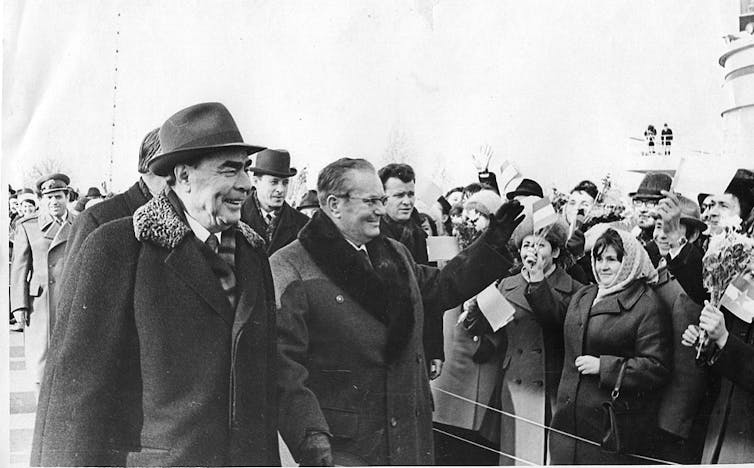
Tito and Brezhnev
Vigilant: President Tito with his Soviet counterpart, Leonid Brezhnev, in November 1973.
Wikimedia

The prestige of Yugoslavia’s security services was eroded. To ensure an event like this was never repeated, Tito launched a “special war” on émigré nationalists – a decade-long international campaign of targeted assassinations. Yugoslavia also increased pressure on countries like Australia to repress Croatian nationalist and extremist organisations in their territory.

In Australia, the attack wasn’t reported for weeks. When initial reports arrived from Yugoslavia, they were openly challenged by the Australian government, with Attorney-General Ivor Greenwood declaring he was “not aware of any factual basis for such allegations”. Distrustful of its Yugoslavian counterpart, the Australian government needed to be convinced that the improbable events had actually occurred.

When the full scale of the incident became known in the lead-up to Australia’s 1972 election, the government was caught flat-footed and deeply embarrassed. Police findings that at least some members of the group had been recruited and trained in Australia were widely reported in the press.

Australian security forces, more interested in countering communism than investigating machinations within migrant communities, didn’t have files on many of the Australian-based members of the brotherhood. They were unable to give William McMahon’s Coalition government a clear picture of what had happened and how such a plot came to be organised by Australians.


Read more:
Who were Australia’s best prime ministers? We asked the experts


The Commonwealth Police quickly launched a series of raids and reported to the government that approximately 300 Croatian Australians were of “particular concern”. The issue of how best to respond to these developments bedevilled a government that was reluctant to alienate migrant communities but didn’t want to give the impression such plotting was acceptable.

The Labor Party, long concerned about the risk posed by violent Croatian nationalism in Australia, seized on the incursion as evidence the McMahon government was unable to grapple with locally based terrorism. They would move aggressively against Croatian nationalist organisations when they came to power later that year, though this led to damaging typecasting of ordinary Croatian Australians and sometimes serious impacts on innocent individuals.

Australian prime minister William McMahon
Flatfooted: Australian prime minister William McMahon, shown here in 1971.
US National Archives/Wikimedia

Coupled with the September 1972 bombings of the Yugoslav General Trade and Tourist Agency in Sydney, the June attack in Yugoslavia weakened McMahon’s law and order record going into the 1972 election. Indeed, Labor MPs like Jim Cairns warned the government that any attempt to campaign on law and order had been undermined by their failure to tackle this issue.

While it is impossible to judge the role of a single issue in any campaign, and while neither party made the issue of Croatians central to their election pitch, the incursion had resonance.

Writing later, journalists Laurie Oakes and David Solomon observed that the government’s inability to deal with Croatian nationalist violence meant “Labor could appear stronger on national security than the Coalition”. The narrowness of McMahon’s election loss made every weakness more important.

A forgotten episode of Australian national security history, the 1972 attack is more than just a footnote. The incident had real consequences for the political trajectories of both Australia and Yugoslavia.

The Conversation

Alexander Mitchell Lee receives funding from the Australian Government Research Training Program (AGRTP) Stipend Scholarship.

ref. How Operation Pheonix exported violence from Australia to Yugoslavia – https://theconversation.com/how-operation-pheonix-exported-violence-from-australia-to-yugoslavia-185499

‘This is when we came of age’, says Māori leader on Matariki 2022

RNZ News

Today’s Matariki celebrations signal the maturing of Aotearoa New Zealand, says Māori leader Sir Pou Temara.

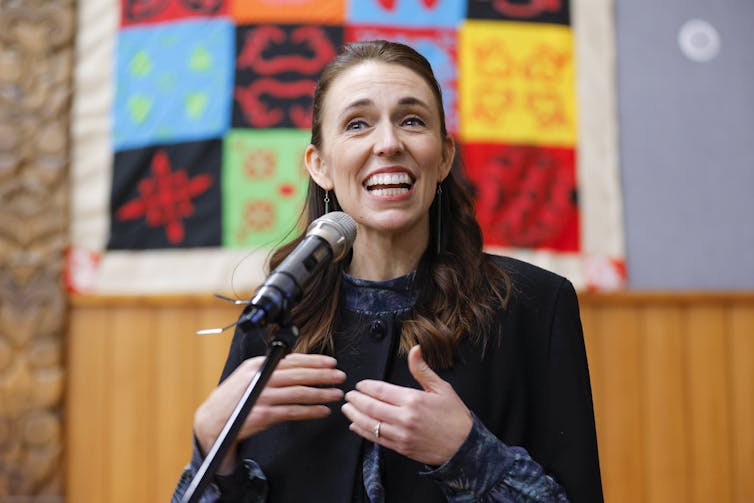
A ceremony attended by Prime Minister Jacinda Ardern and other dignitaries was held in Wellington to mark the first national public holiday in New Zealand for Matariki.

On a still Wellington morning at Te Papa, the hautapu ceremony was led by Sir Pou Temara and an array of tohunga.

“Today is a moment in time. This is a moment that future generations will look upon and say this is when we came of age,” Sir Pou said.

Matariki is the start of the Māori New Year Matariki – a time for celebration, remembrance, growth and renewal and events to acknowledge this have been organised across the country.

RNZ is marking Matariki with special programming throughout the day with highlights including a live broadcast of the celebrations from Te Papa hosted by Julian Wilcox and Māni Dunlop and an interview with renowned Māori astronomer Professor Rangi Mātāmua.

Celebrating Matariki. Video: RNZ News

‘Unites us under the stars’
Prime Minister Ardern recalled announcing the holiday in Rotorua in September 2020 and the joy that greeted the news, especially among young people.

She said she had witnessed several special moments this week, as people prepared for Matariki, including during her visit yesterday to Wainouimata Intermediate School to watch tamariki stage a performance of the many stories of Matariki.

The prime minister said the public holiday should not divide us by Māori ancestry or other, rather “it unites us under the stars of Aotearoa”.

“Matariki provides us with a chance to reflect; to think of those we have lost and to prepare and share a sense of hope and optimism for the future.

“I can’t think of a better moment in time for us to take up what Matariki has to offer us as individuals but also as a nation.”

Matariki offered “a space where there is room for us all,” she said.

This article is republished under a community partnership agreement with RNZ.

Print Friendly, PDF & Email

Article by AsiaPacificReport.nz

Boycotts in sport may not advance human rights. But they do harm individual athletes

Source: The Conversation (Au and NZ) – By Hans Westerbeek, Professor of International Sport Business, Head of Sport Business Insights Group, Victoria University

Organisers of Wimbledon, the main draw of which begins on June 27, have found themselves in a quandary over their controversial decision to ban Russian and Belarusian players in protest over the invasion of Ukraine.

The banned players include current men’s world number 1 Daniil Medvedev, number 8 Andrey Rublev, and women’s world number 6 Aryna Sabalenka.

Both the Association of Tennis Professionals (ATP) and Women’s Tennis Association (WTA) penalised Wimbledon for this ban by stripping the tournament of its ranking points.

Because one of the world’s most prestigious tennis tournaments has been relegated to merely a high-profile exhibition event, a growing number of players have pulled out of the tournament, including Naomi Osaka and Eugenie Bouchard (this shows how a boycotter event can simultaneously be boycotted by participants).

These kinds of boycotts occur regularly in high-profile sport as event organisers and participants use its global reach to highlight human rights violations.

But boycott actions and counter-actions – including those at Wimbledon – often do more to harm individual athletes who happen to be nationals of these countries rather than to the condemned regime or the event sponsors.


Read more:
Is banning Russian tennis players from Wimbledon the right call?


Sport and human rights

Australian former golfer Greg Norman sparked world-wide condemnation with his statement that “we’ve all made mistakes” when discussing the Saudi-Arabian-backed killing of journalist Jamal Khashoggi.

It didn’t go unnoticed that Norman is also CEO of the Saudi-backed LIV Golf Investments, which launched a PGA-breakaway golf tour for the super-rich.

Norman’s dismissal of a murder and the horrified global reaction to his comment show the power of sport to highlight and simultaneously ignore human rights violations.

Nations accused of violating these rights have found strategic, proactive approaches to counter the punitive, reactive, and short-term approach of economic boycotts. And sport plays an important part in that, such as the example of Qatar using the FIFA World Cup as a confirmation of their credibility and ability to host a globally significant event.

Such investments in “sportswashing” – using sport as a thin veneer to present a sanitised, friendlier version of a political regime or an organisation – are big business. The global influence of sport can become a vehicle for soft diplomacy and pursuing legitimacy.

November’s FIFA World Cup in Qatar remains a topic of a decade-long debate questioning how FIFA could award the world’s biggest sporting event to a country with a dubious human rights record.

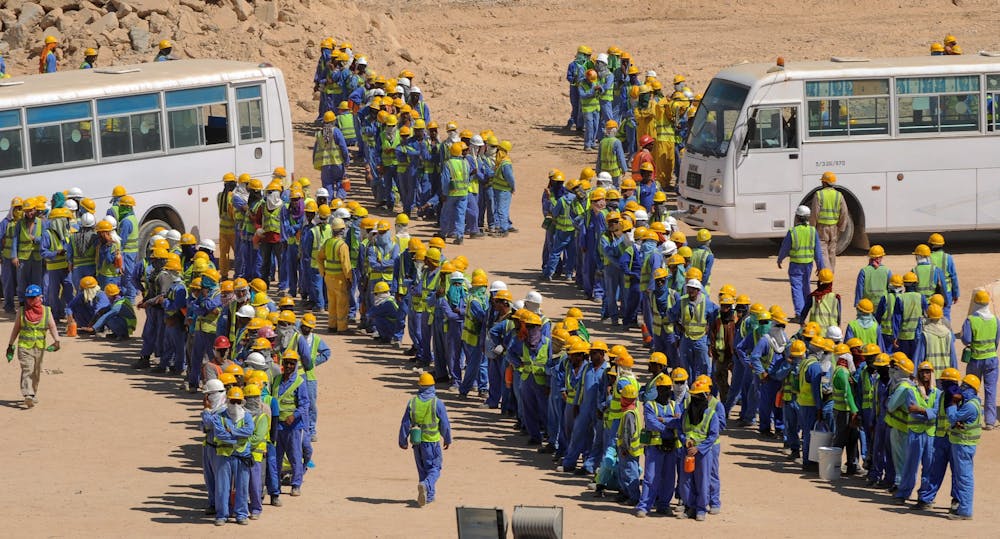
This has now only worsened with evidence of mass exploitation of the migrant workers constructing the Cup’s stadiums.

Many migrant construction workers queue up for the bus back to their accommodation camp
Migrant construction workers building infrastructure for the Qatar World Cup worked in very harsh conditions.
STR/EAP/AP

Although arguably less extreme in nature, Australia is not absolved of human rights deficiencies in sport.

Why, for example, do Indigenous Australians remain under-represented at the elite and community level in most Aussie sports? Why are Australian women missing as leaders in coaching? Why is there currently only one openly gay male professional soccer player in Australia and no openly gay male AFL players? Why have so many members of Australia’s gymnastics and swim teams reported abuse and toxic cultures that started when they were children?

We should take to heart that even the practice of sport is a universal human right under the Olympic and European Sports Charters, and other internationally ratified declarations and treaties.

However, most nations do not fully recognise and implement this notion in policy and practice, with access to sport participation often marred with complexities and hypocrisy.


Read more:
The Olympics have always been a platform for protest. Banning hand gestures and kneeling ignores their history


Has Wimbledon’s boycott worked?

Wimbledon organisers are clearly trying to make a point: invading the sovereign territory of another nation is unacceptable.

Yet even though the tournament can call the world’s attention to its stand, has banning players from invading nations proven to be an effective means to defend and protect human rights?

The answer would be a resounding “no”.

What the ban has achieved is to signal that the Wimbledon organisers take a position against the Russian invasion of Ukraine. But taking a stand does not defend nor protect.

In this case, it hurts those who cannot be blamed for the war (the banned tennis players), and the unintended consequences (no ranking points) hurt the wider community of professional tennis players.


Read more:
French Open: understanding why Russian and Belarusian tennis players are competing despite Wimbledon ban


While sport can indeed be a valuable platform to promote human rights, we must also recognise it doesn’t take much for sport to become exclusive, divisive and controversial.

Crucially, leveraging sport to advance human rights requires that human rights safeguarding by Australia, Russia or Qatar is measured by the same yardstick, recognising that much work must be done to ensure each country’s own sporting environment is inclusive and free of discrimination.

In doing that, we can truly recognise sport as the universal human right that it is, and it can remain true to its core objective of celebrating human potential and achievement.

The Conversation

Ramon Spaaij receives funding from the Australian Research Council and the Department of Health.

Hans Westerbeek does not work for, consult, own shares in or receive funding from any company or organisation that would benefit from this article, and has disclosed no relevant affiliations beyond their academic appointment.

ref. Boycotts in sport may not advance human rights. But they do harm individual athletes – https://theconversation.com/boycotts-in-sport-may-not-advance-human-rights-but-they-do-harm-individual-athletes-185208

Matariki falls during a quiet retail season – but NZ businesses should be wary of cashing in

ANALYSIS: By Mike Lee, University of Auckland

Aotearoa New Zealand will enjoy a new official public holiday on June 24, with the country marking Matariki — the start of the Māori New Year. But with it comes the temptation for businesses to use the day to drive sales.

Some Māori have already expressed concern that businesses were positioning themselves to market Matariki as a shopping event.

On the back of those concerns, Skye Kimura, chief executive of Māori cultural marketing and communications agency Tātou, launched a campaign called “Matariki is not for sale”.

“No one wants to see a Matariki Big Mac,” she argued.

But those trying to defend Matariki from mass commercialisation could be fighting a difficult battle.

Few public holidays, either in New Zealand and elsewhere, have been immune to commercial interests. In the United States, for example, businesses are facing criticism for attempting to make money from Juneteenth, a holiday to celebrate the emancipation of slaves.

Human tendency to mark the change
One of the difficulties facing critics of the commercialisation of public holidays is that they may be fighting deep habits born out of capitalism and human nature.

A lot of our special occasions are structured around various parts of the year and changes in the pattern of life. The earliest pagan rituals were about the change in seasons and to mark what was different from one period of life to the next.

From a social and possibly evolutionary perspective, we are already primed to do something different from our day-to-day activities to mark the significant changes we see around us.

When we have these seasonal celebrations, it doesn’t take much of a nudge for retailers to say, hey, people are looking to mark the change and shopping is a really good way to enact that transition between two phases — an “out with old, in with the new” message.

Light display telling the story of Matariki.
New Zealand’s new public holiday celebrates the New Year in the Māori lunar calendar. Image: Guo Lei/Getty Images

Shopping to celebrate is what we do
Each year is already punctuated with several cultural celebrations that have, over time, become shopping events. The most classic example is the commercialisation of Christmas.

Even though there is the Christian tradition of the three wise men giving gifts at the birth of Christ, establishing the ritual of gift giving, the three months leading up to December 25 have become about sales and opportunities to spend.

Easter, Valentine’s Day, Queen’s Birthday weekend and even Labour Day have all become sales events for retailers.

Matariki also lands in a quiet time of the year for retail — right in the middle of winter and between the big shopping weekends of Queen’s Birthday and Labour Day.

Potential for blowback against retailers
But when businesses commercialise anything there is always the question of whether they have the legitimacy to do so, or whether they’re bastardising the event for commercial gain.

There is the potential for significant blowback for businesses looking to cash in on Matariki. And they only need to look at Anzac Day as an example of commemoration that remains off limits to blatant commercialisation.

Yes, it’s fine to sell poppies or to have a donation box at your point of sale. It’s even okay to advertise with a “thank you for your service” banner. But if a business tries obviously to make money on the back of Anzac Day, people start to get a little upset.

That doesn’t mean businesses don’t try to get around public sentiment. Every year there is an element of “Anzac washing”, where companies try to make it look like they’re supportive of veterans, even if they have otherwise done nothing to support former and current military personnel.

It is likely that how we handle Anzac Day will provide a baseline for critics assessing businesses that try to use Matariki as a way to drive sales.

Businesses could be judged by whether or not they have Matariki sales, or whether there is some sort of attempt to “Matariki-wash” their other commercial offerings.

Christmas themed gifts for sale.
Christmas is the classic example of the commercialisation of cultural tradition. Image: Rizek Abdeljawad/Getty Images

Businesses should tread carefully
It is an area full of potential landmines, with little clear benefit at this stage.

Not only is there the commercialisation of a public holiday, which some people find annoying already, but there’s also the debate about cultural appropriation versus cultural appreciation.

Companies need to realise the potential for blowback and controversy is multiplied above other, more established public holidays. There are those who are annoyed about another public holiday adding labour costs for businesses. And there even are those objecting to the supposed “wokeness” of celebrating Matariki.

At a bare minimum, then, businesses determined to use Matariki as part of their sales pitch need to understand what the celebration is really about and its significance within the community.

It will be interesting to see if any are willing to risk the minefield for the sake of sales that come from an extra three-day weekend, or whether they’ll wait and see what happens to those who take the risk first.The Conversation

Dr Mike Lee is associate professor of marketing, University of Auckland. This article is republished from The Conversation under a Creative Commons licence. Read the original article.

Print Friendly, PDF & Email

Article by AsiaPacificReport.nz

Social justice research network awards trophy to Papuan student advocate

Pacific Media Centre newsdesk

A new Asia Pacific social justice research and publication nonprofit has awarded a diversity communications trophy to a West Papuan postgraduate student who has advocated for the education and welfare of his fellow students.

Several dozen Papuan students trying to complete their studies were stranded in Aotearoa New Zealand by a sudden scholarship cancellation.

Laurens Ikinia, 26, has been campaigning since February for his fellow students to carry on with their studies in New Zealand after Jakarta scrapped their Papuan autonomy government scholarships.

However, while presenting the Storyboard Award for diversity journalism to Ikinia, interim chair of the Asia Pacific Media Network, Dr David Robie, said today the prize was primarily marking the work of the communication studies student during the pandemic in 2020 when he “raised the profile” of the tiny Papuan community in Aotearoa New Zealand with many articles.

“His efforts have gone on from strength to strength combining the skills of journalism and as a communications advocate,” he said at the ceremony in the Whānau Community Hub in Mt Roskill.

“Laurens Ikinia has done West Papua proud, and we’re also very proud of his work.”

The Storyboard Award was first created in 2006 with the first winner being Qiane Matata-Sipu, creator of Nuku: Stories of 100 Indigenous Women. Other winners have included John Pulu of Tagata Pasifika; Alex Perrottet, formerly of RNZ; Sri Krishnmurthi of Pacific Media Watch; and Alistar Kata and Blessen Tom of TVNZ’s Fair Go.

Publication of PJR
The APMN, formally founded earlier this month, was established to continue publication of Pacific Journalism Review, first launched at the University of Papua New Guinea in 1994 and published in recent years at the University of the South Pacific then Auckland University of Technology.

The network’s objectives also include providing resources to benefit “First Nations and other communities, and in support of fair representation for voiceless and diverse community interests”.

Gathered at the ceremony were academics, researchers, community advocates and journalists – including several stalwarts of the former Pacific Media Centre – and also “wantok” supporters of Ikinia.

A spokesperson for the Whānau Hub, Nik Naidu, said it was “exciting to be working with like-minded groups committed to social justice”.

“It certainly feels as if we are part of an important initiative — it’s a privilege to be part of such an inclusive and welcoming community,” said Dr Heather Devere, one of the network members.

Khairiah A. Rahman and David Robie with Laurens Ikinia
Khairiah A. Rahman and David Robie with Laurens Ikinia. Image: Del Abcede/APR

Pacific Journalism Review editor Dr Philip Cass said it was encouraging that the 28-year-old journal now had a new home and his editorial team were busy working on the next edition due out next month.

Institutional support
Ikinia reported that for most of the 27 Papuan students who were impacted on by the loss of government scholarships and were still in Aotearoa they were being assisted by a mix of institutional support through accommodation and waiving of fees and public fundraising.

In the case of nine students in Palmerston North who had completed their carpentry course, they had been offered jobs and were applying for work visas.

Nik Naidu and APMN
Nik Naidu of the Whānau Community Hub with other Asia Pacific Media Network members at their meeting today. Image: Del Abcede/APR

Ikinia said that on behalf of the International Alliance of Papuan Students Association Overseas (IAPSAO) he was offering “our humble and sincere gratitude” for all the assistance provided in New Zealand.

He also said that student president Yan Wenda and secretary Christian Tabuni had returned to the Papuan capital Jayapura in a bid to seek government support.

“They’ve met Governor Lukas Enembe in person to talk about the struggle faced by all West Papuan students who are currently studying overseas,” he said.

It is believed the governor had issued instructions for the payment of outstanding fees.

Ikinia also thanked Auckland University of Technology for its support and community groups such as Pax Christi that have been fundraising.

Asia Pacific Media Network members
Asia Pacific Media Network members and Papuan students share the success of Laurens Ikinia. Image: Del Abcede/APR
Print Friendly, PDF & Email

Article by AsiaPacificReport.nz

Outgoing PNG minister challenges impartiality of officials in demand for fair polls

By Claudia Tally in Port Moresby

The impartiality of officials who have been appointed to manage polling in the National Capital District during the Papua New Guinea general election next month has been questioned.

In a first of its kind meeting in Port Moresby yesterday, candidates, police and the election manager convened at the Sir John Guise stadium where issues such as impartiality, vote rigging, common roll and security were the biggest concerns.

The meeting comes on the back of the appointment of all Assistant Returning Officers (AROs) by the PNG Electoral Commission to conduct the national elections.

The list of appointees will be published by the Post-Courier tomorrow for readers’ information and comment.

Former Moresby North-west MP and now NCD regional candidate Michael Malabag, who was Health Minister in the outgoing government, questioned the appointment of five AROs who are engaged with the National Capital District Commission, claiming that this may influence the election process.

In response, NCD Election Manager Kila Ralai said the officials were public servants attached with the NCDC and that there was no intention to compromise the integrity of the election process.

“We have 16 AROs for NCD’s three open electorates and we have two APROs and that makes it 18 and out of those 18 AROs we have only five staff from NCDC as part of AROs to assist in these elections,” he clarified.

A petition is possible
“Because they are public servants in NCDC, likewise, if I was in East Sepik I would also have public servants as AROs.

“So in that process we only considered five out of a couple of applications from NCDC.”

However, Ralai added that if the candidates wished to apply for changes, they could present a petition which he would bring it to the Electoral Commissioner for further deliberation.

He also advised candidates that there would be issues with the common roll which should be ironed out after this election.

Another matter raised by NCD regional candidate Michael Kandiu was the transportation of ballot boxes from the polling stations to the counting venues.

He said there were allegations of foul play in the last two elections.

In this election he demanded transparent operations and better security.

No tinted police vehicles
“I want police to make sure that no ballot box is transported by any tinted police vehicle and it must be transported straight from the polling booth to the counting centre,” he said.

It was resolved that ballot boxes would be transported on open back vehicles straight from polling sites to counting venues.

The former Secretary for Department of Community Development and Religion, Anna Bais, who is contesting the Moresby Northwest Open, asked about the installment of CCTV (closed circuit television) cameras in all counting sites.

“We want CCTVs so we need to know if CCTVs can be put in here.

While government may say there is no money, we are willing to support,” said Bais.

Her call for CCTV linkages was supported by other candidates who offered to help with funds.

Metropolitan Superintendent Gideon Ikumu explained that the manpower in the city included 200 recalled reservists and another 150 recently trained reservists who would join the regular police officers along with members of the PNG Defence Force.

Claudia Tally is a PNG Post-Courier journalist. Republished with permission.

Print Friendly, PDF & Email

Article by AsiaPacificReport.nz

We helped track 77 species for up to 60 years to try to reveal the secrets of long life. And some don’t seem to age at all

Source: The Conversation (Au and NZ) – By Mike Gardner, Flinders University

Mike Gardner, Author provided

Ever wondered about the secret to a long life? Perhaps understanding the lifespans of other animals with backbones (or “vertebrates”) might help us unlock this mystery.

You’ve probably heard turtles live a long (and slow) life. At 190 years, Jonathan the Seychelles giant tortoise might be the oldest land animal alive. But why do some animals live longer than others?

Research published today by myself and colleagues in the journal Science investigates the various factors that may affect longevity (lifespan) and ageing in reptiles and amphibians.

To investigate this, we used long-term data from 77 different species of reptiles and amphibians – all cold-blooded animals. Our work is a collaboration between more than 100 scientists with up to 60 years of data on animals that were caught, marked, released and re-caught.

These data were then compared to existing information on warm-blooded animals, and several different ideas about ageing emerged.

What factors might be important?

Cold-blooded or warm-blooded

One popular line of thought we investigated is the idea that cold-blooded animals such as frogs, salamanders and reptiles live longer because they age more slowly.

These animals have to rely on external temperatures to help regulate their body temperature. As a result they have slower “metabolisms” (the rate at which they convert what they eat and drink into energy).

Animals that are small and warm-blooded, such as mice, age quickly since they have faster metabolisms – and turtles age slowly since they have slower metabolisms. By this logic, cold-blooded animals should have lower metabolisms than similar-sized warm-blooded ones.

However, we found cold-blooded animals don’t age more slowly than similar-sized warm-blooded ones. In fact, the variation in ageing in the reptiles and amphibians we looked at was much greater than previously predicted. So the reasons vertebrates age are more complex than this idea sets out.

Environmental temperature

Another related theory is that environmental temperature itself could be a driver for longevity. For instance, animals in colder areas might be processing food more slowly and have periods of inactivity, such as with hibernation – leading to an overall increase in lifespan.

Under this scenario, both cold and warm-blooded animals in colder areas would live longer than animals in warmer areas.

We found this was true for reptiles as a group, but not for amphibians. Importantly, this finding has implications for the effects of global warming, which might lead to reptiles ageing faster in permanently warmer environments.

The stripy brown small lizard sits on a rock
The Viviparous lizard (Zootoca vivipara) is one of the cold-blooded species we studied.
Shutterstock

Protection

One suggestion is that animals with certain types of protections, such as protruding spines, armour, venom or shells, also don’t age as fast and therefore live longer.

A lot of energy is put into producing these protections, which can allow animals to live longer by making them less vulnerable to predation. However, could it be the very fact of having these protections allows animals to age more slowly?

Our work found this to be true. It seems having such protections does lead to animals living longer. This is especially true for turtles, which have hard shell protection and incredibly long lifespans.

We’ll need to conduct more research to figure out why just having protections is linked to a longer life.

A crocodile sits on the bank of a river with its mouth open
One species of crocodile studied, Crocodylus johnsoni, has a powerful armoured body with protruding scales that protect it from predation.
Shutterstock

Reproduction

Finally, it has been posited that perhaps longevity is linked to how late into life an animal reproduces.

If they can keep reproducing later into life, then natural selection would drive this ability, generation to generation, allowing these animals to live longer than those that reproduce early and can’t continue to do so.

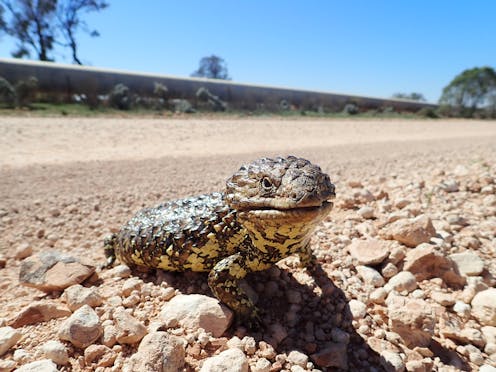
Indeed, we found animals that start producing offspring at a later age do seem to live longer lives. Sleepy lizards (or shinglebacks) are a great example. They don’t reproduce until they’re about five years old, and live until they’re close to 50!


Read more:
Breakthrough allows scientists to determine the age of endangered native fish using DNA


The challenge in understanding ageing

To understand ageing, we need a lot of data on the same animals. That’s simply because if we want to know how long a species lives, we have to keep catching the same individuals over and over, across large spans of time.

This is “longitudinal” research. Luckily, it’s exactly what some scientists have committed themselves to. It’s also what my team is doing with sleepy lizards, Tiliqua rugosa. These lizards have been studied continuously at Bundey Bore station in the Mid North of South Australia since 1982.

The sleepy lizard is one of the species used in the longevity study. As far as we know, this species lives up to 50 years.
Mike Gardner

Here, more than 13,000 lizards have been caught over 40 years of study. Some have been caught up to 60 times! But given the 45-year longevity of these lizards, we’ve been studying them for a shorter time than some of them live. By keeping the survey work going we might find they live even longer.

Some animals’ chance of dying isn’t linked to age

Another interesting part of this research was finding, for a range of animals, that their chance of dying is just as small when they’re quite old compared to when they’re young. This “negligible ageing” is found in at least one species across each of frogs, salamanders, lizards, crocodiles and, of course, in tortoises like Jonathon.

We’re not quite sure why this is. The next challenge is to find out – perhaps by analysing species genomes. Knowing some animals have negligible ageing means we can target these species for future investigations.

Understanding what drives long life in other animals might lead to different biomedical targets to study humans too. We might not live to Jonathan the tortoise’s age, but we could theoretically use this knowledge to develop therapies that help stop some of the ageing process in us.

For now, healthy eating and exercising remain surer ways to a longer life.


Read more:
The search to extend lifespan is gaining ground, but can we truly reverse the biology of ageing?


The Conversation

Mike Gardner receives funding from the Australian Research Council. He is affiliated with The South Australian Museum.

ref. We helped track 77 species for up to 60 years to try to reveal the secrets of long life. And some don’t seem to age at all – https://theconversation.com/we-helped-track-77-species-for-up-to-60-years-to-try-to-reveal-the-secrets-of-long-life-and-some-dont-seem-to-age-at-all-185583

We asked the public about being lonely during lockdowns. For many, Zoom calls weren’t enough – and some still haven’t recovered

Source: The Conversation (Au and NZ) – By Roger Patulny, Associate Professor of Sociology, University of Wollongong

Shutterstock

Despite widespread access to social media and videoconferencing technology, many Australians experienced heightened loneliness during COVID lockdowns, and continue to do so.

We surveyed more than 2,000 Australians during 2020-21 about their experiences during and after lockdown, for research published today in the Australian Journal of Social Issues. Participants came from every state and territory and ranged from ages 18 to 88. About two-thirds were female.

We captured respondents’ detailed experiences of lockdowns in their own words. From this we gained insight into people’s feelings of loneliness in the context of digital media use.

While many have struggled, the impacts haven’t been felt equally by all.

Who was lonely, and stayed lonely after lockdowns?

The pandemic opened up new “inequalities” in loneliness, by creating barriers to socialising for several types of people. These difficulties remained even after lockdowns ended, as they had higher rates of loneliness months later.

For example, 49% of men and 47% of women agreed they had been lonely “at least some of the time” (a minimum 1-2 days per week) during lockdown. But this dropped to 40% of men and 42% of women in the months after lockdown, opening up a gendered “loneliness gap”.

Men bounced back quicker when activities such as sports and recreation resumed. This makes sense when you consider men are more likely to base friendships on such activities than women are.

We also found people with a physical disability, single people (not in a relationship), those with low incomes, and those lacking strong social ties before COVID had higher levels of loneliness during lockdowns – and persistent loneliness afterwards.

Why did they stay lonely?

Loneliness was extensive among young people who experienced COVID‐induced isolation. They missed out on formative opportunities to make friends (such as starting university), travel overseas or enter the workforce for the first time. Such interruptions may correct themselves as regular routines resume.

A young graduating woman sits in front of her laptop in her robe, hat and certificate in hand
During lockdowns many students had to graduate online – missing out on a major life experience.
Shutterstock

A potentially more serious problems is social networks having diminished during lockdown. There was a reported “pruning” of friends, where people chose to socialise online with those they were already close to, at the expense of more distant and diverse friendships.

One respondent noted:

I spend more time with close friends. Less time with ‘acquaintances’. More time with reliable colleagues. Less time with ‘time‐wasters’.

The problem with this is it takes time to rebuild extensive networks, which likely contributes to more protracted “social” loneliness. It may also propagate intolerance towards those more distant types of people that we cull, as shown in studies of COVID-induced loneliness in rural NSW communities.

It was also difficult for those who found themselves being “pruned”. These people, many of them men, became lonelier when they realised much of their existing friendships weren’t as close as they’d thought.

Many people felt they and others had lost the habits of social interaction during COVID, making it difficult or impossible.

One middle-aged male said:

Feels like life and society have permanently changed even after most of the pandemic has ended […] You can make plans and act towards them, but they can (and usually do) come undone in moments.

Such lost habits may take substantial time to be regained.

Some people made the most of what they had

COVID exposed gaps in our digital preparedness. Those who already had extensive or active online networks described an easier transition to lockdown. One older female respondent noted she:

for decades had many online relationships all over the world. This has facilitated my ease at moving to online.

This reflects research findings that online interaction that supports existing connections and stimulates new ones can help reduce loneliness.


Read more:
Does social media make us more or less lonely? Depends on how you use it


Some people with physical disabilities celebrated digital interaction. As one person said:

I am an equal on Zoom.

This is in keeping with research finding positive impacts of videoconferencing on loneliness for frail older people.

An elderly man sits in front of his laptop looking disappointed
Elderly people found it difficult to connect digitally during lockdowns, making them feel distant from loved ones.
Shutterstock

Zoom couldn’t fill the gap

However, despite some positive experiences, our work found digital contact was overall not a sufficient substitute for lost physical contact and social needs.

As one female respondent said:

Online alternatives help a lot, but it’s not the same and not enough.

Some lacked digital literacy, and described a difficult transition to videoconferencing:

I hate chatting ‘cause I’m a slow typer. I hate Skype, in part because I hate seeing myself on screen and hate other people seeing me.

Having to “go digital” made pre-existing anxieties worse for some, while others felt left behind:

It has been an isolating experience because I keep hearing how others are always staying connected via these methods.

Many people simply missed the “physicality” of face-to-face interactions; the “atmosphere” of public spaces, the chance to “dress up”, and physical intimacy and contact.

Connection in a post-COVID world

Still, many fell back on the ease of digital communication compared to “difficult” face-to-face encounters even after lockdown lifted. One middle-aged female said real-life interactions now felt “tiring”.

This is concerning because it points to the seductive power of digital communication as a “substitute” for physical interaction.

Research shows online interaction can increase loneliness when it fails to support (often more meaningful) existing relationships, and instead “displaces” them with less meaningful or shallow digital interactions.

The internet might improve life for those who can’t physically interact due to remoteness or physical incapacity. But if the convenience of digital communication displaces regular (often higher-quality) interactions, it could exacerbate isolation and loneliness.

With lockdowns having receded, we should look at ways to reconnect physically with friends, rather than relying increasingly on digital means to bridge the loneliness gap.

The Conversation

This story is part of The Conversation’s Breaking the Cycle series, which is about escaping cycles of disadvantage. It is supported by a philanthropic grant from the Paul Ramsay Foundation

Marlee Bower is Academic Lead, Australia’s Mental Health Think Tank, which is funded philanthropically by the BHP Foundation. She is a board member of The Haymarket Foundation.

ref. We asked the public about being lonely during lockdowns. For many, Zoom calls weren’t enough – and some still haven’t recovered – https://theconversation.com/we-asked-the-public-about-being-lonely-during-lockdowns-for-many-zoom-calls-werent-enough-and-some-still-havent-recovered-185586

How young Black African Australians use social media to challenge anti-Black narratives and reclaim racial dignity

Source: The Conversation (Au and NZ) – By Kathomi Gatwiri, Senior lecturer, Southern Cross University

Shutterstock

For Black African young people in Australia, social media can be especially fraught – a place they witness footage of anti-Black violence, contend with an “othering” gaze and encounter racist trolling, posts or comments.

Despite these challenges, social media can offer Black African young people in Australia safe spaces to engage in positive expressions of afro-Blackness, as our new study shows.

Our study, published today in the Australian Journal of Social Issues, was an ethnographic study of the social media activity of 15 young people (16–25) who self-identify as African and live in Australia.

Participants consented to being followed and/or “friended” on social media so as to observe their online practises over a six month period. They were also interviewed about their experiences on social media.

Our study reveals how these young people are using social media to challenge anti-Black narratives and reclaim some of their racial dignity.


Read more:
Battlegrounds: highly skilled Black African professionals on racial microaggressions at work


Racial dignity and anti-Black racism

One of us (Gatwiri) has defined racial dignity as:

the immutable, unconditional worth of Blac/k people as human beings. To be racially dignified is to be seen through a humanised lens, and to be afforded basic respect, compassion and recognition in interpersonal and systemic contexts.

Anti-Black racism is a unique form of racism especially directed towards dark skinned Black people.

Research on blackness argues there is something particular and specific about the visibility of Black bodies that triggers the imagination of white Australia. They are “read” as too un-assimilable, too different, too foreign, too dangerous, too visible, too everything.

Zuberi (age 25) also highlighted how anti-Blackness produces hyper-criminalisation of Black people. This results in over-policing by the community and the criminal justice system. He reflected on one example:

We were walking back to the train station, and we were topping up our Myki. And there were two inspectors, standing a few metres from us, on the side. And this was probably about 9pm, a bit late. and they were like “Those people are always up to no good.” And then my cousin’s like, “What? What do you mean?” Like he got very angry and I think in those kinds of moments you kind of question […] you question a lot of stuff.

Real world experiences of anti-Black racism can inform the way young African Australians experience social media and participate in racial discourse online.

Many use social media functions – such as block, delete, mute and unfollow – to effectively bypass racism online.
Shutterstock

Our other journal article from this study reported how Black African Australians used social media to spotlight and engage in positive expression of afro-Blackness. But they were also terrified of making white people uncomfortable, which could invite racial trolling or racial abuse online.

King (age 18) reflected on his attempts to separate himself from the “African gangs” label often attached to young Black African people in Australia. This informed the design of his online avatar and profile photo, curated to evoke a “friendly” persona:

People sometimes they just look at your profile and they think you’re a bad person or a bad influence based on your picture. They’ll assume that you’re like other Black people they’ve seen in their life, they’ll assume you’re the same person.

When confronted with racist content on their newsfeed, most participants made deliberate choices to stay away from the comments section, colloquially considered a “cesspool of hatred”. Zuberi explained:

You do see things on social media but I try to not get involved with it as much […] And for that reason, I choose not to look at the comments.

Creating online boundaries and communities

The young people in our study reported digital spaces were safer than physical, offline settings in the white-majority Australian context.

Many used social media functions – such as block, delete, mute and unfollow – to effectively bypass racism online. They also used the “close friends” and “private stories” features to share their racial experiences.

This allowed people to engage in the kind of self-representation they chose – including posting pictures of themselves or discussing their experiences – within a “safe digital space”.

Social media was also particularly useful in connecting Black African youth who are geographically separated from each other. Many reflected how useful these connections are, often noting they were the “only Black kid” in their school or neighbourhood.

Social media was also particularly useful in connecting Black African youth who are geographically separated from each other.
Shutterstock

Social media therefore became a place where participants sought out connections that dignified and validated their experiences.

Nya (age 18) told us these communities helped her to form a positive sense of identity as a young Black woman in Australia:

I’ve created a communal space on every single platform which has made me feel comfortable with myself […] I feel like I belong to the wider Black diaspora […] I actually didn’t grow up with Sudanese people, I grew up in (location removed for privacy) which is very white. So yeah, I created a community and I have connections and I like it.

Fear of racial trolling persists

Human rights lawyer Nyadol Nyuon, has said racial trolling is provoked by the belief that discussions about racism are a lack of gratitude “for the hand that fed you.”

Participants in our study also expressed awareness about the types of content they could and could not post, demonstrating how the fear of offending white people in digital spaces continued to shape their online practices.

As Mark (age 25) said,

I try to be quite careful in digital spaces because anything to do with race, you never know who is going to use that against you.

Using certain social media features allowed our participants to bypass traditional media and instead engage in self-presentations of their own making. This way, they were able to reclaim aspects of their racial dignity by developing positive pro-Black narratives online.


Read more:
The power of no: Simone Biles, Naomi Osaka and Black women’s resistance


The Conversation

This story is part of The Conversation’s Breaking the Cycle series, which is about escaping cycles of disadvantage. It is supported by a philanthropic grant from the Paul Ramsay Foundation.

Claire Moran does not work for, consult, own shares in or receive funding from any company or organisation that would benefit from this article, and has disclosed no relevant affiliations beyond their academic appointment.

ref. How young Black African Australians use social media to challenge anti-Black narratives and reclaim racial dignity – https://theconversation.com/how-young-black-african-australians-use-social-media-to-challenge-anti-black-narratives-and-reclaim-racial-dignity-185504

When RAT-testing for COVID, should you also swab your throat?

Source: The Conversation (Au and NZ) – By Thea van de Mortel, Professor, Nursing and Deputy Head (Learning & Teaching), School of Nursing and Midwifery, Griffith University

Shutterstock

We’re now pretty used to swabbing our nose to test for COVID when we have a scratchy throat or new cough. But should we also be using our rapid antigen test (RAT) to swab our throat, as some social media sources suggest?

As people with an Omicron infection often get a sore throat early on, they reason that Omicron is found first in the throat. So swabbing the throat and nose together, some social media sources say, is more likely to accurately detect an infection.

A sore throat is more common with Omicron than Delta. However this doesn’t mean you should use your nasal RAT to swab your throat for Omicron. It’s best to follow the instructions on the packet.

Remind me, what are the different types of RATs?

There are several different ways to test for COVID using a RAT.

Oral samples can include saliva (spit into a tube), saliva from a tongue or cheek swab, or a throat swab (tonsil area).

Nasal samples can be collected from the front (anterior), middle or back (nasopharyngeal) of the nose.

There are also many different brands of RAT. Their ability to detect a positive case varies depending on the brand, the variant, whether the person has symptoms, and their viral load at the time of the test.


Read more:
Taking your first rapid antigen test? 7 tips for an accurate result


What do studies say about RATs for the nose vs throat?

It’s complicated. The time lag between researchers conducting a study and its publication means studies that compare sampling methods were largely conducted before Omicron, or before the widespread use of RATs.

A systematic review of 23 pre-Omicron studies found nasal and throat samples tested together were more sensitive (meaning they accurately detected a positive case) than nasal samples alone: 97% vs 86%.

However, these were swabs taken independently (with two separate swabs – one for the nose and one for the throat) and then combined at the point of testing the sample, rather than taking a combined nasal/throat swab (where the nose is swabbed then the throat is swabbed with the same swab, or vice versa). They also used PCRs rather than RATs.

A study conducted during the Omicron wave tested 49 people with PCR-confirmed COVID who had both nasal and throat swabs. It found 86% of positive cases were picked up by nasal swabs on a RAT compared with 47% detected by throat swabs, and 89% by both methods.

This suggests Omicron is not more easily detected in the throat. Adding a throat swab did not pick up many extra cases (3%).

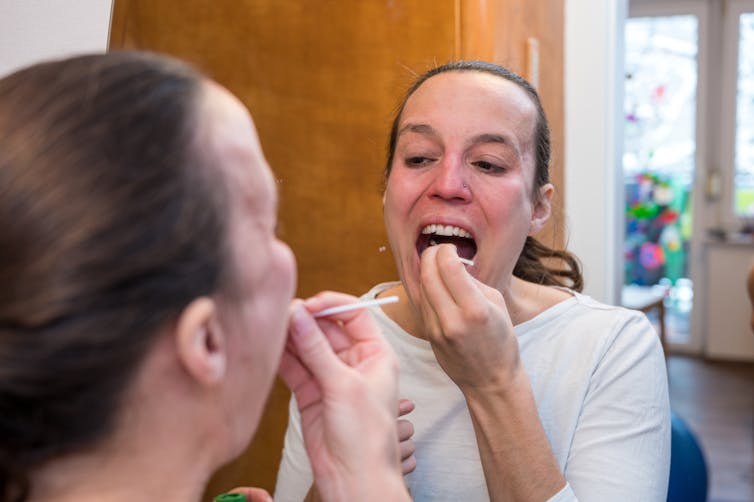
Woman swabs her throat.
Swabbing your throat doesn’t seem to pick up many extra positives.
Shutterstock

However, a preprint study, which is yet to be peer-reviewed (checked by independent scientists), reports conflicting results.

In this study, individual nasal and throat swabs both detected 64.5% of infections. But some nasal samples tested positive when the throat swab was negative and vice versa. Doing both tests individually picked up around 89% of positive cases.

When individual nasal swabs were compared to a combined nasal/throat swab, the nasal swabs picked up around 68% of the cases, while the combined swab picked up around 82%.

In summary, of the two recent studies that include an Omicron sample, the published study found that nasal swabs were much more effective than throat swabs at detecting COVID. And if the results of both tests were combined, only 3% of extra cases would be detected.

The preprint (unpublished) study reports conflicting results, suggesting a combined nasal/throat swab would pick up an extra 14% of cases.


Read more:
Just how accurate are rapid antigen tests? Two testing experts explain the latest data


Does Omicron appear first or at higher levels in the throat?

A survey found those with Omicron were 9% more likely to report a sore throat than those with Delta, whereas the latter were more likely to report a runny nose and sneezing.

However, when comparing saliva from a throat swab to a deep nasal swab in a study of 624 people, researchers found more virus (known as viral load) in the deep nasal swabs than in saliva tests. A test is more likely to detect a positive case when the viral load is higher.

The researchers found more virus in the nasal swab regardless of the day the specimen was collected, which suggests the virus doesn’t appear earlier in the throat.

Detection of COVID in saliva from the throat was 4% less likely in Omicron compared to Delta cases, which suggests Omicron doesn’t increase the viral load of saliva in the throat either.

However, it’s important to note, the nasal swabs we take at home are unlikely to go as deep as those in this study, which could affect the results.

Man looks at RAT test result.
The virus doesn’t seem to appear in the throat first.
Shutterstock

Other things to consider

The type of swab also differs, depending on whether it is designed for a nasal or oral test, and may not always be appropriate to sample a different area, because of differences in swab shape and flexibility.

The pH (a measure of acidity) also differs in the throat and the nose, and altered pH can affect COVID test function, and therefore could potentially affect the result.

So what should you do?

The website of Australia’s regulator, the Therapeutic Goods Administration, recommends performing either a nasal or oral test, as the instructions direct.

Likewise, the US Food and Drug Administration recommends RAT instructions are followed to the letter.

While the UK’s National Health Service (Britain) website refers to swabbing both the throat and nose, this is using a RAT kit that is made to do both.

As there is currently no clear evidence that Omicron appears in the throat earlier or at higher levels, and RATs are designed and tested for the specific area being sampled, it makes sense to continue to follow the test instructions.

If you wish to swab both areas, it’s best to use two separate tests designed for those areas.


Read more:
Can you use rapid antigen tests in children under 2 years old?


The Conversation

Thea van de Mortel teaches into the Griffith University Infection Prevention and Control postgraduate programs.

ref. When RAT-testing for COVID, should you also swab your throat? – https://theconversation.com/when-rat-testing-for-covid-should-you-also-swab-your-throat-184732

The clean energy revolution isn’t just a techno-fix – it’s about capturing hearts and minds

Source: The Conversation (Au and NZ) – By Bjorn Sturmberg, Research Leader, Battery Storage & Grid Integration Program, Australian National University

Shutterstock

The Black Summer bushfires devastated parts of the Eurobodalla region in New South Wales. Then earlier this year, the area was hit by floods. As climate change threatens to bring more severe and frequent extreme weather events, how can we help future-proof such communities?

One way is to build electricity systems that can withstand natural disasters. That was the starting point of a three-year project we’re undertaking. The project has just reached a milestone: selecting eight sites where microgrids – small, self-sufficient energy systems – might help boost disaster resilience.

Smart site selection for new technologies is crucial. Too often, projects have been parachuted into communities without enough consideration, leading to poor outcomes for both project operators and residents.

The climate and environmental crises demand innovations in our everyday infrastructures. If these changes are to be accepted and adopted en masse, we must find the right fit between communities and infrastructure. Here, we share what we’ve learnt so far, in the hope other regional communities might benefit.

A model community

Microgrids are small-scale electricity networks that can be used as part of, or separate to, the main electricity grid. They usually involve a range of local electricity sources, and can supply power when communities are cut off from the main network – such as during a storm or fire.

But the form that microgrids should take is unclear and contested. A microgrid could be limited to servicing a handful of essential shops during disasters, or it could power the whole community all year round – protecting it from electricity market volatility as well as disasters.

The Eurobodalla Shire is a picturesque coastal region with a growing population.
During the Black Summer fires, power supplies were lost across large parts region and the outage lasted several days.

Our project is working with Eurobodalla communities to determine if microgrids are right for them. We aim to model using microgrids coupled with renewable energy – including household, commercial and community solar, and small- and medium-scale batteries.


Read more:
Floods left thousands without power. Microgrids could help communities weather the next disaster


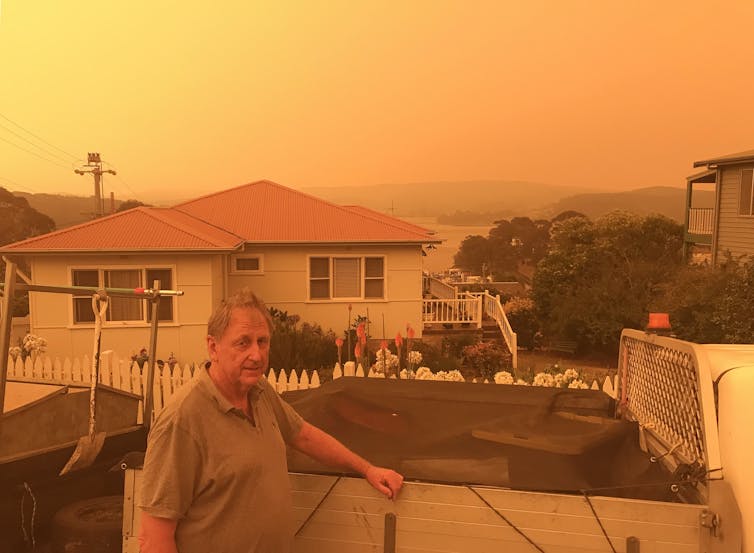
man stands in front of house with orange sky
Eurobodalla communities suffered power cuts during the Black Summer fires.
Dominica Sanda/AAP

Context is everything

Under the previous federal government, Australia’s approach to emissions reduction was narrow and technology-centred.

The new Labor government – elected on the promise of climate action – has the opportunity to move to a community-based approach. This should ensure any new infrastructure integrates with people’s lives, values, and aspirations.

Such an approach requires proponents and funding bodies (both government and private) to genuinely listen to communities’ needs – right from the early design stage.

If local circumstances are not considered, a trial can be plagued with problems. These include:


Read more:
Tesla’s ‘virtual power plant’ might be second-best to real people power


Listening to local voices

So how did we decide which communities to work with? One guiding principle was to elevate local voices in the decision-making process.

For the selection of sites we held discussions with organisations including the local electricity network company, a prominent community group focused on sustainability and the Eurobodalla Shire Council.

Based on our initial discussions and a literature review, we compiled a set of indicators to help identify which communities would most benefit from the resilience boost that microgrids offer. The indicators include:

  • population size, age and income
  • rates of people with disability
  • cultural and ethnic diversity
  • the frequency and duration of past power outages
  • layout of the town and electricity network
  • a community’s visions for its future.
people walking along coastline viewed through hole in rock
The researchers spoke to poeple in the Eurobodalla region about their visions for the future.
Shutterstock

In the case of the Eurobodalla region, we also considered communities’ past experience of traumatic disasters, and subsequent “consultation fatigue” following the many investigations into the Black Summer fires.

While our assessment was project specific, we’ve made our framework freely available here so it might inform future technology trials.

From these indicators, we selected eight communities ranging from small hamlets of less than 100 residents to larger towns with more than 2,000 residents.

All were found to be vulnerable to natural disaster – for example, they may have had high residential occupancy rates (as opposed to holiday lettings), or lots of elderly people and those with disability. These communities also had high rates of rooftop solar installation.

The project team will now speak to residents and businesses in each community about their future energy needs, and whether microgrids might have a role. We’ll ask questions such as:

  • what, if any, microgrid designs appeal to you – ranging from backup power for community shelters to large systems servicing an entire community?

  • what, if any, business models do you support, ranging from current market structures to more active roles for the local council or citizens?

By the end of the project, we hope to have identified which, if any, communities wish to move forward with microgrids. For those that do, our project will provide the initial social research and technical feasibility studies on which to build proposals and potentially apply for federal funding.

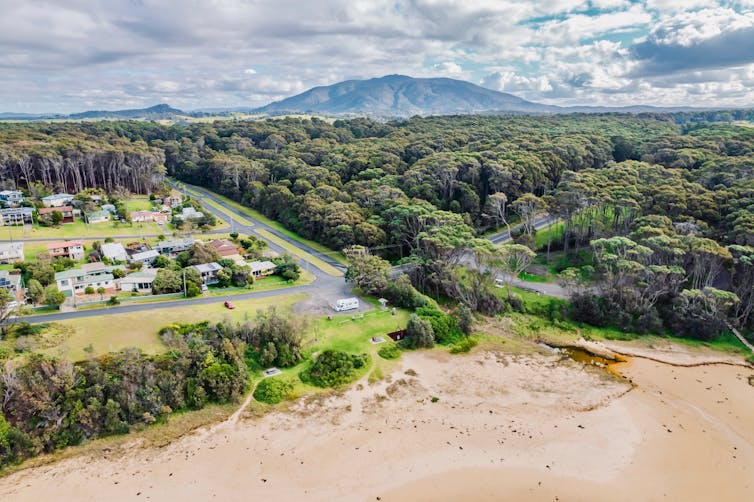
homes and bushland  separated by road
Mystery Bay, one of eight communities on the NSW south coast selected for further microgrid studies.
Shutterstock

Looking to a clean energy future

As the climate emergency worsens, there is too much at stake to adopt the “decide, announce, defend” method of technology roll-out. Community-based approaches will better build the widespread support needed to accelerate climate action.

And the recent energy crisis on east coast showed natural disasters aren’t the only threats to electricity supplies. As the national electricity market grapples with a perfect storm of challenges, technology to help communities become energy self-sufficient makes even more sense.


Read more:
The national electricity market is a failed 1990s experiment. It’s time the grid returned to public hands


The Conversation

Bjorn Sturmberg has received funding from the State and Federal governments, including from the Australian Renewable Energy Agency. for work related to solar, batteries, microgrids, and electric vehicles.

Hedda Ransan-Cooper has received funding from the State and Federal governments, including from the Australian Renewable Energy Agency for work related to solar, batteries, microgrids, and electric vehicles.

Johannes Hendriks has received funding from the State and Federal governments, including from the Australian Renewable Energy Agency for work related to microgrids, and electric vehicles.

Pierrick Chalaye has received funding from Federal government, including from the Department of Industry, Science, Energy and Resources for work related to microgrids.

ref. The clean energy revolution isn’t just a techno-fix – it’s about capturing hearts and minds – https://theconversation.com/the-clean-energy-revolution-isnt-just-a-techno-fix-its-about-capturing-hearts-and-minds-183341

Relax, it’s just a ringlight for kids. Toys like the ‘vlogger set’ prepare them for a digital world

Source: The Conversation (Au and NZ) – By Amanda Levido, Research Fellow – Australian Research Council Centre of Excellence for the Digital Child, Queensland University of Technology

Shutterstock

Recent outrage surrounding a young children’s toy “vlogger” set echoes moral panics of the past, particularly when words such as children, play and digital come together.

Aldi recently released a new range of wooden toys, including the Vlogger set for children aged 3 and older. This set has sparked discussion on Twitter, including criticism.

As researchers who explore the ways young children are growing up in the digital age, we want to move this conversation past any initial shock.

Instead of feeding into any moral panic, we would suggest taking the time to consider what children can get out of playing with such toys. They might benefit from activities like practising the making of digital media and mimicking the real-world practices of the adults in their lives.

Children live in a digital age

Digital technology is increasingly part of children’s everyday lives. They are being introduced to media-making practices at younger ages than in the past.

Children don’t just watch their favourite content online. They produce their own media when they film what’s happening around them.


Read more:
Online and out there: how children view privacy differently from adults


Children also observe adults’ own media practices. Many Australians create their own digital media content.

And most future jobs are going to require digital skills.

Not only is social media entertainment a legitimate and growing industry, learning how to communicate through media-making practices is important for children now and to build upon in the future. Young children might use filters on video calls with family but as they move through their tween and teen years they may have to make video presentations at school or choose to connect with friends through video-orientated platforms such as TikTok, SnapChat and Instagram.

Whether we like it or not, this is the reality for many young people.

Young girl poses as her mother takes a video on her mobile phone
Children need to gain digital literacy early on in a world where digital media are pervasive.
Shutterstock

People do have concerns about children online

Of course, there is ongoing concern about children online.

Controversy about child influencers or “kidfluencers” continues to fuel debate about the presence and exploitation of children in online media entertainment. A notorious example was DaddyOFive, where children’s reactions to “pranks” by their parents were shown on YouTube. Other examples include popular YouTube content of children unboxing toys and the rise of “micro-microcelebrities” – young celebrities who derive their exposure and fame through their parents’ sharing or “sharenting”, online.


Read more:
When exploiting kids for cash goes wrong on YouTube: the lessons of DaddyOFive


These examples understandably call for greater consideration of how children are represented online. It’s essential to critically examine exploitative commercialisation practices and champion children’s right to privacy. At the same time, it’s important to remember that not all media produced by and for children are inherently bad or harmful.

Children are at some stage likely to produce media and share things online. Organisations such as Common Sense and Australia’s eSafety Commissioner provide useful resources for families to help children navigate the production and consumption of online media in guided and considered ways.

Through this lens, toys like this Vlogger set could also be considered a resource for parents and educators to start conversations with young children about what it means to make content online.


Read more:
Posting a child’s life for the world to see is a privacy issue


Children need to learn media literacy

Wooden toy versions of digital devices, such as cameras, laptops, phones and tablets, are common.

We understand it can be unsettling to think about children playing with toys that reflect our own media practices. However, if we consider the shifting practices of media production and distribution, it is possible to understand that children can learn important ideas from these toys. They can begin to develop early understandings of media literacy and how to use technology.

Take the vlogger set, for example. In media production, lighting is an essential part of ensuring we can communicate our intended meaning to our audience. We can create mood, convey emotion and set audience expectations. Through exploring the ringlight feature of the vlogger toy children are learning how to apply media languages.

Through playful exploration and imagined production, children can start to think not only about what they share but how they share and who they share with.


Read more:
We live in an age of ‘fake news’. But Australian children are not learning enough about media literacy


Young boy playing with a stethoscope listens to teddy's chest
Children have long played with toy sets representing adult occupations. Now they’ve been updated to include the digital world.
Shutterstock

Let the children play

Children’s imaginative role-playing toys have many benefits. These include being able to act out real and imagined situations, especially when parents are involved with play. There are countless versions of these toys, including chef sets, doctors kits, cleaning sets and tool belts.

While adults might buy these sets in the hope that their child will be inspired to start a career journey, we don’t expect every child who plays with a chef set to become a chef. We would hope one day they’ll learn to cook since that’s an important everyday life skill.


Read more:
Can toys really be ‘educational’? Well that depends on the parents


The vlogger toy is no different. Some might argue it encourages children to be YouTube stars or influencers. And if some children want to be part of that profession (and it is a legitimate profession for some), then they can look back at the cute photos their parents took of them and maybe posted online, using the vlogger set, and remember where it all started.

The Conversation

Amanda Levido is affiliated with the Australian Research Council Centre of Excellence for the Digital Child.

Aleesha Rodriguez is affiliated with the Australian Research Council Centre of Excellence for the Digital Child.

ref. Relax, it’s just a ringlight for kids. Toys like the ‘vlogger set’ prepare them for a digital world – https://theconversation.com/relax-its-just-a-ringlight-for-kids-toys-like-the-vlogger-set-prepare-them-for-a-digital-world-185139

Beyond GDP: Jim Chalmers’ historic moment to build a well-being economy for Australia

Source: The Conversation (Au and NZ) – By Warwick Smith, Research economist, The University of Melbourne

Australia’s new federal treasurer, Jim Chalmers, spoke regularly in opposition about a well-being budget and the need to measure more than just the traditional economic indicators.

He was even mocked for it by his predecessor, Josh Frydenberg, who joked about him “fresh from his ashram deep in the Himalayas, barefoot, robes flowing, incense burning, beads in one hand, well-being budget in the other”.

Chalmers hasn’t been deterred. The day he was formally sworn in as treasurer he reiterated of the need for better ways to measure progress:

It is really important that we measure what matters in our economy in addition to all of the traditional measures. Not instead of, but in addition to. I do want to have better ways to measure progress, and to measure the intergenerational consequences of our policies.

This commitment presents an important opportunity to address the many critical challenges Australia faces – from housing affordability, to the environment and Indigenous justice and reconciliation.

Just as importantly, it is an opportunity for neglected conversations – about what progress means, and what we want from our lives and for future generations.


Read more:
5 charts on Australian well-being, and the surprising effects of the pandemic


The limits of measuring ‘growth’

The traditional measures of national progress to which Chalmers was referring are primarily economic indicators: growth, employment, inflation and exports.

The biggest headline measure of economic progress is gross domestic product – or the very similar gross national product (used by the US government from 1934 to 1991) – which tallies economic activity by counting the total dollar value of all of goods and services sold in a year.

GDP as a measure of progress has always had its detractors. Even economist Simon Kuznets, who laid the the groundwork for measuring GNP in the 1930s, regarded it a poor measure of national welfare.


Read more:
Beyond GDP: here’s a better way to measure people’s prosperity


Serious public discussion about GDP’s limits and alternatives kicked off in the late 1960s and early 1970s. In March 1968, three months before he was assassinated, US senator Robert F. Kennedy railed against “the mere accumulation of material things”:

Our gross national product counts air pollution and cigarette advertising and ambulances to clear our highways of carnage. It counts special locks for our doors and the jails for the people who break them. It counts the destruction of the redwood and the loss of our natural wonder in chaotic sprawl […]

Yet the gross national product does not allow for the health of our children, the quality of their education, or the joy of their play. It does not include the beauty of our poetry or the strength of our marriages, the intelligence of our public debate or the integrity of our public officials.

In other words, GDP measures some things that don’t improve our lives and doesn’t measure many things that do.

Measuring what matters

The aim of a well-being approach is to better measure the things that matter, thereby improving the focus of policy makers.

Economic outcomes are not the only basis on which Australian governments make policy decisions, but they do receive disproportionate attention. That’s in part because it is relatively easy to measure things in dollars.

Employment is obviously important, but we also need to look beyond the headline numbers at the types of jobs, their security and the pay and conditions. Also important is the quality and access to education and health care (mental and physical) as well as the quality of our environment.


Read more:
GDP ignores the environment: why it’s time for a more sustainable growth metric


Australia had a world-record 28 years continuous economic growth before the COVID-induced recession of 2020. Did this solve all our social, environmental and economic problems? Far from it. Indeed higher incomes have caused and amplified some of those problems.

Australia had a framework in 2004

Chalmers has mentioned New Zealand’s Wellbeing Budget process, introduced by the Ardern government in 2019, as an inspiration.

In fact, New Zealand’s Treasury, along with other international well-being budget approaches, were inspired by the well-being framework the Australian Treasury established in 2004.

New Zealand prime minister Jacinda Ardern
Jacinda Ardern’s government delivered New Zealand’s fourth wellbeing budget in May 2022.
Hagen Hopkin/AAP

But the Australian framework was scrapped in 2016 under then treasurer Scott Morrison.

There is now an alliance of governments who have adopted well-being approaches, includeing Iceland, Finland, New Zealand, Scotland and Wales. Leading the field, however, is Bhutan, which has had Gross National Happiness as the main goal of government for decades.

The lessons from these governments is that a well-being approach must be embedded in every level of government and throughout the public service.

As Jane Davidson, who was a key Welsh government minister through four versions of Wales’ well-being framework, has said, it must be clear to everyone what it means to have well-being as a goal and how to get there.

High-level measurement and goal setting, without a clear public service reform program, will likely just lead to business as usual, embellished with the language of well-being.

Jane Davidson on the Creation of The Well-Being of Future Generations Act in Wales.

Another critical element is accountability. It’s not enough to set goals and report on them. Ministers and public servants must be held accountable for their progress (or lack thereof).

In Wales, the Well-being of Future Generations Act 2015 established a Future Generations Commissioner to assist with the reforms, but also to scrutinise and hold the government to account.

Well-being work in progress

The Ardern government delivered New Zealand’s fourth Wellbeing Budget last month.


Read more:
A budget for the ‘squeezed middle’ – but will it be the political circuit-breaker Labour wants?


It’s a work in progress. Each year brings incremental improvements, including new methods to integrate well-being measures into traditional cost-benefit analysis.

Like Wales and New Zealand, the Australian government must be prepared to make mistakes and learn from them.

But the biggest step will be the first.


Read more:
Labour’s fourth ‘well-being budget’ still comes up short on the well-being of women


The Conversation

Warwick Smith is the Wellbeing Lead at the Centre for Policy Development, an independent policy research organisation and is a director of the Castlemaine Institute.

ref. Beyond GDP: Jim Chalmers’ historic moment to build a well-being economy for Australia – https://theconversation.com/beyond-gdp-jim-chalmers-historic-moment-to-build-a-well-being-economy-for-australia-184318

Art, freedom and drag invasions: the history of New York’s Fire Island as a gay sanctuary

Source: The Conversation (Au and NZ) – By Jacob Sunter, PhD Student, University of Adelaide

Cybele O’Brien/ Getty

Recently screened at the Sydney Film Festival, Fire Island is a rom-com inspired by Jane Austen’s Pride and Prejudice, the film breaking traditional conventions to feature gay romance as the plot.

The fact that it is streaming on Disney+ speaks clearly about how ordinary non-heterosexualities have become. While it might be surprising that it has taken this long for same-sex romance to reach the mainstream, Australian audiences might be forgiven for wondering about the significance of the title of the film.

The island in question is a barrier island off the coast of Long Island, New York City, featuring a unique and threatened environment that has long been a gay sanctuary, providing a space of freedom and expression at a time when same-sex activity was still illegal and gay communities highly policed.

Scrapbook page at Fire Island, 1940 – 1953.
The New York Public Library Digital Collections

Prohibition, hurricanes and writing

Fire Island always attracted history’s brightest queer figures. Overlooking the Great South Bay in 1857, Walt Whitman contemplated the “wrecks and wreckers” of Fire Island. Taking respite from his 1882 American lecture series, Oscar Wilde enjoyed several days at Cherry Grove’s Perkinson’s Hotel.

In the Prohibition years of the 1920s, Fire Island’s remote location attracted a new crowd of thirsty mainlanders. To New York’s gay theatre personalities, the Grove’s relaxed policing suggested freedom and safety, though they remained outnumbered by the island’s wealthy heterosexuals.

In the Great Hurricane of 1938, two thirds of the island’s cottages were destroyed. Amassing large debts in the effort to rebuild, straight locals rented their properties to a younger metropolitan crowd, a crowd who heard whispers of the island’s untamed beauty throughout New York’s downtown gay scene. By the 1940s, the island’s small contingent of gay theatre personalities grew to a vibrant queer majority, and Cherry Grove earned its name as America’s first gay and lesbian town.

In the 1940s and 1950s, Fire Island emerged as a creative and literary space. Far removed from the noise and distractions of the city, the island’s serene and quiet landscape offered a place to read, reflect, and compose. Its catalogue of queer writers included WH Auden, Patricia Highsmith, Tennessee Williams, Frank O’Hara, and Truman Capote.

One of Frank O’Hara’s most beloved poems is titled A True Account of Talking to the Sun at Fire Island.
Wikimedia

In 1955, Capote drafted Breakfast at Tiffany’s while staying at Carrington House. This drive to create was occasionally at-odds with the island’s emerging party scene. In a poem as early as 1948, Auden ridiculed the “bosoms and backsides” that paraded across the beach, the “great” masses who “will be drunk till Fall.”

Disco to meat rack

Cherry Grove’s queer reputation only grew in the 60s and 70s. Gay vacationers began to reside in the Pines, Cherry Grove’s conservative neighbour. Contrary to Auden’s fears, the island offered a site of both sexual and artistic exploration.

As gay men cruised the Meat Rack, the wild terrain at the edge of Cherry Grove, Andy Warhol and David Hockney sought creative inspiration in the island’s erotic and visual cultures. Warhol examined this atmosphere of open sexuality in his 1965 film My Hustler, and Hockney experimented with photography while staying on the island.

Filmed on Fire Island, this two reel, 70 minute Warhol film covers the activities of the Dial A Hustler service, as an older man seeks a young hustler for a companion.
IMDB

The island’s impact extended further throughout the golden years of disco. Pines DJ Tom Moulton revolutionised the clubbing scene with the invention of the extended mix, first played at the Sandpiper discotheque.

The drag queen invasion on Fire Island, July 4 1998.
Images Alight/ Flickr

Tensions stirred, however, between Cherry Grove’s established population and the affluent community of the Pines. In 1976, Cherry Grove drag queen Teri Warren was denied service at a Pines restaurant. Grove residents dressed in drag, boarded a water taxi, and stormed the Pines in protest. Dubbed the first “invasion” the event is repeated every 4th of July, though to a much warmer reception from the Pines locals.

The AIDS epidemic saw the devastating loss of many island residents. What once represented sexual freedom became largely a site of care, a place to politically mobilise and grieve.

Watercolor artist on sand dunes at Fire Island National Seashore Park between Cherry Grove and the Pines at Fire Island on 5 September 1992.
Elvert Barnes Photography/ Flickr

Fire Island today

Once a place of primitive living conditions, without running water or electricity – a real retreat – the island now features cutting-edge architecture, pumping clubs and a vibrant party scene, from “tea dances” at the Blue Whale to the infamous underwear parties at the Ice Palace. It is within this culture that the film Fire Island places its action.

With the development of PrEP and greater awareness about sexual safety, the island’s culture of sexual experimentation has largely returned, though concerns remain that digital cruising apps such as Grindr and Scruff put these historical queer sites at risk.

While other gay and lesbian enclaves exist around the world, mostly they are suburbs, often on the way to gentrification. As non-heterosexualities become more acceptable, at least in some parts of the world, the need for queer people to cluster for safety and comfort is less pressing.

A scene from Fire Island (2022), a modern-day queer re-telling of Pride and Prejudice.
IMDB

Yet Fire Island continues to be a gay mecca, its remarkable history and contribution to art and literature legendary despite the fact that its predominantly white, male, cisgender, and upper-class aficionados make this legacy rather exclusive. Centring on the experiences of queer Asian Americans, the film Fire Island underscores the island’s ambivalence as a safe haven for marginalised queer identities.

While its current reality might lack the romance of its former bohemian cache, it nonetheless remains a place where queers – some at least – can feel “normal”, part of the majority at last. This might be its enduring appeal.

The Conversation

The authors do not work for, consult, own shares in or receive funding from any company or organisation that would benefit from this article, and have disclosed no relevant affiliations beyond their academic appointment.

ref. Art, freedom and drag invasions: the history of New York’s Fire Island as a gay sanctuary – https://theconversation.com/art-freedom-and-drag-invasions-the-history-of-new-yorks-fire-island-as-a-gay-sanctuary-185214

Grattan on Friday: Anthony Albanese has a lot on the go in the ‘back office’ of government

Source: The Conversation (Au and NZ) – By Michelle Grattan, Professorial Fellow, University of Canberra

Anthony Albanese will be on the international road again next week. He’ll be at the NATO summit in Madrid, where the war in Ukraine will obviously dominate the discussions, which will also canvass China and climate change.

Albanese, who earlier attended the QUAD in Tokyo and visited Indonesia, isn’t going to be a minimalist when it comes to spending time overseas.

International conferences give an opportunity for the new PM to meet multiple leaders, gather information and signal continuities and change (for example on climate policy) in Australia’s national priorities.

A just-elected prime minister must be careful in deciding how much foreign travel to undertake, especially when there are problems at home and many ordinary people are doing it tough on their cost of living. At some point, being away too much stirs criticism.

But with NATO inviting four non-member countries – Japan, South Korea and New Zealand, as well as Australia – it would have been a hard invitation to turn down.

The trip includes Paris, in the wake of the Labor government settling compensation for the aborted submarine contract. This stop does seem something of an indulgence, although it could give an opportunity to explore co-operation with France in the Pacific.

Albanese clearly also wants to visit Ukraine. He indicated on Wednesday this would depend on advice from Australian security agencies.

The PM has been equally peripatetic domestically. He’s already been to all states and territories since the election.

Ministers have also been early overseas travellers: among them Foreign Minister Penny Wong, whose second home now seems to be the Pacific, and Defence Minister Richard Marles, who had what was seen as that (maybe) ice-breaking meeting with his Chinese counterpart in Singapore, before a visit to India.

A particularly important trip was Home Affairs Minister Clare O’Neil’s visit to Sri Lanka this week. One of Labor’s fears has materialised as people smugglers start to test the border. The government acted quickly, with O’Neil’s diplomacy and a $50 million humanitarian aid package for the country. Australia will also fund, as announced by the Coalition government, thousands of GPS trackers to be installed on Sri Lankan fishing boats.

The trickle of boats, none of which has reached the Australian mainland, is not serious so far, but the government knows the risks if it is not quickly cut off.

In general, we’re seeing the new government highly active on multiple fronts, driven by circumstances, particularly with the energy crisis, as well as by choice. It was notable this week that after months of the former government playing down COVID despite the significant number of deaths, Health Minister Mark Butler stepped up the messaging about vaccination and treatment, including launching a public campaign.

Beside the intense front-of-shop activity, a good deal of change is being set in train in the government’s back office, the public service.

Labor signalled in the campaign it wanted to remuscle the bureaucracy, after it had been run down and demoralised by the Coalition government.


Read more:
Albanese government mobilises diplomacy and aid in effort to counter Sri Lanka people smugglers


Scott Morrison downplayed the bureaucracy’s advisory role, outsourced much of its work to consultants, failed to implement some of the more important recommendations of the Thodey review of the service, and arbitrarily sacked a number of departmental secretaries.

This week Albanese wielded a small axe of his own, removing the secretary of the Foreign Affairs Department, Kathryn Campbell (Penny Wong was no fan, and Campbell had a history with Robodebt), and the head of infrastructure, Simon Atkinson.

Immediately after the election Albanese appointed Glyn Davis to head his own department, indicating he’s determined to leave the public service in better shape than he has found it. Davis is a policy wonk with extensive administrative experience and a reform bent; he was a member of the Thodey review.

The changes this week reinforced the point. A former senior bureaucrat, Gordon de Brouwer, also a member of the Thodey review, is returning as “secretary for public sector reform”.

In this context, on Thursday night one of Australia’s most distinguished recent public servants had some advice. Frances Adamson is a former ambassador to China, served as foreign affairs adviser in PM Malcolm Turnbull’s office, and later headed the Foreign Affairs Department. Adamson – who is now South Australian governor – knows the bureaucracy inside out.

In an oration named in her honour, she outlined what she described as four “encouragements” and one “entreaty” to public servants. They amount to an agenda for improvement.


Read more:
Head of Foreign Affairs Kathryn Campbell ousted in public service shake-up


First, she urged the full implementation of the Thodey review “in letter and in spirit”. The effect of the recommendations that were not taken up would be to give senior public servants more independence and protection.

Second, Adamson exhorted public servants to “think more broadly about our times and what they require of you”.

“This is a time for steadiness, for listening and consultation, close collaboration, and a renewed appreciation of and respect for expertise in policy development – whether on the economy, climate change, China or homelessness,” she said.

“A time to grow that expertise in a purposeful way through recruiting and development and to share it widely. And, certainly, time for frank, fearless, well-informed, creative and constructive advice.”

Her third “encouragement” related to the culture of the public service: the importance of fostering “a genuine sense of belonging that goes beyond the ways we typically think about diversity, equity and inclusion”.

“Belonging,” she said, “is about meaningful work, relationships, agency and accountability.”

Fourthly, Adamson stressed the importance of public servants having good relationships with counterparts in other levels of government. Although she didn’t go down this path, co-operation between federal and state governments will be vital if the Albanese government is to secure its aim of improving productivity.

Adamson’s “entreaty” was about integrity. “The 2022 election campaign should not leave us in any doubt about the importance the Australian people attach to integrity and the structures required to support it,” she said.

“Acting with integrity is how the service maintains the confidence and trust of the public. Indeed, integrity is one thing that does shift community attitudes and trust in government, so it is one of the tools that public servants have in strengthening public institutions.”

Adamson concluded that “the quality of public service contributes to a nation’s strategic weight […] Australia’s strategic weight in turn contributes to the stability, security, prosperity and development of our region and its character.”

The better the quality and robustness of the advice coming from the public service, the greater the chance of the Albanese government leaving the sort of “legacy” to which its prime minister says he aspires.

The Conversation

Michelle Grattan does not work for, consult, own shares in or receive funding from any company or organisation that would benefit from this article, and has disclosed no relevant affiliations beyond their academic appointment.

ref. Grattan on Friday: Anthony Albanese has a lot on the go in the ‘back office’ of government – https://theconversation.com/grattan-on-friday-anthony-albanese-has-a-lot-on-the-go-in-the-back-office-of-government-185695

Why this new climate case against the high-polluting Scarborough gas project is so significant

Source: The Conversation (Au and NZ) – By Jacqueline Peel, Director, Melbourne Climate Futures, The University of Melbourne

A major new climate case to stop Woodside’s controversial Scarborough gas project going ahead has been filed by the Australian Conservation Foundation (ACF) in the federal court this week. ACF lawyers argue that the potential for the project’s emissions to harm the Great Barrier Reef must be assessed.

While the case has only just begun, as legal experts, we see this as a landmark challenge.

Gas is often presented as a “transition fuel” towards a green economy. Woodside argues the Scarborough development will help to reduce global emissions by replacing coal with “cleaner” gas. But scientists say gas must rapidly exit the global power sector to keep the Paris Agreement’s 1.5℃ temperature goal in reach.

Indeed, a 2021 study found if the full Scarborough-Pluto project goes ahead, it’ll release over three times Australia’s current annual emissions.

ACF’s case against Woodside will be an important test of Australia’s new climate credentials. It will also fundamentally confront the question: what role, if any, will gas play in the energy transition?

The Scarborough gas project will export gas from WA to countries in Asia.
Shutterstock

The next frontier of climate litigation is gas

Australian climate lawyers are no stranger to challenging approvals for coal mines in the country. The ACF’s case brings similar strategies to the Scarborough gas project.

Woodside’s Scarborough-Pluto gas project proposes to drill and pipe gas from off the coast of Western Australia, mainly to supply natural gas to countries in Asia.

The company has said their oil and gas projects are consistent with their science-based, Paris-aligned reduction targets for scope 1 and scope 2 emissions, which include emissions directly released from the project, such as leaking methane. But this doesn’t include the scope 3 emissions, which are associated with burning gas by overseas customers.


Read more:
The ultra-polluting Scarborough-Pluto gas project could blow through Labor’s climate target – and it just got the green light


As the 2021 study concluded, the Scarborough gas project will cause an estimated 1.37 billion tonnes of cumulative emissions by 2055.

Despite these potentially significant climate change impacts, the Scarborough gas project has never been approved under Australia’s environmental protection law, the EPBC Act.

Wide shot of a white bleched bed of coral
The Great Barrier Reef is slowly recovering from recent coral bleaching, and ACF argues Woodside’s gas project will destroy the reef further.
Shutterstock

This is because Australian law allows all offshore gas and oil projects to be assessed under a streamlined process by the offshore regulator, the National Offshore Petroleum Safety and Environment Management Authority. The EPBC Act also doesn’t include a “climate trigger” requiring the climate change impacts of projects to be assessed.

Lawyers for the ACF will argue the project is likely to have significant impacts on the heritage values of the Great Barrier Reef.

They’ll point to the broader carbon footprint of the project, arguing the burning and consumption of the gas in other countries will increase greenhouse gas emissions in the atmosphere, thereby increasing global average surface temperature, and increasing the risk of mass coral bleaching in the Great Barrier Reef.

Until an environmental impact assessment has taken place, lawyers say Woodside must be restrained from developing the Scarborough gas project.

An uphill battle?

The ACF’s case has only just begun and will likely encounter headwinds in efforts to make out its novel claim.

Last year, we saw the disappointing result in the Sharma case, where the federal court unanimously overturned a finding that the federal environment minister owed Australian children a duty of care to prevent harm from emissions caused by approving a coal extension project.

Indeed, other challenges to the Scarborough gas project in the WA supreme court have not found success, nor have challenges to another gas project, Narrabri, in NSW.

But the ACF case takes a different tack. It uses an application for an injunction to allow evidence be given about how the Scarborough project impacts the environment. On the other hand, previous challenges to the Scarborough gas project focused on the decision-making process.

And in recent years there have also been other notable cases in the Rocky Hill litigation and the KEPCO mine, where the courts have refused to approve new fossil fuel developments on environmental grounds.


Read more:
Today’s disappointing federal court decision undoes 20 years of climate litigation progress in Australia


Between a climate crisis and an energy crisis

The ACF’s case against Woodside’s Scarborough gas project is linked to much broader tensions between the need for urgent climate ambition, the global and domestic energy crisis, and arguments around needing gas as a transition fuel.

A close up shot of the Woodside building
Woodside’s gas project will make it difficult for Australia to meet its climate targets by 2030.
Shutterstock

Globally, the validity of gas as a transition fuel is being tested.

Last year, the International Energy Agency published a pathway for the planet to reach net zero emissions by 2050. Under this pathway, there would be “no new oil and gas fields approved for development […] and no new coal mines or mine extensions”.


Read more:
4 reasons why a gas-led economic recovery is a terrible, naïve idea


And this month, Climate Analytics published analysis saying gas “must exit electricity generation rapidly after coal – as early as 2035 in rich countries, and by 2040 for the rest of the world – to keep the Paris Agreement’s 1.5℃ limit in reach”.

Even Woodside’s own investors are questioning the company’s pathway in the transition to net zero, with nearly 50% of shareholders voting against its climate report, as it lacked detail and overly relied on carbon offsets.

At the same annual meeting, though, Woodside’s shareholders voted resoundingly in favour of the company’s merger with BHP’s petroleum arm. This cemented BHP’s move away from fossil fuels, and significantly increased Woodside’s oil and gas portfolio.

If the ACF case succeeds, it’s likely to be harder for future gas projects of this scale to be approved.

Beyond any courtroom result, cases such as the ACF’s challenge raise public awareness and conversations among policymakers about the future trajectory of the clean energy transition in this country. And this case could break new ground.

The Conversation

Jacqueline Peel receives funding from the Australian Research Council for a Discovery Project on Advancing Investor Action on Energy Transition (2022-2024).

Ben Neville receives funding from the Australian Research Council for a Discovery Project on Advancing Investor Action on Energy Transition (2022-2024).

Rebekkah Markey-Towler is undertaking a PhD associated with funding from the Australian Research Council for a Discovery Project on Advancing Investor Action on Energy Transition (2022-2024).

ref. Why this new climate case against the high-polluting Scarborough gas project is so significant – https://theconversation.com/why-this-new-climate-case-against-the-high-polluting-scarborough-gas-project-is-so-significant-185578

Australia just flew its own ‘vomit comet’. It’s a big deal for zero-gravity space research

Source: The Conversation (Au and NZ) – By Gail Iles, Senior Lecturer in Physics, RMIT University

Steve Gale (pilot) and Gail Iles (right) next to the Marchetti jet. Kieran Blair, Author provided

Last Saturday, a two-seater SIAI-Marchetti S.211 jet took off from Essendon Fields Airport in Melbourne with an expert aerobatic pilot at the controls and a case full of scientific experiments in the passenger seat.

Pilot Steve Gale took the jet on Australia’s first commercial “parabolic flight”, in which the plane flies along the path of a freely falling object, creating a short period of weightlessness for everyone and everything inside.

Parabolic flights are often a test run for the zero-gravity conditions of space. This one was operated by Australian space company Beings Systems, which plans to run regular commercial flights in coming years.

As Australia’s space program begins to take off, flights like these will be in high demand.

What was on the plane?

The experiments aboard the flight were small packages developed by space science students at RMIT University. As program manager of RMIT’s space science degree, I have been teaching these students for the past three years, preparing them for a career in the Australian space industry.

The experiments investigate the effect of zero gravity on plant growth, crystal growth, heat transfer, particle agglomeration, foams and magnetism.

RMIT University science payloads designed for parabolic flight.
Gail Iles

Scientific phenomena behave differently in zero gravity than in labs on Earth. This is important for two main reasons.

First, zero gravity, or “microgravity”, provides a very “clean” environment in which to conduct experiments. By removing gravity from the system, we can study a phenomenon in a more “pure” state and thus understand it better.

Second, microgravity platforms such as parabolic flights, sounding rockets and drop towers provide test facilities for equipment and science before it is sent into space.


Read more:
To carve out a niche in space industries, Australia should focus on microgravity research rockets


Lab on a plane: a mini ISS

Last Saturday’s flight was a success, with the six experiments recording a variety of data and images.

The plants experiment observed broccoli seedlings throughout the flight and found no adverse reactions to hyper- or micro-gravity.

Another experiment formed a crystal of sodium acetate trihydrate in microgravity, which grew much larger than its counterpart on the ground.

Insulin crystals grown in standard gravity (left) are smaller than those grown in microgravity (right).
NASA

The biggest zero-gravity lab is of course the International Space Station (ISS), where studies of plant growth, crystal growth and physical science phenomena are commonplace. At any one time 300 experiments are taking place on the ISS.

Turning a benchtop experiment into a self-contained science payload for space is not easy. Each one must be rigorously tested before launch to make sure it will work once it gets there, using parabolic flights or other testing platforms.

Going ‘zero-g’

There’s a common misconception that you have to go into space to experience microgravity. In fact, it’s the condition of freefall that makes things apparently weightless and that can be experienced here on Earth too.

If you throw a ball to a friend, it traces an arc as it flies through the air. From the moment it leaves your hand it’s in freefall – yes, even on the way up – and this is the exact same arc that the aircraft flies. Instead of a hand, it has an engine providing the “push” it needs to travel and fall through the air, tracing out a parabolic arc as it goes.

Diagram showing the speed, acceleration and direction of flight of an aeroplane in parabolic flight.
The flight trajectory during the parabolic manoeuvre.
Van Ombergen et al., Scientific Reports (2017)

Even the International Space Station is experiencing the very same freefall as the ball or the aircraft. The only difference for the ISS is it has enough velocity to “miss the ground” and keep going forwards. The combination of the forward velocity and the pull towards Earth keep it going around in circles, orbiting the planet.

Human spaceflight

Parabolic flights in the USA and Europe occur every two or three months. On the flights, researchers conduct science, companies test technologies and astronauts receive training in preparation for spaceflight missions.

As a researcher at the European Space Agency and former astronaut instructor, I am a veteran of five parabolic flight campaigns in Europe. I’ve completed over 500 parabolas on board the Novespace Airbus A300.

While I have never become sick on these flights, up to 25% of people aboard do vomit in the zero-g conditions. This is why they are sometimes called “vomit comets”.

Why now?

So why does Australia need parabolic flights all of a sudden? Since the Australian Space Agency was established in 2018, several space projects have received funding, including a lunar rover, four Earth-observation satellites and a space suit.

For these projects to succeed, all their various systems and components will need to be tested. That’s where parabolic flights come in.

The plane flying over Melbourne (top left), with students (bottom left) and readying for flight (right).
Beings Systems

As the demand increases, so too will the Australian aircraft. Beings Systems has plans to offer a larger aircraft –- such as a Lear jet – by 2023, such that researchers and companies alike can test their equipment, large and small, without leaving the country.

In addition to reading exciting scientific papers on the latest phenomena observed in microgravity, we’ll begin to see footage of satellites testing deployment of their antennae and people donning and doffing spacesuits on board parabolic flights.

The Conversation

Gail Iles does not work for, consult, own shares in or receive funding from any company or organisation that would benefit from this article, and has disclosed no relevant affiliations beyond their academic appointment.

ref. Australia just flew its own ‘vomit comet’. It’s a big deal for zero-gravity space research – https://theconversation.com/australia-just-flew-its-own-vomit-comet-its-a-big-deal-for-zero-gravity-space-research-185601

Politics with Michelle Grattan: Greg Barns on the battle to free Julian Assange

Source: The Conversation (Au and NZ) – By Michelle Grattan, Professorial Fellow, University of Canberra

Julian Assange, the founder of WikiLeaks, is facing extradition to the United States after this was given the green light by the British Government. Assange faces charges of espionage over the publication of classified information about US actions in the Iraq War.

Barrister Greg Barns has worked pro bono on Assagne’s case for the last nine years as part of the Australian Assange campaign.

Barns argues the Assange issue “goes to fundamental questions like freedom of the press and freedom of speech.”

The election of the Albanese government has reignited calls for Australia to do more to try to bring Assange home.

“We’ve certainly been heartened by the approach taken by the new government,” Barns says.

“I think Anthony Albanese himself has been committed for some time now in his public statements and certainly been supportive privately of Assange’s position. He’s made that clear in a number of statements with a theme really that this has gone long enough.”

“There has been a marked change in rhetoric on the part of Mr Albanese, but also I think in his very telling statement that he did not want to pursue this matter through megaphone diplomacy, which we respect, because of course you’re dealing with Australia’s closest ally.”

“He wants to do something, but he wants to do it in a way that respects the friendship between Australia and the United States.”

On what US President Joe Biden should consider when it comes to the relationship with Australia and the issue of Assange, Barns notes Biden has “given a number of speeches now talking about democracy and the importance of democratic values”.

“This is an opportunity to assert those values by saying that freedom of speech and freedom of the press are fundamentally important in a democracy and in the democratic world. And so there are certainly plenty of avenues and plenty of reasons why President Biden might deal with this matter.”

“This case has gone on too long. There are fundamental principles at stake and it’s time to end it.”

The Conversation

Michelle Grattan does not work for, consult, own shares in or receive funding from any company or organisation that would benefit from this article, and has disclosed no relevant affiliations beyond their academic appointment.

ref. Politics with Michelle Grattan: Greg Barns on the battle to free Julian Assange – https://theconversation.com/politics-with-michelle-grattan-greg-barns-on-the-battle-to-free-julian-assange-185690

New Zealand needs a new gang strategy – political consensus would be a good start

Source: The Conversation (Au and NZ) – By Alexander Gillespie, Professor of Law, University of Waikato

Getty Images

The concern about gangs and gang-related violence in New Zealand continues to be highly politicised. Government ministers are under constant media scrutiny and political pressure, with both sides trying to look more staunch on crime than the other. The problem is that these debates often lack history, context or vision.

Every generation panics intermittently about crime, especially when it concerns gangs and youth. One of the earliest New Zealand examples was in 1842 when 123 male juveniles who had been transported from Parkhurst Prison in England began roaming the streets of Auckland.

Although a plea by the head of police for a prohibition on further deportations was accepted, the country realised it had a problem.

The following years saw the introduction of new legislation, such as that designed to deal with “vagabonds and rogues” (including the particularly troublesome “incorrigible” ones). This overlapped with generic laws designed to protect public order and keep criminals locked up.

Crime did not stop, but it did evolve. It was recognised as “organised” in the 1920s, well before the first post-WWII counterculture emerged. But the country was so shocked by youth behaviour in the 1950s that a dedicated committee on “Moral Delinquency in Children and Adolescents” was established. Its findings on the sexual morality of teenagers were posted to every home in the land.

It was not a huge success. By the late 1950s there were around 41 “milkbar cowboy” gangs in Auckland and 17 in Wellington. By the early 1960s, more enduring brands like the Mongrel Mob and a New Zealand chapter of the Hells Angels were beginning to put down roots.

Six decades of a growing challenge

Since then, politicians have swung left and right, wielding sticks and then carrots to deal with the issue. As we examine in our recent book, People, Power, and Law: a New Zealand History, government responses have moved from involving isolated ministries towards multiple overlapping agencies approaching the problem strategically and holistically.

There has also been a plethora of legislation. As well as the continually evolving criminal law, there have been laws on everything from fortified houses and the recovery of criminal proceeds, through to the prohibition of gang patches in public spaces.


Read more:
Despite claims NZ’s policing is too ‘woke’, crime rates are largely static — and even declining


While the practicality of many of these laws is questionable, the fundamental point is that none has stemmed the tide. Gang membership reached about 2,300 by 1980. It took nearly 35 years to reach just under 4,000 in 2014, but then only seven years before the numbers doubled again to 8,061 in 2021.

Gang members are over-represented in crime statistics. As of mid-2021, 2,938 people in prison had a gang affiliation – approximately 35% of the prison population.

In many ways, these people have joined gangs for similar reasons the Parkhurst boys got together in the early 1840s: alienation, identity, purpose, respect, friendship, excitement, security and even economic opportunity.


Read more:
How coronavirus is changing the market for illegal drugs


Drugs and gangs

But today’s gangs are not the same. Their scale, methods and social impact (especially overseas) have all changed. They’ve become mobile, transnational enterprises worth an estimated 1.5% of global GDP.

The ever-expanding global supply and demand for illegal narcotics has impacts everywhere. Although New Zealand Customs’ illegal drug take was down during the pandemic, the overall trend is one of growing seizures and a diversity of offshore suppliers.


Read more:
If reducing harm to society is the goal, a cost-benefit analysis shows cannabis prohibition has failed


Drugs are obviously attractive to gangs. In the first quarter of 2021, methamphetamine, MDMA and cocaine netted an estimated NZ$77 million through illegal distribution.

The previous quarter was even higher, with about $8.5 million generated every week. The estimated 74 tonnes of cannabis consumed in New Zealand each year may add up to $1.5 billion to the total.

A bipartisan approach

Solving a problem of this scale will require a strategic shift away from treating organised criminal groups like a partisan political game. It’s an intergenerational challenge that should ideally be a cross-party issue.

One way to achieve this would be through a new framework law that encourages whichever government is in power to focus consistently on illegal activity by organised groups. It should begin with a detailed review of what has worked and what has failed legally, socially and culturally.

There would then need to be an agreed system of political accountability set against known and transparent targets and indicators. But laws and policies designed to deter and punish criminal activity must also be seen in a wider context.


Read more:
Policing by consent is not ‘woke’ — it is fundamental to a democratic society


The law does not exist in a vacuum. The rights of victims of organised crime should be measurably enhanced. And the rights of freedom of association and freedom from discrimination due to group identity need to be reconciled.

We also need to accept that gangs will not simply disappear. Areas for co-operation on shared lawful projects should be found. Helping people safely leave organised criminal organisations would be another priority.

Perhaps the most critical aim of all will be to slow gang recruitment. Of course, that is a fundamental challenge well beyond any single policy or program – to create an inclusive society where the pathways, opportunities and benefits of being a lawful citizen outweigh the alternative.

The Conversation

The authors do not work for, consult, own shares in or receive funding from any company or organisation that would benefit from this article, and have disclosed no relevant affiliations beyond their academic appointment.

ref. New Zealand needs a new gang strategy – political consensus would be a good start – https://theconversation.com/new-zealand-needs-a-new-gang-strategy-political-consensus-would-be-a-good-start-185677

How Rising festival brought us dance in times of plague

Source: The Conversation (Au and NZ) – By Angela Conquet, PhD Candidate, The University of Melbourne

Abby Murray/Rising

Three years in the making, Rising’s much-anticipated first edition brought to Melbourne’s festival-deprived audiences a rich program featuring 225 events.

With former Chunky Move founder and choreographer Gideon Obarzanek as co-director, it was only natural to expect a dance-heavy presence with eight local and international productions.

The works ranged from incredible local performer Jo Lloyd and her dancers in dialogue with drummer Jim White and guitarist Emmett Kelly, to the exquisite Indonesian dancer and choreographer Rianto’s ritualistic Hijra’h, but there were three works which I felt particularly captured something of this post-pandemic age.

Jurrungu Ngan-ga/Straight Talk

Marrugeku’s productions have often been straight talk – powerful invitations to reflect on the devastating effects of ongoing colonialism as experienced daily by Indigenous people and other marginalised communities.

Their works are almost always the result of intercultural collaborations, expressed through complex choreography expanding into spoken text, multimedia installations and diverse styles of dance.

Production image
Jurrungu Ngan Marrugeku is complex choreography expanding into spoken text, multimedia installations and diverse styles of dance.
Prudence Upton/ Rising

This production is no different, inspired by ideas and experience contributed as material by choreographer Dalisa Pigram’s own grandfather Yawuru leader and senator Patrick Dodson, Kurdish Iranian writer and former Manus Island detainee Behrouz Boochani and Iranian-Australian scholar-activist Omid Tofighian.

Jurrungu Ngan-ga tackles the devastating consequences of Australia’s entrenched, government-sanctioned fixation with punishment through detention and incarceration.

The show brings together a cast of nine dancers of multiple backgrounds (from First Peoples, refugee, transgender and settler communities) who also contribute their embodied stories and histories to the piece.

It starts with a subtly exquisite solo, the dancer embracing the space with ample movement flowing freely. As it unfolds, movement becomes cagier, as if restrained, constrained by invisible barriers. It prefaces the next solo, a man pacing in a cell of light watched by a camera. He is in turn surveying by us watching the camera footage.

This is a man caged in a prison, caged in a body, and the movement – no longer ample – pulsates with repressed anger.

From here, the choreography grows into dizzying ensemble moments, including a surreal moment when the dancers navigate their way through a stage occupied by glowing crystal chandeliers lowered to the ground.

Production image
The choreography grows into dizzying ensemble moments.
Abby Murray/Rising

There is everything in this piece, from police abuse to spit-hoods to video surveillance, to naked bodies dumped on the floor with a muffled thump, to names of those who have perished in police custody or in detention. There is abuse and humiliation and moments of protest, of fury, and joy, wild and unapologetic.

The choreography is a breathtaking tour de force delivered by fierce bodies telling their dire stories. Although nothing is accusatory here, there is no breathing space for the audiences but to take it all in. As the final solo arrives, soothing and somewhat majestic, ears still resonate with the powerful rapping “this is Australia”.

This is Australia at its ugliest, in its fear of everything not from here, of everyone “not like us”, a mirror talking back at us.

Jurrungu Ngan-ga is truly a piece of its plagued times, viscerally sharp and brutally raw, so raw that it cuts to the bone, and the call to action at the end may well be the only way to catch the breath.


Read more:
Comic anticlimax in Nat Randall and Anna Breckon’s Set Piece


The Dancing Public

Danish choreographer Mette Ingvartsen’s The Dancing Public is also a piece about plagued times and as visceral as Marrugeku’s, yet very different.

We step into the dimly lit space. The music is raving and Ingvartsen, mingling with the audience, is inviting everyone to spread around. Some are starting to move with the music as they inspect the space. Then Ingvartsen gets up on one of the three platforms placed here and there, and starts to dance.

Furiously, relentlessly, her body pulses, throbs, possessed by the beats, convulsing in trance-like gestures.

Furiously, relentlessly, her body pulses, throbs, possessed by the beats, convulsing in trance-like gestures.
Michael Pham/Rising

As she dances, she chants about the unexplained hysterical mass dancing episodes that started in the 1300 in south of France and continued over time. People danced till they dropped, their feet covered in blood and their minds covered in fog. It was the time of mediaeval plaques and poverty.

She joins the crowds again and dances with anyone as she swirls her way to the other platform to tell us some more. She keeps dancing. There is no sweat dripping off her body, no heavy breathing. She is fury unleashed and it is mesmerising to watch. We forget about dancing.

Suddenly, she hurls her body over the platform railing and leaves it hanging there, in a rare moment of stillness, no sweat dripping, and we, with her, suspend our breath. And the dancing kicks off again, and goes on and on and at the end, she leaves us alone, to dance… or not.

If Dancing Public is about the public dancing it fails. The contagion from one body to the other does not take. Participatory dance shows are always tricky – they really depend on the audience mood and the dramaturgical tricks giving the cues. They also depend on who is in the room, and in Melbourne, given the ticket price, it wasn’t exactly the crowd most inclined to dance.

She is fury unleashed and it is mesmerising to watch. We forget about dancing.
Michael Pham/Rising

Dancing Public is indeed an experiment that needs to be experienced with the body, through the body. It is all that we have missed during these last two years. And here lies the merit of this show, in it turning a story from the past into some important questions for today: would we have all taken to the streets dancing if confinement had continued?

Could this be a new form of protest in our heavily policed socially-distanced post pandemic reality? Dancing manias were considered a threat to public order as crowds could be neither controlled nor explained.

In this sense, this show is more an invitation to consider our relationship to social norms, to being together, to acting collectively. How we respond to this invitation will depend on who is ready to let go.


Read more:
From creepy clowns to the dancing plague – when phobias are contagious


Multitud

At the start of Multitud, from the Uruguayan choreographer Tamara Cubas, the 72 volunteer performers are part of the audience – then, they step onto the stage, one by one, facing us. Bodies standing tall, lit by discreet fluoro lights.

Suddenly one bends, like a broken puppet, then another. Some fall to the ground, some crouch. Some rise back up, some don’t.

Later, they start running in circles. The circles grow into a spinning whirlwind.

They all coalesce into a vortex of piled, panting bodies, pulsing like magma, until they breathe as one: one single breath. A pause, and they erupt into a thunderous laughter. It is hilarious. It is hysterical, too, as they come together again into a crowd, frenzied and threatening this time, out of control, taking aim and tugging ferociously at a teenager in a green jumper.

They are vile.

They step onto the stage, one by one, facing us. Bodies standing tall.
Michelle Li/Rising

The teenager stares at us as we witness what may turn into a public lynching. But the crowd calms down and there is silence and stillness again as they all watch us, the teenager and the attackers. In this suspended moment, one piercing cry is made of everyone’s cry. There is fury and anger and tears, real tears.

One wonders if we have caused them, placid witnesses of someone’s misery. Appeased, the crowd slowly disintegrates and retreats in the shadows backstage. In their final coming together, somehow they have lost their clothes. No, they have exchanged their clothes, nonchalantly at first, with sharper precision as they take or give, some are naked, some wear the wrong shoes, clothes fly everywhere, scattered now on the floor, some keep searching, some let go.

Multitud places the directions and the power of the actual choreography in the hands of the group – they decide where to start, what to do, how to end. They can opt out too. Every night is different. Every time is different.

Multitud RISING.
Michelle Li/ RISING

Multitud succeeds where The Dancing Public fails. This, too, is an exquisite reflection on being together and acting collectively, yet this is about what holds us together as a collective.

This is not choreography for the masses, rather it is a multitude of relations between individual bodies, each affecting or being affected by the other. It is about being in communion; attentive, alert, attuned to the other. Then we become responsible for what we do collectively.

Multitud is fiercely political and delicately poetic, a tribute to what dance can (still) do in times of plague.


Read more:
Writing movement: why dance criticism matters


The Conversation

Angela Conquet does not work for, consult, own shares in or receive funding from any company or organisation that would benefit from this article, and has disclosed no relevant affiliations beyond their academic appointment.

ref. How Rising festival brought us dance in times of plague – https://theconversation.com/how-rising-festival-brought-us-dance-in-times-of-plague-183642

Why was the Brittany Higgins trial delayed, and what is ‘contempt of court’? A legal expert’s view on the Lisa Wilkinson saga

Source: The Conversation (Au and NZ) – By Rick Sarre, Emeritus Professor of Law and Criminal Justice, University of South Australia

The judge in the trial of Bruce Lehrmann, the staffer alleged to have raped Brittany Higgins, ruled on Tuesday, “regrettably and with gritted teeth”, that his trial will need to be delayed.

This was because of the media coverage and social media attention that followed Logie Award-winning journalist Lisa Wilkinson’s acceptance speech (she won a Logie for her coverage on The Project of the Brittany Higgins allegations).

In the speech, Wilkinson thanked Higgins for trusting her and The Project team with the story, and for changing the national conversation around allegations of sexual abuse.

Lehrmann’s lawyers successfully argued the speech was a potential “contempt of court”.

Chief Justice Lucy McCallum said:

“What concerns me most about this recent round is that the distinction between an allegation and a finding of guilt has been completely obliterated… The implicit premise of [the speech] is to celebrate the truthfulness of the story she exposed.”

One might have thought the exceptional umbrage taken by the courts against the media’s reporting of the George Pell case might have made the veteran journalist a little more cautious about referring to matters that are either currently or imminently before the courts.

According to news reports, Wilkinson had been warned by ACT Director of Public Prosecutions Shane Drumgold that her speech could delay the trial if it made reference to the case, but he reportedly didn’t want to listen when Wilkinson started to read it to him beforehand, offering that prosecutors “are not speech editors”.

Wilkinson reportedly told him she was not expecting to win, so the speech would not likely be made.

There’s also the complication that the prosecution reportedly plans to call Wilkinson as a witness in the trial.


Read more:
Cleo Smith interview: does Channel Nine run the risk of being in contempt of court?


What is ‘contempt of court’?

So, what caused the judge to make her ruling to stop the case in its tracks, and list it for trial at a date yet to be determined?

It’s the law designed to ensure all criminal trials are fair and it’s guided by the principles of “contempt of court”.

Contempt of court can arise if any words or actions by the media (or indeed anyone who makes a public statement) are deemed to interfere with the administration of justice, or constitute a disregard for the authority of the court.

The principle of contempt law that pertains to this case is that a jury must decide the guilt or innocence of an accused on the basis of the evidence before them, and not to allow other considerations to taint their deliberations.

This could include commenting publicly on the credibility of a victim’s story, stoking the public’s disdain of an accused by a storm of social media, or calling for a social evil to be tackled. This is referred to as sub judice (“under a judge”) contempt.

Back in February this year, Channel 9 came perilously close to being in contempt of court after airing material that could have been deemed to have a tendency to prejudice the judge’s consideration of a sentence for the man convicted of kidnapping Western Australian four-year-old Cleo Smith.

There need only be evidence the content – whether it be a media article reporting a speech, a social media post, or some other public discussion – could have a tendency to affect the thinking of the jurors in their deliberations. Actual proof that it did, in fact, influence jurors isn’t required. If successfully argued, a trial can be shifted to another jurisdiction, or delayed, or, potentially, aborted permanently.

That’s what Lehrmann’s lawyers asked the court to consider. “This speech did not need to be made,” his barrister Steve Whybrow said. He added that his client had no interest in delaying the trial, but he wanted it to be a fair trial.

What’s clear is the speech had the potential to prejudice the imminent trial. Justice McCallum ruled the matter would be better dealt with when the dust has settled on Wilkinson’s acceptance speech, and the social media storm has died down. There would not have been a media lawyer in Australia who would have been surprised by the ruling.

The timing of the Logies was unfortunate. Wilkinson should have been counselled more wisely to generalise her remarks.

Warnings should have been heeded

Parliaments around Australia are facing growing calls to overhaul their contempt of court laws, with many advocates arguing the status quo does not meet public expectations.

But that’s a broader question about freedom of speech. In this instance, freedom of speech was not an issue. It was clear the case could be prejudiced, and the warnings should have been heeded.

No-one has made the allegation in Australia yet that Wilkinson’s remarks are in contempt of court, and only the judge can rule on that if she be so minded.

Whether there are legal ramifications for Wilkinson remains to be seen, but one could have some sympathy for her. Wilkinson had spoken with Drumgold on June 15 to discuss the evidence that she would give at the trial. Drumgold warned her against commenting publicly on Higgins’ case, but clearly not strongly enough.

Given the costly and annoying rescheduling that is now needed, Drumgold is probably regretting he didn’t simply give Wilkinson a firm “no”.

The Conversation

Rick Sarre is a member of the SA Council for Civil Liberties and the Australian Labor Party.

ref. Why was the Brittany Higgins trial delayed, and what is ‘contempt of court’? A legal expert’s view on the Lisa Wilkinson saga – https://theconversation.com/why-was-the-brittany-higgins-trial-delayed-and-what-is-contempt-of-court-a-legal-experts-view-on-the-lisa-wilkinson-saga-185585

Women are at greater risk of stroke, the more miscarriages or stillbirths they’ve had

Source: The Conversation (Au and NZ) – By Gita Mishra, Professor of Life Course Epidemiology, Faculty of Medicine, The University of Queensland

Shutterstock

New research shows women who have had a miscarriage or stillbirth, have an increased risk of stroke – when blood can’t get to the brain, because of a blocked or burst artery. That risk increases with each miscarriage or stillbirth.

Trying to establish this link is difficult because it requires following a large number of women over a long period of time and having reliable data on women’s experiences. Our study, published by the British Medical Journal today, is the first to conclusively show the link between pregnancy loss and stroke.

Many women are unaware their experiences during pregnancy can be an early marker of later health dangers. Our findings show their doctors should be alert to their increased risk.

It’s possible infertility, miscarriage, and stillbirth could increase stroke risk because of other health issues. These could include endocrine disorders (low oestrogen or insulin resistance), inflammation, problems with endothelial cells that assist in blood flow, psychological disorders, unhealthy behaviours (such as smoking) or obesity.

Heartbreak then stroke risk

Our research is based on pooled data from 618,851 women who took part in eight separate studies in Australia, China, Japan, Netherlands, Sweden, the United Kingdom and the United States.

The women were aged between 32 and 73 when they were first enrolled in the studies and were followed up for an average of 11 years.

The study showed that over the time they were studied, 9,265 (2.8%) women had at least one non-fatal stroke and 4,003 (0.7%) women had a fatal stroke. Overall, 91,569 (16.2%) women had a history of miscarriage while 24,873 (4.6%) had a history of stillbirth.

Among the women who had ever been pregnant, women who had reported a miscarriage had a 11% higher risk of a non-fatal stroke and 17% higher risk of a fatal stroke compared with women who have not had a miscarriage.

The risk increased with each miscarriage, so that women who had three or more miscarriages had a 35% higher risk for non-fatal stroke (from incidence rate of 43 per 100,000 “person years” to 58 per 100,000) and an 82% higher risk in fatal strokes (from 11.3 per 100,000 person years to 18 per 100,000) compared with women who had never miscarried.

Stillbirth also significantly increased the risk of stroke.

Among women who had ever been pregnant, women who had a history of stillbirth had a 31% higher risk of non-fatal strokes (from an incidence rate of 42 per 100,000 person years to 69.5 per 100,000) and a 7% higher risk of fatal strokes.

Again, the greater the number of stillbirths, the higher the risk of later strokes, with women who had had two or more stillbirths having a 26% higher risk of fatal strokes (rising from 11 per 100,000 person years to 51.1 per 100,000).

The study is the first to show links with stroke subtypes: stillbirths were linked to non-fatal ischaemic (blockage) stroke or fatal haemorrhagic (bleeding) stroke; miscarriages were linked to both subtypes.

Our study strengthens findings from a previous systematic review that found similar results but showed limited evidence linked to stroke subtypes.

Of the possible explanations for these links, problems with endothelial cells (which control vascular relaxation and contraction as well as release blood-clotting enzymes) might lead to pregnancy loss through problems with the placenta. These problems also relate to how blood vessels dilate and get inflamed or blocked during stroke.

dice showing F. A. S. T.
Warning signs of a stroke include sudden changes to a person’s face, arm sensations or speech.
Shutterstock


Read more:
What causes miscarriages? A doctor explains why women shouldn’t blame themselves


Adjusting for known risk factors

Our findings were adjusted for many of the known risk factors for stroke: body mass index, whether the women smoked or not, whether they had high blood pressure, or diabetes. The numbers were also adjusted for ethnicity and education level.

By adjusting for risk factors, we can isolate the increased risk likely linked to the number of miscarriages or stillbirths the women.


Read more:
Remind me again, why is salt bad for you?


What should women and their doctors do with this information?

When doctors do a heart health check, they look at the risk of cardiovascular disease overall – that is, heart disease, heart failure and stroke. By considering these risks, doctors assess and predict the risk of future disease.

The current Australian guidelines recommend heart health checks should be conducted regularly for people aged 45 to 74, or for Aboriginal and Torres Strait Islander peoples from the age of 30 – this is when the risk of cardiovascular disease starts to increase.

The guidelines recommend medication (blood pressure medication and/or lipid-lowering medication such as statins) when the risk of cardiovascular disease is greater than 15% in the next five years.

These guidelines are currently being updated by the Australian Chronic Disease Prevention Alliance (which includes the Cancer Council Australia, Diabetes Australia, Kidney Health Australia, National Heart Foundation of Australia and the Stroke Foundation), but more recent international guidelines recommend medication at lower levels of risk.

doctor checks patient's heartbeat
Doctors should be aware and consider women’s pregnancy history in assessing stroke risk.
Shutterstock


Read more:
I’m approaching a ‘milestone’ birthday. What health checks should I have at my age?


No matter what your risk of cardiovascular disease is, the best way to prevent having a stroke is by living as healthy a lifestyle as possible: stopping smoking, eating a healthy diet, having a moderate alcohol intake and doing regular exercise.

These lifestyle measures lower risk for everybody, but doctors will try particularly hard to help people do this who are at long term risk.

Our research shows miscarriage and stillbirth are signals a woman is at increased risk of cardiovascular disease. These events occur many years before a woman develops other risk factors, such as high blood pressure, diabetes or high cholesterol.

Women who have experienced a miscarriage or stillbirth should discuss these with their doctor. Knowing you have a higher risk of stroke is opportunity to monitor your health and make lifestyle changes that can help prevent stroke.

GPs need to ask about women’s reproductive histories and be aware of recurrent miscarriage and stillbirths as potential predictors of stroke risk.

The Conversation

Gita Mishra receives funding from National Health and Medical Research Council and the Australian Government Department of Health.

Jenny Doust receives funding from the National Health and Medical Research Council and the Medical Research Futures Fund. She is a member of the National Heart Foundation Clinical Committee.

Chen Liang does not work for, consult, own shares in or receive funding from any company or organisation that would benefit from this article, and has disclosed no relevant affiliations beyond their academic appointment.

ref. Women are at greater risk of stroke, the more miscarriages or stillbirths they’ve had – https://theconversation.com/women-are-at-greater-risk-of-stroke-the-more-miscarriages-or-stillbirths-theyve-had-185490

COVID deaths are now barely mentioned in the media. That changes the very nature of grief

Source: The Conversation (Au and NZ) – By Sarah Wayland, Senior Lecturer Social Work, University of New England

Shutterstock

About a year ago, many of us were in lockdown. State premiers fronted the media every day to reveal how many people had tested positive for COVID and how many people had died.

The number of deaths were prominent in news bulletins. We would lament the sadness of it all, until the next day’s data arrived.

A year later, Australia has an average of about 50 COVID deaths a day. We have had more than 9,300 COVID deaths since the pandemic began. Yet, these deaths are barely mentioned in the Australian media.

We seem to have lost the collective opportunity to acknowledge lives lost. And when we don’t talk about these traumatic deaths, there’s a long-term impact on those left behind.


Read more:
COVID has changed how we live, how we die, and how we grieve


Is traumatic loss different?

All grief is hard to cope with. But when grief is combined with the type of trauma we’d see with a violent or sudden death, we can see something different over the long term.

If the media doesn’t discuss the losses, this can complicate the traumatic grief and lead to something called prolonged grief disorder.

This type of grief can extend far beyond the first year after the loss. People yearn for their life before their loved one was taken away. This impacts their capacity to keep moving forward, long after the death occurs.


Read more:
Health-care workers share our trauma during the coronavirus pandemic – on top of their own


How does this apply to COVID?

People who have lost a loved one to COVID can feel lonely and isolated. They can also develop prolonged grief disorder.

It can be traumatic to say goodbye under hospital restrictions or losing the opportunity for grief rituals – viewings, funerals and sharing the loss with others – despite many others going through a similar loss.

People who develop prolonged grief disorder after losing a loved one to COVID may find they have more severe and prolonged grief responses. This can lead to adverse outcomes such as an increased pre-occupation with their grief, intense emotions and difficulty connecting with their life after the loss.

But if we look to Australian media, it appears the community is no longer focused on the faces of those lives lost.

What has the media got to do with it?

Media coverage has long been intertwined with how we grieve.

When the media publicises first-person accounts of people’s lives, images or faces of people who died, or continually updates the toll of lives lost, this has an impact on those left behind, especially if there was a sudden and traumatic death.

This type of media coverage allows viewers to collectively empathise with people left behind, placing stories against the abstract statistics of death. The community can share in that sorrow vicariously and the media exposure increases the community’s understanding of what that loss means.

We’ve seen examples of this on social media, for instance with the @FacesOfCOVID Twitter account, which pays tribute to five or six people a day who have died of COVID.

However, we haven’t seen the equivalent tributes, on a daily basis, in the mainstream media.

If we don’t pay tribute to lives lost, this can affect people left behind in many ways:

  • fewer shared images, names or acknowledgments limits how many people hear about someone who’s died, so fewer can express their grief

  • families lose the chance to say to others “this is the person I have lost” to show people their pain

  • people who have also lost someone don’t get to see others bearing the same pain.


Read more:
The five stages of grief don’t come in fixed steps – everyone feels differently


Each traumatic loss affects many others

More people are impacted by a sudden or traumatic loss, such as a homicide or suicide, than we once thought. One study suggests as many as 135 people are significantly affected. For each COVID death, another study shows up to nine people are impacted.

Irrespective of whether there are nine or 135 people feeling the ripple effects, the number of deaths we have experienced in Australia tells us thousands are living with the grief of a traumatic COVID death.

This grief will shape people’s experiences of the world, dulling possibilities for joy, making it difficult to accept the finality of a loss. This will be exacerbated by how little we focused on those losses as a community.

A lack of media coverage of COVID deaths means we have also lost moments of shared empathy – a space for others to see people who are travelling the same path.

The Conversation

Sarah Wayland does not work for, consult, own shares in or receive funding from any company or organisation that would benefit from this article, and has disclosed no relevant affiliations beyond their academic appointment.

ref. COVID deaths are now barely mentioned in the media. That changes the very nature of grief – https://theconversation.com/covid-deaths-are-now-barely-mentioned-in-the-media-that-changes-the-very-nature-of-grief-184837

4 ways to understand why Australia is so cold right now despite global warming

Source: The Conversation (Au and NZ) – By Michael Grose, Climate projections scientist, CSIRO

Shutterstock

It’s an offhand joke a lot of us make – it’s freezing, can we get a bit more of that global warming right about now?

But how should we really conceive our day-to-day weather in the context of climate change, especially when Australia’s east coast is enduring a colder-than-normal start to winter? Here are four ways.


Read more:
Why is it so cold right now? And how long will it last? A climate scientist explains


1. Put the weather in a long-term context

The recent cold conditions in some parts of Australia haven’t been seen in decades, but they aren’t unprecedented. In Melbourne, for instance, the first two weeks of June were coldest since 1949. In Brisbane, they were the coldest since 1990.

Under the global warming trend, cold events such as these are becoming less and less likely. But Australia naturally has a variable climate, which means they, of course, still do occur.

And given Australia’s instrumental records go back only 112 years (a relatively short length of time), it’s actually still possible we’ll see new record cold temperatures, even in a warming climate.

Still, record hot temperatures in Australia are being broken 12 times more often than cold ones.

The climate would need to be warming incredibly fast for there to be zero cold records broken, and even faster still if we were to see no cold weather at all. No one suggests this is the reality.

2. Zoom out for a wider view

Let’s look at an individual day – say, Tuesday June 13 – using Climate Reanalyser, a platform for visualising climate and weather datasets.

That day was certainly colder than the 1979-2000 average in eastern Australia and Tasmania. But it was warmer than average in parts of Western Australia and many places around the world, including large parts of Africa. Meanwhile, parts of the United States and Europe were experiencing major heatwaves.

On this day, the global average was 0.3℃ warmer than the 1979-2000 baseline, and this baseline was around 0.6℃ warmer than the pre-industrial climate.

This is exactly what you expect from weather variability in a warming climate – variations day to day and place to place, but a consistently warmer climate when you take the wide view.


Read more:
After the vicious cold snap, here are our tips to warm up while keeping your environmental footprint down


Children and adults cool off in fountain in a park
Heatwaves from North Africa to Spain brought temperatures over 40℃
Manu Fernandez/AP

3. Look at the climate indicators with more ‘memory’

Looking at the weather day to day is a bit like watching the live share market updates from one stock exchange. To understand the trends and the bigger picture, you need to track it over time and space.

Given instrumental records only go back so far, scientists can use climate indicators found in nature. Glaciers, for example, respond to temperature over time, with almost all glaciers around the world receding in response to a warmer climate.

Climate change is causing the Franz Josef glacier in New Zealand to rapidly retreat.
Shutterstock

The oceans have longer memories than the atmosphere. Ocean warming is clear in, for instance, the East Australian Current, which now extends further south, bringing warmer water down the southeast coast. This, in turn, is driving fish species further south and devastating kelp forests.

Perhaps the most reliable indicator of warming planet is the total “ocean heat content” – the total amount of extra energy stored in our oceans, which can store a lot more than the atmosphere. There has been a rock-steady increase of ocean heat content in recent decades.


Read more:
How climate change made the melting of New Zealand’s glaciers 10 times more likely


4. Consider the concept of attribution

Determining whether climate change helped make a particular weather event more likely or more severe than it would have been – whether a cold snap, a heatwave or flooding rains – requires a formal attribution study, which looks for a climate change “fingerprint”.

A video explaining climate change attribution | CSIRO.

Overall, the planet has warmed 1.09℃ since pre-industrial times. And since 2012, the human caused climate change fingerprint has been clear in any single day of global weather.

Thanks to event attribution studies, we can confidently state that cold extremes are now less likely than they would be in a world without climate change, while heatwaves and extreme heat events are far more likely.

For example, climate change made the recent devastating heatwave in India and Pakistan 30 times more likely.

A construction worker walks across a mirage on the road in front of a historical building
The severe heatwave in India and Pakistan caused critical electricity and water shortages.
AP Photo/Manish Swarup

Our weather intuitions

Our intuitions and common sense are great tools for navigating our day-to-day life and making decisions. But our first-hand experience is rooted at the scale of centimetres to kilometres, seconds to days.

Our brains are not perfect data loggers over decades, and our memories are subjective. Vivid childhood memories of hot asphalt on our young feet, cars with hot vinyl seats and houses with no air conditioners affect how we compare the past to today. And we aren’t exposed to all weather, especially us city dwellers who spend a lot of time indoors.

Pulling at our intuitions about cold weather to comment about climate change can be compelling. United States senator James Inhofe famously brought a snowball into the senate in 2015 to claim that if there’s cold weather then the climate can’t be warming.

While this was widely mocked at the time, these appeals do tug at our instincts to turn to our experiences to understand the world.

James Inhofe bringing a snowball into the US Senate.

To get out of these local scales, we need to feed our intuitions some more input. So, data are important.

With data, we can inform and guide our intuitions and overcome our natural focus on the local scale. To be convinced the climate is warming, we need to watch the long-term trends and expect the wiggles.

And just like in places such as southern Australia where the climate is drying, we still expect some wet years, we still expect cold spells in a warming climate.

It is instinctual to downplay or doubt the idea the climate is getting warmer when you’re feeling cold right now. But next time, consider these four points.


Read more:
If you’re renting, chances are your home is cold. With power prices soaring, here’s what you can do to keep warm


The Conversation

Michael Grose receives funding from the National Environmental Science Program.

ref. 4 ways to understand why Australia is so cold right now despite global warming – https://theconversation.com/4-ways-to-understand-why-australia-is-so-cold-right-now-despite-global-warming-184834

Female finance leaders outperform their male peers, so why so few of them in academia and beyond?

Source: The Conversation (Au and NZ) – By Renee Adams, Professor of Finance, University of Oxford

Shutterstock

The gender diversity of thought leadership in finance is lower than in most other academic fields, our research shows. Finance ranks 132nd out of 175 fields with a representation of only 10.3% women among its thought leaders. Yet these women outperform their male peers.

How did we measure this? The impact of an academic’s ideas can be quantified using academic citations – how often their work is referenced in research published by other academics. We consider thought leaders to be academics who have been ranked among the top 2% in their respective fields by citations in the Scopus database.

We found the percentage of female thought leaders in finance is lower than in economics and in the fields of science, technology, engineering and mathematics (STEM).
It’s surprising since finance is a younger field than economics and so might be expected to be less traditionally male-dominated. The field of academic finance was carved out of economics in the early 1940s.

Our evidence on thought leadership is consistent with other evidence that women are less represented in finance academia than in economics. This is true at every level, from incoming PhD students through to full professors.

We see the under-representation of women in finance both among academics and more broadly. A 2020 Deloitte report noted:

“All but six of 111 CEOs at the 107 largest US public financial institutions (including four with co-CEOs) are men.”


Read more:
Gender equity. The way things are going, we won’t reach true parity until the 22nd century


Why are so few women in finance?

The fact that finance is less gender-diverse than other maths-intensive fields suggests standard arguments about women’s preferences with respect to STEM subjects cannot explain their low representation in finance.

Country-level culture is also unlikely to explain women’s representation in finance. As our research shows, finance thought leadership is geographically concentrated. Only 20% of finance thought leaders are located outside the USA or UK.

Instead, we argue the culture of academic finance is less welcoming to women than it is to men. We provide two pieces of evidence for this argument.

First, we show that individual female thought leaders in finance have more impact than their male peers, as measured by citations per paper, their academic rank and a composite score of six citation metrics (total citations, H-index, Hm-index, citations of single, first and last-authored papers). This finding is especially striking given evidence that women’s research is less likely to be cited. Female thought leaders in finance also have relatively more impact than they do in economics or other STEM fields.

These results suggest the obstacles women face in finance are greater than in other fields. The individuals who overcome these barriers outperform their peers.

Second, we show that women’s beliefs about the level of innate talent needed to succeed in finance, instead of motivation and effort, are not correlated with women’s representation in finance thought leadership, but men’s beliefs are. These results are consistent with the idea that men’s beliefs represent a greater barrier to equality in thought leadership, role modelling and education in the “masculine” field of finance than in other fields.


Read more:
As women decide Australia’s new leaders, what is going on with academic leadership?


Lack of diversity is a handicap

The finance sector is a bedrock of the world economy. It’s the third-largest industry in Australia, accounting for 8% of economic output. The lack of diversity in thought leadership for such an important sector is problematic for several reasons.

Diversity of thought and innovation are linked. Lack of diversity means the finance industry may be less innovative than it could be.

The finance sector may also be less welcoming to women than it should be. The general public does not always embrace finance despite its importance. Stockmarket participation is low in some countries and demographic groups, as is financial literacy.

Trust in finance might be higher when finance professionals are more similar to members of the general population.


Read more:
Women are dropping out of economics, so men are running our economy


What can universities do about it?

Women are also less likely to enter the field of finance after graduating. They make up only 35% of MBA enrolments in Australia (41% in the USA). The absence of female thought leadership, role models and educators in finance may help explain women’s under-representation in MBA enrolment and in the finance sector.

To overcome the inequality of finance, the culture of finance academia must change. But culture cannot change on demand.

The leadership of academic finance associations and our universities should provide opportunities for introspection, reflection and discussion of these issues. We should start by discussing why academia seems to be focused primarily on producing more science, rather than better science.


Read more:
The push for ‘researcher entrepreneurs’ could be a step backward for gender equity


We should also acknowledge the role of gatekeepers and take steps to diminish their influence. Universities, academic associations and journals should increase the transparency of their operations. The process through which positions of power are filled, like those of university deans and journal editors, should be transparent. Opportunities for individuals to exercise their voice without repercussion should be provided.

All these organisations must demonstrate a commitment to unbiased decision-making as a core element of good governance. Only when the rules of the game are clear can there be a hope of changing the rules to level the playing field.

The Conversation

In the past, Renee Adams received funding from various research agencies for other research projects.

Jing Xu does not work for, consult, own shares in or receive funding from any company or organisation that would benefit from this article, and has disclosed no relevant affiliations beyond their academic appointment.

ref. Female finance leaders outperform their male peers, so why so few of them in academia and beyond? – https://theconversation.com/female-finance-leaders-outperform-their-male-peers-so-why-so-few-of-them-in-academia-and-beyond-178893

Why capping food prices won’t work – and will actually make things worse

Source: The Conversation (Au and NZ) – By Phil Lewis, Professor of Economics, University of Canberra

Australian shoppers are facing a crisis in the fresh-food aisles.

Iceberg lettuces that cost $2.80 a year ago have doubled, or tripled, in price. Brussel sprouts that cost $4 to $6 a kilogram are now $7 to $14. Beans that cost $5 to $6 a kilogram are now more than double – and five times as much in remote areas.

That’s if you can even find such produce. Supermarket shelves for leafy greens are often bare.

This is a strong hint as to why prices have risen so much. As well as growers facing higher input costs – in line with pressures pushing up food prices globally – these price hikes are being driven by lack of supply – with crops and stores wiped out by rain and floods in eastern Australia.


Read more:
Why is lettuce so expensive? Costs have shot up, and won’t return to where they were


The price hikes have led to calls for supermarkets to impose price caps to ensure shoppers can still afford to feed their families healthy food.

But price ceilings on goods or services rarely, if ever, work. Prices play an important role in allocating resources efficiently. They send a signal to both customers and suppliers. To arbitrarily reduce prices would only increase shortages – both now and in the longer term.

Notification of lettuce shortages in a Melbourne supermarket, June 15 2022.
Diego Fedele/AAP

Supply, demand and market equilibrium

The laws of supply and demand are fundamental concepts in economics. The law of demand says buyers will demand less of an economic good the higher its price. The law of supply says sellers will supply more of a good the higher the price. There are some rare exceptions, but generally these laws describe all markets.

British economist Alfred Marshall was the first to illustrate the interaction of these two laws graphically, in his 1890 book Principles of Economics. Market equilibrium (balance) occurs at the price and quantity where demand equals supply.


Simple demand and supply curve

Wikimedia Commons, CC BY

If the quantity supplied falls, the market response is for prices to rise, achieving a new equilibrium. If the quantity supplied falls but prices remain the same, demand will outstrip supply, leading to shortages.

Fresh fruit and vegetables are particularly prone to significant price fluctuations because they are perishable and cannot be easily stored for a long time. This why seasonal price fluctuations are common.

Higher prices provide a signal both to consumers and producers. They tell consumers to buy less and switch to alternatives. They provide an incentive for producers to grow more – though this process is fairly slow given the time needed to grow and harvest fruit and vegetables.

But eventually, if the market is left to its own devices, prices will eventually return to “normal”, consistent with historical prices.

Capping the price, on the other hand, will benefit those lucky enough to grab supplies when they available. But it will likely reduce supply even further, by affecting the decision of producers unwilling to supply at below-market prices.

It could also lead to a “black market”, with some customers sourcing supplies by other means at higher uncapped prices.

Evidence from rent controls

The economic theory of price caps is well supported by empirical evidence. The best-known involve rent controls, which are used in US cities such as New York City and Los Angeles, and in European cities such as Stockholm, Berlin and Dublin.

New York City's rent controls are world famousm - but not to be emulated.
New York City’s rent controls are world famous – but not to be emulated.
Shutterstock

Rent controls mean some are lucky enough to find an affordable apartment. Many others miss out – or engage in “deals” with landlords to get around the controls.
The most disadvantaged tend to lose out most since landlords can discriminate in favour of what they consider the “more desirable” tenants.

As Stanford University economist Rebecca Diamond has written:

While rent control appears to help current tenants in the short run, in the long run it decreases affordability, fuels gentrification, and creates negative spillovers on the surrounding neighborhood.

As with housing, so too with broccoli and cabbage.


Read more:
Why the NZ government is right to rule out rent controls as a housing crisis solution


We’ve seen this all before

So generally price caps are to be avoided.

If there are suspicions of wholesalers or retailers exploiting shortages, this is best handled by the Australian Consumer and Competition Commission. Though “price gouging” is generally not illegal, the consumer watchdog can prosecute companies for makes misleading claims about the reasons for price increases and for unconscionable conduct (in the case of extreme gouging for an essential good).

What else can be done? Only what consumers have always done, which is to substitute relatively cheaper goods for those becoming more expensive.

We’ve seen this before. Queensland’s floods in 2011 destroyed vast crops of bananas and watermelons, causing prices to skyrocket. Shoppers switched to other fruits. Banana farmers recovered. Prices dropped.

These high prices for lettuce and such now may be a shock, but they are not a sign of market failure requiring intervention. If we let the market do its thing, shortages will end and prices return to “normal” – at least until the next natural disaster.

The Conversation

Phil Lewis does not work for, consult, own shares in or receive funding from any company or organisation that would benefit from this article, and has disclosed no relevant affiliations beyond their academic appointment.

ref. Why capping food prices won’t work – and will actually make things worse – https://theconversation.com/why-capping-food-prices-wont-work-and-will-actually-make-things-worse-185492

Baz Luhrmann’s Elvis is super-spangly, explosive, narratively unhinged – and an artistic triumph

Source: The Conversation (Au and NZ) – By Bruce Isaacs, Associate Professor, Film Studies, University of Sydney

© 2022 Warner Bros. Entertainment Inc. All Rights Reserved.

A new Baz Luhrmann film caused a stir this year at Cannes – again.

In 2001, Moulin Rouge opened the grandest of all film festivals with the grandest of modern musical extravaganzas. The film garnered praise, disdain and bewilderment in equal measure, but marked the festival’s continuing love affair with the cinema of Lurhmann.

The next fanfare was Luhrmann’s quixotic imagining of F. Scott Fitzgerald’s The Great Gatsby (2013), again opening the festival, again to a somewhat mixed critical response. Critics seemed to love and hate Gatsby (and Luhrmann) in equal measure.

But what do critics matter? I was at one of the early Australian screenings of The Great Gatsby in Dendy Newtown and was transfixed less by the film than the entire row of seats immediately in front of me comprised of teenagers in tuxedos, tails and the risqué couture of the 1920s flapper.

I marked the so-called era of excess with a shared bottle of wine; these high schoolers had imported an entire aesthetic mode of expression.

Gatsby took US$380 million worldwide on a US$100 million budget, generated a chart-topping contemporary soundtrack and prompted millions of spectators to reread Fitzgerald’s novel.


Read more:
The Great Gatsby: death by glitter or a thought-provoking spectacle?


The new Baz Luhrmann spectacular Elvis premiered in Cannes and opens this week in Australia.

The critical world is again anticipating what will come of Luhrmann’s signature self-indulgence, inflated budget and artistic grandiosity. Peter Bradshaw’s early review opens with: “Baz Luhrmann has given us another pointless explosion of super-spangly sparkles in celluloid form.”

To be honest, I agree with everything Bradshaw wishes to signify in his dismissive statement. The film is super-spangly (as was Elvis, as is the film’s director). It is explosive in its audio-visual kinetics. It is also, time and again, narratively unhinged.

And yet, midway into the first act, seeing that performance of Austin Butler’s Hayride, with the camera orchestrating shot reverse shot encounters between adoring, orgasmic women (and a young man singled out) and Elvis’s crotch (I kid you not), I realised, in spite of my reservations about an Elvis biopic years in the making, I had fallen in love with the film.

An auteur in Hollywood

There lies the critical rub and the tension that makes Luhrmann so fascinating as a contemporary film auteur. I valued the film precisely for what other critics have lambasted: its fluid, playful, elaborate pointlessness.

My question to Bradshaw and other like-minded critics of Elvis is: should cinema be pointed? Or, perhaps more provocatively, we could ask: must a work of art have a point?

Luhrmann is an iconoclast. His version of Elvis, Elvis’s “story” (for whatever that signifies) and Elvis’s music was never going to be a straight-ahead history.

But he is an iconoclast who nonetheless must make money for his investors.

These investors – the heart of the American studio filmmaking system – are fickle and changeable. Careers are made and extinguished on a single film. How, then, does iconoclasm subsist within an industry that enforces homogeneity to guarantee a financial return?


Read more:
To make films is human, to Baz Luhrmann, divine


Each of Luhrmann’s Hollywood films wishes to reconstruct history as audio-visual spectacle. Luhrmann’s films are the past in vibrant, saturated colour, flowing in Catherine Martin’s creative costume design. The films are anachronism in sound and music composition.

Luhrmann’s history is historical projection. These histories are his idiosyncratic fantasies.

This is precisely how Luhrmann sets about the task of making Elvis meaningful now.

He begins with a simple premise: the traditional biopic genre, strait-jacketed by our desire for fidelity to historical truth, is not adequate to the task of putting Elvis on a cinematic screen.

The genre is also not adequate to the task of turning Elvis into a financial commodity for export on screens, red carpets, music video montage pieces, fashion houses and digital streaming platforms.

Luhrmann’s reconstruction of the genre is, to use Bradshaw’s terminology, an aesthetic explosion.

An artistic triumph

The film is an artistic triumph because it is less about Elvis the historical figure than Elvis as a social, cultural, political and sexual phenomenon.

Luhrmann uses his mastery of film to take what could have been a flaccid history and make it into a full-blooded, euphoric, eroticised audio-visual spectacle.

Austin Butler’s chameleon-like turn is less a screen performance than an embodied imagining of what Elvis represents as a cultural signifier, realised in a glorious moment in which Luhrmann cuts between Butler’s and Elvis’ failing bodies in a 1977 performance of Unchained Melody.

I’m convinced Luhrmann’s only genuine fidelity in this film is to Elvis as a cross-cultural, historically fluid body: in all its eroticism, grandiosity and tragic disassembling.


Read more:
How Elvis permanently changed American pop culture


The Conversation

Bruce Isaacs does not work for, consult, own shares in or receive funding from any company or organisation that would benefit from this article, and has disclosed no relevant affiliations beyond their academic appointment.

ref. Baz Luhrmann’s Elvis is super-spangly, explosive, narratively unhinged – and an artistic triumph – https://theconversation.com/baz-luhrmanns-elvis-is-super-spangly-explosive-narratively-unhinged-and-an-artistic-triumph-184161

Russia’s Ukraine invasion won’t be over soon – and Putin is counting on the West’s short attention span

Source: The Conversation (Au and NZ) – By Matthew Sussex, Fellow, Strategic and Defence Studies Centre, Australian National University

As Russia’s war in Ukraine becomes a quagmire of attrition, Western leaders are slowly coming to two realisations about Vladimir Putin’s intentions.

First, Russia’s war against Ukraine won’t be over soon, and is likely to grind on for the foreseeable future.

Second, it’s pointless to try to imagine a future in which relations with Moscow are characterised by anything other by mutual mistrust and hostility.

In spite of this, there is still the chance that Russia’s invasion falls off the international radar through a Western inability to deal with hard realities.

Putin’s war of expansion

In an interview with a German newspaper, NATO Secretary General Jens Stoltenberg estimated the war could take years, rather than months.

Patrick Sanders, the incoming chief of the British Army, has claimed the UK’s armed forces need to be oriented around fighting a ground war with Russia.

And after an awkwardly frosty hug with President Volodymyr Zelenskyy, even French President Emmanuel Macron, whose calls to Putin have annoyed Kyiv and who previously warned Putin must not be humiliated, has voiced his unequivocal support for Ukraine.

These epiphanies are long overdue. There’s no point in dreaming up elaborate diplomatic “off ramps” for Putin when it’s abundantly clear he sees no need for them.

Doing so also denies Ukraine agency in determining how the war ends, and presupposes a post-conflict European security order can meet both Russian and Western requirements. As witnessed prior to Russia’s invasion on February 24, the Kremlin isn’t content with anything short of regaining something close to the geo-strategic footprint of the USSR.

Obsessed with territorial aggrandisement, and having cynically cultivated a fetish for militarism in Russian society, Vladimir Putin recently admitted as much when he compared himself to Peter the Great, noting “now it’s our turn to get our lands back”.

At the very least, Putin’s words should put to bed the vastly overstated claim that the enlargement of Western security structures somehow forced Putin to invade Ukraine. This is clearly a war of Russian expansion, not NATO expansion.

Yet some Western security policymakers and commentators remain incapable of letting go of victor’s guilt over how the fledgling Russian state was treated following the USSR’s collapse.

While such sentiments are to an extent defensible, the West’s strategic failings nonetheless pale in comparison to Putin’s long history of internal repression, political warfare against external foes, nuclear threats, and brutality against those whose continued independence irk him.

Putin waiting the West out

Another reason the West should avoid the temptation of hand-wringing is because now is the most dangerous time in Ukraine’s efforts to repel the Russian invasion.

By its own estimation, Ukraine’s forces are outgunned ten-to-one by Russian artillery in the Donbas region. However, Ukraine has no option but to keep fighting, both for national survival and because suing for peace now – given what we know about the barbarism inflicted on Ukrainians by Russian invaders – would mean a swift end for Zelenskyy’s government.

Having initially failed to capture Kyiv in a poorly conceived and executed dash for the capital, Russian forces have adopted their typical approach to offensive operations – massive unguided fires in both urban and rural environments. That curtain of bombardment allows its military to advance, albeit painfully slowly.

This suits Putin just fine, at least for the moment. He has no incentive to go to the negotiating table since the limited territory he has seized from Ukraine so far cannot be spun as a great victory either at home or abroad.

His military calculus is simple: to continue capturing territory and destroy as much of Ukraine’s infrastructure as possible.

It also dovetails with his strategic calculus, which is to simply wait the West out. Previously – in Chechnya, Georgia and Crimea – he has correctly anticipated that Western tolerance for protracted confrontation is low, and it can be counted on to de-escalate.

Will the invasion fall off the radar?

Yet although Western elites are gloomily coming to the understanding Putin cannot somehow be managed, there remains a significant danger the conflict falls off the international radar, or that Western leaders waver as the conflict drags on.

We can already see some of this happening: in the tendency of the Western media to grasp at straws over Putin’s reputed ill-health, and in Germany’s egregious vacillation over allowing heavy weapons destined for Ukraine to transit its territory.

For his part, Zelenskyy is acutely aware of this. It’s why he has maintained the pressure on European nations to match words with deeds.

It’s also why he now expects something in return for the popularity sugar hit European leaders get from photo opportunities after taking the increasingly well-worn path to Kyiv to meet him.

3 reasons to meet Ukraine’s military requests

Meeting Ukraine’s requests for heavy weapons and ammunition is in the interests of NATO members for three reasons.

  1. It’s critical to show Putin that escalation comes with real costs: something Western leaders have shied away from for decades.

  2. It’s increasingly likely neither Ukraine nor Russia will be happy with any eventual settlement to the war, and a “frozen” conflict leaves Russia the chance to try again in future. Ukraine’s armed forces have performed far above expectations in denying the Kremlin the chance to “win”, at least in terms of its original ambitions. But although Kyiv’s desire to recapture all its lost territory – including Crimea – is unsurprising, there’s no realistic prospect of that without military assistance far beyond its requests.

  3. A third reason for the West to meet Ukrainian hardware needs concerns the credibility of NATO’s and the EU’s assertions they protect international order and shared values. No matter how the war ends, a profoundly damaged Ukraine will take decades to rebuild.

And while it’s currently fashionable for Western leaders to proclaim how much they are doing to help, the reality is they’re safely watching Ukraine fight a major power.

With that track record, it would be completely understandable for those in other nations that might need Western security assistance in future to have little confidence in obtaining much more beyond noble sentiments, and bare minimum support.

The Conversation

Matthew Sussex has received funding from the Australian Research Council, the Carnegie Foundation and various government agencies.

ref. Russia’s Ukraine invasion won’t be over soon – and Putin is counting on the West’s short attention span – https://theconversation.com/russias-ukraine-invasion-wont-be-over-soon-and-putin-is-counting-on-the-wests-short-attention-span-185489

Head of Foreign Affairs Kathryn Campbell ousted in public service shake-up

Source: The Conversation (Au and NZ) – By Michelle Grattan, Professorial Fellow, University of Canberra

The secretary of the Department of Foreign Affairs and Trade, Kathryn Campbell, has been replaced in a shake-up of federal departmental heads announced by Prime Minister Anthony Albanese.

The new secretary will be Jan Adams, who is presently ambassador to Japan and has previously served as ambassador to China. She was Australia’s ambassador for climate change when the now foreign minister, Penny Wong, was climate change minister in the Rudd government.

In the changes the government has brought in two people from outside the federal service. Three of the four new secretaries are women. When Scott Morrison sacked five secretaries in 2019, three were women.

The removal of Campbell has been widely anticipated. Before the election Wong questioned her sharply at Senate estimates. Campbell has been DFAT secretary less than a year. Formerly she served as secretary of the departments of social services and human services, and was embroiled in the Robodebt disaster.

Albanese said Campbell would “be taking up a senior appointment in the Defence portfolio in an AUKUS-related role”.

In the changes, Jenny Wilkinson, a deputy secretary at Treasury, will become head of the Finance Department. She is a former head of the Parliamentary Budget Office. Wilkinson replaces Rosemary Huxtable, who had indicated for some time she intended to retire.

The new Department of Climate Change, Energy, the Environment and Water will be headed by David Fredericks, who shifts from his present position as secretary of the Department of Industry, Science and Resources.

Natalie James, a partner at Deloitte Australia, becomes secretary of the Department of Employment and Workplace Relations. She has had wide experience in public service and workplace relations, including being the Fair Work Ombudsman for the Commonwealth.

Jim Betts, who has worked in the NSW and Victorian public services, becomes secretary of the Department of Infrastructure, Transport, Regional Development, Communications and the Arts. He replaces Simon Atkinson, who was regarded by Labor as too close to the Coalition. Atkinson served as a ministerial adviser from 2013-16 and cabinet secretary from 2017-18.

In a farewell message to staff after the announcement Atkinson said: “It is critical that the secretary is the right fit to lead and provide advice and keep the department well connected to ministers.”

The appointment of Gordon de Brouwer as secretary for public sector reform, in a return to the public service, is further evidence of Albanese’s determination to re-invigorate the bureaucracy. De Brouwer will report to the minister for the public service, Katy Gallagher.

After the election Albanese appointed Glyn Davis as head of the Department of the Prime Minister and Cabinet. Part of Davis’s brief is to drive change in the service, which has been run down under the Coalition government.

Labor is committed to cutting the use of outside consultants, which reduced the role and capability of the public service. Both Davis and de Brouwer were members of the Thodey review of the service – the former government refused to take up many of its major recommendations that would have made the senior levels of the service more independent.

Albanese said a new secretary of the Industry Department would be announced soon.

The Conversation

Michelle Grattan does not work for, consult, own shares in or receive funding from any company or organisation that would benefit from this article, and has disclosed no relevant affiliations beyond their academic appointment.

ref. Head of Foreign Affairs Kathryn Campbell ousted in public service shake-up – https://theconversation.com/head-of-foreign-affairs-kathryn-campbell-ousted-in-public-service-shake-up-185607

Brands are leaning on ‘recycled’ clothes to meet sustainability goals. How are they made? And why is recycling them further so hard?

Source: The Conversation (Au and NZ) – By Timo Rissanen, Associate professor, University of Technology Sydney

Shutterstock

Today we make more clothing than ever before. And the driver for this is primarily economic, rather than human need. Over the past decade, the term “circular economy” has entered the fashion industry lexicon, wherein materials are made to be reused and recycled by design.

Yet we haven’t seen the same level of recycling in fashion as we have in other spaces – such as with plastic recycling, for instance. And this is mainly because clothing-to-clothing recycling is much more difficult.

The use of recycled polyester and cotton by brands such as H&M and Cotton On are key aspects of these companies’ sustainability initiatives – but the source of these recycled fibres usually isn’t clothing. Recycled polyester tends to come from plastic bottles, and recycled cotton is usually made from manufacturing waste.

The fact is most clothing is simply not designed to be recycled. Even when it is, the fashion industry lacks the kind of infrastructure needed to really embrace a circular economy model.

Why is recycling clothes difficult?

Recycling clothing isn’t like recycling paper, glass or metal. Clothes are endlessly variable and unpredictable. So they’re not ideal for recycling technologies, which require a steady and consistent source material.

Even a seemingly simple garment may contain multiple materials, with fibre blends such as cotton/polyester and cotton/elastane being common.

Despite seeming simple, clothes are complex products containing many components and materials. This means recycling them is very difficult.
Shutterstock

Different fibres have different capacities for recycling. Natural fibres such as wool or cotton can be recycled mechanically. In this process the fabric is shredded and re-spun into yarn, from which new fabric can be woven or knitted.

However, the fibres become shorter through the shredding process, resulting in a lower quality yarn and cloth. Recycled cotton is often mixed with virgin cotton to ensure a better quality yarn.

Most fabrics are also dyed with chemicals, which can have implications for recycling. If the original fabric is a mixture of many colours, the new yarn or fabric will likely need bleaching to be dyed a new colour.

A complex garment such as a lined jacket easily contains more than five different materials, as well as trims including buttons and zippers. If the goal of recycling is to arrive at a material as close to the original as possible, all the garment’s components and fibres would first need to be separated.

This requires labour and can be expensive. It’s often easier to shred the garment and turn it into a low-quality product, such as shoddy which is used for insulation.

Massive amounts of clothing scraps are stacked on top of each other, loosely sorted by colour.

Even if a garment is designed to be recyclable, if the infrastructure needed is missing, it will likely still end up in landfill.


À lire aussi :
To make our wardrobes sustainable, we must cut how many new clothes we buy by 75%


Industry progress and challenges

Companies such as BlockTexx and Evrnu have developed processes to recycle fibres from blended fabrics, though such recycled fibres aren’t yet widely available.

Through a proprietary technology, BlockTexx separates cellulose (present in both cotton and linen) and polyester from textile and clothing waste for new uses, including in new clothing. And Evrnu has developed a type of viscose made entirely from textile and clothing waste.

Spain-based company Recover meticulously sorts through different kinds of cotton textile waste to produce high quality, mechanically recycled, cotton fibre.

There’s also biological recycling. Fibre waste from the Rivcott cotton “gin” (or cotton engine) is composted to become fertiliser for a new cotton crop. The same is possible with natural fibres from worn-out clothing, after potentially toxic dyes and chemicals have been eliminated.

Synthetic fibres such as polyester and polyamide (nylon) can also be recycled mechanically and chemically. Chemical recycling through re-polymerisation (where the plastic fibre is melted) is an attractive option, since the quality of the original fibre can be maintained.

In theory it’s possible to use polyester clothing as the source for this. But in practice the source is usually bottles. This is because clothing is usually “contaminated” with other materials such as buttons and zippers, and separating these is too labour intensive.

The plastic problem

Almost all recycled polyester in clothing today comes from recycled plastic bottles, rather than previous polyester clothing. This is significant when you consider polyester accounts for more than 60% of all fibre use.

Given the rapid increase in the production of synthetic fibres, and the as-yet-unknown impact of microplastics (which were documented in human placentas last year) – the question remains whether clothing should be made from biologically incompatible materials at all.

Polyester clothes, regardless of fibre sources, contribute to microplastic pollution by shedding fibres when worn and laundered.

Plastic bottles are ready to be used for recycling
Although plastic bottles can be recycled into clothing, that clothing is very difficult to further recycle.
Shutterstock

A new generation of synthetic fibres from renewable sources (recyclable and also biodegradable) offers a path forward. For instance, the Kintra fibre is made from corn.

Reduce and reuse before you recycle

There’s plenty of evidence that reducing the consumption of clothing by wearing items longer and buying second-hand is preferable to purchasing recycled fibre clothes.

But even second-hand fashion isn’t without problems when you consider the scale and pace of clothing production today.

Liz Ricketts of the US-based OR Foundation, a charity focused on sustainable fashion, paints a gruesome picture of the Kantamanto market in Ghana, where much of the world’s secondhand clothing ends up (including from Australia).

One path forward is for companies to take responsibility for products at their end of life. US fashion brand Eileen Fisher is a pioneer on this front.

The company has purchased garments back from customers since 2009. These are cleaned and sorted, and mostly resold under the Eileen Fisher Renew brand.

Garments too damaged for resale are given to a dedicated design team, which redesigns them to be sold under the Eileen Fisher Resewn collection. Off-cuts from this process are captured and turned into textiles for further use.


À lire aussi :
Time to make fast fashion a problem for its makers, not charities


The Conversation

Timo Rissanen is a founding board member of the Union of Concerned Researchers in Fashion.

ref. Brands are leaning on ‘recycled’ clothes to meet sustainability goals. How are they made? And why is recycling them further so hard? – https://theconversation.com/brands-are-leaning-on-recycled-clothes-to-meet-sustainability-goals-how-are-they-made-and-why-is-recycling-them-further-so-hard-184406

Grape growers are adapting to climate shifts early – and their knowledge can help other farmers

Source: The Conversation (Au and NZ) – By Bill Skinner, Postdoctoral research associate, University of Adelaide

Shutterstock

It’s commonly assumed Australia’s farmers and cities are divided over climate issues. This is not true. After all, farmers are on the front line and face the realities of our shifting climate on a daily basis.

In regional Australia, our research has found many farmers are already responding to climate change threats and finding ways to adapt.

Wine grape growers are among those who are responding fastest. That’s because their crop is extremely sensitive to weather and climatic shifts. Growers have had to learn quickly how to adapt to safeguard their industry. Think pruning for better canopy management, growing cover crops to keep the ground cooler and promote soil health, and reducing how much water they use in irrigation.

Establishing a vineyard takes a long time – up to five years until the vines produce a full yield. Grape growers have to take a medium to long term perspective to farming, weighing up forecasts about climate change and market trends a decade or more in advance. Successful vignerons recognise the need to work together in a coordinated way to achieve positive outcomes. Maintaining local agency is crucial, and relinquishing this can open up new risks.

Australia’s broader farming community will have to draw on similar adaptations – preparing for less rainfall in some areas, or finding ways to capture the enormous but less frequent rain bursts predicted for other areas.

grape vines irrigation
Vineyards have had to reduce water use.
Shutterstock

Why have wine grape growers moved early?

Wine grape growers have had to act early because wine has enormous market differentiation based on variety. In turn, choice of varieties depends heavily on water and soil.

During the 1990s and 2000s, Australian wine exports boomed. The lion’s share of the cheap and cheerful Aussie wines bound for supermarket shelves around the world came from grapes from extensive irrigated vineyards throughout the Murray-Darling Basin, where grapes are grown relatively cheaply with lots of sunshine and lots of water. But the days of water abundance are no longer guaranteed.

Our research in South Australia’s Langhorne Creek wine region has found climate change is having most impact in respect to water.

Historically, this region has relied on groundwater or surface irrigation from seasonal floods along local watercourses. But as groundwater suffered from over-extraction, the aquifers became saltier.

In response, farmers sought to minimise reliance on groundwater. Some vineyards even installed desalination plants to make groundwater usable again. Community leaders spearheaded a push to cut their own allocations and seek supply from nearby Lake Alexandrina, which the Murray and other rivers empty into.


Read more:
Australia’s farming future: Tasmania


Then came the 2001–2009 Millennium Drought, which led to the shallow lake beginning to dry up through lack of inflow. The crisis of these drought years is seared into regional memory. Without a clear end in sight, many began to wonder if the region had a future.

The community backed a new private-public pipeline drawing directly from the Murray. When the new pipeline opened in 2009, it gave Langhorne Creek an important boost to water security. But it did so at the expense of tying its future directly to that of the Murray Darling Basin.

Now, farming in Langhorne Creek is at the mercy of everything that happens upstream. After two years of La Niña rains, there’s plenty of water in the system. For the time being, things are good – but farmers know better than most that good times don’t last.

In response to the broader shifts, many grape growers have increased plantings of southern Mediterranean varieties such as tempranillo or vermentino, better suited to hotter and drier conditions than traditional mainstays like shiraz and cabernet sauvignon grapes.

To date, Langhorne Creek offers an excellent example of how a strong community can act effectively in the face of environmental threat. As the region becomes integrated into the wider basin, there will be new challenges in navigating basin-wide management policies, a broadening bureaucratisation of decision making, and falling public trust in basin management.

While the technological fix of a new pipeline has helped grape growers overcome an immediate water supply issue, it does not defeat broader climate risk. What it does show is the need for forward thinking. The task for current and future farmers is to remain vigilant in confronting new climate risks, and responding through strong and coordinated local action and political cooperation.


Read more:
Developing a taste for Sagrantino: climate change and Australia’s wine industry


The Conversation

Bill Skinner receives funding from the Australian Research Council.

Douglas Bardsley has received funding from the South Australian and federal governments, including the Australian Research Council.

Georgina Drew receives funding from the Australian Research Council.

ref. Grape growers are adapting to climate shifts early – and their knowledge can help other farmers – https://theconversation.com/grape-growers-are-adapting-to-climate-shifts-early-and-their-knowledge-can-help-other-farmers-183636

How digital tech can help people with asthma manage their meds and reduce the risk of attacks

Source: The Conversation (Au and NZ) – By Amy Chan, Senior Clinical Research Fellow, University of Auckland

Getty Images

Modern medical science has made remarkable progress in the treatment of asthma. Inhalers containing steroids are particularly effective in preventing an asthma attack. But getting people to take these preventive medicines long-term remains a challenge.

Because asthma is an ongoing condition, many people struggle to take their medication regularly, due to busy schedules or because the medication may not seem to work right away.

One potential solution lies in digital technologies that can reduce the risks associated with not taking medication as prescribed. These technologies include text message reminders, web-based apps, interactive voice response systems and smart inhalers.

The benefits could be considerable, given that asthma is one of the commonest health problems. It affects as many as 339 million people worldwide. New Zealand has one of the highest rates of asthma, with one in seven children and one in eight adults diagnosed.

Asthma attacks are also the commonest cause of days off school and work for people with the condition. In the UK it’s estimated someone has a potentially life-threatening asthma attack every ten seconds, with similar data in New Zealand. Asthma mortality is highest for Māori and Pacific peoples, with rates 4.3 and 3.2 times higher than for other groups.

While there are inhalers that work well on immediate symptoms, preventive medicines are key for long-term asthma control. These need be taken as prescribed, often once or twice a day. What’s known as “non-adherence” to such regimes is a major health problem and can lead to more symptoms and attacks.

Preventive treatments can be very effective, but sticking to a prescription is challenging for many.
Getty Images

Medication adherence strategies

Achieving adherence is therefore very important to reduce the risk of death. With increasing investment in digital technologies designed to improve health, the research focus with asthma is on improving how existing medications are used and therefore improving outcomes.

Research in New Zealand has shown “smart” inhalers – devices that monitor when doses are taken and can provide reminders and feedback – improved medication adherence by 50% and improved control in children with asthma.


Read more:
Time in hospital sets back tens of thousands of children’s learning each year, but targeted support can help them catch up


But we still don’t know whether digital technologies in general can improve the situation for all people with asthma and, even if they do, whether this will have a positive impact on asthma symptoms or attacks.

To learn more, we looked at all the randomised controlled trials of digital technologies and their impact on medication adherence in asthma. We found 40 studies around the world, with a collective sample base of more than 15,000 adults and children with asthma.

By pooling the data from all the separate trials, we were able to measure whether people who used digital technologies to improve their medication regime had better adherence – and fewer asthma symptoms and attacks – than those who did not.

How digital technologies can help

In a nutshell, digital technologies can work to improve asthma medication taking.

On average, 15% more people took their medication as prescribed when they had the technology, compared to those who did not (who took 45% of the prescribed amount of their medication).

This 15% increase can have significant impacts on people’s asthma management, as more regular medication use can reduce symptoms and cut the risk of attacks.


Read more:
Listening to asthma and COPD: An AI-powered wearable could monitor respiratory health


Looking at all the studies, people with access to the digital technology had fewer asthma symptoms and, on average, half the risk of asthma attacks compared with people who did not get the technology. These benefits could reduce the risk of asthma-related deaths.

We also found that people who had the technology had better quality of life and lung function, although the effect on lung function was small and may be of limited clinical importance.

Digital technologies can help, but they may not be for everyone and some may work better than others.
Shutterstock

Everyday asthma care

For people with asthma who find it hard to take their medication regularly, digital technologies are likely to help improve their medication taking, which in turn can reduce asthma symptoms and attacks.

But we need more research into how these technologies can be integrated into routine asthma care. The available studies don’t tell us enough about the effects on time off work or school, the cost-to-benefit ratio, or whether there are any harmful outcomes.


Read more:
Passive smoking, synthetic bedding and gas heating in homes show the strongest links to asthma


Also, digital technologies may not work for everyone. While research shows users generally accept the technologies, people didn’t actually finish the full study in about 25% of the studies we examined.

Some technologies may also work better than others. We found smart inhalers and text message systems seemed better for improving medication taking than other technology types. But the small number of studies means we can’t be completely certain these technologies definitely work better.

Future tech potential

Digital technologies are constantly evolving and are likely to play an even bigger role in future asthma care. Devices like smart watches can monitor changes in a person’s physiology in real time.

These changes could be used to predict a change in a person’s risk of asthma attacks when put together with information from the environment such as changes in air temperature and humidity.

This risk prediction is the subject of current research funded by the Auckland Medical Research Foundation and Health Research Council.

If proven to work, we could see a substantial change in how asthma is managed. Users might one day be able to monitor their asthma control status simply by looking at their phones.

The Conversation

Amy Chan has received asthma research funding from the Health Research Council, Asthma UK, and the University of Auckland. She is the Auckland Medical Research Foundation Senior Research Fellow. She has provided subject matter expertise to Active Healthcare Ltd, and is a Board member of Asthma NZ.

ref. How digital tech can help people with asthma manage their meds and reduce the risk of attacks – https://theconversation.com/how-digital-tech-can-help-people-with-asthma-manage-their-meds-and-reduce-the-risk-of-attacks-185193

Has US-style politicisation of the courts come to Australia?

Source: The Conversation (Au and NZ) – By Harry Hobbs, Senior lecturer, University of Technology Sydney

Senators Elizabeth Warren and Patty Murray responding to news that the Supreme Court is poised to overturn the Roe v. Wade decision. J. Scott Applewhite/AP

In the landmark 1973 decision of Roe v Wade, the US Supreme Court held that the right to privacy provided by the 14th amendment to the US Constitution protects a woman’s right to choose to have an abortion. Last month, a leaked draft of Dobbs v Jackson Women’s Health Organization revealed that a majority of the Supreme Court is poised to overturn that decision.

How did it come to this? In part, it’s a result of the extreme politicisation of the US judiciary, with judges routinely appointed based on their political views. Many people voted for former US President Donald Trump because he promised to appoint conservative judges. Many others voted for President Joe Biden because he promised to appoint judges that would protect Roe and other progressive laws.

Especially prominent in leading the charge against Roe v Wade and the politicisation of the US courts has been the Federalist Society, a libertarian-conservative legal movement. Founded in 1982, the society has played a major role in “deliberately, diligently shifting the country’s judiciary to the right”. As well as training and socialising conservative law students, lawyers and professors, the society helps appoint young conservatives to prominent positions in government and on the courts.

The society’s success has been startling. Drawing on an expansive understanding of free speech, it has been influential in weakening laws that limit how much can be spent on elections (the 2020 US election cost more than $14 billion). It has made gun control more difficult, almost led to the overthrow of Barack Obama’s signature healthcare law, and helped gut voting rights protections. Six of the nine judges on the US Supreme Court are current or former members of the Federalist Society.

Fortunately, political views are not relevant for appointment to the judiciary in Australia. But we must be vigilant: some politicians are publicly agitating for the creation of a similar legal movement here.

In 2020, a majority of the High Court of Australia held that Aboriginal Australians are not “aliens” under the Constitution – even if they were not born in Australia and are not citizens. In the Love; Thoms case, the Court explained that Aboriginal and Torres Strait Islander peoples’ longstanding and deep connection to Country means they cannot be considered as not belonging to the Australian community – even if they don’t hold citizenship.


Read more:
Indigenous people cannot be aliens in their own land. Why challenging this fact (again) is so concerning


In reaching this decision, the court extended the land-ownership principles of the famous Mabo case to determine who is a member of an Aboriginal group.

Given that few Aboriginal Australians are non-citizens facing deportation, the decision has limited practical consequences. But it infuriated many conservatives in and outside government. Peter Dutton claimed the decision was a stunning example of judicial activism, while IPA research fellow Morgan Begg called it the “most radical judgment in Australian history”. Former LNP senator John Stone even exclaimed that parliament should impeach the four judges in the majority.

Former Senator Amanda Stoker was the most forthright. In a paper presented to the conservative Samuel Griffith Society, the assistant minister to the attorney-general (as she then was) praised the work of the US Federalist Society. Drawing on their example, Stoker argued High Court judges should be selected on the basis of ideology with the aim of overturning Love; Thoms in the same way that Republican politicians have stacked the US Supreme court hoping for an overturning of the decision in Roe v Wade.

Stoker may have lost her Senate spot, but she might succeed in this endeavour. In 2020 and 2021, two justices of the High Court who found in favour of Daniel Love and Brendan Thoms retired, and were duly replaced by Morrison government appointees. Several months later, the federal government petitioned the High Court to overturn Love; Thoms. If the government is successful, some descendants of Australia’s First Nations peoples could be declared “aliens” in the country their people have occupied for more than 60,000 years.


Read more:
Two High Court of Australia judges will be named soon – unlike Amy Coney Barrett, we know nothing about them


It is not only our highest court that has seen political interference. Although the US Supreme Court receives the most attention, the Federalist Society has been successful at securing conservative judges at all levels of America’s court hierarchy. Similar moves to stack the Administrative Appeals Tribunal (AAT) in Australia have been exposed by a recent Senate inquiry.

The AAT reviews government decisions. Members must be – and be seen to be – independent. However, over the past few years, concerns have been raised about the appointment process. In March this year, the Senate Legal and Constitutional Affairs Committee found that the process of selecting AAT members had been inappropriately influenced by personal connections and political affiliations. Up to 40% of those appointed in the last three years by the Morrison government had political backgrounds. The committee recommended the current AAT be disbanded and a new system established as a matter of urgency.

The Albanese government should adopt this recommendation. It should also make sure that appointments to all Australian courts and tribunals are made without reference to political ideology. The last thing we need is to follow the US example.

The Conversation

Harry Hobbs is a member of the ALP.

George Newhouse is a member of the ALP, a director of the National Justice Project and a Company Secretary and member of the McKell Foundation.

ref. Has US-style politicisation of the courts come to Australia? – https://theconversation.com/has-us-style-politicisation-of-the-courts-come-to-australia-185384

As Netball Australia eyes betting sponsorship, women and girls are at increased risk of gambling harm

Source: The Conversation (Au and NZ) – By Samantha Thomas, Professor of Public Health, Deakin University

Netball Australia CEO Kelly Ryan said last week she would consider accepting gambling sponsorship to help with Netball Australia’s debts.

Gambling sponsorships were “lucrative” for sports, she reasoned, adding netball had to “put itself a little bit more outside its comfort zone” in terms of financial partnerships.

While betting firms sponsor large female sporting codes in the United States, this is the first time a high profile women’s sport in Australia has publicly discussed accepting gambling sponsorship.

A social media backlash followed. Parents and fans expressed fears about the impact of exposure to commercial marketing for gambling via a code largely marketed to young girls.

While such partnerships may be financially lucrative for sporting codes, there are also hidden costs.

Gambling is an addictive product with a range of significant health and social costs for individuals, their families and communities. This includes children – with extensive research showing how gambling advertising in sport normalises gambling for young people.


Read more:
Sports betting: how in-play betting features could be leading to harmful gambling – new research


Caught in the middle

As gambling brands attempt to market products to a relatively limited market, children are caught in the middle.

Thanks to a range of sophisticated and innovative marketing strategies – including the use of celebrity endorsements – children can name multiple gambling brands, and perceive gambling as a normal activity for sports fans. Some believe the deals provided by gambling companies, including free bets and money back offers, mean gambling has little risk attached to it.

Concern is mounting about the impact of gambling marketing in sport on young people. A joint commission report by The Lancet, WHO and UNICEF recently highlighted gambling as a commercial harm that threatens child health and well-being, calling it an “unaddressed public health challenge for children”.

No one likes gambling ads

Surveys show gambling advertising in sport is unpopular and worrying for sporting fans.

Even sporting leaders recognise its deeply problematic impact on young people. This week, a survey by The Age newspaper of AFL club bosses reported 11 out of 16 chief executives or chairs felt gambling advertising in sport was excessive. One said the AFL had “prostituted themselves” to the gambling companies.

Now it’s girls’ and women’s turn

So why are female sporting codes now following the well-trodden and heavily criticised path of male sporting codes – turning to an industry that poses an unnecessary risk to the health and well-being of fans?

To date, evidence about gambling marketing in sport has largely centred on the impact on boys and young men. But this does not mean girls and young women are immune to its impacts.

Gambling companies are increasingly targeting women to expand their customer base and profits. They have begun sponsoring television programs such as Married at First Sight, that are popular with a female audience.

They even offer information about how to bet on your pregnancy – including predictions of birth date, weight and “gender reveals”.

A close up shot of a young woman gambling at a slot machine
Gambling companies are taking steps to ‘feminise’ the idea of gambling.
Shutterstock

Following the tobacco and alcohol playbook

The feminisation of gambling marketing and products should not be a surprise for policymakers, given the historical playbook of the tobacco and alcohol industries.

These industries spent millions of dollars aligning their products with the values and social practices of women – including sponsoring women’s sporting events – to appeal to new markets, and to legitimise the use of these products for women.

Our research shows gambling – including on sport – is becoming increasingly normalised and socially accepted for young women.

Women we interviewed felt gambling was commonly portrayed as a form of entertainment. Women also said they had signed up to betting accounts after seeing marketing for gambling companies, and that online companies had largely eliminated the stigma associated with going to a male-dominated betting venue.


Read more:
Bingo seems like harmless fun – but higher stakes and new technology are making it more dangerous


Time for governments to step up

Public health action from governments on this issue has been almost non-existent.

Public education is still largely based on the idea of personal responsibility, which can reinforce the normalisation of gambling by portraying gambling as a common leisure activity that can be kept in control with informed choices. Campaigns generally focus on young men and betting, and often portray women in stereotypical roles such as disgruntled girlfriends.

An audit of public education programs about gambling harms found they couldn’t match the scale or intensity of sports betting companies’ marketing.

Gambling education campaigns often focus on men’s experience and some use hopelessly outdated gender roles.

Sporting codes have repeatedly demonstrated they are unable to make decisions about gambling partnerships in the best interests of young people. Regulations should be implemented to prevent young people from being exposed to gambling marketing.

Our recent research with young people shows they agree with this view. They support comprehensive curbs on gambling marketing, including an untangling of the relationship between gambling and sport and protection from harm.

In the words of one 14-year-old female sports fan:

I’m a bit disappointed and sad that gambling is such a big part of sport now. I would say that, like, just do it because, watch it and do it because you love (sport) and don’t try to bring gambling into it. It doesn’t have to be about that, it doesn’t have to be about money.


Read more:
Gambling: what happens in the brain when we get hooked – and how to regain control


The Conversation

Samantha Thomas has received funding for gambling research from the Australian Research Council Discovery Grant Scheme, the Victorian Responsible Gambling Foundation, and the New South Wales Office of Responsible Gambling. She has received travel expenses for gambling speaking engagements from the European Union, Beat the Odds Wales, the Office of Gaming and Racing ACT, and the Royal College of Psychiatry Wales. She is a member of the Responsible Gambling Advisory Board for LotteryWest, and is a member of the board of the International Confederation of ATOD Research Associations (ICARA). She does not receive any financial compensation for these roles.

Hannah Pitt has received funding from the Australian Research Council Discovery Grant Scheme, the Victorian Responsible Gambling Foundation, the New South Wales Office of Responsible Gambling, VicHealth, and Deakin University.

Simone McCarthy has been employed on research projects that are funded by the Australian Research Council and the Victorian Responsible Gambling Foundation.

ref. As Netball Australia eyes betting sponsorship, women and girls are at increased risk of gambling harm – https://theconversation.com/as-netball-australia-eyes-betting-sponsorship-women-and-girls-are-at-increased-risk-of-gambling-harm-185407

How does this keep happening? After so many child protection inquiries and reform efforts, it’s time for a new approach

Source: The Conversation (Au and NZ) – By Joel Cullin, Lecturer in Social Work, The University of Queensland

Shutterstock

An extensive ABC investigation has revealed confronting stories about children being sexually abused in state care, and other failings of Australia’s child protection systems.

This might all seem tragically familiar. We’ve seen dozens of inquiries, reports and reform efforts in child protection in Australia over the past three decades, yet terrible things still happen to children known to child protection agencies.

How does this keep happening?

I have studied systems and how they function for a long time. My focus is on how we can use “systems thinking” to understand the repeating patterns seen in our efforts to improve mental health and child protection systems – and how we can break these patterns.

So often we try to “fix” problems with a care system by targeting only one small part of it. Or we try to change many parts at once, without a coherent approach based on how systems work, how they maintain stability and how they change. A systems thinking approach looks holistically at problems to identify, in this case, how and why children end up in state care and what could have been done at much earlier stages to prevent that.

After so many inquiries and reform efforts, maybe we should start using real systems ideas to try to achieve lasting change.


Read more:
The workforce in the child protection system needs urgent reform


Looking at child protection through a systems lens

If we look at child protection through a systems lens, we first see there are many layers to consider.

Harm through child abuse and neglect is often misrepresented as solely a problem of individual parents’ behaviour – but it’s much more complicated than that.

The huge overrepresentation of Indigenous children and families in our child protection systems is stark evidence of this.

If we really want to understand this area, we need to consider the disadvantage and trauma experienced by many families (often across generations). Many areas of government policy have a part to play.

For instance, we need welfare policies that support disadvantaged parents financially to reduce the risk of neglect (a common reason given for child removal). Neglect is a complex problem, often inextricably linked with poverty.

We also need education and training policies that help disadvantaged parents get and retain work. We need health policies that ensure disadvantaged parents and children can easily see doctors – including specialists – and access allied and mental health support where needed.

Shoring up the front lines

Second, we can see the front line workers of our child protection agencies are crucial. Any reform effort needs to start there.

The work child protection workers do is vastly complex, challenging and vital. It’s among society’s most important jobs; it requires expertise and sustained resources.

Yet staff turnover remains very high. Many newly graduated and inexperienced staff populate the front lines, working with high stress and limited support.

Reducing attrition rates requires workers to be well trained and well paid, operating under positive working conditions where excellence is rewarded.

The primary resource of our child protection agencies is these workers’ ability to communicate, to form good relationships, to appraise risk and to make complex decisions.

Every time we lose a good worker, we lose their experience – and what might have become their expertise if we had better supported them. Then someone new comes in, to face the same huge challenges.

We probably wouldn’t be as accepting of these human resource problems if it was our health system.

We have accumulated decades of evidence about what helps foster healthy development for our children; healthy attachment to adult carers who are themselves healthy, well-resourced, and socially connected is key.
Shutterstock

A high degree of ‘otherness’ in child protection

Many think what happens in this area is not directly relevant to their lives. It happens to other kinds of people.

But we are talking about children, and, often, struggling and unsupported parents. There’s a lot of blame in child protection, especially when it hits the news. Society blames parents, and the workers who have “failed” to prevent harm to children or to protect them.

This raises the question of whether a “protection” ethos is the right one.

Decades of evidence about what helps foster healthy development for children shows healthy attachment to adult carers – who are themselves healthy, well-resourced and socially connected – is key.

That’s why we need a front line approach that supports families (not just mothers; there is a disproportionate focus on women in child protection).

Instead, we often revert to a reactive, “child rescue” focus, when evidence suggests having the right support and care would allow many families to care safely for their children and avoid removal altogether.

A reactive ethos, enacted by overburdened workers, sees too many children removed from birth families, in some cases spending their childhood in numerous foster placements or residential care facilities.

Politics plays a role

Finally, a systems view reveals politics plays a role. A scandal is followed by promises to make things better, always within a usually unacknowledged political context.

Just a few hours after the latest ABC story broke, the federal attorney-general said he was “deeply concerned” by these horrific findings.

We shall wait and see what the latest government’s response will be.

The ABC story raises the suggestion of a royal commission. We are getting used to those in Australia. Royal commission or not, if we want to really change a “system”, we need a true systems approach.

That requires beginning with what we know about the conditions required for healthy child development, and “building” the system backwards from there.

Real change may take decades, given the generational patterns at work. And there will likely always be a need for some children to not live with their birth families.

But how much evidence do we need that our present approach isn’t working?


Read more:
First Nations children are still being removed at disproportionate rates. Cultural assumptions about parenting need to change


The Conversation

This story is part of The Conversation’s Breaking the Cycle series, which is about escaping cycles of disadvantage. It is supported by a philanthropic grant from the Paul Ramsay Foundation.

ref. How does this keep happening? After so many child protection inquiries and reform efforts, it’s time for a new approach – https://theconversation.com/how-does-this-keep-happening-after-so-many-child-protection-inquiries-and-reform-efforts-its-time-for-a-new-approach-185412

PNG election misinformation ‘worse than ever’, says journalist

RNZ Pacific

As the Papua New Guinea elections approach next month there are increasing worries about the spreading of false information.

The poll begins on July 2 and is set to conclude three weeks later on July 22.

RNZ Pacific’s PNG correspondent Scott Waide said that while misinformation during elections was not new, it appeared to be more coordinated and managed during this election.

Waide runs classes on identifying misinformation and malinformation — which is information that is correct but is used to inflict harm.

He said one item that appeared on social media, and which he has used in his classes, was a false claim that the incumbent in the Bougainville regional seat, Peter Tsiamalili, had been shot dead.

He said even past information is being used to deceive.

“Another instance is of an [alleged] photo of candidates Sylvia Pascoe and Gary Juffa, a very intimate photograph of them — they had a relationship before,” he said.

“So, this photo is coming out on the eve of polling, being spread by people with intentions to destroy their integrity and their chances of political office.”

Police investigating discovery of uniforms
Meanwhile, the police are investigating the discovery of police and PNG defence uniforms on a chartered flight to Hela Province.

Police Commissioner David Manning said security forces intercepted and confiscated the uniforms on the flight from Port Moresby to Komo Airport in Hela.

Manning said a pistol found on a person who was meeting the flight had been confiscated.

He said police were trying to uncover who chartered the aircraft and what role the ground staff at the airport played.

Last week, a Highlands police commander issued instructions to the public to look out for people masquerading as police officers during the general elections.

This article is republished under a community partnership agreement with RNZ.

Print Friendly, PDF & Email

Article by AsiaPacificReport.nz