Page 677

We are on the brink of losing Indigenous languages in Australia – could schools save them?

Source: The Conversation (Au and NZ) – By Lisa Lim, Associate Professor in Linguistics, Curtin University

Of the world’s 7,000 languages, it is estimated 50% to 90% will no longer be spoken in the next 50 to 100 years. The majority under threat are languages spoken by Indigenous peoples around the world: one is lost every two weeks.

One of the world’s fastest rates of language loss is in Australia. Indigenous languages in Australia comprise only 2% of languages spoken in the world, but represent 9% of the world’s critically endangered languages.

More than 250 Indigenous languages and over 750 dialects were originally spoken. However, as some experts estimate, only 40 languages are still spoken, with just 12 being learned by children.

First Nations educator Jacquie Hunter, who contributed to this article, has worked at One Arm Point Remote Community School in Ardiyooloon in Australia’s northwest for 17 years. She told us “kids know words, but not sentences” of their Bardi language. She estimates within the next few years, “we won’t have any more fluent speakers around to teach us those full sentences in our language”.

This is a pattern repeated in Indigenous communities nationwide.

Linguists have long recognised this urgency and policy-makers have recently begun to take action. Most notably, this year marks the start of the United Nations’ International Decade of Indigenous Languages (following on from 2019’s International Year of Indigenous Languages).

It aims to draw global attention to the critical endangerment of indigenous languages, and engage stakeholders and resources for their preservation, revitalisation, and promotion.


Read more:
Invisible language learners: what educators need to know about many First Nations children


Loss of language has significant impacts on Indigenous communities

The United Nations Permanent Forum on Indigenous Issues, has noted how the threat to languages is a direct consequence of “colonialism and colonial practices that resulted in the decimation of indigenous peoples, their cultures and languages”.

These involved policies of dispossession and discrimination. This is further exacerbated by globalisation and the rise of a small number of culturally dominant languages, such as English.

More than 4,000 of the world’s languages are spoken by Indigenous People. With their disappearance, we will see a loss of linguistic diversity, and diverse cultures and worldviews. Important connections between Indigenous languages and cultural identities may also be broken.

The relationship between language and culture is complex. Cultural values and ways of thinking can still be conveyed via a new language — an example is found in Kriol (an English-based contact language with features from Aboriginal languages). Nonetheless, in many communities, language and culture are closely intertwined. As Jacquie Hunter also told us, “We have our culture, a strong culture – but without language how you supposed to keep it going?”

Language is also key to sustainability. Local languages are crucial for collaboration with local communities. And loss of Indigenous languages means loss of much traditional ecological knowledge, including strategies for sustainable living.

For example, Indigenous ecological knowledge in Australia includes Aboriginal seasonal knowledge, and traditional uses of flora and fauna.

This holds the key to natural resource management, such as cultural burning in fire management. But such knowledge risks being lost if Indigenous languages do not continue being passed down to the next generation.


Read more:
Caring for Country means tackling the climate crisis with Indigenous leadership: 3 things the new government must do


What role does education play?

Globally, the lack of support for minority languages in the mainstream school system poses one of the greatest threats to indigenous languages. Research has found that the more someone is educated in the mainstream system, the less the use of their indigenous language.

Yet schools can provide rich environments for supporting diversity. Australia has seen some promise here in recent years.

Aboriginal language programs from pre-school to year 12 are developing in all states — Western Australia and New South Wales are good examples of this.

A 2022 poll of about 650 primary school students found they wanted to learn an Indigenous language – ahead of other, foreign languages.

Schools like One Arm Point Remote Community School in WA integrate traditional culture and knowledge into the curriculum through the inclusion of Elders, rangers, and community members. Students create material in the Bardi language, Australian English and Aboriginal English. One outcome was the national award-winning book Our World: Bardi Jaawi Life at Ardiyooloon.


Read more:
Indigenous languages matter – but all is not lost when they change or even disappear


What can we do in the Decade for Indigenous Languages?

For decades, linguists have been documenting Indigenous languages alongside community, creating digital archives, and producing learning resources. A good example is the Bardi app. But teachers and students want to “listen with our ears to the Elders speaking it”, as Jacquie Hunter explains.

The demand for Indigenous language teachers has been a longstanding issue. In recent years, more funding has been allocated. The new federal government has pledged A$14 million over the next three years, to bring First Nations teachers to around 60 schools. In remote Aboriginal schools, like One Arm Point, funding could be used to bring Elders and resources into the school to keep the language going.

Linguistics researchers also play a role. In collaboration with local schools, we want to work with teachers and students to research the situation of Indigenous languages and ways to broaden their use to protect them from being lost.

We also want to look more at how Aboriginal English and Kriol, as well as using more than one language, can be more valued in the classroom.

Greater awareness will — hopefully — bring greater action. Watch this space. Watch this decade.

First Nations educator Jacqueline Hunter contributed to this article.

The Conversation

The authors do not work for, consult, own shares in or receive funding from any company or organisation that would benefit from this article, and have disclosed no relevant affiliations beyond their academic appointment.

ref. We are on the brink of losing Indigenous languages in Australia – could schools save them? – https://theconversation.com/we-are-on-the-brink-of-losing-indigenous-languages-in-australia-could-schools-save-them-184736


Diphtheria is back in Australia, here’s why – and how vaccines can prevent its spread

Source: The Conversation (Au and NZ) – By Frank Beard, Associate professor, University of Sydney

Shutterstock

An unvaccinated toddler from the far north coast of New South Wales is in intensive care after catching respiratory diphtheria (diphtheria of the throat). A six-year-old close family contact is also infected.

These are the first cases of respiratory diphtheria in children seen in Australia since 1992.

What is diphtheria and how is it spread?

Diphtheria is a potentially deadly infection caused by toxins produced by certain strains of Corynebacterium bacteria.

Respiratory diphtheria causes severe swelling of the throat and neck, which can block the airway and cause breathing problems.

The bacterial toxin can also damage the heart, kidneys, brain and nerves. The bacteria can also cause skin sores, which are not as serious as respiratory diphtheria.

The diphtheria bacteria spread through respiratory droplets, for example, from coughing or sneezing. They can also spread through touching skin sores.

How is it prevented?

In Australia, vaccines containing diphtheria toxoid (an inactivated form of the toxin) are provided free on the National Immunisation Program (NIP), with three doses initially at two, four and six months of age.

These are six-in-one combination vaccines which also provide protection against pertussis (whooping cough), tetanus, polio, hepatitis B and Haemophilus influenzae type b (Hib) infection, which causes meningitis (inflammation of the lining of the brain) and septicaemia (blood poisoning).


Read more:
Have you had your diphtheria vaccines? Here’s why it matters


Booster doses for diphtheria, tetanus and pertussis are provided under the National Immunisation Program at 18 months, four years and at around 12 years of age (through school-based immunisation programs). It’s important to get all these booster doses as immunity tends to decrease over time.

Adult boosters are also recommended but not funded by the National Immunisation Program.

How is it treated?

Antibiotics are given to people with diphtheria but may not have much impact on the disease once established.

Specialised treatment with diphtheria antitoxin (DAT) is often required to counteract the effects of the toxin. DAT needs to be given early in the illness (within 48 hours).

However there are global shortages of DAT due to decreased production over recent decades.

It was once a big killer

Diphtheria was once among the top-ten causes of child death. There were more than 4,000 deaths from diphtheria in Australia between 1926 and 1935.

Diphtheria cases fell dramatically following the introduction of vaccines in the 1940s.

Child touches their sore neck
Diphtheria respiratory infection causes swelling of the throat and neck.
Shutterstock

Diphtheria is now rare. Prior to the two recent cases in NSW, there had been no cases of respiratory diphtheria in children in Australia since 1992. There were 38 cases of skin diphtheria reported between 2011 and 2019, affecting both children and adults. Over the same period, there were seven cases of respiratory diphtheria, all of which were in adults. Two unvaccinated adults died from respiratory diphtheria in 2011 and 2018.

Why are we seeing diphtheria now? What role does travel play?

Anyone unvaccinated against diphtheria is at risk of disease. Diphtheria vaccination rates in Australian children have been high at over 90% since 2000 and are currently around 95%.

People born before 2000 are more likely to be under-vaccinated, as vaccination rates were lower when they were growing up.


Read more:
Health Check: which vaccinations should I get as an adult?


There is also a particular risk from travel to countries where diphtheria remains more common, including Southeast Asia, Papua New Guinea, states of the former Soviet Union and eastern European countries.

Diphtheria vaccination prevents disease but doesn’t fully prevent people carrying the bacteria in the back of their throat without symptoms. It is possible for fully vaccinated people to spread the bacteria to unvaccinated contacts, including when they return from overseas travel.

Increases in diphtheria are a now a real risk as vaccination rates have declined globally.

We are also at increased risk of other diseases, such as measles, now international travel has restarted. Measles cases have surged globally in part due to COVID pandemic-related disruption to routine immunisation programs in many parts of the world. UNICEF and the World Health Organization have warned of a perfect storm of conditions for measles outbreaks.

A recent measles case in a traveller was the first in Australia since March 2020.

What can you do?

Ensuring people of all ages are up-to-date with their vaccines is key.

Parents should ensure children get all their routine vaccinations on time – this will provide strong protection against serious diseases like diphtheria and measles.

Nurse vaccinates toddler
Vaccines provide strong protection against diphtheria.
Shutterstock

People of all ages should also be up-to-date for vaccines, particularly if travelling overseas. Beyond childhood, the Australian Immunisation Handbook recommends a diphtheria vaccine booster dose for:

  • adults at 50 and 65 years of age

  • people of any age who are more than ten years since their last dose and travelling to a country where health services are difficult to access.

  • people travelling to high-risk countries if it has been more than five years since the last dose.

Ensuring support to low- and middle-income countries, particularly those in our region, to strengthen their immunisation programs, including via catch-up campaigns for measles and other vaccines, is also key to protecting us all.


Read more:
Diphtheria could become a problem again thanks to new variants and antimicrobial resistance


The Conversation

Kristine Macartney is the Director of the National Centre for Immunisation Research and Surveillance (NCIRS). NCIRS receives funding from the Australian Government Departments of Health and Foreign Affairs and Trade, the NSW Health Department and other state/territory health departments . We also receive funding from the NHMRC, MRFF, the World Health Organisation, Gavi the Vaccine Alliance and other non-pharmaceutical sources.

Frank Beard and Noni Winkler do not work for, consult, own shares in or receive funding from any company or organisation that would benefit from this article, and have disclosed no relevant affiliations beyond their academic appointment.

ref. Diphtheria is back in Australia, here’s why – and how vaccines can prevent its spread – https://theconversation.com/diphtheria-is-back-in-australia-heres-why-and-how-vaccines-can-prevent-its-spread-186348

‘Patently ridiculous’: state government failures have exacerbated Sydney’s flood disaster

Source: The Conversation (Au and NZ) – By Jamie Pittock, Professor, Fenner School of Environment & Society, Australian National University

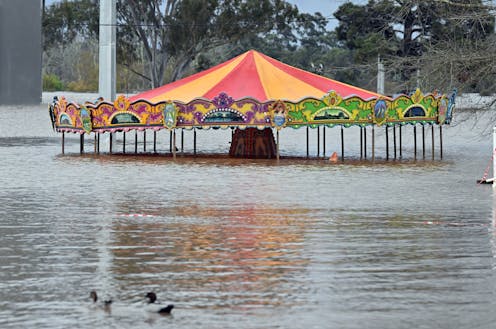
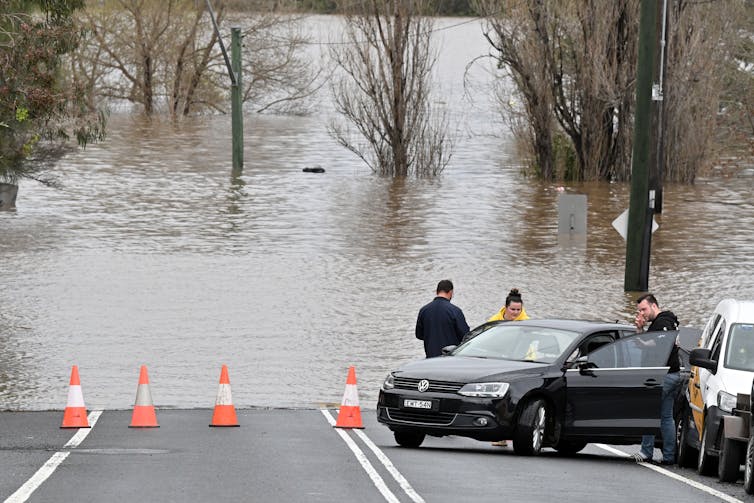
For the fourth time in 18 months, floodwaters have inundated homes and businesses in Western Sydney’s Hawkesbury-Nepean Valley. Recent torrential rain is obviously the immediate cause. But poor decisions by successive New South Wales governments have exacerbated the damage.

The town of Windsor, in the Hawkesbury region, has suffered a particularly high toll, with dramatic flood heights of 9.3 metres in February 2020, 12.9m in March 2021 and 13.7m in March this year.

As I write, flood heights at Windsor have reached nearly 14m. This is still considerably lower than the monster flood of 1867, which reached almost 20m. It’s clear that standard flood risk reduction measures, such as raising building floor levels, are not safe enough in this valley.

We’ve known about the risk of floods to the region for a long time. Yet successive state governments have failed to properly mitigate its impact. Indeed, recent urban development policies by the current NSW government will multiply the risk.

We knew this was coming

A 22,000 square kilometre catchment covering the Blue Mountains and Western Sydney drains into the Hawkesbury-Nepean river system. The system faces an extreme flood risk because gorges restrict the river’s seaward flow, often causing water to rapidly fill up the valley after heavy rain.

Governments have known about the flood risks in the valley for more than two centuries. Traditional Owners have known about them for millennia. In 1817, Governor Macquarie lamented:

it is impossible not to feel extremely displeased and Indignant at [colonists] Infatuated Obstinacy in persisting to Continue to reside with their Families, Flocks, Herds, and Grain on those Spots Subject to the Floods, and from whence they have often had their prosperity swept away.

Macquarie’s was the first in a long line of governments to do nothing effective to reduce the risk. The latest in this undistinguished chain is the NSW Planning Minister Anthony Roberts.

In March, Roberts reportedly revoked his predecessor’s directive to better consider flood and other climate risks in planning decisions, to instead favour housing development.

Roberts’ predecessor, Rob Stokes, had required that the Department of Planning, local governments and developers consult Traditional Owners, manage risks from climate change, and make information public on the risks of natural disasters. This could have helped limit development on floodplains.

Why are we still building there?

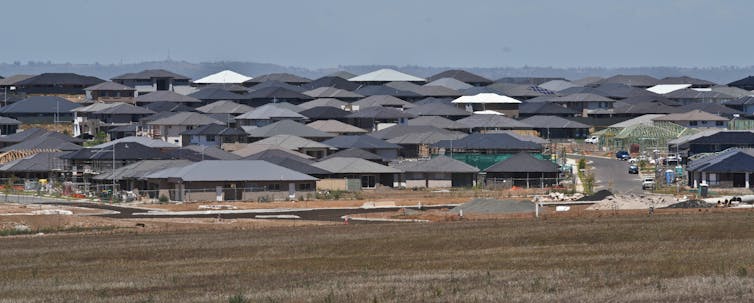
The Hawkesbury-Nepean Valley is currently home to 134,000 people, a population projected to double by 2050.

The potential economic returns from property development are a key driver of the lack of effective action to reduce flood risk.

In the valley, for example, billionaire Kerry Stokes’ company Seven Group is reportedly a part owner of almost 2,000 hectares at Penrith Lakes by the Nepean River, where a 5,000-home development has been mooted.

Planning in Australia often uses the 1-in-100-year flood return interval as a safety standard. This is not appropriate. Flood risk in the valley is increasing with climate change, and development in the catchment increases the speed of runoff from paved surfaces.

The historical 1-in-100 year safety standard is particularly inappropriate in the valley, because of the extreme risk of rising water cutting off low-lying roads and completely submerging residents cut-off in extreme floods.


Read more:
To stop risky developments in floodplains, we have to tackle the profit motive – and our false sense of security


What’s more, a “medium” climate change scenario will see a 14.6% increase in rainfall by 2090 west of Sydney. This is projected to increase the 1-in-100 year flood height at Windsor from 17.3m to 18.4m.

The NSW government should impose a much higher standard of flood safety before approving new residential development. In my view, it would be prudent to only allow development that could withstand the 20m height of the 1867 flood.

No dam can control the biggest floods

The NSW government’s primary proposal to reduce flood risk is to raise Warragamba Dam by 14m.

There are many reasons this proposal should be questioned. They include the potential inundation not just of cultural sites of the Gundungarra nation, but threatened species populations, and part of the Blue Mountains World Heritage Area.

The cost-benefit analysis used to justify the proposal did not count these costs, nor the benefits of alternative measures such as upgrading escape roads.

Perversely, flood control dams and levee banks often result in higher flood risks. That’s because none of these structures stop the biggest floods, and they provide an illusion of safety that justifies more risky floodplain development.

The current NSW transport minister suggested such development in the valley last year. Similar development occurred with the construction of the Wivenhoe Dam in 1984, which hasn’t prevented extensive flooding in Brisbane in 2011 and 2022.

These are among the reasons the NSW Parliament Select Committee on the Proposal to Raise the Warragamba Dam Wall recommended last October that the state government:

not proceed with the Warragamba Dam wall raising project [and] pursue alternative floodplain management strategies instead.

What the government should do instead

The NSW government now has an opportunity to overcome two centuries of failed governance.

It could take substantial measures to keep homes off the floodplain and out of harm’s way. We need major new measures including:

  • preventing new development
  • relocating flood prone residents
  • building better evacuation roads
  • lowering the water storage level behind Warragamba Dam.

The NSW government should help residents to relocate from the most flood-prone places and restore floodplains. This has been undertaken for many Australian towns and cities, such as Grantham, Brisbane, and along major rivers worldwide.

Relocating residents isn’t easy, and any current Australian buyback and relocation programs are voluntary.

I think it’s in the public interest to go further and, for example, compulsorily acquire or relocate those with destroyed homes, rather than allowing them to rebuild in harm’s way. This approach offers certainty for flood-hit people and lowers community impacts in the longer term.

It is patently ridiculous to rebuild on sites that have been flooded multiple times in two years.


Read more:
Sydney’s disastrous flood wasn’t unprecedented: we’re about to enter a 50-year period of frequent, major floods


In the case of the Hawkesbury-Nepean Valley, there are at least 5,000 homes below the 1-in-100-year flood return interval. This includes roughly 1,000 homes flooded in March.

The NSW government says a buyback program would be too expensive. Yet, the cost would be comparable to the roughly $2 billion needed to raise Warragamba Dam, or the government’s $5 billion WestInvest fund.

An alternative measure to raising the dam is to lower the water storage level in Warragamba Dam by 12m. This would reduce the amount of drinking water stored to supply Sydney, and would provide some flood control space.

The city’s water supply would then need to rely more on the existing desalination plant, a strategy assessed as cost effective and with the added benefit of bolstering drought resilience.

The flood damage seen in NSW this week was entirely predictable. Measures that could significantly lower flood risk are expensive and politically hard. But as flood risks worsen with climate change, they’re well worth it.

The Conversation

Jamie Pittock provides pro bono advice to a number of non-government environmental organisations.

ref. ‘Patently ridiculous’: state government failures have exacerbated Sydney’s flood disaster – https://theconversation.com/patently-ridiculous-state-government-failures-have-exacerbated-sydneys-flood-disaster-186304

How the US Supreme Court has become right-wing, and do recent decisions give Democrats hope at the midterms?

Source: The Conversation (Au and NZ) – By Adrian Beaumont, Election Analyst (Psephologist), The Conversation

The US Supreme Court’s annual term usually finishes at the end of June, so late June is when the most important decisions are likely to be announced.

On June 23, the Court struck down a New York state law that restricted carrying of guns outside the home. On June 24, it denied a constitutional right to an abortion, overturning its own Roe v. Wade ruling in 1973. On June 30, it ruled against the Environmental Protection Agency’s (EPA) regulations on fossil fuels.

From an international viewpoint, the EPA ruling is the most significant. Other countries can set their own gun and abortion laws, but climate change mitigation efforts require international co-operation. According to a May 2021 report, China had 27% of global greenhouse gas emissions in 2019, with the US second with 11% of emissions.

How did the Supreme Court become right-wing? Unlike Australia, judicial appointments in the US are politicised. Democratic presidents will try to appoint left-wing judges and Republican presidents will try to appoint right-wing judges.

Supreme Court judges are lifetime appointments. Presidents nominate judges who are subject to confirmation by only the US Senate, not the House of Representatives.

Until late 2020, the Court had a 5-4 right majority, but Chief Justice John Roberts sometimes sided with the left, most famously in the June 2012 decision that upheld Barack Obama’s Affordable Care Act (Obamacare).

In February 2016, right-wing Justice Antonin Scalia died. Obama was still president at the time, and replacing Scalia would have given the left a 5-4 majority. But Republicans controlled the Senate, and majority leader Mitch McConnell denied a vote for Obama’s nominee, Merrick Garland.

McConnell’s ruthlessness was rewarded when Donald Trump unexpectedly defeated Hillary Clinton at the November 2016 presidential election. Trump nominated Neil Gorsuch to replace Scalia, and his nomination was confirmed by the Republican-controlled Senate in April 2017.

In July 2018, right-wing Justice Anthony Kennedy retired. After a vicious confirmation fight that involved allegations of rape, Kennedy was succeeded by Trump’s nominee Brett Kavanaugh in October 2018.

At the November 2018 midterm elections, Democrats gained control of the House, where all 435 seats are up for election every two years. But senators have six-year terms, with one-third up every two years. The seats up in the Senate last had elections in 2012, a great year for Democrats. Republicans gained two net Senate seats in 2018 to extend their control.

In September 2020, left-wing Justice Ruth Bader Ginsburg died. McConnell ruthlessly rammed Trump’s nominee, Amy Coney Barrett, through the Senate in late October, shortly before the November 2020 election that Trump lost.

This is how we’ve now got a 6-3 right Supreme Court: Obama did not get a chance to replace the right-wing Scalia, while Trump had three nominees approved, including Ginsburg’s replacement.

Left-wing Justice Stephen Breyer announced he would retire at the end of the current term, and President Joe Biden’s nominee, Ketanji Brown Jackson, was confirmed by the now Democratic-controlled Senate in April. Jackson has now replaced Breyer, but she replaced a left-wing judge, so the 6-3 right majority remains.

Supreme Court is historically unpopular, but so is Biden

A Gallup poll conducted in June before the major decisions were announced, had 25% expressing a great deal or quite a lot of confidence in the Supreme Court, down from 36% in June 2021. That’s the lowest confidence in the Court in Gallup’s polling, which goes back to 1973; the previous low was 30% in 2014.

A FiveThirtyEight article last Friday cited seven polls that asked whether voters approved or disapproved of the June 24 abortion ruling. Disapproval led in all seven polls by seven to 23 points, with an average lead of 15.6.

The bad news for Democrats is Biden’s ratings are at a near-record low compared to past presidents. In the FiveThirtyEight aggregate, 55.9% disapprove of Biden’s performance and 39.2% approve (net -16.7).

That’s worse than Trump, who had a -10.2 net approval at this stage of his presidency. Since presidential approval polling began with Harry Truman (president from 1945-53), Biden only beats Truman at this stage of previous presidencies. Truman fell to -19.0 net before rebounding into positive net approval.

Inflation and the resulting drop in real wages explain a large amount of Biden’s unpopularity. US inflation increased 1.0% in May alone for a 12-month rate of 8.6%, the highest since 1981. Real weekly earnings dropped 0.7% in May and are down 3.9% in the 12 months to May.

As well as economic factors, I believe a perception that Biden has been weak in both the Afghanistan withdrawal in August 2021 and the current Russian invasion of Ukraine has damaged his ratings.

Midterm elections will be held in early November, with all 435 House seats and one-third of the Senate up. FiveThirtyEight has Republicans leading Democrats by 2.0% in the race for Congress, little changed from before the abortion ruling.

While the currently close polls give Democrats hope, they do not yet account for Republican efforts to tie Democratic candidates to the unpopular Biden, or for greater Republican likelihood to vote. The FiveThirtyEight House model gives Republicans an 87% chance of winning control from Democrats.

In the Senate, there are elections for 35 of the 100 seats – 34 are regular elections that were last up in 2016 and one is a byelection in the safe Republican Oklahoma. Republicans will be defending 21 seats and Democrats 14. The Senate is currently 50-50, with Democrats in control on Vice President Kamala Harris’ tie-breaking vote.

Although Republicans need just one net Senate gain to win control, their defence of 21 seats to 14 for Democrats makes it harder for them than the House. FiveThirtyEight gives Republicans a 55% chance of winning the Senate.

In my opinion, the economy is likely to be far more important to most voters than abortion. Democrats are still likely to be thumped at the midterms owing to the economy.

Long-term electoral trends look bleak for Democrats

In April I calculated the percentage of people living in cities of over 100,000 population in four countries: the US, Australia, the UK and Canada. 68% of Australians lived in cities of over 100,000 population, but only 29% of Americans.


Read more:
Will a continuing education divide eventually favour Labor electorally due to our big cities?


In the US, high income white people have moved to “suburbs” outside cities, and these swung to Democrats in 2020, helping Biden win.

Like the Australian Senate, the US Senate has the same number of senators for each state (12 in Australia, two in the US), and this makes it highly malapportioned, with high-population states like California, Texas, Florida and New York getting the same number of senators as the lowest population states.

Analyst Nate Silver said in May that this means the US Senate has a large skew towards groups that are trending towards Republicans (rural and small town voters).

In the US overall, suburban and urban voters make up 52% of the population, to 48% for rural and small town voters. But in the average state, rural and small towns make up 61% of the population, while suburban and urban voters have just 39%.

In 2024, Democrats will be defending 23 Senate seats and Republicans just 10; these will include Democratic defences in Montana, Ohio and West Virginia, which Trump won easily in both 2016 and 2020.

If Republicans gain a permanent lock on the Senate, they will be able to deny future Democratic presidents legislative or judicial wins. The US could be heading for a future where only Republican presidents are able to govern effectively.

UK Conservatives lose two seats at byelections

I covered the June 23 UK Wakefield and Tiverton & Honiton byelections for The Poll Bludger. The Conservatives lost Wakefield to Labour and T&H to the Liberal Democrats. Also covered: the collapse of Israel’s government that was formed to keep Benjamin Netanyahu out, and Colombia elected a left-wing president for the first time.

The Conversation

Adrian Beaumont does not work for, consult, own shares in or receive funding from any company or organisation that would benefit from this article, and has disclosed no relevant affiliations beyond their academic appointment.

ref. How the US Supreme Court has become right-wing, and do recent decisions give Democrats hope at the midterms? – https://theconversation.com/how-the-us-supreme-court-has-become-right-wing-and-do-recent-decisions-give-democrats-hope-at-the-midterms-186281

The ABS’s notion of the average Australian makes little sense. Here’s why

Source: The Conversation (Au and NZ) – By Murray Goot, Emeritus Professor of Politics and International Relations, Macquarie University

What does “the average Australian” look like? After every census, this is one of the questions people like to see answered.

Average on one measure or on several? If the latter, would “average Australians” number in the millions, as most inquirers no doubt assume? Or would the “average” turn out to be atypical – a very small number, even a group that doesn’t actually exist?

What is the answer offered by the Australian Bureau of Statistics? According to Teresa Dickinson, deputy national statistician at the ABS, “our average Australian” in 2021 was “a female aged 30 to 39 years, living in a coupled family with children, in a greater capital city area, with a weekly family income of $3,000 or more”.

Let’s call this set of characteristics an identikit – a bit like the artist’s sketch of the wanted person distributed to police officers as they go about the business of identifying the “person or persons of interest”.

An average of what?

In what sense is Dickinson’s identikit valid, let alone useful?

One problem is that the features she has chosen to highlight are not necessarily the features others would choose. Dickinson builds her portrait along six dimensions: sex (controversially, the census largely steered clear of gender), age, relationship status, family composition (a measure to which some Indigenous scholars have taken exception), location and household income.

A very different portrait could have been built around – or included – education, religion, ancestry, parents’ country of birth, employment status, hours spent doing unpaid work, registered married status, dwelling structure, number of registered motor vehicles, and so on.

Because Dickinson is addressing a question without context, the arbitrary nature of her choices is inevitable. The case for including fewer than six dimensions – or a different six – is neither weaker nor stronger than the case for including more than six.

Another problem is that the ABS average treats categorical variables (sex, location, relationship status, family composition) as if they were continuous variables (like age and income). If one individual earns $30 a week, another $60, and a third $45, it makes sense to say that their average weekly income is $45. But if three individuals live in Brisbane, two in Perth and one in Wollongong, it makes no sense to say that on average the six live in Perth – or, indeed, anywhere.

Although she talks of averages, Dickinson’s identikit is actually based on modes (the most frequently occurring charateristics). This leads her to include some groups while excluding others, even when the differences are very small.

The inclusion of women (50.7% of the population) and the exclusion of men (49.3%) is the most obvious and consequential example. Another example: the inclusion of women aged 30–39 but the exclusion of women aged 20–29, 40–49 and 50–59 despite the differences in the size of each of these cohorts probably being no more than two percentage points.


Read more:
The seven deadly sins of statistical misinterpretation, and how to avoid them


What is most striking, however, is Dickinson’s failure to say whether her identikit applies to a large number of Australians – the “typical” Australian of popular imagination – or to only a small number.

Typically, identikits cover a much smaller proportion of the population than those who create them – or are taken in by them – might think. The greater the number of variables, the fewer the number of individuals they represent. Given a sufficient number of variables – which needn’t be a large number – the proportion of the population that an identikit represents can drop to zero.

Diminishing returns

In any identikit, the least common characteristic among the population is what sets the upper limit on the number the identikit could ever encompass. In Dickinson’s, the least common characteristic appears to be women aged 30–39. According to the census, people aged 30–39 made up 14.5% of the population. So, women aged 30–39 are likely to have constituted around 7%. If that’s the upper limit, it’s pretty low.

Yet the numbers that fit the identikit can only be a fraction of this. From the 7%, we need to subtract “coupled families without children” (38.8% of all families) and people who don’t live in “a greater capital city area” (33.1% of the population). This could reduce the proportion that fits the identikit to around 3 or 4% of the population, depending on the overlap between “coupled families without children” and people who don’t live in “a greater capital city area”.


Read more:
Why happiness is becoming more expensive and out of reach for many Australians


If we now add those with an average weekly family income of $3,000 or more – 24.3% of those in “occupied private dwellings” (though fewer, presumably, if one includes the homeless, among others) – the proportion of the population to which the identikit applies very likely drops to something like 1%.

Even that may not do the story justice. Had Dickinson sought to identify the modal age within her 30–39 age range – a move that would have been entirely consistent with the logic of her enterprise – the number of people that matched her identikit might suddenly have become vanishingly small. A similar result would have emerged if she had chosen the modal income range among those with an average weekly family income of $3,000 or more.

Thanks to the census, we can say that in Australia: there are slightly more women than men; marginally more women aged 30–39 than in any other ten-year age group; and so on. What we can’t say is that the average Australian is: “A female aged 30 to 39 years…” If it can’t be said, the ABS shouldn’t even be thinking of saying it.

The Conversation

Murray Goot does not work for, consult, own shares in or receive funding from any company or organization that would benefit from this article, and has disclosed no relevant affiliations beyond their academic appointment.

ref. The ABS’s notion of the average Australian makes little sense. Here’s why – https://theconversation.com/the-abss-notion-of-the-average-australian-makes-little-sense-heres-why-186296

Sri Lanka scrambles for aid – but Australia still seems preoccupied by boats

Source: The Conversation (Au and NZ) – By Niro Kandasamy, Lecturer in History, University of Sydney

When Sri Lankan Prime Minister Ranil Wickremesinghe conceded ten days ago that the Sri Lankan economy has “completely collapsed”, his words would have come as no surprise to the island’s 22 million people.

With the country enduring its worst economic crisis since independence, authorities continue to scramble for aid from the international community. Families have been forced to skip meals and limit portion sizes. “If we don’t act now,” the United Nations has warned, “many families will be unable to meet their basic food needs.”

In a move to curb dire food shortages, authorities have approved a four-day working week for public sector workers so they can “engage in agricultural activities in their backyards or elsewhere as a solution to the food shortage that is expected”.

Tamil fishers in the north of the island are facing starvation because they lack paraffin to power their boats. Women whose livelihoods depend on occasional work on the boats face even grimmer circumstances. One of them, a 59-year-old Tamil woman who lost five of her children in the civil war, is living off donations, leftover fish and the vegetables she picks from the side of the road.

From July 10, the government will no longer sell fuel to ordinary people because it won’t have enough currency to pay for it. Frustration is palpable across the island. The deployment of the military is only adding to the distress. In one case, Sri Lankan troops opened fire on people queuing for petrol after motorists clashed with troops; four civilians and three soldiers were wounded.

Aid over geopolitical strategy

Sri Lankan authorities are turning to the international community for assistance. An official visit to Russia this week will attempt to secure discounted oil. Much of the world might be slamming Russia over its invasion of Ukraine, but Sri Lanka is no longer in a position to be choosy about who it deals with.

So far this year, India has been Sri Lanka’s main source of assistance. The Indian government has signalled a willingness to go beyond the US$4 billion in loans, swaps and aid to support its neighbour. The political winds seem to be swaying away from China and in India’s favour.

At the Future of Asia conference in Tokyo in May, Sri Lankan President Gotabaya Rajapaksa pleaded for medical, food and fuel donations. But his appeal came at a low point in Sri Lanka–Japanese relations.

Earlier in his presidency, Rajapaksa had cancelled key Japanese-funded infrastructure projects, including a US$1.5 billion light rail project for Colombo and the US$700 million-plus East Container Terminal project at the country’s main port, which Japan, India and Sri Lanka had agreed on before Rajapaksa came to power.

At the Tokyo conference Japan agreed to provide US$1.5 million through the World Food Program for three months’ essential food supplies, but remained tight-lipped about other support.


Read more:
What’s happening in Sri Lanka and how did the economic crisis start?


The United States has announced a series of assistance measures since the crisis set in, including US$120 million in loans to small and medium businesses – which risks adding to the country’s debt crisis – US$27 million to Sri Lanka’s dairy industry and US$5.75 million in humanitarian assistance. At the G7 summit in Madrid last Tuesday, President Joe Biden pledged a further $20 million to feed 800,000 children through a school nutrition program.

A team from the International Monetary Fund, meanwhile, was in Sri Lanka last week to discuss a $3 billion bailout under the fund’s Extended Fund Facility. The scheme is designed to assist countries experiencing serious payment imbalances. While the team said it expected negotiations about the terms of the bailout to reach agreement in the “near term”, it concluded Sri Lanka’s economy “is expected to contract significantly in 2022”.

Sri Lanka also plans to hold a donor conference with India, China and Japan. Around US$5 billion is needed over the next six months to cover the basic needs of its people.

Australia needs to reconsider how it supports its Indian Ocean neighbour

Australia will provide A$50 million to Sri Lanka to meet urgent food and healthcare needs. “Not only do we want to help the people of Sri Lanka in its time of need,” Foreign Affairs Minister Penny Wong said on June 20, “there are also deeper consequences for the region if this crisis continues.”

But Australia’s priorities are quite different from the concerns of ordinary Sri Lankans. A new Fisheries Monitoring Centre, jointly launched by the Australian and Sri Lankan governments, will install tracking devices on more than 4,000 Sri Lankan fishing vessels, which can be used in the “early identification” of “irregular vessel movements”.

Australia’s priority is “supporting Sri Lanka’s efforts to strengthen its border management capacity”, according to a statement from the Australian high commission in Colombo. The centre continues Australia’s historical disregard for the plight of people seeking asylum outside Sri Lanka.


Read more:
Australia’s temporary visa system is unfair, expensive, impractical and inconsistent. Here’s how the new government could fix it


These are some of the poorest and most persecuted people in the country, fleeing from Vavuniya, Kilinochi, Mullaithivu and Trincomalee and other Tamil-majority areas ravaged by the civil war.

In recent weeks, people escaping Sri Lanka by boat have been intercepted at sea by Australian authorities and returned without adequate assessments of their asylum claims. The UN refugee agency, UNHCR, has previously said that Australia’s “enhanced assessments”, which don’t properly consider individual needs for protection, “potentially place Australia in breach of its obligations under the Refugee Convention and other international law obligations”.

The federal opposition claims boats are arriving in Australia because of the change of government. But people have also been fleeing to other destinations, such as India and the Middle East. Some have relatives in Indian refugee camps; others have family contacts in Tamil Nadu.

As one Tamil activist explains: “There is panic and anxiety about tomorrow.” The exodus could continue for quite some time yet.

The Conversation

Niro Kandasamy is a volunteer at the Tamil Refugee Council.

ref. Sri Lanka scrambles for aid – but Australia still seems preoccupied by boats – https://theconversation.com/sri-lanka-scrambles-for-aid-but-australia-still-seems-preoccupied-by-boats-186293

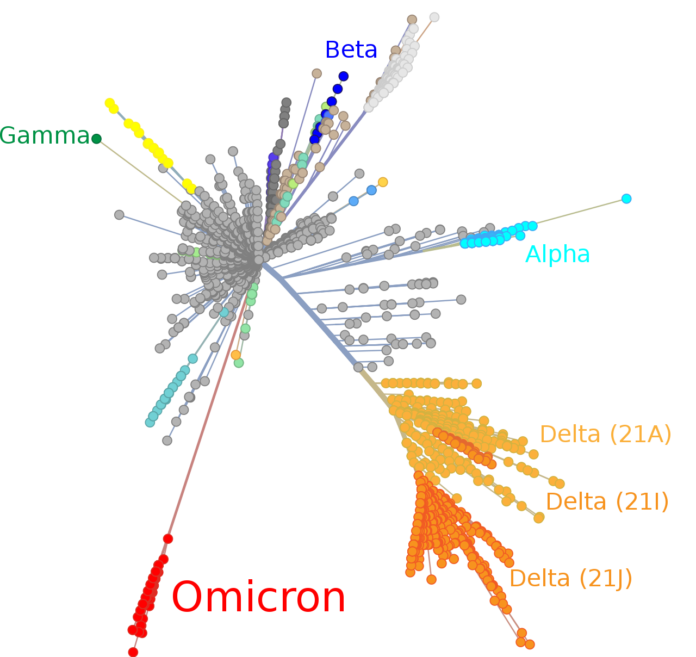
Australia is heading for its third Omicron wave. Here’s what to expect from BA.4 and BA.5

Omicron Variant. Image via WIKIMEDIA.ORG.

Source: The Conversation (Au and NZ) – By Adrian Esterman, Professor of Biostatistics and Epidemiology, University of South Australia

Shutterstock

Australia is heading for its third Omicron wave in the coming weeks, as BA.4 and BA.5 become the dominant COVID strains.

BA.4 and BA.5 are more infectious than previous COVID variants and subvariants, and are better able to evade immunity from vaccines and previous infections. So we’re likely to see a rise in case numbers.

So what are BA.4 and BA.5? And what can we expect in this next phase of the pandemic?

How did it start? BA.1, BA.2 and BA.3

Omicron started off as three subvariants (that is, a group of viruses from the same parent virus), all appearing in late November 2021 in South Africa: BA.1, BA.2, and BA.3.

The three are genetically different enough that they could have had their own Greek names. But for some reason, this did not happen, and the World Health Organization designated them as subvariants of Omicron.

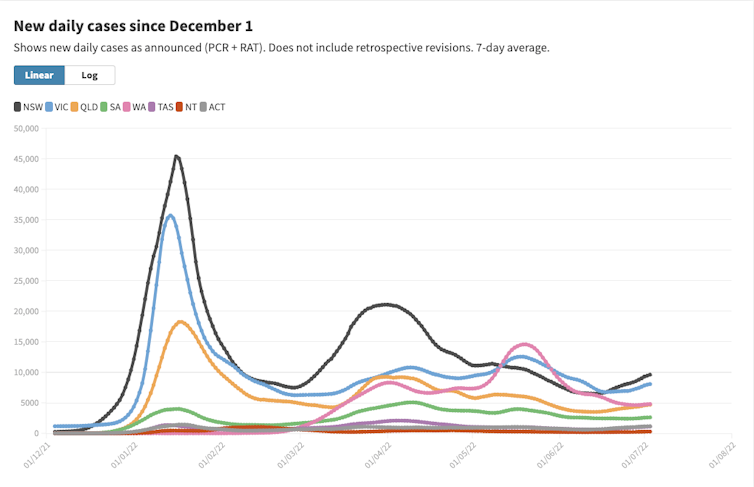
BA.1 rapidly took over from Delta in Australia in early January this year, forming a massive wave of cases, peaking at more than 100,000 a day.

However, BA.2 is even more transmissible than BA.1, and Australia saw a second wave of cases, this time caused by BA.2. This wave peaked in early April at more than 60,000 cases a day.

The first and second Omicron waves peaked in early January and early April.
Covid19data.com.au

When were BA.4 and BA.5 detected?

BA.4 was first detected in January 2022 in South Africa. BA.5 was also detected in South Africa, in February 2022.

Both appear to be offshoots of BA.2, sharing many identical mutations. They also have many additional mutations likely to impact transmission.

They are talked about together because mutations in their spike protein (the bit that latches on to human cells) are identical. (For brevity, I refer to them as BA.4/5.)

However, they do differ in some of the mutations on the body of the virus.


Read more:
Why are there so many new Omicron sub-variants, like BA.4 and BA.5? Will I be reinfected? Is the virus mutating faster?


How transmissible are BA.4/5?

We measure how contagious a disease is by the basic reproduction number (R0). This is the average number of people an initial case infects in a population with no immunity (from vaccines or previous infection).

New mutations give the virus an advantage if they can increase transmissibility:

  • the original Wuhan strain has an R0 of 3.3

  • Delta has an R0 of 5.1

  • Omicron BA.1 has an R0 of 9.5

  • BA.2, which is the dominant subvariant in Australia at the moment, is 1.4 times more transmissible than BA.1, and so has an R0 of about 13.3

  • a pre-print publication from South Africa suggests BA.4/5 has a growth advantage over BA.2 similar to the growth advantage of BA.2 over BA.1. That would give it an R0 of 18.6.

This is similar to measles, which was until now was our most infectious viral disease.

Mother puts sanitiser on her masked kids' hands
BA.4/5 are as contagious as measles.
Shutterstock

How likely is reinfection?

BA.4/BA.5 appear to be masters at evading immunity. This increases the chance of reinfection.

Reinfection is defined as a new infection at least 12 weeks after the first. This gap is in place because many infected people still shed virus particles many weeks after recovery.

However, some unfortunate people get a new infection within the 12 weeks, and therefore are not counted.

Likely, there are now tens of thousands of Australians into their second or third infections, and this number will only get bigger with BA.4/5.

How high are case numbers likely to rise?

Around Australia, we are starting to see a third wave of cases because of BA.4/5.

The effective reproduction number, or Reff tells us, on average, how many people an infected person will pass it on to, given the immunity in the population. All Australian states and territories now have a Reff greater than 1, meaning that even with the current levels of immunity, we are seeing an exponential growth in case numbers. This will inevitably lead to an increase in hospitalisation and deaths.

The second Omicron wave due to BA.2 was not as high as the first one caused by BA.1, probably because there were so many people infected with BA.1, that the ensuing immunity dampened the second wave down.

This third wave may not be as high as the second for the same reason.

How severe is the disease from BA.4/5?

A recent pre-print publication (a publication that has so far not been peer-reviewed) from a Japanese research group found that in lab-based, cell-culture experiments, BA.4/5 was able to replicate more efficiently in the lungs than BA.2. In hamster experiments, it developed into more serious illness.

However, data from South Africa and the United Kingdom found that their BA.4/5 wave didn’t see a major increase in severe disease and death.

This is possibly because of the high rates of immunity due to previous infections. Our high rates of vaccine-induced immunity might have a similar protective effect here.

Will BA.4/5 change long COVID?

At this stage, we do not know whether any of the Omicron subvariants differ in their ability to cause long COVID.

However, we do know that full vaccination (three doses for most people) does provide some protection against long COVID.


Read more:
Triple vaccination seems to reduce the chance of long COVID – but we still need to prepare for a jump in cases


How protective are our vaccines against BA.4/5?

Each new subvariant of Omicron has been better able to evade immunity from vaccination than its predecessor.

Although current vaccines based on the Wuhan strain will still provide some protection against serious illness and death against BA.4/5, they are unlikely to provide much, if any, protection against infection or symptomatic disease.

Nurse prepares COVID vaccine
Existing vaccines are unlikely to provide much protection against infection.
Shutterstock

What about new vaccines?

The good news is second-generation vaccines are in clinical trials. Moderna is trialling a vaccine containing mRNA against the original Wuhan strain and Omicron BA.1.

Early results are very promising, and likely to give much better protection against BA.4/5.

But this third Omicron wave – along with a very severe flu season – will likely see our hospitals struggling even more over the next few weeks.

If things get bad enough, state and territory governments might be forced to reintroduce face mask mandates in many settings – in my opinion, not such a bad thing.


Read more:
Flu may be back, but COVID is far from over. How do they compare?


The Conversation

Adrian Esterman does not work for, consult, own shares in or receive funding from any company or organisation that would benefit from this article, and has disclosed no relevant affiliations beyond their academic appointment.

ref. Australia is heading for its third Omicron wave. Here’s what to expect from BA.4 and BA.5 – https://theconversation.com/australia-is-heading-for-its-third-omicron-wave-heres-what-to-expect-from-ba-4-and-ba-5-185598

How Australia’s gig workers may remain contractors under Labor’s reforms

Source: The Conversation (Au and NZ) – By David Peetz, Professor Emeritus, Griffith Business School, Griffith University

Shutterstock, CC BY-SA

Uber Australia’s historic agreement with the Transport Workers’ Union, on the need to regulate the gig economy, is the first step in fundamental reform of gig work. It suggests the direction the Albanese government will to take to deliver better conditions for gig workers.

The “statement of principles” agreed to between Uber and the union supports “regulatory certainty for platforms” and “minimum benefits and standards for platform workers who aren’t engaged as employees”. It does not agree that gig workers should be classified as employees instead of independent contractors.


Read more:
What’s driving Uber’s historic agreement with the TWU on gig work


The response of federal workplace relations minister Tony Burke to the agreement suggests the government will take the same route – not changing the classification of gig workers but giving the federal industrial relations umpire, the Fair Work Commission, the power to set minimum standards for gig workers in “employee-like work”.

A precedent for this approach comes from New South Wales provisions enabling regulation of payments to owner-drivers of trucks. Those provisions have been in place for more than 40 years, and have inspired the proposal before the Queensland parliament to regulate the work of independent courier drivers.


Read more:
A new definition of ‘worker’ could protect many from exploitation


Leaving gig workers as contractors

There are good reasons to aim to regulate gig economy workers as contractors, rather than attempting to bring them under the umbrella of being employees.

Yes, their relationship with platforms can look an awful lot like an employment relationship – hence the reason for court cases supported by the Transport Workers’ Union seeking to have gig workers deemed employees.


Read more:
An employee, not a contractor: unfair dismissal ruling against Deliveroo is a big deal for Australia’s gig workers


As the saying goes, if it looks, swims and quacks like a duck, it probably is a duck.

But the outcome of trying to define gig workers as employees has been mixed. Around the world these attempts have sometimes succeeded, sometimes not.

Roadblocks to becoming employees

Platform companies have worked against these attempts, leveraging the fact quite a number of gig workers like to imagine themselves as independent, self-employed people, as well as customers’ preference for cheap services.

The best (but not only) example is their success against California’s AB5 law, passed in 2019, that tightened the rules for companies to hire workers as independent contractors.

Uber and rival Lyft first threatened to suspend operations in California rather than comply with the law. They then teamed up with other platform companies such as DoorDash and spent a reported US$200 million in 2020 to secure and a win a “ballot proposal” (known as Proposition 22) exempting app-based transportation and delivery companies from the new law.

Workers rally in August 2019 in support of California's proposed AB5 law to stop companies categorise workers as independent contractors. The law was passed, but Uber and other platform companies bankrolled a successful attempt in 2020 to be exempt from t
Workers rally in August 2019 in support of California’s proposed AB5 law to stop companies categorise workers as independent contractors. The law was passed, but Uber and other platform companies bankrolled a successful attempt in 2020 to be exempt from the law.
Rich Pedroncelli/AP

A Californian court has since found Proposition 22 unconstitutional, but it remains in place pending an appeal.

Even when a rule is devised to interpret the contracts that gig workers sign as employment contracts, gig companies could amend their contracts to get around that.


Read more:
Redefining workers in the platform economy: lessons from the Foodora bunfight


But in the end, a company such as Uber will adhere, grudgingly, to most standards that are imposed on it — other than defining its workers as employees. Thus it has accepted training requirements in Quebec (after first threatening to quit the Canadian province), fare regulation in Massachusetts and driver accreditation requirements in several jurisdictions.

Regulating contractors as contractors

Regulating gig work without redefining gig workers as employees is not just politically easier, and hence more sustainable. It is can also more effective policy.

It enables regulation to be tailored to circumstances. For example it may mean applying an hourly wage rate in one sector, and a piece rate of some sort in another.

For example, a New York state inquiry into how to regulate passenger transport came up with an amount expressed like taxi charges – that is, dollars per kilometre travelled – drivers needed to be paid to earn the equivalent of the state’s minimum wage (taking into account waiting times, average speeds and so on).

Different panels of the Fair Work Commission could determine different forms of gig economy regulation for different industries.

Legislation does not need to specify how regulation should be expressed. It just needs to make sure that the Commission has all the power it needs, to regulate in whatever way it sees fit.

Levelling the playing field

The Transport Workers’ Union – which has a number of former officials in the Albanese government – has a long history of successfully promoting regulation of safety conditions for independent contractors (such as truck owner-drivers) without rebadging workers as employees.

In the 1970s, for example, it persuaded the Wran government in NSW to introduce amendments to the NSW Industrial Relations Act that have made roads safer.

The Albanese government does not need to legislate specific regulation. It just needs give the Fair Work Commission the power it needs to regulate in whatever way it sees fit, setting a minimum hourly rate or something else.

The law must also direct the commission to set minimum standards in a way that ensures gig workers are paid as much as comparable award-covered employees, taking account of expenses. (Contractors often pay for costs that, if they were employees, would be covered by their employer.) This sort of direction is important to ensure neutrality between the costs of using employees or contractors.

The Conversation

As a university employee, David Peetz undertook research over many years with occasional financial support from governments from both sides of politics, employers and unions. He has been and is involved in several Australian Research Council-funded and approved projects. He was an adviser to the inquiry that led to the Queensland legislation that is referred to in the fourth paragraph of this article. However, he has no financial interest in any other aspect of this article.

ref. How Australia’s gig workers may remain contractors under Labor’s reforms – https://theconversation.com/how-australias-gig-workers-may-remain-contractors-under-labors-reforms-186197

‘Satanic worship, sodomy and even murder’: how Stranger Things revived the American satanic panic of the 80s

Source: The Conversation (Au and NZ) – By Michael David Barbezat, Research fellow, Australian Catholic University

Netflix

From Kate Bush to Russian villainy, Season Four of Stranger Things revives many parts of the 1980s relevant to our times. Some of these blasts from the past provide welcome nostalgia. Others are like unwanted ghosts that will not go away. The American Satanic Panic of the 1980s is one of these less welcome but important callbacks.

In Stranger Things season four, some residents of the all-American but cursed town of Hawkins hunt down the show’s cast of heroic misfits after labelling them as satanic cultists. The satanism accusation revolves around the game Dungeons and Dragons and the protagonists’ meetings to play it with other unpopular students at their high school as part of the Hellfire Club.

Mistaking a harmless game played by a pack of nerds for a satanic conspiracy, the athletic and popular Jason Carver wrongly blames its players for the very real supernatural horrors at the heart of the plot.

Eddie Munson in Stranger Things is at the centre of a satanic panic in season four.
Netflix

Satanic worship, sodomy, suicide, and even murder!

The false link in the show between Dungeons and Dragons and an occult conspiracy is based on real history. In the 1980s, TV pundits, politicians, and religious leaders really thought the game was an entry point to satanic worship and an imagined vast conspiracy of satanic cults that supposedly permeated the United States and the entire world.

In the first episode, Eddie, the leader of the Hellfire Club and its Dungeons and Dragons game, derisively recites absurd accusations made at the time. These panicked allegations suggested Dungeons and Dragons promoted “satanic worship, sodomy, suicide, and even… murder!” During the season, Eddie himself becomes the victim of similar accusations.


Read more:
Pornography, the devil and baboons in fancy dress: what went on at the infamous historical Hellfire Club


Occult rituals, orgies and human sacrifices

The campaign against Dungeons and Dragons was part of a larger hysteria about a supposed enormous conspiracy, frequently called today the Satanic Panic.

Central to it was the idea that networks of cults were conducting occult rituals, orgies, and human sacrifices, involving the abuse and murder of children. This ritual abuse was similar to the claims made in an influential but discredited book, Michelle Remembers (1980).

Michelle Remembers written by Lawrence Pazder & Michelle Smith.
Wikipedia

Stories like Michelle Remembers popularised the idea of large, inter-generational satanic networks that were taking down American society from inside. Specialists tie the proliferation of belief in this conspiracy to anxieties resulting from accelerating social changes.

These included women surging into the workforce, increasingly sensationalised crime reporting, the “decay” of traditional values, and the rise of the religious right in America.

An atmosphere of panic

Belief in satanic conspiracy during the 1980s and 1990s destroyed many lives. Especially in North America, there were hundreds of accusations that resulted in numerous trials. Recent books and podcasts explore specific cases such as Martensville, Saskatchewan or the McMartin Preschool near Los Angeles.

At McMartin, it was alleged that hundreds of children had been sexually abused at underground orgies. Even in an atmosphere of panic, the evidence was insufficient to secure any convictions.

Accusations elsewhere frequently tried credulity, suggesting the murder of preposterous numbers of children and infants. These claims were false. For example, a 1994 study examined 12,000 accusations of organised satanic ritual abuse. It concluded there was no evidence for organised satanic cults that sexually abuse children.

At McMartin, it was alleged that hundreds of children had been sexually abused at underground rituals.
Wikimedia

Studies of specific accusations, such as at McMartin, often emphasise how adult investigators created accounts of abuse that fit their preconceptions of satanism. They did it, often unknowingly, by getting suggestible children to say what they expected to hear.

The models of ritual abuse investigators reproduced have a history. Early modern witch hunts are one frequently cited analogue, but the similarities run much deeper and further back in time. The secret meetings, orgies, and ritual abuse attributed to modern cults correspond to what Norman Cohn called the nocturnal ritual fantasy. Similar, accusations were made against witches, Christian heretics, Jews, and early Christians.

Satanic panic today

As author David Frankfurter suggests, the many different versions of supposed demonic conspiracies display patterns. One of the most worrisome and ironic is that historically verifiable atrocities take place not at the hands of non-existent cults – but rather during mistaken attempts to destroy them.

One atrocity is the minimisation of the real abuse of children. By tying it to imagined conspiracies, delusions like the Satanic Panic avoid grappling with the actual social structures that facilitate abuse.

The Satanic Panic, or demonic occult conspiracy theory, is still with us. Actually, it has taken on new forms, as part of Pizzagate or QAnon. Believers of both conspiracies frequently allege that their social and political enemies ritually abuse children following ancient tropes of cult evil.

As in the past, such accusations can justify violence ironically performed in the name of eradicating evil. Belief in discredited, but familiar, demonic conspiracies makes it likely this familiar mistake will happen again.

The Conversation

Michael David Barbezat does not work for, consult, own shares in or receive funding from any company or organisation that would benefit from this article, and has disclosed no relevant affiliations beyond their academic appointment.

ref. ‘Satanic worship, sodomy and even murder’: how Stranger Things revived the American satanic panic of the 80s – https://theconversation.com/satanic-worship-sodomy-and-even-murder-how-stranger-things-revived-the-american-satanic-panic-of-the-80s-186292

Papua New Guinea voters head to the polls to choose from 3600 candidates

RNZ Pacific

Voting in the Papua New Guinea general election begins today.

Voters will elect 118 members of Parliament, including governors of the 22 provinces, from the 3600-plus candidates nominated.

There are 6000 polling teams in the 22 provinces.

There have also been reports that polling in the capital, Port Moresby has been delayed.


Papua New Guinea’s caretaker Prime Minister James Marape appealed to the nation to pray for peace and calm ahead of polling.

Electoral Commissioner Simon Sinai said the polling dates would differ according to the regions and provinces.

Electoral Commission headquarters.
Electoral Commission headquarters in Port Moresby … 3600-plus candidates and 6000 polling teams in the 22 provinces. Image: Johnny Blades/RNZ Pacific

He said most of the polling would take place on 11-12 July, and not go beyond 15 July, to give time for counting officials to do their jobs before the return of writs.

Jame Marape said voters must treat their duty to choose their leaders seriously.

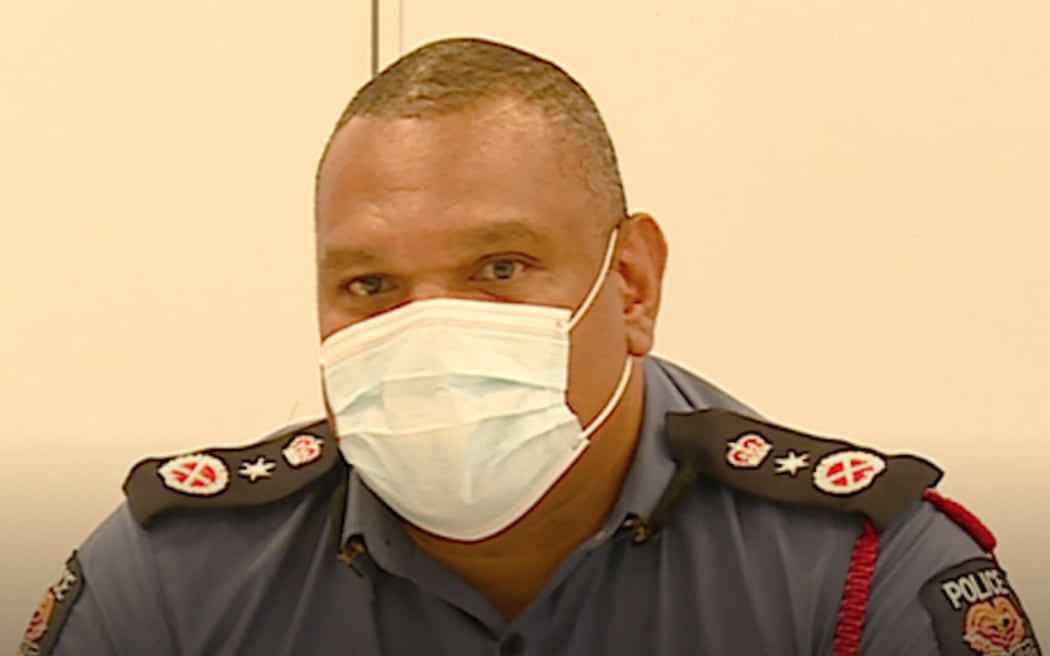
Police Commissioner David Manning said callers can call the hotline number 1-800-500, which has five lines available 24 hours a day until 31 August to help people with election questions.

PNG Pandemic Response Controller David Manning
Police Commissioner David Manning … briefing on elections hotline number. Image: EMTV

All police complaints to the hotline will be referred to the Joint Security Task Force Command Centre for assessment before the information is forwarded to the various police commands around the country to take further action.

Commissioner Manning said during the election period members of the security forces, especially police will be heavily engaged in election security operations so the people are not given the assurance that someone will be there to listen to them.

He said all commands from around the country were being positioned to provide security for polling when it commenced.

Commonwealth Observers Group
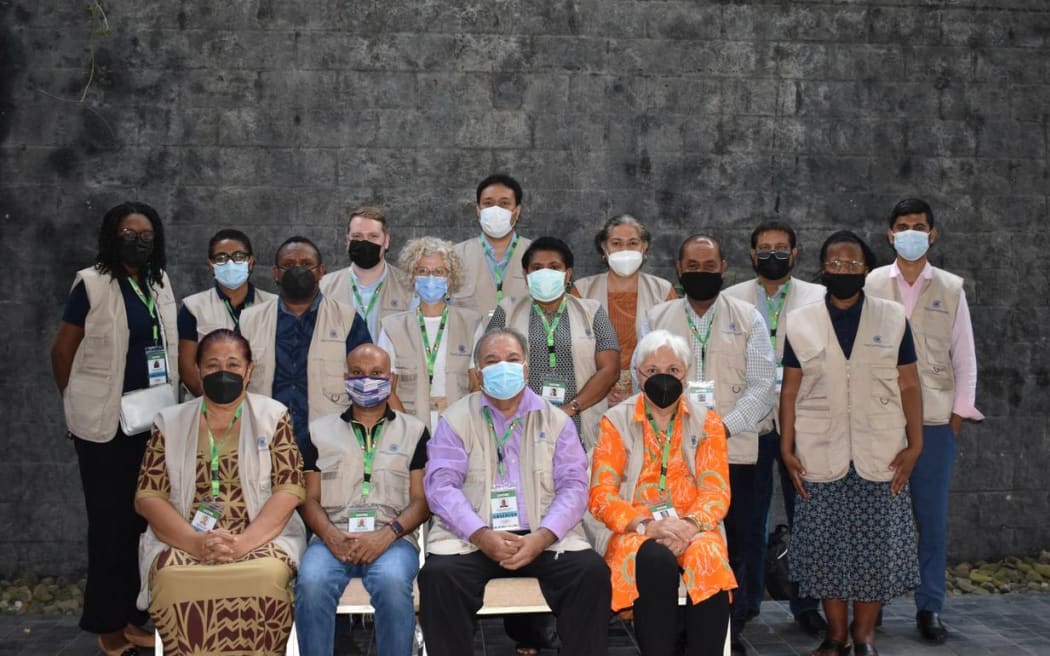
The Commonwealth Observer Group (COG) is in Papua New Guinea and has begun the assessment of the electoral process.

Chaired by the former President of Nauru, Baron Waqa, the group is composed of nine eminent people from across the Commonwealth. They include specialists in politics, elections, civil society, academia as well as the media.

The Commonwealth Observer Group (COG) are in Papua New Guinea
The Commonwealth Observer team … nine eminent people from across the Commonwealth and specialists in politics, elections, civil society, academia and media are included. Image: The Commonwealth

As part of its work to support the election the group will now meet various stakeholders, including political parties, the police, civil society groups, citizen observer and monitor groups, and the media.

During the 21 days of polling, the group will observe the opening, voting, closing, counting and results in management processes. The interim statement of its preliminary findings will be issued on 24 July.

The group will then submit its final report for consideration by the Commonwealth Secretary-General, who will, in turn, share it with the Papua New Guinea government and other stakeholders. The group is scheduled to leave Papua New Guinea by 31 July 2022.

The Commonwealth Observer Group members are:

  • Baron Divavesi Waqa – Chairperson, former President of Nauru
  • Dr Nicole George, university lecturer and researcher, the University of Queensland, Australia
  • Makereta Komai, editor, Pacific Islands News Association, Fiji
  • Luamanuvao Dame Winifred Laban, assistant vice-chancellor (Pasifika), Victoria University of Wellington, New Zealand
  • Makereta Vaaelua, Deputy Returning Officer (DRO), Electoral Commission of Samoa, Samoa
  • Hendrick Gappy, former Chairman, Seychelles Electoral Commission, Seychelles
  • Johnson Honimae, chief executive officer, Solomon Islands Broadcasting Corporation (SIBC), Solomon Islands
  • Emeline Siale Ilolahia, executive director, Pacific Islands Association of Non-Governmental Organisations (PIANGO), Tonga
  • Wilson Toa, country manager, Vanuatu Balance of Power, Vanuatu

This article is republished under a community partnership agreement with RNZ.

Print Friendly, PDF & Email

Article by AsiaPacificReport.nz

PNG security detain man with K1.56m in suitcase as elections begin

By Miriam Zarriga in Port Moresby

A man was held by Papua New Guinean security personnel in Hela Province on Saturday after he was found to have in his possession K1.56 million (about NZ$715,000) in cash carried in a suitcase.

The man, who police identified as a local, allegedly told security personnel that the money was “to fund the polling”.

Papua New Guinea’s general election begins today.

However, when he was questioned further, he recanted his initial statement and said the cash was “for his company”.

Police Commissioner David Manning said that investigations continue into the cash possession and what it was meant for.

Security sources said they were tipped off about the cash in the flight for Komo.

About 30 men disembarked and were searched by security personnel.

Clutching a suitcase
During the search, security personnel noticed the suspect clutching a suitcase as hand luggage.

When security personnel opened the suitcase, they found the bundles of cash in K50, K100 and K20 notes.

They took the suspect to Komo police station and then transferred with the cash to Tari police station.

It is expected he will be taken to Mt Hagen where he will be charged by police.

Police will continue their investigations.

Miriam Zarriga is a PNG Post-Courier reporter. Republished with permission.

Print Friendly, PDF & Email

Article by AsiaPacificReport.nz

OPM day – celebrating the 1971 Papuan ‘independence proklamasi’

COMMENTARY: By Benny Wenda

We celebrated the 51st anniversary of the independence declaration of the Free Papua Movement (OPM) at Markas Victoria on July 1, 1971.

The declaration, signed by Seth Rumkoren and Jacob Prai — who sadly passed away last month — was a direct rejection of Indonesian colonialism.

It sent a powerful message to Jakarta: “We, the people of West Papua, are sovereign in our own land, and we do not recognise your illegal occupation or the 1969 ‘Act of No Choice’.”

West Papua's Benny Wenda
West Papua’s Benny Wenda (left) with PNG journalist Henry Yamo at the Pacific Media Centre on his visit to New Zealand in 2013. Image: Del Abcede/APR

From that moment on, we have been struggling for the independence of West Papua. Through guerilla warfare, the OPM has helped keep the flame of liberation alive. They are our home guard, defending our land and fighting for the sovereignty that was stolen from us by Jakarta.

This day is an opportunity for all West Papuans to reflect on our struggle and unite with determination to complete our mission. Whether you are exiled abroad, in a refugee camp, a member of the West Papua Army, or internally displaced by colonial forces, we are all united in one spirit and determined to liberate West Papua from Indonesian oppression.

The OPM laid the foundations for the political struggle [that] the Provisional Government is now fighting. As expressed in our constitution, the provisional government recognises all declarations as vital and historic moments in our struggle.

Having declared our provisional government, our cabinet, our military wing, and our seven regional executives, we are ready to take charge of our own affairs.

Two new announcements
I also want to use this moment to make two new announcements about our provisional government.

First, I am announcing the formation of a new government department, the Department of Intelligence Services. As with our existing departments, it will operate on the ground in occupied West Papua, and reinforce our challenge to Indonesian colonialism.

In addition, I am announcing that we have appointed an executive member for each of the seven regional bodies we established in December 2021. With every step forward, we are building our capacity and infrastructure as a provisonal government.

Over 50 years on from the 1971 proklamasi, our people’s mission is the same.

We refuse Indonesian presence in WP, which is illegal under international law. We do not recognise “Special Autonomy”, five new provinces, or any other colonial law; we have our own constitution.

I again reiterate my call for President Joko Widodo to sit down with me and discuss an independence referendum. This remains the only pathway to a peaceful solution.

Benny Wenda, Interim President, United liberation Movement of West Papua (ULMWP) Provisional Government.

Print Friendly, PDF & Email

Article by AsiaPacificReport.nz

No more excuses: restoring nature is not a silver bullet for global warming, we must cut emissions outright

Source: The Conversation (Au and NZ) – By Kate Dooley, Research Fellow, Climate & Energy College, The University of Melbourne

Nico Smit/Unsplash, CC BY

Restoring degraded environments, such as by planting trees, is often touted as a solution to the climate crisis. But our new research shows this, while important, is no substitute for preventing fossil fuel emissions to limit global warming.

We calculated the maximum potential for responsible nature restoration to absorb carbon dioxide in the atmosphere. And we found that, combined with ending deforestation by 2030, this could reduce global warming 0.18°C by 2100. In comparison, current pledges from countries put us on track for 1.9-2℃ warming.

This is far from what’s needed to mitigate the catastrophic impacts of climate change, and is well above the 1.5℃ goal of the Paris Agreement. And it pours cold water on the idea we can offset our way out of ongoing global warming.

The priority remains rapidly phasing out fossil fuels, which have contributed 86% of all CO₂ emissions in the past decade. Deforestation must also end, with land use, deforestation and forest degradation contributing 11% of global emissions.

The hype around nature restoration

Growing commitments to net-zero climate targets have seen an increasing focus on nature restoration to remove CO₂ from the atmosphere, based on claims nature can provide over one-third of climate mitigation needed by 2030.

However, the term “nature restoration” often encompasses a wide range of activities, some of which actually degrade nature. This includes monoculture tree plantations, which destroy biodiversity, increase pollution and remove land available for food production.

Indeed, we find the hype around nature restoration tends to obscure the importance of restoring degraded landscapes, and conserving existing forests and other ecosystems already storing carbon.

A monoculture tree plantation in Norway of spruce trees.
Havardtl/Wikimedia, CC BY-SA

This is why we applied a “responsible development” framework to nature restoration for our study. Broadly, this means restoration activities must follow ecological principles, respect land rights and minimise changes to land use.

This requires differentiating between activities that restore degraded lands and forests (such as ending native forest harvest or increasing vegetation in grazing lands), compared to planting a new forest.

The distinction matters. Creating new tree plantations means changing the way land is used. This presents risks to biodiversity and has potential trade-offs, such as removing important farmland.

On the other hand, restoring degraded lands does not displace existing land uses. Restoration enhances, rather than changes, biodiversity and existing agriculture.


Read more:
5 big ideas: how Australia can tackle climate change while restoring nature, culture and communities


The potential of nature restoration

We suggest this presents the maximum “responsible” land restoration potential that’s available for climate mitigation. We found this would result in a median 378 billion tonnes of CO₂ removed from the atmosphere between 2020 and 2100.

That might sound like a lot but, for perspective, global CO₂ equivalent emissions were 59 billion tonnes in 2019 alone. This means the removals we could expect from nature restoration over the rest of the century is the same as just six years worth of current emissions.

Based on this CO₂ removal potential, we assessed the impacts on peak global warming and century-long temperature reduction.

We found nature restoration only marginally lowers global warming – and any climate benefits are dwarfed by the scale of ongoing fossil fuel emissions, which could be over 2,000 billion tonnes of CO₂ between now and 2100, under current policies.

But let’s say we combine this potential with a deep decarbonisation scenario, where renewable energy is scaled up rapidly and we reach net zero emissions globally by 2050.

Then, we calculate the planet would briefly exceed a 1.5℃ temperature rise, before declining to 1.25-1.5℃ by 2100.

Of course, phasing out fossil fuels while restoring degraded lands and forests must also be coupled with ending deforestation. Otherwise, the emissions from deforestation will wipe out any gains from carbon removal.


Read more:
COP26: global deforestation deal will fail if countries like Australia don’t lift their game on land clearing


Given this, we also explored the impact of phasing out ongoing land-use emissions, to reach net-zero in the land sector by 2030.

As with restoration, we found halting deforestation by 2030 has a very small impact on global temperatures, and would reduce warming by only around 0.08℃ over the century. This was largely because our baseline scenario already assumed governments will take some action. Increasing deforestation would lead to much larger warming.

Taken together – nature restoration plus stopping deforestation – end-of-century warming could be reduced by 0.18℃.

Is this enough?

If we enter a low-emissions pathway to limit global warming to 1.5℃ this century, we expect global temperature rise to peak in the next one to two decades.

As our research shows, nature restoration will unlikely be done quickly enough to offset the fossil emissions and notably reduce these global peak temperatures.

A significant increase in deforestation would see significant levels of global warming.
Kai Bossom/Unsplash, CC BY

But let us be clear. We are not suggesting nature restoration is fruitless, nor unimportant. In our urgency to mitigate climate change, every fraction of a degree of warming we can prevent counts.

Restoring degraded landscapes is also crucial for planetary health – the idea human health and flourishing natural systems are inextricably linked.

What’s more, protecting existing ecosystems – such as intact forests, peatlands and wetlands – has an important immediate climate benefit, as it avoids releasing the carbon they store.

What our research makes clear is that it’s dangerous to rely on restoring nature to meet our climate targets, rather than effectively and drastically phasing out fossil fuels. We see this reliance in, for instance, carbon offset schemes.


Read more:
Now we know the flaws of carbon offsets, it’s time to get real about climate change


Retaining the possibility of limiting warming to 1.5℃ requires rapid reductions in fossil fuel emissions before 2030 and global net-zero emissions by 2050, with some studies even calling for 2040.

Wealthy nations, such as Australia, should achieve net-zero CO₂ emissions earlier than the global average based on their higher historical emissions.

We now need new international cooperation and agreements to stop expansion of fossil fuels globally and for governments to strengthen their national climate pledges under the Paris Agreements ratcheting mechanism. Promises of carbon dioxide removals via land cannot justify delays in these necessary actions.

The Conversation

Kate Dooley receives funding from One Earth Philanthropy.

Zebedee Nicholls received funding from One Earth Philanthropy and receives funding from the European Union under the Horizon 2020 Program. He is also a co-founder of Climate Resource, which connects governments and businesses with the latest climate science.

ref. No more excuses: restoring nature is not a silver bullet for global warming, we must cut emissions outright – https://theconversation.com/no-more-excuses-restoring-nature-is-not-a-silver-bullet-for-global-warming-we-must-cut-emissions-outright-186048

Thousands of giant crabs amass off Australia’s coast. Scientists need your help to understand the phenomenon

Source: The Conversation (Au and NZ) – By Elodie Camprasse, Research fellow in spider crab ecology, Deakin University

Julian Finn/Museums Victoria

Am I not pretty enough? This article is part of The Conversation’s series introducing you to little-known Australian animals that need our help.


Every winter in shallow waters off Australia’s southern coast, armies of native spider crabs appear in their thousands. They form huge underwater piles, some as tall as a person. These fascinating crustaceans are on a risky mission – to get bigger.

Crabs cannot simply grow like humans and other soft-bodied creatures. They must break free from their shells, expand their soft flesh and harden a new shell – all while dodging hungry predators on the hunt for a soft, easy meal.

This moulting process leaves crabs clumsy and uncoordinated, making any escape tricky. That’s thought to be one reason they clump together in such big numbers – to keep each other safe.

The spectacular gatherings attract tourists from interstate and overseas and have even been featured in a BBC documentary. But despite all this attention, scientists know very little about these quirky creatures. We need your help to investigate.

A spider crab on sand
There’s still much to learn about spider crabs.
Julian Finn/Museums Victoria

Safety in numbers

Southern Australia’s spider crabs (Leptomithrax gaimardii) are usually orange to red-brown. They can reach 16cm across their shell and 40cm across their legs, and are commonly known as great spider crabs.

Spider crabs are believed to be widely dispersed in deeper waters. But they’re most visible to humans when they congregate near shore in winter, and occasionally at other times of year.

Once together, spiders shed their old shells in a synchronised act thought to take about an hour. The crabs stay together until their new hard shells form, which probably takes a few days.

The aggregation can last a few weeks. Soft crabs are thought to take refuge in the middle of the piles, protected by crabs yet to moult.

Afterwards, spider crabs return to deeper waters and their solitary lives, leaving the seafloor littered with discarded shells.


Read more:
A tiny wasp could save Christmas Island’s spectacular red crabs from crazy ants


Freshly moulted spider crab next to its old shell
A freshly moulted spider crab, left, next to its old shell.
Elodie Camprasse

Plenty of mysteries to solve

Spider crab aggregations have been officially reported along the Victorian and Tasmanian coasts. Historically, most winter sightings have been reported on the Mornington Peninsula – particularly near the Rye and Blairgowrie piers.

Anecdotal evidence suggests the gatherings can also happen elsewhere. For instance, an aggregation was reported this year on the western side of Port Phillip Bay.

But there’s still so much we don’t know about spider crabs, such as:

  • how many spider crabs are out there?
  • how many gather en masse?
  • how long do the crabs stay?
  • what signals do crabs use to know it’s time to come together?
  • why do the crabs aggregate at one location in several consecutive years then not return?

Most spider crab gatherings seem to occur in winter, but they’re known to come together at other times. For example, aggregations in late spring, midsummer and early autumn have been reported in parts of Port Phillip Bay and elsewhere Victoria and Tasmania.

Those aggregations don’t seem related to moulting – in fact, we have no idea why they occur!

Source: Elodie Camprasse.

We need your help

To better understand spider crab aggregations, a citizen science project called Spider Crab Watch has been launched.

We’re inviting everyone – including divers, fishermen, swimmers and boaters – to report where they see spider crabs, alone or in groups. We’d also love to hear from people who come across discarded spider crab shells on the beach, because that indicates an aggregation occurred nearby.

The reports will help us determine the habitats and conditions suitable for spider crab aggregations. We welcome sightings from Port Phillip Bay and across the Great Southern Reef, where spider crabs live. The reef spans the southern part of Australia from New South Wales to Western Australia and Tasmania.


Read more:
From counting birds to speaking out: how citizen science leads us to ask crucial questions


Logging a sighting is a quick process. Just report the date, time and location of the spider crabs, and answer a few questions. Photos are not essential but always welcome.

We’re also using traditional research to solve these mysteries. This includes underwater surveys, spider crab tagging and the use of timelapse cameras to capture images of spider crabs and their predators at sites where aggregations are expected.

After the aggregations, the images captured will be uploaded to a web portal. Interested people from around the country (and the world) can then analyse the images to help us count spider crabs and identify their predators.

If that interests you, sign up for Spider Crab Watch updates.

This program and the broader research is supported by funding from the Victorian government.

spider crab aggregation below divers
Scientists want people to report where they see spider crabs.
Elodie Camprasse

Understanding our oceans

The aims of this research go far beyond spider crabs. Scientists also want to know if spider crab gatherings help predators maintain healthy populations.

Huge stingrays, seals, seabirds and some sharks are often spotted near aggregation sites. But we need more information to understand how crab aggregations affect animals at the top of the food chain.

Spider crabs have captured the imagination of ocean lovers for decades – yet we know so little about their lives.

This project will help us gather information on this amazing natural spectacle and the role it plays in the marine environment.


Read more:
Octopus, crabs and lobsters feel pain – this is how we found out


The Conversation

Dr Elodie Camprasse receives funding from the Victorian government.

ref. Thousands of giant crabs amass off Australia’s coast. Scientists need your help to understand the phenomenon – https://theconversation.com/thousands-of-giant-crabs-amass-off-australias-coast-scientists-need-your-help-to-understand-the-phenomenon-183342

Free period care products in Queensland schools is just a first step. Remote communities need access to these items as well

Source: The Conversation (Au and NZ) – By Nina Lansbury, Senior Lecturer, School of Public Health, The University of Queensland

In Australia, most states have introduced initiatives to provide people who menstruate with free period care products in public schools.

The Queensland government’s recent announcement of free period care products for state schools is excellent progress.

However, there is value in enhancing the program by providing reusable products to reduce waste to landfill, by educating boys and other students who don’t menstruate, and tailoring this initiative appropriately for remote and Indigenous People who menstruate.


Read more:
First Nations people in the NT receive just 16% of the Medicare funding of an average Australian


Australia’s period care has come a long way

Australia has come a long way since our 2017 article about Indigenous girls potentially missing school in remote communities each month due to a range of period care challenges. The article was read by 25,000 people. It attracted a strong and positive response from Indigenous readers as well as politicians, policy makers and community groups all seeking to change the situation.

Our article began an important and ongoing Indigenous health collaboration towards ensuring all Indigenous and remote people who menstruate have access to information and products every month.

Proud Aboriginal and Torres Strait Islander woman, businesswoman and public health researcher, Minnie King, from remote Western Cape York Peninsula in Queensland invited non-indigenous public health researcher, Nina Lansbury, to collaborate on a locally-led, Traditional Owner-guided period care project in the region, called Dignity Everyday.

The Dignity Everyday project was based near Nannum Beach in remote Western Cape York Peninsula, Queensland.

Challenges with period care in remote Australia

Our “Dignity Everyday” community research project identified a strong need for the provision of period care products and for delivery of appropriate personal development information to young people who will or do menstruate. In our project, female students described 16 barriers for managing periods. We divided these into four main areas: their living situation; knowledge, culture and behaviour; discomfort and public life; and finances.

The results from this study highlighted three missing parts from the Queensland government’s new announcement that could address many of these barriers.

#1 Environmentally-friendly reusable period care products have arrived… but not everywhere

Firstly, distributing reusable period care products needs to be considered. In recent years, reusable period care products such as menstrual cups, reusable sanitary pads, and period pants have become more available for urban and online purchase. However, they are difficult to obtain in remote areas.

Reusable pads and a menstrual cup.
Reusable pads and menstrual cups are options that create less landfill waste and save money on disposable products.
shutterstock

We recently distributed donations of 1,000 new pairs of reusable period pants and 250 reusable menstrual pads to girls and women during women-only yarning circles in Queensland’s Mapoon, Napranum and Weipa. Initial feedback has been strong in terms of being more discreet (the pants look like normal undies and the pads look like handkerchiefs), having low waste (there is no need for a bin or landfill), and removing cost (they can be used for around five years).

#2 Supporting boys to build their knowledge and awareness of menstruation

Secondly, the government needs to ensure the involvement of boys in period care education. Female students in our yarning circles in Western Cape recommended this as a way for boys to build their awareness and therefore reduce teasing and stigma. In response to this, and in the company of a male local Indigenous educator and four other male teachers, we held discussion sessions with middle and senior high school boys. These information sessions were well received by the boys. When we described the girls’ challenges, the boys provided a range of supportive suggestions on how they could support their mothers, sisters, and girlfriends.


Read more:
First periods can come as a shock. 5 ways to support your kid when they get theirs


#3 Community engagement by invitation only

Finally, community-led programs work best for Indigenous and remotely-located students as they are locally and culturally appropriate. Rather than adapting an urban school program for rural and remote students, our “Dignity Everyday” collaboration in Western Cape sought a best practice approach to community engagement.

We engaged firstly with senior Indigenous women on the issue and Traditional Owners provided advice for project design and implementation. Permission to engage in the local school was secured through the Department of Education. Products were donated by period care charities and companies. The communication always focuses on strengths – not deficits. The research team returns to community at their invitation.

The outcome is a culturally-sensitive, location-focused and ongoing collaboration that was described by the supportive school principal as a “premium program”.

Period care is complex but recent initiatives like that from the Queensland premier enable people who menstruate to manage with dignity and ease every month. Such initiatives can be enhanced by also providing reusable products, widening the conversation to boys and ensuring that remote and Indigenous community voices are central to all programs in which community are involved.

The Conversation

Nina Lansbury currently receives research funding from the NHMRC and the University of Queensland. The period care products disseminated through these projects were donated by Share the Dignity, Modibodi and Days 4 Girls.

Minnie King does not work for, consult, own shares in or receive funding from any company or organisation that would benefit from this article, and has disclosed no relevant affiliations beyond their academic appointment.

ref. Free period care products in Queensland schools is just a first step. Remote communities need access to these items as well – https://theconversation.com/free-period-care-products-in-queensland-schools-is-just-a-first-step-remote-communities-need-access-to-these-items-as-well-185700

Why we talk about computers having brains (and why the metaphor is all wrong)

Source: The Conversation (Au and NZ) – By Tomas Fitzgerald, Lecturer in Law, Curtin University

A brainy machine? Shakey, the world’s first AI-based robot. SRI International

It is a truth, universally acknowledged, that the machines are taking over. What is less clear is whether the machines know that. Recent claims by a Google engineer that the LaMBDA AI Chatbot might be conscious made international headlines and sent philosophers into a tizz. Neuroscientists and linguists were less enthused.

As AI makes greater gains, debate about the technology moves from the hypothetical to the concrete and from the future to the present. This means a broader cross-section of people – not just philosophers, linguists and computer scientists but also policy-makers, politicians, judges, lawyers and law academics – need to form a more sophisticated view of AI.

After all, how policy-makers talk about AI is already shaping decisions about how to regulate that technology.

Take, for example, the case of Thaler v Commissioner of Patents, which was launched in the Federal Court of Australia after the commissioner for patents rejected an application naming an AI as an inventor. When Justice Beech disagreed and allowed the application, he made two findings.

First, he found that the word “inventor” simply described a function and could be performed either by a human or a thing. Think of the word “dishwasher”: it might describe a person, a kitchen appliance, or even an enthusiastic dog.

Nor does the word “dishwasher” necessarily imply that the agent is good at its job…

Second, Justice Beech used the metaphor of the brain to explain what AI is and how it works. Reasoning by analogy with human neurons, he found that the AI system in question could be considered autonomous, and so might meet the requirements of an inventor.

The case raises an important question: where did the idea that AI is like a brain come from? And why is it so popular?

AI for the mathematically challenged

It is understandable that people with no technical training might rely on metaphors to understand complex technology. But we would hope that policy-makers might develop a slightly more sophisticated understanding of AI than the one we get from Robocop.

My research considered how law academics talk about AI. One significant challenge for this group is that they are frequently maths-phobic. As the legal scholar Richard Posner argues, the law

provides a refuge for bright youngsters who have “math block”, though this usually means they shied away from math and science courses because they could get higher grades with less work in verbal fields.

Following Posner’s insight I reviewed all uses of the term “neural network” – the usual label for a common kind of AI system – published in a set of Australian law journals between 2015 and 2021.

Most papers made some attempt to explain what a neural network was. But only three of the nearly 50 papers attempted to engage with the underlying mathematics beyond a broad reference to statistics. Only two papers used visual aids to assist in their explanation, and none at all made use of the computer code or mathematical formulas central to neural networks.

By contrast, two-thirds of the explanations referred to the “mind” or biological neurons. And the overwhelming majority of those made a direct analogy. That is, they suggested AI systems actually replicated the function of human minds or brains. The metaphor of the mind is clearly more attractive than engaging with the underlying maths.

It is little wonder, then, that our policy-makers and judges – like the general public – make such heavy use of these metaphors. But the metaphors are leading them astray.

Where did the idea that AI is like the brain come from?

Understanding what produces intelligence is an ancient philosophical problem that was ultimately taken up by the science of psychology. An influential statement of the problem was made in William James’ 1890 book Principles of Psychology, which set early scientific psychologists the task of identifying a one-to-one correlation between a mental state and a physiological state in the brain.

Working in the 1920s, neurophysiologist Warren McCulloch attempted to solve this “mind/body problem” by proposing a “psychological theory of mental atoms”. In the 1940s he joined Nicholas Rashevsky’s influential biophysics group, which was attempting to bring the mathematical techniques used in physics to bear on the problems of nueroscience.

Key to these efforts were attempts to build simplified models of how biological neurons might work, which could then be refined into more sophisticated, mathematically rigorous explanations.


Read more:
We’re told AI neural networks ‘learn’ the way humans do. A neuroscientist explains why that’s not the case


If you have vague recollections of your high school physics teacher trying to explain the motion of particles by analogy with billiard balls or long metal slinkies, you get the general picture. Start with some very simple assumptions, understand the basic relations and work out the complexities later. In other words, assume a spherical cow.

In 1943, McCulloch and logician Walter Pitts proposed a simple model of neurons meant to explain the “heat illusion” phenomenon. While it was ultimately an unsuccessful picture of how neurons work – McCulloch and Pitts later abandoned it – it was a very helpful tool for designing logic circuits. Early computer scientists adapted their work into what is now known as logic design, where the naming conventions – “neural networks” for example – have persisted to this day.

That computer scientists still use terms like these seems to have fuelled the popular misconception that there is an intrinsic link between certain kinds of computer programs and the human brain. It is as though the simplified assumption of a spherical cow turned out to be a useful way to describe how ball pits should be designed and left us all believing there is some necessary link between children’s play equipment and dairy farming.

This would be not much more than a curiosity of intellectual history were it not the case that these misconceptions are shaping our policy responses to AI.

Is the solution to force lawyers, judges and policy-makers to pass high school calculus before they start talking about AI? Certainly they would object to any such proposal. But in the absence of better mathematical literacy we need to use better analogies.

While the Full Federal Court has since overturned Justice Beech’s decision in Thaler, it specifically noted the need for policy development in this area. Without giving non-specialists better ways of understanding and talking about AI, we’re likely to continue to have the same challenges.

The Conversation

Tomas Fitzgerald has received funding from the WA Bar Association. He is a member of WA Labor and the NTEU.

ref. Why we talk about computers having brains (and why the metaphor is all wrong) – https://theconversation.com/why-we-talk-about-computers-having-brains-and-why-the-metaphor-is-all-wrong-185705

To stop risky developments in floodplains, we have to tackle the profit motive – and our false sense of security

Source: The Conversation (Au and NZ) – By Brian Robert Cook, Associate professor, The University of Melbourne

In the aftermath of destructive floods, we often seek out someone to blame. Common targets are the “negligent local council”, the “greedy developer”, “the builder cutting corners”, and the “foolish home owner.” Unfortunately, it’s not that simple, as Sydney’s huge floods make clear.

In flood risk management, there’s a well-known idea called the “levee effect.” Floodplain expert Gilbert White popularised it in 1945 by demonstrating how building flood control measures in the Mississippi catchment contributed to increased flood damage. People felt more secure knowing a levee was nearby, and developers built further into the flood plains. When levees broke or were overtopped, much more development was exposed and the damages were magnified. “Dealing with floods in all their capricious and violent aspects is a problem in part of adjusting human occupance,” White wrote.

The levee effect shows why it’s so hard to reduce flood risk, even in areas hit hardest by this year’s record-breaking floods. The NSW town of Lismore had a 10 metre levee, experience dealing with many floods, and a flood risk management plan. It was devastated regardless.

To tackle flood risk, we have to respond to the social, political, economic, and environmental factors that drive development and occupation of floodplains.

Social factors: we love living near water

Around the world, people like to live near water – even if it might flood. Waterfront properties and those with river views command significantly higher prices. In addition, Australians view home ownership as a rite of passage, a key marker of adulthood as well as an economic investment. People will prioritise home ownership over concerns about living in a floodplain – especially when the house is part of a government approved development.

Political economy factors: money can drive decision making

Developing flood-prone areas generates profits, not just in monetary terms, but also through social and political capital. When developments are proposed, flood risk is assessed using the 1% annual exceedance probability line. This line, colloquially known as the 100-year flood event, defines land with a 1% chance of experiencing a flood each year.

The act of drawing this line creates more valuable and less valuable lands. Land owners on the boundary have an incentive to argue for change, sometimes based on how the 1% line is modelled. Developers can – and have – argued certain blocks should be acceptable for development. This can be appealing to local councils eager to encourage economic development and expand their tax base. When boundaries shift and less valuable land is converted into residential land, developers are rewarded with higher profits – while communities and future homeowners take a step closer to the next flood.

Figure 1: Lismore, NSW with areas within the 1 in 100 year flood line shown in light blue. Dark blue lines show where levee wall structures have been built. Source: Lismore City Council.

In some cases, like Lismore, developers building inside the 1% line are permitted to install mitigation measures, such as by infilling land, raising floor levels, building embankments, and installing large pumps. They are usually required to also build an additional 500 mm of freeboard above the 1% flood level.

Job done? Not quite. When a developer successfully argues for the redesignation of ‘flood-prone’ to ‘developable’, this sets a precedent that strengthens future development proposals. More developments create more risk, causing new flood control measures to be proposed, which are justified on the basis of encouraging more investment and development. The cycle continues.

Landsat satellite time-lapse of developments in flood zones of Lismore, NSW (1984-2022). False-colour images highlight developments in yellow. Dr. Tim Werner.

When a developer converts flood-prone land into homes, they own the consequences a flood might bring to them. But when that building is sold, liability for flood damages is transferred to the new owner. It is common to portray such owners as naive or irresponsible, but they’re purchasing a home approved by the council on the basis of expert modelling.

The home owner pays their rates, like everyone else, and has every right to assume professionals have determined the safety of the development. When large-scale floods hit, those owners are as entitled as anyone to government assistance and relief.

This final act of goodwill – extremely difficult for any government to refuse – effectively shifts the costs of disaster mitigation, relief, and recovery to the Australian taxpayer. As John Handmer has argued, “flood risk is characterised by private sector profit while the costs are borne by the public sector, individuals and small business.”

Environmental factors: warping nature means more reliance on engineering

Floods are valuable, natural processes. In many farming regions, a bumper crop follows floods due to additional moisture and deposited nutrients.

But when parts of the environment are turned to concrete, the ability of the land to absorb flood waters drops and engineering protections become even more necessary.

Dams, embankments, storm drains, and pumps which protect developments are only effective to a point. Such structures effectively eliminate small scale floods, which would have otherwise helped to recharge aquifers, raise the level of “green water” stored in soils, deposit sediments, aid soil fertility, and prevent compaction and subsidence.

As a result, engineering solutions stop small-scale flooding and its accompanying benefits, while failing to prevent large-scale floods – and giving a false sense of security to floodplain residents.

What can be done?

To some degree, we’re all implicated in a system encouraging some people to profit by building flood-prone housing. When houses flood, it is the public who subsidises these developments with disaster relief and structural flood mitigation.

As climate change shifts the traditional boundaries of flood-prone areas, we face the pressing need to confront the forces driving us to develop floodplains.

A key first step is to harden boundaries and limit opportunities to ‘nibble’ into floodplains. Holding developers and builders accountable to home owners even after the sale would be beneficial, though such arrangements are virtually unprecedented.

Evacuation or abandonment of floodplains is inevitable. Lismore’s voluntary house purchase scheme is aimed at removing flood-prone structures inside the area prone to 1 in 20 year floods. Despite efforts like this, floodplain withdrawal has only succeeded a handful of times – and those gains are often quickly erased.

For now, Australians living in flood-prone areas should consider making their homes more flood-resilient to limit the impacts of small and medium floods, given these are likely to expand geographically due to climate change.

Nationally, Australia must tackle the hidden incentives causing encroachment if we are to avoid settling in areas where we cannot safely live.

The Conversation

Brian Robert Cook receives funding from Melbourne Water.

Tim Werner receives funding from the Australian Research Council (ARC).

ref. To stop risky developments in floodplains, we have to tackle the profit motive – and our false sense of security – https://theconversation.com/to-stop-risky-developments-in-floodplains-we-have-to-tackle-the-profit-motive-and-our-false-sense-of-security-184062

An ever innovative director, Peter Brook reminded us how high the stakes of theatre can be

Source: The Conversation (Au and NZ) – By Paul Rae, Associate Professor, English and Theatre Studies, The University of Melbourne

Julio Donoso/Sygma via Getty Images

I can take any empty space and call it a bare stage. A man walks across this empty space whilst someone else is watching him, and this is all that is needed for an act of theatre to be engaged.

So begins The Empty Space (1968) by the visionary British theatre director Peter Brook, who died on Saturday, aged 97.

While Brook’s gendered pronouns show that not all aspects of The Empty Space have aged equally well, it remains one of the most influential books on modern drama. Its core idea, encapsulated in Brook’s opening sentence, perfectly captures his enduring but complex legacy.

Born in London in 1925, Brook came of age as a precocious young director for the Royal Shakespeare Company during a period when the work of now-canonical European innovators of 20th century theatre was beginning to make its presence felt in Great Britain.

The Russian director Konstantin Stanislavski (1863-1938) advocated psychological realism in acting. The Marxist aesthetics of Germany’s Bertolt Brecht (1998-1956) sought to cultivate in audiences a critical perspective on exploitative social forces. French writer Antonin Artaud (1896-1948) imagined a primal “theatre of cruelty” directly impacting the body.

This wholesale question of what theatre should be inspired Brook towards methodological and aesthetic innovation, and modelled for him a way of writing about theatre for a popular readership in striking, vivid prose, that he would pursue throughout his career.


Read more:
From the Moscow stage to Monroe and De Niro: how the Method defined 20th-century acting


The essentials of being human

For Brook, all that is needed for theatre is a location, an actor and an audience member. Everything else is supplementary.

He set about demonstrating this with a series of intensely focused and increasingly pared-back productions.

These included an austere production of King Lear (1962) featuring Paul Scofield and adapted for film in 1971. Then there was the controlled madness of his Marat/Sade (1964), and an iconic white box production of A Midsummer Night’s Dream (1970).

This investigative impetus would soon take Brook beyond the British theatre establishment. He established the International Centre for Theatre Research in Paris in 1970, and began to travel widely.

His goal, as he put it, was to work “outside of contexts”, asking:

In what conditions is it possible for what happens in a theatre experience to originate from a group of actors and be received and shared by spectators without the help and hindrance of […] shared cultural signs and tokens?

In 1979, Brook took his international troupe (including a young Helen Mirren) on an 8,500 km, three and a half month trip through Saharan Africa, presenting The Conference of the Birds, a play based on a 12th Century Persian poem, to audiences with whom they expected to have nothing in common.

The Mahabharata and critical backlash

This phase of what came to be called intercultural theatre culminated in a famous adaptation of the Sanskrit epic The Mahabharata.

Premiering at the Avignon festival in 1985 (it was performed in Adelaide in 1988 and filmed in 1989) with a cast drawn from many cultures and theatrical traditions, critics praised the beauty and limpid theatricality of the production.

The Mahabharata on stage at Theatre des Bouffes du Nord in Paris in 1987.
Photo by Julio Donoso/Sygma via Getty Images

However, it also triggered a critical backlash which, in retrospect, had been a long time coming.

As Australians well know, there are no “empty spaces” that are simply there for the taking. There are no cultural forms that exist “outside of contexts”.

Brook was not naive about this, but he struggled to square local particularity with his universalist instincts.

He acknowledged The Mahabharata “would never have existed without India”, yet at the same time, stated

we had to avoid allowing the suggestion of India to be so strong as to inhibit human identification to too great an extent.

For a growing number of critics, this was not only intellectually unsustainable, but compounded historical wrongs.

In 1990, the Indian theatre scholar Rustom Bharucha published Theatre and the World, a broadside against western appropriations of Asian theatrical forms that went back to Stanislavski, Brecht and Artaud, and were exemplified in Brook’s work.

Bharucha accused Brook of trivialising and decontextualising Indian culture, and exploiting Indian performers.

The Mahabharata would mark a significant shift in how intercultural collaborations would be approached in future: greater attention being paid to who has the right to represent what, and how the material and intellectual resources in any given production are distributed.

A director of influence

Through the 1990s and into the new millennium, Brook remained consistently active.

He continued to create classic and intercultural performances at the Théâtre des Bouffes du Nord in Paris.

He worked with international artists on projects that would tour widely. Le Costume (The Suit), an adaptation of a 1963 story by Can Themba made seemingly limitless use of the anthropomorphic properties of an empty suit to tell a touching parable of love and loss in apartheid-era South Africa.

Brook’s clarifying focus on what really matters in theatre – paring everything back from staging to acting style and infusing what remains with complexity, nuance and intelligence – can be discerned across the spectrum of contemporary theatrical activity.

We see it, for example, in the the physical inventiveness of Complicité, the raw character work of Ivo van Hove and the compositional sensibilities of Katie Mitchell.

Then there are the intercultural experiments of Ariane Mnouchkine and Ong Keng Sen. We can event trace it to the combination of technological refinement and narrative momentum in Kip Williams’s current Australian hit The Picture of Dorian Grey.


Read more:
The Picture of Dorian Grey review: Eryn Jean Norvill stuns in all 26 roles


Brook raised the bar on what audiences should expect of theatre, but also what creators could demand of their audiences.

He advocated a theatre in which a rigorous creative process underpinned an absolute commitment by actors to the present moment of performance. In response, audiences would feel compelled to bring their own investments, attention and desires.

Brook’s work was not without controversy, but it rarely strayed far from the centre of debates over the human stakes in the creation of theatre.

Brook reminded us how high those stakes can be – as long as we all work towards meeting the criteria for, as he put it in The Empty Space, “an act of theatre to be engaged”.

The Conversation

Paul Rae does not work for, consult, own shares in or receive funding from any company or organisation that would benefit from this article, and has disclosed no relevant affiliations beyond their academic appointment.

ref. An ever innovative director, Peter Brook reminded us how high the stakes of theatre can be – https://theconversation.com/an-ever-innovative-director-peter-brook-reminded-us-how-high-the-stakes-of-theatre-can-be-186290

Not if, but when: unless Papua New Guinea prepares now, the next big earthquake could wreak havoc in Lae

Source: The Conversation (Au and NZ) – By Phil R. Cummins, Professor, Geoscience Australia

Brendan Esposito/AAP

Earthquakes can be especially devastating for developing countries, where competing priorities can stymie resource allocation towards earthquake resilience.

Even in tectonically active areas, where tectonic plates meet and scrape against one another, large earthquakes may not occur often enough to seem like a priority compared to more immediate concerns. That is, until one devastates a populated area, as we’re now seeing with the tragedy in Afghanistan.

Nowhere is this more true than in Papua New Guinea. PNG is situated in one of the most tectonically active areas in the world – one that experiences more than 100 earthquakes of magnitude five or greater each year.

PNG’s stability and economic development are of great interest to Australia. Yet earthquake scientists know recent development gains could be threatened by earthquakes.

We helped create an updated national seismic hazard map for PNG based on modern earthquake data and knowledge of active faults.

The map was developed in a partnership between Geoscience Australia and the PNG government’s Port Moresby Geophysical Observatory. First published in 2019, it’s now providing the backbone for our ongoing work into earthquake risk assessment and management in PNG.

Eyes on Lae

The high level of earthquake activity in PNG was already recognised in national earthquake hazard maps developed in 1982. But the poor-quality data used in these early hazard maps resulted in broad areas of moderately elevated hazard – and did not reflect the very high hazard levels near active faults.

Worryingly, PNG’s current building codes are still based on these outdated maps. Buildings and infrastructure near active faults may be vulnerable to large, local earthquakes – particularly since PNG has adopted “Western” construction materials such as masonry, which can be less resilient than traditional wooden structures.

The latest national seismic hazard map shows a particularly pronounced hazard in Lae, PNG’s second-largest city. Lae sits adjacent to a major active tectonic plate boundary known as the Ramu-Markham fault system.

With a population of more than 100,000, many lives and livelihoods would be threatened by a large earthquake. Lae is also a major economic hub for the country. It has the largest port and is the starting point of the transport artery running through mainland PNG.

Concerns raised by the latest hazard map about Lae’s potential vulnerabilities has led us to initiate the Lae Earthquake Risk Project, involving the University of Technology in Lae and the University of Papua New Guinea in Port Moresby.

Our research goal is to better understand and model what the potential impacts of a Ramu-Markham earthquake may be, and how Lae can boost its resilience in the event of a major earthquake.

We helped install a seismic sensor in New Britain, Papua New Guinea, in 2019. Similar seismic sensors will be installed in Lae as part of the new project.

How could a Ramu-Markham earthquake happen?

Large earthquakes happen when two tectonic plates move against each other.

In the case of the Ramu-Markham fault system, two plates are converging, or moving towards each other. This movement results in friction along the fault, which builds up stress. An earthquake happens when the built-up stress surpasses the frictional strength along the fault.

While we often think of a geologic fault as a “line”, a major fault system like the Ramu-Markham consists of many segments. Any one of these segments (or a combination) may be active.

Segments are often overlapping, and each has a distinct level of activity. We can record this activity using precise GPS measurements of ground movements, also called “strain”.

Our work started by identifying exactly which segments of the Ramu-Markham fault system are active and accumulating strain energy that might be released in an earthquake. We found the ground movement in this fault system can be explained by activity on a single segment called the Gain fault.

This fault segment is more than 100km long and most of Lae lies within 15km of it. A large earthquake at this distance could cause widespread damage.

Gain and Bumbu faults highlighted over a Google Maps screenshot of PNG
The Gain and Bumbu faults are two parallel segments of the Ramu-Markham fault system that pass close to Lae.
Author provided/Google Maps

The Bumbu fault

Although GPS measurements of ground movement are consistent with activity being confined to the Gain fault only, this may not be the only way to explain the data.

The Bumbu fault is another segment of the Ramu-Markham fault system, further south, that cuts through Lae’s CBD. If it’s active, it is of potentially greater concern than the Gain fault.

Studies from the 1990s on the geology of Lae’s urban centre suggest a “major tectonic event” happened about 250 years ago, possibly on the Bumbu fault, which changed the course of the Bumbu River flowing through Lae today.

Although this event was prior to European contact, it’s supported by local oral histories and other analyses of elevation data taken from around Lae. Questions remain over whether it was a single major event, or a series of smaller events over an extended period.

In either case, being able to verify activity on the Bumbu fault would raise Lae’s earthquake risk to a new level.

Future work

The Lae Earthquake Risk Project is ongoing. In addition to more GPS measurements of ground motion, it will involve setting up earthquake-monitoring stations in Lae, and advanced satellite-based radar analysis. The latter should provide a much more detailed picture of which fault segments are active.

Once we know which active segments can produce earthquakes, we can begin to estimate the intensity of shaking these earthquakes may cause in Lae – and what effects they may have on the city’s built environment.

This will hopefully provide specific guidance for constructing new buildings in Lae, and strengthening existing ones. These are the most important steps that can be taken to reduce the impact of future earthquakes.


Read more:
Australia is no stranger to earthquakes, yet our planning polices have not adapted


The Conversation

Phil Cummins works for Geoscience Australia. The National Earthquake Hazard Assessment of PNG and Lae Earthquake Risk projects are funded by the Department of Foreign Affairs and Trade (DFAT).

Hadi Ghasemi works for Geoscience Australia. The National Earthquake Hazard Assessment of PNG and Lae Earthquake Risk Assessment projects are funded by the Department of Foreign Affairs and Trade (DFAT).

ref. Not if, but when: unless Papua New Guinea prepares now, the next big earthquake could wreak havoc in Lae – https://theconversation.com/not-if-but-when-unless-papua-new-guinea-prepares-now-the-next-big-earthquake-could-wreak-havoc-in-lae-185708

Are we learning the wrong lessons from history?

Source: The Conversation (Au and NZ) – By Frank Bongiorno, Professor of History, ANU College of Arts and Social Sciences, Australian National University

‘Peace for our time’: British prime minister Neville Chamberlain displaying the Anglo-German declaration, known as the Munich Agreement, in September 1938. Wikimedia, CC BY-SA

Can historians influence government policy? Should they? And, if so, what kinds of historical knowledge should they produce?

I suspect policy-makers only rarely think of historians as a first port of call when seeking guidance. And historians, for their part, don’t usually have policy-makers in mind as a primary audience. But historians in Australia – as elsewhere – have long been involved in policy debate.

There are traps for those who travel this road. Interpreting the past might offer clues and insights, but it doesn’t normally present clear lessons. The priorities of political players and historians are often in tension, and history risks being misused.

Two recurring examples illustrate this well: the allegation that Australia’s economic decline in the twentieth century was caused by the interventionist policies reversed by the governments of the 1980s and 1990s, and the failure of “appeasement” in the period before the second world war.

In both examples, which I deal with my contribution to a new book, Lessons from History, professional historians have produced careful and accessible research. And yet simplistic versions have circulated within media, think tanks and government, with little or no regard for the evidence.


Read more:
Did Australia just make a move to the left?


A ‘guilty’ man goes to Munich

The failure of the policy of appeasing Hitler in the 1930s has been a favourite among politicians wishing to make war. In this story, the villain is Neville Chamberlain, who gave concessions to Nazi Germany in a vain effort to achieve “peace in our time”. He was one of the “guilty men” who backed the 1938 Munich Agreement, betraying Czechoslovakia and encouraging Germany’s next fateful step: the invasion of Poland the following year.

Winston Churchill, as an opponent of such policies, is seen as a far-seeing prophet and then as a heroic national leader. It is the stuff of Hollywood, all there in the melodrama of films like Darkest Hour (2017).

Seemingly harmless as entertainment, this telling has arguably been the costliest instance of historical illiteracy in the modern world. Its example stretches from Korea in 1950 and the Suez crisis of 1956 through the Vietnam war in the 1960s, down to the “war on terror” and its manifestations in Afghanistan and Iraq. In each instance Munich is treated as the ultimate “symbol of weakness in the face of aggression”.

Political leaders use “Munich” selectively and opportunistically. A good example came in 2005, when foreign minister Alexander Downer presented the Earle Page Annual Lecture at the University of New England.

The lecture was delivered at a time when Australia had forces in both Afghanistan and Iraq. The Iraq war, justified by its proponents using the Munich/Hitler analogy, had become unpopular. The case it was a grand struggle against a dangerous global threat had collapsed when it became clear governments had misused intelligence about weapons of mass destruction.

American troops had been exposed as brutally humiliating their captives in an Iraqi prison. Iraq had run an election but was descending into a morass of sectarian violence and deadly terrorism.

Downer felt it was more necessary than ever to see the war on terror – in Iraq and elsewhere – as a “great struggle […] between freedom and terror and its totalitarian ideology”. For him, it was the descendant of previous great struggles such as that against Hitler.

History versus politics

Downer’s purpose was also more narrowly partisan. He wanted to contrast the Coalition as a party of duty and principle, prepared to resist tyranny and defend liberty, and the Labor Party, with its record of what he called “weak leadership” on “appeasement, isolationism and shirking international treaty obligations”. And he wanted to present Labor as a party of weakness in 1938 no less than in 2005.

The principal objection to Downer’s understanding of history might simply be that it is wrong, and not in a disinterested way. As Christopher Waters has shown in his study of Australia and appeasement, the United Australia Party and the Country Party in the 1930s – forerunners of Downer’s Liberals – were full of staunch advocates of appeasement.

Indeed, all the major conservative politicians – Joseph Lyons, Robert Menzies, Richard Casey, Earle Page and Australia’s high commissioner in London, Stanley Melbourne Bruce – strongly opposed war over Hitler’s mounting aggression. Even some days after Germany’s invasion of Poland in September 1939, Menzies remained unconvinced it was worth going to war and hoped for a negotiated peace.

Labor leader John Curtin, right, and Stanley Melbourne Bruce, High Commissioner for Australia, outside Australia House in London in 1944.
AP photo

These attitudes might have veered towards cynicism where they were not deliberately dishonest, but they are also comprehensible in view of the circumstances of the time.

The desire to avoid another war was intense. Casey, Bruce and Page had all served in the previous one. The Australian government feared Japan, which it also tried to appease. It worried that a German challenge to Britain would undermine the British Empire’s ability to protect its colonies and dominions in the Far East and Pacific.

Labor leader John Curtin – like Lyons, a first world war anti-conscriptionist – and members of his party were not so much appeasers as isolationists, wishing to keep Australia clear of a war in Europe.

On Japan, Curtin’s views arguably did approach appeasement in the months before Pearl Harbor. But his attitude and approach were hardly distinguishable from those of Menzies. Sensibly, neither wanted a war in the Pacific against Japan if it did not also involve the United States.

Such contexts and nuances are, of course, of no interest to a foreign minister wishing to score points against his opponents. Nor do I doubt for a moment that historians have an uphill struggle in countering the Munich analogy. To win this argument would also mean vanquishing the Churchill cult, an unlikely prospect.

Learning from these pasts

Our only hope in the struggle to prevent the misuse of the past might be to work to increase historical literacy from the ground up, from school through workplace to retirement village.

And the most critical capacity we need to develop is the ability of the decision-makers, and in the media, think tanks and the bureaucracy, to draw nuanced historical lessons informed by a sense of context.

This will not be an easy task. There is limited taste for knowledge that recognises its own limitations and uncertainties. Too many politicians demand a readily usable past that can be slotted into ready-made categories of their own devising.


Read more:
New research reveals our complex attitudes to Australia Day


The quest for historical literacy must also resist the injunctions of conservative education ministers for a history curriculum that reflects their own ideology. It may well require historians to rethink where they publish: the highly specialised article in a top-ranked international journal sitting behind a paywall, beloved of university bean-counters, may well be less significant than the high-quality school textbook.

At the very least, we need to ensure there are avenues of transmission and communication between the one and the other, as well as between the historical profession and policymakers.

Historians must never cease to be themselves, but nor do they have the luxury of being able to shut out a world they have a deep professional and moral obligation to interpret as well as change.

This article draws on Frank Bongiorno’s contribution to Lessons from History, published this week by NewSouth.

The Conversation

Frank Bongiorno does not work for, consult, own shares in or receive funding from any company or organization that would benefit from this article, and has disclosed no relevant affiliations beyond their academic appointment.

ref. Are we learning the wrong lessons from history? – https://theconversation.com/are-we-learning-the-wrong-lessons-from-history-186199

Flu may be back, but COVID is far from over. How do they compare?

Source: The Conversation (Au and NZ) – By Paul Glasziou, Professor of Medicine, Bond University

Engin Akyurt/Unsplash

Since Australia’s first Omicron wave after borders opened late last year, the pandemic has largely faded from the news and public perception. Gone are the daily briefings with updates on the numbers of cases, hospitalisations and deaths.

But this perception doesn’t match reality. While hospitalisation and death rates have been relatively lower than earlier waves – thanks to the vaccination rollout and naturally acquired immunity – 95% of all Australia’s COVID cases have occurred since the New Year. The daily rate of infections continues in the tens of thousands.

Almost 3,000 Australians died of COVID in the first quarter of 2022, placing it between coronary heart disease and stroke as a major cause of death.


Made with Flourish

This year we’ve seen both the Omicron wave and the re-emergence of influenza. After almost disappearing for two years of the pandemic, the lifting of most restrictions (such as social distancing and working from home), the decline in mask use and opening of international borders has allowed influenza to re-emerge.

So, how do COVID and seasonal influenza compare?

How deadly are COVID and influenza?

The case fatality rate – the proportion of COVID cases who die – has improved dramatically over the pandemic. In the 2020 Victorian June-October wave, around 3% of cases died.

In the 2021 Delta waves in New South Wales and Victoria, the death rate was under 1%.

For the Omicron wave this year – by which time most of the population were vaccinated – the case fatality rate has approached 0.1%. This is comparable to the seasonal influenza case fatality rate seen in “normal” flu years.

This drop in COVID case fatality rate has several causes: our high vaccination uptake, immunity from previous infection, better treatments, and Omicron being less deadly. The relative contributions are hard to tease out, but vaccination is likely to have played the most significant role.

The importance of COVID vaccination was underscored by a recent report estimating that internationally, vaccines have prevented between 14.4 and 19.8 million deaths. The impact would have been much greater with more equitable global distribution of vaccines.


Read more:
Respiratory infections like whooping cough and flu have plummeted amid COVID. But ‘bounce back’ is a worry


Which is worse for unvaccinated people?

As of January, Omicron caused around one-third the rates of hospitalisation and death as the Delta variant. And for well-vaccinated people, this was comparable to influenza.

For unvaccinated people, Omicron was still worse than influenza.

But any comparison of COVID variants and influenza is complicated by new sub-variants, waning immunity, and the effects of vaccine booster doses.

How well do vaccines protect against COVID variants?

Although Omicron is less lethal than Delta, vaccination is also less effective, especially without a third or fourth dose.

The table below is compiled from weekly reports from the United Kingdom of vaccine effectiveness, mostly among those over 50 years of age. It shows vaccine effectiveness in preventing cases has declined with the Omicron variant.

But the effectiveness in preventing hospitalisations and deaths has remained high, particularly with boosters.

It’s important to interpret the apparently lower protective effect of vaccination against hospitalisation and death during the Omicron wave with caution. Some patients in hospital were found incidentally to have a positive test for COVID, which did not contribute to their subsequent death. Vaccination could not have prevented that.


Read more:
Herd immunity was sold as the path out of the pandemic. Here’s why we’re not talking about it any more


Which is more transmissible – COVID or the flu?

COVID has been far more infectious and spreads more rapidly than influenza.

The first Omicron variant was estimated to be 100% more transmissible than the original SARS-CoV-2 virus, and 37% more transmissible than Delta. Successive Omicron sub-variants have ever higher infectiousness – all far beyond that of influenza.

Seasonal influenza has a reproduction number of about 1.3 , compared with 4.2 for Omicron. That means one person with the flu spreads it to 1.3 other people, on average, while one person with Omicron passes it to 4.2 others. That sounds modest but these multiply, so three cycles of flu is 1.3 x 1.3 x 1.3 = 2.2 cases, whereas three cycles of Omicron is 4.2 x 4.2 x 4.2 = 74.

As a result, we have had nearly 100-fold more COVID than influenza cases this year, and COVID will likely remain the major cause of hospitalisations and deaths over winter.

One illustration of this is data from the United States: in January 2022, more US children died of COVID in a single month than in any of the ten previous years from influenza.

What are we likely to see in future?

Compared with many countries, Australia has done well in controlling COVID. It has minimised both the impact of illness and the economic burden, through international and state border closures, intermittent lockdowns in some states, and a very successful initial vaccine rollout.

But the COVID pandemic is not over, and we will experience further waves of infection with new sub-variants such as Omicron BA.4/5 (now 35% of cases in NSW), which will continue to cause illness, hospitalisation and death.

Unfortunately, Australia’s booster uptake has been much slower than the initial vaccination campaign and has almost stalled. This complacency is dangerous.

In the past three years we have experienced the pandemic and a series of natural disasters in Australia. Fatigue and a desire to move past COVID is completely understandable but carries substantial risk.

During winter, we must redouble our efforts to maintain population immunity through vaccine boosters combined with reasonable protective measures. Make sure your COVID and influenza vaccines are up-to-date, avoid crowded places (or wear a mask if you can’t), and avoid others if you have any respiratory symptoms.


Read more:
COVID mask mandates might be largely gone but here are 5 reasons to keep wearing yours


The Conversation

Paul Glasziou receives funding from NHMRC for research into antimicrobial resistance, non-drug treatments, and low-value care.

David Henry is an investigator in the Centre of Research Excellence in Medicines Intelligence, funded by the NHMRC

ref. Flu may be back, but COVID is far from over. How do they compare? – https://theconversation.com/flu-may-be-back-but-covid-is-far-from-over-how-do-they-compare-184551

Research reveals fire is pushing 88% of Australia’s threatened land mammals closer to extinction

Source: The Conversation (Au and NZ) – By Julianna Santos, PhD candidate, The University of Melbourne

David Mariuz/AAP

About 100 of Australia’s unique land mammals face extinction. Of the many threats contributing to the crisis, certain fire regimes are among the most pervasive.

In a new paper, we reveal how “inappropriate” fire patterns put 88% of Australia’s threatened land mammals at greater risk of extinction – from ground-dwelling bandicoots to tree-climbing possums and high-flying microbats.

Our research also identifies what type of fires are most damaging to threatened mammals, and shows some mammals are suffering due to a lack of fire.

A better understanding of how inappropriate fire regimes damage mammal populations is crucial to addressing biodiversity loss and improving conservation efforts.

dead koala lies amid scorched trees
Changed fire patterns are among the most pervasive threats to Australian mammals.
David Mariuz/AAP

Understanding patterns of fire

Fire is an important ecological process. Yet human actions – such as global heating, forestry and agriculture – are transforming fire activity in ways that challenge nature’s ability to cope.

“Inappropriate” fire regimes are those with patterns that drive biodiversity decline.

Fire patterns are made up of various components, including frequency, intensity, seasonality and size. But to date, there’s been no Australia-wide assessment of which components make a fire regime inappropriate for threatened species.

Our research set out to close this knowledge gap. It involved a comprehensive review of more than 400 research articles and policy documents on fires and mammals, and taking a close look at the evidence linking the two.

To start, we identified whether land mammals of conservation concern – those listed as critically endangered, endangered or vulnerable – were at risk from fire-related threats. We found that fire threatens 88% of these mammals.

Then we assessed the scientific evidence, such as field studies and expert opinion, to find out which fire components were in play. Contributing most to population declines were fires that are: intense and severe; large and extensive; and frequent.

Such a result might be expected. But significantly, we discovered these fire patterns are threatening species across the continent – from the arid interior to temperate forests in the south and tropical savannas to the north.


Read more:
Australia’s Black Summer of fire was not normal – and we can prove it


person silhouetted against flames
Fires are threatening species across the continent.
Dan Himbrechts/AAP

And our analysis went further, by identifying how these fire patterns may kill individual mammals and drive down populations.

Intense and severe fires usually generate a lot of heat and smoke, which can kill animals immediately or shortly afterwards. Such deaths are probably the cause of a decline in koala populations after intense and severe bushfires in temperate forests, as well as the western ringtail possum and numbat.

Animals may also die in the weeks and months after a fire due to a lack of food and shelter – especially when large and extensive fires destroy habitat over a wide area.

This was likely the case for a species of antechinus – a small mammal reliant on vegetation cover. Populations of swamp antechinus were considered extinct in some places after the large and severe Ash Wednesday fires in 1983 burned 40,000 hectares of heathy woodlands in southeast Australia.

In tropical savannas, frequent and intense fires affect reproduction of northern quolls, by reducing nesting resources and killing young in the pouch.

And some animals can suffer due to a lack of fire. For example, declines in some populations of northern bettongs may be due to long periods without fire which led to a decline in the grasses they eat.

small mammal crouches below log
Northern quolls are affected by frequent, high-intensity fires.
Shutterstock

Fires are not the only threat

But why do fires pose a threat to species that have evolved in a fire-prone landscape such as Australia? We believe it’s because several threatening processes, on their own and in combination, have reduced the size of mammal populations and affected their capacity to cope with fire.

For example, habitat loss and fragmentation means smaller populations of mammals are restricted to increasingly narrow geographic areas. This makes them more likely to be harmed by intense and large fires.

And when fire destroys vegetation cover, native animals are more vulnerable to being hunted by introduced species such as foxes and feral cats.

Climate change, grazing activity and weed invasion can also interact with fire to exacerbate mammal declines.

Importantly, fire regimes are also changing rapidly. The Black Summer fires of 2019-2020 – a disaster intensified by climate change – were unprecedented in terms of size and area severely burnt.


Read more:
This critically endangered marsupial survived a bushfire – then along came the feral cats


aerial view of smoke billowing from Australia's east coast
The Black Summer fires were unprecedented.
NASA

Towards better conservation

Linking changes in mammal populations to the characteristics of fire regimes will help develop more effective conservation actions and policies.

For example, restoring Indigenous fire practices is likely to promote cooler, patchier fires that retain habitat refuges and boost food resources for ground-dwelling animals such as bilbies and bettongs.

And controlling foxes and feral cats, particularly in areas burned by large and severe fires, will likely increase mammal survival in post-fire environments.

Other actions will be needed to manage fire for mammal conservation. These include:

  • habitat restoration
  • strategic planned burning
  • rapid recovery teams that assist wildlife after fire
  • reintroductions of threatened mammals
  • targeted fire suppression
  • reducing greenhouse gases.

To explore whether these actions might be effective, models can simulate the impact of management strategies and fire regimes on species and ecosystems.

Finally, our research highlighted considerable uncertainty in the evidence for fire-related declines of many threatened mammals. Fires influence animal survival, reproduction and movement in many ways, and more research into threatened species ecology is needed to address Australia’s biodiversity crisis.

The Conversation

Julianna Santos receives funding from the University of Melbourne, Holsworth Wildlife Research Endowment, Australian Wildlife Society University Research Grant, and Ecological Society of Australia Student Research Award.

This work was a collaboration among scientists from the University of Melbourne, University of New South Wales, New South Wales Department of Planning, Infrastructure and Environment, and Museums Victoria.

Holly Sitters receives funding from the Australian Research Council and the Victorian Government. She is affiliated with the Australian Wildlife Conservancy and the Animal Justice Party.

Luke Kelly receives funding from the Australian Research Council, Natural Hazards Research Australia and the Victorian Government.

ref. Research reveals fire is pushing 88% of Australia’s threatened land mammals closer to extinction – https://theconversation.com/research-reveals-fire-is-pushing-88-of-australias-threatened-land-mammals-closer-to-extinction-185965

Recognising Indigenous knowledges is not just culturally sound, it’s good science

Source: The Conversation (Au and NZ) – By Maryanne Macdonald, Lecturer, Indigenous Education, Edith Cowan University

Floods, fires and droughts in Australia devastate lives, destroy wildlife and damage property. These disasters also cost billions of dollars through loss of agricultural and economic productivity, environmental vitality and costs to mental health. People are looking for long-term solutions from politicians and researchers.

It’s time to listen to First Nations people who have extensive knowledge of Country.

For tens of thousands of years, First Nations people have addressed changing weather on this continent and successfully applied their knowledges to land management. Their knowledge and contribution deserve full recognition.

To this end, our new research argues Australian researchers must recognise the value of First Nations people to find new and more effective ways to tackle climate and environment problems.


Read more:
Shifting seasons: using Indigenous knowledge and western science to help address climate change impacts


Climate change needs to be addressed

Graeme Samuel’s independent review of federal environment law in 2020 found Australia’s natural places were in clear and serious decline. The review called for long-term strategies, including those that “respect and harness the knowledge of Indigenous Australians to better inform how the environment is managed”.

We teach Indigenous perspectives across a range of disciplines. These approaches promote recognition of the inextricable links between humans and their environment.

This way of thinking can bring a sense of environmental responsibility and accountability. This could lead to new approaches to problems such as climate change and natural disasters.

In southeast Australia, climate change over the past century has resulted in weather patterns that increase the likelihood of bushfires.

At the same time, non-Indigenous land management practices, including those that prevent cultural burn-off practices, have increased the amount of flammable plant material, sometimes resulting in more intense bushfires.

But evidence suggests Indigenous fire regimes help manage forests, protect biodiversity and prevent catastrophic bush fires.

Scientists have also demonstrated how implementing Indigenous fire knowledges can reduce environmental destruction and greenhouse gas emissions. One example of this is the West Arnhem Land Fire Abatement Project in the Northern Territory. Such practices help Indigenous communities maintain and protect their cultural practices whilst also delivering financial benefits.

In another example, scientists recognised the accuracy of Indigenous knowledges about bird fire-spreading behaviour and collaborated with Traditional Owners to gather evidence of this. The scientists documented certain bird species deliberately spreading fires by picking up burning sticks and dropping them in unburnt areas to drive out prey. Understanding this phenomenon has allowed scientists to better understand the spread of controlled fires, and informed regional fire management policy.

Such examples of academic-Indigenous collaboration are not limited only to fire management.

In eastern Tasmania, graziers and scientists are working alongside Indigenous community as part of a grant from the Federal Government’s $5 billion Future Drought Fund.

Indigenous knowledge-holders provide expertise on grassland management and drought resilience to farmers in order to improve sustainability through regenerative land management.


Read more:
Caring for Country means tackling the climate crisis with Indigenous leadership: 3 things the new government must do


Cultural losses will continue if we do nothing

The cultural cost of not valuing the global relevance of Indigenous knowledges was highlighted by the destruction of caves in Juukan Gorge in May 2020. This loss of global heritage was not only catastrophic to Indigenous Traditional Owners. Anthropologists and archaeologists viewed the incident as desecration and detrimental to future research of the site’s deep history.

The Samuel review recommended Indigenous cultural heritage be better protected by legislation. However, the Western Australian government recently passed legislation that still enables the destruction of cultural heritage sites.

In creating collaborative ways forward in research, scholars can be role models in appreciating and engaging with Indigenous perspectives and knowledge.

This approach can be utilised by broader society, including political decisions about land management.

Learning to respect Indigenous cultures strengthens our social, economic, and environmental resilience. In working with Indigenous people, we are likely to extend our time on our planet, and support continued practices of the oldest living human cultures on Earth.

The Conversation

Darren Garvey receives funding from the ARC (Discovery Indigenous Project).

Eyal Gringart receives funding from Hall & Prior Aged Care Group; Curtin University of Technology; Department of Health Western Australia; Constable Care Child Safety Foundation ; Australian Government New Colombo Plan Mobility Programs. He works fo Edith Cowan University.

Ken Hayward is affiliated with the Australian Archaeology Association on the National Executive Committee as the Indigenous Officer. A member of South West Aboriginal Land & Sea Council – Wagyl Kaip Southern Noongar Regional Corporation.
Director Hope Community Services.

Maryanne Macdonald does not work for, consult, own shares in or receive funding from any company or organisation that would benefit from this article, and has disclosed no relevant affiliations beyond their academic appointment.

ref. Recognising Indigenous knowledges is not just culturally sound, it’s good science – https://theconversation.com/recognising-indigenous-knowledges-is-not-just-culturally-sound-its-good-science-184444

If unis stick with online assessment after COVID, they’ll have do more to stop cheating

Source: The Conversation (Au and NZ) – By Meena Jha, Course Coordinator, Information Communications Technology (ICT), CQUniversity Australia

Shutterstock

While face-to-face classes are back after the COVID disruptions of the past two years, our research suggests at least some Australian universities intend to continue with fully online assessment. Students say they think cheating is easier online. There is some evidence it increased with the shift online.

Yet our research, covering 41 Australian universities, has found little evidence of changes in their academic integrity policies (which apply to all courses) and practices (which may differ from subject to subject) to counter these problems. Our particular interest was in computing courses.

The use of software to automatically monitor students during online exams, known as remote proctoring, is increasingly common. Intuitively, this technology appears to have advantages for detecting cheating. However, many have raised concerns about both the ethics and efficacy of these systems.


Read more:
Unis are using artificial intelligence to keep students sitting exams honest. But this creates its own problems


Life would be so much easier for educators if all they had to do was offer their students an education. But they are obliged to assess their students. It’s an integral aspect of the education process.

Unfortunately, some see the assessment outcomes, rather than the education, as the end goal.

Students rely on these outcomes when applying for jobs. Employers rely on those same results to help them decide which graduates to employ. With so much at stake, there will always be students who choose to cheat.

COVID forced hasty assessment changes

The pandemic forced universities to hurriedly rethink many practices, including assessment. One major challenge was how to supervise assessment tasks such as exams when these moved online.

Educators and researchers have reported academic misconduct subsequently increased. Academic misconduct includes cheating, plagiarism, collusion, and fabrication or falsification of data.

Our universities are required to establish policies and practices to protect academic integrity. These policies should provide for education and training on good practice and for actions to reduce the risks of cheating and other misconduct. Universities Australia has outlined principles of best practice.


Read more:
Online and in-person exams both have problems – that’s now clear. Unis have a window of opportunity to do better


Our research project explored changes to assessment practices as a result of COVID. We wanted to see how effective these might be in preventing academic misconduct. We examined academic integrity policies and procedures at 41 Australian universities that offer computing courses, interviewed leading computing educators at these universities and surveyed computing academics.

What did the study find?

We found little evidence that academic integrity policies and procedures explicitly address the circumstances brought on by COVID.

Of the 41 universities, 38 offer online or distance education for computing courses. Four offer most of their computing courses in online/distance mode. Only one offers no computing courses in online/distance mode.

But only five universities around the nation acknowledge the possibility of online exams in their policies. Even at these five there are no policy differences between online and face-to-face assessment tasks.

The inference appears to be that the rules and regulations that govern general academic integrity apply equally to all assessment tasks, including online tasks.

Some of our respondents expressed concern that current policies aren’t effective. A particular concern is the time and effort it takes to prepare a case of misconduct against a student. One academic said:

“Any excuse that a student gives is automatically believed, despite overwhelming evidence of plagiarism. Also, students claim to have not done the academic integrity module to get reduced punishments. It’s inconceivable that a year three student does not know what plagiarism is […] yet they are given warnings and no real consequences.”

COVID has changed students’ needs and expectations. Research suggests many students now prefer studying online. Universities must consider students’ need for more flexibility, which includes offering online exams.


Read more:
COVID has changed students’ needs and expectations. How do universities respond?


Nonetheless, a number of our respondents noted an increase in cheating and other integrity violations when assessment moved online. Some noted this might be due in part to the difficulties students faced. One academic said:

Online exams and tests were a big challenge. Students sometimes complained that their laptops froze, or their internet connection dropped out midway through the test. Such cases demanded the need to develop a new set of questions.

The abrupt pivot to online education left little time, anyway, to make substantial changes to assessment regimes. Courses that relied on personally supervised in-class tests and final exams continued with them, simply dropping in-person invigilation. In some cases, 24-hour exams replaced two or three-hour exams, or shorter exams were conducted in a longer window.

What can be done to restore integrity?

One or two suggested approaches might hold some promise.

Many respondents noted the need to develop new types of questions. These would be designed to be less susceptible to looking up answers in web searches, collusion among students and contract cheating, where students pay others to do their work. The Tertiary Education Quality and Standards Agency’s newly updated database lists 2,333 suspected commercial academic cheating websites, including 579 specifically targeting students in our higher education sector.


Read more:
1 in 10 uni students submit assignments written by someone else — and most are getting away with it


Sadly, these approaches seem invariably to involve more work for the academics. Further, they appeared unlikely to achieve the integrity typically offered by face-to-face supervised exams.

With face-to-face classes resuming, will universities restore the former assessment mix, including invigilated in-person tests and exams? Some of our respondents indicated their universities intend to continue with fully online assessment. Nobody told us their universities are amending their policies or procedures to better protect academic integrity in these circumstances.


The author would like to acknowledge all the team members who worked on this project: Sander J.J. Leemans, Queensland University of Technology; Regina Berretta, University of Newcastle; Ayse Bilgin, Macquarie University; Trina Myers, Queensland University of Technology; Judy Sheard, Monash University; Simon, formerly of the University of Newcastle; Lakmali Herath Jayarathna, Central Queensland University; and Christoph Niesel, Queensland University of Technology.

The Conversation

Meena Jha received funding for this project from the Australian Council of Deans of Information and Communication Technology.
Dr Simon, Executive Officer of the Australian Council of Deans of ITC and formerly of the University of Newcastle, is a co-author of this article.

ref. If unis stick with online assessment after COVID, they’ll have do more to stop cheating – https://theconversation.com/if-unis-stick-with-online-assessment-after-covid-theyll-have-do-more-to-stop-cheating-185762

Cryptocurrencies are great for gambling – but lousy at liberating our money from big central banks

Source: The Conversation (Au and NZ) – By John Hawkins, Senior Lecturer, Canberra School of Politics, Economics and Society, University of Canberra

Shutterstock

The dream that decentralised finance – or “DeFi” – can free the monetary system from the clutches of governments and banks has helped launch 20,000 cryptocurrencies.

But with 2022 proving to be more of a crypto-nightmare – including for the vaunted “stablecoins” that held the most promise as rivals to central bank-issued currencies – questions are now being asked as to whether DeFi really has any future.

There are predictions the cryptocurrency market, having lost more than half its value in the first six months of 2022, could collapse further – or be on the point of a rebound. This speaks to that fact that crypto is great for gambling, but still lousy as usable currency. It lacks other useful attributes too.

To assess DeFi’s prospects, it is useful to consider how finance became centralised in the first place.

Origins of money

Money is a feature of increasingly sophisticated human networks. When we lived as bands of hunter-gatherers there was little need for it. One could keep an informal tally of favours owed.

With the greater complexity of settled communities, in which people specialised in activities matching their skills and preferences, the barter system became the norm.

But barter required a double coincidence of wants. Someone who had excess food and wanted help building a home had to find a hungry builder. They then needed to haggle over how many hours labour was a fair exchange for a meal.

So “money” was invented.

Money could be shells or some useful storable good. It could be a tally of debts safely recorded somewhere (the earliest forms of writing, dating from 3000 BC, were cuneiform financial records). Then came human-made tokens, which led to coins of rare metals.

So-called ‘spade money’, a hybrid between weeding tools used for barter and stylised objects used as money, emerged in ancient China about 3,000 years ago.
Davidhartill/Wikimedia Commons, CC BY

Banking’s origins

Money meant people could save the rewards of their labour, and lend it to others. But bringing together lenders with borrowers, and assuring the lenders the borrowers would repay, was a challenge. This is why banks developed.

Banks didn’t just issue a convenient form of money in the form of coins and notes. They also provided four basic banking services:

  • bundling: by gathering a lot of small deposits, they could make large loans

  • diversification: by lending to a range of borrowers, one default mattered much less

  • risk assessment: specialised skills in assessing trustworthiness reduced defaults

  • maturity transformation: they could offer loans for longer periods than most depositers wanted to keep their money in the bank.

The oldest bank still operating today is Italy’s Monte dei Paschi di Siena, founded in 1472.

The headquarters of the Banca Monte dei Paschi di Siena, in Siena, Italy.
Shutterstock

Addressing problems with banks

But private banks with their own currencies was not a stable system. So-called “bank runs” occurred when depositors lost confidence in a bank and sought to withdraw their funds. When a bank was unable to redeem all the banknotes or deposits demanded, panic ensued.

Bank runs were often contagious. People found it hard to distinguish whether a bank had an idiosyncratic problem (such as a fraudulent manager) or was suffering from a general problem (such as an economic downturn leading to bad debts). A run on one bank would often trigger runs on others.

Police keep order during a run on the Adolf Mandel Bank in New York City, February 16 1912.
Everett Collection/Shutterstock

In the 20th century most countries resolved these problems by having a government-owned central bank issue currency and regulating private banks to assure depositors of their solvency. These regulations included requiring banks to keep a minimum proportion of their assets available for withdrawals and to take out deposit insurance.

The movement for decentralised finance

This process of bank centralisation has not been universally applauded, however. Libertarians are suspicious of the system’s reliance on government-issued monopolies and licensed banks. They dislike banks almost as much as they do governments. They regard centralised finance as both inefficient and coercive.

Their dream: decentralised (or disintermediated) finance, enabling transactions directly, without the need for banking intermediaries. By cutting out the “middle man”, their pitch has been, transaction costs will be lower and the power of the state over individuals curbed.

With the internet and block-chain technology, these dreams have launched more than 20,000 cryptocurrencies, with the first, and still largest, being Bitcoin.

A Bitcoin conference in San Francisco in 2019.
Shutterstock

The ‘decentralisation illusion’

But as the massive losses within the cryptocurrency markets in recent months demonstrate, DeFi has yet to prove it’s a viable alternative to the centralised banking system. It remains unclear how the four banking services discussed above can be delivered without trusted financial intermediaries.

Indeed, according to economists with the Bank of International Settlements (the central bank of central banks):

While the main vision of DeFi’s proponents is intermediation without centralised
entities, we argue that some form of centralisation is inevitable. As such, there is a “decentralisation illusion”.

Few uses other than speculation

As the BIS economists note, decentralised finance still has few real-economy uses. Mostly it has facilitated speculation. But what attracts speculators – wildly fluctuating prices – makes for a bad currency.

A salutary lesson comes from the experience of two (former) top ten cryptocurrencies, TerraUSD and its stablemate Luna. TerraUSD was supposed to a “stablecoin”, with its value pegged at US$1. That was true up to the beginning of May. By the end of May it was trading at less than 3 US cents. Over the same period Luna’s price dropped from $82 to 0.02 US cents.

These examples illustrate how cryptocurrencies such as Bitcoin, lacking any fundamental value, are speculative gambles.


Read more:
What is Bitcoin’s fundamental value? That’s a good question


So central bank currencies still really have no rivals for the everyday business of buying and selling things, and are still far safer stores of value than crypto, even with inflation eroding their purchasing power.

The Conversation

John Hawkins formerly worked in the Reserve Bank of Australia and the Bank for International Settlements.

ref. Cryptocurrencies are great for gambling – but lousy at liberating our money from big central banks – https://theconversation.com/cryptocurrencies-are-great-for-gambling-but-lousy-at-liberating-our-money-from-big-central-banks-173901

Regional towns are at risk of being wiped out by the move to net-zero. Here’s their best chance for survival

Source: The Conversation (Au and NZ) – By Esther Suckling, Research Associate, Grattan Institute

Mackay Regional Council

Australia’s mining and heavy industry sectors are on the cusp of a revolution as the world shifts to net-zero. Demand for traditional industrial commodities – coal, oil, and gas – is set to slide.

The International Energy Agency believes global coal use will have to fall 90% if the world is to achieve net zero emissions by 2050.

That will hit hard Australia’s two main coal mining regions: Mackay and surrounds in Queensland, and the Hunter Valley in NSW.


Coal mines in Queensland’s Mackay region and the NSW Hunter Valley


Within these regions, coal jobs cluster around four local government areas: Isaac and Central Highlands in Queensland, and Muswellbrook and Singleton in NSW.

In the town of Moranbah in the Isaac local government area, 46% of the workers are employed in carbon-intensive industries.

In a new Grattan Institute report released on Sunday we set out the cascading loss of coal jobs likely over coming decades – and what governments should do about it.

From 40,000 jobs to 600

By 2060, we expect only 600 people to remain employed in major coal mines – down from more than 40,000 today.

And these figures don’t include the web of local jobs supported by coal mines, from schoolteachers to bank tellers to pub staff.


Chart showing jobs at major coal mines in NSW and Queensland, beginning in 2022 and declining to 2060
Jobs at currently operating major coal mines will decline sharply from the 2030s.
Source: Grattan Institute

But the end of coal need not mean the end of Singleton, Mackay, Muswellbrook, and the Isaac area. It means those places need a plan.

In planning for the difficult transition, they can learn from the experience of the Latrobe Valley in Gippsland, Victoria.

Latrobe shows what can work

After the shock early closure of the Hazelwood coal-fired power station in 2017, the Victorian government established the Latrobe Valley Authority to help transform its industrial base.

The authority got to work on a range of initiatives.

Its “worker transition service” provided peer-to-peer advice on skills, personal finances, and job-seeking.

Its “worker transfer scheme” helped people who wanted to stay in the industry to move to other power stations elsewhere. And it offered financial support for retraining.


Read more:
NSW’s biggest coal mine to close in 2030. Now what about the workers?


The authority also administered an “economic growth zone”, in which new businesses creating jobs for ex-Hazelwood workers received payroll tax deductions and exemptions from fees and charges for property purchases.

Five years on, unemployment in the Latrobe Valley sits at the same level as before the Hazelwood closure, and the region is exploring options to diversify into offshore wind generation.

Latrobe example shows how such transitions can work. But what works for one region might not work for another. Each has its own strengths and weaknesses.

Top-down doesn’t cut it

As an example, Singleton in NSW scores in the top 10% of regions on research and development, a measure that includes the number of engineers and scientists and the number of annual patent applications.

By contrast, the Isaac region in Queensland is in the middle of the pack.

Road and rail are in better shape in Muswellbrook in NSW than in the Central Highlands in Queensland.


Proposed location of Latrobe offshore windfarm.

But Muswellbrook is still in the bottom half of the country on infrastructure, whereas Newcastle, the nearest major regional centre, is in the top 10%

New industrial opportunities will also look different for each region.

The Latrobe Valley’s opportunity in offshore wind rests on its proximity to the strong and consistent winds off the Bass Strait.

In other areas, good renewable energy infrastructure will provide an edge in making “green” industrial products – green steel for electricity infrastructure and electric cars, green aluminium for wind turbines, and green ammonia for use in the fuel cells of ships.

This means a centrally imposed cookie-cutter approach won’t do the job.

The NSW Hunter Valley and Queensland’s Mackay region each need their own transition authority, made up of people who live and work there.

Governments, federal and state, should fund and support these groups but not seek to dominate them.

The best tip is to start early

Though the economic transition will be different for every region, there’s one common rule: transition takes time.

In the Latrobe Valley, unions, environmental organisations, community groups, and local and state government representatives began discussing the region’s future in the early 2000s.

The Latrobe Valley Authority says transition will take at least ten years.

The challenge confronting the Hunter Valley and Mackay regions is daunting. Governments must help these regions to begin the hard work now.

It will take time, money, and collaboration – but success will mean these regions can thrive in the push to net zero.

The Conversation

The Grattan Institute began with contributions to its endowment of $15 million from each of the Federal and Victorian Governments, $4 million from BHP Billiton, and $1 million from NAB. In order to safeguard its independence, Grattan Institute’s board controls this endowment. The funds are invested and contribute to funding Grattan Institute’s activities. Grattan Institute also receives funding from corporates, foundations, and individuals to support its general activities, as disclosed on its website.

Alison Reeve does not work for, consult, own shares in or receive funding from any company or organization that would benefit from this article, and has disclosed no relevant affiliations beyond their academic appointment.

ref. Regional towns are at risk of being wiped out by the move to net-zero. Here’s their best chance for survival – https://theconversation.com/regional-towns-are-at-risk-of-being-wiped-out-by-the-move-to-net-zero-heres-their-best-chance-for-survival-186279

Rediscovering the art of Tracker Nat: ‘the Namatjira of carving’

Source: The Conversation (Au and NZ) – By Darren Jorgensen, Senior lecturer in art history, The University of Western Australia

Tracker Nat, holding his hat on the far left, with Paul Hasluck standing next to him, holding Nat’s shield in this picture from 1958. National Archives of Australia. NAA: A1200, L28199.

Aboriginal and Torres Strait Islander readers are advised this article contains names and images of deceased people.


On June 5 1960, the Darwin paper The Sunday Mirror reported:

A tribal painter, said to be more famous than the late Albert Namatjira, has just died at Warrabri welfare settlement, near Tennant Creek. He was Nat Warano, of whose skill few white men had heard.

Locally, Warano is remembered as Tracker Nat.

Tracker Nat, painted shield, c1958.
Author provided

Born in the 1880s, Nat worked as a drover during the 1930s, before becoming a police tracker. He was also a leader and diplomat of the Warumungu people during a tumultuous period of their history.

During the 1940s and 1950s Nat was a prolific carver of coolamons, spearthrowers, shields and water carriers, painting them with men dancing in ceremonial dress and body paint, as well as men hunting with boomerangs and spears.

This style of painting scenes of Warumungu life onto carvings was unique. The details of animals, vegetation and weapons show both a personal style and a deep knowledge of what he was painting.

As well as selling painted carvings, he gifted artefacts and drawings to missionaries, teachers and government officials so as to draw them into the Warumungu system of a ngijinkirri, a mutual gifting that implicates the giver and receiver into a relationship of obligation.

Yawalya Elder Donald “Crook Hat” Thompson explains:

Ngijinkirri is like paying back, might be tucker, like a kangaroo or an object. Everyone, all tribe from all around practise this. Like when a school teacher gives you knowledge, you owe them. Maybe pay you with a full kangaroo, pay you with an emu, but no money.

During the 1950s, Nat made hundreds of carvings. Today, many of these are likely to be lying unidentified in people’s homes and in museum basements.


Read more:
Paddy Compass Namadbara: for the first time, we can name an artist who created bark paintings in Arnhem Land in the 1910s


Extending authority

A surviving photograph of Nat shows him at the official opening of the Warrabri settlement, now Ali Curung, in 1958.

He stands next to the federal minister for Territories, Paul Hasluck, who holds a shield with Nat’s distinctive motifs painted upon it. An unidentified man holds a second shield painted in Western Desert style, with roundels and dots, probably made by Engineer Jack, standing to his left.

Since the 1890s, the Warumungu had been shuffled from one settlement to another, from ration station to reserve to mission. The local Aboriginal population boomed after the Coniston Massacre of 1928 sent people in search of a safe place to live, and the Warumungu people opened up their country to Warlpiri, Kaytetye and other refugees from frontier violence.


Read more:
Friday essay: how the Men’s Painting Room at Papunya transformed Australian art


Jack and Nat, the senior men for the Warumungu and Warlpiri respectively, worked together to keep the peace and on ceremonial matters, and it was these men who were tasked with talking to the government about moving the community to Warrabri.

Tracker Nat, detail of weapons on a water carrier with signature visible, year unknown.
Private collection

Phillip Creek was running out of water, which was the reason for the move, but Nat was also concerned that Phillip Creek was too close to sensitive cultural sites.

The gifting of the shield to Hasluck was Nat’s way of extending his authority into white society.

A modern artist

Nat also made drawings, the earliest of which can be dated to 1929. Some are of his time working on cattle stations, with detailed depictions of long horned cattle.

Tracker Nat, drawing of stockman on a horse, collected by Annie Lock at Barrow Creek, c1932.
South Australian Museum archives series AA184

Like so many Aboriginal carvers of this era, Nat’s name was forgotten after his work was collected by people making trips to remote Australia.

This is a tragedy not only for Nat and his family but the greater story of Australia, in which Aboriginal elders played significant roles negotiating on behalf of their communities, using art to forge a middle ground with settler Australia.

Joseph Yugi Williams, untitled, painted shield, private collection, 2020.

We rediscovered Nat’s work after discovering a newspaper essay about his drawings, and seeing a pair of his shields come up for auction. Since then we have been looking for them, and have found several carvings in public and private collections.

One of the authors of this paper, Joseph Yugi Williams, is Nat’s grandson and a contemporary artist. He has been re-enacting Nat’s work with a series of shields inspired by his artefacts.

We hope to find more Tracker Nat works in the future and plan to have an exhibition in the next couple of years that showcases his originality as an artist and his significance for Warumungu people.

The Conversation

Darren Jorgensen receives funding from the Australian Research Council.

This piece was written with Levi McLean, who is currently an Honours student in art history at the University of Western Australia, based at Ali Curung in the Northern Territory.

ref. Rediscovering the art of Tracker Nat: ‘the Namatjira of carving’ – https://theconversation.com/rediscovering-the-art-of-tracker-nat-the-namatjira-of-carving-184749

What’s causing Sydney’s monster flood crisis – and 3 ways to stop it from happening again

Source: The Conversation (Au and NZ) – By Dale Dominey-Howes, Honorary Professor of Hazards and Disaster Risk Sciences, University of Sydney

Mick Tsikas/AAP

Again, thousands of residents in Western Sydney face a life-threatening flood disaster. At the time of writing, evacuation orders spanned southwest and northwest Sydney and residents of the Hawkesbury-Nepean Valley were being warned the crisis was escalating.

It’s just over a year since the region’s long-suffering residents lived through one of the largest flood events in recent history. And of course, earlier this year floods devastated the Northern NSW town of Lismore.

Right now, attention is rightly focused on helping those immediately affected by the disaster. But as the floodwaters subside, we must urgently act to avert a repeat of this crisis.

Obviously, nature is a major culprit here. But there’s plenty humans can do to plan for major flooding and make sure we’re not sitting in the path of disaster.

So what’s caused the current the flood problem?

The first driver of this disaster is nature and geography.

For many months now, much of New South Wales has experienced significant rain and associated flooding.

There’s a reason both the Hawkesbury-Nepean and Lismore flood the way they do – geography. Both areas sit in low-lying bowl-like depressions in the landscape.

Lismore sits at the confluence of several large rivers that each drain significant catchments – and so can deliver large floods.

And in the Hawkesbury-Nepean, huge rivers have to pass through a very tight “pinch point” known as the Sackville Bathtub. This slows the flow, causing water to back up across the floodplain.

The NSW government wants to raise the wall of the Warragamba Dam to help alleviate this problem. But as others have argued, this controversial proposal might not work. That’s because raising the wall will control only about half the floodwater, and won’t prevent major floods delivered by other rivers feeding the region.

The second factor making the current floods so bad is the exposure of infrastructure and housing. In the Hawkesbury-Nepean region, lots of stuff people care about – such as homes, businesses and schools – is in the path of floodwaters.

In an ideal world, nothing would be built on a floodplain. But due to Sydney’s growing population and the housing affordability crisis, local governments in Western Sydney have been under pressure to build more and more homes, despite the known flood risk.

In 2018, more than 140,000 people lived or worked on the Hawkesbury-Nepean floodplain. Due to this large population and the region’s geography, the area has the most significant and unmitigated community flood exposure in Australia.

What’s worse, the region’s population is expected to double over the next 30 years. At the same time, climate change will change rainfall patterns and make severe flooding more likely.


Read more:
‘One of the most extreme disasters in colonial Australian history’: climate scientists on the floods and our future risk


new housing estate
Local governments in Western Sydney have been under pressure to build more homes.
Ben Rushton/AAP

Being prepared

The third contributing factor to this flood disaster is a lack of preparedness.

The NSW government has a strategy to manage the flood risk in the Hawkesbury-Nepean. It includes improved flood warning and emergency response measures, upgraded evacuation routes, recovery planning and a regional floodplain management study.

But given the region’s big, growing population and massive flood exposure, these three bolder and more urgent measures are needed:

1. Get better at urban planning

Local governments, developers and communities must collaborate to agree on smarter land-use zoning – basically, deciding what infrastructure and activities go where. Because let’s be honest: some land just should not be built on.

This is a lesson Lismore has learned the hard way. There’s now a broad-ranging discussion underway about whether the town’s central business district should be moved entirely, and flood-prone riverside land turned over to other uses.

If we must build on flood-exposed land, better building codes and designs are needed. This may mean accepting higher construction costs. It will certainly require tough rules requiring developers and homeowners to comply with planning measures.

And when building new suburbs in flood-prone areas, several best-practice building standards should be adopted. They include:

  • raising floor heights above, say, a one in 500 year flood level
  • improving drainage
  • reducing hard surfaces that don’t absorb water.


Read more:
Under-resourced and undermined: as floods hit south-west Sydney, our research shows councils aren’t prepared


2. Prepare infrastructure and people

All too often, flooding cuts off vital access roads and prevents or limits evacuations. More emergency routes in and out of flood-prone areas are needed.

More designated evacuation shelters – accessible to all – are also required.

And it’s crucial people living in flood-exposed areas are aware of, understand and prepare for the risk. This requires community education and engagement – undertaken regularly (such as once a year) and in multiple languages.

For those in the Hawkesbury-Nepean region who want to better understand the flood-risk, check out this valuable resource provided by the NSW State Emergency Service (SES).

Even for those who understand the risks, insuring themselves against the damage may be difficult or impossible. Rising premiums mean insurance is already out of reach for many Australians – and the problem is set to worsen.

flooded road with cars parked and people standing
Floods frequently cut off major access roads.
Mick Tsikas/AAP

3. Equip the SES properly

The SES is responsible for flood and storm response, and it does exceptional work. But like most government agencies, the SES is being asked to do more with ever tighter budgets.

The organisation is largely made up of volunteers – and that workforce is very stretched.

As a society, we must ask how the SES can be better funded and supported to do the job we ask of them. For example, is it still appropriate to rely on a mostly volunteer-run service to provide such a challenging disaster response – especially as climate change worsens? Or should the SES’s paid workforce be greatly expanded?

Looking ahead

Unfortunately, the wet conditions we’re now seeing may persist for some time. Recent climate modelling suggests Australia may face a third consecutive La Nina this spring and summer.

This extra rain will fall on already soaked landscapes, further increasing the likelihood of flooding. And the ramifications will extend far beyond affected communities.

Disruptions will be felt in agriculture, supply chains, transport routes and broader state and national economies.

In the longer term, of course, climate change is projected to bring far worse extreme rain events than in the past. The current flood crisis will recede, but the need to plan for future flooding disasters has never been more pressing.


Read more:
‘I simply haven’t got it in me to do it again’: imagining a new heart for flood-stricken Lismore


The Conversation

Dale Dominey-Howes receives funding from the Australian Research Council and National Disaster Resilience Fund.

ref. What’s causing Sydney’s monster flood crisis – and 3 ways to stop it from happening again – https://theconversation.com/whats-causing-sydneys-monster-flood-crisis-and-3-ways-to-stop-it-from-happening-again-186285

Controversial Roe v Wade ruling triggers intense NZ media reaction

By Hayden Donnell, RNZ Mediawatch producer

Some said the US Supreme Court’s controversial ruling on abortion was none of our business, because we don’t have the same legal or political set-up, let alone its religious cleavages and cultural conflicts.

Opinion leaders in our media didn’t agree — and provoked a significant political response.

Days after his election to the National Party leadership in December last year, Christopher Luxon sat down for an interview where he outlined some hardline views on abortion.

Pressed by Newshub’s Jenna Lynch on whether he felt the practice was tantamount to murder, he said “that’s what a pro-life position is”.

Those comments have become newsworthy again this week, as the US Supreme Court handed down a decision to overturn the right to abortion enshrined in the decision Roe v Wade.

Local media, pro-choice advocates and politicians all expressed concern that the National leader would act on his beliefs, and work to ban a practice he considers all-but murderous, if he was able to form a government.

Their worry only escalated after National’s MP for Tāmaki, Simon O’Connor, posted a Facebook status following the Supreme Court’s decision saying “Today is a good day”.

Noted Luxon’s pro-life views
The
New Zealand Herald ran an initial story focusing on how every party in Parliament had condemned the court’s ruling bar National. It also noted Luxon’s pro-life views.

Even after Luxon moved to clarify that there would be no changes to abortion law under any government he leads, Labour’s Grant Robertson said people have a “right to be sceptical” about his statements given the views he expressed to Lynch.

Newshub’s Amelia Wade pressed Luxon further on his stance, asking Luxon for his opinion of women who get abortions. He didn’t answer the question directly in Newshub’s report.

“As I’ve said I have a pro-life stance. I think it’s a very difficult and a very agonising decision,” he said.

These stories — and a corresponding outcry on social media — provoked right-wing figures who see it as an attempt to stir up a US-style culture war.

Political commentator Ben Thomas played down the concern over Luxon’s anti-abortion views in an interview on Newstalk ZB.

“We’ve seen pro-life prime ministers like Bill English, Jim Bolger, deputy prime ministers like Jim Anderton just not go anywhere near [abortion] when they’ve been in government,” he pointed out.

Plea to stop US culture war
On Twitter, he pleaded for people to stop trying to stir up US culture wars in New Zealand.

That was echoed by National’s Nicola Willis, who had been criticised for failing to speak up against the Roe v Wade ruling despite her socially liberal credentials.

“I actually think that these attempts by Labour to import US-style culture wars into New Zealand is irresponsible. It is creating needless anxiety,” she told the Herald.

The concern over abortion becoming a political wedge issue is understandable.

Its transformation into a fundamental political dividing line is part of the reason the US now has some of the most hardline abortion laws in the developed world.

But it’s worth noting there’s an element of political convenience in politicians’ statements as well.

National would benefit if people stopped talking about its leader’s publicly-stated position that abortion is tantamount to murder and go back to discussing the cost of living crisis.

It’s hard to get the politics out of politics.

Still deep divisions
Pro-choice advocates have also taken issue with the idea their anxiety is “needless”.

The decision to take abortion out of the Crimes Act in 2020 only passed by a comparatively narrow margin, 68-51.

Two-thirds of National’s caucus voted against it back then, with the aforementioned Simon O’Connor ending his speech with a Latin phrase which translates to “Vengeance is mine; I will repay, saith the Lord”.

National MPs also proposed several amendments to that bill which would have restricted abortion access considerably.

Former National MP Amy Adams recently told the media that deep divisions remain in National on the issue.

As for the US culture wars, they appear to have gained a foothold already. Some people might have noticed them camped out on Parliament’s lawns for the better part of a month.

The question for pro-choice supporters is whether to sit back and hope these movements don’t gain momentum, or to apply as much political pressure as possible to protect their own position.

In this case they prompted a strong commitment from an anti-abortion politician to not act on his views if in power. Arguably they succeeded by speaking out strongly and decisively.

This article is republished under a community partnership agreement with RNZ.

Print Friendly, PDF & Email

Article by AsiaPacificReport.nz

‘Vote wisely – not with cargo cult mentality’ PNG election eve warning

By Theckla Gunga of Inside PNG

Papua New Guineans, your future is in your hands, vote wisely.

As the campaign trail wound up its last hours at the weekend, voters were being urged to keep their future in mind when choosing and voting this election starting tomorrow.

Alvin Gia Huk, an independent candidate, and runner up in the 2017 National General Elections for the Mendi-Munihu Open seat in Southern Highlands Province is encouraging voters to not repeat the mistakes made in the past when electing people who didn’t have their interest at heart.

He said voters needed to make wiser decisions for long term benefits for their children, the district and the province as a whole.

Inside PNG
INSIDE PNG

“Don’t follow money and materials today and spend the next five years being neglected of your basic right to services. You have the power to change your course in the next week, to receive what is rightfully yours and have a better quality of life,” he said.

Among other policies, he said a change in voters’ attitudes was what he had been promoting and encouraging throughout the campaign period.

“I have been educating voters since last elections to not vote with a cargo cult mentality or based on family lines, tribal ties and vote for quality”.

He admits it has been a challenge breaking the cargo cult mentality but he sees some progress from the previous elections.

Voters have become more educated and aware of what they deserve and what qualities they want in their leaders.

PNG women candidates campaign to bust open all-male Parliament
Video: Stefan Armbruster reporting for SBS News

The PNG elections run from July 4 to 22.

Asia Pacific Report’s coverage of the PNG general election is being boosted by partnerships with media groups such as the independent Inside PNG, The National, PNG Post-Courier and RNZ Pacific. 

Print Friendly, PDF & Email

Article by AsiaPacificReport.nz

Māori authority welcomes NZ health system reform as important first step

By Stephen Forbes, Local Democracy Reporter

Manukau Urban Māori Authority (MUMA) is welcoming the government’s health reforms as an important first step to improving Māori and Pasifika health in south Auckland.

But some in the health sector say the jury is still out on what will be achieved in Counties Manukau.

Under the reforms, the country’s 20 district health boards have now been replaced by Te Whatu Ora (Health New Zealand).

Local Democracy Reporting
LOCAL DEMOCRACY REPORTING

The new Crown entity will be responsible for running hospitals, primary and community health services.

The government says it will allow for more consistent delivery of health services nationwide and help stop the postcode lottery people face accessing healthcare based on where they live.

The reforms also include the establishment of Te Aka Whai Ora (the Māori Health Authority) to improve indigenous health which will work in partnership with Health NZ.

Muma chairman Bernie O’Donnell has seen the country’s district health boards work first-hand, as a member of the now-defunct Auckland DHB.

Greater responsibility for Māori
He said establishing a Māori Health Authority would give Māori greater responsibility for the delivery of their own health services.

“For too long the health system hasn’t addressed the wellbeing of Māori, or those at the bottom of the cliff,” O’Donnell said. “The reality is we couldn’t continue with what we had. Something had to be done and this is it.”

He said critics of the health reforms are defending a system which had to be replaced.

“The old way the DHBs were run didn’t work for our people. For too long it’s been non-Māori telling us what’s best for us.”

Manukau Urban Maori Authority board chairman Bernie O'Donnell
Manukau Urban Māori Authority board chairman Bernie O’Donnell … “we’re expecting Māori and Pasifika health in south Auckland will get better under the reforms.” Image: Stephen Forbes/LDR

He said ongoing issues left by the Counties Manukau DHB, such as Middlemore Hospital’s under-pressure emergency department and its workforce shortages would all have to be addressed under the changes.

“But what we’re expecting is that Māori and Pasifika health in south Auckland will get better under the reforms,” O’Donnell said.

However, he admitted there’s a lot at stake.

‘Time will tell’
“If that doesn’t happen we won’t have achieved anything of significance,” he said. “But only time will tell.”

Yet not everyone is as certain as O’Donnell on what impact the changes will have.

Turuki Healthcare chief executive Te Puea Winiata said there were still a lot of unanswered questions about the reforms.

Winiata said the creation of the new authority dedicated to indigenous health is an important first step.

But she said it was vital that the new entity had the ability to make its own decisions and help support Māori self-determination.

“The resourcing of the Māori Health Authority is going to be critical to its success,” she said.

Many reform attempts
Winiata said she had worked in the health sector for the past 30 years and in that time had seen a number of attempts by the government of the day to restructure the health system.

She said it was hard to predict what impact the health reforms would have in south Auckland.

“But I think in 12 months’ time we will be able to look at what changes have been made and see what’s been achieved.”

Local Democracy Reporting is Public Interest Journalism funded through NZ on Air. Asia Pacific Report is an LDR partner.

Print Friendly, PDF & Email

Article by AsiaPacificReport.nz

Titanic power struggle tipped for PNG’s ‘game changer’ election

PNG Post-Courier

Today is officially the last day of campaigning in Papua New Guinea’s 2022 National General Election.

Count tomorrow until Monday as rest days, but in politically charged PNG, anything is possible, including illegal last-minute clandestine campaigning.

Polling is set to begin Tuesday, July 4, when millions will exercise their democratic right at the polls to elect their 118 MPs.

The exercise has been tainted by violence, mainly in the Highlands, and allegations of ballot tampering, but this has not discouraged the will of the people to get over this election.

“Wok Mas Go Het Yet” (Work must go on) has been the nationalistic slogan from patriotic Papua New Guineans who see it as their duty to fulfil their electoral obligations by overturning the results of 2017.

The 2022 national ballot will be a game changer for a country that has seen and experienced more upheavals in the past 5 years then any other time in its 47 years of independence.

Since the issue of writs on May 29, poll watchers have predicted a titanic struggle between the two main political parties PANGU (Green), led by incumbent Prime Minister James Marape and People’s National Congress (Red), led by former PM Peter O’Neill.

Red versus Green ‘armies’
Both the PNC Red Army of O’Neill and the PANGU Green Army of Marape have been at loggerheads in various campaign locations but the real test will come down to the wire on polling day.

Who will muster the numbers to gain power when the writs are returned on July 29?

Here is our analysis, based on our political coverage since last year, and based on analysis of the 2017 election results.

There have been many insights released and floated by scientists, political analysts, geologists and even by table mamas, wannabe “glassman” (sorcerers) and journalists on their bets.

The political landscape has been divided between Marape and O’Neill, though there may be other leaders like opposition leader Belden Namah, Patrick Pruaitch, William Duma, Sir John Pundari and the ‘Last Knight Standing’, Sir Julius Chan, who are contenders for this coming election.

However, all eyes are on the resource-rich provinces of Southern Highlands (O’Neill) and Hela (Marape).

This tectonic fracture was clearly evident in November 2020 when O’Neill tried sponsoring a vote of no confidence and he funded the Vanimo Camp, but Marape’s Loloata camp won that contest.

‘Take Back PNG’ mantra
The divide is obvious. Marape has mostly those who are first and second term MPs who are inclined to the “Take Back PNG” mantra and the philosophies behind it, while O’Neill had his old school politicians who all dreamed to be PM some day with the likes of Namah, Pundari, Charles Abel, Davis Steven, Powes Parkop, Sir Julius, Duma and Nick Kuman to name a few.

And as the nation goes into polls in three days time, this divide of the two classes of politicians still remains with the emerging heavyweights yet to show their power.

However, a “dark horse” in the shadows might emerge where we could see the rise of Enga if the battle of the Southern Highlanders does not work according to plan.

While it will be anybody’s game and being in the land of the unexpected, if the trend of the last elections where the ruling party returns to form government (National Alliance in 2007, People’s National Congress in 2012 and 2017) then it should be PANGU in 2022, but will they have the numbers to form government?

While some are sure of victory and already counting their eggs with the grand announcement of coalitions, others are holding their cards close to their chest like a true poker grandmaster.

This is the newspaper’s political projection from the election team at the PNG Post-Courier which will focus on the political party seats likely to win when polling starts on Tuesday.

Election projections
We project that of the 111 MPs in the last five years, 55 percent of sitting MPs will most likely lose their seats in this year’s 2022 National General Election.

Based on the 2017 NGE results, the sitting MPs who we project will not return are those that have scored less than 10 percent of total votes in their first count, and MPs that scored between 10– 20 percent in their first count are at extreme risks of losing their seats.

So these two categories make up about 55 percent of the sitting MPs, which translates to 57-60 MPs who most likely will not return.

To predict the number of seats to be won by each political party, we will use the simple winning percentage technique of each political party in 2017 to predict the potential wins for 2022 seats.

We will adjust for new political parties and also adjust for the PANGU Pati as it is going into this election as the ruling party.

We will also look at the main political parties and the independents and review each political party in 2017 versus the number of candidates each party endorsed in 2017 and the current 2022.

The independents make up 40 percent of the candidate list for 2022 among 53 political party endorsed candidates.

‘Dark horse’ parties
Then we have the “dark horse” parties that we will also talk about including their party leaders.

At the start of this election, PANGU went in with 40 but were down to 38 sitting MPs (2 had died) and the PNC was next with 15, NA 8, URP and ULP (less than 8 MPs).

The 2017 election results detailed that PNC had the highest winning numbers with 29 seats, National Alliance with 15 seats and PANGU and URP both returned 10 seats.

The rest had 5 seats or below with the exception of Independents that won 13 seats.

The tentative projections for the top five political parties and the independents for 2022:

  • PNC endorsed 95 candidates in 2017, won 29 seats, a 31 percent win rate and in 2022 our projection is that of their 97 endorsed, 32 are likely to win.
  • PANGU endorsed 69 in 2017, won only 10 seats, a 14 percent win rate and in 2022 they have endorsed 81 candidates 2022. Projection: 20 seats likely to win.
  • United Resource Party (URP) endorsed 34 in 2017 and won 10 seats, a 29 percent win rate. In 2022, of 49 endorsed candidates, projected to win 14 seats.
  • National Alliance Party (NA) endorsed 73 candidates in 2017, won 15 seats, a 21 per cent win rate. In 2022, they have 63 candidates; they will likely win 12 seats.
  • PNG Party (PNGP) endorsed 87 candidates in 2017, won 4 seats for a 5 percent win rate. In 2022, they have endorsed 84; our projection is that they will win 5 seats again.
  • The Independents had 1921 candidates in 2017 and won 13 seats, a 1 percent win rate. In 2022, they increased to 1500 and our projection is that they will win 10 seats.
  • Of the women candidates, we expect a strong woman rally and predict a 5 seat mandate.

Republished with permission.

Print Friendly, PDF & Email

Article by AsiaPacificReport.nz

Greenpeace condemns NZ silence on Pacific deep sea mining risks

Asia Pacific Report newsdesk

Greenpeace Aotearoa has condemned New Zealand for “standing by” while “deep wounds are inflicted on its Pacific neighbours” by silence over deep sea mining.

Greenpeace’s seabed mining campaigner James Hita made the critical statement today after a dramatic shift at the UN Oceans conference in Lisbon this week when several Pacific governments formed an alliance to oppose deep sea mining in international waters.

The environmental movement said the continued silence from the New Zealand government on the issue was “deafening”.

To standing ovations, Fiji and Samoa joined the alliance opposing deep sea mining announced by Palau on Monday.

The following day Tuvalu, Tonga, and Guam announced their support for a halt to deep sea mining and France is now also calling for a legal and robust framework to ban deep sea mining in the high seas.

But so far the New Zealand government has not taken a stance on the issue.

“New Zealand risks standing by while deep wounds are inflicted on its Pacific neighbours if it continues to stay silent on deep sea mining,” James Hita said.

‘Ruthless corporations’
“This move by ruthless corporations to begin deep sea mining in the Pacific is the latest example of colonisation in a region that has already suffered so much from nuclear testing, overfishing and resource extraction by the developed world.

“It’s a sad irony that when French nuclear testing threatened the Pacific, Norman Kirk’s Labour government sent a frigate in protest, but now, when corporate seabed mining threatens the Pacific, Jacinda Ardern’s Labour government does nothing while Macron’s French government speaks out to protect the Pacific.

“New Zealand has a golden opportunity right now to show real solidarity and leadership in the Pacific and we call on Prime Minister Ardern, Minister of Foreign Affairs Nanaia Mahuta and Minister of Oceans and Fisheries David Parker to seize the day and make us proud.

“To maintain respect in the Pacific, the Ardern government needs to start standing up for the things that matter to the Pacific.

“Palau, Vanuatu, Tuvalu, Fiji, Tonga, and Samoa are all calling for a moratorium on seabed mining but so far the New Zealand government is sitting on its hands,” said Hita.

Deep sea mining is a destructive and untested industry where minerals are sucked up from the ocean floor and waste materials pumped back into the ocean.

A sediment plume smothers marine life, threatening vulnerable ecosystems, fisheries and the people’s way of life.

Ocean floor disruptions
Scientists say that disruptions to the ocean floor may also reduce the ocean’s ability to sequester carbon, adding to the climate crisis.

Without action from governments to stop it, mining of the deep seas in the Pacific could begin as early as mid-2023.

  • Greenpeace Aotearoa launched a petition in June calling on the NZ government and Minister of Foreign Affairs Nanaia Mahuta to support a ban on deep sea mining in the Pacific and around the world. More than 9000 people have signed.
Print Friendly, PDF & Email

Article by AsiaPacificReport.nz

Luxon’s dilemma: when politics and morals don’t match in response to the overturning of Roe v Wade

ANALYSIS: By Suze Wilson, Massey University

The US Supreme Court’s recent ruling to throw out Roe v Wade is an issue of relevance to political leaders in Aotearoa New Zealand.

The decision was met with enthusiasm by those opposed to abortion here, including opposition National MP for Tāmaki Simon O’Connor.

Pro-choice groups such as Abortion Rights Aotearoa (ALRANZ) expressed alarm, not only for American women but for what this might signal for New Zealand.

This has left opposition leader Christopher Luxon with a dilemma. He found himself caught up in questions that put a spotlight on his pro-life values, politics and integrity.

Luxon’s anti-abortion beliefs are not news. In the days following his election as party leader late last year, when asked to confirm if, from his point of view, abortion was tantamount to murder, he clarified “that’s what a pro-life position is”.

Yet, in recent days, Luxon has repeatedly and emphatically sought to reassure voters National would not pursue a change to this country’s abortion laws should it win government.

Abortion is legal in Aotearoa, decriminalised in 2020 within the framework of the Abortion Legislation Act. It’s clear Luxon hopes his assurances will appease those of a pro-choice view, the position of most New Zealanders according to polling in 2019.

Principle and pragmatism in leadership
It has long been argued good leadership is underpinned by strength of character, a clear moral compass and integrity — in other words, consistency between one’s words and actions.

Whether a leader possesses the prudence to gauge what is a practically wise course of action in a given situation that upholds important values, or simply panders to what is politically safe and expedient, offers insights into their character.

Over time, we can discern if they lean more strongly toward being values-based or if they tend to align with what Machiavelli controversially advised: that to retain power a leader must appear to look good but be willing to do whatever it takes to maintain their position.

Of course both considerations have some role to play as no one is perfect. We should look for a matter of degree or emphasis. A more strongly Machiavellian orientation is associated with toxic leadership.

Prime Minister Jacinda Ardern has characterised herself as a “pragmatic idealist”. Her track record indicates a willingness to accept considerable political heat in defence of key values.

This is seen, for example, in her sustained advocacy of covid-related health measures such as vaccine mandates and managed isolation, even when doing so was not the politically expedient path to follow.

Luxon’s leadership track record in the public domain is far less extensive. Much remains unknown or untested as to what kind of leader he is. Being leader of the opposition is, of course, a very different role to that of prime minister.

However, in his maiden speech Luxon described his Christian faith as something that anchors him and shapes his values, while also arguing politicians should not seek to force their beliefs on others.

His response to this week’s controversy proves he is willing to set aside his personal values for what is politically expedient. This suggests he is less of an idealist and more a pragmatist.

This may be a relief to the pro-choice lobby, given his anti-abortion beliefs. But if the political calculus changes, what might then happen?

The matter is not settled
New Zealand’s constitutional and legal systems differ from those of the US, but the Supreme Court decision proves it is possible to wind back access to abortion.

Even if Luxon’s current assurance is sincerely intended, it may not sustain should the broader political acceptability of his personal beliefs change. And on that front, there are grounds for concern.

The National Council of Women’s 2021 gender attitudes survey revealed a clear increase in more conservative, anti-egalitarian attitudes. Researchers at The Disinformation Project also found sexist and misogynistic themes feature strongly in the conspiracy-laden disinformation gaining influence in New Zealand.

If these kinds of shifts in public opinion continue to gather steam, it may become more politically tenable for Luxon to shift gear regarding New Zealand’s abortion laws.

In such a situation, the right to abortion may not be the only one imperilled. A 2019 survey in the US showed a strong connection between an anti-abortion or “pro-life” stance and more general anti-egalitarian views.

It is clear Luxon is aiming to reassure the public he has no intentions to advance changes to our abortion laws. But his seeming readiness to set aside personal beliefs in favour of what is politically viable also suggests that, if the political landscape changes, so too might his stance.

A broader question arises from this: if a leader is prepared to give up a presumably sincerely held conviction to secure more votes, what other values that matter to voters might they be willing to abandon in pursuit of political power?The Conversation

Dr Suze Wilson is senior lecturer, School of Management, Massey University. This article is republished from The Conversation under a Creative Commons licence. Read the original article.

Print Friendly, PDF & Email

Article by AsiaPacificReport.nz

New Zealand and European Union secure historic free trade deal

By Jane Patterson, RNZ News political editor, and Katie Scotcher, political reporter, in Brussels

New Zealand and the European Union have struck an historic free trade deal, “unlocking access to one of the world’s biggest and most lucrative markets” after four years of tough negotiating.

Prime Minister Jacinda Ardern and President of the European Union Ursula von der Leyen unveiled the details in Brussels, but it was touch and go as to whether a good enough deal could be agreed.

The negotiations went right to the limit, with Ardern and Trade Minister Damien O’Connor involved in the last phase of the talks, just hours before the official announcement was made.

The agreement — about 14 years in the making — means New Zealand views it as “commercially meaningful” and as worth putting pen to paper.

Ardern said it was a “strategically important and economically beneficial deal that comes at a crucial time in our export led covid-19 recovery”, covering 27 EU member states.

“It delivers tangible gains for exporters into a restrictive agricultural market. It cuts costs and red tape for exporters and opens up new high value market opportunities and increases our economic resilience through diversifying the markets that we can more freely export into,” she said.

By 2035, the value of New Zealand exports to the EU will increase by $1.8 billion a year, which Ardern said was more lucrative than the benefits gained from New Zealand’s recent deal with the United Kingdom.

Eventually duty free
Eventually, 97 percent of New Zealand’s current exports to the EU will be duty-free, and more than 91 percent of tariffs will be removed the day the FTA comes into effect.

There will be immediate tariff elimination for all kiwifruit, wine, onions, apples, mānuka honey and manufactured goods, as well as almost all fish and seafood, and other horticultural products. It will also become easier for a range of service providers to access the EU, including education.

NZ Prime Minister Jacinda Ardern and European Commission President Ursula von der Leyen
NZ Prime Minister Jacinda Ardern and European Commission President Ursula von der Leyen at EU headquarters in Brussels … negotiations went right to the limit. Image: RNZ/AFP

Meat and dairy have always been a tough sell due to the protected European market; once fully implemented this deal will deliver new quota opportunities worth over $600 million in annual export earnings, with an eight-fold increase to the amount of beef able to be sold into Europe. Duty free access for sheep meat has been expanded by 38,000 tonnes each year.

Red meat and dairy will get up to $120 million worth of new annual export revenue on day one of the deal, with estimates of more than $600 million within seven years.

Quotas have been established for butter, cheese, milk powders and protein whey.

The vast bulk of dairy tariffs will be eliminated within seven years, however the current system is a bit trickier. New Zealand had World Trade Organisation quotas for butter and cheese, but exporters couldn’t make use of them as the “in-tariff rates” were so high it was not economic to make use of them.

For example, butter has a 46,000 tonne annual quota, but the tariff rate was 38 percent.

Cheese break through
Under the new deal, of that quota, 36,000 tonnes will have a 5 percent tariff over seven years — once fully in force that is a $258 million benefit each year.

There has been a stop on New Zealand cheese exports to the EU for the last five years, for the same reason.

But under the FTA there will be immediate access through a tariff-free, annual quota of 31,000 tonnes — worth about $187 million each year to the local industry.

Another particular element of the deal is “geographical indications”; names of products that come with a strong connection to a specific area and ones the EU wants protected from use by anyone outside of that region.

For the cheese makers and the cheese lovers — New Zealand will be able to keep using the names gouda, mozzarella, haloumi, brie and camembert.

Feta, beloved to Greece, will be off the table though and producers here will have to find another name in nine years’ time.

Cheese makers will be able to keep using the name “gruyere”, as long as they had been doing so five years before the deal comes into effect; the same with “parmesan”.

Medicines carve out
There has been a carve out for New Zealand medicines and Pharmac, as patent requirements sought by the EU would have made medicines here more expensive by hundreds of millions of dollars a year — New Zealand refused and that is not part of the deal, the only country in the OECD to have that exemption.

Ardern described the deal as “high quality, inclusive and ambitious”, containing “ground-breaking commitments on environment, labour rights and gender equality as foundational parts of a trade and sustainable development chapter”.

“I am pleased that this FTA also includes a dedicated chapter on Māori Trade and Economic Cooperation,” she said.

While Ardern was drumming up support with European leaders at the NATO Summit in Madrid, Trade Minister Damien O’Connor spent the past week in Brussels nailing down the final details.

He said the deal provided “access for products that were previously locked out in the historically difficult to access European market”.

“This agreement delivers on what has been a long-standing objective of successive New Zealand governments — an FTA with the European Union, which will help accelerate New Zealand’s economic recovery at a time of global disruption,” O’Connor said.

‘Solid’ trade agreement
European Commission President Ursula von der Leyen said it was a “modern and solid” trade agreement.

“With this agreement, we should be able to increase trade between the two of us by 30 percent — that’s a big step”, she said at the media briefing with Ardern.

“Our farmers on both sides will benefit and they will benefit way beyond tariff cuts because we will work together on sustainable food systems.”

The EU is New Zealand’s third largest trading partner.

On the EU side, she said it meant European investment could grow by about 80 percent, a large number of food products geographical indications have been protected, and nearly all tariffs on exports to New Zealand have been eliminated.

It is a different kind of agreement, covering modern digital rules, and “several firsts”, said von der Leyen, for example, “sanctionable commitments” to the Paris Climate Agreement.

“This is the very first time that we take such commitments in a trade deal… and it contains, again, for the first time provisions on fossil fuels,” she said.

“And we show the same ambition on core international labor standards and on gender equality, to advance women’s economic empowerment.

“So this agreement will bring major benefits to our economies, but also to our societies.”

New Zealand and the EU have also signed an agreement for closer co-operation between law enforcement agencies, allowing greater information sharing and collaboration to help disrupt and respond to transnational organised crime, drug trafficking, money laundering, child sexual exploitation, cybercrime, violent extremism, and terrorism.

‘Deeply disappointed’ – Meat Industry Association
Red meat exporters are “extremely disappointed and concerned” with what they describe as a “poor quality” deal struck with the European Union, representing a “missed opportunity” for farmers.

The Meat Industry Association said the deal agreed will see only a “small quota” for New Zealand beef into the EU — 10,000 tonnes into a market that consumes 6.5 million tonnes of beef annually — “far less than the red meat sector’s expectations”, and one that continues to put them at disadvantage in a large market.

“We are extremely disappointed that this agreement does not deliver commercially meaningful access for our exporters, in particular for beef,” said chief executive Sirma Karapeeva of the Industry Association.

“We have been clear from the outset that what we need from an EU-NZ Free Trade Agreement is market access that allows for future growth and opportunity.

“Unfortunately, this outcome maintains small quotas that will continue to constrain our companies’ ability to export to the EU,” she said. “This agreement is not consistent with our expectations and the promise for an ambitious, high quality trade deal.”

Diversification was even more important with the increasing volatility in global markets and a high quality deal was “critical” to helping exporters broaden their access to other markets, said Karapeeva.

“This is a missed opportunity for farmers, exporters and New Zealanders,” she said.

“It will mean our sector will not be able to capture the maximum value for our products, depriving the New Zealand economy of much-needed export revenue at a time when the country is relying on the primary sector to deliver when it matters most.”

This article is republished under a community partnership agreement with RNZ.

Print Friendly, PDF & Email

Article by AsiaPacificReport.nz

China, Russia and climate change: why Australia’s place at the NATO Summit was so important

Source: The Conversation (Au and NZ) – By Susan Harris Rimmer, Professor and Director of the Policy Innovation Hub, Griffith Business School, Griffith University

Prime Minister Anthony Albanese admitted at the North Atlantic Treaty Organisation (NATO) Public Forum that some Australians may not understand why he’s at a NATO meeting in Spain. But that since COVID and the invasion of Ukraine, more Australians understood how connected nations are to each other and we can no longer “compartmentalise”.

NATO is a treaty-based organisation created in 1949 by the United States, Canada, and several Western European nations to provide collective security against the Soviet Union. Australia isn’t a member, but an “enhanced opportunities partner”.

This was the first time Australia, Japan, South Korea and New Zealand were invited as special guests to attend a NATO summit. While left unsaid by the prime minister, it was crucially important Australia attend at the leaders level and make our mark to secure Europe’s attention on Indo-Pacific security challenges.

Our invitation was clearly influenced by US President Joe Biden’s strong view “the linkage in security between the Indo-Pacific and the Euro-Atlantic is only deepening”.

The prime minister took the opportunity of the visit to send a message to the Chinese government that it should learn the lessons from Russia’s “strategic failure” in Ukraine.

As it transpired, the Madrid Summit felt to many like a watershed moment that may influence Australian and global national security in the future.

NATO and the partners demonstrated a unified commitment to the rule of law, sovereign borders and human security in Europe and beyond. All this in the face of the Russian invasion of Ukraine and the precedent it sets for other would-be aggressors.

NATO had to also consider their response to China’s growing influence and assertiveness and the security consequences of climate change. These are both of crucial import to Australia’s future.

The impact and importance of diplomatic moments like these need to be better communicated to the Australian public through the Department of Foreign Affairs and Trade (DFAT).


Read more:
Ukraine war: Nato summit to meet in a world reordered by Russian aggression and Chinese ambition


What happened at the Summit?

NATO’s 30 members met to discuss Russia’s invasion of Ukraine and endorse the new NATO Strategic Concept.

There were some clear headlines:

  • NATO will increase its troops on high alert by more than sevenfold to over 300,000

  • NATO formally invited Finland and Sweden to join the alliance after Turkey withdrew its objections

  • the Strategic Concept document defines Russia as the “most significant and direct threat” to Allies’ security.

This document also addresses China for the first time and the challenges Beijing poses toward Allies’ security, interests and values. The language used about China is frank, with statements including:

The PRC employs a broad range of political, economic and military tools to increase its global footprint and project power, while remaining opaque about its strategy, intentions and military build-up […] It strives to subvert the rules-based international order, including in the space, cyber and maritime domains.

China has responded that:

NATO’s so-called new Strategic Concept is only old wine in a new bottle. It still has not changed the Cold War mentality of creating imaginary enemies and bloc confrontation.

NATO also states climate change is “a defining challenge of our time”. This is in accordance with the view of former defence chiefs aired in the context of the federal election.

Australia has been deepening ties with NATO

Australia’s invitation is the result of a long-term strategy to deepen ties with NATO. Australia is a partner not a member, and so this invitation to the Asia-Pacific countries is significant. It reflects NATO’s intent to focus on China and Indo-Pacific security for the first time in its history.

Australia’s relationship with NATO began to grow closer as a result of our deployments in Afghanistan under the NATO-led International Security Assistance Force. Australia and NATO signed a joint political declaration in June 2012, then Individual Partnership and Cooperation Programs in 2013 and 2017.

In 2014, NATO further recognised Australia as a “valuable, capable and reliable partner” by granting Australia “enhanced opportunities partner” status (along with Finland, Georgia, Jordan, Sweden and Ukraine).

And in August 2019, Australia and NATO signed a renewed partnership agreement during an historic visit of NATO Secretary General Jens Stoltenberg to Australia.

Side goals

The prime minister also had some important goals on the sidelines of the summit, including:

  • a visit to Paris to improve the relationship with France after the AUKUS submarine announcement

  • talks to reinvigorate the EU trade relationship

  • and bilateral meetings with the King and Queen of Spain, UK Prime Minister Boris Johnson, and US President Joe Biden.


Read more:
C’est fini: can the Australia-France relationship be salvaged after scrapping the sub deal?


He may include a visit to Ukraine, security allowing, following the Indonesian president’s recent visit to Kyiv. The prime minister had been urged to visit Ukraine to underscore his commitment to that issue. He had stated:

Australia is the largest non-NATO contributor to the effort supporting the sovereignty of Ukraine and their struggle against the barbaric and illegal war being undertaken by Russia.

These opportunities to deepen personal contacts with other world leaders are crucial to successful Australian diplomacy.

The Conversation

Susan Harris Rimmer receives funding from the Australian Research Council, Queensland Public Service Commission and ONI.

ref. China, Russia and climate change: why Australia’s place at the NATO Summit was so important – https://theconversation.com/china-russia-and-climate-change-why-australias-place-at-the-nato-summit-was-so-important-185588

The United States was founded on allegiance to laws, not leaders. The Jan 6 rioters turned that on its head

Source: The Conversation (Au and NZ) – By Jared Mondschein, Senior Research Fellow, US Studies Centre, University of Sydney

When colonial Americans declared their independence on July 4 1776, they rejected more than British rule. They explicitly denounced the British form of government and the unlegislated norms, traditions and conventions a royal head of government entailed.

The recent hearings of the Select Committee to Investigate the January 6 2021 attack on the US Capitol has made clear that efforts to resist the monarchical model remain unfinished.

The central question at hand: is the nation’s democracy ensured by allegiance to its constitution or to its leaders?


Read more:
Jan. 6 hearing gives primetime exposure to violent footage and dramatic evidence – the question is, to what end?


Competing allegiances

The sixth and most recent hearing by the Select Committee into the January 6 Capitol riots got to the heart of the matter on allegiances.

Liz Cheney, the committee’s lead Republican lawmaker, said that among the more than 1,000 witnesses who testified before their committee, some have faced intimidation to remain “loyal” to former President Trump.

US citizens don’t swear oaths of loyalty to any monarch, individual or party – they swear allegiance to a constitution treated by most Americans with a level of reverence otherwise reserved for religious entities.

To this day, practically every single US government official vows to support and defend the US Constitution from all enemies, foreign and domestic.

Nearly 20 hours’ worth of public hearings by the committee has demonstrated that for many members of the Trump administration – most notably Vice President Mike Pence, the White House Counsel’s Office, and Attorney General Bill Barr – swearing allegiance to the constitution was foundational to their public service.

However, for a crucial and powerful minority – most notably Chief of Staff Mark Meadows, President Trump’s personal lawyer Rudy Giuliani, former legal advisor John Eastman, and President Trump himself – it seemingly was not.

Political violence and dissatisfaction with democracy

Recent polling found only half of US citizens are satisfied with their democracy. Two-thirds said the US system of government needs major changes, if not a complete reform.

Such pessimistic attitudes are an outlier when compared, for example, to the 80% of Australians who remain satisfied with their democracy.

Dissatisfaction with democracy and its institutions isn’t new in modern US life.

What’s new, however, is these trends coincide with a marked increase in the number of US citizens who support political violence. This ultimately resulted in the first ever attempted hostile takeover of Congress on January 6.

In May 1995, fewer than 10% of Americans said it was “justified for citizens to take violent action against the government”.

In October 2015, 23% agreed with that statement. In December 2021, almost a year after the January 6 riots, 34% agreed with that statement.

John Eastman, the renowned and once-respected lawyer who advised the Trump re-election campaign, reportedly accepted and anticipated such violence, saying:

there’s been violence in the history of our country in order to protect the democracy, or to protect the republic.

The prevailing view among those seeking to overturn the election results was that the well-being of American democracy depended on the continued reign of President Trump.

Indeed, according to the testimony of Cassidy Hutchinson, former assistant to Trump’s Chief of Staff, rioting was expected and deemed necessary by many in Trump’s inner circle.

Hutchinson’s testimony gave a compelling account indicating that Trump and several others understood the undemocratic and potentially violent nature of their intended actions – planned many weeks in advance – but pursued them undeterred.

To save US democracy, they undermined it.

What has the Jan 6 committee taught us?

The January 6 Committee has shown that US democracy remains reliant on the actions of individuals. As Rep. Bennie Thompson, chair of the House committee, put it:

A handful of election officials in several key states stood between Donald Trump and the upending of democracy.

At the conclusion of the most recent and arguably the most consequential public hearings of the January 6 committee thus far, Cheney reaffirmed the importance of such individuals:

Our nation is preserved by those who abide by their oath to our constitution. Our nation is preserved by those who know the fundamental difference between right and wrong.

When faced with the question of laws versus leaders, the founding fathers chose laws. But many of the people now under investigation by the committee will come under intense scrutiny as to whether they chose loyalty to Trump over laws.

Will Trump be indicted?

Many people would say an obvious path forward now lies with Attorney General Merrick Garland. He must decide whether he will take the unprecedented step of indicting a former president on charges ranging from sedition and inciting a riot to breaking campaign finance laws.

Although an estimated two-thirds of US citizens support prosecuting Trump for his alleged efforts to overturn the election, even some Democrats have expressed concern about the potential pitfalls involved.

There’s the danger of the Department of Justice appearing overly partisan, and also potentially setting a precedent in which opposing political parties indict former presidents as soon as they leave power.

But, perhaps more importantly, one former US federal prosecutor argued there’s also the high likelihood the former president would never be convicted by a jury:

Despite a mountain of evidence that would convict most people many times over, Trump would not be convicted. Criminal convictions require a unanimous verdict. On a 12-person jury, there are going to be Trump supporters.

The US continues to grapple with the anti-royal concept of no individual being above the law.

Where to from here?

The US has a history of reinventing itself in unique and unprecedented ways, most notably by founding a new nation based on laws instead of kings.

This critical moment, in which a former holder of the nation’s most powerful office is under investigation, gives the world’s oldest democracy an opportunity to embrace its revolutionary roots and finally reject monarchy in all its forms.


Read more:
Canada should be preparing for the end of American democracy


The Conversation

The authors do not work for, consult, own shares in or receive funding from any company or organisation that would benefit from this article, and have disclosed no relevant affiliations beyond their academic appointment.

ref. The United States was founded on allegiance to laws, not leaders. The Jan 6 rioters turned that on its head – https://theconversation.com/the-united-states-was-founded-on-allegiance-to-laws-not-leaders-the-jan-6-rioters-turned-that-on-its-head-185687

VIDEO: Health Minister Mark Butler’s audit of Australia’s COVID vaccine supplies

Source: The Conversation (Au and NZ) – By Michelle Grattan, Professorial Fellow, University of Canberra

University of Canberra Professorial Fellow Michelle Grattan and Emma Larouche, from the University of Canberra’s Media and Communications team discuss the week in politics.

They canvass the crossbenchers’ stoush with the Prime Minister over staff, which is in a holding pattern while Anthony Albanese is overseas.

In Europe, Albanese has joined NATO leaders in calling out China’s behaviour and received blowback from Beijing in return. Has the reset in China-Australia relations come to an end before it really began?

Meanwhile Health Minister Mark Butler has announced an inquiry into Australia’s stocks of COVID vaccines and anti-viral drugs, and purchasing plans. We don’t hear so much about the pandemic these days but deaths remain high.

The Conversation

Michelle Grattan does not work for, consult, own shares in or receive funding from any company or organisation that would benefit from this article, and has disclosed no relevant affiliations beyond their academic appointment.

ref. VIDEO: Health Minister Mark Butler’s audit of Australia’s COVID vaccine supplies – https://theconversation.com/video-health-minister-mark-butlers-audit-of-australias-covid-vaccine-supplies-186198

Plastic Free July: recycling is the ambulance at the bottom of the cliff. It’s time to teach kids to demand real change from the worst plastic producers

Source: The Conversation (Au and NZ) – By Sara Tolbert, Associate Professor of Science and Environmental Education, University of Canterbury

GettyImages

Plastic Free July has rolled around again and we’ll all be hearing about reducing plastic use in our daily lives. Much of the messaging is targeted toward young people through school and youth-focused messaging. As a science and environmental educator and parent, I often think about what it means to teach young people about environmental action.

A couple of years ago, one of my children came home from school, concerned about pretty much all the world’s biggest environmental problems. She had been learning about sustainability; I asked her to tell me more about it.

Included in her notes about global warming, poaching, deforestation and other grand challenges, were two points about plastics: “Plastic is bad for the environment. I need to recycle more.”

We’re proposing individual solutions to big problems

On the one hand, I was thrilled to see her engaged in a unit on sustainability – a topic teachers often struggle to fit into a densely packed curriculum.

Yet, I worried that the list of actions she identified as solutions to these big problems seemed inconsequential for someone of her age, or outside her realm of power (“don’t poach animals”, for example).

Nearly all were focused on individual behaviour change.


Read more:
We organised a conference for 570 people without using plastic. Here’s how it went


Fortunately, we live in a city in which our waste management system includes a kerbside recycling program. But only certain types of plastic (numbered 1, 2 or 5) can be recycled.

Not all cities and towns in Aotearoa have this infrastructure – though there is a proposal to require councils in towns of more than 1,000 residents to provide this service to urban households.

Globally, only 9% of the 15% of plastic waste collected for recycling is actually recycled.

While there are no readily available figures on how much is recycled in Aotearoa New Zealand, we produce over 17 million tonnes of waste each year, 13 million tonnes of which ends up in landfills.

New Zealand’s rate of recycling is also estimated to be lower than many other developed countries.

Bulldozer pushing rubbish in a landfill
Aotearoa New Zealand produces over 17 million tonnes of waste each year, 13 million tonnes of which ends up in landfills.
Getty Images

Another big part of the problem is New Zealand has limited infrastructure to recycle plastic waste, so gets exported for recycling to economically marginalised countries.

As advocate Tina Ngata has pointed out, this is waste colonialism. That is, we can’t cope with our waste, so we send it off to countries with even fewer resources to cope with it.

We should be encouraging children to discuss the ways in which recycling is a complicated and, at best, partial solution to plastic pollution.

Good intentions don’t always equal good policy

Litterless lunchbox efforts are increasingly common in schools. Such initiatives can help raise children’s awareness of plastic waste.

However, they can easily become a top-down school policy rather than an opportunity for children to deliberate about the ethical and political complexities of plastic waste.


Read more:
COVID-19 has resurrected single-use plastics – are they back to stay?


They can also create conditions through which children may be shamed or singled out for bringing plastic wrapping to school, including disabled children, or children with disabled caregivers, whose well-being depends on their use of some single-use plastics. Anecdotally, many students simply resort to hiding their plastic waste from the teachers.

While social shaming has been used in environmental behaviour modification, it’s not great as an educational tool. Children and youth can feel disempowered when solutions to environmental problems are just outside their reach, or just don’t add up.

According to plastics campaigner for Greenpeace Aotearoa, Juressa Lee, litterless lunches and similar programs are:

“a great start to build the awareness of plastic litter and its impacts and wanting a clean environment at school. But plastic waste is not the same as plastic pollution, and leaving your plastic at home doesn’t put an end to either of those at all, does it?”

Lee believed children were able to grasp the importance of prevention of plastic waste over trying to find solutions after it has been produced and used.

Person putting bottle in recycling bin
The impact of individual actions pales in comparison to changes in corporate behaviour, but we keep focusing on personal responsibility.
Witthaya Prasongsin/Getty Images

Deflection was intentional

Just 20 companies are responsible for over half of the 130 million metric tonnes of plastic waste produced globally. Fossil fuel companies are doubling down on single-use plastic production as their other markets are being decarbonised.

According to Massey University’s Tricia Farrelly, it is time to “move away from language like littering which is individual responsibility. We need to move onto commercial responsibility”.

The framing of plastic waste reduction as a matter of individual responsibility can be attributed in large part to a “massive deflection campaign” launched in the 1960s by the beverage industry.

This deflection campaign diverted attention away from efforts to regulate plastic producers. People, not corporations, became framed as the polluters. Still today, the same corporations continue to delay and derail regulatory efforts, “all while promoting recycling as a convenient excuse to produce ever more plastic.”


Read more:
Will China’s crackdown on ‘foreign garbage’ force wealthy countries to recycle more of their own waste?


Packaging accounts for 46% of the world’s plastic waste. Currently, some of the world’s top single-use plastic polluters are the same corporations who led the “people as polluters” deflection campaign decades ago.

Environmental education can be a tool for real change

Environmental education, according to Professor Bronwyn Hayward:

“is too often dominated by a moralistic and instrumental view of teaching that aims to modify learners’ lifestyle behaviours, for example, encouraging children to recycle and reduce their energy consumption rather than think critically about political power or asking questions like who has what and why.”

Under public pressure, one of the worst producers of single-use plastic, Coca-Cola, recently pledged to transition 25% of its packaging to reusable packaging by 2030. This is a beginning, but rather than wait for corporations to do the right thing, we can work to build reusable and refillable packaging infrastructure and demand that polluters pay.

Children can learn that holding corporations responsible and demanding regulatory change can have an impact. Let’s commit to helping children collaborate with whānau, iwi, communities and organisations working to make a difference to reduce plastic pollution at the source.

In the end, children and educators feel empowered when they are active participants within intergenerational communities organising for change – rather than being made to feel they are the problem.

The Conversation

Sara Tolbert receives funding from NZCER TLRI.

ref. Plastic Free July: recycling is the ambulance at the bottom of the cliff. It’s time to teach kids to demand real change from the worst plastic producers – https://theconversation.com/plastic-free-july-recycling-is-the-ambulance-at-the-bottom-of-the-cliff-its-time-to-teach-kids-to-demand-real-change-from-the-worst-plastic-producers-185573

When we talk about the teacher shortage, don’t forget those who teach English as an additional language

Source: The Conversation (Au and NZ) – By Roderick Neilsen, Associate Professor TESOL/Languages Education, Deakin University

Burned-out teachers in Australian primary and secondary schools are quitting in droves, while the majority of surveyed teachers are thinking about it.

There are similar fears about Australia’s early childhood educators. However, there is another group of teachers to consider in the teacher shortage crisis: teachers of English as an additional language.

This group was one of the hardest-hit education sectors during the pandemic.
When former Prime Minister Scott Morrison told international students to go home if they could not support themselves, many did.

With migration to Australia on hold, there were no new school students arriving. Virtually the entire workforce of English language schools, TAFE and university language centres found itself out of work.

But even before COVID, the pool of specialist English as an additional language teachers was shrinking due to attrition, retirements and fewer training opportunities. Why is this a problem, and how do we fix it?

Ignoring a key group

Australia has more than 600,000 students who are learners of English as an additional language in government and Catholic schools.

The diversity of learners includes refugees and migrants to Australia and Indigenous learners.

Teacher reading to a class
Teaching English as an additional language has increasingly become a state responsibility.
Dan Peled/AAP

Over the past two decades, the federal government has handed responsibility for teaching English as an additional language to the states and territories. This has seen support for English language learning either reduced or abolished. Recent Gonski funding reforms have not seen any concrete improvements.

Learners in this group have effectively been written out of education priorities and reforms. They were not even mentioned as an equity cohort in the 2019 Mparntwe (Alice Springs) education declaration.

Once heralded as a world leader in English as an additional language education – with a history dating back to the 1950s – this teaching expertise in Australia has been lost. Supports have also been lost, including targeted education programs to teach students from Indigenous, migrant and refugee backgrounds.

The borders reopen

As pandemic restrictions have lifted, international students are starting to return. At the same time, significant numbers of refugees have once again entered the community, boosting student enrolments in schools.

So, English as an additional language teaching is now back in high demand.


Read more:
More diversity can help solve twin problems of early childhood staff shortages and families missing out


But schools are struggling to employ English as an additional language teachers (along with other teachers). The Victorian education department has introduced new initiatives to address the critical teacher shortage. Under these new guidelines, education students in their final year of study can be employed as part-time English as an additional language specialists, if they have completed at least one specialisation subject.

To qualify to teach English as an additional language in Australian schools, teachers must have expertise in a range of areas, including English language, second language acquisition, and teaching in different social and cultural contexts.

What needs to change

The Australian Council for TESOL (Teaching English to Speakers of Other Languages) Associations has proposed a a range of measures to improve the quality of English as an additional language education in Australia.

In its recently released roadmap, it warns Australia’s education system is failing both students and teachers. Its key proposals include:

  • restoring adequate needs-based funding. At the moment, the loading for support per student fails to cover the cost of a single day’s English teaching at current teacher salary rates
  • reintroducing bilingual programs to support Australia’s multilingual Indigenous student population
  • upgrading curriculum resources so they provide comprehensive planning advice and best practice examples of how to support English as an additional language across the curriculum.

Significantly, the roadmap recommends that teaching English as an additional language should be compulsory in initial teaching degrees. This would mean all teachers have the skills to cater to the needs of students whose first language is not English.

This can help all students

Being able to speak, read and write English is key to success in education, employment and full participation in Australian society. While those learning English as an additional language may develop social communication skills reasonably quickly, their academic language skills may not develop enough without specific ongoing teaching.


Read more:
New Education Minister Jason Clare can fix the teacher shortage crisis – but not with Labor’s election plan


This focus actually benefits all students. Research shows teaching that responds to individual language levels and different language needs in different subjects, improves learning for all students.

If Australia wants to reclaim its reputation as a world-class education provider, we must boost the resources, skills and commitment to teaching English as an additional language.

The Conversation

The authors do not work for, consult, own shares in or receive funding from any company or organization that would benefit from this article, and have disclosed no relevant affiliations beyond their academic appointment.

ref. When we talk about the teacher shortage, don’t forget those who teach English as an additional language – https://theconversation.com/when-we-talk-about-the-teacher-shortage-dont-forget-those-who-teach-english-as-an-additional-language-185134