Page 67

Iran has been attacked by US and Israel when peace was within reach

Source: The Conversation (Au and NZ) – By Bamo Nouri, Honorary Research Fellow, Department of International Politics, City St George’s, University of London

US and Iranian negotiators met in Geneva earlier this week in what mediators described as the most serious and constructive talks in years. Oman’s foreign minister, Badr Albusaidi, spoke publicly of “unprecedented openness,” signalling that both sides were exploring creative formulations rather than repeating entrenched positions. Discussions showed flexibility on nuclear limits and sanctions relief, and mediators indicated that a principles agreement could have been reached within days, with detailed verification mechanisms to follow within months.

These were not hollow gestures. Real diplomatic capital was being spent. Iranian officials floated proposals designed to meet US political realities – including potential access to energy sectors and economic cooperation. These were gestures calibrated to allow Donald Trump to present any deal as tougher and more advantageous than the 2015 agreement he withdrew the US from in May 2018. Tehran appeared to understand the optics Washington required, even if contentious issues such as ballistic missiles and regional proxy networks remained outside the immediate framework. Then, in the middle of these talks, the bridge was shattered.

Sensing how close the negotiations were — and how imminent military escalation had become — Oman’s foreign minister, Badr Albusaidi, made an emergency dash to Washington in a last-ditch effort to preserve the diplomatic track.

In an unusually public move for a mediator, he appeared on CBS to outline just how far the talks had progressed. He described a deal that would eliminate Iranian stockpiles of highly enriched uranium, down-blend existing material inside Iran, and allow full verification by the International Atomic Energy Agency (IAEA) — with the possibility of US inspectors participating alongside them. Iran, he suggested, would enrich only for civilian purposes. A principles agreement, he indicated, could be signed within days. It was a remarkable disclosure — effectively revealing the contours of a near-breakthrough in an attempt to prevent imminent war.

But rather than allowing diplomacy to conclude, the US and Israel have launched coordinated strikes across Iran. Explosions were reported in Tehran and other cities. Trump announced “major combat operations,”, framing them as necessary to eliminate nuclear and missile threats while urging Iranians to seize the moment and overthrow their leadership. Iran responded with missile and drone attacks targeting US bases and allied states across the region.

What is most striking is not merely that diplomacy failed, but that it failed amid visible progress. Mediators were openly discussing a viable framework; both sides had demonstrated flexibility – a pathway to constrain nuclear escalation appeared tangible. Choosing military escalation at that moment undermines the premise that negotiation is a genuine alternative to war. It signals that even active diplomacy offers no guarantee of restraint. Peace was not naïve. It was plausible.

Iran’s approach in Geneva was strategic, not submissive. Proposals involving economic incentives – including energy cooperation – were not unilateral concessions but calculated compromises designed to structure a politically survivable agreement in Washington. The core objective was clear: constrain Iran’s nuclear programme through enforceable limits and intrusive verification, thereby addressing the very proliferation risks that sanctions and threats of force were meant to prevent.

Talks had moved beyond rhetorical posturing toward concrete proposals. For the first time in years, there was credible movement toward stabilising the nuclear issue. By attacking during that negotiation window, Washington and its allies have not only derailed a diplomatic opening but have cast doubt on the durability of American commitments to negotiated solutions. The message to Tehran – and to other adversaries weighing diplomacy – is stark: even when talks appear to work, they can be overtaken by force.

Iran is not Iraq or Libya

Advocates of escalation often invoke Iraq in 2003 or Libya in 2011 as precedents for rapid regime collapse under pressure. Those analogies are misleading. Iraq and Libya were highly personalised systems, overly dependent on narrow patronage networks and individual rulers. Remove the centre, and the structure imploded.

Iran is structurally different. It is not a dynastic dictatorship but an ideologically entrenched state with layered institutions, doctrinal legitimacy and a deeply embedded security apparatus, including the Islamic Revolutionary Guard Corps. Its authority is intertwined with religious, political and strategic narratives cultivated over decades. It has endured sanctions, regional isolation and sustained external pressure without fracturing.

Even a previous US-Israeli campaign in 2025 that lasted 12 days failed to eliminate Tehran’s retaliatory capacity. Far from collapsing, the state absorbed pressure and responded. Hitting such a system with maximum force does not guarantee implosion; it may instead consolidate internal cohesion and reinforce narratives of external aggression that the leadership has long leveraged.


Read more: The US and Israel’s attack may have left Iran stronger


The mirage of regime change

Rhetoric surrounding the strikes has already shifted from tactical objectives to the language of regime change. US and Israeli leaders framed military action not solely as neutralising missile or nuclear capabilities, but as an opportunity for Iranians to overthrow their government. That calculus – regime change by force – is historically fraught with risk.
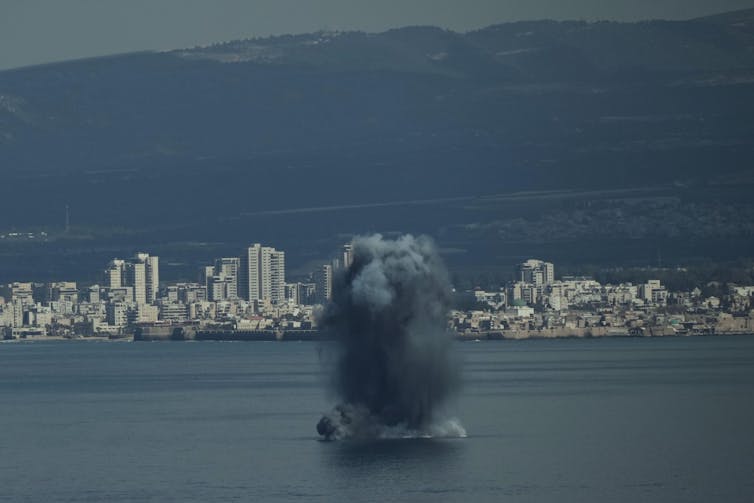
An incoming missile crashes into the sea off the port of Haifa in Israel as Iran retaliates.
An incoming missile crashes into the sea off the port of Haifa in Israel as Iran retaliates. AP Photo/Leo Correa

The Iraq invasion should be a cautionary tale. The US spent more than a decade cultivating multiple Iraqi opposition groups – yet dismantling the centralised state apparatus still produced chaos, insurgency and fragmentation. The vacuum gave rise to extremist organisations such as IS, drawing the US into years of renewed conflict.

Approaching Iran with similar assumptions ignores both its institutional resilience and the complexity of regional geopolitics. Sectarian divisions, entrenched alliances and proxy networks mean that destabilisation in Tehran would not remain contained. It could rapidly spill across borders and harden into prolonged confrontation.

A region wired for escalation

Iran has invested heavily in asymmetric capabilities precisely to deter and complicate external intervention. Its missile, drone and naval systems are embedded along the Strait of Hormuz — a chokepoint for global energy — and linked into a network of regional allies and militias.

In the current escalation, Tehran has already launched retaliatory missile and drone strikes against US military bases and allied territories in the Gulf, hitting locations in Iraq, Bahrain, the United Arab Emirates (including Abu Dhabi), Kuwait and Qatar in direct response to US and Israeli strikes on Iran’s cities, including Tehran, Qom and Isfahan. Explosions have been reported in Bahrain and the UAE, with at least one confirmed fatality in Abu Dhabi, and several bases housing US personnel have been struck or targeted, underscoring how the conflict has already spread beyond Iran’s borders

A full-scale regional war is now more likely than it was a week ago. Miscalculation could draw multiple states into conflict, inflame sectarian fault lines and disrupt global energy markets. What might have remained a contained nuclear dispute now risks expanding into a wider geopolitical confrontation.

What about Trump’s promise of no more forever wars?

Trump built his political brand opposing “endless wars” and criticising the Iraq invasion. “America First” promised strategic restraint, hard bargaining and an aversion to open-ended intervention. Escalating militarily at the very moment diplomacy was advancing sits uneasily with that doctrine and revives questions about the true objectives of US strategy in the Middle East.

Tehran skyline as missiles strike, February 28 2026.
Tehran and other Iranian cities have come under heavy bombardment from Israel and the US. AP Photo

If a workable nuclear framework was genuinely emerging, abandoning it in favour of escalation invites a deeper question: does sustained tension serve certain strategic preferences more comfortably than durable peace?

Trump’s Mar-a-Lago address announcing the strikes carried unmistakable echoes of George W. Bush before the 2003 invasion of Iraq. Military action was framed as reluctant yet necessary – a pre-emptive move to eliminate gathering threats and secure peace through strength. The rhetoric of patience exhausted and danger confronted before it fully materialises closely mirrors the language Bush used to justify the march into Baghdad.

The parallel extends beyond tone. Bush cast the Iraq war as liberation as well as disarmament, promising Iraqis freedom from dictatorship. Trump similarly urged Iranians to reclaim their country, implicitly linking force to regime change. In Iraq, that fusion of shock and salvation produced not swift democratic renewal but prolonged instability. The assumption that military force can reorder political systems from the outside has already been tested – and its costs remain visible.

The central challenge now facing the US is not simply Iran’s military capability. It is credibility. Abandoning negotiations mid-course signals that diplomacy can be overridden by force even when progress is visible. That perception will resonate far beyond Tehran.

Peace was never guaranteed. It was limited and imperfect, focused primarily on nuclear constraints rather than human rights or regional proxy networks. But it was plausible – and closer than many assumed. Breaking the bridge while building it does more than halt a single agreement – it risks convincing both sides that negotiation itself is futile.

In that world, trust erodes, deterrence hardens and aggression – not agreement – becomes the default language of international power. What we are witnessing is yet another clear indication that the rules-based order has been consigned to the history books.

ref. Iran has been attacked by US and Israel when peace was within reach – https://theconversation.com/iran-has-been-attacked-by-us-and-israel-when-peace-was-within-reach-277175


US-Israeli attack on Iran risks plunging the world into turmoil

Source: The Conversation (Au and NZ) – By Arshin Adib-Moghaddam, Professor in Global Thought and Comparative Philosophies, Inaugural Co-Director of Centre for AI Futures, SOAS, University of London

The US and Israel have launched extensive, coordinated attacks on numerous targets across Iran, prompting retaliatory strikes in the region. Donald Trump neither tried to obtain Congressional approval, nor did he pursue a United Nations security council resolution ahead of these actions. And the attack has come in the middle of talks between Tehran and Washington.The facts are clear. This is an illegal war, both in terms of US law and international statutes.

The US president has repeatedly said that Iran can’t be allowed to develop a nuclear weapon. The United Nations nuclear watchdog has reported that, because Iran has denied access to key sites hit during last year’s conflict, it cannot verify whether Iran has suspended all uranium enrichment or determine the current size and composition of its enriched uranium stockpile. However, Iran’s foreign minister, Abbas Araghchi, said after the latest round of talks that “good progress” was being made on a deal to limit Iran’s nuclear programme in return for sanctions relief.

Now, from everything that the US president is saying, the goalposts have shifted from a nuclear deal to an attempt to force regime change.

So bombs are falling on various cities in Iran, family members are hiding, tragedies will inevitably happen and the innocent will suffer. This is the endpoint of a longstanding campaign by the US and Israeli right-wing to reshape the Middle East and the wider Muslim world at the barrel of a gun. This is yet another intervention in a long history of disastrous foreign moves that have destabilised the country since Britain and the Soviet Union deposed Reza Shah Pahlavi in 1941 and the CIA and MI6 orchestrated a coup to depose Iran’s democratically elected prime minister, Mohammad Mossadegh, in 1953.

The consequences of this attack are likely to be dire for the region and the world. Already, Iran has retaliated by targeting US bases in Kuwait, Qatar, the United Arab Emirates and Bahrain and the first reports of casualties are emerging. Iran is unlikely to hold back. It’s clear that the Islamic Republic is viewing this as an existential threat.

Tehran will call on its allies in the region, the Houthis in Yemen, the Popular Mobilisation Forces in Iraq and Hezbollah in Lebanon which – despite being weakened over two years of attacks by Israel aided and abetted by the United States – have the capacity to expand the conflict throughout the region.

Iran has already indicated in recent drills with the Russian Navy that it may be capable of closing off the Strait of Hormuz, through which around one-quarter of the world’s oil and one-third of its liquefied natural gas travel. As a consequence, oil prices will explode and the world economy will suffer.

Clash of civilisations

There is a cultural component to this war, too. Israel and the US are conducting this war during the month of Ramadan. Muslims all over the world are fasting. For billions of them, this is the month of spirituality, peace and solidarity. Images of Iranian Muslims being killed by Israeli and US bombs threaten to further a clash of civilisations narrative which pits the Judeo-Christian world against Islam.

Two men talk in front of a poster reading: If you sow the wind, you will reap the whirlwind.
Iran has threatened retaliation across the Middle East. EPA/Abedin Taherkenareh

Muslims in European capitals, together with anti-war activists, will see this war as a clear aggression on the part of the US and Israel. Global public opinion will not be easily swayed into the direction Trump and Netanyahu would like.

And it must be asked, what will the leaders in Moscow and Beijing be thinking as they watch this illegal war and what might this mean for Ukraine and Taiwan? Vladimir Putin and Xi Jinping are close to the government of Iran and will condemn this war. At the same time, they must feel emboldened to pursue their own agendas with military might.

So Trump and Netanyahu’s attack on Iran has the potential to plunge the world into deep crisis. Expect more refugees, more economic turmoil, more trauma, death and destruction. The only hope now is that cooler heads among world leaders can prevail to contain this conflict and to limit the actions of Trump and Netanyahu.

Diplomacy has to be prioritised. Attempting to force regime change by launching an illegal war is foolhardy. If Iran is further destabilised, the entire Middle East and beyond will be plunged into utter turmoil. From there the outcome for the whole world is dangerously uncertain.

ref. US-Israeli attack on Iran risks plunging the world into turmoil – https://theconversation.com/us-israeli-attack-on-iran-risks-plunging-the-world-into-turmoil-276818

Filipino photojournalist Alex Baluyut: An extraordinary sense of truth in an ailing society

OBITUARY: By Joel Paredes

Having known the Filipino photojournalist Alex Baluyut, who died yesterday aged 69, for nearly half a century, I feel that looking at his photos — how he documented the events that unfurled during his lifetime — reveals his own lifelong search for himself.

By documenting the rawest parts of human existence, including war, poverty, and the shifting tides of our history, he was reconciling his own place within those same struggles.

Whether on the frontlines of conflict in Mindanao or the troubled streets of Metro Manila, he wasn’t just looking for a story; he was searching for a sense of truth.

​I first knew Alex when he was a photographer for the Associated Press. In those days, film was expensive, but it was not a constraint for him.

Having the resources of a major agency gave him a distinct advantage over his colleagues. I noticed how he loved documenting every movement of a subject, while others were often content with a single “good shot” for the day’s coverage.

It surprised me when, after we were dismissed from the Times Journal for union work and were organising a new daily with the late Joe Burgos, Alex approached me and Chuchay Fernandez. He asked if he can join Pahayagang Malaya.

He didn’t focus on the economic difficulties of a struggling paper, but instead embraced the challenge of being part of the “Mosquito Press” during the darkest days of the Marcos martial law era, especially during the surge of outrage following the death of opposition leader Benigno Aquino.

The 2013 photography book Mysteries of Chance by Alex Baluyut and five other Filipino photographers. Image: Voices of Vision Publishing

​Risky coverage
Alex was not just focused on protest rallies, his main assignments then. Together, we planned risky coverage of the underground movement, which took us to dangerous locations, including Mindanao to cover the Moro secessionist rebellion.

During the 76-day war in Lanao del Sur, Alex was hesitant to leave even after we received reports of napalm bombing; he stayed until it became clear the site was impossible to reach.

On one occasion, we braved a torturous hike to reach a MILF (Moro Islamic Liberation Front) camp on the border of Lanao and Maguindanao to take the first-ever photos of their forces in formation at their own campsite.

Even then, I noticed a shift in Alex’s mood. His adrenaline was fueled by a drive to expose the plight of the aggrieved, a mission that eventually brought us to the countryside to cover the communist insurgency.

His photos were not always meant for the newspapers; they were documenting the struggle so that people might understand it. Eventually, the pressure of witnessing the stark truths of an armed struggle took its toll on him.

​Interestingly, the photos Alex provided me from his documentation of the underground movement did not show the stark reality of a rebellion, but rather the communities where he was immersed.

He was the best man at my wedding, and my only lament was that he failed to document the ceremony. Instead, he handed me and Merci a photo of a smiling Mangyan — a rare subject given his usual themes.

He told me it was his way of wishing us a happy life.

Mobile kitchen project
Alex also sought to chart a life beyond photojournalism. Driven by his love for cooking, he and some friends set up a small beer garden on the sidewalks of Ermita, which sparked his adventures in the restaurant business.

It was no surprise then that he eventually devoted his remaining years to serving the needy during calamities, co-founding the Art Relief Mobile Kitchen with his wife, Precious.

The news of Alex’s passing from cirrhosis of the liver stunned me, especially knowing the impact our late colleague Tony Nieva had on both of us. Tony also succumbed to the dreaded illness.He was our mentor in the struggle for press freedom and in documenting the lives of the downtrodden.

After Tony passed away, I rarely saw and worked with Alex, except for a few commissioned book projects.

Although I monitored his journey through social media and felt a sense of guilt for not joining his new advocacy, I am grateful to have been part of the life of a man who sought the truth in our ailing society and worked, in his own way, to lift the spirits of the marginalised.

Article by AsiaPacificReport.nz

Papuan activist leader Wenda accuses Jakarta of ‘lying’ over shot down plane

Asia Pacific Report

A West Papuan leader has accused the Indonesian government of lying over its operations and “masking” the military role of some civilian aircraft.

Disputing an Indonesian government statement about reported that TPNPB fired upon an aircraft in Boven Digoel, killing both the pilot and copilot, United Liberation Movement for West Papua (ULMWP) interim president Benny Wenda said the aircraft was “not civilian”.

Wenda added that the Indonesian government was “tricking the world” about its military operations in West Papua.

“The Cessna plane the TPNPB [West Papua National Liberation Army] fired upon in Boven Digoel was not a civilian plane, as the police spokesman misleadingly stated, but part of a security operation,” Wenda said in a statement.

“Indonesia is again disguising their military activity as [civilian] activity. They are also willfully breaching the no-fly zones established by the TPNPB.”

The occupied conflict areas in which the Indonesian military TNI were “not permitted to fly” had been “clearly marked out by the TPNPB”.

“This is the same pattern Indonesia used in 1977, when Indonesia used a disguised civilian plane to bomb villages across the highlands and massacre thousands, including many members of my own family,” Wenda said.

Clear strategy
He added there was a clear strategy behind this — “Indonesia wants to avoid the attention that would be drawn by a large scale military buildup, so they mask their introduction of weapons and other military equipment and personnel”.

Wenda said they were effectively “using their own people as human shields”.

Indonesian soldiers and equipment next to a civilian aircraft. Image: ULMWP

Indonesian troops boarding a civilian aircraft in the West Papua Highlands. Image: ULMWP video screenshot APR

The TPNPB attacks took place on February 11, with the plane being downed and the pilot and co-pilot being killed.

A second attack took place in Mimika, near the Grasberg gold and copper mine, which has been the cause of so much West Papuan deaths over the past 40 years.

“Indonesia then immediately began operating their propaganda machine, claiming that the planes were simply engaged in civilian and medical supply distribution,” Wenda said.

“The truth is that these aircraft were involved in intelligence and security operations.

Media blackout
“Indonesia is only able to spread these lies and mislead the international community because of their six-decades long media blackout in West Papua.

“No journalists or NGOs are allowed to operate in our land. West Papua is a closed society, just like North Korea. I thank God we have civilian journalists to document their lies.”

By breaching these rules the military were inviting further attacks, Wenda said.

“We must always remember that the Indonesian military uses any armed action by West Papuans for their own gain, as a pretext for more militarisation, more displacement, and more deforestation and ecocide.”

Wenda said their aim was always to escalate the situation as a way of ethnically cleansing Papuans, forcing them to become refugees in their own land, and strengthening their colonial hold over West Papua.

“It isn’t a coincidence that in the week since this incident we have seen an escalation in Yahukimo, an Indonesia-occupied community health centre, and transformed it into a military post, displacing and traumatising local residents.”

Using hospitals and other health infrastructure for military means was a clear breach of international humanitarian law, Wenda said.

Normal for military
In West Papua such behaviour was normal for the military.

“In the same week in Puncak regency, Indonesian military personnel seized a school, preventing students from learning and putting ordinary people at risk of harm. Soldiers are posted in classrooms with guns.”

Wenda called on the Indonesian government to withdraw their troops from occupied West Papua, allow civilians to return home, cease using civilian vehicles as a cover for military action, and immediately facilitate a UN Human Rights visit to West Papua — as has been demanded by more than 110 UN Member states.

“Ultimately, Indonesia must come to the table to discuss a referendum,” Wenda said. “This is the only path to a peaceful solution in West Papua.”

An Indonesian Embassy spokesperson blamed the “armed criminal group”, an expression it  uses to describe resistance movement fighters.

Article by AsiaPacificReport.nz

Tenant wins $5000 payout after Kāinga Ora fails to act over machete threats

Source: Radio New Zealand

The police had been called for three separate incidents at the property. 123RF

A woman’s 14-year-old grandson was nearly mowed down by her neighbour’s car, while her son was threatened with a machete.

Now an elderly Tongan woman has gone to the Tenancy Tribunal, after Kāinga Ora refused to terminate her tenancy, despite the woman living in “constant fear” of the family next door.

The woman, who has name suppression, had lived at the Kāinga Ora property since 2019.

A female tenant lives at another Kāinga Ora property next door with her male partner and their children.

According to a recently released decision, the woman claimed that, during the tenancy, abuse was constantly shouted out at her over the fence, her daughter and son had been challenged to fights, rubbish had been thrown over the fence, and loud music had been played for long periods into the night on a boombox being carried up and down the road.

She’d also been sworn at in her driveway, had rocks thrown at her and her family, and was harassed when she called the police.

The police had been called for three separate incidents – one on 4 February, 2024, when the male neighbour was reported as being hostile and shouting threats, while standing at the tenant’s front gate.

A second incident occurred on 2 March, 2024, when the male neighbour was reported as standing outside the tenant’s front gate, making threats, while holding a machete.

The most volatile experience came when they had threatened to kill her son with a machete on 10 June last year.

The son said the male neighbour was working in the garden with a shovel and a machete, and started to abuse him and his son, and threatened to kill them.

The man was charged with threatening to kill, but was convicted of a lesser charge in relation to the weapon.

The woman’s daughter also provided a written statement to the authority and gave evidence at the hearing about an incident in which her 14-year-old son was walking home from school, when the male tenant was returning home in a car.

She said the male tenant chased her son in the car, driving onto the grass verge, and that her son was only able to escape by hiding behind a boat situated on a grass verge. The police were called, but attended the next day.

‘Lives in constant fear’

The woman said she “lives in constant fear” of the neighbouring tenants and will often stay inside her home, because she is too afraid to venture outside. On occasion, she had stayed with her daughter, because she couldn’t cope with being at home.

She had health issues that impacted her mobility and sight, and recently had a stroke.

She and her son had reported the behaviour to Kāinga Ora numerous times during the tenancy, but their response had always been to tell her and her family to keep to themselves, and not engage with the neighbours.

She said she initially wanted the neighbour to move, so she could live in peace, but now that she had health issues, she wanted to leave the tenancy.

Kāinga Ora did not dispute that the tenant had reported ongoing issues with this tenancy, and was well aware of the tenant’s complaints of shouting, abuse and loud music.

It confirmed that the organisation had been notified of the three police incidents, but said the issue was complex, because on some occasions, there was aggression on both sides, including a physical altercation between the male neighbour and the tenant’s son, which resulted in an antisocial notice being issued to both.

Kāinga Ora said it had considered whether it could terminate the neighbour’s tenancy under section 55A of the Residential Tenancies Act (termination for assault), following the machete incident, but ultimately determined it could not do so, because the neighbouring tenant herself was not home and the male at the address was not a listed tenant, and had threatened this tenant’s son and not the tenant herself.

The organisation was also unable to apply to terminate the tenancy for antisocial behaviour, as there had not been three incidents within a 90-day period.

Tribunal adjudicator Melissa Allan said the tenant had been “left in a very difficult situation”.

“She has not felt free to move about her property, often remains inside, and has been subjected to unreasonable levels of noise, rubbish being thrown, screaming and yelling, and threats being made to her family members.

“The landlord should have filed an application to terminate the neighbouring tenancy. It is not necessary for criminal charges to be proven or even laid.

“The landlord only needed to prove, to the civil standard, that the tenant has been interfering with the reasonable pace, comfort and privacy of the tenant, and that the breach is of such a nature and of such an extent that it would be inequitable to refuse to make an order terminating the tenancy.”

By failing to take steps, the landlord had breached its obligations, she said.

Kāinga Ora was ordered to pay the tenant $5000 in compensation for breach of landlord’s obligations and was looking to transfer the tenant to a tenancy that is more suited to her current health needs.

* This story originally appeared in the New Zealand Herald.

– Published by EveningReport.nz and AsiaPacificReport.nz, see: MIL OSI in partnership with Radio New Zealand

Police continue to investigate after Papakura shooting leaves man in moderate condition

Source: Radio New Zealand

A police car seen behind a cordon as officers attend an incident. RNZ

Police are following “strong lines of enquiry”, after an Auckland shooting on Saturday left a man with moderate injuries.

Officers were conducting patrols in the Clevedon Road area in the suburb of Papakura on Saturday morning, when they heard what was believed to be gunshots at about 11.20am.

A short time later, a man was transported to hospital in a moderate condition with a gunshot injury.

A police spokesperson said they were following “strong lines of inquiry” into what had occurred.

“Initial indications are that the victim and the offenders are known to each other, and there is no risk to the wider community.”

Officers, including the Armed Offenders Squad, had been conducting enquiries at a Grove Road address on Saturday afternoon, but no arrests were made.

Cordons that had been in place in Grove Road were stood down.

The spokesperson said Clevedon Road and Grove Road residents could expect to see a continued police presence on Saturday evening, as officers continued enquiries.

They asked that anyone with information that might assist their investigation contact them via 105.

– Published by EveningReport.nz and AsiaPacificReport.nz, see: MIL OSI in partnership with Radio New Zealand

Kiwi golfer Daniel Hillier storms into NZ Open lead at Millbrook

Source: Radio New Zealand

Daniel Hillier plays a shot during the third round of the 105th New Zealand Open. Photosport

A stunning late surge has vaulted Kiwi Daniel Hillier to the top of the NZ Open leaderboard at Millbrook Resort, near Queenstown.

The Wellingtonian was four strokes off leader and fellow Kiwi Kerry Mountcastle, when he lined up to play the 14th hole.

He birdied that, followed up with another birdie, parred the 16th, eagled the 17th and birdied the last to finish with a seven-under-par 64 to be 18-under with a round to play.

Hillier has been a force on the European tour this year and is the highest-ranked player in the field this week. He was runner-up at the NZ Open in 2024.

Masterton golfer Mountcastle also hit a 64 and is tied for second with Australian Curtis Luck, who hit 63. They are a stroke behind Hillier.

Another Aussie, Lucas Herbert, went around in 62 and sits fourth, a further stroke back.

Hillier had played steady golf before his late surge.

“That was a crazy last few holes,” he said. “I didn’t have my best early on.

“It was one of those days and I had to stay patient. I knew there were a couple of par-fives I could take advantage of later in the piece.

“Thankfully, I could do that and it was pretty cool to get one at the last as well, in front of that massive crowd.”

Hillier, who has had two top-five finishes on the DP World Tour already this year, is obviously keen to continue his good vein of form in the final round.

“Looking ahead to tomorrow, I would love a replay of that and some more,” he said. “Obviously, I have a job to do.

“I will rest up tonight and have a good sleep, and come out firing.”

Mountcastle could have had the outright lead had he birdied the final hole, but he dropped a stroke, after his tee shot landed in the water.

New Zealander Kerry Mountcastle is tied for second after three rounds. Photosport

The 30-year-old rated his round, which included nine birdies, as “nine out of 10”.

“Everything was kind of firing,” he said. “I’m sort of not really thinking about what’s happening in the tournament.

“It’s just I’m out here trying to hit shot after shot and it’s kind of the first time when I’ve been up the top, where I’ve been this comfortable.

“Normally I’m always thinking about, “Oh, I need to do this or what’s going on about that?”

The overnight leader after the second round, New Zealand amateur teenager Yuki Miya hit a 70 for a share of fifth place at 13-under.

One of the world’s top players on the PGA Championship tour, Kiwi Steven Alker has a share of ninth place at 12-under. He and compatriot Sam Jones both scored 66 in the third round.

“Today was moving day and I wanted to be a little more aggressive, but tomorrow, I am going to need to be really aggressive to catch the guys in front,” Alker said.

“I am having a blast with ‘Goldie’ [former All Black Jeff Wilson] on the bag, and it’s been a lot of fun and great to be back in New Zealand playing again. That is the coolest part.”

South Korea’s Chan Choi matched the championship course record with a 10-under-par 61. After making the cut on the number, he is now in a share of eighth at 12-under.

– Published by EveningReport.nz and AsiaPacificReport.nz, see: MIL OSI in partnership with Radio New Zealand

‘We warned you,’ says Iran’s national security chief after Israel-US attacks

Asia Pacific Report

“We warned you,” says Iran’s national security commission head after Israel-US missiles attacks on the capital Tehran and other cities.

Al Jazeera reports comments from Ebrahim Azizi, the head of the national security commission of the Iranian Parliament.

“We warned you!” he wrote on social media.

“Now you have started down a path which end is no longer in your control,” he added.

Explosions were also reported in the cities of Kermanshah, Lorestan, Tabriz, Isfahan and Karaj, according to local news media.

Al Jazeera’s chief US correspondent Alan Fisher reports that people were expecting that there may well be an attack by the United States.

US President Donald Trump had been talking about it.

‘Some US action expected’
“Most people expected some sort of United States action. So there is surprise that Israel has gone first.

“But there will be speculation here in the United States — inevitably — that this is [Israeli Prime Minister] Benjamin Netanyahu once again trying to force the United States to take action against Iran.

“And the reason he has done this is to try and force their hand.”

News media report US President Donald Trump as stating that the joint Israel-US attacks were aimed at “eliminating imminent threats from the Iranian regime”.

In an eight-minute video message shared on Truth Social, he said: “Short time ago, US military began major combat operation in Iran. Our objective is to defend the American people by eliminating threats from the Iranian regime.”

Mehran Kamrava, director of the Iranian studies unit at the Arab Centre for Research and Policy Studies and professor at Georgetown University in Qatar, said Israel appeared to have “launched an attack designed to derail the [nuclear] negotiations” between the US and Iran. A new round of talks had been scheduled for next week.

Article by AsiaPacificReport.nz

Live: Super Rugby Pacific – Brumbies v Blues at GIO Stadium

Source: Radio New Zealand

Photosport

The Blues play the high-flying Brumbies at GIO Staidum, after a high-scoring win over Western Froce last week.

Captain Daltan Papali’i will play his 100th Super Rugby game, as his side try to topple the top-of-the-table Brumbies in Canberra.

Kickoff is at 9.35pm.

Blues: 1. Ofa Tu’ungafasi. 2. Kurt Eklund. 3. Marcel Renata. 4. Laghlan McWhannell. 5. Sam Darry. 6. Anton Segner. 7. Dalton Papali’i (c) 8. Hoskins Sotutu. 9. Finlay Christie. 10. Stephen Perofeta. 11. Caleb Clarke. 12. Pita Ahki. 13. AJ Lam. 14. Cole Forbes. 15. Zarn Sullivan

Impact: 16. Bradley Slater. 17. Mason Tupaea. 18. Sam Matenga. 19. Josh Beehre. 20. Torian Barnes. 21. Taufa Funaki. 22. Xavi Taele. 23. Codemeru Vai.

Sign up for Ngā Pitopito Kōrero, a daily newsletter curated by our editors and delivered straight to your inbox every weekday.

– Published by EveningReport.nz and AsiaPacificReport.nz, see: MIL OSI in partnership with Radio New Zealand

Football: Auckland FC stun with A-League win over champions Melbourne City

Source: Radio New Zealand

Auckland FC’s Guillermo May scores against Melbourne City. Photosport

Auckland FC have kept the pressure on A-League men’s leaders Newcastle Jets with a stunning 3-0 home win over Melbourne City.

Logan Rogerson broke his goalscoring drought with a decisive blow to give the Aucklanders a 1-0 lead after 42 minutes, and Jesse Randall (59th minute) and Guillermo May (66th minute) followed up in the second half for a comprehensive victory.

The result narrowed the Jets’ competition lead to just one point, although the Newcastle side were playing Central Coast Mariners on Saturday night.

After a poor January, the Aucklanders have had a brilliant February, looking much more like the team won the Premiers Plate last season.

They delighted their fans with this performance, although it did come at a cost, with captain Hiroki Sakai leaving the field late in the first half with an injury to his right leg, after as series of heavy collisions.

He was replaced by Sam Cosgrove.

Rogerson had gone 16 matches without a goal this season, but he latched on to a cross from May, heading it into the back of the net.

He admitted after the match to some sleepless nights, because of the drought.

“I’m delighted to break my duck and get my first goal of the season,” he told the Sky Sports broadcast.

Randall hasn’t had such goalscoring blues and pounced to score his ninth for the season, after an error by City defender Harrison Delbridge. Randall now leads the competition in scoring.

May scored his goal, after heading in a cross from Randall.

Auckland FC host Perth Glory next Sunday.

– Published by EveningReport.nz and AsiaPacificReport.nz, see: MIL OSI in partnership with Radio New Zealand

IndyCar: Kiwi Scott Dixon unharmed after crash at St Petersburg Grand Prix practice

Source: Radio New Zealand

Scott Dixon’s car after a nasty crash during practice in Florida. Twitter/Indycar

Kiwi motorsport ace Scott Dixon has emerged uninjured from a nasty crash during practice for the IndyCar St Petersburg Grand Prix in Florida.

During the first practice session – in which compatriot Scott McLaughlin had the fastest time – Dixon’s Ganassi Racing Honda slid across turn nine and collided head-first into a concrete barrier.

The car sustained heavy damage to the front, but Dixon emerged unhurt, but not before David Malukas just avoided contact with the stricken car, sneaking through a gap between the left barrier and Dixon’s left sidepod.

“Kind of a frustrating one,” Dixon said. “I got loose on entry and tried to save it, and then kind of got into an overcorrection.

“Luckily, it slid off a lot of the speed, before it hit the wall. Sometimes, you can tub a car and destroy them.

“Hopefully this isn’t too bad.”

The crash resulted in a red flag, one of three during the practice session.

Despite the damage, Dixon didn’t think he would need a back-up car for the opening Indycar race for the season, which starts at 7am Monday (NZT).

Scott Dixon has had at least one victory in 21 consecutive IndyCar seasons. PHOTOSPORT

“It actually looked fine,” said Dixon, who has had 21 consecutive IndyCar seasons with a victory.

“The rear was not bad. I think they’ll just have to change suspension, the front nose and front wing obviously, but then even the front suspension didn’t look that bad.

“It was kind of weird, so yeah, weird as in good weird.”

McLaughlin, who has had two previous pole starts at St Petersburg, had the quickest lap in 1m 1.1020s in his Team Penske Chevrolet on the 14-turn, temporary street circuit.

He led both the earlier portion of the 85-minute practice that contained all 25 cars and improved upon that time in the smaller session, after the field was divided into two groups.

“Decent first day,” McLaughlin said. “Obviously, being P1 is a great start.

“The DEX Imaging Chevy was straight away fast and felt good and comfortable. It’s good for us.

“It’s the start of a long season and it was nice to have a smooth session to start. We’ll keep pressing on and see how we go.”

Felix Rosenqvist was second overall and Florida native Kyle Kirkwood third.

Another New Zealander, Marcus Armstrong, was seventh.

Sign up for Ngā Pitopito Kōrero, a daily newsletter curated by our editors and delivered straight to your inbox every weekday.

– Published by EveningReport.nz and AsiaPacificReport.nz, see: MIL OSI in partnership with Radio New Zealand

Live: Super Rugby Pacific – Chiefs v Crusaders at FMG Stadium Waikato

Source: Radio New Zealand

Photosport

The Chiefs host the winless Crusaders in a rematch of last year’s Super Rugby Pacific final at FMG Stadium Waikato on Saturday.

The hosts are coming off back-to-back wins over New Zealand opposition, while the their opponents have yet to taste victory.

Kickoff is at 7.05pm.

Chiefs: 1. Jared Proffit 2. Samisoni Taukei’aho 3. George Dyer 4. Josh Lord 5. Tupou Vaa’i (vc) 6. Simon Parker 7. Kaylum Boshier 8. Luke Jacobson (c) 9. Xavier Roe 10. Josh Jacomb 11. Leroy Carter 12. Quinn Tupaea (vc) 13. Daniel Rona 14. Emoni Narawa 15. Etene Nanai-Seturo

Impact: 16. Tyrone Thompson 17. Benet Kumeroa 18. Reuben O’Neill 19. Samipeni Finau 20. Wallace Sititi 21. Te Toiroa Tahuriorangi 22. Tepaea Cook-Savage 23. Lalakai Foketi

Crusaders: 1. Tamaiti Williams. 2. George Bell. 3. Fletcher Newell. 4. Antonio Shalfoon. 5. Jamie Hannah. 6. Dom Gardiner. 7. Ethan Blackadder. 8. Christian Lio-Willie. 9. Noah Hotham. 10. Taha Kemara. 11. Sevu Reece. 12. David Havili (c) 13. Leicester Fainga’anuku. 14. Chay Fihaki. 15. Will Jordan

Impact: 16. Manumaua Letiu. 17. George Bower. 18. Seb Calder. 19. Tahlor Cahill. 20. Corey Kellow. 21. Louie Chapman. 22. James White. 23. Dallas McLeod.

Sign up for Ngā Pitopito Kōrero, a daily newsletter curated by our editors and delivered straight to your inbox every weekday.

– Published by EveningReport.nz and AsiaPacificReport.nz, see: MIL OSI in partnership with Radio New Zealand

Basketball: NZ Breakers part ways with head coach Petteri Koponen

Source: Radio New Zealand

Breakers coach Petteri Koponen is leaving the club. Blake Armstrong/Photosport

NZ Breakers and head coach Petteri Koponen have parted ways, and the club will advertise globally for a replacement.

The Finn coached the Breakers for two seasons, with the side finishing ninth of the 10 teams last year, followed by seventh in the regular season just completed.

Koponen, 37, finished on a bright note, with a victory in the Ignite Cup over the Adelaide 36ers last Sunday.

After discussions with club management, he is leaving, with the club saying he didn’t seek a contract extension and was looking for new professional opportunities closer to Finland.

Koponen said he was after a new challenge.

“My time in New Zealand has been one of the most rewarding chapters of my career,” he said. “I fell in love with this country and the incredible community that supports the Breakers.

“However, after two seasons of intense growth in the NBL and the immense satisfaction of bringing the Ignite Cup to Auckland, I am ready for a new challenge.

“I want to thank the club, the players and the fans for embracing me. I am proud of the culture we’ve built and I leave with the highest respect for this club.”

The Breakers said Koponen had instilled a modern, high-intensity European style of play that culminated in the inaugural Ignite Cup victory.

“Petteri is a young coach on the rise and we support his desire to pursue opportunities closer to home,” said Breakers basketball operations president Dillon Boucher.

“Professional coaching at this level demands immense sacrifice, especially half a world away from home. We’ve reached a mutual agreement that the time is right for Petteri to pursue his next professional challenge.

“He departs with his mana higher than ever and will always hold a permanent place within our Breakers whānau.”

The club said it would look for a new coach capable of taking the Breakers to the top of the NBL rankings.

Sign up for Ngā Pitopito Kōrero, a daily newsletter curated by our editors and delivered straight to your inbox every weekday.

– Published by EveningReport.nz and AsiaPacificReport.nz, see: MIL OSI in partnership with Radio New Zealand

The Detail: Home for granny, headache for homeowner

Source: Radio New Zealand

Experts say that the real rule change is simply that when things go wrong, the burden of responsibility will be on the homeowner, not the council. 123rf

Rule changes for putting a granny flat on your section cut very little red tape, but move questions of liability from councils to homeowners

No garage conversions, no house extensions, no old materials or relocated cottages, no DIY practitioners, no mezzanine floors and no accessible showers.

And no building consent needed.

The government’s new rules for building a granny flat, or ‘minor standalone dwelling’, on your own property cut through one layer of paperwork and will likely save plans from being clogged up at council level, but they’re still complex, full of restrictions and just as expensive as they always were.

The real change these rules bring, say experts, is that when things go wrong, they shift the burden of responsibility from the council to homeowners.

Karel Boakes is the president of the Building Officials Institute of New Zealand, an organisation with around 1200 members who deal with building surveying, controls and regulations in both the private sector and in councils.

From what she’s seen in the month or so since the law came in, there’s been no rush to build these standalone dwellings – she says licensed building practitioners appear to be wary of shouldering the burden of responsibility for any failures.

“They’re concerned,” she says.

“They’re concerned for the homeowners and potentially the risks that they might be taking on if they choose to follow this route.”

“Obviously they’re not against efficiencies where they can be made. That’s common sense and we’re all on board with that. But we’re also trying to weigh up the level of risk that people could be exposed to if buildings are built in a way that’s not compliant or in a way that [poses problems] financially with insurance or what have you.”

Boakes says officials want to make sure people go into these processes with their eyes wide open, understanding the risks.

“There’s definitely a shift of liability.”

Before the regulation changed there was a level of surety in council checks, but we saw from the leaky building crisis that meant that councils were often the “last man standing” – the only organisation still around answering questions of liability when builders and developers went bust. Now the responsibility for any issues down the line falls on the homeowner, and those licensed building practitioners who supervised the job.

The only council responsibility comes right at the start of an application for a standalone dwelling when it issues a PIM – a Project Information Memorandum – which details information about the land or the project that they need to take account of, such as unstable land or flood plains.

“The council won’t be taking any liability any more in terms of assessing, or checking, or inspecting,” says Boakes.

The Ministry of Business, Innovation and Employment has put out comprehensive information about the processes involved.

It says the granny flats building consent exemption allows small standalone dwellings of up to 70 square metres to be built without a building consent, if it has a simple design and meets the building code; homeowners notify the council before they start building and when they’re finished; the work is carried out or supervised by licensed building professionals; and all the exemption conditions are met.

You can download the seven forms required from the site, read the three checklists, five step-by-step guides and five fact sheets, and there are links to 12 professional groups that might be involved.

So there’s no excuse for winging it.

Bill McKay, a senior lecturer at the School of Architecture and Planning, University of Auckland, tells The Detail that when the rules came out, he was taken aback by the level of requirements – “all the things that you do and have to worry about”.

“One of the questions I’m mostly commonly asked is, ‘can I build it myself?’

“Short answer – absolutely not,” he says.

He says not having to get a building consent will save time, with the council unable to put off its issuing of a PIM. But a building consent is one thing – “you’ll still need building advice from someone who can draw up plans for you and that sort of thing. We might still need a resource consent, and this is a pitfall for lots of people.

“You can’t build just anywhere you want in your back yard. We have certain rules about minimum permeable and impermeable area so that rainfall will soak away, which is all good. And we have distances that we have to keep from neighbours … all that sort of thing as well.

“I think a lot of people will just sort of leap into it without doing their homework first and doing it properly, and that could get them in trouble from various angles.”

Then there’s the sting at the end – while it varies throughout the country, most councils will charge a development fee, and in some places that could be around $25,000. Your rates will go up too, having added another bathroom and more square metres to your estate.

Meanwhile McKay has picked out an aspect of the regulations he calls ‘ironic’ – even if your little house is for granny, you can’t have a recessed shower, where you could wheel in or get in without tripping over if you were unstable on your feet.

“The reason for that is, they haven’t developed a class of LBP who can do that.”

That means the supervisory aspect of the project couldn’t be met – so accessible showers are on the no-go list.

Check out how to listen to and follow The Detail here.

You can also stay up-to-date by liking us on Facebook or following us on Twitter.

– Published by EveningReport.nz and AsiaPacificReport.nz, see: MIL OSI in partnership with Radio New Zealand

Red alert issued for Vanuatu province as Cyclone Urmil passes nearby

Source: Radio New Zealand

Tropical cyclone Urmil near Vanuatu, 28 February 2026 Zoom Earth

Vanuatu’s national disaster management office has issued a red alert for TAFEA province as a tropical cyclone hovers near the province.

Tropical Cyclone Urmil formed southwest of Port Vila on Friday.

It has now been upgraded to a Category 2 according to the Fiji Meteorological Service.

“At 5am local time, 28 February, analysis put this cyclone at 20 degrees South, 169.9 degree East, and that is roughly south east of Tanna island in the TAFEA province,” according to the Vanuatu Meteorology and Geohazard Department’s Tropical Cyclone Supervisor, Jerry Timothy.

TAFEA province is made up of the islands of Tanna, Aneityum, Futuna, Erromango and Aniwa.

Timothy said the cyclone moved into the TAFEA province from the West, from the Western side of the island group, there.

“Most probably the first island, Erromango hasn’t that much of the cyclone, maybe to the west of the island, but Tanna, which is the island in the middle, the tropical cyclone came very close to the south of the island, moving to the south,” he said.

The latest cyclone warning bulletin from the Vanuatu Meteorology and Geohazard Department said damaging gale force winds of 90km/h will continue to affect Tafea Province today.

It said heavy rainfalls with flash flooding are expected over low lying areas and areas close to river banks, including coastal flooding over TAFEA today. Very rough seas with heavy to phenomenal swells are expected over the area mention above.

A marine strong wind warning is also current for central and southern waters of Vanuatu. High Seas wind warning is also current for all open waters of Vanuatu. People, including sea going vessels are advised to take precautions.

Jerry Timothy said people can expect wind gusts of up to 105km/h.

Communities on Tanna island were preparing for a night of heavy weather as Tropical cyclone Urmil passed close-by.

Mora Kapum of White Grass Ocean Resort in Lenakel told RNZ Pacific that there was heavy rain and strong winds last night, leading to some minor flooding.

She said there is no serious damage there but there is a lot of cleaning up today, and it’s still very windy.

Red alert

When a RED ALERT is issued, you need to stay in a safe shelter:

  • Stay tuned and informed through Radio, TV, SMS, or Internet
  • Turn off all gas and electricity and unplug all electrical items from the sockets
  • Stay in the strongest and safest part of your house or the evacuation centre and do not go outside
  • Stay away from doors and windows and keep them closed and locked
  • Remain indoors or in safe place and continue to listen to the radio and do not go outside until National Disaster Management Office issues the ‘ALL CLEAR’ after the Vanuatu Meteorology and Geohazard Department cancels the cyclone warning for your area.
  • Take care to avoid dangers caused by fallen powerlines, trees, damaged building and other debris
  • Support your family and neighbours especially the most vulnerable in your community

– Published by EveningReport.nz and AsiaPacificReport.nz, see: MIL OSI in partnership with Radio New Zealand

Sprinter Tommy Te Puni overcomes setbacks for national 200 metres record

Source: Radio New Zealand

Tommy Te Puni races to a 100 metres behind Tiaan Whelpton at Sir Graeme Douglas International. David Rowland/Photosport

Two years have passed, but Tommy Te Puni finally has his name in the record books.

Last weekend, the Auckland speedster claimed the national 200 metres mark, when he tore around a bend – but not THE bend – at Christchurch’s Nga Puna Wai Sports Hub and crossed the finish line in 20.35s, slicing two-hundredths of a second off the previous standard.

“It means a lot,” he told RNZ. “Coming off a bit of bad luck and a lot of injuries, it’s pretty good to get one of those on the board.

“Being a New Zealand record, it’s special, not just for me, but for all the people who have supported me, like my family and especially my coach, who sets up all the programmes, and deals with the ups and downs just as much as me.

“I’m really happy, not just for myself, but for everyone else around me that have helped me along the way.”

In November 2023, Te Puni was the victim of a timing malfunction that some believe cost him the first sub-46-second 400m by a Kiwi male at a local club meet.

Since then, he has battled a variety of injuries that have stymied his hopes of ever reaching his potential – until now.

Ironically, one of those injuries seems to have played a part in his current run of form.

Te Puni, 23, broke his foot during a northern hemisphere campaign that included the World University Games in Germany, which delayed his return to the track until the new year.

Instead of running his best times before Christmas, then hitting a wall afterwards, he is only now reaching a peak at the business end of the season.

His performance at the International Track Meet came off the back of a series of quick times over the preceding month. A 10.36s 100m personal best at the Douglas International in Auckland was followed by a solid 10.40s/20.89s double into slight headwinds at Hamilton’s Porritt Classic.

“This was the first week I actually felt fresh,” he explained. “For me, it usually takes quite a few weeks to freshen up, so even leading into Porritt, I wasn’t really feeling that good.

“In New Zealand, it’s a big thing to run 20-point, but it didn’t feel that good. I was overstriding, and I didn’t feel that fresh, so we went back to the drawing board.”

Personal bests over 150m in training had him and coach Elena Brown believing something special was near.

“We were thinking high 20.4s was what I was showing, so 20.35 was a pleasant surprise.”

Te Puni tuned up for his record run with a wind-assisted 10.26s 100m, although wind readings only told half the story. While winner Tiaan Whelpton clocked 10.01s with a 4.9m/s tailwind, four minutes before, the women supposedly ran into a 3.4m/s headwind.

In reality, the wind was a swirling side, so meet organisers switched the 200m start to take advantage of conditions around the bend. Three years ago, they did the same for Rosie Elliott, when she clocked a 22.81s national women’s record.

The maximum allowable tailwind for record purposes is 2.0 m/s. Te Puni’s 200m wind was 1.2 m/s.

“It’s a northwesterly, a true tailwind around the bend, but not helping you too much down the straight,” he said. “You come off the curve, you slingshot and just hold that momentum through to the finish line.

“The wind is coming from a direction that it doesn’t fully hit the wind metre, which is really good.”

[embedded content]

Te Puni’s achievement sets up the unique prospect of all three men’s sprint records falling in the same season.

Whelpton has now gone under the 100m standard twice with excessive winds, while clocking 10.10s – 0.02s outside the national mark – legally. He only needs the right wind to break the record and possibly crack 10 seconds.

Last season, Lex Revell-Lewis broke 46 seconds for the 400m (45.88s) and showed he was capable of faster still, when he clocked 10.36w/20.49s at Christchurch.

Six runners beat 10.50s over 100m at the ITM, albeit wind-assisted. In seventh, 14-year-old Vern Toaloamai-Holden recorded 10.67s.

Four runners beat 21.00 seconds over 200 metres, another slice of NZ sprinting history.

Why is NZ sprinting enjoying a resurgence?

“It’s a good question,” Te Puni mused. “I think it’s just a question of timing, when everyone’s around a similar point, but you also have trailblazers like Tiaan, trying to get that 9.99s.

“It’s inspiring for people, and you want to chase those top guys. When I ran the 200m, they’re all chasing me, but it’s not like there’s someone who’s clear and above everyone else that you lose motivation.

“There’s a bit of luck with the depth, and everyone wants to beat each other.”

For their part, meet organisers have done their best to provide optimal conditions for performances.

“I’m sure all athletes will agree with me, but when you turn up to a race and there’s no hope of them flipping the track, and you have to run into a three-metre headwind… that’s not much fun.

“If they flip the track and the wind’s blowing at three, but I might get lucky, and get a 1.5 and new PB (personal best). Psychologically, that just gets you more amped up to race.

“They did it at Cooks [Whanganui], they did it at Sir Graeme [Douglas International], they did it at Christchurch… I’m pretty sure they’ll do it for the 100s and hopefully 200s at nationals.”

A community initiative to promote national relay teams has also created a collective approach to what was previously an individual sport, while fostering competition within the squad.

Early attempts at a men’s 4x100m record have seen Te Puni miss out on the top foursome, but current form may force a selection rethink.

“It gives a lot of athletes more opportunity to potentially get onto that world stage, but it also ties into wanting to be in that team and getting that spot,” he said. “The relays elevate the competition, because you don’t want that guy or that girl to get your spot, so you want to perform the best you can.”

Te Puni hasn’t contested the 400m this summer, but wouldn’t rule out another shot at that record in the future.

.

“We’re trying to work out where to get one in, but because I only really started running at the start of this month, there wasn’t really time to fit in a 400,” he said. “We were thinking about Sir Graeme Douglas, but stuck with the short sprints, because that was where my shape was at the moment.

“We’re keen to get one in March maybe. I’m not sure, but it would be nice to run another one, because my speed is at an all-time high at the moment and that typically bodes well for a quick 400.

“At the moment, it’s just 200, especially with nationals.”

Sign up for Ngā Pitopito Kōrero, a daily newsletter curated by our editors and delivered straight to your inbox every weekday.

– Published by EveningReport.nz and AsiaPacificReport.nz, see: MIL OSI in partnership with Radio New Zealand

Live: Super Rugby Pacific- Fijian Drua v Hurricanes at Churchill Park

Source: Radio New Zealand

Photosport

The Hurricanes are looking to make it two from two against Pacific teams, as they head to Lautoka to play the Fijian Drua on Saturday afternoon.

Callum Harkin will start at first-five for the Wellington-based outfit, while the Drua are still chasing their first win of the Super Rugby Pacific season.

Kickoff is at 4.35pm.

Hurricanes: 1. Pouri Rakete-Stones 2. Asafo Aumua (vc) 3. Tevita Mafileo 4. Hugo Plummer 5. Warner Dearns 6. Devan Flanders 7. Peter Lakai 8. Brayden Iose 9. Cam Roigard 10. Callum Harkin 11. Fehi Fineanganofo 12. Jordie Barrett (c) 13. Billy Proctor 14. Bailyn Sullivan 15. Josh Moorby

Impact: 16. Jacob Devery 17. Xavier Numia 18. Siale Lauaki 19. Isaia Walker-Leawere 20. Brad Shields 21. Ereatara Enari 22. Lucas Cashmore (debut) 23. Ngane Punivai

Sign up for Ngā Pitopito Kōrero, a daily newsletter curated by our editors and delivered straight to your inbox every weekday.

– Published by EveningReport.nz and AsiaPacificReport.nz, see: MIL OSI in partnership with Radio New Zealand

Defence in Whangārei murder trial closes, arguing Anaru Morunga had an ‘imaginative grip on reality’

Source: Radio New Zealand

Anaru Morunga is on trial for the alleged murder of his ex-partner and the mother of his two children, Jasmaine Reihana. NZME/SUPPLED

Warning: This article discusses graphic violence and may be upsetting to some readers.

After two weeks of silence, the defence in a murder trial finally rose and shifted the focus from the brutality of an alleged act to the question of the accused’s state of mind.

As Anaru Morunga’s trial nears its end, today marked the first moment defence lawyer Arthur Fairley addressed the jury and reframed the case.

“We’re dealing with this man’s mind. Not your mind, not my mind … it’s what this man’s mind thinks,” Fairley said in his closing statement.

Morunga has been on trial in the High Court at Whangārei on eight charges, including murder, related to events surrounding the death of his ex-partner, 35-year-old Jasmaine Reihana.

The couple had two children together but separated in 2018. It was unclear what the status of their relationship was at the time of her death on 8 September, 2024, after they had attended a tangi together in Ōtorohanga.

For 10 days, the jury has heard evidence from multiple Crown witnesses, including forensic experts and police officers, about events that occurred across the days leading up to Reihana’s death.

The Crown alleges Morunga murdered Reihana by stabbing her at the Pouto peninsula home in Northland that he shared with his mother, Suzanne Morunga, and her partner Michael Jones.

He is also accused of arson after allegedly setting Reihana’s car alight with her body inside at the far end of the Ripirō Beach farm, before fleeing and leading police on a State Highway 12 chase that ended with his arrest near the Brynderwyn Hills.

Today, he changed his plea on two of the eight charges he has been defending, admitting charges related to unlawfully taking a tractor and quad bike owned by his boss, Chris Biddles.

On the other charges, Morunga has repeatedly acknowledged killing Reihana, telling police he cut her throat before placing her body in her car and towing it to the beach by tractor. He continues to deny that he was the one who set the vehicle alight.

That admission has not only been heard by the jury through his evidential interview with police played in court, but also when he chose to take the stand yesterday.

“I just walked over to her, grabbed her, pulled the knife out and cut her throat,” he said in his police interview recorded in September 2024.

But when he gave close to four hours of evidence yesterday, his narrative changed.

He claimed Reihana had a gun and he had to kill her to protect his family.

“I pulled, she pulled, I won,” he testified.

He then demonstrated for the court how he cut Reihana’s neck.

In Crown closings, prosecutor Bernadette O’Connor told the jury Morunga was making things up to fit the evidence that had been presented.

“Folding up the paper napkin so it resembled a knife. Not something he was asked to do, something he did of his own volition to demonstrate how he killed Ms Reihana,” O’Connor said.

“Claiming he didn’t mean for her to die. I submit that flies in the face of the evidence and flies in the face of common sense.

“He meant to kill her.”

O’Connor said there were eight pages of transcript of Morunga detailing the slaying, even saying he was good with knives and trained to kill animals humanely.

“He didn’t seem to afford that humane killing to Jasmaine Reihana,” O’Connor said.

She said the new story about a gun being present was “simply not true”.

“When I pointed out he has never mentioned it, he said ‘I was a very broken man then’,” O’Connor said.

“A broken man? Or a man who was relaxed, enjoying his moment in the spotlight?”

O’Connor said Morunga had made a “fantastical story” that Reihana was having an affair, she was going to kill his family and sell his children to the Mongrel Mob.

“He will come up with anything that he can to get away with murder.”

O’Connor said he was high on methamphetamine, and being under the influence of drugs was not a defence to murder.

“The fault for her murder lies solely and squarely at the feet of Anaru Morunga.”

During the trial, Morunga’s lawyer, Arthur Fairley, did not cross-examine many witnesses and did not give an opening statement to the jury.

Today, in his closing address to the jury, he began by acknowledging the overwhelming evidence presented at the trial.

“I would suggest to you, members of the jury, there wouldn’t be a heart in this room that wouldn’t be tugged by that,” Fairley said.

“But in this room, in a trial like this, we’re not allowed to have our hearts tugged.”

Fairley said the key issue for determining the murder charge relied on establishing Morunga’s intent.

“The facts are, none of us were there,” Fairley submitted.

“He made some remarkable concessions for a man in a murder trial.

“Here’s the point. You might think the mind we’re dealing with at the material time had an imaginative grip of reality. But that’s the quality of the mind that has to be taken into account.”

Fairley submitted that Morunga had not uttered that he was going to kill Reihana before, during or after the act and therefore did not have murderous intent.

“Isolate what the issues are and try to give some analysis,” Morunga said.

“On the murder, they can’t make you sure what was in this man’s head at the material time.

“If they can’t make you sure, he’s not guilty of murder; it’s manslaughter.”

The jury was released for the weekend and will return on Monday for Justice David Johnstone’s summation of the case.

They will then retire to consider the verdicts.

* This story originally appeared in the New Zealand Herald.

– Published by EveningReport.nz and AsiaPacificReport.nz, see: MIL OSI in partnership with Radio New Zealand

Watch: Rocket Lab blasts off on hypersonic mission for US Department of War

Source: Radio New Zealand

‘That’s Not A Knife’ on the launch pad at LC-2. Supplied / Rocket Lab

New Zealand-founded company Rocket Lab has successfully launched its latest space mission for the US Department of War.

The HASTE rocket, called ‘That’s Not A Knife’, lifted off from Wallops Island in Virginia in the US at 1pm on Saturday (NZ time) from Launch Complex 2 at the Mid-Atlantic Regional Spaceport.

[embedded content]

It was Rocket Lab’s second successful launch of a hypersonic test mission for the US Department of War’s Defense Innovation Unit, and the seventh HASTE rocket launch overall. Rocket Lab said all HASTE missions to date have achieved 100 percent success.

The launch was the company’s third of the year and its 82nd overall.

HASTE stands for hypersonic accelerator suborbital test electron, and is a suborbital testbed launch vehicle.

Suborbital missions enter space but don’t stay there.

The mission deployed DART AE, a scramjet-powered aircraft developed by Australian aerospace engineering firm Hypersonix, into a suborbital hypersonic flight environment at several times the speed of sound.

‘That’s Not A Knife’ mission payload. Supplied / Rocket Lab

Rocket Lab said the work was supporting a critical national priority to advance hypersonic technology for the United States and its allies.

Rocket Lab’s vice president of global launch services, Brian Rogers, said the launch was another proud moment for the HASTE team and a great showcase of the important commercial platform it has become for the Department of War.

‘That’s Not A Knife’ on the launch pad at LC-2. Supplied / Rocket Lab

“Regular and reliable HASTE launches are helping to accelerate hypersonic readiness for the nation, and we take pride in providing the foundation to a new era of testing of this critical technology to protect the United States space security,” said Rogers.

Hypersonix chief executive Matt Hill said successfully flying DART AE in a real hypersonic environment marked a major milestone for the company’s flight test programme and moved it closer to delivering reusable hypersonic capability.

Sign up for Ngā Pitopito Kōrero, a daily newsletter curated by our editors and delivered straight to your inbox every weekday.

– Published by EveningReport.nz and AsiaPacificReport.nz, see: MIL OSI in partnership with Radio New Zealand

ER Report: A Roundup of Significant Articles on EveningReport.nz for February 28, 2026

ER Report: Here is a summary of significant articles published on EveningReport.nz on February 28, 2026.

Cuban ambassador denounces US aggression and violations of international law
INTERVIEW: By Eugene Doyle This is a moment of great peril for the small Caribbean nation of Cuba. Nothing less than its sovereignty is on the line as the US drives its knee into the neck of 10 million Cubans by means of a crushing air and sea blockade and a set of secondary sanctions

Keith Rankin Analysis – New Zealand’s Fiscal Crisis
Analysis by Keith Rankin, 27 February 2026. I heard this on RNZ News 11am 12 Feb 2026: “The government’s finances are in better shape than expected due to lower [government] spending and a higher tax take. Treasury figures … show a deficit of $5.2b for the six months ended December, almost $1.6b below the half-year

Keith Rankin Essay – Vagrants and a Very Basic Universal Income
Essay by Keith Rankin, 25 February 2026. Over the last few days, there has been plenty of media chatter in relation to the government’s proposal to pass a law enabling police to forcibly shift street dwellers from Auckland’s CBD. (Refer ‘Move On’ orders penalise those with the least, Scoop 22 Feb 2026.) While Labour likes

Keith Rankin Essay – Milano-Cortina, Pandemic Central
Essay by Keith Rankin, 20 February 2026. Imagine if the Olympic Games were currently being held in Wuhan, China. There would be widespread mentionings of it having been the starting place of the Covid19 pandemic, in December 2019. But pandemics (not ‘global pandemics’; pandemics are global by definition, as are world wars) have two places

Keith Rankin Analysis – Parliamentary Term Length; is New Zealand really an Outlier?
Analysis by Keith Rankin, 19 February 2026 The RNZ news bulletin of 10pm on 18 February stated: “New Zealand and Australia are outliers in having three-year parliamentary terms, with four or five year terms far more common … politicians have over the years expressed frustration at how much can be achieved in a three-year cycle.”

Local plumber Hannah Spencer beats both Reform and Labour to win UK byelection
Novara Media In a spectacular triumph, Britain’s Green Party has won the Gorton and Denton byelection in Greater Manchester. Local plumber Hannah Spencer has now become the party’s fifth MP — a historic victory for the ascendent Greens, who ran a campaign of national hope and international solidarity against Israel’s genocide in Gaza. The byelection

Amnesty slams global impunity fueling Israel’s illegal West Bank annexation measures
Amnesty International Amnesty International has condemned Israeli authorities over unleashing a series of unlawful measures deliberately designed to dispossess Palestinians in the occupied West Bank — including East Jerusalem — and to make the annexation of the territory an irreversible reality. These decisions since December 2025 represent an unprecedented escalation – in scale and speed

Woolworths’ AI agent rambled about its ‘mother’. It’s a sign of deeper problems with the tech rollout
Source: The Conversation (Au and NZ) – By Uri Gal, Professor in Business Information Systems, University of Sydney Recently some Australian shoppers got more than they bargained for when they chatted with Woolworths’ artificial intelligence (AI) assistant, Olive. Instead of sticking to groceries, recipes and basket suggestions, Olive reportedly produced strange, overly human-like responses. It

Why Commonwealth Bank’s $1 billion suspected loan fraud should change how we bank and do business
Source: The Conversation (Au and NZ) – By Toby Walsh, Professor of AI, Research Group Leader, UNSW Sydney The Commonwealth Bank reportedly suspects around A$1 billion in home loans were obtained fraudulently, including through AI-generated documents. The Australian Financial Review says the bank has reported itself to police and the corporate watchdog to investigate. According

What is Aspergillus, the fungus behind recent hospital deaths?
Source: The Conversation (Au and NZ) – By Thomas Jeffries, Senior Lecturer in Microbiology, Western Sydney University A common mould has killed two people, and left four others seriously ill, at one of Sydney’s largest hospitals. Health authorities are investigating a cluster of fungal infections at the Royal Prince Alfred Hospital’s transplant unit. Six patients

Home ground disadvantage? How sleep and travel could impact the Matildas
Source: The Conversation (Au and NZ) – By Michele Lastella, Senior Lecturer, CQUniversity Australia On paper, the Matildas should have a major advantage playing on home soil for the upcoming Women’s Asian Cup. However, from a sleep and travel perspective, they may be fighting a hidden disadvantage despite Australia hosting the tournament, which runs from

View from The Hill: Ley formally resigns, tells Taylor it’s ‘vital’ he holds Farrer
Source: The Conversation (Au and NZ) – By Michelle Grattan, Professorial Fellow, University of Canberra Deposed Liberal leader Sussan Ley formally resigned from parliament on Friday – and sent a blunt challenge to her successor, Angus Taylor, in her farewell statement. Speaker Milton Dick will now set the date for the byelection in the regional

NSW’s new rapid response police unit may help some people feel safer, but it also raises difficult questions
Source: The Conversation (Au and NZ) – By Andrew Poe, Associate Professor of Social and Political Thought, Australian Catholic University The New South Wales government has just announced the launch of a new, permanent rapid response police unit. Composed of about 250 officers and 28 administrative staff, the unit will be equipped with a fleet

Ed Sheeran caught the train to Melbourne to protect the climate. But what about his thousands of fans?
Source: The Conversation (Au and NZ) – By Milad Haghani, Associate Professor and Principal Fellow in Urban Risk and Resilience, The University of Melbourne This week, images on social media showed global superstar Ed Sheeran alighting from the overnight train from Sydney into the decidedly utilitarian surrounds of Southern Cross Station in Melbourne. In Australia

ER Report: A Roundup of Significant Articles on EveningReport.nz for February 27, 2026
ER Report: Here is a summary of significant articles published on EveningReport.nz on February 27, 2026.

Can New Zealand economy recover if house prices don’t?

Source: Radio New Zealand

Most forecasts expect house prices to rise less than 5 percent this year. RNZ / REECE BAKER

New Zealand’s economy is expected to continue to slowly recover this year.

But unlike previous recoveries, this time, it’s not likely to be dragged up by rising house prices. Most forecasts are for prices to rise less than 5 percent this year – and some forecasters expect half that.

Michael Gordon, a senior economist at Westpac, has issued a new report looking at whether the economy can have a sustained recovery without help from rising house prices making people feel wealthier.

He said he had encountered scepticism about whether it was possible. But he said, in part, it was already happening.

“Retail spending has consistently risen over the last five quarters, at a time when house prices were effectively flat. But it’s not certain that this can be maintained in the face of what are some still-subdued house price expectations for the year ahead.

“The recent economic literature points to a solution. There is growing support for the idea that what we observe as a ‘housing wealth effect’ is actually more of an income expectations effect, driving both spending and house prices higher.”

He said it had been clear in the past that when house prices were rising, people tended to be more willing to spend because they felt their house was “doing the saving for them”.

“We’ve noted in the past that there has historically been a strong relationship between housing wealth and household spending in New Zealand, and arguably stronger here than in other developed economies. But the relationship doesn’t hold all of the time, and especially not in more recent years, as Covid and the subsequent policy responses have led to significant volatility in both house prices and consumption.”

He said even in the absence of house prices lifting in many parts of the country, lower interest rates were having a difference in the economy. Retail sales volumes rose 0.9 percent in December, more than had been expected.

He said there was growing evidence that when people expected their incomes to rise in future they tended to both spend more money and to push house prices higher.

“The magnitude of the effect on house prices will depend on how responsive the supply side is – historically New Zealand’s housing supply has been fairly unresponsive, but there are signs that this is improving.

“All of this is not to say that housing wealth effects don’t exist. But their impact may be in amplifying the economic cycle, rather than being an essential driver of it. We feel that our household spending forecasts have been suitably tempered to match our view on house prices – spending growth of 3 percent to 4 percent over the year ahead is quite achievable in the early stages of a recovery, when the economy still has substantial spare capacity to be used up.”

Shamubeel Eaqub. Supplied

Simplicity chief economist Shamubeel Eaqub said there had been regions that had experienced economic growth without house price growth.

“It’s true that we are very reliant on that channel to supercharge everything … the residential property mortgage market is such a big source of capital into any kind of investments that we make. If house prices are not increasing, we just have less capital to invest. And that’s including in businesses.

“That long tail of small businesses quite often relies on borrowing against the mortgage to be able to grow their businesses. That can be one of the constraints. It absolutely doesn’t go away but does it mean we can’t have any growth without it? I don’t think so. Does it mean we might have less growth or a less rapid recovery to a more dynamic state? Very likely.”

He said there had been economic growth before house prices boomed, and some of it was very strong.

“In fact, quite a lot of the economic growth we might have had post 2000 you might argue wasn’t actually very good quality… when I look at history and I look at our regions, there are periods of history where we’ve had economic growth without house prices running away from incomes. We’ve had economic growth in our provinces that haven’t always experienced high house prices.”

He said much of the downturn had been driven by the drop in disposable income available to households as the price of essentials rose.

But there is also a whole bunch of pent up demand to do things, whether it’s to do work on your homes, to replace things, replace the car, invest in your business, whatever. People have had plans that have been postponed. Recessions tend to be less about things being killed and more about things being postponed.

“The maintenance still has to be done. The expansion will still happen if you think the customers are there. And it’s that chicken and egg. What comes first? Certainly, I think right now what we’re seeing is there’s quite a lot of growth in the provinces… we’ve had pretty good news for sheep and beef farmers as well. When was the last time that happened?

“Wool prices have been pretty good this season so far. Dairy prices plus the payout from selling off our brands businesses. There’s a fair bit of money that’s going to be floating around. I think that might act as a bit of a catalyst. And of course, that reduction in interest rates.

“The big thing that’s going to be the catalyst here, I think, is whether or not banks are out lending. That’s probably the biggest unknown… not just for the price but the quantity of credit. It’s essential debt that supercharges the cycle.”

He said even though it felt like a grinding recession, some people were doing fine.

“It’s not like everybody is experiencing this equally. I think there is a risk in thinking that’s the case. There will be some people who have been waiting to make investments. They have the resources, they have the capital. They have the plans. They might decide now is a good time to make those investments.”

Sign up for Money with Susan Edmunds, a weekly newsletter covering all the things that affect how we make, spend and invest money.

– Published by EveningReport.nz and AsiaPacificReport.nz, see: MIL OSI in partnership with Radio New Zealand

Can New Zealand’s economy recover if house prices don’t?

Source: Radio New Zealand

Most forecasts expect house prices to rise less than 5 percent this year. RNZ / REECE BAKER

New Zealand’s economy is expected to continue to slowly recover this year.

But unlike previous recoveries, this time, it’s not likely to be dragged up by rising house prices. Most forecasts are for prices to rise less than 5 percent this year – and some forecasters expect half that.

Michael Gordon, a senior economist at Westpac, has issued a new report looking at whether the economy can have a sustained recovery without help from rising house prices making people feel wealthier.

He said he had encountered scepticism about whether it was possible. But he said, in part, it was already happening.

“Retail spending has consistently risen over the last five quarters, at a time when house prices were effectively flat. But it’s not certain that this can be maintained in the face of what are some still-subdued house price expectations for the year ahead.

“The recent economic literature points to a solution. There is growing support for the idea that what we observe as a ‘housing wealth effect’ is actually more of an income expectations effect, driving both spending and house prices higher.”

He said it had been clear in the past that when house prices were rising, people tended to be more willing to spend because they felt their house was “doing the saving for them”.

“We’ve noted in the past that there has historically been a strong relationship between housing wealth and household spending in New Zealand, and arguably stronger here than in other developed economies. But the relationship doesn’t hold all of the time, and especially not in more recent years, as Covid and the subsequent policy responses have led to significant volatility in both house prices and consumption.”

He said even in the absence of house prices lifting in many parts of the country, lower interest rates were having a difference in the economy. Retail sales volumes rose 0.9 percent in December, more than had been expected.

He said there was growing evidence that when people expected their incomes to rise in future they tended to both spend more money and to push house prices higher.

“The magnitude of the effect on house prices will depend on how responsive the supply side is – historically New Zealand’s housing supply has been fairly unresponsive, but there are signs that this is improving.

“All of this is not to say that housing wealth effects don’t exist. But their impact may be in amplifying the economic cycle, rather than being an essential driver of it. We feel that our household spending forecasts have been suitably tempered to match our view on house prices – spending growth of 3 percent to 4 percent over the year ahead is quite achievable in the early stages of a recovery, when the economy still has substantial spare capacity to be used up.”

Shamubeel Eaqub. Supplied

Simplicity chief economist Shamubeel Eaqub said there had been regions that had experienced economic growth without house price growth.

“It’s true that we are very reliant on that channel to supercharge everything … the residential property mortgage market is such a big source of capital into any kind of investments that we make. If house prices are not increasing, we just have less capital to invest. And that’s including in businesses.

“That long tail of small businesses quite often relies on borrowing against the mortgage to be able to grow their businesses. That can be one of the constraints. It absolutely doesn’t go away but does it mean we can’t have any growth without it? I don’t think so. Does it mean we might have less growth or a less rapid recovery to a more dynamic state? Very likely.”

He said there had been economic growth before house prices boomed, and some of it was very strong.

“In fact, quite a lot of the economic growth we might have had post 2000 you might argue wasn’t actually very good quality… when I look at history and I look at our regions, there are periods of history where we’ve had economic growth without house prices running away from incomes. We’ve had economic growth in our provinces that haven’t always experienced high house prices.”

He said much of the downturn had been driven by the drop in disposable income available to households as the price of essentials rose.

But there is also a whole bunch of pent up demand to do things, whether it’s to do work on your homes, to replace things, replace the car, invest in your business, whatever. People have had plans that have been postponed. Recessions tend to be less about things being killed and more about things being postponed.

“The maintenance still has to be done. The expansion will still happen if you think the customers are there. And it’s that chicken and egg. What comes first? Certainly, I think right now what we’re seeing is there’s quite a lot of growth in the provinces… we’ve had pretty good news for sheep and beef farmers as well. When was the last time that happened?

“Wool prices have been pretty good this season so far. Dairy prices plus the payout from selling off our brands businesses. There’s a fair bit of money that’s going to be floating around. I think that might act as a bit of a catalyst. And of course, that reduction in interest rates.

“The big thing that’s going to be the catalyst here, I think, is whether or not banks are out lending. That’s probably the biggest unknown… not just for the price but the quantity of credit. It’s essential debt that supercharges the cycle.”

He said even though it felt like a grinding recession, some people were doing fine.

“It’s not like everybody is experiencing this equally. I think there is a risk in thinking that’s the case. There will be some people who have been waiting to make investments. They have the resources, they have the capital. They have the plans. They might decide now is a good time to make those investments.”

Sign up for Money with Susan Edmunds, a weekly newsletter covering all the things that affect how we make, spend and invest money.

– Published by EveningReport.nz and AsiaPacificReport.nz, see: MIL OSI in partnership with Radio New Zealand

Can New Zealand’s housing market recover if house prices don’t?

Source: Radio New Zealand

Most forecasts expect house prices to rise less than 5 percent this year. RNZ / REECE BAKER

New Zealand’s economy is expected to continue to slowly recover this year.

But unlike previous recoveries, this time, it’s not likely to be dragged up by rising house prices. Most forecasts are for prices to rise less than 5 percent this year – and some forecasters expect half that.

Michael Gordon, a senior economist at Westpac, has issued a new report looking at whether the economy can have a sustained recovery without help from rising house prices making people feel wealthier.

He said he had encountered scepticism about whether it was possible. But he said, in part, it was already happening.

“Retail spending has consistently risen over the last five quarters, at a time when house prices were effectively flat. But it’s not certain that this can be maintained in the face of what are some still-subdued house price expectations for the year ahead.

“The recent economic literature points to a solution. There is growing support for the idea that what we observe as a ‘housing wealth effect’ is actually more of an income expectations effect, driving both spending and house prices higher.”

He said it had been clear in the past that when house prices were rising, people tended to be more willing to spend because they felt their house was “doing the saving for them”.

“We’ve noted in the past that there has historically been a strong relationship between housing wealth and household spending in New Zealand, and arguably stronger here than in other developed economies. But the relationship doesn’t hold all of the time, and especially not in more recent years, as Covid and the subsequent policy responses have led to significant volatility in both house prices and consumption.”

He said even in the absence of house prices lifting in many parts of the country, lower interest rates were having a difference in the economy. Retail sales volumes rose 0.9 percent in December, more than had been expected.

He said there was growing evidence that when people expected their incomes to rise in future they tended to both spend more money and to push house prices higher.

“The magnitude of the effect on house prices will depend on how responsive the supply side is – historically New Zealand’s housing supply has been fairly unresponsive, but there are signs that this is improving.

“All of this is not to say that housing wealth effects don’t exist. But their impact may be in amplifying the economic cycle, rather than being an essential driver of it. We feel that our household spending forecasts have been suitably tempered to match our view on house prices – spending growth of 3 percent to 4 percent over the year ahead is quite achievable in the early stages of a recovery, when the economy still has substantial spare capacity to be used up.”

Shamubeel Eaqub. Supplied

Simplicity chief economist Shamubeel Eaqub said there had been regions that had experienced economic growth without house price growth.

“It’s true that we are very reliant on that channel to supercharge everything … the residential property mortgage market is such a big source of capital into any kind of investments that we make. If house prices are not increasing, we just have less capital to invest. And that’s including in businesses.

“That long tail of small businesses quite often relies on borrowing against the mortgage to be able to grow their businesses. That can be one of the constraints. It absolutely doesn’t go away but does it mean we can’t have any growth without it? I don’t think so. Does it mean we might have less growth or a less rapid recovery to a more dynamic state? Very likely.”

He said there had been economic growth before house prices boomed, and some of it was very strong.

“In fact, quite a lot of the economic growth we might have had post 2000 you might argue wasn’t actually very good quality… when I look at history and I look at our regions, there are periods of history where we’ve had economic growth without house prices running away from incomes. We’ve had economic growth in our provinces that haven’t always experienced high house prices.”

He said much of the downturn had been driven by the drop in disposable income available to households as the price of essentials rose.

But there is also a whole bunch of pent up demand to do things, whether it’s to do work on your homes, to replace things, replace the car, invest in your business, whatever. People have had plans that have been postponed. Recessions tend to be less about things being killed and more about things being postponed.

“The maintenance still has to be done. The expansion will still happen if you think the customers are there. And it’s that chicken and egg. What comes first? Certainly, I think right now what we’re seeing is there’s quite a lot of growth in the provinces… we’ve had pretty good news for sheep and beef farmers as well. When was the last time that happened?

“Wool prices have been pretty good this season so far. Dairy prices plus the payout from selling off our brands businesses. There’s a fair bit of money that’s going to be floating around. I think that might act as a bit of a catalyst. And of course, that reduction in interest rates.

“The big thing that’s going to be the catalyst here, I think, is whether or not banks are out lending. That’s probably the biggest unknown… not just for the price but the quantity of credit. It’s essential debt that supercharges the cycle.”

He said even though it felt like a grinding recession, some people were doing fine.

“It’s not like everybody is experiencing this equally. I think there is a risk in thinking that’s the case. There will be some people who have been waiting to make investments. They have the resources, they have the capital. They have the plans. They might decide now is a good time to make those investments.”

Sign up for Money with Susan Edmunds, a weekly newsletter covering all the things that affect how we make, spend and invest money.

– Published by EveningReport.nz and AsiaPacificReport.nz, see: MIL OSI in partnership with Radio New Zealand

Man appears in court after Auckland assault leaves two seriously hurt

Source: Radio New Zealand

Outside the central Auckland Library on Lorne Street. RNZ / Lucy Xia

A 65-year-old man has appeared in court over a serious stabbing in Auckland’s CBD on Friday night.

Police confirmed the incident occured in the area in front of the Auckland Central City Library, and a knife was recovered at the scene. One person was left with critical injuries and another seriously hurt.

Detective Senior Sergeant Ash Matthews had said emergency crews were called to Lorne Street about 10.20pm where a knife had been recovered and the man was arrested by responding staff.

The man was facing two charges of causing grievous bodily harm.

He appeared at the Auckland District Court in a blue boiler suit shortly after midday on Saturday. No pleas were entered and the man was remanded in custody.

He was granted interim name suppression.

Cordons were in place overnight in the area in front of the library entrance, but had been lifted by midday Saturday.

Police said a scene examination was conducted on Saturday morning.

Sign up for Ngā Pitopito Kōrero, a daily newsletter curated by our editors and delivered straight to your inbox every weekday.

– Published by EveningReport.nz and AsiaPacificReport.nz, see: MIL OSI in partnership with Radio New Zealand

Singer and songwriter Neil Sedaka dies at 86

Source: Radio New Zealand

American musician Neil Sedaka, who had a string of chart-topping hits in the 1960s and 1970s with songs like ‘Laughter in the Rain’, has died at age 86, his family said Friday.

Over a career spanning six decades, Sedaka scored three number-one hits in the United States and also wrote chart-topping songs for other artists.

“Our family is devastated by the sudden passing of our beloved husband, father and grandfather,” Sedaka’s family posted on his Facebook page, describing the late artist as a “true rock and roll legend.”

Born in New York, Sedaka’s musical career began in the late 1950s. One of his first successes was writing ‘Stupid Cupid’ for one of the era’s most popular US female vocalists, Connie Francis.

Sedaka, an accomplished pianist, became a star in his own right in the early 1960s, with pop hits including ‘Breaking Up Is Hard To Do’.

His popularity faded in the second half of the 1960s as bands like The Beatles came into fashion, but it revived in the 1970s with easy-listening favourites like ‘Laughter in the Rain’ and ‘Bad Blood’.

Sedaka’s ‘Love Will Keep Us Together’ became a number one hit for the husband-and-wife recording duo Captain & Tennille in 1975.

Sedaka had dropped out of the charts by the 1980s. He remained a showbiz fixture and kept performing even as commercial successes waned.

No cause of death was given.

– Published by EveningReport.nz and AsiaPacificReport.nz, see: MIL OSI in partnership with Radio New Zealand

Why don’t we get a higher pension? – Ask Susan

Source: Radio New Zealand

Unsplash – Towfiqu Barbhuiya

Got questions? RNZ has launched a new podcast, ‘No Stupid Questions’, with Susan Edmunds.

We’d love to hear more of your questions about money and the economy. You can send through written questions, like these ones, but even better, you can drop us a voice memo to our email questions@rnz.co.nz

You can also sign up to RNZ’s new money newsletter, ‘Money with Susan Edmunds’.

I thought NZ super was 65 percent of the average wage. Where do they get an average wage of the current rate from? Considering the minimum wage for a 40-hour week is $49,816, and Stats NZ says median weekly earnings from wages and salaries were $1380 in the June 2025 quarter, which equals $71,360, 65 percent of that equals $46,384 or $1784 a fortnight compared to NZ super of $1254.28.

NZ Super is set at a rate of 66 percent of the after-tax average ordinary time wage for couples and 40 percent for single people. But the key point to note is that it’s after-tax income. The figures you’ve quoted here are pre-tax. It is also calculated net of any ACC levies.

I was 50 years old when KiwiSaver was introduced! And at that stage the government did not suggest that we would not be able to live on the retirement benefit. I was working unpaid part-time for my former husband as a secretary/receptionist. I had two teenage children, both born in my 30s. In those days there was no paid leave for parents. One of my children is autistic and state subsidised childcare was available two mornings a week. I had to resign from my full time job and work part-time. The expectations that we all fund our retirement is unrealistic, especially for women and for people with children who are disabled. I am now nearly 70 years old. What do I do?

I’ve talked to Liz Koh at Enrich Retirement about your situation.

It’s hard to give any advice without knowing your full situation, but here are some high-level thoughts.

Your ability to access NZ Super hasn’t changed. You’re right that there is increasing talk about people not necessarily being able to rely on it into the future to the same degree, as it becomes more expensive. But any changes made won’t affect people who are already receiving it.

Koh says your biggest challenge is probably finding affordable accommodation. Depending on your situation, you might be able to get the accommodation supplement – that will rely on you having very few other assets though. It is worth checking with the Ministry of Social Development that you are getting all the assistance and support you are entitled to.

She says you could look at moving to a cheaper area, social housing or taking in some boarders for extra income.

“There’s a number of strategies for securing affordable accommodation but not all of them are palatable. It’s much cheaper to live in smaller towns and if your accommodation is secure, it is possible to live on NZ Superannuation if you are able to cut your costs right back, for example by growing vegetables, reducing power consumption, using public transport.”

You could potentially consider whether a reverse mortgage is an option, too, depending on whether you own your home.

My question is about the upcoming increase in KiwiSaver employer contribution to 3.5 percent from 1 April. Does my employer have to apply the increase if I’m already contributing more than 3.5 percent?

Yes, your employer’s contribution will need to lift to 3.5 percent from 1 April.

If people request that their rate does not increase temporarily, employers have the option of matching their lower contribution. But if the employee is contributing the higher amount, as you already are, your employer has to match it.

Sign up for Money with Susan Edmunds, a weekly newsletter covering all the things that affect how we make, spend and invest money.

Sign up for Ngā Pitopito Kōrero, a daily newsletter curated by our editors and delivered straight to your inbox every weekday.

– Published by EveningReport.nz and AsiaPacificReport.nz, see: MIL OSI in partnership with Radio New Zealand

Auckland community leader tired of telling governments how to combat youth offending

Source: Radio New Zealand

Dave Letele in studio with Guyon Espiner. RNZ / Cole Eastham-Farrelly

A community leader in Auckland says he is tired of telling governments how to combat youth offending.

Fewer 10- to 17-year-olds went through the youth justice system in the year to June 2025 compared to the previous year, a new Ministry of Justice report has shown.

The Youth Justice Indicators report, published on Friday, said in the year to June 2025 the rate of police action against children decreased by 22 percent, and against young people by 9 percent.

The report defines those aged 10 to 13 years old as children, and 14- to 17-year-olds as young people.

However, Pacific young people experienced an increase in police action. Pacific young people were also more likely to experience a more serious response from the justice system than other groups, the report showed.

For example, 29 percent of Pacific young people proceeded against by police appeared in court, compared with 26 percent for the total population and 38 percent of the Pacific young people who appeared in the Youth Court were remanded into custody, compared with 32 percent for the total population.

Buttabean founder Dave Letele said that was not surprising to people like him who work with youth.

“Research like this is great because it tells the truth, and it’s not telling us anything we don’t know.

“But it’s frustrating because every time these reports are released, we keep having the same conversation.”

There was obviously a correlation between the high number of Pacific youth facing material hardship and going through the youth justice system, he said.

Data released by Stats NZ this week for the year to June 2025 showed one in seven children was living in hardship.

Letele said for Pacific children, it was one in three.

“Until all governments understand that they must invest in grassroots community-led programmes, and invest in them sustainably, so they’re not having to worry about funding all the time, nothing is going to change.

“I keep saying that, they just need to listen.”

Louise Upston. RNZ / Mark Papalii

Minister for Child Poverty Reduction Louise Upston earlier this week said reducing children’s material hardship was a priority in the government’s child and youth strategy.

“Our government is taking action to reduce child poverty by fixing the basics and building the future.”

She said the just-released statistics showed no statistically significant changes in the three primary child poverty measures compared to 2023/24.

“Our government has made a number of changes to improve the lives of Kiwi families, we’ve increased the in-work tax credit, lifted the threshold for Working for Families, provided working families with tax relief, reduced inflation and introduced FamilyBoost to make childcare more affordable.

“Unemployment is the last thing to come right after a recession and that is why our government is focused on growing the economy, reducing the number of people on the jobseeker benefit and reducing the number of children in benefit dependent households.”

Sign up for Ngā Pitopito Kōrero, a daily newsletter curated by our editors and delivered straight to your inbox every weekday.

– Published by EveningReport.nz and AsiaPacificReport.nz, see: MIL OSI in partnership with Radio New Zealand

Lindis Pass reopened after crash leaves one seriously hurt

Source: Radio New Zealand

The closure is from Broken Hutt Road and Old Faithful Road. RNZ / Marika Khabazi

Lindis Pass / State Highway 8 has reopened after a single-vehicle crash resulted in a closure and left one seriously injured on Saturday morning.

The closure was from Broken Hutt Road and Old Faithful Road after the single-car crash.

Police said one person had sustained serious injuries and was seen by ambulance services.

The Serious Crash Unit was notified.

Sign up for Ngā Pitopito Kōrero, a daily newsletter curated by our editors and delivered straight to your inbox every weekday.

– Published by EveningReport.nz and AsiaPacificReport.nz, see: MIL OSI in partnership with Radio New Zealand

Cuban ambassador denounces US aggression and violations of international law

INTERVIEW: By Eugene Doyle

This is a moment of great peril for the small Caribbean nation of Cuba. Nothing less than its sovereignty is on the line as the US drives its knee into the neck of 10 million Cubans by means of a crushing air and sea blockade and a set of secondary sanctions designed to muscle the nations of the world into compliance to the hegemon.

The issues are not particular to Cuba; we are in the midst of a militant US that is determined to assert domination through force.

It was therefore a pleasure to spend time this week with Luis Ernesto Morejón Rodríguez, Cuba’s Ambassador to New Zealand in Wellington.

EUGENE DOYLE: Canadian Prime Minister Mark Carney’s speech in Davos received considerable attention. He said: “Middle powers must act together because if we are not at the table, we are on the menu.” Cuba has been on the US menu for decades. What would be your message to those who support Carney’s call to “come together to create a third way with impact”?

AMBASSADOR RODRIGUEZ: Cuba believes a genuine “third way” can only exist if it defends the economic sovereignty of states against coercion. For more than 60 years, our country has been subjected to a policy explicitly designed to generate material hardship in order to force political change.

The issue therefore is not ideological but systemic: no nation can claim strategic autonomy while tolerating that another punishes third countries for lawful trade. True multilateralism begins when middle-sized nations act collectively to prevent the global economy from becoming an instrument of political pressure.

How does Cuba intend to use the United Nations General Assembly — where it enjoys near-unanimous support — to challenge the legality of “secondary sanctions” that weaponise the global financial system against trade with third parties?

Cuba will continue using the General Assembly to document and expose the extraterritorial nature of these measures. Each year the discussion goes beyond a vote: evidence is presented of banks cancelling humanitarian transfers, shipping companies refusing to transport fuel, and medical suppliers withdrawing contracts due to fear of penalties.

The objective is to consolidate an international legal and political consensus that no domestic legislation should be globally imposed or obstruct legitimate trade among sovereign states. The process is cumulative  — it builds legitimacy and normative pressure over time.

In what other ways will Cuba navigate this latest campaign of maximum pressure by the United States? What support will it seek?

Historically Cuba responds through a combination of internal resilience and external cooperation: diversifying energy and trade partners, strengthening South-South relations, and promoting alternative financial arrangements. At the same time, priority is given to protecting essential social sectors.

Cuba does not seek geopolitical confrontation but economic normality — the ability to purchase food, fuel, spare parts or medicines without third parties being penalized. The support we request is straightforward: respect for our right to trade.

Many people do not follow international news closely. Could you describe life in Cuba today and how the population and government are responding to what must be a severe economic crisis and the threat of US pressure?

Daily life is marked by material scarcity linked to severe financial and energy restrictions. Limited access to fuel can lead to extended power outages; families organise cooking around electricity availability and neighbours share refrigeration space to prevent food spoilage. Hospitals maintain essential services using constrained backup power systems.

Despite this, the state preserves universal health and education, and communities rely heavily on solidarity networks. It is less a conventional economic cycle than a society operating under continuous external pressure.

For an audience in Wellington that might interpret this as a “political dispute”, what does “maximum pressure” mean for a Cuban mother trying to feed her children, or for a doctor performing surgery during a 20-hour blackout?

Maximum pressure is experienced through ordinary situations: planning daily meals around electricity schedules, transporting patients when fuel for ambulances is scarce, or sterilising medical instruments under limited power conditions.

These are not political slogans but cumulative consequences of restrictions that prevent the country from freely purchasing fuel, spare parts or financing. Administrative decisions taken abroad translate into domestic difficulties at home.

In the West we often speak about international law but do not always apply it to ourselves. What is your message to those who want to live in a world governed by law rather than force?

Cuba asks for legal consistency: if international trade is rule-based, no country should be penalised for lawful commerce. We also recognise and appreciate New Zealand’s consistent favourable vote in the United Nations General Assembly in support of the resolution entitled “Necessity of ending the economic, commercial and financial embargo imposed by the United States of America against Cuba.”

That position reflects a principled commitment to multilateralism. In this context, we have encouraged New Zealand to continue upholding its traditional opposition to unilateral coercive measures and to the extraterritorial application of national laws. Silence regarding such sanctions weakens the very legal principles that protect all small states alike. The issue extends beyond bilateral relations — it concerns the integrity of international law itself.

What is your life like as a diplomat in New Zealand? How is your contact with government officials and the diplomatic community?

Diplomatic work in New Zealand takes place in a serious institutional environment where dialogue exists even amid disagreement. Our exchanges with officials are respectful and professional; positions may differ, but there is willingness to listen and understand context.

Much of our work here is explanatory rather than confrontational: clarifying that the Cuban situation is not merely a bilateral dispute but part of a broader debate about how the international order functions. The diplomatic community in Wellington is active and collegial, allowing frank discussions on global issues such as climate change, development and multilateralism.

The US objective is explicitly described as regime change through economic collapse. If Cuba yielded to these demands, what would the Global South lose?

A crucial precedent would be lost: that a nation can choose its political system without external tutelage. If prolonged economic strangulation succeeded in imposing internal change, it would legitimise a model of intervention applicable to any developing country.

It would no longer be necessary to negotiate with societies — sustained financial pressure would suffice. The Global South would see its effective autonomy reduced.

What is your vision for Cuba? Where would you like it to be in 10 or 20 years?

The aspiration is a fully normalised Cuba within the global economy — able to access financing, trade, and technology without restrictions — while preserving universal social policies in health, education, and equity. Change will continue, but it should occur by national decision, not external pressure.

In 20 years we hope Cuba will be known less for conflict with a major power and more for contributions in medical cooperation, biotechnology innovation, cultural exchange, and regional development. The ultimate goal is not perpetual resistance, but the freedom to choose its own path.

Eugene Doyle is a community organiser and independent writer based in Wellington, publisher of Solidarity and contributor to Asia Pacific Report. His first demonstration was at the age of 12 against the Vietnam war. This article was first published by Solidarity on 26 February 2024.

Article by AsiaPacificReport.nz

Person seriously injured, another arrested in Auckland’s Glen Eden

Source: Radio New Zealand

Police were called to Great North Road around 10am. RNZ

A person has been seriously injured in the Auckland suburb of Glen Eden.

Police were called to Great North Road around 10am after a report of an incident involving people known to each other.

They did not share any details about the nature of the incident, but said enquiries were ongoing.

Another person has been taken into custody.

Sign up for Ngā Pitopito Kōrero, a daily newsletter curated by our editors and delivered straight to your inbox every weekday.

– Published by EveningReport.nz and AsiaPacificReport.nz, see: MIL OSI in partnership with Radio New Zealand

AI scribe tool being used in emergency departments

Source: Radio New Zealand

Simeon Brown has announced that every emergency department in the country now has access to the tool. RNZ / Mark Papalii

The health minister says a doctor using an artificial intelligence scribe tool is able to see, on average, one additional patient per shift.

Simeon Brown has announced every emergency department in the country now has access to the tool, which records consultations and generates draft clinical notes, referral letters and follow-up summaries.

He claimed 80 percent of surveyed staff at Auckland’s Middlemore Emergency Department said it improved productivity or efficiency.

While 84 percent said it had a positive impact on their overall experience and wellbeing during a shift.

“This places New Zealand among the fastest health systems in the world to move from pilot to nationwide frontline AI use in emergency departments, helping clinicians spend more time with patients and less time on paperwork,” Brown said.

“AI will never replace clinical skill or judgement, but it will play an increasingly important role in supporting frontline healthcare staff and helping patients access care faster and more efficiently, now and into the future.

“We will continue investing in digital technology that puts patients at the centre of the healthcare system, improving access to care, and delivering better health outcomes for New Zealanders.”

Sign up for Ngā Pitopito Kōrero, a daily newsletter curated by our editors and delivered straight to your inbox every weekday.

– Published by EveningReport.nz and AsiaPacificReport.nz, see: MIL OSI in partnership with Radio New Zealand

The migrant communities reporting some of the worst mental health

Source: Radio New Zealand

Khawat, a sisterhood for ethnic women, hosting a run club. SUPPLIED

From watching homelands burn on social media to being stuck between cultures, there is one migrant community facing some of the worst mental health.

Middle Eastern, Latin American and African (MELAA) young people are an ethnic minority reporting unique challenges.

Having to navigate trauma, mixed identities and many other potential obstacles, some young people are also saying there is a gap in culturally sensitive mental health support.

In December 2024 the Ministry of Ethnic Communities released its ethnic evidence summary. As part of its findings, it stated that while most ethnic communities faced mental health challenges, MELAA people were reporting lower overall wellbeing with more than one third of the youth having seriously considered attempting suicide.

As heartbreaking as the statistic was, it had not come as a shock to some in the community.

Carrying the trauma

Fatima Sanussi is a refugee and the founder of ‘Do You Still Dream?’, a creative platform for migrants and refugees.

She said she was not surprised that MELAA youth were reporting such low mental health.

“During this time where you can see what’s happening in Palestine, you can see what’s happening in Congo, you see what’s happening in Sudan, we have communities here that are impacted … that carry these narratives.”

Community advocate Fatima Sanussi SUPPLIED

Originally from Sudan and Ethiopia, Sanussi was a year and a half when she resettled to South Auckland with her family.

She said a significant portion of the MELAA community were in Aotearoa due to forced displacement, and they did not always receive enough support.

Many of the youth Sanussi had grown up with in Otahuhu had left a brutal conflict.

“That type of trauma was not addressed, the trauma that they carried from the conflict.”

Community advocate Fatima Sanussi SUPPLIED

Her own mental health had suffered because of the war in Sudan, especially with the exposure on social media.

“I watched my homeland be destroyed, a tremendous amount of death, displacement as well as the loss of my own and the worry of my family being in a war zone.”

At 28, Sanussi was still navigating her own mental health journey, recalling the first time she went to therapy following the passing of her father.

“It was hard to speak to the therapist, I remember I was about 14 or 15 and I felt like she couldn’t understand me,” Sanussi said.

She felt there was no cultural awareness in the process with little understanding for her struggles as a young ethnic person and the experience discouraged her from seeking help until recently.

It was only last year, more than a decade later, that Sanussi decided to give it another go after feeling the impact of the war in Sudan.

Stuck in the ‘in-between’

Eman Ghandour, an AUT career advisor and founder of Khawat, a network for ethnic women, said the poor mental health for MELAA youth was due to many layered factors.

Eman Ghandour SUPPLIED

Originally from Jordan, Ghandour said she had struggled with depression for many years and one of the main reasons was a flickering sense of belonging.

She identified as a 1.5 generation migrant, a term for migrants who moved from their country of origin during their childhoods.

Lost between the culture they were born with and the culture they were trying to adopt, she said young migrants could struggle with their identity.

“I always say to my parents you’ve never doubted that you were Arab right, you’ve never doubted that you’re a Muslim… but for us we’ve always tapped in and out of that.

“One of the biggest barriers for mental health is actually that in-between feeling.”

Khawat, a sisterhood for ethnic women, hosting a run club. SUPPLIED

Although most migrants can experience this feeling, MELAA youth are considered a minority within a minority, making up only 3 percent of the population.

The ethnic summaries report had also stated that MELAA people could face employment barriers “on a similar scale as Māori and Pacific peoples”, although the types of barriers were not necessarily the same.

Ghandour pressed the point that mental health was holistic and was linked to things like employment and education for young people.

As a career consultant, Ghandour said there was a high expectation for second generation immigrants to achieve employment and get into industries with the same ease as non-migrants.

However, this was often not the case, even with the many migrants who graduated with top grades.

“They don’t have an in, they don’t understand the recruitment process they don’t see themselves like they belong to a certain workplace so there’s massive barriers of even getting through the door.”

Some of the young women from Khawat, a community for ethnic wahine, at a gym session. SUPPLIED

What do the stats say and what’s next?

The ethnic summaries report was the first of its kind in identifying how ethnic communities were doing across a range of sectors including mental health.

It had also highlighted that being a female, having a sexual or gender minority status were also some of the factors associated with higher suicidal and self-harming behaviour amongst MELAA youth.

Ministry of Ethnic Communities deputy chief executive Pratima Namasivayam said the statistics for MELAA youth mental health were concerning and the group was now one of the ministry’s priorities.

“It was the first time when we brought together Ethnic Evidence, we went, ‘Oh my God look at this particular finding for MELAA youth’.”

The Ministry of Ethnic Communities deputy chief executive Pratima Namasivayam. SUPPLIED

While young migrants contributed strongly to their communities’, factors like racism in schools, biases in workplaces, non-recognition of overseas qualification and trauma were still contributing to low mental health.

The report stated that for Asian and MELAA young people in particular, racial discrimination at school and low family support were “risk factors for self-harm”, however, high cultural self-esteem was a “protective factor”.

In 2023, the ministry worked with the Education Review Office to release a report which showed racism and ethnicity-based bullying in schools remain prevalent.

Namasivayam said nearly one in five MELAA learners had reported feeling that they did not belong and one in three reported loneliness, this was just one of the factors explaining the poor mental health statistics.

“We’re now doing a deep dive into it because we want to really understand what’s happening.”

Namasivayam said MELAA youth were now a top priority when it came to improving mental health for ethnic communities.

She said some positive movements had resulted from the findings of the report such as the Auckland, Kuwaiti community hosting a wellbeing event for young women.

Having spoken to the Ministry of Health, a search into MELAA youth mental health was now part of the New Zealand Suicide Prevention Action Plan.

However, there was still work to be done and Namasivayam said the ministry was now focused on communicating with existing youth groups and service providers to further its knowledge of an underrepresented group.

“We’re thinking that what would be really good is we go and talk to existing youth groups, to talk about mental health, rather than doing a wide general community consultation.”

Ghandour said there was a need for a more holistic approach, that looked at improving physical and mental health while empowering communities and giving them shared spaces.

“If you have a really good sense of identity and understanding your whakapapa, who you are, your migration story … you have a better career outcome, you have better confidence”

Sign up for Ngā Pitopito Kōrero, a daily newsletter curated by our editors and delivered straight to your inbox every weekday.

– Published by EveningReport.nz and AsiaPacificReport.nz, see: MIL OSI in partnership with Radio New Zealand

Man arrested after Central Auckland assault leaves two seriously hurt

Source: Radio New Zealand

Police recovered a knife at the scene and a 65-year-old man was arrested by responding staff. RNZ / Cole Eastham-Farrelly

A man has been arrested after a serious assault in Auckland’s CBD on Friday night that left two people with serious injuries.

Detective Senior Sergeant Ash Matthews said emergency crews were called to Lorne Street about 10.20pm.

Mathews said two people were hurt and that one was critically injured but is now stable. The other suffered serious injuries.

Police also recovered a knife at the scene and a 65-year-old man was arrested by responding staff.

The man was due to appear in Auckland District Court on Saturday on two counts of wounding with intent to cause grievous bodily harm.

Cordons remained in place as investigations continued.

Sign up for Ngā Pitopito Kōrero, a daily newsletter curated by our editors and delivered straight to your inbox every weekday.

– Published by EveningReport.nz and AsiaPacificReport.nz, see: MIL OSI in partnership with Radio New Zealand

Country Life: International blade shearers on edge for the Golden Shears

Source: Radio New Zealand

Blade shearers at work preparing for the Golden Shears in Masterton. RNZ/Sally Round

At Rewa Rewa Station’s woolshed in Tīnui shearers are at work, but it’s not as noisy as usual.

Over the clatter of sheep hooves on the floorboards, you can make out the snip-snip-snip of blade shears instead of the much louder whirr of machine shearing tools.

Holding the shears – which look like giant scissors – are 15 blade shearers from several countries – here to learn a few tips from world champion blade shearer Allan Oldfield, in preparation for the Golden Shears competition in Masterton next week.

Follow Country Life on Apple Podcasts, Spotify, iHeart or wherever you get your podcasts.

Blade shearing is slower than machine shearing but leaves a thicker layer of wool on the sheep, beneficial if they’re caught in spring storms, Oldfield said.

“Blade shears leave about half an inch, so 10 or 12 millimetres of wool on the sheep, and that just gives them some protection against the elements, whereas even the cover combs on machines, which are meant to leave more wool on, they only leave five or six millimetres of wool.”

It’s done over a short season but is a skill in demand, with only about 20 commercial blade shearers in New Zealand, he said.

“It takes a lot of time to learn to blade shear well. For three months of work a year, a lot of people aren’t willing to put that effort in.”

A shearer works his way with his blades over a sheep, leaving a thicker layer of wool on the animal, beneficial before spring storms. RNZ/Sally Round

Blade shearing tutors Allan Oldfield and his father Phil at smoko in the woolshed. RNZ/Sally Round

Blade shearing is valued for cultural as well as practical reasons, according to the multi-national group in the woolshed.

Maureen Cadet from France has used her blades on flocks on remote islands where there is no electricity, and on milking sheep in the Pyrenees.

“It’s actually a pretty nice day, because everybody is gathering. We are, like, 20 or more shearers, blade shearing on that small flock for the day, and having a party at night.”

Wearing moccasins, tough jeans and a black singlet, she looks like shearers the world over, honing her blades on a sharpening tool in the corner of the woolshed.

Maureen Cadet holding a pair of blades. She has ten pairs at home in France. RNZ/Sally Round

In another part of the shed, shearers from The Netherlands and the Basque Country sort through a fleece, exchanging knowledge in a mixture of Spanish, Dutch and English.

Erik Bijlsma, from The Netherlands, likes the idea of practising an old craft.

“We’ve got those flocks that are grazing fields of heather, that are brought into the village, and then they make a sort of a festivity out of it to shear the sheep, and that’s all done in the traditional way.

“It’s much easier on the ears than machine shearing.”

Blade shearers from The Netherlands, France and the United States training at Rewa Rewa Station in Tīnui. RNZ/Sally Round

Being a social bunch, blade shearers enjoy the relative quiet of their craft, Oldfield’s father Phil said.

With half a century of shearing and wool handling under his belt, he was also in the woolshed imparting his knowledge.

Not having to shout above the machines, talk on the woolshed floor veers from politics to religion to relationships he said.

Also, according to Oldfield senior, blade shearing is way easier on the body.

“When you machine-shear a sheep, you pretty much turn it 360 degrees every time you shear them. And you’re shearing 200 or 300 or 400 a day.

“With the blade shearing, you walk around the sheep, and you might shear one or 200 sheep a day, so a lot less weight being carted around.”

Loren Opstedahl from South Dakota is in the United States’ two-person blade shearing team. He has competed at the Golden Shears twice before in machine-shearing.

His blades and his body were getting a good workout at the blade shearing school – good practice given he rarely took up the blades back home.

“If I practice, I’m shearing alongside my team. So they’re shearing with machines, and I’m over there shearing with the blades, slower, making less money, killing time.

“I just have to force myself to do the practice there, because it’s more nostalgic in the US.”

Allan Oldfield took his blade shearing school to Rewa Rewa Station in Wairarapa to give blade shearers some tips before competition at the Golden Shears. RNZ/Sally Round

New Zealand traditionally does well in the blade shearing, Allan Oldfield said, with South Africa the toughest ones to beat.

He was expecting good competition at the Golden Shears.

“The big thing for competition shearing, and that we’re working on here, is getting a really clean finish on the sheep.

“Blade shearing is probably 65 percent quality of the job, 35 percent speed.”

Learn more:

  • Find out more about the Golden Shears here

Sign up for Ngā Pitopito Kōrero, a daily newsletter curated by our editors and delivered straight to your inbox every weekday.

– Published by EveningReport.nz and AsiaPacificReport.nz, see: MIL OSI in partnership with Radio New Zealand

Australian buyer loses $100k deposit due to banking rules – could the same happen here?

Source: Radio New Zealand

123rf

A case in which an Australian house buyer lost more than A$100,000 because he was two days’ late with his deposit payment could happen in New Zealand, too, a banking expert says.

The Queensland Supreme Court ruled this week that Stephen Gary Evans had to forfeit his entire $98,500 deposit – plus interest.

He had tried to buy a property at Shailer Park, near Brisbane, in 2024 for A$985,000 from Yea Lan Jan.

Justice Michael Copley noted in his judgement, issued on Friday, that the contract to buy the house was subject to a building and pest inspection, and finance.

The parties agreed that the contract was formed on 23 January, 2024.

The contract required the deposit to be paid into the real estate agency trust account when both parties had signed.

But because of bank transfer limits, the full amount was not paid until two days later.

Evans was told by his bank that he had to visit a branch in person if he wanted to increase the limit on the amount he could transfer, which was set at A$50,000 a day.

There was not enough time to do so on the day the contract was signed so he rang the real estate agent that evening.

He received a text the next morning telling him he “may need to deposit today” and was able to transfer A$45,000. He sent a text saying the rest would be sent the day after.

The real estate agent replied, appearing to confirm that plan.

A building and pest inspection happened that day.

The next day, he transferred another A$50,000 and arranged for his brother to transfer the remainder of the deposit.

“In the meantime, at 1:17 pm that day the defendant’s solicitors sent an email to the plaintiff’s solicitors inviting comment about why [Jan] could not terminate the contract in view of the deposit not having being paid in accordance with the contract,” Copley noted.

“On 28 January 2024 the realtor informed the plaintiff via a text message that the defendant did not want to sell the house to him and was going to cancel the contract. On 29 January 2024 the defendant’s solicitors informed the plaintiff’s solicitors that the defendant terminated the contract because the plaintiff failed to pay the deposit by the due date in accordance with the contract.”

Evans told the court that he thought the real estate agent had the authority to represent the seller in all aspects of the sale.

“Based on the text message of 10:58 am on 24 January 2024 and the absence of any further message to the contrary, he believed the defendant had agreed to him paying the deposit on 24 and 25 January 2024. Had he not received this message from the realtor he would have attended his bank on 24 January 2024 and arranged to pay the deposit in full that day,” Copley’s judgement said.

Jan gave evidence that she never authorised the agent or requested that she agree to the extension of time for the deposit.

Copley said that the real estate agent did not have authority to agree to arrangement for the payment of the deposit that did not align with the contract.

Jan counterclaimed for the deposit plus interest from 29 January, 2024 and was successful.

“The counterclaim is based on the plaintiff having breached clause 2.2(1) of the contract by not paying the deposit by 23 January 2024. This was not a matter which was in dispute. Next, if the plaintiff failed to comply with an essential term of the contract, the defendant could terminate the contract under clause 9.1. This was not disputed … Then the defendant relied on clause 9.4(2) of the contract which provided that if the defendant terminated the contract under clause 9.1, the defendant may ‘forfeit the Deposit and any interest earned’.”

Copley ordered that the deposit be forfeited to Jan plus interest.

Banking expert Claire Matthews of Massey University said the same situation could happen here, but it was unlikely – and was likely to be an anomaly in Australia too.

“It seems the purchaser could have a case against the agent for not advising the seller.”

She said, as in Australian coverage of the case, it was “morally wrong even if legally correct”.

“I think the vendor has been unreasonable, and I wonder about their motives. However, the purchaser did have the option of visiting a branch to enable the full deposit to be made, and it’s not clear why that didn’t happen.

“It also appears the purchaser may not have had legal advice, and I’d strongly encourage both parties in a real estate transaction to get legal advice.”

Banking Ombudsman Nicola Sladden said banks’ payment limits varied.

“If a customer knows they will need to make a large or unusual transaction, it’s a good idea to contact their bank in advance. This allows the bank to work with the customer to put appropriate arrangements in place, so the payment can be made safely and on time.”

Sign up for Money with Susan Edmunds, a weekly newsletter covering all the things that affect how we make, spend and invest money

Sign up for Ngā Pitopito Kōrero, a daily newsletter curated by our editors and delivered straight to your inbox every weekday.

– Published by EveningReport.nz and AsiaPacificReport.nz, see: MIL OSI in partnership with Radio New Zealand

Country Life: An Oxford professor on the future of food and food production

Source: Radio New Zealand

Sir Charles Godfray from Oxford University is a population biologist and director of its Future of Food programme. Rebecca McMillan / Supplied

It is time for the food sector to have difficult conversations about its emissions, particularly beef and dairy. That was the message from a top UK scientist at the Riddet Institute’s Agrifood Summit.

Sir Charles Godfray from Oxford University is a population biologist and director of its Future of Food programme.

Addressing food security and sustainability at the Wellington gathering this week, he said while there had been concerns about how to feed a burgeoning population – expected to hit over 10 billion people by the 2080s – the bigger issue was how to feed them while ensuring adequate nutrition.

“We now know that if you bring people out of poverty, if you provide them with education, especially for girls, then human population fertility goes down. So we can now intellectually think about a time when humanity’s demands on the planet to produce food will plateau and even go down.”

Follow Country Life on Apple Podcasts, Spotify, iHeart or wherever you get your podcasts.

In particular, there were challenges about feeding an ageing population, Sir Charles said.

“Old people demand different, a different type of food than the younger people.”

Addressing protein deficits and improving diets, particularly in low-income countries, was another challenge facing the food sector with the “fetishisation of protein” in recent years.

Sir Charles said high- and middle-income countries like New Zealand had to avoid the “hypocrisy” of lecturing lower-income countries on how to manage this in a warming climate.

He thought it likely the world would begin to see more and more extreme events associated with climate, so that the effects of the food system on the climate and the climate on the food system would become “undeniable”.

“We need to have proper conversations about livelihoods and just transitions and how sectors can transform.

“When we talk about the challenges of milk and dairy in high-income countries, we must be very careful not to transpose those worries onto low-income countries, especially low-income countries where animal-based agriculture are so important.”

Sir Charles said it was possible ultra-processed foods, or UPFs, may become an important tool in addressing these challenges.

“There will be challenges in the global food system that may require foods that would be categorised as ultra-processed foods. If you think that UPFs are just the devil and can never be improved, then that is to me worrying because we will need these foods to address, for example, environmental things.”

While many contained “a lot of fat, a lot of sugar, a lot of salt” and were designed to be eaten very quickly, thus making them “energy dense” and increasing the risk of overconsumption, he said more work was needed to better understand their possible benefits as well as the harm they can cause.

Food producers had also yet to grapple with the consequences of the rise of GLP-1s – medication which mirrored our natural hormone GLP-1 to suppress appetites and regulate blood sugar levels.

Sir Charles said figures suggested about 15 percent of people in the US were using GLP-1s, and food companies like Nestlé were starting to develop products tailored to these needs.

Sign up for Ngā Pitopito Kōrero, a daily newsletter curated by our editors and delivered straight to your inbox every weekday.

– Published by EveningReport.nz and AsiaPacificReport.nz, see: MIL OSI in partnership with Radio New Zealand