Page 663

Pop icon Olivia Newton-John was the rare performer whose career flourished through different phases

Source: The Conversation (Au and NZ) – By Catherine Strong, Associate professor, Music Industry, RMIT University

Olivia Newton-John was a versatile artist with an appeal that spanned generations, and who played an important role in claiming a space for Australian popular culture on the world stage.

She was the rare performer whose career flourished through different phases, and who found success exploring many facets of her talent.

Born in Cambridge in 1948, Newton-John moved to Melbourne at age 6 (becoming one of a myriad of non-Australian celebrities wholeheartedly claimed by this country).

In her teens she started to build up her profile on the local performing circuits, also appearing on pop music television program The Go!! Show.

In the 1960s, Australian musical acts saw moving to the UK as a vital part of their career progression. Newton-John became part of the steady stream of expats pursuing their music in “the mother country” after winning a talent competition that provided her with tickets.

When her friend Pat Carroll joined her, the two found success touring as a pop duo, before visa troubles meant Carroll had to return to Australia.

This led to new opportunities for Newton-John as a solo artist. Her first album If Not For You (1971) was a success in the UK and Australia, establishing her as a household name in those countries – and leading to opportunities such as a performance at Eurovision representing the UK in 1974 (she lost to ABBA).

Her break in the US market came as she found a niche in the country music genre. Country/pop crossover songs such as Let Me Be There were huge hits, and in 1972 she won a Grammy for Best Country Female – the first of four Grammys she would win across her career.

Her move to the US in the mid-1970s was accompanied by a string of number one hits in that country, establishing her as an international superstar.

Life on the silver screen

Her star continued to rise with the release of the musical Grease in 1978.

Sandy established her as a genuinely iconic pop culture figure.

Grease was a huge box-office success, and produced a multi-million copy selling soundtrack. Tracks such as You’re the One That I Want and Summer Loving were not only hits in their own right at the time but have become embedded in our cultural memory, transcending generations with their appeal.

Grease was the peak of her movie career. Attempts to re-create the on-screen magic between herself and co-star John Travolta in Two of a Kind and the fantastical Xanadu (a personal childhood favourite) failed to gain traction with audiences or critics.

But her contributions to the soundtracks of these films – including Magic and Twist of Fate – still charted highly as her musical career stayed strong.


Read more:
Conversing with the divine – why we still need our muses


Away from the spotlight

In the early 1980s she was seen as part of the “Australian invasion”, a period where Oz culture was particularly prominent on the international stage through acts such as Air Supply and the Little River Band.

Newton-John leaned into the moment. In 1983, she launched her Koala Blue boutique selling Australian fashion and cultural items, in collaboration with her previous singing partner Pat Carroll. The boutique lasted a little over a decade, during which time Newton-John had a family and put less focus on her music career.

A planned comeback in 1992 had to be put on hold when Newton-John was diagnosed with breast cancer shortly before beginning her tour.

Her journey with the disease inspired her to take up advocacy and fundraising work in this area. The Olivia Newton-John Cancer Wellness and Research Centre fundraises in various ways, including through events such as the annual Wellness Walk.

The return of Newton-John’s cancer in 2017, which would eventually lead to her death, also spelled the end of her touring career.

A lasting legacy

Newton-John leaves a legacy as a sweet girl-next-door type with a sublime voice, who embraced the country that claimed her as its own, but who also at times showed a more risqué side, such as in Sandy’s leather jumpsuit, or the cheeky video to the unapologetically sexual Physical.

She has already been recognised through awards and honours.

She has been inducted into the ARIA Hall of Fame. In 2020 she was appointed a Dame in the Queen’s New Year honours list. She has also been a continuing part of the cultural conversation through appearances on pop culture staples such as Drag Race.

She remained down-to-earth and friendly, regularly turning up to events like the Wellness Walks to chat to participants and encourage them on.

Like many Australians, ONJ has been part of the soundtrack to my life – from arranging my own little performances to Xanadu in kindergarten, to singing along to the Grease megamix at school discos, to discovering her earlier work through my research much later in life – and many have benefitted from her non-musical work, too.

She will be missed but never forgotten.


Read more:
The Australian Music Vault moves the canon beyond pub rock


The Conversation

Catherine Strong does not work for, consult, own shares in or receive funding from any company or organization that would benefit from this article, and has disclosed no relevant affiliations beyond their academic appointment.

ref. Pop icon Olivia Newton-John was the rare performer whose career flourished through different phases – https://theconversation.com/pop-icon-olivia-newton-john-was-the-rare-performer-whose-career-flourished-through-different-phases-188428
Indigenous people with disabilities face racism and ableism. What’s needed is action not another report

Source: The Conversation (Au and NZ) – By John Gilroy, ARC Research Fellow in Indigenous Health, Disability and Community Development, University of Sydney

Shutterstock

The Royal Commission into Violence, Abuse, Neglect and Exploitation of People with Disability continues. Its terms of reference acknowledge “the particular situation of Aboriginal and Torres Strait Islander people and culturally and linguistically diverse people with disability”.

Recent public hearings aired the experiences of Aboriginal and Torres Strait Islander people with disabilities and their engagement with the National Disability Insurance Scheme (NDIS) in remote communities.

According to the 2015 Survey of Disability, Ageing, and Carers (the most reliable survey of disability prevalence in Australia) there were around 38,000 Aboriginal and Torres Strait Islander people with disability living in outer-regional and remote regions.

As an Aboriginal disability scholar, I know governments have long been aware of the key issues affecting us mob living in remote communities but have continually failed us.

The art of political distraction

Like the old Roman breads and circuses, it seems that when government wants to delay action on a social or political problem, they call an inquiry. We’ve seen this with child protection and the stolen generations, education and employment.

As far back as the early 1980s, the Grimes report informed the development of 1986’s Disability Services Act and 1985’s Home and Community Care Act. But the Grimes report only mentioned Aboriginal and Torres Strait Islander people with disability living in remote communities in a few hundred words.

My research and that of others shows the challenges faced by this group were always characterised as a “specialised field”. This means governments were aware of the issues but still failed to properly engage with Aboriginal and Torres Strait Islander people with disability in remote regions.


Read more:
Why Aboriginal voices need to be front and centre in the disability Royal Commission


Defining disability in language

Many people and government agencies state “there is no Aboriginal definition of disability”. This statement has the effect of scuttling debate and unjustifiably throwing the blame or responsibility on us mob.

Firstly, it’s true that so far we haven’t found a word equivalent to the English collective noun “disability” in any Aboriginal or Torres Strait Islander language.

However, many Aboriginal and Torres Strait Islander languages around the country have traditional words for disability types, such as deafness and physical disabilities. There are examples from the NPY Women’s Council and recorded as far back as Edward Curr’s 1886 colonial reports in the Australian Race. If disability service providers claim to be person-centred they should be able to tailor disability services in a culturally and linguistically respectful way.

Secondly, government has never had a consistent concept of disability for their funded and administered disability services and programs.

The Disability Support Pension has a different definition to that of the NDIS. ABS census surveys use different definitions of disability among their data collection instruments and methodologies.

The research I’ve done with colleagues shows people and government authorities have incorrectly stated that around 40% of the Aboriginal population experiences disability. This figure is taken from the National Aboriginal and Torres Strait Islander Social Survey (NATSISS). If this statistic was true, then official population projections mean over 350,000 Aboriginal and Torres strait Islander people would be experiencing disability today.

The NATSISS blends disability and identified health conditions into one category. As such, the Royal Commission has situated and justified itself on incorrect and poorly understood statistics.

Staying in your own community is incredibly important for people with disability.

Acknowledging the experience of ‘racial-ableism’

The Commission has captured and acknowledged experiences of racism and ableism. I coined the term “racial-ableism” to capture the intersectionality of these experiences at the cultural interface. Separating the two is impossible.

This intersection has been noted in other parts of the world too. Racism and ableism have been described as “parallel systems of oppression” that ignore the experience of people of colour/ethnicity with disabilities and also how their circumstances may be pathologised in racist and colonial ways. In simplest terms, I experienced this as a child as playground insults that referred to my speech and hearing impairment in the same phrase as a racial slur about my skin colour.

I continue to fight and observe this form of discrimination everyday, at both the personal and policy level. The Commission must place more emphasis on racial-ableism as this oppresses Aboriginal and Torres Strait Islander people with disability to the lowest classes of Australia at a systemic level from childhood to adulthood. The existence of racial-ableism in Australia contravenes the United Nations Convention on the Rights of Disabled Persons to which it is a signatory. The UN convention cites “full and effective participation and inclusion in society” as a core principle.


Read more:
Here’s why the planned NDIS reforms discriminate against Aboriginal and Torres Strait Islander people


Toxic foundations

The Royal Commission has not properly focused on the ideological foundations of the NDIS for Aboriginal and Torres Strait Islander people living in remote communities. Instead, government has been heavily focused on actuarial studies of the “market” to ascertain where disability service gaps exist in these regions.

The NDIS is a model that attempts to blend the “for profit” values of the business sector with the “not for profit” values of the charity sector. Business profits are only achieved where there exists a “supply” and “demand”. Reports have repeatedly shown the NDIS has not yet fairly benefited Aboriginal and Torres Strait Islander people living in remote, rural, and regional communities because the absence of local services. This is because there is no “business market” compared to the metropolitan regions and can be seen in provider shrinkage in areas such as East Arnhem land. This is geographic discrimination and racial-ablism.

All of the money spent on the Royal Commission should have been spent on grounded community initiatives under the NDIS in regional, rural, and remote communities. These could have included advocacy programs, secondary and tertiary education programs, long-term government service funding agreements, training of NDIA and allied health staff, Aboriginal employment in the NDIA, and Aboriginal-owned and operated disability support programs.

It is not time for another inquiry and another report. It’s time for action.


Read more:
First Nations people in the NT receive just 16% of the Medicare funding of an average Australian


The Conversation

John Gilroy receives funding from the ARC.

ref. Indigenous people with disabilities face racism and ableism. What’s needed is action not another report – https://theconversation.com/indigenous-people-with-disabilities-face-racism-and-ableism-whats-needed-is-action-not-another-report-187528

Marshall Islands loses ‘covid-free’ status with 6 cases confirmed

By Giff Johnson, editor of the Marshall Islands Journal in Majuro

The Marshall Islands lost its covid-free status yesterday when tests confirmed six positive cases in the capital, the first known community transmission since the pandemic started in early 2020.

It was not immediately clear the source of the covid-19 spread as Marshall Islands borders have been closed since March 2020 and rules currently require 10 days of government-managed quarantine prior to release.

The six people who tested positive Monday had “no travel history, no contact with anyone who was in quarantine,” said Health Secretary Jack Niedenthal.

The government moved quickly last night to announce a halt to the start of the new school year with all island schools scheduled to open this week.

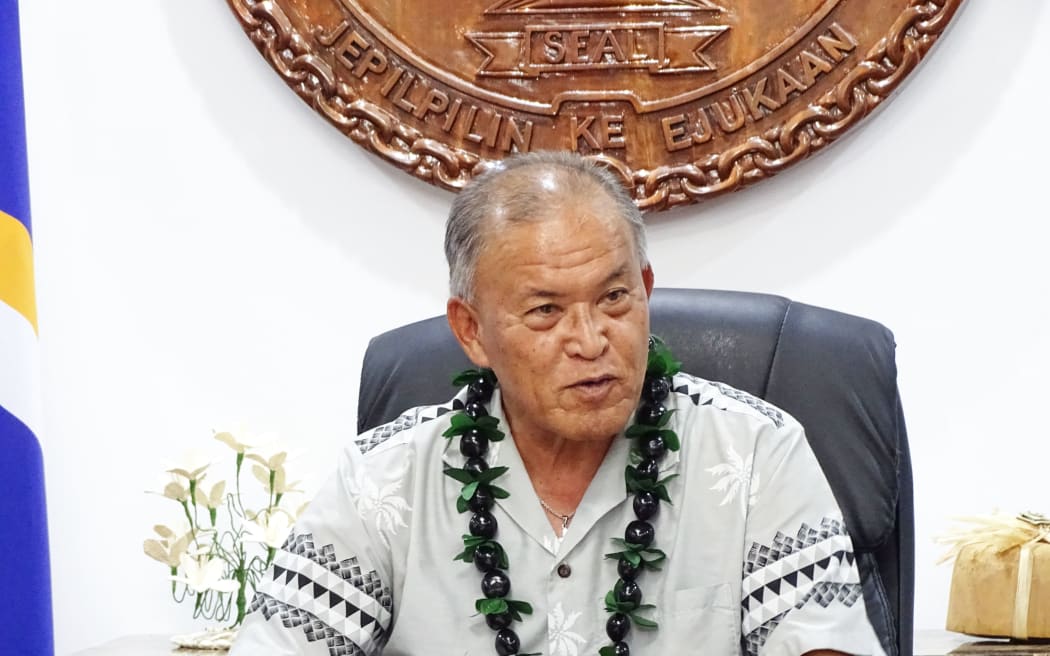
President David Kabua delivered a brief 90-second statement to the nation via an online live stream in which he announced that the Ministry of Health and Human Services had confirmed six people positive in the capital of Majuro.

The President’s short speech was the first official notice of news that in the fashion of a small island had spread several hours prior to his speech.

“I advise people to remain calm and follow the protocols to prevent covid,” Kabua said.

Wearing facemasks advice
President Kabua advised the country to follow established protocols of wearing facemasks when in public. Kabua wore a facemask while delivering his speech.

Notices on social media went viral in the minutes and hours after people learned of the first-ever covid community spread in this isolated north Pacific nation.

Although there were no rules except for school closure announced by government, within minutes of the official confirmation of the cases, a national basketball tournament game was halted mid-way through the contest Monday night, and some restaurants began shutting their doors.

The Office of the Chief Secretary said that the start of the new school year, which opened yesterday at some public schools and was scheduled to open later this week in private schools, would now be postponed for two months.

While businesses and government offices can continue as usual, hospital services will be modified and masks will be required in public for the next two months, said a statement issued by the government.

Marshall Islands President David Kabua in a file photo from 2021.
Marshall Islands President David Kabua … he wore a facemask in his live stream broadcast. Image: Wilmer Joel/File/RNZ

The government also announced a halt to travel by plane or ship to remote outer islands in hopes of restricting spread of covid to islands that have only rudimentary medical care services available.

“The most important lesson learned from Palau’s experience with a wave of covid starting in January is to protect the hospital during the initial stages of a covid outbreak,” said Niedenthal.

Protecting patients
“This is to protect both the patients already in hospital from being infected by incoming covid patients and, of equal importance, minimising the exposure of hospital staff so they can remain functional and on the job.”

The Ministry of Health and Human Services moved quickly last night to set up previously planned “test and treat” facilities in designated locations in the community.

Niedenthal said the number one lesson learned from watching other nations respond to their covid waves was the priority of “protecting the hospital”.

The goal, he said, is to have people use community test and treat facilities where health officials will perform tests and determine treatment needed.

The entire Marshall Islands has a population estimated at only 42,000 scattered on dozens of atolls and single islands. The two urban centers of Majuro and Ebeye, however, contain three-quarters of the population and many people live in overcrowded conditions ripe for the spread of covid.

Laboratory tests of people who were positive for covid while in managed quarantine last month showed they were all BA.5 variant. And ministry officials said they were proceeding on the basis that BA.5 is what they are seeing.

One local resident said that he was aware of a church member who was confirmed with covid yesterday.

“That means spreading already since yesterday was a busy day at church,” said the person.

Giff Johnson is editor of the Marshall islands Journal and the RNZ Pacific correspondent in Majuro. This article is republished under a community partnership agreement with RNZ.

Article by AsiaPacificReport.nz

Philippine police arrest ex-VP social justice candidate Bello for cyber libel

By Jairo Bolledo of Rappler in Manila

Former Philippines vice-presidential candidate and Laban ng Masa chairperson Walden Bello has been arrested for two counts of alleged cyber libel by the police.

Bello, 76, is a globally renowned environmental and social justice activist and academic.

Bello’s arrest yesterday was confirmed by his executive secretary and Laban ng Masa spokesperson Leomar Doctolero.

The former VP candidate was brought to the Quezon City Police District (QCPD) Station 8 in Project 4, Quezon City.

“Walden has just been arrested for cyber libel by officers of the QCPD. He is currently being taken to QC Police Station 8, P. Tuazon,” Doctolero said.

It was Davao City Regional Trial Court (RTC) Branch 10 Judge Retrina Espe Fuentes who issued the arrest warrant yesterday. Bello’s counsels said they will move for the suspension of proceedings at RTC 10 after Bello posts bail.

Two counts of cyber libel
Bello faces two counts of cyber libel for which bail has been set at P48,000 (NZ$4000) each.

Police Lieutenant-Colonel Gilmore Wasin confirmed Bello’s arrest to Rappler. He added Bello would be transferred to Camp Karingal in Quezon City, QCPD’s headquarters.

Doctolero said they had been anticipating the arrest because Bello had already been indicted for the cases last month.

“We have been anticipating the arrest warrant because of the indictment of the Davao Prosecutor. It’s a bailable offence and counsel is on the way to assist him.”

Walden Bello in handcuffs
Walden Bello in detention displays his handcuffs in a post on his Facebook account. Image: Walden Bello

Bello’s camp filed a motion for reconsideration before the Davao prosecutor’s office but it was denied, Doctolero explained.

“The resolution for his indictment was released last June 9. We filed for a motion for reconsideration with the Prosecutors’ Office which was subsequently denied.”

‘Dangerous precedent’

Under the Philippine laws, cyber libel is a bailable offence. Based on the guidelines for bail for cybercrime offences, the bail for cyber libel is typically set at P10,000 (NZ$790).

In a message to reporters, Leody de Guzman’s team said the ex-presidential candidate and Bello’s running mate was headed to QCPD Station 8 to show support for Bello.

At the height of the campaign period early this year, Jefry Tupas, Vice-President Sara Duterte’s former information officer, filed a cyber libel complaint against Bello.

She is seeking P10 million (NZ$790,000) in damages after Bello allegedly accused her on social media of being a drug addict and dealer.

Bello earlier labeled Tupas’ act as “clearly a politically-motivated move”.

In a petition for review filed on July 29, Bello’s camp argued that the position of Tupas in government “is very relevant” as the Facebook post would not have highlighted the drug raid if it weren’t for her being a public official.

Infringement on free speech
The prosecutor’s dismissal of their argument that the post merely poses a question sets “a dangerous precedent,” the petition also pointed out.

“Just imagine the severe infringement on free speech that would ensue if our jurisdiction would limit what questions people can ask!” the petition said.

Bello’s camp also argued that the post was written by his communications team, not by the former vice-presidential candidate himself, and that there is still no proof that he personally published it on Facebook.

“[Bello] does not even have administrator or moderator status in the said Facebook page,” it said.

Pacific Media Watch reports: Walden Bello posted this on his Facebook page from detention at Camp Karingal:

Seventy seven years ago today, Aug 9, 1945, the second atom bomb was dropped on Nagasaki, Japan, three days after the first blasted Hiroshima. Up to 80,000 people were killed in an act of genocide that had absolutely no military value and merely served to warn the Soviet Union of the US’ capacity to blast it to bits. The world must never forget Hiroshima and Nagasaki, especially now that the war in the Ukraine drags on, with the constant possibility of uncontrolled escalation, and Washington provokes China on Taiwan.

By Jairo Bolledo is a Rappler journalist. Republished with permission.

Print Friendly, PDF & Email

Article by AsiaPacificReport.nz

Hope for women in PNG elections – Peter becomes lone female governor

By Gorethy Kenneth of the PNG Post-Courier in Port Moresby

If there is a glimmer of hope in Papua New Guinea’s violence marred national general elections, then it has to be the elevation of a lone woman to the National Parliament.

It took the People’s National Congress (PNC) Governor-elect of Central Province, Rufina Peter, three attempts to wrest power away from Pangu’s Robert Agarobe at the close of counting last week.

The contest went down to the wire and Peter won on the weight of second and third preferential votes from eliminated candidates to unseat Agarobe.

She becomes the second woman to win the Central regional seat –– the first being vocal Papua Besena MP Dame Josephine Abaijah. And she is the eighth woman to be elected to Parliament, the first in a decade.

In another major development, the people of Madang are on the cusp of sending a second woman to join Peter in Parliament.

Rai Coast hopes up
In the remote district of Rai Coast –– famous for hosting a Russian anthropologist a century ago – jittery voters are keeping their fingers crossed as distribution of preferences was taking place over the weekend.

These are the same preferences that elevated Peter and given Sawang’s strong lead in the first half of the count, the preferences are hoped to push her to  victory.

Last Friday, she was in second place on 5086 votes after the first preferences were completed from defending MP Peter Sapia’s LLG area, pushing Sapia to 7127 votes.

Counting of preferential votes is continuing at a snail’s pace in Rai Coast as the coasties hold their breath.

More than 62,361 people of Central Province cast their vote for Peter, who polled 3444 more votes against incumbent Agarobe.

She surpassed the absolute majority of 60,640 after the 20th exclusion of Nelson Saroa who had 25,551 votes distributed, which pushed Rufina to collect 6779, making her reach the target with 62,361 votes against Agarobe who had 58,917 votes.

She said at her declaration on Friday night that she was aware of the magnitude of politics played out on the floor of Parliament, the tasks ahead of her, the wrestling she would need to do to give her Central Province people what they deserve.

First woman declared
An economist and Goilala’s first female politician, Rufina Peter is now the first woman to be declared in the 2022 national election.

Peter admitted that being elected as the political head of a province came with great responsibility and she was confident she could deliver to her people by working as a team.

PNC leader Peter O’Neill was first to congratulate the party’s “iron lady”, saying her declaration was a proud moment for the party.

“Rufina Peter’s declaration is a proud moment for our Party. She fought hard and stands strongly for those she represents. It is a pity that the ferocity and aggressive nature of this terrible national general election has sidelined a record number of female candidates,” O’Neill said.

In an interview over the weekend, Peter said Central Province had many educated elites who were instrumental in building the nation on the eve of independence.

“In my five years, I will make that happen again while in office, I will carry my people’s plight, I will fight for our women, our children and the underprivileged,” she said.

Dedicated to ‘female empowerment’
Peter assured the people of Central and PNG women that she stood ready to work with all members-elect in Central and the provincial administration to serve her people in five districts.

The new governor also thanked her predecessor, Robert Agarobe, for leading and governing Central Province over the past five years.

She dedicated her victory to God, the women of Central and male champions of women empowerment.

She acknowledged all security forces and electoral officials for delivering the elections in trying circumstances, and also praised the PNC party for believing in and endorsing her to run under its banner.

Gorethy Kenneth is a senior PNG Post-Courier journalist. Republished with permission.

Print Friendly, PDF & Email

Article by AsiaPacificReport.nz

Noumea protesters demand action on domestic violence after woman is killed

RNZ Pacific

About 100 people have marched in the New Caledonian capital of Noumea to protest against what they see as government inaction to curb violence against women.

The rally was called by the group Women in Anger just days after the latest killing of a woman at the hands of her partner.

The marchers went from the seat of government to Congress and to the French High Commission to deliver a letter calling on support for their cause from France’s First Lady, Brigitte Macron.

March organiser Valentine Holle told La Premiere television she wanted the government to come up with a feasible plan of action.

“We need to change the tribal laws and traditional rules and we need the French state to acknowledge these issues. We also need the French state to seat themselves around the table with civil society and discuss a viable solution,” Holle said.

The weekend march was the second such protest in Noumea in less than a month and follows another rally earlier this year.

In mid-July, a 35-year-old woman was killed in Noumea.

Seven times higher than France
Crime figures released for New Caledonia show that last year the incidence of domestic violence was seven times higher than in mainland France.

The statistics released by the French High Commission show the number of reported incidents had grown by 13 percent from 2020.

Reports of sexual violence had increased by more than 30 percent.

The report shows that abuse of alcohol and drugs is frequently linked to violent offending.

This article is republished under a community partnership agreement with RNZ.

Print Friendly, PDF & Email

Article by AsiaPacificReport.nz

Japanese sailor stabbed during Guadalcanal remembrance event

RNZ Pacific

A Japanese sailor has been stabbed at Bloody Ridge in Solomon Islands during a World War II remembrance ceremony in Honiara.

Witnesses say the man, who was part of the Japanese Navy media team, was stabbed in the neck with a pair of scissors.

Bloody Ridge community chief Wesley Ramo said the culprit was from a neighbouring community and was mentally unstable and under the influence.

He was quickly detained by locals and members of the US military present for the ceremony and taken away by police.

The ceremony then continued peacefully.

RNZ Pacific spoke with medical personnel who said the Japanese sailor would require minor stitches but was okay.

Japan’s Consul in Solomon Islands, Nori Yoshida, said it was a very unfortunate event, and they were unclear of the motive but would be following up with police.

Stabbing mars peaceful ceremony
The stabbing has marred what has been a peaceful ceremony to remember those who lost their lives during the battle of Guadalcanal 80 years ago.

The Guadalcanal campaign was the first major land offensive by allied forces against the Empire of Japan.

An estimated 30,000 people died and as many as three quarters of the deaths were from tropical diseases and starvation.

Events started on Sunday as speakers with ties to those who fought and died there spoke of the importance of remembering their fathers and grandfathers.

The Solomon Islands government has declared Bloody Ridge, also known as Edson’s, a national park.

This article is republished under a community partnership agreement with RNZ.

Print Friendly, PDF & Email

Article by AsiaPacificReport.nz

Scrap or reform Fiji’s media law, says new elections report

By Rusiate Baleilevuka of Fijivillage in Suva

“We need to scrap or reform the Media Industry Development Act.”

This is one of the key recommendations in the National Media Reporting of the 2018 Fijian General Elections Report.

Co-author and University of the South Pacific (USP) journalism coordinator, Associate Professor Shailendra Singh, said the Act was supposed to promote professionalism in journalism and did not address journalism’s lack of training and development.

Dr Singh added that state advertising needed to be evenly distributed among media organisations, and public service broadcast grants needed to be allocated evenly among broadcasters.

The National Media Reporting of the 2018 Fijian General Elections research was presented by Dr Singh and Dialogue Fiji executive director Nilesh Lal.

The report provides a content analysis of the media coverage of the 2018 elections.

It focuses on a number of indicators such as direct quotation space and time, frequency of appearance, directional balance in terms of positive, negative or neutral representation of political parties or election candidates and issue balance in relation to prioritising coverage of various issues.

  • Pacific Media Watch reports that Fiji’s Media Industry Development Act was originally a military decree imposed in 2010 after the 2006 Bainimarama coup and became codified law in 2015. It is widely regarded by critics as draconian.
Print Friendly, PDF & Email

Article by AsiaPacificReport.nz

Explainer: how neoliberalism became an insult in Australian politics

Source: The Conversation (Au and NZ) – By Henry Maher, Lecturer in Politics, Department of Government and International Relations, University of Sydney

Dan Himbrechts/AAP

The much-debated term “neoliberalism” again entered the political debate last week, with Greens leader Adam Bandt using a National Press Club speech to decry neoliberalism in the Labor Party.

Bandt claimed that since the Keating and Hawke governments, Labor has adopted neoliberalism by “privatising public services, cutting taxes for the wealthy and adopting more austerity”. Keating hit back, calling Bandt “a bounder and distorter of political truth”, angrily rejecting suggestions that Medicare and compulsory superannuation could be related to “conservative neoliberalism”.

Neoliberalism as insult

Bandt’s speech reflects a more general trend in which “neoliberalism” is used as an insult or political swearword. Even in academic debates, the usefulness of the term has been questioned, with recent articles describing neoliberalism as “a conceptual trash heap”, “hopelessly confused” and “so baggy and unclear that it means almost nothing”.


Read more:
Was embracing the market a necessary evil for Labour and Labor?


However, that does not mean it should be abandoned altogether. Many key political terms such as democracy, populism and justice also contain competing and sometimes contradictory meanings. In arriving at a working definition of neoliberalism, it is helpful to consult the writings of those who developed the body of thought.

Origins and definition

Most scholars agree the origins of neoliberalism can be traced to the Mont Pelerin Society, an academic organisation founded in 1947 by Austrian–British economist and philosopher Friedrich von Hayek. The group counted among its members leading neoliberal thinkers such as Milton Friedman, Ludwig von Mises, and James Buchanan.

Economist Friedrich von Hayek, founder of the Mont Pelerin Society, June 1975.
AP

Contrary to the popular caricature of neoliberalism as a free market, anti-state ideology, these early neoliberal thinkers developed a political and economic philosophy that attempted to combine governments and markets.

Where the classical liberals of the 19th century favoured a non-interventionist, laissez-faire approach to economic policy, the key aim of neoliberalism was to recognise that functioning markets must be actively created and maintained by an interventionist state. Neoliberal thinkers argued the chief role of government was to create and enforce the rules of the marketplace.


Read more:
Partially right: rejecting neoliberalism shouldn’t mean giving up on social liberalism


The ideas of the Mont Pelerin Society entered the political mainstream most prominently in the 1980s under the governments of Margaret Thatcher in the UK and Ronald Reagan in the US. Their policies included privatisation of government owned industries, extensive tax cuts, and creating more “flexible” labour markets by restricting the power of trade unions.

A mixed bag in Australia

In Australia, many of the key reforms of the Hawke-Keating government utilised neoliberal logic to mixed results. For instance, Keating’s signature compulsory superannuation policy replaced the universal pension with a market-oriented system of private savings, allowing workers to gain a share of rising profits on the stock market.

But the system also exposed workers to market downturns. This was most evident during the Global Financial Crisis of 2008, when losses of A$160 billion forced many older Australians to postpone retirement or even return to work.

The superannuation system also reinforces the gender pay gap. Men hold on average 42% more in superannuation savings than women, significantly increasing vulnerability to poverty for older women. Keating was also responsible for repeated privatisations, including the sales of Qantas and the Commonwealth Bank, and broader deregulation of the financial sector which further expanded the scope of the market.


Read more:
What is neoliberalism? A political scientist explains the use and evolution of the term


But the Hawke-Keating government was not entirely neoliberal, most notably in its expansion of Medicare. Their relationship with trade unions was also different from the combative stance adopted by Thatcher and Reagan in their countries.

Australian legacy

Taken together, the legacy of these different reforms is complex. However, the Hawke-Keating government was clearly guided by a neoliberal desire to expand the scope of the market.

Neoliberalism in Australia would intensify under Coalition government of John Howard – a card-carrying member of the Mont Pelerin Society and prime minister from 1996 to 2007. He did this through continued privatisation of state assets and deregulation of the financial sector.

Early indications suggest the current Labor government is likely to maintain some market-oriented policies. The refusal to increase JobSeeker payments for unemployed Australians is guided by a neoliberal belief that individuals should attain their basic needs through the market.

And while the exact details of how the government intends to meet its 2030 emissions reduction target are still forthcoming, a market-based approach again seems likely.

Though some may recoil at the neoliberal label they associate primarily with the political right, recent history suggests the neoliberal system has been and will likely remain a bipartisan standard in Australia.

The Conversation

Henry Maher does not work for, consult, own shares in or receive funding from any company or organisation that would benefit from this article, and has disclosed no relevant affiliations beyond their academic appointment.

ref. Explainer: how neoliberalism became an insult in Australian politics – https://theconversation.com/explainer-how-neoliberalism-became-an-insult-in-australian-politics-188291

Racism, exclusion and tokenism: how Māori and Pacific science graduates are still marginalised at university

Source: The Conversation (Au and NZ) – By Tara McAllister, Research Fellow, Te Herenga Waka — Victoria University of Wellington

Getty Images

Given most New Zealand universities have goals for increasing Māori and Pacific student and staff numbers, we need to ask why their numbers still remain stubbornly low in the research sector – and even lower within “STEM” (science, technology, engineering and mathematics) departments.

Our previous research showed that one New Zealand university had failed to employ a Māori or Pacific academic in their science department for at least 20 years.

But while the numbers provided a snapshot of the workforce, they don’t explain why so few Māori and Pacific researchers stay in the tertiary system. Our latest research aims to explain this better by looking at the experiences of 43 past and present postgraduate STEM students.

We show that simply bolstering university enrolments and plugging more students into a broken pipeline will not solve the under-representation of Māori and Pacific peoples. Furthermore, a lack of representation is negatively affecting those Māori and Pacific postgraduate students already in STEM courses.

Isolated and invisible

Universities are charged with training the next generation of scientists and growing a sustainable scientific workforce. Graduates will go on to perform research that provides solutions to emerging crises, informs national policy and creates new knowledge to help understand the world we live in.

But are universities providing an environment where Māori and Pacific postgraduate students can thrive and develop into the researchers society needs? In 2021 just 13% of domestic doctoral students were Māori and 5% were Pasifika.


Read more:
Māori and Pasifika scholars remain severely under-represented in New Zealand universities


Our research suggests universities still have a lot of work to do. These low numbers of Māori and Pacific students and staff also affect their educational experiences. Frequently isolated, some of those who participated in the research said they felt invisible. As one put it:

The lack of Māori and Pacific postgraduate researchers made life for me as a Pacific researcher difficult.

Having come from a different background, with a different perspective and different skills to bring to the table, I found it hard to make any real connections with my fellow researchers.

This at that time felt isolating and was exacerbated by the fact that there were no Māori and Pacific staff members in my areas of expertise.

Persistent racism

Many Māori and Pacific postgraduates in STEM subjects reported experiencing forms of racism. This ranged from being mistaken for being Māori when they were Pasifika, to having to dispel common myths about receiving a free education and only being at university due to targeted admission schemes.

Māori and Pacific postgraduates reported their identities being erased if they didn’t fulfil stereotypes about what they should know or how they should act. One of our interviewees said they were even told they must consider themselves “white” because they did not “act Māori”.


Read more:
Who will call out the misogyny and abuse undermining women’s academic freedom in our universities?


It is often noted that Māori and Pacific academics experience “excess labour” – meaning they fulfil dual roles of being Māori or Pacific as well as being an academic. But our research found this often begins at the postgraduate level.

Excess labour involves dealing with racism, expectations of cultural expertise, performing cultural protocols (such as karakia and mihi whakatau), and fulfilling
tokenistic diversity roles such as being photographed for university advertising.

According to one person we spoke to:

I was instantly deemed an expert on kaupapa Māori yet had only begun my journey of exploring this. We were often put on the spot and expected to explain tikanga, te reo Māori, mātauranga Māori to others, while simultaneously being experts in non-Indigenous science.

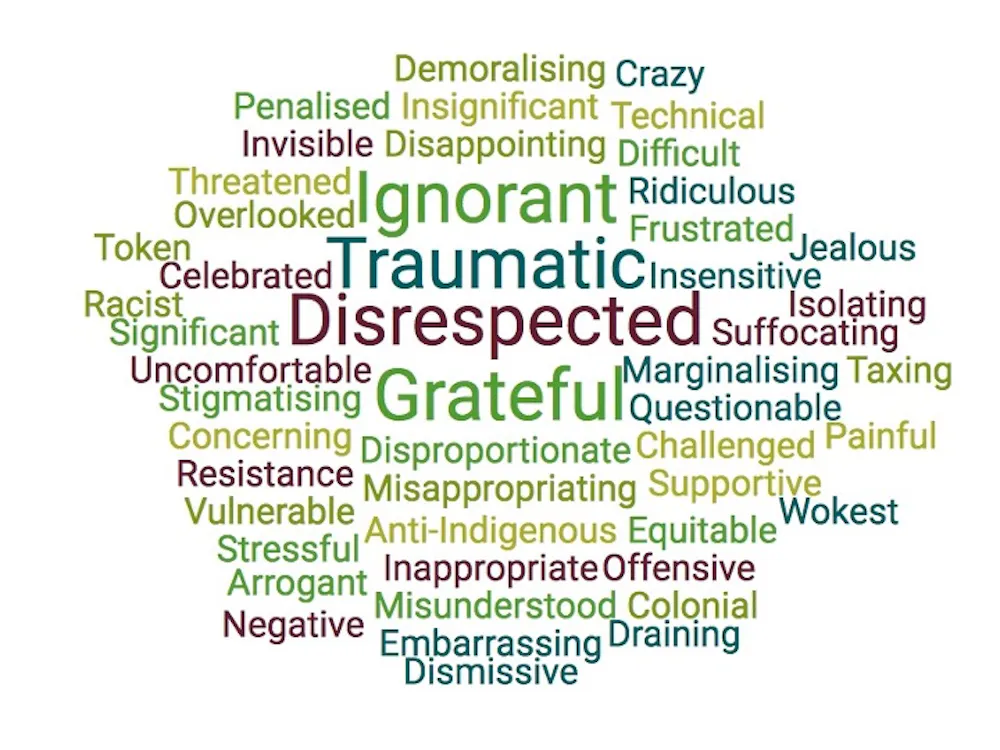
A word cloud displays the most common descriptions of Māori and Pacific postgraduate experiences in university STEM courses.
Author provided

No more ticking boxes

Our research also shows that New Zealand’s research funding system can lead to ethically questionable exercises in “box ticking” involving the token inclusion of Māori and Pacific postgraduate students.

This ranged from students being included in funding applications despite having declined to participate, to Pacific people being named as Māori investigators.

There were also allegations that Pākehā academics gained research funding for projects purporting to include Māori people and knowledge when in reality Māori were not included at all. As one of our collaborators wrote:

My name (my mana and reputation) was used against my will to secure funding for a project that I refused multiple times to be part of.


Read more:
More investment in literacy skills is needed if NZ is serious about ending persistent disparities for Pasifika students


Where to from here?

By including the often unheard perspectives of Māori and Pacific postgraduates in STEM subjects, our research adds to the growing evidence detailing how Māori and Pacific people are excluded in universities.

In sharing these experiences of racism, exclusion and marginalisation, we want to remind other Māori and Pacific students they are not alone.

We also want to use this research to challenge New Zealand’s universities to move beyond tokenistic attempts at “inclusion” and “diversity”, and to begin
dismantling the structures that continue to marginalise Māori and Pacific people and knowledge systems.

Our research highlights the urgent need for universities to change the culturally unsafe environment that continues to marginalise Māori and Pacific postgraduates.

Universities must create an environment where Māori and Pacific postgraduates in STEM subjects can move from surviving to thriving. That way they can get on with tackling cancer, solving the freshwater crisis or addressing the effects of climate change on their ancestral islands.

The Conversation

Tara McAllister receives funding from MBIE.

Sereana Naepi receives funding from Waipapa Taumata Rau | University of Auckland and Rutherford Discovery.

Leilani Walker does not work for, consult, own shares in or receive funding from any company or organisation that would benefit from this article, and has disclosed no relevant affiliations beyond their academic appointment.

ref. Racism, exclusion and tokenism: how Māori and Pacific science graduates are still marginalised at university – https://theconversation.com/racism-exclusion-and-tokenism-how-maori-and-pacific-science-graduates-are-still-marginalised-at-university-188052

Backyard hens’ eggs contain 40 times more lead on average than shop eggs, research finds

Source: The Conversation (Au and NZ) – By Mark Patrick Taylor, Chief Environmental Scientist, EPA Victoria; Honorary Professor, Macquarie University

Shutterstock

There’s nothing like the fresh eggs from your own hens, the more than 400,000 Australians who keep backyard chooks will tell you. Unfortunately, it’s often not just freshness and flavour that set their eggs apart from those in the shops.

Our newly published research found backyard hens’ eggs contain, on average, more than 40 times the lead levels of commercially produced eggs. Almost one in two hens in our Sydney study had significant lead levels in their blood. Similarly, about half the eggs analysed contained lead at levels that may pose a health concern for consumers.

Even low levels of lead exposure are considered harmful to human health, including among other effects cardiovascular disease and decreased IQ and kidney function. Indeed, the World Health Organization has stated there is no safe level of lead exposure.

So how do you know whether this is a likely problem in the eggs you’re getting from backyard hens? It depends on lead levels in your soil, which vary across our cities. We mapped the areas of high and low risk for hens and their eggs in our biggest cities – Sydney, Melbourne and Brisbane – and present these maps here.

Our research details lead poisoning of backyard chickens and explains what this means for urban gardening and food production. In older homes close to city centres, contaminated soils can greatly increase people’s exposure to lead through eating eggs from backyard hens.

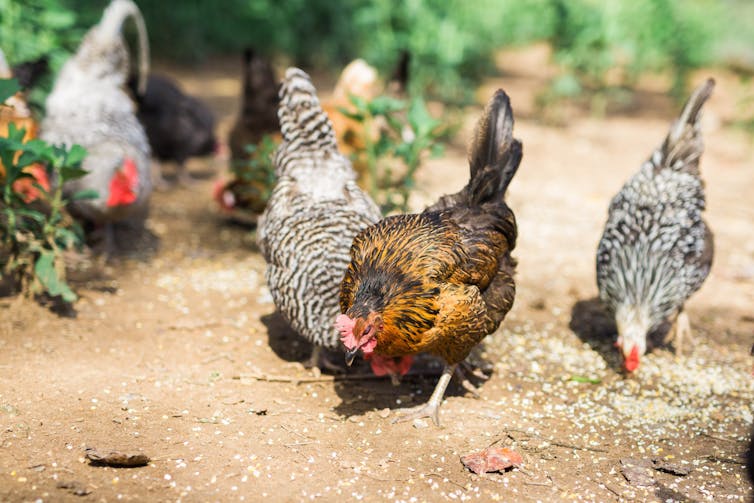
chickens scratching in the dirt
Chickens love scratching and pecking in the dirt. Unfortunately, that’s how lead from the soil gets into them.
Shutterstock

What did the study find?

Most lead gets into the hens as they scratch in the dirt and peck food from the ground.

We assessed trace metal contamination in backyard chickens and their eggs from garden soils across 55 Sydney homes. We also explored other possible sources of contamination such as animal drinking water and chicken feed.

Our data confirmed what we had anticipated from our analysis of more than 25,000 garden samples from Australia gardens collected via the VegeSafe program. Lead is the contaminant of most concern.

The amount of lead in the soil was significantly associated with lead concentrations in chicken blood and eggs. We found potential contamination from drinking water and commercial feed supplies in some samples but it is not a significant source of exposure.


Unlike for humans, there are no guidelines for blood lead levels for chickens or other birds. Veterinary assessments and research indicate levels of 20 micrograms per decilitre (µg/dL) or more may harm their health. Our analysis of 69 backyard chickens across the 55 participants’ homes showed 45% had blood lead levels above 20µg/dL.

We analysed eggs from the same birds. There are no food standards for trace metals in eggs in Australia or globally. However, in the 19th Australian Total Diet Study, lead levels were less than 5µg/kg in a small sample of shop-bought eggs.

The average level of lead in eggs from the backyard chickens in our study was 301µg/kg. By comparison, it was 7.2µg/kg in the nine commercial free-range eggs we analysed.

International research indicates that eating one egg a day with a lead level of less than 100µg/kg would result in an estimated blood lead increase of less than 1μg/dL in children. That’s around the level found in Australian children not living in areas affected by lead mines or smelters. The level of concern used in Australia for investigating exposure sources is 5µg/dL.

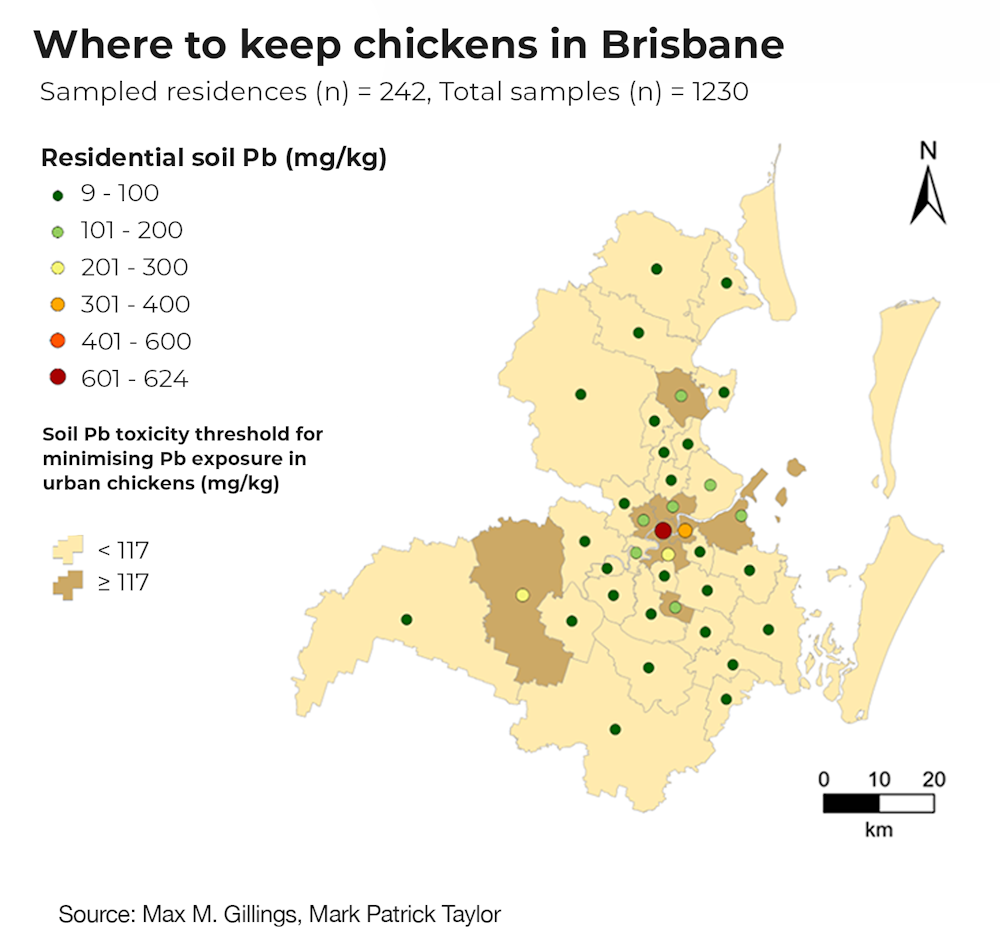
Some 51% of the eggs we analysed exceeded the 100µg/kg “food safety” threshold. To keep egg lead below 100μg/kg, our modelling of the relationship between lead in soil, chickens and eggs showed soil lead needs to be under 117mg/kg. This is much lower than the Australian residential guideline for soils of 300mg/kg.

To protect chicken health and keep their blood lead below 20µg/kg, soil concentrations need to be under 166mg/kg. Again, this is much lower than the guideline.

How did we map the risks across cities?

We used our garden soil trace metal database (more than 7,000 homes and 25,000 samples) to map the locations in Sydney, Brisbane and Melbourne most at risk from high lead values.


Map of Sydney showing areas of high and low lead risk for backyard chickens
Levels of lead risk for backyard chickens across Sydney. Dark green dots indicate areas with safe lead levels. Light green and yellow dots are areas over the safe lead level. Orange and red dots indicate areas with high levels.
Map: Max M. Gillings, Mark Patrick Taylor, Author provided

Map of Melbourne showing areas of high and low lead risk for backyard chickens
Map of Melbourne showing levels of lead risk for backyard chickens. Dark green dots indicate areas with safe lead levels. Light green and yellow dots are areas over the safe lead level. Orange and red dots indicate areas with high levels.
Map: Max M. Gillings, Mark Patrick Taylor, Author provided

Map of Brisbane showing areas of high and low lead risk for backyard chickens
Map of Brisbane showing levels of lead risk for backyard chickens. Dark green dots indicate areas with safe lead levels. Light green and yellow dots are areas over the safe lead level. Orange and red dots indicate areas with high levels.
Map: Max M. Gillings, Mark Patrick Taylor, Author provided

Deeper analysis of the data showed older homes were much more likely to have high lead levels across soils, chickens and their eggs. This finding matches other studies that found older homes are most at risk of legacy contamination from the former use of lead-based paints, leaded petrol and lead pipes.

What can backyard producers do about it?

These findings will come as a shock to many people who have turned to backyard food production. It has been on the rise over the past decade, spurred on recently by soaring grocery prices.

People are turning to home-grown produce for other reasons, too. They want to know where their food came from, enjoy the security of producing food with no added chemicals, and feel the closer connection to nature.

While urban gardening is a hugely important activity and should be encouraged, previous studies of contamination of Australian home garden soils and trace metal uptake into plants show it needs to be undertaken with caution.

Contaminants have built up in soils over the many years of our cities’ history. These legacy contaminants can enter our food chain via vegetables, honey bees and chickens.

Urban gardening exposure risks have typically focused on vegetables and fruits. Limited attention has been paid to backyard chickens. The challenge of sampling and finding participants meant many previous studies have been smaller and have not always analysed all possible exposure routes.

Mapping the risks of contamination in soils enables backyard gardeners and chicken keepers to consider what the findings may mean for them.

Particularly in older, inner-city locations, it would be prudent to get their soils tested. They can do this at VegeSafe or through a commercial laboratory. Soils identified as a problem can be replaced and chickens kept to areas of known clean soil.

The Conversation

Mark Patrick Taylor received funding via an Australian Government Citizen Science Grant (2017-2020), CSG55984 ‘Citizen insights to the composition and risks of household dust’ (the DustSafe project). The VegeSafe and DustSafe programs are supported by publication donations to Macquarie University. He is a full-time employee of EPA Victoria, appointed to the statutory role of Chief Environmental Scientist.

Dorrit E. Jacob and Vladimir Strezov do not work for, consult, own shares in or receive funding from any company or organisation that would benefit from this article, and have disclosed no relevant affiliations beyond their academic appointment.

ref. Backyard hens’ eggs contain 40 times more lead on average than shop eggs, research finds – https://theconversation.com/backyard-hens-eggs-contain-40-times-more-lead-on-average-than-shop-eggs-research-finds-187442

Tax office whistleblowing saga points to reforms needed in three vital areas

Source: The Conversation (Au and NZ) – By A J Brown, Professor of Public Policy & Law, Centre for Governance & Public Policy, Griffith University

Last Friday’s twist in the long prosecution of Australian Taxation Office whistleblower Richard Boyle – now headed for its fifth year – brings into relief the serious flaws in our nation’s whistleblowing laws.

Boyle aired his concerns about oppressive debt collection by the ATO in a joint ABC–Fairfax media investigation released in 2018. But he went public only after raising his concerns within the ATO and later with the inspector-general of taxation (IGT).

Various reviews confirmed his complaints under the Public Interest Disclosure Act 2013 – the whistleblower protection law for federal public servants – were reasonable. Despite dismissing his original complaint, the ATO ensured the suspect practices, which it claimed resulted from “miscommunication” and “misunderstanding”, were fixed.

A Senate committee labelled the ATO’s initial investigation into Boyle’s complaint as “superficial”. The IGT found merit in the matters Boyle raised but had no jurisdiction to intervene because it is not a “disclosure recipient” under the 2013 Act.

These events make the Boyle prosecution an important test case. Under the act, the key test of whether he has a defence against charges of making unauthorised recordings and disclosures is whether he believed “on reasonable grounds” the ATO investigation into his first disclosure was “inadequate”.

In Friday’s Kafkaesque twist, the ATO and Commonwealth prosecutors have sought suppression orders to prevent media reporting of Boyle’s efforts to assert that defence, in case it prejudices the trial. (Delays have already pushed the trial itself back to October 2023.) It’s the ultimate illustration of how current public interest disclosure laws can end up undermining their own primary purpose.


Read more:
Dreyfus ends prosecution of lawyer over alleged leaking about Australian spying in against Timor-Leste


Add the time, costs and negative impacts on Boyle’s life and health, the resources invested by the ATO and Commonwealth Director of Public Prosecutions, the case’s impact on the Australian government’s reputation and the messages it sends to other potential whistleblowers, and we see just how badly the federal approach to whistleblowing needs an overhaul.

The law needs urgent reform to ensure that:

  • whistleblower protection thresholds are more workable and consistent

  • when they apply, the protections themselves are worthwhile

  • new institutions are created to enforce the laws — especially a whistleblower protection commissioner to short-circuit the legal quagmire and make sure the public interest is efficiently served.

Crossing the threshold

The right thresholds are important because it is easy and normal for organisations to not see employees’ actions as covered by whistleblower protections, simply because other disputes and processes are also in train. The whistleblowing complaint might also include an employment dispute, for example, or a policy disagreement. Or other public interest factors – like national security – might need to be weighed up.

In fact, our research shows this complexity is the norm. Our study of more than 17,000 employees across 46 large and small public and private sector organisations found that up to half (47%) of all disclosures involve a mixture of public interest issues and personal grievances. Only 20% were solely “public interest”.

The law needs to be clearer that the other 30%, purely personal grievances, belong in other processes. But clear and properly implemented thresholds are the key to whether most whistleblowers will get any protection at all.

Recently, Labor Attorney-General Mark Dreyfus intervened to stop the prosecution of Canberra lawyer Bernard Collaery for disclosing confidential information about the Australian government’s alleged commercial bugging of the Timor-Leste cabinet room.

But the actual whistleblower in that case – Witness K, the spy who took his internal complaints about the bugging to Collaery – missed out, because he, too, didn’t fit the thresholds. He had already been forced to plead guilty for revealing the wrongdoing because, no matter how heinous the crime, the mere fact it involved national intelligence left him with no chance of a defence at all.

Ensuring effective protections

Even if the thresholds are met, what value are current protections?

Prime ministers Malcolm Turnbull and Scott Morrison started to lift the bar in the private sector in 2019, amending the Corporations Act to surpass the 2013 public sector whistleblowing laws in key ways.

But even if the public sector laws catch up, problems remain. A whistleblower can only receive compensation for the personal and professional impacts of their disclosures if those impacts were, in effect, punishment or payback motivated by awareness of a disclosure.

While okay for a criminal offence, that principle means any whistleblower will struggle to secure compensation if the damage flowed from simple negligence, collateral employment actions or breakdowns in organisational support. No whistleblower has yet succeeded in winning such compensation.

And some whistleblowers deserve justice even if the detriment was beyond anyone’s control. In 2017, the Parliamentary Joint Committee on Corporations and Financial Services recommended Australia should establish a reward scheme that would share with the whistleblower some of the penalties imposed on wrongdoers or the money saved thanks to a disclosure, irrespective of fault. The United States and Canada are just two countries with such schemes.

Creating the right institutions

But who would administer such a scheme, or even take on the existing job of ensuring that legal protections for whistleblowers deliver justice, consistently across the public and private sectors? Does anyone have the job of investigating whether a whistleblower was properly treated, or of actively helping federal agencies sort out these often messy cases?

The short answer is no. The Commonwealth ombudsman and the Australian Securities and Investment Commission can require organisations to set up internal disclosure systems, but have little scope, in law or practice, to enforce protections.

The 2017 parliamentary joint committee recommended a whistleblower protection authority or commissioner to fill this stark gap. Since 2018, federal crossbench MPs including Cathy McGowan, Helen Haines, Adam Bandt and Andrew Wilkie have proposed this function be included in the Albanese government’s planned National Anti-Corruption Commission reforms.

This makes sense because the new agency will become the most obvious place in Australia for people to safely take complaints about serious wrongdoing and be listened to, or referred to the right place, with the necessary protections applying.


Read more:
After a border dispute and spying scandal, can Australia and Timor-Leste be good neighbours?


The need for an agency to coordinate a one-stop-shop process rather than a bureaucratic “pass the parcel” has been identified by no less than four statutory or parliamentary inquiries. These include the 2016 Moss Review and 2017 Senate Select Committee on a National Integrity Commission, but stretches right back to a 1994 Select Committee on Whistleblowing chaired by Tasmanian Liberal Senator Jocelyn Newman.

Just as the outgoing Coalition government was proposing further changes to whistleblowing laws, it is welcome news that Dreyfus is keeping at least some of that reform on the agenda.

For Australia to retain its record of pursuing world’s best practice in recognising, managing and protecting the role of whistleblowers, it will be vital for that agenda to include all three major elements of overdue reform.

The Conversation

A J Brown has received funding from the Australian Research Council and all Australian governments for research on public interest whistleblowing, integrity and anti-corruption reform through partners including Australia’s federal and state Ombudsmen, Australian Securities & Investments Commission, and other Commonwealth and State regulatory agencies, parliaments, anti-corruption bodies and private sector peak bodies (see most recently ‘Whistling While They Work 2: Improving Managerial and Organisational Responses to Whistleblowing in the Public and Private Sectors’ (https://whistlingwhiletheywork.edu.au/). He was a member of the Commonwealth Ministerial Expert Panel on Whistleblowing (2017-2019) and is also a board member of Transparency International, globally and in Australia.

ref. Tax office whistleblowing saga points to reforms needed in three vital areas – https://theconversation.com/tax-office-whistleblowing-saga-points-to-reforms-needed-in-three-vital-areas-187608

Uranium prices are soaring, and Australia’s hoary old nuclear debate is back in the headlines. Here’s what it all means

Source: The Conversation (Au and NZ) – By Erik Eklund, Professor of History, Australian National University

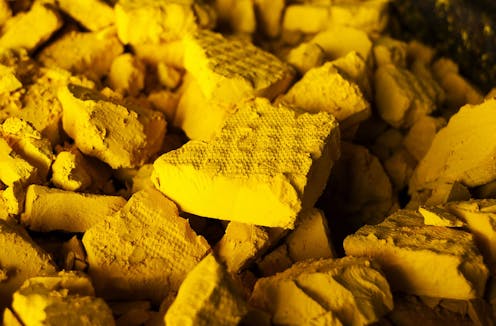
Uranium concentrate, known as yellowcake Nuclear Regulatory Commission/Flickr, CC BY-SA

Last week, Opposition Leader Peter Dutton sought to revive the hoary old debate of nuclear power in Australia, announcing an internal review into whether the Liberals should back the controversial technology.

Dutton said the review would examine whether nuclear technologies could help shore up Australia’s energy security and reduce power prices. His call comes as prices soar for uranium, which is vital to nuclear power and nuclear weapons.

Australia’s powerful mining lobby has long pushed for Australia to both lift its nuclear ban and expand its uranium mining industry, to help provide apparently zero-emissions energy.

All this comes as Australia embarks on an ambitious maritime defence transition to nuclear-powered submarines. History suggests as the nuclear debate heats up in Australia, so will the pressure to expand our uranium exports. So where will all this lead?

Uranium is back in vogue

Australia has the world’s largest reserves of uranium and is the world’s fourth largest uranium exporter. Two uranium mines operate here – BHP’s Olympic Dam and Heathgate’s Beverley facility, both in South Australia. A third mine, Boss Energy’s Honeymoon project, is set to restart production.

Russia’s war on Ukraine – and its willingness to shut off gas supplies to Europe – means uranium is in high demand. In March this year, refined uranium was A$86 a pound, up from A$27 a pound in late 2017.

As countries scramble to shore up energy security, some are turning to nuclear. Japan plans to reopen closed nuclear reactors. France is planning new reactors to begin replacing its ageing and troublesome fleet of 56 reactors. Belgium has kept reactors from closing while Poland is planning new ones.

This is triggering fresh uranium investment. That includes in Queensland’s sparsely populated northwest, where Australian and Canadian mining companies are acquiring new mineral leases and quietly adding uranium to their ore inventories.


Read more:
If the opposition wants a mature discussion about nuclear energy, start with a carbon price. Without that, nuclear is wildly uncompetitive


Australia is unusual in being a major uranium exporter while also explicitly ruling out using nuclear power. Some nuclear proponents, such as the influential Minerals Council of Australia, are quick to point out this apparent contradiction.

The council is lobbying for an expansion of uranium exports. It says the existing industry is one of several factors making Australia “a partner of choice for private venture capital-funded new nuclear power”.

And Boss Energy managing director Duncan Craib said in May the opportunities to expand Australia’s uranium mining industry are “immense” and would help decarbonise our energy sector. He told the ABC:

Last year, we exported about 6,000 tonnes of uranium. That’s enough to provide for 75 per cent of Australia’s national energy market with zero emissions.

yellowcake
The US is looking at expanding its domestic uranium production. This 1975 image shows production of yellowcake uranium concentrate in the US.
Getty

A politically fraught topic

The issues of uranium mining and nuclear energy surface regularly in Australia’s political debate.

Australia’s uranium industry flourished over the many years of the Menzies government. Menzies even sought to possess nuclear weapons in the 1950s. And one of his successors, John Gorton, pushed to build a major nuclear reactor at the Jervis Bay Territory in the late 1960s.

The Whitlam government did not pursue the Jervis Bay plan. It initially supported uranium mining and even the possibility of domestic uranium enrichment, necessary to produce nuclear fuel. But as the Cold War heated up, the party became divided on its nuclear stance, due to concerns about weapons proliferation.

Bob Hawke played a key role in overcoming this anti-nuclear sentiment while as a union chief and then as Labor prime minister. By 1984, Labor agreed to accept more uranium mines and international customers if domestic reactors did not expand beyond the Lucas Heights research facility in Sydney.

As recently as last year, Labor’s election platform walked a similar line: no nuclear reactors or waste dumps, but yes to mining and selling uranium, with safeguards around inspection and non-proliferation.

In recent years, the Coalition’s strongest support for nuclear came in 2006 when then prime minister John Howard established a nuclear taskforce to examine uranium mining and processing, and the feasibility of a domestic nuclear industry. The taskforce found it was possible to build a reactor in 10 to 15 years – assuming the public supported it and regulations were in place.

The Coalition did not pursue nuclear energy during its last nine years in government, despite Howard continuing to call for more uranium mines and investigation of domestic nuclear energy. But since losing government, the Coalition has warmed to the technology.


Read more:
Yes, Australia is buying a fleet of nuclear submarines. But nuclear-powered electricity must not come next


uranium mine
The Mary Kathleen uranium mine has been shut since 1982.
Shutterstock

Where to now?

So where does all this leave the prospect of nuclear power in Australia? And how likely is expansion of the uranium industry?

Some elements of Labor support nuclear energy. And Labor will be aware of US efforts to revive its own uranium mining industry.

The AUKUS deal struck under the Morrison government would see Australia acquire nuclear-powered but conventionally armed submarines. It raised the obvious question of whether nuclear power would follow.

But before being elected, Prime Minister Anthony Albanese said Labor supported the AUKUS agreement only if it did not require a domestic civil nuclear industry.

Albanese is also a long-time opponent of uranium mining in Australia – as shown in 2006 when he opposed Labor’s decision to dump a policy that banned new uranium mines.

And while uranium prices may be surging, nuclear energy remains a risky economic prospect for Australia. Large reactors like the UK’s Hinkley C have struggled with enormous cost overruns while the small modular reactors pitched as the future of nuclear power are still expensive and still far away. Meanwhile, wind and solar remain the cheapest new build option.

The Coalition may, after its internal review, decide to adopt nuclear energy as part of its 2025 federal election pitch. But for this term of government at least, those wanting progress on nuclear power or expanded uranium mining are likely to be left disappointed.


Read more:
Uranium: what the explosion in prices means for the nuclear industry


The Conversation

Erik Eklund does not work for, consult, own shares in or receive funding from any company or organization that would benefit from this article, and has disclosed no relevant affiliations beyond their academic appointment.

ref. Uranium prices are soaring, and Australia’s hoary old nuclear debate is back in the headlines. Here’s what it all means – https://theconversation.com/uranium-prices-are-soaring-and-australias-hoary-old-nuclear-debate-is-back-in-the-headlines-heres-what-it-all-means-188149

With the strokes of a guitar solo, Joni Mitchell showed us how our female music elders are super punks

Source: The Conversation (Au and NZ) – By Janelle K Johnstone, PhD Candidate, La Trobe University

Photo by Carlin Stiehl for The Boston Globe via Getty Images

The iconic Joni Mitchell’s recent surprise performance at the 2022 Newport Folk Festival prompted a world-wide outpouring of love and respect.

This was her first musical performance since suffering from a brain aneurysm in 2015 that left her unable to walk and talk. Last year, she spoke of having polio as a child as “a rehearsal for the rest of my life”.

The tributes for Mitchell celebrated her triumph from illness to recovery, but they also paid homage to Mitchell’s career that has pivoted on protest.

Mitchell is largely associated with folk scenes of the 60s and 70s. She has produced a prolific body of work, advocating for social change. As a committed activist she has spoken against environmental degradation, war, LGBTQI+ discrimination, and most recently, removed her music catalogue from Spotify in a protest against anti-vaccine propaganda.

Now, with the strokes of a guitar solo she repositioned herself from folk hero to punk provocateur, defying the “permissible” ways older women “should” behave.

In commanding public space and using one of the most traditionally masculinised expressions of popular music practice, she directly challenged the sorts of expectations many people have around gendered norms, particularly what women in their elder years look and sound like.

Not everyone gets to age on stage

Some of the most persistent social restrictions placed on women and gender diverse musicians are in relation to age.

Ongoing expectations of older women are to be passive, quiet and very much in the background. They are rarely asked, or expected, to “take up space” in the same ways their male counterparts do.

Whereas men step through phases of youthful experimentation into established music legends, there are tiresome obstacles for female and gender diverse people to do the same.

And while exceptions are often exceptional, they are not plentiful.

It’s not just age. Women have long been sidelined when it comes to acknowledging their skills on the electric guitar. Much like Mitchell.

The electric guitar has been an important part of rock and punk genres. There is a symbiotic relationship between how these genres – and the instrumentation that defines them – have unwittingly become gendered. The electric guitar solo in particular has come to be associated with machismo: fast, loud, expert, brave.

If you like to imagine a world where women don’t exist, google “best guitar solos ever”.

A recent New York Times article suggested things are starting to change. Citing guitarists like Taja Cheek and Adrianne Lenker, the Times suggested the guitar solo has shifted from a macho institution into a display of vulnerability, a moment (perhaps many) of connectivity.

Mitchell’s performance sits somewhere in this domain.

For the hundreds of thousands of women and gender diverse guitarists world-wide, myself included, the electric guitar and the genres it is entwined with offer a cool, optional extra: to test the cultural norms of gender with other markers of identity like class, culture, sexuality and age, to blur ideas of what we should and shouldn’t do.


Read more:
We crunched the numbers on ten recent ‘world’s best guitarist’ lists. Where are the women?


Australian women to the front

Australian women and gender diverse rock and punk musicians are often subject to a double act of erasure – missing from localised histories, and also from broader canons of contemporary music, which often remain persistently rooted in the traditions of the UK and the US.

Tracey Thorn’s brilliant biography of the Go-Between’s drummer Lindy Morrison is a love lettered homage that steps out the complex local, emotional, personal and structural ways that Australian women and gender diverse people are often omitted from cultural spaces.

“We are patronised and then we vanish,” writes Thorn.

The work of women and gender diverse artists is often compared to the glossy pedestal of the male creative genius.

In this light, we don’t play right, we don’t look right, we don’t sound right.

And then, somehow, we don’t age right.

Other reasons are far more mundane. Women contribute around 13 hours more unpaid work than men each week.

Carrying plates overflowing with generous gifts of labour, the maintenance of a music practice – a largely underpaid endeavour – is often the first to fall by the wayside.

Add to the mix ingrained social networks of knowledge sharing, and the dominance of men making decisions higher up the chain, and it is easy to see how women and gender diverse musicians stay submerged as men rise to the limited real estate of music elders.

The problem isn’t so much about starting up. It’s about finding the time to keep up.


Read more:
Friday essay: punk’s legacy, 40 years on


Our female and gender diverse music elders

There are so many Australian female and gender diverse music elders. Some are visible, but many ripple beneath the surface.

Regardless of genre, in maintaining decades-long practice, they are the super punks whose legacy can be heard in venues across the country.

The challenge now is to support the current crop of excellent musicians beyond the flushes of youth so that we have a more sustainable, textured and diverse Australian music culture. One where Mitchell’s defiance of expectations represents the status quo of how older women should and can be.


Read more:
Her Sound, Her Story shows that women’s voices are louder than ever in Australian music


The Conversation

Janelle K Johnstone has received funding from Creative Victoria and the Australia Council.

ref. With the strokes of a guitar solo, Joni Mitchell showed us how our female music elders are super punks – https://theconversation.com/with-the-strokes-of-a-guitar-solo-joni-mitchell-showed-us-how-our-female-music-elders-are-super-punks-188075

15 years of experiments have overturned a major assumption about how thirsty plants actually are

Source: The Conversation (Au and NZ) – By Lucas Cernusak, Associate Professor, Plant Physiology, James Cook University

Hasan Almasi / Unsplash

Have you ever wondered just how much water plants need to grow, or indeed why they need it? Plants lose a lot of water when they take in carbon dioxide from the atmosphere, so they need up to 300 grams of water to make each gram of dry plant matter.

But it doesn’t have to be that way. In a new paper published in Nature Plants, we report on a natural secret that could ultimately be used to help plants thrive while using less water.

An essential ingredient for plant growth

Plants are mostly made up of water – about 80% by weight. So we might expect plants would need around four grams of water for each gram of dry mass to achieve their ideal level of hydration.

That may be so, but they need a lot more water to grow. To produce one gram of new dry mass, a plant needs about 300 grams of water.

Why such a large difference between the amount of water required for hydration and the amount required for growth? Because almost all the water plants take up from the soil through their roots soon rises out into the atmosphere through their leaves.


Read more:
I spent a year squeezing leaves to measure their water content. Here’s what I learned


Plant leaves are covered in microscopic valves called stomata. Stomata open to let in carbon dioxide from the air, which plants need for photosynthesis and growth.

But when the stomata are open, the moist internal tissue of the leaf is exposed to the drier outside air. This means water vapour can leak out whenever the stomata are open.

A long-held assumption

Plant scientists have long assumed the opening and closing of the stomata almost entirely controlled the amount of water evaporating from a leaf. This is because we assumed the air in small pockets inside the leaves was fully saturated with water vapour (another way to say this is that the “relative humidity” is 100%, or very close to it).

If the air inside the leaf is saturated and the air outside is drier, the opening of the stomata controls how much water diffuses out of the leaf. The result is that large quantities of water vapour come out of the leaf for each molecule of carbon dioxide that comes in.

An electron microscope image of a leaf shows fine hairs called trichomes and the tiny stomata (oval-shaped slits) which allow the movement of water vapour and carbon dioxide.
Louisa Howard / Dartmouth

Why did we assume the air inside the leaves has a relative humidity near 100%? Partly because water moves from more saturated places to less saturated places, so we thought cells inside leaves could not sustain their hydration if exposed directly to air with relative humidity much lower than 100%.

But we also made this assumption because we had no method of directly measuring the relative humidity of the air inside leaves. (A recently developed “hydrogel nanoreporter” that can be injected into leaves to measure humidity may improve this situation.)

A secret revealed

However, in a series of experiments over the past 15 years, we have accumulated evidence that this assumption is not correct. When air outside the leaf was dry, we observed that the relative humidity in the air spaces inside leaves routinely dropped well below 100%, sometimes as low as 80%.

What is most remarkable about these observations is that photosynthesis did not stop or even slow down when the relative humidity inside the leaves declined. This means the rate of water loss from the leaves stayed constant, even as the air outside increased its “evaporative demand” (a measure of the drying capacity or “thirstiness” of air, based on temperature, humidity and other factors).

If the leaves restricted their loss of water only by closing their stomata, we would expect to see photosynthesis slowing down or stopping. So it appears plants can effectively control water loss from their leaves while stomata remain open, allowing carbon dioxide to continue diffusing into the leaf to support photosynthesis.

Using water wisely

We think plants are controlling the movement of water using special “water-gating” proteins called aquaporins, which reside in the membranes of cells inside the leaf.

Our next experiments will test whether aquaporins are indeed the mechanism behind the behaviour that we observed. If we can thoroughly understand this mechanism, it may be possible to target its activity, and ultimately provide agriculturalists with plants that use water more efficiently.


Read more:
Rising carbon dioxide is making the world’s plants more water-wise


Over the coming decades, global warming will make the atmosphere increasingly thirsty for evaporated water. We are pleased to report that nature may yet reveal secrets that can be harnessed to boost plant production with limited water resources.


The authors would like to acknowledge the contributions to this work of Graham Farquhar, Martin Canny (deceased), Meisha Holloway-Phillips, Diego Marquez and Hilary Stuart-Williams.

The Conversation

Lucas Cernusak receives funding from the Australian Research Council.

Chin Wong does not work for, consult, own shares in or receive funding from any company or organisation that would benefit from this article, and has disclosed no relevant affiliations beyond their academic appointment.

ref. 15 years of experiments have overturned a major assumption about how thirsty plants actually are – https://theconversation.com/15-years-of-experiments-have-overturned-a-major-assumption-about-how-thirsty-plants-actually-are-188072

Why am I so tired and when is it time to see the doctor about it? A GP explains

Source: The Conversation (Au and NZ) – By Natasha Yates, Assistant Professor, General Practice, Bond University

Shutterstock

Everyone feels tired sometimes. But how do you know whether your tiredness is a problem worth seeing a doctor about? And with all the mental and emotional strain we have been under from the pandemic, isn’t it just normal to feel tired?

Tiredness is subjective; what’s normal for one person won’t be for the next. Many people see their GPs reporting tiredness (a recent study in Ireland found that it was present in 25% of patients).

As a GP, my first question to someone who feels tired is: “how well can you function?”.

If tiredness is interfering with your everyday life and your ability to do what you like to do, it should be explored further.

A woman looks tired at work.
If your level of tiredness is outside the range of normal for you, chat to a GP about it.
Shutterstock


Read more:
Fatigue after COVID is way more than just feeling tired. 5 tips on what to do about it


Some common causes of persistent tiredness

Poor sleep is an obvious and very common cause of tiredness. Often patients tell me “Oh, lack of sleep is not the cause, I sleep fine, possibly too much!” But on questioning they admit they don’t wake up feeling refreshed.

That’s a bit of a giveaway because it means their sleep quality is poor, even if the quantity seems enough. They could be suffering from sleep apnoea, where breathing stops and starts while a person is asleep. Apnoea can lead to serious long-term health problems, so it’s worth investigating.

Alcohol can also wreak havoc on a person’s sleep quality and they wake feeling unrefreshed.

Another common cause of tiredness is depression – and don’t forget, someone can be depressed without feeling they have low mood. For example, they may feel irritable or frustrated, or struggle to concentrate. This is concerning, because such patients may fly under the radar and not realise this is actually depression. Unexplained tiredness may be the predominant symptom of depression, with other symptoms only coming to light with careful questioning.

Myalgic encephalomyelitis/chronic fatigue syndrome (ME/CFS) is a serious long-term illness that, among other symptoms, causes people to feel extreme fatigue – well beyond the range of “normal” tiredness. It can begin with patients noticing a degree or type of tiredness different from their past experience, and can be difficult to diagnose in the early stages.

There are other potential causes of tiredness – problems such as low iron, thyroid disease, diabetes, kidney disease, heart disease and many more. Treatment for these can alleviate the tiredness too.

Tiredness also accompanies many illnesses, but should not persist after recovery.

The take-home message is this: if tiredness is interfering with your life, there are many possible causes and it’s worth speaking to a GP about it.

Poor sleep is a very common cause of tiredness.
Shutterstock

What does ‘interfering with life’ actually look like?

Screening tools for a concerning level of tiredness include the Epworth Sleepiness Scale and the STOP-BANG score. You can do both tests at home and take the results to your GP.

But even if you have normal scores, your tiredness is worth investigating if you:

  • feel too tired to exercise (this can be a vicious cycle because regular exercise can actually give you more energy – however, it can be risky for people with ME/CFS to exercise, so caution is required for these patients)

  • feel too tired to go out, see friends or do activities you once enjoyed

  • hit the alarm snooze button a lot because you don’t wake feeling refreshed

  • doze off in front of the TV regularly

  • spend the whole day wishing you could go back to bed.

If, along with tiredness, you also have any of the following “red flags”, it is vital you see a GP sooner rather than later: unexplained weight loss, shortness of breath, recurrent fevers, bleeding from your bowels or gums, swollen and sore joints, or other new symptoms concerning you.

I sometimes get asked if wanting an afternoon nap is a red flag. That’s a tricky one; a late afternoon energy slump is pretty normal physiologically (we have whole cultures built around the idea of a siesta, and I often wish Australia was more open to the idea!).

And, of course, many of us lead busy lives and are subject to crushing expectations around work, study and parenting. Tiredness may not always be sign of a physical health problem, but rather that the balance between work and rest is not right.

Do you feel refreshed when you wake up?
Shutterstock

OK, I’m starting to realise my tiredness might be a problem. What now?

Talk to your doctor. What happens next depends on the individual and unique factors at play.

Some people need investigating immediately if possible serious underlying causes are suspected.

However, there are often obvious ways to address lifestyle factors, and we’d start there. Is alcohol or caffeine interfering with your sleep? Do you have good sleep hygiene habits? Is your exercise level appropriate and your diet not too high in sugar?

After we’ve tackled lifestyle factors, we can look at whether to investigate for health conditions that might be contributing to the tiredness.

Do you often fall asleep on the couch watching TV?
Shutterstock

What about post-COVID fatigue?

As I have written before, fatigue is about more than feeling just tired:

Tiredness can get better with enough rest, while fatigue persists even if someone is sleeping and resting more than ever.

If you’re especially concerned about fatigue after recovering from COVID and are worried about long COVID, definitely talk to a doctor.

The factors at play are complex and unique to the individual, so a good doctor can help you work out when tiredness has crossed over into true fatigue.


Read more:
Still coughing after COVID? Here’s why it happens and what to do about it


The Conversation

Natasha Yates is affiliated with the RACGP

ref. Why am I so tired and when is it time to see the doctor about it? A GP explains – https://theconversation.com/why-am-i-so-tired-and-when-is-it-time-to-see-the-doctor-about-it-a-gp-explains-187984

‘It hurt my heart and my wallet’: the unnecessary test stressing teachers before they even make it to the classroom

Source: The Conversation (Au and NZ) – By Alison Hilton, Academic Chair Secondary Education, Murdoch University

www.shutterstock.com

There is no shortage of articles about how teachers are stressed, due to their complex jobs and high workloads.

But what is happening before they make it to the classroom?

There are lots of reasons why Australia has a teacher shortage and my new research sheds light on one deterrent that is not often talked about.

This is the high-stakes Literacy and Numeracy Test for Initial Teacher Education, known as LANTITE.

What is LANTITE?

Introduced in 2017, LANTITE is made up of two separate computer-based tests: one for numeracy, and one for literacy.


Read more:
‘This is like banging our heads against the wall’: why a move to outsource lesson planning has NSW teachers hopping mad


The multiple-choice tests are administered independently of universities by the Australian Council for Educational Research. Universities have no visibility of the tests, or how students perform, even after results are released.

It costs A$196 to sit both tests, or A$98 to sit just one of them.

Students must find time to prepare for and attempt LANTITE on top of their theory and practical study in a teaching degree. They must pass both the literacy and numeracy components of LANTITE in order to graduate.

The pass rate is more than 90%.

A stress test

For my doctoral research, I surveyed 189 student teachers about their experience with LANTITE through an online questionnaire. They came from 33 universities across Australia. From this group, 27 students also completed in-depth interviews to further describe their experiences. I also spoke to 41 teachers and teacher educators.

Among the many stories and experiences were students like Monique* who described the test as “fun” and “just like doing an IQ test”. However, it was far more common for interviewees to report negative experiences, with a particular emphasis on the impact on mental health and wellbeing. As Suraya told me:

I ended up having a really bad panic attack, where I blacked out. I could not comprehend anything that was going on in front of me.

Suraya was not alone. My research uncovered other alarming accounts of panic attacks and even suicidal ideation from students after they had sat the test. For some students who did not pass, the stress and pressure of having to reattempt the tests resulted in prolonged mental health conditions.

Any test or exam creates a certain amount of stress. But for student teachers, LANTITE comes on top of existing study and practical teaching pressures as they finalise their degrees. For those students who need to reattempt one or more component of LANTITE, the stress escalates, as was the case for Vince.

My journey has been a nightmare. I was panicking when it came to the last questions. I was running out of time and some of the words I didn’t understand because I was panicked.

It is expensive

I also found students are paying a high price to become a teacher. While the cost to sit both components of LANTITE is just under $200 per attempt, many students purchase professional study materials and pay tutors or attend workshops to help them prepare.

One student in the study reported spending $6,000 on private tutoring. These costs have to be paid upfront, unlike HECS loans which can be deferred.

Teacher educators I interviewed echoed concerns about these costs and pressures. As Wynette said:

As a student you already have time pressures, you already have stressors and financial demands […] and to have this extra thing on top is a bit more stressful.

Aboriginal and Torres Strait Islander students, culturally and linguistically diverse students, and students with disability were more likely to emphasise how harsh the LANTITE experience can be. This suggests it may hindering a more diverse workforce. As Mary, another teacher educator, explained:

If they are coming from a background or environment where they have not done a lot of high-stakes testing that will also mean that they don’t have the same experiences that your mainly more mainstream white-Anglo students do.

We don’t need this test

Yes, teachers need to have certain levels of literacy and numeracy going into the classroom. But we don’t need LANTITE to determine this.

Student teachers already have a wide range of assessments throughout their courses. These are both practical and theory-based and implicitly assess numeracy and literacy. For example, prior to graduating, students complete a nationally mandated individual teacher performance assessment, which looks at the practical skills and knowledge of a graduating teacher.

Teacher education programs also have ongoing accreditation requirements to ensure “quality” of graduates.


Read more:
Student teachers must pass a literacy and numeracy test before graduating – it’s unfair and costly


Standardised assessments in timed situations are also becoming less common in university studies, as programs seek more nuanced ways to assess the complex skills graduates need to teach.

A more sensible approach, which trusts the profession and universities to do their jobs training new teachers, is needed.

As other studies have argued, LANTITE is an ineffective quality control mechanism anyway, as you can resit the test multiple times if you fail. It does little to change who becomes a teacher and who does not.

If anything, LANTITE has only served to teach our future teachers how to sit a standardised test and pass. In the meantime, students’ graduation is delayed, resources are wasted and students are even more stressed.

As student Michael, summed it up, “it hurt my heart and my wallet”.

*All names have been changed


If this article has raised issues for you, or if you’re concerned about someone you know, call Lifeline on 13 11 14.

The Conversation

Alison Hilton does not work for, consult, own shares in or receive funding from any company or organisation that would benefit from this article, and has disclosed no relevant affiliations beyond their academic appointment.

ref. ‘It hurt my heart and my wallet’: the unnecessary test stressing teachers before they even make it to the classroom – https://theconversation.com/it-hurt-my-heart-and-my-wallet-the-unnecessary-test-stressing-teachers-before-they-even-make-it-to-the-classroom-187860

Eddie Betts’ camp saga highlights a motivational industry rife with weird, harmful ideas

Source: The Conversation (Au and NZ) – By Ben Farr-Wharton, Associate Dean of Management, Edith Cowan University

Former AFL star Eddie Betts’ revelations about the 2018 Adelaide Crows training camp, which left him feeling like he had been brainwashed and sapped his passion for football, raises all sorts of questions.

But the most obvious is how could the Crows’ management, running an elite organisation with a team that had made the grand final the year before, treat its most valuable assets – its players – so badly?

Who decided the bullying and abusive behaviour that reportedly traumatised individuals and fractured the team was a good idea?

We can’t answer that. But as academics with experience in the “motivational industry”, we’re not all that shocked such things occurred.

The market for programs and processes to improve individual and organisational performance is huge, and with it comes faddish ideas with little or no basis in evidence.

A shattering experience

Betts’ account of the 2018 training camp, in his recently published autobiography The Boy from Boomerang Crescent, describes scenes of humiliation, misappropriation of Indigenous cultural practices and an emphasis on toxic aspects of masculinity.

The four-day preseason camp followed Adelaide making the 2017 AFL grand final but being trounced by the Richmond Tigers.

Betts describes being blindfolded, led onto a bus with papered-over windows and taken to a random location with Richmond’s club song (“Tigerland”) being played loudly over and over again.

He says there were criticism sessions in which “counsellors” yelled taunts at him about personal matters he believed he had disclosed in confidence:

I was exhausted, drained and distressed about the details being shared. Another camp-dude jumped on my back and started to berate me about my mother, something so deeply personal that I was absolutely shattered to hear it come out of his mouth.

The experience clearly left a lasting impression. Betts says his performance and relationship with his family suffered.

His account is disturbing. Equally concerning is how easily these kinds of inappropriate, confrontational and ethically dubious experiences occur in the name of “training” and “motivation”.

A tough idea with no evidential basis

As industry-engaged academics, we are experienced in developing, implementing and evaluating training and interventions that build psychological capital, resilience and wellbeing.

We can only presume the rationale for the training camp was to develop greater mental toughness.

But while it might be a commonly held belief that placing people in highly stressful and emotionally confronting circumstances will help them “sink or swim” and “face their fears”, the evidence shows this is not helpful. Indeed, it has the potential to be very harmful.

The brain is a highly efficient learning machine. It uses emotions (the automatic deployment of chemicals in the brain as a response to stimuli) to “bake in” memories – and, for that matter, skills.

When external stimuli trigger negative emotions, this leads to a “flight, fight or freeze” response. Long after the trigger and experience, the emotional and physiological reaction to the memory can remain.

This is called trauma. As described by Martin Seligman – often referred to as the “father of positive psychology” – if that trauma isn’t resolved it can lead to anxiety and depression, and even post-traumatic stress disorder.


Read more:
What is complex PTSD and how does it relate to past abuse and trauma?


The time and place for ‘post-traumatic growth’

Decades of research in the field of psychology has led to the general understanding that there are times when it is appropriate for people to face emotionally confronting circumstances, particularly childhood experiences, that may have had a defining impact on a person’s behaviour or cognition.

However, there are very strict guidelines and protocols as to when and under what conditions this occurs. In Australia this is governed by the Psychology Board of Australia and underpinned by the Health Practitioner Regulation National Law Act.

In brief, such confrontation should only occur when a qualified and registered practitioner believes the person they are treating feels safe and supported, so the emotional and physiological reaction can occur in a contained way. When this occurs, it is called “post-traumatic growth” – and it must be done by a dedicated expert practitioner.

There are no circumstances under which an organisation, or those acting on behalf of it, should deliberately subject its employees to experiences that have the potential to be emotionally traumatic.

Indeed, Australia’s work health and safety regulations are increasingly making employers legally responsible for “psycho-social hazards” – anything that could cause psychological harm – at work. This includes aggressive, bullying behaviour and exposure to traumatic events.

In some workplaces, exposure to emotionally confronting events is unavoidable.
Examples include aged-care and health-care workers who regularly have to confront human frailty and death; paramedics who have to attend car accidents; and police officers who are exposed to the very worst of human nature. Particularly for paramedics and police, substantial organisational resources are deployed to help mitigate the impact of exposure to trauma – although, sometimes, they can still fall through the cracks.


Read more:
Team-building exercises can be a waste of time. You achieve more by getting personal


All workplaces should be safe and respectful

The idea of provoking trauma for some organisational benefit is wrong. Do not ever believe that any good is done by doing harm. There is no evidence to support this.

Helping someone to achieve personal growth requires standard mental-health first-aid skills: listening; giving support and information; and encouraging them to seek appropriate professional help.


Read more:
How hope can keep you healthier and happier


Betts’ reported experience is a reminder that engagements with colleagues, managers, subordinates, customers and clients at work should always be safe and respectful.

Deliberately exposing someone to an emotionally confronting situation is only likely to harm their ability to perform.

The Conversation

The research conducted by Ben Farr-Wharton has received funding from several sources over the last decade. Sources include: the Australian Army, Ramsay Health Care, Dept. Treasury and Finance (Tas), Humanitas Hospital, the Dept. of Foreign Affairs and Trade, the Dept. of Water and Environmental Regulation (WA), Sydney Water, and the Centre for Work, Health and Safety (NSW).

The research conducted by Matthew J. Xerri has received funding from several sources over the last decade. Sources include the Australian Army and Ramsay Health Care.

Yvonne Brunetto receives funding from Ramsay Health Pty, Ltd, Queensland and NSW Health departments, Wesley Mission Queensland, McKenzie Aged Care Pty Ltd, Australian Army, Centre for Work, Health and Safety (NSW Govt) and Erasmus UN Funding.

ref. Eddie Betts’ camp saga highlights a motivational industry rife with weird, harmful ideas – https://theconversation.com/eddie-betts-camp-saga-highlights-a-motivational-industry-rife-with-weird-harmful-ideas-188354

A volcano is erupting again in Iceland. Is climate change causing more eruptions?

Source: The Conversation (Au and NZ) – By Heather Handley, Associate Professor of Volcanology and Geoscience Communication, University of Twente and Adjunct Associate Professor, Monash University

Marco Di Marco/AP

The Fagradalsfjall volcano in Iceland began erupting again on Wednesday after eight months of slumber – so far without any adverse impacts on people or air traffic.

The eruption was expected. It’s in a seismically active (uninhabited) area, and came after several days of earthquake activity close to Earth’s surface. It’s hard to say how long it will continue, although an eruption in the same area last year lasted about six months.

Climate change is causing the widespread warming of our land, oceans and atmosphere. Apart from this, it also has the potential to increase volcanic activity, affect the size of eruptions, and alter the “cooling effect” that follows volcanic eruptions.

Any of these scenarios could have far-reaching consequences. Yet we don’t fully understand the impact a warming climate could have on volcanic activity.

The Fagradalsfjall volcano is located some 30km from Iceland’s capital, Reykjavik.

Cold volcanic regions

First, let’s take a look at volcanic regions covered in ice. There’s a long-established link between the large-scale melting of ice in active volcanic regions and increased eruptions.

Research on Iceland’s volcanic systems has identified a heightened period of activity related to the large-scale ice melt at the end of the last ice age. The average eruption rates were found to be up to 100 times higher after the end of the last glacial period, compared to the earlier colder glacial period. Eruptions were also smaller when ice cover was thicker.

But why is this the case? Well, as glaciers and ice sheets melt, pressure is taken off Earth’s surface and there are changes in the forces (stress) acting on rocks within the crust and upper mantle. This can lead to more molten rock, or “magma”, being produced in the mantle – which can feed more eruptions.

The changes can also affect where and how magma is stored in the crust, and can make it easier for magma to reach the surface.

Magma generation beneath Iceland is already increasing due to a warming climate and melting glaciers.

The intense ash-producing eruption of Iceland’s Eyjafjallajökull volcano in 2010 was the result of an explosive interaction between hot magma and cold glacial melt water. Based on what we know from the past, an increase in Iceland’s melting ice could lead to larger and more frequent volcanic eruptions.

A huge ash plume erupted from the top of a volcano
The Eyjafjallajokull is an active volcano covered by an ice cap. Back in 2010, an explosive eruption led to flights across Europe being halted.
Arnar Thorisson/AP

Weather-triggered eruptions

But what about volcanic regions that aren’t covered in ice – could these also be affected by global warming?

Possibly. We know climate change is increasing the severity of storms and other weather events in many parts of the world. These weather events may trigger more volcanic eruptions.

On December 6 2021, an eruption at one of Indonesia’s most active volcanoes, Mount Semeru, caused ashfall, pyroclastic flows and volcanic mudflows (called “lahars”) that claimed the lives of at least 50 people.

A grainy aerial shot of a small village covered by volcanic ash
The Semeru eruption left nearby villages covered in ash – forcing residents to flee.
Antara TV/Wikimedia Commons, CC BY

Local authorities hadn’t expected the scale of the eruption. As for the cause, they said several days of heavy rain had destabilised the dome of lava in the volcano’s summit crater. This led to the dome collapsing, which reduced pressure on the magma below and triggered an eruption.

Signals of volcanic unrest are usually obtained from changes in volcanic systems (such as earthquake activity), changes in gas emissions from the volcano, or small changes in the shape of the volcano (which can be detected by ground-based or satellite monitoring).

Predicting eruptions is already an incredibly complex task. It will become even more difficult as we begin to factor in risk posed by severe weather which could destabilise parts of a volcano.


Read more:
Mount Semeru’s deadly eruption was triggered by rain and storms, making it much harder to predict


Some scientists suspect increased rainfall led to the damaging 2018 Kīlauea eruption in Hawaii. This was preceded by months of heavy rainfall, which infiltrated the earth and increased underground water pressure within the porous rock. They believe this could have weakened and fractured the rock, facilitating the movement of magma and triggering the eruption.

But other experts disagree, and say there’s no substantial link between rainfall events and eruptions at Kīlauea volcano.

Rain-influenced volcanism has also been proposed at other volcanoes around the world, such as the Soufrière Hills volcano in the Caribbean, and Piton de la Fournaise on Réunion Island in the Indian Ocean.

Changes to the ‘cooling effect’

There’s another layer we can’t ignore when it comes to assessing the potential link between climate change and volcanic activity. That is: volcanoes themselves can influence the climate.

An eruption can lead to cooling or warming, depending on the volcano’s geographical location, the amount and composition of ash and gas erupted, and how high the plume reaches into the atmosphere.

Volcanic injections that were rich in sulphur dioxide gas have had the strongest climatic impact recorded in historic times. Sulphur dioxide eventually condenses to form sulfate aerosols in the stratosphere – and these aerosols reduce how much heat reaches Earth’s surface, causing cooling.

As the climate warms, research shows this will change how volcanic gases interact with the atmosphere. Importantly, the outcome won’t be the same for all eruptions. Some scenarios show that, in a warmer atmosphere, small to medium-sized eruptions could reduce the cooling effect of volcanic plumes by up to 75%.

These scenarios assume the “tropopause” (the boundary between the troposphere and stratosphere) will increase in height as the atmosphere warms. But since the volcano’s eruption column will stay the same, the plume carrying sulphur dioxide will be less likely to reach the upper atmosphere – where it would have the largest impact on the climate.

On the other hand, more powerful but less frequent volcanic eruptions could lead to a greater cooling effect. That’s because as the atmosphere gets warmer, plumes of ash and gas emitted from powerful eruptions are predicted to rise higher into the atmosphere, and spread rapidly from the tropics to higher latitudes.

One recent study has suggested the major Hunga Tonga-Hunga Ha’apai volcanic eruption in January may contribute to global warming, by pumping massive amounts of water vapour (a greenhouse gas) into the stratosphere.


Read more:
How a volcanic bombardment in ancient Australia led to the world’s greatest climate catastrophe


The Conversation

Heather Handley receives funding from the Australian Research Council. She is a Science and Technology Australia Superstar of STEM, Co-Founder of Women in Earth and Environmental Sciences Australasia (WOMEESA) and Co-Founder and Director of the Earth Futures Festival.

ref. A volcano is erupting again in Iceland. Is climate change causing more eruptions? – https://theconversation.com/a-volcano-is-erupting-again-in-iceland-is-climate-change-causing-more-eruptions-187858

Amid death and destruction, the latest conflict in Gaza highlights the depths of its humanitarian crisis

Source: The Conversation (Au and NZ) – By Amy Maguire, Associate Professor in Human Rights and International Law, University of Newcastle

Israel launched multiple air strikes on Gaza on August 5, in another eruption of open warfare between Israel and Palestinian militants. The latest attacks come just over a year after hundreds were killed in an intense period of conflict in the territory.

Israel announced its missile strikes were targeting military leaders of the al-Quds Brigades, the military wing of the Islamic Jihad militant organisation in Gaza. Israel alleged Islamic Jihad forces were making “threatening movements” near the Israeli border.

Israel’s strikes killed two key leaders of Islamic Jihad in Gaza and severely damaged its military capabilities.

Palestinian Islamic Jihad responded by launching hundreds of rockets into Israel. The Israel Defence Forces reported its Iron Dome missile defence system was operating at a 97% success rate in intercepting rockets launched from Gaza. No Israelis had been killed or seriously injured.

But the past three days of intense conflict have extracted a very heavy civilian toll in Gaza. The Palestinian Health Ministry reports at least 44 dead and over 350 civilians wounded. Reportedly among the dead were 15 Palestinian children, including five boys killed by a missile strike as they visited their grandfather’s grave.

An Egyptian-brokered ceasefire between Israel and Islamic Jihad has now begun. It is too early to say whether the ceasefire will hold, or for how long.

The Palestinian governing authority in Gaza is Hamas, which was elected in 2006. Hamas does not recognise the legitimacy of the Israeli state and aims to liberate Palestine through armed resistance. Yet Hamas has not engaged in the most recent outbreak of warfare.

Blockaded Gaza in humanitarian crisis

The Gaza Strip is a 365-square-kilometre territory that has been under Israeli control since 1967, along with the other Palestinian territories of the West Bank and East Jerusalem. Over 2 million Palestinians live in the densely populated territory. Nearly 80% depend on aid to survive.

Gaza has been under blockade for 15 years. Israel controls its airspace and territorial waters, along with two of three border crossings (Egypt controls the third). Gaza is often referred to as “the world’s largest open-air prison”.

A map showing the Gaza Strip and the 1949 Armistice green line, as well as key cities, no-go zones and high-risk areas.

United Nations Office for the Co-ordination of Humanitarian Affairs

Humanitarian organisations blame the blockade for the extreme humanitarian crisis in Gaza. Statistics tell a dire story of life in Gaza today:

  • around two-thirds of the Palestinian population of Gaza are refugees, with over 500,000 living in eight refugee camps across the Gaza Strip, in some of the highest population densities in the world

  • 97% of Gaza’s water is undrinkable, and contaminated water is poisoning people

  • people in Gaza receive a daily average of 12 hours of electricity supply and are subject to rolling power cuts

  • healthcare services in Gaza are in perpetual crisis, starved of power, vital equipment, staff and essential medicines

  • 39% of patients needing specialist care in the West Bank or Israel were denied or delayed permission to leave Gaza by Israel this year

  • the unemployment rate is 46.6%, and over 62% for young people

  • four in five children in Gaza report living with fear, grief and depression, often manifesting in self-harm

  • tens of thousands are displaced within Gaza due to the bombardment and ruin of their homes.

What hope for a solution?

The UN special rapporteur on human rights in the occupied Palestinian territories, Francesca Albanese, has called the latest Israeli strikes on the territory illegal and irresponsible.

Her predecessor, S. Michael Lynk, concluded earlier this year that Israel’s occupation of Palestine constitutes apartheid. He accused the international community of failing to hold Israel to account for breaching fundamental international norms over its 55-year occupation, saying:

For more than 40 years, the UN Security Council and General Assembly have stated in hundreds of resolutions that Israel’s annexation of occupied territory is unlawful, its construction of hundreds of Jewish settlements are illegal, and its denial of Palestinian self-determination breaches international law.

The Council and the Assembly have repeatedly criticized Israel for defying their resolutions. They have threatened consequences. But no accountability has ever followed. If the international community had truly acted on its resolutions 40 or 30 years ago, we would not be talking about apartheid today.

Israel’s most powerful ally, the United States, rejects such characterisations. In relation to the most recent warfare, the US ambassador to Israel, Tom Nides, tweeted:

British Foreign Secretary Liz Truss echoed this position:

There is no sign that the most recent outbreak of warfare has or will alter the status quo. No peace process is operating to find durable solutions to the conflict.

Recent years show no trend away from perpetual conflict and entrenchment of positions anathema to a two-state solution for Palestine and Israel.

For the people of Gaza, the stalemate becomes increasingly untenable every day.

The Conversation

Amy Maguire does not work for, consult, own shares in or receive funding from any company or organisation that would benefit from this article, and has disclosed no relevant affiliations beyond their academic appointment.

ref. Amid death and destruction, the latest conflict in Gaza highlights the depths of its humanitarian crisis – https://theconversation.com/amid-death-and-destruction-the-latest-conflict-in-gaza-highlights-the-depths-of-its-humanitarian-crisis-188351

Mental distress is much worse for people with disabilities, and many health professionals don’t know how to help

Source: The Conversation (Au and NZ) – By Anastasia Hronis, Clinical Psychologist, University of Technology Sydney

Shutterstock

It’s no secret COVID is having a drastic impact on people’s wellbeing, and has worsened an already a rising trend in mental health problems. The Australian Institute for Health and Welfare’s latest figures indicate some of our most vulnerable are struggling even more than most.

People with disabilities are experiencing very high rates of mental health difficulties and psychological distress. Yet health professionals often don’t feel equipped to treat people who are experiencing both disabilities and mental health difficulties.

About one in six Australians have a disability, equating to around 4.4 million people. The latest figures show two-thirds of people with a disability report low to moderate levels of psychological distress, while around a third report high or very high levels of psychological distress.

This compares to 92% of people without disability who report low to moderate psychological distress, and 8% who report high or very high distress. Almost a quarter of adults living with a disability report their mental health has worsened during the pandemic period.

Why the difference?

Research tells us there’s a strong link between physical health and mental health. Some health behaviours are likely to have a detrimental effect on wellbeing, such as poor diet and inactivity.

In general, people with a disability are more likely to engage in risky health behaviours than people without a disability. This includes not eating enough fruit and vegetables per day (47% compared to 41%), being overweight or obese according to body mass index (72% compared to 55%), and not doing enough physical activity for their age (72% compared to 52%).

Not only do people with disabilities have higher rates of mental health difficulties and health risk behaviours, they also face significant barriers when it comes to accessing effective and timely healthcare. These barriers include lengthy wait times for healthcare, inaccessibility of buildings, costs and experiences of discrimination, including by health professionals.


Read more:
Long COVID should make us rethink disability – and the way we offer support to those with ‘invisible conditions’


Be disabled or have mental health problems – but not both

Working across the mental health and disability sectors, it is not uncommon to hear of people falling between the cracks of services. Someone may present to a disability-specific health service, and be turned away due to a co-occuring mental health difficulty. They might then present to a mental health service and be turned away due to having a disability.

A range of factors contribute to this issue. Services are often funded in a way that requires them to have certain criteria for the clients who can be seen. This unfortunately means those who do not meet the criteria are turned away.

Health and mental health practitioners agree people with disabilities have the right to receive good mental heath care and access to services. But clinicians such as psychologists and counsellors report low confidence when working with people with disabilities, and insufficient training in how to best help them.

man comforts woman by patting her arm
Clinicians need training in how to help with disabilities in psychological distress.
Shutterstock


Read more:
‘Sometimes I don’t have the words for things’: how we are using art to research stigma and marginalisation


Barriers can cause discrimination

For a long time, people with certain disabilities such as intellectual disabilities were excluded from many mental health treatments. It was assumed that due to difficulties with learning and processing information, they did not have the capacity to engage in therapy.

Only in the past decade has this started to shift, with emerging mental health treatment programs developed specifically for people with disabilities.

A lack of training can also result in a form of discrimination called “diagnostic overshadowing”. This is when a health practitioner attributes a person’s symptoms to an already existing disability or mental illness, rather than fully exploring the symptoms and considering alternate diagnoses.

Often, once a patient has a confirmed diagnosis, there is a tendency to attribute all new behaviours or symptoms to that diagnosis. As a result, diagnoses may be inaccurate or get missed. And treatment might not be adequate or effective.


Read more:
Hospitals only note a person’s intellectual disability 20% of the time – so they don’t adjust their care


Investment and training is needed

If we are to improve the mental health and wellbeing of people living with a disability, greater investment is needed. Doctors and practitioners require specialised training to work with clients with both disabilities and mental illness.

We also need greater collaboration between health, disability and mental health professionals, and increased communication so services work together rather than in isolation. We can look to the University of New South Wales’ Department of Developmental Disability Neuropsychiatry, University of Technology Sydney’s Graduate School of Health and Westmead Children’s Hospital for examples of mental health and disability needs being integrated. Other services should follow this path.

As always, prevention and early intervention is key. While it is important we can effectively treat people who require help, it is also important for us to curb the rising trend of mental illness.

The Conversation

Anastasia Hronis has received funding from the James N Kirby Foundation for research into adapting therapy for children with intellectual disabilities.

ref. Mental distress is much worse for people with disabilities, and many health professionals don’t know how to help – https://theconversation.com/mental-distress-is-much-worse-for-people-with-disabilities-and-many-health-professionals-dont-know-how-to-help-187078

The case for degrowth: stop the endless expansion and work with what our cities already have

Source: The Conversation (Au and NZ) – By Kate Shaw, Honorary Senior Fellow in Urban Geography and Planning, The University of Melbourne

Author provided

Australian cities are good at growing – for decades their states have relied on it. The need to house more people is used to justify expansion out and up, but it is the rates, taxes and duties that flow from land transfers and construction that drive the endless development of Melbourne and Sydney in particular. Property development is the single largest contributor to Victorian and New South Wales government revenues.

For example, the City of Melbourne’s draft spatial plan proposes new suburbs to the west and north. It’s continuing on a course mapped out in the post-recession 1990s, when Australian governments focused on building on or digging up our great expanses. The plan neither questions the rationale for growth nor, apparently, the deeper effects of the pandemic.

The city council is understandably anxious to attract people back to the centre.
The city plan presumes a return to Australia’s high population growth of the 2000s. Expectations of a renewed influx of students, workers and tourists from overseas are based more on hope, however, than reason.


Read more:
COVID halved international student numbers in Australia. The risk now is we lose future skilled workers and citizens


The drivers of population growth are more uncertain and we can no longer depend on global mobility at pre-pandemic levels. Birth rates are falling across the developed world, online international education is improving, and research suggests pandemics will persist while cities encroach on the habitats of so many other species.

Meanwhile, the towers thrown up in the heady years of growth are half-empty and cracking, poorly ventilated, reliant on central air conditioning and not built for more extreme weather or low energy consumption. Melbourne and Sydney’s showcase regeneration projects at Docklands and Barangaroo are more dismal and deserted than ever.

Better needn’t mean bigger

Now is not the time for anyone to announce that their city will become “bigger and better”. Cities don’t have to get bigger to evolve, and sooner or later all will have to reckon with the concept of degrowth.

Australia must become less reliant on imports of skilled workers, students, tourists and materials. We can make better use of local resources and produce much more of what we need here.

Australian cities have very good bones. They have amazing cultural scenes. Their biomedical capabilities are among the world’s best. Our education sector remains eminently exportable online and via existing overseas campuses. The manufacturing sector still has a base to build on and provide many more of the products Australians need. And our renewable energy capacity is unlimited.

We can support our local hospitality and cultural venues better, and increase intercity and interstate patronage. We can invest in research and development and maintain wealth through innovation and production, rather than the eternal consumption of land.


Read more:
To really address climate change, Australia could make 27 times as much electricity and make it renewable


Rethink what we build and why

Adapting to global environmental conditions means rethinking not just what and how we build, but why. Before designating land for yet more housing estates, for example, let’s consider that a million homes – 10% of Australia’s housing stock – were empty on census night last year. Nearly 600,000 were in Victoria and New South Wales.

Horizontal bar chart showing number of unoccupied homes in each state and territory on census night in 2016 and 2021

CC BY

Think tank Prosper Australia has for years demonstrated
shocking numbers of vacant dwellings unavailable for rent. A hefty vacancy tax – much greater than the Victorian rate of 1% of property value, while NSW still has none for Australian owners – would lead to many more homes being released onto the market.

The property developers’ argument that we have to build more because that’s the only way to make housing more affordable has been repeatedly refuted by years of careful research.


Read more:
Affordable housing policy failure still being fuelled by flawed analysis


Tens of thousands of upmarket dwellings have been added to the inner cities of Melbourne and Sydney over the past 20 years, with no reduction in prices across the board. While upmarket unit prices might drop a little when vacancy rates in that submarket increase, their developers are keenly alert to any dip in profits. At the slightest hint of surplus they just stop building.

If housing affordability is the object of urban expansion, let’s grasp that nettle: the only way to achieve it is to build affordable housing, it’s that simple. More than enough land is available within the urban growth boundaries for residential development.

Recent research from Prosper shows there are 84,000 undeveloped housing lots on nine Australian master-planned estates alone. This does not include the many inner-city regeneration projects already under way. Social housing in these areas should be the focus of urban planning before any more land is released.

What about ‘under-developed’ urban lands?

Further expansion of the inner cities of Melbourne and Sydney can only encroach onto low-lying, flood-prone industrial lands that were long ago deemed unsuitable for residential development. It would be folly, or very expensive, to build housing there.

These areas are and still can be used for manufacturing, however, and not just the new niche urban manufacturers that gentrifying councils so love to love. Older industries that are even now being displaced from Fishermans Bend in Melbourne and Blackwattle Bay in Sydney can easily coexist with artisanal bakeries and coffee roasters.

The imperative to promote sustainable local production is stronger than ever now that the pandemic and war have exposed the vulnerabilities of global supply lines. Our diminishing industrial lands really should be kept for industry, until such time as sea-level rise claims them as wetlands.


Read more:
‘Building too close to the water. It’s ridiculous!’ Talk of buyouts after floods shows need to get serious about climate adaptation


This is not an argument for decreasing construction activity: there is much work to be done retrofitting existing buildings. These need to be re-clad, better ventilated, opened to passive cooling and adapted to a warming climate.

The ongoing regeneration projects in Melbourne and Sydney need a lot more attention. Docklands, Darling Harbour and Barangaroo could become useful with some serious interventions. The emerging Fishermans Bend and Blackwattle Bay developments have already released more land than their planners know what to do with.

A forward-looking city plan would consolidate and advance what that city already has. That’s the way to build revenue streams that are environmentally, socially and politically sustainable.

The Conversation

Kate Shaw does not work for, consult, own shares in or receive funding from any company or organisation that would benefit from this article, and has disclosed no relevant affiliations beyond their academic appointment.

ref. The case for degrowth: stop the endless expansion and work with what our cities already have – https://theconversation.com/the-case-for-degrowth-stop-the-endless-expansion-and-work-with-what-our-cities-already-have-187929

Remembering Shirley Barrett: an offbeat and generous Australian director and writer

Source: The Conversation (Au and NZ) – By Kirsten Stevens, Lecturer in Arts and Cultural Management, The University of Melbourne

AP Photo/Laurent Rebours

Australia, and the world, has lost a unique voice with the passing last week of acclaimed director and writer Shirley Barrett.

Barrett gained international fame in 1996 when she won the Caméra d’Or – Cannes Film Festival’s award for best first feature – for Love Serenade. Following growing global attention, by 1997 the New York Times would celebrate her as “a pragmatic Australian with an offbeat take on the world.”

Barrett’s offbeat take infused her work, including two more films – Walk the Talk (2000) and South Solitary (2010) – recognisable television dramas such as Love My Way, Offspring and A Place to Call Home, and novels Rush Oh! and The Bus on Thursday.

Barrett passed away peacefully in her sleep at her home in Sydney at age 60, following a battle with metastatic breast cancer.

A social media post from Barrett’s daughter Emmeline Norris confirmed the passing of her mother on Wednesday morning.

In the post, Norris marked the loss of

not only a brilliant filmmaker and writer, but more importantly a loving mother to me and my sister, the lifelong soulmate of our dad, and the best friend one could ask for.“

Exploring desire in wayward places

Barrett’s films presented a unique perspective on love, desire, and the workings of life at the margins – both social and geographic – of Australian society.

Between 1996 and 2010 Barrett wrote and directed three films, an accomplishment in the Australian industry where second features can be difficult to make (especially for women).

From the isolated tedium of geographically remote settings of Love Serenade and South Solitary, and the more seedy fringes of fame on the RSL circuits of the Gold Coast in Walk the Talk, these films were marked by the power of their locations to shape the stories and desires of their characters.

Love Serenade, selected for Un Certain Regard – the Cannes Film Festival’s program for exploring new cinematic horizons – highlights Barrett’s unique perspective on storytelling.

Celebrated for one of the most un-erotic stripteases in cinema history, Love Serenade subtly subverted the conventions of the romantic comedy genre. The film follows sisters Vicki-Ann and Dimity Hurley, played by Rebecca Frith and Miranda Otto respectively, through their misguided seductions, and later disposal, of new-in-town Brisbane radio DJ Ken Sherry.

Far from indulging the expected love triangle and romantic tensions, the film instead focuses on the oppressiveness of the film’s setting: the middle-of-nowhere town of Sunray.

In this place, the sister’s desiring of Ken stands in for a wider set of longings; a “yearning for something else”, as Barrett described it.

Barrett would return to the themes of female desire and the power of (social) geography to shape it in her third feature, South Solitary, released in 2010. Again starring Otto, this time as the spinster niece of a lighthouse operator, South Solitary examined the lives of the tiny communities that tend the lighthouse islands in the Tasman Sea.

Diving into the archives to research the film, Barrett noted the appeal of this isolated setting where humans were forced to rely on unruly animals and even more unruly neighbours to survive.

As Barrett explained,

there are fascinating accounts of tension that would quickly develop between people, in this setting, with nothing else to alleviate them. Things would often go badly awry.

South Solitary was more than simply a story about an isolated community, it was a film made by and for women. With a creative team mainly composed of women, Barrett would joke it was “a film written for middle-aged women, by middle aged-women.”

Even today, such a description is considered a risky proposition for a film’s success.


Read more:
We’re right to make a scene about gender equity in the Australian screen industry


From the screen to the page

In 2014 Barrett released her first novel, Rush Oh!, with a backdrop telling the true story of a symbiotic relationship between a whaling town on the NSW south coast and a pod of killer whales, which aided the whalers’ work.

The story of Eden had begun life as a film script, developed through the years that Barrett worked on seeing South Solitary to the big screen. After languishing as an unrealised project for several years, Barrett transformed the story into a book.

Following Rush Oh! Barrett would continue to write work for beyond the screen, releasing The Bus on Thursday in 2018 and drafting another manuscript over recent years.

Earlier this year Barrett wrote two articles for The Guardian about her experience with cancer and her terminal diagnosis.

By March, Barrett observed the strangeness of the passing of her last lychee season and the task of planning her funeral. She wrote, “it gets to a point where you just can’t do it any more, and I am at that point now. I just want to fade quietly into oblivion.”


Read more:
‘I want to stare death in the eye’: why dying inspires so many writers and artists


A source of inspiration

In 2018 I was lucky enough to meet Shirley Barrett, when we screened Love Serenade as the opening night film of the Melbourne Women in Film Festival.

Barrett, alongside the film’s producer Jan Chapman and editor Denise Haratzis, introduced their film and spoke with audience members at the after-film party.

Shirley Barrett (centre) with Jan Chapman and Denise Haratzis at the Melbourne Women in Film Festival 2018.
Author provided

Although brief, this meeting had an impact on myself as well as many emerging filmmakers in the room. Barrett’s generosity of time and spirit were incredible gifts. Her passing has resulted in an outpouring of memories and grief from the people she encountered.

Barrett’s films and novels leave a legacy that lies in her unique perspective and engaging storytelling, and in her generosity as an artist to encourage and inspire.

The Conversation

Kirsten Stevens is deputy director of the Melbourne Women in Film Festival

ref. Remembering Shirley Barrett: an offbeat and generous Australian director and writer – https://theconversation.com/remembering-shirley-barrett-an-offbeat-and-generous-australian-director-and-writer-188292

Curious kids: what is inside teeth?

Source: The Conversation (Au and NZ) – By Santosh Tadakamadla, Associate professor and Discipline Lead for Dentistry, La Trobe University

Unsplash/Mieke Campbell, CC BY

What is inside teeth? – Nicholas, age 5, Australian Capital Territory

Great question, Nicholas. It is important for us to know what’s inside teeth as they help us eat, and eating gives us the energy to do our daily activities.

Our teeth are not just for chewing, though. We also need teeth for speaking, because different teeth contribute to different sounds. For example, we need upper front teeth to speak words starting with “f” or “v” sounds.

How teeth develop

The teeth in the upper jaw are called as maxillary or upper teeth, and those on the lower jaw are called as mandibular or lower teeth. Then each jaw has two side-to-side halves. All up, that’s four quadrants of teeth.

We have two sets of teeth. There are 20 teeth in the first set. We commonly call these “milk teeth” or “primary teeth”. They start forming while we are in the womb, even before we are born! The first one starts coming out of the gums when we are six months old, and most people have all their milk teeth by the age of three.

We keep our milk teeth until we are six years old, when we start losing them and the “adult teeth” or “permanent teeth” start coming in. By 14 or 15 years of age, most of us will have all our adult teeth except the last tooth in each side of the jaws. Some people call these “wisdom teeth”. There are 32 teeth in an entire adult set, with an equal number of teeth on each side.

We have four different types of teeth:

  • incisors – front teeth to help cut food
  • canines – sharp and pointy teeth on each side for tearing food and controlling how the teeth slide on each other
  • premolars – that we only get in the adult teeth set
  • molars – back teeth which work with premolars to help chew, grind and crush food.


Read more:
Curious Kids: what is brain freeze?


Protection, pain and the bit in between

Each tooth can be divided into two parts. The crown is the part of the tooth we can see in the mouth, while the root sits within the gum and bone of the jaw. Some teeth have more than one root.

And each tooth has two layers: enamel and dentine, with pulp at the centre which has nerves and blood. Roots do not have enamel but another layer called cementum.

Enamel is the hardest substance in the body and protects the dentine and pulp, just like a helmet protects your head.

Dentine is the second layer and makes up most of the tooth.

We feel pain in the tooth when the innermost part, pulp, is involved.

diagram of tooth inside
What’s inside your tooth. Just like trees, the roots are below the surface.
Shutterstock

Scientists have been working hard to find how special cells called “stem cells” in pulp could be used to repair other parts of the teeth, gums and even other body parts such as the spinal cord, brain and heart.


Read more:
Curious kids: why don’t whales have teeth like we do?


Protecting the whole tooth

Hopefully you’ve already got into the habit of brushing twice every day with a fluoridated toothpaste for at least two minutes.

Tooth decay is caused by germs that love to feast on sugary or treat food in our mouth. We can stop that happening by saving lollies and sweets for special occasions and cleaning every tooth really well.

When teeth are not well cared for, they can develop tooth decay, which could cause pain when it involves that pulp deep inside your teeth. It’s important to visit an oral health professional (such as your family dentist or hygienist) regularly. They can tell you how to take good care of your teeth and treat damaged teeth when required.

child in hood, brushing teeth
Don’t forget your toothbrush!
Shutterstock

The Conversation

s.tadakamadla@latrobe.edu.au receives funding from NHMRC. Santosh is a recipient of NHMRC Early Career Fellowship (2019-2022). Santosh also receives funding from Australian Dental Research Foundation for their research projects related to child oral health.

ref. Curious kids: what is inside teeth? – https://theconversation.com/curious-kids-what-is-inside-teeth-187258

A foot and mouth outbreak in NZ would affect more than agriculture – tourism needs a plan too

Source: The Conversation (Au and NZ) – By Stu Hayes, Lecturer, Tourism, University of Otago

Spraying disinfectant on an Indonesian cattle farm infected with foot and mouth disease in July 22. Getty Images

Recent warnings of a “doomsday” scenario
if foot and mouth disease (FMD) arrived in New Zealand inevitably singled out the agriculture sector. But overseas experience tells us FMD can also result in potentially severe impacts on the tourism sector.

As the 2001 FMD crisis in Britain highlighted, inadequate planning and crisis management can cause a reduction in trade, job losses and damage to a destination’s image.

This matters, because destination image is one of the leading factors influencing tourists’ decisions. Accurate or not, negative images in the media can directly affect demand.

As New Zealand ramps up preparations for a potential outbreak, important lessons from the UK’s experiences must be heeded if the local tourism sector is to avoid its own doomsday scenario.

Focus on agriculture

Following the detection in July of FMD fragments in meat products imported into Australia, the New Zealand government has expressed serious concern the disease could also find its way across the Tasman.

The economic impact of this for the agriculture sector would be catastrophic: a reduction in agricultural productivity, suspended trade in animal products, and the ongoing reputational damage of the country losing its FMD-free export status.


Read more:
What is foot and mouth disease? Why farmers fear ‘apocalyptic bonfires of burning carcasses’


These concerns were foregrounded in the 2018 Foot and Mouth Disease Response and Recovery Plan. The risk to the agriculture sector has also seen a recent strengthening of biosecurity measures, including at the border where people arriving from Indonesia (FMD was detected there on April 28) are now required to disinfect their footwear.

But when it comes to government planning for (and media reporting about) FMD, there appears to be no mention of the potential impacts of an outbreak for the tourism sector. Should we be worried? A brief look at what happened in the UK in 2001 suggests yes.

Livestock carcasses infected by foot and mouth disease burning on a farm in Cumbria, UK, 2001.
Getty Images

The UK’s FMD tourism disaster

FMD was discovered in an abattoir in Essex on February 19, 2001. The unexpectedly rapid spread of the virus resulted in the UK government’s decision to effectively close the countryside to avoid wider contamination.

The effects on the tourism sector were severe. A National Audit Office report indicated that the sector and supporting industries lost revenues of between £4.5 billion and £5.4 billion. Over the course of the crisis, overseas visitor numbers to the UK dropped by 10%. In worst hit rural areas, the tourism sector virtually collapsed.


Read more:
Yes, wash your shoes at the airport – but we can do more to stop foot-and-mouth disease ravaging Australia


Inevitably, there were significant tourism-related job losses associated with the decline in visitor numbers and spending.

At the same time, the government decision to cull livestock rather than vaccinate resulted in huge pyres of burning carcasses visible throughout farming districts. It ended with what was described as a “media frenzy showing the UK as a giant barbeque”.

The images damaged the reputation and image of the UK as a tourism destination and further contributed to the loss of tourism revenue and jobs. But could these impacts have been lessened? Past research suggests they could – and with this come important lessons for New Zealand.


Read more:
Australian agriculture’s biggest threat needs a global approach


Lessons from the 2001 UK FMD crisis

Reviews of the UK FMD crisis highlighted several key planning and crisis management failings that contributed to the severity of the impacts felt across the tourism sector.

These failings included:

  • a lack of appreciation of the potential impacts of FMD for the tourism sector

  • a lack of consultation with relevant stakeholders from the tourism sector in crisis planning for an FMD outbreak

  • and lack of an integrated communication strategy to counter media tendencies to exaggerate the impacts.

To help limit the potential impacts of an FMD outbreak for the New Zealand tourism sector, the government should consider several urgent actions:

1) model the potential impacts of FMD on the tourism sector, including potential job losses, loss of tourism trade and potential impacts on destination image and reputation

2) prepare crisis management plans with the full engagement of key actors in the tourism sector, including relevant ministries and sector bodies

3) establish an integrated communication approach and offer public relations training for tourism enterprises to help maintain a positive destination image in the event of an FMD outbreak.

As the 2001 UK FMD crisis demonstrated, failure to act could be disastrous for the tourism sector in New Zealand.

The Conversation

Stu Hayes does not work for, consult, own shares in or receive funding from any company or organisation that would benefit from this article, and has disclosed no relevant affiliations beyond their academic appointment.

ref. A foot and mouth outbreak in NZ would affect more than agriculture – tourism needs a plan too – https://theconversation.com/a-foot-and-mouth-outbreak-in-nz-would-affect-more-than-agriculture-tourism-needs-a-plan-too-188150

Polarising, sensational media coverage of transgender athletes should end – our research shows a way forward

Source: The Conversation (Au and NZ) – By Holly Thorpe, Professor in Sociology of Sport and Physical Culture, University of Waikato

Shutterstock

Given recent and often sensationalist media coverage of the issue, it’s easy to overlook the fact that transgender athletes have participated in elite sport for decades – at least as far back as tennis player Renée Richards competing in in the 1976 US Open.

Renée Richards playing at the Women’s 1976 US Open Tennis Championships.
Getty Images

Transgender athletes have also been able to compete in the Olympic Games since 2004. But in the past year, the visibility of transgender women athletes such as New Zealand weightlifter Laurel Hubbard and American swimmer Lia Thomas has triggered considerable media interest and public debate.

Most recently, international water sports federation FINA has released a new policy that will only allow transgender women athletes who’ve transitioned before the age of 12 to take part in elite international swimming competitions. Some have called the policy trans-exclusionary and an “unacceptable erosion of bodily autonomy”.

Clearly, the topic raises critical questions of sex, gender and sport categorisation, requiring complex argument and nuanced understanding of transgender issues. Media coverage, however, can frame those questions in starkly oppositional terms, suggesting there are only two sides to the debate (for or against inclusion) and that “fairness” and “inclusion” are irreconcilable.

Our research, published this week (and in a forthcoming book, Justice for Trans Athletes: Challenges and Struggles), suggests news media are not neutral in their reporting of these issues and they play a powerful role in shifting public perception and shaping policy regarding transgender people’s participation in sport.

Language, framing and voice

To examine this, we analysed the written media coverage surrounding New Zealand weightlifter Laurel Hubbard’s qualification and participation in the 2020 Tokyo Olympics. We examined 620 English-language articles across three time periods, from the announcement of her qualification, during the Games and after the event.

Building on previous research into media coverage of transgender people, we started by establishing a language “codebook” that included categories such as inclusion, fairness, mis-gendering and medical transition details.

Second, we created subcategories based on content tone and implied meaning, coding for every speaker in a given article.


Read more:
Why the way we talk about Olympian Laurel Hubbard has real consequences for all transgender people


We found that despite helpful media guides produced by LGBTQI+ organisations such as Athlete Ally, GLAAD and the Trans Journalists Association, much of the coverage continued to repeat old patterns, including the use of problematic language such as “deadnaming” (using a pre-transition name).

Overall, our study revealed a common framing of the topic as a “legitimate controversy” (a term coined by communications scholar Daniel Hallin in his analysis of media coverage of the Vietnam War).

The significant majority of media in our sample framed Hubbard’s inclusion in polarising “for or against” terms, and explicitly and implicitly narrated her Olympic inclusion and participation as highly questionable, and the topic as open for public debate.

One of the more sensationalist pieces argued her participation would be a “terrible mistake that destroys women’s rights to equality and fairness – and will kill the Olympic dream for female athletes”.

Weightlifter Laurel Hubbard speaks to international media during the 2020 Tokyo Olympics.
Getty Images

Nuance and complexity

Most reports, however, took a less extreme approach, instead presenting the details of Hubbard’s life – her transition and how she met IOC criteria – in a way that invited the audience to take a position on her inclusion.

But while selectively seeking and using quotes from advocates and opponents might be perceived as balanced and good journalistic practice, it also risks stifling a more nuanced dialogue. Some media sources even used public polling, further framing this as a debate that everyone – regardless of expertise – should join.

Although Hubbard’s view was often included in the form of prepared statements from press releases or quotes from older interviews, she was presented as just one voice – not necessarily an important one – in the debate about her own inclusion.


Read more:
The debate over transgender athletes’ rights is testing the current limits of science and the law


Our research shows that what has been lacking in much media coverage is a sense of Hubbard’s humanity and her own experiences of her athletic career. In essence, she was denied the one thing she ever asked of the media: “to be treated the way that other athletes have been treated”.

Scientists’ views were given the most credence, particularly those focused narrowly on the effects of testosterone. Journalists rarely acknowledged that the scientific community itself is divided, or that research on this subject remains contested, with little focusing specifically on trans women athletes.

Previous research has demonstrated the psychological harm, including stress and depression, done by negative or stereotypical media depictions of transgender people. This includes framing their participation in society and sport as “up for debate” or “out of place”.


Read more:
A win for transgender athletes and athletes with sex variations: the Olympics shifts away from testosterone tests and toward human rights


Ethical and responsible reporting

However, a few journalists in our sample adopted more ethical approaches in their reporting on Hubbard’s inclusion. We interviewed several, who spoke of their efforts to further educate themselves and to limit harmful rhetoric. As one American sports journalist explained:

In general, this notion that journalists serve their audience by just “here’s both sides, you decide” is a fallacy. It is our job to try to sort through some of this, where there is disproportionate harm, disproportionate blame.

Another Australian journalist spoke of the need for more nuanced coverage:

I wish that there was more of a will inside the media to expand the conversation […] to paint the complexities. But unfortunately […] everything is a very quick response, often with no foundation or research, no time given to it. [So] the temptation is you just go for the headline. And I think that’s where the media is failing a lot of these more complex discussions.

We also acknowledge how challenging this issue is to write about well, accurately, non-sensationally and constructively. This is similarly experienced by many academics.

To move this conversation forward productively will require responsible journalism that considers the complexities of the subject, engages critically with science, and respects and values the voices and lived experiences of transgender athletes and those from the wider transgender community.

The Conversation

Jaimie Veale receives research funding from Te Apārangi The Royal Society of New Zealand.

Holly Thorpe, Monica Nelson, and Shannon Scovel do not work for, consult, own shares in or receive funding from any company or organisation that would benefit from this article, and have disclosed no relevant affiliations beyond their academic appointment.

ref. Polarising, sensational media coverage of transgender athletes should end – our research shows a way forward – https://theconversation.com/polarising-sensational-media-coverage-of-transgender-athletes-should-end-our-research-shows-a-way-forward-187250

The January 6 hearings have been spectacular TV, but will they have any consequences for Trump?

Source: The Conversation (Au and NZ) – By David Smith, Associate Professor in American Politics and Foreign Policy, US Studies Centre, University of Sydney

There have now been nine televised hearings of the House Select Committee to Investigate the January 6th Attack on the United States Capitol. The main purpose of these hearings has been to publicly present evidence of former President Donald Trump’s culpability for the January 6 riot.

The mostly Democratic congressional committee, assisted by two of Trump’s fiercest Republican opponents, has made the hearings into a compellingly produced TV spectacle. The hearings drew an average of 13.1 million viewers across multiple networks, which is slightly more than the average viewership of the 2021 Major League Baseball World Series.

Surveys suggest this audience, like the committee itself, is overwhelmingly Democratic. They may have already been convinced of Trump’s responsibility for the January 6 riot, but 64% of Democrats say they have learned new information about the attacks from the hearings.

Some of the evidence presented in the hearings has been spectacular. Multiple video depositions from Trump allies and even family members showed how they tried to convince him the election was lost. This did not stop him from pressuring officials to overturn election results and trying to enact a bizarre and illegal plan to stall the vote count.

When Vice President Mike Pence refused Trump’s demands to halt the vote certification, rioters stormed the Capitol chanting “Hang Mike Pence”. They apparently believed Trump’s claims that day that Pence had the power to reject electoral college votes but “didn’t have the courage” to do it.

Former White House aide Cassidy Hutchinson testified that, when Trump heard the “Hang Mike Pence” chant, he told aides that the vice president “deserves it”. Pence’s secret service staff were so worried by the mob incursion that some of them made goodbye calls to family members.

For more than three hours, Trump watched the riot unfold on Fox News while doing nothing to stop it. Trump made a video the next day to condemn violence, but refused to say “the election is over”.


Read more:
The United States was founded on allegiance to laws, not leaders. The Jan 6 rioters turned that on its head


Is there enough evidence to indict Trump?

Many Democrats argue the evidence against Trump is now so damning that the Justice Department should charge him with obstruction of justice and official proceedings, criminally defrauding the United States, and possibly seditious conspiracy.

Donald Trump watched the January 6 Capitol riot unfolding on TV, refusing to do anything to stop it.
AAP/AP/JT//STAR MAX/IPx

While there are reports the Justice Department is investigating Trump, and that Trump’s lawyers are preparing defences against criminal charges, it is far from certain he will be charged. Apart from the difficulty of proving the case to a jury, Attorney-General Merrick Garland may be concerned that prosecuting the de facto leader of the Republican Party would politicise the Justice Department – in the same way Trump himself often did during his presidency.

But even if Trump again escapes legal consequences for his actions, he may still face political consequences. More independent voters than ever now hold him responsible for the January 6 riot. And members of Trump’s own party are weighing his viability.

Congressional Republicans have mostly boycotted the January 6 hearings and tried to cast doubt on their legitimacy. The majority of Republican voters remain convinced Trump did nothing wrong on January 6. This is bolstered by a widespread belief that Democrats stole the 2020 election, which would mean the January 6 rioters were not insurgents but patriots trying to protect their country.

But there are signs a constant focus on the 2020 election and its aftermath is hurting Trump with Republicans. Two recent polls have suggested about a third of Republicans don’t want Trump to run again in 2024. These are significant increases on previous polls.

A New York Times/Siena College poll of Republicans in July found only 49% would support Trump if the presidential primary were held now. He is still far ahead of his nearest rival, Florida Governor Ron DeSantis, who is on 25%.

Florida Governor Ron DeSantis may be a more appealing right-wing Republican candidate than Trump in 2024.
Phelan M. Ebenhack/AP/AAP

But Trump no longer commands the large majorities he used to have in these polls. DeSantis increasingly seems like a viable right-wing alternative to Trump, and two July polls have shown him ahead of Trump in their shared home state of Florida.

Politically, Trump may be a spent force

Trump has not been fading gradually since he left office. His standing with Republicans actually increased throughout 2021, leading many to worry that he would pay no penalty for his attempts to undermine democracy. In 2021, Trump loyalists seized hundreds of offices in state Republican organisations, creating the appearance of an “iron grip” on the party.

But there have been signs in 2022 that grip is not as strong as it looked. While many Republican candidates have sought Trump’s endorsement by declaring he won the 2020 election, Trump-backed candidates have had mixed fortunes in the Republican primaries.

Democrats have been so confident of the unelectability of some of these candidates they have actively supported them against stronger Republican moderates.

Before the January 6 hearings began, Georgia Governor Brian Kemp and Secretary of State Brad Raffensperger both won massive Republican primary victories, despite earning Trump’s continuing wrath for refusing to overturn the 2020 election result in their state.

Significantly, Trump also seems to be losing some of his most valuable media supporters in the wake of the January 6 hearings. The Rupert Murdoch-owned New York Post and Wall Street Journal both editorialised against Trump after the last televised hearing. The Post declared him “unworthy to be this country’s chief executive again”, and the Journal praised Mike Pence, a likely 2024 rival.

Even Fox News, once a great Trump enabler, has turned its back on the former president.
Mary Altaffer/AP/AAP

In late July, Murdoch’s Fox News opted to show a Pence speech live rather than a much anticipated Trump speech, continuing a recent pattern of ignoring Trump and giving airtime to his competitors.

As much as Republicans have derided the January 6 hearings, they are a reminder that nothing can unite and mobilise Democrats like Trump. Democrats and many others detested him as president; his attempts to overturn the 2020 election mean there is no chance they will develop nostalgia or even indifference towards him.


Read more:
Can Fox News survive without Trump in the White House?


Joe Biden’s approval ratings are currently so low that even large numbers of Democrats are saying he also shouldn’t run again in 2024.

But they would still turn out to vote against Trump, as would a small but significant chunk of Americans who usually vote Republican, because they see him as a threat to democracy itself. This may be a factor in the electoral calculations of many Republicans who continue to appreciate Trump, but would prefer a different candidate.

Trump is not helping his own cause by insisting that Republicans should still be fighting to overturn the 2020 election result. As recently as July, Trump contacted the speaker of Wisconsin’s State Assembly, demanding he “take back” the state’s 2020 electoral votes after a court decision restricting absentee ballot boxes.

In Trump’s mind, this should be a central issue for Republicans, and it is the main subject of most of his speeches. Trump has made his endorsements contingent on it.

In March this year Alabama Congressman Mo Brooks, a loyal ally who had spoken alongside Trump at the January 6 rally, told Republicans they should move on from 2020 and look ahead to the 2022 and 2024 elections. Trump responded by accusing Brooks of going “woke” and rescinding his endorsement. Brooks subsequently lost his primary race.

Trump would still be the heavy favourite if Republican primaries were held tomorrow. And he may announce his candidacy far sooner than anyone else, in the belief this will help shelter him from prosecution for his role in the January 6 riots. But the January 6 hearings, and continuing Republican unease about Trump’s endless relitigation of 2020, have increased the chances he will face a genuinely competitive primary race in 2024. His opponents would not be “never-Trump” pariahs, but Trump supporters who believe they can carry his agenda further than he can.

The Conversation

David Smith does not work for, consult, own shares in or receive funding from any company or organisation that would benefit from this article, and has disclosed no relevant affiliations beyond their academic appointment.

ref. The January 6 hearings have been spectacular TV, but will they have any consequences for Trump? – https://theconversation.com/the-january-6-hearings-have-been-spectacular-tv-but-will-they-have-any-consequences-for-trump-187766

Ivermectin, blood washing, ozone: how long COVID survivors are being sold the next round of miracle cures

Source: The Conversation (Au and NZ) – By Deborah Lupton, SHARP Professor, leader of the Vitalities Lab, Centre for Social Research in Health and Social Policy Centre, UNSW Sydney, and leader of the UNSW Node of the ARC Centre of Excellence for Automated Decision-Making and Society, UNSW Sydney

Niklas Hamann/Unsplash

People with long COVID are going online to look for support. But these valuable discussion forums, chat groups and other online peer-support networks can also spread harmful misinformation.

Online groups allow unproven therapies to be promoted, sometimes by members who believe they are sharing helpful information. Sometimes entrepreneurs are promoting their unproven therapies directly.

Health researchers admit there are few evidence-based treatments for long COVID. In the face of such uncertainty, people with debilitating symptoms can be tempted by unproven options such as “blood washing”, stem cell infusions and ozone treatments.

Some despairing people with long COVID say they are willing to try any therapy if there’s hope it improves their health.


Read more:
Long COVID: with no treatment options, it’s little wonder people are seeking unproven therapies like ‘blood washing’


The fight for recognition and medical attention

People with long COVID can suffer debilitating health problems that make it difficult to return to work or activities they once enjoyed. Symptoms include fatigue, brain fog, chronic pain, depression and anxiety.

They have had to fight to receive medical attention or recognition of their symptoms. Indeed, it was patient-led activism that first made the public and health professionals aware how symptoms can extend for months, even after an initially mild COVID infection.


Read more:
Social media, activism, trucker caps: the fascinating story behind long COVID


Online communities made a huge difference

Online discussion forums such as Reddit, as well as networks on Facebook and Twitter, have made a major difference to the long COVID community.

In the face of a lack of medical knowledge about long COVID and sometimes denial it exists, these peer networks offer emotional support and share important information about symptoms and treatments.

Reddit has a forum with tens of thousands of members discussing supplements and treatments for long COVID. This approach has been called “crowdsourced medicine”.


Read more:
Long COVID: female sex, older age and existing health problems increase risk – new research


But there are pitfalls

However, there are pitfalls and potential dangers of this kind of online networking and crowdsourced medicine – the potential for spreading misinformation.

This issue has been a problem for a long time, particularly with other “contested illnesses” the medical profession has often dismissed. These include the chronic pain condition fibromyalgia and myalgic encephalomyelitis (chronic fatigue syndrome).

We’ve also seen the spread of health misinformation in online patient forums and social media content about earlier infectious diseases, such as Zika virus, as well as throughout the current pandemic on topics including masks and vaccines.


Read more:
Explainer: what is fibromyalgia, the condition Lady Gaga lives with?


The misinformation

Medical science is attempting to research long COVID and find treatments, but this kind of research takes time.

Meanwhile, people wanting answers and help for their symptoms are forced to turn to online sources, where the testing and review of treatments are under far less expert scrutiny.

On Reddit and other sites, the volume of content members must somehow make sense of is overwhelming.

Individuals, doctors and pharmaceutical company representatives are among those who have promoted experimental therapies that have not been thoroughly tested with clinical trials.

Some individuals or groups are exploiting people’s desperation, using long COVID support networks to attempt to profit from offering treatment plans or alternative therapies such as vitamin supplements and ozone treatment.

Some long COVID groups are are still recommended drugs such as the now scientifically discredited COVID treatment ivermectin.

Some patients have spent large sums of money on dubious therapies. Serious ethical concerns are raised by these actions, including the potential for these therapies to cause harm and worsen people’s health.


Read more:
A major ivermectin study has been withdrawn, so what now for the controversial drug?


How could we improve things?

People with long COVID

People with long COVID should carefully weigh any anecdotal recommendations about treatment they come across online and think twice before sharing it.

Some have suggested a code of conduct for long COVID support groups that prohibits members from recommending treatments while allowing them to discuss their own experiences. This could help limit the spread of false information. A code of conduct could also ban the promotion of for-profit treatment programs to remove the risk of members being scammed.

However, this would require close moderation and not all sites or social media groups have such resources.

Hunting down the source of information about long COVID treatments and seeing if there’s any links to published scientific evidence is another way to exercise caution.

Health workers

There are important lessons for health-care providers in understanding the needs of people with long COVID.

This includes the importance of providing a timely diagnosis and access to up-to-date valid medical information as well as acknowledging the uncertainties and distress many people feel.

Partnering with patients by acknowledging their lived expertise and together working for a solution would go a long way to help people who feel unheard and want to play an active role in improving their health.

The medical profession is beginning to recognise these issues and has also begun to identify how a better understanding of long COVID could cast light on better recognition and treatment for other contested illnesses.


Information about long COVID is available on websites from the federal and state health departments; you can find a support group via the Lung Foundation of Australia; or try the covidCAREgroup, which brings together patient-led expertise with evidence-based medical knowledge from around the world.

The Conversation

Deborah Lupton is affiliated with the independent expert advisory group OzSAGE.

ref. Ivermectin, blood washing, ozone: how long COVID survivors are being sold the next round of miracle cures – https://theconversation.com/ivermectin-blood-washing-ozone-how-long-covid-survivors-are-being-sold-the-next-round-of-miracle-cures-186047

Australia spends $5 billion a year on teaching assistants in schools but we don’t know what they do

Source: The Conversation (Au and NZ) – By Julie Sonnemann, Principal Advisor Education, Grattan Institute

www.shutterestock.com

This Friday, state and federal education ministers will meet for the first time since the federal election.

The stakes are high. Ministers meet as teacher shortages and workload pressures are dominating education headlines and severely stressing schools. We need to address teacher supply concerns and better support the teachers who are already in schools.

But as our new research shows, we can’t just focus on teachers. We also need to look at teaching assistants, who often fly under the radar, but represent a significant part of the workforce.


Read more:
Growing numbers of unqualified teachers are being sent into classrooms – this is not the way to ‘fix’ the teacher shortage


Who are teaching assistants?

Teaching assistants work across all school sectors – government, independent and Catholic.

They can do a variety of tasks, from helping teachers prepare lessons and delivering targeted literacy and numeracy support to maintaining student records and supporting students with additional intellectual, physical or behavioural needs.

Teaching assistants are generally required to have a certificate III or IV in school-based education support (or similar), which takes between six to 12 months to complete and can be done at TAFE or other registered training organisations. Their titles vary by state and territory and include education aides, integration aides, school learning support officers or school services officers.

They are mostly female, work part-time, and are typically in their mid-40s.

Our research

Our new analysis, based on Australia Bureau of Statistics data, shows Australia spends more than A$5 billion on teaching assistants each year. This is about about 8% of recurrent school expenditure.

Today there are more than 105,000 teaching assistants working in classrooms across the country. This is almost a four-fold increase since since 1990 and is well above the increase in students and teachers over that period.

Made with Flourish

It’s not clear why teaching assistant numbers have expanded so rapidly. However, a possible reason could be they have been hired to help with increasing numbers of students with additional needs in mainstream schools. Along with this, there has been greater school autonomy in recruitment and increased administrative loads.

What do they do?

We know teaching assistants are permitted to perform a wide variety of tasks, but we don’t know exactly which tasks they are given, or how tasks are being carried out. Governments have not paid close attention to their work.

So, we know what teaching assistants do in theory, but very little about what they do in practice.

And we need to make sure we are using them well. They can have huge benefits. But when used poorly, through no fault of their own, they can slow down student learning.

The upsides of teaching assistants

The evidence shows teaching assistants can certainly help and be a cost-effective way to ensure students catch-up.

Made with Flourish

Targeted literacy and numeracy interventions can see teaching assistants help struggling students achieve an extra four months of learning over the course of a year.

Some studies show teaching assistants can also achieve similar results to teachers when delivering these targeted interventions, especially in literacy, provided the interventions are well structured.

Beyond academic learning, teaching assistants can chase permission slips, keep records, coordinate extra-curricular activities, or help with yard duty. This can free up teachers to focus on planning, assessment, and teaching in class.

We know teachers need more support

Australia’s teachers are crying out for more time to teach. A 2021 Grattan Institute survey of 5,000 Australian teachers found that around nine in ten teachers say they “always” or “frequently” do not get enough time to prepare for effective teaching, or to effectively plan their lessons.

Teachers we surveyed estimated they could save an extra two hours a week to focus on teaching if non-teaching staff took on their extra-curricular activities, such as supervising sports and student clubs, or doing yard duty.

The potential risks

Alongside the benefits, we also need to understand the dangers if teaching assistants are not use intelligently.

The United Kingdom invested heavily in teaching assistants in the early 2000s, but this did not boost student learning. Teaching assistants were often given poorly structured tasks, working primarily with struggling students. This cut the amount of time these students spent with their teacher and lead to worse academic results. These risks can be avoided with better planning and training.

Currently, we don’t know enough about how teaching assistants are used in Australia, but there are some worrying signs. A 2016 study of four schools in the ACT found students with a learning difficulty or disability were primarily receiving instruction from a teaching assistant, and spending less time with their teacher.

What should happen next

Education ministers and Catholic and independent school leaders need to ensure Australian students are getting the most from our large teaching assistant workforce.

Education Minister Jason Clare speaks in federal parliament.
Education Minister Jason Clare will meet with this state and territory education colleagues in Canberra on Friday.
Mick Tsikas/AAP

First, governments should investigate how teaching assistants are being deployed in schools today – exactly how they work with teachers and students, and what tasks they are (or are not) being given.

Second, governments should fund pilot programs to evaluate the best ways for teaching assistants to support teachers and students. We need to identify what works best, and then spread that practice across all schools.

Some states and territories have done more on this issue than others. The NSW government’s recent commitment to trial new administrative staff in schools, including a detailed study of which staff members are best placed to do different tasks, is a step in the right direction.

So, teaching assistants should be on the agenda at Friday’s meeting. And any new commitments could go into the next National Schools Reform Agreement – which sets out nationally agreed changes for the next five years – due to be signed in late 2023.

The Conversation

Julie Sonnemann is a board director of two not-for-profit organisations, The Song Room which provides arts learning in disadvantaged schools and The Ochre Foundation which provides free curriculum resources across Australia.

Dr Jordana Hunter is the Director of the Education Program at the Grattan Institute, an independent, not-for-profit think tank. Grattan received funding from the Origin Energy Foundation to support Grattan’s Making Time for Great Teaching report series.

ref. Australia spends $5 billion a year on teaching assistants in schools but we don’t know what they do – https://theconversation.com/australia-spends-5-billion-a-year-on-teaching-assistants-in-schools-but-we-dont-know-what-they-do-187918

Crown Sydney casino opens – another beacon for criminals looking to launder dirty money

Source: The Conversation (Au and NZ) – By Alex Simpson, Senior Lecturer in Criminology, Macquarie University

Crown Resorts’ striking new A$2 billion casino on Sydney’s Barangaroo Point opens its doors to gamblers for the first time this week. But only if they are “VIPs”.

Its licence to operate remains conditional, after being found unfit to run a casino by the inquiry headed by former Supreme Court judge Patrica Bergin.

Victorian and Western Australian inquiries into Crown’s Melbourne and Perth casinos reached the same conclusion. Agreements have been made, directors have resigned, major shareholder James Packer has divested, and US private equity player Blackstone Group has taken over.

But will this be enough to stop the major reason Victoria’s inquiry found Crown had engaged in illegal, dishonest, unethical and exploitative practices; its complicity in money-laundering potentially worth billions of dollars?

This is not unique. The NSW inquiry into rival casino Star Sydney has also heard allegations of billions of dollars being funnelled through the casino in contravention of anti-money-laundering rules.

If Crown’s experience is anything to go by, being found unfit to hold a casino licence is still not enough for governments to revoke a licence.

This fact appears to be an implicit acceptance that illegality comes with legal casinos. Which is true. Gambling, whether illegal or legitimate, will always attract criminals.

Why criminals love gambling

When casinos were illegal they were a lucrative revenue stream for those prepared to take the risk.

A 1974 study of Sydney’s dozen or so illegal casinos estimated they made annual profits of about A$15 million – equivalent to A$130 million now – even after paying out about A$1.4 million (about A$12 million now) in bribes to police and politicians.

Licensing and regulating casinos was meant to free the industry from criminal associations and protect public institutions from corruption.

But as the revelations of the four casino inquiries in the past two years show, legal casinos remain plagued by associations with crime and criminals because of their value – knowingly or not – as sites for laundering money.

Have money, need laundering

Significant proceeds from crime, be it drug trafficking or fraud, have to be “washed” before criminals can spend it.

Why? Because law-abiding citizens are expected to declare their income, and pay tax on it. Any individual with no obvious income source but lots of assets will attract attention.


Read more:
How Sydney’s Barangaroo tower paved the way for closed-door deals


Making “dirty money” appear as if it comes from a clean source is a massive global industry. The United Nations’ Office on Drugs and Crime estimates up to US$4.2 trillion (A$6 trillion) is laundered globally each year – 2-5% of global GDP.

In Australia the value of local crime proceeds laundered each year is estimated to be more than A$13 billion, plus billions more in foreign crime proceeds.

Australia has “become one of the world’s most attractive destinations for money launderers”, according to financial crime expert Nathan Lynch, author of The Lucky Laundry (HarperCollins, 2022).

How to launder dirty money

There are a variety of ways to launder money. One is to own a legitimate business, such as a car wash, and declare the dirty money as revenue.

Criminal lawyer Saul Goodman explains money laundering in the series Breaking Bad.

Another is to buy real estate using obfuscatory legal mechanisms. Federal agencies estimate tens of billions of dollars are laundered through Australia’s property market each year.

But the easiest is through gambling.

In 2018, an estimated A$25 billion flowed through Australia’s gambling industry – one of the highest amounts per capita in the world. Of this, almost A$5 billion was spent in casinos.

Laundering money in a casino is surprisingly simple. Walk in with a bag of “dirty” cash. Convert it into chips. Play for a while – win a bit, lose a bit – then cash out.

Now all that dirty money you walked in with is clean. If anyone asks, say you won it – and who’s to say different?

Regulations are not enough

Australia has some of the toughest anti-money-laundering regulations in the world – and those rules are getting tougher.

Since 2020, any transaction greater than A$10,000, and the recipient’s identity, must be recorded and reported to Australia’s anti-money-laundering agency, AUSTRAC.

But this has only narrowed the ability to launder vast sums at a time. With every change, criminals respond.

Even poker machines in the local pub or club can be used to launder money.

The NSW Crime Commission is currently inquiring into the nature and extent of money laundering through the state’s poker machines.

Of chief concern is the lack of transparency. Tickets from poker machines are anonymous if less than $5,000 is claimed. Anyone can place up to $4,999 of “dirty cash” into these pokies, place one $5 bet, then redeem the rest as “clean winnings”.

Cash in, cash out: even poker machines can be used for money-laundering.
Shutterstock

With more than $85 billion pouring into the state’s 95,000 machines dispersed across 4,000 venues each year, policing them is next to impossible.

What can be done?

In her damning report, Commissioner Bergin raised the possibility of a statewide scheme to combat money laundering through mandatory use of a “gambling card” that would enable the tracking of cash through a casino.

She made the point that casinos were already free to introduce their own mechanisms “of a similar kind for their own patrons”.

NSW appears to have cooled on the idea, in yet another sign that Australian governments aren’t serious enough about tackling the collateral damage associated with gambling.

Until things change, the implicit message will remain that if you want to launder dodgy money, head to your most convenient gambling venue.


Read more:
Responsible gambling – a bright shining lie Crown Resorts and others can no longer hide behind


The Conversation

Alex Simpson does not work for, consult, own shares in or receive funding from any company or organisation that would benefit from this article, and has disclosed no relevant affiliations beyond their academic appointment.

ref. Crown Sydney casino opens – another beacon for criminals looking to launder dirty money – https://theconversation.com/crown-sydney-casino-opens-another-beacon-for-criminals-looking-to-launder-dirty-money-184253

Vale Judith Durham, the cuddly Aussie ‘girl-next-door’ whose soaring voice found international fame

Source: The Conversation (Au and NZ) – By Liz Giuffre, Senior Lecturer in Communication, University of Technology Sydney

Judith Durham, one of Australia’s most recognisable voices, has passed away at 79.

An icon of the Australian music industry as lead singer for The Seekers and a solo artist, hers was an enduring female voice in an industry still dominated by men. Georgie Girl, A World of Our Own and The Carnival Is Over are just a few of the songs that will always ring best with her vocals.

Her artistry and approach was an alternative to the swinging 60s in popular music. There were no gimmicks to her art – just a soaring voice delivered with precision.

Born Judith Mavis Cock in the Melbourne suburb of Essendon in 1943, she studied classical piano at the University of Melbourne Conservatorium. Through connections at the university and in the local scene, she continued as a gifted musician and developed a following in the jazz community.

Using her mother’s maiden name she released her first EP, Judy Durham, with Frank Traynor’s Jazz Preachers. The liner notes introduced her as “the most promising and talented vocalist today”. She was 19.

Around this time Durham also began an office job where she met Athol Guy. After a quick introduction, Durham was invited to play with Guy, Keith Potger and Bruce Woodley at a local coffee shop.

From here, The Seekers were born.

For a short time Durham recorded with both Frank Traynor and The Seekers for W&G Records, providing, as jazz historian Bruce Johnson described in The Oxford Companion to Australian Jazz, an important link between jazz, folk and what would become pop mainstream.


Read more:
The Australian Music Vault moves the canon beyond pub rock


The Seekers

Originally considered a folk and gospel group, The Seekers sound soon became distinct – in A World of Our Own, as their 1965 song declared.

Their debut album, Introducing the Seekers, was released in 1963. In 1964, the group travelled to the UK.

Soon after arriving, The Seekers recorded the single I Know I’ll Never Find Another You at Abbey Road Studios. When it was released in 1965 it made them the first Australian act to gain number one in the UK.

When The Seekers’ impact was examined by the National Film and Sound Archive, curator Jenny Gall quoted another Australian popular music legend, Lillian Roxon, who described the band as “one cuddly girl-next-door type […] and three sober cats who looked like bank tellers”.

Like journalist Roxon, Durham was a pioneering woman making it in and for Australian music in the epic pop culture centres of the US and UK in the booming 1960s.

Although apparently unassuming, she was not just “the girl next door”, but a fundamental talent who worked hard for her achievements.

International fame

Durham said the band had originally only planned to go overseas for “an adventure […] with no idea we would stay in England and become popstars”.

Intentionally or not, they became some of the biggest artists in the world during the 1960s. When they won the 1965 NME award for Best New Group they beat The Rolling Stones and The Beatles.

In the US they earned similar attention. Georgie Girl became the number one single in the US in 1967, beating Tom Jones, The Supremes and The Monkees.

The band were named Australians of the Year in 1967. In 1968 Durham respectfully called it quits.

A goodbye concert, Farewell the Seekers, was broadcast live on the BBC. It was watched by more than 10 million people. Their inevitable “best of” album appeared on the British charts for 125 weeks.

In the 1970s Durham continued as a solo artist, often recording standards and covers.

She returned to jazz as part of the Hot Jazz Duo in 1978 with husband Ron Edgeworth.

The pair continued to work together in the years to come on a variety of projects until he died of motor neurone disease in 1994.

Since that time Durham has been a patron of the Motor Neurone Disease Association of Australia and continued to fundraise for the organisation. It was one of many charities she supported.


Read more:
Why is there so little space for women in jazz music?


Musical storytelling

She returned to The Seekers periodically for anniversary tours, as well as continuing to record her own work and with others.

From jazz to folk to classical and even contemporary pop as a cameo on silverchair’s B-side English Garden, even after a stroke in 2013 she continued to work.

Her last release, the single All in a day’s work with Lance Lawrence in 2020, was yet another display of a love of musical storytelling.

In an industry that often demands specific types of sparkle in women especially, she was physically small with a voice that loomed large.

A constant in so many households of a certain age, there was nothing quite like hearing Turn Turn Turn, Morningtown Ride or The Carnival is Over on an old radio or well loved turntable.

When I was lucky enough to finally see her live a few years ago it was like we were all little kids singing along for the sheer joy. Her enthusiasm and skill, even in her later years, radiated off the stage and out of the speakers.

May she rest well at the never ending carnival in the sky.

The Conversation

Liz Giuffre does not work for, consult, own shares in or receive funding from any company or organization that would benefit from this article, and has disclosed no relevant affiliations beyond their academic appointment.

ref. Vale Judith Durham, the cuddly Aussie ‘girl-next-door’ whose soaring voice found international fame – https://theconversation.com/vale-judith-durham-the-cuddly-aussie-girl-next-door-whose-soaring-voice-found-international-fame-188343

Public health ‘patriot’ protesters march onto central Auckland streets

RNZ News

Protesters blocked roads in central Auckland this afternoon for the second time in two weeks, marching past the main entrance to the city’s hospital.

The Auckland motorway onramp used by protesters two weeks ago was closed ahead of another rally at the Auckland Domain today.

Aucklanders were warned to prepare for traffic disruption in the central city.

The Brian Tamaki-led Freedom and Rights Coalition gathered at the Domain for a “Kiwi Patriots Day and March” before a crowd of about 1000 marched out onto the streets about 1.30pm.

After passing Auckland City Hospital and over the Grafton Bridge, the protesters turned up Symonds St, before heading down Khyber Pass Road past the closed on-ramp and back towards the domain, where the crowd dispersed.

Auckland City East Area Commander Inspector Jim Wilson said it was a “peaceful protest, which police monitored accordingly”.

He said while there were no arrests or incidents of note, a review phase in the coming weeks will determine if any follow-up action is required.

‘Balancing the safety … with protest’
“The police focus today remained on balancing the safety of all protesters and the public, while acknowledging the right to protest peacefully and lawfully,” he said.

“We note the activity did disrupt traffic in central Auckland where some motorway on and off-ramps were temporarily closed by Waka Kotahi to minimise further disruption.

“These have now reopened and there are no further network issues.

“We would like to thank the members of the public who deferred their travel through the affected areas today and acknowledge those that were inconvenienced.”

Counter-protesters were also in the area today.

Two weeks ago, about 1000 coalition members swarmed onto Auckland’s southern motorway, causing significant problems for traffic.

Ahead of today’s protest, Waka Kotahi closed both the Khyber Pass on/off-ramps — used by the protesters last time — and the Symonds St on/off-ramps, although these have now reopened.

Protesters were demonstrating over a range of anti-government issues, including against public health measures in response to the covid-19 pandemic.

This article is republished under a community partnership agreement with RNZ.

Print Friendly, PDF & Email

Article by AsiaPacificReport.nz

Backlash after Solomons government reins in public broadcaster

RNZ Pacific

The Solomon Islands government has prompted anger by ordering the censorship of the national broadcaster.

The government of Prime Minister Manasseh Sogavare has forbidden it from publishing material critical of the government, which will vet all stories before broadcast.

The Guardian reports that on Monday the government announced that the Solomon Islands Broadcasting Corporation (SIBC), a public service broadcaster established in 1976 by an Act of Parliament, would be brought under government control.

The broadcaster, which airs radio programmes, TV bulletins and online news, is the only way to receive immediate news for people in many remote areas of the country and plays a vital role in natural disaster management.

Staff at SIBC confirmed to media that as of Monday, all news and programmes would be vetted by a government representative before broadcast.

The development has prompted outrage and raised concerns about freedom of the press.

“It’s very sad that media has been curtailed, this means we are moving away from democratic principles,” said Julian Maka, the Premier for Makira/Ulawa province, and formerly the programmes manager and current affairs head at SIBC.

“It is not healthy for the country, especially for people in the rural areas who need to have balanced views available to them.”

The International Federation of Journalists (IFJ) has also condemned the move.

“The censoring of the Solomon Islands’ national broadcaster is an assault on press freedom and an unacceptable development for journalists, the public, and the democratic political process. The IFJ calls for the immediate reinstatement of independent broadcasting arrangements in the Solomon Islands.”

Claims of bias
The restrictions follow what Sogavare has called biased reporting and news causing “disunity”.

The opposition leader, Matthew Wale, has requested a meeting with the executive of the Media Association of Solomon Islands (MASI) to discuss the situation.

The Guardian reports there have been growing concerns about press freedom in Solomon Islands, particularly in the wake of the signing of the controversial security deal with China in May.

During the marathon tour of the Pacific conducted by China’s foreign minister, Wang Yi, Pacific journalists were not permitted to ask him questions and in some cases reported being blocked from events, having Chinese officials block their camera shots, and having media accreditation revoked for no reason.

At Wang’s first stop in Solomon Islands, MASI boycotted coverage of the visit because many journalists were blocked from attending his press conference. Covid-19 restrictions were cited as the reason.

Sogavare’s office was contacted by the newspaper for comment.

Mounting pressure on SIBC ‘disturbing’
In Auckland, Professor David Robie, editor of Asia Pacific Report and convenor of Pacific Media Watch, described the mounting pressure on the public broadcaster Solomon islands Broadcasting Corporation (SIBC) as “disturbing” and an “unprecedented attack” on the independence of public radio in the country.

“It is extremely disappointing to see the Prime Minister’s Office effectively gagging the most important news service in reaching remote rural areas,” he said.

It was also a damaging example to neighbouring Pacific countries trying to defend their media freedom traditions.

This article is republished under a community partnership agreement with RNZ.

Print Friendly, PDF & Email

Article by AsiaPacificReport.nz

Former PNG military chief calls for gun ban to curb election violence

PNG Pacific

A former Papua New Guinea military commander who drew up a plan 17 years ago to try to end gun violence says the first thing he would do is ban the public from owning guns.

Major-General Jerry Singirok compiled a gun control report in 2005.

It included 244 recommendations for governments to follow to end the years of gun violence in PNG — but the use of guns has become more prevalent in the years since.

Major-General Singirok said there should be a ban on the public having weapons with only security services permitted to carry them.

“There is no need for Papua New Guinean citizens to own a gun. It’s as simple as that, and we should draw legislation and policies around that statement so that we support the view that no unauthorised person should have access to a gun, whether it’s homemade or factory-made,” he said.

The national election that is now into its final stages has been described as the most violent in PNG’s history.

Major-General Singirok was commander of the PNG Defence Force during the Bougainville civil war and gained fame for stopping the Sandline mercenaries in their tracks in 1997, saving the country from further bloodshed.

Marape confident of forming government
The party of Papua New Guinea Prime Minister, James Marape, is reported to have attacted 67 MPs to its camp at Loloata on the outskirts of Port Moresby.

Major General Jerry Singirok
Retired Major-General Jerry Singirok … “There is no need for Papua New Guinean citizens to own a gun. It’s as simple as that.” Image: RNZ/AFP

The camp is isolating MPs while they negotiate a possible coalition agreement.

NBC reports the support for Marape’s Pangu Pati could grow further, bolstering its chances of it continuing in power.

Marape has announced that those in the camp include independents and MPs from the National Alliance and United Resources Party, which were part of the outgoing coalition.

The caretaker prime minister said Pangu Pati itself was expected to increase its numbers from its current 30 MPs.

In a statement, he claimed Pangu Pati had been given an overwhelming mandate to form government.

There are 118 MPs in Parliament with 60 seats needed for a majority.

This article is republished under a community partnership agreement with RNZ.

Print Friendly, PDF & Email

Article by AsiaPacificReport.nz

Women leaders condemn PNG men’s ‘violence, bribery, vote rigging’ to keep them out

By Peter Korugl of the PNG Post-Courier

“Shame on yous!” … these are the three powerful words Julie Soso, former governor and candidate for the Eastern Highlands regional seat, had to say for the newly elected members to Papua New Guinea’s Parliament — all men so far.

Soso, Carol Mayo (Vanimo-Green Open), Albertine Ehari (Kerema Open), Shelley Launa and Mary Maima (Simbu Regional), Dr Julianne Kaman and Sarah Garap from Jiwaka-based Meri I Kirap Sapotim (MIKS), an NGO, yesterday joined more than 100 women leaders from Enga and Jiwaka in condemning the manner in which the national election 2022 was conducted.

The women leaders say violence, bribery, vote rigging, controlled voting, threats compounded with selective counting and manipulation of numbers in counting centres involving the PNG Electoral Commission officials “killed all aspirations” women had to get into the National Parliament in this election.

“Young men who are supporters of contesting candidates used violence as a means to intimidate voters at polling stations,” said Dr Kaman said from Jiwaka.

“Many women and vulnerable voters gave up and went away.”

She was supported by Launa and Maima, who said the candidates and their supporters “came to fight, not to vote”.

“They told us that the regional votes were ‘pipia votes’ [‘rubbish votes’] and they sold the ballot papers,” Launa added.

‘Hired thugs’
Not only were the women and vulnerable voters confronted with candidates and their “hired thugs” who took away the ballot papers to mark themselves as voters, they were also confronted by husbands and sons who had taken bribes.

“Campaign was good. It was at the polling booths [that the intimidation happened],” Albertine Ehari, who stood for the Kerema Open, said.

“The husbands and sons took bribes from the candidates and they took over the voting from the mothers and young girls. Many gave up.”

In the Southern Highlands, the only female candidate for regional seat, Ruth Undi, and her supporters were left wondering what had become of their votes.

“There were outside ballot papers that were brought in by the disciplinary forces and we voted.”

Undi’s campaign manager, Jamson Mange, said from Mendi yesterday: “Her supporters voted for her, they came back with their reports and we are surprised that these votes are not registered on the tally boards.”

Mayo, a candidate for the Vanimo-Green electorate, said she went up against candidates with money and cargo.

“How come I have not scored any votes? There is selective counting here, the counting was controlled and manipulated,” Mayo added.

Violence on higher scale
Violence in elections in Enga is nothing new but it was on a higher scale in this election.

“We have not voted ever since because men use force to take away the ballot boxes and mark the ballots in hideouts,” an Enga woman leader said.

The women leader is among 98 others from Porgera, Kandep, Wapenamanda, Wabag and Lagaip districts who joined 40 other women leaders from Jiwaka province, who are petitioning the PNG Electoral Commission to cancel all the writs and hold fresh elections.

The women did not want their names released because they were placing their own lives — and that of their families — in danger by taking their grievances to the PNGEC and the media.

“Declaration of candidates in the Highlands is questionable. How did they get 50.1 percent of the total votes when more than 50 percent of the voter age people did not vote?” the head of MIKS non-government group, Garap, asked.

“Candidates there did not come through free, fair, participatory, non-violent elections.”

Soso remarked: “These were promoted and accepted by leaders that are now getting ready to go into government and Parliament.

Exploiting the system
“They knew the election system was poor, they knew they would use the system to get in.

“They should be ashamed of themselves,” Soso added.

The women have demanded immediate steps to be taken to make the 2027 national election safe and free for them.

Among measures proposed include a biometric system to carry out the Common Roll, the National Identification Project, and to conduct polling in the 2027 election.

Ehari said: “Elections shouldn’t be about how much money candidates or parties are spending during or before the vote.

“It should be about people working together to choose the right leader and work together to bring practical and agreed development.”

  • Papua New Guinea is one of just four countries in the world without a single woman in Parliament. The 167 women who contested this year’s elections represented less than 5 percent of the total number of candidates.

Peter Korugl is a PNG Post-Courier reporter. Republished with permission.

Print Friendly, PDF & Email

Article by AsiaPacificReport.nz

‘I left with the kids and ended up homeless with them’: the nightmare of housing wait lists for people fleeing domestic violence

Source: The Conversation (Au and NZ) – By Alan Morris, Professor, Institute for Public Policy and Governance, University of Technology Sydney

Shutterstock

People who flee domestic violence desperately need safe, affordable and secure housing. Our study of people on housing waiting lists in New South Wales, Tasmania and Queensland found private rental housing isn’t an option when leaving domestic violence.

Besides the cost, most people fleeing domestic violence aren’t able to provide rental histories and credit ratings. That makes it very difficult to be accepted as a tenant.

The obvious solution is social housing – affordable rental housing provided by government or not-for-profit agencies. However, our interviews with people who fled their homes because of domestic violence revealed they had great difficulty accessing social housing.

Their marginal housing status or homelessness then contributed to some interviewees’ children being taken away. Knowing this risk, others asked extended family to care for their children until they found a secure home.


Read more:
Australia’s social housing system is critically stressed. Many eligible applicants simply give up


The agony of years of waiting

Susan* has two kids under seven. Two years after escaping a violent relationship, she’s still waiting for social housing.

We run from 20 years of domestic violence and we went to a women’s shelter […] and was put on high priority. And then we were there for nearly a year and then they got cranky with me going to [Department of] Housing. Yeah, I went every day, twice a day, sometimes for a whole year. And then they gave me transitional housing and they said we’ll be there for four months. It’s nearly been a year.

She was terrified every time she went outside:

I said to them, “You don’t get us out […] he’ll shoot us. We’ll be the next ones on the news.”

After fleeing a violent partner, Theresa and her six-year-old son were moving between friends and her uncle. She had been on the NSW housing register (waiting list) since her son was born.

Because her initial application was apparently missing some documentation (applications can be challenging) Theresa was not on the priority list. People on the general waiting list can wait many years to be housed.


Read more:
‘Getting onto the wait list is a battle in itself’: insiders on what it takes to get social housing


Theresa finally got onto the priority list in 2020. But she is still waiting.

Theresa was approved for the NSW RentStart program, which supports people in the private rental market. However, our interviewees told us it was nearly impossible to find a property and be approved by the landlord or agent. As Theresa said:

I had no success with [RentStart] at all […] I think it’s almost impossible […] There’s just nothing out here like housing-wise, rental market-wise.

Mothers and children separated

Interviewees lived in fear of their children being taken into care because of their lack of secure housing. Jen told us:

Now because of all the instability DOCS [Department of Community Services, now called Department of Communities and Justice] has removed them from my care because I was, I guess, somebody who suffered from domestic violence on a regular basis. So I had issues with my ex finding them and then it’d start all over again. So in the last three months I’ve had my [two] children removed from my care because I’m waiting for a house, a safe house […]

I just feel so saddened by the whole process. I just want to hide […] I’ve had DCJ just rip my life apart pretty much as well as being homeless.

She alleged Housing NSW had never offered her permanent housing despite being on the waiting list for seven years and having periods of homelessness:

I’ve been homeless three times with children. It’s the worst. I live out of a car basically – that’s if I’ve had one at the time […] I’ve had a car on two occasions. The children become very unsettled.

In between, Jen has had temporary accommodation. Although a step up from sleeping in her car, she felt it contributed to her children being removed.

We could be going hotel to hotel. They could just move us in a whole new area completely […] They actually put me into an area where there’s a lot of disadvantage and my children’s behaviour slid down even worse […] to the point where I wasn’t able to control them anymore. […] Just what got DOCS, DCJ involved. So it’s been a horrible domino cycle.

Kylie also had a real fear of losing her child:

I didn’t choose to be homeless and then I had the fear like they [Housing Department] were going to call child protection service on me for no reason. I looked after my son completely. He was my world. I would do anything for him and because I went there for a little bit of help I was threatened with they’re going to call child protection services on me because I can’t find a stable home.

Some interviewees relied on relatives, usually their mothers, to look after their children. Josie had three children.

I left with the kids and ended up homeless with them, and I couldn’t have them on the street because that’s not what kids deserve […] I just sent them to mum, thinking that was the best thing for me to do, which it was.


Read more:
‘All these people with lived experience are not being heard’: what family violence survivors want policy makers to know


Secure housing can turn lives around

All of the women were adamant that secure social housing would transform their lives. As Kylie said:

[A] stable place, you know, can bring so many opportunities […] for someone to get a better quality of life [they need] stable accommodation.

That people fleeing violence languish in unacceptable conditions for months or even years is a sad indictment of our social housing system. Mothers and children who are forced apart to manage the risks of both violence and homelessness are likely to suffer lasting trauma.

Prompt access to affordable long-term housing could pave the way for women and children to recover and flourish together. Instead of investing in high-cost practices of family separation and child removal, let’s invest in secure, affordable housing.

The Albanese government has pledged to set aside a proportion of new social housing for survivors of domestic violence. State governments have also announced various initiatives. It remains to be seen if these can satisfy the growing demand.


* All names are pseudonyms and details may be slightly changed to ensure confidentiality and protect the individuals.

The Conversation

Alan Morris receives funding from The Australian Research Council.

Catherine Robinson receives funding from the Australian Research Council. She is also a board member of Homelessness Australia.

Jan Idle is employed at UTS through funding from the Australian Research Council.

ref. ‘I left with the kids and ended up homeless with them’: the nightmare of housing wait lists for people fleeing domestic violence – https://theconversation.com/i-left-with-the-kids-and-ended-up-homeless-with-them-the-nightmare-of-housing-wait-lists-for-people-fleeing-domestic-violence-187687

Could ‘virtual nurses’ be the answer to aged care staffing woes? Dream on

Source: The Conversation (Au and NZ) – By Micah DJ Peters, Senior Research Fellow / Director – Australian Nursing and Midwifery Federation (ANMF) National Policy Research Unit (Federal Office), University of South Australia

Shutterstock

Former Health Department Chief Martin Bowles has reportedly proposed “virtual nurses” could help address the shortage of nurses in aged care.

This might involve remote, possibly artificial intelligence-assisted, virtual care, rather than physical nurse presence, to assist nursing homes to meet new legislative requirements to have a registered nurse present 24/7.

There are clear opportunities for technological innovations to improve the care, health, and wellbeing of older people. However, substitution of face-to-face nursing and human interaction with remote care is not the answer.

This seriously risks perpetuating the status quo where many older people suffer from isolation, neglect and lack of human engagement.

Eroding requirements to properly staff nursing homes with registered nurses could make it even harder to attract and keep staff.


À lire aussi :
Our ailing aged care system shows you can’t skimp on nursing care


What are ‘virtual nurses’?

Robot nurses” already exist in some contexts, helping to move patients, take vital signs (such as blood pressure), carry medicines and laundry, and even engage with patients.

However, “virtual nursing” likely refers to more familiar technology where a real nurse provides a limited range of care via telehealth (by phone and/or video).

While some might appreciate when robots can assist with certain tasks, much of what nurses do cannot and should not be performed remotely (or by robots).

Indeed, older people, their loved ones, and staff are calling out for more physically present staff and more time to care and interact, not virtual interfaces and remote consultations.

The benefits of technology in health care are unquestionable and many innovations have improved care for older people. Artificial intelligence shows promise in helping prevent and detect falls, and socially assistive robots such as PARO (a baby harp seal), have been shown to reduce stress, anxiety and antipsychotic use in people with dementia.

Technology should not, however, be introduced at the expense of care quality or supporting and sustaining a suitably sized and skilled aged care workforce. We still need to adequately staff nursing homes to provide safe, dignified care.


À lire aussi :
Before replacing a carer with a robot, we need to assess the pros and cons


We need adequate staffing

The Royal Commission into Aged Care Quality and Safety heard a vast quantity of evidence regarding insufficient staffing, particularly of nurses who have the education and skills to deliver high quality clinical and personal care.

This expertise is why nurses cannot be replaced with remote care, and why the Commission recommended 24/7 registered nurse presence; this has now been legislated.


À lire aussi :
‘Fixing the aged care crisis’ won’t be easy, with just 5% of nursing homes above next year’s mandatory staffing targets


More than half of Australian aged care residents live in nursing homes with unacceptably low levels of staffing and around 20% do not have a registered nurse onsite overnight.

Insufficient staffing results in workers not having time to interact with residents meaningfully and compassionately and also contributes to avoidable hospitalisations, worse quality care and outcomes, and poor working conditions for staff.

As social beings, human interaction is fundamental to health, wellbeing, and best practice care. This is particularly true for older people in nursing homes who are less able to engage with others and is especially vital for those living with mobility challenges and dementia.

Partly due to nurse low staffing levels, loneliness, isolation and mental ill health are widespread in aged care and have become more common due to pandemic related restrictions on visitors and staff.


À lire aussi :
Working conditions in aged care homes are awful, largely because the work is done by women


Care experiences are shaped by human interaction and contact; the touch of a hand, a smile, eye contact, and being able to take the time to genuinely listen.

These actions are central to how nurses and other staff build effective and meaningful relationships with residents.

Seeking to replace human contact with virtual interfaces seems both inconsistent with the Royal Commission’s findings and possibly cruel.

Personal interactions also help staff, as the Royal Commission highlighted:

Knowing those they care for helps care staff to understand how someone would like to be cared for and what is important to them. It helps staff to care – and to care in a way that reinforces that person’s sense of self and maintains their dignity. This type of person-centred care takes time.

Rather than circumventing reforms to ensure more nurses provide face-to-face care in nursing homes, we need to address the range of challenges contributing to widespread and tenacious workforce shortages.

There are clear challenges for growing and retaining a sufficiently sized and skilled aged care workforce. However, government reforms, such as better pay, mandated care time, and greater accountability and transparency regarding the use of funds all work together to make aged care a feasible and attractive sector to work in.

This is one where staff are supported to provide the high quality and safe aged care all Australians deserve and where older people receive best practice, human care.

The Conversation

Micah DJ Peters works for and is affiliated with the Australian Nursing and Midwifery Federation (ANMF) Federal Office.

ref. Could ‘virtual nurses’ be the answer to aged care staffing woes? Dream on – https://theconversation.com/could-virtual-nurses-be-the-answer-to-aged-care-staffing-woes-dream-on-188215