Australia’s recently announced defence review, intended to be the most thorough in almost four decades, will give us a good idea of how Australia sees its role in an increasingly tense strategic environment.
As New Zealand’s only formal military ally, Australia’s defence choices will have significant implications, both for New Zealand and regional geopolitics.
There are several areas of contention in the trans-Tasman relationship. One is Australia’s pursuit of nuclear-powered submarines, which clashes with New Zealand’s anti-nuclear stance. Another lies in the two countries’ diverging approaches to autonomous weapons systems (AWS), colloquially known as “killer robots”.
Boeing Australia is developing autonomous ‘loyal wingman’ aircraft to complement manned aircraft. Boeing, Author provided
In general, AWS are considered to be “weapons systems that, once activated, can select and engage targets without further human intervention”. There is, however, no internationally agreed definition.
New Zealand is involved with international attempts to ban and regulate AWS. It seeks a ban on systems that “are not sufficiently predictable or controllable to meet legal or ethical requirements” and advocates for “rules or limits to govern the development and use of AWS”.
If this seems vague to you, it should. This ambiguity in definition makes it difficult to determine which systems New Zealand seeks to ban or regulate.
Australia’s prioritisation of AWS
Australia, meanwhile, has been developing what it more commonly refers to as robotics and autonomous systems (RAS) with gusto. Since 2016, Australia has identified RAS as a priority area of development and substantially increased funding.
The Australian navy, army and defence force (ADF) have each released concept documents since 2018, discussing RAS and their associated benefits, risks, challenges and opportunities.
Why is Australia seeking to develop these technologies?
The short answer is three-fold: seeking military advantage, saving lives and economics.
Australia and its allies and partners, particularly the US, are fearful of losing the technological superiority they have long held over rivals such as China.
Large military capabilities, like nuclear-powered submarines, take both time and money to acquire. Australia is further limited in what it can do by the size of its defence force. RAS are seen as a way to potentially maintain advantage, and to do more with less.
RAS are also seen as a way to save lives. A survey of Australian military personnel found they considered reduction of harm and injury to defence personnel, allied personnel and civilians among the most important potential benefits of RAS.
The Australian Defence Force also believes RAS will be cheaper than large platforms. Inflation means money already committed to defence has less purchasing power. RAS present an opportunity to achieve the same outcomes at a lower cost.
Meanwhile, in 2018, the Australian government outlined its intention to become a top-ten defence exporter. There are keen hopes the Ghost Bat will become a successful defence export.
At the same time, the government is keen to build closer ties between defence, industry and academia. Industry and academia both vie for defence funding, and this drives development of RAS.
Of course, the technology is new. It’s not guaranteed RAS will save lives, save money or achieve military advantage. The extent to which RAS will be used, and what they will be used for, is not foreseeable. It is in this uncertainty that New Zealand must make judgments about AWS and alliance management.
Autonomous systems are seen as a way to save lives. Getty Images
What this means for the trans-Tasman relationship
The nuclear-powered submarines captured attention when Australia’s new AUKUS partnership with the US and UK was announced, but its primary purpose is a much broader partnership that shares defence technology, including RAS.
The most recent statement from the AUKUS working groups says they “will seek opportunities to engage allies and close partners”. Last week, US Deputy Secretary of State Wendy Sherman made it clear New Zealand was one such partner.
Australia’s focus on RAS, particularly in the context of AUKUS, may soon bring alliance questions to the fore. Strategic studies expert Robert Ayson has argued AUKUS, combined with increased strategic tension, means that “year by year New Zealand’s alliance commitment to the defence of Australia will carry bigger implications”. AWS will play a role in these implications.
AWS may seem an insignificant trans-Tasman difference compared to the use of nuclear technologies. But AWS come with a lot more uncertainty and fuzziness than, say, banning nuclear-powered submarines in New Zealand waters. This fuzziness creates ample room for misperceptions and poor communication.
Trust in alliance relationships is easily damaged, and difficult to manage. Clear communication and ensuring a good understanding of each other’s positions is essential. The ambiguity of AWS makes these things difficult.
New Zealand and Australia may need to clarify their respective positions before Australia’s defence review is released next March. Otherwise, they run the risk of fuelling misunderstandings at a delicate moment for trans-Tasman relations.
Sian Troath receives funding from The Royal Society of New Zealand Marsden Fund.
The Coalition’s carpark announcements before the 2019 election are among the best-known cases of pork-barrellingShutterstock
From sports rorts to regional slush funds and commuter carparks, it’s been one scandal after another in Australian politics in recent years. But what can we actually do to stop politicians pork-barrelling?
A new Grattan Institute report, released today, shows the problem isn’t confined to one side of politics: both Coalition and Labor governments, at federal and state levels, use government grants for political purposes. But there is a way to stop them from doing it again.
Pork-barrelling is common
Pork-barrelling is the use of public resources to target certain voters for partisan purposes – for example, by spending public money in particular electorates to try to win more votes rather than spending those funds where they are most needed.
Using grants to buy votes is one of the most visible forms of pork-barrelling. Grants processes often allow substantial ministerial discretion with little transparency, making them what one researcher described as “an ideal vehicle for delivering pork”.
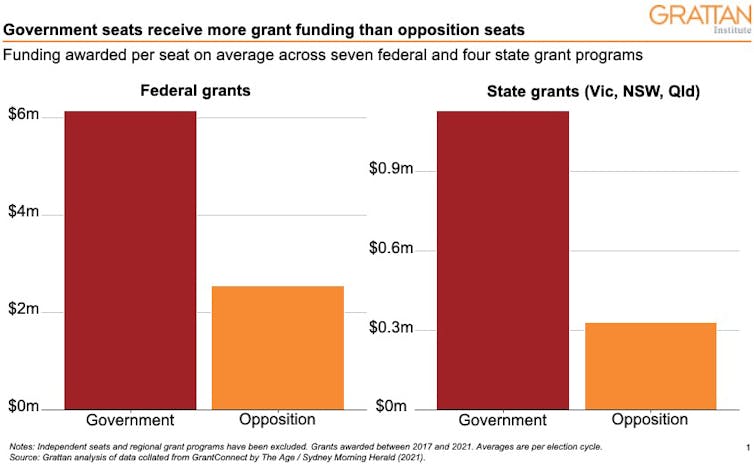
The figures show that pork-barrelling has been blatant in many federal and state government grant programs. More grant money is received by seats held by the government of the day and marginal seats receive disproportionately more funding.
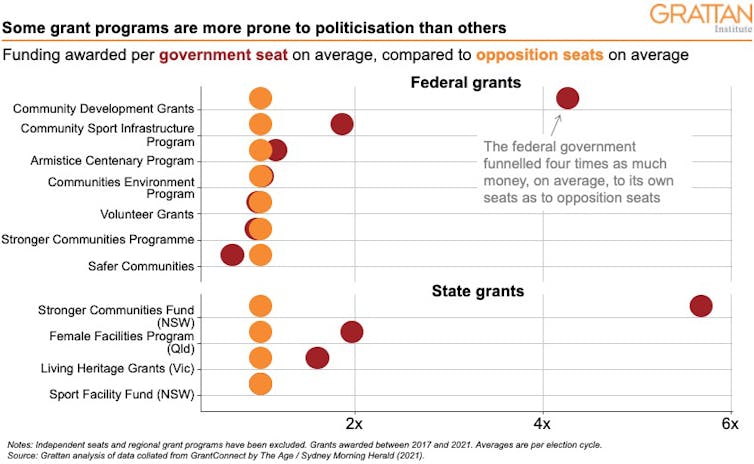
Pork-barrelling has been especially shameless in certain grant programs. For example, the federal Community Development Grants program allocated government-held seats more than four times more per seat, on average, than opposition seats. For the NSW Stronger Communities Fund, the figure was almost six times as much.
Yet some politicians defend pork-barrelling
While pork-barrelling isn’t new, there’s been a worrying trend in recent years towards normalising it. Instead of offering apologies and resignations, some politicians have ramped up their excuses and are now openly defending this misuse of public money. Justifications include: “It’s not unique to our government”; “It’s what the elections are for”; and even that pork-barrelling accompanied by giant cheques featuring government MPs’ faces is “a feature of Australian democracy”.
Revelations of large-scale pork-barrelling should prompt ministerial resignations and government reforms to make it harder to do it again. But state and federal ministers don’t often fall on their swords over pork-barrelling these days, despite evidence that 77% of Australians believe they should.
The decision to brazen it out might be driven by short-term political interests, or it might show our politicians don’t understand or respect the rules and norms on spending public money.
Either way, politicians’ behaviour has drawn attention to the ineffectiveness of Australia’s current rules on pork-barrelling.
How to prevent pork-barrelling
Pork-barrelling, by definition, is not in the public interest. It has real costs.
Channelling taxpayer’s money into projects to benefit friends and supporters, or to win votes, means less money for more valuable projects, and less core spending on health, education and other programs that can improve the lives of all Australians and lift the productive capacity of the economy.
Pork-barrelling also undermines trust in governments, promotes a corrupt culture, and risks entrenching power and skewing elections.
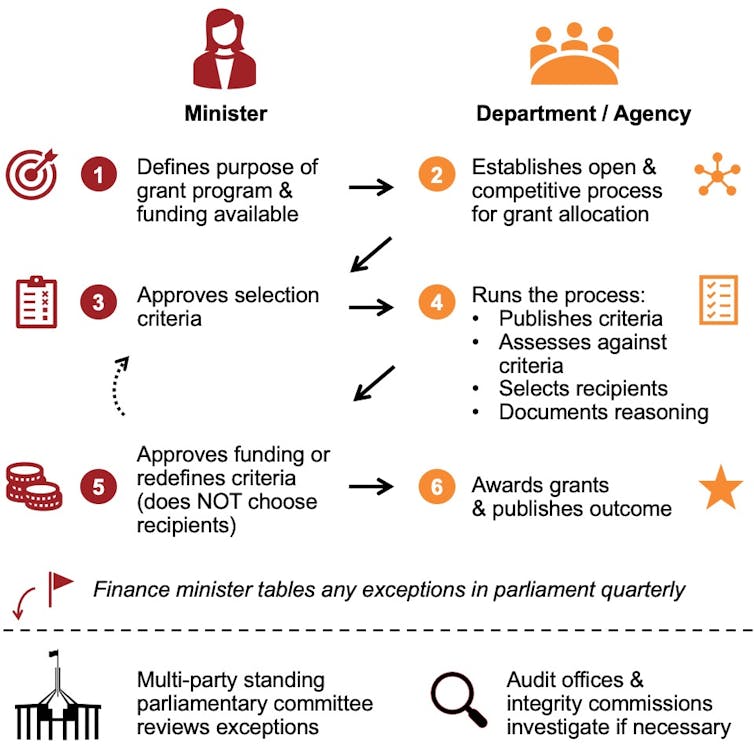
So how can we put a stop to the seemingly irresistible temptation to roll out ever more grants? Let’s start with an open, competitive, merit-based process for allocating government grants that establishes clear guardrails around ministerial discretion.
A better process for allocation and oversight of grants.
Ministers should be able to establish grant programs and define the selection criteria, but they should not be involved in choosing grant recipients. Shortlisting and selecting grant recipients is an administrative function for the relevant department or agency. Ministers should have bigger fish to fry.
A multi-party standing parliamentary committee should oversee compliance and interrogate any minister or public official who deviates from the rules. And funding for federal and state auditors-general should be increased to enable wider and more frequent auditing of grant programs.
A strong and well-resourced integrity commission is the last line of defence against pork-barrelling. Better processes and oversight should significantly reduce the opportunities and incentives for governments to engage in pork-barrelling in the first place.
If pork-barrelling continues, an integrity commission may choose to investigate. A recent report from the NSW Independent Commission Against Corruption concluded that pork-barrelling “can under certain circumstances involve serious breaches of public trust and conduct that amounts to corrupt conduct”.
It’s time to take the pork off the table. Better processes and oversight of grant funding, alongside the other recommendations in our New Politics series of reports, would lay the foundations for a new way of doing politics in Australia – one that safeguards the public interest from political interests.
The Grattan Institute began with contributions to its endowment of $15 million from each of the Federal and Victorian Governments, $4 million from BHP Billiton, and $1 million from NAB. In order to safeguard its independence, Grattan Institute’s board controls this endowment. The funds are invested and contribute to funding Grattan Institute’s activities. Grattan Institute also receives funding from corporates, foundations, and individuals to support its general activities as disclosed on its website.
Anika Stobart and Danielle Wood do not work for, consult, own shares in or receive funding from any company or organisation that would benefit from this article, and have disclosed no relevant affiliations beyond their academic appointment.
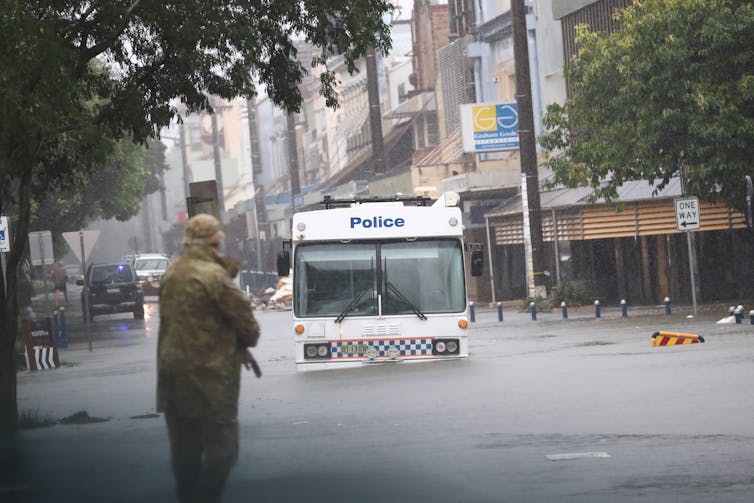
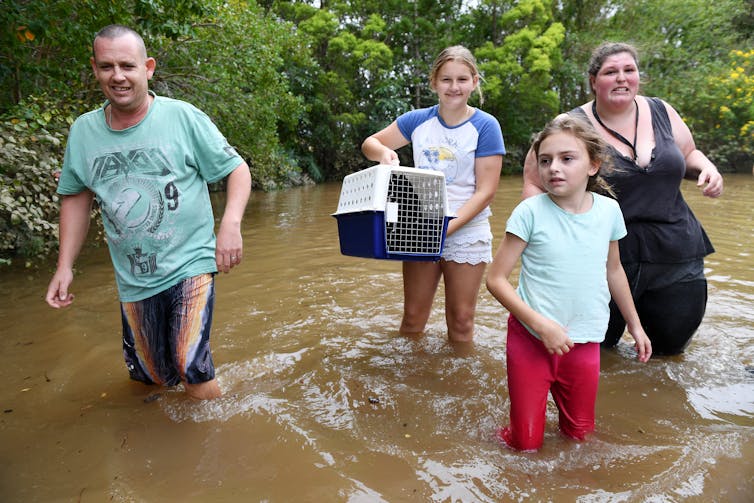
When floods swept the Northern Rivers region of New South Wales earlier this year, scores of people ignored official advice and rescued neighbours and friends from floodwaters using their boats, kayaks and jet skis, while risking their own lives. Now an independent inquiry has recommended communities in high-risk areas receive training and resources to become first responders to a disaster.
The NSW inquiry into the spate of floods in 2022 was released last week. A “community-based first responder training program”, which incorporates Indigenous knowledge, is one of 28 recommendations.
The inquiry recognised that in areas such as Lismore many people – dubbed the “tinnie army” – rescued others when emergency services were overwhelmed by the scale of the floods. In accepting the recommendation, NSW Premier Dominic Perrottet said while people might not have time to be full-time volunteers, many would want to be trained and contribute though programs like this.
But exactly what’s involved in training community members and relying on them to be first responders when disaster strikes? Will this program help prepare communities and build resilience? Or will it cause more confusion and increase risks?
Communities must already negotiate a complicated landscape of response to and recovery from floods – or fires. While well-meaning, it is unclear whether the benefits of formalising community skills through emergency training program outweigh the risks.
This article draws on our work with regional Australian and urban Pacific communities to reduce disaster risks and build resilience. We have also studied people’s behaviours and communications during emergencies.
Certainly, there are positives associated with this community training program. Research has shown people affected by disaster often become first responders, so the recommendation recognises that reality. People are much more likely to be altruistic in times of crisis (rather than panic and behave in self-serving ways).
Increasing the knowledge and skills of these individuals could help ensure their safety along with the safety of those they assist. There also is a trend in communities that have experienced a number of disasters to self-organise in the face of future disasters. Communities across Australia have come together to develop response plans and procedures, communication strategies and the like.
These communities want to be prepared, especially in case government agencies are unable to respond in time. This desire is a result of having endured experiences where things didn’t go so well.
Other obvious benefits of the program include the ability to draw on community members’ knowledge of local places and people. And when communities can contribute to helping disaster-affected people – whether by assisting with evacuation, managing shelters or providing comfort – that benefits community and individual wellbeing too.
Such a program also has inevitable downsides. Disaster risk reduction and recovery is a joint responsibility of governments and communities. Yet this recommendation seems to place a great deal of responsibility on community alone.
In Australia, national, state and territory governments develop policies on disaster risk management. These are then implemented by local government authorities, state agencies such as Recovery NSW and NSW Reconstruction Authority, voluntary organisations such as Red Cross, specialist organisations, as well as community-based working groups such as the communities of North-East and North-West Queensland. Communities would have to respond to disasters within this structure, with support from such agencies and organisations.
Training community members would strengthen disaster response and recovery efforts only if affected communities are adequately supported. Trouble can arise, however, when these efforts rely too heavily on community members to fill the gaps in lieu of their official counterparts.
Another troubling issue is the failure to act on previous disaster inquiry recommendations, which points to the challenges of implementing the current recommendations. A 2021 NSW Audit Office report said:
“Two-thirds of proposed recommendations in past inquiries could not be verified as being implemented as intended, and in line with the outcomes sought. The audit also found that agencies did not always nominate milestone dates or priority rankings for accepted recommendations, and so could not demonstrate if they were managing or monitoring them effectively.”
These findings are probably the result of a few challenges, including short political cycles, the heavy burden already placed on emergency officials and the struggle to build on their past learnings when implementing previous inquiry recommendations.
Also telling is the frequent restructuring of agencies evident in the changes from the Office of Emergency Management to Resilience NSW to Recovery NSW, with a new NSW Reconstruction Authority to become the lead agency.
The inquiry was critical of the responses by Resilience NSW and the NSW SES to the floods. Its report identified confusion about roles, poor communication and a lack of co-ordination and resources as contributing factors.
This raises questions about whether they have the capacity to properly train communities. Training programs would require agencies to take on extra responsibilities during and after disaster events.
Many questions of responsibility and liability remain to be answered. Issues include:
How will the responsibilities of the formal and informal volunteers be distinguished?
Who will be liable if a community responder is injured while assisting others?
Who will be responsible for ensuring any equipment provided via community-based grant programs is maintained?
In what capacity may these programs indirectly encourage community members to stay behind in a disaster-affected area, which could put them in harm’s way?
To increase the prospects of success, training programs should build upon any existing community-organised strategies and approaches. And they should be co-designed with those community members, including Indigenous communities, who are most knowledgeable and active in disaster risk management.
Mittul Vahanvati is working with Foundation for Rural and Regional Renewal.
Erica Kuligowski does not work for, consult, own shares in or receive funding from any company or organization that would benefit from this article, and has disclosed no relevant affiliations beyond their academic appointment.
My phone pings and it’s a message from my brother. Do we have an old white dress my niece could borrow for a Book Week costume for school?
Book Week is upon us once again and all around Australia, family WhatsApp groups are lighting up with similar requests from parents and carers of primary school aged children.
Mothers are staring at cardboard boxes wondering how they can help their child transform into a rainbow fish. Fathers are corralling children down the aisles of Spotlight trying to find the costume section. Carers are asking children about how they want to dress for the Book Week parade, and what’s needed to complete the look.
In the scramble for costumes, which can add to the work of already stressed parents and carers, the point of Book Week – for kids to fall in love with reading – can get lost.
In fact, a vast body of research evidence shows what’s crucial to building a love of reading is allowing children the time and freedom to read what interests them.
Some children will use a costume to play around with the fictional character and interact in role. Photo by RODNAE Productions/Pexels, CC BY
Dressing up as a fictional character does have benefits
I’m not saying the Book Week costume is pointless; dressing up as your favourite book character is a great way to celebrate reading, particularly when all students and teachers take part.
In Australia – where most school students wear uniforms – every school day out of uniform has a sense of celebration.
Some children will use their Book Week costume to play around with the fictional character and interact in role.
A child I know revelled in dressing up as Professor Snape from Harry Potter and playfully patrolled the playground in character. He was pursued by a gang of younger Potter fans with their house colours on, yelling out to him in role and giggling when he responded gruffly as Snape.
These children were playing but they were also learning; it was an opportunity to improvise scenes based on a novel they loved to read, and to celebrate this reading across the school.
“Snape” himself had read the novels when he was younger; his love of the text and pleasures of the fictional world spurred him on to read a much more difficult text than he normally would at that age.
Dressing up can allow a child to celebrate the character and texts they love. Photo by cottonbro/Pexels, CC BY
What really matters is not the costume, but falling in love with reading
Extensive research shows reading for pleasure improves young people’s overall reading skills, as well as test outcomes.
Creating a culture of reading in school can help children fall in love with reading, where children read books they choose themselves for their own pleasure.
Providing time for sustained, self-selected reading is important, as many children do not read for pleasure outside school time.
Finding a book they love, with help from another child, a teacher, or librarian, can help a child to develop the habit of reading.
Finding a book they love can help a child develop a reading habit. Photo by Ksenia Chernaya/Pexels, CC BY
So what would work to help my child fall in love with reading?
Encourage your child’s reading of fiction and let them choose books for themselves.
Facilitate trips to the library if you can, and spend time with them selecting what interests them.
Don’t judge your kids on what they love, and don’t force your kids to read what you deem a “worthy” book.
Too often kids experience what author and teacher Kelly Gallagher calls “readicide”: the “systematic killing of the love of reading, often exacerbated by the inane, mind-numbing practices of schools”.
It’s possible to commit readicide in the home if it becomes a forced, systematic chore where your child has no choice over what they are reading.
Don’t judge your kids on what they love or force them to read books you deem ‘worthy’. Image by Victoria_Borodinova from Pixabay, CC BY
So, rather than judging, enjoy their pleasures and invite them to share their books with you.
Share your own reading with them, and make it visible to them.
I read novels on my phone, which I love, as I can read in bed with the light off. But it’s not as obvious when I am reading fiction as it would be if I was reading a printed book – so I try to bring up my reading in my conversations with my children.
It’s a small action, but anything you can to do help establish a culture of reading in the family helps establish reading for pleasure as a normalised behaviour.
So this Book Week, don’t stress about the costume, and don’t worry about what the other mums or dads are sewing or buying.
Just let your kid read what they want and enjoy it together.
Joanne O’Mara receives funding from The Australian Research Council and the Canadian Social Sciences and Humanities Research Council. She is a member of the Victorian Association for the Teaching of English Council.
Aboriginal and Torres Strait Islander readers are advised this article contains images of deceased people.
Amy Elwood, a Wangkumara/Adnyamathanha Elder and cultural repository of knowledge and grandmother to one of us (Lorina Barker), has inspired an array of creative works about her experience of removal from Country.
In 1938, 130 Aboriginal people including Amy’s family and other Wangkumara families were forcibly removed from Country at Tibooburra to the Brewarrina Aboriginal Station – the old mission.
The community was transported 500 kilometres east to the Baaka Barwon rivers on the back of three gubbie (government) trucks.
In 2006, Lorina had a yarn with her grandmother about her life experiences and memories. This was transformed into a poem titled An Ode to My Grandmother, a short film called Tibooburra: My Grandmother’s Country and touring multimedia exhibition named Looking Through Windows.
That yarn also inspired an immersive theatre performance Trucked Off, and the song An Ode to My Grandmother.
Oral history is the recorded account of a person’s memories of the past for historical and research purposes. Indigenous oral history is more than a methodology. It is living history, practised for thousands of millennia, intrinsically woven into Aboriginal people’s way of life and culture.
As Aboriginal people, we live it every day: it is a part of who we are, where we come from and who we are related to. It also determines our interconnected relationship and responsibilities to our lands, rivers, seas, skies and to all living and inanimate things in both the natural and spiritual worlds.
In these works, Amy Elwood is able to share her memories and stories and those of her family.
On the mission, life was harsh and regulated. The Wangkumara were not able to speak their language or practice their Culture; Elders worried for Country and many died of broken hearts.
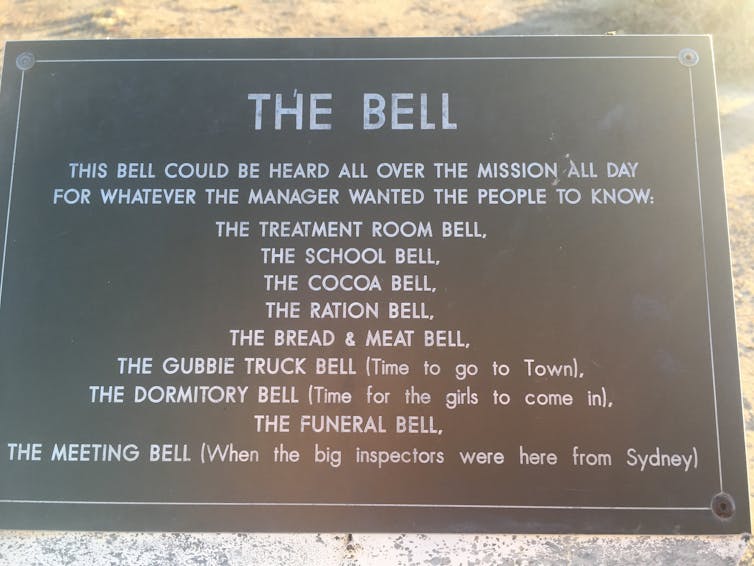
The bell signage at the Old Brewarrina Mission, photo by Julie Collins, Brewarrina, 2018. Julie Collins
In each development of the story, artists and musicians had to go through a process of decolonising themselves to work in an Aboriginal cultural framework. We were invited by Wangkumara Elders Gwen Barker, Rick Elwood, Rebecca McKellar and Louise Elwood into culturally creative spaces online and on Country where knowledge was transferred into new forms.
With each successive workshop and performance, we learnt more from the Elders through yarning and storytelling. The creative process from the poem to the final performance was developed over many years.
Retelling history
An immersive theatre work, Trucked Off started with the poem. In immersive theatre, the audience are not passive bystanders, they are part of the story.
In Trucked Off, the audience follow the Tibooburra families, walking in their shoes, reliving the journey from Tibooburra to Brewarrina in the far northwest of New South Wales.
On arrival at the mission, the old Brewarrina Station, the audience are told by the mission manager and staff how their lives will be ruled by the ringing of a bell. The number of rings indicates how they will respond: if they are required to assemble for work, obtain rations, or, for children, go to school or to see the nurse for “treatments”.
The penalties are harsh for noncompliance.
Actors in the Trucked Off Performance, Photo by David Elkins, Armidale 2018. David Elkins
Wangkumara Elders, including Lorina’s mother Aunty Gwen Barker, participate as actors in Trucked Off, taking ownership of their story and retelling their history.
The script is dynamic, incorporating themes of grief, loss and trauma that reverberate through the generations, reflecting the continuing impact of colonisation.
This is a theatre of “truth-telling”, embodied and experiential, increasing people’s understanding and memory of this living history.
The audience are an integral part of the show. Ray Bud Kelly Jnr, Author provided
Stories in song
Another work inspired by the poem was an operatic song. In the Western tradition, the composer has the final say over the music but this process required a new way of working that involved Community and the Wangkumara Elders.
The process ensured cultural protocols were observed and permissions sought to tell the story and to find the correct sound. Wangkumara Elders were able to give us detailed insight into the story and the emotion behind the poem.
The musical sections were mapped out and the Elders wanted the song to have an uplifting ending. This demonstrated the courage and resilience of the people, their connection to Country and to the Mura tracks (Songlines), even after removal. The song ends with a triumphant fanfare and the lyrics “Country knows you”.
While the poem is in English, the Elders added Wangkumara words into the song, including the word Ngamadja, which means “mother”. Wiradjuri soprano Georgina Hall discussed with Elders the many meanings of the words and the exact way to pronounce them while recording the song.
Language and the story of removal finds a new home in classical music and song.
The use of oral histories and archival materials in these creative works allow the family, community, artists and musicians along with the audience to walk in the footsteps of our Elders.
We speak their words and experience for a moment what it was like to be removed from Country, transported, fenced-in and locked up on a mission. The original poem, production and accompanying music also aids in demystifying removal, and not only builds empathy and understanding in audiences – but is also a call to action.
Lorina L. Barker receives funding from Australian Research Council and Create NSW
Julie Collins and Paul Smith do not work for, consult, own shares in or receive funding from any company or organisation that would benefit from this article, and have disclosed no relevant affiliations beyond their academic appointment.
One of the survivors of a horrifying sorcery accusation-related violence (SARV) attack and torture of nine women in Papua New Guinea falsely accused last month of using sorcery to kill a leading businessman tells her story of survival. She does not want to be named as the situation is still tense and she is still in hiding and fears for her life. (Translated into English).
On July 22, about 200 women from Enga’s Lakolam village were rounded up by a mob of machete-wielding men following the death of prominent businessman Jacob Luke.
The mob suspected an old woman from the village had used sorcery to “eat Luke’s heart” and causing his death.
She was dragged out of her house, beaten and thrown on top of a tyre and tortured as we all watched, including her family, her children, her sons, who could do nothing to save her.
“They tortured her and told her to name the other women who had helped her. After being beaten and tortured — maybe she got tired — maybe she just wanted to be free from it all, but named us, falsely accusing us as they had accused her.
“Once they got our names, nine of us, they poured kerosene on her and set her on fire.
“Her screams pierced our hearts, I knew I was going to die that day as well.
“All I thought of was my children, my sons, and I prayed.
‘I prayed that they do nothing’ “I prayed that they will do nothing, that the Lord would hold them back from trying to defend me, because I knew, they would be killed too, if they tried to defend me.
“I looked in my son’s eyes, begging him to understand that he must do nothing,” she said.
The survivor said that the nine of them were rounded up by the mob. They were beaten, stripped naked and tortured.
“The pain drowned out the humiliation, as they burnt my nipples and opened my legs and shoved hot iron rods into me.”
“They wanted us, to admit that yes, we had killed him using sorcery so that they could have a reason to pour kerosene on us and burn us as they had the other woman.
“Among us, the nine of us, there was one of our daughters.
“She is in her 30s, mother of two and was four months pregnant.
‘Everyone watched … was happy’ “They didn’t care, they tortured her as well — everyone watched, everyone was happy, as to them, they were only getting justice over the death of Luke, but God is good, she survived,” she said.
She said their houses were all burnt down by the angry mob.
“We saw our homes go up in flames as we were torture.
“I thought of my children, wondering if the little ones were okay, praying that they are safe.
“I must have passed out because when I looked up again, I saw my two elder sons …” she said as she started to sob.
She said husbands, sons, brothers could only watch and do nothing, as Luke was a well-respected man, a leader.
“One man stood there and watched as two of his wives were tortured — one of the wives died during the torture and one survived.
Five women died “Five women died that morning, the one who falsely accused us of helping her to eat the heart, and another four who died during the torture.
“But five of us made it out of ‘hell’ alive.”
When asked, if she would be willing to testify against the perpetrators and have them prosecuted to get justice for what they did to her and other women, she said, all that mattered was her life.
“I do not think we will ever get justice. What is justice anyway?”
“Luke was a leader — to the mob, we had killed him, and they will kill us.
“I do not care if they get prosecuted, I just want to live.
“Be with my children and hold my grandchildren,” she said.
Situation still tense The woman said that things were still tense and they were still afraid for her life.
“I do not know what is going to happen now. I do not know where I am going to go to.
“Four of us are old, Lakolam has been our home, and we raised our children and our grandchildren here.
“Only the pregnant mother of two is young, but we are here, they are taking care of us, taking us to the hospital, most of us are still healing.
“I do not know what will happen tomorrow, I do not know if I will still be alive next week, but today I am alive and I thank my God for today.”
Rebecca Kuku is a reporter for the National daily newspaper in Port Moresby. Republished with permission.
Anthony Albanese flagged at the weekend he was open to calling an inquiry into the ramifications of Scott Morrison’s power grab, as Barnaby Joyce revealed he feared retribution if he crossed Morrison for overruling a Nationals minister.
Albanese on Monday will release the solicitor-general’s advice on the affair, as the controversy around Morrison’s extraordinary action in wading into multiple portfolios without informing his cabinet runs into its second week.
Asked on Sky whether he would call an inquiry even if (as expected) the solicitor-general found Morrison acted legally, Albanese said, “very clearly there’s a need for proper scrutiny of what occurred here. This was an undermining of our parliamentary democracy.”
He said that separately from the legal side there were questions of whether conventions had been overturned and whether reforms were needed so this could never happen again.
“We’ll examine all of those issues after we receive the solicitor-general’s advice.”
Joyce, interviewed on the ABC, gave a confused account of what he knew and when. He was deputy prime minister when Morrison overruled Nationals resources minister Keith Pitt over the PEP-11 gas exploration off the NSW coast.
Morrison decided to rule out exploration for political reasons, while Pitt, who as minister had the formal decision-making power, had an opposite view. Morrison had ensured he could get his way by becoming resources minister.
Joyce told the ABC he became aware “obliquely” that Morrison had the power to decide the PEP-11 matter.
During discussions on PEP-11 “it became more apparent that the prime minister had greater powers than I initially assumed,” Joyce said.
Joyce said if he had resisted Morrison’s action, the Nationals could have lost the extra ministry place he had obtained for them. As well as the extra spot Joyce said he had negotiated another person on cabinet’s expenditure review committee, and extra staff. And there were billions of dollars for regional areas, as part of the deal Joyce struck for the Nationals signing up to the net zero by 2050 commitment.
“I thought I would ask myself three questions [about Morrison moving into resources]. Is it legal? Under section 64 [of the constitution] he can do that.
“Is there anything I can do to change it back? No.
“Has he got the capacity to re-negotiate my extra minister that I had just dealt into the National party hand? Yes, he could say, ‘Yeah. I will fix your problem, mate. I will take the ministry back off you. Problem fixed for you’. Problem fixed for me. Bad outcome for the National party.”
Joyce said he couldn’t remember exactly when Morrison had told him he could overrule Pitt. Morrison had made himself resources minister in April 2021, while Michael McCormack was still Nationals leader, and Joyce did not know of the arrangement when he ousted McCormack.
Michelle Grattan does not work for, consult, own shares in or receive funding from any company or organisation that would benefit from this article, and has disclosed no relevant affiliations beyond their academic appointment.
The Southern Highlands capital — Mendi — has turned into a battlefield in Papua New Guinea this week as supporters of different candidates for the regional seat went on a warpath.
The warring parties –– believed to be supporters of the incumbent governor against the other regional candidates –– shut down the town on Thursday and during the mayhem, raided the Mendi police station and set fire to regional ballot papers.
Police Commissioner David Manning directed police in Mendi to arrest one of the candidates who was suspected of being behind the problems in Mendi and the counting.
Manning said he had ordered the arrest of the candidate following the ransacking of the Mendi police station in which the remaining ballot boxes for the provincial seat were removed from the containers and burned to ashes.
“I have directed the apprehension of the candidate [named] for questioning in relation to the incident at the police station,” Commissioner Manning said.
The mayhem was the culmination of frustration that have been built over weeks into the on-again off-again counting of the regional ballots that has dragged on for weeks since counting started in mid-July.
Southern Highlands police confirmed that allegations over electoral fraud by counting officials have led to frequent disruptions and the PNG Electoral Commission must take a stand on this.
‘Constitutional terrorists’ “The Electoral Commissioner Simon Sinai needs to clarify if the candidates should go to court to obtain a court order or not to stop the provincial returning officer from counting the disputed ballot boxes,” provincial police commander Superintendent Daniel Yangen said.
Superintendent Yangen joined candidates Peter Nupuri, Benard Kaku and Augustine Rapa in Mendi who are accusing the EC and its official on the ground in Mendi for the turmoil.
Mendi burns! … the PNG Post-Courier’s weekend edition front page. Image: Screenshot APR
Nupiri asked Sinai to replace the election manager, Jimmy Alwynn, to take charge of the counting.
Prime Minister James Marape condemned the burning of the ballot papers, describing those involved as “constitutional terrorists” who would be hunted down by the police.
“Those responsible are not ordinary arsonists but constitutional terrorists who can enter a police station and burn ballot boxes containing the votes of the people,” Marape said.
“This is state property and such an act is one of terrorism,” he said, adding that he had asked the police to go into Mendi, conduct the investigation and arrest those responsible.
He said people in PNG cannot continue to take the law into their own hands and his government would strengthen the police and justice system.
“I will, in the first instance, ensure that Southern Highlands Province, Hela, Enga and other hotspots are attended to at the very earliest,” Marape said.
Ialibu Pangia’s Peter O’Neill blamed the chaos in Mendi on the government.
‘Government-made shambles’ “This election has been a government-made shambles everywhere and democracy has been hijacked to make way for an autocratic style of leadership,” he said.
“I do not condone the violence in Mendi but I can certainly understand why it is happening.
“People are fed up with the way democracy has been cast aside by a power hungry few hellbent on seeking control at the expense of the people.”
O’Neill urged the Electoral Commissioner to reassert himself and take control of the Mendi counting room and ensure a fair outcome for the voters and candidates.
The destruction of the ballot papers has put an abrupt halt to the counting, which was heading into the elimination rounds.
Sinai will decide either to treat the Mendi situation as a “special circumstance” and declare the leading candidate as the winner or order a supplementary byelection.
“I will make a decision once I have gone through the report on the incident,” Sinai.
Indonesia’s Setara Institute for Peace and Democracy says that the presidential decree (Keppres) on the formation of a team for the non-judicial resolution of past gross human rights violations — signed recently by President Joko “Jokowi” Widodo — will reinforce impunity and absolve perpetrators of past human rights violations.
According to Setara Institute chairperson Hendardi, the Keppres shows that Widodo is unable to or unwilling to resolve past human rights cases, reports CNN Indonesia.
“The Setara Institute views the formation of the ‘PAHAM Team’ as just a project to reinforce impunity and to whitewash past human rights violations which have not yet been fully resolved by the state”, said Hendardi.
Based on the draft Keppres which is circulating, Hendardi said that the membership of a team formed by Widodo is made up of people who are considered problematic in terms of past human rights violations.
According to Hendardi, instead of dealing with cases of human rights violations in accordance with the mandate of Law Number 26/2000 on Human Rights Courts, Widodo has instead closed the door firmly on public demands and the hopes of victims for truth and justice.
He also said that the formation of the team would impact upon the search for truth and fulfilling the rights of the victims and the public because a judicial resolution becomes optional.
“Because the non-judicial option has been decided on, Jokowi is actually negating the mandate of Law Number 26/2000 which states that the resolution of human rights violations which occurred before 2000 can be tried through an ad hoc human rights court”, said Hendardi.
Hendardi believes that this non-judicial mechanism is a form of mass amnesty and the state washing its hands of the issue.
The “PAHAM Team” is just a committee formed by Widodo to give the appearance of sympathy with the victims while the aim is to silence their demands and aspirations, according to Hendardi.
“Yet under international human rights law and the concept of transitional justice it is not just the right reparation that must be fulfilled, but also the right to truth, the right to justice and guarantees of non-repetition,” he said.
As has been reported, when giving his State of the Nation address on August 16 at the People’s Consultative Assembly (MPR) in Jakarta, President Widodo said he had signed a Keppres on the formation of a team for the non-judicial resolution of past gross human rights violations.
Widodo also said that a Draft Law on Truth and Reconsolidation (RUU KKR) was in the process of being deliberated.
Non-judicial mechanisms have long been criticised by civil society groups because they can be used as an alibi by the government not to pursue cases of gross human rights violations through judicial means.
Currently there are 12 cases of human rights violations being handled by the National Human Rights Commission (Komnas HAM).
They include:
The 1965 mass killings;
The May 1998 riots in Jakarta;
The 1997-98 Trisakti, Semanggi I and Semanggi II student shootings;
The assassination of renowned human rights defender Munir Said Thalib, co-founder of the Commission for the Disappeared and Victims of Violence (KontraS);
Residents of Nelson in Aotearoa New Zealand’s South Island are cleaning up and counting the cost of flood damage across the region, while authorities work to fix roads, clear slips and rebuild infrastructure.
More than 400 homes had to be evacuated over the past few days after the Maitai River burst its banks and a state of emergency was declared in Nelson-Tasman and West Coast districts.
RNZ has collated photos showing some of that destruction caused by this week’s “weather bomb”.
Nelson’s mayor Rachel Reece said: “it will take years, not months” for the city to recover.
The overflowing Oldham Stream in Atawhai caused a footbridge to collapse, splintering the stream to the playground on one side, and through a neighbour’s property on the other.
An Atawhai local person edging on the overflowing Oldham Creek said the pedestrian bridge collapsed yesterday and the build up of debris had sent water gushing either direction, flooding their properties.
His neighbour, who lives next to the creek, evacuated yesterday.
Worried about high tide He said they were worried for what might happen once high tide comes back, the forecasted downpour later today, and if more debris piles up.
Other locals that spoke to RNZ said they had never had flooding like this.
Either side of the bridge is a park and a cycle track. A pump track, fundraised by the local community, is ruined.
Meanwhile traffic has piled up from Atawhai into Nelson as multiple slips block parts of State Highway 6 — the only connection road for Atawhai.
A state of emergency was also declared in Marlborough, with more heavy rain expected to fall on the water-saturated region overnight.
Mayor John Leggett said it would ensure the emergency response team had the resources it needed to support communities affected by heavy rain.
Our research in 2020, published in July this year, found more than 40% of coaches from Olympic sports we surveyed reported mental health symptoms at a level that would warrant professional treatment. But fewer than 6% reported seeking treatment at the time.
Despite facing immense pressure in their daily roles, the mental health needs of elite coaches have been largely neglected in public conversation.
Athletes increasingly discussing mental health
In recent years, we have seen many high-profile athletes across several sports talk openly about their mental health struggles. They include Naomi Osaka, Nick Kyrgios, Simone Biles, Michael Phelps, Bailey Smith and Majak Daw.
UFC fighter Paddy Pimblett recently challenged mental health stigma and promoted seeking help in a post-fight interview.
When elite athletes openly discuss mental ill-health, this is often publicly celebrated. This aligns with changing cultural attitudes, moving away from rigid stoicism and towards recognising mental ill-health as a reality rather than a rarity.
English UFC fighter Paddy Pimblett on the importance of men talking openly about their mental health.
Coaches largely neglected
But it’s rarer to see people talking about mental ill-health in elite coaches.
Very few coaches have publicly discussed their experiences, with a small number of notable exceptions in the AFL. Former St Kilda player and Richmond coach Danny Frawley openly discussed experiencing depression and anxiety before his death in September 2019.
Former Essendon player and coach James Hird also described experiencing suicidal thoughts, contacting Beyond Blue for crisis support, and receiving inpatient treatment for depression.
However, public recognition of the pressures and mental health challenges experienced by elite coaches remains poor.
Elite coaches experience immense pressure in their daily roles. They are subject to many of the same challenges as the elite athletes they coach. These include performance pressure, public scrutiny, online harassment, role insecurity, extended periods travelling for sport and missing significant life events as a result.
Coaches are also tasked with vast levels of responsibility for club and sporting success. Their role requires them to act as the face of club decisions, performance and injuries – and they’re often exposed to blistering public opinion and scrutiny about such matters.
In 2020, the Australian Institute of Sport (AIS) commissioned a survey of the mental health and wellbeing of coaches and support staff across Australian Olympic-level sports (the 2020 Mental Health Audit). Our team at youth mental health organisation Orygen and the University of Melbourne conducted this study, which represents one of the largest surveys of coach and support staff mental health and wellbeing.
We surveyed 78 coaches and 174 support staff from Australia’s elite Olympic sport system. The survey assessed rates of mental health symptoms, psychological distress, sleep disturbance and alcohol use.
We found elite coaches reported mental health symptoms at a similar level to elite athletes.
Signs of mental health stigma were also apparent. For example, 30% thought mental health problems would reflect poorly on them in a sport setting. This suggests coaches may feel unsafe sharing their mental health experiences.
Job security and feeling overworked appear to be major challenges for elite coaches. This is perhaps unsurprising given that, like athletes, their job security depends on performance. Poor performance often leads to speculation about a coach’s job security and, in many cases, to losing their job.
Elite sport is also fast-paced, which frequently presents staff and athletes with new challenges. The dedication required to succeed in such environments often requires sacrifices in other areas of life.
Less than half of the coaches in our study reported being satisfied with their work-life balance. They described the negative impacts that too much work, work-related stress and lacking quality time had on their quality of life and satisfaction with life.
How to support coaches’ mental health
To reduce stigma, we need a cultural shift in sport, media and the general community.
Sporting organisations and the media need to promote the voices of coaches who have experienced mental health challenges.
It’s also crucial to ensure coaches can access appropriate mental health supports. The AIS’s Mental Health Referral Network is a good example. Those who can use this service include current and former athletes, coaches, support staff and staff employed by Australia’s national sporting organisations.
While elite sports are highly demanding environments, coach mental wellbeing should still be prioritised.
If this article has raised issues for you, or if you’re concerned about someone you know, call Lifeline on 13 11 14.
Vita Pilkington receives funding through a Melbourne Research Scholarship from the University of Melbourne. She was involved in a recent independent evaluation of the Australian Institute of Sport Mental Health Referral Network.
Courtney Walton receives funding through a McKenzie Postdoctoral Research Fellowship at the University of Melbourne. He was involved in a recent independent evaluation of the Australian Institute of Sport Mental Health Referral Network.
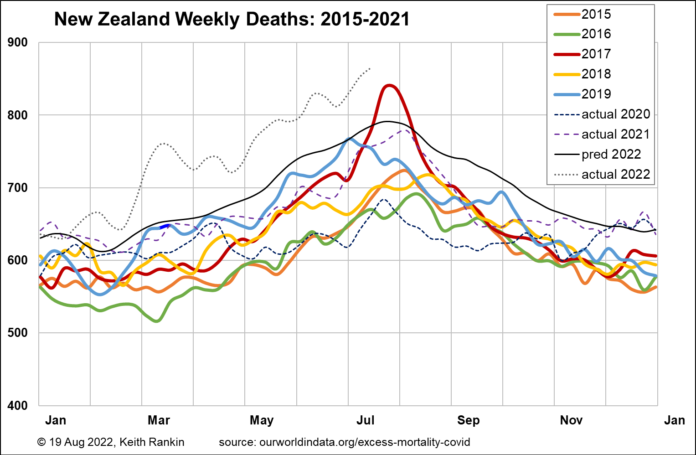
The chart above shows New Zealand’s aggregate weekly deaths from 2015. The normal winter experience is obvious, with 2015 to 2019 influenza peaks mainly in July and August, though in late June in 2019.
New Zealand is different from most European countries in that it has significantly faster population growth. (Although Scandinavian population growth is above average for Europe.) Thus, I have plotted a ‘black line’ to show normality; what mortality would have been like in New Zealand in 2022 had there been no covid pandemic, and no other unusual events impacting on mortality. (Note the dark blue segment that shows the 2019 Christchurch Mosque murders.)
(Note that New Zealand has a rising mortality trend, regardless of covid, due to: a rising population, an aging population; and also possibly due to increases in other ‘lifestyle’ chronic health problems such as diabetes. In Eastern Europe, where Covid19 has had its biggest demographic impact, the first of these three factors did not apply; so its projected mortality, had Covid19 not happened, was essentially the same as its actual 2015-19 mortality. That probably means that covid’s impact there was overstated, given East Europe’s increasing paucity of young people due to emigration and low birth rates, and its increasing recent exposure to chronic ‘lifestyle’ conditions. Demographics were dynamic long before Covid19 struck.)
While its not clear yet whether 2022 peak mortality will be as much above normal as it was in the 2017 influenza season, the important information shown is the extent to which mortality in New Zealand has been above normal since February. There was no simple mortality wave during and immediately after the March Omicron-covid wave. Rather, what we are seeing is a process in which many people who might otherwise have died in 2020 or 2021 have instead died in 2022, nudged in many cases by a covid or similar infection.
Chart by Keith Rankin.
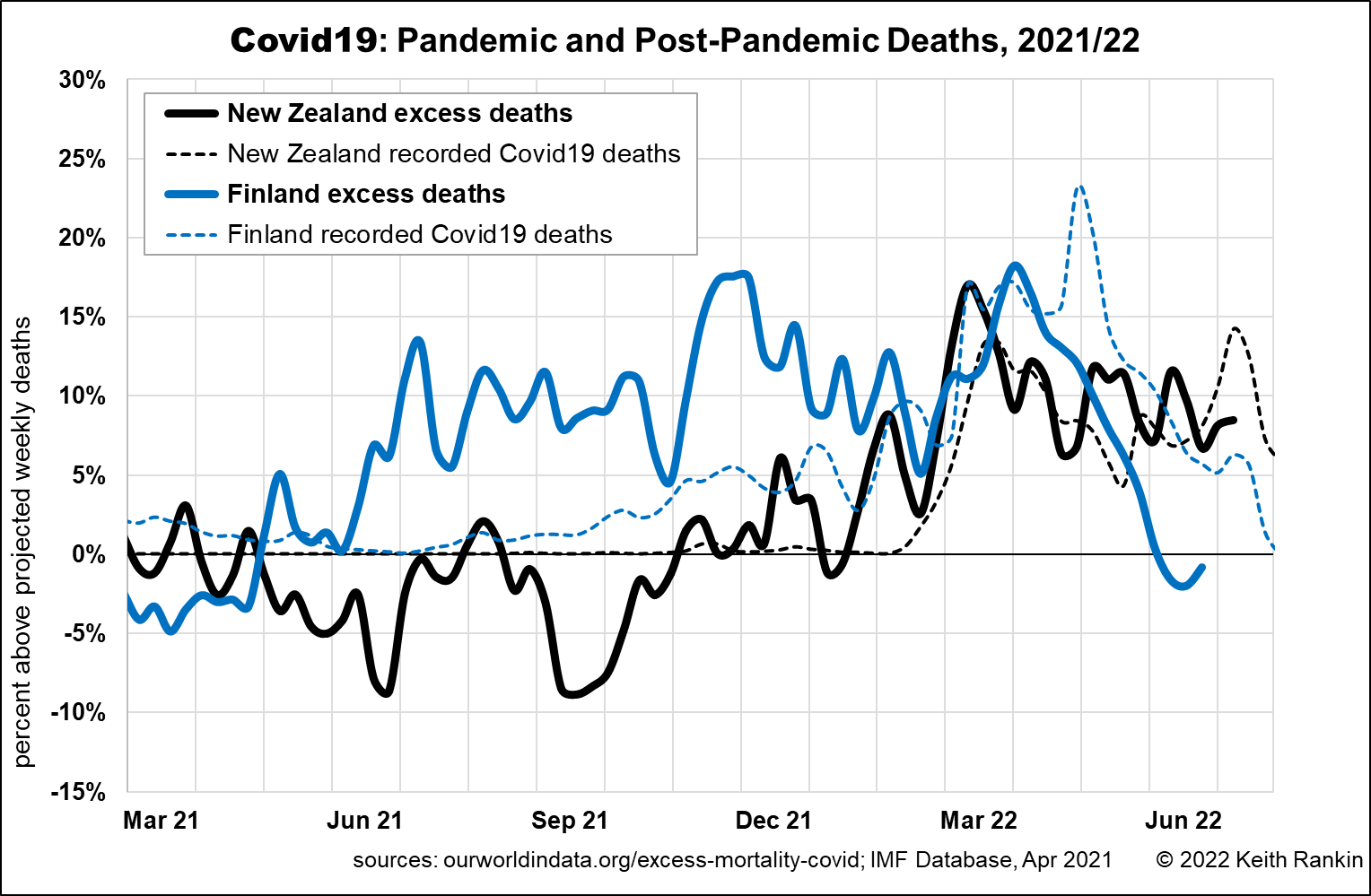
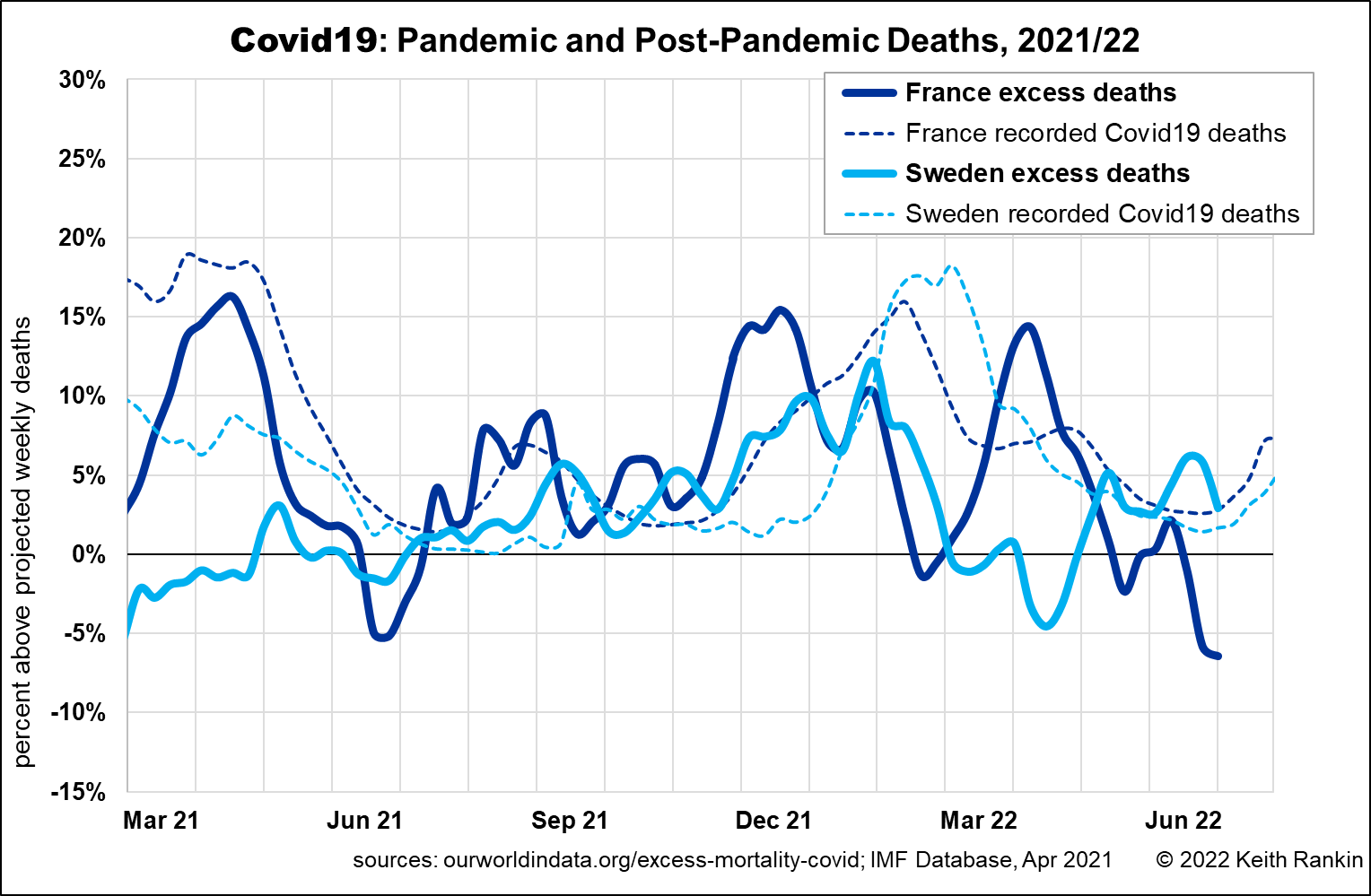
This next chart compares New Zealand with Finland, in the period from March 2021. This is excess deaths, not aggregate deaths; that is, this chart only shows deaths above the relevant ‘black lines’.
The first thing to note is that, for these countries each with about five million people, there is a degree of random ‘noise’ in the variation of weekly deaths. Having noted that, the most prominent feature of the chart is Finland’s long period of excess deaths in 2021 and early 2022. (Finland’s apparent mortality lull in the peak winter months is misleading; these are seasonal peak mortality months, so the extent that the deaths last winter were above normal was ameliorated by the high normal for that time. To some extent, covid deaths replaced influenza deaths.)
Finland is a country that took substantial public health measures to combat Covid19, so the deaths in 2021 can be to a large extent understood as postponed covid deaths. Except that very few of these excess deaths, especially in the third quarter of 2021, were actually diagnosed as covid deaths. The lack of diagnosis of covid may have been due to a lack of testing, on the supposition that the pandemic was over. Or it could be due to high rates of death from covid but not of covid; ie deaths arising from the massive disruption to normal life due to the public health measures, or from lower levels of general immunity to respiratory infections on account of distancing, masking and reduced contact with travellers.
I think it would be fair to hypothesise that the persistently high rate of excess deaths in New Zealand in 2022 suggests that New Zealand is now experiencing something akin to what Finland was experiencing in its last autumn and winter.
Chart by Keith Rankin.
The above chart shows Sweden and France. These are the two countries in North/West Europe which least show the Finland mortality pattern, and are almost certainly the countries which retained and then attained the highest levels of general immunity. In Sweden’s case it was due to a public health approach that emphasised private responsibility over public mandates. In France’s case, the stronger public mandates did not linger on beyond the emergency periods.
Both countries had significant Covid19 mortality in 2020; they were hit full-on by the first and second waves. But both seem to have suffered only minimal amounts of waning general immunity as the pandemic progressed; and both suffered much less covid mortality in late 2020 than many other countries (with the USA coming mostly to mind).
Chart by Keith Rankin.
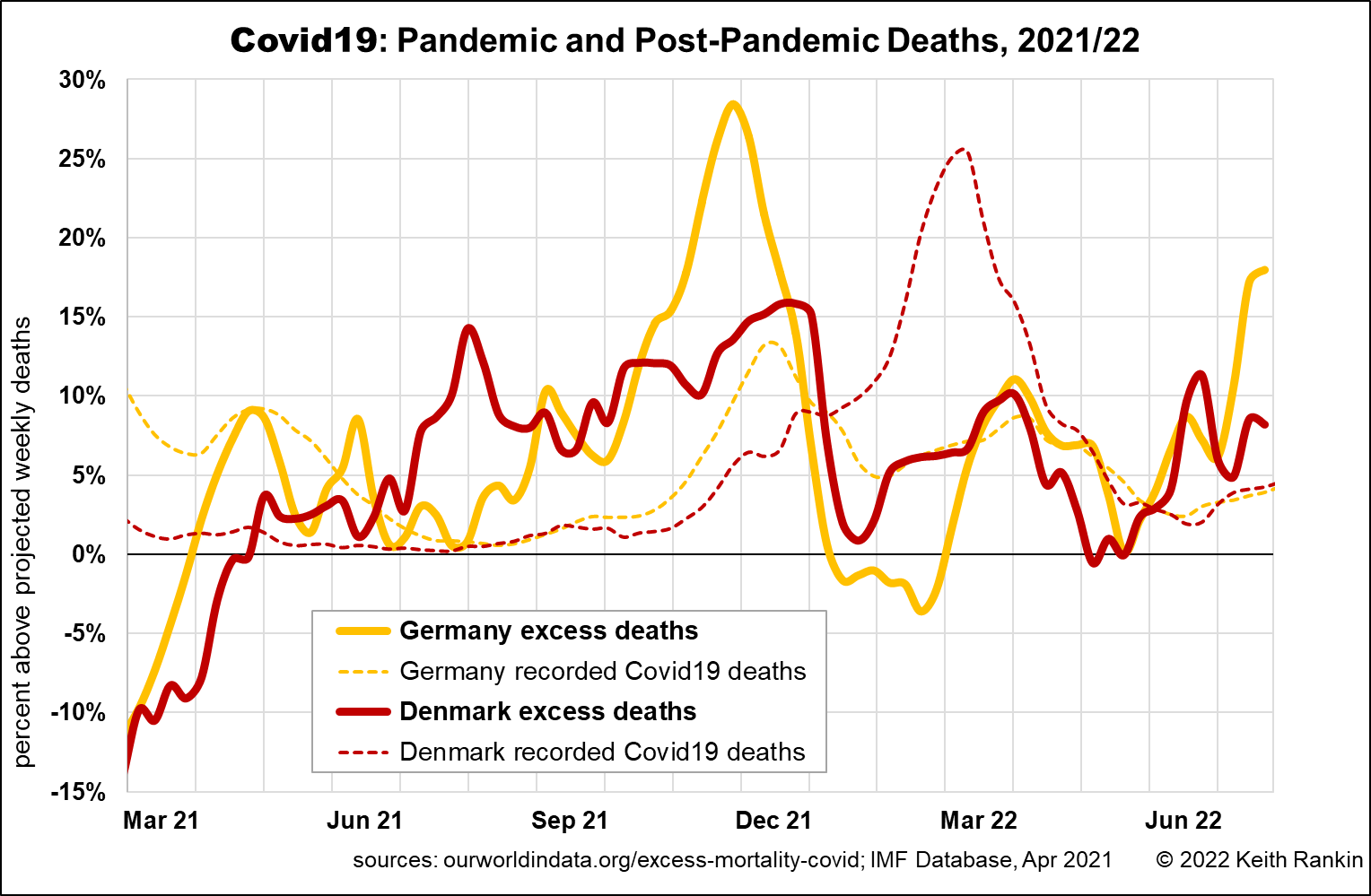
The final chart shows Germany and Denmark. Both of these had low levels of pandemic mortality in 2020, due to substantial mandated public health measures; much lower excess mortality than Sweden and France in 2020. But both also show the Finland pattern in late 2021, and in 2022 to date.
Another point of interest is to see how swiftly the arrival of the Omicron strain in Denmark curtailed winter deaths there. Omicron arrived just as the Delta-covid wave was peaking; whereas in Germany the delta-wave had peaked a month earlier. We may note that all five European countries shown here suffered substantial Delta-covid mortality around November-December, although Sweden much less than the others. This was almost certainly due to waning immunity from vaccinations, and the public health authorities being initially slow to understand the issue, and slow to make booster vaccinations available.
In Germany in particular, we see a substantial summer-wave of pandemic mortality in 2022. There is a clear pattern. Countries which tied down their populations the most in 2020 are experiencing these significant late bouts of pandemic mortality.
All this suggests that New Zealand still has a long way to go to return to some kind of demographic normality. This coming summer, excess pandemic (or post-pandemic) deaths, if they happen, will be exposed for all to see, because they will not be mixed in with deaths from ‘winter viruses’.
*******
Keith Rankin (keith at rankin dot nz), trained as an economic historian, is a retired lecturer in Economics and Statistics. He lives in Auckland, New Zealand.
Source: The Conversation (Au and NZ) – By Meg Elkins, Senior Lecturer with School of Economics, Finance and Marketing and Behavioural Business Lab Member, RMIT University
Shutterstock
With the world is experiencing inflation levels not seen since the 1980s, central banks are caught between warning of the dangers of an 1970s-style inflationary spiral, and contributing to that spiral by talking about it.
It’s a problem in any part of the economy where expectations shape outcomes.
On one hand, central banks including Australia’s Reserve Bank say they fear the return of “inflation psychology” – in which expectations of high inflation drive high inflation.
The Bank of International Settlements (the central bank for national central banks) warned in its 2022 annual economic report:
We may be reaching a tipping point, beyond which an inflationary psychology
spreads and becomes entrenched. This would mean a major paradigm shift.
Such warnings, known as “open mouth operations”, are part of a central banker’s policy toolkit, the hope being that people will heed the threat and moderate their spending, negating the need for the painfully blunt instrument of hiking interest rates even more.
On the other hand, the very notion of inflationary psychology is bound up in people being emotional, and not necessarily susceptible to “rational” persuasion.
As behavioural economists, we can see the dilemma in warning about inflationary psychology, given the very concept is about self-fulfilling prophecies.
The inflation we are facing is real, caused mainly by supply shortages due to COVID and Russia’s invasion of Ukraine.
It is how we respond to them that either fuels or chokes further inflation.
Cognitive illusions
Behavioural economists know that whereas rising prices needn’t be a problem so long as all prices (and wages) are climbing at the same rate, we notice nominal stated prices much more than we notice real (inflation-adjusted) prices.
In the 1920s, US economist Irving Fisher dubbed this “the money illusion”.
Nobel Prize winners Akerlof and Shiller have demonstrated that the phenomenon is widespread.
Even professional decision makers behave as if nominal prices matter most. Loan contracts, for example, are usually not indexed to inflation, meaning the real value of what’s owed usually shrinks.
Selective perceptions
Focusing on nominal rather than real values gets entangled with selective perception. We focus on what matters most to us, so we mainly consider the prices (and wages) we are familiar with.
This is demonstrated by behavioural experiments showing women are more likely to focus on the price of milk and men on the price of beer and fuel.
Inflation perceptions are influenced by changes in the prices of things we are most famiiar with. Matthias Schrader/AP
Another cognitive bias is the availability heuristic – the mental shortcuts we make to assess the probability of future events.
This phenomenon was first identified by Israeli psychologists Daniel Kahneman and Amos Tversky. People tend to exaggerate the likelihood of events they find easy to imagine – such as being killed by a shark.
So much talk about the threat of inflation, and powerful images of hyperinflation – such as people wheeling wheelbarrows full of cash – can similarly influence people’s expectations.
German children playing with banknotes rendered valueless through hyperinflation, circa 1919. Albert Harlingue/Roger Viollet/Getty Images
Inflation psychology missing
So far, there’s not much inflation psychology in Australia.
Typically the Melbourne Institute’s survey of inflation expectations has come up with an annual rate of about 4% at times when actual inflation has been about 2%.
Recently, expectations have climbed with actual inflation to peak at 6.7% when actual inflation was 6.1%.
Since then, in July and August, inflation expectations recorded by the survey have declined, to 6.3% in July and 5.9% in August.
The authors do not work for, consult, own shares in or receive funding from any company or organisation that would benefit from this article, and have disclosed no relevant affiliations beyond their academic appointment.
On August 20 1977, 45 years ago, an extraordinary spacecraft left this planet on a journey like no other. Voyager 2 was going to show us, for the first time, what the outer solar system planets looked like close-up. It was like sending a fly to New York City and asking it to report back.
Voyager 1 was launched after Voyager 2, on September 5. Attached to the flank of each Voyager was a Golden Record carrying greetings, sounds, images and music from Earth.
The spacecraft were more or less twins, but they had different trajectories and scientific instruments. While both flew by Jupiter and Saturn, Voyager 1 then sped onwards to interstellar space. Voyager 2 tarried to make the only visit ever to the ice giants, Uranus and Neptune.
The many-coloured worlds
Arriving at Uranus in 1986, Voyager 2 mapped pale blue-green clouds and a possible “dark spot”, which was later confirmed by the Hubble Space Telescope. There was an unexpected magnetic field, which dragged a corkscrew trail of particles behind the planet as it rolled in its orbit. Ten new moons were discovered, including the grey, cratered Puck, and two new coal-black rings.
Three years later Voyager 2 reached Neptune and sent home images of teal and cobalt clouds swirled by winds up to 18,000 kilometres per hour. A slate-coloured “great dark spot” indicated a storm the diameter of Earth. The largest moon, Triton, was blushed pink from methane ice and spouted geysers of frozen nitrogen.
No spacecraft has been back since.
A computer-generated view of Neptune seen from the surface of Triton, using Voyager 2 images. JPL
Messages to the future
Even more than these glimpses of the far icy planets, what fascinates people about the Voyager mission is the famous Golden Records. A committee led by visionary astronomer Carl Sagan worked for over a year to assemble materials to represent planet Earth. The music garners the most attention as the “mix tape for the universe”, but it’s not the only highlight.
One of the sounds of Earth is the manufacture of stone tools, or “knapping”. This is the most durable technology humans and their ancestors have devised, in use from around 3 million years ago to the present day. For most of human existence, the sound of stone striking stone to detach a sharp-edged cutting flake was heard daily in every community.
On the record, you can hear the thuds of stone against the sound of heartbeats.
In one of the 116 images, a Black scientist in a lab coat bends over a microscope, tiered earrings falling gracefully from her ears. The earrings were the subject of some debate: would a future alien viewer recognise the concept of “jewellery”? It was hoped this image, together with the photomicrograph of cells dividing in image 17, would help viewers figure out that the science of microscopy was known on our planet.
People recorded messages in 55 languages. Some are ancient languages, such as Akkadian and Hittite, not heard on Earth for thousands of years. The most common words used are “greetings”, “peace” and “friend”. The Portuguese greeting, spoken by Janet Sternberg, says simply “Peace and happiness to all”.
The long farewell
Finally, in 2018, Voyager 2 joined Voyager 1 beyond the heliopause, where the solar wind is turned back by winds from interstellar space. Our galaxy is 100,000 light-years across, and Voyager 2 is now just under 18 light-hours away from Earth.
Both spacecraft send reedy signals that wend their way between the planets to the three antennas which are still listening: Tidbinbilla, Goldstone and Madrid.
The NASA Deep Space Network showing the Tidbinbilla antenna near Canberra receiving Voyager 2 signals. NASA
Before they can truly leave, the Voyagers will have to travel through the Oort Cloud, a vast, dark sphere of icy objects surrounding the solar system, for another 20,000 years.
Slowly, Voyager 2’s systems are being shut down to eke out the power as long as possible. But sometime in the 2030s there will be none left.
Even after Voyager 2 stops transmitting, it won’t be completely dead. The half-life of the plutonium-238 in its nuclear power source is 87.7 years, while that of the the small patch of uranium-238 coating on the Golden Record is 4.5 billion years. Both elements are slowly turning into lead.
The radioactive transmutation of the elements is a kind of reverse alchemy at a cosmic time scale. This process of becoming will not end until there is nothing on Voyager 2 left to be transformed.
Cultural significance
Constant bombardment by dust particles will gradually erode the surfaces of Voyager 2, likely at a higher rate than Voyager 1 because it’s travelling through different regions of interstellar space. However, its Golden Record should be at least partially legible after 5 billion years.
The Earth portrayed on the Golden Records will probably be unrecognisable even 100 years from now. The spacecraft and the records will remain as a fragmentary archaeological record for an unknowable future.
While the Golden Records are endlessly fascinating, the true cultural significance of the Voyagers lies in their location. The spacecraft are boundary markers showing the physical extent of human engagement with the universe.
When the Voyagers cease transmission, it will be like losing a sense. Telescopes can only show us so much: there is no substitute for being there.
Who will follow in their path?
Alice Gorman is a member of the Advisory Council of the Space Industry Association of Australia and Co-Chief Investigator of the International Space Station Archaeological Project.
University of Canberra Professorial Fellow Michelle Grattan and University of Canberra Associate Professor Caroline Fisher discuss the week in politics.
They dissect the revelation Scott Morrison secretly had himself sworn into multiple ministries without the knowledge of his cabinet. Where does the affair leave his relationship with colleagues, after frontbencher Karen Andrews called for his resignation from parliament? And what will happen next?
They also talk about the role of Governor-General David Hurley and whether the criticism he’s facing is warranted.
Michelle Grattan does not work for, consult, own shares in or receive funding from any company or organisation that would benefit from this article, and has disclosed no relevant affiliations beyond their academic appointment.
There’s some pretty bad advice out there for families impacted by alcohol and other drug use. Some of it not only doesn’t work but could actually make things worse.
Most people who use alcohol or other drugs never develop a problem with it, and most people who develop problems recover. If you discover someone in your family is using drugs, don’t panic or jump to conclusions. Getting angry or upset may mean they just hide their drug use.
So what can you do and what should you avoid if you discover a family member has an alcohol or other drug problem?
“Tough love” is treating someone harshly with the intention of reducing unwanted behaviour. For example, refusing to pick them up from a party if they are drunk, locking them out of the house if they don’t go to rehab, or refusing money for food if they are still using.
The problem is tough love doesn’t work for most people and, worse, it can cause more harm than good.
Sometimes it’s a well-intentioned attempt to set boundaries or protect against perceived “manipulation”. But it is often used out of frustration, anger or desperation, or driven by stigma about alcohol or drug use.
The problem is it is humiliating and demeaning, and can lead to feelings of guilt and shame. It can increase stress and sends the message the family’s love is conditional, which can result in more drug use, not less.
It is sometimes a misguided strategy to help someone to hit “rock bottom” so recovery can begin. But the idea someone needs to hit rock bottom before they will change is a myth.
It’s not true people must ‘hit rock bottom’ in order to change. Priscilla du preez/unsplash, CC BY
We know from behavioural psychology that punishment and harsh treatment do not lead to long-term change. Motivation to change comes when the benefits of giving up outweigh the benefits of using alcohol or other drugs.
A great piece of advice comes from one of our colleagues who is a carer of someone with a drug problem and also provides support for other families: do what you would do if drugs were not involved. If your child was struggling with another health issue, like a depression or anxiety, would you withhold money, lock them out of the house or refuse to speak to them if they didn’t want to seek help?
‘Enabling’
Families are sometimes accused of “enabling” drug use if they don’t use the tough love approach. Enabling is behaviour that is seen to protect someone from the consequences of their alcohol and other drug use.
The problem is it’s impossible to know what is helpful and what is enabling until the outcome is known.
Families may draw criticism if they take action that is helpful for them, but that outsiders see as enabling. You might remember the criticism levelled at the father of footballer Ben Cousins when he revealed that he went with his son to buy drugs because he was so worried he would die.
When families are criticised for their attempts to help, it increases stress in the family and can make the situation worse.
Enabling is merely a cliche that doesn’t help families work out what is helpful and unhelpful for them.
Staging an ‘intervention’
The “intervention” is a familiar scene in movies and on TV: concerned family and friends ambush their family member to get them to change.
There is some therapeutic basis to this idea. It was originally designed as a caring conversation within the family, coached by a professional facilitator.
There is some evidence that it increases the likelihood of someone going to treatment, but reduces the likelihood they will stay there and increases likelihood of relapse.
When families stage their own intervention, the likely outcome is shame and embarrassment, and relationships can be damaged.
Families tend to intervene for two main reasons: to help the person using alcohol or other drugs to change their behaviour, or to improve wellbeing for the broader family.
Working out which of these is the priority can help the family get on the same page about the best approach.
It can be helpful to think about harm reduction. All or nothing goals, like complete abstinence, may not be achievable in the short term. So focusing on reducing behaviours that are harmful to the individual or the family might be more feasible. What can the family live with, even if it is not a perfect solution?
Agree on acceptable boundaries
When family members disagree about the best approach it can cause additional conflict and stress in the family. Setting realistic boundaries everyone agrees on and that are easy to maintain means they are more likely to be adhered to.
A good start is to think about boundaries that focus on positive action (like providing food) rather than only thinking about boundaries that focus on negative actions (refusing to provide money) or that only come into play when something goes wrong.
Boundaries that aim to reduce the family’s stress are also helpful, no matter how small. For example, putting the phone on “do not disturb” after a certain time so they can get some sleep.
When deciding how to intervene in a loved one’s dependence issues, think about the desired outcome. Priscilla du preez/unsplash, CC BY
Improving communication
Families with alcohol or other drug problems do better when general communication in the family improves.
Discovering drug use in the family can be a confusing and upsetting time. It may also come with additional unexpected worries, like care of grandchildren. As a result, families can experience poorer physical and mental health.
Family members need to look after themselves to be in a good position to provide support for the person using alcohol or other drugs and the rest of the family. It’s important to get enough sleep, eat well, and exercise regularly.
Consider the supports the whole family might need. Being around supportive family and friends can be helpful. Support groups provide help from others going through a similar situation. Families might also need professional support from a family therapist to figure out what is and is not working in their current approach and what they might do differently.
If you are worried about your own or someone else’s alcohol or other drug use, contact the National Alcohol and other Drug Hotline on 1800 250 015 for free, confidential advice. Family support is available from a number of organisations including APOD Family Support, Family Drug Support and Family Drug Help in Australia, and Family Drug Support in Aotearoa New Zealand
Nicole Lee works as a consultant in the alcohol and other drug sector and a psychologist in private practice. She has previously been awarded funding by Australian and state governments, NHMRC and other bodies for evaluation and research into alcohol and other drug prevention and treatment.
Paula Ross works as as consultant in the alcohol and other drug sector and as a psychologist in private practice.
The Australian documentary Under Cover, premiering at the Melbourne International Film Festival, presents the voices and faces of older women’s housing insecurity. Many of us would have seen the figures: the number of homeless people aged 55 years or above increased 28% between 2011 and 2016. And single women of that age are the fastest-growing homeless group in Australia.
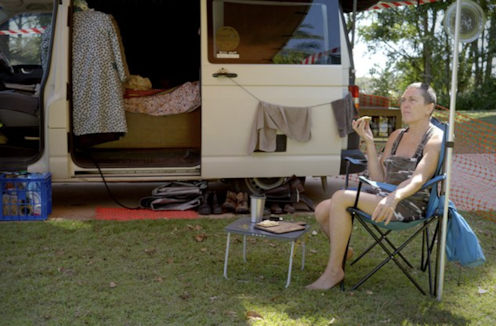
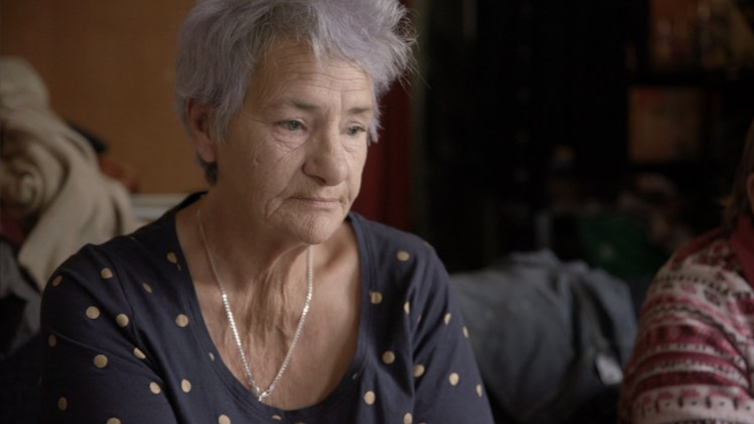
But knowing the statistics is different from witnessing the reality. In Under Cover, filmmaker Sue Thomson depicts the stories of ten older women who have experienced housing insecurity and homelessness. They live in hostels, community housing, their cars, vans, caravan parks.
All have travelled different routes, but leading to each individual experience is a chain of similar factors: taking time off work to care for children, having little or no superannuation, experiencing relationship breakdown that leaves them without money or assets, eviction. For some, additional factors include family violence and the enduring impacts of colonisation.
These women filled the role in society that women are expected to, caring for husbands, elderly parents and children. As one of them points out:
We’ve all done the right things, you know. We got married, we stayed at home, we’ve raised our children.
They feel shock, grief and frustration that, in return for their service, they have ended up here, beyond the edge of poverty. For many, the routine acts of waking and washing, food preparation, seeking an income, maintaining precious belongings, sleeping and staying safe take place in spaces of transience and mobility.
Many of the women say they never thought they would end up homeless; it was something that happened to other people. They are articulate, reflective, everyday women who were blindsided. As one of them says:
I had never ever considered that I would be homeless. Never.
Indeed, in advocating for political change, the film powerfully presents the idea that homelessness can happen to anyone.
The Margot Robbie–narrated documentary Under Cover gives voice to older women who are facing homelessness.
Risks are rising with rental and living costs
The pressures that lead to people becoming homeless are increasing. Rental and living costs are soaring.
Anglicare’s Rental Affordability Snapshot shows rents are more unaffordable than ever before, especially for people on low incomes. Nationally, only 0.7% of listed private rental homes were affordable for a single adult on the aged pension. Only 1.4% were affordable for couples on the aged pension.
An Australian property market geared to make profits, rather than provide housing as a basic human right, is having stark long-term impacts. When the next Census homelessness estimates are released in 2023, it’s likely we will see more older women are at risk of homelessness – and more Australians across all age groups and genders with first-hand experience of not having a home.
Many of the women in Under Cover never thought they would end up being homeless. Under Cover/SA Films
The film highlights some important programs and organisations that are helping homeless women. But, as Margot Robbie’s narration makes clear, non-government organisations cannot do the work without government support.
Currently available social or affordable housing may be located far from women’s social networks and community. They may be given a stable home but at the cost of their sense of belonging.
Significantly more social and affordable housing is needed. This will ensure people have suitable options and don’t have to move long distances to receive shelter. Temporary housing is also necessary but insufficient.
Recent research also assesses innovative housing models for older people. Suggested solutions include co-operative living and shared-equity schemes. These are consistent with the reported aspirations of older Australians who require safe, secure housing to age well. Options include downsizing or “rightsizing” in later life.
Having stable, alternative housing available will help older people who cannot stay in the family home, whether because their relationship breaks down or they never owned property.
More broadly, Australian housing policy needs to understand housing as a human right that is fundamental to people’s wellbeing. Housing should be safeguarded as essential social infrastructure.
Housing needs to be recognised as a human right that is fundamental to people’s wellbeing. Under Cover/SA Films
Other measures to prevent older women from becoming homeless will require policy beyond housing: better parental leave schemes, pay equality, domestic violence responses, closing the superannuation gender gap. In short, it depends on overcoming gender inequality on all levels and scales. These are big tasks, but they must be undertaken for a fair and just society.
Under Cover makes it clear we cannot continue the way we are, or these problems will continue through to the next generations. Today’s young women will be tomorrow’s older homeless women, wondering how on Earth they ended up here. As one woman in the film says:
I couldn’t believe this was me. I couldn’t believe after all these years that I would be in this situation.
People experiencing homelessness are often regarded as invisible, as are olderwomen. Homeless older women may be doubly invisible. But by getting into the specifics of their homelessness, Under Cover brings their experiences into the light.
You can’t make policy about something you can’t (or don’t want to) see. With the federal government’s commitment to national co-ordinated housing policy, and Prime Minister Anthony Albanese’s open discussion of being raised by a single mother in public housing, perhaps there is a fairer Australian housing landscape on the horizon.
A sequel to Under Cover that focuses on “how older women’s housing insecurity and homelessness was solved” would be welcome. In the meantime, government action, supported by research that increases understanding of age, gender and other intertwined vulnerabilities, is badly needed. Also critical are the conversations at kitchen tables, in local neighbourhoods, in workplaces, among friends and in news media that Under Cover will provoke.
Under Cover is screening at the Melbourne International Film Festival until August 20 and is streaming at MIFF Play until August 28.
Zoe Goodall has received funding from the Victorian Government and the Australian Housing and Urban Research Institute (AHURI) and receives an Australian Government Research Training Program Scholarship.
Margaret Reynolds receives funding from the Australian Housing and Urban Research Institute (AHURI) and Housing for the Aged Action Group (HAAG).
Piret Veeroja receives funding from the Australian Research Council (ARC), the Australian Housing and Urban Research Institute (AHURI), Housing for the Aged Action Group (HAAG), Kids Under Cover (KUC) and has previously received funding from Victorian Government.
Wendy Stone receives funding from the Australian Research Council (ARC), the Australian Housing and Urban Research Institute (AHURI), Housing for the Aged Action Group (HAAG), Kids Under Cover (KUC) and has previously received research funding from the Victorian Government.
As bad as it is, Scott Morrison’s surreptitious circumvention of Australia’s parliamentary and Cabinet processes might have got worse.
Had the former prime minister been re-elected, it is reasonable to assume he would have continued to mislead his Cabinet, the parliament and the public after amassing multiple reserve powers.
He may even have extended his undeclared reach, further weakening a gullible Cabinet that had all but surrendered its judgment to him since the so-called “miracle” election win of 2019.
Fronting reporters on Wednesday, Morrison provided no substantial acceptance of wrong-doing, no viable pretext for his secrecy. He also did not provide a reason for his wilful debasement of the principle of collective Cabinet decision-making.
Many voters will now be deeply concerned that Morrison was not dissuaded from his dangerous fantasy by the governor-general, who gave these novel arrangements his imprimatur.
The cost of Morrison’s excess and the governor-general’s apparent incuriosity is a sharp decline in public confidence.
Questions must now be asked about the durability of time-honoured Westminster conventions, as conservatism – the most successful political brand in Australia electorally speaking – succumbs to the same radical urges as like-minded parties abroad.
These questions go to the ease with which Morrison side-stepped usual transparency requirements, which are critical in delimiting executive power.
And they go to the special forms of confidence that bind ministers of the Crown to act honourably. This includes an obligation to resign when that confidence has been compromised.
The case of Resources Minister Keith Pitt highlights this cynical fracture. Pitt’s deliberative ministerial power was superseded by the prime minister, who had secretly acquired the joint commission for his resources portfolio.
This aggressive act amounted to a prime ministerial statement of no-confidence. Ordinarily, that would trigger the minister’s immediate resignation.
Morrison’s treatment of Resources Minister Keith Pitt highlights the cynical fracture of Westminster conventions. Mick Tsikas/AAP
It is worth noting that had Pitt then resigned, the whole issue of Morrison’s phantom cabinet would presumably have been exposed and dealt with at the time.
According to former Howard government minister Amanda Vanstone, knowledge of Morrison’s secret commissions would have prompted censure of the prime minister and possible dismissal.
Beyond the public governance failures of this bizarre controversy lie the wan political responses on the Coalition side. These we can view on the one hand as questions of ideology, and on the other as tactical matters. The latter being calculations over how to limit brand damage and avoid a difficult byelection.
Governing is inevitably a mix of these influences. But how they are balanced when fundamental values are at stake provides a moral health check of a government.
Internally, considerations range from the shallow, such as how to avoid giving the new Labor government a political boost, to deeper judgments about whether the Coalition parties should be seen to prioritise public confidence in the Constitution, the Crown and the primacy of Parliament over their own short-term popularity.
So far, former ministers, with the notable exception of Karen Andrews, have been loath to fully condemn Morrison’s behaviour.
Driven by quotidian image considerations, this spectacular misreading exposes a pervasive nihilism gripping the centre-right.
It reveals that mutually observed Westminster norms specifically designed to vouchsafe good-faith governance have become, like the duplicated ministries of Morrison’s phantom Cabinet, mere guidelines to be obeyed only when they do not inhibit the pursuit and retention of power.
For a stream of political thought quick to invoke flag and country, this breezy subjugation of the national interest to selfish political equities represents an obvious contradiction.
Australian conservatives are hardly unique in this regard. Across the democratic West, disregard for long-agreed ethical and procedural standards has become commonplace as hyper-partisanship and populism supplant foundational tenets of conservatism. These include honour, respect, due process and an insistence that social change should only ever be gradual.
Contemporary conservativism is now more clearly defined by vulgar whatever-it-takes rule-breakers such as Boris Johnson, Donald Trump and Morrison, than by the principled defenders of sober governing norms such as newly disendorsed United States Republican Senator Liz Cheney and Karen Andrews.
Cheney was junked by her Trump-enthralled GOP this week after taking a leading role in the January 6 insurrection hearings. There she declared:
I say this to my Republican colleagues […] there will come a day when Donald Trump is gone, but your dishonour will remain.
Andrews, as one of the ministers secretly duplicated by Morrison, has so far been the only LNP frontbencher to call on Morrison to quit politics, declaring “the Australian people were betrayed”.
I think the actions that he undertook in swearing himself in to numerous portfolios and not disclosing those to the ministers responsible means that he needs to resign and he needs to leave Parliament.
While Nationals Senator Bridget McKenzie has also strongly criticised Morrison’s abuse of Westminster standards, other senior Coalition figures have largely stayed mute or sought to apply narrow binaries to his behaviour.
Former deputy prime minister Barnaby Joyce essentially played down the issue. He told Radio National:
Obviously I don’t agree with the prime minister taking on roles here, there and everywhere, I believe in a cabinet system of government […] but Mr Morrison has not broken any law.
The elevation of Morrison’s former political adviser and one-time chief of staff, Phil Gaetjens, to the role of Secretary of the Department of Prime Minister and Cabinet is a symptom of the tendency to put political considerations above due process.
Morrison’s insistence he acted on advice from his department has to be viewed in this light.
While it is unclear what that departmental advice stated, senior public servants, speaking on the condition of anonymity, confirm PM&C’s Governance Division would almost certainly have advised publicising any new ministerial commissions to ensure public awareness and parliamentary accountability.
That this advice was either not given or not taken as authoritative is of concern.
Even before the scandal, The Australian’s Greg Sheridan wrote, in a piece headlined “Liberals have lost the plot amid global crisis of the right”, that it had become difficult to know what the Coalition parties believed.
An admirably direct critic of the conservative tradition from within, Sheridan describes an “intellectual vacuum across the Australian political right”, calling it the “greatest long-term threat to the Libs and the Nats”.
As shocking at Morrison’s behaviour was, the reluctance of the Coalition parties to unequivocally condemn it may inflict even greater long-term damage to the conservative cause.
Mark Kenny ne travaille pas, ne conseille pas, ne possède pas de parts, ne reçoit pas de fonds d’une organisation qui pourrait tirer profit de cet article, et n’a déclaré aucune autre affiliation que son organisme de recherche.
Astronomers at Western Sydney University have discovered one of the biggest black hole jets in the sky.
Spanning more than a million light years from end to end, the jet shoots away from a black hole with enormous energy, and at almost the speed of light. But in the vast expanses of space between galaxies, it doesn’t always get its own way.
Taking a closer look
At a mere 93 million light-years away, the galaxy NGC2663 is in our neighbourhood, cosmically speaking. If our galaxy were a house, NGC2663 would be a suburb or two away.
Looking at its starlight with an ordinary telescope, we see the familiar oval shape of a “typical” elliptical galaxy, with about ten times as many stars as our own Milky Way.
The radio waves reveal a jet of matter, shot out of the galaxy by a central black hole. This high-powered stream of material is about 50 times larger than the galaxy: if our eyes could see it in the night sky, it would be bigger than the Moon.
While astronomers have found such jets before, the immense size (more than a million light years across) and relative closeness of NGC2663 make these some of the biggest known jets in the sky.
So, what did we see, when the precision and power of ASKAP got a “close-up” (astronomically speaking!) view of an extragalactic jet?
This research is led by doctoral student Velibor Velović of Western Sydney University, and has been accepted for publication in the journal Monthly Notices of the Royal Astronomical Society (preprint available here). Our Evolutionary Map of the Universe (EMU)
survey sees evidence of the matter between galaxies pushing back on the sides of the jet.
This process is analogous to an effect seen in jet engines. As the exhaust plume blasts through the atmosphere, it is pushed from the sides by the ambient pressure. This causes the jet to expand and contract, pulsing as it travels.
As the image below shows, we see regular bright spots in the jet, known as “shock diamonds” because of their shape. As the flow compresses, it glows more brightly.
Black hole jets from NGC2663 compared to a jet engine. Top image: observations from the ASKAP radio telescope. Bottom: a methane rocket successfully being tested in the Mojave Desert. Note the patterns of compression ( Mike Massee/XCOR, used with permission, Author provided
Biggest one yet
As well as in jet engines, shock diamonds have been seen in smaller, galaxy-sized jets. We’ve seen jets slam into dense clouds of gas, lighting them up as they bore through. But jets being constricted from the sides is a more subtle effect, making it harder to observe.
However, until NGC2663, we’ve not seen this effect on such enormous scales.
This tells us there is enough matter in the intergalactic space around NGC2663 to push against the sides of the jet. In turn, the jet heats and pressurises the matter.
This is a feedback loop: intergalactic matter feeds into a galaxy, galaxy makes black hole, black hole launches jet, jet slows supply of intergalactic matter into galaxies.
These jets affect how gas forms into galaxies as the universe evolves. It’s exciting to see such a direct illustration of this interaction.
The EMU survey, which is also responsible for identifying a new type of mysterious astronomical object called an “Odd Radio Circle”, is continuing to scan the sky. This remarkable radio jet will soon be joined by many more discoveries.
As we do, we’ll build up a better understanding of how black holes intimately shape the galaxies forming around them.
Ray Norris is affiliated with CSIRO, who own and operate the ASKAP telescope.
Luke Barnes, Miroslav Filipovic, and Velibor Velović do not work for, consult, own shares in or receive funding from any company or organisation that would benefit from this article, and have disclosed no relevant affiliations beyond their academic appointment.
It was the friendliness of Fijians that led educator Hiroshi Taniguchi to give up his Japanese citizenship and make Fiji his home.
The 50-year-old is a National Federation Party (NFP) provisional candidate for the 2022 general election.
He moved to Fiji in 2004 and then established the Freebird Institute in the Western Division in 2014, now one of the biggest language institutes in Fiji.
The institute has educated more than 15,000 students from 29 countries since its establishment.
It is listed in the South Pacific Stock Exchange.
“The first time I came to Fiji was in 2002,” Taniguchi said.
“I hung around with locals, they invited me for breakfast, lunch and dinner.
Fiji ‘the place for me’ “During my stay in Fiji, I only spent my money twice to buy food because everywhere I went they invited me to eat with them.
“I had never seen anything like this, and I knew that Fiji was the place for me.
“For 18 years now I’ve been living in Fiji and I have never regretted anything.
“I didn’t feel like I sacrificed my Japanese citizenship because, to be honest, I am enjoying being a Fijian.
“Now I have to apply for a visa if I want to visit my friends or family in Japan.”
Taniguchi said the Japanese government did not allow dual citizenship.
He is originally from Obama City, located close to Japan’s old capital, Kyoto.
He was educated at Tongji University, China, where he studied a major in applied physics.
One of China’s earliest national universities, it is located in Shanghai City and dates back to 1907.
Fluent in Chinese Taniguchi worked in Hong Kong, Thailand, Europe and Japan before settling in Fiji.
“I am fluent in Chinese because I spent four years studying in China where I studied physics so I’m more of a science man.
“I even have a telescope tent. I love science and I am also businessman.”
If he wins in the general elections, Taniguchi said he would change the education system and work culture.
“The biggest problem in any country is nepotism, I think it is part of the culture in Fiji, and people express their love by giving their relatives or friends opportunities.
“To love each other is a very beautiful thing but when it comes to running a company or civil service, people should be appointed according to merit.
“I really want to change this country with my ideas that uplift the standard of education and civil service and take it to another level.”
He said he chose NFP because he believed that it was the only political party that could work with other parties to uplift the standard of service in Fiji.
“During the general election, I don’t want to sell my face,” he said.
“It is my ideas that I want to tell people.”
Arieta Vakasukawaqais a Fiji Times reporter. Republished with permission.
The office of the Tahitian president says it wants to honour the memory of Bruno Barrillot who was the head of French Polynesia’s organisation looking at the aftermath of France’s nuclear weapons tests.
The office says it wants to mark the sixth anniversary of Barrillot’s return from France to French Polynesia.
He died less than a year later, shortly before his 77th birthday.
In 2013, Barrillot was sacked by the newly-elected government led by Gaston Flosse, which objected to funding his agency.
His dismissal was widely condemned because he was considered to be the most knowledgeable person about the French tests.
The test veterans’ organisation Moruroa e Tatou said he was pursued by a “vengeful hatred” that did no justice to the government.
Military sites Moruroa, Hao In 2016, the government reinstated him — three years after the Flosse sacking.
Barrillot’s duties included work on the rehabilitation of the former test-related military sites on Moruroa and Hao as well as assisting in efforts to amend the French nuclear testing compensation law.
In 1984, Barrillot, a French-born priest, founded the NGO Arms Observatory and after the French sinking of the Greenpeace flagship Rainbow Warrior in July 1985 he focused on the damage caused by the nuclear tests in the Pacific.
He was also the co-founder of French Polynesia’s nuclear test veteran organisations.
This article is republished under a community partnership agreement with RNZ.
If you think about “unravelling the mysteries of the universe”, you probably think of physics: astronomers peering through telescopes at distant galaxies, or experimenters smashing particles to smithereens at the Large Hadron Collider.
When biologists try to unravel deep mysteries of life, we too tend to reach for physics. But our new research, published in Science, shows physics may not always have the answers to questions of biology.
For centuries scientists have asked why, kilo for kilo, large animals burn less energy and require less food than small ones. Why does a tiny shrew need to consume as much as three times its body weight in food each day, while an enormous baleen whale can get by on a daily diet of just 5-30% of its body weight in krill?
While previous efforts to explain this relationship have relied on physics and geometry, we believe the real answer is evolutionary. This relationship is what maximises an animal’s ability to produce offspring.
How much do physical constraints shape life?
The earliest explanation for the disproportionate relationship between metabolism and size was proposed nearly 200 years ago.
In 1837, French scientists Pierre Sarrus and Jean-François Rameaux argued energy metabolism should scale with surface area, rather than body mass or volume. This is because metabolism produces heat, and the amount of heat an animal can dissipate depends on its surface area.
In the 185 years since Sarrus and Rameaux’s presentation, numerous alternative explanations for the observed scaling of metabolism have been proposed.
Arguably the most famous of these was published by US researchers Geoff West, Jim Brown and Brian Enquist in 1997. They proposed a model describing the physical transport of essential materials through networks of branching tubes, like the circulatory system.
They argued their model offers “a theoretical, mechanistic basis for understanding the central role of body size in all aspects of biology”.
Living organisms cannot defy the laws of physics. Yet evolution has proven to be remarkably good at finding ways to overcome physical and geometric constraints.
In our new research, we decided to see what happened to the relationship between metabolic rate and size if we ignored physical and geometric constraints like these.
So we developed a mathematical model of how animals use energy over their lifetimes. In our model, animals devote energy to growth early in their lives and then in adulthood devote increasing amounts of energy to reproduction.
Animals allocate more energy to reproduction after they reach maturity. Craig White
We used the model to determine what characteristics of animals result in the greatest amount of reproduction over their lifetimes – after all, from an evolutionary point of view reproduction is the main game.
We found that the animals that are predicted to be most successful at reproducing are those that exhibit precisely the kind of disproportionate scaling of metabolism with size that we see in real life!
This finding suggests disproportionate metabolic scaling is not an inevitable consequence of physical or geometric constraints. Instead, natural selection produces this scaling because it is advantageous for lifetime reproduction.
The unexplored wilderness
In the famous words of Russian-American evolutionary biologist Theodosius Dobzhansky, “nothing makes sense in biology except in the light of evolution”.
Our finding that disproportionate scaling of metabolism can arise even without physical constraints suggests we have been looking in the wrong place for explanations.
Physical constraints may be the principal drivers of biological patterns less often than has been thought. The possibilities available to evolution are broader than we appreciate.
Why have we historically been so willing to invoke physical constraints to explain biology? Perhaps because we are more comfortable in the safe refuge of seemingly universal physical explanations than in the relatively unexplored biological wilderness of evolutionary explanations.
Craig White receives funding from The Australian Research Council.
Dustin Marshall receives funding from the Australian Research Council.
Will climate action undermine Australia’s democracy? This question might not be as outlandish as it seems.
A recent investigation details a campaign by the car industry to have its (low) voluntary standards on fuel efficiency legislated into national standards. This campaign fits into a broader pattern of lobbying by the fossil fuel industry to hinder effective climate action and highlights the importance of democratic integrity in addressing the climate crisis as well as the urgent need for robust regulation of lobbying.
The fossil fuel lobby and climate inaction
University of Melbourne professor Ross Garnaut has observed that “(e)missions-intensive industries have invested heavily to influence climate change policy since the early days of discussion of these issues”.
We see the influence of these investments in various ways:
the $22 million advertising campaign by mining companies against the Rudd government’s resource super profits tax was such a success that it’s now become routine for industry groups to threaten a “mining tax style campaign” every time they don’t get their way with government
Marian Wilkinson’s book The Carbon Club provides a compelling account of how a network of climate-science sceptics, politicians and business leaders brought about decades of climate inaction in Australia.
Under the Howard government, climate change policy was determined by fossil fuel lobbyists who likened themselves to organised crime through a self-styled label — the greenhouse mafia.
The group has contributed to the outsized role the fossil fuels industry has in steering government policy. Perhaps most importantly, fossil fuel companies have played an instrumental role in ousting two out of the six prime ministers Australia has had since 2007; Kevin Rudd and Malcolm Turnbull.
The term, “policy capture” is described by the OECD to mean when public decisions over policies are consistently directed away from the public interest towards a specific interest, leading to inequalities and undermining democratic values, economic growth, and trust in government. The use of the phrase in this context has a certain validity.
The lobbying risks of climate action
Paradoxically, the risks associated with fossil fuel lobbying increase with higher levels of climate action.
Effective climate change policies will mean increased regulation of fossil fuel industries. AP
Effective climate action will mean increased regulation of fossil fuel industries, such as more stringent emission standards for the largest greenhouse emitters under the ALP’s Powering Australia plan. Under the plan, substantial amounts of public funds will go towards climate action.
As a result, the fossil fuel industries and other sections of the community will naturally seek to influence government climate decisions. That in itself is not undemocratic – fossil fuel industries have a legitimate role in influencing government policy.
However, what is undemocratic is their disproportionate influence and how it is often wielded behind closed doors.
The secrecy and lack of integrity around fossil fuel lobbying stems directly from the shortcomings of federal lobbying regulation. This lack of transparency also includes:
lobbying coverage that has been confined to commercial lobbyists, who only comprise 20% of the lobbyist population, excluding other “repeat players” such as in-house lobbyists
Dismal disclosure obligations that require only the name and contact details of the lobbyist and the client they are representing. There is a vacuum of knowledge about when lobbyists are contacting government officials and over what issues.
Enforcing violations is also a huge concern. In 2018, the Commonwealth Auditor-General found the Department of the Prime Minister and Cabinet, which oversaw the federal lobbyist register, did not take any action against lobbyists despite identifying at least 11 possible breaches.
Three essential reforms will make federal lobbying regulation more effective, while also assisting with effective climate action.
First, coverage under federal lobbying regulation should extend to both commercial lobbyists and in-house lobbyists. Following the NSW Independent Commission Against Corruption’s (ICAC) Operation Eclipse, the NSW government will implement lobbying laws that will regulate these two classes of lobbyists (as is done in Canada and the United States).
Second, there should be greater transparency of lobbying activity by requiring:
ministers, senior ministerial advisers and senior public servants to provide monthly disclosures of who has contacted them and why. Currently, Queensland discloses ministerial diaries, while NSW will disclose diaries of ministers and MPs
the establishment of an independent regulator or commissioner to regularly monitor and take action in these matters if needed, such as the NSW government has committed to do.
Safeguarding democracy is imperative in the climate crisis and to the functioning of government overall. Robust lobbying regulation is an essential measure to ensure that all are protected.
Joo-Cheong Tham has received funding from the NSW Independent Commission Against Corruption for the discussion paper for Operation Eclipse and is a Director of the Centre for Public Integrity. He has also received funding from the Australian Research Council, the Australian Council of Trade Unions, European Trade Union Institute and International IDEA. and is a national councillor and Victorian division assistant secretary (academic staff)-elect of the National Tertiary Education Union.
Yee-Fui Ng has received funding from the NSW Independent Commission Against Corruption for writing the discussion paper for Operation Eclipse.
Source: The Conversation (Au and NZ) – By Dominic O’Sullivan, Adjunct Professor, Faculty of Health and Environmental Sciences, Auckland University of Technology and Professor of Political Science, Charles Sturt University
Crisis is a word often used in politics and the media – the COVID crisis, the housing crisis, the cost of living crisis, and so on. The term usually refers to single events at odds with common ideas of what’s acceptable, fair or good.
But in New Zealand, Australia and elsewhere, Indigenous policy can be portrayed as a different kind of crisis altogether. Indeed, it can often just seem like one crisis after another, one policy failure after another: poor health, poor education, all kinds of poor statistics. A kind of permanent crisis.
It may be that crisis makes better headlines. But we also need to ask why, and what the deeper implications might be for Indigenous peoples and policy in Aotearoa New Zealand and Australia.
Sharing the sovereign? The Australian Aboriginal flag and Australian national flag fly above Sydney harbour bridge. GettyImages
Colonialism as crisis
Last month I published a journal article titled “The crisis of policy failure or the moral crisis of an idea: colonial politics in contemporary Australia and New Zealand”. In it I argue that when public services don’t work well for Indigenous peoples, the explanation does not just come down to isolated examples of policy failure.
The solution is not that governments simply get better at making policy. Instead, colonialism itself is what I call “the moral crisis of an idea”.
[Governments] perpetuated an ingrained way of thinking, passed down over two centuries and more, and it was the belief that we knew better than our Indigenous peoples. We don’t. We also thought we understood their problems better than they did. We don’t. They live them.
Morrison was describing a problem with the way the system ordinarily works. Yet a crisis is supposed to be something out of the ordinary, something that needs fixing. How, then, do we fix an idea?
Listening, reflection and justification
Colonialism presumes a moral hierarchy of human worth. It presumes Indigenous people shouldn’t have the same influence over public decision making as others (for example, ensuring a hospital or school works in their favour).
The democratic theorist John Dryzek says there is a crisis of communication in modern democracy. This is because people understate the importance of listening, reflection and justification in public decision making.
Colonialism, however, doesn’t require listening, reflection or justification. Its essential idea is that some people just aren’t as entitled as others to a meaningful say in public policy.
Entrenching listening, reflection and justification in the workings of democratic politics would support different and non-colonial aspirations. This is something I have called “sharing the sovereign” in my 2021 book of the same name.
Sharing the sovereign
Sharing the sovereign means recognising many sites of decision-making authority. This is the point of the treaties being considered in Victoria, the Northern Territory and Queensland. It’s also the point of Te Tiriti o Waitangi/the Treaty of Waitangi in Aotearoa New Zealand.
Te Tiriti affirmed the Māori right to authority (rangatiratanga) over their own affairs. It also conferred on Māori the rights and privileges of British subjects, which continue to evolve as New Zealand citizenship. This was the right to influence the affairs of the new state – the right to be part of the new state in a meaningful way.
Successive Waitangi Tribunal reports show that crisis in Māori policy occurs when these two simple ideas of independent authority and meaningful participation in the state are absent.
In Australia, the Victorian Treaty Assembly says: “Treaty is a chance to address [the] future together as equals”. The idea of an Indigenous voice to parliament, which the new Australian government is supporting, is also a step towards sharing the sovereign among all citizens.
In Aotearoa New Zealand, sharing the sovereign would mean the Crown is not, in the words of the first Maori judge of the Supreme Court, Justice Joe Williams, “Pakeha, English-speaking, and distinct from Māori”.
Political equality then becomes possible because the sovereign is not an ethnically exclusive entity. It’s not an all-powerful authority over which Indigenous people should not expect any real influence.
Equality through inclusivity is fundamentally different from colonialism and its inherent moral crisis. Equality and inclusivity make different assumptions about what the state is and to whom it belongs.
However, normalising public institutions to work for Indigenous peoples as well as they work for anyone else is still a contested idea. In 2019, for example, the New Zealand cabinet instructed public servants on the questions they should consider when advising ministers on Treaty/Tiriti policy.
On one hand, cabinet affirmed Māori influence in the policy process. On the other, it didn’t consider the possibility that governments might sometimes stand aside entirely in the making of effective and fair public policy. So, cabinet didn’t require advisers to ask questions such as:
Why is the government presuming to make this decision?
And why does the decision not belong (partly or entirely) to the sphere of tino rangatiratanga (self-determination, sovereignty)?
Asking these kinds of questions involves sharing the sovereign. They presume listening, reflection and justification to put colonialism, as the moral crisis of an idea, under permanent scrutiny.
Dominic O’Sullivan does not work for, consult, own shares in or receive funding from any company or organisation that would benefit from this article, and has disclosed no relevant affiliations beyond their academic appointment.
When a comic about “mental load” went viral in 2017, it sparked conversations about the invisible workload women carry. Even when women are in paid employment, they remember their mother-in-law’s birthday, know what’s in the pantry and organise the plumber. This mental load often goes unnoticed.
This burden has been exacerbated over the recent pandemic (homeschooling anyone?), leaving women feeling exhausted, anxious and resentful.
As sexuality researchers, we wondered, with all this extra work, do women have any energy left for sex?
We decided to explore how mental load affects intimate relationships. We focused on female sexual desire, as “low desire” affects more than 50% of women and is difficult to treat.
Our study, published in the Journal of Sex Research, shows women in equal relationships (in terms of housework and the mental load) are more satisfied with their relationships and, in turn, feel more sexual desire than those in unequal relationships.
Low desire is tricky to explore. More than simply the motivation to have sex, women describe sexual desire as a state-of-being and a need for closeness.
Adding to this complexity is the fluctuating nature of female desire that changes in response to life experiences and the quality of relationships.
Relationships are especially important to female desire: relationship dissatisfaction is a top risk factor for low desire in women, even more than the physiological impacts of age and menopause. Clearly, relationship factors are critical to understanding female sexual desire.
As a way of addressing the complexity of female desire, a recent theory proposed two different types of desire: dyadic desire is the sexual desire one feels for another, whereas solo desire is about individual feelings.
Not surprisingly, dyadic desire is intertwined with the dynamics of the relationship, while solo desire is more amorphous and involves feeling good about yourself as a sexual being (feeling sexy), without needing validation from another.
Assessing the link
Our research acknowledged the nuances of women’s desire and its strong connection to relationship quality by exploring how fairness in relationships might affect desire.
The research involved asking 299 Australian women aged 18 to 39 questions about desire and relationships.
These questions included assessments of housework, mental load – such as who organised social activities and made financial arrangements – and who had more leisure time.
We compared three groups:
relationships where women perceived the work as equally shared equal (the “equal work” group)
when the woman felt she did more work (the “women’s work” group)
when women thought that their partner contributed more (the “partner’s work” group).
We then explored how these differences in relationship equity impacted female sexual desire.
The findings were stark. Women who rated their relationships as equal also reported greater relationship satisfaction and higher dyadic desire (intertwined with the dynamics of the relationship) than other women in the study.
Unfortunately (and perhaps, tellingly), the partner’s work group was too small to draw any substantial conclusions.
However, for the women’s work group it was clear their dyadic desire was diminished. This group was also less satisfied in their relationships overall.
Women who perceived they did more work in the relationship felt less sexual desire. Lucaxx Freire/Unsplash
We found something interesting when turning our attention to women’s solo desire. While it seems logical that relationship inequities might affect all aspects of women’s sexuality, our results showed that fairness did not significantly impact solo desire.
This suggests women’s low desire isn’t an internal sexual problem to be treated with mindfulness apps and jade eggs, but rather one that needs effort from both partners.
Other relationship factors are involved. We found children increased the workload for women, leading to lower relationship equity and consequently, lower sexual desire.
Relationship length also played a role. Research shows long-term relationships are associated with decreasing desire for women, and this is often attributed to the tedium of over-familiarity (think of the bored, sexless wives in 90s sitcoms).
However our research indicates relationship boredom is not the reason, with the increasing inequity over the course of a relationship often the cause of women’s disinterest in sex.
The longer some relationships continue, the more unfair they become, lowering women’s desire. This may be because women take on managing their partner’s relationships, as well as their own (“It’s time we had your best friend over for dinner”).
And while domestic housework may start as equally shared, over time, women tend to do more household tasks.
However, we found the same link between equity and desire for women in same-sex relationships, although it was much stronger for heteronormative couples.
A sense of fairness within a relationship is fundamental to all women’s satisfaction and sexual desire.
What happens next?
Our findings suggest one response to low desire in women could be to address the amount of work women have to take on in relationships.
The link between relationship satisfaction and female sexual desire has been firmly established in previous research but our findings explain how this dynamic works: women’s sense of fairness within a relationship forecasts their contentment, which has repercussions on their desire for their partner.
To translate our results into clinical practice, we could run trials to confirm if lowering women’s mental load results in greater sexual desire.
We could have a “housework and mental load ban” for a sample of women reporting low sexual desire and record if there are changes in their reported levels of desire.
Or perhaps women’s sexual partners could do the dishes tonight and see what happens.
The authors do not work for, consult, own shares in or receive funding from any company or organisation that would benefit from this article, and have disclosed no relevant affiliations beyond their academic appointment.
Hearts sank along the Australian east coast this week when the Bureau of Meteorology announced a third consecutive La Niña was likely this year. La Niña weather events typically deliver above-average rainfall in spring and summer.
But the last two La Niñas mean our catchments are already full. Dams are at capacity, soils are saturated and rivers are high. In some cases, there’s nowhere for the rains to go except over land.
Over the past 18 months, many communities have been hit by floods – some more than once. For these residents, the prospect of a third La Niña will be extremely concerning. And some people who’ve never experienced floods may now be at risk.
Our current research project is examining the experiences of flood-hit communities in New South Wales and Queensland – and our interviews have already yielded useful insights. So let’s take a look at what we should be thinking about now as another wet summer looms.
Water isn’t always fun
Floods are among the deadliest natural hazards in Australia. Yet in Australian culture, water often equates to fun. From a young age we’re taught to swim, enjoy and “master” the dangers that water poses.
So during floods we often see risky behaviours such as driving and playing in dangerous water.
Recent floods, however, brought home the reality of the threat. Few could forget images of frightened families being winched off roofs by helicopter, water rushing from spilling dams and everyday people rescuing their neighbours.
The NSW government on Thursday released an independent report into this year’s floods. It examined flooding from February to April and again in July – mostly around the Northern Rivers, Sydney’s Hawkesbury-Nepean and the central to north coasts.
The report contained troubling statistics, including:
nine people tragically died
7,700 people sought emergency accommodation
14,600 homes were damaged
5,300 homes were left uninhabitable.
Releasing the report, NSW Premier Dominic Perrottet said up to 40,000 Western Sydney residents risked flood evacuation by 2040, if flood conditions similar to those in July were repeated and no mitigation action was taken.
The inquiry revealed a central theme: the need for a renewed and stronger emphasis on sustained disaster preparedness. Otherwise, as the report noted, the emergency response becomes harder:
Preparedness is discussed in relation to emergency management and our natural and built environment. But an important component of preparedness is at a personal or family level. Failure to prepare at this level makes preparations at other levels more difficult and expensive.
Failing to prepare for floods can bring make the emergency response harder. Jason O’Brien/AAP
‘Don’t worry. Your house won’t get wet’
Our current research is examining the experiences of those affected by this year’s floods to gather insights on preparedness and response. Participants can take part in an interview, a survey or both.
Our interviews are already providing useful insights. They include the possibility that prior experience of flood, and the well-meaning reassurances of others, can hinder preparations. As one respondent said:
the house, having been built on a mound, has never been flooded and that’s why my neighbour said, ‘Don’t worry. Your house won’t get wet. It’s never got wet in 70 years’. But this was unprecedented.
With another wet summer likely, interviewees are starting to see major flooding as a “new normal” rather than a once-in-a-lifetime experience. This is causing them to question the future of their communities. As another respondent told us:
that’s the part that I’m struggling with now is that it feels like it’s unviable to live here because there’s no security, and when you take away people’s security, your life tends to unravel.
We hope our research will influence policy and practice on flood preparation, community engagement and risk messaging, and shed light on more permanent changes required.
The authors hope their work will influence policy and practice on flood preparation. Tracey Nearmy/AAP
Be prepared
So what should you do if flooding is forecast and you need to evacuate? Here’s what experts recommend:
identify the safest route to your nearest safe location and leave well before roads flood
move vehicles, valuables, outdoor equipment, garbage and poisons to higher locations
enact safety plans for pets and other animals
take medications and identification with you
tell friends, family and neighbours of your plans
know where to go for information. Monitor alerts and stay aware of changing situations
keep your mobile phone charged and have at least half a tank of fuel in your vehicle
turn off electricity, gas, and water at the mains before you leave.
Of course, flood preparation should not be left until the last minute. Now is a good time to think about what might happen in the months ahead. Things you can do now include:
clean up outside and inside, move or secure items that could float or create a hazard
move valued possession to higher places in your home
pack an emergency bag and keep it at the ready
consider which friends or family you might stay with if needed.
For further advice, head to the website of your state’s emergency service agencies.
Thinking long-term
Climate change will exacerbate floods and other natural disasters. Communities must be supported to prepare as best they can.
More permanent measures are also needed, such as land buybacks to move people out of flood-prone areas. And importantly, planning systems must ensure we don’t keep building on floodplains.
Our approach to disaster readiness will continue to change. Already, experts are providing advice on matters such as emotional preparedness and recovery in the aftermath.
One thing is clear: in the face of the increasing disaster threat, temporary and seasonal preparations are no longer enough.
Clueless actor Alicia Silverstone recently told a podcast she co-sleeps with her 11-year-old son, explaining she is “just following nature”.
“Bear and I still sleep together,” she told The Ellen Fisher Podcast last month. “I’ll be in trouble for saying that, but I really don’t care.”
As Silverstone predicted, a backlash followed. Fans accused her of “ruining” her child, while others called it “creepy”. One psychologist said it would create “boundary issues”.
I am a psychologist who directs a clinic specialising in sleep difficulties in children from birth to 18 years. I am also a researcher in paediatric sleep. I have seen first-hand the strong opinions people have about parents co-sleeping (or not) with their children.
While we need to be mindful of safety and SIDS when co-sleeping with infants, there is no problem with co-sleeping with older children in and of itself.
How common is co-sleeping?
Co-sleeping, like many aspects of parenting, is often the subject of vehement disagreements.
While proponents argue it nurtures the parent-child attachment, reduces children’s anxiety and helps children sleep, critics say it stunts a child’s independence and disrupts parents’ sleep and intimacy.
But it is more common than people may realise and is under-reported. I have found in my work that before their child is born, parents often say they don’t want to co-sleep, but often end up doing it over time.
Data of rates of co-sleeping in school-age children in western countries are scarce. But recent studies show in China, 25% of pre-adolescents co-sleep. In Brazil up to 47% of school-aged children sleep in their parents’ bed at least sometimes, while 30% of school-aged children co-sleep in Italy.
Why do western countries frown on co-sleeping?
In western societies, the idea that children should sleep on their own only emerged during the 19th century.
Before this, the communal house and communal bedroom, shared by siblings and parents, was the norm (and still is in many societies).
But with the emergence of nuclear families in Victorian times came the need for increased discipline with children who were independent from their parents. Bedrooms were “privatised” and sleeping alone was thought to instil self-regulation in children.
Co-sleeping was also seen as something “poor people” did, as wealthier families could afford a bed for each child.
By the early 20th century, there were fears over-indulgent parenting styles would spoil children and co-sleeping became synonymous with raising lazy, difficult children.
What does the research say?
As social animals, children are not biologically primed to sleep alone. This is something they often need to learn with support from a parent or other trusted adult. Gaining the confidence and resilience to sleep alone is not a given and some children, especially sensitive or anxious children, need more time and assistance.
There is no scientific time frame in which this needs to occur, only societal expectations. Indeed, research confirms supporting and nurturing a sensitive child while learning to sleep alone (if necessary or desired) is more effective than forcing them to sleep alone.
One of the key arguments against co-sleeping is that, children who co-sleep become more dependent on their parents both at sleep time and also in general. It is viewed as a bad habit that will be difficult to break.
Parents may be warned “once a co-sleeper always a co-sleeper”. The research does not support this claim.
In fact, research shows that while co-sleeping may result in a temporary dependence on a parent, in the longer term it results in a child who is more resilient, gaining the skill of solo sleeping when they are more able to cope.
A child who co-sleeps also does not necessarily continue to co-sleep. As they get older, sleeping alone is often simultaneous with increasing independence. Similar to all other learned habits in older children such as dressing and tidying their rooms, children will not always need their parents to do it for them, and when parents deem this appropriate they can be taught and guided to do it themselves.
There is no guideline for an age when co-sleeping should be stopped or started, just as there is no guideline for when comfort toys should be kept or discarded.
These factors are largely driven by societal expectations and parents’ own choice (which is of course, is influenced by society).
Worried your kids are ‘too old’ for co-sleeping?
If parents are enjoying co-sleeping with their children but think they “should” stop, keep these points in mind:
co-sleeping has a bad reputation. There are social myths that co-sleeping is “bad” and it develops inappropriate daytime or night-time behaviours, dependency on parents and bad habits for life. But co-sleeping does not have negative outcomes in an of itself
if your child is co-sleeping consider the reasons they doing this. Is it due to anxiety, sensitivity or sleep disturbance? If so, these can be effectively treated by a professional
maybe you just like co-sleeping. As long as there are no obligations – both parties are doing it because they want to – there is no issue
both parent and child can stop co-sleeping when they want. Co-sleeping is a learned behaviour, and can be unlearned at any time. Child psychologists and some GPs are increasingly offering interventions to get children used to sleeping alone, and offer parenting strategies to help this happen in a child friendly and supportive way.
Sarah Blunden does not work for, consult, own shares in or receive funding from any company or organisation that would benefit from this article, and has disclosed no relevant affiliations beyond their academic appointment.
BeReal hit the social networking scene in late 2019 but didn’t take off until downloads started skyrocketing in 2022. So, what is BeReal all about, and is it here to stay?
BeReal is based in France and was founded by Alexis Barreyat in December 2019. At this stage, it doesn’t feature any paid advertising and is funded by venture capital. Although the big names such as TikTok, YouTube and Instagram still dominate global social networking popularity rankings, BeReal’s rapid growth has grabbed attention this year.
The platform works by sending one randomly timed notification per day to users and gives them two minutes to take simultaneous photos with the front and back cameras on their phone and share it with friends. Users cannot manipulate the timing of the notification and it’s sent at the same time to every global user.
BeReal mandates no filters, no editing, no followers (except friends), and no cheating.
Although users can delay their daily photo, friends will see that the post was late and how many photo attempts were made. On the App Store, the company says “BeReal is your chance to show your friends who you really are, for once”.
Reality and gamification
But the risk here is that reality can be boring. To combat this, BeReal has employed several gamification strategies to keep users engaged.
Gamification is the application of game elements in non-gaming contexts, which means the fun parts of games can be applied to other things, including social media. BeReal uses scarcity (limiting users to one post per day) and mystery (users don’t know ahead of time when the notification will appear) to hook users. And like Snapchat, photos disappear after 24 hours. Disappearing media can be an incredibly effective motivator – users check the app regularly because they don’t want to miss out.
If you’ve ever known the devastation of losing a Snapchat streak, you understand how gamification can emotionally engage us. But the trade-off is that gamification strategies can also be addictive.
So, although BeReal is trying to move away from some of the negative cultures (and endless scrolling) that have developed around platforms like Instagram, users could still end up frustrated and tied to their phones, waiting for the daily notification.
Despite potential frustrations, people are nevertheless flocking to BeReal.
BeReal’s growth in 2022 has largely been driven by its college ambassador program in the United States and United Kingdom, where college students are recruited as paid ambassadors for the brand, and BeReal’s ethos appears to be resonating with users.
In an age when the Instagram algorithm requires some serious strategy to navigate, and influencer culture is dominant, some young people are searching for a different and more authentic online experience. Tired of finding the perfect light or event for an Instagram post, sharing random daily moments on BeReal can be liberating.
Steph, a 27-year-old BeReal user and full-time marketing officer, said that sometimes when she sees her friends’ photos on the app, “it’s nice reassurance that I’m not the only one who sits at home and does nothing”. She gestures to the validation that social media users seek (consciously or unconsciously), and her relief in knowing “it’s not just me”.
Does BeReal have staying power?
Steph explains that although the app has been fun to experiment with, some features can be annoying, such as notifications that pop up in the middle of the night, and difficulty in framing both photos because you can only see one view at a time. “I have a feeling this app may not last,” she said.
Reviews on the App Store and Google Play reveal users who love the concept of the app but have been frustrated by technical issues. It’s a promising sign that developers have been responsive to these reports, but fixing bugs is just one of several challenges BeReal faces.
For long-term viability, BeReal needs to consider how advertising or other commercial partnerships will appear on the app, and the impact these might have on user experience. Competitors also have their eyes keenly trained on BeReal.
In July 2022, Instagram Dual was launched, which allows users to snap photos with their phone’s front and back cameras simultaneously on Reels. Although this feature alone doesn’t copy the complete BeReal experience, it’s likely only the beginning of competitor pressure.
Perhaps the biggest question is, are our daily unfiltered and unedited lives too mundane to keep us coming back for more?
Emily Wade does not work for, consult, own shares in or receive funding from any company or organisation that would benefit from this article, and has disclosed no relevant affiliations beyond their academic appointment.
It’s not breaking news that Scott Morrison has trouble with women. His “woman problem” was one factor in his election defeat.
But really, his treatment this week of Karen Andrews, his former home affairs minister, was particularly gratuitous.
By Tuesday Morrison had contacted Mathias Cormann and Josh Frydenberg (both now out of parliament) to apologise personally for failing to tell them he was wading into their portfolios, unannounced.
It took until Thursday morning, after Andrews had said on TV that she hadn’t heard from him and Peter Dutton had publicly told him to contact her, for Morrison to finally get in touch.
Didn’t he think Andrews, who is shadow home affairs minister, deserved the same courtesy as the former finance minister and former treasurer?
If Morrison had called on Tuesday he certainly could have received an earful. Andrews was declaring he should quit parliament.
The Morrison affair might be about events in the past, but controversy around him will continue to flare, burning the opposition.
The former PM affirmed at his train-wreck Wednesday news conference that he would remain in parliament as “a quiet Australian […] doing my job as a local member”.
He’ll be a pariah in the party room, and a lightning rod for trouble for the Liberals. Fast forward and another book will be published in December, Bulldozed by journalist Niki Savva, a trenchant critic of Morrison. It will bring more stories and bad publicity.
Coalition members are acutely aware of the harm his continuing presence will do them. While most may be shy of saying publicly that he should leave, their blunt criticisms indicate the mood. Anger has deepened during the week.
But Morrison doesn’t have an alternative job. And there’s the question of a byelection.
Maybe his friends could help with the job search. The byelection is a weighing of downsides. Which would be worse: Morrison remaining in full target range or the hazards and cost of a Cook contest?
If he could be persuaded to go soon – as he is expected to do at some stage in the term – it would benefit the Dutton opposition.
There was a substantial swing against him in Cook at the election but he ended with a hefty 62.44% of the two-party vote.
We see some huge swings in byelections these days, as when former NSW premier Gladys Berejiklian resigned (although her seat was retained). But Cook would be hard for Labor or a high-profile independent to win, and Liberal sources believe it would be held. The Liberals could benefit if they ran a credible local female candidate. (She could campaign on “Solving the woman problem” – just joking.)
The NSW Liberals, facing a March election, wouldn’t welcome an expensive federal byelection. But they’ve got bigger problems and the horror publicity around Morrison is unhelpful to the Liberal brand generally.
Having enjoyed days of political free kicks, the Albanese government is mulling its next steps as it awaits advice, due on Monday, from the Solicitor-General on the legality of Morrison’s actions.
Separately, Morrison’s failure to inform parliament he’d had himself appointed to multiple ministries could be referred to the privileges committee.
It might also be (though this isn’t clear yet) that the present House of Representatives practice needs clarifying or strengthening on disclosure.
If Morrison’s conduct becomes an issue on the floor of the house, opposition members will have a delicate dance, between defending their former leader and distancing themselves from him.
Albanese has been heavily milking the story. On Thursday he said: “The issue isn’t whether an apology has been given to Mr Frydenberg or Karen Andrews or others. The issue is that the apology is owed to the Australian people.”
But the government knows it must be careful not to overstep the mark – that it must follow the proper procedures, especially in parliament.
Also, it will want the public’s attention on its own agenda. The next parliamentary sitting comes only a couple of days after the jobs summit.
The government will need focus on the positives out of that gathering. Many voters might be appalled about Morrison, but for most there are more immediate preoccupations, especially the rising cost of living.
Former ministers weren’t the only ones in for a nasty surprise with the revelations that flowed from the publication of Plagued, by Simon Benson and Geoff Chambers. Governor-General David Hurley has taken a degree of pillorying this week that has probably shocked him.
Obviously Hurley knew about the appointments because he formally made them. In doing so, he was acting quite properly, following government advice.
But the issue around him has become, did he do enough? Critics say no – that he should have questioned this unusual course and warned that the appointments should be disclosed.
Hurley is clearly feeling sensitive. He has issued two statements explaining his conduct, the second saying he had “no reason to believe that appointments would not be communicated”.
We don’t know precisely, but quite likely what happened was that Hurley got the paperwork – the process was administrative, Morrison was not sworn in face to face – and regarded it as routine, not giving it further thought. Remember also, the process was strung out, with a maximum of two ministries involved at one time.
Hurley said: “It is not uncommon for ministers to be appointed to administer departments other than their portfolio responsibility”. True, but the Prime Minister is not just any minister. Hurley didn’t twig that he was in fact dealing with something very uncommon.
Governor-generals vary in how they operate in the more informal part of their role, which is to question and counsel.
Paul Hasluck, who held the office during 1969-1974, said in his 1972 lecture, “The Office of Governor-General”, that “the personality and qualifications” of the occupant may affect how they do the job. (Hurley is a former chief of the defence force and a former NSW governor.)
Hasluck went on to say the Governors-General’s “dominant role is as one who uses his influence to ensure that there is care and deliberation, a close regard both for the requirements of the law and the conventions of the Constitution and for the continuing interests of the whole nation”.
The influence of Governors-general will vary according to how they are respected, in terms of wisdom, experience, discretion and the like, Hasluck observed. But the governor-general’s “influence would disappear altogether if he were thought of as one who would do whatever he was told without asking the reasons why”.
Albanese is backing Hurley. As he should, even if Hurley fell short of what he might have done to curb Morrison. But it is clear Hurley’s reputation has been damaged by what he – apparently – didn’t do.
Scott Morrison leaves casualties all over the place. His own legacy is, of course, the biggest casualty of all.
Michelle Grattan does not work for, consult, own shares in or receive funding from any company or organization that would benefit from this article, and has disclosed no relevant affiliations beyond their academic appointment.
The president of Vanuatu has dissolved the country’s Parliament just over halfway through the current four-year-term.
President Nikenike Vurobaravu signed the instrument for the dissolution of Parliament this afternoon on the eve of a proposed motion of no confidence in Prime Minister Bob Loughman that was to have been tabled tomorrow morning.
The now caretaker Prime Minister Loughman, who requested the dissolution, has welcomed the president’s decision and called on all Vanuatu citizens to respect it.
The national broadcaster in Vanuatu is reporting that the president Nikenike Vurobaravu has signed an instrument for the dissolution of parliament and copies of the signed document are circulating online.https://t.co/0Zh028z8pv
RNZ Pacific was still trying to reach the former opposition leader Ralph Regenvanu but in a statement on social media he said they would be challenging the president’s decision in court.
“The President of the Republic has dissolved Parliament on the advice of the Council of Ministers just hours before a scheduled motion of no confidence in the Prime Minister in an Extraordinary Parliamentary session called by the majority of Members. The majority of Members will be challenging this dissolution in court. – in Port-Vila,” Ralph Regenvanu posted on the Vanuatu opposition’s official Facebook page.
However, caretaker Prime Minister Loughman is already in campaign mode saying by law they must hold an election in not less than 30 days but also not more than 60 days time.
“My responsibility and that of my ministers [is] to make sure that we run and we conduct an election for the people of this country to elect their new representatives to represent them in Parliament,” he said.
“I had made an appeal earlier on that when it comes to selecting candidates, I appealed to all the communities to nominate and elect reputable leaders that have the qualities to lead this country.”
This article is republished under a community partnership agreement with RNZ.
This copy of the signed instrument for the dissolution of the Vanuatu Parliament was posted online shortly after news of the president’s decision was aired. Image: RNZ
Tonga has not done enough to combat people trafficking and will remain on an American watch list, according to the US State Department’s annual report.
Since convicting its first trafficker in April 2011, the government has not prosecuted or convicted any traffickers, the State Department said.
The government had taken little action on people trafficking, even considering the pressures of the covid-19 epidemic.
The government had not investigated any potential trafficking cases for three years in a row. Police said their ability to pursue cases was affected by a lack of resources.
The Trafficking in Persons Report acknowledged that Tonga’s borders had been closed early in the epidemic and entry to the kingdom was extremely limited.
However, it said some Tongans and foreign individuals were vulnerable to trafficking in Tonga, and some Tongans are vulnerable to trafficking abroad.
Sex workers Tongans working overseas were vulnerable to labour exploitation. However, it also said that Asian workers in Tonga were vulnerable to labour exploitation and being forced to become sex workers.
East Asian women, especially those from the People’s Republic of China (PRC), who were recruited from their home countries for legitimate work in Tonga were vulnerable to sex trafficking
They often paid excessive recruitment fees and sometimes ended up as sex workers in clandestine establishments operating as legitimate businesses.
Chinese workers working in construction on government infrastructure projects in Tonga were vulnerable to labour trafficking.
Tongan children were vulnerable to sex trafficking.
Reports indicated that Fijians working in the domestic service industry in Tonga experienced mistreatment typical of labour trafficking.
Tongans working overseas, including in Australia and New Zealand, were vulnerable to labour trafficking, including through withholding of wages and excessive work hours.
Some Tongan seasonal workers who were unable to leave Australia after the borders were closed due to covid-19, then became vulnerable to exploitation.
Some employers had rushed workers to sign employment contracts they may not fully understand, while others were unable to retain copies of their contracts.
Minimum standards “The government of Tonga does not fully meet the minimum standards for the elimination of trafficking, but is making significant efforts to do so. These efforts included providing funding to an NGO available to assist trafficking victims,” the report said.
“However, the government did not demonstrate overall increasing efforts compared with the previous reporting period, even considering the impact of the covid-19 pandemic on its antitrafficking capacity.
“The government did not identify any victims, develop procedures to identify them, or investigate any cases of trafficking.”
The report said the government did not have a national action plan or conduct awareness campaigns. However, authorities informed Tongans participating in seasonal worker programmes overseas about workers’ rights.
The State Department said Tonga should sign up for the Protocol to Prevent, Suppress and Punish Trafficking in Persons.
It said the government should also:
Develop and fully implement procedures for proactive identification of trafficking victims among vulnerable groups;
Increase efforts to investigate and prosecute trafficking crimes;
Amend trafficking laws to criminalise all forms of trafficking in line with the definition under international law, including such crimes lacking cross-border movement;
Develop, adopt, fund, and implement a national action plan;
Uee the Asian liaison position to facilitate proactive identification of foreign victims and their referral to care;
Provide explicit protections and benefits for trafficking victims, such as restitution, legal and medical benefits and immigration relief; and
Develop and conduct anti-trafficking information and education campaigns.
Dr Philip Cass is an editorial adviser to Kaniva Tonga and is editor of Pacific Journalism Review. Republished with permission as part of a Kaniva Tonga and Asia Pacific Report collaboration.
Sixty years ago today — on 15 August 1962 — the fate of a newly born nation-state West Papua was stolen by men in New York. The infamous event is known as “The New Agreement”, a deal between the Netherlands and Indonesia over West Papua’s sovereignty.
A different fate had been intended for the people of West Papua in early 1961 when they elected their national Council from whom the Dutch were asking guidance for the transfer of administration back to Papuan hands.
Shockingly, the threat of colonialism came from America several months later when a journalist advocating liberty denounced a secret Washington proposal to betray America’s Pacific War ally Papua to an Asian colonial power.
The Council’s response was to present to the Dutch a flag and manifesto of independence asking all the peoples of West Papua to unite as one people under their new Morning Star flag.
On 1 December 1961, the Dutch raised the Morning Star flag, and for more than 60 years the people have united as one raising their Morning Star flag.
But declassified American records reveal horrific deceptions. A group inside the White House had begun secret negotiations with the Republic of Indonesia around a proposal for an illegal use of the International Trusteeship System, or to quote the US, “a special United Nations trusteeship of West New Guinea” that irrespective of Papua’s objections would then ask Indonesia to assume control.
The “special” nature of the US proposal had the opposite intent than that of the international law. The International Trusteeship System, Chapter XII of the United Nations Charter is meant protect a people’s right of independence and have the UN prepare annual reports about their welfare and progress towards independence for each territory the United Nations has become responsible for, including those invaded and subjugated by UN troops.
West Papua is both.
Instead of protection and annual reports, the United Nations by omission of duty is enabling Indonesian impunity for military campaigns of terror and administrative suspension of all human rights.
West Papuans have suffered hundreds of thousands of extrajudicial deaths, disappearances and looting of many hundreds of billions of dollars throughout the UN appointed administration by Indonesia.
Weekly stories of horror hidden from international news media by an ongoing Indonesian declaration that Papua is a quarantine zone requiring special permission for NGOs and journalists to enter.
Fiscal and geopolitical deceptions Every principle written into the UN’s charter, the Rules of Procedure of the Trusteeship Council, and even Indonesia’s own New York Agreement have been violated by the ongoing Indonesian conduct, international mining and United Nations omission of lawful conduct.
These events proceeded against the backdrop of a global movement calling for decolonialisation that rippled across Asia, Africa and the Pacific, with the West and the Communist bloc supporting or opposing one another to gain influence in these movements.
The newly independent nation of Indonesia, which had been under Dutch rule for more than 300 years, declared independence on 17 August 1945. Sukarno was the man of this era, leading the outburst of a long-awaited human desire for freedom and equality.
In the same era, wars broke out in Korea and Vietnam; the world endured the Cuban missile crisis as forces of the West and the Communist bloc continued to clash and reshape the destiny of these new nation-states.
Leading up to the final recognition of their new republic in December 1949, Indonesians experienced another brutal, protracted war with the Dutch. The Netherlands side wanted to reclaim their past colonial glory, and the Indonesian side wanted to removed Dutch occupation and authority from their nation.
Indonesia’s founding fathers, Sukarno and Suharto, were significant men of their era, with ambitions to match — ambitions that led to the massacre of millions of alleged Indonesian Chinese communists in the mid-1960s; the same ambition that placed the Papuan people on the path they are on now, carved by blood, tears, trauma, war, killing, rape, exploitation, betrayal, and being cheated at every turn by the world’s highest institutions.
Many nations around the world had to face difficult choices, with emerging leaders of all types avoiding the cause of their own imagined nation-state. This was a most turbulent era of development and globalisation.
Arguably, most conflicts around the world today stem from unresolved grievances brought about by this turbulence and divisive historical events.
West Papua’s extended conflicts for the last 60 years are a direct result of being mishandled by Western forces who sought to take Papua’s independence for themselves.
As of today, Indonesians (and those unaware of West Papua’s legal status under international law) think that this is a domestic issue, a narrative which Jakarta elites insist on propagandising to the world.
The truth is that West Papua remains an unresolved issue with international implications. More specifically, the UN still has the responsibility to correct their sixty-year-old mistake.
The UN breached its own charter At least in principle, all 111 articles of the UN Charter are aimed at promoting peace, dignity, and equality. One of the key elements of the charter (in relation to decolonisation) is its declaration that colonial territories would be considered non-self-governing territories. The United Nations’ responsibility was to provide a “full measure of self-government” to those nations colonised by foreign powers. West Papua’s story as a new nation began within these international frameworks.
West Papua was already listed under the UN’s decolonisation system as a non-self-governing territory before 1962 and the Dutch were preparing Papuans for full independence in accordance with the UN charter guidelines. The public has been deceived by trivialising this agreement and downplaying it as simply two powers — Netherlands and Indonesia — fighting over West Papuan territory.
The UN, as a caretaker of this trust, had a responsibility to provide a measure for Papuans to achieve independence. The UN instead handed (abandoned) this trust to Indonesia, who then abused that international trust by invading West Papua in May 1963. This scandalous historical error has brought unprecedented cataclysm to Papuans to date.
Flashback to the raising of the Morning Star flag of West Papuan independence alongside the flag of the colonial power The Netherlands in 1961. Image: Papua Voulken/Marinier Museum
The Indonesian perspective Most Indonesians have been fooled by their government to think that West Papua’s fate was decided during a referendum, known as “Pepera” or “Act of Free Choice” in 1969, which Papuans now refer to as the “Act of No Choice”. Indonesians assume that Indonesian occupancy is good for West Papua, but this is not true: they are unaware that Indonesia is illegally occupying West Papua and their government is in breach of many international laws.
It seems that the Western powers have no issue turning a blind eye when one of their endorsed global players are breaking their laws.
During the period of July to September 1969, the Act of Free Choice was carried out by the Indonesian government. The UN was there but did not act or speak against it. This referendum was one of the items stipulated in the New York Agreement seven years earlier.
About 2025 Papuan elders among the one million Papuans who were handpicked at gunpoint and forced to say “yes” to remain with Indonesia. The UN acted as a bystander, unwilling to interfere with the tyranny taking place before them.
What we seem to forget is the fact that before the referendum in 1969, Indonesia had already launched a large-scale martial and administrative operation throughout West Papua, instilling fear and setting the stage for the rubber stamp referendum to proceed.
What happened in 1969 was a tragedy and a farce of human autonomy. The UN and international community betrayed West Papua on the world’s stage.
The New York Agreement Andrew Johnson and Julian King, Australian researchers who specialised in this case, have argued that West Papua is still a non-self-governing territory, and that Indonesia has no legal or moral right to claim sovereignty over West Papua. These researchers insist that West Papua is still a non-self-governing territory, and Indonesia is only there temporarily as an administrator — they have no legal basis to introduce any law or policy towards West Papua.
Either as a Non-Self-Governing Territory or a Trust Territory, the legal rights of the people of West Papua have been denied with every UN Member responsible and legally bound to uphold the Charter in order to correct this breach of international law.
West Papua Exposed, by Julian King and Andrew Johnson. Image: Screenshot from the Griffith Journal of Law and Human Dignity. Image: Screenshot APR
No Papuan was invited or included during the agreement. This act itself speaks volumes – the complete denial of Papuans’ intrinsic worth as human beings to have any input into their fate is the basis for all kinds of violence, abuse, torture and mistreatment towards Papuan people.
This is the first violation and the most egregious because the Indonesian government’s draconian policies towards Papuans have consistently exhibited and reinforced this prejudiced behaviour over the past 60 years. Indonesians do not treat Papuans as equal human beings, therefore, what Papuans think, desire and feel doesn’t matter.
It was the right move for the UN to accept West Papua as a Trust Territory. However, the UN abandoned this sacred trust to Indonesia a year later, even though Indonesia’s behaviour prior to, during, and after this agreement had already been in breach of many UN charters and principles.
For example, Chapters 11 (XI), 12 (XII), and 13 (XIII) of the UN Charter governing decolonisation and Papua’s right to self-determination, as specified in the New York Agreement’s Articles 18 (XVII), 19 (XIX), 20 (XX), 21 (XXI), and 22 (XXII) have not been followed.
Additionally, the UN’s failure to uphold its principles and its silence on its disastrous mistake constitutes a serious breach of international law.
Secret documents Declassified documents from the United States, Australia, and the United Nations reveal irrefutable evidence of what went wrong behind the scenes prior to, during, and after the Netherlands-Indonesia agreement.
The idea of exploiting the UN Trusteeship system to transfer the sovereignty of West Papua to Indonesia was already proposed in 1959 by the US embassy in Jakarta.
Our position of neutrality has served its purpose. It is time we developed a formula to remove this major irritant to Indonesian relations with the West.
In the US minds, the formula was exploiting the UN’s mechanisms to give West Papua sovereignty to Indonesia.
A year later on 3 March 1961, the US embassy wrote:
Unless New Guinea question can be promptly removed as source of Soviet strength and US weakness, as incipient cause of war and as platform for variety of unhealthful isms within Indonesia, our best efforts in any other direction will fail to achieve our objectives here.
According to King and Johnson, the 1962 New York Agreement story has been a deception for 60 years; the agreement was not drafted after the Indonesian invasion in 1962. The agreement was proposed by an American lawyer in May 1959, modified in 1960, proposed to Indonesia in March 1961, and executed in 1962.
West Papua is not sold or traded under the Agreement. It is an agreement between UN members to share the responsibility for the welfare of West Papuan people (trusteeship), and it asks the UN to be the “administrator” (occupying force) in 1962. When the United Nations backed the agreement, Pakistani troops were appointed to administer West Papua in 1962, followed by Indonesian troops in 1963.
As it turns out, armies of secret dealers in UN uniforms were behind the scenes setting agendas, proposing solutions, and implementing them without consequences.
It appears then that the New York Agreement itself, the terms of reference upon which the UN General Assembly voted on the agreement, the UN’s role from 1962 to 1963, the final Act of Free Choice in 1969, and the UN General Assembly vote on the Act of Free Choice’s outcome were all facades — a treacherous performance fit for a tragic drama.
A carefully orchestrated plan was devised to sacrifice West Papua to Indonesia by manipulating the UN’s system by the United States — the leader of the free democratic world and the tyrant flexing its vast military power.
The fight to reclaim stolen sovereignty lives on Papua played an important role in reshaping geopolitical arrangements between the West and the communist bloc, and it will continue to do so if this issue remains unresolved.
The future in which West Papua will play a critical role has arrived. The US and its allies will have to face China or any other power or ideological forces that are challenging the liberal world order.
The responses, criticisms, or reactions arising from nations around the world — whether it be on the issues of covid-19, the Ukraine war, Taiwan, Solomon Islands-China security deals, or any other global issue — suggest that the grand narrative of the West as the saviour of mankind pushed by the US is being questioned and rejected.
Another new grand narrative is now emerging, and that is China.
West Papua at a crossroads What role will West Papua play in the current geopolitical tussle between the West and China is impossible to predict. This is something that must be dealt with by regional and international communities. West Papua’s issues do not dominate the headlines like Ukraine, Solomon Islands, or Taiwan, but they have their own significance in reshaping regional and global geopolitical arrangements.
The world of Papuans 60 years ago was different from now. More than half of a country abused, tortured and mistreated under Indonesia occupation is driving Papuans to become a minority in their own homeland. It has also strengthened their will to live and fight, and most Papuan youth are equipped with knowledge of the crimes against their people and what they can do to bring about justice and facilitate change.
Papuan resistance groups are increasingly becoming anti-Western, believing that the West is exploiting them while supplying arms to the Indonesian military. West Papuan students across Indonesia often wear revolutionary hats or t-shirts displaying socialist and communist revolutionary leaders such as Fidel Castro, Lenin, Che Guevara, and Ho-Chi Mi — they are well-versed in Leftist literatures.
The attitude of the general population in West Papua is also changing. Where previous generations have had a strong connection with the West due to shared experiences of World War II and influence by Western missionaries, young people are now questioning everything about the current state of affairs and asking why they are in this predicament.
Papua’s governor also praised Russia for its generous sponsorship of Papuans to study in the country. The Governor is currently building Russian and Papuan museums to strengthen this relationship and honour Russian anthropologist Nicholai Nicholaievich Mikluho Maklai, who advocated for the rights of New Guinea People 150 years ago.
The West Papua National Liberation Army (TPNPB) The armed wing of the Free Papua Movement (OPM), the West Papua National Liberation Army (TPNPB), has also been changing its armed resistance strategy against Indonesian occupation.
They are shooting and killing anyone they consider a traitor or an invader, an attitude never seen before. It is dangerous because of not only their drastic approach, but the retaliation from heavily armed Indonesian security forces, who are aggressively shooting, burning, rampaging, and bombing anyone they consider to be OPM.
The TPNPB and Indonesian security forces have been at war for many years, and Jakarta has responded with heavy handed security measures by sending thousands of soldiers to hunt down the alleged perpetrators.
Recently, this has intensified, resulting in the displacement of thousands of Indigenous Papuans.
West Papua civilians could be subjected to an unprecedented mass atrocity if (or when) this situation escalates. According to a report published by the United States Holocaust Memorial Museum, structural factors behind conflict in the region are showing signs of events that could trigger mass atrocities against civilians.
As reported by the UCA News, Gadjah Mada University researchers in Yogyakarta reported 348 violent acts in Papua between 2010 and March of this year. There were at least 464 deaths, including 320 civilians, and 1654 injuries, mostly civilians.
There are far more human tragedies unfolding in West Papua each day than what this figure represents. Unfortunately, Jakarta has blocked independent journalists from entering the region, making it difficult to verify these claims.
International voices for human rights investigation In March 2022, UN experts from the Office of the Human Rights High Commissioner published a report highlighting serious violations and abuses against Papuans.
In addition, Jakarta has not granted a request for a visit by the UN High Commissioner to the region made by the UN Human Rights Council.
On August 3, ABC Radio Australia hosted Benny Wenda, the UK-based exiled West Papua independence leader, to discuss the current situation in his homeland.
According to Wenda, the plight of West Papua to determine its own fate is clouded by the current geopolitical intrigues between the West and China. The status of West Papua is an unresolved international issue that has been swept under the carpet.
Even though the 52nd Pacific Islands Forum (PIF) meeting of heads of state and government held in Suva, Fiji from 11 to 14 July 2022 left West Papua out of the forum’s agenda, Wenda expressed optimism that West Papua would not be forgotten at the next meeting.
Indonesia and West Papua at a crossroads again Although West Papua has been buried deep within diplomacy for 60 years, it remains the most important issue affecting Jakarta’s relations with China and the US, as well as the way big powers deal with the independent Indigenous nation states across Oceania.
Above all, geopolitical war via chequebook diplomacy, media, or forming military and trade alliances and deals in the Pacific has become a real issue that we all must face.
The peaceful blue Pacific (Oceania), which Australia and New Zealand consider their “backyard” could become a new Middle East.
At the outset, West Papua issues might seem insignificant, irrelevant, or forgotten to the world, but in reality, it is one of the most significant issues influencing how Jakarta’s engage with the world and how the world engages with Jakarta.
Once again, Jakarta is caught in the middle between great powers, and they do not have the same leverage to play the same games as their ancestors did so many years ago. Jakarta elites need to recognise that they stole something so precious that belonged to Papuan people, and this must be returned to the rightful owner.
The only appropriate and adequate justice left for Papuans is to be given back their sovereignty. This is the only way for Papua to heal and have decades of violence against them reconciled.
Yamin Kogoya is a West Papuan academic who has a Master of Applied Anthropology and Participatory Development from the Australian National University and who contributes to Asia Pacific Report. From the Lani tribe in the Papuan Highlands, he is currently living in Brisbane, Queensland, Australia.
A Papuan student advocacy group has called for the establishment of a future Aotearoa New Zealand scholarship for West Papuans to replace a controversial Indonesian-funded programme that left many students stranded this year with incomplete studies.
The call has been made by the Papuan Students Association Oceania (PSAO) as a cohort of students celebrated the graduation of two commercial pilots this month.
They also marked the success of fundraising and pastoral support for students who remained in New Zealand to complete their studies in spite of the hardships created by a sudden loss of Papuan provincial scholarships at the end of last year.
Community, faith-based, social justice and student groups have raised more than $70,000 in relief programmes aimed at assisting with accommodation, student fees and living costs.
Speaking on behalf of PSAO, student advocate Laurens ikinia, a postgraduate communications student at Auckland University of Technology (AUT), praised the help of many New Zealand groups which have in recent months filled the gap left by the “unjust cancellation” of Papuan provincial scholarships for about 40 students.
He said in a message to support groups and political parties which have assisted that the International Alliance of Papuan Student Associations Overseas (IAPSAO) and the parents and whanau of the affected students had expressed “thank you for your kind support and solidarity, generous donation, faithful prayers and moral support during our difficult times.”
Ikinia said that out of the 41 affected students, 12 had been forced to return to West Papua for several reasons.
Generous support “The remaining 28 students who are currently studying at different tertiary institutions and one student at a high school have benefited from [New Zealanders’] generous support. All of them have gratefully expressed their gratitude and aroha,” he said.
“We sincerely thank you for being part of our life’s journey through the unprecedented struggle that we have faced. We will remember and cherish them for our lifetime.”
The message was conveyed to New Zealand while students were marking the success of Papuans Stevi Yikwa and Logi Karuri gaining their commercial pilot’s certificates at the Ardmore Flying School near Auckland.
Other students are at AUT, Canterbury University, IPU New Zealand, Massey University, Otago University, Unitec, Victoria University of Wellington and Waikato University.
As well as support from Labour and Green MPs, the students have been helped with fundraising efforts by the All Saints Anglican Food Bank, Auckland Central Parish of the Methodist Church, Church Unlimited, Dominican Sisters, Fielding Activate Church, Grace City Church (Palmerston North), Indonesian Catholic Community (Auckland), Indonesian Christian Community (Pamerston North), Onehunga Food Bank, Pax Christi Aotearoa, PNG community in Palmerston North, Rotuman Community Centre and Whānau Hub, Sisters of Our Lady of the Missions, West Papua Action, West Papua Movement Aotearoa and many others.
The Papuans have also been boosted by support from AUT Melanesian Wantoks, New Zealand International Students Association (NZISA), New Zealand Union of Students Association (NZUSA) and Taura Pasifika
Scholarships next step However, Ikinia said the next challenge was to try to establish future scholarships for indigenous Papuans in New Zealand similar to those offered for Timorese-Leste and Pacific Islands students.
The Papua provincial government’s Foreign Scholarship programme introduced by Governor Lukas Enembe in recent years will wind up by the end of 2022.
Ikinia said one of the key factors in the ending of the scholarship was the loss of the governor’s independent authority over education funds under Indonesia’s controversial Special Autonomy Law (OTSUS) volume ll in the Melanesian provinces.
Also Governor Enembe’s second term is due to end by the end of 2023.
Commentators are warning that there will be “political and bureaucratic instability” in Papua due to the unpopular establishment of three new provinces that is being widely resisted by Papuan civil society.
Papuan students who are studying in New Zealand who are not on the scholarship termination list will still face uncertainty for the future.
The students are appealing to MPs and political party leaders, NGOs, churches, community groups, iwi, unions and other stakeholders to join their appeal for annual indigenous Papuan student scholarships.
“Marape was voted in as prime minister unopposed, with unanimous support from all MPs present in the first parliamentary sitting following the country’s controversial, and at times violent, national election,” she reported today.
Both the NBC state broadcaster and the independent news website Inside PNG reported live streams of today’s election and the swearing in.
Pangu Pati’s Marape is expected to be leading at least 17 parties in a coalition government.
The Prime Minister ousted his predecessor Peter O’Neill after a controversial walkout in Parliament three years ago, and has survived attempts to unseat him.
The invitation by the Governor-General, Sir Bob Dadae, as prescribed in the Constitution, was issued at 10.20am yesterday.
Pangu Pati invited Sir Bob said in his address: “I have been advised to invite Pangu Pati to form the next government.
“It is an honour to formally announce this message.
Pangu’s Prime Minister James Marape in Parliament today … re-elected to the top post. Image: NBC TV live stream screen shot
“By virtuous [sic] of the powers conveyed by Section 63 of the Organic Law on the Integrity of Political Parties and Candidates of Papua New Guinea and all other powers, acting in and in accordance with the advice of the Electoral Commissioner, hereby invite Pangu Party incorporated which has endorsed the greatest number of candidates elected in the 2022 National Elections to form the Government.”
As the formal invitation had been handed over to Pangu, the next step was to ensure that the party had the numbers in the 111-seat Parliament — with counting still going on in 13 seats — and the nominee for prime minister was ready today.
the Diocese of the Southern Cross is a new structure for Anglicans in Australia who can no longer sit under the authority of their bishop.
What lead to this rupture and what does it mean for the future of the Anglican Church in Australia?
Anglicans in Australia
Anglicans are the second largest Christian denomination in Australia, making up 9.8% of the population. They suffered the greatest decline in numbers of any Christian denomination between the 2016 and 2021 census, losing 604,900 members.
The Diocese of the Southern Cross is a new religious denomination that was first incorporated in September 2021, although it was not formally launched until this week. Its first bishop will be the former Anglican archbishop of Sydney, Glen Davies.
The new diocese describes itself as a parallel Anglican structure following key Anglican documents such as the 39 articles, the Book of Common Prayer and the Ordinal. However, it is not part of the Australian Anglican Church nor will it be part of the Anglican Communion. In other words, it is not the 24th diocese of the Anglican Church of Australia.
St Mary’s Anglican Church in North Melbourne. AAP
Why has the Diocese of the Southern Cross been created?
The reasons behind the creation of the Diocese of the Southern Cross are complex. On its web page, GAFCON Australia states:
At the recent General Synod (the church’s triennial meeting), a majority of bishops were unable to uphold the Bible’s ancient teaching on marriage and sexual ethics.
However, in his response to the announcement of the creation of the Diocese of the Southern Cross, the Primate of the Australian Anglican Church Archbishop Geoff Smith noted:
The meeting of the General Synod held in May this year clearly affirmed the view that marriage is between a man and a woman, and declined to affirm same sex marriage. It is perplexing therefore that the leaders of this breakaway movement cite the reason for this new denomination as the failure of General Synod to explicitly express an opinion against the blessing of same sex marriages.
In 2020, the Anglican Church’s Appellate Tribunal ruled that blessings of same-sex couples were permitted under church law. The Bishops of the church met in response to this ruling, and noted “with pain we recognise that there is not a common mind on these issues within the House of Bishops.”
The 2022 General Synod did not pass any resolutions specifically affirming that marriage is between a man and a woman. However, a resolution on Exemptions Clauses for Religious Bodies included this statement that the Anglican Church:
Continues to affirm that marriage according to the rites and ceremonies of the Anglican Church of Australia is the voluntary union of one man and one woman arising from mutual promises of lifelong faithfulness. The doctrines, tenets, beliefs and teachings of our Church are expressed in the authorised liturgies of our church and there is currently no liturgy for the solemnisation of a same-sex marriage.
However, the House of Bishops also voted against a specific motion “that sought to affirm that marriage is only between a man and a woman and the blessing of same sex marriages was not in accordance with the teaching of Christ.”
What is the future of the Australian Anglican Church?
While much has already been said about the split in the press and elsewhere, the future is very much unknown. Parallel Anglican organisations have previously been set up in other parts of the world including New Zealand, the United States and Canada with varying degrees of success.
The Diocese of the Southern Cross is not even the first parallel Anglican denomination to be set up in Australia. For example, the Anglican Catholic Church was established in 1987 and describes itself as the “traditional Anglican Church in that we preserve the Historic Beliefs, Holy Tradition, Creeds, and Liturgies used by the Church in England prior to their latest reformation”.
Australian Anglicans are used to a church that does things a bit differently. For example, while the Anglican Diocese of Sydney will only ordain women as deacons, the Diocese of Perth is headed by Archbishop Kay Goldsworthy, one of the first women to be ordained to the Anglican priesthood in Australia.
While things may be uncertain at the moment, the words of Archbishop Smith sum up the current position of the church well:
It is always easier to gather with those we agree with. But in a tragically divided world God’s call and therefore the church’s role includes showing how to live together with difference. Not merely showing tolerance but receiving the other as a gift from God.
My conviction is that the Anglican Church of Australia can find a way to stay together, graciously reflecting God’s great love, with our differences held sincerely. This week’s announcement makes achieving that end more difficult but not impossible.
Renae Barker is the Advocate of the Anglican Diocese of Bunbury and a member of General Synod.
It was at the end of a long day of walking back and forth over the dusty roads of Goroka town in the Highlands of Papua New Guinea that I first met Evelyn.
I’d spent the morning interviewing three inmates in the regional penitentiary, Bihute Prison, about their participation in the murder of three people who they believed had killed a relative.
That afternoon I interviewed a policeman and a government official about the increasing impact of sanguma — sorcery violence — on the people of the region.
Everyone I talked with agreed that sanguma was a serious issue. I ended each interview by asking the men, what can be done to quell the violence and halt the spread of this growing problem.
Not one of them was able to provide an answer. “The problem was simply too big” and “there are no resources to help”, they said. As I climbed into the back of a rust-filled Econovan, the wife of one of the officials who had lingered in the background during the last interview, rushed to hand me a piece of paper.
She handed over the torn note, saying: “You must find her.”
The note contained the hastily written name “Evelyn Kunda” and a phone number. By the time I climbed out of the Econovan, back in the centre of Goroka, I’d made contact and walked directly to the Catholic mission.
There I found Evelyn Kunda. She looked like many other women in Goroka, dressed in a Meri blouse –- a Mother Hubbard style dress. Her hair was deep back and densely curled.
Warmth and intelligence She looked to be in her early 50s but life in the Highlands towns and villages can make it hard to tell. What struck me the most about her appearance was the warmth of her smile and the intelligence in her eyes.
I didn’t know why the official’s wife had to told me to find her, I struggled to find a place to start. I told Evelyn, that I was researching sanguma in the Highlands, and asked what she might know.
Kunda explained that she, along with other volunteers of the Catholic Church, worked to hide, rehabilitate, and eventually — where possible — relocate the survivors of sorcery accusation-related violence (SARV).
As trucks expelled oily exhaust fumes, pushing dust down the road behind us, she described how difficult and dangerous the work had become for her and other volunteers in Goroka.
“In one instance we were looking after a woman whose husband had beaten her. He wanted to kill her. I took her to my house. Then her husband wanted to kill us as well,” Kunda said.
For a time, the Catholic church provided Kunda with a house in their compound but that soon became problematic, and the women were asked to leave. Now Kunda runs an unofficial safe house hidden among the shanties on the outskirts of the town.
‘They’re traumatised’ Kunda does her best to provide for them, but she explains: “They often can’t talk with us, they find it very difficult to talk about what has happened, they’re traumatised”.
She provides them with a place to sleep, food from her tiny garden, and whatever she can afford from the markets and trade stores.
At the end of our interview, I posed the same question to Evelyn Kunda that I’d asked the officials earlier that day.
“What can we do to stop sorcery violence?” Kunda’s response was immediate and practical, “We do all we can with whatever we have. Solutions can’t be found by sitting on our hands.”
Her work is proof that she’s a woman of action.
The following year, in 2019, I visited Evelyn Kunda’s safe house. A small two-room dirt floored hut that she’d built with offcuts of timber, bush materials, and sheets of old corrugated iron.
At the time she had two women living with her. One had escaped a violent partner and the other had been beaten as an accused witch. Kunda is desperate for support.
On the streets of Goroka town 2019 … hard hit as covid-19 swept through communities in Papua New Guinea the following year. Image: Ⓒ Paul Wolffram
Working on a film We began working together on a film, with the aim of showing the extent of the impact of sanguma in the Highlands. I also wanted to show the world the incredible work Kunda is doing to resist the violence, rescue survivors, and educate others against gender and sorcery-based violence.
I was to return to Goroka in 2020 to complete the filming and to bring Evelyn Kunda back to New Zealand to work with us on the post-production but, like so many other plans, co covid-19 interrupted them.
The last two years have been more difficult than usual in the dusty frontier towns in the Highlands. As covid-19 swept through communities in Papua New Guinea and the morgue at Goroka hospital filled to overflowing, the amount of sorcery accusation-related violence rose too.
Local researcher Fiona Hukula said that there was a lack of clear communication about covid-19 available in PNG and significant amounts of disinformation. The National newspaper reported about a 45-year old woman and her daughter who were accused of sorcery and tortured by their relatives after her husband died of covid-19 in April last year.
Emma Dawson, Caritas Australia’s Pacific manager, described increasing domestic violence reports and sorcery accusation-related violence in July last year.
The violence occurs when a community blames a death or illness on sorcery. They identify a local man or woman as a witch and torture and kill them in shocking scenes of mob violence.
Earlier in 2021 a young boy died suddenly in the Highlands province of Hela. Within a few days a woman’s body was left by the side of the road. She’d been lynched and killed by her own community.
No cultural background Ruth Kissam who works for a local NGO, the Tribal Foundation, told the ABC that violence like this didn’t have a cultural background, even in areas where belief in sorcery was traditional.
“Sorcery accusation-related violence picked up about 10 to 15 years ago. Culturally, there is a deep belief in sorcery in many parts of PNG but it was never violent.” Kissam said that this was a law-and-order problem.
Back in Goroka there were other instances where people were known to have died from covid-19 but the community and family refused to accept the diagnosis and in one case a woman was burnt with hot irons and thrown from a bridge. She survived, but her daughter and other family members were also targeted.
For Evelyn Kunda at the grasruts, running a safe house in a community where her presence and work are not always supported by landowners, life has become even more tenuous. Over the last two years I’ve maintained constant contact with her. At one time she had eight adults and children living in her tiny house.
Last week, Kunda was accosted by a group of women who beat her because of the work she does with the community’s most vulnerable.
Evelyn Kunda has no government support; she is not linked with any national or international NGO or aid organisation. She volunteers for this work out of compassion. Despite these difficulties, she is making a real difference to the lives of the women, men and children she houses and supports.
How long she will be able to continue this work is unknown.
Dr Paul Wolffram is a film maker and associate professor in the Film Programme at Te Herenga Waka. He has been working with communities in Papua New Guinea for more than 20 years.
Aotearoa New Zealand’s ruling Labour’s caucus has unanimously decided to suspend Hamilton West MP Dr Gaurav Sharma effective immediately in the wake of allegations of bullying of and by MPs.
This morning, Prime Minister Jacinda Ardern’s office confirmed the meeting to discuss allegations of bullying raised by Hamilton West MP Gaurav Sharma would take place this afternoon.
The meeting addressed Dr Sharma’s status within the party after he took his concerns to the media rather than usual party processes for dealing with disputes.
Dr Sharma has complained, however, that using those mechanisms have got him nowhere, saying he had tried dealing with the concerns through the party whip’s office and Parliamentary Service for the past year and a half.
He was not at the caucus meeting this afternoon.
“I note that he did find the time to talk to media,” Ardern said.
“Caucus has determined suspension is the most appropriate response to the repeated breaches of trust from Gaurav over recent days.
No longer in caucus “This means Gaurav will continue as the MP for Hamilton West and be expected to be present at Parliament. However, he will no longer participate in any caucus events or activities unless caucus’ permission is granted.”
Dr Sharma was emailed, phoned, and text messaged to try to get him to attend the meeting today, she said.
Watch the conference
Labour’s unanimous decision to suspend MP Dr Sharma. Video: RNZ News
Ardern said she called and tried to message him after the meeting this afternoon, as have others, and she hoped this was not the first he had heard of his suspension.
“We have made efforts to convey this information to him directly.”
The whips directly engaged with Dr Sharma on whether he would attend, she said.
“Originally a range of options were sent and they didn’t receive a response. They then proposed a time and they were told at that time that no, at that time Gaurav had a specific event.
“They then advised that we would set a meeting time at a time that suited Gaurav today, he advised that nearer to 3[pm] would suit so whips suggested 2.30, we then at that point didn’t receive any further engagement.”
All of Labour’s MPs were invited to attend today, she said.
Labour’s caucus has unanimously decided to suspend MP Gaurav Sharma effective immediately https://t.co/qogiWItoxG
Decision unanimous She said the decision was unanimous, and the team was clear that to function as a political party in a place where open debate and dialogue was key, members needed to be able to trust their colleagues.
“You need to feel you can speak openly and freely. That sense of trust has been broken by repeated breaches of our caucus rules over the last five days and that made the decision very clear,” she said.
Ardern and party leadership have continued to refer to the allegations — which in particular accuse former whip Kieran McAnulty of bullying and gaslighting — as an employment concern between Dr Sharma and the staff in his office.
RNZ has sought comment from McAnulty repeatedly but he has not responded.
Ardern said, based on the documents she has reviewed, the Labour whip’s office and Parliamentary Service began working with Dr Sharma to address concerns raised about his staff management. He was then asked to work with a mentor, which he objected to.
“Finally agreement was reached at the end of last year. Further issues were later raised by additional staff members including those in his direct employment, This resulted in another pause on hirinig and again coaching, mentoring and temporary staff in the meantime.
“Gaurav again objected to this intervention and the need for his future hiring of staff or undertakings on his part. A protracted process ensued.”
No other concerns Ardern said she still had heard no concerns raised by any other MPs about McAnulty.
She said she did not recall Dr Sharma ever raising his concerns with her and she had gone through records of events and text messages after hearing about his concerns last week.
“I have not gone through everything but from what I can see he is a member who I’ve had less engagement with than most, that is fair to say … he’s never raised the issue directly with me, and that is an expectation I would have because it’s set out in our rules.
“First if there’s an issue you go to the whips. If you’re unable to get resolution you go to either the Labour leader or to someone the Labour leader nominates. And if it’s still unresolved you go to caucus. That didn’t happen.
“He did raise them with my chief-of-staff at the end of last year. He told me about that and he also told me the resolution that was reached between them and I’ve seen the messages that demonstrate that. Neither of us heard anything after that until the events that led to this.”
After he published his column in The New Zealand Herald last Thursday, she called him and he did not pick up, she said. She then sent a text to ask about his welfare, rather than relitigating issues.
“I received one message in response, I won’t go into the details on that but it was essentially setting out his perspective on these issues.”
Prime Minister Jacinda Ardern … “caucus were clear that the team retains the right to revisit the decision at any time if the rules continue to be broken.” Image: Angus Dreaver/RNZ
One of his allegations was found to have no basis, she said, but he has continued to make them.
“I am equally concerned that staff members have been implicated by the level of detail that’s been shared … we considered whether or not for transparency we should release some of the communications to demonstrate our perspective on what has occurred here but again that runs the risk of exposing staff.”
She said Dr Sharma’s status would be reviewed in December, to allow a chance for a return to caucus if trust with him was able to be restored.
“But in making the decision to suspend, caucus were clear that the team retains the right to revisit the decision at any time if the rules continue to be broken. To be clear, the caucus’ decision was squarely focused on actions over the last few days. What gave rise to those actions also deserves some reflection.”
Ardern said there were grounds for expulsion under the caucus rules, but the team wanted to send a message that while their trust had been lost and they considered the situation very egregious, they were a team that wanted to give second chances.
“If he does that there’s a pathway back, if he doesn’t then he will be expelled.”
She said the exact date in December for revisiting the decision had not been decided upon.
Options at that time could include continued suspension, a return to caucus, or expulsion. At this point, the possibility of sending a letter to the Speaker to request his removal from Parliament under the waka jumping law has not been discussed.
Informal caucus meeting last night As the meeting started this afternoon, Dr Sharma contacted RNZ claiming an earlier meeting involving some Labour MPs was held last night, without his knowledge.
Ardern said the outcome today was not predetermined at a meeting last night. She said one of the issues of misconduct was that Sharma had been sharing the contents of meetings publicly, which meant people felt they were unable to raise questions or discuss issues.
The reason Sharma was not informed of the meeting last night was “because people did not feel they could have an open conversation with him”.
Sharma claimed he had an image sent to him, a screenshot of the meeting.
“You’d note that probably if someone were deliberately sharing that message it would be more likely a gallery view,” Ardern said.
“I also knew who took that screenshot, it was intended they were trying to capture something else on their phone, the meeting was occurring in the corner at the same time, they accidentally sent it to someone they shouldn’t.
“What they sent was a screenshot of the conversation trying to set a caucus meeting time, it just so happened that they were multitasking … they’re somewhat embarrassed over the situation.”
The meeting last night was not a formal caucus meeting, she said, and she was also clear there would not be a predetermined outcome.
“Natural justice is very important to our team.”
This article is republished under a community partnership agreement with RNZ.
The World Health Organisation (WHO) has declared the covid outbreak in the Marshall Islands a Public Health Emergency.
A total of 571 new omicron cases of the virus were recorded in the latest 24-hour reporting period.
Three people have died and more than 10 percent of the population in the capital Majuro have tested positive, according to the Marshall Islands Ministry of Health and Human Services.
The WHO has declared the outbreak as a Public Health Emergency of International Concern.
All schools will be closed for the next two months, just one of the measures under the government’s disaster management plan.
The number of positive cases has skyrocketed from a handful on August 8 to more than 1000 by the weekend.
“Everybody’s operation is affected. I went next door to buy some drinks and the owner is doing the cash register … all cashiers are out of action with covid. The Post Office had to close down because so many people came down with covid.”
This article is republished under a community partnership agreement with RNZ.
Two days after being elected as Prime Minister again in Papua New Guinea, James Marape took his first official trip as the country’s leader while hitting the ground running in groundbreaking clean green energy projects he has been championing over the past two years.
He met with leaders of Fortescue Future Industries (FFI) in Singapore yesterday to progress the talks further.
After numerous questions on the trip to Singapore taken by Marape on Friday afternoon a statement was released about midnight through other social media platforms.
In the morning, the PM’s Department released the statement at 7.30 am after the country became aware of Marape’s trip to Singapore.
The Prime Minister flew to Singapore to continue important trade and investment conversations, including those on Papua LNG, Pasca LNG, Pn’yang LNG and also to get Porgera and Wafi-Golpu sanctioned.
He said from Singapore that FFI had voiced its intention to partner with Papua New Guinea in a big way to harvest clean green energy from both hydro and geothermal sources and to move into solar and wind energy production.
Currently, FFI has identified and set up project sites in Gulf Province for hydro and West New Britain Province for geothermal work and has been working in these areas since the signing of two important agreements since 2021.
Clean green energy way of future Marape said from Singapore: “With global consciousness of fossil fuel-induced global warming, clean green energy is the way to move into the future and this meeting follows on the head agreement PNG has signed with FFI to progress investment in this energy sector.”
The Prime Minister also visited the PNG High Commission in Singapore with a view to strengthening it further as a trade and investment office while getting the PNG government to increase trade and investment with the ASEAN and APEC countries.
He said: “The Singapore office will be given more support in that context in partnership with Investment Promotion Authority, the Kumul companies, National Fisheries and Forestry authorities, and our Agriculture and Livestock departments so that it coordinates export and trade into the lucrative Asian market of over 2 billion people who need food and energy, and products PNG can mass produce into the future as we are planning under my government.”
The Marshall Islands is a live demonstration that the omicron BA.5 variant is the most contagious covid variant yet to appear.
In the first five days of the outbreak in the Marshall Islands, more than 10 percent of the population in Majuro, the capital, has tested positive, reports the Ministry of Health and Human Services.
From initial confirmation of a handful of positive cases in the community on August 8, the number of positive cases skyrocketed to the one-day total of 1064 testing positive on Saturday, August 13, at the three community-based “alternative care sites” established to test and treat local residents.
This brings Majuro’s total in the wake of the outbreak to more than 2000 cases in a population estimated at 20,000. There were nine early hospitalisations, with most reported to be recovered by Sunday.
President David Kabua on Friday signed a proclamation of a “State of Health Disaster,” which outlines duties of all ministries and government agencies to respond.
It also gives the government the power to access emergency funding for the response to the initial outbreak.
Health authorities reported two deaths in the first week — both men. The first was a 23-year-old man, the second a 69-year-old.
Both pronounced dead They were both pronounced dead on arrival at Majuro Hospital’s emergency room, Health officials said. Their vaccine status was not announced.
Majuro experienced a chaotic first couple of days as alternative care sites (ACS) were rolled out at two local schools and at an outdoor sports court, with thousands of islanders crowding in to get tested.
By Friday the influx of hundreds of volunteers to support the Ministry of Health and Human Service in managing the flow of people led to improvements in the service.
“What we are seeing at these sites is what we expected, the ACS sites are getting better and more organised as we go along,” said Health Secretary Jack Niedenthal Sunday.
“Much of the chaos is beginning to die down, though it is still there for sure, but this will continue to get better.”
Spread was not contained to Majuro Atoll, the capital. Within a day of the initial confirmation of positive cases in the Majuro community last Monday, the first case was identified on Ebeye, the densely populated community next door to the US Army’s Reagan Test Site at Kwajalein Atoll.
In addition, several isolated outer atolls at week’s end were reporting multiple residents with covid-like symptoms.
All remote island flights suspended All flights on Air Marshall Islands and all government ships to remote islands were suspended August 9 in an effort to contain the spread. But travellers from the previous week to remote islands unwittingly caused the spread.
August 12, a special Air Marshall Islands flight took a health team to Wotje Atoll, confirming multiple positive cases, training the local health aide to conduct further testing, and leaving a supply of PaxLovid and other therapeutic medicines for islanders, according to health officials.
Health teams were attempting to visit other remote islands for similar follow up Sunday, but all AMI pilots reportedly tested positive, putting flights in limbo.
Although the government did not require a lockdown, most churches cancelled in-person services Sunday and the one main road in the capital atoll was unusually quiet as people appeared to be staying home.
Restaurants also saw the number of customers decline dramatically, although most continued to see ongoing demand for takeout meals.
“We at the Ministry of Health and Human Services are very proud of the response that has come in from all corners of our country to help us deal with the health crisis,” said Niedenthal.
The ministry struggled in the initial phase of the outbreak with more than 200 of its staff, including many doctors and nurses, testing positive for covid — many exposed before they knew it was circulating in the community.
Covid-free success Until last week the Marshall Islands had successfully employed some of the world’s strictest quarantine rules for people entering the North Pacific nation. This had kept it covid-free for the first two-and-a-half-years of the covid pandemic.
A reduction of quarantine time in recent weeks, coupled with unprecedented numbers of people coming in through the managed quarantine process is suspected to be the cause of the outbreak.
The government had earlier announced it was going to eliminate the managed quarantine requirement and open the borders on the October 1.
“As expected, the outbreak continues to gain strength,” Niedenthal said on Sunday.
“We had over 1000 cases in Majuro yesterday, almost double from the previous day. About 75 percent of the people we test are positive, which is an incredibly high positivity rate.”
A security officer controls the flow of islanders into one of several community-based alternative care sites established by the Ministry of Health and Human Services. Image: Wilmer Joel/RNZ Pacific
Outbreak escalating Last week, as the outbreak was escalating, Majuro traditional leaders sent a letter to President Kabua calling for the borders to be closed and opposing the announcement that medical teams arriving this week would not be required to quarantine.
The medical surge support teams are from the US Centers for Disease Control and other agencies. Niedenthal emphasised the importance for delivering services to the public by these medical professionals.
He described these as “boots on the ground medical support professionals” and said they would be tested on arrival and then sent right into the field to support ongoing services by local Health authorities.
“As a country we have moved from prevention to mitigation because we are now fighting this disease,” he said.
“The days of quarantine upon arrival are now over. I know some people are nervous about this, but we at the Ministry of Health are not and we are the ones on the frontline,” Niedenthal said.
“Please respect these public health decisions. We knew this would have to be a fast shift in strategy that would trouble some people because we had been working so hard (and) successfully to prevent the disease from coming into the Marshall Islands.”
This article is republished under a community partnership agreement with RNZ.