Page 65

Tyres slashes on three ambulanceduring Manukau break-in

Source: Radio New Zealand

St John district operations manager Andy Everiss said the action was highly disrespectful. RNZ / Marika Khabazi

Police are searching for a group of people who slashed the tyres of ambulances in South Auckland this weekend.

They said the offenders broke into a gated yard at Hato Hone St John’s Manukau Station on Saturday night, puncturing five tyres across three ambulances.

“These are destructive actions, and consequences of actions such as this can put people’s lives at risk,” Senior Sergeant Roelof Burger said.

“As the vehicles are inoperable for a period of time, this impacts St John’s ability to respond to those who are in need of medical attention within our community.”

But St John district operations manager Andy Everiss said the action was highly disrespectful.

“Thankfully, this incident did not severely impact our emergency ambulance response, and we remain available to respond in an emergency,” he said.

Police are seeking CCTV or dashcam footage from the nearby Plunket Ave and Wiri Station Road to help identify the people responsible.

Sign up for Ngā Pitopito Kōrero, a daily newsletter curated by our editors and delivered straight to your inbox every weekday.

– Published by EveningReport.nz and AsiaPacificReport.nz, see: MIL OSI in partnership with Radio New Zealand


Luxon defends NZ’s position on Iran attacks – same as Australia

RNZ News

Prime Minister Christopher Luxon says New Zealand’s stance on the United States and Israeli bombing of Iran mirrors that of Australia.

Australian Prime Minister Anthony Albanese said the government supported the United States acting to stop Iran acquiring nuclear weapons.

A statement by Luxon and Foreign Minister Winston Peters yesterday “acknowledges” the strikes.

Asked on RNZ’s Morning Report whether New Zealand supported the attacks, Luxon repeatedly refused to say the word, but said it condemned the Iranian regime as evil and as having claimed countless lives.

“We think Iran has been repressing its own people. We think it’s been arming proxies and terrorist organisations. We think it has been developing its ballistic and nuclear programmes and years of diplomacy hasn’t actually paid any fruits,” he said.

“We understand fully why the Americans and Israelis have undertaken the independent action that they have taken to make sure Iran can’t threaten people.”

Pressed on whether the strikes were legally right, Luxon said it would be up to the US and Israel to explain the legal basis for their attacks.

NZ should back international rules
Former Prime Minister Helen Cark has called the government’s stance a “disgrace” and says New Zealand should support a rules-based international order.

Luxon said what was disgraceful was the repressive Iranian regime which had killed thousands of its own people who had taken to the streets calling for freedoms.

“Iran has been a destabilising force. It has supported armed proxies throughout the region. It has seen tens of thousands of people murdered by own government, who were asking for freedom and rights.”

Australia and Canada have openly supported the strikes on Iran.

In a statement on Sunday, Luxon and Foreign Affairs Minister and Winston Peters said New Zealand had consistently condemned Iran’s nuclear programme and its “destabilising activities” in the region and “acknowledged” the strikes.

“Iran has, for decades, defied the will and expectations of the international community. The legitimacy of a government rests on the support of its people. The Iranian regime has long since lost that support,” they said.

Former NZ prime minister Helen Clark at opposition Labour Party leader Chris Hipkins’ state of the nation speech last week. Image: RNZ/Marika Khabazi

“In this context, we acknowledge that the actions taken overnight by the US and Israel were designed to prevent Iran from continuing to threaten international peace and security.”

Luxon and Peters condemned in the “strongest terms Iran’s indiscriminate retaliatory attacks” on neighbouring states.

The statement also said “we call for a resumption of negotiations and adherence to international law.”

Call out illegal strike
Clark told Morning Report said the statement was a disgrace.

“What was wrong with it was it didn’t call out the illegal strike against Iran in the middle of diplomatic negotiations “which were going quite well and further talks were scheduled,” she said.

“The whole point of international law is to put rules around when force is legitimate.”

“A strike is justified if there is an imminent threat of attack, which clearly there was not.”

She said the initial strikes by the US and Israel violated international law.

“The New Zealand government seems only interested in the Iranian retaliation and not looking at the reason for the retaliation, which was the attack by the United States and Israel,” she said.

“I think it’s consistent with a steady drift in New Zealand foreign policy to realign strongly with the United States, which at this particular time seems even more questionable as a strategy.”

“We’re not putting a stake in the ground in defence of the international rule of law.”

This article is republished under a community partnership agreement with RNZ.

Article by AsiaPacificReport.nz

NZ share market falls in first trading since US-Israel strikes on Iran

Source: Radio New Zealand

The benchmark NZX50 fell 1 percent in early trading, or 145 points. RNZ / Angus Dreaver

The New Zealand share market has opened sharply lower following the latest conflict in the Middle East.

The benchmark NZX50 opened down 1 percent, before extending its losses to be down 1.3 percent mid-morning.

Market heavyweights Auckland Airport, Fisher & Paykel Healthcare, and Infratil led the market down.

The New Zealand dollar, along with the Australian dollar, was also weaker as investors looked to reduce their global risk exposure.

The Kiwi fell 0.8 percent to be 59.5 cents against the United States dollar, while the Australian dollar fell more than 1 percent against the US dollar in early trade.

Investors tend to sell riskier assets during times of geopolitical volatility, with money diverted to safe haven investments like bonds.

Oil prices are also expected to rise when international trading resumes.

In an early morning note, BNZ senior interest rate strategist Stuart Ritson said financial markets began the week “facing heightened uncertainty”.

“The scale of the attacks, and Iran’s response, has exceeded expectations, pointing to further demand for safe-haven assets and upward pressure on oil prices,” he said.

“With President Trump calling for regime change and signalling the risk of a protracted conflict, the range of potential outcomes has widened, and will likely weigh on risk-sensitive assets.”

Oil prices had already moved higher prior to the attacks, Ritson said.

Brent crude – the global benchmark for oil – closed more than 2 percent higher at US$72.50 per barrel ahead of the attacks, and prices were expected to rise sharply.

Sign up for Ngā Pitopito Kōrero, a daily newsletter curated by our editors and delivered straight to your inbox every weekday.

– Published by EveningReport.nz and AsiaPacificReport.nz, see: MIL OSI in partnership with Radio New Zealand

The Detail: Net fishing is in, then out again

Source: Radio New Zealand

A ring net fishing boat in Northland. Seafood NZ 

National has announced that, if re-elected, it would ban ring-net fishing in some areas of the Hauraki Gulf, but the policy they’ve promised to reverse was their own

The battle has been long – fish versus fishing.

Now, the fight over the future of the Hauraki Gulf has erupted again, this time over politics, promises and what policy critics call a backflip.

Nine months out from the election, the National Party has pledged to ban the controversial practice of ring-netting in 12 high protection zones and to review rules around bottom trawling corridors. Currently, two high-protection zones can be accessed by five commercial fishers.

Announced by conservation minister Tama Potaka, the new policy pushes against a decision his own government made last year and comes as a “confusing” blow to Seafood New Zealand.

“The health of our oceans and the sustainability of our fisheries resources are absolutely critical to us,” Seafood New Zealand chief executive Lisa Futschek tells ‘The Detail’. “Without that, we don’t have businesses, we don’t create jobs and we don’t supply healthy protein to Kiwis,

“We work really hard on these credentials, but the policy reversal… I really do question whether it is about sustainability.”

She says the five fishers allowed to fish in the two high-protection areas “run small family businesses, they have been fishing in the area for decades, it’s really low impact, they have small boats… and their nets are hand set and hauled”.

“It’s hard to argue this is a sustainability measure,” Futschek says. “It’s really unfortunate, because these ring-net fishers were caught in what are now high-protection areas, lines were drawn, their operations weren’t considered and it really is unfair.”

“The exceptions that the government made were just transitions for these guys, so they could adapt their businesses and prepare for some time in the future, when those exceptions were no longer allowed.

“The fact that the National caucus has decided to roll those back early – or certainly they are electioneering on that promise – is really confusing to us, because it isn’t about sustainability and we would like to understand what it is really about.”

Newsroom senior business journalist Andrew Bevin, who is covering the story, tells ‘The Detail’ the policy backflip is a surprise move by the National Party.

“It’s not often you see someone campaigning to undo their own decision as an election policy,” says Bevin, whose story ran under the headline ‘Fisheries emerges as unlikely election battleground’.

“To come out with a fisheries policy nine months before the election tells you that this is something we are going to have a real discussion about this year.”

He says National has opted to campaign for this new policy, because the current situation is “just so unpopular”.

“It’s become a poster child of what has been seen as an anti-environmental agenda from the coalition and this perceived favouring of industry over fishing rights for the public – recreational fishermen, who are cut out of these high protection areas.”

Environmental groups, scientists and recreational fishers have long been vocal that the Gulf is under pressure like never before.

They point to declining biodiversity, stressed fish stocks and seabeds scarred by trawling, but Futschek argues that commercial fishers are being unfairly painted as ocean villains when, in their view, they’re among the most regulated fishers in the world.

“To say that the commercial fishing industry is responsible for the decline in biodiversity and ecosystems in the Gulf is simply wrong,” she says. “Putting the blame at our feet is completely unfair and I reject that.”

She says quotas, monitoring and strict rules already govern what they can catch – and further bans could cripple businesses, coastal jobs and food supply chains.

She believes the current setup works.

“New Zealand can be hugely proud of a quota-management system that has seen our stocks revive, has seen us fishing sustainably, has seen us the envy of the world, really, in terms of the way we manage our fishery.”

She says the seafood industry is adapting – trialling new gear, reducing seabed impact, investing in sustainability – but trust, she admits, is harder to rebuild than a fish stock.

That may be the real battle here. Not just fish versus fishing – but credibility versus suspicion.

Check out how to listen to and follow The Detail here.

You can also stay up-to-date by liking us on Facebook or following us on Twitter.

– Published by EveningReport.nz and AsiaPacificReport.nz, see: MIL OSI in partnership with Radio New Zealand

Major through road in Lower Hutt closes for next nine months

Source: Radio New Zealand

The works have already drawn the ire of local residents. Pretoria Gordon

A major through road in Lower Hutt will be closed for the next nine months as part of a series of road works in Hutt City.

From 2 March until December 2026, the intersection between Queens Dr and High St will be closed while the existing roundabout is converted to a traffic lighted intersection as part of the new Melling Interchange.

The works are part of the Te Wai Takamori o Te Awa Kairangi project, formerly known as RiverLink.

“During the closure period, we will be relocating underground services like power, water, gas, and fibre; installing new drainage and stormwater systems; new footpaths, traffic islands, new signage and road markings to direct road users around the upgraded layout once we’ve replaced the existing roundabout with traffic lights,” the group said in January.

It said it expected these works to be among the most disruptive of those being undertaken as part of the Melling Interchange.

“We’re acutely aware of not only the impact it’ll have on how people move around the area, but of the cumulative impact of all the work going on around the Melling area and CBD.

“The only other way we could make the necessary changes to the intersection would involve 18 to 24 months of stop/go traffic management, weekend and night closures, and ultimately, a less safe environment for you to drive through and for our crews to work in. This closure will allow us to get far more work done in a much shorter period.”

The $1.5 billion Te Awa Kairangi project will include flood protection and river restoration work, urban revitalisation, and improvement to road and rail infrastructure, as well as new cycleways and pathways. It is not expected to be completed until some time in 2031.

But the works have already drawn the ire of local residents who have reported roadworks to date have caused gridlock and long delays.

It comes as commuters have been venting their frustration about a suite of works causing long delays.

There have been reports that the traffic sometimes backs up the off-ramps and causes delays on the motorway.

Some say their commute times have tripled, hitting set after set of road works.

But others say the problems are worth bearing for the improvements the work will bring.

Sign up for Ngā Pitopito Kōrero, a daily newsletter curated by our editors and delivered straight to your inbox every weekday.

– Published by EveningReport.nz and AsiaPacificReport.nz, see: MIL OSI in partnership with Radio New Zealand
Live: US-Israeli strikes on Iran could last ‘weeks’, 48 Iranian leaders and 3 US soldiers killed

Source: Radio New Zealand

Follow the latest with our live blog above

Israel and the US have begun a fresh waves of strikes on Iran, targetting the Iranian leadership, its air defences and its ballistic missile capabilities.

The US military says it has sunk nine Iranian warships and is “going after the rest” in attacks which US President Donald Trump says have killed 48 top Iranian leaders – including Supreme Leader Ayatollah Ali Khamenei.

Three US service members have also been killed and five seriously injured.

Trump said he envisages the conflict could last four weeks.

The attacks have sparked warnings about KiwiSaver, fuel and inflation in New Zealand.

Major Middle Eastern airports have been shut and regional gateways including Dubai, Doha and Abu Dhabi were closed.

MFAT is advising New Zealanders in affected areas to shelter in place and leave when it is possible to do so.ces and its ballistic missile capabilities.

Iran’s Supreme Leader Ayatollah Ali Khamenei was killed in the attacks on Saturday, which US President Donald Trump said were aimed at overturning Tehran’s government.

Follow the latest with our live blog at the top of the page

Sign up for Money with Susan Edmunds, a weekly newsletter covering all the things that affect how we make, spend and invest money.

– Published by EveningReport.nz and AsiaPacificReport.nz, see: MIL OSI in partnership with Radio New Zealand

Bad Bunny says reggaeton is Puerto Rican, but it was born in Panama

Source: The Conversation (Au and NZ) – By Brendan Frizzell, PhD Student in Sociology, USC Dornsife College of Letters, Arts and Sciences

Bad Bunny likes to remind the world where he and his music come from.

In “EoO,” a song from his 2025 album “DeBÍ TiRAR MáS FOToS,” he raps, “‘Tás escuchando música de Puerto Rico” (“You’re listening to music from Puerto Rico”). Similarly, in the album’s second track, “VOY A LLeVARTE PA PR,” he announces that both he and reggaeton were born in Puerto Rico: “Aquí nací yo y el reggaetón, pa’ que sepa’.”

Puerto Rican artists like Bad Bunny certainly helped popularize the genre. But they didn’t create it.

In my own research of Latin America, I’ve explored how reggaeton comes from the small Central American nation of Panama, where the sound emerged from a swirl of sonic influences that included Spanish conquistadors, Caribbean immigrants and American colonizers.

English and Spanish collide

Understanding reggaeton requires understanding the intermingling of cultures and languages that Panama experienced over a relatively short period of time.

After Panama gained its independence from Spain in 1821, it became part of Gran Colombia, which, at its peak, included modern-day Colombia, Venezuela, Ecuador and Panama.

Throughout the 19th century, Panama experienced population growth and mass industrialization, and waves of Afro Caribbean immigrants arrived in northern Panama in search of economic opportunities. Since they came from former British colonies, many of them spoke English. Meanwhile, the many Afro Panamanians already living in the country, whose descendants had been trafficked as slaves, spoke Spanish.

These linguistic distinctions resulted in two primary groups of Black people in Panama: Spanish-speaking Afro Panamanians and English-speaking West Indians. They worked alongside one another on construction projects, such as the trans-Isthmus railroad, in the mid-19th century. But with their different languages, colonial histories and cultures, they didn’t always get along.

In 1903, Panama separated from Gran Colombia, becoming the independent nation we know today. The U.S. had supported Panama’s independence for strategic reasons: It wanted to build and control the Panama Canal to secure influence over maritime trade and military movement in the Western Hemisphere. While Gran Colombia had rebuffed earlier U.S. overtures, leaders of the newly independent Panama were more receptive to American interests.

Jim Crow is imported to the Canal Zone

Police brutality, exploitation and intra-racial and interracial tensions also served as scaffolding for reggaeton.

During the canal’s construction, the U.S. operated and controlled the Panama Canal Zone, a 553 square-mile (1,432 square-kilometer) parcel of land encompassing the canal. Up to 60,000 people lived there while the canal was being built, with residents segregated by race into “gold roll” and “silver roll” workers. Gold roll workers were usually white. Silver roll workers were Black, and they were tasked with the most dangerous jobs.

The Canal Zone’s white residents were far more likely to have access to health services and have proper sanitation; Afro Panamanian and immigrant workers from Barbados, the Antilles, Jamaica and other Caribbean countries were much more likely to be exposed to – and die from – malaria.

West Indians and Afro Panamanians also experienced police brutality. Black women, in particular, were harassed by white police officers, who often accused them of sex work.

While both West Indians and Afro Panamanians were subjected to segregation and police brutality, the Americans running the Canal Zone tended to treat the English-speaking West Indians better. Meanwhile, children born and raised in the Canal Zone were only taught English in schools, which Afro Panamanians resented.

These tensions led to the rise of “panameñismo,” a movement that sought to preserve and promote Spanish language and culture in Panama. This movement culminated in the passing of restrictive immigration laws targeted at West Indians and stripping second-generation West Indians of their citizenship.

Despite these anti-West Indian policies, many Jamaican, Barbadian and Antillean immigrants who had already built a life in Panama remained in the country even after the canal was completed in 1914.

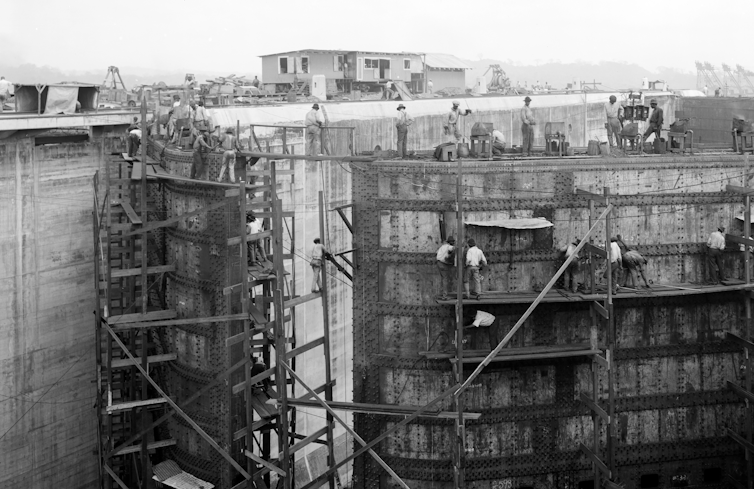
Black-and-white photo of a huge metal gate with tiny workers either posing or working from the wooden scaffolding.
Laborers work from scaffolding during the construction of the gates of Gatun Locks at the Panama Canal, c. 1914. Detroit Publishing Company/Library of Congress via Getty Images

Reggae with a Spanish twist

In the 1960s and 1970s, Jamaicans introduced three subgenres of reggaemento, ska and dancehall – to Panama.

The lyrics were in English and Jamaican Patois, an English-based creole language. But it didn’t take long for an offshoot of reggae, “reggae en español,” to emerge. By the end of the 1970s, reggae en español had become popular in Panama and had spread throughout Latin America. Similarly, the nascent genre of hip-hop was gaining steam in the U.S. and eventually made its way to Panama, where an American presence had remained since the completion of the canal. It wasn’t until 1979 that the Canal Zone was abolished, and Panama did not have ownership over the canal until 2000.

It was out of this diverse mix of musical and linguistic influences that reggaeton was born, a genre that features the looping drum pattern – called “dembow riddim” – of Jamaican dancehall, the tropical vibe of reggae and a mixture of rapping and singing. Like reggae and hip-hop, reggaeton lyrics often emphasize Black solidarity and speak out against racial oppression and police violence.

The Panamanian artist Renato is credited with releasing the first reggaeton song, titled, “El D.E.N.I.,” in 1985.

The D.E.N.I. – an acronym for the Departamento Nacional de Investigaciones, or National Department of Investigations – was a tool of repression for Panama’s military dictatorship under Omar Torrijos in the 1970s and later under Manuel Noriega in the 1980s. The secret police force became entangled in drug trafficking and political corruption.

In ‘El D.E.N.I.,’ Renato denounces police brutality and racism.

In the song, Renato assumes the role of a racist police officer, the kind he encountered after relocating from the Canal Zone to Rio Abajo, an impoverished neighborhood in Panama City:

Con mi cara albina, te puedo golpear …

(With my albino face, I can hit you …)

Te voy a enseñar

(I am going to teach you)

Que a la justicia no se puede burlar

(That you cannot make fun of the justice system)

After its release, the track became a protest anthem against Panama’s military government.

While Renato’s popularity was growing in Panama, early Panamanian reggaeton artists and producers like El General were collaborating with Jamaican and American artists in New York City, where the underground dancehall and “hip-hop en español” scene thrived.

Even though El General primarily produced music, one of his tracks, “No Mas Guerra,” channeled the fighting spirit of original reggaeton, calling for Latin American communities to come together to end violence and wars.

A sanitized version of reggaeton goes mainstream

Despite not being responsible for its creation, Puerto Rico is where the genre went mainstream – largely thanks to the popular Puerto Rican artist Daddy Yankee.

Daddy Yankee’s music spread, in part, thanks to American brands like Kellogg’s and Reebok, whose ads featuring his songs were broadcast to American audiences. Few of his tracks contained the social justice themes that characterized early reggaeton.

Meanwhile, Tego Calderon, a Black Puerto Rican reggaeton artist, struggled to find a buyer for his 2003 debut album, “El Abayarde,” after being told he was too ugly for a musical career – a remark rooted in the anti-Blackness that’s pervasive in Puerto Rico.

Calderon’s experience in the industry and as a Black Puerto Rican dictated how he viewed the genre and created his music. Like Calderon, Renato and other Black reggaeton artists have spoken out against racism in reggaeton.

Man with afro wearing sunglasses and a red baseball jersey gestures while rapping into a microphone.
Reggaeton artist Tego Calderon performs at the BMG Music Showcase at Billboard Live in Miami Beach in 2003. Rodrigo Varela/WireImage via Getty Images

Bringing reggaeton back to its roots

Though he may have the genre’s history slightly wrong, Bad Bunny’s own tracks return to reggaeton’s social justice roots.

Performed during the Super Bowl halftime show by Ricky Martin, Bad Bunny’s “LO QUE LE PASÓ A HAWAii” describes the history of U.S. colonialism in Hawaii and Puerto Rico, pointing out how local communities have been forced out by gentrifiers:

Quieren quitarme el río y también la playa

(They want to take the river and the beach away from me)

Quieren al barrio mío y que tus hijos se vayan

(They want my neighborhood and for your kids to leave)

And while the early-2000s reggaeton popularized by Daddy Yankee, Tego Calderon and Don Omar contained elements of misogyny and homophobia, Bad Bunny’s tracks “Yo Perreo Sola” and “YO VISTO ASÍ” build on feminist reggaeton anthems like Ivy Queen’s “Yo Quiero Bailar.”

Reggaeton was born out of a call for freedom, equality and justice. So I find it fitting that Bad Bunny is creating music that speaks to all types of people from all over the world.

ref. Bad Bunny says reggaeton is Puerto Rican, but it was born in Panama – https://theconversation.com/bad-bunny-says-reggaeton-is-puerto-rican-but-it-was-born-in-panama-276347

Victory in Gorton and Denton is historic for the Greens – and cataclysmic for Britain’s two-party politics

Source: The Conversation (Au and NZ) – By Jonathan Tonge, Professor of Politics, University of Liverpool

The Green party’s dramatic capture of Gorton and Denton, supposedly one of Labour’s safest parliamentary constituencies, offers yet more evidence of the fragmentation of British politics.

The Green candidate, 34-year-old plumber Hannah Spencer, won 40.69% of the vote, a notable 12 points ahead of Reform UK’s Matt Goodwin (28.73%). Labour candidate Angeliki Stogia came third, with 25.44% of the vote.

In terms of size of majority toppled, this was the sixth-worst byelection defeat ever for Labour. Gorton had been Labour for more than 90 years. In what is now Greater Manchester, Labour has had to defend 20 seats at byelections since the second world war, and has been successful in 16 cases.

Although Labour might dismiss a byelection defeat as a mid-term blip, this is a government which has failed to enjoy a honeymoon period, led by a prime minister who has plumbed new depths in popularity ratings. It is also worth noting that turnout on Thursday was identical to that at the general election.

For Keir Starmer, it was a truly awful result. But Labour really lost this byelection over a month ago, when its national executive committee (NEC) blocked the candidature of Andy Burnham, the mayor of Greater Manchester and believed by many to be the one person who might have held the seat for the party.

Starmer spoke against Burnham standing and his view held sway at that NEC meeting by eight votes to one. The one vote in favour of Burnham standing came from a Manchester MP, Lucy Powell, who was elected Labour’s deputy leader last year after being mysteriously sacked from the cabinet by Starmer.

The prime minister had good reasons for his stance. An early exit by Burnham from the mayoralty would trigger a difficult byelection across the region. But the overarching reason for blockage appeared to be Starmer’s personal political security.

Popular among Labour members and perhaps the one rival to Starmer around which the parliamentary party could coalesce, Burnham might have offered a potential leadership challenge. He is also highly popular in Greater Manchester, averaging two-thirds of the vote in the three mayoralty contests he has fought. The newly elected Green MP Spencer trailed Burnham by a huge 375,000 votes in the most recent mayoral election in 2024.

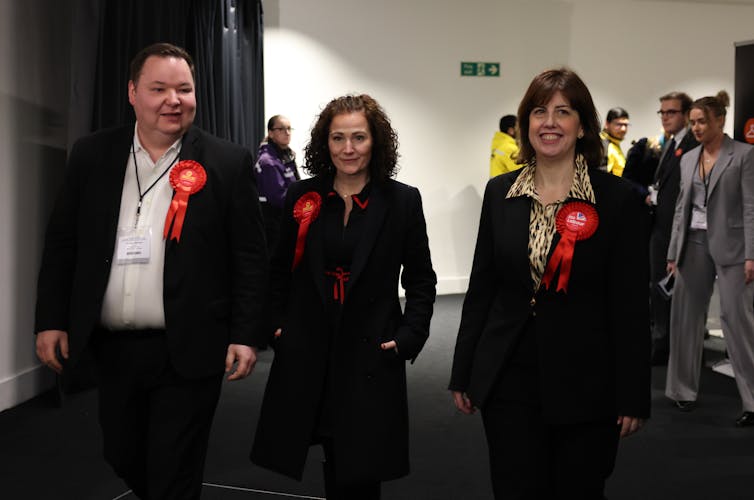
Labour candidate Angeliki Stogia with Labour Party Deputy Leader Lucy Powell and MP Andrew Western
A terrible night for the Labour party, including candidate Angeliki Stogia (C) with deputy leader Lucy Powell (R) and MP Andrew Western (L). Adam Vaughan/EPA-EFE

Clearly, this poor result increases the pressure on the prime minister, but two things remain in his favour. First, Labour MPs may find it difficult to unite behind a clear challenger. Entry barriers are high; 80 MPs need to support the person prepared to raise their head above the parapet. Second, the economy is showing signs of improvement, which might eventually stem the flow to the Greens on the left. On the right, the exodus towards Reform may be slowed by the decline in net migration.

Yet things will get worse before they might get better for Labour. The Scottish parliament, Welsh senedd and English local elections are a mere 69 days away, and offer a bleak vista of large seat losses. Labour’s control of the senedd seems sure to end and the party has to defend the bulk of council seats being contested.

The end of two-party politics?

The Gorton and Denton result confirmed the death of old loyalties in British politics. Given the existence of four-party politics in Scotland and Wales and the electoral significance of the Liberal Democrats in England, the two-party duopoly has long been gone, perhaps never to return. Politics has never been as fragmented across parties.

For the first time in England, Labour finds itself challenged by a significant party of the left, while Reform on the right challenges both Labour and the Conservatives.

That the right vote is splintered offers some succour to Labour. An even split between Reform and the Conservatives could allow Labour to win again at the next general election, with an even more pitifully low percentage share of the vote than the one in 2024 which nonetheless yielded two-thirds of the Westminster seats.

This fragmentation may widen voter choice, but not all is healthy. This was at times a toxic byelection. The Greens argued it was possible to be jointly concerned with Gaza and Gorton. They were, however, accused of sectarianism, for example by by issuing Urdu-language leaflets and a campaign video showing Starmer greeting the Indian prime minister, Hindu nationalist Modi, to appeal to Muslim voters.

Reform, on the other hand, has been accused of racism in targeting the white vote and showing scant regard for the large Muslim minority within the constituency. Its candidate, former academic Matt Goodwin, was already controversial for his views questioning whether non-white people born in the UK could be classed as British.

Meanwhile, the first-past-the-post voting system struggles to deal with the reality of modern multiparty politics, with abject disproportionality between vote shares and levels of representation. But that fragmentation increasingly seems permanent.

ref. Victory in Gorton and Denton is historic for the Greens – and cataclysmic for Britain’s two-party politics – https://theconversation.com/victory-in-gorton-and-denton-is-historic-for-the-greens-and-cataclysmic-for-britains-two-party-politics-277001

Tall Blacks beat Guam to boost World Cup hopes

Source: Radio New Zealand

Reuben Te Rangi of New Zealand. David Rowland/www.photosport.nz

The Tall Blacks have beaten hosts Guam 99-67 to go two-from-two in their second window of qualifiers for next year’s World Cup in Qatar.

Reuben Te Rangi started the game with the Tall Blacks first five points, before Jack Andrew scored four of his own.

New Zealand’s up and in defensive scheme seemed to be doing the job as Guam struggled to put points on the board early.

Keanu Rasmussen entered the game, knocking down a corner three ball to score his first points as a Tall Black as the visitors extended their lead.

New Zealand’s defensive intensity continued to cause troubles for the Guam players, as the Tall Blacks continued to make baskets with regularity, opening up a 20-point lead halfway through the second quarter.

Guamanian guard, Takumi Simon, was doing everything he could to keep his side in the hunt, finishing the first half with 13 points, but it was the Tall Blacks who’d take a 51-34 lead into half time.

The Tall Blacks didn’t take long to get back into their work at the start of the second half, with Andrew continuing to lead the way down low, taking his tally to 16 points with another putback half-way through the third quarter.

Britt started to get going with six the the third, while the Tall Blacks continued to extend their lead to 19 points.

It was more of the same in the fourth quarter, as New Zealand continued to tack on points and further their lead.

Andrew finished with 20 points while Te Rangi had 15 and Rasmussen 14.

Flavell was happy with the team’s performance.

“We watched the Australian game the other day, so we came in with full respect for this Guam team,” Flavell said.

“For us it was all about our defensive mindset, two guys in particular, Simon and Freeman. We really obviously concentrated on those two in particular and tried to keep them quiet. For the most part I thought we did a pretty good job. Simon got going in the second half but for the most part, really happy with our team’s performance on the defensive end.”

Flavell also very happy with the way the team’s new additions.

“Jack Andrew, Sam Timmins, Kruz Perrott-Hunt and Jackson Ball – they just arrived the other day. I said to them, you’re gonna make mistakes, we’re going to be somewhat rusty here and there on the offensive end.

“But they came straight in and added to our side. For us, that’s our identity.”

Sign up for Ngā Pitopito Kōrero, a daily newsletter curated by our editors and delivered straight to your inbox every weekday.

– Published by EveningReport.nz and AsiaPacificReport.nz, see: MIL OSI in partnership with Radio New Zealand
Kiwi driver Scott McLaughlin second at Indycar Grand Prix of St Petersburg

Source: Radio New Zealand

picture id=”4JSEOEB_AFP__20260228__2263973903__v2__HighRes__NttIndycarSeriesFirestoneGrandPrixOfStPeters_jpg” crop=”16×10″ layout=”full”] Scott McLaughlin was runner-up at the Indycar Grand Prix in St Petersburg.

Kiwi polesitter Scott McLaughlin has clawed his way onto the podium at the Indycar season opener in the United States, but was ultimately defeated by Spain’s Alex Palou.

Four-time defending champion Palou took the victory defeating the New Zealand driver by 12.49 seconds on the St Petersburg street circuit. Christian Lundgaard finished third.

Palou was leading on 59 of 100 laps. With six laps to go McLaughlin’s overtaking skills saw him move up the field in the battle for second with Lundgaard.

McLaughlin was more than pleased with the “good start” for the season, but conceded he’d hoped for more after qualifying at the front of the grid.

McLaughlin secured pole for the season opener at St Petersburg. DAVID JENSEN

“Look, Alex was super fast, but you know I think it’s just a mixed bag on what tyre you start on,” he told SkySport.

“Maybe we come back here again and maybe you start on reds, and you just get them out of the way.

“We made the passes we needed to make at the right times, and I thought we maximised our day which is what we needed to do.”

Fellow Kiwi Sir Scott Dixon had a weekend to forget, crashing out in the opening practice when he hit the wall. And in a further setback in today’s Grand Prix he lost a tyre on lap 40 and took no further part in the race.

New Zealand’s Marcus Armstrong was 11th after starting seventh on the grid.

Sign up for Ngā Pitopito Kōrero, a daily newsletter curated by our editors and delivered straight to your inbox every weekday.

– Published by EveningReport.nz and AsiaPacificReport.nz, see: MIL OSI in partnership with Radio New Zealand
Winds could see Cook Strait ferry services cancelled

Source: Radio New Zealand

Bluebridge and Interislander in Picton Marlborough sounds RNZ/ Rachel Thomas

The Bluebridge Cook Straight ferry service is indicating strong southerlies could cause delays and cancellations on Monday and Tuesday.

It says strong winds and large swells are expected, and customers would be notified of any disruption.

“A southerly weather system is forecast for Cook Strait on Monday and Tuesday, bringing strong winds and large swells. The worst of the conditions are forecast for Monday afternoon and may result in delays or possible cancellations.”

RNZ has contacted KiwiRail to ask if Interislander services will also be affected.

No formal weather watches or warnings were in place for the region, MetService’s website showed.

“A southerly flow covers the North Island on Tuesday, while a large high in the Tasman Sea extends over the South Island, its severe weather outlooks said, noting a “strong or gale southeasterly flow” for the offshore Chatham Islands.

Meanwhile, ferry services connecting Eastbourne and Wellington City have been cancelled at least 10am Monday because of the conditions.

Sign up for Ngā Pitopito Kōrero, a daily newsletter curated by our editors and delivered straight to your inbox every weekday.

– Published by EveningReport.nz and AsiaPacificReport.nz, see: MIL OSI in partnership with Radio New Zealand

Christopher Luxon won’t say if NZ supports US strikes on Iran

Source: Radio New Zealand

Prime Minister Christopher Luxon RNZ / Marika Khabazi

Prime Minister Christopher Luxon has told Morning Report the Iranian regime is an evil one and has been a destabilising force in the Middle East.

But he would not be drawn on whether the government supports the strikes by the United States and Israel against Tehran.

Asked by presenter Corin Dann whether New Zealand supported the attacks on Iran, Luxon said it condemned the Iranian regime as evil and as having claimed countless lives.

“We understand fully why the Americans and the Israelis have undertaken the independent action that they’ve taken.

“Our position is the same as the Australian position.”

Australian Prime Minister Anthony Albanese said on Sunday the government supported the United States acting to stop Iran acquiring nuclear weapons.

Pressed on whether the strikes were legally right, Luxon said it would be up to the US and Israel to explain the legal basis for their attacks the attack.

Former Prime Minister Helen Cark has called the government’s stance a disgrace and says New Zealand should support a rules-based international order.

Luxon said what was disgraceful was the repressive Iranian regime which had killed thousands of its own people who had taken to the streets calling for freedoms.

“Iran has been a destabilising force. It has supported armed proxies throughout the region. It has seen tens of thousands of people murdered by own government, who were asking for freedom and rights.”

In a statement on Sunday, Luxon and Foreign Affairs Minister and Winston Peters said New Zealand had consistently condemned Iran’s nuclear programme and its “destabilising activities” in the region and “acknolwedged” the strikes.

“Iran has, for decades, defied the will and expectations of the international community. The legitimacy of a government rests on the support of its people. The Iranian regime has long since lost that support,” they said.

Helen Clark at Chris Hipkins’ state of the nation speech last week. RNZ / Marika Khabazi

“In this context, we acknowledge that the actions taken overnight by the US and Israel were designed to prevent Iran from continuing to threaten international peace and security.”

Luxon and Peters condemned in the “strongest terms Iran’s indiscriminate retaliatory attacks” on neighbouring states.

The statement also said “we call for a resumption of negotiations and adherence to international law.”

Clark told Morning Report said the statement was a disgrace.

“What was wrong with it was it didn’t call out the illegal strike against Iran in the middle of diplomatic negotiations “which were going quite well and further talks were scheduled”.

“The whole point of international law is to put rules around when force is legitimate,” she said.

“A strike is justified if there is an imminent threat of attack, which clearly there was not.”

She said the initial strikes by the US and Israel violated international law.

“The New Zealand government seems only interested in the Iranian retaliation and not looking at the reason for the retaliation, which was the attack by the United States and Israel,” she said.

“I think it’s consistent with a steady drift in New Zealand foreign policy to realign strongly with the United States, which at this particular time seems even more questionable as a strategy.”

“We’re not putting a stake in the ground in defence of the international rule of law.”

Sign up for Ngā Pitopito Kōrero, a daily newsletter curated by our editors and delivered straight to your inbox every weekday.

– Published by EveningReport.nz and AsiaPacificReport.nz, see: MIL OSI in partnership with Radio New Zealand

How to whistle: the art and history of our shrillest skill

Source: The Conversation (Au and NZ) – By Wendy Hargreaves, Academic in the School of Education and Creative Arts, University of Southern Queensland

Whether you whistle or not, you can’t escape whistlers. They’re dog owners, construction workers, day dreamers, concertgoers and annoying sports fans whose shrill makes you wish for earplugs.

And there are tradies – Snow White’s pesky disciples who think whistling while you work makes chores fun. (Disclaimer: It didn’t work for my taxes.)

Admittedly, whistling can be useful for silencing noisy crowds and hailing taxis New York-style, but be mindful of the social rules. You can whistle admiringly at a flashy car, but you’ll be fined up to 750 euros for sexual harassment if you wolf whistle at women publicly in France.

Whistlers in history

Whistling is a common human skill. For centuries, shepherds and goat herders used whistling to summon livestock and direct dogs to steer the herds. The whistling sound can travel ten times further than shouting, which makes it ideal for long distance communication in rural areas.

Long ago, remote communities in Turkey and Mexico developed a whistled version of their spoken languages for communicating across the countryside. As linguist Julien Meyer explains, each syllable of a word translated to a whistled melody, allowing neighbours to talk across vast distances. Whistled languages are still in use today in places like La Gomera in the Canary Islands.

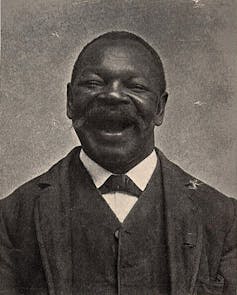
an image of George W. Johnson
George W. Johnson. Wikimedia Commons

Whistling featured prominently in the development of the recording industry. Historian Tim Brooks recounts how Thomas Edison’s 1877 invention, the phonograph, drew public curiosity but the sound quality of recorded voice was too weak to show off the machine’s potential.

Shrill whistling, however, could be reproduced perfectly, which likely sustained public interest through the phonograph’s early modifications. Brooks traced the transformation of George W. Johnson from a whistling street performer at a ferry terminal to New York recording artist at the birth of the recording industry.

Decades later, whistling continued leaving musical marks in the industry. Notable examples include Roger Whittaker’s intricate The Mexican Whistler, Otis Redding’s layback ending to The Dock of the Bay, Bobby McFerrin’s cheerful Don’t Worry, Be Happy, and Maroon 5’s distinctive opening to Moves Like Jagger.

Today, there’s even a market for complete whistling albums like from Molly Lewis. But few recordings are as memorable as the 1966 Spaghetti Western theme song The Good, the Bad and the Ugly. It made whistling iconic for showdowns.

How whistling works

Whistling is produced when small pockets of air spinning at your lips interact with spaces in your mouth. Puckering your lips and whistling with fingers use the same principles.

Musical sound is produced when something, such as a guitar string, vibrates. Vibrations create pressure in the air which moves outwards in waves. When we whistle, the air itself becomes the vibrator. What happens next makes it audible.

Different spaces affect a sound wave’s energy as it passes through. Some cavities dampen the energy, while others excite it by swirling around making the cavern itself vibrate or resonate. That’s what makes whistling louder.

An illustration of different ways of whistling with the fingers
There’s more than one way to make yourself heard – an illustration from Le Monde Illustré (1893) proves finger-whistling is all about technique. Le Monde illustré/Wikimedia Commons

To experience the power of resonance, try singing in a bathroom with lots of towels, then remove the towels and sing again. The extra ring you’ll hear is the effect of resonance.

Whistling works by fine-tuning the speed of your breath with the size, shape and tension in your lips and tongue so the space rings.

Learning to whistle

Unfortunately, knowing the physics doesn’t make whistling easier. Learning requires coordinating your senses with how you move your body. You create a learning loop where your brain connects your mouth and breath movement with what you hear, feel and see when you whistle.

Simply put, you use trial and error to figure which actions help amplify the sound and which don’t.

Whistlers aren’t born. They’re made. If you find whistling hard, then you’ll need to practice isolating and moving all the parts in an epic Gollum-like quest for the precious ring.

Ann Rutherford, Red Skelton, and Diana Lewis in the American film Whistling in Dixie (1942)
Remember to pucker your lips like Ann Rutherford, Red Skelton, and Diana Lewis in Whistling in Dixie (1942). Wikimedia Commons

Top tips for whistling pucker-style:

  • find a quiet room

  • wet your whistle – water on your lips helps

  • push your lips forward to make a small, firm hole; a mirror can help you see what you’re doing

  • breathe out with a steady air stream

  • listen to the sound and experiment with your tongue tip position (forward, backwards, higher, lower), lips shape (tightened, relaxed, wider, pushed forward, pulled sideways), and breath stream (faster, slower) – you should hear subtle changes, even if it just sounds like wind

  • play around until you find one position where the sound seems louder than others

  • make micro adjustments in the position to find which movements increase the ring

  • repeat all steps daily so your brain learns to find your whistle automatically and tune it.

Failing that, take up singing. It’s easier and you won’t look like you’re kissing a ghost.

ref. How to whistle: the art and history of our shrillest skill – https://theconversation.com/how-to-whistle-the-art-and-history-of-our-shrillest-skill-275560

Health workers vote to ratify new collective agreement with Health NZ

Source: Radio New Zealand

File photo. RNZ / Peter de Graaf

More than 3500 health workers have voted to ratify a new collective agreement with Health New Zealand after a drawn out 18-month bargaining process.

Mental health nurses and assistants are included in the agreement, which will give them a 2.5 percent pay rise and an $800 lump sum payment each.

The agreement was reached after 18 months of bargaining between the Health New Zealand and the Public Service Association.

Public Service Association national secretary Fleur Fitzsimons said it was a step in the right direction for their workers, but more funding was needed to address problems in the health system.

Health New Zealand’s initial offers were far too low and it took strike action to get a fair offer, Fitzsimons said.

More funding was needed to fix deeper problems in the health system, she said.

“All political parties must commit to a properly funded public health system that ensures safe staffing levels, and delivers quality are for all New Zealanders.”

The collective agreement covering 12,000 allied health workers was also ratified last Tuesday.

Voting will soon be held on a third health agreement for policy, advisory, knowledge and specialist workers.

Health NZ has been contacted for comment.

Sign up for Ngā Pitopito Kōrero, a daily newsletter curated by our editors and delivered straight to your inbox every weekday.

– Published by EveningReport.nz and AsiaPacificReport.nz, see: MIL OSI in partnership with Radio New Zealand

‘Ens…ification’ blamed as Kiwis feel down about internet

Source: Radio New Zealand

Sixty percent of Kiwis use AI weekly, but 68 percent are ‘very or extremely concerned’ about it being used to produce harmful content. File photo. 123rf

Fewer and fewer New Zealanders are feeling positive about the internet, despite many spending hours online per day.

A study by Internet NZ has found that only 72 percent of Kiwis think the positives of the internet outweigh the negatives, despite nearly half spending four or more hours online a day.

InternetNZ chief executive Vivien Maidaborn said that figure had been slowly declining from 90 percent in 2019.

“The concern is potentially increasing because of what’s now being called the ‘enshittification’ of the internet by the big players who are really prioritising profit over user experience.”

Maidaborn said the research showed the increasingly complex relationship people have with the internet.

“Love it or hate it, we’re all using the internet a great deal… it’s become so integral to our day to day. But that doesn’t mean it’s something we enjoy engaging with.”

Attitude towards AI

The research also found kiwis were feeling increasingly confident in using artificial intelligence, but concerned about its potential to produce harmful content.

It found 60 percent of Kiwis used AI weekly, but 68 percent were ‘very or extremely concerned’ about it being used to produce harmful content.

AI could amplify some of the worst parts of the internet, Maidaborn said.

“Scamming phishing, targeting of particular groups with harm. All of those things can happen way faster than human speed with AI.”

The findings reflected the pace at which AI has grown in the past few years, Maidaborn said.

“In a very short time, we’ve gone from most people having a very limited understanding of what AI is and what it can do, to it being in use every day in almost every household.”

AI also brought opportunity, but more policy guidance was needed from the government so that people were not using unregulated tools, Maidaborn said.

Sign up for Ngā Pitopito Kōrero, a daily newsletter curated by our editors and delivered straight to your inbox every weekday.

– Published by EveningReport.nz and AsiaPacificReport.nz, see: MIL OSI in partnership with Radio New Zealand

2026 Taite Music Prize finalists announced

Source: Radio New Zealand

Marlon Williams, Geneva AM, Tom Scott and Jazmine Mary are among 10 finalists for the 2026 Taite Music Prize.

The award, named in honour of late Dylan Taite, one of Aotearoa’s respected music journalists, recognises outstanding independent New Zealand albums released in the past year.

The award will be presented on Wednesday, 29 April at the International Convention Centre, Auckland, at the same time as the NZ On Air Outstanding Music Journalism Award, IMNZ Classic Record and the Independent Spirit Award.

Marlon Williams will tour NZ in 2026 before taking a break for a ‘wee while’.

Supplied

I’m educated and a fan of science, so why do I follow superstitions?

Source: Radio New Zealand

As kids, many of us are told that if we go outside with wet hair, we’ll catch a cold. And as adults, we might spend an extra few minutes drying our hair before stepping out.

Many tall buildings in Anglo countries don’t label the 13th floor, while buildings in East Asia often skip floor four.

If a player I barrack for is having a winning streak, and a commentator mentions it, I might feel like the player is “jinxed” and their winning streak will end.

We can be quite creative in how we assemble information, in ways that are totally incompatible with science.

Unsplash

– Published by EveningReport.nz and AsiaPacificReport.nz, see: MIL OSI in partnership with Radio New Zealand

Meet the ‘Old Mother Goose’ from NZ’s subtropical prehistoric past

Source: The Conversation (Au and NZ) – By Nic Rawlence, Associate Professor in Ancient DNA, University of Otago

During the early to mid Miocene period, 14 to 19 million years ago, a vast lake covered much of what is now Central Otago.

Along the shores of Lake Manuherikia, whose remnants are found near present-day St Bathans, lived crocodilians, turtles, and bowerbirds, as well as early relatives of bats, moa and kiwi, and a rich diversity of waterfowl such as ducks and swans.

This lost ecosystem is known today from the famous St Bathans fossil deposits, which preserve one of the world’s richest records of the Miocene and offer a rare window into Aotearoa’s warmer, more subtropical ancient past.

Our newly published research adds another waterfowl species to this remarkable menagerie. It also sheds important new light on the origins of New Zealand’s recently extinct giant, flightless geese of the genus Cnemiornis.

NZ’s long-lost waterfowl

Spanning 5,600 square kilometres, Lake Manuherikia was ten times the size of New Zealand’s Lake Taupo. It was a dynamic habitat that supported a diverse range of waterfowl, including five stiff-tailed ducks, one swan, two shelducks, one dabbling duck and our new goose.

While many of these waterfowl are incredibly common in the fossil deposits around St Bathans, others, including the largest species, are quite rare.

Our team reexamined the remains of all the bones previously identified as belonging to geese. We then compared them with other large waterfowl bones from the deposits and a broad collection of comparative bird skeletons housed in the Museum of New Zealand Te Papa Tongarewa.

We determined that the bones included an undescribed species the size of a small goose.

We named our new bird the St Bathans goose Meterchen luti, as a play on the nursery rhyme “Old Mother Goose”. In our case, an ancient goose rises up out of the mud of the fossil deposit. Meterchen means “mother goose” in ancient Greek, while luti is Latin for “of the mud”.

The ancient lake mud around St Bathans, Otago, is a rich source of fossils that give palaeontologists unique insights into Zealandia’s past biodiversity. Alan Tennyson/Museum of New Zealand Te Papa Tongarewa, CC BY-NC-SA

With ten unique species of waterfowl now described from the fossil deposits, across a range of sizes, Lake Manuherikia was clearly a very productive and dynamic lake system, supporting a large and complex ecosystem.

Not as ancient as first thought

Our St Bathans goose is only based on fragmentary remains but there is enough preserved to show that it is not a close relative of the giant flightless Cnemiornis geese, nor their Australian cousin, the Cape Barren goose Cereopsis novaehollandiae.

An artist’s impression of the St Bathans goose that once lived in New Zealand. Sasha Votyakova/Te Papa Tongarewa, CC BY-NC-SA

Recent genetic research is showing the evolutionary origin of New Zealand’s birds is more dynamic than previously thought, with influxes from Australia, South America, the Northern Hemisphere and places unknown.

Throughout geological history, many birds arrived in Zealandia, the now-mostly submerged continent that includes New Zealand. But the ancestors of some of our large birds only arrived here surprisingly recently – in the past 4-5 million years – including takahē, the Eyles or Forbes’ harrier and the giant Haast’s eagle.

An earlier theory argued that the St Bathans goose represented the direct ancestors of giant flightless Cnemiornis geese, implying this lineage had been present in Zealandia for at least 14 million years.

However, this conflicts with genetic evidence suggesting the ancestors of Cnemiornis arrived from Australia only 7 million years ago, which proponents of the earlier theory discarded.

Our reassessment, based on a much broader set of comparative bird skeletons, rather than single exemplars, does not support the earlier-arrival hypothesis and instead supports the later arrival.

Turnover and transformation

Increasingly, our multidisciplinary research is showing that there have been considerable levels of biological turnover throughout Zealandia’s history.

While the ancestors of the St Bathans goose no doubt arrived in Zealandia earlier than 14 million years ago, no descendants survived, with the ancestors of the giant Cnemiornis geese colonising much more recently, only for their descendants to go extinct shortly after human arrival due over-hunting and predation.

Artist’s impression of an extinct giant flightless New Zealand goose in its open habitat. Paul Martinson/Te Papa Tongarewa, CC BY-NC-SA

The relatively recent evolution of the giant flightless Cnemiornis geese offers another striking example of the rapid morphological change that can occur within a short timespan on islands, where evolution can run rampant. At one metre tall and weighing up to 18kg, these were the largest geese in the world.

By using all the scientific tools in the toolbox, we can reconstruct how the dynamic geological, climatic and human history of Zealandia has shaped the evolution of Aotearoa’s fauna in ever more detail.

Each new discovery is a reminder that the story of New Zealand’s birds – and of Zealandia itself – is very much still being written.

ref. Meet the ‘Old Mother Goose’ from NZ’s subtropical prehistoric past – https://theconversation.com/meet-the-old-mother-goose-from-nzs-subtropical-prehistoric-past-271722

From high-tech greenhouses to fruit netting: how protected cropping can shield crops from climate extremes

Source: The Conversation (Au and NZ) – By Tony Bacic, Professor of Plant Biology, La Trobe University

For many of us, food is something we buy at a supermarket or order at a cafe. We usually give little thought to the complex systems required to produce and deliver it – until they stop working.

It’s not common to think of Australia as a place at risk of food insecurity. It has vast tracts of fertile land and the capacity to feed its population many times over. Around 70% is exported.

But the searing southeast heat and widespread northern flooding this summer demonstrate the very real risks to food production. Temperature extremes, heatwaves, droughts, floods and shifting seasonal patterns are worsening as the climate changes.

People can seek refuge indoors. But the plants and animals we rely on for food have no such protection. In response, some orchardists and farmers are taking up an approach known as protected cropping, where crops are shielded from threats. As South Australian persimmon and avocado grower Craig Burne told the ABC:

without misting and netting in place, I don’t think we’d successfully grow either of these crops in this climate any more

As climate change intensifies, protected cropping could better safeguard some crops. Overseas, nations such as the Netherlands have taken up protected cropping to drastically boost fruit and vegetable exports. But it’s early days in Australia. To grow, the sector will have to overcome barriers to growth.

Protected cropping methods such as this polytunnel at Stepping Stone Farm in NSW can extend growing seasons and shield crops from some threats. Mick Tsikas/AAP

What defines protected cropping?

Protection is broadly defined. It can range from low-tech solutions such as shade houses and netting to medium-technology polytunnels (hoop-shaped plastic covers) through to highly sophisticated automated glasshouses.

Countries facing land constraints such as the Netherlands have been the most enthusiastic in taking up this approach. Guided by the principle of “twice the food using half the resources”, Netherlands farmers have turned to high-tech glasshouses.

The result has been remarkable: a country with extremely limited agricultural land has become a top exporter of fruit and vegetables.

Emerging in Australia

In Australia, protected cropping is gaining popularity off a small base. In 2023, around 14,000 hectares of fruit and vegetable crops were growing under some form of protection. That’s around 17% of the total area.

Most of this area relies on low-tech systems, however. Just over two-thirds (68%) of all protected cropping areas relies on low-tech shade houses or netting, mainly in southern Queensland and northern New South Wales.

Medium-tech systems such as polytunnels and polyhouses account for about 30% of the total. These systems are found mainly in Tasmania, northern Queensland and Western Australia.

High-tech glasshouses account for only 2% of the total. These are primarily found near bigger cities such as Sydney, Melbourne and Adelaide.

To date, farmers have relied on protected cropping for high-value crops such as tomatoes, capsicums, cucumbers, berries, leafy greens and more expensive tree crops.

In 2022, Australia’s protected cropping industry was worth an estimated A$100 million to farmers. Demand for workers in the sector is growing at 5% a year, and around 10,000 people worked in the industry as of 2022.

Protected cropping has been used on import-reliant Christmas Island to boost self-sufficiency. Bianca De Marchi

Real benefits – at a cost

For farmers, protected cropping offers clear advantages across low-, medium- and high-tech approaches.

These methods can create an environment favourable to year-round plant growth, improving the consistency and quality of yields. By controlling factors such as temperature, plant nutrition, humidity, light and pests, protected cropping reduces production risks and increases crop yield and quality.

For farmers, being able to control their environment in a predictable way is particularly valuable in an uncertain climate. Protecting crops means less (but not zero) risk from extreme weather. Other benefits include more efficient use of land, water, fertiliser and energy.

Crops can also be cultivated closer to markets. This improves food freshness, lowers transport emissions and strengthens domestic food security.

For exporters, produce grown in protected systems is more likely to meet stringent biosecurity and quality standards of overseas buyers.

Innovation is essential to unlock these benefits at scale. Advances in plant breeding, sensors, automation, data analytics, controlled supply of nutrients, lighting systems and biological controls for pests and plant diseases can significantly boost farm production, profits and sustainability.

A high-tech greenhouse using LED lighting, hydroponics and automated sensors to optimise crop growth. Red and blue LED lights reduce energy use while maintaining high yields and crop quality. Anthony D’Agatha/La Trobe University, CC BY-NC-ND

What’s stopping protected cropping?

Australia’s farmers are highly exposed to extreme weather events and the changing water cycle. Protected cropping would seem to be a logical way to control some of these risks.

To date, protected cropping hasn’t achieved scale in Australia. That’s because the horticulture industry is dominated by small businesses with limited capacity to invest in new systems.

High-tech protected cropping systems offer the best results, but the cost is enough to put off many farmers. Finding and keeping skilled workers is another challenge.

Scaling up won’t just happen

Protected cropping is an excellent solution. But it’s out of reach for many farmers who would benefit.

In nations such as Sweden and the Netherlands, governments have worked to encourage uptake of protected cropping and boost exports of fruit and vegetables, through world-class research and innovation precincts.

Australia’s federal and state governments could accelerate uptake by setting targets to expand protected cropping areas, encourage adoption through policy levers, investing in joint infrastructure and incentives to cut installation costs.

A good start could be to focus on areas where high-value crops are grown in unprotected environments and work to create regional clusters of expertise, shared infrastructure and skilled jobs.

Governments can’t do it without buy in from industry bodies, researchers and farmers. Translating innovation from laboratory to field is never easy. But it can – and arguably must – be done, as Australia’s farmers face a very uncertain climate.

Protected cropping is not a silver bullet. Polytunnels can’t protect against floods, for instance. But other countries have successfully used these methods to boost yields, safeguard local food production and create new higher wage jobs. It could do the same here.

ref. From high-tech greenhouses to fruit netting: how protected cropping can shield crops from climate extremes – https://theconversation.com/from-high-tech-greenhouses-to-fruit-netting-how-protected-cropping-can-shield-crops-from-climate-extremes-272162

Back at uni? How to help your wellbeing while you study

Source: The Conversation (Au and NZ) – By Andrew J. Martin, Scientia Professor and Professor of Educational Psychology, UNSW Sydney

University can be a time of great opportunities, but it can also be very stressful. Many students need to support themselves financially and may be living away from home. Students are also under constant deadlines and, if in their final years, need to prepare for life and work after uni.

My colleagues and I research how students can succeed and thrive in their studies.

So, as classes begin for semester one, how can you be proactive about your wellbeing and find a healthy balance between work, study and friends?

Academic and personal wellbeing

There are two interconnected parts of life that are particularly challenged at university. These are academic wellbeing and personal wellbeing.

Academic wellbeing is about your learning and achievement, and how motivated and engaged you are with your studies. Personal wellbeing is about your mental health, self-esteem, life satisfaction and sense of meaning and purpose.

This is where “buoyancy” – sometimes called everyday resilience – comes in. Buoyancy is students’ ability to bounce back from challenges, difficulties and setbacks. It helps them navigate the ups and downs of university life, from competing deadlines, to exam stress and the demands of paid work.

In our research, we have identified psychological and interpersonal ways to help students maintain their academic and personal wellbeing. We call them “the 6 Cs of buoyancy”.

1. Confidence

We have found students who believe in themselves to do what they set out to do tend to respond well to difficulty. Boosting self-belief, or confidence, involves two important things.

  • Focus on the positives: recognise what knowledge and skills you already have. Avoid negative thinking traps. For example, give yourself credit for positive results instead of thinking the “lecturer went easy on me”.

  • Develop a broader view of success: view success not just in terms of marks, but also in terms of learning new things and personal improvement. This helps you recognise more of the things you do well, so you receive confidence-boosters more often.

2. Control

Our research shows students who feel as though they are “in the driver’s seat” are not as easily affected by adversity. There are two helpful ways you can feel in control.

  • Focus on the three things in your control: these are effort (how hard you try), strategy (the way you try) and attitude (what you think of yourself and the challenge).

  • Seek out feedback: this is information or ideas about how to navigate a challenge or improve next time. You can get this from teachers, a student advisor or trusted peers.

3. Commitment

Staying focused on your goals can help you persist through tough times. There are two ways to support this.

  • Set clear goals and a plan for meeting them: so you know what you’re doing, why, and how to do it.

  • Seek support: remember there are people who can help you if you are unsure about something, such as academic staff and student support services.

4. Coordination

Having a clear plan also helps you to navigate your way through challenges. There are two ways to do this:

  • Look ahead: what challenges are on the horizon? Are there assignment deadlines on the same day? Be proactive and get onto them early so you finish them by the due date.

  • Have a timetable: make a realistic and achievable weekly timetable so you can balance the different things you need and want to do.

5. Composure

Academic anxiety typically involves worrying excessively about poor results, performance in an upcoming test or presentation, meeting deadlines and getting on top of difficult coursework. Managing your academic anxiety is an important part of maintaining academic and personal wellbeing.

  • Have stress management and relaxation strategies: find strategies that work for you. This may be meditation, exercise, reading or connecting with nature.

  • Make lifestyle adjustments: create healthy habits, such as an improved diet, less alcohol, more sleep or staying off social media channels that “wind you up”.

6. Connection

A sense of belonging is a buffer against stress. Good relationships are also a protective factor in tough times.

  • Get more involved: participate in classes, labs and tutorials. Say “yes” to social opportunities such as a coffee after a lecture. Look for a university club or society you can join. Go into uni a little more than being online.

  • Keep in touch: socialise with good friends from school or other parts of life outside of uni.

What if I am struggling?

The 6 Cs are helpful for navigating day-to-day challenges at university. But it is important to reach out to a mental health professional on or off campus if you need more support.


If this article has raised issues for you, or if you’re concerned about someone you know, call Lifeline on 13 11 14.

ref. Back at uni? How to help your wellbeing while you study – https://theconversation.com/back-at-uni-how-to-help-your-wellbeing-while-you-study-276854

New study finds 6 types of ‘discouraged’ workers in Australia – and why they stop job-hunting

Source: The Conversation (Au and NZ) – By Sora Lee, Lecturer in Ageing and End of Life, La Trobe University

When we hear that Australia’s unemployment rate is low, it sounds like good news. The Australian Bureau of Statistics defines an unemployed person as someone who is not working but is actively looking for a job and available to start.

But there is a broader group not fully captured by the statistics, whom we call “hidden workers”. They include people who:

  • are unemployed but not counted because they are not currently looking

  • are underemployed, working fewer hours than they want or need

  • or who have given up looking altogether, known as discouraged workers.

This article focuses on that last group: discouraged workers.

They still want to work and are available — but have stopped searching. We know surprisingly little about who they are or why they give up. My new research aims to answer some of these questions.

Untapped talent matters for the economy

You might wonder: if they are not looking for work, why should we care?

Because they represent unused talent, sitting on the sidelines of the economy. Discouraged workers are part of what economists call labour market slack. That simply means spare capacity: people who could work if the barriers in front of them were removed.

If slack is larger than the official unemployment rate suggests, then the job market is not as strong as it looks.

And that matters.

The Reserve Bank of Australia relies on labour market data when deciding whether to raise or cut interest rates. If there are more people on the sidelines than the headline figures capture, wage growth may be weaker than expected. Inflation pressures may be lower than assumed. Economic strength may be overstated.

In short, when we miscount workers, we misread the economy.

A wide range of profiles

Using national data from the Household, Income and Labour Dynamics in Australia survey (HILDA), we analysed 1,091 discouraged workers. This is the first in-depth national analysis of discouraged workers in Australia, and the findings are revealing.

Instead of treating discouraged workers as one single group, we used a statistical method called “latent class analysis”. It helps us see hidden subgroups within the broad category.

The six profiles we identified were:

Young, low-educated adults (mostly men) (25.3%)

This is the largest group. They are under 45, rarely married and often left school early. They report more health issues and face limited qualifications and weak attachment to stable work.

Older, low-educated adults with chronic health problems (20.4%)

Almost all are over 45. Many did not complete secondary school. Most have long-term health conditions. Here, low education and poor health combine to reduce job prospects.

Older single adults with health and financial strain (17.0%)

These people are often educated but single, with high rates of chronic illness and financial hardship. Education does not protect them when health and money pressures are severe.

Older, well-educated adults (mostly men) (16.6%)

These are mainly people over 45 who are married and relatively well educated. Many report some health problems. Their discouragement appears linked to age bias in hiring and moderate health limits, rather than low skills.

Mothers with heavy care and financial strains (13.9%)

These are mostly women under 45 with dependent children. Many also provide unpaid care to someone else in the family. Financial stress is high.

Highly educated married women facing structural barriers (6.7%)

This is a smaller but striking group. They are well educated and generally healthy. Many are married and have children. Their discouragement reflects the strain of combining paid work with care.

Caring duties and health issues were some of the barriers facing women. Brooks Rice/Unsplash

The myth of the lazy jobless persists

A common myth is that people stop looking for work because they are unmotivated.

Our findings show something different.

Discouragement often emerges at the point where repeated rejection, health limits, childcare costs, age discrimination or household pressures make further job searches feel pointless. As one interview participant put it,

When you keep receiving rejection letters, it becomes rational to stop applying.

The evidence suggests discouragement is rarely a sudden decision. It is more often the end point of accumulated disadvantage — where multiple barriers build up over time until withdrawal feels like the only realistic option.

We identified clear life-course patterns among women at different career stages.

Younger mothers are pulled out of the job market by childcare demands. Older women encounter age bias and health limits. These women are not “choosing to drop out” from the workforce. They are responding to structural pressures at different stages of life.

We see similar patterns among men, as well.

A significant group of young men face intersecting disadvantages early in adulthood. Weak educational foundations combined with health issues limit their attachment to stable work. Older adults — particularly those with low education and long-term health conditions — face persistent barriers.

Finding policies that work

Activation policies are employment policies designed to “activate” people who are out of work by pushing or encouraging them to search for jobs more actively. The underlying idea is that the problem sits with the individual: search harder. Try more. Be more motivated.

Our findings suggest the barriers often sit elsewhere.

Older workers need health support and age-inclusive hiring. Care-burdened mothers need affordable childcare and genuine flexibility.

Young men with low education need strong training and stable entry pathways. Highly educated, married women need workplaces that offer flexibility and don’t penalise career breaks.

Discouraged workers are not a single silent mass. They represent many different stories of stalled potential.

If we want a stronger, fairer labour market, we need to see them clearly – and design policies that respond to the real reasons they stopped searching in the first place.

ref. New study finds 6 types of ‘discouraged’ workers in Australia – and why they stop job-hunting – https://theconversation.com/new-study-finds-6-types-of-discouraged-workers-in-australia-and-why-they-stop-job-hunting-276758

Person dies in crash, car submerged in river

Source: Radio New Zealand

RNZ / Nate McKinnon

A person has died on State Highway 1 in Taihape, to the north of Spooners Hill.

Police were advised at 7.25am on Sunday that a car had gone off the road and into Hautapu River.

The car was found submerged in the river with significant damage from the crash.

It was removed from the river on Sunday afternoon.

The driver was the sole occupant.

Sign up for Ngā Pitopito Kōrero, a daily newsletter curated by our editors and delivered straight to your inbox every weekday.

– Published by EveningReport.nz and AsiaPacificReport.nz, see: MIL OSI in partnership with Radio New Zealand

‘Ens…ification’ blamed for as Kiwis feel down about internet

Source: Radio New Zealand

Sixty percent of Kiwis use AI weekly, but 68 percent are ‘very or extremely concerned’ about it being used to produce harmful content. File photo. 123rf

Fewer and fewer New Zealanders are feeling positive about the internet, despite many spending hours online per day.

A study by Internet NZ has found that only 72 percent of Kiwis think the positives of the internet outweigh the negatives, despite nearly half spending four or more hours online a day.

InternetNZ chief executive Vivien Maidaborn said that figure had been slowly declining from 90 percent in 2019.

“The concern is potentially increasing because of what’s now being called the ‘enshittification’ of the internet by the big players who are really prioritising profit over user experience.”

Maidaborn said the research showed the increasingly complex relationship people have with the internet.

“Love it or hate it, we’re all using the internet a great deal… it’s become so integral to our day to day. But that doesn’t mean it’s something we enjoy engaging with.”

Attitude towards AI

The research also found kiwis were feeling increasingly confident in using artificial intelligence, but concerned about its potential to produce harmful content.

It found 60 percent of Kiwis used AI weekly, but 68 percent were ‘very or extremely concerned’ about it being used to produce harmful content.

AI could amplify some of the worst parts of the internet, Maidaborn said.

“Scamming phishing, targeting of particular groups with harm. All of those things can happen way faster than human speed with AI.”

The findings reflected the pace at which AI has grown in the past few years, Maidaborn said.

“In a very short time, we’ve gone from most people having a very limited understanding of what AI is and what it can do, to it being in use every day in almost every household.”

AI also brought opportunity, but more policy guidance was needed from the government so that people were not using unregulated tools, Maidaborn said.

Sign up for Ngā Pitopito Kōrero, a daily newsletter curated by our editors and delivered straight to your inbox every weekday.

– Published by EveningReport.nz and AsiaPacificReport.nz, see: MIL OSI in partnership with Radio New Zealand

One killed in Ruapehu crash

Source: Radio New Zealand

Emergency services were called to the scene in the Ruapehu District just after 11pm on Sunday (file image). RNZ / Richard Tindiller

One person has died after a three-vehicle crash on State Highway 4 in the settlement of Erua on Sunday night.

Emergency services were called to the scene in the Ruapehu District just after 11pm.

One person died at the scene. Another person sustained critical injuries, and four others minor.

The Serious Crash Unit examined the scene and enquiries were ongoing.

Sign up for Ngā Pitopito Kōrero, a daily newsletter curated by our editors and delivered straight to your inbox every weekday.

– Published by EveningReport.nz and AsiaPacificReport.nz, see: MIL OSI in partnership with Radio New Zealand

Rugby: All Blacks halfback Cortez Ratima re-commits to NZ Rugby to after next World Cup.

Source: Radio New Zealand

Will Jordan celebrates with Cortez Ratima after scoring. Wallabies v New Zealand All Blacks, 2024 Rugby Championship and Bledisloe Cup test match, Accor Stadium, NSW, Australia, Saturday 21st September 2024, Copyright David Neilson / www.photosport.nz David Neilson/Photosport

All Blacks halfback Cortez Ratima has re-signed with New Zealand Rugby and the Chiefs to the end of 2028.

The 24-year-old said it was an easy decision, especially after the recent birth of his second son.

“I have a new baby at home and being in one place and having a stable home life is good for our family,” Ratima said.

“I love this club and how they have supported me and my family. I’m loving what [Chiefs coach] Jono [Gibbes] and the other coaches are doing and there’s no place I’d rather be.”

Cortez Ratima of New Zealand All Blacks during series against England, 2024. PHOTOSPORT

Ratima has played 38 games for Waikato and 60 for the Chiefs since his Super Rugby debut against the Crusaders in 2022.

He has played 21 tests since making his All Blacks debut against England in 2024.

Ratima said with the 2027 Rugby World Cup in Australia getting closer, competing for a place in the All Blacks was a huge motivator.

Gibbes was delighted Ratima was staying with the side.

“It’s great to have a player of Cortez’ ability stick with us. It shows his faith in what we are doing and where we are heading, which is terrific. It’s also a reflection on the culture we have here at the club.

“Cortez is a talented young man and it is exciting to know he and his whānau will be a part of the Chiefs for another three years, at least.”

Sign up for Ngā Pitopito Kōrero, a daily newsletter curated by our editors and delivered straight to your inbox every weekday.

– Published by EveningReport.nz and AsiaPacificReport.nz, see: MIL OSI in partnership with Radio New Zealand

Iranian NZers ‘incredibly hopeful’ attacks will lead to swift regime change

Source: Radio New Zealand

People mourn the death of Iran’s supreme leader Ayatollah Ali Khamenei, who was killed in joint US and Israeli strikes, in Tehran AFP / ATTA KENARE

As strikes and retaliations continue in the Middle East, there has been a mixed response from Iranian-New Zealanders – but some see the US attempt to instigate regime change as an opportunity for Iran to reinvent itself.

The Iranian Supreme Leader Ayatollah Ali Khamenei was killed yesterday amid US and Israeli strikes, but in response the regime has vowed “heaviest offensive” in its history.

Iranian-born former Green Party member Golriz Ghahraman told RNZ many in the Iranian community were celebrating US action towards regime change, but some are already concerned about what comes next.

“What’s happening in Iran… is terrifying by any standards. It’s pretty mixed, but distressing emotions for any Iranians,” she said.

“It’s our homeland being bombed, but of course we’ve seen some incredible, unprecedented violence by the Islamic regime against protesters earlier this year.”

Iranian-New Zealanders were “waiting with bated breath” to see what the outcome would be, she said.

“There are some who are incredibly hopeful that this will lead to swift regime change, some are deeply worried that what will happen is what we’ve seen happen to other nations in the region – which is that they’ll be devastated and then the previous regime will be reinstated.”

She was alluding in particular to Afghanistan, which has been under Taliban rule since shortly after the US withdrew https://www.rnz.co.nz/news/world/446161/us-exit-leads-afghans-to-rue-decades-of-war troops from the region in 2021].

New Zealand-Iranians with family still in the country were naturally “deeply worried”, she said.

Ghahraman, who was also a former UN human rights lawyer, said that although a lot of Iranian expats shared the US desire for regime change, the strikes were still illegal according to international law.

“There’s no such thing as a lawful pre-emptive attack on a sovereign nation. The United States knows this.

“This is just absolute fiction in terms of being able to bomb a country because you perceive them as a threat.”

Although the Khamenei government had been incredibly violent and oppressive, it was still hard for some Iranians to see the US as a liberating force, she said.

“We do have a very difficult situation in terms of enormous human rights abuses being committed by both sides, and the Iranian people being caught in the middle.”

She was calling on New Zealanders to support the Iranian community during this time.

“What we would like is to know that we live among communities that see our humanity, and know that the lives of our people, freedom, human rights for our people also matter.

“It’s nice to know that in our little communities in Aotearoa, that we are seen”, she said.

‘We don’t call it a war’

Iranian man living in New Zealand Reza Farhour said he did not see the attack on Iran as a war, but as other countries helping the Iranian people.

Reza Farhour told RNZ that he was happy about Iran’s supreme leader being killed.

“We don’t call it war. It’s not against our people. It’s to help our people to get what they want.

The death of Khamenei was an opportunity for Iranians to govern Iran they way they would like, he added.

The conflict would not be over until the regime was gone, and Iran established a secular democracy, he said.

He estimated between 80 and 90 percent of Iranians were calling for the exiled Crown Prince Reza Pahlavi to become the leader – the eldest son of Mohammad Reza Pahlavi who was the last shah of Iran.

Last month, millions of Iranians had rallied across Europe, North America, and Oceania in response to a call by Pahlavi.

United States president Donald Trump said 32,000 were killed in Iran as a result.

“He’s [Pahlavi] a very democratic person. He has been saying from the beginning: I don’t want to be a king, only the leader of this transition until we have a free election to choose what kind of democracy people want.”

The wall has ‘finally cracked’

Dr Forough Amin – an Iranian woman in New Zealand – told RNZ she was celebrating after the death of Iran’s supreme leader, and that she would not be the only person feeling relief on Sunday.

“This Supreme Leader has been the symbol of a system that has brought enormous suffering to our people for 47 years,” she said.

“Thousands have been imprisoned, have been executed.”

Khamenei was the core of an oppressive regime controlling every aspect of Iran – including politics, economy, and culture, Amin said.

“He, as the central figure of this system, has disappeared.

“We feel like the wall that has stood over this country for decades has finally cracked.”

She was hoping Israel and the United States would completely end the regime, and Iran’s exiled Crown Prince Reza Pahlavi would take over.

Sign up for Ngā Pitopito Kōrero, a daily newsletter curated by our editors and delivered straight to your inbox every weekday.

– Published by EveningReport.nz and AsiaPacificReport.nz, see: MIL OSI in partnership with Radio New Zealand

‘Enshittification’ blamed for fewer NZers feeling positive about the internet

Source: Radio New Zealand

Sixty percent of Kiwis use AI weekly, but 68 percent are ‘very or extremely concerned’ about it being used to produce harmful content. File photo. 123rf

Fewer and fewer New Zealanders are feeling positive about the internet, despite many spending hours online per day.

A study by Internet NZ has found that only 72 percent of Kiwis think the positives of the internet outweigh the negatives, despite nearly half spending four or more hours online a day.

InternetNZ chief executive Vivien Maidaborn said that figure had been slowly declining from 90 percent in 2019.

“The concern is potentially increasing because of what’s now being called the ‘enshittification’ of the internet by the big players who are really prioritising profit over user experience.”

Maidaborn said the research showed the increasingly complex relationship people have with the internet.

“Love it or hate it, we’re all using the internet a great deal… it’s become so integral to our day to day. But that doesn’t mean it’s something we enjoy engaging with.”

Attitude towards AI

The research also found kiwis were feeling increasingly confident in using artificial intelligence, but concerned about its potential to produce harmful content.

It found 60 percent of Kiwis used AI weekly, but 68 percent were ‘very or extremely concerned’ about it being used to produce harmful content.

AI could amplify some of the worst parts of the internet, Maidaborn said.

“Scamming phishing, targeting of particular groups with harm. All of those things can happen way faster than human speed with AI.”

The findings reflected the pace at which AI has grown in the past few years, Maidaborn said.

“In a very short time, we’ve gone from most people having a very limited understanding of what AI is and what it can do, to it being in use every day in almost every household.”

AI also brought opportunity, but more policy guidance was needed from the government so that people were not using unregulated tools, Maidaborn said.

Sign up for Ngā Pitopito Kōrero, a daily newsletter curated by our editors and delivered straight to your inbox every weekday.

– Published by EveningReport.nz and AsiaPacificReport.nz, see: MIL OSI in partnership with Radio New Zealand

Official advice about Ehlers-Danlos syndromes and hypermobility spectrum disorder labelled ‘incredibly damaging’

Source: Radio New Zealand

Some patients with a rare disorder experience complications and have to rely on feeding tubes, intravenous fluids and strong pain killers. 123rf

People living with a rare connective tissue disorder say new Health New Zealand guidance about their condition is misleading, with some fearing it could leave them without treatment that keeps them alive.

Te Whatu Ora published the updated information on Ehlers-Danlos syndromes (EDS) and hypermobility spectrum disorder (HSD) on its website last week, following “a review of current evidence-based EDS information.”

On Friday, it told RNZ the information was written in plain English and only meant to provide a high level overview.

EDS is a group of inherited connective tissue disorders, often defined by stretchy skin, hypermobile joints and tissue fragility.

Patients often live with chronic and debilitating musculoskeletal pain and gastroenterological problems. They also commonly have Postural Orthostatic Tachycardia Syndrome (POTS), dysautonomia issues, and Mast Cell Activation Disorder (MCAD), requiring multi-disciplinary and complex medical care.

There are only a handful of specialists who diagnose and treat EDS in New Zealand and dozens of patients have told RNZ they faced years of misdiagnosis, or being told their symptoms were in their head.

Patients and advocacy groups say parts of the HNZ guidance are incorrect and potentially harmful.

“It’s quite alarming that our own [health] agency can’t even provide the correct information,” said Ehlers-Danlos Syndromes Aotearoa New Zealand (EDSANZ) chief executive Kelly McQuinlan.

“We’re already struggling to get the care that we need and this is incredibly damaging.”

The HNZ information linked to EDSANZ’s website giving the impression it endorsed the guidance – which it did not, said McQuinlan.

“We were not consulted, nor were internationally recognised EDS experts in New Zealand.”

She called for HNZ to remove the information until it had carried out “meaningful consultation.”

“The revised material should include appropriate citations that are aligned with current international standards,” she said.

RNZ is aware of at least two formal complaints already made to the Health and Disability Commissioner about the information.

What the guidance says

The HNZ guidance states there are only 12 subtypes of EDS, omitting the most common type hypermobile EDS (hEDS) which it conflates with hypermobility spectrum disorder (HSD).

It also states that hEDS/HSD is “not due to a collagen alteration”, implying it is not a genetic condition.

The 2017 international classification of Ehlers-Danlos Syndromes distinguishes hEDS as a separate condition from HSD. While a precise genetic mechanism for hEDS has not yet been identified, hEDS is classified within the group of heritable connective tissue disorders involving collagen or collagen-associated conditions.

HSD is not included in the umbrella of EDS subtypes, and it is not always linked to collagen defects.

It is estimated that around 4000 people in New Zealand have some form of EDS diagnosis.

Prevalence in patients ranges from 1 in 2500 to 1 in 5000, though some geneticists think hEDS could be as common as 1 in 500. The HNZ guidance says fewer than 1 in 20,000 people have altered collagen EDS.

“It really highlights how much our government and our health system don’t understand or care about the differences,” said Grace Vernal, who lives with hEDS.

Most doctors already knew little about the condition and wrong information could make it worse, she said.

“It just makes something that’s really complicated and stressful, even more complicated and stressful.”

Some people with hEDS can develop life threatening complications, including abdominal vascular compressions, where blood vessels are squeezed, restricting blood flow causing pain, nausea, vomiting and malnutrition.

Some patients experiencing these complications rely on feeding tubes, intravenous fluids and strong pain killers. Several have sought extensive surgery overseas, because they could not get treatment in New Zealand.

The HNZ guidance cautions against patients paying for private international surgery and it “did not recommend” patients with HSD/hEDS be given intravenous fluids, artificial feeding or opiate pain relief.

“There is increasing evidence in medical literature that people with HSD and associated conditions are at risk of being provided medicines and offered invasive treatments that cause more harm than good,” it stated.

Doctors divided

Doctors are divided about the medical evidence for abdominal vascular compressions in hEDS patients. Specialised scans identifying multiple compressions are often obtained privately using novel radiological techniques, and they are not always accepted by doctors working in the public health system.

The Vascular Society of Aotearoa New Zealand said the scientific evidence linking hEDS and vascular compression syndromes was limited. It was aware of patients being harmed by unnecessary treatments.

“Once a patient has confirmed diagnosis of hEDS, the question remains whether these patients increasingly suffer from vascular compression disorders. There is not sufficient evidence yet in the literature to support this at this point,” it said in a 2024 position paper.

It recommended patients be cared for within a multidisciplinary team, including gastroenterology, radiology and psychological assessment.

Rachel Weatherly had to give up a US college football scholarship because of hEDS complications. She relies on a feeding tube for nutrition. Justine Murray

Rachel Weatherly, who had surgery for multiple compressions in Australia last year, said the HNZ wording around treatments was frightening.

The surgery resolved all her pain and had dramatically improved the quality of her life, she said. She still required tube feeding as her stomach had trouble processing food because it had dropped so low into her pelvis. She is hoping further surgery might be able to fix this.

“The treatments they said are not recommended are literally keeping us alive at the moment -the intravenous fluids, the tube feeds,” she said.

Jemima Thompson and her mother Rachel McKenna. Supplied

Rachel McKenna’s daughter Jemima Thompson was funded by Health NZ to travel to Germany in 2023 for vascular compression surgery after becoming bedridden and unable to swallow.

“Without the surgery, she wouldn’t be here. She’d be dead and I have no doubt about that,” McKenna said.

After surgery, Thompson was able to finish high school and had just started university this year.

McKenna, who co-founded a support group for patients dealing with compression complications, does not believe any other hEDS patients since have been successful in seeking HNZ funding for multiple vascular compression surgery overseas.

Surgery ‘innovative and experimental’

A 2023 review by HNZ’s Northern Regional Clinical Practice Committee concluded surgery for multiple vascular compressions was not well founded in scientific literature and any surgery being offered should be considered “innovative and experimental”.

“There will thus be a risk that surgical release in a given patient may provide no relief of symptoms other than a placebo effect,” it said.

Surgery treating multiple compressions is being offered in several countries including Australia, Germany, Spain and Germany, though the techniques used vary between countries and surgeons.

RNZ has spoken to two patients who suffered extensive complications after surgery in Germany, which did not resolve their pain or symptoms.

Health New Zealand National Chief Medical Officer Dame Helen Stokes-Lampard supplied

Health NZ’s ‘plain English’ approach

HNZ did not answer RNZ’s questions about who wrote the updated guidance, which research it was based on, or who was consulted.

“Following a collaborative effort of a range of clinical experts, information for the website was written based on an evidence review conducted by Health NZ to incorporate the best quality international evidence,” Health New Zealand National Chief Medical Officer Dame Helen Stokes-Lampard said in a statement on Friday.

She said a plain English approach was used so the information was accessible. It did not attempt to capture clinical nuances such as subtypes or other technical information.

“For those who want more in-depth reading, links to EDSNZ and Rare Disorders websites are provided.”

McKenna sent an urgent complaint to HNZ, Health Minister Simon Brown and HDC on Saturday.

On Sunday morning, she received a response from Dame Helen, seen by RNZ, stating HNZ did not intend the information to be distressing.

“However, if there is significant concern raised we will review/remove content pending further review.”

She copied in the Minister’s office and HDC to her note saying the matter was a HNZ “website matter that will be addressed swiftly by us.”

HNZ said an EDS working group set up over a year ago had since transitioned to the Rare Disorders Reference Group, which oversaw the review of current evidence-based EDS information.

It had now established a national multi-disciplinary committee to assess patients with vascular compressions, but it had yet to receive any direct enquiries.

Rare Disorders New Zealand Chief Executive Chris Higgins said it was “disappointing and concerning” there had been a lack of consultation about the review.

“We share Ehlers-Danlos Syndromes Aotearoa New Zealand’s frustration. Consumer engagement adds huge value to understanding the lived experience of health conditions, and this is particularly valuable for rare disorders where clinical information is often scarce.

“We expect that as the implementation of the Rare Disorders Strategy progresses, we will see improved engagement between health agencies and the wider rare disorder community,” he said.

Sign up for Ngā Pitopito Kōrero, a daily newsletter curated by our editors and delivered straight to your inbox every weekday.

– Published by EveningReport.nz and AsiaPacificReport.nz, see: MIL OSI in partnership with Radio New Zealand

Basketball: Will next NZ Breakers coach be homegrown talent?

Source: Radio New Zealand

Judd Flavell and Aaron Young have been assistant coaches in the Australian NBL. Photosport

A worldwide search for the next NZ Breakers head coach could end closer to home.

Breakers president of basketball operations Dillon Boucher said the club would advertise globally to replace Petteri Koponen, who left at the end of their recently completed Australian NBL season to continue his coaching career closer to his family in Finland.

In 23 seasons, the Breakers have had nine head coaches and only two of them have been New Zealanders.

Despite limited opportunities in the main job, top New Zealand talent has occupied assistant coach roles in a couple of NBL teams who could step up, should the Breakers come calling.

Current Tall Blacks head coach Judd Flavell is very familiar with the NBL, after 17 seasons in assistant roles.

Flavell spent 13 seasons with the Breakers, followed by three seasons with South East Melbourne Phoenix, before re-joining the Breakers coaching staff at the start of the 2025/26 season.

Aaron Young is another who has worked with national age-group teams and is a current Perth Wildcats assistant coach.

His first role in the NBL in 2014 was as the Breakers’ video co-ordinator, before going on to coaching roles in New Zealand.

Flavell and Young have both worked closely with up-and-coming local talent, as well as some of the NBL’s biggest stars during their time in the league.

Short-lived stints

NZ Breakers coach Jeff Green during the club’s first-ever game in October 2003. Andrew Cornaga/Photosport

The Breakers owners, who took control in March last year, have backed bringing New Zealand talent back to the club, on and off the court, but having a local coach has not ended well in the past.

The club’s inaugural coach in 2003, Jeff Green, lasted just two months, before resigning.

Former Tall Black and Breakers captain Paul Henare coached the team for the 2016/17 and 2017/18 seasons, and left in murky circumstances, when he turned down a contract extension, following an ownership change.

Paul Henare was the second Kiwi to coach the Breakers. Photosport

In the last seven seasons, the club has had three different head coaches, but none had worked in the NBL, before arriving at the Breakers.

Koponen spent two seasons with the Auckland-based club in his first professional head coaching gig. He was signed at short notice, when Israeli-American Mody Maor quit during the 2024/25 pre-season for a big-money contract coaching in Japan.

Maor had stepped up from an assistant role to coach the team in the 2022/23 season, following a three-season stint by Israeli Dan Shamir.

The Breakers’ longest-serving coach, Australian Andrej Lemanis, was in the role for eight seasons from 2005 and won three championships.

Americans, Australians and the Finn

Sydney King’s coach Brian Goorjian. Kerry Marshall/www.photosport.nz

Across the NBL, which enters the post-season this week, seven of the 10 head coaches were not born in Australia.

Other than Koponen, the remaining six were born in America.

However, Sydney Kings coach Brian Goorjian has been involved with Australian basketball since the late 1970s, and Brisbane Bullets interim coach Darryl McDonald has been a player and then coach since the mid 1990s, so could be considered Australian-Americans.

The NBL is both a stepping stone to other coaching roles and a place experienced coaches return to.

Coaches usually arrive with varying experience in Europe or America.

Like Koponen, Illawarra Hawks coach Justin Tatum had no head coaching experience with professional teams, before he took over the Hawks in 2023 and ultimately guided them to last season’s championship.

Tasmania JackJumpers coach Scott Roth. Andrew Cornaga / www.photosport.nz

Former NBA player Scott Roth was the inaugural coach of the Tasmania JackJumpers in the 2021/22 season and was recognised as the NBL Coach of the Year that season, before the team won the championship in 2024.

Roth had years of experience in both America and Europe, before joining the NBL.

Coaches also bounce around the league, with 72-year-old Goorjian first coaching the Kings in the early 2000s, before switching to the now-defunct South Dragons for a season, returning from Asia to coach the Hawks and then moving on to his current role with the Kings.

Australian Adam Forde, currently the Cairns Taipans head coach, has also had involvement with the Kings and Perth Wildcats.

The Breakers want to winning more NBL titles and securing the right coach will be crucial, but in the NBL, there is no one pathway to getting a winning coach on board.

Sign up for Ngā Pitopito Kōrero, a daily newsletter curated by our editors and delivered straight to your inbox every weekday.

– Published by EveningReport.nz and AsiaPacificReport.nz, see: MIL OSI in partnership with Radio New Zealand

Nangs in corner dairies: ‘Should we be stocking this product at all?’

Source: Radio New Zealand

Taking nangs off the shelves is “the first starting point to make sure that you’re safe”, says Retail NZ. File photo. AFP / BENJAMIN POLGE

Dairies and convenience stores need to pull nangs from the shelves, the retailers’ association says.

Police have been warning that problems around the huffing of nitrous oxide products – known as ‘nangs’ – have escalated to people “playing chicken” and seeing whether they can drive without blacking out after inhaling the gas.

They are reminding retailers it is illegal to sell nangs for recreational use.

But a Checkpoint investigation has revealed it is easy to purchase nangs in large quantities from dairies, vape stores and convenience stores with virtually no checks.

Retail NZ chief executive Carolyn Young says she would only expect them to be sold by wholesalers, to supply hospitality customers for whipping cream.

“If it’s a convenience store or a small corner store, that’s actually not your marketplace, that’s not where they’re going to be bought for legitimate use,” she said.

“It needs to be for commercial use only, and if you’re selling it to an individual, especially if you’re selling multiple sales to one individual, you need to be stopping and questioning what they’re asking to buy it for, and whether or not you should be selling that… should we be stocking this product in our store at all?”

Young said retail crime was a concern, especially for retailers who refuse to sell nangs to anyone they think is buying it to get high.

She suggested retailers could say they do not have any stock – or make sure their stock is hidden.

“Certainly taking off the shelves is the first starting point to make sure that you’re safe and your store is safe from being attacked by, potentially young people that are really focusing on getting high.”

Retail NZ had sent guidance to members outlining their responsibilities, Young said.

Police said they were taking a “graduated response” to their growing concerns around the supply of nangs, by focusing on “engagement, education and encouragement”.

Sign up for Ngā Pitopito Kōrero, a daily newsletter curated by our editors and delivered straight to your inbox every weekday.

– Published by EveningReport.nz and AsiaPacificReport.nz, see: MIL OSI in partnership with Radio New Zealand

Young farmer eyes first home dream as KiwiSaver rules change

Source: Radio New Zealand

Liam Herbert, a 25-year-old farmer on a sheep and beef station in Wairarapa, said the changes would allow him to buy his first home and pursue his career by living on a farm. RNZ/Anneke Smith

A young farmer is looking forward to supercharging his savings towards a first home, now that KiwiSaver withdrawal rules are changing.

The government is tweaking KiwiSaver laws so workers with ‘live in’ job residences – such farmers, rural teachers, country cops, and defence personnel – can use their accounts to buy a first home.

Workers in service tenancies have effectively been locked out of first home withdrawal because their jobs require them to live in employer-provided housing.

“[That’s] not fair, so we’re making a technical change to the KiwiSaver Act to ensure workers in service tenancies aren’t denied the opportunity to put a foot on the property ladder,” Finance Minister Nicola Willis said.

“The change will allow service tenancy workers to use their KiwiSaver for a first home purchase without having to live in it.”

The coalition is also changing the law to allow first-time farm buyers to put their KiwiSaver balances towards the purchase of a farm through a commercial entity they majority own, where it will be their principal place of residence.

Change will help young farmer achieve his ‘dream’ of home ownership

Liam Herbert, a 25-year-old farmer on a sheep and beef station in Wairarapa, said the change would allow him to buy his first home while pursuing his career by living on farm.

“When you live on farm and you want to grow your career, putting money away to buy a townhouse that you have to go and live in will then impact your career so you’re not going to get where you want to get to as fast as you can.

“I was quite reluctant to put big amounts of money in [my KiwiSaver] just because I didn’t want to live in town, 65-years-old is a long way away, and that was not in my five to 10 year plan.”

Herbert said his approach would change though once the law was tweaked.

“I’ll have a go back through and probably put up my percentage going into my KiwiSaver and have a talk to my employers, they choose to match, then that would be fantastic.

“I’ll just try and actually put some money in there because I can see where this is going to end up going and where I want to go. By the time I’m 35 or 40-years-old there should be a nice lump in there to actually help me with my dream.”

Legislation giving effect to the changes – fought for by National MP for Rangitīkei Suze Redmayne – will be introduced to Parliament in the middle of the year.

Redmayne, who is also a sheep farmer, said the idea came from her stock manager, who had saved enough to pay for a deposit, but he was not allowed to use it because he lived and worked on the farm.

“I know young people in town who are putting eight or ten percent into their KiwiSaver, because they can see that goal on the horizon, whereas young farmers attempt to either not put anything at all, or to just put the three percent minimum, because 65 is a lifetime away,” she said.

“So I think it’s a … great motivator, and a great incentive.”

Financial Services Council chief executive Kirk Hope has raised concerns the changes weaken withdrawal rules – risking trust and participation in long terms savings behaviour.

“Anytime you widen the scope for withdrawals it really undermines the scheme. The scheme is a retirements savings scheme so each time you add additional reasons for people to withdraw, or ability to withdraw, that undermines the integrity of the scheme.”

It is not clear how many people might stand to benefit from the changes – Willis estimating it could be hundreds if not thousands.

Sign up for Ngā Pitopito Kōrero, a daily newsletter curated by our editors and delivered straight to your inbox every weekday.

– Published by EveningReport.nz and AsiaPacificReport.nz, see: MIL OSI in partnership with Radio New Zealand

Labour still ahead on cost of living, neck and neck with National on economy – Ipsos survey

Source: Radio New Zealand

Labour is seen as most capable on three of the top five issues, and equal with National on a fourth. File photo. RNZ / Samuel Rillstone

Labour remains ahead on most of the key issues in the latest Ipsos Issues Monitor, but National has improved its ratings on the economy and the cost of living.

The rating of the government’s overall performance has also rebounded from its record low in the previous survey.

The quarterly survey asks a thousand New Zealanders what they think are the three most important issues facing the country, and the political parties they believe are most capable of handling them.

Labour is seen as most capable on three of the top five issues, and equal with National on a fourth.

In total, Labour leads in 14 of the top 20 issues.

Respondents believed Labour had the best handle on inflation/the cost of living, healthcare, and housing.

National is still seen as most capable on law and order.

While Labour overtook National on the economy in the previous survey, the parties are now neck and neck.

IPSOS Issues Monitor

In the rest of the top 20, Labour is also ahead on unemployment, poverty/inequality, drug/alcohol abuse, petrol prices/fuel, education, immigration, household debt/personal debt, race relations/racism, transport/public transport/infrastructure, taxation, and population/overpopulation.

National is seen as most capable on defence/foreign affairs/terrorism, the Greens are ahead on climate change and environmental pollution/water concerns, and Te Pāti Māori is seen as most capable of handling issues facing Māori.

IPSOS Issues Monitor

The cost of living and inflation remains New Zealanders’ number one concern, with 59 percent of people identifying it as a key issue, down from 61 percent in the previous survey.

35 percent of people believe Labour is the best party at handling the issue, a slight dip of one percentage point.

National has risen to 28 percent, up from 24 percent.

IPSOS Issues Monitor

Healthcare is still the second most important issue, but decreasing again on previous surveys, with Labour on 37 percent.

National is on 25 percent, closing the gap from 19 points in the previous survey to 12.

On the economy, both Labour and National are on 32 percent.

Petrol prices has entered the top 10 issues, while immigration has risen four places to joint 11th.

Despite the country being affected by devastating weather events over the summer, there was no increase on climate change as an issue.

Overall, the government’s performance was rated 4.2, up from a record low of 3.9 in the previous survey.

This brings the government back to the same rating as the February 2025 and August 2025 surveys, though still not as high as the 4.7 it rated in October 2024, and well off the survey’s record high of 7.6, which the Labour-led coalition reached in May 2020.

IPSOS Issues Monitor

The study was conducted using online research panels between 11 and 18 February 2026, with 1,000 New Zealanders aged 18 and older asked what the top three issues were facing the country today. Quotas were set to ensure representativeness.

The total New Zealand results have a credibility interval of +/-3.5 percentage points.

See the full survey here.

Sign up for Ngā Pitopito Kōrero, a daily newsletter curated by our editors and delivered straight to your inbox every weekday.

– Published by EveningReport.nz and AsiaPacificReport.nz, see: MIL OSI in partnership with Radio New Zealand

‘Good sleep’ is new flex for 2026

Source: Radio New Zealand

Brian Sciascia is all about measuring progress. As the owner of a Wellington gym, his days are spent encouraging people to keep tabs on their health and fitness choices. As the dad of a seven-year-old and a 10-month-old, his nights are all about sleep, or rather how much of it he’s getting.

“A good night’s sleep doesn’t have to be hours. It has to be uninterrupted. Ideally a good sleep for me would be like a steady, not much interruption, for like seven-and-a-half hours.”

“Numbers orientated” Sciascia, 42, was gifted an Apple watch from his partner for his 40th birthday. He has always “sucked at sleeping” and sleep is the only thing he tracks daily on the device. It shows him nightly interruptions, and the “frustrating” fact that his partner falls asleep faster than him.

Brian Sciascia and his sons.

Supplied

Transmission network already threatened by climate hazards, data shows

Source: Radio New Zealand

RNZ

Thousands of high-voltage pylons and other national grid sites are exposed to flooding, along with hundreds of kilometres of transmission lines, data provided to RNZ shows.

Network owners say increasingly frequent severe weather driven by climate change is heightening the flooding risk to distribution infrastructure too, along with damage caused by high winds and treefall.

Transpower is already pursuing plans to raise the height of some transmission sites, or even move them, while lines companies are pushing for increased powers to deal with ‘out of zone’ trees they currently cannot trim.

But together with sustainable energy advocates, they say having more distributed energy sources, such as solar panels and batteries, could also help to keep the lights on during weather emergencies.

Hundreds of people in the lower North Island went all of last week without power, after a storm brought down hundreds of lines in Wellington, the Wairarapa and Whanganui-Rangitīkei areas.

That followed prolonged power outages in Southland and Otago after a severe storm in late October.

Clutha Valley farmer Richard Hunter was among those affected, after the storm brought hundreds of trees down across his property, including onto power lines.

Hunter said the clean-up had been lengthy and expensive.

“We’ve employed an extra person to help with fencing, we’ve had a digger come through to lift a lot of trees off fences and clear fencelines, and that work’s still ongoing.”

Since the storm, he has increased generator capacity on the farm and would “possibly” be better prepared for another long outage.

“But you just don’t know how widespread the next event might be.”

Clutha Valley farmer Richard Hunter says the clean-up on his property is still going, four months after a damaging storm. RNZ/Calvin Samuel

Data published by Earth Sciences New Zealand (ESNZ) last year showed that 46 transmission sites such as substations are exposed to a flood hazard – more than 20 percent of the 216 sites around the country.

Additional data, released exclusively to RNZ, shows that more than 3800 pylons, towers, and other national grid structures are also exposed (10 percent), along with 1235km of the country’s transmission lines (11 percent).

The proportion of transmission infrastructure exposed is projected to rise with every additional degree of warming.

Some regions are more vulnerable than others.

The largest number of affected transmission sites and structures are in Canterbury, while the proportion of both lines and structures exposed in Bay of Plenty is among the highest of any region.

Of the 470km of lines in Bay of Plenty, 16.8 percent are exposed, while 17.5 percent of the region’s more than 1800 structures are at risk.

ESNZ principal scientist Emily Lane said the exposure was high, even before taking the effects of future warming into account.

“We’ve got quite a lot of our infrastructure in these vulnerable areas.”

Just because an asset was exposed to flooding did not mean it would fail, though.

“Oftentimes there will be a flood and the power poles might be just sticking out of the water and that’s actually not a problem,” Lane said.

“But if you’ve got high velocity [water] you might get scour. If you’ve got debris, the debris might pile up against the pylon and that could increase the scour or increase the loading on it and that’s when you start getting problems.”

A damaged power pole in the Waiau River, Southland after a severe storm over Labour Weekend 2025. MainPower

There were also indirect threats.

“If a structure gets damaged by another hazard and that’s in a flood-affected area, you can’t get to it because of the flooding – you can get these cascading impacts.”

The modelling was unable to take into account any mitigation or other protective features, such as elevated floor heights at substations, she said.

“What our hope is, is that Transpower is using this and going, ok, these are the places we need to check out.

“It might be that they go, we actually already knew about this and we’ve built the floor height to this level and so we’re comfortable that that’s ok.”

Building a more resilient network

Transpower’s strategy, performance and risk manager Julian Morton said climate resilience had been part of Transpower’s asset management approach for more than a decade.

The transmission network ran through “some pretty rugged country” and flooding, land stability and access were all risks.

“We know climate change is increasing the threat to some of our sites,” he said.

The state-owned enterprise had a list of 12 substations that were high-priority for being adapted or moved to better protect them from future flooding.

First off the blocks would be Redclyffe substation in Hawke’s Bay, which failed during Cyclone Gabrielle when it was flooded.

The Commerce Commission granted approval late last year for Transpower to go ahead with plans to redevelop the substation on the existing site, but with raised floor heights to keep it above future floodwaters.

Transpower considered, but rejected, a plan to move the entire substation to higher ground, at an estimated cost of $280 million.

The approved plan is expected to cost $44m.

Redclyffe substation was left caked in silt after being flooded during Cyclone Gabrielle RNZ/Lauren Crimp

Other locations might require more drastic measures as time went by, Morton said.

“We’re looking at … what are our future options at those sites like South Dunedin where we know that we’re going to run out of runway where just elevating may not tick the box.”

The ESNZ data, produced as part of a wider project to map inland flooding risk across the country, only included national grid infrastructure.

It did not take into account local distribution networks.

However, Electricity Networks Aotearoa (ENA) chief executive Tracey Kai, whose organisation represents the 29 lines companies in New Zealand, said climate change was starting to test them too.

“We build infrastructure for 100-year events, but those 100-year events are not only happening more frequently, but they’re more severe than when we forecasted them initially,” Kai said.

After Cyclone Gabrielle, her organisation analysed the causes of local network outages to 240,000 people and found a fairly even split between tree damage, older infrastructure failing, and flooding.

Cyclone Gabrielle cut power to about 240,000 people. RNZ/ Alexa Cook

A “bugbear” for ENA’s members was not being able to manage trees that were outside minimum clearance zones but still posed a threat to lines, Kai said.

Legislation had been drafted that would restrict new planting around lines, and that would help, she said.

However, lines companies were pushing for further changes that would shift the onus of trimming and managing trees onto commercial and public owners of trees, such as forestry companies and councils.

“Network companies are fine looking after what we call mum and dad trees, so trees outside my house, outside your house,” Kai said.

“But those that derive a return from that tree planting should be bearing that cost really.”

The role of ‘distributed energy’

Sustainable Energy Aotearoa innovation pathways manager Gareth Williams said frequent severe weather events were showing up “just how vulnerable the networks are”.

Improving the resilience of that infrastructure where possible was important, but some of the options were “horrendously expensive”, he said.

“There are definitely fixes, but at what cost?”

The country should also be rolling out distributed energy, where generation and storage happened locally through technologies like solar panels, batteries, and electric vehicles.

That could play “a critical role” in making households and communities more resilient, he said.

“If there’s an upstream [outage] and there’s enough solar and batteries, essentially you can create the network as a whole series of little microgrids so each microgrid can operate independently.”

It was unlikely to provide enough electricity for people to run their power as usual, but it would keep the essentials going, Williams said.

“You could have a microgrid providing a basic electricity supply for lights, televisions, refrigeration, phone-charging, internet – for quite an extended period.”

Tracey Kai said as more renewables were rolled out, it made sense to have “everything, everywhere, all at once”.

“If you have distributed energy, whether it’s your electric vehicle or solar or batteries, if you can afford the upfront cost of those things, not only will it bring your power bill down in the long run, but also it provides resilience.”

Kaitaia College in Northland is among a number of schools around New Zealand that have already instlled solar panels. Photo / Supplied

She would go “one step further” than just individual installations.

“Solar on marae, solar on schools, they’re all options because it means that it’s not just a household that benefits or a neighborhood, it means that anyone who’s affected, they can kind of stand that up as a place of refuge and safety while services are being restored.”

Six reviews since Cyclone Gabrielle had talked about the importance of community hubs, Kai said.

“That is something that would make a real difference.”

A resilient network would still be needed, though.

“You will still need supply from the grid. And if you are exporting back in and selling your excess power, you’re still going to need a network to transport your electrons on.”

Sign up for Ngā Pitopito Kōrero, a daily newsletter curated by our editors and delivered straight to your inbox every weekday.

– Published by EveningReport.nz and AsiaPacificReport.nz, see: MIL OSI in partnership with Radio New Zealand

Truckers surprised by update of NZ’s 50-year-old manual on bridge building

Source: Radio New Zealand

Close up of a truck wheel. siwakorn / 123RF

Truckers are worried that they will not be allowed to drive over bridges being built on the government’s Roads of National Significance.

Two bridges built recently on State Highway 1 in Auckland and a third in Waikato are off limits to the heaviest haulers.

They are also concerned by the way NZTA Waka Kotahi is overhauling the country’s half-century-old bridge design model.

Heavy Haulage Association Jonathan Bhana-Thomson says his members’ huge trucks transported the massive beams that hold up the three highway bridges built near Hamilton, Puhoi and Matamata in the past three or four years – but they did not realise they would never even get to drive over the bridges.

“The beams on the Waikato Expressway and the Puhoi, so all those would have been constructed somewhere else and then transported there by members of our association, of our industry, that now can’t get the heaviest loads over them,” said Bhana-Thomson.

“For them to be limited for, yes, they are heavier loads, but for us to have to detour off those onto essentially lower graded State Highway routes was a real surprise for us.”

Heavy Haulage Association. chief executive Jonathan Bhana-Thomson. RNZ / Phil Pennington

The bridges are:

  • Mangaharakeke bridge on the Hamilton section of the SH1 Waikato Expressway – opened July 2022
  • Puhoi Viaduct on the SH1 Northern Gateway Toll Road – opened June 2023
  • Manawapou Bridge on SH27 – opened April 2022

The laden trucks instead had to detour through Hamilton city or the old SH1 at Puhoi, said Bhana-Thomson.

“So it takes a lot longer.”

The truckers asked the transport agency how this came to be, but remained none the wiser.

“They didn’t anticipate all of the vehicles that would need to go over it, including our specialized overweight ones.

“Possibly at the heart of that is… they’re relying on the bridge manual that was determined in 1972 and the vehicles that were around at that time.”

That bridge manual sets the rules around the models of bridge design and how to assess how to build stronger to last longer, or to determine what is too weak.

Bhana-Thomson only found out from talking to RNZ last week about NZTA’s latest design moves – when it issued in January some new ways to calculate loads – and did not like what he read in NZTA’s notes and statement.

Transport NZ head Dom Kalasih was also surprised to learn of the January change from RNZ, and it suggested to him that NZTA might not have taken on board his industry group’s years of campaigning for a more thought-through system of better, stronger highways overall.

“If you go and put a bridge in a place where that is the constraint, that’s the choke point,” Kalasih said.

“If a truck can’t bypass that bridge relatively easily, right, then it’s got to take an alternative route for that journey.”

Transporting NZ represents the next heaviest lot of truckers, High Productivity Motor Vehicles (HPMV trucks) with specific permits that boost them from 44 tonnes to 58 tonnes. They number in the thousands – while perhaps only 200 heavy haulers operate on any given day – on both long-haul down-island routes and, more commonly, doing inter-region hauls of supplies like fuel and food.

Kalasih voiced fears that NZTA was going to be too conservative again, like at Puhoi and the Mangaharakeke bridge, even though the government’s RONS aims seemed to demand that productivity be put on par with durability.

The bridge debate comes just after the Infrastructure Commission put out its annual report, which said New Zealand was worse than most OECD countries at building, upgrading and managing infrastructure.

The bridge manual itself has not had a complete overhaul in half a century.

NZTA had acknowledged it had “reached its limits in terms of providing for future growth”.

“The model also has specific scenarios where the loading is known to be unconservative” – which means that some bridges did not have enough leeway for carrying big trucks.

Kalasih said trucks were bigger and better designed, and trucks with larger loads had them better spread over more axles to spread the weight, but bridge design standards had not kept pace with that reality.

The latest new calculations on bridge loading were issued in January under an NZTA overhaul project, which has been underway since 2022.

In its notes to engineers in 2022, NZTA talked about “extensive” changes being brought in to load calculations.

It also said it gave them a “far better” picture of how trucks impacted bridges, including convoys of trucks.

But the agency told RNZ that for new bridges, it meant only some “small design changes”.

“The measures being introduced are primarily an update of existing rules and regulations and are not anticipated to have a significant impact on existing bridge stock or the construction of new ones,” it said.

Kalasih said this was a real missed opportunity to futureproof bridges. “Because if it’s not going to make much difference, how is it better?”

Transporting NZ had made submissions that new bridges should be able to take maximum loads of about 62 tonnes in future. That would cost more than building to the current HPMV limit of 58 tonnes, but “the public has to pay for the infrastructure regardless. So they can either pay for it to be done unproductively or they can pay to get it done productively”.

NZTA told RNZ the new measures were “a response to changes in bridge designs (longer continuous spans) and to accommodate the heavier trucks that are now more common on New Zealand roads and highways”.

Bhana-Thomson was not reassured by that, and shared Kalasih’s fear that transport authorities were being overly conservative.

NZTA’s approach to pulling bridge design into the new century seemed to leave heavy haulers out of the picture, contrary to what they were promised months ago, he said.

“That’s what they’ve said to us. But we have no proof of it.

“It is concerning, especially because we’ve got the new roads of national significance being constructed and designed right now,” he said.

“These will be the ones we’re using for the next 50 years, so we need them to be up to standard.

“We will contact the structures people in NZTA to ensure that the roads of national significance will be modelled for our specialist overweight loads.”

If that did not work, they could go to the minister, he said.

The NZTA notes said “extensive amendments have been made to the live loading and evaluation process for determining the capacity of existing bridges”.

“The loads are more complicated than previously used but will far better replicate heavy vehicle traffic on the highway network.

“It is possible that there will be a number of bridges on the network where the capacity is found to be less than currently known and these findings will need to be managed.”

But the agency also told the industry it was not intended that large numbers of existing bridges “will suddenly need new posted weight limits”.

And it told RNZ: “For old bridges there is currently no repair or upgrade work planned or underway to address these changes.”

Bhana-Thomson pointed out it would only take one bridge on a busy truck route to be down-rated for it to potentially throw the whole route into disarray.

Kalasih also said this was an issue: “In the absence of any further information, my initial reaction is, yes, one of concern, that bridges will be downrated.

“That’s certainly a risk.”

The transport agency emphasised to RNZ in its statement that it had a programme of routine maintenance, inspection, strengthening and replacement that gave it a good picture of the state of all bridges, with safety its number one priority.

Sign up for Ngā Pitopito Kōrero, a daily newsletter curated by our editors and delivered straight to your inbox every weekday.

– Published by EveningReport.nz and AsiaPacificReport.nz, see: MIL OSI in partnership with Radio New Zealand

Iran attack sparks warning for KiwiSaver, fuel, inflation

Source: Radio New Zealand

Investors can brace for share market volatility and potentially higher fuel prices. RNZ / Dan Cook

Investors can brace for volatility over the coming days as markets digest the impact and implications of attacks on Iran, as well as potentially higher fuel prices.

“We’re expecting when markets open on Monday there is going to be a bit of volatility,” Infometrics chief executive Brad Olsen said.

“Usually you see stocks drop so I wouldn’t be surprised if people were looking at some of the investments they mighty have – their KiwiSaver balances… you might see a bit of red ink coming through there.”

He said investors would be wondering what could happen next. “The world is more frightening than it was a couple of days ago. You’re going to see a shift towards less risky assets, that run for safety around gold, probably the Japanese yen, maybe the US dollar.”

Defence stocks could lift.

“The US has just used for the first time one-way effective suicide drones, that’s a piece of kit they hadn’t used before.”

On the domestic market, he said there was not likely to be much impact on individual stocks on the NZ market. “It’s more that you might see a pullback in general on the NZX50.”

Dean Anderson, founder of Kernel, said the key question for markets was what happened next. “We are in the very early stages of this conflict and as is often the case, speculation and incomplete information are driving much of the narrative. Not surprisingly, investors should expect heightened volatility as global markets work through the noise and asses the direction of travel. I expect we will see gold jump.”

Rupert Carlyon, founder of Koura said he was concerned markets would react “strongly”.

“It also doesn’t help that markets are already fearful and volatile. Investors have been nervous for the past 3-6 months due to AI, interest rates and inflation – now they have something real and tangible, thy may react strongly.”

Fuel prices

Olsen said another consideration was fuel prices.

“There’s a pretty strong view that oil prices will spike and show a bit more volatility – although we’ve said that every time there’s been conflict, and it didn’t really happen last time.”

But he said this time could be different for a few reasons. “You’ve seen the head of Iran killed alongside a number of other political and military leaders. It’s very unclear what further retaliation by Iran might look like. Might they strike oil-based facilities? Quite possibly. No one knows what the rule book is now.

“You’ve seen parts of Bahrain, Kuwait struck as well. Normally those actors are not part of it, they haven’t been in the past… those quite well-off countries that are often talking about stability, they’ve driven a lot of their economies through oil and general energy funds. They’re not as safe as they might have originally thought. The fear factor will be running rampant a bit more in the markets heading through tomorrow.”

Insurance rates for travel through the Strait of Hormuz were elevated. “No one really wants to go through and risk their cargo ship or oil tanker being blown up. Given that 20 percent of the world’s energy goes through there, there’s definitely a risk at that point.”

Olsen said some market traders were predicting oil prices could hit US$100 a barrel.

“The two big unknowns at the moment are that one, this isn’t done. The US has made it clear in comments form the US president that this is a week-long bombing mission that will continue.

“With the Iranian supreme leader dead and no clear understanding of command and control in Iran, who’s calling the shots and what they might be wanting to do, everyone’s quite unsure of whether there is further escalation and retaliation.”

Mike Taylor, founder of Pie Funds, said oil prices were his main concern.

“The new conflict raises three potential transmission channels: Energy supply disruption, shipping and insurance risk in the Gulf and Strait of Hormuz, and a broader risk-off sentiment through oil and inflation expectations.”

He said historically markets would either behave as they did in the 2003 Iraq conflict when prices spiked briefly but supply and shipping continued, and markets recovered quickly – or the 1990 gulf crisis when oil prices rose persistently and shipping was disrupted. That created more market disruption.

“At present we are too early to know which template will dominate.”

He said he would also be watching credit spread behaviour and whether there was any further escalation in the conflict.

What about inflation?

Olsen pointed to the recent Reserve Bank statement which noted geopolitical risk as a factor in tradeable inflation.

“You’ve already got inflation outside the target band. Expectations were that inflationary pressures would continue to soften. If you see a spike and generally higher pressure on oil prices continuing because of this ongoing conflict, that not only raises the cost to households to drive around but it means the cost of transporting everything becomes more expensive which could put further pressure on foods. We’re just a little cautious on the inflationary risk that there might be if oil prices did spike and hold higher. At the moment all of this is a huge if.”

Anderson said the Strait of Hormuz was a critical route particularly for India and China. “Any meaningful disruption to supply could send oil prices higher an din turn more inflation. That said, there are contingency mechanisms and alternative supply responses that could help cushion the impact. Their effectiveness all depends on the duration and scale of the conflict.”

What should investors do?

Olsen said day traders might see an impact on their investments but other people would need to take a longer view.

People should generally be invested in a fund that fits their risk profile, so if they need their money soon, they should not be in a fund that moves a huge amount with market movements.

“Put it this way, I won’t be looking at my KiwiSaver this week,” Olsen said.

Anderson said it was too early to be drawing conclusions. “It’s best to remain informed and for investors to avoid making decisions based on early speculation and noise. Regardless of the political outcome, even a contained conflict is likely to mean an extended period of strain for the region and its people.”

Carlyon said there were reasons for KiwiSaver investors to be excited. “A market downturn makes a great buying opportunity.”

Sign up for Money with Susan Edmunds, a weekly newsletter covering all the things that affect how we make, spend and invest money.

– Published by EveningReport.nz and AsiaPacificReport.nz, see: MIL OSI in partnership with Radio New Zealand

Live: Israel says its airforce strikes Iran again, Iran continues to retaliate

Source: Radio New Zealand

Residents watch from the roofs of their houses as plumes of smoke rise following reported explosions in Tehran AFP / ATTA KENARE

Follow the latest with our live blog above

Israel has begun a fresh wave of strikes on Iran, targetting the Iranian leadership, its air defences and its ballistic missile capabilities.

Iran’s Supreme Leader Ayatollah Ali Khamenei was killed in the attacks on Saturday, which US President Donald Trump said were aimed at overturning Tehran’s government.

The strikes have killed hundreds of people in Iran, according to Iranian state media.

Iran has launched retaliatory missile strikes against American military bases across the Middle East, as well as Israel.

New Zealanders in Dubai say they are trapped in the country, with the airport shut down.

Follow the latest with our live blog at the top of the page

Sign up for Money with Susan Edmunds, a weekly newsletter covering all the things that affect how we make, spend and invest money.

– Published by EveningReport.nz and AsiaPacificReport.nz, see: MIL OSI in partnership with Radio New Zealand

Critics say weak NZ response over US-Israel attacks on Iran a ‘disgrace’

Asia Pacific Report

New Zealand’s weak response to the unprovoked and illegal United States and Israel attacks on Iran at the weekend has stirred strong criticism from many quarters.

A former New Zealand prime minister, Helen Clark, who also held a top United Nations position for eight years, labelled the government’s response “a disgrace”.

“In the absence of an imminent threat to the security of the United States and Israel, their armed attacks on Iran are illegal under international law,” she said. “They have no legitimate claim to invoking a right of self-defence.”

Clark was a Labour prime minister in New Zealand from 1999 to 2008 and administrator of the UN Development Programme (UNDP) from 2009 to 2017.

Other critics of New Zealand Prime Minister Christopher Luxon and Foreign Minister Winston Peters’ joint statement today condemning Iran’s retaliatory strikes on Israel and on US assets in the Gulf States included the opposition Green Party, a geopolitical strategic analyst, and a Palestine justice advocate, warning that Washington and Tel Aviv were risking a risky power vacuum in Iran and chaos across the Middle East with democracy unlikely to succeed.

Luxon and Peters singled out Iran for criticism in their statement while virtually ignoring the fact that Israel and the US had initiated hostilities with their sudden attack, killing Supreme Leader Ayatollah Ali Khamenei and other senior regime figures, while Washington was still engaged with Tehran in negotiations about a possible nuclear agreement.

“We condemn in the strongest terms Iran’s indiscriminate retaliatory attacks on Qatar, the United Arab Emirates, Saudi Arabia, Kuwait, Bahrain, and Jordan,” they said. “We cannot risk further regional escalation, and civilian life must be protected.”

In Clark’s response, she also shared on social media a statement from The Elders, an independent advocacy group linking senior public figures including herself, which condemned the military strikes by the US and Israel as a “threat to regional and global security”.

“History shows that wars to force regime change deliver neither democracy nor stability,” said The Elders chair Juan Manuel Santos.

“Trump and Netanyahu’s unilateral attack on Iran must be condemned as an illegal and unprovoked act against the people of the region and any genuine pathway to peace,” opposition Green Party co-leader Marama Davidson said.

“This latest escalation in aggression is part of a decades-long pattern of behaviour of the US dragging the region into more wars, violence, and bloodshed.”

“First the US kidnaps the president of a sovereign state after killing more than a score of civilians on the open seas without warrant or evidence of wrongdoing,” said 36th Parallel Assessments director Dr Paul G Buchanan. “Now it kills the head of state and supreme religious leader of another sovereign state, teaming up with a regime credibly accused of committing genocide and ethnic cleansing in Gaza and the West Bank in order to do so.”

He said the “selective unilateral application of force” without imminent threat from either country “demonstrates two things: 1) the US and Israel have gone rogue; and 2) in doing so they have set a dangerous precedent for others to follow suit (think China with regard to Taiwan)”.

Palestine Solidarity Network Aotearoa (PSNA) co-leader John Minto compared the current crisis with 1951 when Iran held its first democratic elections and elected its first democratic government led by Mohammad Mosaddegh as prime minister.

“Two years later the US and UK put in place Operation Ajax which overthrew this democratically elected government because the Iranians had nationalised the extraction and export of Iranian oil.

“How dare the Iranians take control of their own resources!” Minto added in a statement.

“This first democratic government in Iran was replaced by the autocratic rule of the US-friendly Shah.

“Today the US and Israel have attacked Iran yet again because Iran supports the struggle of the Palestinian people for freedom from Israel’s genocidal occupation of Palestine and its ethnic cleansing and theft of Palestinian land.

“The US and Israel have never been interested in the democratic freedoms of Iranians. They want Iranians to live under the dictatorship of a US-bought leadership — just as the people of Arab countries across the Middle East suffer today.”

Article by AsiaPacificReport.nz

Trump and Netanyahu want regime change, but Iran’s regime was built for survival. A long war is now likely

Source: The Conversation (Au and NZ) – By Amin Saikal, Emeritus Professor of Middle Eastern Studies, Australian National University; The University of Western Australia; Victoria University

The joint US–Israel strikes on Iran, which killed the Iranian supreme leader, Ayatollah Ali Khamenei, and Tehran’s retaliatory strikes on Israel and neighbouring Arab countries have again plunged the Middle East into war.

US President Donald Trump and Israeli Prime Minister Benjamin Netanyahu said their aim is to bring about a favourable regime change in Iran. The implications of this for Iran, the region and beyond should not be underestimated.

Although Khamenei’s killing is a significant blow to the Islamic regime, it is not insurmountable. Many Iranian leaders have been killed in the past, including Qassem Soleimani, Tehran’s regional security architect, who was assassinated by the US in January 2020.

But they have been replaced relatively smoothly, and the Islamic regime has endured.

Khamenei’s departure is unlikely to mean the end of the Islamic regime in the short run. He anticipated this eventuality, and reportedly last week arranged a line of succession for his leadership and that of senior military, security and political leaders if they were “martyred”.

However, Khamenei was both a political and spiritual leader. He has commanded followers not only among devout Shias in Iran, but also many Muslims across the wider region. His assassination will spur some of them to seek revenge, potentially sparking a wave of extremist violent actions in the region and beyond.

A regime built for survival

Under a constitutional provision of the Islamic Republic, the Assembly of Experts – the body responsible for appointing and dismissing a supreme leader – will now meet and appoint an interim or long-term leader, either from among their own ranks or outside.

There are three likely candidates to be his successor:

  • Gholam-Hossein Mohseni-Eje’i, the head of the judiciary
  • Ali Asghar Hejazi, Khamenei’s chief-of-staff
  • Hassan Khomeini, the grandson of the founder of the Islamic Republic, Ayatollah Rohullah Khomeini.

The regime has every incentive to do what it must to ensure its survival. There are many regime enforcers and defenders, led by the Islamic Revolutionary Guard Corps (IRGC) and its subordinate paramilitary Basij group, across the country to suppress any domestic uprisings and fight for the endurance of the regime.

Their fortunes are intimately tied to the regime. So are a range of administrators and bureaucrats in the Iranian government, as well as regime sympathisers among ordinary Iranians. They are motivated by a blend of Shi’ism and fierce nationalism to remain loyal to the regime.

Mourners react following the death of Iranian Supreme Leader Ayatollah Ali Khamenei at Enqelab Square in Tehran, Iran. Abedin Taherkenareh/EPA

Trump and Netanyahu have called on the Iranian people – some 60% of whom are below the age of 30 – to topple the regime once the US-Israeli operations have crippled it.

Many are deeply aggrieved by the regime’s theocratic impositions and dire economic situation and took to the streets in protests in late 2025 and early 2026. The regime cracked down harshly then, killing thousands.

Could a public uprising happen now? So far, the coercive and administrative state apparatus seems to be solidly backing the regime. Without serious cracks appearing among these figures – particularly the IRGC – the regime can be expected to survive this crisis.

Smoke rises in central Tehran after the US-Israel attack. Abedin Taherkenareh/EPA

Global economic pain

The regime has also been able to respond very quickly to outside aggression. It has already hit back at Israel and US military bases across the Persian Gulf, using short-range and long-range advanced ballistic missiles and drones.

While many of the projectiles have been repelled, some have hit their targets, causing serious damage.

The IRGC has also set out to choke the Strait of Hormuz – the narrow strategic waterway that connects the Persian Gulf to the Gulf of Oman and Indian Ocean. Some 20% of the world’s oil and 25% of its liquefied gas flows through the strait every day.

The IRGC conducting a military drill in the Strait of Hormuz on February 16, nearly two weeks before the US-Israel attacks. Sepah News handout/EPA

The United States has vowed to keep the strait remain open, but the IRGC is potentially well-placed to block traffic from going through. There could be serious implications for the global energy supply and broader economy.

Both sides in this conflict have trespassed all of the previous red lines. They are now in open warfare, which is engulfing the entire region.

A prolonged war looks likely

If there was any pretence on the part of Washington and Jerusalem that their attacks would not lead to a regional war, they were wrong. This is already happening.

Many countries that have close cooperation agreements with Iran, including China and Russia, have condemned the US-Israeli actions. The United Nations secretary-general António Guterres has also urgently called for de-escalation and a return to diplomatic negotiations, as have many others.

But the chances for this look very slim. The US and Iran were in the middle of a second round of talks over Tehran’s nuclear program when the attacks happened. The Omani foreign minister, who mediated between the two sides, publicly said just days ago that “peace was within reach”.

But this was not enough to convince Trump and Netanyahu to let the negotiations continue. They sensed now was the best time to strike the Islamic Republic to destroy not just its nuclear program but also its military capability after Israel degraded some of Tehran’s regional affiliates, such as Hamas and Hezbollah, and expanded its footprint in Lebanon and Syria over the last two and a half years.

While it is difficult to be definitive about where the war is likely to lead, the scene is set for a long conflict. It may not last days, but rather weeks. The US and Israel do not want anything short of regime change, and the regime is determined to survive.

With this war, the Trump leadership is also signalling to its adversaries – China, in particular – that the US remains the preeminent global power, while Netanyahu is seeking to cement Israel’s position as the dominant regional actor.

Pity the Iranian people, the region and the world that have to endure the consequences of another war of choice in the Middle East for geopolitical gains in an already deeply troubled world.

ref. Trump and Netanyahu want regime change, but Iran’s regime was built for survival. A long war is now likely – https://theconversation.com/trump-and-netanyahu-want-regime-change-but-irans-regime-was-built-for-survival-a-long-war-is-now-likely-277193

Golf: Kiwi Daniel Hillier wins 105th New Zealand Open

Source: Radio New Zealand

Daniel Hillier celebrates his win at the New Zealand Open. Chris Symes / www.photosport.nz

Kiwi golfer Daniel Hillier has won the NZ Open for the first time, finishing two shots clear of Australian Lucas Herbert.

The 27-year-old Wellingtonian handled gusty and cool conditions at Arrowtown’s Millbrook Resort, near Queenstown, to secure the title.

Hillier sets up for a putt at the Millbrook Resort. www.photosport.nz

Hillier led by one shot heading into Sunday’s final round, finishing at 22-under par for the tournament.

He takes home prize money of NZ$360,000 and becomes the first New Zealander since Michael Hendry in 2017 to lift the silverware.

Hillier said winning the New Zealand Open capped an incredible week of celebration.

“Oh, mate, that is the second best day of my life behind my wedding last week,” he told SkySport.

“It’s a lot more stressful coming down the stretch there, but this has just been the absolute best week of my life.

“To break the Kiwi drought is pretty special and to do it in front of my family, all my friends, my wife.

“I’ve been dreaming this for a long time and I knew I had the game to do it.

“It was a matter of not getting ahead of myself and I’m pretty proud.”

LIV golfer Herbert was second at 20-under. New Zealand’s Kerry Mountcastle finished in a tie for third, with Japan’s Tomoyo Ikemura, on 17-under.

– Published by EveningReport.nz and AsiaPacificReport.nz, see: MIL OSI in partnership with Radio New Zealand