Employers will have duty “to take reasonable and proportionate measures” to eliminate sex discrimination, sexual harassment and victimisation as far as possible in workplaces, under legislation to be introduced on Tuesday.
The Albanese government is moving to implement seven legislative changes recommended by Sex Discrimination Commissioner Kate Jenkins in her Respect@Work report which were not undertaken by the Morrison government in its response.
The former government was particularly reluctant to impose the positive obligation on employers.
Labor’s bill will charge the Australian Human Rights Commission with assessing and enforcing compliance with this new requirement. The commission will be able to give employers compliance notices if they are not meeting their obligations.
The legislation will expressly prohibit conduct that results in a hostile workplace environment on the basis of sex.
Commonwealth public sector organisations must also report to the Workplace Gender Equality Agency on gender equality indicators.
The Jenkins report said a commission survey in 2018 “showed that sexual harassment in Australian workplaces is widespread and pervasive. One in three people experienced sexual harassment at work in the past five years”.
The survey found “almost two in five women (39%) and just over one in four men (26%) have experienced sexual harassment in the workplace in the past five years.
“Aboriginal and Torres Strait Islander people were more likely to have experienced workplace sexual harassment than people who are non-Indigenous (53% and 32% respectively).”
In her report, Jenkins called on employers to create “safe, gender-equal and inclusive workplaces”. She said this would need “a shift from the current reactive model, that requires complaints from individuals, to a proactive model, which will require positive actions from employers”.
The government said in a statement that its bill was part of its broader work to promote gender equality, “recognising that achieving women’s economic equality includes making sure women are safe at work.”
Separately, Workplace Relations Minister Tony Burke is having a prohibition of sexual harassment put in the Fair Work Act.
On the eve of the US Pacific Islands Summit in Washington, a key ally in the region called off a scheduled negotiating session for a treaty Washington views as an essential hedge against China in the region.
The Marshall Islands and the United States negotiators were scheduled for the third round of talks this weekend to renew some expiring provisions of a Compact of Free Association when leaders in Majuro called it off, saying the lack of response from Washington on the country’s US nuclear weapons testing legacy meant there was no reason to meet.
Marshall Islands leaders have repeatedly said the continuing legacy of health, environmental and economic problems from 67 US nuclear tests from 1946-1958 must be satisfactorily addressed before they will agree to a new economic package with the US.
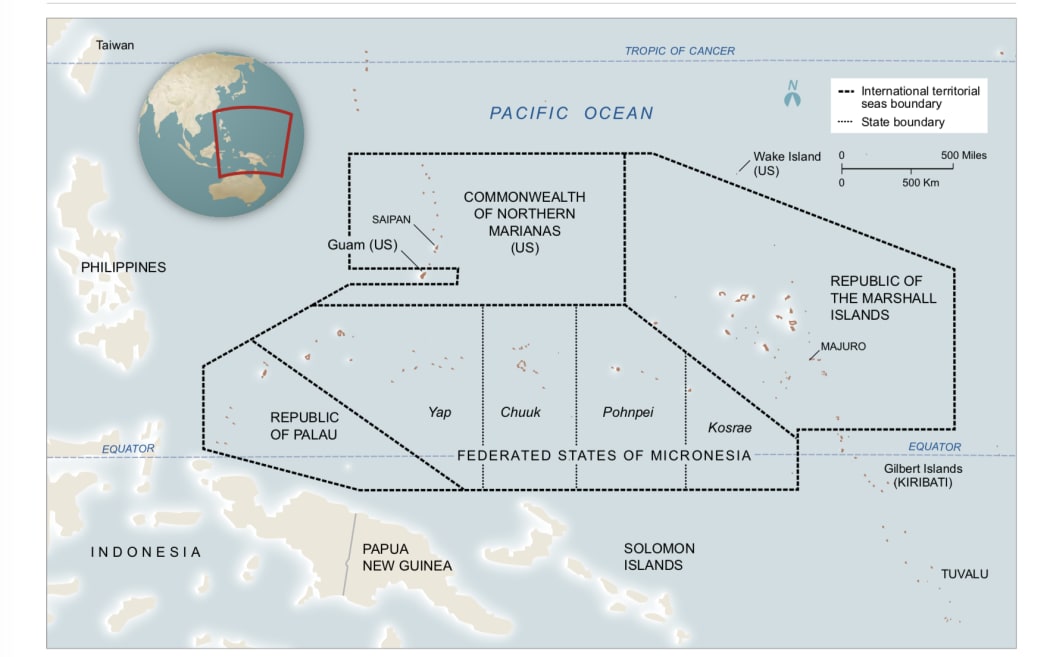
Washington sees the Compact treaties with the Marshall Islands, Federated States of Micronesia, and Palau, which stretch across an ocean area larger than the continental US, as key to countering the expansion of China in the region.
“The unique security relationships established by the Compacts of Free Association have magnified the US power projection in the Indo-Pacific region, structured US defense planning and force posture, and contributed to essential defense capabilities,” said a new study released September 20 in Washington, DC by the United States Institute of Peace, “China’s Influence on the Freely Associated States of the Northern Pacific.”
China’s naval expansion is increasing the value of the US relationship with the freely associated states (FAS).
The freely associated states stretch across an ocean area in the north Pacific that is larger than the continental United States and are seen by Washington as a key strategic asset. Image: United States Institute of Peace/RNZ
China’s blue water ambitions China’s naval expansion is increasing the value of the US relationship with the freely associated states (FAS).
“The value of the buffer created by US strategic denial over FAS territorial seas is poised to increase as China seeks to make good on its blue water navy ambitions and to deepen its security relationships with Pacific nations,” said the report whose primary authors were Admiral (Ret.) Philip Davidson, Brigadier-General (Ret.) and David Stilwell, former US Congressman from Guam Dr Robert Underwood.
The Runit Dome was constructed on Marshall Islands Enewetak Atoll in 1979 to temporarily store radioactive waste produced from nuclear testing by the US military during the 1950s and 1960s. Image: RNZ
“As Washington seeks to limit the scope of Beijing’s influence in the Indo-Pacific in concert with regional partners, the US-FAS relationship functions as a key vehicle for reinforcing regional norms and democratic values.”
US and Marshall Islands negotiators have both said they hope for a speedy conclusion to the talks as the existing 20-year funding package expires on September 30, 2023. But the nuclear test legacy is the line in the sand for the Marshall Islands.
“The entire Compact Negotiation Committee agreed — don’t go,” said Parliament Speaker Kenneth Kedi, who represents Rongelap Atoll, which was contaminated with nuclear test fallout by the 1954 Bravo hydrogen bomb test at Bikini Atoll and other weapons tests.
“It is not prudent to spend over $100,000 for our delegation to travel to Washington with no written response to our proposal. We are negotiating in good faith. We submitted our proposal in writing.” But he said on Friday, “there has been no answer or counter proposal from the US.”
US and Marshall Islands officials had been aiming to sign a “memorandum of understanding” at the summit as an indication of progress in the discussions, but that now appears off the table.
US Pacific summit Marshall Islands President David Kabua, who is currently in the US following a speech to the United Nations General Assembly Tuesday last week, is scheduled to participate in the White House-sponsored US Pacific Islands Summit on September 28-29.
Kabua, while affirming in his speech at the UN that the Marshall Islands has a “strong partnership” with the US, added: “It is vital that the legacy and contemporary challenges of nuclear testing be better addressed” (during negotiations on the Compact of Free Association). “The exposure of our people and land has created impacts that have lasted – and will last – for generations.”
The Marshall Islands submitted a proposed nuclear settlement agreement to US negotiators during the second round of talks in July. The US has not responded, Kedi and other negotiating committee members said Friday in Majuro.
In response to questions about the postponement of the planned negotiating session, the State Department released a brief statement through its embassy in Majuro.
“With respect to the Compact Negotiations, which are ongoing, both sides continue to work diligently towards an agreement,” the statement said. “Special Presidential Envoy for Compact Negotiations, Ambassador Joe Yun, is expected to meet with President Kabua while he is in Washington to continue to advance the discussions.”
While the Marshall Islands decision to cancel its negotiating group’s attendance at a scheduled session in Washington is a blow to the Biden administration’s efforts to fast-track approval of the security and economic agreement for this strategic North Pacific area, island leaders continue to describe themselves as part of the “US family.”
“The cancellation of the talks indicates the seriousness of this issue for the Marshall Islands,” said National Nuclear Commission Chairman Alson Kelen. “This is the best time for us to stand up for our rights.”
‘Fair and just’ nuclear settlement For decades, the Pacific Island Forum countries that will be represented at this week’s leader’s summit in Washington have stood behind the Marshall Islands in its quest for a fair and just nuclear settlement, said Kelen, who helped negotiators develop their plan submitted recently to the US government for addressing lingering problems of the 67 nuclear tests.
“We live with the problem (from the nuclear tests),” said Kelen, a displaced Bikini Islander. “We know the big picture: bombs tested, people relocated from their islands, people exposed to nuclear fallout, and people studied. We can’t change that. What we can do now is work on the details for this today for the funding needed to mitigate the problems from the nuclear legacy.”
Kedi said he was tired of US attempts to argue over legal issues from the original Compact of Free Association’s nuclear test settlement that was approved 40 years ago before the Marshall Islands was an independent nation.
That agreement, which provided a now-exhausted $150 million nuclear compensation fund, was called “manifestly inadequate” by the country’s Nuclear Claims Tribunal, which over a two-decade period determined the value of claims to be over $3 billion.
“Bottom line, the nuclear issue needs to be addressed,” Kedi said.
“We need to come up with a dignified solution as family members. I’ve made it clear, once these key issues are addressed, we are ready to sign the Compact tomorrow.”
President Kabua is scheduled to participate in the White House-sponsored US Pacific Islands Summit on September 28-29.
Meanwhile, the members of his Compact negotiating team are in Majuro waiting for a response from the US government to their proposal to address the nuclear legacy.
This article is republished under a community partnership agreement with RNZ.
A Wellington tauira (scholar) has launched a petition calling for Aotearoa New Zealand’s Reserve Bank to replace the monarch in the next redesign of coins and notes, with images that better represent the country.
Rangatahi Māori, Te Matahiapo Safari Hynes (Rangitāne, Ngāti Kahungunu) said it was a chance for New Zealand to think about the role of the monarchy, and the currency was a good start.
“I think these are the sorts of things we should start thinking about — what are the different things that colonisation and the Crown has entrenched over the years that we can perhaps start to pick at, and that we can perhaps start to peel back on?”
Hynes said although these kinds of conversations had already been happening for a long time, the accession of King Charles III had provided an opportunity.
“There are times where [these conversations] will come into the public eye for a short span, and they’ll dominate the headlines for a little time, and then they’ll go back, and they’ll come back eventually when something else happens,” he said.
The #ourownmoney campaign asks the Reserve Bank “to reconsider ensuring our money represents us as a country, that the people and the symbols on our money are people that are from here, that come from these places, have been in this country, even at a minimum have lived in this country.”
Hynes hoped to honour the people who had contributed to New Zealand, and showcase more New Zealand symbols.
Historical figures, blossoms “We have so many people in our country’s history that have paved the way for us to be where we are today and how we will be in the future. This is an opportunity to acknowledge and recognise their hard work,” the petition says.
He suggested using figures like Dame Whina Cooper, Eva Rickard or Meri Te Tai Mangakāhia on the $20 note. He also proposes putting native plants like kōwhai blossom, harakeke, or kawakawa on the coins.
A constitutional scholar who has participated in the Māori Constitutional Convention, Hynes waited until after the Queen’s funeral to launch his petition, out of respect.
He said the currency conversation is one New Zealand could have without going into the immediate and impulsive calls for a republic, which he believed was a much bigger and more nuanced conversation.
“I’m sceptical of people who are attempting to push a kind of republic-based agenda because they perhaps think in some technical way Māori rights can be extinguished.”
The Reserve Bank has already signalled the next redesign will feature King Charles III, but the change is still a long way off. It will take several years before coins featuring Queen Elizabeth II are replaced, and even longer for the $20 note to change.
“We manufacture these notes infrequently and do not plan to destroy stock or shorten the life of existing banknotes just because they show the Queen. This would be wasteful and poor environmental practice,” the Reserve Bank said.
This article is republished under a community partnership agreement with RNZ.
“Una vittoria storica” – a historic victory. That’s how the website of one of Italy’s major newspapers, the Corriere della Sera, reacted to the exit polls released after voting closed in Italy’s general election on Sunday night.
With a predicted vote share of between 40-45%, the right-wing coalition led by Giorgia Meloni looks on course to secure at least 230 of the 400 seats in the Lower House, giving it a clear majority.
Meloni’s party, Brothers of Italy, was the big winner on the right, with various agencies estimating it at around 25% of the vote. This was more than the combined total of her two main allies, as Matteo Salvini’s League was tipped to receive approximately 8-9%, with former prime minister Silvio Berlusconi’s Forza Italia just below that.
In just four years, Brothers of Italy has gone from minor to major player on the right. In 2018, they took 4.4% compared to the League’s 17.4% and Forza Italia’s 14%. And, if we look further back, Italy’s right-wing coalition has moved from having been dominated for over 20 years by a centre-right populist party (Forza Italia), to being dominated now by a far-right populist one (Brothers of Italy).
Brothers of Italy’s victory represents several firsts. Italy will have its first woman prime minister. And both Italy and Western Europe will have their first far-right majority government since the fall of Mussolini and the end of the Second World War.
Who is Giorgia Meloni?
Meloni’s trajectory owes much to that history. Beginning as an activist of the post-fascist Italian Social Movement in the Roman working-class district of Garbatella in the early 1990s, Meloni rose to prominence in a political milieu that didn’t deny its heritage.
She stated in an interview with French TV in 1996 that Mussolini was a “good politician” and “all that he did, he did for Italy”.
While Meloni now says Italy has consigned fascism to history, vestiges of her party’s political roots remain. For example, the flame in the party’s symbol is taken from the post-fascist Italian Social Movement, and there have been recent instances of its politicians and supporters performing fascist salutes.
Meloni and her party’s success can be traced back to Berlusconi’s entry into politics in 1994. His centre-right Forza Italia movement legitimised two smaller radical right parties (the northern regionalist League and the National Alliance) by bringing them into a coalition that easily won that year’s general election.
The coalition that will soon take power almost 30 years later contains the same three ingredients, but their internal balances have now drastically changed.
While some commentators focus on the continuity the new government will represent, there’s a historic change here. The pendulum on the right has shifted from Berlusconi’s centre-right populist governments with a far-right edge in the 1990s and 2000s, to Meloni’s far-right populist government with a centre-right edge in 2022.
What do these results mean for Italian politics?
Within the overall success of the right, there are winners and losers. Meloni is obviously the former, and Salvini is the latter.
Salvini is the politician who, having revitalised his party between 2013 and 2019, has now overseen a huge fall in its support from over 35% in the polls in July 2019 to under 10% today. Only the lack of an obvious successor may save Salvini from losing his party’s leadership.
For the main party on the Left, the Democratic Party, it’s yet another bad day. Having dropped to under 20% in the 2018 general election, they look unlikely to do much better than that this time. Their failure to find a campaign narrative beyond “stop the far right” and to create a broader coalition underlined the strategic ineptitude that has long undermined the Italian left.
Another “first” of this election is the turnout, which has slipped below two-thirds for the first time in Italian post-war history, declining from 73% in 2018 to 64% in 2022. This speaks to the image of a country in which large swathes of the population, especially in the South, are disillusioned with decades of politicians who have promised the earth and delivered little.
In economic and foreign policy terms, Italy may not change much in the short-term. Meloni will be keen to show Italian and international elites that she’s a responsible leader. Powerful domestic interest groups, such as the employers’ federation “Confindustria”, must be kept onside. As must the European Union which supports Italy through its post-COVID recovery plan.
But much could change for the far-right’s “enemies of the people”: ethnic, religious and sexual minorities; immigrants; and those judges, intellectuals, and journalists who dare to criticise the new regime.
Things will also change for those far-right Italians who, as Meloni recently put it, have had to “keep their head down for so many years and not say what they believed”. So, while the Brothers of Italy’s conservation of the post-fascist flame may be more smoke than fire for some groups, for others it will be incendiary.
Duncan McDonnell receives funding from the Australian Research Council.
Sofia Ammassari does not work for, consult, own shares in or receive funding from any company or organisation that would benefit from this article, and has disclosed no relevant affiliations beyond their academic appointment.
Russian President Vladimir Putin’s recent announcement of a “partial mobilisation” of 300,000 Russian personnel to fight in Ukraine sounded decisive. It isn’t.
The official position, fleshed out by Defence Minister Sergei Shoigu, was that the new Russian conscripts would be drawn from those with past military experience and individuals with special skills.
But the reality is that this is policy on the fly. It will result in a flood of untrained, often elderly and infirm Russians to the front lines. At best it will buy Putin time over another cold Ukrainian winter. At worst it will result in battlefield chaos and potentially mass slaughter.
Either way, the decision means that still more Russians, as well as Ukrainian military personnel and civilians, will be sacrificed on the altar of Putin’s hubris.
Putin’s haphazard call-up
Paradoxically, Putin’s call-up is at once both highly selective and seemingly random.
Russia’s ethnic minorities – many of whom live far from the main power centres of Moscow and St Petersburg – remain primary objects of Russian mobilisation efforts. In particular, Buryats from Russia’s Far East and Dagestanis from the Caucasus have been disproportionately targeted.
Meanwhile, Putin continues to insulate urban elites, who might cause him the most problems if they become radically opposed to the war. Those studying at Russia’s state universities, typically the privileged children of Putin’s “nomenklatura” who will go on to become the next generation of bureaucrats, are exempt from mobilisation.
But those in the second rank of private education institutions, frequently from Russia’s regions, are eligible to be conscripted into private military companies such as the infamous Wagner group, led by “Putin’s chef” Yevgenyi Progozhin.
So much for arguments, then, from domestic nationalists that Russia is the “Third Rome”, peacefully uniting people from different ethnicities and creeds. In fact, as has been the case repeatedly in Russian history, the nation’s minorities continue to be regarded as objects of suspicion and potential dissent, and used as replaceable labour or cannon fodder in Russia’s wars.
There are also signs little thought has gone into who gets called up, and why. Some local districts appear to be operating under a quota system, with police roaming public places and issuing call-ups to passers-by, including people over 60 and those with chronic health problems.
Elsewhere, anti-war demonstrators – as well as innocent bystanders – have been arrested and immediately drafted into the military.
Some 261,000 Russian males are estimated to have fled the country. Draftees have been presented with ancient and poorly kept old military equipment, including rusty assault rifles.
Others called up in the Russian-occupied Donetsk province of Ukraine have been issued Mosin rifles, which were developed in the late 19th century and are no longer in production.
Why mobilisation?
All this is a recipe for military disaster. But there are clear reasons why Putin decided to agree to the mobilisation he had long resisted.
First, Russian hardliners have been calling for him to do more to support the armed forces and bring the campaign to a close. Having expended a large quantity of its precision-guided munitions, and failing to establish air superiority, it’s difficult for Russian forces to accurately strike Ukrainian command-and-control centres, as well as key infrastructure such as power generation.
Mobilising a huge force (which some claim will ultimately reach over a million people) is one way to show his hard-line domestic critics Putin is listening.
Second, a large portion of Russia’s armed forces (some 60-70% of its total conventional capacity) has already been committed to Ukraine, and is nearing exhaustion after seven months without respite. Sending new recruits to the theatre will allow Russian front-line forces to rest and regroup for a fresh effort in the European spring.
All this means Russian offensive operations in Ukraine are effectively on hold. The best that Putin’s conscript army can achieve is to act as a blocking force while Moscow tests European patience and willingness to bear the cost of diminished energy supplies.
At the same time, the Kremlin has upped the ante on its nuclear threats, strongly hinting it would consider using tactical nuclear weapons if the territory it holds in Ukraine’s East (which will be formally annexed by Russia after the sham referenda in four provinces) is attacked by Ukrainian forces.
But Putin’s statement that he is “not bluffing” on the nuclear question should hardly inspire confidence about the power of his position.
Increasingly his are the actions of a damaged leader seeking to convey strength.
A weakened Putin
That in itself raises a conundrum for both Ukraine and the West: might a weakened Putin decide to lash out, and at what point?
As Caitlin Talmadge, a senior expert on nuclear strategy in the United States has recently suggested, leaders faced with certain defeat can decide to take courses of action that might otherwise be irrational.
While using tactical nuclear weapons against Ukrainian (and even NATO) targets might be viewed by Putin as a bad option, he may come to view it as his least-worst one if the strategic situation continues to deteriorate, or if his own domestic power base comes under significant threat.
However, we should also be mindful that Western capitulation is precisely what Putin wants. That would starve Ukraine of vitally needed military supplies, as well as heavy weapons to push its advantage after the impressive gains from its counteroffensive around Kharkiv.
Putin has been consistent throughout the crisis in pursuing a strategy of compellence: to demonstrate to Ukraine and its Western backers that he has a higher appetite for risk.
Under those circumstances, and given both Ukrainian sovereignty and Western credibility are both on the line, it’s absolutely crucial Putin’s adversaries show him who actually occupies the position of strength.
Matthew Sussex has received funding from the Australian Research Council, the Fulbright Commission, the Carnegie Foundation and various Australian government agencies.
Optus, Australia’s second largest telecommunications company, announced on September 22 that identifying details of up to 9.8 million customers were stolen from their customer database.
The details, dating back to 2017, include names, birth dates, phone numbers, email addresses, and – for some customers – addresses and driver’s licence or passport numbers.
According to the Australian law, telecommunications providers are required to hold your data while you are their customer and for an additional two years, but may keep the data for longer for their own business purposes.
This means that if you are a previous customer of Optus, your data may also be involved – although it remains unclear how long the details of past customers have been held.
Optus has been contacting former and current customers to notify them of the data breach. The Conversation
The stolen data constitutes an almost complete suite of identity information about a significant number of Australians. Optus states they have notified those affected, but there are plenty of questions remaining.
What happens with your data next, and what can the average Australian do to protect against the threats caused by this unprecedented data breach?
Late last week, an anonymous poster on a dark web forum posted a sample of data ostensibly from the breach, with an offer not to sell the data if Optus pays a US$1 million ransom. While its legitimacy has not yet been verified, it is unlikely the attackers will delete the data and move on.
More likely, the data will be distributed across the dark net (sold at first, but eventually available for free). Cyber criminals use these data to commit identity theft and fraudulent credit applications, or use the personal information to gain your trust in phishing attacks.
Below, we outline several steps you can take to proactively defend yourself, and how to detect and respond to malicious uses of your data and identity.
What should I do if I’ve been affected?
Step 1: Identify your most vulnerable accounts and secure them
Make a list of your most vulnerable accounts. What bank accounts do you hold? What about superannuation or brokerage accounts? Do you have important medical information on any services that thieves may use against you? What accounts are your credit card details saved to? Amazon and eBay are common targets as people often keep credit card details saved to those accounts.
Next, check how a password reset is done on these accounts. Does it merely require access to your text messages or email account? If so, you need to protect those accounts as well. Consider updating your password to a new – never before used – password for each account as a precaution.
Many accounts allow multi-factor authentication. This adds an extra layer for criminals to break through, for example by requesting an additional code to type in. Activate multi-factor authentication on your sensitive accounts, such as banks, superannuation and brokerage accounts.
Ideally, use an application like Google Authenticator or Microsoft Authenticator if the service allows, or an email that is not listed with Optus. Avoid having codes sent to your Optus phone number, as it’s at higher risk of being stolen.
Step 2: Lock your SIM card and credit card if possible
One of the most immediate concerns will be using the leaked data to compromise your phone number, which is what many people use for their multi-factor authentication. SIM jacking – getting a mobile phone provider to give access to a phone number they don’t own – will be a serious threat.
Most carriers allow you to add a verbal PIN as the second verification step, to prevent SIM jacking. While Optus has locked SIM cards temporarily, that lock is unlikely to last. Call your provider and ask for a verbal PIN to be added to your account. If you suddenly lose all mobile service in unusual circumstances, contact your provider to make sure you haven’t been SIM jacked.
To prevent identity theft, you can place a short-term freeze (or credit ban) on your credit checks. These can help stop criminals taking out credit in your name, but it makes applying for credit yourself difficult during the freeze. The three major credit report companies, Experian, Illion, and Equifax offer this service.
If you can’t freeze your credit because you need access yourself, Equifax offers a paid credit alert service to notify you of credit checks on your identity. If you get a suspicious credit alert, you can halt the process quickly by contacting the service that requested the report.
Safeguarding your data online involves looking after your passwords properly. Vitalii Vodolazskyi/Shutterstock
Step 3: Improve your cyber hygiene
These breaches don’t exist in a vacuum. The personal information stolen from Optus may be used with other information cyber criminals find about you online; social media, your employer’s website, discussion forums and previous breaches provide additional information.
Many people have unknowingly been victims of cyber breaches in the past. You should check what information about you is available to cyber criminals by checking HaveIBeenPwned. HaveIBeenPwned is operated by Australian security professional Troy Hunt, who maintains a database of known leaked data.
You can search your email accounts on the site to get a list of what breaches they have been involved in. Consider what passwords those accounts used. Are you using those passwords anywhere else?
Take extra care in verifying emails and text messages. Scammers use leaked information to make phishing attempts more credible and targeted. Never click links sent via text or email. Don’t assume someone calling from a company is legitimate, get the customer support number from their website, and call them on that number.
Creating unique and secure passwords for every service is the best defence you have. It is made easier using a password manager – many free apps are available – to manage your passwords. Don’t reuse passwords across multiple services, since they can be used to access other accounts.
If you aren’t using a password manager, you should at least keep unique passwords on your most vulnerable accounts, and avoid keeping digital records of them in email or in computer files while keeping any written passwords in a safe, secure, location.
I’ve been hacked, now what?
Sometimes you can do everything right, and still become a victim of a breach, so how do you know if you’ve been hacked and what can you do about it?
If you receive phone calls, emails or letters from financial institutions regarding a loan or service you know nothing about, call the institution and clarify the situation.
You should also contact IDCare, a not-for-profit organisation designed to assist victims of cyber-attacks and identity theft, for further guidance. You can also report cyber crimes – including identity theft – through CyberReport.
The authors do not work for, consult, own shares in or receive funding from any company or organization that would benefit from this article, and have disclosed no relevant affiliations beyond their academic appointment.
When the National Disability Insurance Scheme (NDIS) was established almost a decade ago, it was envisaged people with disability would be empowered consumers. It was hoped their customer insights would shape new services designed to meet their specific needs and preferences.
But today’s market-based reality is that the National Disability Insurance Agency and its support providers are mostly still in control. In the worst examples, this has been linked to devastating abuse and alleged neglect of participants by support workers. Providers frequently see NDIS participants as a business “commodity”.
The disability sector has not prioritised obtaining and using data about what NDIS participants need and want, though there are notable exceptions like the Housing Seeker snapshot.
For our research, we conducted in-depth interviews with 12 people with acquired neurological disability, such as traumatic brain injury, spinal cord injury, stroke, or multiple sclerosis. When they spoke about what makes a good support worker, it wasn’t necessarily formal qualifications they were interested in – but rather how they were treated as people.
Disability support workers are the key frontline staff who assist people with daily living, employment, housing and community participation, and achieving their goals. Support work looks different depending on the complexity of the person’s needs, with some people requiring general daily supports but others needing high intensity supports.
Australia spends more than A$20 billion each year on disability support workers. The new Labor government has promised an NDIS reset to bring it closer to its original vision.
However, without an evidence-based approach, the government may be investing in poor quality services that do not meet the needs of participants. Investment in quality support will maximise independence and social and economic participation and reduce the long term liability of the scheme.
They told us that, first and foremost people with disability want support workers to recognise them as an individual, treat them as a person, and see them as the expert in their own support needs and preferences.
Charlie*, spoke to us after moving from poor quality support to good support and said
They didn’t know your name, treat you like you’re just a body in a bed […] Here they treat you like a person, they ask you what you want.
Participants stressed they want to choose and direct their support workers. While participants want support workers to have basic competencies, most importantly they value support workers’ attitude and willingness to listen and learn. Alex* said
Even if the rules seem ridiculous and over-exacting, if I say something’s important, just trust me that it’s important. Respect my perspective.
What participants want most, might not be what you think.
Participants wanted support workers they were compatible with, as compatibility fosters comfortable and respectful working relationships. Some participants valued this connection above and beyond formal qualifications or experience. Sarah* said
Never once have I asked to see her resume or her qualifications. I really don’t care what she’s got, I care about how we gelled.
Managing disability support was a job in itself, said participants. But systemic issues might mean participants feel “stuck” with support workers they don’t want to work with. Alex* expressed the common fear of not being able to find a better match.
You never know what the quality of the next person is going to be […] the energy required to train up and get used to a new person, is quite high. So, it has to get quite bad before I fire someone.
Participants we spoke to said service providers sometimes limited their opportunities to choose their own support workers.
However, the introduction of online matching platforms such as HireUp and Mable provide new avenues for people with disability to build support teams that work for them.
Having new options signifies growth in the disability sector, but we need to ensure there are sufficient options to reflect the diversity of people with disability, and ensure people are supported to make informed decisions within traditional services.
Having real choice over support arrangements and daily living is key to quality support.
But theoretical choice and control are useless if people are not supported and empowered. Solutions need to be led, co-designed and implemented by people with disability.
One recent example is Participant Led Videos. This initiative featured tools co-designed with NDIS participants to help them create personalised videos to direct their support. Further independent evaluation showed they were well-received and considered achievable by people with disabilities and support workers.
NDIS participant Terry provides insights into how support workers can help him.
Every participant is different
Rather than a one-size-fits-all approach, our research identifies the need for support workers to get training specific to each person’s needs. Given the value of lived experience, it is imperative people with disability are part of the design and delivery of training for support workers.
With the new government, we have an exciting opportunity to put people with disability front and centre of the NDIS. In the words of Isabella*, people with disability should be
the one[s] calling all the shots. It’s my life – why the hell would anybody else call the shots.
*Names have been changed to protect participants’ identities.
Megan Topping’s doctoral research is supported by a postgraduate award through the Summer Foundation, Melbourne, Australia.
The Participant Led Video research was funded by the Innovative Workforce Fund (National Disability Services – https://workforce.nds.org.au/)
Jacinta Douglas is affiliated with the Summer Foundation through her Professorial role within the La Trobe University, Living with Disability, Summer Foundation Research Partnership.
In a landmark decision, a United Nations committee on Friday found Australia’s former Coalition government violated the human rights of Torres Strait Islanders by failing to adequately respond to the climate crisis.
The Torres Strait Islanders ‘Group of Eight’ claimed Australia failed to take measures such as reducing greenhouse gas emissions and upgrading seawalls on the islands. The UN upheld the complaint and said the claimants should be compensated.
This decision is a breakthrough in Indigenous rights and climate justice, including by opening up new pathways for Indigenous communities – who are often on the frontline of the climate crisis – to defend their rights.
The Albanese government, which has stated its commitment to work with the Torres Strait on climate change, must now meet this moment of possibility and challenge.
The decision is a win for the Torres Strait Islanders who lodged the complaint with the UN – but it has far wider implications. Shutterstock
Why is this so significant?
Eight Torres Strait Islanders and six of their children lodged the complaint with the UN in 2019, saying climate change was damaging their way of life, culture and livelihoods.
It was the first time people from a low-lying island exposed to rising sea levels had taken action against a government.
The Torres Strait Islanders hailed from four islands – Boigu, Poruma, Warraber and Masig. In their complaint, they described how heavy rain and storms associated with climate change had devastated their homes and food crops. Rising seas had also flooded family grave sites.
Significantly, deep Indigenous cultural and ecological knowledge, rather than Western climate science, proved key to this UN decision. This marks a departure from broad international climate politics where Indigenous laws, cultures, knowledges and practices are often sidelined or underrepresented.
Major legal breakthrough for Indigenous rights
The UN human rights committee found Australia had failed to protect Torres Strait Islanders against the impacts of climate change and violated their right to enjoy their culture, and to be free from arbitrary interference to privacy, family and home.
These rights respectively form Article 27 and 17 of the UN Universal Declaration of Human Rights. The complaint also argued on grounds of Article 6, the right to life, but this was not upheld.
In its decision, the UN considered Torres Strait Islanders’ close connection to traditional lands and the central place of healthy ecosystems for the maintenance of cultural practices. Connection to healthy country across land and seas as well as to culture, and the ability to maintain these, were determined to be human rights.
The committee said despite some action from Australia, such as new seawalls for the four islands by next year, additional measures were required to prevent potential loss of life.
Responding to the outcome, Yessie Mosby, one of the Group of Eight and a Traditional Owner of Masig said:
I know that our ancestors are rejoicing knowing that Torres Strait Islander voices are being heard throughout the world through this landmark case […] This win gives us hope that we can protect our island homes, culture and traditions for our kids and future generations to come.
ClientEarth lawyer Sophie Marjanac, who acted for the claimants, said the outcome set a number of precedents. Specifically, it’s the first time an international tribunal has found:
a country has violated human rights law through inadequate climate policy
a nation state is responsible for their greenhouse gas emissions under international human rights law
peoples’ right to culture is at risk from climate impacts.
The decision comes just months before this year’s COP27 climate talks in Egypt, and will add weight to growing international demands for loss and damages to be meaningfully included in international climate negotiations.
Among these are calls to include recognition of and compensation for kinds of loss and damage other than economic, such as health and wellbeing, ways of being, cultural sites and sacred places.
The decision is the first time an international tribunal has found peoples’ right to culture is at risk from climate impacts. Gabrielle Dunlevy/AAP
The rise of Indigenous rights climate litigation
The Torres Strait Islands claim is part of a rapidly growing climate litigation space. Globally, climate change-related cases doubled between 2015 and 2022.
National governments are a key target of legal action. This latest decision is likely to spark more such cases in Australia and elsewhere. As UN Committee member Hélène Tigroudja said when explaining the decision:
States that fail to protect individuals under their jurisdiction from the adverse effects of climate change may be violating their human rights under international law.
The Group of Eight’s win joins similar Australian cases involving Indigenous rights. In the Tiwi Islands, for example, Indigenous people succeeded in stopping a proposal by energy giant Santos to drill for gas offshore from their islands.
Meanwhile, Youth Verdict’s success in the Queensland Land Court ensured First Nations evidence of the impacts of climate change would be heard on Country in their case against Clive Palmer’s Waratah Coal mine.
How will the new Australian government respond?
The UN committee said the Australian government should compensate Torres Strait Islanders for the harms already suffered. They called for meaningful consultation with Torres Strait communities and measures to secure their safety, such as building seawalls.
So will the UN’s decision advance an Indigenous rights agenda in Australia as the climate crisis grows?
Attorney General Mark Dreyfus said the government will consider the decision and respond in due course.
The development puts the onus on the Albanese government to ensure Indigenous rights are upheld as part of climate policy and planning.
It also sends a clear signal that governments must act on climate change. This means not just reducing emissions, but helping more vulnerable regions to adapt to the damage already done.
Parents and students are currently making big decisions about next year.
Some will have just received or be about to receive offers of a selective school place for 2023. Other parents need to decide soon if they will apply for their children to sit selective schools tests next year for entry in 2024. Or if they should be looking at other high school options.
These decisions can seem overwhelming for families. What are some of the issues to consider?
What is selective school?
Selective schools are public high schools where students sit a competitive test to be accepted the year before entry.
They are mostly found in New South Wales, where there are about 50 schools. But there are small number in other states, including Queensland (years 7 to 12), Victoria (years 9 to 12) and Western Australia (7 to 12).
The success rate varies, but is is very competitive. For example, in NSW this. year, there were 15,660 applications for 4,248 places.
The pros and cons
Selective school places are highly sought-after – these schools feature prominently in the top schools for year 12 results. But they don’t have the fees of elite private schools.
Some students feel energised by the “best of the best” atmosphere in which they can focus and find similarly capable peers.
But there is an ongoing debate about whether they should exist in the first place. There is also an obvious focus on test performance, rather than the modern skills students need to learn such as collaboration, tech literacy and creativity.
And while academic streaming does seem to improve the performance of high achievers, it can harm the confidence of those who get in (as well as those who don’t). As Australian Catholic University education scholar Associate Professor Philip Parker has explained, selective schools can create a “big fish little pond” effect where students lose a realistic sense of where they fall within the full student achievement spectrum.
Even if students gain a place at selective school, they can find the competition counter-productive. Australian selective school students are increasingly speaking out about the mental health impacts of studying in a stressful, competitive environment.
Don’t forget tutoring
The Australian tutoring industry is huge, not just for parents seeking to improve their child’s performance in class, but in preparation for selective entry exams.
While the entry tests measure general literacy, maths and logic skills – and do not require study – many students undergo months or even years of expensive and often stressful tutoring to prepare.
A 2010 US study suggested tutoring and coaching for selective entry exams only had a moderate effect on student’s results, but this is far from conclusive. Given the competition to gain entry to these schools, students and their parents may be more confident knowing they’ve had tutoring. That confidence alone may improve their performance.
What should parents think about?
It’s understandable that parents might be confused. How do you know if the selective school is right for your child? Here are some issues to consider:
school culture: are the schools you are considering particularly competitive? Do they have an emphasis on other activities, away from exam marks? Do they encourage sport, music or creative arts? Do they emphasise mental health? Do they have programs to support students from diverse backgrounds and with diverse identities?
location: if your child is successful, will it mean a very long commute for them?
your child’s strengths: does your child enjoy school work and sitting tests? Or do their strengths lie in other, less traditionally academic areas?
your child’s temperament: does your child become anxious in testing situations, or do they enjoy the “performance” aspect of them?
your child’s opinion: is your child self-motivated to go to a selective school, or are you trying to convince them it’s “good” for them? If they are keen, giving them a chance – with the appropriate support – might help them decide.
tutoring: does your child want to do tutoring or exam preparation? Can you afford the fees and time if they do?
your child’s teacher: have you had conversations with your child’s teachers? Do they believe your child has the academic aptitude and emotional capacity to thrive in a selective school environment?
Daniel X. Harris receives funding from the Australian Research Council Future Fellowship scheme.
Illustration of DART before impact.NASA/Johns Hopkins APL/Steve Gribben
On September 26 at 11.15pm UTC, NASA’s DART mission (Double Asteroid Redirection Test) will be the first to deliberately and measurably change the motion of a significant body in our Solar System. In other words, it will smash into an asteroid.
The mission will provide the first test of a technique that could be used in the future – to redirect any asteroids we detect on a collision course with Earth.
A binary pair of space rocks
DART was launched on November 24, 2021, its destination a pair of asteroids in orbit around each other, 11 million kilometres from Earth.
The larger asteroid in the pair is called Didymos and is 780 metres in diameter. The smaller asteroid, just 160 metres wide, is called Dimorphos. The two orbit each other at a distance of 1.18 kilometres, and one orbit takes close to 12 hours.
DART is expected to alter the orbit of the smaller asteroid. NASA/Johns Hopkins APL
These asteroids pose no risk to Earth and have been chosen as the target for DART partly due to that fact. But also, importantly, because the asteroids form a binary pair, it will be possible for astronomers on Earth to assess the results of the impact.
As the asteroids orbit each other, the sunlight reflected off them increases and decreases, varying systematically over the 12-hour cycle of the orbit. Astronomers using powerful telescopes from Earth can monitor this variation and see how it changes, from before to after the collision.
The physics sounds simple, and it is. Hit one thing with another thing to change its motion. But the mission execution is very complicated. When DART reaches the asteroids, it will be 11 million kilometres from Earth after a 10 month journey. The spacecraft has to use autonomous targeting, using images of the asteroids it acquires as it approaches.
DART needs to recognise the asteroids by itself, automatically lock onto Dimorphos, and adjust its trajectory to hit it. This is all while moving at a speed of nearly 24,000 kilometres per hour!
The results of the impact, while reasonably straightforward to measure, are difficult to predict. The size, shape, and composition of Dimorphos, and exactly where DART hits and how hard, will affect the outcome.
All these factors are uncertain to some degree. Comprehensive computer simulations of the impact have been undertaken, and the comparisons of the simulations, predictions, and measured results will be the main outcomes of the DART mission.
As well as the measurements from telescopes on Earth, an up-close view of the impact itself will be possible, from an Italian Space Agency CubeSat (a small type of satellite) called LICIACube that was deployed from a spring-loaded box aboard the craft on 11 September. LICIACube will follow along and photograph the collision and its aftermath.
The Lowell Discovery Telescope, located in northern Arizona, one of the facilities that will measure the impact of the DART collision. Lowell Observatory
The results will tell us a lot about the nature of asteroids and our ability to change their motions. In the future, this knowledge could be used to plan planetary defence missions that seek to redirect asteroids deemed to be a threat to the Earth.
An asteroid as small as 25 metres in diameter could produce injuries from an airburst explosion if it hit the atmosphere over a populated area. It is estimated that 5 million such objects exist in our Solar System and that we have discovered approximately 0.4% of them. Such a hit is estimated to occur once every 100 years. While quite frequent, the overall risk is low and the impact risk is relatively low too.
However, it is predicted there are 25,000 objects in the Solar System the size of Dimorphos, 39% of which are known, that hit Earth every 20,000 years. Such an object would cause mass casualties if it hit a populated area.
Asteroid statistics and the threats posed by asteroids of different sizes. NASA
Asteroids that could challenge the existence of human civilisation are in the 1 km plus size category, of which there are less than a thousand in the Solar System; they might hit Earth only every 500,000 years. We have already found 95% of these objects.
So, potential asteroid collisions with Earth range from the frequent but benign to the very rare but catastrophic. The DART tests are being undertaken in a very relevant and interesting size range for asteroids: those greater than 100 metres.
If DART is successful, it may set the scene for future missions that target asteroids, to nudge them out of the way of collisions with Earth. When an asteroid is a long way from Earth, only a small nudge is required to get it out of our way, so the earlier we can identify asteroids that are a potential threat, the better.
Are women as successful as men in securing a patent for their invention?
We set out to investigate gender bias in patent outcomes at IP Australia – the government agency responsible for administering intellectual property rights.
To do so, we analysed 309,544 patent applications from across a 15-year period (2001-2015), and categorised close to one million inventors’ names based on whether they sounded male or female.
We found that having a male-sounding first name increases the odds of securing a patent. This gender bias can have serious implications for women’s health, female career progression and equity policies in STEM. But what’s causing it?
Women are increasingly applying for patents
Patents provide a 20-year monopoly over a new invention and are a well-known measure of the output from STEM-based industries.
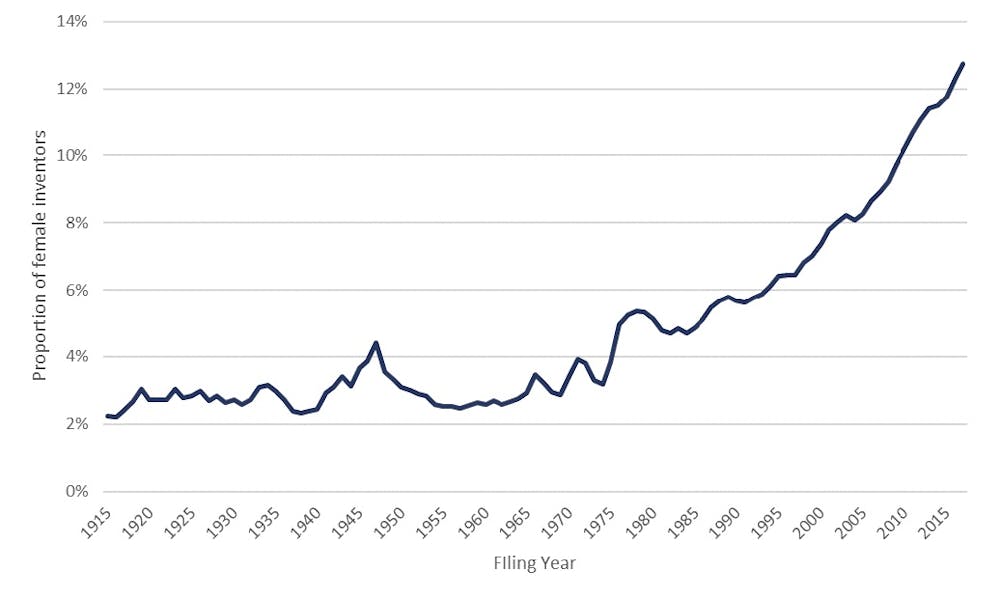
Global studies show the number of patent applications from female inventors (while still lower than the number from men) has grown significantly over the past 20 years. What has been less clear is whether these applications convert to granted patents.
The proportion of female inventors associated with patent applications worldwide has grown from 1915 to 2017. Intellectual Property Office UK, Gender Profiles in Worldwide Patenting: An Analysis of Female Inventorship (2019 edition)
Studies of data from the United States Patent and Trademark Office unfortunately reveal inventors with a female-sounding first name are less successful at having their patent granted than those with a male-sounding first name.
This is irrespective of the technical field and the gender of the patent examiner, and despite evidence that female inventor patents are just as good as male inventor patents.
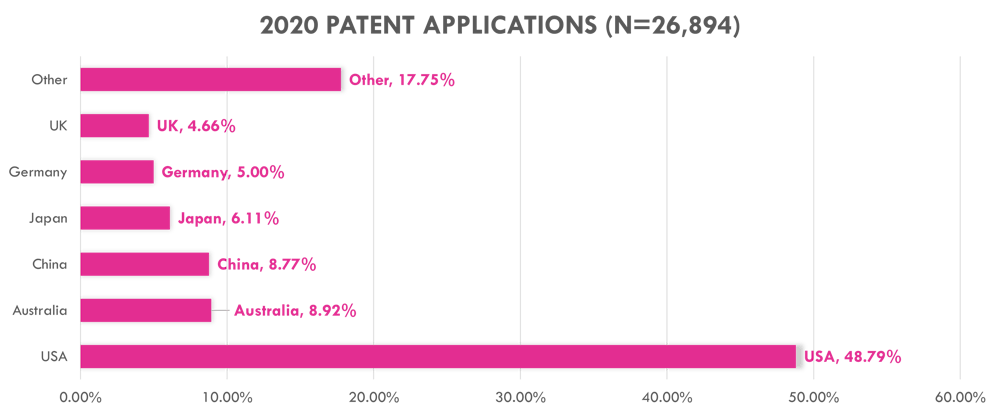
We wanted to investigate whether a similar gender bias exists for patents filed at IP Australia, where most applications come from non-residents. Inventors who plan to operate internationally will often file in multiple jurisdictions, including filing in Australia.
So unlike studies of the US Patent and Trademark Office, where the majority of patents come from US residents, a study of patents at IP Australia reflects more worldwide applications.
A profile of 2020 patent applications to IP Australia. IP Australia
A gender gap persists
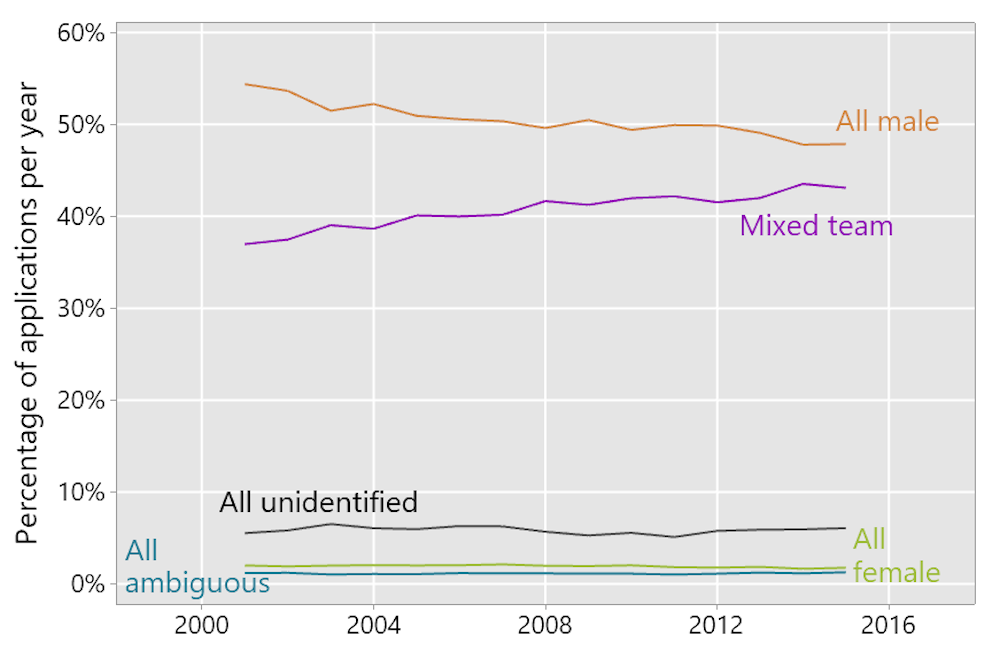
Our analysis of 309,544 patent applications submitted over 15 years found 90% of applications had at least one male inventor. Just 24% had at least one female inventor (typically as part of a mixed-gender team).
The percentage of applications per year, per team composition (male, female, ambiguous, unidentified).
We then examined whether these applications converted into a successful patent grant. We found inventors with a female-sounding first name had slightly lower odds of having their patent granted.
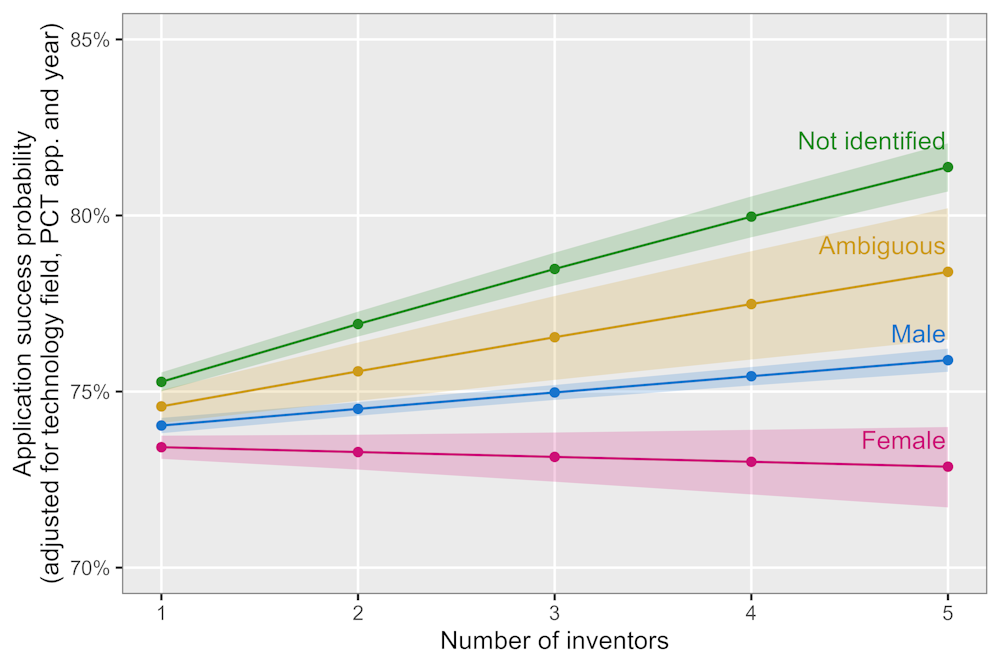
Also, as the number of males on a team increased, so did the odds of the team being granted a patent – whereas adding a female had a negligible impact. In other words, bigger teams of inventors had more patent success, unless the additional inventors had female-sounding names.
This graph shows the pattern that emerges when you vary the composition of a single-gender team. You can see more men increases chances of success, whereas more women does not. Author provided
But why is it like this?
One question for us was whether this gender disparity could be explained by the types of fields patents were being granted in, and whether women simply work in less “patentable” fields such as life sciences.
We found more than 60% of female inventors were clustered in just four of 35 technical fields (the 35 science categories recognised in patents). These were all in the life sciences: chemistry, biotechnology, pharmaceuticals and medical technology.
We also found patents in three of these fields had a lower-than-average success rate. In other words, it’s generally harder to get a patent in these fields, regardless of whether you’re a woman or man.
Nevertheless, even after we statistically controlled for the effect of participating in a less successful field, we still found a gender disparity – male-named inventors did better than female-named inventors.
Women are responsible for some of the greatest inventions, yet inventorship remains a male-dominated field. We’ll have to fight historical biases against women if this is to change. Shutterstock
Women in STEM must be supported
The implications of women falling out of the patent system are significant for a number of reasons. For one, patents with female inventors are more likely to focus on female diseases.
Also, getting a patent can be important for career progression and for securing investment capital. And research has shown a lack of female inventors today impacts the rate at which girls aspire to be the inventors of tomorrow.
The next step in our research is to find out why there is a gender gap in successful patent applications.
We don’t believe it’s a simple case of gender bias at the patent office. We suspect the issues are complex, and related to the systemic and institutional biases that hold back women’s progress in STEM more generally.
Country and cultural differences may also be at play, particularly since more than 90% of patent applications received by IP Australia come from non-Australian inventors (and overwhelmingly from the United States).
We want to look deeper into our results to figure out what’s driving the gender disparity, and what we can do to support female inventors.
The first step in fixing a problem is acknowledging it exists. We hope our research starts a conversation that prompts people to reflect on their own biases.
The authors do not work for, consult, own shares in or receive funding from any company or organization that would benefit from this article, and have disclosed no relevant affiliations beyond their academic appointment.
Source: The Conversation (Au and NZ) – By Nathan Bartlett, Associate Professor, School of Biomedical Sciences and Pharmacy, University of Newcastle
Vaccines (predominantly mRNA vaccines) have been our front-line defence against COVID and have saved millions of lives.
Despite the emergence of genetically distinct COVID variants throughout the pandemic, we’ve relied on vaccines that target the spike protein from the virus originally detected in Wuhan, China. While still providing excellent protection, mRNA vaccines are less effective against newer variants with immunity waning within months of immunisation.
Australia’s Omicron bivalent (two-strain) COVID vaccine has been approved for use and will be rolled out as stocks of the original vaccines need replacing.
While we hope they will provide better protection than existing vaccines, the little data we have so far suggests they only provide slightly better protection.
So, if you’re eligible for your fourth dose, it makes sense to get boosted with whichever COVID vaccine you’re offered now – rather than waiting until the Omicron-specific boosters enter circulation.
One key technological advance with mRNA vaccines is the ability to modify the mRNA sequence that encodes the spike protein in SARS-CoV-2 (the virus that causes COVID). This means scientists can target the viral spike protein and respond to the viral variants currently circulating.
But it still takes time to manufacture a recalibrated mRNA vaccine, then test it, distribute it and get it into people’s arms.
Earlier in the pandemic, Moderna produced a bivalent vaccine that also targeted the Beta variant. Initial lab tests showed boosting with this variant-specific vaccine increased antibodies against Beta approximately two times better than the boost provided by the original vaccine.
However development was discontinued because Beta was replaced by other COVID variants.
As long as SARS-CoV-2 evolves, keeping up with it is going to remain a challenge for variant-specific vaccines.
So how do scientists determine if bivalent vaccines work better than existing vaccines?
The gold standard is a clinical trial that assesses protection from disease. Early in the pandemic when few people had immunity to SARS-CoV-2, this was relatively straight forward. Starting with a baseline of no immunity makes it easier to design a trial to assess the protection provided by vaccines.
The situation is a lot more complicated now, with much of the world’s population vaccinated, previously infected or both – often multiple times.
Measuring relative effectiveness in a clinical trial comparing two vaccines in such a diverse population exposed to unpredictable waves of infection requires large numbers of study participants – and lots of time and money.
As an alternative, we can examine indicators of protection. Antibodies are generated by the immune system when we’re exposed to the SARS-CoV-2 spike protein, either via vaccination or infection. The aim is to generate lots of antibodies that bind to the surface of the spike protein and stop the virus infecting cells.
Scientists can recruit study participants who know their vaccination and infection history and take their baseline antibody levels. Then they can be boosted with either the standard mRNA vaccine or the variant-modified bivalent vaccine. The level of virus-neutralising antibodies in the blood can then be assessed in the lab after boosting.
How effective is the Omicron booster?
The Moderna COVID bivalent booster targets the ancestral virus and Omicron BA.1 subvariant. It has been approved for use in Australia and will be rolled out when our stocks of existing Moderna boosters have been exhausted.
The bivalent vaccine will then be offered to adults who are due to have their third or fourth doses.
Lab-based studies assessing antibody responses suggest the bivalent vaccine offers 1.5 to 2 times improved immunity over the boost provided by the original vaccine.
However, it’s unclear how much better they will be than existing boosters at protecting people from disease, particularly given BA.1 has been replaced by Omicron sub-variants. These have several mutations that distinguish them from BA.1 and so the bivalent Omicron vaccine is no longer a perfect match.
To try and understand vaccine effectiveness in the absence of a dedicated clinical trial, researchers can model the relationship between lab-based antibody studies and previous clinical trials to predict how well new vaccines will protect from disease.
This type of analysis shows the original vaccine is quite good at restoring protection against disease caused by different variants when given as a booster.
Variant-modified vaccines such as the newly approved Omicron booster are predicted to improve that by 5–10%, depending on the variant and level of existing immunity. This might seem like a small improvement but it could mean additional lives saved.
That said, you are at much greater risk of disease if it has been several months since your last booster. That’s why it’s best to get boosted as soon as you’re eligible, rather than waiting for an Omicron-specific booster.
The government has accepted the Australian Technical Advisory Group on Immunisation (ATAGI) advice to wait until current Moderna booster stocks run out before putting the bivalent Omicron boosters into circulation.
This seems like the right call, given the Omicron boosters probably offer only a modest improvement in protection against the Omcicron sub-variants currently circulating.
In the future we might see annual COVID boosters adapted to the currently circulating strains or predicted strains, like season flu shots. There appears to be a desire to do this in the United States with the Federal Drug Administration fast-tracking authorisation of booster mRNA vaccines that target the Omicron BA.4/BA.5 subvariants, before data is available on how well they work.
Rather than constantly updating COVID vaccines, an alternative approach is to develop a “variant-proof” vaccine that targets multiple SARS-CoV-2 variants. We could combine this with treatments like nose sprays that stimulate immunity against a range of viruses.
For now, bivalent vaccines work as well, if not a little better, than the original vaccines so transitioning to them makes sense.
Nathan Bartlett does not work for, consult, own shares in or receive funding from any company or organization that would benefit from this article, and has disclosed no relevant affiliations beyond their academic appointment.
Spring has arrived in Australia’s Snowy Mountains. The snow is starting to melt. Wildflowers are emerging in a variety of colours: blues, yellows, whites … hang on. Those aren’t white flowers. They’re scrunched up bits of toilet paper left behind by skiers, boarders and snow-shoers.
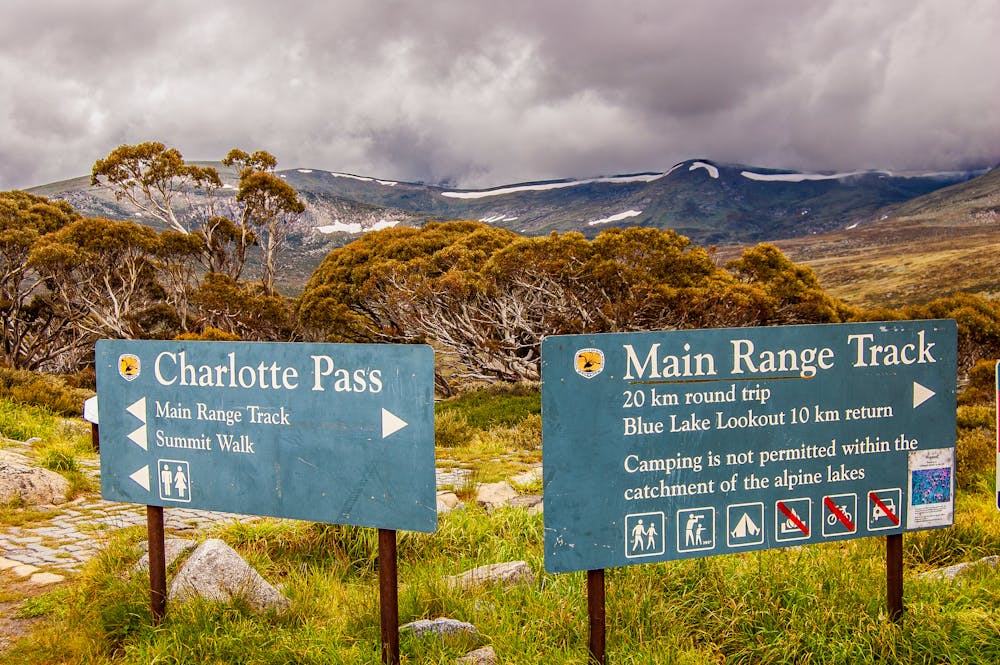
When you think of backcountry snow adventures, you think of pristine wilderness. But unfortunately, there’s a problem: what to do with your poo. Many backcountry adventurers just squat, drop and don’t stop. The result, as we saw ourselves on an overnight ski trip, is a surprisingly large amount of poo and toilet paper. It’s become a bigger problem in recent years, as backcountry trips have boomed in places like the Main Range section of the Snowy Mountains.
Our new research explores this issue to find out how to better protect these wild areas. We surveyed backcountry visitors to Kosciuszko National Park in New South Wales and found a minority of visitors were carrying out their waste from overnight trips, as recommended. To combat the alpine poo scourge, we recommend building more toilets in strategic locations, making their location readily known, and giving out poo transport bags at entry points and gear shops.
If you’re sceptical, take heart – it wasn’t so long ago many people believed dog owners would never agree to scoop up their pet’s poo and bin it. But for the most part, they did.
As the snow melts, it can carry poo down to watercourses or lakes like Blue Lake in the popular Main Range section of the Snowy Mountains. Shutterstock
So what are you meant to do with snow poo?
You might wonder why this matters. After all, aren’t our snow-covered mountains full of possums, wombats and wallabies, all of which poo? And can’t you bury your poo, like you can in other parts of Australia? The problem here is the snow. Human poo deposited in winter won’t decompose until spring. In popular areas, poo and toilet paper can pile up, which is an unpleasant visual for other visitors. And as the snow melts, it can carry poo into creeks, depositing cold-resistant viruses, bacteria like E. coli, and parasites such as giardia. If another skier eats contaminated snow or drinks the stream water, they can be infected.
That’s why backcountry visitors to Kosciuszko National Park are urged to carry out their poo in biodegradable bags or a home made poo tube (basically a sealable plastic pipe).
This, our survey of 258 visitors found, is not hugely popular. Only a third of highly experienced skiers on multi-day trips carry their poo out, while only a fifth of less experienced visitors did the same.
The options our multi-day skiers preferred were using a toilet at a hut, if available, or burying poo in the snow. This is not ideal – if you can’t carry it out, it’s preferable to bury it in exposed soil (ideally, at least 50 metres away from any water courses). Some visitors reported covering their waste with rocks.
Day visitors largely used toilets at the entry and exit points or at a resort, though around 10% reported burying their poo in the snow or using toilets at huts.
This means overall compliance with the carry-it-out policy is low.
But as one longtime backcountry visitor points out, it’s not actually hard – or disgusting – to carry it out:
It was easy. It was the most satisfying experience I have had, knowing that I had left no trace for the entire journey; the view, the ground, the creeks, the plants had been left unspoilt. No-one would have ever known I had been there. Carrying and taking it out went without mishap and finally disposing of my waste was not a problem.
People prefer toilets as a tried and true method of removing poo. Installing new toilets is the most effective way to prevent open defecation. The problem is where to put them. Installing toilets in remote areas is a delicate matter, as many visitors may see them as taking away from the natural experience which is the major drawcard for backcountry visitors. It’s also expensive to maintain toilets in the snow, as they require helicopters or trucks to pump out the waste.
Other options include digging pit latrines, disposing of it into crevasses, burying in soil, snow or rocks, leaving it on the ground, burning it, or carrying it out in poo tubes or biodegradable bags. You can see why park authorities prefer carrying it out.
Toilets are the gold standard – but they’re hard to come by in remote areas of Kosciuszko National Park. Shutterstock
So how can we make it more inviting for visitors to pack their poo? Clearly, the present messaging isn’t fully effective. It’s time for a new approach, especially given the numbers of people heading to the backcountry is growing.
We recommend a two-pronged approach: better communication and targeted infrastructure at entry points.
Friends, websites and outdoor recreation clubs are important sources of information about how to undertake a backcountry trip. To harness these sources, parks authorities could work with the wider backcountry community on the issue, with simple, targeted messages.
By itself, messaging won’t be enough. That’s why we need more and improved toilets – and bins – at key locations, to make it as easy as possible for visitors to do the right thing with their poo.
Authorities should also make these locations clearly known on visitor maps and online, as well as making biodegradable bags or poo tubes available at entry points, information centres and gear shops.
If we get this right, backcountry skiers will once again be able to enjoy the wildflowers. Let’s aim for spring has sprung – not spring has dung.
Pascal Scherrer has conducted research that has received funding from the New South Wales National Parks and Wildlife Service (NPWS) and has served on Regional Advisory Boards of the NPWS.
Isabelle Wolf has conducted research that has received funding from the University of Wollongong and the New South Wales National Parks and Wildlife Service (NPWS)
Jen Smart conducts research that receives funding from New South Wales National Parks and Wildlife Service (NPWS) Hawkweed Eradication Program and the University of Wollongong.
Parents and students are currently making big decisions about next year.
Some will have just received or be about to receive offers of a selective school place for 2023. Other parents need to decide soon if they will apply for their children to sit selective schools tests next year for entry in 2024. Or if they should be looking at other high school options.
These decisions can seem overwhelming for families. What are some of the issues to consider?
What is selective school?
Selective schools are public high schools where students sit a competitive test to be accepted the year before entry.
They are mostly found in New South Wales, where there are about 50 schools. But there are small number in other states, including Queensland (years 7 to 12), Victoria (years 9 to 12) and Western Australia (7 to 12).
The success rate varies, but is is very competitive. For example, in NSW this. year, there were 15,660 applications for 4,248 places.
The pros and cons
Selective school places are highly sought-after – these schools feature prominently in the top schools for year 12 results. But they don’t have the fees of elite private schools.
Some students feel energised by the “best of the best” atmosphere in which they can focus and find similarly capable peers.
But there is an ongoing debate about whether they should exist in the first place. There is also an obvious focus on test performance, rather than the modern skills students need to learn such as collaboration, tech literacy and creativity.
And while academic streaming does seem to improve the performance of high achievers, it can harm the confidence of those who get in (as well as those who don’t). As Australian Catholic University education scholar Associate Professor Philip Parker has explained, selective schools can create a “big fish little pond” effect where students lose a realistic sense of where they fall within the full student achievement spectrum.
Even if students gain a place at selective school, they can find the competition counter-productive. Australian selective school students are increasingly speaking out about the mental health impacts of studying in a stressful, competitive environment.
Don’t forget tutoring
The Australian tutoring industry is huge, not just for parents seeking to improve their child’s performance in class, but in preparation for selective entry exams.
While the entry tests measure general literacy, maths and logic skills – and do not require study – many students undergo months or even years of expensive and often stressful tutoring to prepare.
A 2010 US study suggested tutoring and coaching for selective entry exams only had a moderate effect on student’s results, but this is far from conclusive. Given the competition to gain entry to these schools, students and their parents may be more confident knowing they’ve had tutoring. That confidence alone may improve their performance.
What should parents think about?
It’s understandable that parents might be confused. How do you know if the selective school is right for your child? Here are some issues to consider:
school culture: are the schools you are considering particularly competitive? Do they have an emphasis on other activities, away from exam marks? Do they encourage sport, music or creative arts? Do they emphasise mental health? Do they have programs to support students from diverse backgrounds and with diverse identities?
location: if your child is successful, will it mean a very long commute for them?
your child’s strengths: does your child enjoy school work and sitting tests? Or do their strengths lie in other, less traditionally academic areas?
your child’s temperament: does your child become anxious in testing situations, or do they enjoy the “performance” aspect of them?
your child’s opinion: is your child self-motivated to go to a selective school, or are you trying to convince them it’s “good” for them? If they are keen, giving them a chance – with the appropriate support – might help them decide.
tutoring: does your child want to do tutoring or exam preparation? Can you afford the fees and time if they do?
your child’s teacher: have you had conversations with your child’s teachers? Do they believe your child has the academic aptitude and emotional capacity to thrive in a selective school environment?
Daniel X. Harris receives funding from the Australian Research Council Future Fellowship scheme.
The Reserve Bank has just reported a loss of A$37 billion, the biggest in its history, and it says it will be unable to pay the government dividends for some time.
The announcement followed a review of its bond-buying program, one of the most important ways it supported the economy during the first two years of the pandemic.
In order to borrow to fund programs such as JobKeeper, the government borrowed on the bond market, issuing bonds on the money market that the Reserve Bank later bought with newly created money. That meant the Reserve Bank was, indirectly, the largest financier of the expanded budget deficit.
The review concluded the bond-buying program worked relatively well. By aggressively buying $281 billion of bonds, the Reserve Bank was able to not only make sure government programs were funded, but also lower the general level of interest rates in the bond market, supporting the economy.
How did buying bonds help?
The review found buying bonds on the money market
encouraged traders to put their money into other parts of economy, such as investing in Australian firms
sent a signal to the market that interest rates would be low for a long time, encouraging firms to invest, confident they will be able to borrow cheaply for years to come
gave investors confidence that, if they bought bonds, they could sell them later to the bank if needed.
The report suggests the $281 billion dollars of bond purchases lowered long-term bond rates by around 0.3 percentage points.
This in turn helped lower the value of the Australian dollar by 1-2%, supported business investment, and encouraged consumers to spend, and boosted gross domestic product by a cumulative $25 billion.
What about the downsides?
The report found the Reserve Bank made a substantial loss on the bond-buying program, estimated to be as high as $54 billion. Its overall loss this financial year will approach $37 billion.
During the crisis investors fled to the safety of the Australian bond market, wanting to put their money somewhere safe: Australian government bonds.
This meant the bank bought bonds at high prices. As the economy recovered and investors ploughed their money back into the stock market and other more risky places, bond prices dropped, giving the bank an accounting loss on the bonds.
While the Reserve Bank doesn’t plan to sell the bonds (it’ll hold them until they mature), if it did, it would have to sell them for much less.
Bankrupt? Not really
The bank is still perfectly capable of operating even if it loses money on investments. Being able to print money at will means it can’t go broke.
But it is unlikely to provide the government with a dividend from its profits for several years. Usually the bank makes a profit from printing money. The notes cost about 32 cents each to print and it offloads them for as much as $50 and $100.
It will use this income to soak up the losses from its bond-buying program, and won’t need to ask the government for more.
This review confirms that bond-buying will remain an important part of the bank’s toolkit. While inflation today is soaring and interest rates are being increased at a breakneck pace, it is highly likely that at some point in the future the economy will go through a rough patch and need lower rates.
When the bank has cut its short-term cash rate to near-zero, as it did in 2020, it’ll need to do something else to bring down other longer-term rates.
It says it will buy bonds only “in extreme circumstances, when the usual monetary policy tool – the cash rate target – has been employed to the full extent possible”, but it concedes it may have to, and it believes what it did was worthwhile.`
Isaac Gross does not work for, consult, own shares in or receive funding from any company or organization that would benefit from this article, and has disclosed no relevant affiliations beyond their academic appointment.
Source: The Conversation (Au and NZ) – By Joanna Mendelssohn, Honorary (Senior Fellow) School of Culture and Communication University of Melbourne. Editor in Chief, Design and Art of Australia Online, The University of Melbourne
In 1972, when the Art Gallery of New South Wales opened its first modern building, it was rightly praised for its innovative design.
Architect Andrew Andersons incorporated the latest aspects of museum architecture. The egg crate ceilings were designed to reduce noise for people walking on its marble floors. There were moveable screens that looked like walls and adjustable light levels for fragile art.
But where the building faced Sydney Harbour, Andersons placed a giant window. The intrusion of reality into art connected visitors to the world outside.
It was revolutionary for the time, a marked contrast to the giant granite box of the National Gallery of Victoria, opening in 1968. The Melbourne building had followed the standard model of museum design of eliminating windows to maximise hanging space.
Just over 50 years later, the Sydney Modern expansion under architecture firm SANAA could be described as putting Andersons’ approach on steroids. It will open in December but in recent weeks small groups of visitors have been given preview tours, while installation crews make the finishing touches.
The relationship of Sydney Modern to the older building echoes Andersons’ uncompromising but sympathetic linking of his 1972 construction to the original Grand Courts designed by Walter Liberty Vernon.
The new link between the two buildings includes an installation honouring the history of Country by Wiradjuri and Kamilaroi artist Jonathan Jones.
This new building is very aware of its physical and spiritual location. It is dominated by the light from its soaring glass walls. The ground floor entrance feels like walking into a crystal.
In a nod to Andersons’ first glorious window, the Yiribana gallery of Indigenous art has a window facing the harbour so visitors can see where the Gadigal ancestors first witnessed the arrival of convicts in 1788.
The relocation of Yiribana from the basement of the older building is a physical manifestation of the significant shift in Australia’s understanding of its culture.
In 1958, the gallery’s deputy director Tony Tuckson facilitated collector and surgeon Stuart Scougall’s gift of Tiwi Pukumani grave posts. For the first time Indigenous work was shown as art and not anthropological artefact.
In 1972 there was a temporary exhibit of Yirrkala bark paintings and figures, but this was soon replaced with another temporary exhibition.
In late 1973, funding from the arts programs associated with the opening of the Sydney Opera House enabled a permanent installation of Melanesian art, another gift from Scougall. It was accompanied by what the trustees thought would be a temporary exhibition of Aboriginal art.
Tuckson died while the exhibition was being installed and it remained on view, in a dark little space at the bottom of the gallery’s marble stairs, until about 1980.
In 1983, Djon Mundine curated a temporary exhibition of bark paintings and the following year was appointed as part-time curator, but there was little official interest in Aboriginal art by the gallery.
The big shift came in 1991 when Hetti Perkins curated another temporary exhibition, this time of previously little-known Aboriginal women artists.
Perkins’ achievement was especially appreciated by Mollie Gowing, one of the volunteer guides.
Starting in 1992, Gowing collaborated with Perkins to privately fund the gallery’s major collection of contemporary Indigenous art.
In 1994, on the initiative of then NSW Minister for the Arts Peter Collins, the gallery opened Yiribana, its first permanent dedicated exhibition space for Aboriginal and Torres Strait Islander art.
This basement had previously been the offices and working area for the public programs department and was not an especially sympathetic space for art. It was well over a decade before Indigenous art began to be integrated into other exhibits of Australian art.
The relocation of Yiribana to Sydney Modern can be seen as the gallery’s affirmation of the importance of Indigenous cultures to any understanding of what Australia may be.
Cultural exchange
In 1972 when the newly opened gallery wanted to show its best art to the world, the main gallery was dominated by art from the United States. All eyes were drawn to Morris Louis’ Ayin.
The integration of Australian art with art from the rest of the world is a reflection of historic reality. Last century was a time of mass travel and cultural exchange, when many national barriers were breached, especially in the arts.
Sydney Modern, combined with the reconfiguring of the 20th century exhibits in the older building, is a quiet repudiation of that cultural cringe which persists in seeing Australian culture as some kind of backwater.
Although most of Sydney Modern is filled with light, its most surprising space is buried in dark.
During the second world war, when the navy fleet needed to refuel at Garden Island, the Australian government secretly built a giant underground fuel storage tank, its true depth hidden below the water line.
Now a spiral staircase leads the visitor to the Tank, a magical space of oil-stained columns and echoing sounds. Right now it is empty, but within weeks the Argentine-Peruvian artist, Adrián Villar Rojas will begin to create a new work, The End of Imagination.
There are two meanings to the title. One suggests imagination is now dead. However, by being placed at the core of such an inspirational space it seems Rojas may be suggesting a culmination of imagination, a questioning of what imagination may be in these days of the Anthropocene.
The work is not yet made. As with the rest of the art that will fill this magical space, we will have to wait and see.
Joanna Mendelssohn began her professional career at the Art Gallery of NSW and has been a reader for some of its publications. She has in the past received funding from the Australian Research Council.
Crossbenchers have issued a list of demands on the anti-corruption commission and say they “won’t be rushed” to a vote, ahead of the much-anticipated legislation being introduced into parliament this week.
The government aims to have the commission – one of its signature election policies – approved by parliament by the end of the year. There will be a brief parliamentary inquiry.
It will go to caucus on Tuesday and be introduced by the Attorney-General Mark Dreyfus on Wednesday. Anthony Albanese aims to arrive back from the funeral of the former Japanese prime minister Shinzo Abe in time to be present for the introduction.
While Labor has the numbers in the lower house, it would need one additional vote beyond the Greens if the opposition opposed the legislation in the Senate.
What position the Coalition will adopt is not yet known. Opposition leader Peter Dutton last week reiterated his support for an anti-corruption commission and said the opposition would continue discussions with the government, while also warning about the risks of “show trials” and false allegations damaging people.
Opposition finance spokeswoman Jane Hume said on Sunday there were unanswered questions about the government’s model. “If you get an ICAC wrong it will actually deter good people from entering public life. That would be a disaster,” she told the ABC.
In their statement the 15 crossbenchers from both houses urge a range of features to ensure the body has sharp enough teeth and that there are adequate protections for it.
They want
…a whistleblower protection commissioner to safeguard those calling out corruption
.. statutory oversight mechanisms to protect the commission’s independence
… budgetary protection, independence and funding transparency
.. the ability for “own-motion” investigations into so-called “grey corruption” (where the commission would be able to undertake inquiries into dubious Commonwealth processes such as discretionary grants programs)
…funding for pro-integrity measures including prevention and education
.. jurisdiction over third parties who seek to improperly influence government decisions and funding.
The signatories from the House of Representatives include Greens leader Adam Bandt, the six newly-elected teals, Bob Katter, Dai Le, Zali Steggall, Rebekha Sharkie, Andrew Wilkie and Helen Haines.
Haines, the member for Indi, has been a leading figure in the push for an integrity commission, bringing forward a private member’s bill during the last term.
Two senators signed the statement – Greens David Shoebridge and independent David Pocock.
While the bill will not contain the whistleblower protections, Dreyfus is expected to give an assurance in his speech that this will be addressed in separate legislation.
The crossbenchers said: “We have worked constructively with the government in consultations on the bill and intend to continue in that manner.
“We won’t delay the process for political games or point scoring, but won’t be rushed to vote in favour of a bill that doesn’t make the grade.
“We want to ensure the commission is properly set up to do the job it needs to do, and is given the supporting infrastructure necessary to ensure its success in the future.”
They said the points in their list had already been raised with the government. “They are not minor issues, but based on the lessons from integrity bodies in other states and territories, and from experts who have worked on these issues for many years.”
Michelle Grattan does not work for, consult, own shares in or receive funding from any company or organisation that would benefit from this article, and has disclosed no relevant affiliations beyond their academic appointment.
The ABC recently reported on the “infiltration” of Liberal Party branches in regional Victoria by Pentecostals, on a mission to influence Liberal Party positions on so-called morality issues such as abortion and LGBTIQ+ rights.
This isn’t a new development. In the middle of 2021, the Liberal Party memberships of hundreds of people linked to Pentecostal churches in South Australia created significant controversy and led to an internal investigation.
And in 2018, concerns were being raised about the growing influence of the Christian Right in the WA Liberal Party.
Perhaps Scott Morrison’s federal party leadership and the election win of 2019 has served to embolden like-minded Christians to become more involved in political parties.
There’s no doubt Morrison’s religion and his government’s disastrous attempt to legislate a religious discrimination bill have stirred up renewed public debate about the relationship between religion and politics.
Much of this debate has centred on the interests and influence of conservative and fringe Christian organisations and lobby groups.
The unnecessarily divisive debate on religious freedom has taken a harsh toll on LGBTIQ+ people, trans people especially.
It has also drawn attention away from the religious freedom abuses perpetrated against First Nations peoples and the prejudice and discrimination being experienced by people of other religious groups, including Muslims, Jews, Hindus and Sikhs.
Debates about the appropriate place and influence of religion in this secular state have flared up at various times over the last 200 years or so. The Constitutional debates ahead of federation in 1901 included the question of whether the (Christian) God should rate a mention in the new Constitution and, if so, where.
In 1973, then Labor Attorney-General Lionel Murphy attempted to legislate a human rights bill but faced strong opposition from almost all churches arguing against the inclusion of protection for religious freedom.
his speech at an Australian Christian Churches conference on the Gold Coast in April 2021 where he called misuse of social media the work of the devil and told the audience that he practised the “laying on of hands” while he was meeting people in his role as prime minister.
So, after three years of focused attention, did the Morrison government, or Morrison himself, change the relationship between religion and politics in our increasingly non-religious and religiously diverse nation?
While it’s too early to be sure, there will be clues. Here are some things to watch out for.
No religious discrimination bill
If the Albanese government doesn’t move to legislate a religious discrimination act, it will be a sign the Morrison government has made it diabolically difficult to address religious freedom in a way that doesn’t pit people against each other and undermine the rights of the LGBTIQ+ people. Legislating a human rights act or charter would be more fruitful.
A minimalist bill
If, on the other hand, the government tables a more modest religious discrimination bill then, regardless of any ongoing political mobilisation of the Christian Right, we may settle back into the pattern of occasional confusion about where to draw the line in our not-quite entirely secular nation.
It’s worth noting here that, as University of Sydney academic David Smith has written for The Conversation, the Christian Right is not good at winning policy battles, even when it wins elections.
The culture warriors
The Morrison government set in public consciousness the idea that religious freedom and equality rights are irreconcilable. This gave the culture warriors (religious and irreligious) both permission and an excuse to continue their ongoing persecution of transgender people.
If the Morrison government’s approach to religious freedom has stuck, “religious freedom” will continue to provide the culture warriors with cover for any number of pet causes.
How we talk about religion
The “statements of belief” clause in the failed religious discrimination bill represented a white, western, Protestant understanding of religion as individual and autonomous consent to a series of “beliefs”, especially about “moral” issues.
The alternative is to reframe religion in a way that reflects the diversity, richness and complexity of religion in the lives of people and communities.
If we fail to do this, then the Morrison government will have indeed made a lasting, and damaging, impact on the relationship between religion and politics in Australia.
Elenie Poulos is an ordained minister in the Uniting Church in Australia. She has worked on an Australian Research Council funded project to investigate Religious Freedom, LGBT+ Employees, and the Right to Discriminate (DP200100395).
University of Canberra Professorial Fellow Michelle Grattan and University of Canberra Vice-Chancellor Paddy Nixon discuss the week in politics.
While the funeral of Queen Elizabeth II and a memorial service in Canberra dominated the news this week, Vladamir Putin’s partial military mobilisation and his latest threat to use nuclear weapons escalated the Ukraine conflict and added to the insecurity in Europe.
Anthony Albanese will be away again next week at another funeral, this time that of Japan’s former prime minister Shinzo Abe, who was killed by an assassin. At home, parliament will be meeting, with the legislation for a national integrity body the most anticipated item on its agenda.
Michelle Grattan does not work for, consult, own shares in or receive funding from any company or organisation that would benefit from this article, and has disclosed no relevant affiliations beyond their academic appointment.
Alleged corruption involving Governor Lukas Enembe has dominated both Papuan and Indonesian media outlets and social media groups over the past two weeks.
The Indonesian media is rife with allegations and accusations against the governor who is suspected of spending of billions in rupiahs.
These media storms are sparked by allegations against him of receiving gratification worth Rp 1 million (NZ$112,000).
Governor Enembe was named a suspect by the Indonesian Corruption Eradication Commission (KPK) last week and summoned on Monday, September 19, by Police Mobile Brigade Corps (BRIMOB) headquarters in Kota Raja, Jayapura Papua.
Due to illness, the governor was unable to attend the summons. Only his lawyers and Papuan protesters attended, who then condemned KPK of being unprofessional in handling the case.
Papuans (governor’s supporters) take this case as another attempt by the state to “criminalise” their leader motivated by other political agendas, while Jakarta continues to push the narrative of the case, being a serious crime with legal implications.
According to Dr Roy Rening, a member of governor’s legal team, the governor’s designation as a suspect was prematurely determined. This is due to the lack of two crucial pieces of evidence necessary to establish the legitimacy of the charge within the existing framework of Indonesia’s legal procedural code.
Unaware he was a suspect Dr Rening also argued that the KPK’s behaviour in executing their warrant turned on a dime. The Governor was unaware that he was a suspect, and he was already under investigation by the KPK when he was summoned to appear.
In his letter, Dr Rening explained that Governor Enembe had never been invited to clarify and/or appear as a witness pursuant to the Criminal Procedure Code. The KPK instead declared the Governor a suspect based on the warrant letters, which had also changed dates and intent.
The manner in which the KPK and the state are handling the case involving Papua’s number one man in Indonesia’s settler colonial province has sparked a mass demonstration with the slogan “Save Lukas Enembe” from criminalisation.
The Governor’s case has generated a flurry of news stories with all kinds of new allegations by the nation’s most prominent figures.
Mohammad Mahfud Mahmodin, commonly known as Mahfud MD, Coordinating Minister for Political, Legal, and Security Affairs, accused Governor Enembe of corruption, amounting to billions of rupiahs during a public media conference held at the Coordinating Ministry Office, Jakarta, on Monday.
His allegations have sparked a backlash from the Governor and his lawyers, as well as from the Papuan people.
Governor’s lawyer Dr Rening said Mahfud MD should not be included in the technical part of the investigation, particularly when in relation to those financial figures. Dr Rening said any confidential information was already protected by the constitution and it was inappropriate for Mahfud MD to make such announcement.
He asked which case the minister Mahfud MD was referring to in his allegation because the actual case involving the KPK investigation only related to a gratuity of 1 billion Rp.
‘Massive campaign to undermine Governor Enembe’ Dr Rening asked how Mahfud MD could explain the other charges that were not included in the dispute of this case, adding that “we are still of the opinion, as I have mentioned in my articles, that ‘This is what we call a systematic, structured, and massive campaign to undermine the honour and reputation of Papuan leader Lukas Enembe’.
“Governor Enembe himself has also rejected the allegations involving the spending of billions of rupiah, accusing Mahfud MD of making false allegations against him.”
Reverend Dr Socratez Sofyan Yoman … the KPK has lost its integrity and legitimacy as an independent institution. Image: Tabloid Jubi
Reverend Dr Sofyan Yoman, president of the Papuan Baptist Church Alliance, stated on the same day as Mahfud MD’s press conference that it would be remembered as the day the KPK lost its integrity and legitimacy as an independent institution for the protection of the nation’s morale.
He said it would be recorded that 19 September 2022 was the day of the “death” of the Corruption Eradication Commission (KPK).
“Therefore, I express my condolences for the passing of the KPK. So, the history of the KPK is over,” reported Tabloid Jubi.
At the press conference, Mahfud MD was accompanied by Alexander Marwata (KPK), Ivan Yustiavandana, director of the Financial Transaction Reports and Analysis Centre (PPATK), and other representatives from the State Intelligence Agency (BIN), National Police, and the Armed Forces were also present.
By engaging in this collaboration, the KPK lacked an independent voice, and its integrity and legitimacy were shattered by state intervention.
Jakarta’s ‘state of panic’ Reverend Yoman’s “condolence” statement about the KPK was the result of the state intervention in suffocating KPK’s ability to stand independently.
Reverend Yoman added: “Jakarta is in a state of panic right now because gross human rights violations in the land of Papua are already being recognised by international institutions such as the UN, European Union, Pacific Island forums (PIF) and Africa Caribbean Pacific nation states (ACP).
“Governor Lukas Enembe’s case is not the real issue,” he said.
In reality, this was “merely a façade designed by Jakarta” to distract the public from paying attention to the real issue, which was the state’s crimes against West Papuans, reported Papua.tribunnews.com.
Natalius Pigai, a prominent Indigenous Papuan figure in Indonesia and former human rights commissioner, wrote on Twitter: “There is no single law that authorises Mahfud MD to lead a state auxiliary body. The coordinating minister can only lead police and prosecutors as part of the cabinet, he cannot act as Head of State. It was a silly intervention that weakened the KPK, and strengthened accusations of political motivations toward Lukas Enembe.”
Despite this condemnation and rejection from the governor’s camp, Governor Lukas Enembe remains a suspect waiting to be investigated by the KPK. The KPK’s Deputy Chair, Alexander Marwata said KPK examined a number of witnesses before establishing Enembe as a suspect.
“Several witnesses have clarified, and documents have been obtained that give us reason to believe there is enough evidence to establish a suspect” reported Kompas.com.
Papuans protect residence Meanwhile, the Governor’s private residence in Papua is being protected by Papuans, triggering more security personnel being deployed in a region that is already one of the most highly militarised in the Asia Pacific.
Papua’s people have been shaken by the news of this corruption allegation against their Governor.
According to Paskalis Kosay, Papua is worried about the loss of Lukas Enembe, a unifying figure among the Papuan people.
He added: “Papua’s political situation has become increasingly unhealthy since Mahfud MD’s statement. The internet — particularly social media platforms like Twitter, Facebook, and WhatsApp — are full of both positive and false information. Also, its contents may be used to slander, humiliate, or discredit the good name, honour, or dignity of a certain person, figure, or group.
“We should be vigilant when paying attention to the different information spread on social media and other mass lines. It is imperative that Papuans filter all news content very carefully. You must then respond wisely, intelligently, and proportionally so as not to be accused of being a member of a group of disseminators of misleading information”.
Meanwhile, as Governor Enembe awaits the outcome of the case against him, he has already missed his medical appointments in Singapore. This could unleash unprecedented protests throughout West Papua if or when his health fails him due to him being blocked by Jakarta from leaving the country.
A failure to protect the Governor while he is caught up in the limbo of the Indonesian legal system, would have catastrophic consequences for Jakarta. Papuans have already warned Jakarta “don’t try [to detain him] during the protests.”
As of today, the Governor’s and his family’s bank accounts remain blocked, a decision made by the state without their knowledge a few months ago, that has led to the current crisis.
Who is Governor Lukas Enembe? Governor Lukas Enembe is a symbol of pride and an icon for the sons and daughters of the Koteka people of the highlands of Papua. He is often referred to as “Anak Koteka” (son of Koteka).
Governor Lukas Enembe … a bold style of leadership and deeds indicate a deep longing in his heart for justice for Papuans. Image: West Papua Today
Koteka as a horim, or penis gourd or sheath, traditionally worn by males in Papua’s Highlands, where Governor Enembe comes from.
When he is called “Anak Koteka” it means that he is a son of cultural groups that wear this traditional attire. Knowing this is critical to understanding how and why this man became such a central figure in West Papua.
Before he became Governor of Papua in 2013, the Koteka people of the Highlands faced many kinds of racial prejudice and discrimination. Wearing the koteka was seen as a symbol of primitiveness, backwardness, and stupidity.
Lukas Enembe turned the symbol of the koteka into hope, pride, courage, leadership, and power when he became governor for two consecutive terms. He broke barriers no one else had crossed, exposed cultural taboos, and used his ancestral wisdom to unite people from every walk of life.
As the Highland’s first Papua Governor (2013 -2023), he upended stereotypes associated with his cultural heritage.
Governor Enembe was born in Timo Ramo Village, Kembu District, Tolikara Regency of Papua’s Highlands on 27 July 1977. His biography A Statesman from Honai, by Sendius Wonda, states that Lukas grew up in a simple family.
He attended elementary school in Mamit (1974-1980) and junior high school in Sentani (1980-1983). He then attended senior high school in Sentani from 1983-86.
Sacred building for sharing wisdom In Highlands Papua, honai is a traditional hut, but it is more than just a hut; it is a sacred building where ancient teachings and wisdoms are discussed and preserved.
Honai shaped him into the person he is today. In the 1980s, he was one of only a handful of Papuan Highlands village children to study in urbanised coastal regions.
His determination to continue his studies was already noted by his peers. In 1986, he took the selection examination for admission to Indonesia’s State Universities and was accepted as a student at Sam Ratulangi University (Unsrat) Manado Indonesia.
As a fourth-semester student at the FKIP Campus, Enembe majored in political science at the Faculty of Social and Political Sciences in Manado. After completing his studies in Manado in 1995, Lukas returned to Papua.
As he waited for acceptance of his Civil Service Candidates (CPNS) he lived in Doyo Sabron, Jayapura Regency with his wife, Yulce Wenda, and his family. The following year, he was accepted as a civil servant (PNS).
He aspired to become a lecturer at Cenderawasih University, Jayapura, where he earned 22 citations for local government lectures. The promise of being a lecturer ran aground during the pre-service announcement, and Enembe was assigned a position as a civil servant at the Merauke Regency Socio-Political Affair’s Office instead.
During 1998-2001, Enembe was sent by a missionary agency to continue his studies for two years at the Cornerstone Christian college in Australia (Dubbo, NSW). Upon returning from Australia in 2001, he participated in the Puncak Jaya regional election, but his dream of becoming a regent was dashed.
‘Papua rising’ From 2001-2006, he served as Deputy Regent of Puncak Jaya alongside Elieser Renmaur. In 2006, Enembe was elected chair of the DPD of the Papua Province Democratic Party. In that year he also attempted to run for Governor of Papua by collaborating with a Muslim couple, Ahmad Arobi Aituarauw.
He lost the vote, however, and Bas Suebu-Alex Hasegem won. Last but not least, he participated in the 2007 Puncak Jaya regional election and was elected Regent of Puncak Jaya along with Henock Ibo.
In 2013, Enembe and Klemen Tinal ran as candidates for Governor of Papua in the 2013 Papuan Gubernatorial Election.
The General Elections Commission (KPU) appointed Lukas Enembe and Klemen Tinal to lead Papua between 2013 and 2018. In 2018, he was re-elected along with Klemen Tinal to serve as Governor of Papua for the period 2018-2023.
“Papua rising, independent, and prosperous” was Lukas’s vision for leading Papua through the landslide victory.
As Governor he gave 80 percent of the special autonomy funds to regional and city areas, and 20 percent to the provinces. In his view, 80 percent of the special autonomy funds are managed by districts or cities which is where most people in Papua live.
Papua has undergone a lot of development during Enembe’s governorship, including the construction of a world-class sports stadium that has been named after him, as well as other major projects like the iconic Youtefa Bridge in Jayapura city.
Papua has undergone a lot of development during Enembe’s governorship, including the construction of a world-class sports stadium that has been named after him, as well as other major projects like the iconic Youtefa Bridge in Jayapura city. Image: APR
Papuans ‘need to live’ Many Papuans opposing Jakarta’s activities in West Papua consider him to be a father figure. When asked about the conditions his people face on national television, Governor Enembe responded by saying “Papuans do not need development, they need to live.”
Such bold statements, along with others he made directly challenge Indonesia’s mainstream narrative, since Jakarta and Indonesians at large regard “development” as a panacea for West Papua’s problem.
Jakarta is also suspicious about the hundreds of Papuan students sent abroad under the scholarship scheme he designed using Special Autonomy Funds.
His boldness, style of leadership and deeds indicate that there is a deep longing in his heart for justice and for better treatment of his fellow humans. His accomplishments distinguish him as a pioneer, a dreamer, a fighter, a survivor, and a practical man with deep compassion for others.
It is this spirit that keeps him alive and strong despite the physical and psychological intimidation, threats, as well as clinical sickness he has endured for years.
The rest of his term (2022-2023) is one of the most critical times for him. After more than 20 years as Indonesia’s top public servant, the strong man of the people is facing his greatest challenge as he enters his final year in his career.
How that final chapter of his career ends will be determined by the outcome of this corruption allegations case, which could have significant consequences for Papua and Indonesia as well as for Governor Enembe.
Jakarta must think carefully in how they handle the governor, son of Koteka.
Yamin Kogoya is a West Papuan academic who has a Master of Applied Anthropology and Participatory Development from the Australian National University and who contributes to Asia Pacific Report. From the Lani tribe in the Papuan Highlands, he is currently living in Brisbane, Queensland, Australia.
Papua New Guinea police have arrested five men in Goroka over their alleged involvement in the killing of PNG Ports managing director Fego Kiniafa.
Provincial Police Commander Chief Superintendent Michael Welly said the men were in police custody and were now being questioned over the slaying of Kiniafa on the morning of September 17 — last Saturday — near Nagamiufa village outside Goroka town.
Kiniafa and his driver were reportedly slashed with machetes after the CEO shot a Nagamiufa villager.
Welly said investigations were continuing into the killing which sparked a tribal fight.
In the early hours of last Saturday between 1am and 4am, it was alleged that Kiniafa, who had turned 43 on September 16 — PNG Independence Day — was with a few men near Nagamiufa village when a confrontation occurred.
Kiniafa, from Korofeigu village in Lower Bena, is alleged to have discharged a weapon.
The bullet hit another man.
Several tribesmen incited The shooting incited several tribesmen of the injured man to attack Kiniafa, slashing him several times before leaving him.
Details about what happened next has not been mentioned by police. However, it is believed Kiniafa was rushed to Goroka General Hospital where he was pronounced dead on arrival.
Two days later on Monday, a 4am dawn raid was conducted at Nagamiufa village by men allegedly from Korofeigu village, Lower Bena.
The raid on Nagamiufa caused about 400 plus women, girls and the elderly to seek refuge within the gates of the Bihute Correctional Services prison.
Goroka Airport also shut its gates, causing several 100 passengers made up of tourists and locals to be stranded inside the terminal.
Throughout Goroka town, businesses closed their doors, the hospital tightened its security, and schools were shut for the day as police tried to calm the situation.
Assistant Commissioner of Police (Northern Command) Peter Guinness has confirmed with the PNG Post-Courier that two mobile squads from Mt Hagen, Western Highlands and a mobile squad from Lae, Morobe province, had been deployed in Goroka, Eastern Highlands province.
Since Monday the situation has returned to some sort of normalcy with police continuing to keep watch.
Investigations were ongoing.
Miriam Zarriga is a PNG Post-Courier reporter. Republished with permission.
The Taupulega, or council, on the Tokelau atoll of Nukunonu, has lifted a house arrest order on a family which had refused to get vaccinated against covid-19.
The family was placed under tunoa in August 2021.
A council meeting on Wednesday told family member Mahelino Patelesio that the tunoa was being lifted. However, the family would be updated on restrictions that might apply when a cargo ship drops off supplies.
At the meeting, Patelesio sought forgiveness from the community for any hurt arising from the family’s refusal to be vaccinated and the resulting social media dispute.
He also said he felt sorry about what he claimed was a lack of information that the Taupulega and atolls had about the Pfizer vaccine and felt worse about the children in the community who had had to get the vaccine, again citing claims of lack of information.
RNZ Pacific’s correspondent on Nukunonu said members of the public and Taupulega expressed sadness and disappointment at the meeting over how the family handled this situation on such a public platform — social media — where the depth of the culture was not taken into consideration and was instead damaged.
The general manager for the office of the council of Nukunonu, Asi Pasilio, explained to RNZ Pacific in July why the council of 36 heads of extended families who serve the atoll’s community had decided to impose tunoa.
Decision of local council “This is a village rule, this is the decision of the local council which runs the island and the community. We have the laws of Tokelau but we also have the local council which has the authority over their village,” Pasilio said.
Nukunonu Council general manager Asi Pasilio … “This is a village rule.” Image: RNZ Pacific
She said there were no jails in Tokelau, but when there was a serious offence the council could just ask people to stay at home.
Tunoa took the place of jail.
While under tunoa, family members provided shopping for them.
The New Zealand dependency with a population of about 1500 has had no cases of covid-19 since the global pandemic began in early 2020, according to the World Health Organisation.
New Zealand’s Ministry of Foreign Affairs and Trade (MFAT) said in July the former Administrator, Ross Ardern, had no say in the implementation of tunoa, and that mandatory vaccination was a decision taken by Tokelau’s village leaders.
At the time about 99 percent of Tokelau’s eligible population aged 12 and over were fully vaccinated.
Tokelau is a New Zealand dependency.
This article is republished under a community partnership agreement with RNZ.
Just the other day a robot guard came along a corridor in a special digital prison, consulted his flatscreen embedded on its wrist and then pressed his thumb on a door, which sprang open.
For the fourth time, I was being released from Facebook prison having served a term of imprisonment imposed upon me by Great Algorithm Machine which we lags shorten to GAM.
Self-sustaining and completely devoid of any human intervention, GAM has deemed me to be a serial hate speech offender. I am absolutely not, but my protests were not only pointless, there was no one listening or reading them.
Again, with no human hand involved at any point, I was hauled off to solitary inside the Mark Zuckerberg Institution for Global Speech Control.
Now, living in Aotearoa and having our Prime Minister Jacinda Ardern create the Paris Call, a powerful new weapon to end online hate speech, it is my patriotic duty to support it.
But lately I have become collateral damage to her Paris Call, and a nagging thought is growing that there may be many other casualties too. Stopping the nutters, the terrorists, the bad guys might additionally include GAM wiping out any one expressing any kind of opinion.
Especially opinions that a human reader — rather than a machine — would immediately recognise as arguments opposed to opinions advanced by bad guys.
Silence save the banal Algorithms will silence all, except the banal, the bland, the boring and the pointless.
As GAM will run all my words through its system, I am going to avoid using the commonly accepted abbreviation for the National Socialist German Workers Party. Nor will I mention its leader; that’s a fast ticket back to a Menlo Park prison.
After some trepidation, I present a summary of my rap sheet:
October 11, 2021: I made a small posting based on a clipping from New Zealand Paper’s Past, a significant historical online collection of the nation’s newspapers. I posted a little story from the Bay of Plenty Times in 1941 which reported that people in Fiji, Tonga and Samoa were raising money to buy Spitfires in order to defeat the previously mentioned German Workers Party and its leader. I was prevented from any posting or commenting for three weeks.
February 18, 2022: As an anti-covid “freedom convoy” rattled around the country, I posted a meme showing the Workers Party leader in front of the Eiffel Tower, saying he was on a freedom convoy. Locked up again.
May 26, 2022: I posted a link to US CBS News on some new arms non-control measure and commented: “The continued stupidity of (Redacted, insert nationality of a people between Canada and Mexico) bewilders the world.” This got me a big “Hate Speech” stamp, a ban and a declaration that my future posts would be lower in people’s news feeds.
September 13, 2022: I asked why accused woman beater Meli Banimarama and convicted killer Francis Kean were using the “ratu” title. Banned again.
No human review It was immediately apparent from the formatted notice issue to me, that while GAM had processed the thing, no human in Facebook had. Generously they tell the victim that there is a review system and to fill out a submission.
Dutifully, this gullible fellow did, pressed send and got an instant message back from GAM which said, in effect, that due to covid there were no available humans to read my submission. So, the sentence, imposed entirely by machine, stands every time.
It doesn’t matter what you say; no one is listening.
Facebook’s GAM is lying at this point: Covid has nothing to do with the removal of their humans. They are deliberately sacking them, due to Wall Street demands for more profit.
At one stage I discovered email addresses for assorted Facebook functionaries in Australia and New Zealand. That did no good. They ignored me, if they even existed.
Despite all this, I have been something of a Facebook fan. With Sue Ahearn, I co-manage The Pacific Newsroom with its 60,000 plus followers. The fact that I was in the digital slammer meant that group did not get serviced in the way they normally would.
Facebook plainly does not care.
My worry now is what is all this doing to free speech. At first blush, yes it’s a good idea that something like Mein Kampf cannot be trotted out on Facebook. But wouldn’t it be a good idea for some one or ten to read it and warn us all of what is in it?
Digital trip wires Currently GAM is looking you up, digitally speaking if certain trip wires are touched in the algorithm.
Paris Call’s GAM model has no space, or ability, to deal with satire, cynicism or sarcasm. Many would say that is, of course, a good thing. Ban them. But they have long been part of human discourse, indeed vital.
And it will silence Paper’s Past! A national treasure now defined by GAM as a gathering of hate speech.
What else do we have to give up to keep evil from exploiting public conversation?
How will we learn the new rules, other than with a spell in the digital penitentiary? Perhaps there will soon be an app, in which The Machine checks each sentence, prior to use, for social acceptability.
Is social media creating a world in which speech can only be made, after The Machine has deemed it acceptable?
Michael Field is an independent journalist and author, and co-manager of The Pacific Newsroom. This article is republished with his permission.
A new $100 million apartment complex is coming to Manukau — Auckland’s heart of Pacific communities.
But you’ll have to be aged at least 55 to get in.
Kāinga Ora is expected to start construction of the 123 apartments in Osterley Way in March. The 16-storey tower will include 94 one-bedroom and 29 two-bedroom apartments.
The government said it was necessary to target targeting specific age groups to match an increasing demand from “older customers”.
“Kāinga Ora recognises our older customers have specific housing needs, which we are addressing through senior housing developments such as the proposed project in Manukau,” regional director for Counties Manukau Angela Pearce said.
Pearce said one in five of the agency’s homes in Counties-Manukau had someone over 65 living in it, while 670 of its homes in the area were occupied by sole tenants in the same age group.
“With an aging population, Kāinga Ora recognises the importance of dedicated senior housing where our older tenants can live well, feel safe and secure, both in their homes and the community.”
Two years on state house list Maureen O’Meara, 75, spent two years on the state house waiting list and was renting a two-bedroom unit in Pakuranga for $420 a week until earlier this year.
“I had $17 left a week after paying the rent,” O’Meara said. “Being on a pension and paying market rent meant I didn’t have a lot of money left to live on.”
O’Meara managed to find somewhere more affordable in May after she was put in touch with Haumaru Housing, a joint venture between Auckland Council and the Selwyn Foundation.
But O’Meara said the Manukau development reflects an increasing number of people reaching retirement without a home.
“And I think there’s going to be a need for more places like it,” she said.
Age Concern Auckland chief executive Kevin Lamb said it’s important the development was close to public transport and community facilities.
“We think it’s high time older people had accommodation that is new and more appropriate for their needs.”
Big part of pension on housing Recently-released research by Te Ara Ahunga Ora Retirement Commission showed superannuitants still paying rent were more likely to be spending 40 percent or more of their pension on housing.
While long-term trends suggest more older New Zealanders are likely to still be renting in their retirement.
Te Ara Ahunga Ora director of policy Dr Suzy Morrissey said with declining home ownership rates there was a growing need for public housing and accommodation for those aged 55 and over.
“When NZ Super was introduced, it was with the underlying assumption that those accessing it would be mortgage-free homeowners,” she said.
“Today, the reality is very different. There are declining home ownership rates, more people needing to continue working longer because they still have mortgages to pay, are paying rent, or haven’t been able to save enough to retire.”
Auckland is currently in the middle of the local body elections with a Pacific candidate, Fa’anānā Efeso Collins, one of the two top contenders for mayor of the super city.
Source: The Conversation (Au and NZ) – By Edwina Luck, Senior Lecturer QUT Business School, Advertising, Marketing and Public Relations, Queensland University of Technology
Optus fears data on up to 9.8 million of its customers has been accessed in a sophisticated cyberattack – including, for some customers, passport and drivers licence details, as well as phone numbers, dates of birth and email addresses.
It made the announcement through the media, in the middle of Thursday’s national day of mourning public holiday, and during the four-day long weekend in Melbourne in the lead-up to the AFL grand final.
At first, it didn’t text or email its customers. Instead, it issued a press release in the belief this was
the quickest and most effective way to alert as many current and former customers as possible, so they could be vigilant and monitor for any suspicious activity.
Trust in the media is at an all-time low. Communications authority Edelman reports that globally, only 50% of people trust the media, down from 62% a decade ago. Far more people (61%) trust businesses.
Tweets rather than texts
It has been conventional wisdom that brands should take an integrated approach to marketing communications. Many channels are better than one, increasingly so as audiences for traditional channels continue to fragment.
An integrated marketing approach need not mean communicating through every available channel, but it should mean strategically selecting channels that are trusted and consumed by the brand’s customers.
One of the best channels Optus has is its own phone network, and it is experienced in using it to contact its customers.
Customers are likely to expect this where Optus has something important to say, and they are likely to trust a direct message from Optus more than one filtered through the media.
They are even likely to spread it via word of mouth through friends who also use Optus, giving the company a continuing role in shaping the message.
Instead, Optus backed up its press release with tweets.
Optus has around 5.8 million active users, around 21% of the Australian population. They are a cross-section of the population, having little in common other than the fact they use Optus for communications.
Some of Optus’ customers, especially those in Gen Z, might not use traditional news media. They wouldn’t have received the message through that channel.
Former customers dating back to 2017 are also likely to be affected by the breach, taking the total affected to around 9.8 million, about one third of the population.
Twitter is used by about only about 18% of the population, and the overlap with Optus customers might not be large.
What can brands learn from Optus?
As marketing and branding experts, we’ve distilled three lessons, each well known before the data breach.
When you have news affecting your customers, tell them before anyone else, in a personalised, one-to-one approach.
Use channels that are trusted and consumed by your customers.
Encourage word of mouth through your relationships with your brand community and loyal customers.
Nicholas used to work for Edelman.
Edwina Luck does not work for, consult, own shares in or receive funding from any company or organisation that would benefit from this article, and has disclosed no relevant affiliations beyond their academic appointment.
University of Canberra Professorial Fellow Michelle Grattan and University of Canberra Vice-Chancellor Paddy Nixon discuss the week in politics.
While the funeral of Queen Elizabeth II and a memorial service in Canberra dominated the news this week, Vladamir Putin’s partial military mobilisation and his latest threat to use nuclear weapons escalated the Ukraine conflict and added to the insecurity in Europe.
Anthony Albanese will be away again next week at another funeral, this time that of Japan’s former prime minister Shinzo Abe, who was killed by an assassin. At home, parliament will be meeting, with the legislation for a national integrity body the most anticipated item on its agenda.
Michelle Grattan does not work for, consult, own shares in or receive funding from any company or organisation that would benefit from this article, and has disclosed no relevant affiliations beyond their academic appointment.
Political Roundup: The Political mood of the business elite
Political scientist, Dr Bryce Edwards.
The New Zealand Herald has released the results of its annual “Mood of the Boardroom” survey today. Should we care what businesses think of politics, the economy and society? There’s a good argument that we should be more concerned with the “Mood of the Foodbank” or “Mood of the workers”.
Nonetheless, it’s always interesting to see what the Establishment thinks, and what issues businesses are likely to pressure government decision-makers on in future. Readers can also take into account the obvious business bias when interpreting what the results mean.
The business love affair with the PM and Government is over
The business community has generally been very happy with Jacinda Ardern’s Labour Government. In the first few years, and particularly during the Covid pandemic, business were extremely positive about the administration and especially the Prime Minister and Minister of Finance.
For example, back in 2020 the Mood of Business survey rated Ardern’s performance as nearly 4/5. And business generally rated Labour’s management of the economy and various crises very highly.
This year their judgement of Ardern and Labour has plummeted. Ardern’s own rating out of 5 has dropped to only 2.3. So, there’s been something of a decline: 3 in 2018, 2.9 in 2019, 3.91 in 2020, 3.03 in 2021, and now 2.3.
Ardern is ranked as only the 12th best performer in Cabinet. Grant Robertson is doing better – with the second highest score of 2.98/5. But that is well down from the 4.18/5 he got from business in 2020.
Business leaders regard Climate Change minister and Green co-leader James Shaw as the Government’s strongest performer, obviously on the basis of his climate change initiatives. He even gets kind words from one oil and gas CEO who describes him as a “rationalist”. Various CEOs point to the fact that he has lost the support of his own party, and is in fact “in the wrong party”.
What are business marking the Government well on?
Business isn’t entirely critical of the Labour Government, and the survey results do show that business leaders give them credit in some areas. For example, according to Fran O’Sullivan, “The PM’s scorecard shows CEOs accorded her a top rating of 3.56/5 for how she leveraged her personal brand for NZ business’s advantage internationally.” And she is also applauded by business for her handling of national security and international relations.
In terms of the Government as a whole, there are a number of things they are doing well according to business. Here’s the list of areas that business rated them highly on:
• Supporting Māori and Pasifika aspirations. 3.49/5
• Maintaining strong international relationships 3.32/5
• Progress on international trade agreements 3.16/5
• Maintaining an independent foreign policy 3.01/5
• Addressing climate change challenges 2.71/5
What is business marking the Government down on?
Interestingly, business leaders have some of the same concerns about Ardern’s Government as those on the political left – especially the failure to deliver on their promises.
For example Don Braid of Mainfreight, who has in the past been quite supportive of the Government, says: “There is a lack of direction and sure-footed policy to combat the failings around health, education, housing and crime. Stop the political posturing and interference. Focus on the core fundamentals and then get out of the way.”
When asked about Ardern’s delivery of “transformative change”, business execs rated her only 1.7/5. According to the Herald, a typical comment from business was: “Lots of talk on policy but little actual impact”.
Some of the areas that business rated the Government most poorly on are also areas that Labour supporters might also feel disappointed about. Here are some of Labour’s worst marks from business:
• Addressing the housing shortage 1.81/5
• Improving children’s wellbeing 1.80/5
• Addressing transport constraints 1.80/5
• Immigration 1.36/5
But the management of the economy was also an area of strong concern. For example, when asked if they have confidence in Grant Robertson’s management of the economy, 38 per cent said yes, and 46 per cent said no.
Here are some other areas of poor performance on the economy according to business:
• Maintaining fiscal responsibility 2.14/5;
• Addressing the infrastructure deficit 1.88/5
• Execution and delivery of policies 1.63/5
• Transforming the economy 1.56/5
• Policy planning and consultation with business 1.57/5
What does business think of the opposition parties?
In recent Mood of the Boardroom surveys, CEOs have been quite scathing about the performance of the National Party, its leaders and its finance spokespeople. For example, the Herald points out today that in the past, “Judith Collins came in for a pasting”.
CEOs are warming towards National leader Christopher Luxon (who they gave a rating of 3.24/5), but they seem particularly enamoured with National’s finance spokesperson Nicola Willis. For example, “73 per cent of respondents agreed Willis has presented herself as a credible future Minister of Finance”. Some business leaders also talked about Willis as a future leader and prime minister.
On the topic of the Government’s co-governance agenda, CEOs seem quite split. They were asked if co-governance is either “right for the times” or “anti-democratic”, with 37 per cent opting for the former, and 41 per cent for the latter.
Finally, here are the CEO scores for Government ministers:
1. James Shaw (Climate change) 3.27/5
2. Grant Robertson (Finance) 2.98/5
3. Chris Hipkins (Education) 2.95/5
4. Damien O’Connor (Trade) 2.92/5
5. Kiri Allan (Justice) 2.83/5
6. Ayesha Verrall (Covid-19 response) 2.49/5
7. Stuart Nash (Tourism) 2.43/5
8. Megan Woods Energy 2.42
9. Peeni Henare (Defence) 2/39/5
10. Andrew Little (Health) 2.37/5
11. Jan Tinetti (Internal Affairs) 2.34/5
12. Jacinda Ardern (PM, National Security & Intelligence) 2.30/5
13. Kieran McAnulty (Emergency Management) 2.25/5
14. Michael Wood (Immigration) 2.19/5
15. Carmel Sepuloni (Social Dev & Employment) 2.13/5
16. Aupito Sio (Pacific Peoples) 2.12/5
17. Meka Whaitiri (Customs) 2.03/5
18. David Parker (Environment) 2.00/5
19. Priyanca Radhaskrishnan (Ethnic communities) 2.00/5
20. David Clark (Commerce & Consumer Affairs) 1.96/5
21. Marama Davidson (Prevention family violence) 1.94/5
22. Nanaia Mahuta (Foreign Affairs) 1.93/5
23. Willie Jackson (Broadcasting) 1.89/5
24. Phil Twyford (Disarmament) 1.78/5
25. Kelvin Davis (Maori Crown relations) 1.66/5
26. Poto Williams Conservation 1.62/5
Further reading on the Herald’s Mood of the Boardroom
The New South Wales government is set to introduce new “no body, no parole” laws, which will deny parole for homicide offenders who refuse to provide information or assistance to locate their victim’s remains.
This follows Chris Dawson’s murder conviction of Lynette Dawson, whose remains have yet to be found.
Such laws offer prisoners an incentive to give up information about the location of their victims’ remains. Similar laws have already been introduced in Northern Territory, Queensland, South Australia, Victoria and Western Australia.
In general, “no body, no parole” laws mandate that parole authorities should deny parole unless they are satisfied about the level of cooperation provided by the prisoner to identify remains, including how early the information was provided.
These laws are designed to provide closure to friends and families of homicide victims, allowing them to bury their loved ones. However, there’s scant evidence they are effective. And they could prove disastrous for people in Australian prisons who have been wrongfully convicted.
Parole is the conditional early release of prisoners, allowing them to serve a part of their sentence in the community.
When given a prison sentence, a judge will determine how long an offender must remain in custody (a non-parole period) and at what point they can become eligible to serve the rest of their sentence in the community.
Parole recognises that aims of rehabilitation may be best served by providing opportunities for prisoners to transition back into the community. The courts decide whether a person is eligible for parole, but state parole authorities decide whether or not to release them when the time comes.
Evidence suggests offenders who complete some period of parole before the end of their sentence are less likely to re-offend.
While completing their sentence in the community, parolees also must comply with parole conditions. This can include reporting conditions and mandatory behavioural programs that reduce the risk of re-offending.
Tightening parole exacerbates the issue of overcrowded prisons
with offenders capable of being managed in the community being housed at the public expense in correctional facilities.
There is considerable concern in Australia over prisoners “maxing out” their custodial sentence, either by choosing not to apply for parole to avoid conditions upon release, or because of restrictions on parole eligibility such as “no body, no parole” laws.
The effectiveness of ‘no body’ laws
We recently looked into the effectiveness of Queensland’s “no body, no parole” laws, which were passed in 2017.
As our work with RMIT University’s Bridge of Hope Innocence Initiative often involves working with people serving terms of imprisonment while claiming their innocence, evaluating the effectiveness of such laws and their risk for the wrongfully convicted is of considerable interest.
Most Australian jurisdictions don’t publish their parole decisions. However Queensland does – specifically for “no body” law outcomes.
Our analysis showed that of the ten cases that came before the parole board during our collection period, six involved cooperation by the applicant but none resulted in remains being found.
The Queensland case of Graeme Evans, who was convicted of manslaughter over the death of his former partner Leeann Lapham in 2018, has been cited in the media as an example of “no body” laws working effectively.
However, Evans pleaded guilty to the offence and was not eligible for parole at the time when he helped investigators find Lapham’s remains.
This example is only related to “no body” laws because the detective in charge of the case has claimed he used the threat of those laws to convince Evans to cooperate.
We believe “no body” laws lack evidence to support their use and may offer false hope to victims’ families if remains cannot be found. They rely on many assumptions about how crimes occur, how offenders may cooperate, and effective policing investigations post-disclosure.
They may also prove disastrous for the wrongfully convicted.
What about the wrongfully convicted?
We have no idea how many people have been wrongfully convicted in Australia. An estimate based on research from the United States indicates up to 3% of all convictions may be wrongful. But the reality is we have no way of finding out.
A person can be found guilty of a crime they didn’t commit for a variety of reasons, including eyewitness misidentification, improper forensic evidence, coerced or otherwise false confessions, or police misconduct.
Wrongful convictions remain a persistent risk within our criminal justice system, even when high standards of procedural justice are upheld.
Wrongfully convicted prisoners face what is referred to as “the innocent prisoner’s dilemma” when they become eligible for parole. If they maintain their innocence and refuse to admit responsibility or express remorse, they may be denied parole. If they do accept responsibility for a crime they did not commit, they may limit options in the future of having their conviction overturned.
“No body” laws add a further complication for the wrongfully convicted. The factually innocent are clearly unable to provide information to authorities about the location of the victim as they did not commit the crime and would not know where the body is.
A well known example is Lindy Chamberlain-Creighton, who was wrongfully convicted in 1982 for murdering her daughter Azaria.
Chamberlain was demonised publicly for not admitting guilt and for not leading investigators to Azaria’s body. A 2012 inquest later found Azaria was killed by a dingo.
“No body” laws may at first appear to be acting in the public interest in ensuring families can bury their loved ones. But the lack of evidence of real outcomes and the very real risk it may disproportionately penalise the wrongfully convicted should give us pause before expanding this policy further.
Jarryd Bartle works for RMIT University’s Bridge of Hope Innocence Initiative which examines cases of wrongful conviction that may be subject to no body, no parole laws.
Greg Stratton works for RMIT University’s Bridge of Hope Innocence Initiative which examines cases of wrongful conviction that may be subject to no body, no parole laws.
Michele Ruyters works for RMIT University’s Bridge of Hope Innocence Initiative which examines cases of wrongful conviction that may be subject to no body, no parole laws.
Monique Moffa works for RMIT University’s Bridge of Hope Innocence Initiative which examines cases of wrongful conviction that may be subject to no body, no parole laws.
The Ukraine conflict has escalated this week, with Russia’s President Vladimir Putin announcing a partial military mobilisation and once again raising the threat of nuclear weapons.
Meanwhile Ukraine has been pressing Australia to provide another 30 Bushmasters, after those already helping the war effort are proving very effective.
In this podcast Ukraine’s ambassador Vasyl Myroshnychenko urges the Albanese government to reopen Australia’s embassy in his country as soon as possible.
“By now 60 different countries have sent their embassies and ambassadors back to Kyiv. And I think it’s important for Australia to go back because if Bruce Edwards [the ambassador, now stationed in Poland] is on the ground, he’s capable of meeting people there and interacting with the minister of defence, with the minister of foreign affairs, with other stakeholders in Ukraine, to provide a better feedback to Canberra.”
Pushing for the additional Bushmasters and other weaponry, Myroshnychenko says: “Hop in a taxi [in Kyiv] and the taxi driver is going to ask you, ‘where are you from?’ And you will say you’re Australian. So most likely he’s going to say ‘Bushmaster’ […] It’s kind of a very strong brand name, currently strongly associated with Australia. Just like kangaroos and koalas are. It’s now a Bushmaster.”
Myroshnychenko also calls for the government to replace the scheme, now expired, that was set up by the Morrison government to give some financial help to Ukrainians who fled the war.
Michelle Grattan does not work for, consult, own shares in or receive funding from any company or organisation that would benefit from this article, and has disclosed no relevant affiliations beyond their academic appointment.
Nhet Sok Heng/Extraordinary Chambers in the Courts of Cambodia via AP
A United Nations-backed tribunal in Cambodia has just concluded its largest trial, concerning crimes committed during the Khmer Rouge regime. The tribunal’s appeal judges yesterday confirmed the conviction against 91-year-old Khieu Samphan, the former head of state, for his role in these crimes.
Yesterday’s decision was a turning point. After this, there will be no further trials in the Extraordinary Chambers in the Courts of Cambodia. But what will the lasting impacts of these trials be?
The Khmer Rouge, otherwise known as Communist Party of Kampuchea, held power in Cambodia from 1975 to 1979. Their assent to power followed a period of violent authoritarianism, conflict and the loss of half a million lives during US bombing in the Vietnam war.
While many Cambodians initially welcomed the Khmer Rouge’s victory, this popular support was short-lived. Life under Khmer Rouge rule meant forced labour, starvation, and the constant threat of torture, imprisonment and death.
Prosecuting the crimes of the Khmer Rouge
In 1979, the Vietnamese defeated the Khmer Rouge and installed a tribunal to prosecuted Communist Party of Kampuchea Prime Minister Pol Pot and Deputy Prime Minister Ieng Sary in absentia.
After that largely symbolic effort, there was no accountability for the crimes of the Khmer Rouge for several decades.
However, following negotiations between the Cambodian People’s Party (still in power) and the UN, in 2003 a tribunal was established to prosecute senior Khmer Rouge leaders and “those most responsible” for the crimes.
Known officially as the Extraordinary Chambers in the Courts of Cambodia, this UN-backed tribunal started work in 2006. Its jurisdiction covers crimes defined in Cambodian law and international law, including war crimes, crimes against humanity, and genocide.
There is now a permanent court to prosecute these kinds of crimes: the International Criminal Court in The Hague. But it can only address crimes committed after 2002, whereas the UN-backed tribunal in Cambodia’s mandate reaches back to the 1970s.
The trials
In its 16 years of operation, the UN-backed tribunal in Cambodia has completed just three trials.
In the first trial, it found Kaing Guek Eav (alias “Duch”), former head of the S-21 prison, guilty of crimes against humanity and war crimes.
S-21 was used to torture suspected enemies of the regime. An estimated 12,000 men, women and children were detained there; only 12 are known to have survived. Duch’s conviction was upheld on appeal, and he died in prison in 2020.
The next case concerned four Communist Party of Kampuchea senior leaders: Nuon Chea, Khieu Samphan, Ieng Sary and Ieng Thirith.
But Ieng Thirith was found unfit to stand trial in 2012 and Ieng Sary died in 2013, leaving only two defendants in the case.
Due to the complexity of the case, the tribunal split it into two phases.
In 2014, the tribunal convicted Nuon Chea and Khieu Samphan of crimes connected to the expulsion of Cambodia’s urban population into rural worksites. This conviction was mostly upheld in 2016, with both defendants receiving a life sentence.
In 2018, it convicted both men of further crimes against humanity, war crimes and genocide.
This conviction covered forced labour, the torture and execution of suspected dissidents, crimes targeting ethnic, political and religious groups, and orchestrating forced marriages with a view to incentivising population growth.
The judgement also recognised many rapes by Khmer Rouge cadre in worksites and prison sites, although these crimes were not formally charged.
Both men appealed the 2018 judgement, but Nuon Chea died shortly after at age 93, leaving Khieu Samphan as the sole appellant.
Genocide
The case that ended yesterday was the Cambodia tribunal’s only case to include charges of genocide.
Nuon Chea was convicted of genocide against the ethnic Vietnamese and Cham groups; Khieu Samphan was convicted of genocide against the ethnic Vietnamese only.
These legal findings do not necessarily square with popular conceptions of genocide in Cambodia, where “genocide” has come to mean the atrocity crimes against the entire population.
But in international law, “genocide” is defined more narrowly – it only captures crimes committed with an intent to destroy a national, ethnic, racial or religious group.
Nor do the tribunal’s genocide findings necessarily accord with the perspectives of the targeted groups. Our research suggests the Cham and ethnic Vietnamese communities do not always draw clear distinctions between their experience, and that of the broader Cambodian population. While they wanted the tribunal to recognise their suffering, this did not have to include a conviction of genocide targeting them exclusively.
But ultimately, these legal details may not matter. It seems the 2018 genocide conviction was meaningful for many Cambodians, who viewed it as affirming their experience of “genocide”.
What next?
Many Khmer Rouge leaders died before they could be indicted, and attempts to prosecute other suspects were blocked by the Cambodian government.
Now, attention is turning to the tribunal’s legacy.
Already, there are signs it affected the historical record. For example, the pattern of forced marriage and sexual violence recorded in its judgements was not widely acknowledged by Cambodian or Western historians prior to these trials.
But the full extent of the tribunal’s impact will take decades to assess.
It is yet to be seen whether it effected the rule of law in Cambodia, whether its judgements and reparations brought a meaningful sense of justice to survivors, and how the judgements will influence understandings of the regime and its crimes.
Rosemary Grey receives funding from the Australian Research Council and University of Sydney, and has previously received funding from the Sydney Southeast Asia Centre.
Rachel Killean does not work for, consult, own shares in or receive funding from any company or organisation that would benefit from this article, and has disclosed no relevant affiliations beyond their academic appointment.
You’re at a barbecue and the adults are enjoying a few drinks. Everyone is relaxed and having a great time. One of your friends has just given their teen a beer. Next thing you know, your 15-year-old is asking for one too.
You don’t really want them drinking alcohol yet, but they’ll probably try it sooner or later. You’d rather they get it from you than somewhere else. But you’re also worried about what trying alcohol now might lead to in the future.
What do you do?
The results of our study show that not offering your teen alcohol is best. But if you do, a sip is less risky down the track than giving your teen a whole bottle or can.
Parents play a key role
Fewer teens are drinking alcohol than in previous generations. Nevertheless, alcohol is still one of the biggest contributors to death and illness in young people, including via injuries, accidents and suicide.
Parents play a key role in providing teens with the tools to make healthy life choices. They’re also one of the main sources of alcohol for teenagers.
In fact, many parents give their teens alcohol thinking it’s the safest way to introduce it.
We set out to understand common patterns of alcohol supply from parents and peers, and whether some patterns increased the chance of binge drinking, alcohol-related harms, and problem drinking as young adults.
So we surveyed the same group of young Australians every year from when they were 13 to 19 years old.
We found not providing adolescents any alcohol is the least-risky option in terms of preventing later binge drinking, alcohol-related harms (for example, accidents, blackouts, fights) and problem drinking.
Young people who were not supplied alcohol, or only supplied minimal amounts under the age of 18, had the lowest risk of binge drinking, experiencing alcohol-related harms, and reporting symptoms of alcohol abuse, dependence and alcohol use disorder in early adulthood.
However, this is sometimes unrealistic as adolescence can be a time of experimentation. Parents can also feel pressure to supply alcohol to their teen if other parents they know are doing so.
We found young people who received whole drinks from their parents earlier in adolescence (aged 14-16) and/or were mainly supplied by their peers drank more heavily during adolescence. They were also much more likely to binge drink, report symptoms of problem drinking and experience alcohol-related harms in early adulthood.
Earlier parental supply and supply from peers have previously been linked with greater alcohol consumption and alcohol-related problems (with the risk increasing for each year earlier supply occurs). Earlier escalation of heavy drinking comes with an increased risk of a range of negative outcomes, including those related to physical and mental health, school or work, and social problems.
Sitting in the middle of the risk continuum were young people who received sips only from their parents in early to mid-adolescence (14-16 years), and were then supplied whole drinks from around age 17 by their parents, and to a lesser extent, their peers.
These young people were more likely to binge drink or experience alcohol-related harms compared to those not supplied alcohol at all. But they were less likely than teens who received whole drinks during early-mid adolescence and/or who were mostly supplied by peers.
Regardless of the intent, any supply may normalise and signify approval or permissiveness of alcohol use to adolescents.
While it is safest to not supply alcohol in adolescence, if parents do, providing sips only in early to mid-adolescence, and delaying supply of whole drinks for as long as possible is likely to result in less harm than earlier supply of whole drinks, or allowing supply from peers.
Here are some tips for parents of teens to help their child make healthy life choices about alcohol:
ideally, do not supply alcohol to anyone under 18; waiting as long as possible to start drinking alcohol is safer
if you are providing sips, do so under supervision, for example, at home
know who your teen’s friends are; if they go out make sure you know where they will be and who they will be with; if they will be home late, they should check in with a parent or caregiver. This monitoring reduces the chance of your teen being in an unsafe environment and their friends supplying them with alcohol
establish some alcohol-specific rules (for instance, no alcohol from friends, only allowed to drink if a parent or caregiver is there to supervise)
limit access to alcohol at home (for instance, keep alcohol in locked cupboards, don’t keep too many drinks in the fridge)
understand the alcohol secondary supply laws in your state or territory. These relate to the laws about supplying alcohol for people under 18.
If you’re worried about your own or someone else’s use of alcohol or other drugs call the National Alcohol and other Drug Hotline on 1800 250 015, free from anywhere in Australia.
Alexandra Aiken is an Adjunct Associate Lecturer at the National Drug and Alcohol Research Centre. The Australian Parental Supply of Alcohol Longitudinal Study (APSALS) was funded by a 2010–2014 Australian Research Council Discovery Project Grant (DP:1096668), two Australian Rotary Health Mental Health Research Grants, a Research Innovation Grant from the Australian Foundation for Alcohol Research and Education, a 2018-2022 National Health and Medical Research Council project grant (APP1146634), and the National Drug and Alcohol Research Centre, University of New South Wales Sydney,
Australia, which is supported by funding from the Australian Government under the Drug and Alcohol Program.
Amy Peacock receives funding from the Australian Government Department of Health and Aged Care, the National Health and Medical Research Council, the National Centre for Clinical Research on Emerging Drugs, and ACT Health. She has previously received untied educational funding from Mundipharma and Seqirus for post-marketing surveillance of pharmaceutical opioids; these organisations had no involvement in study design, conduct and reporting, and funding was for work unrelated to that presented here.
Philip Clare receives funding from the Medical Research Future Fund, and previously received funding from the Australian Government under the Research Training Program. These organisations had no role in the conduct of any studies, and funding was not directly for work presented here.
Wing See Yuen received funding from the Australian Government under the Research Training Program and the National Drug and Alcohol Research Centre. She works for the National Drug and Alcohol Research Centre at UNSW Sydney.
Noisy miners are complicated creatures. These Australian native honeyeaters live in large cooperative groups, use alarm calls to target specific predators, and sometimes help raise the young of other miners. But they’re perhaps best known for their aggressive and coordinated attacks on other birds – a behaviour known as “mobbing”.
We conducted a study investigating some of the possible factors that influence mobbing. We were interested in whether access to human food left on plates at cafes, or a high nectar supply thanks to planted gardens, might give urban miners extra energy and time to mob other species more often. We also examined whether miners were more aggressive towards some species over others.
Our study, published in the journal Emu – Austral Ornithology, found it wasn’t cafes with access to sugar-rich food that led to more miner aggression. In fact, gardens were where we recorded the highest amount of aggressive behaviour.
Understanding mobbing is important, because this behaviour can drive out other birds and reduce diversity. Smaller birds with a similar diet to noisy miners are particularly vulnerable.
The noisy miner’s preferred habitat is along the edges of open eucalypt forest, including cleared land and urban fringes. Their numbers have grown in recent decades, presenting a significant conservation problem.
We know from previous research that urban noisy miners tend to be more aggressive compared with rural populations.
But to examine mobbing behaviour more closely, we placed museum taxidermies (stuffed animals) of different species of birds in three different types of habitat around Canberra:
urban cafes with lots of food leftovers
urban gardens that had higher-than-usual supplies of nectar
bush areas more typical of “natural” miner habitat.
For each habitat, we then presented the resident noisy miners with three different types of museum taxidermy models of birds:
food competitors with a similar diet to miners, both of the same size (musk lorikeets) and a much smaller species (spotted pardalote)
potential predators, including a dangerous species that preys on miners (brown goshawk) and a species that robs nests but poses less of a risk to adult miners (pied currawong)
neutral species, meaning a bird that does not prey upon nor compete with miners for food (in our study, we used a model of an eastern rosella).
We wanted to see how miners responded to these “intruders” in various settings. We also set up a speaker nearby to broadcast alarm calls, to see how miners reacted.
Noisy miners are known for their aggressive and coordinated attacks on other birds – a behaviour known as ‘mobbing’. Shutterstock
What we found
We found interesting differences in how miners responded to our taxidermy models and the broadcasted alarm calls.
Noisy miners exhibited aggressive behaviours for a much longer time in gardens and cafés in comparison to natural bush areas.
Surprisingly, however, access to sugar-rich food from cafes didn’t yield the most aggressive behaviour. Rather, we recorded the highest levels of aggressive behaviour near garden sites.
Nectar-rich plants (such as grevilleas and bottlebrushes) are attractive to birds with a sweet tooth, and miners are no exception. Newer cultivars flower for longer, meaning miners living in our gardens may have access to an almost year-round source of food.
Ready access to these flowering shrubs may affect aggression by providing more time, energy or reward to noisy miners defending these uber-rich resources.
The type of model presented also impacted miner response.
More miners were attracted to an area and mobbed the subject for longer when the model was of a predator.
Miners showed even greater aggression to food competitor models, however. They were more likely to physically strike food competitor models with a peck or swoop compared to predator models.
Noisy miners are often drawn to cafes. Jade Fountain
What can gardeners do with these findings?
Our research shows the importance of considering how gardens – whether in back yards, in parks or new housing estates – can affect local ecosystems, including bird behaviour. Previous studies have drawn a link between the types of plants humans choose to plant and the local mix of bird species.
Grevilleas look lovely but how does their presence affect miner behaviour? Shutterstock
To reduce the risk of creating a perfect habitat for despotic miners in your garden, aim to:
plant multi-layered levels in your garden – that means including ground cover, small shrubs, medium shrubs and trees to provide shelter at different heights for various birds and animals
consider planting plenty of dense shrubs with small flowers to attract insects and provide shelter for small birds
use a mix of nectar-rich and non-flowering shrubs and grasses (instead of focusing too heavily on flowering plants)
try to avoid planting too many exotic species; opt instead for native plants local to your area and suited to the climate, as these benefit native plants and animals whilst minimising benefits to aggressive noisy miners.
The authors do not work for, consult, own shares in or receive funding from any company or organization that would benefit from this article, and have disclosed no relevant affiliations beyond their academic appointment.
Source: The Conversation (Au and NZ) – By Soheil Mohseni, Postdoctoral Research Fellow in Sustainable Energy Systems, Te Herenga Waka — Victoria University of Wellington
One area of strong interest is “energy arbitrage”, which allows users to buy and store electricity when it is cheaper and sell or use it when the cost is high.
To better understand these dynamics, we’ve modelled a theoretical “microgrid” in a residential subdivision, Totarabank, in the North Island of Aotearoa.
This satellite image shows the case study area. Google Earth™ mapping service, Author provided
We used the model to forecast the expected commercial returns from investing in microgrids and to unlock potential revenue streams from energy arbitrage.
Smart scheduling of batteries
Energy arbitrage requires battery storage and intelligent control to make the most of a local renewable energy system’s generation.
This can be achieved by forecasting short-term future electricity consumption and linking this to the spot power price on the market. Sophisticated real-time controllers then decide if the local system should store or sell to the market (or store and sell later).
Battery storage systems can vary in size, from community-scale batteries supplying a neighbourhood to batteries within a fleet of electric vehicles (EVs). The fundamental controlling processes required to achieve an optimal outcome are broadly the same, except that community batteries are stationary while EV batteries move around.
Community batteries can store electricity purchased from the grid during off-peak periods and then discharge it during peak periods. Neighbourhoods with solar power can charge community batteries in the middle of the day when solar-generated electricity is abundant and discharge during the higher-priced evening peak.
EV batteries can be used similarly, using cheaper night rates or periods of surplus wind during the night to charge. The energy stored in EV batteries can then be discharged into local loads or sold back into the grid when the price is highest, creating an additional revenue stream.
Modelling return on investment
In our modelling, we assumed the primary reasons people will invest in clean-energy technologies are sustainability, energy independence and resilience. We believe energy arbitrage could be an enabler of capital-intensive microgrids, as opposed to an investment made on a purely commercial basis.
Specifically, we considered a grid-connected microgrid integrating solar photovoltaic (PV) and wind turbines. The system is also backed by a community battery and has a fleet of ten personal EVs to serve.
The modelled microgrid includes wind and solar power, a community battery and a fleet of electric vehicles. Author provided
We considered two scenarios: one with grid arbitrage revenues and one without.
Our results suggest revenues procured explicitly from energy arbitrage could reduce the total cost of the system by at least 12%. To put this into perspective, for a typical NZ$10 million town-wide microgrid investment, this means $1.2 million in savings.
Another interesting finding was that the length of time the batteries were able to sustain critical loads during unplanned grid outages was greater by about 16 hours per year, compared to the case without intelligent control. This is a remarkable resilience advantage.
So what does this kind of analysis mean for you? If you are part of a community interested in owning and operating a microgrid, you now have enough evidence to ask your developer to consider energy arbitrage so the community can participate in the electricity market to make a profit.
If you own an EV and are trying to get cheaper night rates, this is a heads-up on future offerings from electricity retailers to get your storage-on-wheels to work with the vehicle-to-grid technology.
On the whole, energy arbitrage is an excellent tool to provide support for renewable energy investment decisions and help firm up revenue forecasts.
Alan Brent receives funding from Victoria University of Wellington.
Soheil Mohseni does not work for, consult, own shares in or receive funding from any company or organisation that would benefit from this article, and has disclosed no relevant affiliations beyond their academic appointment.
How is lava made? – Leon, age 7, Sydney, Australia
Thank you for a great question Leon!
Have you ever seen lava? What does it look like to you? Lava can be red, fiery and liquid or cool, dark and solid, like in the picture above.
In the picture you can see red hot lava, flowing over black solid rock where the lava has cooled. Lava is molten rock, melted because of very high temperatures, much, much hotter than you would see on the surface of the earth.
Can you imagine how hot it must be to melt rock? This gives a clue about how lava is made, somewhere with very high temperatures below Earth’s surface.
While underground, the liquid rock is called magma; it becomes lava when it flows onto the planet’s surface, usually through a volcano. When the lava cools – that’s the dark solid ground you see in the image – it is called “igneous” rock. This means “fire” in Latin (scientists use a lot of Latin words), so it is fire rock.
To understand how lava is made and where it comes from, we need to journey below Earth’s surface – which we can’t do, because it would be too dangerous. Imagine trying to travel somewhere hot enough to melt rock, what would that do to you?
Instead, we can look at the structure of Earth in the image below and imagine the journey.
Earth has several layers in its structure, from surface all the way to the solid core. Naeblys/Shutterstock
We would travel down through Earth’s crust, into the mantle and then into the core. Once there, we would discover that the crust and mantle are mostly solid rock. After the mantle we would notice the liquid outer core and then the solid metal inner core.
In Earth’s core the temperatures are very hot, usually between 5,000 and 7,000 degrees Celsius. Think about this to compare: chocolate starts melting at around 80℃ and tap water boils at 100℃. This very hot core acts like an oven for Earth, heating it from within.
Along the way we might find some magma in the mantle where it is made, in a space between the outer mantle and Earth’s crust. Magma is formed through heat and pressure – imagine squeezing a ball of plasticine as hard as you can: that is you putting pressure on the ball. While the mantle is not as hot as the liquid core, there is a lot more pressure. The pressure is caused by movement in the rocky mantle, pressing against the crust.
This pressure, and the temperatures from Earth’s “oven” at the core, cause rock to melt and magma is formed. The magma moves to Earth’s surface through openings – sometimes these openings are volcanoes – and forms new crust.
Often the new crust forms into islands, like many of the Pacific islands. This happens because liquid comes out through openings on the sea floor and cools, forming land.
You can watch this video for the story from Mother Earth herself. But be warned: never put rocks in a fire to try and melt them, some might explode! I’ll let you ask about that another time.
Janice Crerar does not work for, consult, own shares in or receive funding from any company or organisation that would benefit from this article, and has disclosed no relevant affiliations beyond their academic appointment.
Since 2017, Victoria has commemorated AFL Grand Final Friday as a public holiday, with a parade of the two competing teams through a festive Melbourne (apart from interruptions in 2020 and 2021 due to COVID-19).
Saturday’s match between Geelong and Sydney is especially anticipated because it welcomes back the grand final to the MCG after a two-year absence due to local COVID restrictions. So, the packed stadium and associated entertainment promise to demonstrate renewal in the wake of the pandemic. It is also a celebration of a unique game, Australian made and owned, with a goal of competitive balance.
Australian Rules football, as the name suggests, is a substantial part of this country’s cultural fabric. It began as a pragmatic effort to keep Melbourne cricketers fit during cold winters in the 1850s. Rather than an invention, this game was more of an adaptation, as the colonists who drew up the initial rules (1859) took inspiration from various informal “kicking” and “handling” ball sports in Britain.
In that respect, although this Australian brand of footy evolved to become unique, it was not conceived as a challenge to imperial orthodoxy. Soon after, Association Football (1863) and Rugby Football (1871) were formalised in Britain, then transplanted around the empire.
AFL began to evolve in Australia during the 1850s. AFL International
The unorthodox aspect to this story is that, despite the import of soccer and rugby, the Australian game not only survived, it began to flourish in many parts of the country. That was unexpected: the colonists typically saw themselves as British subjects, paying homage to the cultural pastimes of the homeland. This game, made in Australia, was not part of the apron strings of empire.
But it was a colonial project. Indigenous people were often not welcomed to the sport in its development phase, and at the game’s elite level were all but absent until the last quarter of the 20th century. Despite this marginalisation, some believe the white man’s game of the 19th century was inspired by an Aboriginal cultural practice, Marn Grook.
It’s an unproven position, but a commonly touted explanation of how and why football was indeed “made in Australia”.
Globally, sport is being shaped by seemingly irresistible money and power. Competitions like soccer’s English Premier League epitomise private ownership and the demonstration of extraordinary wealth.
Most often, these owners are billionaires from abroad, for whom sinking money into a football club can be an indulgence. When Liverpool FC won the Football Association (FA) Cup in 2021, the trophy was held aloft by the club’s principal owner, the American John W. Henry, who flew in to mark the occasion.
In Australia, private ownership of football clubs is varied. Every A-League club and about one-third of NRL clubs are privately held, with a mix of local and foreign owners. Super rugby clubs have not experienced private ownership, though Rugby Australia is considering private equity investment to help alleviate its weak financial position.
In contrast, no AFL club is owned by entrepreneurs, nor is the league seeking to sell its well-funded competition to entrepreneurs. There were fledgling experiments with private owners at clubs, such as with the Sydney Swans and Brisbane Bears, but none lasted.
Today, AFL clubs are either member-based organisations or, in the case of very new clubs, run by the league until they reach a level of maturity.
Fan avidity is core to the success of the AFL. The league has long attracted large crowds, averaging around mid-30,000s since 1997. Additionally, some 1.19 million people are members of AFL clubs. Even though 25% of these fans don’t have attendance packages, they have a connection with a club and the sport.
In most clubs, full members have , though the of these organisations has meant much more board control than democratic sway.
Whatever the case, these member-fans have more influence than followers of privately owned clubs, where entrepreneurs have operational control over their investment.
Structured for Australia
In England, soccer clubs participate in leagues that have long lacked regulations to establish competitive balance. Without equalisation measures like salary caps and draft systems, the winners of the Premier League title commonly reflect the financial power of club owners.
This is anathema to the AFL. For decades the league has endeavoured to limit the power of money over the competition by setting salary caps on players and soft caps on high-performance staff, and by distributing to clubs on a needs basis. The result of this is higher grants to “weaker” clubs.
Additionally, the AFL has borrowed from American sport a player draft system. The best young talent is first made available to poorly performed teams. Compared to the English Premier League, these design levers have provided hope for fans that their AFL team has a chance for success.
And it has largely worked. For example, between 1990 and 2010, 14 of the 16 clubs in that era tasted premiership victory.
This is not to suggest there are no structural problems. The AFL is contracted to showcase the grand final at the MCG, an arrangement that may disadvantage teams from outside Melbourne. There is also the question of fairness in the annual competition schedule, with critics asserting problematic variability across seasons.
Finally, on grand final day itself there is consternation that too few members end up with tickets while too many go to “corporate” guests, with the ratio roughly 70:30.
Of course, outside the ground, some 4 million Australians will tune into the free-to-air broadcast. May the best team win.
Daryl Adair does not work for, consult, own shares in or receive funding from any company or organisation that would benefit from this article, and has disclosed no relevant affiliations beyond their academic appointment.
Throughout the pandemic, one of the biggest COVID risks has been sharing a house with someone who is infectious.
Given how contagious COVID is, especially more recent variants, you’d imagine if you lived with someone who has COVID it would be inevitable you’d get infected.
But this isn’t the case. A recent study suggests you have a 42.7% chance of catching COVID from a housemate who tests positive to Omicron.
That means if someone introduced the Omicron variant to a household of six, you would expect two of the remaining five household members, on average, to become infected.
How is household transmission measured?
We use the “secondary attack rate” to describe the average number of secondary infections among a group of exposed people, once a virus has been introduced into to a particular setting such as a household. It accounts for a number of different factors including:
how infectious the virus is
how high the viral load of the infectious person is, and how efficiently they shed the virus
the susceptibility of others present
the characteristics of the setting such as crowding and ventilation.
The secondary attack rate is an average, and transmission varies considerably between households. So some households see all members infected, while others have little or no transmission.
From early in the pandemic we’ve also seen “superspreading”, where a small number of people are responsible for a large proportion of new COVID cases.
How has household transmission changed through the pandemic?
A meta-analysis (where the results of earlier studies are pooled together) published in April combined the results from 135 studies and 1.3 million people across 136 countries published in the Journal of the American Medical Association (JAMA).
It estimates the household secondary attack rate for the original virus was 18.9%. So your risk of being infected with COVID if you shared a house with one or more infected people was approximately one in five.
The increase in infectiousness of new variants that emerged from late 2020 translated to an increase in household transmission. The Alpha variant had a a household secondary attack rate of 36.4%. This decreased to 29.7% for the Delta variant, before increasing again to 42.7% for Omicron.
However, even studies as large and comprehensive as this are limited in their ability to make direct comparisons of all the factors that may impact secondary attack rates, such as the household environment, the behaviour of household contacts and the use of masks to name a few. And this study did not include the newer Omicron variants.
Why has has the household secondary attack rate varied?
The secondary attack rate for the Delta variant declined compared to the Alpha variant, despite its increased infectiousness. This is likely explained by rising immunity in the population – both due to vaccination and prior infection.
While vaccines were not as effective against Delta as previous variants, and the protection waned over time, they still reduced the risk of household transmission.
Despite a significant increase in the infectiousness of the Omicron variants and their immune-escape properties, the risk of being infected in a household was still only estimated to be 42.7%. Increased immunity in the population is likely the reason it isn’t higher.
Vaccination reduces transmission
The reduction in the household secondary attack rate was greater when households had received their booster vaccination.
The takeaway is that sharing a household with an infectious person doesn’t mean you will inevitably become infected, but being fully vaccinated helps reduce the spread of Omicron among household contacts.
Catherine Bennett receives funding from the National Health & Medical Research Council, Medical Research Future Funds, and VicHealth, and an independent scientific advisor on the AstraZeneca Australian Vaccine advisory group, ResApp Health, and Impact Biotech Healthcare.
Hassan Vally does not work for, consult, own shares in or receive funding from any company or organisation that would benefit from this article, and has disclosed no relevant affiliations beyond their academic appointment.
Wood feeding termites (_Microcerotermes spp_) inside their nest. Johan Larson, Author provided
When we consider termites, we may think of the danger they can pose to our houses once they settle in and start eating wood. But in fact, only about 4% of termite species worldwide are considered pests that might, at some point, eat your house.
In nature, wood-eating termites play a broad and important role in warm tropical and sub-tropical ecosystems. In feeding on wood, they recycle essential nutrients to the soil and release carbon back to the atmosphere.
Our new research, published today in Science, quantified for the first time just how much termites love the warmth. The results are striking: we found termites eat deadwood much faster in warmer conditions. For example, termites in a region with temperatures of 30℃ will eat wood seven times faster than in a place with temperatures of 20℃.
Our results also point to an expanding role for termites in the coming decades, as climate change increases their potential habitat across the planet. And this, in turn, could see more carbon stored in deadwood released into the atmosphere.
Deadwood in the global carbon cycle
Trees play a pivotal role in the global carbon cycle. They absorb carbon dioxide from the atmosphere through photosynthesis, and roughly half of this carbon is incorporated into new plant mass.
While most trees grow slowly in height and diameter each year, a small proportion die. Their remains then enter the deadwood pool.
Termites and microbes release the carbon stored in deadwood into the atmosphere. Shutterstock
Here carbon accumulates, until the deadwood is either burned or decayed through consumption by microbes (fungi and bacteria), or insects such as termites.
If the deadwood pool is consumed quickly, then the carbon stored there will rapidly be released back to the atmosphere. But if decay is slow, then the size of deadwood pool can increase, slowing the accumulation of carbon dioxide and methane in the atmosphere.
For this reason, understanding the dynamics of the community of organisms that decay deadwood is vital, as it can help scientists predict the impacts of climate change on the carbon stored in land ecosystems.
This is important as releasing deadwood carbon to the atmosphere could speed up the pace of climate change. Storing it for longer could slow climate change down.
Scientists generally understand the conditions that favour microbes’ consumption of deadwood. We know their activity typically doubles with each 10℃ increase in temperature. Microbial decay of deadwood is also typically faster in moist conditions.
On the other hand, scientists knew relatively little about the global distribution of deadwood-eating termites, or how this distribution would respond to different temperatures and moisture levels in different parts of the world.
To better understand this, we first developed a protocol for assessing termite consumption rates of deadwood, and tested it in a savannah and a rainforest ecosystem in northeast Queensland.
Our method involved placing a series of mesh-covered wood blocks on the soil surface in a few locations. Half the blocks had small holes in the mesh, giving termites access. The other half didn’t have such holes, so only microbes could access the blocks through the mesh.
A block of pine wood wrapped to keep out termites and left in the forest to decompose.
We collected wood blocks every six months and found the blocks covered by mesh with holes decayed faster than those without, meaning the contribution of termites to this decay was, in fact, significant.
But while the test run told us about termites in Queensland, it didn’t tell us what they might do elsewhere. Our next step was to reach out to colleagues who could deploy the wood block protocol at their study sites around the world, and they enthusiastically took up the invitation.
In the end, more than 100 collaborators joined the effort at more than 130 sites in a variety of habitats, spread across six continents. This broad coverage let us assess how wood consumption rates by termites varied with climatic factors, such as mean annual temperature and rainfall.
Amy Zanne with graduate student Mariana Nardi and postdoctoral fellow Paulo Negri from Universidade Estadual de Campinas near termite mounds in tropical cerrado savanna in Chapada dos Veadieros National Park. Photo by Rafael Oliveira.
Termites love the warmth, and not too much rain
For the wood blocks accessible to only microbes, we confirmed what scientists already knew – that decay rates approximately doubled across sites for each 10℃ increase in mean annual temperature. Decay rates further increased when sites had higher annual rainfall, such as in Queensland’s rainforests.
For the termites’ wood blocks, we observed a much steeper relationship between decay rates and temperature – deadwood generally decayed almost seven times faster at sites that were 10℃ hotter than others.
To put this in context, termite activity meant wood blocks near tropical Darwin at the northern edge of Australia decayed more than ten times faster than those in temperate Tasmania.
Our analyses also showed termite consumption of the wood blocks was highest in warm areas with low to intermediate mean annual rainfall. For example, termite decay was five times faster in a sub-tropical desert in South Africa than in a tropical rainforest in Puerto Rico.
This might be because termites safe in their mounds are able to access water deep in the soil in dry times, while waterlogging can limit their ability to forage for deadwood.
Termites thrive in hot, dry climates. Shutterstock
Termites and climate change
Our results were synthesised in a model to predict how termite consumption of deadwood might change globally in response to climate change.
Over the coming decades, we predict greater termite activity as climate change projections show suitable termite habitat will expand north and south of the equator.
This will mean carbon cycling through the deadwood pool will get faster, returning carbon dioxide fixed by trees to the atmosphere, which could limit the storage of carbon in these ecosystems. Reducing the amount of carbon stored on land could then start a feedback loop to accelerate the pace of climate change.
We have long known human-caused climate change would favour a few winners but leave many losers. It would appear the humble termite is likely to be one such winner, about to experience a significant global expansion in its prime habitat.
Source: The Conversation (Au and NZ) – By Sam Rudd, SIEF Ross Metcalf STEM+Business Fellow – Future Industries Institute, University of South Australia
Shutterstock
Since European colonisation, Australia’s farmers have had to pioneer new technologies to adapt agriculture to this dry land.
Think of innovations such as the world’s first mechanical grain stripper, which saved workers from the tedious task of stripping wheat from the stalk, or the stump jump plough, invented to avoid ploughs constantly breaking when they hit mallee roots on newly cleared ground.
The pace of innovation hasn’t slowed, and has led in part to Australia becoming an agricultural powerhouse. We produce enough food for 75 million people, according to the Australian Food and Grocery Council, and export around 70% of the food we produce.
We will need more innovation to cope with the changing climate – which will make water supplies more uncertain and add heat stress to livestock – as well as other environmental issues such as nutrient runoff from too much fertiliser.
In future, expect to see farmers go high-tech, relying more on drones to optimise fertiliser and water use, on harvest robots to tackle challenges with labour shortages, and on sensors to measure the health of the soil.
The stump jump plough was an early Australian innovation designed to stop mallee roots breaking ploughs. State Library of South Australia, CC BY
We need agricultural innovation, now more than ever
It’s impossible to overstate the importance of agricultural innovation. By some estimates, close to half of the world’s population owes its existence to the Haber-Bosch process, which pulls nitrogen from the air to produce fertiliser. The famous mid-20th-century Green Revolution that introduced high-yield varieties of crops also paved the way for major boosts in food security – and population.
Now we face a less certain future. Hunger is growing again. Last year, around 828 million people went to bed hungry every night.
For farmers, it has been a difficult few years. COVID travel restrictions and supply chain disruption coupled with the Russian invasion of Ukraine have caused global uncertainty – and major increases in costs for farmers.
It’s become harder to find workers. Fertilisers have become more expensive, as have herbicides, insecticides, seeds and fuel. Some of the increases are huge: fertiliser costs shot up from A$380 a tonne to a whopping $867 a tonne in just two months, between December 2021 and January 2022.
We will need ways of optimising how we farm and making the most of our farmland, if we are to make farming more resilient to climate shocks, more efficient users of water, fertilisers and chemicals, and keep food affordable.
Luckily, innovators are responding. By 2030, high-tech agricultural approaches are expected to add up to A$20 billion a year in farm production, according to the Australian Farm Institute.
If these new approaches deliver on their promise, it would take us most of the way to the industry’s goal of $100 billion by the end of the decade. At present, we produce $71 billion worth of food a year.
Precision agriculture is about optimising farming and producing more with less. Shutterstock
What does high-tech farming look like?
Traditionally, farmers have relied on common sense and experience to gauge the health of their soils and how well their crops are growing.
Increasingly, though, it’s becoming possible to get real-time information on a field-by-field basis using agricultural sensors. Sensors can measure soil moisture, temperature and salinity. If you deploy sensors throughout your fields, you can find out about issues early and respond quickly.
Broader technological advances are proving their worth for farmers too. Drones can give farmers an eye in the sky, which, coupled with AI image recognition, can detect and classify issues affecting plants. Think of getting a notification if telltale signs of an insect pest or destructive fungus are spotted on your farm. Farmers are already using drones to spot feral pigs. Drones can even apply fertiliser or agrochemicals in hard-to-access places.
For livestock farmers, drones offer a much faster way to count stock. Soon, drones may even be able to muster sheep or cattle. For plantation managers, drones can be used to plant trees by firing bundles of seeds and nutrients into the ground.
Farm robots and vertical farms
New advances in robotics are similarly useful. Many farmers were hard-hit by labour shortages due to COVID-linked lockdowns and restrictions on travel. In response, some are turning to the fast-developing field of farm robots. These robots can fertilise, apply pesticides, mow and are even becoming capable of picking fruit and vegetables.
Here, too, Australia has innovators such as Queensland’s SwarmFarm, which makes robots able to accurately spray weeds with herbicide and other routine tasks. As one farmer told the ABC, the robot has cut his use of chemicals by fully 80%. Overseas, robots are even being used to speed up the breeding of new crop hybrids.
The capabilities of farm robots are growing rapidly. Shutterstock
Vertical farming – indoor farms done in vertical layers – has the potential to slash water use, food miles and boost climate resilience. Queensland’s Vertical Farm Systems is one of the leaders making vertical farm systems cheaper, which has long been a challenge slowing uptake. Their automated leafy green growing farms are now exported to countries such as Canada and the United Arab Emirates.
Inventing and applying advanced technologies helps Australian farmers make decisions backed by hard data, to boost productivity and profitability. Some new technologies can also help prevent the overuse of fertilisers and other agrochemicals, and help make the wider environment cleaner.
Chemical overuse in farming is a well-known problem, with effects ranging from dangerous blue-green algae blooms linked to nitrogen fertiliser run-off from farms, human health issues from chemicals leaking into groundwater and watercourses, and direct consumption by humans, such as traces of pesticides on foods.
What these agricultural innovations have in common is a focus on precision, where key inputs like fertiliser and herbicides are applied as needed – no more, no less. Similarly, real-time data makes it possible for farmers to make the most out of their crop by fine-tuning irrigation and fertiliser as the plants require.
We will need all of these innovations – and more – to meet the challenges ahead.
Sam Rudd works as a researcher at the University of South Australia and is a co-inventor on a Joint patent and co-author of joint publications with Sentek Sensor Technology. Sam is currently on a SIEF Ross Metcalf STEM+Business Fellowship, supported by the Science and Industry Endowment Fund (SIEF) and Sentek to facilitate the development of a world-first sensor based on the joint patent.
Drew Evans works as a Professor and Professorial Lead at the University of South Australia. He receives funding from Sentek Sensor Technology, is co-inventor on a joint patent and co-author on joint publications with Sentek staff. Drew is a current member of the National Committee for Materials Science and Engineering under the Australian Academy of Science, and executive member of the Australian Materials Research Society.
A scanned lace monitor lizard (_Varanus varius_) image produced by using new technology.Rapiscan Systems, Author provided
Blue-tongue lizards and sulphur-crested cockatoos are among the native animals frequently smuggled overseas.
While the number of live animals seized by the Australian Government has tripled since 2017, the full scale of the problem eludes us as authorities don’t often know where and how wildlife is trafficked. Now, we can add a new technology to Australia’s arsenal against this cruel and inhumane industry.
Our research, published today, shows the potential for new technology to detect illegal wildlife in luggage or mail. This technology uses artificial intelligence to recognise the shapes of animals when scanned at international frontlines such as airports and mail centres.
Exotic species are also smuggled into the country, such as snakes, turtles and fish. This could disrupt Australia’s multi-billion dollar agricultural industries by introducing pests and diseases, and could also threaten fragile native ecosystems.
Shingleback lizards are one of Australia’s most trafficked animals. Shutterstock
An animal welfare problem
Wildlife trafficking is driven by several factors, including purported medicinal purposes, animals having ornamental value or for the illegal pet trade.
It can have fatal consequences, as it usually involves transporting individual animals in tight or cramped environments. This often results in the animals becoming stressed, dehydrated and dying.
Some people have even tried to use chip packets to smuggle Australian wildlife.
We don’t know the complete picture of which animals are being trafficked, how they’re trafficked or even when it’s occurring. But examples from seized cases in Australia suggest traffickers highly prize Aussie reptiles and birds.
For example, shingleback lizards, a type of blue-tongue lizard, are considered one of Australia’s most trafficked species.
Just another sulphur-crested cockatoo to you? These Australian birds are exotic in the international pet trade and have been a known victim of illegal wildlife trafficking. Dr Vanessa Pirotta
Apart from being cruel and inhumane, wildlife trafficking can also facilitate the introduction of alien species into new environments.
This brings significant biosecurity risks. For example, zoonosis (diseases jumping from a non-human animal to a human) involves people handling stressed, wild animals. Exotic species can also disrupt natural ecosystems, as we’ve famously seen with the damage wrought by cane toads in northern Australia.
Unregulated wildlife entering the country may also harbour new diseases or destructive parasites. This could damage agricultural industries and potentially raise the prices of our fruit and vegetables.
Our new research documents a variety of wildlife species, which have been scanned using state-of-the-art technology to help build computer algorithms using “Real Time Tomography”.
Real Time Tomography is an imaging technique that uses a series of x-rays to scan an item (such as a lizard). It then produces a three dimensional image of the animal which, in turn, is used to develop algorithms. For example, mail and luggage can be scanned at the airport and, if wildlife are enclosed, the algorithms will alert operators of their presence.
Our study scanned known species of trafficked Australian animals to create an image reference library. A total of 294 scans from 13 species of lizards, birds and fish were used to develop initial wildlife algorithms, with a detection rate of 82%, and a false alarm rate at just 1.6%.
Wildlife algorithm successfully detecting a shingleback lizard. This is a screenshot from the user interface alerting the operator of a detected shingleback lizard (Tiliqua rugosa) via the green bounding box which has labelled this a lizard. Pirotta et al. 2022
This research is the first to document the use of 3D X-ray CT security scan technology for wildlife protection within the peer-reviewed scientific literature. It’s also the first to report results for the detection of reptiles, birds and fish within such scans.
The detection tool is designed to complement existing detection measures of Australian Border Force, biosecurity officers and detection dogs, which remain crucial in our fight against wildlife crime.
How else are we stopping wildlife trafficking?
The tools currently helping to detect and restrict wildlife trafficking mainly rely on human detection methods.
Also crucial are efforts to dismantle illegal trade networks at the source. This is by understanding and reducing consumer demand for wildlife and wildlife products, providing alternate livelihoods for would-be poachers, and enforcing stronger governance and monitoring.
Seized animals can be used as evidence to identify traffickers, with previous cases resulting in successful prosecution by environmental investigators. For example, a former rugby league player has been jailed for four years after getting caught trying to smuggle a variety of animals in and out of Australia.
All these measures help fight wildlife trafficking, but there’s no single solution to predict when and where the events will likely take place.
Wildlife traffickers may adapt their behaviours frequently to avoid being detected. As a result, innovative and adaptive solutions, such as our new technology, are vital to support existing detection techniques.
Any effort to stamp out this terrible activity is a step in the right direction, and the potential for 3D detection enables us to adapt and evolve with how traffickers may change their behaviours.
We would like to acknowledge Dr Phoebe Meagher from the Taronga Conservation Society Australia for her contribution to this research and article.
Dr Vanessa Pirotta is employed by Rapiscan Systems as the chief scientist for this wildlife research project. This is a collaborative project with the Australian Federal Government (Department of Agriculture, Fisheries and Forestry (DAFF) and the Department of Climate Change, Energy, the Environment and Water, previously the Department of Agriculture, Water and the Environment) and the Taronga Conservation Society Australia. This project receives funding from DAFF.
Dr Justine O’Brien is a research scientist and Manager of Conservation Science at the Taronga Conservation Society Australia. She is an Honorary Associate at the School of Life and Environmental Sciences, University of Sydney, and an Adjunct Associate Professor at the School of Biological, Earth and Environmental Sciences, University of NSW. She receives funding from the Institute of Museum and Library Services, Great Barrier Reef Foundation, Zoo and Aquarium Association Wildlife Conservation Fund, and the Taronga Foundation.
Parents will be increasingly aware they need to talk about consent with their children.
There is no such thing as “too young” to start the conversation. In fact, the earlier the better, when it comes to understanding how to have respect for your body and other people’s.
We are researchers on children’s literature that deals with issues around sex and gender. Books can provide a safe, engaging way to discuss the tricky but vital topic of consent.
Books for younger children
For primary-aged children, books don’t usually discuss sexual consent, but cover topics such as boundaries, safe touching and healthy relationships.
This book teaches verbal and non-verbal ways children can show they are OK for another person to go inside their “body boundary” – an invisible line around the child’s body. It also reminds adult readers that if a child indicates they don’t want to be touched, it’s important to respect this. As the book says in its opening line:
Your body belongs to you and you are the boss of it.
Rissy No Kisses by children’s author Katey Howes is about a lovebird named Rissy. She says “no” to kisses because they make her uncomfortable, but this makes other people think she is being rude. Rissy learns there is nothing wrong with her. As her mother tells her: “your body and your heart are yours, and you choose how to share”.
Both these books show the importance of kids talking to trustworthy adults. They provide notes for children, parents and educators about body autonomy, consent and different ways to show affection. Even just reading and talking about consent with kids shows them their parents are part of their “safety network” (adults they can trust).
Consent, it’s like being the ruler of your own country. Population: You.
‘I hearby decree that I won’t be doing any snuggling today’.
Books for older children
For older primary school children, there are also books that talk about consent more broadly, as well as sexual consent.
These books introduce the concepts of agency (the power to decide), saying “yes” and “no”, and what consent is before introducing sex, puberty and developing crushes.
They talk about how understanding consent is part of growing up.
Welcome To Consent by Yumi Styles and Melissa Kang. Hardie Grant
Two books to consider here are Welcome to Consent by broadcaster and mother Yumi Stynes and former Dolly doctor Melissa Kang and Can We Talk About Consent by sex and relationships educator Justin Hancock and illustrator Fuchsia Macaree.
The latter’s chapter on sex begins by telling the reader “it’s okay if you aren’t ready to learn about sex yet. Either skip ahead, or put the book down for a bit”.
Both books use hand-drawn illustrations to represent different bodies and experiences.
Importantly, they define consent in clear ways, and use correct language to describe body parts and sexual acts. Unlike the Morrison government’s infamous, confusing “milkshake” video in 2021, there are no embarrassed metaphors or unhelpful euphemisms to talk about sex.
What to watch out for
Not all books cover consent well. Some frame consent as something that boys must get from girls, reinforcing gendered stereotypes. Others assume all readers are heterosexual, white and able-bodied. Look for books featuring different perspectives.
Welcome to Consent uses “own voices” quotes from lots of different people, meaning consent is approached from different angles. For example, 15-year-old Tans writes:
I have ADHD and autism and anxiety. These things can affect my ability to interpret body language. I need a few more cues.
Sometimes you can read these books with your child, sometimes they may want to read them alone. The most important thing is you are starting an open discussion with them.
Talking about consent with young people can be daunting, but it’s an important topic we can’t ignore. Books about consent can teach kids about safety and respect and – when the time is right – can empower them with understanding sex and consent as well.
Emma Whatman is affiliated with The Australasian Children’s Literature Association for Research (ACLAR) and The Australian Women’s and Gender Studies Association (AWGSA).
Paul Venzo is affiliated with the Australasian Children’s Literature Association for Research (ACLAR).