The story of the Aboriginal Community Benefit Fund, whose name and marketing misled thousands of customers into believing it was Indigenous owned and run, is a stark example of how Australia’s financial regulations have let down Indigenous people.
It took a financial royal commission to expose how the fund had exploited regulatory loopholes and the significance of “Sorry Business” in some Indigenous cultures to line the pockets of its non-Indigenous owners over three decades.
Those loopholes were finally closed in 2020 (the royal commission reported in 2019). The corporate regulator, the Australian Securities and Investments Commission (ASIC), then went to the Federal Court seeking a A$7.5 million fine for deceptive and misleading conduct.
The fund, rebranded as Youpla, went into liquidation in March 2022, leaving thousands of families unable to pay for Sorry Business.
But it’s not just dodgy schemes sold “by the unscrupulous to the unsophisticated and vulnerable” (in the words of Commissioner Ken Hayne) that Indigenous people have had to contend with. The royal commission also exposed the difficulties many face just with the normal financial rules, particularly when they live in remote areas.
Financial hurdles
Consider something relatively simple: meeting identification requirements. If you’ve got a birth certificate, driver’s licence, or passport, no problem. But what if you don’t?
As Nathan Boyle, a senior analyst with ASIC’s Indigenous Outreach Program explained to the royal commission, the legacy of government policies – notably child removal – means many births, deaths and marriages in remote communities may not have been registered. Even when a person does have identification, names on documents may differ – between their traditional “skin” or “kin” name”, birth name or adoptive name.
The royal commission reported problems rooted in a lack of cultural understanding and culturally appropriate
communication. One example was the “needless difficulty” a Northern Territory customer had switching to a basic account, being made to make multiple three-hour trips to a bank branch in Katherine “to achieve what should have been the simplest objective”.
Listening to customers
But not every story from the royal commission was bad. An exemplar of good service was QSuper, the Queensland superannuation scheme, now part of Australian Retirement Trust. In his evidence Boyle praised QSuper senior executive Lyn Melcer as a “champion of Indigenous superannuation issues”.
What was the key to QSuper’s approach? It’s actually common sense. Melcer started listening to the stories of Indigenous customers, and ensured others in the organisation heard those stories too.
Melcer is an industry veteran of 40 years.
In 2014 Boyle invited her, as QSuper’s head of technical services, which involves ensuring organisational processes meet regulatory requirements, to join him on a visit to the Lockhart River in far north Queensland, to hear the problems people faced accessing their super.
About 2,500 km north of Brisbane, Lockhart River is just 300 km from the tip of Cape York. This is Uutaalnganu country. The town’s 700 residents represent six local clans, known as the Pama Malnkana (people of the beach), their forebears having been drawn together at the site of an Anglican Church mission.
Boyle wanted Melcer to see and hear firsthand the problems people faced in accessing their superannuation funds. For example, to gain early access to super for medical reasons may require certificates from two independent medical experts – which Lockhart River doesn’t have.
Hearing these stories firsthand had a profound impact, as Melcer later told the royal commission: “I thought we treated all our customers equally because we had exactly the same rules for everyone. What Lockhart River showed me is not everyone starts in the same place.”
Upon returning to QSuper’s Brisbane office, Melcer committed to ensuring the rest of the organisation heard those stories too. She realised reports about numbers wouldn’t cut it. “I never talk about statistics only,” she told us. “I talk about stories, the human side.”
Listening, and acting
We interviewed Melcer and 28 other people to understand how actively listening to customers changed QSuper’s culture and processes.
The fund started sending out teams to remote communities – Thursday Island, Horn Island, Bamaga, Yarrabah, Darnley Island, Doomadgee – to help customers with their superannuation issues.
From these experiences came greater awareness within the organisation of all the ways the standard rules and regulations could disadvantage clients in remote areas.
“You need to spend time to understand the challenges faced in our remote communities around accessing basic services, such as a phone, the internet,” one call-centre leader (also Indigenous) told us. “It’s so different.”
Since 2014, QSuper has engaged in more than 100 activities such as cultural training, developing a Reconciliation Action Plan, sharing their experiences at Indigenous finance summits and Australian Taxation Office forums, working with Indigenous finance counsellors, sponsoring a “Big Super Day Out” in Cairns as part of NAIDOC Week, and worked with the Queensland Registry of Births, Deaths and Marriages to expedite cases where documents needed to access superannuation can’t be found.
Melcer and her colleagues also worked to change the rules about identification imposed by Australia’s financial-crime regulator, AUSTRAC. This led to AUSTRAC changing its guidelines in 2016 to allow the use of non-conventional forms of identification, such as a referee’s statement or an Indigenous organisation membership card. This has benefited others as well, such as women fleeing domestic violence or those who have lost everything in a flood or fire.
Listening to people’s stories, not just treating them as numbers on a spreadsheet, may seem like common sense, but it’s not something the finance industry has done. Nor, for that matter, many others.
The power of storytelling is something at the heart of all Indigenous cultures. It is how Indigenous Australians have passed on their knowledge and wisdom from one generation to the next for 60,000 years. It’s something from which we can all learn.
Clare JM Burns received $5000 funding from ECSTRA and the Australasian Business Ethics Network to explore ethical decision making in Indigenous finance.
No direct or indirect commercial benefits to the researchers conducting this study occurred; however, in the spirit of full disclosure, the lead researcher, Clare JM Burns, wishes to state she was employed by the Queensland Government from 2012 to 2014, where QSuper was the default super fund.
Cindy Shannon, Deborah Delaney, and Luke Houghton do not work for, consult, own shares in or receive funding from any company or organisation that would benefit from this article, and have disclosed no relevant affiliations beyond their academic appointment.
Source: The Conversation (Au and NZ) – By George Siemens, Co-Director, Professor, Centre for Change and Complexity in Learning, University of South Australia
agsandrew/Shutterstock
Recent public interest in tools like ChatGPT has raised an old question in the artificial intelligence community: is artificial general intelligence (in this case, AI that performs at human level) achievable?
An online preprint this week has added to the hype, suggesting the latest advanced large language model, GPT-4, is at the early stages of artificial general intelligence (AGI) as it’s exhibiting “sparks of intelligence”.
OpenAI, the company behind ChatGPT, has unabashedly declared its pursuit of AGI. Meanwhile, a large number of researchers and public intellectuals have called for an immediate halt to the development of these models, citing “profound risks to society and humanity”. These calls to pause AI research are theatrical and unlikely to succeed – the allure of advanced intelligence is too provocative for humans to ignore, and too rewarding for companies to pause.
But are the worries and hopes about AGI warranted? How close is GPT-4, and AI more broadly, to general human intelligence?
If human cognitive capacity is a landscape, AI has indeed increasingly taken over large swaths of this territory. It can now perform many separate cognitive tasks better than humans in domains of vision, image recognition, reasoning, reading comprehension and game playing. These AI skills could potentially result in a dramatic reordering of the global labour market in less than ten years.
But there are at least two ways of viewing the AGI issue.
The uniqueness of humanity
First is that over time, AI will develop skills and capabilities for learning that match those of humans, and reach AGI level. The expectation is the uniquely human ability for ongoing development, learning and transferring learning from one domain to another will eventually be duplicated by AI. This is in contrast to current AI, where being trained in one area, such as detecting cancer in medical images, does not transfer to other domains.
So the concern felt by many is at some point AI will exceed human intelligence, and then rapidly overshadow us, leaving us to appear to future AIs as ants appear to us now.
The plausibility of AGI is contested by several philosophers and researchers, citing that current models are largely ignorant of outputs (that is, they don’t understand what they’re producing). They also have no prospect of achieving consciousness since they are primarily predictive – automating what should come next in text or other outputs.
Instead of being intelligent, these models simply recombine and duplicate data on which they have been trained. Consciousness, the essence of life, is missing. Even if AI foundation models continue to advance and complete more sophisticated tasks, there is no guarantee that consciousness or AGI will emerge. And if it did emerge, how would we recognise it?
The usefulness of ChatGPT and GPT-4’s ability to master some tasks as well as or better than a human (such as bar exams and academic olympiads) gives the impression AGI is near. This perspective is confirmed by the rapid performance improvement with each new model.
There is no doubt now AI can outperform humans in many individual cognitive tasks. There is also growing evidence the best model for interacting with AI may well be one of human/machine pairing – where our own intelligence is augmented, not replaced by AI.
GPT-4 is also ‘multimodal’ – it can take visual input and answer questions based on that. OpenAI
By that metric, the capacity of AI to be seen as intelligent is plausible, but this remains contested space and many have come out against it. Renowned linguist Noam Chomsky has stated that the day of AGI “may come, but its dawn is not yet breaking”.
Smarter together?
The second angle is to consider the idea of intelligence as it is practised by humans in their daily lives. According to one school of thought, we are intelligent primarily in networks and systems rather than as lone individuals. We hold knowledge in networks.
Until now, those networks have mainly been human. We might take insight from someone (such as the author of a book), but we don’t treat them as an active “agent” in our cognition.
But ChatGPT, Copilot, Bard and other AI-assisted tools can become part of our cognitive network – we engage with them, ask them questions, they restructure documents and resources for us. In this sense, AI doesn’t need to be sentient or possess general intelligence. It simply needs the capacity to be embedded in and part of our knowledge network to replace and augment many of our current jobs and tasks.
The existential focus on AGI overlooks the many opportunities current models and tools provide for us. Sentient, conscious or not – all these attributes are irrelevant to the many people who are already making use of AI to co-create art, structure writings and essays, develop videos, and navigate life.
The most relevant or most pressing concern for humans is not whether AI is intelligent when by itself and disconnected from people. It can be argued that as of today, we are more intelligent, more capable, and more creative with AI as it advances our cognitive capacities. Right now, it appears the future of humanity could be AI-teaming – a journey that is already well underway.
George Siemens does not work for, consult, own shares in or receive funding from any company or organisation that would benefit from this article, and has disclosed no relevant affiliations beyond their academic appointment.
What would happen to a person if they didn’t get the sleep they needed? Hedya, age 11, Australia
This is a really good question Heyda, because it makes us think about how important sleep is. Actually, sleep is one of the most important things we do.
While you were sleeping …
When we sleep our bodies are really doing quite a lot of work. In the first few hours, we go into a very deep sleep. That’s when our body is resting and repairing. It’s when we fill up our energy stores for the next day.
At different times of the night, we also have a lot of lighter sleep. This includes something called “rapid eye movement” sleep or REM sleep. That’s when someone’s eyes flicker and move, even when shut.
During this type of sleep, we dream. Our brain is very, very active. It’s busy sorting and organising information, storing memories and even working out problems.
So there’s a lot of really important things that go on when we sleep.
The first most obvious thing that happens when we don’t sleep is we get sleepy. When we don’t get enough rest, it’s also harder to be active, want to do things, or get excited about things.
No wonder a lack of sleep can make us grumpy and irritable.
If we don’t get enough REM sleep, it makes it harder to concentrate and learn. It makes it harder to remember school work from one day to the next. All these things make it harder to do well in school.
So having the right amount of sleep is really important.
Your brain waves tell us what’s going on while you sleep.
If we don’t get good sleep on one night or two, we can probably catch up. Our bodies and brains will recover and we will be fine.
But if we don’t have enough sleep or not good quality sleep for a long time, that’s different. As sleep controls so many aspects of our health, this can really mess with our bodies and brains.
We are more likely to fail a year at school, put on weight, become depressed and get pretty sick for a long time, just to name a few examples.
So it’s really best to set up good sleep patterns early in life so that doesn’t happen to us.
Not everybody needs exactly the same amount of sleep. But people who study sleep, like me, think someone in your age group, Heyda, usually needs between nine and 11 hours a night.
We also need good quality sleep. This means it needs to be restful, without too much waking up at night. It also means we need to make sure we go to bed and wake up around the same times every day.
Hello, curious kids! Do you have a question you’d like an expert to answer? Ask an adult to send your question to curiouskids@theconversation.edu.au
Sarah Blunden does not work for, consult, own shares in or receive funding from any company or organisation that would benefit from this article, and has disclosed no relevant affiliations beyond their academic appointment.
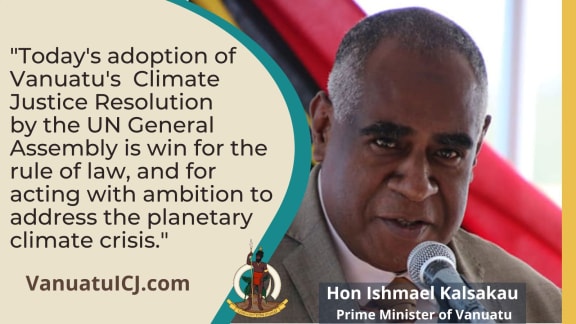
Vanuatu is in celebration mode after winning a significant battle on the world stage over climate change.
In a United Nations resolution spearheaded by Vanuatu, the world’s top court will now advise on countries’ legal obligations to fight climate change.
It also means the International Court of Justice can advise on consequences for those countries which do not comply. The resolution was passed overnight on Wednesday.
Vanuatu Prime Minister Ishmael Kalsakau was ecstatic. He was in New York for the vote.
He called it a “historic resolution” and the beginning of a new era in multilateral climate co-operation.
“I celebrate today with the people of Vanuatu who are still reeling from the devastation from two back-to-back cyclones this month caused by the fossil fuels and greenhouse emissions that they are not responsible for,” he said.
His country is still picking up the pieces from Cyclone Judy and Cyclone Kevin, which struck within a couple of days of each other earlier this month.
Meanwhile, Foreign Minister Nanaia Mahuta has been in Vanuatu looking at what support New Zealand can give — and ensuring help gets to those who need it.
She has witnessed first-hand the climate challenge that the people are facing. Mahuta said New Zealand had supported Vanuatu’s drive to get the UN resolution across the line.
NZ’s Foreign Minister Nanaia Mahuta . . . “”We have to acknowledge Vanuatu’s leadership.” Video: 1News
“We have to acknowledge Vanuatu’s leadership,” Mahuta told 1News.
“It’s not really the size of the country, but it’s the size of the vision, and Vanuatu’s voice has clearly put front row centre an aspiration to have the ICJ recognise the impacts of climate change on vulnerable countries.”
Accompanying New Zealand’s delegation is a 10-member Pasifika Medical Association PACMAT team. They will be based at the Aotearoa-funded Mindcare Mental Health facility for the next 28 days helping those traumatised by the two cyclones.
New Zealand has announced $12 million to add to a funding pool for the region to help people get back on their feet quicker after the disaster.
In Vanuatu, New Zealand is offering $18.5 million for a clean drinking water project, $4 million for tourism recovery and $3 million for general budget support.
Barbara Dreaver is 1News Pacific correspondent. Republished with permission.
New Caledonia’s Kanak and Socialist National Liberation Front (FLNKS) say they will tell the French Prime Minister of the Kanak people’s “sense of humiliation” over the last independence referendum.
The pro-independence alliance is set to talk to the French state from April 7-15.
The secretary-general of the Caledonian Union, Pascal Sawa, told La Premiere television they need to discuss what happened in the referendum vote in 2021, which was boycotted by the indigenous Kanak people due to the effects of the covid-19 pandemic.
“The first thing to discuss is the conflict in relation to December 12, 2021,” he said.
“We cannot ignore what happened then. The state says there is a right for independence and that the accord is now past.
“We don’t believe it has finished because we feel still feel a sense of humiliation.”
In Paris, the alliance is set to meet French Prime Minister Elizabeth Borne.
In a statement, the FLNKS said they would discuss crucial topics such as the restricted electoral roll based on the Noumea Accord of 1998 which allows only people with 18 years presence in the territory to vote.
“The FLNKS reaffirms that the electoral citizens body is irreversible from the Noumea Accord, and that its modification could break the social peace in the country.”
They will also choose the next phase in order to progress the Noumea Accord, which in the eyes of the FLNKS remains unfinished.
“The next phase is how we will come out constructively of the Noumea Accord to rebuild something that resembles us and that brings the people of New Caledonia together,” the statement said.
The FLNKS statement affirms that all future discussions about the future of the country will be decided and acted in New Caledonia not France.
‘We will not reproduce the Accords’ New Caledonia’s High Commissioner Louis Le Franc said that France would not reproduce the Noumea Accords.
Seven months after taking his role in Noumea, the commissioner said he was optimistic about future trilateral discussions.
He said it was a shame the last meeting did not involve the anti-independence side.
“We are in a period, post-Noumea Accord, we will not reproduce the accords and we will hopefully find an intelligent solution for the sake of future generations.
“The French Minister of the Interior and French Overseas Minister only have one voice, therefore the framework put down is very hard to be respected.”
This article is republished under a community partnership agreement with RNZ.
Sunday will mark the end of the Daylight Saving Time (DST) in eastern Australia, but there are many who would like to see it last longer or permanently.
Twice a year, New South Wales, Victoria, Australian Capital Territory, Tasmania and South Australia make this shift. Queensland, Western Australia and the Northern Territory do not change times. In those states the issue has been hotly debated for years. But what would be the benefit of making time permanent, and is it feasible?
In the United States, the push to fix time has gathered pace, with a bipartisan bill reintroduced to the House this month. The Sunshine Protection Act is set to bring uniformity in fixing the time, starting from November 2023. If enacted, it means daylight saving would be permanent across the US.
The bill passed the Senate in March 2022. It was received at the House, but Americans are split on whether they prefer permanent daylight saving time or permanent standard time – the bill then expired and so had to be reintroduced.
The proponents argue the biannual ritual of switching time is a health hazard leading to insomnia, decline in mental health, increased risk of hospitalisations and accidents. The solution, they argue, is to restore permanent, year-round standard time.
Would fixing time permanently have benefits in Australia?
One of the US policy’s goals is to reduce energy consumption. However, according to the latest research, contrary to the policy’s intent,daylight saving caused increased electricity demand in the US. Research has also found it does not conserve electricity in Australia.
Overwhelmingly, recent research opposes the current situation of changing the clocks twice year. In particular, the loss of one hour of sleep in spring has been linked to an increase in heart attacks, strokes, road accidents and negative mood.
Moreover, with mobile phones available in offices and bedrooms, the shift to daylight saving was shown to result in a dramatic increase in “cyberloafing”.
Thanks to mobile phone use, research shows daylight saving has caused an increase in ‘cyberloafing’. Shutterstock
On the Monday following the switch, employees sustain more workplace injuries and injuries of greater severity, according an analysis of data from the US Department of Labor and Mine Safety and Health Administration between 1983-2006, although there is a decrease in injuries when employees are gaining one hour of sleep.
In a study of Australian suicide data from 1971 to 2001, researchers found a rise in male suicide rates in the weeks following the commencement of daylight saving, concluding the shifts could be destabilising for vulnerable people.
The health evidence is, in fact, contrary to idea behind the current legislation and instead suggests a permanent switch to standard time may offer the maximum health and public safety benefits.
Florida Senator Marco Rubio, who is strongly supporting the bill, told the Senate:
There’s some strong science behind it that is now showing and making people aware of the harm that clock-switching has. I know this is not the most important issue confronting America, but it’s one of those issues where there’s a lot of agreement. If we can get this passed, we don’t have to do this stupidity anymore. Pardon the pun, but this is an idea whose time has come.
Australian legislation – move to uniformity
Standard time legislation dates back to 1890s. That is when jurisdictions enacted uniform legislation related to standard Greenwich Mean Time. For example, Tasmania fixed the time of the 150th meridian of longitude east of Greenwich and Western Australia declared the mean time of the 120th meridian as the standard time. At that stage, the legislation was consistent. This continued until the daylight saving debate commenced.
Daylight saving was first considered at the Premiers’ Conference in May 1915. During the first and second world wars, national daylight time operated in Australia. Tasmania and Victoria introduced daylight saving in 1916. In Tasmania, the act was repealed by the Daylight-Saving Repeal Act 1917 (Tas). In 1967, Tasmania again introduced daylight savings.
Liberal Senator Paul Calvert described the “maze of different times” as a “shackle on the economy, as well as causing interruptions to work and family balance”.
Then-prime minister John Howard stated: “I think it’s a great pity that we have this month when Tasmania and NSW and Victoria are on different time zones.”
Starting from September 1 2005, all jurisdictions adopted the Coordinated Universal Time (UTC) standard. Following long deliberations, in April 2007 they agreed on a uniform start and end date.
Queensland, WA and the NT have fixed permanent time.
South Australia became an international anomaly by having 30 minutes difference, rather than full hour, to achieve a compromise between strong advocacy groups within the jurisdiction.
One of the arguments against fixing is geographical location. Tasmania has more drastic variation in sun activity compared to Northern Territory. The scientific solution would be to fix the time but reassign the regions to the actual sun-clock based time zones.
Where does all this leave us? While daylight saving is not the most pressing problem facing Australia today, it may be that soon enough, the scientific evidence and practical convenience of fixing time might be preferred to biannual shifts.
Guzyal Hill does not work for, consult, own shares in or receive funding from any company or organization that would benefit from this article, and has disclosed no relevant affiliations beyond their academic appointment.
Events often seem inevitable in hindsight. The indictment of former US President Donald Trump on criminal charges has been a possibility since the start of his presidency – arguably, since close to the beginning of his career in New York real estate.
But until now, the potential consequences of such a cataclysmic development in American politics have been purely theoretical.
Today, after much build-up in the media, The New York Times reported that a Manhattan grand jury has voted to indict Trump and the Manhattan district attorney will now likely attempt to negotiate Trump’s surrender.
The indictment stems from a criminal investigation by the district attorney’s office into “hush money” payments made to the adult film star Stormy Daniels (through Trump’s attorney Michael Cohen), and whether they contravened electoral laws.
Trump also faces a swathe of other criminal investigations and civil suits, some of which may also result in state or federal charges. As he pursues another run for the presidency, Trump could simultaneously be dealing with multiple criminal cases and all the court appearances and frenzied media attention that will come with that.
These investigations and possible charges won’t prevent Trump from running, or even serving as president again (though, as with everything in the US legal system, it’s complicated).
But what will the political fallout be – will his indictment hurt Trump, or help him? And what does it mean for American democracy?
Can Trump survive multiple investigations at once?
There are almost too many hypotheticals and “what ifs” to count. Even the immediate fallout of Trump’s indictment isn’t clear.
It is certainly plausible Trump will manage to derive political benefit from the media spectacle – he has a long history of successfully weaponising investigations into his dealings as “witch hunts”, effectively tapping into conservatives’ obsession with “government overreach”.
It’s equally possible multiple investigations and charges will eventually hurt Trump, forcing him off the campaign trail and into situations out of his control, where he doesn’t perform so well. This could go as badly for him as the few hostile media interviews he did as president and open the door for a successful challenge by another aspiring candidate.
Democrats and others opposed to Trump and the movement he heads are also divided on the fallout and risks.
The Daniels case is murky and focused on technical election laws, raising questions about whether it would have been less risky to prioritise a more straightforward case, such as the Georgia investigation into Trump’s attempt to influence the outcome of the 2020 presidential election. Indictments may soon be forthcoming in that case, too.
Whatever happens with these investigations and Trump’s reactions to them, it’s already clear his supporters will whip themselves into a frenzy of misinformation, hysteria and perhaps even violence, further destabilising the political landscape.
Are presidents above the law?
There’s a much bigger question to ask, though: where does all of this fit into the deep, ongoing crisis surrounding American democracy and its institutions?
Since the 2016 election, the questions of whether a candidate should be subject to criminal investigations and whether a sitting president can be charged with an offence have plagued US politics.
When then-FBI director James Comey sent a letter to Congress on the eve of the 2016 election about the private email server presidential candidate Hillary Clinton used as secretary of state, it led to a great deal of soul-searching about the impact of perceptions – valid or otherwise – of politically motivated “interference” in the electoral process.
The longstanding reluctance of federal agencies to engage in such “interference”, alongside the established consensus that a president should not be charged while in office, survived until almost the very end of the Trump administration.
The so-called “Russia investigation”, led by Special Counsel Robert Mueller, declined to recommend specific charges against Trump, despite there being ample evidence he had allegedly obstructed justice. The basis for this decision: Mueller said Justice Department policy prevented him from charging a sitting president with a crime.
But between the release of Mueller’s report and Trump’s incitement of an insurrection of the US Capitol on January 6, 2021, attitudes to charging a president or former president appear to have changed dramatically. Trump’s indictment this week makes that abundantly clear.
The shared understanding that has, until now, protected Trump (and predecessors like Richard Nixon), has been turned on its head. Now, there’s a belief among many Democrats and a few anti-Trump Republicans that not pursuing these investigations to their logical ends – that is, an arrest, trial and potential imprisonment – presents a much greater threat to the integrity of American democracy and democratic institutions than the risk of appearing to “interfere”.
This logic argues that, particularly when American democracy is in crisis, even presidents and former presidents cannot be seen to be above the law.
If this perception was widespread, how many Americans would completely lose faith in a political system they already don’t trust entirely? Even more importantly, how would the perpetrators of crimes – and their supporters – respond if they believed they could break the law without consequences?
We can be fairly certain of the answer to that question. Trump’s reaction to his pending indictment two weeks ago was eerily reminiscent of his incitement of the riot on the Capitol: “Protest, take our nation back!”
The potential for further violence – which is a feature, not a bug, of American politics – is very real.
While the logic behind the criminal pursuit of the ex-president is entirely sound – and necessary to the ongoing integrity of American democratic institutions – that does not necessarily mean the survival of those institutions is assured as they are forced to respond to ongoing attacks.
Trump’s indictment, and the frenzy it has already created, demonstrate just what a dangerous and unstable time this is for American democracy. The road is probably about to get even rockier.
In a 1977 interview, Nixon said in response to a question about why he had authorised illegal actions against anti-Vietnam war protesters,
Well, when the president does it […] that means that it is not illegal.
Almost half a century later, we’re as close as we’ve ever been to finding out if he was right – and if American democracy can survive the answer.
What would you do to get more likes or shares on your favourite social media platform this April Fool’s Day?
Would you blast an airhorn in your partner’s ear while they’re sleeping, record and upload their reaction online? Would you put hot chilli in their food, then film and share their distress?
Online prank videos are nothing new, and while many are lighthearted, a concerning sub-genre called “clout-lighting” has been emerging across the internet.
But in case you might be planning to clout-light your partner this April Fool’s Day, research shows it’s a surefire way to get dumped.
What is clout-lighting?
Clout-lighting is a combination of the word “clout” (to have social influence) and “gaslighting” (systematic manipulation that leads victims to question their own beliefs and feelings).
The term was first used by British journalist Jessica Lindsay to describe the practice of intimate partners playing extreme practical jokes on one another and posting their reactions on social media.
Clout-lighting is related to, but different from an online prank. Pranks target unsuspecting people, often strangers, whereas clout-lighting involves intimate partners.
Both clout-lighting and online pranks represent “aggressive humour” or “negative humour” and its subcategory “disparagement” – they mock, tease, or ridicule innocent victims to entertain an audience.
Clout-lighting is also different from cyberbullying. “Clout-lighters” appear motivated by their emotional needs – attention seeking and gaining popularity on social media. By contrast, cyberbullies relentlessly target individuals to cause harm or distress, hidden by the cloak of anonymity.
There is nothing new about filming and publishing a practical joke. US reality show Candid Camera first aired in 1948; like the more recent Punk’d and similar shows, they feature footage captured by a hidden camera of everyday people (sometimes celebrities) caught up in pranks or hoaxes.
However, social media has created a platform for people to use pranks as a means of generating more clicks and social media popularity: clout. Today, anyone can be a comedic celebrity, and YouTube is full of them.
YouTube prank channels provide a platform for pranksters to amass followers and popularity.
However, to get more likes, shares or followers, clout-lighters need to publish extreme (sometimes even cruel and painful) pranks inflicted on their closest people.
While many of the skits appear highly produced, the genre of clout-lighting pushes beyond the boundaries of comedic entertainment, towards promoting intimate partner abuse and misogyny.
Passive voyeurism
Concerningly, many of these cruel and embarrassing clips have been downloaded hundreds of thousands of times, suggesting our appetite for passive voyeurism. Just as reality television illustrates suffering and loss and a preoccupation with personal trauma for the sake of entertainment, clout-lighting videos do the same thing.
Studies have indicated viewers who are drawn to extreme forms of entertainment have the sensation-seeking personality trait – a tendency to constantly seek varied and intense viewing experiences. Passive voyeurism of human pain increases as our compassion fades, and we become sensitised to the footage. Accordingly, we watch even more extreme footage to attain the same level of sensation.
By that token, clout-lighters need to post even more painful and humiliating content to keep driving traffic to their channel.
Who are clout-lighters?
A 2020 study found that regardless of age, clout-lighters tended to have low self-esteem and were “higher social media users”. Males were over four times more likely to engage in clout-lighting than females.
The study also indicated that couples engaged in clout-lighting were more likely to have “low levels of satisfaction” in their relationship, and more likely to break up.
Canadian researchers found some online pranksters tended to be motivated by sadism – a desire to harm others to boost their own positive feelings.
Relational dialectics theory explains contradictions in relationships – the point between harmony and possible separation. As two people come together as partners, they begin to experience internal tensions – they each want different things, express different values and life goals. Research finds that people perceive negative relational humour as a sign of diminished relationship satisfaction.
Relating this theory to clout-lighting, pranking a partner and posting the results on social media can increase the level of perceived insecurity in a relationship, especially when the prank is demeaning and socially embarrassing. Hence the likelihood the partners will separate.
These studies reject the notion that clout-lighting is nothing more than light-hearted pranks directed at a loved one. At a much deeper level, such pranks could be indicative of relationship dissatisfaction.
The Conversation is commissioning articles by academics across the world who are researching how society is being shaped by our digital interactions with each other. Read more here
Les auteurs ne travaillent pas, ne conseillent pas, ne possèdent pas de parts, ne reçoivent pas de fonds d’une organisation qui pourrait tirer profit de cet article, et n’ont déclaré aucune autre affiliation que leur organisme de recherche.
New Zealand Parliament Buildings, Wellington, New Zealand.
New Zealand Politics Daily is a collation of the most prominent issues being discussed in New Zealand. It is edited by Dr Bryce Edwards of The Democracy Project.
As global environmental challenges grow, people and societies are increasingly looking to Indigenous knowledge for solutions.
Indigenous knowledge is particularly appealing for addressing climate change because it includes long histories and guidance on how to live with, and as part of, nature. It is also based on a holistic understanding of interactions between living and non-living aspects of the environment.
However, without meaningful collaborations with Indigenous communities, the use of Indigenous knowledge can be tokenistic, extractive and harmful.
Our newly published work explores the concept of kaitiakitanga. This is often translated as guardianship, stewardship or the “principle and practices of inter-generational sustainability”.
We want to encourage Western-trained scientists to work in partnership with Māori and meaningfully acknowledge Māori values and knowledge in their work in conservation and resource management.
Kaitiakitanga is more than guardianship
Indigenous knowledge includes innovations, observations, and oral and written histories that have been developed by Indigenous peoples across the world for millennia.
This knowledge is living, dynamic and evolving. In Aotearoa New Zealand, mātauranga Māori is the distinct knowledge developed by Māori. It includes culture, values and world view.
The concept of kaitiakitanga is often (mis)used in the context of conservation and resource management in Aotearoa. In our work, we highlight how kaitiakitanga is inherently linked to other concepts. It is difficult to translate these concepts directly but they include tikanga (Māori customs), whakapapa (genealogy), rangatiratanga (sovereignty) and much more.
One of the key conceptual differences between kaitiakitanga and conservation is that for kaitiakitanga, we consider being part of te taiao (the environment) and manage our relationships accordingly. Conservation is characterised by humans managing the environment as if they were separate from it.
The Honourable Justice Joe Williams describes kaitiakitanga as “the obligation to care for one’s own”, indicating the intrinsic link between people and the environment.
We caution against simplistic definitions of kaitiakitanga. They often divorce it from its cultural context. Simplistic definitions reduce the richness of the concept and also fail to recognise the differences in how kaitiakitanga is conceptualised and practised.
Instead, we encourage Western-trained researchers to gain a deeper understanding of concepts that underpin kaitiakitanga and work with mana whenua to further develop understanding.
There is a growing number of examples of successful collaborations between mana whenua and researchers. Exploring these projects will allow researchers to gain insights into how to contribute in an effective and respectful way.
For instance, a study of the traditional harvest and management of sooty shearwater in the Marlborough Sounds shows the importance of including cultural harvest in species conservation management.
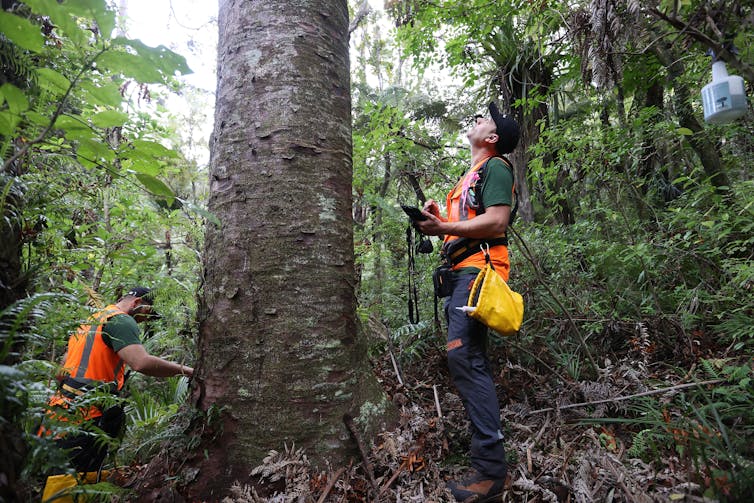
Rāhui to fight kauri dieback: biosecurity workers inspect and record information about a kauri in the Waitakere Ranges. Getty Images
Rāhui in conservation
Rāhui is a customary process that can be used by mana whenua to restrict access to a certain resource or area of land to allow recovery. It includes an holistic understanding of the environmental problem, and social and political control.
Other examples include rāhui covering forests, lakes, beaches and marine areas for durations from days to decades. Rāhui are widely used but highly specific to local conditions. For iwi to be able to implement rāhui, they need to have rangatiratanga, as kaitiakitanga is both an affirmation and manifestation of rangatiratanga.
Empowering Māori researchers and communities is central to worthwhile collaborations. We encourage non-Māori researchers to approach partnership with an awareness of the limits of their training and knowledge.
Embracing a mindset of intellectual humility will more likely create conditions for meaningful co-created work. While establishing and maintaining collaborations can be time-consuming, our collective experience is that taking time to develop trust and understanding is essential for successful outcomes.
We hope our work will provide some inspiration and guidance for established practitioners and students alike.
There are a number of other examples of how mātauranga and ecology can work together. The New Zealand Journal of Marine and Freshwater Research has dedicated a special issue to mātauranga Māori and how it is shaping marine conservation. Others have explored how respectful collaborations can support better teaching of science and better research outcomes.
Tara McAllister has received funding from the Vision Mātauranga Capability Fund.
Cate Macinnis-Ng has received funding from Te Pūnaha Hihiko: Vision Mātauranga Capability Fund and Te Pūnaha Matatini.
Dan Hikuroa has received funding from Marsden, MBIE, Te Pūnaha Matatini and Ngā Pae o te Māramatanga. He is UNESCO New Zealand Commissioner for Culture, member of Ngā Kaihautū Tikanga Taiao and interim Pou Herenga.
If you’re like me, you’ve managed to kill even the hardiest of indoor plants (yes, despite a doctorate in plant biology). But imagine a world where your plants actually told you exactly when they needed watering. This thought, as it turns out, may not be so silly after all.
You might be familiar with the growing body of work that provides evidence for plants being able to sense sounds around them. Now, new research suggests they can also generate airborne sounds in response to stress (such as from drought, or being cut).
A team led by experts at Tel Aviv University has shown tomato and tobacco plants, among others, not only make sounds, but do so loudly enough for other creatures to hear. Their findings, published today in the journal Cell, are helping us tune into the rich acoustic world of plants – one that plays out all round us, yet never quite within human earshot.
Plants can listen, but now they can talk!
Plants are “sessile” organisms. They can’t run away from stressors such as herbivores or drought.
Instead, they’ve evolved complex biochemical responses and the ability to dynamically alter their growth (and regrow body parts) in response to environmental signals including light, gravity, temperature, touch, and volatile chemicals produced by surrounding organisms.
These signals help them maximise their growth and reproductive success, prepare for and resist stress, and form mutually beneficial relationships with other organisms such as fungi and bacteria.
In 2019, researchers showed the buzzing of bees can cause plants to produce sweeter nectar. Others have shown white noise played to Arabidopsis, a flowering plant in the mustard family, can trigger a drought response.
Now, a team led by Lilach Hadany, who also led the aforementioned bee-nectar study, has recorded airborne sounds produced by tomato and tobacco plants, and five other species (grapevine, henbit deadnettle, pincushion cactus, maize and wheat). These sounds were ultrasonic, in the range of 20-100 kilohertz, and therefore can’t be detected by human ears.
Stressed plants chatter more
To carry out their research, the team placed microphones 10cm from plant stems that were either exposed to drought (less than 5% soil moisture) or had been severed near the soil. They then compared the recorded sounds to those of unstressed plants, as well as empty pots, and found stressed plants emitted significantly more sounds than unstressed plants.
In a cool addition to their paper, they also included a soundbite of a recording, downsampled to an audible range and sped up. The result is a distinguishable “pop” sound.
The number of pops increased as drought stress increased (before starting to decline as the plant dried up). Moreover, the sounds could be detected from a distance of 3-5 metres – suggesting potential for long-range communication.
But what actually causes these sounds?
While this remains unconfirmed, the team’s findings suggest that “cavitation” may be at least partially responsible for the sounds. Cavitation is the process through which air bubbles expand and burst inside a plant’s water-conducting tissue, or “xylem”. This explanation makes sense if we consider that drought stress and cutting will both alter the water dynamics in a plant stem.
Regardless of the mechanism, it seems the sounds produced by stressed plants were informative. Using machine learning algorithms, the researchers could distinguish not only which species produced the sound, but also what type of stress it was suffering from.
We now have the first research evidence that plants can make airborne sounds, heard up to a few metres away. Shutterstock
It remains to be seen whether and how these sound signals might be involved in plant-to-plant communication or plant-to-environment communication.
The research has so far failed to detect any sounds from the woody stems of woody species (which includes many tree species), although they could detect sounds from non-woody parts of a grapevine (a woody species).
What could it mean for ecology, and us?
It’s temping to speculate these airborne sounds could help plants communicate their stress more widely. Could this form of communication help plants, and perhaps wider ecosystems, adapt better to change?
Or perhaps the sounds are used by other organisms to detect a plant’s health status. Moths, for example, hear within the ultrasonic range and lay their eggs on leaves, as the researchers point out.
Then there’s the question of whether such findings could help with future food production. The global demand for food will only rise. Tailoring water use to target individual plants or sections of field making the most “noise” could help us more sustainably intensify production and minimise waste.
For me personally, if someone could give a microphone to my neglected veggie patch and have the notifications sent to my phone, that would be much appreciated!
Alice Hayward receives funding from The Australian Research Council Linkage Scheme, and various industry partners. Her salary is paid by The Queensland Alliance for Agriculture and Food Innovation (a partnership between The University of Queensland and The Department of Agriculture and Fisheries, Queensland). In the past she has received funding from The Queensland Government, The Australian Government, The Chinese Academy of Sciences, UQ and Hort Innovation Australia. She is a member of Native Plants Queensland and The Australian Branch of International Association of Plant Biotechnology.
Telehealth has been a game changer for many First Nations people globally, including in Australia.
It has allowed First Nations people to access health care close to home – whether that’s screening for health issues, diagnosing illness or monitoring existing conditions. It has done this while minimising exposure to COVID.
But a recent review of telehealth for First Nations people – in Australia, Canada, New Zealand and the United States – shows we could do better.
Unreliable internet access, services designed without meaningful First Nations’ input, and concerns about establishing rapport with health workers were some of the concerns.
Here’s where we could lift our game to ensure reliable, equitable and culturally safe telehealth for First Nations people in Australia, whether living remotely or in our cities.
Telehealth uses information and communication technology to deliver health care at a distance. In Australia, this is mainly via phone and video consultations.
Telehealth can be delivered by any health-care provider including doctors, nurses, and allied health or ancillary health providers. Telehealth is not a complete replacement for in-person care. But it can be used instead of some face-to-face appointments.
Aboriginal Community Controlled Health Organisations have traditionally provided primary (initial) health care and some specialist care for First Nations people in Australia. Telehealth allows them to provide a greater range of specialist services. So, this allows First Nations people access to care close to home, with optional support from an Indigenous health worker.
Telehealth services for First Nations people have improved social and emotional wellbeing, clinical outcomes, access to health services, and boosted screening rates.
During COVID, telehealth increased the number of First Nations people able to access health care, while reducing the potential for transmission of the virus. For clients, telehealth reduces time away from usual activities, travel and associated out-of-pocket expenses.
Telehealth can contribute to culturally safe health care. Practically, this means care that does not challenge identity or experience of First Nations people. It’s when both the provider and the person receiving the care communicate with respect, to share knowledge and to improve overall health.
It allows a person to stay on Country while accessing some health-care services. Telehealth can also reduce the trauma associated with travel, reduce the disruptions to family and reduces stress associated with using health care.
Telehealth also allows family and other supports such as an Indigenous health worker to attend specialist consultations, and for the person to receive care in a supportive environment.
But First Nations communities need a bigger say
But for telehealth services to be provided in a culturally safe manner that improves health, it is essential services are co-designed with First Nations people. First Nations communities also need to have ownership of the services.
Co-designing is a highly collaborative approach where researchers, industry stakeholders and Aboriginal communities work together to achieve a goal, and where there is sustained and equitable engagement with the community.
True co-design puts Aboriginal voices and lived experiences first, aiming to empower communities through shared decision making toward goals defined by the community. When done well, co-design leads to services and outcomes authentically aligned with the needs and preferences of the community.
Co-designing culturally safe telehealth solutions would mean Aboriginal people working closely with industry and researchers to determine what currently works, what doesn’t work well and where gaps lie. This is so solutions – simple or highly innovative – can be developed for the community.
Access to reliable internet is a barrier to providing videoconsultations, particularly for remote communities. Investment in infrastructure by government, NGOs and private industry could resolve such connectivity issues.
However, solutions are often expensive. So centralising telehealth services at Aboriginal Community Controlled Health Organisations may provide economies of scale.
Investing in training Indigenous health workers in telehealth may also increase the uptake and scope of telehealth appointments.
First Nations people want that connection
One barrier to telehealth for First Nations people is concerns about establishing trusting therapeutic relationships with their health provider via telehealth.
Evidence suggests rapport can be improved by the provider visiting communities and conducting the initial consultations in-person.
Providers should familiarise themselves with local services available in the communities they are providing care for, as this will improve their ability to integrate care with local services.
Cultural awareness training for all providers is also desirable.
Gone are the days of telehealth being used exclusively for rural and remote people. So providers should offer telehealth to First Nations people regardless of where they live.
The benefits of telehealth – such as cultural safety, reduced travel, ability to involve family – are just as relevant for First Nations people living in metropolitan areas as they are for those in rural and remote locations.
Centaine Snoswell receives funding from UQ and NHMRC.
Jonathan Bullen receives funding from WA Department of Health’s Future Health Research and Innovation fund.
Liam Caffery receives funding or has received funding from the NHRMC, the Commonwealth Department of Health, Queensland Health, Cooperative Research Centre for Developing Northern Australia and from the University of Queensland. Liam Caffery is the Vice President of the Australian Telehealth Society.
The Millionaires’ Factory, subtitled “the inside story of how Macquarie Bank became a global giant” by financial journalists Joyce Moullakis and Chris Wright is an impressive, informative book that I enjoyed reading.
As well as providing insights into the Australian financial giant’s evolution, organisation, scope and success, it says a lot about Australia’s financial history.
The large number of Macquarie alumni (the book suggests around 100,000) and current staff (more than 18,000 globally in 2022) will provide a ready market.
But for others, despite the many interesting character sketches and well-written “travelogue” through Macquarie’s exploits, the book may be somewhat heavy going – for one main reason.
Macquarie is a mammoth organisation that has been involved in a huge number of complex financial activities across the international stage.
Macquarie’s 2022 annual report says it operates across 33 markets in
asset management
retail and business banking
wealth management
leasing and asset financing
market access
commodity trading
renewables development
specialist advice
access to capital, and
principal investment.
Outlines of key transactions alone, necessarily, form a large part of the book.
Unfortunately, most need virtually an entire book each to explain and, in any event, require a high level of financial expertise to properly understand.
Those who are not finance experts can skip over the specific deals and will still find much value in (at least) two parts of the book.
One is the information on the management and governance of the organisation, including the adaptability of its divisional structure to opportunities and challenges.
Macquarie has consistently shown a willingness to expand into new (generally “adjacent”) activities suggested by staff (rather than from the top) under a strict risk-control framework.
A second (related) element is its emphasis on the quality of its staff and its dependence on its staff to investigate, generate and develop new activities.
Turning staff into millionaires
The remuneration arrangements bring the promise of rich personal rewards if successful, while failure in a new activity that has received the go-ahead under strict risk controls is not a career-limiting outcome.
Some readers may find strange the continued recitation of names and characteristics of key Macquarie personnel – but it is the people involved who have made Macquarie what it is today. As the saying goes, in financial institutions the main assets walk out the door every night (or early morning in many cases).
One thing the book does not do is provide any tables or graphs showing the enormous growth of Macquarie since its creation out of Hill Samuel in 1985, its integral role in Australia’s financial system and its successful overseas expansion.
Of course, given the scope of Macquarie’s activities, relevant metrics for comparison purposes are not easy to identify. For example, Macquarie Bank (the “commercial banking” part of the group) is small compared to the four major banks, with resident deposits about one-third of the smallest of the big four, ANZ.
The Macquarie Group overall has about half the number of employees of ANZ, but its overall personnel expenses in 2022 were around 15% higher than the ANZ (reflecting the words “millionaires’ factory” used in the book’s title).
Pushing boundaries
The authors hint at, but do not address, several questions posed by Macquarie Group’s critics.
First, to what extent have Macquarie’s profits come from pushing the boundaries of tax arbitrage (such as moving profits from high-tax locations to low-tax locations and moving losses in the other direction), such that its resulting profit isn’t a reward for adding social value but is instead generated at the expense of taxpayers?
There are always loopholes in tax law due to imperfect drafting, or grey areas that fall between what is clearly within or outside of the law. The opportunity to exploit such loopholes is greater when several jurisdictions are involved, and the book refers to several, such as the “cum-ex” dividend arbitrage. There are others.
The profit motive underpinning Macquarie and its remuneration structure naturally lead towards attempts to exploit such opportunities even if the private gains are purely at the expense of government tax revenue and not involving any (or much) creation of social value.
The authors quote former Treasurer Peter Costello saying “they engineered tax breaks to within an inch of their lives”, which often led to changes to tax laws to prevent such activities. How much this is ethical behaviour is a matter of opinion!
Heavily charging customers
The second question is: in constructing value-adding deals with clients and customers, how much of the net benefit has accrued to Macquarie, and how much to its customers?
As well as the nickname of “Millionaires’ Factory”, Macquarie has also been referred to as the “fee factory”.
For example, in its now-abandoned infrastructure trust structures, various parts of Macquarie would obtain fees: when purchasing assets for the trust (and “clipping the ticket” via a profit on the sale price into the trust), fees from managing the trust, commissions from selling units in the trust to investors, etc.
Macquarie’s position as an innovative creator of financial products and structures has often given it a first-mover advantage, such that with no competing supplier, Macquarie has been able to extract a major part of the value created.
Obviously, some value for the client needs to be provided, and concerns that a perceived unfair distribution of benefits would make it hard to repeat the exercise limit the amount of value extraction possible. But what is “fair” is a matter of opinion!
Exploiting the poorly informed
The third question is: to what extent did Macquarie benefit from exploiting poorly informed (wholesale and retail) consumers and users of its financial products – as the Hayne Royal Commission found to be the case for the four major banks and others?
Macquarie escaped from the Royal Commission with its image barely tarnished compared to the big four. One reason was that its then-chief executive, Nicholas Moore, was able to point to the remediation activities it had put in place prior to the commission once it had recognised the problems.
Macquarie Group chief Nicholas Moore leaving the Hayne Royal Commission in 2018. Joel Carrett/AAP
But Macquarie was also lucky in that the Royal Commission’s terms of reference only required it to look back as far as the global financial crisis. Had it been required to look back further, its findings might have been different.
Prior to the financial crisis, Macquarie (and other banks) created highly financially engineered, structured products and marketed them to retail (and other) investors. Even financially literate investors could not have possibly understood the risks or value of the products they were sold.
This was typical of the time and Macquarie was not particularly different to other purveyors of such products. But whether, in the absence of effective regulation, Macquarie would revert to pushing these boundaries is a matter of opinion!
An Australian success nevertheless
There is no question that Macquarie is an Australian success story.
Its 2022 annual report indicates that A$100 invested in its shares at the time of its stock exchange listing in 1996 would have grown to $10,000 in 2022.
More importantly, it has provided or enabled funding for many investment projects of its customers, which might not otherwise have gone ahead.
By taking an active role in the management and governance of large projects (such as toll roads and utilities), it has enabled more efficient operation of such projects than might have otherwise occurred.
It currently is near the forefront of financiers focusing on “green finance”, where activities generating social and environmental benefits can be consistent with profiting from a first-mover position.
There will, no doubt, remain many critics of Macquarie’s profit orientation and a resulting possible conflict with broader social goals. They would gain much from reading this book, both to find specific instances of that conflict, but also to see that profit-seeking is not always inconsistent with social goals.
Kevin Davis does not work for, consult, own shares in or receive funding from any company or organisation that would benefit from this article, and has disclosed no relevant affiliations beyond their academic appointment.
While a statement from producers said the horses’s cardiac arrest occurred before the day’s filming began, animal rights activists PETA used the death to call on all screen producers to replace on-set horses with CGI and mechanical rig alternatives.
The incident feeds into growing public concern about horse welfare on film and TV sets, at the track and in equestrian sports.
But improving horse welfare is about more than just reputation repair – too often it’s about survival for horses and humans.
Horse welfare in film and TV
The riding of a horse over a cliff to its death for the movie Jesse James (1939) led to the establishment of American Humane, which now oversees around 100,000 animals on more than 1,000 productions each year.
While things have improved since the early days of film and television, deaths and mistreatment of horses still occur.
In 1987, on the set of The Man From Snowy River II, a seriously injured horse was killed using the blunt end of an axe.
More recently, the high-profile series Luck, starring Dustin Hoffman, was cancelled following the deaths of three horses.
The good and bad of unprecedented global exposure
In 2021, the Tokyo Olympics beamed to a global audience the excessive whipping and punching of modern pentathlon horse Saint Boy and show jumper Kilkenny’s spectacular nosebleed during the controversial show jumping program.
While the bleed must have been obvious, officials did not intervene to stop the ride.
Confronting images, and the perceived failure of organisers to protect the horses involved, brought into clear and global focus the indisputable welfare issues faced by horses competing at the elite level.
Since the 1840s, 873 jockeys are known to have died in race falls in Australia.
Internationally, the sport of eventing (where competitors complete three phases: dressage, show jumping and cross-country) reported 38 rider and 65 horse fatalities during or after competition between 2007-15.
Riding horses is considered one of the most dangerous of all sporting pursuits, and the deaths of riders and jockeys, usually from falls, are common.
Public concern about risk to horses and humans through horse racing and equestrian sports, as well as screen production, also threaten these industries’ social licence.
Better horse welfare is related to better rider safety
Our research offers hope for the horse industry and for those passionate about riding horses.
Last year, we published a paper demonstrating the link between horse welfare and rider safety. We asked riders how they cared for their horses and how their horses behaved when ridden – for example, we wanted to know how often horses were bucking or rearing.
From this information, we calculated a relative welfare score for each horse. We also asked riders about their accidents and injuries.
After analysing the data from over 400 riders, we found the higher the horse welfare score, the fewer accidents and injuries a rider reported.
In a subsequent study, we found horses with better welfare scores are more enjoyable to ride, most likely because they perform better and riders feel more in control, creating a win-win for horses and riders.
Often good welfare is thought of in terms of an animal being healthy.
While this is part of good welfare, good health alone is not enough – especially for a horse competing at the elite level or taking part in a film.
Horses are neophobes – this means they find new things frightening – so most horses are likely to find a movie set or travelling to a new location stressful. The most up-to-date understanding of welfare tells us that stress and poor mental health means poor animal welfare.
Yet, anecdotally and in the media, people seeing a horse behaving in this way often claim the horse is crazy, unpredictable or just plain mean.
More likely, an “unpredictable” horse is suffering from poor welfare.
As part of our research program, we have developed a new framework to help horse owners identify aspects of their care and training that diminish horse welfare.
This information can be used to make modifications to improve horse welfare, and, importantly, can be applied to horses in any equine sector, including racing, sport and film and television.
Horses played a pivotal role in the narrative of Lord of the Rings: The Rings of Power. IMBD
Investing in the future of horses in entertainment and sport
Although a veterinarian assessed the recent horse death on the set of The Rings of Power as “unlikely to be associated with the horse’s participation in the film”, more can be done to protect horses and the industry.
An opportunity now exists for the industry to set a new standard for horse care and training.
An easily executable first step for the industry could be to insist a scientifically trained and credentialed equine behaviour expert be involved in the recruitment and supervision of horse actors and their trainers at all stages of production.
This would ensure horse actors are appropriately trained to be on set and that horses are trained using the most up-to-date ethical methods.
Horse behaviour experts could also help in scene design to minimise horses’ exposure to stressful situations and identify tasks that are incompatible with good horse welfare.
If these suggestions were to be adopted, the film and television industry would be setting the benchmark for horse welfare – and pressure other horse industries to follow suit.
Karen Luke runs equine welfare and safety consultancy, Just Equestrian Solutions.
With this year’s National Rugby League (NRL) season now up and running, the prevalence of Pacific players in the tournament is again obvious to see. All NRL teams now feature stars with Pacific nations heritage – indeed, it’s hard to imagine the game without them.
That pride in playing in the top leagues is now extending to which nation those Pacific players choose to represent at the international level.
In 2017, the International Rugby League (the sport’s global governing body) changed the eligibility rules, allowing players with ancestral lineage from more than one country the right to choose which nation they represent.
The ripple effect has been significant. Many Pacific players have decided to play for their motherlands. This is despite many of them being eligible to play for Australia or New Zealand, traditionally the more conventional career goal for these elite athletes.
On the field, the impact has been evident too. Last year’s Rugby League World Cup saw Toa Samoa become the first Pacific nation to reach the final. Samoa’s success built on the rise of Mate Ma’a Tonga at the previous world cup in 2017.
It has been a validation of the decision by so many Pacific players to pull on their ancestral home’s jersey – and an inspiration for younger, ambitious footballers now kicking off their own seasons at the grassroots level.
Hearts before bank balances
For many of those top players, changing allegiance during the peak of their careers has meant sacrificing the substantial monetary rewards of contracting to the Australian or New Zealand national sides.
It has also meant choosing their ancestral homeland over their country of birth. As New Zealand–born Tongan Sio Taukeiaho has said, it is a tough decision but one that involves following their hearts:
It shows how much they want to put this jersey on, and how much they want to represent their family and people back in Tonga.
The choice to represent that inter-generational familial legacy also highlights the role of cultural values in the arena of professional sports. As we have written about this phenomenon, “Many [players] are forced to work in an environment which privileges individual capitalism over their cultural values of service.”
One player who knows what this means in practice is Michael Jennings, former NRL star and seven-time Australian international, who chose to play for Tonga in 2017:
It’s been an honour and a privilege to represent Australia in seven tests […] I’ll always cherish those memories. But it’s a very different feeling playing for Tonga. There’s more emotion in the Tonga jersey. You know what your family has been through, and you think about them every time you put it on. We’re not representing ourselves. We’re representing our families and our heritage.
Growing the game
To put this revolution in context, at the 2022 Rugby League World Cup, 22 of Toa Samoa’s 24-strong squad would have been eligible to play for Australia or New Zealand; all but one of the Mate Ma’a Tonga squad had dual eligibility.
While not all of these players might have made the bigger nations’ national sides, of course, several notable players opted to choose their heritage nation over Australia or New Zealand, including Brian To’o, Martin Taupau, Joseph Sua’ali’i and Addin Fonua-Blake.
In turn, high-profile Pacific players who choose to play for their homelands increase awareness of the game’s place in the Pacific, and help grow the code internationally – something commentators have long said needs to be a priority.
All of these trends within the modern game were evident in February this year, when Rotorua hosted the first NRL Indigenous and Māori All Stars tournament, featuring both wāhine (women) and tāne (men).
For wāhine Māori All Star and Parramatta Eels player Kennedy Cherrington, pulling on the Māori jersey was the “pinnacle of my career”. For tāne Māori All Star and Canterbury-Bankstown Bulldogs regular Hayze Perham, returning home to Rotorua to debut for a national Indigenous side in front of his family was a “dream come true”.
For New Zealand-born players now based in Australia, as well as visiting Indigenous players, the tournament’s emphasis on te reo Māori (Māori language) and cultural protocols such as pōwhiri (welcoming ceremonies) can only have deepened the game’s connection to values beyond the purely commercial.
If the trend continues, and more top players make decisions based on factors other than pay and country of birth, the chances of a Pacific nation winning the World Cup will only increase. That will be cause for celebration at home, of course, but it will also be good for the game on the global pitch, now and for future generations.
Sierra Keung has worked as an adviser to the NRL’s wellbeing programme, including evaluating the inaugural Pacific Advisory Wellbeing Group conference.
Dion Enari does not work for, consult, own shares in or receive funding from any company or organisation that would benefit from this article, and has disclosed no relevant affiliations beyond their academic appointment.
Teal candidates again fell short in the NSW election. Only one who was so labelled was successful, and she rejects the terminology. This followed the Victorian state election in which no teal won.
Inevitably, the two state polls raise the question of whether the teal phenomenon, which saw six win federally last May, was such a product of special circumstances that the balloon might now have burst.
The story is likely to be more complicated.
The federal teals’ campaigns were awash with money – different laws at state level limited resources available to them, even though Climate 200 continued to help. In NSW, optional preferential voting also worked against them.
The specific issues driving the federal teals’ wins (climate change, integrity, women’s equality) were particularly intense in 2022, and the anti-Morrison factor was huge.
When the federal teals seek re-election, there will be no Morrison factor.
But the benefits of incumbency will work for them, as will the general and continued disillusionment with the major parties, which means many voters are looking favourably on independent alternatives.
While the changed electoral scene in 2025 (compared to 2022) could make it harder for new teal candidates to win, so might an overhaul of the electoral funding regime.
If, for example, Labor decided to cap candidates’ spending, which would be desirable to stop the financial arms race we now see in elections, that would harm teal candidates struggling for name recognition. On the other hand, given the teal movement, directed at Liberal seats, has benefited Labor, the federal government might keep its changes modest.
The federal teals, although they liaise and collaborate, are not one bloc, and their parliamentary votes have shown they are ideologically diverse. Labor’s lower house majority has meant they do not, to their disappointment, hold the balance of power there.
But they are proving adept at using the forums provided by parliament, making a contrast with many backbenchers from the major parties who, although they might do admirable work in their electorates and sometimes on committees, give the impression of being just numbers in their respective parties. Serious policy discussions in the Labor caucus or the Coalition party room are rare.
The backbenchers in the government and opposition are at their worst in the House of Representatives question time, which continues to be as uninformative as ever.
This government (like its predecessor) uses question time to parade what it is doing, with endless so-called Dorothy Dixers, which must be embarrassing to ask. Apart from questions on the Voice, the opposition asks variations on a common range of questions about cost of living, energy prices and the like, often with a slogan attached – “why do Australian families always pay more under Labor?”
The Coalition questions are predictable and repetitive so the prime minister and practised senior ministers have little trouble batting them away. In the last parliament, question time was frequently painful for the Morrison government; in this parliament, it is seldom difficult for the Albanese government.
Rarely does the opposition produce anything from its own independent research with which to surprise a potentially vulnerable minister. Nor does it effectively use question time to extract information.
Crossbenchers (not just teals) do seriously probe for information and sometimes test ministers.
Question time is frustrating, when you think what it could be. But a much more important fault in current federal politics is this: despite the general recognition that big economic reforms are needed, neither government nor opposition dares go there.
Taxation is the standout example. Over the coming years, total tax will have to increase if we continue to want the services from government we are demanding.
Some 59 leading economists were asked, in a survey by the Economic Society of Australia and The Conversation, for ways to find an extra $20 billion a year. They nominated new or increased land taxes, increased resources tax, winding back negative gearing, and broadening the GST as their top four options.
The Albanese government is hamstrung by its election promise to not increase taxes (apart from cracking down on multi-nationals’ tax avoidance). That’s for this term, but its narrow majority is likely to make Labor wary at the next election of bold tax reform promises.
One way of tackling the issue would be to have a comprehensive inquiry into the tax system, but treasurer Jim Chalmers has made it clear he doesn’t want one. Chalmers was a staffer to then treasurer Wayne Swan when the Henry tax inquiry was held and is seared by the experience – the aftermath didn’t go well for Labor.
Nor can we expect the opposition to lead the way on tax. The risks of being a big target are obvious. John Howard, having lived through the disaster of the Coalition under John Hewson offering major reform with its “Fightback” program at the 1993 election, pledged before the 1996 election “never ever” to introduce a GST, only to reverse that after he won government (and nearly lost the subsequent election).
Small target is today’s fashion, the road to power for Anthony Albanese and Chris Minns.
Teal crossbencher Allegra Spender is free of responsibility for a party, although she does have an eye on what the constituents in her Sydney electorate of Wentworth want her to do. She judges them open to a policy discussion about tax.
Spender on Friday hosts a roundtable on the tax system, to which she has attracted a who’s who of experts, including former treasury secretary Ken Henry (of THAT review) and Grattan Institute executive director Danielle Wood.
In her speech to the roundtable, Wood will say: “Australia’s tax system is failing us a nation. It fails us because it cannot deliver the revenue we need to fund the services we expect. Australia has a revenue problem. Without policy change, we only have two solutions: let budget deficits grow ever larger, or continue to push up taxes on labour income.
“This is unchartered territory for tax reform: we need changes to the system that both boost revenue and improve the efficiency of tax collections. There is simply no opportunity to ‘buy reform’ through overly generous compensation packages – we need to raise more and we need to raise it smarter.”
At least roundtables like Spender’s provide an airing for initiatives that we should be considering. It’s just unfortunate the leading politicians in the major parties are not the ones giving them ventilation, let alone support.
Michelle Grattan no recibe salario, ni ejerce labores de consultoría, ni posee acciones, ni recibe financiación de ninguna compañía u organización que pueda obtener beneficio de este artículo, y ha declarado carecer de vínculos relevantes más allá del cargo académico citado.
Twenty West Papuans who were fundraising for the victims of tropical cyclones in Vanuatu were today arrested by Indonesian police in Jayapura, the Papuan provincial capital, reports a West Papuan advocacy group.
“This was a peaceful, compassionate action, with Papuans taking to the streets to raise money for those affected by this latest Pacific natural disaster,” said Benny Wenda, president of the United Liberation Movement for West Papua (ULMWP).
“The Indonesian response was to disband the march at the barrel of a gun.
“Armed Indonesian police sought to block activists at several points, forcibly disrupted the procession, and eventually conducted a series of arbitrary arrests.”
Vanuatu was hit by two successive cyclones within 24 hours earlier this month. Homes and schools were destroyed, many were forced to flee to evacuation centres, and people lost access to water and electricity for several days.
West Papuans see ni-Vanuatu as “family” — “we naturally want to support them in their hour of need, just as they have always supported us in ours,” said Wenda.
“By criminalising this act of solidarity, Indonesia has demonstrated it will not accept any form of Papuan assembly or self-expression.”
Not political protest Wenda said this was not a political protest. Participants did not raise the Morning Star flag or call for independence.
“They only raised awareness and money for a fellow black Melanesian nation that has always supported the West Papuan struggle.
“Indonesia, like the ULMWP, is a member of the Melanesian Spearhead Group (MSG) along with Vanuatu. They have an obligation to allow West Papuans to raise money to stop the suffering of their fellow member.”
Indonesia has behaved like this before.
In March 2015, after Vanuatu was hit by a large cyclone, Papuans in the Yahukimo regency held a similar solidarity fundraiser. In response, police violently broke up the meeting, shooting six Papuan civilians and killing one.
“We must remember that climate change is the sole reason Vanuatu is so vulnerable to cyclones and other natural disasters. Despite producing zero carbon emissions, Vanuatu is being punished for the actions of rich countries and big corporations,” Wenda said.
“West Papuans stand with all Pacific nations in our joint fight against this existential threat. Our island is the lung of the world, with its third largest rainforest and thousands of unique plants and animals.
“To fight for climate justice we must also fight for West Papuan independence and the fulfillment of our Green State Vision.”
Wenda said he also wanted to alert the world about the alleged murder of another Papuan child. Enius Tabuni, a 12-year-old boy, was killed by Indonesian soldiers who then videoed his dead body, branded him as “OPM” — the Papuan Freedom Movement.
“The way that Tabuni was killed is the logical conclusion of Indonesia labelling OPM and all Papuan resistance fighters as ‘terrorists’. If we are stigmatised as terrorists, then we can be killed like terrorists.”
“By criminalising this act of solidarity, Indonesia has demonstrated it will not accept any form of Papuan assembly or self-expression,” says ULMWP president Benny Wenda. A wall poster displays the Vanuatu flag. Image: ULMWP
Tabuni was not OPM — he was a schoolboy, said Wenda.
“His death is a continuation of the last few years, as Indonesian occupation forces have committed unprecedented atrocities against civilians,” he said. Other incidents cited:
“None of these people were combatants. The Indonesian occupation kills all West Papuans equally.”
‘Deliberately targeting’ youth In an attempt to crush the Papuan spirit, Indonesia was “deliberately targeting” the next generation of West Papuans, Wenda claimed.
“This kind of military violence is the reason that 100,000 West Papuans have been forcibly displaced since 2019, and why tens of thousands are still in the bush, unable to return to their homes,” he said.
Wenda reiterated his call for Indonesia to immediately withdraw their military from West Papua.
“Demilitarising West Papua is a precondition for this situation to be resolved peacefully. They must also release all 20 Papuans arrested today, alongside all political prisoners including Victor Yeimo.
“International journalists must be allowed to report on West Papua.
“Lastly, I repeat the call of 84 countries for Indonesia to finally allow the UN High Commissioner for Human Rights to visit West Papua.”
This was an important moment for the world to reflect on what Indonesia was doing to West Papua, Wenda said.
“In reclaiming our sovereignty, we are aiming to restore our fundamental human rights – the right to show solidarity, to exercise freedom of assembly, and the rights of our children to live without fear.”
The Jakarta government had not responded at press time.
Benny Wenda is interim president of the United Liberation Movement for West Papua (ULMWP) provisional government.
The Mediaworks’ radio station Today FM abandoned scheduling today when presenters broke from programming to question the future of their employer.
Broadcasters told their audience they were going off air and had been instructed to play music.
Today FM hosts Duncan Garner and Tova O’Brien told listeners before 9am the station and staff were being cut.
“We’ve been told to play music.”
“This is it, folks.”
While still on-air, O’Brien said the station had not been given a chance.
Staff had been told they had the support of the chief executive, the board, the executive “and they have f…..d us”, she said.
Garner responded: “This is betrayal.”
Crying staff “He said other staff had joined the two radio hosts in the studio and several of them were crying.
“Radio is one of those projects, where you have to settle in, and slowly but surely get your numbers, get your ratings, get your revenue,” Garner said.
He said the company was “bleeding cash”.
A short time later the station began playing music.
Show producer Tom Day tweeted that the Mediaworks board had made a proposal to shut down Today FM.
“They have given us only until the end of this afternoon to make submissions. I have no words.”
Today FM PULLED OFF AIR. as Duncan and Tova explain the station and staff are being cut. “We’ve been told to play music” “This is it, folks!”
‘Gutting’ to be axed Day told RNZ it was gutting to have their station axed by Mediaworks.
He confirmed the Mediaworks board had proposed to close down the Today FM Brand in a meeting this morning.
He wished they had been given more time to build their brand after being on the air for just over a year.
He said staff had attended a meeting with Palmer and HR staff this morning and it seemed clear the station would be shut down.
“It’s pretty much a done deal.”
Staff had been told there was a five-year plan for the station but instead it looked like it would close after just one year.
“We feel pretty gutted and let down,” he said.
‘Serious uncertainty’ A story on Today FM’s website says it is facing “serious uncertainty”.
It also references the appearance just before 9am of its key broadcasters Garner and O’Brien who went on air and used a swear word banned in most circumstances by the Broadcasting Standards Authority to describe their current situation.
In the on-air segment O’Brien said that following the resignation of Mediaworks head of news Dallas Gurney, soon after the sudden departure of chief executive Cam Wallace, the team had not been able to get the same level of assurance from the board or acting chief executive Wendy Palmer about the future of the radio station.
“We’ve got to hold out hope here, but we’re scared,” she said.
Today FM Co-host Duncan Garner . . . “This is betrayal.” Image: RNZ/Screenshot/AM
Station-wide meeting A station-wide meeting had been called with Palmer, the story said.
In a statement, Palmer said: “This morning at the MediaWorks board’s request, we have taken Today FM off air while we consult with the team about the future of the station.
“This is a difficult time for the team and our priority is supporting them as we work through this process.”
She said more information would be released at a later date.
MediaWorks also operates the Edge, the Breeze, Mai FM and the Rock among other stations.
Media commentator blames poor ratings RNZ Mediawatch commentator Colin Peacock told Midday Report the company had spent a reported $6 million to $9 million to set up Today FM in a bid to compete with talkback radio market leader NewstalkZB.
The station needed to build its own news operation because Newshub and the TV channels had been sold to Discovery in 2021.
“The ratings didn’t work out bluntly over the past year,” he said.
The departures of Wallace and Gurney within the last month meant the biggest supporters of the station had left and current management was determined to cut costs.
He said “there was a lot to sort out” because the company would want to use the frequency and there would probably need to be payouts to any staff made redundant.
“They’ve really burned bridges with their staff so there will be fallout from this that will be financial as well.”
This article is republished under a community partnership agreement with RNZ.
New South Wales health authorities have issued a measles alert after a baby who recently returned from overseas, and subsequently visited several sites in Western Sydney, tested positive to the virus.
This follows two cases of measles in a family on Queensland’s Sunshine Coast who returned from overseas on March 13, and a case in South Australia which was also acquired overseas.
Measles is an extremely contagious disease but, thanks to immunisation, is now rare in Australia. Here are five things you need to know about the virus – and why it’s important to get vaccinated.
1. Measles can cause severe illness and death
Measles is a viral infection that can cause a variety of complications, including encephalitis, or inflammation of the brain.
Before the development of effective vaccines, children’s author Roald Dahl gave a harrowing account of the death of his daughter Olivia from measles encephalitis.
A feared complication is a type of progressive encephalitis that can occur many years after infection called subacute sclerosing encephalitis.
Deaths from measles are much more common in developing countries, where up to one in six infants with measles die from the infection. However, deaths are still reported in Australia.
Although deaths due to measles globally have fallen sharply since 2000, in 2018 the World Health Organization estimated there were more than 140,000 deaths due to measles, mostly in children aged under five.
Measles can also have indirect impacts on the immune system, with children being more susceptible to other bacterial and viral infections following measles.
2. Measles is highly infectious
Measles can spread quickly though susceptible populations. In unvaccinated people, a single case can result in more than 12 to 18 secondary cases.
After exposure, around nine out of ten people who are not protected by vaccination or past infection will become infected.
Measles spreads quickly in unvaccinated populations. Shutterstock
A person with measles is infectious even before symptoms develop – from four days before the appearance of a rash to four days after.
The measles virus remains infectious in air or on surfaces for up to two hours. This means transmission can occur in a hospital waiting room even after the person with measles has left.
3. The measles vaccine is very effective (though not perfect)
The measles vaccine has been estimated to have averted more than 23 million deaths between 2000 and 2018.
At a cost of less than US$2 per dose, it is thought to be one of the most cost-effective health interventions available.
It is highly effective. An Australian study estimated one dose of vaccine reduced the risk of measles by 96.7%, and two doses by 99.7%.
However, there are some limitations. The vaccine is less effective if given under the age of 12 months due to the baby’s immature immune system. (In outbreak situations, or when an infant is travelling to a country where measles is common, it is sometimes given from six months of age).
Another limitation is the measles vaccine is “live” (meaning it contains a very small amount of live – but weakened – virus), so pregnant women and some people with weakened immune systems cannot receive it.
In Australia, anyone born during or after 1966 should check they have had two doses of measles-containing vaccine, and if not, see their doctor to discuss vaccination.
4. Vaccinating children can also protect those who aren’t vaccinated
“Herd immunity” occurs where high vaccination coverage stops a disease from spreading far in a population.
Because measles is so infectious, the vaccination threshold for herd immunity is high, and is the rationale for Australia’s target to vaccinate 95% of children against measles and other vaccine-preventable diseases.
This high vaccination rate led to Australia being declared free from measles in 2014, reflecting an absence of ongoing local transmission of measles.
Maintaining Australia’s measles elimination status requires ongoing high vaccination rates, an effective surveillance system to detect imported and locally acquired cases, and a rapid public health response to cases.
The World Health Organization can withdraw the measles elimination status of a country or region if local transmission is re-established, as happened to the United Kingdom in 2019.
Countries must maintain high rates of vaccination to hold their elimination status. Shutterstock
However, even where herd immunity is not achieved, high vaccine coverage tends to increase the average age that unvaccinated children get infected. This is important, as the chance of a baby being exposed to measles virus before they have an opportunity to be vaccinated is reduced.
5. COVID led to a resurgence of infection in many countries
The COVID pandemic has disrupted many health services, including immunisation programs. This has disproportionately affected countries where systems were under strain prior to the pandemic. One systematic review identified several countries where the number of vaccines given fell by more than 50%.
Before the COVID pandemic, global coverage of measles-containing vaccines was increasing. The proportion of children who received one dose of measles vaccine by their first birthday went from 72% in 2000 to 86% in 2018.
While these previous gains in coverage have provided some ongoing protection, as the number of unvaccinated younger children accumulate globally, the risk of measles outbreaks increases.
Many countries are now reporting outbreaks, including India, Yemen, Somalia, Ethiopia, Indonesia, Zimbabwe and Pakistan.
In theory, measles could be a candidate for eradication, like was achieved for smallpox in the 1970s.
In addition to the benefits of eliminating deaths from measles, there is a compelling economic argument to eradicate measles, as vaccination would no longer be required. However, this goal seems to be slipping out of reach, and the longer we leave it the harder it will be.
Rob Hall, former senior lecturer of public health at Monash University, co-authored this article. Rob previously received research funding from the World Health Organization. He was previously a member of the Technical Advisory Group on Immunization and Vaccine-Preventable Diseases for the Western Pacific Region of the World Health Organization.
Katherine Gibney receives funding from the Medical Research Future Foundation and the National Health and Medical Research Council. She is a member of the Australian Technical Advisory Group on Immunisation.
Allen Cheng receives funding from the Australian Department of Health and the National Health and Medical Research Council. He is a member of the Australian Technical Advisory Group on Immunisation and the Communicable Diseases Network of Australia, advising governments on communicable diseases control
Source: The Conversation (Au and NZ) – By Glenn C. Savage, Associate Professor of Education Policy and the Future of Schooling, The University of Melbourne
This week, Federal Education Minister Jason Clare announced an expert panel to advise on “key targets and specific reforms” that should be tied to funding in the next National School Reform Agreement (NSRA).
The panel will be chaired by Australian Education Research Organisation chair Lisa O’Brien and includes experts with diverse experience in school education and policy.
The panel is due to deliver a report to federal, state and territory education ministers in October. This will include recommendations with the potential to shape the future of schooling in Australia.
The NSRA is a joint agreement between the Commonwealth, states and territories, designed to lift student outcomes in Australian schools. It sets out national policy initiatives and reform directions that all governments agree to implement over a five-year period.
The current agreement was due to end this year, but has been extended by 12 months until December 2024. This means the next NSRA will begin in 2025. Clare says the expert panel is a “first step” towards shaping the new agreement.
While it is likely many teachers, parents and students will have never heard of the NSRA, it is a crucial policy.
It is a central pillar of the policy architecture shaping how schooling works in our nation. It has significant power in setting the agenda for what governments do and how they do it.
What is “in” or “out” of the agreement makes a powerful statement about what our governments value in education and deem necessary to pursue at the national level.
How does the NSRA impact school funding?
The NSRA is intimately related to school funding. However, it does not directly determine the model – known as the Schooling Resource Standard – used by the federal government to decide how it funds schools.
The way it works currently is the NSRA sets out the initiatives and reforms that all governments agree on.
Each state and territory then signs a bilateral agreement with the federal government. This sets out the specific actions they will adopt to improve student outcomes in line with the NSRA.
Each bilateral agreement also sets out the funding individual states and territories will contribute as a condition of receiving Commonwealth school funding.
The “schooling resource standard” (often referred to as “the Gonski model”) is used in the bilateral agreements to measure what federal, state and territory governments contribute.
Funding is not equal
Comparing the bilateral agreements is a fascinating exercise. It reveals deep funding inconsistencies and inequities across our nation. The agreements show most private schools are funded at 100% of the recommended amount under the schooling resource standard, whereas government schools fall short in every state.
This is because the federal government contributes 20% of the schooling resource standard for government schools, leaving the remaining 80% up to the states and territories.
Most states and territories are on a “transition path” to contribute the minimum required (75%) over the coming years, but due to a so-called “loophole” for capital depreciation, recent figures suggest government schools only end up with around 91% of combined funding.
This has been the source of significant criticism from experts who argue government schools are being shortchanged. Clare has said the Albanese government is committed to fixing this situation and will:
work with State and Territory Governments to get every school on a path to 100 percent of its fair funding level.
Aside from funding, has the NSRA made a difference so far?
Progress towards targets in the current NRSA has been underwhelming. In January this year, the Productivity Commission released a review of the current agreement, finding its initiatives “have done little, so far, to improve student outcomes”.
The report provides a rich set of recommendations that are highly valuable for the new expert panel to consider. In addition to developing better strategies for improving and measuring student outcomes, the report says we need to double-down on initiatives relating to areas such as equity, student wellbeing and teaching effectiveness.
Clare has already flagged equity as a key part of the next agreement. When announcing the panel, he said the next NSRA will include
a particular focus on students from low socio-economic backgrounds, regional and remote Australia, First Nations students, students with disability and students from a language background other than English.
This will be welcome news to many education experts and stakeholders, who have long lamented the deep inequities in Australian education.
Moving forward, the success or otherwise of the next NSRA will hinge on effective collaboration between governments across the federation, especially education ministers.
The past three decades of Australian schooling reform have seen unprecedented levels of intergovernmental collaboration. But there is widespread evidence the realpolitick of Australian federalism creates barriers to effective collaboration and governments can work together more productively to pursue shared goals.
The fact that nearly all governments are now Labor might provide a good opportunity to foster such collaboration. After all, the last time Labor governments dominated the nation we saw the dawn of Kevin Rudd’s so-called “education revolution”, which set in train a dizzying array of national reform initiatives.
There is also a crucial need to include the diverse voices of different stakeholders when formulating the next agreement, including teachers and school leaders, as well as parents and young people.
For this reason, it’s a good sign Clare has signalled a plan to assemble a ministerial reference group that will include experts and representation from schools, unions and the non-government sector.
Ultimately, the future of Australian schooling depends not only on governments making good decisions but also on citizens with a vested interest in our education systems having the capacity to be heard and to shape the road map moving forward.
What if we told you the world has forests harbouring creatures with three hearts and where the canopy can grow by a foot a day? What if we told you it was silently disappearing? What if we told you we now have the chance to bring it back?
These wonder-filled and remarkably productive ecosystems are kelp forests. They wrap around almost a third of the world’s coastlines. If you live in New York, Los Angeles, Sydney or Tokyo, you can snorkel over a kelp forest on a day trip, and potentially spot a seahorse or three-hearted octopus.
Kelp forests have even influenced human migration patterns. The so-called “kelp highway” suggests the first Americans settled on the continent by following the kelp-dominated coastline of the Pacific Rim, feeding on plentiful fish and molluscs.
But these vast forests of the sea are little known compared to coral reefs. That’s a tragedy, given they support some of our most lucrative fisheries such as lobster and abalone, house thousands of species, and can capture great amounts of carbon.
Kelp forests are dying at a rate similar to coral reefs or rainforests. In some areas, we have seen near total loss of kelp forests in living memory, and sometimes in just a few years. This includes losing 95% of bull kelp in northern California and 95% of giant kelp in Tasmania.
But this is not a bad news story. This is about you and your ability to help. You might think – what can I do? I’m not a scientist. But all around the world, communities and individuals are working to restore these ecosystems. It might be planting out baby kelp with mask and snorkel, removing destructive sea urchin swarms or even creating art to draw attention to these forgotten forests.
This diver is replanting a kelp forest. John Turnbull
From citizen science to community-led recovery
This year, we issued the Kelp Forest Challenge to communities around the world: let’s aim to protect 3 million hectares of surviving kelp and restore one million more hectares by 2040.
A task this size can’t be achieved just by scientists and researchers. We need communities to play an active part. Just as people turn out in droves for Clean Up Australia Day to replant native plants along creeks or fish out introduced carp, we believe community backing is the only way we will be able to regenerate the oceans.
We’re not alone in this. Many other groups are looking to community help to expand restoration efforts. Think of South Australia’s Seeds for Snapper program, which relies on beachcombers collecting seagrass fruit to aid replanting of the seagrass meadows which act as fish nurseries.
The stakes are high. Last year, nations signed the Kunming-Montreal biodiversity pact, which included pledging to protect 30% of the world’s oceans by 2030.
We have to ensure our remaining kelp forests are covered. At present, very few kelp forests have any measure of protection. They’re often forgotten or excluded from marine management plans.
But they are vital. Australia’s Great Southern Reef, for instance, is the kelp counterpart to the far better known Great Barrier Reef. Where the coral peters out in northern New South Wales, the kelp starts, spanning thousands of kilometres across Australia and stopping only in Kalbarri, Western Australia.
Some countries are tackling this at a national level. South Korea has pledged to restore an additional 30,000 hectares of kelp forest by 2030. We now need other countries to follow suit.
Yet, there are many ways to help kelp. In Tasmania, for instance, the government subsidised a sea urchin fishery. Why? Because as climate change brings warmer waters, kelp-munching, long-spined sea urchins have migrated from the mainland and now number in the millions. Recreational divers have also been asked to help by removing urchins they spot.
Is it possible?
Stopping environmental collapse can seem like an impossible task. But take heart. Remember – we’ve already overcome other seemingly unachievable conservation challenges.
We once used whale oil to fuel our lamps, soap up in the bath and even make sandwiches. But our demand for this oily product soon outstripped supply. Whalers with harpoons drove them almost to extinction. Once considered inexhaustible, humpbacks were hunted down to just 5% of their previous population size.
This ecological tragedy gave way to one of our greatest conservation successes. After getting together, coordinating and acting, we banned whaling. The humpback population has soared to over 135,000.
In this case, simply stopping what we were doing allowed the whales to rebound from near extinction. But we’re not so lucky with our kelp forests.
We have tried cleaning up water pollution, removing pest species and even stopping local harvests. But in many cases, stopping the original cause of decline hasn’t been enough to entice these ecosystems to return. This sobering fact means it’s time to put on our wetsuits and get to work actively restoring undersea forests.
So what can you do?
Do you run a business? Stopping pollution from flowing into rivers is one way to help kelp, as well as avoiding development in sensitive coastal areas.
Even better, some businesses are moving towards being nature positive. That is, their work regenerates nature rather than depletes it. Think of the people in Moreton Bay fisheries active in restoring local oyster reefs.
Tech companies can help by monitoring marine forest health. Kelp farmers can provide seed stock and baby kelp for restoration. Tourism operators can promote kelp forests and their creatures – think of the growing fame of the giant cuttlefish breeding season in Whyalla.
And if you’re a keen community member? You can help by volunteering your time with citizen science projects like the Reef Life Survey, forming community groups to steward and protect your patch of the ocean or contributing to existing restoration projects like Sydney’s Operation Crayweed.
We can no longer rely on the oceans to heal themselves. We’ll need help from all levels of society to make it happen.
Aaron Eger is the Founder and Program Director of the Kelp Forest Alliance, a research driven not-for-profit organization. The Kelp Forest Alliance is supported by the Nature Conservancy, The Banner Foundation, the Van Dyson Foundation, and UNSW Sydney.
Adriana Vergés is one of the lead scientists of Operation Crayweed, a kelp restoration project that has received funding from the Australian Research Council, the NSW Fishing Trust, the NSW Environmental Trust, Sustainable Surf and Patagonia as well as private philanthropists. She is one of the Directors of the Kelp Forest Alliance, a newly established not-for-profit organisation. The Kelp Forest Alliance is supported by The Nature Conservancy, the Banner Foundation, the Van Dyson Foundation and UNSW Sydney.
At the launch of the new national cultural policy earlier this year, Prime Minister Anthony Albanese said we must lift the arts beyond the economic debate, and see it as a vital part of Australia’s identity and soul.
If we are to truly revive our cultural and creative institutions in the decades to come, we must take on the full meaning of the term “sustainability”, going beyond its economic associations.
The sustainability of our culture is quite literally dependent on the sustainability of our planet.
Our new report asks if achieving environmental sustainability should be a key goal for all Australian performing arts companies and, if so, how can it be achieved?
Our report focuses on 13 Australian arts organisations demonstrating a commitment to sustainability in their programming, practices and policies.
Everyone interviewed agreed there is a clear need to support a sector-wide transition to sustainability, yet also acknowledged challenges in doing so.
As Ang Collins, marketing manager and sustainability coordinator at Sydney’s Griffin Theatre, told us:
there is no blueprint for how a theatre company should run sustainably or a checklist for things to do, and there are no traditions, there are no networks for borrowing sets or reuse […] no proper knowledge sharing and systems in place.
For many small-to-medium organisations, resourcefulness is already a valued part of their operation.
Limited budgets mean reusing and recycling materials is a necessity.
Briony Anderson of Terrapin Puppet Theatre in Hobart points out spending money on labour rather than materials contributes to both ecological and economic goals.
She told us:
We believe our purpose is to make Tasmanian – and Australian – lives better through our work. We understand that rapid transition to a low-carbon economy is imperative in a changing climate.
Sue Giles, co-CEO of Melbourne’s Polyglot Theatre, says the aesthetic challenge of sustainability should be embraced:
sustainability is a relationship between aesthetics and good practice […] it doesn’t have to reflect poorly on the outcome, it can actually enhance the outcome.
Small companies cite their limited budgets as a spur to reduce and recycle. For larger companies it is the other way around. They argue limited budgets are contributing to less environmentally sustainable choices.
These companies face pressure to produce “high quality” work. Giles Perkins, the executive director of Sydney’s Bell Shakespeare, told us:
being more sustainable has a considerable cost imperative. The cheapest materials are often the least sustainable.
Valuing time and input
Smaller companies are quicker in responding to ecological challenges. They are more agile and face fewer structural barriers to implementing changes.
Larger companies need dedicated policies to guide them through an appropriate transition.
For Griffin Theatre’s Collins, valuing people’s time is crucial:
A priority of ours is to remunerate a passionate individual or individuals for the [sustainability] hours that they do, for someone to take ownership of the program and keep it in check, keep updating it, take on responsibility for the projects.
Everyone we interviewed was upfront about the difficulty of always choosing the eco-friendly option. These options could be hard to identify, and were often more expensive. They indicated a need for cost-effective sustainable materials and products.
Many talked about the importance of shifting the culture of sustainability leadership in the workplace.
Belinda Kelly, executive producer of Hobart’s Terrapin Puppet Theatre, said:
You clearly need the executive or management team to be supporting [the shift to more sustainable practices]. And you need to have a champion on the board to convince them that this is good business as well as [good] ethical reason[ing].
Sustainability practices don’t just happen on stage.
Theatre venues are installing LED lighting and solar panels, and tracking carbon emissions. While on tour, companies are using tools such as Arts on Tour’s Greening Touring Toolkit, which provides advice on how to redesign touring to remove unnecessary emissions.
Our report shows many theatre organisations across Australia are contending with implementing ethically-based, eco-friendly initiatives in their production and touring practices.
Through these interviews, we have identified four ways sustainable practices can be better achieved:
celebrating resourceful approaches to theatre making
using sustainability tools to inform practices
sharing resources across artists and organisations
encouraging more mindful and slow touring practices.
Going forwards, there is a strong need to examine policy settings, funding models and support structures to steer the sector towards a sustainable future. By doing so we can encourage new ecological practices, strengthen community bonds, germinate new ways of thinking and reinforce sustainability as a value we can share and celebrate.
If we agree the climate crisis calls for a shift in the way we view the world and in our relationship to it, then the performing arts have a pivotal role to play in this transition.
As Dead Puppet Society’s Helen Stephens told us:
I want to know, what else is possible […] to know what in our lifetime is actually achievable in this space of art making and supporting our planet […] I want more knowledge […] I want there to be a constant conversation […] I want more understanding. I want to know how me doing this tiny thing […] will help all the things that impact climate change.
Linda Hassall is affiliated with P+ERL (Performance and Ecology Research Lab situated in the Creative Arts Research institute (CARI) at GriffithUuniversity.
Julian Meyrick is affiliated with the Creative Arts Research Centre at Griffith University.
Natalie Lazaroo is affiliated with P+ERL (Performance and Ecology Research Lab) situated in the Creative Arts Research institute (CARI) at Griffith University.
Dr Tanja Beer is affiliated with P+ERL (Performance and Ecology Research Lab situated in the Creative Arts Research institute (CARI) at Griffith Uuniversity.
Australians have been shocked by an incident on the Sunshine Coast this month in which a 13-year-old girl was imprisoned, assaulted and tortured over many hours, allegedly by three girls aged 12, 13 and 14.
The alleged perpetrators also filmed the abuse, which went viral online with photos and videos being shared across news outlets and social media profiles.
Some people may think they’re supporting victims by watching the videos and then expressing their outrage at their treatment. Morbid curiosity about the event might also prompt people to view the photos or videos.
But there are three key reasons why you should never view, download or share photos or videos of children being assaulted.
1. You may be committing a criminal offence
Photos and videos showing this 13-year-old girl allegedly being assaulted and tortured are unlawful. Content such as this is called child sexual abuse material (CSAM), which has previously been called child pornography.
Child sexual abuse material is offensive or sexual online material depicting children. It’s a criminal offence to possess, view, share or create it.
It isn’t just pornographic material. These laws extend to material that depicts children being assaulted and tortured, even without a sexual element.
Criminal offences exist for possessing, viewing, sharing or creating such material. Each state and territory jurisdiction, and the Commonwealth, has their own legislation which may have a slightly different perspective on whether a person has committed an offence.
Criminal offences can be committed in the following circumstances:
if someone downloads a child assault photo or video, they are “possessing” child sexual abuse material
where someone posts it to their social media page or sends it via email to others, they are “distributing” or “disseminating” child sexual abuse material
when someone watches a child assault video online without downloading, or looks at a photo, they are still “accessing” (viewing) such material, which can be an offence.
It doesn’t matter if the child victim indicates their approval for the material to be promulgated. Children are unable to consent to material depicting their own assault being shared or viewed by others.
2. You are perpetuating the abuse suffered by the victim
Watching and sharing child abuse photos or videos does not support the victim. Every photo and video depicting child abuse shows a crime scene.
A victim’s abuse being captured and shared as a video is a regular reminder of their abuse. The photos or videos can cause ongoing harm to a child victim, beyond any physical harm they may have recovered from.
US researchers conducted a study, published in 2018, to analyse the complex experiences of survivors
(adults who, as children, had material of their abuse shared online).
The participants described ongoing feelings of guilt and shame, and a feeling of enduring vulnerability because their records of abuse will always be online for others to see.
I have to live with the knowledge that my abuse will never end, and that every second of every day, someone could be – almost certainly is – watching my torture and abuse. Even once I’m dead, my degradation will continue. I will never be able to escape it. This trauma is infinite.
Some also described an empowering dimension because the material provided validation of the abuse they suffered, or could be used as evidence in court.
While victims may all process their experiences in different ways, it’s important to be mindful of the detrimental and ongoing effects on a child victim of an assault being captured and shared online.
As a community, we must do everything we can to support those children, including refusing to watch or share photos or videos of their abuse.
3. You are giving undeserved notoriety to the perpetrators
Some perpetrators use records of their offending to create social media content for notoriety.
“Performance crimes” allow perpetrators to use their online platform for attention.
Terrorism is another example, where terror attacks have been livestreamed and media outlets have responded by refusing to name the perpetrators.
Do not reward the perpetrators by giving them a platform.
It’s important we, as a community, acknowledge that children whose assaults are captured in photos and videos have been through a traumatic experience and need support.
Watching or sharing their assault only perpetuates the abuse.
We must refuse to watch videos of child abuse, and delete them if they’re sent to us.
We then need to trust that police will conduct thorough investigations that will result in an appropriate outcome.
If this article has raised any concerns for you, support is available from Act for Kids.
Dominique Moritz does not work for, consult, own shares in or receive funding from any company or organisation that would benefit from this article, and has disclosed no relevant affiliations beyond their academic appointment.
Keith Rankin, trained as an economic historian, is a retired lecturer in Economics and Statistics. He lives in Auckland, New Zealand.
Analysis by Keith Rankin.
Sex
Keith Rankin, trained as an economic historian, is a retired lecturer in Economics and Statistics. He lives in Auckland, New Zealand.
Whoever would have predicted that the definition of ‘male’ and ‘female’ could ever become a matter of contention? My professional life has been in political economy, which includes social science and humanities: philosophy, economics, history, statistics, demography, and geography. Demography in particular, requires a biological definition.
The objective science of sex is simple, and genetic. Males have a Y-sex-chromosome as well as an X-sex-chromosome; females instead have two X-sex-chromosomes. To get around the fact that some people want to play-down this observation, commentators and politicians often refer to sex as ‘biological sex’ or ‘sex assigned at birth’. Some organisations refer to ‘gender’ when they mean ‘sex’. Statistics New Zealand doesn’t have any of these problems; for example, the first set of data in the New Zealand cohort life tables: March 2023 update is simply labelled ‘Estimated births, deaths, net migration by sex‘.
Confusion exists because there is a different concept, ‘gender’, which also uses male-female categorisation. When it is necessary to avoid confusion, a person’s sex may be characterised as their ‘genetic sex’ (or ‘reproductive sex’) rather than their biological sex; this is because ‘gender’ may also have a biological basis, and some people whose gender differs from their sex may gave gained this gender variation at conception, in the womb before birth, or even in the birth process itself.
Gender
Gender differs from sex in that it is subjective. A sense of divergent identity from within may arise from any mix of biological or cultural influences. On the biological side, possible influences include aspects of the species genome other than the Y-chromosome, environmental influences within the mother’s uterus, and the birth process itself (eg caesarean birth versus natural birth). Endocrinological and neurological variation can occur before, during, or after birth. One important driver of this gender variability is most likely the microbiome: the changing bacteria and other microbes which inhabit especially the gut, the brain, and the birth canal.
Unlike sex, a binary concept, gender is a spectral concept. And gender is not fixed for all time, it’s fluid. The microbiome is mutable; cultural memes amplify, deamplify and reamplify over time.
It seems to me that a good way for demographers to document gender is through a scale from one to nine. One through to three could be characterised as ‘female gender’, four-to-six as ‘non-binary gender’, and seven-to-nine as ‘male gender’. So a somewhat ‘macho’ male might be described as ‘male sex, male (9) gender. And some ‘trans’ women might be best described as ‘male sex, female (3) gender. For short, for data-coding purposes, these two example people could be listed as ‘m9’ and ‘m3’. F1 through to f3 would translate to ‘cis-female’ in the jargon now used by many as gender identifiers. The mere use of this new jargon is of itself a cultural self-identifier.
It is important to note that the prefixes ‘cis’ and ‘trans’ do indicate that the gender-diverse community does in fact make the distinction between sex and gender, and therefore does not fully deny the reality of genetic sex; the issue is deemphasis, not denial. The issue that impassions that community seems to be to render the concept of sex as unimportant, even unnecessary. But, in the sciences of biology, demography and epidemiology, sex can never be redundant.
Demography
The ‘bread and butter’ of demography is reproduction, migration and death. In this context, ‘age’ and ‘location’ are the most important statistical characteristics of people.
‘Sex’ is in the next tranche of important demographic variables, because genetic sex is an important determinant of the reproduction of populations. Sex should be an easy identifier, because sex is an objective attribute; a person’s genetic sex is a matter of observation, just as whether a person has died is a matter of observation.
Another second-tranche demographic variable is ‘ethnicity’, although to be objective it needs to be ‘ancestry’, and ancestry is often not fully-known. (Many people not know who both of their biological parents are, let-alone their great grand-parents; some people do not know that they do not know this information.) In early United States censuses, the description of a person as ‘black’ or ‘white’ was regarded as central to their demographic identity as whether they were male or female. There certainly is an argument, nowadays with most people having multiple ethnicities of different proportions, that ethnicity should be treated as a subjective ‘third-tranche’ demographic variable. Likewise, religion. (The counterargument is that people who are substantially of a single ethnicity, or who were born into particular religions, do have life outcomes – maybe health outcomes or culturally-determined food choices – which reflect in part the ethnic genetics or religious faiths of their parents.) The important thing is that persons’ designated ancestries or religions should never become the basis for differences in their democratic rights. Demographic attributes should be kept separate from democratic attributes (with the exception of the designation of a young person as a ‘minor’).
Gender, a subjective attribute, distinct from sex, may nevertheless be important in a number of social studies. From a demographic viewpoint, gender may be classed as a third-tranche variable. It may be an interesting scientific question to compare and contrast the life experiences of genetic females (ie people without a Y-chromosome) who are gender-female, gender male, or gender non-binary. Likewise, the gender-diverse life-outcomes of genetic males.
Demography is a very important, though underappreciated, social science; a sibling discipline to epidemiology, and also to human geography. Optimal public health outcomes depend on good-quality demographic research. (Demography provides the all-important denominators needed to make sense of public health data.) Further, like all social-science disciplines, demography is intrinsically historical. Demography is closely intertwined with the disciplines of economic history and economics.
Identity Documentation
Sex or gender are widely used in identity documents; too widely, perhaps. For important demographic purposes, sex is necessary in birth certificates, death certificates, and documents used for travelling between countries (especially passports, now the basis for statistics of international migration). Demographers need to know the age and sex distributions of countries’ populations to be able to make population projections. (I congratulate Statistics New Zealand for well-crafted questions on sex and gender in the recent 2023 New Zealand census.)
Additionally, some kind of reliable documentation should be available for persons using spaces which are reserved for specific demographic subgroups. (We should note that women should not be too precious about ‘their spaces’. Those of us old enough remember the racially segregated toilets that used to exist in South Africa and parts of the USA; many white women and white men did not like their spaces to be transgressed by black women and men. Nevertheless, there is no argument at present for the removal of remaining reserved spaces.)
Does a person need to declare their sex or gender if, say, buying a flight ticket, or enrolling at an educational establishment? (How do the recipients of this information use it? Do they use it?) Sex may be useful on a document used to determine entry into restricted spaces. It may be worthwhile to have a bespoke identity document – a voluntary document – that helps people who need to inform others of their sex, gender or age.
The gender-diverse community wishes to play down excessive gendering in our administrative lives, and, for the most part, prefers to have access to unisex toilets rather than have to use sex-exclusive facilities. (Ask any parent with a young child of the ‘opposite’ sex about gauntlets they have had to run re public toilets. Unisex toilets, much more common today than last century, represent commonsense progress.) If, when buying an airline ticket, does the airline really want to know a person’s sex or gender? Yes, maybe; knowledge of their passengers’ sexes (but not genders) could help an airline to estimate the take-off weight of an aircraft.
Finally, in this section on documentation, we probably should not be using birth documents as general identity documents. While a passport should refer to birth documentation (which should designate ‘sex’), I see no reason why other identification documents – eg documents used by banks – need such information. Thankfully, we do not require a person’s ‘race’ on a drivers’ licence or an airline ticket.
Cultural Wars I
In noting that ‘gender’ is very much a subjective attribute of people (and not only people), that is not saying there are no biological aspects to gender. Nevertheless, to use modern parlance, the confrontations about sex and gender which we are seeing at present are taking place very much in the human ‘cultural space’.
I was intrigued to read Bryce Edwards’ The ugly stoking of a culture war in election year(Evening Report and others, 27 march 2023). It’s a good non-partisan piece of writing. I was intrigued to see that an academic source to whom Edwards referred was a lawyer called Thomas Cranmer.
Much of my time this year has been spent in reading about the historical origins of modernity. It turns out that the culture wars of the sixteenth century in Europe – otherwise known as the protestant Reformation and the catholic Counterreformation – represent central events that created the global modernity which (for worse and for better) we now take for granted today.
The first true battles of that culture war took place in Tudor England, in particular in the years 1547 and 1558, during the short reigns of the young King Edward VI and then his older sister Queen Mary. (In the kinds of dramas about the Tudor period seen on television and in the movies, this critical and difficult period is rarely touched on. Instead we see various reruns of the 1530s’ story about Henry VIII and Anne Boleyn, and, in the later Tudor period, about the contested lives of Queen Elizabeth and Mary Queen of Scots.)
A central figure of the mid-sixteenth century cultural war in England was the then Archbishop of Canterbury, Thomas Cranmer. In New Zealand, his role in that cultural war is commemorated through the name of Cranmer Square in Christchurch, alongside that of another protestant martyr, Hugh Latimer, who is commemorated in the same city through Latimer Square. This cultural conflict, ostensibly a war of religion but really about much more, lasted a very long time. (Port Chalmers in Otago is named after Thomas Chalmers, a central figure in the Scottish religious schism in the 1840s.) In my historical judgement, this particularly nasty war only ended in 1998 with the Good Friday Agreement in Belfast, Northern Ireland. If we start with Martin Luther in 1517 and end in 1998, we may call this the 481-years-war.
(And a piece of historical trivia that does foreshadow the events in England from the 1530s to the 1550s. So many of the prominent people in England in those days had the given name ‘Thomas’. This is because it became fashionable from the 1470s and 1480s to undertake pilgrimages to the then magnificent shrine of Thomas Becket, archbishop and martyr, who was killed in 1170 at the behest of King Henry II. See the reference to this in Chris Trotter assesses what happened on Saturday at Auckland’s Albert Park and what it means, interest.co.nz, 27 March 2023. Becket won fame for standing up to his king, speaking for the separation of church and state as institutions of authority. Indeed, a number of the later Thomases also met their ends through displeasing their monarchs. It’s too late to visit the shrine of St Thomas of Canterbury; King Henry VIII looted it to destruction in 1538.)
It is also important to note that the culture war referred to here peaked in Europe in the period from the 1560s to the 1640s; the military component being the ‘Eighty Years War’ between the Spanish Empire and the ‘rebels’ of the Dutch United Provinces (the forerunner of the modern Netherlands), with the last part of the Eighty Years War also being the descent into near-perpetual violence in central Europe known as the Thirty Years War.
While the Reformation is correctly attributed, more than anyone else, to Marty Luther from 1517, the most important figure in the ensuing culture war was Jean Calvin (cis-male), in Geneva, whose principal publication was in 1539 (the second edition of Institutes of the Christian Religion). Calvin’s disciples became evangelists for his more direct and more strident protestant variant of Christianity, becoming a direct and immediate threat to the established (Catholic) Church as well as to the Lutheran reforms. Much of the British ‘intelligentsia’ quickly became attracted to Calvin’s message. But they had to bide their time as King Henry’s administration of the Church in England became very conservative in his last years.
The evangelicals got their chance when the nine-year-old King Edward ascended the throne. They ‘came out’ and basically ran the country. The rhetorical wars commenced and much of the language was inflammatory and belligerent. The Pope who had hitherto been the leader of the Church was now routinely lambasted as the Anti-Christ, the Devil if you will, and Catholics were rhetorically condemned as ‘papists’. (The result was the creation of a climate of rumour whereby the Devil could be anywhere and in any disguise.)
Much of the conservative Establishment bit their tongues and bid their time. Many clerics had been able to go along with King Henry’s sacrilege of the Church’s property (and many of its clergy) so long as the overall doctrine remained substantially unchanged. Others of the Henrician establishment – mainly the ones who would have been seen as ‘progressive’ but who did not naturally take to belligerence – merged into the world of the radicals after 1547. Thomas Cranmer was prominent among this decreasingly ‘moderate’ group. He wrote the new Church prayerbook to fit the new prevailing culture.
Everything changed again when Edward died, aged 15, in 1553. With no male contenders for the throne, the Edwardine radicals tried to install a cousin – Jane Grey – as Queen. But the peasants – the ordinary folk – would have none of that; and for the most part the people were unconcerned about the escalating culture war. They knew very well that the next in line for the throne was Edward’s older half-sister Mary; they wanted their country’s leaders to abide by the rules (of succession), even when those rules were inconvenient. Basically, 1553 was a case of coup and counter-coup. Jane Grey’s key supporters were dispatched by her opponents, and soon enough she was executed too.
Mary was what we might call a ‘cultural conservative’ and she surrounded herself with those former establishment conservatives who had been biding their time. With the ensuing reinstatement of the ‘Heresy Laws’, things heated up, literally. I will say no more, other than to note that Thomas Cranmer (Archbishop of Canterbury) became the most renowned victim of this Marian prelude to the Counterreformation. There were many other evangelicals, artisans as well as intellectuals, who chose to die; rather than rejoin the catholic Church, rather than breaking with what they understood as their direct relationship with God. Passions prevailed over pragmatism.
Queen Mary and the ensuing Archbishop of Canterbury (Reginal Pole) both died on 17 November 1558, victims of a pandemic that had all the hallmarks of a coronavirus much like the Covid19 virus. The culture war in England subsequently defused, under the new Elizabethan administration. That defusal in England was facilitated by the self-exile of culture radicals and counter-radicals to Europe, especially to the lands we now call Belgium. And it was there in the 1560s that the religious massacres in Europe really got underway.
Culture Wars 2
I tell the above story as a cautionary warning about how matters can escalate in a culture war when the participants are intentionally inflammatory, belligerent, provocative, and intolerant of people who see certain issues differently. And for too many of the people who could be debating the issues to be intimidated into silence instead. Inflammatory speech, which overlaps with the contemporary concept of ‘hate-speech’, is a form of violence that can have profound consequences. (In the Nazi context, an important consequence was the Holocaust.) Inflammatory speech includes comments – especially comments about groups of people – that are true, but which are said for the purposes of initiating or exacerbating a cultural conflict.
The principal issue in today’s culture war, as I see it, is the determination of a small group of people to eradicate the demographic concept of sex – of genetic sex, of XY sex – as an identity marker.
The most poignant moment that I saw in the television coverage of the events in Auckland on Saturday (refer to Bryce Edwards and Chris Trotter above) was of an older (though not elderly) woman – probably dismissed by the cultural radicals as a TERF – with a placard which simply read:
XX = female
XY = male
Completely and incontestably true. The foundation facts of reproductive biology. And not in any way inflammatory.
Yet this placard-holder was crowded out, disrespectfully, by others a generation-and-a-half younger than her. Few people with access to the news media that most people see or hear have spoken-up to support her message. “Bad things happen when good people remain silent.”
And to those who unknowingly or knowingly aggravate the problems which they claim to be addressing, remember the first law of holes: ‘Stop digging’. Like other wars, culture wars drag on because few protagonists of these conflicts have a vision for what success actually looks like. If you must instigate or perpetuate a culture war, then please at least lay out your vision of your utopia. In particular, how should your cultural enemies live and behave? Should your cultural enemies live?
*******
Keith Rankin (keith at rankin dot nz), trained as an economic historian, is a retired lecturer in Economics and Statistics. He lives in Auckland, New Zealand.
Source: The Conversation (Au and NZ) – By Frank Jotzo, Professor, Crawford School of Public Policy and Head of Energy, Institute for Climate Energy and Disaster Solutions, Australian National University
Australia is about to take a big, constructive step on climate change policy: we will have a carbon price for the industry sector, under the safeguard mechanism.
It comes nine years after the Abbott Coalition government abolished Labor’s carbon price. The safeguard mechanism lay as a sleeper for many years – legislated in large parts under the Coalition government, but kept ineffective due to how it was implemented.
The mechanism will become effective as a so-called “baseline and credit scheme”, putting a price signal on about 30% of Australia’s greenhouse gas emissions. It will create a sizeable financial incentive to cut emissions in industry, even though it also relies on land-based carbon offsets.
Under the parliamentary compromise this week between Labor, the Greens and some crossbenchers, the legislation will prescribe that overall emissions from industrial facilities covered by the scheme cannot rise over time.
Implementation of the safeguard mechanism bodes well for future climate policy in Australia. The policy does not have bipartisan support but the Dutton opposition is not vocal about it.
It could be a basis from which to expand sensible economic climate policy instruments to other parts of the Australian economy and infuse greater climate policy ambition throughout.
The safeguard mechanism applies to 215 of Australia’s largest greenhouse gas emitters. It requires them to keep their net emissions below a set limit, known as a baseline.
Facilities under the scheme include gas extraction and processing coal mines, factories producing steel, aluminium and cement, and more. Importantly, the electricity generation sector is excluded from the scheme.
The safeguard mechanism covers a smaller share of the economy than the Gillard government’s carbon pricing scheme, which operated from 2012 to 2014. That scheme also covered the electricity sector and some other emissions.
But the trading price of emissions credits under the safeguard mechanism will likely be much higher than under the earlier scheme. It will be capped at A$75 a tonne, with that cap rising over time.
The higher the price, the stronger the financial incentive to cut emissions, such as by investing in low-emissions processes and equipment.
Under the scheme, a facility’s baseline is set depending on the emissions-intensity of the goods they produce and the amount of product they make.
New facilities will get low baselines, reflecting international best-practice in production. The federal government will issue credits to facilities that remain below their baseline emissions. If a facility exceeds its baseline, it must cover the excess by purchasing carbon credits – either from other facilities, or from outside the scheme.
The credits trade at a market price. That creates the financial incentive for everyone in the scheme to cut emissions – either to save money or to make money. In that way, it works like an emissions trading scheme.
But the scheme will not be a source of revenue for government. That has been seen as a political necessity, but it’s also a lost fiscal opportunity.
The policy creates the financial incentive for all facilities under the scheme to cut emissions. Rob Griffiths/AP
A big role for offsets
Emissions baselines under the safeguards mechanism will decline by nearly 5% each year. The resulting net emissions by facilities under the scheme is estimated to decline from the current 143 million tonnes of carbon dioxide-equivalent to 100 million tonnes in 2030. It is a suitably steep reduction rate, considering industry emissions have been slowly rising.
But facilities will be allowed to emit above the declining baselines, if they offset the excess by buying Australian Carbon Credit Units (ACCUs). These carbon credits are generated by projects in agriculture, forestry and land use. The idea is that emissions reductions that cannot be achieved in industry will be achieved in the land sector and paid for by industry.
There is no limit on how many offset credits industry can use to comply with their baselines. This is unusual for carbon trading schemes internationally. It provides maximum flexibility but also makes for a vulnerability. It is possible that a sizeable share of the overall targeted emissions reductions will come from offset credits.
Australia’s carbon credit system has been accused of not delivering genuine reductions in greenhouses gas emissions in some cases. For example, some offset projects might be granted credits for outcomes such as native vegetation growth that might have happened anyway.
The carbon credit scheme will be tightened following the recommendations of the Chubb review. But doubts will unavoidably remain about whether all credits represent real emissions reductions.
The revised safeguard mechanism will create new demand from industry for offset credits. This will encourage new offset projects, possibly at higher prices.
Nevertheless the ACCU mechanism invariably excludes many emissions reduction options. Additional policy efforts to cut emissions in agriculture and forestry will be needed – as well as in transport, the building sector and electricity.
The future of coal and gas
The Greens had sought a ban on new coal and gas projects in exchange for supporting the safeguard mechanism bill. So will the policy achieve this? No, though it will make the investment case harder for some fossil fuel projects.
For coal and gas production projects, the mechanism applies only to emissions that arise during the mining of coal and the extraction and processing of gas. It does not apply to the emissions produced when the fuel is burnt for energy, except when the fuel is used by another facility under the mechanism.
So the policy will create a financial disincentive for fossil fuel projects that produce a lot of emissions on site – for example, gassy coal mines and leaky gas extraction. But it does not penalise the fact that fossil fuel is produced.
So what about the amendments negotiated by the Greens – in particular, the “hard cap” on emissions? It means total emissions covered by the mechanism must, by law, fall over time, assessed over rolling five-year periods. The minister will need to be satisfied that the overall emissions objective in the legislation will be met, and may need to change the rules in future if needed.
This is a kind of safeguard on the safeguard mechanism. But it does not amount to a stop to new coal mining and gas production. It will only tend to limit new coal mines and gas fields that have high production emissions – and these face financial disincentives under the safeguards mechanism anyway.
In any case, expansion of coal and gas production is unlikely. Coal demand will decline sharply in Australia as coal power plants get replaced by wind and solar, and the international coal demand outlook is declining. No expansion of Australia’s gas export industry is on the cards; the question is mostly about replacing gas fields that run out.
A question remains how to prepare for the inevitable long-term demise of fossil fuel industries, including whether Australia should in some way constrain fossil fuel production for export. The safeguard mechanism, however, is not the policy to deal with that.
The safeguard mechanism will create strong incentives for large industrial emitters to cut emissions. It lays the foundations for a cleaner and more efficient industry sector in Australia.
It positions Australia for future international industrial competitiveness. It will help avoid trade penalties for imports from countries without a comparable carbon policy. It will give advantage to low-emissions production – the only kind viable in a world that acts on climate change.
The safeguard mechanism may also pave the way for carbon pricing beyond the industry sector – possibly with money flowing to government, rather than as a revenue-neutral scheme. More federal level policy effort will be needed right across the economy to complete Australia’s transition to net-zero emissions.
Frank Jotzo leads various research and advisory projects. He provided limited technical advisory on aspects of safeguard mechanism analysis.
Source: The Conversation (Au and NZ) – By Amy McQuire, Indigenous Post-Doctoral Fellow: Faculty of Creative Industries, Education & Social Justice, School of Communication, Queensland University of Technology
Family members with Debbie Kilroy at coronial inquest into the murder of Ms Constance Watcho Photo supplied by: ‘Charandev Singh, Immigrant/Occupier, movement photographer, Author provided
The Australian Senate’s inquiry into Missing and Murdered Indigenous Women was briefly on the political agenda late last year, with little media coverage.
The inquiry came after Indigenous women working across media, politics, and academia attempted to draw attention to the violence First Nations women face.
The Senate inquiry closed public submissions last December. There is no known future schedule of public hearings, and the inquiry’s methods and ways of working have not been made known to the public. Only one media release – announcing its formation – has ever been issued.
The inquiry itself seems to have gone missing, which worsens the crisis it aims to investigate. This silence speaks to the conditions that make it possible for so many Indigenous women to go missing and be murdered.
Take as an example the recent Independent Commission of Inquiry into Queensland Police Service responses to domestic and family violence. This inquiry received extensive [media and political attention] of more than 300 publications about police misogyny and racism.
The Senate Inquiry into Missing and Murdered Indigenous women and girls has generated just 14 news reports from the time the inquiry was announced in November 2021 to present.
In Canada, grassroots movements led by Aboriginal women and families of missing Aboriginal women led to a national inquiry into missing and murdered Indigenous Women, girls and LGBTQIA+ people. It was well resourced over several years, following comprehensive work with communities.
The final report named Indigenous femicide (the murder of women and girls), as a form of racial and colonial genocide.
The Australian inquiry borrows much of its terms of reference from the Canadian report. However with the scarce detail the inquiry has provided about its processes, it did not appear to undertake the same grounded and community-led approach to inform it.
In our submission to the inquiry, we highlighted that missing and murdered Indigenous women, girls and gender diverse people are never simply “missing”. They do not just vanish from their homes, families and Country. They are violently disappeared.
This is significant because when we examined police investigations into the disappearance of Aboriginal women, the term “missing” seemed to bring with it a pattern of inaction. Missing Indigenous women are typically framed as responsible for their own disappearance.
They do not get afforded the same effort and attention in media and investigations afforded others.
Because of this inaction, there is rarely accountability for violence against Indigenous women. This sets a dangerous pattern where perpetrators know they can get away with acts of violence. We argue this is the underlying cause of the high rates of all forms of violence experienced by Indigenous women.
This pattern of inaction can be observed at coronial inquiries into the deaths of Indigenous women.
For instance, in Queensland, the disappearance and murder of Aboriginal woman Constance Watcho was never solved, and the inquiry into her death also failed to provide any answers.
Outside the coronial inquest into her death, Ms Watcho’s sister-in-law Tarita Fisher said:
No one is giving us answers and we’re sick of it, treating Blackfullas like we’re nothing. We’re something. I’m wild I’m angry, crying for her children and her brothers, her family. We want answers, now. We can’t live without knowing what happened to her.
The silence surrounding disappeared Indigenous women is not simply an absence. It erases these women’s lives altogether and replaces Indigenous experiences of racialised and gendered violence with an alternative narrative, in which the disappearance of Indigenous women is seen as unremarkable or even inevitable.
The inquiry must understand the function of this silence if it is to disrupt it. It can do this by centring and amplifying the voices of Indigenous women and their testimonies.
Amy McQuire’s work on “presencing” (as developed by Michi Saagiig Nishnaabeg scholar Leanne Betasamosake Simpson offers a way forward for the way media, police and future inquests represent Indigenous women. Presencing is the act of telling the full story of Indigenous women’s lives, not reducing them to their wounds. The purpose of this is to centre Indigenous women, in life and in death, and in seeking justice on their own terms.
Indigenous women and their families continue to speak out about silence and injustice. They are never silent, and their voices should be front and centre of the Inquiry.
Instead, their testimonies are warehoused in an obscure location on the website of the Senate inquiry. Just two hearings have been conducted to date, without adequate public notice, and no further hearings are scheduled.
This silence that shrouds the current Senate inquiry must be broken. Indigenous women have the right to live, to be heard and to be afforded the simple dignity of a response.
Acknowledgements: the authors wish to thank Tarita Fisher for her review of this article. We acknowledge her ceaseless fight for justice and that of all families of disappeared Indigenous women. We also thank Debbie Kilroy (CEO, Sisters Inside), Anna Cerreto (Research and Operations Manager, Institute for Collaborative Race Research) and Dr Alissa Macoun for their contributions to this article.
Chelsea Watego receives funding from the Australian Research Council and is a Director of the Institute for Collaborative Race Research and Inala Wangarra.
David Singh is a Director of the Institute for Collaborative Race Research.
Elizabeth Strakosch receives funding from the Australian Research Council. She is a director of the Institute for Collaborative Race Research.
Amy McQuire does not work for, consult, own shares in or receive funding from any company or organization that would benefit from this article, and has disclosed no relevant affiliations beyond their academic appointment.
Actor and businesswoman Gwyneth Paltrow declared “I love an IV!” recently, calling herself an “early adoptor” of intravenous infusion during a podcast. Both she and the show’s host were hooked up to drips during an interview in which they discussed bone broth, skipping meals and infrared saunas.
The Goop boss has been criticised for her “beauty from the inside out” ideas, which she says are helping her recover from long COVID and reduce inflammation.
Lots of TikTok users are not having it – but IV supplements have hit the mainstream in recent years. Here’s why they are not a quick fix and can be deadly.
What is IV vitamin therapy?
IV vitamin therapy administers supplements directly into the bloodstream via a needle inserted into a vein. Fans of the therapy believe this route leads to higher nutrients in the body compared with oral supplements or food-based nutrients as it avoids nutrient losses through digestion and excretion.
Providers of these injections say they customise the formula of vitamins and minerals depending on the patient’s perceived needs. Many do this without an initial blood test, making it close to impossible to know if you have a pre-existing vitamin deficiency. A typical session in a shopfront or home visit can take 30–90 minutes and cost anywhere between A$80 to $3,000.
Popular drip “cocktails” include blends of vitamin C and B complex “for energy”, B complex and zinc “for skin”, vitamin C, magnesium and amino acids “for happiness”, and a supposedly “anti-ageing” blend of glutathione. Many of these contain mostly water-soluble vitamins C and B, which are processed by the kidneys and excess nutrients excreted through urine when the body has received the amount it needs to work properly.
What does the science say?
IV therapy is not new and has been used in the medical profession for decades. In hospitals, it is used to hydrate patients and administer essential nutrients if patients have difficulty eating, drinking or absorbing them. Single nutrient deficiencies like vitamin B12 or iron are often treated with infusions under medical supervision.
The “cocktails” that IV vitamin therapy clinics create and administer are not supported by scientific evidence. There have been no clinical studies to show vitamin injections of this type offer any health benefit or are necessary for good health.
Paltrow recently shared her enthusiasm for glutathione as her favourite IV vitamin therapy.
Glutathione is heralded as the “master antioxidant” in the body and is naturally produced by our cells, working to prevent oxidative stress and tissue damage. The body’s demand for this nutrient is believed to increase as we age. Studies have reported that taking an oral glutathione supplement doesn’t increase blood levels in humans.
In 2015, a trial reported some beneficial effects on immune function with long-term glutathione oral supplementation, but the authors said more studies were required to further understand the nature of these effects.
It is important to note that no research has supported the claim IV therapy with glutathione slows down ageing or reduces oxidative damage.
Injecting anything straight into your bloodstream comes with some big risks, especially if those administering the drips aren’t medically trained.
Medical doctors tend to avoid inserting IV lines into people unless it’s absolutely necessary (such as for medical emergencies). Air bubbles (or embolism) accidentally introduced via IV can be fatal.
Another major risk is hypervitaminosis, or consuming too high a dose of a vitamin. Unusually high stores of vitamins in fat tissue can, over time, cause problems like Alzheimer’s disease, cancer, kidney issues, muscle spasms, pain, burning and itching.
And any time you have an IV line inserted, it creates a direct path into your bloodstream and bypasses your skin’s defence mechanism against bacteria. This can put you at risk of dangerous systemic infection.
IV therapy also puts your wallet at risk. If you are not vitamin deficient, supplements (oral or infused) may just create very expensive urine.
There is no regulation of IV therapy by the Therapeutic Goods Act in Australia, so ultimately you could be paying to receive sugar water, rather than the advertised formulas for “anti-ageing”.
Many advertisers quote their patients as feeling or looking better after an infusion. The Australian Health Practitioner Regulation Agency (Ahpra) believes there is little or no accepted evidence to support such generalised claims and they are, therefore, misleading and in breach of national laws.
In November last year, Ahpra warned businesses about making misleading health claims in relation to infusions. It is also illegal in Australia to misrepresent yourself as a medical practitioner or nurse.
While it sounds logical that consuming more of a good thing would be good for you, research shows this is not necessarily the case. In a healthy person, nutrient digestion and absorption are carefully regulated to release them into the bloodstream from the gut and liver. Excessive amounts of nutrients entering the bloodstream without undergoing this process may result in harm, and the long-term consequences remain unknown.
Most of us are far better off trying to get vitamins and minerals by eating a balanced diet with a wide variety of vegetables and fruits. It’s also much easier, cheaper and safer.
Emily Burch works for Southern Cross University.
Lauren Ball works for The University of Queensland and receives funding from the National Health and Medical Research Council. She is a Director of Dietitians Australia, a Director of the Darling Downs and West Moreton Primary Health Network and an Associate Member of the Australian Academy of Health and Medical Sciences.
But what if bees could also provide insights into human and city health? A new study published today in Environmental Microbiome shows how honeybee hives reveal information about human health, pathogens, plant life and the environment of different cities.
While cities are planned and built with humans in mind, they also act as complex, adaptive ecosystems hosting a diversity of other living organisms. Human health and wellbeing in urban areas can be affected by our interactions with the many invisible things we share our cities with.
It is therefore important to understand what biotic (living organisms such as plants, animals, and bacteria) and abiotic (non-living components such as soil, water and the atmosphere) parts make up our cities. However, to collect such samples from across the city, we need lots of volunteers, time and intensive labour.
Honeybee hives maintained by urban beekeepers could provide a new, more efficient way to sample the urban microbiome – a collection of the local microbes, such as bacteria, fungi, viruses, and their genes.
Honeybees often live in hives of 60,000–80,000 individuals. When a bee reaches a certain age in the hive (roughly 21 days), they become a forager. Foragers leave the hive in search of nectar, pollen and other resources.
Researchers enlisted the help of honeybees as data collectors in five cities: New York in the United States, Tokyo in Japan, Venice in Italy, and Melbourne and Sydney. In urban areas, honeybee foragers typically travel approximately 1.5km from the hive to visit flowers.
During these flights they can interact with many biotic and abiotic components of the environment, carrying traces of these interactions back to the hive. In each city, the team took samples of one or more of the following: hive materials including honey, bee bodies, hive debris (accumulation of material under or at the bottom of the hive) and swabs of the hive itself.
Collected material in preparation for DNA extraction. Devora Najjar, Supplied
The ‘genetic signature’ of a city
The researchers found some unexpected materials in the hives, alongside less surprising results. Hive materials showed plant DNA that varied between cities. In Melbourne, the sample was dominated by eucalyptus, while samples from Tokyo contained plant DNA from lotus and wild soybean, as well as the soy sauce fermenting yeastZygosaccharomyces rouxii.
Samples from Venice were dominated by fungi related to wood rot and date palm DNA. The samples also contained bee-related microorganisms, indicating both healthy hives and hives with pathogens or parasites, such as Varroa destructor.
Beekeeper Tim O’Neal inspecting a frame from a beehive in Fort Greene, Brooklyn, New York. Kevin Slavin, Supplied
The more surprising discoveries included genetic data in the Sydney sample from a bacterial species that degrades rubber, Gordonia polyisoprenivorans. DNA from a pathogen spread to humans via cat fleas called Rickettsia felis was also found in samples, and showed up in Tokyo hives over time.
How do we interpret these results?
The study offers a new and interesting use of honeybee hives in cities – the potential to monitor human health and urban pollution. However, there were some limitations to the work. The differences in microbiomes across cities were based on small sample sizes – one hive in Venice, three in New York, two in Melbourne, two in Sydney and 12 in Tokyo.
Due to these constraints, differences between cities could potentially be attributed to variation in hives and their genetics. Future work using longer-term studies with more hives would help to uncover whether the unique genetic signatures were due to differences amongst cities or between hives or even time periods.
The authors have suggested that honeybee hive debris could provide a snapshot of the microbial landscape of cities. In the future, they argue such methods could even help to monitor antibiotic resistance and the spread viral diseases, but much more sampling and validation will be needed to achieve these goals.
Scarlett Howard receives funding from the Australian Research Council (ARC) and has previously received funding from Australian Government Research Training Program (RTP) Scholarship, RMIT University, Fyssen Foundation, L’Oreal-UNESCO for Women in Science Young Talents French Award, Deakin University, Monash University, Hermon Slade Foundation, and the Australian Academy of Sciences. She is affiliated with Pint of Science Australia.
Source: The Conversation (Au and NZ) – By Tim Lindsey, Malcolm Smith Professor of Asian Law and Director of the Centre for Indonesian Law, Islam and Society, The University of Melbourne
A decade ago, Joko (Jokowi) Widodo was an outsider candidate whose carefully cultivated “everyman” persona swept him into Indonesia’s presidential office. To get there, he had to overcome opposition from many rich and powerful figures.
However, he soon built a formidable political coalition, and he and his family are now firmly part of the oligarchic ruling elite. So much so, that many members of that elite fear their access to political and economic power could be disrupted if he leaves office.
By law, Jokowi’s time in office is limited. In 1998, Indonesia’s longest-serving president, Soeharto, was forced to step down after 32 years in power. One of the constitutional priorities after his fall was to prevent a repeat of his long rule, which had become associated with military repression and corruption.
In 1999, the Constitution was amended to prevent presidents serving more than two five-year terms. This was seen as a non-negotiable part of the reforms that delivered Indonesia’s transition to democracy.
Elections for the presidency and legislature are now due on February 14, 2024, and, because Jokowi has already been elected twice, he cannot run again.
But in reality, things are not so simple. For some years, powerful politicians, including Luhut Panjaitan (Jokowi’s close adviser and so-called “minister for everything”), have been proposing ways to keep Jokowi in the palace. These range from amending the Constitution to remove the two-term limit to “postponing” the elections because of the COVID pandemic.
These proposals have received little public support and have been roundly rejected by most civil society groups, which are important drivers of public opinion and policy-making in Indonesia.
Jokowi himself has been inconsistent. At times, he has rejected calls for him to stay in office. Other times, his statements have been more ambivalent. Rumours of his involvement in plans to keep him from losing the presidency continue to abound.
Court decision causing election uncertainty
The idea of Jokowi staying in power just won’t go away.
In fact, it is dominating headlines again after the Central Jakarta District Court issued a shock decision in early March ordering the General Election Commission to postpone the 2024 elections.
The court ruled in favour of Partai Rakyat Adil dan Makmur (PRIMA), a very small party that claimed the commission had unfairly disqualified it from running in the elections. The court awarded PRIMA compensation and ordered the elections be postponed for two years, four months and seven days. It gave no clear explanation for this very specific time period.
As it stands, this decision could force the election commission to postpone the elections, and, presumably, leave Jokowi and the current legislators in office as “placeholders” until new elections can be held.
But, in our view, there is no legal basis for the court’s ruling.
For a start, the court should have refused to hear the case because it lacked jurisdiction. The Supreme Court has clearly determined that in cases where a plaintiff wishes to sue the government for performing an unlawful act, it can only do so in the administrative courts.
In fact, before suing in the district court, PRIMA had appealed to the Jakarta Administrative Court, but that court dismissed the claim, saying it lacked jurisdiction. That should have been the end of the matter.
More problematic still, the district court issued a judicial remedy that does not exist in the law. The 2017 Law on General Elections allows the election commission to hold “further elections” (pemilu lanjutan) or “follow-up elections” (pemilu susulan) in extreme circumstances, such as natural disasters or unrest. The commission may postpone an election in such circumstances, but it can only do this for specified locales – not nationally.
In other words, only the election commission can postpone an election, not a district court. And not even the commission can postpone a national election.
This case also exposes major gaps in Indonesia’s judicial system. For one, the district court ruling, if enforced, leads to a clearly unconstitutional result.
The Constitution says elections must be held every five years, but the court’s decision could delay things until 2025 or 2026, meaning six or seven years would pass between elections.
Only the Constitutional Court has clear authority to make decisions about the implications of the Constitution, but it cannot review lower court decisions. This means it cannot step in and fix the problem created by the district court.
There are even fears the district court decision might prompt the government to attempt to amend the Constitution to provide a basis to delay the election, or even remove the two-term limit on presidents.
In any case, the PRIMA case has now been appealed to the Jakarta High Court. A decision could take some time and is likely to be appealed to the Indonesian Supreme Court.
The potential fallout from a postponement
The run-up to elections is always a time of intense political manoeuvring in Indonesia. Presidential and parliamentary candidates for next year’s elections have also not yet been finalised.
This means the PRIMA case – and the uncertainty it has created – is generating a lot of heat. With little public enthusiasm for postponing the elections, and fears the higher courts may make the situation worse, there is now intense pressure on the election commission to allow PRIMA to run, thereby defusing the issue.
At first, the commission had said it would push ahead with preparations for elections next February, as scheduled, but there are now reports of negotiations between PRIMA and the commission.
Agus Harimurti Yudhoyono, the son of former President Susilo Bambang Yudhoyono and a rising politician himself, gave a fiery speech earlier this month in which he warned that postponing the elections would result in “chaos” and make the “world view Indonesia as a banana republic”.
A delay in elections or a constitutional change to allow Jokowi to run for a third term would only confirm this trend.
But that won’t stop the powerful figures who have benefited politically and financially from Jokowi’s presidency from trying to find ways to keep him there if the PRIMA case fails to do so.
Tim Lindsey receives funding from the Australian Research Council. He has previously received funding from the Department of Foreign Affairs and Trade.
Simon Butt has received funding from the Australian Research Council.
The UN General Assembly has adopted a Vanuatu-led resolution calling for an advisory opinion from the International Court of Justice (ICJ) on climate change and human rights.
The resolution was tabled by Vanuatu and a core group of 17 countries, aiming to clarify what the obligations of states are in protecting the rights of current and future generations from the adverse effects of climate change.
The motion, sponsored by more than 130 countries, was greeted with cheers.
The ICJ will now prepare an advisory opinion that could be cited in climate court cases.
Vanuatu is one of the worst-affected nations affected by the climate crisis. Earlier this month, the country was hit by two Category 4 tropical cyclones in less than five days, which is estimated to cost Vanuatu more than half of its annual gross domestic product.
“Today we have witnessed a win for climate justice of epic proportions,” said Vanuatu Prime Minister Ishmael Kalsakau.
“Vanuatu sees today’s historic resolution as the beginning of a new era in multilateral climate cooperation, one that is more fully focused on upholding the rule of international law and an era that places human rights and inter-generational equity at the forefront of climate decision-making,” he said.
“The very fact that a small Pacific island nation like Vanuatu was able to successfully spearhead such a transformative outcome speaks to the incredible support from all corners of the globe.”
Vanuatu Prime Minister Ishmael Kalsakau . . . “I celebrate today with the people of Vanuatu, who are still reeling from the devastation from two back-to-back cyclones this month.” Image: Vanuatu govt
Kalsakau said he was celebrating the move but sees it is a “win” for the nation.
“I celebrate today with the people of Vanuatu, who are still reeling from the devastation from two back-to-back cyclones this month, caused by the fossil fuels and greenhouse emissions that they are not responsible for. To my people, today shows us that the world stands with Vanuatu.
“This celebration is a win for the rule of law, for protecting human rights, for improving multilateral climate cooperation, for climate justice and for acting with ambition to address the planetary climate crisis.
Vanuatu’s Climate Change Minister Ralph Regenvanu called the move “a shift in narrative which may yield greater climate action and ambition among all states in the global community”.
Youth can play a part in saving planet Pacific Island Students Fighting Climate Change played a key role in the campaign, and spokesman Solomon Yeo said the move shows that Pacific youth can play a part in tackling climate change.
“Today we celebrate four years of arduous work in convincing our leaders and raising global awareness on the initiative. We commend the undying support of our Pacific civil society organisations, communities, and youth who, without their support, we would not have ventured this far,” he said.
“The adopted resolution is a testament that Pacific youth can play an instrumental role in advancing global climate action.
“This further solidifies why young people’s voices must remain an integral part of the process. Now the first stage is over, we look to join hand-in-hand with governments and partners in bringing the world’s biggest problem to the world’s highest court.”
Pacific Island Students Fighting Climate Change . . . “Today we celebrate four years of arduous work in convincing our leaders and raising global awareness on the initiative.” Image: Pacific Island Students Fighting Climate Change
Oxfam Aotearoa has congratulated the student group for its role in the campaign.
Its climate justice lead, Nick Henry, said the world’s governments, especially in rich countries, must urgently take stronger action to reduce greenhouse gas emissions and stop the climate crisis getting worse.
He said a strong opinion from the International Court of Justice would help to hold governments to account on their obligations to act.
“To put this into perspective, the last comparable opinion was in 1996, when, after a long campaign from civil society, the ICJ issued an advisory opinion on nuclear weapons that was critical to nuclear disarmament and keeping the Pacific nuclear free.”
The UN Human Rights chief Volker Türk said the resolution could be an important catalyst for the “urgent, ambitious and equitable climate action that is needed to stop global heating” and to limit and remediate climate-induced human rights harms.
The core group of countries behind the resolution also includes Pacific nations Federated States of Micronesia, Samoa and New Zealand, as well as Angola, Antigua & Barbuda, Bangladesh, Costa Rica, Germany, Liechtenstein, Morocco, Mozambique, Portugal, Romania, Sierra Leone, Singapore, Uganda, and Vietnam.
This article is republished under a community partnership agreement with RNZ.
Political Roundup: Is it time for an anti-corruption commission?
Political scientist, Dr Bryce Edwards.
If ever there was an example of complacency about corruption and integrity in New Zealand politics it’s the fact that the Prime Minister’s Office knew back in 2021 that Cabinet Minister Stuart Nash was feeding privileged Cabinet information to business donors but did nothing about it.
This is one of the extraordinary details to come out of the Nash scandal. Prime Minister Chris Hipkins was forced to admit yesterday in Parliament that in 2021, when Jacinda Ardern was Prime Minister, her office was made aware of the incriminating 2020 email from Nash to his political donors but nothing was done about it because neither the Prime Minister nor the Chief of Staff were informed. If Ardern had been told, surely Nash would’ve been sacked then.
Cover up or stuff up in the PM’s Office?
Back in 2021, the PM’s Office was alerted to the Nash emails when a member of the public made an Official Information Act request relating to Stuart Nash’s emails. Ardern’s office became involved, deciding that Nash’s emails to donors Troy Bowker and Greg Loveridge didn’t have to be released as part of the request as the emails were deemed “out of scope” of what was requested.
Without knowing the details of what was requested, it’s hard to know whether this decision to keep the emails secret from the public was questionable or not. But it does seem extraordinary that in this process there was no thought to inform the Prime Minister about their existence.
National Party leader Christopher Luxon is calling this a “cover up”. That’s certainly a possibility – staff might have decided it was best to keep the Prime Minister in the dark about evidence of Nash’s dealings with his donor friends. More likely, it was due to complacency and poor integrity procedures in the Beehive.
If so, this isn’t necessarily cause for relief. It suggests the public can’t have confidence the Beehive is insisting on high ethical standards and prevention of possible corruption if staff were aware of this violation of ethics but were not aware of the need to take any action. It suggests that if other ministers were found to be passing on information to donors, this would also not be elevated to the Prime Minister.
Of course, this all occurred when the Beehive was under “previous management”. Hipkins says he has sent a message to his staff that he expects to be informed of such cases in the future.
Probe into corruption and integrity needs to be widened
Prime Minister Hipkins has bowed to pressure yesterday on the need for an inquiry in the communications between Nash and his financial donors. After first saying that he considered Nash’s political donations saga to be at an end, Hipkins has asked the Cabinet Office to undertake a thorough investigation, which will take about two months. This investigation should also deal with why the Prime Minister’s Office missed the problem in 2021.
The announcement of the inquiry is the right thing to do, although it’s limited because it only deals with Nash rather than all Government ministers and their relationship with donors. Given what’s happened with Stuart Nash it’s not clear that the public can have confidence that more generally ministers aren’t violating the rules. The Cabinet Office review should be widened, so that the public can have certainty it’s not a more widespread problem.
Another inquiry that Hipkins is resisting, but which also urgent, is into the role of lobbyists in the political process. The central and unregulated place of lobbyists in politics has been identified as a key democratic deficit in New Zealand’s governing system. Lobbying in New Zealand is entirely unregulated – a veritable “wild west” setting in which vested interests are able to convert their wealth into political influence, raising serious questions about integrity and corruption in New Zealand politics.
The integrity of the political process is in question at the moment, with revelations and scandals about political donations, lobbying, and vested interests. We are going to have to have some debates and discussion on how to clean up politics. While it’s good to have inquiries about individual scandals, it does seem like there’s an increasing case for the Government to establish an Anti-Corruption Commission much like they have in Australia.
This is something that The Opportunities Party called for on Wednesday. Leader Raf Manji went on RNZ’s Morning Report today to outline the democratic deficits in New Zealand’s political system, labelling it a “cosy club” which needs “an independent investigator like we have for the security intelligence services, like we have for the Police, who can investigate potential issues around corruption and unethical behaviour in our public institutions”.
Alternatively, perhaps the Serious Fraud Office could be given more powers to investigate some of these issues around lobbying and donations.
How the Nash scandal came to light
Veteran political journalist Richard Harman has discovered how the media came to get the emails on Tuesday which led to Nash being sacked. He published a story this morning that details the chain of events in which it appears that one of Nash’s political donors who received his email passed this on the former Minister’s political opponents.
Troy Bowker, who donated $10,000 to Nash in 2020, and who Nash leaked the sensitive Cabinet information to in 2021, seems to have fallen out with Minister in 2021. Bowker had a public scrap with another of Nash’s friends, Sir Ian Taylor, the founder of Animation Research.
This was over Taylor posting on the social media platform LinkedIn criticising National leader Judith Collins’ call for a national debate on making Aotearoa the official name of the country. This resulted in Bowker questioning Taylor’s Māori heritage and stating this was “Another example of European NZers not being proud of their own ancestors and sucking up to the left Māori loving agenda.”
Nash responded, according to Harman, by announcing he would no longer accept political donations from Bowker. Nash said Bowker’s comments were “appalling” and “it’s not the Troy I know”. Harman reports that “Nash has told friends that Bowker refused to back away and was furious with his comments and their friendship ended.”
Subsequently, broadcaster Sean Plunket has, according to Harman, said that the business donors then provided the incriminating email to various people connected with opposition political parties. One of these was to “a business journalist, who is now a media advisor to a major political party” – presumably the National Party. But, “Plunket said that Bowker had also provided the email to Act (who he has also donated to), and it was that party who leaked it to Stuff journalist Luke Malpass.”
It’s therefore good to see the media is doing its job in shining light on these integrity shortfalls. But the impression the public will get is that such incidents are only occasionally being unearthed – and usually only when there are bust ups between some of the central figures involved. Overall, the Nash scandal has illustrated that the New Zealand political system lacks robust integrity systems to guard against corruption. This urgently needs to change.
New Zealand Parliament Buildings, Wellington, New Zealand.
New Zealand Politics Daily is a collation of the most prominent issues being discussed in New Zealand. It is edited by Dr Bryce Edwards of The Democracy Project.
Australia’s immigration policies allow for indefinite locked detention, including for children and families. Detention is mandatory for people arriving without a valid visa – all those who arrived by boat between 2009 and 2013 were held in Immigration Detention Centres in Australia, or in Australian-contracted detention in Nauru or Papua New Guinea (PNG).
Australian detention numbers peaked in mid-2013, with 2,000 children detained at this time. By mid-2014, the average duration of detention exceeded 400 days.
While the last children were released from locked detention at the end of 2018, Australian law and policy still mandate detention for children arriving without visas. While the government refers to “held” or “locked” “detention”, to be plain, these children were imprisoned for seeking asylum.
We have just published a study describing the health of asylum-seeker children who experienced detention attending our Refugee Health Clinic over the past ten years.
Our team has been seeing refugee children for more than 20 years. We have extensive experience in refugee health, forensic medicine and child development, but nothing prepared us for the complexity of looking after these children.
Our cohort of 277 patients comprised 239 children who had been detained, including 31 infants born in detention, and another 38 children born after release to families who experienced detention.
There were 79 children from families who had been detained on Nauru/PNG, 47 children had been detained offshore. Most children had spent time in at least three different Australian detention facilities.
The duration of locked detention ranged from a few months to more than five years. Children sent to Nauru/PNG were detained for longer (typically three to five years) than those held in Australia (typically around one year), and many of this group remain in community detention.
The experience of these children was traumatic. They arrived with trauma – 62% had experienced major trauma before or during their journey to Australia, 8% had experienced the death of an immediate family member. They then experienced trauma in detention. They were exposed to self-harm, suicide attempts and violence – in unrelated adults and within their own families.
One in five children were separated from a parent in detention, often for weeks or months, and young children were left alone in detention while their parents were hospitalised. More than half the cohort had parents with mental illness, this reached 86% in the Nauru/PNG cohort, and 21% of these children had parents requiring psychiatric admission.
The trauma and deprivation of immigration detention had profound impact on children’s health. Two-thirds had a mental health problem (most commonly anxiety, depression and/or post-traumatic stress disorder) and 75% presented with developmental concerns. Child protection issues were common – 19% required child protection notification and 8% were referred for sexual assault concerns in detention.
Protective systems were limited or absent. Almost half the children had interrupted education in detention. Schooling was unavailable or extremely limited for most children on Christmas Island for long periods. In Melbourne, within 20km of our hospital, school-aged children were not enrolled in school, often for months.
No health screening or follow-ups
While basic medical services were provided in detention, health screening was effectively absent – both in detention, and in the community in Victoria.
Only 1% of children had a recommended health screen before being seen in our service and only 29% of children had received routine childhood immunisation. We saw children with severe mental health, developmental and medical diagnoses that had not been recognised in detention.
In the early stages, there were some children seen once, who were transferred to another detention centre before their review appointment and never seen again. Families attended clinic with multiple guards, and were often late, completely missing their appointment time, despite the detention centre being notified well in advance.
Parents were frequently incapacitated by their own mental illness. We saw parents with severe depression, catatonic and psychotic features, and witnessed profoundly disordered attachment. Often it was difficult for them to even tell us what had happened to them and their children and what symptoms they were experiencing. In some cases, we admitted children directly to hospital, for immediate safety or medical concerns.
Documentation was unavailable, and we spent hours chasing paperwork, painstakingly piecing together health records for families, and notifying the detention health providers and the Department of Home Affairs of the issues.
Precarious migration status is traumatising too
We had not anticipated detention could, or would, last for years, or that we would still be seeing these children in 2023.
After release from detention, most children experienced improvements in family function, wellbeing and mental health. However, short-term bridging visas precluded parents working for years, and in many families, financial stress has impacted housing and food security.
The impact of detention, years of precarious migration status and trauma is ongoing, and many individuals in families in the Nauru cohort remain extremely unwell. These children have now been here nearly ten years – meaning some have entered and almost completed schooling.
The transition to permanent residency will be life-changing for the families detained in Australia, but deeply distressing for those sent offshore, who do not have access to this pathway.
Our research provides clinical evidence for the harm to children from Australian immigration detention, migration law, and related policies.
Governments must avoid detaining children and families – in Australia, and in other countries. It is unsafe and harms children.
We urge a compassionate approach to resolving the immigration status of these children and families, including those sent offshore to Nauru or PNG, that also recognises the impact of time.
These children have grown up in Australia, their identity is now Australian, and we should support them as children and young people in Australia.
Shidan Tosif is a paediatrician and researcher at the Murdoch Childrens Research Institute, University of Melbourne and Royal Children’s Hospital Melbourne.
Georgia Paxton has provided independent advice to the Department of Home Affairs from 2013.
Hamish Graham is a paediatrician-researcher at the University of Melbourne, MCRI, and Royal Children’s Hospital Melbourne.
Source: The Conversation (Au and NZ) – By Matthew England, Scientia Professor and Deputy Director of the ARC Australian Centre for Excellence in Antarctic Science (ACEAS), UNSW Sydney
Off the coast of Antarctica, trillions of tonnes of cold salty water sink to great depths. As the water sinks, it drives the deepest flows of the “overturning” circulation – a network of strong currents spanning the world’s oceans. The overturning circulation carries heat, carbon, oxygen and nutrients around the globe, and fundamentally influences climate, sea level and the productivity of marine ecosystems.
But there are worrying signs these currents are slowing down. They may even collapse. If this happens, it would deprive the deep ocean of oxygen, limit the return of nutrients back to the sea surface, and potentially cause further melt back of ice as water near the ice shelves warms in response. There would be major global ramifications for ocean ecosystems, climate, and sea-level rise.
Schematic showing the pathways of flow in the upper, deep and bottom layers of the ocean.
Our new research, published today in the journal Nature, uses new ocean model projections to look at changes in the deep ocean out to the year 2050. Our projections show a slowing of the Antarctic overturning circulation and deep ocean warming over the next few decades. Physical measurements confirm these changes are already well underway.
Climate change is to blame. As Antarctica melts, more freshwater flows into the oceans. This disrupts the sinking of cold, salty, oxygen-rich water to the bottom of the ocean. From there this water normally spreads northwards to ventilate the far reaches of the deep Indian, Pacific and Atlantic Oceans. But that could all come to an end soon. In our lifetimes.
Why does this matter?
As part of this overturning, about 250 trillion tonnes of icy cold Antarctic surface water sinks to the ocean abyss each year. The sinking near Antarctica is balanced by upwelling at other latitudes. The resulting overturning circulation carries oxygen to the deep ocean and eventually returns nutrients to the sea surface, where they are available to support marine life.
If the Antarctic overturning slows down, nutrient-rich seawater will build up on the seafloor, five kilometres below the surface. These nutrients will be lost to marine ecosystems at or near the surface, damaging fisheries.
Changes in the overturning circulation could also mean more heat gets to the ice, particularly around West Antarctica, the area with the greatest rate of ice mass loss over the past few decades. This would accelerate global sea-level rise.
An overturning slowdown would also reduce the ocean’s ability to take up carbon dioxide, leaving more greenhouse gas emissions in the atmosphere. And more greenhouse gases means more warming, making matters worse.
Meltwater-induced weakening of the Antarctic overturning circulation could also shift tropical rainfall bands around a thousand kilometres to the north.
Put simply, a slowing or collapse of the overturning circulation would change our climate and marine environment in profound and potentially irreversible ways.
Signs of worrying change
The remote reaches of the oceans that surround Antarctica are some of the toughest regions to plan and undertake field campaigns. Voyages are long, weather can be brutal, and sea ice limits access for much of the year.
This means there are few measurements to track how the Antarctic margin is changing. But where sufficient data exist, we can see clear signs of increased transport of warm waters toward Antarctica, which in turn causes ice melt at key locations.
Indeed, the signs of melting around the edges of Antarctica are very clear, with increasingly large volumes of freshwater flowing into the ocean and making nearby waters less salty and therefore less dense. And that’s all that’s needed to slow the overturning circulation. Denser water sinks, lighter water does not.
Antarctic ice mass loss over the last few decades based on satellite data, showing that between 2002 and 2020, Antarctica shed an average of ~150 billion metric tonnes of ice per year, adding meltwater to the ocean and raising sea-levels (Source: NASA).
How did we find this out?
Apart from sparse measurements, incomplete models have limited our understanding of ocean circulation around Antarctica.
For example, the latest set of global coupled model projections analysed by the Intergovernmental Panel on Climate Change exhibit biases in the region. This limits the ability of these models in projecting the future fate of the Antarctic overturning circulation.
We ran three different experiments, one where conditions remained unchanged from the 1990s; a second forced by projected changes in temperature and wind; and a third run also including projected changes in meltwater from Antarctica and Greenland.
In this way we could separate the effects of changes in winds and warming, from changes due to ice melt.
The findings were striking. The model projects the overturning circulation around Antarctica will slow by more than 40% over the next three decades, driven almost entirely by pulses of meltwater.
Abyssal ocean warming driven by Antarctic overturning slowdown, Credit: Matthew England and Qian Li.
Over the same period, our modelling also predicts a 20% weakening of the famous North Atlantic overturning circulation which keeps Europe’s climate mild. Both changes would dramatically reduce the renewal and overturning of the ocean interior.
We’ve long known the North Atlantic overturning currents are vulnerable, with observations suggesting a slowdown is already well underway, and projections of a tipping point coming soon. Our results suggest Antarctica looks poised to match its northern hemisphere counterpart – and then some.
What next?
Much of the abyssal ocean has warmed in recent decades, with the most rapid trends detected near Antarctica, in a pattern very similar to our model simulations.
Our projections extend out only to 2050. Beyond 2050, in the absence of strong emissions reductions, the climate will continue to warm and the ice sheets will continue to melt. If so, we anticipate the Southern Ocean overturning will continue to slow to the end of the century and beyond.
The projected slowdown of Antarctic overturning is a direct response to input of freshwater from melting ice. Meltwater flows are directly linked to how much the planet warms, which in turn depends on the greenhouse gases we emit.
Our study shows continuing ice melt will not only raise sea-levels, but also change the massive overturning circulation currents which can drive further ice melt and hence more sea level rise, and damage climate and ecosystems worldwide. It’s yet another reason to address the climate crisis – and fast.
Matthew England receives funding from the Australian Research Council (ARC).
Adele Morrison receives funding from the Australian Research Council (ARC).
Andy Hogg receives funding from the Australian Research Council (ARC) and the Commonwealth National Collaborative Research Infrastructure Strategy (NCRIS)
Qian Li receives funding from the NASA MAP program 19-MAP19-0011 and the MIT-GISS cooperative agreement.
Steve Rintoul receives funding from the Australian Government Antarctic Science Initiative, through the Australian Antarctic Program Partnership.
Last week, the United Nations’ Intergovernmental Panel on Climate Change (IPCC) released its Synthesis Report of the Sixth Assessment Report, delivering a sobering assessment of the state of our climate and the urgency of curbing emissions.
The report represents the work of hundreds of dedicated scientists, whose tireless work is little understood and rarely acknowledged.
How do these scientists arrive at their conclusions? And what does it feel like to carry that knowledge and do their vital work at this crucial juncture in Earth’s history?
Fear & Wonder is a new podcast from The Conversation that seeks to answer these questions. It takes you inside the UN’s era-defining climate report via the hearts and minds of the scientists who wrote it.
The show is hosted by us: Dr Joëlle Gergis – a climate scientist and IPCC lead author – and award-winning journalist Michael Green.
In episode one, we heard how long-term natural and human records show us that our climate is changing. In episode two, we continue that trail to the present day, investigating some of the new ways that scientists are observing current changes in melting glaciers and sea level rise.
Icelandic scientist Professor Guðfinna “Tollý” Aðalgeirsdóttir takes listeners crunching over the ice on a field trip to measure the summer snow melt on a glacier. She explains how she got into glaciology and recent advances in the way we measure the frozen parts of the planet. We also hear from English oceanographer and sea level rise expert Dr Matt Palmer, who talks about the revolution in ocean monitoring brought about by the global Argo float program.
As Joëlle concludes, “Both Tollý and Matt touch on the idea of memory in the frozen parts of the world. I think that’s a really important thing to think about because these changes that are being unleashed on the climate system as the Earth warms up and struggles to find its new equilibrium will reverberate for centuries to come. It’s something we’ll be living through a long time after we are gone.”
To listen and subscribe, click here, or click the icon for your favourite podcast app in the graphic above.
Fear and Wonder is sponsored by the Climate Council, an independent, evidence-based organisation working on climate science, impacts and solutions.
Dr Joelle Gergis has received funding from the Australian Research Council and the Australian Government’s Department of Industry, Science, Energy and Resources in the past. She currently receives funding from the Australian National University.
Michael Green does not work for, consult, own shares in or receive funding from any company or organization that would benefit from this article, and has disclosed no relevant affiliations beyond their academic appointment.
Before social media, students rarely knew their teachers beyond their professional position in the classroom. Perhaps we might bump into them in the neighbourhood, at a supermarket, or in a restaurant. But as students, we knew little about teachers “off duty”.
Today, much has changed. During COVID, many teachers joined the social media platform TikTok as a way of communicating with and connecting with students they could not see in person.
TikTok enables users to upload short videos (between three and 10 minutes long), which often feature music in the background as an audio meme, and other filters or text.
You might have seen teachers on TikTok dancing to the latest viral song with their students. Or dressing in costumes to illustrate how many different jobs they do in a given day.
While some of them share behind-the-scenes snippets of their day jobs, others use the most popular audio, dance, and meme trends to convey educational messages.
In our new study, we investigated the popular genre of “TeachTok” – where teachers teach and talk about teaching on TikTok – to understand how and why teachers turn themselves into “micro-celebrities” on the platform.
Previous research has looked at how internet celebrities monetise their following, taking on advertising deals, becoming ambassadors for various messages, or launching their own businesses. But in our study, we investigated the motivations and impacts of popular teachers on TeachTok.
Taking a bilingual approach, we focused on two of the most used languages worldwide and examined the most popular TeachTok hashtags in English and Spanish: #TeachersOfTikTok and #ProfesoresDeTikTok. We identified 12 of the most prolific professional teachers in both language groups, who teach from kindergarten to university level, and conducted a close analysis of their content over a month-long period in 2022.
How does TeachTok work?
TeachToks often saw teachers perform a range of “point of view” perspectives to demonstrate how they would react to different situations.
Some of the most popular included the inner monologue of teachers as they listen to student excuses for being late, or the sense of pride or gratitude they might feel when other students come to their defence.
Others perform TikTok dances after losing a bet to students, or after students have won a challenge. For example, “If 21/25 students pass the exam, I will create a profile on TikTok”.
In so doing, teachers are showing how they care about their students, building up relationships with their class, and helping their students understand more about their jobs.
During COVID lockdowns teachers used TikTok to create short videos, which were then no longer than three minutes, to keep connecting with students. Unlike other social media platforms where lessons can be hours-long, TikTok involves clips that are easy to digest (although YouTube has recently launched YouTube Shorts which are clips that only go for 60 seconds).
One popular trend on TeachTok is language learning. For instance, you can find videos that teach you how to start a conversation in Spanish or learn basic phrases. Elsewhere, teachers share quick maths tricks that are easy to learn in just one minute.
Teachers also share tips for parents to assist with learning in the home. These activities include learning about codes with numbers and colours on cardboard, or using recycled plates to learn words.
TeachTok to help teachers
For teachers, TeachTok can also facilitate a sense of belonging, which is important in a profession where stress and burnout are common.
Many new teachers share their struggles and challenges in the early years of teaching, while others reflect on the academic year.
Other TeachToks address stereotypes people may have about teachers, such as how Spanish society perceives the profession as being “relatively easy with lots of time off”.
Is TeachTok here to stay?
As TeachTok becomes a new norm, there is more pressure for teachers to engage in unpaid work in their personal time. Some teachers lament the excessive criticism and surveillance they receive on TikTok, while others report students and parents have come to expect continuous access to them 24/7.
Teachers on the platform also need to be careful that they protect their students’ privacy if they are talking about lessons or class time in an online public forum.
But perhaps the most significant contribution of TeachTok is its ability to make education more accessible, engaging, and entertaining. It has become an excellent resource for anyone interested in learning a new language, mastering a new skill, or having fun while learning.
Crystal Abidin receives funding from the Australian Research Council (DE190100789). She has previously consulted for ByteDance as an independent researcher on best practices regarding the wellbeing and safety of child influencers, but is not otherwise affiliated with the company.
Arantxa Vizcaíno-Verdú does not work for, consult, own shares in or receive funding from any company or organization that would benefit from this article, and has disclosed no relevant affiliations beyond their academic appointment.
Last weekend, anti-trans campaigner Kellie-Jay Keen-Minshull, better known as Posie Parker, arrived to speak at a rally in Auckland, which was surrounded by supporters of trans rights. During this rally and counter-protest, Keen-Minshull was doused in tomato juice, while other reports claim eggs were also thrown at her.
Many people made connections with other incidents where controversial (often racist or homophobic) figures were hit with food in public. This included when American anti-gay campaigner Anita Bryant was hit in the face with a cream pie on television in 1977, Australian far right politician Fraser Anning was egged in 2019 and the Brexit Party’s Nigel Farage was “milkshaked” while campaigning in the UK during the 2019 European Union Parliament elections.
The juice tipped over Keen-Minshull is part of a long legacy of politicians and controversial public figures being hit with food stuffs during protests against them.
Food is also used in protest as a symbol of moral rejection, with eggs, tomatoes and other soft and sticky food stuffs thrown at public figures. Often soaking or staining the figure in question, the purpose of throwing food is not to hurt them, but to humiliate them. To make disagreeable figures into those of ridicule and to demonstrate people’s moral objection to their presence in public.
Anita Bryant, an outspoken opponent of gay rights, ran a campaign to repeal a local ordinance in Florida in 1977 that prohibited discrimination on the basis of sexual orientation. Wikimedia, CC BY
Throughout the 20th century, many different groups flung food at people in protest, particularly at politicians. In 1910, the British suffragette Ethel Moorhead threw an egg at Winston Churchill when he was home secretary. This was in response to the treatment of suffragettes in prison, including the force-feeding of hunger strikers.
In 1960, then-US Vice President Richard Nixon was pelted with eggs and tomatoes while campaigning in Chicago. In Britain during the 1970s and 1980s, visits by right-wing politicians on university campuses saw several incidents of food stuffs hurled. Sir Keith Joseph, one of Margaret Thatcher’s earliest supporters, had flour bombs and eggs thrown at him at Essex University in 1977. Home Office minister David Waddington was covered in beer in December 1985 when he visited Manchester University. The following year, Enoch Powell was hit with a ham sandwich during a speech at Bristol University.
‘They blew whistles, let off stink and smoke bombs and at one point threw a ham salad sandwich at him…’ as reported in BACUS, the Bristol Student Newspaper.
This cartoon by Jim Case lampooned Prime Minister Billy Hughes in light of his public egging at Warwick, by conflating the egg with the Australian response to his conscription proposals. The Museum of Australian Democracy
Throwing food stuffs has been a particular means of protesting the far right over the years, too. In Britain during the 1930s, anti-fascists threw various foods at Oswald Mosley’s British Union of Fascists at different meetings. At the legendary Battle of Cable Street in London in 1936, there are variousaccounts of eggs, flour and rotten food being chucked at fascists and the police.
After the war, Mosley still attracted protests involving food. When speaking at the Cambridge Union in 1958, he was hit in the face with a custard pie. Speaking to the same union two years later, Mosley was slapped with a jelly across the face. The Cambridge student newspaper, Varsity, reported the protester shouted, “have a jelly my friend”, as he thrust the green jelly towards the fascist leader.
Front cover of the Daily Mirror, reporting on the egging. Wikimedia
The milkshake: the anti-fascist cultural symbol
In more recent times, the British National Party’s Nick Griffin was egged as he tried to hold a press conference in 2009. In France, the Front National’s Marine Le Pen, once a close ally of Griffin, has been egged several times on the campaign trail, including in 2017 and 2022. In 2019, former English Defence League leader Tommy Robinson, UKIP candidate (and YouTuber) Carl Benjamin and Nigel Farage all become casualties of milkshaking, with the milkshake briefly becoming an anti-fascist cultural symbol.
Australia’s far right has also been of the receiving end of food being thrown by anti-fascists. When National Action attempted a public action in the Melbourne suburb of Brunswick in 1994, protesters heaved eggs, tomatoes and horse manure at them. It was reported that their leader, Michael Brander, was hit in the mouth with an egg, leading to Channel Nine to replay footage under the caption “hole in one”.
And, of course, former far right Senator Fraser Anning had an egg cracked over the back of his head by a teenage boy in 2019.
Humiliation, not violence
Some in the past have complained that eggings and milkshakings are a form of political violence. However, defenders of those who have thrown food at public figures have argued that these are non-violent forms of protest.
As numerous incidents demonstrate, the flinging of food is designed the humiliate, not injure. Compared with the prospect of violence from the far right, immersing political opponents in sticky and smelly food is relatively minor. The tossing of food at politicians and other controversial figures is symbolic of a moral objection to their politics and presence in public spaces.
After the egging of Nick Griffin, Gerry Gable, the long-time editor of the UK anti-fascist magazine Searchlight, wrote that while seeing foodstuffs being dumped over Griffin’s head “certainly brought a smile to many people’s face,” it was “going to take more than a few well-aimed eggs and worthy placards to finish the BNP for good”.
This is certainly the case, but the throwing of food is an act of protest that demonstrates disgust at the target. In the age of social media, where protest actions can be shared by millions, lobbing an egg, tomato or milkshake can be a feat of defiance against politicians, bigots and other objectionable characters.
Evan Smith has previously received funding from the Australian Academy of the Humanities and the Museum of Australian Democracy.
It’s well understood that the digital divide disproportionately affects people living in regional Australian communities. Remote Aboriginal communities in particular are among the most digitally excluded, yet there is little research looking at how these families experience digital inclusion.
Our research project, Connecting in the Gulf, shares stories directly from Aboriginal families living on Mornington Island, off the coast of Queensland in the Gulf of Carpentaria. Our full report is published online.
Working with the community, we developed a research method called “show and yarn” in which families showed us their devices and yarned about their experiences of digital inclusion.
Yarning is an Indigenous way of sharing knowledge. It was an important aspect of our work, since better outcomes are achieved when Indigenous people have a say in the design and delivery of policies, programs and services that affect them.
How do families living remotely connect?
Mornington Island residents have poor quality mobile and broadband services, and few options. The island’s only mobile network, Telstra 4G, is concentrated on the township of Gununa and is prone to congestion and outages.
The other main digital services are:
a free community wifi spot in Gununa with a 100-metre radius
a few solar-powered and satellite-enabled outstation phones placed across the island
the option to purchase NBN satellite plans from certain providers.
A cyclone-proof, solar-powered outstation phone about 20km from the township of Gununa.
The island, which has about 1,200 residents, is slated to receive a major upgrade under the Regional Connectivity Program sometime soon, but families were unaware of when this would happen.
The families we spoke to told us they use their mobile phones almost exclusively to make calls and access the internet.
In many cases, devices are shared between several family members, and data is shared via hotspotting when someone runs out. This is reflective of a broader culture of sharing, but can also be a source of conflict.
As one community member told us:
I hear a lot of people […] On Facebook, my mother is talking about hotspotting, they are sick of hotspotting […] I’ve got no data because we’ve got to hotspot for them […] If someone wants to use the internet to do a bank transfer, they’ll come up and ask.
Although families can purchase contract-based satellite internet connections, they spoke of poor past experiences, and a fear of being locked into contracts. They expressed that they would rather rely on prepaid credit than risk going into debt.
Interviewees also preferred to use data in their own homes despite the free community wifi spot, reflecting a family-oriented way of being.
Mornington Island residents showed us their devices and yarned with us about how they experienced digital inclusion.
Digital literacy is a challenge and opportunity
The families spoke of a gap between young people who quickly learn how to use technology, and Elders who aren’t as savvy online. We heard stories of young people pestering family members for online passwords and hotspots, and then using and/or sharing these with other people without permission.
As one person explained:
Some family members do feel like you’re taking advantage of them at times, when they feel like ‘Oh, I should share’. And it’s the same way with the banking, with the money. They’d feel like they’re obligated to share.
They also described how limited and unreliable mobile phone reception and coverage was impacting cultural activities.
For instance, phone reception stops just out of town and doesn’t cover most of the land and sea of the island. Sick and elderly people with safety concerns are scared to leave the township for activities out on Country.
One Elder suggested more young people would go out for cultural activities if outstations had better phone and internet coverage:
I think it’ll make them happy and have that pride in being out on their own land […] Whether it’s newborn turtle, or crab, fish, and them showing it off and it’ll give them that self-pride and happiness […] ‘This is what I caught’ – and they’ll show more than one family (on Facebook).
Some families had access to tablets and gaming consoles, mostly used by hotspotting prepaid mobile data.
What’s being done about the digital divide?
In January, the federal government established a First Nations Digital Inclusion Advisory Group to accelerate progress towards Closing the Gap targets. An Indigenous Digital Inclusion Plan is also being developed, with contributions from key stakeholders. Both of these developments are promising.
Boosting infrastructure in remote Aboriginal communities is not favourable for profits, given the small number of residents. Yet it’s essential for ensuring these families feel safe, that they can continue cultural practices, and access the many employment, health and education benefits of being online.
Most of all, we must listen to Indigenous voices and work with these communities to improve speed, reliability and access to services. Organisations such as InDigiMOB are working hard to achieve this.
Jessa Rogers receives funding from the Australian Research Council as a DECRA fellow. The Connecting in the Gulf project is funded by QUT’s IGNITE Grant Scheme, and the AuDA Foundation.
Amber Marshall has previously received funding for related research from the Australian Communications Consumer Action Network (ACCAN) and Queensland Government.
Kim Osman and Thu Dinh Xuan Pham do not work for, consult, own shares in or receive funding from any company or organisation that would benefit from this article, and have disclosed no relevant affiliations beyond their academic appointment.
Lasting damage to the heart and brain is an aspect of long COVID that should receive much more attention than it has so far. We have sufficient evidence now to call for ongoing monitoring of individuals across the population.
At least one in ten people – and probably more – develop long COVID after the acute infection and many experience persistent debilitating symptoms, including fatigue, a disturbed sense of smell or taste, shortness of breath, brain fog, anxiety and depression.
But a much smaller group of people develops more life-threatening disorders, particularly cardiovascular disease, which includes heart attacks and strokes. The scale of this problem is now clearer.
We know that SARS-CoV-2, the virus that causes COVID, can directly infect heart tissue and cause microscopic blood clots, which can sometimes culminate in deep vein thrombosis, pulmonary embolism, myocardial infarction and stroke.
Several studies now show an elevated risk of cardiovascular outcomes following COVID and there may also be hidden pathology that will only emerge as people age.
We need to monitor people with a history of COVID, at least with regular check-ups by family practitioners. Even better, we should establish a registry to facilitate research and healthcare for people at risk.
Cardiovascular disease after the acute infection has passed
The first study to present large-scale data on long-term (rather than acute) cardiovascular complications from COVID was based on the national healthcare databases of the US Department of Veterans Affairs. It established a cohort of almost 154,000 individuals with COVID and two comparison groups, each of more that five million.
The research showed that, after 30 days, people with COVID were at increased risk of stroke (1.5-fold higher risk) and transient ischaemic attacks of the brain (1.5-fold), abnormal heart rhythms (1.7-fold), ischaemic heart disease (1.7-fold), pericarditis (inflammation of the outermost layer of the heart; 1.9-fold), myocarditis (inflammation of the heart muscle; 5.4-fold), heart failure (1.7-fold) and clotting disorders (2.4-fold).
These higher risks increased with the intensity of required care during the acute COVID phase but were evident even among those not hospitalised.
Another study focused on a younger group (mean age of 43 years), using data held by US healthcare organisations, with more than four million individuals who had completed a COVID test. Like the veterans study, follow-up began after 30 days and continued for 12 months.
The researchers compared rates of cardiovascular outcomes for groups with and without COVID infection. Those with COVID had a higher risk of stroke (1.6-fold) and transient ischaemic attacks (1.5-fold), atrial fibrillation (2.4-fold), pericarditis (1.6-fold), myocarditis (4.4-fold), acute coronary artery disease (2.1-fold), heart attack (2-fold), heart failure (2.3-fold) and clotting disorders such as pulmonary embolism (2.6-fold).
The risk of a major adverse cardiovascular event was 1.9-fold higher. Risk for any cardiovascular outcome was about 1.6-fold higher, as was the risk of dying. These higher risks were seen among both men and women. The risk of dying was greater among people aged 65 and older.
Higher healthcare needs and excess deaths
The most recent study analysed insurance claims from every US state to explore one-year outcomes in a group of more than 13,000 people with long COVID, compared with a matched group of more than 26,000 individuals without a history of COVID.
During follow-up, the long-COVID cohort sought higher healthcare for a wide range of adverse outcomes, including cardiac arrhythmias (2.4-fold higher), pulmonary embolism (3.6-fold), ischaemic stroke (2.2-fold), coronary artery disease (1.8-fold), heart failure (2-fold) as well as emphysema and asthma.
The people with long COVID were more than twice as likely to die than the COVID-free controls.
It is notable these studies produced similar patterns of risk for cardiovascular disease. The risks of both myocarditis and clotting disorders were particularly elevated.
Another study took a different approach, estimating excess deaths due to cardiovascular disease across multiple pandemic waves in the US. From March 2020 to March 2022, there were more than 90,000 excess deaths from cardiovascular disease – 4.9% more than expected.
What might we be missing?
These are all observational studies. There is always the concern that some unmeasured variables may explain the findings. However, the close consistency of these studies makes this less likely. The following two reports suggest that, if anything, these studies may be underestimating the size of the problem.
In a community-based UK prospective study of long COVID among low-risk individuals (low prevalence of comorbidities and only 19% hospitalised with acute COVID), 26% showed mild heart impairment four months after their initial diagnosis.
Cardiovascular MRI scans of 534 individuals with long COVID revealed one in five showed some cardiac impairment at six months, which persisted in more than half the group at 12 months. These two studies suggest sub-clinical cardiac disorder may be a much more common manifestation of long COVID than expected.
Does vaccination help?
One way to establish whether COVID infection is responsible for the higher rates of cardiovascular disease is to ask whether vaccination reduces risk (as it does with the more common symptoms of long COVID).
Two studies suggest vaccination approximately halves the risk of severe cardiovascular outcomes. A Korean study shows fully vaccinated people had less than half the risk of both heart attack and stroke compared to an unvaccinated group.
A similar study in the US – with groups categorised as fully vaccinated, partially vaccinated, and unvaccinated – observed most cardiovascular events in the unvaccinated group (12,733 of 14,000). Affected individuals had markedly more co-existing conditions, including previous major cardiovascular events, type 2 diabetes, high blood lipids, ischaemic heart disease, liver disease and obesity.
However, even taking these pre-existing higher risks into account, those who were fully vaccinated had a 41% lower risk. Partial vaccination conferred a 24% lower risk of severe cardiovascular disease.
The need to monitor people with a history of COVID, especially long COVID, is clear.
John Donne Potter does not work for, consult, own shares in or receive funding from any company or organization that would benefit from this article, and has disclosed no relevant affiliations beyond their academic appointment.
Communication Minister Timothy Masiu has hit back at recent reports termed as “inaccurate” over the control of media in Papua New Guinea from his ministerial statement in Parliament.
He said it was not true that the government was trying to control the media by setting up a Media Council.
He refuted the report, saying that the government would not control the media.
In his responce to questions raised, Masiu clarified the intent and purpose of the Media Development Policy which was basically to establish an enabling framework to recognise and develop the media in PNG to “support our development agenda”.
“Current research and recent consultations have led us to the consolidation of four main issues within the media sector,” he said.
“First is the concerns on [the] quality of journalism. By concerns we observe the decline of quality investigative journalism, the impact of substandard reporting on the development agenda, and the concerns on conduct, ethics, and accountability of journalists.
“My ministry, through the Department of ICT [Information Communications Technology], is currently collating both quantitative and qualitative data to verify the concerns on safety of journalists. We recognise that, at the moment, there is a lack of protection mechanisms for journalists.
‘Reorganising’ state-owned media “My ministry has for the last three years looked at options on how to reorganise state-owned media outlets so that we coordinate dissemination of government information better.
“We recognise that us as government are lacking coordination in government information.
“The ministry has identified that SMEs [small and medium-sized enterprises], particularly in the modern media space, are not recognised as professionals and not given appropriate support.
“By promoting access to information, media diversity, and responsible journalism, the policy aims to support the development of a more informed, engaged, and empowered citizenry in Papua New Guinea.
“On the question of how this policy will promote media freedom, early this year we released draft version 1, followed by a version 2 of the National Media Development Policy.
“In both versions of the draft policy, we proposed for the re-establishment of the PNG Media Council as an independent arm to represent and maintain standards within the media professions.
“The ministry maintains the view that the PNG Media Council, through its self-governing model, is not doing enough to grow the profession and hold journalists accountable.
Media Council ’empowered’ “Through the ministry’s proposal, the PNG Media Council would be empowered and hold mainstream media outlets accountable and establish [a] protection mechanism for journalists.
“I want to inform Members of Parliament that we have had a consultation workshop and as a result, my department is working on identifying a model where we can find common ground with all stakeholders.
“I want to remind all that this policy is not about regulating but more on building capacity and recognition within the media profession.
“The department is reviewing whether to include provisions for oversight on social media platforms and we will inform in version 3 of the draft policy.
“As a matter of update, my department will be publishing a consultation report this week.
“Following this, the consultation itself is leading us to undertake a series of nationwide surveys to better define our media landscape and ascertain data necessary to consolidate issues highlighted in the recent consultation workshop.
“My department is expected to be releasing a version 4 of the draft policy towards the end of April.
“This version 4 will be subject to further feedback. I expect to take to cabinet as early as May and should legislation be proposed, we would also start the drafting process in May.”
Gorethy Kenneth is a senior PNG Post-Courier journalist. Republished with permission.