Source: The Conversation (Au and NZ) – By Adrian Beaumont, Election Analyst (Psephologist) at The Conversation; and Honorary Associate, School of Mathematics and Statistics, The University of Melbourne
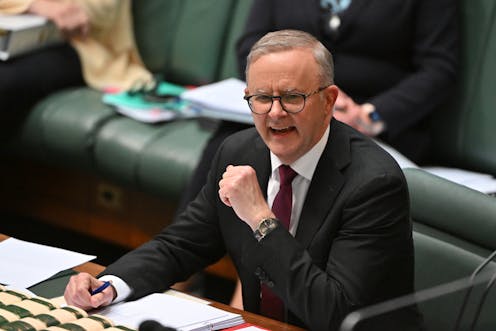
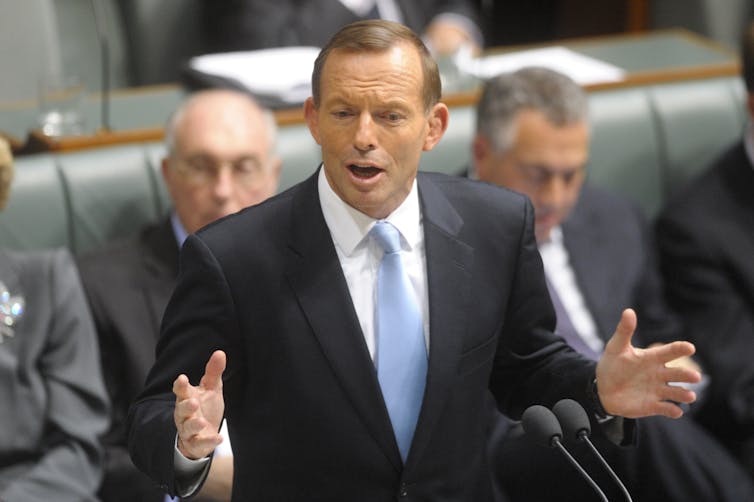
Mick Tsikas/AAP
A federal Resolve poll for Nine newspapers, conducted October 5-9 from a sample of 1,604, gave Labor 39% of the primary vote (steady since September), the Coalition 30% (down two), the Greens 12% (up two), One Nation 5% (down one), the UAP 3% (up one), independents 9% (up one) and others 2% (down one).
Resolve does not give a two party estimate until close to elections, but using 2022 election preference flows gives Labor a 59-41 lead, a two-point gain for Labor since the September poll.
On Prime Minister Anthony Albanese, 60% thought he was doing a good job and 24% a poor job, for a net approval of +36, unchanged since September. Opposition Leader Peter Dutton’s net approval was -10, up two points. Albanese led Dutton by 53-18 as preferred PM (53-19 in September).
Labor led the Liberals by 36-30 on economic management (33-30 in September). On keeping the cost of living low, Labor led by 30-20 (31-23 previously).
The polling now is not predictive of the next election that is due by 2025, but for the moment Labor’s honeymoon is continuing.
Tax and spending questions
Respondents were told that the federal budget was in deficit, and that this is needed to maintain current levels of spending, but means the national debt is increasing. 37% thought we should reduce spending to end deficits earlier, 14% increase taxes and 28% live with the debt and deficit levels.
Asked to select the top priority for spending reduction, 33% chose defence, 14% the NDIS, 11% the health system and 4% aged care.
By 38-20, voters supported “delivering on the stage 3 tax cuts in 2024, which would mean everyone earning between $45,000 and $120,000 per year would pay a single 30% income tax rate”. This does not mention high-income earners would benefit most, and so is a skewed question.
By 34-13, voters supported repealing stage three if the government were to increase tax revenue. But increasing the corporate tax rate (61-10 support) and an increased tax on resource companies’ profits (56-9 support) were far more popular.
I previously covered polling of both the Indigenous Voice to parliament and the republic in the last Resolve poll. The Voice led by 64-36, while the republic trailed by 54-46.
Essential poll: Australia ‘not doing enought’ on climate change drops
In last week’s Essential poll, conducted in the days before October 4 from a sample of 1,050, 43% thought Australia was not doing enough to address climate change (down four since May), 32% thought we were doing enough (steady), and 13% doing too much (up two). The Coalition was still in government at the May poll.
By 63-21, respondents said they had not been personally affected by the recent Optus data breach. 53% said they were very concerned about scammers being able to steal their identities to access their bank accounts.
By 51-29, respondents supported stronger restrictions on the amount of personal infromation companies can collect, and by 46-27 they supported more restrictions on governments collecting personal information.
Respondents were pessimistic about the future of humanity, with more undecided at longer time intervals. Asked whether life would be better or worse for humanity in ten years, worse led by 42-33. At 100 years, worse led by 39-28. At 1,000 years, worse led by 36-22. At 10,000 years, worse led by 35-20.
Australia Institute poll: support for axing stage three tax cuts
Dynata conducted a survey for the left-wing Australia Institute in early September from a sample of 1,409. By 41-22, respondents supported Labor repealing the stage three income tax cuts. 46% said high-income earners would benefit most from these cuts, 18% middle-income earners and just 8% low-income earners.
Respondents were read a brief statement about the stage three tax cuts, and asked which was more important: keeping election promises regardless of changes in economic circumstances, or adapting economic policy to suit changing circumstances even if that means breaking an election promise. By 61-27, respondents supported the latter proposition.
A new poll for The Australia Institute, conducted October 4-7 from a sample of 1,003, had support for scrapping the stage three tax cuts up seven from September to 48%, with opposition unchanged at 22%.
Morgan poll: 55-45 to Labor
In last week’s Morgan poll, Labor led by 55-45 from polling conducted September 26 to October 2. This was a 0.5-point gain for Labor since the previous week, and Labor’s best result in this poll since the election.
Can the Liberals regain government without those ‘lefties’?
Federal Liberal vice-president Teena McQueen recently told the Australian Conservative Political Action Conference that: “The good thing about the last federal election is a lot of those lefties are gone. We should rejoice in that.”
At the May federal election, the seats held by more moderate Liberals in inner metro regions were lost to teal independents. It will be difficult for the Coalition to regain these seats as independents, once established in a seat, are usually re-elected easily.
However, as I said in my article on the final results of the election, the Coalition’s best chance to regain government in 2025 is if economic conditions are lousy, and they can win outer metro seats from Labor.
The next election probably depends on the outer metro, not the inner metro. The Coalition can do without its inner city moderates if it wins the rest of Australia by a large enough margin.
There may be a long-term electoral problem for the Coalition: Australia’s population is far more concentrated in cities than either the United States or the United Kingdom. I argued before the election that this urban concentration helps Labor, and the election results validated this argument.
I covered the October 2 first round of the Brazilian presidential election for The Poll Bludger. The leftist Luiz Inácio Lula da Silva (called “Lula”), who was president from 2003 to 2010, led the far-right inucmbent Jair Bolsonaro by a 48.4-43.2 margin. But as nobody won over 50%, it goes to an October 30 runoff between Lula and Bolsonaro. Pre-election polls understated Bolsonaro’s support.
I wrote about the November 8 US midterm elections on September 30, at which Democratic gains have recently stalled. Meanwhile, UK Labour has seized a huge poll lead after a “horror” budget was delivered by the Conservatives on September 23.
Dire polling has continued for the Conservatives: in eight UK national polls taken since October 5, Labour has led by 21 to 32 points.
Adrian Beaumont ne travaille pas, ne conseille pas, ne possède pas de parts, ne reçoit pas de fonds d’une organisation qui pourrait tirer profit de cet article, et n’a déclaré aucune autre affiliation que son organisme de recherche.
New Zealand Parliament Buildings, Wellington, New Zealand.
Political Roundup: New Zealand’s relationship with India is in trouble
Analysis By Geoffrey Miller.
New Zealand’s relationship with India is not in good health. That’s the underlying message from a rare visit to New Zealand by India’s external affairs minister, Dr. Subrahmanyam Jaishankar.
Jaishankar met with his New Zealand counterpart, Nanaia Mahuta, last Thursday – but only for an hour.
At a press conference with Mahuta in Auckland, Jaishankar was publicly critical of New Zealand’s unwillingness to renew visas for Indian students who had left New Zealand during the Covid-19 pandemic and called for ‘fairer and more sympathetic treatment’.
Mahuta’s response to the criticism was to pass the buck to Michael Wood, New Zealand’s immigration minister, who was conveniently not present, and to point to hardships suffered by New Zealand students themselves.
Jaishankar reiterated his criticism at other engagements during his trip and on Twitter, and the comments dominated Indian media coverage of his five-day visit to Auckland and Wellington.
Despite the usual pleasantries, there was a sense that India had lost patience with New Zealand – a sentiment that was underlined by Jaishankar’s later observation in Wellington of ‘there is a larger world out there’.
Even more troubling from New Zealand’s perspective, was the extraordinary admission by Mahuta that a free trade agreement was ‘not a priority for New Zealand or India’.
Instead, Mahuta could only point to potential economic cooperation in ‘niche areas’ such as digital services and ‘green business’ – a seemingly underwhelming approach that was endorsed by Jaishankar.
It is a far cry from the bold and ambitious India strategy that was launched by New Zealand to much fanfare in February 2020, when the then foreign affairs minister Winston Peters travelled to India.
The strategy, called ‘Investing in the relationship’, listed a free trade agreement as one of the major goals.
But the underlying theme of the blueprint was the need for a more long-term, sustained commitment by New Zealand to forging ties with the much larger India.
To this end, the plan called for ‘more frequent high-level government engagements to build the trade, economic, political and security aspects of the relationship’.
Of course, the timing of the launch of the strategy turned out to be unfortunate. Within weeks of Peters’ visit to New Delhi, most of the world had entered some form of lockdown to combat the Covid-19 pandemic.
But the overarching principle – that New Zealand needs to spend far more time and effort on the India relationship, without necessarily expecting an immediate pay-off – still holds true.
Trade figures demonstrate the difficulties New Zealand’s relationship with India is facing.
While New Zealand’s exports to India were approaching $NZ2 billion annually in 2017, they have since collapsed to under $NZ800 million.
The impact of Covid-19 – which stopped Indian tourists and students coming to New Zealand – explains much of this slide, but by no means all of it. The initial decline actually began in 2018.
In fact, the deterioration has been so dramatic that India now ranks only 15th place in the list of New Zealand’s biggest trading partners.
As recently as 2016, India was New Zealand’s 10th biggest trading partner.
For comparison, New Zealand now sells less to India than it does to the United Arab Emirates.
Moreover, Jaishankar’s forthright criticisms of New Zealand’s handling of visas suggest that India is in no rush to encourage its citizens to head back to New Zealand now that the Covid-19 pandemic has eased.
Despite the warning signs, New Zealand’s Labour Government has shown only limited interest in nurturing the relationship with India, even allowing for Covid-19 travel disruption.
To his credit, New Zealand’s trade minister, Damien O’Connor, did at least fly to India last month, albeit only for a brief two-day visit.
But last week’s visit by Jaishankar would have been an opportune moment for Jacinda Ardern to signal an intention to visit India herself – as she did with China in August.
But neither Ardern, nor Mahuta gave any hint that a visit to New Delhi is on the horizon.
Even when India’s external affairs minister was in New Zealand, Ardern fitted in only a sideline meeting with him at an Indian community event in Auckland.
To find a contrast with New Zealand’s experience, one only needs to look to Australia, which hosted Jaishankar this week.
A press conference between Jaishankar and Penny Wong, Australia’s foreign minister, seemed particularly warm.
Wong was keen to point out that she had already met her Indian counterpart some seven times since she became foreign minister in May.
And from the Indian side, there was no parallel in Canberra to the criticisms Jaishankar had expressed about New Zealand’s government while in Wellington and Auckland.
The Australia-India relationship has undoubtedly blossomed since the revival of the Quadrilateral Security Dialogue (or Quad for short, an arrangement that also includes Japan and the United States) in 2017, but there is more to it than just that.
Australia and India entered into a Comprehensive Strategic Partnership in 2020.
And this year, they signed a free trade deal with India that will eliminate tariffs on over 85 per cent of Australian exports.
The deal is not perfect – it includes wine and sheepmeat, but it completely excludes dairy.
Nevertheless, India is already Australia’s seventh-biggest trading partner – and growing.
The current strength of India’s relationship with Australia – and the relative weakness of ties with New Zealand – seems all the more remarkable when the current geopolitical faultline of Ukraine is brought into the equation.
Australia is one of Ukraine’s biggest supporters – and one of the top 10 donors of military aid.
By contrast, India has a very different position on the war.
New Delhi has steadfastly avoided joining the Western-led coalition which is backing Kyiv.
Indeed, in Canberra, Jaishankar was quizzed by media on India’s ongoing ties with Russia and its abstention in key UN votes criticising Moscow.
But the differences have not seemed to harm relations between Australia and India.
Instead, the two countries have effectively agreed to disagree on Ukraine and to work on shared interests in other areas.
In a time of extreme geopolitical polarisation, this is an achievement in itself.
While New Zealand has backed the West on Ukraine, it has done so in a more measured way than Australia – which in theory should make it easier to find common ground with India.
In Wellington, Jaishankar said New Zealand’s relationship with India was ‘due for refresh’.
He is not wrong.
But a reset will take time – and it will need leadership. Geoffrey Miller is the Democracy Project’s international analyst and writes on current New Zealand foreign policy and related geopolitical issues. He has lived in Germany and the Middle East and is a learner of Arabic and Russian.
DNA profiling, as it has been known since 1994, has been used in the criminal justice system since the late 1980s, and was originally termed “DNA fingerprinting”.
This non-coding DNA is largely comprised of sequences of the four bases that make up the DNA in every cell.
The four DNA bases are guanine, cytosine, thymine and adenine, forming G-C and T-A pairs. jaoad maha/Shutterstock
But for reasons unknown, some sections of the sequence are repeated: an example is TCTATCTATCTATCTATCTA where the sequence TCTA is repeated five times. While the number of times this DNA sequence is repeated is constant within a person, it can vary between people. One person might have 5 repeats but another 6, or 7 or 8.
There are a large number of variants and all humans fall into one of them. The detection of these repeats is the bedrock of modern DNA profiling. A DNA profile is a list of numbers, based on the repeated sequences we all have.
The use of these short repeat sequences (the technical term is “short tandem repeat” or STR) started in 1994 when the UK Forensic Science Service identified four of these regions. The chance that two people taken at random in the population would share the same repeat numbers at these four regions was about 1 in 50,000.
Now, the number of known repeat sequences has expanded greatly, with the latest test looking at 24 STR regions. Using all of the known STR regions results in an infinitesimally small probability that any two random people have the same DNA profile. And herein lies the power of DNA profiling.
Swabbing an item left at a crime scene can easily yield enough cells to generate a DNA profile. Fuss Sergey/Shutterstock
How is DNA profiling performed?
The repeat sequence will be the same in every cell within a person – thus, the DNA profile from a blood sample will be the same as from a plucked hair, inside a tooth, saliva, or skin. It also means a DNA profile will not in itself indicate from what type of tissue it originated.
Consider a knife alleged to be integral to an investigation. A question might be “who held the knife”? A swab (cotton or nylon) will be moistened and rubbed over the handle to collect any cells present.
The swab will then be placed in a tube containing a cocktail of chemicals that purifies the DNA from the rest of the cellular material – this is a highly automated process. The amount of DNA will then be quantified.
If there is sufficient DNA present, we can proceed to generate a DNA profile. The optimum amount of DNA needed to generate the profile is 500 picograms – this is really tiny and represents only 80 cells!
DNA profiling relies on finding repeated sequences in a sample. fotohunter/Shutterstock
How foolproof is DNA profiling?
DNA profiling is highly sensitive, given it can work from only 80 cells. This is microscopic: the tiniest pinprick of blood holds thousands of blood cells.
Consider said knife – if it had been handled by two people, perhaps including a legitimate owner and a person of interest, yet only 80 cells are present, those 80 cells would not be from only one person but two. Hence there is now a less-than-optimal amount of DNA from either of the people, and the DNA profiling will be a mixture of the two.
Fortunately, there are several types of software to pull apart these mixed DNA profiles. However, the DNA profile might be incomplete (the term for this is “partial”); with less DNA data, there will be a reduced power to identify the person.
Worse still, there may be insufficient DNA to generate any meaningful DNA profile at all. If the sensitivity of the testing is pushed further, we might obtain a DNA profile from even a few cells. But this could implicate a person who may have held the knife innocently weeks prior to an alleged event; or be from someone who shook hands with another person who then held the knife.
This later event is called “indirect transfer” and is something to consider with such small amounts of DNA.
In forensics, using DNA means comparing a profile from a sample to a reference profile, such as taken from a witness, persons of interest, or criminal DNA databases.
By itself, a DNA profile is a set of numbers. The only thing we can figure out is whether the owner of the DNA has a Y-chromosome – that is, their biological sex is male.
A standard STR DNA profile does not indicate anything about the person’s appearance, predisposition to any diseases, and very little about their ancestry.
Other types of DNA testing, such as ones used in genealogy, can be used to associate the DNA at a crime scene to potential genetic relatives of the person – but current standard STR DNA profiling will not link to anyone other that perhaps very close relatives – parents, offspring, or siblings.
DNA profiling has been, and will continue to be, an incredibly powerful forensic test to answer “whose biological material is this”? This is its tremendous strength. As to how and when that material got there, that’s for different methods to sort out.
Source: The Conversation (Au and NZ) – By Tim Lindsey, Malcolm Smith Professor of Asian Law and Director of the Centre for Indonesian Law, Islam and Society, The University of Melbourne
An hour before midnight, 20 years ago, a young Indonesian man walked into Paddy’s Pub, a nightclub in the heart of Bali’s party district of Kuta, and detonated a backpack laden with explosives. Seconds later, a massive car bomb exploded outside the Sari Club across the road.
The impact was devastating. Paddy’s Pub and the Sari Club were destroyed, along with surrounding buildings. In all, 202 people died, but 88 Australian tourists and 38 Indonesian residents and workers were the largest groups. More than 200 more were also badly injured.
It soon became clear the attack was the work of militant Islamists. Indonesian authorities quickly focused on Jemaah Islamiyah, a group that, two years earlier, had been involved in a series of coordinated bombings of churches across Indonesia on Christmas Eve.
Evidence eventually emerged that Al Qaeda had helped fund the attack, through an Indonesian, Riduan Isamuddin, known as Hambali, now a long-term inmate of Guantanamo Bay. But the roots of militant Islamist violence in Indonesia are much older than Al Qaeda. They can be traced back at least to Darul Islam, an Islamist militia that began a long-running war against the Indonesian republic in the late 1940s. Jemaah Islamiyah split from Darul Islam in the 1990s.
How the bombings drew Australia and Indonesia closer
At first, it wasn’t clear how the bombings in Kuta would affect relations between Australia and Indonesia. Then-Australian Foreign Minister Alexander Downer has spoken of his fear the bombings would drive a wedge between the two countries, with the public in each blaming the other.
Instead, the bombings – for both countries, their largest loss of life in a single terrorist attack – drew the two nations together, despite the deep rift created by Australia’s involvement in the secession of East Timor in 1999.
The bombings sparked unprecedented political, security and aid cooperation, with leaders of the two countries feeling they faced a common foe. This only deepened as Jemaah Islamiyah continued its bombing campaign. It targeted upmarket Western hotels in Jakarta and even the Australian Embassy in 2004 before striking again in Bali in 2005.
Australian and United States support helped to fund the establishment of the Indonesian Police’s effective, if controversial, counter-terrorism unit, “Special Detachment 88” (Densus 88). Many members of the Australian Federal Police (AFP) later described the relationship that developed with Indonesian police as like a “brotherhood”.
Likewise, Australian aid was soon flowing to a range of programs to counter violent extremism in Indonesia. This included a major investment to support reform of Indonesia’s important Islamic education sector, long neglected by Indonesian governments.
Death penalty double standards?
Many members of the Jemaah Islamiyah cell that carried out the Kuta attack were rounded up within weeks. Others escaped, but Indonesian authorities, supported by the AFP, were dogged in their pursuit of Jemaah Islamiyah. For years to come, hundreds of suspects would be hunted and arrested and many killed – sometimes in wild shoot-outs and sieges where Densus 88 seemed to be operating without a rule book.
Abu Bakar Ba’asyir, the “spiritual leader” of Jemaah Islamiyah and a long-term opponent of the Indonesian state, was eventually convicted of conspiracy in relation to the Bali bombings in 2005. He received only a two-and-a-half year prison sentence, which was quashed by the Supreme Court in 2006 (although he was jailed for 15 years on another charge in 2011).
However, less than a year after the bombings, three of the key figures involved were sentenced to death: cell leader Abdul Aziz, the self-styled “Imam Samudra”; the attack coordinator, Ali Ghufron, known as Mukhlas; and his brother, Amrozi bin Haji Nurhasyim.
Then-Prime Minister John Howard was quick to endorse the executions saying it would be an “injustice” if they didn’t proceed. His eventual successor, Labor leader Kevin Rudd, agreed the three men deserved their fate.
Amrozi became infamous in the West for seeming to greet what he saw as impending martyrdom with enthusiasm. But all three perpetrators wrote or recorded unrepentant justifications for the bombings. Like Osama bin Laden, they saw terrorism as legitimate revenge for “Western aggression” against Muslims in a global holy war.
Despite this, the three men eventually lodged appeals and a constitutional challenge in attempts to overturn their sentences. These failed, and in the early hours of November 9 2008, they were shot dead by a firing squad on the prison isle of Nusa Kambangan.
The support of Australian leaders for these executions was to backfire when Australian Bali Nine drug smugglers, Myuran Sukumaran and Andrew Chan, were sentenced to death in 2006.
Determined Australian efforts to have their sentences commuted to life attracted global support, including from the UN Secretary General. But they were rejected in Jakarta as hypocritical and evidence of an Australian “double standard”, with the two men facing the firing squad on Nusa Kambangan on April 29 2015.
Their deaths were, in some ways, an unforeseen consequence of the close cooperation between Australian and Indonesian police triggered by the Bali bombings. It was the decision of the AFP to tip off the Indonesian police that led to the arrest of the Bali Nine in Indonesia, rather than on return to Australia.
Protocols have now been introduced to prevent Australians being exposed to the death penalty in this way.
A gradual weakening
As the Jemaah Islamiyah bombings became more distant, the partnership between Australian and Indonesian law enforcement authorities gradually weakened. This was in part because some Indonesians felt Australia wanted too much credit for its role in the crushing of Jemaah Islamiyah.
Even so, other events inevitably also created tensions in the relationship. As well as the fate of Sukumaran and Chan, these included Australian policy on refugees, the decision of the Gillard government to halt live cattle exports to Indonesia due to mistreatment there, and revelations Australia tapped the phones of President Susilo Bambang Yudhoyono and his wife.
Likewise, a series of savage aid cuts under the Abbott government saw Australia suddenly walk away from Islamic education in Indonesia, to the dismay of many Muslim reformers.
Today, relations between Australia and Indonesia are more distant. Jemaah Islamiyah no longer seems a serious threat, but Islamist militants certainly remain. For Indonesian authorities, Darul Islam and the groups that emerge from it are a part of the political landscape, and have been since the republic was founded in the 1940s. They see them as a relatively minor threat, but one they expect to persist.
For Australia, the Bali bombings were the moment Al Qaeda’s war on the US and its allies reached us, albeit offshore in the nation’s favourite holiday resort. However, for governments here, the “War on Terror” is now being displaced by other security priorities, including the rise of the home-grown far-right.
But while it may be true that Jemaah Islamiyah’s Bali bombings are fast becoming history, that will never be the case for the many survivors in both countries. They continue to live with the consequences every day.
Tim Lindsey has in the past received funding from the Australian Research Council and various federal government departments.
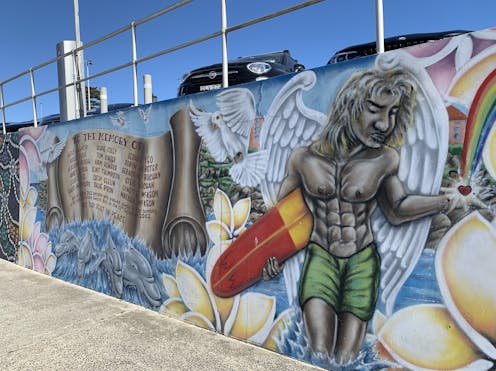
Bali bombings commemorative mural at Bondi Beach, Sydney.Droogie, Author provided
Today marks the 20th anniversary of the 2002 Bali bombings, which killed 202 people, including 88 Australians – our largest single loss of life from an act of terror.
But we hear less about the wider group of close family members and friends of people who died.
Twenty years on, these people are facing life without their loved ones and dealing with the way they were taken away.
Grief specialists describe grieving like a form of storytelling, a process by which we make sense of the loss and what the change means for our lives.
A key part is to connect the news of their passing with the many memories and routines that involved them. This “sorting” process can take months or years but is one way we move to a new story while also staying connected to them.
Losing a loved one in traumatic circumstances can interfere with these processes and lead to persistent or prolonged grief that does not ease over time.
Deaths that are sudden, violent and affect close relationships fall into this category. Reminders of the death can trigger traumatic memories for those left behind.
Terrorism has the further dimension of being both calculated and quite random in its impacts. It leaves survivors struggling to make sense of why this horror affected them.
Our interviews with Bali survivors eight years after the attacks found those physically injured or experiencing prolonged grief had the highest levels of distress.
Early steps in bereavement generally involve accepting the reality of the loss, partly by allowing yourself to experience the pain of the loss and being able to draw new connections and meaning.
However, after someone is harmed through violence, loved ones can avoid thinking about the loss. This can limit their ability to separate the life lost from how they died.
Over time, the two may “fuse” together, where thoughts about loved ones raise distress about what they experienced. So close family and friends can avoid reminiscing and the usual processing of grief.
The 20th anniversary is similar to other commemorations Bali survivors have worked through in the past two decades.
Many have learned to control or reduce their emotional triggers and are more likely to reflect upon and celebrate their loved ones than dwell upon the terrorism event itself.
At the same time, traumatic grief can last for decades, and most people do not receive effective treatment.
These people remain vulnerable to such triggers, particularly news that is unexpected or presents graphic detail.
Strong support networks and having people to confide in are critical to recovery.
Our study found married or partnered participants had the lowest levels of distress. Support that was non-judgmental and allowed “time and space” was also most valued, whether or not that came from a partner.
One family member told us what was important was:
People being there for you, where you are that day, and not telling you what to do or how to feel.
For others, working with authorities early on to get clear details of what happened brought some understanding and comfort. One person who lost several friends told us:
For me, it was being able to know the circumstances of their death.
A key approach involves deliberate exposure to distressing thoughts and images related to their loved one’s death but in a safe and structured environment. This allows distress and trigger reactions to be reduced in a controlled way. Ultimately, this can support people to accept the loss.
One study participant told us:
I believe you should try and accept it, which is very hard, but if you don’t it is very difficult to get over it.
Memorial sites are important too
Memorial sites also have an important role. These are a focal point for support networks and rituals, helping to create new memories of their loved ones, based in the present.
‘Frangipani Girl’ Chloe Byron died in Bali at the age of 15. Droogie/Peter Carette, Author provided
The mural “Frangipani Girl” is a well-known example at Sydney’s Bondi Beach.
The mural is a celebration of the life of Chloe Byron, who died in Bali at the age of 15.
It also represents the journey through grief and renewal her father Dave has undertaken. He said in a podcast interview:
Every day I’ve got a choice between a happy memory of Chloe over the memory of her tragic death […] it’s the choice between a great day and a terrible one.
If this article has raised issues for you, or if you’re concerned about someone you know, call Lifeline on 13 11 14. You can also talk to a counsellor 24/7 at Beyond Blue.
Garry Stevens received funding from the Australian Research Council
Almost all GPs and most non-GP specialist doctors (such as cardiologists, gynaecologists and dermatologists) run private businesses to provide medical care in Australia. Business decisions can influence the costs of medical care, the care patients receive, and access to medical care in different geographic areas.
But until now, we’ve had no national data on the costs or profitability of running a private medical practice.
Our ANZ-Melbourne Institute Health Sector Report, out today, uses data from the Australian Bureau of Statistics on all medical businesses in Australia.
We examined trends in growth, costs and profitability, and how the financial health of doctors’ businesses has been affected during the COVID pandemic.
Among our findings, we show how medical businesses, in particular for non-GP specialists, remain very profitable compared to other businesses, including law, accountancy and finance.
Many people seeking health care do not think about the costs involved, or the profitability of, running a private medical practice.
But the sudden closure of GP practices for financial reasons reduces access to health care for communities. For others, a focus on seeking profits means out-of-pocket costs can rise.
There are also more widespread reports of reduced access to bulk billing (where there are no out-of-pocket costs).
So how doctors run their private businesses is very much in the public interest.
It was not too long ago that GPs and non-GP specialists worked largely on their own. But the benefits of working with others has led to a growth in private group medical practice.
GPs were the first doctors to do this. Now almost 90% of GPs report working in a group practice. But other specialists are rapidly catching up, where almost 70% now work in a private group practice.
The total number of doctors in a solo private practice has fallen by 0.5% between 2013 and 2020, while the number in group private practices has increased by 28.9%.
Groups practices can keep costs down by sharing the costs of premises, administration and support staff. Cedric Fauntleroy/Pexels, CC BY-SA
Group practices can be good in keeping costs down by sharing the costs of premises, administration, nurses, and medical equipment. Working together can improve the quality of care and access to health care, as patients can easily see another GP in the practice if their preferred one is too busy. In a group practice, doctors can also more easily share knowledge.
But if businesses get too big, this could mean less choice for patients looking for a local doctor, and less competition. This could further increase out-of-pocket costs as there is less competitive pressure to keep fees low.
While more non-GP specialists are working in group private practice, they are also on average spending less time there. In 2020 they spent about three hours per week less in private practice compared to 2013.
We show profits rose by an average of 2.4% a year for GP businesses and 5.3% a year for non-GP specialists businesses between 2005-6 and 2020-21.
Costs for GPs rose by an average 2.7% a year over the same time period. Turnover from total fees charged grew by 2.9%.
For non-GP specialists costs rose by an average 2% a year over the same time period, while turnover grew by 3.5%.
Overall the growth in costs for GP businesses was higher than for other specialists, and the growth in turnover was lower. This gap between costs and turnover has grown over time.
Non-GP specialists’ businesses made 50% more profit than GP businesses in 2020-21 ($216,468 and $144,485), compared to 14% more in 2005-6 ($120,452 and $105,924).
Medicare coverage of telehealth meant GPs avoided losing income from the fall in face-to-face visits because of COVID. So revenue from fees continued to increase, though at a lower rate than before 2020.
Medical practices could also claim JobKeeper payments to maintain employment of practice staff. This financial support meant the number of GP and non-GP specialist businesses winding up or going bust actually fell during 2019-20. In fact, the total number of medical businesses continued to grow throughout the pandemic.
Profits initially fell during COVID by 1.9% for GPs and by 4.5% for non-GP specialists between 2018-19 and 2019-20.
But profits bounced back the following year because of the pent-up demand during the pandemic. People who were avoiding health care because of COVID or who had their elective surgeries cancelled, came back and still needed care.
This was especially the case for non-GP specialists, where profits grew by 10.8% between 2019-20 and 2020-21 compared to 2.2% for GPs.
However, medical businesses, especially GPs, experienced sudden increases in costs as they adapted to COVID settings. For GP businesses, costs increased by over 8% during the pandemic (4.1% between 2018-19 and 2019-20, and by 4% between 2019-20 and 2020-21.
It is expected demand will remain high for private medical care provided by GPs and non-GP specialists as people who delayed care and treatment during the pandemic return to seek care.
In fact, medical businesses, especially non-GP specialists, remain very profitable compared to other businesses such as law, accountancy, finance, construction and agriculture. In 2021, the median gross profit per business (turnover minus costs before tax) was $216,468 for non-GP specialists, $120,452 for GPs, and $124,431 for legal businesses.
Implications for patients
Achieving good access to high-quality medical care requires medical businesses to be located in areas of need and where out-of-pocket costs are kept to a minimum for low-income populations.
The growth in private group medical practice can mean medical businesses are run more efficiently, with continuing cost pressures leading to the formation of larger medical groups, especially for non-GP specialists.
In most cases maintaining profitability of private medical businesses is necessary to ensure their survival and maintain access to medical care, as long as out-of-pocket costs don’t increase at the same time.
Anthony Scott receives funding from the Australia and New Zealand Banking Group for the annual report series ‘ANZ-Melbourne Institute Health Sector Reports’. Professor Scott conducts the data analysis and writes the report.
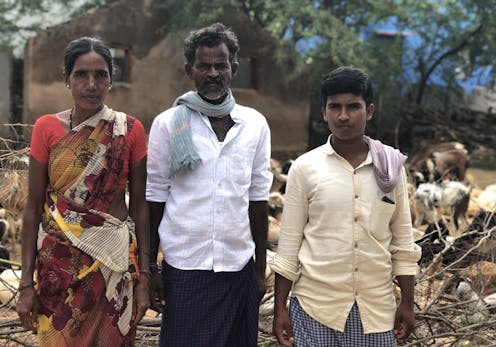
Community members from Pavagada villagesPriya Pillai, Author provided
India, like many other countries, is looking to renewables as an antidote to soaring fossil fuel prices and to tackle climate change. Prime Minister Narendra Modi sees renewables as vital for a “developed India”.
But while renewables are seen as a major positive on a societal scale, these large scale facilities can – if done poorly – make life harder for people who live close to them.
That’s exactly what happened to one of the world’s largest solar installations, India’s Pavagada solar park. The park was meant to offer cheap clean power, avoiding 70 million tonnes of carbon dioxide per year and give an economic boost for a poor area. Our new podcast and research found, sadly, that didn’t all happen. Larger landowners profited, while poorer villagers lost access to agricultural land.
The problems of Pavagada show us the importance of genuine partnership with the rural communities where wind and solar farms will be built.
The enormous Pavagada solar park surrounds a number of villages. Google Earth, Author provided
The Pavagada model was meant to be win-win
In November 2019, we were in a dusty village in the southern state of Karnataka. Earlier that year, the truly enormous 2 gigawatt Pavagada solar park had begun operating. There were so many solar panels that the five villages in the area were surrounded.
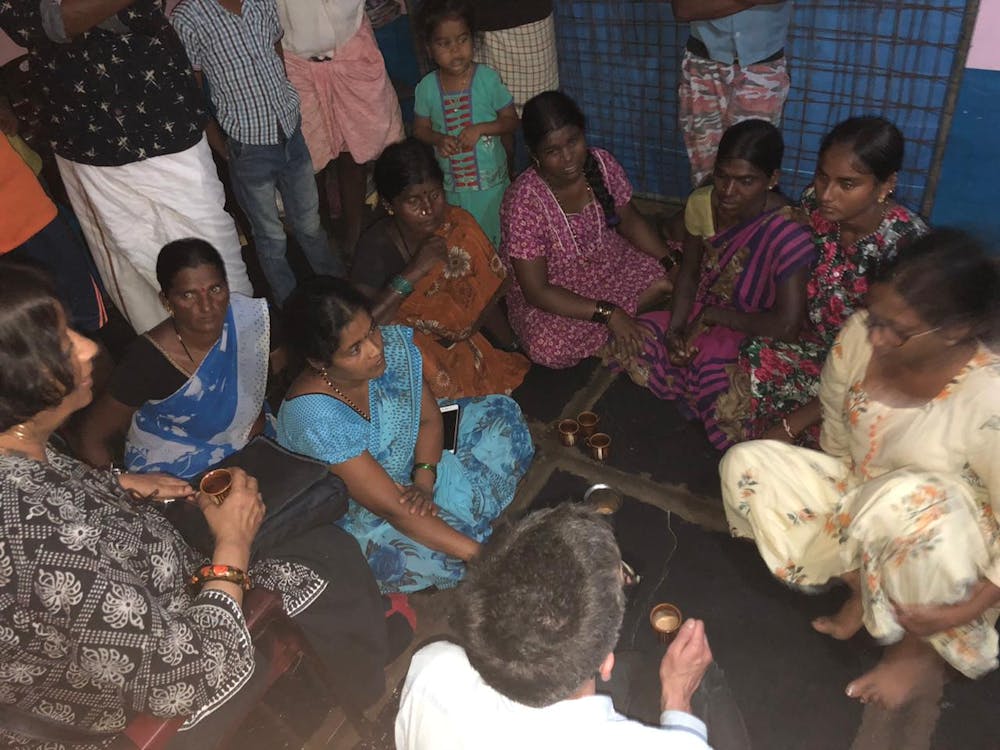
As we were talking with local women outside a small house, more and more people overheard our conversation and joined in. When the discussion became heated, our informants took us inside. “We want to tell you our story,” one said.
Though the house backed onto the solar park, it was dimly lit by only a single lightbulb. Over tea, we asked the women why talking about the solar park had brought up so much tension. One said:
The solar park did not help us. Work should be provided to all educated girls … The priority should be for landless people because the landowning people at least got the lease amount.
They told us that the project was a story of broken promises. Rather than providing solutions to local problems, the solar park had made things worse. Many had lost their livelihoods as farm workers, since the solar panels now covered agricultural land. By contrast, solar companies, government electricity distributors and larger landowners had profited greatly.
The women of Thirumani and surrounding villages wanted their story of broken promises to be told. Priya Pillai, Author provided
This was a shock to us. It wasn’t supposed to be this way. The Pavagada solar park was pitched as a flagship of India’s energy transition, able to generate as much power at peak times as a large coal-fired power station.
Worse, Pavagada was meant to be a role-model for ethical renewable energy development in emerging economies.
That’s because it relied on an innovative system of land leasing. The government authority created to oversee the project signed long-term leases with over 1,000 local farmers to obtain the land for the solar park.
These voluntary leases were meant to give farmers a new source of income, which many needed as they struggled to eke out a living amid worsening drought. Solar developers would get the scale they needed and overcome the common bottleneck of small-scale land holdings. And the leases would be achieved without the common land grabbing controversies plaguing large infrastructure projects in India for decades.
The model of the future ran into problems of the present. Our five years of interviews and fieldwork with village women, community representatives, farmers, local government officals, solar company managers, and renewable energy authorities clearly showed the Pavagada model wasn’t distributing benefits evenly. The energy transition left winners – and losers.
Who won? Larger landowners. Who lost? The landless. Over half of the 10,000 people in the five villages near the park are landless agricultural workers, as is common in much of rural India. Because they do not own land, they receive no income from the leasing model. And with much local farming land leased to the solar park, many landless labourers lost their livelihoods.
Sadly, this was predicted in meticulous detail in an early World Bank report, which warned about the effect on farm workers and the landless before the development began.
A mango farmer who chose not to lease his land. Priya Pillai, Author provided
The huge project did create some new jobs for local people, mostly temporary employment in grass cutting, panel washing and security. But this work has not fully replaced lost livelihoods.
Those worst affected were more likely to be women, particularly those from lower castes or Adivasi (Indigenous) backgrounds. This is because their financial independence came solely from agricultural income.
Even the landowners expressed disillusionment. That’s because they could see their former farm workers were struggling.
As one landowner told us:
people who do not have land, no benefit for them. Rather, they have lost their livelihood, as no one calls them for work.
What should we learn for large-scale renewable projects?
Building large-scale renewable energy projects is essential if we are to meet our climate goals. So how can we do it more fairly?
Focus on the communities affected and find ways of making sure profits and jobs make it to those who need it the most. Because of their need for land, solar and onshore wind have to be built in the regions. But this is often where a country’s poorer people live – and where land is a key difference between wealth and poverty.
Pavagada holds a painful lesson. We need renewables urgently. But we must build it alongside the local communities who will host these new power sources. As many community members told us, they were not opposed to solar. What they wanted was a genuine partnership with revenue sharing, sharing of land across solar and agriculture, and more jobs and opportunities. In short, they were calling for a just transition.
Gareth Bryant receives funding from the Australian Research Council.
Devleena Ghosh has received funding from the Australian Research Council.
Jake Morcom and Priya P Pillai do not work for, consult, own shares in or receive funding from any company or organisation that would benefit from this article, and have disclosed no relevant affiliations beyond their academic appointment.
But my research shows parents are not helping. In fact, they are making the problem worse.
Teachers are increasingly copping abuse from parents and it’s undermining their desire to stay in the profession.
Bullying, abuse and threats
A 2020 Australian Catholic University/ Deakin University survey of more than 2,000 Australian principals found 83% had experienced bullying, the threat of physical violence or physical violence in the past 12 months.
The survey did not specify where the abuse came from, but it did reported a significant increase in parental engagement due to the pandemic. About 28% of surveyed principals said they were spending an extra two hours a day dealing with parents.
The survey’s researchers also recommended having recorded, online parent/ teacher interviews to minimise exposure to “offensive behaviour”.
This has not escaped the attention of policymakers. From term 3, the Victorian government introduced powers to ban parents from school grounds for threatening behaviour and bullying towards staff. Western Australia has a similar ban in place.
My research
I have interviewed more than 80 teachers across four different studies over the past past ten years.
This includes studies with teachers from government and independent schools, and both primary and secondary schools. It also includes early career teachers and teachers in remote and rural communities.
Out of these, three consistent themes arise: teachers are passionate about teaching, the job is incredibly stressful and does not come with enough support and the profession is increasingly disrespected by the community. This includes media reporting about schools, comments from political leaders, as well as parents’ behaviour towards teachers.
The teachers I interviewed talked about their commitment to the emotional, intellectual and physical wellbeing of students in their classrooms.
Some teachers spoke of being like a parent to their students. As Annelise told me:
My year 12s always say to me, ‘You’re like our school mum’ because it’s such a safe environment. I think that’s where you do become like their other mum because they come to you for advice or they come to you all scared, or they just need a bit of boost.
But while teachers are very caring and protective of their students, they are sometimes taken advantage of by parents who outsource parenting, discipline and child-minding. Ross, a teacher in a private school spoke of always being in demand.
Look, they’re [parents] paying A$20,000-plus [per year] and some of them want to get their money’s worth. So yeah, we are very accountable to the parents […] they’ve paid their money and they want you to sort of parent them as well.
Many parents think teachers just work from 8.30am to 3.00pm. The reality is they have to create lessons, have staff and parent meetings, mark work, complete administration and respond to emails outside of these hours.
As Jacinta explains:
I’m 0.6 but I’m there full-time. I spent three hours just answering emails to parents instead of doing what I went in to do on my day off.
Teachers’ time and work is not valued
Teachers spoke of not being respected or valued by parents. This includes waiting for hours for parents to pick up their children. As Krystal said:
I’ve had to wait until 1am [for] parents to pick up their kids after an evening excursion or rehearsal. This is not just a once off either […]
It also involves parents not believing teachers’ accounts of what happens in the classroom, as Jackson told me:
I told one student off in class for smearing banana all over the carpet behind his desk and I made him clean it up. Within five minutes of the class ending […] I’ve got the kid’s parents on the phone complaining that it wasn’t their son […]
Bella, a drama teacher, told me “the most challenging thing” about being a new teacher “is the parents”.
I had a student in year 11 whose parents emailed my head of department and basically said, ‘The drama teacher, who I don’t know, I don’t think she knows what she’s doing because my child got a B and she’s an A student.’
Going beyond disrespect
But it goes behind simple disrespect. Teachers I interviewed reported regular incidents of violence and threatening behaviour. As Kelly told me:
We had to lock down the entire school one day because a parent went ballistic at the principal. Then they did burnouts out the front of the school until the police arrived.
This also involves verbal abuse, as Max highlights:
The kids have their trauma and issues, but nine times out of ten it’s the parents. They phone you up during lunch and yell at you that you’re useless, their child should have got an A and that you don’t know what you’re doing. It’s very stressful.
Chloe, an independent primary school teacher, summed up the situation like this:
What’s the best thing about teaching? The kids. And the worst thing about teaching is the parents!
The worst thing about teaching
Of course, parents care deeply about their children and have the right to approach the school to ask questions or raise concerns.
But parents should also be mindful that a school is also someone else’s workplace. Teachers are already working overtime (literally) to educate their children – they don’t need abuse from parents on top of this.
Kirsten Lambert does not work for, consult, own shares in or receive funding from any company or organisation that would benefit from this article, and has disclosed no relevant affiliations beyond their academic appointment.
What happens when people withdraw their retirement savings early?
We’ve just found out.
During the first year of COVID Australians who faced a 20% decline in their working hours (or turnover for sole traders) or were made unemployed or were on benefits were permitted to take out up to A$10,000 of their super between April and June 2020, and a further $10,000 between July and December.
Five million took up the offer. They withdrew $36 billion.
Most of those surveyed by the Institute of Family Studies said they used the money to cover immediate expenses. But definitions of “immediate” can vary.
Dan Peled/AAP
Real time transaction card data appeared to show early withdrawers boosted their spending by an average of $3,000 in the fortnight after they got the money.
One interpretation said they spent the money on “beer, wine, pokies, and takeaway food, rather than mortgages, bills, car debts, and clothes”.
In order to get a more complete picture, we obtained access to millions of anonymised transaction records of customers of Australia’s largest bank, the Commonwealth Bank.
The data included 1.54 million deposits likely to have been money withdrawn through the scheme including 1.04 million we are fairly confident did.
Who dipped into super?
The data provided by the bank allows us to compare circumstances of withdrawers and non-withdrawers including their age, time with the bank, and banking behaviour before COVID.
We find withdrawers tended to be younger and in poorer financial circumstances than non-withdrawers before the pandemic. Six in ten of the withdrawers were under the age of 35, a finding consistent with data reported by the Australian Taxation Office.
Withdrawers tended to earn less than non-withdrawers, even non-withdrawers of the same age. Only 17% of withdrawers for whom we could identify an income earned more than $60,000 compared with 26% of non-withdrawers. And withdrawers had lower median bank balances ($618 versus $986).
For those with credit cards and home loans, withdrawers were about twice as likely to be behind on repayments as non-withdrawers (9.7% versus 5.8% for credit cards, and 8.2% versus 3.4% for home loans).
These characteristics suggest that, despite concerns of the scheme being exploited due to the application process not requiring any documentation, most of those using the scheme genuinely needed the money.
Where did the money go?
Compared to non-withdrawers, those who withdrew increased their spending (on both essential and discretionary items), paid back high-interest debts, boosted their savings, and became less likely to miss debt payments.
Withdrawers spent an average of $331 more per month on debit cards in the three months after withdrawal, and $126 per month in the following three months.
They spent an extra $117 per month on credit cards during the first three months, which shrank to an extra $13 per month in the following three months.
The average withdrawer spent 7% more per month on groceries than the average age and income matched non-withdrawer, 12% more on utilities such as gas and electricity, 16% more on discretionary shopping, and 20% more on “entertainment,” a Commonwealth Bank category that includes gambling.
Less debt, less falling behind
In the three months that followed withdrawing, withdrawers also averaged $437 less credit card debt and $431 less personal loan debt than age and income matched non-withdrawers, differences that shrank to $301 and $351 in the following three months.
They also became less likely to fall behind on credit card and personal loan payments, a difference that vanished after three months.
Our interpretation is that the scheme achieved its intended purpose: it provided many Australians in need with a financial lifeline and helped buoy them during uncertain and turbulent times.
Lessons learned
At the same time, our findings identify areas of concern. The fact that most withdrawals were for the permitted maximum of $10,000 highlights the need to carefully consider the withdrawal limit.
While these sums might simply reflect the true amount of money individuals needed to sustain themselves, it might be that many withdrawers were unsure of how much to withdraw – not knowing how long the pandemic would continue.
Another consideration is how to best support withdrawers after they have taken out the money. More than half were under the age of 35, and might find themselves with a good deal less super than they would have in retirement.
The government has already introduced tax concessions for withdrawers who contribute funds back into their retirement savings accounts. Super funds might also be able to help, by sending targeted messages to those who have withdrawn.
Nathan Wang-Ly also works for Commonwealth Bank of Australia within their Behavioural Science team. This piece, however, is written in his capacity as a PhD student of the University of New South Wales. None of the views expressed here should be attributed to Commonwealth Bank of Australia.
Ben Newell receives funding from the Australian Research Council. He also has a non-remunerated role as an Advisor to the Behavioural Science team at Commonwealth Bank of Australia.
Source: The Conversation (Au and NZ) – By Sue O’Connor, Distinguished Professor, School of Culture, History & Language, Australian National University
Sue O’Connor, Author provided
Australia’s Tanami desert is one of the most isolated and arid places on Earth. It’s a hard place to access and an even harder place to survive.
But sprinkled across this vast expanse of desert, sweeping for thousands of kilometres across the Northern Territory and Western Australia, are some of the oldest and most incredible stories of human life and settlement of our ancient continent.
It takes the shape of art in the bark of iconic and bountiful boab trees.
Our newly published research looks at 12 examples of these carved trees across the Tanami desert. This artwork tells the incredible story of the Indigenous Traditional Owners who have long called the Tanami home.
Sadly, after lasting centuries if not millennia, this incredible artwork is now in danger of being lost.
We are in a race against time to document and preserve this invaluable art.
The Australian boab or bottle tree (Adansonia gregorii) is an iconic tree naturally found only in a restricted area of northwestern Australia.
Boabs are an important economic species for First Nations Australians. The pith, seeds and young roots are all eaten, and the inner bark of the roots used to make string. First Nations Australians also used parts of the boab for medicine.
While the culinary and health attributes of boabs are well known, less well known is that many of these trees are culturally significant, carved with images and symbols hundreds, and perhaps even thousands, of years ago. Australian boabs have never been successfully dated. They are often said to live for more than a thousand years, but this is based on the ages obtained from baobab trees in South Africa.
These carved images may be hundreds or thousands of years old. Lewis Field, Author provided
Some hint of the great age of the boabs can be gleaned from the heritage-listed “Mermaid tree” on the Kimberley coast at Careening Bay. “HMC Mermaid 1820” was carved into the tree during Phillip Parker King’s second voyage.
At the time of carving, the girth of the Mermaid tree was measured at 8.8 metres. Today, more than 200 years on, the inscription is still clear and the trunk circumference has increased to about 12 metres.
Now, modern pastoral land clearance and bushfires are having a toll on the oldest of the boabs. There is some urgency to record this cultural and artistic archive before the ancient trees die.
The earliest recordings of carvings on boab trees were made by the British artist and explorer, Thomas Baines, during the North Australian Expedition (1855–56) led by Augustus Gregory.
During the journey, Baines made several sketches of the Australian boab tree, including with Indigenous carved designs.
Figures Painted on Rocks and Carved on a Gouty Stem Tree, Thomas Baines (1820–1875) Collection of the Herbarium, Library, Art & Archives, Royal Botanic Gardens, Kew, CC BY-NC-SA
Despite this early interest, little more was documented about carved boab trees until Ian Crawford wrote The Art of the Wandjina in 1968.
Crawford, a historian at the Western Australian Museum, was primarily engaged in recording the rock art paintings in the Kimberley region. However, on his travels he noted seeing ancient carved boab trees. The Traditional Owners accompanying him made fresh carvings using their metal skinning knives on some of the trees near their campsite.
Almost 20 year later, historian Darrell Lewis stumbled across the Tanami Indigenous carved boabs while searching for a boab tree engraved with the letter “L” marked by the explorer Ludwig Leichhardt on his final expedition, during which he and his team disappeared without a trace.
Our race against the clock
We and our colleagues are now recording and investigating the carved trees.
In July last year, academics and Traditional Owners began to record the boab trees with carvings in the remote northern Tanami Desert.
This area of the Tanami is extremely inaccessible. Finding and checking the trees was a task in itself.
We set up camp among the sand dunes and spent seven days looking for boabs. Although the Tanami is sandy, sharp stakes from burnt out acacia shrubs took their toll. We often spent the best part of the day changing and repairing tyres, or digging the four-wheel drives out of washaways and sand rills.
The trees were found in very remote parts of the desert. Lewis Field, Author provided
Once we spotted a boab in the remote distance it was safer to leave the vehicle and set off on foot. We found and recorded 12 carved boabs, but there are hundreds more trees visible on Google Earth which remain to be checked.
Most of the carved boabs recorded on the Tanami trip feature snakes. Indigenous oral tradition describes a major Dreaming track, King Brown Snake Dreaming (Lingka), which begins near Broome and travels east across the Kimberley region of WA before passing into the Northern Territory. Our survey area was located along this track.
Scattered around the base of the larger boabs we found stone artefacts and broken grinding stones, remnant of past First Nations campsites.
Stone artefacts were found near the carved boab trees. Sue O’Connor, Author provided
The next step in our work is to continue searching for these carved boabs in the coming dry season, and to get radiocarbon dates to establish the age of some of the largest boabs.
These remarkable Australian trees help tell the story of First Nations Australians and are the source of a rich cultural heritage. Through our work and partnership with the Traditional Owners we are rediscovering these Australian stories before they are gone forever.
Sue O’Connor receives funding from The Australian Research Council (SR200200473) and Rock Art Australia
Jane Balme receives funding from Australian Research Council SR200200473, Rock Art Australia.
Brenda Garstone does not work for, consult, own shares in or receive funding from any company or organisation that would benefit from this article, and has disclosed no relevant affiliations beyond their academic appointment.
The upcoming spooky season is not only a favourite time for most kids (and a few adults), but also for share markets due to what’s been called the “Halloween effect” – often referred to as “sell in May and go away”.
There is hardly a year investors and the media do not refer to the popular market wisdom suggesting higher stock returns in the months November through to April, compared with May through to October (that is, in the northern hemisphere’s winter and summer, but it also applies to southern hemisphere countries where the seasons are offset by six months).
With investors looking for a crystal ball to help with investing, predictable patterns can offer a guide for when to invest and when to sell. But has this pattern survived the financial volatility of the past two decades?
New research shows this seasonal investment pattern is still alive and well in most stock markets around the world and, if anything, has become more pronounced in recent years.
Both the Halloween and January effect – the observation that stock prices of mainly smaller firms tend to increase in January more than in other months – are pervasive. These patterns seemingly provide guidance for the two most fundamental decisions when making an investment: what assets to buy or sell, and when.
Of course, such anomalies appear to be inconsistent with the common hypothesis that markets are efficient and that prices change randomly.
Finally answering the ‘why’
A recent analysis using stock returns and mutual fund flows in the United States provides a simple answer to the nagging question of why these anomalies exist and why they have worked for so long. Previous explanations have largely been inconclusive.
Aggregate fund flows (the bars depicting money invested or withdrawn by investors) exhibit a similar calendar-based pattern as market returns (the lines). The returns are substantially higher during winter months than during summer months.
Remarkably, in years where this is not the case – when summer flow is higher than winter flow – the winter excess returns are also negative.
Markets influenced by optimism or pessimism
When examined jointly, high average stock returns in winter months (Halloween effect) and in January (January effect) can be attributed to a large average influx of funds. After accounting for the effect of these increased fund flows, there are no seasonal factors affecting market returns anymore.
The study builds on earlier findings, providing strong evidence of the price-pressure effects from funds that expand their portfolios when they receive money from investors (cash inflow) and sell their shares when investors withdraw money (cash outflow).
In other words, large cash inflow induces fund managers to invest the excess cash, driving up the demand for stocks. When funds experience outflow, they liquidate investment positions, increasing the supply of stocks.
Such trading across funds can affect returns by temporarily driving stock prices away from their fundamental value. Interestingly, only flows to retail funds catering to individual investors, as opposed to institutional funds catering to high-net-worth or institutional investors, are seasonal.
The effect also appears to be short-lived and reverses within a few months and highlights the behavioural nature of the patterns observed in the market.
Overall, the interrelation between seasonal flows and stock returns originates from the buying and selling activities of perhaps overly optimistic or pessimistic individual retail investors.
Time to get into investing?
Some readers might ask whether it is still a good idea to buy stocks in the coming Halloween season, as the recent downturn in markets may appear like a good entry point.
However, the troublesome mix of record high inflation, rising interest rates and Russia’s war in Ukraine may ultimately result in a recession.
If retail investors then stay away from the market, seasonal patterns are less likely to materialise this time around. But there is no crystal ball to predict what is going to happen.
The best advice is to keep emotions out of investment decisions and focus on a broader strategy – look for long-term opportunities in the market rather than trying to time it.
Moritz Wagner does not work for, consult, own shares in or receive funding from any company or organisation that would benefit from this article, and has disclosed no relevant affiliations beyond their academic appointment.
High and rising power prices will become a bigger part of Australia’s inflation problem over time, Treasurer Jim Chalmers has warned, as he foreshadowed more government action to combat gas prices.
Ahead of leaving for the United States on Tuesday night, Chalmers also said he would use the information from briefings he receives there to make any needed changes to the October 25 budget – now in the final stages of preparation.
And he continued to prepare the public for large, but selective, spending cuts in the budget.
Chalmers painted a dark picture of probable recession in key economies. He remained optimistic the Australian economy could avoid going backwards, but it would not be immune from the global downturn, he said.
The treasurer’s Tuesday appearances were his first after receiving a major rebuff when Anthony Albanese at the weekend quashed any prospect of rejigging the Stage 3 tax cuts in the budget.
Chalmers had pushed hard to have the controversial tax cuts reconfigured, but Albanese – who’d given him a licence to test the water – decided he couldn’t afford to risk breaking an election promise to deliver them.
On his US visit, Chalmers will talk with the US Federal Reserve, the International Monetary Fund, the World Bank, private investment banks and his counterparts from other countries who will be there at the same time for briefings.
“The world is bracing for another global downturn,” he told a news conference.
“The deteriorating global situation combined with high and rising inflation here at home and the ongoing, persistent structural spending pressures on the budget […] are the three most important factors which provide the backdrop for the budget.”
The budget would not be “fancy” or “flashy”, Chalmers said.
He made it clear its spending cuts, expected to be substantial, would focus on “wasteful” Coalition programs rather than including areas such as the NDIS (National Disability Insurance Scheme), the cost of which has been rapidly rising. “The burden won’t fall completely equally across portfolios.”
The increasing price of power is now a major problem for the government, which promised at the election a saving by 2025. Ministers are now mostly dodging questions about that undertaking, although the Deputy Prime Minister, Richard Marles, said on Tuesday “we continue to stand by the modelling” that indicated the price saving.
Alinta Energy’s boss, Jeff Dimery, at an Australian Financial Review Energy summit this week predicted retail electricity prices, on current market prices, would rise at least 35% next year.
Andrew Richards, CEO of the Energy Users Association of Australia, said, “It appears that some people think [the energy transition] will be easy and cheap, but I think most people in this room understand it’s hard and expensive and likely to drive energy bills [up] in the near term”.
Chalmers told his news conference: “We are very concerned about what’s happening with power prices”. It was due to a combination of international factors, extreme weather and policy delay.
He said that “even as inflation eases in aggregate […] the treasury’s expectation is that a bigger and bigger part of this inflation problem over time will be what happens with power prices.
“Shipping costs have been a concern, supply chains have been a concern, the labour shortages are an ongoing concern that we’re addressing in the budget. But electricity is the one that I think most about. I think it is going to be the most problematic aspect of it, of our inflation problem over the course of the next six or nine months.”
Chalmers said there was more that government could and would do to deal with high gas prices. He was working with Industry Minister Ed Husic, Resources Minister Madeleine King and Energy Minister Chris Bowen on what can be done.
“I think all of those ministers recognise that the way that our gas industry regulation is set up has not been delivering the kinds of outcomes that we want to see and so if you recognise that, and I do, then you recognise that if more can be done, it should be done – and I’m a part of that work.”
He did not say what was contemplated. The government has not pulled the “trigger” (the Australian Domestic Gas Supply Mechanism) under which it could order companies to put aside a certain amount of gas for the domestic market, but it has that trigger being reviewed.
Companies have recently agreed with the government to supply gas for local consumption at prices no higher than the international price. But that is little comfort domestically given the soaring overseas price.
Husic this week accused companies of “milking gas prices”.
He told Nine newspapers: “The gas companies can either be part of team Australia or they can be part of team greed. They will make the choice.”
Husic said the trigger legislation needed to be reformed, as did the code of conduct which is supposed to help local buyers of gas.
Michelle Grattan does not work for, consult, own shares in or receive funding from any company or organisation that would benefit from this article, and has disclosed no relevant affiliations beyond their academic appointment.
Port Moresby’s “amazing city” tag in Papua New Guinea is fast losing its varnish and appeal — its veneer of a modern metropolis tarnished by an ethnic underbelly that relishes criminal activity, racial violence and a tendency to unleash aggressive violent behavior at any opportune time.
Last weekend’s violence which left three people dead is the fifth such “amazing act” this year, says an exasperated Police Commissioner David Manning.
The question, raised on social media, in homes, schools, offices, among local landowners, the Motu Koitabu, and discussed in pubs and boardrooms across the city, is: “When will enough be enough?’
When will Port Moresby truly rise above its ethnic cleansing bloodbath rituals to become the modern Amazing City of cross cultures that it professes to be, and that every peace loving Papua New Guinean wants to enjoy?
A drug deal gone wrong has sparked a deadly ethnic war between Eastern Highlands and Hela province people living in Port Moresby.
Yesterday, the fight was violent around the Erima, Wildlife, 8 and 9 Mile settlement areas as pitched battles raged.
NCD Governor Powes Parkop called for calm and for peace to return, adding it is against the law to carry offensive weapons in public.
‘Leave it to police’ call Commissioner Manning also called for calm and for the warring parties to lay down their arms and let police investigate the killings.
As of last night, three men were dead and six wounded who were being treated at the Port Moresby General Hospital.
Last night, Gordon, Erima, Wildlife, 8 and 9 Mile were tense with police patrols keeping a close watch on those areas.
The ethnic clash, the fifth so far this year, is putting a huge dent on the National Capital Diustrict Commission’s (NCDC) effort to promote the capital city’s image as “Amazing Moresby”.
On social media, angry residents have taken not so kindly to the fighting with many urging the government to clamp down on ethnic groups from the Highlands by returning all settlers back to their province of origin.
The Vagrancy Act, which enables police to evict illegal settlers in the city, was thrown out at Independence, which has led to a growing settlement population in the city.
But fed up Motu Koitabu landowners and angry residents want the city cleaned up.
A call for martial law One commentator even called for martial law to be enacted and the city cleaned of all illegal settlers.
The flare-up between men from the Eastern Highlands and Hela provinces has sent innocent women and children scattering for cover and refuge.
It is alleged the death of a man from Eastern Highlands during a drug deal is said to have started the fight. The police, however, cannot say much, but could only confirm that an investigation has commenced on the issue.
The roads around Erima and 9 Mile saw men and women running with offensive weapons.
While police tried their best to make their presence felt during the chaos, they were outnumbered as scores of men continued to fight.
Commissioner Manning said that any ethnic clashes at other major centres in the country were “unnecessary” and “unfortunate”.
“It is concerning how people can employ their tribal tactics and think that they can clash with other groups in the cities and towns,” he said.
These ethnic clashes are a result of a lack of appropriate policing interventions.
Why have settlements grown? Furthermore, there are a lot of discussions on why we have allowed settlements to grow in the last two to three decades and whether those settlements contribute to these ethnic clashes, he added.
Meanwhile, NCD Governor Parkop warned city residents carrying weapons who have gone unnoticed.
Bows and arrows, machetes, iron bars, stones and other dangerous weapons were seen publicly yesterday at the Gordon bus stop and Erima with the ethnic clash still tense with police continuously patrolling the area.
City Manager Ravu Frank said this kind of behaviour was illegal. Unfortunately, lives have been lost. City residents have to move around freely and not be in fear of their safety.
The parties concerned must air their grievances to police.
Commissioner Manning said ethnic clashes were no longer restricted to rural centres and it had greater impact on everyone’s lives and gave concern to a lot of people, especially government and police when it happened in the urban environment.
In 2022 alone, five ethnic clashes have erupted between different groups — mostly from the Highlands region.
Miriam Zarrigais a PNG Post-Courier journalist. Republished with permission.
The United Nations Human Rights Council has adopted a resolution aimed at assisting the Marshall Islands to get justice in the aftermath of the United States nuclear testing.
“We have suffered the cancer of the nuclear legacy for far too long and we need to find a way forward to a better future for our people,” says Samuel Lanwi, deputy permanent representative of the Marshall Islands to the United Nations Human Rights Council in Geneva.
The Marshallese people are still struggling with the health and environmental consequences of nuclear tests, including higher cancer rates.
Many people displaced due to the tests are still unable to return home.
The US conducted 67 US nuclear tests from 1946-1958 and a settlement was reached in 1986 with the United States, a Compact of Free Association, which fell short of addressing the extensive environmental and health damage that resulted from the tests.
The U.S government asserts the bilateral agreement settled “all claims, past, present and future”, including nuclear compensation.
Today at #HRC51, res. L.24/Rev.1 on RMI’s nuclear legacy was adopted by consensus. 64 years after the last nuclear test, RMI will receive UN assistance in upholding the rights of the Marshallese people that still bear the scars of this dark chapter of our past. #Nuclearlegacypic.twitter.com/u15GKcAX6l
— Marshall Islands Permanent Mission in Geneva (@RMIGeneva) October 7, 2022
The new text tabled by five Pacific Island states called on the UN rights chief to submit a report in September 2024 on the challenges to the enjoyment of human rights by the Marshallese people, stemming from the nuclear legacy.
It called on the UN rights chief to submit a report in September 2024 on the challenges to the enjoyment of human rights by the Marshallese people stemming from the nuclear legacy.
The US as well as other nuclear weapons states such as Britain, India and Pakistan expressed concern about some aspects of the text but did not ask for a vote on the motion.
Japan did not speak at the meeting.
Runeit Dome, built by the US on Enewetak Atoll to store radioactive waste from nuclear tests. Image: Tom Vance/RNZ
Observers say some nuclear states fear the initiative for the Marshall Islands could open the door to other countries bringing similar issues to the rights body.
A concrete dome on Runit Island containing radioactive waste is of concern, especially about rising sea levels as a result of climate change, according to the countries that drafted the resolution.
This article is republished under a community partnership agreement with RNZ.Reporting also by Kyodo News/Pacnews.
The Mexican standoff over the closure of Papua New Guinea government offices due to nonpayment of rentals has ended.
The National Court has ordered superannuation fund landlord Nambawan Supa Limited (NSL) to remove all locks to Vulupindi Haus, Treasury Haus, Eda Tano Haus in Waigani and Revenue Haus in downtown Port Moresby.
At the same time, the government has honoured its commitment to pay a further instalment of K30 million (NZ$15.3 million) to NSL, bringing the outstanding total paid up to K82 million (NZ$42 million).
The Waigani National Court presided by acting judge Justice Emma Wurr granted on Friday the ex-parte application filed by Finance Secretary Dr Ken Ngangan for the removal of locks to the buildings.
Dr Ngangan instituted the proceeding as the chairman of the Government Office Allocation Committee through his lawyer Milfred Wangatau of ACE Lawyers, ordering Nambawan Super Ltd to remove the locks on government offices.
NSL had locked doors to its buildings that housed major government departments over outstanding rental arrears.
The five major government agencies affected were the Department of Finance, Department of Treasury, Department of Lands, Department of National Planning and Internal Revenue Commission.
During the hearing, Wangatau submitted to the court that the state had paid NSL more than K50 million in September.
Committed to settle arrears He submitted that while the state did admit that there may be some outstanding rental arrears, it stood committed to settle its arrears but NSL decided to go ahead and lock the offices.
“NSL’s abrupt decision to lock out very important government public service delivery agencies should be the last resort as it only goes to hold the people of the nation at ransom when vital government services are disrupted,” Wangatau submitted.
He added that damages would be irreparable if the reliefs sought in the application were not granted as it would certainly have an adverse effect on the public at large.
Wangatau further submitted that it was in the interest of justice that the court should grant temporary mandatory orders ordering NSL to unlock all the government offices and allow government business and public service delivery to return to normalcy pending the substantive hearing.
Justice Wurr agreed and granted the interim orders and adjourned the matter until this Friday, for inter parte hearing.
Among the orders issued, Justice Wurr ordered that the defendant (NSL), its employees, servants and agents must immediately unlock all doors to the Vulupindi Haus, Revenue Haus, Treasury Haus and Eda Tano Haus to allow staff and officers of the respective state departments to have access to ensure government business and service delivery can resume as usual.
Justice Wurr ordered NSL to comply with the orders immediately upon services of the orders.
NSL ‘relieved’ Meanwhile in a press statement, NSL said it was relieved to receive a further K30 million payment from the state last Friday in its new commitment to offset rental arrears it owes to the fund’s contributing members.
This brings the total amount paid by the state to K82 million.
And representatives from the Departments of Finance and Treasury have signed a Letter of Agreement committing to pay the outstanding balance of K90 million in a series of monthly payments starting in November.
Nambawan Super chairman Mr Reg Monagi said: “We are pleased to have received the second payment of K30 million and we thank the Departments of Finance and Treasury, who after extensive discussions and negotiations, have committed to an agreement for the settlement of these arrears.”
“Acting in good faith after the State’s positive actions, on Friday night, we lifted the lockout of the Revenue Haus (Internal Revenue Commission), Vulupindi Haus (Department of Finance) and EdaTano Haus (Department of Lands & Physical Planning) and Treasury Haus (Department of Treasury).
“We hope that as we have acted in good faith, the State will continue to honour its commitment to our members by settling the remaining outstanding rental arrears.
Retirement outcomes ‘now protected’ “Nambawan Super appreciates that the State has recognised how important the payment of these arrears are to ensuring that our over 214,000 members’ retirement outcomes are protected.
“The unpaid rentals that accumulated over three years have already impacted the returns for members causing fewer funds available to reinvest and grow.”
“Any further delays to the scheduled payments will have a further detrimental impact on the returns of Nambawan Super members.”
“NSL remains committed to working closely with the State to ensure the payment of all outstanding arrears are made as agreed in the payment schedule, and will not hesitate to lock out the State again if it is unable to do so,” Monagi said.
New Zealand Parliament Buildings, Wellington, New Zealand.
New Zealand Politics Daily is a collation of the most prominent issues being discussed in New Zealand. It is edited by Dr Bryce Edwards of The Democracy Project.
Source: The Conversation (Au and NZ) – By Melanie Davern, Associate Professor, Director Australian Urban Observatory, Centre for Urban Research, RMIT University
Shutterstock
Australian cities are slowly recovering from the COVID pandemic. Travel across cities is almost back to pre-pandemic levels. Google Mobility show only a 14% drop in travel to work across Victoria and 12% drop across New South Wales compared to pre-COVID results.
However, the disruption of COVID will reverberate through transport planning for years to come. The 2021 census – when people were asked about how they got to work – coincided with COVID lockdowns in our two biggest cities. The distortion of commuting patterns at that time creates problems for anyone who wishes to use these data.
So what can we do about these COVID-skewed transport data? In this article we propose some ideas to ensure the census results remain useful for city planning.
In that year, 9.2 million commuters travelled an average distance of 16.5km to work. Of these people, 79% used a private vehicle, 14% took public transport and 5.2% cycled or walked. A further 500,000 people worked at home and 1 million employed persons did not go to work on census day.
The level of detail the census provides isn’t available with other methods. This is why the journey-to-work questions are so important.
But many of us were in lockdown in 2021
On census night, Australia’s two biggest cities, Melbourne and Sydney, were in lockdown, as were large regional cities across Victoria, New South Wales and Queensland (and the lockdown in Brisbane had ended only two days before). People were asked: “How did the person get to work on Tuesday 10 August 2021?”
Planners and researchers are expecting some unusual results because of the lockdowns. We don’t know if people recorded their workplace as if the lockdown wasn’t in place, or treated their home as their workplace. While a higher-than-expected number of “worked at home” responses might signal the latter, we can’t know for certain.
The 2021 census data won’t provide a reliable record of “normal” commuting patterns, nor an accurate record of commuting changes over time. It’s not even clear if work attendance and commuting patterns will ever return to their pre-COVID state.
What can we do about the census data?
So the big question is how can decision-makers usefully work with the data to correct for the distortion of COVID lockdowns? We offer the following suggestions.
Look at cities that weren’t in lockdown
One option is to use the broad transport patterns from the least-locked-down parts of Australia, such as Adelaide or Perth. We can use their results and changes in transport mode over time to help estimate the results across other cities.
Link to previous census results
Another option would be to look at previous census results on journey to work for cities and try to match or predict what would have been expected in 2021 for different transport modes and distances. A benefit of this model is that previous results are available at local neighbourhood level and bring in the local influences of transport types and distances.
Another idea would be to look at the occupations that people list on their census forms, then match occupation types to transport modes used in previous census results.
Match to household travel survey data
Transport departments collect household-level travel data across a number of cities including Sydney and Melbourne to understand how far people travel and what transport modes they use. These surveys could be used to model area-based differences in journey-to-work patterns based on more up-to-date commuting results than older census data.
Investigate other travel datasets
The use of big data has come a long way since 2016. Today we have a number of other public and private travel data sets that could be used. These include Google Mobility results, traffic light counts, road sensors and Myki/Opal/go card travel data.
Travel card readers capture a lot of information about commuters’ daily use of public transport. haireena/Shutterstock
These data sets could be linked or modelled with census results to get a better estimate of results in locked-down areas.
Quarterly and annual COVID surveys could also help to understand how transport has changed throughout the pandemic.
Assess against other government data
Data linkage is another area that the Australian Bureau of Statistics has been working over the years. An example is the Multi-Agency Data Integration Project, which has been designed to help gain further insights from census data. The Australian Tax Office holds employment and work-related vehicle claims that might also be helpful to identify transport modes and travel demands by area.
Strict privacy rules apply to these data, but government agencies working together could lead to better commuting data for cities affected by lockdowns in 2021.
All these options have strengths and weaknesses. None is as good as the complete set of census data unaffected by lockdowns. However, they are worth considering when 2021 journey-to-work results are released on October 12.
Transport planners and researchers are ingenious. They will likely find ways to correct for the above problems to assess and understand transport patterns across Australian cities. Now is the time for discussion and ideas about these issues and the unusual census results to ensure transport planning is based on data that are both sound and up-to-date.
Melanie Davern receives funding from the National Health and Medical Research Council and funded by RMIT University as a Vice Chancellor’s Senior Research Fellow.
Alan Both receives funding from an NHMRC-UKRI (APP1192788) research grant.
RMIT University receives funding from a range of research and industry organisations for projects on which Jago Dodson works.
Tiebei (Terry) Li does not work for, consult, own shares in or receive funding from any company or organization that would benefit from this article, and has disclosed no relevant affiliations beyond their academic appointment.
Changes to Australia’s isolation rules, which come into effect on Friday October 14, remove the mandate for people to isolate if they test positive for COVID.
Isolation requirements will remain for high-risk settings such as aged care, disability care, Aboriginal health care and hospitals. Workers in these sectors who can’t access paid leave while isolating will still be able to access financial support, but pandemic payments won’t be available to the rest of the population.
(Casual workers without sick leave in other sectors, however, may be eligible for state government support. Victoria, for example, offers a sick pay guarantee for up to 38 hours of work lost to illness.)
While isolation won’t be mandatory for most, it’s still important to be aware of your own infection risk and be careful around others if you test positive for COVID or have respiratory symptoms.
Should you still test?
If you’re worried you’ve been exposed to someone with the virus, or start to see symptoms, it’s always better to know your COVID status. Ignoring it can put yourself and others at risk.
Knowing you’re COVID positive is especially critical for people who are at greater risk of severe infection because they are severely immunocompromised, aged over 50 (or over 30 for Aboriginal and Torres Strait Islander people) with two additional risk factors, or those aged 70 and above. A positive test enables people in these groups to access antivirals, which need to begin within five days of symptom onset.
Antivirals can prevent an infection escalating into a severe illness or hospitalisation. A recent Israeli study of the antiviral Paxlovid found it effectively reduced COVID severity in people 65 and over infected with Omicron. Hospitalisation rates dropped from 58.9 per 100,000 days of follow-up to 14.7. This is a four-fold decrease and comparable to rates in younger adults.
If you are at-risk and have symptoms, try to get a PCR test, if possible, as this can detect an infection earlier than a rapid antigen test (RAT).
I’ve tested positive, so how long should I isolate?
The infectious period starts a day or two before symptoms and can continue for more than ten days. As time goes on, the viral load drops away, so you’re less infectious.
The general advice used to be to isolate until 48 hours after symptoms resolve. But many infections may not have obvious symptoms, and some symptoms continue after the infection, so so it’s worth monitoring using a RAT.
RATs perform best a few days into an infection. So while they may not pick up all infections initially, they can indicate whether you are still infectious at the end of your infection.
A recent US study of mostly young, vaccinated people concluded that for people with lingering mild symptoms, such as a persistent dry cough, a negative RAT could guide when it was safe to stop isolating. However, half those with a positive RAT didn’t appear to be infectious.
Still, it’s better to err on the side of caution if you work in high-risk settings or mix with people vulnerable to serious disease.
Symptoms remain an important way to identify risk. As we move out of the cold and flu season, there will be fewer other respiratory infections around. So coughs with fever will more likely be a sign of COVID and should be assumed so, regardless of testing.
A March 2022 UK survey reported 1,687 of 6,260 of infections, or just over one-quarter of those with known symptom status, were in people without symptoms. What’s more, 1,343 people tested positive who did have symptoms, but did not have typical COVID symptoms. So, just under half of the infections detected in this study might not have been recognised as COVID infections without testing.
Due to high rates of vaccination and previous infection, a larger proportion of people with COVID may be asymptomatic rather than having tell-tale symptoms.
Monitoring for COVID symptoms will therefore not identify all infections. So take care, especially when around vulnerable people
Symptoms remain an important way to identify COVID risk. But some people will be asymptomatic. Unsplash/towfiqu barbhuiya
Masks work when Omicron exposure risk is high
In the UK during Delta and the Omicron BA.1 waves, surveys of randomly selected participants reported 13–36% higher infections rates in people who said they only sometimes wore masks (4.3%) or rarely wore them (5.2%) compared with those who said they always wore masks (3.8%).
This gap diminished after the Omicron BA.1 peak, as infections declined.
But masks do help reduce risk of infection with Omicron, especially when infection rates are high.
So when you’re in crowded indoor spaces such as public transport, it’s best to assume the virus is present and mask up.
Why avoid infection? Long COVID can be debilitating
Although things have improved in terms of severe acute disease, minimising risk of infection remains important given the risk of long COVID, which can be debilitating for some, even after mild infections.
Among Omicron infections, 4.5% of 56,003 people experienced long COVID. This compares with 10.8% of 41,361 Delta cases.
However, vaccination reduces the risk. Studies show vaccinated people are 60% less likely to develop long COVID than unvaccinated people, and 70% less likely after a booster dose.
COVID is here to stay
The removal of isolation mandates does not mean we ignore COVID, or stop isolating, or give up managing the risk we might pose to others. It will take ongoing efforts to manage the risks individually and globally.
Vaccines help reduce severe illness and long COVID. But with infections already on the rise overseas and other Omicron sub-variants emerging, we need to be thinking ahead.
This is now the long game, so monitoring our exposure risk, being aware of our symptoms, testing when we suspect we have been exposed, and isolating when we need to, will continue to be the best way to protect ourselves, and those around us.
Catherine Bennett receives funding from the National Health & Medical Research Council, Medical Research Future Fund and VicHealth. Catherine was on the independent expert vaccine advisory group for AstraZeneca Australia, and is a scientific advisory committee member for ResApp and Impact Biotech Healthcare.
Hassan Vally does not work for, consult, own shares in or receive funding from any company or organisation that would benefit from this article, and has disclosed no relevant affiliations beyond their academic appointment.
On the night of September 26, near the end of the calm season on the Baltic, a broiling kilometre-wide circle disturbed the face of the sea and a huge mass of methane erupted into the air. The gas formed a cloud that crossed Europe, in what’s considered the greatest single release of this potent greenhouse gas ever recorded.
It was caused by four breaches of Russia’s Nord Stream 1 and 2 gas pipelines, located in or near the territorial seas of Denmark and Sweden. Seismologists detected explosions at a depth of 70-90 metres on the seabed. These were not earthquakes.
Danish, Swedish and German authorities have reported that the explosions were a deliberate act, equivalent to the use of 500 kilograms of TNT.
The bubbling surface of the Baltic is a stark visual image of fossil fuel consumption changing the world’s climate. Methane has over 25 times the global warming effect of the equivalent amount of carbon dioxide, and is a crucial target for combating climate change.
It also highlights the vulnerability of undersea pipelines and undersea infrastructure in general, of which Australia has a significant network.
The explosions have had no direct economic or energy consequences. Nord Stream 1 stopped operating at the beginning of September following gradual supply reductions during the summer.
Nord Stream 2 was never launched as Germany refused to certify it following Russia’s invasion of Ukraine. Europe was not counting on the resumption of supplies from either pipeline.
While the pipelines were not transmitting gas, they contained methane gas to maintain pressure.
The amount of gas released is hard to quantify. Estimates suggest that roughly 300,000 tonnes of methane (or the equivalent of 7.5 million tonnes of carbon) has probably been released into the atmosphere, making it the largest release of methane in a single event (and over twice as large as the 2015 Aliso Canyon leak in California).
That tonnage represents around 10% of Germany’s annual methane output, or one third of Denmark’s total annual gas emissions, or the equivalent of the annual carbon emissions of one million cars. Nord Stream, however, is a wasted emission without either social benefit or productivity gains.
The leak is a reminder of the problem of “fugitive” methane, which comprises the leak, loss, escape and emission of gas from active or abandoned industrial sites.
While emissions from beef and rice production are the main culprits of fugitive emissions, oil and gas facilities also leak a significant amount of methane, as do activities such as fracking, coal mining and oil extraction. CSIRO estimates global oil and gas industries emit between 69 and 88 million tonnes of methane each year.
Critical undersea infrastructure plays a vital role in the global economy. For example, the fibre-optic cable network is the unseen lifeblood of globalisation, consisting of around 1.1 million kilometres of cables carrying 99% of global data.
When we talk about data flows and digital commodities we are, in fact, referring to the transmission of communications through these undersea cables. The stability of the global economy and the wealth of multi-national corporations depend on the integrity of these cables and on the uninterrupted connectivity they provide.
Undersea pipelines delivering oil and gas from one country or state to another form the material basis of energy markets. Australia’s offshore energy pipelines include the 740km-long Tasmanian Gas Pipeline, 300km of which is sub-sea, as well as the Gorgon (140km), Scarborough (280km), Pluto (180km), Browse (400km), and numerous others.
Undersea power cables are a rapidly developing infrastructure. The proposed undersea and underground Marinus power cable link will connect Tasmania and Victoria.
Harnessing the potential of offshore wind (now one of the largest energy investments globally) is being realised in Australian projects such as Star of the South. Meanwhile, Sun Cable aims to supply renewable energy produced in Australia to Singapore via 4,200km subacqueous cable.
While speculative, such projects represent aspects of the green power revolution which will drive emissions reductions, and which are likely to become more common.
Ensuring the resilience of these systems against malicious digital and physical threats is a priority.
System failures and hostile agents
The dependence of society and the economy on the reliability of this infrastructure is underappreciated.
The integration between cables and pipelines and the national and international markets they service is so tight, even the slightest disruption could inflict disproportionate economic damage.
These systems are so complex and closely integrated that their failures have consequences that traverse physical and national borders. This represents a significant challenge to ocean infrastructure governance.
System failure may occur because cables and pipelines are prone to accidental damage by ships’ anchors, trawl net fishing, and other undersea activities such as dredging. As the Nord Stream pipeline incident shows, they are also vulnerable to intentional hostile attack – both physical and cyber.
Hostile agents may exploit the fact that the sea is an opaque realm, one that’s difficult to operate in and defend. It, therefore, provides an effective shield against detection and subsequent prosecution.
Nord Stream was attacked in one of the busiest and the most surveilled seas in the world – the Baltic, in close proximity to the Danish military base of Bornholm Island. This clearly exposes the vulnerabilities of undersea infrastructure: it enables attackers to get close to targets undetected.
Cables and pipelines are governed by both national and international law. However, there are security gaps in international waters, where responsibility is ambiguously shared between corporations and government.
The lack of clarity gives companies little incentive to invest in security, or cooperate with government, increasing their vulnerability to attack.
The privatisation of cables and pipelines has resulted in cost-effective practices being adopted to reduce operating costs. But this has been achieved by reducing maintenance and surveillance.
Undersea infrastructure will continue to be vital to world trade and social cohesion. The growing demand for bandwidth and the need for energy security makes cables and pipelines both more crucial and vulnerable. Nord Stream highlights the need for resilient systems to limit the risk of accidents, and has given greater impetus to transition from fossil to renewable energy.
Claudio Bozzi does not work for, consult, own shares in or receive funding from any company or organisation that would benefit from this article, and has disclosed no relevant affiliations beyond their academic appointment.
This week, year 12 students in New South Wales will begin their final exams, with students in other states soon to follow.
This can be one of the most stressful times in a students’ life. It can also be very stressful for parents trying to support their children.
But there is a superpower in the arsenal of every year 12 student that can be harnessed to manage this stress. This superpower fuels resilience, not only for exams, but for any difficult situation they may be faced with across their lifespan. It’s called self-compassion.
I am a clinical psychologist who specialises in self-compassion. This is how you can use it, both for yourself and for your kids.
What is is self-compassion?
The most enduring relationship we have is the the one we have with ourselves.
Self-compassion means talking to yourself like you would talk to a friend. Nick Fewings/Unsplash, CC BY
This relationship shapes how we think, feel and behave to such an extent that often we are not even aware of it. We may think being hard or critical on ourselves pushes us to achieve results. But research shows this can lead to self-doubt, avoidance of hard tasks, higher risk of psychological illness and poor resilience.
In contrast, self-compassion encourages us to feel comfortable in our own skin. It allows us to generate our own feelings of warmth, reassurance, soothing and liking who we are.
What does it look like?
Difficult moments, like an unexpected exam question, are a ripe breeding ground for self-criticism. You may be familiar with thoughts like, “I’m not good enough, I can’t do this, I should have worked harder, I’m going to fail, I am a failure.” These self-critical thoughts are almost addictive – when they pop up it is easy to fixate on them and spiral into panic or avoidance.
In contrast, picture a friend sitting the same exam and getting the same unexpected question. This is a good friend who you really care about. If you could say something to them in that moment, it’s probably easy to think of supportive words. Such as,
I know this is hard, but you can do this. Your best is good enough. This one exam will not define your life, even if you get this wrong. I still think you’re a wonderful person.
Self-compassionate responses are more likely to make us feel confident, safer and therefore resilient. If we’re feeling this way, it will likely be easier to at least attempt the question rather than give up. It it is easy to draw on compassionate wisdom for our friends. But why don’t we say these things to ourselves?
We like to think of ourselves as sensible and rational, but the brain is actually a faulty piece of machinery. The brain is hardwired, through evolution, to focus on threat.
Noticing threat, and triggering the flight or fight response, is what kept our ancestors alive when they were faced with an aggressive cave man or attack from a sabre tooth tiger.
Today, threats tend to be less extreme: like not getting the score we want in a test or not having the career pathway we might like. But our mind and body still react in the same way as if we are facing a sabre tooth tiger, flooding our body with adrenaline and the stress hormone cortisol.
The (many) advantages of self-compassion
Treating ourselves with the same kindness and support as we would a good friend comes with a plethora of mental health benefits.
Our brains are hardwired to detect threats … and be tough on ourselves. HelloI’mNik/Unsplash, CC BY
It leads to better stress-management and boosts motivation to study for exams, often contributing to better grades. Self-compassion gives us the bravery to try things we may fail at, because we can take bigger chances if we know we won’t beat ourselves up if we fall short. And sometimes, as with more study, these chances and extra effort pay off.
Self-compassion can also weaken the link between perfectionism and depression. Perfectionism involves high standards and high levels of self-criticism and which can lead to depressive symptoms, especially when we fall short of our goals. But self-compassion may enable perfectionists to have high standards and be motivated to do well, without experiencing the mental health cost.
For example, in the lead up to an exam, having high standards and wanting to achieve can motivate us to study. But during and after the exam, this perfectionism can turn into self-criticsm which places us at risk of feeling low and unmotivated.
If we are compassionate with ourselves, we can normalise how tough exams are, and show unconditional positive regard for ourselves no matter the outcome. These compassionate ways of thinking can help protect us from depression symptoms.
How can we learn and teach self-compassion?
Some of us tend to be more self-compassionate than others. But if you’re not naturally a very self-compassionate person, there is good news. Research suggests you can learn to do it.
Here are some ways to approach it, both for yourselves and your kids:
Check yourself: before talking with your child about self-compassion, consider how you treat yourself when under stress. Do you notice when your self-critic is triggered? It is hard to be genuine when encouraging someone else to be self-compassionate if you are not.
Model self-compassion: when you make an error, try replacing “I’m so stupid I let this happen” with “I’m upset about this and that’s okay – anyone would feel this way in this situation”. Talk to yourself in a soft, calm tone. Whether you say it aloud or even just think it, your behaviour in that moment will change, and your kids will see this
Talk about it: start a conversation with your child about their relationship with themselves. You could start with: “what do you tend to say to yourself or feel about yourself during exams?” or “what effect does this have on you?”
Help them spot self-criticism: encourage your child to notice when self-criticism pops up. Give the self-criticsm a name such as “Voldemort” or the “angry voice”. Say, “When you notice Voldemort is hanging around, gently ask yourself, what would you say to a good friend or a ten-year-old version of yourself in this situation?” This simple question is a powerful way to tap into the compassionate wisdom we all carry
Give yourself a hug: to help calm yourself, give yourself a hug. Either wrap your arms around yourself or hold your hand on your heart or chest and notice the warmth. Research tells us we get a flood of oxytocin – the body’s “love drug” – and relax when we are hugged by someone we trust. Our brain and body has an almost identical reaction when we hug ourselves. Use as a this short-cut to trigger some feelings of self-compassion.
And don’t forget this
Self-compassion is not something you master once, and then move on from. It is a lifelong journey of practising and learning. Sometimes, especially when we are busy or stressed, it will drop off and we may need reminding of it’s superpower.
As a self-compassion researcher, I talk, write, think, debate and practice self-compassion daily. Yet I still find myself listening to Voldemort at times. This is part of living with a “tricky brain”. But there is a more self-compassionate option. And if we take it, the science says we will be more resilient and more likely to accomplish our goals.
Madeleine Ferrari receives internal support and funding from Australian Catholic University to conduct research in the self-compassion field. She also previously received NHMRC funding to complete her PhD in this topic.
The Indonesian Legal Aid Foundation (YLBHI) has appealed to Indonesian police chief General Listyo Sigit Prabowo to stop his officers intimidating Aremania (Arema Football Club fans) and witnesses in the Kanjuruhan football stadium tragedy in which 131 people died.
They are also asking Prabowo to order the police professionalism and security affairs division (Propam) to question police officers accused of doing this, because intimidation and obstruction are criminal acts.
“We believe that this situation is very dangerous so the Indonesian police chief (Kapolri) must order his officers to stop acts of intimidation and twisting the facts,” said YLBHI general chairperson Muhammad Isnur in a press release last week.
The YLBHI, the Malang Legal Aid Foundation (LBH) and the Surabaya LBH in East Java, suspect that there have been several attempts at intimidation. This suspicion is based on the complaints that have come in and monitoring by the media.
First, there was a trader who became afraid after meeting with a journalist from a television station because earlier, another trader had been picked up by security personnel after talking to a journalist.
Security personnel also illegally arrested and questioned a witness with the initials K after they uploaded a video of the Kanjuruhan tragedy unfolding. K was then found by a family of a victim at the Malang district police.
Banners with the message “Fully investigate the Kanjuruhan tragedy on October 1, 2022”, which were put up on almost all of Malang’s main streets, were taken down by unknown individuals.
There has been a narrative blaming the victims, in this case the Arema supporters at the league match on Saturday October 1.
The police claim that these supporters could not accept defeat of their team and were drinking alcohol.
“Yet the fact is that the Aremania who took to the field only wanted to meet with the players to encourage them. And before the match, all of them were closely guarded so it would have been impossible for alcohol to be brought into the stadium as is being said in the narrative,” said Isnur.
The YLBHI is also asking the Witness and Victim Protection Agency (LPSK) to be proactive in picking up and protecting witnesses without waiting for a report first, due to the growing number and danger of threats.
Isnur is also asking the National Human Rights Commission (Komnas HAM), the National Commission on Violence Against Women (Komnas Perempuan) and the Indonesian Child Protection Commission (KPAI) to continue to investigate in accordance with their respective levels of authority based on prevailing legislation.
“It’s not enough for the government just to form a TGIPF [Independent Joint Fact Finding Team], but must also ensure that this team does work independently, transparently and accountably. Aside from this, it must guarantee access for the Komnas HAM, Komnas Perempuan and the KPAI to evidence related to the incident,” he said.
Early on Saturday, local time, a massive blast shook the Crimean Bridge (also known as the Kerch Bridge). Shocking images of the burnt rail bridge and collapsed road bridge have been shown around the world.
But Russia has moved quickly to return the bridge to operations, even though it appears to be significantly damaged.
Observers have been left wondering: what was the effect of the blast and fire on the surviving bridge elements, what repairs could be required, and when is it safe to re-open a bridge after such an event?
As experts in bridge safety and blast engineering, we have (some) answers.
The bridge
Built by Russia at a cost of some US$3.7 billion after the annexation of Crimea in 2014, the Crimean Bridge is Europe’s longest, linking Russia to Crimea across the Kerch Strait.
The 19-kilometre connection is a vital artery for economic and social links, and since Russia’s invasion of Ukraine it has also become a critical military asset for Russian supplies and telecommunications.
Despite the name, the Crimean Bridge is actually two bridges: one for road and one for rail. The road bridge is itself two independent bridge structures, while the rail bridge is a single bridge structure supporting two ballasted rail tracks.
Some general drawings and information on the bridge are available online.
The attack
The attacked section lies between Tuzla Island and Kerch, Crimea, on an east-west heading, and is midway between the island and the main arch span over the navigable waterway.
At this point the rail and road bridges are of a similar form of construction, known as a “composite slab orthotropic deck steel plate girder bridge”, spanning about 64 metres. This means there is a 20 centimetre concrete slab cast onto flat steel plates, stiffened with steel ribs, all supported by about 3.2 metre deep steel plate girders.
It is important to know this because the effect of the blast and inferno, and the subsequent repair and likely safety of the structure is very sensitive to the form of construction.
The aftermath
The blast caused one span to rupture at its middle. The adjacent span on the Crimean side remained intact, but was pulled off its bearings and also collapsed into the sea. A third span on the Tuzla side remains standing, while the next span over fell off its far bearings.
It appears the girders are continuous over the piers, with expansion joints only every four spans. Just like picking up a table cloth in the middle, the massive vertical force due to the blast would pull in the ends of the continuous steel girders, popping them off their supports.
The blast ignited what is presumably fuel in a tanker train on the adjacent rail bridge, causing an inferno that burned for at least an hour. Blazing fuel poured down over the southern side of the bridge, and was blown back in a northerly direction by the wind, exposing nearly all steel surfaces to the fire.
What could have caused it?
There is much debate as to the cause of the explosion. It is clear it originated at the road bridge, and the blast started the fire on the fuel train on the nearby rail bridge. It is not clear whether it originated above the bridge deck, or below.
Video images show a semi-trailer truck on the bridge at the time, and another angle shows what may be a wave caused by the bow of a boat below the bridge. Either could plausibly have been the source of the explosion.
Just after the explosion, a lot of sparks are visible. This may indicate the use of thermite in the explosives, which burns at temperatures hot enough to damage steel and cause fires in surrounding flammable objects.
What are the structural effects?
There is a long history of bridge failures due to fire and blast damage. High temperatures can weaken both steel and concrete, while blast shockwaves can result in violent fractures.
While steel can bend under high load without breaking, and the surviving girders of the Crimean Bridge may still be usable, the blast has likely caused severe localised damage. To determine how much life is left in the surviving road bridge, investigators ought to conduct detailed inspections and metallurgical sampling.
The fuel fire is also likely to have weakened the girders on the rail bridge, as well as those on the road bridge (as they were on the windward side of the inferno). The concrete pier shows extensive burn marks too, and so the concrete will be weakened, and the reinforcement inside it more susceptible to corrosion over the longer term.
Can it be repaired?
Sections of the upper structure of the rail and road bridges can be replaced. There are floating cranes with sufficient capacity to lift in replacement pre-fabricated steelwork.
The road and rail concrete decks and fitments can then be reinstalled. Such work would of course render the bridge inoperable for an extended period.
Is the bridge safe?
In structural engineering, safety is not an either-or proposition. It is measured on a continuum known as the probability of failure, or more positively, the reliability index of a structure.
There are guidelines on acceptable levels of safety for different types of structure, and different costs of providing safety. Engineers design new bridges to standards that aim to provide a very, very small probability of a failure occurring.
In assessing existing bridges for safety, engineers will aim for that same level of safety to be provided to the public.
For ordinary bridges, surrounded by a dense road network of alternative routes, there is no need to reduce the level of safety deemed acceptable. However, for key bridges such as the Crimean Bridge, it may be reasonable to accept a reduced level of safety when the costs associated with a disruption are very high.
These considerations are for normal civilian use. For military purposes, the levels of safety or risk to human life that are acceptable are dramatically different. The reasoning used in a normal civilian situation does not apply.
Where to from here?
The remaining road bridge has re-opened to car-only traffic. This may be reasonable, as the weight added by the cars is negligible compared to the weight of the bridge itself – and the political decision-making around acceptable levels of safety seems out of the ordinary.
Cranes have been shown lifting the fuel tanker wagon wreckage off the Crimea-bound rail line. It remains to be seen how the steel girders will perform under train travel. It is likely the trains will be instructed to go slow to reduce vibratory effects, and that wagons will not be fully-loaded.
Under normal circumstances, the blast and damage we have seen would result in an extended closure and repair works. Clearly however, the circumstances are far from normal.
Colin Caprani receives funding from Department of Transport (Victoria) and AustRoads for research into bridge safety assessment.
Sam Rigby does not work for, consult, own shares in or receive funding from any company or organisation that would benefit from this article, and has disclosed no relevant affiliations beyond their academic appointment.
Political Roundup: Voters have sent a very strong signal, but will Central Government listen?
Political scientist, Dr Bryce Edwards.
The results of the local government elections will be very difficult to process for the political left. Overall, it was a disaster for progressives, and a boon for conservatives. The left has to deal with a sea change of gigantic proportions, in which favoured liberal candidates – such as Efeso Collins running for the Auckland mayoralty – have been trounced. The other Jacinda Ardern-endorsed mayoral candidate – MP Paul Eagle in Wellington, was humiliated with his fourth place.
The extent of the wipe-out for Labour, Greens, and leftwing candidates was like a mirror image of the wipe-out of the National Party just two years ago at the 2020 general election. Throughout the country, progressives have done very poorly, with very few exceptions.
The capital was the only place where Labour and the Greens could celebrate, with Tory Whanau being elected mayor. But in her case, she says she won by positioning herself as the “change candidate” that conservatives could vote for.
Change is in the air
It was the “change candidates” who prospered throughout the country, with a rising mood of anger and disenchantment with the status quo. And so outgoing Dunedin Mayor Aaron Hawkins, who ran as a Green Party candidate, complained he was a victim of an anti-Establishment mood that was sweeping the country. The so-called “woke mayor” lost in a landslide against him.
Candidates on the hustings report that they have witnessed rising anger towards the Labour Government amongst voters they’ve talked to. There is no doubt that the cost of living crisis, the housing crisis, the climate crisis and so on are making people dissatisfied with a government that seems to be focused on all the wrong things.
According to Stuff political editor Luke Malpass there is a new “grumpiness” out there “in which a ‘I’ll turn the joint around’ sort of message resonates well.” He argues that Whanau’s “platform for change” was the same successful campaign message employed by Phil Mauger and Wayne Brown who won the Christchurch and Auckland mayoralties, respectively.
He says the Government needs to take notice: “this result will have Labour a bit worried. The sweep up and down the country suggest – at least to a degree – that there are voters who are ready to change and keen to lean into candidates with claimed competence or who stick to the knitting.”
The New Zealand Herald’s editorial yesterday had a similar reading of the situation: “Change is in the air the length of the country as several key local government elections opted for new brooms. The Government will be looking at the results with pursed lips as some Labour-annointed or linked mayoral candidates were shunned for those leaning right.”
The Herald explained that the left’s Auckland mayoralty candidate, Efeso Collins, suffered due to his “status quo” reputation during a change election. And with the centre-right Brown being elected, “It’s a first for the supercity after having leftist leaders since its inception almost 12 years ago.”
Collins in Auckland and Eagle in Wellington may even have suffered from Ardern’s endorsements of them. They both had much worse results than forecast. Herald political journalist Thomas Coughlan therefore pronounced that Ardern’s stardust has settled and her “once unshakable star power” has finally been repudiated. He says Labour received a bloody nose in the campaign.
A message to Labour over its reform programme
Coughlan explains that the Government now faces some tough decisions: “Labour now has to ponder whether it wants to go to war with a nation of right-wing mayors over Three Waters and RMA reform, or whether to drop or modify the policies (modification being far more likely) in recognition of the fact the electorate in many, perhaps most, parts of the country appears to have rejected them”.
Similarly, according to rightwing commentator David Farrar, “There were many reasons why so many left candidates lost – three waters, anti-car transport priorities, rates affordability etc. If Labour is sensible they will listen to the voters and ditch their Three Waters legislation. But if they refuse to listen, well they may get the same shock next year.”
Local Government NZ has also put out a similar analysis about the Labour Government’s reform programme being unpopular and an explanation for the degree of change in the election results. LGNZ’s president Stuart Crosby explains the reaction to Labour’s programme: “That is quite upsetting to a large number of people. That’s not to be unexpected there is that shift in political thinking… And it does lay a platform for the general election coming through this time next year as well.”
It’s the Government’s flagship policy of Three Waters reform that seems to be the most contentious with the public, and the leading candidate for Labour to axe if it wants to avoid a red-green bloodbath next year. As Nelson’s new mayor, ex-National MP Nick Smith says, the Government would have a “death wish” if it continued with this particular policy.
Will Labour listen?
Leftwing commentator Martyn Bradbury isn’t optimistic that the political left will draw any sensible lessons from the big defeats of the local elections: “The ramifications of the Left being smashed so badly should be a wake up call for the Left but it won’t.” He argues that they will focus instead on the victory of Tory Whanau, which he explains by the fact that “Wellington is the wokest city in NZ”.
Bradbury thinks the left will therefore double down on woke policies instead of going back to leftwing basics. He concludes: “The Left have spent far too much time talking and very little walking. Voters don’t believe we have the capacity to make transformational change any longer and are drifting back to the Right.”
In their upset over the big shift to the right throughout the country, many liberals are resorting to complaints about how the election was run to explain the failure of their preferred candidates. This comes across as sour grapes and an inability to face the reality of the public mood.
Nonetheless, there are some big questions about why voter turnout appears to have dropped, once again, to a record low – of about 40 per cent. In fact, once you consider that about 10 per cent of eligible voters aren’t even on the electoral roll at the moment, the real turnout was actually only about 36 per cent.
This record-low turnout is a problem. As some on the left have pointed out, it means that only about 10 per cent of Auckland have voted for Auckland Mayor Wayne Brown. But it also reminds us that the left’s favourite winner from the weekend, Wellington Mayor Tory Whanau, with about 16,000 votes, also only has a small fraction of support in the capital city.
So, it’s true that the latest election indicates that the current Labour Government has got a popularity problem. But this election also shows that most elected local politicians also have a legitimacy problem, supported by very few voters.
It’s difficult to exaggerate the importance of the inclusion of the Memorial Society, the Russian human rights movement, among the recipients of this year’s Nobel peace prize, which also recognised human rights campaigners in Ukraine and Belarus.
The award to Memorial is a powerful rebuke to Putin’s dictatorship, comparable to the honouring of Carl von Ossietzky, the German peace and human rights campaigner, who was languishing in Dachau concentration camp when he learned of his prize in 1936.
Like Ossietzky, Memorial embodies resistance to the radical evil of modern totalitarianism.
What makes Memorial so important is its fusion of painful historical reflection and human rights activism.
It all started in 1987, during the heady days of Gorbachev’s perestroika, as a petition campaign for the construction of a monument to the victims of Stalinism. As the USSR advanced towards liberalisation and collapse, these petitioners united with prominent dissidents and younger activists to create a grassroots movement.
This convergence was symbolised by the election of the legendary dissident Andrei Sakharov as Memorial’s first chairman. Under Sakharov, Memorial’s agenda expanded to include investigation of the entire Soviet past and the defence of human rights.
During the years that followed, it played a crucial role in the drafting and implementation of Russia’s Law on the Rehabilitation of Victims of Political Repression, which offered compensation to survivors of Soviet terror.
No less important were Memorial’s efforts to limit the carnage that followed the breakdown of the Soviet empire.
During the 1990s, Memorial’s Human Rights Centre was renowned for its monitoring of flashpoints in the Caucasus and Central Asia. When President Boris Yeltsin invaded the breakaway republic of Chechnya in late 1994, a monitoring team from Memorial was on the ground, issuing a stream of reports from the capital Grozny as it was devastated by Russian bombardment.
For exposing the horrors of Yeltsin’s war, Memorial’s monitors were vilified as traitors by Russian nationalist politicians. One of the most vociferous was Duma deputy and filmmaker Stanislav Govorukhin. He claimed Memorial’s report exposing a massacre in the Chechen village of Samashki “could only have been composed in a drunken ecstasy of Russophobia”.
On the front lines
When Vladimir Putin unleashed a new war to subjugate Chechnya in 1999-2003, Memorial was once again on the front lines. Natalya Estemirova, the head of Memorial’s Grozny office, worked closely with journalist Anna Politkovskaya and lawyer Stanislav Markelov to expose the filtration camps, torture, and disappearances of Putin’s “dirty war”. They even secured the conviction of two Russian war criminals, Sergei Lapin and Yurii Budanov.
Each paid a terrible price for this activism. Politkovskaya was murdered in 2006, followed by Markelov and Estemirova in 2009.
As it focused a spotlight on Chechnya, Memorial also challenged the Putin regime’s central ideological project: the indoctrination of youth with an authoritarian version of the national past.
Memorial also created new rituals of remembrance. Every year, it marked October 30 as the “Day of Remembrance for the Victims of Political Repressions”. In ceremonies around the country, activists would read out names from lists of the multitudes who had been killed in the Soviet regime’s penitentiary system.
Memorial also tried to inscribe the memory of these people on the urban landscape of Russian cities. The “Last Address” campaign has installed hundreds of steel plaques on buildings commemorating residents who vanished during Stalin’s terror.
Increasing hostility
The Kremlin’s hostility to Memorial became clear during the crackdown that followed pro-democracy protests in 2011-12. A raid on its Moscow headquarters by officials from three government agencies in March 2013 signalled the beginning of a war of attrition that intensified after Russia’s first attack on Ukraine in 2014.
a crime […] not only against Ukraine, but also against Russia, against Russian culture and Russian history.
Three months later, the Kremlin retaliated by designating Memorial a “foreign agent” under a new law that was suffocating Russia’s civil society.
This stigmatisation had two effects. First, it undermined Memorial’s ability to represent citizens in their dealings with officialdom. Second, it enabled the authorities to fine Memorial on every occasion it failed to acknowledge its status as a “foreign agent”.
The label was also a signal to the regime’s proxies. Every public event organised by Memorial now faced disruption by hired hecklers. The most notorious incident took place in 2016, when thugs from the Kremlin-backed “National Liberation Movement” disrupted the annual prize-giving ceremony for essay competition winners. They hurled abuse at arriving high school students and sprayed noxious cleaning fluid into the face of one of the judges, the renowned novelist Lyudmila Ulitskaya.
No less sinister was the prosecution of several leading Memorial activists on fabricated criminal charges. Yurii Dmitriev, the distinguished historian and head of the Karelia branch, is now serving a 13-year prison sentence for sexual assault after a series of farcical trials that earned international condemnation.
There’s a clear connection between the outlawing of Memorial and Putin’s invasion of Ukraine two months later. Speaking at the court hearing that ordered Memorial’s liquidation in December 2021, the prosecutor accused Memorial of “making us repent for the Soviet past”.
As long as Memorial was drawing attention to the horrors of that past – the lacerated lives, mass killings, and deportations of entire nations – it was a potent barrier to the kind of genocidal war Russia is waging in Ukraine.
Yet it was easier to ban an organisation than to destroy the ideals it represents. Even in Russia’s increasingly totalitarian environment, the people of Memorial have continued to oppose war and defend human rights.
By honouring Memorial’s struggles and sacrifices, the Nobel Committee reminds us that Putin’s claims to speak in the name of an entire culture are a lie. It reminds us to listen to the voices of the persecuted and to be aware of humane possibilities in Russian society that will outlive the dictator and his despotism.
Robert Horvath receives funding from the Australian Research Council. He has collaborated with scholars from the Memorial Society on historical research.
Netflix’s recent series Monster: The Jeffrey Dahmer Story has stirred controversy over its apparent glamorisation of a serial killer and perceived insensitivity towards the families of Dahmer’s victims.
In contrast to more journalistic true crime entertainment? (which has its own issues), the dramatisation and fictionalisation of real-life crimes, such as Dahmer, has drawn a wave of criticism for re-traumatising victims and their loved ones, and glorifying criminals.
Some of the families of Dahmer’s victims have expressed outrage at the Netflix series, noting that they were never approached about the show’s release. Netflix
Artistic license or sensationalist schlock?
Whether presenting itself as an accurate retelling or merely “inspired by true events” – there is always going to be some artistic license when transforming a complex true crime story into a movie or TV series.
While changes from real life to screen are often relatively minor, such as having multiple police officers represented by one fictionalised detective, others can significantly misrepresent events.
Anne Schwartz, the journalist who broke the original Dahmer story, has called the recent Dahmer Netflix series “not a helpful representation”. In an interview with the Independent, Schwartz criticised the caricatured depiction of law enforcement in the series. She also took aim at key plot elements, such as having key witness Glenda Cleveland (played by Niecy Nash) live next door to Dahmer, rather than in the building next door (as in real life).
Other dramatisations of real-life crimes have gone much further, adding sensationalist – and even downright supernatural – elements to true events.
The Haunting of Sharon Tate, written and directed by Daniel Farrands and released in 2019, was universally panned by critics and audiences alike for graphically depicting the real life murder of actress Sharon Tate by the Manson family.
In the film, Tate (played by Hilary Duff) has apparent premonitions of her murder in her dreams, with the film ending with a meeting of Manson’s victims in the afterlife. Film critic Owen Gleiberman called the film “pure, unadulterated cheeseball exploitation” opining that it “goes out of its way to turn the Manson murders into schlock horror”.
Re-traumatising victims and their families
Victims of crime and their loved ones are frequently angered and re-traumatised when their real-life stories become fodder for public consumption.
The families of homicide victims are particularly disadvantaged when encountering inaccurate or insulting depictions of their loved ones, given legal protections of reputation, such as claims in defamation, don’t apply if the person defamed is deceased.
Some of the families of Dahmer’s victims have expressed outrage at the Netflix series, noting that they were never approached about the show’s release. Rital Isbell, whose brother was murdered by Dahmer, had her heart-breaking victim impact statement dramatised in the series without her knowledge or consent. She called the series “harsh and careless” in a piece in Insider expressing that “It’s sad that they’re just making money off of this tragedy”.
The question of who benefits from depictions of real-life crimes is an important one, with large studios and streaming platforms earning millions while victims and their families are often left to bear the consequences of increased public attention.
Australian films haven’t been immune to this tension between artistic freedom and the wishes of victim’s families. The 1997 Australian film Blackrock, directed by Steven Vidler and adapted from a play by Nick Enright was clearly inspired by (although denied by Enright) the real-life rape and murder of 14-year-old schoolgirl Leigh Leigh in 1987. Leigh’s family were highly critical upon the film’s release finding the depiction exploitative and accusing the filmmakers of “feasting on an unfortunate situation”.
Making celebrities out of serial killers
The rise of online “fandoms” surrounding real-life killers is an increasingly documented phenomena likely tied to the increased pop culturalisation of true crime.
Social media site Tumblr has a variety of dedicated fan accounts for history’s monsters, with everyone from serial killer Richard Ramirez to school shooters Eric Harris and Dylan Klebold getting special treatment.
Researcher Andrew Rico sees such fandoms as partially motivated by an urge to shock and scandalise the public, but notes they also indicate the tabloid depiction of criminals such as schools shooters has led to a form of dark celebrity. This is supported by the work of doctoral student Sasha Artamonova, who views dark fandoms as a kind of “counter-culture” movement rallying against moral norms.
The Dahmer Netflix series has received criticism for casting Evan Peters as Jeffery Dahmer, given his status as a teen heartthrob who rose to fame in creator Ryan Murphy’s far more lighthearted horror series American Horror Story. The Gen Z populated TikTok is full of fan videos of his depiction of Dahmer.
Similar criticism was levelled at another Netflix series Extremely Wicked, Shockingly Evil and Vile which cast Highschool Musical star Zac Efron as serial rapist and murderer Ted Bundy.
An unhealthy obsession with serial killers is, of course, nothing new – Jeffery Dahmer received many positive letters and even marriage proposals while incarcerated.
However, some worry the recent trend of casting attractive celebrities as serial killers could have flow on effects. One writer in Odyssey noted that “young and impressionable youth of today might find themselves empathising with and falling for people who are actually dangerous”.
Whether such concerns are prescient or a textbook example of moral panic remains to be seen.
Ultimately, there will always be an audience for stories of the murderous and macabre, with fascination in the darker side of life an incredibly common human impulse.
The authors do not work for, consult, own shares in or receive funding from any company or organisation that would benefit from this article, and have disclosed no relevant affiliations beyond their academic appointment.
Throughout the pandemic, many families have struggled with fears about COVID, employment and lock-downs – all while experiencing disruption to things like school, childcare, social support services and beloved activities. It has been stressful for some, traumatic for others.
So it may be no surprise to learn many children have been affected by anxiety during the pandemic, especially while under lockdown.
Our research shows some families were particularly vulnerable. Those who experienced financial strain, poor quality housing, loneliness, pre-existing mental health problems, and couple conflict reported worse child and parent mental health over time.
Families and children who have struggled during the pandemic may need additional support in settling back into “COVID-normal” life.
So what are the signs of anxiety to look for in a child, and how can you best support a child experiencing anxiety?
Signs vary from child to child, and by age, but may include:
avoiding situations or activities that were previously achievable (for example, refusing to go to a once beloved dance or sport activity)
changes in emotion regulation (for example, an increase in anger or irritability)
regressions such as wetting, nail biting, and/or clingy behaviour
physical symptoms such as headaches, tummy aches, and/or fatigue
disruptions to everyday living, such as poor concentration, sleep, and/or appetite.
Clinically, we would consider:
the frequency of each behaviour (how often you notice it)
the severity (how disruptive or impactful it has been), and
the length of time you have noticed the symptoms.
Many young people have an anxious day in response to a change or transition, such as starting at a new school. But fewer would experience concerns consistently for more than two weeks.
Unusual clingy behaviour can be a sign to watch for. Shutterstock
Treatment for child anxiety
Start a conversation: parents may be afraid that talking about their child’s feelings will make the situation worse, but this is rarely the case. Talking about feelings usually helps children let them go. Talking also helps children regulate their emotions.
If your child is struggling and you’re worried they’re experiencing signs of anxiety, it’s worth talking to a professional to get them early support.
In Australia, there are three pathways.
First, you can speak to your GP to organise a referral for your child to see a private psychologist. Your GP may write your child a mental health care plan, which provides up to ten rebated sessions per year. In other words, a portion of the psychologist fees would be covered by Medicare.
Second, you can speak to your child’s early education or school teacher to access assessment and support.
There are lots of things you can try to help relieve your child’s anxiety.
1. Make sure they’re getting enough sleep and daily physical activity
Guidelines show children aged 5-17 years need between nine and 11 hours of sleep and at least an hour of exercise per day.
2. Ensure they’re eating well
Research shows links between some foods and mental health, so make sure your child has a variety of fresh vegetables, fruit, legumes, and protein every day.
3. Help your child connect with friends
Social connections are important for healthy child development, improving wellbeing and decreasing symptoms of anxiety and depression. Supporting your child to remain connected and engaged with peers is critical.
4. A slow, gradual return to the situations your child fears
Lockdowns may have made it hard for some children to return to the busy, bustling and potentially overwhelming environments such as school or a stimulating extracurricular activity. If a child is struggling, it helps to plan for gradual return at a slow, controlled rate.
Parents and carers are important people in kids’ lives, even when kids become teens. Being available to listen without judgement (and without trying to problem-solve) can help your child process their feelings, and build trust in their own ability to cope.
Jade Sheen receives funding from the Victorian Department of Health and Human Services.
Elizabeth Westrupp does not work for, consult, own shares in or receive funding from any company or organisation that would benefit from this article, and has disclosed no relevant affiliations beyond their academic appointment.
We see evolution all around us, constantly, in every living thing. Yet in the deep oceans we find a number of “living fossils” reminiscent of creatures from prehistoric times.
In his 1859 book On the Origin of Species, esteemed naturalist Charles Darwin coined the term “living fossil” to describe living organisms that appeared unchanged from their extinct fossil relatives. The term has since been used to describe long-enduring lineages, relict populations, groups with low diversity, and groups with DNA that has hardly changed in millions of years.
The marine depths seem to be a good place for “living fossils”, with cartilaginous fish such as sharks and rays generally being 2-4 times more evolutionarily distinct than land animals. In other words, while every species is unique, these species are particularly unlike their closest relatives.
Let’s take a look at some of these relics from the past.
1. Coelacanth
Coelacanths are fish that live deep off the coasts of Africa and Indonesia. They have unusually shaped paired body fins which they move alternatively, almost as if they’re “walking” underwater. Their lineage stretches back to the Devonian Period, at least 410 million years ago.
It was once thought coelacanths had gone extinct alongside (non-bird) dinosaurs about 70 million years ago, as they disappear from the fossil record around this time.
Allenypterus montanus, a fossil coelacanth fish from the Bear Gulch Limestone in Montana. James St. John
So imagine the surprise when a living specimen was dredged up from the deep ocean in 1938! This fish became known as “Old Fourlegs” and was thought to be the direct fishy ancestor of all land animals (although we now know this isn’t strictly correct).
Today there are two living coelacanth species, known as Latimeria, which have basically remained unchanged over the past 100 million years.
2. Horseshoe crab
Horseshoe crabs are ancient creatures that first appeared at least 480 million years ago during the Ordovician Period and don’t appear to have changed much since. They are not crabs at all, but “chelicerates” and therefore more closely related to spiders and sea scorpions.
You can find Horseshoe crabs at Bowers Beach in Delaware. Jeffrey
There are four species alive today, all within the family Limulidae, found in waters off Asia and North America. They migrate to shallow coastal waters to breed in massive “orgy” events, with females laying many tens of thousands of eggs in the sand.
They also have strange blue blood, coloured that way due to a high copper content. Horseshoe crabs are harvested for their blood by the pharmaceutical industry since it has uses in biomedical testing.
Mesolimulus walchi is an extinct species of horseshoe crab. Petr Hykš
Similar to horseshoe crabs, “elephant shark” (Callorhinchus milii) is a misnomer. This species, also known as the Australian ghost shark, is not a shark at all. It’s a related type of cartilaginous fish known as a “chimaera” and belongs to a subclass called Holocephali which diverged from the shark lineage more than 450 million years ago.
These “plownose” chimaeras take their name from their bizarrely shaped snout and can be found living off the continental shelves of Australia and New Zealand.
Analysis of their genome has shown the species changes at a veritable snail’s pace. In fact, it has the slowest evolving genome of all vertebrates, with its DNA almost imperceptibly altered over hundreds of millions of years.
Callorhinchus milii is covered in distinct dark markings. It is commercially exploited in Australia. Totti/Wikimedia
4. Nautilus
Nautilus are a type of marine cephalopod mollusc, and are therefore related to squid and octopus. However, unlike other cephalopods, they are housed within a distinctive smooth, hard shell.
Nautilus live in the ‘pelagic’ zone, the large middle column of water that’s far from both the shore and ocean bottom. PacificKlaus
Nautilus live in the open water in and around coral reefs in the Indo-Pacific Ocean. They’re hunted for their beautiful shells to make art and jewellery, but international trade is now regulated to protect them from over-exploitation.
Members of the Nautilidae family are known to have existed from the Late Triassic, and appear to have remained relatively unchanged for more than 200 million years. Darwin himself described these creatures as “living fossils”.
You’d struggle to tell an ancient Nautilus from a living one.
5. Goblin shark
The goblin shark (Mitsukurina owstoni) is a bizarre animal with a long, flat snout and toothy jaws that protrude in front of the face to catch unsuspecting prey. It’s a relatively rare deep-water shark living in all major oceans. With a face only a mother could love, it was described as “grotesque” when first encountered in 1910.
The goblin shark is the only living representative of its family, Mitsukurinidae, and is the most evolutionarily distinct shark we know of; its lineage stretches back some 125 million years.
Goblin sharks are rarely seen by humans. Dianne Bray/Museum Victoria, CC BY
6. Mantis shrimp
Mantis shrimp, also called stomatopods, are distinctive crustaceans found in tropical and subtropical coastal waters around the world. They are fearsome marine carnivores known to deliver a dizzyingly fast and painful blow.
They also live a colourful life. During mating season they fluoresce (emit light) and have complex eyes to watch these displays. In fact, they have up to 16 colour receptors, whereas humans have just three.
Mantis shrimp have the fastest self-powered strike in the animal kingdom. PiktourUK
The mantis shrimp lineage branched off from other crustaceans in the malacostraca class (such as crabs, lobsters and krill) during the Carboniferous, around 340 million years ago. So these fabulous, feisty critters have been flourishing for a long time. Today there are hundreds of species belonging to the suborder Unipeltata, which appeared some 190 million years ago.
7. Striped panray
Many cartilaginous fish tend to be highly evolutionarily distinct, but taking out the top spot is the striped panray (Zanobatus schoenleinii). This fish has a median “evolutionary distinctiveness” age of 188 million years.
Today, the striped panray lives in tropical waters in the eastern Atlantic (and possibly the Indian) ocean, and feeds on small invertebrates from the ocean floor. It belongs to the order Rhinopristiformes and is oviparous, meaning it gives birth to live young. It is listed as “vulnerable” by the International Union for Conservation of Nature.
8. Brachiopods
Brachiopods are shelly marine animals with long, fleshy stalks that live in burrows on the seafloor. They act as reef-building organisms, filter-feeding from the water around them. Brachiopods living today, such as Lingula, look more or less the same as their Cambrian counterparts from about 500 million years ago! They are considered the oldest known animal (genus) that still contains living representatives.
In The Origin of Species, Darwin noted “some of the most ancient […] animals as […] Nautilus, Lingula, etc., do not differ much from living species”. It’s these observations that led him to propose the term “living fossil”.
Brachiopods have hardly changed in hundreds of millions of years. Rob Growler
9. Crinoids
Crinoids are known from at least the Devonian (359-419 million years ago) but may have existed as long ago as the Ordovician (more than 445 million). These marine animals, also known as “sea lilies”, once lived on the seafloor in a symbiotic relationship with corals. Corals grew off the stalks of crinoids to reach higher into the water column for better feeding opportunities.
A fossil crinoid species called Seirocrinus subangularis. James St. John
This association was very common until the crinoids’ supposed extinction 273 million years ago. However, in 2021 these two marine creatures were rediscovered in Japanese waters, thriving in a blissful aquatic partnership. It remains a mystery why no fossil evidence of this happy marriage had been found for the intervening period.
Crinoids were thought to be extinct until 2021. NOAA Ocean Exploration and Research
How do living fossils form?
While animals described as “living fossils” usually do continue to evolve, many of these changes are imperceptible to the human eye. To track how animals change over time, we look at molecular changes visible in the genes, or “morphological” changes to the physical form.
Internal (or molecular) drivers include genetic drift, which is the random change in the frequency of gene variants in a population over time. External forces include natural selection, in particular sexual selection, which lead to specific traits being inherited in a population over time.
All the marine animals in this list seem to be undergoing morphological stasis (slowing or stoppage). Some may have molecular stasis too. Their slowing rates of evolution are likely a result of the relatively stable environment underwater, particularly in the deep sea. These distant refuges are some of the least affected by direct human impacts and changes in weather and climate.
Then again, these animals are not immune. And if we’re not careful, we may lose some of these curious creatures forever.
A Latimeria (coelacanth) specimen at the South African Institute for Aquatic Biodiversity, and an excited human.
The battle of the billionaires has become the stuff of headlines. The world’s richest man, Elon Musk, has gone head-to-head with Australia’s richest man, billionaire Andrew “Twiggy” Forrest.
Musk, founding investor in battery-powered car giant Tesla, has famously mocked hydrogen fuel-cell vehicles as “mind-bogglingly stupid”. Forrest has just placed a very large bet on green hydrogen through his Fortescue Future Industries company. It’s no surprise Forrest has hit back, calling Musk “just a businessman” rather than a “real climate avenger”.
The stoush might sound tabloid. But at its heart is serious debate about the world’s industrial future. Battery-electric cars have already proven their worth, whereas hydrogen fuel-cell cars are still emerging. But green hydrogen isn’t a one-trick pony – it can replace fossil fuels in many high-emissions industrial processes, such as making steel or cement.
As we accelerate towards a green future, will batteries or fuel cells power the world? The short answer is, we’ll need both.
The battle for the future?
Musk and his company Tesla are backing batteries and battery-powered electric vehicles. And Musk is doing this at colossal scale, with his large-scale gigafactories churning out millions of lithium-ion battery packs to power battery-electric vehicles. Other corporations such as LG and Samsung are following suit, rolling out their own gigafactories.
By contrast, Forrest is heavily backing green hydrogen. To make it a reality, he envisages vast solar arrays across Australia’s sun-drenched north and west to power the electrolysis process which splits water into its components, hydrogen and oxygen. In a fuel cell car, green hydrogen once again combines with oxygen and produces electricity.
While Teslas and many other battery-electric cars are now seen on roads around the world, fuel cell cars have had limited appeal to date. While Japan’s Toyota and South Korea’s Hyundai have backed them, they’re a rarity in other nations. This, Forrest believes, can change as green hydrogen arrives in large volumes and costs fall.
Musk does have a point. What, he asks, is the point of producing clean energy to produce hydrogen to produce electricity to propel a car? Why not just store the green electricity in a battery and use it directly?
While this truth might limit the uptake of fuel-cell vehicles in the medium term, Forrest sees green hydrogen as a miracle commodity and a long-term prospect. Speaking last year, Forrest said green hydrogen could become the biggest industry in the world, boasting revenues of AU$18.5 trillion by 2050.
How? Green hydrogen is versatile. Unlike batteries, green hydrogen can replace oil, coal and gas in virtually all their uses – including as fuel in fuel cell electric vehicles. Green hydrogen can produce green steel, green cement, green glass, green plastics and even green fertiliser (through green ammonia).
This is the real reason green hydrogen matters. It makes total fossil fuel substitution possible, as I argue in my forthcoming book.
Forrest and his green hydrogen company are focused on green hydrogen as a universal substitute, rather than just fuel for vehicles.
This changes how we should view the hydrogen-battery debate. While battery-electric technology has taken a commanding lead in consumer cars, batteries are much less effective in powering heavy transport such as trucks. That’s because you would need immensely heavy batteries to get enough range and power. By contrast, the ability to store large volumes of hydrogen means fuel cells may well be needed to power trucks, trains, boats and ships.
Giant industrial economies to Australia’s north like such as South Korea, Japan and China are increasingly seeing green hydrogen as a way to decarbonise. The technique should also produce major water savings, given the water used in electrolysis is a fraction of that needed to make fossil fuel use viable through mining, cooling power stations and fracking for gas or oil.
While these nations will be able to produce some of their own green hydrogen using water, solar and wind, they are also likely to look for overseas suppliers such as Australia, given our vast solar and wind resources.
But there are cost and scale challenges to overcome, notably the cost of electrolysers. Recent research suggests this bottleneck is significant, but could be overcome with government and industry backing.
Costs should drop rapidly in the next few years. By the end of this year, the world will have its first gigawatt of electrolysis capacity. By 2030, according to a new International Energy Agency report, it could be between 134 and 200 gigawatts of capacity if all planned projects proceed. As of 2021, 38 gigawatts of capacity were planned in Australia. Some of these won’t proceed, of course. But many will.
Green hydrogen is not a direct competitor with light battery-electric cars. It’s complementary – and it will open up many new urgently needed pathways to net zero in hard-to-decarbonise sectors. So Musk is wrong about hydrogen. But he’s right about batteries – we’ll need them too.
For our part, Australia has everything to gain from accelerating the green hydrogen industrial future. It’s entirely feasible we could have a vast export industry to take up the slack as coal, oil and gas decline. And we’ll benefit from our rich deposits of minerals needed in batteries, too.
Source: The Conversation (Au and NZ) – By Cordelia Fine, Professor, History & Philosophy of Science program, School of Historical & Philosophical Studies, The University of Melbourne
The British journal Nature was founded in 1869 and is one of the world’s most influential and prestigious outlets for scientific research. Its publisher, Nature Portfolio (a subsidiary of the academic publishing giant Springer Nature), also publishes dozens of specialised journals under the Nature banner, covering almost every branch of science.
In August, the company published new ethics guidance for researchers. The new guidance is part of Nature’s “attempt to acknowledge and learn from our troubled deep and recent past, understand the roots of injustice and work to address them as we aim to make the scientific enterprise open and welcoming to all”.
An accompanying editorial argues the ethical responsibility of researchers should include people and groups “who do not participate in research but may be harmed by its publication”.
It also notes that for some research, “potential harms to the populations studied may outweigh the benefit of publication”, and licenses editors to make such determinations. Editors may modify, amend or “correct” articles post-publication. They may also decline to publish, or retract, objectionable content or articles, such as “[s]exist, misogynistic and/or anti-LGBTQ+ content”.
The guidance is correct to say academic freedom, like other freedoms, is not absolute. It’s also legitimate to suggest science can indirectly harm social groups, and their rights may sometimes trump academic freedom. Despite this, some aspects of the new guidance are concerning.
When science goes wrong
There’s no doubt science can cause harm, both for its subjects and other groups. Consider an example from the late 19th century.
Harvard professor Edward Clarke proposed that taking part in higher education would cause fertility problems in women, because energy would be diverted from the reproductive system to the brain.
Edward Clarke’s Sex in Education; or, a Fair Chance for Girls, argued that girls were physically unsuited to education. Wikimedia, CC BY
Clarke’s account, set out in a bestselling book, has been credited with deepening public opposition to universities opening their doors to women.
At first glance, this seems like exactly the kind of objectionable content that Nature’s new guidance says it would seek to amend or retract.
But the problem with Clarke’s account was not the offensive conclusions it drew about women’s capacity for intellectual development, or the discriminatory policies to which it gave support.
After all, suppose he had been right? If attending university really would harm women’s reproductive health, surely they would want to know.
The real problem with Clarke’s work was that it was bad science. Indeed, historian of science Naomi Oreskes has noted:
Feminists in the late nineteenth century found Clarke’s agenda transparent and his non-empirical methodology ripe for attack.
So drawing a particular kind of conclusion about women and girls isn’t what makes for sexist content in science. Nor is it favouring one side or another on gender-related policies. So what is it?
One answer is that it is science in which gendered assumptions bias scientists’ decisions. In the words of historian and philosopher of science Sarah Richardson, this is science in which:
gendered practices or assumptions in a scientific field prevented researchers from accurately interpreting data, caused inferential leaps, blocked the consideration of alternative hypotheses, overdetermined theory choice, or biased descriptive language.
Language and labels
The guidance also stipulates scientists should “use inclusive, respectful, non-stigmatizing language”. This merits pause for thought.
Scientists should certainly be thoughtful about language, and avoid causing unnecessary offence, hurt or stigma. However, the language must also be scientifically useful and meaningful.
For example, it is the nature of categories that some entities or individuals are excluded from them. This should be based on scientific criteria, not political ones.
Or consider the following, offered as part of working definitions in the guidance:
There is a broad range of gender identities including, but not limited to, transgender, gender-queer, gender-fluid, non-binary, gender-variant, genderless, agender, nongender, bi-gender, trans man, trans woman, trans masculine, trans feminine and cisgender.
People should of course be able to identify with whatever gender label they prefer. However, “gender identity” is a vague and contested concept, and these labels (and their meanings) are subjectively defined and continue to change rapidly over time.
Labels that are personally meaningful, deeply felt or – as in some cases – part of a political project to dismantle gender binaries, may not necessarily be scientifically useful.
An invitation to politicking
By casting a wide range of content as potentially subject to editorial intervention or veto on the grounds of harm, the guidance opens the door to the politicisation of science. Other material caught in that net is:
content that undermines – or could reasonably be perceived to undermine – the rights and dignities of an individual or human group on the basis of socially constructed or socially relevant human groupings.
But scientists often do research providing information used to make policies, which will include the bestowing of various rights. The findings of such research can therefore sometimes be unpalatable to groups with economic, political, religious, emotional or other vested interests.
The guidance opens the door for such groups to try to have findings contrary to those interests “corrected” or retracted. There is not much that can’t be framed as a right, a harm, or an infringement of dignity – all notoriously difficult concepts to define and reach consensus on.
What will determine who is successful in their attempt to have articles amended or retracted? Potential harms will be assessed by journal editors and reviewers – and they will perceive these through the lens of their own prior assumptions, ideologies and value systems.
Editors may also face pressure to avoid tarnishing their journal brand, either in response to, or in anticipation of, social media mobs. After all, Springer Nature ultimately answers to its shareholders.
The responsibility of editors
As we know from the work of feminist and other critical scholars, scientific claims based on biased research have harmed marginalised groups in many ways: by explaining away group inequalities in status, power and resources; pathologising; stigmatising; and justifying denial of rights.
There is no contradiction between acknowledging these harms, and also having concerns about the new Nature guidance.
Science journals have an important role to play in facilitating socially responsible science in these sensitive areas.
Journal editors should certainly do all they can to discover and scrutinise hidden biases embedded in research, such as by commissioning reviews from experts with different or critical perspectives. However, they should not second-guess what scientific claims will cause social harm, then exercise a veto.
Cordelia Fine does not work for, consult, own shares in or receive funding from any company or organisation that would benefit from this article, and has disclosed no relevant affiliations beyond their academic appointment.
Source: The Conversation (Au and NZ) – By Frank Bongiorno, Professor of History, ANU College of Arts and Social Sciences, Australian National University
“The duty of an Opposition is to oppose” – attributed to Lord Randolph Churchill – is one of those quotations I remember seeing on exam papers in high school politics classes. It is true, but only half-true.
Tony Abbott opposed. He opposed relentlessly. Assisted by a conservative media that also opposed relentlessly, he did much to help destroy the Labor governments of Kevin Rudd and Julia Gillard, although they did a better job of destroying themselves.
When Abbott won a massive victory at the 2013 election, it was easy to proclaim him an all-time champion. In their book Battleground: Why the Liberal Party Shirtfronted Tony Abbott, Wayne Errington and Peter van Onselen thought historians might one day see Abbott as the country’s “best ever opposition leader”.
Yet the negativity surrounding the role rarely makes opposition leaders popular. Late in 2012, 60% of the public told pollsters they disapproved of the job Abbott was doing.
In most occupations, we do not treat people only capable of doing half their job as good at it. Abbott was, at best, capable of doing half his job. Even then, he brought such political aggression and opportunism to the task that it poisoned the well for when he won office. As prime minister, he continued to be the country’s most prominent opposition leader.
Some have praised Tony Abbott’s skill as an opposition leader. But opposing is only half the job. Lukas Coch/AAP
Under the system of party government that still operates in Australia, we need effective oppositions. We need them for two reasons. They are there to keep governments accountable. And they are there to prepare for being the government themselves.
Assuming for a moment that both sides of politics accept both democratic norms and that their mission is to serve the public good – assumptions that recent US experience, and a little of our own, suggest might be dubious – it is beneficial to have changes of government every few years. At best, it can freshen policy, challenge entrenched assumptions, and bring new personnel, energy and life to government.
As in sport, many people are wedded to their own “team” and want that team to win – although in Australian politics, far fewer today than a generation or two ago. But as in a sporting competition in which the same team wins every year, it is not good for democratic politics when one party is permanently excluded from office. That is why those who think the present weakness of the Liberal Party is only a cause for celebration or mockery might do well to think again.
The Liberals’ weakness is self-evident and, especially at the state level, part of a long-term change in the country’s electoral politics. Labor had only been a majority government once before John Cain junior became Victorian premier in 1982. In the 40 years since, it has only had three terms out of office.
The pattern in South Australia is similar, although the shift there occurred earlier. Decades of Liberal dominance to the mid-1960s were followed by decades of Labor dominance. In Queensland, Labor dominated from 1915 to 1957, the Country Party or Nationals (sometimes partnered by the Liberals) from then until 1989, and Labor has dominated since. In New South Wales, a Coalition government in office since 2011 has moved on to premier number four, looks tired, is often mired in scandal. It faces an uphill battle to be re-elected in March next year.
In the various states, the Liberal Party’s position seems dire. A report on the Western Australian branch following its reduction to two lower house seats at the 2021 state election left the impression of an organisation that was a smouldering wreck. The WA Nationals, with four seats, became the opposition. WA voters registered their views again at the 2022 federal election by awarding Labor a swing of more than 10% and electing a teal independent to a formerly safe Liberal seat.
The Victorian Liberal Party, once considered that party’s “jewel in the crown”, has consistently failed to present as a serious alternative to the Andrews Labor government. Its polling is dire in the lead-up to a November election, and it is a regular target of ridicule.
The situation for the federal opposition is even more dire than the 2022 election results suggest. Lukas Coch/AAP
The federal scene, too, is much worse for the Coalition parties than Labor’s poor primary vote and slight majority at the 2022 election would indicate. That election was a landslide – not in favour of Labor but against the Coalition. Its loss of seats to independents in traditional heartlands looks at least as bad – and probably worse – than the loss of blue-collar support by Labor in many of its own heartlands in the mid-1990s (the latter has, in any case, been consistently exaggerated).
Oppositions do more than compete for government. They also play a crucial role in keeping governments accountable. It is a rare government that can enjoy years in office without becoming just a little arrogant and entitled. Equally seriously, popular and successful governments might perform poorly in some areas. Labor governments in Victoria and WA, for example, have had significant problems in the delivery of health services. It is appropriate and important to have an opposition that can identify and criticise problems as well as suggest alternative policies and provide viable electoral competition.
As we head towards the 50th anniversary of the election of the Whitlam government in December, it may well be that it is Gough Whitlam’s achievements as opposition leader that should grab our attention. For what it is worth, I consider him the best opposition leader the country has seen. Why? In stark contrast with Abbott, Whitlam was successful both in keeping governments accountable and in preparing for office. No one can accuse Prime Minister Whitlam of behaving as though he were leader of the opposition.
Whitlam’s government had faults. But his was a government with a genuine sense of purpose. It left a significant, positive and enduring imprint on the country. That had its origins in a fruitful period of opposition.
Frank Bongiorno recently wrote a commissioned essay, the research for which was funded by the Whitlam Institute at Western Sydney University, in connection with the 50th anniversary of the Whitlam Government.
If future historians pick a point in time when Australia comprehensively turned its back on coal-fired generation, they may well point to AGL’s decision to bring forward the closure of Loy Yang A, the cheapest (excluding emission costs) power generator in the energy market spanning eastern Australia.
AGL announced on September 29 that Loy Yang A will close in 2035, ten years earlier than previously planned.
The day before, the Queensland government announced it would decommission or repurpose all its coal generators by 2035. (It owns five of the state’s eight coal-fired plants, and has a joint-venture holding in another.)
Origin Energy announced in February it would bring forward the closure of the biggest coal-fired electricity generator in New South Wales, Eraring, from 3032 to 2025.
So the big coal-generation owners in the National Energy Market (which covers eastern Australia but not Western Australia and the Northern Territory) have made their intentions clear. The era of coal-fired generation is rapidly drawing to a close.
The questions now are: what forms of electricity generation will replace coal, how much will it cost, and who will pay?
Has coal generation been profitable?
Summary answers to the first two questions are easy. The future is renewable energy, storage and more transmission. More than A$100 billion of capital expenditure will be needed.
The last question (who will pay) is affected by past policy choices – particularly the privatisation of state-owned generation assets, and subsequent market regulation.
Loy Yang A, along with Victoria’s other coal and gas generators, was built in the 1980s by a government corporation and sold off in the late 1990s by the Kennett government. AGL bought a one-third share in 2004, and became the sole owner in 2012.
Since 1998 (the start of the National Electricity Market), I estimate Loy Yang A has produced earnings before interest, depreciation and amortisation (EBITDA) – a widely accepted measure of profit used by economists – of $10 billion.
I’ve calculated this using on market revenues and cost information published by the Australian Energy Market Operator. Over the same period, the power station has produced about 486 million tonnes of carbon emissions (about equal to Australia’s annual total).
For all four of the Victoria’s brown-coal generators privatised in the 1990s – Loy Yang A and B, Hazelwood and Yallourn – I estimate a total EBITDA of $23 billion on revenues of $62 billon, since 1998.
This is a 38% profit margin – an extraordinary return for shareholders from assets developed by a government corporation, and which required no great innovation or brilliance to operate.
Where did all the money go?
This $23 billion is also more than the proceeds of the privatisation of the four power stations once owned by the State Electricity Commission of Victoria.
Now AGL says the full cost of decarbonising electricity supply to its customers is $20 billion. Investment analyst UBS reckons AGL can only afford $2 billion) without harming shareholder value (profitability). By implication, the other $18 billion will need to be found elsewhere.
Privatisation of Victoria’s electricity assets delivered what was thought of at the time as handsome rewards for taxpayers.
But it turns out it’s the shareholders who come out far ahead. And they pocketed their profits instead of ploughing them back into cleaner alternatives.
They might argue that ploughing their profits back into new renewable generation would have threatened the health of their golden geese. This is evidence of a broken market. The coal generators felt no pressure to reinvest because they were confident that others could not threaten their rivers of cash.
This is not to say government ownership is necessarily better. Private capital in energy production is valuable, not least because there are many other demands on the public purse. When markets work in the interests of customers, they stimulate innovation and efficiency.
But the efficient use of private capital requires effective competition.
What went wrong? There are various views on this. I nominate competition policy that permitted excessive market concentration. There was insufficient competitive tension to check investors’ avarice. Often gullible and ideological regulators made matters worse.
As we begin the new era, these policy and regulatory failures must not be repeated. If public confidence in private investment in energy supply is to be restored, new ways of harnessing private capital must be found.
This might mean big changes from the way things have worked for the past two decades. Policy-makers should be mindful to ensure the owners of the coal generators do not get a second bite of the cherry.
Bruce Mountain does not work for, consult, own shares in or receive funding from any company or organisation that would benefit from this article, and has disclosed no relevant affiliations beyond their academic appointment.
The sudden leap in fidelity of artificial intelligence (AI) art production has been made possible by advances in deep learning technologies, in particular natural language processing and generative adversarial networks.
In essence, a user can input a text description and the algorithm auto-translates this into a cohesive image.
MidJourney interface showing the four-panel grid of image results from two separate text prompts. From here the user can choose to either upscale (U) or create further variations (V) from any of the four results. Mitch Goodwin/MidJourney, Author provided
MidJourney – or MJ as it is known to its passionate users – is perhaps the most seductive technology for its painterly output and poetic interactions. The charm begins from the very first moment, with the command line prompt “/imagine”.
MidJourney founder David Holz has said users find their text-to-image interactions to be a “deeply emotional experience” with the potential for it to be therapeutic. He said:
There’s a lot of beautiful stuff happening.
L-R: ‘Larry David’ from the Warrior Princess series by Brian Penny (2022-09-03); ‘An intricate schematic of a Victorian phonograph designed by Trent Reznor’ by GM Gleeson, (@NooYawkGurrl, 2022-07-15); ‘A rose is a rose is a rose’ by Mitch Goodwin (2022-07-26).
MidJourney plays with genre and form, using existing principles that have long informed media arts practice, such as non-linearity, repetition and remix, to exploit the archive.
Holz has suggested the algorithm’s purpose is to “augment our imagination”.
My first image requests were whimsical queries, nocturnal flights of fancy, gentle tentative casts into the virtual spirit world.
As it turns out, my melancholic prompts were unnervingly well-suited to the algorithm’s default aesthetic.
L-R: ‘Surgical mask discarded on a wet dirty street. In the distance, the radio plays the Beach Boys’ (2022-07-15); from the portrait series ‘Call Centre Cyborgs, 2037 AD’ (2022-07-27); ‘I thought we were all in this thing together … but I was wrong’(2022-07-14)
Magic lurks within the algorithm too. Ilya Sutskever, co-founder and chief scientist at OpenAI, describes the process as “transcendent beauty as a service”.
Artist and theorist Lev Manovich has poetically described his interactions with MidJourney as akin to working with a “memory machine”.
The recognition it is a service but also a metaphysical experience is a new way of thinking about tools of automation.
The technical process can be an imprecise science in which slippages and overlaps are inevitable. As Manovich recognises, MidJourney remixes:
something from real history and popular stereotypes – real knowledge and fantasies. But we should not blame it, because we do exactly the same, all the time.
From the series, ‘My Favourite Century’ and ‘Stage designs for an unwritten play’ Lev Manovich/MidJourney/Facebook
Collaborative remixing
The MidJourney Bot is hosted on the social platform Discord creating an intoxicating cascade of generative screen works.
It is an inherently communal experience. The image stream also functions as a site of shared creation. If another user’s composition catches your eye, you can co-opt their prompt – or the image itself – and refine it according to your own aesthetic preferences.
This collaborative remixing is what makes the MidJourney Discord channel as much a social experiment as a scientific one.
Text prompts: ‘The joker’s grubby mask discarded in an alleyway, Brooklyn, NYC.’ and ‘A new age dawns as the last of the forests are consumed.’ Mitch Goodwin & Kesson/MidJourney, Author provided
My research into the darkening aesthetics of digital media means I am somewhat predisposed to spotting dystopian visions. The MidJourney Discord channel is certainly a seductive rabbit hole for voyeurs of destruction.
Ghastly cyborg futures and post-nuclear wastelands would seem to be de rigueur for the AI prompt engineer. I regularly see prompts citing the retro-futurist nightmares of artists such as HR Giger and Zdzisław Beksiński and the cinematic tendencies of David Lynch and Andrei Tarkovsky.
As Bowie crooned on the cyber-noir album Outside, itself a chronicle of art world depravity: “there is no hell, like an old hell”.
Users are also finding ways to apply the technology in a moving image context. Notable efforts include a generative fashion demo, morphing amoebas narrated by a synthetic David Attenborough, Fabian Stelzer’s crowdsourced narrative SALT_VERSE and Drew Medina’s mesmerising fractal film Monsters.
The most meaningful assemblage I have come across is Gabriele Dente’s SOLAR (the history of humanity drawn by machines), accompanied by a manifesto highlighting the associated ethical and industrial implications of neural networks.
Digital tools have long been enablers of speed, dexterity and adaptability for designers and artists. Studio professionals in the MJ community are already finding efficiencies in their workflows.
Comic book layout, ‘Death’s Dream Kingdom’ by Randall Rozzell (2022-07-27); beer label graphic by Bryan Launier (2022-07-26); Photo shoot using a Nine Inch Nails inspired industrial backdrop by Caleb Hoernschemeyer, Flow Productions, photo credit Jared Jasinski (2022-07-27). Randall Rozzell, Bryan Launier, Jared Jasinski & Caleb Hoernschemeyer/MidJourney/Facebook, Author provided
A startlingly beautiful example of the possibilities for design and concept ideation come from architect and designer Cesare Battelli.
His series “space-kangaroo” is evocative of a mode of conceptual design thinking that blends aesthetics, functionality and fantasy.
Architectural hybrid-design, ‘space-kangaroo’ by Cesare Battelli (2022-08-19) Cesare Battelli /MidJourney/Facebook
‘Spirit photography’
Eryk Salvaggio has described the technology of the more photo-realistic aspirations of the DALL-E platform as “a kind of spirit photography” conjuring images replete with the ghosts and markings of past technologies: the fading image, the decaying medium and the corrosive chemical reaction.
This ability of reconstituting the past and embellishing the outcome with techniques of capture and display and procedural degradation makes MidJourney especially fertile ground for “authentic” gestures of the fabulous and the fake.
DALL-E variation of an image from a dataset of photographs by Hungarian photographer Costică Acsinte, by Eryk Salvaggio; The alternate history of the Apollo 11 moon landing, by Mitch Gates (2022-07-21). Eryk Salvaggio/DALL.E/Mitch Gates/MidJourney
How much this sudden uptick of synthetic media will contribute to the glut of misinformation online however is uncertain. How does the visual historical record accommodate its synthetic mirror?
We should also consider the evolutionary implications for language and computation. With the democratisation of AI assistants, the field of human computer interaction is evolving rapidly as are the inherent entanglements.
And so, tonight as the city sleeps I watch the feed and dream along with the machine. I punch in another text prompt and wait impatiently for my MidJourney Bot to conjure its response. All the while I’m wondering as to the reach of the text into the algorithm’s code, and to what extent it is, bit by bit, re-coding me?
Mitch Goodwin does not work for, consult, own shares in or receive funding from any company or organisation that would benefit from this article, and has disclosed no relevant affiliations beyond their academic appointment.
Anthony Albanese on Sunday insisted the government’s intention to deliver the Stage 3 tax cuts has not changed, while he reinforced the expectation of deep spending cuts in this month’s budget to attack “waste”.
Meanwhile the government on Monday will point to at least 28 major defence projects that are running a total of more than 97 years late, as it highlights pressures it faces on the budget. It says project management must be improved.
After a week of speculation that the Stage 3 cuts could be recalibrated, and then suggestions on Sunday there would be no change, Albanese said repeatedly at a news conference in Perth, “Our position hasn’t changed”.
He denied any conflict with the Treasurer, Jim Chalmers, who has been pushing for modification of the tax cuts, which are legislated to start mid-2024. In the election campaign Labor committed to keeping them. The tax cuts favour higher income earners, and Labor strongly criticised them when in opposition.
Albanese said the government was going through the budget “line by line, making sure that we get rid of the waste.
“Labor will always present responsible budgets,” he said.
Defence is one of the areas Chalmers regularly names when talking about the spending pressures on the budget. The others are aged care, health, the NDIS and interest payments on the debt.
Some 18 projects are running over budget, and there are at least $6.5 billion of variations from approved estimates. A large share of this is due to exchange rates and price indexation, the government says, but “they still have a real impact on the defence budget”.
The Coalition’s March budget estimated defence spending as a proportion of GDP would increase from 2% in 2021-22 to 2.2% over the decade, reaching more than $80 billion annually by 2032. The government says this doesn’t include future requirements not funded by the Coalition, including AUKUS and an increase in the force size.
Projects running behind schedule include: Hunter Class Frigates, Battlefield Airlifters, Offshore Patrol Vessels, Evolved Cape Class Patrol Boats, P-8A Poseidon aircraft, The Battlefield Command System, and a series of Defence Satellite Communications projects.
To strengthen the “Defence Projects of Concern” process the government says it will
Establish an independent projects and portfolio management office within Defence
Require monthly reports on Projects of Concern and Projects of Interest to the minister for defence industry and the defence minister
Establish formal processes and “early warning” criteria for placing projects on the “Projects of Concern” and “Projects of Interest” lists.
Foster a culture in Defence of raising attention to emerging problems and encouraging and enabling early response
Provide troubled projects with extra resources and skills
Convene regular ministerial summits to discuss remediation plans.
Blaming the former government for blowouts in the time and cost of projects, Defence Minister Richard Marles said: “We face the most challenging circumstances since the Second World War, compounded by the fact that the economy is facing serious pressures.
“Reaching record spending within Defence as a per cent of GDP means we need to be more responsible about the way in which we manage.”
Michelle Grattan does not work for, consult, own shares in or receive funding from any company or organisation that would benefit from this article, and has disclosed no relevant affiliations beyond their academic appointment.
If you watch TV or read the paper, you’ve probably seen ads spruiking the achievements of the federal or state government – from the next big transport project to how they’re reducing the cost of living. While some government ads are needed, many are little more than thinly-disguised political ads on the public dime.
A new Grattan Institute report shows both Coalition and Labor governments, at federal and state levels, use taxpayer-funded advertising for political purposes. But there is a way to stop this blatant misuse of public money.
Why do taxpayers fund advertising?
Federal and state governments combined spend nearly $450 million each year on advertising. And the federal, NSW, and Victorian governments individually spend more than many large private companies such as McDonald’s, Coles, and the big banks (Figure 1).
Figure 1: Governments are a major source of the ads on our screens.
Governments run advertising campaigns to communicate important public messages and to ask us to take action. For example, in recent years we’ve seen a lot of federal and state government advertising about COVID-19 restrictions and how to get vaccinated.
These health messages are in our individual and collective interests, so it is appropriate that governments communicate those sorts of messages and that we – the community – fund them. But this is not true of all taxpayer-funded advertising.
Governments take advantage of this pot of money
Our analysis of every federal government advertising campaign over the past 13 years reveals that many were politicised. On average, nearly $50 million each year was spent on campaigns that conferred a political advantage on the government of the day – about a quarter of total annual spending.
Taxpayer-funded advertising is never as overtly political as party-funded advertising, but it still often contains elements aimed at securing an electoral advantage. The three main signs of politicisation we identified in federal and state government advertising were:
campaign materials that included political statements, party slogans, or party colour schemes. For example, before the last federal election, the federal government published ads in major newspapers that used the Liberal Party blue, alongside a vague statement: “Australia’s economic plan. We’re taking the next step”
campaigns that were timed to run in the lead-up to an election, without any obvious policy reason for the timing. Spending on government advertising consistently spikes in the lead up to federal elections (see Figure 2)
campaigns that spruiked the government’s policies or performance and lacked a meaningful call-to-action. For example, the Queensland government spent more than $8 million on two campaigns in an election year to “inform Queenslanders of the state’s recovery plan”.
Many federal and state campaigns contained multiple elements of politicisation – using party colours, spruiking government achievements, and running on election eve.
Figure 2: Government advertising spikes close to elections.
How to depoliticise government advertising
Taxpayers should not be footing the bill for political messages. It’s a waste of public money, it undermines trust in important government messaging, and it can create an uneven playing field in elections.
In the lead up to the 2019 election, the federal government spent about $85 million of taxpayers’ money on politicised campaigns – on par with the combined spend by political parties on TV, print, and radio advertising. Oppositions, minor parties, and independents have no such opportunity to exploit public money for saturation coverage.
There are plenty of other ways governments can spruik their policies without drawing on the public purse. Ministers can use Parliament, doorstop interviews, traditional media, and their own large social media reach to promote their policies. And if governments want to convey a political message outside of those channels, they can advertise using party funds.
We recommend stronger rules to limit the scope of taxpayer-funded advertising. Campaigns should run only if they encourage specific actions or seek to drive behaviour change in the public interest. This would allow recruitment ads, tourism campaigns, bushfire or workplace safety campaigns, and anti-smoking ads – to give a few examples. But it would not allow ads that simply promote government policies.
Campaign materials should obviously not promote a party, or the government. And campaigns should run when they will be most effective, not when they will provide a political advantage (such as immediately before an election).
These rules should be enforced by an independent panel, which would check the final campaign materials. The panel should have the power to knock back campaigns that are not compliant – whether they are politicised, or more generally don’t offer value for money (see Figure 3).
Finally, we recommend a simple but strong penalty for breaking the rules: the governing party, not taxpayers, should be liable to pay the costs of any advertising that has not been ticked off by the independent panel. This would discourage governments from subverting good process, and provide a stronger safeguard against misuse of public money.
Figure 3: A better process for approving taxpayer-funded advertising.
The Grattan Institute began with contributions to its endowment of $15 million from each of the Federal and Victorian Governments, $4 million from BHP Billiton, and $1 million from NAB. In order to safeguard its independence, Grattan Institute’s board controls this endowment. The funds are invested and contribute to funding Grattan Institute’s activities. Grattan Institute also receives funding from corporates, foundations, and individuals to support its general activities as disclosed on its website.
Anika Stobart and Danielle Wood do not work for, consult, own shares in or receive funding from any company or organisation that would benefit from this article, and have disclosed no relevant affiliations beyond their academic appointment.
The Blacks Ferns 41-17 win over the Wallaroos on the field at Auckland’s Eden Park last night was good, but the one off it was better.
There had been a lot of conjecture going into the Rugby World Cup about just how people would respond, given the team’s recent history and the fact that women’s rugby has never really been a priority for those running the game in Aotearoa New Zealand.
But it took a World Cup to finally get one thing right.
The people in charge knew that the most important ones at a sporting event aren’t the players. They’re not the volunteers, or the entertainers, or even the guy cooking Fritz’s Wieners.
It’s the ones who are there for the first time ever, most usually children but occasionally adults who are giving something new a go.
They’re the most important because their entire experience could well mean they come back next time, and again and again until they call themselves true fans. They will bring their friends, their family and eventually their own children.
If the sporting event can get it right, they lock in that person for life.
Lacklustre experiences It’s something rugby hasn’t been very good at lately. Lacklustre game day experiences have played a huge role in crowds for everything below (and sometimes including) the All Blacks gradually declining, to the point where NPC attendances are pretty much non-existent. There is nothing unique, very little that’s special.
Last night at Eden Park flipped that notion on its head. While there is a conversation to be had around just exactly how many fans were in attendance (43,000) and whether a clearly not full stadium can be described as “sold out”, in the end it didn’t really matter.
Looking around showed a different sight than an All Black test match, far more children and families. Groups of people who were clearly drawn to women’s rugby and its World Cup for reasons they’d arrived at themselves.
It was up to the day itself to carry them further.
If it was their first time at a rugby game, what they got most definitely ensured that they’d be coming back. The wave ridden by new fans of a fixture that, for a while there, the Black Ferns had no right to win, is a wonderful and unique experience of its own.
It was an evening of making sure the fan experience was paramount: from Rita Ora’s performance to affordable tickets to the Black Ferns making sure every single kid got a photo after the game – even if it meant they didn’t get into the sheds until well after 10pm.
The Black Ferns’ Portia Woodman celebrates with fans after the match. Image: Photosport/RNZ
The energy of the crowd was clearly different too to one usually found at Eden Park. For a start, there were no massive howls of protest at refereeing decisions. No one was getting rotten drunk either, despite it being Saturday night.
Happy and safe The general feel was that this was an environment that you could feel happy and safe in, something that is less directly quantifiable than numbers but infinitely more valuable in the broader context.
Does it mean that every Black Ferns test can be assured of a big crowd if they are held in a big stadium? Probably not, as the World Cup factor plays a huge role in getting people along.
But it’s a new dawn for women’s rugby, this time with an actual professional NZ Rugby competition to follow it up and a commitment by World Rugby to continue the momentum in test matches. It is proof that if you do things right and invest properly, people will show up in numbers.
From an elite level perspective, this all makes sense as it should have all happened years ago. But there was a sign during the week that the penny had finally dropped in regard to what it will mean in the long term.
When asked about how the Black Ferns would inspire player numbers, coach Wayne Smith said that “the future generations will be inspired to play rugby, be fans and follow the game”.
That’s the nail on the head, because it’s not going to matter whether those future fans are girls or boys. They will grow up and fill the seats at Eden Park and other stadiums.
While the World Cup opener should rightfully be held up as a celebration of women’s rugby right now, years from now it will be remembered as an important day for the national game of New Zealand in general.
This article is republished under a community partnership agreement with RNZ.
Media execs and concerned citizens alike aired their fears about the government’s public media plan — and the commercial clout TVNZ will bring to the new entity — in parliamentary hearings this week.
Mediawatch talks to TVNZ’s Simon Power about that, and the culture clash symbolised by this week’s FBoy Island controversy.
The Herald on Sunday’s revelations about the unpleasant backstory of a contestant on a new reality show last weekend jolted TVNZ in more ways than one.
FBoy Island pits “three stunning Kiwi women searching for the guy of their dreams” against 10 “FBoys” — blokes looking for sex but not a relationship.
Wayde Moore had appeared in court charged with suffocating a woman after luring her to his home for sex when she was drunk. He was found not guilty but The Herald reported the judge had said targeting the vulnerable woman was “deeply inappropriate and disrespectful”.
“The question I keep hearing from people is … whether this is the sort of thing that one has a state broadcaster for,” investigative reporter David Fisher told TheHerald’s Front Page podcast this week.
In TVNZ’s latest annual report published last week, chief executive Simon Power listed “responsible broadcasting” as one of three key pillars of TVNZ’s strategy for a sustainable future.
TVNZ chief executive Simon Power … “I accept the [FBoy Island] title is provocative, but the show is essentially looking to create some very important conversations.” Image: 2020 Getty Images/RNZ
Is FBoy Island responsible — or reprehensible?
“The power in the programme is very much in the hands of the three women involved as contestants. It’s also part of a broader strategy for rangatahi which includes documentaries, factual programming and scripted programming,” Power told Mediawatch.
“I accept the title is provocative, but the show is essentially looking to create some very important conversations — and it may just help equip younger people with tools to navigate a new era of online dating,” Power said (… though most people’s online dates aren’t arranged by TV producers sending FBoys their way on tropical islands)
Some also saidFBoy Island was a symbol of commercial culture at TVNZ which means the government’s arranged marriage at first sight with RNZ might end in tears (or on Heartbreak Island, perhaps).
Will the new public media entity air shows like FBoy Island to attract the ad revenue it will still need to supplement public funding?
“That will be a matter for the new entity as to how it wishes to interpret the charter. But for us, it’s an HBO Max format from the US with Dutch, Danish and Swedish versions created to attract younger audiences. It has been picked up by the likes of the BBC for that very reason,” he said.
I’m a commercial TV company. Get me out of here? At the first of the select committee hearings about the creation of Aotearoa New Zealand Public Media (ANZPM) earlier this month, the Broadcasting and Media Minister Willie Jackson said TVNZ needed to “change its attitude” to the public media entity project.
Some commentators speculated TVNZ was stalling, possibly hoping a change of government in 2023 might scupper the plan.
“No. We’re not even contemplating that. We understand who our shareholders are and that (they) wish to progress with the merger. As I’ve said publicly many times, TVNZ is very supportive and very enthusiastic about the opportunity,” Power told Mediawatch.
He also made that clear at this week’s Economic Development, Science and Innovation Committee (EDSI) hearings at Parliament.
Much of TVNZ’s submission on the ANZPM legislation is about possible political interference or editorial influence if ANZPM is set up as an Autonomous Crown Entity (ACE) — and Power’s claim that could enable “Muldoon-era control” made headlines.
“The ACE model is the wrong model. It allows for direction. The use of media is currency in politics — and the [tension] between media and politics is very different to some of these other (crown) entities,” Power told Mediawatch.
Independence, interference and financial vulnerability
TVNZ CEO Simon Power addressing Parliament’s EDSI committee last Thursday on the ANZPM legislation. Imageo: Screenshot/EDSI Committee Facebook
But a more immediate problem is short-term funding. $109 million year was set in Budget 2022 — but only until 2026.
RNZ board member Jane Wrightson told the EDSI committee on Thursday that a commitment of at least five years was essential. Members of the E Tu trade union endorsed that subsequently.
Two previous attempts by Labour-led governments to deliver public service via TVNZ withered and died when funds ran out and the government changed. Opposition parties have repeatedly described ANZPM as wasteful spending which should be cut.
Power was a minister in the National-led government which repealed the TVNZ Charter and discontinued the funding of TVNZ’s non-commercial digital channels established under Labour.
Is history about to repeat?
“It’s for the government of the day to signal any permanency around that funding. That’s democracy at work,” Power said.
“If you want legislation to endure beyond governments, it’s really important you have cross-party understanding of what you’re trying to achieve — but more particularly that the model itself doesn’t allow any future leverage.”
New services? Give us a clue . . . The FBoy Island controversy inadvertently highlighted a gap that a joined-up public media outfit could fill.
Earlier this year the Ministry for Social Development proposed engaging an offshore publisher for media content about safe relationships for young people. That angered local producers, including The Spinoff which broke that story.
If New Zealand had a public broadcaster that reached younger people, perhaps they wouldn’t have had to look elsewhere in the first place.
RNZ’s proposed youth service didn’t happen after a backlash over the impact it would have had on RNZ Concert in 2020. A pared-back online service based on streaming music — Tahi — was later launched instead. TVNZ has an online service for a younger audience — Re: — but there is still no comprehensive national service for younger people.
When the select committee asked TVNZ’s head of content Cate Slater how she would deploy public funding if given a free hand, she identified that as the outstanding opportunity.
But the ANZPM Bill currently before Parliament does not oblige the new media entity to provide any specific services beyond the commercial-free ones already provided by RNZ.
That makes it impossible for the public to know what public service they’re likely to get from ANZPM — or what it will offer that commercial broadcasters cannot provide.
Yet TVNZ is calling for a “less prescriptive” charter.
“My view is that legislation works best when it’s principle-based rather than highly prescriptive, because it’s easy with prescription to omit by error. Whereas in a principle based approach, you end up debating at the margins rather than ‘what’s in’ and ‘out’.
“As things change, as markets change, as viewer trends change the way people use media changes. If the legislation is too prescriptive, it can become out of date,” Power said.
“It’s not RNZ or TVNZ that’s designed this legislation. We’re just trying to make it work. We’re doing our best to try and assist with getting the right tension in those discussions to make sure we get the right outcome.”
Power told the EDSI committee that ANZPM would “create a new culture” of its own. But media academic and public broadcasting advocate Dr Peter Thompson said in his submission the previous public service TVNZ Charter introduced in 2002 “was opposed by many within the company.”
”There is no obvious reason to suppose the ANZPM initiative will be different. Changes in organisational culture and identity requires more than legislation and a public charter stuck on the wall,” he wrote.
Commercial clout
Newshub at 6 last Thursday said the public media merger hearings heard the plan was “riddled with problems.” Image: Screenshot/Newshub at 6
Reporting of this week’s ANZPM hearings zeroed in on the main mutual concern of their own executives — the commercial clout ANZPM could carry.
The legislation does not limit the commercial activities ANZPM might undertake or revenue it might attract — and rival media companies fear it could corner the market in content, advertising and staff.
“The opportunity to be as commercially strong as possible is one that should be taken,” Power told Mediawatch.
“The new organisation has been described as not-for-profit (but) that doesn’t mean an operating surplus wouldn’t be available — and there’s an opportunity to reinvest in local content, infrastructure and platforms that other listeners and viewers might use to access content from the new entity,” he said.
“If that at some point manages to help relieve the burden on taxpayers, then that’s something that the drafters of the legislation should think about,” he said.
TVNZ’s submission notes that when Budget 2022 was unveiled, the government estimated ANZPM to be a $400 million a year operation, with roughly half the funding from public sources and half from commercial revenue.
TVNZ’s submission said that was “unambitious”
“I’d be worried if somebody had worked that out in advance, because this should be a matter for the new entity to work out,” Power told Mediawatch.
Work in progress — or fait accompli? “Advertising agencies and media agencies represent 900 businesses across New Zealand who have used TVNZ to access their customers to sell the goods and services to employ people and make a contribution to the economy. This is not something that you can just put a box around and put a number across,” he said.
That relationship is important to TVNZ staff. The recently-released annual report says 300 of TVNZ’s 733 full-time staff earn six-figure salaries.
But many Kiwis will care more about the public service they get from the state-owned media they pay for.
“I think that’s a slightly negative lens to put on the potential here. The legislation is clear that the primary driver of this new organisation is the public media outcomes,” Power told Mediawatch.
“If the commercial arm of the new entity can aid in gaining more revenue to reinvest into local content and to reinvest into public media outcomes, all the better.”
Another flaw in the plan came to light recently when the government’s broadcasting funding agency NZ on Air announced it was “urgently reshaping” its funding policies after being told on September 7 that more than half of its current budget would in future go to ANZPM.
This development had been foreseen long ago, and should have been highlighted by the consultants who worked on the business case and the minister officials overseeing the government’s Strong Public Media programme.
Dr Peter Thompson pointed out that the Joint Innovation Fund run by NZ on Air and RNZ in the past was a precedent that showed co-ordination was possible.
“I think the silence around NZ on Air is one of the things where clarification needs to be sought pretty quickly,” Power said.
The ANZPM plan was hatched behind closed doors and without public input — until the select committee process and this week’s hearings aired concerns.
Does TVNZ believe the government will make any significant changes to the legislation — or the plan cabinet has approved?
“I think all good policy makers … want the public policy and legislation to endure. There are some changes that need to be made to the legislation to ensure that, and I sincerely hope those with the ability to influence that listen carefully and make some of those changes,” Power said.
This article is republished under a community partnership agreement with RNZ.
Systemic Realignment and the Long Transition. – 36th Parallel Assessments
Dr Paul G Buchanan
The last few decades have seen a world in increasing turmoil. Technological advances, climate deterioration, sharpening domestic and international political conflict and global pandemics are just some of the hallmarks of the contemporary world moment. In this essay I hope to outline some of the dynamics of this time by conceptually framing its recent historical underpinnings.
Think of international relations as a complex system. Because it involves living creatures (humans), rather than inanimate objects, we can think of it as an ecosystem made up of people and their institutions, norms, rules and the behaviours (confirmative or transgressive) that flow from them. The world order is comprised of various subsystems, including regional (meso) and national (micro) systems that encompass economic, political/diplomatic and socio-cultural features linked to but distinct from the global (macro) system.They key is to understand international relations and world politics as a malleable human enterprise.
International systems are dynamic, not static. Although they may enjoy long periods of relative stability or stasis, they are fluid in nature and therefore prone to change over time. In the last century stable world order cycles have become shorter and transitional cycles have become longer due to a number of factors, including technological advances in areas such as transportation and telecommunications, demographic shifts, the globalisation of production, consumption and exchange, ideological diffusion, cultural transfer and increased permeability of national borders. Status quos are more short-lived and transitional moments–moments leading to systemic realignment–are decades in length.
We are currently in the midst of such a long transitional moment.
In fact, the post-Cold War era is a period of long transition. After the fall of the USSR in 1990, the international order moved away from a tight bi-polar system where two nuclear-armed superpowers and their respective alliance systems deterred and balanced each other through credible counter-force based on second-strike capabilities in the event of strategic nuclear war. The bipolar alliance systems were “tight” in the dual sense that their diplomatic and military perspectives were closely bound to those of their respective superpowers (think NATO and the Warsaw Pact), and States in each security bloc tended to trade preferentially with each other (known as trade and security issue linkage).
The geopolitical map of the Cold War was divided into shatter and peripheral zones, with the former being places where direct superpower confrontation was probable and therefore to be avoided (such as Central Europe and East Asia), and the latter being places where the probability of escalation was low and therefore conflicts could be “managed” at the sub-nuclear level because no existential threats to the superpowers were involved (SE Asia, Latin America, Sub-Saharan Africa and the South Pacific come to mind). Here proxy wars, guerrilla conflicts and direct superpower interventions could flourish as trialing grounds for great power weaponry and ideological supremacy, but the nature of the conflicts were opportunistic or expedient, not existential for the superpowers and their major allies. Escalation was dangerous in shatter zones; escalation was limited in the periphery.
With the demise of the USSR the bipolar world was replaced by a unipolar world where the US was the sole superpower and therefore considered the “hegemon” (in international relations jargon) where its economic, military and political power was unmatched by any one country or group of countries. This is noteworthy because “hegemonic” superpowers intervene in the international system for systemic reasons. That is, they approach the international system in ways that preserve an institutional and regulatory status quo that supports and reaffirms their position of dominance. In contrast, great and middle powers intervene in the international system in order to pursue national interests rather than systemic values. Absent a hegemon to act as systems regulator, this may or may not lead to disorder.
The hegemonic premise is the conceptual foundation of the liberal international foreign policy approach adopted by US administration and many of its allies (including NZ) during the post -Cold War period and which persists to this day. For the West, the combination of market economics and liberal democracy is the preferred political-economic form because it is seen as the best way to achieve peace and prosperity for its subjects. As a result, it needs to be expanded globally and supported by a “rules-based” international institutional order crafted in its image. Although this belief was honoured most often in the breach (as any number of US-backed military coups d’état demonstrate), it constituted the ideological foundation for post-Cold War international relations because there was no global alternative to it.
US dominance as the sole superpower and global “hegemon” lasted little more than a decade. After the 9/11 attacks (which were not, in spite of their horrifying spectacle, an existential threat to the US unless it over-reacted), the US engaged in a series of military adventures under the umbrella justification of fighting the (sic) “war on terror.” In doing so it engaged in what may be called neo-imperial hubris, which in turn led to neo-imperial overreach. By invading Iraq and extending the (arguably legitimate) original irregular warfare mission against the Taliban and al-Qaeda in Afghanistan into an open-ended nation-building exercise, then invading Iraq on a pretext that it was involved in the 9/11 plot while conducting counter-terrorism operations in the Middle East, Sub-Saharan Africa, Latin America, Southeast Asia and even in the wider European Rim, the US expended vast amounts of blood and treasure in pursuit of the unachievable goal of redrawing the map of the Middle East in an US entered image.
That is because although terrorists can be physically eliminated, the ideas that propel them cannot, and unless there is an ideological project that can counter the ideological beliefs of the “extremists,” then the physical wars are a short-term solution to a long-term problem. The US (and the West in general) lacked an ideological counter to Wahabism and Salafism, so the roots of Islamic extremism remain even if its human materiel has been depleted. In addition, pursuing a war of opportunity (rather than of necessity) in Iraq only generated concern and resentment in the Arab world and laid the foundations of the emergence of ISIS as an irregular Sunni fighting force, prompted Iran to pursue its nuclear deterrence option, and diverted resources from the fight in Afghanistan. That in turn allowed the latter to turn into a tar baby for the ISAF coalition fighting the Taliban and various Sunni irregular groups, which eventually produced the graveyard of Empire scenes at Kabul and Bagram airports in 2022.
More importantly for our purposes, despite its surface appearances and the claims of some scholars that a unipolar international hierarchy is the most stable systemic arrangement, a unipolar world is inherently an unstable world. As the hegemon attempts to maintain its dominance in the international order by engaging in wars of conquest, military interventions in peripheral areas or by attempting to be the world’s “policeman” in parallel with economic and diplomatic efforts across the globe, it expends its power on several dimensions. At the same time, pretenders to the throne build their power while avoiding direct confrontations with the superpower until the balance shifts in their favour and the time becomes ripe for a challenge. That is the time when the knives come out. That time could well have arrived and the moment of long transition may be coming to a head.
The move from a unipolar to a multipolar world still in the making began on 9/11 and continues to this day. There is good and bad news in this transition. The good news is that multipolar systems characterised by competition and cooperation among a small odd number (3-7) of great powers is arguably the most stable of international orders because it allows each State to form alliances on specific issues and balance or counter-balance the ambitions of others. The preferred configuration is an odd number because that avoids deadlocks and facilitates cross-cutting alliance formation on specific issues. This leads to a situation where balancing becomes a primary feature and objective of the international system as a whole. In a sense, it is the geopolitical equivalent of the invisible hand of the market: actors act in pursuit of their preferred interests and with a desire to secure preferred outcomes, but it is the aggregate of their actions that leads to balancing and realignment. Actors may wish to steer outcomes in their favour but what eventuates is seldom in line with their individual preferences. Instead, multipolar “market” clearance rests on a dynamic balance of great power national interests..
The bad news is that in the period of transition between unipolar and multipolar orders, consensus on the rules governing State behaviour and adherence to institutional edicts and mores breaks down. International norm erosion becomes widespread, uncertainty becomes generalised and conflict becomes the systems regulator. A lack of enforcement capability by international organisations and States themselves allows norm violations to proceed unchecked and perpetrators to act with impunity (as see, for example, in Syria, the South China Sea or the Ukraine). While geopolitical shatter and peripheral zones continue to exist (albeit not as they existed during the Cold War), the majority of the world becomes contested space in which State, multinational and non-state actors vie for influence using a mix of power variables (say, for instance, chequebook and debt diplomacy, direct influence operations or trade and security agreements). This includes cyber- and outer space, which are increasingly at the forefront of hostile great power contestation.
Transitional conflicts may be economic, cultural, political, military or some combination thereof. In the present moment conflicts are increasingly hybrid in nature, with mixes of persuasive and dissuasive (using mixtures of soft, hard, smart and sharp) power operating on multiple dimensions that, due to technological advancements, do not respect national sovereignty. States and non-state actors now appeal to and influence the predilections of foreign audiences in direct ways that might be called “intermestic” or “glocalized:” what is foreign is also domestic, what is local is global. For hostile actors, the objective of hybrid warfare campaigns that use direct influence tactics is to undermine the enemy from within rather than attack it from without.
There is little governmental filter or defence against such penetrations (say, on social media) and the responses are usually reactive rather than proactive in any event. This is a major problem for liberal democracies that value freedoms of speech and association because often the aim of recent adversarial sharp power campaigns (commonly labeled as disinformation campaigns) is to corrode domestic support for democracy as a form of governance. Because of their repressive nature, authoritarian regimes do not have quite the same problem when confronted by foreign direct influence operations. In that sense, as China and Russia have understood, freedoms of speech, movement and association in liberal democracies constitute Achilles heels that can be exploited by hybrid power direct influence campaigns.
Norm erosion, increased uncertainty and the rise of hybrid conflict as the systems regulator have encouraged the emergence of more authoritarian (here defined as command-oriented rather than consultative in approaches to governance and policy-making), less Western-centric approaches to international relations. The liberal international consensus failed to deliver on its promises in most of the post-colonial world as well as in many advanced democracies, so alternatives began to appear that challenged its basic premise. Many of these have a regressive character to them, characterised by a shift to economic nationalism, anti-immigration policies, and a focus on restoring “traditional” values. After decades of promoting free trade, multilateralism and open borders, the last decade has seen a turn inwards that has encouraged nationalistic authoritarian solutions to domestic and international problems.
National populism is one manifestation of the rejection of the liberal democratic order, and the Asian Values school of thought converged with anti-colonial and anti-imperialist sentiment to reject liberal internationalism on the global plane. Instead, the emphasis is on efficiency under strong centralised leadership grounded in nationalist principles rather than on transparency, multilateralism, inclusion and representativeness. Throughout the world democracy (both as a form of governance as well as a social characteristic) is in decline and authoritarianism is on the rise, with their attendant influence on the conduct of foreign policy and international relations.
This brings up one more aspect of transitional moments leading to systemic realignment: competition between rising and declining powers.
The shift between international systems is at its core the result of competition between ascendent and descend great powers. Ascendency and decline can be the result of economic, military, social or ideological factors. States in decline will attempt to maintain their positions against the challenges of new or resurgent rivals. The competition between them can theoretically be managed peacefully if States accept their fate and trust each other to engage with mutual respect. In reality, transitional competition between rising and declining powers is often existential in nature (at least in the eye of those involved), and if multidimensional conflict turns to war it is usually the declining power that starts it. World War I can be seen in this light, and the Russian invasion of Ukraine is a contemporary case in point. Although the US is also in decline, it is undergoing a gradual rather than a rapid loss of power and status. Instead of being a new form of politics, Trump and MAGA are the product of a deep long-term malaise that is as socio-cultural as it is political. Trumpism may act as an accelerant in hastening the US decline but it is not, as of yet, immediately terminal.
Russia, on the other hand, is faced with a societal decline (low birthrates, ageing population, pervasive corruption, export commodity dependence, severely distorted income distribution and social anomaly) that is immediate and likely irreversible. It has an economy equivalent in size to that of Spain or the US state of Texas rather than those of Japan, Germany, China or the US. The invasion of Ukraine, phrased in revisionist “return-to-Empire” language, is a last ditch effort to gain both people and land in order to arrest the decline (because annexing Eastern and Southern Ukraine would provide a younger population of Russian speakers, fertile agricultural lands, a non-extractive manufacturing base and warm water trading ports for Russian goods and imports).
Given Ukraine’s and the NATO response, this is akin to the last gasp of a drowning person. No matter whether it “wins” or loses, Russia will be permanently diminished by having undertaken this war. As it turns out, rather than the US, Russia is the great power whose decline motivated the march to war and which will precipitate the emergence of a new multipolar world order.
What might this new multipolar international system look like? A decade ago there was agreement that Brazil, Russia, India, China and South Africa (BRICS) would emerge as great powers and vie with the US on the global stage. India and China clearly remain as emerging great powers. However, Brazil and South Africa have failed to achieve that status due to internal dysfunctions exacerbated by poor political leadership. Rather than restore some of its Empire, Russia is committing an act of national Hara kiri in Ukraine and has lost its chance at genuine great power status in the post-war future .
So who might emerge if not the BRICs? Germany and Japan clearly have the resources and means to join the new multipolar constellation. Beyond that, the picture is cloudy. The UK is in obvious long-term decline and France is unable to elevate beyond its regional power status. No Middle Eastern, Latin American, SE Asia, Central Asian or African country can do more than become a regional power. Nordic and Mediterranean Europe States can complement but not replace powers like Germany in a multipolar world. Australia and Indonesia may someday emerge as rightful contenders for great power status but that day is a ways off. The US will remain as great rather than a superpower, so perhaps the making of a new multipolar order will involve it, China, India and restored Axis powers finally emerging from the ashes of WW2.
On interesting prospect is that both during the transition to a new multipolar world and once it has consolidated, small and medium States may have increased flexibility nd room to manoeuvre between the great powers. This is due to balancing focus of the new constellation, which its a premium on forging alliances on specific issues. That can encourage smaller states to get more involved in negotiations between the great powers, thereby augmenting their diplomatic influence in ways not seen before. On the other hand, if the opportunity is not recognised by the great powers or seized by smaller States, then the broadening of the multipolar constellation to include satellite alliances around specific great power positions will have been lost.
Hybridity as a transitional hallmark extends beyond warfare and traditional conflict and into the world of so-called “grey area phenomena.” It now refers to the the merging of criminal and State organisations in pursuit of a common purpose that serves their mutual interests. Cyber-hacking is the clearest case in point, where state actors like the Russian GRU signals intelligence unit collude with criminal organisations in cyber theft or cyber disruption campaigns. This hand-in-glove arrangement allows them to share technologies in pursuit of particular rewards: money for the criminals and intellectual property theft, security breaches or backdoor vulnerabilities in foreign networks for the state actor. China. Israel, North Korea and Iran are considered prime suspects of ending in such hybrid activities.
Externalities have been magnified during the long transitional moment. In particular, the Covid pandemic has revealed the crisis of contemporary capitalism and the relative levels of government incompetence around the world. The need to secure borders and curtail the movement of people and goods across borders demonstrated that features like commodity concentration, “just-in-time” production, debt-leveraged financing and other apparent pathologies exacerbated the costs and impeded effective response to the pandemic. In turn, the pandemic exposed government corruption and incompetence on a global scale, where the Peter Principle (a person or agency rises to its own level of incompetence) separated efficient from failed pandemic mitigation policy. The US, UK, Russia and Brazil are examples of the latter; NZ, Uruguay, Singapore and Taiwan are generally considered to be examples of the former.
What all of this means is that in the post-pandemic future multipolarity will emerge as the new global alignment under conditions of great uncertainty that produce different rules, prompt institutional reform and which promote different international behaviours. Capitalism will have to adapt and change (such as through near-shoring and friend-shoring investment strategies and a decentralisation of commodity production, perhaps including a return to national self-sufficiency in some productive areas and an embrace of competitive rather than comparative advantage economic strategies). “Living within our means” based on sustainability will become an increasingly common policy approach for those who understand the gravity of the moment.
The most change, however, is in the field of post-pandemic governance. The frailties of liberal democracy have been glaringly exposed, including corruption, lack of transparency, sclerotic systems of representation and voice, and pervasive nepotism and patronage in the linkage between constituents and elected officials. Authoritarians have emerged as alternatives in both historically democratic as well as traditionally undemocratic political systems, with that trend set to continue for the near future. That may or not be a salve rather than a solution to the deep seated problems afflicting global society but what it does demonstrate is that not only is the multipolar future uncertain to discern, but the systemic realignment may not necessarily lead to a more peaceful, egalitarian and representative constellation than what we have seen before.
Time will tell what our multipolar future holds.
*This essay was written as a think piece that will serve as the basis for a public lecture the author will deliver to the World Affairs Forum in Auckland on October 10, 2022.
Wellington’s Tory Whanau has convincingly won the mayoralty race for Te Whanganui-a-Tara in a triumph for diversity in Aotearoa New Zealand’s local government elections.
She said getting the call to say she had won was “pretty wild”.
Whanau ran as an independent, but was a Green Party chief of staff and digital director for six years before joining local politics.
She beat Andy Foster who was running for a second term as mayor after holding a seat on the city council since 1992. Foster finished second, Ray Chung came in third and Paul Eagle fourth.
In the other major cities, Phil Mauger was winning in Christchurch, Jules Radich prevailing in Dunedin and Wayne Brown claiming victory in Auckland, defeating the Pacific hopeful Fa’anānā Efeso Collins.
Paula Southgate is set to be re-elected as Hamilton’s mayor.
One-term councillor Jules Radich has won the Dunedin mayoralty off incumbent Aaron Hawkins. Radich garnered almost twice the number of first preference votes than any of his rivals.
Narrow lead The Christchurch council said Mauger had a narrow 4000-vote majority over David Meates with 50,086 votes.
New Zealand’s new mayors of the country’s major cities, according to the provisional results … Auckland’s Wayne Brown (from left); Wellington’s Tory Whanau; Christchurch’s Phil Mauger; and Dunedin’s Jules Radich. Image: RNZ
Brown is leading the Auckland mayoralty race with 144,619 votes, ahead of Efeso Collins by 54,808 votes. This progress result reflects about 85 to 90 per cent of votes counted after voting closed at midday today.
Progress results show Tim Shadbolt — who held the record for most elected terms as mayor, eight — losing heavily in Invercargill, with former deputy mayor Nobby Clark winning the top job in Invercargill, and broadcaster Marcus Lush conceding in a tweet.
Results also show Rangitikei mayor Andy Watson has won his fourth term in office, while Neil Brown has been re-elected Mayor of Ashburton by a large majority. Nigel Bowen looks to be re-elected as Timaru mayor and Kirsten Wise will return as Napier mayor for a second term.
Tania Tapsell has been elected as Rotorua’s new mayor. She takes over from Steve Chadwick, who was mayor for three terms. Vince Cocurullo is on track to win the Whangāreri mayoralty and Grant Smith has been releected as Palmerston North mayor.
Andrew Tripe will be the new mayor of Whanganui, beating incumbent Hamish McDouall by about 2000 votes, and Upper Hutt mayor Wayne Guppy has been re-elected for another term.
This article is republished under a community partnership agreement with RNZ.
At least 37 people were killed on Thursday by a lone assailant at a day care centre in Thailand’s north-eastern province of Nongbua Lamphu, local police say. Among the dead are at least 24 children, while the alleged gunman also killed his wife and child, then himself.
The alleged killer was a former member of the police force, who was facing trial on a methamphetamine possession charge after having been dismissed over drug allegations.
This shocking incident will trigger a national conversation around gun control and drug use, as well as on questions of mental health after a really difficult couple of years since the onset of COVID-19, ahead of the next election scheduled for around May 2023.
Lone assailants rare
Lone gunman massacres have been very rare in Thailand.
Aside from yesterday’s tragic killings, there’s only one other similar incident in the country’s modern history. That occurred in February 2020, when a disgruntled Thai soldier killed 29 people and wounded 58 others in the city of Nakhon Ratchasima, most of whom were shot at a shopping mall.
Other mass shooting incidents have occurred when the military has put down popular demonstrations. For example, the “Black May” mass demonstrations in 1992 where over 50 civilians were killed, and the 2010 military crackdown following the “red shirts” protests in which just under 100 people were killed.
COVID, poverty and mental health
I think (and hope) this incident will trigger a national conversation in Thailand about issues surrounding mental health. But I have my doubts. There’s somewhat of an attitude of Buddhist-informed stoicism in the country, to accept the reality of suffering and just keep going in the face of hardship.
There has been serious adversity since the advent of the COVID-19 pandemic and there’s an accumulating resentment towards the current government. The country has had a very difficult time over the last two years, as the national economy shrunk by more than 6% in 2020 and scores of workers lost their jobs particularly in the hospitality and tourism sectors. Some of the worst affected have been poorer families, whose kids stopped going to school. They may not return, which suggests this could turn out to be an ongoing generational issue.
Thailand isn’t very well-resourced when it comes to support for mental health. A 2015 study found “an urgent need to invest in the policy, practice, and research capacity for mental health promotion” in Thailand.
While the country is better than a lot of parts of Southeast Asia in terms of welfare payments (they have been prepared to take on government debt during the pandemic), there are still problems rolling it out. Consequently, there’s been growing resentment directed towards the current prime minister Prayut Chan-o-cha, who’s very unpopular.
This massacre has happened just ahead of the next election, which is scheduled for the first half of next year. Politicians are starting to get into campaign mode.
In the past, opposition parties have occasionally campaigned on issues around reforming the security forces, and in recent years there have been signs the government wants to be seen to be doing things on this issue. One such topic has been that of military conscription – all men over 21 years of age in the country must register for the draft, which takes the form of a lottery every April.
This practice is very unpopular, and became a political issue in the last election. The military has floated ways to scale back conscription, but whether changes will actually be implemented is another matter.
My studies of the Thai military over a long period suggest such announcements are often quietly shelved later.
Indeed there’s relatively little oversight of the security forces, because of the country’s governance – in many respects, the military is the government. Other agencies of the government are reluctant to put any pressure on the security forces, as is the country’s anti corruption commission. Military reform is left to the military itself.
Another central issue that will likely be raised in the national conversation is methamphetamine. The United Nations Office on Drugs and Crime has for some time been warning about the volume of meth moving through the Mekong region, a lot of which is being shipped through Thailand.
There’s a view among anti-drug agencies that such volumes of probably couldn’t be moved around without high-levels of the security forces being involved. The issue of corruption among security forces isn’t new, and dates back to the mid-20th century where the “Golden Triangle” (at the confluence of Thailand, Laos and Myanmar) was a notorious haven for drug lords and opium production.
In the 1950s, Thailand’s most powerful generals Sarit Thanarat, Phao Sriyanond and Phin Choonhaven worked with Chinese syndicates in opium and heroin trafficking.
Manufacturing has been slowly pivoting from opium to meth, as the latter is much less visible than vast poppy fields.
Drug issues have from time to time become a national issue, such as in 2003 when Prime Minister Thaksin Shinawatra launched an anti-drug campaign, which featured extra-judicial killings. Hence this period has since been compared to that of former Philippine President Rodrigo Duterte’s infamous war on drugs.
At least one prominent Thai, the Director of Thailand’s Moral Promotion Center Dr Suriyadeo Tripathi, has called for gun control since the massacre, but it’s a relatively new debate in the country.
The alleged killer who carried out this week’s massacre legally purchased the gun he used in the attack (though he mostly used a knife).
There’s never been mass community outrage about gun control (and there’s no United States’ style gun lobby in Thailand) though this latest massacre may spark a reckoning.
Greg Raymond does not work for, consult, own shares in or receive funding from any company or organisation that would benefit from this article, and has disclosed no relevant affiliations beyond their academic appointment.
Australians along the east cost are bracing for yet another round of heavy rainfall this weekend, after a band of stormy weather soaked most of the continent this week.
The Bureau of Meteorology has alerted southern inland Queensland, eastern New South Wales, Victoria and northern Tasmania to ongoing flood risks, as the rain falls on already flooded or saturated catchments.
This widespread wet weather heralds Australia’s rare third back-to-back La Niña, which goes hand-in-hand with heavy rain. There is, however, another pressing issue arising from La Niña events: coastal erosion.
The wild weather associated with La Niña will drive more erosion along Australia’s east coast – enough to wipe out entire stretches of beaches and dunes, if all factors align. So, it’s important we heed lessons from past storms and plan ahead, as climate change will only exacerbate future coastal disasters.
Ongoing flood risk for eastern Australia |
Bureau of Meteorology.
How La Niña batters coastlines
La Niña is associated with warmer waters in the western Pacific Ocean, which increase storminess off Australia’s east coast. Chances of a higher number of tropical cyclones increase, as do the chances of cyclones travelling further south and further inland, and of more frequent passages of east coast lows.
Australians had a taste of this in 1967, when the Gold Coast was hit by the largest storm cluster on record, made up of four cyclones and three east coast lows within six months. 1967 wasn’t even an official La Niña year, with the index just below the La Niña threshold.
Such frequency didn’t allow beaches to recover between storms, and the overall erosion was unprecedented. It forced many local residents to use anything on hand, even cars, to protect their properties and other infrastructure.
Official La Niña events occurred soon after. This included a double-dip La Niña between 1970 and 1972, followed by a triple-dip La Niña between 1973 and 1976.
These events fuelled two cyclones in 1972, two in 1974 and one in 1976, wreaking havoc along the entire east coast of Australia. Indeed, 1967 and 1974 are considered record years for storm-induced coastal erosion.
Studies show the extreme erosion of 1974 was caused by a combination of large waves coinciding with above-average high tides. It took over ten years for the sand to come back to the beach and for dunes to recover. However, recent studies also show single extreme storms can bring back considerable amounts of sand from deeper waters.
La Niña also modifies the direction of waves along the east coast, resulting in waves approaching from a more easterly direction (anticlockwise).
This subtle change has huge implications when it comes to erosion of otherwise more sheltered north-facing beaches. We saw this during the recent, and relatively weaker, double La Niña of 2016-18.
In 2016, an east coast low of only moderate intensity produced extreme erosion, similar to that of 1974. Scenes of destruction along NSW – including a collapsed backyard pool on Collaroy Beach – are now iconic.
This is largely because wave direction deviated from the average by 45 degrees anticlockwise, during winter solstice spring tides when water levels are higher.
The current triple-dip La Niña started in 2020. Based on Australia’s limited record since 1900, we know the final events in such sequences tend to be the weakest.
However, when it comes to coastal hazards, history tells us smaller but more frequent storms can cause as much or more erosion than one large event. This is mostly about the combination of storm direction, sequencing and high water levels.
For example, Bribie Island in Queensland was hit by relatively large easterly waves from ex-Tropical Cyclone Seth earlier this year, coinciding with above-average high tides. This caused the island to split in two and form a 300-metre wide passage of seawater.
Further, the prolonged period of easterly waves since 2020 has already taken a toll on beaches and dunes in Australia.
Traditionally, spring is the season when sand is transported onshore under fair-weather waves, building back wide beaches and tall dunes nearest to the sea. However, beaches haven’t had time to fully recover from the previous two years, which makes them more vulnerable to future erosion.
Repeated elevation measurements by our team and citizen scientists along beaches in the Sunshine Coast and Noosa show shorelines have eroded more than 10m landwards since the beginning of this year. As the photo below shows, 2-3m high erosion scarps (which look like small cliffs) have formed along dunes due to frequent heavy rainfalls and waves.
Dune scarps at a beach in Noosa. Javier Leon, Author provided
On the other hand, we can also see that the wet weather has led to greater growth of vegetation on dunes, such as native spinifex and dune bean.
Experiments in laboratory settings show dune vegetation can dissipate up to 40-50% of the water level reached as a result of waves, and reduce erosion. But whether this increase in dune vegetation mitigates further erosion remains to be seen.
A challenging future
The chances of witnessing coastal hazards similar to those in 1967 or 1974 in the coming season are real and, in the unfortunate case they materialise, we should be ready to act. Councils and communities need to prepare ahead and work together towards recovery if disaster strikes using, for example, sand nourishment and sandbags.
Looking ahead, it remains essential to further our understanding about coastal dynamics – especially in a changing climate – so we can better manage densely populated coastal regions.
After all, much of what we know about the dynamics of Australia’s east coast has been supported by coastal monitoring programs, which were implemented along Queensland and NSW after the 1967 and 1974 storms.
Scientists predict that La Niña conditions along the east coast of Australia – such as warmer waters, higher sea levels, stronger waves and more waves coming from the east – will become the norm under climate change.
It’s crucial we start having a serious conversation about coastal adaptation strategies, including implementing a managed retreat. The longer we take, the higher the costs will be.
Javier Leon receives funding from Noosa Council and The Queensland Earth Observation (EO) Hub, a partnership between the Queensland Government and SmartSat Cooperative Research Centre (CRC)