Source: The Conversation (Au and NZ) – By Adrian Beaumont, Election Analyst (Psephologist) at The Conversation; and Honorary Associate, School of Mathematics and Statistics, The University of Melbourne
Michael Reynolds/EPA/AAP
The United States midterm elections will be held in nearly three weeks, on November 8. All 435 House of Representatives seats are up for election, as well as 35 of the 100 senators. Democrats won the House by 222-213 in 2020, and hold the Senate on a 50-50 tie with Vice President Kamala Harris’s casting vote.
The FiveThirtyEight forecasts currently give Democrats a 61% chance to hold the Senate, but Republicans have a 75% chance to gain control of the House. There’s a 38% chance for Republicans to win both chambers, a 37% chance of Democrats holding the Senate while losing the House, and a 24% chance for Democrats to win both chambers.
Since my last article on the US midterms three weeks ago, Democratic chances of holding the Senate have dropped from 68% to 61%, and Republican chances of gaining the House have increased from 69% to 75%. Democratic chances in the Senate peaked at 71% on September 20.
In the national House popular vote, Democrats’ lead over Republicans has been cut to just a 45.3-45.0 margin in the FiveThirtyEight aggregate; that 0.3% lead has dropped from 1.3% three weeks ago. President Joe Biden’s ratings have also declined since my last article; he’s currently at 53.2% disapprove, 42.3% approve (net -10.9); his net approval was -10.2 three weeks ago.
Of the 35 senators up for election, 21 are Republicans and 14 Democrats. Democrats will probably gain Pennsylvania, where they lead by five points in the FiveThirtyEight averages. To win the Senate, Republicans would then need to gain Nevada, where they lead by one point, and Georgia, where Democrats lead by four.
In every midterm election since 2006, the non-presidential party has easily won the House. But when the US Supreme Court struck down the constitutional right to an abortion in late June, Democrats were galvanised, and they performed well in four federal August byelections, gaining the Alaska at-large seat.
However, Democrats may have peaked too early. The economic data on inflation is still poor, and there are worries over whether the interest rate rises needed to control inflation will push the US into a recession.
Economic concerns are becoming more important to voters, and this probably explains the Republicans’ recent gains. With nearly three weeks to go, these concerns may lead to further Republican gains.
At the last two presidential elections in 2016 and 2020, polls overstated Democrats. But Donald Trump’s name won’t appear on the ballot paper this year, and polls at the last midterm elections in 2018 were accurate. FiveThirtyEight analyst Nate Silver said on September 16 that the polls at these midterm elections could be wrong in either direction.
If the polls are understating Republicans again, election night will be ugly for Democrats and Biden.
The US September jobs report was released on October 7. There were 263,000 jobs created, and the unemployment rate dropped 0.2% to 3.5%, reversing a 0.2% increase in August. However, the unemployment drop occurred mostly due to a 0.1% drop in participation. The employment population ratio – the share of eligible Americans employed – was unchanged at 60.1%.
Both the employment population ratio and participation rate are 1.1% below their levels before the COVID pandemic began in February 2020. The October jobs report will be released November 4, four days before the election.
The September inflation report was released October 13, and will be the last inflation report before the election. Headline inflation was up 0.4% after a 0.1% increase in August, but inflation excluding food and energy (“core” inflation) was up 0.6%, the same increase as in August.
Since June’s 1.3% increase in headline inflation, this measure has only increased 0.5% in the last three months. But this is due to a fall in energy prices, and central banks are far more concerned about core inflation when setting interest rates.
Real (inflation-adjusted) earnings dropped 0.1% in September after a 0.2% gain in August. In the 12 months to September, real earnings were down 3.0% in hourly pay and 3.8% in weekly pay.
UK polling after Liz Truss sacked Kwasi Kwarteng
Three weeks after the September 23 United Kingdom “horror” budget, Prime Minister Liz Truss sacked Chancellor Kwasi Kwarteng on October 14. She also announced a U-turn on budget proposals to not proceed with a corporations tax hike from 19% to 25% next April.
New Chancellor Jeremy Hunt announced on Monday the government would abandon the September 23 budget.
A UK national Redfield & Wilton poll taken Sunday gave Labour its biggest lead in any recent poll, a 36-point lead (56% to 20% over the Conservatives). Truss’ net approval was at a dire -61, with 70% disapproving and just 9% approving.
Adrian Beaumont does not work for, consult, own shares in or receive funding from any company or organisation that would benefit from this article, and has disclosed no relevant affiliations beyond their academic appointment.
Technological solutions to fill the gap in mental health care are alluring. They can appear to be a cheap, scalable way to solve the knotty problem of mental distress, without requiring investment in people, communities and broader causes of mental ill-health such as racism, poverty or the way we design our cities.
Consequently, there has been huge growth in what’s now termed “e-mental health care” – mental health services and information delivered or enhanced through the internet and related technologies. In 2021, we saw a 6,500% increase in doctors recommending apps to patients.
But the increasing investment in e-mental health apps can ignore the shortcomings of technology.
As both a practitioner and researcher promoting mental health in communities, I see policy makers and funders dazzled by shiny new apps, which can divert the government’s investment in traditional – but costly – mental health care.
Here’s why we need more conversation and rigorous evaluation of e-mental health.
Technology to help mental health
There are 33 mental health apps listed on Aotearoa’s Health Navigator site, and another new bilingual mindfulness app was launched recently.
App development has accelerated since the pandemic, with three funded through the NZ$500 million COVID-19 response health package in 2020.
Digital infrastructure and e-medicine is a key priority nationally: this year alone, the New Zealand government earmarked over $600 million to invest in data and digital infrastructure in the health system.
A key challenge is that individual technological solutions build on the underlying assumption that individuals are responsible for their own health outcomes, without addressing the structural, political and social causes of ill-health.
Dependent on access to technology
Convenience and affordability are described as the most obvious advantages of local and international apps like Aroha Chatbot, Mentemia and Happify.
Yet while mental health apps might be affordable for a middle class resident of Auckland, Ahmedabad or Apia, e-mental health solutions depend on people being able to afford technology platforms (like smart phones) and data plans to drive them.
Even when e-health solutions are provided free to the user through government health funding and investment, the research and development costs for digital health are high. This means mental health funding supports graphic design and tech companies instead of those who provide person-to-person care, which we already know is central for good mental health.
Other challenges that have emerged for large-scale implementation of e-mental health options include complex regulatory issues such as ensuring apps meet quality standards, and how such apps can be used across national borders. Apps also may not keep pace with new evidence and advances in mental health as well as clinicians can. And while there is often strong initial uptake and use, ongoing use of apps is less common.
Do the apps actually work?
Beyond the issues of access, other key questions need to be asked: do mental health apps work, and who do they work for?
There are clearly benefits for some people to have access to some form of immediate assistance via their phone or computer. But most research evaluating e-mental health care only looks at whether apps are appealing and easy to use.
Fewer studies assess whether e-mental health interventions improve mental health status or strengthen mental health long term. When e-mental health interventions are evaluated rigorously, usage in a trial setting is often over-reported compared to usage in the real world.
However pixels are not people, and e-mental health care is not a substitute for the genuine human connection that is core to mental health recovery. Human connection was identified as key in the post-earthquake period for Ōtautahi Christchurch, and globally during the COVID-19 pandemic.
Addressing mental health also requires moving past the individual to the collective. It requires action to address the social and political factors that contribute to a person’s mental health.
Serious and complex global problems such as obesity, gender inequality, poor housing, colonialism, racism and barriers to social connectedness are the biggest causes of poor mental health. Apps can help some people as an adjunct to psycho-social care, but they cannot replace it.
Kaaren Mathias has received funding from the Economic Social Research Council and the Mariwala Health Initiative and is affiliated with Burans, a non-profit mental health provider based in North India.
New Zealand Parliament Buildings, Wellington, New Zealand.
New Zealand Politics Daily is a collation of the most prominent issues being discussed in New Zealand. It is edited by Dr Bryce Edwards of The Democracy Project.
Source: The Conversation (Au and NZ) – By Stephen Skalicky, Senior Lecturer in the School of Linguistics and Applied Language Studies, Te Herenga Waka — Victoria University of Wellington
Shutterstock
If you’ve read, watched and enjoyed the work of America’s best-known satirical publication The Onion, you might be surprised by how serious it suddenly became earlier this month. So serious, in fact, that it might end up before the US Supreme Court.
Each year approximately 7,000 appellants peition to have their cases heard before the Supreme Court, but only 100 to 150 of these petitions are reviewed. What are known as amicus curiae briefs can be filed by interested third parties to strengthen the need for a petition to be seen by the court.
Little wonder, then, that it caught the eye of the media when such a brief was filed by The Onion. Despite the publication’s typically absurd claim to a daily readership of 4.3 trillion, the intent of the brief is far from ridiculous. Because The Onion believes the right to use satire is under threat.
The brief was filed to support an appellant named Anthony Novak, who in 2015 was arrested and charged with using a computer to disrupt police operations. The disruption was said to arise from Novak’s decision to create a satirical Facebook page identical in appearance to that of the police department in the city of Parma, Ohio.
At trial, Novak was found not guilty and then sued the city for violation of his civil rights. The city sought qualified immunity for its officers, which shields them from civil litigation unless they had been shown to violate someone’s civil rights – exactly the claim raised by Novak.
A state judge agreed with Novak and rejected the city’s qualified immunity, indicating Novak could sue. The city appealed and the case moved to the Sixth Circuit Court of Appeals. The Sixth Circuit reversed the lower court’s rejection and ruled the officers should be granted qualified immunity because Novak’s actions were not protected speech.
This barred Novak from seeking any damages for his arrest. His last chance for appeal is now in the hands of the Supreme Court.
Satire and protected speech
The purpose of The Onion’s brief is to provide additional information about the nature of satire, and to urge the Supreme Court to hear Novak’s case and reconsider the decision handed down by the Sixth Circuit.
It’s written with humorous and satirical flair, and is indeed a very good read. True to form, though, the playful aspects of The Onion’s brief contain a serious message: if the Supreme Court were not to hear Novak’s case, future satirists (including the writers at The Onion) may face legal prosecution for creating satire.
Therefore, it argues, the Supreme Court must hear Novak’s case to ensure the preservation of satire as a legitimate means of free speech.
Yet more than 30 years ago, the Supreme Court decided in Hustler v. Falwell that satire and parody are protected speech under the First Amendment of the US Constitution. Why then did the Sixth Circuit rule in favour of the city if Novak’s page was a form of protected speech?
The reason is simple: the Sixth Circuit limited the boundaries of what it considered to be satire. In its decision, the Sixth Circuit noted that while the Facebook site was satire and thus protected, Novak also deleted spoiler comments from his page and copied a warning from the real page to his own.
The Sixth ruled the police officers could not be expected to extend first amendment protection to these actions and thus granted them qualified immunity, squashing Novak’s civil suit.
The court’s decision presents a quandary: how can the creation of a satirical work be protected speech when the maintenance of the work is not? The seemingly contradictory logic behind the Sixth Circuit’s decision is why The Onion’s brief is so important – it provides a definition of satire from a position of experience and expertise.
Defining how satire works
So, what is satire and how does it work? While there is a tradition of defining it as a literary genre, satire is much more than a category on a bookshelf. Satire can occur in any medium, such as Novak’s Facebook page.
This is because satire is “parasitic” – a satirist appropriates formal features of an existing genre, person or event to create a pretence of authenticity and sincerity. By pretending to be something it is not – such as a news story or a police Facebook page – a satirical work arouses expectations and stereotypes associated with that genre.
At the same time, the satirist provides indirect and subtle clues which, when interpreted correctly, belie the satirical pretence and pull back the curtain to expose the ruse, which distinguishes the satire from the real thing.
The second step must be indirect for satire to work, and it cannot work if the satirical object is labelled “satire” in advance. This point is strongly emphasised in The Onion’s brief: killing the satirical pretence kills the satire. If Novak’s efforts to maintain a satirical pretence are an arrestable offense, then satire is no longer protected speech.
Whether Novak’s case goes to the Supreme Court is still uncertain, and the details of his case are more nuanced than asking whether someone can be jailed for making satire. Instead, the Supreme Court would need to draw new lines defining what satire is and how it works. Agreeing on a universal definition of satire is far from easy.
Fortunately, “America’s Finest News Source” has provided the court with an excellent explanation, demonstrating just how serious satire can be.
Stephen Skalicky does not work for, consult, own shares in or receive funding from any company or organization that would benefit from this article, and has disclosed no relevant affiliations beyond their academic appointment.
A Neanderthal father and his daughter.Tom Björklund, Author provided
Our closest evolutionary relatives, the Neanderthals (Homo neanderthalensis), were once spread across Europe and as far east as the Altai Mountains in southern Siberia.
Yet more than 160 years since the first Neanderthal fossils were unearthed in Europe, little is known about the group size or social organisation of Neanderthal communities.
Using ancient DNA, a new study provides a snapshot of a Neanderthal community frozen in time.
With our colleagues, we show a group of Neanderthals living in the Altai foothills around 54,000 years ago consisted of perhaps 10 to 20 individuals. Many of them were closely related – including a father and his young daughter.
The easternmost Neanderthals
The first genetic clues to Neanderthals were obtained 25 years ago from a fragment of mitochondrial DNA, which is found in cell structures called mitochondria rather than in the cell nucleus.
Subsequent mitochondrial DNA studies and genome-wide nuclear data from 18 individuals have sketched the broad brushstrokes of Neanderthal history, revealing the existence of many genetically distinct groups between about 430,000 and 40,000 years ago.
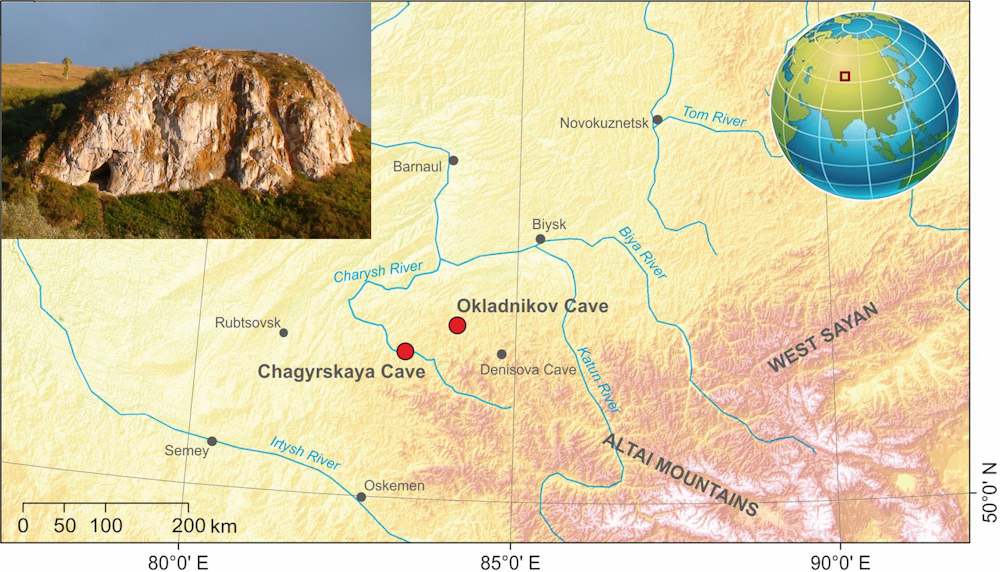
Our new study is the first to analyse ancient DNA from the teeth and bones of multiple Neanderthals who lived at around the same time. The fossils came from archaeological excavations of Okladnikov Cave in the mid-1980s and Chagyrskaya Cave since 2007.
Neanderthal DNA was sequenced from fossil remains found at Chagyrskaya Cave (photo) and Okladnikov Cave in southern Siberia. Maciej Krajcarz (map) and Richard Roberts (photo), Author provided
These caves were used by Neanderthals as hunting camps. The remains of animals such as bison and horses are abundant, and more than 80 Neanderthal fossils were also found in Chagyrskaya Cave – one of the largest such collections anywhere in the world.
Both sites also contain distinctive stone tools that bear a striking resemblance to artefacts found at Neanderthal sites in central and eastern Europe.
To paint a detailed picture of the genetic makeup and relatedness of these Neanderthals, we analysed mitochondrial DNA (which is passed down the female line), Y-chromosomes (passed from father to son) and genome-wide data (inherited from both parents) for 17 Neanderthal fossils – the most ever sequenced in a single study.
Neanderthal teeth and bones from Chagyrskaya Cave (A, B) and Okladnikov Cave (C) included in our study. The white bar in each panel is 1 cm in length. Bence Viola, Author provided
The teeth and bones came from 13 individuals: 11 from Chagyrskaya Cave and two from Okladnikov Cave. Seven of the Neanderthals were male and six were female. Eight were adults and five were children or adolescents.
Among them were the remains of a Neanderthal father and his teenage daughter, as well as a pair of second-degree relatives – a young boy and an adult female, perhaps his cousin, aunt or grandmother.
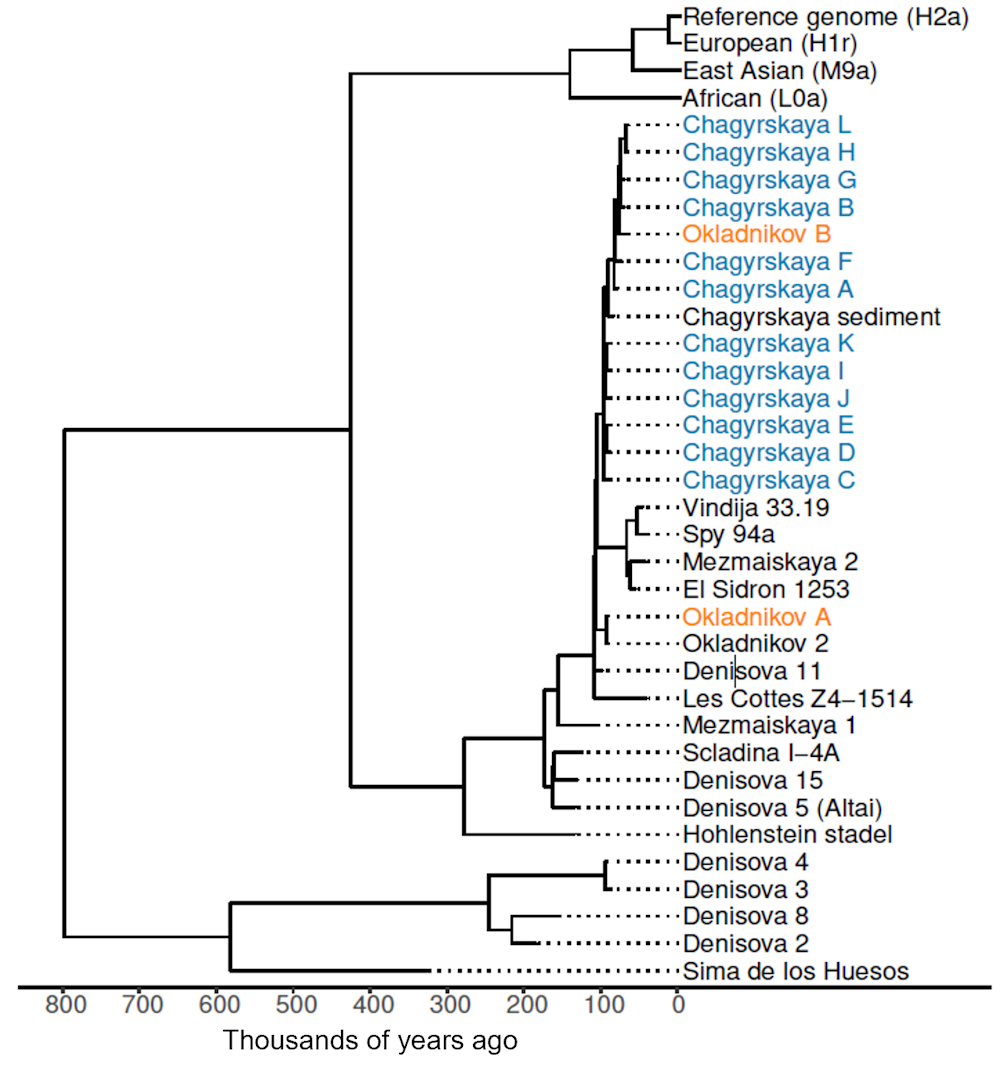
Although the nearby site of Denisova Cave was inhabited by Neanderthals from as early as 200,000 years ago, the Chagyrskaya and Okladnikov Neanderthals are more closely related to European Neanderthals than to the earlier ones at Denisova Cave.
This finding is consistent with a previous genomic study of a Chagyrskaya Neanderthal and the presence of distinctive stone tools at Chagyrskaya and Okladnikov Caves that closely resemble those found at Neanderthal sites in Europe.
Phylogenetic tree of mitochondrial DNA sequences showing the evolutionary relationships among the Chagyrskaya (blue) and Okladnikov (orange) Neanderthals included in our study, Neanderthals from Denisova Cave and Europe, and present-day humans from Africa, East Asia and Europe. Author provided
We also found the Chagyrskaya Neanderthals share several heteroplasmies – a special kind of mitochondrial DNA variant that typically persists for less than three generations.
Taken together with the evidence for their close family connections, these indicate the Chagyrskaya Neanderthals must have lived – and died – at around the same time.
On the brink of extinction
Our analyses also revealed this Neanderthal community had extremely low genetic diversity – consistent with a group size of just 10 to 20 people.
This is much smaller than the genetic diversity recorded for any ancient or present-day human community, and is more like that found among endangered species at risk of extinction, such as mountain gorillas.
The Chagyrskaya Neanderthals were not a community of hermits, however. We discovered their mitochondrial DNA diversity was much higher than their Y-chromosome diversity, which can be explained by the predominance of female (rather than male) migration between Neanderthal communities.
Did these migrations involve Denisovans, who occupied Denisova Cave repeatedly from at least 250,000 years ago to around 50,000 years ago?
Denisovans are a sister group to Neanderthals and they interbred at least once. This happened around 100,000 years ago, producing a daughter from a Neanderthal mother and a Denisovan father.
Yet even though Denisovans were present at Denisova Cave at around the same time as the Neanderthals living at Chagyrskaya and Okladnikov Caves, we found no evidence for Denisovan gene flow into these Neanderthals in the 20,000 years leading up to their demise.
Our genetic insights add a new social dimension to this picture. They provide a rare glimpse into the close-knit family structure of a Neanderthal community eking out an existence on the eastern frontier of their geographic range, close to the time when their species finally died out.
Richard ‘Bert’ Roberts receives funding from the Australian Research Council.
Laurits Skov does not work for, consult, own shares in or receive funding from any company or organisation that would benefit from this article, and has disclosed no relevant affiliations beyond their academic appointment.
Imagine you’re a big yellowfin tuna, miles from shore out in the blue, swimming around carefree, until you start to feel a little itch near your eye. Maybe it’s just a scratch that’s healing, or maybe it’s a tiny crustacean nibbling into your skin.
What do you do? You don’t have hands to pick it off. You don’t have cleaner wrasses nearby to carefully pluck it off for you like you might on a coral reef.
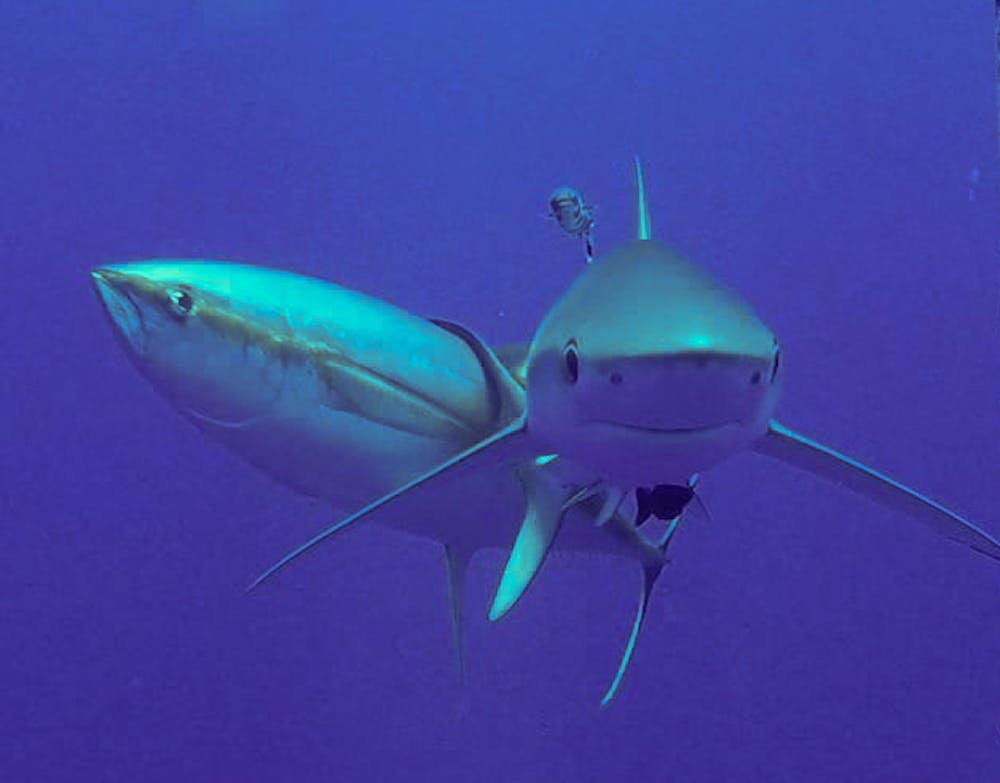
While poring over thousands of hours of video showing the denizens of the open ocean going about their lives, we discovered how tunas and other fishes solve this problem. The answer might be the last thing you’d think of: sharks.
Big fish prefer rubbing shoulders with sharks
In new research published in PLOS One, we found fishes living in the open ocean, like tunas, use sharks to scratch against.
The scratching is likely to remove parasites, dead skin, and other irritants. These fishes are hosts to a diverse array of parasites, but their environment provides them few options for removal.
Our research recorded scraping interactions among several fish and shark species across the Pacific, Indian and Atlantic oceans. We found fish preferred to scrape on sharks rather than on other fish. Size also mattered, with smaller fish being less likely to scrape on bigger sharks, perhaps due to the risk of being eaten.
Shark skin is made up of small tooth-like structures called dermal denticles. It feels like sandpaper (and in pre-industrial times it was used for that purpose), making it a particularly suitable surface against which to scratch.
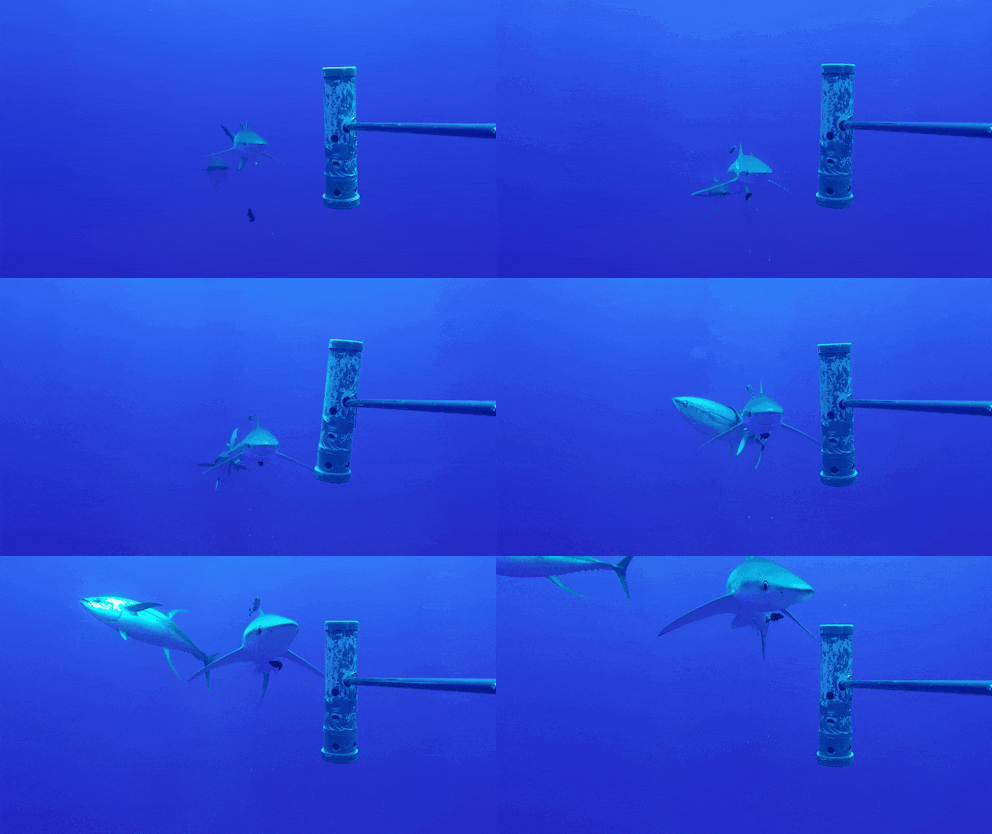
A rainbow runner sneaks up behind a blue shark for a quick scratch. Christopher D H Thompson, CC BY-SA
We found fishes tended to scratch their head and sides more than other parts of their body. This is where many of the areas most heavily impacted by parasite damage are found, including the eyes, nostrils, gills, and the lateral line system down the sides of a fish’s body.
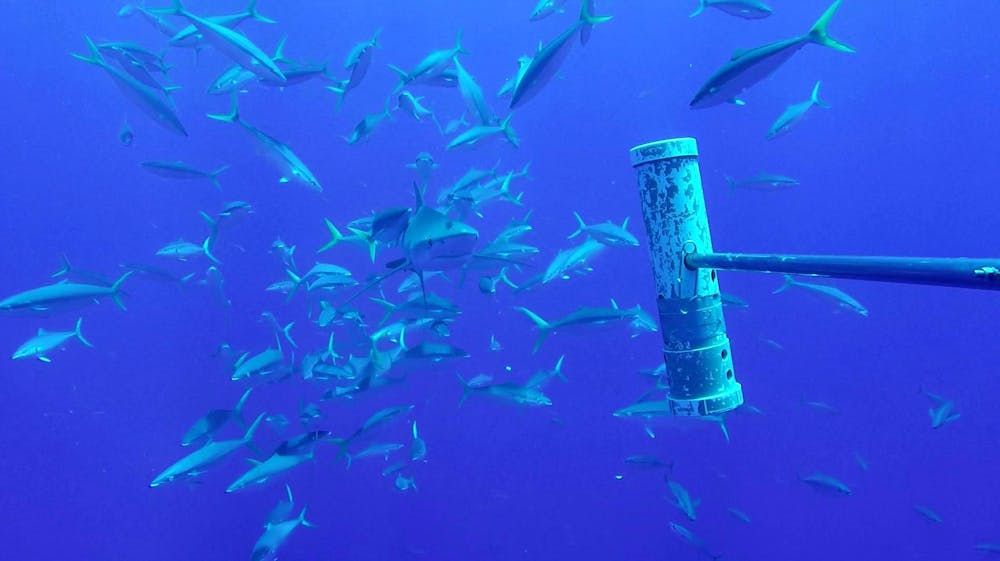
We also found fish species differed in the way they scraped. Tunas were quite orderly, lining up behind the shark and taking turns to brush against the tail. Rainbow runners were unruly, forming a school around the back half of the shark and darting out in turns to bump against its body.
Using underwater cameras to spy on ocean wildlife
We discovered this behaviour while analysing thousands of hours of underwater video taken with baited camera systems left to drift at sea. We reviewed the footage, and identified, counted, and measured all individuals we observed.
The data we gathered is important to determine population trends. But while watching these videos, we also noticed some unusual behaviours.
Yellowfin tuna rub their heads on sharks’ tails. Christopher D H Thompson, Author provided
First we saw a huge yellowfin tuna approaching a silky shark from behind, gently rubbing against its tail before cruising off. Before long saw a similar interaction between another yellowfin and another silky shark.
Eventually, we observed similar interactions between several different fish and shark species from all corners of the globe, and logged the details of each interaction.
Why scraping matters: healthy oceans need healthy shark populations
The open ocean is the largest habitat on the planet, yet it is challenging to study.
As a result, there are very few direct observations of the natural behaviour of animals in the open ocean. Interactions between these animals are not only intriguing because they may be new to us but also because of their possible implications.
Parasite removal has clear fitness benefits, and fitter animals are more likely to reproduce and pass on their genes to the next generation. These fishes may therefore be deriving a benefit from scraping against sharks.
This raises the question of what would happen if shark numbers become too low for fishes to find their scratching posts. Would there be a net loss of fitness in these fishes?
This is an important question given the rapid decline of shark populations in the global ocean. Some species have declined by up to 92% off the Queensland coast of Australia.
The continued decline of shark populations could have knock-on effects through the loss of relationships such as those we describe.
We only observed scraping in remote regions with relatively healthy populations of sharks and large tunas, both of which are heavily exploited in other areas. Remote locations offer a window into the functioning of intact ecosystems and the weird and wild things going on in the ocean that we are still yet to discover.
Marine protected areas have been shown to conserve behaviours in sharks and fishes. The introduction of more of these areas could help restore and preserve these behaviours.
What’s next?
We will continue sampling offshore waters and remote regions.
This work may reveal other species involved in these interactions or other intriguing behaviours with conservation implications. __
The authors do not work for, consult, own shares in or receive funding from any company or organisation that would benefit from this article, and have disclosed no relevant affiliations beyond their academic appointment.
The current turmoil in British politics needs to be understood not just as a response to Liz Truss’s short time as prime minister, but as the result of problems within the governing Conservative Party since it came to power in 2010.
The Conservative party is a group of about 180,000 people who tend to be wealthier and older than the average UK citizen. It was this group, more than Truss’s fellow MPs, who chose her as leader of the Conservative Party. It was also this group that endorsed the policies she tried to impose on the country, causing outcry from the populace and the markets.
This method of selecting the leader of the party needs to be changed. The current method was designed when the Conservatives were last in opposition (1997-2010). This means it was unwittingly designed for changes of leader while out of government.
Choosing the leader of the Conservative Party is strictly speaking a matter for the Conservative Party. This is fine when in opposition. When in government, a change of leader means a change of prime minister. This narrow franchise weakens the legitimacy of whoever becomes the new prime minister among the wider UK electorate.
Too much emphasis on leaders
The Conservative Party has also given itself up to an over-emphasis on leaders. This is part of the spirit of the times. But it is also the case that the prime minister is no longer “first amongst equals”. Instead, he or she plays an increasingly important part in why people vote for a particular party.
The Conservatives supported Boris Johnson because he promised to “get Brexit done”. However, the 80-seat majority he won in 2019 gave the impression that the electorate was voting for a leader (Johnson) rather than a party (the Conservatives).
But if this new support was about Johnson and Brexit, rather than a more permanent switch to the Conservatives, it also meant it could not be counted on thereafter. This helps explain the urgency to oust Johnson and the poor reception for Truss’s policies.
Johnson’s new pro-Brexit supporters did not have the same political instincts as most Conservatives. This group of voters likes it when the government intervenes. They liked Johnson when he promised to spend money and address persistent inequalities between northern and southern England – inequalities exacerbated by the actions of Margaret Thatcher’s governments of the 1980s.
So, when he was replaced by Truss, who models herself on Thatcher, the support rapidly evaporated in the north, where memories of the 1984-85 Miners’ Strike persist. In the leafy suburbs of the south, normally rock-solid Conservative voters have seen their mortgage payments and energy bills rise as a result of Truss’s “small state” ideology. They are not amused, and were already drifting away from the Tories as byelections held this year suggest.
The Conservative Party’s travails may be traced back to Boris Johnson and Brexit. Facundo Arrizabalaga/EPA/AAP
No new ideas
Perhaps we should not expect a self-described conservative party to have many new ideas (after all, that’s the point). But the poverty of thinking among its leaders stands out. Brexit had a nostalgic element to it. The Truss-Kwasi Kwarteng mini-budget was more 1980s than Stranger Things. Even the markets couldn’t take the retro infatuation with trickle-down economics.
The Conservatives are stuck in a place where all their ideas are from Britain’s past. In the Conservative Party mindset, the past does not operate as a helpful guide for the future, but as a point of destination. It is a security blanket in the chaos of their own making.
They show no sign of learning from all of this. The instinct of new Chancellor Jeremy Hunt is to return not to the 1980s, but to the 2010s. If you don’t like trickle-down economics, you can have austerity instead.
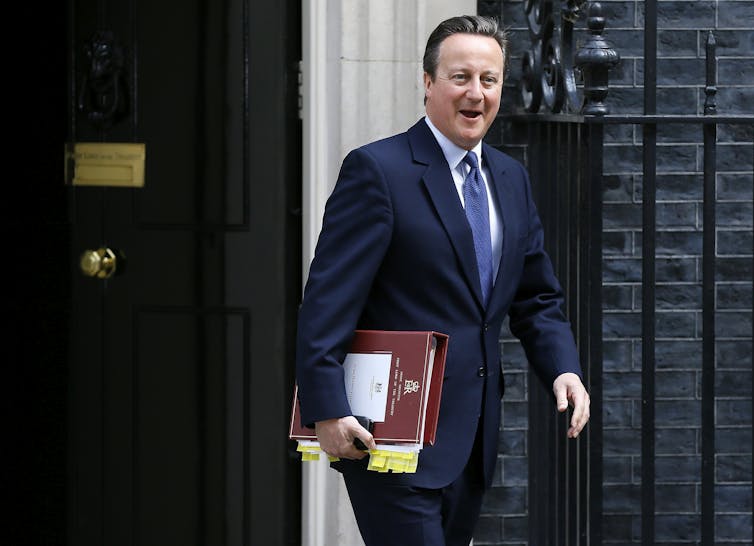
Austerity is where the current Conservative Party began its time in office back in 2010. Back then, David Cameron promised to address what he called “Broken Britain”. Little did electors realise this was more predictive than descriptive. Cuts to public services punished the worst off while the government claimed “we are all in this together” (in the way that everyone may be on an A380, but some people are in business class).
If that’s a no to 1980s trickle-down economics, how about some 2010s David Cameron-style austerity instead? Kirsty Wigglesworth/AP/AAP
Admittedly, it has been hard to predict the mood of British voters. Brexit, another product of internal Conservative division and poor party management, bent political loyalties among the electorate out of usual shape. It was this voter volatility that led Theresa May to call an election in 2017 and lost the Conservatives a healthy majority, even though its vote share went up. This was the greatest miscalculation in British politics since as far back as the previous year, when David Cameron lost the Brexit referendum.
All of these problems are in some ways internal to the Conservative Party. Voters angered by austerity turned to the right-wing populist party UKIP, forcing Cameron to call a referendum on EU membership. To try to quell the low politics of the militant pro-Brexit wing of the Conservative party, Cameron gambled with the high politics of the UK’s membership of the EU, and lost.
To realise all the illusive and illusionary opportunities that Brexit should in theory create, its most ardent supporters latched onto Johnson to bring down May. Johnson created the parliamentary deadlock of Brexit and then appeared to solve this self-inflicted wound with an election victory built on shifting sands.
However, he soon became embroiled in scandal after scandal, and his behaviour was finally too much even for the vulnerable MPs in “red wall” seats to stomach. Then, just when MPs thought it was safe to go back to their constituencies, Truss damaged already weakening support in the “blue wall” seats in southern England with the mini-budget: perhaps the most spectacular own-goal since Jamie Pollock scored against Manchester City in 1998.
Finally, most Conservatives now think Truss should resign. Yet in a final fling of nostalgia – and harking back to the glory days of the first half of 2022 – their favoured candidate to replace her is Boris Johnson.
The Conservatives have lost sight of where their interests and those of the country depart. By falling back on old certitudes that are no longer fit for purpose, they are behaving like a party that is already in opposition.
Ben Wellings does not work for, consult, own shares in or receive funding from any company or organisation that would benefit from this article, and has disclosed no relevant affiliations beyond their academic appointment.
Every year, more than 20,000 Australians – mostly women – are diagnosed with breast cancer. If you’re one of them or know someone who is, the great news is that 92 out of every 100 women will survive for five years or more after their diagnosis.
But women are often surprised by the life-altering side effects from their cancer treatment that can continue for years after, such as pain and fatigue. And many live with the dread of their cancer returning, even after they pass the celebrated five-year survival mark.
So, what can you do to improve your chances of living a longer, healthier life after a breast cancer diagnosis?
1. Stay physically active
Move more and sit less. Ideally, this includes gradually progressing towards and then maintaining about 150 minutes (two and a half hours) of planned, regular exercise a week. This involves a mix of aerobic exercise (such as walking) and resistance exercises (that target specific muscle groups), done at a moderate or high enough intensity to make you huff and puff a bit.
Women with breast cancer who exercise and are more active, have better quality of life, strength and fitness, and fewer and less severe side effects during active treatment.
2. Eat a high quality diet
Women with better diets – that include a high intake of vegetables, fruit, legumes, nuts, whole grains and fish – have been shown to live longer after a breast cancer diagnosis than those who have a diet high in refined or processed foods and red meat.
This is due mainly to the benefit of a good diet on reducing the risks of other health conditions, such as heart disease, rather than having a direct effect on the risk of dying from breast cancer.
Women with higher dietary quality lived longer after breast cancer diagnosis. Unsplash, CC BY
Many women, particularly older women or those with early stage breast cancer, are actually at higher risk of dying from heart disease than their breast cancer. A high quality diet can help maintain a healthy body weight and heart health.
There has been growing interest in specific diets (such as ketogenic or low-carbohydrate diets) and fasting during cancer treatment. But the most recent guidelines state there’s no evidence yet to say these are of significant benefit.
More research is being done following findings from a 2020 study, which suggested a “fasting mimicking diet” (low calorie, low protein) on the days prior to and of chemotherapy, produced a better response to treatment. However, compliance with the diet was difficult – only one in five women in the study were able to stick to the fasting diet for all their chemotherapy treatments.
3. Maintain a healthy weight
Excess body weight has also been linked to poorer survival after breast cancer diagnosis. But so far there haven’t been any clinical trials to show the opposite: that weight loss following a breast cancer diagnosis can improve survival. Trials are underway to answer this question.
Weight gain is common following breast cancer treatment. The causes for this are complex and carrying extra weight can make some of the side effects of treatment worse. Our recent study of women following breast cancer treatment, found that when they are supported to lose a modest amount of weight (5% of their body weight), they improved their physical quality of life and reduced their pain levels. They also reduced their risk of heart disease and diabetes.
Besides these well-established tips, a small body of research suggests two more behaviours, related to our body clock, can impact health after a breast cancer diagnosis.
4. Get good sleep
Disrupted sleep – common among women with breast cancer – can remain for years after your treatment has ended.
Women with breast cancer who regularly struggle to fall or stay asleep at night – compared those who rarely or never – are at greater risk of dying from any cause.
And it’s not just about how well, but also how long you sleep. Sleeping longer than nine hours per night – compared to seven to eight hours – is associated with a 48% increased risk of breast cancer returning. But, studies are yet to tease apart the possible reasons for this. Is increased risk of cancer recurrence a result of sleeping longer or is sleeping longer a consequence of progressing or recurrent disease?
Sleep can be challenging when you’re dealing with health worries. Unsplash, CC BY
5. Be mindful of when you eat
Preliminary research suggests when you eat matters. Delaying the time between the last meal of the day (dinner or supper) and first meal of the next (breakfast) may help reduce the chances of breast cancer returning.
When women reported fasting overnight for fewer than 13 hours – compared to 13 or more hours – after a breast cancer diagnosis, it was linked to a 36% increased risk of breast cancer coming back. But the study’s authors note randomised trials are needed to test whether increasing the amount of time fasting at night can reduce the risk of disease.
The World Cancer Research Fund has developed a list of recommendations to reduce cancer risk and reduce the risk of cancer coming back. But our research has found most women aren’t meeting these recommendations after their breast cancer diagnosis. Changing habits after breast cancer can also be harder, mainly due to fatigue and stress.
Starting exercise after treatment can be intimidating and even frightening. It’s a good idea to start small, for example: aim to increase exercise by 10 to 15 minutes each week. Having an exercise buddy really helps and there are lots of exercise programs for people who’ve had breast cancer.
Common questions about exercising after a breast cancer diagnosis include how to avoid the swelling and discomfort of lymphoedema, which develops in about 20% of breast cancer
survivors who have had lymph nodes removed. People also worry about exercise and wig discomfort or irritation from radiation. Specific advice is available.
Sleep can be challenging if you’ve been worrying about a cancer diagnosis or treatment but tips for getting the recommended seven to nine hours sleep each night include exercising earlier in the day, avoiding snacks before bed and good sleep hygiene.
Marina Reeves receives funding from Medical Research Future Fund and World Cancer Research Fund. Marina Reeves has previously received funding from the National Health and Medical Research Council and National Breast Cancer Foundation.
Caroline Terranova previously received funding from the University of Queensland Research Scholarships.
Kelly D’cunha receives funding from an Australian Government Research Training Program (RTP) Scholarship.
Sandra Hayes receives funding from Cancer Council Queensland, Medical Research Future Fund, and Cancer Australia.
But while baby nappy waste is well known, there’s a hidden waste stream that our research has found is actually a bigger issue. More adult incontinence products go to landfill than baby nappies in Australia.
Adult incontinence is often underreported and undertreated. The social stigma and lack of access to affordable health support may stop people seeking treatment and instead rely on incontinence products.
As Australia’s population ages, this issue will grow. By 2030, we predict adult incontinence waste will be four to ten times greater than baby nappies. We’ll need to get much better at dealing with the waste issues associated with these products.
Baby nappies are a well known waste issue. But adult incontinence products now outweigh them as an issue. Shutterstock
Adult incontinence is common and long-lasting
The reason these products will soon outstrip baby nappies is because infants usually only need nappies for a couple of years. By contrast, adult incontinence can stay with you for a lot longer – and it can emerge in many different ways.
How common is adult incontinence? It varies widely. The risk of urinary incontinence increases with age, and women experience higher levels of incontinence compared to men across all age groups. Women over 60 experience the biggest issues, with an estimated 30% to 63% of women over 65 living with some degree of urinary incontinence.
It’s common for people to manage their incontinence with single-use absorbent hygiene products, an umbrella term for incontinence products for both babies and adults.
Single use incontinence products offer convenience and normality as we age but produce waste. Shutterstock
Like baby nappies, adult incontinence products are usually made from a combination of natural fibres, plastics, glues and synthetic absorbent materials.
What happens to these products after use varies around the world, and can range from illegal dumping, to landfill, composting or burning in a waste-to-energy plant.
In Australia, both infant and adult products typically end up in landfill. The problem is, when you deposit organic waste in landfill, it gives off biogas (a mix of methane and carbon dioxide) and leachate, a polluted liquid that can leak through the lining at the bottom of landfills.
Some landfills in Australia are equipped with collection systems for leachate and biogas – but not all. Biogas emissions and leachate leaks can still occur even if there are collection systems in place.
Food and garden waste are the main source of biogas and organic contaminants in leachate. While councils look to remove food and garden waste from landfills, our ageing population will contribute more incontinence product waste to them.
Could we divert adult incontinence products from landfill?
Right now, we estimate about half of all adult incontinence products used in Australia end up in landfills without biogas collection.
The European Union has moved to ban disposal of untreated organic waste – including these products – to landfill. Because adult incontinence products usually contain plastics, the EU requires them to be incinerated where possible rather than biodegraded. Australia has no such laws for this waste.
Could biodegradable incontinence products tackle the waste issue? Only if there are systems in place to manage the waste and recover the resources.
A recycling pathway for biodegradable incontinence products could include anaerobic digestion – systems that harness bacteria to take our waste and make useful products such as renewable natural gas and biofertiliser. This waste stream could also be composted, if the temperature rises high enough to kill off any pathogens and recover the resources.
Problem solving
This is only part of the solution. Tackling the stigma around incontinence and ensuring access to affordable treatment options could cut the waste stream.
Encouraging manufacturers to use biodegradable materials for both adult and baby incontinence products could enable resource recovery, provided policies, systems and infrastructure are put in place to divert and process the waste. And while this is happening, it’s important these improved incontinence products are accessible and affordable to people who need them.
The reason disposable baby nappies and adult incontinence products have come to dominate the market is simple: they’re convenient, despite the environmental impact. This is especially true for the quality of life for our ageing population.
As our population gets older, we’ll need to rethink this. Let’s bring the issue into the open and talk about it. And let’s find alternative solutions that give people dignity and a better quality of life – while minimising landfill waste and the impact on our environment.
Beth Rounsefell is a Casual Academic at The University of Queensland, and currently works for EDL.
Emma Thompson-Brewster and Kate O’Brien do not work for, consult, own shares in or receive funding from any company or organisation that would benefit from this article, and have disclosed no relevant affiliations beyond their academic appointment.
Treasurer Jim Chalmers’ federal budget next week will for the first time include a section on wellbeing, which aims to measure how well Australians are doing in life.
The wellbeing budget will, among other things, assess the state of our natural places using a set of environmental indicators. But what indicators? And what environmental information should be used?
Getting meaningful environmental measures into the wellbeing budget won’t be easy. And tokenism won’t do.
We need a system providing comprehensive, regular and up-to-date information that can genuinely inform environmental and economic decisions.
Getting meaningful environmental measures into the wellbeing budget won’t be easy. Rob Blakers/AAP
An information ‘grab bag’
Australia has, for too long, relied on the five-yearly State of the Environment reports for updates on how our environment is faring, using a grab-bag of information. As the latest report noted:
Australia currently lacks a framework that delivers holistic environmental management to integrate our disconnected legislative and institutional national, state and territory systems, and break down existing barriers to stimulate new models and partnerships for innovative environmental management and financing.
In other words, we cannot get our environmental act together. Our responses to problems are often piecemeal and ineffective. We do not even have the information we need to fix them.
We’re yet to see what environmental information is included in next week’s wellbeing budget.
The Nine newspapers on Wednesday reported that no indicators have been agreed upon as yet, but the budget papers will contain a chapter on methods used in other jurisdictions, such as the Organisation for Economic Co-operation and Development’s long-running wellbeing framework.
Given the dearth of good information, the government must resist the temptation to rely on partial, uninformative or misleading environmental statistics.
These might include the number of listed threatened species (which would be larger if the environment department had been better-resourced) or the extent of the network of protected areas (which is large but significantly under-represents many ecosystems).
There’s no problem starting with what we have. But we must get to what we need.
We could draw inspiration from the giant information and policy apparatus in the public service that helps us track economic progress, and use a United Nations framework called the System of Environmental Economic Accounting (sometimes shortened to SEEA).
Every day, thousands of public servants work to gauge what the economy is doing and figure out what it means for industry, the government and the public.
Gross domestic product is measured, reported and debated. The Australian Bureau of Statistics releases it to a set schedule, without needing ministerial approval. Good or bad, the data comes out.
Officials from treasury, the finance department and the Reserve Bank pore over the figures. Their analyses and advice are sent to the treasurer, prime minister and cabinet.
If growth is too strong, the Reserve Bank might increase interest rates. If the economy is weak, the government might stimulate it with infrastructure spending.
Compare this to what we have for the environment.
A five-yearly State of the Environment report. In between reports, environmental problems are identified by scientists, environment groups and concerned citizens. Environmental laws are largely reactive. The agencies tasked with responding have limited funding and information.
The result? We consume the environment salami, one slice at a time, without knowing how much is left.
A recovery plan was prepared. But there’s no evidence the plan was delivered and the ecosystem is still no better off.
In his 2020 review of the EPBC Act, Professor Graeme Samuel recommended an overhaul, saying
National Environmental Standards should be immediately developed and implemented to provide clear rules and improved decision-making.
Recognising this couldn’t happen without a system of comprehensive environmental information, Samuel recommended building one including national environmental-economic accounts.
These should be tabled annually in parliament alongside traditional budget reporting.
Samuel’s approach strongly resembles the way governments manage the economy: use regular information to adjust policy settings to stay on trajectory towards desired outcomes.
Environment Minister Tanya Plibersek has hinted she is inclined to follow Samuel, describing his review as “thorough”.
So if environmental management is going to emulate economic management and be informed by the accounts Samuel envisioned, then just what are they?
What is environmental-economic accounting and what’s the UN-backed system?
Environmental-economic accounting is an information system blueprint.
SEEA-based accounts are ready-made to provide information for environmental decision-making, just as the national accounts inform economic decision-making.
The United Nation’s System of Environmental Economic Accounting is ready-made to provide environmental information for decision-making. UN
This UN-backed system was only completed in 2021, so real-world examples remain few. But one Victorian study shows the potential.
The accounts in the study showed the economic benefit of harvesting Central Highlands native forests for timber were far outweighed by the economic benefit of maintaining the forests for carbon storage and water supply. In other words, the forest is more valuable if you just leave it alone.
Ceasing harvesting would also bring major biodiversity gains. An assessment of all regional forest agreement areas in Victoria gave similar results.
On paper, Australia’s governments in 2018 endorsed the SEEA and adopted a national strategy to implement it.
In practice however, these governments are yet to produce the vision or political will to build a such a system that will actually inform environmental decisions.
Overseas, change is underway. The US, previously a laggard, now has an ambitious strategy to build environmental-economic accounts into their national information system.
An urgent need
Establishing a comprehensive set of environmental-economic accounts is the first step in delivering integrated environmental and economic management.
The United Nation’s System of Environmental-Economic Accounting offers a way forward. Graeme Samuel recommended it. Now government must deliver it. But it will take time and it won’t be cheap.
Early signs are positive but can Plibersek and Chalmers stay the course? Our future depends on it.
Michael Vardon receives funding from a variety of organisations for the development and application of environmental-economic accounting.
Peter Burnett does not work for, consult, own shares in or receive funding from any company or organisation that would benefit from this article, and has disclosed no relevant affiliations beyond their academic appointment.
The impact of deer on Aotearoa New Zealand’s natural environment is never far from the headlines. Most recently, the Southland Conservation Board highlighted the damage the introduced species was doing to native forest on Rakiura Stewart Island.
And despite the government including NZ$30 million for deer and goat control in this year’s budget, the situation remains critical, with considerable disagreement about the best solutions.
The Department of Conservation (DOC) is key to managing deer numbers, but has been strongly criticised by the CEO of the independent Forest & Bird organisation over the climate implications of its wild game animal management framework:
When DOC publishes plans that talk about ‘improving the quality of game animals’ it’s clear they’ve lost their way. Deer, pigs and goats are wrecking native habitats and their stored carbon from the ground up.
On the other side, some hunters and anti-1080 pesticide activists are vehemently opposed to large-scale deer culling.
And central to some of their arguments has been the idea that deer are actually ecological surrogates for extinct moa – large herbivores that control plant growth and keep forests “open”.
But this outdated and false argument ignores the latest evolutionary and ecological research, and misrepresents the current state of scientific evidence. Scientists have made significant progress and now know far more than they did even ten years ago.
Red deer and other hoofed animals were introduced to make colonial New Zealand more like England – without considering the environmental impact. Luc Viatour/Wikimedia Commons
Are deer doing what moa did?
Deer were introduced to New Zealand from the mid-19th century as a way to make hunting for food accessible for all. Not long after that, however, conservationists became increasingly concerned about the damage the species caused.
Hunters then became worried deer were going to be controlled or eradicated, and came up with the ecological surrogate theory to justify additional releases. Some have even illegally introduced deer into areas where they had previously been eradicated or where only one species existed.
Moa had a population density of two to ten individuals per square kilometre (of about 0.5 to 2.5 million moa), broadly similar to deer (three to 15 individuals per km²). But this doesn’t mean the two had similar impacts simply because they were or are herbivores.
The latest evidence shows unequivocally deer are nothing like moa, with completely different ecological impacts.
Moa were more ecologically friendly and unique – the product of 58 million years of evolution. While the ancestors of moa arrived in New Zealand just after the extinction of the dinosaurs, molecular dating suggests the latest evolutionary radiation of moa dates to the past six to seven million years. The nine moa species were ecologically segregated and in tune with their environment due to millions of years of co-evolution with plants.
Deer are not. They eat bare the forest “understorey” (plants beneath the canopy growing on or near the forest floor), including the insulating layer of leaf litter. Deer can eat to near extinction the plants moa browsed, which now only survive in inaccessible areas.
Unlike deer, moa had natural predators such as Haast’s eagle. John Megahan/Wikimedia Commons, CC BY-NC-ND
Deer and climate change
Deer browsing pressure also contributes to climate change through CO2 emissions from trees they kill, which release carbon as they rot, and by preventing forest regeneration that locks in carbon.
Moa had uniquely shaped beaks for cutting, minimising inter-species competition. Deer have teeth and a prehensile tongue to twist and pull plants into the mouth.
The moa digestive system was basic, whereas deer are ruminants and can extract energy from non-palatable foods like bark. Moa had a significantly more diverse diet than deer, including plants that evolved anti-browsing defences that discouraged browsing by moa. Not enough evolutionary time has elasped for New Zealand plants to evolve defences against deer browsing.
This indicates that prehistoric forest understories were more diverse and lush – not the open, sparse ones with little regeneration that deer create.
Moa played a role in the dispersal of brightly coloured fungi and the spread of native forest. Deer disperse exotic fungi that help spread wildling pines. Native fungi don’t survive passage through the deer gut.
Moa dissipated their weight through two large feet with splayed toes. Deer trample the forest floor through four small hoofed feet.
Moa bred slowly, whereas deer are boom and bust species. Female red deer reach sexual maturity at two years. Moa took up to nine years to reach adult body size, and probably longer for sexual maturity.
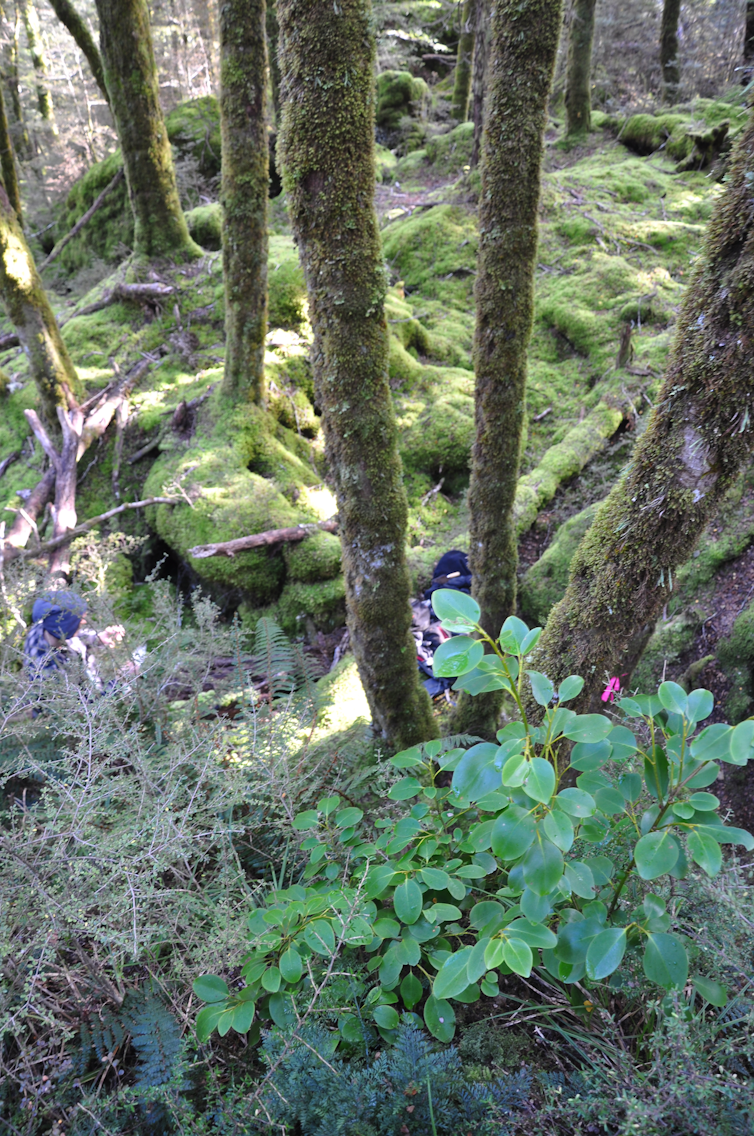
Giant boulders in deer-infested forests provide safe havens for native plants, while deer strip the understorey bare. Jamie Wood/Manaaki Whenua Landcare Research
Solving the deer problem
Despite the misinformation, deer are pests causing irreversible damage to remaining ecosystems. But there is not yet the social licence for deer to be included in the Predator Free 2050 plan, which aims to eradicate rats, mustelids and possums.
We need to reframe the ecological damage deer are doing to taonga species and the food web those plants are part of. (This includes the danger of farmed deer escaping.)
If eradication isn’t palatable, consideration must be given to a compromise solution of confining deer to areas of least conservation concern, with drastically reduced populations.
Where those areas are, and whether hunters might pay to shoot deer there (with revenues going back into conservation), could be part of that discussion.
Alternatively, deer carcasses from hunting could be left to rot, returning nutrients to the soil, despite arguments this is a waste of food. Forests are already struggling with climate resilience, not helped by the human-induced decline and extinction of seabirds that once brought nutrients in from the sea.
And the use of deer repellents in 1080 drops to control pests needs to be revisited. The pesticide can be highly effective, with up to 90% of local deer populations eradicated in some areas.
Above all, we need to ask what native forests require to be healthy and remain carbon sinks, and how this is monitored. Deer control or eradication policy needs to be timely, evidence-based and not shrouded in misinformation.
A Forest & Bird conservation manager explains the subtle differences between introduced browsers like deer and birds like the extinct moa.
Nic Rawlence receives funding from the Royal Society of New Zealand.
Source: The Conversation (Au and NZ) – By Steven Hamilton, Visiting Fellow, Tax and Transfer Policy Institute, Crawford School of Public Policy, Australian National University
Shutterstock
Economics is confusing at the best of times. But, at the moment, it’s downright counter-intuitive.
Inflation is at its highest in decades, and we’re feeling the pain of the lower real wages that brings. Meanwhile, unemployment is its lowest in half a century, with virtually anyone who wants a job able to get one.
Interest rates are climbing sharply. Home prices are sliding, yet rents are taking off. The United Kingdom is on the brink of financial crisis. Talk of a global recession is everywhere.
Even if you don’t much mind what’s happening (you mightn’t be much affected or you might in fact be benefiting in some way), you’re likely finding it hard to come to grips with it all. Certainly, our policymakers are.
It began with the pandemic
The first thing to understand about what’s happening is that it can’t be divorced from the pandemic.
Two years ago, early in the pandemic, Australia went into recession for the first time in 30 years.
And what an unusual recession it was. It was sharp, but rather than following the collapse of a speculative bubble or a downturn in the business cycle, it followed years of perfectly sustainable, if weak, economic performance.
It’s worth recalling a few things. Australia handled the public health side of the pandemic better than most. That meant that, although sharp, the collapse in economic activity was less severe than decision makers anticipated.
Even though generally still employed, Australians were much less able to spend. International travel, dining out, and going out had to be put on hold.
At the same time, Australia put in place one of the largest fiscal and monetary support programs in the world. Interest rates were set to zero and the Reserve Bank used unconventional tools to flood financial markets with money.
JobKeeper and the cash-flow boost for businesses, along with the JobSeeker supplement (and loosened eligibility conditions), cash transfers for government benefit recipients, and A$38 billion in superannuation withdrawals constituted the largest fiscal stimulus in Australian history.
Support that couldn’t be spent
Households and businesses were awash with cash during the pandemic – but with not many places to spend it. Much of that spending was simply delayed.
Without the benefit of hindsight, this shouldn’t be viewed as a mistake. As Australia’s leading monetary economist, Professor Bruce Preston of the University of Melbourne, put it, we took out prudent insurance.
It had been 100 years since the last pandemic of this scale, and it was impossible to tell just how bad things would get. It was safer to do too much than too little.
But just as insurance comes with a premium, so too does too much stimulus. Once the economy reopened, too much money chasing too few goods and services would only end in one way: higher prices.
This has been exacerbated by supply chain constraints, some simply the result of switching the global economy off and on and others resulting from the effect of Russia’s invasion of Ukraine on global commodity prices.
Then the floodgates opened
The trouble with high inflation is that we can’t count on it solving itself. It is true that higher prices cut real wages, choking off spending and helping dampen prices. But it is also true that they can feed higher inflation expectations, which do the opposite.
If people expect high inflation they’re more likely to bring forward purchases simply because they expect prices to rise. And workers demand higher wages, and businesses higher prices, in anticipation of the higher prices they will themselves face in future.
In this way, inflation can become self-reinforcing and thus harder to arrest. That’s why monetary (interest rate) policy and fiscal (government tax and spending) policy have been rapidly tightened across the world – to ensure a temporary episode of high inflation doesn’t become entrenched.
It looks as if this has already occurred in the United States, the United Kingdom, and Europe. It’s not yet clear whether it will happen in
Australia.
The loose monetary policy across the world through the 1970s provides a lesson for what not to do in a situation like this. It took a decade, well into the 1980s, to get inflation under control.
Nothing is worse for real wages and living standards than high inflation. Ask those living in Argentina and Turkey where purchasing power is sinking.
Ideally, policymakers would have seen inflation pressures building and begun to tighten settings sooner and more gradually. The later the reaction, the sharper it has to be – and the more damaging the economic consequences.
Australia’s Reserve Bank was slow off the mark, months behind the Reserve Bank of New Zealand and a month behind the US Federal Reserve. It’s hard not to see that as complacent.
And Australia’s federal government continued to hold its foot on the gas long after the bank started to hit the brakes – with massive additional stimulus irresponsibly committed to by both sides of politics during the May election.
And we’ve seen no action yet from our new government on inflation. It is hard to tell what it is waiting for – perhaps next week’s budget.
Its messaging isn’t helping. The treasurer’s constant references to a “dangerous” global economy is irresponsible at a time of fragility – he needs to remember he is the treasurer now – his words can have a real effect on outcomes.
And the Reserve Bank’s traditionally poor communication hasn’t gotten any better. It pivoted at this month’s board meeting, halving the rate of increase in interest rates, but failed to clearly explain the reasoning in its accompanying statement.
Recession or not, it’ll be a bad couple of years
The word “recession” is unhelpfully binary. Economists don’t even agree on its definition. In an unusual situation like a pandemic, or post-pandemic, its meaning is even emptier.
One thing we do know is that global economic growth, including growth in Australia, will be far slower over the coming two years than we expected mere months ago.
We overestimated the global economy’s ability to smoothly rebound from the pandemic. And we didn’t anticipate Russia’s invasion of Ukraine.
Australia can be expected to fare better than most countries. It is less exposed to the energy price shocks than Europe and the United Kingdom, and to some degree, being a big energy exporter, benefits from high prices.
But there is a lot of uncertainty about China – Australia’s biggest export customer. A sharp downturn there, precipitated by something like a real estate collapse, would pose a serious risk to the Australian economy.
It’s important to note that the problems we are facing are likely to be temporary.
While nobody has a crystal ball, it seems reasonable to expect a return to something resembling normal, with our old rate of economic growth resuming within a couple of years.
Before you know it, we’ll be consumed once more by debates about how to rekindle what was weak growth, weak wages growth, and weak productivity growth – our economic preoccupations before the pandemic struck.
Steven Hamilton does not work for, consult, own shares in or receive funding from any company or organisation that would benefit from this article, and has disclosed no relevant affiliations beyond their academic appointment.
We are two female jazz singers, jazz researchers and lovers of jazz. And we have discovered jazz gave us another shared experience – sexism.
We’d both experienced garden variety sexism. Wendy was asked by a male school principal if her recent marriage meant she would resign from teaching to start a family. Melissa received passionate advice from a male audience member to swap her comfortable outfit with a “glamorous dress” when she sang jazz.
But as university music students, neither of us imagined something as innocent as a key signature in a textbook might be a symptom of gender discrimination.
A key tells musicians which set of notes a song uses. In singing, a key affects whether the notes will be sung in the low, middle or high part of the voice.
But when we looked at what keys the “bibles” of jazz standards used, we found a hidden form of sexism.
The Real books
This unusual story begins in 1975 at the Berklee College of Music in the United States. Two music students, tired of reading shoddy, error-filled song sheets, created The Real Book to accurately notate jazz songs. Sold illegally to avoid copyright fees, it was a phenomenal success.
After years in surreptitious worldwide circulation, publisher Hal Leonard transformed The Real Book into a legal edition. In 1988, Sher Music joined the act and produced The New Real Book. Despite similar titles, Sher’s book was unrelated but mimicked the idea of clearly notating jazz songs.
Standards are common jazz songs jazz musicians are expected to know. Knowing them is your ticket to participating in jazz ensembles, and so universities use these books to train students.
Knowing jazz standards is your ticket to join ensembles. Josephine Bevan/Unsplash
However, few educators realise one decision in 1975 about notating standards cemented a practice excluding women.
Jazz is valued as a “conversational” style of music where musicians express personal ideas and real stories. “Authentic” jazz singing is associated with the lower voice we use when speaking.
The human voice is a biological musical instrument coming in a variety of sizes, with the male larynx (or voice box) generally larger than the female. This means men generally sing (and talk) in lower pitches, and keys that sit in the middle of the male voice are usually too low for women to sing.
When our Berklee students and Sher Music notated songs, they chose keys used by jazz musicians. And during that era, male instrumentalists and male singers dominated the jazz community.
So, when the real books were being developed, the editors didn’t choose keys that suited female voices.
We sampled 20 songs from The Real Book and 20 songs from The New Real Book and compared the keys in the books with the keys of the female recordings.
Less than 5% of 248 recordings fully matched the printed key.
If women sing songs straight from The Real Book or The New Real Book, they are likely to be singing too low for their voices. And if they shift the male key up one octave, it will be too high.
Consequently, female jazz vocal students are disadvantaged. If they comply with the keys of the iconic texts, they won’t sound as “authentically jazz” as male students. The male voice will produce the conversational tone we have come to expect from jazz; the female voice will be too low or too high for this conversational style.
The female professional singers we studied transposed the standards to keys that suited a jazz style. But this skill takes time for students to learn. Transposing requires understanding music theory and having confidence to advocate for your needs as a singer.
Female singers who don’t transpose the standards will be at a disadvantage. Josh Rocklage/Unsplash
Experienced jazz singers inevitably acquire these skills, but what about novice female singers?
For many young female singers, their introduction to jazz is coloured by keys ill-suited to their voices. Place them in a band where the instrumentalists are predominantly male with little understanding of voice production, and it is an uncomfortable situation for aspiring singers.
Fortunately, technology has advanced to a point where many standards are available on phones and can be transposed instantly. But this won’t happen until music teachers and jazz musicians understand and respect female singers by using the appropriate keys.
So, can a key signature be sexist? Yes, it can when it’s presented as the only choice of key for female students learning jazz standards.
It’s time to update our jazz bibles with sources including keys used by Ella Fitzgerald and Sarah Vaughan, and acknowledge sexism has been hiding in the strangest place.
The authors do not work for, consult, own shares in or receive funding from any company or organization that would benefit from this article, and have disclosed no relevant affiliations beyond their academic appointment.
Award-winning University of the South Pacific student journalist Sera Tikotikoivatu-Sefeti says Pacific voices on the climate fight need to be amplified for big nations to notice and be accountable for their actions.
The final-year student recently won the top prize in the tertiary level journalism students category at the 2022 Vision Pasifika Media Award with her two submissions on the environmental impacts of Tonga’s volcanic eruption on villagers of Moce Island in Fiji, and declining fish populations on the livelihoods of Fijian fishermen in Suva.
Tikotikoivatu-Sefeti said she was “beyond humbled” to receive the award and expressed her gratitude to God for the opportunity to amplify Pacific voices on climate change.
Originally from Dravuni village on beautiful Kadavu island, Tikotikoivatu-Sefeti said Pacific Island countries contributed the least towards climate change and global carbon emissions — but were the most affected.
“We are known to have a close relationship to the land and sea. To have that severely affected by big world countries whose activities are a big cause of this is unacceptable,” said the student editor of Wansolwara, USP Journalism’s award-winning print and online publication.
USP student journalist Sera Tikotikoivatu-Sefeti lines up a shot while covering the impact of Tonga’s volcanic eruption on the villagers of Moce Island in Lau, Fiji. Image: Wansolwara
“I am passionate about environmental issues and human interest stories. I believe the Pacific stories should be ‘heard’ and ‘told’ from the Pacific Islanders’ perspective and words as it is a crisis they live by and survive every day.
“In Fiji, there aren’t enough journalists covering stories of the environment and how it’s affecting the people. I understand it can be a resource constraint and financially limited area.
Filling the gap “I want to fill that gap in the industry and be able to do something I’m passionate about because it’s incredibly important to tell our people’s story.”
Tikotikoivatu-Sefeti dedicated her award to her family, USP Journalism students, staff, peers and indigenous women.
“So many times, we limit ourselves to what others perceive us, and it will take you to step out of your comfort zone to be able to experience your full capabilities,” said Tikotikoivatu-Sefeti, who was also a recipient of the EJN story grant for indigenous reporting.
She was recently one of the first recipients of the Native American Journalists Association and the Asian American Journalists Association (NAJA-AAJA) Pacific Islander Journalism Scholarship.
The Pacific Regional Environmental Programme’s (SPREP) acting communications and outreach adviser, Nanette Woonton, reaffirmed that SPREP recognised the critical role of all media in disseminating public information, education and influencing behaviour for the better.
“At the secretariat, we are excited to be able to offer the opportunity through these awards to honour and recognise the hard work by our media colleagues in protecting our people and the environment,” she said.
Vision Pasifika Media Award The 2022 Vision Pasifika Media Award was facilitated through a collaboration between the SPREP, Pacific Islands News Association (PINA), Internews Earth Journalism Network (EJN), and the Pacific Environment Journalists Network (PEJN), with financial support from Aotearoa New Zealand.
The award comprised five categories — television news, radio production, online content, print media, and tertiary-level journalism students.
Other category winners were: Fabian Randerath (television news), Jeremy Gwao (online content) and Moffat Mamu (print). Randerath was also named the overall winner for his story “Rising Tides – Precious Lives” on Fiji Broadcasting Corporation (FBC).
Akansha Narayan is a final-year student journalist at USP’s Laucala campus, Suva. USP and Wansolwara collaborate on Pacific stories, and for several years USP and the AUT’s Pacific Media Centre collaborated on a joint Bearing Witness climate journalism project.
The Fijiana are one step away from reaching the quarterfinals of the Women’s Rugby World Cup — but they have to beat favourite France first.
To qualify, they need to overcome the in-form French team at the Northland Events Centre in Whangārei on Saturday.
It is an opportunity that has arisen as a result of a thrilling 21-17 last-gasp upset over favourites South Africa last weekend, with Fijiana stealing the game with a try scored in the final minute.
“I have no words for it. I am just so grateful for the girls. We talked about leaving everything on the field and playing with our hearts,” Fijiana captain Asinate Serevi said.
Vika Matarugu of Fiji scores a try during the Pool C Rugby World Cup 2021 match between Fiji and South Africa at Waitakere Stadium last Sunday. Image: Fiona Goodall/World Rugby/RNZ Pacific
“One thing that Fijians are known for is that even with three or one minute left on the clock, we can still win a game — and that’s what we did,” Asinate added.
“As a captain they made me look good, so I’m forever grateful for the game they put on.”
First Pacific qualifier Being the first Pacific Island nation to qualify for the Women’s Rugby World Cup is an accomplishment, but for Fijiana, qualifying for the quarterfinals is the driving goal.
Despite a disheartening loss to England, Senirusi Serivakula said Fijiana’s winning ambitions have never faltered.
“The message was clear from the beginning, which was that we must beat South Africa. That was the message, that we are not going to walk away without a win over South Africa,” coach Senirusi Seruvakula said.
“I’m proud that the girls stuck to it, and they played as a team to the last minute.”
That message was delivered in a stunning fashion, with a last-minute try scored right between the posts by forward Karalaini Naisewa. The number eight had to crash through three tacklers to get the ball over the line.
That try has since gone viral and Fijiana players have now become overnight celebrities in Fiji.
The star of the team, prop forward Siteri Rasolea, was awarded player of the match. She relentlessly ploughed through South Africa’s forwards from beginning to end.
Public admiration Rasolea had already won public admiration in Fiji after she turned down an offer to play for her home nation Australia, opting to represent her heritage nation Fiji.
Rasolea said the team were still coming to terms with their accomplishment.
“Our girls had to dig deep and really fight for each other,” said Rasolea.
“I’m still in awe of it now. I want to dedicate this to everyone who supported me at home. It wasn’t easy leaving Australia to go to Fiji, so I fulfil my dreams.”
Like Rasolea, many of Fijiana’s players flocked from overseas with the purpose of representing their heritage.
Fijiana captain Asinate Serevi, who is the daughter of 7s legend Waisele Serevi, represented the United States for three years before switching to Fiji.
“It means the whole world to me. I can’t thank God enough for all the support. My plan was just to play for Fiji and represent my country. And being named captain is honestly beyond dreams,” Serevi said.
‘Huge step to win’ “It’s a huge step for us to win one game in the World Cup means to us like we’ve won the world cup already. We know France is going to be tougher and we have things to work on.”
Regardless of Fijiana’s big win, France remains the overwhelming favourite, having easily defeated South Africa 40-5 and narrowly losing to England 13-7.
However, they have been weakened by the loss of their staff halfback Laure Sansus, who is out if the World Cup due to a knee injury in the first quarter of the game against England.
Sansus, the 2022 Women’s Six Nations Player of the Championship tore her anterior cruciate ligament and will be replaced by centre Marie Dupouy. However, she will stay on in New Zealand as France’s “chief fan”.
Coach Seruvakula is optimistic that Fijiana can win if they play a perfect game.
“I believe in the girls, that they’ll play to the last minute,” said Seruvakula.
“If we want to play in the quarterfinals, we have to do right during training and through the process everything will take care of itself come game day against France.”
This article is republished under a community partnership agreement with RNZ.
The new French High Commissioner to French Polynesia has heard calls for support and compensation for atolls close to the test sites of France’s nuclear weapons tests.
High Commissioner Eric Spitz has been on his first tour of the outer islands since arriving from France last month to discuss France’s efforts to overcome the test legacy in line with an undertaking of President Emmanuel Macron to “turn the page” over the tests.
Spitz has been visiting Mangareva and Tureia, which are among the inhabited atolls closest to the former test sites of Moruroa and Fangataufa, used for more than 190 tests between 1966 and 1996.
The High Commissioner is travelling with the project manager for the French prime minister on the consequences of nuclear tests, Michel Marquer, and the head physician of the monitoring Department of the Nuclear Test Centres of the General Defence Directorate, Dr Marie-Pascale Petit.
The government delegation has been updating the atolls’ residents on the latest findings about residual radiation and the risks emanating from the test sites, weakened by dozens of underground detonations.
For a half century, the French nuclear bomb tests and their consequences have cast a shadow over Tahiti. Image: Bruno Barrilo/Heinui Le Caill
The mayor of Tureia, Tevahine Brander, said she would like to have support from France because some locals had given their lives for France while it was developing its nuclear deterrent.
“Perhaps the French state has taken a big step today on the nuclear issue, but my people will always remain vigilant on this subject. Our elders have endured a lot of suffering,” she said.
The mayor of Rikitea on Mangareva, Vai Gooding. also called for compensation, with locals telling the visitors of ongoing concerns.
‘Victims who have died’ Jerry Gooding, who is with the anti-nuclear organisation Association 193, told Tahiti-infos that “in Rikitea, there are victims who have died, and their children have cancer too, although they were born after the nuclear tests.
“This is why the association is asking for a transgenerational study into the genetic impact of the tests.
“Macron went to ask forgiveness in Algeria but did not ask forgiveness from the Polynesians. He must come and apologise to the Polynesians,” he added.
A resident, Benoit Urarii, said “everyone knows that Hiroshima was catastrophic, and everyone knew that it was dangerous for the population. General De Gaulle was aware and chose Moruroa because there were fewer people.
“But it is close to us, so we are the first victims. The first test in 1966 was catastrophic for us Mangarevans. And we got infected. Nobody can deny that.
“We were not asked for our opinion, and we knew exactly how dangerous nuclear tests were.”
The medical expert Dr Petit said there was cancer before nuclear testing.
‘Cancer not only due to nuclear tests’ “It will exist afterwards, and we all know that cancer is not only due to nuclear tests. Nobody is able to say that this is a cancer due to nuclear testing or not. We do not yet have a marker that will make the difference,” she said.
Concern was also raised about a possible collapse of the test area on Moruroa atoll, but Dr Petit said movements were gradually diminishing, leaving a very low probability of a sliding of a sediment plate.
She said whatever happened, the possible swells were likely to be weaker than what Tureia had already experienced.
Doubt persists as residents point to the complex and expensive technology in use to monitor the area around Moruroa, which is still a military “no-go” zone.
Until 2009, France claimed that its tests were clean and caused no harm, but in 2010, under the stewardship of Defence Minister Herve Morin, a compensation law was passed.
Plans are afoot to build a memorial site in Pape’ete, but a resident in Tureia said it should be on his atoll.
“The centre should be here, it’s more honest. But not a memorial for those who have taken advantage of all these years of nuclear testing to enrich themselves and stuff their bank accounts,” he said.
This article is republished under a community partnership agreement with RNZ.
New Zealand Parliament Buildings, Wellington, New Zealand.
Analysis by Dr Bryce Edwards.
Political Roundup: Here comes an unpredictable and intense by-election
Political scientist, Dr Bryce Edwards.
Get ready for a hard-fought and intense by-election in Hamilton West, triggered by the resignation from Parliament of former Labour MP Gaurav Sharma. Both Labour and National are going to throw everything at winning this by-election. Complicating matters, there will be a number of minor parties and fringe elements – Sharma included – that might have a big impact on the result.
At this stage, the outcome is entirely unpredictable, with both Labour and National having good reasons for desperately needing to win it, and with some good reasons to expect success. But it’s likely to be a very close race, and a number of vital factors could determine which way victory goes.
The National Party is the frontrunner
National is surely seen as the frontrunner in the by-election, due to the party’s hold over the seat in 4 out of 5 preceding elections, together with the fact that the Labour Government is currently in the doldrums.
As always, Opposition parties seek to turn by-elections into referendums on the current performance of the incumbents – and at present there is a lot about the Labour Government for the public to be dissatisfied about. This was evidence by last week’s local government elections, which have also been described as a referendum on the current government. Various successful mayoral and council candidates prospered through their campaigns against the status quo and by being anti-Government. Expect to see much of this again in Hamilton West.
National has been dominating the seat – although Sharma won it for Labour in 2020, this was an aberration after National holding it for the previous four terms – by Tim Macindoe.
Macindoe is apparently keen to win the seat back and so wants the National Party nomination – although last night he was refusing comment on this. There are plenty of other potential National candidates – for example, Andrew King, the former mayor of Hamilton indicated in April that he planned to run for the party nomination for the seat.
The campaign and the chance to win the seat back off Labour is being described as a “godsend” for National. It certainly would be a major psychological boost for National’s current resurgence. As the Spinoff’s Toby Manhire says today, “National will be licking its lips.” He says that “it’s a chance to put a stake in the ground, to road-test approaches, and to draw confidence from winning back a seat”. It’s also a chance to put the selection problems of the likes of Uffindell behind the party.
National is doing well in the polls at the moment – generally a couple of percentage points ahead of Labour, so there are plenty of reasons to believe that National should win the seat. If they don’t there will be some serious questions about the party’s organisational capacity and leader Christopher Luxon’s pulling power.
Labour is set to be the underdog
The Labour faces a likely “bloodbath” in Hamilton West according to the Herald’s Audrey Young. She says: “Labour will be campaigning against a tide in a famous weather-vane seat. Byelections are a chance for voters to give a Government a bloody nose, at the best of times. We are not in the best of times.” She concludes it will take “a miracle” for Labour to retain the seat in the by-election.
It would indeed be highly embarrassing for Labour to lose the seat – it would make them look vulnerable, especially in the lead up to election year. Losing a seat in a by-election isn’t the best way to start their campaign for re-election. Toby Manhire doesn’t rate Labour’s chance of success very highly, saying that “though it is not unwinnable, it would take something extraordinary for them not to lose.”
Unfortunately for Labour they don’t have a lot of obviously strong contenders to stand in the seat. Top of the list is probably the Labour Party parliamentary employee Dan Steer, who recently stood for the city council. Media have been unable to reach him for comment on standing for the nomination.
However, there are other reasons for Labour to be more optimistic about their chances. Although the 2020 Labour win in Hamilton West was indeed an aberrant high vote for the party, Labour has won the seat plenty of times before.
This is why Hamilton West is regarded as a “weathervane” or “bell weather” seat. In the past, the seats have tended to be won by whatever party is in Government. Manhire describes it as “the quintessence of middle New Zealand and a bellwether seat; 16 of the last 18 winning MPs have caucused with the governing party.”
What’s more, Labour’s current majority is incredibly high – 6500. In theory this makes Hamilton West a very safe seat for Labour. As National pollster David Farrar points out, when looked at the parties as ideological blocs, in 2020 “the left vote was 58% in Hamilton West and the right vote 34%.” So, it would take an extreme swing against the Government for the seat to change hands.
Labour’s best hope of retaining the seat is for Sharma’s campaign to split the anti-Government vote. If enough anti-Labour people back the incumbent-dissident, viewing a vote for Sharma as the best way to give Labour a bloody nose, then National’s candidate might struggle to win. A split vote could be Labour’s saving grace.
A circus of minor parties and issues
Whether Labour or National win Hamilton West might be partly determined by the minor parties standing in the campaign, as well as which issues rise to the top of the agenda on the campaign trail. On this, David Farrar says: “If Act and/or NZ First stands and Greens do not, that helps Labour”.
According to journalist Richard Harman, National could be disadvantaged by these other rightwing and minor parties splitting the vote. He says, National “will have to beat off Act and a resurgent NZ First, as well as a host of small parties like TOP and the Freedoms and Outdoors Party”. And in terms of campaigning issues, Harman says: “Act and NZ First will undoubtedly end up emphasising the same issues; co-governance, crime, and, if the weekend conference is anything to go by, NZ First will also want (like Act) to talk about education.”
Harman suggests that Act has an obvious candidate for the campaign – their current MP James McDowall, who “lives in Hamilton and, as a fluent Cantonese speaker, has strong connections with the Chinese community there.”
In terms of by-election issues, Audrey Young points to the following: “It may be about Treaty of Waitangi issues if Winston Peters and David Seymour decide to campaign there hard. It will definitely be about inflation, mortgage rates, rents, and the cost of petrol, power and fuel.”
And what about Sharma’s chances? No one thinks the incumbent has much of a chance, and he may struggle to win third place. But whatever he does will be interesting. He has said that he has a new centre party to launch, and will “send a message to the government that you can’t silence the voice of the common man”. There will be plenty of colourful allegations.
Audrey Young is right to suggest that Sharma won’t be at the centre of the campaign: “It is possible Sharma has some pockets of personal loyalty but his story is not the stuff of martyrdom. He has no great following or cause in the way that Winston Peters, Tariana Turia or even Hone Harawira had when they forced byelections. Ultimately, it was Jacinda Ardern in a Covid crisis, not Gaurav Sharma who won Hamilton West for Labour in 2020.”
The Government is now having to decide when exactly the by-election should be held. They will be torn between having it quickly to get it out of the way, or else leaving it until December, when it can be largely ignored by the public in the busy leadup to the Summer Xmas holidays.
Whenever it occurs, it’s likely to be something of a circus, and the strength of the fight between National and Labour to win will make it particularly intense. At this stage, it is true that a “bloodbath” for Labour is certainly a possibility, but it’s probably too soon to say. A lot will depend on the candidates selected, the minor parties that run, the issues that arise, and ultimately whether a split vote allows Labour a chance to hold the seat.
Further reading on the Hamilton West by-election and Gaurav Sharma
Source: The Conversation (Au and NZ) – By Wendy Stone, Professor of Housing & Social Policy, Centre for Urban Transitions, Swinburne University of Technology
Private rental housing provides homes, often long-term homes, for one in four Australian households. People can experience various forms of discrimination when seeking, living in or leaving a rental property, and for Aboriginal and Torres Strait Islander peoples it’s another one of many barriers they face. Our new research presents their views about what needs to change in Victoria’s private rental sector.
Discrimination in the private rental market disproportionately affects households that include Aboriginal and/or Torres Strait Islander people. Of these households, 34.2% (120,245 households) rented privately at the time of the 2021 census. This is related to other housing issues they experience, including lower rates of home ownership.
For the report launched today by the Victorian government, we investigated the systemic barriers Aboriginal Victorians face in the private rental market. We heard about many problems, but also possible solutions.
The private rental sector is a product of, and fixed within, our colonial past. It reflects a capitalist agenda of economic priorities, which treats housing as a financial investment. Thus, it is disconnected from the inherent cultural connections of Aboriginal peoples.
This disconnection emerges from a broad lack of understanding and awareness of Aboriginal culture and its role in society today. For Aboriginal Victorians, we found the need and desire to feel culturally safe in seeking private rental housing is at odds with the nature of the sector.
Indigenous research methodologies informed the research – in particular, the use of yarning with Aboriginal participants. Research yarning privileges their story-telling and perspectives. Their experiences and perspectives informed the research.
We analysed findings and stories using the structure of the “Renter’s Journey”. It breaks down the renting process into eight stages: values and goals; need arises; searching; applying; securing; moving in; living; change.
We looked at each stage to identify both barriers and opportunities for change. Using a housing aspirations approach, we explored policy priorities shared by study participants.
Our research used four main methods:
reviews of existing evidence and approaches
yarning circles with 26 representatives of Aboriginal housing-related organisations across Victoria
yarns with 12 professionals who do work related to private rental housing and Aboriginal tenancies
yarns with 19 Aboriginal Victorians with lived experience of the sector.
What did the research find?
For Aboriginal Victorians, barriers arise at every stage of the Renter’s Journey, due to prejudice, discrimination and structural disadvantage. A homelessness and community housing services officer told us:
You get the occasional overt comment, but it’s predominantly a hidden, quite insidious perspective that they have against renting to Aboriginal people. So, yeah, it’s difficult.
Barriers are highest at the point of rental access. In some cases, real estate agencies were reported to have asked prospective tenants about their Aboriginal and/or Torres Strait Islander status. These tenants saw this as inherently discriminatory and unnecessary. As another housing professional said:
You shouldn’t be faced with the choice of ‘am I or aren’t I an Aboriginal person’ when I’m making an application for private rent.
The entire process came with anxiety. A tenant told us:
If you actually talk to a lot of Aboriginal and Torres Strait Islander people, they’ll tell you […] it’s an anxiety, it’s this thing of an overwhelming feeling that comes when they know that the only option they have is to go into private rental, because there’s nothing else available. They’re sick of couch-surfing, they’re sick of living in overcrowding, so they become overwhelmed just by the before, thinking about what the process is going to be. Am I going to be facing this? Is this going to be a challenge? Is this going to be a barrier? Am I going to have enough for this? Or am I going to have enough for the bond? […] Is the real estate [agent] and the owner going to accept an application from an Aboriginal person?
Support workers and professionals we spoke with identified discriminatory practices. These intersected with other barriers such as discrimination on the basis of low income, having lived in social housing, being a single parent, or having pets.
I’ve applied for many places […] I was in a private rental for two years and, yeah, I applied for over a hundred rental properties, and all was not approved. Because of my income, because I’m on Centrelink, because I didn’t have previous rental history with a real estate; just those certain barriers, yeah. My income was a major factor as well.
Our report documents how systemic barriers lead to poor or unsafe housing outcomes, ongoing affordability issues and homelessness.
We asked participants what could be done to reduce barriers. Many suggested increased collaboration between Aboriginal-controlled organisations, government services and real estate agencies. This would help overcome the cultural disconnect between Aboriginal renters and the system.
Increasing rental assistance payments to reduce poverty was seen as essential.
Specific solutions also included:
making processes more transparent by, for example, giving tenants access to residential tenancy databases to help counter discrimination in shortlisting applications
cultural training for the real estate industry
more mentoring and support for prospective and current renters
Aboriginal-owned-and-managed private rental agencies, an idea that participants welcomed.
Initiatives such as Aboriginal Private Rental Access Programs (APRAP) and related support are a promising bridge to better housing for Aboriginal Victorians.
Our report provides cause for concern, but also optimism. Government and industry responses to this research can open the way to more connected, positive pathways.
It is highly likely the discriminatory barriers we found in Victoria are Australia-wide. Private rental can only form a significant and positive part of Aboriginal people’s housing futures where doors are open and access to housing is culturally safe and assured.
Wendy Stone receives funding from the Australian Research Council, the Australian Housing and Urban Research Institute, Housing for the Aged Action Group / The Wicking Trust, Kids Under Cover and has previously received funding from Homes Victoria. This article is based on research funded by the Victorian Consumer Policy Research Centre / Office of the Commissioner for Residential Tenancies, Victorian Government.
Andrew Peters has previously received funding from the Australian Housing and Urban Research Institute, and is a current board member of Oonah Health & Community Services Aboriginal Corporation in Victoria, from where some of the research participants were recruited. This article is based on research funded by the Victorian Consumer Policy Research Centre / Office of the Commissioner for Residential Tenancies, Victorian Government.
Piret Veeroja receives funding from the Australian Research Council, the Australian Housing and Urban Research Institute, Housing for the Aged Action Group, Kids Under Cover and has previously received funding from Homes Victoria. This article is based on research funded by the Victorian Consumer Policy Research Centre / Office of the Commissioner for Residential Tenancies, Victorian Government.
Zoe Goodall receives funding from the Australian Housing and Urban Research Institute, has previously received funding from Homes Victoria, and is in receipt of an Australian Government Research Training Program Scholarship. This article is based on research funded by the Victorian Consumer Policy Research Centre / Office of the Commissioner for Residential Tenancies, Victorian Government.
The Optus data breach, which has affected close to 10 million Australians, has sparked calls for changes to Australia’s privacy laws, placing limits on what and for how long organisations can hold our personal data.
Equally important is to strengthen obligations for organisations to publicly disclose data breaches. Optus made a public announcement about its breach, but was not legally required to do so.
In fact, beyond the aggregated data produced by the Office of the Australian Information Commissioner, the public is not made aware of the vast majority of data breaches that occur in Australia every year.
Australia has had a “Notifiable Data Breaches” scheme since February 2018 that requires all organisation to notify affected individuals as well as the Office of the Australian Information Commissioner in the case a breach of personal information likely to result in serious harm.
However, no notification is required if the organisation takes remedial action to prevent harm. Most importantly, public disclosure is never required.
This gives a lot of discretion to organisations. They can make their own assessment about the risks and decide not to disclose a breach at all.
Companies listed on the Australian Securities Exchange (ASX) are also obliged to disclose any data breach expected to have a “material economic impact” on a company’s share price. But it is notoriously difficult to measure material economic impact. So these announcements are not a reliable source of information for the public.
Notified data breaches
While the Notifiable Data Breaches scheme is a step in the right direction, it’s impossible to know if the disclosures made reflect the scale and scope of data breaches.
The most recent Notifiable Data Breaches Report, covering the six months from July to December 2021, lists 464 notifications (up 6% from the previous period).
Of these, 256 (55%) were attributed to malicious or criminal attacks, and 190 (41%) to human error, such as emailing personal information to the wrong recipient, publishing information by accident, or losing data storage devices or paperwork. Another 18 (4%) were attributed to system errors.
The sectors that reported the most breaches were the health care service (83 notifications); finance (56); and legal, accounting and management services (51).
About 70% of all incidents reportedly affected fewer than 100 people. But one event affected at least a million people. Despite the scale, the public has not been provided details of these events, or the identities of the organisations responsible.
Regardless of the scale or reason, all data breaches have an impact on people and organisations. Despite this, we rarely learn about anything other than the most spectacular and most criminal of these events.
Without mandatory disclosure, there is insufficient public accountability.
How should minimum disclosure work?
A minimum disclosure framework should include information about the type of data breached, the sensitivity of the data, the cause and size of the breach, and the risk-mitigation strategies the organisation has adopted.
The framework should require both a standardised public announcement when any significant data breach occurs, as well as a mandatory annual public report of data breaches. Reports and announcement should be published on the company’s website (just like an annual report) and filed with the Office of the Australian Information Commissioner.
This would ensure public access to a coherent historical record of breach-related events and organisational responses. The disclosures would allow community groups, regulators and interested parties to analyse breaches of our data and act accordingly.
At its simplest, a mandatory disclosure framework encourages annual disclosures that are comparable and publicly available. At the very least it creates opportunities for scrutiny and discussion.
Jane Andrew received funding from the Australian Research Council to study organisational data breach disclosure practices.
Max Baker received funding from the Australian Research Council.
Monique Sheehan does not work for, consult, own shares in or receive funding from any company or organisation that would benefit from this article, and has disclosed no relevant affiliations beyond their academic appointment.
A flooded farm from the Loddon river in Serpentine, VictoriaLuke Milgate
Some of Victoria’s most important agricultural regions are among the areas worst hit by severe floods inundating the state this week.
This may lead to food shortages and higher supermarket prices for milk, fruit, vegetables and other farm products. Indeed, about 20% of Victoria’s milk is produced in flood-affected regions, and millions of litres now may be lost.
For farmers, the floods will certainly be devastating. Over the last five years, Australian farm businesses have faced a relentless string of extreme events, from drought to unprecedented bushfires.
Now, floods are destroying crops, drowning livestock or damaging equipment and infrastructure. Indirect impacts also flow from road closures and electricity outages that can severely interrupt farm operations, damaging products and harming animal welfare.
Farmers face a multitude of challenges in future. Climate change is projected to lead to more frequent severe floods, as well as other climate extremes such as heatwaves and drought. How do farmers adapt to these changes and how can governments support them?
How floods damage farms
Some of the areas hardest-hit by current flooding are in northern Victoria, including Shepparton, Rochester and Echuca – some of Victoria’s most important growing regions.
The damage floods inflict on farms can last long after the water has receded. Farm activities may be interrupted by water-logged soils for days or weeks. Fertile topsoil also can be lost due to water erosion, potentially leading to long-term yield declines.
Livestock can also be harmed. For example, the 2019 flood in Queensland killed hundreds of thousands of cows. Surviving, flood-affected livestock can suffer long-term health conditions, including parasites and bacterial infections, and this has big implications for animal welfare and farm productivity.
The indirect impacts of flooding on farm businesses can be equally harmful. For example, when roads are blocked, agricultural products cannot be transported to processing facilities or retailers.
Power outages also mean many Victorian farmers cannot milk their cows, or must dispose of milk that cannot be transported to processing sites in time. This may lead to large losses for producers and higher supermarket prices for consumers.
Farms and climate change
Floods are just the beginning. Farmers face a range of climate extremes, which are becoming more frequent and severe with time. Over recent decades, global warming has shifted Australia’s climate towards higher temperatures and lower winter rainfall, posing significant challenges for farmers.
According to the Bureau of Meteorology, winter rainfall in the southeast of Australia has declined by 12% since the late 1990s, and 16% since 1970 in the southwest of Australia. Combined with streamflow declines across southern Australia, this has reduced soil moisture and the amount of water available for irrigation.
In fact, changes in climate between 2001 and 2020 (relative to 1950 to 2000) have reduced annual average farm profits by an estimated 23%, according to modelling by the Australian Bureau of Agricultural and Resource Economics and Sciences (ABARES). The most severe impacts have been seen in south-western and south-eastern Australia.
Trends in broadacre farm profits due to changes in seasonal climate between 2001 to 2020, based on simulations using the ABARES farm profit model. ABARES, CC BY-SA
Even more challenging have been the observed changes in climate variability and extremes, such as increases in the risk of bushfires or severe flooding. These are less predictable and more difficult to adapt to than relatively gradual changes.
One of the biggest challenges for agricultural businesses and the Australian community are increasing risks of compounding climate extremes. These involve multiple climate hazards happening at the same time, in the same location or in connected regions – or multiple climate extremes happening in short succession.
Such compounding events can overwhelm the capacity for farmers, emergency services and the broader community to cope.
The extremes of the last five years are a clear example. Severe drought in 2017-2019 was followed by the devastating bushfires in 2019-2020, before three consecutive flooding years due to La Niña.
The drought, for instance, caused wheat production in 2018-2019 to drop to its lowest level since 2008 (down by 16% compared to the previous financial year), and rice and cotton production were down by 90% and 56%.
Climate change is projected to further increase the severity and frequency of many types of climate extremes, depending on global greenhouse gas emissions. Australia will be particularly affected, as hotter temperatures and less rainfall will make parts of Australia more arid.
It’s important to note that such extremes poses significant threats to the mental health of farmers and rural communities.
Research this year, for example, investigated drought and mental health in Australia’s rural communities. It found that each year on average, 1.8% of suicides among rural working-age men could be attributed to drought. Under the driest future climate change scenario, this will increase to 3.3%.
What can farmers do to adapt?
Australian farmers are experienced in managing climate variability and extremes, and continuously adapt to changes by modifying current farm management practices to reduce risks. These strategies include:
adjusting planting and harvest dates
modifying their use of irrigation, such as by upgrading irrigation equipment to more efficient systems
using minimum tillage practices (soil turnover) to reduce soil erosion and increase water retention
adjusted livestock management, such as providing shade and cooling for livestock during heatwaves
optimising the application of fertilisers.
Farmers also adapt by diversifying their farms. For example, they might transition from purely cropping to mixed crop-livestock farming.
Another important way farmers can adapt to extremes is by using forecasting information. Farmers make use of a wide range of weather and commodity price forecasts to prepare for the season ahead. This includes the Bureau of Meteorology’s seasonal climate and water outlooks, ABARES’ agricultural outlook and forecasting information provided by state departments and agricultural consultancies.
New climate information services that are more specific to the needs of agricultural managers have become available. Still, more research is needed to further improve and tailor forecasts, to help farmers make better decisions and manage the risks of climate extremes.
Government support is also crucial to help Australian farmers adapt to climate change. Another important area where governments can provide valuable support is by funding research and development into adapting agricultural production and supply chains.
A good example is the Future Drought Fund, which supports research and innovation to enhance drought preparedness in the agricultural sector.
But ultimately, the most important way to cope with future climate change is by reducing greenhouse gas emissions. Until we reach net-zero emissions globally, the planet will continue to warm and climate extremes will become more likely and more severe in many regions.
Elisabeth Vogel does not work for, consult, own shares in or receive funding from any company or organisation that would benefit from this article, and has disclosed no relevant affiliations beyond their academic appointment.
Recently, when scrolling through TikTok – purely for research purposes of course – we paused on a video “spilling the tea” (that means sharing the goss) on the hottest new social media app, BeReal.
As social media researchers and teachers of Gen Z university students, we try to stay current with the latest trends. BeReal is a refreshing change from curated feeds – however, as with most new social media platforms, free speech issues may lurk just around the corner.
A collection of mundane photos
Self-described as “not another social network” by French founders Alexis Barreyat and Kévin Perreau, BeReal is the anti-Instagram version of Snapchat, where users are encouraged to be “real” and “authentic”.
Once a day, BeReal users receive a notification with a strict deadline of two minutes in which to post an unfiltered photo of themselves, in all their pyjama-clad, Netflix-watching glory. Or engaging in whatever activity that makes up most of our days – studying, working, running errands, making dinner.
The end result is a feed of mundane photos of friends (or strangers found through the Discovery feature) that is equal parts liberating and comforting. It reminds us most people’s lives are just as ordinary as our own, and a refreshing change from the highly curated social feeds we usually see.
As a fledgling app still in its honeymoon phase, with little scrutiny to date, BeReal is yet to see significant public scandals. For now, the app may just be a fun way for young people to connect.
But, as researchers examining the interplay between social media and free speech, we can imagine free speech issues on the horizon for BeReal, whose vague terms of use give the company a high degree of discretion over content moderation.
Free speech tensions in this area are fraught. While social media companies are often accused of unwarranted censorship, they also face significant pressure to limit harmful content like hate speech on their platforms.
Just days ago, TikTok, Twitter and Instagram rushed to remove anti-Semitic content shared by Ye (formerly known as Kanye West). Now the rapper has pledged to buy so-called “free speech” app Parler as a reaction against his deplatforming.
For the more recent BeReal, free speech may become an issue if it attracts more nefarious uses. So far, the app’s terms of use encourage users to report “illicit or inappropriate” content while shirking liability as a mere “hosting company” rather than an actual publisher of content.
The terms also require users not to post any “content of a sexual and/or child pornographic nature, [or material] calling for hatred, terrorism, violence in general or against a group of people in particular, inciting others to endanger themselves or provoking suicide”.
While this is in line with content policies on other social media platforms, problems potentially remain for free speech.
Firstly, BeReal’s terms provide little guidance on what constitutes this undesired content, leaving the platform with a high degree of discretion as to what content can be censored.
Secondly, although BeReal reserves the right to “remove or temporarily or permanently suspend access” to violating content, it is not clear whether users will receive warnings prior to content removal, what breaches will trigger which disciplinary actions, and whether there are any avenues of appeal available to users.
Censorship would be easy
Imagine, for example, that a BeReal user with many followers posts an image of police using unreasonable force to arrest a person at a protest. BeReal might delete the content for depicting violence. Yet images such as these can often constitute speech.
Free speech laws usually only prevent censorship by governments rather than companies – some academics have called this into question amidst the unprecedentedpower of social media companies to censor speech online.
With this in mind, we should be concerned material on BeReal could be removed without explanation, warning, transparency or avenue for appeal.
Consumers should be concerned about the sweeping discretion social media companies like BeReal have over so much of our speech. In addition to independent oversight, greater regulation and a code of conduct, we should demand clearer avenues of appeal and greater transparency regarding content moderation decisions from all social media platforms.
BeReal is currently not much more than a gallery of the mundane, and as such, these may not be pressing issues. Especially if the app is a passing fad, which it may well prove to be.
But with all eyes on Meta, TikTok and Twitter, smaller companies can fly under the radar. We always need to be ready to protect speech in the next potential “marketplace of ideas”.
The authors do not work for, consult, own shares in or receive funding from any company or organisation that would benefit from this article, and have disclosed no relevant affiliations beyond their academic appointment.
Anal sex means different things to different people. A broad definition is: a sexual practice involving an object (such as a penis, finger, dildo or other sex toy) going into a person’s anus.
If you’re someone who’s interested, curious or super keen to try anal sex but are wondering whether you should have any special prep, here are a few facts and tips.
Pleasure or pain?
The skin and tissues in the genital and anal region are highly sensitive – they are packed with nerve endings that respond to touch. So touching or licking this part of the body can be very pleasurable. But like any sexual activity, the experience of pleasure is highly variable – one person’s pleasure can be someone else’s pain. What feels great once, can be very different next time.
How we experience, and enjoy or not enjoy, any sexual encounter depends on our mood, attraction, interest in sex in that moment, tiredness, relationships, the context in which sex is occurring, and many other factors.
Anal sex between a person with a penis and a person with a vagina seems to be on the rise in Australia. In the last national survey about sex and relationships, 24.9% of men and 19.3% of women said they had had heterosexual anal intercourse (which was defined as a penis going into the anus).
This was a significant increase compared to the national survey ten years prior (20.0% of men and 15.1% of women). These findings mirrored surveys from other countries, such as the United States and the United Kingdom.
These trends may be due to increased experimentation, seeing heterosexual anal sex depicted in pornography, and more “liberal attitudes” to sexuality. It’s also possible people are just more comfortable answering “yes” to the question on surveys.
The anus is a very different piece of equipment compared to the vagina. It’s at the end of the anal canal, which is the 3–4cm canal between the rectum and the anus. The rectum is the final part of the large intestine.
The anal canal has two muscle sphincters, which are ring-shaped muscles. The external or outer sphincter is at the anus and is the one that you consciously relax when opening your bowels. In contrast, the vagina is a muscular, elastic tube but its opening is not controlled by a sphincter in the same way as the anus.
So, compared to the vagina, putting an object into the anal canal can take more time, as the receiving person will need to consciously relax their outer anal sphincter. It can be very helpful to start having anal sex with a fingertip, then a whole finger, and then two or three before even trying to put a penis inside.
Using a sex toy such as a small butt plug can also be a good introduction to anal sex, as they can help you get used to having a small object inside your anal canal, before moving onto bigger things.
Anal sex can increase the risk of STIs. Pexels, CC BY
No lube, no play
While the vagina has an inbuilt mechanism for self-lubrication when blood flows into the pelvis (aka “getting aroused”), the anal canal and rectum don’t.
Lubricant should be on your checklist of essentials before anal sex. The skin around the anus and the lining of the anal canal and rectum can be damaged with microtears and abrasions if there isn’t sufficient lubrication between the object being inserted and these delicate tissues.
The anal canal doesn’t lubricate like the vagina does, so adding lubricant is a must. Shutterstock
A common question or worry people have about anal sex is whether the object going into the anus will end up soiled.
The rectum is the final resting place for faeces before it goes out into the world, and once your rectum is full, you get signals from your brain to empty it. As long as you don’t have those signals, or if you’ve just emptied your bowels, there won’t be a huge amount of soiling, if any, after anal sex. Some people want to “clean out” their anal canal by using enemas or douches before anal sex. This is not necessary, since an empty rectum should be sufficient.
However, there will be invisible or small amounts of faecal matter – so hygiene after anal sex is common sense. For this reason, a golden rule of sexual play is that you don’t put an object into the anus followed by the vagina. Introducing faecal bacteria into the vagina increases the likelihood of a urinary tract infection (cystitis).
Other health considerations
Some sexual practices have higher risks of transmission of sexually transmitted infections (STIs), including HIV, and receptive anal sex (anus receiving a penis) carries the highest risk. This is because the microabrasions that can occur allow viruses and bacteria in semen to more easily enter tissues and the blood stream.
Using condoms is a highly effective way to prevent transmission. If you want to have anal sex (or vaginal sex) with a casual or new partner particularly, then having condoms and lube on hand is a no-brainer.
A recent article in the British Medical Journal drew attention to non-STI health problems that can occur with anal sex. These can include anal pain, faecal incontinence (losing control of bowels) and anal fissures. Anal fissures are small tears at the anus which can extend up towards the inner sphincter if they become more severe. They can bleed and cause pain.
So, should you do it?
Anal sex between people of any gender has been around for as long as every other sexual practice. It’s completely fine to be interested in trying it, and it’s also completely fine to feel the opposite way.
Good communication between partners before, during and after sex – about what you each want, what you’re enjoying and not enjoying, and how you feel afterwards, make for a healthier sex life. The additional things to consider with anal sex are a part of caring for yourself and your partner.
Melissa Kang does not work for, consult, own shares in or receive funding from any company or organisation that would benefit from this article, and has disclosed no relevant affiliations beyond their academic appointment.
The Albanese Labor government’s decision to reverse its predecessor’s recognition of West Jerusalem as Israel’s capital has elicited a predictable reaction from Israel and its supporters in Australia.
Israel’s Prime Minister Yair Lapid condemned what he described as a “hasty response” to indications in the Australian media Canberra was about to shift ground on recognition of West Jerusalem.
Guardian Australia had noted a change on the Department of Foreign Affairs and Trade website.
In Australia, Colin Rubenstein, spokesman for the Australia Israel Jewish Affairs Council (AIJAC), called the reversal a “pointless own goal”.
This decision by the government is not only deeply disappointing, [it] risks denting Australia’s credibility with some of our closest allies.
Is this true?
The short answer is that it is unlikely Australia’s “credibility” will be harmed by a decision that reinstates what has been, until recently, a status quo policy under successive Labor and Coalition governments.
Rather, the decision announced by Foreign Minister Penny Wong will likely reinforce Canberra’s reputation as a middle power seeking to navigate its way in the shifting sands of Middle East politics.
Importantly, Australia’s neighbours in the region, including principally Indonesia, have welcomed the decision.
The simple fact is Australia has now realigned itself with all its friends and allies, with the exception of the United States, in its decision to again recognise Tel Aviv as Israel’s capital.
Under US President Donald Trump, Washington had diverted from the policy of his predecessors and recognised West Jerusalem as Israel’s capital in 2017. The following year, the US embassy was moved there.
The Morrison government then followed the US lead, without moving the Australian embassy from Tel Aviv to Jerusalem. This was a half, or three-quarter, step towards all-out recognition.
Circumstances surrounding Canberra’s precipitate decision in 2018 to recognise west Jerusalem as Israel’s capital are relevant.
That decision coincided with the lead-up to a knife-edge by-election in the Sydney seat of Wentworth, where there is a significant Jewish population. The byelection was called to fill a casual vacancy caused by the resignation from parliament of former Liberal leader Malcolm Turnbull.
As it turned out, the Morrison government’s decision to overturn what had been settled Australian policy did not yield the desired result. The independent Kerryn Phelps won the seat.
The decision to recognise West Jerusalem as Israel’s capital came in the lead-up to the hotly contested 2018 Wentworth byelection. Dean Lewins/AAP
In all of this, history is important.
In the years since the founding of the state of Israel in 1948, successive Australian governments, Coalition and Labor, had adhered to a policy of not recognising West Jerusalem as Israel’s capital. This decision was made pending final status negotiations on the future of the city.
Until the 1967 six-day war, following Israel’s war of independence in 1948, Jerusalem was a divided city between its west, which is the seat of the Israeli government, and east, then under the control of the Hashemite Kingdom of Jordan.
That ended with Israel’s smashing victory over the Arabs in 1967. Israel occupied east Jerusalem, the West Bank, Syria’s Golan Heights, the Gaza Strip until then under Egyptian mandate, and Egypt’s Sinai Peninsula.
In six days, Israel had turned the map of the Middle East upside down.
This was followed by the 1973 Yom Kippur war, in which Egypt sought to wrest back the Sinai from its Israeli occupiers. After making initial inroads along the Suez Canal, Egypt was on the verge of a heavy defeat when America brokered a ceasefire and laid the ground for what became the Camp David Accords of 1978.
This ushered in a cold peace between Israel and Egypt, with Israel withdrawing from virtually all of the Sinai.
In the years since Camp David, repeated attempted by successive American administrations to broker peace between Israel and the Palestinians under a two-state formula have failed, even as Israel has continued to settle territory seized in 1967.
This is the background to Wong’s announcement that Australia had “reaffirmed’’ its
longstanding position that Jerusalem is a final status issue that should be resolved in any peace negotiations between Israel and the Palestinian people.
There was a sting in the tail to Wong’s announcement.
I regret that Mr Morrison’s decision to play politics resulted in Australia’s shifting position, and the distress these shifts have caused to many people in the Australian community who care deeply about this issue.
Labor’s own political interests are not absent from this statement. The government holds a swag of seats in western Sydney and north and west of Melbourne where the issue of Palestine is among voter concerns.
Much has been made of the messy way in which the Wong announcement was made. Due to diligent reporting by Guardian Australia, Labor’s pending shift was revealed.
Wong was then put in a position of first denying there had been a change without a cabinet decision, and then making her announcement. This clumsiness should not have happened on such an important policy shift, given the domestic political sensitivities involved.
All of this brings into focus Labor’s guiding policy on the Israel-Palestine dispute.
At its 2018 National Conference and reaffirmed at its 2021 conference, its policy states that a Labor government:
supports the recognition and right of Israel and Palestine to exist as two states within secure and recognised borders
calls on the next Labor government to recognise Palestine as a state
expects that this issue will be an important priority for the next Labor government.
This does not mean Labor will be in any rush to recognise Palestine as a state separate from a full-blown peace process in which a two-state solution becomes a reality. Since there is little chance of that happening in the foreseeable future, Labor’s national conference policy will remain “on the books” as a potential irritant to Israel’s supporters in Australia, but no more than that for the time being.
Tony Walker is a member of The Conversation’s board.
This plan includes the removal of nicotine from tobacco and a reduction of the number of tobacco retail outlets to ensure a smokefree generation.
Some submissions to the select committee considering the legislation, notably from the tobacco industry, oppose key measures, claiming they would fuel illicit trade in tobacco.
However, findings from our recently published study suggest the level of tobacco smuggling in New Zealand is relatively low. It remained so even after a steep rise in the tobacco excise tax and the introduction of plain packs – both measures the tobacco industry also claimed would increase illicit trade.
For the study, we collected littered tobacco packaging around New Zealand between May 2021 and April 2022. Usually these studies risk over-estimating tobacco smuggling as it is difficult to distinguish whether foreign packs are illicit or brought in legally by visitors.
But we were able to conduct a “natural experiment” during a period when littered foreign packs were very likely to be smuggled because no international tourists and relatively few New Zealand travellers arrived while COVID border restrictions were in place.
Of 1,590 littered packs and pouches, 36 were foreign (2.3%). Most foreign packs were from China (1.6% of all packs) and South Korea (0.6%), and were found mainly in Auckland and Wellington. When adjusted by population distribution, the estimated national prevalence of foreign packs was 5.4%.
There may also be some use and trade in homegrown tobacco but we suspect this is likely to be modest given its typically rough and unpalatable nature (due to the lack of processing and lack of additives).
Little change over time
The observed level of foreign packs was similar to earlier pack collection studies in New Zealand: 3.2% in 2008/2009 and 5.8% in 2012/2013.
This suggests the size of the illicit market in Aotearoa changed little over a period when tobacco excise tax increased very substantially and plain packaging was introduced.
The tobacco industry also claimed the introduction of plain packaging would increase illicit trade, but it remained low. Shutterstock/Denis Junker
The New Zealand findings also contrast with a 2010 global estimate for illicit trade in high-income countries of 9.8%. They are also much lower than claims by the tobacco industry.
Will denicotinisation make a difference?
Greatly reduced nicotine levels are a key measure in the proposed smokefree legislation to make cigarettes and other tobacco products non-addictive. This should markedly reduce smoking uptake and encourage quitting or reduced consumption, as people who smoke find these cigarettes and tobacco less satisfying.
The law could temporarily increase illicit tobacco use among some people who don’t quit smoking. However, people who smoke are more likely to switch to vaping (widely and legally available in New Zealand) than turn to the illicit market.
Even if the price of illicit tobacco is only half the current legal price, vaping would still typically be a much cheaper way to obtain daily nicotine.
The evidence from randomised trials and modellingstudies for New Zealand suggests denicotinisation will substantially and equitably reduce smoking prevalence.
Combined with other measures in the Smokefree Action Plan, it should result in a greatly reduced demand for tobacco products, shrinking both the legal and illicit markets.
Tobacco smuggling in context
It is worth considering how society and governments respond to other illicit markets such as the sale of stolen goods, illegal firearms and illicit drugs.
Governments generally don’t abandon control measures like gun registers and sales restrictions or laws that make dealing in stolen goods or hard drugs illegal. Rather, they typically implement measures such as border controls and enforcement directed at dealers to minimise these illicit markets.
Given the potentially dramatic health benefits of smokefree measures such as denicotinisation, opposition on the grounds of illicit trade from the highly conflicted tobacco industry makes a very weak case for abandoning smokefree policies.
A much more logical approach is to strengthen efforts to prevent illicit trade and implement robust monitoring and evaluation of intended (reduced smoking uptake, increased quitting) and possible unintended (increase in illicit tobacco market) outcomes of smokefree policies. That way we can refine policies as necessary.
Due to its relative geographical isolation and strong border controls, New Zealand is particularly well-placed to minimise illicit markets.
A recent international study of 160 countries ranked New Zealand the world’s first, equal with Sweden, for controlling tobacco smuggling.
To prevent any potential increase in illicit trade, shipping containers from China and South Korea could be screened at higher levels, with “drug dogs” trained to detect tobacco.
Exaggerated and discredited tobacco industry concerns about illicit trade should not mean key public health measures are abandoned. The appropriate response is to introduce additional enforcement efforts and enhanced monitoring with the full implementation of the Smokefree Aotearoa Action Plan.
Richard Edwards receives funding from government and health NGO funders such as the Health Research Council of New Zealand, the US National Institute of Health and the Cancer Society of New Zealand.
Nick Wilson does not work for, consult, own shares in or receive funding from any company or organization that would benefit from this article, and has disclosed no relevant affiliations beyond their academic appointment.
Keith Rankin, trained as an economic historian, is a retired lecturer in Economics and Statistics. He lives in Auckland, New Zealand.
Analysis by Keith Rankin.
Keith Rankin, trained as an economic historian, is a retired lecturer in Economics and Statistics. He lives in Auckland, New Zealand.
A few weeks ago this article from Stuff (24 Sep) was drawn to my attention: The shocking stats that prove Covid19 does not kill equally. While I have some problems with the article’s interpretation of the data, by and large the article itself was reasonable. Less so the headline, which is different in the online version of the story. (The print version omits the sensationalist word ‘shocking’. I wonder if there is a general pattern to present online versions of stories in a more sensationalist manner?)
In fact, there’s nothing surprising about the Covid19 statistics indicating more Māori and Pasifika deaths. The charts in the article, however, perpetrate the erroneous interpretation in the headline, that Covid19 is in some evil sense discriminatory. (In particular the chart that shows death rates of people aged over 90.) The facts are that, among population subgroups, Covid19 mortality reflects differences in general mortality.
With respect to recent data (ie since the beginning of August), just two Pasifika people have died of Covid19 (as the ‘underlying cause); one in their 70s, and one aged under 60 (though 20 others have died ‘with’ Covid19). Ten Māori have died of Covid19 in that recent time period (32 others ‘with’ covid), only one of whom was over 90. In that same time period, 176 people of ‘European or other’ ethnicity died of Covid19, 56 of whom were aged over 90.
While the article was about the whole pandemic, not just its recent phase, it remains no more useful to focus on deaths of Pasifika aged over 90 than it does to focus on Pakeha aged over 100. Regardless of Covid19, the probability that a New Zealander of Pacific Island descent will reach the age of 90 is similar to the probability that a Pakeha New Zealander will reach 100.
Life Expectancy by Ethnicity
Ethnicity statistics in Aotearoa New Zealand should always be treated with caution. For example, a person with just one Māori great-grandparent would typically be classified as Māori, regardless of the ethnicities of the other seven great-grandparents. (This suggests that the mortality and morbidity statistics are even worse for people whose predominant ethnicity is Māori, especially for people who are perceived as Māori [either due to their name or to their appearance].)
If we try to compare socio-economic ‘apples’ with socio-economic ‘apples’, we have almost no data which can give the true picture. My suspicion is that a dapper Māori man such as Scotty Morrison has a similar life expectancy as his Pakeha equivalents. And my suspicion is that a Pakeha solo-mum with three children in emergency housing has a similar life expectancy as a Māori solo-mum in the same situation. Generally, we are very light on evidence that Māori and Pasifika people have lower life expectancies than their Pakeha neighbours.
The problem is that, in proportion to their sub-population totals, relatively more Māori and Pasifika are in impoverished or facing other stressful life circumstances. The telling Covid19 statistics are shown in the table below. The median ages of death for the different ethnicities, estimated from Ministry of Health covid mortality data, are:
Median ages for Covid19-linked deaths
Māori
Pasifika
Asian
Other
Dying ‘of’ Covid19
76.3
79.6
81.8
86.7
Dying ‘with’ but not ‘of’ Covid19
67.8
75.8
79.1
83.9
Dying ‘with’ and ‘of’ Covid19
71.6
76.8
80.4
85.2
source: NZ Ministry of Health
We may regard the final row of the above table as valid estimates for life expectancy for each sub-population. It’s not a pretty picture for Māori. What it says is that Māori have significantly more health comorbidities than other ethnic groups. In particular, this represents the socio-economic circumstances that many Māori face; this reflects significant inequality among Aotearoans in general, and also within the Māori sub-population. It reflects the substantial problem in New Zealand of rural poverty. It reflects historical circumstances faced by indigenous peoples throughout the ‘new world’. Some of that is due to biological circumstances which go back into deep history. These include being at the wrong end of the immunity gradients for most diseases during the globalisation phases of world history; and it reflects – for example – an evolutionary context which, among other things, makes Māori (and Pasifika) people comparatively intolerant to alcohol and sugar. (In Eurasia, tolerance to alcohol was a biological adaptation to the problem of water-born diseases. In England a culture developed, especially among men, of drinking ‘small beer’ instead of water. In other places, wine and other fermented drinks were partial substitutes for water.)
The above ‘life-expectancy’ table (especially the second row) also suggests that people with substantial comorbidities are more likely to get Covid19 as well as being more likely to die of Covid19.
Getting back to the interpretation of the Stuff article, because life expectancy for Māori and Pasifika is so much lower than for Pakeha, it means that we should be comparing covid mortality rates for Māori/Pasifika in their 60s with Pakeha in their 70s, comparing Māori/Pasifika in their 70s with Pakeha in their 80s, and Māori/Pasifika in their 80s with Pakeha in their 90s. A randomly chosen Māori person of a particular age, in essence, is as likely to die (from any cause) within twelve months as a similarly chosen Pakeha person ten years older.
While discrimination is certainly part of the ‘historical circumstance’ problem many Māori face, Covid19 doesn’t add to that problem; it simply reflects it. (And we should note that historical discrimination is more nuanced than intellectually-lazy words like ‘colonisation’ or ‘imperialism’ convey. Subsequent to the era of industrial capitalism which began at scale around 200 years ago, life expectancies have increased, with the life expectancies of ‘white’ people (and latterly East Asian people) increasing the most. While non-imperial historical counterfactuals might have had a smaller life-expectancy gap between Polynesian peoples and (say) Anglo-Celtic peoples, it is unlikely any such counterfactuals could have achieved a higher life expectancy for Māori than Māori have now.
Co-mortality and critical states
The final issue of importance to note is that ’cause of death’ is not a simple discrete matter. In an important sense, probably most deaths are due to ‘old age’, but few other than the Queen of England have the privilege of having ‘old age’ listed as their sole cause of death.
The reality is that most deaths have more than one ‘clinical’ cause, and environmental events such as pandemics can kill in non-clinical as well as clinical ways. (Poor quality, under-resourced, or inaccessible health services count here.) In the fable of ‘the straw breaking the camel’s back’, ‘straw’ would never be listed as the sole cause of that camel’s subsequent death. The camel was in a critical state before the straw added, fatally, to its burden.
It’s interesting that ‘comorbidity’ is listed as a word in the dictionary, but ‘comortality’ is not.
Co-mortality is the reason why an ‘excess deaths’ approach is the best indicator of the scale of epidemic deaths. The sadness is that demography is the poor cousin of social science. Much core demographic data – births by sex, deaths by age/sex and place of birth, arrival/departures by age/sex and place of birth – is hard to find in even the rich world. In many countries it remains largely absent. Population censuses are required to make up for poor record-keeping; but too often they are under-resourced, and the value of the core demographic information is under-understood. In New Zealand we remain substantially ignorant about intra-national population movements.
Almost all the Covid19 deaths tallied – whether ‘with covid’, of ‘covid’, or ‘as a consequence of covid’ – are in fact co-mortal deaths. Very few people have died of Covid19 without some other vulnerability being present.
What matters most is an understanding of critical states. Typically, when things go wrong there are multiple causes. Today we use the increasingly popular (and indeed overused) phrase ‘perfect storm’ to indicate the problem. A person is in a critical state when just one additional factor will kill them. (High blood-pressure is one oft-cited factor that can contribute to a person being in a critical state.)
Surprisingly, a person in a critical state may to all intents and purposes be healthy. One person may be much more vulnerable than another to a particular fatal illness, but not obviously so. One seemingly small trigger event may have a fatal impact on that person, but may have no impact on the other person. For a person in a critical state, a trigger event may be sufficient to cause death. (Or, as in ‘chronic fatigue syndrome’ which incorporates ‘long covid’, a trigger event can initiate a long period of chronic unwellness for some people but not others.) An otherwise healthy individual with, say, the Huntingdon’s gene may in fact be in a critical state; one small trigger may unleash the uncurable disease.
‘Old age’ is a critical state; a state which some people – and some peoples – reach earlier than others.
Systems may or may not be in a critical state. (The name ‘critical state’ comes from the nuclear sciences.) A highly stressed population is likely to be in a critical state; especially a population having to constantly negotiate with unsympathetic bureaucracies, permanently raising the levels of cortisol in the bloodstream. A homeless person will likely be in a critical state, meaning that a trigger such as a covid infection could have elevated consequences.
If Māori are more likely to be homeless, or have no socially-approved source of income, then Māori are more likely to die in a pandemic. And die at younger ages.
Is Covid19 a trigger that’s causing human existence to unravel? I suspect that a keyword search on the word ‘existential’ would show a big uptick this decade. Growth capitalism, the way we practice it, is a system that places most people in a near-critical state. (If a critical state is when one more aggravation is fatal, then a near-critical state is when two more aggravations are fatal.) There are signs that this comparatively mild infectious disease has triggered a turning point in global history, and that’s partly because the climate system was already in a critical state.
While Covid19 has been a disease of the rich, and spread mainly by the rich, it is a disease that has revealed the widespread comorbidities – critical states and near-critical states – which our economically vulnerable populations experience. So while the (often oblivious) privileged sub-populations spread covid more while suffering less – not unlike the environmental consequences of careless human behaviour – it is the sub-populations in critical and near-critical states who die the most.
Our systemic problems are our systems in critical states; superficially they may have looked healthy before 2020. Since then, for those willing to see, Covid19 has become the highlighter, not the central problem. If we are homo sapiens – wise ‘men’ – we will look to solutions which destress our systems. What we should not do is aggravate our systemic problems by converting near-critical systems into critical systems; into systems that can become ‘perfect storms’, destroyable by mere straws.
Is Covid19 returning?
My recent statistical analyses suggest ‘yes’. See my Tourist Europe again: Covid19 Waves compared (Evening Report, 17 October 2022). Spain has just had its worst round of Covid19 deaths since April 2020. Covid’s arriving now, in those full aircraft coming here. October is peak season for people flying from Europe to New Zealand. And of course, covid is circulating domestically, and is known to resurge as immunity wanes. It is far too soon to think that Covid19 has become just a winter problem.
If New Zealand’s ability to cope in 2020 and 2021 was weak, and required drastic emergency measures then, New Zealand’s ability to cope this summer may be even weaker. Aotearoa New Zealand is now facing a ‘cost-of-living crisis’, in an economy with severe labour shortages. The New Zealand economy is in a critical state; it is ‘supply inelastic’, meaning it has no surge capacity to respond to a new imported crisis.
New Zealand as a whole was not in a critical state in February 2020. It’s closer to being in such a state today. Marginalised sub-populations will be affected most from any trigger events this decade. Many, but by no means all, vulnerable New Zealanders are of Māori or Pasifika ethnicity.
*******
Keith Rankin (keith at rankin dot nz), trained as an economic historian, is a retired lecturer in Economics and Statistics. He lives in Auckland, New Zealand.
Stress is part and parcel of modern life. When we’re on the verge of a new challenge or a significant event, we can experience stress mixed with excitement and a sense of challenge. This form of “good” stress, or eustress, is important for growth, development, and achievement.
However, prolonged stress and overwhelming or traumatic events can negatively impact our health. These forms of “bad” stress – or distress – can make us sick, depressed, anxious and over the long term, increase our risk of heart disease, stroke, type 2 diabetes, dementia and even cancer.
Distress can also affect our ability to fully recover from COVID. Ongoing symptoms for a month or more is referred to as long COVID. Those affected can experience fatigue, brain fog, shortness of breath, loss of taste and smell, difficulty sleeping, anxiety and/or depression. For some, these symptoms can last for many months or even years, making it impossible to return to pre-COVID life.
In a Harvard University study published last month, people suffering psychological distress in the lead up to their COVID infection had a greater chance of experiencing long COVID. The researchers found those with two types of distress (depression, probable anxiety, perceived stress, worry about COVID, and loneliness) had an almost 50% greater risk of long COVID than other participants.
So how might distress impact the body’s ability to fight infection?
Inflammation is the body’s way of responding to an infection or injury.
When the immune system encounters a virus, for example, it launches an attack to neutralise infected cells and store a memory of that virus so it can respond faster and more effectively the next time.
Many things can cause inflammation, including bacteria and viruses, injuries, toxins and chronic stress.
The body has many different responses to inflammation, including redness, heat, swelling and pain. Some inflammatory responses can occur silently within the body, without any of these typical symptoms. At other times, inflammation can mobilise energy resources to cause exhaustion and fever.
During inflammation, immune cells release substances known as inflammatory mediators. These chemical messengers cause small blood vessels to become wider (dilate), allowing more blood to reach injured or infected tissue to help with the healing process.
This process can also irritate nerves and cause pain signals to be sent to the brain.
What does distress have to do with inflammation?
In the short term, stress causes the release of hormones that suppress inflammation, ensuring the body has enough energy resources available to respond an immediate threat.
However, when experienced over an extended period of time, stress itself can cause low grade “silent” inflammation. Chronic distress and related mental health conditions such as anxiety and depression, are all associated with elevated levels of inflammatory mediators. In fact, the repeated exposure to mild, unpredictable stress is enough to elicit an inflammatory response.
Pre-clinical (lab-based) studies have shown chronic mild stress can cause depression-like behaviour by promoting inflammation, including activating immune cells in the brain (microglia). When anti-inflammatories were given during the mild stress exposure they prevented depression-like behaviour. However if given after the event, the anti-inflammatories were ineffective.
When inflammation is ongoing, such as with extended periods of distress, the immune system changes the way it responds by reprogramming the immune cells. Effectively, it switches to “low surveillance mode”. In this way, it remains active throughout the body, but downgrades its responsiveness to new threats.
Because of this, the response may be slower and less effective. Consequently, the process of recovery can take longer. For a virus like COVID, it’s possible that prior exposure to distress may similarly impair the body’s ability to fight the infection and increase the risk of long COVID.
There is still much to learn about how COVID infection affects the body and how psychological factors can impact clinical outcomes in the short and long term.
COVID has far-reaching effects across multiple body systems, affecting the lungs and heart to the greatest degree, and increasing the risk of blood clotting and stroke.
Because the virus resides within human cells, an immune system switched to “low surveillance mode” as a result of psychological distress may miss early opportunities to destroy infected tissues. The virus can then gain an advantage over the defence (immune) system.
Conversely, distress can suppress the early response, tipping the balance in favour of the invader.
An immune system already switched to low surveillance mode might miss early opportunities to destroy the virus. Whoislimos/Unsplash
So what can we do about it?
Vaccines work by helping to train the immune system to find the target sooner, giving the immune system the advantage.
Behavioural interventions that improve the ability to cope with stress decrease inflammation and may help to enhance the immune response to COVID.
It’s also important to be aware that exposure to COVID increases the risk of depression, anxiety or other mental health conditions. Knowledge of this two-directional link is the first critical step to improving clinical outcomes.
A lifestyle medicine approach that helps to reduce levels of distress and address mental health symptoms has important downstream benefits for physical health. This is likely to not only be the result of direct effects on the immune system itself, but also through related improvements in health behaviours such as diet, exercise and/or sleep.
Further research is needed to better understand the impact of distress on the immune system, mental health and COVID outcomes, and to highlight ways to intervene to prevent long COVID and support recovery.
Susannah Tye receives funding from the Australian National Health and Medical Research Council, Mayo Clinic, Brain Behavior Foundation, TEVA Pharmaceuticals, Deakin University, and The University of Queensland.
Source: The Conversation (Au and NZ) – By Euan Ritchie, Professor in Wildlife Ecology and Conservation, Centre for Integrative Ecology, School of Life & Environmental Sciences, Deakin University
A museum specimen of the extinct northern pig-footed bandicootVassil/Museum National d’Histoire Naturelle via Wikimedia
In fewer than 250 years, the ravages of colonisation have eroded the evolutionary splendour forged in this continent’s relative isolation. Australia has suffered a horrific demise of arguably the world’s most remarkable mammal assemblage, around 87% of which is found nowhere else.
Being an Australian native mammal is perilous. Thirty-eight native mammal species have been driven to extinction since colonisation and possibly seven subspecies. These include:
Yirratji (northern pig-footed bandicoot)
Parroo (white-footed rabbit-rat)
Kuluwarri (central hare-wallaby)
Yallara (lesser bilby)
Tjooyalpi (lesser stick-nest rat)
Tjawalpa (crescent nailtail wallaby)
Yoontoo (short-tailed hopping-mouse)
Walilya (desert bandicoot)
toolache wallaby
thylacine
This makes us the world leader of mammal species extinctions in recent centuries. But this is far from just an historical tragedy.
Many once-abundant species, some spread over large expanses of Australia, have greatly diminished and the distributions of their populations have become disjointed. Such mammals include the Mala (rufous hare-wallaby), Yaminon (northern hairy-nosed wombat), Woylie (brush-tailed bettong) and the Numbat.
Without substantial and rapid change, Australia’s list of extinct mammal species is almost certain to grow. So what exactly has gone so horribly wrong? What can and should be done to prevent further casualties and turn things around?
Up to two mammal species gone per decade
Australia’s post-colonisation mammal extinctions may have begun as early as the 1840s, when it’s believed the Noompa and Payi (large-eared and Darling Downs hopping mice, respectively) and the Liverpool Plains striped bandicoot went extinct.
Many extinct species were ground dwellers, and within the so-called “critical weight range” of between 35 grams and 5.5 kilograms. This means they’re especially vulnerable to predation by cats and foxes.
Small macropods (such as bettongs, potoroos and hare wallabies) and rodents have suffered most extinctions – 13 species each, nearly 70% of all Australia’s mammal extinctions.
Eight bilby and bandicoot species and three bats species are also extinct, making up 21% and 8% of extinctions, respectively.
Bramble Cay melomys was declared extinct in 2019. Ian Bell, EHP, State of Queensland, CC BY-SA
Overall, research estimates that since 1788, about one to two land-based mammal species have been driven to extinction each decade.
When mammals re-emerge
It’s hard to be certain about the timing of extinction events and, in some cases, even if they’re actually extinct.
For example, Ngilkat (Gilbert’s potoroo), the mountain pygmy possum, Antina (the central rock rat), and Leadbeater’s possum were once thought extinct, but were eventually rediscovered. Such species are often called Lazarus species.
Our confidence in determining whether a species is extinct largely depends on how extensively and for how long we’ve searched for evidence of their persistence or absence.
Modern approaches to wildlife survey such as camera traps, audio recorders, conservation dogs and environmental DNA, make the task of searching much easier than it once was.
the introduction of invasive predators, such as feral cats, red foxes) and herbivores (European rabbits, feral horses, goats, deer, water buffalo, donkeys)
And importantly, the ongoing persecution of Australia’s largest land-based predator: the dingo. In some circumstances, dingoes may help reduce the activity and abundance of large herbivores and invasive predators. But in others, they may threaten native species with small and restricted distributions.
Through widespread land clearing, urbanisation, livestock grazing and fire, some habitats have been obliterated and others dramatically altered and reduced, often resulting in less diverse and more open vegetation. Such simplified habitats can be fertile hunting grounds for red foxes and feral cats to find and kill native mammals.
Feral rabbits reduce the ground cover of vegetation.
While cats and foxes, fire, and habitat modification and destruction are often cited as key threats to native mammals, it’s important to recognise how these threats and others may interact. They must be managed together accordingly.
For instance, reducing both overgrazing and preventing frequent, large and intense fires may help maintain vegetation cover and complexity. In turn, this will make it harder for invasive predators to hunt native prey.
Above all else, we genuinely need to care about what’s transpiring, and to act swiftly and substantially to prevent further damage.
As a mammalogist of some 30 years, the continuing demise of Australia’s mammals is gut-wrenching and infuriating. We have the expertise and solutions at hand, but the frequent warnings and calls for change continue to be met with mediocre responses. At other times, a seemingly apathetic shrug of shoulders.
So many species are now gone, probably forever, but so many more are hurtling down the extinction highway because of sheer and utter neglect.
Encouragingly, when we care for and invest in species, we can turn things around. Increasing numbers of Numbats, Yaminon and eastern-barred bandicoots provide three celebrated examples.
Improving the prognosis for mammals is eminently achievable but conditional on political will. Broadly speaking, we must:
minimise or remove their key threats
align policies (such as energy sources, resource use, and biodiversity conservation)
strengthen and enforce environmental laws
listen to, learn from and work with First Nations peoples as part of healing Country
The recently announced Threatened Species Action plan sets an ambitious objective of preventing new extinctions. Of the 110 species considered a “priority” to save, 21 are mammals. The plan, however, is not fit for purpose and is highly unlikely to succeed.
Political commitments appear wafer thin when the same politicians continue to approve the destruction of the homes critically endangered species depend upon. What’s more, greenhouse gas emissions reduction targets are far below what climate scientists say are essential and extremely urgent.
There’s simply no time for platitudes and further dithering. Australia’s remaining mammals deserve far better, they deserve secure futures.
Euan G. Ritchie is the Chair of the Media and Communications Working Group of the Ecological Society of Australia, Deputy Convenor (Communication and Outreach) for the Deakin Science and Society Network, and a member of the Australian Mammal Society.
Festival guests viewing Dwoort Baal Kaat rock formation at East Mount Barren, Western Australia. Photo by Gaylene Galardi (2022) Author provided
The Hopetoun Community Resource Centre is a hive of activity this sunny morning in mid-September. It is the height of the Ravensthorpe Wildflower Show, an event that attracts thousands of visitors to small agricultural towns on Western Australia’s south coast each year.
Hopetoun sits on the doorstep of the Fitzgerald River National Park, an ecological wonder and one of 35 crucial Global Biodiversity Hotspots.
The park is also a region of great cultural significance to the traditional custodians of the land, the south coast Noongar people.
This morning’s festival patrons are about to see a cultural presentation 20 years in the making. A songline that has been on a journey away from Country, to the northern hemisphere and back, to be sung in public once again by its people.
I’m a Noongar woman and a member of the Wirlomin Noongar Language and Stories organisation. The songlines criss-crossing Noongar Country connect us to our ancestors and the powerful knowledges that make us who we are.
These cultural stories are impossible to adequately render in the written word alone. The tones of human voices singing and the thrum and cadence of Country are vital parts of a songline’s impact and perseverance.
Here today the Wirlomin community is sharing the text, song and location of a story nearly lost to us.
Royal Hakea framing the Dwoort Baal Kaat rock formation at East Mount Barren, Western Australia. Photo by Cass Lynch (2022), Author provided
The Songline is Dwoort Baal Kaat, a tale of hunting dogs who transform into seals, which was told by Noongar man George Nelly to American linguist Gerhardt Laves in 1931.
The story follows a Wirlomin ancestor who takes his dogs and his brother’s dogs out hunting for tucker. This hunter thinks he’ll have lots of luck with so much help, but every time the dogs take down a kwoor (wallaby), kwoka (quokka) or wetj (emu) by the time he catches up there is none left for him. He’s so hungry he sets fire to the dogs, who run away to escape him, fleeing down into the ocean.
The brother who lent his dogs is further down the coast, and he hears his dogs barking. He looks around then out toward the ocean and sees them swimming towards him. When the dogs emerge from the sea they have smooth glossy bodies, tiny ears and stumpy legs. He says “Dwoort Baal Kaat” (“Dog His Head”), then rolls the words together to say “dwoortbaalkaat”: “seal”.
The Fitzgerald River National Park is a Global Biodiversity Hotspot. Flora photo by Gaylene Galardi (2022), Author provided
In 1931, Laves recorded south coast Noongar people speaking the Noongar language. He took these field notes back to the United States where they sat unpublished in his lifetime.
In 1985, the Laves estate returned the language documents to Australia. In 2002 the notes were given over to the descendants of those original Noongar speakers, the Wirlomin Noongar community. In 2006, the Wirlomin Noongar Language and Stories organisation was formed to oversee the consolidation and enhancement of this and other archival material.
Dwoort Baal Kaat (2013, UWA Publishing)
Noongar author Kim Scott and others developed the Laves language material in collaborative family workshops, where family members gathered around with pens and butcher paper to activate the stories together.
In 2013, Dwoort Baal Kaat was published in English and Noongar. But this was just the first step. The book didn’t reveal any of the songline locations nor the music associated with them.
Now, on this September morning, Scott narrates the story in front of a multimedia presentation, the public debut of a digital songlines map, following the hunter and the dogs moving across the national park.
Returned to Country
In recent years, workshops have cross-referenced the Laves material with surviving songs and stories.
Up on stage, and as Wirlomin community members move up from the audience to join him, Scott reads the last line of Dwoort Baal Kaat:
Yey, maam dwoort baalap boya nyininy kalyakoorl
Now, man dog they rock sitting/being forever
Dwoort Baal Kaat rock formation at East Mount Barren in Western Australia, the ‘giant’s head’. Photo by Gaylene Galardi (2022), Author provided
A photo of a rock formation at East Mount Barren appears on the screen. It is the head and shoulders of a giant, looking down at smaller stone figures: the brother who has turned his head to see his dogs, transformed into seals.
The Wirlomin mob on stage burst into the old song of the dogs leaping through the flames, igniting and fusing story, place, song and people in a way that hasn’t happened for a long time.
This region is infamous for massacre and overclearing. But cultural heritage has still been passed down via oral storytelling from the Elders. Now, the combination of the oral history and the return of Laves’ material means this song can once again be sung on Country.
Wirlomin Noongar youngster Xavier helps with the smoking ceremony under the Dwoort Baal Kaat rock formation at East Mount Barren, Western Australia. Photo by Gaylene Galardi (2022), Author provided
After the presentation, wildflower show guests and VIPs catch a bus with the Wirlomin mob to the carpark at East Mount Barren. The mob conduct a smoking ceremony and everyone stands in a circle of beach sand and smoke.
Looking up at the head and the seals, the Wirlomin hosts have led their audience to a place where culture, community and landscape intersect to offer a deeper sense of identity and belonging.
The singing of this songline today is just a glimpse of what the appropriate revitalisation and consolidation of Noongar culture can contribute to the wider communities of the southwest.
Wirlomin Noongar community members Kim Scott, Gaye Roberts, and Cass Lynch under the Dwoort Baal Kaat rock formation at East Mount Barren, Western Australia. Photo by Gaylene Galardi (2022), Author provided
Cass Lynch is a postdoctoral research fellow at Curtin University. She is a Wirlomin Noongar woman and a member of the Wirlomin Noongar Language and Stories organisation.
As well as her interviews with politicians and experts, Politics with Michelle Grattan includes “Word from The Hill”, where she discusses the news with members of The Conversation’s politics team.
In this podcast, Michelle and politics + society editor Amanda Dunn canvass next week’s budget, delivered in grim times for many households and set to slash Coalition programs, making room to implement the Albanese government’s priorities.
On Tuesday the government announced a review of the NDIS, with minister Bill Shorten revealing that between the March budget and now, its projected cost over the next four years has blown out by $8.8 billion. This would bring the scheme’s annual cost to about $50 billion by 2025-26.
The comprehensive review will be led by Bruce Bonyhady, an architect of the scheme, and former senior federal public servant Lisa Paul. It will examine the NDIS’s design, operation and sustainability, as well as how to make it more supportive and responsive for those it assists.
Meanwhile, media reporting this week has exposed rorting and waste in Medicare, although the extent of the problem is disputed, including by the government.
Amanda and Michelle also discuss the new ten-year national plan to address violence against women and children, with its aspiration of ending this violence in one generation.
Michelle Grattan does not work for, consult, own shares in or receive funding from any company or organisation that would benefit from this article, and has disclosed no relevant affiliations beyond their academic appointment.
Like the pre-election leaders’ debates in Western democracies, the party congress, held once every five years, provides valuable opportunities for us to learn more about the country’s political leaders and their policies.
It’s unlikely any heated political debate will occur during the congress, as most political arrangements are made behind the scenes beforehand. However, the general secretary’s report to the party congress often sets the tone of what China’s leadership will prioritise in the coming years.
Over the weekend, President Xi Jinping delivered a speech to the congress. In over 104 minutes, Xi summarised the “great achievements” of his first decade as China’s top leader and coined the phrase “Chinese-style modernisation”. He laid out his vision for China for the next five years and beyond, signalling how the country will engage with the world.
Many foreign policy narratives in this year’s report are similar or identical to those in his 2017 report. This includes key phrases such as “upholding world peace”, “promoting common development”, and “working to build a community with a shared future for humankind”.
The continuity in Xi’s narratives indicates China is unlikely to embrace rapid foreign policy changes in the foreseeable future. Keeping the existing foreign policy narratives may also be a deliberate choice. After all, Xi is widely expected to secure a historic third term as China’s top leader, so his policies will likely stay.
According to Xi, China will “remain firm in pursuing an independent foreign policy of peace”. Xi also pledges “China will never seek hegemony or engage in expansion”.
However, Xi stresses that China won’t compromise on issues over Taiwan. Following the established party line on Taiwan, Xi reiterated in his report that “resolving the Taiwan issue is the Chinese people’s own business, and it up to the Chinese people to decide”.
Xi voiced the support for “a peaceful reunification” with “the greatest sincerity and utmost effort”. But he also said China will “never promise to renounce use of force”.
It would be naive to assume the lack of new keywords in Xi’s foreign policy narratives means China will return to being a “quiet achiever” in the international arena. On the contrary, given China’s mighty economic, military, and technological capacities, the country has already become an essential shaper of international orders, whether its diplomats act as “wolf warriors” or keep a low profile.
Though not directly confrontational, Xi’s report signals China does not adhere to the “rules-based international order” advocated by the United States and its Western allies. Instead, according to Xi, China will “promote the democratisation of international relations”.
Ambiguity
One of the few noticeable new foreign policy phrases in Xi’s report is that China will “decide its position and policy on issues based on their own merits”.
China’s foreign minister and ministry spokespersons have frequently used this phrase to justify the country’s position of refraining from condemning Russia for its invasion of Ukraine.
Including this phrase in Xi’s report indicates China is likely to keep its ambiguousposition on the war in Ukraine. It won’t follow the West in cutting ties with Russia, nor will it explicitly support Russia’s military operations.
Introducing this new phrase also gives China’s foreign policymakers more space to manoeuvre in complicated issues in the future.
National security an essential focus
According to a Reuters count based on the not-yet-published full written report, which is much longer than Xi’s speech, the terms “security” and “safety” appear 89 times.
Compared with Xi’s report five years ago, the frequency of these two words increased by over 60%.
A whole chapter of Xi’s report is devoted to national security. The report calls for “a holistic approach to national security”, which involves coordinating China’s “external and internal security”.
His report also indicates China will not only look after its own security, but also work on “common security”, primarily through the “Global Security Initiative” raised by Xi in April 2022. This initiative, though still lacking in details, stresses that any state shouldn’t pursue its own security in the expanse of other states’ security.
It will likely become China’s new foreign policy framework to take on the US’s Indo-Pacific Strategy, which China believes “aims to contain China and attempts to make Asia-Pacific countries ‘pawns’ of US hegemony”.
Xi’s report also explicitly states China will protect the “legitimate rights and interests” of its “overseas citizens and legal persons”. Linking this with the report’s emphasis on securing China’s industrial chains and supply chains, it’s expected China will make more efforts to extend its protection over state-owned and private entities beyond its physical borders.
As the country was hit hard by COVID in mid-2020, many observers speculated China would gradually cut its economic ties with the external market and seek to be economically self-reliant.
Xi’s report, however, reiterates that China will keep its door open. Echoing Xi’s report, Zhao Chenxin, deputy director of China’s macroeconomic management agency the National Development and Reform Commission, clarified that China isn’t seeking to become a self-sufficient economy.
According to Xi’s report, China also intends to “create new opportunities for the world with its own development”. As China’s development-driven international engagement continues, the Belt-and-Road Initiative is likely to remain a significant policy platform for China’s foreign relations.
Yu Tao does not work for, consult, own shares in or receive funding from any company or organisation that would benefit from this article, and has disclosed no relevant affiliations beyond their academic appointment.
French Polynesia’s pro-independence Tavini Huiraatira party says France’s refusal to engage in any UN-supervised decolonisation process is becoming increasingly untenable.
In 2013, the UN General Assembly re-inscribed the French territory on its decolonisation list, but Paris has rejected the decision and keeps boycotting the annual decolonisation committee’s debate on French Polynesia.
While France cooperates with the UN on the decolonisation of New Caledonia, the French government has ignored calls by Tavini to invite the UN to assess the territory’s situation.
The Tahitian flag . . . usually flown alongside the French flag at official buildings. Image: RNZ Pacific/123rf
On return from New York last week, the Tavini delegates said they will raise the continued French inaction in the French National Assembly’s Foreign Affairs Commission.
The territory’s Assembly members in Paris are Tavini politicians, who won all three seats in the June election.
One of them, Moetai Brotherson, said he spoke to the French ambassador outside the committee venue to tell him that France’s “empty chair policy isn’t a good look”.
This article is republished under a community partnership agreement with RNZ.
The French state should pay for a study on the genetic impact of its nuclear weapons tests in the South Pacific, says French Polynesian territorial President Édouard Fritch.
Fritch was responding to a renewed call by the pro-independence opposition Tavini Huiraatira party to follow up on reports dating back to 2016 that radiation caused disabilities in the atolls near the blast zones.
The president confirmed that since 2017 there had been a budget allocation of US$17,000 for such a study but said after careful consideration he considered that it should be funded by the French state.
Fritch added that the opposition’s French National Assembly members could raise the issue in Paris.
In 2018, the former head of child psychiatry in Tahiti, Dr Christian Sueur, reported pervasive developmental disorders in areas close to the Morurua test site.
The findings caused an uproar in French Polynesia and Fritch accused Dr Sueur of causing panic.
Fritch then approached a Japanese geneticist Katsumi Furitsu to establish if the weapons tests had caused genetic mutations.
Declined invitation However, she declined the invitation, with press reports suggesting she was dissuaded by the controversy surrounding the subject.
In his assessment, Dr Sueur noted that of the 271 children he treated for pervasive developmental disorders, 69 had intellectual disabilities or deformities which he attributed to genetic mutations.
French Polynesian President Édouard Fritch . . . up to the opposition’s French National Assembly members to raise the issue in Paris. Image: RNZ Pacific
He also reported that on Tureia atoll, a quarter of the children present during the 1971 blast had developed thyroid cancer.
Dr Sueur said in 2012 among the atoll’s 300 residents there were about 20 conditions believed to be radiation-induced.
He said the genetic conditions were found mainly in children whose parents and grandparents had been exposed to radiation from the atmospheric weapons tests in Moruroa between 1966 and 1974.
However, a French military doctor said his team had found nothing out of the ordinary.
He told the newspaper Le Parisien that the behavioural and developmental problems in children were linked to high levels of lead from car batteries used in fishing.
Until 2010, France said its tests were clean and had no effect on human health, but Paris has since adopted a law offering compensation for victims suffering poor health because of exposure to radiation.
This article is republished under a community partnership agreement with RNZ.
A Papua New Guinean businessman has been arrested and charged by police as the first of 15 “persons of interest” relating to post national election violence in the Southern Highlands Province earlier this year.
Police have confirmed the unsuccessful candidate for the SHP regional seat, Peter Nupiri, a former chair of PNG Power and a construction business managing director, has been arrested and charged over election-related crimes.
Police Commissioner David Manning confirmed the arrest and charging of Peter Nupiri.
A search warrant was executed by police as confirmed by Commissioner Manning.
“We are not time bound by the elections. If these candidates think that we are, then they are sadly misinformed,” he said.
Police also confirmed a candidate personally presented himself to Commissioner Manning and was interviewed by the Police Special Investigation Team (SIT) to ascertain whether he was criminally responsible for crimes committed in Mendi, SHP.
He was not charged but will be required if evidence permits.
200 ballot boxes destroyed Police allege that Nupiri, 46, from Olea village, Mendi, Southern Highlands, communicated with individuals to destroy about 200 ballot boxes that were stored at the Mendi police station.
Police allege his communication via mobile phone to several men led to the six-days violent destruction of Mendi town.
The ballot boxes were stored at the police station after supporters had disputed the counting of the 200 plus ballot boxes.
On August 18, several armed men allegedly entered the premises and fired several gun shots and threatened the duty officers.
They then took control of the premises and opened the two containers where the boxes were kept and took the boxes out and destroyed the ballot boxes by setting them on fire.
The result of the actions taken by the men led to the burning down of properties, killing of 15 people and destruction of other property.
A Pacific media academic says Fiji is still not a fully-fledged democracy and is recovering from the impacts of the 2006 coup — the country’s fourth since gaining independence 52 years ago.
The University of the South Pacific’s head of journalism Associate Professor Shailendra Singh said Fiji’s transition from authoritarianism to greater democracy was an ongoing process.
Dr Singh said that was why it was important that everyone accepted the outcome of the 2022 general elections, which must be held before January 23 next year.
“The reason is simply that any stalemate or instability could be very damaging. Any instability will undo all those painstaking achievements we’ve made since 2006,” said Dr Singh, who is also a board member of Pacific Journalism Review and one of the founders of the Asia Pacific Media Network.
“There are also wider implications, given that Fiji is a major country in our region. So, any instability in Fiji is not good for the region as a whole.”
Nearly 690,000 Fijians have registered to cast their vote across 1468 polling stations when the much-anticipated general elections are held.
Polling date yet to be announced While a date for the polls is yet to be announced, nine political parties are officially vying for the 55 parliamentary seats.
Dr Singh said the 2022 elections would be Fiji’s third election, under its fourth constitution, since gaining independence from Britain in 1970.
He said this was indicative of the kinds of political problems faced by the country.
“So, this election is really, really crucial. I mean all elections are important. This one is arguably more so than perhaps any other recent elections.”
Now, the thing is regardless of who wins the election, what is really most important for Fiji is a smooth transition. This is really crucial for the sake of continuity and stability,” Dr Singh said.
This article is republished under a community partnership agreement with RNZ.
How low does a casino operator in Australia have to go before it loses its gaming licence?
That question is still hanging after the punishment meted out this week to the operator of The Star Sydney casino – found to be “not suitable to be concerned in or associated with the management and operation of a casino in NSW”.
A four-month inquiry into the casino found Star Entertainment’s management “rotten to the core” and documented, in a report of more than 900 pages, a litany of failings from flouting anti-money-laundering laws to deliberately misleading regulators.
On Monday, NSW’s new Independent Casino Commission, having given the company two weeks to “show cause” why it should not lose its casino licence, suspended that licence, appointed an emergency manager to run the casino for at least 90 days, and imposed a A$100 million fine.
This is the maximum fine possible under laws introduced in August, and $20 million more than what Victoria’s regulator fined Crown Resorts in May.
The head of the Independent Casino Commission, Philip Crawford, said it was “no longer in the public interest that the Star should remain in control of that licence”.
This is progress of a kind from the new casino regulator, established this year to replace the former Independent Liquor & Gaming Authority in light of that agency’s regulatory failings.
But it raises obvious questions about the upshot of all the other casino inquiries – in NSW, Victoria, Western Australia and Queensland – that have found Star Entertainment and Crown Resorts unfit or unsuitable to hold casino licences.
Yet not one casino has had to close its doors.
Saving jobs, and revenue
So what does a casino have to actually do to lose its licence?
Looking at the case of The Star Sydney, it’s apparently not enough to allow more than A$900 million to pass through the casino in contravention of anti-money-laundering rules. Or to fabricate receipts to hide this. Neither is allowing a Macau-based junket operator with known links to criminal enterprise to run a high-roller room.
Crawford defended not going further than suspending the casino licence, because Star Entertainment had “demonstrated genuine contrition” and to preserve the livelihoods of the casino’s employees:
A big issue for us, to be frank, in this environment is that there is probably about 10,000 employees of the Star casino, and a lot of them rely on the income to pay their mortgages and raise their kids.
This is, in part, recognition that culpability lies at the level of senior management, not croupiers, waiters and cleaners.
Even so, such a rationale also suggests regulators are in danger of being trapped by a culture of considering operators “too big to fail”.
Too big to fail?
The Star Sydney employs an estimated 8,000 people at its site in Pyrmont.
Crown Resorts has 11,500 people working at its Southbank premises in Melbourne and 6,000 at its Burswood site in Perth – making it the largest single-site private employer in Victoria and Western Australia.
By comparison, Australia’s biggest employer, Woolworths, employs 190,000 people across more than 1,000 Australian and New Zealand sites. The ABC employs about 5,000 staff.
Raking in gaming revenue
But perhaps even more important than the jobs are the revenues that casinos deliver to state and territory governments.
Figures from the Australian Bureau of Statistics show that, in 2020-21, states and territories collected A$7 billion in gambling taxes. More than half – nearly A$4 billion – came from casinos and gambling machines.
The NSW government collected A$2.7 billion – 7.3% of its total revenue. The Victorian government collected A$1.6 billion – 5.4% of total revenue. Again, the vast majority came from gambling machines.
The government most reliant on gambling revenue was the Northern Territory – with nearly 15% of its taxation income from gambling.
Casinos are not only big business for private investors. They have become key to the sustainability of state and territory finances. That no casino has been forced to shut its doors is emblematic of this problematic and increasing financial reliance.
It’s one thing to hold public inquiries and make adverse findings against casino operators. But, as with banks, the apparent reticience to revoke gaming licences signals that money, in the words of Cyndi Lauper, changes everything.
Alex Simpson does not work for, consult, own shares in or receive funding from any company or organisation that would benefit from this article, and has disclosed no relevant affiliations beyond their academic appointment.
Source: The Conversation (Au and NZ) – By Mandy Hagstrom, Senior Lecturer, Exercise Physiology. Director of Teaching and Education, School of Health Sciences, UNSW., UNSW Sydney
Shutterstock
So you want to lift weights but aren’t sure where to start. You scroll through your Instagram feed looking for guidance – but all you see are fitness influencers touting the idea you either lift big or don’t bother.
That’s a bit intimidating and disheartening, right? But as with most things exercise and health, its not really that simple.
I’m an exercise scientist (and former Commonwealth powerlifting medallist and national Olympic weightlifting champion) who researches resistance training, also known as lifting weights. Research suggests lifting smaller weights and doing more repetitions (or, in gym parlance, “reps”) can have a role to play – but it all depends on your goals.
In short: if your goal is to build serious strength and bone density, lifting heavy is an efficient way to do it. But if you can’t lift heavy or it’s not your thing, please don’t think lifting lighter weights is a complete waste of time.
What’s heavy for one person may be a piece of cake for another.
In resistance training, the load or “heaviness” of a weight is often expressed as a percentage of a “one repetition maximum” (frequently shortened to “1RM”).
A one repetition maximum is the heaviest load you are able to successfully lift once.
Around 80% of your one repetition maximum is often defined as “high intensity” or heavy lifting.
Around 40% or less of your one repetition maximum is often defined as “low intensity”.
In other words, lifting 80% of your one repetition maximum would allow you to do about eight reps.
The more reps we do, the less accurate the relationship.
But some estimates predict you could do approximately 20 reps at 60% of your one repetition maximum (of course, it varies depending on the person).
It’s worth remembering not everyone can lift heavy, perhaps due to age, injury or just being new to the gym. And perhaps while you are unable to lift heavy now, it doesn’t mean that will always be the case.
But the key thing is this: if you’re going to train at a lower intensity, say 40% of your one repetition maximum, you’ll need to do a lot of reps to have a positive benefit.
Lifting loads ranging from 40% to 80% of your one repetition maximum has been shown to elicit improvements in muscle mass (hypertrophy). However, research also shows lifting at higher loads is needed to maximise improvements in muscular strength.
High intensity exercise is probably the most effective type of exercise for maintaining and improving bone health. Research has shown the best approach for bone health is to combine high intensity resistance and impact training.
If you choose to lift lighter weights, you will need to do more reps to get the same benefits in terms of muscle growth compared to if you were lifting heavier. Shutterstock
Lifting lighter? Here’s what you need to know
Research has shown participation in high rep, low intensity BodyPump™ classes may offset age-related reductions in lumbar spine bone mineral density.
If you choose to lift lighter weights, you’ll need to do more reps to get the same benefits lifting heavy would yield.
Research also shows if you’re lifting lighter, muscular failure is likely required to elicit muscle growth. In other words, you likely need to lift all the way until exhaustion.
Lifting heavy may get you the same benefit without needing to go all the way to exhaustion.
What about burning energy?
On average, a one hour low intensity/high rep style resistance training session may burn about 300 calories. A heavy session with longer rest periods equates to roughly the same calorie burn as a higher rep session with less rest.
There may be also be sex differences in the way in which older men and older women respond to resistance training. For example, older men may benefit from higher intensity programs, whereas older women may actually benefit from higher volume programs (more repetitions).
It’s worth noting low load training is hard. It’s actually really uncomfortable to do low load/high rep training to failure, or close to it (remember: “training to failure” means getting to a point where you actually cannot do any more lifts). It requires a significant degree of motivation and willingness to tolerate discomfort.
Doing low load training without serious effort is unlikely to result in significant improvements in muscle growth and strength. So if you choose this style, make sure you are ready to put in the effort.
Benefits of light weights include the fact they are portable, meaning you can workout in a pleasant environment such as the beach, the park or while on holidays. They don’t cost as much and are easy to store. For many, they are also not as intimidating.
For some, these benefits will make it easier to stick to a regular exercise routine. For others, these benefits may not outweigh some of the aforementioned advantages of more traditional heavy weight training.
Mandy Hagstrom does not work for, consult, own shares in or receive funding from any company or organisation that would benefit from this article, and has disclosed no relevant affiliations beyond their academic appointment.
Jim Chalmers is a wily operator. Ahead of delivering his first budget next Tuesday, he has given himself room to do the things a treasurer needs to do.
For a while, his predecessor Josh Frydenberg denied himself that room. In his first budget as treasurer under Scott Morrison ahead of the 2019 election, Frydenberg promised to get the budget “back in the black”.
That 2019 budget forecast increasing surpluses as far as the eye could see (which was ten years, the limit of the graphs presented in the budget papers). The Liberal Party began selling “back in the black” celebratory mugs at A$35 each.
Liberal Party of Australia, 2019
The trick was that from then on, government spending would grow more slowly than the rest of the economy. As a proportion of GDP, it would slide from around 25% to 23.6% by 2029-30.
For that to happen, all sorts of government programs would have to become and stay less ambitious for ten years. But instead of details, Frydenberg’s department gave us gobbledegook – such as that lower payment projections had been
driven by lower than expected payments across a range of programs in the
forward estimates flowing through to the medium term.
It made substantial extra spending near-impossible.
The 2019 budget assumed the cost of National Disability Insurance Scheme couldn’t blow out (it has), governments couldn’t spend much more in response to aged care and disability royal commissions (they’ll have to), or pay aged care workers the big pay rises the Fair Work Commission is about to award, and so on.
COVID changed everything – except the tax cap
Just about every fairly foreseeable crisis couldn’t be responded to, if the assumptions in the 2019 budget were to be believed.
Not even by raising more tax. A separate “tax cap” set out in the budget said the government would never collect more than an arbitrarily chosen 23.9% of GDP.
Frydenberg tied his own hands in a way a treasurer who wanted to take charge of the nation’s finances would not have.
Until COVID. Within a year, Frydenberg junked the “back in the black” pledge and spent big, because he had to.
But he kept in place the bizarre 23.9% tax cap. The Liberal Party campaigned on it in the election, challenging Chalmers to adopt it.
No tax cap – but what comes next?
But here’s how much Chalmers really wanted the job of treasurer. In an election in which Labor repeatedly presented itself as a small target, Chalmers said “no” to the tax cap, over and over again.
Asked on ABC’s 7.30 last month whether next week’s and future budgets would be bound by the tax cap written into Frydenberg’s final budget, he said the cap had been more or less “plucked out of the air”.
And I had the courage, if I can say that, to say that before the election as well as during the election campaign.
His task was to fit the budget to the conditions Australia faced: rising inflation, falling real wages, rising interest rates, and looming recessions worldwide.
The amount he would have to spend, and the amount he would have to raise, would be the result of those deliberations.
And it would be the result of things beyond any government’s control. Unexpectedly, the Coalition almost breached its tax cap in its final year in office because of a flood of revenue flowing from higher commodity prices and a greater than expected number of Australians in jobs. It took in 23.4% of GDP.
What would it have done if it had breached the cap? Given the money back?
Growing demands on the budget
The demands on future budgets will be enormous. Not only paying for the National Disability Insurance Scheme and aged care, but also Medicare, hospitals, defence, education, rent assistance, boosting the scandalously low rate of JobSeeker, and dealing with increasingly frequent floods and climate change.
Australians expect these challenges to be taken seriously.
Labor’s actual election promises aren’t that expensive. The parliamentary budget office found a net impact of $6.9 billion over four years.
In Tuesday’s budget, Chalmers will find much of the money for those promises by cancelling decisions made in Frydenberg’s March budget. An upside of having budgets in both March and October this year is that a lot of the money committed in March hasn’t yet been spent.
How do we pay for what we need most?
But beyond that, Chalmers says he is up for a serious conversation about how we pay for the services we need and have a right to expect.
A former head of the prime minister’s department, Michael Keating, wants an expert committee (“not a royal commission made up of lawyers”) to prepare a bottom-up estimate of the extra revenue we will need to guarantee the essential services we are likely to need.
After the committee has developed the estimate, Keating wants a second inquiry to work out how best to raise it.
Economist Ross Garnaut told September’s jobs summit that as a share of GDP, total federal, state and local government tax revenue was 5.7 percentage points below the developed country average.
On one calculation, that means Australia could raise an extra A$140 billion a year and still be taxed at developed country rates. It needn’t all come from income tax. Most developed countries have much bigger goods and services taxes than we do, and many have windfall profits taxes, and effective taxes on energy exporters.
And it needn’t all be raised now. There’s no point in taxing more for the sake of taxing more. But we are likely to need to raise more in future, to help fix the kinds of problems we’re likely to face in the future.
That’s the overdue conversation we have to have, starting next Tuesday.
Peter Martin does not work for, consult, own shares in or receive funding from any company or organization that would benefit from this article, and has disclosed no relevant affiliations beyond their academic appointment.
New Zealand Parliament Buildings, Wellington, New Zealand.
Analysis by Dr Bryce Edwards.
Political Roundup: Lobbyists use the revolving door into mayoral offices
Political scientist, Dr Bryce Edwards.
Lobbyists are currently facing increased scrutiny, especially in terms of their propensity to shift back and forwards through Parliament’s “revolving door” – most starkly illustrated by former Cabinet Minister Kris Faafoi setting up a lobbying company only months after leaving the Beehive, where his former Government colleagues still hold power.
But there are also revolving doors for lobbyists and political insiders in and out of New Zealand’s mayoral offices. The recent local government elections involved a number of lobbyists and PR insiders either standing for office or helping candidates win their campaigns. In the last week have seen questionable conflicts of interest created by new appointments and elected roles.
A Lobbyist Mayor of Wellington
Perhaps the most obvious example is the election of corporate lobbyist Tory Whanau as the Mayor of Wellington. Whanau was previously the Chief of Staff for the Greens in the Beehive, but left that role last year to join Neale Jones’ corporate lobbying firm, Capital Government Relations to work alongside other prominent lobbyists like Ben Thomas, Clint Smith, and Hayden Munro.
Whanau’s lobbying role and networks were never given much scrutiny during her campaign. But now that she has won office, pressure needs to be put on Whanau to disclose Capital Government Relations’ clients. If this doesn’t happen, there will always be suspicion about Whanau’s role as mayor and any continued loyalties and association with corporate vested interests.
Whanau might protest that she has now stepped down from her Capital Government Relations lobbying position, but the whole point of the “revolving door” critique is that conflict of interests don’t magically dissolve the minute someone moves from lobbyist to politician or vice versa.
The most important Capital Government Relations clients Whanau needs to disclose are property developers. She is now embarking on a programme of housing reform in Wellington which has the potential to greatly enrich numerous property developers by policy changes she says she will push through. And given that Capital Government Relations actively lobby politicians on behalf of property developers, this disclosure of her previous employer’s property links is vital.
Whanau’s three-way trip through the revolving door (to the Beehive, to lobbying and now to being a politician) provides an important case study in the “revolving door”, as it’s all happened without any stand-down periods or scrutiny about conflicts of interest. She has gone from sitting on different sides of the vested interests table three times within the space of about a year. And of course, there will be nothing to stop her going straight back into a lucrative lobbying career in three years’ time.
Auckland Council lobbyists and political operatives
The election of Wayne Brown as Auckland’s mayor also represents a useful case study of the shift through the revolving door of lobbyists and political insiders. Brown’s election campaign made heavy use of professional political operatives, some of whom have just been employed to work in the Mayor’s Office in Auckland.
Whanau’s firm Capital Government Relations was involved in the campaign, too – making the lobbying firm central to the election of politicians who run both cities. In particular lobbyist Ben Thomas, who also provides political commentary for Stuff, the Spinoff, and RNZ, was Brown’s media manager. It’s not clear if he will continue to work for Brown.
Thomas’ former boss at the lobbying firm Exceltium, Matthew Hooton, was also involved in Brown’s campaign as an advisor, and has since been employed as the Mayor’s Interim Head of Policy and Communications. Hooton writes a weekly column for the New Zealand Herald.
The Mayor’s new acting Chief of Staff is Tim Hurdle, who is a professional political public relations consultant – with a long background of electioneering for the National Party. He has also working for international rightwing political consultants Crosby Textor. He and his wife, Jacinda Lean, run a consultancy that was utilised to do all the market research that gave Brown the edge in the mayoral campaign. Lean has also been employed by Brown, as his acting Deputy Chief of Staff. In recent months Hurdle has appeared on RNZ’s weekly political commentary slot, alongside fellow lobbyist Neale Jones.
Another key figure appointed by Brown is Max Hardy, a partner at top law firm Meredith Connell. Hardy is regarded by lobbying insiders as one of the most successful lobbyists in the field. He is married to rising Labour Party MP and close ally of the Prime Minister, Arena Williams.
Yesterday it was also announced that former New Zealand First MP Jenny Marcroft had also joined Brown’s staff as a political adviser.
Shining a light on the corporate connections in mayoral offices.
Local government has long been seen as a place where elected and appointed officials have been able to push the agendas of the wealthy, including property owners and developers. Rules and policies that are developed at the local level can have a huge impact on the value of property and business in particular. Too often the powerful political and corporate connections in mayoral and council chambers stay in the dark. Hence, we need much greater scrutiny of the vested interests operating at the local government level, as well as central government.
In particular, citizens should be asking how confident they can be that the new powerful people in mayoral offices in places like Wellington and Auckland are not pushing the interests of the wealthy vested interests they have been working for or connected with prior to moving into their new positions.
The answer is transparency. A light needs to be shone on the clients of the political insiders going through the various revolving doors. The best way to do this at the moment is to have any lobbyist going into public office – elected as in the case of Whanau, or appointed in the case of Hooton, etc – make a declaration of recent clients of their respective firms.
We need much better regulation of the lobbying industry, and it’s positive that there is now a growing conversation about this. Of course some lobbyists can see which way the wind is blowing on this and will suggest minimal regulation such as a register of lobbyists or a code of conduct. Those are all useful mechanisms, but ultimately what we need is full transparency – lobbyists disclosing their clients. And the good news about this mechanism is that it could occur immediately without any law change. Lobbyists involved in local government like Tory Whanau or Ben Thomas could simply choose to disclose their clients today if they want to. But to do so they will need to be pressured by the public. Hopefully that pressure will start building now.
When it rains, it pours. And when it pours – like it has this year – we get potholes. While minor potholes are an inconvenience, major potholes can destroy car wheels and cause crashes, as dozens of motorists discovered last week on the Hume Freeway.
Three very rainy years along Australia’s east coast mean potholes are growing in number. In southeast Queensland, thousands of kilometres of potholed roads were awaiting repairs months after floods in the region. In inland New South Wales, road crews have repaired more than 135,000 potholes since February.
Potholes may even factor in next month’s Victorian election. Labor has promised urgent repairs while the Liberals have pledged A$1 billion per year over ten years towards roads maintenance.
Potholes repairs tend to happen long after the damage first appeared. This is especially true in rural areas where councils must maintain vast road networks on a very limited budget. The growing problem has already forced some councils to cut capital works programs to shore up their roads. That’s where our new research may help.
By using drones or cameras on cars, we can capture the state of an areas’s roads to build a digital model. We can then run a machine learning program on it to accurately predict which potholes are likely to widen into a wheel-destroying pit.
This could lead to safer roads and save ratepayers and motorists serious amounts of money. Cost benefit analysis suggests it could cut monitoring costs by around 40%.
Potholes are making news because they’re suddenly everywhere. As we endure our third year of La Nina, we’ve had unprecedented rains and floods in many parts of Australia.
A pothole typically forms when rain lands on asphalt and flows to lower points on the road. Vehicle tyres force the water deep into small cracks and crevices. Over time, this pressure breaks off small bits of the asphalt. A small pothole can quickly get wider and deeper as more traffic goes over it.
Potholes can form in other ways, such as when water infiltrates the base of the road and creates cavities underneath the asphalt. After enough cars run over the spot, the asphalt breaks.
Usually, roads authorities find out about potholes through complaints from the public or when workers drive around looking for them. Potholes are also dealt with by periodic repaving.
But right now, many councils are finding it hard to keep up with all the potholes that need fixing.
If enough time passes, a small pothole can become a giant and expensive problem. As a result, in practice, much pothole repair is reactive – and a headache for councils.
Digital twin technology is becoming increasingly popular as a way to monitor everything from supply chains to apartments to warehouses. The goal is usually to save money.
Once you build a detailed digital model of real world assets, you can run the model forward in time to see where the stress points are – and where you need to intervene early. Once the model is built, you would need to update it once or twice a year.
Let’s say you have a network of country roads in outback Queensland. You send up drones, which take thousands of high-resolution images of the roadways. Then you stitch these images together to make a 3D model. Once you have that, you can train a machine learning program on these images to spot telltale issues.
How do you make the model? In my research, I used two drones to create a 3D model of 250 metres of Turner Street in Port Melbourne, which is often damaged due to high numbers of trucks. The best method of getting quality photos turned out to be manual, rather than relying on the drone’s automatic systems. Once I had enough photos, I converted them into a digital twin and trained a machine learning tool to flag potholes worth repairing.
Not all potholes are created equal. Some will stay the same size for years, while unusually deep or wide potholes will worsen quickly. Once the program is taught what to look for, it can find the worst offenders and flag them for speedy repair
A roadworker with 20 years under their belt will usually have a sense for which potholes are going to get worse. Our research captures that knowledge and turns it into a widely available tool.
So how accurate was AI in learning to flag potholes likely to deteriorate? Around 85% accurate, which is acceptable.
In my cost benefit analysis, I found this method would be around 40% cheaper than the traditional method where one person drives, and another takes notes. It would require similar investment of time, but the job can be done by one person instead of two. What are the drawbacks? The largest for councils is likely to be storing the large volumes of data generated while ensuring it’s both secure and accessible.
Repairing early is much cheaper than repairing late. Shutterstock
When people hear phrases such as drones, machine learning and digital twins, they can mentally file it under “interesting but too much work”. That’s a great shame. Using these tools is much easier now than it used to be – and industries from medical science to car manufacturing are taking them up.
This year’s floods and torrential rains offers councils and other road authorities an excellent opportunity to look at what’s now possible.
From learning numbers to learning how to brush your teeth, it seems there’s a kids’ app for everything.
Recent US statistics indicate more than half of toddlers and three-quarters of preschoolers regularly access mobile apps. So it’s no surprise there has been an explosion of options within the app market to keep kids engaged.
These apps certainly offer some fun interactive experiences, not to mention good educational content in many cases. They’re also very good at keeping young minds engaged. So what’s the catch?
You just read it: they are very good at keeping young minds engaged – so much that kids can struggle to put their devices down. If you’ve ever wondered why it’s so hard to tear your child from their device, read on.
What is persuasive design?
Although there are national recommendations to help guide parents through the minefield of kids’ screen time, there is a hugely under-acknowledged piece of this puzzle – and that’s the way the technology itself is designed.
Persuasive design refers to strategies that grab and hold our attention. It’s something both kids and adults experience (usually unknowingly) while scrolling through social media or fighting the urge to play another round of Candy Crush.
If persuasive design can influence the screen-use behaviours of adults – who have supposedly developed regulatory skills and self-control – then toddlers and kids don’t stand a chance. This aspect of the screen-time debate is rarely scrutinised with the seriousness it deserves.
To find out just how persuasive kids’ apps can be, we applied a well-established model of persuasive design to 132 of the most popular early childhood apps downloaded by Australian families via the Android and iOS app stores. We found three main ways persuasive design features keep kids coming back.
1. Motivation
A key concept in persuasive design is to tap into kids’ emotions to ensure they stay motivated to engage with the app. This is done by:
offering pleasure through rewards. Kids are still developing their ability to delay gratification. They’re more likely to seek an immediate reward of lower value than wait for a reward of higher value. In the context of apps, they’re likely to be motivated by instant rewards that bring happiness or excitement. The apps we tested offered many more instant rewards (such as sparkles, cheers, fireworks, virtual toys and stickers) than delayed rewards.
provoking empathy. Just as adults seek positive feedback through “likes” on social media, kids love receiving social feedback from characters they admire (think Hello Kitty, or Bluey). Kids often attribute human feelings and intentions to fictional characters and can form emotional ties with them. While this can help foster a positive learning experience, it can also be exploited for commercial purposes. For instance, character empathy is at play when Hello Kitty looks sadly at a shiny locked box of food that can only be opened in the paid version of the app.
YouTube/Budge Studios.
2. Ability
No one wants to play a game that’s too difficult to win. Ability features provide kids with continuous instructions to reduce the likelihood of disengagement.
One way to increase a child’s sense of mastery is repetition. Many early childhood apps include rote learning, such as making the same cookie over and over with the Cookie Monster. By including tasks that are quick to learn and repeating them, app designers are likely trying to tap into childrens’ growing sense of autonomy by helping them “win” on their own.
So what’s the problem with that? While repetition is great for learning (especially for developing minds), the removal of any requirement for help from a parent can encourage more solitary use of apps. It can also make it harder for parents to engage in social play with their child.
We have a responsibility to ensure kids’ apps are genuinely educational and aren’t exploiting their developmental vulnerabilities. Google Play/Sesame Street Alphabet Kitchen
3. Prompts
Commercial prompts were the most common trigger we found in early childhood apps, especially free apps. They have one main purpose: to bring in revenue.
Prompts include pop-up advertisements, offers to double or triple rewards in exchange for watching an ad, or prompting the user to make in-app purchases. While adults might be able to see prompts for what they are, kids are much less likely to understand the underlying commercial intent.
So what can be done?
There’s no doubt some of these features in moderation help maintain a basic level of app engagement. But our research makes it clear a lot of persuasive design features simply exist to serve business models.
We need to have more conversations about ethical design that doesn’t capitalise on children’s developmental vulnerabilities. This includes holding app developers accountable.
The early-childhood app market is vast. Parents often won’t have enough information on how to navigate it, nor enough time to assess each app before downloading it for their child. However, there are a few ways parents can get an upper hand:
talk to your child after they’ve played with an app. Ask questions like “what did you learn?”, or “what did you enjoy the most?”.
play the app with your child and decide if it’s worth keeping. Are they getting smothered by rewards? Are there many distracting prompts? Is it too repetitive to be genuinely educational?
The authors do not work for, consult, own shares in or receive funding from any company or organisation that would benefit from this article, and have disclosed no relevant affiliations beyond their academic appointment.