Page 631

Beyond a state of sandbagging: what can we learn from all the floods, here and overseas?

Source: The Conversation (Au and NZ) – By Penny Allan, Professor of Landscape Architecture, University of Technology Sydney

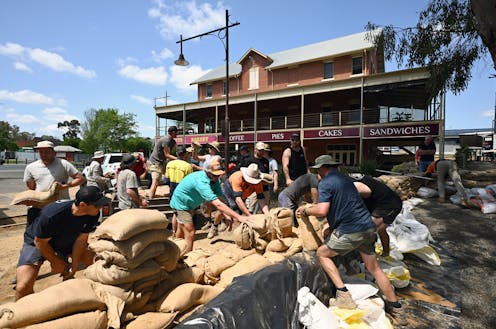
“We are […] sandbagging the state”, New South Wales Emergency Services Minister Steph Cooke declared on Saturday. And so we endure the third La Niña season with this waiting-for-the-next-disaster attitude.

After heavy rain and repeated floods across Australia’s eastern states over the past three years, it’s worth considering what we have and haven’t learned.

A good way to improve flood readiness is to understand how floods work, and then to examine adaptive solutions developed by communities facing similar situations in other countries. Every river behaves differently and responses should site-specific. However, the following approaches may be relevant to local conditions and are likely to improve flood protection.


Read more:
La Niña, 3 years in a row: a climate scientist on what flood-weary Australians can expect this summer


Work with nature, not against it

Flooding is complex. Factors such as climate variability, soil saturation, loss of vegetation cover in key parts of catchments, the growth of urban areas and their hard surfaces, the failure of early-warning systems, the erosion of community self-reliance, and inadequate governance all influence the risks.

Complex unpredictable conditions call for an integrated suite of responses to manage the risk.

Engineered infrastructure, such as dams and levees, has encouraged us to live on floodplains with little regard for the impacts of climate variability. Dams and levees work within predicted parameters, but we can’t expect that predictability anymore.

And planning regulations that restrict building on floodplains can be useful but are only part of the solution.

Many effective “nature-based” solutions run counter to traditional engineering works. For example, rather than engineer a river channel to make water move more quickly through an area, nature-based solutions modify or multiply river channels to accommodate variable water volumes. These approaches spread out and slow the flow of water and encourage it to soak into the ground before reaching the river.

Overseas, China makes “sponge cities” with urban wetlands and revegetated waterways. The Netherlands has removed dykes and widened river corridors as part of its Room for the River program.


Read more:
I lived through Hurricane Katrina and helped design the rebuild – floods will always come, but we can build better to prepare


These strategies often require land to be rezoned and buildings removed. That’s a brave move in the face of urban growth pressures.

But these strategies also offer an opportunity to refocus cities, towns or even regions, by reintegrating nature and opening up new spaces for recreation, environmental regeneration and biodiversity. The independent 2022 NSW Flood Inquiry recognised just such an approach. Its report called for floodplains to be thought of as assets serving environmental, recreational and community uses while allowing space for flooding.

In agricultural regions, allowing farmland to flood temporarily can help relieve pressure on urban infrastructure downstream. On the US west coast, for example, wetlands have been incorporated into crop-rotation cycles. In times of flood these farmlands draw down excess water from the river while improving soil quality, fertility and ecosystem health. In the Tisza Valley in Hungary, farmland has been adapted as slow-release wet-season reservoirs.

Agricultural practices that improve soil quality, prevent erosion, slow runoff and encourage water to soak into the ground can also make a difference. These practices include strip cropping – alternating rows of two or more crops – to redirect and dissipate floodwaters, gully planting, and fencing and planting riverbanks.

What can communities do?

Elsewhere, early-warning systems are drawing on citizen science to make communities less vulnerable.

In Jakarta, a low-lying city that regularly floods, Indonesian researchers capitalised on the intensity of flood-related social media posts. They developed an app to integrate and geolocate those posts across the catchment. The app gives residents access to alternative real-time data, allowing them to make their own decisions about timely preparation and evacuation.


Read more:
Some councils still rely on outdated paper maps as supercharged storms make a mockery of flood planning


The March 2022 floods in Lismore, NSW, show the need for such systems. The Bureau of Meteorology did not consider local rainfall measurements scientific enough to be counted as evidence and some of its data-sensing tools were faulty. This type of communication failure is quite common.

Houses in flood-prone areas can be modified to cope with floodwaters. Typical measures include raising them on stilts and retrofitting interiors using materials that don’t absorb water. They can then be hosed down during clean-up.

Governments can provide support to minimise vulnerability. This might include funding neighbourhood resources such as boats with motors, kayaks and floodproof containers to store valuables. Water and power can be provided to designated local evacuation areas on high ground.

And then there’s relocation

If all else fails, there is always managed retreat. This involves relocating a town to high ground.

Recent research reviewing all known cases of managed retreat in the United States over the past 140 years suggests this approach has had mixed results. It’s enormously expensive and exhausting. Typically, the shift benefits developers and government rather than the vulnerable communities.

If communities are to move, another study suggests the move needs to be planned well in advance. It should be done outside the time frame of a flood event when affected communities are already vulnerable.


Read more:
‘Building too close to the water. It’s ridiculous!’ Talk of buyouts after floods shows need to get serious about climate adaptation


Draw on all available knowledge

In Australia, there have been increasing calls for Traditional Owners to take a leading role in exploring how our policies, planning and practices might better incorporate Indigenous practices of managing land, including catchment and river systems.

Our heavy reliance on sandbagging suggests we really don’t understand the river landscapes we inhabit. Learning to live with floods, especially in the face of the uncertainties of climate change, requires us to learn from our own past as well as the successes and failures of others.

Any suite of solutions will have to be tailored to the unique conditions of a river, its landscape systems, land uses and settlement patterns. A single solution would be nice, but that is never going to be the reality.


UTS is planning an exhibition of flood strategies in Lismore, NSW, in late November.

The Conversation

The authors do not work for, consult, own shares in or receive funding from any company or organisation that would benefit from this article, and have disclosed no relevant affiliations beyond their academic appointment.

ref. Beyond a state of sandbagging: what can we learn from all the floods, here and overseas? – https://theconversation.com/beyond-a-state-of-sandbagging-what-can-we-learn-from-all-the-floods-here-and-overseas-193011
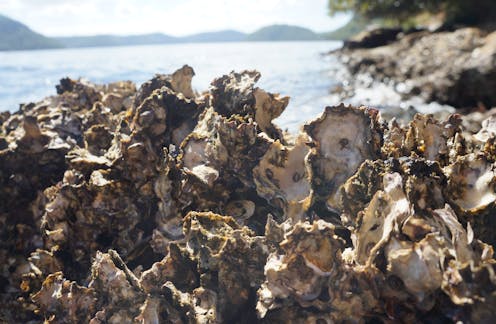

Playing sea soundscapes can summon thousands of baby oysters – and help regrow oyster reefs

Source: The Conversation (Au and NZ) – By Dominic McAfee, Postdoctoral researcher, marine ecology, University of Adelaide

Dominic McAfee, Author provided

Imagine you’re in a food court and spoilt for choice. How will you choose where to eat? It might be the look of the food, the smell, or even the chatter of satisfied customers.

Marine animals do the same thing when choosing a good place to live. Even seemingly simple creatures such as marine larvae use sight, smell and sound as navigational cues. Once we understand these cues, we can use them to help nature recover faster than it would on its own.

In our new research, we amplified the natural sounds of the sea through underwater speakers. We were testing if sound cues would draw baby oysters to swim to the locations where we are trying to regrow oyster reefs. It worked better than we’d hoped. Many thousands more larvae swam to our locations than control areas and settled on the bare rocks.

Flat oyster
Billions of Australian flat oysters once filtered our coastal seas. Could they return?
John Turnbull/Flickr, CC BY

Why can’t these reefs return naturally?

Oyster reef restoration is gaining momentum in Australia and globally as a way to restore healthy ecosystems. Reefs of shellfish reefs filter and clean vast volumes of water as they feed, while their shell piles provide habitat for fish. Oysters are also food for many marine species.

These highly productive shellfish reefs once spanned thousands of kilometres of Australian waters, but more than 90% were dredged up for food and or to use their shells as lime for cement during the early colonial years.


Read more:
The surprising benefits of oysters (and no, it’s not what you’re thinking)


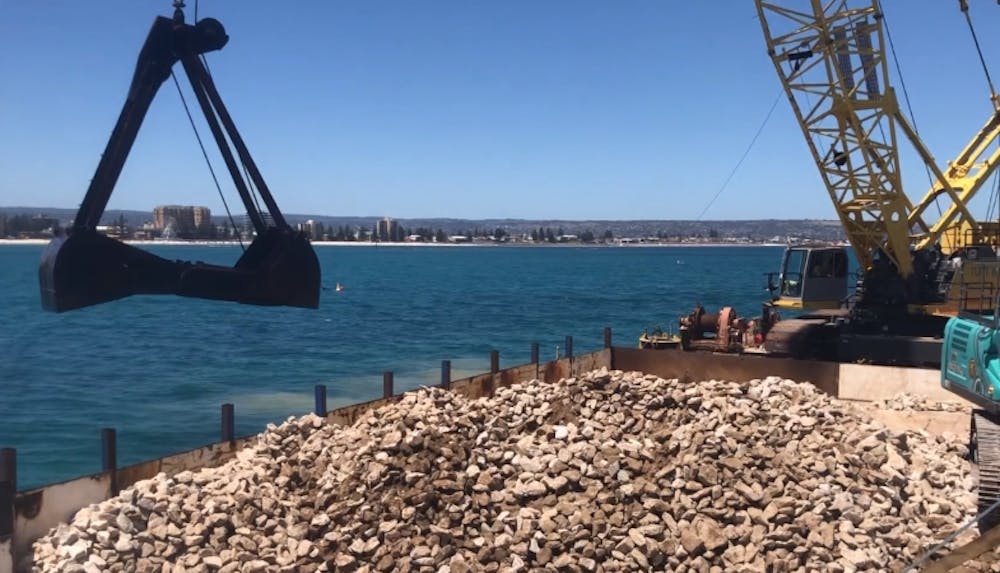
When we try to restore these reefs, however, we hit a problem. Free-swimming baby oysters need to find the boulders we drop onto sandy seafloors at our restoration sites.

Restoring shellfish reefs starts with a limestone base, as in this construction image of the Glenelg oyster reef project.
Maritime Constructions, CC BY

That’s where our siren songs come in. Many marine animals use sound like we use sight on land. Think of whalesong, which lets whales communicate over long distances. Sound is more useful than sight or smell underwater because it can carry information a long way – much further than you can see – and without getting pushed about by ocean currents.

If you’ve snorkelled on a coral or rocky reef, you’ll know healthy reefs are surprisingly noisy. As you float over the reef, you hear a cacophony of sound: crackles and pops from fish as they feed and invertebrates like snapping shrimp.

If this soundscape is present, it tells oyster larvae it’s a healthy habitat. And because sound travels so well, the soundscapes are broadcast a decent distance. That’s why it’s such a useful cue if you’re a baby oyster looking for a rock to settle on and begin growing your shell.

To test if this works outside the laboratory, we recorded sounds from the healthy Port Noarlunga Reef in South Australia. Then we played these sounds underwater near two large reef restoration sites offshore from Adelaide and the Yorke Peninsula.

This attracted up to 17,000 more oysters per square metre to our restoration sites. Not only that, but over the next five months, close to four times more large oysters grew in our test areas, which accelerated habitat growth. By contrast, the areas where we played ambient sound from oyster-free areas produced only stunted habitat with few oysters settling.


Read more:
The world’s most degraded marine ecosystem could be about to make a comeback


Hang on, oysters can hear?

The way we hear is based on the pressure of soundwaves hitting our eardrums. Marine mammals like seals and dolphins hear this way too. But fish and marine invertebrates such as oysters are different.

Oyster larvae are brainless and earless, but they are certainly not clueless. Like fish, they hear by detecting and interpreting the movement of water particles stirred up by soundwaves as they pass. Soundwaves alternately squish and stretch water particles, sending vibrations in the direction the soundwave is moving. Oysters sense this motion with tiny sensory hairs, or with statocysts, sensory organs used for balance and orientation.

Despite being only the width of a human hair themselves, larval oysters use these organs to follow these vibrations back towards the healthy reef producing the sound. In adult oysters, the tiny statocyst is near impossible to find. But swimming oyster larvae project their statocysts out in front of them, presumably to improve navigation and interpret marine sounds.

oyster larvae
You can see the oyster larvae’s sound-sensing organ covered in tiny hairs.
S. Pouvreau/Ifremer, Author provided

The reefs are alive with the sound of music

Researchers and community groups around the world are launching restoration efforts to repair some of the damage we’ve done. In Queensland, for instance, fishing communities in Moreton Bay offshore from Brisbane plan to restore 100 hectares of oyster reef over the next decade.

While exciting, success isn’t guaranteed. It can be hard to restore ecosystems which haven’t existed for a century. And it can be expensive to get large stocks of larvae.

This technique – and others like it – could help improve how many baby oysters or other keystone species actually make it to their new homes and start the great task of reef-building.

Researchers have discovered fish can be attracted to coral reef sites by playing healthy reef noises, and it has long been known that birds can be drawn to specific nesting sites by playing their social calls.

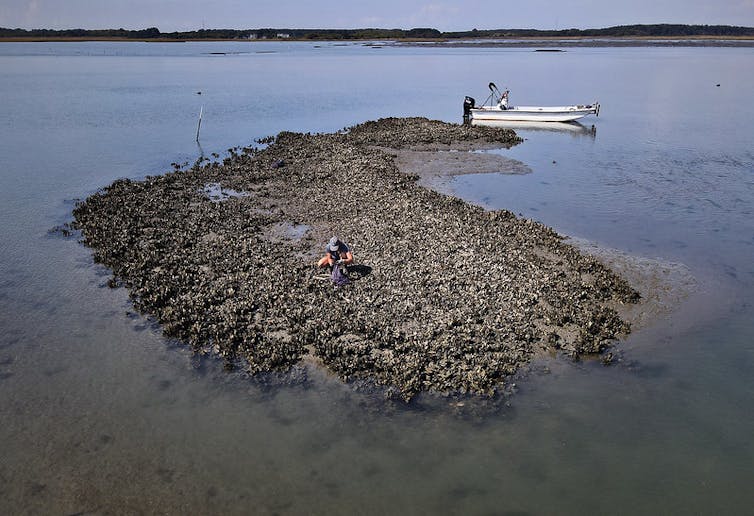
oyster reef virginia
Oyster reef restorations are taking place in countries like America. This image shows surviving oyster reefs in Virginia.
Aileen Devlin/Flickr, CC BY

In science, there’s no such thing as a silver bullet and there are potential downsides. It wouldn’t help if we drew all larval oysters to our sites at the expense of others – or if we attracted predators in large numbers.

But if we do this carefully, these techniques could help re-establish the invisible acoustic highways of the sea – and turn the deathly quiet of many coastal waters back into vibrant, noisy and healthy oyster reefs.


Read more:
Once the fish factories and ‘kidneys’ of colder seas, Australia’s decimated shellfish reefs are coming back


The Conversation

Dominic McAfee receives funding from the Australian Research Council.

Sean Connell receives funding from the Australian Research Council.

Brittany Williams and Lachlan McLeod do not work for, consult, own shares in or receive funding from any company or organisation that would benefit from this article, and have disclosed no relevant affiliations beyond their academic appointment.

ref. Playing sea soundscapes can summon thousands of baby oysters – and help regrow oyster reefs – https://theconversation.com/playing-sea-soundscapes-can-summon-thousands-of-baby-oysters-and-help-regrow-oyster-reefs-188006

Fiji academic warns over media ‘climate injustice’ in open access webinar

By David Robie

A Fiji-based academic challenged the Pacific region’s media and policymakers today over climate crisis coverage, asking whether the discriminatory style of reporting was a case of climate injustice.

Associate Professor Shailendra Singh, head of the journalism programme at the University of the South Pacific, said climate press conferences and meetings were too focused on providing coverage of “privileged elite viewpoints”.

“Elites have their say, but communities facing the brunt of climate change have their voices muted,” he told the Look at the Evidence: Climate Journalism and Open Science webinar panel exploring the role of journalism in raising climate awareness in the week-long Open Access Australasia virtual conference.

Dr Singh, who is also on the editorial board of Pacific Journalism Review and was speaking for the recently formed Asia Pacific Media Network (APMN), threw open several questions to the participants about what appeared to be “discriminatory reporting”.

“Is slanted media coverage marginalising grassroots voices? Is this a form of climate injustice?” he asked.

“Are news media unknowingly perpetuating climate injustice?”

He cited many of the hurdles impacting on the ability of Pacific news media to cover the climate crisis effectively, such as lack of resources in small media organisations and lack of reporting expertise.

‘Jack-of-all-trades’
“We are unable to have specialist climate reporters as in some other countries; our journalists tend to be a jack-of-all-trades, and master of none,” he said.

He did not mean this in a “disparaging manner”, saying “it’s just our reality” given limited resources.

Key Pacific media handicaps included:

• The smallness of Pacific media systems;
• Limited revenue and small profit margins;
• A high attrition rate among journalists (mostly due to uncompetitive salaries);
• Pacific journalists “don’t have the luxury” of specialising in one area; and
• No media economies of scale.

“Our journalists don’t build sufficient knowledge in any one topic for consistent or in-depth reporting,” he said. “And this is more deeply felt in areas such as climate reporting.”

He cited recent research on Pacific climate reporting by Samoan climate change journalist Lagipoiva Dr Cherelle Jackson, saying such Pacific media research was “scarce”.

‘Staying afloat in Paradise’
A research fellow with the Reuters Institute and Oxford University, Dr Jackson carried out research on how media in her homeland and six other Pacific countries were covering climate change. The report was titled Staying Afloat in Paradise: Reporting Climate Change in the Pacific.

Pacific journalists and editors “have a responsibility to inform readers on how climatic changes can affect them, she argued. But this did not translate into the pages of their newspapers.

“Climate change is simply not as high a priority for Pacific newsrooms as issues such as health, education and politics which all take precedence over even general environment reporting,” Dr Jackson wrote.

“For a region mainly classified by the United Nations as ‘least developed’ and ‘developing’ countries, it is apparent that there are more pressing issues than climate change.

“But the fact that the islands of the Pacific are already at the bottom end of the scale in regards to wealth and infrastructure, and the fact that climate change is also threatening the mere existence of some islands, should make it a big story. But it isn’t.”

Newsroom's Marc Daalder
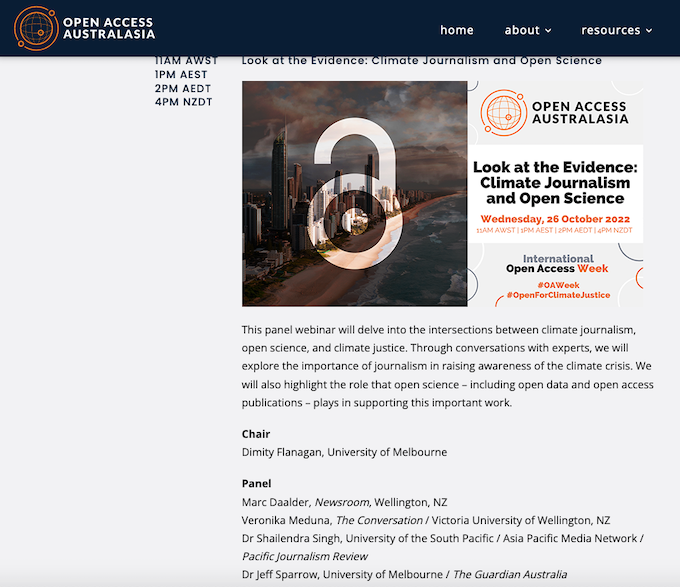
Newsroom’s Marc Daalder . . . “we need this [open access] to happen for climate reporting”. Image: Open Access Week 2022 screenshot APR

The Open Access Australasia media panel today also included Newsroom’s Marc Daalder, The Conversation’s New Zealand science editor Veronica Meduna, and Guardian columnist Dr Jeff Sparrow of the University of Melbourne.

Critical of paywalls
Daalder spoke about how open access to scientific papers was vitally important for journalists who needed to read complete papers, not just abstracts. He was critical of the paywalls on many scientific research papers.

Open access enabled journalists to do their job better and this was clearly shown during the covid-19 pandemic — “and we need this to happen for climate reporting”.

Meduna said it took far too long for research, such as on climate change, to filter through into public debate. Open access helped to reduce that gap.

She also said the success of The Conversation model showed that there was a growing demand for scientists communicating directly with the public with the help of journalists.

Dr Sparrow called for a social movement for meaningful action on the climate crisis and more scientific literacy was needed to enable this.

Highly critical of the “dysfunctional” academic publishing industry, he said open access would contribute to “radically accessible” science for the public.

The panel was organised by Tuwhera digital and open access publishing team at Auckland University of Technology.

Open Access Week 2022
Open Access Week 2022 … the media climate webinar panel. Image: Open Access Week screenshot APR
Print Friendly, PDF & Email

Article by AsiaPacificReport.nz

Morning Star flag protester in West Papua dies of mystery illness

RNZ Pacific

One of eight West Papuan activists who raised the banned Morning Star flag of independence in a protest last December has died.

Zode Hilapok’s death was confirmed by a relative, Christianus Dogopia, who said that since being detained, Hilapok’s health had been deteriorating.

Dogopia said that on 12 December 2021 his relative began experiencing symptoms of illness, feeling fatigued and sleepy.

At that time, Hilapok lost weight dramatically.

“At that time he ate only rice, without side dishes, or with vegetables but in small portions. Otherwise, his stomach hurt or he would become nauseated. His bowel movements were bloody,” Dogopia said.

Hilapok and seven friends, all aged between 18 and 29, were arrested by police on December 1, 2021, when they marched in front of the Papua police headquarters carrying Morning Star flags and banners.

The flag is considered a symbol of the West Papua struggle for independence and has been strictly banned by the Indonesian authorities with jail sentences of up to 15 years for offenders.

The treason case against Zode Hilapok was never tried because he was ill.

He died at Yowari Hospital on October 22.

In August, the other seven were found guilty of treason and sentenced to 10 months in prison from the day they were detained.

They were released in September.

Hilapok’s death comes after a West Papuan leader, Buchtar Tabuni, was arrested by Indonesian police.

The West Papua Morning Star flag
The banned West Papua Morning Star flag . . . iconic symbol of resistance flown globally in protests in support of self-determination and independence. Image: RNZ Pacific/AFP
Print Friendly, PDF & Email

Article by AsiaPacificReport.nz

‘Frightening to see such violence’ in tribal war on PNG’s Kiriwina island

By Rebecca Kuku in Port Moresby

At least 32 people have been killed in an all-out war between Kulumata and Kuboma tribes in Milne Bay’s Kiriwina island.

Internal Security Minister Peter Tsiamalili Jr confirmed that the killings had erupted early last month after yam gardens were destroyed.

“A police team from Port Moresby was deployed yesterday morning to the island to contain and manage the raging war,” he said.

“The Commissioner of Police David Manning is in charge of the operations and directives.

“He has advised me that he is taking swift and appropriate action.

“Police will help forge peace,” he added.

According to sources on the ground, the fight started in early September when a man from Kuboma tribe was killed in a fight over a soccer game in the remote Trobriand archipelago.

Situation still tense
The situation has remained tense since then and escalated on Monday, when the Kuboma villagers (seven villages inland that include Bwetalu, Yalaka, Buduwalaka, Kuluwa, Luya, Wabutuma and Gumilababa villages) allegedly destroyed all the yam gardens of the Kulumata villages (Kavataria, Mulosaida and Orabesi villages).

The Kulumata villagers went up to the station to demand answers from the district development authority on why their yam gardens were destroyed and for authorities to address the situation when they were attacked by the Kuboma villagers who were already there waiting for them.

All-out tribal warfare with traditional spears and bush knives broke out between the two parties, that led to 26 people being killed from the Kuboma side and about six people killed from the Kulumata side.

Kiriwina island in the Trobriands
Kiriwina island in the Trobriands . . . “Tribal fighting has always been part of our lives and culture. But normally when someone got killed, the fighting stopped.” Image: Scott Waide/RNZ Pacific

Another source said it was “frightening to see such violence on their island” that is locally known or dubbed as the “island of love”.

“Tribal fighting has always been part of our lives and culture.

“But normally when someone got killed, the fighting stopped, they cease fire and start the traditional process of dealing with the death, and they do not just continue fighting like this.

“The Kulumata and the Kuboma people are all related to each other and it is heartbreaking for us as mothers, sisters, daughters to watch our people fight among themselves like this.”

“But you must also understand that our gardens are very important to us.

Painted in war colours
“Our yams are important and very valuable, to see them chopped off, destroyed — yes our men would be so angry, because we value our gardens.”

They [men] painted themselves in the traditional war colors and went up to the station to show their frustration.

When they met the other party, they started fighting, and we ran away with our children.

“They will not harm women and children but it was just too frightening to watch, so we ran away,” the source said.

Attempts to get comments from the local MP and Deputy Opposition Leader Douglas Tomuriesa was unsuccessful yesterday.

RNZ Pacific’s PNG correspondent Scott Waide said the clash during the football match five weeks ago left two people dead.

He told RNZ Pacific Waves that in this week’s retaliatory attack a 13-year-old boy was among the dead and several women were wounded.

Kiriwina Island Area Manager Nelson Tauyuwada said in the lead-up to the massacre, crops were damaged, threatening livelihoods.

Rebecca Kuku is a reporter with The National in PNG. Republished with permission.

Print Friendly, PDF & Email

Article by AsiaPacificReport.nz

Politics with Michelle Grattan: Jim Chalmers, Angus Taylor and Danielle Wood on the budget

Source: The Conversation (Au and NZ) – By Michelle Grattan, Professorial Fellow, University of Canberra

Treasurer Jim Chalmers says of his first budget: “Inflation is the dragon we need to slay”. Chalmers’ worry about inflation was reinforced by Wednesday’s release of the September quarter CPI, which showed inflation at 7.3%.

In this podcast, we talk to Chalmers, shadow treasurer Angus Taylor, and the head of the Grattan Institute Danielle Wood. Among the topics we canvass are the budget’s broad fiscal settings, the huge increases in power prices it forecasts, the pressures for tax and spending reforms in future budgets, the government’s housing initiative, and the implications of the childcare policy for women’s workforce participation.

The Conversation

Michelle Grattan does not work for, consult, own shares in or receive funding from any company or organisation that would benefit from this article, and has disclosed no relevant affiliations beyond their academic appointment.

ref. Politics with Michelle Grattan: Jim Chalmers, Angus Taylor and Danielle Wood on the budget – https://theconversation.com/politics-with-michelle-grattan-jim-chalmers-angus-taylor-and-danielle-wood-on-the-budget-193335

The women’s budget is headed in the right direction. But the policies still need work

Source: The Conversation (Au and NZ) – By Helen Hodgson, Professor, Curtin Law School and Curtin Business School, Curtin University

The Labor federal government promised it would make women central to its first budget.

The inclusion of an evidence-based women’s budget statement shows a greater awareness of the systemic challenges, particularly to women’s economic security. The statement sets out a number of systemic issues that must be addressed to ensure women achieve economic equality.

But the policies still need work.

The headline items: childcare and paid parental leave

In a year when dealing with inflation has taken priority over supporting low-income Australians, the headline items are increased access to childcare and paid parental leave.

The childcare measures are fulfilling an election promise. Legislation is already before parliament to increase the rate of the childcare subsidy from 85% to 90% for a family with one child where the family income is less than $80,000.

The changes to paid parental leave were also announced ahead of the budget. This proposal will increase paid parental leave from 20 to 26 weeks, with an extra two weeks being available each year from July 1 2023 to July 1 2026. The Morrison government’s March 2022 budget proposed some changes, but the increased time is a new measure.


Read more:
Paid parental leave extended to 26 weeks by 2026, with pressure on dads to share more early caring


The current government has acknowledged that the former government’s proposals for flexibility would reinforce stereotypical gender roles. It has stated there will be a use-it-or-lose-it allocation for dads and partners, but has not identified how the increased allocation will be shared between parents. This has been referred to the Womens’ Economic Equality Taskforce for further advice.

While the use-it-or-lose-it component is important to promote shared parenting, the rate of payment, at minimum wage, is a further deterrent to dads taking advantage of the scheme. There’s no proposal to increase the rate of payment to a rate closer to replacement wage, and again there’s no commitment to pay superannuation on paid parental leave.

The changes to childcare and paid parental leave are welcomed as necessary to retain women’s attachment to the paid labour market during the critical period of family formation: following childbirth and before the children attend school.

However, there’s little support for other families in this budget, particularly those families who will be doing it tough as inflation and interest rate rises erode their take-home income.

About $1.7 billion has been allocated to women’s safety over four years. Respect@Work initiatives have been allocated $42.5m, new “working women’s centres” have been allocated $32m, and there’s $65m for consent and respectful relationships education in schools.

The National Plan to End Violence Against Women and Children has been allocated $1.3 billion. The detail of these measures is still thin as the underlying action plan is under development, but prevention measures must be included.

Funding for the national plan illustrates the approach the government has taken to reviewing programs from the previous government with funding from those measures being redirected to new, “better targeted” commitments.

A first step

The women’s budget statement piloted gender impact analysis to identify policies that affect women negatively compared to men. Gender impact analysis is an important step toward gender responsive budgeting. It can identify how mainstream programs can be designed to be inclusive and take account of the needs of women, as well as where a gender specific program is needed.


Read more:
Applying a gender lens to the budget is not about pitting women against men


The Office for Women piloted gender impact analysis in several policy areas including the housing needs of women, apprenticeship and training data, and the child care reforms.

For example, gender impact analysis was applied when writing the government submission to the Fair Work Commission for the Aged Care Work Value Case.

This budget goes on to include gender equity as an object of the Fair Work Act, and to establish Pay Equity and Care and Community Sector expert panels at the Fair Work Commission. This will focus attention on the issues around pay rates in the care sector which has a predominantly female workforce. Improving pay rates will also increase the rate of male employment resulting in a more gender balanced workforce.

However, the matter of how to fund higher wages in the care sector hasn’t been specifically addressed in this budget. While the service provider will pay the increased wages cost, this will create a cost pressure point in the system.

Budget Paper 1 included a statement on “Measuring What Matters”, which discusses how to develop a framework for wellbeing budgeting. It’s important gender indicators are taken into account in developing the wellbeing budget framework, but the work on gender responsive budgeting must also continue.

The women’s budget is headed in the right direction, but there needs to be capacity building across the public service to ensure systemic issues are addressed across portfolios.

The Conversation

Helen Hodgson has received funding from the ARC, AHURI and CPA Australia. Helen is the Chair of the Social Policy Committee and a Director of the National Foundation for Australian Women (NFAW) and on the Gender and Career Progression Committee of CPA Australia (WA Division). Helen was a Member of the WA Legislative Council in WA from 1997 to 2001, elected as an Australian Democrat. She is not a current member of any political party. She is a Registered Tax Agent and a member of the SMSF Association, CPA Australia and The Tax Institute.

ref. The women’s budget is headed in the right direction. But the policies still need work – https://theconversation.com/the-womens-budget-is-headed-in-the-right-direction-but-the-policies-still-need-work-193100

Chalmers hasn’t delivered a wellbeing budget, but it’s a step in the right direction

Source: The Conversation (Au and NZ) – By Warwick Smith, Research economist, The University of Melbourne

It was billed as Australia’s first wellbeing budget. But, five months into a new government, with so many economic fires to fight, Treasurer Jim Chalmers’ first budget was never going to be that.

Instead, he’s taken the first step: to get a sense of what we want for society and measuring how we’re doing. The budget papers refer to this as “measuring what matters”:

Indicators that measure broader quality of life factors should be considered in addition to, not instead of, traditional macroeconomic measures. When policy processes consider these outcomes, they facilitate more holistic discussions of the type of economy and society Australians want to build together.

The main commitment is to produce a “Measuring What Matters Statement” in 2023 that will lay out the government’s proposed wellbeing measures, drawing on international frameworks established over the past half-century.

A holistic wellbeing approach enables us to look at the root causes of problems, instead of simply devising policies to treat the symptoms (vital though that is in the short term).

For example, measurable improvements in mental health can have profound implications for the justice system, and mental health in turn is affected by circumstances such as poverty, domestic violence and joblessness.

Reforms based on a wellbeing approach would look to reorient the economy so that poverty, domestic violence and joblessness are reduced. This would reduce the need for police, courts, prisons, mental health support and welfare.

Treasury is thankfully moving slowly on this. I say “thankfully” because establishing an effective wellbeing approach is complex and will take time – particularly if ordinary people are to be included in the process.


Read more:
Jim Chalmers’ 2022-23 budget mantra: whatever you do, don’t fuel inflation


Consulting diverse communities

The initial consultation on the Measuring What Matters Statement announced by Treasury is so far restricted to written submissions. Such a process will attract the usual suspects: think tanks, academics, unions, social services organisations, and so on.

Ideally, the process will be broadened, with officials going to a diverse range of communities to learn what’s important to people and places.

The Australian Capital Territory government ran consultations like this in 2019 and 2020 when developing its Wellbeing Framework. The Victorian Council of Social Services this year conducted a Listening Tour of 12 communities with similar goals in mind.

Building from this, the Victorian Health Promotion Foundation has published How to create a wellbeing economy, which explains the systemic changes to which a wellbeing budget can contribute. Closing the Gap is another relevant Australian framework that can inform Treasury’s work.

Learning from others

It is encouraging the budget papers focus on the lessons we can learn from wellbeing budgets and wellbeing economy frameworks internationally.

Rather than starting from scratch, Australia can build on what has been developed by the OECD and governments such as Scotland, New Zealand, Wales and Canada, avoiding their mistakes and emulating their successes.


Read more:
Australia’s wellbeing budget: what we can – and can’t – learn from NZ


One of the key lessons from these international efforts is that measurement alone does not bring about change. We also need high-level goal-setting and explicit plans for how government agencies can contribute to achieving those goals.

What makes a wellbeing budget

The Albanese government’s first budget contains many measures that may contribute to increased wellbeing.

These include resurrecting the gender budget statement (introduced by the Hawke government in 1984 but discontinued in 1997 under the Howard government), increasing paid parental leave and child care subsidies, resourcing for a referendum on an Indigenous voice to parliament and a truth-telling process, and funding for climate change mitigation and adaptation.

But a budget containing items that improve wellbeing does not make a wellbeing budget. A genuine wellbeing government approach will have the following characteristics:

• It will take a holistic approach to policy development, assessment and implementation. This means breaking down silos between government departments and between levels of government.

• It will take a long-term view. Wellbeing approaches consider not just the wellbeing of people alive today but also future generations. This means considerations of wellbeing inherently include environmental sustainability and nature conservation.

• It considers upstream drivers of wellbeing rather than treating the symptoms caused by an economy that is not serving the interests of people and planet.

But immediate action is needed too

This “upstream” approach to policy design and service delivery has the potential to improve wellbeing and reduce the need for public expenditure in many spheres.

Chalmers’ first budget is an encouraging beginning of what is hopefully a meaningful journey to reform. A new measurement framework will inform systemic change.

There is, however, much that can be done right now to improve the lives of millions of people in Australia.


Read more:
5 charts on Australian well-being, and the surprising effects of the pandemic


At its most basic level, wellbeing requires safety, food, health care, housing, connection to community and opportunity to contribute. We know many who lack these basics. They include those surviving on JobSeeker paymments, well below the poverty line, forced to skip meals and live in their cars. They include Indigenous women lacking basic physical safety.

A wellbeing approach, looking at the drivers of these problems in an attempt to reorient society and the economy so they do not occur, must be coupled with more immediate action.

Hopefully the next budget can deliver both progress towards a more complete wellbeing framework as well as immediate action that will improve the wellbeing for those in dire need.

The Conversation

Warwick Smith is Wellbeing Lead at the Centre for Policy Development and Co-founder and Director at the Castlemaine Institute.

ref. Chalmers hasn’t delivered a wellbeing budget, but it’s a step in the right direction – https://theconversation.com/chalmers-hasnt-delivered-a-wellbeing-budget-but-its-a-step-in-the-right-direction-192840

Budget restraint? When it comes to transport projects, it’s hard to find

Source: The Conversation (Au and NZ) – By Marion Terrill, Transport and Cities Program Director, Grattan Institute

“Restraint” – that’s what Treasurer Jim Chalmers claimed as the watchword of Tuesday’s federal budget. Perhaps the claim can be made in general, but when it comes to transport infrastructure, the budget is remarkable not for how different it is to budgets past, but how similar. It has left plenty of opportunities for actual restraint for next time around, in May 2023.

The first similarity to budgets past is how much is being committed to transport infrastructure.

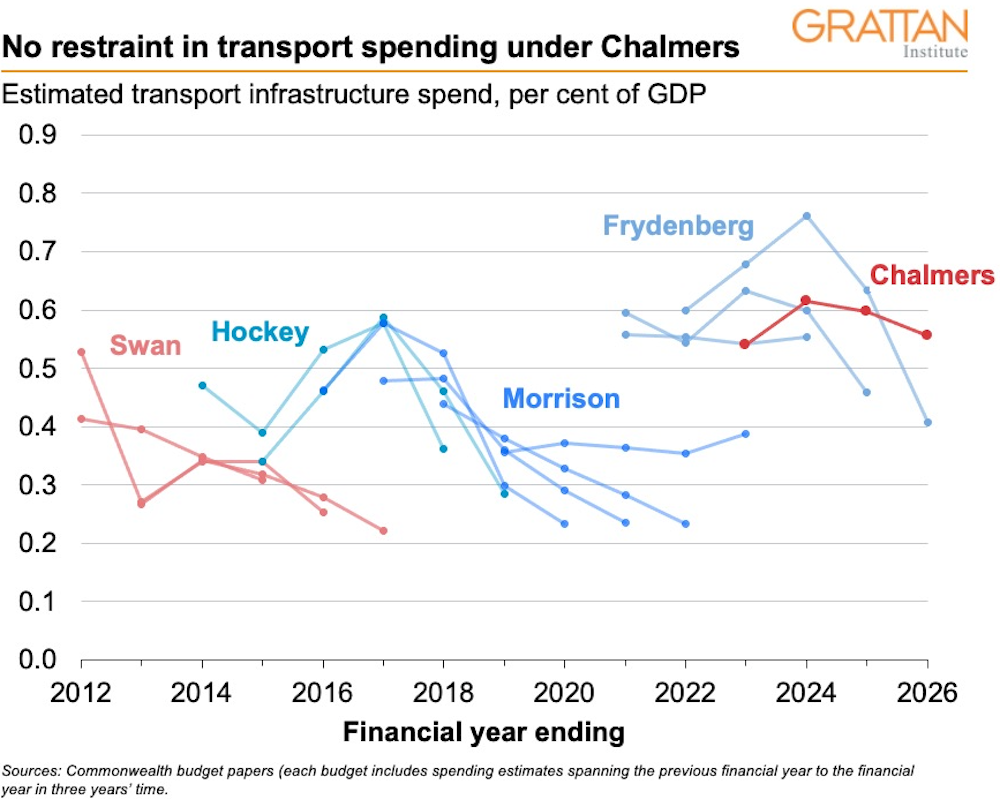
This year the total is about 0.6% of GDP, much like Josh Frydenberg’s budgets of the past three years. That equates to A$13.4 billion this year, rising to about A$15 billion for each of the next three years.

Chart showing level of transport spending in federal budgets, 2012 to 2022

Author provided

What Frydenberg and Chalmers have in common is that they have presided over a big shift upwards in the total spend, from around 0.4% of GDP under their predecessors Scott Morrison, Joe Hockey and Wayne Swan. It’s hardly “restraint”.

Headline numbers are inflated

The second similarity to budgets past is the irresistible temptation to quote far bigger numbers than are actually committed in the budget.

It’s all very well to say what you plan to deliver in ten years and beyond, but the budget is all about what you’re committing this year and the following three. It’s just like legislating stage 3 tax cuts in 2019; three years and a pandemic later, it’s hard to backtrack.

The problem is exacerbated because the headline number includes projects already committed long ago. The claim in the budget glossy is that the Albanese government “is delivering on its election commitments as part of the more than $120 billion pipeline of investment in transport infrastructure over the next 10 years”.

But what’s actually committed in the budget for additional road and rail is $8.1 billion of new money over ten years. Most of the eye-watering $120 billion predates this government.

For example, New South Wales residents may applaud the promise to spend $300 million on western Sydney roads and $500 million on early works for high-speed rail, and a total NSW commitment of $1.4 billion over ten years. But it’s hard to square that with the infrastructure minister’s promises of $5.25 billion for the Sydney Metro to Western Sydney Airport, and $1.6 billion for the M12 motorway.

Similarly, Victorians may eagerly anticipate the $125 million for the Barwon Heads Road upgrade and $2.2 billion towards the Suburban Rail Loop. There’s a total commitment of $2.6 billion for the state over ten years. But how does that line up with the minister’s promises of $5 billion for Melbourne Airport Rail, along with $448 million for Gippsland Rail?

Infrastructure Australia bypassed

The third similarity to budgets past is how projects are selected for funding.

Prime Minister Anthony Albanese is proud of Infrastructure Australia. It’s the body he set up as infrastructure minister in the Rudd government to help elected representatives who, he said, struggled “with the need to take a long-term non-partisan view” of infrastructure. Yet this budget includes billions of dollars for projects that should have gone through an Infrastructure Australia assessment, but haven’t.

The standout is Melbourne’s Suburban Rail Loop. It’s the signature project of the Andrews state government as it heads into a November election. The project was announced three months out from the previous Victorian election, and a business case wasn’t published until three years after the decision to invest. It’s very controversial.

The state government claims that building the east and north sections of the rail loop and operating them for 50 years will cost $31 billion to $51 billion. In stark contrast, the Victorian Parliamentary Budget Office calculates it will cost $200 billion.

What does Infrastructure Australia think? It considers the project a very long way from investment-ready.

Another standout is a $500 million down payment on high-speed rail. Even without a current business case, the government has declared it is “absolutely committed” to the project. If the numbers run in 2013 were correct, this project will cost at least $130 billion, and will compete with the since-begun Western Sydney Airport.

What does Infrastructure Australia think? Again, it considers that even corridor preservation for the project is a long way from investment-ready.

A third standout is $586 million to upgrade the Bruce Highway through Brisbane’s outer northern suburbs. The Bruce has had a massive program of upgrades over many years. Many sections have been assessed by Infrastructure Australia – but not this one.

None of these decisions could be described as restrained, and there are many similar.

Still waiting for rigorous assessments

Of course, it’s not easy to inherit a swag of major projects from the previous government, many of which are begun or at least anticipated. And it’s to this government’s credit that it has moved $6.5 billion worth of these projects to beyond the budget forward estimates, in recognition that the engineering construction sector is already struggling to keep up with demand. But in this environment, it makes little sense for the government to have thrown its weight behind new commitments, such as east-coast high-speed rail and the Suburban Rail Loop, that will tie its hands for decades to come.

Next time around, the treasurer should insist that each individual project up for funding consideration has been properly assessed by the government’s own independent advisory body. If the project is at too early a stage, the government shouldn’t invest public money in it.

A more rigorous project-by-project assessment would help the government determine how much of the transport spend is really worth it. Let’s hope. When it comes to transport, restraint is hard to find.

The Conversation

Grattan Institute began with contributions to its endowment of $15 million from each of the Federal and Victorian Governments. In order to safeguard its independence, Grattan Institute’s board controls this endowment. The funds are invested and Grattan uses the income to pursue its activities. Marion Terrill does not work for, consult, own shares in or receive funding from any other company or organisation that would benefit from this article, and has disclosed no relevant affiliations beyond the academic appointment above.

ref. Budget restraint? When it comes to transport projects, it’s hard to find – https://theconversation.com/budget-restraint-when-it-comes-to-transport-projects-its-hard-to-find-192848

This was supposed to be a ‘wellbeing budget’ – so why does it feel like the arts have been overlooked?

Source: The Conversation (Au and NZ) – By Jo Caust, Associate Professor and Principal Fellow (Hon), School of Culture and Communication, The University of Melbourne

The first Labor federal budget has come down, but the arts are almost nowhere to be seen.

According to Arts Minister Tony Burke, the government is waiting for its new cultural policy, to be delivered later this year.

Only then will we know if the government is going to take any real action to address the disastrous issues in the arts sector.

Given the emphasis in the budget on addressing issues around “wellbeing”, it is worrisome we have longer to wait before issues in the arts are addressed by the Labor government.

It took the Coalition government more than seven months to announce any real relief to the sector during COVID, by which time many individuals and organisations had given up. Timing is everything when people are desperate.

What are the issues in the arts? Where do we start?

There is the continued funding decline and support of the arts over the past 15 years, the defunding of respected arts organisations by the Australia Council since 2016, the dramatic decline in funding support for individual artists, the dire impact of the pandemic, and the need to recognise that cultural value is not the same as economic value, and both are needed.

Individuals who work in the arts are highly skilled and talented. Acknowledging their labour as important and valuable is just the beginning.

Our artists are another aspect of our national wealth. Australia cannot afford to ignore them.


Read more:
Everything you need to know about Labor’s first budget in 6 charts


The small budget measures

Nevertheless, the government has taken action in some areas.

This budget sees:

The budget also reflects the merging of Creative Partnerships Australia with the Australia Council.


Read more:
Jim Chalmers’ 2022-23 budget mantra: whatever you do, don’t fuel inflation


Creative Partnerships Australia

Creative Partnerships Australia costs the government around $4-5 million a year, so this merging will bring around $15 million to the Council over the next three years.

Creative Partnerships Australia grew out of the Australian Business Arts Foundation (AbaF), an initiative of the Howard government. Its mandate was to promote and facilitate private sector support for the arts and initially it focused on encouraging businesses to engage with the arts.

From 1998 to 2012, AbaF was driven through a council of business representatives, who committed $10,000 each and actively advocated for business partnerships with arts organisations. This council provided a rich resource base of potential benefactors and in its early days was successful at doing this. A separate arts philanthropy organisation, Artsupport Australia, sat under the Australia Council with AbaF support.

In 2012 Simon Crean, then arts minister, decided to excise Artsupport Australia from the Australia Council and re-orientate AbaF by rebranding it as Creative Partnerships Australia. Creative Partnerships Australia since then has had a primary focus on philanthropic support for the arts, and unlike AbaF, also distributes Commonwealth funds through grant programs.

Unlike the Australia Council, Creative Partnerships Australia is based in Melbourne (rather than Sydney), with staff also located in other cities. This means it has more immediate contact with its arts constituents outside Sydney.

The organisation has run many workshops over the years to develop fundraising skills for the arts, and has also been the home of the Australian Cultural Fund, which allows for donations to be given to individual artists and organisations that do not have tax deductibility status.

The loss of this stand-alone entity will likely be felt more by the smaller organisations and individuals than the larger ones. Larger organisations have no difficulty in claiming tax deductibility and greater likelihood of making connections with donors.

The Australia Council is a grant giving body, and has not historically facilitated philanthropy nor been a conduit for tax deductibility. It remains to be seen how these functions will be folded into the Australia Council.

The Labor government has a lot to do to restore confidence in the arts sector and help the sector recover from several terrible years. There is an urgency to this, but this urgency is nowhere to be seen in this budget.


Read more:
Jim Chalmers’ ‘restraint’ budget the first stage of a marathon for the treasurer


The Conversation

Jo Caust has previously received from the Australia Council. She is a member of NAVA and the Arts Industry Council (SA).

ref. This was supposed to be a ‘wellbeing budget’ – so why does it feel like the arts have been overlooked? – https://theconversation.com/this-was-supposed-to-be-a-wellbeing-budget-so-why-does-it-feel-like-the-arts-have-been-overlooked-193304

Labor’s ‘sensible’ budget leaves Australians short-changed on climate action. Here’s where it went wrong

Source: The Conversation (Au and NZ) – By Timothy Neal, Senior research fellow in the Department of Economics, UNSW Sydney

Joel Carrett/AAP

Treasurer Jim Chalmers last night delivered a budget he declared was “solid, sensible and suitable to the times”. But what does a sensible budget look like in a world that is fast running out of time on climate change?

Lowy Institute polling this year suggests most Australians believe immediate and substantial action on climate change is eminently sensible. Some 60% agreed global warming was a serious and pressing problem for which “we should begin taking steps now even if this involves significant costs”. A further 29% want mitigation to occur gradually.

Chalmers unveiled his budget in a precarious economic environment and amid fears of a looming global recession. But while the national conversation is focused on short-term economic pressures, the world is entering unprecedented territory of climate disruption.

This federal budget was Labor’s first opportunity to establish its economic vision for emissions reduction. Even as Chalmers prepared his speech, parts of Australia’s east coast were battling floods, and the summer rain outlook looks grim.

The budget earmarked a suite of worthwhile climate-related measures, but many are relatively piecemeal. As extreme weather events occur at a record-breaking frequency and severity, federal spending on climate action still falls well short.

two men in suits walk down path
The budget was Labor’s first opportunity to establish its economic vision for emissions reduction.
Lukas Coch/AAP

Where’s the tangible action?

Over the past few months, Labor has generated significant headlines on climate change.

It’s Climate Change Bill passed parliament last month. It means Australia’s greenhouse gas emissions must fall by 43% (relative to 2005 levels) by 2030, and emissions must reach net-zero by 2050.

Labor on Sunday also announced Australia will sign a global pledge to reduce methane emissions by 30% by 2030.

But setting these targets is just the first step. Limiting climate change to 1.5℃ degrees – the goal of the Paris Agreement – requires immediately reversing the upward trend in global emissions and making significant cuts over the next two decades. That means tangible actions must occur right now.

But looking at the budget papers released last night, it’s hard to see how Australia’s climate targets will be met.

What’s in the budget for climate?

Most budget measures related to climate change and the environment formed part of Labor’s pre-election platform. They include:

  • A$224 million over four years to fund 400 community batteries, and $100 million for community solar banks

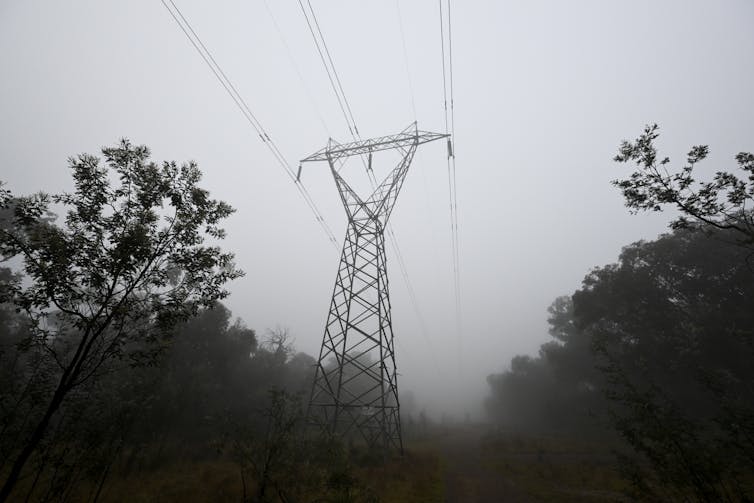
  • the Rewiring the Nation plan: $20 billion of low-cost finance to improve Australia’s transmission network, and new investments in renewable electricity generation which aren’t yet detailed


Read more:
Albanese government’s first budget delivers election promises but forecasts soaring power prices


transmission tower in mist
Labor’s $20 billion Rewiring the Nation plan will improve Australia’s transmission network.
Lukas Coach/AAP

Also worth noting are measures to mitigate the future impact of climate change:

  • the Disaster Ready Fund to support adaptation measures such as flood levees, sea walls, fire breaks and evacuation centres

  • $225 million over four years to implement the Threatened Species Action Plan and funding to establish Indigenous Protection Areas and protect heritage places

  • increased funding to preserve and restore the Great Barrier Reef.

These initiatives are, in part, funded by a $747 million reduction in environment spending over the next four years. The cancelled spending includes projects for gas and carbon capture and storage, funding earmarked for the Murray Darling Basin, and other Morrison government measures.

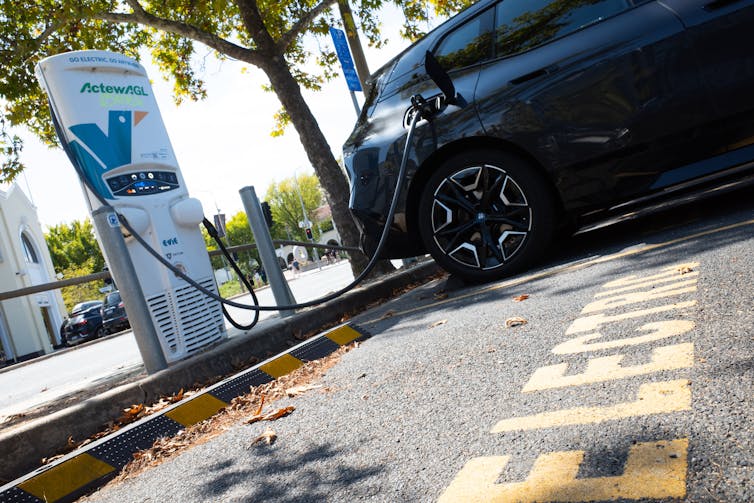
The budget also contained subsidies and infrastructure investment to support the uptake of electric vehicles. This includes 117 electric vehicle charging stations on highways, exempting electric cars from the fringe benefits tax and removing custom duties on electric car imports.

Electric cars will reduce Australia’s dependence on international oil markets made volatile by Russia’s invasion of Ukraine.

But whether electric cars significantly reduce Australia’s transport emissions depends on the extent to which renewables power the electricity grid. Until coal and gas are phased out, many electric cars in Australia will be powered by fossil fuels.

electric vehicle at charging station
The budget contained support for the uptake of electric vehicles.
Lukas Coch/AAP

Is it enough? No

Chalmers said the budget drives investment in renewable energy and delivers thousands of new jobs. But what’s lacking are mechanisms that encourage or compel companies to reduce their emissions in line with nationally legislated targets.

Of course, it’s hardly the present government’s fault that such mechanisms are not in place. The former Coalition government’s decision to axe Labor’s carbon price left a gaping policy hole that put Australia at the back of the global pack on climate action.

The initiatives outlined in this budget should be applauded. But many Australians who voted for Labor, the Greens or the Teal independents wanted significant action on climate change – and they’re still waiting.

So what climate measures should the government be taking?

Many of the policies at its disposal would require new legislation and would not necessarily appear in the budget. They include ending logging of old-growth forest to reduce forestry emissions, and changes to the safeguard mechanism.

The government has flagged reforms to this policy, a legacy of the previous government that purports to set limits on emissions from big industrial polluters.

Given a price on carbon is politically challenging in Australia, the safeguard mechanism appears the most likely means through which industrial emissions reductions will be curbed.


Read more:
Nearly 30% of Australia’s emissions come from industry. Tougher rules for big polluters is a no-brainer


here
The budget is likely to disappoint those wanting drastic action on climate change, including those who voted for independent Teal candidates.
Mark Baker/AAP

Hopefully other initiatives appear in future budgets, in good haste. They should include:

  • larger capital investments in renewable electricity generation and battery storage

  • a very significant funding boost for science and engineering research to produce further technological breakthroughs in low-carbon manufacturing and green steel production

  • electric vehicle charging stations powered by 100% renewable energy in every city and major highway

  • taxes on the worst climate offenders such as the beef and dairy industries and other sources of methane emissions.

And then we come to the elephant in the room: the emissions created when Australia exports fossil fuels to countries where it’s burned for energy.

Domestically, Australia is responsible for about 1.5% of global emissions. But factor in our fossil fuel exports and that rises to about 5% – and may jump to up to 12% by 2030.

So perhaps the most significant decisions Labor will make for the climate change aren’t budget initiatives at all – but rather, what fossil fuel exploitation the government allows in coming years.

Let’s get started

This budget included, for the first time, a statement on the fiscal impact of climate change.

It outlined the damage climate change can cause to government budgets including the cost of “responding to extreme weather events, which are likely to increase in severity and frequency”.

One thing is clear: Australia must reduce its greenhouse gas emissions and transition away from its reliance on fossil fuel exports. It’s in the nation’s best economic interests – and there’s no better time than now to begin this work in earnest.


Read more:
Australia is poised to be a world leader in offshore wind, but any potential risks to marine life remain poorly regulated


The Conversation

Timothy Neal does not work for, consult, own shares in or receive funding from any company or organisation that would benefit from this article, and has disclosed no relevant affiliations beyond their academic appointment.

ref. Labor’s ‘sensible’ budget leaves Australians short-changed on climate action. Here’s where it went wrong – https://theconversation.com/labors-sensible-budget-leaves-australians-short-changed-on-climate-action-heres-where-it-went-wrong-193215

Four Corners’ ‘How many more?’ reveals the nation’s crisis of Indigenous women missing and murdered

Source: The Conversation (Au and NZ) – By Marlene Longbottom, Associate Professor, University of Wollongong

Shutterstock

Aboriginal and Torres Strait Islander readers are advised this article contains names of deceased people and mentions domestic violence and murder.

This week’s Four Corners special How Many More? provided a much-needed investigation into the rates of First Nations women missing and murdered in this country. ABC Indigenous affairs editor Bridget Brennan and her team must be commended for their work.

We in the Indigenous community are well aware of the impact of the violence that occurs. Many of us work on the frontline to help those in need, partnering with Indigenous community organisations.

As part of my work, I review coronial inquest documents and death data that includes Indigenous people, as well as hearing survivors’ stories and those of
families who have lost a loved one to violence.

However, it is also through my lived, working, community experiences that I come to the topic of addressing violence – much like many other advocates in the space.

This work is interwoven with our lives in a way we don’t get to knock off from. I can – and have – gone from speaking at a national level one day, to providing one-on-one domestic violence support the very next.

The nation is in the midst of a national crisis of violence against Indigenous women. As Associate Professor Hannah McGlade puts it, this is “Indigenous femicide”.

For those of us who live in Indigenous communities, and have experienced violence ourselves, we’ve long known we’re on our own when it comes to our survival.


Read more:
How ‘closing the gap’ may close doors for First Nations women in new plan to end violence


What the Four Corners report found

The Four Corners report detailed the impacts of horrendous crimes against First Nations women with care and sensitivity. It humanised the women and supported their families to provide a voice to their experiences. This has not always been afforded to us.

The program highlighted a vital issue: the indifferent, uncaring nature and lack of urgency of many first responders. People requiring protection continue to be misidentified, with First Nations women punished for not conforming to the “worthy victim” stereotype.

These interactions with service providers, such as the police, are made worse as a result of racist stereotypes which dismiss violence against First Nations women. Four Corners showed this in Roberta’s story, who was told by the attending police officer to “stop calling us”. No one helped her when she was being beaten in public. This all occurred in the lead-up to her death.

The racist and inadequate responses highlighted on Four Corners aligns with research I have conducted into policing practice.

Given the widespread racism of police and their freqently apathetic responses and disregard to First Nations women’s safety, there is a reluctance to come forward and report violence. When women do report, they are criminalised, further marginalised, dismissed and dehumanised, as highlighted on Four Corners.

These systems continue to fail First Nations women. These failures are across institutions, and across state and territory jurisdictions.

Because of the inadequate support for First Nations women to report violence, colleagues and I have argued the police may not be the appropriate service to approach in reporting violence, and as first responders.


Read more:
No public outrage, no vigils: Australia’s silence at violence against Indigenous women


What is needed to address violence against Indigenous women?

There is no simple answer to address this. The ongoing impacts of multigenerational trauma continues, as do the effects of discrimination, marginalisation and racism many of us still experience.

It is clear we need to move away from the assumption that what works in non-Indigenous communities will be effective in Indigenous communities.

In addition, what works for First Nations women in the southern communities of Australia may not work across to the west and in the north. The diversity in our communities should be seen as a strength; programs that are locally designed, culturally responsive and trauma-informed are much more likely to have success.

We need better education and awareness to ensure First Nations people, communities and broader society understand that acts of violence aren’t limited to physical violence, and that violence can change over the course of a relationship.

Given that new laws are being implemented around the criminalising of coercive control, we need to ensure both community and police understand what this actually is, and how it can present in a relationship.

There is a need to teach community about healthy relationships – and in particular, identifying red flags such as partners who have been violent in previous relationships. These behaviours often extend into new relationships, and the person who uses the violence can escalate how they harm their partner, sometimes fatally.

Too many First Nations women have been killed by people who have a history of violence in relationships. State and territory courts, corrections and the criminal legal system need to ensure these people are unable to cause more harm.

Clearly, we need a more holistic approach to providing services for Indigenous women. Agencies that respond to violence must have the systems and processes in place to the support the woman, the partner, the immediate family and extended kin. Episodic responses will not suffice and women will continue to fall between the gaps.

We also need to ensure that preventing violence against First Nations women is a whole-of-community responsibility. First Nations women are also partnered with non-Indigenous people, therefore this is not “just” a First Nations issue.

Finally, we need accountability for system failures, especially where Indigenous women and children’s lives are lost. One life lost to violence is far too many.


Read more:
Could the Senate inquiry into missing and murdered Indigenous women and children prevent future deaths?


The Conversation

Marlene Longbottom is currently employed by the University of Wollongong as an Associate Professor at the Ngarruwan Ngadju First Peoples Health & Wellbeing Research Centre.

ref. Four Corners’ ‘How many more?’ reveals the nation’s crisis of Indigenous women missing and murdered – https://theconversation.com/four-corners-how-many-more-reveals-the-nations-crisis-of-indigenous-women-missing-and-murdered-193216

Steadying foreign aid budget signals the government takes development seriously

Source: The Conversation (Au and NZ) – By Melissa Conley Tyler, Honorary Fellow, Asia Institute, The University of Melbourne

Mick Tsikas/AAP

On budget night in 2014, the Abbott government cut nearly $8 billion from Australia’s international development program, the largest-ever aid cuts. Programs in South-East Asia were cut by 30%. For a government obsessed with surplus, it was seen as a sort of political victimless crime. Yes, it would hurt foreigners, but they don’t vote.

Last night’s budget announced an increase in aid of $1.4 billion over four years, including new funding beyond measures promised in the election campaign. This will prevent Australia’s development spend from dropping to its worst-ever level, as it was slated to do.

The previous Morrison government had resisted expanding the development budget beyond $4 billion, responding to the impact of COVID-19 with temporary and targeted measures. As these expired, foreign aid would have slumped to record lows. The new government has crossed this Rubicon by folding these into an increased budget of $4.65 billion.


Read more:
Jim Chalmers’ ‘restraint’ budget the first stage of a marathon for the treasurer


What’s notable is not just the funding, it’s also the way it was announced. Foreign Affairs Minister Penny Wong framed the spending as a “major step toward the goal of making Australia stronger and more influential in the world”. She positioned development spending as key to Australia’s relationships in the region.

“Without these investments,” she said, “others will continue to fill the vacuum and Australia will continue to lose ground”. The spending was key to making Australia a “partner of choice for the countries of our region”.

In his budget speech, Treasurer Jim Chalmers described the investment in development as “restoring our role as a diligent and dependable partner and friend to our Pacific neighbours – for a stable, peaceful and more prosperous region”.

This signals a commitment to development as a key tool of statecraft.

Foreign Minister Penny Wong has said that if Australia does not invest in overseas aid and development, others will fill the void.
Lukas Coch/AAP

Analysts will reasonably say this budget should be seen as steadying rather than improving. The current foreign aid commitment of around 0.2% of national income is well below the international standard of 0.7% and the donor country average of 0.33%. It is also far from the Rudd-era bipartisan position of rising to 0.5%.

Meanwhile, the budget found significant funds for defence, which increased $2.66 billion to $51.5 billion. It’s fair to ask if the dollars match the rhetoric.

But for a new government five months in, putting in the hard yards of budget repair in the face of a teetering global economy, it means a lot that it has committed not to let development funding slip. Many other areas face cuts, and it must have taken tough advocacy to preserve these commitments through the budget process.

The government has committed to year-on-year growth in funding. It puts Australia’s development programs on a more secure and predictable fiscal footing.

The challenge will be to build on this budget in subsequent ones. Many of the questions reasonably being raised around the “what” and “how” can be addressed in the New International Development Policy currently being developed.


Read more:
Everything you need to know about Labor’s first budget in 6 charts


The federal budget is always about priorities. Among the many things the government and nation would like to do, which are the ones they are prepared to put money behind? As foreign affairs and defence mandarin Sir Arthur Tange noted, “strategy without money is not strategy”. To succeed in this environment, you need to make your case.

There are very strong arguments for development co-operation – which is why developed countries, and even some developing ones, invest money in it. But the supporting arguments come from quite different perspectives. In a speech last month, Minister for International Development and the Pacific Pat Conroy summarised four ways of making the case for foreign aid:

  • the security case – grinding poverty contributes to social tensions, instability and radicalisation

  • the economic case – supporting prosperity abroad supports prosperity at home

  • the international relations case – contributing to developing countries supports prosperity and stability in the region and boosts Australia’s bilateral and multilateral relationships

  • the moral argument – it is the right thing to do.

When the Abbott government slashed the budget in 2014, it was probably thinking of development mainly in terms of the moral case – and thought that this could be overridden as expedient.

In increasing the budget, the Albanese government is justifying its decision on the basis of the other arguments – linking it to Australia’s national interest and seeing development as a key component in Australia’s foreign policy toolkit. And perhaps the Australian public is heeding this. Since 2019, cuts to the aid budget have become less popular.

The Department of Foreign Affairs and Trade budget paper states:

In an uncertain world, the strength and diversity of Australia’s partnerships is critical. The development program is fundamental to deepening our partnerships with our Indo-Pacific neighbours.

It seems we’re starting to cement the view that an adequate development budget is non-negotiable if Australia wants to have influence in the region. Given the scale of the needs, it would be wonderful if we could aim beyond adequate.

The Conversation

Melissa Conley Tyler is Executive Director of the Asia-Pacific Development, Diplomacy & Defence Dialogue (AP4D), a platform for collaboration between the development, diplomacy and defence communities. It receives funding from the Australian Civil-Military Centre and the Department of Foreign Affairs and Trade and is hosted by the Australian Council for International Development (ACFID).

ref. Steadying foreign aid budget signals the government takes development seriously – https://theconversation.com/steadying-foreign-aid-budget-signals-the-government-takes-development-seriously-193088

Media ignore women’s diverse backgrounds when reporting on family violence: new research

Source: The Conversation (Au and NZ) – By Usha Manchanda Rodrigues, Professor, Deakin University

Shutterstock

News reporting on sexual and domestic violence ignores the multiple inequities faced by victims from culturally diverse backgrounds, and First Nations peoples.

A content analysis of stories published in three prominent Australian media found only a handful of stories mentioned “intersectional” factors such as race, class, caste, sexuality, age and ability. These factors often make it harder for women from culturally and linguistically diverse backgrounds to seek support.

The analysis of 191 stories about people from culturally diverse backgrounds, published by The Age, the Herald Sun, and the ABC during the second COVID lockdown in September-December 2020, did not contextualise their reporting on domestic and sexual violence.

Except for a handful of stories, most media reported the crimes as isolated incidents of violence rather than a social problem.

The reporting often ignored important information such as victims’ status as new immigrants, their visa status restricting them to work in Australia, financial and social isolation, and cultural backgrounds.

One of the exceptions was an article by the ABC’s Herlyn Kaur, which noted many migrant women wanted to leave their violent marriages but were unaware of their rights. A growing number of migrant women are seeking help from women’s refuges, on average staying there for 46 nights, which is 14 nights more than non-culturally diverse women.

First Nations leaders and organisations working to prevent violence against women and children have noted the use of stereotypes, framing stories in a sensational way, and ignoring violence committed against Indigenous women.

First Nations women are five times more likely to experience physical violence and three times more likely to experience sexual violence than other Australian women, according to Our Watch.


Read more:
No public outrage, no vigils: Australia’s silence at violence against Indigenous women


Women from diverse backgrounds make up a significant proportion of the Australian population. Almost 28% of residents are born overseas, while 22% use a language other than English at home.

The recently launched National Plan to End Violence against Women and Children (2022-2032), emphasises a need for using an intersectional lens when supporting victim-survivors of domestic and sexual violence.

Greater diversity in media is also needed

Australian newsrooms lag behind. This research found that less than a third (32.82%) of the stories about domestic and sexual violence against culturally and linguistically diverse Australians were reported by a journalist from a non-Anglo-Celtic background. A little over 69% of the news stories were reported by a journalist from an Anglo-Celtic background, while more than 41% were written by a male reporter. Some stories were written by more than one journalist, while about 5% had no byline.

In Victoria, family violence–related crimes increased by 7.5% between October 2019 and September 2020, with more than 90,000 offenses recorded. But, the number of news reports on violence against women remained miniscule. In the study period, about 500 articles on domestic violence, sexual harassment and sexual violence were published by the three media outlets. Of these, 191 referred to a person or the issue of culturally and linguistically diverse background.

The context of domestic and sexual violence is important, because nearly a third of Australians believe women who do not leave their abusive partners are partly responsible for the continuation of domestic violence. Moreover, 42% agree it is common for sexual assault accusations to be used as a way of getting back at men.

Nuanced reporting of violence against women from culturally diverse backgrounds will sensitise the population to the complexity of the issue. It will also encourage governments to offer information, support and services that match the multitude of inequities they endure.


Read more:
A new national plan aims to end violence against women and children ‘in one generation’. Can it succeed?


This research finds an overwhelming number of news reports do not mention any factors that may affect victims and victim-survivors of domestic and sexual violence. The research raises a question: would a better understanding of the culturally diverse backgrounds of the victims help a journalist to report the nuances of these factors that multiply the suffering of victims?

The findings argue that diversity among journalists employed by Australian newsrooms is yet another area that needs attention. Increasing diversity would mean news stories about violence against women from culturally and linguistically diverse backgrounds and First Nations are reported with an intersectional lens.

It is worth noting that overwhelmingly, Australian television news and current affairs programs are curated, framed and presented by journalists and commentators from an Anglo-Celtic background.

Some signs of progress

On a positive note, this research found that news reports came from a variety of sources. They include:

  • violence against women experts, advocates, and representatives of organisations supporting victims (21.75%)
  • the courts (20.85%)
  • interviews with a significant number of neighbours, relatives, and eyewitnesses (19.03%).

This is a positive change from the past, when research found the dominant source of stories about violence against women was law enforcement personnel.

Additionally, about a quarter of the stories raised some of the legal constraints that stopped journalists from providing important details. These included victims and their families being able to speak about the crimes without the risk of prosecution.

News articles in each of the three media touched on the campaign #LetHerSpeak, which was launched in November 2018 to abolish gag laws in some states in Australia that apply to sexual assault victims.

The Conversation

This article is part of The Conversation’s Breaking the Cycle series, which is supported by a philanthropic grant from the Paul Ramsay Foundation.

ref. Media ignore women’s diverse backgrounds when reporting on family violence: new research – https://theconversation.com/media-ignore-womens-diverse-backgrounds-when-reporting-on-family-violence-new-research-192853

What does the budget mean for Medicare, medicines, aged care and First Nations health?

Source: The Conversation (Au and NZ) – By Stephen Duckett, Honorary Enterprise Professor, School of Population and Global Health, and Department of General Practice, The University of Melbourne

Shutterstock

Labor’s first health budget in almost a decade has few surprises – and that is a good thing.

The budget foreshadows additional annual health and aged care spending of more than A$2.3 billion when initiatives are fully implemented in 2025–26, the end of the four-year forward estimates. The bulk of this is for policy initiatives foreshadowed in the election campaign.

It should not be a surprise that governments promise one thing before an election and stick to it after, but unfortunately that has not been the case over the past decade.

There are four big spending commitments in this budget: aged care, Medicare reform, pharmaceuticals, and First Nations’ health.

Steps towards aged care reform

Aged care in Australia is a renovator’s opportunity. The system is understaffed and poorly regulated, with policy-making often captured by providers.

The consequences were laid bare by the aged care royal commission, which reported in March 2021. The previous government made a down payment on reform, but left much undone.

As promised in the election campaign, the 2022-23 budget provides for a major uplift in spending, with the “fixing the aged care crisis” spending line adding $1.2 billion in a full year. But that will only be the start.

Older man looks at phone
Aged care facilities will employ more nurses.
Shutterstock

Key recommendations from the royal commission are being implemented, including funding the novel idea of requiring nursing homes to employ nurses. Funding is also provided for a specified minimum number of care minutes for each resident.

There is still much to do, especially in addressing the care workforce shortfall.
The Fair Work Commission is currently reviewing minimum pay rates in the aged care industry, and the outcome will be a significant uplift. The question is, how significant? At present, a burger flipper gets paid more than the person who cares for our grandmothers; this will at last be reversed.

The cost of the Fair Work Commission case is as yet unknown and is not included in this budget.


Read more:
When aged care workers earn $22 an hour, a one-off bonus won’t help


Medicare reform underway, but no funds for hospitals

In response to health system pressures, Labor promised several reform initiatives before the election. One of these – the development of urgent care clinics – is slated for implementation starting in 2022-23, at a full-year cost of $37 million.

Although there has been some criticism that the policy initiative is still not finalised in every minute detail, Labor has only been in office for six months.


Read more:
Labor’s urgent care centres are a step in the right direction – but not a panacea


Broad system reform also awaits the conclusions of the Strengthening Medicare Taskforce (of which I am a member). This was established to provide advice on a further $250 million initiative that will be announced in the 2023-24 budget.

Dashing the aspirations of states, there is no provision in the budget for additional funding for state public hospitals, but of course there was no election commitment to do so.

Price of medicines to drop

In addition to the expected cost of new listings on the Pharmaceutical Benefits Scheme, the budget allocates $230 million in a full year to reduce the mandatory Pharmaceutical Benefits Scheme co-payment, from the current level of $42.50 per prescription for general beneficiaries to $30.

More than half a million Australians miss out on filling prescriptions each year because of cost, and hopefully this budget initiative will reduce that number. Other people, who might have had to make hard choices to fill prescriptions by foregoing buying new school clothes, will also benefit.

Pharmacist pulls medicine off a shelf
Some prescriptions will drop from $42.50 to $30.
National Cancer Institute

However, the reduction in the official co-payment will lead to reduced discounts from the low-cost pharmacy chains, so the net impact of the budget change is probably less of a benefit to patients than the headline $230 million cost to government.


Read more:
Last year, half a million Australians couldn’t afford to fill a script. Here’s how to rein in rising health costs


Funds to expand First Nations health services

The disparity in health outcomes for First Nations Australians is a tragedy. Medicare is not delivering as it should, with First Nations people in the NT receiving just 16% of the Medicare funding of an average Australian, due to poor access to doctors.


Read more:
First Nations people in the NT receive just 16% of the Medicare funding of an average Australian


It is pleasing to see an additional investment of $95 million in a full year to improve the health of First Nations Australians. The commitment appears well designed and includes improved infrastructure, expanded training and new health clinics.

A broader view of health and wellbeing

The budget signals the first steps towards adopting a new health and wellbeing framework for measuring societal progress, incorporating broader aspects of everyday life into budget reporting.

Although the media obsession with the budget deficit and gross domestic product as the only measures of note will probably continue, future budget documents will begin to take a more holistic view.


Read more:
‘The beginning of something new’: how the 2022-23 budget does things differently


A range of potential indicators were foreshadowed in this budget, including a climate-related one (related to threatened species) and public trust in government, both areas where Australia is not performing well.

In terms of climate, the budget includes a very welcome, albeit tiny, commitment to assist the Commonwealth Department of Health provide leadership on the health impact of climate change by establishing a National Health Sustainability and Climate Unit.

The budget itself builds public trust by providing no real surprises, but gets on with the job of implementing what was already promised.

The Conversation

Stephen Duckett is a member of the board of directors of the Brotherhood of St Laurence, an aged care provider, and is also a member of the Strengthening Medicare Task Force.

ref. What does the budget mean for Medicare, medicines, aged care and First Nations health? – https://theconversation.com/what-does-the-budget-mean-for-medicare-medicines-aged-care-and-first-nations-health-192842

Much ado about Shakespeare – why it’s time for a New Zealand national theatre

Source: The Conversation (Au and NZ) – By Barry King, Professor of Communications, Auckland University of Technology

The Ngakau Toa theatre company at the Globe to Globe international Shakespeare theatre festival in London, 2012. Getty Images

Whether you viewed it as a fresh front in the culture wars or merely a tempest in a teacup, the recent controversy over a shift in funding for the Shakespeare Globe Centre New Zealand was more evidence the country’s national culture is undergoing something of an identity crisis.

Behind the row lay an unanswered question: how does a post-settler, multicultural society create a national identity? This latest case put a spotlight on the performance arts in this evolving cultural debate. This raises its own question: what can theatre contribute to the nurturing of our national identity?

Live theatre is important in recalibrating the image of nationhood because of its direct connection to local audiences. Cinema and television, by and large, are committed to exploring themes and formats that target global audiences.

By contrast, theatre is charged with delivering original indigenous work; or at least, a distinctive local take on plays and performances. Perhaps it’s time, then, to revisit the concept of establishing a national theatre in Aotearoa New Zealand.

Ghosts of theatres past

Within the current debate about the funding policies of Creative New Zealand (CNZ), it has been suggested the theatre “ecology” is in crisis. Significant aspects of the crisis are economic: the impact of the pandemic on employment in the performance sector, and the impact of inflation on CNZ’s fixed investment budget.

But part of the crisis can be read as structural, conjuring up past efforts to create a national professional theatre – witness the efforts of Richard Campion and the New Zealand Players (1952-1960) and Wellington’s Downstage Theatre (1973-2013). Bruce Mason, in particular, strove to produce a distinctively postcolonial, Polynesian theatre.


Read more:
The arts helped us through the pandemic – NZ’s budget should radically rethink how and why they’re funded


The ghosts of such efforts are not well served by present funding policy. Following its 2015 Review of Theatre, CNZ adopted a funding model that consolidated the division between different forms of theatre.

On one side are fixed theatres operating in metropolitan centres, with special provision for Māori and young people’s theatre. On the other side are community-based theatre companies or solo performers, who perform in local theatres and non-theatrical venues such as civic buildings, schools, arts centres and community halls.

Unlike main centre theatres, CNZ sees community companies as a source of experimental work outside the traditional repertoire. The support received by such companies varies, based on a yearly competition. While not necessarily unfair, this structure enshrines the notion of separatism rather than cross-fertilisation.

Funding priorities: why does kapa haka receive less state funding than less popular art forms such as ballet?
Getty Images

Separate stages

Not surprisingly, reactions to recent funding decisions have raised questions about the way different performance arts are valued. As one critic of the current system asked, why does ballet, an “elite” art form with a comparatively small audience, receive greater funding than kapa haka, a popular art form with a larger audience?

A similar question was implied in the claim by one CNZ assessor that Shakespeare is “locked within a canon of imperialism”, without apparent consideration of how the plays might be performed.

Of the many questions about these decisions, two are fundamental. First, how should different performance arts be valued – for their market performance, or for their contribution to a national performance culture? Second, what form of theatre might most effectively express a national culture distinct from the colonial British or European heritage?


Read more:
The show must go on, but it’s time to re-think how we fund the arts in NZ


An essential flaw in current funding policy is that it perpetuates the divisions between different communities of dramatic practice, whereas a progressive policy would work to encourage cross-fertilisation between different forms of drama.

The increasingly multicultural composition of New Zealand’s population suggests the official policy of biculturalism needs to be reconsidered.

Even a cursory glance at contemporary New Zealand theatre reveals a wide range of practices, ranging from “well made” plays in the Western tradition, through to plays that draw on the Indigenous performance traditions and styles of diverse ethnic groups. How could the funding policy for theatre be realigned to the contemporary abundance of multicultural performance traditions?


Read more:
‘Bloody-hunting slaughtermen’, sieges and ‘lechery’: what does Shakespeare tell us of war?


Towards a Polynesian theatre

Rather than separating regional and local theatre, with their different approaches to performance, funding policy could be directed towards creating a national theatre with an umbrella approach that promotes interaction between different theatrical traditions and encourages the emergence of hybrid theatrical forms.

Such a national theatre could be structured as a permanent travelling company or a virtual academy. It could be based on a consortium of existing theatre educators, or an integrated consortium of mainstream and community theatres. It might be developed as a collaborative playwright’s theatre based on the current Playmarket model.


Read more:
These high school ‘classics’ have been taught for generations – could they be on their way out?


Given the rise of “incidental” casting (considering all artists, regardless of gender, ethnicity, disability, sexual orientation or socioeconomic background for all roles), the actual meaning of a play depends as much, if not more, on the way it is cast and staged than on its content.

Theatre is a space in which plays perceived as “reactionary” or tied to a past can be revitalised and reconfigured. A national theatre, carefully considered, could be the crucible where Bruce Mason’s dream of a truly Polynesian theatre can be forged.

The Conversation

Barry King does not work for, consult, own shares in or receive funding from any company or organisation that would benefit from this article, and has disclosed no relevant affiliations beyond their academic appointment.

ref. Much ado about Shakespeare – why it’s time for a New Zealand national theatre – https://theconversation.com/much-ado-about-shakespeare-why-its-time-for-a-new-zealand-national-theatre-193214

The most horrifying part of Halloween is the useless piles of waste it creates. Why not do it differently?

Source: The Conversation (Au and NZ) – By Olav Muurlink, Associate Professor, Social Innovation, CQUniversity Australia

Shutterstock

Thousands of young people roaming the streets at night in scary costumes, knocking on strangers’ doors and threatening pranks if their demands for treats are not met. What could possibly go wrong?

Well, for starters, there’s the frightening amount of waste produced by those few hours of Halloween fun.

In recent years, Halloween has joined Christmas and other consumption rituals to become an entrenched celebration on the Australian calendar – especially for young kids (and their parents).

But afterwards we’re left with mountains of discarded lolly wrappers, pumpkins, costumes and decorations. How did we end up here – and how can we create a more sustainable Halloween?

skeleton and two zombies decorate front yard
All those treats, pumpkins, costumes and decorations create a huge amount of waste.
Shutterstock

A horrible history

Halloween is celebrated each year on October 31. About one in four Australians intends to take part this year. That’s a lot of people – but still far behind participation rates in the United States and United Kingdom.

Halloween began as an ancient Celtic harvest celebration. Known as Samhain, the festival included storytelling, bonfires and costumes to ward off ghosts.

In the eighth century, Pope Gregory III declared November 1 as a time to honour all saints. Those festivities included some Samhain activities, and the evening of October 31 became All Hallows’ Eve, then later, Halloween.

Halloween was brought to the US in the 1840s by Irish immigrants. It has since transformed into a heavily marketed staple of the retail calendar, and spread to many other countries, including Australia.

Each year, mass-produced Halloween-related treats, costumes and spooky paraphernalia fill the shelves of supermarkets and department stores in the lead-up to October 31.


Read more:
Halloween’s celebration of mingling with the dead has roots in ancient Celtic celebrations of Samhain


Man looks at masks
Halloween is now a heavily marketed staple of the retail calendar.
Shutterstock

A spine-chilling tale of waste

All those consumables lead to a huge amount of waste. First, let’s start with food.

Most data on Halloween food waste relates to the US, but we can assume the problem extends proportionally to Australia.

About one million kilograms of pumpkins are grown in the US each year. Many are carved into jack-o’-lanterns and end up in landfill rather than on the plate. US authorities have warned all these decomposing pumpkins produce methane, which contributes to climate change.

Similarly, research released in 2020 found half of the 24 million pumpkins carved for Halloween in the UK would become food waste. What’s more, 42% of survey respondents didn’t even know pumpkin flesh was edible.

broken carved pumpkin
Decomposing pumpkins produce methane which contributes to climate change.
Shutterstock

And what about all those treats? Days out from Halloween last year, the US National Retail Federation said overall Halloween-related spending would hit US$10.14 billion, including about $3 billion in candy sales.

Some 70% of UK shoppers expect to buy sweets, chocolates and other treats on Halloween, and the celebration is now the UK’s third biggest commercial celebration after Christmas and Easter.

Individually wrapped lollies are popular fare in modern Halloween celebrations – especially in the pandemic era. But it wasn’t always that way. In decades past, cookies, candied apples and home-made toffee were the common Halloween currency.

Wrapping and packaging does reduce food waste, but it creates plastic waste that litters our roadsides, fills our bins, and pollutes the environment.

Research on Halloween consumption in Australia is in its infancy. But research this month by the Australian Retailers Association found Australians planned to spend about A$430 million on Halloween this year, up on previous years.

Items to be purchased included costumes, sweets, themed food and drinks, and party decorations.

If you plan to decorate your house, beware of buying fake cobwebs – wildlife experts this week warned that animals, particularly birds, could get caught in them and die.

fake cobweb and spider on bush
Fake cobwebs can be lethal for birds.
Shutterstock

Have a sustainable Halloween

Australia is a largely blank slate when it comes to Halloween culture and tradition. We have a chance to make the tradition our own.

Why not carve a real pumpkin, rather than buying a plastic one, and turn the innards into pumpkin soup or scones? Or try hitting your local op-shop and reworking a fashion nightmare from yesteryear into a spooky Halloween costume?

The World Wildlife Fund offers these other tips for a “green” Halloween:

  • Reuse decorations from previous years instead of buying new ones. Better still, make your own

  • Keep old clothes that can be used as costumes, such as worn-out t-shirts

  • Reduce party waste by avoiding disposable cups, plates and cutlery

  • Buy locally produced lollies and treats. Look for those with minimal packaging or packaged in recycled materials

  • Don’t buy a special trick-or-treat bag. Use and decorate household items such as a bucket, pillowcase or old bag, and re-use it each year

  • When trick-or-treating, walk around your neighborhood instead of driving to do it elsewhere

  • compost and recycle as much party food, treats, pumpkins and other items as possible.


Read more:
Not spooked by Halloween ghost stories? You may have aphantasia


The Conversation

Olav Muurlink is the Project Leader of the Fight Food Waste Co-operative Research Centre’s Future Leaders Program.

ref. The most horrifying part of Halloween is the useless piles of waste it creates. Why not do it differently? – https://theconversation.com/the-most-horrifying-part-of-halloween-is-the-useless-piles-of-waste-it-creates-why-not-do-it-differently-192836

Radioactive traces in tree rings reveal Earth’s history of unexplained ‘radiation storms’

Source: The Conversation (Au and NZ) – By Benjamin Pope, ARC DECRA Fellow, The University of Queensland

University of Queensland

In searching for planets and studying their stars, I’ve had the privilege to use some of the world’s great telescopes. However, our team has recently turned to an even larger system to study the cosmos: Earth’s forests.

We analysed radioactive signatures left in tree rings around the world to study mysterious “radiation storms” that have swept over Earth half a dozen times in the past 10,000 years or so.

Our results, published today in Proceedings of the Royal Society A, rule out “solar superflares” as the culprit – but the true cause remains unknown.

A history written in tree rings

When high-energy radiation strikes the upper atmosphere it turns nitrogen atoms into radioactive carbon-14, or radiocarbon. The radiocarbon then filters through the air and the oceans, into sediments and bogs, into you and me, into animals and plants – including hardwoods with their yearly tree rings.

To archaeologists, radiocarbon is a godsend. After it is created, carbon-14 slowly and steadily decays back into nitrogen – which means it can be used as a clock to measure the age of organic samples, in what is called radiocarbon dating.


Read more:
Explainer: what is radiocarbon dating and how does it work?


To astronomers, this is equally valuable. Tree rings give a year-by-year record of high-energy particles called “cosmic rays” going back millennia.

The magnetic fields of Earth and the Sun shield us from cosmic rays shooting through the Galaxy. More cosmic rays reach Earth when these magnetic fields are weaker, and fewer when the fields are stronger.

This means the rise and fall of carbon-14 levels in tree rings encodes a history of the 11-year cycle of the solar dynamo (which creates the Sun’s magnetic field) and the reversals of Earth’s magnetic field.

Miyake events

But tree rings also record events we cannot presently explain. In 2012, Japanese physicist Fusa Miyake discovered a spike in the radiocarbon content of tree rings from 774 AD. It was so big that several ordinary years’ worth of cosmic rays must have arrived all at once.

As more teams have joined the search, tree ring evidence has been uncovered of further “Miyake events”: from 993 AD and 663 BC, and prehistoric events in 5259 BC, 5410 BC, and 7176 BC.


Read more:
A large solar storm could knock out the power grid and the internet – an electrical engineer explains how


These have already led to a revolution in archaeology. Finding one of these short, sharp spikes in an ancient sample pins its date down to a single year, instead of the decades or centuries of uncertainty from ordinary radiocarbon dating.

Among other things, our colleagues have used the 993 AD event to reveal the exact year of the first European settlement in the Americas, the Viking village at L’Anse aux Meadows in Newfoundland: 1021 AD.

Could huge radiation pulses happen again?

In physics and astronomy, these Miyake events remain a mystery.

How do you get such a huge pulse of radiation? A flurry of papers have blamed supernovae, gamma-ray bursts, explosions from magnetised neutron stars, and even comets.

A photograph of solar flares emanating from the Sun.
Could ‘solar superflares’ be responsible for radiocarbon spikes in tree rings?
NASA / GSFC / Solar Dynamics Observatory

However, the most widely accepted explanation is that Miyake events are “solar superflares”. These hypothetical eruptions from the Sun would be perhaps 50–100 times more energetic than the biggest recorded in the modern era, the Carrington Event of 1859.

If an event like this occurred today, it would devastate power grids, telecommunications, and satellites. If these occur randomly, around once every thousand years, that is a 1% chance per decade – a serious risk.

Noisy data

Our team at UQ set out to sift through all the available tree ring data and pull out the intensity, timing, and duration of Miyake events.

To do this we had to develop software to solve a system of equations that model how radiocarbon filters through the entire global carbon cycle, to work out what fraction ends up in trees in what years, as opposed to the oceans, bogs, or you and me.

Working with archaeologists, we have just released the first reproducible, systematic study of all 98 trees of published data on Miyake events. We have also released open source modelling software as a platform for future work.

Storms of solar flares

Our results confirm each event delivers between one and four ordinary years’ worth of radiation in one go. Earlier research suggested trees closer to Earth’s poles recorded a bigger spike – which is what we would expect if solar superflares are responsible – but our work, looking at a larger sample of trees, shows this is not the case.

We also found these events can arrive at any point in the Sun’s 11-year activity cycle. Solar flares, on the other hand, tend to happen around the peak of the cycle.


Read more:
Why is the sun going quiet?


Most puzzling, a couple of the spikes seem to take longer than can be explained by the slow creep of new radiocarbon through the carbon cycle. This suggests that either the events can sometimes take longer than a year, which is not expected for a giant solar flare, or the growing seasons of the trees are not as even as previously thought.

For my money, the Sun is still the most likely culprit for Miyake events. However, our results suggest we’re seeing something more like a storm of solar flares rather than one huge superflare.

To pin down what exactly happens in these events, we will need more data to give us a better picture of the events we already know about. To obtain this data, we will need more tree rings – and also other sources such as ice cores from the Arctic and Antarctic.

This is truly interdisciplinary science. Normally I think about beautifully clean, precise telescopes: it is much harder to understand the complex, interconnected Earth.

The Conversation

Benjamin Pope receives funding from the Australian Research Council and the Big Questions Institute.

ref. Radioactive traces in tree rings reveal Earth’s history of unexplained ‘radiation storms’ – https://theconversation.com/radioactive-traces-in-tree-rings-reveal-earths-history-of-unexplained-radiation-storms-193080

What are postbiotics and how can they improve our gut health?

Source: The Conversation (Au and NZ) – By Deep Jyoti Bhuyan, Research Fellow in Healthy Ageing, Western Sydney University

Photo by Alesia Kozik/Pixabay, CC BY

Many of us are familiar with probiotics, such as certain yogurts and fermented foods, full of “good” bacteria that can keep the gut healthy.

You might even have heard of prebiotics, foods rich in complex carbohydrates (dietary fibre) that help foster good bacteria in the large intestine. Popular prebiotic foods include oats, nuts and legumes.

But what about postbiotics? What are they and how do they affect our gut health?


Read more:
What should you eat after you’ve been on antibiotics? And can probiotics and prebiotics get your gut back to normal?


A colourful display of fruits and vegetables.
A diet rich in vegetables and fruits increases the levels of prebiotics in your body.
Image by Michal Jarmoluk from Pixabay, CC BY

What is a postbiotic?

Postbiotics are essentially the by-products of our gut microbiota. In other words, your body produces postbiotics after digesting prebiotic and probiotic foods.

Examples of postbiotics include the short-chain fatty acids butyric acid (or butyrate), acetic acid (or acetate) and propionic acid (or propionate).

These molecules are produced when good probiotic bacteria break down dietary fibre from foods such as fruits and vegetables, grains and legumes.

These postbiotic molecules are important for your gut microbiota. Healthy probiotic bacteria thrive on these short-chain fatty acids in our gut.

And some postbiotics can help suppress “bad” bacteria. For example, probiotic bacteria (such as Lactococcus lactis) produce special chemicals called bacteriocins which can prevent the colonisation of pathogens like E. coli in the gut. This process is known as “colonisation resistance”.

Microbial fermentation is where microbes in the gut break down complex carbohydrates. Microbial fermentation of plant-based diets (which are rich in polyphenols), in particular, leads to the production of the postbiotic phenylacetic acid. This postbiotic can reduce the growth of harmful pathogens in the body.

A customers holds a shopping bag while looking at vegetables.
A plant-rich diet is good for postbiotic production.
Photo by Michael Burrows/Pexels, CC BY

Not all postbiotics are good

Not all postbiotics are heroes, though.

One type of postbiotic is bile acids, which are produced when we eat too many high-fat foods.

Bile acids have been linked to inflammation and colon cancer.

Staying on a high-protein, low-carbohydrate diet for the long term often means people don’t eat enough fibre, which is linked to a higher risk of colon cancer.

This may be due to the production of hazardous postbiotics like bile acids.

What’s the link between postbiotics and cancer?

Our recent review (led by my colleague Kayla Jaye at Western Sydney University) found short-chain fatty acids – particularly butyrate – have shown promising results against breast and colorectal cancer cells in previous laboratory studies.

One clinical study showed colorectal cancer patients produced significantly lower levels of short-chain fatty acids in their gut than healthy participants.

Another study found the numbers of bacteria that produce short-chain fatty acids were low in premenopausal breast cancer patients.

Some cellular and animal studies have also reported that the postbiotic butyrate can help chemotherapy work better against breast cancer and regulate the immune system.

As reported in epidemiological studies, a fibre-rich diet, particularly whole grains, can lower the risk of colorectal cancer. This is mainly because fibre-rich diets lead to the production of short-chain fatty acids in the colon.

Two bags of legumes sit on a kitchen bench.
The best way to improve the levels of good postbiotics is to consume more vegetables, fruits, legumes, wholegrain bread, nuts and seeds.
Photo by Karolina Grabowska/Pexels, CC BY

OK great, so what do I eat to get more postbiotics in my gut?

Dietary fibre is the key.

Women and men should consume at least 25 and 30 grams of fibre, respectively, every day. But few Australians meet this recommendation.

The best way to improve the levels of good postbiotics is to consume more vegetables, fruits, legumes, wholegrain bread, nuts and seeds.

Jerusalem artichokes, garlic, onion, leek and asparagus are fantastic prebiotic vegetables.

A diet rich in fruits and vegetables increases the levels of postbiotics like short-chain fatty acids in the gut. It also helps reduce bile acids.

Gut health is all about diversity, which means eating a variety of fruits, vegetables, legumes and whole grains to support healthy gut microbiota.

You can also include fermented foods like sauerkraut and kimchi in your diet. These fermented foods have both prebiotic fibre and live probiotic bacteria, which can help produce healthy postbiotics in the gut.

Of course, further research is needed. But to ensure good gut health, you should include plenty of fruits, vegetables and legumes in your diet.

The Conversation

Deep Jyoti Bhuyan does not work for, consult, own shares in or receive funding from any company or organisation that would benefit from this article, and has disclosed no relevant affiliations beyond their academic appointment.

ref. What are postbiotics and how can they improve our gut health? – https://theconversation.com/what-are-postbiotics-and-how-can-they-improve-our-gut-health-190348

TikTok is teaching the world about autism – but is it empowering autistic people or pigeonholing them?

Source: The Conversation (Au and NZ) – By Sandra Jones, Pro Vice-Chancellor, Research Impact, Australian Catholic University

Screenshot / Tiktok.com

A quick look at some TikTok stats shows more than 38,000 posts under the hashtag #Autism, with more than 200 million views. The hashtag #ActuallyAutistic (which is used in the autism community to highlight content created by, and not about, autistic people) has more than 20,000 posts and 40 million views.

TikTok is one of the world’s leading social platforms, and has exploded in popularity at a time when other social media megaliths have struggled. It has become an important channel for expression for its young usership – and this has included giving autistic people a voice and community.

It’s a good start. In some ways TikTok has helped drive discussions around autism forward, and shift outsiders’ perspectives. But for real progress, we have to ensure “swipe up” environments aren’t the only spaces where autistic people are welcomed.

But first, what is autism?

Autism is not an illness or a disease. It’s a lifelong developmental condition that occurs in about one in 70 people. Characteristics of the condition occur along a spectrum. This means there is a wide range of differences among people with autism, all of whom have unique challenges and strengths.

A 2017 survey conducted by myself and my colleagues found more than half of autistic people and their family members felt socially isolated. And 40% said they sometimes felt unable to leave the house because they were worried about negative behaviours towards them.

Many Australians have little knowledge about autism and limited interaction with autistic people. Generally, public attitudes will be shaped by news coverage, online articles and mainstream movies and shows. While media portrayals of autism can positively influence public knowledge, they can also contribute to misunderstanding and increase stigma. It seems the results are mixed.

Studies have found media representations of autism can contribute to stereotypes of what it means to be autistic. For instance, shows such as The Good Doctor and Atypical present autism as a condition of “high functioning, socially deficient, emotionally detached, and heterosexual males from middle-class white families”.

As an autistic person, one of the most disturbing things for me is how marginalised our voices are in conversations about autism. You will most often find non-autistic people behind autism-related research, books, movies and TV programs. Most autistic characters are also played by non-autistic actors.

A review of autism-related news published in Australian print media from 2016 to 2018 found only 16 of 1,351 stories included firsthand perspectives from autistic people.

My own research into depictions of autism in print news published between 1996 and 2005 found narratives of autistic people as dangerous and uncontrollable, or unloved and poorly treated.

When autism met TikTok

TikTok has given many autistic people a much-needed platform to speak about autism in creative ways. Some users such as Paige Layle and Nicole Parish have more than 2 million followers. The opportunity to dispel myths and share the diversity of autistic experiences has not been squandered.

Some of the positives for autistic users include opportunities to:

  • connect with others who are similar to us, and feel less isolated and alone
  • educate people about some of the lesser known or misunderstood aspects of autism, such as stimming (self-stimulatory behaviour including repetitive or unusual body movement or noises)
  • share our passions and interests with others (#SpecialInterest) and
  • raise awareness of the prevalence of and different presentation of autism in females (#AutisticGirl).

However, as with all forms of social media, we should exercise caution before labelling TikTok as the solution to autism exclusion.


À lire aussi :
We need to stop perpetuating the myth that children grow out of autism


The other side of it

The most obvious risk is cyberbullying. Many of us will remember the disturbing fad of “faking autism” videos on TikTok. Examples of this included non-autistic people stimming to music (pretending to be autistic), to make people laugh, or because they thought it made them seem cute or quirky.

Turning the autistic experience into a “meme” downplays both our challenges and our strengths. It’s hard to describe just how hurtful it is to see your identity used as a joke to entertain others.

Related to this is the posting of videos of autistic people by others without their consent. Whether this is playground bullies tormenting an autistic person, strangers in a shopping centre filming a “naughty kid”, or a parent having a bad day with their autistic child – these videos can be used, reused and misused by others.

Moderation by TikTik is an additional concern. In 2019, Netzpolitik.org reported TikTok had policies for moderators to suppress certain content by users they thought were “susceptible to harassment or cyberbullying based on their physical or mental condition”.

This included users with “facial disfigurement”, “autism” and “Down syndrome”. A TikTok spokesperson said this was a “blunt and temporary policy” made “in response to an increase in bullying on the app”.

Is the best solution to bullying to silence the voices of potential victims, rather than the bullies?


À lire aussi :
How do we make workplaces work for autistic people?


Algorithmic influence

TikTok’s algorithm is highly curated to individual users. The app decides what videos to show a user based on: their previous interactions including which videos they watch, like and favourite; video information (such as captions and hashtags); and their device and account settings.

This means users will likely see their own perspectives and beliefs reflected back to them. Autistic people may begin to believe this is the only reality that exists, leading to the creation of a “false reality”.

On TikTok, autistic people see an idyllic world where everyone understands and embraces autism. We forget that outside our “echo chamber” there is a world of people living in their own echo chambers.

If we want to see genuine improvement, we have to make autism acceptance and inclusion a priority across public life. We could start by including more autistic voices in TV shows, movies, books and news, as well as more representation in leadership teams and among policy makers.

The Conversation

Sandra Jones ne travaille pas, ne conseille pas, ne possède pas de parts, ne reçoit pas de fonds d’une organisation qui pourrait tirer profit de cet article, et n’a déclaré aucune autre affiliation que son organisme de recherche.

ref. TikTok is teaching the world about autism – but is it empowering autistic people or pigeonholing them? – https://theconversation.com/tiktok-is-teaching-the-world-about-autism-but-is-it-empowering-autistic-people-or-pigeonholing-them-192093

COVID is a ‘smart virus’ that can affect DNA – but that doesn’t mean you can pass it on to your kids

Source: The Conversation (Au and NZ) – By Lara Herrero, Research Leader in Virology and Infectious Disease, Griffith University

Shutterstock

The emergence of SARS-CoV-2 (the virus that causes COVID) has changed the world as we know it. Although new vaccines and antiviral treatments have brought hope, the pesky virus has continued to mutate and evade us.

Knowledge has been building about how this virus operates and why it continues to pose a challenge. We have heard reports of the virus resulting in “immune exhaustion”, potentially triggering autoimmunity (when the body attacks itself) and even shrinking the brain.

Now scientists are discovering just how the virus impacts DNA. It looks like this could give it the power to evade our immune system – but that doesn’t mean it can get passed on genetically.

So very, very sneaky

Research published in Nature earlier this month found one of the SARS-CoV-2 proteins is able to imitate one of our cellular proteins called histones.

Histones are required to condense DNA. This allows DNA to be packaged into tight bundles, ensuring it all fits within a cell. Histones frequently change and respond to external cues to regulate the DNA. They help to switch genes on or off.

The new finding indicates SARS-CoV-2 can disrupt our genes and their expression.

DNA diagram
DNA is coiled around histone proteins so it can be tightly packed in a cell nucleus.
Wikimedia Commons, CC BY


À lire aussi :
Being stressed out before you get COVID increases your chances of long COVID. Here’s why


So what does the study show?

The study found one of the SARS-CoV-2 proteins – called “open reading frame 8” (ORF8) protein – has evolved to mimic a part of human histone called H3.

This mimicking seems to alter the way H3 functions and changes the host’s epigenetics. The researchers found that when they deleted a critical region of the ORF8 protein or the entire ORF8 protein, the virus was not able to replicate to the same high levels as the original COVID strain in human lung alveolar cells. This suggests the ORF8 protein contributes to COVID disease severity.

The research reveals an epigenetic mechanism that promotes SARS-CoV-2 virulence within the population. These findings may also help researchers understand how COVID develops and the disease severity of emerging viral strains.

What are ‘epigenetics’ again?

Our genes can be thought of as a blueprint that determines how our bodies are built. Collectively, the study of our genes and how these are passed from parent to offspring is called “genetics”.

Epigenetics” refers to the factors that influence which genes are switched on or off. These factors include lifestyle elements we can control (think diet, exercise, sleep, smoking), age or even some infections.

So, whereas genetics refers to the blueprint (genes), epigenetics refers to how that blueprint is read (gene expression).

Some epigentic factors can be passed on from parent to child, but this does not mean the newly reported impact of SARS-CoV-2 on our histones will be.


À lire aussi :
Surprise discovery shows you may inherit more from your mum than you think


So, does this change what we already knew?

This is not the first time research has found that pathogen (invading bugs or diseases) affect our epigenetics.

It is well established that the pathogen that causes tuberculosis, Mycobacterium tuberculosis, changes the host gene expression through histone modification to promote its own survival.

Similarly, viruses like adenovirus (which can cause colds, conjunctivitis, gastro and more), human papilloma virus and herpes viruses are all known to alter host epigenetics through various mechanisms.

Evidence has been growing to suggest COVID impacts our immunity, but questions still remain as to how. This newly discovered SARS-CoV-2 mechanism provides another piece of the puzzle and might help to explain one way that the virus disrupts epigenetics to lead to more severe COVID.

scientist in lab
The new finding might help science protect the human immune system.
Shutterstock

Another reason not to get COVID

Epigenetics is a relatively new field of study that holds promise for the development of new therapies.

It is still early days for this research, but future investigation might look for ways to counteract the viruses impact on our histones as a way of protecting our immune system.

The battle to conquer COVID continues, and we are reminded that prevention – for now, in the form of vaccination and boosters, wearing N95 respirator masks and proper ventilation – is always better than cure.


À lire aussi :
Imagining COVID is ‘like the flu’ is cutting thousands of lives short. It’s time to wake up


The Conversation

Lara Herrero receives funding from NHMRC.

ref. COVID is a ‘smart virus’ that can affect DNA – but that doesn’t mean you can pass it on to your kids – https://theconversation.com/covid-is-a-smart-virus-that-can-affect-dna-but-that-doesnt-mean-you-can-pass-it-on-to-your-kids-192185

Australia is poised to be a world leader in offshore wind, but any potential risks to marine life remain poorly regulated

Source: The Conversation (Au and NZ) – By Madeline Taylor, Senior Lecturer, Macquarie University

Shutterstock

The strong winds blowing over Australia’s rugged coastlines will soon power many of our homes, as offshore wind farms are poised to begin construction. But our new research the highlights the need to ensure any potential risks to marine life is properly mitigated.

The federal government has recently made a string of announcements as part of its A$20 billion Rewiring the Nation Plan, ahead of last night’s federal budget. This includes $1.5 billion to fast-track the development of offshore wind farms and renewable energy zones in Victoria, as well as funding for the Marinus link (an electricity cable connecting Tasmania and Victoria), and pumped hydro developments.

By embracing what the energy world calls the “big three” – offshore wind, solar power and onshore wind power – Australia’s renewable energy exports alone could be worth $333 billion each year. That’s almost triple what we currently get from fossil fuels.

Our research calls for Australia to put marine spatial planning processes into offshore wind regulation. This considers how infrastructure and ecosystems can co-locate, by mapping out the best sites for generating the most electricity with the least environmental impact.

With effective regulation, Australia’s offshore wind industry can be a leader in ecologically sustainable development.

Why is offshore wind important?

Over the past decade, the costs to build offshore wind infrastructure have decreased by 50% worldwide. It is poised to become a key ingredient in Australia’s energy mix, as the Global Wind Energy Council estimates a massive 4,963 gigawatts of offshore wind potential in Australia.

In fact, if all of Australia’s proposed offshore wind projects were built, their combined energy capacity would be greater than all Australia’s coal-fired power stations.

Victoria is leading the way with a target of reaching 2 gigawatts of offshore wind by 2032, and 9 gigawatts by 2040. This means some 20% of Victoria’s energy mix will come from clean, affordable and reliable offshore wind within the next ten years.

Despite our rich wind resources, there is currently no large-scale offshore wind project operating in Australia, due to a lack of legal framework that commenced operation in 2022. Australia also does not currently hold a federal offshore wind target.

Wind turbine under construction
Underwater noise during the construction of offshore wind turbines can displace marine animals.
Shutterstock

Australia’s lack of regulation

Australia has lack of clear offshore renewable energy planning goals. This has led the Global Wind Energy Council to call for “a clear, transparent, and streamlined leasing and permitting process” in Australia.

The environmental protections currently in place are generic and need greater refinement on the needs of offshore wind.

Before an Australian offshore wind project can start and be granted a commercial licence, the developer must make several important assessments and proposals, including a management plan, to the Offshore Infrastructure Registrar.

This management plan must adhere to Australia’s national environment law, which is designed to promote ecologically sustainable development.

Yet, Australia’s environment law – called the Environment Protection and Biodiversity Conservation (EPBC) Act – has been widely criticised for failing to achieve this aim, particularly following a major independent review in 2021.


Read more:
A major report excoriated Australia’s environment laws. Sussan Ley’s response is confused and risky


How offshore wind farms can impact marine life

Marine spatial planning can provide clear ecological, social and environmental conservation objectives, while mapping important ecological zones to protect.

Research is still emerging on the extent offshore wind farms may impact marine ecosystems. A European Environment Agency report this year points to a few potential impacts, although these are documented in Europe rather than Australia.

This includes underwater noise during construction, which can displace some species, cause auditory injury to nearby mammals and fish, and interfere with the echolocation of animals such as porpoises.

Research has also shown that during operation, some seabird species became either displaced or attracted to the turbines (though collision rates are low).

On the other hand, depending on its design, offshore wind turbines can provide habitat for some marine species, such as with artificial reefs on their foundations.

These pressures can be managed by effective marine spatial planning. Australia holds marine spatial planning processes for other areas, such as the Great Barrier Reef Marine Park and parts of Victoria.

But we are yet to create any requirements for them in the legal framework for offshore wind at the federal level.

Countries doing it better than us

Several countries have enacted marine spatial planning policies and regulations for their offshore wind sectors.

The European Union has led the way, as 22 coastal member states have adopted marine spatial planning processes. This strong policy framework has enabled the EU to reach 28.4 gigawatts of offshore wind capacity while ensuring environmental protections are in place.

The Netherlands have an ambitious offshore wind target of 70 gigawatts by 2050. This is double what the entire EU has already installed.

The Netherlands is using marine spatial planning to sustainably meet this target. It is supported by the Dutch Ecological Offshore Wind Energy Programme, which is generating baseline scientific knowledge about how to protect sensitive marine environments in assessments determining new project sites.


Read more:
Wind turbines off the coast could help Australia become an energy superpower, research finds


One piece of the puzzle

Marine spatial planning is crucial for integrating offshore wind with other ways we use the ocean, such as for fishing and preserving traditional Sea Country. At the same time, it should preserve ecosystems and promote energy justice, where all members of society are granted access to clean energy. Marine spatial planning can strike this balance.

Formulating marine spatial planning objectives in consultation with the offshore wind industry, communities, and other stakeholders is crucial to ensure its success, and building an equitable ocean economy.

Much more must be done to ensure we continue a successful transition away from fossil fuels and avoid the worst impacts of climate change. Offshore wind is just one, exciting piece of the puzzle.


Read more:
3 ways the Albanese government can turn Australia into a renewable energy superpower – without leaving anyone behind


The Conversation

Madeline Taylor has received funding from ACOLA and the AIEN. She is a Climate Councillor for the Climate Council and is on the Management Committee for RE-Alliance. The author would like to acknowledge Riley Taylor and his co-authorship of the research produced.

ref. Australia is poised to be a world leader in offshore wind, but any potential risks to marine life remain poorly regulated – https://theconversation.com/australia-is-poised-to-be-a-world-leader-in-offshore-wind-but-any-potential-risks-to-marine-life-remain-poorly-regulated-193212

The popularity of the Korean _oegugin_ (foreign) influencer is on the rise. But there is a dark side to this pop-nationalism

Source: The Conversation (Au and NZ) – By Jin Lee, Research Fellow, Curtin University

The YouTube channel Korean Englishman has over five million subscribers. YouTube/Screenshot

If you’ve been scrolling through YouTube, TikTok or Instagram it would be no surprise to chance upon calming minimalist aesthetics of Korean cafe decor; pilgrimages to the locations of popular K-dramas; and even the polite decorum of Korean public transport commuters.

In South Korea, oegugin (foreign-national) influencers often produce social media content focused on the global interest in K-pop, K-drama and K-film for audiences inside and out of Korea.

These influencers are most prominent on YouTube, where the most popular trends include binge-eating mukbang, lifestyle vlogging of fancy cafe cultures and K-pop fandom homages like visits to pop-up stores by idol groups.

On platforms like TikTok and Instagram, content is shared with hashtags like #외국인 (#oegugin) and #외국인반응 (#oegugin-baneung, or foreigner reaction).

Many oegugin influencers have risen to stardom. The duo Korean Englishman have over five million subscribers, and now regularly appear on Korean television talk shows and variety shows.

In our new research, we found oegugin influencers are predominantly white-presenting non-Koreans who often adopt nationalist tones to endorse the “excellence” of Korean culture.

The discourse is often celebratory, leverages on exoticism and promotes “pop nationalism”: a new form of soft power marketed in the form of pop culture.


Read more:
BTS take a break: world’s biggest K-pop group is caught between Korea’s soft power ambitions and national security


Government incubation

The oegugin influencer ecology is on the rise. As K-cultures have become globally popular, Korea is an attractive destination for aspiring influencers.

Our study found most of these expats and migrants were English teachers, students or gig economy workers who work multiple day jobs to sustain their influencer aspirations.

‘Apply to K-influencer Academy’ flyer posted to Korean Cultural Center NY.
Korean Cultural Center NY

Many South Korean government bodies have launched projects to incubate and groom aspiring oegugin influencers, specifically to promote tourism and enhance cultural knowledge about the country.

A prime example is the K-influencer Academy, sponsored by the Ministry of Culture, Sports and Tourism.

Designed to cultivate “K-influencers” from all around the world, the academy is a YouTube training program for “Korea lovers”, offering free lectures on content creation and mentorship opportunities with established YouTubers.

Once these influencers have been developed, the Korean government can also outsource its nation branding campaign. Capitalising upon the free labour of K-influencers, the government reposts and shares their content on official YouTube channels.

A certain type of ambassador

South Korea is branded as a “new cool” by the international media, as seen in the global popularity of K-pop.

Oegugin influencers take this digital Korean cool and reproduce it on YouTube.

These influencers are important conduits of inter-cultural knowledge. They act as both “nodes” where interested audiences cluster, and “mediators” of the values and norms propagated through digital Korean content.

Projects like the K-influencer Academy can enhance intercultural knowledge between different cultures and countries, emphasising racial and cultural diversity.

However, many campaigns and projects led by small government bodies are also heavily reliant on racial norms and stereotypes.

In our research, we found the videos shared on these platforms are frequently only of white-passing oegugin.

In fact, there is even a subgenre of oegugin reaction videos catering to domestic audiences’ preferences for white beauty.


Read more:
Tall, pale and handsome: why more Asian men are using skin-whitening products


The dark underbelly

It is not all K-pop and cafe culture. Public interest in oegugin influencers can place them in the vulnerable position of receiving hateful commentary.

People we spoke to reported a strong tendency to self-censor and self-regulate.

Influencers who are overtly celebratory about Korea saw growth in viewership and positive audience feedback, leading to further paid opportunities with government bodies.

However, when oegugin influencers share criticism about Korea they are perceived to be “threatening” the pop nationalist brand of the country. These influencers quickly receive online hate and trolling for sharing their thoughts.

This online hate is exacerbated if the influencers are people of colour, as the vitriol expands to racist and xenophobic trolling.

While government partnerships are prestigious and sought-after, the reality of the working conditions leave oegugin influencers with little agency and creative control. Their work is under-compensated by government bodies, or may be used by government-related parties without permission.

A careful balance

Within this ecology, only a select few oegugin influencers successfully navigate away from the pop nationalist script to showcase their own interests.

The most savvy might go on to cultivate their own storytelling niche.

The YouTube duo Dan and Joel are originally from the UK and known for their documentary style mukbang. While they mostly feature other oegugins in their collaborative videos, their popular videos shed light on social minorities in Korea.

Viral videos from the pair have seen the influencers showcasing a feminist tattooist and older homeless people, stimulating conversations on feminism or shedding light on poverty.

In this, they give viewers a glimpse into the less polished aspects of “real” Korea.

In the predominantly white ecology, such a distinctive strategy is not a privilege accorded to all influencers. To maintain viewer traffic (which they aspire to translate into revenue) we found many influencers still abide by the convenient racial stereotypes which play up white exotica and privilege.

Although more oegugins are entering the industry and contributing to its diverse ecology, in reality, the oegugin influencer economy is still dominated by only a select crop who adhere to Korea’s normative racial hierarchy.


Read more:
Parasite’s win is the perfect excuse to get stuck into genre-bending and exciting Korean cinema


The Conversation

Jin Lee receives funding from MCASI and the Faculty of Humanities at Curtin University.

Crystal Abidin receives funding from the Australian Research Council (DE190100789). She has previously consulted for Influencer agencies and incubators as an independent researcher on best practices regarding the wellbeing and sustainability of influencers, but is not otherwise affiliated with the companies.

ref. The popularity of the Korean _oegugin_ (foreign) influencer is on the rise. But there is a dark side to this pop-nationalism – https://theconversation.com/the-popularity-of-the-korean-oegugin-foreign-influencer-is-on-the-rise-but-there-is-a-dark-side-to-this-pop-nationalism-191671

Ruapehu’s slippery slopes: the uncertain future of snow sports in a climate emergency

Source: The Conversation (Au and NZ) – By Holly Thorpe, Professor in Sociology of Sport and Gender, University of Waikato

Shutterstock

With New Zealand’s two major North Island ski fields in financial trouble, the combined impact of COVID-19 on national and international tourism and this year’s very poor snow season has hit hard. But this may be only a sign of things to come as climate change affects snow sports globally.

Ruapehu Alpine Lifts (RAL), which runs the Turoa and Whakapapa ski fields, has debts of NZ$40 million and has gone into voluntary administration. Despite calls for government support, Minister of Tourism and Economic and Regional Development Stuart Nash has said there will be no more funding beyond the $15 million in loans already provided since 2018.

For now, then, the future of snow sports on the slopes of Mt Ruapehu remains uncertain, directly and indirectly affecting many businesses and livelihoods. But RAL is not the first ski company to struggle under increasingly unpredictable winters.

Shorter or less predictable ski seasons and warmer temperatures are already causing closures elsewhere. Some foreign ski fields are pivoting to cater for summer recreational tourism such as mountain biking and hiking.

Some ski resorts in North America, Europe and Australia are now facing uncertain futures. One US study found revenues could fall 40-60% (on average) by 2080. The research is clearly showing the ways we currently practise and consume snow sports are unsustainable.

No business like snow business

Scientists from the National Institute of Water and Atmospheric Research (NIWA) recently modelled the potential impact of climate change on snow levels in New Zealand. Their report showed an average gradual decrease in snow at nearly all elevations as the century progresses.

While all ski areas will experience this, the effects will vary depending on their location and elevation. Under the warmer climate change predictions, the study showed snow depths between 83% and 45% of current maximums at lower elevation sites by 2040.

By 2090, this will be further reduced (on average) to approximately 48% to 9% of current maximum snow depths. According to NIWA snow and ice scientist Dr Jordy Hendrikz:

From these results we expect to see a gradual change in snow levels but […] we should be able to continue to make snow, even under a more extreme climate scenario, right out to the 2090s.


Read more:
Beijing 2022: environmental cost of world’s first Winter Olympics without natural snow – expert Q+A


The report was considered good news for New Zealand snow areas, which are reportedly “confident they will adapt to any risks from climate change”. But is a future for ski fields based mostly on making artificial snow really good news?

While some may see innovations in snow-making technologies as future-proofing the ski industry, resorts becoming highly dependent on their capacity to make artificial snow raises serious ethical and environmental concerns. The process uses huge amounts of water and chemical and biological additives, with ramifications for mountain ecosystems and potentially human health.

Greening the snow?

This presents a dilemma. For those privileged enough to visit often expensive ski resorts, the pristine mountain environment is central to the experience. Yet ski resorts are far from environmentally friendly.

With thousands of visitors every day, they have enormous carbon footprints when various factors are accounted for: travel to and from ski fields (planes, 4WD vehicles, buses), the energy demands of lifts and facilities, snow grooming and machinery maintenance.


Read more:
Sportswashing: how mining and energy companies sponsor your favourite sports to help clean up their image


It’s true that over the past decade there have been attempts to green the snow industry. Ski resorts have invested in sustainability planning and adaption strategies, from recycling food waste to using wind turbines and solar energy. Some clothing and equipment companies are also working to produce more sustainable and eco-friendly products.

Despite signs of change, however, there are questions about whether a form of greenwashing is taking place in the snow sports industry, as it has across the sports sector in general, where many organisations have made superficial claims of environmentalism. Research has shown ski resorts can vary widely in their communication of sustainability efforts versus their actual levels of environmentally responsible action.

From pleasure to politics

Research also suggests that committed lifestyle sports participants like skiers, snowboarders and surfers can develop close relationships with the natural environment that encourage more environmentally sustainable practices.

For example, Protect Our Winters (POW) is an international non-profit organisation (with a New Zealand chapter) where skiers, snowboarders, hikers, climbers and mountain bikers work with scientists, policymakers and politicians to advocate for greater protection of mountains.

As some scholars have observed, however, there is a degree of ecological irony in an industry and its participants claiming to be environmentally conscious while maintaining highly mobile and consumerist lifestyles.

There are other strands of resistance, too. In Aotearoa New Zealand and around the world, mountain ownership and management have long been integral to Indigenous struggles for self-determination. Local communities have recently challenged expansion plans by ski resorts for both cultural and environmental reasons.

First Nations, conservationists and backcountry skiers have been fighting the proposed Jumbo Glacier Resort in British Columbia for decades.

Many ski resorts have been built on stolen land. They still represent the privilege and wealth of settler societies. Only a few acknowledge the historical and contemporary politics of ski resort land use.

Any efforts to develop a sustainable ski industry, then, will have to include conserving the environmental integrity and cultural diversity associated with the mountains themselves. But the fact remains that climate change means the future is bleak for the snow sports industry.

While the full effects will be felt by some regions, resorts and communities more than others, the policy questions raised by the troubles at RAL and Ruapehu’s iconic ski fields are urgent: what is the future of snow sports, and what are the ethics of pursuing such activities in a climate emergency?

The Conversation

Holly Thorpe does not work for, consult, own shares in or receive funding from any company or organisation that would benefit from this article, and has disclosed no relevant affiliations beyond their academic appointment.

ref. Ruapehu’s slippery slopes: the uncertain future of snow sports in a climate emergency – https://theconversation.com/ruapehus-slippery-slopes-the-uncertain-future-of-snow-sports-in-a-climate-emergency-193004

Everything you need to know about Labor’s first budget in 6 charts

Source: The Conversation (Au and NZ) – By Wes Mountain, Social Media + Visual Storytelling Editor

AAP/The Conversation, CC BY-ND

This Budget makes hard decisions for hard times.

Jim Chalmers’ first speech as treasurer outlines the enormity of the global economic situation – inflation, energy and supply chain issues, and a continuing war in Europe – and signposts that this is a budget that’s much more about what he’s taking away (or reallocating) than new announcements.

It’s not often we get two budgets in the one year, and this one is in stark contrast to the Coalition’s before the election.

On the positive side, the deficit is forecast to be just $36.9 billion this, compared to $78 billion predicted in March. A lot of this turnaround has to do with booming coal and iron ore export prices, but also the significant cuts Labor is making to some of the Coalition’s big promises in March.

While this is good news for a new government, the deficit will actually rise back to $49.6 billion by the end of the budget forecasts as the costs of things like the NDIS and servicing debt in an increasingly expensive global market increase.

Made with Flourish

The March budget very optimistically forecast that we’d see the end of runaway inflation effectively by the time of the election, but the government assumes the consumer price index will continue to rise to 7.75% by the of the year, and take another 18 months to cool down.

As part of this, Treasury is assuming a 20% increase in electricity bills by mid next-year, and a further 30% by July 2024. It also expects gas to increase by 20% over the next two years.

So while this budget continues to assume the wage price index will turnaround within the next four years, and slowly pass inflation, most of us are unlikely to see a massive reprieve from cost of living pressures any time soon.

Made with Flourish

The government is assuming GDP will continue to dip down over the next few years, hitting 1.5% by mid-2024, but trending up again by end of the forward estimates.

Made with Flourish

After more than a decade of low interest rates globally, interest rates are starting to bite Australians – and the Australian government.

The cost of servicing government debt interest payments is forecast to have a significant impact on the budget by the end of the decade, which means the government will likely have to factor this into how they spend for the duration of this term – or how they raise revenue.

Made with Flourish

And while payments are set to come down after the extreme costs of the COVID response, receipts are also likely to stay flat over the duration of the budget forecasts.

Made with Flourish

Many of the key spending announcements in this budget were promises Labor took to the election or have announced in the past week. The government is adding $9.7 billion in net spending over four years, but they’re simultaneously cutting significantly – so this is actually much less than it could be for the promises made.


Read more:
Jim Chalmers’ 2022-23 budget mantra: whatever you do, don’t fuel inflation


And many of the costs from the March budget that the Coalition took to the May election are not yet spent – or legislated. The government expects to save $3.6 billion alone over the next four years by reducing the outsourcing of labour, advertising, travel and legal expenses.

The treasurer also signalled this budget was “the beginning of something new and responsible”, and this is the first time the government has included a wellbeing statement as part of the budget papers.

As a way of defining the problem and the targets, it included a table to show where Australia sat against other countries in the OECD.

While there’s no attempt to give an overall measure, Australia is at or better than the OECD average on 21 of 37 indicators – which means there’s still some room for improvement, but at least we’re measuring the problem.


Read more:
‘The beginning of something new’: how the 2022-23 budget does things differently


The Conversation

ref. Everything you need to know about Labor’s first budget in 6 charts – https://theconversation.com/everything-you-need-to-know-about-labors-first-budget-in-6-charts-192851

Jim Chalmers’ ‘restraint’ budget the first stage of a marathon for the treasurer

Source: The Conversation (Au and NZ) – By Michelle Grattan, Professorial Fellow, University of Canberra

Mick Tsikas/AAP

Jim Chalmers’ inaugural budget plants its feet as solidly as possible in the shifting sands of difficult and unpredictable international and local conditions.

Chalmers promised the budget would be “workmanlike”, not “flashy”, and he’s kept his word. Almost all of it had been pre-issued by the government, including measures and numbers.

This can be seen as an interim budget, a new government taking stock and getting some early action under way.

At one level, the budget does the easy things.

It hoes into some relatively soft targets left by the Coalition, which distributed giveaways galore as it became desperate before the election. And it it implements a raft of promises on which Labor campaigned.


Read more:
Albanese government’s first budget delivers election promises but forecasts soaring power prices


But framing any budget in such uncertain times involves tricky trade offs and careful judgement. So the opposition’s “line” before Tuesday – that this is just in effect a mid-year budget update – greatly understates the task.

The government has been sensibly cautious. Keeping spending tight was vital. Despite the hard times and the pressure to give people help, any splurging would have been inflationary and at cross purposes with the Reserve Bank’s efforts to cool the economy.

Interest rates are set to go up again before Christmas anyway – so the worst thing would have been a fiscal policy that forced the bank to push them up even further.

The emphasis on delivering election commitments in this first budget is important because it builds voter trust – and thus political capital – early in the government’s term.

On this front, Prime Minister Anthony Albanese was wise to pull back from Chalmers’ inclination to refashion the Stage 3 tax cuts. That would have transformed the budget story from “promises kept” to “promise broken”, with the potential to sour Labor’s compact with the electorate.

“Restraint is the name of the game in this budget,” Chalmers said at his news conference in the media “lock up”. While Tuesday’s effort passes the “restraint” test for now, it is obvious that there are tough decisions ahead.

The numbers show the deficit increasing in the second, third and fourth year of the forward estimates. Outlays in areas such as the National Disability Insurance Scheme (costed at nearly $52 billion in 2025-26 ) will have to be tackled, and that will be much harder politically than cancelling a Coalition dam or some car parks.


Read more:
‘The beginning of something new’: how the 2022-23 budget does things differently


The economists will like the budget, but what about the ordinary voters?

Leaving aside those in the pockets hit by the cuts, they are unlikely to be hostile. But nor will they see much in it for them.

And they will be dismayed by the horrendous forecasts for electricity and gas prices, and how far away is the hope of real wage rises. But more broadly, they will be already across the inflation story from their daily lives.

The promises on cheaper child care, lower costs for medicines, and more affordable housing are branded as part of a “responsible cost of living relief” package.

But it’s a misnomer. Only a minority of people at any one time will benefit from the child care changes. Housing will remain unaffordable for many people.

As cost-of-living relief, the budget measures pale when put beside the coming massive power costs and the interest rate rises of the last few months and those ahead.


Read more:
Jim Chalmers’ 2022-23 budget mantra: whatever you do, don’t fuel inflation


This is not to say the budget should have given more direct cost-of-living assistance. It’s just to note some there is some hyped “branding” by a government that puts a lot of store on how it labels things.

Chalmers emphases this is the first of a suite of budgets, which will be preceded by “conversations”. It’s a fair bet the later ones will generate stronger headlines.

The future cuts will be more controversial. And at some stage the government will visit the tax issue, although when and in what form is unknown. “I think tax needs to be part of the conversation going forward,” Chalmers told the media.

It’s been a hard few months for Chalmers. But in reality, he’s been in the easy stage of what will be a marathon.

The Conversation

Michelle Grattan does not work for, consult, own shares in or receive funding from any company or organisation that would benefit from this article, and has disclosed no relevant affiliations beyond their academic appointment.

ref. Jim Chalmers’ ‘restraint’ budget the first stage of a marathon for the treasurer – https://theconversation.com/jim-chalmers-restraint-budget-the-first-stage-of-a-marathon-for-the-treasurer-192841

Jim Chalmers’ ‘restraint’ budget is the just the first stage of a marathon for the treasurer

Source: The Conversation (Au and NZ) – By Michelle Grattan, Professorial Fellow, University of Canberra

Mick Tsikas/AAP

Jim Chalmers’ inaugural budget plants its feet as solidly as possible in the shifting sands of difficult and unpredictable international and local conditions.

Chalmers promised the budget would be “workmanlike”, not “flashy”, and he’s kept his word. Almost all of it had been pre-issued by the government, including measures and numbers.

This can be seen as an interim budget, a new government taking stock and getting some early action under way.

At one level, the budget does the easy things.

It hoes into some relatively soft targets left by the Coalition, which distributed giveaways galore as it became desperate before the election. And it it implements a raft of promises on which Labor campaigned.


Read more:
Albanese government’s first budget delivers election promises but forecasts soaring power prices


But framing any budget in such uncertain times involves tricky trade offs and careful judgement. So the opposition’s “line” before Tuesday – that this is just in effect a mid-year budget update – greatly understates the task.

The government has been sensibly cautious. Keeping spending tight was vital. Despite the hard times and the pressure to give people help, any splurging would have been inflationary and at cross purposes with the Reserve Bank’s efforts to cool the economy.

Interest rates are set to go up further before Christmas anyway – so the worst thing would have been a fiscal policy that forced the bank to push them up even further.

The emphasis on delivering election commitments in this first budget is important because it builds voter trust – and thus political capital – early in the government’s term.

On this front, Prime Minister Anthony Albanese was wise to pull back from Chalmers’ inclination to refashion the Stage 3 tax cuts. That would have transformed the budget story from “promises kept” to “promise broken”, with the potential to sour Labor’s compact with the electorate.

“Restraint is the name of the game in this budget,” Chalmers said at his news conference in the media “lock up”. While Tuesday’s effort passes the “restraint” test for now, it is obvious that there are tough decisions ahead.

The numbers show the deficit increasing in the second, third and fourth year of the forward estimates. Outlays in areas such as the National Disability Insurance Scheme will have to be tackled and that will be much harder politically than cancelling a Coalition dam or some car parks.


Read more:
‘The beginning of something new’: how the 2022-23 budget does things differently


The economists will like the budget but what about the ordinary voters?

Leaving aside those in the pockets hit by the cuts, they are unlikely to be hostile. But nor will they see much in it for them.

And they will be dismayed by the horrendous forecasts for electricity and gas prices, and the how long away is the hope of real wage rises. But more broadly, they will be already across the inflation story, from their daily lives.

The promises on cheaper child care, lower costs for medicines, and more affordable housing are branded as part of a “responsible cost of living relief” package.

But it’s a misnomer. Only a minority of people at any one time will benefit from the child care changes. Housing will remain unaffordable for many people.

As cost-of-living relief, the budget measures pale when put beside the coming massive power costs and the interest rate rises of the last few months and those ahead.


Read more:
Jim Chalmers’ 2022-23 budget mantra: whatever you do, don’t fuel inflation


This is not to say the budget should have given more direct cost-of-living assistance. It’s just to note some there is some hyped “branding” by a government that puts a lot of store on how it labels things.

Chalmers emphases this is the first of a suite of budgets, that will be preceded by “conversations”. It’s a fair bet that the later ones will generate stronger headlines.

The future cuts will be more controversial. And at some stage the government will visit the tax issue, although when and in what form is unknown. “I think tax needs to be part of the conversation going forward,” Chalmers told the media.

It’s been a hard few months for Chalmers. But in reality, he’s been in the easy stage of what will be a marathon.

The Conversation

Michelle Grattan does not work for, consult, own shares in or receive funding from any company or organisation that would benefit from this article, and has disclosed no relevant affiliations beyond their academic appointment.

ref. Jim Chalmers’ ‘restraint’ budget is the just the first stage of a marathon for the treasurer – https://theconversation.com/jim-chalmers-restraint-budget-is-the-just-the-first-stage-of-a-marathon-for-the-treasurer-192841

Jim Chalmers’ 2022-23 budget mantra: whatever you do, don’t fuel inflation

Source: The Conversation (Au and NZ) – By Peter Martin, Visiting Fellow, Crawford School of Public Policy, Australian National University

Wes Mountain/The Cartoon, CC BY-ND

Terrified by the prospect of further stoking the worst inflation in three decades, Treasurer Jim Chalmers and Finance Minister Katy Gallagher have delivered a budget that takes out of the economy about as much as it pumps into it.

In the March 2022-23 budget, delivered ahead of the May election, the Coalition gave away most of the extra A$40 billion that was to flow from higher commodity prices and an improved economy in new programs and tax cuts. But this budget has hung on to the bulk of what’s turned out to be an extra $52.5 billion.

Over the four years to 2025-26, Chalmers expects $144.6 billion more in tax than was expected in March. Most of this is from much higher company tax flowing from higher mineral and gas prices. This is offset by $92.1 billion in extra spending, mainly necessitated by higher inflation.

Out of the net $52.5 billion he plans to spend only a net $9.8 billion, most of which is $7.4 billion in recovery funding for communities affected by disasters.

Labor has largely paid for its election spending promises (all of which appear to have been implemented in full) by hacking into Coalition programs and spending announced in the March budget that hasn’t yet taken place.

Although the monthly measure of inflation has been falling – to 6.8% for the year to August (with the September update due on Wednesday) – the budget forecasts a reacceleration to a peak of 7.75% by the end of the year.

It expects retail electricity prices to climb by 20% this year and a further 30% in 2023–24. It expects retail gas prices to climb 20% in both years. It says these higher prices should flow through into the cost of almost everything we buy.

Nevertheless, as international price pressures ease and as higher Reserve Bank interest rates squeeze spending, it expects inflation to fall back to 5.75% by mid next year, 3.5% by mid-2024 and (perhaps optimistically) to the middle of the Reserve Bank’s 2-3% target band by mid-2025.


Read more:
Jim Chalmers’ ‘restraint’ budget is the just the first stage of a marathon for the treasurer


Encouragingly, it expects wage growth to accelerate almost immediately, from its present 2.6% to 3.75% by the middle of next year, taking wages growth back up above what it says will then be prices growth of 3.5%.

Whether or not this slow glide down from higher inflation and quick lift in wages growth is realistic, many of the assumptions in Chalmers first budget are more believable than those of his predecessors.

Previous budgets made their forecasts look better by plugging in high productivity growth of 1.5% per year, which has been the average over the past 30 years. But productivity growth hasn’t been anything like that high for two decades. On average it has been 1.2%, which is the much lower number Chalmers has plugged in, cutting forecast economic growth by 1.75% over the next decade.

The previous budget expected the National Disability Insurance Scheme to cost $46 billion per year by 2025-26. This budget expects it to cost $51.7 billion in the light of new actuarial projections, pointing to spending increases of almost 14% per year.


Read more:
Albanese government’s first budget delivers election promises but forecasts soaring power prices


The previous budget expected net interest payments to amount to 0.8% of gross domestic product by 2032-33. This budget factors in almost double the cost – 1.5% of GDP – as a result of much higher interest rates.

By 2025-26 it expects interest payments to cost $26.5 billion, which is more than it expects to spend that year on family payments, pharmaceutical benefits, or schools.

It expects net debt of 31.9% of GDP by June 2033, well up on the 26.9% expected in March.

As is a Treasury tradition, the revenue forecasts are conservative. Whereas the March budget assumed iron ore, coal and gas prices would fall from exceptionally high levels to long-term averages by September 2022, the October budget assumes the same fall, but for March 2023.

In truth it’s hard to tell what will happen six months into the future, let alone the four years for which the budget makes forecasts and the ten years for which it makes projections, as what’s happened since March makes clear.


Read more:
‘The beginning of something new’: how the 2022-23 budget does things differently


But taken together, Chalmers’ more cautious assumptions and the enthusiasm with which Gallagher has embraced cost-cutting paint a weak picture of the year. Economic growth is forecast to be 3.25% this financial year, down from 3.5% forecast in March.

Next financial year it is expected to be 1.5% down from 2.5% forecast in March (albeit while countries including the United Kingdom and the United States grapple with recessions).

Unemployment is expected to be much higher than forecast in March – 4.5% instead of the 3.75% by mid 2024, which would mean an extra 100,000 or so people out of work.

It’s a price Chalmers and Gallagher seem prepared to pay if it means getting on top of inflation, although it wasn’t one they were prepared to draw attention to.

The budget papers say employment will climb in each of the next four years, and doubtless it will, because the population will climb, but isn’t a particularly strong claim to make.

The Conversation

Peter Martin does not work for, consult, own shares in or receive funding from any company or organisation that would benefit from this article, and has disclosed no relevant affiliations beyond their academic appointment.

ref. Jim Chalmers’ 2022-23 budget mantra: whatever you do, don’t fuel inflation – https://theconversation.com/jim-chalmers-2022-23-budget-mantra-whatever-you-do-dont-fuel-inflation-192846

‘The beginning of something new’: how the 2022-23 budget does things differently

Source: The Conversation (Au and NZ) – By John Hawkins, Senior Lecturer, Canberra School of Politics, Economics and Society, University of Canberra

Treasurer Jim Chalmers told reporters on Tuesday his first budget was “the beginning of something new and responsible”.

The October 2022-23 budget under Labor is certainly a different beast from the one handed down by the Coalition just before the federal election. It is not just the numbers that have changed, the approach is different as well.

This budget recasts the fiscal strategy, emphasis wellbeing and highlights climate change.

A revamped fiscal strategy

Fiscal strategy is about the governments approach to spending and tax. All federal governments need to spell out their fiscal strategy under the Charter of Budget Honesty.

The Coalition government had a long stated goal of keeping tax revenue below 23.9% of GDP. There was no science behind this number. It was just the ratio during the Howard government.

A key difference under the Albanese government is there is now no arbitrary number. But it makes a commitment to direct the “majority” of revenue improvements to budget repair.

Less than half the revenue improvements in the last seven budget updates were directed to improving the budget balance. This year it will be more than 90%.

There is also a commitment to “limiting” growth in spending until gross debt as a share of GDP is on a downward trend. The debt to GDP ratio is projected to increase until at least 2032-33. But this commitment only holds “while growth prospects are sound and unemployment is low”. It therefore does not rule out fiscal stimulus in a crisis.

The strategy refers (repeatedly) to the budget needing to be “sustainable’’.

A focus on wellbeing

The main budget paper now has a new chapter, called, “measuring what matters”.

It has long been acknowledged that GDP is not, and was never designed to be, a measure of “wellbeing”.

Yet until now, GDP has largely by default been regarded as the benchmark of national success in the budget papers.

This year, the budget also includes “indicators that measure broader quality of life factors’” and compares Australia to its peers in the OECD.


Read more:
Jim Chalmers’ 2022-23 budget mantra: whatever you do, don’t fuel inflation


The budget papers present the indicators as a dashboard with green coding for where Australia outperforms.

Areas where Australia is doing better than the OECD average include income and wealth, employment, education and life expectancy. But in some areas (shown in red), we are doing worse than the OECD and deteriorating, such as the number of threatened species and the extent of household debt.

There is no attempt to weight the indicators to form a single overall index. But with statements like “Australia is at or better than the OECD average on 21 of the 32 headline indicators,” this represents a market difference from past budgets and a change in the way we view what matters in policymaking.

Climate change

Climate change is mentioned on some 16 pages of the main budget document. This includes the “measuring what matters” chapter, with the acknowledgment Australia has the highest per capita greenhouse gas emissions in the OECD.

There is also a new section on the “fiscal impacts of climate change”. This notes how climate change adversely affects economic activity, by eroding the tax base. Climate change also leads to higher spending on things like disaster relief.

The section also notes how moving away from fossil fuels will boost tax collections from some industries. For example, the shift to electric cars will stimulate demand for the lithium used in their batteries.

Total climate-related spending is estimated at A$25 billion over 2022-23 to 2029-30.

This will not be the last mention. A new annual climate change statement will be made to parliament. The implications of climate change will also be analysed in next year’s Intergenerational Report. To assist in their preparation, Treasury’s climate modelling capacity will be rebuilt.

More to come

The 2022-23 budget gives us new and useful information and analysis about our economy and policy landscape. It also promises more to come.

There will be a new wellbeing statement in 2023 and unusually, the budget papers invite readers to submit their views on this issue.)

There will also be a white paper on employment in the second half of 2023. Public servants and economists are going to be very busy.

The Conversation

John Hawkins has been an economic forecaster in the Reserve Bank and the Australian Treasury.

ref. ‘The beginning of something new’: how the 2022-23 budget does things differently – https://theconversation.com/the-beginning-of-something-new-how-the-2022-23-budget-does-things-differently-192850

30 killed, many injured in PNG ‘island of love’ tribal massacre

PNG Post-Courier

Thirty people are reported to have been killed and many seriously injured in the worst tribal warfare on Kiriwina Island in Papua New Guinea’s Milne Bay Province yesterday.

The number of deaths will be the highest ever recorded during a tribal warfare on the island.

Douglas Tomuriesa, the member for Kiriwina-Goodenough and Deputy Opposition Leader,  confirmed that 30 people were dead and many were seriously injured.

He was organising an airline charter to transport police personnel from Alotau to fly in to the Kiriwina, known as the “island of love”, in the Trobriand group, to bring the situation under control.

The situation is reportedly tense and may escalate further due to the number of deaths.

A villager said a worse case scenario by this morning might be other villagers taking sides and joining the warfare.

According to him the district has only two police personnel, despite a number of fully furnished houses for police personnel on the island.

Firearms discharged
He also alleged that firearms were discharged in the fight resulting in the high number of casualties.

Confirming the fight in a WhatsApp message, Provincial Police Commander Peter Barkie  said: “Yes, received info daytime today about fighting on the island but police don’t have a boat, only dinghies, so we secured NMSA boat but logistics was slow and captain advised that, not safe to travel at night so police team will travel 5.00am at East Cape to Losuia.”

How the Post-Courier reported the massacre 251022
How the Post-Courier reported the massacre today. Image: PNG Post-Courier

Commander Barkie also requested for reinforcements to be on standby and that a decision would be made when the police team arrives on the ground.

A concerned women leader, Joyce Grant, has appealed to Internal Security Minister Peter Tsiamalili for urgent government intervention, describing the number of deaths as the highest ever recorded in the history of Kiriwina society.

Her WhatsApp message said: “Although I am not mandated leader, however as concerned leader of my community, it is with the saddest of hearts that I write to your high office to appeal and ask for urgent government intervention.”

According to Grant, the fight began at approximately 11am yesterday, Monday, 24 October 2022.

Three main villages of Wards 19 and 20 of Kiriwina LLG approached the district office at Losuia to express their anger over the consistent destruction of their gardens by known perpetrators of neighbouring villages.

Gardens ‘a focal point’
“Gardens in the villages are the focal point of community existence. Without a garden, you are not able to sustain your family’s livelihood,” she said.

“However, no government officials were on hand to mediate the matter, including non-presence of law-and-order committees as the police station is manned by limited police personnel only.

“The church elders were also present to assist to contain the situation but the neighbouring villages were also ready for confrontation, therefore the situation was not able to be contained.”

The issue had started almost two months ago, immediately after the 2022 national general elections, and involved a soccer match. That fight resulted with one death and several people seriously injured.

“A police mobile unit was sent to maintain peace however to date, no clear resolution was reached to mitigate the issue then,” Grant said.

“Please Minister, our people need the governments urgent intervention of Police presence on the ground for the sake of our people’s lives. People are dying and the question is ‘who is responsible?’

Tomuriesa appealed to both warring factions to lay down their arms.

He said that when police reinforcements arrive, they should be “honest with themselves” and assist police by identifying the original instigators to face the law.

Republished with permission.

Print Friendly, PDF & Email

Article by AsiaPacificReport.nz

Should athletes just shut up and play ball? No – society is changing and sport sponsorship must too

Source: The Conversation (Au and NZ) – By Ashlee Morgan, Lecturer in Sport Business & Marketing, Edith Cowan University

First Nations people please be advised this article contains mentions of racist comments against First Nations people.


While the International Olympic Committee espouses that sport is about solidarity, fair play and friendship, the commercial investment in sport tells a somewhat different story.

It’s clear the sport industry is big business. The global sport sponsorship industry is booming, with value expected to reach over A$140 billion in the next five years.

The hive of activity this week around Hancock Prospecting sponsoring Netball Australia has ended with the mining giant pulling the pin on the $15 million deal.

However, the challenges confronting Netball Australia are far from over. The organisation is in a dire economic situation and at risk of financial ruin. Earlier this year, it was reported that due to years of poor fiscal management, the organisation was operating at a loss of $7.2 million over the past two years.

Hancock withdrawing their sponsorship has not only opened financial wounds, it has also exposed a significant divide between players and administration.

One week ago, it emerged that Diamonds player Donnell Wallam objected to wearing a match uniform bearing the Hancock logo. Wallam’s concern relates to the mining company’s founder, Lang Hancock’s infamous comments in the 1980s that Indigenous Australians should be sterilised. In support for the Diamonds’ only Aboriginal player, Wallam’s teammates stood by her, and in a public statement said:

We are fully committed to the Diamonds’ Sister in Arms legacy and the values this represents, alongside Australian Netball’s Declaration of Commitment.

What we are witnessing now isn’t just external public criticism, but growing activism by athletes taking a stance against certain brands sponsoring their sports.

This isn’t limited to netball. In the past week, the Australian men’s cricket captain, Pat Cummins, declared he will not appear in any advertisements for Cricket Australia sponsor Alinta Energy.

While it’s risky to “bite the hand that feeds you”, this athlete advocacy is reflective of activism within broader society. These days we have higher expectations of brands and organisations to do the right thing.

If sporting bodies want to stay relevant and respected, these concerns cannot be ignored.

Can values override a sponsor’s logo?

It’s alleged that Netball Australia rejected the players’ request that Wallam be granted an exemption from wearing the Hancock logo for personal reasons. While we may not be privy to the full story, this is surprising given the precedent set in other sports.

There are many examples where sporting bodies have accepted athletes’ concerns around sponsors not aligning with their beliefs or religion. Back in 2017, the Auckland Blues and New Zealand Rugby agreed that star player, Sonny Bill Williams, wouldn’t have to display sponsor logos relating to finance, alcohol or gambling, due to his religious beliefs.

Similarly, Cricket Australia has permitted Usman Khawaja and Fawad Ahmed to not wear the logo of the Australian beer sponsor, Victoria Bitter, due to Islamic beliefs.

So, while the sponsorship controversy continues to swirl, serious questions should be asked within Netball Australia’s administration. Particularly given their 2020 “Declaration of Commitment”, a public commitment to “listen, learn and change by engaging with Aboriginal and Torres Strait Islanders peoples”.


Read more:
As Netball Australia eyes betting sponsorship, women and girls are at increased risk of gambling harm


Sponsorship as a form of sportswashing

Hancock Prospecting’s sponsorship of netball and other sports is by no means altruistic. There are a range of reasons why companies invest in sport sponsorship, from increasing brand awareness to business growth and development.

We also see companies using sports to improve their public image, which is known as “sportswashing”.

There are many examples of sportswashing. At the extreme end, it can relate to countries hosting sporting events or investing in sport clubs to sanitise their serious human rights violations. In other contexts, it can be fossil fuel companies sponsoring teams or events to cover the negative associations of environmental degradation.

For decades we have seen companies that pose some level of threat to societal welfare blazoned across jerseys, stadiums and sport broadcast. From tobacco sponsorship in the 1980s and 90s, to the current proliferation of sports betting and fossil fuel sponsorship, our sporting arenas are promoting companies that contradict the values sport proclaims to uphold.

Sport sponsorship is a form of co-branding relationship. There is transference of inherent values and image between partners. While this is obviously attractive for the corporate sector seeking to win the hearts and minds of consumers through their affiliation with sport, the transfer of value is two-way. The sponsored property is also impacted, positively or negatively, by the brands they align with.

Historically, sponsorship’s financial value has long overshadowed the ethical values of sport organisations and their athletes. But the tide may be turning.

Of course, there needs to be a balance between the commercial realities of operating a financially stable sport and staying true to the values of the organisation, athletes, and supporters.

Growing activism

There has been public disdain towards incompatible sponsorship deals in the past. There was notable backlash and protest surrounding two London 2012 Olympic Games’ sponsors, British Petroleum (BP) and Dow Chemical. BP’s sponsorship came just two years after the devastating Gulf of Mexico oil spill, while Dow Chemical are linked to the horrific 1984 Bhopal gas disaster.

More recently, we’re seeing growing activism by athletes against individual sponsors. It’s reflective of an increasing trend, with younger generations in particular more likely to boycott a product, brand, company or country because of their social, environmental or political stance.


Read more:
Greta Thunberg at Davos: why Gen Z has real power to influence business on climate change


Looking ahead we will undoubtedly see more athletes speaking out about their values and beliefs. With this mounting pressure to be more scrupulous with sponsorship partners, a change across the sport sponsorship landscape appears imminent.

Sporting bodies that do not consider their stakeholders’ values and fail to consult with their athletes will be left at the start line.

The Conversation

Ashlee Morgan does not work for, consult, own shares in or receive funding from any company or organization that would benefit from this article, and has disclosed no relevant affiliations beyond their academic appointment.

ref. Should athletes just shut up and play ball? No – society is changing and sport sponsorship must too – https://theconversation.com/should-athletes-just-shut-up-and-play-ball-no-society-is-changing-and-sport-sponsorship-must-too-192959

What makes a great footpath? The answer is key to our happiness and wellbeing as we age

Source: The Conversation (Au and NZ) – By Fatemeh Aminpour, Associate Lecturer, School of Built Environment, UNSW Sydney

Shutterstock

As people age, they often become less confident about walking. Fear of falling can limit the activity of older people, leading them to become isolated.

So what, exactly, makes for a great footpath to walk on?

My colleagues and I explored this question in a recent paper. We used an evidence-based tool to measure the walkability of urban roads – assessing not just the footpath itself, but the features around it.

The results can help urban designers make our cities more walkable, especially for older people.

older man on mobility scooter behind woman walking
As people age, they often become less confident about walking.
Shutterstock

What makes a footpath ‘walkable’?

Only about 42% of people in Sydney and Melbourne live in neighbourhoods with above-average walkability. This compares poorly with people in Lisbon (99.2%), São Paulo (97%) and Hong Kong (96%).

Generally, features that determine whether a footpath is walkable fall into one of two categories.

Neighbourhood-level features refer to a neighbourhood’s general environment, such as:

  • how well connected streets are to each other. Do they offer a variety of available routes for daily trips?

  • how densely dwellings are built and how amenities are distributed. Are there parks, train stations, cafes or shops within walking distance?

Footpath-level features refer to the safety, comfort and attractiveness of a footpath, such as:

  • obstacles such as tree roots and short poles
  • the width of the path
  • convenience of crossing facilities
  • green belts (such as grass and shrubs) and fences that separate pedestrians from traffic lanes
  • areas of shade
  • street furniture
  • bicycles travelling along the path
  • vehicles parked on the path
  • noise from cars and other sources
  • diversity of streetscapes such as building facades, trees and grasslands.
man in high-vis stands next to roped-off footpath with sign saying 'use opther footpath'
Footpath-level features include obstacles such as tree roots.
Shutterstock

Previous studies on walkability have mixed these two levels of features. But our research separated them, to help urban designers identify which features are most important and which should be improved.

We focused on neighbourhood walkability for senior citizens. By 2050, one in six people in the world will be aged over age 65 – almost double the number in 2015. Australian census data paints a similar picture.

Research shows older adults who perceive their neighbourhood as walkable are happier and more satisfied with life, and less lonely.

Walkable cities help senior citizens – especially those with physical restrictions – be more physically active, and promotes stronger and more regular social connections.

So it’s particularly important to identify how to make our streets more appealing for this age group.


Read more:
People love the idea of 20-minute neighbourhoods. So why isn’t it top of the agenda?


What we found

Our research focused on the city of Shenzhen in China. Over the past 40 years, Shenzhen has grown into a megacity, and urban planners have historically prioritised the needs of motorised traffic over pedestrians and cyclists.

Among the methods involved in our study, we asked 256 senior citizens to rate footpath features to help us understand how much each one affects their walking.

Respondents told us bikes on footpaths and vehicles parked on footpaths were the biggest factors in reducing walkability. They reported that cars parked on footpaths made the space too crowded and increased the risk of being injured by bikes travelling on the footpath.

Convenient crossing facilities were rated as the second most important feature of footpath walkability. This includes formal crossings – such as zebra crossings and underpasses – as well as informal crossings such as quiet streets.


Read more:
Aged care isn’t working, but we can create neighbourhoods to support healthy ageing in place


A street scene in Shenzen showing vehicles parked on footpaths and pedestrians using informal crosswalks.
Author

We employed two auditors to quantify how well each feature appears in 11 sample footpaths. The results showed that the way researchers quantify the quality of a footpath can differ to the views of senior citizens.

For example, we measured the quality of a green belt based on the ratio of the length of the belt to the length of the footpath. But for the pedestrians we spoke to, no matter how wide a green belt is, it’s effective as long as it separates them from traffic lanes.

We need walkable neighbourhoods, too

Our research shows what makes a good footpath, but neighbourhood walkability is also important. If people don’t have destinations to walk to, or streets are not well connected, then they will be deterred from walking even if the footpath is good quality.

And we must remember, people experience footpaths differently. An able younger adult may consider a footpath walkable when a senior citizen or a younger child struggles to navigate it.

Every citizen has an equal right to use and enjoy public space – and footpath design should reflect this.


Read more:
It’s easy to get us walking more if we have somewhere to walk to near our home and work


The Conversation

Fatemeh Aminpour does not work for, consult, own shares in or receive funding from any company or organisation that would benefit from this article, and has disclosed no relevant affiliations beyond their academic appointment.

ref. What makes a great footpath? The answer is key to our happiness and wellbeing as we age – https://theconversation.com/what-makes-a-great-footpath-the-answer-is-key-to-our-happiness-and-wellbeing-as-we-age-191537

Floods and other emergencies can be extra tough for people with dementia and their carers. Here’s how to help

Source: The Conversation (Au and NZ) – By Sabrina Pit, Honorary Senior Research Fellow at the University of Sydney, Honorary Adjunct Research Fellow, Western Sydney University

AAP Image/Jason O’Brien

As we write from New South Wales’ Northern Rivers region, other parts of eastern Australia are facing conditions that recall uncomfortable memories from the 2017 floods and those in March this year. Many people are fatigued and still coming to terms with those devastating natural disasters.

We know from previous research people with pre-existing mental health conditions and poorer health are more likely to live in flood zones.

Val, a dementia advocate who has been diagnosed with the neurodegenerative disease, knows this all too well.

My house flooded in March and then I spent a week in a local evacuation centre because I could not get home. My house was covered in mud like so many other houses, and we had to throw out a lot of things. Eight months later, drips of disappointment continue. I still think, I’ll go downstairs and get that but no, it has been tossed out.

Extreme weather events are increasing globally and so are the numbers of people living with or expected to develop dementia. Floods are stressful for everybody – especially Australians living with dementia and those who care for them. But planning and preparation can help.


Read more:
Getting urgent medicines in a flood zone can be a life or death challenge


Stressful situations

In stressful situations, such as flooding and exposure to other natural disasters, people living with dementia may respond in unexpected ways. This might include disorientation, restlessness, wandering or not being able to recognise people or things.

Symptoms may increase as will the risk of functional decline (a decrease in the daily tasks a person can do independently). All this also adds extra stress for carers.

Dementia Australia gives the following seven tips every carer can use to support people living with dementia:

  • look for simple changes to make home life easier, such as prepared meals or cleaning help
  • allow extra time and space for the person to do things for themselves as much as possible
  • listen without always trying to jump in and problem-solve
  • give the person with dementia extra time to search for words they can’t find immediately
  • make use of clever technology, such as reminder alerts or safety warnings
  • help them plan social activities
  • encourage safe active movement and healthy choices.

These principles apply to preparing for, responding to and recovering from an emergency too.

Be prepared

To simplify the emergency experience for someone living with dementia and engage them in the process, there are several tools to help you prepare for natural disasters. These include the Emergency Preparedness Toolkit for People Living with Dementia or the checklists in Preparing for a Natural Disaster – the Guide to Using RediPlan for Carers of People with Dementia.

Based on our first-hand experiences of working in flood evacuation centres, we know they can be very loud, chaotic and disorienting spaces.

While recognising the practical difficulties of establishing evacuation centres in the middle of a crisis, staff can help provide structural and emotional support for people with dementia and their carers by:

  • identifying people with dementia quickly and assessing their needs. A family member or friend may be able to help
  • providing quiet, calming spaces within evacuation centres to reduce stress
  • prioritising people living with dementia for relocation to safe, stable accommodation rather than remaining for long periods within the unfamiliar centre among unfamiliar faces
  • including a component of dementia awareness training for emergency services providers, including volunteers.
woman stands and looks at flood waters
It’s important carers are supported to look after their own health and wellbeing too.
AAP Image/Jason O’Brien


Read more:
Older people who get lost sometimes sadly lose their lives. But those with dementia are more likely to survive


Stay connected online

People need digital skills to be able to access information and for communication during disasters. Social media is often used for information exchange and disaster warnings. But access can be a barrier for older people.

However, there is increasing evidence digital technologies, such as mobile phones and computers, can prevent social isolation and loneliness in dementia. We found this in our local community as well.

Last year, Dementia Inclusive Ballina ran a digital training program with 50 carers. We found the number of people who had talked to loved ones in the previous four weeks online had doubled after extra training in the use of Zoom, WhatsApp, and other communication tools.

The federal government’s Be Connected program for older Australians is a network of community organisations who support older Australians to improve their digital literacy.

You can help by teaching people living with dementia and their carers how to access natural disaster information and how to connect during a disaster. These skills are an important part of any digital training program for older people.

Have a network of people around you

The caring role can be an all-consuming one. People living with dementia and their carers are at high risk of being socially isolated. That means they can be hard to reach, especially during disasters.

Carers should be identified and supported to look after their own health. Prioritising carers’ health and living environment enables them to continue to look after their loved ones after a disaster.

You can help them by

  • reaching out and asking if you can help. Practical assistance might be cleaning up after the disaster, assisting with shopping, charging phones if there is a power outage, or just lending a helpful ear so carers can debrief
  • following up down the track when post-traumatic stress can surface. Care is crucial to support long-term recovery
  • taking it a step further and creating a dementia-inclusive community with a group of local people.

Dementia Australia has useful resources to make your community dementia inclusive (in Ballina, for example, we draw on research evidence to connect carers and people with dementia in the region) and there’s an International Standard too.

Emergencies like floods are incredibly stressful for everyone. With preparation, online connections and a strong social network they can show the strength of community and caring, especially for people living with dementia, and their carers.


Read more:
Floods leave a legacy of mental health problems — and disadvantaged people are often hardest hit


The Conversation

Sabrina Pit is the Grants Coordinator (Ordinary Member) of Dementia Inclusive Ballina Alliance Incorporated in a volunteer capacity. This organisation has charitable status. As a member of Dementia Inclusive Ballina Alliance Incorporated, we have received grant funding to create dementia inclusive communities and support people living with dementia and their carers in the Ballina Shire from: the Northern Rivers Community Fund, Dementia Australia, the Australian Government Be Connected Grants Program, and Australia Post. Sabrina has received funding in the past from the NHMRC. Sabrina is a member of the Australasian Associaton of Gerontology; Chair of Standards Australia National Committee MB027 Ageing Societies; Member of Standards Australia MB009 Human Resources Management; Australian Expert for the International Organisation for Standardisation Technical Committee 314 Ageing Societies and TC260 Human Resources Management. Sabrina declares an interest in work, health, ageing and standardisation practices as part of Work Wiser International.

Louise Horstmanshof is on the steering committee of Dementia Inclusive Ballina Alliance Incorporated. This organisation has charitable status.

As a member of Dementia Inclusive Ballina Alliance Incorporated, we have received grant funding to work with people living with dementia and their carers in the Ballina Shire from the Northern Rivers Community Fund and from Dementia Australia

Robert G Lingard is on the steering committee of Dementia Inclusive Ballina Alliance Incorporated (DIBA Inc). This organisation has charitable status. As a member of DIBA Inc, we have received grant funding to work with people living with dementia and their carers in the Ballina Shire from the Northern Rivers Community Fund and from Dementia Australia. Robert has previously been employed as a project officer to support the work of DIBA Inc.

ref. Floods and other emergencies can be extra tough for people with dementia and their carers. Here’s how to help – https://theconversation.com/floods-and-other-emergencies-can-be-extra-tough-for-people-with-dementia-and-their-carers-heres-how-to-help-193096

Paris talks on Kanaky New Caledonia’s future to go ahead without pro-independence camp

RNZ Pacific

None of the parties making up New Caledonia’s pro-independence Kanak and Socialist National Liberation Front (FLNKS) will attend this week’s talks in France about New Caledonia’s new political statute.

The previously undecided UNI faction also said it would be absent after the FLNKS had already said it would not send an official delegation to Paris.

Last December, more than 96 percent voted against full sovereignty for New Caledonia in the last of three referendums on independence from France held under the 1998 Noumea Accord.

However, the pro-independence groups boycotted that vote after unsuccessfully seeking a postponement due to the impact that the covid-19 pandemic had had on the indigenous Kanak population.

Turnout of the eligible voters was less than 44 percent.

The Accord stipulates that in the case of three “no” votes, the political partners would meet to examine the situation – which had now arisen.

The Accord, which provided for a gradual and irreversible transfer of power from France to New Caledonia, expired amid controversy as the pro-independence side refused to recognise the vote as the legitimate outcome of the decolonisation process.

Right to self-determination
The territory has been on the UN Decolonisation list since 1986, based on the Kanak people’s internationally recognised right to self-determination.

The pro-independence parties abstained from voting after Paris refused to postpone the referendum to this year over concern triggered by the pandemic’s impact on the indigenous Kanak population.

A legal challenge in France’s highest administrative court — filed by the Kanak customary Senate — was rejected, with the court ruling in June that the impact of the pandemic was not a reason to consider the referendum invalid.

Discussions on New Caledonia’s future status were put on hold for the better part of the first half of this year because of campaigning for first the French presidential and then the parliamentary elections.

Two ministers in the new French government formed in June promised to visit New Caledonia but abandoned their plans, making last month’s arrival of the new junior Overseas Minister Jean-Francois Carenco in Noumea the first visit of a minister of the new administration.

Jean-Francois Carenco French Overseas minister.
French Overseas Minister Jean-François Carenco . . . initiated the October talks in Paris. Image: RNZ Pacific/FB

Tasked with re-establishing dialogue among the key parties, Carenco concluded days of talks with a cross-section of leaders with an announcement that the key leaders would meet in Paris in October.

Following his trip, the plan was for both pro- and anti-independence leaders to meet the Interior Minister Gerald Darmanin for separate bilateral talks on Thursday, followed by a broader meeting on Friday, chaired by Prime Minister Elisabeth Borne.

Wider representation
The gathering under her leadership — dubbed Convention of Partners — is expected to include representatives of sectors of society outside the political leaders that made up the signatories to the Noumea Accord.

The UNI faction of the FLNKS explained its absence this week by saying it failed to get a reply from Carenco about details of the planned talks.

The anti-independence parties, however, will attend the talks, as will the ethnic Wallisian party and kingmaker in New Caledonia’s Congress, the Pacific Awakening party.

A leading anti-independence politician and president of New Caledonia’s Southern Province, Sonia Backes, said she would quit her position in the French government if it failed to open up New Caledonia’s electoral rolls.

Sonia Backes
President of New Caledonia’s Southern Province Sonia Backes . . . threatened to resign her Paris citizenship post if the electoral rolls are not opened. Image: RNZ Pacific/FB

Backes was made Secretary of Citizenship within the French Interior Ministry when Borne reshuffled her government in July.

Under the Noumea Accord, which is enshrined in the French constitution, voting rights in provincial elections are restricted to indigenous people and residents living in New Caledonia since the 1990s.

The anti-independence camp said restricted electoral rolls could no longer be justified after last December’s vote.

Threat to resign
Backes said she would resign from the Paris job if the government did not change the rolls or went against what New Caledonians had voted for — a reference to the electorate’s rejection of full sovereignty in three referendums.

Pro-independence leaders, however, insist that the rolls must not be touched, fearing a change would “bury the indigenous Kanaks as a minority”.

More than 40,000 French residents lack full voting rights in New Caledonia, being allowed to vote in French national elections only.

The anti-independence side insists the opening of the electoral roll has to be integral to a new statute for a New Caledonia within France.

Last year, Paris announced plans for a new referendum in June on a new statute, but the project was deferred in the face of the pro-independence parties’ refusal to engage in the process outlined by France.

Comprehensive talks on the referendums’ aftermath will have to wait until the pro-independence signatories to the Noumea Accord agree to negotiate.

This article is republished under a community partnership agreement with RNZ.

Print Friendly, PDF & Email

Article by AsiaPacificReport.nz

Bougainville’s Toroama blasts Australia: ‘No foreigner will dictate outcome’

By Gorethy Kenneth in Port Moresby

Bougainville President Ishmael Toroama says Bougainville’s future as an independent sovereign nation is inevitable and nothing can change the resolve of the government and people from achieving sovereignty.

And he warned in the Autonomous Bougainville Parliament that no foreign government or foreign leader would dictate to Bougainville the outcome of the Bougainville peace process.

He said it was an outcome that would be negotiated with the government of PNG through the legal framework that guided this process.

In his address to the ABG Parliament, An irate Toroama responded to the Australian Deputy Prime Minister and Defence Minister Richard Marles whose remarks on Bougainville’s political future were addressing the members of the House of Representatives.

“From the outset, let me say it once more within this Honourable House that Bougainville’s future as an independent sovereign nation is inevitable,” the president said.

“There is nothing that can change the resolve of our government and our people from achieving sovereignty as an independent nation.

“I would like to comment on the statement by the Australian Deputy Prime Minister and Defence Minister Richard Marles whose remarks on Bougainville’s political future has finally made Australia’s position very clear.

Australia ‘bargained neutrality’
“Australia has bargained their neutrality in the Bougainville peace process for the sake of geopolitical manoeuvering and maintaining control of the Pacific region from their perceived threat of Chinese influence in the region.

“Deputy Prime Minister Marles claims Australia is being neutral in the Bougainville peace process.

“However, his remarks pledging Australia’s support to the government of Papua New Guinea just as we are preparing for the ratification contradicts his statement.

“The pledge can be viewed as a calculated move to intimidate Bougainville and pre-empt the outcome of the ratification by the National Parliament of Papua New Guinea.

“As a witness and signatory to the Bougainville Peace Agreement, the Australian Government should maintain its neutrality instead of pre-empting the outcome of our political future.”

Direct intervention
In principle, this pre-emptive act in itself was a direct intervention by the Australian government on the internal affairs of Papua New Guinea.

“It is an action that will directly influence the National Government.”

This had given rise to questions on Australia’s continued involvement in the peace process and their presence on Bougainville.

“As President of Bougainville, I am not in a position to comment nor speculate on the foreign policy of foreign governments who have diplomatic relations with Papua New Guinea.

“Though we do not have foreign affairs powers, countries dealing with Bougainville must understand that our political arrangements are not the same as the other provincial governments of Papua New Guinea.”

Gorethy Kenneth is a PNG Post-Courier journalist. Republished with permission.

Print Friendly, PDF & Email

Article by AsiaPacificReport.nz

Do hypoallergenic cats even exist? 3 myths dispelled about cat allergies

Source: The Conversation (Au and NZ) – By Susan Hazel, Senior Lecturer, School of Animal and Veterinary Science, University of Adelaide

Sergey Belsky/Shutterstock

Cats are great companions, but for some people their company comes at a cost. Up to 1 in 5 people have an allergic response to cats, and this figure is increasing.

There are many myths about allergies to cats, but what is fact and what is fiction? And can you still have a cat if you’re allergic?

Myth #1: People are allergic to cat hair

There is an element of truth to this myth. However, rather than the hair itself, substances on the hair are the source of the allergy. Most people allergic to cats react to a protein called Fel d 1. This main cat allergen is produced in the glands of the cat, including the sebaceous (oil-producing skin glands) and salivary glands.

While Fel d1 is the main culprit, domestic cats have eight different potential allergens. The second most common is Fel d 4, also produced in salivary glands.

Another type, Fel d 2, is similar to a protein found in other animals, and the reason a person might be allergic, for example, to both cats and horses. This similarity can also result in a child with milk allergy having an increased risk of being allergic to animals like cats.

When cats groom themselves, they deposit the allergen in their saliva onto their hair. Sebaceous glands are close to the skin and can secrete onto the hair follicles. When you pet a cat’s fur, a reaction is set off, especially if you then rub your nose or eyes.

But you don’t need to pet a cat to have an allergic reaction to them. Simply being around dander can be enough. Dander might sound like a dating app for pets, but it’s actually more akin to animal dandruff, and contains tiny scales from hair or skin. As dander particles are so small, they float in the air and we often breathe them in.

A grey cat licking its paw
When cats groom themselves, the allergen is transferred from their saliva onto their fur.
Eric Han/Unsplash

Myth #2: There are hypoallergenic cats

There is no evidence that specific cat breeds do not cause allergies. However, if some breeds have less hair, or shed less hair, this may reduce exposure to allergens in the environment.

For example, Sphynx cats are hairless, although they still produce Fel d 1. In this way some breeds might be considered “hypoallergenic”, or cause fewer allergic reactions. However, there are no scientific studies to confirm this is the case.

All cats produce Fel d 1, but the levels can differ by as much as 100-fold between individual cats. This may explain why people with cat allergies notice they react more to some cats than others.

A sphynx cat sitting on a green blanket
Sphynx cats have little to no hair, but they still produce allergens.
Jesus Vivas Alacid/Shutterstock

Myth #3: You have to re-home your cat if you have an allergy

If you have a life-threatening allergy to cats, your only alternative might be to find them a new home. However, most people have less severe reactions and can manage symptoms successfully.

Some things you can do to limit reactions include:

  • always wash your hands and avoid touching your face and eyes after handling your cat

  • regularly clean surfaces and change litter to reduce dander

  • wash your cat weekly with a pet-specific shampoo, if your cat likes being bathed

A tabby cat being washed
If the cat is amenable to baths, it can be a good method to reduce the level of allergens.
Matyas Rehak/Shutterstock
  • restrict cats’ access to rooms you want to keep allergy-free, such as the bedroom

  • get a vacuum specifically designed for reducing allergens, such as ones with a HEPA filter

  • use air purifiers with HEPA filters.

Adopting a cat when allergic

If you’re allergic and want to adopt a cat, make sure to spend some time with them first to assess your reaction. Ideally, pick a cat that doesn’t make you sneeze.

If cats need to be re-homed, this does negatively affect their welfare. A large study of RSPCA shelters in Australia reported allergy as the reason for relinquishment in roughly 3% of cats out of 61,755 total relinquished between 2006 and 2010.

A tabby cat sleeping in the sun on a windowsill
Adopting a cat is a serious commitment.
Roberto Huczek/Unsplash

You can also see your doctor about options for managing symptoms such as over-the-counter medications (such as antihistamines) and longer term solutions.

For those with allergies who want to have their cat and their ability to breathe too, another option is immunotherapy, although there is limited evidence to support this treatment for cat allergies.

Immunotherapy involves first identifying which specific allergen is causing the reactions, and then systematically delivering increasing levels of this allergen over several months in an effort to retrain the immune system to tolerate the allergen without a reaction. This may be especially beneficial for those with moderate to severe reactions.


Read more:
I’m considering allergen immunotherapy for my hay fever. What do I need to know?


There is evidence exposure to dogs and cats early in life can reduce at least some forms of allergy. Evidence is still conflicting, though, and probably depends on genetics and other environmental factors.

What we do know is that pet cats provide companionship and joy to many, and understanding the causes and treatment of pet allergy can only help both cats and humans.

The Conversation

Susan Hazel is affiliated with the Dog & Cat Management Board of South Australia and RSPCA South Australia.

Julia Henning does not work for, consult, own shares in or receive funding from any company or organisation that would benefit from this article, and has disclosed no relevant affiliations beyond their academic appointment.

ref. Do hypoallergenic cats even exist? 3 myths dispelled about cat allergies – https://theconversation.com/do-hypoallergenic-cats-even-exist-3-myths-dispelled-about-cat-allergies-191662

Financial adviser ‘reforms’ will undermine yet another royal commission recommendation

Source: The Conversation (Au and NZ) – By Gurbinder Gill, Teaching Scholar, Financial Planning – Department of Accounting, Faculty of Business and Law, Deakin University

Shutterstock

If you were facing open-heart surgery you’d want to know your surgeon was qualified. Or, if you were going to court, that your lawyer was specialised in the relevant area of law.

Should you expect any less from a financial adviser, with whom you may entrust your life savings and financial security?

Even before the revelations of the Hayne royal commission into misconduct in financial services, the need for greater professionalisation of financial advisers was acknowledged.

In 2017, the Turnbull government made reforms that included a code of ethics, a requirement to pass an exam, and the need to hold a “relevant degree” – meeting Financial Adviser Standards set by Treasury and covering 11 knowledge areas (see table below).

This has been expected of new financial planners since 2019. Those already in the business have until 2026 to comply.

But now the federal government is considering watering down these standards.

Broader ‘pathways’

A Treasury consultation paper proposes to waive the requirement for advisers with at least ten years’ experience and “a clean record of financial
practice”. This will fulfil Labor’s election promise to create an “experience pathway”.

The paper also proposes lowering the degree requirements for everyone else.

Instead of an approved degree having to cover 11 knowledge areas, it will only have to cover five – dropping the areas of superannuation, retirement, estate planning, insurance, investments and financial plan construction.


The intention, the consultation paper says, is “that a broader range of degrees become eligible as entry pathways to the financial advice profession”.

The motivation for this isn’t spelled out, but is almost certainly due to a huge decline in the number of financial advisers – by almost 40% in the past three years, according to Rainmaker Information, a research company that specialises in the financial services industry.

But it’s hard to see how the move will help the industry become a profession, with similar standards to the rules that regulate doctors, lawyers or accountants.


Read more:
What are we teaching in business schools? The royal commission’s challenge to amoral theory


Regulatory ‘tsunami’

Rainmaker’s report, published last month, says the number of financial advisers in Australia has declined from 26,500 in 2019 to about 16,700.

In February, the Assistant Treasurer and Minister for Financial Services, Stephen Jones (then still the opposition spokesperson), blamed this decline on a poorly managed “tsunami of regulatory changes”.

Assistant Treasurer and Minister for Financial Services Stephen Jones addresses parliament on August 2 2022.
Mick Tsikas/AAP

Some, such as the degree requirement, predate the Hayne royal commission. Others stem from it.

The Association of Financial Advisers, which represents several thousand advisers, says extra compliance imposed by the Australian Securities and Investments Commission following the royal commission has “broken” the industry.


Read more:
ASIC, now less a corporate watchdog, more a lapdog


One directly affecting incomes is the ban (since January 2021) on receiving ongoing commissions from companies for selling those companies’ super, investment and insurance products.

Banning these payments, known as “grandfathered commissions”, was a key recommendation of the banking royal commission. They had been worth $800 million to financial advisers the previous year.

Incomes will be reduced further if the government proceeds with a proposal to ban commissions on life insurance sales.

Specialist knowledge needed

Reducing degree requirements will somewhat reduce the burden now faced by financial advisers. The question is whether it will offset the other factors that make the job unappealing.

Lowering education standards will certainly do nothing to give the community more confidence in the industry.

Given the increasing complexity of financial products and the connection of the different advice areas, specialist knowledge is increasingly needed.

When recommending insurance cover, for example, an adviser must know more than just the types of cover and products. There are rules around beneficiary nomination, which is also part of estate planning. There are options to pay for insurance from your superannuation, which may affect your retirement balance. There are different tax consequences for different options.

Cutting back educational requirements in these areas is unlikely to improve the overall quality of advice.

Hitting the brakes on professionalisation exposes clients to greater risk and lays the foundation for another royal commission into financial services.


Read more:
‘Do no harm’ isn’t enough. Why the banking royal commission will ultimately achieve little


In his final report, Commissioner Kenneth Hayne endorsed the 2017 educational reforms. The “prevention of poor advice begins with education and training”, he stated, adding:

I believe that, as they come into effect, the new education requirements will improve the quality of advice that is given, and improve the way that financial advisers manage the conflicts of interest with which they are faced.

Watering down these education requirements as proposed will not improve the quality of financial advice. It will only slow the path to professionalising the industry.

The Conversation

Gurbinder Gill does not work for, consult, own shares in or receive funding from any company or organisation that would benefit from this article, and has disclosed no relevant affiliations beyond their academic appointment.

ref. Financial adviser ‘reforms’ will undermine yet another royal commission recommendation – https://theconversation.com/financial-adviser-reforms-will-undermine-yet-another-royal-commission-recommendation-192325

What is – and what isn’t – ‘brain fog’?

Source: The Conversation (Au and NZ) – By Sarah Hellewell, Research Fellow, Faculty of Health Sciences, Curtin University, and The Perron Institute for Neurological and Translational Science, Curtin University

Unsplash/Uday Mittal, CC BY

The COVID pandemic has introduced many scientific and medical terms into our everyday language. Many of us are now fluent in conversations about viral strains, PCR tests and mortality rates. “Brain fog” has joined these ranks to describe a now-familiar symptom of COVID and long COVID.

But what exactly is brain fog, and is it limited to COVID?

It is what it sounds like

Brain fog is not a medical diagnosis, but rather the description patients tend to use for their symptoms. Brain fog is what doctors refer to as “cognitive dysfunction”. This describes problems with closely linked tasks such as concentration, information processing, memory, thinking and reasoning, and making sense of language.

Brain fog is exactly what it sounds like: a feeling something like being shrouded by a thick fog, not quite able to grasp ideas, feeling confused or disoriented, and having trouble concentrating or recalling memories.

Sufferers describe experiences with brain fog as lapses in memory and concentration, with some saying they “put food on the gas stove and walked away for over an hour, only noticing when they were burning”.

Other people say they “forget how to do normal routines like running a meeting at work”.

Brain fog can make even simple tasks like grocery shopping very difficult: navigating the car park, remembering a list of items to buy, switching attention between products and prices, and reading ingredients can be confusing, overwhelming and exhausting.

Brain fog can be unpleasant in the short term, but over time can make it difficult to work and maintain social activities. Brain fog can also take a toll on relationships, and change the way we see ourselves personally and professionally.

One recent study asked people with long COVID about their experiences with brain fog. They reported feeling guilt and shame, especially about how brain fog had affected their ability to return to work and their relationships.

While the symptoms of brain fog can be similar to those experienced by people with Alzheimer’s disease and other conditions associated with older age, brain fog can affect people of any age. Brain fog doesn’t usually worsen over time, and may not last forever.


Read more:
Being stressed out before you get COVID increases your chances of long COVID. Here’s why


Linked to COVID

Brain fog was one of the most common symptoms to emerge in the first months of the COVID pandemic.

Recent reports suggest 20-30% of people have brain fog three months after infection. Up to 85% of people with long COVID also have brain fog.

Although we’re hearing a lot about brain fog in relation to COVID, people experience the symptom with many other diseases and disorders.

Scientists aren’t sure whether the same biological processes underpin brain fog in different illnesses; however, brain fog is common among people recovering from traumatic brain injury, experiencing persistent post-concussion symptoms, with myalgic encephalomyelitis/chronic fatigue syndrome, fibromyalgia, HIV,
postural tachycardia syndrome, lupus, post-treatment Lyme disease syndrome, and as a side-effect of chemotherapy. People with coeliac disease may even experience brain fog after consuming gluten. It’s also been reported as a symptom of menopause.


Read more:
Viral infections including COVID are among the important causes of dementia – one more reason to consider vaccination


What causes it?

While COVID may cause shrinkage of some brain areas, brain fog itself has not been linked to brain volume changes on magnetic resonance imaging (MRI) scans.

However, a new case report of two people found that while they had normal clinical MRI findings, they also had decreases in oxygen use in a specific part of the brain called the cingulate cortex. This area, within the limbic system, is thought to be involved in attention and memory.

There isn’t one single test for brain fog, so it can be difficult to diagnose. Although there are combinations of tests that can be used, formal testing may not always be helpful because symptoms can look different for each person, and some days may be worse than others.


Read more:
Post-COVID psychosis occurs in people with no prior history. The risk is low but episodes are frightening


How do you know if you have it?

Traditional assessments can test a person’s executive function and cognitive status. But findings have been mixed in people with brain fog due to COVID.

Some studies have found more problems with attention and executive function in people who have had COVID. Cognitive deficits linked to brain fog have also been reported as worse for those with more severe COVID infection.

But other researchers have found standard cognitive screening tests don’t show good specificity for brain fog (that is, they might not detect the absence of the condition and produce false negatives) and may not determine the severity of brain fog.

A new study suggested conflicting findings in studies on brain fog might be due to the brain functions assessed by different tests. People with both mild and more severe cases of COVID might experience problems with processing speed, reasoning, verbal and overall performance, but no problems with memory. So studies that use tests for memory are less likely to show the effects of brain fog, no matter the severity.

Outside of scientific studies, brain fog diagnosis is most likely to be based on the symptoms and experiences people report once other causes, such as not sleeping enough, stress or hormonal changes, have been ruled out.

If you think you may be experiencing brain fog, it would be worthwhile to note down your symptoms and track them over several weeks, alongside any changes in stress, diet or sleep. This information can help your doctor understand your symptoms and help you manage them.

How to manage

For people experiencing brain fog, developing coping strategies and prioritising time to rest may help to manage symptoms. Coping strategies could involve making lists, using visual reminders (such as calendars, digital alerts and timers), and altering work duties where possible.

Clinical trials are underway for naltrexone, a medication used for alcohol and opioid drug addition, which has shown promise in reducing brain fog. While not currently available as a brain fog treatment in Australia, initial research in Ireland shows it is safe and effective in low doses.

Aside from getting enough sleep, people are often encouraged to approach recovery from brain fog holistically. This means looking at their entire health picture and prioritising exercise and a healthy diet. If you are concerned about brain fog, your GP can refer you to a neurologist or neuropsychologist for further assessment and management.

The Conversation

Sarah Hellewell does not work for, consult, own shares in or receive funding from any company or organization that would benefit from this article, and has disclosed no relevant affiliations beyond their academic appointment.

ref. What is – and what isn’t – ‘brain fog’? – https://theconversation.com/what-is-and-what-isnt-brain-fog-190537