A fortnight after five lions escaped at Sydney’s Taronga Zoo, an amused zoo visitor captured footage of Echo the superb lyrebird as he mimicked alarm sirens and evacuation calls with astonishing accuracy.
News outlets were quick to link the lyrebird’s alarm impersonation with the lion’s great escape. But while this tale made for a great headline, the truth of this story is far more interesting.
Superb lyrebirds are arguably the bird world’s greatest mimics. Using their phenomenal voiceboxes, males will sing elaborate songs and perfectly imitate sounds made by other birds to impress prospective mates.
Not only this, they share songs in a form of cultural transmission. In the wild, some songs become more popular while others wane. Think of it as pop charts for the bush.
But Echo was bred in captivity. He wasn’t exposed to wild song culture. Instead, he learned from what he was exposed to – and that includes “songs” like the alarm call. Echo had been practising this call for years to get it that good – not just the two weeks after the lions escaped.
The ability of these birds to imitate sounds is rightly world-famous. But for their song culture to continue, we need healthy wild populations. Otherwise, they could face a future like critically endangered regent honeyeaters, which are now borrowing mating songs from other birds.
Why do lyrebirds learn human-made sounds and songs?
Many of us are familiar with the famous sequence in David Attenborough’s Life of Birds where a lyrebird accurately imitates camera clicks, a chainsaw motor and construction sounds.
Millions of people have watched this clip of a lyrebird imitating cameras and machinery.
But most watchers wouldn’t have guessed the bird’s secret – it was bred in captivity. That’s why it was so good at imitating our sounds.
Similarly, Echo of Taronga Zoo was also captive-bred. Mimicking a human-origin sound such as the alarm is a behaviour not commonly seen in the wild, other than in heavily visited areas such as in Victoria’s Dandenong Ranges where wild lyrebirds may hear, say, human voices every day.
Superb lyrebirds can mimic human speech, as in this clip from Victoria’s Sherbrooke Forest. Alex Maisey, Author provided523 KB(download)
That’s because lyrebirds seem to learn which songs to sing by listening to their peers, rather than simply soaking up sounds around them like a sponge.
In Victoria’s Sherbrooke Forest, lyrebirds mimic the familiar melodic whip-crack of the whipbird above all other mimicked sounds. But in Kinglake forest just 60 kilometres north, the whipbird’s call was only the 12th most popular for local lyrebirds, while the calls of the grey shrike-thrush and laughing kookaburra took top billing.
This is culture – the songs and sounds are passed from one bird to the next, between generations, and undergo change over time.
It’s not magic – it’s a complicated organ. Our voicebox – the larynx – is in our throats. But birds have theirs – the syrinx – further down, at the bottom of their windpipes. As they breathe out, they pass air through the syrinx to make their calls and songs.
Remarkably, many songbirds can control airflow from each lung, meaning they can produce sound in mono or stereo and have greater control over the types of sound they can make. They can use one side of the syrinx, both together, or switch back and forth.
Lyrebirds take it a step further again. They have fewer pairs of muscles around their syrinx, but the ones they do have are extremely well adapted to the job of making sound. Some lyrebird researchers believe this may be the reason they can produce such an extraordinary range of sounds, but this has yet to be conclusively shown.
Lyrebirds can independently moderate the air flow through each side of their syrinx. The trachea and syringeal muscles are in yellow. Alex Maisey, Author provided
Even so, they’re not born superstars. Young lyrebirds struggle to reproduce mimicked sounds as perfectly as adult lyrebirds can. This suggests a lyrebird’s voice improves over years of practice.
Added to that is the dancing. Male courtship displays involve dance moves accompanying their song. That’s a cognitively challenging task, which is why not all of us are capable of being K-Pop stars.
To combine song and dance needs a large and well-developed brain. And that, after all, may be the point – the male’s ability to coordinate and song with dance is thought to be the key selection criteria for females choosing their mates.
So for Echo to perfect his fire alarm song, he had to practice and practice and practice to get it to the point where we can recognise it. Like humans practising a language or a musical instrument, lyrebirds must work at their songs.
Male lyrebirds have to coordinate song and dance to maximise how impressive they seem.
Why does bird culture matter?
Imagine if Echo was inspired by the lions and escaped. How would he fare in the wild? It’s unlikely he’d ever manage to impress a mate with his “evacuate now” mimicry and siren song. It’s as if a human was raised by wolves – it would be all but impossible to reintegrate.
The reason why we watch videos of Echo and find them amusing is because we are instinctively drawn to animal behaviour we can make sense of through our own. Animals acting like humans is amusing and appealing for us. But, alas, there’s a serious point here.
Take the critically endangered regent honeyeater, which once flew through box-ironbark forests in dense, raucous flocks. Now there are only 300 or so left in the wild.
With a population this low, the species loses not only genetic diversity but culture as well. Regent honeyeaters are losing their courtship songs, because the young birds simply don’t have enough peers to listen to and learn from. Without peers, some males only sing the songs of other species.
While lyrebirds are good survivors during natural disasters, there’s no room for complacency. The Black Summer fires put the superb lyrebird at real risk from habitat loss as well as introduced predators. If we’re not careful, the lyrebird too, could lose its culture and its songs.
Bullying is unfortunately a common problem in Australian schools, with surveys suggesting one in five teenagers are bullied.
While schools are responsible for ensuring a safe environment, parents are likely to be distressed and unsure about what to do if their child is being bullied.
What exactly is bullying? And how can you help your child if you are concerned?
What is bullying?
Bullying is not just kids being thoughtless or a bit mean. It is not a single act, a mistake, or a mutual disagreement.
About one in five Australian teenagers say they have been bullied in the past 12 months. Ben Den Engelsen/Unsplash
Bullying is a repeated act of aggression that is intended to cause harm. It can be physical (harming the person or their belongings), verbal (written and spoken words that cause harm), or social (isolating someone, harming their social standing, or sharing private information).
It is not a “normal” childhood experience – it is targeted and has long-lasting and serious effects for the victim.
These effects include reduced engagement in education and loneliness at school, loss of self-esteem, psychological distress, depressive symptoms, problems with sleep, suicide and suicidal ideation, non-suicidal self-injury and substance abuse.
Bullying can be overt and hidden
Bullying can be overt with observable actions like kicking or name-calling.
Or it can be covert, which is more hidden and can include whispering, exclusion, and rumours. While females and males are equally likely to have experienced bullying and are equally likely to bully, males are more likely to engage in overt physical bullying, while females are more likely to engage in covert bullying through social or cyber behaviour.
A 2019 Mission Australia survey found 21% of young people aged 15–19 reported bullying in the past 12 months. Of those who had been bullied, nearly 80% said the bullying took place at school.
More than 70% said the bullying was verbal, 61% said it was social, 36.5% said it was cyberbulling and about 20% said it was physical.
There is less concrete data about younger children’s experiences of bullying. One reason is they tend to over-report behaviours that would not be defined as bullying. For example, a young child may believe they are being bullied if someone does not want to play with them.
Bullying in this age group can also be viewed by some researchers and educators with less concern as it can be incorrectly labelled as a “normal” part of childhood.
As UK bullying expert Elizabeth Nassem notes, if children are popular they can
achieve respect, influence, admiration and leadership over their peers – sadly, at the expense of other children.
Another reason young people is bully is because they have been mistreated, experienced shame, or bullied themselves by peers, parents, or siblings. They bully others as an attempt to seek revenge and regain a sense of self-worth.
When systems exclude or shame young people, young people within the system are more likely to do the same.
How can parents help?
Bullying is a complex problem. While the onus should be on schools to fix it, parents can be empowered to support their child if they are the victim of bullying.
1. Make space for your child to tell you
Children need to talk about their experiences of bullying in order for parents to act. However, research indicates they often don’t speak out, with one study indicating only 53% of children told their teacher and 67% told their parents they were being bullied.
Research suggests young people are unlikely to tell their parents if they have been bullied. Shutterstock
Young people report they don’t tell because adult responses are often ineffective, insensitive or excessive.
They also say they fear looking weak, making the situation worse, and that adult support might undermine their sense of autonomy. In one study, children explained the main reason they wouldn’t report bullying behaviour was because they “didn’t want to be a little nark” [an informer] and lose the approval of their peers.
These findings suggest it is important to provide space for your children to talk and to be well equipped to respond when they do.
Listen to your child carefully, ask them what role they would like you to play in solving the problem. Assure them you will handle the situation sensitively and with a view to protect them from further harm.
While it can be distressing to hear your child has been bullied, it is important to process these feelings before you act so you can be calm.
Your first action should be contacting the school to report the bullying. It is not advised to contact the other child’s parents directly. This can escalate the issue, break your relationship with the parent, take away your child’s power, and the other parents may not act – so it leaves the problem unresolved.
If you are worried your child is being bullied, contact their school rather than speak to the other parents. Shutterstock
When you contact the school, ask for an investigation of the issue and a response timeline. This approach demonstrates that you are open to other perspectives and not seeking to blame anyone. It also indicates you expect an outcome.
You may also request that your child’s identity is not shared to protect them from further retaliation. If there is no response, follow up until there is a resolution. Don’t promise your child you won’t do something because if your child or another is unsafe, you need to intervene to ensure their safety.
These skills include self-regulation, social skills, and problem solving. This can enable your child stay calm and not appear distressed, to be assertive when appropriate, and to consider creative ways of resolving difficult situations.
You can also teach your child safe, practised, and planned responses they can use in instances of bullying. One example of this is “fogging”. This is a technique where the child agrees the bully may or may not be correct but does not get defensive and upset.
For example, a bully may say “your shirt is ugly”. A fogging response would be “you may be right”. With this approach the bully is not getting a reaction to their insult and therefore not meeting their need for attention and control.
4. Gather a support crew
Help your child identify safe spaces, peers and adults they can turn to for support.
They need to understand that in the middle of the bullying behaviour, they have people they can depend on who care for them. Bullies try to isolate. Your child needs to know they are not alone, they are loved, and they are supported.
If this article has raised issues for you or your child, you can call Lifeline on 13 11 14 or Kids Helpline on 1800 55 1800.
Mandie Shean does not work for, consult, own shares in or receive funding from any company or organisation that would benefit from this article, and has disclosed no relevant affiliations beyond their academic appointment.
Source: The Conversation (Au and NZ) – By Libby (Elizabeth) Sander, MBA Director & Assistant Professor of Organisational Behaviour, Bond Business School, Bond University
Jae C. Hong/AP
As a case study in how to implement organisational change, Elon Musk’s actions at Twitter will go down as the gold standard in what not to do.
Among other things, the evidence shows successful organisational change requires: a clear, compelling vision that is communicated effectively; employee participation; and fairness in the way change is implemented. Trust in leaders is also crucial.
Musk, the world’s richest man, appears in a hurry to make Twitter into a money-spinner. But it takes time to understand the requirements for successful organisational change. Two in three such efforts fail, resulting in significant costs, a stressed workforce and loss of key talent.
Change management never quite goes to plan. It’s hard to figure out whether Musk even has a plan at all.
Musk’s ‘extremely hardcore’ style
Since taking over Twitter on October 27, Musk has stopped employees working from home, cancelled employee lunches, and laid off about 3,700 employees – roughly half of Twitter’s workforce. Many realised they had been sacked when they could no longer access their laptops.
Just days later it emerged that Musk had a team of snoopers comb through employees’ private messages on Slack, firing those who had criticised him.
Then, on Wednesday last week, Musk sent an ultimatum to staff to pledge commitment to a new “extremely hardcore” Twitter that “will mean working long hours at a high intensity”. Employees had until 5pm the next day to accept, or take a severance package.
Musk appears not to have anticipated this reaction. As the “hardcore” deadline approached, he started bringing key staff into meetings, trying to convince them to stay.
He also walked back his working-from-home ban, emailing staff that “all that is required for approval is that your manager takes responsibility for ensuring that you are making an excellent contribution”.
It was unsuccessful. So many employees decided to leave that on Friday Twitter locked all staff out of its office until Monday amid confusion as to who actually still worked there and should have access.
Twitter has lost more than half its workforce in less than a month. Jeff Chiu/AP
Layoffs and restructuring are common in organisational change. But the way they are managed has significant effects on those who are leaving, as well as those who remain. If you want employees to be committed and to respond to a crisis, telling them they are lazy and threatening them won’t help.
But what about SpaceX and Tesla – the companies on which Musk has built his fame and fortune? Doesn’t their success prove he is a good leader?
Not so fast. There is a big difference between a mission-driven company like SpaceX and a platform like Twitter.
When there is a common mission to achieve something extraordinary or which hasn’t been done before, employees will often willingly work extremely long hours in difficult situations.
They will choose to go above and beyond and work long hours if they feel aligned with the organisation’s purpose or that their work matters. But the key point here is that they choose.
I didn’t want to work for someone who threatened us over email multiple times about only ‘exceptional tweeps should work here’ when I was already working 60-70 hours weekly.
Musk ignores the fundamentals
Both Tesla and SpaceX have many unhappy employees, with lawsuits filed over working conditions and Musk’s management style.
He has been commended for his thinking on iterative design and solving engineering problems. Challenging old models that may no longer be useful is important. But the fundamentals of leadership and organisational change are still essential – and on these, Musk falls woefully short.
While his employees – real people who aren’t billionaires and who have rent or mortgages to pay – were grappling with what being “hardcore” even means, and how that might impact their ability to have a life outside work, Musk was tweeting about his poll on whether former US president Donald Trump should be allowed back on the platform.
Then, after Trump declined to return, Musk tweeted the following:
The idea of any other chief executive sending such a message on social media almost defies belief.
Some have suggested this whole debacle is an ego trip for Musk – a theory lent credence by his attempt to get out of the deal. His actions pose a significant risk to the business even if there are still enough employees around to keep it working.
Twitter’s former head of trust and safety, Yoel Roth, who resigned on November 10, wrote last week:
Almost immediately upon the acquisition’s close, a wave of racist and antisemitic trolling emerged on Twitter. Wary marketers, including those at General Mills, Audi and Pfizer, slowed down or paused ad spending on the platform, kicking off a crisis within the company to protect precious ad revenue.
But even more powerful than the advertisers, Roth noted, are the digital storefronts of Apple and Google:
Failure to adhere to Apple’s and Google’s guidelines would be catastrophic, risking Twitter’s expulsion from their app stores and making it more difficult for billions of potential users to get Twitter’s services.
Organisations are complex, interdependent systems, underpinned by a web of behavioural processes. Creating successful change requires aligning individual, work group and organisational goals.
Even if the little blue bird is still flying for now, the people-led systems that keep it aloft are under significant threat.
Libby (Elizabeth) Sander does not work for, consult, own shares in or receive funding from any company or organisation that would benefit from this article, and has disclosed no relevant affiliations beyond their academic appointment.
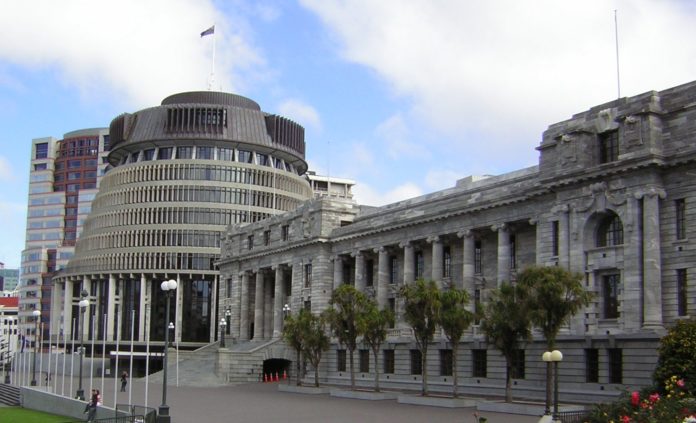
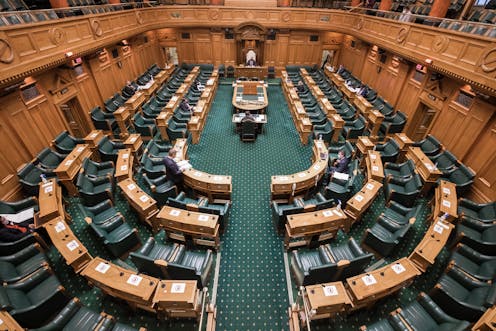
New Zealand Parliament Buildings, Wellington, New Zealand.
New Zealand Politics Daily is a collation of the most prominent issues being discussed in New Zealand. It is edited by Dr Bryce Edwards of The Democracy Project.
As well as her interviews with politicians and experts, Politics with Michelle Grattan includes “Word from The Hill”, where she discusses the news with members of The Conversation politics team.
In this podcast Michelle and politics + society editor Amanda Dunn canvass the final sitting weeks of parliament, in which the government is battling with crossbencher David Pocock to secure its industrial relations reforms. They also discuss the Victorian election, where much attention will be on how teals and other community independents fare. Finally, this week the government receives the report, from former high court judge Virginia Bell, on Scott Morrison’s extraordinary appointment to multi-ministries.
Michelle Grattan does not work for, consult, own shares in or receive funding from any company or organisation that would benefit from this article, and has disclosed no relevant affiliations beyond their academic appointment.
Source: The Conversation (Au and NZ) – By Jonathan W. Marshall, Associate Professor & Postgraduate Research Coordinator, Western Australian Academy of Performing Arts, Edith Cowan University
West Australian Ballet/Bradbury Photography
Review: Swan Lake, West Australian Ballet
Opening this production of Swan Lake is the traditional Noongar black swan dance and the song that accompanies it.
Led by Noongar Leader Barry McGuire, the Noongar swan dance from Gya Ngoop Keeninyarra (One Blood Dancers) is a gentle, measured piece.
The five dancers come across in a line, raise their legs into a sharp angle just below the hips and push the leg down precisely – but not with the force of many Indigenous dances.
In this scene, and when they reappear throughout the ballet, each has a flexible bower or rod before their chest which is shaken gently. The nature of this object varies: at one point white feathers fan over the wounded Odette (Kiki Saito); later it is black feathers.
The placing of the Noongar dancers into a snaking line resonates with the later straight lines of ballerinas, such as the ballet’s famous cygnet dance, integrating the Noongar dancers into the choreography.
But the Noongar materials are small dramatic interjections into what is otherwise a typical late Romantic ballet. Choreographer Krzysztof Pastor reproduces something familiar with a dash of local flavour.
The European aristocratic Romantic ballet – complete with period costumes, choreographic highlights and most of Tchaikovsky’s original score – is lifted out of its original context and into a Western Australian setting. The success or otherwise depends on whether one feels this is desirable or even possible.
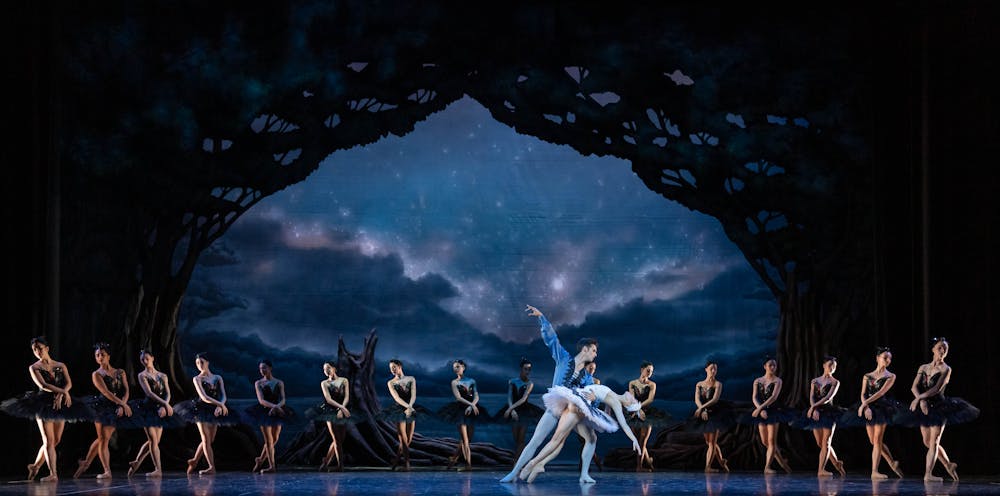
This is a familiar ballet, with a dash of local flavour. West Australian Ballet/Bradbury Photography
A West Australian story
It is 19th century Perth, rather than Russia. The character of Prince Siegfried becomes Sebastian Hampshire (Oscar Valdés), son of wealthy developer John Hampshire (Christian Luck), and his close friend is now Mowadji (Noongar actor Kyle Morrison).
Changes in story-line come unstuck with the character of Baron von Rothbart, originally a shapeshifting sorcerer, who becomes William Greenwood (Matthew Lehmann).
Although identified of settler descent, he is able to transform into the totemic animal of the waalitj, or wedge tailed eagle, which Noongar scholar Len Collard identifies as the most powerful bird on this Country, a “guardian of both the earth and the sun.”
Greenwood uses his evil avian magic to keep Odette under his spell as a white swan (such as one finds in Europe) until a man declares his love for her.
Greenwood also deploys Odile (sometimes played as Odette’s other self, but here a distinct character, peerlessly danced by Chihiro Nomura) the task of wooing Sebastian so Greenwood might join his dynasty with Sebastian’s.
Although she is a lone white swan on Noongar Country, Odette is protected by both the Noongar dancers and the corps de ballet of local magical black swans.
Odette is protected by the Noongar dancers. West Australian Ballet/Bradbury Photography
Dressed in black, the corps’ dance by the lake is nevertheless in the traditional mode. Rows of ballerinas crossing in complex patterns are rightly a highlight. Pastor packs an impressive troupe of over 20 ballerinas on stage without it feeling cluttered.
Lehmann as the eagle comes out less well, his beautiful but heavy costume featuring a chainmail vest making it hard to elevate his leaps. He is nevertheless an impressive, weighty presence.
A confusing marriage
Indigenous Dreaming stories often feature battles between supra-natural human-animal hybrids, some of whom are vicious and immoral, even if there are generally important lessons to be learned from dances and songs. Here, the program promotes the West Australian Ballet’s version as offering a lesson in environmentalism and Noongar wisdom.
Greenwood and John Hampshire join alliances to build their power by enslaving swans and manipulating the lovers. This leads to Sebastian trying to save Odette as she is forced into the lake. He follows her into the water and both drown. Mowadji and his friends, the dancers of Gya Ngoop Keeninyarra, bear Sebastian’s body aloft to the grave.
This is however a confusing marriage of motifs. Was Russian magic blended with that of Australia, or are Greenwood’s acts a metaphor for Russian ballet’s history in Australia? It certainly ends badly.
Polly Hilton is superb as a Spanish dancer. West Australian Ballet/Bradbury Photography
In the end, these conundrums are irrelevant. In such a classic model, the story is an excuse for dancing, not a tight narrative vehicle. The retention of ethnic dance interludes – where groups of dancers perform the traditional styles of the Hungarian czardas, a Spanish flamenco, a Neapolitan sequence and a Polish mazurka – demonstrates this. These colourful interjections (and Polly Hilton is indeed superb as the Spanish dancer) contribute nothing to the plot.
In light of this, it is hard not to see the Noongar dance as another dab of ethnic detailing in a multicoloured palette of native tropes. Placing the Noongar swan dance at the beginning does prioritise it. Played as a non-dancing part, Mowadji’s role here is that of a sidekick, gazing in admiration as Sebastian dances centre stage, even if Morrison’s magnetic presence gives his gestures considerable power.
The setting is West Australia – but the ballet is largely unchanged. West Australian Ballet/Bradbury Photography
In the end, both the strength and the weakness of the production is that Romantic ballet as a cultural and aesthetic concept remains unchanged by the addition of Noongar and Western Australian elements.
Noongar and the ballet company’s artists do not dance together. While the Noongar dancers briefly pose to Tchaikovsky’s score, the settler-descent artists do not dance to McGuire’s singing. Choreographic motifs particular to the races confront each other from across an abyss.
The West Australian Ballet’s Swan Lake is a thought-provoking, beautifully danced piece – but it does not resolve the challenges the artists set themselves.
The Swan Lake plays at His Majesty’s Theatre, Perth, until December 11.
Jonathan W. Marshall does not work for, consult, own shares in or receive funding from any company or organization that would benefit from this article, and has disclosed no relevant affiliations beyond their academic appointment.
On July 31 2013 a constellation of US defence satellites saw a streak of light over South Australia as a rock from outer space burned through Earth’s atmosphere on its way to crash into the ground below.
The impact created an explosion equivalent to about 220 tonnes of TNT. More than 1,500km away, in Tasmania, the bang was heard by detectors normally used to listen for extremely low-frequency sounds from illegal tests of nuclear weapons.
These were two excellent indications that there should be a patch of ground covered in meteorites somewhere north of Port Augusta. But how could we track them down?
Finding meteorites is not an easy task. There is a network of high-quality ground-based sensors called the Global Fireball Observatory, but it only covers about 1% of the planet.
So, to have any chance to find a meteorite from these data, you need a little outside help.
Weather radars
In 2019, Australia’s Bureau of Meteorology started making its weather radar data openly available to researchers and the public. I saw this as an opportunity to complete the puzzle.
I combed through the record of events from the Desert Fireball Network and NASA, and cross-matched them with nearby weather radars. Then I looked for unusual radar signatures that could indicate the presence of falling meteorites.
The Woomera weather radar station captured reflections from the falling meteorites. Curtin University, Author provided
And bingo, the 2013 event was not too far from the Woomera radar station. The weather was clear, and the radar record showed some small reflections at about the right place and time.
Next, I had to use the weather data to figure out how the wind would have pushed the meteorites around on their way down to Earth.
If I got the calculations right, I would have a treasure map showing the location of a rich haul of meteorites. If I got them wrong, I would end up sending my team to wander around in the desert for two weeks for nothing.
I gave what I hoped was an accurate treasure map to my colleague Andy Tomkins from Monash University. In September this year, he happened to be driving past the site on his way back from an expedition in the Nullarbor.
Thankfully, Andy found the first meteorite within 10 minutes of looking. In the following two hours, his team found nine more.
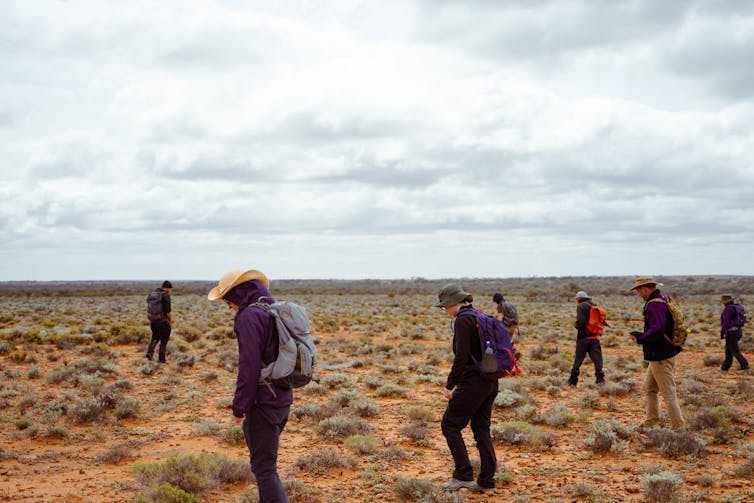
A field team from Monash University searched for meteorites in the strewn field. Monash University, Author provided
The technique of finding meteorites with weather radars was pioneered by my colleague Marc Fries in the US. However, this is the first time it has been done outside the US NEXRAD radar network. (When it comes to monitoring airspace, the US has more powerful and more densely packed tech than anyone else.)
This first search confirmed there were lots of meteorites on the ground. But how were we going to find them all?
In the end we collected 44 meteorites, weighing a bit over 4kg in total. Together they form what we call a “strewn field”.
A machine-learning algorithm identified meteorites from drone photos. Curtin Uni, Author provided
Strewn fields tell us a lot about how an asteroid fragments in our atmosphere.
That’s quite important to know, because the energy of these things is comparable to that of nuclear weapons. For example, the 17-metre asteroid that exploded over Chelyabinsk in Russia in 2013 produced an explosion 30 times the size of the bomb dropped on Hiroshima in 1945.
So when the next big one is about to hit, it may be useful to predict how it will deposit its energy in our atmosphere.
These systems might give us as much as a few days’ notice that an asteroid is heading for Earth. This would be too late to make any effort to deflect it – but plenty of time for preparation and damage control on the ground.
The value of open data
This find was only made possible by the free availability of crucial data – and the people who made it available.
The US satellites that detected the fireball are presumably there to detect missile and rocket launches. However, somebody (I don’t know who) must have figured out how to publish some of the satellite data without giving away too much about their capabilities, and then lobbied hard to get the data released.
Likewise, the find would not have happened without the work of Joshua Soderholm at Australia’s Bureau of Meteorology, who worked to make low-level weather radar data openly accessible for other uses. Soderholm went to the trouble to make the radar data readily available and easy to use, which goes well beyond the vague formulations you can read at the bottom of scientific papers like “data available upon reasonable request”.
There is no shortage of fireballs to track down. Right now, we’re on the hunt for a meteorite that was spotted in space last weekend before blazing through the sky over Ontario, Canada.
Hadrien Devillepoix does not work for, consult, own shares in or receive funding from any company or organisation that would benefit from this article, and has disclosed no relevant affiliations beyond their academic appointment.
Australia’s industrial relations umpire has delayed industrial action that would have crippled Australia’s ports in the lead-up to Christmas.
But the dispute in which it has intervened – one that has dragged on since 2019 – shows the need for reform of Australia’s collective bargaining system.
The Fair Work Commission last week intervened in the protracted dispute between tugboat operator Svitzer Australia and three maritime unions after the company declared its intention to “lock out” staff in a bid to force a resolution – either by the unions caving or by the commission using its powers to arbitrate outstanding matters.
Svitzer, a subsidiary of Danish shipping giant Maersk, employs about 600 staff at 17 Australian ports. Its tugboats guide the arrival and departure of container ships carrying about 75% of Australia’s trade. The lockout would have prevented ships entering or leaving port.
Last Friday the full bench of the Fair Work Commission ordered a six-month suspension on any industrial action by Svitzer or the three unions – the Construction, Forestry, Maritime, Mining and Energy Union (CFMMEU), the Australian Maritime Officers Union (AMOU), and the Australian Institute of Marine and Power Engineers (AIMPE).
It did so using its powers to stop industrial action that threatens to cause significant damage to the economy or part of it.
However, the commission refused Svitzer’s application to terminate the notified lockout, an outcome that could have led to the commission arbitrating the outstanding matters in dispute. Arbitration appeared to be Svitzer’s aim but was opposed by the unions.
Background to the dispute
Svitzer and the unions began negotiating a new enterprise agreement in late 2019. The company wanted changes to the agreement made in 2016 to give it greater flexibility in hiring staff. The unions opposed these changes on the basis they would lead to greater casualisation.
The process laid down by the Fair Work Act is to negotiate, with “protected industrial action” available to the parties to support their claims.
But the Act’s provisions make it particularly hard for port workers to take impactful industrial action, given the commission can suspend or terminate any action threatening to cause significant economic damage.
In February, the commission blocked 48-hour strikes slated for ten ports in Western Australia, Queensland and New South Wales.
As a result, the unions have taken more low-level industrial action, such as work bans and limited stoppages, which are unlikely to attract the attention of the commission.
Svitzer’s decision to lock out workers recalls that of Qantas’s strategy in 2011, when the airline shut down its fleet to push the commission to arbitrate its dispute with unions over a new enterprise agreement. Qantas was widely considered the winner in the subsequent arbitration.
Svitzer’s motivation is to get rid of the 2016 enterprise agreement. Indeed in January it applied to have the commission terminate the agreement, which remains in force until replaced.
Termination would mean Svitzer’s employees would be covered only by award provisions and individual contracts – an effective win for the company. (This application remains before the commission.)
Will the government’s IR reforms help?
With a settlement not really any closer, the Svitzer dispute demonstrates the failure of the Fair Work Act to provide a safety valve to resolve intractable disputes.
Employment and workplace relations minister Tony Burke has argued the Albanese government’s industrial relations reforms – yet to pass the Senate – will assist in a dispute like Svitzer.
They will help, but on their own will not be enough.
The amendments will remove the ability to seek termination of an existing agreement while bargaining for a new agreement. This provision was not intended to be used as leverage during a dispute, as Svitzer has done.
The amendments also propose a new “intractable dispute mechanism”. This is different from current provisions because it does not require anyone to threaten or take potentially damaging industrial action before a party can seek arbitration by the commission.
More fixes needed
However, the bill does nothing to improve the Fair Work Act’s weak requirements for parties to bargain in “good faith”. This will continue to enable surface bargaining, leading to protracted disputes.
The provisions policing industrial action will still be among the most complex and costly in the developed world.
To ensure the Fair Work Commission is seen a fair and reasonable arbitrator, its members (appointed by the federal government) must also better reflect society, to restore faith in the institution for all parties concerned. Otherwise, unions may continue to resist arbitration, fearing the outcome will favour employers.
Moreover, despite the proposed expansion of multi-employer bargaining, the Albanese government has committed to maintaining the primacy of enterprise-level bargaining.
So suppressing workers’ pay and conditions will continue to be strategy to obtain a competitive advantage over other businesses. (Svitzer has argued its 2016 agreement means it cannot compete for port contracts.)
While the focus of our system remains the single enterprise, and workers’ pay and conditions can be used to undercut competitors, disputes like the one at Svitzer will continue to feature in the industrial landscape.
Shae McCrystal receives funding from the Australian Research Council.
Keith Rankin, trained as an economic historian, is a retired lecturer in Economics and Statistics. He lives in Auckland, New Zealand.
Analysis by Keith Rankin.
Keith Rankin, trained as an economic historian, is a retired lecturer in Economics and Statistics. He lives in Auckland, New Zealand.
Last week the world population reached eight billion people, at least according to some sources. See these world population clocks, which do not agree: refer Worldometer and the US Census Bureau.
The growth rate of the world population is slowing. Indeed, there is a possibility that it will never reach nine billion; there are demographic ‘headwinds’ affecting both fertility and mortality.
What we do know is that the population age structures are very different in different continents, and different countries. This at a time when extreme ‘territorial fundamentalism’ has made the 2020s the most difficult decade in modern times for most people to get permission to travel to another country, let alone migrate to it. Before the nineteenth century, the main barriers were physical geography and other factors (dangers) which made long-distance travel slow, expensive and risky. The ‘other factors’ include cultural barriers which would have made it difficult for strangers – ‘strange people’ – to settle in places away from their birth localities. And, before modern times, in feudal times people were bonded to their birthlands; they were serfs bonded to their lords’ lands.
Today, as in the past, we live in times when many people of ‘working age’ live in places in which they are not economically productive; yet the barriers to resettlement – from countries with labour surpluses to countries with labour deficits – are huge. Perceived ‘land abundance’, such as territories populated ‘only’ by a few ‘natives’, is a thing of the past; but there are many places of opportunity in today’s world, with labour shortages which can be resolved by a mix of migration and skills education.
Colonisation and Decolonisation: past, future and present
In the European context, the Mediterranean Sea long represented a space around which colonisation could take place; in the context where powerful and growing mini-states could gain economies of scale and living spaces for their growing populations. Important early colonisers were the Phoenicians, the Greeks, and the Romans. In early times, migration meant a mix of conquest and colonisation. Settler colonies of these regional superpowers would form, and later would be trashed as power balances changed.
One important later example of classical-era colonisation reached beyond the Mediterranean Sea, namely the Roman colonisation and settlement of the island of Britannia. In the time of Julius Caesar (the ‘discoverer’ of Britannia) – 2,070 years ago – the ‘tangata whenua’ of Britannia, the British, were essentially the P-Celtic people we know today as ‘Welsh’. (There were also the Picts in much of today’s Scotland.)
Military and economic opportunities, and then demographic pressures, led to the creation of a romanised European world. Romans settled in Britannia from the forties (the 0040s that is) and native Britons were substantially romanised. The process was not unlike the nineteenth century britanisation of New Zealand. Roman Britain lasted for over 300 years as a prosperous and relatively stable example of colonisation. Further, the ’empire struck back’, meaning that increasingly the population of Rome itself were romanised non-ethnic-Romans; not unlike the anglicised South Asians prominent in British politics today. Late-Roman emperors were not always ethnic Romans; other Roman leaders were even more likely to be romanised non-Romans.
With the eventual collapse of Rome, in the fifth century, that Empire imploded. This implosion would be equivalent to a coming ‘collapse of the West’ in, say, the twenty-second century. In Britannia it was the romanised Britons who inherited the greater part of the island. Indeed, the legends of ‘King Arthur’ reflect this short and mythologised phase of British history. Times were tough in the sixth century, and not only because of empire collapse. The year CE 536 has been described as the worst ever in recorded history: refer Why 536 was ‘the worst year to be alive’, Science, 15 Nov 2018; and Volcanic winter of 536, and Battle of Camlann, both Wikipedia.
Nevertheless, a combination of the inevitable fall of the Roman Empire and the ‘acts of God’ in the sixth century created demographic spaces. In the larger part of Britannia, the part that became England, the spaces were filled by Germanic people from places across the North Sea: Lower Saxony, Anglia, and Jutland. Most traces of Romans and Roman culture were erased. Latin was erased, and British (‘Welsh’) was marginalised to the western periphery. A new language and new culture filled the void; English (Anglaise).
Looking forward, beyond the present, to the end of the modern era – say the quarter millennium (the year 2250) – this transformation of Britannia signals a possible fate for Aotearoa New Zealand and other far-flung neo-European settlements. In this scenario, the present European hegemony (aka ‘the west’) diminishes (maybe eventually collapses). Anglo New Zealanders continue to leave throughout this late-modern period, leaving anglicised Māori and Polynesian and Asian New Zealanders to maintain an ongoing sense of Britishness. This unravelling southern outpost of the Commonwealth would then represent a demographic opportunity to new groups of colonisers. The ‘south seas’ equivalent of Lower Saxony and Anglia will most likely be places in South Asia or East Asia.
The conquest of Great Britain 2,000 years ago came from relatively afar, Italy. The conquest of New Zealand in the nineteenth century, then a land of opportunity for British people facing demographic pressure, came from as far as it possibly could have come. The next conquest of Zealandia will be from further than Rarotonga, though from closer than Britannia. Human settlement never was and never will be a simple process of one ‘tribe’ arriving in an unsettled land, staying, and fending off newcomers.
In the present era, Britannia and Zealandia represent lands of demographic opportunity, places working people want to go to as economic migrants. Historically, the two main demographic magnets have been lands and cities. In the nineteenth century, people migrated to new lands, and, there, multiplied in huge numbers. And they went to cities – new cities like Chicago and Melbourne (refer James Belich, Replenishing the Earth 2009) – and established cities like London and Paris. Unlike the new hinterlands, which facilitated human fertility, the big cities served as demographic sinks. That, however, did not mean that cities were unattractive places. Cities gave opportunities for people to express themselves through cultural interaction and creativity, rather than through monocultural pastures of human and animal reproduction.
It is urbanisation which puts an end to Malthusian (ie exponential) expansion of humanity. First, cities – especially the bigger cities – tended to be mainly characterised by their high mortality. Today, they are characterised by low fertility. The world’s population may never reach nine million, if our cities are allowed to fulfil their role as demographic magnets, given that they will continue to be demographic sinks. (That said, it only takes a pandemic to create temporary forces favouring urban depopulation and rural repopulation.)
European Centre and Periphery
The ‘Third Reich’ project, which developed in Germany in the 1930s, had two central themes. First was the inspiration from the Roman Empire, with Berlin posited as the new Rome. The second theme was ‘Lebensraum’ (living room) which meant the conquest and settlement of the lands in Eastern Europe by German people, to create a large German hinterland which would favour the multiplication of the German people at the expense of the other (mainly but not only Slavic) peoples of East Europe.
While that project failed, thankfully, it can be argued that the present European Union project is a kind of ‘Fourth Reich’, in which Berlin plays a less overt role as the centre of power. In this occurrent project the demographic forces in play are a centripetal pull towards the economic centre, and a depletion – a de-peopling instead of a re-peopling – of the European periphery. This may be called ‘reverse Lebensraum’. In the Fourth Reich, the ‘King’ (or ‘chancellor’) is a committee – or a nexus of committees – rather than a monarch or republican autocrat. The Fourth Reich is a bureaucracy rather than an autocracy. (Refer Europe’s Forbidden Colony, Al Jazeera27 Feb 2017, for an analysis of the European Union as an ‘ultra-neoliberal’ and ‘imperial’ project. ‘Colonisation’ here refers to the imperial “logic of extraction”, through which we may understand there is a process of people-mining as well as land-mining.)
The European periphery is multi-faceted. (And we note that London has broken away from this Fourth Reich, creating an independent power centre in the region.) The inner peripheries of Europe are the rural hinterlands of each EU partner nation; these are subject to significant depopulation, especially in the member countries which use the Euro currency (ie the Eurozone). As long ago as the 1970s, I recall cycling through French villages not on public transport routes, and hearing about these communities’ losses of services and young people.
Next is the periphery of the European Union itself, which includes the East, the South, and Ireland. Ireland is a kind of boom-bust special case, which is able to trade on its location, corporate tax policies, English language, and high education standards, to become a European front for American-centred multinational businesses. Ireland is a country with a long history of diaspora, and this was a key feature of its experience in the Eurozone crisis which was at its worst in 2012. The other countries which suffered substantial losses of young people and services in the early 2010s were of course the southern countries of Greece, Italy, Spain and Portugal.
Now, the depopulation crisis is concentrated in the east of the European Union. All of the eastern European Union countries have lost substantial portions of their youth to the central economic hubs of Berlin and northwest Europe. (Indeed if you watch German movies on Netflix you will see many Eastern European names in the credits.) Those hubs themselves are demographic sinks, growing through ongoing human replenishment from the periphery of the Union. The eastern nations have the least financial capacity to retain their young people.
Depopulation in East Europe has been happening for a while. Shifts from rural to urban East Europe implied reduced fertility; this continues to be the main dynamic of population contraction in Russia. Now the main cities of East Europe are increasingly by-passed in favour of the privileged urban zones in the north and west. The United Kingdom was one of the most favoured destinations for East Europeans prior to Brexit. It still is, though the balance is changing with relatively more people from non-EU (Balkan, southeast European) countries risking the increasingly tortuous journey across the Strait of Dover. About twenty percent of those crossing to England in small boats this year have been from Albania, a Balkan country with fewer than three million people.
What also happened around 2015 and 2016, with the mass influx into the European Union of Syrian refugees, was that these new EU immigrants displaced immigrants from the non-EU Balkan nations. Indeed one of the ironies of non-EU east Europe is that, while both the push and the pull the demographic forces they face are the same if not stronger than those within the European Union, the presence of the EU in much of the east has made the competitive disadvantage ever harder for the youth of Serbia, Albania, North Macedonia, Bosnia and Montenegro.
The kind of economy that is emerging in East Europe is of a mix of traffickers and other service providers (many from eastern EU countries) ‘assisting’ the trafficked, meaning would-be immigrants from disadvantaged non-EU countries. The most populous of these non-EU countries feeling the push and the pull are from what might once have been called ‘Asia Minor’ or the ‘Near East’ (in addition to the ‘Middle East’, part of which is the Levant). As well as Ukraine, these include former Soviet Union countries such as Moldova, Armenia and Georgia; and, increasingly, Russia itself (noting the many anti-war refugees who have fled to places like Georgia).
Finally, the European political and economic periphery includes Africa; pretty much all of Africa, although people from southern Africa will naturally gravitate directly to the United Kingdom rather than the European Union.
Many of us of European ethnicity continue to make condescending assumptions about Africa, and Africans. (I feel privileged to have travelled in Africa, albeit a long time ago, and feel that my brief time there gives me a less unbalanced perspective on that part of the world.) At worst, too many ethnic Europeans simply assume that African nations are ‘basket cases’. Some of us continue to see Africa as the “white man’s burden”. While many realise that African countries now have the fastest growing populations in the world, few outside of that continent realise that Africa has been experiencing the world’s fastest economic growth.
Yet we see so many Africans, young Africans, risking all to ‘escape’ to Europe. We don’t bother wondering about why they are leaving Africa; we simply assume that Africa, as a continent, is chronically subject to the three checks emphasised by Malthus in 1798 – warfare, famine, disease. (Refer to this entry in Encyclopedia Britannica, and Are Malthus’s Predicted 1798 Food Shortages Coming True? 1 Sep 2008, by economist Jeffrey Sachs.)
Yes, all three do happen in Africa. But not everywhere there, all the time. What is actually driving people out of Africa this century is the same as what was driving people out of Europe in the nineteenth century; capitalist economic structural change, and the presence of people magnets outside of Africa.
The underlying circumstances of certain groups in history is known to economists as the ‘zero marginal product of labour’. What this means is, if one worker leaves an industry or a farm, the economic output of that enterprise is unaffected. Historically, this principle has been most applied to agricultural workers, especially in a ‘peasant’ context.
When industrialisation takes place in some part of the world, it is typically ‘powered’ by new industries (typically but not only urban) with a high marginal product of labour drawing people from the countryside. From a worker’s point of view, the attractant is higher wages in the new industry. Then, as the city starts to demand more from the country, farms come to be organised more as capitalist production enterprises than as rural welfare communities. Thus, push factors come into play as capitalist farmers divest themselves of unnecessary labour. Once pushed, young workers then survey the scene; if they find that the best opportunities in their own countries’ cities are already taken, they look to better opportunities in other countries.
In the nineteenth century, such people in Europe looked to far-away lands in the ‘new world’ as better bets for themselves. Better opportunities also meant better opportunities to have large families, because the economic security of rural older people lay in their own adult children. In the twenty-first century, it is no longer the availability of foreign rural lands that is the incentive. Rather it’s the opportunities of large foreign cities to provide a personal income with enough left over to remit to families in the workers’ countries of origin. First generation immigrants do have larger families, even in urban settings, than people already in those cities. Nevertheless, on balance, those bigger cities continue to be demographic sinks.
The following is an example of a Zambian radiation oncologist now working in Palmerston North, New Zealand. Stuck in a neocolonialist past: Is the migration brain drain an outdated concept? 21 Sep 2022, which featured on Deutsche Welle. Not only does she – the Zambian doctor – understand that her productivity is higher in New Zealand than in Zambia, she also actively contributes to her community in Zambia through remittances, and through an understanding that her current work in New Zealand represents an investment which, eventually, can be paid forward to her country of origin.
Globalisation versus Deglobalisation
‘Globalisation’ can be a problematic word, because many use it to mean an ideologyof global neoliberalism. That’s unfortunate, because the correct meaning of globalisation is the emergence of a world economy with diminished territorial barriers to the flows of money and especially labour. (I say especially to labour, because, even in the years before 2020, labour barriers were entrenching just as economic forces of demand and supply were creating increased demands for a globally mobile labour force.)
In today’s (sort-of) post-covid world economy, deglobalist nationalist ideologies conflict directly with economic sustainability and the requirements of the nations’ labour markets. We are now starting to understand that, in a high productivity high population world, the urban metropolises – with their economies of scale – are the most sustainable and stimulating environments for most people to live in. And we are about to start understanding that a sustainable city-dominated modern global economy will depend on reverse flows of money – for present purposes, we may call these ‘remittances’ – into the hinterland communities (such as, in the New Zealand context, Tairāwhiti and Samoa). Such remittances are not mere gifts; the hinterlands where people are raised and educated are places of investment; meaning that these ‘remittances’ are really returns on investment. Through their remittances supporting the Philippines’ economy, nurses trained in Philippines enable Philippines to continue to be a ‘nursing factory’ for the world.
The big demographic story today is not the size of the world population; but the huge geographical imbalances between labour supply and labour demand, and the barriers which prevent labour markets from clearing. Powerful global market forces will work to mitigate these; though these market corrections are to a large extent illegal and misunderstood. An activity (economic migration) which for the most of history has been legal – though in some cases has been accompanied by conquest – is now illegal for many (because of the bureaucratisation and excess of national border controls), creating needless cost and tragedy for those who are responding rationally to market forces. The barriers and the bureaucrats create ‘rent-seeking’ opportunities for smugglers.
The European Union has its own tragedy, as we saw with the Greek economic depression after the global financial crisis. This Union needs to be a fiscal union – more like the United States of America – whereby the hinterlands, international hinterlands within the European Union as well as those within each nation, need to be supported by more than private remittances. People resident in Transylvania should have comparable economic rights as residents of Thuringia.
The global economy needs to develop (preferably universal, non-bureaucratic) systems of ‘public remittances’; within its nations, within its Unions, and eventually with a fully global component. People will grow up, gain skills, work in places – commonly in cities away from their places of nurture – where they can maximise their marginal productivities; and a mix of their earnings and taxes can be ‘remitted’ to maintain the health of their source communities.
*******
Keith Rankin (keith at rankin dot nz), trained as an economic historian, is a retired lecturer in Economics and Statistics. He lives in Auckland, New Zealand.
Research from the Who Gets to Tell Australian Stories? 2.0 report released today shows newsrooms across Australia are responsible for reinforcing and reproducing racial inequalities because they fail to represent the voices and faces of the society they serve.
Australia’s population is more diverse than ever. The latest ABS Census data shows just 54% of Australians now claim an Anglo-Celtic background. Around 25% have a non-European background, 18% have a European background, and 3% have an Indigenous background.
Yet new research from the University of Sydney, UTS Jumbunna Institute for Indigenous Education and Research, and Media Diversity Australia confirms the journalist workforce remains overwhelmingly Anglo-Celtic and white. The research found that almost 80% of television news and current affairs presenters on the major free-to-air networks are Anglo-Celtic. Likewise, 78% of senior network news editors are Anglo-Celtic. Just 1.3% of on-air talent on commercial networks are from a non-European background.
Concerningly, the new report shows that little progress has been made since the first report in 2020.
Particularly problematic are regional newsrooms. Regional newspapers, radio and TV stations are said to be more closely aligned with their communities than metropolitan media outlets. Regional newsrooms are also a recognised training ground for journalists and an important pathway for those seeking a foothold into Australian media more broadly.
But editors acknowledge that recruitment processes often lead to the employment of Anglo-Celtic journalists, effectively shutting the door to a more diverse workforce that will more properly represent the population it serves.
The importance of diversity in journalism
The media hold a mirror to our society – reflecting culture and helping to form opinions.
If the people framing the stories are from just one sector of society, we risk reinforcing stereotypes and reproducing inequalities. We know that a white Anglo-Celtic point of view alone is not representative of Australia in 2022.
Federal Communications Minister Michelle Rowland said last week that “media policy in this country has been ‘stuck in a rut’ of unambitious agendas and failed execution”, and that the media sector is urgently in need of a diversity strategy.
We argue that diversity must not only be measured in terms of media ownership, but in the diversity of the faces and voices being broadcast and published in the work produced by newsrooms nationally.
Our research shows the pathway to a career in journalism is too often blocked for Indigenous and culturally diverse faces and voices.
Regional newsrooms are a good place to start clearing the blockage.
What editors say about diversity
In the first half of 2022, we interviewed 19 editorial leaders from five regional media organisations around the country. The leaders were evenly split in terms of gender, age and experience. All identified as Anglo-Celtic.
We asked the leaders about the diversity of their audiences and if they considered cultural diversity when hiring staff.
The aim was to discover any practices that might be hindering the appointment of journalists from Indigenous and culturally diverse backgrounds, and to suggest ways to support the recruitment of a more diverse workforce.
Most of the editorial leaders described their communities as diverse, and said they would welcome having journalists from Indigenous or other culturally diverse backgrounds in their newsrooms.
One editor said
The best stories are forged by people working together to create a shared narrative. So, it’s critical that we are making sure that not everyone is like me in the room.
However, most also agreed that their newsrooms were mainly filled with white faces.
As captured by one interviewee:
It’s very easy to just start thinking from a mainstream white point of view, because that’s what our entire newsroom is made up of.
Where are the diverse faces and voices?
The editorial leaders suggested several reasons why the journalist workforce remains stubbornly Anglo-Celtic, including:
a lack of applicants from diverse backgrounds
requirements for tertiary qualifications
time pressures that meant they looked for “easy” hires
concerns about English language standards
the need to ensure new recruits would “fit” the newsroom
and a lack of industry role models.
Their responses indicate that both personal bias and structural racism – embedded in traditional recruitment strategies – could be creating barriers to journalists from Indigenous or culturally diverse backgrounds.
The editors acknowledged media organisations could do better in their efforts to recruit for diversity. But many felt the required changes were outside their scope of influence, especially given the heavy demands of local newsroom management.
This signals that senior media leadership, including media company board members, need to step up to create the conditions to support and promote newsroom diversity.
In particular, they could:
offer journalism scholarships and traineeships to students from diverse backgrounds
introduce blind-screening and skills-focused criteria to the recruitment process to minimise the risk of discrimination on racial grounds
provide a welcoming work environment that promotes role models and mentors.
Underpinning it all is the need to measure, monitor and report on diversity across the entire sector. We know that what gets measured, gets done. It’s therefore critical to monitor progress and gaps as we work towards a more inclusive and representative media.
Greater diversity isn’t just the right thing to do, it also makes good business sense. This multi-billion-dollar industry needs to start taking account of audience representation and the stories they trust, as a white Anglo-Celtic point of view alone fails to represent Australia in 2022.
The authors do not work for, consult, own shares in or receive funding from any company or organisation that would benefit from this article, and have disclosed no relevant affiliations beyond their academic appointment.
With COVID isolation rules largely gone, some people feel pressured to rush back to work, school, or other activities after testing positive to COVID.
If your symptoms are mild, you might be tempted to just keep (remotely) working through your infection, and quickly return to your usual exercise program so you don’t lose your fitness.
But while we might be used to bouncing back quickly after other viruses, we need to be more cautious with COVID. Aside from the risk of transmission, over-exertion can exacerbate and prolong your COVID symptoms.
Pushing too hard can set you back
Clinical guidelines recommend getting adequate rest when you’re diagnosed with COVID. Pushing yourself too hard and too early during your recovery from your initial COVID infection may set your progress back.
While around four in five people with COVID have mild illness and recover within a month, for others, it can take up to a few months or even longer.
When people have symptoms such as fatigue and/or shortness of breath for three months or more, this is called long COVID. Up to 89% of people with long COVID experience post-exertional malaise, where overdoing physical or mental activity exacerbates symptoms such as fatigue and causes new symptoms such as pain and anxiety.
So you’ve tested positive for COVID. How can you tell whether you’re well enough to get back to your usual routine?
Here are five tips:
1) Take your time
If you’re feeling sick, use your paid leave entitlements, if you have them, even it’s for a day or two to relax and unwind.
While it may be tempting to return to work quickly after COVID, avoid attending the workplace for at least seven days if you work in a high-risk setting such as health, disability and aged care. For other workers, it’s a good idea to isolate until your symptoms resolve.
If you’re feeling fatigued but want to get back to work, you might be able to start with half-days, or working for a few hours, then ramping up to your usual workload.
If you’re struggling with fatigue while recovering from COVID, a referral to an occupational therapist or physiotherapist can provide further strategies to manage this symptom.
3) Wait until you’re symptom-free for 7 days to exercise
You might feel ready to start exercising after your symptoms resolve but to avoid overexertion, it’s important to wait until you have been free of any COVID symptoms for at least seven days.
Start with light intensity exercises – where you can easily breath, maintain a conversation and feel you could sustain the activity for hours – for 10–15 minutes to begin with.
Only exercise again if you feel recovered from the previous day’s exercises, without new onset or worsening of symptoms such as fatigue and pain.
If you do experience more significant symptoms from COVID, consider roping in your friends and family. They may be entitled paid carer’s leave or even two days of unpaid carer’s leave for casual workers if they need to care someone with COVID.
If you are struggling to manage your health and other financial pressures, contact your financial institution to discuss payment plans.
If you work in a high-risk setting such as health, disability and aged care, you may also be entitled to additional government support to help you through the time when you cannot work because of COVID.
Ask family and friends for help if you’re struggling. Pexels/Andrew Neel
5) Know when to see your health provider
If you’re over 70, (or over 50 with additional risks, or are an Aboriginal or Torres Strait Islander person aged over 30 with additional risks), talk to your GP about antiviral medicines as soon as you test positive to COVID. Antivirals reduce your chance of severe COVID requiting hospitalisation, and are ideally taken within five days of diagnosis.
If you’re managing COVID at home, use a symptom checker to see if you need medical advice for your condition.
If you have ongoing symptoms after your initial COVID infection, make an appointment with your doctor to monitor your condition and refer you onto other health professionals, where appropriate, to assist with symptom management.
While there are currently no medications to treat COVID symptoms such as fatigue, exercise-based health professionals such as physiotherapists can set you up with an exercise program and progress it accordingly to reduce fatigue and assist with breathlessness.
Mahatma Gandhi was right when he said “good health is true wealth”, so be kind to yourself when recovering from COVID.
Dr Clarice Tang receives funding from NSW Government, Department of Health and the Maridula Budyari Gumal association. She is affiliated with Western Sydney University and is a member of the Australian Physiotherapy Association, Thoracic Society of Australia and New Zealand and the American Thoracic Society.
After a few chaotic weeks it’s clear Elon Musk is intent on taking Twitter in a direction that’s at odds with the prevailing cultures of the diverse users who call it home.
Musk has now begun reinstating high-profile users – including Donald Trump, Alex Jones and Kanye West – who had been removed for repeated violations of community standards.
This comes off the back of a mass exodus of Twitter staff, including thousands that Musk unceremoniously fired via email. The latest wave of resignations came after an ultimatum from Musk: employees would have to face “extremely hardcore” working conditions (to fix the mess Musk created).
All of this points to a very different experience for users, who are now decamping the platform and heading to alternatives like Mastodon.
So what threats are we likely to see now? And how does one go about leaving Twitter safely?
#TwitterShutDown
With so many experienced staff leaving, users face the very real possibility that Twitter will experience significant and widespread outages in the coming weeks.
Enterprise software experts and Twitter insiders have already been raising alarms that with the World Cup under way, the subsequent increase in traffic – and any rise in opportunistic malicious behaviour – may be enough for Twitter to grind to a halt.
Aside from the site going dark, there are also risks user data could be breached in a cyberattack while the usual defences are down. Twitter was exposed in a massive cyberattack in August this year. A hacker was able to extract the personal details, including phone numbers and email addresses, of 5.4 million users.
One would be forgiven for thinking that such scenarios are impossible. However, common lore in the technology community is that the internet is held together by chewing gum and duct tape.
The apps, platforms and systems we interact with every day, particularly those with audiences in the millions or billions, may give the impression of being highly sophisticated. But the truth is we’re often riding on the edge of chaos.
Building and maintaining large-scale social software is like building a boat, on the open water, while being attacked by sharks. Keeping such software systems afloat requires designing teams that can work together to bail enough water out, while others reinforce the hull, and some look out for incoming threats.
To stretch the boat metaphor, Musk has just fired the software developers who knew where the nails and hammers are kept, the team tasked with deploying the shark bait, and the lookouts on the masts.
Can his already stretched and imperilled workforce plug the holes fast enough to keep the ship from sinking?
We’re likely to find out in the coming weeks. If Twitter does manage to stay afloat, the credit more than likely goes to many of the now ex-staff for building a robust system that a skeleton crew can maintain.
Hate speech and misinformation are back
Despite Twitter’s claims that hate speech is being “mitigated”, our analysis suggests it’s on the rise. And we’re not the only researchers observing an uptick in hate speech.
The graph below shows the number of tweets per hour containing hate speech terms over a two-week period. Using a peer-reviewed hate speech lexicon, we tracked the volume of 15 hateful terms and observed a clear increase after Musk’s acquisition.
Volume of tweets containing hate speech terms.
Misinformation is also on the rise. Following Musk’s swift changes to blue tick verification, the site tumbled into chaos with a surge of parody accounts and misleading tweets. In response, he issued yet another stream-of-consciousness policy edict to remedy the previous ones.
With reports that the entire Asia-Pacific region has only one working content moderator left, false and misleading content will likely proliferate on Twitter – especially in non-English-speaking countries, which are especially at risk of the harmful effects of unchecked mis- and disinformation.
If this all sounds like a recipe for disaster, and you want out, what should you do?
Pack your bags
First, you may want to download an archive of your Twitter activity. This can be done by clicking through to Settings > Settings and Support > Settings and Privacy > Your Account > Download an archive of your data.
It can take several days for Twitter to compile and send you this archive. And it can be up to several gigabytes, depending on your level of activity.
Lock the door
While waiting for your archive, you can begin to protect your account. If your account was public, now might be a good time to switch it to protected.
In protected mode your tweets will no longer be searchable off the platform. Only your existing followers will see them on the platform.
If you’re planning to replace Twitter with another platform, you may wish to signal this in your bio by including a notice and your new username. But before you do this, consider whether you might have problematic followers who will try to follow you across.
Check out
Once you have downloaded your Twitter archive, you can choose to selectively delete any tweets from the platform as you wish. One of our colleagues, Philip Mai, has developed a free tool to help with this step.
It’s also important to consider any direct messages (DMs) you have on the platform. These are more cumbersome and problematic to remove, but also likely to be more sensitive.
You will have to remove each DM conversation individually, by clicking to the right of the conversation thread and selecting Delete conversation. Note that this only deletes it from your side. Every other member of a DM thread can still see your historic activity.
Park your account
For many users it’s advisable to “park” their account, rather than completely deactivate it. Parking means you clean out most of your data, maintain your username, and will have to log in every few months to keep it alive on the platform. This will prevent other (perhaps malicious) users from taking your deactivated username and impersonating you.
Parking means Twitter will retain some details, including potentially sensitive data such as your phone number and other bio information you’ve stored. It also means a return to the platform isn’t out of the question, should circumstances improve.
If you do decide to deactivate, know that this doesn’t mean all your details are necessarily wiped from Twitter’s servers. In its terms of service, Twitter notes it may retain some user information after account deactivation. Also, once your account is gone, your old username is up for grabs.
Reinforce the locks
If you haven’t already, now is the time to engage two-factor authentication on your Twitter account. You can do this by clicking Settings > Security and account access > Security > Two-factor authentication. This will help protect your account from being hacked.
Additional password protection (found in the same menu above) is also a good idea, as is changing your password to something that is different to any other password you use online.
Once that’s done, all that’s left is to sit back and pour one out for the bird site.
Daniel Angus receives funding from Australian Research Council through Discovery Projects DP200100519 ‘Using machine vision to explore Instagram’s everyday promotional cultures’, DP200101317 ‘Evaluating the Challenge of ‘Fake News’ and Other Malinformation’, and Linkage Project LP190101051 ‘Young Australians and the Promotion of Alcohol on Social Media’. He is an Associate Investigator with the ARC Centre of Excellence for Automated Decision Making & Society, CE200100005.
Timothy Graham receives funding from the Australian Research Council for his Discovery Early Career Researcher Award (DE220101435), ‘Combatting Coordinated Inauthentic Behaviour on Social Media’. He also receives funding from the Australian Government Department of Defence.
Source: The Conversation (Au and NZ) – By Adrian Beaumont, Election Analyst (Psephologist) at The Conversation; and Honorary Associate, School of Mathematics and Statistics, The University of Melbourne
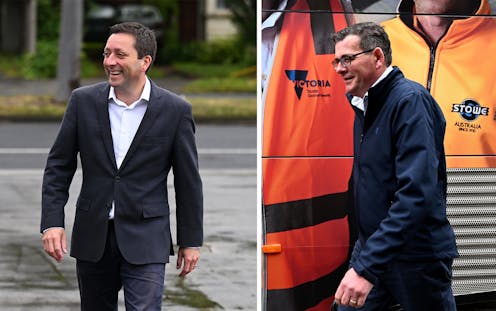
Joel Carrett/James Ross/AAP
The Victorian state election is on Saturday with polls closing at 6pm AEDT. There are 88 single-member lower house seats with members elected by preferential voting, and 40 upper house seats in eight five-member electorates.
A Resolve poll for The Age, conducted November 16-20 from a sample of about 1,000, gave Labor a 53-47 lead, a six-point gain for the Coalition since late October. Primary votes were 36% Labor (down two), 36% Coalition (up five), 10% Greens (down two), 6% independents (down six) and 12% others (up six).
I believe Resolve is now using actual ballot papers in all lower house seats (as this poll was conducted after nominations closed on November 11). As prominent independents are not running in every seat, the independent vote crashed while the “others” vote surged. The Greens may be losing votes to Animal Justice.
Labor Premier Daniel Andrews continued to lead the Liberals’ Matthew Guy as preferred premier by 48-34 (49-29 in October), but this was Guy’s highest rating in Resolve polls.
A 53-47 statewide two party win for Labor would still be a clear victory for them in the lower house, but there are two worries for Labor: the prospect of further narrowing in the final week, and the preferences of the 12% others. It’s plausible most of the others dislike Andrews.
Labor’s failure to reform upper house allows ‘preference whisperer’ to flourish
There has been recent media attention on the anti-democratic group voting ticket (GVT) system used to elect Victoria’s upper house after the leaking of the video below in which preference whisperer Glenn Druery brags about his influence.
Glenn Driuery.
As I have said before, Victorian Labor has been in government for eight years, but made absolutely no attempt to reform the upper house system by axing GVT. Druery would have no influence if above the line voters were able to direct their own preferences.
After reforms made in the last seven years in other jurisdictions, Victoria is now the only Australian jurisdiction that still uses GVT for above the line votes. At the May federal election, Victorian votes for the Senate were allocated according to voter-directed above the line and below the line preferences.
At this election, the only way for voters to direct their own preferences is to number at least five boxes below the line. Numbering can continue beyond five, but five preferences are required for a formal vote.
Analyst Kevin Bonham said the Victorian Liberals have not pushed for the axing of GVT during the previous term, and so some blame for the current situation should go to them.
But even if the Liberals had firmly advocated scrapping GVT, Labor is the government and has a big majority in the lower house of the Victorian parliament.
Liberals change preference policy to ‘put Labor last’
Before the November 2010 Victorian state election, federal and state Liberal how to vote (HTV) cards recommended preferencing the Greens ahead of Labor. Since that election, the HTV cards have put Labor ahead of the Greens. But at this election, the Liberals will put Labor last in all seats.
ABC election analyst Antony Green said that in inner Melbourne federal Labor vs Greens contests, the Greens received an average of 82% of Liberal preferences before the November 2010 election, but Labor has since received an average 66% of Liberal preferences.
This change in Liberal HTV cards will assist the Greens in inner Melbourne seats at this state election. Green said they would likely win Northcote on favourable Liberal flows after losing it narrowly in 2018.
Guy says controversial Liberal won’t be in party room, but she’ll win a seat
Candidate nominations for the state election closed on November 11, and it is now too late to replace candidates on the ballot paper. Renee Heath is the lead Coalition candidate for the Eastern Victoria upper house region, and is a senior member of the conservative City Builders Church.
On Saturday, Guy said that Heath would not sit in the Liberal party room if elected. She will still almost certainly win, as this is a conservative-leaning region that gave the Coalition two seats, Labor two and the Shooters one at the 2018 election.
The only way to vote Coalition in Eastern Victoria without voting for Heath is to vote below the line for all Liberal and National candidates other than Heath.
Election in Narracan postponed after candidate’s death
The electoral commission announced on Monday that the election in the lower house seat of Narracan will be postponed after the death of Nationals’ candidate Shaun Gilchrist.
This means Saturday’s election will only be for 87 of the 88 lower house seats, with a supplementary election to be held later in Narracan. However, voters in Narracan will still be required to vote for the upper house. The Liberals won Narracan by 60.0-40.0 against Labor at the 2018 election.
Adrian Beaumont does not work for, consult, own shares in or receive funding from any company or organisation that would benefit from this article, and has disclosed no relevant affiliations beyond their academic appointment.
Review: D*ck Pics in the Garden of Eden, written and directed by Jeffrey Jay Fowler, The Last Great Hunt.
We see this played out in the media: famous men, a dick pic unwisely texted, reputations and careers destroyed. But what if the man is Adam and his dick pic is not to Eve but to former lover Lilith?
D*ck Pics in the Garden of Eden, written and directed by Jeffrey Jay Fowler from The Last Great Hunt, is a comedic take on the lives of Adam and Eve following their infamous exile. It explores the connection between sex, shame, body image, gender inequality – and men’s fixation with their penises.
The play opens in an Eden which is not lush paradise, but a bare stage. Billowy white curtains span the upstage area. The floor, covered in what looks like grey synthetic carpet, suggests a retail showroom. The only greenery is a panel covered with fake ferns hanging sadly in the space and an artificial indoor plant (the Tree of the Knowledge of Good and Evil). The soundscape is muzak meets electronica.
Enter Adam (David Vikman) and Eve (Arielle Gray) in body stockings and outlandish head pieces (a vulva-like creation for Eve and phallic cone for Adam). Actors costumed as exotic animals, including a Sponge Bob/mattress hybrid, complete this diorama.
The cast are in body stockings and outlandish headpieces. The Last Great Hunt
It all looks like something you might pull together last minute for a kid’s dress up party, an aesthetic which is Play School meets school play. This is the perfect set up: the innocence before their exile to the suburbs where life is soap opera on steroids.
Several years post-exile, adult Adam (Ben Sutton) manages a sports goods store but risks losing this job if the dick pic he sent Lilith (Gray) gets out. He is on a retrieval mission.
Eve (Jo Morris) grows award-winning roses and is desperate to win again this year. Will the dick pic dash her chances?
Their adult daughter, Lulu (Joanna Tu), is auditioning for a play directed by Lilith (Iya Ware). Lulu had agreed to nudity but is now not so sure.
Their son Cain (Tyrone Robinson) is a gay porn actor living with Lucifer (Vikman). They are into threesomes, but Lucifer is finding it hard to keep up (literally).
Added to the mix is Dick Dickson (Chris Isaacs), a former relief teacher at Cain’s school now trying his hand at stand up: a career his name destined him for but which he can’t live up to. He hooks up with Lilith for some liberating S&M and then turns for Cain.
Little is left to the imagination. The Last Great Hunt
Fowler’s directorial vision is clever. Filmed live close ups of the actors on stage are projected onto the upstage curtains. Two cameras on tripods are positioned stage left and right, and actors unobtrusively take turns to film closeups of facial expressions and on occasion, fake dicks.
These two-camera close ups, a staple of soap opera, reinforced the genre and the play’s focus on the performativity of sexual and gender identity.
Rhiannon Petersen’s lighting and Connor Brown’s sound design are well integrated with Rachel Claudio’s soundscape composition and Maeli Cherel’s set and costumes.
Together they create a playful yet uncanny Eden and allow for a smooth transformation to the suburban wasteland.
Cherel’s cartoonish costumes are particularly effective. They satirise how we sculpt, inject, train, exfoliate, hide and deny our bodies to aspire to socially constructed ideals of masculine and feminine.
The play asks how do we construct the masculine and feminine? The Last Great Hunt
Body stockings are stuffed to form six packs, bulging muscles and big butts. Eve flaunts Madonna-style cone breasts and a delicate rose-shaped pudenda while Lilith is proud of her bush (a mess of black wool). The men are preoccupied with their penises.
The lewd, ludicrous fabric penises attached to their body stockings for all to see are admired, stroked, strutted, envied, filmed, photographed. They are a source of the men’s pleasure and their security blankets. They demand attention and assert power.
The cast play multiple characters, make lightning quick costume changes, act for and operate cameras while remaining grounded and present. As an audience we trust them to take us on the journey and we enjoy the ride.
The play falls down a bit around its episodic structure. Segmented into chapters, it needed stronger hooks between the parts to drive the narrative and sustain energy.
The production is bold and funny. The Last Great Hunt
D*ck Pics in the Garden of Eden is bold and funny, canvassing how societal attitudes toward sex, shame, consent, body image, gender identities, sexuality and gender inequality have been informed.
There is a lot to digest here and at times the play seemed weighed down in the attempt to get its messages across. In the program notes, Fowler says: “What I like about theatre, is that it doesn’t have to spoon feed you”.
What this play calls for is less spoon feeding.
D*ck Pics in the Garden of Eden plays at the Subiaco Arts Centre, Perth, until December 3.
Helen Trenos does not work for, consult, own shares in or receive funding from any company or organisation that would benefit from this article, and has disclosed no relevant affiliations beyond their academic appointment.
Suicide is a complex issue that impacts 425,000 Australians every year. That’s because up to 135 people are directly or indirectly impacted by each suicide death.
Military and emergency services personnel (such as those in the police force, fire and rescue services, and paramedics), have higher rates of suicidal thoughts, attempts, and deaths than the general Australian public. This may be because they experience repeated traumatic events and are at risk of workplace harassment and bullying.
Between January 2001 and December 2016, there were a recorded 197 suicide deaths of current or former emergency services personnel – an average of one emergency services personnel member dying every month.
Meanwhile, there were 1,600 deaths by suicide among veterans in Australia between 1997 and 2020. This equates to an average of more than one veteran dying by suicide every single week. Yet there is little understanding and limited support for their families.
The families and coworkers of military and emergency service personnel who die by suicide represent a unique group with specific needs. The loss of their loved one which may not be addressed by generic or civilian resources and services.
For example, families and peers are often left feeling conflicted about how they talk about their loved one’s job. How do they acknowledge the great work their loved one has done in their career, while also knowing that career contributed to their death?
Another issue is access to adequate social support, which can decrease grief difficulties, depression symptoms, and suicidal thoughts after a suicide. Service families may have moved a long way – interstate or even internationally – as part of supporting the personnel member’s role. This means families may have limited social support available to them, and little to no systems in place for family care.
With such a high level of impact and risk, you might assume there are policies, safeguards, and systems in place to support families and peers in the event of a serving personnel member dying by suicide. But this is not the case.
The interim report from the Royal Commission into Veterans Suicide acknowledged a lack of understanding of the impact of deaths by suicide on families and colleagues, and that the availability and accessibility of the support was too limited.
There is a need to better understand and support families and peers of both military and emergency service workers when a service member dies by suicide.
Military and Emergency Services Health Australia have begun the process of developing a national framework for supporting the bereaved families and coworkers of defence and emergency services personnel who have died by suicide, informed by lived experience.
We mapped all available grief and bereavement services who may offer support after suicide or offer support to defence or emergency services personnel and their families. We wanted to find out who, if anyone, was supporting families or coworkers in Australia when a current or former serving military member or first responder dies by suicide.
We identified 16 service providers supporting people after suicide for the general public. StandBy Support After Suicide helps individuals, families, friends and witnesses and is the most accessible provider. Six providers were identified as supporting service personnel even though they didn’t have specific suicide bereavement services. Only one service – Open Arms, a defence force-affiliated organisation – offers specific support for the families and peers of military personnel when someone dies by suicide.
For first responders as there is no service within Australia offering specific assistance to families or peers in the event of a worker’s suicide. The closest service available is offered by Fortem Australia, who provide first responder counselling services, though these are not specific to suicide bereavement.
There are no specific services for bereaved families of emergency workers who take their own lives. Pexels/Rodnae, CC BY
Building connections
Despite this lack of specific services, the civilian services currently available were open learning how they could offer better support. For some, this was about finding cultural training for staff. For others, like StandBy Suicide Support, it could mean modifying existing resources to be for military and first responder workers and their family.
Every community-based organisation we made contact with expressed interest in offering this support.
MESHA will be working with the families, peers and co-workers of services personnel who have died by suicide, alongside a needs assessment of the service providers who offer grief and bereavement support after suicide, to better understand the specific requirements for this population.
However, despite the encouraging responses from service providers, conscious efforts by federal and state governments will be needed to supply funding to these services.
If this article has raised issues for you, or if you’re concerned about someone you know, call Lifeline on 13 11 14. If you are the family member of a current or former serving defence or emergency services member, and you are concerned about their well-being, a list of services available to support yourself and them can be found here.
Henry Bowen works for Military and Emergency Services Health Australia, the organisation performing this study, and is the primary investigator on this work. This work was partially supported by the Prabha Seshadri Veteran and Emergency Services Mental Health Grant.
Citizen science is touted as a way for the general public to contribute to producing new knowledge. But citizen science volunteers don’t always represent a broad cross-section of society. Rather, they’re often white, male, middle-aged, educated and already interested in science.
This lack of representation has several problems. It can undermine the potential of citizen science to bridge the divide between lay people and experts. It also means fewer people benefit from the chance to advance their informal science education and gain valuable life skills.
It’s important that citizen science projects engage volunteers from across society, including young people. A new Australian initiative is doing just that.
The B&B BioBlitz aims to get school students gathering data about Australia’s natural environment. This year’s event shows how citizen science in school can help develop STEM skills and make gains in biodiversity research.
For citizen science to be truly inclusive it must engage all age groups, including children. Shutterstock
More hands on deck
It’s broadly acknowledged that Australia needs more hands on deck when it comes to scientific data collection. For example, only about 30% of Australia’s estimated 750,000 species have been formally named and documented. Rectifying this will require an enormous uptick in information gathering.
What’s more, Australia has one of the world’s worst extinction records. Citizen science is an important way to fill information gaps, identify species’ declines and their causes, inform conservation decisions and evaluate their effectiveness.
This year’s State of the Environment report recognised the need for more citizen science. It said the level of biodiversity research required “cannot be achieved by professionals and institutions alone”.
The task of biodiversity monitoring is far too big for professional scientists to undertake alone. Shutterstock
What exactly is a BioBlitz?
The B&B BioBlitz is a national school citizen science program co-ordinated by PlantingSeeds Projects – a non-profit sustainability organisation founded by the lead author of this article. The inaugural event ran in National Biodiversity Month in September this year. Both authors of this article were project organisers and educators.
Sixty schools from across every Australian state and territory participated. Participants comprised students from infants to high school, and their teachers.
Most schools are located in urban areas, which makes them particularly valuable sites for scientific research. Many threatened plant and animal species live in urban areas, yet, only 5% of citizen science projects in Australia are urban-based.
The project involved students taking images of plant and animal species in their school grounds on devices such as tablets and smartphones provided by the school. Students also recorded information such as the time, date and location of the photo.
A designated teacher uploaded the photos and data to the B&B BioBlitz project on iNaturalist, one of the world’s most popular biodiversity citizen science platforms and apps. At the time of writing, iNaturalist contained more than 121 million observations uploaded by citizens from around the world.
Throughout September, students made more than 2,300 observations in school grounds, involving 635 plant, animal and fungi species. Students could log onto iNaturalist to see a project “leaderboard”, browse the observations submitted and learn about species’ taxonomy and distribution.
A screenshot from iNaturalist, showing some of the 635 plant and animal species observed during the BioBlitz. iNaturalist
A study has demonstrated young people can contribute observations to iNaturalist that are “research grade” – and therefore more accessible and potentially useful to biodiversity research and monitoring. And the longer they participate for, the better their observations become.
Observations of species during this project contributed to more comprehensive datasets that scientists can now draw upon. Of note were images of an uncommon “Balsam Beast” katydid and the iconic Sturt’s desert pea.
Almost all observations uploaded to iNaturalist are also directly exported to the CSIRO’s Atlas of Living Australia.
The pros and cons
Verbal and online feedback by students reveals how citizen science can be a practical and positive experience.
One North Melbourne primary school student said the activity made her feel “like being more a part of a community”.
One student in Darwin said the activity was “the most fun he had ever had” and his teacher reported that while taking part, the student was “the most engaged he had seen”.
But the B&B BioBlitz was not without its challenges.
Many teachers, including science teachers, had limited knowledge of citizen science and often hadn’t heard of the term. This meant that teachers needed basic education on the topic prior to any school involvement in the BioBlitz.
Teachers are busy and face many pressing demands. However, if the benefits of citizen science are to be fully realised, there’s a need to broaden teacher awareness of the practice, and improve their skills in accessing databases such as iNaturalist.
8 tips for successful biodiversity citizen science
So how can young people be helped to take a good citizen science observation? The following eight tips offer a guide:
Capture as many angles and as much information as you can. While some groups such as birds can often be recognised from a single photograph, many other taxa require multiple features for a positive identification to be made
When observing plants, photograph as many features as possible. This includes flowers and leaves (from above and below), bark, fruit if present, a branch showing leaf arrangement, and a shot of the whole plant to give a sense of its growth habit
Photograph fungi from above, below (showing the gills or pores) and the side
Record the “substrate” you find a fungus on, such as soil or dead wood, and the type of soil a plant is growing in
Insect identification can often be helped by the number and position of veins in an insect’s wing. Try and capture this by getting shots from directly above
Noting the plant you find a beetle or bug on can aid identification and provide useful ecological data
If you find a spider in a web, photographs of both the upper and undersides can be helpful
If in doubt, just record as much information as you can. You never know who might find your data useful!
Judy Friedlander is the founder of the not-for-profit organisation, PlantingSeeds Projects, which steered the B&B BioBlitz.
Thomas Mesaglio does not work for, consult, own shares in or receive funding from any company or organisation that would benefit from this article, and has disclosed no relevant affiliations beyond their academic appointment.
Political Roundup: The High barriers to lowering the voting age
Political scientist, Dr Bryce Edwards.
Sixteen-year-olds aren’t about to get the right to vote anytime soon. Despite yesterday’s Supreme Court declaration that a voting age of 18 violates the Bill of Rights, there are still many barriers to get over before the voting age could be lowered.
In fact, as a best-case scenario, youth voting campaigners are now setting their sights on 2029 as the first general election for 16-year-olds to vote in, and perhaps 2025 as the first time that they might be able to vote in local government elections. But to get an extended franchise by these dates would require that the following very high barriers be overcome.
1: Public opposition to lowering the voting age
The problem for advocates of lowering the voting age to 16 is the vast majority of voters disagree. Poll after poll shows that about three-quarters of the public is not yet convinced that it’s a good idea. The public has actually been more favourable to giving the vote to prisoners than they are to letting younger people vote.
A TVNZ Vote Compass poll in 2020 showed 70 per cent in favour of a voting age of 18 years, and 20 per cent favouring a lower age. Then a 1News Colmar Brunton poll showed a massive 85 per cent opposed lowering the voting age to 16. And Curia Research also polled on the question in 2020 and found 88 per cent favoured the status quo. A more recent Curia poll showed that 79 per cent opposed dropping the voting age. And back in August of this year, a Talbot Mills poll showed 66 per cent opposed, and only 28 per cent in favour.
It seems that those favouring change – largely those in political activism, journalism, and academia – are strongly at variance with wider concerns. The case for change simply hasn’t had the cut through yet, until it does, a change in the law is highly unlikely.
2: National and Act oppose lowering the voting age
The rightwing opposition parties are unequivocally against lowering the voting age. This means that when the Labour Government introduces legislation next year to lower the age to 16, it will fail. What’s more, it means that a future National-led government would be inclined to reverse any shift to a lower voting age.
Normally any significant changes to electoral law require some sort of cross-party consensus, and this just hasn’t yet been forged. Campaigners have focused more on judicial activism, which turns out to have achieved them a powerful win, but without actually convincing most of the political parties yesterday’s Supreme Court declaration becomes something of a moot win.
National and Act have the power to stymie any changes to the general election voting age because the Electoral Act is constitutionally entrenched, meaning a super-majority of 75 per cent is required to make changes in Parliament. Ninety MPs are required to vote in favour of such a change, which is not going to occur.
3: Labour Party caution
Prime Minister Jacinda Ardern has come out in favour of lowering the voting age to 16 years and has promised to introduce legislation in terms of general election voting next year, as the Government’s answer to the Supreme Court’s ruling. However, she has made the call safe in the knowledge that such legislation won’t be consequential, because it won’t be passed.
Cynics might see it as a smart move by Ardern. It ticks off a legal requirement to respond to the Supreme Court ruling, and keeps her onside with progressives who favour a reduced voting age, but at the same time it avoids actually changing the law and alienating the three-quarters of the public opposed to 16-year-olds voting. Quite simply, Labour can rely on National and Act to save them from achieving what they possibly don’t really want to win – an unpopular lowering of the vote.
The problem for Labour will be the question of the voting age for local government elections. This is now where attention is likely to shift. This is because the Local Government Act isn’t constitutionally entrenched, which means that only a simple majority in Parliament is needed to lower the voting age to 16. The Government can’t just rely on National and Act to block this change.
The pressure will therefore be on the Government to reform the Local Government Act immediately. Labour has no excuses not to do so and it will therefore be a real test of Ardern’s principles.
Pressure to reform the Local Government Act’s voting age has also been increased by the review that the Government itself commissioned. The recent Future of Local Government report also recommended a voting age of 16 years for local elections, making it more difficult for Labour not to progress this.
The argument of reformers is now that local elections could be a “trial” for a lower voting age. Or, put another way, by introducing a lower voting age in this less important level of government, it would be a good way for the public to get used to the idea, with the hope that it would lead the way to the public supporting a lower voting age for general elections too.
But is Labour too cautious to make this change? It’s likely to stymie this by trying to keep the voting age for both general and local elections bound up together. The Government might even kick for touch by arguing that it wants to hear back from the Independent Review of Electoral Law before making any decisions – who are not due to report until after next year’s election. This would effectively make the change too late to implement until much later elections.
The general convention – which Jacinda Ardern reiterated yesterday – is for the implementation of significant electoral law changes to only take place for the election after the next one. This would mean that even if the Electoral Law was changed in 2024 to allow 16-year-olds to vote, this wouldn’t occur until the 2029 general election.
4: The Appearance of politician self-interest
Much of the debate about the voting age is likely to be blocked due to apparent political self-interest. Quite simply, the age level for voting has a large impact on the support levels of the various political parties.
There is a general consensus that younger people vote in higher proportions for the parties of the left. This is why one of the Supreme Court judges, Stephen Kos, gave a dissenting opinion yesterday, saying that “Altering voter age is not a neutral political action”, and “Whichever direction it goes in is likely to benefit some parties disproportionately”.
This means that National and Act’s opposition to a voting age is partly driven by the desire to protect their own levels of support. Act leader David Seymour expressed this yesterday, saying: “We don’t want 120,000 more voters who pay no tax voting for lots more spending”.
Conversely, Labour and the Greens could be accused of wanting to lower the voting age for their own advantage. Stuff political editor Luke Malpass explains today that “most of the political upside would go to Labour or the Greens, meaning that a Labour or Labour/Greens Government could look pretty self-interested in making any such change. That’s because those younger voters tend to split 2:1 to the left (either Labour or the Greens)”.
Malpass calculates that lowering the voting age to 16 could result in 80,000 more votes (a 2.7 per cent increase), which “could result in an extra seat for the centre-left. In an MMP environment where elections can be close-run, this would amount to a small – but not insignificant – realignment of the electoral board in favour of the political left.”
Such motivations for lowering the voting age are likely to become more apparent in any developing public debate about reform. New Zealanders have been shown to use “fairness” as a clear criteria in approaching issues such as electoral reform, and so on this subject they might be very inclined to also regard the lowering of the voting age with suspicion – leaving reform to the distant future.
This week’s Supreme Court judgment on lowering New Zealand’s legal voting age has, at times, been interpreted as some kind of mandate for change. That’s not quite the case, but the court’s ruling does at least make change a possibility.
What the court has done is accept the claims made by members of the Make It 16 campaign that the current voting age limit of 18 is inconsistent with section 19 of the New Zealand Bill of Rights Act. Essentially, it found, preventing 16- and 17-year-olds from voting discriminates against them on the basis of their age.
The decision effectively means parliament now has to defend the 18 age limit if it wants to keep it. However, Prime Minister Jacinda Ardern has already announced her government will draft a bill to lower the voting age (requiring a three-quarter majority to pass). She’s also said she personally supports lowering the voting age.
This rapid shift of the electoral landscape provides a good opportunity to restate the arguments in favour of lowering the voting age – and to ask whether retaining the 18 age limit can be justified at all.
Voting is a human right
When the 2020 general election was delayed due to COVID, it meant a group of young people were suddenly eligible to vote because they had turned 18 in the interim.
As I noted then, the choice of where to set the voting age is not made on the basis of some immutable facts about the capacity of the young to vote. Rather, it is a procedural decision.
Setting the voting age at 18 made some sense when it was introduced in 1974 (down from 21). It was a convenient number that coincided with some (but not all) other age limits for the granting of rights in our society.
But the right to vote is different to the right to buy alcohol, for example, which is also restricted to those 18 or over. Unlike buying alcohol, voting is a human right. Any restrictions on human rights must be demonstrably reasonable restrictions.
The Make It 16 campaign argued, and the Supreme Court has now agreed, that parliament has not provided that justification for setting the voting age at 18.
Improve civic education
Parliament will find it difficult to provide a satisfactory justification for continuing to exclude 16- and 17-year-olds.
The most popular arguments against letting these young people vote – that they aren’t interested or capable – are subjective, anecdotal or simply not very good. Another common argument – that they don’t pay tax – is both wrong (many work and they also pay GST) and irrelevant to enfranchisement.
A key part of a good argument is that it can be applied consistently. If we wanted to exclude young people for being uninterested or incapable, we would have to be willing to exclude the many adults who are uninterested or incapable. We do not do this, and nor should we.
If an adult doesn’t want to vote, they don’t have to. The same would be true for a 16-year-old if the voting age was lowered. Making the voting age 16 simply gives young citizens the opportunity to vote.
It then falls to society to encourage them to learn who they should vote for. If we want better-educated voters, we should look to improve civic education.
There are, however, two good arguments in favour of lowering the voting age: it seems to improve voter turnout, and voting from a young age increases the likelihood people will become regular voters, consistently participating in the democratic process.
Both these claims may seem counter-intuitive. After all, isn’t it well known that young people vote in lower numbers than older people? It is. But that may simply be because we don’t give young people the opportunity to vote until it’s too late.
In Austria, which has allowed voting from 16 since 2008, participation rates among young voters improved significantly once the voting age was lowered.
One theory is that 16- and 17-year-olds are often in more stable situations than 18- or 19-year-olds – still in school, usually still living with family. When they are allowed to vote, they are more likely to be supported or encouraged by their family and school.
A strong indicator of whether someone will vote is whether they voted the last time they had the opportunity. Given more young people vote when offered the chance earlier in life, a lower voting age will result in higher levels of lifetime voting.
It is much easier to care about politics when you are allowed to participate in it. Lowering the voting age will give young people more reason to be invested in their political system. Over time, this will make our democracy stronger and more legitimate.
Nick Munn does not work for, consult, own shares in or receive funding from any company or organisation that would benefit from this article, and has disclosed no relevant affiliations beyond their academic appointment.
An election campaign can sometimes feel like Groundhog Day, but this Victorian election is genuinely different. While the major parties are still making plenty of transport promises, they’ve dialled them way down from the dizzy heights of 2018.
Our hope for the next election? Stop promising projects on the hoof, and start listening to what Infrastructure Victoria and Infrastructure Australia assess as worthwhile.
The biggest difference between the transport promises made this campaign compared to last time is scale. Back in 2018, the Coalition promised to spend $68 billion and Labor an eye-watering $95 billion, of which about half was for the Suburban Rail Loop. This time around, we calculate the Coalition’s promised new spending is just 25% of last time’s, at $16.7 billion, and Labor’s a tiny 2%, at $2.3 billion.
Author provided
The most fundamental distinction between the two major parties, though, is not so much in what they are promising as in what they’re not promising. The Andrews government’s signature policy, the Suburban Rail Loop, is no longer just an election promise for Labor, but scrapping the loop is very much an opposition promise.
Back in 2018, we expected to pay $50 billion for a 90km tunnel looping from Cheltenham through Glen Waverley, Box Hill, the airport, and terminating at Werribee. We’ve since learned that the government thinks the eastern and northern sections will cost between $31 billion and $51 billion to build and run for 50 years. The Parliamentary Budget Office thinks it’ll cost $200 billion.
It’s perhaps less surprising that parties are playing to different heartlands. The Coalition favours roads, right across the state, while Labor favours public transport, with a focus on the city. These preferences show up repeatedly in elections, and they’re quite pronounced.
The Greens favour public, active and electrified transport, and are firmly focused on Melbourne.
Author provided Author provided
The two major parties have promised 32 projects valued at $100 million or more, but they agree on just one: stage 2 of the Barwon Heads Road duplication. 2018 wasn’t much better, with the parties agreeing only on North East Link and Airport Rail Link.
New South Wales does things differently: in the 2019 NSW election campaign, Labor and the Coalition agreed on three of the four largest projects promised.
Independent advisory bodies ignored
One reason the Victorian parties diverge so markedly on transport priorities is that they don’t pay much attention to the views of the independent advisory bodies, Infrastructure Victoria and Infrastructure Australia.
Infrastructure Victoria has produced a 30-year strategy for the state’s infrastructure, and it doesn’t mention some key policies of both parties. For instance, the Coalition has promised $2 tram and bus fares, and Labor has promised to cap regional public transport fares. But what Infrastructure Victoria recommends is a nuanced combination of off-peak discounts, reduced tram and bus fares, removal of the free tram zone, parking reform, and a congestion pricing trial in inner Melbourne.
Infrastructure Australia is supposed to scrutinise the business case of any infrastructure project where the proponent is seeking $250 million or more in federal funding. Up to 11 promised Victorian projects are in this category, but Infrastructure Australia has assessed only one as being investment-ready. The other ten are not even at the stage of evaluating potential investment options.
The one project that is investment-ready is Labor’s proposal to upgrade the Melton line. Of the rest, three are what Infrastructure Australia calls early-stage proposals, and seven have not been submitted to it at all. The three that have reached early-stage status are the Coalition’s proposals to commit $10 billion to road maintenance and to reinstate the country roads and bridges program, and the Greens’ Big Bike Build.
Author provided
A shift to many smaller projects
This election also stands out for the large number of smaller projects worth less than $100 million. That was also a feature of the federal election in May. About half of both the Coalition’s and Labor’s promised projects in Victoria are worth less than $100 million.
Interesting for its absence from Labor’s platforms is a focus on electric cars and bikes. The Coalition promises to pause the distance-based charge for electric vehicles until 2027, at a cost of $82 million, and spend $50 million establishing 600 new electric vehicle charging stations across the state. The Greens want to manufacture 3,000 electric buses, subsidise the purchase of electric cars, subsidise two-way chargers, fund more public chargers and ban petrol car sales from 2030; none of these policies have been costed. What’s the bet we’ll see a lot more action in this sphere in 2026?
In the end, this Victorian election campaign has turned out to be far less profligate than the last one. The promised spend is a small fraction of what it was in 2018 – but the quality of the promises is no better.
Voters should demand more. Whoever wins the election should commit to a transport program that focuses not so much on the political advantage to be had from dreaming up new projects as on rigorous business cases before – not after – the promise to invest.
Grattan Institute began with contributions to its endowment of $15 million from each of the Federal and Victorian Governments. In order to safeguard its independence, Grattan Institute’s board controls this endowment. The funds are invested and Grattan uses the income to pursue its activities. Marion Terrill does not work for, consult, own shares in or receive funding from any other company or organisation that would benefit from this article, and has disclosed no relevant affiliations beyond the academic appointment above.
Ingrid Burfurd does not work for, consult, own shares in or receive funding from any other company or organisation that would benefit from this article, and has disclosed no relevant affiliations beyond the academic appointment above.
Global inequities in access to COVID vaccines have turned out to be a “catastrophic moral failure”, just as the World Health Organization warned they would in January 2021. Yet it took 20 months of negotiations for members of the World Trade Organization (WTO) to agree to a limited relaxation of patent rules for COVID vaccines – a move decried by civil society organisations as too little, too late.
Treatments and diagnostic tests are also very important in managing the pandemic, and like vaccines, are very unequally distributed globally. Unfortunately, negotiations to expand the WTO decision on COVID vaccine patents to include treatments and tests are in a sorry state. There is little chance of a decision by the December deadline WTO members set for themselves.
In the meantime, deaths and hospitalisation from COVID continue to place pressure on health-care systems.
By the end of 2021, more than a year after the first COVID vaccines went into arms, more than 76% of people in high- and upper-middle-income countries had received a dose, compared with 8.5% in low-income countries. Even now, with almost 13 billion doses administered around the world, less than 25% of people in low-income countries have received a dose.
Treatments are even more inequitably distributed. Most low-income countries are unable to access the new oral antivirals such as Paxlovid (made by Pfizer) and Lagevrio (Merck Sharpe & Dohme). These companies charge around US$530 and US$700 (A$800 and A$1,050) respectively for a five-day course of treatment in high-income markets such as the United States.
Pfizer has agreed to deals with UNICEF and the Global Fund to provide 10 million courses of Paxlovid to lower-income countries at lower prices. But this represents a very small proportion of the treatments Pfizer is making.
Both Pfizer and Merck Sharpe & Dohme have established licensing agreements with the Medicines Patent Pool, enabling generic manufacturers to make their antiviral treatments for poorer countries in future. But they have restricted the number of countries that will be able to purchase the generic drugs to mainly low- and lower-income countries (106 and 95 respectively).
This leaves many upper-middle income countries (such as Thailand, China and Mexico) in a difficult situation. They are unable to pay the high prices for the originator drugs but are excluded from accessing the lower-priced generics.
It’s clear more needs to be done to ensure all countries can access the tools they need to manage the pandemic.
India and South Africa first put a proposal to the WTO in October 2020 to temporarily relax certain intellectual property rules in the Agreement on Trade Related Aspects of Intellectual Property Rights for COVID medical products during the pandemic.
The proposed waiver would have enabled companies around the world to freely produce COVID health products and technologies – vaccines, treatments, tests, and personal protective equipment (such as face masks) – without fear of litigation over possible infringements of intellectual property rights.
These intellectual property rights included not only patents, but copyright, trademarks and trade secrets or know-how. Specifically, know-how is often essential for manufacturing vaccines and some treatments. However, under existing rules, there are limited pathways to compulsorily licence know-how and other confidential information.
The proposal eventually gained the support of more than 100 of the WTO’s 164 member countries and was sponsored by more than 60. But it faced strong opposition from wealthy countries that house multinational pharmaceutical companies, particularly the European Union, United Kingdom and Switzerland.
On June 17 2022, WTO members belatedly agreed on a narrow, limited waiver, applying only to patents, and only to COVID vaccines in the first instance. In the end it waives only a single rule, making it easier for vaccines made using its provisions to be exported from the country of manufacture to a second developing country.
While the decision applied only to vaccines, it included a clause committing the parties to decide whether to expand the waiver to include COVID treatments and tests within six months.
That six-month period ends on December 17. Unfortunately, the same dynamics that slowed and watered down the initial proposal threaten to prevent a timely decision this time too. The EU, Switzerland, Japan and the UK are particularly reluctant to allow negotiations to move forward.
As with the original waiver debate, many countries lack the know-how to commence domestic vaccine manufacturing, particularly for novel vaccine platforms. Lack of know-how was an even greater barrier to widespread COVID vaccine manufacturing than patents.
Many more countries have the capacity to produce treatments, but therapeutic patents are more prevalent than COVID vaccine patents. So, expanding the waiver to include COVID therapeutics could help countries quickly scale up domestic manufacturing of essential treatments.
Low and middle-income countries have been impacted disproportionately by the pandemic so far, suffering 85% of the estimated 14.9 million excess deaths in 2020 and 2021.
Globally, progress in reducing extreme poverty was set back three to four years during 2020–21. But low-income countries lost eight to nine years of progress.
Expanding the WTO decision on COVID vaccines to include treatments and tests could be vital to reduce the health burden on poorer countries from COVID and enable them to recover from the pandemic. The Australian government should get behind this initiative and encourage other countries to do the same.
Deborah Gleeson has received funding in the past from the Australian Research Council. She has received funding from various national and international non-government organisations to attend speaking engagements related to trade agreements and health. She has represented the Public Health Association of Australia on matters related to trade agreements and public health
Dianne Nicol has received funding from the Australian Research Council, the Medical Research Futures Fund, the National Health and Medical Research Council (NHMRC) and the Federal Department of Health. She is chair of the NHMRC Embryo Research Licensing Committee and co-lead of the Regulatory and Ethics Work Stream of the Global Alliance for Genomics and Health
James Scheibner has received funding from Health Translation SA, as well as the Swiss National Science Foundation through the Personalized Health and Related Technologies project.
Almost all buildings today are built using similar conventional technologies and manufacturing and construction processes. These processes use a lot of energy and produce huge carbon emissions.
This is hardly sustainable. Perhaps the only way to truly construct sustainable buildings is by connecting them with nature, not isolating them from it. This is where the field of bioarchitecture emerges. It draws on principles from nature to help solve technological questions and address global challenges.
Take desert organisms, for example. How do they survive and thrive under extreme conditions?
One such desert species is the Saharan silver ant, named for its shiny mirror-like body. Its reflective body reflects and dissipates heat. It’s an adaptation we can apply in buildings as reflective walls, or to pavements that don’t heat up.
There are so many aspects of nature we can drawn on. Picture cities with shopping centres based on water lilies, stadiums resembling seashells, and lightweight bridges inspired by cells.
Water lilies can teach us how to design large buildings efficiently with smooth pedestrian circulation. Seashells can inspire the walls of large-span buildings without the need for columns. Cells can show us how to develop lightweight suspending structures.
Bioarchitecture can reinvent the natural environment in the form of our built environment, to provide the ultimate and somehow obvious solutions for the threats Earth is facing.
Most industry-led and research-based approaches focus on the “technology to save us” from climate change. In contrast, bioarchitecture offers a more sustainable approach that aims to develop a positive relationship between buildings and nature.
Living organisms constantly communicate with the natural world. They move around their environment, employ chemical processes and undergo complex reactions, patterning their habitat. This means living systems constantly model and organise the environment around them. They are able to adapt and, in doing so, they change their environment too.
Can buildings do the same in cities? If buildings could grow, self-repair and adapt to climate, they might ultimately become truly sustainable.
Early examples of bioarchitecture can be found in traditional and early modern buildings. Their architects observed nature to copy its principles and design more habitable, locally made and environmentally friendly buildings. For example, Gaudi’s Sagrada Familia in Barcelona, Spain, is inspired by natural shapes that give the church its organic form.
Gaudi`s Sagrada Familia in Barcelona is an early modern example of bioarchitecture. Sung Jin Cho/Unsplash
More recent works showcase bioarchitecture that learnt from nature coupled with technology and innovation. Examples include using bio-based materials such as wood, hemp and bamboo, applying biophilia through using greenery on external walls and plants indoors to boost our connection with nature, and restoring the environment by making buildings part of it.
Considering the climate emergency, we should strengthen buildings’ coherence with nature. Bioarchitecture can do this.
The blue Menelaus butterfly offers another striking example of design solutions from nature. Despite its radiant blue colour, it is not actually blue and does not have any pigments. Producing and maintaining pigments is expensive in nature, as it requires a lot of energy.
The Menelaus butterfly has an ingenious way to achieve its unique colour without pigments. Its brilliant blue shine comes from scattering light, similar to soap bubbles glimmering in rainbow colours under the sun, despite being completely transparent. The light is scattered by micro-grooves on the butterfly’s wings – so small that they can only be seen with an ultra-high-resolution microscope.
This is nature’s way to achieve high performance with cheap forms instead of costly materials. Learning from the Menelaus butterfly, we can have windows with climate-adaptable properties – changing their colour and scattering light according to the position of the sun. Butterfly wings have already inspired the development of new materials, and the next step is to use these on buildings.
In this way, we can design biobuildings that reflect excessive radiation and reduce cooling needs and glare. And the beautiful part is that this may all be done without obstructing views and without the need for shading devices or tinted windows.
Then there is Monstera, a sought-after indoor plant that climbs up the walls. It’s also called the “Swiss cheese plant” for the holes on its leaves. Have you ever thought about how it thrives and grows like no other plant indoors?
Monstera simply needs to sustain fewer cells to maintain extra large leaves because of their holes. This enables it to capture more of the sunlight it needs to grow and spread out over a bigger area.
Now imagine if we designed hollow building structures such as columns and beams. This could help minimise the need for materials and cut carbon emissions by reducing the embodied energy that goes into making these materials.
We can look at nature as a catalogue of designs and solutions to be reimagined as bioarchitecture. So, we could have shiny silver pavements like the silver ant, metallic-coloured but transparent windows like the Menelaus butterfly, and buildings that use the minimum of materials like Monstera’s leaves.
Nature is wealthy, nature is generous. Through bioarchitecture, buildings can dive into that wealth and become a part of the generosity. Truly sustainable biobuildings can be constructed that work with nature and reverse the harm our conventional building technologies have done to the planet.
Aysu Kuru does not work for, consult, own shares in or receive funding from any company or organisation that would benefit from this article, and has disclosed no relevant affiliations beyond their academic appointment.
There’s a piece of gardening lore in my hometown which has been passed down for generations: never plant your tomatoes before Show Day, which, in Tasmania, is the fourth Saturday in October. If you’re foolhardy enough to plant them earlier, your tomato seedlings will suffer during the cold nights and won’t grow.
But does this kind of seasonal wisdom still work as the climate warps? We often talk about climate change in large-scale ways – how much the global average surface temperature will increase.
Nations are trying to keep the temperature rise well under 2℃. Taken as an average, that sounds tiny – after all, the temperature varies much more than that when day gives way to night. But remember – before the industrial revolution, the world’s average surface temperature was 12.1℃. Now it’s almost a degree hotter – and could be up to 3℃ hotter by the end of the century if high emissions continue.
For many of us, climate change can seem abstract. But the natural world is very sensitive to temperature change. Wherever we look, we can see that the seasons are changing. Gardening lore no longer holds. Flowering may happen earlier. Many species have to move or die. Here’s what you might notice.
Seasons shifting: Tasmanias southern beech is Australias only native temperate deciduous tree. Shutterstock
Spring is coming earlier
Warmer temperatures mean spring is arriving earlier and earlier. In Australia, it’s also now five days shorter than the 1950–1969 period, according to Australia Institute research. Trees and plants put out new leaves days earlier.
For some Australian plants, earlier spring means early flowering and fruiting – an average of 9.7 days earlier per decade.
Japan’s famous spring cherry blossoms are blooming earlier than they have in centuries. The cherry blossom peak last year was the earliest recorded bloom in a data record going back to the year 812.
It might not feel like it this year with all the rain, but the overall trend is clear. In turn, this means bushfire risk is growing year on year, with more days of high to catastrophic fire danger. Every year for the last three decades, an extra 48,000 hectares of forest has burnt across Australia.
Longer fire seasons are making it harder to schedule fuel reduction burns, and reducing the amount of time for firefighters to rest and recover between fire seasons.
Hotter temperatures are already posing challenges for salmon farmers in Tasmania. Atlantic salmon grow best in cold water and climate change has already pushed ocean temperatures up. In summers now, the waters around Tasmania are close to the fish’s limit. Warmer summers will be a substantial challenge for salmon farmers in the future.
Hotter water has also killed off almost all Tasmania’s giant kelp, and made it possible for warm-water fish to migrate south.
For millennia, the North Pole has been covered by sea ice. This, too, is changing. Arctic sea ice is melting earlier in summer and freezing later in winter. As warming intensifies, the central Arctic is likely to go from permanent ice cover to ice free over summer by 2100.
Salmon farming only works if the water is cold – and that poses problems for a major Tasmanian industry. Shutterstock
Autumn is falling behind
At the beginning of autumn, the leaves of nothofagus, Australia’s only temperate deciduous tree, change colour and fall to the ground, just as many Northern Hemisphere trees do.
Here, too, we can see the climate changing. Around the world, warmer temperatures and rising atmospheric carbon dioxide are delaying the arrival of autumn colours by up to a month.
Winter is disappearing
Alpine species such as the mountain pygmy possum have life cycles built around winter snow, while many of the world’s cities rely on snow melt for their water supply. In Australia, snowfall has been decreasing in recent decades.
In a warmer world, there’s less snow and ice. That’s posing major challenges for cities like Santiago in Chile, as well as semi-arid areas in the United States which have relied on snowmelt.
Species are on the move
What else might you notice? Different animals, birds, fish and plants. Not only are the seasons changing, but many species are now found in areas they could never have survived before.
You can see some of the surprising new finds on the citizen science project Redmap, such as sightings of the tropical yellow bellied sea snake in Tasmanian waters.
For First Australians, climate change brings a different upheaval. The seasonal link between, say, a wattle flowering and the arrival of fish species is breaking down.
Changes everywhere
Climate change really does mean change – both large scale and small. From extreme weather to ecosystems changing all the way through to the time when you can plant tomatoes.
For gardeners, this means accepted wisdom no longer holds. In Tasmania, you can now safely plant tomatoes 18 days earlier than you could in the 1990s. That’s because minimum temperatures in October are now about 1℃ warmer than they were in 1910.
Hobart’s daily minimum temperature in October for three time periods: 1882-present, 1882-1990, and 1990-present. The last 30 years have been much warmer on average than the years before.
Climate change is altering our seasons and changing our world in both obvious and subtle ways.
So while planting tomatoes may seem like a trivial example, it’s yet another sign of the climate changing all around us. It’s no longer a problem for the far-off future. It’s our problem, now.
Edward Doddridge does not work for, consult, own shares in or receive funding from any company or organisation that would benefit from this article, and has disclosed no relevant affiliations beyond their academic appointment.
It is not uncommon for kids to complain about school, but studies show significant numbers of Australian students are actually disengaged with their education.
A 2017 Grattan Institute report found as many as 40% are unproductive in a given year because they are disengaged.
This is a huge concern. Not being engaged can lead to issues with learning, behaviour, attendance and dropping out.
We know the disruptions of COVID and school closures have only increased the risks of student disengagement.
One answer could be “personalised learning”. Proponents of this approach say it allows students to engage more with what and how they learn at school. Although critics are not convinced.
My research with Australian teachers trialling personalised learning suggests it “makes sense”. But we need to think carefully about how it is rolled out.
What is personalised learning?
Personalised learning is an educational approach that aims to customise learning for each student’s strengths, needs and interests
Personalised learning could see students work on their own or in groups. Shutterstock
In the United States, most states use personalised learning in some form. Tech moguls Bill Gates and Mark Zuckerberg have also donated millions to research on the approach.
Australia is also looking at personalised learning. The 2012 Gonski report talked of the importance of “personalised learning strategies” to improve school outcomes.
the ACT education system of the future will be personalised to each child.
Other jurisdictions are also looking at how personalised learning can be implemented. Last year, NSW said it would trial “untimed syllabusses”, so students move through school at their own pace.
Personalised learning is not without its critics. Some educators say it isolates kids and risks an over-reliance on technology as a teaching tool. But this very much depends on how personalised instruction is implemented.
What does this look like in practice?
Under personalised learning, the existing curriculum is tailored to each student’s interests and needs. Students also have a say in how and what they learn.
For example, a history teacher allows students to pick their own project to work out how the past influences the present.
The teacher helps them frame the research questions and makes sure they are accessing relevant and robust data. But it is the students who are directing the project, be it about civil rights and Black Lives Matter, women’s liberation and #MeToo or the history of how computer games have been developed and marketed.
caption. CDC/Unsplash
During a research trip to the US this year, I visited five schools in Vermont where I saw three key ways of personalising learning and culturally responsive teaching.
1. Personalised learning portfolios
These are used to gather information about students’ strengths, needs, passions, interests, and identities. This enables teachers to know their students well to design projects that fit with the students’ interest and abilities.
2. Flexibility
Teachers are flexible about both how students learn and the time and pace they do it in. They do projects instead of essays where they research topics they are interested in or they connect with communities to extend their knowledge about real-life matters.
The focus is on skills such as critical thinking, collaborative learning, communication, cultural understanding, and social action. For example, in one high school I visited, children worked with local farmers to help them resolve food waste issues, with teachers providing necessary guidance.
Assessment is not grade based (where students in the same year level are compared) but proficiency based. This looks at whether students are learning and whether they are meeting a certain standard. It also allows students to be involved. In a “student-led conference,” students update each other on what they have learned.
US students who had done personalised learning told colleagues and I this self-paced approach was relaxed and less stressful. It allowed them to be themselves and they felt like their opinions and choices were respected.
But there are challenges
Personalised learning will take time to roll out in schools and communities, given it is so different from the mass education approach teachers, parents and students are used to.
Colleagues and I are studying three ACT schools where teachers are trialling personalised learning. Our initial findings shed light on the challenges of implementing personalised learning. As one high school teacher told us:
Personalised learning makes sense […] particularly at the moment I have a class where one half is really hard working, and the other half for whatever reason, they just are not interested in work at all.
But another teacher said it was difficult to get their students interested in a different approach to learning.
I think, probably personalising is easier with primary students. I’m trying to implement my personal reading project in my high school, but it’s looking harder.
While noting the benefits, teachers are also wary of what this might mean for their (already significant) workloads.
So each and every student, we have to cater to their learning and that is why I feel that personalised learning helps them, you know, grasp the concepts. But isn’t this a lot of work for teachers?
The future of school?
Personalised learning is not a magic wand, but it has to potential to prepare learners who are self-regulating and self-motivated for life beyond school.
However, it is a paradigm shift for many schools, teachers, parents, and communities.
Moving forward, a key obstacle to overcome will be assuring already overworked teachers it will not lead to more work and educating parents about the potential benefits for their children.
Maya Gunawardena receives funding from the ACT Education Directorate.
This year, Australia’s prestigious Prime Minister’s Prize for Science has been awarded to a physical oceanographer whose work has had a “transformative impact” on our understanding of Earth’s oceans.
Professor Trevor McDougall AC from the University of New South Wales has made major contributions to unveiling the fundamental physics of the ocean.
During his illustrious career, McDougall has discovered previously unknown ocean mixing processes – the turbulent ways seawater churns and irreversibly changes under various conditions.
His discoveries have improved climate models, allowing us to better predict our planet’s fast-changing future.
“The ocean is notoriously difficult to observe; we know more about the surface of the Moon than we do about the seafloor,” McDougall said.
“We study the ocean because it transports a lot of heat from the equatorial regions towards the poles and also because it acts as the thermal flywheel of the climate system.”
Trevor McDougall is a world-leading researcher in ocean thermodynamics. Supplied
A world-leading authority on ocean mixing, McDougall was recognised for his many contributions, including a redefinition of the thermodynamic description of seawater. The latter was accepted by the Intergovernmental Oceanographic Commission in 2009 as a new international standard.
“To receive the Prime Minister’s Prize for Science is an incredible honour, and it’s also an honour for the early career researchers that I’ve been working with for the past ten years,” said McDougall.
“They’ve been integral to some of the results that have been recognised in this prize.”
Earth’s oceans and their role in climate change are also the focus of another prize recipient this year – physical oceanographer and ocean modeller Dr Adele Morrison from the Australian National University (ANU).
She won the Malcolm McIntosh Prize for Physical Scientist of the Year for her innovative methods of modelling ocean circulation around Antarctica.
Morrison’s research has greatly reduced uncertainty in predicting future sea level rise from Antarctic ice sheet melt, driven by warm ocean currents in the Southern Ocean.
Adele Morrison’s work has revealed the ongoing impact of warm ocean currents on Antarctic ice melt. Supplied
Such work is particularly pertinent to Australia, with 85% of Australians living in places that could soon be affected by rising sea levels.
Morrison hopes to “inspire the next generation of scientists to unravel new discoveries and technologies that limit the impacts of climate change and our transition to a zero-emissions world”.
Molecular diagnostics and solar cell improvements also recognised
Several other researchers and inventors received accolades at the ceremony held on November 21 at Parliament House in Canberra.
Adjunct Professor Alison Todd and Dr Elisa Mokany, co-founders of the molecular diagnostics company SpeeDx, received the Prize for Innovation. Their highly advanced diagnostic tests have improved diagnosis and treatments for several infectious diseases and cancers.
The other Prize for Innovation went to Dr Nick Cutmore, Dr James Tickner and Mr Dirk Treasure of the company Chrysos. They have successfully commercialised an X-ray technology that measures the presence of gold and minerals in ore samples.
Professor Si Ming Man from ANU was awarded the Frank Fenner Prize for Life Scientist of the Year for his work on inflammation and new therapies for inflammatory diseases.
The Prize for New Innovators went to University of Melbourne’s Dr Pip Karoly, whose unique seizure forecasting technology is improving the lives of millions of people with epilepsy.
UNSW Associate Professor Brett Hallam was also awarded the Prize for New Innovators, whose discoveries and patented tech have improved solar cell performance by a whopping 10%.
Inspiring our youngest future scientists
Each year, the prizes also include recognition for outstanding achievements in science teaching.
Mr George Pantazis from Marble Bar Primary School in Western Australia was awarded the Prize for Excellence in Science Teaching in Primary Schools for his work integrating First Nations cultural knowledge, including the critically endangered Nyamal language, in the school’s science, technology, engineering, and mathematics (STEM) program.
This “wouldn’t be possible without the support of our teachers and the community, in particular the Nyamal people and their Elders”, said Pantazis.
“This prize is the highlight of my career. I owe it all to the students. Without them, I have nothing.”
The Prize for Excellence in Science Teaching in Secondary Schools went to Ms Veena Nair from Viewbank College, Victoria. She has collaborated with countless academics and industry leaders to not only show students the practical application of STEAM (science, technology, engineering, arts and mathematics) subjects, but also find pathways for them in STEAM careers.
“As a first-generation migrant, I’m deeply thankful to my birth country India, where I got my foundation skills – and to my adopted country Australia, where I was given the wings to fly,” said Nair.
For 23 years now, the Prime Minister’s Science Prizes have been awarded for outstanding achievements in scientific research, research-based innovation and excellence in science teaching. The recipients share a prize pool of $750,000.
This is the first year since 2019 the prizes were held at the Parliament House again, with the 2020 and 2021 events having taken place virtually.
By rights, Victorians marking their ballot papers in the 2022 election this week should be casting judgment on the unprecedented emergency powers enforced during the COVID-19 crisis, while also evaluating the health, education and economic policies put forward in Australia’s second-most-populous state.
Instead, anti-women and anti-First Nations sentiments expressed by hard-line Liberal candidates have dominated the headlines.
Days out from the November 26 poll, the Liberal Party led by Matthew Guy (for the second time) has been rocked by revelations that some of its endorsed candidates hold extreme racist, anti-gay and anti-abortion positions, and would cross the floor against climate targets.
The extreme views were either not revealed or never enquired about during the Liberal Party’s preselection and candidate vetting processes.
Personal convictions include opposition to: abortion, the constitutional enshrinement of the Voice to Parliament, and even kindergarten.
Most of these convictions, which are seriously out of step with community attitudes and official Liberal Party policy, appear to originate from the dogma of ultra-conservative Christian churches.
Despite several scandals and what many believe were excessive restrictions during 2020 and 2021, including night-time curfews, the Andrews Labor government is believed to be in a stronger position following the revelations.
Often described as the most locked-down city in the (democratic) world, deep resentments linger in Melbourne and beyond about the psycho-social harm and ruinous economic effects of Australia’s longest-running and most comprehensive pandemic restrictions.
Yet the long underperforming Liberal opposition has struggled to harness that community and business disquiet into an electoral force. Instead, it has grabbed headlines for internal intrigue, and now extreme views, which had been kept under wraps.
The result is a Victorian Liberal Party that is further away from the middle-spectrum voters it desperately needs to win over if it is to form government.
Hitherto undisclosed loyalties to hard-line fundamentalist Pentecostal groups have fuelled fears of an orchestrated strategy by extreme right-wing Christians to control the Liberal Party. From there, it could exercise unseen influence over the state.
The controversy suggests the Victorian Liberals have allowed themselves to be infiltrated by ultra-conservative Christians in exchange for the influx of new members, and the funds and organisational wherewithal they bring.
Heading into the pivotal final week of the campaign, Guy is now battling on several fronts.
He is embroiled in an awkward public disagreement with the Victorian Electoral Commission over potentially explosive questions relating to political donations. This is because the VEC took the unusual step of referring Guy and his former chief of staff to the anti-corruption watchdog, the Independent Broad-based Anti-Corruption Commission (IBAC).
Electoral Commissioner Warwick Gately explained that “the VEC had exhausted its attempts to fully investigate what may constitute a breach of Victoria’s funding and disclosure laws under section 218B of the Electoral Act 2002 (Vic)”. He added the VEC was not satisfied with the level of co-operation it had received and therefore was “not in a position to allege wrongdoing based on the allegations it has sought to investigate”.
Pauline Hanson was originally a member of the Liberal Party, which disendorsed her after comments about Indigenous Australians receiving unfair advantages. Bluey Thomson/AAP
Within hours of that bombshell, new problems emerged concerning two ultra-conservative Liberal candidates. The first is Renee Heath, who heads the upper-house ticket for Eastern Victoria. The second is Timothy Dragan, the candidate for Narre Warren North.
Political parties being embarrassed by the beliefs, statements or backgrounds of candidates is not new. What is astonishing, though, is that they keep getting themselves into trouble with sloppy or non-existent vetting.
Pauline Hanson first entered the federal parliament in 1996 as an independent.
But she had joined the electoral contest as the Liberal Party candidate for the lower house seat of Oxley. She only lost that endorsement when she made controversial comments suggesting Indigenous people received undue advantages.
Political parties have generally become more professional in their recruitment processes after a series of embarrassments on both sides in campaigns in recent years. However, this rigour tends to be short-circuited when selecting candidates for seats the party regards as unwinnable.
For these seats, it can be difficult to find anyone prepared to do the hard yards of letter-boxing and door-knocking. Due process may be left undone.
One of federal Labor’s leading lights, Home Affairs Minister Clare O’Neil, came to parliament at short notice when the Labor candidate for the safe seat of Hotham, Geoff Lake, had his endorsement withdrawn by Kevin Rudd in 2013. This followed reports Lake had verbally abused a wheelchair-bound local government representative.
Instances of candidates embarrassing their parties seem to occur in most election cycles. However, the Victorian example points to the problem of hard-line groups surreptitiously infiltrating the major parties for the express purpose of exercising undeclared influence in key policy areas.
Allegations of organised influence can be hard to verify. But in recent years, there have been claims of foreign and internationally controlled faith-based bodies deliberately training devotees to become candidates or to become active at the local branch level to sabotage socially moderate candidates.
It has been alleged members of the City Builders Church, to which Heath belongs, actively orchestrated a campaign of resistance against the federal member for Gippsland, Darren Chester, after the moderate Nationals MP advocated a “yes” vote in the marriage equality plebiscite.
Moderate Liberals complain Pentecostal Christian members have come to dominate the right wing of the NSW party.
The recent scandals in Victoria may remind voters of the 2022 federal election, where the Pentecostal Scott Morrison hand-picked the Liberal candidate for Warringah, Katherine Deves – a trenchant opponent of transgender policies.
It backfired, not just in Warringah, but across the country, where it tied the then-prime minister and his government to social attitudes not shared by the broader community.
Mark Kenny does not work for, consult, own shares in or receive funding from any company or organisation that would benefit from this article, and has disclosed no relevant affiliations beyond their academic appointment.
With Brisbane to host the 2032 Olympic Games, Queensland is accelerating “smart” and “green” infrastructure projects right across the coast from Coolangatta to Coolum.
So what practical steps is the state government taking to bring Brisbane closer to being a smart city while managing rapid growth? And what differences can city residents realistically expect to see for themselves?
Exploiting a quarter century of technological progress
Vastly more ambitious than the South Bank building boom, which preceded Brisbane’s World Expo 88 in the pre-internet era, Queensland’s current infrastructure programs are exploiting the last quarter-century of technological progress.
Think sensor-triggered street lights, automated air conditioning and watering of parks and green facades. Envision robots for cleaning and construction, satmaps, swipe cards and QR codes. Data technology will be embedded in 32 existing and planned Olympic venues, the future athletes’ village at Northshore Hamilton (near Breakfast Creek) and the international media centres.
An artist’s impression of the new ‘data’ city centre being developed at Maroochydoore by Walker Corporation with the Sunshine Coast City Council. Sunshine Coast City Council
Technology will also underpin a substantial city centre at Maroochydore. Here, a mid-rise precinct will be powered via a solar farm at nearby Valdora, and will include fibre-optic telecommunications cables. In what may be a first for Australia, a new system will sluice garbage from chutes through underground vacuum pipes.
A ‘New Norm’ Olympics
All Games facilities must align with a set of 118 reforms the International Olympic Committee (IOC) calls its “New Norm” guidelines.
These were introduced in 2018 to improve energy efficiency, cost-effectiveness and long-term value from the huge development expenditure required of host governments. There had been concerns about integrity and wastefulness in the IOC’s old-school supervision of Games bidding and delivery processes.
Brisbane’s Games win is accelerating and expanding some major public mobility programs offering “turn up and go” transport routes for the 4.4 million people expected to live in South-East Queensland by 2031.
Aerial taxis without pilots
The most provocative proposal – still speculative – is to introduce aerial taxis to fly passengers without pilots, but remotely supervised, between future “vertiports”.
A prototype of the Wisk aerial taxi proposed to be flying passengers around South-East Queensland before the Brisbane Olympics. Wisk Aero
A prototype eVTOL (electric vertical take-off and landing) aircraft is in Brisbane while its American manufacturer, Wisk Aero, seeks approval from the Civil Aviation Safety Authority to operate commercially before the 2032 Games.
Wisk (backed by Boeing) has completed more than 1,600 test flights with six generations of aircraft. The Brisbane model has 12 lift fans on two 15-metre wings and is powered by a battery in the tail.
Delegates at a recent Smart Cities Council transport workshop I attended noted the potential of autonomous aerial vehicles to change patterns of housing development beyond road and rail links. Even so, Queensland is rapidly expanding its terrestrial network.
Land transport projects
Brisbane’s Cross River Rail line is being extended northwards through a new twin tunnel under Brisbane River and four new underground stations at Boggo Road, Woolloongabba, Albert Street and Roma Street.
This project uses smart tunnel-boring machines to carve through the tuff (a type of volcanic rock, pronounced toof) that formed Brisbane’s geology more than 200 million years ago.
As well as supporting the new health, science and education precinct near Boggo Road, this rail extension will connect the city’s southern suburbs with the existing line north from Bowen Hills.
One of the new articulated carriages on the G:Link light rail line at Southport on the Gold Coast. G:Link
And work continues on extending the Brisbane-to-Gold Coast light railway (also known as the G:Link).
This extension will provide eight new stations along a 6.7km track from Broadbeach to Burleigh Heads. The G:Link service uses German Bombardier Flexity carriages that are bi-directional and air-conditioned, with low-level floors matching station platforms and storage for wheelchairs, bikes, prams and surfboards. These are electric-powered via 750V overhead cables.
Superfast bus charging
More innovative is the Brisbane Metro project, which is being tested to potentially supply 60 electric buses (or “trackless trams”) to supplement the city’s existing fleet. These would be battery-powered by a combination of 600kW, six-minute, superfast “flash chargers” at end-of-line stations and 50kW, overnight, slow chargers at depots.
Flash (super-fast) charging of a Metro bus via rooftop equipment docking with an overhead charging arm. Brisbane Metro.
Each bus can be recharged up to 85 times faster than an electric car at home – but the flash system degrades batteries more than slow charging overnight.
Artist impression of a Brisbane Metro electric bus emerging from a city tunnel, with an older bus on the ramp. Brisbane City Council.
Healthy footbridges
Although two of Brisbane’s four proposed “green bridges” for pedestrians and cyclists were paused to prioritise flood recovery, new crossings from the city to Kangaroo Point and Newstead to Albion are expected to open in 2024.
Artist impression of the green bridge between Kangaroo Point and Ann Street now under construction in Brisbane. Queensland government.
These are examples of a new phenomenon in public transport planning – to not merely move people between destinations but also boost their health and enjoyment outdoors.
As Corey Gray, global CEO of the Smart Cities Council, told me at the Smart Cities Council conference:
Smart cities are not ultimately about data and technology, but improving human systems.
Davina Jackson does not work for, consult, own shares in or receive funding from any company or organization that would benefit from this article, and has disclosed no relevant affiliations beyond their academic appointment.
Review: The Tempest, directed by Kip Williams, Sydney Theatre Company.
The Tempest, first performed in 1611 and probably Shakespeare’s last solo-written play before his late collaborations with John Fletcher, used to be read as the playwright’s swan-song goodbye to the magic of theatre. But since postcolonial theory emerged in the mid-20th century, The Tempest is now usually performed to comment on the beginnings of the British Empire in the early 1600s.
The play is, after all, about the powerful Prospero – the exiled Duke of Milan – who claims an island as his own and uses his magic to enslave the dispossessed inhabitants, Caliban and Ariel.
Postcolonial rewrites of The Tempest take Caliban’s accusation of Prospero, “This island’s mine […] Which thou tak’st from me”, as their cue to reposition Shakespeare’s “thing of darkness”, Caliban, at the centre of the story.
Perhaps most famously, Martinique writer Aimé Césaire’s 1969 adaptation of the play overtly criticises Prospero and asserts Caliban’s right to the island.
The Sydney Theatre Company’s The Tempest, directed by Kip Williams, is the latest adaptation in a performance tradition that “writes back” to empire, here from an Australian perspective.
Taking a play that sometimes justifies the enslavement of the island’s original peoples and performing it to convey an optimistic message about Australia’s future is not an easy task.
Guy Simon gives a feeling performance. Daniel Boud/Sydney Theatre Company
Williams’ solution is rewriting Caliban, played feelingly by Guy Simon, a Biripi/Worimi man. This Caliban is liberated from slavery and returned his Country by the humbled Prospero (Richard Roxburgh).
Alongside Simon, Williams collaborated with several Indigenous colleagues to create a beautiful and affecting production that speaks to Australia on the hopeful cusp of the First Nations Voice to Parliament. There is also Megan Wilding as the knowing and compassionate Gonzalo; Jacob Nash’s set design which evokes the wonder of Country; and Shari Sebbens’ dramaturgy which reworks the audience’s relationship to Caliban.
This is not Shakespeare’s The Tempest with its knotty ambivalence towards colonisation. Rather, the play is heavily altered to become an allegory for the possibilities of forgiveness and Reconciliation in Australia.
But even if rewriting the text seems like a revolutionary intervention into Shakespeare’s intentions, within the history of Shakespeare performance this production of The Tempest is not as radical as it may seem.
To achieve an ending that allows Caliban his dignity, the production team had to revise the text so Caliban does not submit and “seek for grace”, as he does at the conclusion of the original play.
Lines with racist overtones are cut and elements of the plot are changed to increase compassion for the “Hagseed” Caliban.
More drastically, the production team adds passages from several of Shakespeare’s other plays, such as Richard II, to articulate Caliban’s connection to Country:
Dear earth, I do salute thee with my hand
Though rebels wound thee with their horses’ hoofs.
Shakespeare purists may baulk at this postmodern melange of Shakespeare’s speeches. But Williams and his team are taking part in a 400-year-old tradition of reshaping Shakespeare’s plays for performance to suit changing theatrical tastes and political ideas.
Megan Wilding gives a knowing and compassionate performance on Gonzalo. Daniel Boud/Sydney Theatre Company
Early modern plays were never stable entities. They were often revised, either by those who first wrote them or by playwriting collaborators. Plays had lines or whole scenes cut and added, new characters incorporated and even endings changed. It was the playwright Thomas Middleton who added the Hecate scenes to Macbeth in the early 1620s.
Later, with the reopening of the theatres during the Restoration in 1660, theatrical companies continued touching up Shakespeare’s texts. Richard III became a tragicomedy; Macbeth turned into an opera; and The Tempest was given a host of new female characters to take advantage of women being allowed on stage.
Even now, Shakespeare plays are often edited for performance, cutting them down to a running length to suit a contemporary audience.
Williams’ changes to The Tempest to humanise Caliban can thus be situated within a history of theatrical revision and postcolonial readings in Shakespearean performance.
The Tempest is part of a long history of reworking Shakespeare’s plays. Daniel Boud/Sydney Theatre Company
What’s past is prologue
Alongside theatrical revision, Williams’ production also takes part in another, Australian performance tradition: using Shakespeare to reflect on Reconciliation.
Over the past 30 years, there have been several performances of The Tempest which featured Aboriginal and Torres Straight Islander peoples, allegorising discrimination or gesturing towards a hopeful future for race relations.
Revising The Tempest for Australian audiences is complex. When adapting this play, with its complex meanings and history, Shakespeare is simultaneously undermined and authorised, criticised and praised by artists and audiences alike.
Shakespeare is simultaneously undermined and authorised. Daniel Boud/Sydney Theatre Company
This production of The Tempest builds on other Australian confrontations of Shakespeare’s play. But earlier postcolonial adaptations, such as Simon Phillips’ 1999 Queensland Theatre Company production, showed reconciliation whilst also critiquing how Australian society authorises the racism that Shakespeare’s plays can promote.
By focusing on the disturbing language in The Tempest, the audience can see how our literary icons are part of our nation’s fabric of discrimination. In contrast, whilst the STC’s The Tempest restores Caliban his dignity by removing racist language, the audience does not have to confront the racist history of Shakespeare.
Changing the language of Shakespeare’s plays is not a radical act. It is common, historical theatrical practice.
But by removing the racism in the play, Williams and his team are idealising a Shakespeare that doesn’t exist. It is the Shakespeare we wish we had – but it is also important to remember the Bard was as much of a product of his time as we are.
STC’s The Tempest plays at the Roslyn Packer Theatre until December 17.
Gabriella Edelstein does not work for, consult, own shares in or receive funding from any company or organisation that would benefit from this article, and has disclosed no relevant affiliations beyond their academic appointment.
Meeting in Versailles, France, on Friday, the Bureau International des Poids et Mesures (BIPM) has called time-out on “leap seconds” – the little jumps occasionally added to clocks running on Coordinated Universal Time (UTC), to keep them in sync with Earth’s rotation.
From 2035, leap seconds will be abandoned for 100 years or so and will probably never return. It’s time to work out exactly what to do with a problem that has become increasingly urgent, and severe, with the rise of the digital world.
Why do we have leap seconds?
Roll back to 1972, when the arrival of highly accurate atomic clocks laid bare the fact that days are not exactly 86,400 standard seconds long (that being 24 hours, with each hour comprising 3,600 seconds).
The difference is only in milliseconds, but accumulates inexorably. Ultimately, the Sun would appear overhead at “midnight” – an indignity metrologists (people who study the science of measurement) were determined to prevent. Complicating matters further, Earth’s rotation, and thus the length of a day, actually varies erratically and can’t be predicted far in advance.
The solution arrived at was leap seconds: one-second corrections applied at the end of December and/or June on an ad hoc basis. Leaps were scheduled to ensure the timekeeping system we all use, Coordinated Universal Time (UTC), is never more than 0.9 seconds away from the Earth-tracking alternative, Universal Time (UT1).
But all this was before computers ruled the Earth. Leap seconds were an elegant solution when first proposed, but are diabolical when it comes to software implementations.
This is because a leap second is an abrupt change that badly breaks key assumptions used in software to represent time. Base concepts such as time never repeating, standing still, or going backward are all at risk – as well as other quaint notions like each minute lasting exactly 60 seconds.
Leaping into danger
Question: what’s worse than mixing computers and leap seconds? Answer: mixing billions of interconnected networked computers, all trying to execute a leap second jump at (theoretically) the same time, with a great many failing in a wide variety of ways.
It gets better: most of those computers are learning about the impending leap second from the network itself. Better still, almost all are constantly synchronising their internal clocks by communicating over the internet to other computers called time servers, and believing the timing information these supply.
Imagine this scene then: during leap-second madness, some time-server computers can be wrong, but client computers relying on them don’t know it. Or they can be right, but client computer software disbelieves them. Or both client and server computers leap, but at slightly different times, and as a result software gets confused. Or perhaps a computer never receives word that a leap is happening, does nothing, and ends up a second ahead of the rest of the world.
All of this and more was seen in the analysis of timing data from the last leap-second event in 2016.
The ways in which computer confusion over time can impact networked systems are too numerous to describe. Already there are documented cases of significant outages and impacts arising from the most recent leap second events.
More broadly though, consider the networked critical infrastructure our world runs on, including electricity grids, telecommunications systems, financial systems, and services such as collision avoidance in shipping and aviation. Many of these rely on accurate timing at millisecond scales, or even down to nanoseconds. An error of one second could have huge and even deadly impacts.
Russia voted against the decision to abandon leap seconds, in part because this will require a major update to its global navigation satellite system, GLONASS, which incorporates leap seconds. Shutterstock
Time’s up!
In recognition of the growing costs to our computer-based world, the idea of doing away with leap seconds has been on the table since 2015.
The International Telecommunications Union, the standards body that governs leap seconds, pushed back a decision several times. But pressure continued to grow on multiple fronts, including from major tech players such as Google and Meta (formerly Facebook).
The majority of international participants in the vote, including the US, France and Australia, supported the recent decision to drop the leap second.
The Versailles decision is not to abandon the idea of keeping everyday timekeeping (UTC) aligned with Earth. It’s more a recognition that the disadvantages of the current leap second system are too high, and getting worse. We need to stop it before something really bad happens!
The good news is we can afford to wait the suggested 100 years or so. During this time, the discrepancy may grow to as much as a minute, but that’s not very significant if you consider what we endure with daylight savings time each year. The logic is that by dropping the leap second right now, we can avoid its dangers and allow plenty of time to work out less disruptive ways to keep time aligned.
An extreme approach would be to fully adopt an abstract definition of time, abandoning the long-held association between time and Earth’s movements. Another is to make larger adjustments than a second, but far less frequently and with far better preparation to limit the dangers – perhaps in an age where software has evolved beyond bugs.
The decision of how far we’re willing to let things drift before a new approach is decided upon has its own deadline: the next meeting of the Bureau International des Poids et Mesures is set for 2026. In the meantime, we’ll be stuck with leap seconds until 2035.
Since the Earth has surprisingly begun to spin faster in recent decades, the next leap second may, for the first time, involve removing a second to speed up UTC, rather than adding a second to slow it down.
Software for this case is largely already in place, but has never been tested in the wild – so be prepared to leap into the unknown.
Source: The Conversation (Au and NZ) – By Karin Hammarberg, Senior Research Fellow, Global and Women’s Health, School of Public Health & Preventive Medicine, Monash University
The demand for donor eggs and sperm outstrips supply in Australia. To find out what can make donor recruitment more successful, we surveyed 1,000 people about whether they had ever donated gametes (eggs or sperm) and if they hadn’t, we asked for the reasons why.
Only eight people had donated their gametes. Of those who hadn’t donated, some gave reasons that showed that they would never even consider being a donor. However, others indicated that, under some circumstances, they might be willing to donate.
In Australia and some other countries including the United Kingdom, New Zealand and Sweden, egg and sperm donors can’t be paid, and must agree that their identity can be known by any child born as a result of their donation once they turn 18. In other counties, including the United States and some countries in Europe, donors can be paid and remain anonymous.
Donor eggs and sperm allow people who otherwise are unable to have children to become parents. Men in same-sex relationships can become parents with the help of an egg donor and a surrogate.
For women in same-sex relationships, single women, and heterosexual couples where the male partner doesn’t produce sperm, donor sperm makes parenthood possible. And for women who, due to their age, don’t produce viable eggs, eggs donated by a younger woman give them a good chance of having a baby.
In countries where donors are paid to donate their eggs and sperm and can remain anonymous, donor eggs and sperm are available for those who need it and can afford it.
But in most countries where only altruistic donations are permitted and where donors can’t be anonymous, there is a shortage of donors. This means some people who need donor eggs or sperm have to join a waiting list, try to find their own donor (friend or relative), or travel to a country where they can access donor eggs or sperm.
The Victorian government recently announced Australia’s first public sperm and egg bank will be established in Victoria. The announcement didn’t elaborate how this bank would find donors. The findings of our research about why people don’t donate their eggs or sperm might help recruitment strategies for donors to this and other donor programs.
We surveyed over a thousand people, and only eight of them had donated eggs or sperm. glenn carstens peters/unsplash, CC BY
But little is known about the vast majority of people who don’t donate. We conducted an online survey where people were asked if they had ever donated sperm or eggs and if they hadn’t, we asked them to tell us why.
Of the 1,035 people who completed the survey, only eight had donated eggs or sperm. The written responses non-donors gave for why they hadn’t donated eggs or sperm were analysed and revealed four distinct themes.
1: Barriers:
Some people couldn’t donate, perhaps because they had had a vasectomy or were themselves infertile.
2. Conscientious objectors:
Some considered donating eggs or sperm to be against their religious beliefs or cultural norms, and some made comments which reflected a firm refusal without mention of any specific reason, for example, “There is no way I would do this in a million years.”
3. Conditional willingness:
Some comments suggested that some non-donors might consider becoming an egg or sperm donor if specified requirements were fulfilled. This included things like if they had more information about what donation entails, a family member or close friend needed eggs or sperm, they had completed their own family, a future partner supported them to donate eggs or sperm, or if they were paid to donate.
4.Unconsidered:
Some people had never thought about or made an active decision about whether they would donate or not. This was reflected in comments such as “I’ve never really thought about it”, or “Nobody has asked me”.
Some people gave multiple reasons for not donating, and these sometimes fell into more than one theme. The most common theme was conditional willingness (approximately 65%) followed by the “unconsidered” (approximately 35%), and “barriers” themes (approximately 20%). The least common theme was the “conscientious objector” (approximately 12%).
In countries with only altruistic donation, there are shortages of donor eggs and sperm. hollie santos/unsplash, CC BY
How can we attract more donors?
This study shows there is potential to increase the number of egg and sperm donors by improving awareness about the need for donors and how donations can help people who can’t have children any other way.
The Independent Review of Assisted Reproductive Treatment commissioned by the Victorian government also emphasised the importance of public education, stating “a social marketing campaign that speaks to the value of donation and seeks to influence social views on donation” is needed to grow the pool of local donors.
Donors’ wellbeing also needs to be a priority if we want more people to volunteer to donate their eggs or sperm. Access to counselling and support before and after donation, out-of-hours options for donating, user-friendly booking systems, and exceptional and person-centred care are essential in donor programs.
And finally, although altruism is a cornerstone in egg and sperm donation regulation in Australia, reasonable compensation for time and effort might increase the number of people willing to donate to help others achieve parenthood.
Karin Hammarberg works for the Victorian Assisted Reproductive Treatment Authority
Benno Torgler, Ho Fai Chan, and Stephen Whyte do not work for, consult, own shares in or receive funding from any company or organisation that would benefit from this article, and have disclosed no relevant affiliations beyond their academic appointment.
Installation view: Nalini Malani: Gamepieces, featuring Gamepieces by Nalini Malani.Art Gallery of South Australia, Adelaide, photo: Saul Steed.
Contemporary Indian artist Nalini Malani, born in 1946, is infinitely experimental.
Her work traverses video, photography, multi-media installation, painting and digital animations.
The latter is the medium employed in an evocative set of 88 stop-motion images viewers first encounter in Gamepieces at the Art Gallery of South Australia.
The vicious murder of an eight-year-old child in Karachi in 2018 was the springboard for the challenging series of highly emotive and immersive iPad drawings that are now digital animations.
These animations read like a stream of consciousness thoughts about contemporary life.
A cast of characters, including Alice from Lewis Carroll’s Alice in Wonderland, appear in the animations along with text from literary, philosophical, and linguistic figures including Samuel Beckett, Noam Chomsky and Paul Klee.
Fragments of text flash by ranging from “I am exhausted” and “dystopia” to those capturing a sense of wonder, such as “do clouds divide”.
Installation view: Nalini Malani: Gamepieces, featuring Can You Hear Me? by Nalini Malani. Art Gallery of South Australia, Adelaide, photo: Saul Steed.
Malani says the ordered chaos of her Animation Chamber simulates the mind at work.
Maybe, but there is a simmering level of violence. An innocent Alice skipping on her rope, before we see her being abused. It is as if Alice calls out “can you hear me?”.
This is part of Malani’s wider practice of social critique.
Experimental art making
On display are early works made in a climate of idealism under the country’s first prime minister, Jawaharlal Nehru, a secularist who in the 1960s talked about changing the class system and making a new India for all.
Malani, fresh out of art school and a member of the experimental Vision Exchange Workshop in Mumbai began exploring the possibilities of image making with photography and film.
Stunning abstract photograms (where objects are placed on photographic paper to make images) such as Precincts, 1969, are on display. Abstract shapes have been exposed on photosensitive bromide paper to light. They speak of an idealism present in modernism itself and in India.
Such idealism was short lived. Malani was in Paris amid the 1968 student demonstrations, and unable to access her university training there. She began making monochromes of photographic images superimposed on xrays.
Installation view: Nalini Malani: Gamepieces, Art Gallery of South Australia, Adelaide. Photo: Saul Steed.
Again she is highly innovative in approach, protesting against nuclear testing in her Mushroom cloud, 1970/2018.
At the same time, Malani befriended influential literary, film and feminist practitioners and theorists in Paris which set her on the path of melding art with literature in numerous theatrical productions.
Idealism fails
That theatrical approach underscores her dramatic but chilling video play Unity in Diversity, 2003.
The impetus for the piece was the violent 2002 riots in Gujarat between Hindus and Muslims where more than 1,000 people died – a dramatic reminder of the failure of the Nehru’s idealism for a peaceful, pluralistic India.
We are in a living room with its familiar décor. A sofa, reading lamp and framed photographs of yet another idealist for modern India, Mahatma Gandhi, hang tellingly on blood red walls.
Installation view: Nalini Malani: Gamepieces, featuring Unity in Diversity by Nalini Malani. Art Gallery of South Australia, Adelaide, photo: Saul Steed.
Across from the sofa, a video shows 11 culturally diverse Indian female musicians. Their performance is then disrupted by gunshots ringing out against a background of speeches by Nehru for nationalism, and footage of the riots showing bloodied victims, some taking on a deathly pallor.
But what to make of this compelling multi-laden narrative – that idealism fails, or as its title suggests, unity can be found in diversity?
Malani herself knows the price of racial and religious difference. As a Pakistani, she was relocated with her family to India during the traumatic Partition of 1947.
Malani’s political critique takes in environmental tragedies such as India’s worst chemical leak ever in 1984 at the Union Carbide Factory, which killed 15,000 people and left a lingering presence in deformities.
Her political critique has a distinct feminist bent too, focusing on protagonists such as Sita and Yaśodharā in traditional Hindu mythic paintings in her Stories Retold.
And then there is Gamepieces, 2003-2020. This is a wondrous video/shadow play, almost lo-tech in its fabrication, developed in response to nuclear tests in India and Pakistan in 1998.
Installation view: Nalini Malani: Gamepieces, featuring Gamepieces by Nalini Malani. Art Gallery of South Australia, Adelaide, photo: Saul Steed.
Reverse painting is where a painting is created on glass, designed to be seen through the reverse side. Here, Malani has reverse painted six rotating transparent mylar cylinders.
The imagery on these cylinders is projected onto a screen mashed up with multi-directional video imagery of the nuclear attacks on Japan in 1945. A cast of mythical wounded characters and creatures parade by, all underscored by a Hindustani musical score.
The word “epic” best fits this wholly immersive affective encounter as Malani intended, knowing the audience would complete the narrative.
Nalini Malani’s powerful survey exhibition curated by gallery director Rhana Devenport is important in Australia’s exhibition calendar.
Malani is a senior contemporary artist whose theatrical installations, often based around historical events, meld with present global issues.
She moves easily from the past to present, from cultural memory to contemporary subjects by taking the viewing audience with her in immersive theatrical experiences, crossing artforms from the literary to visual to the musical, all the while underpinned by critique.
Nalini Malani: Gamepieces is at the Art Gallery of South Australia until 22 January.
Catherine Speck has received ARC funding (with Joanna Mendelssohn, Catherine De Lorenzo and Alison Inglis) to research Australian art exhibitions.
Source: The Conversation (Au and NZ) – By Stacy Blythe, Deputy Director Translational Research and Social Innovation Group at the Ingham Institute, Associate Professor, School of Nursing and Midwifery, Western Sydney University
Shutterstock
Foster and kinship carers are volunteers who provide day-to-day care to children who are unable to live safely with their parents. A kinship carer is someone who is either related to the child or has a previous relationship with the child (such as a neighbour or family friend). Prior to placement in their care, a foster carer is a stranger to the child.
There are roughly 9,000 foster carer households and 15,600 kinship carer households in Australia, providing care to nearly 46,000 children. Babies (under one year of age) enter out-of-home care at a higher rate than any other aged children.
Foster and kinship carers undergo an extensive screening process prior to authorisation and should receive ongoing support and training to assist them in their caregiving role.
Babies who require separation from their parents due to safety issues often experience developmental trauma and struggle to form healthy attachments, so it’s crucial carers are educated about attachment. Shutterstock
40% of carers got no information or training on infant care
Typically, when a person discovers they are becoming a parent, they have access to pregnancy and parenting classes, and many other resources to prepare them to care for their baby.
When a baby is born, parents are taught by nurses and midwives how to hold, feed, bath and settle their baby.
After leaving the hospital, many also receive home visiting services which provide ongoing support for parents and their babies.
Unfortunately, foster and kinship carers of infants do not receive this same level of support.
We surveyed 232 foster and kinship carers who had provided care to a baby in out-of-home care sometime in the past five years. We also interviewed 13 carers to understand how to best support them in their caregiving role.
The survey asked carers whether they had received information or training related to eight key areas regarding infants:
nutrition
feeding
bathing
sleeping and settling
immunisation
developmental milestones
attachment; and
trauma.
Around 25% of carers received information on infant nutrition (such as what formula to use or when to introduce solids) and about 33% were given information on feeding (such as how to bottle-feed a baby).
Only 16% of carers reported receiving information to help them bathe a baby, settle a crying baby or put them to bed.
Only 25% of carers received information regarding childhood immunisation and 20% received information regarding typical developmental milestones (such as when babies should be able to lift their head, roll over or crawl).
These rates are surprisingly low given that the health care system provides basic caregiving information to all expectant parents either shortly before or after the birth of a child.
Babies who require separation from their parents due to safety issues often experience developmental trauma and struggle to form healthy attachments to others.
Despite this, only 25% of carers received information on attachment and about 33% received information on developmental trauma.
In total, 40% of the carers in our study received no information or training at all related to caring for a baby.
‘We had to Google a lot of information’
The carers in our study were resourceful.
We asked those who reported receiving information or training whether it had been offered to them or if they had found it themselves.
The majority reported finding the information themselves. While this shows a desire to provide good quality care, it is concerning as we don’t know whether this information is from a credible source.
As one carer told us:
We had to Google a lot of information because we hadn’t had a baby for so long!
Carers were also motivated. While only 29% of carers reported receiving home visiting services, over 80% reported taking the babies in their care to the community health nurse.
Also, it should not be assumed carers don’t need information because they’ve done it before.
Just over 30% of the carers surveyed had no previous parenting experience before providing out-of-home care.
Many of those with parenting experience had not cared for a baby for several years.
In their interviews carers described themselves as “unprepared” and needing a “refresher” before receiving care of a baby.
Some carers reported having to Google information on how to care for the baby they were fostering. Shutterstock
This includes babies living in out-of-home care. But how can carers provide quality care if they are not trained and supported to do so?
When carers are not supported, they may worry about their ability to meet the needs of the baby in their care. This anxiety and self-doubt can cause carers to stop providing care.
As one carer put it:
I’m still in two minds myself about whether I would do this again.
Australia is already facing a shortage of carers and increasing numbers of babies are requiring care.
The carers in our study found caring for babies to be “rewarding” but indicated they would welcome training and support, such as home visiting services, to help them provide the best possible care to babies.
We recommend that foster and kinship carers caring for babies are provided:
training related to basic infant care
credible resources, and
home visiting services.
This will help retain carers and ensure the best possible care is provided to babies in out-of-home care.
This research was jointly funded by My Forever Family and the School of Nursing and Midwifery at Western Sydney University. Stacy Blythe is an authorised foster carer for the NSW Department of Communities and Justice. .
Emma Elcombe does not work for, consult, own shares in or receive funding from any company or organisation that would benefit from this article, and has disclosed no relevant affiliations beyond their academic appointment.
New Zealand Parliament Buildings, Wellington, New Zealand.
Analysis by Geoffrey Miller
Political Roundup: Does New Zealand need to up its game with World Cup host Qatar?
As the FIFA World Cup gets underway in Qatar, it is worth looking at the state of New Zealand’s wider relationship with the host nation.
While New Zealand often likes to think of itself as a small country, it comfortably outranks Qatar in both size and population.
In terms of area, Qatar is just over twice the size of the greater Auckland region. And the Gulf state’s population – at just under 3 million – makes New Zealand’s own 5 million figure seem generous.
But as the World Cup shows, size is no obstacle to Doha’s ambitions.
By some estimates, Qatar has spent over $US200 billion ($NZ325 billion) in preparation for hosting the tournament. This includes seven new stadiums – at a total cost of over $US6 billion – with the remainder being spent on building related infrastructure, such as a new metro system, airport, roads and hotels.
Of course, there have been widespread criticisms of Qatar’s hosting of the World Cup, particularly in relation to the country’s human rights record. An investigation by The Guardian in 2021 found over 6,500 migrant workers from South Asian countries such as India and Pakistan had died while working in Qatar since the country won its bid to host the World Cup in 2010.
In response, the Qatari government did not dispute the figure and said that ‘every lost life is a tragedy’ – but it also argued that only a minority of the recorded deaths were related to construction projects.
Like most other countries in the Middle East, Qatar also languishes well behind New Zealand when it comes to political rights and civil liberties. Freedom House, a US-based think tank, places Qatar near the bottom of its 2022 global rankings, with a status of ‘not free’ and a total score of just 25 out of 100. By comparison, New Zealand is one of the freest countries on earth, in fourth place and with a near-perfect score of 99 out of 100.
In its report, Freedom House notes Qatar’s monarchy and ban on political parties – and says the majority of the country’s residents are ‘noncitizens with no political rights, few civil liberties, and limited access to economic opportunity’.
Still, despite a slow pace of reform and criticism that the World Cup hosting amounts to ‘sportswashing’, the spotlight on Qatar has probably led it to implement more reforms than it would have done otherwise. And Qatar’s Freedom House ranking is still considerably better than many of New Zealand’s other trading partners, including its biggest export market, China.
Qatar began implementing labour reforms in 2017. These have included the introduction of a minimum wage for all workers, a rarity in the Middle East, and other changes to employment laws to provide more rights for the migrant workers that make up most of Qatar’s population.
Even Amnesty International – which is otherwise critical of the pace and scale of Qatar’s reforms – says the country has made ‘important strides’ and ‘noticeable improvements’. Some of this can be put down to cooperation with the International Labour Organisation (ILO), which opened a dedicated office in Doha in 2018. A recent ILO survey of workers in Qatar found that 86 per cent of respondents thought the reforms had benefited them.
Of course, there is plenty of room and opportunity for Doha to do more.
After all, Qatar is the fourth-richest country in the world when measured on a per capita, purchasing power parity (PPP) basis. At $US93,000, the country’s average annual income is more than double New Zealand’s $US46,000, according to figures from the World Bank.
Qatar’s wealth has been built on enormous deposits of natural gas – the third largest globally, after Russia and Iran – along with the world’s 13th largest oil reserves. The war in Ukraine – and the desire from Europe and others to replace supplies of Russian energy – has seen Qatar become even more influential in 2022.
Joe Biden upgraded Qatar to the status of a ‘major non-NATO ally’ of the United States earlier in the year (the same status held by Australia), while a parade of European leaders have visited Doha in recent months.
In media, Qatar has created an outsized niche for itself by funding Al Jazeera, a TV network with a wide reach in both Arabic and English. Many New Zealanders have headed to Qatar to work for Al Jazeera’s English-language channel, which launched a decade after the original Arabic format began in 1996.
The network has not been without its detractors.
In 2017, a Saudi Arabia-led grouping of fellow Arab countries included the complete shutdown of Al Jazeera as one of 13 demands that Qatar would have to meet for an unprecedented blockade of the country to be lifted. The move was driven by perceptions by Saudi Arabia and its allies that Al Jazeera was interfering in their internal affairs and promoting Islamist movements, particularly the Muslim Brotherhood.
The rift – which began in June 2017 and was not lifted until early 2021 – saw Qatar almost completely isolated by some of its closest neighbours, which as well as Saudi Arabia (which shares an 87-kilometre border with Qatar) also included Bahrain, Egypt and the United Arab Emirates (UAE).
Consequences included the expulsion of Qatari citizens living in the four countries and the suspension of freight and passenger traffic by road, sea and air. This cut off many of Qatar’s food supplies that had previously come across the border from other Gulf countries. It also made life difficult for Qatar Airways, which was banned from operating to the blockading countries and even from using their airspace.
Qatar managed to survive the blockade in part by finding new trade and air routes through Turkey and Iran, but also by emphasising self-reliance. A homegrown dairy industry – focused on producing the fresh milk that was previously imported from Saudi Arabia – was one of the main outcomes of this strategy.
This focus on local production and self-sufficiency has remained even after the lifting of the blockade. Baladna – a state-supported dairy company that translates to ‘our country’ – has even expanded internationally, signing deals to expand into dairy production in Ukraine (before the war with Russia began) and Malaysia.
While this might concern New Zealand – given that dairy as one of its major exports to the Gulf region – Qatar’s wealth means that it will continue to have strong demand for imported goods, particularly premium products.
But a look at New Zealand’s trade with Qatar reveals a different picture to its Gulf neighbours.
New Zealand’s annual exports to Qatar have remained static at around the $NZ45 million mark since at least 2015. This makes Qatar only New Zealand’s 71st biggest export market – a stark contrast with other Gulf states such as the UAE, which holds 18th place and imports nearly $NZ1b of New Zealand goods and services each year.
Given the low level of trade, it might seem unsurprising that New Zealand has no embassy in Qatar. Still, there is an inevitable chicken-and-egg dilemma – without a dedicated diplomatic mission in Doha, Wellington has limited ability to smooth the way for New Zealand exporters to expand into its growing market.
New Zealand currently serves Qatar from its embassy in the UAE capital, Abu Dhabi, a situation that is not ideal given that the UAE is one of Qatar’s chief rivals.
Doha’s aspirations to become a new Dubai seem clear: visa-free travel for 80 nationalities was introduced in 2017, in preparation for the World Cup, while the Qatar Grand Prix will become an annual fixture from 2023.
Opening an embassy in Qatar could also help New Zealand to finally secure a free trade deal with the six-country Gulf Cooperation Council (GCC) bloc. An agreement was signed in principle in 2009, but has remained unratified ever since. In turn, a deal would also boost New Zealand exports to bigger Gulf markets such as Saudi Arabia and the UAE.
To this end, New Zealand might take some lessons from Australia, which opened an embassy in Doha in 2016 and now counts Qatar as its second-largest trading partner in the Middle East and North Africa region.
No recent New Zealand Prime Minister has ever visited Qatar.
But the World Cup shows how Qatar is becoming a global player.
Doha probably needs to occupy more space on Wellington’s radar
There are now just five days until the last day of voting in the Victorian state election.
Much of the focus of the campaign so far has been on the Legislative Assembly, or lower house. To win government, a party or coalition of parties must win a majority of seats in this chamber.
At the last state election in 2018, Labor won 55 of the 88 seats, while the Liberal and National coalition won just 27 seats.
Like other jurisdictions, COVID-19 had a major impact on Victoria. In responding to the pandemic, the Andrews government introduced a range of policy measures that sought to limit the transmission of the virus in the community. These included lengthy lockdowns, curfews, and limits on how far people could travel from their homes.
While the Victorian political debate appeared to become more polarised during this time, opinion polls have continually favoured a third consecutive win for the Dan Andrews-led Labor Party.
In contrast, the Coalition has seemingly struggled to generate support, despite being out of government for eight years. The decision to bring back Matthew Guy as Liberal Party leader last year sought to build the opposition’s momentum ahead of the election. Based on recent polls, Guy appears to have stopped voters leaving the Coalition, but the opposition still trails Labor on the all-important two-party-preferred measure.
Minor parties and new challengers
While the major parties continue to be central to the campaign coverage, minor parties are also working to increase their representation in the lower house.
The Greens currently hold three inner-metropolitan seats: Melbourne, Prahran and Brunswick. Two of these seats are on very fine margins. Melbourne is held by just 1.6%, while the Brunswick margin is 2%.
The Greens, led by Samantha Ratnam (centre), will be hoping to pick up seats such as Richmond at the Victorian election. Joel Carrett/AAP
In addition to defending these seats, the Greens are hoping to win Richmond, another inner-metropolitan electorate held by Labor by 5.8%. The seat is currently held by Labor minister Richard Wynne, who will be retiring after 23 years. This opens an opportunity for the Greens to make further inroads in the Victorian parliament.
There is also a lot of interest in how the “teal” independents will perform. At the federal poll in May, teal candidates won Kooyong and Goldstein from the Liberal Party. There is an expectation they may win eastern metropolitan seats including Kew, Hawthorn and Caulfield, which had once been safe electorates for the Liberal Party.
This election will provide the teals with an opportunity to consolidate themselves in Australian politics if they are able also to win state representation.
The upper house
The state’s upper house is made up of 40 parliamentarians, with five MPs elected from each of the eight Legislative Council regions. At the last election, Labor won 18 seats, while the Coalition won 11.
The proportional voting system used to elect candidates is similar to that used in the Senate prior to 2016. To win, a candidate must win 16.7% of the vote across the region in which they are standing.
Furthermore, the controversial Group Voting Ticket (GVT) system is used to elect candidates. This means voters can simply indicate their most preferred party above the line on the ballot paper. Their preferences will then be distributed according to the preference flows designed by the party.
While this makes voting straightforward, the GVT system has been criticised for giving too much power to parties to determine where votes end up through preference deals.
Of course, voters can also choose to vote below the line by numbering at least five boxes.
At the last election, the Greens won just one seat thanks to poor preference flows. In contrast, parties with beneficial preference deals were able to win representation in the state’s upper house. These included the Liberal Democrats, Derryn Hinch’s Justice Party, the Reason Party, and the Shooters, Fishers and Farmers Party.
The use of the GVT system has also come under scrutiny after so-called “preference whisperer” Glenn Druery, who has regularly designed beneficial preference deals for parties, was shown on video talking about these deals.
Irrespective of the debates about the GVT, it remains a feature of the Victorian system and could be used in future state elections unless changes are made to the electoral system following this election.
As such, the final outcome of the upper house election may replicate the existing result, which would mean neither major party controls the chamber and must work with cross-bench MPs to form a majority.
The final countdown
Opinion polls have been consistently pointing to a Labor win in Victoria. If successful, Andrews may become the longest-serving premier of the state since John Cain junior, another Labor leader, held the post from 1982 to 1990.
A third straight loss for the Liberals in Victoria will presumably lead to further introspection and analysis within the party about its policy agenda and leadership.
With many Victorians have already voted early, the future of the state’s government and party system will be revealed when counting starts on Saturday night.
Zareh Ghazarian does not work for, consult, own shares in or receive funding from any company or organization that would benefit from this article, and has disclosed no relevant affiliations beyond their academic appointment.
With better awareness and acceptance, approximately one out of every 50 children is receiving an autism diagnosis. More and more families are deciding when to share this information with their child. Some parents worry that doing so will “label” their child, or make others treat them differently.
Autism is a neurodevelopmental disability that presents as differences in socialising, communicating, and processing information (including thinking, sensing and regulating). The earlier a child is identified as autistic, the earlier supports and services are provided. This leads to better outcomes for the child and family.
These benefits also flow from talking about the diagnosis. But what’s the best way to start that conversation? And what does your child need to know?
Getting in early
Children are receiving diagnoses as early as 12-18 months in our program, which helps maternal and child health nurses screen for autism during regular health checks.
Early identification of autism allows parents and professionals to learn how their child communicates as early as possible. Then they can match that child’s communication style to help them learn important, everyday life skills.
Rather than a focus on “changing” or “fixing” an autistic child to suit others, it’s better to encourage acceptance.
While some parents may worry about stigma and labelling, those within the Autistic community report that labelling happens regardless of whether parents discuss diagnosis or not. It can instead take the form of harmful labels like “weird” or “strange”. In fact, others are more likely to form negative first impressions when they do not know someone is autistic.
Parents may also think they need to wait until their child seems “ready” to understand a diagnosis. But this can lead to people not knowing they are autistic until many years after their diagnosis, and fuel feelings of shame.
An empowering truth
Telling children they are autistic as early as possible has several benefits.
Research shows teenagers talk about themselves in a more positive way when their parents have had open conversations with them about being autistic, compared to those who did not. When this conversation is had earlier, autistic people have better quality of life and wellbeing in adulthood.
By understanding themselves at an earlier age, autistic people can feel empowered, advocate for themselves, and potentially gain access to supports and services earlier.
An open discussion around diagnosis also provides an earlier opportunity to “find a community”. Some autistic people say they feel understood and accepted when they connect with other autistic people. This can increase positive identity and self-esteem.
Check in with your own feelings about diagnosis before raising it with your child. Shutterstock
First, identify where you are at with your feelings around the diagnosis. You may still be coming to terms with this new path for your child and family – and this may make it difficult to have a discussion without becoming distressed or emotional. Wherever you are on your journey to acceptance, it’s important you are in a positive frame of mind when raising this topic with your child.
If you’re not ready, you may choose to wait while you process your own emotions. But don’t wait too long, given the importance of knowing about an autism diagnosis early – especially if your child starts asking about their differences compared to other children.
2. Build awareness into everyday talk
We recommend parents or carers start by talking about autism in everyday life. If your child is very young, not yet talking or communicating much, you could use autistic figures on TV, such as Julia on Sesame Street. For example, you could say: “Did you see how Julia needed to have some quiet time, like you need sometimes? Julia is autistic, just like you.”
Older children and teens already know the world is diverse. They may have classmates or neighbours from different cultural backgrounds or have friends or family from the LGBTQIA+ community. You can start discussions about autism as part of neurodiversity. For example, you could say: “There are different types of brains, just like there are different cultures and ways people express their gender.”
3. Choose a good time
For younger children, it’s best to incorporate everyday talk about autism during times they are calm and alert – for example, in the morning, after a nap, or during calming and wind-down routines like bath time or reading books before bed.
When explicitly telling your older child or teen they are autistic, you might want to do this during “low-demand” times such as during the school holidays. It may be easier for your child to take on new information when they are not busy with school and other activities.
Many autistic children may not have the privilege of fully understanding what being autistic means. This could include autistic children who also have a significant intellectual disability, who may not yet be able to communicate using speech, or who are not able to use assistive technology. However, parents of these children should not assume they have no understanding at all. Such conversations should be part of everyday life for all autistic children.
Julia is an autistic character on Sesame Street.
Looking for more information
We recommend resources which describe autism using neutral language (such as “differences” and “challenges”) rather than those which use negative language (terms like “deficits” or “symptoms”). As well as reading material developed by professionals, parents can learn a lot from the lived experience of autistic people.
Our colleague Raelene Dundon’s book is a good example. The Brain Forest by Sandhya Menon (also a colleague) is about different types of brains.
There are free online resources to help you and your child learn about neurodiversity. Reframing Autism has developed resources on next steps after a childhood diagnosis and ways to talk about it.
For older children and young teenagers, this self-help guide is by autistic authors. And this video by the Autistic Self-Advocacy Network, covers many of the traits, challenges and strengths of autistic people.
Ultimately, we want all children to accept themselves and their differences, and be happy about who they are. But this is a two-way street – society also needs to accept that being different is OK. This begins with parents and carers and their early conversations with children about their differences, and acceptance of themselves, regardless of their neurological make-up.
Josephine Barbaro receives funding from the National Health and Medical Research Council (NHMRC) and Victorian Government Department of Health and Human Services
Marie Camin does not work for, consult, own shares in or receive funding from any company or organization that would benefit from this article, and has disclosed no relevant affiliations beyond their academic appointment.
Contract cheating – where commercial cheating services provide assignments for university students – has become a global problem.
Australia is not immune. According to the latest data, record numbers of Australian students are paying someone else to do their assessments.
This comes amid broader concerns about rising levels of cheating during COVID.
Last week, the University of New South Wales said it was detecting more than double the amount of cheating among its students post COVID. Before the pandemic, just under 2% of students were caught in misconduct processes each year. Now it is close to 4.5%.
“It’s really taken off during the pandemic,” Deputy Vice-Chancellor George Williams told Radio National.
This isn’t just problem for individual universities. It threatens the integrity and reputation of a university degree and the whole higher education system.
Our research suggests the way to address this is to revert to more traditional ways of holding exams.
There are harsh penalties for cheating if a student is caught. They can been expelled from their course or even have their degree revoked.
However, these deterrents are not working. Research in 2021 showed one in ten students either pay someone to write their essays or use content they find that was not written by them. Other studies show up to 95% of cases go undetected.
Exams have traditionally been taken in specially set-up halls, with staff to check no one cheats. Shutterstock
If assignments and many exams are done online or at home, this provides new opportunities to collude with other students. Or to pay a cheating service to do it.
Students can also use artificial intelligence tools to write essays which prevent plagiarism software from picking this up.
Meanwhile, academic staff are already overworked and may not have the time or capacity to detect and report misconduct cases.
The issue, of course, has been made worse by the increased use of online assessments during COVID.
Our research
Our research looked at how 47 academics working in computing courses were upholding academic integrity during COVID and the move online.
We focused on bachelors degree and coursework masters degrees across 41 Australian universities.
Our interviewees told us that pre-pandemic, the majority of final exams were done in person and were monitored by academic staff. During COVID, many assessments moved online and simply could not be supervised.
As one interviewee told us,
There was a lot more cheating, both plagiarism and collusion […] students are cheating in way that they were not able to cheat with paper, supervised exams.
Another explained:
we would release the exam at 8am […] and about 20 minutes later the questions were appearing on the contract cheating sites […] we did think of limiting the time they had available to do the exam, but clearly, the internet moves faster than we do.
The random interview approach
Interviewees told us how post-exam interviews were used way to try and detect and prevent cheating during online assessments.
In these interviews (also called vivas) academics can check whether an exam was completed by the appropriate student and that they worked by themselves.
Before an exam, students were warned they might be required to do an interview after the exam. They might be selected randomly or might be chosen because of suspicions raised by their exam answers.
But as one interviewee explained, even this wasn’t enough to stop cheating – “the thought of a viva didn’t stop them”.
Our research suggests universities should strongly consider going back to the past and holding exams in person. As one interviewee noted:
We haven’t come up with an answer as to how to do assured assessment online […] all of the solutions that we’ve tried for online invigilation [monitoring] have problems of one kind or another.
Another academic was more blunt:
you cannot ensure academic integrity in online assessment.
Why we need old fashioned methods
There is huge interest in moving university life online post-COVID, as the sector moves to make learning as flexible as possible.
Some universities in our study are considering moving entirely to online exams. This obviously presents ongoing integrity issues. And it suggests we may be employing and trusting qualified experts who have not earned those qualifications.
But rather than fancier technology or harsher penalties, our research suggests we need to be reverting to more traditional methods of assessing students.
This means traditional face-to-face exams, with student identity card checks, arranged seating, and exam rooms monitored by staff.
This will be less flexible for students, particularly for those who are still overseas or who still need to practice social distancing. But it remains a tried and trusted method of ensuring students are doing their own exams.
The author would like to acknowledge the team members who worked on this research: Sander Leemans, Queensland University of Technology, Regina Berretta, University of Newcastle, Ayse Bilgin, Macquarie University, Trina Myers, Queensland University of Technology, Judy Sheard, Monash University, Simon, formerly of the University of Newcastle and Lakmali Herath Jayarathna, Central Queensland University.
Meena Jha received funding for this project from the Australian Council of Deans of Information and Communication Technology (ACDICT), under the ALTA grant scheme.
Increasingly, climate change is at the centre of government decision-making.
This year’s federal budget devoted pages to an examination of the fiscal impact of climate change; Treasury has established a climate change modelling unit; and it’ll be front and centre of next year’s intergenerational report.
Yet it is still nowhere near the centre of the deliberations of Australia’s Reserve Bank – one of the nation’s most important economic decision-making institutions.
The Reserve Bank’s enabling legislation is the Reserve Bank Act 1959. That 63-year old legislation requires the bank to make decisions that are directed to the “greatest advantage of the people of Australia” in three specific areas:
the stability of the currency of Australia
the maintenance of full employment in Australia
the economic prosperity and welfare of the people of Australia
The second and third aren’t clearly defined in the agreement, leaving most of the focus on the first.
Climate given second-order status
While it is beyond doubt that the third objective – “economic prosperity and welfare of the people of Australia” – includes a liveable climate and a sustainable environment, not spelling this out relegates climate and sustainability to second-order status as the bank makes decisions.
In a submission to the independent review of the bank, set up by the treasurer and due to report in March, I put forward an argument for adding a fourth objective along with my colleagues from the Centre for Policy Development:
an orderly transition to, and maintenance of, net-zero greenhouse gas emissions, and management of climate-related risks and opportunities
Should that be seen as too much of a change, we suggest a fallback: adding the word “sustainability” to the existing third objective, making it refer to
the economic prosperity, sustainability and welfare of the people of Australia
In addition, our submission asks the government to include in its written directions to the bank a statement setting out the government’s view of the ways in which the bank’s objectives relate to climate change.
Climate change is a first-order financial stability issue and will be the dominant economic theme of this century, due to both the scale of likely damage and the opportunities in the transition to net-zero.
The bank needs to build out a more sophisticated toolkit for dealing with the impacts of this transition.
The bank’s primary tool – the interest rate – is particularly good at sending signals to the “demand” side of the economy, but climate risks are more likely to present supply-side inflationary shocks.
This means an obsessive focus on short-term inflation without considering the transition could be self-defeating, as it might encourage the continued use of fossil fuels even as they play an increasingly less stable and more inflationary role in the economy.
One way this could play out would be a decision by the bank to push up interest rates in response to inflation caused by high fossil fuel prices. In turn, this could make it more expensive to invest in renewable energy – the very thing that would decouple prices from fossil fuels.
Beyond setting interest rates, a less public part of the Reserve Bank’s role is maintaining liquidity in the financial system by lending to private banks against collateral, some of which includes corporate bonds.
The bank can insist on climate risk reporting
The international task force on climate-related financial disclosures – which reports to the Bank for International Settlements, of which Australia’s Reserve Bank is a member – is pushing for the standardised reporting of corporate climate risks.
If Australia’s Reserve Bank insisted on this from firms whose corporate bonds it held as collateral (as the European Central Bank is planning to), it would help spread awareness of accounting for the importance of accounting for climate risks throughout the financial system.
The bank could go further and consider the impact of climate-related risks on expected default rates when assessing the creditworthiness of assets used as collateral, preferencing corporate debt from companies with credible transition plans. The effects of this repricing would ripple through the financial system.
It could even decide to preference government debt from “green sovereigns” (foreign states or Australian states whose activities involve little climate risk) over those of less-green sovereigns by offering differentiated interest rates.
In 2019 the Centre for Policy Development hosted a landmark address in which then Reserve Bank Deputy Governor Guy Debelle emphasised the importance of an orderly climate transition to financial stability, saying:
decisions that are taken now can have significant effects on future climate trends and can limit or eliminate the ability to mitigate the effect of those trends
The Reserve Bank, Australia’s oldest and arguably most important public financial regulator, has the ability to help smooth the transition.
An early step would be to update the bank’s 1950s rules, and put beyond doubt that climate change is one of its 21st century responsibilities.
Toby Phillips is a Program Director at the Centre for Policy Development, an independent non-partisan think tank.
For 30 years, developing nations have fought to establish an international fund to pay for the “loss and damage” they suffer as a result of climate change. As the COP27 climate summit in Egypt wrapped up over the weekend, they finally succeeded.
While it’s a historic moment, the agreement of loss and damage financing left many details yet to be sorted out. What’s more, many critics have lamented the overall outcome of COP27, saying it falls well short of a sufficient response to the climate crisis. As Alok Sharma, president of COP26 in Glasgow, noted:
Friends, I said in Glasgow that the pulse of 1.5 degrees was weak. Unfortunately it remains on life support.
But annual conferences aren’t the only way to pursue meaningful action on climate change. Mobilisation from activists, market forces and other sources of momentum mean hope isn’t lost.
One big breakthrough: loss and damage
There were hopes COP27 would lead to new commitments on emissions reduction, renewed commitments for the transfer of resources to the developing world, strong signals for a transition away from fossil fuels, and the establishment of a loss and damage fund.
By any estimation, the big breakthrough of COP27 was the agreement to establish a fund for loss and damage. This would involve wealthy nations compensating developing states for the effects of climate change, especially droughts, floods, cyclones and other disasters.
Most analysts have been quick to point out there’s still a lot yet to clarify in terms of donors, recipients or rules of accessing this fund. It’s not clear where funds will actually come from, or whether countries such as China will contribute, for example. These and other details are yet to be agreed.
We should also acknowledge the potential gaps between promises and money on the table, given the failure of developed states to deliver on US$100 billion per year of climate finance for developing states by 2020. This was committed to in Copenghagen in 2009.
But it was a significant fight to get the issue of loss and damage on the agenda in Egypt at all. So the agreement to establish this fund is clearly a monumental outcome for developing countries most vulnerable to the effects of climate change – and least responsible for it.
It was also a win for the Egyptian hosts, who were keen to flag their sensitivity to issues confronting the developing world.
The fund comes 30 years after the measure was first suggested by Vanuatu back in 1991.
Not-so-good news
The loss and damage fund will almost certainly be remembered as the marquee outcome of COP27, but other developments were less promising. Among these were various fights to retain commitments made in Paris in 2015 and Glasgow last year.
In Paris, nations agreed to limit global warming to well below 2℃, and preferably to 1.5℃ this century, compared to pre-industrial levels. So far, the planet has warmed by 1.09℃, and emissions are at record levels.
Temperature trajectories make it increasingly challenging for the world to limit temperature rises to 1.5℃. And the fact keeping this commitment in Egypt was a hard-won fight casts some doubt on the global commitment to mitigation. China in particular had questioned whether the 1.5℃ target was worth retaining, and this became a key contest in the talks.
New Zealand Climate Change Minister James Shaw said a group of countries were undermining decisions made in previous conferences. He added this:
really came to the fore at this COP, and I’m afraid there was just a massive battle which ultimately neither side won.
Perhaps even more worrying was the absence of a renewed commitment to phase out fossil fuels, which had been flagged in Glasgow. Oil-producing countries in particular fought this.
Instead, the final text noted only the need for a “phase down of unabated coal power”, which many viewed as inadequate for the urgency of the challenge.
Likewise, hoped-for rules to stop greenwashing and new restrictions on carbon markets weren’t forthcoming.
Both this outcome, and the failure to develop new commitments to phase out fossil fuels, arguably reflect the power of fossil fuel interests and lobbyists. COP26 President Alok Sharma captured the frustration of countries in the high-ambition coalition, saying:
We joined with many parties to propose a number of measures that would have contributed to [raising ambition].
Emissions peaking before 2025 as the science tells us is necessary. Not in this text. Clear follow through on the phase down of coal. Not in this text. Clear commitments to phase out all fossil fuels. Not in this text. And the energy text weakened in the final minutes.
And as United Nations Secretary General Antonio Guterres lamented: “Our planet is still in the emergency room”.
In the end, exhausted delegates signed off on an inadequate agreement, but largely avoided the backsliding that looked possible over fraught days of negotiations.
The establishment of a fund for loss and damage is clearly an important outcome of COP27, even with details yet to be fleshed out.
But otherwise, the negotiations can’t be seen as an unambiguously positive outcome for action on the climate crisis – especially with very little progress on mitigating emissions. And while the world dithers, the window of opportunity to respond effectively to the climate crisis continues to close.
It’s important to note, however, that while COPs are clearly significant in the international response to the climate crisis, they’re not the only game in town.
Public mobilisation and activism, market forces, aid and development programs, and legislation at local, state and national levels are all important sites of climate politics – and potentially, significant change.
There are myriad examples. Take the international phenomenon of school climate strikes, or climate activist Mike Cannon-Brookes’ takeover of AGL Energy. They point to the possibility of action on climate change outside formal international climate negotiations.
So if you’re despairing at the limited progress at COP27, remember this: nations and communities determined to wean themselves off fossil fuels will do more to blunt the power of the sector than most international agreements could realistically hope to achieve.
Matt McDonald has received funding from the Australian Research Council and the UK’s Economic and Social Research Council
With the Albanese government now at its six months mark and the end of the parliamentary year fast approaching, it’s tick-off time.
In a Monday speech to the International Trade Union Confederation, the prime minister lists measures the government has introduced into parliament “in the past month”.
They include protections against sexual harassment, measures to improve job security, initiatives to revitalise bargaining and “get wages moving”, and a “new focus” on closing the gender pay gap.
He and his ministers are feasting on a substantial list of the government’s early legislative and other achievements, especially those that fulfil election promises. And of course the past week, with the breakthrough meeting with Xi Jinping, has put the icing on a strong half year for Anthony Albanese’s foreign policy.
It will be interesting, when commentators start reflecting on the 50th anniversary of the election of the Whitlam government – which comes on Friday week – what comparisons are made of the early days of these two Labor administrations, in substance and style.
To cap off 2022 as it would wish, the Albanese government wants to “tick off” two crucial pieces of legislation: one setting up the National Anti-Corruption Commission (NACC), and the other introducing substantial industrial relations change, notably widening multi-employer bargaining.
Both have undergone short parliamentary inquiries. The report on the NACC is bipartisan, but with some amendments proposed.
The government can be confident it will get that legislation through this sitting.
Peter Dutton has expressed backing for the commission. Integrity was a big issue at the election and the Coalition would have nothing to gain and a good deal to lose by failing to support the bill. The issue has already cost it a lot politically.
Independents Helen Haines in the House of Representatives and David Pocock in the Senate want a change made to the provision that the commission would only hold public hearings in “extraordinary circumstances”. They will press for the qualification to be taken out, so widening the opportunity for public interrogations.
That, however, could jeopardise Coalition support – which the government would like to have, to underpin the new body with maximum political authority. Anyway, Labor is determined to keep the provision for public hearings narrow.
The NACC bill is in the lower house this week and the Senate next week.
The government is currently going through the process of selecting a head for the NACC. This is a crucial appointment. For the commission to work well and gain all-round respect, that choice needs to have support from both sides of politics.
The anti-corruption commission is a necessary step, but we shouldn’t kid ourselves that it won’t bring its own problems and face its own challenges. That’s obvious when we look at the operation of comparable bodies in NSW and Victoria.
Before the next federal election political players could try to use it as a weapon, with referrals. That’s why its head must be someone of stature, also possessing a certain quality of savviness, and its processes have to be rigorous.
The fate of the industrial relations bill is more up in the air, with Pocock the key player at the moment.
The Senate report on the bill comes out on Tuesday, and it will divide along party lines.
Pocock, among other parliamentarians, and the bill’s business critics, have complained of inadequate time for consideration of this complex legislation. Albanese said on Sunday the government was willing to extend the Senate sitting if necessary. This could be done by sitting on the next couple of Fridays (which might be necessary anyway to get through its program) or going into a third week as well.
The crunch will be what more concessions the government is willing to give to get Pocock over the line. It’s already signalling it will agree to a review to determine how the changes are working.
In addition, Pocock wants a higher threshold for the definition of small business. He also has concerns about unions being able to veto the holding of a vote on a proposed multi-employer agreement, and about some other aspects of that bargaining.
One thing that has to be squeezed into the Senate sitting for Pocock, who represents the ACT, is a vote on the territory rights bill – already through the lower house – which will allow the ACT and the Northern Territory to legislate for voluntary assisted dying. It’s a free vote and the numbers are there to pass it.
Before Christmas Pocock will be doing his own “ticking off” on his list of demands.
Michelle Grattan does not work for, consult, own shares in or receive funding from any company or organisation that would benefit from this article, and has disclosed no relevant affiliations beyond their academic appointment.
Source: The Conversation (Au and NZ) – By Nick Bisley, Dean of Humanities and Social Sciences and Professor of International Relations at La Trobe University, La Trobe University
Mick Tsikas/AAP
Every November, the annual summit meetings of Asia’s key regional institutions attracts the world’s attention. The APEC leaders’ meeting started the trend in 1993, adopting a much-derided practice of an awkward photo op where presidents and prime minister dress in “local” attire. ASEAN’s own leaders’ summit and its outgrowths, especially the East Asia Summit (EAS), are scheduled in close proximity to APEC, creating an annual “summit season”.
This year, Indonesia’s hosting of the G20 leader’s jamboree gives the season added significance. The Ukraine war, global economic turmoil and the dismal state of Sino-American relations makes for an extremely challenging context for the groupings.
Across all of the summits, the ASEAN-centred ones as well as at the G20 and APEC, the sideline meetings stole the show. Chinese President Xi Jinping’s three hour discussion with US President Joe Biden was the most significant of all. Both leaders came to Southeast Asia with added confidence due to recent domestic political successes. Xi had secured a third term as paramount leader and solidified his hold on the Chinese Communist Party in the 20th Party Congress.
Biden had beaten the historical odds, and pundits’ expectations, to retain the Democratic majority in the Senate while minimising losses in the House at the mid-term elections.
As leaders, they had met previously only online, and their first in-person interaction appeared to go well. No major breakthroughs were reached but they agreed to recommence some high level discussions that had been cut off. Given how fraught things have been, this is a positive move.
Xi took the opportunity to re-emerge on the global stage after the COVID years. Beyond the Biden meeting, he held an extensive array of bilaterals across the week. This included discussions with Australian Prime Minister Albanese, French President Emmanuel Macron, Japanese PM Fumio Kishida, South Korean President Yoon Suk Yeol, Philippines President Ferdinand “Bongbong” Marcos, Singapore’s PM Lee Hsien Loong and Canada’s PM Justin Trudeau, while a planned meeting with new UK PM Rishi Sunak had to be rescheduled.
Most of these meetings indicated the Chinese leader was seeking to improve ties, notably with Australia and Japan, where bilateral relations have been difficult in recent years. Xi uncharacteristically publicly admonished Trudeau for purportedly leaking remarks from their meeting to the press.
Chinese President Xi Jinping met with several world leaders, including, most notably, US President Joe Biden. Alex Brandon/AP/AAP
Prior to the summits, much speculation centred on who would and would not attend, with Russian participation causing the most unease. As a member of the EAS, G20 and APEC, the risk the war in Ukraine would divide members and derail the summits was significant. At one point, it appeared several countries might boycott the summits if Russia attended.
In the end, Vladimir Putin did not attend. This revealed a lack of confidence on his part stemming from the war’s circumstances and the embarrassing way in which he was treated by the China at the recent Shanghai Cooperation Organization gathering in Uzbekistan.
Russia was represented by foreign minister Sergey Lavrov, who firmly pushed his country’s line. This led to the scuppering of the EAS efforts to produce its usual joint communique. And while the G20 statement was agreed, through much Indonesian effort, it was not as unified or firm in its criticism of Russia as many may have preferred. Equally, the APEC statement did appear, but with similar equivocation.
Biden’s decision not to attend APEC – it clashed with his granddaughter’s wedding – meant the Chinese leader’s remarks obliquely blaming the US for destabilising the region received more attention than they might otherwise. But a sense of summit fatigue was palpable in Bangkok.
So, what actually was achieved?
The improvement in tenor of US-China relations is unquestionably positive and the less hard-edged face that Xi presented to the world is also encouraging. But summit season showed us that the institutions themselves are in an uneven state.
ASEAN is resilient as an organisation, but the grouping’s manifest failure to deal with the ongoing turmoil in Myanmar is causing even the most ardent supporter to have doubts about it.
APEC’s primary focus is on international on trade and it has found the rise of economic nationalism especially challenging. The geopolitical crosswinds are adding to this and the 2022 summit showed no signs the grouping is capable of grappling with the times.
The EAS appears to have suffered most. The gathering brings together the ten ASEAN members alongside Japan, China, South Korea, US, Russia, Australia, NZ and India at the highest level. It has, ostensibly, a full spectrum policy remit. The potential in the grouping was immense, yet it has failed to capitalise on this. Jammed in the middle of meetings that are higher profile and politically more valued, the EAS was almost invisible, for which it may be grateful given its inability to reach any kind of significant common ground.
Notwithstanding the tensions caused by Russian participation, the G20 showed that members value it sufficiently to provide a level of accommodation and flexibility. While its ability to provide the kind of macro-economic coordination that was behind its establishment is not optimal, it and its president had a generally sound week.
But it was unmistakable just how significant the gaps are that exist between many of the world’s most important powers. The institutions can only do so much to bridge those gaps. Institutions are there to help states cooperate with one another, to build trust and foster collaboration action. These bodies seem to be more appealing to members as convenient places to convene than as mechanisms through which to coordinate shared policy goals.
This should not be surprising given the heightened geopolitical tensions in today’s world. But it is a sobering reminder of the limits of collective action at a time when it has never been so needed.
Nick Bisley has received funding from Australia’s federal government to support research in areas related to this topic.
Robust discussions at the resort town of Sharm el-Sheikh have seen many collaborations and discord resulting in negotiators not reaching agreement on funding that would see vulnerable countries compensated for climate change-fuelled disasters caused by developed nations.
A key milestone was reached on Friday morning (New Zealand time), when the European Union shifted its position to support the G7 and China which includes Alliance of Small Island States (AOSIS) and the Pacific.
The EU along with the United States pushed back this agenda as it feared being put on the hook for payments of billions of dollars for decades or even centuries to come.
However, developing nations and their allies have been able to stir up support, with major voting in favour for the set up of a loss and damage facility. Australia has chosen to keep the discussion open while the US maintained an isolated position, showing no flexibility.
Now, there are three options on the table for politicians to agree upon and they were due to be debated over the next few hours.
Climate change with Al Jazeera.
The Pacific’s call The Pacific through the G7 and China has stressed the urgency of establishing a loss and damage framework at this COP.
Samoa Prime Minister Fiamē Naomi Mata’afa today called on the nations to place the same level of global urgency as seen for the covid-19 pandemic to meeting the 1.5 Celsius degree pathway.
Fiame said more action was needed on upscaling ambition on funding for loss and damage and must remain firmly on the table as nations continued to witness increasing occurrences and severity of climate change impacts everywhere.
Samoa Prime Minister Fiamē Naomi Mata’afa . . . the climate needs the same urgent response that was applied to the covid-19 pandemic. Image: Tipi Autagavaia/RNZ Pacific
Option one also entails need for loss and damage to be a separate funding from adaptation and mitigation.
Fiji’s Permanent Representative to the UN, Satyendra Prasad, explained there were gaps in trying to conflate the funding intended for other purposes with compensation as they were not the same thing.
Prasad said vulnerable people in the Pacific “are facing the loss of livelihoods, of land and of fundamental cultural and traditional assets”. These were non-economic losses that could not be compensated through adaptation and mitigation funds.
Short notice funding Pacific’s Adviser for Loss and Damage Daniel Lund said when responding to damage caused by extreme weather events, finance needed to be available at short notice.
Lund added that current funding available was for project-based support under the Green Climate Fund which took around one year from proposal submission to receiving the first disbursement of funds,
“Something like that doesn’t work when the loss and damage are immediate.”
Republic of Palau’s Minister of State, Gustav Aitaro, in his address to world leaders, said, “every time we have a typhoon, we have to shift funds and budgets allocated for breakfast for students to address the damage. We have to shift funds from our hospital to address the damage, and it becomes such a big burden for us to look for funds to replace that.”
He pleaded with parties to understand the Pacific’s situation as it was a matter of life and death and their very existence depended on it.
“How do I explain to young kids in Palau, the children who live on that atoll, that their homes have been damaged by typhoons and we have to rebuild them over again and again? If they ask me why is it a recurring situation, what do I tell them? Who do we blame?
“Our islands, our oceans are our culture, it’s our identity in this world. I’m sure our developing countries share the same concerns and this is why we are asking them to help.”
Pacific Islands activists protest in a demand for climate action and loss and damage reparations at COP27 in Egypt. Image: Dominika Zarzycka/AFP/RNZ Pacific
Kicking the can down the road Australia and the US have put forward options two and three for consideration. They propose a soft power influence.
They are proposing more time be given to iron out the finer details to establish a loss and damage finance in COP28 and operationalise the funding by COP29 in 2024.
The Sydney Morning Herald reported Climate Change and Energy Minister Chris Bowen as saying: “The world is unlikely to come to an agreement at COP27 over contentious calls for wealthy nations to pay loss and damage compensation to developing countries.”
He said: “Let’s just see how the internal discussions go. But I mean, I doubt very much it’ll be a full agreement on that at this COP.”
The two countries who have spent time in the wilderness of climate diplomacy, have also proposed developed nations continue to tap into climate funding made available through bilateral and multilateral arrangements.
This proposal also suggests that any funding made available for vulnerable states can be channelled through developed nation governments, proposing it does not need to be faciliated by a governing body like the United Nations Framework Convention on Climate Change.
The Pacific feels this is problematic. Pacific negotiator Sivendra Michael explained: “This is volatile as it depends on the government of the day.”
Finding a way for more capital Time reports US climate envoy John Kerry as saying: “We have to find a way for more capital to flow into developing countries.”
Kerry added: “I think it’s important that the developed world recognises that a lot of countries are now being very negatively impacted as a consequence of the continued practice of how the developed world chooses to propel its vehicles, heat its homes, light its businesses, produce food.
“Much of the world is obviously frustrated.”
While the US allowed loss and damage finance to be added to the meeting’s formal agenda for the first time, it took the unusual step of demanding that a footnote be included to exclude the ideas of liability for historic emitters or compensation for countries affected by that pollution.
World leaders will now spend the next few hours deciding on which option to take on loss and damage finance.
This article is republished under a community partnership agreement with RNZ.