Page 610

Spotting plastic waste from space and counting the fish in the seas: here’s how AI can help protect the oceans

Source: The Conversation (Au and NZ) – By Philipp Bayer, Adjunct Research Fellow, UWA Oceans Institute, The University of Western Australia

Shutterstock

You’ve seen the art AI image generators can create, and you may have played with natural language AI chatbots. You’ve benefited from artificial intelligence tools recommending you music and suggesting your next streaming show.

But AI can do much more. Humans are excellent at spotting patterns. It’s why we see faces on Mars or in the clouds. But in some areas, AI is even better. Give one of these tools a million photographs and ask it to spot telltale signs – and it can. AI can enable research at scales previously impossible.

We’ve used AI’s exceptional pattern recognition to trawl through satellite images and map the tonnes of plastic pollution threatening our seas – in real time. Already, this technique has found more than 4,000 unreported informal dumps next to rivers. This is useful, given just ten rivers contribute nearly all the plastic entering our oceans.

This is just the start. So far, AI has shown promise in our projects mapping seagrass meadows from space and finding unknown reefs likely to harbour heat-resilient coral. Soon, we hope we’ll be able to put AI on the job to find out exactly what fish live where – without ever seeing them.

fish school reef
How many fish are there in the sea? AI could make possible real-time tracking of fish species.
Shutterstock

Is AI really a gamechanger for science?

Yes. Think of the vast volumes of data scientists have gathered in recent decades. Until now, trawling through the data has been painstaking and at times tedious. That’s because while detecting patterns is something humans do well, we’re slower.

AI mines large data sets, which can be anything from photos to numbers. You train it so it knows what you’re looking for. Then the software tool gets to work, detecting patterns – and importantly, offering up predictions about how these patterns arise.


Read more:
How shoring up drones with artificial intelligence helps surf lifesavers spot sharks at the beach


These methods are especially powerful for messy and complex biological data. For example, the AI tool AlphaFold has totally revolutionised the slow process of understanding how proteins fold themselves into origami-like shapes inside cells. Previously, it might have taken months or years to figure out a single protein structure. This year, AlphaFold announced predicted structures for 200 million proteins.

What can AI offer ecology?

We’ve found AI useful at finding unknown reefs with corals primed to survive despite warming waters. That’s vital, given the oceans have taken up almost all of the heat trapped by the trillion tonnes of greenhouse gases we’ve put in the atmosphere.

And we’ve found AI can usefully identify specific environmental conditions under which reefs will survive as the oceans heat up. Our research suggests hundreds of reefs among the thousands in the Great Barrier Reef may be home to corals which have higher heat tolerance than normal. Now we know this, we can protect these reefs – and turn to them for potential use to restore dying reefs elsewhere.

coral fragment
Finding naturally heat-resilient corals could help us safeguard reef ecosystems.
Shutterstock

This idea of “super reefs” isn’t new. Other researchers have focused on protecting 50 coral reefs globally in the hope of safeguarding these ecosystems against the expected mass coral death as water temperatures rise. What we have added was the discovery that AI can help find these heat-resilient corals. Without AI, it would have been like trying to find a needle in a haystack.

Spotting plastic waste from space would have been almost impossible before AI image detection programs became available. How does it work? Essentially, photos taken by European Space Agency satellites are scanned by AI to spot hidden plastic dumps. Then we refine it over time, to see if these sites are getting bigger – and if they’re close to rivers or lakes, which could carry plastics into the seas and add to the millions of tonnes of turtle-choking, fish-killing plastics already swilling around.

The goal is to find the sites at highest risk of adding to ocean plastics. Once we know this, enforcement agencies in each of the 112 countries we’ve mapped can respond to the most urgent problems first. So far we’ve found more than 4,000 sites, with around one in five within 200 metres of a waterway. When we looked at Indonesia in detail, we found double the number of publicly listed dump sites.

Irawaddy delta from space
You could trawl through millions of satellite images looking for hidden plastic waste dumps – or you could train an AI tool and let the software do the work.
ESA/Shutterstock

AI is also proving itself as a labour-saver. One part of science often hidden to the general public is the sheer number of manual, repetitive tasks. For instance, if you want to figure out why some baby coral polyps survive heat or more acid water while others die, you have to measure colour, growth and survival rates over time. We’ve found AI can do this work, precisely and fast.

Of course, AI is not magic. It is a tool, and all tools have pitfalls. One problem is placing too much trust in AI outputs, believing them true because the algorithm has seen more data than we have. But this is dangerous, as the confidently wrong answers given by the new ChatGPT AI demonstrate.

Ecology isn’t free from biases either. That means we have to carefully evaluate the data we use to train the AI. Plus, we have to remain vigilant and manually evaluate AI predictions to figure out if they fit with our reality. AI is a valuable assistant for ecologists – not a replacement.

floating weather buoy
Automatic weather buoys already exist. It won’t be long until we can build AI water sampling drones to tell us about life underneath.
Shutterstock

What’s next?

Imagine having autonomous floating or underwater drones sampling seawater, with AI neural networks looking for fish DNA. It sounds like sci-fi, but it’s now entirely possible. Drone technology has matured. AI tools have arrived. And we no longer need to catch fish to know what lives in the seas. All you need are tiny traces of environmental DNA marine species leave behind in water. Similarly, we could track coral reef ecosystem health in near real time.

This will let us take the pulse of these ecosystems at a time when our oceans are under unprecedented pressure from industrial fishing, marine heatwaves and acidification from climate change, and plastic pollution. The more we know, the better we can respond.


Read more:
AI can tackle the climate emergency – if developed responsibly


The Conversation

Philipp Bayer receives funding from Minderoo Foundation. He is affiliated with Minderoo Foundation.

Ahmed Elagali receives funding from Minderoo Foundation. He is affiliated with Minderoo Foundation

Julie Robidart receives funding from the Minderoo Foundation. She is affiliated with the Minderoo Foundation.

Kate Marie Quigley receives funding from the Minderoo Foundation. She is affiliated with the Minderoo Foundation.

ref. Spotting plastic waste from space and counting the fish in the seas: here’s how AI can help protect the oceans – https://theconversation.com/spotting-plastic-waste-from-space-and-counting-the-fish-in-the-seas-heres-how-ai-can-help-protect-the-oceans-196222

Why would you dump a requirement for financial advisers to give advice that’s in their client’s best interests?

Source: The Conversation (Au and NZ) – By Ama Samarasinghe, Lecturer, RMIT University

Shutterstock

The findings about advisers in the landmark 2019 financial services royal commission couldn’t have been more stark.

Time after time financial advisers were found to have:

  • lacked skill and judgement

  • proposed actions that benefited the adviser

  • been unwilling to find out whether poor advice had been given

  • been unwilling to take timely steps to put bad advice right.

The result was a series of radical, but long-awaited changes in the industry, ranging from mandating a bachelor’s degree to enforcing ongoing professional development to introducing a legally-enforceable code of ethics.

Around 10,000 of the industry’s 25,000 advisers left, most retail banks offloaded their advice arms, and the median annual fee for ongoing advice climbed 40% from A$2,510 to $3,529.

‘Best interests’ or ‘good advice’?

In response, ahead of this year’s election the then financial services minister Jane Hume commissioned a quality of advice review, which is due to hand its final report to the new financial services minister Stephen Jones on Friday.

Ahead of its final report the review has published 12 draft proposals intended to make advice more affordable and accessible.

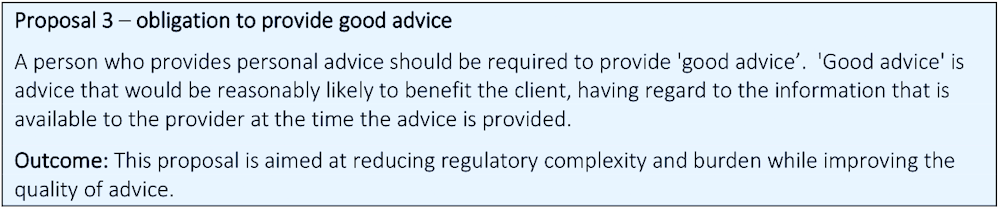
One of them would replace the present requirement for advisers to give advice that is in their clients “best interests” with advice that is merely “good advice”.

If that is what the review recommends, and if the recommendation is adopted, while stand-alone financial planners would still be required to provide advice that was in their client’s best interests (because of their code of ethics) banks, super funds and other providers would be able to give a lesser standard of advice.

The core justification is reducing “regulatory complexity and burden while improving the quality of advice”.

While it would certainly aid in reducing the compliance burden, and would make advice more accessible, it isn’t obvious that it would improve the quality of advice.

Poorly defined

The best interests duty requires advisers to put the client’s interests first, to make sure the advice is right for each particular client, and to warn the client if the advice is based on insufficient information.

“Good advice” is defined simply as advice “reasonably expected to benefit clients”. Unless better defined, it will be a definition that leaves a lot to interpretation.


Read more:
Adviser ‘reforms’ will undermine a royal commission recommendation


What banks and super funds believe they “reasonably expect” to be best for their customers, might not necessarily align with what’s best for their customers.

While removing red tape is important, removing regulations that require advisers to act in their clients’ best interests might not be in their clients’ best interests.

On Friday Stephen Jones will have to begin to consider whether “good advice” is good enough. It’s not a decision he should take lightly.

The Conversation

Ama Samarasinghe does not work for, consult, own shares in or receive funding from any company or organisation that would benefit from this article, and has disclosed no relevant affiliations beyond their academic appointment.

ref. Why would you dump a requirement for financial advisers to give advice that’s in their client’s best interests? – https://theconversation.com/why-would-you-dump-a-requirement-for-financial-advisers-to-give-advice-thats-in-their-clients-best-interests-193719

Most assume writing systems get simpler. But 3,600 years of Chinese writing show it’s getting increasingly complex

Source: The Conversation (Au and NZ) – By Piers Kelly, Linguistic anthropologist, University of New England

Raychan on Unsplash

At this very moment, the words you are reading are entering your mind at the speed of thought. Below your awareness, strings of letters are retrieving words and meanings as effortlessly as oxygen absorbed into the bloodstream.

This efficiency is the result of careful refinements over time. The simple letters of the Roman alphabet are the successors to much more elaborate scripts like Egyptian hieroglyphics. As picture-based signs passed through new generations of users and into new languages, they apparently became more abstract, more compact, and fewer in number.

How then, do we make sense of the extraordinary Chinese writing system with its thousands of complex characters?


Read more:
If you speak Mandarin, your brain is different


Simplifying symbols

Over time, letters adapt to become simpler to write and easier to read. Cultural transmission theorists refer to this process as “compression” and it seems to kick in as soon as people start using a script and teaching it to others.

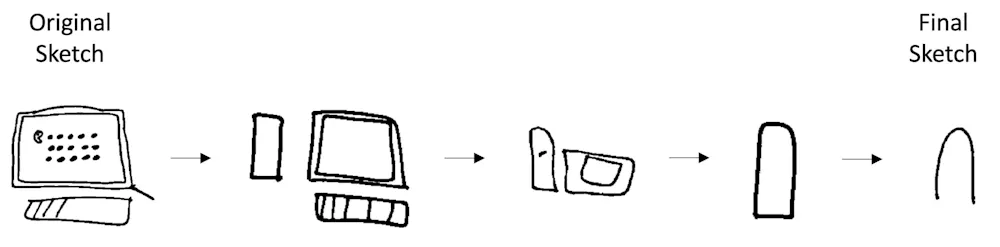
A delightful Pictionary-based experiment shows just how this might unfold in practice. A player who is asked to draw a computer monitor will sketch a detailed picture so the guesser has the best chance of success. But when those same two players are given the exact same clue again and again, the “monitor” might be reduced to a few rectangles and then a simple wavy line. As soon as a simpler convention is established it makes sense to cut corners.

Simplification occurs when players repeatedly sketch ‘Computer Monitor’ in the game of Pictionary. Image derived from Figure 11 of Garrod et al (2007).

But while English readers are only contending with 26 letters, readers of Chinese manage to process over 4,000 core characters, some made up of dozens of strokes.

The sign 麤 (cū, “to be rough with someone”), for example, is evidently much more complex than the alphabetic letter “o”. If Chinese writing is subject to similar pressures, why didn’t this sign simplify?

Our newly published research grapples with this very problem. We found the Chinese script has evolved towards greater visual complexity over the course of its 3,600 year history.

The traditional view

As early as the 1600s, European scholars began to compare archaeological inscriptions across different sites and historical periods.

They noticed signs that started out as pictures tended to become simpler and more abstract over time.

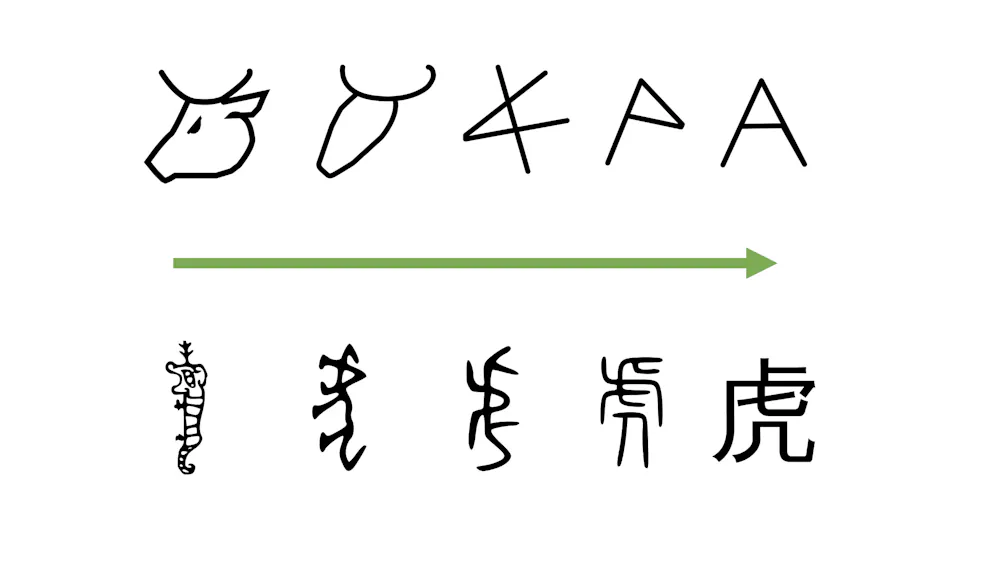
Some of these scholars assumed the Chinese writing system had been trudging along a similar evolutionary path. Just as a hieroglyphic representation of a fish 𓆟 may have simplified into the letter D, and an ox’s head 𓃾 simplified into the letter A, Chinese characters are thought to have condensed from pictures of things to simpler sets of strokes.

Diagram depicting changes in the sign for the letter beginning with an ox head and ending in a capital letter A. Below it is a diagram showing the evolution of the Chinese character for tiger from a picture to a character.
The evolution of A and 虎.
Piers Kelly

Chinese philosophers of the Han Dynasty hypothesised their writing system originated at the hands of Fuxi (伏羲), China’s mythical first emperor, who invented characters inspired by the forms of birds, animals and elemental forces.

Later rulers were said to have simplified Fuxi’s pictures. Instead of representing the full outlines of the creatures, they began to trace only their tracks and movements. Tradition holds that a Qin dynasty emperor ordered his minister to simplify the script even further by reducing the total number of strokes in each character.

For over 350 years, scholars across the world have reproduced charts of Chinese characters that depict a straightforward sequence from stylised pictures towards abstract signs.

Even contemporary sources make the claim that Chinese has been steadily simplifying across its history. But our research suggests the opposite is true: Chinese writing has become increasingly complex.

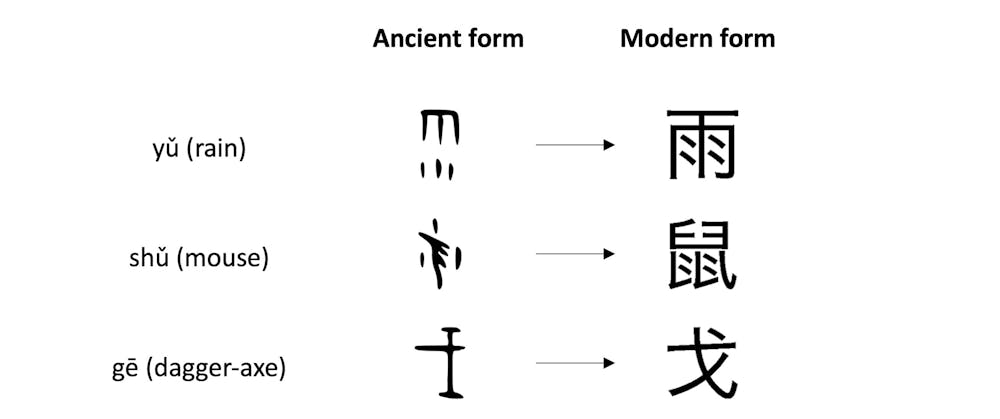
Chinese characters for rain, mouse, and dagger-axe have become more complex over time
Many Chinese characters have become more complex over time, including the three examples shown here.

How Chinese writing is different

The earliest surviving traces of Chinese writing are found scratched on turtle shells and ox bones used in divination rituals during the Shang Dynasty (c.1600 BC–c.1045 BC).

Since that time, the script has continued to evolve through several distinct historical phases that can be dated with accuracy.

We wanted to know how intricate Chinese character writing was over time. We used a computational method to trace the perimeters of each letter. The longer the perimeter, the more complex the drawing.

We used this method to measure more than 750,000 images of Chinese characters across five historical phases, from 1600 BC to the present day. The historical trajectories of many of these characters can be visualised here. Far from simplifying or staying the same, on average Chinese characters have become more complex with time.

Even when the mainland Chinese government engineered and enforced a simpler version of the script in 1956 this still left complexity above the level observed for 1600 BC.

Possible explanations

There is a kind of trade-off between the need for simplicity and the need to distinguish between each sign.

Unlike most other writing systems, the number of Chinese characters has increased dramatically over the millennia.

While alphabets pair letters with a limited set of individual sounds that recur and recombine, Chinese characters represent individual words or word-components together with information about sound values. This means that new characters can be created and added to an ever-expanding set.

As the set of Chinese characters became larger and larger over the centuries, writers found it necessary to add extra bells and whistles to increase the contrast and tell each character apart. A reader of Chinese text can absorb the words with ease because of innumerable tweaks that keep the system at just the right level of complexity.

The results shed new light on the history of the Chinese script. But they also provide important insights into the dynamics of human communication.

In order to work most efficiently, our symbolic systems require a careful balance between simplicity and distinctiveness.


Read more:
Un-doing the tián (field): Mandarin language and the shift away from Chinese agrarian culture


The Conversation

This research was conducted with Simon Jerome Han as lead author. Piers Kelly receives funding from an ARC DECRA Fellowship.

Charles Kemp’s work on this project was supported by an ARC Future Fellowship ( FT190100200).

James Winters does not work for, consult, own shares in or receive funding from any company or organisation that would benefit from this article, and has disclosed no relevant affiliations beyond their academic appointment.

ref. Most assume writing systems get simpler. But 3,600 years of Chinese writing show it’s getting increasingly complex – https://theconversation.com/most-assume-writing-systems-get-simpler-but-3-600-years-of-chinese-writing-show-its-getting-increasingly-complex-194732

We asked 900 Australian teachers if evidence informs how they teach – and found most use it, but there are key gaps

Source: The Conversation (Au and NZ) – By Ioana Ramia, Lecturer, UNSW Sydney

Shutterstock

There are many ways to teach school students. But research shows only some will significantly improve learning.

While most teachers want to use evidence-based practices, they face many challenges that can limit their ability to use them in their classrooms. These include time pressures, access to resources, and unsupportive school cultures.

In our new study we asked teachers how much they use education research evidence when teaching students.

We found that most teachers surveyed said they were using evidence-based practices most of the time, but they are not using all the strategies that make those practices effective. This can have serious impacts on student learning.

What types of evidence are we talking about?

Our study looked at four teaching approaches that have been shown by academic research to help students learn:

  1. Formative assessment – gathering information about student learning and adapting teaching to meet learning needs.

  2. Explicit instruction – setting clear learning goals, then fully explaining and effectively demonstrating how students can achieve them.

  3. Mastery learning – breaking up learning, so students must master a certain task before moving on to the next one.

  4. Classroom management – establishing clear routines and rules, and modelling appropriate behaviour.

Our survey

In 2021, we surveyed more than 900 teachers from across each state and territory for an Australian Education Research Organisation (AER0) study. This included teachers from government, Catholic and independent schools and from primary and high schools.

A teacher speaks while primary students listen.
More than 900 teachers from around Australia were surveyed about their use of evidence in the classroom.
Shutterstock

We asked how much teachers use various types of evidence to inform how they teach students. We also analysed Australian data from international education surveys, including the OECD’s Programme for International Student Assessment (PISA) and Teaching and Learning International Survey (TALIS) as well as the Progress in International Reading Literacy Study (PIRLS).

Our findings

The vast majority of teachers we surveyed said they used methods backed by research in their classrooms. Specifically, when it comes to formative assessment methods:

  • 73% of teachers said they assess students’ understanding of the content they are teaching and make adjustments accordingly

  • 67% of teachers said they design lessons based on data they have gathered
    regarding students’ prior knowledge and experience.

An even greater proportion of those we surveyed said they were using explicit instruction methods:

  • 91% of teachers said they interact with students as they work, providing immediate elaboration and explanations as needed

  • 78% of teachers said they clearly outline what students will learn and how they know they have learned it.

When it came to teaching using mastery learning:

  • 85% of Australian teachers set goals at the beginning of a lesson, according to the 2018 TALIS survey

  • 95% of teachers explained what they expected students to learn, also according to the TALIS survey.

High proportions of those we surveyed also reported using classroom management methods:

  • 90% of teachers we surveyed said they modelled appropriate behaviours, such as not raising their voice and following the rules.

  • 76% of teachers and leaders explicitly said they teach rules and routines for how to participate effectively in class.

These results show most Australian teachers are using evidence-backed methods to teach in their classrooms. This is reassuring news overall, but also shows significant proportions of those surveyed are not drawing on approaches we know help students learn.

What do students say?

We also found teachers report using evidence-based practices more than students report experiencing them. For example, according to PISA, only 31% of year 10 students in Australia report teachers frequently provide individual help when a student has difficulties understanding a topic or task.

Another 2019 study of five Australian schools also found feedback from teachers is often not clear to students.

Meanwhile, almost three-quarters (71%) of respondents to the PIRLS Year 4 student survey agree “a lot” that their teacher tells them how to do better when they make a mistake.


Read more:
Personalised learning is billed as the ‘future’ of schooling: what is it and could it work?


Do teachers help each other?

Our survey also suggests teachers do not get enough support and training to access research-based approaches. For example, only 64% of teachers we surveyed said they had regular access to coaching to help them use evidence. We also found:

  • 66% said their school system (government, Catholic or independent) provided easily accessible information, resources, training or other support to help them use evidence

  • 45% “agreed” or “strongly agreed” they will encourage colleagues to stop doing something if evidence from academic research shows it doesn’t work.

What needs to happen now?

A key way to improve this situation is to provide more time and support (such as professional learning and access to resources) to help and train teachers and school leaders use evidence.

We also need to encourage school cultures where teachers discuss evidence, so they can learn from each other.

This tells us that we need to build supportive school environments where teachers feel confident and capable to support each other to not just use evidence but also stop doing things that aren’t working.


Read more:
If Australia wants to improve school outcomes, we need to define what ‘equity’ really means


More resources

The point of using research evidence to inform teaching is to improve outcomes for students. This should be the priority across schools and in resources from education departments and in research, curriculum guidance and education policies.

AERO has free resources for teachers and school leaders about using evidence. Other state governments, such as New South Wales, Victoria, Western Australia and the Northern Territory also have resources.

The Monash Q Project is a research project investigating how research evidence is used in schools, and how to support educators to better use that evidence in their practice.

The Conversation

The authors do not work for, consult, own shares in or receive funding from any company or organisation that would benefit from this article, and have disclosed no relevant affiliations beyond their academic appointment.

ref. We asked 900 Australian teachers if evidence informs how they teach – and found most use it, but there are key gaps – https://theconversation.com/we-asked-900-australian-teachers-if-evidence-informs-how-they-teach-and-found-most-use-it-but-there-are-key-gaps-196117

An Indigenous Voice to Parliament will not give ‘special rights’ or create a veto

Source: The Conversation (Au and NZ) – By Anne Twomey, Professor of Constitutional Law, University of Sydney

Mick Tsikas/AAP

The Constitutional Expert Group, appointed to advise on the proposed Voice to Parliament referendum, has concluded that the “draft amendment is constitutionally sound” and does not amount to a “veto” power or provide anyone with “special rights”.

How does this fit into the current debate?

What is the composition and role of this expert group?

In the lead-up to its proposed referendum on an Indigenous Voice, the Commonwealth government appointed three bodies to advise it. The first is the Referendum Working Group. It is comprised of Indigenous leaders from across the country, including Marcia Langton, Tom Calma, Pat Anderson, Jackie Huggins, Ken Wyatt and Galarrwuy Yunupingu. It is co-chaired by Minister for Indigenous Australians Linda Burney and Special Envoy Patrick Dodson.

There is also a second broader group, the Referendum Engagement Group, which includes representatives from land councils, local government and community organisations to advise on how to build community understanding and awareness of the referendum.

Finally, the third smaller group is the Constitutional Expert Group. It is comprised of Greg Craven, Megan Davis, Kenneth Hayne, Noel Pearson, Cheryl Saunders, George Williams, Asmi Wood and me. Its role is to answer legal and constitutional questions raised by the Referendum Working Group. It is chaired by Attorney-General Mark Dreyfus.

What advice has the Constitutional Expert Group given?

The Constitutional Expert Group has had three meetings, and has provided advice to the working group on a number of specific questions.

At its meeting on December 13, the working group released a communique, to which it attached a brief summary from the Constitutional Expert Group of the conclusions it reached about the first round of questions sent to it from the Working Group.

Additional questions have been asked and further advice will be given by the Constitutional Expert Group in the future.


Read more:
The government will not send out Yes and No case pamphlets ahead of the Voice to Parliament referendum. Does this matter?


What did the advice say?

The first point made by the expert group was that while there were different policy and process approaches that could be followed, the draft amendment proposed by the prime minister was constitutionally sound and provided a strong basis on which to conduct further consultation. That proposed amendment is as follows:

  1. There shall be a body, to be called the Aboriginal and Torres Strait Islander Voice.
  2. The Aboriginal and Torres Strait Islander Voice may make representations to Parliament and the Executive Government on matters relating to Aboriginal and Torres Strait Islander Peoples.
  3. The Parliament shall, subject to this Constitution, have power to make laws with respect to the composition, functions, powers and procedures of the Aboriginal and Torres Strait Islander Voice.

No veto power

The expert group unanimously agreed this form of an amendment would not result in the Voice having a veto power over the actions of parliament or the executive government. The power and function of the Voice is to make representations. It cannot dictate, demand or veto.

What use the parliament or the executive government makes of those representations is a matter for it, as is appropriate in a system of representative and responsible government.

The aim is to ensure those institutions are better informed when they make decisions and exercise their powers on matters relating to Aboriginal and Torres Strait Islander peoples. There is no intention to create a body that would have any overriding power.


Read more:
Changing the Australian Constitution is not easy. But we need to stop thinking it’s impossible


No special rights

The expert group was also unanimously of the view that the proposed amendment would not confer “special rights” on anyone. It would instead establish a body that could make representations to parliament and the executive.

Anyone and any organisation can also make representations to parliament and the executive. This often happens when parliamentary committees examine bills, or governments consult stakeholders on proposed policy changes, or when bodies (such as business organisations, unions, industry groups, community groups and charities) lobby the government.

The constitutionally implied freedom of political communication ensures individuals and groups within Australia remain free to make representations to parliament and the government on political matters. The expert panel noted the establishment of the Voice would not “change or take away any right, power or privilege of anyone who is not Indigenous”.

The proposed constitutional amendment does not confer special rights upon people to participate in, or choose the membership of, the Voice. It leaves for parliament the power to decide the composition of the Voice.

A new chapter in the Constitution

The Constitutional Expert Group agreed the placement of this proposed amendment should be in its own separate chapter of the Constitution. There were different views about where it should be placed, but it was agreed it should be somewhere after the first three chapters, which deal with the parliament, the executive government and the courts.

Functions of the Voice

The proposed amendment states the Voice “may make representations to Parliament and the Executive Government on matters relating to Aboriginal and Torres Strait Islander Peoples”. This is its primary function. But it also permits parliament to “make laws with respect to the composition, functions, powers and procedures” of the Voice.

Further advice

The Constitutional Expert Group will continue to provide advice to the working group, at its request, as issues arise. This advice will feed into the public debate as we proceed towards the proposed referendum.

The Conversation

Anne Twomey has received funding from the ARC and occasionally does consultancy work for governments, Parliaments and intergovernmental bodies. She is a member of the Constitutional Expert Group advising the Referendum Working Group.

ref. An Indigenous Voice to Parliament will not give ‘special rights’ or create a veto – https://theconversation.com/an-indigenous-voice-to-parliament-will-not-give-special-rights-or-create-a-veto-196574

What is meningococcal disease? What symptoms should I look out for? And how can I prevent it?

Source: The Conversation (Au and NZ) – By Helen Marshall, Professor in Vaccinology, University of Adelaide

Shutterstock

Parents and doctors alike fear meningococcal infection, which has been in the news again. Doctors never want to miss a diagnosis, as early treatment with antibiotics may be life-saving. Parents fear the disease because up to 10% of children who become infected die from the disease and its complications.

Another 40% of children will have ongoing disability from one or more complications. These include deafness, blindness, skin scarring, or surgical amputation of limbs that may be required to save the child’s life in some situations.

In other cases, children will initially be acutely unwell but then recover within a few days of starting antibiotics. Many, though, will have ongoing fatigue, forgetfulness and difficulty concentrating. For most, it’s a life-changing illness.


À lire aussi :
We can expect more colds and flu as COVID restrictions lift. 5 germs to look out for


What causes it and who most at risk?

Meningococcal disease is caused by the meningococcus bacteria, also known as Neisseria meningitidis. The bacterial infection causes meningitis (infection of the lining around the brain) and/or sepsis (blood poisoning).

The highest risk of disease is in children under four years, and adolescents and young adults aged 15-24.

Teens in a school corridor
Australian adolescents are now offered a vaccine to protect against four types of the disease.
Rodnae Productions/Pexels

Aboriginal infants and young people are at higher risk of meningococcal disease than non-Indigenous children.

What are the symptoms?

Young infants who become unwell with this infection usually develop symptoms such as a fever, irritability, vomiting and poor feeding.

Young people who develop the infection may complain of a headache, neck stiffness, fever, vomiting or feeling generally tired and unwell with “flu-like” symptoms.

Unfortunately, these symptoms are fairly general and occur with many other infections, making this disease hard to diagnose. This may result in delayed diagnosis and treatment.

A more unusual symptom children or young people may experience is feeling they have cold hands and feet.

The classic dark red-purple rash associated with the infection is often a later sign of the disease. Ideally, antibiotic treatment should be started before the rash appears, to combat the infection as early as possible.


À lire aussi :
Explainer: what’s meningococcal meningitis and what are the signs?


How does it spread?

The meningococcus bacteria usually enter the bloodstream through the throat.

The bacteria live quite happily in the throat of around 10% of the population, without causing any symptoms. Young people in particular have a higher chance of having the bacteria in their throat and passing it to each other through air droplets from coughing or through kissing.

Teens legs in photo booth
Young people pass it to each other through coughing or kissing.
Cottonbro studio/Pexels

N. meningitidis is often referred to as an “accidental pathogen” because it prefers to live at the back of the throat, with no intent to cause meningitis or sepsis. It can invade the lining of the throat during a throat infection, which disrupts the barrier in the throat and allows the bacteria to enter the bloodstream.

It may also be more likely to invade the bloodstream and multiply if the person has a problem with their immune system.

Once in the bloodstream, the bacteria multiply very quickly and the body reacts with a very robust immune response, which unfortunately can contribute to some of the complications.

The bacteria primarily damage the walls of the blood vessels in the body and the blood vessels become leaky. This results in bleeding into the skin, which causes a rash, and lack of blood supply to the limbs, resulting in breakdown of the tissues in the limb. Sometimes this requires surgical amputation of the limb or multiple limbs to save the child’s life.

What are the different types of meningococcal disease?

There are 13 different types of meningococcus, however almost all disease in humans is caused by six groups: A, B, C, W, Y and X.

Group W is associated with a higher risk of dying from the infection (around 10-15%), whereas with group B there is a lower risk of dying (around 5-10%).

In Australia, group B causes the highest number, however there are significant differences between different states. Most cases in temperate climates occur in winter and early spring. Viral infections, in particular influenza, increase the risk of meningococcal infection.

How can you protect against it?

The best way to protect against meningococcal disease is through vaccination.

From 2003 to 2013 in Australia, there was a decrease in meningococcal disease cases, following the introduction of the free meningococcal C vaccine onto the National Immunisation Program for children aged 12 months.

Baby's leg after a vaccination
Babies are routinely vaccinated against four types.
Shutterstock

A free, combined meningococcal ACWY vaccine is now available on the National Immunisation Program for all children at 12 months of age (this replaced the meningococcal C vaccine) and for adolescents aged 14-16 years through a school-based program from April 2019.


À lire aussi :
Health Check: which vaccinations should I get as an adult?


A meningococcal B vaccine has been more difficult to produce and requires a different vaccine manufacturing approach. Two meningococcal B vaccines are available and licensed in Australia.

One of these meningococcal B vaccines is now provided on the National Immunisation Program for Aboriginal and Torres Strait Islander infants due to their higher risk of meningococcal B than non-Indigenous infants.

In South Australia, where historically most cases have been caused by group B, the meningococcal B vaccine is provided free through a state-funded program for infants from six weeks of age and for Year 10 students through the school immunisation program.

This followed a large study I led in South Australia of 35,000 senior school students across SA. It showed the meningococcal B vaccine was highly effective in preventing meningococcal B disease but not in reducing the number of young people carrying the disease-causing bacteria in their throat. So the vaccine needs to be given to age groups at highest risk of disease rather than expecting a herd immunity effect by reducing the number of young people carrying the disease causing bacteria in their throats.

In other states, the meningococcal B vaccine can be purchased for around A$120-$140 per dose and is provided through a script from a GP.

The Conversation

Helen Marshall receives funding from the National Health and Medical Research Council. Her institution receives funding from GSK, Sanofi-Pasteur and Pfizer for clinical vaccine trials of which Helen Marshall is an investigator. The herd immunity study in South Australia was sponsored by The University of Adelaide and funded by GSK.

ref. What is meningococcal disease? What symptoms should I look out for? And how can I prevent it? – https://theconversation.com/what-is-meningococcal-disease-what-symptoms-should-i-look-out-for-and-how-can-i-prevent-it-196393

Voters share ‘integrity and truth’ vision of a strong Fijian democracy

By Cooper Williams, Yasmine Wright-Gittins and Cindy Chand of Wansolwara in Suva

Former politician Remesio Rogovakalali is hoping to see transparency and engagement in the next term of government, no matter which party is elected.

The 77-year-old principal from Corpus Christi Teachers College in Nasese says he wants to see integrity and truth among politicians.

“I’d like to also see more engagement between government, non-governmental organisations and unions,” he told Wansolwara after voting at Suva Grammar School this morning.

“Fijians are more educated than previous years, education is only getting better and this will make Fijian democracy stronger.”

Rogovakalali carries a wealth of experience in politics, having stood for election twice in 2001 and 2006.

Fiji Labour Party Leader Mahendra Chaudhry and wife Virmatee voting
Fiji Labour Party Leader Mahendra Chaudhry and wife Virmatee joined the queue at the USP Statham Campus, Suva Point, today to cast their votes. Image: Yasmine Wright-Gittins/Wansolwara

Reflecting on his time in politics, he believes truth is a powerful tool and must be adopted more in Fijian politics.

“I’ve voted at every election and it carries immense value to be able to have our voices heard. I am urging all Fijians to vote and exercise your right and civic duty,” he said.

Another figurehead at the polls today was Fiji Labour Party Leader Mahendra Chaudhry, who also called on Fijian citizens to cast their votes before 6pm.

FIJI ELECTIONS 2022

FIJI ELECTIONS 2022
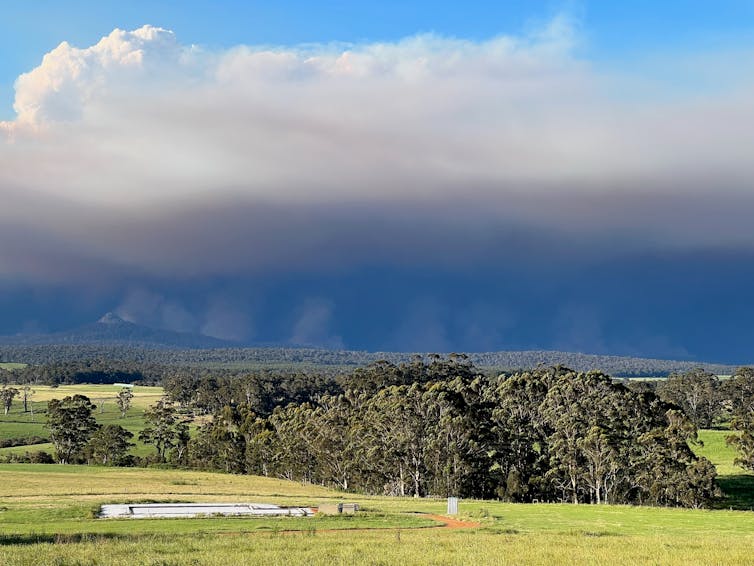
The former PM cast his vote at 10.46am at the University of the South Pacific’s Statham Campus polling station in Suva Point with his wife, Virmatee Chaudhry.

He said reports of wide voter turnout across the country were promising signs of Fiji’s interest in the results of the election.

“To citizens still contemplating whether or not they will cast their vote, please come and vote, take part in the election. This is your future and you must exercise your right to vote,” he said.

Voters like Mereani Babara, who moved from Tavua to Baulevu in Nausori five months ago, hopes the elected government would address sanitation and water woes in areas like Waidra, Baulevu.

She looked forward to casting her vote at Koroqaqa Primary School and urged other Fijians to make their way to their designated polling venue before the 6pm deadline.

Published in collaboration with the University of the South Pacific journalism programme’s Wansolwara News.

Print Friendly, PDF & Email

Article by AsiaPacificReport.nz

Fijians brave the heat as numbers swell – but elections chief calls for voters

By Yasmine Wright-Gittins, Leila Parina and Geraldine Panapasa of Wansolwara in Suva

Water bottles, umbrellas and fans were common accessories for voters across Fiji today. Lines at polling stations nationwide grew quickly in the early morning, as Fijians tried to beat the midday heat.

Lines at the University of the South Pacific’s Statham Campus polling venue at Suva Point extended across the hot carpark.

In spite of the early morning rush by voters to cast their ballots, by midday Supervisor of Elections Mohammed Saneem noted that voter turnout “is not looking very promising” as only 164,954 voters at 1145 polling stations (27.24 percent of the total registered voters) had cast their ballots by 11am.

FIJI ELECTIONS 2022

FIJI ELECTIONS 2022

He urged every registered Fijian voter to come out and vote, and to make use of the free public transport to get to polling venues in their localities.

“The weather is good, the polling venue is ready, the line is gone, all you have to do now is show up and vote,” Saneem said during the midday Polling Day update at the National Results Centre in Suva.

“If you have voted, check in on your family members who haven’t voted. Take them out and make them vote. Spend the next 5-6 hours to get family members to go out and vote.

“If you need transport on election day, send an SMS of your VoterCard number to 1500. That SMS reply will tell you the number and details of the person monitoring public transport in that area.

‘Go and vote’
“This free public transport service will continue until 4pm so make use of it now, go and vote.”

With temperatures expected to reach 30 deg. Celsius by 1pm, with some voters raised concerns about the lack of shelter in open spaces for queues.

Voter and mother Asinate Colovanua said even although Fijians were used to the heat, there could have been provisions for water and shelter, especially for the older citizens waiting in line.

Elderly voters were eventually offered shelter in air-conditioned cars as they waited their turn to vote at the polling station.

Meanwhile, Saneem reminded Fijian Elections Office staff to refrain from introducing entry requirements for polling agents.

“There were a few issues from the field in relation to candidate agents. I’d like to clarify to FEO staff, you have to let polling agents in. There is no requirement to have their agent appointment forms stamped, do not introduce this as a requirement,” he said.

The 2022 General Election is the third post-2006 coup election and is set to be significant for cementing democracy. The number of registered voters exceeds both the 2018 and 2014 elections.

As many as 606,092 Fijians are expected to cast their votes at 855 venues today.

Fiji’s 2022 General Election will close after the last voter in the queue at 6pm has voted. The commencement of counting is expected to start thereafter with provisional results to be announced by 8pm.

Published in collaboration with the University of the South Pacific journalism programme’s Wansolwara News.

Fiji voters at USP’s Statham Campus, Suva Point
Registered voters wait patiently in the queue for their turn to vote at USP’s Statham Campus, Suva Point. Image: Yasmine Wright-Gittins/Wansolwara
Retired teacher Savitri from Taveuni
Retired teacher Savitri, from Taveuni, says casting her vote today meant giving back to her community. Image: Yasmine Wright-Gittins/Wansolwara
Polling stations at USP's Statham Campus
Polling stations at the USP Statham Campus in Suva Point. Image: Yasmine Wright-Gittins/Wansolwara
Print Friendly, PDF & Email

Article by AsiaPacificReport.nz

‘The time has come’, says Zelensky in fresh appeal to NZ government

Ukrainian President Volodymyr Zelensky delivered an address to New Zealand’s Parliament today and the government has pledged an additional $3 million of humanitarian aid to Ukraine.

Zelensky began with a friendly “kia ora” before saying he would offer New Zealand the opportunity to take the lead in pushing for peace.

“Today, this anti-war coalition has more than 100 countries, those who support the fundamental principle of international law and the UN Charter,” he said.

“Those who do everything possible to hold Russia’s war criminals accountable.”

He said New Zealand was one of the first countries to support Ukraine against Russia’s aggressive invasion and he recognised New Zealand imposed sanctions.

“Let me offer you one more thing, various dictators and aggressors — they always fail to realise that the strength of the free world is not about someone becoming large or becoming full of missiles but in the fact that everyone knows how to unite and act decisively and make a unique contribution to the common cause.

“Perhaps the time has come for your country to make such a unique contribution.”

President Zelensky’s address to the NZ Parliament today. Video: NZ Parliament TV

Peace plan 10 points
He said this could be one of the 10 points in the plan he laid out at the G19 Summit in Indonesia:

  • Radiation and nuclear safety
  • Food security
  • Energy security
  • Release of prisoners and deportees
  • Implementation of the UN Charter
  • Withdrawal of Russian troops and cessation of hostilities
  • Justice
  • Ecocide and the protection of the environment
  • Prevention of escalation
  • Confirmation of the end of the war

“Each of these points can remove one or another of Russia’s aggression … I propose to convene a special summit in the coming months.”

He called upon New Zealand to support this formula and to start consolidating the world around the eighth point, environmental security, saying many people did not consider the impact of war on the environment and it was one aspect New Zealand society approached wisely.

“You can’t rebuild destroyed nature, just as you can’t rebuild destroyed lives.”

“There’s no true peace where the consequences of war could be there in the form of poisoned groundwater that may destroy normal lives in several countries. There’s no true peace where ecocide has taken place and its consequences have not been neutralised.”

He said to this day, the world had no strong experience in overcoming the destructive impact of war on the environment.

‘We will win’
“We will liberate our land. We will win this war. I am confident that we will return freedom and security to all Ukrainians wherever they live.”

“Ngā mihi, Slava Ukraini (glory to Ukraine).”

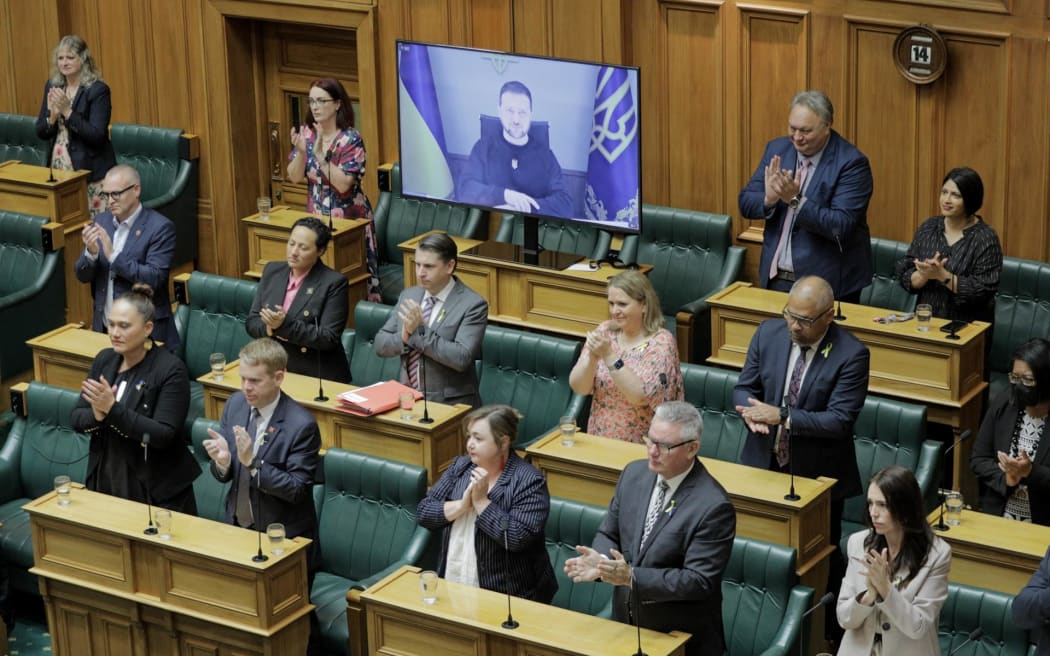
New Zealand MPs applaud Ukraine President Volodymyr Zelensky after his address to the Parliament.
New Zealand MPs applaud Ukraine President Volodymyr Zelensky after his address to the Parliament today. Image: Angus Dreaver/RNZ

Zelensky is just the second head of a foreign government to address Parliament after Australia’s Julia Gillard in 2011.

The Ukrainian leader’s message to New Zealand comes as the government announced new sanctions on Iranian individuals and an entity involved in the manufacture and supply of drones to Russia.

Those sanctioned today include two Islamic Revolutionary Guard Corps commanders, the Armed Forces General Staff chair Mohammad Hossein Bagheri and drone manufacturer Shahed Aviation Industries.

He has previously spoken to other parliaments, including in the UK, US, European Union, and Australia, appealing for assistance and support in defending Ukraine against Russia’s invasion.

In September, Zelensky addressed world leaders at the United Nations, demanding a special UN tribunal impose “just punishment” on Russia for its invasion of Ukraine, including financial penalties and stripping Moscow of its veto power in the Security Council.

Ardern announces further humanitarian aid
Prime Minister Jacinda Ardern in response thanked him on behalf of New Zealand and said taking the time to speak today was a sacrifice when he was leading his people through a crisis “and one we do not take lightly”.

She hoped he heard loudly and clearly from New Zealand that Ukraine’s was not a forgotten war, and the Parliament on the other side of the world had come together to condemn Russia’s war.

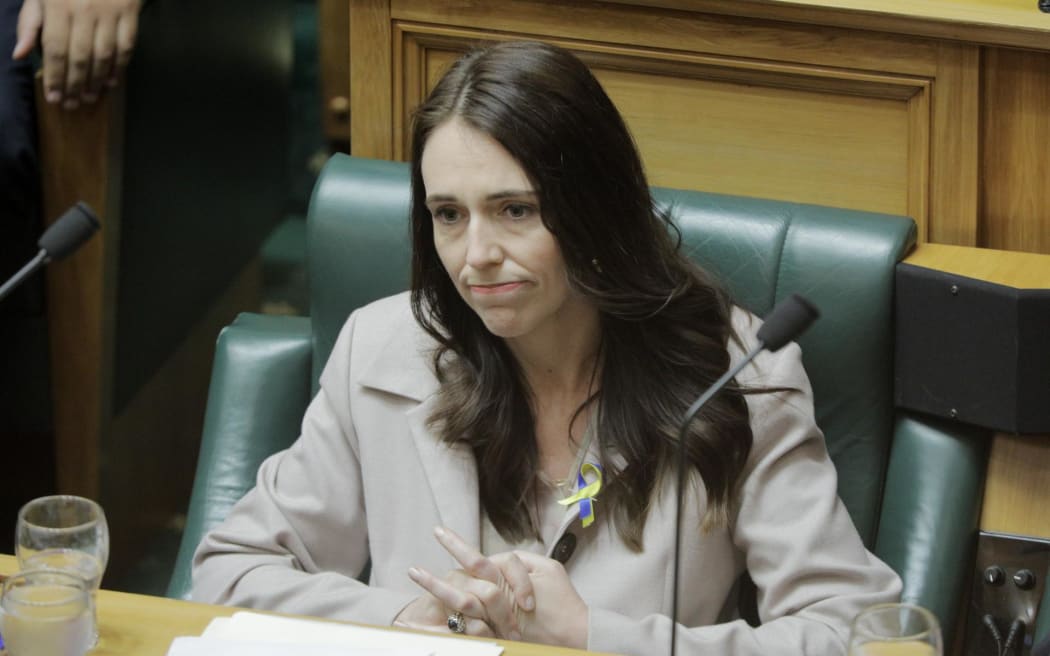
Prime Minister Jacinda Ardern as President Zelensky delivers an address to NZ's Parliament
Prime Minister Jacinda Ardern . . . “our judgment was a simple one: we asked ourselves the question ‘what if it was us’.” Image: Angus Dreaver/RNZ

“Our support for Ukraine was not determined by geography, it was not determined by history or by diplomatic ties or relationships — our judgment was a simple one: we asked ourselves the question ‘what if it was us’.”

She also referred to the breach of the international rules-based order and “the misuse of multilateral institutions”.

Running through New Zealand’s commitments to the Ukrainian war effort, she made a further announcement of $3 million of humanitarian aid to Ukraine, through the International Committee of the Red Cross, as the population faces severe hardships over winter.

This would cover items like medical supplies and equipment, power transformers and generators to cope with blackouts, and essential winter items for vulnerable families in Ukraine, like food, water and sanitation and hygiene items.

Ardern acknowledged the plan laid out by Zelensky today, and said the war “must not become a gateway to a more polarised and dangerous world for generations to come”.

Long-term impacts
She acknowledged Zelensky’s urging to counter the long-term impacts of war including with the environment, saying New Zealand had a long history of reconstruction post-conflict.

“That includes remediation such as dealing with unexploded ordinances. We will be with you as you seek peace but we will also be with you as you rebuild.”

She paid a special tribute to Zelensky himself, saying he had been unrelenting in his support of his people and coordinated an international response in support of the rules-based order.

“Kia kaha, kia māia, kia manawanui – slava Ukraini.”

In a statement, Foreign Minister Nanaia Mahuta said the new contribution “comes as the Russian military has stepped up its deliberate targeting of critical national infrastructure, further deepening the severe humanitarian crisis caused by the illegal invasion.”

“Russia’s targeting of energy and other civilian infrastructure is deplorable. As Ukraine faces a harsh winter, Putin’s actions have further disrupted electricity supply, and are harming the health, safety and well-being of already vulnerable communities,” the statement said.

The aid is in addition to almost $8m in humanitarian help already provided, and $48m of military spending including on training deployments, donation of surplus equipment, and procurement of weapons and ammunition.

Other party leaders speak
Opposition National Party leader Christopher Luxon said it was a great honour and tremendous privilege for the Parliament to hear Zelensky’s address, “and we all appreciate the opportunity to say to you ‘kia kaha’, which in our indigenous Māori language means ‘stay strong’.”

He said for those nations that valued democracy, national sovereignty and borders, and uphold the international rule of law the choice was simple.

“New Zealand is one of those countries. Confronted with brutality or diplomacy, autocracy or democracy, darkness or light, there was nothing to discuss except how to individually and collectively to support Ukraine.”

He said the war was a moral battle that posed an existential threat to Ukraine and it could not lose.

“You have been our generation’s Winston Churchill, and since those Russian tanks crossed Ukraine’s border, you have been unwavering in your determination that Ukraine will win this war that it did not want and it did not start.

“Of all the miscalculations Vladimir Putin has made — and there are many — underestimating your resolve and the impact of the strength of your leadership and the words — your words — would have in rallying Ukraine and the world has perhaps been the biggest.”

He said the death of every single Ukrainian was a tragedy, and the greatest regret of the war would be terrible loss of life that left tens of thousands of families bereft.

Luxon also spoke of the need for a reconstruction programme, because “the loss of homes and communities and critical infrastructure is also incalculable”. He said he could not imagine circumstances where New Zealand was not a part of that effort.

Green Party co-leader James Shaw said Russia’s invasion was “as barbaric as it is illegal”.

“It is apparent that there have been and continues to be a multitude of war crimes perpetuated on the Ukrainian people by the Russian forces.

“Were President Putin to be successful, the temporary violence of war would morph into the permanent violence of subjugation — perhaps even genocide.”

He said he applauded the Ukrainians’ efforts to minimise harm to civilians, however he urged that any future calls for military support come before the Parliament — not just the government.

“As a member of the Green Party I have a fundamental commitment to non-violence … the situation in Ukraine remains impossibly difficult in ways that we in Aotearoa New Zealand cannot possibly imagine.”

He said there were people on every continent still suffering from violence and subjugation, and emphasised the importance of universal human rights.

ACT leader David Seymour said he wanted Zelensky and the Ukrainian people “to know that on the other side of the world people care deeply about your struggle against evil”.

“We understand that a dictator attacking our democracy matters to New Zealand, your people are not just fighting for their lives but for all our freedom and democracy and I want you to know that your leadership and courage inspires us.”

He spoke of the New Zealanders who had gone to fight in Ukraine on their own initiative, and the funds raised for the defenders.

“Our donors were particularly pleased to buy luggage tags made from bits of aluminium from downed Russian jets – what great initiative under fire.”

But his comments also took a more political turn, saying the opposition had pushed for the government to do more.

“More sanctions, more refugee places, more lethal aid, and we’ll keep pushing them from this side of our Parliament and if our government changes before you win the New Zealand government will do a lot more than the $3 million you saw today.

“For now, please let me say that you are right and you are fighting against evil for all our freedom, and we back you not only in word but in deed. Slava Ukraini.”

Te Pāti Māori co-leader Debbie Ngarewa-Packer said they supported the kōrero of the Green Party.

“We have little to say today, all the teachings have been learnt of former occasions of war,” she said, quoting Te Whiti-o-Rongomai and Tohu Kākahi, the prophets from Taranaki.

“We have been living together quietly, there will be nothing but mate — but death — for generations to come. We are small in numbers but we are strong. We are fighting not for part of peace but for the whole of peace.

“We today have one role, one role only, and that is to fight for peace.”

She said that as at Parihaka, Te Pāti Māori would continue to fight to uphold peace and make sure there was no suffering the young and coming generations could be ashamed of.

She and fellow co-leader Rawiri Waititi, along with other MPs around the House, concluded with a waiata written in World War II.

This article is republished under a community partnership agreement with RNZ. 

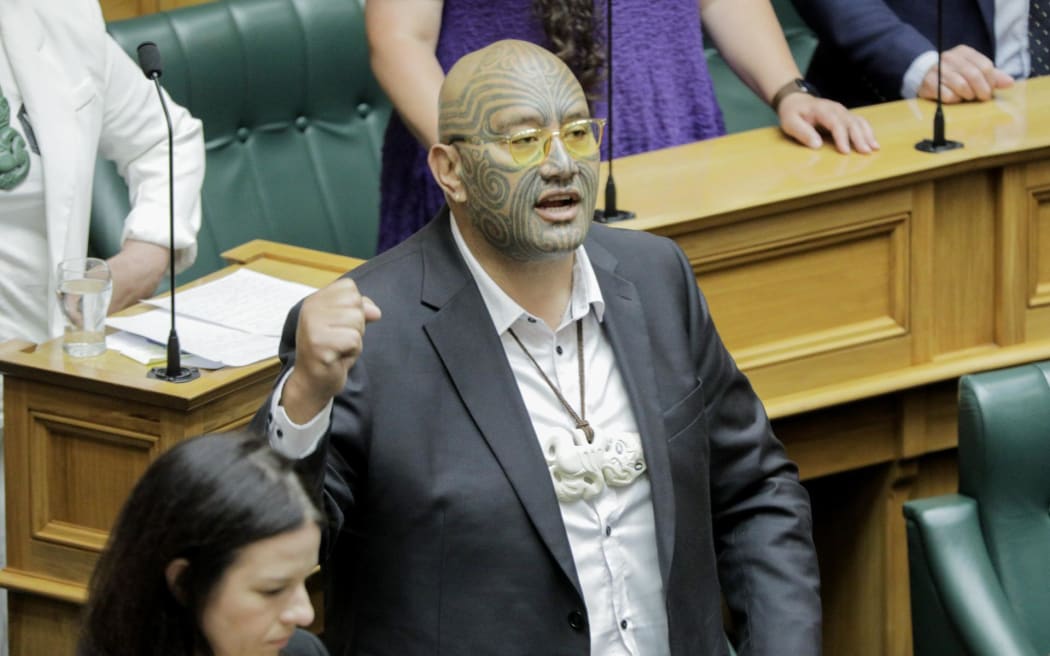
Rawiri Waititi leads a waiata in Parliament for Volodymyr Zelensky.
Māori Pati co-leader Rawiri Waititi leads a waiata in Parliament for Ukraine President Volodymyr Zelensky. Image: Angus Dreaver/RNZ News

Article by AsiaPacificReport.nz

Snakes have clitorises

Source: The Conversation (Au and NZ) – By Jenna Crowe-Riddell, Postdoctoral Researcher in Neuroecology, La Trobe University

Luke Allen, Author provided

Snakes have clitorises – and we have given a full anatomical description of them for the first time.

In research published in Proceedings of the Royal Society B, we describe the size and shape of the snake clitoris (or hemiclitores) across nine species.

We also closely studied the cellular makeup of the clitoris in Australian death adders, finding it to be composed of erectile tissue and bundles of nerves.

The discovery of what appears to be a functional clitoris offers a new perspective on snake courtship and mating.


Read more:
The sex life aquatic: how moving from land to water led to the surprisingly touchy courtship of sea snakes


Finding the snake clitoris

As part of her PhD research, our student Megan Folwell at the University of Adelaide had been dissecting snake specimens in museums. She came across a heart-shaped structure in the female tail, nestled between two scent glands, that she thought was the clitoris (or the hemiclitores, as it is called in snakes) and showed me.

I wasn’t sure what we were looking at, so we got in touch with Patricia Brennan at Mount Holyoke College in the US, who is an expert in how genitals have evolved in vertebrates.

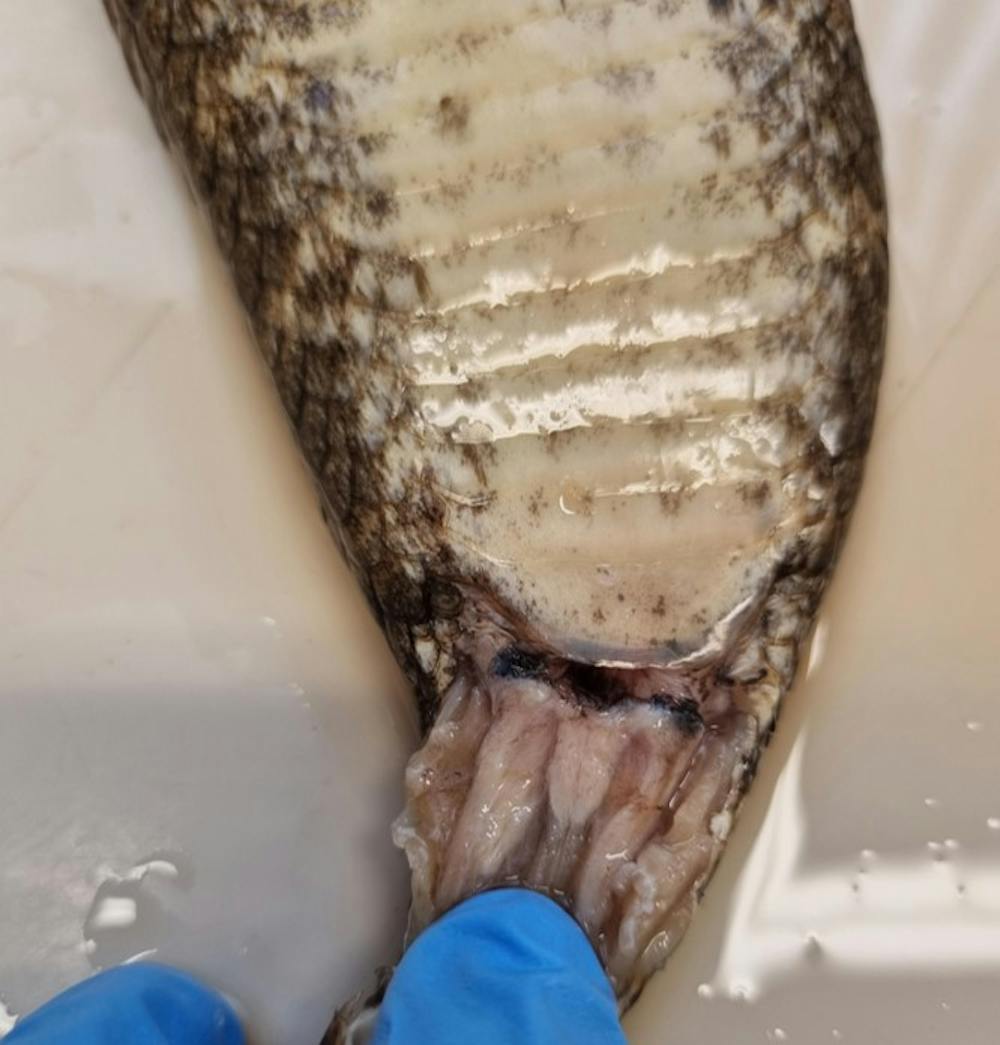
An animation showing a wireframe drawing of the lower half of a snake's body with the clitoris highlighted.
The snake clitoris is a heart-shaped structure in the tail.
Folwell et al, Author provided

On closer inspection, we found it was a structure full of red blood cells and nerve tissue, as we would expect for erectile tissue. This suggests it is indeed the clitoris, and may swell and become stimulated during mating.

We went on to examine nine different species of snakes representing the major branches of snake evolution. All had a clitoris, though their sizes and shapes varied.

Why didn’t we know about this already?

Across all species, researchers have given female genitalia a lot less attention compared to its male counterpart.

What’s more, it’s hard to get a good look at snake genitalia. It’s all internal to the snake’s tail, for the most part, though the snake penis (or hemipenes) inflates for mating.

The clitoris of an Australian death adder.
Folwell et al., Author provided

There has been quite a bit of research into the snake penis, but the snake clitoris has been missed.

While there are earlier reports, most actually referred to lizards, or mistakenly described the penis or scent glands, or featured only vague descriptions without anatomical references. Studies of species in which intersex individuals are relatively common heightened this confusion.

However, we have shown that the snake clitoris, although it shares its developmental origins with the penis, is very different from the penis – and our detailed anatomical description should help prevent this kind of confusion occurring in future.

A crucial piece of anatomy

In other species, we know the clitoris has important functions in reproduction.


Read more:
All female mammals have a clitoris – we’re starting to work out what that means for their sex lives


Perhaps because many scientists assumed female snakes had no clitoris, and hence no capacity for arousal, it has generally been assumed that mating in snakes is largely a matter of males coercing females.

But a crucial piece of anatomy was missing from this conversation. Our discovery suggests female arousal – and something more like seduction – may play a role.

We still have a lot to learn. It may turn out that variation in the clitoris between species will be correlated with courtship and mating behaviours, and help us understand how females choose mates.

The Conversation

Jenna Crowe-Riddell does not work for, consult, own shares in or receive funding from any company or organisation that would benefit from this article, and has disclosed no relevant affiliations beyond their academic appointment.

ref. Snakes have clitorises – https://theconversation.com/snakes-have-clitorises-196553

Morocco are the first-ever African semifinalists of the World Cup. Here’s what geographical data tell us about this result

Source: The Conversation (Au and NZ) – By Stephen Woodcock, Associate Professor of Mathematical Sciences, University of Technology Sydney

The 2022 FIFA World Cup has certainly attracted plenty of negative press, with scandal from bidding process through to the tournament itself. Yet out of this negativity, one positive storyline has arisen.

With victories over two recent European champions – Spain and Portugal – Morocco have become the first African nation to reach the last four of the World Cup.


Read more:
FIFA’s mirage of unity: why the World Cup is a vessel for political protest


Mapping a path to the final

Could the location of the tournament itself partially explain the Moroccans’ surprise progress? When an Asian side – South Korea in 2002 – similarly broke the duopoly of Europe and the Americas, it was on home soil.

An African squad would have made it to the semifinals 12 years ago in the first World Cup to be hosted on that continent, if not for one of the most infamously unsporting acts in the game’s history, at the hands (literally) of Uruguay’s Luis Suarez.

Now the World Cup is played in the Arab world for the first time and, perhaps not coincidentally, we are seeing a nation from the region reach unprecedented heights.

Geography could matter more than we think

In 21 previous tournaments, only three teams have lifted the trophy without being either hosts or a prior champion. One of those – West Germany in 1954 – did so in a neighbouring country.

Before 2010, no European nation had won the tournament outside Europe and only one non-European nation had won on the continent.

This trend is also seen in continental competitions. The European Championships’ two biggest shocks were Denmark’s 1992 success after initially failing to qualify, and the 2004 championship of rank outsiders Greece. The Danes’ victory came in another Scandinavian nation, and the Greek success was in another Mediterranean country.

Of course, none of this is directly causal. The Moroccans have certainly not reached this lofty stage because the tournament is in a fellow Arab country. As a low-scoring, complex team game, football is one of the hardest sports to predict and every little advantage, even as small as being in a comparable climate, could tip the balance of a game one way or another.

Parallels with other nations

When looking at historical data, the clearest predictor of which sides may be primed to perform better than ever before is their latitude relative to the tournament host. For example, Paraguay’s best run was in South Africa in 2010, at similar latitude, rather than in geographically closer South American nations further south.

Of the 39 nations to reach the tournament at least six times, 23 of those have never bettered their performance at the tournament closest to their home latitude. Almost three-quarters of sides’ best tournaments involved travel less than 10 degrees either north or south.

Made with Flourish

With Doha less than nine degrees north of the Moroccan capital Rabat, only three other competing nations lie closer to the latitude of Qatar. Two of those have enjoyed historic wins during the earlier group stage of the tournament: Tunisia defeated the reigning champions, and Saudi Arabia took down one of this year’s finalists.

The “world” game?

Even with its huge global appeal, football has been historically slanted towards Europe and the Americas, which may have stifled progress of the game in other regions.

Despite its numerous ongoing flaws, the administration has come a long way since the absurd situation in 1958 when the one place designated for a team from the Asian and African regions was taken by Wales.


Read more:
Morocco at the World Cup: 6 driving forces behind a history-making win


Morocco’s fairytale run should certainly be seen as a huge positive for the game in North Africa, in particular. There do remain numerous “blind spots” in where tournaments have been held.

Rio de Janeiro, where the 1950 and 2010 finals were held, lies within one degree of the Tropic of Capricorn. Amazingly, if you travel north from there, you will only find one World Cup final venue (Mexico City) south of Doha.

Around 40% of the world’s population live between the tropics. This proportion is only increasing, but the game remains dominated by nations outside this region.

It could be argued that the countries most impacted by this geographic bias are African. Nations such as Cameroon and Nigeria have frequently qualified for the World Cup in recent decades, but have never played in a tournament within a 20-degree latitude from home. This would never be the case for a European side.

There was set to be a tournament in a more equatorial region in 1986. When Colombia backed out of hosting less than a year prior, few would have believed that four decades later, the game would still not have revisited this part of the globe.

A sporting chance

Criticisms of the process and politics underlying the 2022 World Cup cannot be overlooked, but the decision to broaden the geographic footprint of host nations can at least be seen as a positive step towards a more reasonable distribution of sporting advantage.

No on-field results will (nor should) lessen the valid criticisms surrounding this tournament, but it would be a shame for the historic achievement for African football to be overlooked.

We can’t definitively know how much of a role geographic proximity played in the Moroccan story, but the case for breaking European and American hegemony over the game is surely established beyond doubt.


Read more:
World Cup 2022: crunching 150 years of big data to predict the winner


The Conversation

Stephen Woodcock does not work for, consult, own shares in or receive funding from any company or organisation that would benefit from this article, and has disclosed no relevant affiliations beyond their academic appointment.

ref. Morocco are the first-ever African semifinalists of the World Cup. Here’s what geographical data tell us about this result – https://theconversation.com/morocco-are-the-first-ever-african-semifinalists-of-the-world-cup-heres-what-geographical-data-tell-us-about-this-result-196484

Bad fire science can kill our threatened species. It’s time to cooperate with nature

Source: The Conversation (Au and NZ) – By Philip Zylstra, Adjunct Associate Professor at Curtin University, Research Associate at University of New South Wales, Curtin University

Shutterstock

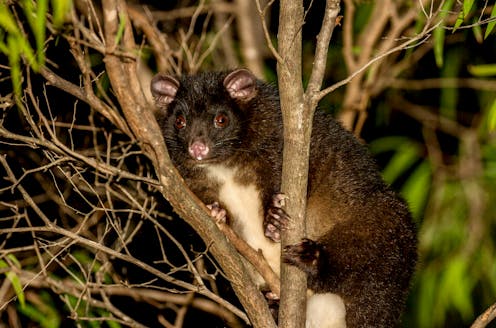
For four years, naturalist Allison Dixon regularly walked from dusk until dawn at the Warrungup Spring bush reserve south of Perth, carefully documenting every western ringtail possum she saw.

The possum – or ngwayir in the language of Traditional Owners – is critically endangered. The species is found only in a small area of southwest Australia, including the population of 22 individuals Dixon was monitoring.

She knew each possum by name. Their voices and physical features were as familiar to her as human faces.

In 2018, a prescribed burn by local authorities was conducted in the Warrungup Spring reserve. Despite burning slowly as planned, it killed 17 of the 22 possums Dixon was monitoring.

I document this incident in a new paper and explore how a carefully controlled fuel reduction burn could cause such catastrophic loss. We must move on from bad fire science to prevent similar tragedies.

woman in hat leans against tree
Allison Dixon carefully monitored a population of western ringtail possums.
Facebook

The fire-intensity equation

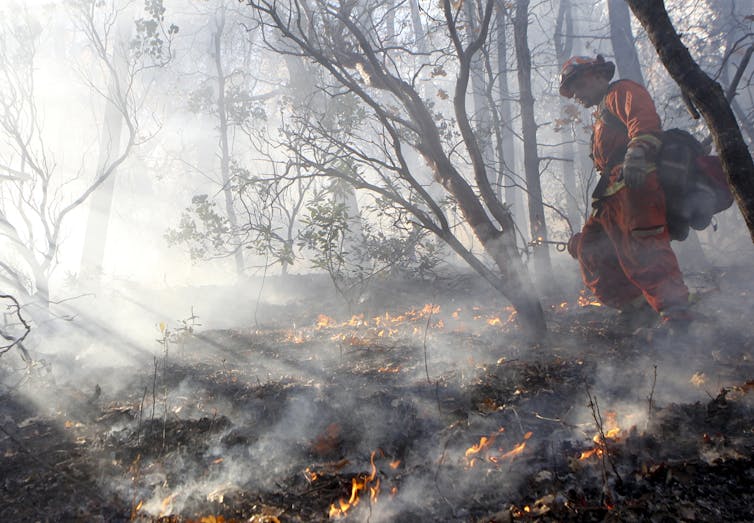
Prescribed burning occurs when authorities intentionally set fire to a particular area of the landscape under defined conditions. The burns are often used to reduce so-called “fuel loads” – fine biomass such as twigs, leaf litter and bark.

As the idea goes, the greater the weight of the fuel load, the more flammable the forest. This theory can be traced back to American fire researcher George Marsden Byram.

In 1959, Byram published an equation beautiful in its simplicity: a fire’s heat output (or intensity) was equal to the amount of energy stored in the fuel, multiplied by the amount of fuel, and multiplied again by the speed the fire spreads and consumes it.

This theory would shape a central tenet of Australian fire management: that prescribed burns are necessary to reduce fuel loads, to make subsequent bushfires less intense.

here
Prescribed burns are central to Australian fire management.
Greg Barnette/The Record Searchlight

The influence of Byram’s fire-intensity theory can be seen in an official fire management guide used to inform the burning of ngwayir habitat. The document suggests the animals can survive low-intensity fire – and on the day of the burn that killed 17 ngwayir, weather conditions were conducive to such a fire.

But after years of work in fire management, I’ve come to see Byram’s theory – and the management practices flowing from it – as simplistic. In 2016, my colleagues and I published a new way of modelling fire behaviour. In my latest paper, I applied this model to the Warrungup Spring fire.


Read more:
New modelling on bushfires shows how they really burn through an area


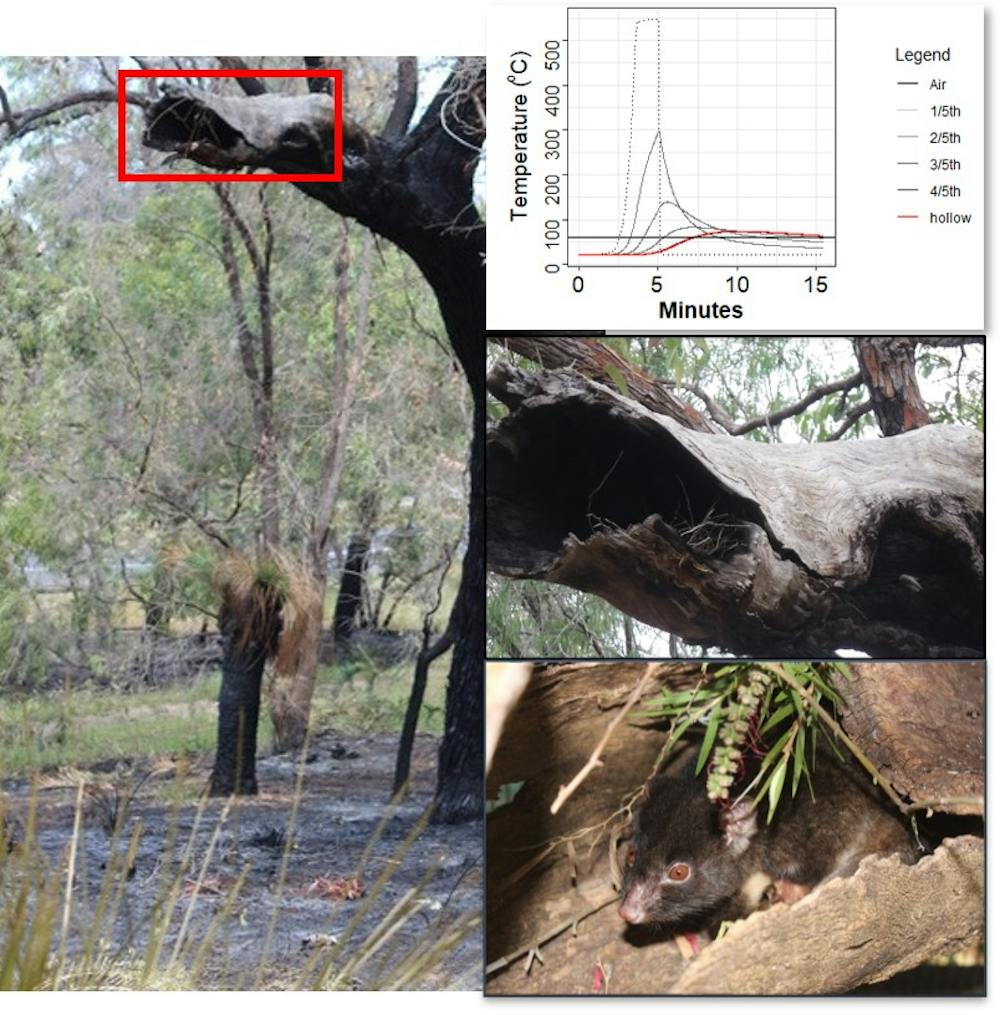
The prescribed burn at Warrungup Spring involved igniting patches of balga grasstrees and their surrounds. I investigated what happened to the air around a hollow in a tree where ngwayir were known to live. A balga grasstree burned during the fire was located under the hollow.

According to Byram’s theory, the fire would have been classed as low-intensity because it did not spread horizontally. But this thinking does not account for the vertical spread of heat and flames.

As depicted in the image below, the supposedly low-intensity fire would have heated the air above it to more than 500℃. This would burn the respiratory tracts of possums inside the hollow in just a few minutes.

Byram’s fire-intensity equation might be valuable as a theoretical construct. But using it to inform real-world fire management can be catastrophic.

A ngwayir and its hollow located above a balga grasstree set on fire in the prescribed burn. The graph shows the heat penetration into the hollow in increments through the wood, with the hollow temperature in red and the lethal temperature marked by the horizontal line.
A. Dixon; P. Zylstra

As my latest paper describes, Allison Dixon searched for the western ringtail possums the evening after the fire, and each subsequent evening for two weeks.

In some cases, Dixon found the bodies. In others, the presence of flies in high nest hollows indicated the ngwayir inside had perished.

Dixon visited surrounding properties and structures in case the possums had fled the fire ground, but no survivors were identified. She also continued weekly monitoring of their habitat. In the end, 17 of the 22 critically endangered possums were presumed dead.

burnt possum lies in ash
A burnt western ringtail possum recorded by Allison Dixon after the prescribed burn in 2018.
Source: Allison Dixon

But the problem runs even deeper

Most fuel load lies in the litter layer on the ground. But we’ve known for decades that burning it away germinates dense understorey regrowth. In fact, WA government records show bushfires are most likely where prescribed burns have occurred, where that regrowth is most dense.

In November this year, a prescribed burn was conducted in the Walpole Wilderness, in dense regrowth stimulated by a previous prescribed burn.

The fire was reportedly meant to protect quokka habitat. But it escaped containment lines and burnt 25,000 hectares – 10,000 more than originally planned, and at a higher-than-intended severity.

smoke fills the sky above hills
A prescribed burn that escaped in the Walpole Wilderness this year.
Author provided

One peer-reviewed study appears to show less fire in areas where prescribed burning has been undertaken. But research by my colleagues and I has challenged this study.

The authors of the study in question compared the amount of wildfire in each six-year period with the amount of prescribed fire in the same period. But this method meant that for some of that period, reduced fire frequency was attributed to prescribed burns that had not yet occurred.

Cooperating with nature

Australia has the world’s worst record for mammal extinction – and we know fire is one of the main culprits. Yet prescribed burning relies on outdated or even disproved theories and assumptions about fire.

Bad fire science is killing our threatened species, but alternatives are available.
These approaches reinforce, rather than disrupt, natural ecological controls on forest fire. They include traditional Indigenous fire knowledge, and modern techniques to minimise the extent of dense regrowth in the landscape.

By cooperating with nature to minimise fire risk, we can protect species that have persisted through aeons.


Read more:
Coming of age: research shows old forests are 3 times less flammable than those just burned


The Conversation

Philip Zylstra received funding for this study from the NSW Environmental Trust, Curtin University and the San Diego Zoo Wildlife Alliance.

ref. Bad fire science can kill our threatened species. It’s time to cooperate with nature – https://theconversation.com/bad-fire-science-can-kill-our-threatened-species-its-time-to-cooperate-with-nature-196363

No, the Lensa AI app technically isn’t stealing artists’ work – but it will majorly shake up the art world

Source: The Conversation (Au and NZ) – By Brendan Paul Murphy, Lecturer in Digital Media, CQUniversity Australia

Brendan Murphy/Stable Diffusion, Author provided

The Lensa photo and video editing app has shot into social media prominence in recent weeks, after adding a feature that lets you generate stunning digital portraits of yourself in contemporary art styles. It does that for just a small fee and the effort of uploading 10 to 20 different photographs of yourself.

2022 has been the year text-to-media AI technology left the labs and started colonising our visual culture, and Lensa may be the slickest commercial application of that technology to date.

It has lit a fire among social media influencers looking to stand out – and a different kind of fire among the art community. Australian artist Kim Leutwyler told the Guardian she recognised the styles of particular artists – including her own style – in Lensa’s portraits.

Since Midjourney, OpenAI’s Dall-E and the CompVis group’s Stable Diffusion burst onto the scene earlier this year, the ease with which individual artists’ styles can be emulated has sounded warning bells. Artists feel their intellectual property – and perhaps a bit of their soul – has been compromised. But has it?

Well, not as far as existing copyright law sees it.

If it’s not direct theft, what is it?

Text-to-media AI is inherently very complicated, but it is possible for us non-computer-scientists to understand conceptually.

To really grasp the positives and negatives of Lensa, it’s worth taking a couple of steps back to understand how artists’ individual styles can find their way into, and out of, the black boxes that power systems like Lensa.

Lensa is essentially a streamlined and customised front-end for the freely available Stable Diffusion deep learning model. It’s so named because it uses a system called latent diffusion to power its creative output.

The word “latent” is key here. In data science a latent variable is a quality that can’t be measured directly, but can be be inferred from things that can be measured.

When Stable Diffusion was being built, machine-learning algorithms were fed a large number of image-text pairs, and they taught themselves billions of different ways these images and captions could be connected.

This formed a complex knowledge base, none of which is directly intelligible to humans. We might see “modernism” or “thick ink” in its outputs, but Stable Diffusion sees a universe of numbers and connections. And all of this derives from complex mathematics involving the numbers generated from the original image-text pairs.

Because the system ingested both descriptions and image data, it lets us plot a course through the enormous sea of possible outputs by typing in meaningful prompts.

Take the image below as an example. The text prompt included the terms “digital art” and “artstation” – a site that’s home to many contemporary digital artists. During its training, Stable Diffusion learnt to associate these words with certain qualities it identified in the various artworks it was trained on. The result is an image that would fit well on ArtStation.

A fake ArtStation-style portrait made in Stable Diffusion could fit perfectly on the website.
Stable Diffusion

What makes Lensa stand out?

So if Stable Diffusion is a text-to-image system where we navigate through different possibilities, then Lensa seems quite different since it takes in images, not words. That’s because one of Lensa’s biggest innovations is streamlining the process of textual inversion.

Lensa takes user-supplied photos and injects them into Stable Diffusion’s existing knowledge base, teaching the system how to “capture” the user’s features so it can then stylise them. While this can be done in the regular Stable Diffusion, it’s far from a streamlined process.

Although you can’t push the images on Lensa in any particular desired direction, the trade-off is a wide variety of options that are almost always impressive. These images borrow ideas from other artists’ work, but do not contain any actual snippets of their works.

The Australian Arts Law Centre makes it clear that while individual artworks are subject to copyright, the stylistic elements and ideas behind them are not.

Similarly, the Dave Grossman Designs Inc. v Bortin case in the US established that copyright law does not apply to an art style.

What about the artists?

Nonetheless, the fact that art styles and techniques are now transferable in this way is immensely disruptive and extremely upsetting for artists. As technologies like Lensa becomes more mainstream and artists feel increasingly ripped-off, there may be pressure for legislation to adapt to it.

For artists who work on small-scale jobs, such as creating digital illustrations for influencers or other web enterprises, the future looks challenging.

However, while it is easy to make an artwork that looks good using AI, it’s still difficult to create a very specific work, with a specific subject and context. So regardless of how apps like Lensa shake up the way art is made, the personality of the artist remains an important context for their work.

It may be that artists themselves will need to borrow a page from the influencer’s handbook and invest more effort in publicising themselves.

It’s early days, and it’s going to be a tumultuous decade for producers and consumers of art. But one thing is for sure: the genie is out of the bottle.

The rise of AI image generators spells a somewhat uncertain future for artists. Copyright law might need to catch up.
Stable Diffusion


Read more:
AI can produce prize-winning art, but it still can’t compete with human creativity


The Conversation

Brendan Paul Murphy does not work for, consult, own shares in or receive funding from any company or organisation that would benefit from this article, and has disclosed no relevant affiliations beyond their academic appointment.

ref. No, the Lensa AI app technically isn’t stealing artists’ work – but it will majorly shake up the art world – https://theconversation.com/no-the-lensa-ai-app-technically-isnt-stealing-artists-work-but-it-will-majorly-shake-up-the-art-world-196480

Final Victorian election results: how would upper house look using the Senate system?

Source: The Conversation (Au and NZ) – By Adrian Beaumont, Election Analyst (Psephologist) at The Conversation; and Honorary Associate, School of Mathematics and Statistics, The University of Melbourne

Con Chronis/AAP

At the November 26 Victorian election, Labor won 15 of the 40 upper house seats (down three since 2018), the Coalition 14 (up three), the Greens four (up three), Legalise Cannabis two (up two), the Liberal Democrats one (down one), Animal Justice one (steady), the Shooters one (steady), Labour DLP one (up one) and One Nation one (up one).

Derryn Hinch’s Justice (three seats in 2018), Sustainable Australia (one), Transport Matters (one) and Fiona Patten’s Reason (one) lost all their seats.

I had an article on the likely upper house result on December 1. The Liberal Democrats instead of the Liberals won the final seat in Southeastern Metro region, and the Greens instead of Legalise Cannabis won the final seat in Western Victoria.


Read more:
Labor, Greens and Legalise Cannabis likely to have combined majority in Victorian upper house


The upper house uses the group voting ticket (GVT) system, which allows small parties to unfairly pass larger parties on 100% preference flows from above the line votes. In the federal Senate system, voters are told to number at least six boxes above the line, and preferences are directed by voters.

The table below gives the actual results and what I believe the results would have been using the Senate’s system. LC = Legalise Cannabis in the table. Others are the DLP (former Labor MP Adem Somyurek) in Northern Metro, the Liberal Democrats in Southeaster Metro, the Shooters in Eastern Victoria, and Animal Justice and One Nation in Northern Victoria.

Victorian upper house, actual results and using Senate system.

I will analyse each region’s result by the Senate system. With five members to be elected per region, a quota is one-sixth of the vote or 16.7%.

In Northeastern Metro, Labor won 2.02 quotas, the Liberals 1.82, the Greens 0.62 and Labour DLP 0.31. The Liberals and Greens would win the last two seats for an identical result.

In Northern Metro, Labor won 2.00 quotas, the Liberals 1.13, the Greens 1.12, the DLP 0.29, the Victorian Socialists 0.28 and Fiona Patten 0.22. This would be a race between the Socialists and the DLP in the Senate system, and Somyurek may not have won.

In Southeastern Metro, Labor won 2.36 quotas, the Liberals 1.61, the Greens 0.40, Legalise Cannabis 0.32 and the Liberal Democrats 0.22. The Liberals would win a second seat, with the final seat between Labor and the Greens. The Greens would likely attract more left-wing preferences to win this seat. The Greens and the Liberals would replace Legalise Cannabis and the Liberal Democrats.

In Southern Metro, the Liberals won 2.17 quotas, Labor 1.78, the Greens 0.92 and Legalise Cannabis 0.17. Labor and the Greens would win the final two seat for an identical result.

In Western Metro, Labor won 2.22 quotas, the Liberals 1.47, the Greens 0.48, the DLP 0.31 and Legalise Cannabis 0.26. As prominent parties, the Liberals and Greens would likely win the last two seats, with the Greens replacing Legalise Cannabis.

In Eastern Victoria, the Coalition won 2.18 quotas, Labor 1.59, the Greens 0.48, Legalise Cannabis 0.25 and the DLP 0.23. With the right vote for the last seat split between many parties, Labor and the Greens would have a strong chance of both winning the fourth and fifth seats. The Greens would replace a Shooter who won by preference spiral from 0.18 quotas.

In Northern Victoria, the Coalition won 2.10 quotas, Labor 1.73, the Greens 0.42, the Shooters 0.31 and Legalise Cannabis 0.29. The Greens would not have a large enough lead over the Shooters and would probably lose, especially with Labor drawing left votes. Labor and the Shooters would replace One Nation and Animal Justice.

In Western Victoria, Labor won 2.13 quotas, the Coalition 1.62, the Greens 0.52 and Legalise Cannabis 0.30. The Greens and Coalition would win the final two seats for an identical result.

If we want a more representative Victorian parliament, the government must get serious about reform.
David Crosling/AAP

If we want a proportional upper house, we should have a statewide electorate

According to ABC election analyst Antony Green, overall vote shares for the upper house were 33.0% Labor (down 6.2% since the 2018 election), 29.4% Coalition (steady), 10.3% Greens (up 1.1%), 4.1% Legalise Cannabis (new), 3.5% DLP (up 1.4%), 2.6% Liberal Democrats (up 0.2%), 2.1% One Nation (new), 2.0% Shooters (down 1.0%) and 2.0% Family First (new).

The actual results are more proportionate than the results produced by applying the Senate system. Labor won the two party preferred by about 55-45 in the lower house, and left-wing parties (Labor, the Greens, Legalise Cannabis and Animal Justice) have 22 of 40 seats (55% of seats). Left-wing parties swapped preferences with each other, and this helped them to win these seats.

Using the Senate system, Labor and the Greens would have 23 of the 40 seats, and a further seat would go to the left if the Victorian Socialists defeated the DLP for the last seat in Northern Metro.

If the Senate system were applied, there would be no seats for Legalise Cannabis despite a 4.1% statewide vote share, and only two seats for parties other than Labor, the Coalition and Greens; these parties combined won 27.3% of votes.

The smaller parties’ problems are due to the high quota of 16.7% in each region. Getting half a quota on primary votes needs 8.3%; this is required for a good chance of election under the Senate system.

If we want a genuinely proportional upper house, it would be best to scrap the eight regions that each return five members, and just use a single statewide electorate for the upper house.

Unfortunately, Labor embedded the eight five-member electorates in the state constitution after its landslide 2002 victory ended Coalition dominance of the upper house. That means a referendum would be required to switch to a statewide electorate.

Another aspect of the Senate system that assists the left is that the non-Coalition right is very splintered, while the non-Labor left is far more concentrated with the Greens. If GVT were axed but the eight five-member regions retained, parties of the non-Coalition right would need to merge to be competitive.

Lower house: Labor wins 56 of 88 seats

Labor won 56 of the 88 Victorian lower house seats (up one since the 2018 election), the Coalition 27 (steady), the Greens four (up one) and independents zero (down three). The election in one seat (Narracan) was deferred owing to a candidate’s death. The Coalition is likely to win this seat, which would give them 28 seats (up one).

Statewide vote shares were 37.0% Labor (down 5.8% since the 2018 election), 34.4% Coalition (down 0.8%), 11.5% Greens (up 0.8%), 5.4% independents (down 0.6%), 3.1% Family First (new) and 2.5% Animal Justice (up 0.7%). Others including independents and non-Greens minor parties were 17.1% (up 5.8%).

The ABC’s estimated two party vote was 55.0-45.0 to Labor, a 2.6% swing to the Coalition. The exclusion of Narracan biases these two party and primary vote shares slightly towards left-wing parties.

Labor won the three closest seats, defeating the Liberals by a 50.2-49.8 margin in Bass and a 50.4-49.6 margin in Pakenham. In Northcote, Labor defeated the Greens by a 50.2-49.8 margin.

The Nationals defeated sitting independents in Mildura and Shepparton, while the Morwell independent retired. Teal independents only made the final two after preferences in one seat: Mornington, which the Liberals held by a 50.7-49.3 margin, The Liberals held Benambra 50.9-49.1 against an independent challenger.

With a 2.6% statewide swing to the Coalition, they would have been expected to gain seats from Labor, but Labor increased its seats by one on the 2018 landslide. There were several double digit swings to the Liberals, with Greenvale (a 15% swing) the highest swing in a Labor vs Coalition seat.

The Liberals’ problem was that these swings were wasted, with Labor still holding Greenvale by a 57-43 margin. Other double digit swings to the Liberals were wasted in Labor safe seats like Thomastown, Yan Yean, St Albans, Mill Park and Kororoit. Meanwhile, Labor had smaller swings in its favour in four seats that were enough to gain them.

While the Greens only made one gain (Richmond), they had double digit swings in their favour against Labor in Brunswick, Footscray, Pascoe Vale, Richmond and Preston, but could only manage a 1.5% swing in their closest pre-election target (Northcote).

Labor now holds four seats by close margins against the Greens: Northcote (a 0.2% margin), Pascoe Vale (2.0%), Preston (2.1%) and Footscray (4.2%). Margins here subtract 50% from the winning party’s two candidate percentage.

The Conversation

Adrian Beaumont does not work for, consult, own shares in or receive funding from any company or organisation that would benefit from this article, and has disclosed no relevant affiliations beyond their academic appointment.

ref. Final Victorian election results: how would upper house look using the Senate system? – https://theconversation.com/final-victorian-election-results-how-would-upper-house-look-using-the-senate-system-196291

Voters turn up in numbers as Fiji’s 2022 election gets underway

By Ioane Asioli, Cooper Williams and Geraldine Panapasa of Wansolwara in Suva

Scores of people along the Nasinu-Suva corridor lined the premises of their designated polling stations as early as 6am today to cast their votes in the Fiji 2022 general election.

While polling venues opened at 7.30am, the light morning drizzle did little to deter voters from exercising their democratic right to vote.

As many as 693,915 Fijians have registered to vote in this year’s election, majority of voters are expected from the Central Division — 9916 had applied for postal ballot, while 77,907 Fijians registered to vote for pre-polling.

Jolame Raisele voting
Jolame Raisele was the first person to cast his vote at the Suva Grammar School polling venue this morning. Imagee: Cooper Williams/Wansolwara

At 7.15am, accredited media participated in a walk-through to take photos and videos at the Suva Grammar School polling station before the first vote was cast at 7.30am.

Last night, Supervisor of Election Mohammed Saneem urged employers to allow their employees to take at least half a day or the morning session to cast their vote after receiving concerns were raised by some employees that their employers were given them ultimatums to either turn up to work at 9am or ‘face the axe’.

FIJI ELECTIONS 2022
FIJI ELECTIONS 2022

“It is not proper for any employer to force their employees to come to work without having voted. Is not only unjust, but it is unconstitutional.

“I cannot apply Section 141 in this circumstance… I would like to invite every single employer in this country to consider Section 23 (2) of the Constitution which reads, ‘Every citizen has the right to free, fair and regular elections for any elective institution or office established under this Constitution’.

“The Constitution does not make any allowance for any person to make law that will prohibit a person from voting. This means that neither Parliament nor an employer has the authority to stop a person from voting. They must allow their employees to vote,” Saneem said.

Voting time for employees
The Fijian Elections Office, he said, had been advocating for employers to allow employees to vote and then report to work.

He said the FEO would not hesitate to take people to court if necessary, if they did not allow employees to vote in the morning, or during the day.

“Employers must immediately rectify all their plans and allow voters to go and vote. Two hours is not enough, you must allow them enough time, that means half the day,” Mr Saneem said.

The 2022 general elections would be Fiji’s third elections under the new electoral system, which features the Open List PR system established through provisions of the 2013 Constitution, and Electoral Act 2014.

Today, 606,092 Fijians will cast their votes at 855 venues. Fiji’s 2022 General Election will close after the last voter in the queue at 6pm has voted. The commencement of counting is expected to start thereafter with provisional results to be announced by 8pm.

Published in collaboration with the University of the South Pacific journalism programme’s Wansolwara News.

Suva Grammar School polling venue
A glimpse of the polling station inside the Suva Grammar School polling venue before the first vote was cast at 7.30am. The media were permitted a walk-through of the polling station prior to the commencement of voting today. Image: Cooper Williams/Wansolwara
Sigatoka Andhra Sangam College polling venue
Registered voters at the Sigatoka Andhra Sangam College polling venue showed up early to cast their vote. Image: Roselyn Bali/Wansolwara
Voters in Nabua
Voters in Nabua were making their way to the polling venue at Saint Agnes Primary School along Mead Road. Image: Geraldine Panapasa/Wansolwara

Article by AsiaPacificReport.nz

A major ‘fusion breakthrough’ was just officially announced in the US. But what does it actually mean?

Source: The Conversation (Au and NZ) – By Nathan Garland, Lecturer in Applied Mathematics and Physics, Griffith University

Artist’s depiction of ions in the inertial confinement experiment. John Jett and Jake Long/LLNL

For the first time, scientists in the US have confirmed a fusion energy experiment achieved net gain. This means releasing more energy than it takes to initiate, demonstrating the physical basis for producing fusion energy in a controlled way.

This historic feat took place at Lawrence Livermore National Laboratory (LLNL) in California, using the National Ignition Facility experiment after decades of planning and research.

The milestone used a process called inertial confinement fusion. It involves bombarding a tiny gold cylinder containing a pellet of hydrogen fuel – about the size of a pencil eraser – with the world’s most powerful laser system comprised of 192 laser beams. This produces hot plasma and X-rays that trigger an implosion, compressing the fuel pellet and kicking off a fusion reaction that unleashes energy.

The team at LLNL reports they delivered “2.05 megajoules of energy to the target, resulting in 3.15 megajoules of fusion energy output”.

A golden cylinder that looks similar to a sewing machine thread spool
The small device containing fuel used at the National Ignition Facility.
LLNL

To quickly review, the goal of fusion energy is exactly that – to heat up and compress fuel particles so they undergo fusion: merging together to create a heavier atomic particle, unleashing energy in the process.

Fusion is what powers stars like our Sun, but it can only occur under specific conditions. Atoms must be subjected to immense heat and pressure to overcome tremendous physical forces and fuse. It is the opposite of nuclear fission used in current nuclear power plants.

The lofty end goal for harnessing fusion for power production is to generate vast amounts of clean, sustainable electricity.


Read more:
A new twist on fusion power could help bring limitless clean energy


What is ‘net gain’ and why is it a big deal?

Today’s announcement is akin to other historic milestones such as the four-minute mile, or the Wright brothers’ first controlled, sustained flight of a powered aircraft. People had run races before, or experienced temporary flight through gliders, but these milestones had been thought of as impossible pipe dreams. They were eventually made reality through long-term effort – and it feels like this is one of those historic moments for fusion science.

A net gain result in a fusion experiment essentially means producing more energy through fusion reactions than the amount of energy put into the system to start said reaction.

This is usually measured as a Q factor, which is the ratio of energy out to energy in. For decades, the holy grail in fusion science has been achieving Q > 1.

A Q factor of more than 1 means you got out more energy than what you put into the fuel. This is generally known as “scientific breakeven”. The result announced today translates to a Q factor of about 1.5.

The complication around measuring your experiment in this way is that it does not account for energy inefficiencies in how you power the laser from the electricity grid, or how you may generate electricity from the energetic particles created from the fusion reactions. Just like current electricity generation methods, no process is 100% efficient and we lose bits of energy along the way.

When you account for these effects, you then start to talk about an “engineering breakeven”.

Practically, most people seem to think higher Q factors of 10, 100 or even 1,000 might be needed to achieve a viable product for electricity generation from fusion. This is what the fusion community will be striving towards with future efforts.


Read more:
How far has nuclear fusion power come? We could be at a turning point for the technology


How does this result compare to other fusion experiments?

The most popular global approach for confining fusion reactions is not with lasers – as done at LLNL – but with magnetic fields. This method is called magnetic confinement fusion. In the process, the fuel is heated up to kick out electrons from the atoms to create a plasma of electrons and positively charged nuclei. These nuclei are then fused together.

Since the plasma in these fusion devices is hotter than the core of our Sun, strong magnetic fields are used to control the shape and direction of the plasma so it doesn’t damage the walls of the machine.

Magnetic confinement devices have repeatedly reached plasma temperatures of over 100 million degrees Celsius, but to date, net gain has not been reached in such a device. There are plans afoot to hopefully achieve this with the International Thermonuclear Experimental Reactor (ITER) under construction in France.

ITER is the world’s biggest science experiment and has been designed to reach a Q factor of 10, producing 500 megawatts of fusion power from 50 megawatts of injected power.

Where to from here?

For now, this result means a lot more to the scientific community than it probably does for folks waiting for a new commercial electricity alternative. We’ll need to be a bit more patient for those prospects.

Whether using lasers or magnetic confinement, fusion scientists around the world need to continue along their path if we’re going to achieve commercially viable fusion power production. As we continue on this journey we’ll likely see continued development of the technologies needed and keep climbing up the ladder towards higher values of Q.

In the short term, this result will likely lead to more concrete plans and funding from government and private industry towards inertial confinement fusion experiments, and hopefully other fusion concepts as well.

For example, following today’s LLNL announcement the US has committed over US$600 million towards the inertial fusion program to build upon this result. This is in addition to their commitment to a “Bold Vision for Commercial Fusion Energy” outlined earlier in 2022.

The achievement is a watershed moment, showing the public, governments, and investors that despite this being an incredibly difficult science and engineering problem to solve, we are making real progress.

It took many years and a great deal of work to launch the first commercial airline flight after the Wright brothers first took to the skies. In much the same way, there is a path ahead for commercial fusion, but we have to put the resources and effort in to get there.

The Conversation

Nathan Garland receives funding from Griffith University. He has previously received funding from the US Department of Energy through its funding of Los Alamos National Laboratory.

ref. A major ‘fusion breakthrough’ was just officially announced in the US. But what does it actually mean? – https://theconversation.com/a-major-fusion-breakthrough-was-just-officially-announced-in-the-us-but-what-does-it-actually-mean-196474

Is it OK to prank your kids? Do they get it? And where’s the line?

Source: The Conversation (Au and NZ) – By Rachael Sharman, Senior Lecturer in Psychology, University of the Sunshine Coast

Shutterstock

We all lie to our kids. Some lies – telling them their artwork is wonderful, or that Wiggles band-aids are infused with anaesthetic – benefit the child. Others are just a bit of fun.

Take the Tiktok trend of telling your kids this weird little gnome is a picture of them as a baby:


Or cutting off bits of their hair and pretending it was a naughty elf-on-a-shelf.

Playing tricks on our kids can be a bit of fun for them as well as us, but there are a few golden rules to make sure everyone enjoys the prank.

First, do kids ‘get’ pranks?

From a cognitive point of view, a prank firstly involves an attempt to implant a false belief in the mind of another. For example, I’m about to safely sit on a chair. Then it involves a surprising upending of that belief to reveal a different and typically silly scenario: as I sit, I realise a whoopee cushion has been put on my chair.

Implanting a false belief, or lying, requires a well-developed “theory of mind”. Theory of mind is the ability to understand other people have a different mental state and perspective to your own. You understand the other person is not expecting to sit on a whoopee cushion, and you believe the fart sound it makes will cause a funny surprise to them and those around them.

Children’s brains are undergoing an extraordinary metamorphosis as they grow, with some predictable stages along the way.

Most kids develop a recognisable theory of mind around ages three to four. Parents may notice their child suddenly realises they need to actually communicate their needs (as opposed to chucking tantrums because they’re angry you’re not responding to what they want). This frustration helps to push along the development of theory of mind, language and other social communication skills.

Around four to five years, kids may start to tell lies themselves (albeit badly) and experiment with tricks or pranks of their own as they take their newly formed theory of mind for a spin. So kids over the age of four or five should be able to understand a prank, if you’ve witnessed this change in their theory of mind capacity.

Prior to about the age of 12 when their frontal lobe kicks in, children lack the capacity for critical reasoning.

They are yet to be able to analyse multiple options, assess credibility or reliability and make a reasoned decision. This leaves them quite gullible, relying almost completely on what their parents or trusted carers tell them. So between four and 12, kids are ripe to be pranked and may even pull a few of their own.

Child laying on floor
Before children have developed theory of mind, they don’t know you don’t know what they want and think.
Shutterstock

Can pranks damage trust? Or might they teach something?

A good prank requires a well-developed theory of mind and a thorough understanding of the mind in which you intend to implant the false belief. You have to know precisely what is required to ensure this specific person will fall for your trick, and how to mask your true intentions every step of the way. You also need to be confident they will respond positively.

In this context, pranking done well can be a sophisticated social interaction and you can both equally get a laugh out of it. It can assist with development of theory of mind and humour and even improve the bond between like-minded people.

Most children don’t bear grudges once Santa and the tooth-fairy are outed. As their brains and understanding grow, so does their empathy and ability to see multiple intentions.

By the time children are around 12, the age of reason will be upon them and they will slowly lose interest in supernatural stories and pretend play, as their understanding of reality improves.

Their mature theory of mind makes it easier to realise their parents were trying to make their life a little bit more fun and magical as a child, and most will go on to do the same for their own kids.

So if pranks are done with humour in mind, most children will be able to see this intention and won’t have feelings of mistrust towards their parents. In other words, they’re probably not going to think “they lied about the whoopee cushion, what else are they lying about?”

Children looking at presents under the tree
Once children can reason, they understand why you lied about Santa.
Shutterstock

Things to bear in mind when pranking kids

  1. Know the prankee well. You need to be sure they will find your particular prank funny, and understand their developmental stage and associated interests. It’s worth noting autism typically involves an impaired or atypical theory of mind, meaning people with autism may struggle with this form of humour. Rather than finding it funny they may feel hurt and confused they were lied to

  2. be mindful of the power imbalance. “Punching down,” or playing a prank that makes the prankee look foolish or causes them embarrassment might not be taken well. And it might look distasteful to onlookers. Choose a prank you know you will both find funny, or that makes you the butt of the joke as well as the child.

Pranking can spectacularly backfire, especially if the intention is to humiliate the prankee. Many downright nasty and malicious tricks that have no other purpose are sometimes excused as a prank. If this happens, ask the pranker a simple question: “what about this was funny to me? Break it down and explain it to me”.

Should you accidentally cause someone hurt by a poorly targeted prank, it may be wise to hone another social skill: a genuine apology.

The Conversation

Rachael Sharman does not work for, consult, own shares in or receive funding from any company or organisation that would benefit from this article, and has disclosed no relevant affiliations beyond their academic appointment.

ref. Is it OK to prank your kids? Do they get it? And where’s the line? – https://theconversation.com/is-it-ok-to-prank-your-kids-do-they-get-it-and-wheres-the-line-195932

What is a goblin?

Source: The Conversation (Au and NZ) – By Marguerite Johnson, Professor of Classics, University of Newcastle

By John Dickson Batten/Wikimedia

The 2022 word of the year from the folks at the Oxford English Dictionary is “goblin mode”. Voted by the public and coming in at 93%, “goblin mode” – a phrase, rather than a word, to be precise – expresses a state of being or mindset.

The official definition is:

a type of behaviour which is unapologetically self-indulgent, lazy, slovenly, or greedy, typically in a way that rejects social norms or expectations.

“Goblin mode” expresses a response to the anxieties of the pandemic and the challenges of the return to so-called “normality”. It is also about challenging the essentially unattainable ideals expressed on social media. Think: grocery shopping in your pyjamas; talking on your phone while on the toilet; bingeing an entire television series while eating takeaway.

But what about the goblin whose name has been taken in vain? What have goblins ever done to deserve being linked to such anti-social, self-indulgent human behaviour?

And what is a goblin, anyway?


Read more:
Friday essay: why grown-ups still need fairy tales


Hostile creatures known to travel in little gangs

According to the famous English folklorist, Katharine Mary Briggs (1898-1980), goblins are evil and ill-intentioned spirits. Small and ugly in appearance, they are embedded in the rich folklore of the United Kingdom, in particular.

Like all members of the very broad category of “fey”, or the beings of the preternatural world, including fairies, elves, and pixies, goblins are renowned for being tricksy. In other words, they are best avoided.

Goblin market, 1911, England, by Frank Craig. Purchased 1912 by Public Subscription.
Te Papa

Different regions in Britain have different goblin types. In Cornwall, for example, the Spriggan tends to inhabit cairns and barrows.

Hostile creatures known to travel in little gangs, Spriggans love guarding special objects as befitting a locale rich in stories of pirates, smugglers and buried treasure.

Also in Cornwall are the Knockers or Buccas. This type of goblin works in the tin mines and lives in nearby caverns, springs, or wells. Cornish folklore presents differing accounts of the Knockers, including stories ranging from their indifference towards their human counterparts to their instigation of mining accidents, rockslides and cave-ins.

The Princess and the Goblin by George MacDonald, illustrated by Jessie Willcox Smith, 1920.
Wikimedia Commons

What about hobgoblins, then?

Under the category of “hobgoblin” we have nicer goblins that are helpful rather than harmful to humans. Known to be more domesticated than other goblins, hobgoblins tend to find a house, move in, and stay put.

Their presence is often made known in mysterious, unsettling sounds and physical pranks, similar to the actions of poltergeists. Like all fey folk, hobgoblins are most troublesome when they are irritated or provoked.

Perhaps the most famous hobgoblin is Puck from Shakespeare’s A Midsummer Night’s Dream. He is introduced by a fairy who addresses him in Act 2, Scene 1:

Either I mistake your shape and making quite,
Or else you are that shrewd and knavish sprite
Call’d Robin Goodfellow: are you not he
That frights the maidens of the villagery;
Skim milk, and sometimes labour in the quern,
And bootless make the breathless housewife churn;⁠
And sometime make the drink to bear no barm;
Mislead night wanderers, laughing at their harm?
Those that Hobgoblin call you and sweet Puck,
You do their work, and they shall have good luck:⁠
Are you not he?

Here Shakespeare captures the folkloric essence of the British hobgoblin. Puck is described as a prankster and trickster, as a spirit fond of frightening innocent maidens, turning milk sour, and misleading humans walking at night. Yet he is also depicted as helping humans at work and sometimes bringing them good luck.

Puck (1789) by Joshua Reynolds.
Wikimedia Commons


Read more:
Eight things you need to know about poltergeists – just in time for Halloween


A complex figure

These varied representations of the British folkloric goblin speak to their embodiment of pure ambivalence. Some are inherently hostile and malevolent, others are unpredictable – both harmful and helpful, and some have good intentions unless antagonised.

In this sense, the goblin is a complex figure, both frightening and yet also intriguing. As such, they may be considered to symbolise the human “shadow self”.

According to Swiss psychiatrist and psychoanalyst, Carl Jung (1875-1961), the shadow is that part of every human psyche that we strive to keep hidden and repressed.

A man sleeps; monsters proliferate behind him.
Francisco de Goya Y Lucientes, Spain, The sleep of reason produces monsters 1797-1798.
Art Gallery of New South Wales

It may be interpreted as our anti-social self, our lazy, unfriendly, indulgent, hostile, and hurtful self. In this particular manifestation of our shadow self, we may embrace the goblin in its worst form, including its grotesque appearance (remember the dark pandemic days when hair remained unwashed, uncombed, and generally unkempt; and clothes were recycled over days if not weeks?).

But Jung also saw hope in the shadow. It represents our wildness and our enjoyment of intense, wilful self-expression, and our creativity. It is the part of us that stands up to injustice and offence. It can lead us to joyful mischief and laughter. It reminds us that non-conformity is sometimes liberating.


Read more:
Harking back: the ancient pagan festivities in our Christmas rituals


The Conversation

Marguerite Johnson does not work for, consult, own shares in or receive funding from any company or organisation that would benefit from this article, and has disclosed no relevant affiliations beyond their academic appointment.

ref. What is a goblin? – https://theconversation.com/what-is-a-goblin-196135

Fijians heading to the polls today for third post-coup election

RNZ Pacific

More than 606,000 Fijians are expected to head to the polls today to elect a new Parliament for a four-year term.

This is the country’s third election under the 2013 constitution and since the 2006 military coup.

In the race are 343 candidates from nine political parties and two independents vying for a seat in the 55-member Parliament.

FIJI ELECTIONS 2022
FIJI ELECTIONS 2022

Voting is taking place at 855 polling stations from 7.30am to 6pm Fiji time, or until after the last voter in the queue at 6pm has voted.

The Fijian Elections Office has announced that all voters will be provided free transport today.

Supervisor of Elections Mohammed Saneem said a call centre had been set up for voters — it will be staffed by 40 personnel and operate between 7.30am and 6pm.

“There are 16 venues around the country that are not voting at the location we had previously advertised for various reasons, please take note of the new locations, we will be putting up big sign boards outside these venues. So it will direct you to the new location anyway,” Saneem said.

“We will also upload the the maps to the new places so that you are able to locate it in case you are trying to find out it will be available on the FTO Facebook page,” he said.

90 observers
More than 90 observers from 16 countries and two regional organisations — the Pacific Islands Forum and the Melanesian Spearhead Group — will monitor polling, counting and tallying of the ballots.

In the lead-up to the election, the Multinational Observer Group (MOG) observed no irregularities.

The MOG said there were no significant issues that would prevent registered voters from casting their ballot during pre-polling, postal voting or on election day.

“I would like to acknowledge the statement received released by the multinational observer group in relation to tomorrow’s [Wednesday’s] election. And we look forward to the entire country [which] has waited for the last four years for this very important day,” Saneem said.

“Remember, decisions are made by those who turn up. If you do not turn up, do not complain. So ladies and gentlemen, from tomorrow [Wednesday], we’ll see you at 7.30am at any of our 1600 polling stations. Mark your ballot papers correctly and have your vote counted,” he said.

A total of 77,907 Fijians were registered to vote for pre-polling over the last week.

However, only 54,244 Fijians cast their votes.

Weather on voting day
Fiji is well into the cyclone season and as it has been raining heavily for periods over the weekend, it could affect voter turnout.

The 2018 election was heavily impacted by bad weather and Saneem said they were planning for the worst but hoping for the best.

  • The blackout on campaigning, political advertising and media reporting of political issues, which started at midnight Fiji time on Sunday, will be lifted at the close of polling at 6pm today.

This article is republished under a community partnership agreement with RNZ. 

Print Friendly, PDF & Email

Article by AsiaPacificReport.nz

New Caledonia township Canala marks independence referendum anniversary

RNZ Pacific

The local administration in the New Caledonian township of Canala stayed shut on Monday to mark the first anniversary of the last referendum on independence from France.

A year ago, more than 96 percent voted against full sovereignty but the pro-independence parties had advised their supporters to abstain, which lowered turnout to 43 percent.

The boycott was in protest at France’s refusal to postpone the vote because of the impact of the pandemic on the indigenous Kanak people.

The town hall in Canala (population 4000) had a banner across its entrance, which declared “December 12 — a day of humiliation of the Kanak people”.

Canala has a history as a stronghold of Kanak independence activism and protest.

The main pro-independence parties will hold a congress in early 2023 to prepare for bilateral talks with the French government in the hope of getting Paris to agree to a timetable to attain independence.

The anti-independence parties want Paris to enact the referendum result and draw up a statute for a New Caledonia within the French Republic.

This article is republished under a community partnership agreement with RNZ. 

The township of Canala
The township of Canala . . . a stronghold of the Kanak struggle for independence. Image: Wikimedia
Print Friendly, PDF & Email

Article by AsiaPacificReport.nz

PNG Treasurer explains K2.6b ‘miscellaneous’ budget costs

PNG Post-Courier

Papua New Guinean Treasurer Ian Ling-Stuckey has clarified that the miscellaneous item of K2.6 billion in the budget will be spent on settling superannuation payments for government employees, unpaid rental bills and final entitlements to retired public servants, among other expenses.

“The budget is broken up into many lines of expenditure,” he said.

One of these is Division 207, which refers to “miscellaneous” expenditure by the Treasury and Finance departments.

“Frankly, these are often pretty boring payments, dominated by required payments by government where the funding is centralised rather than given to individual agencies,” Ling-Stuckey said.

He was responding to the PNG Post-Courier’s editorial comment on the budget on Tuesday December 6, asking him to provide an explanation on the “whopping” K2.6 billion miscellaneous expenditure, which represented 10 percent of the total 2023 budget.

“We are no financial genius nor do we claim to be an expert in budget matters but one thing that sticks out and deserve comment from everyone, however has not drawn one single line from the Treasurer, Ian Ling-Stuckey, or the Shadow Treasurer, Douglas Tomuriesa and other experts around the country.

The editorial read in part:

“An amount of K2,561,000 million of the total 2023 budget has been parked under this expenditure head.

“This is more than the money allocated to education (K1,383 or 7 percent), Health (K2,335 or 10 percent), law and order (1,385 or 7 percent) and transport (K2,226 or 9 percent) – all key socioeconomic sectors in the country that took just under 10 percent of the budget respectively.

“There are no notes in the budget documents that detail the areas for the expenditure of the K2.5 billion, and the Treasurer, Ling-Stuckey, does not make mention of that money at all in his budget speech.

“We, however, understand that miscellaneous expenses are also costs to government that do not fall into a specific category but to put away a whopping 10 percent of the total budget is just too much and unacceptable.

“It is not too late to demand that the government, through the Treasurer, provide a detailed report on the miscellaneous cost in 2022 and the expenditure plan for the miscellaneous budget for 2023.”

Ling-Stuckey said: “Contrary to the Post-Courier’s allegations, the details for the K2561 million in “miscellaneous” expenditure is clearly set out in the budget.

“Over 10 pages of detail are provided in the budget documents — for the 2023 Budget, see pages starting at page 227 of Volume 2A, and page 236 in the same volume for 2022.

“The largest item for expenditure under ‘miscellaneous’ is superannu­ation payments for public servants, teachers and police.

“This consists of K325 million in superannuation payments autom­a­tically paid each fortnight to Nambawan Super, K300 million to fund the program to finally retire teachers and other public servants that had been left on the public payroll for years without the funding to formally retire them even though they were aged more than 65, a further K200.

“K1 million in exit payments to public servants when they retire through exit payments to Nambawan Super to deal with all current retirees as well as four smaller superannuation payments for other schemes.”

Print Friendly, PDF & Email

Article by AsiaPacificReport.nz

Everyone’s having a field day with ChatGPT – but nobody knows how it actually works

Source: The Conversation (Au and NZ) – By Toby Walsh, Professor of AI at UNSW, Research Group Leader, UNSW Sydney

Shutterstock

ChatGPT is the latest and most impressive artificially intelligent chatbot yet. It was released two weeks ago, and in just five days hit a million users. It’s being used so much that its servers have reached capacity several times.

OpenAI, the company that developed it, is already being discussed as a potential Google slayer. Why look up something on a search engine when ChatGPT can write a whole paragraph explaining the answer? (There’s even a Chrome extension that lets you do both, side by side.)

But what if we never know the secret sauce behind ChatGPT’s capabilities?

The chatbot takes advantage of a number of technical advances published in open scientific literature in the past couple of decades. But any innovations unique to it are secret. OpenAI could well be trying to build a technical and business moat to keep others out.

The ChatPGT site has gone down multiple times due to an influx of users.
OpenAI/Screenshot

What it can (and can’t do)

ChatGPT is very capable. Want a haiku on chatbots? Sure.

Chatbots, oh so wise

Endlessly processing

Answers from the void.

How about a joke about chatbots? No problem.

Why did the chatbot cross the road?

To get to the other side – of your screen!

ChatGPT can do many other tricks. It can write computer code to a user’s specification, draft business letters or rental contracts, compose homework essays and even pass university exams.

Just as important is what ChatGPT can’t do. For instance, it struggles to distinguish between truth and falsehood. It is also often a persuasive liar.

What is the fastest marine mammal?

The fastest marine mammal is the sailfish.

The sailfish is not a mammal.

You are correct, the sailfish is not a mammal. I apologize for the mistake. The fastest marine mammal is the peregrine falcon.

ChatGPT is a bit like autocomplete on your phone. Your phone is trained on a dictionary of words so it completes words. ChatGPT is trained on pretty much all of the web, and can therefore complete whole sentences – or even whole paragraphs.

However, it doesn’t understand what it’s saying, just what words are most likely to come next.

Open only by name

In the past, advances in AI have been accompanied by peer-reviewed literature.

In 2018, for example, when the Google Brain team developed the BERT neural network on which most natural language processing systems are now based (and we suspect ChatGPT is too), the methods were published in peer-reviewed scientific papers and the code was open-sourced.

And in 2021, DeepMind’s AlphaFold 2, a protein-folding software, was Science’s Breakthrough of the Year. The software and its results were open-sourced so scientists everywhere could use them to advance biology and medicine.

Following the release of ChatGPT, we have only a short blog post describing how it works. There has been no hint of an accompanying scientific publication, or that the code will be open-sourced.

To understand why ChatGPT could be kept secret, you have to understand a little about the company behind it.

OpenAI is perhaps one of the oddest companies to emerge from Silicon Valley. It was set up as a non-profit in 2015 to promote and develop “friendly” AI in a way that “benefits humanity as a whole”. Elon Musk, Peter Thiel and other leading tech figures pledged US$1 billion towards its goals.

Their thinking was we couldn’t trust for-profit companies to develop increasingly capable AI that aligned with humanity’s prosperity. AI therefore needed to be developed by a non-profit and, as the name suggested, in an open way.

In 2019 OpenAI transitioned into a capped for-profit company (with investors limited to a maximum return of 100 times their investment) and took a US$1 billion investment from Microsoft so it could scale and compete with the tech giants.

It seems money got in the way of OpenAI’s initial plans for openness.

Profiting from users

On top of this, OpenAI appears to be using feedback from users to filter out the fake answers ChatGPT hallucinates.

According to its blog, OpenAI initially used reinforcement learning in ChatGPT to downrank fake and/or problematic answers using a costly hand-constructed training set.

But ChatGPT now seems to be being tuned by its more than a million users. I imagine this sort of human feedback would be prohibitively expensive to acquire in any other way.

We are now facing the prospect of a significant advance in AI using methods that are not described in the scientific literature and with datasets restricted to a company that appears to be open only in name.

Where next?

In the past decade, AI’s rapid advance has been in large part due to openness by academics and businesses alike. All the major AI tools we have are open-sourced.

But in the race to develop more capable AI, that may be ending. If openness in AI dwindles, we may see advances in this field slow down as a result. We may also see new monopolies develop.

And if history is anything to go by, we know a lack of transparency is a trigger for bad behaviour in tech spaces. So while we go on to laud (or critique) ChatGPT, we shouldn’t overlook the circumstances in which it has come to us.

Unless we’re careful, the very thing that seems to mark the golden age of AI may in fact mark its end.


Read more:
The ChatGPT chatbot is blowing people away with its writing skills. An expert explains why it’s so impressive


The Conversation

Toby Walsh receives funding from the Australian Research Council via a Laureate Fellowship on Trustworthy AI.

ref. Everyone’s having a field day with ChatGPT – but nobody knows how it actually works – https://theconversation.com/everyones-having-a-field-day-with-chatgpt-but-nobody-knows-how-it-actually-works-196378

Are you and your partner thinking of separating? Here’s how to protect the kids’ mental health

Source: The Conversation (Au and NZ) – By Rachael Sharman, Senior Lecturer in Psychology, University of the Sunshine Coast

luemen rutkowski /unsplash, CC BY-SA

There’s an annual underground phenomena happening right now around Australia: couples who have decided to separate, but are putting on a happy face to perform their final Christmas as an intact family. January is known by family court lawyers as “divorce month” for this very reason.

Compared to 2020, last year saw an increase of nearly 14% in divorces granted in Australia. Nearly half of those couples had children aged under 18 years.

Some of this increase is put down to changes in court processing times. But some of it is also likely due to enforced time together in lockdown making relationship difficulties worse (COVID divorces).

These numbers are further expanded by same-sex couples who were granted the right to marry in 2017, and who are now also starting to trickle through the divorce system.

Separation has important impacts on kids. There are a higher number of mental health problems observed in children from one-parent, step or blended families compared to those living in their original family.

There is also a well-established link between high levels of post-separation parental conflict and childhood maladjustment.

Studies suggest the relationship between the parents post-separation strongly influences the development of childhood problems. With hostile, disengaged or unconstructive conflict behaviours particularly associated with maladaptive childhood behaviours.

So what can parents do to best prepare their kids and avoid falling into the same old interpersonal conflicts that have led them to separate in the first place?

Men holding a baby
Couples planning to separate will often stay together for Christmas, for the family.
Shutterstock

1. Tell them together

First of all, tell your kids what is happening as a united front. Sit them down in a quiet time with no distractions (TV, devices) where they will have plenty of time to process the information and ask questions (not as you’re about to rush off to an appointment).


Read more:
How will my divorce affect my kids?


2. Keep the adult arguments out of it

Keep your personal/adult arguments off the table. Even if there has been infidelity, addiction, strong feelings of betrayal or blame, that is not your children’s burden.

One exception may be if you have older teenage kids who may have figured out on their own what has been going on. In which case honesty is the best policy – if they are older, smarter and have it half-figured out, prepare yourself for an uncomfortable grilling.

3. Prepare for a range of reactions

Just as some children are blindsided by the news of their parents’ impending separation, some parents are equally shocked at the reaction of their children.

They may seem rather ambivalent, or become immediately distressed and even angry. They may side with one parent from the outset or beg you both to work it out. It’s near impossible to predict how children will respond in these scenarios.

Keep to the high ground, reassure them none of this is their fault and that they are loved and cared for. Don’t be tempted to “defend” yourself or bag the other parent in what may be an emotional and tense moment.

Parents talking to daughter
Your children may be very upset or not seem to care at all – be prepared for a range of emotions.
Shutterstock

4. Focus on the practical

Most kids – from youngsters to teens – will want to know how this is going to affect them. Where will they live, go to school, can they still play footy? Make sure you and your partner have at least some idea of a negotiated parenting plan going in.

Mediation via Relationships Australia can help with this aspect for those who are struggling to reach agreement.


Read more:
What type of relationship should I have with my co-parent now we’re divorced?


5. Let others know

It’s probably a good idea to alert your close and trusted family members before you tell the kids. They can help provide support for upset children, and a friendly ear to your own difficulties. Your parents/siblings and even aunts/uncles may know you and your kids individually well enough to tailor useful supports as well.

If you have a good relationship with your child’s school let their teachers know what is happening – they can be on the lookout for any obvious adjustment difficulties and refer kids to school-based supports if necessary.

6. Talk about it

Remember this won’t be a one-and-done discussion. Children are likely to come back to you with more questions and requests as your new lives take shape.

It’s also worth remembering that as they get older, children may “re-process” the events differently, with their new, improved, older brain. Questions that didn’t occur to them at four years of age may suddenly crop up at 14 years (“Why did you leave?” “Did you try counselling?”).

7. Stick to it

It’s best to strive for a new relationship together as amicable co-parents. Negative talk about the other parent is effectively criticising 50% of your child’s DNA – they won’t thank you for it in the long run.

Disagreements about parenting plans, and things like where to spend Christmas are likely to arise. Have a plan in place to keep difficult discussions out of earshot of youngsters and don’t be afraid to use a mediator if you hit a roadblock.


Read more:
How to co-parent after divorce


Couples don’t go into a romantic partnership expecting it to dissolve, but roughly a third of Australian marriages will end in divorce and nearly half of those un-couplings will involve minor children.

While you may have moved on from each other, your capacity to co-parent well will have a huge influence on how your child adjusts to their new family structure. Buffering them from unnecessary harm is a worthy priority from the get-go.

The Conversation

Rachael Sharman does not work for, consult, own shares in or receive funding from any company or organization that would benefit from this article, and has disclosed no relevant affiliations beyond their academic appointment.

ref. Are you and your partner thinking of separating? Here’s how to protect the kids’ mental health – https://theconversation.com/are-you-and-your-partner-thinking-of-separating-heres-how-to-protect-the-kids-mental-health-194912

Without Indigenous leadership, attempts to stop the tide of destruction against nature will fail

Source: The Conversation (Au and NZ) – By Zsofia Korosy, Postdoctoral Fellow in Law, UNSW Sydney

Craig Stennett/Getty Images

At the crucial COP15 nature summit in Canada, almost 200 countries are reckoning with the world’s extraordinary loss of the variety of life. Climate change, mining, urban development and more are threatening Earth’s biodiversity to an extent never before witnessed in human history.

The conference will see countries negotiate a global 2030 plan, called the Global Biodiversity Framework, to set worldwide targets for a range of issues, from establishing national parks to habitat destruction. The framework will hopefully be delivered by next Monday (19 December).

But so far, the draft text is lacking a fundamental element: adequate inclusion of language and perspectives from Indigenous peoples and local communities. Without Indigenous and local community leadership, any biodiversity targets will remain out of reach.

Despite comprising less than 5% of the global population, Indigenous peoples protect an estimated 80% of global biodiversity. Yet, the capacity of Indigenous peoples and local communities to continue to exercise this stewardship is being actively eroded across the world. Issues of power and inclusion in the current draft framework must therefore be resolved.

Indigenous and local community leadership is critical

Indigenous land management delivers better outcomes for biodiversity – the fabric of life on Earth.

Indigenous peoples influence management of more than a quarter of land on Earth. Indigenous lands account for at least 40% of global protected lands. And an estimated 80% of global biodiversity is on lands owned, occupied or used by Indigenous peoples.


Read more:
Indigenous lands have less deforestation than state-managed protected areas in most of tropics


A 2019 study involving Australia, Brazil and Canada found total numbers of birds, mammals, amphibians and reptiles were highest on lands managed or co-managed by Indigenous communities.

Another study last year looked at tropical forests in Africa, central and South America and the Asia Pacific region. It found deforestation rates on Indigenous lands were between 17 and 26% lower on average, compared to unprotected tropical forests worldwide.

Yet, maintaining and expanding Indigenous forms of land management is threatened by other interests, such as mining, transport, energy production and distribution, and commodity production.

The former Bolsonaro administration’s attacks on Indigenous rights in Brazil is a clear example. There, the combination of human rights violations and unsustainable extraction led to murders, cultural erosion, and degradation of forest ecosystems.

Meanwhile, in the Pacific Islands, climate change reduces the capacity of local people to care for their ecosystems and threatens their livelihoods. For example, warming waters due to climate change will alter the breeding patterns and habitats of many coastal fish species.

Indigenous and local knowledge is key to ensuring the resilience of marine ecosystems in the Pacific in the face of global environmental change.

Resolving issues of power and inclusion

The Global Biodiversity Framework is important because, if concluded, it will set more than 20 worldwide targets for biodiversity.

One key target being negotiated is to protect 30% of land and sea by 2030, commonly referred to as the 30×30 Initiative.

Another addresses inclusion and participation, particularly as it relates to Indigenous peoples and local communities. This target exists thanks to efforts of the International Indigenous Forum on Biodiversity.


Read more:
Avoiding climate breakdown depends on protecting Earth’s biodiversity — can the COP15 summit deliver?


But considerable disagreement still surrounds the language of targets such as these.

In negotiated text, square brackets are placed around words on which countries do not yet agree. Much of the current text of the framework remains in brackets.

As we enter the final week of negotiations, the extent of remaining disagreement is deeply concerning. There is a risk that, even if the framework is concluded, it will include, at best, heavily watered down targets.

Indigenous representatives have raised significant concerns about the lack of language and perspectives of Indigenous peoples and local communities in the framework’s draft text.

The International Indigenous Forum on Biodiversity highlights issues with the negotiation process as well as the text itself.

For example, the 30×30 Initiative aims to use area-based conservation measures, such as protected areas or parks. Many Indigenous people are concerned about how this target could affect their rights.

Indigenous people worldwide have experienced exclusion from their ancestral homes, often in the name of “conservation” or under the guise of “wilderness”. The rationale is that it’s necessary to remove people and their practices to protect land and seascapes rich with diverse life.

For example, in South East Asia the traditional farming method of swidden cultivation has been banned or disincentivised as part of larger conservation programs, despite evidence that the practice supports livelihoods and ecosystem health.

Such exclusion of Indigenous people ignores their important roles over millenia securing and maintaining biodiversity over lands and seas for thousands of years.

The negotiation process makes it difficult for key voices to be heard. Large Ocean Island States of the Pacific – such as Fiji, Kiribati and Cook Islands – often have to negotiate as a bloc to ensure their voices and concerns are heard amid competing changes to framework text.

This is even more difficult for Indigenous peoples. During negotiations, countries speak first on which text they’d like amended. This ordering process means Indigenous peoples have two options.

One, they can work with countries to negotiate on their behalf. Or two, they have to wait until all countries have had their turn to speak.

Waiting for other countries to speak can take a long time, often leading well into the night before Indigenous peoples and observers can speak and texts are accepted (if there is agreement).

There are positive signs

Encouragingly, Indigenous participation and influence in global environmental agreements has increased over time.

There are also positive signs from the High Ambition Coalition for Nature and People – an intergovernmental group of more than 100 countries. This coalition has increasingly shifted its position to acknowledge the people who help conserve nature as the negotiations have progressed.


Read more:
‘Revolutionary change’ needed to stop unprecedented global extinction crisis


But Indigenous representation at these forums, including voting for preferred text, remains vital. And Indigenous people’s rights must be reflected in the way targets are set. Different types of Indigenous conservation areas around the world must be recognised and, importantly, properly funded and resourced.

Also crucial is for all Pacific nations, including Australia and New Zealand, to ratify the Nagoya Protocol on Access and Benefit-sharing, which deals with the respect for and protection of Indigenous knowledge.

Unless rapid and transformative change occurs across societies and economies, we risk losing much of the variety of life. Indigenous leadership is fundamental to stop this from happening.

The Conversation

Zsofia Korosy receives funding from the Sustainable Development Reform Hub at UNSW for a project on Power and Inclusion in Biodiversity Governance.

Anthony Burke is a Principal of the Planet Politics Institute.

Daniel Robinson receives funding from the Australian Research Council for a Discovery Project called Indigenous Knowledge Futures, and previously received funding from the EU and GIZ for a project called ABS Initiative for implementing the Nagoya Protocol to the Convention on Biological Diversity in the Pacific.

Katie Moon received funding from the Sustainable Development Reform Hub at UNSW for a project on Power and Inclusion in Biodiversity Governance.

Margaret Raven receives funding from: Australian Research Council. National Health and Medical Research Council.

Michelle Lim does not work for, consult, own shares in or receive funding from any company or organization that would benefit from this article, and has disclosed no relevant affiliations beyond their academic appointment.

ref. Without Indigenous leadership, attempts to stop the tide of destruction against nature will fail – https://theconversation.com/without-indigenous-leadership-attempts-to-stop-the-tide-of-destruction-against-nature-will-fail-196208

To clean up Australia’s power grid, we’re going to need many thousands more skilled workers – and fast

Source: The Conversation (Au and NZ) – By Jay Rutovitz, Research Director, Institute for Sustainable Futures, University of Technology Sydney

Shutterstock

To get Australia’s grid 82% powered by renewables by 2030 is a huge increase. At present, the electricity powering eastern and southern states is around 33% renewable.

To get there means a lot of work. Over the next seven years, it would be equivalent to installing dozens of large wind turbines every month, and tens of thousands of solar panels every day.

And work needs workers. To make this happen, our modelling shows 15,000 more workers are needed by 2025 – less than three years away. That’s amid a skills shortage, an infrastructure boom and unemployment rates at the lowest level in decades.

So how to do it? We need to train more skilled workers and give them more security. Renewable projects have tended to operate on boom-bust cycles when it comes to jobs. But to get where we need to be, we need to shift to a long-term boom mentality. We’re going to need people doing these jobs for decades to come.

Solar panel installation
The big renewable build will only work if we have enough workers.
Shutterstock

How big is this issue?

Big. Getting to 82% renewables and fast means we need to greatly scale up the electricity sector workforce in generation, storage and transmission line construction.

We estimate the current workforce is around 41,000, including 12,000 working in coal and gas power stations or supplying those power stations with fuel. This is only an estimate, as updated figures won’t be available until the federal government delivers its promised energy employment report.


Read more:
Wind turbines off the coast could help Australia become an energy superpower, research finds


Australia’s energy market operator, AEMO, publishes regularly updated pathways to a clean-energy future. Now we have federal backing for accelerated timelines, the most likely outcome is the so-called “step change scenario”. This scenario envisages nine times more wind and solar by 2050, to boost capacity to 141 gigawatts, and four times more rooftop solar.

Under this scenario, 15,000 more workers must be ready and able to build and operate renewables and storage, or build transmission lines, by 2025.

The problem is, these workers don’t exist at present. Many existing skilled workers are already paid well by major infrastructure projects, such as metro rail projects in Melbourne and Sydney and regional projects such as inland rail. What’s more, unemployment rates are the lowest in decades, and peak demand for labour to build wind and solar projects is set to outstrip the entire current workforce in some regional areas where the renewable projects will be concentrated.

To add to the challenge, skilled workers tend to live in major population centres – but clean energy projects are virtually all in the regions. So the clean energy sector must compete with big infrastructure projects in the cities, which pay more and don’t involve travel. You can see the challenge. If we don’t get this right, the clean energy transition just won’t happen.

The common answer to workforce shortages is to train more workers. But here, too, there are challenges. Our skilled training sector has long been in the doldrums, with demand spread thin across far-flung regions and policy uncertainty leaving many gaps in capacity.

15,000 new skilled workers are just the start

We modelled the workforce needed to achieve three of the AEMO scenarios: the step change, the hydrogen superpower and the slow change. We also modelled an offshore wind scenario, using AEMO’s modified step change “sensitivity” which takes into account Victoria’s ambitious target for offshore wind.

Under the step change scenario, we found the demand for skilled jobs will increase 37,000 from 2023 and peak at 81,000 in 2049.

Jobs in generation, transmission construction and storage under different scenarios for the National Electricity Market.

But if Australia becomes a major exporter of renewable energy in the form of green hydrogen or green ammonia, as backers like iron ore billionaire Twiggy Forrest are hoping, that’s a different story. It would require up to twice the workers of the step-change scenario in the 2030s, and up to triple in the 2040s.

That’s a staggering peak demand of 237,000 jobs, with an average demand of 110,000. To get there, we would need 34,000 extra workers within three years.

Where will the jobs be? New South Wales will be the leading state in most scenarios, with a demand for over 20,000 skilled workers annually until 2050 under the step-change scenario. Across NSW, Queensland and Victoria, the job split by technologies is very similar in this scenario: 37% of jobs in solar, 27–30% for wind, and 17–22% in batteries. The pattern is similar in the offshore wind and slow-change scenarios.

What about the hydrogen superpower scenario? This would change things dramatically. Here, the highest demand for renewable jobs would be in Queensland, South Australia and Tasmania. Compared to the step-change scenario, Queensland would add over 100,000 jobs, while jobs in South Australia would more than treble and Tasmania quadruple from 2,200 to 9,400. Relatively modest growth is projected for NSW and Victoria – 4,000 new jobs in both states compared to the step change.

Electricity sector jobs in the Step Change scenario by technology in the National Electricity Market.

We can’t just leave it to the market

Coordinated action is needed to plan and implement skills, training and workforce development. Here, state and territory governments can build on the recent creation of Renewable Energy Zones – essentially, renewable rich areas where transmission lines exist or will be built – to boost collaboration between industry and government on training strategies and programs.

Workforce planning should be brought into overall energy system planning, to help reduce the employment boom-bust cycle. Most electricity planning favours “just in time” construction, where infrastructure is built as it is needed. That means demand for labour is volatile. The NSW government has created an electricity infrastructure jobs advocate and created EnergyCo to co-ordinate the development of the renewable energy zones and maximise local benefits.

Given current shortages of workers, it’s vital governments take action now. Acting early would help future-proof our clean energy workforce and maximise benefits for regional areas. Even better, we could help boost numbers of workers from under-represented groups such as women and First Nations communities.


Read more:
How can Aboriginal communities be part of the NSW renewable energy transition?


The Conversation

Jay Rutovitz received funding for this work from the RACE for 2030 CRC, the Government of NSW, and the Government of Victoria. The Australian Energy Market Operator was a partner in the work.

Chris Briggs received funding for this research from the RACE for 2030 CRC, the Government of NSW, and the Government of Victoria. The Australian Energy Market Operator was a partner in the work.

Rusty Langdon received funding for this research from the RACE for 2030 CRC, the Government of NSW, and the Government of Victoria. The Australian Energy Market Operator was a partner in the work.

ref. To clean up Australia’s power grid, we’re going to need many thousands more skilled workers – and fast – https://theconversation.com/to-clean-up-australias-power-grid-were-going-to-need-many-thousands-more-skilled-workers-and-fast-195906

Naur, yeah: Australia, you’re performing linguistic magic when you pronounce the two-letter word ‘no’. Here’s why

Source: The Conversation (Au and NZ) – By Amy Hume, Lecturer In Theatre (Voice), Victorian College of the Arts, The University of Melbourne

Have you ever thought about your pronunciation of the word “no”? If you say it out loud now, can you sense the movement of your tongue and lips as you form the “o” sound? You may notice there’s a lot to the pronunciation of the word in an Australian accent.

Clips of Australians saying this short, two-letter word have been trending on TikTok over the last year, with listeners fascinated by its pronunciation.

Speakers from outside Australia are also having a go at pronouncing the word themselves. Interestingly, when they write it out, they spell the word “naur”.

So, what is it people are hearing in the Aussie “no”, and why do they think there is an “r” sound at the end?


Read more:
Oi! We’re not lazy yarners, so let’s kill the cringe and love our Aussie accent(s)


What sorts of sounds make up speech?

To be able to understand what is happening in an Australian pronunciation of the word, we need to first have a look at some of the elements of speech. Words are made up of vowels and consonants, and vowels themselves can be long or short.

Try saying out loud these words with long vowels: keep, dawn, far, soon and curl. Now these words with short vowels: cat, bed, hut, kid, nod and put.

Short and long vowels are all examples of monophthongs, vowels that have one single vowel element from start to finish.

Another category of vowels is diphthongs. These are vowels that have two distinct elements in one syllable. Words such as loud, prize, bay and void all contain diphthongs.

If we focus on the word “void”, try mouthing this word slowly as you say it out loud, and you may be able to sense your lips starting rounded in the shape of “aw” and then spreading to the shape of “ee”. Even though there are two distinct shapes within the vowel, the entire sound comprises one syllable, so it is called a diphthong.


Read more:
The Aussie accent is drink-related? That’s just a hangover from our cultural cringe


Okay, so what about the word ‘no’?

What can happen in the word “no” is that the vowel becomes a triphthong – meaning there are three distinct elements to the vowel sound within one syllable.

While some Australian speakers would pronounce “no” as a diphthong, starting on “oh” as in dog and ending on “oo” as in put, others begin with an unstressed “a” (the sound at the end of the word “sofa”), then move to the “oh” and then “oo”.

Triphthongs are far less common, we don’t hear them often, which could be why the sound stands out to listeners.

You might be wondering how a speaker comes to pronounce “no” as a triphthong, when other words with the same vowel (such as boat, cone, loaf and oak) are pronounced as diphthongs. This could occur because the word “no” is an example of what linguists call an open syllable, meaning it has no consonant at its close. This allows the speaker to lengthen the vowel and draw it out – a feature we love in different Australian accents!

In actor-training, we view vowels and consonants as having two different roles in language: vowels are the emotional components of words, and consonants are the intellect. In a word like “no”, a lot of emotion and feeling can be conveyed in the vowel, allowing a variety of meaning to come through in its pronunciation.

Just think of how many meanings the word “no” can have, from a polite “No” to an emphatic “No!”, to an unsure or contemplative “Noooo”. You would say the word in hundreds of different ways every week. Using intonation, modulation and emphasis, the word is given meaning depending on how you say it.

But where does the ‘r’ come in?

To return to the spelling that has taken off on TikTok – why do people think they hear an “r” at the end of an Australian pronunciation?

It could be that the listener is linking the sound to ones they have in their own accent. Another possibility is that when an Australian speaker holds the final part of the triphthong (the short “oo” as in “put”), their tongue may be moving closer to the roof of their mouth, beginning to sound like an “r”. However, they wouldn’t be going there consciously, and it may not feel anything like an “r” to them!

It’s important to note there are many varieties of Australian accents and not every speaker would pronounce “no” in the ways discussed here. Social media has created new platforms for sharing the voices of everyday speakers, not just those trained for media, stage, or screen. We’re now hearing different accent varieties that otherwise may not be heard by a global audience.


Read more:
Curious Kids: Why do Aussies have a different accent to Canadians, Americans, British people and New Zealanders?


The Conversation

Amy Hume does not work for, consult, own shares in or receive funding from any company or organisation that would benefit from this article, and has disclosed no relevant affiliations beyond their academic appointment.

ref. Naur, yeah: Australia, you’re performing linguistic magic when you pronounce the two-letter word ‘no’. Here’s why – https://theconversation.com/naur-yeah-australia-youre-performing-linguistic-magic-when-you-pronounce-the-two-letter-word-no-heres-why-194519

Word from The Hill: 2022 retrospective, and a look at 2023

Source: The Conversation (Au and NZ) – By Michelle Grattan, Professorial Fellow, University of Canberra

As well as her interviews with politicians and experts, Politics with Michelle Grattan includes “Word from The Hill”, where she discusses the news with members of The Conversation politics team.

In this podcast Michelle and politics + society editor Amanda Dunn review the year, which is finishing with the surprise recall of federal parliament to pass the Albanese government’s legislation to contain power price increases. They also canvass what’s coming up in 2023, when the government will be grappling with the cost of living crisis, the May budget, and the Voice referendum.

The Conversation

Michelle Grattan does not work for, consult, own shares in or receive funding from any company or organisation that would benefit from this article, and has disclosed no relevant affiliations beyond their academic appointment.

ref. Word from The Hill: 2022 retrospective, and a look at 2023 – https://theconversation.com/word-from-the-hill-2022-retrospective-and-a-look-at-2023-196493

Queensland shootings highlight increase in anti-police sentiment around the world

Source: The Conversation (Au and NZ) – By Kelly Hine, Lecturer in Criminology, University of the Sunshine Coast

Darren England/AAP

In an horrific incident on Monday night, two police officers and a member of the public were fatally shot in an ambush attack in Queensland. Another two officers were injured in the attack.

Our research shows attacks on police are increasing both domestically and internationally, which may be a result of growing civil unrest.

Data prior to the COVID pandemic revealed that civil unrest had doubled globally in the past decade, including an increase in violent riots and demonstrations. This tension between authorities and the public is thought to have intensified further during the COVID pandemic.


Read more:
6 dead, including 2 police, in Queensland shooting. How dangerous is policing in Australia?


Serious assaults against police appear to be more common and more violent, with recent protests (such as Black Lives Matter, anti-lockdown, and #defundthepolice) intensifying conflicts between sections of society and police.

For example, anti-lockdown protests produced the “most violent” Victorian protests in 20 years, putting at least nine officers in hospital.

Victoria’s anti-lockdown protests were the most violence in 20 years, putting at least 9 officers in hospital.
Luis Ascui/AAP

The rise of ‘anti-police’ sentiment

This phenomenon is not unique to Australia. In the US, officers have been shot and police stations burnt down by protesters. In Hong Kong, violent and organised protesters have attacked and beaten officers with umbrellas, batons, and bricks. And in the UK, the Metropolitan Police recently reported a 38% increase in assaults on officers during high-profile protests. Understanding why these assaults are occurring is key to preventing further harm to police officers.

There are several potential catalysts for this “anti-police” ideology and consequent behaviour. First, citizens may feel frustrated about political issues, such as COVID lockdowns and vaccination laws. Here, anti-police behaviour, such as violence and lawbreaking, are a by-product of frustration towards the government. The police are simply the most present and visible government representative.

Second, and more concerning, are that anti-police ideologies are capturing the attitudes of those in society who are frustrated with how they perceive police to be conducting themselves.

The Australia New Zealand Policing Advisory Agency predicts distrust in “big government” to be a major policing challenge post-2020. There is growing concern about groups or individuals who act violently towards police to express these attitudes, leading to the injuries, assaults, and even homicides of Australian police officers. This is also exacerabted by widespread social media access and conspiracy-driven extremism.


Read more:
Road crashes, assaults and being spat on: the dangers facing Australian police in the line of duty


What do assaults on police look like?

The public rely on the police to protect them from harm. But there has been an increasing rate of attacks on police officers. Moreover, these attacks are becoming more violent and serious.

Research has found that 31% of Australian police fatalities between 2001 and 2019 were the result of assaults. Like the recent incident, almost all cases involved shootings.

More recently, violent anti-lockdown protests in Australia have resulted in several officers being assaulted and hospitalised. In 2021, for example, the Western Australian Police Union reported that assaults on Western Australian police were higher than the past four years. Assaults in Perth were the highest in ten years. Research into officer injuries found that officers were more likely to sustain injuries with physically aggressive suspects, and young, offenders who had consumed alcohol/drugs in the early hours of the weekend were more likely to resist officers.

When assaults on police officers occur, they can have devastating consequences for a wide range of people. Aside from the physical impact (such as injuries, permanent disabilities, or even death), assaults on police officers can have psychological impacts (such as PTSD, anxiety, and depression).

Police have ranked the top three significant stressors as killing someone, a fellow officer being killed, and being physically attacked. The physical and psychological impact of assaults on police is exemplified by the Capitol riots in the US, which resulted in 138 police officer injuries, one officer fatality and the subsequent suicide of four officers.

The Capitol riot of January 2020 took a huge toll on US police, both physically and psychologically.

Subsequently, these physical and psychological consequences carry an economic burden. These costs can include medical, legal, and wage costs among others. The cost of police assaults are likely to be much higher when considering economic impacts beyond the officer themselves (for example, the economic impact on colleagues, family, and friends as well as organisational costs such as low morale and high staff turnover).

Furthermore, assaults on police can have societal impacts, leading to a lack of confidence in police to be able to protect members of the community. In addition, attacks on police may also reflect “an attack on the rule of law and defiance of the justice system itself”, in turn, leading to societal breakdowns. This lack of confidence and trust in police and authorities is illustrated in the #defundthepolice social movement.

The role of police requires them to encounter some of the most violent and dangerous situations. Understanding attacks on police will help identify ways to reduce the impact of harms and prevent such incidences from occurring. We need to better understand these situations so we can protect those who protect us.

The Conversation

The authors do not work for, consult, own shares in or receive funding from any company or organisation that would benefit from this article, and have disclosed no relevant affiliations beyond their academic appointment.

ref. Queensland shootings highlight increase in anti-police sentiment around the world – https://theconversation.com/queensland-shootings-highlight-increase-in-anti-police-sentiment-around-the-world-196476

We’re entering a new phase of COVID, where we each have to assess and mitigate our own risk. But how?

Source: The Conversation (Au and NZ) – By Hassan Vally, Associate Professor, Epidemiology, Deakin University

shutterstock

The Australian government’s latest COVID management plan, released yesterday, maps how the nation will learn to live with COVID. This means transitioning from the emergency phase of the pandemic response, to responding to it in a similar way to other respiratory diseases.

However, as part of this transition, we are still going to need to respond to COVID waves which, although expected to be less destructive, are likely to occur for some time to come.

Under the plan, PCR testing will be prioritised for people who are at greater risk of severe disease from COVID – they will still be able to get a PCR test for free. Others will need a doctor or nurse practitioner referral to access free PCR tests, unless they visit a state or territory-run clinic.

Much of the new plan is based on individuals assessing and mitigating their own COVID risk, with more options available to those who are at greatest risk.

So what are the options going forward to protect yourself from COVID? And how do you assess your own risk?

How can you protect yourself and others from COVID?

The most effective thing all of us can do to decrease the risk of COVID is to be up-to-date with our vaccinations and boosters. COVID vaccines aren’t perfect and don’t completely stop transmission, but they greatly reduce your likelihood of becoming seriously ill.


Read more:
Previous COVID infection may not protect you from the new subvariant wave. Are you due for a booster?


Under this plan, testing for COVID will move from a surveillance tool, where we aimed to detect most cases, to a targeted testing system aimed to identify those who are eligible for COVID antivirals. However, people at low-risk of severe illness are still encouraged to do a rapid antigen test (RAT) if they have COVID symptoms so they can confirm if they are infected and isolate appropriately.

People who are at higher risk of severe COVID (older Australians, First Nations people, and people with disability, compromised immune systems or complex underlying health conditions) may be eligible for COVID antivirals. These are highly effective in reducing the rate of hospital admission but need to be started within five days of symptoms starting. Antivirals are available to eligible people after either a positive RAT or PCR test.

In addition to the use of vaccines and medicines to reduce COVID risk, we can also reduce the likelihood of spreading COVID by using the strategies we’ve become so familiar with since the start of the pandemic, including masking up, avoiding crowded settings, socialising outdoors where possible and in well-ventilated spaces when indoors, and staying away from others if feeling unwell.

We all have a different tolerance for risk

One of the difficulties we all face is working out how we assess and manage our own risk in a world where COVID is a constant presence.

The SARS-CoV-2 virus poses a much greater risk to certain groups, particularly those who are older and people who have chronic health conditions.

For others, the risk the SARS-CoV-2 virus poses is much lower. However, we still have much to learn about long COVID, so we need to factor this into our considerations.


Read more:
Four tips to avoid your office Christmas party turning into a superspreader event


So how do you work out how far to go in protecting yourself and others from COVID?

In addition to our actual risk being different, we all differ in our tolerance to risk, which is determined by our psychological make up as well as social and cultural factors. This impacts our risk-benefit calculations, and our subsequent decisions.

People who face similar risks may experience this risk in very different ways. One person may perceive the risk of contracting COVID as too high to take part in certain social activities. Another may see the risk as acceptable when they weigh it up against the costs of social isolation on other aspects of their health and wellbeing.

One of the things we are all going to have to do is to accept these differences in risk tolerance between people and understand that individual risk-benefit calculations are personal, complex and nuanced.

For some people, getting COVID is a much greater threat

Although for many people, the risk calculus is now at a point where their lives can start to look more normal than they have for some time, for others the sense of vulnerability to COVID remains high.

The government’s plan aims to leave no-one behind and will prioritise care and support for groups at higher risk, including First Nations people, those in aged care, people with disability and culturally and linguistically diverse communities. This includes prioritising vaccination, testing, access to antivirals and targeted outreach programs.

However, based on the bumpy journey we’ve had over the past few years, one would be forgiven for reserving their judgement on how successful these efforts will be.

The biggest difficulty we face in the next 12 months is navigating the reality that not only are some people going to be impacted to a much greater degree than others, we are all going to vary in our risk tolerance. Therefore, it’s important that we respect others’ circumstances in the decisions we make.


Read more:
Doing away with COVID isolation rules means increased isolation and risks for people with disability


The Conversation

Hassan Vally does not work for, consult, own shares in or receive funding from any company or organisation that would benefit from this article, and has disclosed no relevant affiliations beyond their academic appointment.

ref. We’re entering a new phase of COVID, where we each have to assess and mitigate our own risk. But how? – https://theconversation.com/were-entering-a-new-phase-of-covid-where-we-each-have-to-assess-and-mitigate-our-own-risk-but-how-195912

Hotel booking sites actually make it hard to get cheap deals, but there’s a way around it

Source: The Conversation (Au and NZ) – By Peter Martin, Visiting Fellow, Crawford School of Public Policy, Australian National University

Booking a place to stay on holidays has become a reflex action.

The first thing many of us do is open a site such as Wotif, Hotels.com or trivago (all of which are these days owned by the US firm Expedia), or their only big competitor, Booking.com from the Netherlands.

Checking what rooms are available – anywhere – is wonderfully easy, as is booking, at what usually seems to be the lowest available price.

But Australia’s Assistant Competition Minister Andrew Leigh is concerned there might be a reason the price seems to be the lowest available. It might be an agreement not to compete, or the fear of reprisals against hotel owners who offer better prices.

Agreements to not compete

Leigh has asked the treasury to investigate, and if that’s what it finds, it may be the booking sites have the perverse effect of keeping prices high, especially when the substantial fees they charge hotels are taken into account.

For now, the treasury is seeking information. It has set a deadline of January 6 for hotel operators and booking sites to tell it:

  • the typical fees charged by online booking platforms

  • the details of any agreements not to compete on price

  • whether hotels that try to compete get ranked lower on booking sites.

What’s likely to come out of it is a ban on so-called price-parity clauses that prevent discounting, or a ban on “algorithmic punishment,” whereby hotels that do discount get pushed way down the rankings on the sites.

But in the meantime, there are things we can do to get better prices, and they’ll help more broadly, as I’ll explain.

Flight Centre precedent

Flight Centre copped a $12.5 million penalty.
James Worsfold/AAP

Back in 2018, in a case that went all the way to the High Court, the Australian Competition and Consumer Commission (ACCC) forced Flight Centre to pay a penalty of A$12.5 million for attempting to induce airlines not to undercut it on ticket prices.

That the ACCC eventually won the case might be an indication price-parity clauses are already illegal under Australian law. But it’s a difficult law to enforce. This is why the treasury is considering special legislation of the kind in force in France, Austria, Italy and Belgium.

The ACCC has known for some time that Expedia and Booking.com have included clauses in their contracts preventing hotels offering the same room for any less than they do, even directly.

Rather than take the big two to court, in 2016 the ACCC “reached agreement” with them to delete the clauses that prevented hotels offering better deals face-to-face.

The concession that conceded little

From then on, hotels were able to offer better deals than the sites over the phone or in person, but not on their own websites. Given we are less and less likely to walk in off the street or even use the phone to book a hotel, it wasn’t much of a concession.

Then, in 2019, with the Commission under renewed pressure from hotel owners for another investigation, Expedia (but not Booking.com) reportedly waived the rest of the clauses, giving hotel owners the apparent freedom to advertise cheaper prices wherever they liked including on their own sites without fear of retribution.

Except several appear to fear retribution, and very few seem to have jumped at the opportunity.

Algorithmic punishment

An Expedia spokesman gave an indication of what might be in store when he was quoted as saying a hotel that undercut Expedia might “find itself ranked below its competitors, just as it would if it had worse reviews or fewer high-quality pictures of its property”.

Being ranked at the bottom of a site is much the same as not being ranked at all, something Leigh refers to as “algorithmic punishment”.

It’s not at all clear the present law prevents it, which is why Leigh is open to the idea of legislating against it.


Read more:
Tax take shrinks as online accommodation agents rake it in


Although you and I may not often think about what hotels are paying to be booked through sites such as Wotif and Booking.com, and although what’s charged to the hotel isn’t publicised, it appeard to be a large chunk of the cost of providing the room.

One figure quoted is 20%. Leigh says hotel owners have told him the fees are in the “double digits”, something he says is quite a lot when you consider the sites don’t need to clean the toilets, change the sheets or help on the front desk.

‘Chokepoint capitalism’

What this seems to mean (the treasury will find out) is almost all bookings are more expensive than they need to be because firms that sit at the “chokepoint” between buyers and sellers are squeezing sellers.

A hotel could always abandon the sites and offer much cheaper prices, but for a while – perhaps forever – it will be much harder to find.

In their defence, the operators of the platforms might say they need to get the best offers from hotels in order to make it worthwhile for the operators to invest in their sites, an argument the treasury is inviting them to put.


Read more:
Chokepoint Capitalism: why we’ll all lose unless we stop Amazon, Spotify and other platforms squeezing cash from creators


In the meantime, with some hotels reluctant to put their best rates on their websites, but with them perfectly able to offer better rates over the phone, there’s a fairly simple way we can all get a better deal – and help fix the broader problem by weight of numbers.

If we look up the best deal wherever we want online, and then phone and ask for a better one (or a better room), we might well find we get it. We might be saving the owner a lot of money.

Leigh reckons the more we do ring up, the more the sites might feel pressure to discount their own fees, helping bring prices down even before he starts to think about writing legislation.

The Conversation

Peter Martin does not work for, consult, own shares in or receive funding from any company or organization that would benefit from this article, and has disclosed no relevant affiliations beyond their academic appointment.

ref. Hotel booking sites actually make it hard to get cheap deals, but there’s a way around it – https://theconversation.com/hotel-booking-sites-actually-make-it-hard-to-get-cheap-deals-but-theres-a-way-around-it-196460

The High Court and the Ombudsman have found fault with NZ’s MIQ system – should the government apologise?

Source: The Conversation (Au and NZ) – By Alexander Gillespie, Professor of Law, University of Waikato

Getty Images

Although it has yet to begin work, the first finding of the forthcoming royal commission into New Zealand’s COVID-19 response has probably just been written by Chief Ombudsman Peter Boshier.

The royal commission will likely agree with his finding: while it was justifiable for the government to restrict and control the flow of people coming into the country during the global pandemic, this should have been done with more finesse and empathy than actually occurred.

The Ombudsman’s report comes on the heels of the High Court’s April decision in a case brought by lobby group Grounded Kiwis. That decision found the border restrictions breached the right of New Zealand citizens to enter the country, as contained in the Bill of Rights – but that the border measures were still justified.

The self-initiated investigation by the Ombudsman focused on hundreds of complaints that claimed the managed isolation and quarantine (MIQ) allocation system was unlawful, unfit for purpose, unfair and poorly managed.

As such, the investigation took a broader view than the High Court’s specific focus on rights. This bigger picture took in considerations of reason, justice, sympathy, honour and fairness. Taken together, the two findings give a clear picture of what happened and why.

Border controls were justified

The High Court decision accepted that having to possess a voucher to get into MIQ did not, in and of itself, amount to an unjustified infringement of the right to enter the country.

Similarly, the isolation requirements placed reasonable and proportionate limits on the right to enter, while those requirements were in operation. Other options would not have achieved the public health objectives the government had legitimately set.


À lire aussi :
How will history – and the law – judge New Zealand’s mothballed MIQ system?


The Ombudsman’s opinion also recognised the important aims of MIQ and the vital role it played in preventing outbreaks of COVID-19 in the community. Boshier also commended the work of the Ministry of Business, Innovation and Employment (MBIE) and the wider public service in managing New Zealand’s COVID response.

The system was working in a novel and complex policy context, under time pressure, and in a high-stakes environment with limited access to reliable information.

The Ombudsman is also clear that MBIE did not act unreasonably in its efforts to increase MIQ capacity, given the limitations imposed by public health settings and workforce constraints.

A blunt instrument

But while MIQ was a critical component of the government’s elimination strategy, which achieved positive health outcomes, the High Court decision reasoned that the combination of the “virtual lobby” system and the narrow emergency criteria was too blunt.

The system should ideally have been able to detect and prioritise differences in individual circumstances, the High Court found. As it was, the virtual lobby did not prioritise New Zealand citizens over non-citizens, nor did it prioritise based on need or timing. The offline emergency process was too tightly constrained to compensate for this deficiency.


À lire aussi :
New Zealand’s border quarantine has intercepted thousands of COVID cases, but is it time to retire the flawed system?


At the time, there appeared to be have been no proper system to gather information from overseas New Zealanders about their circumstances. While the MIQ system achieved the government’s health objectives, the result was that some New Zealanders experienced unreasonable delays in exercising their right to enter the country, according to the High Court decision.

The Ombudsman reached a similar conclusion. He reasoned that MIQ, and the operation of the managed isolation allocation system in particular, caused immense stress and frustration for tens of thousands of people.

Granted, a more individualised allocation system that considered and prioritised personal circumstances would have been difficult and costly. But this should have been done, given the profound impact the system was having on people.


À lire aussi :
Prior’s warning: what would NZ’s greatest 20th century philosopher have said about civil liberties in the COVID age?


Should the government apologise?

The royal commission will probably learn from the decision of the High Court and the opinion of the Ombudsman. And it’s to be hoped future generations will not suffer from the same mistakes. But the more immediate question is whether the ministers involved should apologise.

While the Ombudsman has been clear that for some people in certain situations a personal apology from MBIE may be necessary, he lacks the legal jurisdiction to make the same recommendation for the ministers involved.

There’s something of an anomaly here, given key decisions about the allocation system were made by ministers. A firmer recommendation might come out of next year’s royal commission.

For now, however, the ethics of an apology have less to do with the law and everything to do with politics.

The Conversation

Alexander Gillespie ne travaille pas, ne conseille pas, ne possède pas de parts, ne reçoit pas de fonds d’une organisation qui pourrait tirer profit de cet article, et n’a déclaré aucune autre affiliation que son organisme de recherche.

ref. The High Court and the Ombudsman have found fault with NZ’s MIQ system – should the government apologise? – https://theconversation.com/the-high-court-and-the-ombudsman-have-found-fault-with-nzs-miq-system-should-the-government-apologise-196468

Artworks are more than just plot clues in The White Lotus season 2 – they are the show’s silent witnesses

Source: The Conversation (Au and NZ) – By Sara Oscar, Senior Lecturer, Visual Communication, School of Design, University of Technology Sydney

Warner

In Western art history, a mise en abyme is a technique of placing one image inside another, or a story inside a story. It serves the purpose of illuminating the hidden meaning in an image. This can also be thought of as an allegory.

To say this technique is being used in The White Lotus, season 2 would be an understatement.

Everything in the show from painting and sculpture to film and literary references, to fashion, and even an erupting Mount Etna in the distance, function as allegorical clues to the show’s unfolding drama.

The White Lotus serves as a criticism of the rich and the entanglement of money, power, and sex against the backdrop of a luxury hotel adorned with art historical artefacts.

Fans of the show will be familiar with the widespread phenomenon on social and popular media of interpreting the meaning of the books read by characters in season 1. In season 2, it’s the artworks that have drawn attention.


Read more:
Freud, Nietzsche, Paglia, Fanon: our expert guide to the books of The White Lotus


Renaissance art and film

The placement of art in the show is both masterful and purposeful. Fans spent much of the season using visual interpretations of the artwork to try and solve the mystery of who died in the opening minutes of a flashback in episode 1.

Videos on social media show fans performing the role of a quasi-art historian in a mock BBC documentary to interpret the allegories in key paintings featured in each episode. For example, one such fan has pointed to the visual resonance between the character Albie Di Grasso (Adam DiMarco) and the painting Saint Sebastian by Pietro Perugino (1495).

In the painting, Saint Sebastian is tied to a column and his flesh pierced by arrows. We see the painting in the background of a scene where Albie is being brought to orgasm by a woman, Lucia, who he doesn’t know is a sex worker. It’s hard to ignore the ironic symbolism of the bleeding martyr next to the love-struck, innocent and clueless Albie. The painting gives us a clue to his own potential martyrdom: rescuing Lucia from her occupation.

St Sebastian (Perugino, Louvre).
Wikimedia

In another scene, Lucia (Simona Tabasco) the sex worker, sneaks into Albie’s grandfather’s room to shower after an all night orgy with other guests. While packing her bag to leave, she notices her namesake, Saint Lucy in a painting by Domenico Beccafumi (1521). Seeing the painting, Lucia pauses and superstitiously performs the sign of the cross, as though she were asking for the saint’s forgiveness.

Saint Lucy by Domenico Beccafumi, 1521, a High Renaissance recasting of a Gothic iconic image (Pinacoteca Nazionale, Siena)

While there has been intense focus on the Renaissance art in the show, there are also filmic and literary references. The script plays with themes of the patriarchy, hetereosexual dynamics and the male gaze directly from Michelangelo Antonioni’s l’Avventura (1960) and Francis Ford Copolla’s The Godfather (1972). There are also references to Elena Ferrante’s novels adapted to television show, My Brilliant Friend (2018), through the “escorts” Lucia and Mia (Beatrice Grannò) who bear striking resemblance to the “good” and “bad” girl characters, Lenù and Lila.

Beatrice Granno and Simona Tabasco as Mia and Lucia.
Warner

The most iconic film reference is to Antonioni’s l’Avventura, where Harper retraces Monica Vitti’s footsteps as she is objectified by countless men who look at her lustfully under the steps of Noto Cathedral, Sicily.

For those with prior knowledge to the above references, the appropriation of iconic scenes and characters from cult films extends the viewer’s cultural investment in the television show, showing how art imitates art.

Art as a commodity of the rich

While these novel forms of interpretation are entertaining, they gloss over one of the show’s critiques: the role of art in the lives of the rich.

Tom Hollander and Jennifer Coolidge enjoying the opera in The White Lotus season 2.
Warner

This critique offers us a clue to understanding the role that art plays in the show – as decoration, art signifies luxury and taste, it offers a veneer of culture that is bought rather than learnt or made.

Like a vase bought from IKEA for a holiday rental, in this luxury hotel, art serves the ubiquitous purpose of furnishing a tourist attraction and reinforcing wealth and status.

As Tanya (Jennifer Coolidge) says to Quentin in the final arresting episode, “What a life you have. I mean, this boat, your villa. Oh, my God, everything you have is a work of art.”

Art: a way into a character’s inner world

One of the more interesting functions of art in the show are the interactions between the characters and artworks at pivotal moments of psychological turmoil.

There is the infidelity warning of the Testa di Moro legend. These vases decorate the hotel. The legend is amplified in a scene when Harper’s husband, Ethan believes his wife to have cheated on him in revenge for his own close encounter with sex workers. He looks ominously at the decapitated head of the Testa di Moro in his hotel room, a colourful ceramic vase of a Moorish-appearing man who wears a crown adorned by fruits and flowers.

The Testa di Moro.
Wikimedia

The scenes that feature Tanya are packed with the most symbolism. She is the drama’s ultimate tragedy and her vulnerability and mortality connect most powerfully with art historical references.

Her tears are symbolised in the painting of a hunched over weeping woman grasping a dagger. By interpretation, the pathos of the figure in the painting is transferred to Tanya who is always crying.

This pathos (as well as the dagger) also connect to the scene of Tanya at the opera. Clues to her fate are linked to the tragedy of Madame Butterfly.

It’s clear the artworks personify the characters in the show, serving as an entry point into their inner turbulent worlds. The scenes connecting the art to the characters suggests an alternative reading to the empty, lost, or insidious sociopathy that is central to the critique in The White Lotus.

The artworks are the show’s silent witnesses, observing the characters’ moral compasses, looking upon them beneath the world of luxury, class, taste, sex and wealth.

In this world of appearances and resort wear, art and allegory grant us access to what sits below the visible surface of shiny things, and as the climax reveals, below the Mediterranean sea.

The Conversation

The authors do not work for, consult, own shares in or receive funding from any company or organization that would benefit from this article, and have disclosed no relevant affiliations beyond their academic appointment.

ref. Artworks are more than just plot clues in The White Lotus season 2 – they are the show’s silent witnesses – https://theconversation.com/artworks-are-more-than-just-plot-clues-in-the-white-lotus-season-2-they-are-the-shows-silent-witnesses-196374

With so many GPs leaving the profession, how can I find a new one?

Source: The Conversation (Au and NZ) – By David King, Senior Lecturer in General Practice, The University of Queensland

Shutterstock

Perhaps you have been happily attending the same GP for many years. They know your medical history better than anyone. Then all of a sudden they retire, or the practice closes, or it gets taken over by a bigger company and everything at the practice changes. Or maybe you’ve just had an unexpected visit to hospital and they ask who your GP is on discharge, then you realise you’re in need of one.

More than 80% of Australians visit a GP each year and those with chronic medical conditions will attend multiple times within the same period. It’s important to have a good GP who can coordinate your care. So how do you find a new one to develop a trusted relationship with?

As practising GPs ourselves, we are often asked: “Do you know a good GP?” This can be a somewhat difficult question to answer, as each person’s perception of “good” is highly subjective, dependent on many factors.

Studies of peoples’ preferences have varied results. One study found the listening ability of the GP to be important. Other studies found patients put more value in clinical competency, a trusting relationship or continuity of care.

So a better question is: what GP will be a good fit for me?


Read more:
GPs are abandoning bulk billing. What does this mean for affordable family medical care?


What factors are important to you? 6 aspects to consider

Here are some tips to help speed up your search for your new GP. Remember though, it may take a few visits to develop a trusting relationship and know if the fit is right for you.

1. Your health needs

If you are young and healthy, a GP offering a convenient service and who is easy to book in quickly with may suffice. For those living with chronic complex conditions or disabilities who need to visit often, a consistent and thorough doctor is recommended.

2. Cost

Bulk-billing doctors are becoming rarer given the rising cost of services, salaries, equipment and utilities. To stay afloat, these doctors are having to see more patients in less time.

This could result in a poorer understanding of you as an individual and your health values and goals. Again, this might not be a problem for simple consults. But if you get a serious disease down the track, you might wish you’d had a regular GP all along, because they would know you and your history.

If you’re able to wear some extra cost but wondering how much to pay, consider the Australian Medical Association recommendation as your guide – a standard 15-minute consult cost is $86 with a $39 rebate from Medicare.

3. Accessibility and practice size

Consider the distance you need to travel and the opening hours you may need, including weekend availability.

Bigger practices are more likely to be able to get you in to see a doctor, if not your doctor, and often have longer opening hours. Having more than one preferred GP within the same practice can provide more flexibility and they will each be able to access your medical records and results. You may want to enquire also about disability access and telehealth options.


Read more:
More businesses are offering online medical certificates and telehealth prescriptions. What are the pros and cons?


doctor's waiting room
You may be able to see a doctor more quickly at a larger practice.
Shutterstock

4. Reviews

Online recommendations can be tricky to interpret. Only 6–8% of people post online reviews for doctors. And there are plenty of people out there who have inappropriate requests or expectations of GPs, which may be their basis for a negative review. Also, someone who has been happily seeing their GP for decades is less likely to post a rating than a one-off visitor.

Be sure to consider what reasons were given for a negative review – was it because of actions taken, an attitude, or a personality clash? – and how those reasons align with your preferences. In saying that, community Facebook groups are often a hotspot for discussions about local GPs and recurrent positive recommendations can and should be held in higher regard.

5. New doctors

There are many young GPs starting off in the profession or new to the area. Many will be fantastically caring and competent. But these doctors are not going to come with recommendations yet.

These GPs often have plenty of appointment slots, and the most recent up-to-date training. Being an early adopter of their services could be to your benefit.


Read more:
How do you fix general practice? More GPs won’t be enough. Here’s what to do


6. Sub-specialists

Many GPs have special interests and advanced skills, such as skin cancer care, musculoskeletal medicine, women’s health or mental health.

They may have done postgraduate training, usually listed on the practice website along with their special interests. They are likely to have a shorter waiting time and lower costs than specialists – so consider these doctors if your needs match their expertise.

Other things to check

About 80% of practices go through a practice accreditation process, which proves attainment of standards set by the Royal Australian College of General Practitioners. Such practices will advertise this status on their website and at the entrance to the clinic.

You can also ask about a doctor’s qualifications and about the standard consultation length. This may range from 10 to 20 minutes. Don’t be afraid to ask these questions when calling a practice about your first visit.

The final and arguably most important test is how you connect when you meet them in person. Finding a GP can be like finding your favourite cardigan. You don’t know it’s your favourite until it has been worn in.

Similarly you don’t know that your GP is great until you’ve journeyed with them through some potentially challenging times of your life. We encourage you to use the above tips to find a suitable GP, then give them some time to get to know you and grow a therapeutic relationship.

With continuity of care, trust will grow, as will knowledge about you and your values. This will ultimately improve your overall health care experience.


Read more:
General practices are struggling. Here are 5 lessons from overseas to reform the funding system


The Conversation

The authors do not work for, consult, own shares in or receive funding from any company or organisation that would benefit from this article, and have disclosed no relevant affiliations beyond their academic appointment.

ref. With so many GPs leaving the profession, how can I find a new one? – https://theconversation.com/with-so-many-gps-leaving-the-profession-how-can-i-find-a-new-one-190666

6 dead, including 2 police, in Queensland shooting. How dangerous is policing in Australia?

Source: The Conversation (Au and NZ) – By Terry Goldsworthy, Associate Professor in Criminal Justice and Criminology, Bond University

Queensland Police/AAP

On Monday night, two police officers, Constable Rachel McCrow, 26, and Constable Matthew Arnold, 29, were shot and killed, and two other officers were injured, after being ambushed by offenders at a remote property in Wieambilla, in Queensland’s Western Downs. A civilian was also shot and killed. Specialist police then arrived at the scene, where they shot and killed three suspects, two men and a woman.

Such event are relatively rare in Australia, and shock us when they occur.
So how dangerous is policing in Australia?

Have we seen previous incidents similar to this?

Reports so far indicate police attended the address at the request of NSW police to conduct a missing person inquiry, and were then ambushed as they walked up the driveway of the property. This is not the first time police in Australia have been ambushed.

In 1988, two Victorian Police constables were lured to Walsh Street, South Yarra, with reports of a located stolen vehicle. Shortly after they arrived, Constables Steven Tynan, 22, and Damian Eyre, 20, were gunned down in an execution-style attack.

In 1995, two NSW police officers were gunned down while responding to an incident in the township of Crescent Head, where the offender had camouflaged himself and was armed with a high powered rifle. The officers were armed with revolvers. The inquest into the deaths resulted in police being issued with semiautomatic pistols to better defend themselves against armed offenders.

In 2017, Queensland police officer Brett Forte was shot and killed after he and other police were ambushed by wanted suspect Ricky Maddison with an automatic weapon on a country road in the Lockyer Valley, west of Brisbane. The intelligence provided to Forte and his colleagues about the risk posed by Maddision has been the focus of coronial hearings.

How dangerous is policing in Australia?

A study into police deaths in Australia showed 28 officers were killed by attacks between 1981 and 2007. Shootings, stabbings, or assaults were the main causes of attack. The study also showed that from 1981 to 2007, 22 of the police killed in attacks – or 79% – were killed by gunshot.

The Australian National Police Memorial lists those police who have been killed on duty or have died as a result of their duties. Since 2010, five police have died as the result of actions of armed offenders in Australia, of these four involved firearms and one a knife.

While the number of deaths is small, their impact of loved ones and colleagues is great, it must be acknowledged that policing is an inherently dangerous and difficult occupation. In addition to fatal injuries there are significant numbers of nonfatal assaults inflicted on police. In New South Wales, for example, there were 2,694 reported assaults against police in 2022.

The Australian National Police Memorial honours police killed in the line of duty.
Mick Tsikas/AAP

How does Australia compare to other jurisdictions?

In the United States, some 224 officers were killed as a result of attacks between 2018-2021. Over the same period in Australia, one police officer was killed by attack. Longer term data in Australia indicate a rate of one officer per year being killed in attacks between 1981-2007.

Between 2010-2021, six police were killed in attacks the UK: four were shot, one stabbed and another died in a car bomb explosion.

The higher rates in the US can be attributed to a higher degree of gun ownership and a higher rate of violent crime involving guns.

Where does the investigation go now?

This matter will now be referred to the coroner for an inquest, where much of the focus will be on what happened and why. The inquest will examine the circumstances leading up to the deaths, the actions of police on the day, the response of the Queensland Police after the shootings. It will also include recommendations as to any preventative changes or policies that could reduce the likelihood of deaths occurring in similar circumstances.

The information that was available to attending police will also be scrutinised, as will any threat assessment conducted and the plan of approach adopted by the police in attending the incident, both initially before the ambush occurred and then when specialist squads were sent in to attend the violent scene. The intelligence made available to the attending police will be of crucial importance.

But first and foremost, the police and wider community will need to mourn the senseless loss of those killed in this terrible incident. Those involved in the incident will need to undergo a critical incident operational debrief. Ongoing psychological first aid will also be needed to support those affected. Ultimately many will be left wondering why and how this could happen.

The Conversation

Terry Goldsworthy tidak bekerja, menjadi konsultan, memiliki saham, atau menerima dana dari perusahaan atau organisasi mana pun yang akan mengambil untung dari artikel ini, dan telah mengungkapkan bahwa ia tidak memiliki afiliasi selain yang telah disebut di atas.

ref. 6 dead, including 2 police, in Queensland shooting. How dangerous is policing in Australia? – https://theconversation.com/6-dead-including-2-police-in-queensland-shooting-how-dangerous-is-policing-in-australia-196459

Get ready, a spectacular meteor shower is hitting our skies in the next few days

Source: The Conversation (Au and NZ) – By Jonti Horner, Professor (Astrophysics), University of Southern Queensland

Diana Robinson/Flickr, CC BY-NC-ND

It’s the most wonderful time of the year… not because Christmas is coming, but because it’s time for the Geminid meteor shower – an annual spectacle to bring joy and good cheer to all!

The Geminids are the best meteor shower of the year – a reliable show that graces the heavens every December. Active for around a fortnight, the shower peaks on the evening of December 14.

This year, the Moon will interfere with the best view of the Geminids. Rising just before or around midnight (depending on where you live), its glare will wash out and hide the fainter members of the shower.

For a normal meteor shower, that would be the kiss of death – but the Geminids are so good that, even fighting the glow of the Moon, they can still put on a spectacular show.

So where (and when) should you look? And where do the Geminids come from?


Read more:
Explainer: why meteors light up the night sky


The Geminids are fragments of a rock comet

Our Solar System is full of debris, left behind from when the planets formed. That debris includes comets and near-Earth asteroids – objects whose orbits around the Sun cross that of Earth itself.

Comets and asteroids are dirty beasts. They both have a tendency to shed dust and debris to space as they move around our star. The parent of the Geminids is an asteroid called 3200 Phaethon; its extremely elongated orbit around the Sun takes it in closer than Mercury, and out beyond the orbit of Mars. With each lap, the temperatures on Phaethon vary dramatically – from extreme cold (below -100℃) to extreme heat (above 750℃) and back again.

The result? The rocks on Phaethon expand and contract with the heat, fracturing and fragmenting, causing shards of debris to go out into space. Over thousands of years, that debris has spread around Phaethon’s orbit, creating a vast “tube”. We go through that debris each December as we move around the Sun, and it ablates (often described as “burning up”, though no fire is involved) high in our atmosphere, giving birth to the Geminid meteor shower.

So where and when should I look for the Geminids in 2022?

For most of the fortnight the Geminids are active, their rates are low. At that time, Earth is passing through the outer regions of Phaethon’s debris stream, where the dust is widely spread.

But for around 24 hours, centred on the evening of December 14, Earth will be passing through the densest part of the meteor stream. That’s when the view will be best.

While Geminid meteors can appear in any part of the sky, all will point back to the same area. That region, in the constellation Gemini, is known as the shower’s “radiant”. When the radiant is below the horizon, meteors from the shower are hitting the far side of our planet, and so no shower meteors will be visible.

The time at which the Geminid radiant rises is in the table below for cities around Australia. That marks the start of the show, and is a good time to head out and start getting adapted to the darkness.

In the first hour after the radiant rises, Geminids will be few and far between, but those that do appear have the potential to be spectacular. Entering Earth’s atmosphere at a very shallow angle, these “Earthgrazers” can appear to travel from horizon to horizon, an amazing sight.

The night sky, with the Geminid radiant low to the northeast, near the bright stars Castor and Pollux
The Geminid radiant, as seen from Australia, will be low in the northeast in the hour after it rises, with the red planet Mars shining to the north.
Museums Victoria/Stellarium

As the hours pass, the show would normally get better and better, with the best rates visible in the early hours. This year, however, the waning gibbous Moon will rise roughly a couple of hours after the Geminid radiant. The moonlight will add glare to the night sky, hiding the fainter Geminids. Despite this, the show will continue to be spectacular – just a bit less so than in a normal year!

This year, the best time to observe might just be the hour or so before moonrise (and a little while after, when the Moon is still low in the sky). That’s a good time to lie back, relax, and gaze up at Mars – brilliant, red and brighter than the brightest stars in the night sky. This year, Mars will be a perfect guide to view the Geminids.

If you can relax and find Mars, and keep it roughly in the centre of your vision, you’ll be well placed to see plenty of Geminids. While the meteors can appear anywhere in the sky (always pointing back to the radiant), we’ve found that looking about 45 degrees from the radiant and about 45 degrees above the horizon seems to be the sweet spot to get the best display.

The night sky showing Mars in the northwest, the Geminid radiant due north and the Last Quarter Moon in the northeast
The Moon will brighten the sky during the early hours of December 15. By this time the Geminid radiant will be well placed in the northern sky, surrounded by famous constellations including Orion, the Hunter.
Museums Victoria/Stellarium

Find somewhere comfortable to relax, and enjoy the show. Remember, though, that meteors are a bit like buses. While you might hope to see 20 or 30 in the hour before moonrise (more, if you’re lucky), don’t expect them to fall as regularly as clockwork. You’ll wait ten minutes, then three will come along at once!

What if it’s cloudy? You might have better luck next year!

The Geminids are an annual spectacle – something wonderful to set your calendar by. If you miss the peak this year, all is not lost. The nights either side of the maximum (December 13 and 15) will still put on a decent show, albeit not as good as the maximum. If all three are lost to cloud, then let’s look forward to next year’s show. There’s good news there – in 2023, the Moon will be new, and won’t interfere at all.

In the meantime – fingers crossed for clear skies! Hopefully we’ll all get a good chance to see the best meteor shower of 2022. And if not, well, there’s always next year.


Read more:
Explainer: why meteors light up the night sky


The Conversation

The authors do not work for, consult, own shares in or receive funding from any company or organisation that would benefit from this article, and have disclosed no relevant affiliations beyond their academic appointment.

ref. Get ready, a spectacular meteor shower is hitting our skies in the next few days – https://theconversation.com/get-ready-a-spectacular-meteor-shower-is-hitting-our-skies-in-the-next-few-days-193711

How FTX Australia was able to get away with claiming it was ‘ASIC-licenced’

Source: The Conversation (Au and NZ) – By Pamela Hanrahan, Professor of Commercial Law and Regulation, UNSW Business School, UNSW Sydney

When cryptocurrency exchange FTX Group collapsed in the Bahamas last month, its local subsidiaries FTX Australia Pty Ltd and FTX Express Pty Ltd fell over too.

The Australian companies were placed into administration on November 11 and within days the Australian Securities and Investments Commission (ASIC) had suspended the Australian financial service licence FTX Australia had held since March 2022.

The fact that FTX Australia had an Australian financial service came as a surprise to some people, who had wrongly assumed everything crypto-related was beyond the reach of Australia’s regulators.

It also raised questions – including for Assistant Treasurer Stephen Jones – about how FTX Australia managed to acquire its Australian financial services licence, and how ASIC seemed to have missed the chance to intervene sooner.

And it draws wider attention to the 20-year-old licensing system and what an Australian financial service actually means for the firms that have them.

Licensed to do what, precisely?


FTX Trading Limited

When FTX commenced operations in Australia this year, its media release was headed: “FTX launches fully registered and licensed Australian operations”.

But what exactly was it licensed to do?

The Australian financial service (AFS) licensing regime in place since the late 1990s authorises each firm to do specified things, in relation to specified financial products, for specified clients.

Each firm’s licence is different, and what is required by ASIC is different depending on what the firm is authorised to do.

FTX Australia’s licence authorised it to deal in, make a market for, and provide general advice relating to derivatives and foreign exchange contracts to retail and wholesale clients. That’s it.

Note that crypto-assets are not specified, nor is running a crypto-asset exchange.

The jury is still out globally on whether crypto-assets (as distinct from investments derived from crypto-assets) are financial products at all.

It is possible to think of them as like gold bullion or fine art – or pet rocks – where the asset itself is not a financial product, but a financial product might be constructed from it.

If a cryptocurrency is not a financial product, then licensing laws can’t apply, which might explain why one of the two firms set up in Australia – FTX Express, which operated the crypto-exchange – was not AFS licensed.


Read more:
‘I thought crypto exchanges were safe’: the lesson in FTX’s collapse


The lesson is that knowing a firm has an AFS licence only takes you so far, and often not very far at all.

Unless you check the specific authorisations, there’s no way of knowing how little the firm you are dealing with is licensed to do.

And ASIC-regulation doesn’t involve prudential regulation, which is directed at the stability of the company itself, ensuring among other things that it should be able to meet its financial commitments under reasonable circumstances.

Prudential regulation is the job of the Australian Prudential Regulation Authority, which regulated neither FTX Australia nor FTX Express.

Licences for sale

FXT Australia’s ASIC licence was originally granted to someone else entirely back in 2008. A series of takeovers meant it passed through a number of hands until it ended up with FXT in March this year.

While an original applicant has to satisfy rigorous checks, this hasn’t always been the case for subsequent purchasers.

ASIC has known for years that its ASF licences were ending up in new hands when companies were bought and sold. In 2017, it asked the government’s ASIC Enforcement Review Taskforce to recommend changes to the law that would allow it to revisit an AFS licence when its owners changed.

The change that was eventually legislated in 2020 only required licensees to notify ASIC when a licence changed hands, within 30 days.

It did not require ASIC to approve the change in control.

Limited ASIC powers

ASIC is able to inquire further to determine whether there is reason to believe a new licensee was likely to contravene its statutory obligations or is “fit and proper” – but it is not required to do so.

If it finds either that the licensee is likely to contravene its obligations or that it is not fit and proper, it is able to suspend or cancel the licence after giving the new owners a fair hearing.


Read more:
How ‘bad credit’ lender Cigno has dodged ASIC’s grasp


But such inquiries have not become routine. Most of the (hundreds of) licensee purchases notified each year seem to go through to the keeper, as did FTX’s.

Even if ASIC had reviewed FTX’s purchase of the licence in March 2022, it might well have found no grounds to revoke it, given the very limited range of activities it authorised.

The FTX collapse may result in ASIC changing its attitude to change-of-control transactions involving AFS licensees, for which it might need more resources.

But even if that happens, clients would still be well advised to take care to understand exactly what “AFS licensed” really means.

The Conversation

Pamela Hanrahan does not work for, consult, own shares in or receive funding from any company or organisation that would benefit from this article, and has disclosed no relevant affiliations beyond their academic appointment.

ref. How FTX Australia was able to get away with claiming it was ‘ASIC-licenced’ – https://theconversation.com/how-ftx-australia-was-able-to-get-away-with-claiming-it-was-asic-licenced-196361

For the first time ever, we have a complete skull description of a true fossil giant wombat

Source: The Conversation (Au and NZ) – By Julien Louys, Deputy Director, Australian Research Centre for Human Evolution, Griffith University

Ramsayia reconstruction (r) next to a modern wombat. Eleanor Pease, CC BY-NC

The place we call Australia today was in many ways vastly different 80,000 years ago.

Perhaps nowhere is this more evident than in the animals that would have roamed the plains and inhabited the forests of the continent. Huge marsupials ruled the land, including giant kangaroos, giant koalas and giant wombats.

In a study published today in Papers in Palaeontology, we describe the most complete skull of one of these giant wombats, a hitherto poorly known species called Ramsayia magna. This marsupial bore more than a passing resemblance to a giant beaver crossed with a modern hairy-nosed wombat.

Drawing of a brown, stumpy animal with dog-like ears and a very large snout
Reconstruction of Ramsayia magna.
Eleanor Pease, CC BY-NC

A wombat impostor and a unique skull

Among the charismatic megafauna of Australia, perhaps the best known is the giant marsupial Diprotodon, often referred to as the “giant wombat”.

Contrary to what this moniker suggests, however, Diprotodon is not a wombat at all. Rather, it belongs to a family as distinct from wombats as hippos are from pigs, or as we are from monkeys.

Nevertheless, “true” giant wombats are known from Australia – Phascolonus, the largest, Sedophascolomys, the smallest, and finally Ramsayia, the rarest (roughly cow, goat and sheep-sized, respectively). Ramsayia was previously only known from isolated tooth and jaw fragments.

In the caves of Mount Etna just outside Rockhampton in Queensland, we uncovered a fossil that turned out to represent the most complete remains of this animal ever found. Our detailed anatomical study of this remarkable new specimen revealed what the animal looked like, its unique adaptations to grazing, and the evolutionary history of the giant wombats.

Dark photograph of a person in yellow shirt crouching next to rocks in a cave with a headlight on
The skull of the giant wombat was found in the caves of Mt Etna, Rockhampton.
Julien Louys, Author provided

Air pockets in the skull

One of the first things we noted about Ramsayia was that the back of its skull preserved evidence of air pockets or sinuses not found in modern wombats.

These sinuses develop for two primary reasons. The outside of a mammal’s skull sometimes grows at a different pace to the brain cavity and the bones that directly surround it. While an animal (and its skull) can reach enormous sizes, its brain size may lag behind; a very large animal doesn’t always need a much larger brain than its smaller relatives.

To accommodate a huge skull and moderately sized brain without adding too much weight, sinuses develop – air cavities supported by bony struts. A larger skull with sinuses also provides more surface area for the attachment of larger chewing muscles, letting the animal process much tougher or poorer-quality foods than smaller species.

Yellow crumbly-looking bone fragments on a white surface, roughly making out the shape of a skull
View of the inside of the skull of Ramsayia, showing the development of sinuses in the back of the skull (top right of image) and the distinct ‘premaxillary spine’.
(Louys et al., 2022), CC BY-NC

Although these sinuses have been found in other extinct giant marsupials, this is the first time they’ve been recorded in any wombat species.

They would have given Ramsayia a more rounded head than modern wombats, who have famously flat skulls that may be an adaptation to their underground lifestyle. This could mean Ramsayia did not live in burrows like wombats do today.

Interestingly, cranial material for another giant wombat, Phascolonus, (known for decades but still not studied in detail) suggests the top of its head was “dished-in”. This would indicate that like modern wombats, Phascolonus did not develop these sinuses and they may be unique to Ramsayia.

A sizeable snout

The second major feature we noted was the development of a vertical bony spine where most other marsupials have elongated, horizontal nasal bones.

Called a “premaxillary spine”, it most likely developed to provide structural support for a large fleshy nose: not quite a trunk, but certainly a sizeable nasal appendage. In this regard, as well as in the highly curved shape of its gape (the diastema) and incisors, it closely resembles Diprotodon, as well as giant fossil beavers found in America and Eurasia.

A museum exhibit showing a bear-like animal with a fleshy, large nose
Diprotodon, often incorrectly called the ‘giant wombat’ showing its large, fleshy nose.
Julien Louys, Author provided

Using the features preserved in the skull of Ramsayia, we compared it to other wombats and wombat-like creatures, to better understand the evolution of giant wombats.

One interesting finding was that all three giant wombats – Phascolonus, Sedophascolomys, and Ramsayia – are more closely related to each other than they are to other extinct and modern wombats. This indicates that gigantism in wombats evolved only once and early in their evolutionary history.

A trend to gigantism was likely in response to the gradual drying out of the Australian continent that started about 20 million years ago and the need to process poorer quality food such as grasses – harder to ingest than leaves and fruits.

A mysterious extinction

To find out the age of the specimen, we used a combination of dating methods known as uranium series and electron spin resonance. These techniques allow us to date beyond the radiocarbon dating window of around 50,000 years.

Our results indicate this individual lived approximately 80,000 years ago in the Rockhampton region. We also found traces of this species even farther north, towards the Chillagoe area. This shows Ramsayia inhabited temperate to tropical grasslands of ancient Australia.

What caused its final extinction? While some have argued the species was wiped out by the arrival of humans, the truth is we don’t yet have enough data to be able to say.

Our paper provides the first ages for this species, and important insights into what it looked like and how it lived. But many more records will be needed to best determine why this giant wombat is no longer with us today.


We thank Eleanor Pease and Ian Sobbe who also contributed to this article.

The Conversation

Julien Louys receives funding from the Australian Research Council and the National Geographic Society.

Gilbert Price receives funding from the Australian Research Council.

Mathieu Duval receives funding from the Spanish State Research Agency (AEI). He works as a Senior Research Fellow for the National Research Centre on Human Evolution (CENIEH), Burgos, Spain. He is also Adjunct Senior Research Fellow at the Australian Research Centre for Human Evolution (ARCHE), Griffith University, Brisbane, Australia.

Robin Beck receives funding from the UK’s National Environmental Research Council.

ref. For the first time ever, we have a complete skull description of a true fossil giant wombat – https://theconversation.com/for-the-first-time-ever-we-have-a-complete-skull-description-of-a-true-fossil-giant-wombat-196037

Seeing a psychologist on Medicare? Soon you’ll be back to 10 sessions. But we know that’s not often enough

Source: The Conversation (Au and NZ) – By David John Hallford, Senior Lecturer and Clinical Psychologist, Deakin University

Shutterstock

From January 1 the number of psychology sessions covered by Medicare will be reduced to ten per year, down from the 20 the government has been subsidising during the pandemic.

But we know ten is not enough sessions for many mental health issues, and is an arbitrary number that may not reduce costs in the long run.

The federal government commissioned a review into public support and outcomes of psychology services, which has just been released. Patients and providers supported the additional sessions, which had more uptake and greater benefit for those with more severe issues. It recommended the 20 sessions per year should be retained.

Where did the number 10 come from in the first place?

In 2006, the federal government introduced the Better Access initiative through Medicare. This enabled Australians with a mental health disorder to obtain a mental health care plan from their GP and receive rebates for psychological therapy.

Initially, this allowed for up to 12 sessions per calendar year, with an additional six in exceptional circumstances. The Better Access scheme was taken up enthusiastically by the public, reflecting the high rate and burden of mental illness in the Australian community. The scheme was evaluated as having positive outcomes.

By 2011, the scheme had been capped to ten sessions a year. This appeared to be an attempt to rein in spending, while diverting funds to other mental health programs. In 2020, during the COVID pandemic, an additional ten sessions were introduced, allowing consumers to access up to 20 per calendar year.

As it currently stands, this extra ten will be removed at the end of the year. In the absence of other rationales, this appears to be another attempt to constrain government spending on the scheme.

Psychology books in a pile
The Better Access initiative enables Australians with a mental health disorder to see a psychologist.
ryan gagnon/unsplash, CC BY

What does the evidence say about number of sessions?

As with medicines, evidence for the use of psychological treatments is based on clinical trials. The majority of evidence for the effectiveness of psychological therapy comes from trials with a treatment length of more than ten sessions.

That’s the case for conditions including depressive disorders, anxiety disorders, obsessive-compulsive disorders, post-traumatic stress disorder, personality disorders, and schizophrenia.

Research shows between 13 and 18 sessions are required for 50% of people to reliably improve in psychological therapy.

Research also shows a dose-response relationship for psychological therapy, meaning the number of people who respond to treatment will increase when higher numbers of sessions are provided.

Findings from everyday practice show optimal doses for effective treatment range from four to 26 sessions or more. Higher numbers of sessions may be needed when mental illness is more complicated. This might be because people are experiencing multiple disorders, or where there are more severe symptoms or impacts on their life at the start of treatment.

Ten sessions won’t provide adequate treatment for many suffering from mental ill-health. And waiting until the next calendar year for the next ten sessions could see symptoms spiral in the meantime. The government has recognised this issue in the context of eating disorders, for which people may currently access up to 40 sessions of psychological treatment per calendar year by meeting specific criteria.

This is to be commended, and a step in the right direction. But it’s unclear why the same isn’t available for other significant mental illnesses.


Read more:
Netflix psychiatrist Phil Stutz says 85% of early therapy gains are down to lifestyle changes. Is he right?


What happens if people don’t get enough treatment?

When people are under-treated, symptoms can remain and continue to adversely impact their psychological and physical health, and quality of life.

These residual symptoms are one of the strongest predictors of relapse back into full-blown illness, including for more common disorders such as major depression and anxiety disorders.

A useful, and common, analogy for this under-treatment can be made with medical treatments. Australians would not be satisfied being prescribed half-courses of medicines. Nor would they be satisfied if bandages or casts were removed before wounds or breaks were healed.

To be effective, some treatments necessitate higher doses or longer care. Some Australians have enough money to pay privately for additional sessions, but for those who rely on bulk billing, a cap of ten sessions will leave them under-treated.

This is likely to mean individual and societal costs are persistent, whereas effective treatment in the first instance may save this burden in the long term.

Psychologist's room
Some Australians can afford to pay privately for more sessions but many can’t.
lauren mancke/unsplash, CC BY

How should the system work?

A fit-for-purpose system would provide the option of longer courses of treatment for those who have more severe issues or need more treatment to recover (and to stay recovered).

The number of sessions could be based on markers of severity (impact on day-to-day life and symptoms), complexity (duration of illness, presence of several disorders) and individual circumstances.

This “stepped” or “staging” model of treatment is not new to health care in Australia.

It’s already built into the Better Access scheme, whereby an initial six sessions are signed off, and then another four can be obtained after a second review, and then a further ten after another review again.

Changes to the number of sessions for eating disorders is a step in this right direction. But the needs of Australians with other mental illness also exist on a spectrum. Future iterations of Better Access should acknowledge and respond to these needs.


The author would like to thank Professor Caroline Hunt for her input into this article.


Read more:
Want to see a therapist but don’t know where to start? Here’s how to get a mental health plan


The Conversation

David John Hallford is a practising clinical psychologist and regularly sees Australians who utilise the Better Access scheme. He is also a member of the Australian Clinical Psychology Association and is one of their representatives on the 2022 Better Access evaluation stakeholder engagement group.

ref. Seeing a psychologist on Medicare? Soon you’ll be back to 10 sessions. But we know that’s not often enough – https://theconversation.com/seeing-a-psychologist-on-medicare-soon-youll-be-back-to-10-sessions-but-we-know-thats-not-often-enough-194338

‘Complete elation’ greeted Plibersek’s big plans to protect nature – but hurdles litter the path

Source: The Conversation (Au and NZ) – By Peter Burnett, Honorary Associate Professor, ANU College of Law, Australian National University

NSW government

Federal Environment Minister Tanya Plibersek has announced a much-anticipated overhaul of Australia’s national environment law. The plan is rich with welcome new policies – but the path to change is littered with hurdles.

The changes largely follow the recommendations of a major review of the law, known as the Environmental Protection and Biodiversity Conservation (EPBC) Act. The review by Professor Graeme Samuel was released in 2020. Speaking to ABC radio last week, Samuel expressed “complete elation and unqualified admiration and respect” for Plibersek’s comprehensive policy response.

The path of this big agenda stretches far beyond the one-term political horizon. I was a senior public servant responsible for managing and reforming the EPBC Act from 2007 to 2012. I’ve seen firsthand the obstacles to ambitious environmental reform.

Here are four hurdles Plibersek will have to jump, just for starters.

woman in blue jacket holds microphone
Environment Minister Tanya Plibersek’s new nature reforms will meet a number of hurdles.
Shutterstock

1. The absence of a climate trigger

The Greens and several crossbenchers have criticised Plibersek’s failure to include a so-called “climate trigger” in the reforms. This means the legislation’s passage through the Senate is not assured.

Legislating a climate trigger would mean a project’s future contribution to climate change would be assessed as part of the approvals process. This could mean a heavy-emitting project, such as an industrial plant or coal mine, is refused or its operations curtailed.

Plibersek has argued the federal government’s safeguard mechanism already regulates polluting facilities, and there’s no need to duplicate this.

Fair point. But critics also make a fair point: that Australia’s foremost environmental law does not deal with the most significant environmental threat of all.

There are opportunities for the federal government to introduce a limited climate trigger – for example, to large-scale land clearing. Such destruction is a significant contributor to Australia’s emissions, but is not covered by the safeguard mechanism.


Read more:
The Greens’ climate trigger policy could become law. Experts explain how it could help cut emissions – and why we should be cautious


felled trees in forest
The government could apply the climate trigger to land clearing.
Shutterstock

2. Eliminating weasel words

The government’s new national environmental standards are the central plank of the reforms. Introducing such standards is a cutting-edge policy. The new federal Environmental Protection Agency will be tasked with ensuring the standards are adhered to.

Some standards will clearly describe the outcomes developments must meet – spelling out exactly what a healthy environment looks like. Projects will be required to align with this vision.

Other standards will describe processes needed to support the law’s proper functioning.

But drafting major changes to legislation is a fraught process – and the devil may yet creep into the detail.

The federal government must, in particular, weed out weasel words that might rob the standards of their punch – terms such as “as far as possible”.

And while the government’s reforms have been broadly welcomed by the business sector, it can expect opposition to its plan to extend standards to regional forestry agreements.

These agreements are currently exempt from the EPBC Act. In 2009, the Rudd Labor government dismissed a recommendation to review this exemption.

The Albanese government, very cautiously, says it will “begin a process” of applying the new national standards to regional forest agreements, in consultation with stakeholders.

No doubt Labor can still feel the rumbling of the 1995 blockade of Parliament House, when logging trucks blocked all entrances to the building for five days, after a dispute with the Keating government over woodchipping.

people rally with sign 'Forestry keeps us ina job'
The forestry industry is likely to oppose moves to curtail logging.
Launceston Examiner

3. The difficulty of regional planning

Regional environmental plans will work in concert with the new national standards.

Regional plans will give guidance to decision makers, developers and communities on exactly what needs to be protected and where development should occur.

The federal government will partner with states and territories to identify locations where regional plans are needed. Plibersek has moved early, signing an agreement with Queensland to work together on the plans.

Even so, this is a long and winding road. Devising the plans is likely to be time-consuming, expensive and politically challenging. It will require new federal-state processes and good local consultation, and may highlight tensions about the future of particular regions.

4. Indigenous views and values

Plibersek has committed to giving First Nations people a greater say in environmental protection. As a start, the national standards applying to Indigenous engagement will be developed as a priority.

But respectful engagement is just the first step.

The Rudd government endorsed the UN Declaration on the Rights of Indigenous People. A parliamentary committee is now considering how it might apply in Australia.

Key to the declaration is the principle of free, prior and informed consent. Among other things, this means Traditional Owners should have the right to veto a development on their land – something the Native Title Act does not currently provide.


Read more:
Water injustice runs deep in Australia. Fixing it means handing control to First Nations


Indigenous woman sits by river
Will the government give First Nations veto rights on development proposals?
Shutterstock

Backing the future

Many other significant hurdles lie in the way of the government’s reforms.

Chief among them is the thorny issue of environmental offsetting, in which damage caused by a development in one area is compensated for by improving the environment “like for like” elsewhere.

Under the reforms, if a “like for like” replacement can’t be found, a proponent must make a “conservation payment” to fund biodiversity improvements elsewhere. As others have noted, this strategy is fraught with issues.

And it remains to be seen if the private sector will embrace the government’s plans to make it easier for the private sector to invest in environmental improvements, by creating “biodiversity certificates” to be bought and sold.

Unless the government offers incentives, it’s hard to see businesses rushing to take part. Special cases aside, there’s rarely profit to be made in restoring nature.

Finally, and most importantly, Plibersek must secure budget funding to implement these wholesale reforms. One recent study found federal and state spending on threatened species alone was 15% of what’s needed.

Above all else, the success of Plibersek’s plan requires strong backing from Prime Minister Anthony Albanese and his cabinet.


Read more:
Half of Australia’s biggest companies have net-zero emissions plans, but climate action may come too late


The Conversation

Peter Burnett does not work for, consult, own shares in or receive funding from any company or organisation that would benefit from this article, and has disclosed no relevant affiliations beyond their academic appointment.

ref. ‘Complete elation’ greeted Plibersek’s big plans to protect nature – but hurdles litter the path – https://theconversation.com/complete-elation-greeted-pliberseks-big-plans-to-protect-nature-but-hurdles-litter-the-path-196287

Disappointed by your year 12 result? A university expert and a clinical psychologist share advice on what to do next

Source: The Conversation (Au and NZ) – By Tim Pitman, Senior Research Fellow, Curtin University

Cottonbro Studio/Pexels

Over this week and next, year 12 students around Australia will receive their exam results. This is a time of great expectations and intense pressure for many young people.

For some, their individual subject marks and university admission rank (ATAR) will be a cause for celebration. But others will be dealing with disappointment and perhaps concern, if they didn’t receive what they were hoping for.

Here, a higher education expert and a clinical psychologist share their advice on how to handle your results.


‘Don’t lose sight of what you want to do’

Associate Professor Tim Pitman, higher education policy expert and senior research fellow, Curtin University

First, take a breath. It’s not the end of the world and you’re definitely not the first student to have received a grade that was less than they were hoping for. Countless students have been in this position before you and have gone on to study, and succeed, in higher education.

The second thing to remember is, don’t lose sight of what you want to do. If you’re passionate about a certain degree or profession, it’s better to take some extra time and effort to get there, than do something else that your heart might not really be in.


Read more:
Don’t stress, your ATAR isn’t the final call. There are many ways to get into university


If they haven’t told you already, ask your university what options are available to having your offer reconsidered. These might include:

  • applying for some form of special consideration. Most universities have processes to take into account significant factors that affected your academic performance, for example illness, study load and work commitments

  • sitting some form of alternative admissions test, such as the Special Tertiary Admissions Test

  • submitting a portfolio of academic achievements and qualifications, other than your ATAR, to demonstrate your readiness for university. Some universities also consider informal and non-formal learning (such as work-based experience)

  • enrolling in a summer program run by the university before the start of semester. There may even be a longer bridging program, preparing you to start in second semester or the following year.

Young man on the phone with a notepad.
Talk to your preferred university about what your options are.
Shutterstock

If none of these options are available to you, they might be available at another university, which offers the same course. You might be able to start at that university then switch to your preferred university after passing a certain number of subjects – and get credit for those subjects. And who knows, you might end up preferring your new university!

You could also consider enrolling in a vocational educational course, such as TAFE, that could count towards your preferred course. Again, check with your university what courses are eligible, and if you will receive any credit for your studies.

And again, remember you are not the first person in this position and there are still plenty of options available to you.


‘A single number does not and will not define who you are’

Dr Madeleine Ferrari, clinical psychologist and lecturer, Australian Catholic University

After the build-up and expectations from family, friends, school, and especially ourselves, receiving a grade you don’t want is tough. There’s no downplaying this, it is hard. This situation is likely to trigger a range of self-critical thoughts, uncomfortable feelings and avoidant behaviours. An avoidant behaviour, which is triggered by shame or embarrassment, may include wanting to withdraw and not see or speak to others.

This is completely normal and to be expected. It is helpful to normalise and validate these reactions. Make space for them and experiment with healthy ways to express them.

It might be watching a sad movie and letting yourself have a good cry, or putting pen to paper and writing anything that comes to mind. You could call a friend you trust, go for a run, or use art, music or boxing to move these feelings from inside our bodies to the external world. The more we express them, the less we carry them and the less they control us.

Young woman lying on the floor, with headphones on.
Listening to or playing music can help you express your feelings in healthy ways.
Shutterstock

However, there is one reaction to keep an eye out for – self-criticism. If left unchecked, it can make you susceptible to mental ill-health and psychological distress. Psychologist’s view self-criticism as toxic. There’s a difference between thinking, “I’m disappointed with this grade, next time I’d approach study differently” compared to, “I’m disappointed with this grade, it’s all my fault, I’m useless, I’ll never amount to anything”.


Read more:
Self-compassion is the superpower year 12 students need for exams … and life beyond school


Give your self-critical voice a name (mine’s called Voldemort), and label it when it pops up. This will help you notice and get some space from it. When you do catch Voldermort flaring up, rather than believing them, gently ask yourself, would you say these things to a good friend who you cared about? What would you say instead? You deserve the same kindness and support.

This is called self-compassion. And when times are tough – such as receiving a disappointing grade – self-compassion can help keep things in perspective.

Self-compassion is treating ourselves with non-judgemental understanding, acceptance, encouragement, warmth, and wanting the best for ourselves. It creates a protective buffer in times of stress, and becoming more self-compassionate is linked with fewer anxiety, stress and depression symptoms.


Read more:
You’ve got a friend: young people help each other with their mental health for 3.5 hours every week


A single number does not and will not define who you are. It may not feel like it right now, but you will survive this, and as time passes, the sting of the number will fade. It will simply be another experience in the library of memories about yourself and you will start to have more confidence you can survive tough situations.

Difficult moments can be a powerful opportunity from a clinical psychologist’s perspective. Surviving such moments forms the building blocks for resilience you will carry across your life.

If this article has raised issues for you or someone you know, you can call Lifeline on 13 11 14 or Kids Helpline on 1800 55 1800.

The Conversation

Tim Pitman receives funding from the National Centre for Student Equity in Higher Education

Madeleine Ferrari does not work for, consult, own shares in or receive funding from any company or organisation that would benefit from this article, and has disclosed no relevant affiliations beyond their academic appointment.

ref. Disappointed by your year 12 result? A university expert and a clinical psychologist share advice on what to do next – https://theconversation.com/disappointed-by-your-year-12-result-a-university-expert-and-a-clinical-psychologist-share-advice-on-what-to-do-next-196289