Page 606

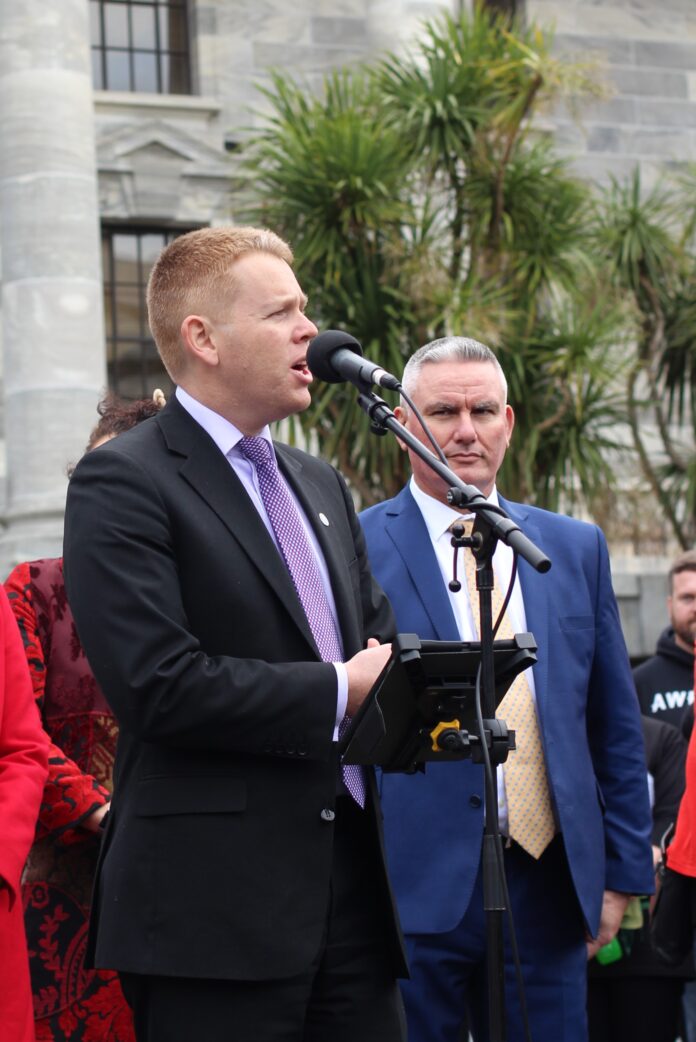
For Joe Biden, the indictment of Donald Trump carries a heavy responsibility – and a risk

Source: The Conversation (Au and NZ) – By Emma Shortis, Lecturer in HIstory, RMIT University

In September last year, US President Joe Biden spoke to Americans from the “sacred ground” of Independence Hall in Philadelphia – the birthplace of the Constitution of the United States. In that landmark speech, Biden warned Americans, and indeed the world, that:

Donald Trump and the MAGA Republicans represent an extremism that threatens the very foundations of our republic.

Less than a year later, American democracy is being subjected to yet another stress test – one to add to an already exhaustingly long list.

As former President Donald Trump has been indicted for the second time in months – this time on federal charges – Biden must navigate uncharted territory. He could soon be faced with trying to win an election against an opponent being prosecuted by the government he leads.

At the same time, as he said in September, Biden is attempting to unite Americans “behind the single purpose of defending our democracy”.

Is it possible for a president to do both at once?

Trump is facing a 37-count indictment related to his handling of classified documents after he left office.
Chuck Burton/AP

Defending the rule of law

Biden came into office under the shadow of a violent attack on American democracy. The near-success of the January 6 insurrection on the US Capitol felt like it could have been a test run – one that might be repeated, given the chance.

Biden insisted the integrity of American democracy thus requires accountability. As he put it,

American democracy only works only if we choose to respect the rule of law.

To Biden, ensuring this respect for the rule of law meant restoring the reputation and the integrity of the Department of Justice after the Trump administration. As part of this, Biden nominated Merrick Garland for the position of attorney general.

Garland had previously been nominated for a seat on the US Supreme Court by then-President Barack Obama in 2016. Republicans, however, refused to schedule nomination hearings until after the presidential election, thwarting Garland’s bid to join the court. Garland’s conduct then – and throughout his career – assured many that as attorney general he would act with integrity and, perhaps most importantly, political impartiality.


Read more:
Could Joe Biden be the most consequential American president of our times?


Garland has been nothing but consistent in this position. After his appointment, Garland said he would avoid “any partisan element of our decision-making about cases”. Garland is also, like Biden, staunch in his insistence that “no person is above the law in this country” – not even former or aspiring presidents.

In a functioning democracy, both things must hold at once.

When it comes to investigating Trump’s alleged activities, Garland has sought to ensure his department can do both – remain above the political fray, while ensuring the rule of law.

Appointing Jack Smith as special counsel was key. Not only does Smith’s appointment ensure a level of distance between Garland and the investigations, it also,
according to Garland, “underscores the department’s commitment to both independence and accountability”. Smith is politically unaffiliated and has an impeccable background in the law, including as a former war crimes prosecutor at The Hague.

Biden, too, is maintaining distance as best he can. He wasn’t in Washington when the indictment went public. He told reporters in North Carolina that he had not, and would not, speak to Garland about the case.

The Biden administration and Department of Justice see that distance as a critical part of the task of keeping American democracy functioning.

Special counsel Jack Smith is a a veteran prosecutor in the Justice Department.
Jose Luis Magana/AP

Reacting with resentment and fury

Biden’s political strategy is important, too – he wants to win an election, after all. Part of his own campaign messaging is that he is serious about the survival of the republic, and about protecting Americans from what he has called the “semi-fascists” in the Republican Party who are leading the charge against him.

Biden is all too aware, however, this is about a lot more than a game of political strategy. When, as Biden observed not so long ago, “too much of what’s happening in our country today is not normal”, prosecuting a political strategy along these lines is incredibly difficult.

Trump protesters and supporters gathered outside Trump National Doral Resort in Florida ahead of the former president’s arrival.
Gerald Herbert/AP

Republicans’ own strategy in the face of these latest charges against their presumptive leader should surprise no one. The rhetoric of the dominant, Trump-supporting faction of the party is designed to reinforce a longstanding politics of resentment and fury, which they are aiming squarely at Biden.

Republican Speaker Kevin McCarthy, for example, incorrectly claimed that Biden himself had indicted “the leading candidate opposing him”, presumably in an effort to defeat him. Senator J.D. Vance similarly claimed Biden is “using the justice system to pre-emptively steal the 2024 election”. Senator Josh Hawley – who famously raised his fist in salute of insurrectionists during the January 6 riots – mooted the end of the American republic on Twitter.

To these Republicans, the clear distance between Biden, the Department of Justice and the attorney general – and the attorney general and special counsel leading the investigations – doesn’t matter. Nor does the substantial evidence against Trump.

Going beyond the more coded language of some of their more senior colleagues, some Trump-supporting representatives have opted for naked incitement. In Arizona, for example, one Republican congressman said “we have now reached a war phase”. In Louisiana, a colleague described the indictment as “a perimeter probe from the oppressors”.


Read more:
Yes, federal charges against a former president are unprecedented – but so is Trump’s political power


These Trump supporters know exactly what they are doing. They are actively testing the strength of American democracy, probing for weak points. They support, after all, a man who has called for nothing less than the “termination” of the Constitution. The difference between that and Hawley’s fear-mongering over the end of the US republic is only who gets to be in charge.

As he attempts in his re-election campaign to appeal to Americans who do not subscribe to Trump’s dangerous and distorted view of the world, Biden must prosecute a message of political integrity and the importance of the rule of law, while at the same time resisting continued assaults against them.

Whether Biden is up to these dual tasks remains to be seen. But the continued survival of the institutions of American democracy requires that he is.

The Conversation

Emma Shortis is a member of the Independent and Peaceful Australia Network (IPAN).

ref. For Joe Biden, the indictment of Donald Trump carries a heavy responsibility – and a risk – https://theconversation.com/for-joe-biden-the-indictment-of-donald-trump-carries-a-heavy-responsibility-and-a-risk-207603


Don’t blame workers for falling productivity – we’re not the ones holding it back

Source: The Conversation (Au and NZ) – By Peter Martin, Visiting Fellow, Crawford School of Public Policy, Australian National University

Shutterstock

Suddenly Australians are being told we need to produce more if we want our wages to merely keep up with inflation.

Reserve Bank Governor Philip Lowe has begun referring to “productivity” in each of the statements he makes after each Reserve Bank board meeting.

Whereas in the past he has only said we needed to boost productivity to lift real wages (to lift wages growth above price growth), he has begun saying we need to boost productivity to justify wage increases well below inflation.

The Governor is right to say that labour productivity (output per hour worked) is falling. He’s also right to say that’s unusual. But it would be wrong to conclude that the solution is for workers to simply work harder.

A tougher line for workers than for business

Lowe has been suggesting he will only tolerate the wages growth we’ve got “provided that trend productivity growth picks up”.

Inflation is officially 7%. The Reserve Bank’s best guess is that the update, due in six weeks, will show it has fallen to 6.3%.

Wages growth is only 3.7%, and the bank’s best guess is the update, due in nine weeks, will show it little changed at 3.8%.

This means wages growth is below inflation and set to stay that way. But Lowe is concerned enough about wage increases that aren’t backed by productivity growth that he prepared to push up interest rates further to bring them down.


Read more:
Why RBA Governor Philip Lowe wants to damage the economy further


As it happens, this isn’t something he has said about businesses. Last month, Telstra said it would lift its mobile and data charges “in line with the consumer price index, rounded to the nearest dollar”.

That’s an increase of 7%, allowing Telstra to boost its charges in line with inflation in a way Lowe doesn’t want workers to. And Telstra won’t need to show it is more productive. It won’t need to offer anything extra.

Productivity is slipping

The official figures show labour productivity (output per hour worked) falling. Although it usually increases, and increased very fast in the 1990s, GDP per hour worked has been falling since March 2022. Since then, it’s down 4.6%.


But it’s the sort of thing that would be expected when there’s a surge in employment. All other things being equal, the more hours that are worked, the less GDP per hour should be.

In the past year, hours worked have surged an extraordinary 5% to an all-time high. When a cafe puts on an extra staff member it doesn’t immediately mean it’ll sell more food. When a childcare centre or a school puts on extra staff it mightn’t produce more at all.

Short-term, more jobs means lower productivity growth

In the short term, the quickest way to boost measured productivity is to bring on recession and throw people out to work.

In 2009, productivity jumped in the United States after what people there called “The Great Recession”. In Australia, we know that period better as “the global financial crisis” – because there was no local recession. Employment stayed strong, while productivity growth slumped.

As a rule, getting people into paid work is something to be welcomed, and as a rule there’s not much anyone can do to stop it. This means that a key driver of measured productivity is beyond anyone’s direct control.

And there’s another driver that’s hard to control.

When mining booms, non-mining productivity slumps

One of the biggest direct drivers of measured productivity is automation. The more that employers put in machines to increase output per worker, the greater the output per worker.

One of the reasons it’s hard to increase output per worker these days might be that the industries that are growing are those such as aged care, which are hard to automate. The Productivity Commission says after growing 2.2% per year through the 1990s, labour productivity grew by just 1.1% per year in the decade to 2020.

And there’s something else. When the price of Australia’s mineral exports booms, which it does from time to time for reasons beyond Australia’s control, other non-mining businesses tend to spend less installing machines. To use the approved terminology, there’s less “non-mining business investment”.

When mineral prices are high, other investment slumps.
Shutterstock

Former Treasury Secretary Ken Henry believes the two are connected. He says high prices for mineral exports push up the value of the Australian dollar, which makes Australian non-mining businesses less able to compete with imports and less able to see the sense in installing machines.

Henry says that’s what’s happening at the moment. Australians and foreigners are finding better opportunities overseas.

Australia has become a net exporter, rather than a net importer, of investment funds – a change Henry says isn’t only because superannuation has boosted household savings.

There are all sorts of things we can do to boost labour productivity. Earlier this year, the Productivity Commission published a nine-volume report outlining them.

But they won’t pay quick dividends, and it’ll be hard going while employment remains robust (which is something we want) and minerals prices remain high (which is something we probably want).

In what has to be his most re-quoted observation ever, Nobel Prize-winning economist Paul Krugman famously said

productivity isn’t everything, but in the long run it is almost everything. A country’s ability to improve its standard of living over time depends almost entirely on its ability to raise its output per worker.

There are all sorts of things we can do to boost productivity. But to the extent that productivity is in anyone’s hands, it is in the hands of employers, and broader economic forces beyond anyone’s ability to easily control.

Telling us to work harder is unlikely to make much difference.

The Conversation

Peter Martin does not work for, consult, own shares in or receive funding from any company or organisation that would benefit from this article, and has disclosed no relevant affiliations beyond their academic appointment.

ref. Don’t blame workers for falling productivity – we’re not the ones holding it back – https://theconversation.com/dont-blame-workers-for-falling-productivity-were-not-the-ones-holding-it-back-207594

A gothic, brilliant success: The Poison of Polygamy brings the first Chinese-Australian novel to the stage after 113 years

Source: The Conversation (Au and NZ) – By Sophie Loy-Wilson, Senior Lecturer in Australian History, University of Sydney

Prudence Upton/Sydney Theatre Company

Review: The Poison of Polygamy, directed by Courtney Stewart, La Boite and Sydney Theatre Company.

Early Chinese migrants to Australia believed in ghosts.

Hailing mostly from a handful of villages in China’s southern Guangdong province, these migrants were Cantonese peoples. For them, the undead had immense power – given the right circumstances.

It was beholden upon the living to manage the dead: bury them appropriately, return their bones to China, arrange for ancestor worship.

Archives tell us Chinese migrants in Australia feared the consequences if such rituals were neglected, even in the chaotic environmental mess of the Australian goldfields.

I’ve read court records from this period in which Chinese witnesses recount “angry ghosts coming to strike them at night”.

The Poison of Polygamy begins with a ghost. The play directly addresses Australia’s Chinese ancestors, conjuring up the past while speaking directly to the present.

Issues of tyranny and servitude, oppression and resistance, violence and its afterlife are marshalled to speak to our modern souls.

What is the link between colonialism and environmental destruction? How do we tell the story of a group of people – themselves victims of European racism – who in turn were invaders of Indigenous land?

What do we do with a 19th-century Chinese-Australian morality tale which insists that Christian values, with all their concurrent conservative gender politics, will save us from moral dissolution?


À lire aussi :
New Gold Mountain review: a compelling murder mystery shines light on early Australian multiculturalism


Chinese migration

An evangelical Chinese Christian, The Preacher (an excellent Shan-Ree Tan), walks towards the audience through a sea of mist, his throat cut and clutching a Bible. He is righteous and here to save our souls.

The Preacher is especially forthright on the questions of polygamy, a common practice in 19th-century China, which took on a new life among overseas Chinese migrant communities. Many first wives were “left behind” in the village while their men took a second or third wife overseas.

A priest and a woman.
Shan-Ree Tan is excellent as The Preacher.
Prudence Upton/Sydney Theatre Company

The play’s hero (“and there is nothing heroic about him”, The Preacher dryly informs us) is Sleep-Sick (also played by Tan): an opium-addicted scrounger who mistreats his wife (Merlynn Tong) and is bundled off to the Australian goldfields by her cousin (Silvan Rus) due to his debt and social malignancy.

There, he befriends other Chinese migrants, eventually settling in Melbourne’s Chinatown. Their banter and debate encompass all the issues of the day: democracy, racial equality, capitalism, mateship, feminism and, of course, the scurvy of polygamy.

The Preacher will use Sleep-Sick’s misadventures as a warning to us all, until another equally righteous narrator – the servant girl or bond maiden Tsiu Hei (Kimie Tsukakoshi) – questions his right to tell her story.

A lost classic

The Poison of Polygamy was likely the first Chinese Australian novel. It was serialised in the Australian Chinese-language press, Charles Dickens-style, from 1909-1910 in 53 instalments.

The author was a Chinese Christian, Wong Shee Ping. The son of gold-rush migrants, he drew on his own experience to write a book about life on the goldfields and in Melbourne.

Australia is lucky in two regards when it comes to the recovery of our Chinese past. We have one of the best-preserved Chinese-language presses in the West, and we have a leading bilingual historian in Mei-fen Kuo, who has been working her way through this massive archive over the past 15 years.

Australia’s booming Chinatowns serviced several newspapers from the 1890s to the 1940s, read by Chinese Australians throughout Australia and beyond.

Three women.
The Poison of Polygamy was originally published in the Chinese Times.
Prudence Upton/Sydney Theatre Company

Prior to digitisation, much of this newsprint sat mildewed in Melbourne and Sydney’s Chinatowns. It took Mei-fen’s tenacity in 2006 to discover The Poison of Polygamy in the pages of the Chinese Times, which was published in Melbourne for a national readership.

The novel was translated by Ely Finch and published by Sydney University Press in 2019.

Playwright Anchuli Felicia King read the novel and rightly saw it as an “Australian classic” and a “lost piece of our cultural heritage”. She wanted to stage a production “which spoke directly to our ancestors”.

A brilliant success

The result is a gothic, brilliant success, darkly funny and subversively political.

“We made your unions, we built your democracy,” Tsiu Hei tells the audience at the end. “We are in your limestone, in your clay.”

Two women on a bed.
The play is darkly funny and subversively political.
Prudence Upton/Sydney Theatre Company

Under the direction of Courtney Stewart, clever staging using rolling red columns, muscular choreography and a startlingly effective lighting design (Ben Hughes) allow for transitions across space and time, creating a world where Europeans are on the margins of historical action in this country.

Australia’s Chinese heritage is wrestled from the grip of our Euro-centric past and – finally – told from the perspective of Chinese migrants themselves.

This is a triumphant reclamation of an Australia denied to us in monolingual readings of our history.

The Poison of Polygamy is at the Sydney Theatre Company until July 15.


À lire aussi :
From lurid orange sauces to refined, regional flavours: how politics helped shape Chinese food in Australia


The Conversation

Sophie Loy-Wilson receives funding from the Australian Research Council

ref. A gothic, brilliant success: The Poison of Polygamy brings the first Chinese-Australian novel to the stage after 113 years – https://theconversation.com/a-gothic-brilliant-success-the-poison-of-polygamy-brings-the-first-chinese-australian-novel-to-the-stage-after-113-years-206929

Resolve first national poll to have ‘no’ ahead in Voice referendum, but Essential has ‘yes’ far ahead

Source: The Conversation (Au and NZ) – By Adrian Beaumont, Election Analyst (Psephologist) at The Conversation; and Honorary Associate, School of Mathematics and Statistics, The University of Melbourne

Lukas Coch/AAP

A federal Resolve poll for Nine newspapers, conducted last week from a sample of 1,606, had “no” ahead by 51-49 in a forced choice question on the Indigenous Voice to parliament referendum to be held later this year.

This is the first “no” lead in any national Voice poll. In the past two months, there has been a rapid movement to “no” in Resolve polls. “Yes” was ahead by 58-42 in April, but this dropped to a 53-47 lead in May, and now “no” has taken the lead.

Party breakdowns suggest a large drop in support since April from Labor voters, with their support down 12 points to a 63-37 split in favour of “yes”.

State breakdowns were based on aggregate data from May and June with an overall sample of 3,216. As May and June results were averaged, “yes” led overall by 51-49. But these breakdowns suggest the Voice would not get the required majority in four of six states, as it was trailing narrowly in South Australia and Western Australia, and much further behind in Queensland.

Only 30% of voters said they could confidently explain the Voice to someone else. Not understanding the detail is likely a key driver of the swing to “no”. Initial preferences were 42% “yes” (down two since May), 40% “no” (up one) and 18% undecided (steady).

Essential poll: ‘yes’ leads by 60-40

An Essential poll, conducted last week from a sample of 1,123, gave “yes” to the Voice a 60-40 lead, a one-point gain for “yes” since May. In April, Essential and Resolve were only two points apart, with Resolve at 58-42 “yes” and Essential 60-40. Now there is an 11-point gap.

I believe Resolve and Newspoll are more credible as they have been tested and performed well at the federal 2022, Victorian 2022 and New South Wales 2023 elections. In my opinion, Resolve had the best final poll at the federal election, while Newspoll performed best at both the Victorian and NSW elections.


Read more:
How did the polls perform in the 2022 election? Better, but not great; also a Senate update


In contrast, Essential greatly overstated both major parties’ support at the federal election, and did not produce a voting intentions poll close to either the Victorian or NSW elections.

It’s possible that Essential’s skew to “yes” is caused by a bias in their samples towards better educated respondents. Seats with a higher educational attainment are where the Greens and teal independents performed best at the last federal election.

Relative to other polls, Essential has had much higher Greens votes, with their latest poll putting the Greens on 16% (up one since last fortnight), compared to 12% in Resolve and 12% in last week’s Newspoll. For this parliamentary term, the Greens support has usually been about 14% in Essential compared to 10-11% in other polls.

Last week’s Newspoll gave “yes” an overall 46-43 lead with 11% undecided. Education breakdowns had university-educated people favouring “yes” 56-35, but “no” was leading with both TAFE/college (by 48-43) and no tertiary education (by 45-41).

The skew to “yes” in Essential may be explained by having too many university educated people in their samples. Better-educated people are more likely to have decided how to vote on the Voice a long time ago, explaining the stable referendum vote in Essential.

A struggle ahead for the ‘yes’ campaign

In early May, I wrote that just one of 25 Labor-initiated referendums had succeeded, and that early poll leads for proposals often collapse by the referendum date. Furthermore, Labor-initated referendums have lost much more heavily when held as a midterm referendum than when held with general elections.


Read more:
While the Voice has a large poll lead now, history of past referendums indicates it may struggle


The Resolve poll and last week’s Newspoll (46-43 to “yes”) implied that support for the Voice is slumping. Given the history of Labor-initiated referendums, if these polls are correct, it is likely that the Voice will be defeated. Supporters of the Voice will hope that Essential is right, but Essential’s track record is worse than either Resolve or Newspoll.

Fadden byelection: July 15

A byelection for the federal Queensland seat of Fadden will occur on July 15 after the resignation of former Liberal minister Stuart Robert. The LNP won Fadden by a 60.6-39.4 margin against Labor at the 2022 federal election.

Fadden has only been won by Labor once, in 1983 on the election of the Hawke government, and has been more pro-LNP than Queensland overall since 1984 according to the ABC guide.

In my first look at this byelection, I thought Labor might not contest given how unlikely it is they would win. However, Labor will contest with their 2022 candidate. Nominations for the byelection close on June 22 and will be declared the next day. The LNP should retain easily.


Read more:
Easy Liberal wins likely in byelections in Robert’s and Morrison’s seats; support for rise in JobSeeker


WA state poll: 61-39 to Labor

The Poll Bludger reported on June 3 that an Utting research poll for The West Australian, conducted May 31 from a sample of 800, gave Labor a 61-39 lead from primary votes of 52% Labor, 28% Liberals, 5% Nationals and 8% Greens. This poll was taken two days after WA Premier Mark McGowan announced his resignation.

While Labor is well down from the record landslide margin of 69.7-30.3 at the March 2021 WA election, this would still be a massive win for Labor if repeated at an election.

New Labor Premier Roger Cook had ratings of 42% approve, 26% disapprove, while Liberal leader Libby Mettram was at 31% approve, 33% disapprove. Cook had a 50-24 lead as preferred premier over Mettram. McGowan’s ratings were 68% approve, 19% disapprove.

There will be a byelection in McGowan’s former seat of Rockingham on July 29. At the 2021 WA election, McGowan won Rockingham by an 87.7-12.3 margin over the Liberals, from a primary vote of 82.7%. There is likely to be a big swing against Labor at the byelection, but they should still hold Rockingham easily.

The Conversation

Adrian Beaumont does not work for, consult, own shares in or receive funding from any company or organisation that would benefit from this article, and has disclosed no relevant affiliations beyond their academic appointment.

ref. Resolve first national poll to have ‘no’ ahead in Voice referendum, but Essential has ‘yes’ far ahead – https://theconversation.com/resolve-first-national-poll-to-have-no-ahead-in-voice-referendum-but-essential-has-yes-far-ahead-207015

Virgin Galactic’s use of the ‘Overview Effect’ to promote space tourism is a terrible irony

Source: The Conversation (Au and NZ) – By Ariane Moore, PhD Candidate in Philosophy, University of Tasmania

Virgin Galactic, the space tourism company founded in 2004 by Richard Branson, promotes its flights as offering:

A Brand New Perspective: Deepen your connection to Earth and to humanity with the transformational experience known as the Overview Effect.

First discussed in 1987 by space philosopher Frank White, the Overview Effect is a result of viewing Earth from space.

Expressions of the effect range broadly. Astronauts might experience profound awe and wonder at the perception of Earth as a fragile living being. Some suffer crushing grief when considering the harm humans inflict on nature.

While Virgin Galactic promotes access to the Overview Effect as a major drawcard, it is a terrible irony that space tourism is enormously damaging for the environment.

On May 25, Virgin Galactic completed a final test flight before it starts taking paying customers.


Read more:
Seeing Earth from space changes you – and you don’t even have to leave the planet


The Overview Effect

The Overview Effect is not limited to astronauts from the West. Their Chinese and Russian counterparts have described the same profound connection to Earth when witnessing the planet from space.

As Soviet Russian cosmonaut Yuri Artyushkin reported:

The feeling of unity is not simply an observation. With it comes a strong sense of compassion and concern for the state of our planet and the effect humans are having on it. It isn’t important in which sea or lake you observe a slick of pollution, or in the forests of which country a fire breaks out, or on which continent a hurricane arises. You are standing guard over the whole of our Earth.

Until recently, researching the Overview Effect has required interviews with professional astronauts. Today, commercial space tourism is increasing awareness of the phenomenon, particularly when experienced by celebrities with large platforms.

In 2021, Star Trek actor William Shatner completed a suborbital flight with Jeff Bezos’ space tourism company Blue Origin. Shatner had anticipated emotions of celebration and joy when viewing “mother and Earth and comfort” from space. Instead, he later wrote, he struggled with “the strongest feelings of grief I have ever encountered”.

Shatner attributed his experience to the Overview Effect.


Read more:
The wonders and terrors of modern technology evoke the ancient concept of the sublime, and present us with a choice


Space flight has a huge environmental impact

Virgin Galactic promotes the Overview Effect on its homepage as an experience exclusive to space flight.

However, access is extremely costly. While an eager space tourist consents to parting with US$450,000 to experience a profound connection with Earth, the planet itself has no say in receiving the massive pollution a single trip produces.

Rocket emissions impact Earth’s atmosphere, temperatures and the ozone layer at an unprecedented level. A 2022 study found space tourism produces black carbon particles that are almost 500 times more efficient at warming the atmosphere than all surface and airline sources of soot combined.

After being released into the upper atmosphere, the black carbon particles circulate for four to five years in a fine layer. This acts as a thin black umbrella absorbing solar radiation while blocking it from reaching Earth’s surface.

A 1.5-hour Virgin Galactic flight generates emissions equivalent to a ten-hour trans-Atlantic commercial air flight. However, the latter carries hundreds of passengers. With a passenger limit of six, a Virgin Galactic launch emits 4.5 tonnes of carbon per person. That’s more than twice the Paris Agreement’s recommended annual individual carbon budget.

Space tourism rocket launches don’t currently compare to commercial airline flights in number. But the suborbital transportation and space tourism market is expected to be worth US$2.58 billion by 2031. It’s growing at an annual rate of 17.15%.

Virgin Galactic is aiming to launch 400 space tourism flights every year.


Read more:
Space tourism: rockets emit 100 times more CO₂ per passenger than flights – imagine a whole industry


In this video on its website, Virgin Galactic uses the Overview Effect to promote its space tourism business.

Caring for Earth doesn’t depend on space flight

The desirability of the Overview Effect is not the overwhelming emotions experienced when witnessing Earth from space. As was evident in Shatner’s feelings of immense grief, these emotions are not always pleasant.

Instead, researchers, astronauts and space philosophers are interested in the spontaneous and powerful awareness that occurs. Astronauts’ accounts of the moment vary, but a consistent theme emerges: a connection to planet Earth that inspires environmental care.

Importantly, such clarity can be achieved without a suborbital space flight.

Frank White argues that, while viewing Earth from space produces the “ultimate” Overview Effect, it might also be had while looking at landscapes from a great height – such as a mountain range. Commercial pilots flying at high altitudes have experienced similar phenomena.

And for those considering a Virgin Galactic flight, there are no guarantees. Many astronauts with long careers report never experiencing the Overview Effect.

View of whole Earth photographed by the orbiting Apollo 17 mission and dubbed 'Blue Marble'
Being able to see the whole Earth from space was regarded as a transformative moment, but people can have environmental epiphanies without flying into space.
NASA/Apollo 17


Read more:
Keen to sign up for space tourism? Here are 6 things to consider (besides the price tag)


Environmental epiphanies happen on Earth

Spontaneous clarity about the importance of nature can occur while standing on solid ground. “Environmental epiphanies” are well documented and have no connection to specific religious or cultural beliefs.

Involving profound emotions and sudden awareness similar to the Overview Effect, environmental epiphanies can be accessed for free in mundane locations – such as reading a book at home.

And, like the Overview Effect, environmental epiphanies can lead to lasting change.

As space tourism continues to “take off”, misaligned marketing tactics like Virgin Galactic’s promotion of the Overview Effect must be scrutinised.

Being launched into space – and the massive pollution the process creates – isn’t necessary for us to want to sustain our Earth.

The Conversation

Ariane Moore does not work for, consult, own shares in or receive funding from any company or organisation that would benefit from this article, and has disclosed no relevant affiliations beyond their academic appointment.

ref. Virgin Galactic’s use of the ‘Overview Effect’ to promote space tourism is a terrible irony – https://theconversation.com/virgin-galactics-use-of-the-overview-effect-to-promote-space-tourism-is-a-terrible-irony-206868

What is a ‘toroidal propeller’ and could it change the future of drones? An expert explains

Source: The Conversation (Au and NZ) – By Abdulghani Mohamed, Senior Lecturer in Aerospace Engineering, RMIT University

Glen Cooper/MIT

The basic configuration of traditional propellers has not fundamentally changed since the first powered flight by the Wright brothers in 1903.

However, as engineers learn more about aerodynamics and attempt new experiments, propellers are evolving to more complex shapes. These feature multiple blades, high sweep angles, blade tip devices and other features to optimise performance in different conditions.

A recent advancement in propeller technology are “toroidal” propellers. These devices are ring-shaped, with the blades looping around each other. A few recent articles and videos have been hyping these – but how “revolutionary” are they, really?

Refining the shape

In 2017, researchers at MIT filed a patent for toroidal propellers. Their patent claims the invention is more efficient than traditional propellers and is less noisy.

Coincidentally, already in 2012, US engineering company Sharrow Marine also developed a toroidal propeller for boats; they have demonstrated it to be more efficient and quieter than traditional marine propellers.

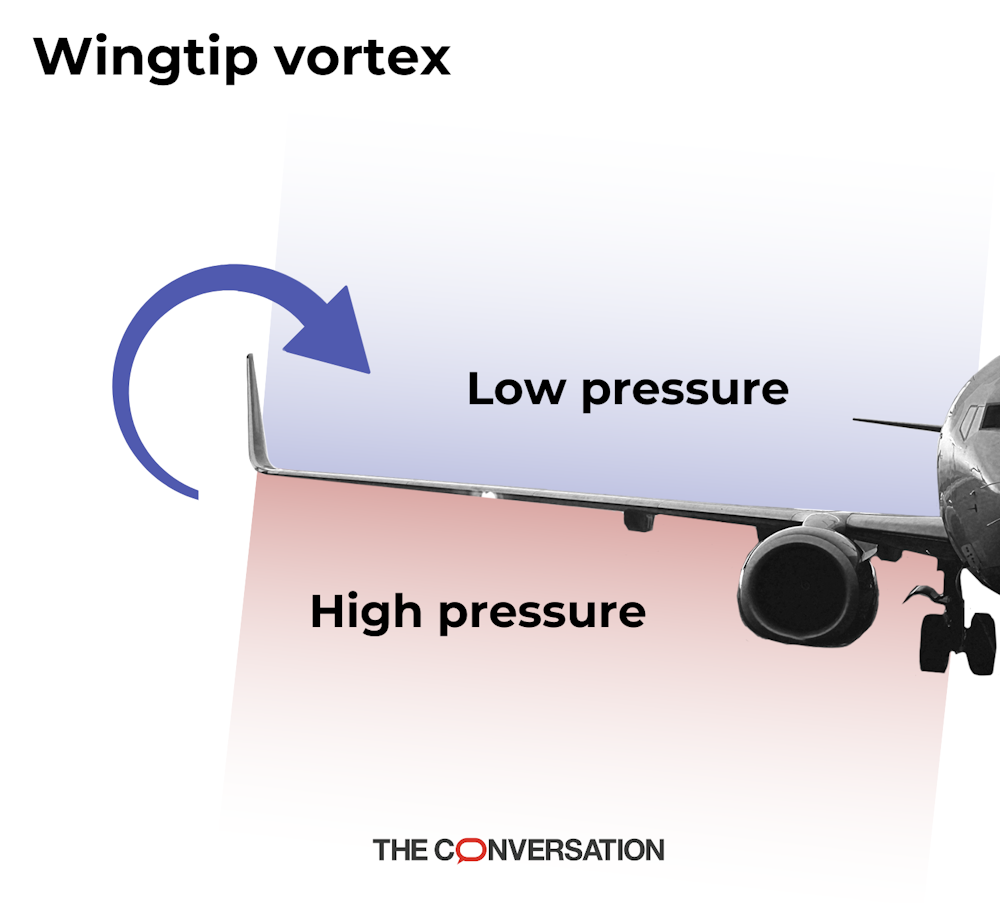
The reason toroidal propellers may be quieter is because of their complex shape – it minimises the strength of the vortex (a spiralling movement of air, water, or another fluid) that naturally happens over propeller blade tips.

This happens because there’s a high-pressure region under the blade, and low pressure above it. As high-pressure air from under the blade moves towards the low-pressure region above it, it travels in a spiral – a vortex.

A diagram showing low pressure above a plane wing and high pressure below it, with an arrow indicating air movement at the tip
A tip vortex happens due to different pressures below and above the propeller blade or airplane wing.
The Conversation, CC BY-ND

This phenomenon is not unique to propeller blades, which are essentially rotating wings. The wing of a plane also experiences this phenomenon. Engineers have done much research on wingtip devices that can minimise this.

The use of closed-loop structures – like in a toroidal propeller – is one way of reducing tip vortices.

Even though the basic propeller shape has remained the same since its invention, many propeller blade designs have been put forward. To test these, engineers need to perform design trade-off studies. Some of these approaches have been tested to try and make helicopter blades and drones more efficient and less noisy.

Illustration from MIT’s 2017 patent, showing a regular propeller in 5a and a toroidal propeller in 5b.
US Patent US10836466B2

No magic propeller

It’s important to understand propeller geometry must be optimised for a specific “operational envelope”. This means the properties of the fluid or air it operates in, rotation speed, forward speed, and other details. Outside that envelope, the propeller will perform poorly.

So far, nobody has achieved the magical propeller geometry that will achieve low noise and high efficiency for all operating conditions and scales. Toroidal propellers are no exception – from the sparse results available so far, their advantages are not yet fully quantified.

Comparing a well-designed toroidal propeller to a poorly designed traditional propeller will show a significant improvement, but is not a fair comparison.

Well-designed toroidal propellers may have advantages in specific operating conditions, such as dense fluids or a specific range of speeds. However, the question remains as to how a toroidal propeller compares to a well-designed traditional propeller for the same conditions.

This is a challenge, since improvements are always relative to a benchmark – which may not be the most efficient design to start with.

Another aspect of a fair comparison that doesn’t seem to have been published for toroidal propellers is comparing different propellers at the same thrust force. Only then you can see the true advantages regarding noise reduction and energy required to spin the propeller.


Read more:
Drones to deliver incessant buzzing noise, and packages


Home experiments are not representative

An MIT announcement earlier this year about toroidal propellers winning one of MIT Lincoln Laboratory’s 2022 R&D 100 Awards generated significant excitement. There’s been widespread experimentation with 3D-printed toroidal propellers, but not all of these have delivered positive results.

This may be due to un-optimised geometry and poor scientific rigour by the general public conducting some of these experiments. This gives the scientific community a research opportunity – to truly assess and optimise toroidal and traditional propellers to enhance their performance.

Previous optimisation studies have been conducted, some of which even use machine-learning techniques to identify suitable geometries. Engineers are also trying to make propellers that sound less annoying, by considering how humans perceive sound.

Expensive and hard to scale

Toroidal propellers also have clear disadvantages. The main one is the difficulty to scale them to mass production due to their complex geometry, which leads to high production costs.

The complex structure also requires special care to avoid unwanted vibrations – a significant issue when rotating at high speeds. This also adds to higher manufacturing costs.

When it comes to using toroidal propellers for drones, their heavier weight will also have implications on the responsiveness and stability of the drone. This is critical when operating in windy and turbulent conditions such as windy weather.

Overall, toroidal propellers are an exciting recent development in propeller design, at least in some cases. While they can be more quiet, they won’t completely replace traditional props just yet – there’s no single propeller design that will suit all situations.


Read more:
Got a drone for Christmas? Know the law before taking to the skies


The Conversation

Abdulghani Mohamed is a researcher at RMIT university who receives funding from a few companies for undertaking aerodynamic optimisation.

ref. What is a ‘toroidal propeller’ and could it change the future of drones? An expert explains – https://theconversation.com/what-is-a-toroidal-propeller-and-could-it-change-the-future-of-drones-an-expert-explains-206498

Can the new High Speed Rail Authority deliver after 4 decades of costly studies?

Source: The Conversation (Au and NZ) – By Philip Laird, Honorary Principal Fellow, University of Wollongong

The Tokaido Shinkansen in Japan. Philip Laird, Author provided

Australia’s new High Speed Rail Authority comes into being today. Created by the Albanese government, the authority and its newly named board have been set a challenging task: “bring high-speed rail to reality”.

Nearly four decades after it was first proposed, Australia must surely hold the world record for high-speed rail studies with no construction. I estimate the cost of all these studies to date to be about A$150 million (both public and private money, in 2023 dollars). Yet not one kilometre of a land corridor for a high-speed rail track has been reserved.

The challenge for the Albanese government is to go further than yet more studies and start construction.


Read more:
More than ever, it’s time to upgrade the Sydney–Melbourne railway


How many countries have high-speed rail?

The International Union of Railways (UIC) defines high-speed rail as including “infrastructure for new lines designed for speeds of 250km/h and above; upgraded existing lines for speeds of up to […] 220 km/h”.

Starting in 1964 with the Tokaido Shinkansen in Japan linking Tokyo to Shin-Osaka, high-speed rail now operates in 20 countries. Another 14 countries are building or planning high-speed rail links.

In Indonesia, a high-speed rail service from the capital Jakarta to Bandung is due to begin this August. Construction of high-speed rail in India and Thailand is advanced.

And Australia? It only rates a mention by the UIC of long-term planning for high-speed rail.


Read more:
Don’t abandon plans for high-speed rail in Australia – just look at all the benefits


A history of projects that came to nothing

In 1984, CSIRO proposed the Very Fast Train connecting Sydney, Canberra and Melbourne. A consortium undertook many studies. A Senate committee inquiry was held. However, the proposal failed to win government support and did not proceed.

Next was the pragmatic Speedrail proposal. This was to link Sydney to Canberra using existing track from Sydney to Macarthur and new track to Canberra. Prime Minister John Howard enthusiastically endorsed the project before the 1998 election, saying:

The very fast train will rival airline flight as the preferred means of travel for countless millions of Australians for decades to come.

The Howard government gave approval to the Speedrail consortium to “prove up” their proposal. The cost was to be about $4.5 billion. About $1 billion would have been required from government, but this was denied. It was a lost opportunity for Australia.

Instead, the Howard government funded yet another study, which effectively found high-speed rail to be too expensive. So also did a two-stage study by the Gillard government, in which Anthony Albanese was the minister overseeing the planning process until Labor lost office in 2013. It costed a high-speed rail network for the east coast at $114 billion (in 2012 dollars).

More parliamentary inquiries have since followed. And the National Faster Rail Agency formed in 2019 has expended further funds. This agency now falls under the High Speed Rail Authority.

The NSW factor

In 2018, the New South Wales government began its own investigations into faster rail. Launched by the then premier, Gladys Berejiklian, the resulting report by UK rail expert Andrew McNaughton has not been released. It was reported last year to have recommended new tracks between Newcastle, Sydney and Wollongong, along with a Sydney-Canberra upgrade and better services to the state’s central west.

Other NSW reports also remain under wraps. In late 2022, the former NSW government stopped investigating high-speed rail or the upgrading of existing lines. These studies were reported to have cost about a further $100 million (my estimate of $150 million doesn’t include this figure, as it was for studies of both high-speed and faster rail).


Read more:
NSW on a slow track to fast trains: promised regional rail upgrades are long overdue


NSW now lags far behind Queensland, Victoria and Western Australia. All these states have trains moving at 160km/h over upgraded tracks. This includes the Queensland electric tilt train, which has been running between Brisbane and Rockhampton since 1998.

There are also questions about the supply of new intercity trains for NSW. These and other questions are the subject of a review set up by the recently elected state Labor government.

So, what happens next?

There is some opposition to high-speed rail in Australia. In 2020, the Grattan Institute said:

The east-coast bullet train advocated by the federal ALP would be an expensive folly.

Last December, the shadow minister for infrastructure, Bridget McKenzie,
said:

While very fast trains has great appeal, the reality is that it is decades away from being built – even if governments were to get serious about it.

McKenzie favours upgrades of existing lines.

The minister for infrastructure and transport, Catherine King, said last week the first priority of the High Speed Rail Authority is planning and corridor works for the Sydney-to-Newcastle section of the network. The government is providing $500 million for this. In addition, this project will require a much-improved, in-house, rail engineering capability.


Read more:
Vital Signs: Sydney to Newcastle fast rail makes sense. Making trains locally does not


The project will also need to be delivered without the problems that the Inland Rail freight line project has encountered. The Albanese government ordered an independent review of Inland Rail, which found serious shortcomings. It will now only proceed this decade on a rail link between Melbourne and Parkes. Questions remain over the section from Parkes to Brisbane.

The government is also reviewing other major infrastructure projects.

One project that would produce many benefits is to build a new track between Macarthur and near Mittagong. This would be close to the reconstructed section of the Hume Motorway that opened in 1980. The benefits include faster, more energy-efficient train travel between Sydney and each of Melbourne and Canberra. It would also lower emissions.

A Macarthur-Mittagong deviation could be the start of a staged process to construct high-speed rail between Sydney and Melbourne. High-speed rail advocacy group Fastrack and others have proposed this approach. It would give regional Australia “more trains, and faster trains, to get us on our way”.

A growing population is waiting for Australia to join the 34 countries that have or are about to get high-speed rail.


Read more:
Transport is letting Australia down in the race to cut emissions


The Conversation

Philip Laird owns shares in some transport companies and has received funding from the two rail-related CRCs as well as the ARC. He is affiliated, inter alia, with the Chartered Institute of Logistics and Transport, the Railway Technical Society of Australasia and the Rail Futures Institute. The opinions expressed are those of the author.

ref. Can the new High Speed Rail Authority deliver after 4 decades of costly studies? – https://theconversation.com/can-the-new-high-speed-rail-authority-deliver-after-4-decades-of-costly-studies-206287

A watershed report on solitary confinement in NZ prisons must now trigger real reform

Source: The Conversation (Au and NZ) – By Christine McCarthy, Senior Lecturer in Interior Architecture, Te Herenga Waka — Victoria University of Wellington

Getty Images

It is hard to find much joy in the Prison Inspectorate’s report on segregation and cell confinement released today. It finds many prisoners in New Zealand are kept in solitary confinement and suffer negative psychological and physical effects.

The report follows the 2021 finding that female prisoners were segregated without due process, and the Ombudsman’s statement last year that legal reform is needed “to ensure that New Zealand meets its international human rights obligations with respect to solitary confinement and PSC [prolonged solitary confinement]”.

Two things in particular stood out for me in the report: the Inspectorate’s willingness to call segregation “solitary confinement”, and the inadequate record keeping by the Department of Corrections that is highlighted.

“Segregation” can mean different things in the prison context, making it easy to get bogged down in definitional complexities. Unlike cell confinement, segregation is not a punishment. Instead, it is intended to manage a complex group of people, including supporting those with significant mental health needs, difficult behaviour, or even managing gang affiliations.

It can simply involve separating one group of prisoners from another. Or it can be solitary confinement, isolating a prisoner in their cell for 22 hours or more a day without meaningful human contact.

The report finds that for all intents and purposes “segregation” means “solitary confinement” in New Zealand prisons. And some prisoners experience solitary confinement for months or years.

Arohata Prison intervention and support unit yard.
Dept. of Corrections

‘A dangerous place’

So what does this look like in practice? Imagine being alone in a bleak version of your bedroom – without a phone or clock, with concrete walls, a television (only free channels) and an open toilet.

You’ll get an hour in a concrete yard to exercise, and at least five minutes a week on the phone with friends and family. In some prisons, dinner arrives at 3.30pm. As one prisoner quoted in the report says:

When things get too hard, I wanted to kill myself. I’ve cut myself so many times [… there’s] no-one to talk to.


Read more:
Prison turns life upside down – giving low-risk prisoners longer to prepare for their sentences would benefit everyone


Segregation includes isolating vulnerable prisoners in “intervention and support units” (ISUs). The picture painted here also lacks hope: stark environments, inaccurate record keeping, sensory deprivation and insufficient social interaction. One ISU prisoner described being “quite lonely”, adding:

Mentally it reminds me of being forced into a cupboard when I was in foster care. I didn’t have any mental health support when I was there – just in my own mind, which can be a dangerous place.

Telling details haunt the report: the removing of cardboard tubes from toilet rolls, coldness due to too few blankets, prohibition of wearing shoes, no books in an ISU dayroom for fear prisoners might eat the pages, and lack of exposure to sunlight requiring prescriptions for vitamin D.

One prisoner describes injuring himself at his first opportunity to run in an open space:

I just couldn’t help myself, fresh air, the wind on my face, and the grass under my feet, you can’t imagine what that feels like after so many years of being locked in a concrete box.

Auckland South Corrections Facility separation and reintegration unit cell.
Dept. of Corrections

Impacts on prison staff

Research has demonstrated the psychological trauma, harm to mental health and problems with physical health that solitary confinement can cause. One prisoner put it this way in the report:

Alone in my cell for days, used to often lead me to be frustrated, which led to anger and in turn led to violence. [I] caused a lot of violence in the cells.


Read more:
Solitary confinement by any other name is still torture


These conditions undermine normal socialisation. Twinned with the lack of access to rehabilitation that the Inspectorate also identifies, segregation cannot be good preparation for release into the community.

The harm caused by such treatment may become permanent after 15 days. This is the threshold defined by the United Nations between “solitary confinement” and “prolonged solitary confinement”, as set out in its “Mandela Rules”.

This is not just a problem for the prisoners. It also has an enormous impact on an already fatigued workforce. As the report states, employees “felt like they had been trained as custodial staff but were being asked to manage prisoners with mental health issues”.


Read more:
Why are there prisons? An expert explains the history of using ‘correctional’ facilities to punish people


A watershed moment

The report estimates about 29% of prisoners were segregated during the year of the review (October 1 2020 to September 30 2021). This is within a system where only 16% of prisoners have maximum or high-security classifications. Of all those segregated prisoners, 63% were Māori.

But the report gives only a glimpse into solitary confinement, due to what it identifies as unreliable paperwork and inaccurate data.

Nonetheless, it represents a watershed moment. Important recommendations are made to address key areas of concern. The Department of Corrections can no longer say solitary confinement is not used in New Zealand. Nor can it deny that, for a significant number of prisoners, this confinement is prolonged.

The fact that the department has accepted the Inspectorate’s recommendations should materially improve prisoner experience of segregation, and mean transparent reporting of demographic data and incidents of self-harm.

This is long overdue. As one prisoner noted, describing solitary confinement’s profound isolation: “There is only so much colouring in you can do.”

The Conversation

Christine McCarthy was formerly the president of the Wellington Howard League for Penal Reform (2018-2020). In 2021 a petition she initiated to ban prolonged solitary confinement in New Zealand was presented to parliament.

ref. A watershed report on solitary confinement in NZ prisons must now trigger real reform – https://theconversation.com/a-watershed-report-on-solitary-confinement-in-nz-prisons-must-now-trigger-real-reform-207597

RNZ board to begin setting up independent review of pro-Russia edits to stories

RNZ News

The RNZ board is meeting tonight to begin setting up an independent review on how pro-Russian sentiment was inserted into a number of its online stories.

An RNZ digital journalist has been placed on leave after it came to light he had changed copy from news agency Reuters on the war in Ukraine to include pro-Russian views.

Since Friday, hundreds of stories published by RNZ have been audited, and 16 Reuters stories and one BBC item had to be corrected, with chief executive Paul Thompson saying more would be checked “with a fine-tooth comb”.

The journalist told RNZ’s Checkpoint he had subbed stories that way for a number of years and nobody had queried it. Thompson said those comments appeared to be about the staffer’s overall role as a sub-editor.

Board chairperson Dr Jim Mather said the public’s trust had been eroded by revelations and it was going to take a lot of work to come back from what had happened.

“We see ourselves as guardians of a taonga and that taonga being the 98 years of history that RNZ has in terms of trusted public media and high standards of excellent journalism and so it is fair to say we are extremely disappointed,” he told RNZ’s Checkpoint on Monday.

“We need to demonstrate that we are prepared to review every aspect of what has occurred to actually start the restoration process in terms of confidence in RNZ.”

The board would discuss who will run the investigation and its terms of reference, and would make a decision “very soon”.

Currency is trust
“The role the board is going to take is we are going to appoint the panel of trusted individuals, experienced journalists, those that do have editorial experience to undertake the review. This is going to be done completely separate from the other work being undertaken by management,” he said.

Dr Mather said the currency of the public broadcaster was trust, and the revelations had impacted the organisation’s journalists.

“I know that we pride ourselves as having the highest standards of journalistic quality so I can just say that it’s had a significant impact also on our journalism team.”

Reuters said it had “addressed the issue” with RNZ, noting in a statement that RNZ had initiated an investigation.

“As stated in our terms and conditions, Reuters content cannot be altered without prior written consent,” the spokesperson’s statement said.

“Reuters is fully committed to covering the war in Ukraine impartially and accurately, in keeping with the Thomson Reuters Trust Principles.”

‘Important that politicians don’t interfere’ – Hipkins
Prime Minister Chris Hipkins said while he would never rule out a cross-party parliamentary inquiry, he had not seen anything so far to suggest the need for an wider action.

Hipkins told RNZ’s Morning Report he was not sure a cross-party parliamentary inquiry on issues around editorial decisions would be a good way of protecting the editorial independence of an institution like RNZ.

“Having said that, we always monitor these kinds of things to see how they are being handled, it’s really important that politicians don’t interfere in that,” he said.

“I think if it reached a point where public confidence in the institution was so badly tarnished that some degree of independent review was required, I’d never take that off the table.”

But in the first instance, it was important to allow RNZ’s management and board to deal with it with the processes that they had in place, Hipkins said.

“I haven’t seen anything in the last few days that would suggest that there’s any case for us to trigger something that’s more significant than what’s being done at the moment.”

Hipkins said he had not sought, nor had, any briefings from New Zealand’s security services in relation to the incident because it was a matter of editorial independence and it was important that politicians did not get involved in that.

“RNZ, while it’s a publicly-funded institution, must operate independently of politicians.”

Not an issue for politicians – Willis
National Party deputy leader Nicola Willis agreed that it was not an issue for politicians to be involved in.

She said it was important the investigation was carried out, and the concern was about editorial standards that let the situation go unnoticed for such a long time.

Trust in media was important and people reading mainstream media expected stories to go through a fact-checking process and reflect appropriate editorial independence, she told RNZ’s First Up.

“I think it will be a watch for newsrooms around the country, and I hope that it’s a thorough investigation that comes out with robust recommendations.”

This article is republished under a community partnership agreement with RNZ.

Print Friendly, PDF & Email

Article by AsiaPacificReport.nz

Geopolitical balancing in the W/SW Pacific.

Headline: Geopolitical balancing in the W/SW Pacific. – 36th Parallel Assessments

Last year the People’s Republic of China (PRC) and the Solomon Islands signed a bilateral security agreement that includes police training and port visits by Chinese security advisors and naval vessels. This includes training in “crowd control” and protection of Chinese investments in the Solomons and opens the door to the possibility of forward basing of Peoples Liberation Army Navy (PLAN) assets in the archipelago. Needless to say, Western governments, including the US, Australia and New Zealand, reacted negatively to the deal (whose terms have not been entirely released), as have some members of the Pacific Island Forum community.

This year, the Australia, the UK and the US formally signed the AUKUS nuclear submarine agreement whereby Australia would first acquire, then manufacture nuclear powered submarines based on US and British attack submarine designs. The PRC and several Pacific Island Forum (PIF) states reacted negatively to the agreement (which may violate the 1997 Treaty of Rarotonga establishing a South Pacific nuclear free zone), although other Western Pacific Rim nations were either muted or supportive in their responses.

Also this year the US and Papua New Guinea (PNG) signed a bilateral security agreement that will allow US forces to operate on and from PNG soil and which includes a significant economic development component as part of the package. More recently, Japan and New Zealand signed a bilateral military cooperation agreement that is focused on joint operations in the South Pacific, initially for humanitarian reasons (such as the recent disaster relief efforts after the volcanic eruption in Tonga, where Japan participated) but opening the possibility of future joint military training and exercises in kinetic operations, especially in the West and SW Pacific maritime security environment. This follows on an intelligence-sharing agreement between Japan and NZ signed last year that allows better Japanese access to the 5 Eyes signals and technical intelligence collection alliance involving the US, UK, Australia and Canada as well as NZ, and which may pave the way for eventual Japanese integration into the alliance. Since intelligence sharing is part of military synergies and interoperability between different armed forces, this sequence of bilateral agreements would seem to be a natural progression in the NZ-Japanese security relationship.

What does all of this have in common? it is part of what might be seen as balance of power gamesmanship between the PRC and various rival powers in the SW Pacific region. Balances of power are, as the name implies, about balancing the power of one or more states against that of other states. These balances involve military, economic and diplomatic power and/or influence projection. Some so-called balances of power are actually not balanced at all and involve the domination by one state of a given strategic arena. This was the case for the US in the greater Pacific basin from WW2 up until recently. Now, with the decline of the US as a unipolar international “hegemon” and the rise of an emerging multipolar world that includes the PRC as a Great Power contender, the Western reaches of the Pacific basin have become a zone of contestation in which US and Chinese influence and power projection compete.

Other balances of power may be between two or more states sometimes operating as partners against common rivals and sometimes operating as sub-sets of a larger arrangement. Most balance of power subsets involve regional subsets of global rivalries.For example, NATO and the Warsaw Pact were European regional balancing vehicles contained within the larger bi-polar balance of power between the US and USSR during the Cold War. The contemporary rivalry between the Sunni Arab oligarchies and the Persian theocratic regime in Iran is a Middle East example of a regional balance of power in which competition for influence and support for armed proxies is part of the balancing game.

In East and Southeast Asia, several states have joined US-led coalitions in order to balance out the increasing PRC military presence in that part of the world. The Philippines, Singapore, Malyasia, Vietnam and Thailand, to say nothing of South Korea, Japan and Taiwan, all have bilateral military-security agreements with the US that are specifically designed to help counter Chinese power projection in Western Pacific Rim area of operations (AOR).

A way to think about this multi-tiered/multi-faceted geopolitical balancing is to envision as what economists call a “nested” game, i.e. a game or games played within a larger game or games. The largest game sets the broad contours of what happens within it, with smaller games or subsets focused on specific meso- or micro-aspects of the larger (macro) game and with each level of games reinforcing balancing plays on the others. A less academic way is to think of balance of power games as being akin to a Matryoshka Doll with the largest game holding within it a number of smaller subsets that give internal substance to the overall representation.

The action/reaction dynamic between the PRC and rival powers involves a) the attempt to ring-fence the PRC in terms of its power projection in order to limit its capability to influence, via the threat of coercion or otherwise, regional politics; and b) the attempts by the PRC to break out of the corralling project erected against it. Arguments aside about whether the breakout move or the ring-fencing project came first, that is now a fait accompli. The dynamic is out in the open in the South China Sea, where the PRC has abandoned its insular, land-based strategic perspective and announced its maritime presence with its island-building project in international waters and its increased deployments of armed vessels off the coasts of its littoral neighbours as well as out into the blue waters of the West and Southwestern Pacific.

In return, the US has shifted sixty percent of its naval assets to the Pacific (rather its traditional focus on the Atlantic), and moved significant contingents of long-range bombers and fighter aircraft to bases in Guam, Okinawa and in the near future Australia. It has bolstered troop numbers and rotations in places like the Philippines, South Korea and Australia and increased the tempo of joint exercises with a host of regional partners. Likewise, the French have increased the size of their Pacific army and naval fleets (headquartered in Noumea and Papeete, respectively), as well as the number of exercises with Australian and US forces in the SW Pacific. The ring-fencing versus breakout balancing project, in other words, is well underway.

For a podcast discussion based on this post, please head to “A View from Afar.”

This begs a larger question. Does the PRC have legitimate interests in the Pacific and as a Great Power should those interests be understood and respected? Think of the Belt and Road Initiative and other large Chinese investments in foreign infrastructure development and resource extraction and the great risks that they carry. Accordingly, the PRC has an interest in maintaining access to major sea lanes and potential resource opportunities in the Pacific region. The question is whether it wants to work in accordance with international norms and in concert with the international community on things like freedom of navigation and regulation of seabed mining or does it wish to control sea lanes and set its own rules when it comes to exploiting natural resources in the Western Pacific.

The issue seems to be not about the legitimacy of PRC interests but the way it behaves in pursuit of them. The South China Sea is an example: bullying of neighbors, violating international norms with its island-building projects, the illegitimate extension of sovereignty claims over the whole South China Sea basin, the attempt to claim and control key choke points in international waters like the Taiwan Straits. All of these moves would seem to set a bad precedent for PRC power projection aspirations further South and are therefore the basis for regional concern about its growing presence. Then there is the issue of governance and PRC checkbook/debt diplomacy reinforcing corruption in the PIF states.

All of this suggests that, contrary to expectations two decades ago, the PRC behaves like a bad global/regional “citizen.” It violates norms and the rules based order and ignores established codes of conduct regarding the pursuit of national interests when projecting power and influence abroad. It is militarily and diplomatically aggressive when asserting its claims abroad, and as the pandemic response demonstrates, it is less than transparent and truthful when dealing with the motivations for and consequences of its actions.

To be sure, it is equally true that the “rules-based international order” was made for and by Western Great Powers before and after WW2, and the PRC is correct in noting that when calling for a new global regime that is not dominated by Western interests. Western colonialism and neo-imperialism has much to answer for. But it should also be understood that the setting of international rules by Western powers was as much a form of self-limiting strategy o themselves as it was an imposed (Western dominated) status quo.

That is, the Western great powers agreed to set rules that limited their relative freedom of action in the international sphere as much as it consolidated their dominant positions within it. The reason for this was that by establishing mutually accepted self-limiting rules as codes of conduct in various arenas (say, trade), Western powers reduced the chances that competition could turn into conflict because mediation and arbitration clauses are part of the rules-based order. More than dominate the global South, they wanted to reduce the risk of unfettered competition on any front leading to conflict among them.

One of the assumptions that underpinned inviting the PRC into the WTO and World Bank was that the PRC would understand and accept the self-limiting strategy that was the conceptual basis of the rules-based order. It was assumed that by playing by the rules the PRC could be integrated peacefully as an emerging Great Power into the community of nations. The trouble is that those assumptions proved false and under Xi Jinping the PRC has embarked on a project of individual aggrandizement rather than multinational cooperation. In its military posturing and wolf warrior diplomacy, violation of things like intellectual property and patent rights, use of telecommunication technologies for espionage, violation of resource protection regulations etc., the PRC’s behaviour shows its contempt for the self-limiting premise of the rules-based order.

That could well be what alarms the West as much as any specific instance of Chinese aggression. If the rules-based order can be successfully ignored or challenged, then a turn to a Hobbesian state of nature or international state of anarchy becomes potential reality. Russia has already signalled its rejection of the rules-based order and is in a strategic alliance with the PRC that explicitly claims a need for the establishment of a new world order. Many in the global South, tired of Western imperialism, interventionism and rigging of the trade and diplomatic rules and mores of the current “liberal” internationalist system., have indicated support for a new global regime led by Russia and the PRC. Thus the concern in the West and allied nations is not about any specific action on the part of the PRC but about said actions being a trigger point that not only could lead to military conflict but to a collapse of the international consensus in support of the rules-based order (and of liberal internationalism in general).

The West-led ring-fencing coalition will argue that the matter is not about thwarting PRC ambitions but about getting it to accept the mutual self-limiting logic of the li, rules-based liberal international order. The Chinese will argue that the issue is precisely about thwarting PRC breakout ambitions to national greatness on the world stage.

In the end the argument will be made in Western security circles and amongst their allies that the regional balancing acts going on in the Western Pacific are due to the need for a defensive response to contemporary PRC military-diplomatic belligerency that, along with other authoritarian challenges, attempt to usurp the rules-based liberal international order. The PRC will counter that its breakout policies are designed to overcome years of Western-imposed containment pursuant to claiming its rightful place as a global Great Power leading a revamped multipolar international system. The arguments one way or the other are themselves evidence of geopolitical balancing at work, but the consequences should miscalculations occur or mistakes happen have the potential to make for much more than an imbalance in or rebalancing of relative power projection capabilities in the West and Southwest Pacific. At that point mutual self-limitation as a foreign policy consensus may become a thing of the past.

.

Analysis syndicated by 36th Parallel Assessments

El Niño combined with global warming means big changes for New Zealand’s weather

Source: The Conversation (Au and NZ) – By Kevin Trenberth, Distinguished Scholar, NCAR; Affiliate Faculty, University of Auckland

Getty Images

El Niño is officially here, according to the US National Oceanic and Atmospheric Administration, and with it comes a change from the La Niña weather patterns New Zealand has experienced for the past three years.

In particular, a switch from prevailing northeasterlies to southwesterlies means New Zealand is one of the few countries where cooler conditions are felt during El Niño. But what “flavour” will this El Niño be?

Time will tell, but El Niño has been looming for some time. Evidence of its imminent arrival could be seen last year in subsurface ocean temperatures, with a buildup of warm water in the Coral Sea and western tropical Pacific.

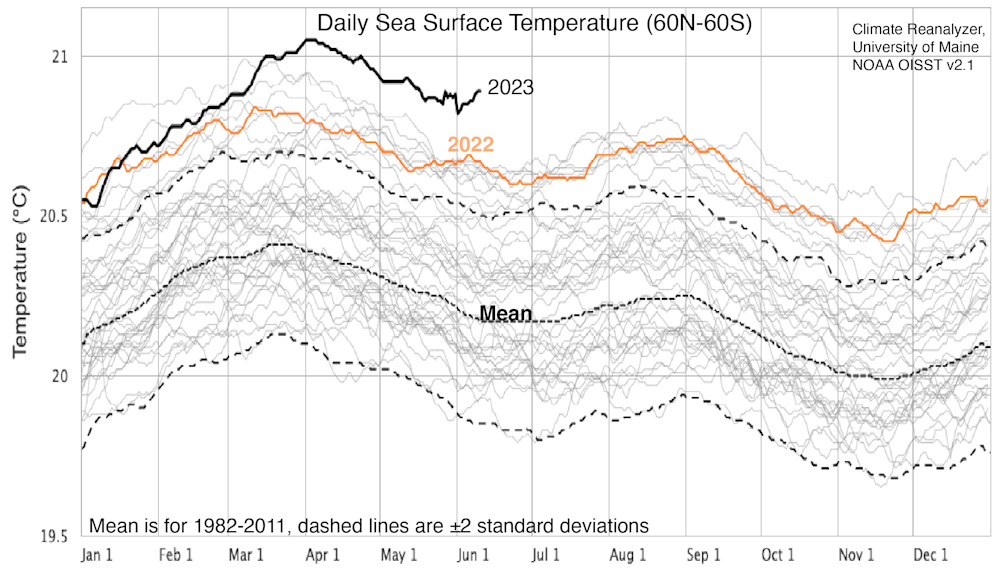
Moreover, it was overdue. When La Niña finally gave up the ghost in March this year, global sea surface temperatures were suddenly the highest on record (Figure 1 below), as the tropical Pacific abruptly began to warm.

Figure 1. Global mean sea surface temperatures (with other calendar years in grey), showing 2023’s record highs.
University of Maine, Author provided

Meanwhile, record high sea surface temperatures in the extratropical North and South Pacific were partly a signature from La Niña and partly a sign of global warming. The resulting “atmospheric rivers” delivered torrential rains to California in the north and New Zealand in the south.

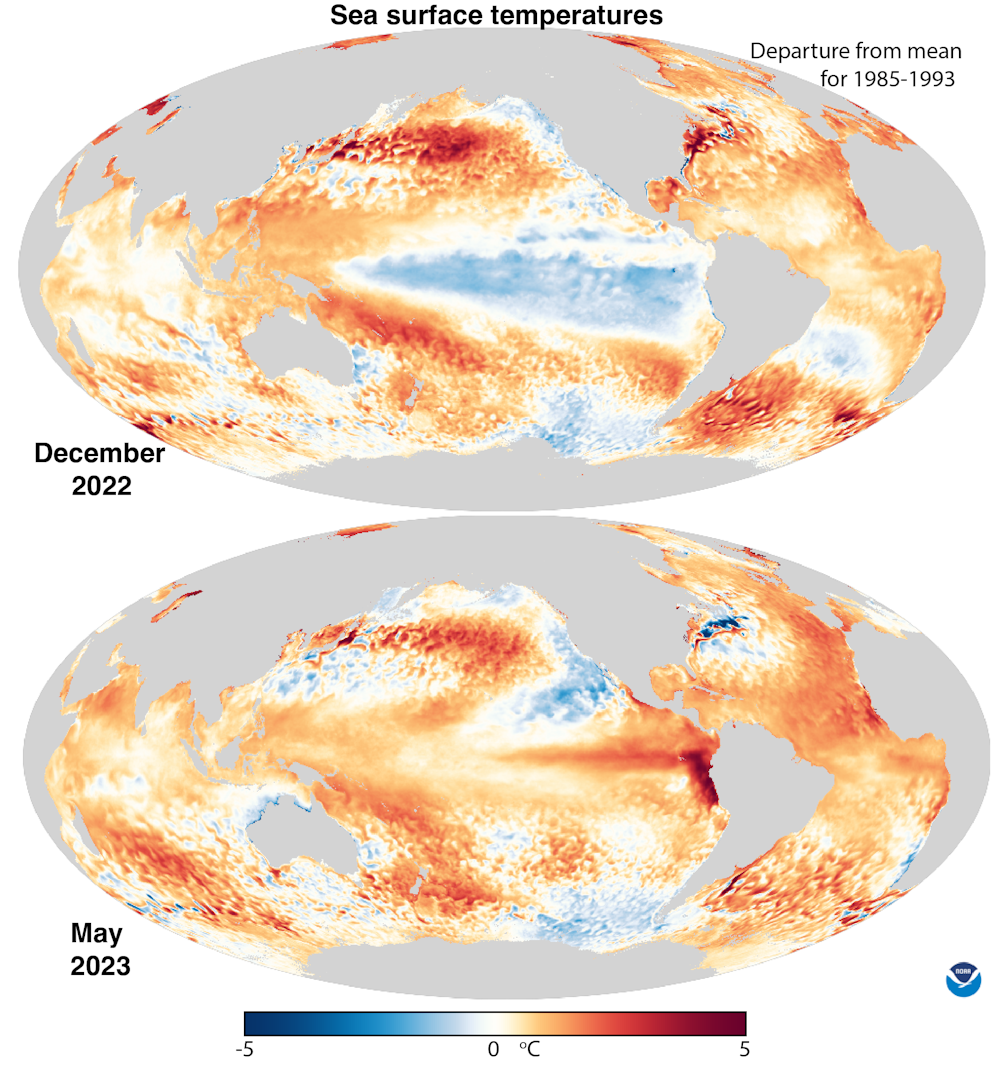
These sea surface temperature changes can be readily seen by comparing variations from mean temperatures for December 2022 versus May 2023 (Figure 2 below). We can see a startling transformation throughout the central tropical Pacific, with a coastal El Niño off Peru and Ecuador strongly evident.

Modest cooling in the eastern North Pacific is associated with the train of storms that barrelled into the West Coast of the US and in northwest Australia from Cyclone Ilsa.

Fig 2. Sea surface temperature changes (measured by departure from the mean), comparing December 2022 and May 2023.
National Oceanic and Atmospheric Administration, Author provided

El Niño and New Zealand

The weather in the tropics is seldom average, however. It tends to fluctuate more like a roller coaster. In the atmosphere, this is referred to as the Southern Oscillation. The combined atmosphere and ocean phenomenon is often referred to as the El Niño-Southern Oscillation (ENSO).

The bottom of the roller coaster is the cold phase: a basin-wide cooling of the tropical Pacific, named La Niña, while the top of the roller coaster is El Niño, which occurs every three to seven years or so. The most intense phase of each event typically lasts half a year.

But El Niños can be very strong, and hence highly anomalous. La Niñas, by comparison, are usually moderate in strength and occur more often.

El Niños tend to peak in December, although their biggest atmospheric impacts may not be until February. The last major El Niño was in 2016-17, while a weak El Niño occurred in 2019-20.


Read more:
El Niño is back – that’s good news or bad news, depending on where you live


Coupled oceans and atmosphere

In the tropical Pacific Ocean, the atmosphere and ocean are strongly coupled. Surface winds drive surface ocean currents, and largely determine the sea surface temperature distribution, the differential sea levels, and the heat content of the upper ocean. In turn, the sea surface temperatures determine the winds.

Cool waters limit atmospheric convection and storm activity, while high sea surface temperatures attract convection, clusters of thunderstorms, and tropical cyclones (off the equator, where Earth’s rotation comes into play).

Heat that was stored up in the tropical western Pacific during La Niña is moved around and into the atmosphere during El Niño, mainly through evaporation. This cools the ocean and moistens the atmosphere.


Read more:
2023 hurricane forecast: Get ready for a busy Pacific storm season, quieter Atlantic than recent years thanks to El Niño


This alters where the main rainfall occurs. In turn, it changes the latent heating of the atmosphere that sets up “teleconnections” (links between weather phenomena in different parts of the globe) and major changes in the jet streams and extratropical storm tracks in both hemispheres – including across New Zealand, especially in winter.

Because most action occurs over the tropical Pacific Ocean, more settled weather and dry spells often occur over land.

The warmest years in terms of global mean surface temperature are the latter stages of El Niño events. 2016 is the world’s warmest year on record, in part because of the very strong El Niño event. But 2023 could beat that record – and odds are that 2024 will beat it by a lot.

So far, there is little evidence that climate change has altered ENSO events themselves. But all impacts of El Niño are exacerbated by global warming, including extremes of the hydrological cycle involving floods and droughts, which are already common with ENSO.

Impacts of El Niño

Of course, major events related to El Niño have serious social and economic impacts, too. Droughts, floods, heatwaves and other changes can severely disrupt agriculture, fisheries, health, energy demand and air quality (mainly from wildfires).

Research shows El Niño “persistently reduces country-level economic growth”, with damage now estimated in the trillions of US dollars.

Globally, El Niño is the largest cause of droughts; they are more intense, set in quicker and increase the risk of wildfires, especially in Australia, Indonesia and Brazil. In the weak 2019-20 El Niño, smoke from fires in eastern Australia affected the southern hemisphere to the extent that it blocked the sun and may have exacerbated the subsequent La Niña conditions.

Meanwhile, torrential rains are heavier, with greater risk of flooding, especially in Peru and Ecuador. Very wet conditions can also (though not always) occur in California and the southeast US.


Read more:
New study helps solve a 30-year-old puzzle: how is climate change affecting El Niño and La Niña?


Another ‘super’ El Niño?

New Zealand had its highest annual mean surface temperature on record in 2022. In the past year the preponderance of northeasterlies due to La Niña has seen an unprecedented number of tropical and subtropical storms bombarding the country.

The record rain event in Auckland on January 27, and Cyclone Gabrielle just three weeks later, were just two among many such events.

By contrast, New Zealand tends to experience stronger and more frequent winds from the southwest in winter and from the west in summer during El Niño. This can encourage dryness in eastern areas and more rain on the West Coast, with generally cooler conditions overall.

But El Niño varies, and there have been three “super” El Niños: 1982-83, 1997-98 and 2015-16. It remains to be seen whether the latest will join them. But together with the augmenting effects of global warming, any El Niño can be very disruptive. We need to be vigilant.

The Conversation

Kevin Trenberth does not work for, consult, own shares in or receive funding from any company or organisation that would benefit from this article, and has disclosed no relevant affiliations beyond their academic appointment.

ref. El Niño combined with global warming means big changes for New Zealand’s weather – https://theconversation.com/el-nino-combined-with-global-warming-means-big-changes-for-new-zealands-weather-207493

Do you need to wash rice before cooking? Here’s the science

Source: The Conversation (Au and NZ) – By Evangeline Mantzioris, Program Director of Nutrition and Food Sciences, Accredited Practising Dietitian, University of South Australia

Shutterstock

Rice is a staple food for billions of people in Asia and Africa. It’s also a versatile ingredient for many iconic dishes from around the world, including dolmades from Greece, risottos from Italy, paella from Spain and rice puddings from the United Kingdom.

Despite its universal appeal, the question asked in every kitchen, be it a professional one or your own home, is whether you should pre-wash (or rinse) your rice before cooking.

What do chefs and cooks say?

Culinary experts claim pre-washing rice reduces the amount of starch coming from the rice grains. You can see this in the cloudy rinse water, which studies have shown to be the free starch (amylose) on the surface of the rice grain produced by the milling process.

In culinary circles, washing is advocated for some dishes when a separated grain is sought after. Yet for other dishes such as risottos, paella and rice puddings (where you need a sticky, creamy effect), washing is avoided.

Other factors, such as the type of rice, family tradition, local health warnings and even the perceived time and effort required will influence whether people pre-wash their rice.

Close-up of a golden mushroom risotto with flakes of parmesan on top
For risotto, traditionally cooked with arborio rice, rinsing the rice is not recommended, to help enhance the creamy texture of the dish.
Shutterstock

Is there evidence that washing rice makes it less sticky?

A recent study compared the effect of washing on the stickiness and hardness of three different types of rice from the same supplier. The three types were glutinous rice, medium grain rice and jasmine rice. These different rices were either not washed at all, washed three times with water, or washed ten times with water.

Contrary to what chefs will tell you, this study showed the washing process had no effect on the stickiness (or hardness) of the rice.

Instead, the researchers demonstrated the stickiness was not due to the surface starch (amylose), but rather a different starch called amylopectin that is leached out of the rice grain during the cooking process. The amount leached differed between the types of rice grains.

So, it’s the variety of rice – rather than washing – that’s critical to the stickiness. In this study, glutinous rice was the stickiest, while medium grain rice and jasmine rice were less sticky, and also harder as tested in the laboratory. (Hardness is representative of the textures associated with biting and chewing.)

Close-up of a fried rice dish with chicken, vegetables and a sunny side egg on top
Fried rice dishes, such as nasi goreng, tend to use less sticky varieties of rice, leading to a more fluffy texture.
Shutterstock

You may still want to wash your rice, though

Traditionally rice was washed to rinse off dust, insects, little stones and bits of husk left from the rice hulling process. This may still be important for some regions of the world where the processing is not as meticulous, and may provide peace of mind for others.

More recently, with the heavy use of plastics in the food supply chain, microplastics have been found in our foods, including rice. The washing process has been shown to rinse up to 20% of the plastics from uncooked rice.

This same study found that irrespective of the packaging (plastic or paper bags) you buy rice in, it contains the same level of microplastics. The researchers also showed plastics in (pre-cooked) instant rice have been found to be fourfold higher than in uncooked rice. If you pre-rinse instant rice, you could reduce plastics by 40%.


Read more:
You’re eating microplastics in ways you don’t even realise


Rice is also known to contain relatively high levels of arsenic, due to the crop absorbing more arsenic as it grows. Washing rice has been shown to remove about 90% of bio-accessible arsenic, but it also rinses out a large amount of other nutrients important for our health, including copper, iron, zinc and vanadium.

For some people, rice offers a small percentage of their daily intake of these nutrients and hence will have a small impact on their health. But for populations that consume large amounts of heavily washed rice daily, it could impact their overall nutrition.

Another study looked at other heavy metals, lead and cadmium, in addition to arsenic; it found that pre-washing decreased levels of all these from between 7–20%. The World Health Organization has warned of the risk of arsenic exposure from water and food.

Arsenic levels in rice vary depending on where it’s grown, the cultivars of rice and the ways it is cooked. The best advice remains to pre-wash your rice and ensure you consume a variety of grains. The most recent study in 2005 found that the highest level of arsenic was in the United States. However it is important to keep in mind that arsenic is present in other foods including products made from rice (cakes, crackers, biscuits and cereals), seaweed, seafood and vegetables.


Read more:
High levels of cancer-causing arsenic in rice – so why isn’t it regulated in our food?


Can washing rice prevent bacteria?

In short, no. Washing rice will have no effect on the bacterial content of the cooked rice, as high cooking temperatures will kill all bacteria present.

What is more concerning is how long you store cooked rice or washed rice at room temperature. Cooking rice does not kill the bacterial spores from a pathogen called Bacillus cereus.

If wet rice or cooked rice is kept at room temperature, this can activate the bacterial spores and they begin to grow. These bacteria then produce toxins which can not be deactivated by cooking or re-heating; these toxins can cause severe gastrointestinal disease. So, make sure you avoid keeping washed or cooked rice at room temperature for too long.

The Conversation

Evangeline Mantzioris is affiliated with Alliance for Research in Nutrition, Exercise and Activity (ARENA) at the University of South Australia. Evangeline Mantzioris has received funding from the National Health and Medical Research Council, and has been appointed to the National Health and Medical Research Council Dietary Guideline Expert Committee.

ref. Do you need to wash rice before cooking? Here’s the science – https://theconversation.com/do-you-need-to-wash-rice-before-cooking-heres-the-science-204692

A silver lining from the pandemic: how lockdowns helped kids learn the languages their parents speak

Source: The Conversation (Au and NZ) – By Liquan Liu, Senior lecturer, Western Sydney University

Shutterstock

None of us is a stranger to the downsides of the pandemic. For families with kids, kindergartens and schools closed during the lockdown, and parents had to manage schooling and working from home.

Yet there is a silver lining: our research shows that, in families where a parent’s mother tongue is not the language spoken in wider society, children learned more about that language during lockdowns.

Let’s call the language these parents speak the “home language” and the language society uses the “societal language”. Take me as an example: at home I speak Shanghainese with my mum, Mandarin with dad, and Telepath with my cat. But in the community and at work, I speak English, the societal language.

To many multilingual families, our kids’ home language often comes second to the societal language, which dominates their language development as they grow up. When parents witness this transition, they fear their children will gradually lose the ability to use the language they speak. They fear that, as a consequence, their children will lose touch with their roots.

Along with my colleagues, Elisabet García González and Elizabeth Lanza, we conducted a survey of around 200 multilingual families in Norway (to be published in the journal Multilingua). Parents expressed their concerns about their children’s development of home and societal languages. For example, one said:

Since our daughter mostly speaks [home language] with her father and [societal language] with me and at kindergarten (although her father and I exclusively speak [home language] to each other), her [home language] is generally less advanced than her [societal language] […]

Multilingual children rarely use all their languages in the same contexts or with the same frequency. This is often perceived as being more or less “advanced” in one language than the other, but in reality multilingual speakers use their languages as best fits their needs.

Despite these concerns, there was a silver lining. Our study found children’s home language literacy improved during the pandemic. The parents who reported the concern above later said:

We’ve clearly noticed that her spoken [home language] has developed during the lockdown.

Another family told us:

With the two-year-old, I noticed an improvement in her [home language] vocabulary while kindergarten was closed.

What is the reason for this improvement in the home language? As one family shared:

My children started to be interested and speak more [home language] during the lockdown. Assume this is a result of (us) working from home for an international company and them hearing mum use this (home) language.

Another said:

My kids have started using more [home language] in their [societal language] speech with parents and each other during the lockdown, because they are watching more YouTube and playing Minecraft, Animal Crossing and Zelda. Words from the games are difficult to translate into [societal language].

Our statistical analyses had something even more interesting to say: the improvement of a child’s home language made their parents feel more positive about their children being multilingual. Parents see it as a source of wellbeing, especially when they notice their child is picking up their mother tongue. Overall, family relationships, resilience, cultural connection and hope are boosted even in the darkest days of the pandemic.

Is this at the expense of the societal language, one may ask? Indeed, some parents were worried about the development of kids’ societal language, especially when it was not spoken at home. Others said the societal language was still being used during the lockdown, such as in online media. One parent said:

My son is a bit behind the level of the class. He really improved his [societal language] reading during the lockdown, since we had more time to individually support him in a positive way. Before, he was much more negative.

Another family told us:

The difference (in language use) was noticeable when the kindergarten reopened. [Societal language] came back for the kids as easily as restarting to ride a bike.

The societal language is often strong in young children – sometimes so strong that it can bully the home language into a corner. The key task for many multilingual families is not so much to find a balance between the two languages, but to make sure the home language is being actively used and not being overshadowed by the societal language.

Unity is important in society. Being able to speak a common language is important, but equity and diversity are important too. The ability to speak one’s mother tongue can become a source of belonging and wellbeing.

In addition, children growing up in a culturally and linguistically diverse environment tend to be more flexible. Their neurocognitive plasticity shines across developmental domains, from language learning to music perception.

So the pandemic lockdowns were bad, but not all bad. Our kids adapt and adjust to the new environment, and can surprise us with stronger skills that make mum and dad proud.

The Conversation

Liquan Liu receives funding from uropean Union’s Horizon 2020 research and innovation programme under the Marie Skłodowska-Curie grant agreement No. 798658 hosted by Center for Multilingualism across the Lifespan at the University of Oslo, financed by Research Council of Norway through its Centers of Excellence funding scheme grant agreement No. 223265; and from Western Sydney University School of Psychology 20820 83181.

The corresponding academic publication will be published on journal Multilingua. DOI details to be added. Co-authors are Elisabet Garcia Gonzalez and Elizabeth Lanza.

ref. A silver lining from the pandemic: how lockdowns helped kids learn the languages their parents speak – https://theconversation.com/a-silver-lining-from-the-pandemic-how-lockdowns-helped-kids-learn-the-languages-their-parents-speak-205012

We’re in another COVID wave. But it’s not like the others

Source: The Conversation (Au and NZ) – By James Wood, Professor, epidemiological modelling of infectious diseases, UNSW Sydney

Shutterstock

Each Omicron wave so far in Australia has had distinguishing features – the sharp rise and fall of BA.1, the widespread transmission among children and families in BA.2, a shift to more infections in older people with BA.5, then the confusing variant mix in the summer wave of 2022-23.

Now Australia is in its fifth Omicron wave, which has been brewing since February. But it has grown so slowly that many people may have not realised it until recent months.

Why has this most recent wave been so drawn out? And what has its real impact been on our health and health systems?

Australia’s COVID cases and seven-day rolling average, showing how the latest wave is long and drawn out.
health.gov.au

Slower spread, less testing

With most people in Australia now having been vaccinated against COVID, infected or both, we expect the virus to spread more slowly through the population.

This means the overall number of infections in the current wave should be fewer than in previous ones. Infections should also occur over a longer period of time.

But we also know people are mixing and socialising more than in previous waves. So it is easier for viruses such as SARS-CoV-2 (the virus that causes COVID) to be transmitted.

While these two factors counter each other, overall we expect to see reduced health impacts compared with previous waves.

Ambulance driving on tram tracks through Melbourne CBD, trams in background
We expect fewer people with COVID going to hospital at this stage of the pandemic.
etsir/Shutterstock

We are already seeing fewer people with confirmed infections and fewer people who are unwell requiring hospitalisation.

We also know from weekly surveys that people are less likely to test for COVID and report their results at this stage of the pandemic. So reported cases are now a smaller fraction of all infections than in previous waves.


Read more:
Flu or COVID? You can now test for both at home with a single swab. Here’s what you need to know


New sub-variants are likely the cause

The slow and drawn out nature of the current wave is most likely due to the sequential emergence and spread of new Omicron sub-variants. The current wave started with XBB.1.5, then shifted to XBB.1.9.1 and XBB.1.9.2, then most recently XBB.1.16.

Each sub-variant has been able to spread where the previous one could not. But the competitive advantage of each has been minor. So we have only seen a progressive increase in infections as new sub-variants emerge, rather than the dramatic surges in infections and health impacts associated with previous variants.

Are we at the peak of the current wave?

There is some debate about whether New South Wales has reached the peak of its wave. However, forecasts for most other jurisdictions suggest declines have begun or are imminent.

But as always, there is uncertainty in how the wave will develop, and we cannot exclude the possibility of sustained epidemic activity over a longer period.

Hospitalisations for those infected with COVID may stay elevated for a while longer. This is due both to the lag between infection and hospitalisation and we are seeing a shift in infections to older people as the wave progresses.

Thankfully, we do not expect the health system to come under the pressure from COVID seen during the BA.5 wave in winter 2022. This is good news.

However, for the first time in Australia, the SARS-CoV-2 wave may coincide almost completely with influenza and RSV (respiratory syncytial virus) waves. This certainly appears likely in NSW. The combined impact of these three viruses may be significant.

Looking ahead, this combined threat will need careful attention. Surveillance systems need to be (re-)designed to detect, anticipate and forecast the combined burden of acute viral respiratory infections.

We expect COVID to contribute to the increased burden of seasonal respiratory diseases over the next few years, and perhaps well beyond.


Read more:
I need a flu shot and a COVID booster. Can I get them at the same time?


How about future waves?

Future COVID waves are likely to become much more predictable, and coincide with winter. While this is somewhat speculative, it is consistent with how other respiratory viruses behave.

What might this look like? In the United Kingdom all COVID indicators have seen a major decline after winter. We see similar patterns in other temperate northern hemisphere countries, such as the United States.

Although there are other contenders, internationally, it is likely that the next wave of COVID will also be caused by a sub-variant of XBB.

Without a clear successor to XBB.1.16 identified at present, a new wave will likely only form as genetic mutations accumulate during the next northern winter.

During that time (our Australian summer) people will travel between Australia and the northern hemisphere, re-importing these newer variants into Australia. As conditions in Australia change (next autumn) and the risk of transmission increases, a new wave may develop, peaking in the winter of 2024.

Alpha, Delta, Omicron waves

Of course, we have seen COVID behave very differently to this over the past three years. The Alpha, Delta and then Omicron variants appeared and spread across the globe causing large and often devastating waves.

But they occurred at a fundamentally different period of the pandemic, where small changes in the virus had dramatic consequences for transmission and our health.

Recent changes to the virus have provided far less advantage, suggesting such transformative events are now far less likely.

Still, we should maintain sufficient surveillance to keep an eye on emerging sub-variants (genomics), case numbers and hospitalisations – all essential if we are to protect our health and wellbeing.

The Conversation

James Wood receives funding from NSW Health and the National Health and Medical Research Council for projects on COVID-19. He has previously received funding from the federal government as part of COVID responses in 2020-21 and from WHO Western Pacific Regional Office in 2020. He is a current member of the Australian Technical Advisory Committee on Immunisation.

Freya Shearer receives funding from the National Health and Medical Research Council, the Australian Government Departments of Health and Foreign Affairs and Trade, and NSW Health.

James McCaw receives funding from the Australian Government Departments of Health and Foreign Affairs and Trade, the Australian Research Council and the National Health and Medical Research Council. He is an invited expert member of the Communicable Disease Network of Australia and between January 2020 and May 2022 was an invited expert member of the Australian Health Protection Principal Committee.

ref. We’re in another COVID wave. But it’s not like the others – https://theconversation.com/were-in-another-covid-wave-but-its-not-like-the-others-206493

The case for compost: why recycling food waste is so much better than sending it to landfill

Source: The Conversation (Au and NZ) – By Susanne Schmidt, Professor – School of Agriculture and Food Science, The University of Queensland

New Africa, Shutterstock

Most food and garden waste in Australia comes from homes. Australian households waste 3.1 million tonnes of food each year. That’s more than five kilograms each household per week.

Over half of all household waste is food organics and garden organics, also known as “FOGO”. These scraps and clippings take up space in landfill and, when they rot, emit dangerous greenhouse gases.

The federal government’s National Waste Policy Action Plan aims to increase the organic waste recycling rate from 47% to 80% by 2030 and halve the amount sent to landfill. This won’t happen on its own – we need investment and action.

Food and garden waste can be captured and turned into compost. Composting is no longer just the domain of the home gardener or eco-warrior. It’s happening at commercial scale, through services such as council collection from homes.

A federal government fund is building new composting facilities and supporting other food and garden organics recycling projects. The South Australian government has invested in council trials of weekly green bin collection and fortnightly rubbish collection.

But more must be done. Recycling food waste into high-quality compost is a win-win solution, for people and the planet. Here, we explain why.

Scrap Together is a community education program from EPA NSW helping councils harvest FOGO.


Read more:
Despite government delays, food waste recycling bins are coming to your kitchen sooner than you think


Compost is a winner for the climate

When food rots in landfill, in the absence of oxygen, the process releases a potent greenhouse gas called methane.

Composting is different because the microbes can breathe. In the presence of oxygen, they transform waste into valuable organic matter without producing methane. They recycle organic carbon and nutrients into compost, which can be used to improve soil health and productivity.

This process also captures and stores carbon in the soil, rather than releasing it as carbon dioxide (CO₂) to the atmosphere.

In Australia, organics recycling (including food and garden organics, biosolids and tree wastes) saves an estimated 3.8 million tonnes of CO₂ from entering the atmosphere each year. That’s equivalent to planting 5.7 million trees or taking 877,000 cars off the road.

Soils can profit from compost because globally an estimated 116 billion tonnes of organic carbon has been lost from agricultural soils. This has contributed to rising CO₂ levels in the atmosphere.

Promisingly, compost can restore soil organic carbon while also boosting health and fertility. Compost improves soil structure and water retention. It’s also a source of essential nutrients that reduces the demand for costly fertilisers.

The opportunity presented by soils to draw down atmospheric CO₂ levels was brought to global awareness in the 2015 global Paris Agreement, via the “4-per-mille” initiative.

Translated from French, it means increasing the organic carbon stored in global soils by 0.04% each year (4 per 1000) would neutralise increases in atmospheric CO₂. In other words, CO₂ would remain constant rather than continue to increase. That would make a substantial contribution to mitigating climate change.

Introducing the international “4 per 1000” Initiative.


Read more:
Soil carbon is a valuable resource, but all soil carbon is not created equal


Farming with precision

Our research has investigated how compost can benefit global agriculture.

We found that in most cases where compost is applied as a generic product to agricultural land, the benefits are not fully realised. But if suitable composts and application methods were aligned with target crops and growth environments, crop yields can be increased and organic carbon in soils replenished.

We call this a “precision compost strategy”. Using a data-driven approach, we estimate global application of this strategy has potential to increase the production of major cereal crops by 96.3 million tonnes annually. This is 4% of current global production and twice Australia’s annual cereal harvest.

Of great relevance for Australia’s farms, precision compost has the strongest effects in dry and warm climates, boosting yield by up to 40%. We now need to develop this strategy for the specific needs of farms.

Compost has the potential to restore 19.5 billion tonnes carbon in cropland topsoil, equivalent to 26.5% of current topsoil soil organic carbon stocks in the top 20 cm.

Give FOGO a go-go

The rate of food and garden waste in Australia is growing at a rate six times faster than Australia’s population and 2.5 times faster than GDP.

But less than a third of Australian households have access to food waste collection services. A national rollout has been pushed back from 2023 to the end of this decade so there is time to overcome some roadblocks. This includes uptake by community and high quality composting.

This waste stream offers a huge opportunity for landfill diversion and compost production. The cost benefit alone is compelling: councils can save up to A$4.2 million a year on landfill levies by diverting 30,000 tonnes of waste (based on A$74 to 140 per tonne of waste, with levies increasing).

Preventing food in the home from being wasted should be top priority. But for unavoidable food waste, turning it into high-quality compost makes perfect sense.


Read more:
What can go in the compost bin? Tips to help your garden and keep away the pests


us

The Conversation

Susanne Schmidt receives funding from Fight Food Waste CRC.

Nicole Robinson receives funding from Fight Food Waste CRC.

ref. The case for compost: why recycling food waste is so much better than sending it to landfill – https://theconversation.com/the-case-for-compost-why-recycling-food-waste-is-so-much-better-than-sending-it-to-landfill-205583

How should we teach climate change in schools? It starts with ‘turbo charging’ teacher education

Source: The Conversation (Au and NZ) – By Russell Tytler, Professor of science education, Deakin University

Bianca De Marchi/AAP

The case for action on climate change no longer needs to be laid out.

We see, almost daily, disturbing images of bushfires, floods or a mass extinction crisis. But however widespread that sense of urgency may be, we are struggling as a nation to respond in a substantive, coordinated way.

One thing is clear: these responses will need to be sustained and developed by future generations. Education is crucial for the workforce needed now and for young people who will be increasingly faced with the accelerating realities of climate change.

The Academy of the Social Sciences in Australia has done a review of research on climate change education in schools around the world.

Here we outline three areas needing urgent attention: the emotional and psychological effects of learning about climate change, the school curriculum and the education of teachers.

The emotional side of learning about climate

Teaching climate change in schools raises basic and potentially divisive questions about the purpose of education and the nature of childhood. We are supposed to teach children about their world. But what if in doing so, we scare them with facts about climate change?

We also know children are worried about climate change anyway. Many children and teenagers are stressed and anxious due to their growing awareness of climate change.

An increasing body of research is identifying approaches to teaching and learning about climate change that address students’ understanding in this complex area and engages them with positive actions.

This includes making climate change personally relevant, interacting with scientists to experience scientific practices and designing projects to address an aspect of climate change.


Read more:
Ignoring young people’s climate change fears is a recipe for anxiety


Climate change is (almost) missing from the curriculum

In 1975, UNESCO’s Belgrade charter on environmental education bluntly said the “youth of the world” needed a “new kind of education” if we were to avoid politically and economically short-sighted responses to environmental crises.

To date, environmental sustainability has not had a specific home in the Australian curriculum. It has been taught across various different subjects such as geography and science, or art, according to school and teacher priorities.

Our review found schools seem almost perfectly evolved to avoid, let alone prioritise, an educational area that relies on cross-curriculum activity.

The most recent update to the curriculum (agreed) under the former Morrison government in April 2022 included a more substantial focus on climate change at Years 9 and 10 in geography and science. But it ignores other foundational year levels in these subjects, and other potentially powerful parts of the syllabus, such as English and the arts.

Students need to receive a nuanced education, to understand the attitudes, motivations, and technologies that will address climate change. They need knowledge, but also the intent and skill to apply that knowledge faithfully and responsibly.

Student agency in confronting climate change is also becoming a key feature within international education circles. Australia participates in three main international tests, one of which is the Programme for International Student Assessment (PISA).

The next PISA test in 2025 will measure

the degree to which 15-year-olds are knowledgeable of, concerned about, and able to act on environmental issues as a result of their science education.

So teacher education is key

So we need teachers to adapt their teaching. And the urgency lies now in developing their confidence, knowledge and supports to do this.

Our review found teachers around the world don’t always have the knowledge and training they need to tackle climate change in their classrooms. For example, one 2016 study found US science teachers had an “insufficient grasp” of climate science. A study of Australian education degree students came to a similar conclusion, despite their favourable attitude to environmental education.

This is understandable. Knowledge about the scale and nature of this complex problem has expanded so rapidly that whatever a new national curriculum may mandate, it is unrealistic to expect teachers (and teacher educators) to have naturally kept up.

Our review argues we need to “turbo charge” teacher education in universities and professional development programs in schools to develop a culture around climate change education. We need a national initiative to support teachers across all year levels in their knowledge of climate change and how to meaningfully engage students.

This needs to cover the interconnected issues of climate change, environmental destruction, social justice and Indigenous knowledges. We also need to be able to counter misinformation.

The scale of government decision-making around climate change mitigation, energy policy, and environmental reconstruction is huge. But as part of this, school education, and teacher education, need to be high on the agenda.


Read more:
Dumbed-down curriculum means primary students will learn less about the world and nothing about climate


The Conversation

Russell Tytler receives funding from the Australian Research Council. He is a Fellow of the Academy of Social Sciences in Australia and a member of the Climate Change Education committee.

Peter Freebody is a Fellow of the Academy of the Social Sciences in Australia. Up to 2013 he received numerous research grants from the ARC to study various aspects of the teaching and learning of literacy.

ref. How should we teach climate change in schools? It starts with ‘turbo charging’ teacher education – https://theconversation.com/how-should-we-teach-climate-change-in-schools-it-starts-with-turbo-charging-teacher-education-207221

How Jurassic Park changed film-making and our view of dinosaurs

Source: The Conversation (Au and NZ) – By Travis Holland, Senior Lecturer in Communication, Charles Sturt University

IMDB

In June 1993, director Steven Spielberg released a film that unleashed a wave of technological change in film-making and simultaneously helped to revive popular interest in dinosaurs.

Jurassic Park, based on Michael Crichton’s novel, spawned five blockbuster sequels as well as a multitude of spin-off games, toys, novels, and multiple animated television shows. It features a theme park housing de-extincted dinosaurs that break out of their confines and cause havoc.

Underpinning the plot is clever genetic engineering that has allowed the Park’s scientists to assume they could control all aspects of the dinosaurs’ development, including their sex, much to their later horror when it becomes apparent such control was never possible.

The film franchise has taken an average of over $1 billion dollars at the box office, according to Variety.

From puppets to CGI

According to industry legend and multiple documentaries, Spielberg had planned to use only practical effects, including stop-motion Velociraptors and an animatronic Tyrannosaurus Rex. However, well into the filming schedule, he was convinced to also include wholly digital dinosaurs after viewing test footage produced by staff at special effects house Industrial Light & Magic.

In a critical history of Industrial Light & Magic, Julie Turnock observes that the film “relied on a canny mix of large-scale mechanical effects cut together with a few digitally generated shots”. After its success, ILM embraced digital composition technology more fully and integrated it into many later films.

As it stands, Jurassic Park features about 50 shots of digital-only prehistoric creatures, including the first full-body scene of a dinosaur – the sauropod Brachiosaurus – flocking Gallimumus, and the T. rex chasing a Jeep.

Industrial Light & Magic now claims on their website that “Suddenly, directors could imagine making films in which realistic animals, fantasy creatures, even digital people could perform without restraint.”

Nowadays, films and television productions are replete with photoreal computer-generated animals and people and the next revolution in screen production has them projected live behind actors on a series of large screens known as “the volume”.

Palaeontologists aren’t extinct

Shortly after seeing their first dinosaur, on-screen palaeontologist Alan Grant (Sam Neill) suggests to his palaeobotanist partner Ellie Sattler (Laura Dern) that the de-extinction success of Jurassic Park might make their profession redundant. Their colleague Ian Malcolm (Jeff Goldblum) responds, “Don’t you mean extinct?”

But far from extinction, palaeontology and associated sciences have seen an extensive rebound in public interest in the thirty years since Jurassic Park was released.

In 1975, palaeontologist Robert Bakker popularised the term “dinosaur renaissance” to describe a spate of developing research findings which argued the creatures were endothermic (warm-blooded), active, and related to the birds rather than cold-blooded, slow and wholly extinct as had been the public perception for much of the previous century. This renaissance lasted from about the 1960s into the 1980s and Jurassic Park reflected many of these new orthodoxies.

Bakker himself consulted for the film and was referenced by the character Tim Murphy. A Bakker lookalike also appeared in the sequel The Lost World, further reinforcing its role in reflecting these new perspectives.

But the film also arrived at the dawn of yet another new age of dinosaur discoveries which Steve Brusatte, in his 2018 book The Rise and Fall of the Dinosaurs, described as “the golden age of discovery”. Brusatte referred to the cohort of scientists making these newer discoveries as “men and women from many backgrounds who came of age in the era of Jurassic Park.” Among their findings are new understandings that many dinosaurs were feathered like their modern avian cousins.

Elizabeth Jones recently chronicled the history of the field of “ancient DNA” science, noting the “Jurassic Park effect” playing out on this fascinating area of research:

Even as scientists rejected the conclusions or the implications of the Jurassic Park narrative, they drew on the popularity of the book and movie to emphasise the importance of the technical enterprise in which they were engaged.

And a recent review of the last 60 years of dinosaur research by celebrated palaeontologist Philip J. Currie suggested “public interest continues to be stimulated by a multibillion-dollar movie, media, and toy industry founded on our interest in dinosaurs.”

A scene from Jurassic Park (1993)
IMDB

The Jurassic Park legacy

Dinosaurs have long featured in popular media such as films and television. The first animated dinosaur, Gertie, debuted as part of a vaudeville performance in 1914. Dinosaurs, including a fearsome Tyrannosaurus featured in Disney’s groundbreaking and famed 1940 film Fantasia. But it was Jurassic Park which truly presented them as believable living creatures for the first time.

Though the science of the film has been widely criticised since its release, Jurassic Park succeeded in revolutionising film-making and reigniting a public fascination with dinosaurs even as palaeontology itself underwent a boom in new research efforts. In his recent memoir, actor Sam Neill described the film’s visuals as “a perfect collision of coming-of-age computer generated imagery… with state of the art puppetry”.

The sequels sequels and spin-offs have continued to adapt to changing social expectations, featuring strong female and queer characters, and even feathered dinosaurs in response to changing scientific understandings.

Perhaps the next Jurassic film will feature a full-lipped Tyrannosaurus?

The Conversation

Travis Holland does not work for, consult, own shares in or receive funding from any company or organisation that would benefit from this article, and has disclosed no relevant affiliations beyond their academic appointment.

ref. How Jurassic Park changed film-making and our view of dinosaurs – https://theconversation.com/how-jurassic-park-changed-film-making-and-our-view-of-dinosaurs-203147

O’Neill claims perjury charges over PNG’s UBS loan inquiry ‘political’

PNG Post-Courier

Former Papua New Guinea prime minister Peter O’Neill has been charged with three counts of giving false evidence in a national US$1.2 billion loan inquiry contrary to Section 10 of the Commission of Inquiry Act.

He met reporters outside Boroko Police Station in Port Moresby today stating “this is politically motivated”.

O’Neill, who is also Ialibu-Pangia MP, was at the station for police formalities to be completed in the charges against him.

Earlier, the PNG Post-Courier’s Todagia Kelola reported that O’Neill had been requested to front up at the National Fraud Squad office at Konedobu by today for questioning on allegations of perjury.

In a short media statement on Saturday, Police Commissioner David Manning requested O’Neill to make himself available for questioning on allegations of perjury emanating from the UBS Commission of Inquiry into a loan negotiated with the Union Bank of Switzerland by his government in 2014.

In response, O’Neill said in a statement titled “Is Manning Police Commissioner or Chief of PNG Intimidation?”: “Firstly, I am surprised but heartened the Police Commissioner is working late on a Saturday evening.”

“Violent crimes, kidnap for ransom, rape, and murders along with crippling corruption have been skyrocketing since his time in the high office of Police Commissioner.

‘Blatant intimidation’
“I am sure it is comforting to all Papua New Guineans to know the Commissioner is choosing to go after me late on a Saturday night in what appears to be blatant intimidation rather than focus on keeping the people of Papua New Guinea safe.”

Commissioner Manning in his statement said: “Based upon investigations into the UBS Commission of Inquiry report, we are satisfied that Mr Peter O’Neill gave false evidence whilst under oath.

“I am appealing to Mr O’Neill to cooperate and make himself available by Monday morning to Director Crimes, Chief Inspector Joel Simatab, at the National Police Headquarters in Konedobu,” Manning said.

Commissioner Manning said the ultimate objective of the Commission of Inquiry was to establish whether there were breaches of PNG laws and constitutional requirements in the negotiation and approval of the UBS loan, whether PNG as a country had suffered as a result of the deal, and whether people involved could be held accountable.

“After a thorough investi­gation and assessment of the facts, we are satisfied and have sufficient evidence that Mr O’Neill has perjured the inquiry — thereby committing an offence under the Commission of Inquiry Act of giving false evidence under oath,” Manning said.

O’Neill, in his statement in response said: “It is nearly 12 months since the internationally presided over UBS Commission of Inquiry ended with no findings against me, and now, late on a Saturday evening, I am instructed via a media statement by the Police Commissioner to attend questioning on the next day, a Sunday,” said O’Neill.

“It appears that before I am questioned, Commissioner of Police in his statement seems to be directing his investigating officers to arrest and charge me of a crime of perjury while under oath in the UBS Commission of Inquiry.”

Court opportunity welcomed
“I welcome the opportunity to face the courts to test a politically motivated and very expensive Commission of Inquiry.

“I have faith in the fairness of the courts but not in yet another Police Commissioner instructed investigation into me.

“The perjury claim that I have learned of in Mr Manning’s statement is false.

“I can only assume he is referring to the unsubstantiated claim given to the COI by a self-serving politician.

“I will attend at 10am on Monday the 12th June 2023 for questioning at Konedobu Police HQ.

“I assure all supporters that I remain steadfast and more committed than ever to Papua New Guinea and the foundations of democracy.

“These terrible times we are all experiencing are temporary.”

The UBS COI final report in its answer to the question, “Who was responsible and what remedies should be sought against them”, recommended that O’Neill should be prosecuted for giving false evidence to the Commission and referred to the Independent Commission Against Corruption (ICAC).

Todagia Kelola is a PNG Post-Courier reporter. Republished with permission.

Print Friendly, PDF & Email

Article by AsiaPacificReport.nz

View from The Hill: Brittany Higgins story continues its damaging trail, with no end in sight

Source: The Conversation (Au and NZ) – By Michelle Grattan, Professorial Fellow, University of Canberra

The Brittany Higgins saga has damaged almost everyone it has touched, or who’s touched it.

It will forever haunt Higgins, who alleged she was raped in 2019 in a minister’s office, and Bruce Lehrmann, who denied committing the alleged assault. An aborted trial has meant there is no legal judgement.

It helped destroy Scott Morrison. It deeply scarred Linda Reynolds, the minister in question, and had an impact on Fiona Brown, Reynolds’ staffer at the time who dealt with the matter.

In fresh rounds of this story that never goes away, more people are being dragged down, to greater or lesser degrees: the ACT Director of Public Prosecutions, police, some in the media. Now, Finance Minister Katy Gallagher is in the political frame.

After The Australian’s recent publication of texts between Higgins and her partner David Sharaz, exchanged in the run-up to the airing of Higgins’ 2021 interview with Ten’s Lisa Wilkinson, Gallagher faces allegations of misleading parliament.

In a testy exchange with Reynolds at a Senate estimates committee in 2021, Gallagher insisted she’d had no knowledge before the story broke.

Reynolds had claimed she’d been told by a Labor senator (who was the late Kimberley Kitching) “two weeks before about what you were intending to do with the story in my office”.

At the hearing Labor’s Senate leader Penny Wong immediately declared she’d had no knowledge, while Gallagher said categorically, “No one had any knowledge,” adding angrily, “how dare you!”

Reynolds subsequently said Gallagher and Wong later that day told her they’d had some prior indication but had nothing to do with the matter going public.

In the text exchange Sharaz, anxious to ensure the story would become an issue politically, flagged he’d shared information with Gallagher, whom he knew. He believed she would be useful in pursuing the matter when the Wilkinson interview was broadcast.

Gallagher at the weekend admitted she was told “there was going to be some public reporting that a young woman [was] making serious allegations about events that had occurred in a minister’s office”. Wong also qualified her position, saying she didn’t know “full details of the allegations before the story became public”.

The opposition is calling for Gallagher’s resignation or sacking, but that won’t be happening.

While her statement to the committee was misleading, Gallagher was not a minister. Indeed, even ministers do not fall on their sword these days for what was once considered the serious sin of misleading parliament. (In the 1980s, Hawke government minister John Brown did so, in the wake of an answer he gave to an opposition question.)

Precisely what Labor knew before the story broke remains unclear, as does precisely who in Labor knew about it. The Kitching leak indicated the senior Labor women in the Senate were aware – did they pass anything on?

But there was nothing improper about Gallagher receiving information – oppositions get alerts all the time. The issue was her denial at the Senate committee.

Labor will stare down the opposition’s attacks. It can counter by saying returning to the issue brings fresh trauma for Higgins, and the private text messages should never have been leaked (where they came from is unknown).

If it chooses, Labor can raise Brown’s weekend claims that, when the heat was on her over her handling of the Higgins matter, she received little support from Scott Morrison and his office (to which she’d returned by the time the story broke). Her weekend interview with The Australian carried the implication Morrison may have misled parliament when he told the House of Representatives he’d spoken with her about the matter (Brown said he hadn’t).

There’s unlikely to be much mileage for the opposition in the pursuit of Gallagher – although that’s not to say she doesn’t have questions to answer.

As Anthony Albanese has pointed out, the issue was about the former government, not the then opposition. For the Liberals to revisit it is to hark back to the Morrison days – bad territory for the Coalition.

Moreover, people have entrenched views about the Higgins matter and few opinions will shift.

Anyway, the public are now preoccupied with a range of bread-and-butter issues. They’re unlikely to focus on, or care about, the ins-and-outs of who in Labor knew what when.

But Reynolds cares a lot. All along she felt wrongly targeted, believing she behaved properly. Most recently, she was angered when not allowed into the mediation that saw Higgins receive a large sum of Commonwealth money. She wanted to mount her defence against the claims made about her and her office.

Reynolds intends to refer this payout to the National Anti-Corruption Commission, which commences operating on July 1.

Regardless of that, in the name of transparency, the government should provide the details of the payment.

Meanwhile, there’s a lot still to come in this story, even apart from what happens in defamation actions Lehrmann has launched. On the basis of the evidence we heard, the ACT inquiry into the conduct of criminal justice agencies in the case could be set to deliver a hefty load of brickbats in its report, due at the end of next month.

The Conversation

Michelle Grattan does not work for, consult, own shares in or receive funding from any company or organisation that would benefit from this article, and has disclosed no relevant affiliations beyond their academic appointment.

ref. View from The Hill: Brittany Higgins story continues its damaging trail, with no end in sight – https://theconversation.com/view-from-the-hill-brittany-higgins-story-continues-its-damaging-trail-with-no-end-in-sight-207500

Yes, federal charges against a former president are unprecedented – but so is Trump’s political power

Source: The Conversation (Au and NZ) – By Jared Mondschein, Director of Research, US Studies Centre, University of Sydney

George Walker IV/AP/AAP

Since Donald Trump announced his presidential candidacy eight years ago this week, few words have been more overused than “unprecedented”. It was unprecedented for a previously unelected politician who had never served a day in the US military or government to become president. It was also unprecedented for a US president to twice be impeached.

Yet again, there is no historical precedent for the fact that a former US president has been indicted by the federal government. Specifically, for 37 counts and seven separate charges concerning his handling of classified documents after he left the White House.

Compounding this challenge is the unmistakable political reality that the former president, who is currently the leading candidate to win back his old job, is facing the prospect that the US government, which is currently led by his chief political adversary, could imprison him.

From the allegations that the former president colluded with Russia, to Manhattan District Attorney Alvin Bragg’s charges over falsifying business records, even many critics of the former president would admit Trump has been unfairly targeted by political opponents.

The norm-shattering former president, they posit, led Trump’s political opponents to engage in reckless behaviour that also shattered norms.

But few, if any, critics of the former president have stepped forward to say that Special Counsel Jack Smith’s indictment is political in nature.

What are the charges?

As detailed in a 49-page indictment released late last week, the charges allege that the former president was fully aware of the laws about classified documents, as well as the fact that the documents he maintained at his residence were not declassified.

The prosecution’s evidence for this include his statements in the 2016 presidential campaign against Hillary Clinton, as well as a recording of a conversation he had at his residence that indicated that he knew some documents in his possession remained classified.

These documents, the indictment alleges, were not merely informal papers that were perhaps over-classified. Instead, they

included information regarding defense and weapons capabilities of both the United States and foreign countries; United States nuclear programs; potential vulnerabilities of the United States and its allies to military attack; and plans for a possible retaliation in response to a foreign attack.

According to former Trump administration Attorney-General Bill Barr, the accusation that these charges are evidence the Department of Justice has been weaponised for political purposes is “ridiculous”. On the contrary, Barr told Fox News that if even half of the “very detailed” and “very damning” indictment is true, then Trump “is toast”.

Mixing the political with the legal

Since becoming a public figure in the 1980’s, Trump has been unmatched in his ability to successfully navigate countless investigations and lawsuits, seemingly without ever paying significant political or legal costs.

While few legal scholars are as confident the former president will escape unscathed in this instance, that has not changed Trump’s political strategy. Indeed, the former president’s hiring of a new legal team may be indicative of a change in legal tact. Despite this, his political approach has remained remarkably consistent.

Within hours of being informed he was being indicted, the president and his staff had already broken the news on his Truth Social page. They had also started a fundraising campaign, and put key talking points out to his political supporters and proxies.

This strategy is straightforward: highlight the political nature of a special counsel appointed by Biden administration officials charging the former president; reiterate the lack of a prosecution for the mishandling of classified documents by Hillary Clinton and Joe Biden; and question why these charges were brought the same week that Republicans publicised their reported findings about misdeeds by Biden and his family.

Trump can now enjoy dominating the news for the next week or more. This will leave fellow Republican candidates such as Florida Governor Ron DeSantis and former Vice President Mike Pence stuck in a news cycle about the former president instead of about their own campaigns.

Furthermore, the solid level of support Trump continues to enjoy in the Republican Party has left little alternative but for the majority of the Republican candidates to pledge their support for Trump’s innocence – regardless of what they may say privately about the man.

In the court of public opinion, one recent poll found that 48% of Americans think the former president should have been indicted, 35% think he should not have been indicted, and 17% were unsure.

While Jack Smith will only work in the court of law, he and the Department of Justice will undoubtedly remain conscious of the public’s perception of their case against the former president.

What happens now?

It should be noted that as novel as it may be for a former US president to face a federal indictment, it is by no means unprecedented in the democratic world. As much as the former president and many of his supporters continue to call his indictment “third world country stuff”, the experience of a number of developed democracies such as France and South Korea indicate that political leaders facing prosecution did not fundamentally undermine their democracies.

Nonetheless, Smith appears highly conscious of the global ramifications arising from his indictment of a former president of the world’s oldest and most powerful democracy, saying “our nation’s commitment to the rule of law sets an example for the world”.

No global debate has dominated the past decade of politics more than that about the populist moment that both led to and was fuelled by Americans electing Donald Trump in 2016. Defined by an appeal to ordinary people who feel their concerns are disregarded by elites, one could perceive the charging of the apex of US elites – a former US president – as something that would quell populist sentiment. Speaking to that sentiment, Smith told the public:

We have one set of laws in this country, and they apply to everyone.

Yet, the image that will dominate news this week – that of a former president entering a federal courthouse on Tuesday for arraignment for the first time – is just as likely to reinforce Trump’s political power in the Republican Party.

Such a political grasp, which he famously said would outlast even him shooting someone on 5th Avenue in New York City, remains unprecedented.

The Conversation

Jared Mondschein does not work for, consult, own shares in or receive funding from any company or organisation that would benefit from this article, and has disclosed no relevant affiliations beyond their academic appointment.

ref. Yes, federal charges against a former president are unprecedented – but so is Trump’s political power – https://theconversation.com/yes-federal-charges-against-a-former-president-are-unprecedented-but-so-is-trumps-political-power-207408

PNG gunmen ‘kidnapped, raped’ 17 schoolgirls before freeing them

By Majeleen Yanei in Port Moresby

Seventeen Papua New Guinean schoolgirls who were kidnapped, raped and held hostage by armed men in Bosavi, Hela, last Wednesday were released yesterday.

The National’s source said they were released following a payment of 3300 kina (NZ$1500) and nine pigs as ransom to the gunmen.

“The females were released but they are traumatised. Some of them are just girls. It is the first time for them to be exposed to this kind of violence,” said the source.

“Meanwhile, the teachers of Walagu Primary School are still on the run, with the school closed since then.

“A female teacher who was seven months pregnant was airlifted by police to Komo in a chopper yesterday.”

Another government worker said: “Last week 40 armed men from Komo to Bosavi had accused the villagers for reporting them to police in the last kidnap incident [in February].

“They went to Komo passing through Walagu village near Mt Sisa.

‘Kidnapped at gunpoint’
“At Walagu, they kidnapped the females at gunpoint saying the villagers had assisted security forces and reported them to have involved in the kidnap of the New Zealand research scientist a few months back.

“They were held hostage at Mt Sisa for three days until their release yesterday.

“We are appealing to the Hela government to stop the smuggling of guns in the province.

“We also appeal to the authorities to arrest the 40 men from Bosavi, as they have raped our children who are between the ages of 13 to 15 and yet they demand a ransom.

“People in authority should meet with all its 24 council wards in Komo-Hulia electorate and arrest youths who have homemade guns in their possessions.”

Police sources also confirmed that the group seemed to be the same one that was involved in the earlier kidnap and ransom in February when the captives included an Australian-based New Zealand academic.

Lack of action ‘serious error’
The lack of follow up action by police and the military was a “serious error of judgement and appears to have emboldened them to continue with this kind of activities an easy money making venture”,  a police source said.

Meanwhile, condemnation of the action and calls for serious government action came from the Member for Koroba-Lake Kopiage, William Bando; the Vanimo Green MP and Chairman of Parliamentary Committee on Foreign Affairs and Defence, Belden Namah; and the Lutheran Church Head, Dr Jack Urame.

Namah said last night that he was alarmed that the police hierarchy and the ministry had gone silent on a serious issue involving the lives of children.

Majeleen Yanei is a reporter with The National newspaper in Port Moresby. Republished with permission.

Print Friendly, PDF & Email

Article by AsiaPacificReport.nz

Armed gunmen kidnap 17 girls from remote PNG village – freed for ransom

Reports from Papua New Guinea say that 17 girls from a remote village have been held captive by a large group of armed men.

The National reported this, according to an eyewitness, and the story has been corroborated by a government worker from Komo Hulia.

The eyewitness said the men had been demanding $40,000 kina (NZ$18,000) with 10 pigs, for the release of the students to their families.

The National subsequently reported today that 17 schoolgirls had been released after a ransom of 3300 kina and nine pigs had been paid.

But while deputy Police Commissioner (chief of operations) Philip Mitna confirmed the incident to the newspaper, he said he could not comment further as he had not yet received the full report from his divisional commander.

RNZ Pacific’s PNG correspondent Scott Waide said police had not responded to his requests for comment.

Waide has spoken to a local health worker but has been unable to verify the information.

Second Bosavi hostage drama
Hela Governor Philip Undialu said such occurrences were common in the Mt Bosavi area, where gun smuggling, and a lot of other criminal activities took place.

Local media reported police were preparing a rescue mission, but it was unclear when this was to have happened.

In February, the PNG government admitted that 100,000 kina had been paid to kidnappers to release three hostages, including a New Zealander, who were also taken captive in the Mt Bosavi area in the Southern Highlands.

This article is republished under a community partnership agreement with RNZ.

Article by AsiaPacificReport.nz

‘We are in the war’: Ukrainian man says RNZ altered news stories must be taken seriously

RNZ News

A Ukrainian man who complained about an RNZ story last year having Russian propaganda says his concerns are only now being noticed.

It comes after the revelation a staff member altered Reuters copy to include pro-Russian sentiment.

Since Friday, 250 articles published on RNZ back to January last year have been audited.

Of those articles, 15 are now known to have been altered, and an RNZ employee has been placed on leave. Fourteen of the articles were from the Reuters wire service, and one was from BBC.

An independent review of the editing of online stories has been commissioned by RNZ.

Michael Lidski, who wrote the complaint, signed by several Ukrainian and Russian-born New Zealanders said the article he complained about appeared not only on RNZ, but The New Zealand Herald and Newshub as well.

Lidski said it took some time after the article was published to send the complaint letter to RNZ to make sure everyone who signed it was happy with what it said.

It was received by RNZ on the evening of Labour Day, October 24.

Russian ‘behavior similar to Nazi Germany’
“Obviously Russia is the aggressor and behaving very similar to what the Nazi Germany did in the beginning of the Second World War,” Lidski said.

“Luckily”, he said, Russia was much less “efficient” and “successful on the front” but not so luckily, they were “very efficient” in their propaganda.

Lidski said he also sent the complaint to Broadcasting Minister Willie Jackson and other media outlets – but Jackson was the only one to provide any response.

Lidski said Jackson’s response essentially said the government could not interfere with the press and refrained from “taking sides”.

One of the 15 online articles that have been the subject of RNZ's audit
One of the 15 online articles that have been the subject of RNZ’s audit on coverage of the Russian invasion of Ukraine . . . originally published on 26 May 2022; it was taken down temporarily this week and then republished with “balancing” comment. Image: RNZ screenshot APR

As part of the audit, RNZ reviewed the story published on rnz.co.nz on May 26, 2022 relating to the war in Ukraine, which it said was updated later that day to give further balance after an editorial process was followed.

When Lidski sent his letter, he said he received no response from RNZ.

Awaiting external review
He said he would be waiting to see what comes of the external review.

“I just want to stress that we are not dealing with a situation where someone just made a mistake.

“We are in the war, the enemy is attacking us, it’s very important that, you know, we take it seriously.”

RNZ chief executive Paul Thompson declined to speak with Morning Report today, describing the breaches of editorial standards as extremely serious.

In a statement, Thompson said it was a “very challenging time for RNZ and the organisations focus is on getting to the bottom of what happened and being open and transparent”.

This article is republished under a community partnership agreement with RNZ.

Print Friendly, PDF & Email

Article by AsiaPacificReport.nz

Has a mathematician solved the ‘invariant subspace problem’? And what does that even mean?

Source: The Conversation (Au and NZ) – By Nathan Brownlowe, Senior Lecturer in the School of Mathematics and Statistics, University of Sydney

Michael Dziedzic / Unsplash

Two weeks ago, a modest-looking paper was uploaded to the arXiv preprint server with the unassuming title “On the invariant subspace problem in Hilbert spaces”. The paper is just 13 pages long and its list of references contains only a single entry.

The paper purports to contain the final piece of a jigsaw puzzle that mathematicians have been picking away at for more than half a century: the invariant subspace problem.

Famous open problems often attract ambitious attempts at solutions by interesting characters out to make their name. But such efforts are usually quickly shot down by experts.

However, the author of this short note, Swedish mathematician Per Enflo, is no ambitious up-and-comer. He is almost 80, has made a name for himself solving open problems, and has quite a history with the problem at hand.

Per Enflo: mathematics, music, and a live goose

Born in 1944 and now an emeritus professor at Kent State University, Ohio, Enflo has had a remarkable career, not only in mathematics but also in music.

He is a renowned concert pianist who has performed and recorded numerous piano concertos, and has performed solo and with orchestras across the world.

A serious looking older man is handing a goose in a basket to a cheerful younger man.
Polish mathematician Stanislaw Mazur (left) promised a live goose to anyone who solved a particularly difficult problem. In 1972, Per Enflo collected the prize.
Wikimedia

Enflo is also one of the great problem-solvers in a field called functional analysis. Aside from his work on the invariant subspace problem, Enflo solved two other major problems – the basis problem and the approximation problem – both of which had remained open for more than 40 years.

By solving the approximation problem, Enflo cracked an equivalent puzzle called Mazur’s goose problem. Polish mathematician Stanisław Mazur had in 1936 promised a live goose to anyone who solved his problem – and in 1972 he kept his word, presenting the goose to Enflo.

What’s an invariant subspace?

Now we know the main character. But what about the invariant subspace problem itself?

If you’ve ever taken a first-year university course in linear algebra, you will have come across things called vectors, matrices and eigenvectors. If you haven’t, we can think of a vector as an arrow with a length and a direction, living in a particular vector space. (There are lots of different vector spaces with different numbers of dimensions and various rules.)


Read more:
Explainer: the point of pure mathematics


A matrix is something that can transform a vector, by changing the direction and/or length of the line. If a particular matrix only transforms the length of a particular vector (meaning the direction is either the same or flipped in the opposite direction), we call the vector an eigenvector of the matrix.

Another way to think about this is to say that the matrix transforms the eigenvectors (and any lines parallel to them) back onto themselves: these lines are invariant for this matrix. Taken together, we call these lines invariant subspaces of the matrix.

Eigenvectors and invariant subspaces are also of interest beyond just mathematics – to take one example, it has been said that Google owes its success to “the $25 billion eigenvector”.

What about spaces with an infinite number of dimensions?

So that’s an invariant subspace. The invariant subspace problem is a little more complicated: it is about spaces with an infinite number of dimensions, and it asks whether every linear operator (the equivalent of a matrix) in those spaces must have an invariant subspace.

More precisely (hold onto your hat): the invariant subspace problem asks whether every bounded linear operator T on a complex Banach space X admits a non-trivial invariant subspace M of X, in the sense that there is a subspace M ≠ {0}, X of X such that T(M) is contained back in M.

Stated in this way, the invariant subspace problem was posed during the middle of last century, and eluded all attempts at a solution.


Read more:
Pythagoras’ revenge: humans didn’t invent mathematics, it’s what the world is made of


But as is often the case when mathematicians can’t solve a problem, we move the goalposts. Mathematicians working on this problem narrowed their focus by restricting the problem to particular classes of spaces and operators.

The first breakthrough was made by Enflo in the 1970s (although his result was not published until 1987). He answered the problem in the negative, by constructing an operator on a Banach space without a non-trivial invariant subspace.

What’s new about this new proposed solution?

So what is the current status of the invariant subspace problem? If Enflo solved it in 1987, why has he solved it again?

Well, Enflo settled the problem for Banach spaces in general. However, there is a particularly important kind of Banach space called a Hilbert space, which has a strong sense of geometry and is widely used in physics, economics and applied mathematics.

Resolving the invariant subspace problem for operators on Hilbert spaces has been stubbornly difficult, and it is this which Enflo claims to have achieved.

This time Enflo answers in the affirmative: his paper argues that every bounded linear operator on a Hilbert space does have an invariant subspace.

Expert review is still to come

I have not worked through Enflo’s preprint line by line. Enflo himself is reportedly cautious about the solution, as it has not yet been reviewed by experts.

Peer review of Enflo’s earlier proof, for Banach spaces in general, took several years. However, that paper ran to more than 100 pages, so a review of the 13 pages of the new paper should be much speedier.

If correct, it will be a remarkable achievement, especially for someone who has already produced so many remarkable achievements over such a large span of time. Enflo’s many contributions to mathematics, and his answers to many open problems, have made a big impact on the field, generating new techniques and ideas.

I’m looking forward to finding out whether Enflo’s work now closes the book on the invariant subspace problem, and to seeing the new mathematics that may emerge out of its conclusion.

The Conversation

Nathan Brownlowe does not work for, consult, own shares in or receive funding from any company or organisation that would benefit from this article, and has disclosed no relevant affiliations beyond their academic appointment.

ref. Has a mathematician solved the ‘invariant subspace problem’? And what does that even mean? – https://theconversation.com/has-a-mathematician-solved-the-invariant-subspace-problem-and-what-does-that-even-mean-206859

Succession on the Tibetan plateau: what’s at stake in the battle over the Dalai Lama’s reincarnation?

Source: The Conversation (Au and NZ) – By John Powers, Lecturer In Buddhism Studies, The University of Melbourne

Ashwini Bhatia/AP

In China, a group of atheists (the Chinese Communist Party) has long dictated how the country’s religious groups should practice their faiths.

Chinese Christians are told to reject salvation by faith and the Resurrection; their core beliefs should be patriotism and love of the party. The party has also published several pamphlets detailing appropriate beliefs and practices for Buddhists and ordered them to adjust their thoughts accordingly.

Communist officials are particularly concerned with one politically sensitive element of Buddhism: the succession of the current Dalai Lama, Tenzin Gyatso, whose reincarnation lineage began in the 16th century. He will be 88 years old in July and has reportedly experienced health problems, though he claims he is in good health.

In official news outlets like the Global Times, the party maintains the Chinese government is the sole legitimate arbiter for all reincarnations of Buddhist lamas, regardless of where they are born or their traditional regions of influence.

The Chinese state is deeply suspicious of religious believers and the potentially persuasive power of rival ideologies, which is why it insists on appointing and educating all prominent religious figures. They learn the propaganda of Chinese patriotism and become adept at parroting the party line, but they generally have little knowledge of their purported religion. True believers recognise this.

The Dalai Lama highlighted the absurdity of the party’s stance earlier this year when he recognised an eight-year-old Mongolian boy as the tenth Jetsun Dampa, the most influential reincarnation lineage in Mongolia.


Read more:
Dalai Lama identifies the reincarnation of Mongolia’s spiritual leader – a preview of tensions around finding his own replacement


The move angered Chinese officials because it demonstrated the Dalai Lama’s continuing authority among Buddhists in the region. It also showed that despite decades of persistent claims the Communist Party exercises sole authority in these matters, it is merely an official fabrication.

In 1995, the Dalai Lama issued a proclamation that a Tibetan boy named Gendün Chökyi Nyima was the Panchen Lama, the second-most prominent reincarnate lama in his order, the Geluk. The party responded by arresting the boy, then six years old, along with his family. They have not been seen since.

Tibetan Buddhists hold portraits of the 11th Panchen Lama, Gendün Chökyi Nyima, during a protest in India last month demanding his release.
Altaf Qadri/AP

The Golden Urn

Tibetan Buddhists believe that after death a person’s consciousness transmigrates to a new body. For most people, this happens involuntarily, but advanced masters can choose their life situations. These are referred to as “tulkus” (“emanation bodies”). Traditionally, tulkus have exercised ultimate authority over their own successions. Many lamas issue predictions regarding the circumstances of their rebirths, including place and timing.

The Dalai Lama, hoping to counter Communist Party plans to name his successor, has declared he will not take rebirth in any region under Chinese control. He argues the main task of a new tulku is to carry on the unfinished work of their predecessor, and this would be impossible in occupied Tibet.

The party cites precedents, mostly invented or exaggerated, that it claims give it a historically determined right to adjudicate all matters of tulku succession.

Many of these hinge on the “Golden Urn”, which was sent to Tibet in 1792 by the Qianlong Emperor, along with instructions on its use. The names of prospective tulkus were to be inscribed on lots and placed in the urn. The officiating lama would then choose one at random as the successor tulku.

Despite claims by party officials that the urn has been used in all tulku selections since it was delivered to Tibet, historical sources indicate it was only used sporadically.

Moreover, I have not seen any Tibetan document that presents the urn as the sole factor for determining tulku succession. In every case I’ve examined, traditional tests were administered first.

For instance, a prospective child was presented with two sets of items – one belonged to the predecessor, the other did not but appeared similar. The real successor should be able to correctly identify the ones owned by his predecessor.

Lots were then drawn from the Golden Urn as one of a series of measures to ensure the correct candidate was selected – or to placate Chinese officials.

The Dalai Lama has indicated he is open to a process that includes lots drawn from the urn, but also insists on the standard succession methods developed under Tibetan Buddhism.

Clashes over philosophy

Most public discussions of succession focus on historically based claims and counterclaims, but the underlying logic of both sides is seldom mentioned.

Tibetan Buddhism holds that as death approaches, the coarser levels of consciousness drop away. At the moment of death, the most subtle one, the “mind of clear light,” manifests. After this, one enters the “intermediate state” (bardo) and is reborn in another body.

The main basis for rebirth is consciousness, which is compared to a river. It flows from moment to moment, with each moment conditioned by those that preceded it. It is not like a soul or self because it is impermanent and changing.

Most Buddhists believe that rebirth is determined by their past karma, but tulkus can consciously choose their next life situations.

One of the core absurdities of the Communist Party’s claims to authority over this process is its members adhere to a Marxist philosophy of dialectical materialism, which rejects the idea of rebirth or consciousness being transferred between bodies.

So, when the party designates someone as “Dalai Lama,” it is similar to naming a postmaster: it is a position overseen by the government, and it can be conferred on anyone.

Tibetan Buddhists, however, believe that the recognition of a Dalai Lama is much more than this. It is the end result of a series of rigorous tests designed to determine one unique person, whose consciousness is the continuation of his predecessor’s.

What’s at stake for Tibetan Buddhism?

After the disappearance of Gendün Chökyi Nyima in 1995, the government held a ceremony to anoint another boy as Panchen Lama. Panchen Lamas have often played key roles in the recognition of Dalai Lamas, and the party has declared it plans to use its Panchen Lama to choose a Dalai Lama who will be under its control.

The Dalai Lama has declared on a number of occasions the Tibetan people will reject China’s choice. And Tibetan exiles plan to employ traditional methods to identify Tenzin Gyatso’s successor.

Inevitably, other countries will be drawn into this arcane conflict, based on centuries-old religious precedents, which few will understand.


Read more:
There’s a religious revival going on in China — under the constant watch of the Communist Party


So, after both sides have announced their respective Dalai Lamas, what effect will this have on Tibetan Buddhists in Tibet and their religious practices?

Probably very little. The party’s Panchen Lama is viewed by Tibetans as a high-ranking government official and is treated with the appropriate respect. But he has no authority as a religious teacher.

And despite government attempts to promote him as one, he lacks the training, knowledge and charisma that would be required for him to function as a tulku. He rarely visits Tibet, and has shown no aptitude for the religious aspects of his role.

The future Dalai Lama born in exile will receive traditional training from the most esteemed figures in Tibetan Buddhism, while his or her Communist Party rival will be trained in a government-run school and become a mouthpiece of the party.

The former will probably follow in the footsteps of Tenzin Gyatso and become an internationally prominent Buddhist spokesperson. The latter will emulate the party’s Panchen Lama and repeat whatever messages his overlords command him to deliver to Tibetan Buddhists.

The question of Tibetan Buddhism’s future survival is by no means assured. Tibetans overwhelmingly identify as Buddhists, and most deeply revere the Dalai Lama despite decades of propaganda demonising him.

The government is increasingly imposing restrictions on religious practice. There are also economic disincentives for those who want to retain their traditional religious commitments. This struggle between tradition and Communist Party control is likely to play out over the course of the next few decades, and the future looks increasingly grim for those who want to resist.

The Conversation

John Powers does not work for, consult, own shares in or receive funding from any company or organisation that would benefit from this article, and has disclosed no relevant affiliations beyond their academic appointment.

ref. Succession on the Tibetan plateau: what’s at stake in the battle over the Dalai Lama’s reincarnation? – https://theconversation.com/succession-on-the-tibetan-plateau-whats-at-stake-in-the-battle-over-the-dalai-lamas-reincarnation-202353

What’s a TENS machine? Can it help my period pain or endometriosis?

Source: The Conversation (Au and NZ) – By Mike Armour, Associate Professor at NICM Health Research Institute, Western Sydney University

Shutterstock

If you’ve been on social media recently you might have noticed sponsored posts and ads for a variety of small, portable electrical devices. These claim to manage period or endometriosis pain safely and without drugs.

Most devices have a small box that generates an electrical pulse, and wires connected to sticky pads, which go on your tummy.

So how are these devices supposed to stop your pain? Are they safe? Do they actually work?


Read more:
Health Check: are painful periods normal?


They’re mini TENS machines

These devices use “transcutaneous electrical nerve stimulation”, better known as TENS. In other words, they apply small electrical pulses across the skin to stimulate certain types of nerves.

TENS machines are not new. They’ve been around since the 1970s and have been used for a variety of painful conditions, from muscular injuries to pain relief in labour.

However, these latest devices are compact and easy to wear discretely compared to the older models. They’re fairly simple to use, portable, you can use them at home, and they cost around A$50-200.

It’s easy to see why devices like these might be popular. Half of people with period pain say over-the-counter medication such as ibuprofen doesn’t get rid of their period pain. Most people with endometriosis report major issues with getting adequate pain relief.


Read more:
From sharp butt pains to period poos: 5 lesser-known menstrual cycle symptoms


How might TENS work?

All TENS-based devices generate small electrical pulses that feel a little like mild electrical shocks. These pulses are transmitted through the surface of the skin via the sticky pads.

You generally place these pads where the pain is. So for period pain that’s usually at or below the level of the belly button but above the pubic region. You can also place the pads on your lower back or even on your tailbone (sacrum). This is because some nerves near your tailbone also affect the pelvic area.

Sticky pad of TENS machine on skin
You place two sticky pads on your tummy or lower back.
Shutterstock

Here’s what we know so far

The exact mechanisms of how TENS works to reduce pain is still unclear. There are likely many different pathways.

First, we need to first talk about different types of nerves. Nociceptors are nerves that send “danger” impulses about actual or potential tissue damage. Sensory nerves in your skin transmit information about things such as touch and pressure.

The gate control theory of pain says the spinal cord has “gates” that can be open or closed. When these gates are open, nerves can transmit these danger impulses up the spinal cord to the brain where they may be interpreted as “pain”. If these gates are closed, these impulses can’t reach the brain as easily.

TENS machines, especially at high frequency (greater than 50 pulses per second), tend to stimulate sensory nerves (the ones in your skin). These sensory nerves also send signals to your brain, but faster than the danger ones.

These sensory signals can close the “gates” at certain parts of the spinal cord. So if the TENS machine can stimulate enough of these sensory nerves in your skin, it will block at least some of these danger impulses from reaching the brain. The fewer danger impulses that reach the brain, the less pain you are likely to feel.

Closed farm gate across dirt track
TENS machines may close the ‘gates’ at certain parts of the spinal cord so fewer ‘danger’ impulses reach the brain.
Shutterstock

Then there’s the concept of endogenous opioids as pain relief. These are pain relieving chemicals the body makes itself.

TENS machines stimulate the release of these chemicals, with different types of endogenous opioids released depending on the frequency of stimulation.


Read more:
Explainer: what is pain and what is happening when we feel it?


So does TENS work?

For period pain

A systematic review in 2022 found four studies looking at TENS to manage primary dysmenorrhea (period pain that occurs without any physical changes in the pelvis).

There was a significant reduction in period pain when high-frequency TENS (more than 50 pulses per second) was compared to sham TENS (where the machine looks the same but doesn’t deliver a pulse).

This is in line with an older Cochrane review that found similar benefits.

Pain relieving effects only tend to last while the device is active.

For endometriosis

Endometriosis is where tissue similar to the lining of the uterus is found outside the uterus, commonly in the pelvis. There is only one study of TENS for pelvic pain due to endometriosis.

This study compared two types of TENS – one using a higher frequency for 20 minutes twice a day, and one using a lower frequency for 30 minutes once per week. Both types used pads placed on the tailbone, and women were told to make the pulses “strong, but comfortable”.

Both types improved pelvic pain, pain after sex, and quality of life, but not period pain. This was a very small study (11 women in each group) and there was no control or placebo group. So we need larger studies with a proper control group before we can be sure if TENS works for endometriosis pain.


Read more:
I have painful periods, could it be endometriosis?


Is it safe?

Most studies report no side effects when the pads are used on the abdomen or lower spine.

However, if you turn up the intensity too high it can be uncomfortable. You could also get a rash from the adhesive on the pads.


Read more:
First periods can come as a shock. 5 ways to support your kid when they get theirs


Which one to buy?

All TENS machines should allow you to change the intensity (how strong the pulse feels). Some also allow you to change the frequency (how often the pulses happen).

If you are going to use the device occasionally (less than 4-5 days per month) you may just need a device that allows you to change the intensity.

To get the best relief, the machine should be turned up high enough so it delivers noticeable pulses, but is not painful. So you need to find your own comfort level.

For period pain, high frequency (more than 50 pulses per second) shows better results than low frequency (usually 2-5 pulses per second). So make sure the device you’re thinking of buying is either set to a high frequency or you can change the frequency.

Woman clutching tummy and head lying on sofa
Many people find it hard to manage period pain. So would TENS help?
Shutterstock

For people with endometriosis, it’s a little more tricky. You’ll probably going to want to use the device more often than a few days a month.

Unfortunately, like with taking regular opioid painkillers, with regular TENS use people can become tolerant to its pain-relieving effect, which means it doesn’t work as well as it did when you first started using it.

One possible solution to tolerance is to use mixed-frequency TENS where both high and low frequencies are alternated. You can also slowly increase the intensity level over time.

TENS also doesn’t work well when people are regular opioid users. This is important as people with endometriosis are often using opioid medications to manage their pain. If you are using opioids regularly, high-frequency TENS is likely to be a better choice.

The Conversation

Mike Armour does not work for, consult, own shares in or receive funding from any company or organisation that would benefit from this article, and has disclosed no relevant affiliations beyond their academic appointment.

ref. What’s a TENS machine? Can it help my period pain or endometriosis? – https://theconversation.com/whats-a-tens-machine-can-it-help-my-period-pain-or-endometriosis-201389

Transgress to impress: why do people tag buildings – and are there any solutions?

Source: The Conversation (Au and NZ) – By Flavia Marcello, Professor of Design History, Swinburne University of Technology

Shutterstock

In 1985 photographer Rennie Ellis defined graffiti as “the result of someone’s urge to say something – to comment, inform, entertain, persuade, offend or simply to confirm his or her own existence here on earth”. Since the mid-1980s, graffiti has crossed from vandalism to an accepted form of art practice through large murals or “pieces” and stencil art aimed at informing, entertaining and persuading us.

But these are outnumbered by the tags you see everywhere. These stylised icon-type signatures define a hand style and confirm their author’s existence on Earth. These, for many of us, remain an eyesore. If you walk through an urban environment filled with tags, you may feel less safe. Heavily tagged areas can suggest the area is not cared for or surveilled.

So why are Australian cities so full of tags? The problem is, the main solution proven to work is expensive. When tags go up, paint over them – and keep doing it. While anti-graffiti paint exists, it’s not widely used at present.

Why do people tag?

Graffiti in urban centres is often tied to the world-wide proliferation of hip-hop culture. Along with DJing, rapping and breakdancing, “Graf” or “writing” is considered one of its four pillars.

Posturing (or showing off) is a big part of tagging. When you see a tag on a freeway overpass or seemingly inaccessible building parapet, it’s not only confirming the tagger’s existence, it’s bragging. See how high I climbed! See what crazy risks I took!

As one tagger in Sydney’s outer south-western suburb of Campbelltown told researchers in the 1980s:

If you get on a train and see your name and know you’ve been here before that’s real good. Like, I was here. Or you see your mate’s name and you can say, hey, I know him […] It’s really good if you can get your name up in a difficult place where nobody else has. Other kids look at that and think, great!

tagging melbourne
Tagging is often a way to demonstrate bravado, as in this 2005 photo of taggers covering every window of an empty office building in Melbourne.
Scott Sandars/Flickr, CC BY

So why do people tag?

  • it boosts self-esteem and a sense of belonging to a social network, particularly for teens experiencing alienation at school

  • it demonstrates bravado. Risky places have the added advantages of being both highly visible and harder to remove

  • it gives graf artists practice for bigger pieces. You have to work quickly and accurately, especially in precarious positions where you could get caught at any moment.

While cities like Melbourne have embraced larger murals and pieces as street art – even making them a tourist attraction – tagging isn’t regarded the same way.

hosier lane street art melbourne
Street art has been embraced in inner-city Melbourne, with places like Hosier Lane becoming well known. But tagging doesn’t get the same acclaim.
Shutterstock

So why do non-taggers hate it? On a broader level, tagging can signify a sense of social degradation which makes people feel less safe.

There’s no clear link between more graffiti and more crime. Even so, the public perception is that tagging is a sign warning of the presence of disaffected and potentially violent people in gangs.

Asked to picture a tagger and you will most likely come up with a stock photo stereotype: a male teenager in a hoodie from a seedy area. But you would not be completely right. It is true just under half (46%) of graffiti damage and related offences are committed by 14 to 16 year old males, but the largest percentage of offenders actually come from middle- to high-income families.

So what tools do we have to manage it?

Punishment

It’s perfectly legal to commission a graf artist to paint a wall of a building you own. Many people do this to avoid a street-facing wall being tagged. For it to be illegal, tagging or graffiti has to be done without the owner’s permission.

Since the majority of taggers are under 18, if they’re caught, punishment will usually include a caution, fines (presumably paid by bemused but cashed up parents) and cleaning off tags.

But punitive measures only go so far because the appeal of graffiti is the transgression. Other measures include keeping spray paint locked away or not for sale to under 18s as well as zero-tolerance rapid removal. This can work for a while, but taggers know their tags are temporary. It’s a constant game of cat and mouse a committed tagger will eventually win.

Technical solutions

If you’ve walked past workers scrubbing or pressure washing tags off walls, you may have wondered why there are no coatings which don’t let paint stick.

These actually do exist, and can work well. When in place, you can remove graffiti with a solvent rather than having to repaint. But they’re not widely used.

Unless paints such as Deletum 3000 are used everywhere this approach is unlikely to be effective.

Prevention

The problem with punitive and technical measures is the limited reach. The vast majority of unwanted graffiti goes unreported. That’s why prevention is becoming more popular.

How do you prevent tagging? By making it easier to report. By setting aside areas for taggers and graf artists. By commissioning pieces to deter graffers from illegal modes. And by talking directly to taggers about strategies. But these behaviour change efforts take time.

People who hate tagging often believe taggers are motivated by negative emotions such as boredom and rebelliousness. For them it’s vandalism, a criminal act associated with gangs, petty crime, broken windows and a less attractive environment to live in.

But the truth is, taggers are often motivated by positive emotions. Tagging, for them, brings pride, pleasure, enjoyment and community. That’s why behaviour change approaches can be hard.

So what’s the best way forward?

In the 1990s, many cities declared war on skateboarders, using punishment and installing metal stoppers on well-skated urban areas. But the real solution was simpler: create skate parks.

For taggers, the answer may be similar. Give them spaces such as little-used alleyways to practise their art. And for the rest of us, the solution may be to look at tags with different eyes. Not as a sign of crime and the collapse of civilisation, but as a need for validation, for transgression, for community and all the other things you probably wanted when you were a teenager.

The Conversation

Flavia Marcello does not work for, consult, own shares in or receive funding from any company or organisation that would benefit from this article, and has disclosed no relevant affiliations beyond their academic appointment.

ref. Transgress to impress: why do people tag buildings – and are there any solutions? – https://theconversation.com/transgress-to-impress-why-do-people-tag-buildings-and-are-there-any-solutions-205492

Need a mental health day but worried about admitting it? You’re not alone

Source: The Conversation (Au and NZ) – By Lena Wang, Associate Professor in Management, RMIT University

Shutterstock

There are days when it’s hard to face work, even when you aren’t physically sick. Should you take a day off for your mental health? If you do, should you be honest about it when informing your manager?

If you work for an organisation or in a team where you feel safe to discuss mental health challenges, you are fortunate.

Despite all the progress made in understanding and talking about mental health, stigma and prejudices are still prevalent enough to prevent many of us from willingly letting bosses and coworkers know when we are struggling.

Mental health challenges come in different forms. For some it will be a severe lifelong struggle. For many others the challenge will be periods of feeling overwhelmed by stress and needing a break.

Globally, the World Health Organisation estimates about 970 million people – about one in eight people – is suffering a mental disorder at any time, with anxiety-related disorders affecting about 380 million and depression about 360 million.

These numbers have jumped about 25% since 2019, a rise credited to the social isolation, economic hardship, health concerns and relationship strains associated with the pandemic.

But declining mental health is a longer-term trend, and it’s likely work demands have also played a role. Research identifies three main workplace contributors to mental ill-health: imbalanced job design when people have high job demand yet low job control, occupational uncertainty, and lack of value and respect.

This at least partly explains why depression and anxiety appear to be more prevalent in wealthy industrialised nations. In the United States, for example, it is estimated more than half of the population will experience a diagnosable mental disorder at some point during their lifetime.


Read more:
Should you tell your boss about your mental illness? Here’s what to weigh up


Managerial attitudes changing slowly

For the modern workplace, therefore, mental health is increasingly part of the landscape. But preconceptions and prejudices are hard to shift. People with these challenges are still seen as weak, unstable or lacking competence.

These attitudes make it even harder for those with diagnosed mental health disorders to find meaningful work and progress in their careers.

Business executives and managers, like the rest of the population, have limited knowledge of mental health issues, or skills to manage it in the workplace.

This blind spot is reflected in the management research literature. The best most recent study of managerial understanding of mental health issues dates from 2014. It found only about one in ten human resource professionals and managers felt very confident in supporting employees with mental health challenges.

alt
Managerial understanding of mental health issues reflects wider attitudes, including prejudices.
Shutterstock

Even when managers understand there are implicit biases against employees with mental health challenges, they may still not know what to do about it.

So it is hardly surprising many employees remain reluctant to disclose their mental challenges to colleagues and managers, fearing a lack of understanding and potential negative consequences to their careers. But keeping it secret and “soldiering on” can make mental health even worse.

Framing the conversation

So what to do about it? Our research shows leadership is key.

For all organisations, cultural change can start with leaders and managers speaking more openly about their own mental health challenges. This empowers others to follow suit.

Language choices are important too. How we talk about mental health can change how we think about it. Australia’s National Mental Health Commission, for example, refers to “mental health challenges” instead of “mental illness”. Such framing can help others to regard a mental health day as something that may be needed by anybody, not something for some who is “sick”.


Read more:
‘It’s actually a human person, undergoing real emotions’: how podcasts can impact attitudes around mental health


For larger organisations, one innovative idea is to have “mental health advocates” – employees with personal experience of severe mental health challenges.

Energy Queensland, a government-owned utility with about 7,600 staff who are responsible for maintaining the state’s electricity distribution infrastructure, did this in 2017. Two of its workers, James Hill and Aaron McCann, now work as full-time “mental health lived experience advocates”. Hill previously worked for the corporation as an electrician and McCann as a lineworker. Both have lived through deep depression and suicidal thoughts.

Our research – which involved surveying more than 300 psychologists, psychiatrists and others employed in mental health services – suggests “lived experience” advocates encourage more open organisational cultures, helping to break down the stigma stopping others from admitting their own mental health challenges.


Read more:
Employers need to prioritize employee mental health if they want to attract new talent


And a small number of organisations globally have introduced “wellness/wellbeing days” – an allotment of “no certificate required” days off, which can be used at any time, no questions asked.

As the challenge of squeezing greater productivity out of service sectors intensifies and competition for skills and talent escalates, those workplaces that acknowledge and accommodate the mental health stresses of modern life will be the ones with the competitive advantage.

The Conversation

Lena Wang previously received funding from National Mental Health Commission and Queensland Mental Health Commission.

Louise Byrne has previously received funding from the National Mental Health Commission and the Queensland Mental Health Commission.

Timothy Bartram does not work for, consult, own shares in or receive funding from any company or organisation that would benefit from this article, and has disclosed no relevant affiliations beyond their academic appointment.

ref. Need a mental health day but worried about admitting it? You’re not alone – https://theconversation.com/need-a-mental-health-day-but-worried-about-admitting-it-youre-not-alone-203150

‘When my thoughts would stray over the sea’: reading the 19th century diaries of girls migrating to Australia

Source: The Conversation (Au and NZ) – By Catherine Gay, PhD Candidate in History, The University of Melbourne

Tom Roberts, Coming South, 1886 National Gallery of Victoria

In the digital age our lives are constantly being recorded. Yet, the deliberate act of recording – what we want to remember and how we want to remember – remains popular. Diaries allow us to journal our thoughts and feelings, to work through the challenges we face every day.

This practice is older than you may think. As I write in my recent journal article, some British and Irish girls and young women who migrated to Australia in the mid-1800s used diaries to record their day-to-day lives, document their travel experiences and navigate their emotions.

In the 19th century, around 1.5 million people migrated to Australia, including large numbers of girls who were defined as under the age of 15, and young women in their late teens and early 20s.

Unless she was married, a girl had little other option than to accompany her family to the colonies.

Though few diaries from this demographic survive (I examine only 13 extant sources of about 850 known to survive), they divulge the intricate emotions of migration.

Today, a 24-hour flight from Britain to Australia feels like an eternity, but in the 19th century it took around three months to sail to the continent. Removed from the demands of everyday life, passengers had a lot of time on their hands. Some wrote journals to while away the long days.

An emigrant’s thoughts of home, 1859, Marshall Claxton.
National Gallery of Victoria


Read more:
Young women’s memoirs of migration, dispossession and Australian ‘unbelonging’ demand to be heard


A difficult experience

Migration could be a difficult experience. Passengers endured months at sea in cramped conditions, often fearing for their safety and health, missed those left behind and worried about their futures in a new land.

It is such thoughts and emotions that can be found in surviving migrant girls’ diaries.

Aboard the Great Victoria in 1864, 22-year-old Isabella Adcock had to share cramped cabins with strangers and complained about it in her journal. She had “feelings repugnance to the sleeping accommodations and indeed almost everything in the ship”.

A cabin on board the barque Mary Harrison and ashore in Australia, 1852-54, sketched by T. Warre Harriott.
State Library of New South Wales

Diaries were sometimes a mechanism to cope with boredom and frustration. Jane Swan, 13, was impatient to reach Australia in 1853. She was sick of the “very long voyage” and felt “to see the same things, and the same faces, becomes very tiresome”.

Working-class girls were subject to strict conditions. On her voyage to Brisbane in 1863, 14-year-old Welsh girl Maria Steley noted in her diary the “young women are put Down every night at six O clock” and “are not Allowed to speak to the young men”.

Diary of Maria Steley.
John Oxley Library, State Library of Queensland

As a working-class teenager, Maria was separated from her family and housed with the single women. Wealthier girls would stay with their families in private cabins.

Among such shared conditions, girls could also make friends. Maria wrote she and her new pals “have many bits of fun more than i thought we would” by “singing and Dancing and playing eney thing we like untill 10 O clock then we go to bed we Play four howrs after we are Loch Down”.

But shipboard travel generated loneliness for many girls. Working-class Scottish woman Mary Maclean, who was 22 when she voyaged to Sydney in 1865, experienced homesickness, often “Sheding a tear and often Wonder if thay miss one at Home”.

Joy and sadness

Girls also used diaries to record their fears. Illness could tear through the close confines of a ship.

Sarah Raws, 15 when she sailed to Melbourne in 1854, was preoccupied with the proximity of death, including that of two infant boys and the “very sudden” death of a lady in Sarah’s own cabin.

Emily Braine, ten years old when she embarked in 1854, was “frightened” by large waves and rough seas. The risk of shipwreck was low, but the possibility played on Emily’s mind.

Towards the end of their journey, some girls were excited to disembark. Sarah Raws rejoiced “”when we first saw land” from the ship’s deck. But others experienced a resurgence of homesickness and doubt.

Ally Heathcote’s diary from aboard the, s.s. Northumberland, 1874.
Museums Victoria, CC BY

Nearing Melbourne in 1874, 19-year-old Ally Heathcote had feelings “of a mingled character, joy and sadness”. She felt torn between her old life in England and her new life in Victoria.

Ally’s writings helped her deal with these “mingled” feelings. Her diary, she wrote,

has helped to keep me employed during the passage and many times I have turned to it when my thoughts would stray over the sea, and have written the account of the day’s proceedings when otherwise I should have begun to mope.

Most girls concluded their diaries at the end of their voyage before they started on a new life. Some made copies and sent the account “home” to Britain for family and friends to peruse.

The diary became a record and a keepsake of a life-changing journey.

Girls’ shipboard diaries reveal the complex and varied emotions of people from the past and provide insight into the human experience of migration. These sources centre girls in the migration narrative, giving a voice to an often-overlooked group.

It is a shame so few survive.


Read more:
Handwritten diaries may feel old fashioned, but they offer insights that digital diaries just can’t match


The Conversation

Catherine Gay does not work for, consult, own shares in or receive funding from any company or organization that would benefit from this article, and has disclosed no relevant affiliations beyond their academic appointment.

ref. ‘When my thoughts would stray over the sea’: reading the 19th century diaries of girls migrating to Australia – https://theconversation.com/when-my-thoughts-would-stray-over-the-sea-reading-the-19th-century-diaries-of-girls-migrating-to-australia-205297

John Mitchell: Planet Ocean – tides are changing, but halt plastic horror

By John Mitchell in Suva

Fiji got to celebrate World Oceans Day this week — a day when our conscience gets the occasional prick on matters related to the value of the ocean in sustaining life.

I like to brag about growing up surrounded by the sea and those unique moments during childhood I spent rowing across Qamea’s picturesque and mangrove-fringed Naiviivi Bay, plucking seashells from shallow tide pools and digging up vetuna (sandworm) from the sand.

Yes, the sea is a way of life for all of us.

Think of this.

The ocean covers more than 70 percent of the planet.

It is our life source, supporting humanity’s sustenance and existence, and that of every other organism on earth.

The ocean produces much of the oxygen we breath and need to survive, it is the habitat of most of earth’s biodiversity and is the main source of meat protein for more than a billion people around the world.

40 million ’employees’
The ocean is key to our economy with an estimated 40 million people to be employed by ocean-based industries by 2030.

In Fiji, an estimated 60 percent of the 900,000 population are thought to live in coastal communities, surviving on activities linked to the ocean, and our fisheries and tourism sectors are so intrinsically connected to the health of the ocean.

But the ocean we call our home is facing a variety of threats that challenges its existence and endangers humanity.

United Nations statistics say that we have depleted 90 percent of big fish populations and destroyed 50 percent of coral reefs.

“We are taking more from the ocean than can be replenished. We need to work together to create a new balance with the ocean that no longer depletes its bounty but instead restores its vibrancy and brings it new life,” the UN says.

With such dreadful reality in the backdrop, the 2023 WOD theme seemed timely and relevant — “Planet Ocean: tides are changing”.

It provides us with an opportunity to rethink what we’ve done, what we need to do and how to work together with world leaders, decision-makers, indigenous leaders, scientists, private sector executives, civil society, celebrities, and youth activist to make the health of the ocean a public agenda.

Veiuto Primary School Year 2 student Josaia Waqaivolavola takes part in the beach clean up at the My Suva Picnic Park along the Nasese foreshore in Suva
Veiuto Primary School Year 2 student Josaia Waqaivolavola takes part in the beach clean up at the My Suva Picnic Park along the Nasese foreshore in Suva on Tuesday. Image: Jonacani Lalakobau/Fiji Times

Clean up day
On Wednesday this week, The Fiji Times’ front page photo was of Josaia Waqaivolavola, a Year 2 student from Veiuto Primary School who was captured on camera participating in a beach clean up at My Suva Picnic Park along the Nasese foreshore.

His group collected 10 trash bags filled with plastics, among others.

It’s when we see the amount of rubbish along our coastlines and in the sea around us that we begin to realise that all the talk about “putting rubbish in the bin” is not working.

We talk about responsible citizenship but plastics continue to pollute our communities, roads, streets and parks, and our oceans.

Plastics have become so cheap to produce that we are producing things we don’t intend to keep for long.

In other words, we are producing plastics only to throw them away.

We are now mass producing disposable plastics at a phenomenal rate that the world’s waste management systems are finding hard to keep up.

40% of plastics disposable
It is estimated that about 40 percent of the now more than 448 million tonnes of plastics produced every year is disposable and used in products intended to be discarded virtually soon after purchase.

Just go to the beach and you’ll find them on the sand.

World statistics estimate that each day billions upon billions of plastic material find their way into our rivers, streams and eventually into our oceans.

During my childhood years on Qamea, my family’s livelihood depended on the sea.

At a time, when village canteens had no refrigerators to store meat, the sea was our main source of daily meat protein.

Many years ago, scientists and environment experts were warning us that the amount of plastics in the world’s ocean would increase 10 times by 2020.

That was three years ago.

Too polluted for fish
They further advised that by 2050, if statistical predictions remain true, we’d have so much plastics in the sea and our oceans would too polluted that fish and other delicacies would be unsafe to eat or we’d not be able to even swim anymore.

Cleaning the ocean is good but may not be good enough.

We need to nip this spiralling issue in the bud.

We need to work before the plastic reaches the ocean.

We need to work on land where they are produced before we go to the ocean.

In Fiji, the concern over disposable plastic waste is the same as the threat in other countries of the world — we are using more disposable plastics at a rate faster than we are able to effectively dispose them that our waste managing systems are struggling to contain the problem.

Recycling not effective
Our recycling initiatives are not effectively solving our disposable plastic dilemma.

During this year’s WOD celebrations, UN Secretary-General Antonio Guterres described the ocean as “the foundation of life”.

That pretty much sums everything up.

If the ocean is life, then why can’t we get out act together.

The ball is in everyone’s court and the time to act is now.

Until we meet again, stay blessed, stay healthy and stay safe!

John Mitchell is a Fiji Times journalist and writes the weekly “Behind The News” column. Republished with permission.

Print Friendly, PDF & Email

Article by AsiaPacificReport.nz

New NZ theatre production highlights Fiji Girmityas’ struggles

By Blessen Tom, RNZ journalist

A new production called Coolie: The Story of the Girmityas is shedding light on the lesser-known history of the Indian indentured labourers.

Poet and music producer Nadia Freeman’s latest work gives life to the hidden voice of her Indo-Fijian ancestors through electronic music and theatre.

“I just felt like I was losing more of my ancestry and my ethnicity, and I wanted to look more into it to understand,” Freeman says.

Nadia Freeman created Coolie: The Story of the Girmityas. Photo: Supplied
Nadia Freeman . . . “I just felt like I was losing more of my ancestry and my ethnicity.” Image: RNZ

The show opened on Thursday at the Kia Mau contemporary Māori, Pasifika and indigenous arts festival.

“Coolie”, which is used in the production’s title, was a derogatory term used by British colonial supervisors when addressing the workers in Fiji.

“I want people who are outside that community to know what happened, to know more about,” she said.

Who were the Girmityas?
The Indian workers were called the Girmityas, which in Hindi means “agreement”. The agreement was initially for five years, but it was extendable.

On finishing five years abroad, they were permitted to return to India at their own expense or serve 10 more years and return at the expense of the British colonial government.

Some workers returned home, but many could not afford the return journey and were stuck in Fiji.

M.N. Naidu (sitting second from the left) with his family Photo: Courtesy of Nik Naidu
M.N. Naidu (sitting second from the left) with his family . . . “We are still quite an angry community … angry because we haven’t healed.” Image: Nik Naidu/RNZ

“We are still quite an angry community … angry because we haven’t healed,” says businessman and community advocate Nik Naidu.

His grandfather, M.N. Naidu, was an indentured labourer who was on a ship to Fiji in the early 1900s.

Like many Indians who were sent to Fiji, Naidu’s grandfather was also looking for a better life.

“They were living in dire poverty and were looking for money to support their families, so that’s how my grandfather got on the ship,” Naidu says.

Challenging life
Life in Fiji was challenging.

The journey took months, and many did not even make it to Fiji. That was not the end of their struggles.

“There was hardship and there were difficulties,” Naidu says.

“In the beginning, it was the harshness of plantation life, poor living conditions, you know, resettlement, displacement, realisation of not being able to return, inability to participate in their religion properly, and, you know, the caste system that existed, the difficulties and, of course, lack of women.”

Finding a companion was a challenge for many young Girmits. The disproportionate sex ratio meant there were only 40 women for every 100 men.

Journalist Sri Krishnamurthi has also heard many stories about the Girmityas from his grandparents.

Sri Krishnamurthi Photo: Supplied
Journalist Sri Krishnamurthi . . . “It was basically slavery in all but name.” Image: RNZ

Working sugar canefields
“My grandmother, Bonamma, came from India with my grandfather and came to work in the sugar canefields under the indentured system,” Krishnamurthi says.

“They lived in ‘lines’ — a row of one-room houses. They worked the cane fields from 6am to 6pm largely without a break. It was basically slavery in all but name.”

Krishnamurthi remembers the story about his grandfather, who was sent back to India, “because he thumped a coolumbar sahib” (a white man on horseback who made sure the work was done) who was whipping the workers.

Naidu says: “I wasn’t fortunate enough to meet my grandfather. I was 2 years old when he passed away and he went back to India and passed away in India.”

His family is now running the organisations that his father started, including schools.

“The colonial administration at the time did not want to educate the Fijian Indians,” he says.

“They wanted them to stay in servitude, as small farmers who were always dependent on the sugar cane plantations and uneducated.”

Addressing new challenges
A few weeks ago, the community celebrated the 144th Girmit Remembrance Day in New Zealand.

“We remembered our forefathers, who had contributed towards this development of the Fiji Indian community,” says Krish Naidu, president of the Fiji Girmit Foundation.

“It is a day where we honour and remember their struggles and sacrifices, but we also celebrate their resilience.

“It’s important our young people in particular actually understand who we are, where we come from.”

In 2023, a new challenge emerged for the Indo-Fijian community in New Zealand. The government’s decision to classify them as Asians rather than Pacific Islanders is stirring criticism within the community.

“Because we, as people with Indian biological traits, are not considered by the Ministry of Pacific,” Naidu says.

Naidu thinks that the government’s move is “unfair”.

“We get emails and messages from students because they miss out on specific scholarships,” he says.

However, he was delighted for the newly announced Girmit Day, a national holiday in Fiji.

“We were the actual architects of it because we’ve been pushing for the holiday since 2015 in Fiji,” he says.

“We are absolutely overjoyed.”

This article is republished under a community partnership agreement with RNZ.

Print Friendly, PDF & Email

Article by AsiaPacificReport.nz

Papuan students accused of ‘treason’ over raising Morning Star flags

Jubi News

The trial of three Papuan “free speech” students accused of treason has resumed at the Jayapura District Court this week.

The defendants — Yoseph Ernesto Matuan, Devio Tekege, and Ambrosius Fransiskus Elopere — have been charged with treason for organising a free speech rally where they were accused of raising the banned Morning Star flags of West Papuan independence at the Jayapura University of Science and Technology (USTJ) on November 10, 2022.

During the hearing on Thursday, linguist Dr Robert Masreng testified as an expert witness presented by the public prosecutor.

He said the Morning Star flags displayed in the event were “merely an expression”.

The students organised a protest to voice opposition against the Papua dialogue plan initiated by the National Commission on Human Rights (Komnas HAM).

However, the event was broken up by police and several participants were arrested.

Dr Masreng, a faculty member at Cenderawasih University’s Faculty of Teacher Training and Education, clarified the definitions of treason, independence, Morning Star, conspiracy, and the meanings of writings displayed during the free speech rally.

Treason ‘definitions’
He said that according to the Indonesian Thesaurus dictionary, “treason” referred to engaging in deceitful actions or manipulating others to achieve personal objectives.

It could also denote rebellion, expressing a desire to prevent something from happening.

Additionally, Dr Masreng noted that treason could signify an intention to commit murder.

In court, Dr Masreng explained that treason involved deceptive actions, rebellion, and an intention to commit murder.

He emphasised that the Morning Star flag was a symbol that gained meaning when it was used for a specific purpose. Without a clear intention behind its use, the flag lost its importance.

Dr Masreng said that the Morning Star flag was often used as a symbol to express ideas.

He said that the meaning of the flag could be understood based on how it was used in different situations, and different people might interpret it in their own unique ways.

‘Independence’ clarified
Dr Masreng clarified the term “independence” by explaining that it represented a perspective of freedom that had a wide-ranging and abstract significance when it was used.

The understanding of the word relied on the specific situation and how different people perceived it, especially in relation to the core concept of freedom.

Dr Masreng said this meant that when someone expressed themself, it implied being free from criticism and oppression.

He also provided an interpretation of the chant “referendum yes, dialogue no.”

He said the chant conveyed a decision to the general public without involving Parliament.

Rejecting dialogue was an expression of the speaker’s unwillingness to engage in a dialogue.

Regarding the statement requesting intervention of the United Nations Human Rights Council in Papua, Dr Masreng said this signified that the problems in Papua were not limited to domestic concerns, but were matters that should be acknowledged by the international community.

“It means an expression of asking the government to be open to the international community, allowing them to enter Papua and observe the dire human rights situations in the region,” he said.

Republished from Jubi with permission.

Print Friendly, PDF & Email

Article by AsiaPacificReport.nz

Auckland city budget finally approved: Councillor likens debate to ‘eating rats’

By Finn Blackwell, RNZ News reporter and Jordan Dunn, RNZ intern

Auckland councillors crossed swords, singling out one another and raising impassioned concerns on debt borrowing, rates and selling council’s shares in Auckland Airport before deciding on their annual budget.

Elected members ended yesterday’s meeting undecided but council reconvened this morning to hash out amendments to Mayor Wayne Brown’s budget proposal, before finally voting to approve it.

The governing body of the city with the Pacific’s largest Polynesian population spent the majority of the day going back and forth on many of the points previously raised at the initial meeting yesterday.

The morning finished with council voting to reject the first tabled amendment, going back to square one.

Councillor Chris Darby said if the discussion was like “eating rats”, then council had rat flesh in its teeth.

It was a tense atmosphere in the council chamber, with much back and forth and very little compromise from councillors.

As the meeting dragged on, two members of the public gallery began to speak up, urging councillors to think of the impact the budget would have on the community.

They yelled at council to listen to them, and to spend time in their communities to see the impacts of their budget first hand.

The mayor adjourned the meeting briefly and ordered the two women be removed from the council chamber.

The meeting came to a head, as the council voted to pass the mayor’s proposal, which meant selling about 7 percent of the council’s 18.09 percent shareholding

It also means an average residential rates increase of 7.7 percent.

During the meeting, Christine Fletcher said the discussions held around the budget would serve as good lessons for the governing body.

“There are some magnificent opportunities for all of us to provide leadership,” she said.

As the vote was cast, another member of the public called out, “shame on all of you”.

This article is republished under a community partnership agreement with RNZ.

Print Friendly, PDF & Email

Article by AsiaPacificReport.nz

PNG police ‘lack accountability, governance’, warns commissioner

By Marjorie Finkeo in Port Moresby

The Royal Papua New Guinea Constabulary “has a gap” in its accountability and governance in the organisation, warns Police Commissioner David Manning.

And the missing gap needs to be filled.

Manning said that during the launch of a workshop for Governance and Accountability when he reminded divisional commanders, directors, provincial police commanders, legal experts and stakeholders that more needed to be done to fulfil the expectation of government and the people in the country.

“As a discipline organisation, governance and accountability is a key ingredient to successful work and I urge all officers to share their experiences with stakeholders taking part in this workshop and learn from them on leadership and accountability,” Manning said.

He said the workshop was part of the Corporate Plan 2022-2030 for the constabulary.

Former Police Commissioner Ila Geno officially launched the workshop, saying accountability was “part and parcel of governance”.

“The governance speaks about controls or authority, the action or manner in system of government. We must be committed to better build the constabulary and it all starts from individuals and adding values to our work.”

Geno shared his experience as police commissioner during the 1988-98 Bougainville Crisis dealing with the people and the issues in efforts to maintain peace and order.

Marjorie Finkeo is a PNG Post-Courier reporter. Republished with permission.

Print Friendly, PDF & Email

Article by AsiaPacificReport.nz

The Apple Vision Pro hasn’t really impressed consumers, but that isn’t the goal – for now

Source: The Conversation (Au and NZ) – By Martie-Louise Verreynne, Professor in Innovation and Associate Dean (Research), The University of Queensland

Jeff Chiu/AP

Apple’s new Vision Pro mixed reality headset has generated a significant amount of buzz. Announcing it at this year’s Worldwide Developers Conference, chief executive Tim Cook said the virtual and augmented reality headset will allow users to “see, hear and interact with digital content just like it’s in your physical space […] seamlessly blending the real and virtual worlds”.

The Vision Pro is the first new product category Apple has introduced since the Apple Watch in 2014. It marks the company’s foray into spatial computing. Analysts, markets and consumers have been quick to react – and not all positively.

On one hand, the headset has been lauded for its technical features. It’s less clunky than competitors’ offerings and has a range of advanced capabilities, including hand and eye tracking, and the seamless combination of virtual and augmented reality.

The mixed reality headset has had a mixed reception, although it has generally impressed on the technical front.
Jeff Chiu/AP

However, others can’t help but point out the hefty price tag of US$3,500 – and the fact that the general public has simply not embraced mixed reality headsets.

Globally, the demand for these headsets has been slowing. Fewer than nine million units were shipped in 2022 (mostly by Meta, Apple’s biggest competitor in this category).

Meta sees spatial computing as a big part of the tech future, despite market analysts and critics calling for the metaverse to be abandoned. Last week it released the Quest 3 at a relatively low cost of US$499. With continued heavy spending on the metaverse, developers of Quest 3 Reality Labs recorded an operating loss of US$3.99 billion in the first quarter of 2023.

So if there is no demand, who is Apple targeting?

While Meta’s recent history might seem like a cautionary tale, timing and strategy are critical when it comes to technological innovation. And compared to Meta, Apple’s strategy seems prudent.

Apple is likely betting the app developer community will provide it with the use cases it needs to turn the Vision Pro (and subsequent iterations) into its next big income generator – and perhaps change how we interact with this technology forever.

Getting developers to build exciting complementary offerings, such as apps and device add-ons, would give Apple a springboard to convince users of the Vision Pro’s value. But this won’t work without developers’ buy-in, which leads us to believe the Vision Pro is (at least for now) aimed at Apple’s 34 million registered app developers, rather than the broader user market.

It’s expected many of the apps on the App Store will work on Vision OS, the Vision Pro’s operating system, by the time the product is launched. Apple is already supporting developers with programs and tools to redesign apps for compatibility with the Vision Pro, and create new ones.

Users are attracted to a product that provides more app variety, and their migration to it further piques developers’ interest. Typically, this becomes a self-reinforcing cycle. Such a multiplication of value for consumers, coupled with Apple’s manufacturing capabilities, could allow the Vision Pro to rise to dominance.

And this isn’t just speculation; Apple has used this approach before.

Leveraging an app-driven ecosystem

Apple has a history of leveraging its app-driven ecosystem business model to give its products the upper hand. One early example of this was the iPod and iTunes, wherein the Apple Music store, cloud connectivity and massive storage capacity (at the time) created an environment that locked users in.

More importantly, with the sophistication of the hardware and software, the ease of use and the novelty of the experience, users were happy to be locked in.

This approach has been repeated time and again with other Apple products, such as the Apple Watch. Once more, Apple drove innovation by linking the hardware to other devices and systems, introducing unique features and providing high-quality apps to generate interest.


Read more:
The iPhone turns 15: a look at the past (and future) of one of the 21st century’s most influential devices


Competition heats up

Ultimately, users will judge the value of the Vision Pro through a combination of objective and subjective information. According to initial reviews, the Vision Pro operates well, and Apple is using branding and marketing tactics to further create a perception of value.

All things considered, Apple’s entry into the mixed reality market represents a big threat to competitors. It has a track record of building hardware at scale and with progressively affordable prices. And let’s not forget its base of some two billion active devices to which the Vision Pro can link.

Apple’s massive ecosystem – built on devices, apps, developers and manufacturing partners – won’t be running dry anytime soon. And by the very fact of its existence, the Vision Pro has a shot at success.


Read more:
The new iPhone SE is the cheapest yet: smart move, or a premium tech brand losing its way?


The Conversation

Martie-Louise Verreynne receives funding from the ARC and NHMRC.

Margarietha de Villiers Scheepers has received funding from State and Local Governments for specific research projects.

ref. The Apple Vision Pro hasn’t really impressed consumers, but that isn’t the goal – for now – https://theconversation.com/the-apple-vision-pro-hasnt-really-impressed-consumers-but-that-isnt-the-goal-for-now-207307

Pacific unity crucial in ‘crowded geopolitical landscape’, says Fiame

RNZ Pacific

Samoan Prime Minister Fiame Naomi Mataafa has urged her fellow Pacific leaders to stop paying lip service to regionalism and walk the talk when making collective decisions.

Fiame made the remarks last night as she welcomed the Secretary-General of the Pacific Islands Forum, Henry Puna, to Apia.

Fiame said Samoa strongly believed in being part of the Blue Pacific that was free from military competition, and a Pacific that remained free from unrest and war that affected many other parts of the globe.

“More than ever, there is increased interest and jostling for attention in our Blue Pacific region thus creating a very crowded and complex geopolitical landscape for all of us, and our regional architecture,” she said.

Fiame said collectivism was needed more than ever.

“Our Blue Pacific region has never ceased to provide us with opportunities to strengthen regionalism. To act collectively and to formulate and carry out effective joint responses to address the challenges we face.

“But for regionalism to work, Forum leaders must provide inspired and committed leadership in our foreign policy. It is not good form to speak often about the centrality of the Forum, its values and principles, but lack the conviction to act together.

“The 2050 strategy encapsulates how we can best work together to achieve our shared vision and aspirations through a people-centered lens and the Pacific in control of its regional agenda to improve the lives of our Pacific peoples.

“In the conduct of Samoa’s relations and work, we endeavor to deal fairly and openly with all our partners, remain a strong advocate of the Forum unity and centrality, as well as promote an inclusive approach and respect for each other’s sovereignty, regardless of size, or economic status.”

This article is republished under a community partnership agreement with RNZ.

Print Friendly, PDF & Email

Article by AsiaPacificReport.nz