Amid the growing threat of far-right extremism in Australia, Victoria recently became the first state to ban the Nazi swastika, (known as the Hakenkreuz). Publicly displaying the symbol is now a criminal offence and carries a penalty of up to $22,000, or 12 months of imprisonment.
These moves have been praised as a critical step toward depriving far-right extremists the use of a potent symbol associated with hatred, racism and the horrors of the Holocaust to intimidate and spread fear.
Far-right groups in Australia have also sought to leverage the swastika as a recruitment tool, pulling in young men (in particular) who are attracted to its association with hatred and violence.
But these laws banning Nazi symbols do not (yet) cover the other way far-right extremists espouse their hateful ideology in public spaces and online: the Nazi or “fascist” salute.
The act of raising an arm in salute dates to the Roman Empire where it was used to display respect or allegiance. This was altered in artwork and culture over time in different contexts, including in France and the United States.
More recently, it was appropriated and altered by propagandists among the National Socialists in Germany and fascists in Italy in the early 20th century as a way to both demonstrate commitment to these groups and unity of purpose.
Today, the salute is used to identify oneself as a white nationalist or “Nazi”. It’s also used in public spaces to intimidate and spread fear. There are many instances of this in Australia, most recently by a group of men in the Melbourne suburb of Elwood (a suburb with a high proportion of Jewish residents) and by a far-right extremist leader after his conviction for assault against a Black security officer.
Importantly, the use of the gesture functions as a recruitment device in the same way the swastika is used.
To the often alienated and angry young men attracted to far-right ideologies, photos of groups of men making the Nazi salute offer a sense of a collective and belonging. Far-right extremists groups know this and their online materials feature many photos of members making salutes.
International efforts to ban the Nazi salute
Some countries have specifically banned the salute, such as Germany and others occupied by the Nazi regime during the second world war (Austria, the Czech Republic, Slovakia and Poland).
Others, such as Switzerland and Sweden, have broader statutes that capture the salute. Authorities in the United Kingdom have more recently used provisions related to causing racially aggravated harassment, harm and distress to prosecute offenders.
Penalties in these jurisdictions range from up to three years imprisonment in Germany to low-level fines. Arguably as important as the punishment is the recording of a conviction, building a track record of participation in far-right extremist movements.
However, a successful prosecution depends on a number of factors, including the wording of the particular laws and the evidence available. If a statute is not precise, or is not able to be readily applied by law enforcement, it can allow offenders to escape conviction. This happened in Switzerland in 2014.
It is also important to consider the way far-right extremists respond to these laws. They can change their tactics to evade prosecution, including using the OK symbol instead of a Nazi salute.
This gesture, made by connecting the thumb and index finger to create a circle and spreading the other three fingers apart, can be interpreted as the letters “W” and “P”, standing for white power. But because it’s a common hand gesture, it also offers some form of deniability to those using it.
There’s been a similar debate in France and Switzerland over the use of the “quenelle” hand gesture, which resembles the Nazi salute but has been used in attempts to circumvent hate laws.
And crucially, a successful prosecution requires evidence, such a video or photograph, that a suspected offender actually made the salute. This is why many far-right extremists making the salute cover their faces in online posts.
Any laws targeting the Nazi salute are likely to focus on the public use of the salute to intimidate and threaten members of the community, falling under existing or new legislation combating hate or “prejudice motived” crimes.
Such legislation would likely take a similar approach to the new Victorian law banning Nazi symbols, which requires that a symbol is both intentionally used in a public space and that the person ought to have reasonably known making the salute is aligned with Nazi ideology.
The Nazi salute, as with the swastika, is inextricably linked with the horrors of the Holocaust and grounded in extreme hatred and violence. It is a symbol that has maintained its power over many decades and is currently weaponised by far-right extremists in our streets (and online) to both inspire fear and recruit.
Enacting new laws to ban the salute would be both logical and an important step in protecting the Australian community, particularly those specifically targeted by far-right extremist ideologies. There would certainly be challenges to overcome, however, requiring such laws to be written carefully and, critically, the will to enforce them.
Josh Roose receives funding from the Australian Research Council.
Ever considered the carbon footprint of manufacturing your favourite shirt?
The average cotton shirt produces 2.1 kilograms of carbon dioxide – but a polyester shirt produces over twice as much (5.5 kilograms). It might come as no surprise that the fashion industry is responsible for around 5% of global CO₂ emissions.
Some natural fibres can also take a heavy toll on the environment. Last week, for example, an ABC investigation revealed hundreds of hectares of the Northern Territory’s pristine tropical savanna had been cleared to make way for cotton farms, sometimes without permit.
So, are there more sustainable textiles we should be producing and purchasing instead?
Research, including our own ongoing research, points to certain “non-traditional fibres” as new green alternatives. These include fibres produced from wastes – think coffee waste and recycled plastic bottles – as well as seaweed, orange, lotus, corn and mushroom.
Brands such as Patagonia, Mud Jeans, Ninety Percent, Plant Faced Clothing and Afends are among the brands leading the way in incorporating sustainable fibres into their products. But the true turning point will likely come when more of the biggest names in fashion get involved, and it’s high time they invest.
The problems with traditional fibres
There are two types of traditional fibres: natural and synthetic. Natural fibres, such as cotton and flax, have certain advantages over synthetic fibres which are derived from oil and gas.
When sustainability is considered, natural fibres are preferred over the synthetic fibres due to, for instance, their ability to biodegrade and their availability in the environment.
However, some natural fibres (particularly cotton) need a lot of fresh water and chemicals that are toxic to the environment for harvesting. For example, it takes 10,000 litres of water on average to grow just 1 kilogram of cotton.
Petrochemical fibres made from fossil fuels – such as polyester, nylon and acrylic – are the backbone of fast fashion. Yet another big problem with such products is that they don’t easily decompose.
As they slowly break down, petrochemical fibres release microplastics. These not only contaminate the environment, but also enter the food chain and pose health risks to animals and humans.
You may have also come across blended fabrics, which are produced with a combination of two or more types of fibres. But these pose challenges in sorting and recycling, as it’s not always possible or easy to recover different fibres when they’re combined.
The fashion industry is responsible for around 5% of global emissions. Shutterstock
Amid the overconsumption of traditional fibres, several global fashion brands have started to adopt new fibres derived from seaweed, corn, and mushroom. This includes Stella McCartney, Balenciaga, Patagonia, and Algiknit.
Other emerging natural fibres include lotus, pineapple and banana fibres. Lotus fibres are extracted from the plant stem, banana fibres are extracted from the petiole (the stalk that connects the leaf and stem), and pineapple fibres are extracted from pineapple leaves.
The process of extracting fibres from wastes such as orange peels, coffee grounds, and even from the protein of waste milk, has also been well researched, and clothes have been successfully manufactured from these materials.
All these examples of non-traditional fibres are free from many of the problems mentioned earlier, such as heavy resource consumption (particularly fresh water), use of toxic chemicals, and the use of large amounts of energy (for synthetic fibres).
Further, these fibres are biodegradable at their end of life and don’t release microplastics when you wash them.
Meanwhile, there has been tremendous growth in the use of recycled synthetic fibres, which reduces the use of virgin materials, energy and chemical consumption. Recycling plastics such as drink bottles to make clothing is also becoming more common. Such innovations can help lower our dependency on raw materials and mitigate plastic pollution.
Recycling plastic bottles to create synthetic fibres is a great way to minimise waste. Shutterstock
What’s more, the selection of appropriate colour combinations during recycling and processing for fabrics can avoid the need for dyeing.
What now?
Fashion companies can reduce the load on the environment through seriously investing in producing sustainable fibres and fabrics. Many are still in research stage or not receiving wider commercial applications.
Fashion manufacturers, large fashion brands and retailers need to invest in the research and development to scale-up production of these fibres. And machine manufacturers also need to develop technologies for large-scale harvesting and manufacturing raw materials, such as sustainable fibre and yarn.
At the same time, you, as a consumer, have an important role to play by demanding information about products and holding brands accountable.
Rajkishore Nayak does not work for, consult, own shares in or receive funding from any company or organization that would benefit from this article, and has disclosed no relevant affiliations beyond their academic appointment.
Nothing clears the mind like going for a surf. With the escapism and simplicity of riding waves, it’s no secret that surfing feels good.
Now our preliminary study in children and adolescents adds to growing evidence that surfing really is good for your mental health.
But you don’t have to have a mental illness to get the benefits. Here’s how you can use what we’re learning from our research to boost your own mental health.
Such evidence mainly comes from specific surf therapy programs. These combine supportive surfing instruction with one-to-one or group activities that promote psychosocial wellbeing.
At their core, most of these programs provide participants with the challenge of learning to surf in an emotionally safe environment.
Any benefits to mental health are thought to arise through:
an increased sense of social connection
a sense of accomplishment that people can transfer to other activities
respite from the day-to-day stressors due to the all-encompassing focus required when surfing
the physiological response when surfing, including the reduction of stress hormones and the release of mood-elevating neurotransmitters
Our pilot study aimed to see whether the Ocean Mind surf therapy program improved child and adolescent mental health.
We also wanted to see whether participants accepted surfing as a way to address their mental health concerns.
The study involved 36 young people, 8–18 years old, who were seeking help for a mental health concern, such as anxiety, or a neurodevelopmental disorder (attention deficit hyperactivity disorder or autism spectrum disorder). They were referred by their mental health provider, GP or school counsellor.
Participants were allocated at random to the Ocean Mind surf therapy program or were placed on a waitlist for it. Those allocated to surf therapy continued with their usual care, which included case management from a mental health provider. Those on the waitlist (the control group) also continued with their usual care.
The surf therapy program ran for two hours every weekend for six weeks. Young people were partnered one-to-one with a community mentor who received training in mental health literacy and surf instruction.
Each session included supportive surf instruction and group mental health support, all conducted at the beach. Sessions were run by the program coordinator who was also trained in mental health and surf instruction.
Young people in the program were partnered with a mentor. Ferne Millen/Ocean Mind, Author provided
What we found
By the end of the six-week program, those receiving surf therapy had reductions in depression, anxiety, hyperactivity and inattention symptoms, as well as fewer emotional and peer problems. This was compared with those in the control group, who had increases in these symptoms.
However, any improvements were not sustained six weeks after the program finished.
Those receiving surf therapy also saw it as a suitable, youth-friendly way to manage symptoms of mental ill-health. This was further supported by the high completion rates (87%), particularly when compared with other methods of mental health treatment. For instance, psychotherapy (talk therapy) has been reported to have a 28–75% drop-out rate for children and adolescents.
These early findings are promising. But given this was a pilot study, more research is needed with larger numbers of participants to confirm these outcomes and see if they generalise to broader populations.
We’d like to identify the best dose of surf therapy in terms of session frequency, duration, and program length.
We also need to understand the factors that maintain these initial positive changes in mental health, so any benefits can be sustained after the program finishes.
The recognition of surfing as a potentially effective and acceptable mental health treatment among young people is also promising. But this finding does not preclude the more conventional clinical treatments, such as talk therapy and medication, which may work better for certain people.
Rather, surf therapy may be seen as an additional form of support alongside these approaches or an alternative for those who do not benefit from more traditional methods.
Surfers learn on land before heading into the ocean. Ferne Millen/Ocean Mind, Author provided
surfing requires complete focus due to the ever-changing conditions of the ocean, making it a great way to step away from day-to-day life and wipe out the effects of stress
for some people, surfing may reduce barriers to seeking mental health care
surfing may not be for everyone, nor can it guarantee to reduce your symptoms. Even the best surfers can suffer from depression and may require external support
don’t worry if you cannot access the ocean or a surfboard. Other nature-based activities, such as hiking and gardening, can also benefit your mental health.
If this article has raised issues for you, or if you’re concerned about someone you know, call Lifeline on 13 11 14 or Kids Helpline on 1800 55 1800.
Lisa Olive receives funding from the National Health and Medical Research Council and the Australian Government Department of Social Services. She does not work for, own shares in or receive funding from any company or organisation that would benefit from this article, including Ocean Mind, and has disclosed no relevant affiliations beyond her academic appointment.
A black-tailed jackrabbit.ranchorunner/Shutterstock
What do you think when you hear the word “rabbit”? Does your mind conjure images of cartoon bunnies eating carrots? Or the fluffy tails and floppy ears of pet bunnies? Maybe you think about their incredible ability to reproduce.
For many Australians, “rabbit” is synonymous with “pest” because of their infamous introduction and subsequent invasion around 164 years ago. The destruction rabbits cause to Australian landscapes is harmful and serious, but there’s a lot more to bunnies when we cast our thoughts overseas.
With the Year of the Water Rabbit starting in the Chinese calendar on January 22, it’s the perfect time to expand your rabbit knowledge across the far reaches of the globe, highlighting several species that really need our support.
What, if anything, is a rabbit?
Called rabbits and hares in some regions, and cottontails and jackrabbits in others, the long-eared animals we tend to call bunnies and the lesser-known pikas (small mountain-dwelling animals from Asia and North America) form a group of animals known as Lagomorpha.
There are in fact about 108 lagomorph species currently recognised by science, found on all continents except Antarctica. They are the evolutionary cousins of rodents and sit very closely to our primate branch in the tree of life.
Water rabbits are not just an astrological fancy. The swamp rabbit (Sylvilagus aquaticus) and marsh rabbit (S. palustris) of North America are adapted to living in wetlands and are known to swim. Luckily these speciesare marked as least concern on the conservation IUCN Red List.
There’s also the riverine rabbit (Bunolagus monticularis), a majestic, reddish-coloured rabbit from South Africa that inhabits the banks of rivers and streams. Critically endangered, this species faces not just the effects of climate change and habitat destruction, but another unexpected threat – other bunnies.
In this case, camera traps have identified Lepus hares are the problem. When resources become scarce, competition is fierce. The hares are larger and generalist in nature. They can eat a broader diet and adapt to more varied environments, and are competitively displacing the riverine rabbits.
The breeding capacity of rabbits is notorious, but not all species have the same voracity for reproduction.
On two subtropical islands in southwestern Japan live Amami rabbits (Pentalagus furnessi), sometimes referred to as a “living fossil” because they have primitive characters like small ears and legs better for scurrying than hopping.
Almost black, Amami rabbits inhabit dense tropical forests, and are sadly endangered. This species is unusual among lagomorphs in having only one – rarely two – offspring in a litter. This breeding habit is fitting to an island species with no carnivorous predators (think New Zealand birds). Until, of course, some are introduced.
The Amami rabbit is almost black, and unusually slow to reproduce compared to its rabbit brethren elsewhere in the world. orthoptera-jp/iNaturalist, CC BY-NC
To combat snakes, Indian mongoose were introduced on the islands in 1979, which inevitably found the rabbits to be a tasty treat. Authorities are now working on a mongoose eradication program to save the endemic rabbits and birds from extinction.
Mountains as refuges in a changing world
While the islands in Japan have proven treacherous for the Amami rabbit, elsewhere mountains may become islands for species facing a changing climate.
In the Annamite Range mountains of Vietnam and Laos lives another endemic rabbit (Nesolagus timminsi), striped in black and reddish-brown. This endangered species is among the least understood rabbits, but we do know it’s under threat from intensive poaching.
In the mountains of Mexico resides another endangered bunny – the volcano rabbit (Romerolgaus diazi). It is one of the smallest rabbit species in the world, in trouble due to the effects of cattle grazing and land conversion for agriculture.
Rabbits may be at plague proportions in parts of Australia, but in their place of origin they are struggling.
The European rabbit (Oryctolagus cuniculus) is the only species of rabbit-kind to have been domesticated, and their expansive distribution across the world is a result of hungry humans who used them for food.
But in their native range – the Iberian Peninsula – their numbers are dwindling. In fact, we need conservation action because these rabbits are a keystone prey species for the Iberian lynx, which is making its comeback from being the most endangered cat in the world. The recent European LIFE Iberconejo project has been set up for governance, recognising the need for a balance between rabbits in a healthy ecosystem and rabbits as agricultural pests.
Rabbits on Wardang Island, South Australia during a biological control research trial, 1938. CSIRO, CC BY
Protecting biodiversity
Many of the endangered lagomorph species have unique traits that are still to be uncovered by scientists. Limited geographical distributions and habitat preferences make them vulnerable to a changing environment and difficult to study.
That is why citizen science is valuable for these species, because local eyes keenly spotting animals is one of the best methods for data collection. So make your Lunar New Year’s resolution to be a bunny advocate.
For example, you can go to the iNaturalist network to familiarise yourself with the diversity of species. And next time you’re on holiday and you see a rabbit, be sure to snap a picture and upload your sighting.
Campaigns like “Begging for Bunnies” by the Endangered Wildlife Trust are also valuable in the effort to preserve our planet’s biodiversity.
Emma Sherratt works for University of Adelaide, is an Honorary Researcher at the South Australian Musueum, and receives funding from the Australian Research Council. She is a member of the World Lagomorph Society.
With fewer people using public transport and more working from home due to the COVID pandemic, public transport agencies need to do everything they can to encourage more people to use their services. An essential step is to make the ticketing and payment process as easy as possible. That means it needs to keep pace with emerging technology and trends.
Some agencies, such as Singapore’s Land Transport Authority, have done so. Others have not – the myki card system in Victoria falls into this category. The state government has announced a “best practice” system will replace myki when its operator’s contract expires later this year.
Myki represented state-of-the-art technology when it replaced paper tickets a decade or so ago. It’s the ticketing system for travelling on trains, trams and buses in Melbourne, on trains from Melbourne to certain regional destinations, and on buses in major regional centres. However, the system now clearly needs to be updated.
This article outlines what a “best practice” replacement should look like. The new system must overcome the limitations that have emerged with myki, add the best features developed in other cities and build in the flexibility to keep up with the evolution of urban transport.
The first problem with myki is its restricted payment options. It does not allow direct payment with a credit or debit card when getting onto a train, tram or bus.
In 2019, the system was updated to allow direct payment for a trip using a digital myki on Android phones, but not Apple phones. This means about half of Victoria’s potential public transport users cannot use their phones to pay for their trip. (Nationally, the split is 54% Android and 46% Apple – no city-level data are available.)
While Apple users can now automatically top up their myki card using their phones, they must still buy a physical myki card for $6, or $3 concession.
Second, while not directly impacting users, the myki terminals at public transport stations and on buses and trams use 3G wireless technology. This wireless network is due to be shut down in June 2024. Terminals will have to be updated to the 5G network.
Third, it is not easy for visitors to Victoria to understand the system. Before they can board public transport, they must first stop to buy a myki card for $6 (available at only some stations and retail outlets) and add money to cover the fare.
Contactless payment with a credit card, smartphone or smart watch is becoming standard practice on public transport. The pandemic accelerated this trend because operators wanted to minimise contact points associated with either cash payments or buying a physical ticket or card.
Two large public transport systems in London and Amsterdam are now contactless and cashless. In Australia, Sydney and Adelaide have contactless payment in place.
Contactless payment systems typically allow people to pay with a credit or debit card or a phone. Shutterstock
Sydney’s example is worth noting because, while upgrading to contactless payment options, it has maintained the use of the Opal card as well as the option of buying a single-trip ticket. Thus, Sydney has kept the payment options as broad as possible so as not to disadvantage any potential users. Many systems lack this flexibility — particularly those that have gone contactless and cashless.
Something that is often overlooked, but is a critical feature of exemplary public transport systems, is a well-designed seamless website or app that supports the payment system. Infrastructure Victoria highlighted this issue in its report, Better Public Transport Fares for Melbourne.
And how will public transport evolve?
Mobility as a service (MaaS) is one of the emerging trends in public transport. The goal is to allow users to have access to a range of transport options in a single app. However, COVID has slowed its progress.
Most of the cities that have implemented mobility as a service are in Europe. They include: Vienna, Austria; Antwerp, Belgium; Turku, Finland; the West Midlands region in Britain; the Flanders region of Belgium; and all of Switzerland. Tokyo also has it.
However, many cities across the globe are hopeful of implementing the idea. Among them is Sydney, which is trialling the bundling of transport services – including taxis, ride-share vehicles and e-bikes – in one transaction. Public transport agencies are attempting to provide access to the full range of traditional public transport (trains, trams, buses and ferries) and non-traditional options (taxis, e-bikes, e-scooters, rideshares and so on).
Another innovation being trialled in Singapore is “hands free” ticketing. It uses radio frequency identification technology to detect a commuter’s fare card when passing through a sensor. This will do away with the need for pausing to tap on with a phone, card or watch.
While some public transport systems allow users to pay with a smart watch, Singapore is going a step further to eliminate the need to pause at a scanner. Marco Verch/Flickr, CC BY
Victoria’s next public transport ticketing contract should deliver the following:
multiple payment options, including smartphones, smart watches, bank cards and single-ticket cash purchases, so users who don’t have smart devices or credit cards aren’t disadvantaged (though this represents a small minority of riders, they are often the most dependent on public transport)
5G wireless technology to connect the ticketing network
the flexibility to accommodate a MaaS model that allows third-party integration with a single interface where users can pay for all their transport options.
Only a system that does all of the above will deliver on the promise of a “best practice” replacement for myki.
Neil G Sipe has received funding from the Australia Research Council.
Source: The Conversation (Au and NZ) – By Mandy Hagstrom, Senior Lecturer, Exercise Physiology. Director of Teaching and Education, School of Health Sciences, UNSW Sydney
People asking for exercise advice are usually looking for a simple answer. Do this over that. Do this many of that thing, for this long. Get these gains. In reality, things are never that simple.
That’s certainly true for the age old question of how often one should change up one’s exercise routine. Unfortunately, there’s no single, perfectly designed study that answers this question exactly; much depends on things such as how fit you already are, your goals and how you train.
But if you’re thinking about changing your routine, here are some factors to consider.
The notion you should mix up your exercise routine likely comes from the concepts of progressive overload (where you need stimulus to get continued improvements) and the principle of diminishing returns (where the more experienced you are at something, the less you progress with a given stimulus).
One way people people try to incorporate these principles into training is via something called “periodisation”.
That’s where you manipulate certain aspects of a training program, such as exercise volume, intensity and frequency.
Periodisation models typically keep a consistent exercise selection for a designated period of time, usually an eight to 12 week program.
The two main periodisation models are linear and undulating. Linear periodisation involves gradual increase of a variable. For example, over an eight week program, the loads may get heavier but the amount of sets or reps you do gets lower.
Undulating periodisation involves manipulating different variables (usually volume and intensity) on different days. So, Monday you might do some heavy lifting, then Tuesday’s focus would be on higher repetitions, then have an explosive or speed priority for the next day.
Research shows periodised programs seem to outperform their non-periodised counterparts, with no difference between undulating and linear models.
Even if you aren’t knowingly doing a periodised plan, most exercise programs tend to be eight to 12 weeks long and incorporate some of the standard linear progressions mentioned above.
Using a varied selection can enhance motivation. Shutterstock
It depends on your goals
What about mixing up the actual exercises themselves? Research has shown people gain comparative or greater muscle strength and size when they opt for variable exercise selection compared to fixed exercise selection.
Variable exercise selection is where you don’t always stick to using the same exercise for the same muscles groups. For example, you might swap between a squat, and a leg press the next session. Alternatively, fixed selection means for the duration of your program, you stay with the same exercise (say, the squat).
And using a varied selection can improve motivation.
Conversely, excessive rotation of exercises appears to have a negative influence on muscle gains.
When it comes down to it, many movements are skill-based; by not practising as much, you may not progress as fast. This is likely only applicable to complex multi-joint exercises such as those performed with a barbell (as opposed to, say, gym machines).
Does this matter? If you have a performance-related goal to lift a certain amount, or something similar, then maybe it does. But if you are training for health and wellbeing, it may not be a factor for you.
What about running?
Many of us run the same loop, at the same pace, for weeks and years on end. Is that a problem?
Some researchers recommend increasing your training stimulus after six months of endurance exercise, as most of the benefit occurs between three and six months, then tends to plateau without changing training regimes.
But is it enough for health? Our current national physical activity recommendations do not mention the need to progress or vary exercise. They simply state the amount, intensity, and type of exercise for health benefits. Exercising for performance or ongoing improvement seems to be a different story.
If thinking about how frequently we should be changing up our exercise, consider the time it takes for the body to adapt following exercise.
Research has show muscle growth can occur as early as three weeks into a resistance training program and plateaus at approximately three months in previously untrained people.
Adaptations to cardiovascular fitness can occur as early as approximately one week into a training program but have been shown to plateau within three weeks if no additional progressive overload is applied.
Even following a progressive longer term aerobic program, measurements of cardiovascular fitness tend to plateau around nine months into training.
The best routine is one you like and can stick to. Shutterstock
Do what you enjoy and can stick to
So what do we make of all of the evidence above?
Adaptation occurs quickly, but also plateaus quickly without ongoing stimulus.
Even so, we do all have a “ceiling” of adaptation, beyond which it will take significant effort to progress.
This comes back to the principle of diminishing returns, where the more you train, the less able you are to improve.
All things considered, the traditional approach of changing your program every 12 weeks might actually make sense in order to prevent plateaus. However, there is no hard and fast rule about how often you should mix it up.
Perhaps the best approach is to do what you are most likely to stick to and what you enjoy the most.
After all, you can’t get gains if you don’t actually do the work.
The authors do not work for, consult, own shares in or receive funding from any company or organization that would benefit from this article, and have disclosed no relevant affiliations beyond their academic appointment.
You might think evolution is glacially slow. At a species level, that’s true. But evolution happens every time organisms produce offspring. The everyday mixing of genes – combined with mutations – throws up new generations upon which “selection pressure” will act.
This pressure is popularly known as survival of the fittest, where fittest means “best adapted” individuals. Tiger snakes with a mutation for a larger head can eat larger prey. Evolution is the zoomed-out version, where species change – or evolve into new ones, better adapted to the environment they find themselves in.
Evolution acts over millennia. But given the right conditions, it can also work surprisingly rapidly. Australia’s isolation produced our distinctive animals. But until recently in a geological sense, it had no camels, cats, toads and dogs. Now it does. Millions of feral animals, birds and amphibians now call Australia home. And their new home is beginning to change them in turn.
Can evolution run fast?
We’ve long thought evolution grinds slowly. But given the right conditions, pressure can bring change much faster. A recent study found evolution acting up to four times faster than previous estimates. On average, species in the study saw an 18.5% increase per generation in their ability to survive and reproduce. This remarkably rapid change suggests many species (not all) may be well able to adapt to rapid environmental changes.
Australia’s feral animal species all arrived through human efforts. Dogs came first through by contact between First Nations peoples and traders from what is now Indonesia. Cats came next, accompanying European colonists in the 1700s (and maybe earlier). Camels in the 1840s. Cane toads came in the 1930s. That’s to say nothing of deer, horses, goats, pigs, water buffalo, mynahs, foxes and rabbits.
Once here, dogs, camels and cats rapidly gave up domestication, becoming dingoes, feral camels and feral cats. With each generation, these animals have become better adapted to their new environments. They are now evolving in Australia.
Given the dingo’s closest relative is the New Guinea singing dog, which howls like a wolf with overtones of whalesong, the dingo may have already evolved away from its ancestors. There’s certainly evidence of unique selection pressures but nowhere near enough to be considered a separate species. Similarly, dingoes tend to have broader heads than domestic dogs and more flexible joints. They don’t woof but howl.
The last pure dingo population lives on Fraser Island. Dingoes elsewhere have some degree of interbreeding with domestic dogs. Shutterstock
An Australian camel?
It’s a similar story for camels. Australia’s one-humped dromedaries were imported from Afghanistan and Pakistan because of their ability to live in arid environments. It’s no surprise they have thrived. Hundreds of thousands now roam the Red Centre. We may now have the largest wild population of dromedaries in the world. Given their numbers, in time, we may have a uniquely Australian camel.
Though we have a huge population of camels, they have low genetic diversity as they came from a small original population. Low diversity usually means a species is less able to adapt to changes in the environment.
Domestication sits lightly on cats, with the difference between a pet cat and a feral just a couple of missed meals.
Cats are one of the most invasive species globally. In Australia, they have done the worst damage, killing everything from native mice to wallabies with abandon and pushing many to the brink of extinction.
Ferals are getting bigger, with reports of 7 kilogram cats now common, well up from their domestic range of 4–5kg. Tales of panther-like felines may well be huge feral cats. Some have been estimated at 12–15kg. Take the estimated 1.5 metre feral killed in 2005 – double the nose-to-tail length of a domestic cat.
What’s going on? One reason is feral cats aren’t desexed, meaning toms can grow as large as a small dingo. But it also seems selection pressures are favouring larger cats. We don’t know if it’s due to genetic changes or the rich diet of endangered animals. Normally, gigantism – where species grow to larger than usual sizes – is associated with islands. Think of the giant Komodo dragon, or of the extinct dodo – in reality, a giant pigeon.
Cats can even kill wallabies, as this image shows. Northern Territory Department of Environment and Natural Resources, CC BY
Cane toads: phase shifters with longer legs
In 1935, the infamous cane toad was brought in to eat the cane beetles plaguing sugar plantations. As we know, cane toads soon figured out there was a lot more to eat. Protected by poisonous glands on their back, they have spread across the tropical north to the Kimberley and down the east coast approaching Sydney.
Toads at the front of the invasion have developed longer legs, making faster travel possible. Remarkably, in some shady gorges in the Kimberley, some have switched from being nocturnal to diurnal.
Adaptation is under way – but will we actually see new species?
Consider too Darwin’s famous Galápagos finches. On these isolated islands, finches calved off into separate species. Seed-eaters evolved thicker beaks, while the vampire finch evolved to drink blood from larger birds.
So could it happen here? Yes – if conditions are right. Let’s speculate that natural selection keeps pushing feral cats to get larger and larger.
Eventually, these giant cats would see any domestic cats fleeing from farms or homes not as mates – but as prey. Once the gene flow from smaller cats was cut off, the gene pool would be limited – and we would be on track for a new species. Perhaps one day, we will have a uniquely Australian cat alongside our uniquely Australian dog.
Bill Bateman does not work for, consult, own shares in or receive funding from any company or organization that would benefit from this article, and has disclosed no relevant affiliations beyond their academic appointment.
Alice and Scott* have been running their two-storey pub-turned-backpacker hostel in Queensland’s Wide Bay region, north of Brisbane, for more a decade. Over the years they’ve provided accommodation for thousands of backpackers and itinerant workers who come to the region for fruit-picking jobs.
Before the pandemic, the hostel bustled with backpackers – “mostly from Europe, some Asian backpackers” too, Alice explains. Now they cater exclusively for Pacific Islanders on temporary visas.
We’re sitting in the hostel’s backyard watching a group of men still in their high-vis work gear, barbecuing their dinner. They’re from Vanuatu, Scott says. They’ve been at the hostel for many months. The yard is enclosed by a high wooden fence now. “We had to put that up to stop people looking in, abusing our workers,” Alice says. “People still think these foreigners are taking Aussie jobs.”
They’re not. Australia has had a huge shortage of farm workers since borders were closed in March 2020 and backpacker numbers dried up. Backpacker numbers have not rebounded since the border reopened. In 2019, more than 140,000 young people on the Working Holiday Maker visa flocked to Australia. In 2022, less than half that number had arrived.
In response, the federal government has been offering more and more work visas under the Pacific Australia Labour Mobility scheme (PALM), a federal government program that allows farmers (and other eligible employers – in July 2022 the federal government expanded the scheme to the services sector) to recruit workers from nine Pacific Island nations as well as Timor Leste.
In 2019, under the PALM scheme’s predecessor policies, there were 6,753 temporary migrants from Pacific Island nations in Australia. By the end of 2022 it was almost 24,000. By the end of this is year it is expected to be 40,000.
But the switch from dependence on backpackers to Pacific Islanders has been bumpy.
Cultural differences fuel misunderstandings
For a new report published by Griffith University on the state of seasonal farm work in Australia, I interviewed more than 40 stakeholders in business, government and the community sectors about the challenges of farms shifting from backpackers to Pacific Island workers.
It’s a familiar story of the problems that arise with the arrival of a new group of migrants into a community.
Assumptions about “cultural differences” fuel misunderstandings in regional communities. Several pubs in farming towns have imposed blanket bans on Pacific Islanders (on the grounds of excessive drinking and unruly behaviour), whereas backpackers and other workers are still allowed.
Shifting cohorts of migrant workers also change the role of accommodation providers like Alice and Scott. Backpackers would stay for no more than a few months, and could move on when they liked, being free to chose who they worked for. PALM workers can stay for up to nine months on “seasonal” visas and up to four years on long-term visas, and they are bound to their sponsoring employer. This means they need long-term accommodation.
With this change, hostels like Alice and Scott’s are also providing more than just housing. They often facilitate the daily transport, supermarket runs, airport pick-ups, as well as providing social activities, general care, and what Alice called “lending an ear”.
“When they first arrive we have to show them everything,” Alice said. “Settle them in, show them how things are done here in Australia. It’s totally different to where they’re from.”
Another hostel manager told me: “We take them to church – there’s three different churches we drop them to at the weekend. Then they go to the local rugby team.”
Informal responses
These informal support services filling a void in formal services.
The PALM scheme does require sponsoring employers to provide “cultural support” – vaguely defined as cultural, social and religious activities – but there are no formal provisions to ensure those employing Pacific Islanders understand the type of cultural support their workers need.
My research indicates those signing up to the scheme are unsure about their obligations and are fumbling through the process.
“There’s no induction, you just get a bunch of Islanders arrive at your doorstep, fresh off the plane,” one hostel operator said. “I had no idea what church they go to, or even how I should refer to them. Can I say ‘Islander’? Is that appropriate?”
With Pacific Islanders becoming an increasingly crucial component of Australia’s rural workforce, building cultural awareness shouldn’t be an afterthought. My report argues that making cultural education part of the PALM scheme can help mitigate tensions and misunderstandings.
Training, awareness and information should be implemented by Pacific people here in regional communities. They know their cultural and social responsibilities, and can ease local Australian businesses and newly arrived Pacific Island workers into meaningful, long-term relationships. As one support service representative said:
Leadership must come from Pacific people themselves, not Australians.
If we are serious about nurturing our “Pacific Family” we can’t expect local businesses to erect high walls around their backyards, sealing off these workers from divided communities.
* Names have been changed.
Dr Kaya Barry works for Griffith University. She is the recipient of an Australian Research Council Discovery Early Career Award (project number DE220100394) funded by the Australian Government.
New Zealand Parliament Buildings, Wellington, New Zealand.
New Zealand Politics Daily is a collation of the most prominent issues being discussed in New Zealand. It is edited by Dr Bryce Edwards of The Democracy Project.
Well, no one saw that coming. For those in New Zealand relieved that Christmas is over because it means politics resumes, this week held the promise of a cabinet reshuffle, the possible unveiling of some meaty new policy and, if we were really lucky, the announcement of the date of this year’s general election.
We got the last of these (it will be on October 14). What we also got, however, was the announcement that in three weeks’ time one of the most popular – and powerful – prime ministers in recent New Zealand history will be stepping down.
It isn’t difficult to divine why Jacinda Ardern has reached her decision. As she herself put it:
I believe that leading a country is the most privileged job anyone could ever have but also one of the more challenging. You cannot and should not do it unless you have a full tank plus a bit in reserve for those unexpected challenges.
She has had more than her fair share of such challenges: a domestic terror attack in Christchurch, a major natural disaster at Whakaari-White Island, a global pandemic and, most recently, a cost-of-living crisis.
On top of that, of course, she has had to chart a way through the usual slate of policy issues that have bedevilled governments for decades in this country, including the cost of housing, child poverty, inequality and the climate crisis. Clearly, the Ardern tank is empty.
But it isn’t just about the policy. Along with other women politicians, Ardern faces a constant barrage of online and in-person abuse – from anti-vaxxers, misogynists and sundry others who simply don’t like her.
As others with direct experience of this have written, the deterioration in civic discourse in New Zealand has been profound and disturbing, especially since the violent occupation of the parliamentary precinct in early 2022.
Ardern has spent the past two years right on the frontline of this sort of toxicity. This has taken a toll – on her, on her family, on those close to her – and has played a part in her decision.
A tale of two legacies
In time, however, what people will remember most about Ardern’s term in office is the manner of her response to serious crises. She has faced more than any other New Zealand prime minister in recent history and, in the main, has responded with calmness, dignity and clarity.
There are always competing points of view on these matters, of course. But her refusal to engage in the rhetoric of abuse or disparagement (her recent reference in parliament to an opposition MP as an “arrogant prick” aside), which has become the stock-in-trade of too many elected representatives, has marked her out in a world in which abuse has become normalised in politics.
Critics may deride this as “mere performance”. But politics is – above all else – a matter of controlling the narrative. And for a long time Ardern and her team were very good at this.
That said, there is plenty she hasn’t achieved. She came to power promising transformation, but inequality and poverty remain weeping sores on the body politic. Her Labour government hasn’t been able to alleviate the chronic shortage of public housing that has existed for many years, and workforces in public health, education and construction face challenges no future government will relish.
The COVID leader: Ardern fronts her regular televised update during the 2020 height of the pandemic. Getty Images
No obvious successor
Attention now turns to Labour’s leadership and the party’s caucus vote this Sunday. A majority of 60% plus one more vote is required to secure the position, and Labour will be hoping this is what happens.
If not, the party’s constitution requires it to establish an electoral college comprising the caucus (which gets 40% of the total vote), the wider party membership (40%) and affiliate members (20%). This would be time-consuming, potentially divisive and a distraction. Look for a clear-cut decision to be announced on Sunday.
The other big surprise has been finance minister and Ardern’s deputy Grant Robertson ruling himself out of the contest. Many people assumed he was the logical successor, but his decision opens the field wide.
Even including Ardern’s inner circle of David Parker, Chris Hipkins and Megan Woods, the bench is not that deep, and none of the candidates has anything like Ardern’s wattage. The shoes needing filling are on the large side of big.
Mixed news for National
Unsurprisingly, Ardern’s announcement has dominated the news cycle in New Zealand, leaving no room for consideration of another important event this week – the National Party’s first caucus of the year.
One might imagine that on hearing news of Ardern’s resignation there might have been jubilation in some sections of the party. Labour’s polling has been falling for some time now, while support for centre-right parties National and ACT has been climbing.
Ardern is still significantly more popular than National’s leader, Christopher Luxon, and he will likely be quietly pleased he won’t have to face Ardern on the campaign trail. She was good at that stuff; he is still learning.
National will be thinking, too, that some of the support for Labour that is tied to Ardern herself – including the support Labour received in 2020 from people who habitually vote for National – can now be peeled off and brought home.
Wider National heads will counsel caution, however. As the COVID years have rolled by, Ardern has become an increasingly polarising figure. By stepping aside now she gives her party plenty of time to instal a new leadership group that can draw a line under the past three years and focus on the future.
It’s far too soon to tell, of course, if the country will buy a new narrative in which Ardern is not the key character. But she is giving Labour every chance of having a decent crack at it.
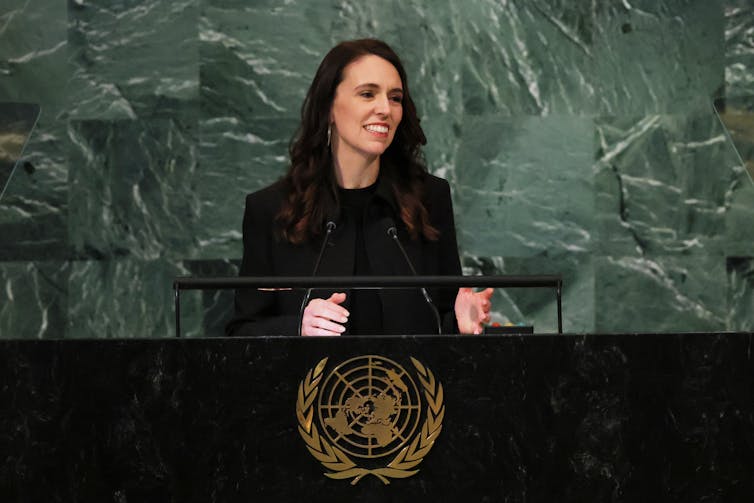
The global PM: Ardern speaks at the 77th session of the UN General Assembly in New York, late 2022. Getty Images
Leaving on her own terms
Are there broader lessons in all of this for international audiences? Depressingly, perhaps the key one concerns the price paid by elected representatives in these times of polarisation and the normalisation of abuse. Around the world, women politicians in particular have borne the brunt of the toxicity and there are many who will see in Ardern’s departure a silencing of a woman’s voice.
On the upside, perhaps there are also things to be learned about the exercise of political leadership. Ardern has chosen the time and manner of her leaving – she has not lost the position because of internal ructions or because of an election loss.
Her reputation will be burnished as a result, and if anything it will generate even more political capital for her – although whether or not she chooses to distribute that currency on the international stage remains unclear. But you rather suspect she might at some point.
For now, though, she will be looking forward to walking her child to school and finally being able to marry her long-term partner. After a tumultuous and more-than-testing time in office, that may yet be reward enough.
Richard Shaw does not work for, consult, own shares in or receive funding from any company or organisation that would benefit from this article, and has disclosed no relevant affiliations beyond their academic appointment.
Nearly 40 percent of Pacific people in Aotearoa New Zealand live in crowded homes — almost four times that of the general population, according to a new report.
The report by Statistics New Zealand was based on data from the 2018 Census, which showed 39 percent lived in a home that required additional bedrooms for the number of people living in it, which shows no progress has been made since 2013.
The data showed nearly 60 percent of households with Pacific people had more than five residents. But with more than 65 percent of Pacific people living in rented homes, just 4 percent of rented homes had five or more bedrooms.
An organisation supporting Pacific families said, while intergenerational living and big households are not new to the Pacific community, there was an urgent need to support people suffering from the negative impacts of overcrowded living.
The Fono’s spokesperson Frank Koloi said during the pandemic, large Pacific families were already straining from the pressures of looking after visiting relatives stranded in the lockdowns.
He said the unaffordability of homes and the rising cost of living is another blow to intergenerational households struggling to get by.
Koloi said there were a range of other issues typically seen in crowded homes.
‘Truancy in schools’ “From truancy in schools, family violence … the current outbreak of measles and rheumatic fever is still prominent within Pacific families in south Auckland,” he said.
“So there’s a real need to address the overcrowded homes in terms of resourcing these families.”
Koloi said the Fono was supporting these families with wrap-around services, including budgeting advice, supporting kids going back to school and helping people into higher paying jobs through upskilling.
Stats NZ’s wellbeing and housing statistics manager Sarah Drake said the current growing Pacific population was often unsupported, particularly in large urban areas like Auckland — where even unsuitable housing can be unaffordable to rent or own.
The data also showed more than half of people living in crowded homes had a problem with damp, cold, mould, or needed major repairs.
Stats NZ’s principal analyst of census insights, Rosemary Goodyear, said they would like to see more people from the Pacific community do the Census this year so that their circumstances and voices could be heard.
In 2018, just 35 percent of Pacific peoples lived in owner-occupied homes, compared with 64 percent of the total population.
The homelessness rate for Pacific peoples was 578 people per 10,000 — more than double that of the general population.
This article is republished under a community partnership agreement with RNZ.
China’s National Bureau of Statistics has confirmed what researchers such as myself have long suspected – that 2022 was the year China’s population turned down, the first time that has happened since the great famine brought on by Chinese leader Mao Zedong in 1959-1961.
Unlike the famine, whose effects were temporary, and followed by steady population growth, this downturn will be long-lasting, even if it is followed by a temporary rebound in births, bringing forward the day the world’s population peaks and starts to shrink.
The National Bureau of Statistics reported on Tuesday that China’s population fell to 1.412 billion in 2022 from 1.413 billion in 2021, a decrease of 850,000.
The Bureau reported 9.56 million births in 2022, down from 10.62 million in 2021. The number of births per thousand people slid from 7.52 to 6.77.
China’s total fertility rate, the average number of children born to a woman over her lifetime, was fairly flat at an average about 1.66 between 1991 and 2017 under the influence of China’s one-child policy, but then fell to 1.28 in 2020 and 1.15 in 2021.
The 2021 rate of 1.15 is well below the replacement rate of 2.1 generally thought necessary to sustain a population, also well below the US and Australian rates of 1.7 and 1.6, and even below ageing Japan’s unusually low rate of 1.3.
Calculations from Professor Wei Chen at the Renmin University of China, based on the data released by the National Bureau of Statistics data on Tuesday, put the 2022 fertility rate at just 1.08.
Births declining even before COVID
In part, the slide is because three years of strict COVID restrictions reduced both the marriage rate and the willingness of young families to have children.
But mainly the slide is because, even before the restrictions, Chinese women were becoming reluctant to have children and resistant to incentives to get them to have more introduced after the end of the one-child policy in 2016.
One theory is that the one-child policy got them used to small families. Other theories involve the rising cost of living and the increasing marriage age, which delays births and dampens the desire to have children.
In addition, the one-child policy left China with fewer women of child-bearing age than might be expected. Sex-selection by couples limited to having only one child lifted the ratio of boys to girls to one of the highest in the world.
Deaths growing, even before COVID
The number of deaths, which had roughly equalled the number of births in 2021 at 10.14 million, climbed to 10.41 million in 2022 under the continued influence of population ageing and COVID restrictions.
Importantly, the official death estimate for 2022 was based on data collected in November. That means it doesn’t take into account the jump in deaths in December when COVID restrictions were relaxed.
China might well experience a rebound in births in the next few years as a result of looser COVID restrictions, an easing of the pandemic and enhanced incentives to have more children.
But any such rebound is likely to be only temporary. When the total fertility rate is as low as China’s has been for a long time, without substantial inward migration, a decline in population is inevitable.
Population prospects bleak
Last year the United Nations brought forward its estimate of when China’s population would peak by eight years from 2031 to 2023.
My calculations suggest that if China was to quickly lift its total fertility rate back to the replacement rate of 2.1 and keep it there, it would take 40 or more years before China’s population began to consistently grow again.
And bringing fertility back to 2.1 is most unlikely. Evidence from European countries, which were the first to experience fertility declines and ageing, shows that once fertility falls below replacement it is very hard to return it to 2.1.
If China was instead merely able to lift fertility to 1.3 by 2033, then gradually to 1.49 by the end of this century as the United Nations assumed last year, China’s population would continue to decline indefinitely. That central UN projection has China’s population roughly halving to 766.67 million by the end of the century.
Just as likely is that China’s total fertility rate will slip even lower. The Shanghai Academy of Social Sciences experts a drop to 1.1, pushing China’s population down to 587 million in 2100.
A more severe scenario, put forward by the United Nations as its low case, is a drop in total fertility to around 0.8, giving China a population of only 488 million by the end of the century, about one third of its present level.
Such a drop is possible. South Korea’s total fertility rate fell to 0.81 in 2021.
China’s population drives the globe’s population
China has been the world’s biggest nation, accounting for more than one sixth of global population. This means that even as it shrinks, how fast it shrinks has implications for when the globe’s population starts to shrink.
In 2022 the United Nations brought forward its estimate of when the world’s population will peak by 20 years to 2086. The Shanghai Academy of Social Sciences forecasts for China would mean an earlier peak, in 2084.
India is likely to have overtaken China as the world’s biggest nation in 2022. The UN expects it to have 1.7 billion people to China’s 1.4 billion in 2050.
Forecasting when and if the global population will shrink is extraordinarily difficult, but what has happened in China is likely to have brought that day closer.
Xiujian Peng works for/consults to/owns shares in the Centre of Policy Studies, Victoria University. She receives funding from Shanghai Academy of Social Sciences from 2017 to 2019.
Jacinda Ardern with fellow MP’s after announcing her resignation on January 19 in Napier.Getty Images
New Zealanders will have a new prime minister by February 7 and will go to the polls on October 14, after two-term Labour Prime Minister Jacinda Ardern announced her resignation to spend more time with her family.
“For me, it’s time,” she said, speaking from the Labour Party’s retreat. “I just don’t have enough in the tank for another four years.”
Ardern said she would stay on until April as a local MP.
Beyond that, I have no plan. No next steps. All I know is that whatever I do, I will try and find ways to keep working for New Zealand and that I am looking forward to spending time with my family again – arguably, they are the ones that have sacrificed the most out of all of us.
Ardern’s resignation will come as a shock to many New Zealanders, and especially to people overseas – given the international reputation she earned as prime minister over the past five years.
But this is less of a surprise for close watchers of New Zealand politics. Back in November 2021, I wrote in The Conversation: “Might Jacinda Ardern stand down?”, after Labour changed its rules to make it easier for the party’s leader to be replaced.
NZ Prime Minister Jacinda Ardern announcing her resignation, January 19, 2023.
A game changing move before the election
Ardern’s rise to power in 2017 was a game changer in New Zealand politics. Now she’s surprised everyone again with today’s decision to stand down, this could be a game changer for the October election.
Ardern is still higher in the preferred PM polls, ahead of National’s Christopher Luxon. So it’s not imperative for Labour to change their leader. But up until this moment, everyone has been picking a likely change in government to a National/Act coalition later this year.
Now that Labour is starting to trail in the polls, having a refresh of the leadership doesn’t necessarily ruin the party’s chances of winning in October. The social and economic fallout of the pandemic has been so profound that having a fresh new face could help Labour’s chances.
Former National Prime Minister John Key did a similar thing back in 2016, invoking the same “not enough in the tank” line as Ardern today, when he surprised everyone and stood down, handing over to Bill English. English and National actually did well in the following year’s election, gaining 44% of the vote. It was only because of overall arithmetic that National was unable to form government and that Ardern went on to become prime minister.
Ardern made herself world famous for her management of the pandemic, and she did an extremely good job as a leader over that period.
But COVID-19 also completely derailed her prime ministership, meaning she was stymied in pursuing many of the key social objectives such as child poverty and housing that she would have liked to put more effort into.
I know Ardern personally, and what you see on TV is what you get in real life. She is a genuine person and politician, and you can understand the reasons she’s given about wanting more time with her fiancé and daughter.
My sense is that Labour knows who will take over. Front runners to be leader could be Minister of Justice Kiri Allan – who could be the first Māori PM, though she is relatively new to politics – and Minister for Education and Leader of the House Chris Hipkins, who was a high-profile MP during COVID.
Deputy Prime Minister Grant Robertson won’t be contesting the election, and Labour caucus has agreed that a vote will happen in three days’ time, on January 22.
A successful candidate will need more than 60% of the caucus vote, otherwise they’ve got to go to a primary-style process with the Labour membership, which could be messy, so they will want to avoid that.
Grant Duncan does not work for, consult, own shares in or receive funding from any company or organisation that would benefit from this article, and has disclosed no relevant affiliations beyond their academic appointment.
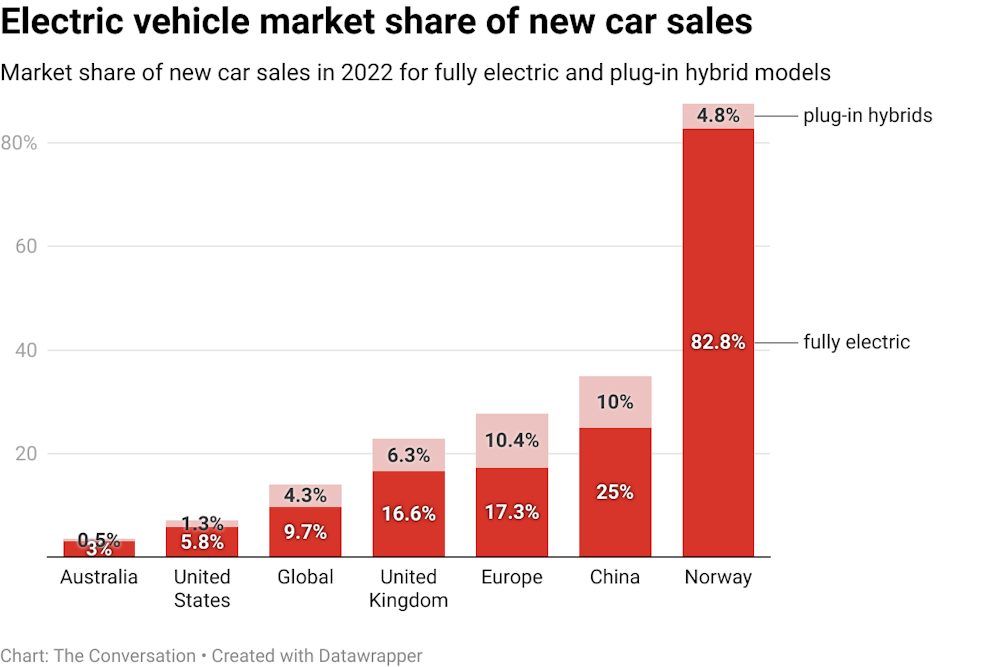
If Australia is to decarbonise our energy system by 2050, we need to start the transition to electric vehicles very soon. Cars sold in the 2030s will mostly still be on the road in 2050, so we have to make sure most of them are electric. But electric cars (including plug-in hybrids) currently account for only 3.5% of new car sales in Australia.
The world leader is Norway, where 87.6% of new cars (including 4.8% plug-in hybrids) are electric. Australia’s figure is also far lower than in Europe (27.7%, including 10.4% plug-in hybrids), China (35%, 25% fully electric) or even the United States (7.1%, 5.8% fully electric).
However, even in Norway the proportion of cars on the road that are electric – although impressive compared to the rest of the world – is still only 20%. This difference reflects the time it takes to replace an existing fleet of internal combustion engine cars.
Why has Australia done so badly? The overt hostility of the previous government to electric vehicles can’t have helped. Prime Minister Scott Morrison even claimed Labor wanted to “abolish the weekend” with its electric vehicle policy.
But the Morrison government has been gone for the better part of a year now and electric vehicle sales, while growing, remain very low.
The two core issues faced by Australians wanting to buy electric vehicles are affordability and lack of availability. Despite some recent modest price reductions, Teslas are priced out of reach of most private car buyers. They also face long delivery delays. Would-be buyers of many other brands face similar problems.
Australian governments have done little, if anything, to encourage the transition to electric vehicles. Almost uniquely among developed countries, Australia has neither a carbon price nor vehicle fuel-efficiency standards.
But incentives don’t make much difference if it is impossible to buy a vehicle. Until recently, delivery delays could be explained as part of general COVID-related disruptions and restrictions introduced to control the pandemic.
But those restrictions are mostly gone now, and remaining supply disruptions haven’t stopped millions of European and Chinese buyers from getting behind the wheel.
A critical problem is that the Australian retail motor industry has a structure designed for the 20th century, when a small number of locally made cars, powered by internal combustion engines, dominated the roads. Retailers, typically franchisees for one of the major manufacturers, provided not only a distribution channel, but highly profitable after-sales service.
With the end of Australian manufacturing, this no longer makes a lot of sense. The requirement to buy through an authorised dealer, like other systems of this kind, allows overseas producers to raise car prices for Australian consumers, with few offsetting benefits. They can also supply the market with fuel-inefficient models.
The problem is even worse for electric vehicles. Compared to vehicles with internal combustion engines, electric vehicles have many fewer moving parts and much less need for costly servicing.
The most important component, the battery, has an estimated life of up to 20 years. There’s no transmission, spark plugs, timing belt or air filter to worry about. Profits on all of these items enable car dealers to reduce the sticker price on fossil-fuelled vehicles, making them much easier to sell.
Parallel importing is part of the solution
One step towards solving this problem would be to allow consumers to import new and used cars from overseas suppliers. This is known as “parallel importing”.
Consumers have already seen the benefits of parallel importing for items including books, music and a wide variety of consumer goods. In some cases, such as that of books, parallel importing can be done only by individual consumers; in others it is open to firms that wish to compete with existing distribution channels.
Australia is far behind the rest of the world in the transition from fossil-fuelled vehicles. To avoid falling further behind, we need to change the kinds of vehicles we import.
A fuel-efficiency standard would discourage the dirtiest of our current vehicles. While increasing the upfront sale price, it would save drivers money in the long run.
Parallel importing would increase competition in the market for new and used electric vehicles overnight. Manufacturers would have to reconsider their supply and pricing strategies for Australia.
Allowing independent importation would also promote the development of a skilled workforce to service the cars. It could even allow the development of local manufacturing of electric vehicle components.
John Quiggin is a former Member of the Climate Change Authority
Flavio Menezes does not work for, consult, own shares in or receive funding from any company or organisation that would benefit from this article, and has disclosed no relevant affiliations beyond their academic appointment.
One of Fiji’s leading media analysts says wholesale changes to the Fiji Broadcasting Corporation’s board were inevitable, given the change of government in the country, reports ABC Pacific Beat.
The board’s previous members and chairman resigned last week as Prime Minister Sitiveni Rabuka’s government continues to clear the decks in the public service.
The government has begun an investigation into excessive spending patterns in the Department of Information, involving US-based PR company Qorvis, along with local communications company VATIS and FBC itself.
Featured: Dr Shailendra Singh, associate professor in journalism at the University of the South Pacific
You may have seen the news Qantas flight 144 from Auckland landed safely in Sydney yesterday after the pilot was forced to shut down an engine and issue a mayday call while flying over the Pacific Ocean.
The plane was reportedly a ten-year-old, twin-jet Boeing 737 and was carrying 145 passengers, all of whom disembarked normally after landing yesterday afternoon.
These events do, unfortunately, happen occasionally in aviation – I myself have lost an engine while flying – but the good news is it’s extremely rare. That makes aviation the safest form of transport in the world.
These are highly trained pilots who spend a lot of time in full-motion simulators going over events exactly like this.
When you’re down an engine and you have lot of water under you, you have a process to follow.
It becomes rote; you don’t panic, you don’t go off the rails, you remember your training, and that’s what happened here.
By law, planes have to be able to fly from point A to point B, over water, on just one engine. The guidance set by safety regulators in Australia mandates that any plane that takes off with the intention of getting to a certain destination has to be able to get there on one engine – based on the departure loads determined before takeoff.
That rule ensures that even if one engine goes down – as appears to have happened here – the plane can still arrive safely. It can fly until it runs out of fuel. Basically, these planes are built to fly as well on one engine as they can on two.
Having just one engine operating means you won’t have the maximum thrust power for take off, but you’d be able to fly and land just fine.
But while a plane can fly on one engine, it is very rare for an engine to go down in the middle of a flight.
Airline maintenance procedures are meticulous and technicians are licensed at the same level and quality as pilots. Typically you have someone do the maintenance on a plane on the ground, but they have someone come after them and inspect it and test it to make sure it is operating at 100% performance.
There are ground tests and flight tests and certification processes that need to be followed before a plane can take passengers. That’s why these events are so unusual.
A bang and air-con shutdown
Passengers said they heard a bang during the Qantas flight yesterday.
Details on what exactly happened are yet to emerge, but it’s certainly possible for engine failure to make a sound. It depends on the type of failure. If it was a section within the engine breaking, that could make a noise loud enough for passengers to hear it.
But normally if the pilot needed to isolate the engine and could see pressure fluctuation or engine temperature exceeding normal levels, then the pilot could choose to shut it down even before they heard a bang.
Reports the plane’s air conditioning subsequently stopped working suggests to me the crew probably had to turn off some systems to achieve their goal of landing successfully back in Sydney.
Anatomy of a crisis
When an event like this happens, pilots have a process for scanning their instrumentation to isolate and figure out what’s happening.
Once they do, we have what’s known as a Quick Reference Handbook to consult. It lists all the potential emergency situations that might happen on a plane. The pilots then follow that handbook to analyse each step and each possibility, which helps isolate and solve the problem.
In this case, it appears the solution was to shut that engine down.
For the sake of precaution, aviators announce a mayday call when we have a situation we think means we need priority help. The mayday call clears out the airspace to permit this plane to be number one in the queue for priority; all other aircraft have to get out of the way.
The air traffic controllers put everyone else in the air in a holding pattern or give them a big turn to keep them out of the area.
However, sometime after the pilot on QF144 issued a mayday call, it was downgraded to what’s known as a PAN – that stands for Possible Assistance Needed.
A PAN is a less extreme event; it still signals it is an emergency, and meant yesterday there were emergency vehicles on the runway and the plane retained its priority status in the queue. But it is not quite as serious as a mayday.
From here, a very thorough review will help shed light on what happened. The pilots typically go through drug and alcohol testing and there will be a full investigation to ensure nothing was missed and help Qantas return to normal operations.
Remembering your training
I wasn’t there on the flight deck yesterday and can only infer from what I have heard and read that the pilots on this plane did exactly what they are trained to do.
Airlines spend a lot of money on training so pilots and crew can handle events like this.
As we begin the conversation toward single pilot planes and autonomous aircraft, it’s worth asking how AI and autonomous systems might respond to circumstances that are not normal events.
Doug Drury does not work for, consult, own shares in or receive funding from any company or organisation that would benefit from this article, and has disclosed no relevant affiliations beyond their academic appointment.
It responds to the user’s questions and commands, and can draw upon its billions of words to process and generate text, appearing informative and knowledgeable.
If it becomes accessible for everyone, AI of this type could do more than disrupt exams. It could help people with communication disability and others who struggle with text, and could also significantly enhance rate of communication. People using speech generating devices are often limited to laboriously entering a mere 10 words per minute with word prediction only increasing that to 12-18 words per minute.
Communication disability can leave you lost for words – and excluded
There are many types of communication disability impacting a person’s ability to speak, understand, or write.
Impairments of speech, language and social communication are associated with a wide range of conditions including cerebral palsy, stroke, traumatic brain injury, and motor neurone disease. Communication disabilities can impact the clarity of your speech and what you can say, your ability to understand others or express yourself, and your skills in reading and writing.
A communication disability can mean you need to economise on what you say, as each word takes more effort and time to produce or write. If you have limited literacy, you’ll need text simplified to make sense of it. You’re also more likely to encounter more barriers to completing training, getting a job, forming relationships, managing your own health and life decisions, and participating in social networks.
But ChatGPT looks like it will be more inclusive of diversity by being able to understand poorly written commands, or sentences with several grammar or spelling errors. It can reportedly “read” poorly structured input, re-write and improve imperfect writing, and simplify complex texts into simpler summaries for early-stage readers. ChatGPT could be considered an “assistive technology” if it assists people with communication disability to get their message across more efficiently or effectively.
As a qualified lawyer and a person with cerebral palsy and no speech, co-author Fiona Given relies on assistive communication technologies, including augmentative and alternative communication speech-generating devices. Fiona says:
[…] each word and message that I compose takes me substantially more time and effort than a person who speaks. So I economise on that, and my written messages using current assistive technologies are often short and to the point. This can cause many problems, as I may be perceived as curt, if not rude, and I’m also not fully explaining what I mean.
Having tested the system, Fiona says ChatGPT could be particularly useful in adding the polite parts of emails and letters.
It can save me time and effort whilst maintaining my professionalism. One day, AI like ChatGPT may be installed into my speech-generating device. Yes, it raises questions of authorship and brings in doubt over who did the writing. That’s the case also with word prediction software – who thought of the word first? I see it as a type of co-authorship, and people like me will still need to be able to read and check it reflects what they want to say and edit and authorise the output accordingly.
AI technologies like ChatGPT may help people with communication disability to:
expand on short sentences, saving time and effort
draft or improve texts for emails, instructions, or assignments
suggest scripts to practice or rehearse what to say in social situations
model how to be “more polite” or “more direct” in written communication
practice conversations, including asking and answering questions
correct errors in texts produced for a range of purposes
write a complaint letter, including nuance and outcomes of not taking action
help with making that first approach to a person socially.
Given its potential for text-based assistance, it is important to know if people with communication disability will be able to access chatbots like ChatGPT.
We don’t know how many of the one million users testing the ChatGPT system now have problems with literacy, written expression, or spelling. But so far it looks like a game changer to help people produce texts with little or less effort.
The experiences of people with communication disability in using AI like ChatGPT are vital in the future co-design of assistive technologies. We need to know more about their views on acceptability, usability, and authenticity of the messages produced. With a screen reader, the ChatGPT output could become the user’s “voice”. So being able to check, edit, and confirm or reject AI writing is vital. Any incremental improvements to chat bots, that take into account what helps and hinders access and inclusion, are important if people with communication disability are going to benefit from advancements in AI.
Bronwyn Hemsley has received research grant funding from the Australian Research Council and the National Disability Insurance Scheme Quality & Safeguards Commission for work unrelated to this article.
Emma Power receives funding from National Health and Medical Research Council and the Medical Research Future Fund.
She is a member of Speech Pathology Australia.
Fiona Given does not work for, consult, own shares in or receive funding from any company or organisation that would benefit from this article, and has disclosed no relevant affiliations beyond their academic appointment.
Imagine it is 2030. Doctors in a regional hospital in country X note an expanding cluster of individuals with severe respiratory disease. Rapid whole-genome sequencing identifies the disease-causing agent as a novel coronavirus.
Epidemiological investigations suggest the virus is highly infectious, with most initial cases requiring hospitalisation. The episode bears a striking resemblance to the COVID outbreak first detected in December 2019.
Regional and national health authorities are notified quickly. The national contact point for the International Health Regulations 2024 (a major revision to the current IHR 2005) sends a description to the World Health Organization (WHO). After an intense exchange of information and risk assessment, it declares a public health emergency of international concern.
The outbreak is assigned a response strategy of “elimination”. This designation initiates a well-rehearsed procedure, including mobilising expertise and resource stockpiles.
The elimination response results in localised quarantine measures at the epicentre and its surrounds and a travel freeze across a wide radius within country X and at its borders. It also prompts intensified local and international surveillance. Case numbers rise rapidly but plateau after three weeks, and then fall until no new cases are detected in the community.
After eight weeks of intensive efforts the outbreak is over – similar to the experience of New Zealand, which terminated its initial COVID outbreak in eight weeks using an elimination strategy. The outbreak had spread regionally within country X, but not internationally.
This is how we propose, in The Lancet, the world should respond to future pandemic threats.
An upgraded pandemic response to eliminate at source
The process by which the WHO currently decides whether to declare a public health emergency of international concern (under the International Health Regulations 2005) has drawn criticism for being too slow.
The upgraded response framework we propose would enhance the existing risk assessment by routinely requiring WHO to assign a high-level response strategy for managing this risk. For potential pandemics, we consider this strategy should be elimination rather than suppression or mitigation, which have been the usual default options in the past. In simple terms, “if in doubt, stamp it out”.
The idea of eliminating novel emerging infectious diseases at the earliest possible stage is intuitively appealing and not new. It has been proposed for eliminating novel pandemic influenza outbreaks.
We have described this concept previously. Whether this approach could have eliminated and ultimately eradicated COVID, if pursued early and in a co-ordinated way globally, remains a topic of speculation.
An elimination strategy also slows the spread of infection
There is a second broad reason for the WHO assigning an explicit strategic goal of elimination to pandemic diseases with sufficient severity. It can also slow or interrupt the global spread of a new infectious disease. This action buys time for interventions to be developed, building on rapidly accumulating scientific knowledge.
Some countries in the Asia-Pacific region adopted elimination and strong suppression strategies. This approach largely prevented widespread COVID circulation for the first one to two years of the pandemic, keeping mortality rates low.
It allowed time for vaccine development and roll-out and for jurisdictions to prepare their health systems for managing large numbers of infected people. Notable examples are New Zealand, Australia and Singapore. They have been able to keep their cumulative mortality low by international standards.
New Zealand, Australia and Singapore have lower cumulative numbers of deaths than other countries. Our World in Data, CC BY-ND
If elimination is ultimately not successful or justifiable, an organised transition to another strategy (suppression or mitigation) should be considered. Processes for managing these transitions can draw on experience from the current pandemic.
Elimination makes sense for other potential pandemics
The most recently declared public health emergency of international concern is mpox (formerly known as monkeypox). Under our proposed change to the International Health Regulations, the WHO would have been required to assign a response strategy to this disease.
Elimination again makes sense as a default approach. That is what countries around the world have effectively been doing. And this approach appears to be working.
The other current public health emergency of international concern is poliomyelitis. Unlike COVID and mpox, this disease is already subject to a global eradication goal.
A further benefit of the elimination strategy is that it supports strengthening of health system infrastructure in low and middle-income countries. This capacity building has contributed to the elimination of periodic Ebola outbreaks in Africa, which have been designated as public health emergencies of international concern in 2014-16 and 2019-20. It could also support elimination of mpox, an increasing threat in Africa.
Let us hope that when the world is next confronted by the spark of a new emerging infectious disease with pandemic potential, the WHO rapidly declares a public health emergency of international concern and assigns an elimination strategy. And the international community reacts vigorously to extinguish the spark before it becomes an inferno.
Michael Baker’s employer, the University of Otago, receives funding for his research on Covid-19 and other infectious diseases from the Health Research Council of New Zealand and the New Zealand Ministry of Health.
David Durrheim, Li Yang HSU et Nick Wilson ne travaillent pas, ne conseillent pas, ne possèdent pas de parts, ne reçoivent pas de fonds d’une organisation qui pourrait tirer profit de cet article, et n’ont déclaré aucune autre affiliation que leur poste universitaire.
Source: The Conversation (Au and NZ) – By James Laurenceson, Director and Professor, Australia-China Relations Institute (ACRI), University of Technology Sydney
For the first time in a long time, a year can begin with a realistic assessment that Australia-China relations are on an upward trajectory again.
After winning last May’s federal election, the new Albanese government set “stabilisation” as the objective for Canberra’s relations with Beijing.
Rather than reaching for something loftier, “stabilisation” made sense given the new Labor government was inheriting a relationship in its worst state since 1972, the year the Whitlam government moved to recognise Beijing (instead of Taipei) as China’s sole legal government.
Under the previous Morrison government, there had been no senior-level political dialogue for more than two years. Disputes between the two governments had spilled over to hurt other parts of the bilateral relationship, like trade and investment.
The Albanese government should feel satisfied the “stabilisation” objective has now been achieved in just nine short months.
This was punctuated by a meeting between Prime Minister Anthony Albanese and Chinese President Xi Jinping last November, followed by a formal visit to Beijing by Foreign Minister Penny Wong just before Christmas. Wong’s trip resulted in a commitment by both sides to pursue a wide-ranging dialogue agenda, even extending to defence issues.
Trade blockages are being removed, too. Earlier this month, the first order of Australian coal to China since 2020 was booked by a Chinese company, to be shipped soon.
The Australian lobster trade looks like the next to be revived.
And in another sign of deescalating tensions, both Canberra and Beijing are talking up the prospect that tariffs on Australia’s barley and wine exports to China might be addressed through bilateral discussions rather a drawn-out legal process at the World Trade Organization.
Last weekend, Albanese raised his sights even more, insisting “it is in both countries’ interests to continue to develop more positive relations”. This upbeat aspiration was widely reported and welcomed in Chinese state media – a sharp departure from the caustic tone the media had taken toward Australia in recent years.
Why differences will not ‘hijack’ the thawing relationship
To be sure, Canberra-Beijing relations will not be completely smooth-sailing going forward.
Two of my colleagues at the Australia-China Relations Institute have laid out five major issues that could derail an improvement in official ties this year.
One problem could be the way Beijing interprets expected announcements by Australia related to its military posture and new defence acquisitions (such as nuclear-powered submarines) in the wake of the 2021 AUKUS pact with the US and UK. Beijing may see this as evidence Canberra is lining up with Washington to confront China militarily.
The South China Sea remains a potential flashpoint between China and the US and its allies, including Australia. US Navy Office of Information/EPA
And trade blockages are just one problem needing resolution. As long as Australian citizens like journalist Cheng Lei and writer Yang Hengjun remain detained in China on unclear grounds, any improvement in relations will only be able to run so far.
But neither will Canberra and Beijing be keen to quickly return to the lose-lose state of relations in recent years. Both sides are also embarking on re-engagement with grounded expectations.
Last week, the Chinese ambassador to Australia, Xiao Qian, acknowledged, “we do have differences, in certain respects. We even have disputes”. But he then emphasised a further important point:
we can address the differences in a way that will not allow the differences to hijack the overall relationship.
Importantly, Australia-China relations are about more than just diplomatic relations between the capitals. Extensive business links and people-to-people ties have long given the broader relationship ballast, even as the diplomatic relationship has historically waxed and waned.
In fact, last year, the total value of Australia’s goods exports to China hit the second-highest level ever, despite all of the trade disruptions, and Australian companies becoming more sensitive to risks stemming from exposure to the Chinese market. This followed a new record high set in 2021.
Reasons for hope: clean energy, education and tourism
And even amid the political challenges of recent years, new areas of win-win cooperation are opening up.
China has rapidly emerged as the global production hub for manufactured goods essential to the world’s net-zero emissions transition, such as electric vehicles. This has been a bonanza for resources companies around the world.
Australia’s exports of raw lithium (used to make batteries for electric vehicles) have gone from just A$1 billion in 2020 to A$16 billion now – with China buying more than 90% of it.
Chinese companies have also transferred their world-leading lithium processing technology to Australia via joint ventures, allowing Australia to move up the value chain beyond mining.
Beijing’s abandonment of its “dynamic COVID zero” policy last December and the re-opening of China’s borders this month will give another shot in the arm to the broader relationship.
In the year ending September 2019, Australia hosted 1.3 million Chinese visitors, collectively injecting $10.2 billion into the local economy. By last year, these numbers had plummeted to just 62,120 and $1.3 billion.
The uncertain state of China’s economy, coupled with the Australian government requirement that arrivals from China must submit evidence of a negative COVID test, will likely dampen the appetite for long-haul travel to Australia in the near-term.
But airlines are already ramping up their China-Australia offerings in anticipation of a positive shift in their fortunes. China Southern Airlines, for example, has announced it will begin flying daily services between Sydney and Guangzhou by the end of this month, up from just once a week.
Adding to their confidence ledger is the fact the number of Chinese students enrolled at Australian education providers has remained remarkably resilient. As of last October, there were still 119,107 Chinese citizens holding student visas, nearly double the 67,975 from India in second place.
In the second half of 2022, new visa applications by prospective Chinese students reached 38,701, not far off the previous peak of 42,526 in 2019.
Investment bank JPMorgan estimates there’s potential for a boost in tourism and education links with China to add one percentage point to Australian economic growth over this year and next.
Bring on the Year of the Rabbit.
James Laurenceson does not work for, consult, own shares in or receive funding from any company or organisation that would benefit from this article, and has disclosed no relevant affiliations beyond their academic appointment.
People describe the sound of a dripping tap in the middle of the night as anything from annoying to torture. Others sleep through, seemingly oblivious.
But if this common sound is keeping you awake, you can do something about it.
Here are some tips of how to rethink the sound of your leaking tap, which should help bring you a decent night’s sleep.
Dripping taps, a partner snoring, the neighbour’s roosters, traffic noise. All can be the nemeses of the land of nod.
Unwanted light can also interrupt our sleep but we can close our eyes to block it out. We cannot close our ears to silence these disruptive noises.
So unless we wear ear plugs or very expensive noise-cancelling headphones, sounds at night will vibrate our ear drums, be converted to nerve impulses and wend their way up to the brain.
So we can hear these sounds if we are awake. If we’re asleep already, they may wake us.
Sounds that are loud, variable, unpredictable and meaningful are most likely to wake us.
We analyse meaning in the top or “smart” part of the brain, the cerebral cortex. This receives the information from the ears, even when we are asleep, and assesses the importance of the sound.
We are much more likely to awaken to the sound of our own name than another name. A baby’s cry at night can wake us to feed it. Unusual sounds, possibly indicating danger, are more likely to wake us. Loud sounds, usually indicating something is getting very close, will wake us.
It is perhaps a good thing we cannot close our ears when we fall asleep. Having our ears “open” to potential danger while asleep may have been helpful for our ancestors, improving their chances of survival and our own subsequent existence.
How deeply we’re sleeping also affects if sounds wake us. Our sleep pattern is like a roller coaster. We first descend into deep sleep then ascend into light sleep about every 90 minutes. During phases of light sleep, we are much more likely to be awoken by noises, even if they are soft and regular.
These light phases of sleep have probably served as brief “sentry” points across the sleep period. They may have helped our ancestors survive any night-time threats.
We can get used to regular or predictable sounds, such as a whirring fan. Shutterstock
Sounds that are soft, regular, familiar, predictable and unimportant are not likely to awaken us.
We can also become used to regular or predictable sounds, such as a dripping tap, refrigerator or fan. That’s because over time our brain predicts the regular pattern, gets used to it, and doesn’t perceive it as a threat.
But a change in the pattern of the sound, such as when it suddenly stops, can wake us.
We have completed a large sleep study of the effects of wind farm noise. We found no objective disturbance to sleep of typical intensity wind farm noise, which is a soft noise and regular.
To our surprise, even people who reported they found the wind farm noise annoying at home and felt it disturbed their sleep were not, in fact, woken by it. Nor was there any disruption of the objectively measured quality of their sleep.
Sounds that represent a possible threat or challenge are much more likely to wake us. They are also more likely to stop us from falling asleep even when they are at low intensity and regular, such as a dripping tap.
The tap might be a challenge because it represents a job needing to be done, or a waste of water. But the strongest threat of the dripping tap on our sleep may be the belief that it will keep us awake and therefore affect how we function the next day.
The nightly association of the sound of the dripping tap with worry about our sleep and its “downstream” effects can trigger an anxious “fight or flight” response. This further delays us falling asleep. It can also develop into an “alert” habit, contributing to developing insomnia.
This cognitive approach may involve re-interpreting the meaning or threat the dripping tap poses.
Depending on its rate, you could interpret the dripping noises positively as someone’s heart beating regularly. If it drips at a slower rate, you could synchronise your breathing in a meditative-type practice to relax.
Alternatively, it may be quicker to wear earplugs, or fix the tap.
If you have insomnia, the dripping tap is unlikely to be the only trigger. So behavioural therapies can be used to increase your drive for sleep and ensure sleep, regardless of annoying noises.
A GP is a good place to start discussions about the option of referring you to a sleep psychologist to treat severe, chronic insomnia.
Soaring electricity prices have made 15% of Aussies think about installing solar panels, a recent survey found. Another 6% were already weighing up the move, on top of the 28% who had panels.
With costs falling, the average system size is growing rapidly. Households now typically install 8-10kW solar systems, often with a battery – roof area often limits the system’s size.
But does that guarantee no future electricity costs? No, some are still paying stubbornly high bills.
This is because they are often feeding energy into the grid during peak sunshine hours, when retailers pay low feed-in tariffs of five cents per kWh or less (a response to surging rooftop solar generation). To encourage customers to use energy at these times, retailers offer generous time-of-use (“solar sponge”) tariffs.
But the cost doubles during peak demand periods (around 6-10am and 3-11pm) when solar output is low or zero. Most rooftop solar owners are still paying for the electricity they use then.
Heating and cooling account for 30-45% of typical home energy use. Our testing at the University of South Australia suggests air conditioners use more energy as they age. Yet many homes have air conditioners older than ten years with 2-3 star ratings. Modern split systems with 6 stars use less than half as much electricity.
Users can program or control air conditioners remotely with a mobile phone to run for an hour or two before getting home. They then use cheap solar electricity to create a comfortable home. Smart and affordable controllers can also reduce cooling or heating when they sense a room is unoccupied or windows are open.
Typically, another quarter to a third of energy use is for water heating. Ample solar electricity and soaring gas prices make heat pump water heaters the best option. With government subsidies, their initial cost is similar to conventional gas or electric systems and they typically use a third of the energy.
Again, they can be programmed to heat water at times of peak solar generation and store it, thus providing almost free hot water when needed.
Many other smart appliances and lights are available. Induction cooktops deliver fast and impressive results using little electricity. Along with the microwave, air fryer and pressure cooker, they can reduce energy use. Ovens and slow cookers can be programmed to use solar power and have meals ready when we get home.
As well as having options with high star ratings, appliances to wash and dry clothes and dishes can easily be set to run during sunshine hours.
Energy-efficient fridges also cut costs. However, while people are happy to buy such fridges, our researchsurvey found some keep the old one, using three to four times the electricity, for drinks.
Homes with swimming pools or spas are notorious for having the highest electricity bills. A pool will typically use 2,000-3,000kWh of electricity per year (depending on type of pump, hours of use and whether the pool is heated), at a cost of A$700-1,200. Solar pool heaters are an excellent alternative. A simple timer switch can ensure most power is consumed during sunshine hours.
A typical outdoor spa uses 5kW for water heating and circulating. Much heat is lost to the surroundings if you let the thermostat keep it warm all the time. By installing a timer switch, you can use solar power for heating and have the spa ready for use after working hours.
Pools can rack up big bills for running pumps and heaters – unless a timer ensures they’re using solar power. Shutterstock
Use smart technology to control time of use
The key to making the best use of your solar output is avoiding energy wastage and matching the timing of energy supply with household demand. An affordable smart control system – for the whole home or individual appliances – can do this.
This system can set seven-day schedules for all appliances. It can turn off lights and air conditioning after you leave home. On a hot day, it can lower blinds and switch on the ceiling fan and air conditioner before you return, then adjust the bedroom temperature for comfortable sleep.
With improved energy supply and demand forecasting and artificial intelligence, future controllers will provide the optimal energy options with little human intervention. If smart gadgets are not for you, simple timer switches start at less than $10.
Energy storage remains a key technology for enabling use at night and on days of no sunshine. A recent Conversation article discussed home batteries.
Another emerging technology is thermal batteries for heating and cooling. During sunshine hours a reverse-cycle air conditioner generates heat or cool to store in the thermal battery (commonly as hot or chilled water) for later use.
Electric vehicles that connect to the grid will go a long way towards making better use of rooftop electricity and storing it for evening use. Their battery capacity is several times that of home batteries.
Electric vehicles can help households make better use of solar generation. Shutterstock
Find the best energy plan for your home
With 45 energy retailers in southern and eastern Australia, each offering multiple tariffs, it’s no wonder consumers are confused about which one to choose. The Australian Energy Regulator provides the most reliable guide. By uploading a few basic details, including the National Meter Identifier (NMI) shown on your bill, you can find the best offers based on your recorded electricity use.
Using this site, my son, who had paid an $800 quarterly bill despite having a large solar system, achieved a potential annual bill below $1,500 simply by switching retailers. Installing a timer switch so their outdoor spa uses solar electricity, instead of paying 33c/kWh, is likely to further save up to $5 a day. Their goal of no electricity bills is becoming a reality.
We are seeing the emergence of a new Australian dream of living in a well-designed home with rooftop solar, an electric car and smartly controlled energy-efficient appliances. It will enable most single/double-storey households to be carbon-neutral while living in comfort without a big hit to their hip pockets.
Wasim Saman has received multiple federal and state research grants from the Australian Research Council, government departments, the CRC for Low Carbon Living and several industry partners for research into low carbon housing.
Recently, a number of people have questioned or critiqued the use of the word “queer” to describe LGBTIQA+ folk. One writer to the Guardian claimed that the “q-word” was as derogatory and offensive as the “n-word”, and should not be used.
While there is a clear history of the word being used in aggressive and insulting ways, the meaning(s) and uses of queer have never been singular, simple or stable.
The origin of the word ‘queer’
Queer is a word of uncertain origin that had entered the English language by the early 16th century, when it was primarily used to mean strange, odd, peculiar or eccentric. By the late 19th century it was being used colloquially to refer to same-sex attracted men. While this usage was frequently derogatory, queer was simultaneously used in neutral and affirming ways.
The examples provided in the Oxford English Dictionary show this semantic range, including instances of homosexual men using queer as a positive self-description at the same time as it was being used in the most insulting terms.
Compare the neutral:“Fourteen young men were invited […] with the premise that they would have the opportunity of meeting some of the prominent ‘queers’” (1914); the insulting: “fairies, pansies, and queers conducted […] lewd practices” (1936); and self-affirmed uses: “young men who call themselves ‘queers’” (1952).
John Sholto Douglas, 9th Marquess of Queensberry (20 July 1844 – 31 January 1900), was a British nobleman, remembered for his role in the downfall of the Irish author and playwright Oscar Wilde, and is often cited as an early user of queer as a slur against same-sex attracted men. Wikimedia Commons
In the 1960s and 1970s, as sexual and gender minorities fought for civil rights and promoted new ways of being in society, we also sought new names for ourselves. Gay liberationists began to reclaim queer from its earlier hurtful usages, chanting “out of the closets, into the streets” and singing “we’re here because we’re queer”.
Their newsletters from the time reveal sustained questioning of the words, labels and politics of naming that lesbian and gay people could and should use about themselves. Some gay libbers even wanted to cancel the word homosexual because they felt it limited their potential and “prescribes a whole system of behaviour […] which has nothing to do with my day-to-day living”.
In Australia, camp was briefly the most common label that lesbian women and gay men used to describe themselves, before gay became more prominent, used at that time by both homosexual men and women.
The evolving use of the word queer
In the early 1990s, gay had come to be used more typically to refer to gay men. Respectful and inclusive standards of language evolved to “lesbian and gay”, and then “LGBT”, as bisexuals and transgender people sought greater recognition.
Queer began to be used in a different way again: not as a synonym for gay, but as a critical and political identity that challenged normative ideas about sexuality and gender.
Queer theory drew on social constructionism – the theory that people develop knowledge of the world in a social context – to critique the idea any sexuality or gender identity was normal or natural. This showed how particular norms of sexuality and gender were historically contingent.
Thinkers such as Michel Foucault, Michael Warner, Judith Butler, Eve Kosofsky Sedgewick and Lauren Berlant were enormously influential in the development of this new idea of queer. Some people began to identify as queer in the critical sense, not as a synonym for a stable gender or sexual identity, but to indicate a non-conforming gender or sexual identity.
Activists in groups such as Queer Nation also used queer in this critical sense as part of their more assertive, anti-assimilationist political actions.
Posters from Queer Nation’s Houston chapter. Wikimedia Commons
Queer as an umbrella term
From the early 2000s, it became more common to use queer as an umbrella term that was inclusive of the spectrum of sexual and gender identities represented in the LGBTIQA+ acronym.
Today, queer is included among the terms lesbian, gay, bisexual, transgender, gender diverse, intersex, asexual, brotherboy and sistergirl, recognised in style guides as the most respectful and inclusive way to refer to people with diverse sexualities and genders.
Of course, the different usages and meaning of words such as queer have often overlapped and have been hotly contested. Historical usages and associations persist and can sit uncomfortably next to contemporary reclamations.
Queer as a slur?
Contemporary concerns with queer’s historical use as a slur seem odd to me. The heritage report A History of LGBTIQ+ Victoria in 100 Places and Objects (which I co-authored), surveys the complexity of language use in historical and contemporary society.
It is notable that almost all of the words that LGBTIQA+ people use to describe ourselves today have been reclaimed from homophobic or transphobic origins.
In fact, it could be said that liberating words from non-affirming religious, clinical or colloquial contexts and giving them our own meanings is one of the defining characteristics of LGBTIQA+ history.
While queer does have a history of being used as an insult, that has never been its sole meaning. Same-sex attracted and gender diverse folks have taken the word and have been ascribing it with better meanings for at least the past 50 years.
Queer’s predominant use today is as an affirming term that is inclusive of all people in the rainbow acronym.
At a time when trans and gender diverse folk are facing particularly harsh attacks, I’m all for efforts to promote inclusion and solidarity. Respectful language use doesn’t require us to cancel queer, but rather to be mindful of its history and how that history is experienced by our readers and listeners.
Timothy W. Jones receives funding from the Australian Research Council and the Victorian Government. He is currently also the president of the Australian Queer Archives.
An angry tirade on Papua New Guinea and Indonesia border issues in the PNG Parliament yesterday is likely to ignite an international uproar over the alleged behaviour of government officials.
During yesterday’s session, Vanimo-Green MP and former soldier Belden Namah, asked why border liaison meetings were always held in the Indonesian capital of Jakarta.
He also called on the government to allow for this Indonesia-PNG Border Treaty — which PNG has not ratified — to be withheld so serious issues pertaining to the border arrangements between the two countries would be addressed.
Namah, who is the parliamentary chair for Defence, Foreign Affairs and International Trade, claimed that Indonesian government officials were “getting our officers drunk, giving them women and then come the meeting — they are just sitting there saying, ‘Yes sir, yes sir’!”
“Every time a border liaison meeting is held we are taking our people to Jakarta.
“When they go to Jakarta, they go and drink Bintang beer and get into illegal activities and they don’t attend border liaison meetings representing our country,” Namah claimed.
He said PNG soldiers were no longer patrolling the PNG border and that Indonesians were constantly breaching the border and crossing into PNG.
‘Serious security issue’ “This is a serious national issue, serious security issue that we need to address. We need to carefully look at these issues.”
Namah’s angry outburst followed a move by the Foreign Affairs Minister Justin Tkatchenko to introduce the ratification of the Border Treaty agreement between PNG and Indonesia.
“We must make hard decisions, we are a sovereign nation. We cannot go on border liaison all the time in Jakarta,” Namah said.
“There are a lot of issues yet to be addressed and we must not rush the ratification of these border arrangements.
PNG’s Defence parliamentary committee chair Belden Namah . . . “Indonesians have already crossed into our side — we have turned a blind eye.” Image: PNG Post-Courier
“We as a country have not been seriously looking at the border demarcation, whether it is the responsibility of the Foreign Affairs or Provincial Affairs.
“When you go to the border, Indonesians have already crossed into our side and they are already engaged in activities on our side of the border — we have turned a blind eye.
‘Do we know what’s happening?’ “Do we know what is happening on the border?”
More than 12,000 citizens from West Sepik — especially people from Namah’s electorate — had crossed over to Indonesia because “on our side, we, as a national government” were not providing basic services to Papua New Guineans.
“I want to have a look at this treaty before Parliament can pass it and I am arguing now as the chairman for Defence, Foreign Affairs and International Trade, I want to have a look at it before it is signed,” Namah said.
“I want to raise the issues of our land, why has Indonesia crossed into the side of our border?”
“Maybe we should build a naval base at the mouth of River Torassi in Western Province and ask the Indonesians to dismantle their naval base on their side,” he said.
“I am proposing now that every border liaison be held outside of Indonesia and PNG, somewhere neutral so we can raise these issues.
Important sovereignty issues “These are important sovereignty issues.
“I propose that this particular treaty be withheld to allow my committee, the parliamentary committee on Defence and Foreign Affairs and Trade to review it before we actually sign it.”
According to Prime Minister James Marape, the border treaty agreement was signed in 2013 and ratified by NEC in 2015.
Since then, there had been no border talks.
Gorethy Kennethis a PNG Post-Courier senior journalist. Republished with permission.
Fiji’s Home affairs Minister has held an urgent meeting with the nation’s military chief after he expressed concern about the new People’s Alliance-led government.
The government, a three-party coalition led by Prime Minister Sitiveni Rabuka, has been in power for less than a month.
Major-General Jone Kalouniwai yesterday warned that the government was taking “shortcuts that circumvent the relevant processes and procedures” which could lead to “long-term national security consequences”.
Kalouniwai’s statement also highlighted the military’s “guardian role” in the constitution, which he claimed was to ensure “excesses [of power] of the past are not repeated”.
The Home Affairs Minister, Pio Tikoduadua, who has responsibility for defence, said he and Kalouniwai had a frank exchange of views, but both were committed to respecting the result of last month’s election.
In a statement, Tikoduadua said he assured the commander that all the government’s actions had been guided by the law.
“The commander and I have spoken, and we have expressed our views frankly to each other. We both believe in the rule of law, democracy, and the rights of every citizen to go about their affairs in peace,” he said.
‘Respecting will of people’ “We are both committed to respecting the will of the people through the outcome of the 2022 general election and protecting that decision, let come what may.
“No one should forget that the commander and the military have also helped us navigate our way, democratically, to a new government a month ago when many people were uncertain that Fiji could achieve a successful transition of government.
“All of us are learning. We are slowly undoing all the misconceptions about democratic governance that have been allowed to take root over the last 16 years. Our institutions are absorbing the impact of a new govemment with different ideas and new priorities.
“But through all of this, we will be talking to each other, in the spirit of consultation to provide the best for the Fijian people.”
The FBC News reports Prime Minister Rabuka said he was not concerned about the public utterances made by Jone Kalouniwai.
He said he had no concerns over the relationship he shared with the military, and he was confident in the RFMF leadership and also the force members.
This article is republished under a community partnership agreement with RNZ.
Former Fiji Prime Minister Voreqe Bainimarama with army commander Major-General Jone Kalouniwai. Image: Fiji govt File/RNZ Pacific
After three soggy years of La Niña in a row, Australia has endured record-breaking floods, the latest of which has inundated the Kimberley in Western Australia and across north and central Queensland.
While the rains may have initially been a relief after the heat, drought and fires that came before, they have long outstayed their welcome. Thankfully, the latest update from the Bureau of Meteorology (BOM) points to a continuing weakening of La Niña – but it also points to the possibility of El Niño emerging by the autumn.
You can think of El Niño as being like the opposite of La Niña. While La Niña is known for bringing cooler, rainy weather, El Niño brings hot, dry conditions. This means it’s often associated with drought, heatwaves and bushfires. The world’s hottest year on record in 2016 was an El Niño year.
Let’s take a closer look at BOM’s forecast and what Australians can expect in the coming months.
The difference between El Niño, La Niña and climate change
La Niña and El Niño events are “climate drivers”, which means they are part of the natural oscillations of the Earth’s climate. Human-caused climate change, on the other hand, acts over a longer term, steadily bringing up the planet’s average temperature and exacerbating some of the impacts of La Niña and El Niño events.
La Niña is characterised by cooler waters than normal in the tropical eastern Pacific near Peru and Ecuador and warmer waters in the west Pacific including around northern Australia.
When we have La Niña we have an increased chance of wet conditions over northern and eastern Australia, especially in spring. The past three years with consecutive La Niña events have followed this pattern.
In contrast, El Niño is associated with warmer waters over the central and eastern Pacific Ocean and cooler waters in the west. El Niño conditions bring an increased chance of warmer and drier conditions in Australia.
This graph of a key metric, known as the Niño-3.4 index, shows El Niño conditions are expected in coming months. It uses the Bureau of Meteorology’s prediction system. Bureau of Meteorology
For now we have a dissipating La Niña, and there is strong confidence it will continue to weaken over the coming weeks. We expect it to be properly finished by the end of summer.
The likelihood of El Niño forming
As we look further ahead, our confidence in what will happen next reduces. BOM’s outlook suggests El Niño conditions could arrive by late autumn, but other forecast models point to a lower chance of El Niño emerging at all.
Forecasts of El Niño are challenging several months in advance, but particularly at this time of year when they have to overcome the “autumn predictability barrier”. In autumn, there is less variation in the Pacific Ocean’s temperature and it’s harder to forecast if an El Niño or La Niña will emerge by winter.
We are by no means guaranteed a switch to El Niño, but there is a higher probability of an El Niño forming in the next few months than we’ve seen for several years.
Australia is also affected by other natural climate drivers, such as the Indian Ocean Dipole, which has a strong effect on winter weather. This climate driver is brought about by interactions between ocean currents and the atmosphere, and influences rainfall patterns around the Indian Ocean, including Australia.
Understanding the Indian Ocean Dipole.
It’s currently forecast to move into a “positive phase” by early winter, which would favour a drier winter over most of Australia as well but this is also still uncertain.
From floods to drought?
With indications of a shift to El Niño and positive Indian Ocean Dipole, should we expect to swing from floods to drought?
Drought occurs on different timescales, but Australia’s most devastating droughts, which result in major agricultural losses and water restrictions, require several years of dry conditions.
Longer periods with La Niña or negative Indian Ocean Dipole conditions increase the likelihood of large rainfall deficits in the Murray-Darling Basin. Author provided
With our dams full, it’s unlikely we’ll see a major drought form for a while. If we have an extended period without La Niña or negative Indian Ocean Dipole conditions, then drought may start to appear again. However, the drier weather would also raise the risks of other hazards such as heatwaves and bushfires.
This time, our three consecutive La Niña events have resulted in more vegetation growth. This means next summer, there will be more fuel for fires to burn.
El Niño doesn’t just affect Australia. For example, during El Niño events we typically see a weaker Indian monsoon and drier conditions over southern Africa. East Africa, which has suffered greatly from drought in recent times, is usually wetter during El Niño.
As El Niño events involve the warming of a large area of the Pacific Ocean they tend to raise the global average surface temperature by about one-tenth of a degree. While that might not sound like very much, it could push the global average surface temperature to record-breaking highs, particularly in the year after an El Niño forms.
Global temperature anomalies relative to the late-19th century by phase of the El Niño-Southern Oscillation (ENSO) using NASA’s global temperature series. Real Climate, NASA GISS
Given the planet is rapidly warming due to our continuing high greenhouse gas emissions, and the fact we haven’t had a big El Niño for a while, even a moderate El Niño could mean the world experiences a new record hot year.
There is even the possibility the global average temperature could surpass 1.5℃ above pre-industrial levels for the first time.
While we’re aiming to keep global warming under 1.5℃ to meet the Paris Agreement, an individual year above this mark does not mean we have failed. Still, it’s not a good sign if we start to hit that mark.
It’s not yet clear exactly how climate change may be altering El Niño. However, there are indications climate change may be moving El Niño events towards the central Pacific nearer the international dateline.
Climate change could also possibly strengthen rainfall responses to El Niño and La Niña over the Pacific and elsewhere. This may worsen both our floods and droughts in Australia, but more research is needed.
Unfortunately, in terms of global temperatures and Australian heatwaves, it’s clear the combination of human-caused climate change and a major El Niño event increases the likelihood of record-breaking events. An El Niño may not be a welcome a reprieve from the past few soggy years.
New Zealand Parliament Buildings, Wellington, New Zealand.
Analysis by Dr Bryce Edwards.
Political Roundup: National can’t be allowed to sleepwalk to victory
Political scientist, Dr Bryce Edwards.
Christopher Luxon’s National Party are the odds-on favourites to win the general election this year. They have been consistently ahead of Labour in the polls in recent months, and have a firm coalition partner in Act, which is often polling about 10 per cent.
Betting agencies can’t take bets on politics in New Zealand, but in Australia the TAB is paying $1.60 on National becoming the government after the election – implying that National has a 63 per cent probability of winning. That seems to be in line with most political commentary, which sees this election as National’s to lose.
But broadcaster Duncan Garner reminds us this week that MMP mathematics are such that even a good showing doesn’t ensure victory. So, although National is sometimes polling around 40 per cent, it’s worth remembering that when Bill English lost power in 2017, his party had won 44 per cent of the vote. And in 2023, Garner says “National could get a whopping 52 seats and Act 7 and that doesn’t govern.”
National’s policy-lite election campaign
Duncan Garner’s analysis also looked at what he considers Luxon’s big weakness – being unwilling or unable to explain what his party would do in power. He says Luxon will “need to be more decisive and be clear about what National will prioritise and get done. I detect voters are unconvinced by Luxon and may even be suspicious – I’m mainly talking about swinging voters here. And I am still confused about what National’s key policies are, what it stands for, and what it will prioritise.”
Others on the political right are also sceptical about National coming up with a convincing alternative to the current Government. For example, Ben Thomas writes this month that National “will surely have to put up some sort of agenda of change. While some of its MPs have been tweeting change is on the way, National hardly has an agenda to get voters excited. Its platform so far is largely based on scrapping initiatives Labour already has underway.”
In this sense, National has become a good Opposition – adept at criticising the Government and pointing out its shortcomings – but poor at proposing alternatives. As Labour-aligned commentator Mike Munro pointed out late last year, “National appears stuck in ‘oppose’ gear. It’s unprecedented for a major opposition party to have such miserable policy offerings one year out from an election.”
It certainly is odd to go into an election year with the frontrunner offering very little idea of what they would do after the election. We know that National would repeal and reverse a number of Labour initiatives – for example, Three Waters – but we have no idea what they would replace them with.
On the economy, we are in the dark over what their tax cut package would entail, and how they would pay for it. Likewise, their priorities for infrastructure, levels of debt, or where National would make cuts are a mystery.
National’s deliberate “small target” strategy
National’s vagueness and lack of policy is not an oversight but a deliberate strategy. The party is following the maxim that “Oppositions don’t win elections; Governments lose them” – i.e. if there is a change of government this year it’s likely to have more to do with Labour’s failings than with National’s merits. National hopes to stand back and watch Labour lose the election, and be inoffensive enough to be the recipient of voters shifting away from Labour.
This strategy is explained this week by Gordon Campbell: “Ever since Christopher Luxon became leader, National has adopted a ‘small target’ strategy. This consists of offering nothing to distract the media from its focus on the government’s shortcomings and the public’s discontent with its performance. In particular, the strategy involves releasing no policy alternatives whose own failings might then be picked apart, and become the story.”
National’s strategy is much like Wayne Brown’s successful “Fix Auckland” mayoral campaign, which actually proposed very few policies, instead focusing the public’s attention on what was “broken” and needed fixing. Brown didn’t even bother trying to be particularly likeable – instead projecting a sense of “competence” and a drive to just get things done.
Further explanation of why National might want to emulate that relatively negative and policy-light campaign comes from Matthew Hooton, who helped Brown’s campaign and now works in the Mayoral office. Hooton recently revealed that the extensive market research Brown commissioned to help formulate his campaign strategy showed that “the electorate is incredibly angry” and sick of “smug PR messaging from Wellington”. They want less spin and more delivery.
Hooton says that market research showed that the public is fed up with politicians promising big but doing very little: “First by John Key and his substanceless promise of a Brighter Future and then by Jacinda Ardern’s promise of ‘this’ there is a strong sense the whole population has been continually grinf**ked since 2008. People are sick of visions – they were there by 2020 – but, in 2022, now even of plans. They wanted action – of any type”.
National has escaped scrutiny so far
If it is unprecedented that a party of Opposition has gone into election year with so little substantial policy to its name, this is largely because the media, the public, and National’s political opponents have allowed them to get away with this. There simply hasn’t been enough pressure on Luxon and his colleagues to specify exactly why their party should be elected to office in 2023.
This needs to change over the following month, and no doubt it will. National and Luxon must be put under intense scrutiny over what they would do with their power if successful later this year.
Democracy is too important to allow political parties to win elections by default without being subject to proper evaluation and testing. National might well want to avoid releasing too much policy so that it can’t be criticised, but that is unacceptable.
The result of parties keeping their real agenda secret until after the election is to further erode the public’s trust in politics. We saw this most acutely in the 1980s when the Fourth Labour Government kept its Rogernomics plans under wraps until after election day. Likewise, in 1990, Jim Bolger’s National Government came to power on platitudes instead of clarity, engendering a sense of betrayal when they implemented policies that shocked the electorate.
Even after 2020, some parts of the public have been highly aggrieved that programmes such as the Three Waters reforms were not sufficiently signposted before voting took place. Labour sleepwalked to victory that year, with very little scrutiny of what agendas it would pursue.
If National fails to fully telegraph its intentions prior to November this year, and wins, then it is likely to implement controversial programmes without a proper mandate. Alternatively, maybe National just hasn’t worked out what it wants to achieve, and plans to set up multiple working groups to work this out once they are in office – also hardly a satisfactory trend in governance.
None of this is acceptable. The public and media need to start demanding details now or express a lack of confidence in National’s readiness to govern.
Even on National’s flagship tax cuts, the party is saying that the full details won’t be released until about a month before the election. In general, we are told that the details of everything will come later.
Duncan Garner has suggested some appropriate questions for National: “What portfolio would Luxon like, aside from PM? Does he have an interest in anything in particular, a goal, or something he would like to see done by the time he leaves office? Then, of course, what will he dump and what does he want done in the first 100 days?”
Will National step up?
It’s on the economy that Luxon and his deputy Nicola Willis are most vague. It’s not at all clear that, beyond rhetoric, National has any substantial differences with Labour on the economy. There are very few litmus test differences – those sorts of binary policy contrasts that truly differentiate. Most Labour-National economic differences are mere matters of degree – such as levels of taxation, debt, spending, etc. Possibly the only clear litmus difference is on the Fair Pay Agreements, which National outright opposes.
However, National’s vagueness on economic policy is so far serving it well electorally. A survey out last week from Curia Research showed that “45% of New Zealanders put Luxon/Willis as the most trusted economic team compared with 39% for Ardern/Robertson.”
In contrast to National’s hope to sleepwalk to victory, the Act Party has been much more dynamic, showing up National for being middle-of-the-road and complacent. As BusinessDesk’s editor Pattrick Smellie says, “Compared to Act, which squirts out pithy statements on just about every subject and has a huge policy slate, National can often appear either sluggish or bereft of new ideas, and often both.”
Take for example the number of press statements published by the various parties over the summer period so far – according to the Spinoff’s Toby Manhire, “National knocked out two (on an expensive pedestrian crossing and the CO2 shortage)” while Act, “The fastest and most prolific press-release slingers of all the parties in parliament kept it up through the summer break, sending out a staggering 27 of the things”.
Stuff political editor Luke Malpass has written this month about National’s failure to deliver policy details: “While National has delivered broad brush strokes around directions and a few smaller policies – such as boot camps for young offenders, getting tough on young beneficiaries, tax indexation – it has not yet released big ideas about what it will do to turn New Zealand into the country it thinks it should be.”
Malpass pinpoints this as the big question for National – to what extent the party will be a “change agent” or just be concerned with managing the status quo as established by Labour. He wrote last year about how some inside the National caucus are concerned about this too: “what some see as a lack of principle from Luxon – in the sense that National seems to want to be in government but doesn’t actually have an awful lot planned that is different to Labour.”
Elections are supposed to be contests of ideas, in which alternative policy agendas are offered for the public to choose between. Unfortunately, the modern trend is to deemphasise policy, and put all the emphasis on personality and more superficial elements of politics. With National taking this trend to extremes, it risks creating a new level of emptiness in this year’s campaign.
Finally, it’s worth quoting National-aligned commentator Matthew Hooton, who last year bemoaned that National under Luxon looks to be a continuation of electoral cynicism that doesn’t serve the public well: “New Zealand has been governed for a full generation by the whims of the median voter. The results are in on everything from productivity, infrastructure and climate change, to literacy and numeracy, mental health, housing, poverty, inequality, and law and order. From Helen Clark, to Key, to Ardern, each government has been less ambitious, more poll-driven, lazier and more cynical than the one before. So far, Luxon gives little reason to think he would reverse that trend.”
Renée Geyer’s name is often in histories of Australian music. A pioneering artist, her iconic soul sound opened up the local conversation about what “sounding Australian” meant. Go-Betweens icon and industry legend Lindy Morrison simply said: “Renée Geyer was an exception to the rule”.
Born Renée Rebecca Geyer in Melbourne in 1953, to migrant parents from Slovakia and Hungary, her mother was a Holocaust survivor. She began in bands Dry Red and Sun, and released her debut self-titled album at 20 years old. She appeared regularly on local television, radio and in print. Her confidence then, and for the rest of her life, was captivating, although she explained that it didn’t come easily and without sacrifice.
Geyer’s work as a collaborator and interpreter of other people’s words was a fundamental part of her own artistry. For many, her interpretation of James Brown’s It’s a Man’s World will remain just as, if not more moving, than the songwriter’s own. Other hits from the time included Heading in the Right Direction, Stares and Whispers and later Say I Love You.
Over her career she released 24 albums, including collections of original songs, live albums and the odd tribute record or two. Into the 1970s, 80s, 90s and 2000s she worked in Australia and the US, singing with international greats like Sting and Joe Cocker, as well as the best of local rock, pop and soul royalty.
She was also fond of popping up in unusual places, such as standing in for PJ Harvey in a version of Henry Lee for TV show Rockwiz.
In 2005 she worked with Magoo (producer for Regurgitator, Powderfinger and Silverchair) on Tonight. Magoo said “She put everything into every vocal performance (all of them in the control room right next to my head) [and] also had a great production mind”, pointing to track You Matter as an example of her keenness to continue to explore.
Cigarettes rolled in honey
Geyer’s vocal style was a mixture of precision and raw grit – critic Andrew P Street described it as “like cigarettes rolled in honey”. There was the rawness of Janis Joplin with the lift of her beloved Aretha Franklin – leading the way for Australian artists to explore beyond the bounds of pop, rock, folk and country.
Her approach was direct and earnest even if her persona between songs was not – Street continued to say:
If there is a music journalist in Australia not currently reflecting on the time Renée Geyer told them something gloriously unprintable in an interview, can they really call themselves a music journalist? An incredible artist. An unbelievable voice. And goddamn was she a magnificent interviewee.
Swing is the fifteenth and final studio album by Australian soul and R&B singer Renée Geyer. The album was released on 19 April 2013 and peaked at number 22. AAP
I interviewed her in 2003 for the release of her 20th album, Tenderland, which was one of the most successful of her career. Her directness was refreshing – and yes, there was lots I couldn’t print – but she treated me no more ruthlessly than she did herself. Did she feel like 20 albums was a lot? Was she done?
I’m just half way, Slim Dusty had 100 albums… I would challenge anyone to go through that catalogue and find no shit in there. Sorry, rest in peace and all that, but 100 albums, give me a break! I mean I’ve done 20 and there’s maybe four gems. I’m not going to tell you which ones, I mean they’re honest compared to other stuff that was around, but for my standards there’s a few beauties there, too.
Geyer told me she was “good at conducting and bossing” when it came to music, saying, “I’ve got it all in my head, the chords in my head, but I don’t actually play.”
A ‘difficult’ woman
Geyer’s self-deprecating humour was delightfully disarming. It also was part of the contradiction that Paul Kelly summed up in the song he wrote for her, A Difficult Woman (1994). She used the song’s title for her album that year, and later for biography, Confessions of a Difficult Woman (2000), which candidly told stories of a very rock and roll life.
The song and the concept followed her since then, but she was also clear that it wasn’t necessary a neutral term. “They never say ‘difficult man’. But the song was beautiful”, was her summation of it. Later Kelly would record it himself, but her versions, throughout the years, continued to soar.
Her influence on Australian music was acknowledged by the ARIA Hall of Fame in 2005, the Music Victoria Hall of Fame in 2013, and the inaugural Lifetime Achievement Award at the Australian Women in Music Awards in 2018.
Kate Ceberano called her “The diva, the brutal, the shapeshifter, the irreplaceable Renée”, and Deborah Conway said “Australia’s Queen of Soul has made her final exit stage left […] She made me laugh, she pissed me off but she was never, ever boring, and she made my life the richer for knowing her.”
Liz Giuffre does not work for, consult, own shares in or receive funding from any company or organisation that would benefit from this article, and has disclosed no relevant affiliations beyond their academic appointment.
The National Disability Insurance Scheme (NDIS) was designed to be a market-based system that would shift power from government and providers to consumers.
The NDIS Quality and Safeguards Commission’s Own Motion Inquiry report demonstrates that for the most vulnerable NDIS participants, there is still a power imbalance, with providers and workers still in charge.
The Commission found more than 7,000 serious incidents were reported in a sample of seven disability group homes over the past four years. Given that many people living in group homes are voiceless and unable to report, this is likely to be a significant underestimate of incidents. This latest report shows 17,000 Australians living in group homes are too frequently subjected to sexual misconduct, coercion, serious injury, abuse and neglect.
Most people living in group homes are “captive” to traditional disability providers. They are locked into arrangements where they have little or no choice about where they live, who they live with or who provides personal and other supports. But we know there are far better options.
The right to choose where you live
In addition to the quality of support being a problem in group homes, the physical environment is often also inadequate. Most group homes are old housing stock that does not meet contemporary standards. Most of this stock is owned by state governments.
The buildings do not foster independence, dignity or privacy. The redevelopment of this stock into contemporary housing that incorporates assistive technology and is designed to maximise independence has the potential to reduce the cost of paid supports and the liability of the scheme.
[…] have the opportunity to choose their place of residence and where and with whom they live on an equal basis with others and are not obliged to live in a particular living arrangement.
Many people now living in group homes across Australia have the capacity to move to more individualised and inclusive living arrangements. A further 2,500 younger people with disability live in aged care. To explore alternatives and make an informed choice, NDIS participants in group homes and aged care need skilled and patient support from independent experts.
People with disability have a right to choose where they live and who assists them. Getty
Individualised living options – Ned and his housemates. Housing Hub.
While many people with disabilities are living good lives in individual supported living arrangements with funding from the NDIS, most require enormous effort and commitment from family members to set up and maintain.
The NDIA needs to fund expert support so a greater range of NDIS participants, including those with limited social support, can set up and maintain high quality independent living options.
Co-located apartments
New disability housing in Australia includes more than 1,300 single occupancy apartments being developed by specialist disability accommodation providers.
There is smart home and communication technology built into each apartment and an additional apartment that is a base for support workers to enable the cost-effective delivery of support. While this model does not suit everyone, early research shows it has the potential to increase the health, wellbeing and independence of people with disability and reduce support costs.
The most vulnerable people with disability are those who do not have family or friends in their lives. They are totally dependent on people who are paid to support them.
At worst, all the paid people in their lives may be employed by one organisation, such as in a group home. This increases their vulnerability to mistreatment and might make them less likely to feel they can report abuse or neglect to a trusted or independent person.
For this reason, the proposed increased regulation for group homes is unlikely to improve lives or keep people safe.
Not everyone will be able to move out of group homes into more independent living options. However, there are a range of solutions that will transform disability housing and support in Australia:
growing evidence-based programs that support NDIS participants to maintain and develop social relationships, and increase community participation
information and resources co-designed by people with disability for people with disability about exploring housing options, support and moving house
independent experts to support people in group homes to explore housing and support options, make an informed choice and move out if and when they want to
peer support services that provide the wisdom and expertise of other people with disability who have made a move
scaling up evidence-based interventions such as participant-led videos that enable NDIS participants to train and direct the disability support workers who work for them
developing new training courses for disability support workers that are evidence based and co-designed by people with disability
government to address third line forcing ie, where people living in an group home are required to used one provider for all of their disability supports (sometimes includes support coordination and allied health)
An effective market-based system requires empowered consumers who are able to make informed decisions about the services and products they use.
At the start of the scheme, more than A$100 million was invested in supporting providers to make the transition to a market-based system.
The latest findings are shocking and show Australia needs to invest now in the capacity of NDIS participants to be part of an effective and safe disability housing market driven by the people living in it.
Di is the CEO of the Summer Foundation, a not-for-profit organisation dedicated to the issue of younger people living in Residential Aged Care (RAC). The Summer Foundation developed the Housing Hub which is an online platform to help people with disability explore and find housing. Di is also a director of Summer Housing, a not-for-profit Specialist Disability Accommodation (SDA) provider.
Over the weekend, Peking University released a study that estimated 900 million Chinese had been infected with COVID up until January 11, representing 64% of the population.
This compares with 43% of Australians testing positive, although antibody studies indicate a much higher proportion is likely.
With Lunar New Year approaching, what will this massive wave mean for China and the rest of the world, including Australia?
Numbers are not the whole story
The Chinese government says there have been almost 60,000 deaths of people with COVID in hospitals in the past five weeks. However, under China’s narrow definition of COVID deaths, the government claims COVID caused only 5,500 of these deaths because they died of respiratory failure.
Since early December, media reports have revealed a major surge of cases is overwhelming hospitals, funeral homes and crematoriums. Yet throughout December the government reported fewer than 10,000 daily cases and single-digit daily deaths. There have been no official reports since January 12.
This lack of transparency led the director-general of the World Health Organization to plead for more timely information in order to make a thorough risk assessment of the situation on the ground.
The WHO has appealed to China to keep releasing COVID figures. Andy Wong/AP
Do these new data help us understand the situation?
Not really. The figure of 900 million cases compares to the official tally of 503,000 – a huge gap that could only be resolved by a systematic collection of COVID infection data from all provinces.
The reported deaths all occurred in hospitals. There is no indication of how many people have died at home or in aged care facilities. Most cities and counties in China have a routine death certification system and this information should be available to the National Health Commission.
If we accept both the Peking University case data and the government report on deaths (adding the previous 5,300 reported deaths), the cumulative case fatality ratio is 0.07 per 1,000 cases. This compares with 1.5 per 1,000 in Australia, which arguably has a better hospital system.
So, the Chinese figure is not plausible; either cases have been overestimated or deaths have been underestimated. Even if China has not yet reached 900 million cases, lessons from other countries with similarly abandoned public health measures say it soon will.
The surge has coincided with the abandonment of China’s Zero COVID policy and the removal of almost all preventive measures. But the underlying reason is low population immunity due to both a previous low rate of infections and a relatively low vaccination rate. While around 90% of the population has received two doses of the vaccine, only 58% have received a third dose booster.
Vaccination rates among elderly Chinese are much lower. The government recently announced that around 30% of people aged 60 and over – roughly 80 million people – were not vaccinated and boosted. Among those 80 or older, it was closer to 60%.
Vaccine hesitancy is very common among the elderly in China and Hong Kong. While two doses of the main Chinese vaccines – Sinopharm and Sinovac – have proved effective, they are far less effective as boosters than mRNA vaccines, which China refuses to import.
Shortage of antivirals may increase death toll
Given the vaccination rate is so low among the elderly, ready access to antiviral drugs is essential. However, the government did not stock up on these drugs and they are almost impossible to get except on the black market where a five-day course of Paxlovid costs at least US$2,300 (A$3,300).
Negotiations with Pfizer, the manufacturer of Paxlovid, and Merck, which makes Lagevrio, have broken down because of China’s insistence on a lower price.
Implications for the rest of the world, including Australia
With international travel to and from China resuming, it’s inevitable the virus will spread to other countries.
Many countries, including Australia, insist on travellers having a negative COVID test within 48 hours of departure. Others like South Korea, Taiwan, Japan and Italy also require tests on arrival. South Korea has reported 23% of travellers from China tested COVID-positive. In Taiwan it was 21%.
The world may not see the full impact of the surge in China for another month or so. During the Lunar New Year period, an expected 2 billion trips will be made within China. This will transmit the virus to remote rural villages where there is minimal health care and no genomic sequencing facilities. So, the virus could infect an immunocompromised individual who may harbour the virus for months. This could result in a mutation that emerges as a more transmissible variant.
Australia is among countries that now require pre-departure COVID testing for travellers from China. Andy Wong/AP
So, the Australian policy of pre-departure testing makes sense but should also include the routine testing of wastewater from planes arriving from China. That said, a new variant originating in China may not arrive directly but via countries, such as Indonesia, that do not require pre-departure testing. Random testing of wastewater on all arriving international flights would be helpful.
Most importantly, Australia needs to be prepared for a change in the dynamics of the pandemic either due to a new variant from China or the XBB.1.5 subvariant raging through the United States. And we are not coping well as it is.
We need to improve our vaccination booster rate, make a serious investment in clean indoor air, use high-quality masks in poorly ventilated settings and provide easy access to COVID testing. Currently, because of our misplaced comfort with widespread transmission, these measures are flagging or absent. That’s at our peril.
It has been 20 years to the day since bushfires burst out of the Brindabella Ranges and into the suburbs of our nation’s bush capital. Four lives were lost, many people were injured and more than 500 homes were destroyed.
There had been big bushfires before, and there were bigger bushfires to come, but the tragic day in Canberra of January 18, 2003 marked a pivotal moment in Australian bushfire science.
Today, we know much more about how extreme bushfires behave, we have computer models to show where they might move to, and our communications and warnings have vastly improved. We have now had 20 years of a coordinated national research effort on bushfire, and developing this science has made all Australians safer.
While even the best science doesn’t aim to eliminate fire from our land and there remains much to learn, as a country we are better placed to respond swiftly when a bushfire strikes. And crucially, we better understand risk – the Canberra fires showed even urban communities can be in danger if close enough to the bush.
Both identified shortcomings in the speed of the emergency response, and made a wide range recommendations on reducing fuel loads, training personnel, and the need to better warn the public.
The fires started in the New South Wales high country more than a week before they hit Canberra. What we remember today as an urban bushfire was, for many days, several bushfires in a heavily forested landscape. Bushfire authorities quickly realised that the science behind fire ignition, propagation and suppression in such remote areas needed to improve.
Over time this encouraged a more fulsome, year-round approach to land management, including regular prescribed burning and an acknowledgement of the vital role of Indigenous people in caring for Country.
In the ACT’s mountainous terrain, the wind causes extreme bushfires to rapidly intensify and change direction dramatically. In fact, the Canberra bushfire led to Australia’s first documented fire tornado, which wreaked severe destruction over pine plantations and in the suburbs of Chapman and Kambah.
Today, scientists have a far better grasp on the atmospheric conditions that can lead to fire-generated thunderstorms and when they are likely. Known as “pyrocumulonimbus”, these thunderstorms can dramatically increase a bushfire’s size and strength, change local wind direction causing fire to spread, and generate lightning that starts ember storms and other fires.
The unprecedented behaviour of the Canberra fires helped improve scientists’ understanding of how extreme bushfires behave and how they interact with the weather and the landscape. This has influenced bushfire behaviour modelling, which is now critical to firefighting and warnings, and has saved lives.
Experts now keep a watchful eye on conditions that may lead to their formation so they can better position resources and warn communities.
When bushfire strikes suburbia
The Canberra bushfires razed suburban areas such as Duffy, Holder, Weston, Chapman, Rivett and Kambah. It again showed the rest of Australia that bushfires aren’t an issue relegated to rural areas.
The McLeod report found the Canberra community “had not been sufficiently well prepared” to understand the bushfire threat as a consequence of situating the city in bushland. It called for a major program of community education.
Today, fire agencies run a range of community engagement programs, showing people what their risk is and how to be as prepared as possible.
After the main fire front had passed, fire continued to jump from house to house. This was a major reason so many houses in Canberra were destroyed. Research since then led to a national update to construction requirements for building in high bushfire-risk areas.
Communications and warnings were widely criticised during the Canberra bushfire. For example, the Mcleod Report found some of the advice given to the community was “seriously inadequate” and confusing. In particular, it pointed to inconsistent advice from the police and the Emergency Services Bureau regarding when residents should evacuate.
Bushfire extremes will worsen in Australia as our climate warms. We are currently in our third consecutive La Niña cycle, which brings relatively cooler, wet weather to Australia – but that will change.
Our fire seasons are lengthening and the bad bushfire days are occurring more often. Bushfires won’t just happen in isolation, we may also be dealing with heatwaves, cyclones or floods in other parts of the country at the same time.
To adequately prepare Australia for these cascading, back-to-back hazards, we must transform the way we manage risk now. This involves better land use planning and mitigation by building in more appropriate places with less risk. Research is integral to this.
We must continue to innovate with bushfire modelling, give experts the best training and tools they can have to keep us safe, and continue to improve warnings systems. Importantly, we must better integrate Indigenous knowledge and practices into bushfire management, and work more closely with Indigenous knowledge holders to strengthen partnerships.
We have learnt a lot from the devastating Canberra bushfires of 2003. But as climate change brings bigger challenges, there is much more to learn. One would be a fool to think we can conquer nature, but we can learn how to better live with what it throws at us.
Andrew Gissing receives funding from Natural Hazards Research Australia.
Australia’s “tax gap” – the gap between what is collected and what would be collected if the law was applied properly – amounts to A$33 billion per year according to Tax Office calculations, which is 7% of what should be collected.
Much of it – $12 billion – is due to incorrect filings by small businesses. But one component, worth $1 billion, relates to residential rental property owners. This gap is the gap between what is collected and what should be collected from residential rental property owners. Often they are mums and dads who rent out their second or subsequent properties as landlords.
This gap is the gap between what is collected and what should be collected from residential rental property owners. Often they are mums and dads who rent out their second or subsequent properties as landlords.
90% of landlord tax returns wrong
In a speech late last year, Second Commissioner Jeremy Hirschhorn revealed that an extraordinary nine in ten sampled tax returns reporting net rental income required adjustment.
Separate data from the Tax Office random enquiry program suggest
few of these adjustments are in the taxpayers’ favour.
There are reasons to believe it has been this way for years. Certainly, the Tax Office has targeted rental property owners for audits for many years.
What it has found is either entrenched sloppiness or noncompliance, which would be better described in many circumstances as tax cheating or tax evasion.
The behaviour has included:
not declaring rental income
not declaring the capital gain on the sale of the rental property
claiming the main residence exemption under the capital gains tax for the profit on sale of what is really a rental property
claiming interest deductions when a property is not truly available for rental, being a holiday home
wrongly claiming capital expenditure as an immediate deduction
assigning all rental income deductions to one spouse when the loss-making property is co-owned
claiming deductions for the full cost of travel to a property when the travel was partly for other purposes such as holidays.
Some of this behaviour got so bad that in 2017 and 2019 the Coalition government effectively “threw its hands in the air” and outlawed entire deductions for certain types of expenses as if to say, “enough is enough”.
Tightened up inspection deductions
The new Section 26-31 of the Income Tax Assessment Act denies deductions for travel to and from a rental property, even if it’s to inspect the property or arrange a repair.
Under the old rule, apportionment was required to determine the correct amount to deduct where travel had two purposes, such as taking a holiday and inspecting the property.
Rather than persisting with the old rule, the government outlawed such deductions altogether, referring to “widespread abuse” and excessive claims.
Tightened up depreciation deductions
The new Section 40-27 denies depreciation deductions to owners who use second-hand assets in their rental properties.
This can happen when owners move assets such as stoves or dishwashers or air conditioners from their own homes to rental properties or buy rental properties with second-hand assets in them and claim well in excess of their actual value, sometimes repeatedly as properties are passed from owner to owner.
Again, rather than clarify the formula, the government outlawed all such claims against rental income for future second-hand assets. Instead, it dealt with them by adjustments to the capital gains tax payable when the property was sold.
Again it referred to “significant abuse” and said the change would improve the integrity of the tax system.
Tightened deductions for vacant land
The new Section 26-102 denies (usually interest) deductions associated with holding vacant land or land on which construction is planned until the dwelling is completed and fit and available for rent.
Before this section, the law generally did allow these deductions provided there was a real commitment to constructing the dwelling and renting it out within a “reasonable” time frame. Some taxpayers were claiming deductions when renting the property out was a distant dream.
It’s not enough
Legislation denying deductions is not unusual, but I cannot recall any other instances of deductions being outlawed solely on the basis that the taxpayers involved were not complying with the law.
Taking away deductions for legitimate income-producing expenses from an entire group because of the non-compliance of a segment of that group is rare. But when a substantial proportion of the group refuses to comply, then there is a case for doing it, even though it is unfair to the small proportion that is complying.
A whole lot of major compliance problems remain, including:
landlords not declaring rental income
landlords not declaring capital gains
landlords claiming interest expenses on holiday homes
landlords claiming expenses such as renovations as immediate deductions.
Although more reform might be necessary in this sector, a lot of the responsibility for fixing the mess falls on the Tax Office. Arguably, it has not been ineffective in policing landlord claims for a long time and it has had data on this sector going back to 1985 to work with.
Champion tax dodgers?
It is hard to say whether Australia’s landlords are champion tax dodgers. There are other contenders, especially in small businesses. But it is fair to say they are competing hard to be champion tax dodgers, or at least champion sloppy filers.
It would probably help to make the tax treatment of rental property ownership less generous. The interaction of negative gearing and the capital gains tax discount may attract landlords who want to minimise tax.
Regardless of the recent deduction denials, this sector needs much more effective enforcement of the rules that exist. This may mean heavier penalties for those who deliberately and repeatedly cheat or fail to meet their obligations; this includes landlords and their tax agents.
And education would help as well. Some small portion of the nine in ten landlords who fail to prepare proper returns (often advised by tax agents) might not mean to. For these, we could achieve a lot by making it clearer what the law requires them to do.
Dale Boccabella does not work for, consult, own shares in or receive funding from any company or organisation that would benefit from this article, and has disclosed no relevant affiliations beyond their academic appointment.
Fiji’s military commander stirred a wave of anxiety today with an extraordinary statement claiming concern over the “ambition and speed” of political changes since last month’s election that could have “fateful” security consequences.
Major-General Ro Jone Kalouniwai, commander-in-chief of the Republic of Fiji Military Forces (RFMF), said in the statement that the military played a “guardian role” under the Constitution and “new assaults” on Fiji’s democracy would “not be tolerated”.
But he was summoned by Home Affairs Minister Pio Tikoduadua for a meeting this afternoon and Major-General Kalouniwai denied to news media that the military planned any takeover.
Fiji has had four coups in less than four decades, carried out by either the military or rogue soldiers.
Prime Minister Sitiveni Rabuka staged the first two coups in 1987, but he was the elected prime minister 1992-99, while businessman George Speight supported by rogue troops carried out the third in 2000, and then military commander Voreqe Bainimarama seized power in 2006 with a “coup to end all coups”.
Bainimarama has held power for the past 16 years, half of them as the elected leader, but narrowly lost his FijiFirst party majority in last month’s election.
All four coups have been marked by allegations of ethnic tension between indigenous iTaukei Fijians and Indo-Fijians.
RFMF ‘backs democracy’ However, in an exclusive interview this afternoon with Fijivillage News, Major-General Kalouniwai stressed that the RFMF would continue to stand for democracy, the rule of law and honour, and the government.
Fiji Home Affairs Minister Pio Tikoduadua . . . reassured the military commander that the coalition government was following the law and the Constitution. Image: FijiOne News
Home Affairs Minister Tikoduadua said after their meeting he had reassured the commander that all the actions of the new People’s Alliance-led coalition government had been guided by the law.
The minister also claimed that the commander’s statement had been “sensationalised” by media and he was concerned that state-run FBC News was “inciting and misrepresenting” what Major-General Kalouniwai had said.
Tikoduadua said the news had been “corrected” by the commander.
Major-General Kalouniwai’s statement and reaction have been widely carried by news media in Fiji.
According to The Fiji Times, Major-General Kalouniwai had raised concern in his statement over some of the rapid changes the government had undertaken in “just 16 days in office”.
He said that section 131 of the Constitution stipulated “the RFMF plays a guardian role where the excesses of the past are not repeated and any new assaults on Fiji’s emerging democracy are not tolerated”.
‘Creating shortcuts’ Major-General Kalouniwai said: “The RFMF has quietly observed with growing concern over the last few days, the ambition and speed of the government in implementing these sweeping changes are creating shortcuts that circumvent the relevant processes and procedures that protect the integrity of the law and the Constitution.
“Whilst the RFMF recognises the justifications by the current government to establish these changes, the RFMF believes that trying and failing to democratise in adverse circumstances has the potential to bring about fateful, long-term national security consequences.
“The RFMF is concerned whether these rapid changes are being pursued without a full understanding of the process and procedures or intentionally done to challenge the integrity of the law and the Constitution of this land.”
Major-General Kalouniwai said the RFMF firmly believed the separation of powers between the executive and the judicial arms of the state must be respected, reports The Fiji Times.
“It must be important to understand and appreciate that a strong rule of law is built on respect for and adherence to a clear separation of powers between the executive, the legislature and the judiciary.
“Whatever the reasons may be, the RFMF feels that such actions and decisions is putting at risk the very nature of the law and the separation of powers that clearly demarcate the independence of the three arms of government.”
Major-General Kalouniwai said section 131 of the Constitution also ensured the values and principles of democracy, including the checks and balances enshrined in the Constitution, were not undermined.
‘No takeover plan’ FBC News reports that Major-General Kalouniwai said he did “not plan to take over the government”.
The commander said he would not make any further comments about his earlier statement and Minister Tikoduadua would brief Fijians about their meeting this afternoon.
Major-General Kalouniwai told Fijivillage News that RFMF had spoken in defence of democracy and the rule of law before, during and after the 2022 general elections.
The commander said that today’s statement focused on ensuring that the government followed proper procedures and processes when making changes.
He said the “rule of law must be paramount”.
Home Affairs Minister Pio Tikoduadua, who is also Minister of Defence, said he had assured Major-General Kalouniwai that all the government’s actions had been guided by the law, reports Fijivillage News.
He added that he had had a “cordial meeting” with the commander, who had reassured him that he would no longer be making any public statement such as the one earlier today.
Tikoduadua said he had discussed two main issues with the commander — concerns over the government plan for sacked Fiji Airways and Air Terminal Services staff to be rehired, and over the future of Fiji diplomats abroad.
In May 2020, 758 Fiji Airways and 258 ATS staff lost their jobs due to covid-19.
Tikoduadua said the major-general had pledged support for the government.
Washington has announced plans to reopen the United States Embassy in Solomon Islands.
Inside the Games reports that the move is a bid to counter China’s increasing assertiveness in the region, which has seen Beijing fund infrastructure for this year’s Pacific Games which take place later this year.
The US Department of State has informed Congress that it plans to establish an interim embassy in Honiara on the site of a former consular property.
It said it would at first be staffed by two American diplomats and five local employees at a cost of US$1.8 million a year.
A more permanent facility with larger staffing will be established eventually.
The US closed its embassy in Honiara in 1993 as part of a post-Cold War global reduction in diplomatic posts and priorities.
The State Department warned in February 2022 that China’s growing influence in the region made reopening the embassy in the Solomon Islands a priority.
In October 2020, the Solomons and China signed an agreement for China to help build venues for the Pacific Games.
Last year, Honiara and Beijing signed a security pact after Chinese President Xi Jinping upgraded relations for a second time following a meeting with Solomons Prime Minister Manasseh Sogavare.
Solomon Islands Prime Minister Manasseh Sogavare (right) with Li Ming, China’s first ambassador to the Solomon Islands. Image: George Herming/Govt Comms Unit
The agreement could allow Solomon Islands to request China send police and military personnel if required, while China could deploy forces to protect “Chinese personnel and major projects”.
Solo the turtle . . . the mascot for the 2023 Pacific Games in Honiara. Image: Pacific Games
Sogavare has assured the US and other Western allies that he would not allow China to establish a naval base in his country, but concern about Chinese intentions has not eased.
Solomons and Chinese police visit Games stadium Representatives from the Royal Solomon Islands Police Force have met with Chinese officials and police to visit the 2023 Pacific Games stadium which is still under construction.
The stadium is being built by the China Civil Engineering Construction Corporation, while a dorm at the National University is being built by JiangSu Provincial Construction.
The police force acknowledged the work of the companies in providing employment opportunities to local residents.
Assistant Commissioner Simpson Pogeava said police assistance would be reaffirmed, instructing Central police and Guadalcanal police to provide security support to keep the projects safe.
The Games are scheduled to take place from November 19 to December 2.
This article is republished under a community partnership agreement with RNZ.
A new book about one of New Zealand’s foremost peace activists offers insight into Owen Wilkes, the man described as the intellect behind New Zealand’s anti-nuclear stance.
REVIEW:By Pat Baskett
In the days before mobile phones and emails, there were telephone trees. They grew and spread messages like leaves, thriving on the fertile ground of common beliefs and support for a particular cause.
It worked like this: one member of a group phoned 10 others who phoned another 10, each of whom phoned 10 more. On and on . . . The caller was never anonymous, relationships were established — or you simply said, “no thanks”.
The task of spreading information, before the internet, was time-consuming and labour intensive. Photocopiers, which became widely used only in the late 1970s, replaced an invaluable machine called a duplicator. You cranked the handle, one turn for each page, hoping the paper wouldn’t stick. How long did it take to do a thousand?
Next came the mail-out — folding, stuffing envelopes, sticking on stamps if funds allowed, or delivering them by hand into letterboxes.
The process was convivial, the days were busy but there was always time. There needed to be, because the issue was urgent.
The Cold War, that period of perilous mistrust between the communist Soviet Union and the “free” West, led by the United States, engulfed us in fear of a nuclear holocaust. Barely a generation separated us from the end of World War II when nuclear bombs were dropped on Hiroshima and Nagasaki in Japan.
The mutually assured destruction (MAD) these weapons promised was a fragile pseudo peace. In our neighbourhood peace groups, we understood the devastation a nuclear winter would bring and we worked out the radius of death and damage from a bomb dropped on our own cities.
An essential step
Yet more than nuclear weapons was, and still is, at stake. The movement was called the Peace Movement because banning nukes was considered the essential step in ensuring world peace.
The stockpile of nuclear weapons held by each side was more than enough to eradicate all, or most, life on earth — and it still is.
Those existential threats have a familiar ring, though the cause we face today adds another dimension. So far, the benefits of almost instant communication and dissemination of information haven’t enabled the world to devise for climate disruption what activists, uniquely in New Zealand, achieved — the 1986 nuclear weapons-free legislation.
Passed by the Labour government of David Lange, it prohibits not just weapons but nuclear-powered warships — including those of our former ANZUS allies, namely the United States.
There has never been any question of rescinding this act. It remains in safe obscurity — to such an extent that I wonder how many of our Gen X contemporaries are aware of its existence.
Yet more than nuclear weapons was, and still is, at stake. The movement was called the Peace Movement because banning nukes was considered the essential step in ensuring world peace.
In 1984, 61 percent of the population were living in 86 locally declared nuclear-weapons-free zones. Academic activists came together to form Scientists Against Nuclear Arms (SANA) and Engineers for Social Responsibility (ESR – this group now focuses on the climate disruption).
The medical fraternity formed a local branch of International Physicians for the Prevention of Nuclear War (IPPNW).
Extraordinary sleuthing talent Much of the information which fuelled the work of all these groups was brought to light by the extraordinary sleuthing talent of one man. Owen Wilkes is described as ” . . . the intellect behind New Zealand’s anti-nuclear stance” in a recent book, Peacemonger: Owen Wilkes international peace researcher, published by Raekaihau Press in association with Steele Roberts Aotearoa.
The book consists of 12 essays by friends and collaborators, themselves experts in their individual fields and who leave their own legacies of contribution to the knowledge that led to the anti-nuclear legislation.
They include physicist Dr Peter Wills who was instrumental in setting up SANA and Auckland University’s Centre for Peace Studies; investigative journalist and researcher Nicky Hager; and veteran peace and human rights activist Maire Leadbeater. Two contributions are by Wilkes’s colleagues at the Peace Research Institute in Oslo Norway, Dr Ingvar Botnen and Dr Nils Petter Gleditsch.
Wilkes spent six years from 1976 working in Oslo and also at the Stockholm International Peace Research Institute (SIPRI).
The work is edited by Mark Derby and Wilkes’s partner May Bass. While a traditional biography with a single author may have avoided the repetition of information, the various personal anecdotes and responses result in the portrayal of an unconventional, highly talented individual.
In his introduction, Derby sums up Wilkes’s life: “Although invariably non-violent, politically non-aligned and generally law-abiding, Owen encountered official opposition, harassment and intimidation in various forms as he became internationally known for the quality and impact of his peace research.”
Wilkes was born in Christchurch in 1940 and died in Kawhia in 2005. In his early adult years he worked as an entomologist on various projects supported by the US military, including at McMurdo base in the Antarctic. These, he discovered, were connected with a US military germ warfare project.
Using official information laws His gift was to see through, and behind, the information government made public about our relationship to our official allies, essentially the US. To do this he used our own official information laws and the American equivalent, plus any public reports to congress and US budget reports he could lay hands on.
Rubbish bags also feature in a couple of accounts.
What now may be stored as megabytes of information consists of boxes and folders of carefully catalogued material, the bulk of which is lodged at the Alexander Turnbull Library (with information also at the university libraries of Auckland and Canterbury).
The truth Wilkes was committed to appears, in retrospect, somehow simpler than that of the struggle towards a fossil-free future and a liveable planet for all. Peace is a part of this and the nukes are still there.
Wilkes documented how in many cases what was billed as civilian also had profound military implications. This was nowhere more clear than in the anti-bases campaign which Murray Horton chronicles — bases being sites in remote locations for monitoring or receiving satellite information, some of which new technology has rendered obsolete.
These include Mt St John near Lake Tekapo and Black Birch near Blenheim, and those still operating at Tangimoana in the Manawatu and at Waihopai, also near Blenheim.
Wilkes’s unconventional appearance and lifestyle — he famously wore shorts in sub-zero temperatures when skiing in Norway — made him a target for accusations of being a communist, a not uncommon slander of the peace movement.
Having sharp eyes Maire Leadbeater, in her account of his long investigation by the New Zealand Security Intelligence Service, suggests his only “crime” was “to have sharp eyes and the ability to put two and two together”.
Yet there were more conventional sides to his interests. One was archaeology, beginning in his 1962 when he worked as a field archaeologist for the Canterbury Museum. This continued after he left the peace movement in the early 1990s and worked for the Waikato Department of Conservation in a variety of jobs including filing archaeological and historical records.
The truth Wilkes was committed to appears, in retrospect, somehow simpler than that of the struggle towards a fossil-free future and a liveable planet for all. Peace is a part of this and the nukes are still there.
Peacemonger – Owen Wilkes: International Peace Researcher, edited by May Bass and Mark Derby. Published by Raekaihau Press in association with Steele Roberts Aotearoa (2022). This article was first published by Newsroom is republished with the author’s and Newsroom’s permission. Asia Pacific Report editor David Robie is one of the contributing authors.
Where there’s water, you’ll find mosquitoes – including some that transmit viruses that can make us seriously ill.
Authorities have been on alert after an outbreak of Japanese encephalitis last summer which resulted in 45 human cases and seven deaths. Favourable conditions for mosquitoes continued.
Now, we’ve seen the return of another pathogen to southeastern Australia: Murray Valley encephalitis virus. Mosquitoes carrying the virus have been detected in New South Wales and northern Victoria.
While Murray Valley encephalitis is endemic in Northern Australia, meaning it is always present in mosquitoes, it’s not often detected in southeastern Australia. No human cases have yet been reported in the southern states, but past outbreaks after floods show we need to be cautious.
Murray Valley encephalitis causes similar symptoms to Japanese encephalitis virus. Encephalitis means inflammation, or swelling, of the brain.
Only a small proportion of people infected, perhaps as few as one in 1,000, will develop symptoms. These include fever, headache and vomiting, as well as neurological problems resulting in confusion, dizziness, or loss of consciousness.
The disease, like that caused by Japanese encephalitis virus, is fatal in up to 30% of those who get symptoms.
People who survive may have permanent neurological complications that require life-long medical care. Only around 40% of those experiencing severe symptoms recover completely.
Waterbirds such as herons and egrets are the natural hosts of the virus. Mosquitoes pick up the virus as they feed on the blood of birds, and then pass it on to people when the mosquitoes bite again.
The virus circulates between mosquitoes and waterbirds during the wet season in northern Australia, particularly in the Kimberley region.
After flooding, the virus makes its way into southeastern Australia from northern regions of the country. Waterbirds travel to newly flooded areas for favourable feeding and breeding conditions.
With flooding continuing in southeastern Australia, as well as Queensland and Western Australia, mosquito numbers are expected to remain high in many regions of Australia for months ahead. More mosquitoes and more waterbirds increase the likelihood of infection in people.
The Nankeen Night Heron is a host of Murray Valley encephalitis virus. Paul Balfe/Flickr
What happened in past outbreaks?
The virus was first isolated in 1951 from patients who died from encephalitis in the Murray Valley. The outbreak included 45 reported cases, including 19 deaths.
But that wasn’t the first or last outbreak. There is evidence the virus was causing human disease in the early 1900s and at the time was known as “Australian X disease”.
The virus didn’t disappear after 1974. It has been sporadically detected in humans, mosquitoes, or other animals, most commonly in northern and central Australia.
Preventing mosquito bites is critical to stop infection. The steps you take to stop mosquito bites every other summer will reduce the spread of Murray Valley encephalitis virus too.
Those spending lots of time outdoors face the greatest risk. To reduce mosquito bites:
avoid outdoor activity at dusk and during evening near wetlands or bushland areas where mosquitoes are active
cover up with light coloured, loose-fitting, long-sleeved shirts with long pants and covered shoes
use topical insect repellents containing diethytoluamide, picaridin, or oil of lemon eucalyptus. These formulations will provide the longest-lasting protection against mosquito bites if applied to all exposed areas of skin
use insect screens and nets around the home on windows and doors, and while camping
use “knockdown” insect sprays and plug-in repellent devices indoors or in sheltered outdoor areas.
You can reduce your risk of Murray Valley encephalitis in the same way you’d protect yourself from other diseases spread by mosquitoes.
The risk of Murray Valley encephalitis virus will remain for months ahead. It’s not until the colder weather of autumn arrives that mosquito populations will decline and with them the risks of disease.
Perhaps the return of El Niño dominated weather patterns in coming years, with less rainfall and fewer favourable breeding spots for mosquitoes and waterbirds, the virus will disappear from southeastern Australia. But for how long?
Cameron Webb and the Department of Medical Entomology, NSW Health Pathology, have been engaged by a wide range of insect repellent and insecticide manufacturers to provide testing of products and provide expert advice on mosquito biology. Cameron has also received funding from local, state and federal agencies to undertake research into mosquito-borne disease surveillance and management.
Climate change is going just as badly for cities as we have been warned it would. Extreme weather is increasingly common and severe globally. Australian cities have endured a number of recent disastrous events.
It’ll get worse, too. The Intergovernmental Panel on Climate Change (IPCC) factsheet outlining impacts on human settlements is a very sobering read. It also pithily sums up the situation cities face:
Concentrated risk and concentrated opportunity for action.
Implicit in this wording is a hopeful truth: adapting to climate change is a daunting task, but the “how” is not a mystery. The opportunity is right in front of us, in our streets, buildings and parklands. Around the world we are seeing effective retrofitting of cities to adapt to more extreme weather.
Medellin in Colombia is one city making inspiring progress on this front. With an urban greening budget of US$16.3 million, it has created a network of 30 “green corridors” through the city. These have reduced urban heat island effects by 2℃ three years into the program. As these densely vegetated corridors mature, they are expected to eventually deliver 4-5℃ of cooling.
One of Medellin’s 30 green corridors with dense tree and understorey plantings runs along La Playa Avenue. Shutterstock
Vienna, Austria, has had an urban heat island strategy in place since 2018. It includes planting 4,500 trees each year and subsidies for street-facing green walls.
The city has developed a series of “cool streets” – traffic-calmed spaces with light-coloured road surfaces, “fog showers” that activate on hot days, water features, shade trees and drinking fountains. Eighteen cool streets were delivered as pop-ups, with another four in place permanently to provide refuges on hot days. Vienna also has an extensive network of public swimming pools where residents can cool off.
Esterhazy park was redesigned in 2020 as Vienna’s first ‘cooling park’, with mist sprays lowering the temperature on hot days. Carla Lo/City of Vienna
Limiting flood damage
Urban green space can also be valuable for intercepting and absorbing stormwater to prevent flooding.
A spectacular example is Bishan-Ang Mo Kio Park in Singapore. It was the site of a concrete drainage canal that was transformed into a 3.2km winding stream in 2012.
Bishan Park has become one of Singapore’s most popular parks since a utilitarian concrete channel was transformed into a naturalised river landscape.
The 62-hectare park along the gently sloping banks of the stream serves a densely developed residential area. In wet conditions, the stream swells up to 100 metres wide. As stormwater gently flows downstream, it drains away into the landscape.
Since the park was created, visitor numbers have doubled to 6 million a year. Biodiversity has increased 30%.
A very urban version of this approach is the “floodable square”. A good example is Rotterdam’s Watersquare Benthemplein, a sunken public plaza and basketball court that becomes a major stormwater basin when it rains.
Benthemplein has a series of pools that fill after heavy rain, connected by channels that control stormwater flows through the city. Michiel Brouwer/Flickr, CC BY-NC-SA
While this approach is a win-win on large development sites, it can be tricky to retrofit built-up areas. Fortunately, there are many more compact approaches that can deliver large benefits when delivered at scale.
New York City, for example, has spent over US$1 billion on smaller, distributed solutions in flood-prone streets. These measures include “raingardens” that drain water from streets, and infiltration basins that divert and store stormwater.
Raingardens like this one in Brooklyn, New York, divert water from hard surfaces, so it sinks into the soil instead of overloading drains. Chris Hamsby/Wikimedia Commons, CC BY-SA
Green roofs that capture rainwater also help reduce flood risk in built-up areas. Again, Rotterdam’s approach is interesting; while reducing stormwater flows is a focus, the city’s rooftop greening program focuses on multifunctionality by integrating solar panels, social spaces and rooftop farming. The retrofitted “Dakakker” (rooftop farm) has advanced stormwater storage, vegetable beds, beehives, a few chickens and a popular café.
Rotterdam’s ‘Dakakker’ inspired a large rooftop greening program. Shutterstock
Of course, a green roof program usually requires private building owners to get on board. Rotterdam subsidises owners who deliver rooftop greening that intercepts significant amounts of stormwater. In 2021, Rotterdam had 46 hectares of green roofs, equating to around 0.5 square metres per resident.
The Swiss city of Basel leads the world with 5.7m² of green roofs per person (as of 2019). Basel has had incentives as well as laws requiring green roofs since the late 1990s; this highlights the value of putting regulations in place early.
The principle seems to work for bigger cities too: Tokyo has mandated green roofs since 2000, and has around 250ha of them.
Our cities remain woefully unprepared for extreme weather. But many of the above approaches are starting to crop up in Australia. The challenge is to move from a handful of trials to a large-scale, systematic roll out of infrastructure to adapt our cities to climate change.
The experience of the cities profiled above points to a few crucial ingredients.
First, cities must be willing to invest heavily, both in new green spaces and in subsidies to encourage greening by private property owners.
Second, reallocation of existing grey space, like roads and canals, must be pursued fearlessly and systematically. Paris’s elected mayor since 2014, Anne Hidalgo, is a spectacular example of the political courage required for large-scale greening.
The mayor of Paris has announced plans to turn the Champs-Élysées into an ‘extraordinary garden’.
Third, the law can play a real role in guiding development, through measures such as mandating greening on buildings. This can be achieved through fairly simple tools like Toyko’s green roof requirement, or more sophisticated area-based instruments that require a portion of a development to have green walls and/or roofs. Cities like Seattle and Brisbane are using these tools, which are also being mooted in Melbourne.
Recent disasters have made clear the urgent need to step up urban climate adaptation. The costs of not acting decisively to protect ourselves and our cities will be considerable, but the playbook is ready for us.
Thami Croeser receives funding from the Australian Research Council and the European Comission.
Even if you’re not a video game player, you might have heard about the just released and highly anticipated television series based on beloved and acclaimed video game The Last of Us.
However, to say video game adaptations are often awful is an understatement. It’s a long running joke just how terrible film and television series based on video games inevitably are. And yet, more adaptations of video games keep being churned out by studios.
From 1993’s Super Mario Bros film which regularly features on lists of the worst films of all time, to the three Lara Croft Tomb Raider films released from 2001 to 2018 – the first of which was given the lowest score possible (“Disaster”) by video game review site? IGN – the list goes on.
More recently, 2022’s Halo and Uncharted television and film adaptations have received mixed receptions and criticism for deviating from their video game sources.
Frustratingly, there is no reason for this terrible track record. Video games have long been able to tell exciting, emotional stories with rich worlds and beloved characters. All the ingredients, you would think, needed for a television or film hit.
But the litany of terrible adaptations demonstrate these ingredients have never been properly used.
The Last of Us video game
The Last of Us might be able to break the last three decades’ track record of disastrous adaptations. When the game was released in 2013 for the PlayStation 3, it received unanimous critical and popular acclaim and is considered one of the greatest video games of all time.
The Last of Us is set in a post-apocalyptic United States of America. Human civilisation has collapsed and is contained in quarantined zones after the spread of a highly contagious fungal infection that transforms victims into mindless and aggressive monsters.
Players control Joel, a smuggler who lost his only child during the early stages of the outbreak and is escorting teenager Ellie across the country.
The game’s characters were played by talented voice actors and motion caption technology was used to ensure the characters were believable and well developed.
The emotionally gripping and compelling story and characters won the hearts of video game players, and helped prove video games could tell deep, emotional stories with complex characters.
In a 2013 review, IGN called the game a “masterpiece” with a stellar narrative that never slows down or disappoints, and compared it with Cormac McCarthy’s literary work The Road.
Adaptations and HBO
The success of The Last of Us led to a comic book series, a live reading of parts of the script, downloadable content, a sequel and a remaster and remake of the first game. A film was announced in 2014 before falling through.
When HBO announced in 2020 a television series was in the planning stages, this was met with some scepticism. However, HBO did a lot of things right. One of the original creators of the game, Neil Druckmann, was involved and HBO itself, a network known for premium and compelling content, had the right reputation and values.
The show also cast some highly talented actors in Pedro Pascal as Joel and Bella Ramsey as Ellie.
Of course, talented actors don’t guarantee a fantastic video game adaption, as the casting of Michael Fassbender, Pablo Schreiber and Tom Holland in Assassin’s Creed, Halo and Uncharted illustrate.
Respecting the source material
But what might ensure a successful and well-made video game adaption is just what The Last of Us seems to be using: respect for its video game source material.
The Halo and Uncharted adaptions met with a mixed reception partly due to the changes to their source material. The characters and overall narrative were deemed too dissimilar to their original video game sources, leaving viewers frustrated.
When a video game adaption is trading on the brand and reputation of its source material, not winning over the original fans and players can leave them with few other audiences. And not ensuring the adaptation is respectful and authentic to the source is the fastest way to lose the original fans.
For example, the Halo television series did not cast the original and beloved voice actress from the games for the role of Cortana, a CGI character, on the show before eventually reversing that decision after fan outrage.
The Uncharted and The Last of Us video games were developed by the same studio so they might also have learnt from the first adaptation of their games.
Dialogue from the video games was used in the scripts, and videos on social media have highlighted how similar clips from the show are to scenes in the video games.
Keeping the “soul” of the video games while employing the changes needed to take the story to a different medium was a key aspect of production for Neil Druckmann.
And the early rave reviews for The Last of Us praising everything from the writing to the acting suggest that the curse of horrible video game adaptions might have been not just broken but obliterated.
It makes sense that The Last of Us with its compelling characters and story is just as groundbreaking and acclaimed in another medium.
But decades of terrible video game adaptations highlight how monumental that achievement will be.
Jacqueline Burgess receives funding from the Commonwealth of Australia
New Zealand Parliament Buildings, Wellington, New Zealand.
New Zealand Politics Daily is a collation of the most prominent issues being discussed in New Zealand. It is edited by Dr Bryce Edwards of The Democracy Project.
Almost a century ago, German physicist Werner Heisenberg realised the laws of quantum mechanics placed some fundamental limits on how accurately we can measure certain properties of microscopic objects.
However, the laws of quantum mechanics can also offer ways to make measurements more accurate than would otherwise be possible.
In new research published in Nature Physics, we have outlined a way to achieve more accurate measurements of microscopic objects using quantum computers. This could prove useful in a huge range of next-generation technologies, including biomedical sensing, laser ranging and quantum communications.
We were also able to push beyond the limits of a variation of Heisenberg’s “uncertainty principle” in certain circumstances, suggesting different uncertainty principles may be necessary in different scenarios.
Quantum uncertainties
If you want to examine the properties of a large everyday object like a car, it’s a simple process.
For example, a car has a well-defined position, colour and speed. You can measure them one after another or all at once with no issues. Measuring the position of your car will not change its colour or speed.
However, this becomes much trickier if you’re trying to examine microscopic quantum objects like electrons or photons (which are tiny little particles of light).
Certain properties of quantum objects are connected to each other. Measuring one property can influence another property.
For example, measuring the position of an electron will affect its speed and vice versa.
These properties are called “conjugate” properties.
The link between these properties is a direct manifestation of Heisenberg’s uncertainty principle. It is not possible to simultaneously measure two conjugate properties of a quantum object to whatever degree of accuracy you like: the more you know about one, the less you know about the other.
While the uncertainty principle imposes a limit on how accurate some measurements can be, reaching that limit in practice can be very challenging. However, measuring quantum objects in the greatest amount of detail possible is important for advancing fundamental science as well as developing new technologies.
Entangled objects
In our new research, we designed a way to determine conjugate properties of quantum objects more accurately. Our collaborators were then able to carry out this measurement in various labs around the world.
The new technique revolves around a strange quirk of quantum systems, known as entanglement. When two objects are entangled, we can measure them more accurately than if they weren’t entangled.
We realised we could use quantum computers, which can precisely control the state of quantum objects, to create two identical quantum objects and entangle them. By measuring the entangled objects together, we could determine their properties more precisely than if they were measured individually.
Measuring the two entangled identical quantum objects reduces the noise in the measurement, making it more accurate.
A less noisy future
In theory, it is also possible to entangle and measure three or more quantum systems to achieve even better precision. However, we haven’t been able to make this work experimentally as yet.
The results of measuring three identical entangled objects together were very noisy. However, as quantum computers improve and become more accurate, it may be possible to faithfully measure three copies of a quantum system simultaneously in the future.
Quantum computers of the future may be less noisy. Shutterstock
One of the key strengths of this work is that a quantum enhancement can still be observed in very noisy scenarios. This bodes well for future practical applications, such as in biomedical measurements, which will inevitably occur in noisy real-world environments.
What about the uncertainty principle?
This research also has implications for the aforementioned uncertainty principle.
One interpretation of the uncertainty principle is that it is impossible to measure conjugate properties of quantum objects with unlimited accuracy. But another interpretation is that measuring one conjugate property of a quantum object must necessarily disturb the second conjugate property by some minimum amount.
In this research, we were able to violate an uncertainty principle based on the second interpretation. This suggests that, depending on what physical setting is considered, different uncertainty principles may be necessary for different scenarios.
A global collaboration
We tested our theory on a total of 19 different quantum computers, which used three different quantum computing technologies: superconductors, trapped ions and photonics. These devices are located across Europe and America and can be accessed via the internet, allowing researchers from across the globe to connect and carry out important research.
We carried out the study with colleagues at the ARC Centre of Excellence for Quantum Computation and Communication Technology (CQC2T), in collaboration with researchers from the Institute of Materials Research and Engineering at A*STAR in Singapore, the University of Jena, the University of Innsbruck, Macquarie University and Amazon Web Services.
The authors do not work for, consult, own shares in or receive funding from any company or organisation that would benefit from this article, and have disclosed no relevant affiliations beyond their academic appointment.
Group A streptococci, also known as “strep A”, were the first organisms ever identified to be the cause of a disease.
In the mid-1800s, Hungarian physician Ignaz Semmelweis first noted the link between a lack of hygienic practices – such as handwashing – among medical staff and puerperal (or childbirth) fever. Louis Pasteur subsequently demonstrated that it was caused by the microbe we now refer to as strep A.
Puerperal fever, a life-threatening condition, is much less common now, but strep A has not gone away. In fact, it is known to cause more types of disease than any other single micro-organism.
A common organism that can cause everyday and rare illnesses
Strep A organisms commonly live on people and, while they don’t usually cause disease, they can become virulent. Their propensity to cause illness depends on the strain of the organism, the simultaneous presence of other microbes (often viruses), and the level of immunity the person may already have.
The most common diseases caused by strep A are tonsillitis (also called “strep throat”) and impetigo (also known as “school sores”).
These conditions are relatively benign, but if untreated can give rise in some individuals to deadly complications, including “invasive” strep A disease and rheumatic heart disease, which is the most commonly acquired heart disease in people younger than 25.
Other conditions caused by strep A include erysipelas and cellulitis (infections of the skin), glomerulonephritis (inflammation of the kidneys), scarlet fever (named for the red rash it causes) and toxic shock syndrome (which can cause organ failure and death).
Recently, there is concern because case numbers of invasive streptococcal disease (now a notifiable disease in Australia) are rising, particularly among children.
Invasive disease occurs when an otherwise simple infection of the tonsils or skin spreads beyond the local tissue and invades deep tissue. From there it can spread to distant sites in the body, leading to shock, potential loss of limbs, and death.
Although cases are on the rise in multiple countries, the chances of an individual case of strep throat progressing to invasive disease are low. Worldwide there is an estimated incidence of around 700 million cases of tonsillitis or school sores every year, of which about 1 in 1,000 lead to invasive disease.
The reason for the recent jump in case numbers of invasive disease is unclear.
A new strain may be responsible but this needs more investigation. We know there are hundreds of strains of strep A.
In the United Kingdom, which has also seen a significant rise in cases, a few strains seem to dominate. But these same strains have been circulating in the community for several years.
Young children and older people are the ones most at risk of Strep A complications. Shutterstock
It seems likely, both in the UK and here, that the main reason we are seeing more cases now is because we are experiencing more respiratory infections across the board as we come out of COVID-imposed isolation, especially from influenza.
Co-infection with influenza and strep A can render both infections significantly more dangerous and difficult to control.
I am not aware of data showing invasive strep A cases are occurring more in people also infected with SARS-CoV-2 (the virus that causes COVID), but this requires investigation also.
Should we be alarmed? We are rightly nervous when we see a sudden jump in any serious infectious disease, but early indications are that the rates of invasive disease are similar to pre-pandemic rates.
Old lessons and future protections
The population groups most at risk are those under ten years or over 65 years of age. People with chronic conditions such as diabetes, cancer or who are immunosuppressed are also less able to fight off infection. These groups and those who care for them need to be more vigilant.
Warning signs are a sore throat and high fever, especially if combined with a skin rash (scarlet fever), severe pain from an infected skin sore, and any difficulties with breathing. Prompt medical attention is required for any of these symptoms.
Hygiene practices are also important for prevention. Strep A is highly contagious and as such we should adhere to the habits we all learnt during the pandemic – washing hands frequently, coughing or sneezing into a tissue and staying home if symptomatic. These measures will limit spread and are no less important now than they were when Semmelweis first proposed them in 1847.
In the long term, a vaccine to prevent strep A infection would completely prevent invasive strep A disease and rheumatic heart disease.
A few groups worldwide are developing strep A vaccines. Our group has one that is undergoing a clinical trial in Alberta, Canada. The vaccine was developed at Griffith University and is aimed at preventing infection of the throat or skin from all strains of strep A.
If it does this, it will also prevent invasive strep A disease and rheumatic heart disease. Globally, that could save as many as 500,000 lives each year.
Michael Good works for Griffith University He receives grant funding from NHMRC, the Snow Foundation, the Li Ka Shing Institute (University of Alberta), the Lowitja Institute and the Heart Foundation.