Page 596

Jetlag hits differently depending on your travel direction. Here are 6 tips to help you get over it

Source: The Conversation (Au and NZ) – By Sally Ferguson, Director, Appleton Institute, CQUniversity Australia

Shutterstock

After a few difficult years of lockdowns and travel restrictions, people are finally winging their way across the globe again; families are being reunited and sights are being seen.

Yet the joys of international travel often come with a side of jetlag, which can make it hard to initially enjoy a holiday, and to settle in once you return home.

Why do people experience jetlag? And is there anything you can do to lessen its effects?

What causes jetlag?

The term “jetlag” describes the physical and cognitive symptoms people experience when travelling quickly across several timezones.

Before you leave for a trip, you’re synchronised to your local time. Once you enter a new timezone, your body’s rhythms are no longer lined up with the clock on the wall.

That’s when jetlag symptoms hit. You’re sleepy when you want to be awake, and wide awake when you want to be asleep. You’re hungry in the middle of the night, and might feel bloated or nauseous if you eat during the day.

Until your body clock and all the rhythms it controls line up with the new local time, you are physiologically and mentally discombobulated. Not a happy holiday vibe!

Jetlag isn’t the same for everyone

Interestingly, the experience of jetlag varies between people. That’s because we all tick along to our own internal rhythm.

Most of us have a natural daily cycle of about 24.2 hours. So if we lived in a cave and didn’t see any light, our sleep/wake cycle and other daily rhythms would tick along at about 24.2 hours. Researchers think this is an evolutionary adaptation that allows us to adjust to different day lengths across the year.


Read more:
Morning lark or night owl? How our body clocks affect our mental and physical performance


But some people have slightly longer cycles than others, and this may play a role in how a person experiences jetlag.

Research suggests if you have a longer cycle you might adjust quicker to westward travel, such as when travelling from Australia to South Africa, but we don’t know if a shorter cycle helps going the other way.

We also get a little less resilient as we age, so the older among us might have worse jetlag symptoms.

Does direction of travel matter?

More generally, many people find westward travel, where you “gain” time, a bit easier.

Say Jasmine and Sarah depart Adelaide at the same time. Jasmine lands in Perth in the afternoon, where it’s about 2.5 hours earlier in the day. She sees some sights and easily falls asleep at about 8.30pm local time. She then wakes up very early and starts her day.

Because Jasmine’s body clock naturally delays – shifting a little later relative to the local time each day – after a few days she is fully synchronised.

Sarah, meanwhile, lands in Auckland which is about 2.5 hours later in the day. She takes advantage of the balmy evening and some of the night, and is wide awake until 2am. She then struggles out of bed when the alarm goes off at 7am, because it’s still 4.30am on her body clock.

Sarah will likely feel the effects of jetlag more severely than Jasmine, and for longer.

A view from the front of a cabin of various plane passengers sleeping with eye masks.
The process of lining up your body clock to your new timezone can start before you reach your destination – on the plane!
Shutterstock

Is jetlag just ‘psychological’?

Some people might wonder if jetlag is just in your head. Well, in a way it is, because it’s a mismatch between your body’s internal time (which is determined in your brain) and your local time.

But that doesn’t mean you can talk yourself out of jetlag. It’s better thought of as a physiological condition, rather than a psychological one.

Luckily, there are a few simple ways to alleviate jetlag symptoms and help your body clock adjust. This is particularly important for elite athletes who travel to compete.

  1. First, decide whether it’s worth trying to adapt to the new time or not. If it’s only a short trip, it might make more sense to stay on your home time. If it’s longer than three days, start consciously moving your own rhythms – such as when you sleep, eat, exercise and get sunlight – towards the new timezone.

  2. If you’re trying to shift your body clock, it’s a good idea to start on the plane. Set your watch to your destination’s timezone and line up your activities accordingly.

  3. Keep caffeine and alcohol intake low on the journey. This will be better for sleep and hydration, and will help with adjusting your body clock to the new timezone.

  4. When adjusting to a new timezone, try to sleep during the local night time and just rest when you need to at other times. Short naps can give you a boost to get through the day and evening activities. Aim for about 30 minutes and avoid naps later in the day as you near your actual planned bedtime.

  5. Gastrointestinal discomfort is a symptom of jet lag. If you’re prone to or experience tummy trouble while travelling, stick to small meals and eat when you’re hungry. Your body will tell you when it’s ready for food. Tip 3 about caffeine and alcohol applies here too.

  6. Get outside. Sunlight is key to adjusting to a new timezone. Depending on your timezone change, appropriately-timed outside activities will help.

If that’s not enough, the Sleep Health Foundation has more tips here.


Read more:
Is there such a thing as the perfect alarm tone? We think so (and this is what it might sound like)


The Conversation

Sally Ferguson’s research is funded in part by the Australian Research Council.

Dean J Miller’s research is funded in part by the National Health and Medical Research Council, the Australian research council, and WHOOP Inc.

ref. Jetlag hits differently depending on your travel direction. Here are 6 tips to help you get over it – https://theconversation.com/jetlag-hits-differently-depending-on-your-travel-direction-here-are-6-tips-to-help-you-get-over-it-196730

Pay, safety and welfare: how the new Centre for Arts and Entertainment Workplaces can strengthen the arts sector

Source: The Conversation (Au and NZ) – By Kim Goodwin, Lecturer, The University of Melbourne

Terren Hurst on Unsplash

In May, we predicted Tony Burke’s joint portfolio of workplace relations and the arts was an opportunity to address some of the challenges facing the arts and cultural sector.

With the launch of Revive, the new national cultural policy, we’re seeing this potentially start to pay off.

One focal point of Revive is the establishment of the Centre for Arts and Entertainment Workplaces, a new body within Creative Australia (a rebranded and expanded Australia Council). The role of the centre is,
according to the policy:

to provide advice on issues of pay, safety and welfare in the arts and entertainment sector, refer matters to the relevant authorities and develop codes of conduct and resources for the sector.

The policy frames artists as workers deserving of workplace protections and rights. As Prime Minister Anthony Albanese said at the launch: “Arts jobs are real jobs.”

It’s no secret the arts sector has a poor track record when it comes to working conditions. A report from 2021 noted 45% of Australia’s arts and cultural workers were in casual or insecure roles. The gender pay gap in the arts is 9% wider than other sectors of the economy. The music industry continues to make headlines for widespread bullying and sexual harassment. Meanwhile, the sector is struggling to attract and retain workforce talent.

It’s clear things need to change.

What role could the Centre for Arts and Entertainment Workplaces play in addressing these issues?


Read more:
Tony Burke’s double ministry of arts and industrial relations could be just what the arts sector needs


Benchmarking standards

The centre’s role will be a mix of regulation, policy and provision of resources.

It will be able to set standards around minimum inclusions in grant processes – such as compliance with the Respect@Work recommendations. The centre will also act as a referral agency to organisations such as Fair Work Australia and Comcare. Whether it will function as an investigative or policing body remains to be seen.

Its overarching responsibility will be to establish a connection between the arts and issues of pay, safety and welfare.

The development of safe workplaces relies, first and foremost, on the provision of fair and equitable wages. If artists can’t survive financially, they can’t thrive.

The Australia Council has highlighted the importance of fair pay. The council has a dedicated web page on artist payments and requires funding applicants to meet the minimum rates of pay under relevant industry standards.

The challenge has been a lack of consistent industrial benchmarks establishing these standards and the absence of consequences for organisations that choose to ignore them. Part of the difficulty also stems from the size and structure of many arts organisations, which often lack designated human resources specialists. This leaves independent contractors and casual workers with little formal recourse against unfair working conditions.

Efforts to promote artist safety and welfare also already exist in Australia cultural policy. Arts South Australia, has incorporated “respectful behaviours” guidelines into their funding agreements. But, like fair pay, these kinds of policies can be vague and often little more than aspirational in practice.

There is an opportunity for the Centre for Arts and Entertainment Workplaces to establish strong standards set expectations within the sector and help to hold arts organisations to account.

Burke told Triple J’s Hack the centre will develop codes of conduct, and if organisations aren’t “keeping up to date” with these codes around workplace bullying and harassment, they will not be able to “come knocking on the door for government funding”.

The centre will also importantly function as a point of contact and referral for arts workers who have nowhere else to go for support.

Other areas where the centre can offer substantive value are in the improvement of workplace standards and the communication of revised industrial frameworks and awards. However, the centre’s ability to build of new cultures across the dispersed workforce of freelancers, sole traders and small to medium enterprises will remain a significant challenge.

Arts workers recognise the need for change, but they need access to specialist advice to achieve it.

Signs of optimism

There has been some unease about the increased role of arts bureaucracy within the new cultural policy. The decision to create three new administrative entities in addition to the Centre for Arts and Entertainment Workplaces – all with significant budgets – highlights concerns institutions are once again being prioritised over individual artists.

In the case of the centre, the key will be whether the body can actually address the art sector’s unstable and inequitable workplace conditions through its policies and regulations.

As a sign of optimism, this model isn’t without precedent. The Swedish arts sector has seen significant success using a similar top-down institutional approach to address cultural workforce issues, particularly around gender inequality.

Since 2006, Sweden has implemented multiple policies leveraging access to funding and quotas to increase women’s representation in the arts. In 2011, the Swedish Arts Council even launched a dedicated agency to help support projects promoting gender equality in music.

Ultimately, what the centre achieves will be shaped by the decision-makers within it. The centre’s staff must represent Australia’s diverse creative community and clearly understand how and why things must change. As Jo Caust notes, detail and execution are critical. Cultural policy is more than words, it’s what happens after that makes the difference.

As columnist Sean Kelly suggests, Revive’s true measure of success will be the health of arts workplaces:

Burke will be judged on whether the arts again becomes a field that people want to work in – a field in which workers are respected and paid properly for their work.

The Centre for Arts and Entertainment Workplaces will play a crucial role in determining that success.


Read more:
‘Arts are meant to be at the heart of our life’: what the new national cultural policy could mean for Australia – if it all comes together


The Conversation

The authors do not work for, consult, own shares in or receive funding from any company or organization that would benefit from this article, and have disclosed no relevant affiliations beyond their academic appointment.

ref. Pay, safety and welfare: how the new Centre for Arts and Entertainment Workplaces can strengthen the arts sector – https://theconversation.com/pay-safety-and-welfare-how-the-new-centre-for-arts-and-entertainment-workplaces-can-strengthen-the-arts-sector-198859

Major publishers are banning ChatGPT from being listed as an academic author. What’s the big deal?

Source: The Conversation (Au and NZ) – By Danny Kingsley, Visiting Fellow, Australian National Centre for the Public Awareness of Science, Australian National University

Shutterstock

Unless you’ve spent your summer on a digital detox, you’ve probably heard of ChatGPT: the latest AI chatbot taking the world by storm.

Recent discussion about ChatGPT has focused on the risk of students using it to cheat, and whether it should be allowed in schools and universities.

But there’s yet another question ChatGPT has thrown up: that is, whether ChatGPT could be considered an academic author.

It might seem far-fetched, but several papers published recently have listed ChatGPT as an author, including an editorial published in the journal Nurse Education in Practice.

Last year, some researchers also tried to list GPT-3 as an author on a paper it wrote about itself – but they struggled with listing the “author’s” telephone number and email, and had to ask GPT-3 if it had conflicts of interest.

The issue of AI authorship is now clearly on the minds of commercial academic publishers. Last week, both the Science and Nature journals declared their positions on the use of ChatGPT to generate articles.

Science is updating its license and editorial policies to “specify that text generated by ChatGPT (or any other AI tools) cannot be used in the work, nor can figures, images, or graphics be the products of such tools”.

Similarly, Nature has formulated the following principles:

  1. “No LLM (large language model) tool will be accepted as a credited author on a research paper. That is because any attribution of authorship carries with it accountability for the work, and AI tools cannot take such responsibility”

  2. “Researchers using LLM tools should document this use in the methods or acknowledgements sections. If a paper does not include these sections, the introduction or another appropriate section can be used to document the use of the LLM.”

These are drastic steps which highlight a fast-moving issue. But why does it matter whether or not ChatGPT can author an academic paper?


Read more:
AI and the future of work: 5 experts on what ChatGPT, DALL-E and other AI tools mean for artists and knowledge workers


Authorship: the currency of the academic realm

To understand this, it’s important to first understand that authorship in academia isn’t the same as authorship of, say, a newspaper article.

That’s because researchers are not paid to publish papers. They’re rewarded through successful grant applications, or through promotion, for the number of times they’re listed as an author on an academic paper (and especially if the paper is published in a prestigious journal).

In the academic world, authorship doesn’t necessarily mean having actually “written” the paper – but it should, ideally, reflect genuine involvement in the research process.

It also conveys responsibility for the contents of the paper. The 2018 Australian Code for the Responsible Conduct of Research includes a guide on authorship which states:

All listed authors are collectively accountable for the whole research output. An individual author is directly responsible for the accuracy and integrity of their contribution to the output.

This raises the question: can an AI tool be held “responsible” for the content it produces? As an extreme example, if ChatGPT’s “contribution” to a paper included an error that led to people dying, who would be held accountable?

There’s also author order to consider. In most areas of research, the first-listed author is considered the lead author. Other disciplines have their own acknowledgement systems, which can include alphabetical listing.

But ChatGPT doesn’t derive any career benefit from authorship, so where would that contribution sit within the relevant author order?

Copyright issues

Then there is the issue of copyright. Commercial academic publishing is a hugely profitable business that relies on authors signing over copyright to the publisher.

This is a commercial arrangement. The author retains their moral right to be listed as an author and to take responsibility for their work, while the publisher charges for access to it.

The question of whether an AI program can “own” copyright is being debated. Copyright differs across the world, but traditionally has required a human to generate the work.

There are echoes here of a US case in which it was debated whether a monkey who took a “selfie” could own copyright of the image. The decision was it could not.

Brave new world

There’s clearly a great deal of work that will need to happen to understand how AI tools will exist in our lives in the future.

ChatGPT isn’t going anywhere. Even if it’s banned from being acknowledged as an academic author, there’s nothing to stop researchers using it in their research process. The academic community will need guidelines on how to manage this.

There are interesting parallels here with the open access movement. Many discussions about ChatGPT in educational settings point to a need to move away from the traditional essay as assessment, and instead concentrate on marking students for “showing their work”.

We could see something similar in academia, where each aspect of the research is made openly available, with acknowledgement of the originator, including ChatGPT. Not only would this increase transparency, it would also reduce the over-reliance on authorship as a primary mechanism for rewarding researchers.


Read more:
The dawn of AI has come, and its implications for education couldn’t be more significant


Where authorship is failing

Because of the value of having one’s name on a paper, there has long been a concept of “gift” or “honorary” authorship.

This is where a person’s name is added to the author list even if they didn’t contribute to the paper. They may have been the person who obtained the research grant, or may have simply been added because they have a high profile and could increase the chances of the paper being published.

Two recent studies, one in Europe and one in Australia, reveal the level of pressure PhD and early-career researchers are under to provide gift authorship. This supervisory pressure reflects what’s happening at a larger scale.

There have also been alarming revelations about payment being exchanged for authorship, with prices depending on where the work will be published and the research area. Investigations into this are leading to a spate of retractions.

There are clearly significant issues around academic authorship worldwide. Perhaps the arrival of ChatGPT is a wake-up call; maybe it will be enough for the academic community to take a closer look at how things could be better.

The Conversation

Danny Kingsley does not work for, consult, own shares in or receive funding from any company or organisation that would benefit from this article, and has disclosed no relevant affiliations beyond their academic appointment.

ref. Major publishers are banning ChatGPT from being listed as an academic author. What’s the big deal? – https://theconversation.com/major-publishers-are-banning-chatgpt-from-being-listed-as-an-academic-author-whats-the-big-deal-198765

Gavin Ellis: Communication lessons from the great flood

COMMENTARY: By Gavin Ellis

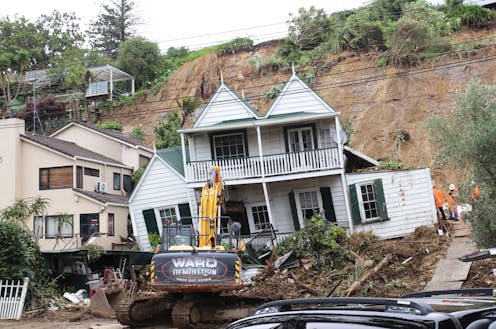
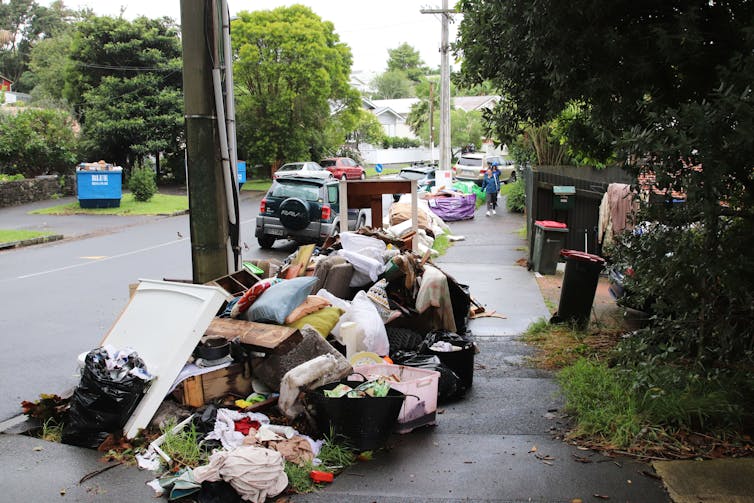
It is unlikely that the Mayor of Auckland, Wayne Brown, took any lessons from the city’s devastating floods but the rest of us — and journalists in particular — could learn a thing or two.

Brown’s demeanour will not be improved by a petition calling for his resignation or media columnists effectively seeking the same. He will certainly not be moved by New Zealand Herald columnist Simon Wilson, now a predictable and trenchant critic of the mayor, who correctly observed in the Herald on Sunday: “In a crisis, political leaders are supposed to soak up people’s fears…to help us believe that empathy and compassion and hope will continue to bind us together.”

Wilson’s lofty words may be wasted on the mayor, but they point to another factor that binds us together in times of crisis. It is communication, and it was as wanting as civic leadership on Friday night and into the weekend.

Media coverage on Friday night was limited to local evacuation events, grabs from smartphone videos and interviews with officials that were light on detail. The on-the-scene news crews performed well in worsening conditions, particularly in West Auckland.

However, there was a dearth of official information and, crucially, no report that drew together the disparate parts to give us an over-arching picture of what was happening across the city.

I waited for someone to appear, pointing to a map of greater Auckland and saying: “These areas are experiencing heavy flooding . . . State Highway 1 is closed here, here and here as are these arterial routes here, here, and here across the city . . . cliff faces have collapsed in these suburbs . . . power is out in these suburbs . . . evacuation centres have been set up here, here, and here . . . :

That way I would have been in a better position to understand my situation compared to other Aucklanders, and to assess how my family and friends would be faring. I wanted to know how badly my city as a whole was affected.

I didn’t get it from television on Friday night nor did I see it in my newspaper on Saturday. My edition of the Weekend Herald, devoting only its picture-dominated front page and some of page 2 to the flooding, was clearly hampered by early deadlines. The Dominion Post devoted half its front page to the storm and, with a later deadline, scooped Auckland’s hometown paper by announcing Brown had declared a state of emergency.

So, too, did the Otago Daily Times on an inside page. The page 2 story in The Press confirmed the first death in the floods.

I turned to television on Saturday morning expecting special news programmes from both free-to-air networks. Zilch . . . nothing. Later in the day TV1 and Newshub did rise to the occasion with specials on the prime minister’s press conference, but it seems a small concession for such a major event.

Radio fared better but only because regular hosts such as NewstalkZB’s All Sport Breakfast host D’Arcy Waldegrave and Today FM sports journalist Nigel Yalden rejigged their Saturday morning shows to also cover the floods.

RNZ National’s Kim Hill was on familiar ground and her interview with Wayne Brown was more than a little challenging for the mayor. RNZ mounted a “Midday Report Special” with Corin Dann that also tried to break through the murk, but I was left wondering why it had not been a Morning Report Special starting at 6 am.

Over the course of the weekend the amount of information provided by news media slowly built up. Both Sundays devoted six or seven pages to the floods but it was remiss of the Herald on Sunday not to carry an editorial, as did the Sunday Star Times.

It was also good to see Newsroom and The Spinoff — digital services not usually tied to breaking news of this kind — providing coverage.

“Live” updates on websites and news apps added local detail but there was no coherence, just a string of isolated events stretching back in time.

Overall, the amount of information I received as a citizen of the City of Sails was inadequate. Why?

Herein lie the lessons.

News media under-estimated the impact of the event. Although there were fewer deaths than in the Christchurch earthquake or the Whakaari White Island eruption, the scale of damage in economic and social terms will be considerable. The natural disaster warranted news media pulling out all the stops and, as they did on those occasions, move into schedule-changing mode (and that includes newspaper press deadlines).

Lesson #1: Do not allow natural disasters to occur on the eve of a long holiday weekend.

Media were, however, hampered by a lack of coherent information from official sources and emergency services. Brown’s visceral dislike of journalists was part of the problem but that was not the root cause. That fell into two parts.

The first was institutional disconnects in an overly complex emergency response structure which is undertaken locally, coordinated regionally and supported from the national level. This complexity was highlighted after another Auckland weather event in 2018 that saw widespread power outages.

The report on the response was resurrected in front page leads in the Dominion Post and The Press yesterday. It found uncoordinated efforts that did not use the models that had been developed for such eventualities, disagreements over what information should be included in situation reports, and under-estimation of effects.

Massey University director of disaster management Professor David Johnston told Stuff he believed the report would be exactly the same if it was recommissioned now because Auckland’s emergency management system was not fit for purpose — rather it was proving to be a good example of what not to do

Lesson #2: Learn the lessons of the past.

The 2018 report did, however, give a pass mark to the communication effort and noted that those involved thought they worked well with media and in communicating with the public through social media.

Can the same be said of the current disaster response when there “wasn’t time” to inform a number of news organisations (including Stuff) about Wayne Brown’s late Friday media conference, and when Whaka Kotahi staff responsible for providing updates clocked-off at 7.30 pm on Friday?

Is it timely for Auckland Transport to still display an 11.45 am Sunday “latest update” on its website 24 hours later? Is it relevant for a list of road closures accessed at noon yesterday to have actually been compiled at 7.35 pm the previous night? Why should a decision to keep Auckland schools closed until February 7 cause confusion in the sector simply because it was “last minute”?

Lesson #3: Ensure communications staff know the definition of emergency: A serious, unexpected, and potentially dangerous situation requiring immediate action.

There certainly was confusion over the failure to transmit a flood warning to all mobile phones in the city on Friday. The system worked perfectly on Sunday when MetService issued an orange Heavy Rain Warning.

It appears that emergency personnel believed posts on Facebook on Friday afternoon and evening were an effective way of communicating directly with the public. That is alarming because social media use is so fragmented that it is dangerous to make assumptions on how many people are being reached.

A study in 2020 of United States local authority communication about the covid pandemic showed a wide range of platforms being used and the recipients were far from attentive. The author of the study, Eric Zeemering, found not only were city communications fragmented across departments, but the public audience selectively fragmented itself through individual choices to follow some city social media accounts but not others.

In fact, more people were passing information about the flood to each other via Twitter than on Facebook and young people in particular were using TikTok for that purpose. Media organisations were reusing these posts almost as much as the official information that from some quarters was in short supply.

Lesson #4: When you need to communicate with the masses, use mass communication (otherwise known as news media).

Mistakes will always be made in fast changing emergencies but, having made a mistake, it is usual to go the extra yards to make amends. It beggars belief that Whaka Kotahi staff would fail to keep their website up to date on the Auckland situation when it is quite clear they received an enormous kick up the rear end from Transport Minister Michael Wood for clocking off when the heavens opened.

Or that Auckland Transport could be far behind the eight ball after turning travel arrangements for the (cancelled) Elton John concert into a fiasco.

After spending Friday evening holed up in his high-rise office away from nuisances like reporters attempting to inform the public, Mayor Brown justified his position with a strange definition of leadership then blamed others.

Sideswipe’s Anna Samways collected a number of tweets for her Monday Herald column. Among them was this: “Just saw one of the Wayne Brown press conferences. He sounded like a man coming home 4 hours late from the pub and trying to bull**** his Mrs about where he’d been.”

Lesson #5: When you’re in a hole, stop digging.

Dr Gavin Ellis holds a PhD in political studies. He is a media consultant and researcher. A former editor-in-chief of The New Zealand Herald, he has a background in journalism and communications — covering both editorial and management roles — that spans more than half a century. Dr Ellis publishes a website called Knightly Views where this commentary was first published and it is republished by Asia Pacific Report with permission.

Print Friendly, PDF & Email

Article by AsiaPacificReport.nz

Police probe fire after Vanuatu chiefs’ cultural ‘nakamal’ burns down

RNZ Pacific

The headquarters of the Malvatumauri of National Council of Chiefs of Vanuatu has burned down.

The fire broke out about 1am Monday local time.

Police are investigating the cause of the fire in Port Vila.

The Malvatumauri nakamal is a custom parliament for all Vanuatu’s chiefs.

“This nakamal was the identity of the people of Vanuatu. It symbolised the unity of the custom of the Vanuatu and the law, peace and order of communities in Vanuatu,” said Chief Willie Plasua.

He told all chiefs around the country that while it was a major loss, it was only temporary.

“Custom, culture and tradition will never die and we will rebuild our headquarters,” Plasua said.

RNZ Pacific correspondent Hilaire Bule said the cost of the nakamal was more than 100 million vatu (US$850,000) and was co-financed by the Vanuatu and Australian governments.

The house was built with local materials to house the members of Malvatumauri during their annual general meeting.

An eyewitness, Sylverio Molkis, said on seeing the fire he made several phone calls to the fire brigade but could not get through.

“I also called the police but there was no answer and I had to go myself to the fire station to tell them about the blaze,” he said.

Only two buildings housing the administration offices of the Malvatumauri have survived.

This article is republished under a community partnership agreement with RNZ.

Article by AsiaPacificReport.nz

Auckland deputy mayor talks up media role in disasters in wake of mayor Brown ‘drongos’ text

Auckland mayor Wayne Brown is under fire for calling New Zealand journalists “drongos”, blaming them for having to cancel a round of tennis with friends on Sunday as the city dealt with the aftermath of record rainfall and flooding that left four dead.

It comes after widespread criticism of his handling of the disaster, including being slow to declare a state of emergency on Friday night and a combative, testy media conference on Saturday.

A producer for MediaWorks news station Today FM on Saturday said Brown turned down an interview on Friday morning because he wanted to play tennis instead.

WhatsApp messages leaked to The New Zealand Herald showed rain got in the way, with Brown telling friends on Saturday morning it was “pissing down so no tennis”. Despite being freed up, the interview did not go ahead.

And on Saturday night, Brown told the WhatsApp group — known as ‘The Grumpy Old Men’ — he couldn’t play on Sunday either because “I’ve got to deal with media drongos over the flooding”.

Brown asked the Herald not to write a story about the messages, calling them a “private conversation aimed at giving a reason to miss tennis”.

“There is no need to exacerbate a situation which is not about me but about getting things right for the public and especially those in need and in danger.”

Few interviewsBrown has given few interviews with media since being elected mayor last year, turning down all but two of 108 requests in his first month in office.

He also turned down Morning Report‘s request to appear on the show on Tuesday morning. His deputy, Desley Simpson, did call in — saying she was “happy to talk to you at any time”.

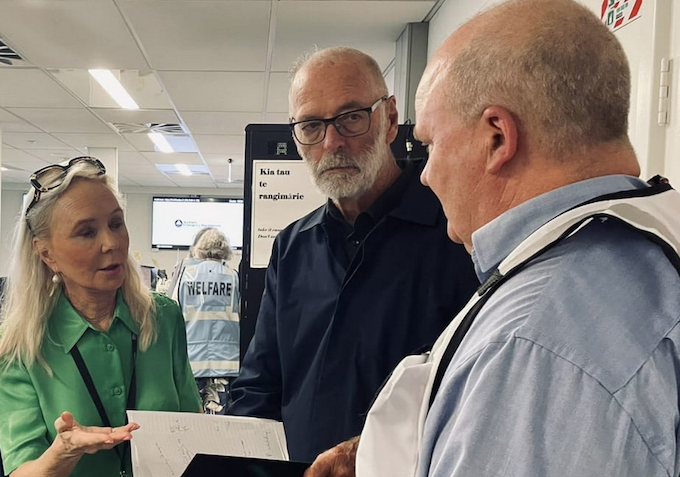
Auckland's deputy mayor Desley Simpson with mayor Wayne Brown
Auckland’s deputy mayor Desley Simpson with mayor Wayne Brown (centre) . . . she says she is “happy to talk to you [media] at any time”. Image: RNZ

“My understanding is the mayor is on the ground, and has been over the weekend,” she said, not directly addressing criticism he wasn’t communicating effectively.

“I think as his deputy I am more than happy to do that role. I’m talking to you now, I’ll talk to you at any time. That’s my commitment to you and to Auckland.”

Asked if it was acceptable to call journalists “drongos”, Simpson again avoided the question.

“Media play an important part, in my opinion, in helping get our message out. I really appreciate talking to you this morning so that we can inform Aucklanders what they need to do to be prepared for the storm . . .

“My focus, and I think all local boards and other councillors — and the mayor — our focus is making sure that Auckland is prepared for this afternoon and this evening. It’s going to be a rough 24 hours, and I really appreciate you helping us get this message out.”

She then said she had not seen Brown’s texts, she had been busy “getting myself ready this morning with emergency services and stuff for this afternoon”.

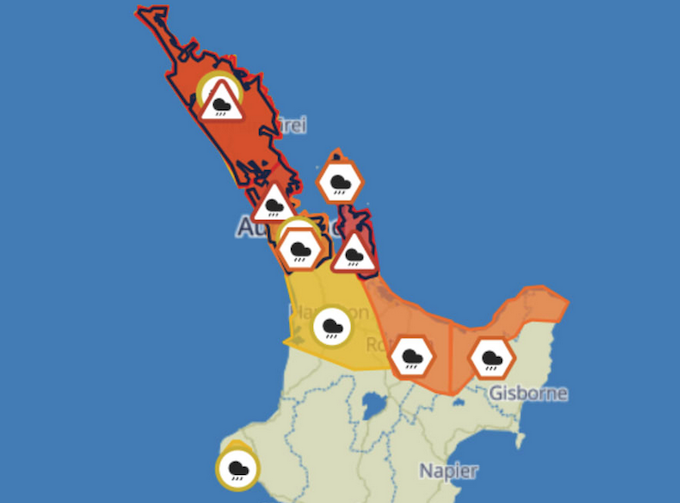
The region north of Auckland’s Orewa is under an unprecedented “red” rain warning, while the rest of the city to the south is at orange.

This article is republished under a community partnership agreement with RNZ.

New Zealand's Northland "red" warning
New Zealand’s Northland . . . “red” warning to prepare for a deluge. Image: RNZ News
Print Friendly, PDF & Email

Article by AsiaPacificReport.nz

Victoria has implemented all 227 recommendations from its royal commission into family violence. So was it a success?

Source: The Conversation (Au and NZ) – By Kate Fitz-Gibbon, Director, Monash Gender and Family Violence Prevention Centre; Professor of Social Sciences, Faculty of Arts, Monash University

In 2016, the Victorian Royal Commission into Family Violence released its findings following an exhaustive 13-month inquiry. In it were 227 recommendations to completely transform the state’s family violence services.

The royal commission involved more than 1,000 written submissions, 44 group sessions attended by some 850 people, and 25 days of public hearings.

It is widely regarded as the largest family violence reform process in Australia’s history. In the past seven years, many have looked to Victoria to gauge what a multi-billion-dollar government commitment to reform can deliver.

Last week, with relatively little fanfare, the Victorian government announced it has now implemented all 227 recommendations.

Does this mean the royal commission was a success?


Read more:
Royal commission calls for complete overhaul of Victoria’s family violence services and responses


Have rates of family violence gone down?

With $3.7 billion invested in the reforms, it is fair to question what has been achieved. Unfortunately, there is no easy answer. Rates of family violence and violence against women in Victoria and across Australia remain stubbornly high.

Research has found the severity and frequency of intimate partner violence intensified during the first two years of the COVID-19 pandemic. By that point in the reform agenda, many had hoped the state would be starting to see decreasing prevalence rates.

It is critical the Victorian government and others do not view continued high rates of family violence as a failure of the royal commission, and the state continues to invest in efforts to address the issue.

Family violence is a much bigger problem than any one reform cycle.

What was achieved?

Undoubtedly, much has been achieved in Victoria since the royal commission. This is due to the hard work of the family violence sector, victim-survivor advocates and practitioners, alongside the government’s funding and commitment to deliver, especially on the big-ticket reforms.

Among the significant reforms from the royal commission that have been implemented:

  • the Family Violence Information Sharing Scheme, which enables sharing of information between organisations to support family violence risk assessment and management

  • a new framework that supports practitioners to effectively identify, assess and manage family violence risk

  • the creation of specialist family violence courts

  • the introduction of the Victim-Survivors Advisory Council to ensure individuals with lived experience are consulted in the ongoing delivery of the reforms

  • and the establishment of Respect Victoria, an organisation dedicated to the prevention of violence against women and family violence.

Many of these are nationally leading reforms seeking to deliver a more connected service system based on the principles of victim-survivor safety and perpetrator accountability.

While marking these achievements is important, the royal commission’s reforms should be viewed as the first step in a much longer commitment to end family violence.

Here are four lessons we believe are important as the Victorian government plans its next steps:

1. We need ongoing strategic vision and leadership

Creating a cohesive reform agenda out of the sheer size of the recommendations was a formidable task. There were many problems in the early implementation phase. Among them was a tick-box approach to the reforms at the expense of an overarching strategic approach to implementation.

Strong leadership is now critical to ensure women’s safety remains a core government focus as we emerge from the pandemic. Victim-survivors may now be able to access a more connected system compared with seven years ago, and the risks they face should now be more apparent to practitioners. But undoubtedly violence continues at unacceptable rates.

2. We must not lose sight of prevention

The royal commission’s recommendations were heavily weighted towards response measures. That is, how family violence is responded to once it has occurred.

Prevention, on the other hand, encompasses work that aims to stop violence from happening in the first place. While it was the focus of fewer recommendations, it is absolutely essential.

Tackling the underlying drivers of violence must be at the forefront of future efforts. Prevention is one of four pillars in the National Plan to End Violence against Women and Children. To align with the national plan, the next steps in Victoria must by focus on whole-of-society prevention measures and early intervention, alongside the need to build a system that supports victim-survivors’ recovery and healing.

3. We need a coordinated, national approach

A key challenge of combating family violence is its complexity. Family violence intersects with many other problems, such as mental health, housing and homelessness, alcohol and drug use. Responses to family violence can involve many different government departments, service settings and jurisdictions.

Such complexity requires a coordinated approach led at the national level but with significant resource commitment from every state and territory.

The national plan, which has bipartisan commitment, will hopefully guide and coordinate the much needed ongoing action.

4. We need to focus attention on child victim-survivors

The royal commission’s report referred to children as the “silent victims” of family violence.

There were only a small number of recommendations directly targeted at improving responses to children who are victims of family violence. As we move forward, it is critical children are viewed as victim-survivors in their own right.

To achieve this, we need to train practitioners and provide more resources to services that are geared toward children and young people who have experienced family violence.

We will not eliminate violence in one generation without bringing the children and young people clearly into focus.

Where to next?

These overarching lessons merely scratch the surface of what can be learned from this world-leading commitment to end family violence.

Last year was another horrific year for violence against women. A woman in Australia was killed by male violence every six days. We must do better.

The national plan and the ongoing commitments by state governments give us a good chance to reduce this number, but the work needs to be driven by a transformational vision, funding commensurate with the scale of the crisis, and greater inclusion of victim-survivors to inform policy and practice.


Read more:
A new national plan aims to end violence against women and children ‘in one generation’. Can it succeed?


The Conversation

Kate receives funding for family violence related research from the Australian Research Council, Australian Institute of Criminology, Australia’s National Research Organisation for Women’s Safety, the Victorian Government and the Department of Social Services. In 2021 Kate led the National Plan Stakeholder and Victim-Survivor Advocates Consultation Projects. This piece is written by Kate Fitz-Gibbon in her capacity as Director of the Monash Gender and Family Violence Prevention Centre and are wholly independent of Kate Fitz-Gibbon’s role as Chair of Respect Victoria.

Rebecca Buys does not work for, consult, own shares in or receive funding from any company or organization that would benefit from this article, and has disclosed no relevant affiliations beyond their academic appointment.

ref. Victoria has implemented all 227 recommendations from its royal commission into family violence. So was it a success? – https://theconversation.com/victoria-has-implemented-all-227-recommendations-from-its-royal-commission-into-family-violence-so-was-it-a-success-198762

Enough with the koala cakes – the government’s annual Threatened Species Bake Off seriously neglects fish, plants and other lesser-loved species

Source: The Conversation (Au and NZ) – By Eliza Middleton, Biodiversity Management Officer, University of Sydney

Overall winner of the 2018 competition, a Growling Grass Frog (_Litoria raniformis_) by EnviroDNA @enviro_DNA @enviro_DNA, CC BY-NC

Almost 2,000 native species are officially listed as “threatened” in Australia – but how many have you actually heard of?

Each year, the federal government holds the Threatened Species Bake Off, a social media competition where entrants represent a threatened species in cake form. It aims to build awareness of Australia’s vast diversity of wildlife facing extinction – but our new research found a serious problem with bias towards cute and cuddly animals.

We trawled over 700 entries between 2017 and 2021, and found koalas, echidnas, and wombats consistently depicted. These are the typical poster children of conservation.

Koalas, for example, are frequently allocated large sums of money for conservation. Compare this to many lesser known, more impactful and at-risk species including the grey nurse shark and foundation species such as seaweeds.

Australia is a world leader in extinctions and, indeed, many at-risk plants and animals aren’t even on the official threatened species list, but should be. While the bake off is well-intentioned, our results highlight a massive gap in conservation messaging.

Unless we build the profile of our lesser-loved plants, invertebrates, frogs and fish, we’ll certainly see more species vanish.

What species do people like to bake?

The Threatened Species Bake off begins on September 7, when Facebook, Instagram, and Twitter get flooded with photos of baked goods with elaborate animal or plant designs. Since its inception in 2017, the competition has become increasingly popular and has even garnered celebrity judges including Dawn French, Costa Georgiadis and Kat Sabbath.

It reflects the urgent need to explore creative and novel ways to engage with diverse audiences about Australia’s extinction crisis. But whether it can actually makes a difference to wildlife depends on what people choose to depict.

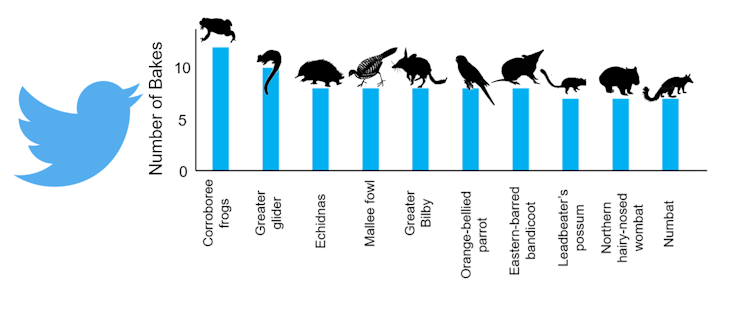
The charts below show the top ten most popular species baked in the Threatened Species Bake Off on Instagram and Twitter since 2017. Birds and mammals have proven most popular – koalas, echidnas, orange-bellied parrots and other iconic species come out on top. The corroboree frog is the exception to this trend, topping popularity on Twitter and in the top five on Instagram.

The top ten most popular species baked in the Threatened Species Bake Off on Instagram.
Author supplied
Top ten species baked on Twitter in the Threatened Species Bake Off.
Author supplied

Most of the nearly 2,000 species listed as threatened by the federal government are plants – 1,411 plants compared to 562 animals. But very few contestants depict plants in the Threatened Species Bake Off. Just 3% of the listed threatened plants have been depicted, compared to 40% of the listed mammals and 30% of the listed birds.

This highlights a global issue with “plant blindness” – a phenomenon where plants are frequently forgotten when considering the nature in an area, leading to limited interest and funding for their conservation.

In fact, many of the species in the Albanese government’s 2022-2032 Threatened Species Action Plan are birds and mammals – species considered much more charismatic than a plant or invertebrate. The action plan includes 14% of threatened mammals and 13% of threatened birds – and just 2% of threatened plants.


Read more:
‘Gut-wrenching and infuriating’: why Australia is the world leader in mammal extinctions, and what to do about it


What the bake off revealed about conservation gaps

This brings us to Australia’s invertebrates – the bedrock of ecosystems. We found 50% of invertebrates on the official threatened species list were featured in bake offs (that’s 34 of 68 listed species).

This prevalence, however, is misleading. It masks one of the most significant deficiencies in threatened species management: the lack of invertebrates on threatened species lists. In fact, invertebrates are simply classified as “other animals” under Australia’s threatened species legislation.

Their relative absence from lists of protected groups highlights two major gaps in our knowledge:

  1. many invertebrates are yet to be scientifically described and named – the key entry point to being included on these lists

  2. we know very little about most invertebrates that have been scientifically described and named – we know only where they were found.

To adequately conserve Australia’s biodiversity, we need to urgently prioritise research on such crucial animals.


Read more:
They might not have a spine, but invertebrates are the backbone of our ecosystems. Let’s help them out


Social media can help and hamper conservation

The bake off’s popularity shows social media can be powerful conservation messaging tool. But promoting conservation via social media walks a fine line between protecting and endangering threatened species.

For example, a social media post of a scenic location inhabited by threatened species may drive increased tourism to the location, adding more pressure to the species and its habitat. Indeed, a study in 2019 drew potential links between the rise in videos posted to YouTube of otters as pets with an increase in illegal otter trade.

On the other hand, the use of social media has led to great success in controlling populations of the invasive Indo-Pacific lionfish in the Western Atlantic and Caribbean.

To reduce populations, the Florida Fish and Wildlife Conservation Commission has held fishing tournaments since 2014, advertising via social media. The event has evolved into a multi-day festival with art booths, lionfish tastings, and filet demonstration.

What these examples and the bake off shows is the need for a tailored approach for each conservation message.

But so far, the conservation message of the bake off is not clear given people have baked species that aren’t even listed as threatened such as the platypus, brolga, and Mount Lewis spiny crawfish, as well as species that aren’t even Australian, such as tigers and pandas.

Try something different this bake off

We need to find ways to ensure all species, not just koalas, are on the receiving end of conservation action. Here are some ways we can encourage this.

First is to increase their visibility by providing images of threatened species. For example, researchers and nature enthusiasts could make their images free to use on websites such as Wikimedia Commons. Or, they could upload images to iNaturalist or Atlas of Living Australia, two websites that catalogue the sightings of species submitted by researchers and the public.

Giving newly discovered species interesting or funny names can also create emotional connections, encouraging people to care more about them – like the Amazonian Agra beetle species, which include names such as Agra vation and Agra cadabra, or the Australian wasp species Aha ha.

Previous bake offs have incorporated themes including “species I’ve seen” and “ecosystem engineers”. Organisers should introduce a new theme: “species I’ve never heard of”, or “the species under my feet”.

So next bake off, how about baking a small-flowered snottygobble , a Kangaroo Island Assassin Spider, a red handfish, or a cauliflower soft coral?


Read more:
From superheroes to the clitoris: 5 scientists tell the stories behind these species names


The Conversation

Eliza Middleton received funding from The Australian Research Council

Caitlyn Forster works for Invertebrates Australia. She received funding from the Australian Research Council and is affiliated with the Australasian Society for the Study of Animal Behaviour.

Dieter Hochuli receives funding from the Australian Research Council, NSW Department of Planning and Environment, the City of Sydney and the Inner West Council.

ref. Enough with the koala cakes – the government’s annual Threatened Species Bake Off seriously neglects fish, plants and other lesser-loved species – https://theconversation.com/enough-with-the-koala-cakes-the-governments-annual-threatened-species-bake-off-seriously-neglects-fish-plants-and-other-lesser-loved-species-197028

First Nations people often take on the ‘cultural load’ in their workplaces. Employers need to ease this burden

Source: The Conversation (Au and NZ) – By Nina Sivertsen, Senior Lecturer (Nursing), Flinders University

Getty Images

It’s good practice for employers to consult staff when forming policies or guidelines. However, for some staff from diverse backgrounds, this creates extra work and pressure.

“Cultural load” in the context of the workplace is the invisible workload employers knowingly or unknowingly place on Aboriginal and Torres Strait Islander employees to provide Indigenous knowledge, education and support. This is often done without any formally agreed reduction or alteration to their workload.

Consultation and transparency around policies which relate to and impact on First Nations voices is essential for reconciliation. However this should be built on reciprocity and respect, and not create additional staff burden or burnout.


Read more:
Attention managers: if you expect First Nations’ staff to do all your ‘Indigenous stuff’, this isn’t support – it’s racism


Increasing understanding

Aboriginal and Torres Strait Islander employees commonly bear the cultural load in their workplaces. They are in high demand to act as role models, mentors, members on committees and be a point of contact for enquiries around any First Nations matters from other staff.

A 2020 survey of more than 1,000 Aboriginal and Torres Strait Islander workers found 78% of respondents felt it important to identify as Indigenous at work.

But almost two-thirds (63%) reported high levels of identity strain. This meant feeling different to or not meeting expectations of the dominant culture in the workplace.

Some 39% said they carried the burden of “high cultural load”, which came in the form of extra work demands and the expectation they would educate others.

Aboriginal and Torres Strait Islander people constitute 3.8% of Australia’s total population, with around half in employment. As First Nations issues increase in prominence in the lead up to the referendum to constitutionally recognise Aboriginal and Torres Strait Islander people through a First Nations Voice, it’s important we address the toll of the invisible work of educating and explaining.


Read more:
10 ways employers can include Indigenous Australians


It takes a toll

The additional cultural workload increases risk of inducing vicarious trauma. Continually revisiting intergenerational trauma takes its toll on Aboriginal and Torres Strait Islander staff, who are already working between two worlds.

It can also be difficult switching off from being in education mode or from First Nations advocacy. This additional cultural load, and the cumulative effects of empathetic engagement with non-Indigenous staff and management, can result in burnout or “compassion fatigue”.

Culturally unsafe environments (that discriminate against, diminish or disempower someone’s cultural identity), workload stress and physiological stress are all workplace hazards. Employers have a duty of care to remove or minimise any hazard that can be detrimental to a worker’s health and safety.

Officer worker talks to Blak colleague at a conference table
Employers have a duty to minimise workplace hazards.
Shutterstock

So what can employers do?

To ensure Aboriginal and Torres Strait Islander staff aren’t overburdened, employers can implement practical measures to reduce their cultural load.

Research shows an organisation’s culture can thrive by adopting a management framework of continuous evaluation and improvement. Organisations can appoint diversity leaders, to promote accountability and buy-in from all levels of leadership, and ensure their initiatives have the support of HR departments.

Organisations can also employ diversity officers to help staff to support inclusion efforts and anti-racism.

Implementing a reconciliation action plan is another way to increase awareness of cultural load among employers and staff. Run by Reconciliation Australia, the plans are a framework for organisations to be inclusive and contribute to national reconciliation.

Since 2006, more than 2,000 organisations have formalised their commitment to reconciliation with a reconciliation action plan, including at Flinders University, where we work.

The Flinders University reconciliation action plan has several smaller working groups. Our working group aims to:

  • ensure any Aboriginal-related work is Aboriginal-led and informed

  • recognise identity strain and educate non-Indigenous staff about how to interact with First Nations colleagues in ways that reduce this

  • recognise and remunerate cultural load as part of an employee’s workload

  • provide support and workload management to alleviate cultural load (by advocating for management to allocate extra workload “points” to Aboriginal and Torres Strait Islander colleagues so this work is no longer “invisible”)

  • recognise the importance of celebrating cultural identities and supporting First Nations staff and students to engage in significant community events.

Our working groups comprise both First Nations and non-Indigenous members and are guided by two-eyed-seeing. This means bringing together both Indigenous and non-Indigenous peoples, ways of being, knowing and doing, to achieve collaboration and partnership.

Since we ratified our first plan in 2020, we have worked to increase:

  • engagement with Aboriginal and Torres Strait Islander students, staff and community
  • respect for First Nations knowledge systems and perspectives
  • Aboriginal and Torres Strait Islander advancement in education, research, employment and wellbeing.

Sometimes reconciliation action plans aren’t taken seriously because they lack accountability. Although there’s not much evidence they create change, supporters of reconciliation highlight their ability to create shared values in workplaces.

Non-Indigenous staff have a duty to ensure their work doesn’t perpetuate trauma from centuries of colonisation. Everyone can be a cultural ally and advocate for change.


Read more:
Australia’s universities are on unceded land. Here’s how they must reconcile with First Nations people


Acknowledgement: thanks to our Aboriginal colleagues who generously share their time and cultural knowledge, especially Kristal Matthews, Larissa Taylor, Sharon Watts and David Copley.

The Conversation

The authors do not work for, consult, own shares in or receive funding from any company or organisation that would benefit from this article, and have disclosed no relevant affiliations beyond their academic appointment.

ref. First Nations people often take on the ‘cultural load’ in their workplaces. Employers need to ease this burden – https://theconversation.com/first-nations-people-often-take-on-the-cultural-load-in-their-workplaces-employers-need-to-ease-this-burden-193858

Can chewing help manage stress, pain and appetite? Here’s what the science says

Source: The Conversation (Au and NZ) – By Clare Collins, Laureate Professor in Nutrition and Dietetics AO, University of Newcastle

Pexels/Anna Shvets

Ever feel a bit stressed or need a concentration boost? Research suggests one remedy may be right under your nose. Chewing has benefits for brain function, stress, anxiety, exam performance, pain perception, as well as hunger and food intake.

Here’s what the research about chewing more says, in experiments that used either food or chewing gum.

What do teeth have to do with your brain?

Being able to chew efficiently is related to how many teeth you have. While adults usually have 32 teeth, you need 20 teeth, with at least nine or ten pairs making contact, in order to chew properly.

The hippocampus area of the brain assists with information transfer from short-term to long-term memory. It also processes spatial memory, which helps you remember practical things, like where you’ve put your phone or how to get to the shops.

Research shows not being able to chew properly, whether due to tooth loss or gum disease, affects the hippocampus through stimulating the production of stress hormones, called glucocorticoids. These impair your ability to acquire and process information.

Older man eats rice
The ability to chew is important for healthy ageing.
Shutterstock

A review of research on chewing and cognitive decline in adults found people with fewer teeth didn’t get the same amount of brain activation. The more strongly people could chew, the more blood flowed to their brains, leading to more oxygen and activity in regions of the brain linked to learning and memory.

Another review found poorer chewing was associated with faster cognitive decline and the risk of developing dementia.

This adds to the evidence that chewing ability and oral health are central to healthy ageing.


Read more:
Health Check: is chewing gum actually good for your teeth?


Anxiety reliever and attention booster

Chewing gum cab be an inexpensive and effective way to help relieve anxiety and boost attention.

Results across eight research trials that included more than 400 adults found chewing gum more often, compared to never chewing gum, resulted in a significant reduction in anxiety.

Although the exact mechanism in not currently known, research in animal models suggests not being able to chew properly leads to the stimulation of neurons involved in emotional regulation.

Another meta-analysis of eight intervention studies that tested the effect of chewing gum found there was a small improvement in levels of sustained attention, with improved ability to maintain alertness during mentally demanding tasks in the group given gum to chew.

To reduce the amount of dental plaque and risk of tooth decay, opt for sugar-free chewing gum.

Middle-aged woman eats chewing gum in the car
Chewing can improve your alertness.
Shutterstock

Stock up on gum when preparing for exams

A 2019 intervention study
tested the effect of regularly chewing gum or not, on stress, anxiety, depression, attention and exam success.

They randomised 100 final year nursing students to either chew sugarless gum for at least 30 minutes a day for 19 days, a group who chewed gum for seven days only, or a control group who did not chew gum at all.

They found levels of depression, anxiety and stress were significantly lower in both chewing gum groups, while academic success scores were higher in 19-day gum chewers only compared to the other groups. There was no effect on self-focused attention.

So chewing gum before exams may help students overcome exam stress and enhance exam success, but might not help those who have difficulty focusing their attention.

Chewing may alter your perception of pain

Another study randomised 161 adults undergoing routine colorectal surgery to either chew gum four times a day post-operatively, or not chew gum.

People in the chewing gum group reported lower perceived pain on days two to five post-surgery.

Interestingly, there was no difference between groups in how long it took to pass flatus (fart) or a bowel motion. These signal a return to normal gut function after surgery.

Man sits on side of hospital bed
In one study, people who chewed gum reported lower levels of pain.
Shutterstock

A trial in a children’s hospital in Turkey randomised 73 children having an IV cannula inserted to receive either a chewing gum intervention during the procedure or standard care only.

Both nurses and children reported significantly lower pain levels among the chewing gum group compared to the usual care.

While exact mechanisms are not confirmed, the analgesic effects of chewing gum appear to be mediated via neurons in the brain related to serotonin, a neurotransmitter that affects body functions including mood and anxiety.

Chewing your food well can reduce your appetite

A systematic review of studies using foods looked at the impact of people receiving advice to consciously slow down when eating and chew more, on aspects of appetite and food intake.

The study participants reported less hunger, desire to eat and ate significantly less food, compared to people eating as usual.


Read more:
Health Check: should we really chew each mouthful of food 32 times?


Putting all this research together, it appears that chewing gum may be an easy “go to” intervention with benefits for your brain. Take care though, as “sugar free” gum usually contains sorbitol, a common artificial sweetener and can trigger diarrhoea if consumed in excess.

Chewing gum can also lead to aerophagia, meaning too much air is swallowed, and trigger abdominal distention or discomfort – although researchers found chewing gum does not make you burp more.

When it comes to food, the advice to “take time to chew your food properly” is wise.

Maintain good oral health by brushing your teeth, having regular dental check ups and, for those with tooth loss, good fitting dentures. And, if you grab some chewing gum, make sure it’s sugar-free.

The Conversation

Clare Collins AO is a Laureate Professor in Nutrition and Dietetics at the University of Newcastle, NSW and a Hunter Medical Research Institute (HMRI) affiliated researcher. She is a National Health and Medical Research Council (NHMRC) Leadership Fellow and has received research grants from NHMRC, ARC, MRFF, HMRI, Diabetes Australia, Heart Foundation, Bill and Melinda Gates Foundation, nib foundation, Rijk Zwaan Australia, WA Dept. Health, Meat and Livestock Australia, and Greater Charitable Foundation. She has consulted to SHINE Australia, Novo Nordisk, Quality Bakers, the Sax Institute, Dietitians Australia and the ABC. She was a team member conducting systematic reviews to inform the 2013 Australian Dietary Guidelines update and the Heart Foundation evidence reviews on meat and dietary patterns.

ref. Can chewing help manage stress, pain and appetite? Here’s what the science says – https://theconversation.com/can-chewing-help-manage-stress-pain-and-appetite-heres-what-the-science-says-163364

AI is helping us search for intelligent alien life – and we’ve found 8 strange new signals

Source: The Conversation (Au and NZ) – By Danny C Price, Senior research fellow, Curtin University

Midjourney, Author provided

Some 540 million years ago, diverse life forms suddenly began to emerge from the muddy ocean floors of planet Earth. This period is known as the Cambrian Explosion, and these aquatic critters are our ancient ancestors.

All complex life on Earth evolved from these underwater creatures. Scientists believe all it took was an ever-so-slight increase in ocean oxygen levels above a certain threshold.

We may now be in the midst of a Cambrian Explosion for artificial intelligence (AI). In the past few years, a burst of incredibly capable AI programs like Midjourney, DALL-E 2 and ChatGPT have showcased the rapid progress we’ve made in machine learning.

AI is now used in virtually all areas of science to help researchers with routine classification tasks. It’s also helping our team of radio astronomers broaden the search for extraterrestrial life, and results so far have been promising.

Discovering alien signals with AI

As scientists searching for evidence of intelligent life beyond Earth, we have built an AI system that beats classical algorithms in signal detection tasks. Our AI was trained to search through data from radio telescopes for signals that couldn’t be generated by natural astrophysical processes.

When we fed our AI a previously studied dataset, it discovered eight signals of interest the classic algorithm missed. To be clear, these signals are probably not from extraterrestrial intelligence, and are more likely rare cases of radio interference.

Nonetheless, our findings – published today in Nature Astronomy – highlight how AI techniques are sure to play a continued role in the search for extraterrestrial intelligence.

An AI-generated image signifying an AI entity searching for extraterrestrial life in space.
AI-based systems are being increasingly used to classify signals found in massive amounts of radio data, helping speed-up the search for alien life.
Generated by DALL-E 2, Author provided

Not so intelligent

AI algorithms do not “understand” or “think”. They do excel at pattern recognition, and have proven exceedingly useful for tasks such as classification – but they don’t have the ability to problem solve. They only do the specific tasks they were trained to do.

So although the idea of an AI detecting extraterrestrial intelligence sounds like the plot of an exciting science fiction novel, both terms are flawed: AI programs are not intelligent, and searches for extraterrestrial intelligence can’t find direct evidence of intelligence.

Instead, radio astronomers look for radio “technosignatures”. These hypothesised signals would indicate the presence of technology and, by proxy, the existence of a society with the capability to harness technology for communication.

For our research, we created an algorithm that uses AI methods to classify signals as being either radio interference, or a genuine technosignature candidate. And our algorithm is performing better than we’d hoped.

What our AI algorithm does

Technosignature searches have been likened to looking for a needle in a cosmic haystack. Radio telescopes produce huge volumes of data, and in it are huge amounts of interference from sources such as phones, WiFi and satellites.

Search algorithms need to be able to sift out real technosignatures from “false positives”, and do so quickly. Our AI classifier delivers on these requirements.

It was devised by Peter Ma, a University of Toronto student and the lead author on our paper. To create a set of training data, Peter inserted simulated signals into real data, and then used this dataset to train an AI algorithm called an autoencoder. As the autoencoder processed the data, it “learned” to identify salient features in the data.

In a second step, these features were fed to an algorithm called a random forest classifier. This classifier creates decision trees to decide if a signal is noteworthy, or just radio interference – essentially separating the technosignature “needles” from the haystack.

After training our AI algorithm, we fed it more than 150 terabytes of data (480 observing hours) from the Green Bank Telescope in West Virginia. It identified 20,515 signals of interest, which we then had to manually inspect. Of these, eight signals had the characteristics of technosignatures, and couldn’t be attributed to radio interference.

Eight signals, no re-detections

To try and verify these signals, we went back to the telescope to re-observe all eight signals of interest. Unfortunately, we were not able to re-detect any of them in our follow-up observations.

We’ve been in similar situations before. In 2020 we detected a signal that turned out to be pernicious radio interference. While we will monitor these eight new candidates, the most likely explanation is they were unusual manifestations of radio interference: not aliens.

Sadly the issue of radio interference isn’t going anywhere. But we will be better equipped to deal with it as new technologies emerge.


Read more:
A mysterious signal looked like a sign of alien technology — but it turned out to be radio interference


Narrowing the search

Our team recently deployed a powerful signal processor on the MeerKAT telescope in South Africa. MeerKAT uses a technique called interferometry to combine its 64 dishes to act as a single telescope. This technique is better able to pinpoint where in the sky a signal comes from, which will drastically reduce false positives from radio interference.

If astronomers do manage to detect a technosignature that can’t be explained away as interference, it would strongly suggest humans aren’t the sole creators of technology within the Galaxy. This would be one of the most profound discoveries imaginable.

At the same time, if we detect nothing, that doesn’t necessarily mean we’re the only technologically-capable “intelligent” species around. A non-detection could also mean we haven’t looked for the right type of signals, or our telescopes aren’t yet sensitive enough to detect faint transmissions from distant exoplanets.

We may need to cross a sensitivity threshold before a Cambrian Explosion of discoveries can be made. Alternatively, if we really are alone, we should reflect on the unique beauty and fragility of life here on Earth.


Read more:
We asked astronomers: are we alone in the Universe? The answer was surprisingly consistent


The Conversation

Danny Price is a senior postdoctoral researcher at the International Centre for Radio Astronomy Research (ICRAR) at Curtin University. He is a member of the Breakthrough Listen initiative to search for intelligent life beyond Earth.

ref. AI is helping us search for intelligent alien life – and we’ve found 8 strange new signals – https://theconversation.com/ai-is-helping-us-search-for-intelligent-alien-life-and-weve-found-8-strange-new-signals-198754

Labor’s proposed family law overhaul makes some important changes, but omits others

Source: The Conversation (Au and NZ) – By Camilla Nelson, EG Whitlam Research Fellow at the Whitlam Institute, and Associate Professor, University of Notre Dame Australia

April Fonti/AAP

There is much to be excited about in Attorney-General Mark Dreyfus’s draft Family Law Amendment Bill 2023, the first in a projected series of reforms that promise to put children’s needs and interests back at the centre of family law.

But the proposed reforms stop short of the radical change that is required.

To change the culture of the court, children need legal rights – not just a rubbery set of “best interests”. And the court must be responsible for ensuring children’s rights are protected.

A central problem is that the adversarial culture of the court marginalises children, and can profoundly silence them, including when children express concerns about their safety.

On the upside, the proposed legislation will require the Federal Circuit and Family Court, and Family Court of Western Australia, to more adequately prioritise children’s safety concerns than it has done in the past.


Read more:
Book extract: ‘Broken’ — requiem for the family court


Ending the presumption of ‘shared parental responsibility’

It abandons the presumption of “shared parental responsibility”, which has been widely misunderstood to mean shared care. This may be an achievable goal for families that do not need to go to court to make safe arrangements for their children’s care, but is unsuitable if not dangerous for families with the complex needs and risk factors that come before the court. This includes domestic abuse and family violence, child sexual abuse, drug and alcohol addiction, and serious mental health concerns.

Instead, the bill proposes that the child should be at the centre of every legal determination.

Significantly, the child’s views will be given greater prominence in the legislation, rather than being treated as optional extras.

Independent children’s lawyers – whose role is to ensure evidence relevant to the child’s “best interests” is put before the court – will also find it more difficult to circumvent the requirement to actually speak to the children whose “best interests” they are meant to represent.

The new legislation will remove the onus on ‘shared parental responsibility’, which has often been misconstrued as ‘equal’ parenting time.
Cassiano Psomas/Unsplash

Giving children a voice

The fact that children’s safety and views have not been the guiding principles in family law for almost two decades ought to be a matter of public shame.

In 2023, Australian children have fewer rights under the Family Law Act than they did in 1975, when it was first enacted by the Whitlam government.

This devaluing of children’s rights has contributed to the courts’ failure to adequately recognise the autonomy of older children. This includes the right of young people to make age-appropriate decisions about their lives, such as what subjects they will study, where they will live, and who they will see.

In some instances, young people have been subjected to unnecessarily traumatic and expensive litigation. One such example is a trial – the second of two final hearings – that sought to determine whether a young man a few months shy of 18 was permitted to accept a hockey scholarship.

The dangers that attend highly adversarial family court proceedings have been raised in evidence in successive inquests into child deaths, such as the murders of Jack and Jennifer Edwards by their father, the murders of Jane and Jessica Cuzens by their mother, and the murders of Darcey Freeman, Eeva Dorendahl, Jessica and Patrick Dalton, and Luke Batty, by their fathers.

Under court orders, children are routinely forced against their will into supervised (and unsupervised) contact arrangements with alleged perpetrators of domestic violence and child sexual abuse – including cases in which abuse has been deemed likely, probable, or even proven.

The court should not be exempt from obligations under the National Principles for Child Safe Organisations, an outcome of the Royal Commission into Institutional Responses to Child Sexual Abuse. It should also be required to conform to Australia’s human rights obligations, as a signatory to the UN Convention on the Rights of the Child.


Read more:
Are you and your partner thinking of separating? Here’s how to protect the kids’ mental health


The proposed changes

The draft Family Law Amendment Bill gives effect to key recommendations in the Australian Law Reform Commission’s 2019 review of the family law system. These changes were shamefully stalled by the former Morrison government.

The proposed legislation will require family report writers and Chapter 15 experts – who tender evidence and provide services to the court – to at long last be regulated for standards and quality.

The court’s failure to adequately regulate these standards has led to glaring injustices, such as the infamous case in which an accused paedophile was used as a court expert to provide advice on allegations of child sexual abuse.

Attorney-General Mark Dreyfus’ draft bill goes some way to giving children more say in decisions that directly affect their lives, but it needs to go further.
Lukas Coch/AAP

The bill makes some attempt to address litigation abuse, a widely documented phenomenon in which a perpetrator seeks to weaponise the legal system – sometimes launching multiple actions across a variety of legal jurisdictions – in order to intimidate, harm, inflict financial damage, threaten and harass a victim. The court will be given more power to throw out such cases than it has at present.

There are also changes designed to better protect sensitive information, to safeguard against situations in which perpetrators use subpoenas to gain access to a victim’s medical or therapeutic records in order to inflict harm.

Many parts of the bill seek to clarify existing arrangements, such as setting out the circumstances in which a parenting order can be changed.

This may have some impact on litigation abuse, but it is unlikely to assist victims who have agreed to unsafe children’s arrangements out of fear, or a lack of financial resources. It also does not help, for example, a self-represented litigant whose English-language skills are not at the level that a fast-paced adversarial legal action requires.

A recent report commissioned from Australian Institute of Family Studies demonstrates that contraventions of court orders often occur because children and young people are not given age-appropriate opportunities to participate in decision-making that directly affects their lives. The report also found a significant number of children subject to court orders are living in unsafe arrangements.

Reining in those who profit

Another glaring omission is the need to more strongly regulate the activities of the private legal profession, including obscene profiteering.

The bill addresses some unintended consequences of privacy provisions contained in the act. But it does not allow adults whose parents went to court when they were children to openly talk about the ways in which the court’s decisions impacted their lives.

Privacy provision should not be used to conceal injustice or silence victims.

Children do not suddenly transform from dependence to autonomy on reaching the age 18. It is by making age-appropriate decisions about their lives that young people work out how to live and – ultimately – what sort of citizen they would like to be.

In 1975, the Whitlam government accepted that a young person at 14 had a right to actively make decisions about their lives, unless there were compelling reasons for a court to intervene.

It’s time to go back to the future – and put children’s safety and rights at the centre of family law.

Camilla Nelson is co-author of Broken: Children, Parents and Family Courts, Black Inc/La Trobe University Press.

The Conversation

Camilla Nelson has received funding from the Whitlam Institute within Western Sydney University.

ref. Labor’s proposed family law overhaul makes some important changes, but omits others – https://theconversation.com/labors-proposed-family-law-overhaul-makes-some-important-changes-but-omits-others-198773

Climate change is already putting the heat on insurance companies – Auckland’s floods could be a turning point

Source: The Conversation (Au and NZ) – By Michael Naylor, Senior Lecturer, Massey University

Getty Images

The clean-up from Auckland’s devastating floods last week is just beginning but insurance companies will need to start thinking about what the record-breaking weather event will mean for future coverage.

Over 24 hours, 249mm of rain fell across the Auckland region – well above the previous record of 161.8mm. Around 5000 homes were damaged across 25 suburbs, with more than 200 properties declared uninhabitable in the aftermath of the storm.

In the short term insurers have needed to provide support according to individual policies – for some this will include accommodation support while homes are uninhabitable, as well as assessment of final payouts.

But in the longer term insurers will now need to consider whether parts of Auckland will become significantly more expensive to insure. In the worst case scenario, the weekend’s floods might mean some sections of the city become too expensive to insure by mainstream insurance companies.

Flood-damaged belongings await collection in the central suburb of Grey Lynn.
Getty Images

A small army of assessors and builders

Generally, New Zealanders are sufficiently covered by home insurance, with banks requiring basic house insurance as a requirement for mortgages. However, the full extent of the coverage will depend on individual policies.


Read more:
Auckland floods: even stormwater reform won’t be enough – we need a ‘sponge city’ to avoid future disasters


The first hurdle to payout will be getting properties assessed in a timely manner. Insurance companies will need to send assessors to tally the damage, estimated to be “many millions” by Prime Minister Chris Hipkins.

But timely assessment and rebuilding is going to butt up against two broader issues: the ongoing skills shortage in the building industry and a shortage of materials.

Insurers are going to need to find enough qualified people – builders, for example – to assess the damage. Many of the seriously damaged properties will also need to be rebuilt from the ground up, placing further pressure on the construction sector.

Predicting damage from climate change

While insurers will first be focusing on getting the damaged properties assessed, there is a larger looming problem: climate change.

The first national climate change risk assesment, published in 2020, identified 675,500 New Zealanders as living in areas already prone to flooding. A further 72,065 were living at risk if some of the most dramatic effects of sea level rise hit.

It’s clear we have suburbs and even towns where, in hindsight, homes shouldn’t have been built.

Insurers are also facing issues with setting premiums. Currently, insurance premiums are based on the cost and livelihood of past events. Climate change makes this information dubious and the future insurance cost of climate change speculative.

Internationally, insurance companies are now investing millions in research to better understand the risk coming from adverse weather events related to climate change.

If climate change means these events become more common, New Zealanders with homes in high risk areas could see substantial spikes in premiums. Increasingly, the trend is for premiums to be calculated house by house, with neighbouring properties ending up paying different premiums based on risk to flood and earthquake damage.

Insurance companies could also decide that some houses or areas are just not worth the risk – as IAG has done for some properties in Wellington due to the earthquake risk – leaving home owners seeking insurance from special underwriters. This will inevitably carry significant extra cost.

The impact of climate change on premiums is not hypothetical. Last year, Tower became New Zealand’s first insurer to introduce a new pricing model based on individual homes’ risk of flooding. In a significant shift from traditional practice, the risk assessment was also made public. Other insurers are expected to follow.

Targeting LIM reports

Insurance companies aren’t just making their own assessments public. Insurers are also supporting government efforts to require councils to include significant risks on the Land Information Memorandum (LIM) reports of individual properties.

Last year, the Local Government Official Information Amendment Bill was introduced to parliament, setting out requirements for councils to make LIM reports clear and concise. The bill, which is currently open for public submission, requires councils to provide clearer information about risks like flooding and earthquakes.


Read more:
The Auckland floods are a sign of things to come – the city needs stormwater systems fit for climate change


Some risks – like a home sitting at the top or the bottom of a cliff, or along the coast – are obvious to potential buyers. But including the less obvious threats, like inadequate local drainage, in the LIM report could help people reduce their long-term risk when buying a home.

These initiatives go against the shorter term interests of some property owners, who believe that including potential – but not certain – risks on a LIM report will significantly reduce the sale value of their properties.

New Zealand insurers are not alone in having to change how they calculate premiums and how they manage risk. Globally, insurance companies are discussing the long-term impact of climate change on their business. Auckland’s recent flooding shows this issue is not a matter of potential risk, but rather a tangible reality.

The Conversation

Michael Naylor does not work for, consult, own shares in or receive funding from any company or organization that would benefit from this article, and has disclosed no relevant affiliations beyond their academic appointment.

ref. Climate change is already putting the heat on insurance companies – Auckland’s floods could be a turning point – https://theconversation.com/climate-change-is-already-putting-the-heat-on-insurance-companies-aucklands-floods-could-be-a-turning-point-198764

AI is helping us search for intelligent alien life – and we’ve already found 8 strange new signals

Source: The Conversation (Au and NZ) – By Danny C Price, Senior research fellow, Curtin University

Midjourney, Author provided

Some 540 million years ago, diverse life forms suddenly began to emerge from the muddy ocean floors of planet Earth. This period is known as the Cambrian Explosion, and these aquatic critters are our ancient ancestors.

All complex life on Earth evolved from these underwater creatures. Scientists believe all it took was an ever-so-slight increase in ocean oxygen levels above a certain threshold.

We may now be in the midst of a Cambrian Explosion for artificial intelligence (AI). In the past few years, a burst of incredibly capable AI programs like Midjourney, DALL-E 2 and ChatGPT have showcased the rapid progress we’ve made in machine learning.

AI is now used in virtually all areas of science to help researchers with routine classification tasks. It’s also helping our team of radio astronomers broaden the search for extraterrestrial life, and results so far have been promising.

Discovering alien signals with AI

As scientists searching for evidence of intelligent life beyond Earth, we have built an AI system that beats classical algorithms in signal detection tasks. Our AI was trained to search through data from radio telescopes for signals that couldn’t be generated by natural astrophysical processes.

When we fed our AI a previously studied dataset, it discovered eight signals of interest the classic algorithm missed. To be clear, these signals are probably not from extraterrestrial intelligence, and are more likely rare cases of radio interference.

Nonetheless, our findings – published today in Nature Astronomy – highlight how AI techniques are sure to play a continued role in the search for extraterrestrial intelligence.

An AI-generated image signifying an AI entity searching for extraterrestrial life in space.
AI-based systems are being increasingly used to classify signals found in massive amounts of radio data, helping speed-up the search for alien life.
Generated by DALL-E 2, Author provided

Not so intelligent

AI algorithms do not “understand” or “think”. They do excel at pattern recognition, and have proven exceedingly useful for tasks such as classification – but they don’t have the ability to problem solve. They only do the specific tasks they were trained to do.

So although the idea of an AI detecting extraterrestrial intelligence sounds like the plot of an exciting science fiction novel, both terms are flawed: AI programs are not intelligent, and searches for extraterrestrial intelligence can’t find direct evidence of intelligence.

Instead, radio astronomers look for radio “technosignatures”. These hypothesised signals would indicate the presence of technology and, by proxy, the existence of a society with the capability to harness technology for communication.

For our research, we created an algorithm that uses AI methods to classify signals as being either radio interference, or a genuine technosignature candidate. And our algorithm is performing better than we’d hoped.

What our AI algorithm does

Technosignature searches have been likened to looking for a needle in a cosmic haystack. Radio telescopes produce huge volumes of data, and in it are huge amounts of interference from sources such as phones, WiFi and satellites.

Search algorithms need to be able to sift out real technosignatures from “false positives”, and do so quickly. Our AI classifier delivers on these requirements.

It was devised by Peter Ma, a University of Toronto student and the lead author on our paper. To create a set of training data, Peter inserted simulated signals into real data, and then used this dataset to train an AI algorithm called an autoencoder. As the autoencoder processed the data, it “learned” to identify salient features in the data.

In a second step, these features were fed to an algorithm called a random forest classifier. This classifier creates decision trees to decide if a signal is noteworthy, or just radio interference – essentially separating the technosignature “needles” from the haystack.

After training our AI algorithm, we fed it more than 150 terabytes of data (480 observing hours) from the Green Bank Telescope in West Virginia. It identified 20,515 signals of interest, which we then had to manually inspect. Of these, eight signals had the characteristics of technosignatures, and couldn’t be attributed to radio interference.

Eight signals, no re-detections

To try and verify these signals, we went back to the telescope to re-observe all eight signals of interest. Unfortunately, we were not able to re-detect any of them in our follow-up observations.

We’ve been in similar situations before. In 2020 we detected a signal that turned out to be pernicious radio interference. While we will monitor these eight new candidates, the most likely explanation is they were unusual manifestations of radio interference: not aliens.

Sadly the issue of radio interference isn’t going anywhere. But we will be better equipped to deal with it as new technologies emerge.


Read more:
A mysterious signal looked like a sign of alien technology — but it turned out to be radio interference


Narrowing the search

Our team recently deployed a powerful signal processor on the MeerKAT telescope in South Africa. MeerKAT uses a technique called interferometry to combine its 64 dishes to act as a single telescope. This technique is better able to pinpoint where in the sky a signal comes from, which will drastically reduce false positives from radio interference.

If astronomers do manage to detect a technosignature that can’t be explained away as interference, it would strongly suggest humans aren’t the sole creators of technology within the Galaxy. This would be one of the most profound discoveries imaginable.

At the same time, if we detect nothing, that doesn’t necessarily mean we’re the only technologically-capable “intelligent” species around. A non-detection could also mean we haven’t looked for the right type of signals, or our telescopes aren’t yet sensitive enough to detect faint transmissions from distant exoplanets.

We may need to cross a sensitivity threshold before a Cambrian Explosion of discoveries can be made. Alternatively, if we really are alone, we should reflect on the unique beauty and fragility of life here on Earth.


Read more:
We asked astronomers: are we alone in the Universe? The answer was surprisingly consistent


The Conversation

Danny Price is a senior postdoctoral researcher at the International Centre for Radio Astronomy Research (ICRAR) at Curtin University. He is a member of the Breakthrough Listen initiative to search for intelligent life beyond Earth.

ref. AI is helping us search for intelligent alien life – and we’ve already found 8 strange new signals – https://theconversation.com/ai-is-helping-us-search-for-intelligent-alien-life-and-weve-already-found-8-strange-new-signals-198754

Here’s who decides cause of death, how death certificates work – and whether a person died with or of COVID

Source: The Conversation (Au and NZ) – By Kathy Eagar, Adjunct professor in the School of Clinical Medicine, UNSW Sydney

Shutterstock

COVID was Australia’s third leading cause of death (after heart disease and dementia) in 2022. In a bad flu year we have about 1,200 influenza deaths. We had more than 1,500 COVID deaths in just the first month of 2023. We need to take COVID seriously. It is not like a cold or the flu. It is an exceptional disease.

Because of the availability of vaccines and antivirals, there is no need for panic or further lockdowns. But there is no room for complacency either.

The starting point in taking COVID seriously is ensuring policymakers and the public have confidence in the data about who is getting sick and who is dying. Without accurate data, there is no way to track the disease or work out how best to contain it.

And a crucial part of this is ensuring people understand how death certificates work and how death data are recorded.

A stone angel sits atop a grave.
Confidence in the data about who is getting sick and who is dying is crucial.
Shutterstock


Read more:
Thousands more Australians died in 2022 than expected. COVID was behind the majority of them


Dying of COVID or with COVID?

A common misconception is that the numbers being reported are people who died with, not of, COVID.

Dying of COVID means COVID caused your death. Dying with COVID means you died from another cause, but just happened to have COVID at the time.

While we routinely collect data about both, a COVID death is when you die of COVID.

This misconception makes it easy to dismiss COVID deaths on the basis that the numbers being reported are exaggerated. Dismissing the numbers makes people complacent and lets governments off the hook. If we all pretend COVID is just a mild disease, there is no need for governments and individuals to do our bit to minimise its spread.

For most people whose vaccinations are up to date, COVID really is a mild disease. But about one in ten people infected with COVID go on to develop “long COVID” and the number of COVID deaths just keeps increasing as the pandemic drags on.

How the system works

The cause of every death in Australia must be certified by a medical practitioner. If the cause of death is not clear, the death is reported to the state or territory coroner for a coronial investigation.

After the cause of death is determined either by a medical practitioner or the coroner, a death certificate is issued and sent to the bureau of births, deaths and marriages in each state or territory.

From there, the data are sent to the Australian Bureau of Statistics, which is the independent statutory agency responsible for national statistical reporting.

The death certificate

The death certificate records the immediate cause or the condition that led directly to death. It also records what are called “antecedent causes”.

Antecedent causes are the underlying causes. These are the conditions or events that occurred before the immediate cause. All other significant conditions that contributed to the death but were not related to the disease or condition that caused it must also be reported.

So how does it work in practice? Imagine a family member dies of respiratory problems after having COVID. In this imaginary case, the direct cause of death is recorded as “acute respiratory distress syndrome”. The acute respiratory distress syndrome was due to pneumonia. In turn, the pneumonia was due to COVID. COVID is recorded as the antecedent cause of death. So the data may be recorded like this:


Author provided

The way medical certificates are written is important. They give us quite accurate data on who dies of COVID (where COVID recorded as the direct or the antecedent cause) and who dies with it (COVID recorded as an “other significant condition”). We use both of these pieces of information for different purposes.

Professional judgment

While the cause of a person’s death is usually clear, this isn’t always the case. Sometimes doctors and coroners have to exercise their professional judgement in determining the cause of death.

But this is a long way from claims on social media that medical practitioners and coroners are systematically reporting deaths “with COVID” as deaths “of COVID” as a way to exaggerate the COVID death toll. This is simply nonsense.

There are often time delays between a person dying and their death certificate being issued.

This is particularly the case for deaths referred to the coroner for investigation. In the interim, health departments around the country need data in real time so they can track the pandemic. They compile provisional COVID cause of death data as they go and then progressively update their data as death certificates are finalised. While this causes the numbers to fluctuate a little from week to week, the data used in official statistics are of very high quality.

Australian clinical training, standards and documentation are excellent by all international standards. Australia has well developed systems in place for the accurate reporting of the causes of death and illness.

These systems should inspire confidence in the numbers and that medical practitioners and coroners are reporting COVID deaths correctly.


Read more:
‘Died from’ or ‘died with’ COVID-19? We need a transparent approach to counting coronavirus deaths


The Conversation

Kathy Eagar does not work for, consult, own shares in or receive funding from any company or organization that would benefit from this article, and has disclosed no relevant affiliations beyond their academic appointment.

ref. Here’s who decides cause of death, how death certificates work – and whether a person died with or of COVID – https://theconversation.com/heres-who-decides-cause-of-death-how-death-certificates-work-and-whether-a-person-died-with-or-of-covid-198401

How culling Australia’s feral water buffalo could help tackle climate change

Source: The Conversation (Au and NZ) – By Hugh Davies, Research Associate, Charles Darwin University

The world’s largest wild population of water buffalo now roam Australia. As does the largest wild herd of camels. We have millions of feral goats and deer. For these introduced species, Australia is a paradise. Plenty of vegetation, and not many predators, other than dingoes, crocodiles and humans.

The problem is, these ruminants burp out the potent greenhouse gas methane from fermenting vegetation in their stomachs. While ferals only produce an estimated 5% of the methane produced by Australia’s 24 million cattle and 74 million sheep, feral ruminant numbers are soaring.

Buffalo, in particular, are high methane emitters, pumping out methane at around the same rate as cattle. Their numbers have rebounded after earlier culls to more than 200,000. Of the world’s animal methane emissions, cattle account for 77% and buffalo for 13%.

At present, culling is expensive. But our new research on feral water buffalo in Kakadu shows this could change. If landowners, land managers and governments could claim carbon credits for culling, it would go from an expense to a profit. At a stroke, we could reduce pressure on ecosystems, cut emissions and add another source of income for those doing the work.

water buffalo in kakadu
Water buffalo can destroy sensitive wetlands with hard hooves and a love of mud.
Shutterstock

Are feral ruminants really a big problem?

If you live in a big city, you’re unlikely to ever see the full scale of the issue. But that’s changing. Residents in Melbourne and Sydney have become more familiar with feral deer, as they spread up and down the Great Dividing Range.

We’re more familiar with the damage done by other introduced species, including foxes, rabbits, rats and cats. Ruminants are a real problem – just usually not in the places where most people live.

These large herbivores are often much heavier than kangaroos and, unlike any native animal, have hard hooves which trample plants, compact soil and increase erosion. They can foul rivers and lakes, and carry diseases to farm animals.

Why is it hard to control these animals at present? The cost. Historically, keeping feral ruminant numbers down has been done by sending shooters up in helicopters. Since the 1960s, we have spent billions controlling feral ruminants.


Read more:
EcoCheck: Australia’s vast, majestic northern savannas need more care


Despite this, most of these species are more common than ever. How can that be? Once we stop culling, feral animal populations often bounce back very quickly because of their high breeding rates and through migration from neighbouring areas where culling hasn’t been undertaken.

For land managers, the scale of the task is often bigger than their budget, meaning feral ruminant control is often placed in the “too hard” basket, especially for remote areas. That’s where carbon credits could help. As the carbon economy grows, it has begun to change the economics of land use and land management.

herd of buffalo australia
Buffalo populations have bounced back from earlier culling programs.
Shutterstock

Could carbon credits really improve feral ruminant control?

Land managers now have incentives to take action to avoid emissions in a way which can be documented and to increase how much carbon their land can sequester in trees, wetlands or soils.

That’s because these actions can earn them carbon credits. Every tonne of carbon dioxide equivalent (CO₂-e) kept out of the atmosphere is currently worth around A$30. Credits can be sold to third parties looking to offset their emissions.

How could land managers create credits by controlling buffalo? We could borrow from the success of farmers and managers across northern Australia’s vast and fire-prone savannas who produce credits by using cool burns to reduce fuel loads and prevent devastating late-season fires which release large volumes of greenhouse gases.

Cool burn northern australia
Early cool burns in northern Australia can create carbon credits.
Shutterstock

At present, you cannot claim carbon credits for culling. What if you could? We put that to the test in our research to see if the income from carbon credits would make culling self-sustaining.

In short, it would make a major difference. The income from selling carbon credits could far outweigh the costs of culling. Rather than being a huge expense, keeping numbers down on your landholdings would become a substantial source of income.

A water buffalo belches an average of 76 kilograms of methane each year. That’s the equivalent of 2.1 tonnes of CO₂. Over a 25-year lifespan, that’s the equivalent of more than 50 tonnes of carbon dioxide.

A rare win-win?

We examined the feral buffalo population around the South Alligator River in Kakadu National Park, and simulated different culling scenarios. We found effective control would drastically reduce emissions, abating up to 913,000 tonnes of CO₂-e over 20 years. That would make aerial culling very profitable. The net income from these avoided emissions would be more than $26 million in credits – after taking out the cost of culling.

While more research is needed, we hope our research demonstrates the concept is viable. If culling high-emitting ruminants such as buffalo earned carbon credits, we believe it would open the door to far better feral animal control across the Top End.

We could reduce greenhouse gas emissions, open up new income streams for landowners and managers, and give regional ecosystems a health boost.

With buffalo pressure reduced, the wetlands and floodplains they churn into mudpits could recover. That, in turn, would help these natural systems hold their carbon better – and mean the value of buffalo removal would increase even more. At present, however, we haven’t quantified how much extra carbon could be stored.

It’s rare to find an approach in land management that benefits both landholders and the environment. Buffalo carbon credits might just be that rare win-win.


Read more:
‘Unacceptable costs’: savanna burning under Australia’s carbon credit scheme is harming human health


The Conversation

Hugh Davies receives funding from the Australian Research Council.

Brett Murphy receives funding from the Australian Research Council. He received funding from the Australian Government’s National Environmental Science Program through the Threatened Species Recovery Hub (which ended in Dec 2021). He is a member of the Australian Government’s Threatened Species Scientific Committee.

Clément Duvert receives funding from the Australian Research Council.

Georgina Neave receives funding from the Australian Research Council.

ref. How culling Australia’s feral water buffalo could help tackle climate change – https://theconversation.com/how-culling-australias-feral-water-buffalo-could-help-tackle-climate-change-193103

The hype is out of this world, but mining in space won’t save the Earth

Source: The Conversation (Au and NZ) – By Juliana Segura-Salazar, Research Fellow, The University of Queensland

Planetary Resources

We know the world must move to cleaner energy sources to head off the worst effects of climate change, but the technology required for the transition is very mineral-intensive. So where will all these resources come from?

Many in the space industry are pointing beyond Earth. Asteroids and the Moon are thought to contain abundant platinum group elements needed in the transition, as well as other valuable resources. This has prompted a push towards commercial mining in outer space.

California-based company AstroForge is the latest company to make strides into the space mining rush. The company last week announced plans to launch two missions this year – one to refine platinum from a sample of asteroid-like material, and another to find an asteroid near Earth to mine.

Proponents of mining in space often point to the potential benefits for Earth and its people. But how certain are these benefits? Our research casts doubt on many of them.

three men in suit jackets embrace
Proponents of mining in space often point to the potential benefits for Earth and its people. Pictured: Officials from the Planetary Resources company in 2012 after announcing a plan to mine nearby asteroids. The company is now defunct.
Elaine Thompson/AP

A very risky bet

Space mining supporters often claim a bounty of space resources exist, and exploiting them would generate trillions of dollars in mining revenue.

But information on resources in space is scarce, highly varied and uncertain.

Such statements rely strongly on remote-sensing technology and modelling: techniques that use interpretations, estimates, assumptions and probabilities. Whether mineral deposits lying beyond Earth are commercially viable has not yet been proven.

Work on this is underway. The OSIRIS-REx space mission, for example, gathered a small sample from near-Earth asteroid Bennu, and is bringing it back to Earth this year so it can be studied.

This year’s AstroForge missions also aim to firm up the industry’s viability.

But so far, investing in the extraction of space resources is even more speculative than mining on Earth.

Metallic minerals are present in meteorites and other space rocks. But research suggests that, except for platinum group elements, the concentrations of most metals in space materials may be lower than on Earth.

NASA’s OSIRIS-REx space mission will arrive back on Earth this year.

Where will the waste go?

Mining on Earth often requires robust equipment to extract, handle and process large volumes of rock. Most of the rock is disposed of as waste once the material of interest, such as copper, is obtained.

Waste disposal will be even more challenging in space. The full environmental and safety implications are not yet clear. But we know space debris already falls to Earth quite frequently.

For example, space debris found in the Snowy Mountains in New South Wales last year was confirmed as belonging to a craft owned by Elon Musk’s SpaceX company. And in the US state of Oklahoma in 1997, a woman out exercising was reportedly hit in the shoulder by a piece of falling space junk.

Mining on Earth often damages the natural environment, impacting land, waterways, air quality and ecosystems.

In places where mining is tightly regulated, environmental and human safety concerns must be addressed. But there are also countless examples around the world where mining regulation is lax.

To date, there are no regulations or adequate waste management plans for mining off-Earth. Space mining has a lot to learn from the best practices and missteps of mining on Earth.


Read more:
Space debris is coming down more frequently. What are the chances it could hit someone or damage property?


Space is not a supermarket

In 2017, US space entrepreneur Jeff Bezos stated:

Every kind of element that you need is available in space in very large quantities. And so, over the next couple of hundred years, that will allow us to both continue to have a dynamic, expanding, growing, thriving, interesting civilisation, while still protecting this planet.

So will space really provide all the minerals Earth needs in coming centuries?

The current hype around off-Earth extraction centres on platinum group elements such as palladium, rhodium and platinum. These elements are present in metallic asteroids.

Platinum is used in catalytic converters to decrease emissions in car exhausts, as well as in medical equipment and electronic devices.

But we need a much broader spectrum of commodities for the low-carbon transition. For example, large quantities of lithium, cobalt and rare earth elements are needed to make batteries and magnets.

Researchers claim to have uncovered two metal-rich near-Earth asteroids that could contain very large quantities of iron, nickel and cobalt.

But the technology for accessing these minerals is still a long way off (if it happens at all). But the renewable energy transition must happen urgently – and for now, the minerals will be extracted on Earth.

aerial view of a lithium mine
Large volumes of lithium are needed in the clean energy transition. Pictured: a lithium mine in the Northern Territory.
Fleet Space Technologies

A new colonialism

The current space race reflects a colonial mindset in which the powerful rush to stake a claim in new territories – and whoever gets there first gets the riches.

This narrative is one of “techno-futurism”, where progress is measured by wealth generation, which in turn relies on technology development.

Should this gold-rush style bonanza prove viable, only a small proportion of people would pocket the profits. The gap between the very rich and the rest of society would only widen.

Look down, not up

Viable and responsible space mining is a very distant prospect. But climate change is an urgent problem that needs solutions right now.

Despite the many downsides, mining on Earth remains essential to the transition to a low-carbon energy economy.

Rather than space mining, positive environmental and social outcomes on Earth are better achieved by ensuring terrestrial mining is done in the most sustainable way possible.


Read more:
We need lithium for clean energy, but Rio Tinto’s planned Serbian mine reminds us it shouldn’t come at any cost


The Conversation

Juliana Segura-Salazar received funding from European Union’s Horizon 2020 research and innovation programme under grant No 730411 (2016–2020): IMP@CT, Integrated Mobile modularised Plant and Containerised Tools for selective, low-impact mining of small high-grade deposits.

k.moore@exeter.ac.uk received funding from University of Exeter Global Partnership in Earth Humanities; a NERC Discipline Hopping for Environmental Solutions grant ‘Mining unCommon Ground’; European Union’s Horizon 2020 research and innovation programme under grant No 730411 (2016–2020): IMP@CT, Integrated Mobile modularised Plant and Containerised Tools for selective, low-impact mining of small high-grade deposits.

ref. The hype is out of this world, but mining in space won’t save the Earth – https://theconversation.com/the-hype-is-out-of-this-world-but-mining-in-space-wont-save-the-earth-191855

Former deputy prime minister John Anderson joins group spearheading “no” campaign on the Voice

Source: The Conversation (Au and NZ) – By Michelle Grattan, Professorial Fellow, University of Canberra

Former deputy prime minister John Anderson is one of the six- member committee launched on Monday to spearhead the “no” case in the Voice referendum.

The Voice No Case Committee’s “Recognise a Better Way” campaign argues the Voice is “the wrong way to recognise Aboriginal people or help Aboriginal Australians in need”.


Read more:
Grattan on Friday: Response to Alice Springs crisis poses early Indigenous affairs test for Albanese


The committee includes four Indigenous members and two former ministers.

The Indigenous members are Northern Territory Country Liberal party senator Jacinta Price; Warren Mundine, a one-time president of the ALP who ran as a Liberal candidate in 2019; Ian Conway, who TTTTstarted and developed Kings Cross Station in the Northern Territory, and Bob Liddle, owner of Kemara enterprises.

Anderson, former leader of the Nationals, was deputy prime minister between 1999 and 2005. Gary Johns was a federal MP in 1987-96 and served as special minister of state in the Keating government. Later he became a critic of Labor. He is the former commissioner of the Australian Charities and Not-for-profits Commission.

Anderson said he could not support race-based measures in the constitution. He described those race provisions that are currently there as “regrettable”.

He condemned the “shaming” of those – many of whom were not against recognition as such – who were asking “legitimate questions” about the referendum. “It’s not the way that Australia should be doing business.”

Anderson also said there was a refusal by the “expertocracy” to listen to people with lived experience. He cited the debate over access to alcohol in NT communities – with elites saying the right to consume alcohol was more important than the safety of women and children.


Read more:
Federal Labor MP warns Alice Springs crime crisis is impeding Voice debate


The Recognise a Better Way campaign put forward what it described as “a positive three-point plan”. This would recognise Aboriginal prior occupation in a preamble to the constitution, establish a parliamentary committee for native title holders, and support Aboriginal community-controlled organisations.

“The Voice to Parliament is a distraction from important issues that need to be undertaken to improve the quality of life of Aboriginal Australians.

“Aboriginal Australians do not need more voices; they need a way into wider society,” the group said in a statement.

The group will be issuing discussion papers and holding meetings across the country.

On Thursday opposition leader Peter Dutton will attend, virtually, a meeting of the government’s referendum working group that is advising on the Voice.

Dutton has put an extensive list of questions to the government about the Voice, on which the Liberals still have to reach a position.

Nationals leader David Littleproud told reporters on Monday he personally supported the insertion of a preamble acknowledging Indigenous Australians were here first. He believed there would be broad support for that in his party room – which has declared opposition to the Voice.

The Conversation

Michelle Grattan does not work for, consult, own shares in or receive funding from any company or organisation that would benefit from this article, and has disclosed no relevant affiliations beyond their academic appointment.

ref. Former deputy prime minister John Anderson joins group spearheading “no” campaign on the Voice – https://theconversation.com/former-deputy-prime-minister-john-anderson-joins-group-spearheading-no-campaign-on-the-voice-195571

Union Calédonian proposes historic September 24 date for ‘independence accord’

RNZ Pacific

New Caledonia’s pro-independence Union Calédonian has proposed September 24 this year as the date by which an accord be reached with France to complete decolonisation.

The party, which wants independence for the territory by 2025, has chosen the date because it will mark the 170th anniversary of New Caledonia becoming a French colony on 24 September 1853.

The call was made by the party’s president Daniel Goa after reports from Paris that the French interior minister Gerald Darmanin would return to New Caledonia in early March to advance work on a new statute for the territory.

In three referendums, New Caledonia rejected full sovereignty, but the pro-independence Kanak and Socialist National Liberation Front (FLNKS), which includes the Caledonian Union, refuses to recognise the third vote, held in December 2021, as the legitimate outcome of the decolonisation process.

As the three votes concluded the Noumea Accord without New Caledonia becoming independent, the stakeholders concerned must be convened to discuss the situation.

The FLNKS is scheduled to hold its congress at the end of February to prepare its position for the bilateral talks scheduled with Darmanin.

On UN decolonisation list
New Caledonia has been on the UN decolonisation list since 1986, based on the indigenous Kanak people’s internationally recognised right to self-determination.

Goa said negotiations are only worthwhile if they deal with the emancipation of the country.

He said his side needs to know how the French state will withdraw and how it will compensate New Caledonia for 170 years of the “looting of its resources”.

The anti-independence camp says a revised statute should be in place for the 2024 provincial elections.

The pro-French parties have said that by then the restricted electoral roll must be opened to all French citizens.

This article is republished under a community partnership agreement with RNZ.

Print Friendly, PDF & Email

Article by AsiaPacificReport.nz

Fiji’s media veterans recount intimidation under FijiFirst government – eye on reforms

Pacific Media Watch

Radio Australia’s Pacific Beat reports today on how Fiji has fared under the draconian Media Industry Development Act that has restricted media freedom over the past decade.

There are hopes that state-endorsed media censorship will stop in Fiji following last month’s change in government to the People’s Alliance-led coalition.

Reported by Fiji correspondent Lice Movono, the podcast outlines former Fiji Times editor-in-chief Netani Rika’s experiences of repression under the former FijiFirst government.

She also reports on Islands Business editor Samantha Magick’s view on media freedom and retired journalism professor Dr David Robie, who founded the Pacific Media Centre, expressing his “scepticism” over whether the hoped for relaxed rules will go far enough for the global RSF Media Freedom Index which ranks Fiji at just 102nd out of 180 countries.

The media item is rounded off with an interview with Attorney-General Siromi Turaga who says the repression of the past should never have happened and he assured listeners that the new government would have a “different approach”.

Interviewed:
Netani Rika, former editor of The Fiji Times
Samantha Magick, editor of Islands Business
Dr David Robie, retired journalism professor and editor of Asia Pacific Report
Siromi Turaga, Attorney-General of Fiji

In other items on today’s Pacific Beat:

  • Fiji’s top cop and head of prisons are suspended pending an investigation by a special tribunal.
  • A programme is launched in the Australian state of Victoria to get seasonal workers road-ready.
  • Pacific women take part in Tennis Australia’s leadership programme, coinciding with the Australian Open.
  • And scientists warn some sharks are on the brink of extinction.

Presenter: Prianka Srinivasan

Print Friendly, PDF & Email

Article by AsiaPacificReport.nz

Politics with Michelle Grattan: Treasurer Jim Chalmers answers critics of his ‘values-based capitalism’

Source: The Conversation (Au and NZ) – By Michelle Grattan, Professorial Fellow, University of Canberra

Treasurer Jim Chalmers has rejected as “laughable” criticism he has turned his back on the Hawke-Keating reform era in his blueprint for “values-based capitalism”.

In this podcast Chalmers also reveals he spoke with Paul Keating while writing of the essay, published in The Monthly.

“Capitalism after the crises” looks at Australia’s future following three international crises: the GFC, the pandemic, and the current energy and inflation shock. Chalmers advocates government-private co-investment, the renovation of the Reserve Bank and the Productivity Commission, and improving the functioning of markets.

Critics have labelled his values-based capitalism highly intervention, and counter to the direction of the reforms Bob Hawke and Keating implemented.

“I think that’s laughable […] particularly for me personally,” Chalmers says. “I’m someone who is here because of the Hawke-Keating period.”

“I wouldn’t be here were it not for Paul Keating. And he’s someone who is a friend. He’s someone whose advice and counsel I value and cherish a great deal.”

But, Chalmers says, “our heroes of the 1980s would say that our job isn’t to kind of double back and retrace their steps. Our job is to walk further and forward in the same direction.”

“The reforming spirit of the Hawke-Keating period was about looking forwards to the future. It was about looking upwards to aspiration and social and economic mobility and looking outwards to the world. And that is a pretty neat summary of how I approach these challenges.

“What for Hawke and Keating was financial deregulation and liberalisation of trade is for us the energy market. It’s technology, it’s getting capital flowing to the right places. And that’s something that Paul and I discuss frequently.”

Chalmers says some of the essay’s themes are the fruits of conversations with Keating during and before its writing.

He says Keating thinks “the energy transition is the big thing for us. And he thinks the intersection of critical minerals and advanced manufacturing is the big chance for us, as I do. And so a lot of the themes in the essay are familiar to the conversations that we’ve been having for some time, but including over Christmas. From memory, I think we had a long conversation on Christmas Eve about some of these sorts of things.”


Read more:
Jim Chalmers lays out agenda for pursuit of ‘values-based capitalism’


Chalmers stresses that in promoting values-based capitalism “I’m not talking about a kind of 1950s-style approach to industry policy. I think the world’s moved on. But nor am I talking about this kind of approach, which has served us incredibly poorly for the best part of a decade, which says that we have to make this false choice between our social objectives for our community and our economic objectives.

“I think the pandemic and in other ways have taught us that a healthy, robust economy relies on healthy, robust people and communities.

“And that’s why I do talk about ‘wellbeing’, unapologetically so. I do talk about progress. I do talk about how we line up our values with our budgets and the economy, because I think that there’s an appetite for that. For a decade, we’ve been pretending these two things are at conflict. As a consequence of that, we’ve not really satisfied our economic objectives or our social objectives.

“I think we can neatly line them up. I think there’s an appetite in the investor community for a bit of that, so long as there are decent returns and we’re not messing with that – and we’re not proposing to.

“And so that’s the approach that I’ve taken. It’s wrongly caricatured – I think deliberately so – as some kind of old style industry policy. It is nothing of the sort.”

The Conversation

Michelle Grattan does not work for, consult, own shares in or receive funding from any company or organisation that would benefit from this article, and has disclosed no relevant affiliations beyond their academic appointment.

ref. Politics with Michelle Grattan: Treasurer Jim Chalmers answers critics of his ‘values-based capitalism’ – https://theconversation.com/politics-with-michelle-grattan-treasurer-jim-chalmers-answers-critics-of-his-values-based-capitalism-198790

‘Arts are meant to be at the heart of our life’: what the new national cultural policy could mean for Australia – if it all comes together

Source: The Conversation (Au and NZ) – By Jo Caust, Associate Professor and Principal Fellow (Hon), School of Culture and Communication, The University of Melbourne

It’s finally been launched. A new cultural policy for Australia. After years (actually decades) of neglect, Prime Minister Anthony Albanese today launched a new national cultural policy, Revive. In his speech he said:

Arts are meant to be at the heart of our life

It’s important that our prime minister says this and owns the centrality of culture in our lives. The last prime minister who acknowledged the importance of the arts in Australian life was Paul Keating 30 years ago.

It has been a long time since.

The arts have had a tough time in Australia for many years. While the population of Australia has increased, arts funding has remained stagnant. In some areas of funding, such as grants for individual artists, there has been at least a 70% drop since 2013.

The Labor Party last launched a cultural policy, Creative Australia, in March 2013. Soon after, Labor lost government and Creative Australia never came to fruition. Under the Coalition government, Australia did not have a national cultural policy.

So what does this new document mean for Australia’s artists – and audiences – going forward?


Read more:
Albanese promises National Aboriginal Art Gallery in Alice Springs and pivots towards the modern and mainstream in new cultural policy


‘Modernising’ the Australia Council

Revive is framed as being inclusive. Its subtitle is “a place for every story, a story for every place”. Throughout the document, First Nations people are given priority. The hefty policy document comes in at more than 100 pages, and the preface by Christos Tsiolkas and Clare Wright is a must-read, setting the tone for what is to follow.

The centrepiece of the new policy seems to be the rebranding, or “modernising”, of the Australia Council. While the name of the legal governing body will remain at the top, the name underneath will become Creative Australia.

What happens within will also seemingly change.

The government is restoring previous funding cuts ($44 million) to the Australia Council. There will also be new entities within the Creative Australia revised framework, each with a new budget. These are a new First Nations First Body ($35.5 million), Music Australia ($69.4 million), Writers Australia ($19.3 million) and the Centre for Arts and Entertainment Workplaces ($8.1 million).

There will be a further investment in “works of scale” ($19 million), which seems to be aimed at helping work translate through different mediums or for different audiences.

In this new framework, there is an emphasis on First Nations programs being led by First Nations people. Alongside the First Nations First Body, $11 million will go towards establishing a First Nations Languages Policy Partnership, incorporating languages into Australian education, and $13.4 million will be directed to legislation to protect First Nations knowledge and cultural expressions, including ensuring the authenticity of First Nations art.

The changes beg the question: what will happen to existing structures within the Australia Council? The Australia Council has announced its own briefing in relation to the policy later in the week.


Read more:
Tony Burke’s double ministry of arts and industrial relations could be just what the arts sector needs


Not just for the arts industry

The remodelled agency will not just be responsible for the not-for-profit sector but also the commercial sector, particularly popular music and publishing, and philanthropy.

An important step forward in the policy is the emphasis on the centrality of the artist and acknowledging arts workers as legitimate workers. The creation of a Centre for Arts and Entertainment Workplaces will aim to address issues around professional payments and conditions for arts workers.

There is also reference to the crucial role of arts education. This is a positive step forward with a commitment of $2.6 million to support specialist in-school arts education programs.

Other areas that are acknowledged are the development of an Arts and Disability Plan ($5 million) and pilot funding of $4.2 million to support access to art and music therapy programs.

The introduction of lending rights fees for the digital area is a long overdue reform and will be important for writers ($12.9 million). The resale royalties scheme for visual arts practice ($1.8 million) will also be important, but may be impossible to enforce internationally.

There is also a commitment to better data collection around the sector and the publication of a comprehensive report every three years. This is a move forward, but it needs to include qualitative as well as quantitative data, and needs to be transparent.

There is limited reference in the document to how the heritage institutions will be addressed. Present budget shortfalls are affecting their ability to do their role. The government has said previously it will be addressing this in the next budget.

There is a commitment, though, of $11.8 million towards loaning the collection of the National Gallery of Australia to suburban and regional art galleries, and the regional area arts fund will get a boost of $8.5 million.


Read more:
Australia is to have a poet laureate – how will the first appointment define us as a nation?


A success still to be seen

A promise in the document to ensure Australian stories are being told through streaming services is going to be important. How this will be achieved is yet to be revealed.

There is limited reference to increasing Australia’s cultural presence abroad, but the details are vague and this again has been an area of significant neglect for several years.

The small to medium sector and individual artists have suffered the most over the 20 years of reduced funding. How will they fit into this ambitious plan? While there is emphasis on the adequate remuneration of artists, whether the actions recommended will be sufficient remains to be seen.

Overall, there are many positive actions in the new policy, but the devil will be in the details on how it is rolled out.

This new policy is definitely not a game changer, but it is going in a healthier direction.


Read more:
Streaming platforms will soon be required to invest more in Australian TV and films, which could be good news for our screen sector


The Conversation

Jo Caust has previously received funding from the Australia Council. She is a member of NAVA and the Arts Industry Council (SA).

ref. ‘Arts are meant to be at the heart of our life’: what the new national cultural policy could mean for Australia – if it all comes together – https://theconversation.com/arts-are-meant-to-be-at-the-heart-of-our-life-what-the-new-national-cultural-policy-could-mean-for-australia-if-it-all-comes-together-198786

A tiny radioactive capsule is lost on a highway in Western Australia. Here’s what you need to know

Source: The Conversation (Au and NZ) – By Edward Obbard, Senior Lecturer in Nuclear Engineering, UNSW Sydney

On January 12 a truck pulled out of Rio Tinto’s Gudai-Darri iron ore mine in the Pilbara region of Western Australia and drove 1,400km south to Perth, arriving on January 16.

Nine days later, on January 25, it was discovered the truck had lost a rather special piece of cargo somewhere along the way: a tiny capsule containing a highly radioactive substance, used in a radiation gauge on the mine site.

A bolt and screws in the package were also missing, and authorities suspect the fixings shook loose during the trip and the capsule fell out of the hole left by the bolt.

Western Australia’s Department of Fire and Emergency Services are now searching for the missing ceramic capsule, which at 8mm by 6mm is smaller than a ten-cent piece.

What is the capsule and what was it used for?

The capsule contains caesium-137, a radioactive isotope which spits out electrons (or beta radiation) and high-energy photons (or gamma radiation). The beta radiation is blocked by the shell of the capsule, but the gamma radiation streams right through it.

The source has an activity of 19 gigabecquerels, which means it emits about 19 billion high-energy photons per second.

Caesium-137 is dangerous stuff, but the radiation it produces can also be very useful. It is used in some cancer treatments, for measuring the thickness of metal or the flow of liquids, and – as in this case, reportedly – for calibrating radiation gauges.

Radioactive sources are common, but they rarely go missing

Transporting radioactive sources is a commonplace activity. Each month, the Australian Nuclear Science & Technology Organisation (ANSTO) ships some 2,000 packages containing nuclear medicine around Australia. There are also several private companies who transport radioactive sources.

There are well-established procedures and strict regulations for making sure this happens safely. At the national level, this is overseen by the Australian Radiation Protection and Nuclear Safety Agency (ARPANSA), while each state and territory also has its own regulator.


Read more:
Are bananas really ‘radioactive’? An expert clears up common misunderstandings about radiation


You need a licence to own and use a radioactive source at a particular location. If you’re moving it, you need to follow detailed rules for safety, packaging and record-keeping.

Radioactive sources which are lost, stolen, or otherwise leave regulated control are known as “orphan sources”. Each year, the CNS Global Incidents and Trafficking Database records 150 or so such incidents around the world.

Most of these incidents are due to carelessness or disregard for proper procedures.

What’s the risk?

The source doesn’t pose much of a danger to casual passers-by. If you were standing a metre away from it for an hour, you would receive a radiation dose of around 1 millisievert. That’s about one-twentieth of the dose people who work with radiation are allowed to get in a year.

If you were much closer to the capsule, say 10cm or so, you’d be getting around 100 millisievert per hour, which could do you some real damage.


Read more:
Explainer: the difference between radiation and radioactivity


However, the most danger would occur if the capsule were broken open. In an infamous incident in Brazil in 1987, a (much larger) caesium-137 capsule was stolen from an abandoned hospital and punctured. The glowing blue dust inside was a source of fascination to everyone who saw it, of whom 250 were contaminated with radiation and four died.

So if you see a small capsule anywhere along the Great Northern Highway, keep your distance. Don’t panic, but do notify the authorities.

The long half-life of the missing capsule

The search for the capsule will be a difficult one. Just as the source won’t be dangerous unless you’re close to it, it won’t be easily registered by gamma-ray detectors unless they are in close proximity.

Authorities say they now have vehicle-mounted detectors to aid their efforts, but scanning 1,400 km of road is a formidable task. Searchers have conceded “there is the potential that we may not find this”.

What then? Caesium-137 has a half-life of just over 30 years, which means the source’s radiation output will halve every 30 years, until it disappears completely.

It will still pose a risk for the next century or so. Will anyone remember? If you came across a tiny cylinder on the road today, you’d know to keep your distance – but what about if you found it in five years, or in 20 years?

Who remembers Australia’s last orphan source incident? It occurred in 2019, when a radioactive moisture detection gauge was taken from a ute in Ipswich. As far as I know, it has never been found.

The Conversation

Edward Obbard is a senior lecturer and the program coordinator in nuclear engineering at UNSW Sydney. He has received funding from the Sir William Tyree Foundation for the Tyree Scholars in Nuclear Engineering Program, which sponsors Australian graduate students to undertake masters study and PhD research in nuclear engineering.

ref. A tiny radioactive capsule is lost on a highway in Western Australia. Here’s what you need to know – https://theconversation.com/a-tiny-radioactive-capsule-is-lost-on-a-highway-in-western-australia-heres-what-you-need-to-know-198761

My kid is biting, hitting and kicking. I’m at my wit’s end, what can I do?

Source: The Conversation (Au and NZ) – By John McAloon, Senior Lecturer, Graduate School of Health, University of Technology Sydney

Shutterstock

Everyone with young children experiences parenting challenges. And these are often exacerbated by parental exhaustion, financial or relationship difficulties, and work stress.

I’m a clinical child psychologist who runs a clinic for parents experiencing difficulty parenting young children. One of the first questions parents ask us is “do I need help?”

If there is more stress than enjoyment for you in being a parent, or you are becoming increasingly reactive or angry, or struggling to find things that work in your situation, the answer may be “yes”.

When parents come and see us, they might tell us their child is kicking or biting or screaming. Or they might say their child is anxious, worried or reticent. They might also say they’re getting angry and yelling at their child.

From decades of research, we know there is every chance we can improve these things. And the earlier we start, the better the outcomes.


Read more:
Why do nurse home visits stop a few weeks after giving birth? Extending them to 2 years benefits the whole family


What is the science behind parenting?

Parents who seek help are often referred into evidence-based parenting programs.

The scientific evidence shows babies are born with a genetic blueprint that determines who they will become. But even identical twins arrive with unique temperaments – the outward expression of who they are.

A child’s genetics and temperament are also influenced by their developmental environment. From a child’s earliest days, the experiences they have with their parents and carers influence much of their social, emotional, behavioural and cognitive development.

Parents and carers are the most important people in their child’s life, and their attention is hugely reinforcing for the child – they are built to receive it, and develop as a result.

Man holds child
Parents and caregivers are the most important people in their child’s life.
Zach Callahan/Unsplash

I do need help!

It’s important families get assistance from someone who is experienced and qualified to treat parenting difficulties.

But here’s how we work with families who are experiencing difficulties.

1) How were you parented?

We first ask parents who come to see us what their experience of being parented was like.

Sometimes they tell us it wasn’t good and now they are getting angry just like their parents did.

Other times, we hear parents are so determined not to be like their parents that they have made no rules or routine.

Sometimes we see kids who worry, who are anxious or clingy – and we see their parents working hard to protect them from the things they worry about.


Read more:
Having problems with your kid’s tantrums, bed-wetting or withdrawal? Here’s when to get help


When parents come to us wanting to change their child’s behaviour, change generally has to start with them – and their relationship with their child.

Mum helps child cook a pasta sauce
The change starts with the parent’s relationship with their child.
Unsplash/Brooke Lark

2) How reactive has the family become?

We work to calm parents who are yelling or getting angry by teaching them ways to calm and allocate their attention away from things that cause them anger.

Children who see parents regulate their emotions learn to regulate their own emotions and are better able to control their own behaviour.

Unregulated emotions, on the other hand, might result in the child hitting, biting and kicking because they’re unable to calm themselves down, or because hitting, biting and kicking ensure their parents will interact with them.


Read more:
‘No, I don’t wanna… wahhhh!’ A parent’s guide to managing tantrums


3) What are the desirable behaviours you’d like to see?

We want to know about everything the child does that their parents regard as desirable.

Parents can usually identify things they like – but sometimes they say there is no desirable behaviour. I don’t think I’ve ever seen a child who only behaves badly.

Desirable might mean an anxious child behaving without worry. For a child who runs around causing mayhem, desirable might be seeing them sitting down, concentrating on colouring in. For a child who has meltdowns, desirable might be whenever parents realise the meltdown is starting to calm.

Child helps sibling up
Think about what behaviours you’d like to see.
Annie Spratt/Unsplash

4) How can you reward desirable behaviour?

We ask parents to develop new habits: we ask them to start commenting on and responding in “relationally rich” ways to all the desirable things their child does. Relationally rich means parents use verbal, physical and facial responses to the child’s desirable behaviour, so it increases.

Think about a see-saw. At one end of the see-saw is desirable behaviour and we want to see that go up. At the other end is undesirable behaviour and we want to see that go down. We know, for most families, if parents increase their engagement of the child’s desirable behaviour, it will increase.

If you’re concerned about a child in your family, start by discussing getting assistance. This might be from a family GP or from a clinical psychology practice that specialises in parenting. Remember, if you need assistance, consult someone who is experienced and qualified to provide it.


Read more:
Evidence-based parenting: how to deal with aggression, tantrums and defiance


The Conversation

John McAloon is a clinical child psychologist who runs a clinic for parents who are experiencing difficulty parenting young children at a University in Sydney.

ref. My kid is biting, hitting and kicking. I’m at my wit’s end, what can I do? – https://theconversation.com/my-kid-is-biting-hitting-and-kicking-im-at-my-wits-end-what-can-i-do-194639

Streaming platforms will soon be required to invest more in Australian TV and films, which could be good news for our screen sector

Source: The Conversation (Au and NZ) – By Oliver Eklund, PhD Candidate in Media and Communication, Queensland University of Technology

Unsplash

Streaming platforms like Netflix, Amazon Prime Video, and Disney+ will soon face regulations to invest in Australian content, as Australian regulations catch up to other world players.

Nearly eight years since the launch of Netflix in Australia in 2015, redressing the “regulatory gap” between unregulated streaming platforms and regulated traditional television is front-of-mind for Arts Minister Tony Burke.

Streaming regulations in Australia

Announced as part of the Labor Party’s new National Cultural Policy, a 6-month consultation period will commence looking at the shape and intensity of new streaming regulations. The implementation deadline for the new streaming regulations will be no later than 1 July, 2024.

The regulation is shaping up as a revenue levy, where a percentage of a streaming platform’s Australian-derived revenues will be required to be spent on local television and films. Existing television regulations in Australia include the transmission quota of 55% local content on commercial free-to-air television, and the 10% expenditure requirement on pay-TV drama content. A revenue levy would be a new policy mechanism in Australia’s television regulation arsenal.

There is a particular urgency to regulating local content on streaming platforms for the government – in 2020-21, Australians for the first time were more likely to watch online video than traditional television. Major American streaming platforms now dominate the viewing landscape, with Netflix a mass service in Australia reaching over 50% of television households.

The government is concerned with the growth of online video that lacks cultural regulation, and fears this, combined with the prominence of American platforms, could contribute to a “drowning out” of Australian voices and stories. Regulating local content on streaming platforms is a way to underpin Australian cultural identity, to ensure Australians will continue to see themselves reflected onscreen, and to support the screen sector with jobs and investment.

Some industry stakeholders like Screen Producers Australia are on record arguing strongly for a high revenue levy of 20%. There are estimates a levy of 20% would result in around $500 million a year alongside 10,000 jobs in the screen sector.

However, some experts have warned such a high levy on local and global platforms could backfire and reduce the competitive edge domestic service Stan might have with Australian content. If every service is required to invest in Australian content, there is less to distinguish Stan’s place in the sector.


Read more:
How local content rules on streamers could seriously backfire


Opposition to the new regulation

Unsurprisingly, the major streaming platforms have previously expressed their opposition to new regulation, believing their current levels of investment in Australia are sufficient. The Australian Communications and Media Authority reported Australian content expenditure from five major platforms at $335.1 million in the 2021-22 financial year.

While lobbying against new regulations, the streaming platforms have also been planning ahead for potential obligations. Amazon’s revival of Neighbours for instance would be a big help towards meeting future Australian content obligations.

The government has not been drawn on what percentage a revenue levy would be set at – that’s what the consultation period is for, they say. Nonetheless, no figure has been ruled out either.

Streaming regulations around the world

Some countries around the world have much more advanced regulatory frameworks than Australia for regulating streaming platforms. There are important lessons to impart from these countries, both in terms of seeing what sort of regulation is possible, but also understanding the pitfalls of potential regulation.

The European Union is widely considered the global leader in the regulation of digital platforms. The EU legislated a 30% catalogue quota for European works on streaming platforms in 2018 under the Audiovisual Media Services Directive, which was intended to come into force in 2021. However, several EU member states were slow in implementing this.

The catalogue quota considers the overall size of a streaming library and requires that 30% of these titles are European. For example, the average Netflix library in major markets was around 5,300 movies and TV shows in 2021, which would result in approximately 1,590 European titles. The catalogue quota uses a broad definition of “European” works which includes a range of countries across Europe beyond the EU itself, such as Turkey and ironically the United Kingdom.

Australia’s focus on a revenue levy on streaming platforms looks more like some of the additional regulations from EU member states legislated under the Audiovisual Media Services Directive. France, which has a history of strong cultural policy and “cultural exception”, has been aggressive in legislating a high revenue levy. The French levy of 20-25% is at the higher end in Europe and is also a country that Screen Producers Australia explicitly referenced when arguing for a 20% levy in Australia.


Read more:
Amazon’s resuscitation of Neighbours: can Aussie TV become good friends with streaming?


The French levy is not without quirks nor criticisms, and was even considered too high by the European Commission. Part of the 20-25% revenue requirement can be satisfied with spending money on generally European content (which again could include UK content), as well as investing in things like restoring archival footage, and subbing and dubbing of content.

The variety of expenditure options are worth keeping in mind when attempting to compare potential regulation in Australia to the French setting. There are a range of other percentages that have been implemented across EU member states – after extensive negotiations in Denmark, the level reached was 6%. The process in Denmark demonstrated some of the challenges that can come during negotiation of new regulation – during a difficult period, Netflix and other services stopped ordering Danish productions entirely in light of what the services saw as over-burdensome proposals.

As well as the importance of debating the intricacies of policy mechanisms for regulating streaming platforms in Australia, the forthcoming consultation period is a vital opportunity to reflect on the cultural dividend Australian content can pay, as well as how much of the raised money should go to drama, children’s, or independent production. So far, Labor has prioritised First Nations stories and perspectives as the first pillar of the National Cultural Policy, which is a worthy goal to consider for streaming and local content regulation.

The Conversation

Oliver Eklund owns shares in Apple, Disney, and Netflix.

ref. Streaming platforms will soon be required to invest more in Australian TV and films, which could be good news for our screen sector – https://theconversation.com/streaming-platforms-will-soon-be-required-to-invest-more-in-australian-tv-and-films-which-could-be-good-news-for-our-screen-sector-198757

‘Discriminatory impact on First Nations people’: coroner calls for urgent bail reform in Veronica Nelson inquest

Source: The Conversation (Au and NZ) – By Rick Sarre, Emeritus Professor of Law and Criminal Justice, University of South Australia

Indigenous community members outside the Victorian coroners court ahead of the release of a report into the death of Veronica Nelson. Tamati Smith/Getty Images

Aboriginal and Torres Strait Islander readers are advised this article contains names and/or images of deceased people.

A Victorian coroner has called for swift reform of bail laws when handing down his findings into the death of 37-year-old Aboriginal woman Veronica Nelson.

Nelson was suffering from an undiagnosed medical condition when she was arrested on suspicion of shoplifting and alleged breach of bail in January 2020. She was later found dead in her cell at the Dame Phyllis Frost Centre, despite using the intercom system about 40 times to alert staff to her deteriorating condition.

Coroner Simon McGregor found “cruel” and “degrading” treatment of Nelson caused her preventable death. Of the system, he said

A person in custody is not only deprived of their liberty [but also] deprived of the ability and resources to care for themselves. In short, the state’s control over the person is nearly complete.

[…] I find that the Bail Act has a discriminatory impact on First Nations people, resulting in grossly disproportionate rates of [First Nations people] remanded in custody, the most egregious of which affects alleged offenders who are Aboriginal and or Torres Strait Islander women.

McGregor found the bail decision-maker in Victoria Police failed to consider Nelson’s vulnerability, a provision afforded her under current bail legislation and the Victorian Charter of Human Rights and Responsibilities.

In his report, McGregor also makes adverse findings against the custodial healthcare provider, Correct Care Australasia (CCA). He found Nelson’s death could have been prevented if CCA staff had provided adequate medical screening and recommended hospitalisation. Instead, she was sent from the prison’s health centre to a cell, where she died.

McGregor has referred CCA to the Director of Public Prosecutions, who may consider charges for breaching relevant health and safety laws.

The Andrews government has not renewed its contracts with CCA.

Corrections Victoria (CV) doesn’t escape McGregor’s excoriation. The coroner said the actions of CV employees and their inadequate processes led to a failure to provide appropriate healthcare to Nelson.

The legacy of tough bail laws

We need to understand Nelson’s death in the broader context of reforms that have made it less likely that people charged with an offence – who are all entitled to the presumption of innocence, until proven guilty – will receive bail. Put simply, they are now more likely than ever before to be remanded in custody, as Nelson was.

The decision to bail a person accused of an offence has been progressively restricted across Australia. As a result, the number and proportion of prisoners who have yet to be convicted and sentenced has jumped significantly. Since 2017, the number of people in prison who are unsentenced has risen 17%, and almost four in ten prisoners in Australia today are unsentenced.

Current bail regimes often require a defendant to demonstrate a “compelling reason” why bail should be granted, reversing a system where bail is presumed unless there are good reasons to deny it.


Read more:
Number of women on remand in Victoria soars due to outdated bail laws


Restrictive bail laws have been expanded in each jurisdiction across Australia. This is particularly the case in Victoria, where the laws were tightened after the Bourke Street murders in January 2017. The killer, James Gargasoulas, had already breached bail eight times when he was again granted bail a week before his rampage.

The changes that followed were designed to keep repeat violent offenders out of the community. However, they have led to the incarceration of large numbers of Victorians, many charged with less serious offences. According to Australian Bureau of Statistics data, over the past decade, the unsentenced imprisonment rate in Victoria has increased by 210%. Notably, 56% of women in prison in Victoria are unsentenced, compared with 42% of men.

What’s more, 51% of Indigenous people in Victorian prisons are unsentenced, compared with 42% of non-Indigenous people. This is a shameful statistic that reflects once again the dramatic over-representation of First Nations people in the justice system.

In its report on this issue, the Australian Law Reform Commission found Indigenous people may be disadvantaged when applying for bail due to irregular employment, previous convictions (often for low-level offending) and a lack of secure accommodation.

Even if bail is granted, cultural obligations may conflict with commonly-imposed bail conditions. This can in turn lead to breach of bail and consequent imprisonment.

It’s time to rebalance our bail laws

Strategies to address the growth in remand and Indigenous over-representation include:

  • requiring explicit consideration of Indigenous status in bail decisions (this is already in place in Victoria, but not in most other jurisdictions)
  • ensuring bail conditions are culturally and socially appropriate
  • removing breach of bail as an offence
  • adopting alternative measures for dealing with breach of bail
  • providing accommodation and other support.

According to a range of evidence, investing in such initiatives will make the community safer. For example, an evaluation of a Victorian bail support program found it reduced reoffending, and every dollar spent on the program saved the community between $1.70 and $5.90.


Read more:
Victoria’s prison health care system should match community health care


The coroner’s report is a clarion call not only for the Andrews government, but all governments. Our correctional focus should ensure the treatment of people remanded in custody respects their basic human rights, protects their dignity and keeps their health needs front of mind. This is especially important for First Nations people and is in line with recommendations from the 1991 Royal Commission into Aboriginal Deaths in Custody.

More broadly, governments need to reconsider the framework for making bail decisions. The National Aboriginal and Torres Strait Islander Legal Services recently called for all jurisdictions with “dangerous and discriminatory bail laws” to repeal those laws and instead create a presumption in favour of bail.

People who have not been convicted shouldn’t be unnecessarily deprived of their liberty. Over 160 people enter our adult prisons every day, and over three-quarters of these people are unsentenced. Many won’t be convicted of any offence, and even those who are may not receive a prison sentence. They should certainly not face a death sentence, as Veronica Nelson did.

The Conversation

Rick Sarre is affiliated with the Bragg Subbranch of the SA Labor Party. He is a South Australian patron of the Justice Reform Initiative (JRI) and a Fellow of the Australian and New Zealand Society of Criminology (ANZSOC).

Lorana Bartels receives funding from the ACT Government and Australian Institute of Criminology. She regularly provides advice to the ACT Government on justice issues and is a member of the Tasmanian Sentencing Advisory Council. She is a patron and board director of the Justice Reform Initiative.

ref. ‘Discriminatory impact on First Nations people’: coroner calls for urgent bail reform in Veronica Nelson inquest – https://theconversation.com/discriminatory-impact-on-first-nations-people-coroner-calls-for-urgent-bail-reform-in-veronica-nelson-inquest-198507

Call NZ’s catastrophic deluge a ‘climate disaster’, says Greenpeace

Asia Pacific Report

Greenpeace claimed today claimed New Zealand’s extreme rain and flooding crisis in the North Island at the weekend as a “climate disaster”.

“As our friends, family and neighbours across Auckland and the North Island have been battered by unprecedented rain and flooding, it’s a visceral reminder that climate change is upon us right now,” the environmental watchdog said in a statement.

“We need to band together as communities through this disaster, then collectively demand more climate action from our politicians,” said Greenpeace spokesperson Amanda Larsson.

“Climate change is already impacting us, and people are paying the price. It’s not enough for politicians to talk about climate change, they must also act to prevent further climate chaos by cutting climate heating gasses and adapting society to become more climate resilient.

Larsson said the unprecedented rain and flooding that had hit over recent days — a record 249mm fell in 24 hours on Friday causing four deaths — was not only a “terrible sign of things to come” but a visceral reminder that climate change was upon New Zealand right now and a clarion call for more action.

“The science is clear that the vast volume of climate-heating gasses now in our atmosphere due to fossil fuels and industrial agriculture is driving the intensity and frequency of extreme climate events like this,” she said.

“We need to see the authorities name this for what it is — a climate disaster, and then act to mitigate by cutting climate heating gasses and to adapt by designing more climate resilience into our society,” said Larsson.

Climate rescue plan
In his first week on the job, Greenpeace called on Prime Minister Chris Hipkins to adopt a three-point climate rescue plan which included regulating dairy, electrifying transport and keeping oil and gas in the ground.

“We have seen important acknowledgement from Prime Minister Hipkins and the Emergency Management Minister McAnulty that climate change is a driver,” she said.

“Once the immediate risks from the North Island floods have been managed, we need to see meaningful action by this government to actually cut the climate pollution that drives the climate crisis.

She added that while opposition National Party leader Christopher Luxon had acknowledged the catastrophic event by saying ‘Climate change is real,’ this was a “total disconnect” from his party’s plans to reinstate offshore oil and gas drilling.

“These climate floods are a visceral reminder of the need for politicians to take real action to cut climate pollution. Lofty statements and far-off targets are not going to stop the climate crisis.

“We need courageous action to regulate the worst polluters.”

Print Friendly, PDF & Email

Article by AsiaPacificReport.nz

Sacked FBC chief ‘earning more than PM’, says new broadcaster chair

By Wata Shaw in Suva

Fijian Broadcasting Corporation (FBC) chief executive officer Riyaz Sayed-Khaiyum’s employment status has been terminated, new board chair Ajay Bhal Amrit confirmed today.

Amrit said in a statement that chief financial officer Vimlesh Sagar would act in the position until the board could “confidently appoint” a person with appropriate commercial competency and attributes needed to lead the company.

This decision was made following a board meeting with Amrit, Sayed-Khaiyum, executive directors and senior management team on Friday.

Amrit later said Sayed-Khaiyum was earning considerably more than government ministers and even the prime minister. Riyaz is the brother of former FijiFirst attorney-general Aiyaz Sayed-Khaiyum.

Amrit said this came as a shock to the new FBC board members and to most of the citizens of Fiji.

FBC grant to be reviewed
iHe said there were discussions with Prime Minister Sitiveni Rabuka and Minister for Finance Professor Biman Prasad and it was agreed that the government grant to FBC would be reviewed.

“The board will work with staff and management to ensure that FBC is a financially viable and a self-sustaining commercial business, while honouring its PSB [public service broadcasting] responsibilities,” he said.

He added that the public broadcaster FBC was willing to work with other media organisations to ensure that there was positive change to the current media laws as this would allow the newsroom to function in a fresh, balanced and new environment going forward.

“Our collective objective and commitment to our staff, shareholders, our valued listeners and viewers remains.”

Wata Shaw is a Fiji Times reporter. Republished with permission.

Print Friendly, PDF & Email

Article by AsiaPacificReport.nz

NZ police confirm fourth death after man swept away by floodwaters

RNZ News

A fourth person has been found dead as a result of New Zealand’s catastrophic floods on Friday, which have now spread to other parts of the country.

Police said in a statement that Search and Rescue, who had been looking for a person swept away by floodwaters in Waikato’s Onewhero, had found a man’s body.

Formal identification is yet to take place, but police believe it is the missing man.

The body was found by a drone operator, about one km from where he went missing.

“Police have been overwhelmed by the way the community has rallied around and gone above and beyond to assist with the search,” the statement said.

“Locals have offered their time and effort, food, and support to others around them at this extremely difficult time.”

At a media conference this afternoon, Deputy Prime Minister Carmel Sepuloni said the death of four people was “horrific”.

‘Traumatic experience’
“I think it’s been a traumatic experience … That’s the most horrific part of it that we’ve lost lives.

“Clearly alongside every Aucklander and New Zealander we share in our condolences and sadness with that person’s family.”

In previous media conferences, Auckland mayor Wayne Brown and Prime Minister Chris Hipkins had also passed on their condolences to the families of those who have died.

Earlier today, police named 34-year-old Daniel Mark Miller as another victim of the floods.

Miller was found dead in a culvert on Target Road in Wairau Valley on Friday.

“Police extend their sympathies to his family and friends.”

Another person was found dead after a landslide brought down a house on Remuera’s Shore Rd.

MOTAT volunteer
RNZ understands that the man was a beloved volunteer at Museum of Transport and Technology (MOTAT), Dave Lennard.

Friends are paying tribute to him on social media.

Stuff reports that Lennard, in his 80s, was much loved at MOTAT.

“He was one of those guys who could make anything and teach himself how to use new equipment with ease,” friend Evan James told Stuff.

A fourth person was also found dead in a flooded carpark on Link Drive, Wairau Valley at 12.30am on Saturday morning.

All deaths will be referred to the coroner, police said.

This article is republished under a community partnership agreement with RNZ.

Print Friendly, PDF & Email

Article by AsiaPacificReport.nz

New Zealand’s tax system is under the spotlight (again). What needs to change to make it fair?

Source: The Conversation (Au and NZ) – By Lisa Marriott, Professor of Taxation, Te Herenga Waka — Victoria University of Wellington

GettyImages

Aotearoa New Zealand’s new Prime Minister, Chris Hipkins, has said we should look at ways to make the tax system fairer. Finance associate minister David Parker made a similar point almost a year ago, though there was little real action after his comments.

Generally, people don’t object to fairness. The problem is that we don’t all agree on what fairness looks like – especially when it comes to tax.

Nonetheless, several commentators and politicians have outlined what they believe to be the ideal structure of a fairer tax system.

Tax everyone, or tax those who earn the most?

Some of these ideas include reducing income tax rates and increasing the goods and services tax (GST).

Whether you think either of these is fair will depend on whether you see fairness as everyone paying the same via GST – or people paying differently according to their ability to pay through income tax.

Of course, a tax system generally has components of both.

A GST could be considered fair as everyone who buys the same good or service pays the same amount of tax.

But a GST cannot take into account ability to pay. Higher income earners generally pay more GST overall, as they can afford to buy more goods and services. However, they pay less GST as a proportion of their income.

Increasing GST to fund lower income taxes would have the greatest impact on those who have the least income.

The current economic environment is also a factor. At a time when inflation is over 7%, is it fair to increase the tax on almost every good or service that will be consumed?

Targeting wealth

By way of contrast, if you believe fairness results from ability to pay, then Cameron Bagrie’s suggestion of a wealth tax is relevant.

Data from Stats NZ shows that household wealth inequality in New Zealand is significantly greater than income inequality. The richest 20% of households own around 184 times the median household wealth of the lowest 20%: NZ$2,024,000 vs NZ$11,000. The median net worth is $397,000.

As the top 10% of New Zealand households hold around 50% of New Zealand’s total household net worth, there is a strong argument that taxing some of this wealth is fair.


Read more:
The Groundswell protest claimed regulation and taxes are unfair to farmers – the economic numbers tell a different story


Bagrie also suggests reducing income taxes. No one would argue that there hasn’t been a certain level of bracket creep in recent years. But whether reductions in income taxes are fair depends on how they are reduced and, again, your views on fairness.

When the lowest income tax rate is reduced, this benefits not only the lowest income earners, but all other income earners. When middle or higher income tax rates are reduced, only those who have middle or high income benefit – low income earners miss out.

That said, income inequality is less pronounced than wealth inequality. Data from Stat NZ shows that, as at June 2021, the highest 20% annual household median income was around four times that of the lowest 20%. This also supports an argument for focusing on wealth taxes.

A further argument for a wealth tax comes from the suggestion that the wealthy pay a small proportion of their total income in tax. This is because we comprehensively tax income in NZ but we do not comprehensively tax wealth. Is it fair that 42% of millionaires pay tax rates below those of the lowest income earners?

Capital gains under the spotlight

Taxes become particularly politicised in election years, but perhaps none more so than the suggestion of wealth taxes.

So, what are wealth taxes? These are taxes on assets, such as land or shares.

A capital gains tax is a wealth tax, as is an inheritance tax or a land tax. The different terminology refers to what is specifically included in the tax.


Read more:
Government funds are not ‘taxpayer money’ — media and politicians should stop confusing the two


One of the benefits of wealth taxes is they can be flexible by way of what is included or excluded. This flexibility means some assets can be excluded if there are good policy reasons to do so, such as productive land or owner-occupied homes.

Fairness might be just collecting what’s due

The challenge for any proposed tax reduction is how it will be paid for.

If we want to think more broadly around tax and fairness, we could invest more resources into collecting tax that is due.

Inland Revenue wrote off $688 million of tax debt in the year to 30 June 2022 and $812 million in the previous year.

This write off is not the result of tax evasion or fraud. This happens when people, such as those who are self-employed, have earned the income but do not pay the tax that is due.

Non-payment of tax is not an option for a wage or salary earner: is it fair that this is an “option” available to others? Greater investment in debt collection is another way of increasing fairness in the tax system.

Whatever your perspective on what a fair tax system looks like – whether it be increased GST, changes to income tax, or targeted wealth tax – one thing is certain. Tax is going to be a 2023 election year issue and we’re all going to be talking about it in the months to come.

The Conversation

Lisa Marriott does not work for, consult, own shares in or receive funding from any company or organization that would benefit from this article, and has disclosed no relevant affiliations beyond their academic appointment.

ref. New Zealand’s tax system is under the spotlight (again). What needs to change to make it fair? – https://theconversation.com/new-zealands-tax-system-is-under-the-spotlight-again-what-needs-to-change-to-make-it-fair-198492

What’s driving the potato chip shortage and when will it pass?

Source: The Conversation (Au and NZ) – By Flavio Macau, Associate Dean – School of Business and Law, Edith Cowan University

Shutterstock

Potatoes are among Australia’s favourite vegetables. However, we are facing a shortage of processed potatoes, especially of frozen chips. Coles introduced a two-item limit for shoppers seeking frozen potato products. Fish and chip businesses are under pressure and some are outraged McDonald’s is launching a new potato product in the middle of a crisis.

As with so many staples and fresh produce items in the past two years – lettuce, milk and eggs to name a few – the problem is a temporary imbalance between supply and demand.


Read more:
Floods, pandemics, wars and market forces: what’s driving up the price of milk


Soaring demand

Let’s start with demand, which is soaring.

Countries like China are pushing potato consumption as part of their food security policy, and rising urbanisation worldwide is driving up consumption of ready-to-eat and ready-to-cook foods.

Fast-food chains are cashing in on the opportunity. McDonald’s is set to continue its expansion in Australia. In 2020, McDonald’s Australia purchased over 133,000 tons of potatoes. With the launch of its potato scallops with chicken salt product, demand for processed potatoes should only increase.

Supply won’t keep up

On the demand side, potato growers worldwide had to take action against higher cultivation costs.

European countries exporting frozen potatoes to Australia are facing much higher energy bills. Many growers sold supplies early in the season to save on storage, which demands a lot of energy to control for temperature and humidity.

That means fewer potatoes are available to export as we move into the year.

In New Zealand, the main exporter to Australia, vast amounts of rainfall in the past month are set to momentarily reduce yields, as potatoes need dry soil and sunlight before harvest.

Australian potato farmers are also struggling with the weather. Central regions to the production of processed potatoes in South Australia, Tasmania, and Victoria were hit by extreme weather events in the past few months. Existing crops were lost to floods, and planting new crops was significantly delayed.

The pain Australians are feeling now is not new to our neighbours in New Zealand, who had their own “chipocalypse” just a few years ago.

In 2017, up to 30% of New Zealand’s potato production in some areas was ruined by heavy rain.

A flooded town is seen form the sky via an aerial shot taken by a drone.
Widespread flooding is also contributing to shortages.
Shutterstock

Recovery is on the way, but…

Potato farmers will recover.

What we see now is partly a reflection of the inclement weather from two or three months ago. With La Niña predicted to end, fewer floods are expected for 2023.

Later this year could well see healthy yields, bringing relief to potato farmers. Give them a full cycle and in about four months current shortages may be over, especially if prices continue to soar.

But this will not be the last shortage we will see, thanks to some relatively new factors in the farming landscape.

First, small farmers are quitting.

The 2020 European Union farm census show consolidation is not slowing, with about 800 farmers quitting the sector every day.

In 2021-22 the Australian Bureau of Statistics registered 87,800 agricultural businesses, compared to about 134,000 in 2009-10 – roughly a 35% reduction.

That does not mean less food, but more concentration and therefore more risk. An extreme event hitting a group of small farmers is normally offset by their peers in the next town. When a very large farm is hit by the same event, often there is no immediate alternative.

Then there’s climate change. Weather patterns are changing and will continue to do so in the foreseeable future. Australia could go from a rare three year La Niña straight into a hot and dry El Niño.

This much volatility demands new skills and advanced, coordinated planning to save for a raining day.

So, what can farmers and governments do to prepare?

Of course, there have been bumper harvests as well — just look at Western Australia’s grain crops this summer. But some of the value of these exceptional yields is lost to transportation and storage bottlenecks.

With proper conditions, many grains, fruits and vegetables can be stockpiled for long periods of time. Stored correctly, potatoes can go for months without spoiling. Processed and frozen chips will last even longer inside industrial freezers.

If storage costs can be brought down – which has a lot to do with interest rates and electricity bills – farmers can keep surplus coming from bumper harvests instead of selling them immediately at discounted prices. Quicker deals with friendly international partners can also provide faster imports in dire times.

It’s up to Australia to create the right conditions to better cope with more volatility, so empty shelves can become a thing of the past.


Read more:
Food shortages: five ways to fix ‘unfair’ supply chains


The Conversation

Flavio Macau is affiliated with the Australasian Supply Chain Institute (ASCI).

ref. What’s driving the potato chip shortage and when will it pass? – https://theconversation.com/whats-driving-the-potato-chip-shortage-and-when-will-it-pass-198667

3 in 4 people experience abuse on dating apps. How do we balance prevention with policing?

Source: The Conversation (Au and NZ) – By Kath Albury, Professor of Media and Communication and Associate Investigator, ARC Centre of Excellence for Automated Decision-Making + Society, Swinburne University of Technology

Shutterstock

A 2022 survey by the Australian Institute of Criminology found three in four app users surveyed had experienced online abuse or harassment when using dating apps. This included image-based abuse and abusive and threatening messages. A further third experienced in-person or off-app abuse from people they met on apps.

These figures set the scene for a national roundtable convened on Wednesday by Communications Minister Michelle Rowland and Social Services Minister Amanda Rishworth.

Experiences of abuse on apps are strongly gendered and reflect preexisting patterns of marginalisation. Those targeted are typically women and members of LGBTIQA+ communities, while perpetrators are commonly men. People with disabilities, Aboriginal and Torres Strait Islander people, and people from migrant backgrounds report being directly targeted based on their perceived differences.

What do these patterns tell us? That abuse on apps isn’t new or specific to digital technologies. It reflects longstanding trends in offline behaviour. Perpetrators simply exploit the possibilities dating apps offer. With this in mind, how might we begin to solve the problem of abuse on dating apps?

Trying to find solutions

Survivors of app-related abuse and violence say apps have been slow to respond, and have failed to offer meaningful responses. In the past, users have reported abusive behaviours, only to be met with a chatbot. Also, blocking or reporting an abusive user doesn’t automatically reduce in-app violence. It just leaves the abuser free to abuse another person.

Wednesday’s roundtable considered how app-makers can work better with law enforcement agencies to respond to serious and persistent offenders. Although no formal outcomes have been announced, it has been suggested that app users should provide 100 points of identification to verify their profiles.

But this proposal raises privacy concerns. It would create a database of the real-world identities of people in marginalised groups, including LGBTIQA+ communities. If these data were leaked, it could cause untold harm.


Read more:
Right-swipes and red flags – how young people negotiate sex and safety on dating apps


Prevention is key

Moreover, even if the profile verification process was bolstered, regulators could still only respond to the most serious cases of harm, and after abuse has already occurred. That’s why prevention is vital when it comes to abuse on dating apps. And this is where research into everyday patterns and understanding of app use adds value.

Often, abuse and harassment are fuelled by stereotypical beliefs about men having a “right” to sexual attention. They also play on widely held assumptions that women, queer people and other marginalised groups do not deserve equal levels of respect and care in all their sexual encounters and relationships – from lifelong partnerships to casual hookups.

In response, app-makers have engaged in PSA-style campaigns seeking to change the culture among their users. For example, Grindr has a long-running “Kindr” campaign that targets sexual racism and fatphobic abuse among the gay, bisexual and trans folk who use the platform.

A mobile screen shows various dating app icons
Match Group is one of the largest dating app companies. It owns Tinder, Match.com, Meetic, OkCupid, Hinge and PlentyOfFish, among others.
Shutterstock

Other apps have sought to build safety for women into the app itself. For instance, on Bumble only women are allowed to initiate a chat in a bid to prevent unwanted contact by men. Tinder also recently made its “Report” button more visible, and provided users safety advice in collaboration with WESNET.

Similarly, the Alannah & Madeline Foundation’s eSafety-funded “Crushed But Okay” intervention offers young men advice about responding to online rejection without becoming abusive. This content has been viewed and shared more than one million times on TikTok and Instagram.

In our research, app users told us they want education and guidance for antisocial users – not just policing. This could be achieved by apps collaborating with community support services, and advocating for a culture that challenges prevailing gender stereotypes.

Policy levers for change

Apps are widely used because they promote opportunities for conversation, personal connection and intimacy. But they are a for-profit enterprise, produced by multinational corporations that generate income by serving advertising and monetising users’ data.

Taking swift and effective action against app-based abuse is part of their social license to operate. We should consider stiff penalties for app-makers who violate that license.

The United Kingdom is just about to pass legislation that contemplates time in prison for social media executives who knowingly expose children to harmful content. Similar penalties that make a dent in app-makers’ bottom line may present more of an incentive to act.

In the age of widespread data breaches, app users already have good reason to mistrust demands to supply their personal identifying information. They will not necessarily feel safer if they are required to provide more data.

Our research indicates users want transparent, accountable and timely responses from app-makers when they report conduct that makes them feel unsafe or unwelcome. They want more than chatbot-style responses to reports of abusive conduct. At a platform policy level, this could be addressed by hiring more local staff who offer transparent, timely responses to complaints and concerns.

And while prevention is key, policing can still be an important part of the picture, particularly when abusive behaviour occurs after users have taken their conversation off the app itself. App-makers need to be responsive to police requests for access to data when this occurs. Many apps, including Tinder, already have clear policies regarding cooperation with law enforcement agencies.


Read more:
Tinder fails to protect women from abuse. But when we brush off ‘dick pics’ as a laugh, so do we


The Conversation

Kath Albury receives funding from the Australian Research Council; FORTE: the Swedish Research Council for Health, Working Life and Welfare and VicHealth. She has previously received funds from the eSafety Commission, leading the research and evaluation arm of the ‘Crushed But Okay’ project, in collaboration with the Alannah and Madeline Foundation.

Daniel Reeders is a PhD candidate at the Australian National University. They worked as a consultant on the safety in hookup apps research study mentioned in the article, led by Prof Kath Albury.

ref. 3 in 4 people experience abuse on dating apps. How do we balance prevention with policing? – https://theconversation.com/3-in-4-people-experience-abuse-on-dating-apps-how-do-we-balance-prevention-with-policing-198587

Why has the West given billions in military aid to Ukraine, but virtually ignored Myanmar?

Source: The Conversation (Au and NZ) – By Nicholas Farrelly, Professor and Head of Social Sciences, University of Tasmania

Two years after Myanmar’s coup on February 1 2021, the country’s large and growing resistance forces receive almost no attention outside the country.

The democratic opposition, fronted by the National Unity Government (NUG), but comprising many different groups, armies, militias and individuals, has also struggled to gain awareness, even for its substantial battlefield successes.

And perhaps most notably, the opposition’s pleas for weapons from the West to fight against an increasingly brutal crackdown by the military junta have gone unheeded.

The difference with the West’s response to Ukraine’s war against Russia could not be more stark. While the two conflicts are not completely analogous, it is nonetheless striking how much Ukraine has galvanised the international community, while Myanmar has almost completely been ignored.

No charismatic, wartime figure

Part of this has to do with the visibility of a central, iconic leader. With ousted leader Aung San Suu Kyi and other public figures locked up, Myanmar’s resistance forces have no recognisable public face.

The NUG has an acting president, Duwa Lashi La, who makes occasional YouTube and social media appearances. While he enjoys a strong reputation among ethnic Kachin in the country’s north, he is barely recognised on the global, or even national, stage.

NUG President Duwa Lashi La announcing a people’s defensive war against the military junta in September 2021.

By contrast, Ukrainian President Volodymyr Zelensky’s transformation into a wartime commander has resulted in a huge global profile. He has given carefully scripted speeches to foreign parliaments and rousing addresses to both the Ukrainian people and key international meetings.

His constant efforts to refocus attention on the next phase of fighting in Ukraine have inspired his own people, and have made the Ukrainian flag a potent symbol of defiance in the face of tyranny.

Volodymyr Zelensky addressing the Australian parliament.

A lack of a simple narrative

Ukraine has mastered the digital battlefield, too. Its leaders have simplified the narrative and calibrated it in a powerful way to emphasise a “good” versus “evil” struggle in which Western democracies are compelled to offer both symbolic and material support.

The complexities in Myanmar – ethnic, linguistic, geographic, ideological, historical and more – make such a narrative much harder to muster and sustain.

The genocide of the Rohingya in 2017, which took place under the Suu Kyi-led government, also muddied the waters of the previously simplistic tale of a Nobel Peace laureate facing off against a brutal Myanmar military.

Suu Kyi’s government did not have oversight or control over the military that carried out the bloody purge, but this hardly seemed to matter. Suu Kyi’s decision to offer a stubborn defence of the military’s actions at the International Court of Justice in 2019 dramatically shifted international opinion.

Now, with Myanmar’s treatment of the Rohingya still such a raw issue, it’s unclear whether Suu Kyi – or her democratically elected government – deserves the sympathy and support from the West they once received.


Read more:
Aung San Suu Kyi’s extraordinary fall from grace


A fringe actor on the global stage

Geography matters, too. In a global strategic sense, Myanmar has almost always been an afterthought in the West.

In contrast, for a century or more, Ukraine has been a constant site for strategic competition, especially in the duels between Western powers and the government in Moscow. The attacks on Ukraine over the past decade by a nuclear-armed Russia are therefore seen by Western powers as a first-order geopolitical threat.

As such, the US alone committed about US$50 billion in total assistance to Ukraine in 2022, about half of which was military aid.


Read more:
US will give military tanks to Ukraine, signaling Western powers’ long-term commitment to thwarting Russia


With Myanmar a far less important site of conflict, most of the international community (including the regional body of Southeast Asian states, ASEAN) have been reluctant to provide military support for the resistance fighters.

Historically, weapons smuggled into Myanmar to support anti-government armies have used neighbouring countries, most notably Thailand and India, as the gateways. Today, however, the leaders in Bangkok and New Delhi are reluctant to get too entangled in Myanmar’s mess. They also have their own insurgencies to keep an eye on.

When weapons and materiel do flow into Myanmar today, they are moved quietly, with as much deniability as can be marshalled. With no Western government publicly supplying the resistance with weapons, the fighters are resorting to crowdfunding to buy weapons and using explosives pieced together with salvaged metal.

Meanwhile, the military junta has built up a huge arsenal of weapons purchased from Russia and China, or made domestically using supplies from companies in countries like the US, Japan and France.

Military trucks loaded with missiles
Military trucks loaded with missiles during a ceremony marking Myanmar’s 75th Independence Day anniversary in January.
Aung Shine Oo/AP

Geopolitics may also matter when it comes to the international courts, as well.

There are two parallel genocide cases relating to Myanmar and Ukraine winding their way through the International Court of Justice in The Hague. The Ukraine case, still less than 12 months old, has received formal interventions by almost all Western states, 33 in total.

By contrast, the Myanmar case relating to the Rohingya was launched in 2019 and not a single country has formally intervened, despite several countries indicating they may do so.

An opportunity to support democracy

Another reason for the tentative international response to the Myanmar conflict is the expectation, particularly in ASEAN, that Myanmar’s coup-makers will, in the end, hold enough ground and continue to control the levers of power.

But we should ask if this assessment is correct. In early 2023, after two years of protest and violence, the junta looks especially vulnerable.

For example, influential voices within ASEAN, notably from Malaysia and Indonesia, have begun strongly rebuking the Myanmar military.

They seemingly no longer want the entire region’s reputation tarred by the junta’s brutal mismanagement of Myanmar. They are also aware that anti-regime forces are taking and holding significant ground.

Under these conditions, the international community needs to move more quickly to consider a future for Myanmar after this war ends. That means dramatically limiting the military’s ability to gain international legitimacy, ramping up efforts to starve the generals of weapons and financial resources, and supporting war crimes prosecutions in international courts.

At the same time, Myanmar’s revolutionary forces need support – both on the battlefield and in civilian efforts to rebuild a traumatised society.

The invasion of Ukraine has clearly demonstrated, for the first time in many years, that Western military force can be successfully used to support a democracy under siege. If only a small fraction of the support to Ukraine was provided to Myanmar’s resistance fighters, they could be given the chance to one day build a thriving democratic state in the heart of Asia.

The Conversation

Nicholas Farrelly has previously received funding from the Australian Research Council for Myanmar-focussed work. He is on the board of the Australia-ASEAN Council, which is an Australian government body. These are his personal views.

Adam Simpson does not work for, consult, own shares in or receive funding from any company or organisation that would benefit from this article, and has disclosed no relevant affiliations beyond their academic appointment.

ref. Why has the West given billions in military aid to Ukraine, but virtually ignored Myanmar? – https://theconversation.com/why-has-the-west-given-billions-in-military-aid-to-ukraine-but-virtually-ignored-myanmar-198297

Nope, coffee won’t give you extra energy. It’ll just borrow a bit that you’ll pay for later

Source: The Conversation (Au and NZ) – By Emma Beckett, Senior Lecturer (Food Science and Human Nutrition), School of Environmental and Life Sciences, University of Newcastle

Pexels, CC BY

Many of us want (or should I say need?) our morning coffee to give us our “get up and go”. Altogether, the people of the world drink more than two billion cups of coffee each day.

You might think coffee gives you the energy to get through the morning or the day – but coffee might not be giving you as much as you think.

The main stimulant in coffee is the caffeine. And the main way caffeine works is by changing the way the cells in our brain interact with a compound called adenosine.


Read more:
Plunger, espresso, filter? Just because your coffee is bitter, doesn’t mean it’s ‘stronger’


Getting busy, getting tired

Adenosine is part of the system that regulates our sleep and wake cycle and part of why high levels of activity lead to tiredness. As we go about our days and do things, levels of adenosine rise because it is released as a by-product as energy is used in our cells.

Eventually adenosine binds to its receptor (parts of cells that receive signals) which tells the cells to slow down, making us feel drowsy and sleepy. This is why you feel tired after a big day of activity. While we are sleeping, energy use drops lowering adenosine levels as it gets shuffled back into other forms. You wake up in the morning feeling refreshed. Well, if you get enough sleep that is.

If you are still feeling drowsy when you wake up caffeine can help, for a while. It works by binding to the adenosine receptor, which it can do because it is a similar shape. But it is not so similar that it triggers the drowsy slow-down signal like adenosine does. Instead it just fills the spots and stops the adenosine from binding there. This is what staves off the drowsy feeling.

No free ride

But there is a catch. While it feels energising, this little caffeine intervention is more a loan of the awake feeling, rather than a creation of any new energy.

This is because the caffeine won’t bind forever, and the adenosine that it blocks doesn’t go away. So eventually the caffeine breaks down, lets go of the receptors and all that adenosine that has been waiting and building up latches on and the drowsy feeling comes back – sometimes all at once.

So, the debt you owe the caffeine always eventually needs to be repaid, and the only real way to repay it is to sleep.

cups of coffee on table in mug that reads life begins with coffee
But first, coffee.
Unsplash, CC BY

Timing is everything

How much free adenosine is in your system, that hasn’t attached to receptors yet, and how drowsy you are as a consequence will impact how much the caffeine you drink wakes you up. So, the coffee you drink later in the day, when you have more drowsy signals your system may feel more powerful.

If it’s too late in the day, caffeine can make it hard to fall asleep at bedtime. The “half life” of caffeine (how long it takes to break down half of it) is about five hours). That said, we all metabolise caffeine differently, so for some of us the effects wear off more quickly. Regular coffee drinkers might feel less of a caffeine “punch”, with tolerance to the stimulant building up over time.

cup of coffee next to laptop
Coffee drunk late in the day can hit differently.
Pexels, CC BY

Caffeine can also raise levels of cortisol, a stress hormone that can make you feel more alert. This might mean caffeine feels more effective later in the morning, because you already have a natural rise in cortisol when you wake up. The impact of a coffee right out of bed might not seem as powerful for this reason.

If your caffeinated beverage of choice is also a sugary one, this can exacerbate the peak and crash feeling. Because while sugar does create actual energy in the body, the free sugars in your drink can cause a spike in blood sugar, which can then make you feel tired when you the dip comes afterwards.

While there is no proven harm of drinking coffee on an empty stomach, coffee with or after a meal might hit you more slowly. This is because the food might slow down the rate at which the caffeine is absorbed.


Read more:
Does coffee burn more fat during exercise? What the evidence tells us


What about a strong tea or fizzy cola?

Coffee, of course, isn’t the only caffeinated beverage that can loan you some energy.

The caffeine in tea, energy drinks and other beverages still impacts the body in the same way. But, since the ingredients mostly come from plants, each caffeinated beverage has its own profile of additional compounds which can have their own stimulant effect, or can interact with caffeine to change its impacts.

Caffeine can be useful, but it isn’t magic. To create energy and re-energise our bodies we need enough food, water and sleep.

The Conversation

Emma Beckett has received funding for research or consulting from Mars Foods, Nutrition Research Australia, NHMRC, ARC, AMP Foundation, Kellogg, and the University of Newcastle. She is a member of committees/working groups related to nutrition or the Australian Academy of Science, the National Health and Medical Research Council and the Nutrition Society of Australia.

ref. Nope, coffee won’t give you extra energy. It’ll just borrow a bit that you’ll pay for later – https://theconversation.com/nope-coffee-wont-give-you-extra-energy-itll-just-borrow-a-bit-that-youll-pay-for-later-197897

Toxic pollutants can build up inside our homes. Here are 8 ways to reduce the risks

Source: The Conversation (Au and NZ) – By Mark Patrick Taylor, Victoria’s Chief Environmental Scientist, EPA Victoria; Honorary Professor, School of Natural Sciences, Macquarie University

Shutterstock

We know everything in our homes gathers dust. What you probably don’t know is whether there are toxic contaminants in your house dust, and where these might come from.

Our newly published research found most of the dust inside homes came from outside and contains potentially toxic trace metals such as lead, arsenic and chromium.

Worryingly, we found some contaminants can accumulate at higher concentrations inside homes than outside. This happened in homes with certain characteristics: older properties, metal construction materials enriched in zinc, recent renovations and deteriorating paint.

Fortunately, you take some simple steps to reduce your exposure, which we explain later.


Read more:
What is dust? And where does it all come from?


What’s in house dust?

Our study explored the connected sources, pathways and potentially harmful exposures to trace metals at homes across Sydney. We collected and analysed 383 samples from nearby road dust (51 samples) and garden soil (166), as well as indoor dust (166).

We found the dust in homes comes from a range of sources including outdoor environments and soil, skin, cleaning products, pet hair and cooking particles.
Nearly 60% of dust particles inside the homes originated from their immediate outdoor environment – it was dirt from outside! Wind, your shoes or your pets can carry in soil and dust-related contaminants.


Read more:
Wearing shoes in the house is just plain gross. The verdict from scientists who study indoor contaminants


Dog looks back after leaving muddy paw prints on carpet
Wind, your shoes or your pets can all carry contaminants into your home.
Shutterstock

The remaining 40% of home dust came from indoor sources. These included fibres from clothes, carpets and furnishings, cleaning products, skin and hair.

Some dust sources can carry a cocktail of potentially harmful contaminants including:

The nature of the risk is related to how much of the contaminant you’re exposed to and for how long. The risks are greatest in children under the age of five. This is because they are small, closer to the floor and have frequent hand-mouth contact, which increases ingestion of contaminants.

Young children’s size and behaviour leave them more at risk of exposure to indoor contaminants.
Shutterstock


Read more:
Microplastics are common in homes across 29 countries. New research shows who’s most at risk


How do contaminants build up in homes?

Industrial activity has left a marked legacy of contaminants in many city neighbourhoods. We analysed road dust, garden soil and vacuum dust samples from 166 homes in Sydney to see how this risk translated to inside homes. We used high-magnification microscopy and lead isotopic ratios to understand trace metal composition in the samples.

On average, concentrations of trace metals arsenic, chromium, copper, manganese, lead and zinc were all higher inside homes than outside. This means homes are not only “accumulators” of trace metal contaminants but also important sources of a significant proportion of harmful contaminants that we can be exposed to.

The lead isotopic ratios, or the lead “fingerprints”, of each home and its garden soil matched. This confirms the soil is the main source of lead inside homes.

Most of this lead is the result of the pre-1970s use of high concentrations of lead in paints and petrol, which contaminated many garden soils. Even low levels of lead exposure can be harmful. Lead levels in some Sydney backyards pose a risk for urban veggie growers and backyard chickens and their eggs.


Read more:
Backyard hens’ eggs contain 40 times more lead on average than shop eggs, research finds


High-magnification images of house dust showed mineral particles that have been blown in or tracked in on shoes. The rest of the dust was elongated fibres and hair from indoor sources.

In this high-magnification image of indoor dust, the long particles are fibres and the angular particles are of mineralogical origin from outdoors.
Author provided

Which homes are most at risk?

We also collected information about each house, relevant activities and renovations at the property. We found house age, proximity to the city centre and renovations had the greatest influence on levels of lead and other trace metals in the home.

All homes more than 50 years old had higher concentrations of arsenic, copper, lead and zinc in their garden soil and house dust. They are typically located closer to city centres, where early industrial activity has contaminated soils.

As older homes in former industrial areas are renovated, trace metal loads in these homes and gardens can increase. Walls and ceilings contain decades of dust. Old paint buried under more recent layers can also be released, causing lead exposure risks.

It is critical that home renovators take appropriate remediation steps or employ a qualified paint professional so lead dust isn’t spread across the area.

Old red paint peeling of weatherboards and a windowframe
Old lead-based paint is a major source of contamination, especially if it’s deteriorating or proper precautions aren’t taken when removing it.
Shutterstock

8 ways to reduce your risk

We spend about 70% of our time at home, which the pandemic has increased. Understanding the environmental conditions and contaminants we encounter and their effects on our health is more important than ever.

Armed with this knowledge, though, you can take some simple steps to reduce your exposure to contaminants in your home and garden:

  1. regularly vacuum carpeted areas with a good vacuum cleaner fitted with a HEPA filter

  2. wet mop and wet dust hard surfaces

  3. mulch areas of exposed soil in your garden

  4. use a quality doormat and wash it regularly, which can roughly halve the amount of lead in your home within three months

  5. leave your shoes at the door as they can bring all sorts of nasties into the home

  6. wash your hands and your veggies thoroughly

  7. close windows on windy days

  8. when renovating, use dust-mitigation strategies and personal protective equipment (PPE).

You can dig a little deeper into what’s in your own home environment by sending your soil to VegeSafe Australia or EPA Victoria’s GardenSafe for analysis. If you live in the United States, Canada, United Kingdom or Australia you can also send your vacuum dust to DustSafe for testing. You will receive a report outlining what was in your sample, with links and advice on what to do next where necessary.


Read more:
House dust from 35 countries reveals our global toxic contaminant exposure and health risk


The Conversation

Mark Patrick Taylor received funding via an Australian Government Citizen Science Grant (2017-2020), CSG55984 ‘Citizen insights to the composition and risks of household dust’ (the DustSafe project). The VegeSafe and DustSafe programs are supported by publication donations to Macquarie University. He is a full-time employee of EPA Victoria, appointed to the statutory role of Chief Environmental Scientist.

Carlos Ibañez del Rivero receives funding from Macquarie University and National Council on Science and Technology, Mexico (CONACYT) support number 739570 in the form of graduate stipends for his PhD program and partial funding for his tuition costs.

Kara Fry is a Senior Research and Development Officer at EPA Victoria. Previously, Kara was a research assistant for VegeSafe and DustSafe, supported by public donations to Macquarie University and an Australian Government Citizen Science Grant (2017-2020), CSG55984 ‘Citizen insights to the composition and risks of household dust’.

ref. Toxic pollutants can build up inside our homes. Here are 8 ways to reduce the risks – https://theconversation.com/toxic-pollutants-can-build-up-inside-our-homes-here-are-8-ways-to-reduce-the-risks-197908

It’s hot, and your local river looks enticing. But is too germy for swimming?

Source: The Conversation (Au and NZ) – By Ian A Wright, Associate Professor in Environmental Science, Western Sydney University

Dan Himbrechts/AAP

Swimming in rivers, creeks and lakes can be a fun way to cool off in summer. But contamination in natural waterways can pose a risk to human health.

Waterborne pathogens can cause acute gastrointestinal illnesses such as diarrhea and vomiting. Other common illnesses include skin rashes, respiratory problems, and eye and ear infections.

Unfortunately, it can be hard to find out if a waterway in Australia is safe for recreation. By contrast, a comprehensive system in Aotearoa-New Zealand, called Can I Swim Here?, provides timely water quality information for 800 beach, river and lake sites.

We have investigated the benefits and barriers associated with opening up waterways for recreation. Unsurprisingly, ensuring a local swimming site is safe is key to getting people using it. That includes giving people access to accurate information about water quality.

two women jump into waterway
It can be hard to find out if a waterway in Australia is safe for swimming.
Dan Himbrechts/AAP

Can swimming really make you sick?

Contaminated water can exist in swimming pools and spas, as well as oceans, lakes, and rivers, exposing humans to a range of pathogens.

According to official advice in New South Wales, common waterborne pathogens include:

  • enteric bacteria such as Escherichia coli (E.coli) or Enterococci, that live in the intestinal tracts of all warm-blooded animals and can enter water as faecal matter (or poo). They can cause gastroenteritis, skin and ear infections and dysentery

  • viruses such as noroviruses and hepatitis. They can cause diarrhoea, vomiting, hepatitis and respiratory disease

  • protozoa such as giardia which, once ingested, can live as parasites in humans and animals and cause diarrhoea.

Australian research has documented a link between gastroeneritis and people swimming in public pools and freshwater sites such as rivers, lakes and dams.

Other water quality hazards for swimming include toxic blue-green algae and exposure to chemical pollutants.

Recent floods in Australia have led to an elevated risk of water contamination. As others have noted, flood waters can be highly polluted with disease-causing organisms, including from sewerage overflows.

So how do swimming locations get contaminated? Pollution can come from untreated sewage, or runoff containing animal poo or fertilisers. The source could be chemicals from nearby industrial activities, or the water users themselves.

Thankfully, most disease outbreaks from swimming are not fatal. An exception is the amoeba Naegleria fowleri. It lives in warmer waters and can cause amoebic meningitis, a potentially fatal brain disease.


Read more:
The stunning recovery of a heavily polluted river in the heart of the Blue Mountains World Heritage area


Rubbish-strewn water with bird flying above
Rain and flooding can cause pollutants to run into waterways.
James Ross/AAP

How safe is your local swimming hole?

In Australia, guidance on recreational water quality tends to focus on ocean beaches. For example, NSW’s Beachwatch program cover more than 200 NSW coastal (and some estuary) beaches. The advice is based on likelihood of rain combined with testing swimming sites for faecal bacteria.

The Victorian government also provides coastal swimming guidance for 36 beaches in Port Phillip Bay.

But away from the coast, information on the water quality of our local rivers, creeks and lakes, is sparse.

In NSW, advice exists for swimming and boating at four sites on the Nepean River in Western Sydney. Information is provided for a recently reopened swimming site at Lake Parramatta and for swimming at some Blue Mountains sites.

In Victoria, the Yarra Watch program monitors four swimming sites in freshwater stretches of the Yarra River, upstream of Melbourne.

And authorities in Canberra provide regular water quality monitoring and swimming advice for lakes and rivers.

But in contrast to Australia, New Zealand provides far more detailed and broad guidance.

people swimming in river
Authorities in Canberra provide regular water quality monitoring and swimming advice.
Lukas Coch/AAP

How New Zealand does it

New Zealand’s world-leading national program Can I swim here? enables people to find the best places to swim across 800 beach, river and lake sites across the country.

The advice is provided by LAWA (Land, Air, Water Aotearoa), a collaboration between regional councils, the New Zealand government, scientific experts and academics, and a philanthropist organisation.

The data available includes both the latest weekly water quality test results, and results dating back five years.

The guidance also includes an interactive map (see below) where users can zoom to swimming sites in their region.

map of NewZealand showing red, orange and green dots
The ‘Can I swim here?’ site features an interactive map.
https://www.lawa.org.nz

More work is needed

Everyone loves to be around, on and in the water, especially during summer. As well as providing a way to cool down, local swimming holes are great places for people to socialise, exercise and engage with nature – especially for those not near a beach.

Governments are recognising the real opportunity to open up underused waterways for recreation across Australia. But for the sake of our communities, more work is needed on improving water quality and sharing information.

Australia has a lot to learn from New Zealand and other countries on how to manage our waterways for recreational use. And ongoing research, partnering with government and industry, is clearly needed.


Read more:
Travelling around Australia this summer? Here’s how to know if the water is safe to drink


The Conversation

Ian A Wright has received funding from industry, as well as Commonwealth, NSW and local governments. He formerly worked for Sydney Water Corporation.

Nicky Morrison has received funding from industry, as well as NSW and local governments.

ref. It’s hot, and your local river looks enticing. But is too germy for swimming? – https://theconversation.com/its-hot-and-your-local-river-looks-enticing-but-is-too-germy-for-swimming-198506

A message to anxious parents as 320,000 Australian children start school

Source: The Conversation (Au and NZ) – By Kate Highfield, Senior Lecturer, Deputy Head of School (ACT and regional NSW), Australian Catholic University

Erik Anderson/AAP

Around Australia, about 320,000 children are starting school for the first time. As an early childhood researcher, former kindergarten teacher, and parent of a child beginning school on Monday, this transition fascinates me.

Culturally we place so much importance on this time. Everyone from the lovely cashier at the supermarket, to family, friends and neighbours have been eagerly asking my child, “are you excited about starting school?”

While people have good intentions, the question comes with the clear expectation that “starting big school” is a really big deal. And this puts a lot of pressure on the transition.

For parents, it also raises the question of how best we can prepare our children (and ourselves) for this time. The following tips may help.

Learning is ongoing, not a one-off

Research consistently shows a positive start to school is linked to long-term benefits in education and wellbeing and helps avoid issues such as school avoidance and refusal.

Parents (me included) need to recognise children’s learning as a lifelong trajectory. What happens in the first weeks of school will not determine your child’s success in life. Your. child will continue to build skills over the year and over their whole school experience.

It is easy to compare your child with others, but often this is unhelpful.

There will be some children starting school who can read, some who will know letters and sounds, and others who are just beginning in this area. Schools will be aware of this (and realistically, children do not need to be fluent readers at five or six).

Traditional thinking has been that all children should be able to do certain things before starting school, with a focus on “school readiness”. But this has been replaced with a new focus on schools being ready for all students, regardless of their diverse skills.

Communication matters

Ongoing, clear communication with our children about what to expect and how to manage is important.

This could include reminding our children of the pickup routine, or helping them talk about how (and who) to ask for help if they need it.


Read more:
Is your child anxious about starting school? The approaches we use for children with disability can help all families


Communication also matters with teachers. As parents, this is one key way we can support our children. Research shows family engagement with teachers helps children learn and build confidence.

This means talking to the teacher about your child’s strengths and interests, but also outlining areas where they may need help. In suggesting this, launching into this discussion at drop-off on the first day might not be ideal. Instead, email the front office to set up a time or schedule an early parent-teacher meeting to talk.

Worry isn’t helpful, but instincts can be powerful

As parents, we have much we could worry about. Have we read enough books to our kids? Have they watched too much television? Does my child remember where the bathroom is at school? Will they behave? Should I have made them learn all the sounds of the alphabet? Will they drink enough water? The list is endless.

Sometimes our worries can be transmitted to our children. We need to take care to speak positively about school around our kids, to help to reduce anxiety in our children.

But while worry can be unhelpful, parental instincts are important. In my time as a teacher I learned to listen to parents’ concerns, particularly around eyesight and hearing.

For example, if you are concerned that your child might not be seeing things as you share a book, or they don’t hear you unless looking at you, talk to your teacher. Early support is important for all areas of children’s health and development.

Transitions take time

Finally, transitions (especially once-in-a-lifetime ones like this) take time, so give yourself and your child time to settle in.


Read more:
5 tips to help ease your child back into school mode after the holidays


Your child will have good days, bad days and OK days. So don’t worry if they don’t come home from school on the first day or week absolutely loving it, or having learned obvious new skills.

Helping our children acknowledge the challenge and seeing their growth is helpful (“wow, you’ve done a whole week at your new school!”).

This is not just about academic achievement. It can be about making friends, learning how to buy their lunch at the canteen or mastering the monkey bars.

The Conversation

With colleagues, Kate Highfield receives funding from the Australian Research Council. She is a member of Early Childhood Australia, and the Head of Discipline (Early Childhood Education) at Australian Catholic University.

ref. A message to anxious parents as 320,000 Australian children start school – https://theconversation.com/a-message-to-anxious-parents-as-320-000-australian-children-start-school-198659

As students return to school, small-group tutoring can help those who are falling behind

Source: The Conversation (Au and NZ) – By Julie Sonnemann, Principal Advisor Education, Grattan Institute

Shutterstock

More than four million students around Australia are heading back to school. While this will be a year of achievement and learning growth for many students, others will struggle to keep up.

A major Productivity Commission report earlier this month found too many Australian school students are behind in reading and maths. Each year tens of thousands of students fail to meet minimum literacy and numeracy standards, as measured in NAPLAN assessments.

But even this likely underestimates the proportion of struggling students, as NAPLAN’s minimum standards set a very low bar.

When children struggle to keep up with classroom learning, it can spark a vicious cycle. Lack of understanding can lead to frustration, and disengagement can set in, which makes further learning harder.

The good news is that the opportunity to boost learning and bridge
these gaps is in plain sight. As our new research finds, small-group tutoring is an effective way to help students catch up.

Australia has a significant underachievement problem

Many students in Australia fail to develop essential skills in literacy and numeracy. And once children fall behind, they often struggle to catch up. Successful academic learning involves layering new knowledge and skills on a solid foundation of learning.

Studies estimate about 20% of students need additional intensive learning support, on top of universal classroom instruction, to develop foundational literacy and numeracy skills.


Read more:
‘I was astonished at how quickly they made gains’: online tutoring helps struggling students catch up


Grattan Institute analysis of 2022 NAPLAN data shows disadvantaged children tend to start school well behind their advantaged peers, and the gap only grows wider with every year of schooling.

The learning gap between disadvantaged and advantaged students more than doubles in reading and numeracy between year 3 and year 9.

In numeracy, for example, year 3 students whose parents did not finish school are one year and seven months behind students whose parents have a university degree. By year 9, this gap has grown to four years.

But small-group tutoring can help struggling students catch up, especially those from disadvantaged backgrounds.


What is small-group tutoring?

This is where teachers or other educators work with just a few students at a time.

Student writing on a whiteboard with teacher looking on.
Tutoring would be done at school, during school hours.
Shutterstock

The sessions are short, lasting up to an hour each and held about three times a week over one or two school terms. Sessions are highly focused: for example, they may concentrate on helping students recognise particular spelling patterns, or working with fractions.

Small-group tuition tends to be conducted during school hours, and there is close collaboration between the teacher and tutor. This means the content is closely aligned to classroom content and monitored by the teacher.

This is a key point of difference to the tutoring that parents might organise for their children out of school hours.

Small-group tuition works

A 2021 review of international evidence by Australian-based organisation Evidence for Learning showed small-group tuition can boost student learning by as much as four months, on average, over the course of a year.

And a 2020 systematic review by the US National Bureau of Economic Research of 96 randomised controlled trials (the “gold standard” for evidence) found consistently large, positive results from catch-up tuition on maths and reading across grade levels.

Small-group tuition works because the tutor can focus exclusively on a small number of students, identify their precise learning needs, and work closely with them to get them back on track. A student’s personal relationship with their tutor can also boost their confidence and help them feel better about going to school.

But we need to do it well

The big challenge is to deliver high-quality small-group tuition in every school. It will take time and effort to get right.

We need to know more about which small-group tuition models are most cost-effective – because tutoring is moderately expensive.

We also need to ensure there are enough high-quality tutors, given concerns about teacher supply.

Tutors could be drawn from retired teachers and part-time teachers. Employing teaching assistants, trainee teachers and other university students as tutors should be considered.


Read more:
Victoria and NSW are funding extra tutors to help struggling students. Here’s what parents need to know about the schemes


Evidence shows these groups can deliver good results if they are given the right support and training, including the use of a structured literacy or numeracy program.

There are still important gaps in the evidence about which program delivery methods work best, and for whom.

Schools also need to be able embed small-group tuition systematically. Schools should boost the quality of whole-class instruction to limit learning gaps in the first place, regularly screen students to identify gaps that do arise and then step in with tutoring to close gaps quickly.

What should governments do?

In response to COVID-19 school disruptions, Australian governments have invested about A$1.5 billion in catch-up learning programs in NSW and Victoria.

Governments should now do more to learn the lessons from these programs. The big challenge is to ensure high-quality small-group tuition is achieved not in a few schools, but every school.

Federal and state governments, along with Catholic and independent school sector leaders, should commit to a five-year plan to embed high-quality small-group tuition in every school. Five years will give governments time to test and refine the best ways to deliver small-group tuition cost-effectively, and put the right supports for schools in place.

Governments and the Catholic and independent school sectors should now take four steps to make this happen:

  1. improve guidelines for schools on how to have high-quality small-group tuition, with a focus on the prevention and early identification of learning gaps.

  2. review schools’ capacity to implement best-practice guidelines, and provide the support and training school leaders and tutors need.

  3. invest $10 million across the country in rigorous trials to identify the best ways to deliver high-quality small-group tuition.

  4. make sure there is a commitment to have small-group tuition in all schools in the next National Schools Reform Agreement (NSRA) due by December 2024. The NSRA is an agreement between the federal, state, and territory governments that sets out agreed strategic reforms in areas of national interest. The next version of the NSRA is currently under negotiation.

As quality and standards in Australian education once more make headlines, small-group tutoring offers us a clear, practical path to helping teachers and students alike.


Principals and teachers can refer to the Grattan Institute’s short guide to small-group tuition here

The Conversation

Grattan Institute has been supported by the Origin Energy Foundation for this report.

ref. As students return to school, small-group tutoring can help those who are falling behind – https://theconversation.com/as-students-return-to-school-small-group-tutoring-can-help-those-who-are-falling-behind-198388

Tár isn’t just about gender, sexuality and power – it is also a story of class in the elite world of classical music

Source: The Conversation (Au and NZ) – By Peter Tregear, Principal Fellow and Professor of Music, The University of Melbourne

This article contains spoilers.


Todd Field’s new, multi-Academy Award nominated feature film Tár is generating considerable commentary – and not a little controversy.

For some, its storyline allows for a timely exploration of intergenerational conflict concerning the value of Western art and artistic ethics. Others see it as a critique of cancel culture.

Still others think it epitomises the problematic representation of women and LGBTQI+ people in a traditionally male-dominated industry.

But I think it also shines a light on some of the social and political dynamics of the world in which it is set: the elite end of the classical music industry.

Power before the fall

Portraying the professional and psychological downfall of orchestral conductor Lydia Tár (Cate Blanchett), the film depicts her as prone to abusive and grooming behaviours. Those behaviours, the film suggests, may have led to the suicide of a young former student (and possible love interest).

In interviews, Field has stated he created her character not to explore gender or sexuality, but rather power. The film could have equally been set, he suggests, in “a multinational corporation or an architectural firm. Pick your poison.”

But Field’s choice of setting supports his dramatic aim beyond merely providing it with an interesting backdrop.

The globetrotting level of the classical music industry at which Tár works has faced its own #metoo stories.

It is also characterised by especially high numbers of people drawn from private wealth and educational privilege – a situation some argue is only becoming worse.

Late in the film, we discover Tár is from much humbler stock. This informs her character more than we might first realise.

From the outset, the film gives us several clues about her true class identity. Her charitable foundation is named “Accordion”, after the decidedly non-elite instrument she happens to play. Despite living in a supremely stylish Berlin apartment, she feels more comfortable retreating to the bedsit she has refused to relinquish. She has impostor syndrome about whether all she creates is merely pastiche, if all her creative work is derivative.

Ultimately, we discover she was not born Lydia Tár, rather Linda Tarr. When she briefly encounters her brother, he tellingly remarks “you don’t seem to know where the hell you came from, or where you’re going”.

Tár is therefore not a “true” member of the elite level of artists she has fought so hard to join.

Although we initially see her being supported by colleagues who enable aspects of her toxic behaviour or choose to stay silent when they witness it, when things go public, she is unceremoniously dumped.

Ultimately she is not protected by the industry that promoted her, nor does she really know how to protect herself when it turns on her.

This is not the norm. The film names two real-life conductors (James Levine and Charles Dutoit) who also fell from favour owing to similar accusations of predatory sexual behaviour, but their downfalls occurred at the end of their careers, not, as here, at its apex.

Field’s film suggests Tár’s particularly swift and brutal downfall may be in part because she cannot fully access networks of patronage and privilege in the classical music industry.

In this world, personal and institutional power is still intimately tied up with class. Both can be made to serve the interests of wrongdoers and silence their victims.


Read more:
Classical music training and abuse cultures – we need to act now


From Mahler to Monster

There is one other dominating presence complicating the film’s narrative: the music. It is not for nothing Field chose a composition by Gustav Mahler, in particular his Symphony No. 5, for Tár to conduct.

At first glance, here is another artist who might be vulnerable to cancel culture. Mahler had his own history of manipulative behaviour, such as insisting his wife sublimate her own musical career to support his.

Much like Tár herself, the symphony can be characterised as self-aggrandising. As with all his symphonies, it is conceived on a colossal scale and is replete with self-quotations from earlier works.

And yet exposing the personal faults of the conductor and the composer is neither sufficient nor necessary to appreciate the resulting art. As German philosopher Theodor Adorno noted in an essay from 1932, we tend to avoid considering the measure of a conductor’s life off the podium when we watch them on it.

The film reminds us this tendency can come at a significant human cost, and we apply it unequally: depending on not just the identity but also the class background of the conductor themselves.

The film ends with Tár conducting a concert in an unnamed Southeast Asian country. No Mahler is to be found here. Rather, she conducts a program of music from the 2018 action role-playing computer game Monster Hunter: World.

This is not, I think, meant to be some kind of cruel joke (apart from the possible allusion to Tár herself in the title of the game) or a tasteless (and culturally patronising) dig at the expense of non-Western, commercially oriented, orchestral music. But computer game music carries little of the establishment prestige Western classical music does.

The film ultimately leaves it as an open question, but there is a hint that, away from the political machinations of the elite classical music industry, Tár might be able to reconnect with a more authentic – and less destructive – artistic and ethical persona.


Read more:
Tár – an exploration of the flawed musicians behind decadent music


Tár is in Australian cinemas now.

The Conversation

Peter Tregear does not work for, consult, own shares in or receive funding from any company or organisation that would benefit from this article, and has disclosed no relevant affiliations beyond their academic appointment.

ref. Tár isn’t just about gender, sexuality and power – it is also a story of class in the elite world of classical music – https://theconversation.com/tar-isnt-just-about-gender-sexuality-and-power-it-is-also-a-story-of-class-in-the-elite-world-of-classical-music-198295

Albanese promises National Aboriginal Art Gallery in Alice Springs and pivots towards the modern and mainstream in new cultural policy

Source: The Conversation (Au and NZ) – By Michelle Grattan, Professorial Fellow, University of Canberra

The Albanese government’s cultural policy, released Monday, “puts First Nations first”, while also promising regulated Australian content on streaming services and a shift to greater support for the popular in the arts.

The policy reflects the government’s view that arts policy – especially the Australia Council’s priorities – has become too elitist, and should be tilted more towards mainstream and commercial culture.

The initiatives for Indigenous culture include funding the establishment of a National Aboriginal Art Gallery in Alice Springs.

To be announced by Anthony Albanese and Arts Minister Tony Burke the policy, called Revive and funded by $286 million over four years, has as its centrepiece the setting up of Creative Australia, which will be the government’s new principal arts investment and advisory body.

Creative Australia’s governing body will continue to be called the Australia Council in what, however, is a total revamp.

Creative Australia will “expand and modernise the Australia Council’s work”, with an extra $200 million over four years. The overhaul is seen as the biggest in the council’s history.

Funding decisions will be at arms length from the government.


À lire aussi :
Grattan on Friday: Response to Alice Springs crisis poses early Indigenous affairs test for Albanese


A statement by Albanese and Burke has been released ahead of the full policy.

Within Creative Australia there will be four new bodies

  • A First Nations-led body, to give Indigenous people autonomy over decisions and investment

  • Music Australia, to invest in the Australian contemporary music industry

  • Writers Australia, to support writers and illustrators to create new works

  • A Centre for Arts and Entertainment Workplaces, “to ensure creative workers are paid fairly and have safe workplaces free from harassment and discrimination”.

Albanese and Burke say Revive “puts First Nations first – recognising and respecting the crucial place of these stories at the heart of our arts and culture”.

In addition to the Creative Australia First Nations’ body the government will

  • legislate to protect First Nations knowledge and cultural expressions, including dealing with harm caused by fake art

  • develop a First Nations creative workforce strategy

  • fund the establishment of both the Alice Springs gallery and an Aboriginal Cultural Centre in Perth

  • provide $11 million to set up a First Nations Languages Policy Partnership between Indigenous representatives and Australian governments.

“Revive also commits the government to regulating Australian content on streaming platforms, improving lending rights and incomes for Australian writers, [and] increased funding for regional art,” Albanese and Burke say.

At present there is no requirement on streaming services to provide a certain amount of Australian content. The government will consult in the next six months, before legislating, with the aim of the regulatory regime coming into operation mid next year. No figure has been set for the Australian content.


À lire aussi :
Federal Labor MP warns Alice Springs crime crisis is impeding Voice debate


The government says that $241 million is new money while $45 million is redirected from a COVID insurance scheme that is no longer needed.

Albanese said the government’s policy “builds on the proud legacies of earlier Labor governments”.

Burke said that under the policy “there will be a place for every story and a story for every place.

“It is a comprehensive roadmap for Australia’s arts and culture that touches all areas of government, from cultural diplomacy in foreign affairs to health and education.

“Our artists are creators and workers. This sector is essential for our culture and for our economy”.

The industry is worth $17 billion and employs an estimated 400,000 people.

The Conversation

Michelle Grattan ne travaille pas, ne conseille pas, ne possède pas de parts, ne reçoit pas de fonds d’une organisation qui pourrait tirer profit de cet article, et n’a déclaré aucune autre affiliation que son organisme de recherche.

ref. Albanese promises National Aboriginal Art Gallery in Alice Springs and pivots towards the modern and mainstream in new cultural policy – https://theconversation.com/albanese-promises-national-aboriginal-art-gallery-in-alice-springs-and-pivots-towards-the-modern-and-mainstream-in-new-cultural-policy-198741