Page 59

Petrol prices could hit $3 a litre amid conflict in Middle East

Source: Radio New Zealand

Marika Khabazi

Petrol prices could start rising by the end of the week as the Middle East conflict goes on, one industry head says.

Waitomo Group chief executive Simon Parham told Checkpoint it would not be surprising to see the price of unleaded fuel hit $3 per litre in some places.

The price of brent crude already rose about 16 percent in the past week, after Iran essentially closed a key shipping route for oil.

The Strait of Hormuz, a narrow strip of water between Oman and Iran is a vital shipping lane for about 20 percent of the world’s oil.

Tens of millions of barrels travel through the strait each day, as well as liquified natural gas, but Iran is threatening to attack any ships trying to pass through the strait.

Are you preparing for possible petrol price hikes? Email iwitness@rnz.co.nz

There is concern the strait could become a chokepoint; forcing petrol and commodity prices up around the globe.

Parham told Checkpoint the market should be bracing for a price increase between the end of this week and early next week.

“The market had priced in risk associated with the US-Iran nuclear negotiations, but it hadn’t priced in the conflict. So I think that’s what we’re really seeing now, is the price of that conflict and the uncertainty about the duration.”

While it is too soon to tell exactly how much those increases will be, Parham was sure it would be an upwards trend.

While there was potential for fuel prices to hit $3 per litre, Parham stressed that the cost of petrol and diesel is always relative.

“There’s always a cheaper fuel option out there so look for the deal. Don’t just fall into your normal routine.

“I think now’s the time to start doing that. Do it now, do it over the next couple of weeks, as we see the prices increase.”

New Zealand receives a large portion of its refined oil from Singapore, meaning supply is not currently an issue.

Parham said while countries that rely on the Hormuz Strait may look to Singapore to supplement their supply, stockpiles in China and other places meant that there was unlikely to be any issues with getting enough oil.

“We’ve got about 20-odd days supply and that’s part of our minimum stock holding and that’s in country. There’s probably half of that, potentially 10 days, on the water, and there’s a lot of product also sitting at the refineries up in Singapore, Japan and Korea … so it’s not a product issue.”

Parham said that people should be aware of the widespread reliance on fuel across the country, meaning the cost increase may not only be seen at the petrol pump.

“Petrol and diesel, it leaves it’s sort of fingerprint across a lot of the New Zealand economy, whether it’s primary industries such as farming, agriculture, forestry, you move into civil and construction, you know, those roading pipelines or those earthworks to transport, you know, moving product to market.”

He said people will not be immune to price increases across any part of the economy.

“Ultimately we all feel it at home as well in our household budgets … it will slowly eat away and, you know, get into that disposal income that we have.”

US President Donald Trump has indicated the American-Israeli operation could last four or five weeks.

Parham said that in order to keep prices from skyrocketing, there was hope that period would be shorter, but they are currently just taking things as they come.

Sign up for Ngā Pitopito Kōrero, a daily newsletter curated by our editors and delivered straight to your inbox every weekday.

– Published by EveningReport.nz and AsiaPacificReport.nz, see: MIL OSI in partnership with Radio New Zealand

Israel’s ‘Iron Beam’: why laser weapons are no longer science fiction

Source: The Conversation (Au and NZ) – By James Dwyer, Lecturer, School of Social Sciences, University of Tasmania

As conflict escalates following the US and Israeli attacks on Iran, and Iran’s subsequent retaliatory strikes, reports have emerged that Israel may have used laser weapons to shoot down rockets fired by Hezbollah from Lebanon.

While the reports are unconfirmed, video circulating on social media appears to show rockets being destroyed within moments of launching without visible intervention – consistent with the effect of a “directed energy weapon” such as a laser.

It wouldn’t be the first time Israel has used its cutting-edge Iron Beam laser air defence system, but the incident offers a glimpse into a changing landscape where high-tech militaries are scrambling to keep up with barrages of small rockets and cheap, increasingly capable drones.

What is Iron Beam?

Most defensive systems use rocket-propelled missiles against incoming threats. Iron Beam, however, uses a laser – also known as a directed energy weapon.

Where a missile destroys a drone, shell or rocket by crashing into it or exploding near it, Iron Beam destroys targets by burning them with an extremely powerful laser.

Manufactured by Rafael Advanced Defense Systems, which “serves as Israel’s High-Energy Laser National Center for Excellence and National Lethality Lab”, a smaller version of Iron Beam was first successfully tested in 2022. The system was first used in practice last year, to shoot down drones launched by Hezbollah.

Using a 100 kilowatt solid state laser mounted on a mobile trailer, Iron Beam can be strategically deployed and moved depending on the current threat vector, and adds an additional layer of defence to Israel’s existing, layered defensive systems.

How is it different to the Iron Dome, David’s Sling and Arrow air defences?

The biggest advantage of laser weapons over missiles is cost. A single Iron Dome interceptor missile costs about US$50,000 – which means the costs add up quickly when defending against large or frequent attacks.

Firing the Iron Beam laser costs a lot less. In 2022, Israel’s then prime minister Naftali Bennett said each shot cost around $US3.50, and more recent estimates suggest the cost may now have fallen as low as US$2.50 per shot.

An infrared image of high-energy laser test targeting a drone. Office of Naval Research / Lockheed Martin

The economics alone present a powerful motivator for militaries to develop and deploy these weapons.

Another significant advantage of Iron Beam and other directed energy weapons is that they don’t run out of ammunition. Whereas a missile battery needs to be reloaded after use, an energy weapons just needs power.

The only limiting factor for the number of shots is overheating due to the huge amounts of energy expended. Eventually a laser weapon needs to stop firing to cool down, or it will be damaged by the heat.

There’s little public information on how many shots these weapons can fire or at what rate before overheating, but it is widely assumed they can still easily outfire most conventional munitions.

Of course, Iron Beam doesn’t operate in isolation: Israel still possesses its other defensive capabilities. The cheaper Iron Beam can be used first, then backed up with other systems if needed.

The other limitation for directed energy weapons is range. They can’t reach as far as missiles such as David’s Sling or Arrow, so they are only useful for countering drones, artillery and short-range missiles.

Directed energy weapons on the ground can’t reach high-flying long-range ballistic missiles. What’s more, they are less effective in rainy, damp or cloudy conditions.

What role is Iron Beam playing in the current conflict?

Iron Beam (and other directed energy weapons being developed and deployed by other countries) are not intended to replace existing defensive systems, but to supplement them. The radically lower cost per shot provides far greater flexibility to counter “low cost” threats such as one-way drones or artillery shells.

In last year’s conflict with Iran, the United States, United Kingdom and Israel rapidly discovered they were expending large numbers of extremely expensive missiles to counter relatively cheap Iranian missiles, rockets and drones.

The US has responded with a crash course program to quickly arm its fighter jets with larger numbers of cheaper anti-drone rockets.

Directed energy weapons offer many of the same (if not greater) benefits for ground and naval-based defences.

Both the US and Israel reportedly expended a large proportion of their defensive missiles during the last conflict with Iran in 2025. Using directed energy weapons can also help preserve stores of these munitions.

Missile stockpiles are not easily replenished quickly. Even then, a large or sustained attack would quickly deplete them again.

An option that provides defence against shorter-range or slower threats allows the more expensive missiles to be held in reserve.

Where to from here?

War lasers may still sound like science fiction. But Israel is far from alone in developing and deploying them.

The US has tested laser drone and missile defences on navy ships. Both China and Japan have also tested naval and ground-based directed energy weapons.

For naval vessels in particular the benefits of directed energy weapons are immense. Reloading defensive missiles at sea is difficult, or often impossible, requiring a return to port.

In a high-intensity conflict (or a lower-intensity but prolonged conflict) this can present a significant challenge. It can also leave vessels vulnerable when they have depleted their missile stores, or are in port to rearm.

Running out of munitions is often a significant concern for defensive systems. Directed energy weapons lessen this worry – so we are likely to see them more and more as technology develops.

ref. Israel’s ‘Iron Beam’: why laser weapons are no longer science fiction – https://theconversation.com/israels-iron-beam-why-laser-weapons-are-no-longer-science-fiction-277390

Courier companies fined over $1 million for cartel conduct

Source: Radio New Zealand

The penalties follow separate hearings at the Auckland High Court. 123RF

Two courier companies found to be involved in cartel behaviour have been ordered to pay more than $1.2 million combined.

Courier service Aramex has been penalised $700,000, while a second company, GoSweetSpot, has been penalised $525,000 in two separate cases of cartel conduct investigated by the Commerce Commission.

The commission said it is also issuing warnings to another nine courier services for behaviour it believes could be considered cartel conduct under the law.

“The freight and courier sector has been an area of ongoing concern and focus for us, with the commission taking five court cases in the last 15 years,” Commerce Commission chair Dr John Small said.

“We expect these penalties and warnings to bring about a change of behaviour in the courier sector.”

Both Aramex and GoSweetSpot earlier admitted to entering into contracts that allocated customers between themselves and a competitor. Aramex also admitted to including fixed prices in its contract. The breaches were separate and the contract agreements were not with one another.

Dr Small said it was vital the courier sector remains highly competitive and free of behind-closed-doors agreements.

“This outcome sends a strong message that it will not be tolerated,” he said.

“Companies engaging in cartel conduct should expect to be on the receiving end of enforcement action.”

Sign up for Ngā Pitopito Kōrero, a daily newsletter curated by our editors and delivered straight to your inbox every weekday.

– Published by EveningReport.nz and AsiaPacificReport.nz, see: MIL OSI in partnership with Radio New Zealand

TVNZ chair calls Paul Goldsmith after police minister dissatisfied with gang numbers story

Source: Radio New Zealand

RNZ / Mark Papalii

The media and broadcasting minister Paul Goldsmith has confirmed the board chair of TVNZ contacted him after the police minister expressed dissatisfaction with a 1News story about gang numbers.

Goldsmith said the chair of the public broadcaster, Andrew Barclay, had raised the story during the call, but Goldsmith did not respond to the matter.

1News aired a story last Thursday, showing gang members now narrowly outnumbered police officers.

The report aired the same day the latest Crime and Victims survey reported 49,000 fewer victims of violent crime in the year to October 2025 than two years previously.

Following the airing of the report, Police Minister Mark Mitchell took to Facebook to express his frustration with the story.

Mitchell said it was “absolutely unbelievable” that on a day the government had announced fewer victims of violent crime and a reduction in serious repeat youth offending, 1News “chose instead to engage in unbalanced journalism by running a story about gang membership with none of the context around the outstanding work our Police are doing in cracking down on gangs in New Zealand”.

Five days later, on Tuesday night, 1News ran a second story which reported on the crime statistics that the government had announced the previous week.

Media and communications minister Paul Goldsmith, who is also the justice minister and was present at the government’s announcement, confirmed he had spoken to the 1News journalist after the first story aired.

“Just like I often do when I’m not happy with a story, I ring the journalist and give them the benefit of my opinions.”

Goldsmith then said he had a “very short” call from the chair of TVNZ’s board, Andrew Barclay, “on a range of matters”, and the story came up in passing, “but I hadn’t raised the issue”.

He said he “absolutely” did not bring the story up himself, and he did not discuss editorial matters with the board member.

“It’s not appropriate for me to be talking about political discussions and editorial matters with the board, and I haven’t,” he said.

“We certainly do remonstrate and argue with journalists over stories, and we do that on a regular basis.”

Goldsmith would not go into the details of the call, saying that the reporting came up “in passing,” and then they moved on to other matters.

“I just said, well, that’s not for me to discuss. And then we moved on to other issues.”

He confirmed the phone call took place before the second story aired.

Mark Mitchell expressed dissatisfaction with a 1News story about gang numbers. Mark Papalii

During Question Time on Wednesday, Mitchell again raised what he said was an “unbalanced” report.

Labour’s police spokesperson Ginny Andersen then asked Mitchell whether he, any member of his office, or any person acting on his behalf made contact with the TVNZ board regarding the report.

Mitchell said after he put up his Facebook post, he had received a call from a “senior” TVNZ person to apologise, but he had not contacted anyone at TVNZ, and confirmed the person he spoke to was not a member of the public broadcaster’s board.

Earlier on Wednesday, Mitchell explained he had said publicly on Newstalk ZB that he had received a call and an apology from TVNZ.

“I have private conversations with all of you guys, and that is quite normal, and that is quite okay.”

He said he did not name who that was, but he was very clear he had received an apology.

“You’re accountable as well for what you report and what you say,” he said.

“You don’t have carte blanche, and if you decide to take carte blanche, then don’t be surprised when the public actually judge you for and that’s exactly what happened.”

He said it was the “Kiwi way” to address it directly.

“I don’t rush off straight away to report people and try to get people in trouble. No, I’d rather just talk to them, highlight the issues, which is what they did.”

It was put to Mitchell he had posted on Facebook about it, which he acknowledged.

“We did that because, because we felt the story was very unfair. I think Paul Goldsmith spoke to them directly.”

Labour leader Chris Hipkins weighed in ahead of Question Time too, saying if any member of the TVNZ board had been involved in a decision to run the additional story on Tuesday night, TVNZ needed to be “very upfront with the New Zealand public about that”.

He also called for the member of the board to resign “immediately” if that had occurred.

Hipkins confirmed he didn’t have any evidence to suggest it had occurred, he wasn’t alleging it had occurred, but if it had, “then that member of the board has got themselves into some great difficulty.”

RNZ has contacted TVNZ for comment.

Sign up for Ngā Pitopito Kōrero, a daily newsletter curated by our editors and delivered straight to your inbox every weekday.

– Published by EveningReport.nz and AsiaPacificReport.nz, see: MIL OSI in partnership with Radio New Zealand

Man facing murder charge after death of woman in Kāpiti Coast

Source: Radio New Zealand

RNZ / REECE BAKER

A 24-year-old man who previously faced lesser charges after a woman was found dead in a Kāpiti Coast house has now been charged with murder.

The woman was found dead at an address on Mataua Road in Raumati Beach in February.

Following her death, the man was charged with wounding with intent to cause grievous bodily harm and appeared in the Porirua District Court.

Police, who launched a homicide investigation, were considering further charges and have confirmed the man has now been charged with murder.

Police said the man is remanded in custody and is due back in the High Court at Wellington on 20 March.

Sign up for Ngā Pitopito Kōrero, a daily newsletter curated by our editors and delivered straight to your inbox every weekday.

– Published by EveningReport.nz and AsiaPacificReport.nz, see: MIL OSI in partnership with Radio New Zealand

Forest and Bird granted leave to appeal part of Dome Valley landfill approval

Source: Radio New Zealand

Dome Valley. The Wireless / Luke McPake

Legal action over a controversial mega-dump in Auckland’s Dome Valley is continuing, with Forest and Bird granted leave to appeal part of the decision to approve the landfill.

Forest and Bird will appeal the Environment Court’s 2023 decision to allow the landfill to go ahead, focusing on river protections.

The proposed landfill is 80 hectares and would collect around half of Auckland’s annual waste – but about 12 kilometres of streams in the valley would be destroyed within its footprint.

Forest and Bird senior environmental lawyer May Downing said the case raises critical questions about how rivers are protected across the country.

“These aren’t just a river that’s nice to look at they’re essential habitat for indigenous fresh water species,” she said.

“The concern really is the normalisation of river loss when it’s something that should be stopped, not normalised especially for this type of development.”

Dome Valley is five kilometres from Warkworth and home to Hochstetter’s frogs, freshwater species, pekapeka-tou-roa long-tailed bats and diverse birdlife.

Downing said the landfill’s approval also raised questions about whether riparian planting elsewhere can really mitigate the loss of rivers destroyed by a landfill.

Timeline of events:

  • 2021: Landfill given conditional approval by Auckland Council’s independent commissioner panel
  • 2023: Environment Court provisionally granted consent after iwi and community groups appealed council’s decision
  • 2024: High Court dismissed two appeals of Environment Court decision
  • 2025: Forest and Bird asked for leave to appeal High Court decision, in Court of Appeal
  • 2026: Court of Appeal grants leave in part for Forest and Bird to appeal

As part of the consenting process, developers can often offset the loss of a stream by agreeing to undertake stream protection work elsewhere – sometimes in different regions.

In this case, Waste Management proposed a general mitigation, offset and compensation package to address the stream loss, including riparian planting of up to 60km of streams elsewhere – likely in the Hoteo catchment of the Kaipara Harbour.

It alternatively offered to pay $10 million for these works to be done – these will be considered in the ongoing Environment Court process.

Forest and Bird’s appeal relates to the interpretation of the National Policy Statement for Freshwater Management and whether it allows streams to be removed to make way for a landfill.

When Waste Management lodged plans for the dump, it was strongly opposed by iwi and community groups due to cultural and environmental concerns.

Waste Management has said the landfill was needed to cater for Auckland’s growth.

It opposed Forest and Bird’s application for leave to appeal the decision, as did interested parties Manuhiri Kaitiaki Charitable Trust, Ngāti Whātua Ōrākei Whai Maia and Environ Holdings.

Auckland Council declined to comment on the Court of Appeal’s decision to allow an appeal in part.

A hearing date for the appeal is still to be confirmed.

Sign up for Ngā Pitopito Kōrero, a daily newsletter curated by our editors and delivered straight to your inbox every weekday.

– Published by EveningReport.nz and AsiaPacificReport.nz, see: MIL OSI in partnership with Radio New Zealand

Alternative Jewish Voices: Stop this Iran catastrophe!

Alternative Jewish Voices — Sh’ma Koleinu

We, Alternative Jewish Voices, deplore Israel and America’s illegal war of aggression against Iran. We also condemned the repression of Ayatollah Ali Khamenei, but that does not justify this war.

International war will only bring — is already bringing — more civilian death and destruction. We support the right of the Iranian people to determine their own future.

America and Israel again attacked Iran in mid-negotiation, three days after Iran’s Foreign Minister, Sayed Abbas Araghchi tweeted: “Iran will under no circumstances ever develop a nuclear weapon.”

No one has offered the slightest contrary evidence.

This war of aggression violates international and US domestic law. After the Second World War, the Nuremberg Tribunal called aggression “the supreme international crime”.

We see around us the world they were trying to avert: Israel has waged genocidal war on a trapped community and bombed six countries that were not at war.

This morning, Israel is occupying parts of Lebanon. Russia has invaded and pounded Ukraine for four years. Pakistan is bombing the cities of Afghanistan. US President Donald Trump doesn’t know what to grab next.

Imperial ambitions
We regard the attack on Iran as the latest enactment of longstanding imperial ambitions. How many countries has America tried to bomb into submission? How many times did Israeli Prime Minister Benjamin Netanyahu bomb the blockaded population of Gaza before America gave him the green light and the weapons to commit outright genocide?

This week, benefiting from the distraction of Iran, Israel has yet again sealed Gaza behind a total blockade. Aid agencies are again counting the days until they again run out of food.

Netanyahu boasts on camera that this war is “what I have yearned to do for 40 years”. Beware of men who prefer the risks of war to those of peace. Chaos and civilian misery are their signatures, but we share responsibility for their impunity.

Even after the horror of livestreamed genocide in Gaza, New Zealand Prime Minister Christopher Luxon acquiesces to more war and speaks as if Trump and Netanyahu are trustworthy public officials.

Luxon’s appeasement disgraces us. We must not support this unfolding disaster, not materially and not out of the side of the Prime Minister’s mouth. We must say “No” in a bold, principled voice; joining states like Spain and Denmark.

As this fire spreads, we must also peer through the headlines and focus on the people of Iran, Gaza, Afghanistan and Lebanon. Civilians need protection, intervention and an end to the games of these warmongers.

We urge our morally vacuous government to stand with the civilians, the law and our future.

Alternative Jewish Voices – Sh’ma Koleinu is a collective of anti-Zionist Jews from the Far North to Dunedin. It has a liberatory Aotearoa Jewish identity, whether religious or secular or cultural. It is part of a movement for collective liberation, in Aotearoa and in Palestine.

Article by AsiaPacificReport.nz

All Blacks jersey to be ‘earned’ under new coach Dave Rennie’s regime

Source: Radio New Zealand

The All Blacks will have to earn their jersey under new coach Dave Rennie.

On Wednesday, Rennie was announced as All Blacks head coach following weeks of guessing games in the wake of Scott Robertson’s sacking.

Speaking to media for the first time in Auckland this afternoon, Rennie said he will have no loyalties to incumbents and players will be picked purely on form.

Rennie has been away from Aotearoa for several years, most recently spending three seasons in Japan.

Having spent no extended periods with any current All Blacks, Rennie will reward recent performance.

“Whether I was coming back to this role or not, I watch every game of Super Rugby. So I’m not concerned around having an understanding of where players are at, but I’ll watch it closely.

“One advantage is players are going to have to earn the right to wear the jersey. I’ve sort of got no loyalties. I don’t come from a team where I’ve had a lot of these guys previously, and so I think that’s really exciting. We’ll select based on form.”

Dave Rennie will take charge ahead of the All Blacks for the July home series against France, Italy and Ireland. Alan Lee / www.photosport.nz

Rennie is also open at looking overseas for his All Blacks, currently not permitted under the New Zealand eligibility criteria.

“I’ll comment on Brodie Retallick. I get to see him train and play every week. He’s stronger than he’s ever been. He’s fitter than he’s ever been I’m not sure if I’m allowed to, but there’s no doubt you want to win a World Cup, ideally, you’ve got your best players available.

“Obviously Richie’s (Mo’unga) coming back, which would be good. He’s been in great form in Japan. And yeah, look, certainly you have someone like a Brodie Retallick coming into the environment. I reckon it’ll really grow the whole group and if I had the chance to get him back, I’d certainly jump in it.”

No player will be safe under Rennie’s regime, with Scott Barrett no guarantee to stay on as skipper.

“I think you’ve got to work through those things and I’m keen to have a chat with players. I know Scott Barrett is fantastic player and current captain and so I’d be keen to have a chat to him about going forward.”

Rennie saw off Jamie Joseph in the two-man race to replace Scott Robertson.

The 62-year-old will coach through to the 2027 Rugby World Cup.

NZR chairman David Kirk said it went down to the wire between Rennie and Joseph and he told the latter this morning he had missed out.

Rennie said Joseph called him straight afterwards to congratulate him: “I really appreciate his message … that just shows class of the man.”

Rennie got online with his wife and three sons to share the news.

Dave Rennie and NZ Rugby chair David Kirk after Rennie was announced as new All Blacks head coach. RNZ/Calvin Samuel

“The wife was yawning because I woke her up … the boys were really proud … it was pretty special.”

He said his plan was always to return to Palmerston North later this year to spend time more time with family.

“They [his sons] said don’t turn down an opportunity to apply just for us because you’re going to be back in New Zealand anyway. So, I’ll see a lot more of them … their support is massive.”

The former Chiefs and Wallabies head coach will take up the role in June, when the Japanese Rugby League One season ends, where he coaches Kobelco Kobe Steelers.

Rennie said becoming All Blacks coach was his dream job.

“It’s not an easy job to get hold of, there are so many good coaches in New Zealand.”

He said he had no hesitation on taking on the role and all the scrutiny that goes with it.

“Im ready for it, I’ve coached across the world, I’ve worked with some fantastic people and I’ve learnt a lot.

“I’m excited to come back home and do the jersey justice.”

NZ Rugby chair David Kirk said it was down to the wire between Rennie and Jamie Joseph. RNZ/Calvin Samuel

He will take charge ahead of the July home series against France, Italy and Ireland. Rennie has no doubt the All Blacks can win next year’s World Cup.

“It will take a lot of work, it will take a lot of alignment … it’s a sprint from here by the time we start we’ll have about 15 months until the World Cup.”

Rennie said selection would be based on form.

“I guess one advantage is players are going to have to earn their right to wear the jersey, I’ve sort of got no loyalties, I don’t come from a team where I’ve had a lot of these guys previously so I I think that’s really exciting.”

Rennie said he would focus on the All Blacks culture.

“We’ll be really clear on that and that will be driven within.”

NZR will work with Rennie to confirm the wider All Blacks coaching and management team but Rennie said he was keen to bring some people in.

“I’ve got a history of surrounding myself with quality people who can make a difference and I’m keen to do that.”

Kirk said Rennie had a proven track record of building strong performance environments and his clear direction for the team gave them confidence the All Blacks will be well positioned to perform at the Rugby World Cup.

Rennie, who is of Cook Islands descent through his mother, becomes the first All Blacks head coach with Pasifika heritage.

Sign up for Ngā Pitopito Kōrero, a daily newsletter curated by our editors and delivered straight to your inbox every weekday.

– Published by EveningReport.nz and AsiaPacificReport.nz, see: MIL OSI in partnership with Radio New Zealand

Property owners fined for illegal work on Northland beach

Source: Radio New Zealand

A still from a video taken by a local resident shows a digger at work on the beach at Church Bay, northeast of Whangārei. Supplied

Two waterfront property owners have been fined more than $6000 for carrying out illegal earthworks on a Northland beach.

Reports of a digger moving sand and soil at Church Bay, in Tūtūkākā Harbour, northeast of Whangārei, on 10 February sparked a flurry of complaints from local residents and hapū.

The Northland Regional Council sent inspectors to the bay and ordered a halt to the earthworks, which it said were being carried out without authority on the beach and a reserve administered by the district council.

Regional council regulatory services group manager Colin Dall said one of two property owners involved had since been issued with an abatement notice and three infringement notices, or fines, totalling $4000.

A second property owner had been issued with two fines totalling $2500.

Dall said the abatement notice forbade any further unauthorised disturbance of the beach.

The fines were the standard amount set in the Resource Management Act.

Dall said prompt notification and inspection had stopped the property owners from carrying out further work, which would have resulted in more breaches of the RMA.

He said nature had since taken its course with the scraped area of beach more or less back to its pre-disturbance state.

Dall said the Whangārei District Council was also considering enforcement action relating to earthworks on the beachfront reserve.

At the time, one of the property owners told local media he had acted to prevent further erosion after January’s torrential rainfall, and believed the situation was urgent.

He described the earthworks as “hauling loose sand back up the beach”.

A spokeswoman for local hapū said she was “horrified” by the scale of the damage, which she described as covering an area as large as a rugby field.

The Northern Advocate reported that some locals lay down in front of the digger to stop it.

Sign up for Ngā Pitopito Kōrero, a daily newsletter curated by our editors and delivered straight to your inbox every weekday.

– Published by EveningReport.nz and AsiaPacificReport.nz, see: MIL OSI in partnership with Radio New Zealand

In a heatwave, a cool library or shopping centre is a lifeline. Do we need more climate shelters?

Source: The Conversation (Au and NZ) – By Abby Mellick Lopes, Professor, Social Design, Faculty of Design and Society, University of Technology Sydney

Many of our homes and workplaces were built for a milder climate that no longer exists. As Australia braces for more days above 40ºC and hot nights, many homes – especially older or poorly insulated ones – become unsafe as heat overwhelms the body’s natural cooling systems.

Wealthier households may be able to retrofit homes to stay cool using passive thermal techniques or air-conditioning more freely, but rising energy costs make this difficult for many people. Extreme heat hits everyone, but the burden falls most heavily on those with the least resources.

As bushfires become more frequent and fire season extends over longer, hotter summers, bushfire smoke adds another layer of risk. Houses relying on natural ventilation draw unsafe air inside, while poorly constructed homes allow smoke to leak indoors. In both cases, people are left without safe shelter – a basic human right

It would take decades to upgrade every home in Australia to protect against heat and smoke, particularly given the return on investment from housing is prioritised in a capitalist system over housing’s social role.

This means many people will increasingly need climate shelters – cool, safe public places such as libraries and communities centres where people can escape heat and smoke.

Two people sit at tables in a library.

Libraries provide a cool, calm space to escape heat for local residents. cottonbro/Pexels

What is a climate shelter?

Also known as a climate refuge, clean air shelter, heat haven and resilience hub, a climate shelter is a public place providing temporary protection during extreme weather. Typically, these are existing facilities like community centres, libraries or even schools. When needed, they provide free access to air-conditioning, drinking water, power, Wi-Fi and other amenities.

The concept is gaining traction globally. In 2019, Barcelona – a city that has experienced record-breaking temperatures in recent years – established the Climate Shelters Network of shaded outdoor areas and indoor cooled spaces. The city aims for all residents to be within a five-minute walk of a shelter by 2030.

In China, underground air-raid shelters from the second world war have been repurposed as cooling centres. In Chongqing, many now operate as an “underground city” of cooler social spaces for activities such as eating the city’s famous hot-pot.

In the United States, climate disasters have long been linked to the design and management of cities. In Chicago, for example, heat deaths have resulted from power grid failure, prompting the establishment of “climate resilience hubs” to ensure communities have access to power with solar and battery storage.

Residents drink tea in a former bomb shelter as high temperatures continue in Chongqing, China.

Residents drink tea in a former bomb shelter as high temperatures continue in Chongqing, China. NurPhoto/Getty

What happens in Australia?

Necessity has forced Australia to become better at establishing emergency centres such as bushfire bunkers and temporary evacuation centres stocked with slabs of bottled water and rows of camp beds. But more preparation is needed for heat and smoke events that don’t meet the threshold for disasters.

People often turn to shopping centres, cinemas, fast-food restaurants (particularly those with indoor play spaces), or social clubs to escape the heat. But these commercial spaces prioritise consumption, not public health. In the ACT, allowing clubs to function as heat and smoke refuges has generated community concern about the harm from gambling.

In response, non-commercial refuges are stepping up. Libraries, community centres, and even places of worship have served as climate shelters in recent summers.

The Blacktown City Cool Centres program kicks into action when the temperature reaches 36ºC, alerting registered residents with a text message. The City of Melbourne offers a similar Community Cool Places program. In Eurobodalla, on the NSW south coast, seven volunteer-run Heat Havens opened in January this year, retrofitted with solar and backup generators. This keeps them operational during bushfires, a recent experience for residents.

Climate haven challenges

Climate shelters are still a new idea, with many programs in an early or pilot phase. This offers us opportunities to learn and improve. Common challenges include low awareness among vulnerable groups and concerns about their accessibility.

Climate shelters are needed most in low-income urban areas where there are typically fewer trees and therefore shade, which makes even a five-minute walk on an extremely hot and smoky day a challenge. Safe journeys also require accessible public transport.

Accessibility extends beyond physical distance. It must also consider the intersecting issues of social and cultural safety and comfort. This includes the needs of people with medical conditions, mobility issues or disabilities and their carers, those who require private space for religious observance, and people who cannot leave pets behind.

Crucially, the activities available at the centres – especially during long stays – will strongly influence whether people are willing to leave home and use them.

Operational challenges, such as opening hours and appropriate staffing to support people who may be unwell or in distress, all require thought.

In many cases, protection from bushfire smoke potentially requires building improvements and retrofits such as air locks, reliable backup power and high-quality air filtration. More research is needed to develop guidelines and evaluate the effectiveness of these climate shelters.


Read more: Keeping the city cool isn’t just about tree cover – it calls for a commons-based climate response


Creating climate-ready cities

Our research into Community Resilience Centres will identify best practice in establishing climate shelters to protect vulnerable people from heat and smoke. We will monitor air and temperature and ask communities to help us design guidelines and resources to address accessibility concerns.

Climate shelters will be increasingly crucial in cities which are far from “climate-ready”. But thinking of them as an option of last resort reduces the likelihood they will be used. We need to find ways to create shelters that offer welcoming cool havens that care for all residents.

ref. In a heatwave, a cool library or shopping centre is a lifeline. Do we need more climate shelters? – https://theconversation.com/in-a-heatwave-a-cool-library-or-shopping-centre-is-a-lifeline-do-we-need-more-climate-shelters-275661

Australian economy picks up speed, but managing inflation and rates is getting harder

Source: The Conversation (Au and NZ) – By Stephen Bartos, Professor of Economics, University of Canberra

Australia’s economy grew at its fastest annual rate in almost three years in the December quarter, rising 2.6%, although this is still modest growth by historical standards.

Gross domestic product (GDP) for the quarter rose 0.8%, picking up from 0.5% in the September quarter, according to the Australian Bureau of Statistics. Both private-sector and government spending contributed to growth.

But the report predates the latest conflict in the Middle East. The economy now faces the challenge of higher petrol prices and geopolitical uncertainty, which could slow future growth.

Treasurer Jim Chalmers said the numbers were encouraging at a time of “intense global economic volatility”.

The combination of a possible slowing in economic growth and inflation above the Reserve Bank of Australia’s target band makes its next move on interest rates especially tricky.

What areas of the economy are growing most?

Household spending grew by 0.3% in the quarter, and by 2.4% through the year. At the same time, people were saving more of their income. The household saving ratio increased to 6.9%, up from 6.1% in the September quarter. It is now at its highest level since the September quarter 2022.

Government spending grew by 0.9%; 1.0% by state and local governments, 0.8% by the Commonwealth. State spending was the main driver, reflecting electricity rebates, health, education and police.

Claims that inflation is mostly being pushed up by rampant government spending are exaggerated. While it makes a contribution, it is only one of many factors. The private and public sectors each contributed 0.3 percentage points to growth in the latest quarter.


Read more: Is federal government spending really to blame for higher inflation? It’s not clear cut


GDP per person grew by 0.9% over the course of 2025. This represents a modest improvement in material living standards (one but not the only component of quality of life). It is better than declines in real GDP per person in some recent periods.

Short-term pressures

The Middle East war has led to higher oil prices. This adds to Australia’s inflation; however, we have no way to tell whether this is a short- or long-term effect. The war could be over next week, or last for months.

Moreover, raising interest rates in Australia would not target the underlying cause of the shock. Reserve Bank Governor Michele Bullock is right to be cautious about predicting the war’s economic impact.

Michelle Bullock, Governor of The Reserve Bank Of Australia during an Australian Financial Review Business Summit,

Reserve Bank Governor Michele Bullock was cautious this week on the economic impact of the conflict in the Middle East. Sarah Wilson/AAP

A rule of thumb is that every US$1 rise in the price of a barrel of oil translates into 1 cent a litre at the bowser for Australians. If the oil price stays around $20 a barrel higher than before the US and Israeli attacks on Iran, petrol prices here would rise 20c per litre, or about 10%.

As petrol has a weight of around 3% in the consumer price index, this would add 0.3% to inflation.


Read more: Why surging oil prices are a shock for the global economy – but not yet a crisis


The other short-term influence on economic conditions will be the federal budget in May. If it helps improve productivity over time, that will ease capacity constraints and allow higher growth without added inflation.

An important step would be to encourage more competition in sectors dominated by a few large firms, such as supermarkets and banking. That would make them likely to invest in better machinery or processes, and use labour more efficiently.

The longer-term view

The 2.6% growth rate in 2025 is above the Reserve Bank’s estimate of the long-term potential growth rate of 2%.

But is 2% really the best we can sustain? Should 2% be the “speed limit” for our economy?

“Speed limit” is merely a metaphor for capacity constraints. If the economy grows faster than available resources such as labour and capital, and improvements in efficiency, can keep up, then firms will compete for resources and drive up prices.

There are differing views on whether this would happen at 2% growth. Treasury thinks the sustainable growth limit is a bit higher, at 2.2%. Former Reserve Bank assistant governor Luci Ellis also thinks 2% is too pessimistic.

Economic growth used to be much higher. Fifteen years ago, former RBA governor Glenn Stevens speculated the “speed limit” was 3% (a pessimistic view then).

The average growth rate of 2.2% in the past decade is well below the average annual growth rate of 3.5% Australia managed in the 1990s and 3% in the 2000s. It compares even less favourably with the growth rate of more than 5% in the 1960s.

There is a risk of 2% growth becoming a self-fulfilling prophecy if the Reserve Bank raises interest rates any time the economy grows significantly faster. The evidence that the economy is currently overheating is limited. Wage growth, for example, has been under 3.5% since late 2024.

What does it mean for interest rates?

The Reserve Bank had forecast real GDP growth of 2.3% in 2025, so today’s number is unlikely to lead to a significant policy revision.

The RBA’s latest forecast is based on the assumption that its key interest rate, the cash rate, would increase further this year. Another interest rate rise is likely.

While Bullock regards the March meeting, and indeed “every meeting”, as “live” – meaning rate changes may be on the table – she also recently referred to a need to be “patient”.

So the Reserve Bank may not move at its next meeting on March 17. Waiting until the May meeting would allow it to see whether inflation in the March quarter remained elevated.

ref. Australian economy picks up speed, but managing inflation and rates is getting harder – https://theconversation.com/australian-economy-picks-up-speed-but-managing-inflation-and-rates-is-getting-harder-277236

‘It’s in the blood for many of us’ – Wairarapa welcomes the world to the World Shearing Champs

Source: Radio New Zealand

One hundred and fifty shearers and woolhandlers representing 27 countries were welcomed to Masterton with a pōwhiri, which kicked off the 2026 Golden Shears.

The pressure at this year’s competition, which runs from Wednesday to Saturday, will be a bit higher as it coincides with the World Premier Shearing and Wool Handling Championships, which were last hosted in Wairarapa in 2012.

Woolhandler Joel Henare (Te Aitanga a Hauiti) is going for a third World individual woolhandling title and a 12th consecutive Golden Shears Open Woolhandling title.

“This is the Olympics in the shearing world and just anyone who’s good at this and takes it to another level, they’ll be here, you know, putting on and displaying these skills,” he said.

Joel Henare. RNZ / Samuel Rillstone

New Zealand has one of the highest standards of sheep shearing and wool preparation standards in the world, with the quality of wool preparation as the backbone of that standard, but the rest of the world is catching up, he said.

“Eighty percent of our industry is predominantly Māori… The sheep first came to Tairāwhiti in 1769 with James Cook. So, that’s how long sheep have been around. And we’ve been preparing the wool fibre to fabric market for the world.”

The championships are centred on the Masterton War Memorial Stadium, but some early stages are being held in a marquee across the road in Queen Elizabeth Park, as organisers cope with a programme of 29 World Championships and the annual Golden Shears event – over 600 competitors in total, with more than 6000 sheep to be shorn.

Joel Henare at the Golden Shears last year, winning the Open woolhandling title for an 11th time. Pete Nikolaison / supplied

Pou Tikanga of Rangitāne o Wairarapa Mike Kawana said Golden Shears has been a part of the area for a long, long time.

It’s always a great time for local whānau to come together and be a part of a kaupapa that brings people from all over the country in most years, but this year, bringing people together from all over the world, he said.

“Our Māori whānau around here are very apt and very skilled in all aspects of the shearing world and I have my own connections as well. My dad was a shearer and some of my uncles, of course, so it’s in the blood for many of us.

“So, exciting to have occasions such as this where we see people from all walks of life and all over the whenua, all over the motu, and all over te ao nei, hui mai mō te kaupapa.”

Mike Kawana at the 2026 Golden Shears pōwhiri. RNZ / Samuel Rillstone

Kawana said the Māori community in Wairarapa has often had a part to play in the Golden Shears over the years in different aspects, but the local whānau are always pleased to be able to be a part of the occasion.

It’s been an exciting start to 2026 for Wairarapa with local kapa haka group Te Rangiura o Wairarapa taking out first place at the Ngāti Kahungunu regional kapa haka competition in Waipukurau in February, he said.

Te Rangiura o Wairarapa will represent the region at Te Matatini 2027.

The 2026 Golden Shears pōwhiri. RNZ / Samuel Rillstone

Sign up for Ngā Pitopito Kōrero, a daily newsletter curated by our editors and delivered straight to your inbox every weekday.

– Published by EveningReport.nz and AsiaPacificReport.nz, see: MIL OSI in partnership with Radio New Zealand

First look inside the new Wellington Library

Source: Radio New Zealand

Walking through the Victoria Street entrance of Te Matapihi ki te Ao Nui, at first glance the library is the same yet different. 

There are hundreds of thousands of books, metal bridges and escalators from before. But beyond that, the revamped library offers a whole new host of creative spaces and technologies.

The new library has more places to read, relax and gather, says redesign project leader Gisella Carr.

– Published by EveningReport.nz and AsiaPacificReport.nz, see: MIL OSI in partnership with Radio New Zealand

Iran’s missile mayhem show the limits of Middle East defences

Source: The Conversation (Au and NZ) – By Michael J. Armstrong, Associate Professor, Operations Research, Brock University

The Israeli Operation Roaring Lion and the American Operation Epic Fury started early on Feb. 28 when both countries began attacking Iran. Their airstrikes killed Iran’s leader, Ayatollah Ali Khamenei, while striking military targets and cities across the country. More than 700 people have reportedly been killed in the attacks so far, including children at a girls’ school.

Iran responded with its own Operation True Promise 4 missile and drone strikes against Israeli and American targets. But it also started bombarding nine other Middle East countries. Iran’s attacks to date have killed six U.S. soldiers, 10 civilians in Israel and about 10 more in Arab countries.

Iran’s allies have joined the fighting. Hezbollah forces in Lebanon and Iranian-backed militants in Iraq have launched their own rockets, while Houthi militants in Yemen have threated to enter the fray too.

Iran’s counterattacks might appear strategically reckless. But they’re sowing chaos across the region and revealing the limits of their neighbour’s defences.

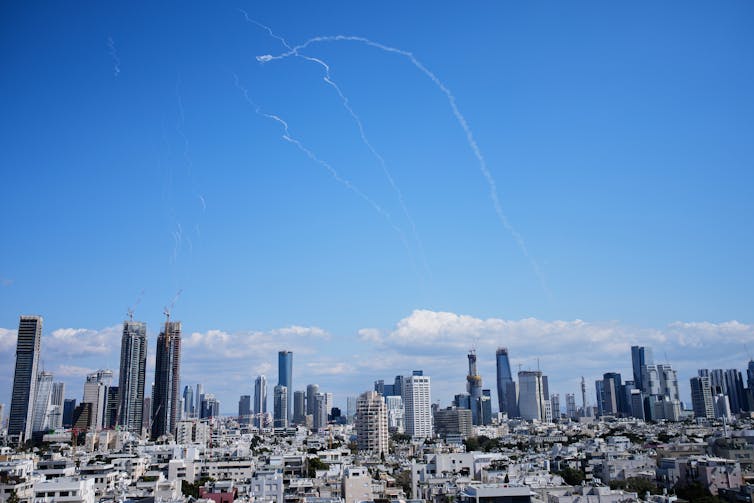
White streaks in a blue sky above a city.
Israeli air defence system fires to intercept missiles during an Iranian attack over central Israel on March 1, 2026. (AP Photo/Ohad Zwigenberg)

Israel’s defences under strain

Israel has sophisticated missile defences and ample operational experience. Its Iron Dome short-range rocket interceptors entered service in 2011. The medium-range David’s Sling and long-range Arrow interceptors followed.

Its newest weapon is a laser system. Iron Beam saw its first combat use last year against drones and small rockets.

But interceptors aren’t foolproof, and they sometimes fail.

Iran’s newest weapons aggravate this problem. Some missiles reportedly carry dozens of small explosives instead of one big one. These little bomblets disperse while falling from the sky to complicate interception.

Israel has warning systems and bomb shelters to protect civilians from nearby explosions, but some residents lack immediate access to shelters. One woman died on Feb. 28 when a missile landed near her building before she could take cover.

Additionally, some older shelters were designed only to withstand smaller rockets. On March 1, a ballistic missile with a 500-kilogram warhead directly hit a shelter, killing nine people inside.

Spillover into Arab states

Iran’s Arab neighbours are accustomed to being bystanders during Israel-Iran conflicts. This time, however, Iran is attacking them too.

Jordan, Iraq, Kuwait, Saudi Arabia, Bahrain, Qatar, the United Arab Emirates and Oman have all been assaulted by Iranian weapons. Some 282 missiles and 833 drones attacked those countries over the weekend, and the barrage remains ongoing.

Even a British airbase in Cyprus, far away in the Mediterranean, has been struck.

Iran claims it’s only targeting U.S. forces stationed in those countries. However, airports, hotels, apartment buildings and oil tankers have also been hit. Oman had recently hosted U.S.-Iran peace talks, and last week announced that peace was “within reach.”

Most of the countries have U.S.-made Patriot interceptor systems to defend against such attacks, but they lack Israel’s operational experience. The U.S. also has Patriot and THAAD interceptors in the region.

In one case, three U.S. Patriot air defence missiles failed to intercept an incoming Iranian ballistic missile warhead, which reportedly struck Al Udeid Air Base in Qatar. And Kuwaiti air defences accidentally shot down three U.S. fighter jets.

Three U.S. Patriot air defence missiles (rising from bottom of screen) fail to stop an incoming Iranian ballistic missile warhead (descending from upper right).

Costly choices

Economic costs are growing too. With oil and gas refineries closing, and tanker traffic through the Strait of Hormuz halted, global oil prices have jumped.


Read more: What is the Strait of Hormuz, and why does its closure matter so much to the global economy?


Iran’s attacks beyond Israel have also prompted more countries to oppose it. Qatar shot down two Iranian fighter jets on March 2 and Britain has begun allowing U.S. airstrikes from British airbases. France is sending air defences to Cyprus and Ukraine is sending drone experts to Arab countries.

An uncertain future

It’s difficult to predict how long the attacks will continue. Iran is believed to have around 2,500 ballistic missiles stockpiled, including 1,000 that could strike Israel or perhaps Europe. Its drone supply is likely larger, meaning launches could continue for months.

U.S. and Israeli warplanes are actively hunting Iranian missile launchers, but past conflicts show airstrikes alone have little impact on launch rates. Those drop only if ground invasions occur.

It’s likewise unclear how long the American-Israeli bombing campaign will last. U.S. President Donald Trump has suggested four to five weeks, maybe longer.

However, the U.S. military will likely start running out of interceptor missiles in four weeks. Qatar reportedly has only enough for four days.

Trump’s warplanes will probably run out of high-priority targets even sooner.

Trump’s political end game

The greatest uncertainty right now concerns Trump and his motives, as his war goals appear to keep shifting.

He has called for the Iranian people to “seize control” of their “destiny.” But Secretary of War Pete Hegseth has said the operation is not intended to cause regime change.

Such a regime change is unlikely. Trump’s January attack on Venezuela merely captured the country’s president and left the rest of the regime in place. He showed more interest in Venezuela’s oil than its governance.

America’s previous regime change in Iran also didn’t end well. In 1953, the U.S. Central Intelligence Agency incited a coup that removed Iran’s elected government and replaced it with a military regime that was friendly to U.S. but unpopular in Iran. In 1979, a revolt ended the dictatorship and installed the current Islamic Republic.

Trump has often favoured transactional diplomatic deals in the past. Whether this conflict moves toward escalation or negotiation remains unclear, but it’s likely he’ll seek do something similar here.

What is clear is that the longer the conflict continues, the greater the human and economic costs are likely to be.

ref. Iran’s missile mayhem show the limits of Middle East defences – https://theconversation.com/irans-missile-mayhem-show-the-limits-of-middle-east-defences-277211

Mourning, celebration and a divided legacy: why the death of Ali Khamenei reverberates far beyond Iran

Source: The Conversation (Au and NZ) – By Ali Mamouri, Research Fellow, Middle East Studies, Deakin University

The death of Ayatollah Ali Khamenei triggered immediate and sharply polarised reactions, in Iran and around the world.

In some circles, it was openly celebrated as the end of an era associated with repression, theocracy and regional confrontation. In others, it was met with deep grief, prayers and public mourning.

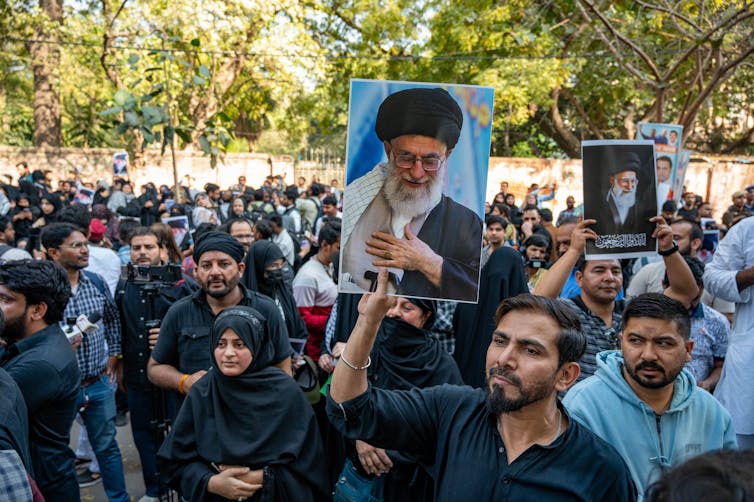
The division was visible far beyond Iran’s borders. In Sydney, Melbourne and New Zealand cities, some diaspora Iranians were celebrating in the streets. But several Shiite mosques and Islamic institutions organised public memorials and prayer sessions to mark his death.

The response quickly became political. New South Wales Premier Chris Minns condemned what he described as the “lionising of this tyrant,” stating:

I think we can call the mourning of this tyrant atrocious […] By any objective measure the ayatollah was evil.

Others, including media commentators such as Amanda Rose, argued that holding a funeral or prayer gathering falls within the bounds of religious freedom, regardless of political disagreement with the figure being mourned.

Inside Iran, the picture was similarly complex. Some citizens expressed relief or celebrated, particularly those who had experienced repression or economic hardship. Many others publicly mourned Khamenei, attending ceremonies or sharing messages of grief.

This raises a deeper question: why does one political and religious figure provoke such radically different emotional responses, not only across societies, but within the same communities?

Members of the Iranian community in Sydney celebrate after US-Israeli air strikes killed Ali Khamenei, March 1. David Gray/AFP via Getty Images

The legacy of resilience

Khamenei’s legacy cannot be understood through a single lens. For some, he embodied political resistance and religious values. For others, he symbolised authoritarian rule, curtailed freedoms and missed democratic opportunities.

Any serious assessment must begin by recognising that both readings coexist – and that his impact on the Muslim world and the Middle East will remain deeply contested.

For his supporters, Khamenei was not merely an Iranian leader. He was a pillar of regional resistance politics and a religious authority. He transformed political Islam into a force capable of confronting what he framed as global hegemony and modern forms of colonial domination.

Through the formation of the so-called “axis of resistance” and his consistent call for Islamic opposition to the United States and Israel, he became a leading figure for Shiite movements and segments of Sunni political Islam.

Sunni groups such as Hamas and the Muslim Brotherhood were not created by Iran. Yet they voluntarily aligned themselves with Tehran’s resistance framework, forming close strategic ties.

Israel’s withdrawal from southern Lebanon in 2000, and the US withdrawal from Iraq in 2011 as a result of Iranian-backed resistance, significantly elevated Khamenei’s standing among many Muslims. This reinforced the perception that resistance could produce tangible results.


Read more: Ayatollah Ali Khamenei’s killing plays into Shiite Islam’s reverence for martyrs, but not for all Iranians


For Shiites, his legacy carries additional weight. His support for Shiite communities living in Sunni-ruled states – many of whom had experienced long periods of marginalisation – was seen as a historic political shift.

For many Shiite communities in Iraq, Lebanon, Yemen and beyond, Khameinei’s leadership symbolised political empowerment, the building of political and military institutions, and the creation of a new balance of power.

As guardian of the Islamic Republic, his ability to steer the regime through sanctions, protests, war and internal crises – while expanding Iran’s regional influence – also earned him domestic support.

Some Iranians viewed him as a stabilising, patriotic figure. After eight years of war with Iraq shattered the country, he rebuilt the political, economic and military systems. He also shaped Iran’s doctrine of defiance against pressure from Israel and the West.

As a result, his death viewed by supporters as martyrdom may inspire them for long.

Members of the Shia community in Delhi, India, mourn the death of Ali Khamenei, March 1. Pradeep Gaur/SOPA Images/LightRocket via Getty Images

The legacy of authoritarianism

On the other hand, Khamenei’s rule was marked by severe restrictions on political freedoms inside Iran and support for dictators such as Syria’s Bashar al-Assad. This cost him popularity among other Sunni Muslims in the Arab world.

His regime forcefully suppressed reformist movements and successive waves of protest – including the most recent nationwide demonstrations. Journalists, civil society activists and opposition figures faced arrests, bans and systematic pressure.

The central tension of his legacy remains clear: the same system that empowered certain communities beyond Iran’s borders simultaneously constrained political freedoms at home.

Khamenei will remain one of the most consequential Middle Eastern figures of the late 20th and early 21st centuries. His death does not end the debate over political Islam, state sovereignty or resistance politics. If anything, it intensifies it.

Reactions to his death mirror the deeper fault lines within the Muslim world between secularism and religiosity, sovereignty and global integration, resistance and reform.

History will remember him as a defining figure whose impact reshaped the region – for better or worse.

ref. Mourning, celebration and a divided legacy: why the death of Ali Khamenei reverberates far beyond Iran – https://theconversation.com/mourning-celebration-and-a-divided-legacy-why-the-death-of-ali-khamenei-reverberates-far-beyond-iran-277378

Plan to mitigate stench from Christchurch treatment plant must avoid sewage washing up on beaches – community leader

Source: Radio New Zealand

Bromley wastewater treatment plant.

A community leader has urged the Christchurch City Council to avoid any chance of sewage washing up on the city’s beaches.

His comments came after Christchurch mayor Phil Mauger announced the council was considering pumping 30 percent of the city’s sewage – partially treated – into the ocean to mitigate the putrid odour plaguing the city’s eastern suburbs.

The city council was last week [https://www.rnz.co.nz/news/national/588155/abatement-notice-issued-over-stench-from-canterbury-sewage-treatment-plant

h it with an abatement notice] after Canterbury Regional Council received more than 4500 complaints about the stench coming from the Bromley wastewater treatment plant in the past month.

Christchurch mayor Phil Mauger. RNZ/Nathan Mckinnon

Local community board chairman Paul McMahon told councillors on Wednesday he supported investigating anything that would reduce the load on the damaged treatment plant, but he did not want to see other environments ruined as a result.

“It can’t end with solids being washed up on the beach, nor in environmental damage, and it cannot create another problem downstream,” McMahon said.

The eastern suburbs have been plagued by the foul odour since a huge fire damaged the plant in 2021. Other parts of the city have been hit as the smell became markedly worse and more widespread this year.

The council had said the spike in odour was due to high rainfall.

Residents pushed back on that claim, saying in the past the council had said heavy rain helped improve pond health and reduce the odour.

McMahon raised concerns about the stench becoming worse.

“We’re also concerned that the rapid drop in temperatures we’ve seen recently with a lot of rain is going to lead to another spike, so I hope we’re prepared for that eventuality,” he said.

The regional council has expressed surprise at the plan floated by Mauger to partially screen then pump around 30 per cent of the city’s sewage out to sea.

A city council spokesperson and the mayor said the proposal has been discussed with the regional council.

On Tuesday, community board deputy chairwoman Jackie Simons told RNZ she had only heard of the proposal the day prior.

“It’s not good enough. I should have known that this was in the winds weeks ago,” Simons said.

“It’s uncomfortable for everyone and the fact that I don’t get information ahead of time – it’s frustrating.”

Asked during Wednesday’s meeting whether he expected to get a briefing on the mayor’s proposal, McMahon said that should be a normal part of the process.

Councillor Yani Johanson asked council head of Three Waters Gavin Hutchinson when elected members could expect to get a briefing on the proposal the mayor had put forward.

Hutchinson said no date had been set.

He confirmed any outfall would be in place until the new activated sludge plant was up and running, which was expected to be in mid to late 2028.

Odour testing would be uploaded directly to the council website from next week, allowing the public to check new results and search for historical data, Hutchinson said.

The council had not purchased additional odour monitors for installation in the community but had obtained some for the ponds that would give more warning of increased odour, he said.

In a response to questions from RNZ regarding the definition of partially treated, the council said partial treatment meant sewage went through much of the treatment process – including screening and the temporary activated sludge process – but, instead of being sent to the ponds to reduce bacteria, the effluent would be chlorinated and mixed with treated effluent before being pumped into the ocean.

Sign up for Ngā Pitopito Kōrero, a daily newsletter curated by our editors and delivered straight to your inbox every weekday.

– Published by EveningReport.nz and AsiaPacificReport.nz, see: MIL OSI in partnership with Radio New Zealand

Former financial adviser fined $15,000, investors remain out of pocket

Source: Radio New Zealand

David McEwen. Screenshot / YouTube

A former financial adviser has been convicted and fined $15,000 for breaching a banning order by the financial markets regulator, but investors remain out of pocket.

David McEwen was convicted of four charges of breaching a 2023 Financial Markets Authority stop order at the Auckland District Court.

He left the country in 2023, criminal charges were filed in March 2025, and was sentenced in absentia on Wednesday.

The convictions came after McEwen pleaded guilty in November 2025.

He has also been banned from being a director or promoter, or being involved in the management of a New Zealand company and providing financial advice services for seven years.

His application for a discharge without conviction was dismissed.

The FMA said he breached the stop order in three ways, including offering and issuing financial products relating to an entity McEwen incorporated in Singapore.

It said investors made $173,000 in payments in response to the offers.

What happened to that money remains unclear, as McEwen remains out of the country and out of the FMA’s jurisdiction, with investors losing thousands of dollars.

He also issued units in an investment vehicle called International Opportunities Partnership, which was created after the stop order was made.

The FMA said the units replaced – without investor consent – financial products that investors held relating to other entities associated with McEwen.

In return, he asked investors for an administration fee. The FMA said investors paid $17,000 to McEwen for the fee.

McEwen also offered and issued financial products, and restricted communications, related to a company called Agtech 3, which fell under the stop order.

“We were concerned about the substance of the representations he was making about the offer of the financial products to clients,” FMA head of enforcement Margot Gatland said.

“We focus our enforcement actions on preventing and addressing significant harm to consumers, markets and our financial system,” Gatland said.

“Mr McEwen breached our Stop Order in various ways almost immediately after it was made, after he had left New Zealand.”

McEwen was a business journalist prior to his investment career, and worked for well-known publications, including the Financial Times, National Business Review and Reuters.

Sign up for Ngā Pitopito Kōrero, a daily newsletter curated by our editors and delivered straight to your inbox every weekday.

– Published by EveningReport.nz and AsiaPacificReport.nz, see: MIL OSI in partnership with Radio New Zealand

ER Report: A Roundup of Significant Articles on EveningReport.nz for March 4, 2026

ER Report: Here is a summary of significant articles published on EveningReport.nz on March 4, 2026.

‘She made us feel comfortable’: how trusting and safe pharmacy services improve First Nations health
Source: The Conversation (Au and NZ) – By Jean Spinks, Associate Professor, Centre for the Business and Economics of Health, The University of Queensland Aunty Mary stands reluctantly back from the busy counter at her local community pharmacy, not quite sure how to get some help. She notices a colourful poster on the wall that

We discovered lethal new fungal diseases in wild Australian reptiles. It’s time to act fast
Source: The Conversation (Au and NZ) – By Shelly Butcher, PhD candidate in Wildlife Disease, The University of Queensland When a coastal carpet python was brought into a wildlife hospital in South East Queensland in August 2024, vets were confronted with something they didn’t recognise. The python had damaged scales, crusted lesions across its body

‘I want someone submissive’: Married At First Sight gives the manosphere a prime time slot
Source: The Conversation (Au and NZ) – By Claudia Young, PhD Candidate in Media and Communications, The University of Melbourne The current season of Married at First Sight is shaping up to be one of the most controversial yet, with the inclusion of Tyson Gordon demonstrating how the manosphere has breached containment. While the producers

‘A global energy crisis’ – Fuel price hike looms for Pacific amid Iran war
By Kaya Selby, RNZ Pacific journalist Analysts are warning fuel prices are expected to jump in the Pacific following the Israeli and US attacks on Iran, and the retaliatory response by Iran. Iran borders the Strait of Hormuz, which carries 20 percent of the world’s oil and gas supply, and shipments have been suspended following

Too many Indigenous women are killed by domestic violence. They are more than just numbers
Source: The Conversation (Au and NZ) – By Kyllie Cripps, Director Monash Indigenous Studies Centre, CI ARC Centre of Excellence for the Elimination of Violence against Women (CEVAW), School of Philosophical, Historical & International Studies (SOPHIS), School of Social Sciences (SOSS), Faculty of Arts, Monash University This article contains references to and the names of

Matildas effect 2.0? Why the Women’s Asian Cup is a huge moment for Australian soccer
Source: The Conversation (Au and NZ) – By Fiona Crawford, Adjunct Lecturer at the Centre for Justice, Queensland University of Technology The 2026 Women’s Asian Cup is the first major women’s soccer tournament Australia has hosted since the groundbreaking 2023 Women’s World Cup. The 12-team event, which will be held in Perth, Sydney and the

AI could help us more accurately screen for breast cancer – new research
Source: The Conversation (Au and NZ) – By Carolyn Nickson, Principal Research Fellow, Cancer Elimination Collaboration, University of Sydney; The University of Melbourne At least 20,000 Australian women are diagnosed with breast cancer each year. And more than 3,300 die from the disease. To save women’s lives, we need to detect breast cancer early. Breast

This illegal US-Israeli attack on Iran is also an assault on the United Nations
The US objective is not the security of the American people. The objective is global hegemony. The attempt is to destroy the UN and the international rule of law — an attempt that will fail, warn the authors. ANALYSIS: By Jeffrey D. Sachs and Sybil Fares On February 16, 2026, one of us (Jeffrey Sachs)

A tribunal has drawn a clear line on antisemitic hate speech. Here’s what it said
Source: The Conversation (Au and NZ) – By Jeremie M Bracka, Law Lecturer and Transitional Justice Academic, RMIT University As both the federal government and states across the country pass laws cracking down on hate speech, there’s been much debate about where to draw the line on what can and can’t be said. A Victorian

The US-Israel attack on Iran paints NZ foreign policy into a corner
Source: The Conversation (Au and NZ) – By Robert G. Patman, Professor of International Relations, University of Otago The National-led coalition government missed a clear opportunity to defend the international rules-based order in its response to the joint US-Israeli strikes on Iran. It was a glaring omission, given New Zealand and most countries rely heavily

Russia wanted a new world order. This wasn’t the one it had in mind
Source: The Conversation (Au and NZ) – By Mark Edele, Hansen Professor in History, The University of Melbourne Four years ago, Vladimir Putin escalated his war against Ukraine to an all-out assault. The plan was for a quick and lively campaign and a speedy takeover of a country the Russian president thought shouldn’t exist. Victory

Severe irritability in teens can be reduced by daily doses of vitamins and minerals – new research
Source: The Conversation (Au and NZ) – By Julia J Rucklidge, Professor of Psychology, University of Canterbury Irritability is one of the most common and distressing problems teenagers and their families face. Its main symptom is an excessive reaction to negative emotional stimuli, resulting in temper outbursts and severe irritable mood. While current treatment options

AI has powerful uses for First Nations oral cultural knowledge. Here’s how
Source: The Conversation (Au and NZ) – By Elizabeth Vaughan, Rock Art Australia Kimberley Research Fellow, The University of Western Australia Aboriginal and Torres Strait Islander readers are advised this article contains names and images of people who have died. Much of the conversation about artificial intelligence (AI) and Indigenous peoples focuses on harms, such

How to live a long and healthy life, according to the ancients
Source: The Conversation (Au and NZ) – By Konstantine Panegyres, Lecturer in Classics and Ancient History, The University of Western Australia Just like in the modern world, people in ancient times wanted to know how to live a long and healthy life. Greeks and Romans heard fantastic tales of far-away peoples living to well beyond

‘Silky’ doesn’t mean it’s made from silk – how confusing textile language can harm the environment
Source: The Conversation (Au and NZ) – By Rebecca Van Amber, Senior Lecturer in Fashion & Textiles, RMIT University If you care about sustainability, buying something as simple as a pillowcase can feel surprisingly hard. Search for “sustainable sheets” and you’re flooded with familiar and tantalising promises: silky, bamboo, vegan, antimicrobial, breathable, organic. The language

Why doesn’t travel insurance cover war?
Source: The Conversation (Au and NZ) – By Paul Latimer, Adjunct Professor, School of Law, Swinburne University of Technology You might think it was exactly the kind of scenario you’d buy travel insurance for in the first place. A major, unforeseen international event causes travel chaos. Flights are grounded around the world, leaving you and

Dog attacks keep happening in NZ. Why hasn’t the law kept up?
Source: The Conversation (Au and NZ) – By Marcelo Rodriguez Ferrere, Associate Professor of Law, University of Auckland, Waipapa Taumata Rau In February of this year, the media in New Zealand both captivated and horrified the public with sensational stories of dog attacks. That line could have been written last week. It wasn’t. It appeared

US-Israel’s war of aggression – Epic Fury or Epic Screw-up?
COMMENTARY: By Eugene Doyle Western countries, including  Australia and New Zealand, were quick to line up to support Operation Epic Fury, the US-Israeli blitzkrieg on the Islamic Republic of Iran. They were effectively throwing international law into a cauldron of blood and mayhem.  These same Western powers — and the Gulf Arab states that stand

EDITORIAL: When Mediocrity Fails National Interest
Editorial by Selwyn Manning. The New Zealand Government’s response to Israel-US attacks on Iran has revealed a chasm. On one side are those who argue; that New Zealand must stay aligned with its 20th century allies right or wrong. On the other side are those who insist; that the long fought for reputation, of a

Donald Trump campaigned against ‘endless wars’. So why is he risking another one in Iran?
Source: The Conversation (Au and NZ) – By Jared Mondschein, Director of Research, US Studies Centre, University of Sydney US President Donald Trump has summed up his rationale for attacking Iran fairly simply, saying “this was our last best chance to strike”. Not known for adhering to any particular lasting strategy, Trump sees each day

University of Otago to offer new qualifications in Queenstown as part of campus plans

Source: Radio New Zealand

Queenstown. 123RF

The University of Otago will offer two new qualifications in Queenstown as part of a long-term plan to build a campus in the resort town.

The university will begin teaching an undergraduate degree in entrepreneurship and a postgraduate qualification in digital technology.

Vice-Chancellor Grant Robertson said the university was starting small and expected about 50 to 60 students to enrol.

The university hoped to build accommodation for about 500 students by 2030 and offer executive education programmes – short, industry-focussed courses, Robertson said.

“I’m excited by the fact that we’re on track to have students there next year,” he said.

“This is the second fastest growing region in New Zealand. It’s an international destination. It’s in the Otago province and we do see it as a place where over the next couple of decades we’ll be able to grow our presence.

“Dunedin will always be the home of the University of Otago but Queenstown is a growth area and, if we do fast forward 20 or so years, you can certainly see the potential there for a large scale campus.”

The university was in the process of finalising temporary premises in Queenstown for the first courses, Robertson said.

A property at Jack’s Point – donated by the Jardine family to the university’s Foundation Trust – would host academic retreats, conferences and engagement events from next year.

The university said it expected to eventually support between 1000 and 3000 students in Queenstown. However, Robertson said that was a very long-term goal.

“We’re conscious that we need to build this up in a sustainable way. We’re initially funding the establishment but, like all programmes at our university, what we offer in Queenstown will need to fund itself and so it will need to grow over time.”

The university would focus on international students and the courses offered in Queenstown would be designed with technology companies, Robertson said.

In a statement, the university said Palo Alto Networks would be co-developing and delivering programmes related to cybersecurity.

“We’re designing curriculum with industry and other academic institutions rather than trying to drop an existing programme in,” Robertson said.

“One of our mantras was we weren’t going to replicate what we do in Dunedin. Our long-term plan for Queenstown is to be adding value. We’ll still be delivering our courses in Dunedin but we wanted to do something different. Technology Queenstown (a not-for-profit agency) wanted to be a partner and we believe we’re both fulfilling a need but also creating some demand because of the location and because of the kinds of courses.”

The university appointed Professor Richard Barker as a full-time Queenstown establishment director last year.

Sign up for Ngā Pitopito Kōrero, a daily newsletter curated by our editors and delivered straight to your inbox every weekday.

– Published by EveningReport.nz and AsiaPacificReport.nz, see: MIL OSI in partnership with Radio New Zealand

Immigration account $150 million in the red, visa numbers overestimated

Source: Radio New Zealand

123rf.com

Over-optimistic forecasting of visa numbers has contributed to a blow-out in Immigration New Zealand’s finances.

Visa fees rose sharply in 2024, but the agency’s memorandum account – balancing costs and visa revenue – has sunk into a $152 million deficit.

The education and workforce select committee heard that deficit is likely to continue, despite INZ shedding 100 jobs last year.

It is spending $336 million over eight years on a new IT system.

Immigration policy manager Siân Roguski said there was also a set of assumptions, which forecast higher revenue and volumes, but which never eventuated. One of them was an over-estimate of accredited employer work visa numbers, which have been hit by the economic downturn.

The deficit coincided with a rise in user-pays funding (91 percent) and a surge in applications submitted before visa fees were due to rise.

New legislation has widened the potential for user-pays, to charge third-parties who benefit from immigration, such as the international education sector.

Another bill – not yet before Parliament – will look at tightening up compliance activities.

Immigration minister Erika Stanford said the government wanted to “make sure we are not being taken advantage of”, cracking down on employers or those not abiding by their visa conditions.

Opposition immigration spokesperson Phil Twyord asked whether she thought last year’s tally of 16 prosecution was an adequate response to the scale of migrant exploitation.

Stanford said INZ staff had been moved from visa operations to compliance, and the response had been stepped up.

Earlier, compliance manager Steve Watson said there were 49 migrant exploitation cases now before the courts. More than 2000 businesses have had their accreditation to recruit migrants suspended or revoked.

Outgoing INZ head Alison McDonald said its biometric and ID programme has been delayed as it works with other departments, including Internal Affairs, on a new whole-of-government identity scheme.

Middle East conflict

Refugee services manager Fiona Whiteridge said 41 quota refugees have not been able to travel to New Zealand because of the Middle East war.

A dedicated desk was being set up to field questions and requests for visa extensions for Iranian migrants in New Zealand, and others affected by travel disruption, said Stanford.

Twyford asked whether the government would create a longerterm solution as it did for Ukrainians when war broke out in 2022.

Stanford said that had not yet been discussed, while they dealt with the immediate knock-on effects of the conflict in Iran.

No decision has been taken on the future of the community organisation refugee sponsorship pilot programme (CORS), which settled almost 200 refugees.

Sign up for Ngā Pitopito Kōrero, a daily newsletter curated by our editors and delivered straight to your inbox every weekday.

– Published by EveningReport.nz and AsiaPacificReport.nz, see: MIL OSI in partnership with Radio New Zealand

‘She made us feel comfortable’: how trusting and safe pharmacy services improve First Nations health

Source: The Conversation (Au and NZ) – By Jean Spinks, Associate Professor, Centre for the Business and Economics of Health, The University of Queensland

Aunty Mary stands reluctantly back from the busy counter at her local community pharmacy, not quite sure how to get some help.

She notices a colourful poster on the wall that shows all the language and cultural groups of Aboriginal and Torres Strait Islander people in Australia and relaxes a little.

Then the pharmacist in the dispensary catches her eye and smiles. The pharmacist had recently met Aunty Mary at the local Aboriginal Health Service, introduced by an Aboriginal Health Worker who knew she had some worries about her medicines.

The pharmacist comes out of the dispensary and finds a quiet place to chat with Aunty Mary. Together they work through her questions about how to take her new medicine and whether it may be making her feel unwell.

Ideally, culturally appropriate and accessible medicines advice, like in this fictional example, should be easy to access.

Unfortunately, many Aboriginal and Torres Strait Islander people face barriers to accessing medicines advice, and this can make them more vulnerable to health issues from using medicines.

But our new research, published today, shows the solution is simple.

Health problems related to medicines

Medicines are the main treatment for many conditions. But issues with how they’re used are common.

These include overuse (using a medicine when it may be harmful), under-use (not using a medicine when it could be beneficial) and inappropriate use (using a medicine in a way that may change its intended effects).

This can cause other serious health problems, make chronic conditions worse, and lead to unplanned hospitalisation and even death.

In OECD countries such as Australia, as many as one in ten hospitalisations are caused by a medication problem.

These high rates show there is currently not enough support for people to use medicines safely and effectively.

A preventable problem

Our 2025 research highlighted the extent of the issue for First Nations people for the first time.

We analysed five years of linked hospital and primary health-care data for 80,232 Aboriginal and Torres Strait Islander people in Queensland.

We found between 16% and 74% of hospitalisations for cardiovascular issues, including heart attacks and strokes, were linked to preventable medication problems.

Our results showed higher rates of preventable hospitalisations in rural areas compared to remote and urban areas. This may be due to fewer GPs and less access to services in these areas.

There are some limitations to this data, as medicine use is not consistently recorded in remote areas. But as we used linked data across primary care and hospital services, the results are highly representative for Queensland.

Three people stand under a marquee with a banner promoting safe medicine use.
Gamilaraay pharmacist Kirra Natty from Carter’s Pharmacy Gunnedah promotes safe medicines use to the community. Author provided (no reuse)

How to make medicine use safer

For most people, community pharmacists are a highly accessible source of advice. Not only can they provide information about a medicine when they fill someone’s script, they can also do a comprehensive review of all the medications a person takes and write a report for their doctor.

But pharmacists may not be a culturally safe resource for First Nations people.

Culturally safe care is free from racism and discrimination. It means health-care providers understand that colonisation can still be felt in power imbalances between them and First Nations people. So they work to build trusting relationships to make the person receiving care comfortable.

For example, Aboriginal and Torres Strait Islander people may not feel comfortable asking for help from a pharmacist wearing a white coat, based on a platform and behind a screen in a dispensary.

So one way to reduce medicine-related problems for First Nations people is to improve access to advice about medicines use in a culturally safe way, where they can build relationships.

The federal government currently funds pharmacist services designed to help people with medication problems. But they don’t do anything to address cultural safety.

What culturally responsive care looks like

Our new research shows what can actually work to reduce Aboriginal and Torres Strait Islander people’s medication problems.

We designed and evaluated a culturally responsive medication service for 225 Aboriginal and Torres Strait Islander people in urban, rural and remote locations in the Northern Territory, Queensland and New South Wales. They were at risk of health problems from medication use. Participants also had a chronic condition, were pregnant or had given birth within the last two years.

We found the service reduced the number of serious medication problems, and significantly increased the likelihood participants would take medications that were needed, and increased people’s confidence in how to manage their medicines.

Here’s what we found works:

  • allowing the person to choose a safe place for a medicines review, such as the Aboriginal Health Service. Currently, the funding rules require services to be provided at home, which is not preferred by many people

  • allowing other trusted care providers – not only GPs – to refer someone for a medication review and introduce the pharmacist if needed. These could include Aboriginal Health Workers and nurses

  • requiring pharmacists and pharmacy staff to undertake cultural awareness training and use strengths-based motivational interviewing when reviewing medications. This is a way of having yarns that helps identify support people and things that keep you strong, as well as setting goals.

Evidence also shows having pharmacists embedded within Aboriginal and Torres Strait Islander health services can improve First Nations people’s health, including lower blood pressure and cholesterol.

One of the people who used the culturally appropriate service designed in our research described their new relationship with the local pharmacist:

Mostly, Aboriginal people are wary of strangers, wary of people with that position [of power] asking questions on a personal level. Well, she made us feel comfortable and able to spill our guts. […] I don’t know how she made us do that but it was unanimous… She’s really affected us in the most positive way possible just with one short visit… We always talk about her.

Simple misunderstandings about medicines can have life-changing consequences.

Our findings show that by funding a tailored medication review program for Indigenous people, the government could help reduce medication harm for Aboriginal and Torres Strait Islander people.


We acknowledge the support of the National Aboriginal Community Controlled Health Organisation (NACCHO) and the Pharmacy Guild of Australia to undertake our research. We also thank Mike Stephens from NACCHO for his contribution to this article.

ref. ‘She made us feel comfortable’: how trusting and safe pharmacy services improve First Nations health – https://theconversation.com/she-made-us-feel-comfortable-how-trusting-and-safe-pharmacy-services-improve-first-nations-health-256697

We discovered lethal new fungal diseases in wild Australian reptiles. It’s time to act fast

Source: The Conversation (Au and NZ) – By Shelly Butcher, PhD candidate in Wildlife Disease, The University of Queensland

When a coastal carpet python was brought into a wildlife hospital in South East Queensland in August 2024, vets were confronted with something they didn’t recognise. The python had damaged scales, crusted lesions across its body and a mysterious fungal infection that defied explanation.

When the results from skin tests came back, they revealed snake fungal disease, caused by Ophidiomyces ophidiicola, an emerging fungal pathogen linked to snake declines overseas. This was the first confirmed report in free-ranging wild Australian snakes.

In our new research, we detail this finding and two more novel fungal pathogens detected in skin samples taken from sick reptiles. All three infections produce disfiguring skin lesions. Two of the three new threats were not previously known to affect wild reptiles in Australia.

This isn’t a welcome discovery. Australia is home to an extraordinary diversity of reptiles – the highest of any country. But many species are in decline, due to climate change, habitat loss, invasive species and urbanisation.

Fungal infections aren’t usually a problem for warm-blooded animals, as most fungi can’t survive our high body temperatures. But for ectothermic (cold-blooded) reptiles and amphibians, fungi can pose a devastating threat. Chytrid fungus has triggered an ongoing wave of frog extinctions – including in Australia. We must protect reptiles from similar threats.

close-up of a sick snake's scales infected by a fungal disease

Snake fungal disease (Ophidiomyces ophidiicola) can be lethal. This wild coastal carpet python shows the disease’s characteristic brown crusted skin lesions and shedding issues. Shelly Butcher, CC BY-NC-ND

What did we find?

We analysed skin samples from ten sick reptiles between April 2023 and September 2024. Each had mild to severe skin lesions. They included an eastern water dragon, two eastern bearded dragons, one eastern bandy-bandy snake, one white-crowned snake and five coastal carpet pythons.

In some cases, their infection was so severe it caused crusted lesions along the entire body, prevented normal skin shedding, and caused extreme emaciation and weakness. Tragically, many reptiles had deteriorated so badly that euthanasia was the most humane option.

When we tested skin samples from these sick reptiles, we found three fungal threats from the Onygenaceae family cropping up in new hosts or locations.

  1. Ophidiomyces ophidiicola – commonly known as snake fungal disease. We detected it for the first time in free-ranging Australian wildlife, causing debilitating disease in three native Australian snake species.
  2. Nannizziopsis barbatae – a pathogen already known to affect wild Australian lizards, and recently highlighted in water dragons in Queensland. We report its first global detection in a snake.
  3. Paranannizziopsis spp. – detected for the first time in free-ranging Australian wildlife, causing disease in eastern bearded dragons and coastal carpet pythons.

close up of the scales of a sick snake with a skin infection.

These skin lesions looked almost identical in a different coastal carpet python, but this time we found Nannizziopsis barbatae infection. Shelly Butcher, CC BY-NC-ND

Reptiles are vulnerable

As climate change boosts global temperatures, alters ecosystems and stresses wildlife, a dangerous combination emerges. Stressed animals become more susceptible to infection, and the fungi themselves become more widespread.

Losing reptile and amphibian species to fungal diseases is devastating. Reptiles play crucial roles in our ecosystems, quietly keeping pest populations in check and helping to maintain healthy landscapes.

In recent years, herping – the reptile equivalent of birding – has become more popular.

As interest has risen, so has public concern. The only reason we know about these fungal diseases is because observant community members noticed unwell animals and sought help. Early detection remains one of our most powerful tools for understanding and containing wildlife disease.

close-up image of spiky skin of a bearded dragon with an infection.

This eastern bearded dragon has been infected with Paranannizziopsis (yellow discolouration). Shelly Butcher, CC BY-NC-ND

What can you do?

Citizen scientists, wildlife enthusiasts and members of the community can all contribute.

By recognising signs of illness, reporting sick animals and practising responsible behaviour around wildlife, Australians can help protect our reptiles from these emerging fungal threats.

Report sick reptiles to track disease spread

  • If you see a sick reptile, keep your distance and look for brown or yellow crusty skin lesions, abnormal shedding, swelling, wounds that don’t heal or unusually lethargic behaviour.
  • If it’s safe, take clear photos and record the location.
  • Contact your local wildlife rescue group, wildlife hospital or vet.
  • Submit sightings to local wildlife authorities or citizen science platforms such as iNaturalist.
  • Early reporting helps researchers track and manage disease spread.

Never release pet reptiles

  • Captive reptiles can carry pathogens which can be harmless to them but devastating to wild populations.
  • If you can’t care for your pet reptile, contact an animal rescue organisation or registered rehoming group. Never release pets into the wild.

Observe responsibly

  • Avoid handling wild reptiles. In many regions this requires specific permits.
  • If you are an authorised and trained handler and must move an animal, ensure your hands and equipment are cleaned between animals and locations.

What’s next?

Our novel findings in free-ranging Australian reptiles from one region in Queensland suggests there may be a hidden crisis.

We’re now surveying reptiles more broadly to understand how widespread these fungal infections are, which species are most at risk, and what environmental conditions favour disease spread.

Left unmanaged, these fungal infections could spread to threatened reptiles such as leaf tailed geckos, blind snakes, earless dragons and Nangur spiny skinks with disastrous consequences.

Understanding these diseases and controlling their spread will be essential if we are to protect Australia’s remarkable reptiles.

Wildlife vet Dr Bertrand Ng contributed to writing this article.

ref. We discovered lethal new fungal diseases in wild Australian reptiles. It’s time to act fast – https://theconversation.com/we-discovered-lethal-new-fungal-diseases-in-wild-australian-reptiles-its-time-to-act-fast-275817

‘I want someone submissive’: Married At First Sight gives the manosphere a prime time slot

Source: The Conversation (Au and NZ) – By Claudia Young, PhD Candidate in Media and Communications, The University of Melbourne

The current season of Married at First Sight is shaping up to be one of the most controversial yet, with the inclusion of Tyson Gordon demonstrating how the manosphere has breached containment.

While the producers and Channel 9 bear some responsibility for who they choose to feature on the show, the problem at hand is much larger than them.

Crash course on the manosphere

The “manosphere” emerged in the 1990s and early 2000s – but gained momentum during Gamergate in 2014. It’s made up of online subcultures – including incels, pick-up artists and “men’s rights activists” – characterised by their virulent misogyny.

Although specific ideologies vary, the manosphere is united by its opposition to feminism and its pseudo-scientific belief in gender essentialism: that gender is innate, and women and men are biologically wired to possess distinct traits.

This worldview sees men as inherently dominant and women as inherently submissive. It ultimately seeks to put both men and women into boxes that limit and control them.

Where these groups were once relegated to niche corners of the internet, in recent years they have been algorithmically amplified – in large part thanks to controversial “manfluencers” such as Andrew Tate – resulting in a wider spread of their beliefs.

Their ideas have found success particular with impressionable boys and young men, especially in a context of increased economic precarity, which the manosphere purports to have the answers to.

According to a 2024 survey of Australian men aged 16 to 34, 15% disagreed with the statement “women deserve equal rights to men” – up from 6% in 2019.


Read more: The ‘Lost Boys’ of Gen Z: how Trump won the hearts of alienated young men


From Trump’s appearances on manosphere-adjacent podcasts in the lead-up to the 2025 election, to Elon Musk’s frequent allusions to the “red pill”, the manosphere’s influence on politics and culture is impossible to ignore.

The manosphere infiltrates Australian TV

Married at First Sight (MAFS) is one of Australia’s most popular reality television shows.

Billed as a “social experiment”, the premise is simple: two strangers “marry” each other when they meet for the first time at the altar.

They proceed to live together, undergoing various challenges designed to test their relationship (and manufacture drama), ostensibly mimicking the hurdles they might face as a couple in the real world. At a weekly “commitment ceremony”, participants can choose to stay, or leave.

This season, one of the featured couples is Tyson Gordon and Stephanie Marshall. While both are avowedly “anti-woke”, Tyson in particular has received backlash from both the audience and his trial wife for his rigid expectations.

In addition to not wanting a “feminist who hates men”, he expresses his distaste for women with “a high body count”.

This is a well-trodden line in the manosphere, where a woman’s worth is determined by the number of sexual partners she has had. Men, of course, aren’t held to the same standard. At the same time, when Stephanie tells Tyson she’s never been in a relationship he worries she might be too “frigid”.

On paper, Stephanie is everything Tyson has asked for. Even so, he is put off by her independence and career-focused attitude and quickly dismisses her: “I want […] someone that is submissive and not masculine”.

The normiefication of fringe views

Tyson is far from the first man in the MAFS franchise to uphold patriarchal views. Every season, one or two self-identified “alpha males” are cast to sow controversy and boost ratings. However, Tyson’s turn of phrase demonstrates the direct influence of the manosphere.

Even if he held misogynistic beliefs before the popularisation of Tate and his ilk, they have nonetheless given him the language to articulate his views. Stephanie recognises this: “It’s giving manosphere,” she says after their wedding.

Despite push-back from Stephanie, other cast members and the audience, Tyson’s casting represents the “normiefication” of the manosphere.

Normiefication precedes normalisation; it exposes the beliefs to a broader audience, but does not necessarily indicate their acceptance. Nonetheless, the exposure itself contributes to the shift of the “Overton window” (the range of views and opinions seen as acceptable by the majority of a population at a given time) towards a culture in which sexist perspectives are deemed legitimate.

By framing women who challenge him as “masculine”, Tyson resurfaces regressive tropes feminism has long fought to overcome – and which the manosphere is working to revive.

A bigger problem than MAFS

Channel 9 and the producers of MAFS have an ethical duty to protect their participants from harm.

In 2025, the series came under fire for normalising behaviour associated with intimate partner violence. It seems they haven’t learnt their lesson. The pursuit of ratings continues to come at the expense of women.

This is unlikely to change until something horrific happens. In 2021, United Kingdom regulator Ofcom introduced stronger protections for reality television participants following a series of reality star deaths.

The mainstreaming of the manosphere doesn’t begin or end with MAFS. It is indicative of a broader political and cultural trend in which misogyny is being reinstated as an ideological norm. MAFS is helping expedite this process, along with online platform algorithms and far-right political projects.

Combating these narratives is difficult. While improved media literacy may help, it’s only one piece of a complicated puzzle. It is important we continue to push back against such beliefs in whatever way we can, lest women’s civil and political liberties are further eroded.

ref. ‘I want someone submissive’: Married At First Sight gives the manosphere a prime time slot – https://theconversation.com/i-want-someone-submissive-married-at-first-sight-gives-the-manosphere-a-prime-time-slot-276974

New All Blacks head coach excited to ‘come back home and do the jersey justice’

Source: Radio New Zealand

New All Blacks head coach Dave Rennie says he’s proud to be appointed to a role that he’s dreamed of and one that so few people get to do.

Rennie was unveiled as the 28th All Blacks head coach just before midday, seeing off Jamie Joseph in the two-man race to replace Scott Robertson.

The 62-year-old will coach through to the 2027 Rugby World Cup.

NZR chairman David Kirk and Rennie held a joint media conference at New Zealand Rugby’s Auckland office on Wednesday afternoon in front of a horde of journalists.

Kirk confirmed it went down to the wire between Rennie and Joseph and he told the latter this morning he had missed out.

Rennie said Joseph called him straight afterwards to congratulate him: “I really appreciate his message … that just shows class of the man.”

Rennie got online with his wife and three sons to share the news.

Dave Rennie and NZ Rugby chair David Kirk after Rennie was announced as new All Blacks head coach. RNZ/Calvin Samuel

“The wife was yawning because I woke her up … the boys were really proud … it was pretty special.”

He said his plan was always to return to Palmerston North later this year to spend time more time with family.

“They [his sons] said don’t turn down an opportunity to apply just for us because you’re going to be back in New Zealand anyway. So, I’ll see a lot more of them … their support is massive.”

The former Chiefs and Wallabies head coach will take up the role in June, when the Japanese Rugby League One season ends, where he coaches Kobelco Kobe Steelers.

Rennie said becoming All Blacks coach was his dream job.

“It’s not an easy job to get hold of, there are so many good coaches in New Zealand.”

He said he had no hesitation on taking on the role and all the scrutiny that goes with it.

“Im ready for it, I’ve coached across the world, I’ve worked with some fantastic people and I’ve learnt a lot.

“I’m excited to come back home and do the jersey justice.”

NZ Rugby chair David Kirk said it was down to the wire between Rennie and Jamie Joseph. RNZ/Calvin Samuel

He will take charge ahead of the July home series against France, Italy and Ireland. Rennie has no doubt the All Blacks can win next year’s World Cup.

“It will take a lot of work, it will take a lot of alignment … it’s a sprint from here by the time we start we’ll have about 15 months until the World Cup.”

Rennie said selection would be based on form.

“I guess one advantage is players are going to have to earn their right to wear the jersey, I’ve sort of got no loyalties, I don’t come from a team where I’ve had a lot of these guys previously so I I think that’s really exciting.”

Rennie said he would focus on the All Blacks culture.

“We’ll be really clear on that and that will be driven within.”

NZR will work with Rennie to confirm the wider All Blacks coaching and management team but Rennie said he was keen to bring some people in.

“I’ve got a history of surrounding myself with quality people who can make a difference and I’m keen to do that.”

Kirk said Rennie had a proven track record of building strong performance environments and his clear direction for the team gave them confidence the All Blacks will be well positioned to perform at the Rugby World Cup.

Rennie, who is of Cook Islands descent through his mother, becomes the first All Blacks head coach with Pasifika heritage.

Sign up for Ngā Pitopito Kōrero, a daily newsletter curated by our editors and delivered straight to your inbox every weekday.

– Published by EveningReport.nz and AsiaPacificReport.nz, see: MIL OSI in partnership with Radio New Zealand

‘A global energy crisis’ – Fuel price hike looms for Pacific amid Iran war

By Kaya Selby, RNZ Pacific journalist

Analysts are warning fuel prices are expected to jump in the Pacific following the Israeli and US attacks on Iran, and the retaliatory response by Iran.

Iran borders the Strait of Hormuz, which carries 20 percent of the world’s oil and gas supply, and shipments have been suspended following the attacks.

Crude oil prices could climb as high as US$100 per barrel, leading to widespread concerns the Middle East war could precipitate into “a global energy crisis”.

Pacific Island fuel prices are generally high and volatile due to import dependency and shipping distance.

Saul Kanovic, an energy sector analyst at MST Financial in Sydney, told RNZ Pacific the “threat is severe”.

“If the situation doesn’t de-escalate and the passage through [the Strait of Hormuz] remains significantly disrupted, we’re looking at a global energy crisis that we haven’t seen since the 1970s,” Kanovic said.

“This could be bigger than that.”

Isolated nations suffer
Kanovic said that more isolated nations with less diversified economies would suffer from a greater exposure to these price shocks.

“Cost of transport is going to go up from a fuel cost perspective, but we might also see insurance premiums rising.”

In the Pacific, imported fuel is usually paid for by forward contracts in advance, and in bulk orders that can last months, as a hedge against price shocks.

But the impact could embed itself into freight costs, both for shipping and air, which in the Pacific is already relatively high given the distance.

Glen Craig, Vanuatu’s special envoy for international development, told RNZ Pacific the severity of the impact would depend on whether the duration of the conflict outpaced a Pacific nation’s petroleum reserves.

Not yet ‘panicking’
“No one is panicking now, but there is definitely going to be some fuel price increases at some stage,” Craig said.

“We should be okay, but it depends on how big and how long this conflict is going to go for.”

When it hits, Craig said it would likely be reflected in all imported goods on Pacific shelves, as well as tourism and regional travel.

“It’s a bit like if you’re on a busy motorway, and there’s an accident on the road 30 km ahead; it might take half an hour to trickle down to the end, but it eventually gets to you.”

“I would dare say we’re looking at something in maybe four months’ time.”

Papau New Guinea set to ‘definitely benefit’ – minister
Papua New Guinea’s Foreign Minister Justin Tkatchenko saw some potential upside for his country as a petroleum and oil exporter.

“It will definitely benefit PNG, but then there’s the other side, where fuel prices for the domestic market will then go up,” Tkatchenko said.

PNG is predominantly a petroleum gas exporter, with China, Japan and Taiwan as its biggest importers.

With LNG prices impacted by the Middle East, but PNG protected by distance, it leaves a shortage that they can fill.

“Unfortunately, it’s the consumers that will cop it, the people, and they are the ones that end up paying for it,” Tkatchenko said.

“So yeah, it’s good in one way, but definitely won’t help out people in the long run.”

A higher price means a higher tax take. According to its 2025 budget, PNG’s mining and petroleum tax drew in roughly US$971 million, a 16.5 percent increase from 2024.

The MPT, which is linked to gains from the sale of mining and petroleum goods, comprises PNG’s second largest source of tax revenue.

It may put the government in a position where it can commit to supporting consumers through any eventual price shock, as Prime Minister James Marape told local media over the weekend.

This article is republished under a community partnership agreement with RNZ.

Article by AsiaPacificReport.nz

Too many Indigenous women are killed by domestic violence. They are more than just numbers

Source: The Conversation (Au and NZ) – By Kyllie Cripps, Director Monash Indigenous Studies Centre, CI ARC Centre of Excellence for the Elimination of Violence against Women (CEVAW), School of Philosophical, Historical & International Studies (SOPHIS), School of Social Sciences (SOSS), Faculty of Arts, Monash University

This article contains references to and the names of people who are now deceased.


Australia’s latest homicide data lay bare a grim reality for Indigenous women: lethal domestic violence is not abating.

The Australian Institute of Criminology’s report confirms what communities have long known – Aboriginal and Torres Strait Islander women are killed at rates up to six times higher than non-Indigenous women, overwhelmingly by intimate partners (76%) or family members.

Just eight weeks into 2026, four more Indigenous women have died violently in such circumstances, including the devastating Lake Cargelligo killings of Sophie Quinn along with her unborn child, “baby Troy”, her partner and her aunt, Nerida Quinn.

For grieving families, the questions are raw: are we just another statistic? Will there be justice? And what does justice even mean?

Over-representation is entrenched

The institute’s National Homicide Monitoring Program offers a stark longitudinal picture: 574 Indigenous women killed from 1989 to 2025, with at least two-thirds killed by an intimate partner (based on reports from previous years). There’s no significant downward trend.

Since the institute began tracking the victimisation rate in 2011, Indigenous women have remained far more likely to be killed than non-Indigenous women.

Yet as the 2024 Senate Inquiry into Missing and Murdered First Nations Women and Children found, quantitative data alone do not translate to justice. Systemic racism in policing, inadequate investigations and “woefully inaccurate” records compound the loss families experience.

The Lake Cargelligo case exemplifies this crisis. The alleged shooter, Julian Ingram – Sophie Quinn’s former partner – remains at large after the deaths of Sophie, her unborn child, her aunt and her partner. The community is in both fear and mourning.

Media fixation on the manhunt often eclipses the brunt of the devastation. Sophie and Nerida were daughters, mothers, aunties and kin. John Harris was a brother, son and partner. They were not just abstract victims.

A fragmented system

Beyond the killings, families face a labyrinthine aftermath. There’s no single agency to guide them through criminal processes, trials (if it gets that far), coronial inquests, death reviews, media scrutiny and social media storms.

Fragmented services – such as state-based victim support to time-limited counselling – demand families navigate complicated systems largely on their own when they are most vulnerable.

Coronial processes are often criticised as culturally unsafe and re-traumatising. These can take place after criminal proceedings, sometimes years later, and can prolong trauma.

Indigenous families report feeling the stories of their loved ones being silenced or stigmatised, or only partial narratives being shared. These public versions can clash with the memories they have of their loved ones.

In New Zealand, the Family Violence Death Review Committee has advocated a “super-advocate” model with dedicated cultural support.

Here in Australia, even landmark inquests into Indigenous women’s deaths yield slow government responses, or none at all, leaving families to contest public stories alone.

Public discourse often reduces Indigenous women to pathology or risk, disregarding the kinship webs that defined them as loving and valued members of our communities. They deserve to be honoured as so many other Australian women have been: through dignified memorials, public acknowledgement and stories of their full humanity.

But sadly, as First Nations women, we are not. Without a mandated advocate to shield families and centre Indigenous accounts through the aftermath of a homicide, grief becomes a rollercoaster of conflicting portrayals.

A group of First Nations women wearing t-shirts with the Aboriginal flag on them

Indigenous families should have the right to tell their own stories about their loved ones. Anadolu/Getty Images

Narrative sovereignty means Indigenous families hold the reins on the stories told about their loved ones. This allows First Nations people to craft, share and protect their people with the respect and ethical care kinship demands.

A dedicated “holding agency”, activated immediately upon a death, would provide a mechanism for this.

While the NZ model does not specifically state this, an Australian model could field media requests, coach families on securing social media accounts against trolls and speculation, and curate all public messaging on the family’s terms and timeline.

This isn’t just public relations. It’s trauma-informed stewardship that safeguards physical safety, honours grief’s nonlinear pace and ensures these women are never reduced to clickbait.

Words need action

There is progress being made, albeit slowly. The newly released National Aboriginal and Torres Strait Islander Plan to End Family, Domestic and Sexual Violence is a crucial step forward.

Called “Our Ways, Strong Ways, Our Voices”, it explicitly honours our missing and murdered women and children, and commits to supporting their families through culturally grounded, community-led responses.

Yet until an action plan emerges to translate this intent into resourced, measurable steps, these remain powerful words on a page, at risk of joining the shelf of unfulfilled commitments alongside the Senate inquiry’s “toothless” recommendations.

For too many Indigenous families, justice has come to mean a perpetrator’s arrest and conviction – if that even happens – followed by a coronial finding filed away. There’s no restoration for the community rupture or protection for those still at risk.

It’s a narrow, carceral lens that measures success by court outcomes, not by whether the Quinn family or the Lake Cargelligo community as a whole can heal or feel safer.

Another round of inquiries, such as the petition calling for a Royal Commission into the killing of Australian women and girls, simply kicks the can down the road.

Indigenous women need action now. We cannot wait while others debate process when we’ve already endured countless reviews without meaningful change.

True justice would honour culturally-led healing. It would allow Indigenous families to tell their own stories and break cycles before another mother and unborn child is lost.

Governments must urgently develop and fund an action plan to support Our Ways, Strong Ways, Our Voices. They should also look at how else to support Indigenous families when they’re affected by death and violence.

The homicide data and Senate findings are not endpoints, but calls to action. We must honour these women by ensuring justice means safety, accountability and dignity for those who remain. Until then, families’ questions will be left unanswered, and the statistics will climb.


13YARN is a free and confidential 24/7 national crisis support line for Aboriginal and Torres Strait Islander people who are feeling overwhelmed or having difficulty coping. Call 13 92 76.

ref. Too many Indigenous women are killed by domestic violence. They are more than just numbers – https://theconversation.com/too-many-indigenous-women-are-killed-by-domestic-violence-they-are-more-than-just-numbers-276264

Matildas effect 2.0? Why the Women’s Asian Cup is a huge moment for Australian soccer

Source: The Conversation (Au and NZ) – By Fiona Crawford, Adjunct Lecturer at the Centre for Justice, Queensland University of Technology

The 2026 Women’s Asian Cup is the first major women’s soccer tournament Australia has hosted since the groundbreaking 2023 Women’s World Cup.

The 12-team event, which will be held in Perth, Sydney and the Gold Coast, started on Sunday with the Matildas winning their first match against the Philippines. They next play Iran on Thursday night.

The tournament also doubles as a qualifier for the 2027 Women’s World Cup and represents a chance for the Matildas to win a major tournament on home soil.

While there will no doubt be huge interest in the tournament, particularly if the Matildas continue to do well, it is also an opportunity to look at the challenges facing women’s sport in general and women’s soccer in particular in the lead-up to the 2032 Brisbane Olympics.

The impact of the 2023 World Cup

The 2023 Women’s World Cup was the largest major women’s sport event Australia has (co-)hosted.

It marked a significant moment in women’s sport in Australia.

It provided a space so welcoming that many self-described sports haters and fans alienated by the hypermasculinity of men’s sports were drawn to it.

It delivered a socially contagious collective experience that was diverse, representative, and feel-good.

It also showed investing in women’s sport is good business.

With more than 1.75 million tickets sold and with television audience figures exceeding even those of the AFL grand final and NRL’s State of Origin, the 2023 tournament set new benchmarks for women’s sport’s visibility and commercialisation.

The Matildas are now one of Australia’s most recognisable and marketable national sports brands. They sell out match after match, outsell Socceroos jerseys 2:1 and have commanded the “Matildas effect” – a byword for perception- and participation-changing influence and gender equality advancement.

The 2026 Women’s Asian Cup, which for the first time features its own mascot and with it accompanying engagement and merchandise opportunities, will want to leverage and extend that inclusiveness, brand and market.

More work needs to be done

While the Matildas specifically and women’s sport internationally – from basketball to ice hockey – have become more popular and more profitable, that hasn’t translated domestically.

The A-League women’s competition suffered a 26% attendance decline in 2024–25 and underinvestment in the league means players are unable to secure full-time, year-round employment.

While outlier top-tier Australian soccer players earn high salaries, 39% of women athletes don’t earn anything from sport.

A 2025 report from Australian soccer’s player development program showed many athletes are struggling with challenges around disordered eating, alcohol and anxiety.


Read more: The Matildas keep soaring but the league, and players, beneath them are being left behind


Women coaches also experience more adversity than men.

At a policy and advocacy level, the country’s sole Office for Women in Sport and Recreation has been disbanded by the Victorian government, and Australia still lacks a national strategy for women’s sport.

Bridging the national team-domestic league gap will be front of mind for administrators during and beyond the Women’s Asian Cup to ensure sustainability.

Areas for improvement

There will be no increase to Women’s Asian Cup prize money at the 2026 tournament – it will remain at US$1.8 million (A$2.55 million) shared between the top four teams, the same as 2022.

Compare this with the US$14.8 million ($A21 million) allocated to the men in 2023.

That 88% prize money gap signals much work still needs to be done to facilitate equality.

Media coverage is similarly lagging. While it has increased from the box-ticking “one and done” media coverage of the past, it remains largely event-based.

Social media is plugging the major media gap, raising players’ profiles and providing transformative engagement but it often entails unpaid labour to maintain an online presence.

It also exposes athletes to greater levels of online abuse.

Opportunities on and off the pitch

The 2026 Women’s Asian Cup represents a chance to prove the hype around women’s soccer is more than a one-time thing. Simultaneously, it needs to avoid counterproductive “boom time, again” narratives that emerge about every decade espousing that women’s sport has “made it”.

It also represents an opportunity to take women’s soccer in Australia to the next level.

Despite the Matildas developing a huge fan following and demonstrating much promise, not since the 2010 Asian Cup has the team been able to bring home a trophy.

The 2006 and 2010 Asian Cups (when Australia finished runners-up and champion respectively) showed the Matildas could compete.

The 2023 Women’s World Cup showed the world there was a market.

This year’s Women’s Asian Cup represents a chance to bring the two together as the Matildas seek to realise their potential and ensure sustainability by both filling stadiums and bringing home silverware.

It is a significant opportunity for the team to show it can win both off and on the pitch.

ref. Matildas effect 2.0? Why the Women’s Asian Cup is a huge moment for Australian soccer – https://theconversation.com/matildas-effect-2-0-why-the-womens-asian-cup-is-a-huge-moment-for-australian-soccer-275428

AI could help us more accurately screen for breast cancer – new research

Source: The Conversation (Au and NZ) – By Carolyn Nickson, Principal Research Fellow, Cancer Elimination Collaboration, University of Sydney; The University of Melbourne

At least 20,000 Australian women are diagnosed with breast cancer each year. And more than 3,300 die from the disease.

To save women’s lives, we need to detect breast cancer early. Breast screening, which halves women’s risk of dying from breast cancer, is key to that.

A new Australian study published today in The Lancet Digital Health suggests AI could help improve how we screen for breast cancer.

How do we currently screen for breast cancer?

Since 1992, Australia has offered free breast X-rays, known as mammograms, every two years to women aged between 50 and 74. Just over half of eligible women participate.

Of the women found to have cancer, about 25% are diagnosed between the biennial screens. These “interval cancers” are often aggressive and, unfortunately, more likely to be fatal.

In some cases, a more sensitive screening test may have detected them earlier.

The role of AI

Australia’s BreastScreen program was established in response to several major clinical trials conducted between the 1960s and 1980s. The screening technology used by the program has not substantially changed since then.

Researchers are now exploring risk-adjusted screening, which tailors screening to women based on their risk, as a way to detect more cancers earlier. This may include programs offering different technologies for women at higher risk of developing breast cancer.

Currently, we generally assess cancer risk via questionnaires that help identify if a woman has any risk factors associated with breast cancer.

One risk factor is breast density which refers to how much glandular tissue is in the breast. As well as being a risk factor for breast cancer, the higher a woman’s breast density, the harder it is to detect cancer on a mammogram.

We can also use one-off genetic testing to identify women with a higher lifetime risk of developing breast cancer. This involves looking for high-risk gene mutations such as BRCA1 and BRCA2, which are associated with increased breast and ovarian cancer risk. Genetic testing can also help us estimate a person’s lifetime risk of developing breast cancer.

More recently, researchers have been investigating artificial intelligence (AI) as a new approach to assess breast cancer risk. A new Australian study, published in The Lancet Digital Health today, focused on a specific AI tool known as BRAIx.

What did the study involve? And what did it find?

This study used an AI tool, known as BRAIx, trained using BreastScreen Australia data to help radiologists assess mammograms.

The study assessed how well BRAIx predicted women’s risk of developing breast cancer in the next four years, among women who had a clear mammogram.

Of the 95,823 Australian women assessed, 1.1% (1,098) had developed breast cancer in the four years after they received a clear mammogram. Of the 4,430 Swedish women assessed, 6.9% had developed breast cancer within two years of a clear screen.

The study findings show that BRAIx scores were very useful for identifying women who were more likely to develop cancer one to two years after having a clear screen. Findings from the Australian dataset suggest BRAIx scores identified cancers found three to four years later, but with less accuracy.

These findings suggest BRAIx could help identify women who might benefit from additional tests. This may include an MRI (which uses a magnetic field to produce images of organs and tissue) or contrast-enhanced mammography (which uses an iodine dye to improve the visibility of a regular mammogram).

These findings reinforce a 2024 Swedish study that used an AI-based risk assessment to select women for additional testing. The researchers referred 7% of women to have a follow-up MRI, and 6.5% of were found to have cancers missed by mammograms.

Does the study have any limitations?

As with most studies, yes. Here are two.

  • it’s difficult to compare BRAIx to genetic testing. This is because BRAIx is trained to find missed or emerging cancers over a four year period. In contrast, genetic testing identifies a person’s risk of developing cancer over their lifetime

  • it might not use the best breast density data. This study found BRAIx more accurately predicts breast cancer risk compared to assessments based on breast density. But this breast density data was collected using a different tool to those used by the Breastscreen program. So this finding should be interpreted carefully.

So, where to from here?

The study adds to a growing body of evidence that AI risk assessment could help breast screening programs find cancers earlier.

BRAIx is now being trialled as part of the BreastScreen Victoria program, to help read mammograms. And other states are already using and evaluating different AI tools for reading mammograms.

So it may be time for Australia to conduct a national, independent review of these new tools. As part of a more risk-adjusted approach to breast screening, they could save lives.

ref. AI could help us more accurately screen for breast cancer – new research – https://theconversation.com/ai-could-help-us-more-accurately-screen-for-breast-cancer-new-research-277079

The fractured, drug-fuelled life behind the scenes of a 10-month-old’s death

Source: Radio New Zealand

Public Domain

The mother of a baby found unresponsive in a South Auckland home has described her broken relationship, drug use, and the day her son died, before a Coroner’s inquest on Wednesday.

Ten-month-old Poseidyn Hemopo-Pickering was rushed to Middlemore Hospital and later moved to Starship Children’s Hospital on the evening of 5 September, 2020.

He died a few hours later.

His father, Anthony Simon Pickering, was acquitted of murdering his son in 2022 after a jury trial, and no one has been held responsible for his death.

The purpose of the coronial inquiry is to determine how Poseidyn died and the circumstances surrounding his death, not criminal or civil liability.

Today, the Coroner heard from Poseidyn’s mother, Filoi Huakau, who told the court she had a fractured relationship with Poseidyn’s father, who was also present.

She said the couple domestically abused one another.

“I would say we were like showponies, we would smile for the camera but we had a lot of brokenness between us behind closed doors,” Huakau said.

“We lacked the ability to communicate properly with one another, and there was barely any affections between us.”

Huakau said the pair were heavy methamphetamine users. Her meth use continued while she was pregnant with Poseidyn.

She had said Poseidyn’s parentage was a point of debate and argument for the pair, and that it was only confirmed after his death that Pickering was in fact his biological father.

It was a miracle he had been born healthy, she said, given how much she was using and how little she was eating.

She told the court she had previously given mixed accounts to police of what happened, saying the account given on Wednesday would clear the air.

“Every time that I provided a statement, my head was in a scramble.

“What happened back then, and some of the things I said, no longer sit right with me.”

Huakau said she did not know why she lied to police.

“It is really hard to explain why I lied about certain things, but I was honestly fried, in almost every single statement that I gave,” she said.

“I know it looks like I was probably trying to cover up the truth, but to be completely honest I didn’t even know the truth, I suppose I was really just trying to find a way to justify what happened to myself.”

Huakau paused several times while giving evidence to collect herself, wiping her face with tissues.

She recalled being in the hospital with Poseidyn, and Pickering suddenly mentioning for the first time that the baby had hit his head on the window sill while his mother was out.

Poseidyn had suffered a blood clot and a fracture.

“I screamed at Simon and said, ‘why the F didn’t you say something’, he said he had only just remembered it now,” Huakau said.

“All I remember is just crying.”

She spoke about a family hui following Poseidyn’s death, in which she and Pickering were told one of them would need to take the blame for their child’s death, and that it needed to be Pickering.

‘Your lowest low’

Later in the day, Huakau was questioned by her lawyer Kima Tuialii, who acknowledged the loss she had suffered.

“We all know that you’re sitting where ideally no mother or parent should ever have to sit, before a Coroner in a court, trying to understand what’s happened to their baby.”

She commented on Huakau’s journey to recovery.

“We’ve spoken about really your lowest low, and some of your deepest hurts,” Tuialii said.

“The way you’ve turned things around have been nothing short of remarkable, and I think that everybody in this room would agree with that.”

She asked Huakau if she believed she could have done better.

“Absolutely,” Huakau said.

“I do acknowledge that my kids were neglected, I do believe that they deserved a lot more than what they did get.”

Tuialii asked if she ever hurt Poseidyn.

“Never,” Huakau said.

– Published by EveningReport.nz and AsiaPacificReport.nz, see: MIL OSI in partnership with Radio New Zealand

This illegal US-Israeli attack on Iran is also an assault on the United Nations

The US objective is not the security of the American people. The objective is global hegemony. The attempt is to destroy the UN and the international rule of law — an attempt that will fail, warn the authors.

ANALYSIS: By Jeffrey D. Sachs and Sybil Fares

On February 16, 2026, one of us (Jeffrey Sachs) sent a letter to the UN Security Council warning that the United States was on the verge of tearing up the United Nations Charter.

That warning has now come to pass. The United States and Israel have launched an unprovoked war against Iran in flagrant violation of Article 2(4) of the Charter, without authorisation from the Security Council, and without any legitimate claim of self-defence under Article 51.

They are trying to kill the UN Charter and the international rule of law, but they will fail.

At the Security Council on February 28, 2026, the US and its allies directed their condemnation not at the American and Israeli aggression, but at Iran.

One US ally after the next condemned Iran for its retaliatory attacks yet absurdly failed to condemn the illegal and unprovoked US-Israeli attack on Iran. This performance by these countries was disgraceful and turned reality completely upside down.

The joint US-Israeli attacks were described by Trump as necessary because Iran “rejected every opportunity to renounce their nuclear ambitions, and we can’t take it anymore.”

This is of course a flat lie. As the letter of February 16 recounted, Iran agreed a decade ago to a nuclear deal, the Joint Comprehensive Plan of Action (JCPOA) that was adopted by the UN Security Council in Resolution 2231.

Trump ripped up agreement
It was Trump who ripped up the agreement in 2018. In June 2025, Israel bombed Iran in the midst of US-Iran negotiations.

This time too, the Israel-US war plans were set weeks ago when Israeli Prime Minister Benjamin Netanyahu met with Trump, and the negotiations underway between the US and Iran were a charade. This seems to be the new modus operandi of the US: start negotiations and then aim to murder the counterparts.

It is easy to understand why the US allies behave in the embarrassing and self-abasing way they did at the UN Security Council. In addition to the United States, eight of the other 14 Council members host US military bases or grant the US military access to local bases: Bahrain, Colombia, Denmark, France, Greece, Latvia, Panama, and the United Kingdom.

These countries are not fully sovereign. They are partially governed by the US. The US military bases house CIA operations, and the host countries constantly look over their shoulder to try to avoid US subversion in their own countries.

As Henry Kissinger famously said, “It may be dangerous to be America’s enemy, but to be its friend is fatal.” We can add that to host US military bases and CIA operations is to turn your country into a vassal state.

As an absurd but telling example, the Danish ambassador parroted every US talking point, pointing her finger at Iran for its aggression as if Iran had not been attacked by the US and Israel.

She completely forgot that such humiliating vassalage to the US will not play well for Denmark if the US occupies Greenland.

Truthful voices at UN
The truthful voices at the Security Council came from the countries not occupied by the United States. Russia explained correctly that the so-called West (that is, the countries occupied by the US) is engaged in victim-blaming when it points its finger at Iran.

China reminded the Council that the crisis began with the US and Israeli attacks on Iran, not with Iran’s retaliation.

Somalia’s ambassador, speaking on behalf of several African member states, truthfully portrayed the source of this recent escalation.

The UN Representative of the League of Arab States spoke brilliantly about the root cause of Israel’s mad aggression: the denial of rights to Palestinian people, and Israel’s use of mass murder and regional war to prevent the emergence of a State of Palestine.

When Iran retaliates against US military bases in the Gulf, it is exercising its inherent right of self-defence under Article 51 of the Charter. We must remember that the US and Israel are openly and repeatedly assassinating Iran’s leaders, with the aim of overthrowing its government.

When states murder a foreign head of state and attempt to destroy the government, the target of those threats is entitled under international law to defend itself.

The US-Israeli bombing murdered not only Iran’s Supreme Leader and several top government officials, but also more than 165 young girls in their school in Minab. These young children are the victims of a horrific war crime.

Complicit in war crime
The countries that gave a UN Security Council pass to the United States and Israel for these killings — notably Denmark, France, Latvia, the United Kingdom, and of course the US — are also complicit in this war crime.

This UN Security Council emergency meeting will likely be remembered as the day the United Nations ceased to function from its headquarters on American soil. An international organisation dedicated to the peaceful settlement of disputes cannot credibly operate from a country that wages illegal wars, threatens member states with annihilation, and treats UN Security Council resolutions as disposable instruments of convenience.

For the UN to survive, and we need it to survive, it will need several homes around the world — in Brazil, China, India, South Africa, and others — honouring the true multipolarity of our world.

Let us be clear about what the United States and Israel are pursuing. The US objective is not the security of the American people. The objective is global hegemony. The attempt is to destroy the UN and the international rule of law—an attempt that will fail.

Israel’s objective is to establish a Greater Israel, destroy the Palestinian people, and assert its hegemony over hundreds of millions of Arabs across the Middle East (from the Nile to the Euphrates, as US Ambassador Mike Huckabee recently asserted).

The United States’ delusional efforts at global hegemony are proceeding region by region. The US has recently claimed, in a wholly twisted supposed revival of the Monroe Doctrine, that it controls the Western Hemisphere and can dictate how Latin American countries conduct their economic and political affairs.

The US kidnapped the sitting Venezuelan president to prove the point, and it now threatens to overthrow the Cuban government as well.

US ‘owns Middle East’
Today’s war against Iran aims to prove that the US similarly owns the Middle East. The war is part of a 30-year campaign, initiated by the Clean Break doctrine, to overthrow all governments that oppose US and Israeli hegemony in the region.

Those joint Israel-US wars have included the genocide in Gaza, the occupation of the West Bank and the decades of wars and regime-change operations in Iran, Iraq, Lebanon, Libya, Somalia, Sudan, Syria, and Yemen.

One part of the US global plan is to commandeer the world’s oil exports and to weaken China and Russia in the process. The US seizure of Venezuela was designed to ensure American control of that country’s oil exports, especially to control the flow of oil to China.

US sanctions on Russia aim to prevent Russian oil from reaching India and China. Now the US aims to stop the flow of Iran’s oil to China. More broadly, the US aims to control the entire Gulf region plus Iran to maintain its imperial dominance.

The international order that Franklin and Eleanor Roosevelt helped to build after the catastrophe of the Second World War was founded on a simple and profound idea — that law and respect, not force, should govern relations among states. That idea is now being destroyed by the very nation that did most to promote it in founding the UN. The irony is bitter beyond measure.

The truth is that the devastation of the war will not directly affect the so-called West: their children will not suffer traumas or death, and their countries will not be set ablaze. The victims of this attack are the people of the Middle East. They are the expendable ones who suffer from Western arrogance, abuse of power, and addiction to war.

We close with two observations. First, the United States will not achieve global hegemony or kill the UN. The world is too large, too diverse, and too determined to resist domination by any single power, much less one with 4 percent of the world’s population.

World outside US
The world outside of the US and the countries it occupies want the UN to live and thrive. The US attempt will surely fail, but it may cause immense suffering before it does.

Second, if Israel continues its addiction to war and occupation, it too will not survive. That addiction represents a mix of theocracy and post-traumatic stress.

Part of Israel believes that it is the biblical kingdom of the 5th century BC. The other part lives in the traumatic memory of the Holocaust, and so is determined to kill any perceived adversary rather than learn to live together with it in peace.

The Israeli Ambassador’s twisted defence of Israel’s brazen attack on Iran, as usual, cited the Bible and Auschwitz as the two justifications. These are Israel’s two perennial references, but not the real world of today.

A state that depends on permanent war, permanent occupation and slaughter of the Palestinians, and the indefinite subjugation of millions of people has no viable future, and the policies that the United States is now pursuing on Israel’s behalf will accelerate rather than prevent that outcome.

The two-state solution, which the Council has endorsed repeatedly, offers Israel a path to peace. Tragically Israel rejects that. The result, eventually, will be the end of Israel itself in its current form, especially as the US population is rapidly turning against Israel’s violent theocracy and towards the cause of Palestine.

Perhaps there will be one democratic state for both Arabs and Jews living in peace, together, with an end of apartheid rule.

These are harsh truths, but emergencies demand honesty. The UN is being murdered by Israel and the United States. The Security Council must rouse itself from their military occupation by the US, and remember that they are the stewards of the UN Charter’s promise to maintain international peace and security.

Jeffrey D. Sachs is a university professor and director of the Center for Sustainable Development at Columbia University, where he directed the Earth Institute from 2002 until 2016. He is also president of the UN Sustainable Development Solutions Network and a commissioner of the UN Broadband Commission for Development. Sybil Fares is a specialist and advisor in Middle East policy and sustainable development at SDSN.

Republished under Creative Commons.

Article by AsiaPacificReport.nz

Salvation Army launches $1.5 million meth harm reduction programme in Motueka

Source: Radio New Zealand

RNZ

The Salvation Army is launching a $1.5 million methamphetamine harm reduction programme in Motueka.

The three-year pilot will include clinical addiction programmes to help people to get clean and stay clean, along with an education campaign to raise awareness about the class-A drug.

Salvation Army service development lead Emma Hunter said families directly affected by methamphetamine would be offered tailored support.

The programme brought together clinical expertise, support and community partnership to help people break free from the drug and rebuild their lives, she said.

“People deserve support that fits their real lives. We offer a harm reduction approach to suit each individual or whānau and we work closely with local services, iwi and the community so the help people receive is connected and effective,” Hunter said.

The education campaign would raise awareness about methamphetamine, where it comes from, its effects and where to get help.

Ministry for Social Development regional commissioner Craig Churchill said methamphetamine affected many communities and Motueka was chosen because of its size and location.

It was small enough for the funding to make a difference and large enough to demonstrate the difference it could make, he said.

“Ultimately we hope to see a reduction in methamphetamine use and related harm in Motueka, a safer community, increased access to support services, greater awareness and prevention and improved inter-agency co-ordination in the town,” Churchill said.

The money is coming from the Proceeds of Crime Fund.

Sign up for Ngā Pitopito Kōrero, a daily newsletter curated by our editors and delivered straight to your inbox every weekday.

– Published by EveningReport.nz and AsiaPacificReport.nz, see: MIL OSI in partnership with Radio New Zealand

Government moves to strip Māori Land Court powers over PGSEs

Source: Radio New Zealand

Minister for Māori Crown Relations Tama Potaka. RNZ / Mark Papalii

A group of Tūhoe kaumatua say plans to remove the supervisory jurisdiction of the Māori Land Court (MLC) over many post-settlement governance entities (PSGE) will deny Māori access to justice and accountability.

The government is proposing legislation gives PSGEs the choice to be exempt from sections 237 and 245 of Te Ture Whenua Māori Act 1993 – which give the MLC jurisdiction over trusts, to the High Court.

Cabinet signed off on the proposal in 2025 following a ruling from the Supreme Court in 2024 that meant Te Uru Taumatua (TUT), the settlement entity for Tūhoe, was subject to jurisdiction of the MLC.

In 2019, Tūhoe kaumatua Paki Nikora, a staunch critic of TUT, started legal proceeding against the PGSE over its election processes on behalf of Te Kaunihera Kaumātua o Tūhoe.

Nikora died in 2023, aged 73, but the legal battle continued, culminating in the Supreme Court’s ruling.

In a statement, counsel for the Kaunihera, Paul Harman, said the proposed Bill overruled that decision.

Harman implied the proposed bill showed how “far” the Crown and TUT were prepared to go to “override access to justice”.

“It weakens the rule of law when governments make legislation in such haste.” he said.

“We went to the Māori Land Court because Te Uru Taumatua had no meaningful dispute resolution process. This is one of several failures of its Trust Deed, with its election processes being another… all that remains is a High Court application, and I suggest that is too expensive for most Māori.”

Harman claimed the proposed Bill would effectively remove independent judicial oversight and deny Te Kaunihera Kaumātua o Tūhoe and other Māori due process and legal recourse.

In a statement to RNZ, Te Uru Taumatua chief executive Kirsti Luke said the Supreme Court’s ruling made “no real sense” for reality of iwi or PSGEs.

“It was never the Crown or iwi’s intent in reaching settlements, and enacting them in legislation, that the Māori Land Court would have any subsequent jurisdiction over iwi’s self-determination.

“The court acknowledged the situation, that its interpretation created, should be fixed by Parliament, and that is also the course of action we and other iwi support.”

A cabinet paper shows 42 of the country’s 73 PSGEs have formally requested exemption from the court’s oversight

In a statement, Minister for Māori Crown Relations Tama Potaka said the government recognised that PSGEs undertook important responsibilities on behalf of their Iwi.

“Many continue to do so in a diligent and professional way, with strong support from their members and uri.” he said.

“It is important to be clear, however, that a PSGE is not synonymous with the Iwi itself. An is an Iwi. A PSGE carries out defined roles and responsibilities on behalf of Iwi under its trust deed and settlement arrangements, but it does not define the identity or mana of the Iwi.”

Potaka said the proposed legislation reflected the engagement had with PSGEs across the country and the considerations of the Supreme Court had been carefully taken into account.

“This work has not arisen suddenly. Discussions have been underway for some time, including through the former Te Arawhiti structure, and have involved detailed consideration of how best to provide certainty within the PSGE framework.”

“It is also important to emphasise that matters relating to the structure, accountability and leadership of PSGEs ultimately sit with Iwi members. Where Iwi members believe change is needed, whether amendment or replacement of governance arrangements, there are established pathways within trust deeds and Iwi processes to do so. Those are decisions for Iwi to determine.”

Potaka said draft legislation was still being worked through and would be introduced “in due course”.

Sign up for Ngā Pitopito Kōrero, a daily newsletter curated by our editors and delivered straight to your inbox every weekday.

– Published by EveningReport.nz and AsiaPacificReport.nz, see: MIL OSI in partnership with Radio New Zealand

All Blacks reveal new head coach: Who is Dave Rennie?

Source: Radio New Zealand

Dave Rennie has been named the new All Blacks coach, seeing off Jamie Joseph in the two-man race to replace Scott Robertson. © Photosport Ltd 2016 www.photosport.nz

The All Blacks have a new head at the helm.

Dave Rennie has been appointed to one of the most scrutinised jobs in the country.

He succeeds Scott ‘Razor’ Robertson as the 28th All Blacks coach.

Here is everything you need to know about David Noel Rennie:

Born in Upper Hutt, Rennie was educated at Heretaunga College. His mother is from the Cook Islands (Titikaveka, Rarotonga), and Rennie played a non-test match for the country in 1990.

Rennie played his club rugby for Upper Hutt RFC before a shoulder injury forced him to hang up the boots at just 27.

He trained as a teacher, and was appointed to an intermediate school in Upper Hutt.

Rennie played 58 times for his province, Wellington, winning the NPC crown in 1986, the last time the Lions would lift the trophy until Rennie returned as coach.

He quickly moved into a coaching role at Upper Hutt RFC following his playing days.

Wallabies coach Dave Rennie PHOTOSPORT

His coaching career continued in the capital as he took an assistant coaching role for the Wellington Lions in 1999.

Just one year later, he was promoted to the top role and would take the Lions on arguably the most memorable NPC run in history, culminating in one of the greatest games played in New Zealand.

Leading a team of legends such as Jonah Lomu, Christian Cullen and Tana Umaga, Rennie’s men overcame an All Black-laden Canterbury team to claim an historic 34-29 win.

After three seasons with the NPC side, Rennie was given his first Super Rugby assignment, named as assistant at the Hurricanes.

The 2002 season ended with the Hurricanes ninth with a 5-6 record. Graham Mourie would resign for the 2003 season with Colin Cooper taking over.

Rennie headed north in 2006 to take over at Manawatū, who he coached for 69 games until 2011.

Another big break came when Rennie was assigned the top job for the New Zealand Under 20s in 2008, leading them to three titles on the trot.

Among his players were Aaron Smith, Sam Whitelock and Julian Savea.

He was then given the reins at the Chiefs in 2012, and in his debut season, led them to an inaugural Super Rugby title.

In what ranks as a career highlight for Rennie, the Chiefs went back to back in 2013, with Aaron Cruden, Brodie Retallick, Liam Messam and Sam Cane in the side.

‘Father and Son’ – Dave Rennie (right) and Aaron Cruden Photosport

Rennie spent a further three seasons with the Chiefs before making the move to Scotland to coach the Glasgow Warriors.

He again made a strong start, with the Warriors winning 10 straight before falling short in the Pro14 semifinal.

The next year the side went one better, but again fell at the final hurdle.

Rennie would step down after a Covid-interupted final season in Scotland.

Bar his new All Blacks assignment, Rennie’s toughest task as a coach came in 2019 when he was announced as the replacement for Michael Cheika as Wallabies head coach.

Covid would again wreak havoc during his time with Australia, and it included difficult tours to Europe which saw the Wallabies suffer a first ever loss to Italy.

Much like his predecessor Robertson, Rennie was unceremoniously sacked from the Wallabies gig, replaced in 2023 by Eddie Jones.

Of his 34 tests in charge of the Wallabies, they won just 13.

‘Understand the expectations’

After three seasons in Japan with the Kobe Steelers, Rennie won the two-horse race for the All Blacks gig, beating out Highlanders coach Jamie Joseph.

“Coaching the All Blacks is an incredible honour. I’m extremely proud to have been entrusted with this role and understand the expectations that come with it,” Rennie said.

“I’m really clear on the way I want the All Blacks to play and I look forward to working with the players, management team, and the rugby community. We have a lot of talent here and we will be working extremely hard to make the country proud.”

Rennie’s first assignment is in July when the All Blacks host France, Italy and Ireland for three tests in New Zealand.

– Published by EveningReport.nz and AsiaPacificReport.nz, see: MIL OSI in partnership with Radio New Zealand

New Zealand family living in Qatar: ‘Like a Covid lockdown with the occasional loud boom’

Source: Radio New Zealand

Missiles are seen in the skies over Doha on March 3. MAHMUD HAMS/AFP

The family car is filled with petrol and packed with supplies and go bags for a hasty escape.

But for now, a New Zealand family living in Qatar’s capital, said they would stay where they were while loud booms could be heard in the distance.

Since Israel and the United States launched an attack on Iran on Saturday, a number of countries in the Middle East have been hit by missile strikes including Qatar.

“If you’re calm and prepared, that’s probably the best thing that we can do,” Kathryn Rush said her Doha home.

Motorists drive past a plume of smoke rising from a reported Iranian strike in the industrial district of Doha on March 1. MAHMUD HAMS / AFP

She and her husband were oil and gas lawyers, meaning Doha was somewhere with work in their field.

Rush and their two children, Nick who’s 11 and 9-year-old Emily, moved over from Wellington at the end of December.

But now things had changed.

“It’s very reminiscent of Covid,” Rush said.

“We’ve spent the first few months getting ourselves into dance classes and bits and pieces, football clubs and things like that.

“So all of that’s now on hold as everyone has to stay at home as much as they can, my husband is working from home, the kids are home-schooling,” she said.

“Things are happening, you don’t know if it’s going to happen to you or not, and you’re just waiting and try to stay positive in the meantime.”

Rush was trying to stay positive for her young children too.

“The booms, you hear the booms and some of those sound closer than others… so they can be relatively loud,” she said.

“I popped outside and my daughter was on a trampoline tonight just to say ‘oh, do you want to come inside, those were quite loud’ and she said ‘yeah and there were some flashes in the sky too but I want to do some more trampolining’.”

Rush felt it was important to acknowledge with her children what was happening, “but not to be freaked out by it”.

“My 11-year-old is quite smart and quite onto it and is relatively are of what’s going on, but he’s settled in really nicely to school here, he’s got friends from all sorts of different countries and I think they probably talk about it a little bit as well,” she said.

For now, Rush felt comparatively safe – their house was among about 100 in a compound and all were low-rise.

They’re also to the north of Doha’s centre and airport, in the opposite direction to the American base further south.

For now, it felt like an added layer of safety, she said.

“We’re in an older compound… and the villas are really sturdy… so I don’t feel that we’re in as much of a target zone as perhaps some of the other areas.”

New Zealand’s advice to citizens remained to shelter in place but Rush said they would strongly consider leaving if the advice was upgraded.

“It would probably have to get a lot worse, I think, before we’d feel like we desperately wanted to get out,” she said.

The only real option was to drive to Saudi Arabia.

“I feel safer on the ground at the moment than I would in the air.”

Rush was sleeping fully clothed in case she had to quickly move in the night.

She and her neighbours regularly check on each other, but she said it felt like there was not much to check during the ongoing waiting for whatever happened next.

“It feels a bit probably like a Covid lockdown, except for the sound of the occasional loud boom.

“The car is full of petrol and packed with effectively camping gear and the usual kind of go back scenarios like water and that kind of thing, sunscreen, so you know we are prepared – if we have to go we have to go – but where that would be going is a little uncertain.”

Sign up for Ngā Pitopito Kōrero, a daily newsletter curated by our editors and delivered straight to your inbox every weekday.

– Published by EveningReport.nz and AsiaPacificReport.nz, see: MIL OSI in partnership with Radio New Zealand

Insurer backtracks on move to exclude ADHD and autism treatment cover

Source: Radio New Zealand

Autistic nonspeakers may use various strategies to manage the overload and lessen sensory distress. Unsplash / Naila Conita

Southern Cross Health Insurance says ADHD and autism are once again covered under its policies, after an earlier decision to exclude them.

RNZ reported last month families were blind-sided by the decision, which left them without funding for treatment.

At the time, the insurer said it was not a change in policy, but a “clarification” – as ADHD and autism were considered mental health conditions, they came under the mental health exclusion and were therefore not covered.

But now, after a review of its diagnostic classification system, it told RNZ they were, in fact, classified as neurodevelopmental conditions, not mental health conditions, and accordingly the mental health exclusion did not apply.

Regan Savage, chief sales and marketing officer for Southern Cross Health Insurance, said they undertook a review after feedback from clinicians, members and sector stakeholders highlighted uncertainty about how that November guidance to providers was being interpreted in practice.

“That feedback informed a more detailed review to ensure our guidance is clear, consistent and aligned with both clinical understanding and our policies,” he said.

“We appreciate the constructive engagement with our members and specialists that helped inform this review, and we are currently reviewing any claims that may have been affected.”

Sign up for Ngā Pitopito Kōrero, a daily newsletter curated by our editors and delivered straight to your inbox every weekday.

– Published by EveningReport.nz and AsiaPacificReport.nz, see: MIL OSI in partnership with Radio New Zealand

A tribunal has drawn a clear line on antisemitic hate speech. Here’s what it said

Source: The Conversation (Au and NZ) – By Jeremie M Bracka, Law Lecturer and Transitional Justice Academic, RMIT University

As both the federal government and states across the country pass laws cracking down on hate speech, there’s been much debate about where to draw the line on what can and can’t be said.

A Victorian tribunal has drawn that line in a landmark decision. The Victorian Civil and Administrative Tribunal (VCAT) has found chanting “all Zionists are terrorists” at a Melbourne rally amounted to unlawful racial and religious vilification.

In the case, called Vorchheimer vs Tayeh, Vice President Judge Tran held that initiating the chant at a pro-Palestinian protest breached parts of Victoria’s Racial and Religious Tolerance Act.

The detailed ruling sheds light on how some judges are approaching these complicated questions. Here’s what it said.

What the tribunal found

The tribunal was not asked to rule on Zionism or Israel’s military actions. Its task was narrower: whether leading the chant “all Zionists are terrorists” at a large Melbourne rally was likely to incite “hatred, serious contempt, revulsion or severe ridicule” against Jewish people on racial or religious grounds.

Judge Tran focused on three words.

The first was “terrorists”. She described this as “one of the most extremely negative labels it is possible to attach to a person”, someone “against whom violent action is justified” and whom it is “societally acceptable to hate”.

The next word was “Zionists”. The tribunal accepted “Zionist does not mean Jew”. But it found the term carries “a deep connection with Jewish people” in historical and statistical terms.

Evidence to the tribunal showed most Australian Jews identify as Zionist in some form. Judge Tran concluded there was likely a “very strong association” between Zionists and Jewish people in the minds of rally participants.

And finally, the word “all”. The word carried “the spectre of de-individuation, a hallmark of racism”. There was “no permission for shades of grey or human complexity”.

In assessing legality, the tribunal considered the full rally context, including Holocaust imagery and antisemitic tropes on placards. Although the signs did not explicitly name Jews, the tribunal found repeated Nazi and Holocaust references strengthened the association between “Zionists” and Jewish identity in the minds of participants.

The tribunal also noted an “observable antisemitic and pro-violent presence” at the rally. In that setting, chanting “all Zionists are terrorists” did not operate as abstract political critique. Its “natural and ordinary effect” was to “tip many rally participants over the threshold into hatred directed towards Jewish people”.

Political vs personal

The tribunal stressed that the Racial and Religious Tolerance Act is not concerned with outlawing criticism.

Hasheam Tayeh, who said the phrase in question, argued he was engaging in political protest.

But the tribunal held there is “no right to a catchy rally slogan” if it is inherently likely to incite hatred.

A man in a dark red shirt walks out of a court building

A tribunal has found Hasheam Tayeh breached the Victorian Racial and Religious Tolerance Act. Joel Carrett/AAP

The chant was not confined to criticising the Israeli government after October 7 2023. It was directed, at a minimum, against “all supporters of the continued existence of Israel as a Jewish state”, the court found.

Given the tribunal’s finding that the vast majority of Australian Jews identify as Zionist in some form, the chant was therefore likely to stir hostility toward a group closely associated with Jewish identity.

The political protest defence therefore failed because the conduct was not shown to be reasonable and in good faith. The boundary is clear: speech may attack ideas, but not stir hostility against people because of who they are.

Why this matters nationally

The Victorian tribunal has drawn a clear doctrinal line. Labelling an undifferentiated group closely associated with Jewish identity as “terrorists” can amount to unlawful vilification.

Although decided by a Victorian tribunal rather than a superior court, the reasoning is likely to resonate nationally.

Most Australian jurisdictions prohibit racial vilification. At the federal level, section 18C of the Racial Discrimination Act sets a lower threshold: conduct reasonably likely to “offend, insult, humiliate or intimidate” on racial grounds.

The decision comes amid a sharp rise in antisemitic incidents across Australia since late 2023, with community bodies reporting record levels of threats, vandalism and intimidation.

The Bondi terror attack, which targeted a Hanukkah gathering, intensified national concern about extremist rhetoric and community safety.

Against that backdrop, courts are increasingly being asked to distinguish protest from incitement.

Words in real life

But the decision contrasts with the Federal Court ruling last year in a case called Wertheim v Haddad.

In this case, the court, which is superior in the court hierarchy to the Victorian tirbunal, found certain lectures by preacher William Haddad conveyed antisemitic imputations, including claims that Jews control the media and politicians and that “the Jewish people are filthy”.

Yet other remarks criticising Israel and “Zionists” were treated as political commentary.

In the Victorian case, Judge Tran did not treat “Zionist” as an abstract ideological label. She examined how it functioned in social and historical context, including the antisemitic atmosphere in which the chant was delivered.

One approach parses language semantically. The other asks how it lands in real life.

In a climate where extremist rhetoric has intersected with real-world violence including reports that alleged Bondi attacker Naveed Akram was allegedly a follower of preacher Haddad, context is not theoretical. It can matter.

Context with consequences

The ruling will feed into the ongoing debate about how Australia regulates hate speech. It shows existing laws can address coded vilification, not only explicit slurs.

At the same time, the tribunal was careful: criticism of Israel is not unlawful, nor is opposition to Zionism automatically hate speech.

The legal line is crossed when rhetoric assigns a heinous criminal identity to an entire class of people closely associated with a racial or religious group, in circumstances where hatred is the likely result.

In a polarised environment, that boundary will remain contested. But this decision signals that courts will look beyond labels and ask how language operates in context. And in the real world, context can have consequences.


Correction: a previous version of this article incorrectly attributed the case to a court. It was in fact heard in a tribunal. The text has been amended to reflect this.

ref. A tribunal has drawn a clear line on antisemitic hate speech. Here’s what it said – https://theconversation.com/a-tribunal-has-drawn-a-clear-line-on-antisemitic-hate-speech-heres-what-it-said-277095

Live: Dave Rennie named as new All Blacks coach

Source: Radio New Zealand

Dave Rennie has been selected as the side’s new head coach. PHOTOSPORT

Dave Rennie has been named the new All Blacks head coach through to the 2027 Rugby World Cup, seeing off Jamie Joseph in the two-man race to replace Scott Robertson.

The 62-year-old former Chiefs coach and coach of the Wallabies was unveiled as the national coach in a New Zealand Rugby social media post just before midday.

He will take up the role in June, when the Japanese Rugby League One season ends, where he coaches Kobelco Kobe Steelers.

He will take charge ahead of the July home series against France, Italy and Ireland.

PHOTOSPORT

Rennie, who is of Cook Islands descent through his mother, becomes the first All Blacks head coach with Pasifika heritage.

NZR chair David Kirk said Rennie has a proven track record as a successful head coach.

PHOTOSPORT

“On behalf of the Board, I’d like to congratulate Dave on his appointment as All Blacks head coach. He is a world-class coach who has consistently shown he can build strong performance environments and win.

“Dave understands what it means to coach the All Blacks and play a style of rugby that reflects who we are as New Zealanders.

“He has a deep understanding of rugby in New Zealand and the role the All Blacks play in shaping our national identity and bringing communities together.”

Rennie said his appointment was a privilege.

“Coaching the All Blacks is an incredible honour. I’m extremely proud to have been entrusted with this role and understand the expectations that come with it.

“I’m really clear on the way I want the All Blacks to play and I look forward to working with the players, management team, and the rugby community. We have a lot of talent here and we will be working extremely hard to make the country proud.”

David Kirk, the chair of NZ Rugby, speaks to media following the departure of All Blacks coach Scott Robertson Andrew Cornaga/www.photosport.nz

Kirk said he believed the appointment process had been the most thorough the organisation has undertaken for an All Blacks coach.

“The All Blacks are set for a challenging and exciting two seasons ahead and it’s critical we followed a thorough process to find the right head coach. Dave has a clear direction for the team that gives us confidence the team will be well positioned to perform as we head into the 2027 Rugby World Cup.”

NZR will now work with Rennie to confirm the wider All Blacks coaching and management team, with updates to be provided in the coming weeks.

Chiefs coach Dave Rennie PHOTOSPORT

Rennie emerged as top level coach when he steered the New Zealand under-20 team to three consecutive junior world championships between 2008 and 2010, guided the Chiefs to back-to-back Super Rugby titles in 2012 and 2013 and took the Glasgow Warriors to a Pro14 Final in 2019.

He has also delivered domestically in New Zealand with the Wellington Lions and Manawatu Turbos in the National Provincial Championship.

©PHOTOSPORT 2020

He was head coach of the Wallabies between 2020 and 2023, although largely struggled for success before being replaced by Eddie Jones.

Rennie was to speak to journalists in Auckland this afternoon.

Sign up for Ngā Pitopito Kōrero, a daily newsletter curated by our editors and delivered straight to your inbox every weekday.

– Published by EveningReport.nz and AsiaPacificReport.nz, see: MIL OSI in partnership with Radio New Zealand

The US-Israel attack on Iran paints NZ foreign policy into a corner

Source: The Conversation (Au and NZ) – By Robert G. Patman, Professor of International Relations, University of Otago

The National-led coalition government missed a clear opportunity to defend the international rules-based order in its response to the joint US-Israeli strikes on Iran.

It was a glaring omission, given New Zealand and most countries rely heavily on that system to rein in the worst excesses of power.

Under article 51 of the UN Charter, states have the legal right to use force in self-defence in response to an armed attack.

But neither the US nor Israel was being attacked when they launched widespread air strikes on Iran’s missile infrastructure, military sites and senior leadership on February 28.

Indeed, just two days earlier in Geneva, the US had concluded a round of negotiations with Iran on its nuclear programme. The talks were reportedly positive, with both sides agreeing to meet again.

An exception to international restrictions on the use of force does allow a state to respond to an “imminent threat”.

However, while the Trump administration and the Israeli government have claimed their attacks were preemptive, there is little or no evidence to indicate Iran was on the verge of threatening either country.

Indeed, after a 12-day war with Iran last year, Israel claimed to have destroyed half of Iran’s missile stockpiles. The US – which briefly entered the war on Israel’s side – claimed it had “obliterated” Iran’s nuclear programme.

Confusing cause and effect

Given all this, the ongoing attacks by the US and Israel – which have also killed Iran’s head of state, Ayatollah Ali Khamenei – have to be viewed as illegal, premeditated and a further erosion of an international rules-based order.

But New Zealand’s measured diplomatic response has largely failed to recognise that reality.

The recent government statement released by Prime Minister Christopher Luxon and Foreign Minister Winston Peters assigned responsibility for the escalating crisis largely to Iran.

The statement had nothing to say about whether the actions taken by the US and Israel were illegal. It maintained the attacks “were designed to prevent Iran from continuing to threaten international peace and security”.

In contrast, the government condemned “in the strongest terms Iran’s indiscriminate retaliatory attacks on Qatar, the United Arab Emirates, Saudi Arabia, Kuwait, Bahrain and Jordan”.

Not only did this appear to confuse cause and effect, it also seemed contradictory. While the statement implied the US-Israeli attacks were justified, it still called for “a resumption of negotiations” and “adherence to international law”.

The confusion was amplified by Christopher Luxon claimed when he said, “we understand fully why the Americans and Israelis have undertaken the independent action” – but that it was up to the US and Israel to explain the legal basis for the attack.

Middle-power impotence

New Zealand’s tentative response has overlapped considerably with its allies, but there have also been differences.

Australia, Canada and the UK have similarly declined to question the legality of the attacks, and have largely blamed the repressive clerical regime in Iran for creating a climate that led to the current crisis.

Official statements from those countries have condemned the Iranian regime for killing thousands of innocent protesters, attempting to destabilise the region, launching indiscriminate retaliatory strikes and pursuing the development of nuclear weapons.

Britain refrained from explicitly backing the US-Israeli action, but has subsequently agreed to a US request to use British military bases for “defensive” strikes on Iranian missile sites.

Unlike New Zealand and the UK, Australia and Canada have publicly expressed “support” for the US – but not Israeli – efforts “to prevent Iran continuing to threaten international peace and security”.

Despite Canadian Prime Minister Mark Carney’s recent speech at the World Economic Forum where he argued middle and small powers were not “powerless” in the current global context, his stance on Iran belies such rhetoric.

Carney now finds himself in the curious position of aligning Canada with Donald Trump’s war against Iran while his own country is periodically threatened with invasion by the US.

Not in NZ’s interests

On balance, the New Zealand government has failed to demonstrate the moral and legal clarity that the escalating crisis in the Middle East now requires.

If it is consoling itself that US-Israeli aggression is somehow acceptable when applied to the repressive and cruel regime in Teheran, it should be wary of accepting the aggressors’ words at face value.

Rather than having intervened militarily to improve human rights or enforce international law, it seems likelier the quest for regime change is motivated more by a desire to back Israeli Prime Minister Benjamin Netanyahu’s plans for a recast Middle East.

That ambition involves Israel’s regional dominance, expansion into the Occupied Territories, and excludes a Palestinian state – none of which New Zealand’s official foreign policy supports.

ref. The US-Israel attack on Iran paints NZ foreign policy into a corner – https://theconversation.com/the-us-israel-attack-on-iran-paints-nz-foreign-policy-into-a-corner-277226

Russia wanted a new world order. This wasn’t the one it had in mind

Source: The Conversation (Au and NZ) – By Mark Edele, Hansen Professor in History, The University of Melbourne

Four years ago, Vladimir Putin escalated his war against Ukraine to an all-out assault. The plan was for a quick and lively campaign and a speedy takeover of a country the Russian president thought shouldn’t exist.

Victory would reassert Russia’s status and hasten a shift from a unipolar to a multipolar world; instead of one great power (the United States), we’d have several. Russia would, of course, become one of the “greats”.

So, how’d that go?

Four years on, Russia has not found itself among fellow great powers willing to divide up the globe.

A middle power despite its great power cravings, Russia has instead been forced into a growing dependence on China while having to deal with a multitude of hostile middle powers, which often thwart its ambitions.

A greater failure is hard to imagine.

Careful what you wish for

In recent days, Russia had to watch on helplessly as the US and Israel – following Russia’s playbook – ignored international law and attacked Iran, a close Russian ally.

When Iran’s foreign minister asked his Russian counterpart for help, Sergei Lavrov sounded more like a European politician than an advocate for a new world order.

He condemned the “unprovoked act of armed aggression […] in direct violation of the fundamental principles and norms of international law”. He called for a “peaceful solution based in international law, mutual respect and a balanced consideration of interests”.

As The Guardian put it, Russia has found out a

rejection of the old rules of geopolitics have not necessarily played into its favour.

Russia underestimated the extent to which the old order gave it room to manoeuvre. Then, as long as others played by the rules, breaking them could give Russia a tactical advantage.

But once others also opted for raw power, the limits of Russia’s abilities became obvious.

Reality checks

The first reality check came on the battlefield.

Russia lost the battle of Kyiv, had to retreat from much of what it had occupied in the north of Ukraine, and was forced into a grinding war of attrition in the east.

Ukraine lost big swathes of territory in the south, which allowed Russia to establish a land bridge between Donbas and Crimea (which it illegally occupied in 2014).

But Ukraine’s government retained control of 80% of its territory. It also held onto its use of the Black Sea, a vital link to world markets.

Unable to advance meaningfully on the ground, Russia tried a criminal air war targeting civilian infrastructure, hoping to freeze Ukraine into submission.

Such tactics rarely work, but do cause untold misery and suffering for civilians.

Meanwhile, Ukraine is fending off Russia’s attempt to enforce Ukraine’s capitulation at the negotiating table.

Being a great power isn’t cheap

All Russia’s efforts are complicated by the emerging multipolar world order it had so desperately hoped to conjure into being.

Ukraine has been supported by a coalition of middle powers that are slowly finding their feet in this new reality.

Russia has discovered the hard way that its geopolitical fantasy of being a great power in this new multipolar world order comes with one tiny problem: it can’t afford it.

Its population is both declining and ageing. Its GDP (adjusted to purchasing power) is in the same ballpark as that of Japan or Germany (rather than the much larger India, to say nothing of the US or China).

And its economy is dominated by hydrocarbon exports destined for a bleak future in a quickly decarbonising world.

As one of the most consequential middle powers of the Euro-Asian landmass, with a permanent seat on the UN Security Council, and a sizeable military armed with nuclear weapons, it could cause significant damage trying to assert its desired great power status.

But the results were opposite to intentions.

From bad to worse

Unable to subdue Ukraine, Russia’s power projection suffered elsewhere. Its once-close relationship with Israel is on the rocks. It lost its foothold in Syria and has proved unable to support its allies in Iran and Venezuela.

In a lawless international order, it is too inconsequential to dictate the play.

While US President Donald Trump at times treats Putin as an equal, nobody else does.

True, China has celebrated a “no-limits partnership” with Russia, its biggest neighbour.

But it neither took clear sides in Russia’s Ukraine war, nor sent weapons. Instead, Beijing used Russia’s isolation to cement a relationship in which it clearly has the upper hand.

India increased its purchase of Russian oil (now at a steep discount) and continued to buy Russian weapons, but as part of a multi-vector geopolitical strategy.

Rather than a fellow great power, India saw Russia as an opportunity to be exploited in its ongoing quest for an autonomous foreign policy.

Fantasy and reality

Ukraine, meanwhile, lost the clear support from the US it had enjoyed at the start of the war, but has been supported financially and militarily by a flexible coalition of middle powers.

According to the latest data, the nearly US$75 billion (A$105 billion) in military aid the US has provided since the start of the war has amounted to only 30% of the total tally.

The remaining 70%, and all ongoing military support in the past 12 months, came from middle and smaller powers, led by Germany (20%), the United Kingdom (9%), Norway (8%) and Sweden (7%).

Thus, Russia’s war on Ukraine did hasten the emergence of a multipolar world.

It just wasn’t the one Russia had in mind.

ref. Russia wanted a new world order. This wasn’t the one it had in mind – https://theconversation.com/russia-wanted-a-new-world-order-this-wasnt-the-one-it-had-in-mind-277195

New Zealand redraws open work visa conditions

Source: Radio New Zealand

RNZ / Yiting Lin

Open work visa holders are set to see changes to their visa conditions next month.

An open work visa generally allows people to work for almost any employer, across most sectors and locations, without needing a job offer.

From 20 April, Immigration New Zealand said open work visas would include two new types of employment conditions.

Under the first set of conditions, some open work visa holders, including those on Post Study Work Visas and a range of partner visas, will be able to work for an employer or be self-employed, including as a sole trader or by owning and operating a business.

Under the second set of conditions, open work visa holders on Victims of Domestic Violence Work Visas, Migrant Exploitation Protection Work Visas, Asylum Seeker Work Visas and all working holiday visas will still be required to work for an employer, either under an employment agreement or a contract for services.

The change makes clear that open work visa holders will not be allowed to employ other people, either directly or indirectly through a business they own or operate, including where the business is the named employer.

Peter Elms, director of visas at Immigration New Zealand, said the changes were prompted by sector feedback and were intended to remove uncertainty created by existing work visa settings for both visa holders and immigration advisers.

He said updating and standardising the conditions would provide clearer guidance and reduce the risk of unintentional breaches of the Immigration Act.

“Overall, the changes are intended to help migrants better understand their visa conditions and work rights while they are in New Zealand,” Elms said.

The upcoming changes have been welcomed by immigration lawyers and advisers.

David Cooper, chief executive of New Zealand Immigration Partners Supplied

David Cooper, chief executive of New Zealand Immigration Partners, said the update to immigration instructions and policy would remove confusion and close a grey area that had existed previously.

“Particularly for people who held open work visas, whether or not they were allowed to work for themselves was never clear in the immigration instructions,” Cooper said.

“This will now allow them to do it and make it very clear that it’s legal for them to be able to do that.”

Cooper said that while self-employment would not apply to every type of open work visa, it would give eligible visa holders another option beyond finding a job.

“If they do struggle to find a job, they can at least consider setting up their own small business and trying that,” he added.

Sonny Lam, an immigration lawyer at Queen City Law, said clearer guidance could spur a modest lift in the recruitment of non-resident workers.

“The rules become muddled due to frequent changes and create a perception in busy employers’ minds that they can only hire someone on the Accredited Employer Work Visa,” he said.

Sonny Lam is an immigration lawyer at Queen City Law in Auckland. Supplied

“With this latest change, it will likely remind employers that they can hire such workers on open work visas again, leading to a slight increase,” he said.

Lam said the restriction preventing open work visa holders from employing others appeared to envisage gig-economy work, such as ride-share driving or delivery services.

This sort of work was a popular way for migrants to generate income and could provide a small boost to the wider economy, he said.

Arunima Dhingra, a senior licensed immigration adviser and chief executive of Aims Global, said clearer rules could reduce risk and improve compliance.

“In recent years there has been increasing confusion around what ‘open’ actually means,” she said.

“Many migrants and employers assume ‘open’ means unrestricted in all respects. At the same time, we have seen growth in contracting, project work and small-scale sole-trading arrangements.

“Those grey areas can create compliance risks if visa holders inadvertently step outside what is permitted.”

Arunima Dhingra, chief executive of Aims Global Supplied

Dhingra said that once the rules were explicit, employers could have greater confidence in engaging open work visa holders under appropriate arrangements.

For visa holders, she said, it reduced the risk of unintentionally breaching visa conditions.

Dafydd Parry, a licensed immigration adviser at Greenstone Immigration, said the restriction preventing open work visa holders from employing others could affect some current open work visa holders who are already running businesses that employ staff.

He said transitional arrangements and support would be available for those people until their current visa expires, after which the new rules would apply.

He said the clarification could also help ensure that employment created by temporary visa holders was sustainable and compliant, and that vulnerable workers were protected.

“Allowing temporary visa holders to employ staff could be deemed to create risks,” he said.

“If the visa holder must leave New Zealand, their employees may suddenly lose their jobs,” he said.

“Some cases may raise concerns about exploitation or non-genuine job arrangements.”

Elms said not all migrants were familiar with New Zealand’s employment laws or business obligations, and that allowing self-employment and business ownership while restricting the ability to hire staff helped support safe and compliant work practices.

He said it also reduced the risk of employers unintentionally breaching employment or immigration requirements.

Elms added that the rules also reflected a distinction between activities that signal temporary intent and those that suggest a more permanent footing.

“Running a business that employs others generally indicates a more ongoing and established presence in New Zealand, which is not the intent of a temporary open work visa,” he said.

– Published by EveningReport.nz and AsiaPacificReport.nz, see: MIL OSI in partnership with Radio New Zealand