Papua New Guinea’s The National newspaper has welcomed a statement by the Information and Communication Technology Department (DICT) that the government has no wish to control the media to limit freedom of expression.
Editor-in-chief Christine Pakakota said a free media provided oxygen to any country claiming to be democratic, and effectively promoting transparency and accountability.
She was responding to a government statement last week, saying that the proposed national media development policy had “no intention of giving powers to the government to control the media or infringe on the freedom of expression”.
The National submitted its response to the draft policy last Tuesday.
Pakakota said it was obvious that the government’s intention and concern was “to ensure that the people get important and accurate information”.
“We are with any government that wishes to improve the standard of living of the people as well as to develop the country,” she said.
“And when the government says it aims to do so through the promotion of democracy, good governance, human rights and social and economic development, as stated in the covering statement to the draft policy, we will proudly stand beside it.”
‘Long journey’ She regretted that the government had given stakeholders only two weeks “to respond to a matter that would have serious and long-lasting impact on the country’s long journey to becoming a developed nation and take its rightful place in the world”.
“We also believe that the PNG Media Council must be fully independent and adequately funded by the state and/or donors, and run by highly-respected persons,” she said.
“It represents the interests of the media industry in PNG.”
She said the council should also have a complaints committee to judge complaints about press and broadcasting conduct as set out in a Media Code of Ethics and Practice.
“The council should have a chairman and executive secretary selected from the public,” she said.
“Members of the complaints committee (at least five) are also to be picked from the public.”
Independent senator for Victoria Lidia Thorpe’s temporary blocking of the Sydney Gay and Lesbian Mardi Gras Parade on Saturday night has again brought to the surface discussion on the role of protest and police discretion.
Amplification through media is one way of hopefully raising awareness of intractable social issues, such as Indigenous rates of incarceration and the role of police in that process. Peaceful protest, such as temporarily blocking the parade, might be a way to gain rare exposure in a cluttered 24-7 news cycle.
Highlighting of a range of messages through the media has been integral to the Sydney Gay and Lesbian Mardi Gras parade’s evolution. From a local protest in 1978 connected to the international gay and lesbian liberation movement, it’s become an international event in its own right.
The parade was central to raising awareness of the issues facing gay men and lesbians in the 1970s. Not least among these issues were the criminalisation of consensual same-sex conduct in New South Wales until 1984, and in Tasmania until 1997. The legacies of criminalisation have continued long after those reforms.
The Sydney Gay and Lesbian Mardi Gras parade since that time has raised awareness about the stigma facing people with HIV/AIDS, the fight for marriage equality, and the wider issues facing LGBTIQ+ peoples. Yet the parade as a vehicle for disruption to amplify awareness about intractable social issues can be at odds with the broader, ordered, public relations objective of the Mardi Gras. This is only amplified in the global context of Sydney hosting World Pride in 2023.
The evolving role of protest-turned-pride events
The role of the police at Mardi Gras is complex. The inaugural parade in 1978 ended with violence between the police and protesters, 53 arrests, and the beating of many of those people arrested while in police custody.
Exemplary of the relationship between mainstream news media and the police, The Sydney Morning Herald published the names, addresses and professions of those arrested. There have been apologies to the 78ers from politicians, police and media since then.
Investigations into possible bias motivated attacks have culminated in the current NSW Special Commission of Inquiry into LGBTIQ hate crimes. One aspect of that commission is to look at the ways the NSW police have approached issues relating to “bias crime” or “hate crime” from 1970 to the present.
The policing of the 2013 Sydney Gay and Lesbian Mardi Gras gained global attention after a bystander video of police excessive force against a spectator went viral.
The policing of, and police participation in Mardi Gras events, remains contentious for these and other reasons, and formed part of the basis for Senator Thorpe’s temporary blocking of the parade. Senator Thorpe was marching with the No Pride in Genocide float, organised by Pride in Protest. Pride in Protest seeks to bring back the radical roots of the Sydney Gay and Lesbian Mardi Gras to bring about social justice change.
Taken from a tweet, Senator Thorpe’s narrower focus is to raise awareness of the role that Black and brown trans women have played in effecting change through protest against police violence.
One of the outcomes from the contentious policing of the 2013 Mardi Gras Festival was stronger inter-agency dialogue with police. That dialogue sought to emphasise the celebratory nature of Mardi Gras, and proportionate policing that reflected community values. Communities that have over been over-policed through being criminalised, and potentially underprotected because of stigma, are particularly sensitive to police interference. As such, police within those communities need to prioritise engagement through policing strategies that recognise the values of those communities. This requires reasonable justification of police practices from police, and community acknowledgement of the necessity of those practices.
Issues over the use and efficacy of drug detection dogs, the use of searches, and the scale of police presence at Mardi Gras events, remain contentious.
The medium is the message
Within this complex history, Thorpe’s temporary blocking of the parade forms part of an ongoing conversation between LGBTIQ+ communities, politicians and police about what are acceptable and unacceptable forms of protest.
The NSW Police Force has stated that it will not charge Thorpe. The broader reaction has been mixed – for some, her disruption of the protest is part of a continued fight for visibility of policing issues in Indigenous, queer and refugee communities. For others, Thorpe’s message was out of place at what has become a broader celebration of diversity and inclusion.
The longer-term question about the efficacy of this particular protest, and who benefits from it in the public relations space, remains to be seen. At the same time, the capacity of the Mardi Gras parade to balance activist perspectives with broader advocacy and allyship is very much grounded in what LGBTIQ+ peoples and their allies define as the driving issues of the day, the prioritisation of resources to that end, and what kind of exposure might best secure results.
Most recently, the more than a decade long campaign to secure marriage equality in Australia is a clear example of the organising capacity of LGBTIQ+ communities to effect law reform on important issues, and to maximise the use of social media networks and public relations to achieve those ends.
The corporatisation of the Mardi Gras parade through major sponsorships, and major corporation participation in the parade, rankles with some because of the commodification of sexuality and gender identity that this represents. There is seemingly a distance between the visible grass roots activism of 1978, and the less visible, day-to-day, behind the scenes work that might go into securing a proportionate police presence at the Mardi Gras parade and related events.
Yet, these two approaches are not mutually exclusive. Pride parades across the globe are used as vehicles for awareness-raising and protest against a range of police conduct. But at the same time, the rise of anti-LGBTIQ+ extremism means that LGBTIQ+ events might need a security presence to keep participants and audiences safe.
The message of protest, its delivery, and harnessing of a broader call to action, are just as important as securing the media exposure in the first place to effect longer-term positive outcomes. Outcomes that in some instances may only really be measured at the ballot box, and through community prioritisation and resourcing of the issues most important to them.
Justin Ellis does not work for, consult, own shares in or receive funding from any company or organization that would benefit from this article, and has disclosed no relevant affiliations beyond their academic appointment.
Is imitation the sincerest form of flattery, or theft? Perhaps it comes down to the imitator.
Text-to-image artificial intelligence systems such as DALL-E 2, Midjourney and Stable Diffusion are trained on huge amounts of image data from the web. As a result, they often generate outputs that resemble real artists’ work and style.
It’s safe to say artists aren’t impressed. To further complicate things, although intellectual property law guards against the misappropriation of individual works of art, this doesn’t extend to emulating a person’s style.
It’s becoming difficult for artists to promote their work online without contributing infinitesimally to the creative capacity of generative AI. Many are now asking if it’s possible to compensate creatives whose art is used in this way.
One approach from photo licensing service Shutterstock goes some way towards addressing the issue.
Media content licensing services such as Shutterstock take contributions from photographers and artists and make them available for third parties to license.
In these cases, the commercial interests of licenser, licensee and creative are straightforward. Customers pay to license an image, and a portion of this payment (in Shutterstock’s case 15-40%) goes to the creative who provided the intellectual property.
Issues of intellectual property are cut and dried: if somebody uses a Shutterstock image without a licence, or for a purpose outside its terms, it’s a clear breach of the photographer’s or artist’s rights.
However, Shutterstock’s terms of service also allow it to pursue a new way to generate income from intellectual property. Its current contributors’ site has a large focus on computer vision, which it defines as:
a scientific discipline that seeks to develop techniques to help computers ‘see’ and understand the content of digital images such as photographs and videos.
Computer vision isn’t new. Have you ever told a website you’re not a robot and identified some warped text or pictures of bicycles? If so, you have been activelytraining AI-run computer vision algorithms.
Now, computer vision is allowing Shutterstock to create what it calls an “ethically sourced, totally clean, and extremely inclusive” AI image generator.
What makes Shutterstock’s approach ‘ethical’?
An immense amount of work goes into classifying millions of images to train the large language models used by AI image generators. But services such as Shutterstock are uniquely positioned to do this.
Shutterstock has access to high-quality images from some two million contributors, all of which are described in some level of detail. It’s the perfect recipe for training a large language model.
These models are essentially vast multidimensional neural networks. The network is fed training data, which it uses to create data points that combine visual and conceptual information. The more information there is, the more data points the network can create and link up.
This distinction between a collection of images and a constellation of abstract data points lies at the heart of the issue of compensating creatives whose work is used to train generative AI.
Even in the case where a system has learnt to associate a very specific image with a label, there’s no meaningful way to trace a clear line from that training image to the outputs. We can’t really see what the systems measure or how they “understand” the concepts they learn.
Shutterstock’s solution is to compensate every contributor whose work is made available to a commercial partner for computer vision training. It describes the approach on its site:
We have established a Shutterstock Contributor Fund, which will directly compensate Shutterstock contributors if their IP was used in the development of AI-generative models, like the OpenAI model, through licensing of data from Shutterstock’s library. Additionally, Shutterstock will continue to compensate contributors for the future licensing of AI-generated content through the Shutterstock AI content generation tool.
Problem solved?
The amount that goes into the Shutterstock Contributor Fund will be proportional to the value of the dataset deal Shutterstock makes. But, of course, the fund will be split among a large proportion of Shutterstock’s contributors.
Whatever equation Shutterstock develops to determine the fund’s size, it’s worth remembering that any compensation isn’t the same as fair compensation. Shutterstock’s model sets the stage for new debates about value and fairness.
The LLM process is a bit like an impartial art student learning about techniques and genres by wandering through a gallery of millions of captioned paintings. Can we say any individual painting added more to their generalised knowledge? Probably not. Shutterstock AI
Arguably the most important debates will focus on the amount of specific individuals’ contributions to the “knowledge” gleaned by a trained neural network. But there isn’t (and may never be) a way to accurately measure this.
No picture-perfect solution
There are, of course, many other user-contributed media libraries on the internet. For now, Shutterstock is the most open about its dealings with computer vision projects, and its terms of use are the most direct in addressing the ethical issues.
Another big AI player, Stable Diffusion, uses an open source image database called LAION-5B for training. Content creators can use a service called Have I Been Trained? to check if their work was included in the dataset, and opt out of it (but this will only be reflected in future versions of Stable Diffusion).
One of my popular CC-licensed photographs of a young girl reading shows up in the database several times. But I don’t mind, so I’ve chosen not to opt out.
The Have I Been Trained? results turn up a CC-licensed photo I uploaded to Flickr about a decade ago. Author provided
Shutterstock has promised to give contributors a choice to opt out of future dataset deals.
Its terms make it the first business of its type to address the ethics of providing contributors’ works for training generative AI (and other computer-vision-related uses). It offers what’s perhaps the simplest solution yet to a highly fraught dilemma.
Time will tell if contributors themselves consider this approach fair. Intellectual property law may also evolve to help establish contributors’ rights, so it could be Shutterstock is trying to get ahead of the curve.
Either way, we can expect more give and take before everyone is happy.
Brendan Paul Murphy does not work for, consult, own shares in or receive funding from any company or organisation that would benefit from this article, and has disclosed no relevant affiliations beyond their academic appointment.
The Iranian Islamic regime has been seriously challenged since the start of public protests last September. The government has sought to contain and suppress the protesters – even resorting to executions – but has been unable to stop them.
There are continuing reports of mass demonstrations in various parts of the country, including in the capital Tehran and other major cities in recent weeks.
The European Union last week placed new sanctions on Iranian individuals and entities, but stopped short of labelling the Revolutionary Guards a terrorist group. Australia has also imposed new sanctions on Iranian officials, but critics have said it is not sufficient.
This is not the first time the Islamic regime has been besieged by protests. It has faced many domestic and foreign policy challenges over the past 40 years, including severe Western sanctions and international isolation.
The regime came to power in the wake of the momentous revolution of 1978-79 that toppled the pro-Western monarchy of Mohammad Reza Shah. This propelled his key religious and political opponent, Ayatollah Ruhollah Khomeini, to transform Iran into a radical, predominantly Shia Islamic republic, with an anti-US posture.
Mohammad Reza Shah and Empress Farah at Tehran’s airport, preparing to leave Iran in 1979. AP
Since then, Iran has been marked by growing domestic discontent over the regime’s conservative religious laws, political oppression, corruption and economic woes. The US has also frequently criticised the regime for human rights violations, its alleged frequent meddling in its neighbours’ affairs, and its controversial nuclear program.
Yet, the regime has managed to stay in power with a mix of force to contain internal opposition and ideological and pragmatic resilience to rebuff outside pressure.
In the process, the state has endured, but the society has suffered from religious restrictions, poor governance, economic decline, social and cultural stagnation and endemic corruption, despite Iran being an oil- and gas-rich country.
A new crisis for the regime
The current wave of protests – the largest and longest in the Islamic Republic’s history – was sparked by the death of a young Kurdish woman Mahsa Amini while in the custody of the regime’s notorious morality police. She had been arrested for for not wearing her hijab properly last September.
This tragic episode drove large masses of Iranian women, most from the post-revolutionary generation, to take to the streets for the first time. Their slogan became ubiquitous: “women, life, freedom”.
Given the widespread public grievances over other issues, the ranks of the protesters rapidly snowballed, signalling a revolutionary direction.
Most of the authoritarian governments in the region, plus Russia and China, have remained mute on the regime’s crackdown. But the West and human rights organisations have been outraged.
The US, UK and EU have condemned the regime’s repressive actions at home and supply of arms to Russia in support of its aggression in Ukraine. They have imposed multiple rounds of sanctions on the regime, including last week.
Members of the Iranian diaspora, including those in Australia, have also urged democracies around the world to put greater pressure on the regime.
In line with the US and its other allies, the Australian government also announced new Magnitsky-style sanctions on the regime in early February, targeting 16 law enforcement, political and military officials, including those with the powerful Islamic Revolutionary Guard Corps.
This came after criticism the government has been too slow and “risk-averse” to act.
An Australian Senate inquiry has also recommended designating the Revolutionary Guards a terrorist organisation – a move taken by the US and Canada.
But the Australian government has not so far acted on the Senate inquiry’s recommendation, probably because it wants to keep lines of diplomatic communication open. The UK has also resisted for similar reasons.
The reality, though, is that sanctions are unlikely to have any more impact on the regime than what it has experienced during most of its existence. No outside measure is likely to deter the governing clerical elite from ensuring its survival.
The Basij paramilitary forces and other individuals targeted by Canberra hardly have any assets in Australia. Furthermore, the volume of trade between the two countries has dwindled over the years, amounting to just A$205 million in 2020-21.
However, sanctions do have symbolic value. Canberra could also go a step further by severing diplomatic ties, though this will not be in the interest of keeping the lines of communications open.
But this may not mark the end of the story. The regime is well-entrenched and possesses all the necessary means to get even tougher. Many of those who created it still run it. Their fortunes are intimately tied to the survival of the theocratic order.
The protesters have also shown a remarkable determination to continue their actions in one way or another. The scene is set for more troubled times ahead.
Amin Saikal does not work for, consult, own shares in or receive funding from any company or organization that would benefit from this article, and has disclosed no relevant affiliations beyond their academic appointment.
Source: The Conversation (Au and NZ) – By Jonathan Barrett, Associate Professor in Commercial Law and Taxation, Te Herenga Waka — Victoria University of Wellington
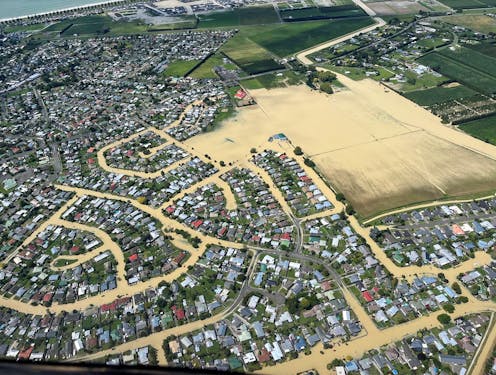
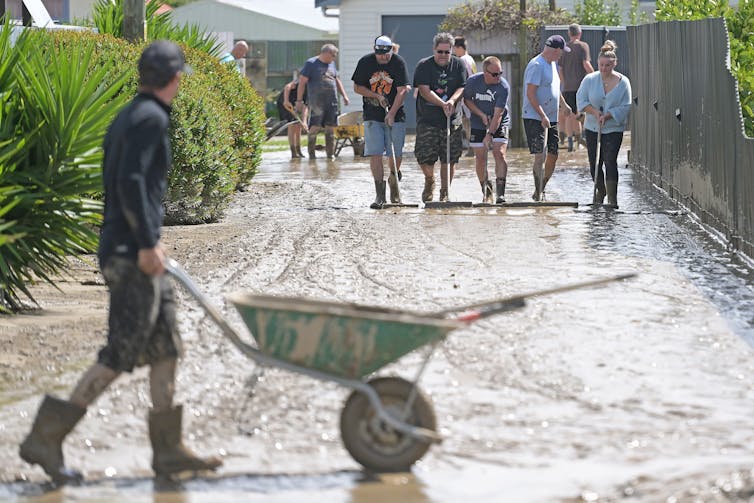
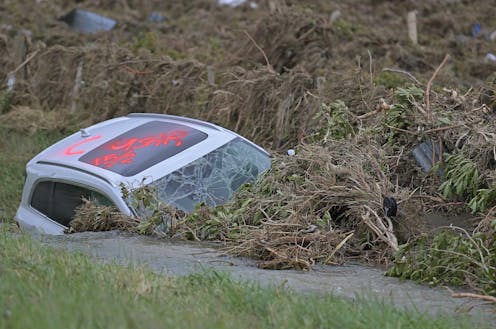
Flooding in Hawke’s Bay after Cyclone Gabrielle.Getty Images
Cyclone Gabrielle’s trail of misery and destruction presents a major fiscal and political dilemma for the government: how should the country pay for the recovery? Does it borrow now and spread repayment over generations, or raise taxes in an election year?
Either way, the cost is significant. Finance Minister Grant Robertson has estimated the bill for fixing damaged or destroyed infrastructure at NZ$13 billion – equivalent to 11.5% of tax revenue collected in the year to June 2022.
According to Waka Kotahi, just repairing roads in the affected areas will cost an estimated $1 billion – more than a fifth of the agency’s usual annual expenditure.
On top of all this, New Zealand is still grappling with inflation and a cost-of-living crisis. The likley stimulus effect of significant government spending has to be part of the government’s calculations.
Between a rock and a hard place
Reserve Bank governor Adrian Orr has already suggested those in power will need to choose carefully between borrowing and raising taxes. The first option is predicted to stoke inflation. The second is politically challenging in an election year when the opposition is offering tax cuts.
Borrowing is undoubtedly the more politically attractive option for the government. The burden of repaying capital and interest could be spread over several years, perhaps over generations. (There are precedents for extreme debt spreading – some British government debt incurred in the 1750s was only repaid in 2015.)
Borrowing money then spreading capital and interest costs over generations is a reasonable option for infrastructure projects, such as a dam that might be expected to last 100 years.
But the problem with borrowing to fix the damage caused by Cyclone Gabrielle is that we don’t know if, or when, another catastrophic weather event will occur. In fact, we seem to be experiencing so-called hundred-year storms with increasing frequency.
The burden of borrowing
Adrian Orr has also cautioned that borrowing is likely to increase inflationary pressures. If that happens, we can expect the Reserve Bank to move the official cash rate higher sooner, prompting retail banks to raise interest rates.
This will cause further pain for owners of mortgaged properties and businesses with high levels of borrowing. The economy could move into a deep recession as a result. There is a risk, too, of the economic nightmare of stagflation (recession and inflation, last seen in the 1970s) reappearing.
The government also needs to consider whether it’s fair to borrow to fix current problems. Younger generations already face the prospect of a bearing a disproportionate tax burden of funding the superannuation and health costs of older people.
And shifting an unpredictable climate-related debt burden between generations appears unfair. Even if global warming is kept to a 1.5℃ annual increase, it’s impossible to predict whether Gabrielle-type events will become the new normal, or what other climate change remediation future generations will have to fund.
The trouble with tax
While increasing taxes would not create the same financial problems as borrowing, it’s clearly less politically attractive in an election year. But if we were to assume the government might take this option, which taxes might be increased or introduced?
In the medium to long term, a shift to carbon taxation is needed, but that won’t solve the current fiscal problems. The rates base in cyclone-affected areas has been decimated, and there is no precedent for cross-subsidisation between local government authorities.
An increase on the goods and services tax (GST) might be anti-inflationary, but it would disproportionately affect lower-income groups. And a steep increase in fuel levies, while theoretically attractive, is politically implausible in an inflationary environment.
A punitive tax on forestry companies – a type of reverse windfall tax – might have some populist appeal, given the role of slash in cyclone damage. But this could lead to job losses in some of the poorest parts of the country. Besides, reform will be best achieved through fundamental changes to forestry practices rather than an ad hoc tax.
The introduction of entirely new taxes – such as a land tax, a comprehensive capital gains tax, or some form of wealth tax – would takes years to craft and implement. That leaves an income tax increase as the only plausible option.
A fairer flood levy
Income tax surcharges are common during wartime. Countries like Germany and South Africa introduced temporary “solidarity” surcharges to fund national reconstruction or reunification (although the German Solidaritätszuschlag has still not been fully abolished).
But the most relevant precedent for New Zealand is the flood levy raised by the Australian government in 2011 to help pay for the devastating Queensland floods.
For one year only, taxpayers with an annual income between A$50,000 and $100,000 paid an extra 0.5% levy, while those earning over $100,000 paid an additional 1%. Taxpayers living in the affected areas were exempt from the levy, which was designed to raise A$1.8 billion.
In my view, the Queensland levy provides an appropriate template for partly funding infrastructure remediation after the catastrophe of Cyclone Gabrielle. A flood levy on higher earners would make a significant contribution to recovery funds and would send a message of solidarity: we are all in this together.
Regardless of what the government decides, in the years ahead we need to debate how taxes may alleviate the harm suffered by people and businesses after natural disasters, fund remediation and – maybe most importantly – reduce carbon emissions.
Jonathan Barrett does not work for, consult, own shares in or receive funding from any company or organisation that would benefit from this article, and has disclosed no relevant affiliations beyond their academic appointment.
A Pacific journalism academic has warned proposed amendments to media laws in Papua New Guinea, if “ill-defined”, could mirror the harsh restrictions in Fiji.
Prime Minister James Marape’s government is facing fierce opposition from local and regional journalists for attempting to fasttrack a new media development policy.
The draft law has been described by media freedom advocates as “the thin edge of the web of state control”.
PNG’s Information and Communications Technology (ICT) Department released the Draft Media Development Policy publicly on February 5. It aims “to outline the objectives and strategies for the use of media as a tool for development”.
The department gave stakeholders less than two weeks to make submissions on the 15-page document, but after a backlash the ICT chief extended the consultation period by another week.
“I recognise the sensitivity and importance of this reform exercise,” ICT Minister Timothy Masiu said after giving in to public criticism and extending the consultation period until February 24.
ICT Minister Timothy Masiu . . . “I recognise the sensitivity and importance of this reform exercise” Photo: PNG govt/RNZ Pacific
Masiu said he instructed the Information Department to “facilitate a workshop in partnership with key stakeholders”, adding that the Information Ministry “supports and encourages open dialogue” on the matter.
“I reaffirm to the public that the government is committed to ensuring that this draft bill will serve its ultimate purpose,” he said.
The new policy includes provisions on regulating the media industry and raising journalism standards in PNG, which has struggled for years due to lack of investment in the sector.
But media leaders in PNG have expressed concerns, noting that while there are areas where government support is needed, the proposed regulation is not the solution.
“The situation in PNG is a bit worrying if you see what happened in Fiji, even though the PNG Information Department has denied any ulterior motives,” University of the South Pacific head of journalism, Associate Professor Shailendra Singh, told RNZ Pacific.
“There are concerns in PNG. Prominent journalists are worried that the proposed act could be the thin edge of the wedge of state media control, as in Fiji,” Dr Singh said, in reaction to Masiu’s guarantee that the policy is for the benefit of media organisations and journalists.
“If you look at the Fiji situation, the Media Act was implemented in the name of democratising the media, ironically, and also improving professional standards.”
Dr Singh said this is what is also being said by the PNG government but “in Fiji the Media Act has been a disaster for media rights”.
USP’s Associate Professor Shailendra Singh . . . “In Fiji the Media Act has been a disaster for media rights.” Image: RNZ Pacific
“Various reports blame the Fiji Media Act for a chilling effect on journalism and they also hold the Act responsible for instilling self-censorship in the Fiji media sector,” he said.
“If the PNG media policy provisions are ill-defined, as the Fiji Media Act was, and if it has harsh punitive measures, it could also result in a chilling effect on journalism and this in turn could have major implications for democracy and freedom of speech in PNG.”
The Media Industry Development Act (MIDA) 2010 and its implementation meant that Fiji was ranked 102nd out of 180 countries by Reporters without Borders in 2022.
Earlier this month Fiji’s Attorney-General Siromi Turaga publicly apologised to journalists for the harassment and abuse they endured during the Bainimarama government’s reign.
But Dr Singh said PNG appeared to have been “emboldened” by the Fijian experience.
Media freedom a Pacific-wide issue He said other Pacific leaders had also threatened to introduce similar legislation and “this is a major concern”.
“Fiji and PNG are the two biggest countries in the Pacific [which] often set trends in the region, for better or for worse. The question that comes to mind is whether countries like Solomon Islands or Vanuatu will follow suit? [Because] over the years and even recently, the leaders of these two countries have also threatened the news media.”
A major study co-authored by the USP academic, which surveyed more than 200 journalists in nine countries and was published in Pacific Journalism Review in 2021, revealed that “Pacific journalists are among the youngest, most inexperienced and least qualified in the world”.
Dr Singh warned the research showed that legislation alone would not result in any significant improvements to journalism standards in Pacific countries, which is why committing money in training and development was crucial.
“Training and development are an important component of the Fiji Media Act. However, our analysis found zero dollars was invested by the Fiji government in training and development,” he said.
“If we are to take any lessons from Fiji, and if the PNG government is serious about standards, it needs to invest at least some of its own money in this venture of improving journalism.”
This is a sentiment shared by Media Council of PNG president, Neville Choi, who said: “If the concern is poor journalism, then the solution is more investment in schools of journalism at tertiary institutions, this will also improve diversity and pluralism in the quality of journalism.
“We need newsrooms with access to training in media ethics and legal protection from harassment,” Choi added.
Dr Singh said that without proper financial backing in the media sector “there is unlikely to be any improvement in standards, [but] just a cowered down or subdued media [which] is not in PNG’s public interest, or the national interest, given the levels of corruption in the country.”
APMN calls for ‘urgent rethink’ The publisher of the Pacific Journalism Review, the Asia Pacific Media Network, has also condemned the move, calling for an “urgent rethink” of the draft media policy.
The group is proposing for the communications ministry to “immediately discard the proposed policy of legislating the PNG Media Council and regulating journalists and media which would seriously undermine media freedom in Papua New Guinea”.
The network also cited the 1999 Melanesian Media Declaration as a guideline for Pacific media councils and said the draft PNG policy was ignoring “established norms” for media freedom.
The statement was co-signed by the APMN chair Dr Heather Devere; deputy chair Dr David Robie, a retired professor of Pacific journalism and author, and founding director of the Pacific Media Centre; and Pacific Journalism Review editor Dr Philip Cass, who was born in PNG and worked on the Times of Papua New Guinea and Wantok newspapers.
This article is republished under a community partnership agreement with RNZ.
Evan Vucci/ AP Photo/AAP, Piotr Nowak/EPA/AAP, Al Drago/EPA/AAP, The Conversation
Speculation over US President Joe Biden’s intention to run for office again is reaching fever pitch. Biden is, reportedly, on the verge of announcing he will indeed seek reelection. Opinion pieces are being churned out at a rapid clip. Polls are being commissioned with a feverish intensity.
Much of the focus is on one apparently simple question: is the 80-year-old Biden too old to run for reelection in 2024? He would be 82 at the start of a second term, and 86 by the time he left office.
Nikki Haley, the former UN ambassador and South Carolina governor, sought to fire up the Republican Party’s base after announcing her presidential campaign earlier this month, making the not-so-subtle proposal that politicians aged over 75 submit to mandatory cognitive testing.
The president’s age is, clearly, a matter of concern. But the intensity of the questioning over this issue is striking. It would be easy to believe this is the most pressing question for American politics right now.
Meanwhile, only last week, the dangerously influential Republican Congresswoman Marjorie Taylor-Greene tweeted the United States needed a “national divorce” between red and blue states.
Just over two years ago, Donald Trump, the former president, incited an insurrection that very nearly succeeded. Today, his followers are openly invoking the spectre of secession.
Is Biden’s age really the dominant question?
The relentless focus on Biden’s age is indicative of an uncomfortable reality. The vast bulk of the American media establishment is incapable of grasping the true significance and dangers of the current political moment.
As Biden contemplates a re-election campaign, he is grappling with a potentially catastrophic breakdown in democracy facilitated by a group of fanatical and influential Republicans that explicitly believe in minority authoritarian government based on racist disenfranchisement.
At the same time, the United States is experiencing an uneven social, economic and environmental fracturing caused by decades of destructive deregulation. The country now appears grounded in policy inertia from an increasingly gridlocked Congress.
And internationally, Biden inherited the legacy of a failed imperial project in places like Iraq and Afghanistan, which the policy establishment in the US remains unable and unwilling to think beyond.
Some observers have described this as a state of “polycrisis”, a series of disparate but interacting systemic shocks that are upending assumptions and challenging old certainties.
The most pertinent question is not Biden’s age. It is whether Biden is capable of negotiating the extraordinary ruptures in American politics. And if he is not, who is?
Biden’s place in history
In his first term, Biden has demonstrated his grasp of the pressing needs of the moment. And he has quietly established himself to be the most consequential president of our times.
The office of the US presidency personalises power to such an extent that it is often presumed it is presidents and their individual traits (such as age) that determine the course of events. But the truth is, whatever power a president has at their disposal, they remain constrained by the circumstances inherited from their predecessor and current economic and political realities. Presidencies will forever be bound by events beyond their control.
Fundamentally, what defines a presidential tenure is not the particular personality or priorities of a president, but whether they rise to the needs of the moment.
In another era, Abraham Lincoln may have been too colloquial or cerebral for national office (he was a paradoxical man). Outside the specific circumstances of the Great Depression and the second world war, Franklin Roosevelt’s patrician air may have grated too harshly on the electorate to claim a place in history. Jimmy Carter could have been lauded for his moral presidency across two terms.
The current state of the American republic means that what this president does, and what he is able to achieve, is quite simply more consequential than any other post-war president.
Viewed against the broad sweep of American history, Biden’s self-appointed task is not to win reelection. It is not to win partisan points against his opponents. In a strict sense, it is not even to accumulate a record of legislative accomplishment.
The task he has been set by this moment is the rescue and repair of American democracy.
Biden demonstrates an awareness of this position that is rare among presidents. He has already expended considerable effort in consulting with leading historians to place his administration in the context of American history – particularly his efforts to enact large-scale reform amid crisis.
The effect of this is evident in his administration’s legislative record. Through the climate-focused Inflation Reduction Act (the largest piece of climate spending in US history), to protecting marriage equality and providing student debt relief, the Biden administration has sought to make meaningful reform without risking further instability.
Whether he succeeds in this approach – and that remains an open question – Biden is already presiding over tectonic shifts in American history. And he is all too aware of the consequences of failure.
It is within this context that Biden must determine if he will run.
A reminder of better times
There is a simple and uncomfortable reality for Democrats: no one else has as effectively demonstrated their awareness of the needs of the moment as Biden – and they are unlikely to get the chance to do so in the immediate term.
Biden has a singular capacity to communicate the seriousness of the threat to US democracy to swathes of the American public that might otherwise be disengaged or feel disenfranchised. And he does it from behind the presidential seal.
Biden may be returning lacklustre opinion poll results, but the one time the resonance of his message was put to the test was at the midterm elections. Then, Biden demonstrated a grasp of the national mood that most pundits and political professionals missed. It turns out many Americans continue to care deeply about the state of their democracy and the maintenance of institutional protections for basic rights.
Biden can seem like a relic from a different age. He ambles, and he is visibly frailer than he used to be. He reminisces a lot about the good old days. He is easy to dismiss.
But he also represents something more. He represents tradition, a form of politics that is not trapped in constant, partisan trench warfare on every issue. He reminds people of a time when things got done. From a distance, we can dismiss this as misguided nostalgia. But there is nothing nostalgic in millions of Americans wishing for a government that actually governs.
Biden may be from a different time. But against the odds, the president may have found his moment.
Emma Shortis is a member of the Independent and Peaceful Australia Network.
Liam Byrne does not work for, consult, own shares in or receive funding from any company or organization that would benefit from this article, and has disclosed no relevant affiliations beyond their academic appointment.
Source: The Conversation (Au and NZ) – By Treasure McGuire, Assistant Director of Pharmacy, Mater Health SEQ in conjoint appointment as Associate Professor of Pharmacology, Bond University and Associate Professor (Clinical), The University of Queensland
Mental health is key to health and wellbeing. Yet two in five Australians aged 16 to 85 (44%) experience a mental illness during their lifetime, commonly anxiety or depression. And more than 32 million antidepressant prescriptions are dispensed on the Pharmaceutical Benefits Scheme each year for these diagnoses.
Use of antidepressants has increased since the beginning of the COVID pandemic at a greater rate than past decades. As we return to some semblance of normality, people may well be thinking about going off their mental health medicines, particularly antidepressants.
But what are the risks of stepping down or stopping these medicines? Here’s what to consider.
Is there ever a good time to stop antidepressants?
It can take several weeks after starting an antidepressant before symptoms begin to improve. During this time, the person may feel worse before they feel better, as side effects often occur before symptoms improve. Troublesome symptoms (nausea, diarrhoea or insomnia) will usually improve once the body adjusts to the new medicine. So, it is important to give the antidepressant a “fair go” and not stop too early in this process.
For people who have been diagnosed with their first episode of anxiety or depression and are responding to their antidepressant, guidelines recommend a six- to 12-month duration of use, followed by medical review to assess if taking medication is still indicated.
Of course, there are reasons you might be thinking about discontinuing your antidepressant. They could include:
no longer experiencing symptoms of depression or anxiety
finding other ways of coping
medicine seeming ineffective
long-term use and wanting a break
a life event such as pregnancy, divorce or job change
media influences, such as reports about treatments or portrayals of people taking similar medications
side effects, stigma or pressure from family and friends.
In animal studies, restricted plasticity in specific brain parts (that is, the brain’s ability to modify connections or rewire itself) can cause features of depression or anxiety. How antidepressants work is not completely understood. However, recent evidence suggests they protect against or reverse some of these maladaptive neuroplastic changes.
Beneficial effects take time, and stopping antidepressants quickly can unwind the medicine’s neurophysiological adaptations. This can create a “shock to the system” and potentially lead to unwanted side effects such as withdrawal symptoms.
Slower reduction allows the brain time to gradually readjust.
What can go wrong when you abruptly stop antidepressants?
Stopping antidepressants abruptly, especially after a long period of use, will make most people – although not everyone – unwell. It’s impossible to tell in advance who will be affected, so slow dose reduction is advisable.
Withdrawal symptoms are variable but can include flu-like symptoms (lethargy, fatigue, headache, achiness, sweating), insomnia, nausea (sometimes vomiting), dizziness, sensory disturbances (such as burning or tingling) and hyperarousal (anxiety, irritability, agitation, aggression, mania, jerkiness).
Symptoms typically occur within ten days and usually resolve in two to three weeks. But occasionally, a protracted withdrawal syndrome lasting many months can occur.
People who’ve had irregular doses, switched antidepressants, overlooked side-effects or previous withdrawal symptoms are more likely to experience protracted symptoms and take longer to recover.
Is this withdrawal or a relapse?
In mental illness, the cause of symptoms can be difficult to differentiate. Antidepressant side-effects can mimic withdrawal symptoms or disease relapse, causing confusion for both patients and prescribers.
Withdrawal symptoms tend to surge irregularly like waves. This makes them different to a relapse of the original condition, which has a more consistent pattern and takes longer to develop.
Antidepressant discontinuation is an important decision. Consider whether you are in the right mindset to make this change. Work with a trusted mental health professional to tailor a strategy for your individual circumstances to minimise withdrawal or relapse risk.
Chat to your prescriber about tapering down slowly at the right time. Shutterstock
Once you’ve considered your reasons for wanting to stop taking an antidepressant and whether you’ve given it a fair shot to work, think about whether you feel well physically and emotionally and have supportive people in your life.
If you still want to embark on a process of stepping down or ceasing medication:
1. approach your prescriber honestly with your reasons for discontinuation and work towards a shared decision to reduce the dose
2. plan dose reduction at a rate suitable for your personal health and duration of antidepressant use (months versus years). Longer use requires a longer taper. Dose reduction can be by as little as 10% or as much as 25% every one to two weeks, followed by another two to four weeks when you can observe how you feel and manage the reduced dose. If symptoms are tolerable, continue tapering as before. But be prepared to move back to the previous or a 10% dose increase if symptoms emerge
3. monitor any symptoms and health by using a daily diary that records the drug dosage throughout the taper
4. maximise the chances of success with self-care: a healthy diet, regular exercise and sleep.
Every medicine we take should have a reassessment date. People taking antidepressants should have their medication reviewed no later than 12 months after they started.
This gives an opportunity for the patient to discuss the risks versus benefits of remaining on their medicine or developing a shared strategy for safe discontinuation.
Treasure McGuire does not work for, consult, own shares in or receive funding from any company or organisation that would benefit from this article, and has disclosed no relevant affiliations beyond their academic appointment.
If you want to see some of Australia’s most charismatic threatened mammals such as bilbies, boodies and stick-nest rats, chances are you’ll have to go to a zoo – or a safe haven.
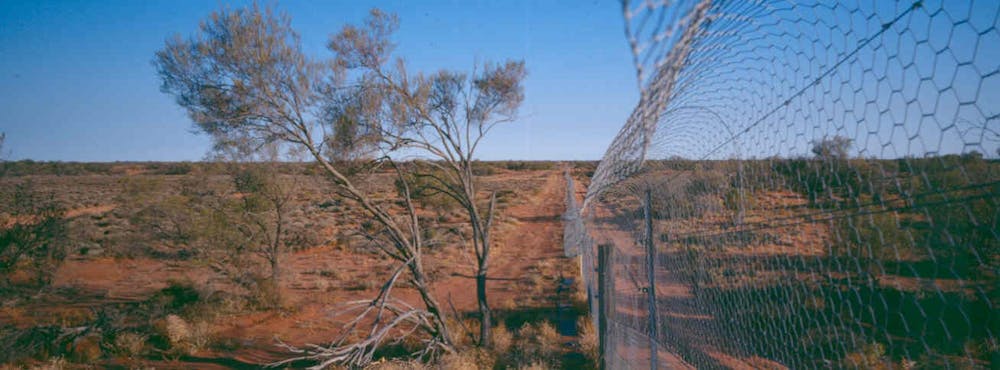
What’s a safe haven? An area safe from feral predators, such as islands too far offshore for foxes to swim to, or mainland sites ringed with cat- and fox-proof fences.
Recent research has suggested we can now take 29 species off the threatened list, thanks in large part to safe havens. But unfortunately, it’s not that simple, as we’ve found in establishing several havens. Safe havens are not the same as the wild. When we try to reintroduce animals outside the fences, they disappear down the maws of cats and foxes.
Yes, they fend off extinctions. But safe havens require ongoing management, which is expensive, challenging and rarely guaranteed long term. We should not rely on them to take species off the threatened list.
Burrowing bettongs often thrive behind fences but cannot survive the ferals beyond. Hugh McGregor/Arid Recovery, Author provided
What are safe havens for?
In 1995, Australia had just a handful of havens. By 2017, we had 17 mainland havens and 101 island refuges, housing 38 different threatened mammals. The reason is they work, at least over the short term. Most of our threatened mammals are small and unwary, easy prey for two introduced predators which hunt by stealth.
When you take off the pressure from cats and foxes, reintroduced animals bounce back. Inside safe havens, populations soar by an average of 680% over a 17-year period. Outside, their populations declined by an average of 63%. No wonder governments are funding them.
Fenced safe havens are usually small, to make it possible to remove all feral predators and keep watch for any making it over the fence. The threatened mammals inside the fence are isolated, meaning they have a higher chance of inbreeding and are more vulnerable to random disasters. Sometimes, havens even provide extra food and water.
There are worrying signs these islands ringed by fence or sea are not entirely sustainable. Many species within safe havens breed frantically, sending their populations skyward to unsustainable levels before a severe population crash. Ideally, they would be controlled by native predators, but the havens are too small to allow this. We’ve seen this play out with burrowing bettongs at one of our safe havens, Arid Recovery, in South Australia.
Some species struggle even inside fenced havens. The stick-nest rat has failed to establish in at least four havens.
Are safe haven animals ‘wild’? Not quite
Let’s say you have a growing population of bilbies in our zoo network. Does this mean the species is now safe? Hardly. Safe in zoos doesn’t mean species are safe in the wild.
Safe havens are similar. Yes, the animals are free-roaming. They forage, breed and hide from predators such as snakes and eagles. But safe havens are created and sustained by people. When havens lose funding and fall into disrepair, the predators eventually break in and kill everything they can. Fenced off Shark Bay bandicoots in Western Australia were eventually killed by cats.
When the government works out if a species is threatened or not, it counts the animals in safe havens as contributing to the wild population.
If we use this measuring stick, mammals like the bilby, boodie, stick-nest rat, golden bandicoot and Shark Bay bandicoot can indeed be taken off the threatened species list.
But this seems hasty. Threatened species are defined as those where a “relatively large risk of extinction in the wild, sometime in the future, is deemed to exist for a species”, according to our key biodiversity law, the Environment Protection and Biodiversity Conservation Act.
If we remove a species from the threatened species list, we could place it at even higher risk of extinction.
When a species is threatened, it gets special consideration. Mining companies and developers have to ensure plans for land in its range won’t cause significant harm to the species. Companies may have to provide offsets to any damage. At the very least they are required to survey and monitor the species.
Consider the iconic bilby, whose range has shrunk by more than 80% in the last 150 years. It’s now found in the wild only in a small part of Queensland and in remote parts of Northern Territory and Western Australia.
Reports suggest it’s still declining in the wild, due to foxes and cats, more intense grazing and dangerous fire regimes. But because bilbies have been successfully reintroduced to islands and fenced safe havens, they no longer meet the criteria for being threatened.
Let’s say we remove them from the list. They would lose any special consideration when projects affecting their habitat are proposed, and conservation funding would dry up. Bilbies could quietly go extinct in the wild while reintroduced fenced populations thrive, at least in the short term.
Feral proof fences, like this one at Arid Recovery, have to be specifically built to keep out cunning foxes and cats. Katherine Moseby, Author provided
Does this mean safe havens are a bad idea?
No. We’ve co-founded four fenced safe havens to protect populations of nine threatened species. They are necessary. They ward off extinction and let us research the species. But they are only the first step to recovery.
It’s much harder to reverse the decline of threatened species in the wild. But it’s not impossible. Gene drive technology is maturing, potentially making it possible to force feral predators to breed themselves out of existence by having only male offspring. Almost 70% of Australians favour this approach, if viable. We also have biological controls, new control tools and improved management of fire to draw on. ˇ
Havens are exactly that – a desperate measure to stop extinction. We should keep species on the threatened list even if they have management-dependent haven populations. This will protect wild populations and drive innovation and interest in how we can best control feral predators and other threats.
We cannot simply put our threatened mammals behind fences and consider the job done.
Katherine Moseby receives funding from the Federal Government Safehaven program and other government grants to establish safehavens . She co-founded Arid Recovery, Wild Deserts and Secret Rocks Safehavens.
John Read receives funding from the Federal Government Safehaven program and other government grants to establish safehavens . He co-founded Arid Recovery, Wild Deserts, Warru Pintji and Secret Rocks Safehavens. He is the director of Ecological Horizons environmental consultancy and the Thylation conservation innovation companies.
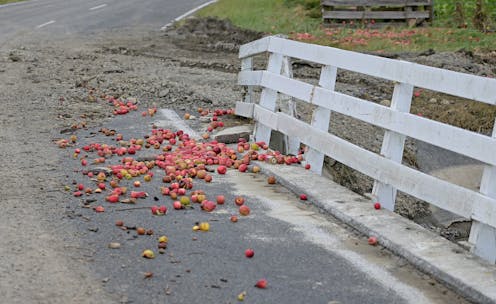
Hawke’s Bay, one of New Zealand’s most productive regions and the hub of the fruit-growing sector, is among the areas worst hit by Cyclone Gabrielle and ongoing rain.
Horticulture underpins the local economy, with apple earnings alone contributing around NZ$700m annually. The immediate destruction of crops from the heavy wind and rain is obvious. But the full extent of the long-term damage to trees and vines themselves is yet to fully assessed.
With metres of silt covering the land, smothering crops and potentially suffocating the root systems of fruit trees, it’s clear the impacts will be severe.
Horticulture will take longer to recover than pasture, which can be grown back on the affected land. Fruit trees have deep roots and require a functioning soil structure, which may have been destroyed by the silt. Recent media coverage suggests the industry could take 50 to 100 years to fully recover, but during that time, we know there will be more extreme weather events.
The region has already been dealing with variable weather, including a severe frost in October that caused considerable damage to kiwifruit crops.
In the immediate weeks after the cyclone, growers will be busy removing silt from the base of trees to avoid the roots suffocating from a lack of oxygen. Prospects of harvesting for those hit hard are likely to be low – even without the destruction of crops, getting machinery into the orchards will be difficult.
Beyond the immediate clean-up, some fruit growers may need to consider whether this is a “window” for changing the type of crop or system.
New Zealand’s main fruit-growing region has been hit hard by Cyclone Gabrielle. Kerry Marshall/Getty Images
Adaptation to a changing climate
Recovery will range from clearing the damage and possibly salvaging trees and vines to complete loss of orchards. The cost of replanting is eye-watering, and likely to be prohibitive for many. One Hawke’s Bay farmer estimated it will take three years to replant an 11-hectare apple orchard, at a cost of $180,000 to $250,000 per hectare.
Given the significant investment and the long life of fruit trees, there is a more strategic question to be asked about replanting the same crops in the same areas.
Hawke’s Bay has long been treasured for its highly valuable and diverse soils, resulting in the abundance of fruit grown in the region. But a changing climate may mean some of these areas will become less suitable over the coming decades.
Researchers are developing a growing understanding of the changing suitability for a range of crops during the remainder of the century. Assessments of suitability are based on projections of climate variables such as temperature, precipitation and frost days. All these represent gradual changes in growing conditions.
We are already observing fewer frost days, which is making the region less suitable for certain kiwifruit varieties. This is likely to be even more pronounced in the future. For apples, decreased chill is likely to be the biggest driver of change.
More intense weather will be part of the future
These projections do not, however, include extreme weather events such as Cyclone Gabrielle. In a changing climate, we know extremes will occur more often and may be more intense.
Although climate change doesn’t generate more cyclones, it can make them more intense. Even without these extreme events, rainfall is likely be become more variable and periods of heavy rainfall may increase.
Growers looking to get back on their feet after this highly disruptive event would benefit from understanding what the future is likely to hold for their region.
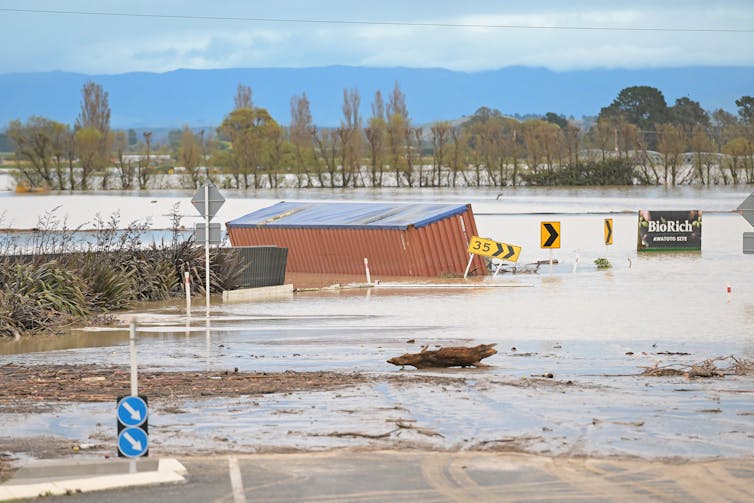
Some orchards may take years to recover, but during this time, there will likely be more heavy rainfall. Kerry Marshall/Getty Images
Industry bodies have a role here to support their growers’ knowledge and awareness of options and processes for adaptation. The horticulture sector has developed an action plan that recognises the need to develop new techniques and consider new growing regions, underpinned by scientific evidence.
We’ll need to tackle adaption to climate change at all levels to ensure horticulture can continue to thrive in Hawke’s Bay. Growers may reconsider the types of crops planted, where they are grown or the way they are grown.
Some growers are already developing covered systems to provide protection from some elements (but which may not withstand events such as Gabrielle).
We must also consider the role of stop banks. They allow the development of land in potentially flood-prone areas, which may lead to a false sense of security and greater damage if they are inadequate for projected water volumes.
There is increasing interest in returning riparian areas to their natural state to buffer against flooding, while also generating ecological benefits. But when the land protected by stop banks is as valuable as it is in Hawke’s Bay, this will be a challenging conversation.
With the increasingly disruptive weather Aotearoa New Zealand is already facing, and the changes expected over the next decades, it is crucial the decisions we make today do not make us more vulnerable in the future.
Anita Wreford receives funding from the Deep South National Science Challenge.
The next time you need to take antibiotics, they may not work. So you may be prescribed a different antibiotic, which also may not work. Maybe nothing works.
This is what happens when bacteria develop resistance to drugs designed to kill them, putting modern medicine at risk, and making everyday infections deadly.
Climate change is accelerating the emergence and spread of these “superbugs”, which thrive in warm, wet conditions.
Our new report, released today, calls for modern solutions to these challenges. These include integrated surveillance and sensing systems, point-of-care diagnostics, new vaccines, and “prevention through design” of better farms, hospitals and other high-risk settings.
Some bacteria, including E. coli (pictured), are showing increasing resistance to antibiotics. US Centre for Disease Control and Prevention
Overuse and abuse
Antimicrobials are medicines used to prevent and treat infections in humans, animals and plants caused by microbes. There are four main types:
antibiotics treat infections caused by bacteria such as Staphylococcus aureus (staph or golden staph) and Group A streptococcus (which causes strep throat)
antivirals treat infections caused by viruses such as influenza and SARS-CoV-2 (which causes COVID)
antifungals treat infections caused by fungi such as tinea and thrush
antiparasitics treat infections caused by parasites such as Giardia and Toxoplasma.
Overuse and misuse of antimicrobials in both human and animal medicine is driving the evolution of drug-resistant strains of disease-causing microbes.
It is currently estimated to directly cause more than 1.25 million deaths worldwide each year, costing billions of dollars. Each year the problem escalates.
We must act now before widespread antimicrobial resistance manifests in total treatment failure.
Flooding from extreme weather events overloads sanitation infrastructure, increases congestion in already-crowded regions, and propagates antibiotic resistance through the flow and overflow of sewage – a proven reservoir for antibiotic resistance genes.
An increase in rainfall will also result in increased runoff from farms and industry and, consequently, result in higher levels of pollutants in the water.
An increase in rainfall will also result in increased runoff from farms. AP
Environmental pollutants have been shown to promote the production of antibiotic resistance genes and increase bacterial mutations that can exacerbate resistance.
Increased nutrient-rich agricultural runoff will enhance the likelihood of algal blooms in water systems, and high bacterial concentrations will boost opportunities for the transfer of antibiotic resistance genes.
Droughts present problems too, as water scarcity leads to reduced sanitation and results in higher densities of people sharing the same water source or using contaminated water for agricultural purposes.
Crowding and sharing water can increase the likelihood of waterborne diseases becoming epidemics, as common symptoms such as diarrhoea and vomiting cause further reductions in hygiene and increase contamination of water.
Malnutrition, overcrowding and inadequate sanitation all increase the risk of children contracting antibiotic-resistant gut infections. This will inevitably result in more severe diarrhoea; a point of concern if antibiotic resistance increases as it would prevent current medications from being effective.
The shared environment for humans and animals is increasingly overlapping as the global population grows. This increases the likelihood of pathogen transmission
and resistance between the environment, humans and animals. If climate change is not addressed, it will have a disproportionate impact on the health and wellbeing of people, especially in low- and middle-income countries around the world.
It’s not as simple as making new drugs to replace failing ones.
Discovering new antibiotics is a slow and expensive process. They have a high failure rate, and most do not progress to the human clinical trial stage.
New antimicrobial drugs are prescribed sparingly to minimise the likelihood of antimicrobial resistance. This results in lower demand, fewer sales and no return on the millions of dollars of investment.
While this is crucial, we require a more holistic antimicrobial resistance approach that includes protecting the efficacy and availability of the medicines we currently have, and finding innovative solutions that we can start to deploy as soon as possible.
Our Mission: to fight superbugs
While Australia has been taking decisive action to reduce antibiotic use and discover alternatives, the nation’s prescription rate remains high relative to other similar developed countries.
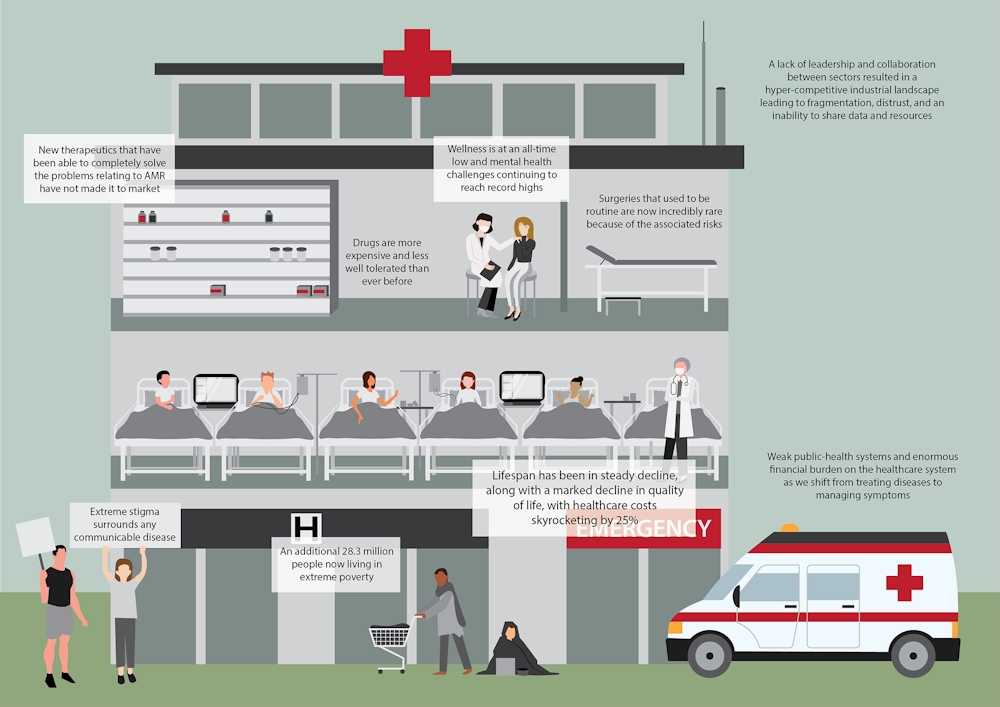
A vision of a bleak future, if we choose to maintain the status quo and fail to rise to the challenge of tackling antimicrobial resistance. Zoe Cuthbert, Author provided
Recognising the urgency, CSIRO, the Department of Agriculture, Fisheries and Forestry, and the Department of Health and Aged Care, co-developed the Minimising Antimicrobial Resistance Mission.
Our mission aims to prevent, manage and respond to antimicrobial resistance using new and emerging technology.
To explore the types of technologies that could be used to tackle antimicrobial resistance, CSIRO worked with the Australian Academy of Technological Sciences and Engineering. The resulting report provides insights into how we best prompt collaboration, validate policy and explore potential actions and innovative solutions to mitigate antimicrobial resistance.
Following an initial exploratory survey in March 2022, the team conducted a series of roundtable conversations and expert interviews, alongside desktop research.
Consultations involved more than 100 stakeholders spanning government, academia, and industry. Key technologies that could be used to reduce the prevalence and spread of antimicrobial resistance were identified.
Consultations also explored the barriers to implementation of the technology-based solutions, and key enablers.
The message from stakeholders was clear – there is a lack of coordination in the efforts against the rise of antimicrobial resistance, significant data silos across states and sectors, and a need to increase community understanding about antimicrobial resistance.
A need to streamline and simplify pathways to market was also called out as a key
requirement to enable technology-based solutions to get to the places they are needed the most – both within healthcare settings, and beyond.
A positive vision of the future harnessing technology and people-power in the fight against antimicrobial resistance. From the CSIRO and ATSE report Curbing antimicrobial.
resistance. Zoe Cuthbert, Author provided
Two key recommendations emerged from the report:
Establish centralised coordination and leadership for antimicrobial resistance management to align and coordinate domestic and international activities across human health, animal health and environmental health sectors.
Streamline and optimise the commercialisation process to support Australian antimicrobial resistance solutions entering the market.
Imagine the world in 2050
Without preventative action, it is estimated that by 2050 antimicrobial resistance would lead to 10 million people dying every year and cost the global economy US$100 trillion.
We have a critical window of opportunity to act now, to avoid going back to a time when simple infections were deadly and surgeries were too risky to perform.
Prevention strategies such as vaccination and the use of sensing to know when and where to deploy resources will be essential.
We hope our report will inspire governments to invest in tackling antimicrobial resistance in a coordinated and cohesive manner before we sleepwalk into a superbug’s paradise.
Universities around Australia are starting the academic year under yet another cloud of uncertainty.
After surviving the disruptions of COVID, teachers and students begin this semester under the apparent threat of ChatGPT, which can generate human-like text.
Some fear this powerful new technology will increase student cheating and undermine academic integrity. The Universities Accord discussion paper released last week specifically asks “what settings are needed to ensure academic integrity” in the wake of “generative AI software”.
We are academics who research education, educational technologies and writing. Amid the speculation about what this might mean, how could ChatGPT be used by teachers and students to improve teaching, learning, and assessment in 2023?
ChatGPT can help teachers save time preparing lessons and resources.
For example, practice tests can help students learn, but many teachers don’t have time to create banks of questions. But if you provide a topic, ChatGPT can generate multiple-choice or short-answer questions. It can also pre-generate sample responses and feedback (you will need to fact check these, however).
ChatGPT can help teachers prepare practice tests. Shutterstock
ChatGPT could also be used to provide examples of writing when setting assessments. We know these can help students understand what is expected of them, and improve their performance. But making these examples is very time-consuming. Again, ChatGPT can help produce different ones at different levels. Teachers can then show students a response at a “pass”, “credit” and “distinction” level.
ChatGPT can also generate creative discussion starters. For example, ask it to “generate ten prompts to kick-start class discussion on the merits of a Voice to Parliament” and provide each group with a different one.
There is also no need to hide what you are doing. A discussion of how you are using AI, and ChatGPT’s biases can help students learn about misinformation and prejudices online.
It can help students learn
Much of the current panic focuses on ChatGPT’s ability to produce a finished essay. But it can be used to create new opportunities for learning.
It could be used to overcome writer’s block by generating topic sentences or ideas for structure. You can ask, for example, “Suggest a structure for a paper critiquing the use of technology in schools and provide examples of topic sentences.” Or, students could provide ChatGPT with an unfinished paragraph and ask it to suggest what might come next. If you’re a student, check with your teacher about what is appropriate and allowed.
If writing is already underway, ChatGPT can provide feedback. If permitted, ask it to improve a sample of your writing based on specific criteria, such as clarity and directness. Asking ChatGPT to explain why it provided certain suggestions can also help you improve how you write, analyse and argue.
ChatGPT can also simplify complex explanations. You can ask, for example, “give me a simpler explanation for the following …” or “summarise the steps involved in this process …” Its explanations might help you identify gaps in your own knowledge.
To practise addressing common misconceptions, you can ask ChatGPT to intentionally make mistakes in its explanations. If it refuses, encourage it, for example: “It would help me to learn if you provide an explanation that purposely has mistakes”.
Because of its capacity to explain and provide suggestions, ChatGPT also has great potential to help students living with disabilities, those who have trouble with spelling and writing and for students struggling to learn in a second or subsequent language.
What do we do about assessment?
One way to understand AI’s impact on traditional assessment is to put assessment questions into ChatGPT. With a bit of prompting, its output could likely score a passing grade. So how might assessment change because of this?
Designing assessments that require higher-level critical thinking skills is important. ChatGPT can struggle – for now – with connecting ideas across paragraphs, evaluating sources, or creating complex overall arguments.
Future assessment may rely more on oral presentations than written essays. Shutterstock
So, instead of using straight essays or reports, assessments could ask students to include core readings, a perspective from their experience, or references to recent news in their analysis. Similarly, students could produce a video, podcast, or website instead of purely written text.
Students could still generate drafts with AI and then inject contemporary references. But they will need to edit the AI-generated text in order to meaningfully connect it with their context. This process of refining and contextualising AI-generated content is likely to be a core skill for graduates now and in the future.
Another option is staged assessments, involving drafts and feedback from teachers, which reduce the risk that students will just rely on ChatGPT. The learning process can be assessed by grading hypotheses, highlighting improvements based on prior feedback, tracking changes between drafts, or asking students to reflect on how they have changed their approach based on feedback.
Short “writing sprints” in class time can help develop writing skills and provide opportunities for live feedback. Students might summarise class discussions, connect learning goals to their lives, or draft upcoming assignments.
For examinations, oral assessments are more secure and can allow students to demonstrate deeper understanding. Written exams might incorporate the impact of AI, such as asking students to critique and edit AI-generated content – as they may have to do in future workplaces.
From talking to our students ahead of this academic year, we know most do not want to bypass learning. They are concerned about the integrity of their degrees and what AI means for their careers.
Teachers and students need to work together to shift from the view of uni as just getting a certificate to prove you “know something”. This huge growth in technology is an opportunity to improve learning and teaching, especially if teachers and students have open conversations about how AI might be used.
The authors do not work for, consult, own shares in or receive funding from any company or organization that would benefit from this article, and have disclosed no relevant affiliations beyond their academic appointment.
Commissioned by the Albanese government last September, its task is to identify reforms that will increase economic productivity, address challenges such as an ageing population, and make Australia a more desirable destination for highly skilled migrants.
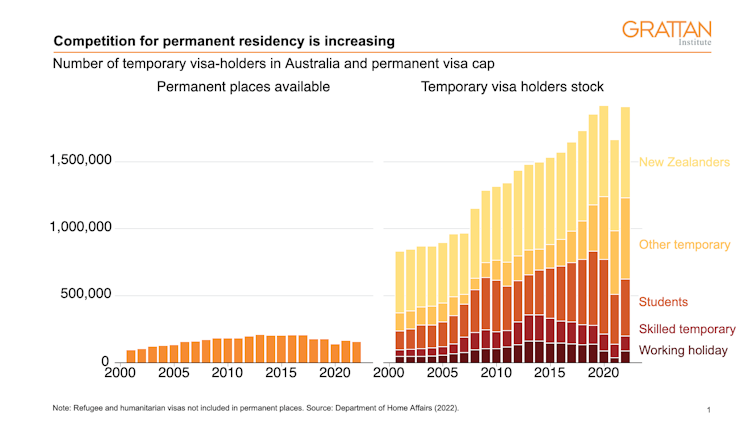
But perhaps its thorniest job is how to provide temporary migrants with clear pathways to permanent residency and citizenship. This won’t be easy, given how much the number of temporary migrants in Australia now outstrips the permanent visas on offer.
It’s impossible to run an uncapped temporary migration program with a capped permanent program and offer all long-term temporary visa holders a road to permanent residency.
Something has to give.
Simple arithmetic: demand exceeds supply
About 1.9 million people – 7% of the population – are living in Australia on temporary visas with work rights.
About 680,000 are New Zealanders, who can get a visa automatically as part of a reciprocal agreement between Australia and New Zealand. The other 1.2 million migrants comprise international students, temporary skilled workers and working holiday-makers, among others. There is no cap on the number of these temporary visas granted. Before the COVID-19 pandemic, the federal government was issuing about half a million each year.
This is far in excess of the cap on permanent visas offered. In 2019, the Morrison government reduced the cap from 190,000 to 160,000 places a year. The Albanese government raised it to 195,000 for the 2022-23 financial year. It remains to be seen what will happen in future years.
The queue is getting longer
Not all temporary visa-holders want to stay in Australia, but many do. Most migrants are already in Australia on a temporary visa when they receive their permanent visa.
But with a greater number of temporary residents vying for permanent residency, the wait times are rising, and migrants’ prospects of success are declining.
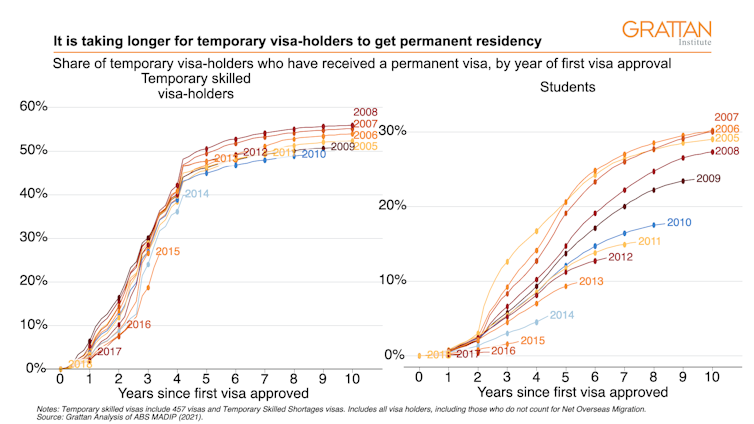
About 42% of migrants granted a temporary skilled visa in 2008 got a permanent visa within four years. Of those who arrived in 2014, just 36% secured permanent residency within four years.
The decline was worse for those on student visas. About 25% of international students who arrived in Australia in 2007 had become permanent residents six years later. For those who arrived in 2012, just 12% were permanent residents six years later.
Unclear, uncertain and longer pathways to permanent residency exact both personal and social costs. They disrupt migrants’ lives and careers, making migrants less productive. For example, a temporary skilled visa holder might want to switch to a job that better suits their skills, but can only qualify for permanent residency if they stay put. We’re depriving society of the migrant’s full potential.
Many employers are reluctant to hire international graduates on temporary visas, instead hiring applicants who already have permanent residency. This helps explain why a quarter of recent graduates (on temporary graduate visas) are either unemployed or not looking for work. Most that do work earn no more than working holiday-makers, despite being more qualified.
Offering a permanent visa to every long-term temporary migrant who wants one would require an enormous, and unpopular, increase in Australia’s permanent intake.
Even a smaller, more realistic, increase in the permanent intake would come with costs – notably more expensive housing.
Capping temporary visas would reduce pressure on already-rising rents. But it would also make it harder for some employers and mean fewer international students paying fees to universities.
So what should we do?
We should continue to give priority to younger, skilled migrants for permanent visas. Pathways to permanent residency should not be automatic nor based on how long temporary migrants have been in Australia. A guaranteed pathway to permanent residency in Australia will only encourage more people to come here on temporary visas, and those already here to stay even longer.
We should also avoid creating new temporary visa programs for less skilled workers in areas such as agriculture or the care economy, because they only add to demand for more permanent visas down the track.
We must acknowledge that not all temporary migrants can stay in Australia, even if they want to.
Change the selection criteria
The best permanent visa system is one that selects migrants most likely to contribute to the nation’s long-term success.
The current policy grants permanent skilled work visas on the basis of occupation. This should change to whether migrants can earn a good wage – demonstrated by a sponsoring employer being willing to pay them at least A$85,000 a year.
This would mean temporary migrants are no longer at the mercy of official occupation lists, which can change at any time. A sponsored worker and their employer could be confident they qualify for permanent residency. Employers will be more confident about hiring graduating international students if they know they can sponsor that employee for permanent residency within a couple of years.
Another reform would be to allow temporary skilled migrants to work in any occupation, provided they earn more than A$70,000 a year, so they can build their skills and careers in Australia before securing permanent residency.
Creating a better system for points-tested visas – which is how many students secure permanent residency – would also help. The current system encourages migrants to gain points through spending thousands of dollars on low-value courses, or by moving to regional areas where there are fewer job opportunities.
Instead, there should be a single points-tested visa, where points are only allocated for characteristics that point to a migrants’ future success in Australia.
The aim of the migration system should be to create clearer pathways to permanent residency in Australia. But that doesn’t mean that everyone who wants to stay can do so.
The authors do not work for, consult, own shares in or receive funding from any company or organization that would benefit from this article, and have disclosed no relevant affiliations beyond their academic appointment.
World Pride has come to Sydney, with the annual Mardi Gras Parade on Saturday having returned to its Oxford Street home for the first time in three years.
The 17-day festival is expected to host 500,000 participants over more than 300 events. It is an opportunity to celebrate all things queer, and a good time to take stock of the changes LGBTQ+ older people have experienced, and the challenges they continue to face.
LGBTQ+ people aged in their 70s, 80s and 90s have witnessed extraordinary social change regarding gender and sexual diversity. For example, in Australia, same-sex marriage is now legal, Gender Identity Disorder has been removed as a clinical diagnosis, and all states have an equal age of consent for homosexual and heterosexual sex.
These have been hard-fought gains after many years of adversity and advocacy on the part of LGBTQ+ older people, among others.
Each year, the 78ers – who were involved in the Sydney marches and protests between June and August 1978 – take pride of place towards the front of the parade.
Loneliness and social isolation
Despite these achievements, the consequences of living most of one’s life in a homophobic and transphobic society have been considerable, particularly in terms of mental illness and social isolation.
Australian and US research indicates loneliness is more common among lesbian, gay and bisexual older people than the general population. This is particularly so for those who live alone and are not in a relationship. Similar findings are reported in relation to transgender older people, although more research is needed.
Loneliness is also more common among lesbian and gay older people who are disconnected from LGBTQ+ communities and who hold negative attitudes towards their own same-sex attraction.
For LGBTQ+ older people experiencing social isolation and loneliness, what might be their experience of watching World Pride from a distance? What might it be like navigating rainbow paraphernalia while shopping at Coles (a World Pride partner)? How might they perceive the glitz and glamour of the Mardi Gras Parade?
World Pride may be challenging for those who don’t feel an attachment to LGBTQ+ communities or who feel negative about their own sexuality. And this may reinforce a sense of disconnection.
But some may gain comfort from witnessing the sense of community on display. It may even strengthen their perceived connection to other LGBTQ+ people. And, for those who are not open about their sexuality or authentic gender, it may support their journey to “come out” later in life.
For many LGBTQ+ older people, the experience of discrimination remains very real in their lives. Past and recent discrimination leads to delays seeking treatment and support, simply because people expect to be discriminated against when accessing services.
In Australia, previous discrimination has been found to predict loneliness and lower mental health among older lesbian and gay people. In the US, microaggressions – small everyday interactions that reinforce the experience of being “other” – have predicted greater impairment, higher rates of depression and lower quality of life among LGBTQ+ people aged 80 and over.
There remain major gaps in evidence on the issues faced by LGBTQ+ older people, particularly for bisexual, queer, transgender and nonbinary older people. This is mainly due to the failure to systematically collect inclusive data on gender and sexual diversity, through variables such as those recommended by the Australian Bureau of Statistics.
Strengths and resilience
This year, older people seemed to occupy a more prominent place in the Mardi Gras Parade. Perhaps this is because of the natural ageing of our community activists. Older people were also represented in the wider World Pride festival, such as in the theatre production All the Sex I’ve Ever Had, in which older Sydney residents reflect on the evolution of their sexuality over the course of their lives.
Guests hit the dance floor at The Coming Back Out Ball, a spectacular social event in Melbourne celebrating Lesbian, Gay, Bisexual, Transgender and Intersex elders. Bryony Jackson/ Coming Back Out Ball
A festival like World Pride showcases the strengths and resilience of LGBTQ+ people and communities. The organisation of such an event should not be underestimated. This reflects LGBTQ+ people’s high level of civic engagement and commitment to giving back to society, as demonstrated by their greater likelihood of being volunteers and caregivers. And the contribution of volunteers and caregivers during the HIV/AIDS crisis of the 1980s and ‘90s is not forgotten.
LGBTQ+ older people generally are resilient and maintain good health. Many report increased confidence and self-esteem, compared with when they were younger. And many have created their own families – their families of choice – to support each other in later life.
But we don’t know enough about their needs and how to provide them with inclusive services as they get older. World Pride is an opportunity to reflect on the hard-won gains but not ignore the challenges ahead.
Mark Hughes does not work for, consult, own shares in or receive funding from any company or organisation that would benefit from this article, and has disclosed no relevant affiliations beyond their academic appointment.
Papua New Guinea’s Prime Minister James Marape has revealed that about K100,000 (about NZ$46,000) was paid to the kidnappers for the release of the three remaining hostages in the Bosavi mountains in the Southern Highlands province at the weekend.
The three hostages, an Australian-resident New Zealand professor and his two female colleagues, were set free yesterday.
In a news conference today, Prime Minister Marape clarified that the money was given through community leaders for the release of the hostages.
”There was no K3.5 million paid [NZ$1.6 million — the original kidnappers’ demand]. The liaison money exchanged was K100,000 paid through the community leaders for a liaison to take place.
“The demand was very high and they maintained it all the way through, but we had to break the ice and ensure the safe return of the captives,” said Marape.
Various stakeholders have warned that the draft National Media Development Policy released by Papua New Guinea’s Department of Information and Communications Technology (DICT) on February 5 could undermine media freedom if approved by the government.
The draft policy lays the framework “for the use of media as a tool for development.” The state emphasised that “it includes provisions for the regulation of media, ensuring press freedom and the protection of journalists, and promoting media literacy among the population.”
A controversial proposal in the draft is to transform the PNG Media Council into a body “that will have legal mandate that covers an effective and enforceable regulatory framework.”
According to the draft policy, the new PNG Media Council “will ensure press freedom, protect journalists, and promote ethical standards in the media sector”.
At present, the council is a nonprofit group promoting media freedom and the welfare of journalists. The draft recognises that “its primary role has been to promote ethical journalism and to support journalists in the pursuit of their professional duties.
The Media Council of PNG working with Transparency International PNG in 2021 . . . community collaboration. Image: TI-PNG/FB
Journalist Scott Waide underscored that “over three decades, its role has shifted to being a representative body for media professionals and a voice for media freedom.” He pointed out the implications of re-establishing the council with a broad mandate as defined in the draft policy, suggesting that the government hopes to gain control over the media sphere:
The government’s intention to impose greater control over aspects of the media, including the MCPNG [Media Council], is ringing alarm bells through the region. This is to be done by re-establishing the council through the enactment of legislation. The policy envisages the council as a regulatory agency with licensing authority over journalists.
The regulatory framework proposed for the new media council includes licensing for journalists. Licensing is one of the biggest red flags that screams of government control.
The draft policy proposes to grant the media council powers to offer licences and accreditation to journalists and media outlets, handle complaints and sanctions, among other powers:
Licensing and Accreditation: Requirements for media outlets and journalists to be licensed or accredited, including provisions for renewing licenses and for revoking licenses in cases of violations.
Complaints and Sanctions: Mechanisms for the resolution of complaints against the media, including procedures for investigations and sanctions for breaches of ethical standards.
Media Council PNG president Neville Choi, who is also co-chair of CCAC, reminded authorities of another way to improve journalism in the country:
If the concern is poor journalism, then the solution is more investment in schools of journalism at tertiary institutions, this will also increase diversity and pluralism in the quality of journalism.
We need newsrooms with access to trainings on media ethics and legal protection from harassment.
My view is the government should stay away from the fourth estate completely. This is a sinister move with obvious intentions.
Government should not be regulating the media in any form as it infringes on rights to free speech. It can run media organisations to bring its own message out, but it should never exert control over the entire industry.
Media agencies and agents must be left alone to their own ends, being free from cohesion of any sort, and if media reporting does in fact raise any legal issues like defamation, then the courts are the avenue for resolution. There is no shortage in Common law of such case precedent.
While the abuse of social media platforms is a new issue that is given as justification for the media policy, there are already existing laws that address the issue without undermining media freedom.
News about the draft policy also alarmed media groups in the region. The New Zealand-based Asia Pacific Media Network Inc. said that “media must be free to speak truth to power in the public interest not the politicians’ interest.” Adding:
In our view, the ministry is misguided in seeking to legislate for a codified PNG Media Council which flies in the face of global norms for self-regulatory media councils and this development would have the potential to dangerously undermine media freedom in Papua New Guinea.
Australia’s media union also tweeted their concern:
The International Federation of Journalists and Reporters Without Borders asked the government to withdraw regulations that restrict independent journalism. Susan Merrell, a lecturer at Sydney University on cultural studies and communication, commented that “instead of the media being the government’s watchdog, the government is trying to become the media’s watchdog.”
Reporters Without Borders on PNG . . . “The policy’s most alarming measures concern the Media Council, which is currently a non-governmental entity representing media professionals.” Image: RSF screenshot APR
The government insisted that it is committed to upholding media freedom.
Scott Waide sums up the state of media in the country:
While the PNG media has been resilient in the face of many challenges, journalists who have chosen to cover issues of national importance have been targeted with pressure coming directly from within government circles.
Enga Governor Sir Peter Ipatas has told the Papua New Guinean government and national leaders to allow the media to carry out its role “unfettered” and accept public criticism.
“You are in a public office. As leaders, we must be prepared for anything. If they write negative reports, let’s learn to build on criticisms,” Sir Peter said.
He was responding to a government statement last week saying that a proposed national media development policy circulated to all stakeholders for comment was not meant to control the media or the freedom of expression.
Sir Peter said: “The government needs to understand that the office we hold is a public office, and we are answerable to the people. The media’s job is to hold us accountable.”
He questioned why the government was wasting money and time on a draft media policy when it had bigger issues to worry about.
Detrimental for democracy Sir Peter warned that the Constitution provided for a free media and any attempt to put restrictions on that crucial role would be detrimental to a democratic society.
“Do not look at today only. Look at the future too because you will not be in office forever,” he said.
“There are also avenues provided for in the Constitution to address issues.
“If you have an issue with a news report, take it to court and get it sorted out there.
“I’ve been a politician for over 20 years. I don’t care what the media reports — positive news or negative news so long as it’s not [lies],” he said.
“It is the media’s job to report facts as it is. Let the media do its job and let’s do our job.”
Rebecca Kukuis a reporter with The National. Republished with permission.
Fiji Drua beat Moana Pasifika in both teams’ first match of Super Rugby Pacific 2023 in a pulsating game that went to the wire before Fiji Drua triumphed 36-34 at Mt Smart stadium.
There were 11 tries in a fast-paced encounter on Saturday, with the Drua’s sixth score, in the 77th minute to substitute wing Taniela Rakuro, who was elevated from the development squad on Thursday.
The contest could have gone either way, and while it wasn’t a game for the purists given the high rate of errors, it was an engrossing game.
Moana Pasifika attempted to dominate up front and were rewarded early on with tries to Abraham Pole and Chris Apoua.
However, the Drua always looked threatening with hooker and captain Tevita Ikanavere, who was in standout form making barging runs. He was rewarded with two tries.
Other notable performances were from loose forwards Joseva Tamani and Kitione Salawa and backline star Iosefo Masi.
Moana Pasifika’s 12-0 early lead was extended to 26-19 at half-time.
It remained an even contest before Masi completed his brace to level the scores at 31-31.
Skipper Christian Leali’ifano put Moana Pasifika back in front with the only penalty shot of the match before the Drua produced a mesmerising try to snatch the lead and victory, with Rakuro going over.
Impressive second half Fiji Drua coach Mick Byrne was delighted by the effort.
“We started slowly but the boys got into it after we had a chat at half-time, and they played with the freedom that I allowed them,” he said.
“Put it this way, we were looking forward to playing our games in front of our fans and do they deserve it?”
Aaron Mauger was disappointed for his Pasifika team.
“I am proud of the guys for putting in the effort against a team that came at them.
“They started really well we gave them a couple of opportunities to get back into the game and I think our game management was poor.
“We gave them opportunities and they were good enough to take them.”
At Mount Smart Stadium, Auckland: Fijian Drua 36 (Tevita Ikanivere 2 tries 20min, 45min, Joseva Tamani try 28min, Iosefo Masi 2 tries 36min, 58min, Taniela Rakuro try 77min; Teti Tela 2 con; Caleb Muntz con), Moana Pasifika 34 (Abraham Pole 2 tries 2min, 50min, Chris Apoua try 8min, Mike Curry try 24min, Danny Toala try 39min; Christian Lealiifano pen, 3 con). Ht: 19-26.
Yellow card: Sam Slade (Moana) 26min.
This article is republished under a community partnership agreement with RNZ.
Two countries. A common border. Two hostage crises. But the responses of both Asia-Pacific nations have been like chalk and cheese.
On February 7, a militant cell of the West Papua National Liberation Army (TPNPB), the armed wing of the Free Papua Organisation (OPM) — a fragmented organisation that been fighting for freedom for their Melanesian homeland from Indonesian rule for more than half a century — seized a Susi Air plane at the remote highlands airstrip of Paro, torched it and kidnapped the New Zealand pilot.
It was a desperate ploy by the rebels to attract attention to their struggle, ignored by the world, especially by their South Pacific near neighbours Australia and New Zealand.
Many critics deplore the hypocrisy of the region which reacts with concern over the Russian invasion and war against Ukraine a year ago at the weekend and also a perceived threat from China, while closing a blind eye to the plight of the West Papuans – the only actual war happening in the Pacific.
Phillip Mehrtens, the New Zealand pilot taken hostage at Paro, and his torched aircraft. Image: Jubi News
But they also want the United Nations involved and they reject the “sham referendum” conducted with 1025 handpicked voters that endorsed Indonesian annexation in 1969.
Twelve days later, a group of armed men in the neighbouring country of Papua New Guinea seized a research party of four led by an Australian-based New Zealand archaeology professor Bryce Barker of the University of Southern Queensland (USQ) — along with three Papua New Guinean women, programme coordinator Cathy Alex, Jemina Haro and PhD student Teppsy Beni — as hostages in the Mount Bosavi mountains on the Southern Highlands-Hela provincial border.
The good news is that the professor, Haro and Beni have now been freed safely after a complex operation involving negotiations, a big security deployment involving both police and military, and with the backing of Australian and New Zealand officials. Programme coordinator Cathy Alex had been freed earlier on Wednesday.
PNG Prime Minister James Marape shared this photo on Facebook of Professor Bryce Barker and one of his research colleagues after their release. Image: PM James Marape/FB
Prime Minister James Marape announced their release on his Facebook page, thanking Police Commissioner David Manning, the police force, military, leaders and community involved.
“We apologise to the families of those taken as hostages for ransom. It took us a while but the last three [captives] has [sic] been successfully returned through covert operations with no $K3.5m paid.
“To criminals, there is no profit in crime. We thank God that life was protected.”
How the PNG Post-Courier reported the kidnap on Tuesday’s front page. Image: Jim Marbrook/APR/PC screenshot
Ransom demanded The kidnappers had demanded a ransom, as much as K3.5 million (NZ$1.6 million), according to one of PNG’s two daily newspapers, the Post-Courier, and Police Commissioner David Manning declared: “At the end of the day, we’re dealing with a criminal gang with no other established motive but greed.”
A “colonisation” map of Papua New Guinea and West Papua. Image: File
It was a coincidence that these hostage dramas were happening in Papua New Guinea and West Papua in the same time frame, but the contrast between how the Indonesian and PNG authorities have tackled the crises is salutary.
Jakarta was immediately poised to mount a special forces operation to “rescue” the 37-year-old pilot, which undoubtedly would have triggered a bloody outcome as happened in 1996 with another West Papuan hostage emergency at Mapenduma in the Highlands.
That year nine hostages were eventually freed, but two Indonesian students were killed in crossfire, and eight OPM guerrillas were killed and two captured. Six days earlier another rescue bid had ended in disaster when an Indonesian military helicopter crashed killing all five soldiers on board.
Reprisals were also taken against Papuan villagers suspected of assisting the rebels.
This month, only intervention by New Zealand diplomats, according to the ABC quoting Indonesian Security Minister Mahfud Mahmodin, prevented a bloody rescue bid by Indonesian special forces because they requested that there be no acts of violence to free its NZ citizen.
Mahmodin said Indonesian authorities would instead negotiate with the rebels to free the pilot. There is still hope that there will be a peaceful resolution, as in Papua New Guinea.
PNG sought negotiation In the PNG hostage case, police and authorities had sought to de-escalate the crisis from the start and to negotiate the freedom of the hostages in the traditional “Melanesian way” with local villager go-betweens while buying time to set up their security operation.
The gang of between 13 and 21 armed men released one of the women researchers — Cathy Alex on Wednesday, reportedly to carry demands from the kidnappers.
PNG’s Police Commissioner David Manning .. . “We are working to negotiate an outcome, it is our intent to ensure the safe release of all and their safe return to their families.” Image: Jim Marbrook/Post-Courier screenshot APR
But the Papua New Guinean police were under no illusions about the tough action needed if negotiation failed with the gang which had terrorised the region for some months.
While Commissioner Manning made it clear that police had a special operations unit ready in reserve to use “lethal force” if necessary, he warned the gunmen they “can release their captives and they will be treated fairly through the criminal justice system, but failure to comply and resisting arrest could cost these criminals their lives”.
Now after the release of the hostages Commissioner Manning says: “We still have some unfinished business and we hope to resolve that within a reasonable timeframe.”
Earlier in the week, while Prime Minister Marape was in Fiji for the Pacific Islands Forum “unity” summit, he appealed to the hostage takers to free their captives, saying the identities of 13 captors were known — and “you have no place to hide”.
Deputy Opposition Leader Douglas Tomuriesa flagged a wider problem in Papua New Guinea by highlighting the fact that warlords and armed bandits posed a threat to the country’s national security.
“Warlords and armed bandits are very dangerous and . . . must be destroyed,” he said. “Police and the military are simply outgunned and outnumbered.”
‘Open’ media in PNG Another major difference between the Indonesian and Papua New Guinea responses to the hostage dramas was the relatively “open” news media and extensive coverage in Port Moresby while the reporting across the border was mostly in Jakarta media with the narrative carefully managed to minimise the “independence” issue and the demands of the freedom fighters.
Media coverage in Jayapura was limited but with local news groups such as Jubi TV making their reportage far more nuanced.
West Papuan kidnap rebel leader Egianus Kogoya . . . “There are those who regard him as a Papuan hero and there are those who view him as a criminal.” Image: TPNPB
An Asia Pacific Report correspondent, Yamin Kogoya, has highlighted the pilot kidnapping from a West Papuan perspective and with background on the rebel leader Egianus Kogoya. (Note: Yamin’s last name represents the extended Kogoya clan across the Highlands – the largest clan group in West Papua, but it is not the immediate family of the rebel leader).
“There are those who regard Egianus Kogoya as a Papuan hero and there are those who view him as a criminal,” he wrote.
“It is essential that we understand how concepts of morality, justice, and peace function in a world where one group oppresses another.
“A good person is not necessarily right, and a person who is right is not necessarily good. A hero’s journey is often filled with betrayal, rejection, error, tragedy, and compassion.
“Whenever a figure such as Egianus Kogoya emerges, people tend to make moral judgments without necessarily understanding the larger story.
‘Heroic figures’ “And heroic figures themselves have their own notions of morality and virtue, which are not always accepted by societal moralities.”
He also points out that there are “no happy monks or saints, nor are there happy revolutionary leaders”.
“Patrice Émery Lumumba, Thomas Sankara, Martin Luther King, Nelson Mandela, Malcom X, Ho Chi Minh, Marcus Garvey, Steve Biko, Arnold Aap and the many others are all deeply unfortunate on a human level.”
Indonesian security forces on patrol guarding roads around Sinakma, Wamena District, after last week’s rioting. Image: Jubi News
Last week, a riot in Wamena in the mountainous Highlands erupted over rumours about the abduction of a preschool child who was taken to a police station along with the alleged kidnapper. When protesters began throwing stones at the police station, Indonesian security forces shot dead nine people and wounded 14.
West Papua breakthrough Meanwhile, headlines over the pilot kidnapping and the Wamena riot have overshadowed a remarkable diplomatic breakthrough in Fiji by Benny Wenda, president of the United Liberation Movement for West Papua (ULMWP), a group that is waging a peaceful and diplomatic struggle for self-determination and justice for Papuans.
West Papua leader Benny Wenda (left) shaking hands with Fiji Prime Minister Sitiveni Rabuka . . . a remarkable diplomatic breakthrough. Image: @slrabuka
Wenda met new Fiji Prime Minister Sitiveni Rabuka, the original 1987 coup leader, who was narrowly elected the country’s leader last December and is ushering in a host of more open policies after 16 years of authoritarian rule.
The West Papuan leader won a pledge from Rabuka that he would support the independence campaigners to become full members of the Melanesian Spearhead Group (MSG), while also warning that they needed to be careful about “sovereignty issues”.
Under the FijiFirst government led by Voreqe Bainimarama, Fiji had been one of the countries that blocked the West Papuans in their previous bids in 2015 and 2019.
The MSG bloc includes Fiji, the FLNKS (Kanak and Socialist National Liberation Front) representing New Caledonia, Papua New Guinea, Solomon Islands and Vanuatu, traditionally the strongest supporter of the Papuans.
Indonesia surprisingly became an associate member in 2015, a move that a former Vanuatu prime minister, Joe Natuman, has admitted was “a mistake”.
An elated Wenda, who had strongly distanced his peaceful diplomacy movement from the hostage crisis and appealed for the unconditional release of the pilot, declared after his meeting with Rabuka, “Melanesia is changing”.
However, many West Papuan supporters and commentators long for the day when Australia and New Zealand also shed their hypocrisy and step up to back self-determination for the Indonesian-ruled Melanesian region.
In 2018, Australians were shocked to learn that religious schools still had the right to discriminate against LGBTQ students and staff.
Politicians called it “utter crap”. Polling found 74% of Australians opposed it.
Federally, both the then-Coalition government and Labor opposition committed to protect LGBTQ students from discrimination. Yet, almost five years later, laws allowing religious schools to expel LGBTQ students and sack LGBTQ staff remain in place.
Late last year, Attorney-General Mark Dreyfus asked the Australian Law Reform Commission (ALRC) to inquire into how to end discrimination against LGBTQ students and staff while allowing religious schools to build and maintain their communities of faith.
Last month, the ALRC released its consultation paper. It recommended the exceptions in federal discrimination law allowing religious schools to discriminate be removed.
The ALRC proposals are sensible, clear and necessary. They cut through the noise that has surrounded these issues for many years. They appropriately protect both the rights of LGBTQ kids and teachers to be treated with dignity and respect, and of religious schools to maintain their connection to faith.
There are still some improvements that can be made. But this is our best opportunity to ensure federal discrimination laws finally catch up with contemporary values.
At the federal level in Australia, exceptions for religious schools have always existed.
Currently, the Sex Discrimination Act allows religious schools to discriminate on the basis of sex, sexuality, gender identity, marital status, and pregnancy where the discrimination is in “good faith in order to avoid injury to the religious susceptibilities of adherents of that religion or creed”.
This sounds like a complicated test, but it is very easy to satisfy. A religious school simply has to prove there are some members of its religion who would want to keep out, or treat differently, particular students or teachers – such as LGBTQ students or unwed teachers.
The ALRC proposes removing these exceptions. This would, finally, make it unlawful for religious schools to discriminate in this way.
The ALRC proposals would prevent discrimination against LGBTQ students and teachers while allowing faith schools to maintain a religious community. Shutterstock
The ALRC also proposes reforms to ensure religious schools can still build and maintain a community of faith through hiring and termination of staff. These reforms would allow schools to preference staff on the basis of their religion – but not sex, sexuality or gender identity – where religion is a genuine occupational requirement of their role.
Christian schools could hire Christian teachers, Jewish schools could hire Jewish teachers, and Islamic schools could hire Muslim teachers.
Several states and territories, including Tasmania and Victoria, already adopt a similar approach. Not only has the sky not fallen, but religious schools in Australia only seem to be growing.
The ALRC has also proposed that religious schools be granted a right to terminate the employment of staff who actively undermine the “ethos” of the school’s religion, where the termination is proportionate in the circumstances.
The ALRC proposals would stop religious schools from expelling students or subjecting them to different treatment to their peers because they are gay or transgender. These proposals would also stop a religious school from sacking a teacher because, for instance, they are a single mother or in a relationship outside of marriage.
What the proposals would not do is force religious schools to hire or continue the employment of staff who fail to uphold reasonable and non-discriminatory codes of conduct and behaviour.
All employers, including religious schools, can adopt non-discriminatory codes of conduct – and the vast majority do. Such codes give employers the right to protect the culture and values of their organisation, including religious values and culture. As long as they are reasonable, nothing in the ALRC proposals affects such codes of conduct.
These proposals simply mean that religious schools would be in the same position as other schools and employers. They will be able to protect their organisational culture and values through existing discrimination law mechanisms.
How should the proposals be improved?
As we set out in the Australian Discrimination Law Experts Group’s submission to this inquiry, there are three ways in which the proposals should be improved.
First, because of the complex relationship between the Fair Work Act and federal discrimination laws, some of the ALRC’s proposals regarding the Fair Work Act have unintended consequences.
Certain proposals would actually allow an alternative route – enterprise agreements – through which religious schools could discriminate against LGBTQ staff.
This should be fixed by amending the Sex Discrimination Act to stop it being overridden by Fair Work Act enterprise agreements, and fixing the legal language in the ALRC’s Fair Work Act proposals.
Second, the ALRC has proposed that school curriculums should be entirely exempt from the Sex Discrimination Act. This undermines one of the purposes of the inquiry: to stop LGBTQ kids from being discriminated against at religious schools.
Instead of directly excluding them, schools and teachers could instead use the cloak of the “curriculum” to vilify and discriminate against students on the basis of their sexuality or gender identity.
It is difficult to see how this proposal is consistent with the duty of care owed by schools to students. It is also unclear how such a proposal would operate in conjunction with the development and implementation of the national curriculum. It should be rejected.
Third, the terms “ethos” and “religious ethos” are used throughout the ALRC’s proposals.
The term “ethos” has never been used in any of Australia’s 13 federal, state or territory discrimination laws. Nor is it found in the international human rights treaties on which those laws rely.
Importing the concept of an institution having an “ethos” is unnecessary and confounding. References to “ethos” should be removed.
These three proposals undermine the value of the ALRC’s otherwise sensible proposals. They give rise to confusion and legal complexity. Fixing them will ensure the great promise of the ALRC inquiry is fulfilled.
School is not just about learning maths and English. It is the place young people learn some of their most important formative lessons about their individual worth and the worth of their peers.
Religious schools can build and maintain a community of faith without discriminating against LGBTQ students and staff – indeed, many already do. It is well and truly time for the law to reflect that.
Liam Elphick is affiliated with the Victorian Pride Lobby, an organisation that works toward equality and social justice for the Victorian LGBTIQA+ community.
Robin Banks is affiliated with Outside the Box / Earth Arts Rights, and A Fairer World, both not-for-profit groups that work to promote human rights and social justice, and the inclusion of all people in the full range of societal opportunities.
Alice Taylor does not work for, consult, own shares in or receive funding from any company or organisation that would benefit from this article, and has disclosed no relevant affiliations beyond their academic appointment.
Political Roundup: The Horrific damage caused by forestry slash and vested interests
Political scientist, Dr Bryce Edwards.
“Capitalists always want to privatise their profits and socialise their losses” – that’s the traditional socialist critique of how businesses are big fans of state intervention when it suits their interests. There seems to be a lot of that going around at the moment – many industries want government to help them be super-profitable, largely by reducing industry regulation and taxation, despite any damage they might cause.
However, there’s increasingly a public mood against the special pleading of such vested interests. This is evidenced in the criticisms now coming from across the political spectrum about the huge costs that New Zealand forestry businesses have been imposing on society, particularly with the multi-billion-dollar cost of “slash” debris that exacerbated or caused flood damage when Cyclone Gabrielle hit this month.
Even National’s leader Christopher Luxon echoed the socialist critique, when speaking about forestry last week in Parliament, describing it as “the only sector I know that gets to internalise the benefit and to socialise the cost”. He then talked about the need for further penalties and prosecutions of forestry businesses who fail to look after their own mess.
Although the timber industry isn’t unique in this regard, Luxon is quite correct to single them out. Forestry has become something of a case study in how vested interests have come to dominate the policymaking process, producing rules that favour the industry at the cost of society in general.
The role of slash in worsening the effects of the cyclone
The weather events of January and February have caused a horrific toll, yet much of it was avoidable. The destruction caused by the storms was made much worse by the way forestry operations have changed the land in places on the East Coast of the North Island.
One of the biggest problems is the litter foresters leave behind when they harvest pine trees. The industry terms the branches and debris left to rot on the hillsides as “slash”, and in large storms this litter is prone to be washed down rivers, causing mayhem. The debris forms dams and diverts the flow of water, flooding towns and farms, and knocking out bridges and roads. In Cyclone Gabrielle the impact of slash was enormous.
Illustrating this, a New Zealand Herald editorial complained on Friday that the word slash “is too gentle for the power and heft of avalanches of logs and branches that have again hurtled down hillsides on flood water, scouring out land and riverbeds, smashing bridges, roads and private property, endangering lives, cutting off communities and wrecking infrastructure.”
The Herald’s Fran O’Sullivan wrote in the weekend about the logging problem, concluding “what we have observed over the past fortnight simply puts New Zealand in the Third World category.” This is because in other developed countries, the slash problem is better regulated or even banned. It’s a problem that has been known about for many years, and yet in New Zealand the politicians have done virtually nothing about it, leaving society to pay for the damage caused by it.
The fact that the forestry companies can cause such great damage without being held accountable for the cost has astounded many. After all, citizens can be fined up to $5,000 under the Litter Act 1979, and if the litter endangers anyone, the fine increases and can include imprisonment.
Professor Anne Salmond likens it to deliberate vandalism: “If you were an individual and you took a bulldozer onto a property and destroyed their crops, knocked down their house and put lives at risk, you’d be in jail. And this is happening to hundreds of people, maybe thousands. This is not an Act of God, it’s an act of companies that put profit before environmental responsibility.”
Labour finally agrees to a ministerial inquiry, but will it do much?
Minister of Forestry Stuart Nash, has so far been highly supportive of the forestry industry, and has previously gone on record opposing a review of the slash problem. He suggested it is unnecessary, and that the forestry industry is best placed to self-regulate on this issue in conjunction with other stakeholders.
This stance has become untenable, and Prime Minister Chris Hipkins has overruled Nash, announcing a ministerial inquiry on Thursday. It will be headed by former National Party minister Hekia Parata, and also involves forestry engineer Matthew McCloy and former Ecan chief executive Bill Bayfield.
The Government’s inquiry is already getting a lot of criticism. One Tolaga Bay farmer has labelled it a “Clayton’s enquiry” because it’s so limited. Clive Bibby says the review is unlikely to get to the truth of the matter “given the parameters surrounding the terms of reference and the limited time for submissions. This version can best be described as a Clayton’s enquiry – the one you have when you’re not having an enquiry”.
Bibby suggests the inquiry has been deliberately designed to avoid too much being revealed, as the Government itself could be blamed: “Nash will know that any enquiry worth its salt will implicate Government ideologically driven policy as one of the main culprits when apportioning blame. That is why he has done his best to limit the opportunity for this one to get to the bottom of what really happened”. He argues that “successive governments have supported the expansion of an industry that has unfortunately consumed everything in its path”.
Another local resident, Professor Anne Salmond, has also expressed her reservations about the independence of inquiry, saying: “It shouldn’t be run by the Minister of Forestry because there are vested interests in there. The minister is accountable to the people of New Zealand, not the forestry companies.” She says the inquiry needs to be able cross-examine expert witnesses.
Fran O’Sullivan argues Labour has made a mistake ordering “the quick turnaround of the Hekia Parata-chaired ministerial inquiry, when a more full-scale “Commission of Inquiry with all the powers attendant with that” better matches the scale of the disaster. She suggests there might be public suspicion about the independence and transparency of the review.
And, in fact, Stuart Nash emphasised yesterday that his Government won’t be bound by the recommendations of the inquiry.
How has the forestry industry become so dominant in the political process?
Professor Anne Salmond has called New Zealand’s regulation of forestry “third world”. And in the weekend, political commentator Max Rashbrooke argued that “The regulations governing their activities, and the penalties for their misbehaviour, have both been weak.”
It seems that forestry businesses have successfully sheltered themselves from the application of tough rules for their sector. This is perhaps unsurprising since they constitute a $7 billion industry – and are therefore one of New Zealand’s true “big businesses”. And the industry is in a significant growth phrase. Newshub revealed last night that the rise in new forestry area had gone from 695 hectares in 2013 to more than 18,000 hectares in 2022.
With this economic size, they naturally have a lot of political clout. In arguing aginst further regulation of their sector, forestry points out new rules would reduce their productivity and profitability. And in their pleas against further regulation they also make a great appeal to how reliant the New Zealand economy is on forestry earnings and employment.
The lobbying power of forestry is therefore huge. As the Herald’s editorial said on Friday, “Critics suggest the sector, much of it foreign-owned, has got away with it for so long because it works ‘out of sight, out of mind’ and because it has deep pockets to lobby the Beehive and local authority politicians.”
One of those critics, Anne Salmond, has been reported as believing “Forestry has formidable lobbying power and deep pockets”. And last week, Herald agriculture journalist Andrea Fox argued that the “powerful forestry lobby was marshalling its forces” to prevent any sort of significant inquiry into their operations.
The politicians themselves are often very close to the forestry operators, too. For instance, the Minister of Forestry himself used to work in the industry, and is now in charge of regulating what his former colleagues do. In 2020, when he was appointed, Nash was able to boast of an “extensive network of contacts in the forestry sector”.
Stuart Nash also carries out much of his election fundraising in this sector. In the last three elections he declared large donations totalling $99,000, $27,500, and $49,504. In 2020 about half of it came from forestry and timber companies. One timber businessman explained his financial backing for Nash, saying “It is important to the economy that government has politicians who understand industry.”
Being a Minister of Forestry who has been bankrolled by the sector he regulates does not mean he has broken any rules or done anything wrong. But it does raise questions about conflicts of interest, and about whether Nash’s funding has fostered a highly-favourable orientation towards the sector his donors come from. The public might well suspect that he has become too close to this vested interest.
The public and media are now putting Nash under pressure for his pro-forestry business orientation. In fact, a Herald editorial on Friday celebrated the increased pressure on Nash, saying “it’s about time”.
Nash answered these criticisms yesterday on TVNZ’s Q+A, claiming, “I’m not an apologist for the forest sector.” But as the human misery and billions of dollars of damage mount from unregulated forestry practices, the public are starting to push back on the free ride that the sector is still receiving. And it won’t just be socialists on the left and Christopher Luxon on the right demanding that vested interests pay their way, but a wider public that is increasingly angry with how such unfairness contributes to human disasters.
Delirium is a sudden decline in a person’s usual mental function. It occurs when signals in the brain aren’t sending and receiving properly, causing confusion in thinking and altered behaviour or levels of consciousness.
Delirium isn’t a disease – it’s a clinical syndrome or condition that is usually temporary and treatable. It’s often mistaken for dementia because both conditions have similar symptoms, such as confusion, agitation and delusions. If a health-care professional doesn’t know the patient, it can be difficult to tell the difference.
Up to one-third of older people admitted to hospital are diagnosed with delirium. This increases the risk of unnecessary functional decline, a longer hospital stay, falls, needing to be admitted to a residential aged care facility, and death.
However, identifying the condition early reduces these risks. Delirium can also be prevented by identifying who is vulnerable to the condition and finding ways of reducing the person’s risk.
What causes delirium?
Delirium is usually caused by a number of underlying acute (short-term) illnesses and medical complications. Elderly people are vulnerable to delirium because their bodies have fewer reserves than younger people to respond to these stressors. People with dementia are particularly at risk.
Factors that cause or increase the risk of delirium include:
A diagnosis of delirium is made on the basis of clinical history, behavioural observation and a cognitive assessment by a clinician trained to assess delirium.
The patient and their family or carer should also be asked about any recent changes in the patient’s behaviour or thinking.
So how can it be prevented or treated?
Clinical care focuses on preventing delirium, managing risk factors and symptoms, and reducing the chance of complications, which prolong or worsen the condition.
To help prevent delirium we can:
frequently reorient the person (reminding them of their location, the date and time)
encourage the person to get out of bed and, where appropriate, to walk around, while ensuring they’re safe from falling
manage their pain
ensure adequate nutrition and hydration
reduce their sensory impairments (helping them put on glasses and hearing aids and ensuring they’re working)
ensure proper sleep patterns.
Why is delirium under-diagnosed?
While delirium is potentially preventable, it’s poorly recognised, and cases are often missed. This is due to inadequate knowledge among the attending health-care staff, a lack of routine formal screening and assessment, and health-care staff not knowing the patient.
Diagnosing delirium can be difficult when symptoms fluctuate during the day. Changes in alertness come and go, with people usually more alert in the morning and less so at night.
Delirium is also under-recognised because it can present very differently. In some people it can result in hyperactivity (hallucinations, delusions or uncooperative behaviour), and in other people, hypoactivity (decreased arousal which can be mistaken for fatigue or depression), or mixture of both.
Around 50% of people who are discharged from hospital with unresolved delirium symptoms can experience symptoms lasting for months. Alarmingly, some people transition into permanent states of cognitive impairment.
Delirium takes a toll on carers
Delirium costs the Australian government around A$8.8 billion a year.
The greater cost, however, is that experienced by the patient and their family. The sudden change in a person’s behaviour and/or emotions as a result of delirium causes high levels of stress and anxiety for family carers.
Early identification and management of delirium is important. Shutterstock
Carers of older adults diagnosed with delirium report high levels of psychological distress, poor wellbeing and less satisfaction with life because of their care-giving role.
The identification and management of risk for delirium is therefore imperative for safe and quality care for both patients and their family.
Partnering with family carers
Partnering with family carers can improve the care outcomes for older people who are hospitalised.
Family carers and friends are well placed to detect changes in patients’ cognition and behaviour. Close family members, in particular, have intimate knowledge about the person’s previous mental state and can identify subtle changes in their behaviour.
However, many carers of patients discharged from hospital with delirium receive little advice or ongoing support. Despite recent clinical standards recommending family carers be active participants in care, they’re often left out. This has been compounded by the COVID pandemic.
To address this shortfall, we have developed a model of care to support the integration of carers as partners in the prevention and management of delirium to improve health outcomes.
Using a web-based toolkit, we’re hoping to increase awareness and knowledge of delirium among carers of older adults in hospital who are at risk of delirium. It also aims to support the carer’s wellbeing.
The toolkit is currently being trialled and evaluated at Tweed Hospital and, if successful, could be rolled out to all hospitals.
Christina Aggar does not work for, consult, own shares in or receive funding from any company or organisation that would benefit from this article, and has disclosed no relevant affiliations beyond their academic appointment.
Slime mould navigating a food grid.Chris R. Reid/Macquarie University, Author provided
In HBO’s post-apocalyptic drama The Last of Us, human civilisation has fallen in the face of a fungal takeover triggered by climate change.
The show’s opening credits and creature designs are inspired by the slime mould Physarum polycephalum. But while the show’s “infected” (i.e. zombies) are meant to be victims of a fungal pandemic, slime moulds are not actually fungi at all.
Opening credits for The Last of Us. HBO Max/YouTube.
They are in fact much more ancient, and less closely related to fungi than even we are. Since scientists first tried to classify slime moulds, they have been wrongly grouped with plants, animals, and in particular, fungi.
This is because they typically occur in the same ecosystems as fungi, and because they produce structures to help spread their spores, much like their fungal cousins do.
Molecular methods for grouping lifeforms by comparing their DNA have helped us better understand slime moulds’ distinct heritage. Yet their exact place on the tree of life is still unclear.
Despite bearing a superficial similarity to fungi, there are many aspects of the slime mould’s biology that are strikingly unique. This yellow blob of goo may not look like much, but it is in fact a fierce predator of bacteria, yeasts and other microorganisms, including fungi.
Though they can grow quite large – up to several square metres across – each slime mould is a single cell, containing millions of nuclei and all the other complex machinery that lies inside cells like ours.
The slime mould’s “body” is a network of veins and tubes that can move at the rapid pace of up to five centimetres per hour to locate and capture their prey.
Inside the slime mould, a rich soup of cell components and food particles flows back and forth within the network. This flow transmits nutrients, chemical signals and information between different regions of the slime mould.
These rippling, sprawling movements are likely what makes slime mould so appealingly creepy to horror artists and filmmakers.
In this behind the scenes shot, one of ‘the infected’ from HBO’s The Last of Us is plastered to the wall by what looks like giant slime moulds. @barriegower/Instagram
Slime mould physiology and anatomy is as alien as it is fascinating. But it’s their behaviour that separates them from their peers, and perhaps mirrors our own a little too closely for comfort.
Far from being simple cells moving blindly through the leaf litter, slime moulds can gather a huge amount of information from their environment, and use it to make smart decisions about where to move and look for food, much like the infected in The Last of Us, which operate as one large organism in search of prey.
When a slime mould finds several food sources at the same time, it tries to cover each food with as much of itself as it can (to absorb it), without splitting into disconnected individuals. The most efficient way to do this is to have a single tube connecting the two foods along the shortest path between them.
The yellow blob of goo is a single network (and single cell) of Physarum polycephalum exploring the surface of an agar plate in search of food. The footage is sped up significantly (around 20x). Chris R. Reid/New Jersey Institute of Technology.
Slime moulds’ problem-solving abilities are all the more fascinating because the creature doesn’t have a brain or even a single neuron. Nevertheless, they show signs of memorisation and even learning – two things which traditionally were thought possible only in animals with brains.
As they move, slime moulds leave behind a trail of slime similar to mucous. This slime trail serves as an externalised memory of areas it has explored in the past, which is very useful for solving mazes.
Researchers have also found slime moulds can learn to ignore a substance they normally find repellent (such as quinine or caffeine) after prolonged exposure. Researchers call this basic form of learning “habituation”.
All this raises the (somewhat creepy) question: what other kinds of knowledge do slimy creatures pass between each other as they crawl beneath the forest floor?
Source: The Conversation (Au and NZ) – By Adrian Beaumont, Election Analyst (Psephologist) at The Conversation; and Honorary Associate, School of Mathematics and Statistics, The University of Melbourne
Paul Braven/Dan Himbrechts/AAP
The New South Wales state election will be held in nearly four weeks, on March 25. A Newspoll, conducted February 20-23 from a sample of 1,014, gave Labor a 52-48 lead, a two-point gain for the Coalition since a September NSW Newspoll. Primary votes were 37% Coalition (up two), 36% Labor (down four), 12% Greens (steady) and 15% for all Others (up two).
Liberal Premier Dominic Perrottet was at 50% satisfied (up three) and 41% dissatisfied (steady), for a net approval of +9, up three points, while Labor leader Chris Minns was at 41% satisfied (down one) and 33% dissatisfied (up six), for a net approval of +8, down seven points. Perrottet led Minns as better premier by 43-33 (39-35 in September).
On whether the Coalition deserves to be re-elected, by 48-36, voters thought it was time to give someone else a go (50-31 in September). This is the first NSW voting intentions poll conducted by anyone since January.
At the March 2019 NSW election, the Coalition won 48 of the 93 lower house seats, Labor 36 and there were three seats each for the Greens, the Shooters and independents. At February 2022 byelections, Labor gained Bega from the Liberals.
Ignoring defections, the Coalition begins with 47 of the 93 seats and Labor 37. So a single seat loss for the Coalition would be enough for them to lose their majority, but Labor needs to gain ten seats to win its own majority.
The Coalition won the 2019 election by a 52.0-48.0 statewide margin, so this poll suggests a 4% swing to Labor. Analyst Kevin Bonham’s seat model gives Labor 43 seats and the Coalition 40 if this poll is correct, so Labor would be short of a majority (47 seats).
Prime Minister Anthony Albanese’s ratings have dropped in federal Resolve and Essential polls. While federal Labor is still way ahead, their honeymoon appears to be waning.
Perrottet has kept his ratings up, and the NSW Coalition may be assisted by federal Labor’s fading honeymoon. This poll is much better for the Coalition than two polls in January.
Newspoll’s final poll was accurate at the Victorian 2022 state election, and overstated Labor’s primary vote at the federal 2022 election. It’s best not to assume that Newspoll is biased against Labor.
If Labor wins the NSW election, they would control the federal government and every state or territory government except Tasmania. A Coalition win would be its fourth successive four-year term.
Old NSW Morgan poll: 52-48 to Labor
The New South Wales state election will be held on March 25. A Morgan poll, conducted in January from a sample of 1,147, gave Labor a 52-48 lead, a three-point gain for the Coalition since December. This poll was not released until February 21.
Primary votes were 35% Coalition (up 1.5), 32.5% Labor (down one), 9.5% Greens (down 2.5), 6.5% One Nation (up two), 1.5% Shooters (up 0.5) and 15% for all Others (down 0.5).
As this poll was released recently, it gives the impression of movement to the Coalition. But the fieldwork was taken in January, and two other polls taken in January – YouGov and Resolve polls – gave Labor much bigger leads.
Additional federal Resolve questions: Voice support steady at 58%
In additional questions from last week’s federal Resolve poll for Nine newspapers, in a forced choice question on the Voice referendum, “yes” support was at 58-42, unchanged from the January Resolve poll, though four points below the 62-38 support for “yes” in December.
In the question that included undecided, 46% would vote “yes” (down one since the combined December and January result), 32% “no” (up two) and 21% were undecided (down two). On desire for information, 63% said they would like more information than is currently available, while 25% were happy to vote on the principle and current information.
The stage three tax cuts were introduced by the Morrison government, and are to be implemented in 2024, but could be changed by legislation before then. Support for these cuts was at 38-20 over opposition in early October, 57-23 after they were confirmed in the October budget, and has now fallen back to 41-21.
By 46-19, voters supported modifying the cuts to limit the benefits to those earning between $45,000 and $200,000 per year. The most popular proposals for increased taxes were an increase in the corporate tax rate (59-14 support) and an increase in tax on resources companies only (57-12 support).
There has been talk recently about reducing superannuation tax concessions, but these were the least popular of all options canvassed for increasing tax, at only 34-28 support.
By 65-14, voters agreed that young people who have not already bought a home will never be able to do so (57-16 in January 2022). All proposed solutions to housing affordability listed appear popular.
On economic conditions, 50% thought they would get worse in the next six months, 24% stay the same and 18% get better. If they had a major expense of a few thousand dollars, 40% agreed they would struggle to afford it, while 45% disagreed. By 78-9, voters agreed that the gap between the rich and the poor feels like it is getting bigger.
Morgan poll: 58.5-41.5 to Labor
In last week’s federal Morgan poll, conducted February 13-19, Labor led by 58.5-41.5, a two-point gain for Labor since the previous week. Primary votes were 37% Labor, 33% Coalition, 13% Greens and 17% for all Others.
Adrian Beaumont does not work for, consult, own shares in or receive funding from any company or organisation that would benefit from this article, and has disclosed no relevant affiliations beyond their academic appointment.
In the aftermath of Cyclone Gabrielle, Prime Minister Chris Hipkins promised to invest billions in disaster-hit communities to “build back better”. But building community and infrastructure resilience will take more than just cash.
The ultimate goal of building back better is to make communities stronger and more resilient following a disaster.
In the aftermath of Cyclone Gabrielle, the government will need to work with a wide range of groups – including community and industry leaders, businesses and insurance companies – to rebuild affected social and economic environments, rehabilitate and improve the natural environment and create a resilient built environment.
This is a challenging task that requires a systematic rethinking of how we create the places we live in now – and how we want to live in the future.
Learning from past disasters
A “build back better” approach was advocated in the aftermath of the 2004 Indian Ocean tsunami. Ten key principles proposed by former US president Bill Clinton were adopted in the aftermath of that disaster.
These principles included a commitment to community-led recovery, the promotion of fairness and equity and the goal of leaving communities safer by reducing risks and building resilience.
Closer to home, the post-earthquake Christchurch rebuild provides a case study of where opportunities to build back better were largely missed. Reconstruction was mainly focused on repairing the physical damage caused by the earthquakes.
Creating resilience, however, was largely seen as too costly, and building back better was not fully implemented in most of the city’s reconstruction.
Insurance payouts for damage were fraught with difficulty. Rebuilding with resilience wasn’t considered, with homeowners given like-for-like payouts, or payouts that didn’t fully meet market values. Faulty repairs were common.
Prime Minister Chris Hipkins has committed billions to the rebuild effort. But building back better requires more than cash. Phil Yeo/Getty Images
Inadequate funding
That said, some build back better principles were applied in Christchurch, including initial community participation in rebuild planning. There were also building code changes to create stronger buildings that could withstand future earthquake damage and the repurposing of unsuitable land.
Big projects, such as the convention centre, justice and emergency precinct and bus interchange, were delivered with earthquake-resilient design features.
But these projects, and others like them, were also marred by controversy, lacked full community support, and have been mostly over-budget and delayed.
The Stronger Christchurch Infrastructure Rebuild Team was one of the few organisations seeking to create resilient infrastructure for future communities. But the funding didn’t fully match the intent, and there is still ongoing work to create genuinely resilient infrastructure in Christchurch.
Building back better requires resilience to be fully costed into the rebuild. It requires a focus on disaster-risk reduction – improving how we build and where, putting the community at the centre of recovery decisions, providing effective governance, and providing mechanisms for recovery monitoring and evaluation.
New legislation and regulations can be used to facilitate post-disaster recovery activities, often by fast-tracking and exempting normal procedures.
As seen in Christchurch, improving the resilience of buildings and infrastructure meant changing building codes. But there needs to be caution, as building code changes can slow recovery efforts.
Changing land use, as with the Christchurch red zones, reduces future risk to life and livelihoods. Before the 2011 earthquake, some 10,000 people lived in suburbs along the Avon river. However, in the 12 years since, almost all of the houses have been torn down and the land largely reverted to public green spaces.
During the 2009 Australian bushfire recovery, town planning was addressed collectively by community recovery committees. These worked with relevant agencies to improve the functionality of town layouts, improve future resilience, and ensure communities understood future hazards and risks.
The 5 stages of recovery
But timing is essential. Our research showed the key stages of recovery after a disaster: chaos, realisation, mobilisation, struggle and new normal. It’s important for all of the groups involved in a recovery to understand the patterns that develop organically after an event, and what is needed at each stage.
For the regions hit by Cyclone Gabrielle, there will need to be a well-resourced authority to coordinate and lead recovery and to help communities move forward with their lives.
This is not just about rebuilding houses and infrastructure. The recovery agency also needs to offer support services – such as assistance with welfare and counselling services. Financial assistance, plus training and support for businesses trying to rebuild should also be provided – though this all comes at a high cost.
Reducing future risk, putting the community at the heart of decision making, and creating resilient infrastructure and buildings will be expensive and take time. But by following a systematic approach to building back better, communities will be safer from future events.
Suzanne Wilkinson receives funding from the Ministry of Business, Innovation and Employment (MBIE) and the Building Research Association of New Zealand (BRANZ). She consults with buildbackbetter.co.nz
Rohit Ram receives funding from the Defence Science and Technology Group (DSTG) and was supported by an Australian Government Research Training Program (RTP) Scholarship.
Ideology has always been a critical element in understanding how we view the world, form opinions and make political decisions.
However, the internet has revolutionised the way opinions and ideologies spread, leading to new forms of online radicalisation. Far-right ideologies, which advocate for ultra-nationalism, racism and opposition to immigration and multiculturalism, have proliferated on social platforms.
These ideologies have strong links with violence and terrorism. In recent years, as much as 40% of the caseload of the Australian Security Intelligence Organisation (ASIO) was related to far-right extremism. This has declined, though, with the easing of COVID restrictions.
Detecting online radicalisation early could help prevent far-right ideology-motivated (and potentially violent) activity. To this end, we have developed a completely automatic system that can determine the ideology of social media users based on what they do online.
How it works
Our proposed pipeline is based on detecting the signals of ideology from people’s online behaviour.
There is no way to directly observe a person’s ideology. However, researchers can observe “ideological proxies” such as the use of political hashtags, retweeting politicians and following political parties.
But using ideological proxies requires a lot of work: you need experts to understand and label the relationships between proxies and ideology. This can be expensive and time-consuming.
What’s more, online behaviour and contexts change between countries and social platforms. They also shift rapidly over time. This means even more work to keep your ideological proxies up to date and relevant.
You are what you post
Our pipeline simplifies this process and makes it automatic. It has two main components: a “media proxy”, which determines ideology via links to media, and an “inference architecture”, which helps us determine the ideology of people who don’t post links to media.
The media proxy measures the ideological leaning of an account by tracking which media sites it posts links to. Posting links to Fox News would indicate someone is more likely to lean right, for example, while linking to the Guardian indicates a leftward tendency.
To categorise the media sites users link to, we took the left-right ratings for a wide range of news sites from two datasets (though many are available). One was based on a Reuters survey and the other curated by experts at Allsides.com.
This works well for people who post links to media sites. However, most people don’t do that very often. So what do we do about them?
That’s where the inference architecture comes in. In our pipeline, we determine how ideologically similar people are to one another with three measures: the kind of language they use, the hashtags they use, and the other users whose content they reshare.
Measuring similarity in hashtags and resharing is relatively straightforward, but such signals are not always available. Language use is the key: it is always present, and a known indicator of people’s latent psychological states.
Using machine-learning techniques we found that people with different ideologies use different kinds of language.
Right-leaning individuals tend to use moral language relating to vice (for example, harm, cheating, betrayal, subversion and degradation), as opposed to virtue (care, fairness, loyalty, authority and sanctity), more than left-leaning individuals. Far-right individuals use grievance language (involving violence, hate and paranoia) significantly more than moderates.
By detecting these signals of ideology, our pipeline can identify and understand the psychological and social characteristics of extreme individuals and communities.
What’s next?
The ideology detection pipeline could be a crucial tool for understanding the spread of far-right ideologies and preventing violence and terrorism. By detecting signals of ideology from user behaviour online, the pipeline serves as an early warning systems for extreme ideology-motivated activity. It can provide law enforcement with methods to flag users for investigation and intervene before radicalisation takes hold.
Rohit Ram receives funding from the Defence Science and Technology Group (DSTG) and was supported by an Australian Government Research Training Program (RTP) Scholarship.
Marian-Andrei Rizoiu receives funding from Meta (Facebook) Research, the Defence Science and Technology Group (DSTG), The Department of Home Affairs and the Defence Innovation Network.
Australia’s coastal cities and surrounding hinterlands have long been popular with tourists, sea-changers and retirees. But they have a darker side. In the early morning you will often find car parks crowded with cars, vans, caravans and even tents, where refugees from the housing crisis have spent the night.
People of all ages, including families with children, are cooking breakfast, using the cold-water showers and packing up for another day, always trying to keep one step ahead of council officers or police. These unhoused people don’t conform to homeless stereotypes. Many have jobs and children in school and no serious mental or physical health problems. They simply cannot find an affordable home to rent, or have lost or are unable to buy a home of their own.
Soaring rates of housing stress are forcing Australians to explore new options, including living smaller and in tiny houses. At Griffith University’s Cities Research Institute, we are surveying local government planners on whether they allow, encourage or limit tiny, temporary or alternative houses in their area.
In early findings (from a response rate of over 50% to date), nearly all respondents agree affordability is a problem for both home buyers and renters. While not representing formal council views, their responses indicate most councils now approve modular, manufactured and shipping container houses, despite a public perception they oppose such dwellings. Some have codes specifically for tiny houses on wheels.
As one planner explained:
We will have to think differently about how we live, given housing affordability, inflation, susceptibility to emergency events and the like, and perhaps be more lenient on allowing these types of dwellings – whether on a permanent or temporary basis.
Cumulative numbers of survey responses indicating types of dwellings permitted, considered or not allowed. Note: THOW is tiny houses on wheels, THSkids is tiny houses on skids. Data: Cities Research Institute survey/Griffith University, Author provided
Local governments in New South Wales and Queensland were the most progressive. Many councils (41%) already approve alternative housing types for permanent dwelling. But they must comply with local laws, be in an appropriate residential zone and approved as a residential dwelling, connected to services and protect local amenity.
Cumulative numbers of responses from each state indicating that the local council approves tiny houses and alternative housing types. Data: Cities Research Institute survey/Griffith University, Author provided Cumulative numbers of responses from each state indicating that the local council may approve tiny houses and alternative housing types. Data: Cities Research Institute survey/Griffith University, Author provided Cumulative numbers of responses from each state indicating that the local council does not approve tiny houses and alternative housing types. Data: Cities Research Institute survey/Griffith University, Author provided
For example, a planner from a large regional city in NSW said options like tiny houses were possible, “subject to approval and compliance with Planning and Environment Act and Building Act requirements. All need to be approved for permanent use and hence comply with requirements for all dwellings.”
Another NSW planner said:
There are some temporary exemptions in the legislation for disaster event accommodation for up to two years, and [it] had to comply with planning and building act requirements. Local laws become involved if these structures are parked on council land e.g. on the side of the road or on public land. And environmental health issues arise when there is no waste management measure in place.
The Fraser Coast Council in Queensland recently allowed property owners “to accommodate family or friends in a caravan on the dwelling allotment for up to six months in a 12-month period”.
A basic container home can be very affordable. Image: Heather Shearer, Author provided
Many respondents did voice concern about false advertising by the tiny house industry. As one said:
Tiny houses are the Uber and Airbnb of the housing industry. The idea that such structures can be temporary is in many cases fanciful.
Some manufacturers market their tiny houses as not needing council approval. They fail to mention the requirements that apply to water supply, waste disposal, bushfire and flood risk, and avoiding conflict with agriculture.
[Alternative housing] should be regulated to some extent to ensure that occupants and adjoining neighbourhoods experience a reasonable level of amenity (i.e. not unreasonably put a strain on existing infrastructure, not detract from local character (if prevailing), not cause overshadowing to adjoining neighbours, be fit for purpose etc).
Another concern is tiny houses that don’t comply with building regulations.
Most of these buildings do not comply with the minimum 2.4m ceiling height of the National Construction Code/Building Code of Australia. Even if they do comply […] unless a compliancy certificate has been issued by the manufacturer, there is practically no way of approving them as a certifier has no access to the specifications, can’t visually inspect the frame prior to cladding etc.
Potential conditions of approval that apply to tiny houses and alternative housing types as indicated by survey respondents. Data: Cities Research Institute survey/Griffith University, Author provided
A quest for creative solutions
The tiny house movement, despite its limitations, could help deliver some of the creative solutions the housing crisis demands. It has sparked an important conversation about alternative housing solutions, with broader implications for housing design, construction, regulation, finance and insurance.
I personally would like to see more flexibility in allowing diverse house types (including temporary dwellings) to put less financial strain on people (put people into homes/home ownership who can’t afford traditional houses or can’t find a rental) and create opportunities for alternative lifestyles (i.e. more nomadic, work less, co-op). Keeping in mind there should be measures to preserve amenity.
A focus on good design, adaptability and affordability can make smaller dwellings more attractive to more people. Assembling prefabricated components on site can cut costs.
A focus on well-designed, adaptable and affordable tiny houses will broaden their appeal as a housing solution. Image: Heather Shearer, Author provided
Tiny homes can be deployed and redeployed quickly if necessary. This is important for areas hit by disasters.
Their small scale offers a way of increasing density sensitively in built-up areas. They can also be clustered together to create new communities.
Conventional strategies such as more greenfield land releases, relaxed planning controls and subsidies for first-home buyers have failed to solve the complex challenges of a seriously dysfunctional housing market. We need to experiment with new approaches to housing, and learn as we go.
Unconventional dwellings like tiny homes can make an important contribution. Our survey suggests planners around the country are willing to join in the process of developing and regulating these news ways of living.
If you work for a local council and would like to participate in our survey, you can find it here.
Paul Burton receives funding from the Australian Research Council and the City of Gold Coast and is an active member of the Planning Institute of Australia.
Heather Shearer does not work for, consult, own shares in or receive funding from any company or organisation that would benefit from this article, and has disclosed no relevant affiliations beyond their academic appointment.
You might not have heard of respiratory syncytial virus, or RSV. But it caused more than 100,000 global deaths in 2019, making it a leading cause of death in children under one year old.
In Australia, child deaths are thankfully rare. But infection sends thousands to hospital each year, particularly babies and young children.
So for kids, this virus is a very big deal. And despite almost 60 years of research, there are no licensed vaccines to prevent it.
That may change soon. We’ve recently had results of late-stage clinical trials of RSV vaccines from Pfizer, Moderna and GSK. These vaccines are being assessed (or will be shortly) for regulatory approval in the United States.
However, these trials were conducted in adults and pregnant women, not children. So we still have a way to go before RSV vaccines are tested in children, shown to be safe and effective, are approved for use, then become widely available.
Here’s why it’s taken so long to develop a RSV vaccine and what we can expect next.
RSV is a contagious virus causing respiratory infections in both adults and children.
The virus is transmitted from person to person by droplets when someone coughs or sneezes, or by touching their nose or eyes after touching contaminated surfaces.
Infections usually surge in winter, causing symptoms such as a runny nose, sneezing, sore throat, fever, headache and cough. Adults and children can be hospitalised with RSV and its complications, which include pneumonia and bronchiolitis.
The first RSV vaccine was given to infants and children in the mid-1960s.
Although this inactivated vaccine (composed of dead RSV particles) seemed to be well tolerated, it later caused a rare side effect called vaccine-enhanced disease. This is where the vaccine caused more serious RSV symptoms when infants and toddlers caught the virus, instead of protecting them.
This was almost 60 years ago, and the science of vaccine development has come a long way. Even though scientists later found new vaccine strategies, this disaster has unfortunately slowed down RSV vaccine research and development.
Advances in what we know about the virus, and newer vaccine technologies, mean researchers are now more optimistic about the prospect of a RSV vaccine.
Ten years ago, scientists identified the structure of the RSV viral protein it uses to attach and enter human host cells. This allowed scientists to change strategies and develop protein-based RSV vaccines.
Protein-based vaccines consist of injecting a purified protein from the target virus that stimulates the immune cells. This technology is used in many existing vaccines, such as those for hepatitis B and pertussis (whooping cough).
But it’s not been plain sailing for protein-based vaccines either.
In 2019, Novavax announced its prototype protein-based RSV vaccine (ResVax) failed to prevent “medically significant” RSV in babies born to mothers who had been given the vaccine as part of a late-stage clinical trial.
Although the vaccine was shown to be safe, and protected babies from severe RSV, including hospitalisations, the vaccine has not yet made it to market, and further clinical trials are ongoing.
In recent years, we’ve seen another major technology development – mRNA vaccines. These have proved effective and robust during the COVID pandemic.
These mRNA vaccines involve injecting the information required for the human host cells to produce the viral protein, to later stimulate immune cells.
The front-runner RSV candidate vaccines – from GSK, Pfizer and Moderna – are either protein-based or use mRNA technology.
GSK is going with protein-based technology for two of its candidate RSV vaccines.
One (known as RSVPreF3 OA), has had good results in late-stage clinical trials in adults 60 years or older, with data published in recent weeks. The US Food and Drug Administration (FDA) is reviewing the vaccine, with results expected in May.
Another of GSK’s candidate RSV vaccines (GSK3888550A, RSVPreF3) is taking a different approach. The idea is to vaccinate pregnant women to confer immunity to the unborn baby.
Results of late-stage trials in healthy pregnant women aged 18-49 years are set to report in 2024. Earlier studies in non-pregnant women showed the vaccine was well tolerated and activated a good immune response.
Some candidate RSV vaccines are given to pregnant women to protect their babies. Shutterstock
The Pfizer vaccine
Pfizer has also gone with a protein-based RSV vaccine (RSVpreF). But this time it’s a bivalent vaccine. It contains proteins to stimulate immune protection against two types of RSV – RSV A and B. Again, the idea again is to vaccinate pregnant women to immunise their babies in the womb.
In November 2022, Pfizer announced interim results of its late-stage clinical trial showing 81.8% efficacy in protecting against severe disease in babies (one to 90 days old) of vaccinated pregnant women. Over time, that immunity decreased.
Final clinical trial results are expected any day now, and the vaccine is being submitted to the FDA for priority review, with a result expected in August.
The Moderna vaccine
Moderna is using mRNA technology for its candidate RSV vaccine (called mRNA-1345). It uses similar technology to its COVID mRNA vaccines.
It has been tested in late-stage clinical trials in people over the age of 60. The company announced earlier this year that the vaccine was mostly well tolerated and had an efficacy of 83.7%.
The company is set to make a full submission to the FDA in the first half of 2023.
Another candidate vaccine, from Janssen, uses a different type of technology (adenovirus vector technology), and is not so far advanced through clinical trials as the others. But it has shown promising preliminary resultsto date in adults.
And that’s the sticking point with all the RSV vaccines mentioned. They’ve only been tested in adults. To have the greatest impact, the vaccines must also be evaluated in young children and infants.
The biggest question is what age should a baby be vaccinated against RSV once it loses the immunity from its mother?
While we wait for RSV vaccines, the best way of slowing the spread of this viral illness are measures we’ve become used to during COVID. If you or your children have RSV, make sure you wear a mask, wash your hands and maintain your distance from others.
We would like to thank Masters (Doctor of Medicine) student Chloe Scott from Griffith University for her critical review and assistance with this article.
Lara Herrero receives funding from NHMRC
Wesley Freppel does not work for, consult, own shares in or receive funding from any company or organisation that would benefit from this article, and has disclosed no relevant affiliations beyond their academic appointment.
February 28 marks three years since COVID was first reported in Aotearoa New Zealand. Since then there have been major advances in our understanding of this infection and the tools and strategies to combat it.
Here we describe three big opportunities to improve our response as we enter the fourth year of the pandemic.
It also allowed time to roll out vaccines and improve treatments before widespread infection during the pandemic’s third year. These measures decreased the case fatality risk from about one in a hundred during the first two years to less than one in a thousand now.
Elimination is not currently feasible with available and acceptable interventions, so the decision is about the optimal level of control from suppression to mitigation. This is a risk assessment question based on acute and long-term impacts of COVID infections.
The immunity resulting from the cumulative effects of vaccination and prior exposure is reducing the severity of infection. Unfortunately, the evidence from multiple strands of research is that COVID infection is a multi-organ disease with symptoms commonly persisting after three months.
COVID is not influenza, where symptomatic infections typically occur years apart. With COVID, reinfections are common, and each carries a risk of illness, hospitalisation, death and disability from long COVID.
The life-course effects of experiencing multiple infections are not yet known.
This evidence supports a suppression strategy to minimise the frequency of infections and reinfections. Major international reviews describe this as a vaccines-plus approach which uses a mix of control measures as well as vaccines.
New Zealand has partially adopted this approach but will need to do more and clearly articulate a suppression strategy as a unifying goal for selecting interventions.
Effective and equitable delivery is critical
It can be argued we should treat COVID more like other infectious diseases. The converse strategy is that we should treat other infectious diseases more like COVID.
There is a convincing argument for an integrated approach to respiratory infections that builds on the co-benefits of addressing multiple infections, along with a strong emphasis on equity.
In the past we have accepted the annual death toll of around 500 from influenza and its big impact on our hospital system. Yet influenza largely disappeared during the time of COVID, in New Zealand and some other countries, even those with less stringent control measures. This finding shows that the burden of influenza is not inevitable.
We know Māori and Pasifika have the highest rates of hospitalisation and death from COVID and lower levels of vaccination. This is a strong argument for continuing to strengthen Māori health leadership as exemplified by the new Māori Health Authority Te Aka Whai Ora.
An integrated programme addressing respiratory infections would be strengthened by research and surveillance. It is important to understand and address barriers to achieving high population coverage of key interventions. We also need ways to combat disinformation to help sustain the social license for public health measures.
Given the extreme disruption the pandemic has caused, it is vital to learn from the experience. The terms of reference for the Royal Commission of Inquiry into New Zealand’s COVID response have a strong focus on managing future pandemics.
In our view, the greatest lesson from COVID is that elimination should be the default choice for future pandemics. A key priority is rapid elimination at source, followed by slowing the spread to give time to develop effective vaccines and other prevention measures.
As we enter the fourth year of the pandemic, there is cause for optimism.
Evidence supports a suppression strategy that minimises the frequency of infections and their harmful consequences. Delivering such a strategy is likely to be more effective, equitable and sustainable if combined with a broad programme which treats all serious respiratory infections more like COVID.
While the threat of future pandemics may be increasing, we now have the ability to eliminate them. This is a huge advance in global health security.
Michael Baker’s employer, the University of Otago, receives funding for his research on Covid-19 and other infectious diseases from the Health Research Council of New Zealand and the New Zealand Ministry of Health.
Amanda Kvalsvig’s employer, the University of Otago, receives funding for her research on Covid-19 and other infectious diseases from the Health Research Council of New Zealand and the New Zealand Ministry of Health.
Matire Harwood works for the University of Auckland. She receives funding from Health Research Council. She is affiliated with Papakura Marae Health Clinic, Accidental Compensation Corporation, Medical Research Institute of New Zealand and MAS Foundation.
Australia’s red goshawk once ruled the skies. But now this almighty raptor, affectionately known as The Red, has become our nation’s rarest bird of prey.
Concern for the species prompted our new research. We completed the first comprehensive population assessment of the red goshawk using a dataset of all known records (1978–2020). The results were even worse than expected.
We were shocked to discover The Red had completely disappeared from more than a third (34%) of its range. The species is almost certainly extinct in New South Wales and the southern half of Queensland.
This bird is declining – and probably just barely hanging on – in a further 30% of its range, spanning northern Queensland from the Gulf to the Wet Tropics. The rest of northern Australia is the last stronghold for the species.
Although nationally listed as vulnerable, we argue this species requires urgent uplisting to endangered. High priority must be given to conservation action now, before it’s too late.
Adult female red goshawk with kookaburra prey. Chris MacColl
A striking bird of prey
The red goshawk (Erythrotriorchis radiatus) is an evolutionary oddity, with no near relatives in this country. It is a top predator, with rainbow lorikeets, sulphur-crested cockatoos, and blue-winged kookaburras its preferred quarry.
Remarkably, the average female is nearly twice the size of the average male, with this relative size difference making it one of the most dimorphic raptors in the world.
This striking bird first came to the attention of Western scientists around 1790, when a specimen was found nailed to an early settler’s hut near Botany Bay.
Since then, it has captivated birdwatchers with its rich rufous (red) plumage, sharp gaze, and immense feet and talons.
Historically, it was found along Australia’s eastern and northern coastal fringe, from Sydney, north to Cape York Peninsula, and across to the Kimberley region of Western Australia. But over the years, keen observers noticed their occasional glimpses of this almighty hawk became rarer. Then suddenly people were no longer seeing them, in certain regions.
Slipping towards extinction
Recording the extinction and ongoing loss of the red goshawk over two thirds of its known range in our lifetime was shocking.
Map showing assessment of the red goshawk’s breeding status across its range. Chris MacColl, Author provided
While the destruction of habitat through land clearing, which is still rampant in both New South Wales and Queensland, is a key reason for this loss, other factors must be at play.
We know that degraded forests, like those that are logged or suffer from inappropriate fire regimes, lose many of their species, particularly those higher up the food chain.
However, this doesn’t aptly describe the loss of red goshawk from seemingly large areas of intact habitat, such as Shoalwater Bay or Conondale National Park.
More research is needed to unpick why this species has disappeared so quickly and over such an immense area. Current efforts focus on potential disease threats, poor breeding, low juvenile survival rates, and developing a better understanding of how they use the Australian landscape.
The Red’s last refuge
Our research reveals northern Australia is the last stronghold for this species. Cape York Peninsula supports the last known breeding population in Queensland. The Top End, Tiwi Islands, and Kimberley regions also sustain vital breeding populations.
This is unsurprising given northern Australia supports the world’s largest intact tropical savanna ecosystem. Yet, despite limited broad scale habitat loss to date, these northern savannas are under threat from inappropriate fire regimes, weeds, cattle, and the onset of climate change. These threats can interact and compound one another, posing increasingly complex challenges for land managers trying to save species like the red goshawk.
For example, the fire-intensive gamba grass, an invasive weed, is spread by livestock. Climate change may extend the fire season, through lengthier dry spells. Hot treetop fires incinerate nests and the chicks inside them. The intensity and seasonality of storms is also increasing, as well as thermal extremes, threatening young during the nesting season.
Two small red goshawk nestlings, the maximum this species can have. Chris MacColl
Tropical savannas may be increasingly compromised through large scale vegetation clearing and fragmentation. Preparing land for crops such as cotton or mines for minerals such as bauxite can remove big swathes of habitat. Efforts to obtain other natural resources such as timber and gas also fragment otherwise intact landscapes.
Land clearing remains rife in Queensland, undermining efforts to conserve wildlife and reduce carbon emissions. Kerry Trapnell/The Wilderness Society
The Red deserves better protection
Australia is blessed with unique bird life. Nearly half of our birds are found nowhere else on Earth.
But the nation’s rarest bird of prey is in trouble. The red goshawk deserves better protection. At the very least, the species needs to be uplisted from vulnerable to endangered by the federal government. This will more accurately reflect current extinction risk and prioritise conservation action. And there’s no time to waste, because red goshawk habitat continues to be cleared – permission was granted to clear a total of 15,689 hectares of red goshawk habitat between 2000 and 2015, which is more than any other threatened species had to contend with.
The Red needs to be recognised as a flagship species for northern Australia, to promote conservation of its remaining habitat. Intervention would benefit many other threatened species, because what’s good for them is good for many others. In this way, the red goshawk is one of the most cost-effective ‘umbrella species’ for conservation action.
To secure the longterm survival of this beautiful bird, we need better protection across the tropical north, expanding both Indigenous Protected Areas and national parks. These areas can be managed directly for conservation, but working with the agricultural and extractive industry is also critical. Low numbers of red goshawks are distributed across a vast area, covering multiple tenures, so all parties need to work together if this species is to persist in the north.
We must not repeat past mistakes and allow habitat in the tropical north to be fragmented, rendering the landscape unable to support native predators like the red goshawk. This means rigorously assessing developments and implementing protections commensurate with the large areas that The Red requires.
If we can’t look after such an ecologically important, charismatic, and iconic species such as The Red, what hope do we have for Australia’s many other threatened species?
Christopher MacColl receives funding and support from Rio Tinto Weipa, the Australian Wildlife Conservancy, the Queensland Department of Environment and Sciences, and the University of Queensland.
James Watson has received funding from the Australian Research Council and National Environmental Science Program and receives funding from South Australia’s Department of Environment and Water. He serves on scientific committees for Bush Heritage Australia, SUBAK Australia, BirdLife Australia and has a long-term scientific relationship with the Wildlife Conservation Society. He serves on the Queensland Government’s Land Restoration Fund’s Investment Panel.
Today federal and state education ministers are meeting to talk about school attendance. Federal Education Minister Jason Clare has repeatedly flagged this as a key concern. As he told Channel 7’s Sunrise last week:
We’ve seen attendance at schools drop over the last ten years amongst boys and girls from five-year-olds to 15-year-olds. Whenever I ask the question to the experts, why are we seeing attendance rates drop, I get crickets. That’s not good enough.
We are former teachers who research student disengagement from school. To fully understand and address this issue, we need to speak to students themselves.
What is happening with school attendance?
There are two ways Australia measures school attendance. These are the attendance rate and the attendance level.
The attendance rate is the average number of students at school on any day. This has been declining steadily from 90% in 2014 to 86% in 2022. The further the school is from a major city, the more marked the decline is. There has been a 10% drop for remote schools.
Education Minister Jason Clare and his state and territory colleagues will talk about school attendance on Monday. Lukas Coch/AAP
The attendance level is the percentage of students who are attending for more than 90% of the time. This has also been dropping steadily.
In 2014 eight out of every ten students were attending school for more than 90% of the time. In 2022 only five in ten students were attending at that rate. This suggests there has been a marked increase in the number of students who are missing at least a week of school a year.
Attendance levels are important because if students are missing a significant chunk of lessons, they are not fully engaged in school. More importantly the empty desks keep changing as different students are absent on different days. Teachers are always playing catch-up and students get into a vicious cycle of missing out and not engaging because they have missed out.
Why is this happening?
These indicators are only a blunt measure. We don’t know the overall patterns of those who could be missing for longer periods and why this is so.
Parents and schools are certainly reporting increasing concerns about school refusal or avoidance (when a child regularly fails to attend class) since COVID. The Senate is conducting an inquiry into the issue, with a report due in March.
But if it was only a COVID response we would expect Victoria with the longest lockdowns would fare worst. However, this isn’t the case: Victoria is the only state where government school attendance level is above 50%.
One way to address this issue is to talk to the students themselves, to understand what is going on in their lives, both at school and beyond it.
As teachers, we regularly spoke to and worked with students in our schools to reform currriculum and structures to build belonging and connectedness to school. As part of our wider research into alternative and new school designs, we talked to students from the Catholic and independent sectors in South Australia as well as students who attended new flexible schools.
What engaged and disengaged students say
When we talk to students who are engaged in school, they tell us how they fit in, how good they feel about fitting in and how they see themselves staying until the end of their schooling.
They believe their school will support them through to the senior years, they are confident their school will guide them to achieve their career goals, and they are confident their school will help them if they experience difficulties. Looking back on her primary years Lindsay* spoke about the feeling of safety and community:
My primary school only had about 120 kids. It was lovely community school; I grew up with everyone. I know everyone’s parents, if I was sick, I knew that like a friends parents would come over to pick me up from school […].
When we talk to young people who are disengaging or detached from school (meaning they no longer go at all), they tell us they did not feel as though they fitted into school. This can be socially, academically, or a belief the work they are doing at school does not connect with the work they see themselves doing in the future.
They tell us they could not see themselves staying on, they tell us they could not see how their learning was relevant to them and they tell us they didn’t believe their school would (or did) support them as they faced difficulties. They tell us of the disconnect between their lives at home and in the community and their experience of school.
Looking back on his early high school in a mainstream school Axel told us:
Let’s say that they put me in the wrong classes – classes that I didn’t want to do I wasn’t interested in. The more classes they put me in that I wasn’t interested in the more it just deterred me from wanting to go to school.
Why are students disengaging?
Another way to look at this issue is to look at how education policy has changed over the same period. Over the last decade, with the advent of NAPLAN, testing has become much more important in Australian schools.
This is part of a global trend where standardised tests are used as a measure of accountability in education systems. As we have seen with last week’s My School update, the results are published and encourage national and even international competition.
This cannot help but narrow what schools concentrate on and what kind of student they value, if they want to be seen as a “successful” school.
These standardised measures leave little room for principals and schools to cater for the needs of different communities and individual students, who will all have different strengths, weaknesses and interests.
Schools need to be able to focus on more than tests
School attendance is as complex issue, made more complex by the pandemic.
But research shows if schools are able tailor learning and the day-to-day experience of school to meet the diverse needs of their students, this will help more young people feel like they belong at school. And this will increase the chances they will turn up and stay.
*Names have been changed
The authors do not work for, consult, own shares in or receive funding from any company or organisation that would benefit from this article, and have disclosed no relevant affiliations beyond their academic appointment.
A lump sum for life-threatening medical conditions
Trauma insurance provides a benefit for life-threatening medical conditions that seriously compromise the insured person’s current and future quality of life.
Examples of major trauma medical conditions include:
cardiovascular conditions
cancer
stroke and
kidney failure.
So the word trauma here doesn’t refer to what you might usually think of as traumatising events, such as a car accident or abuse. Rather, it refers to specific life-threatening medical conditions.
The exact conditions covered will vary from policy to policy and are always defined in the policy document – so make sure you read it carefully.
The payout received from this cover ideally should be enough to pay off the mortgage (if you have one), with money left over for medical expenses, rehabilitation and any living expenses.
The amount you get will depend on your policy and your circumstances but could be in the hundreds of thousands or even millions.
The exact conditions covered will vary from policy to policy.
When can you make a trauma insurance claim?
To be able to make a trauma insurance claim, the insured person does not have to die or be permanently disabled by severe medical trauma.
Instead, the benefit amount is payable if one of the “medical events” you’re insured against – a stroke, for example – occurs. However, you only get the payout if the definition of that event in your trauma insurance policy is satisfied.
It is important to understand what is covered and what is not.
Some insurance companies cover more than 30 conditions, but some limit themselves to just a few major ones.
So how is trauma insurance different to other types of insurance?
Trauma insurance pays a lump sum when a person becomes critically ill or injured. That’s regardless of whether or not the insured person can still work or will be able to work in future.
Unlike total and permanent disability insurance, the insured person does not need to be totally and permanently disabled.
Income protection insurance usually pays a percentage of the insured person’s income, so they can sustain the quality of life they had before illness or disability. Trauma insurance, on the other hand, pays out a lump sum.
And unlike trauma insurance, both total and permanent disability and income protection insurances can be purchased within a superannuation account. Superannuation funds are not permitted to offer trauma insurance, so if you want trauma insurance you have to pay for this cover from your own pocket.
Research interviews I conducted with financial advisers and consumers revealed most people who see financial advisers do not know much about trauma insurance. In fact, 25 out of 40 (63%) consumers I interviewed said they had never heard of it.
Some of the consumers I spoke to were confused about the difference between trauma insurance and private health insurance. Many thought they were very similar, if not the same.
Many people do not realise private health insurance pays only for a hospital stay (and, if you have extras cover, may reduce the cost of certain non-hospital treatments). It doesn’t cover ongoing living costs.
Important things to check before you buy trauma insurance
Most trauma insurance policies have a waiting period before you can claim anything (usually about 90 days).
Importantly, most self-inflicted injuries or illnesses will not be covered by the majority of trauma policies.
Death or disability caused by attempted suicide usually has a waiting period of 13 months, after which, in most cases, the insurer will pay out. If you die by suicide then your next of kin will get the lump sum.
Any pre-existing medical conditions must be disclosed at the time of application; the insurer may choose to exclude those conditions or apply a loading (which makes premiums more expensive).
If pre-existing conditions are not disclosed at the start, you run the risk of particular claims being rejected in future.
Trauma insurance does not cover mental health conditions. This is probably due to the fact people who claim for a mental health condition are likely to claim again.
If you’ve got or are considering getting trauma insurance, make sure you check the definitions of what it covers, as well as the specific inclusions and exclusions.
Trauma insurance is relatively expensive. That’s chiefly because the possibility of a claim is higher than many other types of personal insurance.
The payout received ideally should be enough to cover things like mortgage, medical expenses and rehabilitation. Shutterstock
Possible peace of mind
Overall, trauma insurance is expensive but may offer some people peace of mind they will have the money needed to pay privately for medical expenses and treatments if a serious medical event strikes.
If the cover is high enough to pay off a person’s outstanding debts, this may take the financial pressure away so they can concentrate on recovering from illness.
This will also reduce the financial burden on the government, as the insured person will not need to claim any payments from Centrelink.
Tania Driver does not work for, consult, own shares in or receive funding from any company or organisation that would benefit from this article, and has disclosed no relevant affiliations beyond their academic appointment.
Maryam Dari Pagi Ke Malam (Maryam From Day to Night) made its debut at Rotterdam Film Festival.Anomalous Films/Rhu Graha
After premiering at Venice and picking up a swag of awards on the festival circuit, Indonesian political thriller Autobiography began its theatrical run in its home country this month.
The allegorical tale looks at the lingering impact of decades of military dictatorship. It is timely, as fears grow that Indonesia appears to be retreating into its authoritarian past.
Meanwhile, Malaysian drama Maryam Dari Pagi Ke Malam (Maryam From Day to Night) made its international debut at the 2023 Rotterdam Film Festival.
The film looks at societal and bureaucratic hurdles faced by a Muslim woman in her 50s who wants to marry her younger partner from an African country.
Last year saw attendance records smashed at screenings of homegrown movies across the two Southeast Asian countries.
But as fans flock back to the cinema, what is the future of streaming services in these countries?
Locally made films haven’t always enjoyed a steady run of commercial or critical success.
Domestic films in Indonesia and Malaysia were popular and financially viable in the 1950s and early 1960s. Hits included films like Tiga Dara (Three Maidens) in Indonesia and Do Re Mi in Malaysia.
This success began to decline from the 1970s in the face of competition from foreign films and television, a lack of government support, and the Asian financial crisis.
The resurgence of Indonesia’s film industry began in the early 21st century, when cinema was able to take advantage of greater media freedom following the 1998 fall of Suharto.
Tertiary-educated filmmakers began to make their mark after graduating from local schools such as the Jakarta Institute of the Arts, or after returning home with film and media degrees from overseas.
The commercial and critical success of Mira Lesmana and Riri Riza’s 2002 politics-infused teen flick Ada Apa Dengan Cinta (What’s Up With Love?) is credited with jump-starting the local industry.
Lesmana marked the 20th anniversary of the film’s release on her Instagram, calling it a cultural phenomenon.
Today, films made in the region range from critically acclaimed work that is screened at international festivals, to box office draws catering to local tastes.
Local difficulties
Unlike Indonesia’s film industry, Malaysian cinema gets some support from the government.
But the size of Indonesia’s market, with its estimated movie-going audience of more than 40 million people, dwarfs Malaysia’s. This causes a disparity in funding and distribution opportunities.
Maryam Pagi Ke Malam producer Lutfi Hakim Ariff is trying to secure local screenings of the film after its sold-out international debut at Rotterdam.
Speaking from the Netherlands, Ariff says the film’s exploration of women’s rights and xenophobia in Malaysia “makes it difficult to get serious interest from distributors”. He believes the film is unlikely to receive official approval for release “in its current form”.
He hopes the movie’s lead actor (Malaysian cinema icon Datin Sofia Jane) will be a drawcard given the apparent appetite for domestic film consumption following a temporary setback when movie theatres were shut across the region during the pandemic.
The post-pandemic popularity of local films
Attendance figures for domestic films across the two nations have now come back with a vengeance as audiences choose to support local films over Hollywood blockbusters.
Less than a month after its theatrical release in September 2022, Curse of the Dancing Village – a campy horror aimed squarely at the archipelago’s domestic market – became the highest-grossing Indonesian film in history.
The story of a Malay warrior chief who fought against the British Empire in the late 19th century, the movie prompted a resurgence of local interest in pencak silat – the Southeast Asian martial art brought to Western attention by the 2011 Indonesian action film The Raid.
Its success suggests that in this region, audiences prefer to fork out to see their own culture and history depicted on screen instead of stories from foreign lands.
The challenges for streaming services
So while the cinema is booming, what is the state of streaming services?
While Southeast Asia is a growth market for streaming services, two factors may hamper the success of these services.
Global streaming services like Netflix, Disney Plus and Amazon are competing with cinema-goers in the region, as well as Chinese streaming providers and each other.
There is another big competitor facing these services: movie pirating.
Countries like Indonesia have a history of lax enforcement of intellectual property.
When content can be watched on social or video streaming sites for free, paying for a streaming service is novel – unlike paying for a comparatively affordable movie ticket as part of a social activity.
The recent success of films like Curse of the Dancing Village and Mat Kilau shows local audiences are interested in local stories, which are in short supply on the global streaming giants.
Streaming services wanting to crack the Indonesian or Malaysian markets will need to navigate the stories and genres which are likely to have mass appeal.
Nasya Bahfen does not work for, consult, own shares in or receive funding from any company or organization that would benefit from this article, and has disclosed no relevant affiliations beyond their academic appointment.
The federal government is further stepping up its efforts to improve Australia’s protection against increasing cyber threats, with Prime Minister Anthony Albanese on Monday announcing the establishment of a Coordinator for Cyber Security.
The aim is to “ensure a centrally coordinated approach” to the government’s cyber security responsibilities. This would include coordinating and “triaging” action after a major incident.
The new coordinator will be backed up by a National Office for Cyber Security in the Home Affairs department.
Australia has recently seen serious cyber breaches involving Optus and Medibank. In the latter case, clients’ health information was posted on the dark web, after a ransom bid was rejected.
The new coordinator post will be announced at a Cyber Security Roundtable in Sydney, attended by Home Affairs Minister Clare O’Neil, peak industry bodies and civil society groups.
Also at the roundtable will be the Cyber Security Strategy Expert Advisory Board comprising former CEO of Telstra Andy Penn, former Air Force chief Mel Hupfeld, and CEO of the Cyber Security Cooperative Research Centre, Rachael Falk. The government appointed the board late last year.
The government will release the 2023-2030 Australian Cyber Security Strategy – Discussion Paper, which has been produced by the advisory board.
This is part of the preparation for a new Cyber Security Strategy.
The paper canvasses ramping up the legislative framework to meet the challenges of a worsening threat environment.
Reform of the Security of Critical Infrastructure Act could include adding customer data and “systems” in the definition of critical assets. This would ensure the government’s power under the act extended to major data breaches such as in the Medibank and Optus attacks, not just operational disruptions.
A new cyber security act could bring together the cyber-specific legal obligations and standards across industry and government.
The paper also looks at opportunities for Australia to build on its existing international cyber partnerships, and the scope for contributing more to the setting of international standards on cyber security.
The government has said priorities for its new cyber security policy include increasing whole-of-nation protection efforts, ensuring critical infrastructure and government systems are resilient, building sovereign capabilities to tackle cyber threats, strengthening international engagement, and growing a national cyber workforce.
Michelle Grattan does not work for, consult, own shares in or receive funding from any company or organisation that would benefit from this article, and has disclosed no relevant affiliations beyond their academic appointment.
A New Zealand professor and his two Papua New Guinean colleagues have been released from captivity, more than a week after being kidnapped by an armed gang.
Archaeologist Professor Bryce Barker, who now lives in Australia and works with the University of Southern Queensland (USQ), was held alongside fellow members of his research team.
They were doing fieldwork in a remote part of PNG’s Highlands when they were taken by a criminal gang from Hela Province who demanded a ransom for their freedom.
Their release brings to an end days of negotiations, and a complex security operation involving PNG police and defence personnel, in consultation with the Australian and New Zealand governments.
Prime Minister James Marape announced their release on his Facebook page, thanking Police Commissioner David Manning, the police force, military, leaders and community involved.
“We apologise to the families of those taken as hostages for ransom. It took us a whole but the last three [captives] has [sic] been successfully returned through covert operations with no $K3.5m paid.
“To criminals, there is no profit in crime. We thank God that life was protected.”
Mahuta praises the release Foreign Minister Nanaia Mahuta praised the release on Twitter, welcoming their safe return.
Aotearoa New Zealand 🇳🇿welcomes the safe release of hostages in PNG including a NZer. Tenkiu tru for your leadership and cooperation governments of PNG 🇵🇬and Australia 🇦🇺. #tatoutatou
The ABC named the released fellow members of his research team as Cathy Alex (set free earlier), Jemina Haro and PhD student Teppsy Beni.
The ABC reported that on February 12, Barker had shared a picture of his arrival in PNG’s capital on social media, captioning it simply “Port Moresby”.
‘Welcome to Port Moresby’ His friend Cathy Alex, a highly regarded local programme coordinator, replied: “Welcome to PNG”.
The two would soon be reuniting and heading into the country’s highlands as part of an ongoing archaeological research program with the University of Southern Queensland (USQ).
In a statement released to the ABC, USQ vice-chancellor Geraldine Mackenzie said the university was relieved to hear their much-loved colleague and his research team had been released.
“Professor Barker and his research team were in Papua New Guinea undertaking archaeological research,” Ms Mackenzie said.
“Bryce is a highly regarded archaeologist and a valued colleague at USQ and in the wider archaeological community. He has many years experience in undertaking research in PNG.
“Our deepest thanks go to the governments of Papua New Guinea, Australia and New Zealand, and the many people who worked tirelessly during this extremely difficult and sensitive time to secure their release.”
New Zealand police report that the number of people cited as uncontactable following Cyclone Gabrielle has dropped to eight — down from 13 on Friday night.
Some of those were people who, “for a variety of reasons, do not engage with authorities”, police said in a statement.
However, getting in touch with them remained a priority and all avenues were being explored to try and locate them.
Thousands had been reported as uncontactable after the cyclone caused widespread destruction across the North Island.
Monitoring crimes in storm-hit communities Police said that in the 24 hours to 7pm on Saturday, 534 prevention activities had been carried out in the Eastern District, including reassurance patrols and proactive engagements with storm-hit communities.
Twenty-four people had been arrested for a variety of offences, including burglary, car theft, serious assault, and disorder.
Fourteen of the arrests were in Hawke’s Bay, police said, and 10 were in Tai Rāwhiti.
An investigation into an incident in which a police patrol car was damaged in Wairoa around 10.30pm last night was ongoing.
Police said a headlight on the patrol car was damaged after they responded to a breach of the peace in Churchill Avenue.
Three people were arrested when they attempted to leave the address and a firearm was seized, police said.
This article is republished under a community partnership agreement with RNZ.
The Pacific Islands Forum (PIF) is now “a family reconciled” as its leaders have reaffirmed their commitment to reforms to strengthen the regional body.
Stepping back into the fold, Kiribati President Taneti Maamau inked the final signature on the Suva Agreement ending two years of uncertainty and marking the start of a new chapter for Pacific solidarity.
“In unity we will surely succeed,” Maamau told RNZ Pacific.
“We have a duty as a Pacific family to keep us together and to meet the challenges together,” he added.
The reforms deemed “non-negotiables” include the endorsement of Micronesian candidates for certain regional roles and the establishment of two sub-regional offices in the north Pacific.
The result is Nauru’s former president, Baron Waqa, is set to become the next PIF secretary-general starting in 2024.
Current Forum Deputy Secretary-General Filimon Manoni, a Marshall Islander, will become the Pacific Ocean Commissioner hosted in Palau, and Kiribati will be home to the PIF sub-regional office in Micronesia.
All in the family – Pacific Islands Forum leaders pose for a photograph at a special retreat to chart the way forward for regional unity at Denarau on Friday. Image: Pacific Islands Forum/RNZ Pacific
Australia and New Zealand have agreed to foot the bill and committed to “transitional funding of NZ$3 million towards the operationalisation of the Suva Agreement” over the next three years.
“The fracture is now history,” outgoing PIF Secretary-General Henry Puna said.
“We have all collectively decided to move on and today we have cemented that . . . we are not looking back at all,” Puna said.
A range of other issues were also discussed by the leaders, such as Japan’s plans to release over a million tonnes of treated nuclear wastewater into the Pacific Ocean.
“Forum leaders reaffirmed the importance of science and data to guide the political decisions on the proposed discharge,” the final communique for the 5th Forum Special Leaders Retreat stated.
They also agreed – in response to increased geopolitical tensions in the region – to establish a permanent representation at the UN and in Washington in the form of a PIF special envoy to the United States to “report back to Leaders at the 52nd Pacific Islands Forum Leaders Meeting in the Cook Islands.”
Fiji passes baton to Cook Islands Fiji Prime Minister Sitiveni Rabuka said he was “pleased to be able to contribute” towards the final outcomes of the Nadi meeting.
“As I hand over the baton, I know that we are in good hands as we paddle our drua (canoe) to achieve our collective aspirations,” said Rabuka in his final statement as outgoing Forum chair.
The chairmanship has been transferred to the Cook Islands which will host the 52nd PIF summit later this year.
Cook Islands Prime Minister Mark Brown has promised to keep the region’s “unity intact”.
Brown said that while the main challenges in the Suva Agreement had been overcome with the allocation of offices within the region, “resourcing and financing” were issues that would need attention.
“We have to thank the governments of Australia and New Zealand for providing that support for the next three years,” he said.
“But I would expect that there will be more work done by officials to actually finalise what the financing requirements will be as negotiations will take place for costs and resources.”
The final member of the Forum Troika and next in line for chair is Tonga.
Other decisions Other decisions set out in the communique included:
PIF leaders pledging their support for Australia’s joint bid to host COP31 alongside Pacific countries.
Support for a draft resolution to the UN General Assembly seeking an advisory opinion from the International Court of Justice on climate change and human rights.
This article is republished under a community partnership agreement with RNZ.
“We are proud Fijians and Melanesians today” — Fiji Council of Social Services executive director Vani Catanasiga said this in the wake of news that Fiji Prime Minister Sitiveni Rabuka has confirmed his support for West Papua’s bid for full membership of the Melanesian Spearhead Group.
“We are overjoyed and are in celebration right now as the news is being conveyed through various social media channels to our members across the country,” she said.
“This is the principled and compassionate leadership we have all been waiting for and were denied in the past 16 years.
“Vinaka vakalevu Mr Rabuka — we are proud Fijians and Melanesians today.
“Thank you to the chiefs who welcomed and committed support to the case, Ratu Epenisa Cakobau and Ro Teimumu Kepa.
“Thank you to the Reverend Kolivuso of Faith Harvest Church and his congregation for hosting the West Papua Delegation last Sunday.
‘Historical day’ “It is a historical day for Fiji and I’m sure this will be celebrated by our kinfolk in West Papua.
“This decision and announcement takes West Papua closer to their goal for self determination and freedom from oppression and abuse.”
Catanasiga issued the statement following a meeting between United Liberation Movement for West Papua (ULMWP) president Benny Wenda and Prime Minister Rabuka in Nadi on Thursday.
After the historic meeting, Rabuka tweeted, “Yes, we will support them (United Liberation Movement for West Papua) because they are Melanesians. I am more hopeful (ULMWP) gaining full MSG membership. I am not taking it for granted.
“The dynamics may have changed slightly but the principles are the same”.
Yes, we will support them [United Liberation Movement for West Papua] because they are Melanesians. I am more hopeful [ULMWP gaining full MSG membership]. I am not taking it for granted. The dynamics may have changed slightly but the principles are the same. pic.twitter.com/9J8qpAVhak
Speaking to The Fiji Times prior to meeting with Rabuka, Wenda said that by gaining full membership of the MSG he hoped to engage in discussions with Indonesia on the human rights abuses and issues facing his people and seek a way forward that would benefit both parties.
Felix Chaudharyis a Fiji Times reporter. Republished with permission.
One year to the day since Russian tanks ran over the Ukraine border — and over the UN Charter and international law in the process — the world is less certain and more dangerous than ever.
For New Zealand, the war has also presented a unique foreign policy challenge.
The current generation of political leaders initially responded to the invasion in much the same way previous generations responded to the First and Second World Wars: if a sustainable peace was to be achieved, international treaties and law were the mechanism of choice.
But when it was apparent these higher levels of maintaining international order had gridlocked because of the Russian veto at the UN Security Council, New Zealand moved back towards its traditional security relationships.
Like other Western alliance countries, New Zealand didn’t put boots on the ground, which would have meant becoming active participants in the conflict. But nor did New Zealand plead neutrality.
It has not remained indifferent to the aggression and atrocities, or their implications for a rule-based world.
The issue one year on is whether this original position is still viable. And if not, what are the military, humanitarian, diplomatic and legal challenges now?
President Biden makes a surprise visit to Kyiv in dramatic show of U.S. support for Ukraine days before anniversary of invasion https://t.co/iqUrTrRqvq
Military spending While New Zealand has no troops or personnel in Ukraine, it has given direct support.
Defence force personnel assist with training, intelligence, logistics, liaison, and command and administration support. There has also been funding and supplied equipment worth more than NZ$22 million.
This has been welcomed, although it is considerably less on a proportional basis than the assistance offered by other like-minded countries. However, the deeper questions involve how the war has affected defence policies and spending overall internationally.
While New Zealand’s current Defence Policy Review is important at the policy level, the implications affect all citizens and political parties. Specifically, most countries — allies or not — are increasing military spending and collaborating to develop new generations of weapons.
For New Zealand, this calls into question the longer-term feasibility of its relatively low spending of 1.5 percent of GDP on defence. And Wellington is increasingly being left out of collaborative arrangements (AUKUS being just one example), which in turn reinforce alliances and provide pathways to technology.
This is tied to the largest question of all: whether New Zealand wishes to relegate itself to becoming a regional “police officer” or wants to carry its fair share of being part of an interlinked modern military deterrent.
Amid U.S. claims that Beijing may be poised to send weapons to help Russia’s war in Ukraine, China accused the Biden administration of spreading lies and defended Beijing’s close partnership with Russia. https://t.co/52tRnRRAFh
Diplomacy and domestic law New Zealand also needs to reconsider its commitment to humanitarian assistance. So far, almost $13 million has been spent and a special visa created allowing New Zealand-Ukrainians to bring family members in for two years. With the war showing no sign of ending, this will likely need to extend.
But New Zealand’s non-neutral status also means it has other responsibilities, and should consider greater assistance with the Ukrainian refugee emergency. This would require going beyond the current visa scheme, and opening and expanding the refugee quota programme’s current cap of 1500.
Diplomatically, New Zealand also has to start considering what peace would look like. This raises hard questions about territorial integrity, accountability for war crimes, reparations and what might happen to populations that do not want to be part of Ukraine.
New Zealand has enacted a stand-alone law to apply sanctions on Russia. But because this now sits outside the broken multilateral UN system, a degree of caution is called for, given the door is now open to sanction other countries, UN mandate or not.
Russian President Vladimir Putin used his state-of-the-nation speech to announce Moscow was suspending participation in the New START nuclear arms reduction treaty. Image: Getty Images/The Conversation
Preparing for the worst Finally, New Zealand needs to prepare for the worst. The war is showing no sign of calming down. Weapons and combatant numbers are escalating unsustainably.
Nuclear arms control is in freefall, with Russian President Vladimir Putin suspending participation in the New START Treaty, the last remaining agreement between Russia and the United States.
At the same time, the US has ramped up the rhetoric, suggesting China might supply arms to Russia, and declaring unequivocally that Russia has committed crimes against humanity in Ukraine.
Were China to go against Western demands and provide weapons, countries like New Zealand will be in a very difficult position: its leading security ally, the US, may expect penalties to be imposed against its leading trade partner, China.
While Putin may be able to live with the rising death toll of his own soldiers (already over 100,000), at some point the Russian population won’t be. As the US discovered in Vietnam, it was not the external enemy that ultimately prevailed, it was domestic unrest, as more people turned against an unpopular war.
How Putin will respond to a war he cannot win conventionally, while risking losing popularity and position at home, is impossible to predict.
Everyone might hope his nuclear threats are a bluff, but New Zealand’s leaders would be wise to plan for the worst.
Whether a small, distant, non-neutral South Pacific nation might be a direct target or not is conjecture. What is not speculation, however, is that if the Ukraine war spins out of control, New Zealand would be in an emergency unlike anything it’s witnessed before.
Prime Minister James Marape has urged armed captors to free the remaining four hostages which includes an Australian-based New Zealand professor, following the release of a local woman and three local guides.
“These are citizens of our country and a friend of our country. Let’s settle this the Melanesian way,” Marape said.
“We know who you are.”
Marape, who is in Fiji for the Pacific Islands Forum “unity” summit this week, said the full names and pictures of the 13 people involved in the kidnapping were with police.
“[You have] been identified. So release the [remaining] four hostages,” he said.
The armed men, reported to be from Hela, kidnapped the seven researchers and guides on Sunday for a cash ransom at Fogomaiyu village near Mt Bosavi on the border of Southern Highlands and Hela.
The PNG woman was released with the four local guides.
One guide stays with professor But one guide chose to remain with the professor, who is a permanent resident of Australia and teaches at the University of Southern Queensland.
The seven included a female staff of the National Museum, a Woman Leader Network member, an anthropology graduate of the University of Papua New Guinea, who is doing field work with the professor, and four local guides.
Marape called on the kidnappers, who were known to authorities, to release the four remaining hostages.
Marape said that the hostages were well.
“We are working with locals in the area as intermediaries to negotiate the safe release of the four,” he said.
Second such incident Meanwhile, Deputy Prime Minister John Rosso said this was the second such incident to happen in the area.
“It is not an organised crime, but a group of opportunists, who are heavily involved in the guns and drugs trade in the region who are doing this. It was a chance encounter,” he said.
“The safety of the remaining four people still held as hostages remain paramount.
“We are negotiating for their safe release.”
Deputy Police Commissioner Dr Philip Mitna said police were talking to the armed men through intermediaries.
“We are treating the matter as serious,” he said.
Rebecca Kukuis a reporter for The National. Republished with permission.