Page 523

‘Computer says no’: more employers are using AI to recruit, increasing the risk of discrimination

Source: The Conversation (Au and NZ) – By Angelo Capuano, Law Lecturer, CQUniversity Australia

Somkid Thongdee

Imagine being the most qualified person for a job and not getting a call-back or not being selected for an interview.

As recruitment decisions shift from being based on assessing applicants’ traditional CVs to relying on information gleaned from technology, there is a risk qualified candidates will be filtered out because of their class, background or disability.

And perhaps even more worryingly, in some instances people may never know.

Employers are increasingly using technology to make, or assist with, recruitment decisions. Woolworths, Qantas and Afterpay have been reported to use bots to interview candidates while Hilton Australasia requires some applicants to create a TikTok video.

Other tools being used in modern day hiring include contextual recruitment systems, asynchronous video interviewing, gamification and social media.

Are we expecting too much of algorithms?

In my new book, I expose how some new recruitment technologies create unprecedented risks to equality in the workplace, with potential for discrimination.

Diverse group of employees sitting around a conference table
AI tools used in job hiring can discriminate against qualified applicants.
Andrey_Popov/Shutterstock

Contextual recruitment systems is an algorithm used by a number of major employers, including law firms Allens Linklaters and Herbert Smith Freehills. It mines the demographic data of job candidates in an attempt to develop diverse workplaces. It helps recruiters identify so-called “hidden gems” from less privileged areas.

However, the algorithm can only assess data that is publicly available or volunteered. So it may not get an accurate picture of candidates who are in reality – as opposed to on paper – disadvantaged.

Instead, it may simply favour the stand out performers in settings it determines are less fortunate, to the detriment of those whose disadvantage cannot be measured by an algorithm.


Read more:
A survey of over 17,000 people indicates only half of us are willing to trust AI at work


Replacing face-to-face with face-to-video interviews

Human resources company HireVue’s asynchronous video interviewing tool, which uses AI to automate job interviews, is now being used by more than a hundred employers including Telstra.

Using the tool, prospective employers produce pre-recorded videos with questions for job applicants. Candidates can watch the video and then respond in their own time.

But this interviewing tool may disadvantage job candidates whose manner of speech and choice of words is associated with the working class. This is because the algorithm might favour candidates with cultivated language skills from professional households.

Robot hand shaking hands with a human male
Algorithms can work for and against strong applicants.
Andrei Armiagov

Gamification sounds like fun but can eliminate candidates

Then there is the increasing popularity of gamification, which involves filtering job candidates based on the results they get from playing online games. A number of employers, including ANZ, use this technique as part of the recruiting process.

But there are medical conditions which may affect a person’s ability to complete online games. For example, in the Pymetrics lengths game candidates are shown two similar images which have very subtle differences (for example, one picture of a cat with a short moustache and one picture of a cat with a long moustache). Candidates are asked to press a certain key on their keyboard when they see a particular cat.

This may test for attention to detail as it is intended to do, but it also disadvantages people with disabilities which may hinder their visual perception or their physical or mental reaction speeds.

Given many people with invisible disabilities are unlikely to identify as disabled and to ask for reasonable adjustments, they are unlikely to speak up in this new digitalised environment.

For some job seekers disability and class may also intersect to compound their disadvantage. It’s worth considering whether being able to spot subtle differences in a cat’s moustache is relevant to some jobs such as being a lawyer, accountant or banker (as opposed to a pilot or bus driver).


Read more:
Israel’s AI can produce 100 bombing targets a day in Gaza. Is this the future of war?


Cybervetting gives employers a fuller picture

Social media is also increasingly used by employers to screen or “cybervet” job candidates, enabling both public and private profiles to be screened. In some cases, cybervetting is tantamount to having an employer visit your home to assess your family or determine if you’re a right “cultural fit” before they decide to interview or hire you.

Through cybervetting employers can access “digitised indicators” of a person’s class, social background and family. This makes them vulnerable to powerful cognitive biases which may lead them to discriminate.

Weighing up the benefits of technology

Using technology has many benefits, including automation to produce time and cost savings, but it may also come with a very human cost.

Employers need to take care the technology they are using to automate recruitment decisions does not also create risks of discrimination based on protected attributes.

Many of these technologies are touted on paper to reduce human bias and improve diversity in workplaces. But in practice they may have the opposite effect and create barriers to employment based on “social origin”, disability and age, or at the synergy of these attributes.

This may have scope to irreparably change the composition of our future professional workforce and favour the richer, more cultivated, more able and younger. This would see us move backwards, not forward, in our efforts for workplace equality.


Read more:
A year of ChatGPT: 5 ways the AI marvel has changed the world


The Conversation

Angelo Capuano does not work for, consult, own shares in or receive funding from any company or organization that would benefit from this article, and has disclosed no relevant affiliations beyond their academic appointment.

ref. ‘Computer says no’: more employers are using AI to recruit, increasing the risk of discrimination – https://theconversation.com/computer-says-no-more-employers-are-using-ai-to-recruit-increasing-the-risk-of-discrimination-218598

The NZ aviation industry is making bold climate claims – and risking anti-greenwashing litigation

Source: The Conversation (Au and NZ) – By James Higham, Professor of Tourism, Griffith University

On the same day last week that Air New Zealand announced the purchase of its first fully electric aircraft, Christchurch Airport announced it had reached “a new standard for decarbonisation”. On the face of it, great news for reducing aviation emissions in Aotearoa.

The reality is a little more complex – and risky. As the climate warms, so too is the temperature in boardrooms and courtrooms. The aviation industry is under increasing scrutiny for its sustainability claims, and climate litigation is on the rise.

At the same time, “net zero” strategies in general are being challenged. The United Nations High-Level Expert Group was established at last year’s COP27 summit, as Secretary General António Guterres explained, because “net zero suffers from a surplus of confusion and a deficit of credibility”.

The expert group has put forward a set of net-zero guidelines to put a “red line through greenwashing”. The guidelines underpin the UN’s approach to net zero, which requires corporate entities to advance ambitious climate mitigation actions based on rigorous and comprehensive science-based targets.

Among other things, the targets must include emissions reductions from the entity’s full value chain and activities. These include emissions from sources the entity owns and controls directly (known as scope 1); emissions the entity causes indirectly (scope 2); and emissions not produced by the entity itself, but arising up and down its value chain (scope 3).

The expert group also notes that voluntary carbon credits (offsets) cannot be counted towards interim emissions reductions required on the pathway to Net Zero 2050. This is because carbon offsetting has been shown to be troublesome at best, and in many cases a scam.

Airlines in the firing line

Key players in the global aviation industry that make unsupportable claims have become targets for climate litigation.

A recent greenwashing complaint to the European Commission, for example, was filed by consumer groups in 19 countries against 17 airlines. Virgin Atlantic and British Airways are facing formal complaints filed by a climate charity and law firm over sustainable flight claims.


Read more:
Airlines are being hit by anti-greenwashing litigation – here’s what makes them perfect targets


Advertisements for Air France, Lufthansa and Etihad have been banned in the UK for greenwashing, following complaints to the UK Advertising Standards Board that phrases such as “protecting the future”, “sustainable avitaion” and “low-emissions airline” are misleading consumers.

Delta faces a class action lawsuit for claiming to be “the first carbon neutral airline on a global basis” in a case brought by a California resident claiming the airline has grossly misrepresented its climate impact.

And KLM is being sued for greenwashing by law firm Client Earth, which successfully argued the Dutch airline’s “Fly Responsibly” campaign consitutes misleading advertising under EU law while KLM is growing its number of flights rather than reducing emissions.

Long-haul growth versus decarbonisation

Cases like these raise questions about Air New Zealand’s “Flight NZ0strategy and marketing, which focuses on sustainable aviation fuel and next-generation aircraft (including its recently bought electric Beta Alia), complemented by carbon offsetting and operational efficiency.

The focus on sustainable fuel will have to overcome significant scientific, energy, scalability and cost barriers. Solutions to these complex problems are likely to be decades away at least.

While Air New Zealand promotes the Beta Alia – with its inherent altitude, payload and range limitations – it also aims to significantly increase its long haul network, and is setting its sights on the “ultra long haul experience”.

The contradiction between long-haul growth and decarbonisation strategies is expressed in the airline’s own 2017 sustainability report, in which the sustainability advisory panel chair wrote:

And that’s the dilemma for anyone who cares passionately about addressing the multiple threats of climate change: either stop flying altogether (the logical but somewhat unworldly idealist’s position), or fly as little and as discriminatingly and responsibly as possible (the often uncomfortable pragmatist’s position).

As consumers and environmentalists focus more on the validity of climate claims and the viability of carbon reduction strategies, Air New Zealand may find it harder to defend its net zero pathway.


Read more:
High Court decision on $125 million fine for Volkswagen is a warning to all greenwashers


Airports on the radar

The environmental claims of other players in the wider aviation system – notably airports – are also likely to attract critical attention.

Airports Council International (ACI) is the global industry body for airports, with over 550 airports taking part in its Airport Carbon Accreditation program, including many in New Zealand (most recently Invercargill Airport).

Christchurch Airport has been in the program for longer, and makes significant climate claims. In April 2022, it announced “another world class sustainability achievement”, going “beyond carbon neutral, to become climate positive”.

But this doesn’t account for scope 3 emissions, mainly associated with flights in and out of the airport, which make up 95.39% of total emissions. Airports can only appear to be climate-neutral by not accounting for the high and growing emissions of the planes that are their core business.


Read more:
‘Boys will be boys’: why consumers don’t punish big polluters for greenwashing lies


Stakeholder reputations on the line

Key stakeholders are also exposed to any potential accusations of greenwashing. Christchurch City Council own 75% of the airport through a holding company, and the government owns 25%. Both have declared climate emergencies and made emissions reduction commitments.

Industry groups are involved, too. Tourism Industry Aotearoa, which represents businesses across the tourism industry, last month announced Christchurch Airport the winner of its Tourism Environment Award.

It cited the airport’s “climate positive” status and hailed it as being “at the forefront of airport environmental initiatives globally”. Such claims can be technically true if one accepts the limited parameters used to measure them.

But the Tourism Industry Aotearoa will need to ensure its environmental awards keep pace with developments in this rapidly changing field – including the increasing risk of litigation over unsustainable claims about sustainability.

The Conversation

James Higham does not work for, consult, own shares in or receive funding from any company or organisation that would benefit from this article, and has disclosed no relevant affiliations beyond their academic appointment.

ref. The NZ aviation industry is making bold climate claims – and risking anti-greenwashing litigation – https://theconversation.com/the-nz-aviation-industry-is-making-bold-climate-claims-and-risking-anti-greenwashing-litigation-219591

Who is Queensland’s next premier, Steven Miles?

Source: The Conversation (Au and NZ) – By Dr Pandanus Petter, Research Fellow Centre for Governance and Public Policy, Griffith University

When Queensland’s Premier Annastacia Palaszczuk resigned over the weekend, she indicated her preferred successor would be her deputy, Steven Miles.

He promptly nominated for the leadership. He avoided a leadership contest between himself, Health Minister Shannon Fentiman and Treasurer Cameron Dick.

A compromise between Miles’ left faction and Dick’s right has negotiated Miles as Queensland’s 40th Premier and Dick as his Deputy. It’ll be made official when the party caucus meets on Friday.

But who is Steven Miles, and what kind of premier can we expect him to be as Queensland heads toward an election in 2024?


Read more:
With Annastacia Palaszczuk gone, can Labor achieve the unachievable in Queensland?


A union man with a PhD

In some ways, Miles’ journey closely resonates with some broader trends for Queensland Labor in recent years.

Very rarely for a politician, Miles has completed a PhD, seeking to understand how trade unions motivate their memberships through workplace activism.

Following this he worked as a consultant helping improve the campaigns of progressive causes, as state director of a public sector union and as a political advisor to Labor politicians.

Miles fits the mould of someone who has made progressive, union-affiliated politics their career.

However, like many union members in contemporary society, he is a highly educated professional, rather than the blue-collar rabblerouser of yesteryear.

His political ambitions go back to 2009, where he unsuccessfully tried for pre-selection for the state election. He ran at the 2010 federal election for the seat of Ryan, which encompasses the area of Brisbane’s leafy inner-north-west. He fell short again.

Miles’ first success came when he won the state seat of Mt-Cootha for Labor from the LNP in 2015.

However, following a redistribution of boundaries in 2017, he relocated to the outer-metropolitan seat of Murrumba, north of Brisbane. In this way he was like an increasing number of young professionals and working families pushed outward by rising house prices.

With the recent success of the Queensland Greens in inner city electorates, and changing demographics in previously rural areas, Queensland Labor’s heartland and basis of support have moved outward.

The perceived priorities and everyday needs of young families and working people in these areas of population growth will likely guide how he governs and campaigns.

Recognisable, for better or worse

Miles, who has the backing of the powerful United Workers Union, has previously served in a number of ministerial portfolios including state development, environment and heritage protection.

Most famously, he served as health minister in the first year of the COVID pandemic. Given his appearances in daily press conferences, he likely has a high degree of recognition in the electorate.

Whether this is an asset for appealing to a broad cross-section of the Queensland public is debatable, given Miles also has a reputation as a party “attack dog”. He caused controversy by appearing to use uncivil language when criticising former Prime Minister Scott Morrison.

Similiarly to Jackie Trad, whom he replaced as deputy premier following her resignation over alleged integrity issues and electoral defeat in 2020, Miles has been an outspoken advocate for progressive causes like the environment and equitable access to education.


Read more:
Even if her leadership is now doomed, Annastacia Palaszczuk will still be a Labor legend in Queensland


A battle on the bread and butter

When declaring his intent to step forward as premier, Miles flagged his desire to address ongoing issues which dominate recent political debate in Queensland.

They’re issues familiar to people across the country, including the need to improve the public health system, addressing a lack of affordable housing for renters and buyers and ongoing problems with the cost of living.

With the 2032 Olympics and Paralympics also in the pipeline, large-scale infrastructure developments will be on the cards.

He will also look to manage the politics and implementation of Queensland’s transition to a low-emmission economy: a potentially fraught process given the power of the mining lobby and concerns over losses of jobs in regional areas.

Interestingly, these are the same issues Opposition Leader David Crisafulli recently laid out as his priorities, bar a couple of exceptions.

Miles will therefore have to manage the tension between defending the Labor government’s record on these “bread and butter” issues, and trying to present as a fresh, new leader who understands the concerns of everyday people.

Also similarly to Crisafulli, who avoided being drawn on conservative social issues like abortion during his campaign launch, Miles will likely downplay more contentious progressive reforms. This may prove a disappointment for left-leaning voters wanting more action on climate change, or the continued concerns around the detention of children and minors in custody.

Instead, for the next year we will likely see a contest based on trust over the basics: economic management and delivery of public services under strain.


Read more:
The myth of ‘the Queensland voter’, Australia’s trust deficit, and the path to Indigenous recognition


His first test as leader comes in the form of a cyclone in the state’s north, which he was keen to address yesterday, rather than speculation about his rise to premier.

His next test may come at the election in 2024 as Labor weathers storms on two fronts. In inner Brisbane, the Greens will be looking to consolidate their recent gains. In the regions and outer metropolitan growth areas, the government will be judged on its ability to address cost of living pressures not necessarily in their power to solve.

The Conversation

Dr Pandanus Petter receives funding for his work from the Australian Research Council as part of the Discovery project Understanding the Antipodean ‘Fair Go’ with Associate Professor Dr. Cosmo Howard, Professor Jennifer Curtin and Professor Juliet Pietsch.

ref. Who is Queensland’s next premier, Steven Miles? – https://theconversation.com/who-is-queenslands-next-premier-steven-miles-219701

Child abductions can be hard to identify, and people may not know they are witnessing a serious crime

Source: The Conversation (Au and NZ) – By Hayley Cullen, Lecturer, Macquarie University

Shutterstock

On a summer’s day in January 1970, three-year-old Cheryl Grimmer was kidnapped from Fairy Meadow Beach in Wollongong, New South Wales. This is the last time Cheryl was seen. Cheryl remains missing, 53 years later. She is one of the 2,500 people considered to be a long-term missing person in Australia.

In 2020, the New South Wales government offered a $1,000,000 reward to anyone who could provide information to help locate and arrest the person who abducted Cheryl. Yet, even with this large reward, witnesses were not forthcoming. The only information witnesses at the beach on that day could provide about the girl’s kidnapper was that they were an unknown male.

In 2022, the BBC released a podcast about Cheryl’s case, “Fairy Meadow”. After listening to the podcast, an anonymous witness has recently come forward with a more detailed description of the unknown male, such as his age, hair and build. This new information may help police to finally find Cheryl’s kidnapper after half a century of searching.

Some might question why the anonymous witness did not come forward sooner with information about Cheryl’s abduction. The witness claimed he clearly remembered seeing a teenage male holding a young child on their hip on that day at Fairy Meadow Beach and moving towards the car park. Even though he reported the child was screaming, he did not think the child was being abducted. It was only when hearing the podcast that the witness became aware of the gravity of what he had seen 50 years before.

Kidnapping is a prime example of an ambiguous crime. Imagine you are shopping at your local mall. You see a young child interacting with an adult. The child and the adult leave together, and the child is calm. You would probably think the child and the adult know each other; perhaps the adult is the child’s parent or carer. Even if the child was distressed, you may still think the child was just having a tantrum with an adult known to them. While these interpretations might be normal or common, they may not always be correct.

Children may leave with strangers who are trying to kidnap them without resisting or struggling. This was true of a Brisbane case in 2019, when Sterling Mervyn Free was able to convince a young child to follow him out of a busy department store. Many people would have been unconcerned when they saw the two leave the store together. Free sexually assaulted the young child before returning her to the store.


Read more:
Cleo Smith case: how ‘cognitive interviewing’ can help police compile the most reliable evidence


Some of Australia’s most terrifying crimes involve children who have been abducted by strangers, such as the tragic case of Daniel Morcombe. Yet, even though kidnappings are often ambiguous and can occur in very public spaces, there has been limited research dedicated to understanding how such crimes are interpreted by witnesses.

Our research team conducted two experiments to explore whether interpreting a kidnapping as a crime would depend upon the level of ambiguity of the kidnap itself. In our experiments, university psychology students watched a video of a bus stop scene. In the video, several people waited for their bus to arrive, including a young female child. The child was sitting at the bus stop by herself. She was approached by a female adult, who started a conversation with her that was not audible to participants.

Participants saw slightly different endings of the bus stop video. In one version, the child and the adult did not leave the bus stop. In a second version, the child and the adult left together without the child resisting. In the third version, the child and the adult left, but the child physically resisted and audibly called out for help.

Later in the experiment, we asked participants whether they believed that what they saw in the video was a crime. Importantly, these students did not know that they would see a crime in the video; we used a cover story to mask our research aims.

In our first experiment, we found that only 34.8% of participants who saw the child leave with the woman without resistance interpreted this as a crime. However, less than half (46.7%) of participants who saw the video where the child struggled and called out for help interpreted this as a crime. Participants in this first experiment were given realistic tasks to complete while they watched the video, such as counting how many buses stopped at the bus stop.

In our second experiment, when we minimised these distracting tasks, closer to three-quarters of participants interpreted both versions of the kidnapping as a crime.

These results tell us a key reason why witnesses do not provide information about child abductions is that they may fail to interpret these events as crimes in the first place. This could be the case even when children show clear signs of distress, just as the anonymous witness claimed Cheryl Grimmer did on that fateful day.

The Conversation

Hayley Cullen does not work for, consult, own shares in or receive funding from any company or organisation that would benefit from this article, and has disclosed no relevant affiliations beyond their academic appointment.

ref. Child abductions can be hard to identify, and people may not know they are witnessing a serious crime – https://theconversation.com/child-abductions-can-be-hard-to-identify-and-people-may-not-know-they-are-witnessing-a-serious-crime-219221

Planning to use drugs at a festival on a scorching summer day? Here’s why extreme heat might make MDMA riskier

Source: The Conversation (Au and NZ) – By Milad Haghani, Senior Lecturer of Public Safety & Disaster Risk, UNSW Sydney

Monkey Business Images/Shutterstock

Sydney and other parts of Australia have just experienced a significant heatwave, with temperatures reaching highs of well over 40°C. In Sydney in particular, the extreme heat has coincided with a bustling schedule of live music events, attracting large crowds despite the sweltering conditions.

Drug experts raised concerns ahead of the sold-out Epik festival which took place at Sydney Olympic Park on Saturday, cautioning revellers against the dangers of taking illicit drugs in extreme heat.

Reports have since emerged that four festival patrons were taken to hospital for reasons relating to drugs.

While illicit drug use is dangerous no matter the circumstances, extremely hot weather may make it even more risky.


Read more:
5 reasons why climate change may see more of us turn to alcohol and other drugs


Drug use at festivals

We know the use of recreational drugs is common at live music events such as festivals. Studies have shown people who frequently attend music festivals and dance events tend to have more experience with illegal substances than their counterparts who don’t attend these events.

Wastewater analyses have confirmed the prevalence of drug use at music festivals.

In Australia and overseas, several live music events have been marred by tragedies linked to drug use. As recently as October, two men, aged 21 and 26, died following suspected drug overdoses at the Knockout music festival in Sydney.

At these sorts of events, MDMA (or ecstasy) is among the most commonly used substances. And when taken during extreme heat, the risks could be much greater.

MDMA and hot weather

MDMA triggers the release of substances that interfere with our temperature regulation, leading the body to generate more heat than usual. This effect is known as hyperthermia (as opposed to hypothermia, when the body gets too cold).

This elevation in body temperature happens even if the person using drugs is not exerting themselves and not in a hot environment. In this context, the effect can still cause dehydration.

However, the effects may be greater if a person is exerting themselves in hot, crowded settings. Studies have shown that on average, for a person who takes MDMA somewhere like a dance club, their body temperature can increase by more than 1°C.


Read more:
Taylor Swift’s Brazil concert was hammered by extreme heat. How to protect crowds at the next sweltering gig


In extreme cases, a sharp increase in body temperature can lead to organ failure and even death.

Extreme heat may compound the hyperthermia induced by taking the drug. A study in rats showed a moderate dose of MDMA that is typically non-fatal in cool, quiet environments can be fatal in rats exposed to conditions that mimic the hot, crowded settings where people often use the drug.

One person passing a small packet of pills to another person.
Taking MDMA interferes with the body’s temperature regulation.
Impact Photography/Shutterstock

What now?

Illicit drugs pose significant dangers to people who use them at music festivals and elsewhere.

Meanwhile, with climate change, we are set to face more frequent and intense heatwaves in the future. So it’s important to better understand how the weather might intensify the risks of drug use.


Read more:
Testing festival goers’ pills isn’t the only way to reduce overdoses. Here’s what else works


The principles of harm reduction recognise that, despite our best efforts to educate people about the risks associated with substance use, some people will continue to experiment with drugs at music festivals. So it becomes essential to minimise potential harms through evidence-based strategies, such as pill testing.

Harm reduction messages play a vital role in educating music festival attendees about the dangers of drug use, especially in hot conditions. These messages must encourage seeking medical help without fear of repercussions, staying hydrated, taking regular breaks, and wearing appropriate clothing for sun protection. Public officials, event organisers, families and friends can all contribute to spreading these messages, though attendees also need to exercise personal responsibility.

Messaging should also stress the importance of patrons looking out for their friends, highlighting everyone has a role in maintaining a safe environment at these events.


Read more:
It’s extremely hot and I’m feeling weak and dizzy. Could I have heat stroke?


The Conversation

Dr Milad Haghani receives funding from the Australian Research Council (Grant No. DE210100440).

Dr Pegah Varamini has received funding from the National Breast Cancer Foundation, Therapeutic Innovation Australia (TIA), Pipeline Accelerator Grant, SPARK Oceania, Tour de Cure, Sydney Catalyst, Controlled Release Society, and Australian Pain Society. She is a lecturer and the head of Breast Cancer Targeting & Drug Delivery laboratory at the University of Sydney Pharmacy School. Pegah is affiliated with the World Health Organisation as a scientific advisor within the Global Breast Cancer Initiative and is the Co-Chair of NanoPharma cluster within NanoHealth Initiative at the Sydney Nano Institute.

ref. Planning to use drugs at a festival on a scorching summer day? Here’s why extreme heat might make MDMA riskier – https://theconversation.com/planning-to-use-drugs-at-a-festival-on-a-scorching-summer-day-heres-why-extreme-heat-might-make-mdma-riskier-219599

Koalas suffer in the heat – here’s how to help this summer

Source: The Conversation (Au and NZ) – By Edward Narayan, Senior Lecturer in Animal Science, The University of Queensland

Yatra4289, Shutterstock

As we brace for an unusually hot summer, spare a thought for koalas. They will be out and about in search of love, food and water in the searing heat.

Mother koalas with pouch young are especially vulnerable. Many will be killed or injured on our roads as they attempt to cross. Sometimes joeys are orphaned in the process, but even if they make it to one of Australia’s rehabilitation centres these young koalas can be stressed by well-meaning visitors such as potential donors and media.

Hot and dry conditions make gum tree leaves less nutritious, so koalas tend to seek additional water sources. Some diseases can also damage their kidneys, making them drink more.

As habitat loss pushes koalas into our cities, people frequently encounter these wild animals on roads, in parks and sometimes even in their backyards. So it’s worth knowing how to help keep koalas healthy and what to do if you encounter a koala in distress.


Read more:
Koalas can learn to live the city life if we give them the trees and safe spaces they need


What to do if you encounter a sick or injured koala

  1. Put clean water out in a shallow bowl such as an ice-cream container at the base of a gum tree. Thirsty koalas will gently lap up the water using their tongue. Never give a koala water from a bottle because koalas can choke if their heads are tilted back while drinking.

  2. Avoid any interaction with wild koalas. Leave this to veterinarians, wildlife officers, researchers with permits, and licensed rehabilitators. Koalas have strong arms, sharp claws and a very tight grip. They also find the presence of humans very stressful.

  3. If you find a koala on the ground and it lets you approach, there must be a problem. Call your local koala rescue group. The name of the organisation will vary depending on your location. If you don’t know where to begin, Google “wildlife rescue near me”. Dial the number and follow the instructions from the koala rescue team. Do not try to touch, handle or pick up the koala. Also discourage other people from gathering to look on, as it can do more harm. Distressed koalas produce the stress hormone cortisol, which can raise blood pressure, increase heart rate variability and make recovery and rehabilitation more challenging.

  4. Keep dogs on a leash when you are out and attend to any barking at home. Train your dog to respect wildlife. Ensure the dog will come to you when called. Reward good behaviour.

  5. Koalas can end up in suburban backyards with or without food trees. You might like to install an “escape pole” such as timber log placed vertically against the fence in your yard. Follow these handy koala-sensitive design guidelines.

  6. Secure swimming pools so koalas are less likely to fall in and drown. Australia’s largest wildlife rescue organisation, WIRES, suggests draping something over the edge of the pool so animals can climb out. A length of heavy-duty rope or even a bodyboard, secured at one end to something heavy outside the pool, works well because it does not absorb water and provides a platform for an exhausted animal to rest on. You can also place bricks or large stones to the side of each step, to make it easier for animals to gain a foothold and climb out.

Understanding stress in koalas

Koalas are well adapted to life in Australian forests. They have insulating fur and an ability to adjust body posture when exposed to environmental challenges –  such as rolling up in a ball in high wind and covering their ears. They can stay in the trees even in very windy conditions.

If you wander into the bush at night during breeding season – from spring through to autumn – you may hear the deafening bellowing of male koalas trying to attract females.

Breeding season is a stressful time for wild koalas because there is so much activity involved, including energy expended in the search for mate.

Koalas generally keep to their family groups. Mum and joeys usually stay together in the treetops. Adult males father many joeys, sometimes with different females.

The diseases chlamydia and koala retrovirus are among the biggest threats to koalas’ survival. Chlamydia is a bacteria found in many species of bird and mammals worldwide. Koala retrovirus is thought to cause koala immune deficiency syndrome (KIDS), an AIDS-like immunodeficiency that leaves infected koalas more susceptible to infectious disease and cancers.

A lack of appropriate food trees is another source of stress, because koalas rely on fresh gum leaves to maintain their body’s water balance.

Ask An Expert: How Extensive is Chlamydia? (Koala Life)


Read more:
Testing the stress levels of rescued koalas allows us to tweak their care so more survive in the wild


Be a friend to koalas

Habitat loss, bushfire, drought, heat and pressure to find a mate mean koalas are frequently on the move. Here’s how to help keep them safe and well:

  • watch out for koalas on the road and slow down

  • put local koala wildlife rescue group contact numbers in your phone so you know whom to call in an emergency

  • report urban koala sightings to your local rescue group – it’s likely to indicate an ongoing problem. Well-informed koala rescue groups can better manage the situation and put appropriate action plans in place

  • ask your council about programs available for koalas in your local area and volunteer for food tree planting days and other activities

  • support local koala hospitals and donate if you can

  • share this article with family and friends.

The Conversation

Edward Narayan does not work for, consult, own shares in or receive funding from any company or organisation that would benefit from this article, and has disclosed no relevant affiliations beyond their academic appointment.

ref. Koalas suffer in the heat – here’s how to help this summer – https://theconversation.com/koalas-suffer-in-the-heat-heres-how-to-help-this-summer-216435

More than mental illness. How the NDIS review could help people with psychosocial disability

Source: The Conversation (Au and NZ) – By Jennifer Smith-Merry, Director, Centre for Disability Research and Policy, University of Sydney

Shutterstock

The review into the National Disability Insurance Scheme (NDIS) has been released and it recommends some big changes. This is not a report that just moves the deck chairs – it changes the whole layout of the ship, including its approach to psychosocial disability.

The NDIS refers to mental illness as psychosocial disability when it is severe and disabling. Clear definitions point out psychosocial disability is not a diagnosis in itself. It has a functional impact and presents barriers to equality when someone with a mental health condition interacts with a social environment. It can affect their ability to work, learn, socialise or care for themselves.

The National Disability Insurance Agency (which administers the scheme) views it separately to cognitive disability and other specific conditions such as autism.

The mismatch between psychosocial disability and key aspects of the NDIS have been raised over many years. So will the review’s recommendations make a difference?


Read more:
Recommendations to reboot the NDIS have finally been released. 5 experts react


Who gets support?

There are 63,010 people in the NDIS with psychosocial disability, making up around 10% of participants. They are older – 83% are over 35 compared to 32% of other participants. They have half the employment rate of participants aged 15 to 64 (11% compared to 23%) and experience lower social and community engagement. They have different needs but, in the scheme’s ten years, have been largely offered the same supports.

The NDIS review recommends “a new approach to NDIS supports for psychosocial disability, focused on personal recovery” and to develop mental health reforms to better support people with severe mental illness.

These include an early intervention pathway and requiring providers delivering psychosocial supports to be registered and comply with new standards. In line with other review recommendations, the review says all Australian governments should provide foundational supports and improve the interfaces between the NDIS and mental health systems.

Currently, many people with severe mental illness who apply for the NDIS do not get access. And programs they previously received support from were defunded to fund the scheme.

One fundamental issue has been that NDIS access requires disability to be “permanent”. This is at odds with the “recovery” model, which strongly underpins Australian mental health policy. Recovery views mental illness as neither permanent nor static and that supports may therefore be more needed at some times than others.

Making the list

For many people permanent disability has been difficult to demonstrate. No mental illness-specific conditions were included on the list of conditions “likely to meet access requirements” for the scheme. This has led to lower attempts to access the scheme .

The review proposes assessment based on functional needs rather than diagnosis, doing away with access lists. This will remove inequity where people with psychosocial disability must work hard to prove permanent functional impairment, often through multiple attempts.

man speaks with younger man in office
The review calls for navigators who are well trained in mental health needs and trauma.
Shutterstock

Experiences on the scheme

Those who do make it into the NDIS have rated their experience of the scheme more poorly than others. Studies have highlighted stigma and disrespectful treatment by staff and providers who do not understand psychosocial disability, which damages wellbeing.

The review says participants should have access to a “navigator” who has expertise in psychosocial supports and is trauma-informed.

The review argues competencies in mental health (such as training) should be linked to the registration of providers offering psychosocial supports.

This registration requirement is the most contentious aspect of the review, with choice over providers – registered or not – viewed as key to attaining participant choice and control.

Unregistered providers have been the choice for most scheme participants (including 87% with psychosocial disability), with registration processes viewed as a burden on providers and offering little additional benefit to participants.

However, this is a failure of the registration model rather than registration per se. Understanding the role of people with disability as co-regulators of their own support will be essential in getting registration right.

Foundational psychosocial support

The number of people entering the scheme over age 35, when most people are likely to be diagnosed with a serious mental illness at a much younger age (14–18 years old), points to failures in support outside of the scheme.

It tells the stories of people with mental illness gradually losing access to formal and informal supports until their illness becomes disabling and they need support from the scheme.

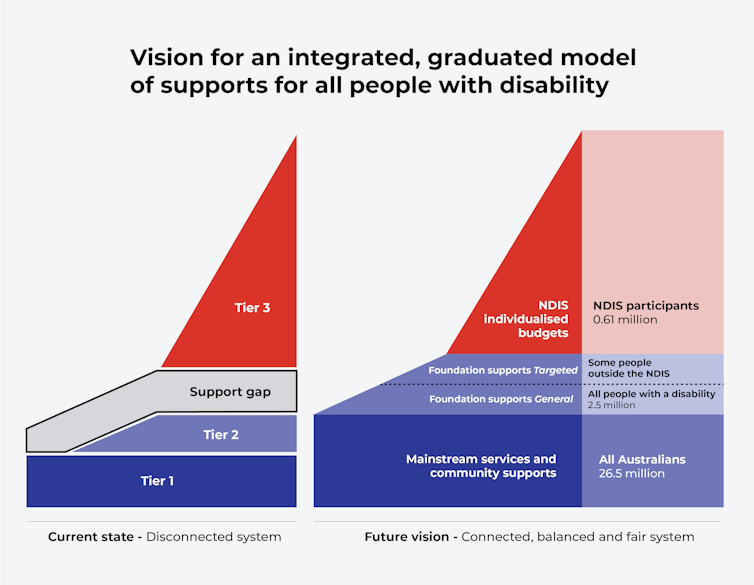
The review repeatedly emphasises the need to improve the operation of supports outside of the scheme, considering that NDIS supports have the best outcomes when broader needs are also met. These “foundational supports” are widely supported by the mental health sector who call for a strong, broad network of supports for people with psychosocial disability.

The NDIS’s current system is disconnected and has a support gap.
NDIS Review, CC BY-SA


Read more:
What’s the difference between ‘reasonable and necessary’ and ‘foundational’ supports? Here’s what the NDIS review says


A road to recovery

The review calls for recovery to be re-centred within the operation of the scheme, with increased independence as a desired outcome. Currently providers have no obligation to try to improve a person’s recovery.

People with psychosocial disability who entered the scheme prior to 2021 experienced an increase in social and community engagement of only 4%. Their rate of employment rate did not increase at all. The review’s focus on early intervention and recovery could change this.

All review recommendations are just that. It is now up to the government to enact reforms. In doing so it is important they put the needs and experiences of people with psychosocial disability front and centre .


Read more:
The NDIS promises lifelong support – but what about end-of-life support for people with disability?


The Conversation

Jennifer Smith-Merry receives funding from the Australian Research Council for a fellowship focusing on psychosocial disability and the NDIS. The National Disability Insurance Agency provides in-kind support for that project and funds a project PhD student. She has collaborated with many of the researchers and advocacy groups whose work is cited in the article, including the Australian Psychosocial Alliance and its members.

ref. More than mental illness. How the NDIS review could help people with psychosocial disability – https://theconversation.com/more-than-mental-illness-how-the-ndis-review-could-help-people-with-psychosocial-disability-219502

People worry Christmas beetles are disappearing. We’re gathering citizen data to see the full picture

Source: The Conversation (Au and NZ) – By Tanya Latty, Associate professor, University of Sydney

Ken Griffiths/Shutterstock

In eastern Australia, the arrival of the summer holidays has traditionally been heralded by big iridescent beetles known as Christmas beetles due to their appearance during the Christmas season.

In recent years, public perception seems to suggest these lovely insects may no longer be arriving in high numbers.

Each year insect scientists like us field questions from the press and public about Christmas beetle populations: where have they gone? Why have their populations shrunk? Is it climate change?

So have Christmas beetles really declined? With the help of people around Australia, we’re working to figure this out.

What are Christmas beetles?

In most of Australia, the term “Christmas beetle” refers to large beetles in the genus Anoplognathus. There are 36 Christmas beetle species, almost all of which are only found in Australia.

Christmas beetles are most common along the east coast and are found over most of the continent, except for a curious absence in the south west.

They emerge in early summer and seek out mates, sometimes pausing to munch on eucalyptus leaves. Females lay their eggs in the soil. After a few weeks, these eggs hatch into chunky white or cream coloured larvae often known as “curl grubs”.

Larvae live in the soil for 1–2 years until forming a pupa and transforming into their final adult form. They then dig their way out of the ground and take to the air, starting the cycle again.

Commonly observed species like the washerwoman (Anoplognathus porosus) and A. olivieri have classic Christmas beetle colouring, with flecks of iridescence across their tawny brown bodies.

Close-up of a beige beetle with orange-green iridescence on its front part
The washerwoman (Anoplognathus porosus) Christmas beetle.
Tanya Latty

But not all Christmas beetles are iridescent. Some, like the Granny Smith beetle (A. prasinus), are a vibrant green, while others look golden (A. aureus and A. parvulus).

To make things more complicated, people in Tasmania tend to use the term “Christmas beetle” to refer to the glorious golden stag beetle (Lamprima aurata). A lovely beetle to be sure – but not the kind we’re talking about.

Christmas beetles are also frequently confused with other scarab beetles, especially Argentinian lawn scarabs (Cyclocephala signaticollis) which are very common in the summer, particularly in cities. Argentinian lawn scarabs are smaller than most Christmas beetles and lack the distinct thickened back legs and scoop-shaped snout.

Close-up of a brown beetle with dark specks on its wings
An Argentinian lawn scarab (Cyclocephala signaticollis) is not a Christmas beetle.
Tanya Latty

Native flower chafers such as fiddler beetles (Eupoecila australasiae), punctate flower chafers (Neorrhina punctata) and cowboy beetles (Chondropyga dorsalis) are also commonly mistaken for Christmas beetles. These beautiful summer-active beetles are pollinators of native flowers.

A black beetle with neon green stripes in a cool pattern on its back
A native fiddler beetle (Eupoecila australasiae) is striking, but isn’t a Christmas beetle.
Tanya Latty

Have Christmas beetles declined?

Unfortunately, we don’t have long term population data for any Christmas beetle species, so we cannot conclusively say if there’s been a decline. However, many people (including some of the authors) remember there being more Christmas beetles in the past.

Close-up of a small beige beetle with black spots all over it
A native punctate flower chafer (Neorrhina punctatum).
Tanya Latty

But memory alone is not strong enough evidence, so we’ve designed a project to help us determine the health of Christmas beetle populations. The Christmas Beetle Count is a community science project led by conservation organisation Invertebrates Australia in collaboration with the University of Sydney.

We are asking the public to submit their sightings of Christmas beetles to the online database iNaturalist. We can then use the data to determine which Christmas beetle species are likely to be at risk of decline or extinction.

So far, the project has been a roaring success. As of December 2023, over 8,000 sightings have been submitted by over 4,000 people across Australia, including photos of four very rare species last sighted decades ago.

For one species (A. vietor), our observers took the first known picture of a living individual – it had previously been known only from a single, dead beetle. This record was 300km away from the only site previously known for this species, suggesting it occupies a larger range than thought.

Sightings like these help us better understand the distribution and population health of Christmas beetles, and anyone can help.

Are Christmas beetles coming back in 2023?

It’s too early to determine if Christmas beetles have made a comeback this year. Between November 1 and December 8 2023, 532 “research grade” sightings of Christmas beetles have been reported, more than double from the same period last year.
Although the rise in reported sightings seems promising, it’s possible this increase is not due to a growing beetle population, but rather because more people are aware of the project and are actively searching for Christmas beetles.

We will need a few more years of data before we can say anything conclusive about Christmas beetle population trends.

The face of a beetle with red legs, big black eyes and green-yellow iridescent sheen
Close up, you can really appreciate the iridescent shine of a true Christmas beetle.
Tanya Latty

Why are Christmas beetles important?

Like many insects, Christmas beetles are likely threatened by habitat loss. We can help by conserving our native bushland – Australia’s pledge to preserve 30% of land is welcome news.

These insects play an important ecological role. Since they emerge at a predictable time of the year when many reptiles, mammals and birds are producing and raising their young, adult Christmas beetles may be an important food source for many animals.

The larvae of Christmas beetles tunnel through the soil helping to aerate it and to recycle organic matter. They likely serve as a protein and fat-rich meal for hungry birds, reptiles and mammals.

Christmas beetles are an iconic part of Australia’s natural heritage, as uniquely Australian as koalas, platypuses and kangaroos.


Read more:
Don’t kill the curl grubs in your garden – they could be native beetle babies


The Conversation

Tanya Latty co-founded and works for conservation organisation Invertebrates Australia, is former president of the Australasian Society for the Study of Animal Behaviour and is on the Education committee for the Australian Entomological Society. She receives funding from the Australian Research Council, NSW Saving our Species, and Agrifutures.

Chris Reid received funding from the Australian Biological Resources Study (ABRS), federal Department of Environment (2016) to produce the Xmas Beetle ID app.

Hauke Koch volunteers as outreach officer for the conservation organization Invertebrates Australia.

Thomas Mesaglio volunteers as outreach officer for the conservation organization Invertebrates Australia.

ref. People worry Christmas beetles are disappearing. We’re gathering citizen data to see the full picture – https://theconversation.com/people-worry-christmas-beetles-are-disappearing-were-gathering-citizen-data-to-see-the-full-picture-217358

Why the long face? Experts provide a new theory for why larger mammals tend to have longer faces

Source: The Conversation (Au and NZ) – By Vera Weisbecker, Associate Professor, Flinders University

Shutterstock

A horse walks into a bar and the bartender asks, “why the long face”? It’s one of the oldest puns in the book, and there’s no shortage of entertaining answers.

With our new review we add our own scientific explanation: horses, and many other large mammals, have long faces simply because they can afford to.

While it might seem an unlikely topic, “why the long face?” is an important question in studies of mammal evolution. That’s because long-faced mammals don’t occur at random. Rather, a longer face often coincides with a larger body size within individual animal groups.

We call this effect “craniofacial evolutionary allometry”, or CREA. It has been observed in wildly different mammalian groups such as cats, rodents, deer, kangaroos and some monkeys. You can see CREA in action if you compare a sheep’s face with a cow’s, or a small deer’s with a gigantic moose’s.

Given how common it is, there’s a surprising lack of explanations for CREA. One suggestion is the CREA pattern might be an innate part of skull development, wherein a mammal’s face automatically becomes longer as the animal grows.

The snag with this explanation is the many cases where the CREA pattern doesn’t exist, or is reversed.

Tasmanian devils, sea otters and orcas are all larger than most of their relatives, but have shorter faces. Meanwhile, long-nosed potoroos, honey possums and nectar-feeding bats are small in size but long in the face.

Clearly, a mammal’s large body size doesn’t always dictate its face must be long.

Then why is CREA so common?

We propose the answer lies in the simple biomechanics of how species use their faces to eat. One important observation is that closely related animals tend to eat similar foods.


Read more:
Bones and all: see how the diets of Tasmanian devils can wear down their sharp teeth to blunt nubbins


For example, sheep eat the same grass as cows. However, because sheep are smaller overall, they have to bite harder with their jaws, jaw muscles and teeth (which make up most of their face).

As it happens, shorter faces are more efficient at biting hard. This is because of the smaller distance between the jaw muscles and the teeth. Barbecue tongs work the same way: the closer your hand is to the tips, the stronger your grip on a steak.

The existence of short faces is therefore easily explained. The trickier question is: if short faces are so good at biting hard, why do large mammals have longer faces?

The answer lies in the fact that larger animals naturally have bigger muscles and can bite more easily. They work less hard at biting compared with their smaller relatives.

In other words, larger mammals can “afford” to have longer skulls, which are known to be advantageous in a range of situations. In herbivores, longer faces make it easier to reach more leaves or take larger mouthfuls. In carnivores, a longer face can fit larger fangs in the mouth or help jaws snap shut faster.

An explanation for ‘outliers’

Our proposed explanation for CREA also explains exceptions to it, which almost always involve a big change in diet. The dog family is a great example. This group includes small-prey hunters such as foxes, and large-prey hunters such as wolves.

Both small-prey and large-prey hunters follow CREA within their diet groups. In other words, larger individuals within a group of foxes will have longer faces.

However, even though wolves tend to be larger than foxes, they still have shorter faces than the largest foxes. We suggest this is because they hunt larger prey, and therefore require a stronger bite.

Our explanation also applies in the opposite scenario. For example, honey possums and potoroos can “afford” to have longer faces than their larger relatives because they eat softer foods. A longer face may allow them to hold a longer tongue, or easily sniff through soil for food.

We’d also expect exceptions where a species does not use its snout for capturing or breaking down food. Humans, with their strikingly short faces relative to a huge braincase, are a great example. Our species doesn’t use its face for acquiring food at all; our hands, tools and ability to cook do the job for us.

The long and short of it

Our work provides a new framework for understanding face length across different groups of mammals. We could even use it to gain important insight into the feeding habits of Australia’s extinct megafauna.

As for the horse, the next time the bartender asks “why the long face?” – it ought to reply “because I can afford it” and leave a generous tip.


Read more:
This extinct kangaroo had a branch-crunching bite to rival today’s giant pandas


The Conversation

Vera Weisbecker receives funding from the Australian Research Council Centre of Excellence for Australian Biodiversity and Heritage (CABAH; CE170100015) and Future Fellowship FT180100634. She is a member of the Greens Party.

Emma Sherratt receives funding from the Australian Research Council Future Fellowship FT190100803.

D. Rex Mitchell receives funding from Australian Research Council Centre of Excellence for Australian Biodiversity and Heritage (CABAH).

ref. Why the long face? Experts provide a new theory for why larger mammals tend to have longer faces – https://theconversation.com/why-the-long-face-experts-provide-a-new-theory-for-why-larger-mammals-tend-to-have-longer-faces-219405

With Taiwan’s election just a month away, the China threat is emerging as the main talking point

Source: The Conversation (Au and NZ) – By Rebecca Strating, Director, La Trobe Asia and Associate Professor, La Trobe University, La Trobe University

Taiwan is gearing up for important presidential and legislative elections next month. How to manage “cross-strait” relations with China is not surprisingly emerging as the critical issue of the campaigns.

Taiwan first held competitive presidential elections in 1996. Democracy has proven popular with the people. In the 2020 elections, voter turnout was nearly 75%, which is high for a system with non-compulsory voting.

Yet, there are concerns about China’s efforts to shape the election result through influencing public opinion. In a recent visit, one representative told me there are actually four parties in the January 13 election: the Democratic Progressive Party (DPP), the Kuomintang (KMT), Taiwan People’s Party (TPP) – and China.

Who is running?

President Tsai Ing-wen of the Democratic Progressive Party cannot run again due to term limits, so the DPP’s presidential candidate is Vice President Lai Ching-te (known also as William Lai).

The election is the DPP’s to lose. While Tsai’s approval ratings have dropped recently, and Lai’s ratings fell below 30% for the first time since entering the presidential race, he is still leading the polls.

His election hopes were boosted when a negotiation between KMT and TPP to establish a unity, “pan-blue” ticket fell through. In a first-past-the-post electoral system, the winner only needs to get the most votes. Now, the “pan-blue” vote – the Kuomintang’s party colour – will split between the KMT and TPP.

It will be a struggle, however, for the DPP to win a majority in the Legislative Yuan, meaning the president might have to negotiate with a potentially hostile legislature.

The main parties’ positions on China

Since Tsai was first elected president in 2016, her administration has sought to prevent China from isolating Taiwan internationally, partly through forging closer relations with the United States and other regional democracies, such as Japan and Australia.

The DPP is now concerned about China’s role in attempting to shape the outcome of the election.

There is growing evidence China has sought to influence Taiwanese public opinion through disinformation campaigns, particularly targeting younger audiences through TikTok. In Taiwan, Chinese-owned TikTok is barred from government-issued devices. This makes countering disinformation challenging, especially when it spreads to more popular social media sites and traditional media.


Read more:
The microchip industry would implode if China invaded Taiwan, and it would affect everyone


For example, a Taiwanese newspaper, United Daily News, published a story based on supposedly leaked government meeting minutes that the US had asked Taiwan to make biological weapons at a lab run by its defence ministry. The minutes, however, contained official-sounding phrases that are used in China, not in Taiwan.

At a recent La Trobe University event, Taiwan’s foreign minister, Joseph Wu, also expressed concern about China’s “grey zone tactics”, such as the use of cognitive and cyber warfare, non-military assets like fishing vessels and the coastguard and economic coercion, to pressure Taiwan and regional countries.

The DPP’s policy platform is centred on building Taiwan’s ability to militarily deter and defend against a potential Chinese invasion, strengthening international partnerships (capitalising on the close coalitions that China does not have) and resisting attempts by China to subordinate Taiwan.

In contrast, the KMT views the current state of tense cross-strait relations as a consequence of DPP policies.

In dealing with China and regional security more broadly, KMT presidential candidate Hou Yu-ih has proposed a “three Ds” strategy: deterrence, dialogue and de-escalation.. He says Taiwan needs to resume cross-strait interaction in a “low-level and stable” way.

The KMT argues that DPP policies are escalating tensions. They also contend the DPP cannot maintain diplomatic relations with China, which is needed to buy time and stabilise cross-strait relations, especially as Taiwan waits for important military capabilities to arrive over the next three years.

According to one CIA report, 2027 is a critical year because Chinese President Xi Jinping has ordered the military to be ready by then to invade Taiwan.

Instead, the KMT argues it can lower the temperature and reduce risk. Hou has said that “there will be no war on both sides of the Taiwan Strait” if the KMT is elected.

The DPP views this as an oversimplified “war” versus “peace” narrative. Lai says the presidential election is rather a choice between “democracy and autocracy”.

The TPP’s candidate, Ko Wen-je, meanwhile, has focused on treading a middle path between the two other parties. Its representatives argue the DPP is too hostile and hawkish on China, while the KMT gives the impression they’re too submissive.

Policy-wise, the TPP promises to keep communication channels with Beijing open, viewing the current suspension in high-level talks as unhelpful. While broadly “pan-blue” in nature, the TPP’s position is that younger voters don’t like the KMT.

Who can bring Taiwan economic security?

While Taiwanese people are concerned about potential conflict – one poll finds more than 80% of Taiwanese people believe the China threat is worsening – prospects for peace and stability are also affecting the island’s international business and investment outlook. This has consequences for Taiwan’s economic interests, as well as China’s and the rest of the world.


Read more:
War in Ukraine is a warning to China of the risks in attacking Taiwan


Like many other economies in the region, China is Taiwan’s largest trading partner, accounting for a quarter of total trade in 2021. “De-risking” and diversifying the economy and providing economic security and supply chain stability is viewed as critical by the current government. As is encouraging businesses to see the security imperative in diversifying away from China.

The DPP is also concerned about China’s use of economic activities to affect political outcomes, targeting business people and lower-level political figures and using social, cultural and religious exchanges to influence public opinion in Taiwan. Yet, some of these public diplomacy activities are not unusual and Taiwan itself provides opportunities for similar exchanges.

In contrast to the DPP, the KMT argues it is not so easy to “decouple” Taiwan’s economy from China. There are still strong business links with China, and a democratic country cannot force businesses to pull out of China, particularly if their main competition comes from South Korea or Japan.

The TPP is hoping to capitalise on young voters’ dissatisfaction with the DPP and KMT by focusing on domestic issues such as cost of living, income stagnation and housing affordability. While adopting a pragmatic relationship with Beijing is important given the economic realities, the TPP still views the US as a critical partner for Taiwan.

Ultimately, the DPP advocates for clarity in cross-strait relations. The KMT finds value in maintaining an ambiguous and flexible stance. The relatively new TPP, meanwhile, positions itself somewhere in the middle.

The Conversation

Rebecca Strating received support from the Australian International Institute Affairs to travel to Taiwan in December.

ref. With Taiwan’s election just a month away, the China threat is emerging as the main talking point – https://theconversation.com/with-taiwans-election-just-a-month-away-the-china-threat-is-emerging-as-the-main-talking-point-216069

1 in 4 adults think smacking is necessary to ‘properly raise’ kids. But attitudes are changing

Source: The Conversation (Au and NZ) – By Divna Haslam, Senior Research Fellow, Queensland University of Technology

Shutterstock

“Do you want a smack?!” This has been a common refrain from many parents across history. Right along with “just wait till your father gets home”. Somehow parents thought this threat of violence would magically improve their child’s behaviour.

The United Nations Convention on the Rights of the Child considers smacking and all types of physical punishment, however mild, a violation of child rights. It’s banned in 65 countries.

Yet it remains legal in Australia for parents to use “reasonable force” for discipline. Children are the only group of people it remains legal to hit.

Our new research found one in four Australians still think physical punishment is necessary to “properly raise” children. And half of parents (across all age groups) reported smacking their children.

But attitudes are slowly changing, with newer generations of parents less likely to smack their kids than previous ones.


Read more:
Research shows it’s harmful to smack your child, so what should parents do instead?


What is physical punishment?

Physical or “corporal” punishment is the use of physical force to cause pain, but not injury, to discipline a child for misbehaviour. It’s distinct from physical abuse which is more extreme and not used to correct behaviour.

Physical punishment is the most common type of violence against children. It usually involves smacking, but also includes things like pinching, slapping, or using an implement such as wooden spoon, cane or belt.

Smacking doesn’t actually work and makes behaviour worse over time. And it’s associated with children internalising problems, increased child aggression, poor parent-child relationships, poorer metal heath and more.

In contrast, there are a lot of non-violent parenting strategies that do work.

Mother talks to teen.
There are lots of non-violent strategies that do work.
Shutterstock

Assessing the state of smacking in Australia

We conducted the first study to comprehensively assess the state of smacking and physical punishment in Australia. We wanted to determine if smacking was still common and how many Australians believed we need to smack our kids.

We interviewed more than 8,500 Australians aged 16 to 65 years. Our sample was representative of the national population so we can be confident the findings represent the thoughts and experiences of Australians as a nation.

Using such a large age range allowed us to compare people across different age groups to determine if changes are occurring.

What we found

Overall, six in ten (62.5%) Australians between 16–65 years had experienced four or more instances of smacking or physical punishment in childhood. Men were slightly more likely to be physically punished than women (66.3% v 59.1%).

Young people, aged 16–24, reported slightly lower rates (58.4%) than older people suggesting a slight decline over time. But these rates remain unacceptably high.

Overall, one in two (53.7%) Australian parents reported using some type of physical punishment, mostly about once a month.

However, older parents reported on this retrospectively (what they did while raising children) and there were clear age differences:

  • 64.2% of parents aged over 65 years had used physical punishment
  • 32.8% of parents 25–34 years had used it
  • 14.4% of parents under 24 had used it.

So younger generations of parents are substantially less likely to use physical punishment.

Concerningly, one-quarter (26.4%) of all Australians still believe physical punishment is necessary to properly raise children. But the vast majority (73.6%) do not.

And generational change is occurring. Some 37.9% of Australians older than 65 believe physical punishment is necessary compared to 22.9% of those aged 35–44 years, and only 14.8% of people under age 24.

Socioeconomically disadvantaged people are 2.3 times more likely to believe physical punishment is necessary than those with no disadvantage.

Parents who had been physically disciplined when they were children were both more likely to believe it is needed and more likely to use it with their own children. This indicates this form of violence is transmitted across generations.


Read more:
Evidence shows children who are smacked are more likely to be involved in partner violence in adulthood


Time for change

Law reform works best when changes in community attitudes and behaviours are already occurring. So it’s encouraging that younger people are much less likely to believe physical punishment is necessary and are much less likely to use it. This suggests Australians may be open to prohibiting this common form of violence.

All states and territories should immediately enact legal reform to prohibit corporal punishment and protect the rights of Australian children. This should be paired with public health and education campaigns about what parents can do instead.

If you are a parent looking for effective non-violent parenting strategies the government has also made the
Triple P Positive Parenting Program available for free. This online program provides practical strategies parents can use to encourage positive behaviour and calm, alternative discipline techniques that can be used to instead of smacking.

A number of other evidence-based programs, such as Tuning Into Kids, Parents Under Pressure and Parent Child Interaction Therapy, are also available.

Australia has an opportunity to capitalise on naturally occurring societal changes. We can interrupt this cycle of violence and give more Australians a childhood free of violence.


Read more:
Emotional abuse is a pattern of hurtful messages – building parenting skills could help prevent it


The Conversation

Divna Haslam has received funding from a variety of sources including the Australian Government. She is an author of the Triple P Program and receives royalties. She is a board member of the QLD Child Death Review Board and a member of the Parenting and Family Research Alliance.

ref. 1 in 4 adults think smacking is necessary to ‘properly raise’ kids. But attitudes are changing – https://theconversation.com/1-in-4-adults-think-smacking-is-necessary-to-properly-raise-kids-but-attitudes-are-changing-218837

8 ways to tone down the Christmas lights to help wildlife – and why we should

Source: The Conversation (Au and NZ) – By Jaana Dielenberg, University Fellow, Charles Darwin University

Agnostic Preachers Kid/Wikimedia Commons, CC BY-SA

The Australian government has launched a campaign asking people to “switch off light pollution” to protect wildlife. So, what does the science say? Should we rethink Christmas lights?

In our latest report, we reviewed research into the effects of artificial light at night on mammals, frogs, birds and reptiles. We found artificial lights cause problems for a wide range of species, and energy-efficient LED lights often make matters worse.

Most people don’t realise their outdoor lights can harm wildlife. At Christmas the problem grows because many people put up more decorative lights.

Here we offer eight easy ways to reduce light pollution at Christmas while still showing your festive spirit.

Bright flashing Christmas lights make our gardens stressful for wildlife (The Biodiversity Council)


Read more:
Getting smarter about city lights is good for us and nature too


Easy ways to help

These eight simple actions will help you support local wildlife while also enjoying festive decorations. Most will save electricity too.

A big red bow on a tree in front of a house
Daytime decorations are a great way to be festive without contributing to light pollution.
Jaana Dielenberg, CC BY-SA
  1. Switch to daytime decorations such as big red bows on trees. Better still, plant a garden with festive colour. Bottlebrush, woolly bush, Christmas bush and Christmas bells are all gorgeous native Australian plants that bloom brightly over Christmas.

  2. Instead of covering your house and fence, which can also trap animals and block their movement, make your decorative lights window displays. At bedtime, close your curtains so indoor lights cannot disturb either sleeping or active animals outside.

  3. Don’t leave lights on all night. Pick a short period, and avoid dusk or dawn when animals can be most active. Timers are helpful.

  4. Instead of bright white or blue lights, use warm colours such as amber or red, as they are less harmful to wildlife.

  5. Use low-intensity lights – they are supposed to look pretty, not light up a surgery.

  6. When using spotlights, keep them angled downward and focused on where you need them. Use shields to stop light shining into the sky or nearby vegetation.

  7. Leave your trees and shrubs as dark refuges for nocturnal wildlife – don’t load them up with lights.

  8. Camping or travelling? Minimising your light pollution is a great way to help animals in the bush and along the coast. Thousands of young seabirds and baby turtles die on their first trip because artificial lights attract them and cause them to move in the wrong direction.

Bright red botttlebrush flowers against a blue sky
Plants like bottlebrushes and Christmas bells can add a festive feel to gardens.
Zeynel Cebeci/Wikimedia Commons, CC BY-SA


Read more:
Bright city lights are keeping ocean predators awake and hungry


Why get involved?

Research in Australia and overseas has found artificial light at night has a wide range of harmful effects on many types of animals, from making them stressed and more vulnerable to predators, to changing their reproduction and making migrating birds more likely to crash into windows.

It’s such a significant issue for our wildlife that the Australian government launched the “Let’s switch off light pollution” campaign in November.

You might not realise how important your garden is to wildlife, because most of our mammals and frogs, and many birds and reptiles, are active at night and are great at hiding as they try to stay out of sight of predators.

Depending on where you live, your yard may be visited at night by possums, bats, bettongs, bandicoots, gliders, antechinus, echidnas, koalas, owls, tawny frogmouths, bush stone curlew, frogs, snakes, moths and geckos.

You can help these animals by minimising the amount of artificial light you shine outdoors.

By stopping lights shining up into the sky or out into the distance, you can also help animals further away. Migrating birds flying high overhead, baby sea turtles and even fish in the coast can be disturbed by artificial sky glow, which they see from far away.

Unfortunately, increasingly common energy-efficient LED lights appear to have greater impacts on many animal species than other lighting types because they are rich in short-wavelength white and blue light. That means minimising the amount of scattered light has become more important than ever.

Blue light at night is a problem for humans too and can make it hard to sleep, which is why many mobile phones have a night-light setting that reduces blue light and makes the phone glow appear orange-tinted.

A large tree covered in fairy lights at night
Trees provide vital habitat for wildlife, but when they are lit like this few animals can use them.
Mick Haupt/Unsplash


Read more:
Yes, the state of the environment is grim, but you can make a difference, right in your own neighbourhoood


Your lighting choices make a difference

At Christmas and year-round, minimising light pollution is a great way to help wildlife.

Bandicoots occur in many urban areas around Australia. Artificial lighting disturbs the bandicoot’s vision and makes them more visible to predators.
Mark Gillow/Flickr, CC BY

Light pollution is not the only problem facing our wildlife, but it can make it much harder for animals to survive other pressures.

For some species, such as seabirds, light pollution is one of the biggest threats to their survival.

Even though urban areas are already bright at night, your actions still make a difference.

Like other types of pollution such as carbon emissions, light pollution adds up. This means every light you can turn off, turn down or stop pointing into nature helps. If many people get involved, the difference we can make will be enormous.


Read more:
Artificial light at night can change the behaviour of all animals, not just humans


The Conversation

Jaana Dielenberg works for the Biodiversity Council. The Biodiversity Council was founded by 11 universities and receives support from The Ian Potter Foundation, The Ross Trust, Trawalla Foundation, The Rendere Trust, Isaacson Davis Foundation, Coniston Charitable Trust and Angela Whitbread. Jaana is employed by The University of Melbourne and is a Charles Darwin University Fellow.

Sarah Bekessy receives funding from the Australian Research Council, the National Health and Medical Research Council, the Ian Potter Foundation and the European Commission. She is a lead councillor of the Biodiversity Council, a board member of Bush Heritage Australia, a member of WWF’s Eminent Scientists Group and a member of the Advisory Group for Wood for Good.

Loren Fardell does not work for, consult, own shares in or receive funding from any company or organisation that would benefit from this article, and has disclosed no relevant affiliations beyond their academic appointment.

ref. 8 ways to tone down the Christmas lights to help wildlife – and why we should – https://theconversation.com/8-ways-to-tone-down-the-christmas-lights-to-help-wildlife-and-why-we-should-218931

How getting a second opinion can stop you being ripped off

Source: The Conversation (Au and NZ) – By Carlos Oyarzun, Senior Lecturer, The University of Queensland

Standret/Shutterstock

You leave your car at the mechanic for a routine service ahead of your summer escape to the coast. When your mobile rings, you are stricken by unwelcome news: the mechanic goes through a list of parts that urgently need replacing to avoid a breakdown in the middle of the freeway. After accepting your fate, you never learn whether you really needed to replace those parts, or if the mechanic has just ripped you off.

Services like these – for which it remains unclear whether the service was really needed – are what economists call “credence goods”. Credence goods markets are a hotbed for questionable practices. The typical advice for consumers is to get a second opinion and check the reviews.

But what if a well-meaning mechanic discovers your car needs a major repair? In this case, the mechanic faces an existential dilemma: if they offer the right repairs, they may appear to be taking advantage when they are just trying to fix your car.

Pandering to customers

Businesses fear of losing their clients may lead to what researchers call “pandering” – offering consumers what they want to hear rather than what they need. They may also opt for costly “over treatment” to avoid being labelled as incompetent.


Read more:
If you want to avoid ‘giving away your first born’ make sure you read the terms and conditions before signing contracts


Our research shows, when consumers can get a second opinion, experts are more likely to overtreat them, anticipating (correctly) the customer will like the extra attention.

It is well documented that when doctors prescribe antibiotics, their patients are more likely to choose them on their next visit. This is consistent with research showing doctors in the United States believe fear of malpractice and patient pressure are the most common reasons for medically unnecessary prescriptions, tests or procedures.

When experts succumb to pressure from consumers, the customers receive less appropriate and more costly services. Worse still, those experts who stand their ground are unlikely to have the customer return. But when no expert dares to offer honest advice, second opinions become useless.

The solution, however, does not involve authoritarian experts and submissive consumers. Rather, it is to use second opinions as clarifications not threats. Second opinions help when they foster honest and useful communication between customer and service provider, enabling consumers to reach an informed decision.

Free quotes can be useful

In Australia (as in many other countries), customers have the right to ask for a free quote.

Person writing on a form attached to a clipboard bearing the word ''quote''
A second quote can help a consumer reach an informed decision.
Pixsooz/Shutterstock

If the mechanic offers a genuine quote for expensive parts, the customer may walk away believing the mechanic is dodgy. The mechanic may lose the customer and some reputation.

But the reputational damage caused by a genuine quote will eventually be overcome when the customer compares the quotes they receive with other free quotes of a similar amount. When quotes are free and easy to obtain, a range of quotes from the same mechanic will also show the customer the mechanic’s charges vary depending on the job.


Read more:
Airlines are frustrating travelers by changing frequent flyer program rules – here’s why they keep doing it


Even though free quotes are available, if the consumer takes the car to be repaired only when it is essential, they will likely have to go with the first mechanic they approach, irrespective of cost.

It is therefore better to call the mechanic earlier than later, especially if you are unsure of them.

The benefit of online reviews

Experience goods” are different from credence goods. These are services and products whose quality can be observed after consumption. Think restaurants, accommodation, or a book. Because past consumers have information on the quality of experience goods, consumers can learn about their quality by looking at online reviews.

Unfortunately, rating systems are plagued with fake reviews. Markets where sellers can buy fake reviews are well documented, as is the fact fake reviews are quite effective in raising sellers’ revenues. These reviews are usually extremely positive, when paid by the sellers, or extremely negative when sponsored by competitors. Even when consumers are aware of fake reviews, they inhibit credible communication via the rating system.


Read more:
The battle over right to repair is a fight over your car’s data


There’s plenty of excellent advice about how to spot fake reviews. Filtering out fake reviews is important, because they influence opinions. As in the case of second opinions, reviews are more helpful when they explain the reasons for their recommendations.

The bottom line for consumers is clear: understand why a recommendation is made, not just what it is. We hope this will enable you to drive smoothly to your holiday destination (which you chose carefully after reading the reviews) and enjoy your break.

The Conversation

Lana Friesen receives funding from an Australian Research Council Discovery Grant DP220100359.

Priscilla Man receives funding from Australia Research Council Discovery Early Career Researcher Award DE180101452.

Carlos Oyarzun and Metin Uyanik do not work for, consult, own shares in or receive funding from any company or organisation that would benefit from this article, and have disclosed no relevant affiliations beyond their academic appointment.

ref. How getting a second opinion can stop you being ripped off – https://theconversation.com/how-getting-a-second-opinion-can-stop-you-being-ripped-off-218349

Who was Leonard Bernstein, the man at the centre of Bradley Cooper’s Maestro?

Source: The Conversation (Au and NZ) – By Joseph Toltz, Honorary Associate, Hebrew, Jewish and Biblical Studies, University of Sydney

Jason McDonald/Netflix

“Maestro” is a word that resonates across concert music. From the Italian word for master, it is applied most frequently to a respected and established conductor of operas and orchestras but can also be used to refer to virtuoso instrumentalists.

Despite its gendered form (male), the term has been regularly applied to female conductors, instrumentalists and others who have achieved significant artistic recognition.

Leonard Bernstein, the character at the centre of Maestro, a new film from director (and star) Bradley Cooper, was not just a great conductor. While the word maestro certainly sums up his career, ego and personality, early in the film Lenny (as he was affectionately known) lists all his achievements, then somewhat dryly sums himself up as “a musician”.

The life of ‘a musician’

Bernstein is recognised as one of the most significant forces in 20th century American music. Starting as an accomplished concert pianist, Bernstein reached the pinnacle of success as a brilliant and effulgent conductor, the first American-born to direct the New York Philharmonic, and the first American-born to conduct the London Symphony, Royal Concertgebouw and Berlin Philharmonic orchestras.

Throughout his career, Bernstein championed the work of American composers, including those of his close friend and mentor Aaron Copland, as well as works by Marc Blitzstein, Lukas Foss, Samuel Barber and others. Encouraged by Copland, Bernstein revived interest in the music of Gustav Mahler and restored the Austrian composer as a regular feature on the international concert hall stage.

Bernstein was a successful composer. His styles traversed popular and formal genres, often synthesising traditional Jewish melodic and modal elements with jazz and Latin American rhythms and melodies. He composed to great acclaim for concert, dance and theatre stages.

He was a notable educator. Throughout his life, Bernstein gave regular masterclasses in conducting at Tanglewood, the Boston Symphony Orchestra’s summer academy for elite musicians.

In 1954 Bernstein appeared for the first time on Omnibus, an educational entertainment television show on CBS, where he discussed and played diverse musical genres to millions of American homes.

Bernstein’s educational work culminated with the televising of his Young People’s Concerts with the New York Philharmonic on CBS in 1964–5, eventually syndicated across 40 countries.


Read more:
Explainer: what exactly do musical conductors do?


A resolutely Jewish artist

Born in Massachusetts in 1918 to Jewish immigrants from Berezdiv and Shepetivka in Western Ukraine, Bernstein entered the hallowed halls of Harvard in 1935. After graduating, he enrolled at the Curtis Institute of Music in Philadelphia, to be supervised by another mentor (and refugee from quasi-fascist Hungary), Fritz Reiner.

Graduating from Curtis in 1941, Bernstein arrived on the American music scene at a time where persecution had caused many Jewish musicians and composers to flee the tentacles of Nazi Germany and its neighbours.

It was also a time of endemic antisemitism throughout American society. At one point in the movie, Serge Koussevitsky, the iconic Russian-born (and formerly Jewish) conductor and music director of the Boston Symphony Orchestra, suggests to the young Bernstein he change his name to Leonard S. Burns in order to achieve a successful conducting career.

Bernstein refused. Having conquered antisemitism at Harvard and elsewhere by being resolutely himself, Bernstein revealed not only a deep abiding commitment to Judaism, but a desire to forge a path of freedom for Jewish musical artists in the 20th century.

Cooper chooses symbolic representations of Judaism throughout Maestro to reinforce this. What looks like a tallit (a prayer shawl) hangs in Bernstein’s flat in Carnegie Hall. Traditional rye bread is featured on the lunch table with Koussevitsky. When returning to his home in Connecticut after rehearsing a chorus from Candide, Lenny is seen wearing a Harvard sweatshirt, its letters emblazoned in the Hebrew spelling of his Ivy League alma mater.

The music playing over the credits at the end of the film highlight the Jewish aspects of his work. They begin with the Psalm 23 Hebrew words from the second movement of Bernstein’s Chichester Psalms, and conclude with the second movement of his Symphony No. 3, Kaddish. This is a particularly interesting choice, as the narration of this movement invokes the Jewish tradition of a pious individual calling God to account for the suffering of the Jewish people, known as a din torah.

A complicated relationship

Maestro is particularly interested in the relationship between Bernstein and his wife, actor Felicia Montealegre Cohn (Cary Mulligan). She arrives as a young woman in a hauntingly beautiful cinematic moment to the party where she was to meet her future husband. We last see her in her final moments of life with Bernstein and their three children, dancing to the tune of Shirley Ellis’s 1965 hit, The Clapping Song.

Maestro depicts Lenny’s hedonistic whirlwind of a life. Bernstein’s mastery did not extend to human relationships. His bisexuality and its effects on his marriage are more a focus of the film than his Jewishness, but Cooper is at pains to acknowledge that Felicia enters the relationship with eyes wide open – as she says when he proposes to her in a hedge maze, “let’s give it a whirl”.

Anger and frustration rise and fall as Lenny cavorts with impunity, bringing lovers home, lying (on instruction) to his daughter about the nature of his affairs, and generally doing what he wants.

Cooper has brought together many disparate elements to weave a fresh story of the life of Bernstein. Sometimes his use of symbolism is overly obvious, at other times beautifully subtle. Watch it for the cinematography, for the settings, for the music, and especially for the moment where Bernstein is conducting Mahler’s Symphony No. 2 at Ely Cathedral in the United Kingdom. It is an absolute highlight in the two hours.


Read more:
I’m going to a classical music concert for the first time. What should I know?


The Conversation

Joseph Toltz does not work for, consult, own shares in or receive funding from any company or organization that would benefit from this article, and has disclosed no relevant affiliations beyond their academic appointment.

ref. Who was Leonard Bernstein, the man at the centre of Bradley Cooper’s Maestro? – https://theconversation.com/who-was-leonard-bernstein-the-man-at-the-centre-of-bradley-coopers-maestro-219323

A new report wants more funding and better support for Australian schools. But we need a proper plan for how to get there

Source: The Conversation (Au and NZ) – By Glenn C Savage, Associate Professor of Education Policy and the Future of Schooling, The University of Melbourne

Federal Education Minister Jason Clare released a major report on schools on Monday.

This will inform the next round of federal funding for schools, as part of the National School Reform Agreement. This is due to start in January 2025.

The report was commissioned off the back of a scathing review by the Productivity Commission in January this year. This found initiatives in the current agreement “have done little, so far, to improve student outcomes”.

Who wrote the report?

In response to the Productivity Commission’s findings, Clare extended the current agreement by 12 months until December 2024 to allow an expert panel to conduct this review.

In March, it was tasked with advising education ministers on “the key targets and specific reforms that should be tied to funding in the next National School Reform Agreement”.

The panel was led by the chair of the Australian Education Research Organisation and former head of the Smith Family, Lisa O’Brien. Along with a survey of students, parents and teachers (with almost 25,000 responses), the panel held 130 meetings with stakeholders and made 92 school visits.

What is the National School Reform Agreement?

The National School Reform Agreement is a joint agreement between the Commonwealth, states and territories designed to improve outcomes in Australian schools. It sets out national reform directions and targets that governments agree to pursue over a set period of time.

The current agreement was five years, extended to six.

While the agreement is not widely known beyond education policy circles, it is crucial for shaping the future of education in Australia.

It is also intimately linked with school funding. The reforms outlined in the agreement inform the conditions of federal funding for state and territory systems.

So, while the agreement does not directly determine the model used to determine federal funding for schools, known as the Schooling Resource Standard, it shapes what states and territories do with money by linking funding to the targets.


Read more:
What is the National School Reform Agreement and what does it have to do with school funding?


What does the report say?

The report identifies seven “reform directions” it wants governments to consider in the next agreement.

These are designed to lift student outcomes, improve equity and student wellbeing and attract and retain teachers. They are also geared at enhancing funding transparency, reducing education data gaps and supporting innovation.

There are also 24 recommendations across the reform directions. For example, universal screening for literacy and numeracy in Year 1 and more specific help for students to transition to life after school.

Three big issues

The report outlines three big issues that pose barriers to reform efforts.

First, state and territory governments ultimately retain the power in how money is spent in their schools. This means it can be difficult to maintain a cohesive approach to implementing national reforms across the federation.

Second, there are increasing numbers of students with disabilities and complex needs. This means a “higher workload and mental load” for teachers and can make it harder for schools to teach effectively.

Third, nearly all public schools are not fully funded in line with the recommended Gonski funding model (the Schooling Resource Standard).

What does the report get right?

There is little doubt the seven reform directions speak to crucial issues in Australian schools. The report also makes strong statements about the need to ensure all schools are fully and consistently funded. For example, it notes it is:

critical all schools have access to 100 per cent of Schooling Resource Standard funding as soon as possible.

It’s welcome to see the report endorse collaboration and co-design with First Nations stakeholders, to develop policies to make schools more culturally aware and responsive.

There is also great potential in a recommendation that governments implement “full-service school models” that better connect schools with health, family and disability services. As the panel notes:

such models must be more widely implemented to better meet the needs of students experiencing disadvantage.

What are the report’s limitations?

A major problem with the report is many of its ideas and recommendations are not translated into tangible targets.

The targets that do feature tend to focus on what can be easily measured. This means we will be tracking the symptoms rather than tackling the root causes of educational challenges.

For example, the report repeatedly draws attention to alarming and widening learning gaps in literacy and numeracy between young people from advantaged and disadvantaged backgrounds. But there is no recommended target to address these gaps.

Instead, the report offers weaker targets to increase the proportion of disadvantaged students who meet minimum proficiency standards for reading and numeracy in NAPLAN. This will do very little to close achievement gaps.

Another target – “equity” – is primarily about creating a way of measuring the differences in outcomes between cohorts by 2029, not outlining measures to address the gap itself.

Targets are the primary mechanism for shaping government efforts, as the targets are what funding is linked to. So a major risk is the strongest ideas of the report will fade into obscurity.


Read more:
Are Australian students really falling behind? It depends which test you look at


Now it’s time to talk about funding

Moving forward, the challenge for federal and state education ministers will be to translate the directions outlined in this report into specific targets and reform initiatives for the upcoming new agreement.

Responding to the report on Monday afternoon, education ministers released a statement suggesting three main themes will inform the next agreement:

  • equity and excellence

  • wellbeing for learning and engagement

  • a strong and sustainable workforce.

While these themes overlap somewhat with the report, ministers were clear to describe the independent report as only “one of a number of inputs to the next agreement”.

The panel was forbidden by its terms of reference from examining the Schooling Resource Standard. For the most part the report is silent on the funding implications of its recommended targets.

In this next round of deliberations it will be impossible to avoid the funding debate. There is no doubt the “funding wars” will be reignited.

A central issue will be whether states and territories have the resourcing capacities to implement the reforms, especially considering how far some jurisdictions are from being fully funded under the so-called Gonski model.

If schooling systems are not fairly placed to achieve targets, then the setting of targets becomes a fool’s game. It’s akin to making elaborate plans for a family reunion in Disneyland, but refusing to discuss how everyone will get there.

Ultimately, how much funding schools get and how they use it are equally important and both will need to be central to the debates that follow.

The Conversation

Glenn C Savage receives funding from the Australian Research Council.

Jacob Broom receives funding from the Australian Research Council.

ref. A new report wants more funding and better support for Australian schools. But we need a proper plan for how to get there – https://theconversation.com/a-new-report-wants-more-funding-and-better-support-for-australian-schools-but-we-need-a-proper-plan-for-how-to-get-there-219491

We are hurtling towards a million international students in Australia – migration changes will only slow this growth, not stop it

Source: The Conversation (Au and NZ) – By Peter Hurley, Director, Mitchell Institute, Victoria University

Emily Ranquist/ Pexels , CC BY

The Australian government is aiming to rein in the growth of international students in its new migration policy, released on Monday.

This is in response to record levels of international students entering the country once COVID-related border closures were lifted. Current and former international students living in Australia already number 860,000 and are hurtling towards one million people.

As Home Affairs Minister Clare O’Neil told journalists:

[…] we do not want [the international student population] to grow as fast as it has been growing in the past few year.

The government is relying on tightening of visa regulations, greater integrity measures and increased entry requirements to reduce the number of students.

These reforms target the vocational education and training sector and students who remain in Australia following their course. But the number of international students is set to remain about the same, just with more sustainable levels of growth.

Meanwhile, universities – who are so reliant on international student income – are likely to be less affected.


Read more:
The government is bringing immigration back to ‘normal levels’ but cuts are not as dramatic as they seem


Towards 1 million

Over the past decade, the number of current and international students in Australia has more than doubled. In 2012, there were about 340,000 international students in Australia. The most recent data shows 650,000 are in Australia.

Enrolled international students are just one group of temporary migrants. Some former international students are eligible for post-study work visas of up to six years when they finish their course.

Thanks to border closures, the pandemic caused a major decline in the number of international students living in Australia. To encourage international students to return, the Australian government allowed international students to work more hours and increased post-study visa work rights.

But the rate at which international students have returned has been much quicker than many expected. There have also been several recent reviews into the migration system highlighting problems.

One review found Australia was creating a class of “permanently temporary” migrants in Australia. These are people who have lived in the country for an extended period but have no path to permanent residency or citizenship.

Another review found the migration system, including student visas, was the subject of major abuses.

A targeted clamp down

To lower the growth rate, the government is proposing a series of measures.

These include closing the COVID-related programs that uncapped working hours for international students.

They are also proposing strengthening the integrity and lifting standards in international education. This includes increasing minimum English language requirements for student and graduate visas.

The government is also promising to crack down on unscrupulous education providers who deliver cheap, poor quality courses but offer access to visas with work rights.

To halt the growth in former international students staying on in Australia, the government will shorten graduate visas.

They will also end settings that allow graduates to prolong their stay in Australia by cycling through courses to remain in the country. The number of international students staying in Australia on a second or subsequent student visa grew by more than 30% to more than 150,000 in 2022–23. Students will now need to demonstrate further study is part of career progression.

These are combined with other reforms aimed at making pathways to permanent migration clearer. The government forecast that this package will bring down the growth in net overseas migration.

Universities are set to be spared

This policy is aimed at a major reduction in the rate of growth rather than to reduce the total number of international students.

Of the 860,000 current and former international students in Australia, just under half are currently enrolled in higher education courses. But it is the non-university sector that will be most impacted.

The increase in English language requirements will impact students in the vocational education and training sector, which is dominated by private colleges, as English language requirements for university students are largely unchanged.

Tightening the criteria for enrolments in second and subsequent courses will also impact the vocational sector the most. In 2022–23 almost 69,000 students granted a subsequent student visa in Australia have been in vocational education and training courses where the government claims there is “a lower likelihood of a credible course progression”.


Read more:
Why unis and vocational colleges are key to Australia’s temporary migration challenge


We are not alone

Australia is not the only country winding back post-pandemic policies aimed at boosting international education.

The United Kingdom announced reforms last week aimed at cutting net overseas migration, including restricting some students from bringing family members.

Overall, the Australian? government’s aim is to deliver a more cohesive migration strategy that better aligns international education, labour market needs and pathways to permanent residency.

It is a welcome recognition we need significant improvements to Australia’s migration program if we are also going to make improvements to the international student sector.

The Conversation

The authors do not work for, consult, own shares in or receive funding from any company or organisation that would benefit from this article, and have disclosed no relevant affiliations beyond their academic appointment.

ref. We are hurtling towards a million international students in Australia – migration changes will only slow this growth, not stop it – https://theconversation.com/we-are-hurtling-towards-a-million-international-students-in-australia-migration-changes-will-only-slow-this-growth-not-stop-it-219590

We’re on track to eliminate hepatitis C, but stigma remains and reinfection is a risk

Source: The Conversation (Au and NZ) – By Dion Kagan, Research Officer, Gender, Law and Drugs program, La Trobe University

Shutterstock

Hepatitis C is a preventable but potentially life-threatening blood-borne virus. It primarily affects the liver and, if untreated, can lead to cirrhosis (scar damage) and cancer.

When direct-acting antivirals for hepatitis C arrived in 2016, they were described as a game changer. They cured chronic hepatitis C in more than 95% of cases. So Australia adopted the World Health Organization’s target to eliminate hepatitis C by 2030.

More than a billion dollars has been invested in adding direct-acting antivirals to the Pharmaceutical Benefits Scheme, making treatment accessible to anyone covered by Medicare. By the end of 2022, about 60% of people living with hepatitis C had been treated.

That’s a remarkable public health achievement. Life-changing for many and for some, literally life-saving. But what is life like for this growing group of people after they’ve been cured? And where are we still lagging in our efforts to combat hepatitis C?


Read more:
Explainer: the A, B, C, D and E of hepatitis


Cure doesn’t always eliminate stigma

The most common way of picking up hepatitis C in Australia is by sharing injecting equipment. As injecting drugs is widely disapproved of, and illegal in most parts of Australia, this has huge implications for people with hepatitis C.

The stigma associated with injecting drugs means people with hepatitis C can experience persistent discrimination – in relationships, at work, and other settings. Research suggests more than half of people with hepatitis C experienced discrimination in a 12-month period.

Such discrimination happens most commonly in health care, when doctors, nurses and others health-care professionals become aware of someone’s hepatitis C status. This can include withholding treatment, diagnostic overshadowing (when workers attribute physical symptoms of illness to mental health issues), rude or unwelcoming behaviour, and excessive infection control like double-gloving. This may lead some people to avoid seeking medical care entirely.

GP talks to female patient
Some health providers act differently when finding out about a patient’s history of hepatitis C.
Shutterstock

Our recent research found direct-acting antivirals do not necessarily cure these forms of stigma and discrimination. If medical records show a person has a history of hepatitis C, some health-care workers change the way they treat that person.

Their manner can change. The treatments they offer might change – for example, whether they will provide access to painkillers. Sometimes people are treated as if they are infectious, or as if they still have the virus when they don’t.

The law can reinforce stigma and discrimination

Laws and legal practices have been slow to respond to new treatments.

In insurance law, for instance, having once had hepatitis C has been considered a risk to insurance providers. This means affected people may not be approved for travel, health or life insurance. Or, their premiums may be much higher, potentially pricing them out of the market and limiting their ability to travel, access health care or plan for their financial futures.

We would expect to see practices change with more effective treatments. But insurance practices and the actuarial data that insurers use is lagging behind medical developments.

This is just one example of how laws and legal practices can exacerbate stigma and discrimination for people with a history of hepatitis C. Our research found this also occurs in criminal law, privacy law, social security and migration law.

People in prison are being left behind

Prisons have high rates of injecting and hepatitis C transmission has historically been high.

While Australia has had a good track record on reducing some harms associated with drug use in prisons, there is at least one glaring omission: prisons don’t have access to a needle and syringe programs to ensure that people who use drugs can access sterile equipment. This means it’s much harder to prevent the transmission of hepatitis C and other blood-borne viruses in prisons.


Read more:
Sterile needles can stop the spread of disease in prisons – here’s how


Yet current national hepatitis C policy says harm reduction should be available in prisons. And the Mandela Rules – which are a set of international human rights principles – state that prisoners should receive the same standard of health care as those in the wider community.

Without sterile injecting equipment for people in prisons, people who have been cured of hepatitis C are at risk of reinfection. And Australia is less likely to eliminate hepatitis C.

Elimination demands more than just treatment

The world is watching as Australia tries to be one of the first countries in the world to eliminate hepatitis C. The final national hepatitis C health strategy is expected to be released before the end of 2023.

But the number of people coming forward for treatment has dropped significantly. Resources are being marshalled into finding people, and keeping the momentum going on elimination.

It is increasingly clear that we also need to direct resources to what happens “post-cure”, assuring people that stigma-free health care is available to them. We also need to tackle the laws, policies and practices that allow stigma and discrimination to linger in people’s lives.

Finally, we need to ensure people in prisons have access to sterile injecting equipment so they aren’t reinfected.

The Conversation

Kate Seear receives funding from the Australian Research Council’s Discovery Scheme (DP200100941) and the Future Fellowship Scheme (FT200100099).

Dion Kagan, Emily Lenton, and Sean Mulcahy do not work for, consult, own shares in or receive funding from any company or organisation that would benefit from this article, and have disclosed no relevant affiliations beyond their academic appointment.

ref. We’re on track to eliminate hepatitis C, but stigma remains and reinfection is a risk – https://theconversation.com/were-on-track-to-eliminate-hepatitis-c-but-stigma-remains-and-reinfection-is-a-risk-216439

Fairy Tales at QAGOMA: how we revived these stories with new myths, new media and new quirks

Source: The Conversation (Au and NZ) – By Wes Hill, Associate Professor, art history and visual culture, Southern Cross University

Henrique Oliveira, Brazil b.1973. Corupira 2023, commissioned for ‘Fairy Tales’, installation (detail), Gallery of Modern Art (GOMA) Brisbane 2023. Plywood, tapumes veneer and tree branches. Courtesy: Henrique Oliveira. © Henrique Oliveira. Photograph: C Callistemon © QAGOMA

Fairy Tales, the latest exhibition at Queensland Art Gallery | Gallery of Modern Art (QAGOMA), gives off the pleasurable hum of remix culture, artists riffing on a core theme in numerous ways.

Overseen by the gallery’s cinematheque curator Amanda Slack-Smith, Fairy Tales focuses on how artists, designers and filmmakers have taken inspiration from fantasy motifs, adapting the fairy tale vocabulary of extremes (light and dark, good and evil, rich and poor) to their own artistic needs.

Based in handed-down oral traditions, fairy tales share characteristics with all manner of fables, folk stories and mythological narratives throughout the world.

These stories, which were initially rarely intended for children (yet featured them as central characters in easy-to-understand plots), made their way into print from the 17th century.

After the coining of the word “folklore” in 1846, colonisation, advertising and the international spread of mass culture drove folklorists and creatives to praise the authenticity of localised oral traditions.

This seductively designed show at QAGOMA makes clear that, rather than fairy tales being simply preserved, the modern age revived them with new myths, new media and new individualistic quirks, from Hans Christian Andersen to Walt Disney and beyond.

Creatures in the night

Brazilian artist Henrique Oliveira sets the mood of the exhibition brilliantly with his gnarled and twisted woodland, Corupira (2023).

The sculpture builds slowly as you enter the corridors of the space and culminates in a meeting of massive tree branches that have burst through the gallery walls. Oliveira’s title refers to a Brazilian folk story about red-haired satyr-like creatures who, living in the Amazon forest, deceive hunters and loggers from the shadows, killing them – or at least putting any potential coloniser off course.

Henrique Oliveira, Brazil b.1973. Corupira 2023, commissioned for ‘Fairy Tales’, installation (detail), Gallery of Modern Art (GOMA) Brisbane 2023. Plywood, tapumes veneer and tree branches. Courtesy: Henrique Oliveira. © Henrique Oliveira. Photograph: C Callistemon © QAGOMA.

It is a great opener to the show because it metaphorically turns viewers into fairy tale wanderers, and artists into tricksters and spell-makers.

Oliveira’s work chimes perfectly with The Nightwatch (2004) by Belgian artist Francis Alÿs, consisting of surveillance video footage of a fox the artist released into London’s National Portrait Gallery (with the gallery’s permission) during the night. Alÿs’s fox continues the fairy tale tradition of depicting forest animals as actively engaging with human societies.

Alÿs self-consciously titled his work after a 17th century painting by Rembrandt van Rijn in which citizens are depicted serving as defenders and official volunteers for their city. Alÿs might be suggesting the contemporary artist is like a public servant whose job, like the fox in the video, is to intrude on the prized traditions supported by museums.

Australian artist Abdul Abdullah’s provocative photograph Troubling the Margins (from the Interloper series) (2022) follows a similar idea. Abdullah literally shows himself as a fox in a henhouse.

The artist-as-fox smiles maliciously at the viewer as if saying to the art world: “I can’t believe you let me in here.”

Abdul Abdullah, Australia b.1986. Troubling the margins (from ‘Interloper’ series) 2022. Digital print, 162.5 x 130cm; made with the assistance of David Charles Collins. Courtesy: The artist and Yavuz Gallery, Sydney. © Abdul Abdullah.


Read more:
The amazing NGV Triennial 2023 makes us question our world and forces us to see it differently


Uncanny images

One of many terrific sculptural works in the exhibition, Jana Sterbak’s Inside (1990) is an empty glass coffin seemingly pregnant with a smaller mirrored coffin inside.

A reversed imagining of life in death, the piece responds to the many glass coffins in fairy and folk tales (such as Sleeping Beauty, Snow White and the Grimm’s Brothers The Glass Coffin), exploring the uncanny idea of death being put on permanent display for the living.

Patricia Piccinini, Australia b.1965. Enchanted Field (installation view, detail) 2023. Fairy Tales, GOMA, Brisbane. Collection: The artist © Patricia Piccinini. Image: C Callistemon © QAGOMA.

It’s not a coffin but a caravan in Patricia Piccinini’s The Couple (2018), where two realistically rendered hybrid human-animal lovers are frozen in a serene moment cuddling on a fold-out bed, their clawed feet sticking out from under the sheets.

Piccinini’s works often centre on hyperreal figures that look genetically altered. These sculptures are at their most interesting when they make viewers aware of themselves. I felt stupid for it, but I couldn’t help feeling guilty for gawking too long at the sweet-looking couple’s physical deformations.

Projected behind a huge semi-transparent curtain, an exquisitely staged installation of Jean Cocteau’s 1946 film Beauty and the Beast is situated in relation to costumes and props from its production. This and other displays of material from fairy-tale-inspired films Where the Wild Things Are (2009) and The Labyrinth (1986) are among the most engaging cinema-themed pieces in the exhibition.

The capacity of anything to intrigue

In my 2015 publication about the relationship between folk art and fine art, I argued art critics and art historians in the 19th and 20th centuries narrowly discussed oral traditions and amateur cultural creations in anthropological terms.

By their reasoning, these were artefacts that failed to live up to the special insights and feelings expected of fine art.

Gustave Doré, France 1832–83. Little Red Riding Hood c.1862. Oil on canvas, 65.3 x 81.7cm. Gift of Mrs S Horne, 1962. Collection: National Gallery of Victoria, Melbourne.

This school of thought is no longer the case. Fairy Tales is a good example of the recent expansion of art-history-based curating into larger visual culture frameworks. Clothing, relics, paintings, literary documents, installations, videos and filmic props now all cohabit the museum in non-hierarchical ways, staging not the inherent value of specific material so much as the capacity of anything to intrigue.

For a show about timeless human fears and fantasies, Fairy Tales may be curiously timely.

Fairy Tales is at QAGOMA, Brisbane, until April 28, 2024.


Read more:
How the poetically-charged art of Tacita Dean gives its audience a moment for stillness and time


The Conversation

Wes Hill does not work for, consult, own shares in or receive funding from any company or organisation that would benefit from this article, and has disclosed no relevant affiliations beyond their academic appointment.

ref. Fairy Tales at QAGOMA: how we revived these stories with new myths, new media and new quirks – https://theconversation.com/fairy-tales-at-qagoma-how-we-revived-these-stories-with-new-myths-new-media-and-new-quirks-219228

COP28: Why China’s clean energy boom matters for global climate action

Source: The Conversation (Au and NZ) – By Xu Yi-chong, Professor of Governance and Public Policy, Griffith University

Shutterstock

With an energy-hungry economy, an historic reliance on coal and vast manufacturing enterprises, China is the world’s single largest emitter, accounting for 27% of the world’s carbon dioxide and a third of all greenhouse gas emissions.

But China is also the world’s largest manufacturer of solar panels
and wind turbines. Domestically, it is installing green power at a rate the world has never seen. This year alone, China built enough solar, wind, hydro and nuclear capacity to cover the entire electricity consumption of France. Next year, we may see something even more remarkable – the population giant’s first ever drop in emissions from the power sector.

The COP28 climate talks began well, buoyed by November’s Sunnyland Statement between China and the United States, the second largest emitter. At previous climate talks, US-China cooperation has been lacking. But this time, they’re largely on the same page.

The statement outlined joint support for global tripling of renewable energy by 2030, tackling methane and plastic pollution, and a transition away from fossil fuels.

coal barge in middle of shanghai
Coal has fuelled China’s rapid rise.
Shutterstock

The urgency of now

China has been looking for better coordination with the US on climate since US President Joe Biden took office. Climate is an area where these competing major powers can cooperate.

The COP28 talks in Dubai – meant to finish tomorrow – offer a window for joint action. Next year, the US could elect a different president with very different views on climate. China’s well-regarded veteran special climate envoy, Xie Zhenhua, is about to retire.


Read more:
Why renewed China-US cooperation bodes well for climate action


In these talks, China – the world’s top oil importer – is looking for a compromise solution on the tense debate over fossil fuels. The world’s cartel of oil producing countries, OPEC, has called for focusing on emissions reduction rather than fossil-fuel phase out in the declaration. Xie and his team are trying to find a middle ground to ensure a final deal.

China has long been criticised for its continuing coal-fired power plant expansion. It has the world’s largest coal power fleet, and approved another 106 gigawatts worth of new coal plants just last year – the equivalent of two a week. But the five major state-owned power companies are already burdened by heavy financial losses.

Why build dirty and clean? It’s a longstanding national policy: build sufficient baseload supply first while expanding renewable capacities. But at COP28, Xie said something new:

[China will] strive to replace fossil fuels with renewable energy in a gradual manner.

A country of engineers

In developed countries, much clean energy work is driven by energy economists, who use incentives to change behaviour.

China is a country of engineers, who see these challenges as technical rather than economic.

In 2007, China released a national action plan on climate, calling for technological solutions to the climate problem. Private and state-owned companies responded strongly.

Fifteen years later, China is in the lead in every low-carbon category. Its total installed renewable capacity is staggering, accounting for a third of the world’s total, and it is leading in electric vehicle production and sales.

In the first three quarters of 2023, over 53% of China’s electricity came from low-carbon sources: hydro, wind, solar, bioenergy and nuclear.

ship building wind turbines in the sea
China has approached its record-breaking renewable roll-out methodically.
Shutterstock

How did China boost clean energy so fast?

China’s huge domestic market and large-scale deployment of wind and solar contribute greatly to plummeting renewable costs. Steadily lowering costs means green energy becomes viable for developing countries.

In 2012, a large team from China Power Investment Corporation arrived in the high desert in Qinghai province and began building 15.7 GW worth of solar across 345 square kilometres.

It was here that China first figured out how to make intermittent power reliable. Excess power was sent to a hydropower station 40km away and used to pump water uphill. At night, the water would flow back down through the turbines. Technologies developed here are now being used in other large-scale hybrid projects, such as hydro-solar, wind-solar and wind-solar-hydro projects.

china desert solar farm
Huge solar farms carpet the desert in Qinghai – and new work opens the door to revegetating in the shade of the panels.
Shutterstock

In 2022, the government announced plans to install 500 GW worth of solar, onshore and offshore wind projects in the Gobi Desert across Xinjiang, Inner Mongolia, and Gansu provinces.

These are intended to not only supercharge China’s clean energy supply, but to tackle desert expansion. Solar panels stabilise the movement of sand and absorb sunlight, reducing evaporation of scarce water and giving plants a better chance at survival. This knowledge, too, came from the Qinghai solar farms, where plants began growing in the shade.

map of china showing gobi and Taklamakan deserts
Plenty of room for solar: China’s two major deserts, the Gobi and Taklamakan, are home to more and more solar.
TheDrive/Wikimedia, CC BY-ND

China’s focus on technology has given it combined solar and salt farms, floating solar power plants and energy storage ranging from batteries to compressed air to kinetic flywheels and hydrogen.

While the US and China cooperate at COP28, competition is not far away. China already dominates many clean energy technologies, but the US is trying to catch up through the massive green spend in last year’s Inflation Reduction Act.

According to the International Energy Agency, half of all emissions cuts needed to achieve net-zero by 2050 will come from technologies currently at demonstration or prototype phase. These include cheap green hydrogen, next generation nuclear, next generation solar and wind, and functioning carbon capture and storage for remaining fossil fuel use.

What has China achieved at COP28?

China is backing global calls to triple renewable capacity by 2030 and has agreed to tackle methane emissions, a particularly potent greenhouse gas.

China is far behind energy efficiency – it uses about 50% more per unit of GDP than in the US, and double that of Japan. It has not invested in energy efficiency as it has in other low-carbon areas.

This could change. US and China agreed in November to restart joint energy efficiency work on industry, buildings, transportation, and equipment, seen as harder areas to cut emissions.

At COP28, we will likely see states agree to double the rate of energy efficiency improvement from 2% to 4% a year by 2030. It remains to be seen whether China will join them.


Read more:
‘Matter of national destiny’: China’s energy crisis sees the world’s top emitter investing in more coal


The Conversation

Xu Yi-chong does not work for, consult, own shares in or receive funding from any company or organisation that would benefit from this article, and has disclosed no relevant affiliations beyond their academic appointment.

ref. COP28: Why China’s clean energy boom matters for global climate action – https://theconversation.com/cop28-why-chinas-clean-energy-boom-matters-for-global-climate-action-218825

Male infertility is more common than you may think. Here are 5 ways to protect your sperm

Source: The Conversation (Au and NZ) – By Karin Hammarberg, Senior Research Fellow, Global and Women’s Health, School of Public Health & Preventive Medicine, Monash University

Shutterstock

Infertility is often thought of as a female problem but one in three IVF cycles in Australia involve male infertility.

We recently published a review of the literature on whether men diagnosed with male factor infertility experience greater psychological distress than fertile men or men with an infertile partner. We found irrespective of the cause of infertility, men in couples with infertility have more symptoms of depression, anxiety and general psychological distress, worse quality of some aspects of life, and lower self-esteem than fertile men.

Research also shows sperm counts are declining worldwide, and that lifestyle and environmental factors can reduce male fertility.

While most male causes of infertility are not preventable, it’s important to know how to keep your sperm as healthy as possible. Here are five things men can do to boost their fertility.

1. Try to be in the healthy weight range

Obesity causes hormonal changes that have negative effects on semen, including the total number of sperm, the ability of the sperm to move, the number of live sperm, and the number of sperm with a normal shape.

These reduce the chance of both spontaneous and IVF conception.

The good news is the adverse effects on fertility caused by excess weight in men are reversible. Regular exercise and a healthy diet can help reduce weight and improve sperm quality.

There is strong evidence a healthy diet rich in fruits, vegetables, whole grains, nuts, low-fat dairy, and seafood, and low in red and processed meats, sweets, and sweetened beverages is linked to better sperm quality.


Read more:
Problems conceiving are not just about women. Male infertility is behind 1 in 3 IVF cycles


2. Avoid recreational drugs

Recreational drug use is associated with poorer reproductive health. Psychoactive drugs such as cocaine, benzodiazepines, heroin, methamphetamine, oxycodone and ecstasy negatively affect male reproductive functions including sexual urge, testosterone production, sperm production and sperm quality.

While research on the link between marijuana use and sperm quality is inconclusive, some evidence suggests frequent marijuana use can reduce sperm quality and is a risk factor for testicular cancer.

Man's hand holding up bag of white powder
Recreational drug use is associated with poorer reproductive health.
Shutterstock

3. Stay clear of anabolic steroids

Some men use anabolic steroids to enhance their physical performance and appearance. Globally, it’s estimated about one in 16 men (6.4%) use anabolic steroids sometime during their life. Male weightlifters aged 20-39 years, fighters, and security personnel are among the most common users of anabolic steroids.

Anabolic steroids contribute to muscle growth and fat loss, but they also affect sexual function, including by reducing the size of testicles, reducing or stopping sperm production, and causing impotence and infertility.

Studies show most men start producing sperm again within a year of stopping anabolic steroids. But a recent study of men who became infertile as a result of anabolic steroids found that for some there is long-term damage to sperm production.

In this study of men who had stopped using anabolic steroids and had a six-month course of hormone treatment to improve sperm production, more than half still produced no sperm at all or very few sperm after six months.


Read more:
Science or Snake Oil: do men need sperm health supplements?


4. Quit smoking and vaping

We all know tobacco smoking is terrible for our general health but there is now evidence it’s also bad for male fertility and reproductive outcomes.

In the past decade, vaping has become increasingly popular, especially among young adults. More than 500 e-cigarette brands and 8,000 flavours have been commercialised. There is now growing evidence from animal studies that vaping can harm male reproductive health and experts recommend avoiding vaping when trying to conceive.

Man blowing out vape vapour
We know smoking harms reproductive health, and there’s increasing evidence vaping does too.
Shutterstock

5. Reduce exposure to environmental chemicals

In our everyday lives we are exposed to many different environmental chemicals – through the products we use, the food we eat, and the air we breathe. So-called endocrine-disrupting chemicals can reduce the quality of sperm and cause problems with fertility because they can mimic or block male sex hormones.

It’s impossible to avoid these chemicals completely, because they are all around us. But you can take some simple steps to reduce your exposure, including:

  • washing fruit and vegetables

  • eating fewer processed, canned or pre-packaged foods

  • drinking from glass or hard plastic bottles, rather than soft plastic bottles

  • heating food in a china or glass bowl covered with paper towel or a plate rather than using plastic takeaway containers or those covered with cling wrap.

To inform men about how to look after their sperm, Your Fertility, a fertility health promotion program delivered by the Victorian Assisted Reproductive Treatment Authority, teamed up with Melbourne comedian Michael Shafar to create some helpful educational videos.


Read more:
Considering using IVF to have a baby? Here’s what you need to know


The Conversation

Karin Hammarberg works for the Victorian Assisted Reproductive Treatment Authority which manages the Your Fertility program.

ref. Male infertility is more common than you may think. Here are 5 ways to protect your sperm – https://theconversation.com/male-infertility-is-more-common-than-you-may-think-here-are-5-ways-to-protect-your-sperm-217787

The government is bringing immigration back to ‘normal levels’ but cuts are not as dramatic as they seem

Source: The Conversation (Au and NZ) – By Rachel Stevens, Research fellow, Australian Catholic University

metamorworks/Shutterstock

On Monday, the federal government announced plans to fix Australia’s “broken migration system” and to “bring migration back to sustainable, normal levels”.

Its long-awaited migration strategy aims “to build a migration system that earns the trust and confidence of our citizens”, or what the government calls, “rebuilding the social licence”.

The government says these changes are the “biggest reforms in a generation”. It’s been reported the reforms will “dramatically cut”“ the immigration intake. But don’t be fooled by the hyperbole.

Instead of thinking of the strategy as a complete overhaul, the reforms are a number of long overdue remedies dealing with migrant worker exploitation, misuse of international student visas and an overly complex and inefficient bureaucracy.

The intake cuts are overstated and will largely be the result of a natural evening out of migration patterns in the post-pandemic world. Even the Department of Immigration acknowledges the spike in arrivals is “temporary”, a phenomenon labelled as “the catch-up effect” by the Australian Bureau of Statistics. If the current circumstances are only transitory, one wonders why the government is so keen to cut numbers.

It is important to look at how the department plans to reform immigration policy.

The policy document is 100 pages with much detail on the minutiae of immigration procedures. The broad areas covered are revising temporary skilled migration, cracking down on alleged rorting of the international education system, replacing annual migration plans with longer-term forecasting and getting the states and territories, which bear most of the resettling costs, more involved.

Temporary skilled migration

There are more than two million Australian residents on temporary visas, most of whom are New Zealand citizens, international students and graduates. Since coming to power the Albanese government has made no secret of its plan to end Australia’s reliance on temporary migrant workers and offer them achievable pathways to permanent residency.

It has already made a start: in April the government made it easier for eligible New Zealand nationals, to obtain Australian citizenship.

Last month, it introduced improved access to permanent residency for temporary skilled migrants and unveiled a Skills in Demand visa link?, to help obtain permanency.

These are all welcome – if overdue – reforms. Commentators have long criticised Australia’s over-reliance on temporary migrants who are denied the security to build a new life in Australia.

The reforms will also decouple a migrant’s visa from their sponsoring employer, allowing the migrant 180 days to find a new visa sponsor (up from 60 days). Importantly, they can continue to work during these six months. Severing the visa link between migrant and employer, will empower more migrant workers to leave exploitative conditions without fear of deportation.

The government is committed to improving conditions and prospects for temporary migrants, yet the 38,000 Pacific Islanders entering each year on the Pacific Australia Labour Mobility Scheme will not benefit from these reforms.


Read more:
Government to toughen scrutiny of international students as it slashes net migration over two years


Despite worker exploitation, even workplace deaths, within the scheme, the program will continue and indeed be promoted as evidence of Australia’s commitment to the Indo-Pacific. The inherent contradiction between reforming the temporary migration system while sustaining the Pacific labour scheme seems lost on the government.

International education

Earlier this year the government committed to closing loopholes and cracking down on “unscrupulous” education providers. Home Affairs minister Clare O’Neil and Immigration minister Andrew Giles say would-be migrants are securing student visas to gain a back door entry into Australia.

The political rhetoric on international students and their alleged misuse of the visa system is incendiary and may foster a public backlash, as we witnessed in the 2009 violence against Indian students.

It is important to remember most of the recent growth in international enrolments is in the higher education sector not the vocational education and training sector that is so often maligned.

Measures to reduce the number of international students, such as increasing English language proficiency, have been overstated in the media. The new migration strategy will only increase the International English Language Testing System requirement for a student visa from a score of 5.5 to 6.0.

Besides, the government can’t have it both ways: for years it has been under funding universities. It cannot expect universities to turn off the revenue tap of international students when there are no alternative funding sources available.

For international students, the reforms listed in the strategy are troubling. The pandemic concession of uncapped hours of paid work is gone in favour of a 48 hour per fortnight limit. The argument here is that international students are in Australia to study, so they must study.

But during a cost-of-living crisis, international students may struggle to make ends meet with restrictions on the number of hours they can work. The government also plans to reduce the temporary graduate visa by one year for masters by coursework and PhD students. It will also reduce the maximum eligible age from 50 to 35.


Read more:
What is the government’s preventative detention bill? Here’s how the laws will work and what they mean for Australia’s detention system


It is important to remember our universities are in competition with many more prestigious universities in North America and Europe for international students. Restricting the duration and eligibility requirements of temporary graduate visas may reduce the appeal of studying in Australia, which will affect higher education funding.

Long-term planning and cooperation

Historically, the migration program is revised annually and done so by the federal bureaucracy. The migration strategy wants to change this and “plan migration over a longer-term horizon” yet it does not spell out the new time frame.

In a standard three-year election cycle, it is hard to imagine how longer-term planning would work. The scant details in this section of the policy document indicate the writers themselves were not sure of how to implement this reform.

Additionally, the migration strategy recommends including states and territories in information sharing and in the decision-making process. Again, in theory, this is a good idea. Even though the Commonwealth determines who can enter Australia, it is often left up to the states to bear the cost of resettlement and integration.

But if our experience of COVID is any indication, then collaboration across jurisdictions is far from guaranteed, particularly on a contentious and politicised issue such as immigration.


Read more:
High Court reasons on immigration ruling pave way for further legislation


While the policy blueprint may seem comprehensive, it is important to note what is not covered in any depth.

Family reunification is given four short paragraphs and includes no policy recommendations. This will be particularly heart breaking for those with elderly parents overseas. Discussion on humanitarian entrants is also brief. Again, it makes no new announcements and repeats an August statement that the government intends to increase the refugee intake from 17,875 to 20,000 places each year.

With the United Nations estimating there are more than 110 million people currently displaced across the world, Australia’s paltry humanitarian intake will continue to be a source of shame for this country.

The Conversation

Rachel Stevens does not work for, consult, own shares in or receive funding from any company or organisation that would benefit from this article, and has disclosed no relevant affiliations beyond their academic appointment.

ref. The government is bringing immigration back to ‘normal levels’ but cuts are not as dramatic as they seem – https://theconversation.com/the-government-is-bringing-immigration-back-to-normal-levels-but-cuts-are-not-as-dramatic-as-they-seem-219501

How the poetically-charged art of Tacita Dean gives its audience a moment for stillness and time

Source: The Conversation (Au and NZ) – By Donna West Brett, Associate Professor in Art History, University of Sydney

Tacita Dean, Paradise (film still), 2021, with music, Paradiso by Thomas Adès, 35mm colour anamorphic film, image courtesy the artist, Frith Street Gallery, London and Marian Goodman Gallery, New York, Paris and Los Angeles, © the artist

The first time I saw one of Tacita Dean’s monumental film-works it was by chance.

Soaring the heights of the Tate’s Turbine Hall, FILM 2011 was an entrancing visual elegy to art, nature and time.

My second chance encounter was in 2018 at the Royal Academy where Dean’s exhibition Landscape was on show. Cooling off on a rare London summer’s day watching the hour-long Antigone I drifted in out of a strange sense of euphoria.

The idea of coincidence and “chance” drove much of the Surrealists’ work from literature to the visual arts and is also at the centre of Dean’s artistic process. At the opening night of a new major exhibition of her work at the Museum of Contemporary Art, Dean described the Surrealist concept of “objective chance” in action.

As an artist in residence at the Getty Research Centre across 2014 and 2015, she randomly pointed to a box from the centre’s archive. On opening the box, she found the key to the studio of 19th century French artist Auguste Rodin, famous for his sculpture The Thinker (1904).

This chance encounter was the start of an extensive project, Monet Hates Me (2021), an exhibition in a box that contains 50 objects and ephemera that reflect the history of art, produced during one of the long COVID-19 lockdowns with her collaborator Martyn Ridgewell.

Tacita Dean, Study for Purgatory (Threshold), 2020, coloured pencil on Fuji Velvet paper mounted on paper, image courtesy the artist and Frith Street Gallery, London © the artist.


Read more:
The amazing NGV Triennial 2023 makes us question our world and forces us to see it differently


From Rodin to Dante

Born in Canterbury, the United Kingdom, in 1965, Dean works across film, photography, drawing, printmaking, immersive installations and more recently set designs and costumes created for The Dante Project, a ballet at the Royal Opera House, captured by Dean in the 35mm film Paradise (2021).

Paradise is a mesmeric, vibrantly coloured abstract film with an exquisite soundtrack, inspired by Dante Alighieri’s poem The Divine Comedy (1321) and the work of British artist William Blake, who created a series of watercolour illustrations based on the poem in 1824. Drawn from his bed during a fortnight of illness that led to Blake’s death, the drawings wield a fevered fascination with the grotesque.

Tacita Dean, Paradise (film still), 2021, with music, Paradiso by Thomas Adès, 35mm colour anamorphic film, image courtesy the artist, Frith Street Gallery, London and Marian Goodman Gallery, New York, Paris and Los Angeles, © the artist.

Several works in the exhibition form conversations with artists. The film Buon Fresco (2014) shows exquisite details of Giotto’s Renaissance fresco (a wall painting) in the Upper Basilica of St Francis of Assisi in Italy.

One “film portrait” captures Claes Oldenburg, known for his enormous sculptures of everyday objects such as a clothes-peg, as he drew in his studio.

One Hundred and Fifty Years of Painting (2021) features Ethiopian-American contemporary painter Julie Mehretu in conversation with the 99-year-old Venezuelan-born artist Luchita Hurtado shortly before her death.

Tacita Dean, One Hundred and Fifty Years of Painting, 2021, location photograph, 16mm colour film, optical sound, continuous loop, image courtesy the artist, Frith Street Gallery, London and Marian Goodman Gallery, New York, Paris and Los Angeles, © the artist.

Born exactly 50 years apart, the two artists are captured here over the course of a day as the winter light caresses the scene as if bringing a still picture to life.

Dean’s films are poetically charged with impressions of stillness and time offering the viewer a deep sense of contemplation in stark contrast to the fervour of Circular Quay in the full swing of summer.

Nature and time

Another theme that runs through Dean’s prolific career is nature and deep time.

One room in the exhibition features two large-scale drawings and a photograph in conversation with each other to create a fragile rhythm as a reminder of the temporal nature of all things.

Chalk Fall (2018) and The Wreck of Hope (2022), referencing the romantic German painter Caspar David Friedrich, hang on opposing walls, as majestic drawings in chalk on blackboards.

Tacita Dean, The Wreck of Hope, 2022, installation view, Museum of Contemporary Art Australia, 2023, chalk on blackboard, image courtesy the artist, Frith Street Gallery, London and Marian Goodman Gallery, New York, Paris and Los Angeles © the artist, photograph: Zan Wimberley.

One features a cliff face; the other a receding glacier. It is a stark reminder of our fragile environment, constantly subject to change. Time is embedded in these drawings both in the meticulous, laborious processes of drawing at such a scale, and in the sense of geological time that sits outside the feeble imaginings of our own mortality.

At the end of this gallery is a large, evocative photograph overdrawn in colour pencil, featuring a 2,000-year-old cherry blossom tree in the Japanese prefecture of Yamanashi.

Tacita Dean, Sakura (Jindai II), 202 3 , installation view, Museum of Contemporary Art Australia, 2023, coloured pencil on hand – printed Foma matte silver gelatin paper mounted on paper, image courtesy the artist and Frith Street Gallery, London © the artist, photograph: Zan Wimberley.

There is an inherent tension in this nature-portrait between the efforts to support the tree’s ancient limbs with wooden crutches, and the persistence of its blossoms that sweep up in a jewel-like majesty against the subtle pink sky.

Known for using analogue film, Dean’s film installation Geography Biography (2023) characterises her methodical, material approach to artmaking.

Tacita Dean, Geography Biography, 2023, installation view, Bourse de Commerce – Pinault Collection, 2023, 35mm portrait format anamorphic film diptych, colour with black and white, silent, image courtesy Pinault Collection, © Tadao Ando Architect & Associates, Niney et Marca Architectes, agence Pierre – Antoine Gatier, photograph: Aurélien Mole.

Bringing together chance encounters, obsolete materials and old film footage, Dean considers this work to be an “accidental self-portrait”. Accompanied only by the machinic projector noise, this filmic collage over two screens provides a mesmerising insight into the artist’s life and ways of making art.

Dean’s works are incredibly labour intensive. From filming the frescoes of Giotto hovering on a scissor lift or drawing large-scale renditions of glaciers, to editing endless rolls of film, this exhibition gives us pause to embrace the ephemeral nature of time itself.

Tacita Dean is at the Museum of Contemporary Art, Sydney, until March 3.


Read more:
‘A deeply thoughtful and sensuous show’: a rarely experienced intimacy with Louise Bourgeois


The Conversation

Donna West Brett received funding from the Bodleian Libraries at the University of Oxford as a Sloan Fellow in Photography 2024.

ref. How the poetically-charged art of Tacita Dean gives its audience a moment for stillness and time – https://theconversation.com/how-the-poetically-charged-art-of-tacita-dean-gives-its-audience-a-moment-for-stillness-and-time-219485

Doing science in Antarctica has harmed an environment under great pressure. Here’s how we can do better

Source: The Conversation (Au and NZ) – By Shaun Brooks, Fieldwork Coordinator/Research Technician, CSIRO

The Argentine research station, Base Primavera, on the Antarctic Peninsula. Shaun Brooks

Scientific research in Antarctica has played a key role in many important discoveries of the past century. But it has also come at a considerable cost to the environment.

Science in Antarctica is typically based at one of the 77 research stations. While their role is to support science, their isolation means they need to provide the infrastructure of a town.

As well as the local impacts of these stations, the Antarctic environment is facing massive challenges from external pressures such as climate change. The loss of sea ice could mean some of the continent’s most iconic wildlife face extinction this century. For example, the early melting of sea ice recently led to complete breeding failure at several emperor penguin colonies.

So how can we keep doing research in Antarctica while minimising our impact on the environment? This question led to our new research published in the Journal of Environmental Management.

We found little evidence of conservation planning and few limits on permissible activities such as building new stations, despite Antarctica being declared a natural reserve. This has left plenty of room to improve planning, technology and research methods to reduce impacts on the fragile Antarctic environment.


À lire aussi :
Devastatingly low Antarctic sea ice may be the ‘new abnormal’, study warns


What are the impacts of all these stations?

The majority of stations were built before the Protocol on Environmental Protection to the Antarctic Treaty took effect in the late 1990s. These older stations were established during an era when environmental protection was a lower priority.

As a result, some stations were located in the most rare and sensitive ice-free areas. They probably would not be built there today, but only a few have been removed. Most old stations continue to operate.

At the larger stations, in addition to living quarters and laboratories, facilities include sewage and power plants, bulk fuel tanks and handling, roads, workshops, helipads, runways, wharfs, quarries, fire stations and even one short-lived nuclear reactor.


À lire aussi :
Remembering Antarctica’s nuclear past with ‘Nukey Poo’


Russia’s Bellingshausen Station was established in 1968.
Shaun Brooks

Adding to the impacts are ongoing demands to expand stations. This might be to provide new scientific apparatus to answer new questions, house more people, improve logistical capacity, or increase the safety of ageing infrastructure.

This background means research stations are often industrial-looking sites, with industrial-scale environmental impacts. It’s a stark contrast to the near-pristine natural reserve they are situated in.

The stations that support science to help understand Antarctica have created the most intense human impacts on the place. These impacts include:

Many stations have displaced some of the best areas of habitat for plants and animals.

Environmental management and impact assessments are now routine practice in Antarctica, and do curtail impacts. However, these practices do not stop the footprint of stations from continuing to spread.

In a case study of a long-established Antarctic station, Australia’s Casey, we found the area of heavy disturbance expanded by 18% and the area of medium disturbance by 42% over a 16-year period. This growth has encroached on one of the most important areas of vegetation in Antarctica.


À lire aussi :
For the first time, we can measure the human footprint on Antarctica


So what are the answers?

Using better technology is one option. This can include installing cleaner sewage treatment to reduce contamination of the marine environment. And using passive design and renewable energy can reduce fuel handling and storage.

Similarly, substituting harmful research practices with techniques that have fewer impacts is another option. Researchers have, for example, determined the prey species of penguins from poo, rather than handling the birds.

As well as better technology and different research methods, a systematic approach to conservation planning, which identifies the best ways to protect the environment, will help.

Our international team looked into best-practice conservation planning for reserves elsewhere in the world. We adapted these approaches to the unique characteristics of each region of Antarctica and to the various ways in which stations operate.

The Chilean base Presidente Eduardo Frei Montalva alongside the Teniente Rodolfo Marsh Martin Airport and Russian Bellingshausen Station on King George Island.
Shaun Brooks


À lire aussi :
I’ve spent 40 years studying Antarctica. The frozen continent has never needed our help more


We deliberately designed our conservation planning approach to support station operators to continue to provide new science capabilities. However, we did it in a way that minimises long-term environmental impacts.

For conservation planning to work properly, we need more environmental monitoring data. And data collection must be sustained over a long time.

In the absence of legal limits, we also encourage station operators to set their own self-imposed limits on their footprint and restore degraded areas no longer used. The less area we impact, the more room it gives Antarctic species to shift and adapt to a changing climate.

The Conversation

This work was funded and supported by the Australian Antarctic Division, Australian Antarctic Science project 4565.

ref. Doing science in Antarctica has harmed an environment under great pressure. Here’s how we can do better – https://theconversation.com/doing-science-in-antarctica-has-harmed-an-environment-under-great-pressure-heres-how-we-can-do-better-211616

Return of the ‘consultocracy’ – how cutting public service jobs to save costs usually backfires

Source: The Conversation (Au and NZ) – By Barbara Allen, Senior Lecturer in Public Management, Te Herenga Waka — Victoria University of Wellington

It has been clear that change is coming to the New Zealand public service since the election campaign. Just what impact that change will have is less easy to predict now the new government is installed.

As part of its hundred-day action plan, the National Party initially pledged to “start reducing public sector expenditure by 6.5% on average” by cutting “back-office spending not critical to frontline services”.

While the phrase “start reducing” was ambiguous, one estimate put likely losses at around 6,500 full-time jobs. ACT Party leader David Seymour was more forthright, declaring an “absolute top” figure of 15,000 public service jobs could be at risk.

The final coalition government plan seems to have changed considerably, however, with the policy being to “start reducing public sector expenditure, including consultant and contractor expenditure”.

While the scale is considerably less clear, now is the time to ask what the effects of these potentially drastic cuts might be. History and overseas experience suggests they will not necessarily lead to the outcomes the government intends, for a number of reasons.

Job cuts don’t cut costs

Firstly, there is no simple, direct correlation between numbers of public service jobs and the public purse. As one former senior civil servant and now expert guide to the British civil service has put it:

Changes in civil service numbers do not necessarily translate into parallel increases [or] decreases in public expenditure, nor in the size of the state.

Partly this is because job numbers are at the whim of other government policies. Brexit, for example, saw a massive increase in full-time equivalent (FTE) public service jobs from 375,000 in 2016 to 475,000 by 2021.


Read more:
The government hopes private investors will fund social services – the evidence isn’t so optimistic


More importantly, jobs can be reclassified rather than removed. For evidence of this we need look no further than Aotearoa New Zealand.

In 2009, John Key’s National-led government capped the growth in public service staffing. The then State Services Commission was tasked with monitoring this, and departmental chief executives were expected to actively keep numbers down.

The initial cap of 38,859 FTE positions set in 2009 was reset to 36,475 in 2012. There was also a special focus on reducing the number of communications and public relations advisers.

The Labour government removed the cap in 2018. This followed a review that concluded the policy had led to the “gaming” of jobs through reclassification, a massive loss of institutional knowledge, and too much focus by managers on staffing levels rather than service delivery.

Rise of the ‘consultocracy’

Perhaps most tellingly, while the Key government’s cap did reduce the number of public service jobs, it didn’t reduce the number of jobs being paid for by the public purse.

Instead, the cap simply contributed to a new “consultocracy” culture, a phenomenon well established in public policy research.

Between 2007 and 2017, shortly before the cap was lifted, the use of contractors and consultants increased by nearly 200%. This contributed to an overall wage and salary increase of 50%.

Cutting jobs did not cut public spending on salaries – quite the opposite. There is no reason to expect today’s proposed cuts will not simply create the same perverse incentives as before.


Read more:
Nicola Willis warns of fiscal ‘snakes and snails’ – her first mini-budget will be a test of NZ’s no-surprises finance rules


We should also ask who and what the term “back-office spending” refers to. Does it include legal, finance and human resources professionals? These currently make up a mere 5% of the total public service. Or perhaps it refers to clerical and administrative staff. They comprise 9% of the public service.

Definitions of “back-room” or “administrative” staff often lean towards simplistic dichotomies between “real” frontline workers and “made-up” office jobs.

But no organisation, private or public, can operate without administrative support provided by office managers, accountants, call centre operators, cleaners and security staff, advisers and policy analysts.

There is a choice between keeping these functions in-house or outsourcing them. Either way, there is no point pretending they don’t exist.

High trust and low morale

We might also ask who (outside of the government) is calling for a cull of public servants.

New Zealanders have a high level of trust in their public service: “80% […] trust public services based on their personal experience”, according to September figures from the Public Service Commission.

Indeed, the New Zealand public service stands out globally for trust and integrity. It consistently ranks highly in Transparency International’s corruption perception index.


Read more:
Is Winston Peters right to call state-funded journalism ‘bribery’ – or is there a bigger threat to democracy?


Finally, the effects of the cuts could have a chilling effect on public service motivation. People tend to join and remain in public service to contribute to society. Few enter for personal enrichment or even long-term career advancement.

There is no doubt the public service can be made more efficient, and that saving public money is a good idea. But drastic job cuts will almost certainly not achieve this.

History shows it has the opposite effect, increasing spending through the use of consultants and contractors while demoralising those who remain. It would serve the new government well to remember this, before it ends up paying the private sector to provide public services.

The Conversation

Karl Lofgren receives funding from the Swedish Research Council.

Barbara Allen and Michael Macaulay do not work for, consult, own shares in or receive funding from any company or organization that would benefit from this article, and have disclosed no relevant affiliations beyond their academic appointment.

ref. Return of the ‘consultocracy’ – how cutting public service jobs to save costs usually backfires – https://theconversation.com/return-of-the-consultocracy-how-cutting-public-service-jobs-to-save-costs-usually-backfires-218990

Digital ID will go mainstream across Australia in 2024. Here’s how it can work for everyone

Source: The Conversation (Au and NZ) – By Edward Santow, Professor & Co-Director, Human Technology Institute, University of Technology Sydney

Simon Lee / Unsplash

In a world promising self-driving cars and artificial general intelligence, the prospect of a new form of digital identity verification can feel … less than exciting.

And yet digital identity is about to be unleashed in Australia and around the world. In 2024, many years before most of us experience the joy of commuting in our fully autonomous car, new forms of digital ID will profoundly change how we engage with government and business. For example, digital ID may remove the pain of handing over physical copies of your driver’s licence, passport and birth certificate when renewing your Working with Children Check or setting up a new bank account.

How can we gain the benefits of digital ID – convenience, efficiency, lower risk of cybercrime – while minimising the attendant risks, such as privacy leaks, data misuse, and reduced trust in government?

In a new paper released today by the Human Technology Institute, we propose legal and policy guardrails to improve user safeguards and build community trust for the rollout of digital ID in New South Wales. While the paper focuses on NSW, it contains ten principles to support the development of any safe, reliable and responsible digital identity system.

Across Australia, governments are kickstarting digital identity initiatives

Some forms of digital identification already operate in Australia at scale. For example, the Document Verification Service was introduced as early as 2009 to automate checking of important documents such as passports.

Last year this service was used more than 140 million times by roughly 2,700 government and private sector organisations. A limited form of facial verification technology was used well over a million times.

A key problem, however, is that Australia has not had an effective legal framework to govern even the existing digital ID system. This is starting to change.


Read more:
A national digital ID scheme is being proposed. An expert weighs the pros and (many more) cons


In June this year, the federal government released a national strategy for digital identity resilience. In its final sittings for 2023, the Australian Parliament passed the Identity Verification Services Bill 2023, which provides some important protections for privacy and other rights.

Also in December, the government proposed a second law, the Digital ID Bill 2023. This bill would provide rules for a major expansion of Australia’s system of digital identification.

Notwithstanding this recent flurry of activity in the federal government, NSW has long been Australia’s leading jurisdiction in this area. It announced its Digital ID program in April 2022 and has quietly worked to put in place the key elements of what could become a world-leading digital ID system, with strong community safeguards.

What is a ‘digital identity’, and what are the risks?

The technologies at the heart of digital ID are powerful and carry risks.

In particular, facial verification technology matches an individual’s face data against a recorded reference image. It may also incorporate “liveness detection”, which checks that the face to be verified belongs to a genuine individual requesting a service in real time (as opposed to a photograph, for example).

NSW’s digital identity initiative uses both these technologies.

Overall, digital identity should mean less of our personal information is collected and used by third parties. For example, when someone enters a pub and a bouncer asks for ID, the only information the bouncer needs to know is that the patron is over 18. The bouncer doesn’t need other personal information on their licence, such as their address or organ donor status.

Good design and regulation would ensure the digital ID service can verify someone’s age without disclosing other sensitive data.

On the other hand, these technologies use sensitive personal information and this brings risks when they are used to make decisions that affect people’s rights. Errors may result in an individual being denied an essential government service.

Because a digital ID system would by its nature collect sensitive personal information, it also poses risks of identity fraud or hacking of personal information.

Making digital ID safe

There must be robust safeguards in place to address these risks.

Accountable digital identity systems should be voluntary, not compulsory. They need to ensure citizens have options for choice and consent, and should be usable and accessible for everyone.

Digital ID also needs to be safe. It should protect the sensitive personal information of users and make sure this data is not used for other, unintended purposes like law enforcement.


Read more:
Australia’s National Digital ID is here, but the government’s not talking about it


To achieve these aims, we recommend that NSW Digital ID be grounded in legislation that enshrines:

  • user protections, including providing for privacy and data security of all users

  • performance standards, ensuring that digital identity performs to a high standard of accuracy and be fit for purpose, with public reporting by the responsible government agency or department on relevant independent benchmarking and technical standards compliance

  • oversight and accountability, with both internal and external monitoring, and clear redress mechanisms

  • interoperability with other government systems.

These principles are not specific to NSW. They are relevant and transferable to other jurisdictions looking to develop digital identity systems.

Whether Australia’s digital identity transformation is a success depends on how digital identity systems are established in law and practice. It is crucial that robust governance mechanisms are in place to ensure digital identity systems are safe, secure and accountable. Only then will Australians embrace and trust the digital transformation that is afoot.

The Conversation

Edward Santow works for the UTS Human Technology Institute. The Institute has received a funding grant from the James Martin Institute for Public Policy to support the project mentioned in this article. Prof Santow also serves as an independent member of the NSW Government’s AI Review Committee, which has provided some advice on the NSW Government’s use of digital identification.

Lauren Perry works for the UTS Human Technology Institute. The Institute has received a funding grant from the James Martin Institute for Public Policy to support the project mentioned in this article

Sophie Farthing works for the UTS Human Technology Institute. The Institute has received a funding grant from the James Martin Institute for Public Policy to support the project mentioned in this article.

ref. Digital ID will go mainstream across Australia in 2024. Here’s how it can work for everyone – https://theconversation.com/digital-id-will-go-mainstream-across-australia-in-2024-heres-how-it-can-work-for-everyone-219406

The Geminids: the year’s best meteor shower is upon us. And this one will be a true spectacle

Source: The Conversation (Au and NZ) – By Jonti Horner, Professor (Astrophysics), University of Southern Queensland

Shutterstock

As an astronomer and meteor enthusiast, I’d say it’s the most wonderful time of the year.

Each December sees the return of the Geminid meteor shower – the best natural fireworks display of the year – and people the world over head out to enjoy the show. This year promises to be extra special as the peak of the Geminids falls at new Moon.

The result? The night sky will be beautifully dark from the moment the Geminids first become visible, in the mid-to-late evening, right up until the light of dawn brightens the horizon. And the darker the sky, the better the show.

An appointment with shards of a ‘rock comet’

Each grain of dust that impacts Earth’s atmosphere produces a meteor, burning bright above 80 kilometres high. The bigger or faster the grain, the brighter the resulting flash.

As Earth makes its way around the Sun, it continually passes through streams of dust and debris left behind by asteroids and comets. When it runs into these meteor streams the amount of dust entering the atmosphere increases, and a meteor shower is born.


Read more:
Explainer: why meteors light up the night sky


Every year in December, Earth passes through a stream of debris left behind by an asteroid called (3200) Phaethon.

Phaethon is an unusual object. It moves on a highly elongated orbit that takes it much closer to the Sun than Mercury and farther away than Mars. As a result it is alternately baked and frozen – its surface shattering, spewing dust into space.

The dust left behind has spread all around Phaethon’s orbit. Whenever Earth reaches a certain part of the orbit, it passes through the resulting tube of debris, giving birth to the Geminid meteor shower.

It takes Earth several weeks to pass through the debris left behind by Phaethon. For most of that period the Geminids remain a minor event. However, for two or three nights around mid-December, we pass through the densest part of the stream.

From the northern hemisphere, the Geminids produce more than 100 meteors per hour at their best. While the view from Australia isn’t quite as good, a keen-eyed observer can still see more than 50 meteors per hour at the peak – the most spectacular show of the year.

The best time to watch

A meteor shower can only be seen when the part of Earth you’re standing on is facing the stream. That means for the Geminids you won’t see any meteors until the constellation Gemini rises from your location.

The farther north you are, the earlier in the evening the “radiant” will rise. This is the point in the sky from which the meteors appear to radiate. The higher in the sky the radiant is, the further into the stream you’re facing and the more meteors you’ll see.

The best rates will come when the radiant is at its highest, which occurs when it’s due north. The table below indicates the time the radiant will rise on the evening of December 14, and when it will be at its highest (culmination) for all major cities in the early hours of December 15.

The “peak rate” is an estimate of how many meteors you might see in the hour the radiant is at its highest, assuming you have perfect eyesight and a dark, crystal-clear sky. Factors such as light pollution, imperfect eyesight and cloud cover will affect this.

The most meteors will be visible during the four-hour period centred on the culmination of the radiant. The more time passes from the culmination, the fewer meteors you’ll see.

That said, you still stand a chance of seeing some Geminids any time the radiant is above the horizon – with respectable rates as early as one hour after the radiant rises.

Where should I look?

While Geminid meteors can appear anywhere in the night sky, you can always trace their movement back to the radiant in the constellation Gemini.

If you look directly at the radiant, you’ll see the meteors almost head-on; if you look away from it, you’ll see them entering the atmosphere above you, rushing to the horizon.

From experience, we’ve found the best way to spot meteors is to find and face the radiant, and then turn so you’re looking at a spot about 45 degrees to the radiant’s left or right.

What does this mean? In the few hours after the radiant rises, it will be in the northeastern part of the sky, so you’d be best served looking to the north or the east (45 degrees to the left or right of the radiant).

When the radiant is at its highest, it’ll be due north – so the best view for the shower will be to the northeast or northwest. Finally, as you move towards dawn, the radiant will be in the northwest, so you’d want to look to the west or north.

Ideally, you want to be looking up at about a 45 degree angle from the ground. Lying down is best, and standing is a sure recipe for a sore neck! Whether you look left or right is up to you, but we’d suggest looking at whichever side has a darker sky (less light pollution).

Location is key

The Geminids are a fantastic treat – and like most treats they’re more fun when shared! For the best experience, grab your friends or loved ones and head out somewhere nice and dark.

With summer in full swing in Australia, it may be the perfect time to take a camping trip. To find an ideal viewing spot, check out this amazing map of Australia’s most (and least) light-polluted locations.

The Conversation

The authors do not work for, consult, own shares in or receive funding from any company or organization that would benefit from this article, and have disclosed no relevant affiliations beyond their academic appointment.

ref. The Geminids: the year’s best meteor shower is upon us. And this one will be a true spectacle – https://theconversation.com/the-geminids-the-years-best-meteor-shower-is-upon-us-and-this-one-will-be-a-true-spectacle-218923

Israel-Hamas war: What is Zionism? A history of the political movement that created Israel as we know it

Source: The Conversation (Au and NZ) – By Andrew Thomas, Lecturer in Middle East Studies, Deakin University

Shutterstock

As the Israel-Hamas war continues, there’s been a lot of discussion around Zionism.

Put simply, Zionism is a nationalist movement that advocates for a homeland for the Jewish people in the Biblical Land of Israel. It is the organisation of ideas that actively sought and achieved the existence of the Israeli state in 1948.

Basically, political Zionism underpins the country we today call Israel.

It’s a movement that encompasses a broad spectrum of political beliefs with common objectives at its centre. But perhaps more than other political movements, Zionism has evolved over time.

So what is the history of Zionism, and what has that evolution looked like?


Read more:
On its 75th birthday, Israel still can’t agree on what it means to be a Jewish state and a democracy


Where did Zionism come from?

There are biblical underpinnings to Zionism, as religious Zionists often reference God promising the Land of Canaan to Abraham and his descendants – the Israelites – and renaming it the Land of Israel.

For various reasons, Jews decided to relocate to Ottoman Palestine towards the end of the 19th century. The first mass migration (known as the First Aliyah) occurred between 1882 and 1901. Between 15,000 and 25,000 Jews migrated, essentially doubling the region’s Jewish population at the time.

However, the beginnings of modern Zionism are secular and constructed through political philosophy.

Although many Zionist ideas predate his works, Theodore Herzl is considered the father of modern Zionism as he was the first to set out its political aims clearly.

Herzl was raised in a secular Jewish household in Hungary. In Vienna, he had a brief career as a lawyer before becoming a journalist and writer of plays and literature. Initially, he firmly believed European Jews should assimilate into European culture, and he held this view for much of his early life.

A black and white illustration of a bearded man.
Theodore Herzl is considered to be the father of Zionism.
Shutterstock

But his views changed after witnessing antisemitic riots in Paris in 1898. He decided antisemitism was not something that could ever be defeated. Instead, he encouraged European Jews to abandon the continent and create their own national home.

In his 1896 work Der Judenstaat: Versuch einer modernen Lösung der Judenfrage (The Jewish State: Proposal of a modern solution for the Jewish question), he argues Jews possess a national identity that should be embraced.

However, he said, they would never be safe from antisemitism unless they lived in a community in which they were the majority.

A Jewish state in the Middle East

In his diaries, Herzl mused about many places a Jewish state could take shape. This homeland would be outside Europe, potentially in Latin America. But by 1904, Herzl began to focus on the Promised Land (Eretz Yisrael) in the Middle East “from the brook of Egypt to the Euphrates (in Iraq)”.

In the early 1900s, this area was controlled by the Ottoman Empire, and Herzl met with Ottoman dignitaries multiple times to lobby the Zionist cause.

Herzl’s vision is considered by many as eurocentric and colonial with regard to the to the native Palestinian population.

But given that Jews are also originally native to this land, the Anti Defamation League (ADL) argues that the establishment of a Jewish state in Israel is not a form of settler colonialism.

It can be argued that political Zionism exhibits both anticolonial and colonial aspirations.

On one hand, it seeks to give self-determination to the Jewish people in a land to which they were once native. On the other, given early Zionists were trying to convince European colonial powers to create the Jewish national home, it adopted some colonial rationalisations and often saw the existing population, both Arabs and native Jews, as inferior.

Herzl rarely wrote about Arabs or other native populations, and when he did, he mused about how much their lives would be improved by the best of European and Jewish culture.

A growing political force

As Jewish migration began to gather steam, Zionism became more politically influential internationally.

But as the first world war drew to a close, there were large geopolitical shifts in the region. The Ottoman Empire’s power was waning, and the British would eventually end up in control of Jordan and Palestine in 1919.

In 1917, in an effort to undermine Ottoman control, the British implicitly supported the existence of a Jewish homeland in the Balfour Declaration:

His Majesty’s Government view with favour the establishment in Palestine of a national home for the Jewish people.

The British would later renege on the declaration in 1939, saying it was no longer British government policy to support a Jewish homeland.

As British colonial rule continued, not all Zionist action was peaceful. Paramilitary organisations such as Ze’ev Jabotinsky’s Irgun and the Lehi (also known as the “Stern Gang”) conducted bombings and attacks against the colonial British.

These groups would perpetrate the Deir Yassin massacre in 1948, killing more than 100 Palestinians near Jerusalem.

But it was the rise of Nazism in Europe and the Holocaust that solidified Zionism as a movement globally.

Jews fleeing Europe to settlements in Palestine (then under British rule) led to the Jewish population rising from 50,000 in the early 1900s to an estimated 650,000 by 1948.

Jewish calls for a “national home” turned into calls for a Jewish Commonwealth with full sovereign authority over its lands.

The central goal of Zionism was achieved on May 14 1948, with new Prime Minister David Ben-Gurion declaring the establishment of the state of Israel.

The war of independence followed within hours. Some 700,000 Palestinians fled to the West Bank (then belonging to Jordan), Gaza (a part of Egypt) and the neighbouring Arab states. This is known among Palestinians as the Nakba; the Arabic word for “catastrophe”, and the point at which Palestinians lost self-determination.


Read more:
A brief history of the US-Israel ‘special relationship’ shows how connections have shifted since long before the 1948 founding of the Jewish state


Zionism in the current world

Over the decades, Zionism has changed considerably as new political questions raised themselves. With the state of Israel established, what should the state look like and how should it protect itself from its foreign adversaries?

One of these questions is: how should Zionism respond to Palestinian self-determination?

The annexation of the West Bank by Jordan and Gaza by Egypt after the war of independence seemed to answer this question in the short term. Israel offered citizenship to some Palestinians, who make up just under 20% of Israel’s population today. They are Israel’s largest minority and have often struggled with political representation and socio-economic outcomes.

But Israel’s swift defeat of Jordan, Syria and Egypt in the 1967 Six Day War changed political realities again. Israel took control of the West Bank and Gaza, along with the millions of Palestinians living there – but they were not offered citizenship. This has left the Palestinians stateless.

This raised a question that has still not been adequately answered today: does an effective application of Zionism mean statelessness for Palestinians?

There are different schools of thought on this.

For liberal and modern Labor Zionists, factions that include members of the Yesh Atid party and the late former Prime Minister Ben-Gurion, the answer is no. They implicitly reject the idea that Palestinian and Jewish self-determination are at odds with one another.

For them, a political solution to the conflict is essential. For a long time they advocated for a two-state solution – the creation of a state of Palestine completely independent from Israel. The Palestinian Authority would transition into a state government with sovereignty over its land.

But some liberal Zionists have abandoned this idea, stating the only sustainable option is to offer Palestinians equal rights and citizenship in Israel, challenging the idea that the home of the Jewish people must be a Jewish state.

This is because of a combination of the failure to transition the West Bank and Gaza into a Palestinian state, and the contradiction of freedom for Israelis and statelessness for Palestinians.

Although the political power of liberal and Labor Zionism in the Knesset (Israel’s Parliament) has waned, it is certainly alive and well in Israeli civil society. For example, B’Tselem, the legacy of left wing Zionist Yossi Sarid, has been very active in documenting instances of apartheid and settler violence in the West Bank.

In short, Zionism does not preclude someone from being critical of the policies of the Israeli government.

However, for many nationalist, conservative religious and revisionist Zionists, Palestinian self-determination anywhere west of the River Jordan is a direct threat to the Jewish state. They, therefore, do not support Palestinian independence.

This form of Zionism has become the dominant form in Israeli politics today.

Under Prime Minister Benjamin Netanyahu, this approach has transcended rhetoric and become legislation in Israel’s Nation State Law of 2018, which legally enshrines unique Jewish sovereignty in the state of Israel and settlement as a “national value”.

It is this kind of Zionism that has informed Israel’s response to Palestinian action – both political and violent – for decades.

It has attempted to justify the blockade of Gaza, the forcible transfer of Palestinians in the West Bank, bans on political speech, mandatory detention without trial, and disproportionate violence as policy solutions to Israeli-Palestinian tensions.


Read more:
10 books to help you understand Israel and Palestine, recommended by experts


After the Hamas attacks on October 7, ultra-nationalist ministers have become loud and influential voices. With the help of the prime minister, their brand of Zionism has ensured that a political solution with the Palestinians is out of reach.

Notwithstanding his colonial aspirations and attitudes toward Palestinian natives, Herzl made at least some attempts to reconcile his views with liberal values and democracy. In his novel Altneuland (The Old New Land) he envisaged that non-Jews would have the same rights as Jews in a democracy.

Contrast that with today, where the most powerful Zionist voices see liberal democracy – and the Palestinians – as an obstacle to security of the Israeli state.

The Conversation

Andrew Thomas does not work for, consult, own shares in or receive funding from any company or organization that would benefit from this article, and has disclosed no relevant affiliations beyond their academic appointment.

ref. Israel-Hamas war: What is Zionism? A history of the political movement that created Israel as we know it – https://theconversation.com/israel-hamas-war-what-is-zionism-a-history-of-the-political-movement-that-created-israel-as-we-know-it-217788

I’m trying to lose weight and eat healthily. Why do I feel so hungry all the time? What can I do about it?

Source: The Conversation (Au and NZ) – By Nick Fuller, Charles Perkins Centre Research Program Leader, University of Sydney

Benjamin Franklin, one of the founding fathers of the United States, famously said nothing is certain except death and taxes. But I think we can include “you’ll feel hungry when you’re trying to lose weight” as another certainty.

The reason is basic biology. So how does this work – and what can you do about it?

Hormones control our feelings of hunger

Several hormones play an essential role in regulating our feelings of hunger and fullness. The most important are ghrelin – often called the hunger hormone – and leptin.

When we’re hungry, ghrelin is released by our stomach, lighting up a part of our brain called the hypothalamus to tell us to eat.

When it’s time to stop eating, hormones, including leptin, are released from different organs, such as our gut and fat tissue, to signal to the brain that we’re full.


Read more:
Chemical messengers: how hormones make us feel hungry and full


Dieting disrupts the process

But when we change our diet and start losing weight, we disrupt how these appetite hormones function.

This triggers a process that stems from our hunter-gatherer ancestors. Their bodies developed this mechanism as a survival response to adapt to periods of deprivation and protect against starvation.

The levels of hormones managing our hunger increase, making us feel hungrier to tell us to eat more, while the ones responsible for signalling we’re full decrease their levels, intensifying our feelings of hunger.

We end up increasing our calorie consumption so we eat more to regain the weight we lost.

But worse, even after the kilos creep back on, our appetite hormones don’t restore to their normal levels – they keep telling us to eat more so we put on a little extra fat. This is our body’s way of preparing for the next bout of starvation we will impose through dieting.

Fortunately, there are things we can do to manage our appetite, including:

1. Eating a large, healthy breakfast every day

One of the easiest ways to manage our feelings of hunger throughout the day is to eat most of our food earlier in the day and taper our meal sizes so dinner is the smallest meal.

Research shows a low-calorie or small breakfast leads to increased feelings of hunger, specifically appetite for sweets, across the course of the day.

Man spreads avocado
Prioritise breakfast over dinner.
Shutterstock

Another study found the same effect. Participants went on a calorie-controlled diet for two months, where they ate 45% of their calories for breakfast, 35% at lunch and 20% at dinner for the first month, before switching to eat their largest meal in the evening and their smallest in the morning. Eating the largest meal at breakfast resulted in decreased hunger throughout the day.

Research also shows we burn the calories from a meal 2.5-times more efficiently in the morning than the evening. So emphasising breakfast over dinner is good not just for hunger control, but also weight management.


Read more:
Should we eat breakfast like a king, lunch like a prince, and dinner like a pauper?


2. Prioritising protein

Protein helps contain feelings of hunger. This is because protein-rich foods such as lean meats, tofu and beans suppress the appetite-stimulating ghrelin and stimulate another hormone called peptide YY that makes you feel full.

And just as eating a breakfast is vital to managing our hunger, what we eat is important too, with research confirming a breakfast containing protein-rich foods, such as eggs, will leave us feeling fuller for longer.

But this doesn’t mean just eating foods with protein. Meals need to be balanced and include a source of protein, wholegrain carb and healthy fat to meet our dietary needs. For example, eggs on wholegrain toast with avocado.

3. Filling up with nuts and foods high in good fats and fibre

Nuts often get a bad rap – thanks to the misconception they cause weight gain – but nuts can help us manage our hunger and weight. The filling fibre and good fats found in nuts take longer to digest, meaning our hunger is satisfied for longer.

Studies suggest you can include up to 68 grams per day of nuts without affecting your weight.


Read more:
Health check: will eating nuts make you gain weight?


Avocados are also high in fibre and heart-healthy monounsaturated fats, making them another excellent food for managing feelings of fullness. This is backed by a study confirming participants who ate a breakfast incorporating avocado felt more satisfied and less hungry than participants who ate a meal containing the same calories but with lower fat and fibre content.

Similarly, eating foods that are high in soluble fibre – such as beans and vegetables – make us feel fuller. This type of fibre attracts water from our gut, forming a gel that slows digestion.

Couple cook together
Fibre helps us feel fuller for longer.
Sweet Life/Unsplash

4. Eating mindfully

When we take time to really be aware of and enjoy the food we’re eating, we slow down and eat far less.

A review of 68 studies found eating mindfully helps us better recognise feelings of fullness. Mindful eating provides our brain enough time to recognise and adapt to the signals from our stomach telling us we’re full.

Slow down your food consumption by sitting at the dinner table and use smaller utensils to reduce the volume of food you eat with each mouthful.

5. Getting enough sleep

Sleep deprivation disturbs our appetite hormones, increasing our feelings of hunger and triggering cravings. So aim to get at least seven hours of uninterrupted sleep a night.

Try switching off your devices two hours before bed to boost your body’s secretion of sleep-inducing hormones like melatonin.


Read more:
Why our brain needs sleep, and what happens if we don’t get enough of it


6. Managing stress

Stress increases our body’s production of cortisol and triggers food cravings.

So take time out when you need it and set aside time for stress-relieving activities. This can be as simple as getting outdoors. A 2019 study found sitting or walking outdoors at least three times a week could reduce cortisol levels by 21%.

Person walks in house, next to grey dog
Take time out to reduce your stress levels.
Evieanna Santiago/Unsplash

7. Avoiding depriving ourselves

When we change our diet to lose weight or eat healthier, we typically restrict certain foods or food groups.

However, this heightens activity in our mesocorticolimbic circuit – the reward system part of the brain – often resulting in us craving the foods we’re trying to avoid. Foods that give us pleasure release feel-good chemicals called endorphins and learning chemicals called dopamine, which enable us to remember – and give in to – that feel-good response.

When we change our diet, activity in our hypothalamus – the clever part of the brain that regulates emotions and food intake – also reduces, decreasing our control and judgement. It often triggers a psychological response dubbed the “what-the-hell effect”, when we indulge in something we think we shouldn’t feel guilty about and then go back for even more.

Don’t completely cut out your favourite foods when you go on a diet or deprive yourself if you’re hungry. It will take the pleasure out of eating and eventually you’ll give into your cravings.

At the Boden Group, Charles Perkins Centre, we are studying the science of obesity and running clinical trials for weight loss. You can register here to express your interest.

The Conversation

Dr Nick Fuller works for the University of Sydney and has received external funding for projects relating to the treatment of overweight and obesity. He is the author and founder of the Interval Weight Loss program.

ref. I’m trying to lose weight and eat healthily. Why do I feel so hungry all the time? What can I do about it? – https://theconversation.com/im-trying-to-lose-weight-and-eat-healthily-why-do-i-feel-so-hungry-all-the-time-what-can-i-do-about-it-215808

Australia has one of the weakest tax systems for redistribution among industrial nations – the Stage 3 tax cuts will make it worse

Source: The Conversation (Au and NZ) – By Jim Stanford, Economist and Director, Centre for Future Work, Australia Institute; Honorary Professor of Political Economy, University of Sydney

Shutterstock

One of the chief purposes of government payments and taxes is to redistribute income, which is why tax rates are higher on taxpayers with higher incomes and payments tend to get directed to people on lower incomes.

Australia’s tax rates range from a low of zero cents in the dollar to a high of 45 cents, and payments including JobSeeker, the age pension, and child benefits which are limited to recipients whose income is below certain thresholds.

In this way, every nation’s tax and transfer system cuts inequality, some more than others.

Which is why I was surprised when I used the latest Organisation for Economic Cooperation and Development (OECD) data to calculate how much.

The OECD measures inequality using what’s known as a gini coefficient. This is a number on a scale between zero and 1 where zero represents complete equality (everyone receives the same income) and 1 represents complete inequality (one person has all the income).

The higher the number, the higher the higher the inequality.

Australia is far from the most equal of OECD nations – it is 21st out of the 37 countries for which the OECD collects data, but what really interested me is what Australia’s tax and transfer system does to equalise things.

And the answer is: surprisingly little compared to other OECD countries.

Australia’s system does little to temper inequality

The graph below displays the number of points by which each country’s tax and transfer system reduces its gini coefficient. The ranking indicates the extent to which the system equalises incomes.

The OECD country whose system most strongly redistributes incomes is Finland, whose tax and transfer rules cut its gini coefficient by 0.25 points.

The country with the weakest redistribution of incomes is Mexico which only cuts inequality by 0.02 points.

Australia is the 8th weakest, cutting inequality by only 0.12 points.

Apart from Mexico, among OECD members only Chile, Costa Rica, Korea, Switzerland, Türkiye and Iceland do a worse job of redistributing incomes.


What is really odd is that, before redistribution, Australia’s income distribution is pretty good compared to other OECD countries – the tenth best.

It’s not that Australia’s systems don’t reduce inequality, it’s that other country’s systems do it more.

Of the OECD members who do less than Australia, four are emerging economies: Chile, Costa Rica, Mexico, and Türkiye. Like most developing countries, they have low taxes, weak social protections and poor tax-gathering systems.

Indeed, in Chile and Mexico, taxes and transfers do almost nothing to moderate extreme inequality.

The other three countries ranked below Australia – Iceland, Switzerland, and South Korea – boast unusually equal distributions of market incomes. Each is among the four most equal OECD countries by market income, and each is considerably more equal than Australia.

Australia ‘less developed’ when it comes to redistribution

This makes Australia’s weak redistribution system more typical of a low-income emerging economy than an advanced industrial democracy.

Even Canada, the United States, the United Kingdom and New Zealand do a better job of redistributing income than Australia.

This new data enhances concerns about the impact of planned Stage 3 tax cuts. By returning proportionately more to high earners than low earners these will further erode the redistributive impact of Australia’s tax system.

It also highlights the consequences of Australia’s relatively weak payments programs, including JobSeeker which on one measure is the second-weakest in the OECD. It’s an understatement to say we’ve room for improvement.


Read more:
We could make most Australians richer and still save billions – it’s not too late to fix the Stage 3 tax cuts


The Conversation

Jim Stanford is a member of the Australian Services Union.

ref. Australia has one of the weakest tax systems for redistribution among industrial nations – the Stage 3 tax cuts will make it worse – https://theconversation.com/australia-has-one-of-the-weakest-tax-systems-for-redistribution-among-industrial-nations-the-stage-3-tax-cuts-will-make-it-worse-217820

How an underwater sculpture trail plays a role in the health – and beauty – of the Great Barrier Reef

Source: The Conversation (Au and NZ) – By Adam Smith, Adjunct Associate Professor, James Cook University

The widespread demise of coral reefs due to climate change is now a certainty. But what role does art have in our future for coral reefs?

Art is about feelings. One of the great challenges today is that we often feel untouched by the problems of others and by global issues like climate change. This is where art can make a difference.

Engaging with a thoughtful work of art can connect you to your senses, body and mind. Art can be used as a tool to raise awareness, promote conversation and rally behind a cause.

One way this is happening on the Great Barrier Reef is through an underwater sculpture trail. Here reef sculptures are drawing attention to inspirational scientists, the science of climate change, reef restoration, citizen science and traditional culture.

What are reef sculptures?

Reef sculptures are a form of artificial reef: man-made structures placed into an aquatic environment to mimic certain characteristics of a natural reef.

Artificial reefs were historically deployed for fishers and divers to concentrate marine life and to shift pressure from other popular locations.

Artificial reefs take many forms, such as reef balls, pods, concrete pipes, wrecks and sculptures. They can be sites of ecological research, conservation and arts and culture.

The first modern reef sculpture was created by Jason deCaires Taylor at Grenada in the West Indies in 2006. This sculpture aimed to provide a restorative response to a damaged marine ecosystem and enhance marine tourism.

The largest underwater sculpture in the world is the Museum of Underwater Art created with deCaires Taylor at John Brewer Reef, offshore from Townsville. The Coral Greenhouse is a skeletal building made from pH-neutral cement and corrosion-resistant stainless steel. It covers an area of 72 square metres and weights 165 tonnes, with eight human figures depicting scientists, conservationists and coral gardeners.

A recent report on this sculpture found statistically significant increases in fish abundance and diversity. There were no changes over time in invertebrate abundance, invertebrate diversity and tourist perceptions of aesthetic values.

Structural designs of underwater sculptures need to be able to adapt into the surrounding natural landscape, creating a transition point from the manufactured to natural.

Small intricate matrices provide protection for small fish. Textured planters encourage coral restoration efforts by scientists.

But there are still gaps in our knowledge in how effective artificial reefs are for potential local, regional or global impact by increasing awareness of coral reef decline and positive actions.

Government policy bans underwater sculptures

A new Reef Authority policy on fish-aggregating devices and artificial reefs has banned the creation of new underwater sculptures on the Great Barrier Reef.

Its report found artificial reefs are “not compatible” with the main objective of the Marine Park Act, which is “to provide for the long-term protection and conservation of the environment, biodiversity and heritage values of the Great Barrier Reef Region”.

Instead of artificial reefs, the authority recommends initiatives that include ramping up crown-of-thorns starfish control, strengthening compliance, enhanced protection of key species for reef recovery, and testing and deploying methods for reef restoration.

But since 2017, the community, artists, traditional owners, citizen scientists, the tourism industry and local, state and federal governments have supported the Museum of Underwater Art.

This museum has provided jobs and revenue, raised awareness and amplified important messages about reef conservation.


Read more:
Young crown-of-thorns starfish can survive heatwaves. That’s yet more bad news for the Great Barrier Reef


The positive impact of the reef sculpture

We have been surveying the life at the Museum of Underwater Art since 2018.

In 2018 (pre-installation), 2020 (post-installation), 2021 and 2022, divers recorded species and abundance of individuals sighted.

In 2018, 12 species and 65 individual creatures were recorded at the location of the museum. The 2022 survey found 46 species and 365 individuals.

The site has also become a reef restoration demonstration site. Planting corals on underwater sculptures is an innovative method of linking art, science, tourism, education and conservation.

Coral gardening is a reef-restoration technique modelled on terrestrial gardening. Small cuttings of coral colonies, called fragments, are transplanted from the surrounding reef to populate the new artificial reef. The corals help to rapidly transform the art installation into a biotic location.

In March 2020, 131 corals were transplanted onto Taylor’s sculptures. After one year, 91.6% of the coral survived.

Our research on planting corals in relatively deep water of 18 metres has been challenging and innovative. Interestingly, the results are better than for shallow-water coral projects, which average an 80% survival rate after one year.

We also assessed tourist attitudes to the artificial reef. We found high satisfaction with the art, coral and fish observed at the site.

Interestingly, tourists in the Whitsundays rated the beauty of underwater art higher than the beauty of natural reefs.

Reaching new hearts

Katharina Fabricious, a senior research scientist at the Australian Institute of Marine Science, says:

Conservation needs to be communicated in a whole range of different ways, and art is reaching people that scientists sometimes cannot reach.

The future of the Museum of Underwater Art is uncertain due to its classification as an artificial reef. The renewal or refusal of the many permits required for the artworks will be considered in the context of the new policy. It means this is the largest and possible the last underwater sculpture in the Great Barrier Reef.


Read more:
Concern for the Great Barrier Reef can inspire climate action – but the way we talk about it matters


The Conversation

Adam Smith through Reef Ecologic Pty Ltd receives funding for research from the Australian and Queensland Government. He is a voluntary Board member of the not for profit Museum of Underwater Art Pty Ltd

Nathan Cook through Reef Ecologic Pty Ltd receives funding for research from the Australian and Queensland Government.

ref. How an underwater sculpture trail plays a role in the health – and beauty – of the Great Barrier Reef – https://theconversation.com/how-an-underwater-sculpture-trail-plays-a-role-in-the-health-and-beauty-of-the-great-barrier-reef-194335

Government to toughen scrutiny of international students as it slashes net migration over two years

Source: The Conversation (Au and NZ) – By Michelle Grattan, Professorial Fellow, University of Canberra

Australia’s net-overseas migration levels will be cut dramatically over two years to bring the country’s exploding intake back to sustainable numbers.

In estimates to be released on Monday, net-overseas migration will be 375,000 this financial year, compared with 510,000 in 2022-23.

Changes to be announced by the government – in addition to some already made – will hit especially those seeking to come as students but who are primarily looking to enter the country’s temporary workforce.

The net-overseas migration numbers are projected to fall to 250,000 in 2024-25, 255,000 in 2025-26 and 235,000 in 2026-27, according to the projections, which will also be in the mid-year budget update released on Wednesday.

The dramatic escalation in the intake has compounded the country’s acute housing shortage, adding to pressure in the rental sector, and threatened to turn into a serious political issue for the Albanese government.


Read more:
What’s behind the recent surge in Australia’s net migration – and will it last?


The government’s migration strategy tackles both the size and the composition of the intake. It aims to re-skew the system towards high-skilled permanent migrants, reducing bureaucratic and other obstacles these people face, and away from low-skilled workers who are open to exploitation.

The net-overseas migration level is not a government “target”, but a figure reflecting the number of people coming into the country and remaining at least a year, including movement of Australian citizens in and out.

The biggest contributors to the forecast net-overseas migration in 2022-23 were 270,000 international students, which was 170,000 more than in 2018-19. There were also 180,000 other temporary migrants, including those on “pandemic event” visas, temporary skilled migrants and working holiday makers. This was 100,000 higher than in 2018-19.

To reduce the number of student visas being used as work visas, several steps are being taken:

  • English language requirements for students will be raised

  • visa applications from “high risk” providers will be scrutinised more carefully

  • and the student visa integrity unit in the Home Affairs Department will be boosted with $19 million in new funding to assist its efforts to reduce misuse of the student visa system.

Graduate visas will also be shortened to stop people “visa hopping” while in Australia. The eligible age for these visas will be reduced from 50 to 35. Graduates will be prevented from shifting back to student visas.

A new “specialist skills pathway” will remove occupation lists for jobs that pay above $135,000, which the government says will add $3.4 billion to the budget bottom line over the next 10 years. The intake is 3,000 annually, and visas for this category are to be processed in around week.

Streamlined labour market testing, reforms to the points test, consideration of a new “talent and innovation visa”, and greater mobility for migrants are also designed to facilitate skilled migrants.

In measures to stop worker exploitation there will be a public register of employer sponsors, which will support migrant worker mobility.

The temporary skilled migration income threshold, which is the salary level for employers to nominate a worker, has already been lifted from July this year to $70,000 and is indexed annually.

The government is still grappling with how best to regulate migration for lower-paid workers with essential skills. Consultations are to begin early to mid next year.

Visa processing for regional Australia is to be given the highest-processing priority. Regional migration settings and the working holiday maker program will be evaluated to ensure they meet their objectives and do not exploit migrant workers.

Home Affairs Minister Clare O’Neil said: “The increase in net overseas migration in 2022-23 was mostly driven by international students.

“This is in part due to catch-up post-pandemic and in part the result of settings we inherited when we came into government that have led to loopholes and rorts in international education – this is why student visa refusals tripled in 2022-23.

“The government’s targeted reforms are already putting downward pressure on net overseas migration, and will further contribute to this expected decline.

“If we kept the settings we inherited from the Coalition, we would not expect to see the same reductions in migration levels this financial year and next.”

She said the government’s migration strategy was about getting “the right settings to ease workforce shortages that are holding our country back without putting undue stress on other parts of our economy”.


Read more:
Why unis and vocational colleges are key to Australia’s temporary migration challenge


Higher fees for foreign investors in housing

Foreign investors will also face increased fees when they buy established homes and higher penalties if they leave them vacant, under changes announced by the government at the weekend.

The foreign investment fees for the purchase of established homes will be tripled. Vacancy fees will be doubled for all foreign-owned dwellings purchased since May 9, 2017. (Together this means a sixfold increase in vacancy fees for future purchases of established dwellings.)

The Australian Taxation Office’s compliance regime will also be boosted, including to ensure foreign investors sell their residence when required.

Foreign nationals generally can’t buy existing properties except, for example, when they come for work or study. When they leave, they have to sell if they have not become a permanent resident.

The government also announced it will make sure foreign investment application fees for “build to rent” projects are at the lowest commercial level regardless of the kind of land involved, which currently is not always the case.

The Conversation

Michelle Grattan does not work for, consult, own shares in or receive funding from any company or organisation that would benefit from this article, and has disclosed no relevant affiliations beyond their academic appointment.

ref. Government to toughen scrutiny of international students as it slashes net migration over two years – https://theconversation.com/government-to-toughen-scrutiny-of-international-students-as-it-slashes-net-migration-over-two-years-219574

With Annastacia Palaszczuk gone, can Labor achieve the unachievable in Queensland?

Source: The Conversation (Au and NZ) – By Paul Williams, Associate Professor, Griffith University, Griffith University

Democracies are, by nature, systems of stability and change.

But, north of the Tweed River, Queensland politics is very much about stability, and only a little about change. Where, for example, New South Wales has seen nine premiers over the past 20 years, Queensland has seen just four.

Yet a changing of the guard is now occurring after Queensland Premier Annastacia Palaszczuk – the daughter of a Labor cabinet minister and the last of the “COVID-19 era” premiers – tearfully announced her resignation as the state’s 39th (and second woman) premier. With the coming of the “silly season”, this is the perfect time for leadership transition: Labor can begin 2024 with a clean page.

When Palaszczuk departs on Friday, she will have served eight years and 305 days, becoming Queensland’s fifth-longest – and Labor’s third-longest – serving premier. She has represented the very safe Labor seat of Inala in Brisbane’s southwest since 2006.

Palaszczuk was elected Labor leader in 2012 to head a Labor rump of just seven MPs after Campbell Newman’s Liberal-National Party routed the Bligh Labor government. With the aid of a trade union campaign against an LNP plan to privatise state assets, Labor fell into minority government just three years later. It was the most remarkable turnaround in political fortunes in modern Australian history.

But Palaszczuk – who became the first woman to lead an opposition into government in an Australian federal or state (but not territory) election, the first woman to attain three successive election victories, and the first to lead a majority-female cabinet in Australia – was no “accidental premier”; she was a popular leader in her own right.

In carving out a new style of leadership – positioned somewhere between the amiable Peter Beattie and the administrative Anna Bligh – Palaszczuk blended a “next door neighbour” folksiness with a Queensland-first populism to forge a new type of “strong” yet accessible leader. That model of leadership was writ large via hard border closures during the early days of COVID-19, which saw Palaszczuk rewarded at the 2020 election with an increased parliamentary majority.


Read more:
Even if her leadership is now doomed, Annastacia Palaszczuk will still be a Labor legend in Queensland


More than a year after that victory, Labor – according to a February YouGov survey – was still polling 39% of the primary vote (compared to 38% for the LNP), leading the LNP after preferences by 52% to 48%.

Moreover, Palaszczuk still enjoyed a net satisfaction rating of plus-14 points.

Fast forward to late 2023, a Resolve-Strategic Poll pegged Labor’s primary vote at a mere at 33% (compared to 37% for the LNP).

With an October YouGov poll previously finding Labor trailing the LNP after preferences, 48% to 52% – a swing of five points from 2020 – Labor was set to lose 10 seats to the LNP (mostly in the regions) and at least two seats in Brisbane to the Greens.

Resolve-Strategic also found 39% preferring LNP leader David Crisafulli as premier, compared to 34% for Palaszczuk. Crisafulli also enjoyed a net approval rating of plus-nine points, while Palaszczuk had a net approval of minus-17. Rarely have we seen a once-widely admired leader become so widely disparaged.

So what went wrong for Palaszczuk?

Palaszczuk’s most serious challenge emerged in early 2022, when questions of integrity were raised, including allegations of a partisan Crime and Corruption Commission, of ministerial staff bullying public servants, of too-cosy relationships with lobbyists, and alleged interference in the work of the integrity commissioner.

The ordering of three inquiries stabilised Labor’s stocks. But, by late 2022, clever attacks by the LNP opposition (led by a moderate Crisafulli, who was by then building a high media profile) on Palaszczuk as a “part-time”, “checked-out” and “red carpet” premier proved stunningly successful. Coupled with crises in the cost of living, youth crime, housing and hospital ramping, Palaszczuk and Labor appeared directionless by 2023.

In August 2023, while the premier enjoyed an overseas holiday, speculation mounted that her decline in the polls meant a departure was imminent. But, on her return, Palaszczuk stood in the parliament, dug in her heels and reminded Queenslanders she was the boss. The fact Palaszczuk has only now succumbed to pressure suggests Labor’s internal power dynamics have changed during the past three months.


Read more:
Labor down but still has large lead in federal Resolve poll; it’s close in Queensland


Palaszczuk insists her poor approval ratings have nothing to do with the timing of her departure. Instead, she says, she decided to make way for change after seeing “new faces” at last week’s National Cabinet meeting. But it’s more likely party chieftains, especially those leading trade unions affiliated with the now-dominant Left faction, last week gave the premier a gentle “shoulder tap” and suggested her leadership was no longer tenable.

Palaszczuk has already endorsed her deputy (and Left faction leader) Steven Miles as the next premier, despite her factional colleague and treasurer, Cameron Dick, often being touted for succession. Given the Left has controlled the Labor parliamentary party since 2015, Miles will inevitably become premier, although there is emerging caucus support for another Left star, Health Minister Shannon Fentiman.

There will, however, be no ballot. Given Queensland Labor rule changes in 2015 – where ballots for leadership contests are shared equally among caucus, rank and file members and trade union representatives – a drawn-out public brawl with a Labor Party in limbo will be avoided at all costs.

If victorious, the more softly-spoken Miles will bring a change of pace to a Queensland premiership where loud voices are the norm. Miles, 46, is a former small businessman who holds a doctorate in political science. The married father of three, who worked for the public sector Together Union, won the leafy Brisbane seat of Mt Coot-tha in 2015, then switched to the outer-Brisbane seat of Murrumba in 2017. He has previously served as minister for the environment and minister for health.

That Miles is poised to take the premiership today is arguably an accident of history. First, it is unusual for Queensland Labor to be dominated by the Left. Second, Miles was promoted to the deputy position in May 2020 only because former deputy premier and Left leader, Jacqui Trad, resigned from cabinet following an investigation by the state’s corruption watchdog. Trad lost her seat to the Greens on LNP preferences in 2020.

Miles was not initially well-received as deputy premier, with voters anecdotally disliking him, and especially his attempts at the “attack dog” role deputies so often assume.

But, serving as acting premier during numerous Palaszczuk absences, other anecdotal evidence suggests Miles has garnered a degree of respect.

So we can expect a business-as-usual approach from a Miles cabinet. There will be heavy investment in infrastructure, especially in the lead-up to the 2032 Brisbane Olympics, and in the regions; major strides toward clean energy (although coal, with recent royalty hikes, will still loom large); and a deep commitment to social justice, especially First Nations peoples, in the wake of the Voice to Parliament referendum’s defeat.

The final question, whether Miles can turn a certain Labor defeat in the 2024 state election into a Labor victory, is as yet unanswerable. A fourth Labor term, even if in minority government with the Greens, is still possible, but far from probable. The LNP requires a 6.1% after-preference swing to snare the 14 seats it needs for majority government.

Until yesterday, Palaszczuk’s increasingly unpopular leadership was the biggest impediment to a Labor victory on October 26, 2024. That hurdle has now been removed. If inflation, as expected, cools next year, and if Miles can demonstrate some traditionally “strong” leadership and law and order populism – and mitigate hospital ramping and social housing shortages with immediate and tangible results – then Labor has a real chance.

Queensland politics just got interesting again.

The Conversation

Assoc. Prof. Paul Williams is an associate with the T. J. Ryan Foundation

ref. With Annastacia Palaszczuk gone, can Labor achieve the unachievable in Queensland? – https://theconversation.com/with-annastacia-palaszczuk-gone-can-labor-achieve-the-unachievable-in-queensland-219573

Israel’s AI can produce 100 bombing targets a day in Gaza. Is this the future of war?

Source: The Conversation (Au and NZ) – By Bianca Baggiarini, Lecturer, Australian National University

Last week, reports emerged that the Israel Defense Forces (IDF) are using an artificial intelligence (AI) system called Habsora (Hebrew for “The Gospel”) to select targets in the war on Hamas in Gaza. The system has reportedly been used to find more targets for bombing, to link locations to Hamas operatives, and to estimate likely numbers of civilian deaths in advance.

What does it mean for AI targeting systems like this to be used in conflict? My research into the social, political and ethical implications of military use of remote and autonomous systems shows AI is already altering the character of war.

Militaries use remote and autonomous systems as “force multipliers” to increase the impact of their troops and protect their soldiers’ lives. AI systems can make soldiers more efficient, and are likely to enhance the speed and lethality of warfare – even as humans become less visible on the battlefield, instead gathering intelligence and targeting from afar.

When militaries can kill at will, with little risk to their own soldiers, will the current ethical thinking about war prevail? Or will the increasing use of AI also increase the dehumanisation of adversaries and the disconnect between wars and the societies in whose names they are fought?

AI in war

AI is having an impact at all levels of war, from “intelligence, surveillance and reconnaissance” support, like the IDF’s Habsora system, through to “lethal autonomous weapons systems” that can choose and attack targets without human intervention.

These systems have the potential to reshape the character of war, making it easier to enter into a conflict. As complex and distributed systems, they may also make it more difficult to signal one’s intentions – or interpret those of an adversary – in the context of an escalating conflict.

To this end, AI can contribute to mis- or disinformation, creating and amplifying dangerous misunderstandings in times of war.

AI systems may increase the human tendency to trust suggestions from machines (this is highlighted by the Habsora system, named after the infallible word of God), opening up uncertainty over how far to trust autonomous systems. The boundaries of an AI system that interacts with other technologies and with people may not be clear, and there may be no way to know who or what has “authored” its outputs, no matter how objective and rational they may seem.

High-speed machine learning

Perhaps one of the most basic and important changes we are likely to see driven by AI is an increase in the speed of warfare. This may change how we understand military deterrence, which assumes humans are the primary actors and sources of intelligence and interaction in war.

Militaries and soldiers frame their decision-making through what is called the “OODA loop” (for observe, orient, decide, act). A faster OODA loop can help you outmanoeuvre your enemy. The goal is to avoid slowing down decisions through excessive deliberation, and instead to match the accelerating tempo of war.

So the use of AI is potentially justified on the basis it can interpret and synthesise huge amounts of data, processing it and delivering outputs at rates that far surpass human cognition.

But where is the space for ethical deliberation in an increasingly fast and data-centric OODA loop cycle happening at a safe distance from battle?

Israel’s targeting software is an example of this acceleration. A former head of the IDF has said that human intelligence analysts might produce 50 bombing targets in Gaza each year, but the Habsora system can produce 100 targets a day, along with real-time recommendations for which ones to attack.

How does the system produce these targets? It does so through probabilistic reasoning offered by machine learning algorithms.

Machine learning algorithms learn through data. They learn by seeking patterns in huge piles of data, and their success is contingent on the data’s quality and quantity. They make recommendations based on probabilities.

The probabilities are based on pattern-matching. If a person has enough similarities to other people labelled as an enemy combatant, they too may be labelled a combatant themselves.

The problem of AI enabled targeting at a distance

Some claim machine learning enables greater precision in targeting, which makes it easier to avoid harming innocent people and using a proportional amount of force. However, the idea of more precise targeting of airstrikes has not been successful in the past, as the high toll of declared and undeclared civilian casualties from the global war on terror shows.

Moreover, the difference between a combatant and a civilian is rarely self-evident. Even humans frequently cannot tell who is and is not a combatant.

Technology does not change this fundamental truth. Often social categories and concepts are not objective, but are contested or specific to time and place. But computer vision together with algorithms are more effective in predictable environments where concepts are objective, reasonably stable, and internally consistent.

Will AI make war worse?

We live in a time of unjust wars and military occupations, egregious violations of the rules of engagement, and an incipient arms race in the face of US–China rivalry. In this context, the inclusion of AI in war may add new complexities that exacerbate, rather than prevent, harm.

AI systems make it easier for actors in war to remain anonymous, and can render invisible the source of violence or the decisions which lead to it. In turn, we may see increasing disconnection between militaries, soldiers, and civilians, and the wars being fought in the name of the nation they serve.

And as AI grows more common in war, militaries will develop countermeasures to undermine it, creating a loop of escalating militarisation.

What now?

Can we control AI systems to head off a future in which warfare is driven by increasing reliance on technology underpinned by learning algorithms? Controlling AI development in any area, particularly via laws and regulations, has proven difficult.

Many suggest we need better laws to account for systems underpinned by machine learning, but even this is not straightforward. Machine learning algorithms are difficult to regulate.


Read more:
US military plans to unleash thousands of autonomous war robots over next two years


AI-enabled weapons may program and update themselves, evading legal requirements for certainty. The engineering maxim “software is never done” implies that the law may never match the speed of technological change.

The quantitative act of estimating likely numbers of civilian deaths in advance, which the Habsora system does, does not tell us much about the qualitative dimensions of targeting. Systems like Habsora in isolation cannot really tell us much about whether a strike would be ethical or legal (that is, whether it is proportionate, discriminate and necessary, among other considerations).

AI should support democratic ideals, not undermine them. Trust in governments, institutions, and militaries is eroding and needs to be restored if we plan to apply AI across a range of military practices. We need to deploy critical ethical and political analysis to interrogate emerging technologies and their effects so any form of military violence is considered to be the last resort.

Until then, machine learning algorithms are best kept separate from targeting practices. Unfortunately, the world’s armies are heading in the opposite direction.

The Conversation

Bianca Baggiarini does not work for, consult, own shares in or receive funding from any company or organisation that would benefit from this article, and has disclosed no relevant affiliations beyond their academic appointment.

ref. Israel’s AI can produce 100 bombing targets a day in Gaza. Is this the future of war? – https://theconversation.com/israels-ai-can-produce-100-bombing-targets-a-day-in-gaza-is-this-the-future-of-war-219302

Frank and far-reaching: Senate report recommends shake-up of the way freedom of information is handled

Source: The Conversation (Au and NZ) – By Johan Lidberg, Associate Professor, School of Media, Film and Journalism, Monash University

The most significant recommendation in the Senate inquiry report on the functionality of the Commonwealth FOI system is this: move the federal Freedom of Information (FOI) function from the Office of the Australian Information Commissioner’s Office (OAIC) to the Commonwealth Ombudsman’s Office.

The inquiry was triggered by the resignation of the then FOI commissioner, Leo Hardiman, in March 2023, less than a year into a five-year term.

Hardiman cited severe governance and culture issues in the OAIC as the reasons for his resignation. In his detailed submission to the inquiry, he made it clear the FOI section was starved of funds and not able to do its job. Hardiman was also critical of the current Information Commissioner, Angelene Falk, pointing out, among other issues, that Falk prioritised the privacy fuctions over FOI.

Falk strongly disagrees with Hardiman’s points. However, in the report, the committee members accept Hardiman’s integrity reasons for resigning.

When the OAIC was created in 2010, hopes were high for a better-functioning federal access-to-information system. This was on the back of Kevin Rudd’s 2007 election promise of significant reforms.

Labor elder John Faulkner led the reform process. The reforms were indeed some of the most far-reaching we have seen since Australia’s first FOI Act was passed in 1982. At their core was the idea to co-locate the functions of the privacy commissioner and the FOI commissioner in one office, led by a third information commissioner.


Read more:
It’s time for the government to walk the talk on media freedom in Australia


Under inaugural Information Commissioner John McMillan, the OAIC got off to a good start. There were indications the information access culture had started to shift towards more openness and away from the secrecy that had been the norm until 2010.

When Tony Abbott was elected prime minister in 2013, he swiftly attempted to close down the OAIC. When this failed, the office was starved of funds to the point where there was no FOI commissioner appointed between 2014 to 2022. These eight years without an FOI commissioner clearly shifted the balance between privacy and FOI in the OAIC.

When Hardiman became FOI commissioner in March 2022, the damage to information access was apparent. The backlog of FOI reviews was huge. In his submission, Hardiman pointed out that, with the current funding, he saw no way of clearing the backlog.

Overall, the Senate inquiry report is surprisingly frank and far-reaching. In the recommendation section, the report concludes:

It is clear that the Commonwealth Freedom of Information (FOI) system is not working effectively and for some time has not functioned as it was intended.

The report makes 15 recommendations. Of these, in my view, the most important are:

  • there should be an independent external review of the functionality of the OAIC
  • funding to the FOI commissioner should be increased to clear the review backlog and enable the commissioner to function as intended
  • there should be increased focus on access to personal information without having to use FOI requests.

These are all important points. Some of the legal tweaks to the act would, based on my research, have less effect on the overall functionality of the FOI system. My research team has shown time and again that a focus on information access culture is much more effective than legal changes.

In mid-2024 my team will publish a report comparing FOI culture in Victoria, South Australia and Western Australia. The project is large in scope, involving 96 government agencies in the three states, and based on interviews with 257 FOI officers and government agency executives. Our findings show, unequivocally, that lack of funding and resourcing of FOI teams in agencies is the greatest obstacle to functionality.

The Senate report does mention both resourcing and the culture of implementing FOI but does not, based on our research, pay enough attention to these crucial issues.

That said, the report should be commended for pointing to some immediate action that is badly needed, such as the external review of the OAIC. It’s disappointing the three-commissioner model appears to not work as intended. There are merits in co-locating privacy and FOI in the same office, but, for this to work, there needs to be a balance between these functions.


Read more:
Politics with Michelle Grattan: Rex Patrick on Freedom of Information and Australia’s submarines


The research is in on how to make access to information work well in Australia. It’s not rocket science, but it requires political will (which can at times be more complex than rocket science).

Based on our research, these are the three overarching areas to address when it comes to FOI:

  • proper funding of FOI teams in government agencies
  • creating proactive information release policies tailored to individual government agencies (that is, information should be released without the need for FOI requests)
  • update records management in government agencies. This sounds boring, but it’s the base for both good governance and information access.

It will be interesting to see if the Albanese government will act on any of the recommendations in the Senate report. History shows that demanding far-reaching FOI in opposition is easy. Implementing it in government can be very hard.

The Conversation

Johan Lidberg receives funding from the Australian Research Council.

ref. Frank and far-reaching: Senate report recommends shake-up of the way freedom of information is handled – https://theconversation.com/frank-and-far-reaching-senate-report-recommends-shake-up-of-the-way-freedom-of-information-is-handled-219331

Taken together, the NDIS review and the royal commission recommendations could transform disability housing

Source: The Conversation (Au and NZ) – By Di Winkler, Adjunct Associate Professor, La Trobe University

Shutterstock

A home – in the physical and emotional sense – is foundational to living an ordinary life with a feeling of inclusion. National Disability Insurance Scheme (NDIS) participants with the highest support needs require housing and living services. Disability can make living in mainstream housing impossible for some people, or they may need housing where support can be efficiently and safely provided.

Nearly 41,000 NDIS participants receive seven-day, around-the-clock support. At an annual cost of A$8.8 billion and increasing at a rate of 7% each year, these supports represent one-quarter of the annual cost of the scheme.

Given the federal government’s 8% cost growth target, transforming disability housing and support in Australia is critical to the future of the NDIS.

Both the recent disability royal commission and NDIS review recommendations say big changes are needed so people with disability can choose from a range of quality housing and living services where they are free from abuse, neglect and exploitation.


Read more:
Recommendations to reboot the NDIS have finally been released. 5 experts react


Problems with group homes

The original intent of the NDIS market-based approach was to drive innovation and the design of new user-led models of support.

Group homes are still the predominant model of disability housing in Australia. The disability royal commission and a recent government report found people living in group homes are at significant risk of harm.

The NDIS review reported many NDIS participants receiving 24/7 supports have limited choice in where, how and with whom they live. Group homes do not deliver good outcomes and are not cost effective. In addition to the human toll, the yearly cost of violence, abuse, neglect and exploitation of Australians with disability is estimated to be $46 billion.

Pointing to a way forward

The NDIS review builds on earlier recommendations and outlines a suite of actions with the potential to transform disability housing in Australia. Central to this is the implementation of independent housing and living navigators for participants receiving 24/7 supports.

Most of these participants are currently on providers’ books. But in the current system there are no drivers for providing high quality or efficient support. And change is urgently needed for people living in old housing stock.

Proactive planning is needed to support people with disability who want to live in supported accommodation with peers, rather than ageing family members or carers.

A skilled and independent national workforce of housing navigators would systematically support NDIS participants to realise their human right to make an informed choice on where and with whom they live.

And if the NDIS partners with existing organisations and expertise to train and establish this network, it could be a quick win for government.

Timely implementation of an independent national workforce of housing navigators is also critical because they will support the collation of much-needed quality data on the housing and support needs and preferences of NDIS participants. Without it, the specialist disability accommodation market is building social infrastructure that is not fit for purpose and will be with us for the next 30 years.

What home looks like

Better quality data along with more flexible pricing could see new housing built in locations that help participants maintain their informal support networks. Friends, family and neighbours are critical for keeping people safe, quality outcomes and minimising lifetime care costs. NDIS participants are most at risk of harm when they live in closed settings and mostly only interact with people who are all paid by the one provider.

For some people with cognitive impairments, the opportunity to trial new living arrangements before they commit is essential.

Given the annual average investment of nearly $400,000 in 24/7 support, getting the match between the person and their living arrangement right is well worth the investment.

New housing and living solutions need to be both evidence-based and co-designed. Like government, people with disability want to get good value out of their NDIS plans and are frustrated by inefficiency and waste in the scheme.

We await detail on how housing and living support will be determined in a clear, fair and consistent way.

Success will see less segregation and more inclusive housing for people with disability. Some of the people currently receiving 24/7 support have the potential to move to mainstream housing if more accessible housing is made available. The NDIS review recommends a commitment from the remaining jurisdictions (New South Wales and Western Australia) to sign up to the Livable Housing Design Standards in the National Construction Code.


Read more:
What’s the difference between ‘reasonable and necessary’ and ‘foundational’ supports? Here’s what the NDIS review says


What to watch for

Innovative and individualised housing

The review builds on the royal commission findings and recommends an urgent shift away from group homes. No one should be forced to enter a living arrangement that is not of their choosing, including young people living in aged care.

How this might work in practice is unclear. The NDIS review recommendations state shared funding does not necessarily equate to living with others. It would be a missed opportunity if new NDIS legislation merely results in the proliferation of three-bedroom houses where NDIS participants are forced to live with two other people.

We hope to see innovative and individualised housing solutions that foster new cost-effective models of high quality and efficient shared support, including mobile attendant care and a diverse range of individualised living options.

New regulation

Practice standards that hold support providers accountable are urgently needed. The recommendation to separate housing providers from providers of support is critical to stop the commodification of some of the most vulnerable NDIS participants.

But we should also watch out for additional layers of regulation that add cost and complexity but do little to improve the lives of people with disability.


Read more:
‘It’s shown me how independent I can be’ – housing designed for people with disabilities reduces the help needed


Change is coming

The government has laid the foundations for change with new National Cabinet funding agreements and says it will start announcing reforms based on review recommendations in 2024. Smart implementation will see people with disability who are dependent on providers for their basic needs live free from abuse, neglect and violence.

New models of housing that foster independence and enable the delivery of efficient support are critical to containing rising costs and ensuring scheme sustainability.

Adequate housing is fundamental to unlocking the potential of people with disability who want to work, contribute to society and be part of the community.


Read more:
States agree to do more heavy lifting on disability, in exchange for extra health and GST funding


The Conversation

Dr Di Winkler is the CEO and Founder of the Summer Foundation. Summer Foundation is an industry partner on a La Trobe University led ARC Linkage Grant about measuring the outcomes of tenants who move to new SDA. Dr Winkler is also a volunteer director of a not for profit Specialist Disability Accommodation provider called Liverty Housing (formerly known as Summer Housing)

ref. Taken together, the NDIS review and the royal commission recommendations could transform disability housing – https://theconversation.com/taken-together-the-ndis-review-and-the-royal-commission-recommendations-could-transform-disability-housing-216267

Fire ants are on the march. Here’s what happens when they sting

Source: The Conversation (Au and NZ) – By Darren Roberts, Conjoint Associate Professor in clinical pharmacology and toxicology, St Vincent’s Healthcare Clinical Campus, UNSW Sydney

Veronika Kunitsyna/Shutterstock

Red imported fire ants are a particularly nasty type of ant because they are aggressive, and inflict painful stings that may be life threatening. That’s in addition to being a serious threat to agriculture and biosecurity.

In recent weeks, we heard these ants had spread from Queensland, south into northern New South Wales.

Although their stings are rare in Australia, they can lead to a serious allergic reaction. Here’s what to do if you’ve been stung.


Read more:
Why red fire ants and yellow crazy ants have given themselves a green light to invade Australia


Which ants are we talking about?

Red imported fire ants (Solenopsis invicta) are native to South America but have been spreading across the world in contaminated soil.

The ants are 2-6 millimetres long and are a dark red-brown colour. They live in nests in the ground.

Here’s what red imported fire ants look like (Biosecurity Queensland).

When a nest is disturbed, hundreds of ants come out and attack. Their jaws lock onto the skin and they arch their body to inject venom through a stinger on their abdomen. Each ant stings an average seven to eight times.

These ants sting millions of people a year in the United States.

Anyone who disturbs their nest is at risk of being stung. Even minor disturbances will cause the ants to surface and attack.

Overseas, people have been stung by ants that have formed rafts during heavy rainfall and flooding.


Read more:
From deadly jaws and enormous strength to mushroom farming, Ant-Man is only tapping into a portion of the real superpowers of ants


What happens when this ant stings you?

Fortunately, red imported fire ant stings have been uncommon in Australia, and we hope it stays this way.

Their sting is painful, with a fire-like burning character, and is associated with swelling and redness. Over the following hours or days, sting sites develop blisters or pustules that are itchy and take days to improve.

A person can easily be stung hundreds of times, which can cause a lot of distress.

What’s the treatment? Do I need to go to hospital?

Many people with a smaller number of stings can be safely managed at home. Usual treatments include:

  • gently washing the area with soap and water

  • using cold compresses on red and swollen stings. If you use an ice pack or ice, avoid direct contact with the skin

  • taking antihistamines, which you can buy from your local pharmacy.

Do not break the blisters that form at sting sites, and see your local doctor if the stings become more red and painful a few days later, to exclude infection.


Read more:
Bzzz, slap! How to treat insect bites (home remedies included)


When to seek medical care

Uncommonly, red imported fire ant stings can be life threatening. About 2% of people who are stung develop a severe and life-threatening allergic reaction known as anaphylaxis. This has also been reported in Australia.

Many stinging animals in Australia can cause anaphylaxis, including bees, wasps, and other ants such as jack jumper ants.

People allergic to some wasps may also be allergic to venom from the red fire ants.

Symptoms of anaphylaxis after being stung by a fire ant are similar to those after being stung by other animals. Symptoms include:

  • difficulty talking or breathing

  • noisy breathing

  • swelling of the face (including lips, eyes or tongue)

  • tightness in the throat, with difficulty swallowing

  • dizziness

  • collapsing.

There may also be a spreading red rash (hives or welts).

If you have any of these symptoms, seek immediate medical assistance. This may including calling 000.

Rarely, the ant venom can cause other toxic effects, which may be more likely in people who have been stung hundreds of times. So seek medical advice if you have unexplained or unusual symptoms after you’ve been stung.


Read more:
Ants, bees and wasps: the venomous Australians with a sting in their tails


Avoid these ants if you can

Avoid exposing yourself to imported red fire ants. Report nests to authorities. Do not handle the nests yourself as this is more likely to spread the ants. This is also when you’re most likely to be stung.


If this article raises health concerns for you or for someone you know about insect stings call the Poisons Information Centre from anywhere in Australia on 131 126. This evidence-based advice is available 24 hours a day. For life-threatening symptoms, call 000.

The Conversation

Darren Roberts is the Medical Director of the NSW Poisons Information Centre

ref. Fire ants are on the march. Here’s what happens when they sting – https://theconversation.com/fire-ants-are-on-the-march-heres-what-happens-when-they-sting-218908

Yes, landlords gain from the repeal of interest deductibility rules – but it was a flawed law from the outset

Source: The Conversation (Au and NZ) – By Alison Pavlovich, Senior lecturer in the School of Accounting and Commercial Law, Te Herenga Waka — Victoria University of Wellington

The new coalition government has announced a suite of tax reforms, including reintroducing the ability for property investors to deduct the interest costs on their mortgages against their rental income.

Early criticism of the proposed changes has focused on its retrospective nature (it will be backdated to April 1, 2023), potential windfalls to landlords (at the expense of tenants), and the fiscal cost of the measure.

Missing from much of the coverage was mention of the previous Labour government’s policy being extremely punitive to some landlords, without necessarily bringing the claimed benefit of improving housing affordability. In fact, it is likely to have put upward pressure on rents.

Alongside the reinstatement of interest deductions, National’s plan to reduce the applicable period of the brightline test – which requires property owners to pay income tax on property sold within a certain time frame – from ten years back to two years.

While property investors will benefit from the proposed changes, there have been some real issues with Labour’s earlier tax reforms. We should be glad to see them gone.

Denying deductions on residential properties

In 2021, the Labour government announced plans to phase out the deduction of interest against income derived by residential landlords.

These changes meant landlords couldn’t offset interest payments against their rental income. If the property was later sold, the accumulated interest costs would then become deductible against any taxable gains.


Read more:
Why a proposed capital gains tax could mean tax cuts for most New Zealanders


Much like the extension of the brightline test from five to ten years, proponents of this law change said it would address housing affordability by reducing investor demand.

As it happens, investor demand in the property market has reduced significantly since 2021. But whether denial of interest deductibility has caused or even contributed to this will never be known.

During the past two years, the property market has experienced a slowdown due to rising interest rates, stricter lending rules, and a general reduction in economic confidence in New Zealand.

End of a flawed law

Some criticisms of the new government policy are valid. It is retroactive, benefits property investors, and is expensive for the government to implement. But on the flip side, the policy removes a fundamentally flawed law.

When the government proposed the denial of interest deductibility in 2021, Inland Revenue advised against it on the basis that the change was unlikely to improve housing affordability.

According to this analysis, while the measure might put downward pressure on house prices, it was also likely to result in upward pressure on rent. The policy also had the potential to reduce the supply of new housing developments in the longer term.

An incoherent tax system

More broadly, Inland Revenue said it was concerned the measure added to the compliance and administrative burden on affected taxpayers, and eroded the coherence of the tax system overall.

This last point is important.

A good tax system should be coherent and comprehensive. The introduction of the denial of interest deductibility reduced the coherence of the tax system.

There is a fundamental (and long-standing) principle in tax law: the costs associated with producing taxable income can be offset against that income – with employees being the one major exception to this rule. But in most other cases, expenditure incurred in producing taxable income is deductible.

Removing the deduction of interest expenditure, an often substantial and very real cost to property owners, is a significant departure from this principle. It was likely to cause financial hardship for some landlords.


Read more:
New Zealand’s tax system is under the spotlight (again). What needs to change to make it fair?


Furthermore, this incoherent measure was introduced, at least in part, to compensate for the obvious hole in the current tax system – the lack of a comprehensive capital gains tax.

The then revenue minister, David Parker, acknowledged the tax system benefits residential landlords by exempting many from tax on any capital gain upon sale of the property.

But rather than introducing a tax on capital gains – widely accepted as part of a comprehensive tax system and supported by the Working Tax Group in 2019 – the government chose to implement a distortionary measure in an attempt to address the problem of tax advantages for residential property investors.

Still no capital gains tax

The government may well be winding back the measures introduced by the previous government to appease its property investor constituents.

And there is no real chance the new government will introduce a comprehensive capital gains tax, which would improve the coherence and comprehensiveness of New Zealand’s tax system.

In fact, by reducing the application of the brightline test to two years, quite the opposite is intended.

But the interest deduction denial was unlikely to achieve a great deal more than an increase in rents. It was a bad law, and there are good reasons for it to be gone.

The Conversation

Alison Pavlovich does not work for, consult, own shares in or receive funding from any company or organisation that would benefit from this article, and has disclosed no relevant affiliations beyond their academic appointment.

ref. Yes, landlords gain from the repeal of interest deductibility rules – but it was a flawed law from the outset – https://theconversation.com/yes-landlords-gain-from-the-repeal-of-interest-deductibility-rules-but-it-was-a-flawed-law-from-the-outset-218818

What does El Niño do to the weather in your state?

Source: The Conversation (Au and NZ) – By Kimberley Reid, Postdoctoral Research Fellow in Atmospheric Sciences, Monash University

titoOnz, Shutterstock

You’ve probably heard El Niño brings hot and dry weather to the eastern states, but what about the rest of Australia? Are we all in for a scorcher this summer?

El Niño is what scientists call a climate driver. But it’s just one of many.

These climate drivers control year-to-year variations in the weather. Some years are hotter and drier, while others are cooler and wetter.

Australia is particularly prone to weather whiplash because our continent is buffeted by climate drivers to our north, south, east and west. The dominant driver in your state may be one of the lesser-known influences.

Understanding Climate Drivers (Bureau of Meteorology)

East: El Niño Southern Oscillation

The El Niño Southern Oscillation (ENSO) is the resident climate driver in the Pacific Ocean and the driver with the biggest influence over Australian weather. Differences in sea surface temperatures and winds across the Pacific determine whether we swing towards El Niño (the boy) or La Niña (the girl).

During the El Niño phase, sea surface temperatures near South America are warmer than normal and they are cooler than normal off the coast of eastern Australia. Additionally, trade winds that blow from east to west across the Pacific weaken.

El Niño brings hotter daytime temperatures, but often cooler nights. That’s because reduced cloud cover allows more heat to escape into space overnight. So the same process that increases the chances of heatwaves can also raise the risk of frost in Western Australia, New South Wales, the Australian Capital Territory and Victoria.

Australia as a whole is typically drier during an El Niño event. In the tropical regions, El Niño can delay the onset of the monsoon and reduce the likelihood of tropical cyclones. In the southern states, the hot and dry conditions increase the chance of intense bushfires.

La Niña is the opposite phase. Waters off eastern Australia are warmer than usual, increasing the chance of tropical cyclones and an earlier start to the monsoon for WA, the Northern Territory and Queensland.

So what does El Niño do to the weather in your state? Hover over your state in the interactive map to find out.


Read more:
We’re in an El Niño – so why has Australia been so wet?


West: Indian Ocean Dipole

The Indian Ocean Dipole is like ENSO’s Indian Ocean cousin. A positive Indian Ocean Dipole is declared when ocean temperatures near Africa are warmer than normal and ocean temperatures off the coast of Sumatra are cooler than usual.

A positive dipole tends to bring warmer and drier conditions, particularly to western and central Australia. A negative Indian Ocean Dipole is the reverse and is associated with wetter than normal weather and an increase in northwest cloudbands.

North: Madden-Julian Oscillation

The Madden-Julian Oscillation is a pulse of storms that start in the Indian Ocean, travel over Northern Australia and Indonesia and die in the Pacific Ocean. Ahead of the pulse, the air sinks, causing sunny and dry weather. Under the pulse is high storm activity and typically heavy rainfall.

We describe the Madden-Julian Oscillation based on whether the pulse of storms is active or inactive and where the storm activity is located on its path between the Indian and Pacific Oceans. As well as causing rainfall, the Madden-Julian Oscillation can control the timing of the monsoon onset and tropical cyclone formation.

South: Southern Annular Mode

The Southern Annular Mode controls the north and south position of the westerly winds that whizz around the globe in the Southern Ocean. When the winds are further north than usual, we call this the negative phase. But when the westerly wind move towards Antarctica, we call this the positive phase.

The phase of the Southern Annular Mode affects how many weather systems, like cold fronts, make landfall over southern Australia. A positive mode may also draw tropical moist air south, which happened in 2022 during the extensive flooding over eastern Australia.

Climate drivers control the odds, but not the result

These four key climate drivers affect the weather on average (over months and seasons), but they do not dictate the exact day-to-day weather we experience. As the Gippsland region of Victoria saw in October, heavy rainfall can still occur during an El Niño.

Map of Australia showing the difference from normal rainfall during October 2023, with a large wet patch around Gippsland, Victoria.
Difference from normal rainfall during October 2023, showing defined wet area around Gippsland, Victoria surrounded by drier conditions.
The Bureau of Meteorology

Climate drivers are like a football coach. They can select the best players and develop ingenious strategies, but that doesn’t guarantee a win every time.

Players can get injured on the field or simply have a bad game. These uncontrollable factors are challenging to predict and may change the result from what we would expect. Scientists call this stochasticity. The climate drivers are the football coach, but the day-to-day weather systems are the players.

The Bureau of Meteorology releases an update on all of these drivers every two weeks. The update explains which drivers are currently active and the forecast for the next few weeks.

So, if you are wondering why the weather is cooler during summer, or it’s raining in the middle of the dry season, perhaps take a look at which driver is steering Australia’s weather at the moment.


Read more:
Why are so many climate records breaking all at once?


The Conversation

Kimberley Reid receives funding from the Australian Research Council.

ref. What does El Niño do to the weather in your state? – https://theconversation.com/what-does-el-nino-do-to-the-weather-in-your-state-218257

Australia’s first mobile cooling hub is ready for searing heat this summer – and people who are homeless helped design it

Source: The Conversation (Au and NZ) – By Jane Currie, Professor of Nursing, Queensland University of Technology

Shutterstock

Heatwaves are a major public health hazard. Socially disadvantaged people are especially exposed to extreme heat and other impacts of climate change. Many people experiencing homelessness – more than 120,000 on any given day in Australia – are exposed to extreme temperatures sleeping on the street, in cars or tents, or in overcrowded and substandard housing.

Researchers are working with people experiencing homelessness, St Vincent’s Hospital and the City of Sydney to design, deliver and evaluate a mobile “cooling hub” this summer. The Bureau of Meteorology is predicting an unusually hot summer. The pilot project in Surry Hills will use low-cost strategies, including misting fans, to keep 54 people at a time cool on the hottest of days.

We’ll use the HeatWatch app, developed by the University of Sydney, to know when to set up the cooling hub. It’s the first time the app, as a preparedness tool, and a mobile hub like this have been deployed in Australia. Renewable energy will power the hub, so this response isn’t itself contributing to climate change.

Map of Australia showing chances of exceeding median maximum temperatures in summer
The Bureau of Meteorology is predicting a hotter-than-usual summer across Australia.
Bureau of Meteorology, CC BY


Read more:
Cruel summer ahead – why is Australia so unprepared?


Homelessness increases heat risks

Climate change represents a health emergency. The extremes of climate change can be devastating for the health of people experiencing homelessness. They are more exposed to heat as it can be very hard for them to find cool spaces, particularly in cities.

People in this situation are also more likely to be vulnerable to the impacts of heat, as many have chronic health conditions, such as heart disease. Some medications, for both physical and mental health conditions, can reduce a person’s ability to regulate their body temperature.

Extreme heat places enormous strain on a person’s body, including their heart. It can lead to serious illness and even death.

Severe heat also creates significant costs. In a 2020 Sydney heatwave, the cost of treating heat illness in just two people who were homeless was A$70,184.

The World Health Organization estimates climate change will cause 250,000 deaths a year from 2030, at a cost of US$2-4 billion ($A3-6 billion).


Read more:
Homelessness today sees workers and families with nowhere stable to live. No wonder their health is suffering


Ensuring the hub meets people’s needs

Our team plans to help hundreds of people stay cooler and safer in Sydney this summer. The cooling hub has been co-designed with people experiencing homelessness. This process will help ensure the hub meets the needs of the people it’s meant to assist at times of extreme heat.

People with experience of homelessness worked with researchers and health workers to determine where to set up the cooling hub, what to include inside, how to make the community aware of the service, and how to reach out from the hub and bring people to it. For example, for many people experiencing homelessness, being able to access health care, connect with others, bring their pets and store belongings are all important.

The cooling hub will be set up at Ward Park, Surry Hills, and will be open in the daytime during extreme heat. It will comprise a marquee and low-tech equipment that maximises cooling and health support. The hub can be set up quickly and easily and relocated as required.

Nurses, doctors and peer support workers of St Vincent’s Hospital Sydney, Homeless Health Service and City of Sydney public liaison officers will staff the hub. They will provide evidence-based cooling strategies and monitor body temperature, blood pressure and heart and breathing rates to identify early signs of heat illness.

People who are at high risk of heat illness will leave the hub with a pedestal or handheld fan and water spray bottle. All will receive information on how best to stay cool.

Hub users will be advised to stay hydrated and in the shade, limit activity in the heat of the day and remove heavy clothing. Each of these measures can be very effective in keeping cool.

The hub will also offer food and opportunities to access social and housing supports.


Read more:
Melbourne now has chief heat officers. Here’s why we need them and what they can do


Creating a blueprint for others

In 2021, St Vincent’s Hospital Sydney and others set up a vaccination hub for people experiencing homelessness during the COVID pandemic. The lessons from that initiative were written into a blueprint for others to use.

Our evaluation of the cooling hub will include satisfaction and experience surveys along with environmental and health data to estimate its acceptability, effectiveness and cost efficiency. This will include its impact on attendances for heat illness at St Vincent’s Hospital emergency department.

Drawing on what is learned, we will write a cooling hub blueprint for other services to apply.


Read more:
Efforts to find safe housing for homeless youth have gone backwards. Here’s what the new national plan must do differently


Climate justice in action

People experiencing homelessness are poorly represented in disaster planning. The consequences can be devastating. Yet simple preventive strategies, carefully applied with communities, are likely to reduce the health impact of heatwaves.

Heat is one of the many impacts of climate change that are not felt equally. People who are most disadvantaged bear the greatest cost.

A climate justice response to climate change is essential, one that works with the most disadvantaged people in our community to meet their needs. Our initiative will provide a blueprint for co-designing a cooling hub with disadvantaged people and responding to their needs in the climate crisis.

The Conversation

Professor Jane Currie holds an honorary appointment with St Vincent’s Hospital Sydney for the purposes of research. For this cooling hub pilot project, she received funding from the City of Sydney, St Vincent’s Hospital Sydney and Queensland University of Technology.

Associate Professor Jo River, UTS and Northern Sydney Local Health District, has expertise in co-design research and received funding from the City of Sydney and St. Vincent’s Hospital Sydney for the cooling hub co-design pilot project.

Dr. Timothy English is the Humanitarian Settings Co-lead for the Heat and Health Research Incubator at the University of Sydney and received funding from the City of Sydney and St Vincent’s Hospital Sydney for this cooling hub pilot project.

ref. Australia’s first mobile cooling hub is ready for searing heat this summer – and people who are homeless helped design it – https://theconversation.com/australias-first-mobile-cooling-hub-is-ready-for-searing-heat-this-summer-and-people-who-are-homeless-helped-design-it-218829

Netballers may have a new pay deal, but the sport remains in a precarious position

Source: The Conversation (Au and NZ) – By Hunter Fujak, Lecturer in Sport Management, Deakin University

While 2023 was a watershed year for Australian women’s sport due to the Matildas’ stirring run at the Women’s World Cup, netball is going through its worst period ever.

Netball Australia and the sport’s players have reportedly agreed to a new pay deal following a period of bruising negotiations, which is expected to modestly increase pay and introduce a revenue-sharing component.

But the good news comes as the federal government has indicated it will withdraw nearly $18 million in funding to netball to reallocate to other sports. The reason: a failure by Netball Australia to deliver a “sufficiently robust” plan for its use.

The loss of federal funding would come as a huge blow to an organisation saddled with $4.2 million in debt.

In addition, it’s been reported that netball’s broadcast partner, Foxtel, is concerned about the sport’s lack of strategic direction. This has some concerned it may not renew its broadcast rights at the end of its current deal.

For a sport that has historically boasted the highest rate of female team sport participation in Australia, and with a national league predating nearly all other women’s sports, how has netball fallen into such a precarious position?

COVID funding hole

Many of netball’s current financial woes can be traced back to the onset of the COVID pandemic four years ago.

Due to the waiving of membership contributions and higher operational costs related to running Super Netball hubs during the pandemic, the sport lost $2.8 million in 2020. The next year was even worse: a loss of $4.4 million.

This saw Netball Australia’s net available funds diminish 98% from $7.3 million in 2019 to just over $158,000 by the end of 2021.

By June 2022, Netball Australia had to publicly deny it was on the brink of bankruptcy.

Netball’s financial precariousness became more acute in October 2022 after billionaire Gina Rinehart withdrew her $15 million sponsorship from the sport. This came after concerns were raised about the wearing of Rinehart’s company logo on the team’s uniform, stemming from comments her father had once made about Indigenous people.

Worse news was to come when Collingwood Football Club announced its shock withdrawal from the Super Netball competition during the 2023 season.

An erosion of player trust

A key challenge over the past few years has been a significant erosion in trust between players and management.

Just last month, for example, players publicly blamed Netball Australia for being responsible for the implosion of the sponsorship deal with Rinehart – not them.

But the relationship had started to sour back in 2020 when Netball Australia introduced the two-goal “super shot” to the Super Netball competition only six weeks prior to the start of the season, which players roundly criticised.

Netball Australia made a similarly unilateral decision to sell grand final hosting rights to Western Australia two weeks prior to the conclusion of the 2022 season. The players’ association decried the move, saying players were “devastated”.

Then came the bruising negotiations over the new collective playing agreement, which seemed to receive more headlines than any on-court exploits in 2023.

Prior to the Netball World Cup in June, for instance, Netball Australia initially refused to announce its squad until players had signed agreements, which was described by former head coach Lisa Alexandra as a “ransom”.

In recent weeks, Netball Australia issued legal notices reminding players of their obligation to attend an awards function. Stories also emerged of netballers being forced to sleep in their cars, retiring to play other sports and being brought to tears over their financial insecurity.

Thankfully, an in-principle agreement appears to have reached. Now, the hard work of rebuilding the sport’s public image can hopefully begin.


Read more:
Australia just won the netball world cup. Why isn’t there room for multiple women’s world cups in our sports media?


Increasing competition among women’s leagues

Netball has been the centre of women’s sport in Australia for over a century. Today, however, it must compete with a number of other women’s sports for prominence.

My research has estimated a staggering 17 million Australians watched the Matildas semifinal fixture in the World Cup, for instance. When the Diamonds went on to win the Netball World Cup, however, it went largely unnoticed and uncelebrated.

The AFLW and NRLW continue to grow, too. This year’s NRLW grand final attracted a national audience of more than one million viewers. And the AFLW, which has historically poached netball talent to develop its league, was able to expand to an 18-team competition for the 2022-23 season.

So, where does this leave netball? While the recent news may appear grim, there are reasons for optimism.

The 2023 Super Netball season broke attendance records, for example, while broadcast viewership was also slightly up.

Netball participation has also remained robust across the country, despite the widening of sport choices for women and girls.

What netball must do now

Netball Australia faces two immediate challenges it must address.

First is achieving unity across the game following such a fractious period. Unity with players is particularly vital, as they represent Super Netball’s best marketing asset to achieve desperately needed growth.

The apparent inclusion of revenue sharing in the new player agreement ensures athletes will be genuine partners with a vested interest in commercially growing the league.


Read more:
Is netball a feminist triumph? Let’s discuss


Unity would also help with netball’s second immediate challenge: breaking the perpetual cycle of negative sentiment surrounding the sport.

Negative sentiment causes fans and sponsors alike to disengage. Positive sentiment, by contrast, is a propellant. Look no further than the contrast between the Wallabies and Matildas at the moment.

At a strategic level, Netball Australia and its players need to properly assess whether the sport is heading in the right direction. That both the Australian Sports Commission chair and federal minister for sport have both publicly criticised Netball Australia should serve as a wake-up call.

A reevaluation of netball’s strategic direction must acknowledge that the cultural landscape has shifted. Women’s sport has gone mainstream and netball must find a way to broaden its audience, similar to the Matildas and football codes.

As Sports Minister Anika Wells put it, “netball is too important for it to not be successful”.

The Conversation

Deakin University is a sponsor of Super Netball’s Melbourne Vixens.

Hunter Fujak has previously been a board member of a NSW Premier League netball club.

ref. Netballers may have a new pay deal, but the sport remains in a precarious position – https://theconversation.com/netballers-may-have-a-new-pay-deal-but-the-sport-remains-in-a-precarious-position-219230