Television New Zealand will start talks from tomorrow with staff who will lose their jobs in the state broadcaster’s bid to stay “sustainable”.
It is proposed that up to 68 jobs will be cut which equates to 9 percent of its staff.
TVNZ chief executive Jodi O’Donnell told staff today that “tough economic conditions and structural challenges within the media sector” have hit the company’s revenue.
She said “difficult choices need to be made” to ensure the broadcaster remained “sustainable”.
Changes like those proposed today were incredibly hard, but TVNZ needed to ensure it was in a stronger position to transform the business to meet the needs of viewers in a digital world.
RNZ understands a hui for all TVNZ news and current affairs staff will be held at 1pm tomorrow. This follows separate morning meetings for Re: News, Fair Go, and Sunday.
A TVNZ staffer told RNZ it was not yet clear what the meetings meant for those programmes — whether they were to be fully cut or face significant redundancies.
RNZ also understands 1News Tonight might also be affected.
Prime Minister Christopher Luxon said of the job cuts: “It’s incredibly unsettling”.
He said he felt for the staff there and acknowledged some would be at his media standup in Wellington.
Luxon said all media companies here and around the world were wrestling with a changing media environment.
Minister Shane Jones interrupted and said “a vibrant economy will be good for the media, bye bye”.
More than TVNZ 60 roles to go with 6pm news & current affairs threatened. Increasingly hard for free to air public broadcasters to survive commercially. Time to bite bullet & accept that as with BBC & Oz ABC, public broadcasting needs 2 be publicly funded? https://t.co/oL7awc7ag2
Former prime minister Helen Clark said on X it was becoming increasingly hard for free to air public broadcasters to survive commercially.
She asked if it was time to accept that, as with the BBC and ABC, public broadcasting should be publicly funded.
‘Dire implications for our democracy’ Sunday presenter Miriama Kamo said the news of jobs possibly being axed was “awful”.
“It’s devastating not just for our business, it’s devastating for what it means for our wider society.”
She said along with the likely demise of Newshub it had “dire implications for our democracy”.
When cuts were being made in news programmes at the state broadcaster that indicated how dire things had become.
“I’m very very concerned about what the landscape looks like going forward.”
A TVNZ news staffer who spoke to RNZ on the condition of anonymity said the most disappointing part of the process was finding out there would be job cuts via other media, such as RNZ and TheNew Zealand Herald.
“Our bosses didn’t have the decency to be transparent about what was going on. You know, they say that they’ve been forthcoming over the past month over what’s going to happen in this company and whatnot — they haven’t.
‘What sort of vision?’ “So it’ll be an interesting day tomorrow to see how widely the team’s affected, and to see what sort of vision they have for TVNZ, because in the time that I’ve been working there they keep talking about this digital transformation, and I haven’t seen any transformation yet.”
The mood among current staff this morning was “pretty pissy”, particularly from those affected.
“Obviously, not impressed,” the person said.
Media commentator Duncan Greive said some TVNZ staff were hopeful an argument could be made against the job losses.
Greive, who also founded The Spinoff, told RNZ’s Midday Report TVNZ staff working on Fair Go, Sunday and Re: News were invited to meetings today, and told to bring support people.
He said staff have told him the news was devastating, but said they didn’t yet know how deep and widespread the cuts would be — leaving them hopeful their teams would not be as impacted on as they feared.
Meanwhile, an organisation supporting news media staff said the hundreds of people facing redunancy would struggle to find new work in the industry.
Deeply unsettling Media chaplaincy general manager Elesha Gordon said it was deeply unsettling for those whose livelihoods were on the line.
She said 368 people (from Newshub and TVNZ) with very specialised skillsets would be stepping out into an industry that would not have jobs for them.
Gordon said the proposed cuts were a “cruel and unfair symptom” of the industry’s financial state.
Last week, TVNZ flagged further cost cutting as it posted a first half-year loss linked to reduced revenue and asset write-offs.
Its net loss for the six months ended December was $16.8m compared to a profit of $4.8m the year before.
O’Donnell said the broadcaster’s management had tried to cut operating costs over the last year but there was now no option other than to look at job losses.
‘No easy answers’ “There are no easy answers, and media organisations locally and globally are grappling with the same issues. Our priority is to support our people through the change process — we’ll take the next few weeks to collect, consider and respond to feedback from TVNZers before making any final decisions.”
A confirmed structure is expected to be finalised by early April.
TVNZ staff arrive to hear the news from their bosses. Image: RNZ/Marika Khabazi
Broadcasting Minister Melissa Lee told RNZ Checkpoint yesterday she had spoken to TVNZ bosses last week but it was not up to her to reveal details of the conversation.
She declined to comment on Newshub’s offer to TVNZ to team up in some ways to cut costs, nor suggestions TVNZ could cut its 6pm news to half-an-hour or cancel current affairs programming.
This article is republished under a community partnership agreement with RNZ.
Source: The Conversation (Au and NZ) – By Susan Harris Rimmer, Professor and Director of the Policy Innovation Hub, Griffith Business School, Griffith University
As International Women’s Day comes around once more, the latest gender pay gap figures for Australia have made for disappointing reading, including naming those companies where the gap is widest.
Looking at full-time equivalent total remuneration, the gender pay gap in Australia is at 21.7%. Yikes.
As she launched the government’s latest gender equality strategy at the Press Club on Thursday, Finance Minister and Minister for Women Katy Gallagher called this “an eye-watering disparity”.
So what are the key points in the strategy and what actual difference is it likely to make?
As a guiding principle, one of Gallagher’s strongest quotes from the launch was that “inequality serves no-one”.
The strategy sets out that gender inequality and stereotypes also constrain men, limiting their choices, supports and opportunities. One way to redress this would be to normalise equal parenting and caring roles in Australian society.
Where the strategy is weakest is on how to preserve women’s hard-fought gains during crises and shocks such as the climate transition.
So what is the big picture for Australian gender equality?
In this context, Gallagher said she is determined to get Australia back up the international rankings on gender equality.
I know what you’re thinking: Australia didn’t have a gender equality strategy before now? The surprising answer is no.
There is a 2022–32 strategy on violence against women and girls, for example, but until now, there has been never been a plan for the broader goal of gender equality, and no plan to address human rights since 2013.
And even now, the ten-year strategy won’t start until 2025. Can you imagine defence or infrastructure going years or decades without a strategy? AUKUS has a $368 billion plan between now and the mid-2050s. But key areas of social policy such mental health, gender equality or climate adaptation lapse for years, or are built and unbuilt by electoral change.
Nonetheless, the government is at least to be given some credit for finally giving us one on gender equality.
So what’s in it?
Working for Women: A Strategy for Gender Equality has a vision of “an Australia where people are safe, treated with respect, have choices and have access to resources and equal outcomes no matter their gender”. It includes a great section on harmful gender attitudes and stereotypes, complete with narratives.
There are also five priority areas for action: gender-based violence; unpaid and paid care; economic equality and security; health; and leadership, representation and decision-making.
Some of the key points are:
New federal procurement rules will be developed by the Workplace Gender Equality Agency (WGEA) so Australian businesses with 500 employees or more will be required to meet new gender equality targets if they want to win government contracts (noting federal public procurement is worth $70 billion).
These targets will focus on the gender makeup of companies’ boards and the workforce; equal pay; flexible working arrangements; workplace consultation on gender equality; and efforts to prevent and address sexual harassment.
This has been proven overseas to be an excellent lever for gender quality outcomes. My research for UK think tank Chatham House showed public procurement accounts for around one-fifth of global gross domestic product. It is estimated women-owned businesses and women entrepreneurs supplied just 1% of this market.
The government will work towards the goal that paid and unpaid care work must be better valued. Women currently account for 75% of disability carers, 87% of residential aged carers, and more than 90% of early childhood educators.
The strategy will also tackle structural medical biases that lead to poorer health outcomes for women and girls, especially in relation to endometriosis and pelvic pain, and menopause.
While the government’s strategy has much to recommend it, it needed to do more on the impact of climate change on women. Shutterstock
But climate impacts could undo it all…
Where the strategy falls down badly is in the consideration of climate impacts and related disasters on Australia’s progress towards gender equality.
Literally the last page of the report notes that given the unequal impact of crises such as climate change and natural disasters on women, diverse leadership and representation are important. But the strategy doesn’t see climate adaptation as the game-changer that it is, with most current climate adaptation measures in energy, transport, disaster management, finance, climate services and technology fuelling gender inequality outcomes.
Nevertheless, as the minister said in her speech, the strategy points us to a better future for the next generation of girls and women:
To a little girl who is born today. That by the time you go to school, you won’t have preconceived ideas about “girl” jobs and “boy” jobs. That by the time you choose the subjects you study you don’t self-select out of maths or science and technology if that’s what you’re interested in. That as you grow up, you and your male peers learn about respectful relationships and enthusiastic consent rather than how women should protect themselves and their friends from the threat of violence.
That if you experience the pain of endometriosis or polycystic ovarian syndrome your diagnosis doesn’t take a decade, or that you’re told the pain is in your head and then sent away from the ED with only Nurofen as pain relief.
That you won’t be catcalled when you go for a run or look over your shoulder when you walk alone.
Susan Harris Rimmer receives funding from the Australian Research Council, the Federal Government and Queensland Government. Susan is the President of UNAA Qld and on the board of youth-led NGO Foundations for Tomorrow.
Source: The Conversation (Au and NZ) – By Christopher Blyth, Paediatrician, Infectious Diseases Physician and Clinical Microbiologist, Telethon Kids Institute, The University of Western Australia
This week, Western Australia announced a state government-funded immunisation program against respiratory syncytial virus (RSV). It’s the first Australian state or territory to do so.
All babies under eight months old and those aged eight to 19 months at increased risk of severe RSV infection will be eligible for the immunisation in WA this year.
RSV can cause serious illness in children, and news headlines have welcomed WA’s impending rollout of “vaccinations” against the virus.
RSV is the most common cause of respiratory infection in young children. By the age of two, almost all children show evidence they’ve been exposed to the virus.
Estimates suggest 2-3% of infants are hospitalised with RSV with infection involving the airways and lungs. Infants under three months are at highest risk. RSV can also have long-lasting effects on children – there’s a well-established link between RSV and subsequent wheezing illnesses and asthma.
RSV can also be a problem for the elderly and people with underlying health conditions such as those with weakened immune systems.
Antibodies are a key part of the immune system that protect people against many viral infections, including RSV. They’re usually generated in response to infection or a vaccine, and work by attaching to proteins on the surface of RSV, therefore preventing the virus from invading the cells that line the airways and lungs.
The problem in newborn babies (who are at the highest risk of severe RSV infection) is that previous vaccines have not generated sufficient antibodies to provide protection.
So, two strategies have been developed to protect young children against RSV. These strategies are both referred to as passive immunisation, because children receive protective antibodies from outside the body. This is different to active immunisation where we give a child a vaccine so they can generate their own antibodies.
One way to deliver passive immunity to young infants is by vaccinating their mothers during pregnancy. Maternal immunisation has been shown to be effective at protecting infants from other infections, including influenza, whooping cough (pertussis), tetanus and COVID.
By delivering a single RSV vaccine to pregnant women, antibodies are generated by the mother and transported across the placenta, providing passive immunity and protection to the baby for around the first six months of life. In a clinical trial, giving an RSV vaccine in late pregnancy reduced RSV in young infants by approximately 70%. But RSV vaccines for pregnant women are not yet available in Australia.
The other passive immunisation strategy relies on manufactured long-acting antibodies (known as “monoclonal antibodies”), which can be delivered by injection to young children.
This is what will be offered in WA. Nirsevimab (also known as Beyfortus) is a long-acting antibody that Australia’s Therapeutic Goods Administration (TGA) approved in November 2023.
Nirsevimab binds specifically to RSV and remains in the body for several months after injection. In a key clinical trial nirsevimab was shown to reduce RSV infections by about 75% for up to five months.
Several European countries have recently implemented infant programs with nirsevimab and are reporting significantly lower RSV hospitalisation rates in babies.
Antibody therapies in various forms have been used for more than a century for the prevention and treatment of a range of conditions, dating from “serotherapy” for tetanus, diphtheria and snake bite in the late 1800s.
Licensed antibody products are rigorously tested in clinical trials and through post-marketing surveillance to ensure their safety.
For nirsevimab specifically, the clinical trial mentioned above included over 1,400 infants. Adverse events were reported at similar rates in the nirsevimab and placebo groups, and no serious adverse events relating to treatment were reported. No significant safety concerns have been identified in the real-world rollout in the northern hemisphere either.
When does RSV occur?
RSV usually takes hold just before the flu season in southern states, and circulates year-round in tropical areas. While influenza almost disappeared during the COVID pandemic, there were ongoing cases of RSV, albeit with a disruption to the normal seasonal pattern.
Since 2022, RSV has resumed its normal seasonal pattern. The WA government says the immunisations will be available from April, which is timely in anticipation of the 2024 season.
Free access to an immunisation against RSV should significantly benefit young children and families in WA, keeping children out of hospital this winter.
Whether other states will follow WA’s lead is uncertain at this stage, and we don’t yet know whether nirsevimab will in time become part of the National Immunisation Program, meaning it would be available for free nation-wide.
Ensuring equitable access, particularly for those at greatest risk of severe RSV infection, must be prioritised to ensure maximum benefit for all children and families.
Nirsevimab is likely to be the first of many tools to prevent RSV in children. A maternal RSV vaccine is currently under assessment by the TGA and Pharmaceutical Benefits Advisory Committee (PBAC). A vaccine for older Australians, Arexvy, is registered and is also being assessed by the PBAC, with additional vaccines expected to be available in the future.
These developments highlight the future of RSV prevention and also the significant potential for monoclonal antibodies to play a greater role in preventing infections as part of public health programs.
Chris Blyth receives funding from the Australian Department of Health and Aged Care, National Health and Medical Research Council and the Perron Trust for RSV-related research. He has previously been a member of the Australian Technical Advisory Group on Immunisation.
Allen Cheng receives funding from the Australian Department of Health and Aged Care and the National Health and Medical Research Council. He is a member of the Australian Technical Advisory Group on Immunisation.
Army commander Major-General Jone Kalouniwai has highlighted the need for the Republic of Fiji Military Forces to “redeem itself” as an institution and embark on a process of transformation, reconciliation, and restoration.
Speaking at the Force Church Service for the RFMF at Queen Elizabeth Barracks, Major-General Kalouniwai said the 1987, 2000, and 2006 political upheavals were mentioned as key moments in Fiji’s history where the RFMF played a significant role in coups.
He said yesterday marked a significant event as the institution embarked on a journey of reconciliation and restoration.
Major-General Kalouniwai emphasised the importance of acknowledging past wrongs and seeking reconciliation with those who had been affected by the actions of the RFMF.
He urged members of the RFMF to reach out to those who had been wronged and amend things in order to set things right.
The army commander said the call for reconciliation and restoration came at a crucial time for the RFMF as it sought to move forward from its troubled past and build a more positive and inclusive future.
The RFMF said Major-General Kalouniwai’s words served as a reminder of the responsibility that the RFMF had to the people of Fiji and the importance of seeking forgiveness and reconciliation in order to heal the wounds of the past.
Symbolic gesture The Force Church Service at Queen Elizabeth Barracks was a symbolic gesture of the RFMF’s commitment to reconciliation and restoration.
The army said it was hoped that this event would mark the beginning of a new chapter for the RFMF, one that was characterised by transparency, accountability, and a commitment to upholding the values of democracy and respect for human rights.
It also said that as the RFMF embarked on this journey of reconciliation and restoration, it was important for all members of the institution to reflect on their actions and strive to make amends for past wrongs.
They said by acknowledging the mistakes of the past and seeking forgiveness, the RFMF could begin rebuilding trust with the people of Fiji and move towards a more peaceful and prosperous future.
Vijay Narayanis news director of Fijivillage. Republished with permission.
Keith Rankin, trained as an economic historian, is a retired lecturer in Economics and Statistics. He lives in Auckland, New Zealand.
Analysis by Keith Rankin.
Keith Rankin, trained as an economic historian, is a retired lecturer in Economics and Statistics. He lives in Auckland, New Zealand.
In Question Time in Parliament, yesterday, Finance Minister Nicola Willis was asked a question about the extent of the cost of government debt-servicing. The answer, in short, was ‘a lot’; and she mentioned that the cost had been assessed on an interest-only basis.
The ensuing round of supplementary questions never got to establish the contribution of the Reserve Bank’s high interest monetary policy (since late 2021) to the increased cost of government debt-servicing.
(We should note that New Zealand has one of the lowest government debt profiles of any advanced-nation economy. I also note that, when discussing the Air Force’s Boeing 757 crisis, Judith Collins noted that New Zealand has an aspiration to be a high-income country, before ‘correcting’ herself to say that New Zealand is a high-income country. New Zealand’s problem is the rate of interest, not the extent of government debt.)
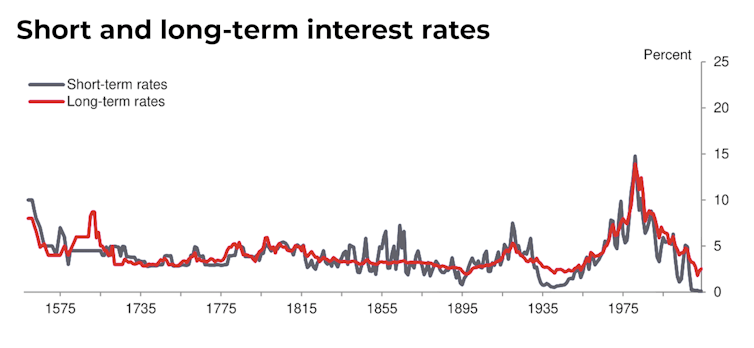
We need to note that the first thing this 2023 coalition government did (in December) was to tighten the Reserve Bank’s ‘anti-inflation’ mandate. So, there can be little doubt that present ‘high interest rates’ represent core government policy, and not simply an independent monetary policy which the government has to contend with.
Raising Costs to Reduce the Cost of Living ?!?
‘Raising costs to reduce costs’ is monetary policy orthodoxy, with the context of reducing the cost of living being to have a lower cost of living than would otherwise be the case.
Interest rates represent the ‘cost of capital’, just as wages represent the ‘cost of labour’. Raising the cost of capital to suppress a ‘cost-of-living crisis’ is as counterintuitive as it would be to order an increase in wages to suppress the said ‘cost-of-living’ crisis.
(I would like to note here Chris Trotter’s 29 Feb piece The Clue Is In The Name. Trotter notes that, in 1936 when the National Party was formed, it should really have been called The Capital Party. Labour and Capital were the juxtaposing parties in the economic class war. It would be in the nature of the Capital Party to call for increases in the price of capital, just as it would be in the nature of the Labour Party to call for increases in the price of labour. But the Capital Party in 1936 would not have regarded higher capital costs as a means to reduce the cost of living.)
How does the National Party get away with its policy to jack-up the cost of capital as a cost-cutting measure? (In a free-market economy, interest rates should be set by the market, not by the authorities.)
Why does anyone think that raising interest rates does not aggravate a Cost-of-Living crisis?
Stupidity might be one answer. This National government certainly acknowledges that the high cost of capital aggravates its cost-of-living crisis; so why not apply that reasoning to the country as a whole, especially mortgagors and small businesses?
But the answer to the question goes back to the 1980s. It was only the Social Credit Party then that called out the National and Labour governments for allowing (or actively using) high and rising interest rates to aggravate CPI inflation. And Social Credit was laughed off the stage.
The argument against Social Credit’s assertion then was that interest payments were a comparatively trivial part of a nation’s business costs. Indeed the system of national accounts understates interest costs. In the national accounts, interest is only treated as a cost inasmuch as bank interest margins represent the trading profits of banks. What the system of national accounts covers-up is that interest acts as a transfer mechanism from poor to rich, from small businesses to large businesses; while interest is a cost to some, it is a benefit to others. A ratchetting-up of interest rates this decade represents a massive increase in the scale of poor-to-rich transfers.
The position of the 1980s’ monetarists was that interest rates were a demand-management mechanism, and not a cost of business. The monetarist position was later enhanced by the ‘rational expectations’ theory; the idea that once there was a CPI inflation in place, economic ‘actors’ would expect an accelerating process of inflation to ensue unless drastic deflationary policies were quickly implemented. Indeed, monetary policy as has been pursued by Reserve Banks since the 1990s (and the RBNZ since the late 1980s) has been a shock demand-management tool that in practice has been at best ineffective in achieving its stated goals – from the late 1980s, CPI inflation was coming down anyway – though powerful in achieving its unstated redistributive goals.
Easy monetary policy – sustained low interest rates and quantitative easing – neither produced inflation in the 2010s nor in the late 1930s, as the monetarists expected it would.
In my own teaching of macroeconomics at Unitec, I had little choice but to teach the monetarist and rational expectations’ theories which presented monetary policy only as a demand-management tool. But I did encourage my students to take a critical view of the textbook and other material they consumed. And I always rewarded them in essay-marking if they commented on the possibility that rising interest costs were a part of the inflation-problem rather than the unquestioned solution to a cost-of-living crisis.
Full Circle
The new government has re-invented the Social Credit position from the 1980s. But government people are not joining the dots. National continues to believe that raising the cost-of-living is the best (if not the only) way of lowering the cost of living. And (intellectually lazy) Labour is not contesting Capital on this point.
————-
Keith Rankin (keith at rankin dot nz), trained as an economic historian, is a retired lecturer in Economics and Statistics. He lives in Auckland, New Zealand.
There are many factors that determine the Oscar winners and nominees each year. Seldom does the actual “best picture” win the award, and often the year’s best films fail to be recognised at all. Perhaps they’re not topical enough, not American enough, or not moral enough.
It’s hard to argue, for example, that Robert Zemeckis’ pleasant but forgettable yarn Forrest Gump was the best film of 1994, when Quentin Tarantino’s landscape-changing masterpiece, Pulp Fiction, came out the same year.
Nonetheless, the Oscars have until recently always celebrated Movies with a capital M: motion pictures made to be seen, first and foremost, in cinemas. These productions have almost always demonstrated incredible technical accomplishment, even if their narratives have been irritating or unnotable. Forrest Gump may be sentimental schmaltz of the most ludicrous kind, but at least it’s cinematic.
This year’s picks include some good, if not great, films. But they also reflect what most cinephiles already know: streaming is the last nail in the coffin in the shift away from cinema to television. The only nominees that feel like pieces of cinema (that is, movies committed to the cinematic form) are Oppenheimer and The Holdovers.
Equally rare for the Oscars, only a couple of nominees stick out as truly awful.
The good
Killers of the Flower Moon
Though director Martin Scorsese’s Killers of the Flower Moon is overlong, its true story is riveting, a family crime odyssey in the tradition of James Foley’s exceptional neo-noir At Close Range.
The narrative follows the murderous attempts of a clan led by William King Hale (Robert De Niro) to rip off a family of Osage Indians who became extremely wealthy after oil was discovered on their reservation. The murders are so cruel and unjust that, in effective crime film fashion, we root for the federal police when they appear in the final third to bring the villains to order.
It’s a low-key affair, featuring excellent performances from all the main actors, including Scorsese’s current muse, Leonardo Di Caprio, his old muse, De Niro, and a newcomer to films of this scale, Lily Gladstone.
Despite this, it feels more like a television series than a movie made for cinema. This makes sense – it’s produced by Apple, and therefore designed to be watched on the small screen.
Anatomy of a Fall
The French production Anatomy of a Fall similarly works very well as a crime film. This courtroom drama follows the trial of novelist Sandra Voyter (Sandra Hüller), a powerful and uncompromising artist and mother, for the murder (or was it suicide?) of her pathetic and self-loathing husband, Samuel (Samuel Theiss).
The narrative is extremely well-drawn by director Justine Triet. The film moves skilfully between the present of the trial and re-enactments from the lead-up to the supposed murder, keeping the viewer guessing “whodunit?” beyond the final image.
The writing is razor-sharp, with precision in detail and authenticity in the dramatisation of the manipulative actions of the characters. At the same time, the film effectively negotiates one of the great problems of the 21st century: how do we justly navigate (and assess) the relationship between our public and private lives?
At the end of the day, however, Anatomy of a Fall is like an excellent episode of a good crime show. It’s formally uninteresting, and even ugly in places (with digital video artefacts present in the wide shots of the snowy environment).
British director Jonathan Glazer has made only a few films throughout his career, and The Zone of Interest is probably the best of them.
It follows the petit-bourgeois lives of a German family living in Poland as they go about their daily life. The mum, Hedwig (Sandra Hüller), works meticulously on the garden. The dad, Rudolf (Christian Friedel), is an animal lover who rides his horse, walks his dog and tries to educate his children while keeping things together at work. The children in turn play together and torture each other, as children do.
The twist? The father is Höss, commandant of Auschwitz, and their house is next door to the camp. Underlying everything is a progressively menacing understanding of the horrors happening next door, through which the aspirations of this bourgeois family are founded.
The film embraces an ugly video-aesthetic (much like Austrian filmmaker Michael Haneke whose work is surely in the back of Glazer’s mind). Cold, detached images are captured by a mostly immobile camera. At times it feels like an observational documentary and (echoing Hannah Arendt’s famous statement about the banality of evil) this is clearly the point: ordinary life transpires for this family while, behind them, the chimneys pulse with fire and spew black smoke into the pristine air.
The nightmarish, surreal sequences that punctuate the film, matched by unsettling music and sound design, come to a climax in a stunning ending. Höss looks in horror towards the future, and the film punctures our own interest in these characters by confronting us with contemporary images from the Auschwitz museum. We see the collected shoes, for instance, from the bodies that became ash and fertilised Hedwig’s pretty garden.
In many respects, this is the most interesting of the nominees, but it also feels more like a video than a Movie.
American Fiction
The directorial debut of writer Cord Jefferson stars Jeffrey Wright (in career-best form) as novelist Thelonius “Monk” Ellison who decides to write a “black” novel when his publisher rejects his latest idea, a retelling of Aeschylus’ The Persians.
The book he writes – Fuck – is ludicrous, capitalising on white liberal sensibilities regarding what literature written by African Americans should be about (it features eye-patch-wearing, gun-touting criminals from the ’hood). It also (predictably) becomes a smash hit, with the movie rights sold almost immediately to a brash producer for $4 million.
This playing out of identity politics is interspersed with gentle drama involving Monk’s real life – a mother suffering from dementia, a sister who dies too young and a brother coming to terms with his sexuality. The material about the novel is funny, but the film’s brilliance lies in its counterpointing of the ordinary but complex stresses of middle-class life with the supposed problems of black people.
American Fiction is a sweet film, the most fun of this year’s nominees. But, as with much else on the list, it feels like it has been made – by Amazon – to be watched on television.
The average
Past Lives and Poor Things
People claimed Past Lives was the most beautiful film of the year. But I found its cross-continental and cross-temporal romance a touch trite. Celine Song’s debut feature certainly looks very nice, and the performances are all pitch perfect, but it struck me as underwhelming and uninteresting.
The same can’t be said of Yorgos Lanthimos’s Poor Things, which strained at every point to be overwhelming and formally interesting. But like a lot of artworks that try this hard, it falls flat. It comes off as a weaker, more pretentious imitation of Lanthimos’ better, earlier films. The first half hour is like something made by a student who worships Lanthimos and has unlimited resources.
That said, things pick up once the main character, Bella (Emma Stone), goes overseas to connect with her libido, leaving behind her Frankenstein-like creator, the scarred and affable Godwin (Willem Dafoe). What we’re left with is a mildly diverting romp over the seas and through the brothels of Paris.
The awful
Maestro
Conductor and composer Leonard Bernstein may have been a critical figure in 20th-century American music, and a larger-than-life character in American cultural life, but it would be hard to imagine a more self-indulgent project than Maestro from director-star Bradley Cooper.
Produced by Steven Spielberg (who has a knack for picking dull but profitable projects as a producer), there’s absolutely no drama or tension in this story. As good as Carey Mulligan is as wife Felicia Montealegre, Cooper is awful in his caricaturish imitation of Bernstein.
This is the first best-picture nominee I can think of that genuinely feels like it has been written and made by AI. Reminiscent of a slick pamphlet produced by a PR agency, this biopic demonstrates about as much colour as a Wikipedia entry. It’s astonishing anybody could consider it best-picture-worthy, and its presence in the category surely says more about Oscars politics than anything about its merits as a film.
Barbie
Maestro is joined at the bottom of the pool by the equally abysmal Barbie. The central conceit of co-writer-director Greta Gerwig’s film is fine: Barbie discovers she’s a doll, sets off for the real world, and sets about dismantling the patriarchy (does she though?). But the film repeats the same point over and over for an agonising two hours.
Indeed, the whole thing feels more like a series of short videos made for social media (some of which are funny on their own terms), strung together in a haphazard order, than a feature film. The Ken character, well-played by Ryan Gosling, is the real star, the only character with any pathos (once again this supposedly “feminist” film is made for and fetishises men).
All the female characters are seemingly mired in a world of hackneyed Instagrammatic cliches about motherhood and being “woman”, as though this category exists outside of specific, embodied experience. Maybe it’s meant to be a mess, but a good film this does not make.
The best picture?
Of the best-picture nominees, only two played like movies to be seen at the cinema.
Oppenheimer
There’s a lot to dislike about Christopher Nolan’s Oppenheimer. It’s too long, it’s pretentious and it seems to think it’s marking some kind of significant discussion of a fascinating moment in American military history (in other words, American history). As a serious biopic it’s not terribly effective. But as a tactile romp it’s delightful.
It’s fun watching all the brilliant actors trying to look and act like real-life people – Robert Downey junior is a hoot as always – and there’s something perfectly hypnotic about the film’s combination of image and sound. Oppenheimer is an immersive, viscerally charged film that’s willing to experiment with form, and it is formally stunning. And like that stinker Forrest Gump, it as least warrants being seen on the big screen.
The Holdovers
Because it’s better than Oppenheimer, my pick for best picture is The Holdovers. Filmmakers shooting on video (that’s almost every filmmaker now, although Nolan notably still shoots on film) often employ a panoply of tricks to try to make their images look more like film (with greater dynamic range, richer colour, visually appealing texture and so on).
Director Alexander Payne, cinematographer Eigil Bryld and colourist Joe Gawler actually pull this off in The Holdovers. The film looks like it has been shot on film stock, perfectly capturing the brown tones of an elite boys’ boarding school in America in the 1970s. And it in no way suffers from being viewed on a big screen, unlike, for example, Anatomy of a Fall.
The coming-of-age narrative follows grouchy ancient-history master Paul Hunham (Paul Giamatti) as he’s forced to stay at school over the Christmas break to oversee the “holdovers”, the boys whose parents don’t want or can’t have them home for the holiday. The material is formulaic – think Mr Chips crossed with Dead Poet’s Society crossed with The Catcher in the Rye – yet every element is so beautifully rendered, it’s a true pleasure to watch.
Giamatti is perfect in a role he was born to play, as the crotchety, pompous and physically repellent miser loathed by students and staff alike. Newcomer Dominic Sessa is remarkably self-assured as Angus Tully, the troubled boy for whom Hunham develops a genuine fondness, and Da’Vine Joy Randolph is also excellent as bereaved cook Mary Lamb.
Despite being replete with cliches, the stock characters and narrative are handled so expertly by Payne, and the actors are so good, that The Holdovers simply works – even if it’s sentimental to boot. It’s the kind of old-style film we don’t see often in an era of pontificating online moralism and disposable, interchangeable streaming “product”.
It’s also an effective cinematic work in a contest where most entries don’t feel like they were made for cinema. But was it the best film released in 2023? Come on!
Ari Mattes does not work for, consult, own shares in or receive funding from any company or organisation that would benefit from this article, and has disclosed no relevant affiliations beyond their academic appointment.
Source: The Conversation (Au and NZ) – By Peter Thompson, Associate Professor of Media Studies, Te Herenga Waka — Victoria University of Wellington
The announcement last week that Newshub would be shut down was not the “canary in the coalmine” some suggested – it was the explosion. If it is not to be the first of many, then New Zealand needs a new model for its fourth estate.
The fate of Newshub and today’s projected newsroom cuts at TVNZ threaten to leave a significant gap in the news sector, particularly television. But beyond that, the causes and solutions are very much up for debate.
There are both specific institutional factors and deeper structural trends at play within the television and news sectors. And Newshub’s tangled financial history serves as a reminder of the dangers of foreign ownership of strategic media assets.
Beyond the shifting fortunes of one company, however, the local news ecology has faced wider structural problems. The imminent loss of so many working news producers and journalists makes finding workable solutions even more urgent.
Fragmenting audiences
Over the past 25 years, the TV sector’s share of the advertising market has roughly halved, from 34.3% in 1999 to just 17.7% by 2022.
The capture of advertising revenue by Google and Meta (the parent of Facebook and Instagram) has played a key role. Google alone now accounts for almost two-thirds of the roughly NZ$1.8 billion digital advertising spend in New Zealand.
But the decline in TV revenues is also related to the fragmentation of audiences, as viewers shift to new on-demand services. TV3’s daily audience reach for its linear services declined by almost 50%, from 35% in 2014 to 17% in 2023.
Perhaps not surprisingly, Newshub’s demise has amplified calls from the news sector to expedite the Fair News Digital Bargaining Bill. This would require the online platforms to negotiate payments to news providers for hosting, linking and sharing news content.
Some estimates suggest this could be worth $30–50 million annually to the news sector. On the face of it, this may appear to be a logical solution – but it’s not that simple.
A flawed bill
There are a number of problems with the proposed bill. Fundamentally, it misdiagnoses the market relationship between the platforms and the news media.
The tech platforms’ capture of digital advertising stems not from its co-option of news content, but from the mass harvesting of audience data (enabling targeted advertising), and algorithmic influence over content discovery.
The bill also provides no fixed benchmarks for payments. And the arbitration process in the event of non-agreement is potentially very complex, because different media outlets will have varying relationships with each platform.
Making those agreements will depend on the goodwill of the platforms. But arbitration could well determine the advantages the platforms confer on news providers (increasing their visibility and directing traffic to their websites) outweigh the commercial benefits to the platforms of hosting or sharing news content.
Indeed, Meta’s resistance to the news bargaining frameworks in Australia and Canada underlines the risk of a platform exempting itself from bargaining obligations by prohibiting the hosting and sharing of news.
News media depending on platform payments might also be motivated to provide content that maximises value to the platforms – for example, populist or controversial content more likely to be shared. Or they may be less inclined to critically investigate issues involving their benefactors.
Ultimately, there is no guarantee any platform payments will actually be reinvested in news production, let alone commercially unattractive genres such as local government or regional reporting.
A new form of funding
There is no realistic possibility of the government bailing out Newshub or any other individual news outlet.
And while the news media’s function in upholding democratic processes and holding power to account remains vital, it doesn’t follow that market competition and plurality are sufficient to sustain that.
Indeed, it was the introduction of commercial competition for eyeballs and advertising that drove measurable declines in the length and substance of television news through the 1990s.
Democracy cannot thrive if the fourth estate is in a commercial race to the bottom. It requires diversity of perspectives and competition for substance that treats the audience as citizens, not just fodder for advertisers.
This requires a new form of funding and a new institutional arrangement. One way to achieve this would be through a small levy on digital advertising expenditure, and potentially other commercial revenues such as internet and streaming services. The revenue would be reinvested in news content through an independent agency on a contestable basis.
There are different possible mechanisms, but an initial model could apply a levy to digital advertising spend across the media sector. This would mean the advertising spend currently going to Google and Meta would generate the majority of the revenue.
Although the spend going to other media would, in principle, also incur the levy, there could be rebates for local content producers. News operators would, in any case, be the recipients of the journalism funding which the levy makes possible.
Even a 1% levy on the $1.8 billion digital advertising spend would generate as much revenue as the (now defunct) Public Interest Journalism Fund. A 3% levy would equal the higher estimates of what the proposed Fair News Digital Bargaining Bill would deliver.
Collaborative news sharing
Being administered by an independent agency (perhaps NZ On Air) would help ensure the levy supported news based on public service principles – including investigative, local government, regional and minority coverage – and that a wide range of news operations received support.
There is also a need for some form of collaborative news-sharing model. RNZ already shares its news content, and there have been proposals for a regional news network to cover local issues often overlooked by the mainstream.
An independent, multi-platform news publisher model could underpin such an initiative. It would operate across both broadcasting, print and online media, and allow members to make use of any pooled content on their own channels or websites.
A levy mechanism and public news publisher model would be a far better basis for rescuing New Zealand’s fourth estate than throwing the news media some crumbs from Big Tech’s table.
Peter Thompson is a founding member and chair of the Better Public Media Trust. He has previously undertaken commissioned research for the Canadian Department of Heritage, the Department of Internal Affairs, the Ministry for Culture and Heritage, and NZ On Air.
Source: The Conversation (Au and NZ) – By Martina Linnenluecke, Professor of Environmental Finance at UTS Business School, University of Technology Sydney
This year, large businesses in Australia will likely have to begin reporting their environmental impacts, climate risks and climate opportunities.
The final draft of Australia’s new mandatory climate disclosure laws are due any day now, following consultation.
These laws are meant to increase transparency about how exposed companies are to risks from climate change, and will require companies to look into and share what impact their activities have on the environment. This, the government hopes, will accelerate change in the corporate sector.
But will it help lower emissions? I don’t think so. We don’t have a carbon tax, which means many companies have no financial incentive to actually lower their emissions. (The strengthened Safeguard Mechanism applies to about 220 big emitters, but they can simply buy offsets and avoid harder change.)
By themselves, climate disclosures will not trigger the change we need.
A company’s emissions and environmental impact come from many sources, from vehicle fleets to electricity use. Scharfsinn/Shutterstock
These standards have influenced Australia’s draft laws.
In planning mandatory corporate disclosures on climate and environment, Australia is following similar efforts overseas. In 2022, the United Kingdom began to roll out mandatory reporting on climate risks and opportunities for the largest UK companies (those with more than 500 employees and A$970 million in turnover).
Once the Australian legislation comes into effect, it will require large companies and asset owners to publish their climate-related risks and opportunities.
In the draft legislation, companies would have to evaluate and report on their direct and indirect greenhouse gas emissions from sources they own or control and from sources such as purchased electricity.
From July this year, the laws would require disclosures from companies with 500 employees, $1 billion in assets or $500 million in revenue. Over time, this would expand to medium-sized companies. From July 2027, companies with 100 employees, $25 million in assets or $50 million in revenue would have to share this information.
Sustainability reports will be subject to external auditing and directors would be personally liable for the accuracy of the disclosures – with one major exception.
For many Australian companies, it’s already proving too hard to account for Scope 3 emissions – the greenhouse gas emissions upstream and downstream in a company’s operations, such as the emissions from gas burned after we export it.
As these emissions occur outside a company’s direct control, accounting for them is a complex task costing time and money. Only some companies have voluntarily started to report their Scope 3 emissions in anticipation of future regulatory change.
The draft legislation exempts companies from the need to report Scope 3 emissions for their first year of reporting and proposes limited liability for these disclosures for a fixed three-year period.
You can see why the government is introducing these laws. To nudge corporate Australia towards a greener future, it helps to know what impact your business has – and what risks it is exposed to. It will also be useful for investors.
But it will not drive rapid decarbonisation. Critics have pointed out that reporting and disclosure alone will not lead to a shift away from carbon-intensive business operations. Disclosures give the appearance of action rather than real action. If there are no stronger policies accompanying, disclosures act as window dressing for global financial markets.
Our existing policies do not require organisations to make genuine changes in terms of their emissions. Unless organisations abandon their reliance on fossil fuels and substantially decarbonise their operations, we are simply not going to get any change.
These laws also come with a cost. The regulatory burden and compliance costs for Australian companies will not be trivial, especially for companies which haven’t reported on climate or sustainability before.
We already have a shortage of trained reporting, auditing and assurance professionals able to do climate and environment work, following years of minimal action on climate change in Australia. To fix this will require substantial and rapid upskilling.
These costs should give us pause. It’s worth thinking through how much emphasis we place on disclosures to drive change versus policies that would actually drive change, such as mandating that large companies have to reduce their direct emissions 10% a year.
Australian companies can only benefit from these laws if they use the data unearthed by disclosure to rethink how they operate, invest and green their supply chains towards sustainability. This may mean investing in clean technology, shifting from polluting transport fleets to electric, or reconsidering how they produce their products.
And to do that, of course, companies will need to see supportive government policies.
Should gas exporters track the scope 3 emissions when their product is burned for power overseas? Aerial-motion/Shutterstock
These laws can be useful – but not alone
Assuming the laws pass, big companies will begin assessing and reporting their emissions and environmental impact from July this year.
In doing so, Australia will align itself with international efforts for more transparency. Requiring companies to scrutinise and disclose their environmental impact will give corporate leaders the data needed to look for greener ways to run their business. But this assumes they have the interest and time to do so.
This isn’t a quick fix for climate change. To be worth the cost, Australia will need to link climate-related financial disclosures to clear policies designed to bring down emissions.
Disclosure policies produce disclosures. Emission reduction policies produce emission reductions.
Australian Foreign Minister Penny Wong issued a stark warning to Southeast Asian leaders this week: the region could face a “devastating” conflict over the South China Sea unless it strengthens its diplomatic and legal safeguards.
Wong said the region was already experiencing “destabilising, provocative and coercive actions”, in addition to “unsafe conduct” in the air and sea. These were not-quite-so-veiled references to China’s recent actions in the South China Sea.
Other countries in the region – especially Vietnam and the Philippines – share similar concerns about China’s maritime assertions. They question, for instance, what Beijing’s rejection of the 2016 South China Sea tribunal ruling might mean for upholding international maritime laws and keeping crucial sea trade routes open.
This week, Manila again called out China’s “dangerous manoeuvres” in the South China Sea. President Ferdinand Marcos junior vowed not to yield an “inch” to China in the contested waters.
Australia and the Philippines recently signed an agreement to deepen maritime co-operation. This may lead to more joint defence exercises and patrols in the South China Sea.
But not all regional leaders agree about the potential threat. Malaysian Prime Minister Anwar Ibrahim issued a warning of his own at the ASEAN-Australia Special Summit this week over the West’s “China phobia”. If the US and Australia have problems with China, he said, “they should not impose it” on Southeast Asia.
Other challenges beyond territorial disputes
There is no doubt the great power competition between the US and China sets the strategic backdrop for Australia’s engagement with Southeast Asia.
But while maritime co-operation is increasing among regional states, this doesn’t mean they all agree on the central issues that affect the stability, safety and security of the region’s waters, specifically the South China Sea.
Southeast Asian countries have diverse interests, political systems and strategic priorities. And leaders in the region – like those of many other smaller and middle powers around the world – regularly say they do not want to have choose between the US and China.
Not all countries are “hedging” to the same degree, but Australia should nevertheless focus its engagement on building genuine partnerships with Southeast Asian countries in their own right – not merely based on perceived external threats – and identifying and addressing shared issues of concern.
At this week’s ASEAN-Australia summit, for instance, Southeast Asian nations drove the idea of a dedicated maritime forum. While the forum did address security challenges such as “grey zone” activities, plenty of other challenges and opportunities were discussed. These included:
the importance of the “blue economy” concept, focused on the sustainable use of maritime resources for development and prosperity
improving maritime connectivity by ensuring free and open sea lanes of communication
bolstering law enforcement and governance to ensure maritime order across the region
better addressing environmental and climate change issues.
There was also a strong focus on understanding the local issues facing coastal and Indigenous communities in the region. An estimated 70% of Southeast Asia’s population lives by the coast, where they face increasing livability challenges due to climate change, economic uncertainty and the degradation of fishing stocks and natural resources.
This is not entirely new: ASEAN countries and Australia have been paying closer attention to shared maritime challenges beyond the sovereignty and maritime disputes in the South China Sea.
For example, ASEAN recently released its maritime outlook. In particular, it noted the importance of the region for “global trade, food and energy security and marine biodiversity”.
It is no surprise maritime security has reached this level of importance on a shared diplomatic agenda.
While the concerns over China’s activities are real, it’s important Australia and its neighbours to the north focus more attention on the vast range of other ocean-based issues that don’t get as much attention.
These priorities include:
protecting open ocean supply chains
reducing pollution, in particular plastics, and preventing coral bleaching
supporting sustainable, legal and regulated fishing
mitigating human, arms and drug trafficking
addressing the very real challenges that climate change and rising sea levels present to maritime Asia.
These challenges are often less politically sensitive than strategic concerns, which enhances the prospects of co-operation. This is where science, research and development, knowledge sharing and expert networks can contribute to solving knotty problems. And many of these challenges are transnational, meaning they do not affect one state unilaterally, but often require collective responses.
The challenges are significant. So, too, are the opportunities for collaboration. Getting maritime co-operation right can support the human rights and livelihoods of millions of people across the region.
Rebecca Strating receives funding from Australia’s Department of Foreign Affairs and Trade and was the Convenor of the 2024 Australia-ASEAN Special Summit Maritime Cooperation Forum: Conference.
Interview by Don Wiseman, RNZ Pacific senior journalist
The man being touted by the opposition as the next leader of Papua New Guinea says the first thing his administration would do is put more focus on law and order.
East Sepik governor Allan Bird is being put forward as the opposition’s candidate for prime minister with a vote on a motion of no confidence likely in the last week of May.
Bird is realistic about his chances but he said it is important to have such a vote.
“I think the first thing we would do is just restructure the Budget and put more focus on things like law and order, bring that right to the top and deal with it quickly,” he said.
He spoke about what he aspires to do if he gets the chance.
Don Wiseman: Mr Bird, you had been delegated to look at the violence following the 2022 election, and it is clear that resolving this will be a huge problem.
AB: Not necessarily. It’s currently confined to the upper Highlands part of the country, but it is filtering down to Port Moresby and other places. I guess the reluctance to deal with the violence is that I’d say 90 percent of that violence stems from the aftermath of the elections.
From our own findings, we know that many leaders in that part of the world that run for elections actually use these warlords to help them get elected. And obviously, they’ve got like four years of downtime between elections, and this is how they spend their spare time. So, it’s hardly surprising.
I think our military and our police have the capability to deal with these criminal warlords and put them down. How shall I say it – with extreme prejudice. But you get a lot of interference in the command of the police and the Defence Force. I suspect that changes the operational orders once they get too close to dealing with these terrorists.
DW: Police have been given the power to use lethal force, but a lot of commentators would say the problems have more to do with the the lack of money, the lack of opportunity, the lack of education.
AB: The lack of education, opportunity, and things like that will play a small part. But again, as I said, I come from a province where we don’t have warlords running around heavily armed to the teeth. I mean, you have got to remember an AR-15, or a 4M, or anything like that. These things on the black market cost around 60,000 to 70,000 kina (NZ$20,000-25,000).
The ordinary Papua New Guinean cannot afford one of those things and guns are banned in public use — they’ve been banned for like 30 years. So how do these weapons get in? Just buying a bullet to operate one of these things is hard enough. So you got to ask yourself the question: how are illiterate people with perhaps no opportunity, able to come into possession of such weapons.
DW: The esteemed military leader Jerry Singarok compiled, at the request of the government about 15 years ago, a substantial report on what to do about the gun problem. But next to nothing of that has ever been implemented. Would you go back to something like that?
AB: Absolutely. I have a lot of respect for Major-General Singarok. I know him personally as well. We have had these discussions on occasions. You’ve got smart, capable people who have done a lot of work in areas such as this, and we just simply put them on the backburner and let them collect dust.
DW: The opposition hopes to have its notice for a motion of no confidence in the Marape government in Parliament on 28 or 29 May, when Parliament resumes. It was adjourned two weeks ago when the opposition tried to present their motion, with the government claiming it was laden with fake names, something the opposition has strenuously denied. Do you have the numbers?
AB: Obviously we’re talking with people inside the government because that’s where the numbers are. Hence, we’ve been encouraged to go ahead with the vote of no confidence. The chance of maybe being Prime Minister per se, is probably like 5 percent. So it could be someone else.
I say that because in Papua New Guinea, it’s really difficult for someone with my background and my sort of discipline and level of honesty to become prime minister. It’s happened a couple of times in the past, but it’s very rare.
DW: You’re too honest?
AB: I’m too honest. Yes.
DW: We’ve looked at the law and audit issue. What else needs fixing fast?
Well, we’ve got a youth bulge. We’ve got a huge population problem. We’ve got to start looking at practical ways in terms of how we can quickly expand opportunities to use your word. Whatever we’ve been doing for the last 10 years has not worked. We’ve got to try something new.
My proposal is actually really keeping with international management best practice. You go to any organisation this is what they do. I think New Zealand does it as well, and Australia does, which is you’ve got to push more funds and responsibilities closer to the coalface and that’s the provinces.
If I could do one thing that would change the trajectory of this country, it’s actually to push more resources away from the centralised government. We actually have a centralised system of government right now.
The Prime Minister [Marape] has so much control to the point where it’s up to him to authorise the building of a road in a particular place worth, say, 5 million kina. The national government is the federal government, if you like, is looking after projects that are as low as say, 2 to 3 million New Zealand dollars in value all the way up to projects that are $500 million in value.
So the question is: there’s got to be better separation of powers, better separation of responsibilities and, of course, clearly demarcated roles and responsibilities. Right now, we’re all competing for the same space. It’s highly inefficient with duplicating a lot of things and there’s a lot of wastage of resources. The way to do that is to decentralise.
DW: What concerns do you have about MPs having direct control over significant amounts of these funds that are meant to go to their electorates? Should they?
AB: Well, I don’t think any of us should have access to direct funding in that regard. However, this is the prevailing political culture that we live in. So again, coming back to my idea about ensuring that we get better funding at the sub-national levels is to strengthen the operational capability of the public servants there, so that once they start to perform, then hopefully over time, there’ll be less of a need to directly give funds to members of parliament because the system itself will start functioning.
We’ve killed the system over the last 20 or 30 years and so now the system is overly dependent on one individual which is wrong.
This article is republished under a community partnership agreement with RNZ.
ACT’s recently proposed amendment to parole legislation fits with the party’s “restoring law and order and personal responsibility” platform enshrined in last year’s coalition agreement. But the rule changes could cause more harm than good.
Introducing the bill to parliament, ACT MP Todd Stephenson said its goal was to “provide hope for those incarcerated to rehabilitate themselves and actually reintegrate back into society”.
By making rehabilitation programme completion compulsory to be eligible for parole, the hope is people in prison will be incentivised to finish the programmes. Stephenson said introducing compulsory completion will have a positive impact on Aotearoa New Zealand’s high rates of recidivism and reincarceration.
It’s true, recidivism rates in Aotearoa New Zealand are extremely high. But it’s also clear there are deeper problems with the rehabilitation system that legislation alone won’t solve.
Personal motivation is not enough
The Parole Board already considers completion (or not) of rehab programmes when assessing parole eligibility.
But the reasons for people not completing such programmes go far deeper than a lack of personal motivation. Instead, there are systemic causes within the justice system.
Ara Poutama Aotearoa-Department of Corrections faces endemic operational and capacity issues.
The legislative amendment fails to recognise resourcing and access issues relating to prison rehab programmes, let alone the relatively low success rates of these programmes in preventing reoffending generally.
The lack of adequate funding for rehab programmes will likely lead to some people being unable to get parole.
Concerns over these delays were already being raised by formerly incarcerated men who participated in a 2021 study.
One of the participants reported waiting eight years before being able to enter his first rehabilitation programme. Another of his programmes was set to start after his parole hearing, despite not being able to get parole without completing the programme.
In some cases, the programmes inmates were encouraged to do were not even available in the prisons they were housed in.
The men in our study were not failing to complete programmes because they did not want to do them or lacked incentive. They were failing to complete programmes because of Corrections’ resourcing issues.
As one explained:
If you’re trying to change someone, change … my opinion is change it from the beginning. Don’t wait … By the time I became eligible for these programmes it was too late. I’d clocked up charges. I’d clocked up assault charges.
I learnt nothing … I failed the programme twice … I didn’t have tools to deal with what I, what I accumulated over the years was embedded in me. I had no tools to try and help myself get out of it until later. I couldn’t comprehend what the programme was trying to teach me.
There is a risk that ACT’s amendment will have a disproportionately negative impact on Māori communities and do little to change already dire prison statistics.
The bill has now been referred to the Justice Committee and is open for public submissions.
The government should push pause on this amendment, at least until it can resolve Corrections’ resourcing issues and provide sufficient access to rehabilitative programmes in prisons.
Laura Johnstone is a member of People Against Prisons Aotearoa and a Board Member of Just Speak.
Readers are advised this article includes an offensive and outdated disability term in a quote from the film.
Poor Things is a spectacular film that has garnered critical praise, scooped up awards and has 11 Oscar nominations. That might be the problem. Audiences become absorbed in another world, so much so our usual frames of reference disappear.
There has been much discussion about the film’s feminist potential (or betrayal). What’s not being talked about in mainstream reviews is disability. This seems strange when two of the film’s main characters are disabled.
Set in a fantasy version of Victorian London, unorthodox Dr Godwin Baxter (William Dafoe) finds the just-dead body of a heavily pregnant woman in the Thames River. In keeping with his menagerie of hybrid animals, Godwin removes the unborn baby’s brain and puts it into the skull of its mother, who becomes Bella Baxter (Emma Stone).
Stone has been praised for her ability to embody a small child who rapidly matures into a hypersexual person – one who has not had time to absorb the restrictive rules of gender or patriarchy.
But we also see a woman using her behaviour to express herself because she has complex communication barriers. We see a woman who is highly sensitive and responsive to the sensory world around her. A woman moving through and seeing the world differently – just like the fish-eye lens used in many scenes.
Women like this exist and they have historically been confined, studied and monitored like Bella. When medical student Max McCandless (Ramy Youssef) first meets Bella, he offensively exclaims “what a very pretty retard!” before being told the truth and promptly declared her future husband.
Even if Bella is not coded as disabled through her movements, speech and behaviour, her onscreen creator and guardian is. Godwin Baxter has facial differences and other impairments which require assistive technology.
So ignoring disability as a theme of the film seems determined and overt. The absurd humour for which the film is being lauded is often at Bella’s “primitive”, “monstrous” or “damaged” actions: words which aren’t usually used to describe children, but have been used to describe disabled people throughout history.
Disability studies scholar Rosemarie Gardland-Thomson writes “the history of disabled people in the Western world is in part the history of being on display”.
In the 19th century, when Poor Things is set, “freak shows” featuring disabled people, Indigenous people and others with bodily differences were extremely popular.
Doctors used freak shows to find specimens – like Joseph Merrick (also known as the Elephant Man and later depicted on screen) who was used for entertainment before he was exhibited in lecture halls. In the mid-1800s, as medicine became a profession, observing the disabled body shifted from a public spectacle to a private medical gaze that labelled disability as “sick” and pathologised it.
Poor Things doesn’t just circle around these discourses of disability. Bella’s body is a medical experiment, kept locked away for the private viewing of male doctors who take notes about her every move in small pads. While there is something glorious, intimate and familiar about Bella’s discovery of her own sexual pleasure, she immediately recognises it as worth recording in the third person:
I’ve discovered something that I must share […] Bella discover happy when she want!
The film’s narrative arc ends with Bella herself training to be a doctor but one whose more visible disabilities have disappeared.
What does ‘disability coding’ mean? You see it in films including Forrest Gump and Poor Things.
Framing charity and sexual abuse
Even the film’s title is an expression often used to describe disabled people. The charity model of disability sees disabled people as needing pity and support from others. Financial poverty is briefly shown at a far-off port in the film and Bella initially becomes a sex worker in Paris for money – but her more pressing concern is sexual pleasure.
Disabled women’s sexuality is usually seen as something that needs to be controlled. It is frequently assumed disabled women are either hypersexual or de-gendered and sexually innocent.
In the real world disabled people experience much higher rates of abuse, including sexual assault, than others. Last year’s Royal Commission into Violence, Abuse, Neglect and Exploitation of People with Disability found women with disability are nearly twice as likely as women without disability to have been assaulted. Almost a third of women with disability have experienced sexual assault by the age of 15. Bella’s hypersexual curiosity appears to give her some layer of protection – but that portrayal denies the lived experience of many.
Watch but don’t ignore
Poor Things is a stunning film. But ignoring disability in the production ignores the ways in which the representation of disabled bodies play into deep and historical stereotypes about disabled people.
The authors do not work for, consult, own shares in or receive funding from any company or organisation that would benefit from this article, and have disclosed no relevant affiliations beyond their academic appointment.
New Australian homes are being designed bigger and so require more energy for heating and cooling, wiping out potential gains in energy efficiency, according to our new research. The increasing energy demand is inconsistent with global efforts to tackle climate change and suggests Australia’s housing energy policy requires a radical rethink.
For more than 20 years, Australia’s building energy regulations have focused on energy efficiency. This reflects policy trends around the world.
In building regulations, energy efficiency is measured as the energy required to heat or cool one square metre of floorspace. Energy efficiency can be improved with features such as good orientation, insulation and double-glazing on windows. Homes designed to a higher energy efficiency standard do indeed require less energy for heating and cooling.
But what happens if we build a bigger house, or more houses: does energy efficiency policy still encourage less energy use in homes? Our research shows in Australia, the answer is no. A policy focus on energy efficiency has not led to falls in the predicted energy requirements for heating and cooling – either for individual homes or the new home sector as a whole.
Energy efficiency is measured according to the energy required to heat or cool one square metre of floorspace. Shutterstock
Increasing floor areas
Around the world, apartment living is becoming more common. But detached homes remain the dominant housing type in many developed nations, including Australia, the United States and Canada.
House size differs markedly around the world, ranging from 9m² per person in India, to about 84m² per person in Australia. Globally, floor area per person is increasing.
Our study set out to examine the significance of this increase when it comes to home heating and cooling energy requirements in Australia.
Detached homes remain the dominant housing type in many developed nations, including Australia. Shutterstock
What we found
Our study involved more than 580,000 new homes in Australia designed between 2018 and 2022.
First, we looked at official dwelling approval data. We then examined certificates issued under the Nationwide House Energy Rating Scheme or NatHERS. This gave us the thermal performance star-ratings of the new homes, their energy efficiency for heating and cooling and their conditioned floor areas – that is, floor areas typically heated and cooled, excluding spaces such as laundries and garages.
From this, we calculated the predicted energy each home would require each year for heating and cooling.
We found a home designed in 2022 had a 7.6% larger conditioned floor area than a home designed in 2018. And a home designed in 2022 was predicted to require 10% more energy for heating and cooling than a home designed four years earlier.
This differed between jurisdictions. For example, predicted energy requirements for a new home in Western Australia fell by 11% over the period, while in Queensland and the Australian Capital Territory it increased by 17%.
Collectively, we found the predicted energy requirement for heating and cooling of all new homes in Australia was 5.6% more in 2022 than in 2018. This figure ranged from a fall of 21% in the Northern Territory to an increase of 34% in South Australia.
These increases occurred despite 97.5% of new homes meeting the state-based minimum energy efficiency regulations.
Understanding the star-rating system
Between 2018 and 2022, new homes had to be designed to a minimum 6-star energy rating under the NatHERs scheme. However, the policy is implemented by state-based regulations, which in some jurisdictions allows homes to be designed below 6-stars.
In the study period, 18% of new homes in Australia were designed to a 5-5.9 star rating, as permitted within the jurisdictions of Queensland, the Northern Territory and New South Wales. In all other states and territories, the majority of new homes were designed at 6-star or above.
Nationally, just 11% of new homes were designed at a higher standard of 7-10 stars. This ranged from 35% in the Australian Capital Territory to just 5% of new homes in Victoria.
Improvements to Australia’s housing energy efficiency policy came into effect in 2023. However these do not directly address the impact of floor area on heating and cooling energy requirements, and state-based regulations remain inconsistent.
Aussie homes are getting bigger
Our analysis showed new Australian homes continue to get bigger. New homes in Victoria and NSW had the largest conditioned floor areas, while Tasmania had the smallest.
New homes with lower a star-rating tended to be bigger: the average 5-star home in NSW had more than double the conditioned floor area of the average 7-star home in Tasmania.
Larger homes also inherently require more materials to build than smaller homes – and these materials require energy to produce. However this concept, known as embodied energy, was beyond the scope of our study.
Time for a rethink
Our research showed at a household, state and national scale, the emission reduction benefits of improving a home’s energy efficiency may be undermined if policy does not consider floor area.
Demand for new housing in Australia will continue to rise as the population grows. So it’s even more important to ensure we get the settings right on home energy policy. Such an overhaul will be complex, involving building regulations, urban planning and social policies.
Renewable energy can significantly reduce greenhouse gas emissions from energy used by new homes. However, to make our net-zero goals feasible, achieving reductions in the energy required by each home is a crucial first step.
Work is also needed on how to encourage people to build smaller homes – a home sufficient for their needs, but no larger. Unless Australia re-examines the scale of its new homes, energy efficiency policy will fail to deliver genuine reductions in energy use.
The authors do not work for, consult, own shares in or receive funding from any company or organisation that would benefit from this article, and have disclosed no relevant affiliations beyond their academic appointment.
Source: The Conversation (Au and NZ) – By Rachel Leslie, Lecturer in Curriculum and Pedagogy with a focus on Educational Psychology, University of Southern Queensland
From March 13, NAPLAN testing for 2024 will begin. Over the following two weeks, all Australian students in years 3,5,7 and 9 are expected to sit tests in literacy and numeracy.
Results are then aggregated for schools and other demographics and made public. Students also get their individual results.
For students in Year 3, this will be their first experience of a formal test. For others, they will be sitting the test among school and media hype about the “importance of NAPLAN”.
Since it was introduced in 2008, NAPLAN has polarised the community. Some education experts see it as counterproductive (with too much emphasis on test performance rather than learning). Others emphasise the importance of the data collected, and how this informs teaching practice and school funding.
One of the prevailing concerns relates to the impact on student wellbeing.
While many students do not feel any anxiety, one 2022 study of more than 200 high school students found 48% felt worried about what the test would be like and how they would perform. A 2017 study of more than 100 primary students revealed up to 20% of children had a physical response to the test, such as feeling sick, not sleeping well, headaches or crying.
For parents, the stress and anxiety their child experiences in the lead up to NAPLAN can cause them to worry and even withdraw their child from the assessment.
But test anxiety is not inevitable. Here are some simple things parents and teachers can do to support students, not just for this assessment, but into the future.
NAPLAN is not just about individual student results and whether you are a “good” at maths or “bad” at reading. It’s about informing teaching and learning.
The results help teachers do their jobs by identifying areas of reading, writing and maths that need more attention. This can help individual students, classes or entire schools.
When the results are collected at state and national levels, they also help tell governments where to put more efforts and funding to help support students.
2. Talk about how the test is a journey (not a destination)
Children learn from experience. This enables them to predict what might happen in similar future events.
Talk about NAPLAN as “practice” for future tests. So if you sit NAPLAN test in your younger school years this will help you handle other tests in senior school or maybe even university.
Emphasise that sitting the test is not about a particular outcome or result. It’s about embarking on an experience and learning what it is like to do a standardised tests. In this way, NAPLAN can help students build resilience.
Mindfulness-based interventions have been shown to be successful in addressing anxiety symptoms in children.
Mindfulness can teach children to recognise anxiety symptoms such as a fast heart beat, shortness of breath or racing thoughts. By encouraging children to focus on the present moment, mindfulness can help children through improved concentration, better emotional regulation and fostering a sense of calm.
Smiling Mind is an Australian app designed to teach children to be mindful in a developmentally appropriate and guided way. The app is free to download and use. You could sit or lie down with your child and do a “body scan” (where you scan your entire body and notice how it feels) or a listening practice (where you pay attention to the sounds around you).
If your child is experiencing significant test anxiety, such as headaches, tummy pains or a racing heart, there may be more to it than just concerns about NAPLAN. For children aged 12–18, Headspace – Australia’s mental health foundation for young people – offers a range of services.
For younger children, or if you are still concerned, speak to your child’s teacher, the school counsellor or your GP.
Rachel Leslie does not work for, consult, own shares in or receive funding from any company or organisation that would benefit from this article, and has disclosed no relevant affiliations beyond their academic appointment.
Source: The Conversation (Au and NZ) – By John Hawkins, Senior Lecturer, Canberra School of Politics, Economics and Society, University of Canberra
This article is part of The Conversation’s series examining the housing crisis. Read the other articles in the series here.
With most economists expecting interest rates to start falling later this year, prospective home buyers might be weighing up whether to buy now for fear of strong competition for stock, or waiting until repayments are lower.
The financial markets and private sector economists expect the Reserve Bank to start cutting interest rates later this year. But the average forecaster is expecting just one cut in the next 12 months, of 0.25%.
While rates have risen 13 times since May 2022, the drop won’t be so far nor so fast.
Even by the end of 2026 rates will probably only be around 1% lower than now.
And this may be as low as interest rates go. The interest rates we saw during the COVID recession were arguably the lowest in human history.
In normal times, we would expect interest rates to be higher than inflation. People can reasonably expect to be compensated for delaying spending. The margin by which interest rates exceed inflation in the medium-term is known as the neutral real rate of interest.
This Goldilocks rate would apply when the Reserve Bank is neither trying to squeeze inflation nor stimulate demand.
The Reserve has used nine different approaches to estimate this neutral real rate. The average result is that it may have dropped from around 3% in the 1990s to around 1% in the 2020s.
The Reserve Bank aims for inflation to average around the midpoint of its 2-3% target range. So if the neutral real rate is around 1%, this would imply that the Reserve’s cash rate (at which banks lend to each other overnight) would be around 3.5%.
This is about what the forecasters are expecting by the end of 2026.
Commercial banks set the interest rates they charge on their loans by adding a margin to the Reserve Bank’s cash rate.
They set the interest they pay on deposits by subtracting a margin from the cash rate. The difference between the two (and any fee income) meets the costs of running the bank such as wages and premises, allows for some loans not being repaid and provides some profits. The margins will be smaller if the banking market is very competitive.
Banks generally move their mortgage interest rates in line with the cash rate. If by the end of 2026 the cash rate is 1% lower, it is likely home loan interest rates will also be around 1% lower. This would reduce the monthly repayment on a 30-year loan for $1 million by $700.
The impact of (somewhat) lower interest rates on house prices
If the housing market is reasonably efficient, these broadly expected decreases in interest rates should largely be already “priced in” by investors. This would suggest relatively little impact as the expected cuts materialise.
But some potential homebuyers will be able to borrow more once interest rates drop. And many of them will choose to do so. They may then bid house prices up.
The increases are comparable to the expected rises in incomes so affordability will not significantly worsen. But buying a home will not be getting any easier.
A similar pattern of expected easing interest rates leading to higher house prices is being observed around the world.
Renters may be hoping landlords will pass on interest rate decreases to them. But they are likely to be disappointed. Rents have risen not due to interest rate rises but because the vacancy rate is low. With strong population growth, this is unlikely to change soon.
Trying to out-think the market is unlikely to work.
Not buying your dream home and instead waiting for a drop in interest rates may be a mistake. But so might panic-buying something that’s not what you want out of fear of further rises in house prices.
John Hawkins was formerly a senior economist at the Reserve Bank and the Australian Treasury and was secretary to the Senate Select Committee on Housing Affordability in Australia in 2008.
Craig Applegate does not work for, consult, own shares in or receive funding from any company or organisation that would benefit from this article, and has disclosed no relevant affiliations beyond their academic appointment.
The government will pay superannuation on its paid parental leave from July 1 next year. This will benefit about 180,000 families annually.
Minister for Women Katy Gallagher will announce the move on Thursday when she releases Working for Women, a national strategy to achieve gender equality.
The commitment will be costed in the May budget.
Eligible parents with babies born or adopted from July next year will receive an extra 12% of their government-funded paid parental leave as payment to their super fund.
July 2025 is when employers’ compulsory contributions climb to 12% of salary after climbing from 11% of salary to 11.5% in June this year.
Paid parental leave can be taken flexibly, in blocks as little as a day, until the child turns two, and can be shared between two parents.
The superannuation move follows earlier announced changes to parental leave including expanding the payment to six months by 2026.
Gallagher said the data showed clearly that “when women take time out of the workforce to raise children it impacts their retirement incomes with women retiring, on average, with about 25% less super than men”.
Social Services Minister Amanda Rishworth said parental leave was “not a welfare payment – it is a workplace entitlement just like annual and sick leave”.
Treasurer Jim Chalmers said more economic inclusion of women was “at the centre” of the government’s agenda.
The Working for Women strategy says: “Equality cannot be achieved without addressing who takes on and who is expected to take on caring responsibilities. Nor can it be achieved without valuing the substantial contribution unpaid and low paid care makes to families, the community and – notably – the Australian economy”.
Funding to spur takeup of electric vehicles
On Thursday the government will also announce the provision of $55 million for electric vehicles and associated infrastructure from the Australian Renewable Energy Agency (ARENA) and the Clean Energy Finance Corporation (CEFC)
Energy Minister Chris Bowen will commit the CEFC to make up to $50 million available to Anglo Auto Finance to enable it to get 20,000 new electric vehicles onto Australian roads in the next two years.
Anglo Auto will give short-term loans to car dealers to help them buy vehicles from manufacturers. The loans will have a shorter turnaround time than traditional auto finance.
ARENA will advance $4.76 million to car rental company Europcar to enable it to add 3100 new electric passenger vehicles to its Australian fleet over three years, in a transition the government values at $110.6 million
Europcar will team up with Ampol to install 256 chargers across 41 hire care sites.
Electric vehicle sales have increased 70% over the past year and now account for 5.4% of all new vehicles sold, with hybrids making up another 10.9%.
The move comes on top of plans to introduce a national fuel efficiency standard from January 2025 that would require manufacturers to increase the average fuel efficiency of the cars they sold each year until 2029.
Manufacturers would be able to meet the target by either making the vehicles they sold more efficient or changing the mix of vehicles they sold to include a greater number of electric vehicles.
Some progress on Closing the Gap
Also on Thursday, the Productivity Commission releases new data on eight of the Closing the Gap data targets and nine supporting indicators.
Five of the 19 targets for Indigenous Australians are now on track compared to four previously.
The proportion of Indigenous babies born with a healthy weight has improved. It is now on track to meet the target of 91% by 2031.
The target of a 15% increase in land and sea covered by Indigenous people’s legal rights is also on track.
But on the downside, there has been no improvement in closing the life expectancy gap. Indigenous males are expected to live 8.8 fewer years than other Australians. For women, the gap is 8.1 years.
The target of reducing the number of children in out-of-home care remains not on track. The target is to reduce the rate of over-representation by 45% by 2031.
Also not on track is the target of reducing adult imprisonment – in fact the situation is worsening. The target is a cut of at least 15% by 2031.
The Productivity Commission will release a further update in July.
Michelle Grattan does not work for, consult, own shares in or receive funding from any company or organisation that would benefit from this article, and has disclosed no relevant affiliations beyond their academic appointment.
A report by a media watchdog has revealed the United Kingdom’s media bias in covering the Hamas attack on October 7 and Israel’s five-month genocidal bombardment and ground assault in response.
“Much of the news coverage of 7 October refers to Hamas’s attacks on Southern Israel as ground zero, with guests or commentators who try and explain the 75-year-old occupation of Palestine being accused by some presenters and columnists as justifying the attacks,” the report by the Centre for Media Monitoring (CfMM) said.
By ignoring the context and history of the occupation of Palestine and Gaza in particular, the report said the media landscape had been “favourable to an Israeli narrative which has constantly promoted the attacks on Gaza and in the West Bank as a war between light and darkness”, reports Al Jazeera.
Titled “Media Bias Gaza 2023-24”, the report also called out treating the Israeli military as a “credible source” without subjecting it to further verification as “one of the glaring failures of journalists and media outlets”.
Cover of the Media Bias Gaza 2023-24 report . . . latest publication on Israel’s “favourable narrative” in the media.
Difference in the use of language has also been a regular feature of coverage, the report says, with Palestinian deaths often underplayed compared with those of Israelis.
Pro-Palestinian voices and activists have been routinely denounced, misrepresented and targeted by many national media outlets, it says.
The report adds that the right-wing media have been particularly hostile towards pro-Palestinian voices, framing them as supporters of terrorism and anti-Semites as well as being hostile to British values.
Key findings include:
Language use: Emotive language describes Israelis as victims of attacks 11 times more than Palestinians.
Framing of events: Most TV channels overwhelmingly promote “Israel’s right” to defend itself, overshadowing Palestinian rights to defend itself and other rights by a ratio of 5 to 1.
In broadcast TV, Israeli perspectives were referenced almost three times more than Palestinian ones.
In online news, it was almost twice as much.
Contextual framing: 76 percent of online articles frame the conflict as an “Israel-Hamas war,” while only 24 percent mention “Palestine/Palestinian,” indicating a lack of context.
Misrepresentation and undermining: Pro-Palestinian voices face misrepresentation and vilification by media outlets, perpetuating harmful stereotypes. Right-wing news channels and right-wing British publications were at the forefront of misrepresenting pro-Palestinian protesters as antisemitic, violent or pro-Hamas.
Fiji’s Women’s Minister Lynda Tabuya says the decision by the People’s Alliance executive council to remove her as deputy leader of the governing party is “unfair as it is based solely on allegations . . . generated by opponents from outside the party”.
Tabuya, who has been at the centre of an alleged sex and drug scandal with the sacked Education Minister Aseri Radrodro, was removed from the position on Monday.
According to the People’s Alliance, the scandal and associated allegations involving Tabuya had caused “potentially irreparable damage” to the party.
However, in a statement to RNZ Pacific today, Tabuya said she was “disappointed with the two lawyers in the legal and disciplinary subcommittee who have based their recommendations on allegations published on social media which is aimed to weaken the Coalition and weaken the party”.
“It is a dangerous precedent to set that by applying the constitution of the party they have based their decision to remove me as deputy party leader on allegations which they perceive as potentially causing damage,” she said.
“This comes as no surprise as these very same people opposed my appointment to be deputy party leader before the elections in 2022, so they have pounced on this opportunity to do so.
“It’s most unfortunate that as a woman I continue to be targeted with my removal last year as leader of government business and now as deputy party leader.”
She said the party must stand for fairness and justice and applying the law equally based on evidence and facts, not allegations
RNZ Pacific has contacted the People’s Alliance general secretary for comment.
Reaction expected The publisher of Grubsheet, Graham Davis, who first reported — along with Fijileaks — about the scandal involving Tabuya and Radrodro, said Tabuya was attempting to “muddy the waters” with her reaction.
“It is telling that Lynda Tabuya doesn’t directly address the allegations against her that the PAP executive council has found to be proven on the recommendation of its disciplinary committee — including at least two lawyers — after a detailed examination of the evidence first reported by Fijileaks and Grubsheet,” he told RNZ Pacific.
“To turn her fire on the PAP in a vain attempt to muddy the waters is to be expected.”
Meanwhile, Tabuya remains a cabinet minister despite being removed as PAP deputy party leader.
According to the Fiji Sun newspaper, only Prime Minister Sitiveni Rabuka can remove her from cabinet, as per the 2013 Constitution.
“The Fiji Sun has been reliably informed that the PM is seeking legal opinion before making his call,” the newspaper reported.
Rabuka is currently on official travel in Australia.
This article is republished under a community partnership agreement with RNZ.
In an unprecedented legal development, senior Australian politicians, including Prime Minister Anthony Albanese, have been referred to the International Criminal Court (ICC) for investigation into whether they have aided or supported Israel’s actions in Gaza.
The referral, made by the Sydney law firm Birchgrove Legal on behalf of their clients, is the first time any serving Australian political leaders have been formally referred to the ICC for investigation.
The referral asserts that Albanese, Foreign Minister Penny Wong, Opposition Leader Peter Dutton and other members of the government have violated the Rome Statute, the 1998 treaty that established the ICC to investigate and prosecute allegations of war crimes, genocide and crimes against humanity.
Specifically, the law firm references:
Australia’s freezing of aid to the UN Relief and Works Agency for Palestine Refugees (UNRWA), the aid agency that operates in Gaza
the provision of military aid to Israel that could have been used in the alleged commission of genocide and crimes against humanity
permitting Australians to travel to Israel to take part in attacks in Gaza
providing “unequivocal political support” for Israel’s actions in Gaza.
A key aspect of the referral is the assertion, under Article 25 of the Rome Statute, that Albanese and the others bear individual criminal responsibility for aiding, abetting or otherwise assisting in the commission (or attempted commission) of alleged crimes by Israel in Gaza.
At a news conference today, Albanese said the letter had “no credibility” and was an example of “misinformation”. He said:
Australia joined a majority in the UN to call for an immediate ceasefire and to advocate for the release of hostages, the delivery of humanitarian assistance, the upholding of international law and the protection of civilians.
How the referral process works There are a couple of key questions here: can anyone be referred to the ICC, and how often do these referrals lead to an investigation?
Referrals to the ICC prosecutor are most commonly made by individual countries — as has occurred following Russia’s invasion of Ukraine in 2022 — or by the UN Security Council. However, it is also possible for referrals to be made by “intergovernmental or non-governmental organisations, or other reliable sources”, according to Article 15 of the Rome Statute.
The ICC prosecutor’s office has received 12,000 such referrals to date. These must go through a preliminary examination before the office decides whether there are “reasonable grounds” to start an investigation.
The court has issued arrest warrants for numerous leaders over the past two decades, including Russian President Vladimir Putin and his commissioner for children’s rights, Maria Lvova-Belova; former Sudanese President Omar al-Bashir; and now-deceased Libyan leader Muammar Gaddafi.
ABC interview with barrister Sheryn Omeri KC on the referral of Australian political leaders to the International Criminal Court.
Acting for over 100 Australian lawyers, Omeri, through the law firm Birchgrove Legal, has referred Australian prime minister Anthony Albanese & key… pic.twitter.com/aHAdVct6eV
Why this referral is unlikely to go anywhere Putting aside the merit of the allegations themselves, it is unlikely the Australian referrals will go any further for legal and practical reasons.
First, the ICC was established as an international court of last resort. This means it would only be used to prosecute international crimes when courts at a national level are unwilling or unable to do so.
As such, the threat of possible ICC prosecution was intended to act as a deterrent for those considering committing international crimes, as well as an incentive for national authorities and courts to prosecute them.
Australia has such a process in place to investigate potential war crimes and other international crimes through the Office of the Special Investigator (OSI).
The OSI was created in the wake of the 2020 Brereton Report into allegations of Australian war crimes in Afghanistan. In March 2023, the office announced its first prosecution.
Because Australia has this legal framework in place, the ICC prosecutor would likely deem it unnecessary to refer Australian politicians to the ICC for prosecution, unless Australia was unwilling to start such a prosecution itself. At present, there is no evidence that is the case.
Another reason this referral is likely to go nowhere: the ICC prosecutor, Karim Khan, is currently focusing on a range of investigations related to alleged war crimes committed by Russia, Hamas and Israel, in addition to other historical investigations.
Given the significance of these investigations – and the political pressure the ICC faces to act with speed – it is unlikely the court would divert limited resources to investigate Australian politicians.
Increasing prominence of international courts This referral to the ICC, however, needs to be seen in a wider context. The Israel-Hamas conflict has resulted in an unprecedented flurry of legal proceedings before the International Court of Justice (ICJ), the UN’s top court.
Unlike the ICC, the ICJ does not deal with individual criminal responsibility. The ICJ does, however, have jurisdiction over whether countries violate international law, such as the Genocide Convention.
This was the basis for South Africa to launch its case against Israel in the ICJ, claiming its actions against the Palestinian people amounted to genocide. The ICJ issued a provisional ruling against Israel in January which said it’s “plausible” Israel had committed genocide in Gaza and ordered Israel to take immediate steps to prevent acts of genocide.
In addition, earlier this week, a new case was launched in the ICJ by Nicaragua, alleging Germany has supported acts of genocide by providing military support for Israel and freezing aid for UNRWA.
All of these developments in recent months amount to what experts call “lawfare”. This refers to the use of international or domestic courts to seek accountability for alleged state-sanctioned acts of genocide and support or complicity in such acts. Some of these cases have merit, others are very weak.
It’s […] a way of raising awareness, getting media attention and showing your own political base you’re doing something.
These cases do succeed in increasing public awareness of these conflicts. And they make clear the desire of many around the world to hold to account those seen as being responsible for gross violations of international law.
Australian National University / https://researchprofiles.anu.edu.au/en/persons/john-blaxland
Last week, ASIO boss Mike Burgess gave his annual assessment of threats to Australia’s domestic security. In his speech, Burgess sensationally revealed that a former politician had “sold out their country” to a foreign regime.
Burgess’s refusal to name the person, citing the need to protect ASIO’s tradecraft, invited speculation and debate. Nor would he specify the country, but a subsequent report said it was China.
In this podcast, we’re joined by Professor John Blaxland, Professor of International Security & Intelligence Studies at the Australian National University. He was a co-author of the multi-volume history of ASIO; recently, he co-authored Revealing Secrets: An Unofficial History of Australian Signals Intelligence & the Advent of Cyber. Blaxland is currently the Director of the ANU’s North America Liaison Office.
On the issue of Burgess staying mum about the former politician’s identity, Blaxland says there is good reason for keeping it secret.
So there’s a question mark now, as to whether the […] nation involved actually knows how effective ASIO has been at disrupting, because […] one of the things that good espionage agencies do is they try and flip their targets so that they become a double agent.
On AUKUS, under criticism from some experts who argue the agreement won’t necessarily protect Australia because the Americans might step back from the region and its allies, Blaxland says:
The great irony, of course, is that’s half the reason why we’re doing this. We want this technology. We want all this kit. We want all this manufacturing capability onshore just in case they’re not going to come if we need them.
He’s very critical of Paul Keating, who this week attacked Foreign Minister Penny Wong and Canberra’s national security establishment.
What is interesting and a little bit unsettling, in my view, is the consistency with which Paul Keating slams our principal ally and major foreign direct investor and principal economic partner, let’s face it, the United States. And yet, screamingly silent when it comes to criticism of China.[…] And it’s Shakespearean even in terms of perhaps about the level of protest.
Based in Washington DC, Blaxland describes the atmosphere as the 2024 presidential election kicks into gear:
It’s an unhappy place. It’s a bit tense. People are worried about what the future might look like.
This is an overwhelmingly Democrat town. And, you know, President Trump’s talked about draining the swamp. And that’s a deeply, deeply unsettling prospect.
Michelle Grattan does not work for, consult, own shares in or receive funding from any company or organisation that would benefit from this article, and has disclosed no relevant affiliations beyond their academic appointment.
The National Broadband Network may offer a significant speed boost to many users, if a plan from NBN Co, the operator of the network, is implemented. NBN Co’s proposed upgrade would provide download speeds up to five times faster for users on its three fastest home services (Home Fast, Home Superfast and Home Ultrafast).
The speed boost would come at no extra wholesale cost to retailers. On its face, this is an exciting announcement that aims to meet consumer demand for higher speed broadband connections to the internet.
NBN Co has highlighted the rationale for this move. The average Australian household now has around 22 internet-connected devices, and this is expected to grow to 33 by 2026. Data usage per household has doubled in the past five years, and now averages 443 gigabytes per month.
Why do people want more data?
Higher data usage is being driven by new applications, entertainment and online gaming. For example, game updates can be as large as 30 or more gigabytes today. If games update regularly, the amount of data used each month increases quickly.
Entertainment too is using more data. Most streaming video today is provided in a 720p format, but newer televisions can display content at the higher-resolution 4K format. With faster broadband speeds becoming more common, consumers should anticipate more 4K content becoming available.
Likewise, virtual reality and augmented reality are relatively new technologies that are slowly becoming integrated with gaming and business systems. These high data usage technologies are likely to become more present in our daily lives over the next decade.
NBN Co has indicated it would like to start providing the new higher speed products later this year, or early next year. The upgrade would be achieved by increasing the overall capacity of the NBN, which could then be “shared out” to consumers.
The NBN Co announcement is something the service providers should have expected at some point soon.
NBN Co’s announcement, coming only months after the Australian Competition and Consumer Commission (ACCC) approved a proposal for major annual price increases, may not be welcomed by all broadband retailers.
A spokesperson for the second largest broadband retailer, TPG Telecom, told CommsDay yesterday:
It took more than two years to finalise [the new pricing approved by the ACCC] and only three months for NBN Co to undermine the certainty it was supposed to create. We will always welcome opportunities to deliver greater service and speed to our customers, but NBN’s monopolistic whims make genuine collaboration with them very difficult.
Retailers understandably want certainty in wholesale pricing. One difficulty in achieving this is the high cost of “backhaul” in Australia: this is an intermediate connection between service providers and the NBN itself. Larger retailers have their own backhaul infrastructure, but smaller retailers must pay a third party.
If the NBN offers higher speed broadband connections, smaller retailers may end up paying more for backhaul – and will be faced with a dilemma over whether to pass these extra costs to consumers.
Telstra and Optus have broadly supported the plan by NBN Co to move to new technologies that offer the higher speed capabilities.
A faster network may entice consumers
Aussie Broadband Group managing director Phillip Britt told Gizmodo Australia:
Aussie Broadband is still understanding the detail of NBN Co’s speed proposal, but on the face of it, it could represent one of the most exciting steps in technology adoption for Australian households and businesses.
For NBN Co, the boost for the higher-speed plans may entice consumers to move from basic 50 Mbps plans to the upgraded Home Fast plan (which will offer download speeds of 500 Mbps, up from the current 100 Mbps).
NBN Co may also hope this encourages the remaining consumers with copper “fibre to the node” connections to move to “fibre to the premises” by taking advantage of one of the low or no cost upgrade offers available through retailers.
NBN Co has issued a consultation paper to retailers, asking for their feedback on the proposed changes to the high speed products by April 19 2024.
Mark A Gregory does not work for, consult, own shares in or receive funding from any company or organisation that would benefit from this article, and has disclosed no relevant affiliations beyond their academic appointment.
Source: The Conversation (Au and NZ) – By John Hawkins, Senior Lecturer, Canberra School of Politics, Economics and Society, University of Canberra
Wednesday’s national accounts show economic activity barely grew during the three months to December, climbing just 0.2%. That’s the lowest growth rate in four quarters, each of which was lower than the one before it.
Australia’s annual rate of economic growth – 1.5% – is the lowest in 23 years, excluding the COVID-induced 2020 recession.
In response, Treasurer Jim Chalmers said the balance of economic risks had changed.
While it was not “mission accomplished” on inflation, Chalmers’ May budget would mark a shift from what had been “almost a sole focus on inflation, a successful focus” to the “trickier terrain” of supporting growth.
Strong population growth meant economic activity per person shrank for the third consecutive quarter, in what some commentators are calling a continuing per capita recession.
Household spending was anaemic, climbing an inflation-adjusted 0.1% over the quarter and only 0.1% over the year after earlier falls.
Adjusted for population growth, spending per person shrank sharply.
The Bureau of Statistics reported a big fall in discretionary spending (down 0.9% over the quarter) offset by an increase in essential spending (up 0.7%).
Cooking at home
Spending on food and on electricity drove the rise in essential spending. The fall in discretionary spending was driven by a slide of 2.8% in spending on hotels, cafes and restaurants. This fall suggests, in the bureau’s words, that Australians “substituted cooking at home for eating out”.
Imports slid 3.4% in the quarter as wholesalers satisfied demand by running down inventories rather than importing as many goods.
A briefing to investors by Myer chief executive John King in February suggests this has been a deliberate strategy. King spoke about “controlling intake to match trading conditions”.
Saving a bit more
Australians saved a bit more in the three months to December after reducing saving during the three months to September in order to pay bigger-than-usual tax bills following the axing of the temporary low-and-middle-income tax offset.
While some of the saving might be cautionary (concern that worse times might come), the good news is that on average consumers are still saving rather than running down their savings.
The stage three tax cuts due in July will shore up pay packets, further helping to shore up savings.
The weaker tax take in the quarter gave Australians a reprieve on real household disposable income per capita, one of the best measures of the standard of living.
It grew 0.9%, after falling for most of the previous eight quarters.
Productivity bouncing back
After sliding since early 2022, labour productivity has climbed for two quarters.
In part, this is a mathematical outcome of the definition of labour productivity, which is GDP per hour worked. In recent quarters hours worked have been falling.
Chalmers said while the productivity news was “encouraging”, reported quarterly movements could be volatile and it would take some time to reverse the decline.
Where to from here?
The good news for the May budget is Australia’s terms of trade (the ratio of the prices received for exports to prices paid for imports) slipped only 3.9% during 2023. That compares to forecasts of much bigger falls for 2022-23 in the 2023 May budget and December update of 13.25% (budget) and 6.5% (update).
The better-than-expected terms of trade suggest mining companies will be in a position to pay more tax than had been expected.
This both increases the chances of a second (and even a third) consecutive budget surplus and gives the treasurer a bit more room to reorient the budget toward measures that support economic growth.
Chalmers is probably hoping the Reserve Bank is thinking along the same lines.
The annual increase in gross domestic product of 1.5% for the year to
December is exactly the increase that the bank forecast in its most recent update.
This means it is likely to conclude the economy is slowing as expected and leave rates on hold for some time. Asked what he thought the Reserve Bank would do, Chalmers said he wouldn’t comment but pointed to financial market forecasts.
Trading on the Australian Securities Exchange points to an even-money chance of a rate cut by June and a 100% chance of a rate cut by November.
John Hawkins was formerly a senior economist with the Reserve Bank and the Australian Treasury,
Donald Trump’s political obituary has been written many times. His dominant performance in the Super Tuesday Republican primaries marks one more instance of him outlasting those who counted him out.
While Trump has yet to officially clinch the Republican nomination for the 2024 presidential contest, his near-sweep of the Super Tuesday primaries indicates there’s no further electoral pathway for Nikki Haley, his last remaining GOP challenger.
Since Trump first ran for the presidency in 2015, there have been many moments that could have ended his political career, including:
the 2016 release of the Access Hollywood tape in which he appeared to brag about sexually assaulting women
and his 2020 election loss to Joe Biden, which led, most notably, to charges that he incited the January 6 Capitol insurrection – and his second impeachment.
The latter stands out, in particular, because many observers thought Trump’s political career was over after January 6, 2021. This was particularly true for Republican elites who may have publicly praised Trump while he was in office, but privately longed for his departure from public life.
Even one of the shrewdest congressional leaders of the last century, Senate Majority Leader Mitch McConnell, could not foresee the ironclad grasp that Trump would maintain over the Republican Party for nearly a decade.
Indeed, McConnell and otherRepublicanslambasted Trump after the 2021 insurrection, but ultimately decided not to vote to convict him in the second impeachment trial over his conduct on January 6. The reason: they assumed Trump’s departure from politics was a foregone conclusion.
A vote to convict him, Republicans appear to have concluded, would not only be redundant because Trump was never expected to return to prominence, but would also cause unnecessary damage to their own political careers.
Why Trump is winning the GOP nomination again
Trump’s departure from the White House in 2021 and time out of office brought yet another opportunity for his detractors to perform hasty last rites for his political prospects.
For example, many of the Republican candidates he endorsed in the 2022 midterm elections performed poorly, contributing to one of the GOP’s worst midterm performances in modern history.
This led many Republican and conservative elites to conclude that irrespective of any moral objections to Trump, he was an electoral loser who merited abandonment.
Many conservatives pivoted to Florida Governor Ron DeSantis as the heir apparent to the former president. Others pined for South Carolina Senator Tim Scott or Haley, a former UN ambassador and governor, as the next face of the Republican Party.
But ultimately none of these potential successors was able to garner anywhere close to the support of the former president. Haley’s lacklustre performance on Super Tuesday is one more clear piece of evidence of that.
Tellingly, nearly all of Trump’s GOP rivals in 2024 have – at one point or another – warmly endorsed him, denounced the criminal indictments against him, and even pledged to support his 2024 campaign regardless of whether he is convicted.
It should come as no surprise, then, that despite short periods of opposition to Trump – such as Haley’s increasingly direct attacks on his mental acuity and her shifting attitude on whether she will still endorse him – his approval among Republicans has never seriously wavered.
Indeed, since Trump’s election in 2016through to today, his aggregate approval rating among Republicans has rarely dipped below 74% despite – or perhaps because – he is currently facing 91 separate criminal charges.
As much as Trump’s platform and positions may have changed over the course of three presidential campaigns, there has been strikingly little difference in the candidate himself. To the chagrin of his detractors – and the delight of his supporters – his time in the White House did not change him.
Trump’s opponents assumed scandals that would doom the political careers of conventional politicians would also doom him. On the contrary, the scandals have in many ways only emboldened Trump’s base. His famous mugshot was paraded by both Trump’s supporters (as evidence of what they believe is a politicised justice system) and his detractors (as evidence of what they believe is Trump’s criminal behaviour).
Trump is unlike any other politician in modern American history. His political resilience with GOP voters makes clear the country is in the midst of a historical change to party alignments. No longer will low taxes and business-friendly, Ronald Reagan-inspired policies work for Republican politicians.
Indeed it’s not clear that even policies themselves are what his supporters want as much as a fighter with whom they can identify. The Super Tuesday results show Haley is not that person to most Republicans.
Yet, while Trump’s supporters remain fiercely loyal, the Biden campaign is hoping the polarising former president activates the diverse “Never Trump” coalition even more.
Biden has famously said “don’t compare me to the Almighty, compare me to the alternative”. Biden is now hoping the alternative in the 2024 presidential election is a man who energises a base of “Never Trumpers” just big enough to tip the scale by a few thousands votes in swing states. Haley’s losses today increase that likelihood.
Jared Mondschein does not work for, consult, own shares in or receive funding from any company or organisation that would benefit from this article, and has disclosed no relevant affiliations beyond their academic appointment.
The Indigenous Voice to Parliament could have been a chance to address issues First Nations people often face, such as domestic and family violence, racism and discrimination, and inequalities in education, health, and the flaws in the justice system. A lot of us saw the Voice as a potential forum where future generations could step up as advocates and drive meaningful change on many issues that impact First Nations communities in the Northern Territory.
These hopes were dashed by the referendum’s result. “No” was disheartening for many, but left a particularly deep emotional impact on individuals and communities here in the NT. Virtually all remote Aboriginal communities in the NT voted with a profound “Yes”, so the feeling of being unrecognised and unheard was painful. For us, the result was especially heartbreaking and we felt a sense of disillusionment with broader Australia.
The result symbolised a missed opportunity for recognition and understanding. We feel the “No” vote exposed a part of Australia that has a history of being ignorant to issues impacting First Nations people. We wrote of this with the alleged crime wave in Mparntwe Alice Springs and the silence surrounding Blak women being murdered.
Despite this, strong Indigenous-led movements have held a mirror up to the injustices faced by Aboriginal and Torres Strait Islander people. These include movements calling for an end to Blak Deaths in Custody, to commit to truth-telling, and to end violence against Aboriginal and Torres Strait Islander women through dedicated initiatives and plans led by First Nations women.
These movements have faced often extreme backlash, often from people and politicians who out of discomfort would rather erase the history of Australia in preference of something more serving to the nationalist sentiment.
This is why it’s an important time to revisit the Uluru Statement’s call for Truth. Government and policy bodies need to engage with First Nations organisations and communities as this is essential for understanding and addressing the needs of First Nations peoples’ needs and concerns. If Australia wants to walk with us on this journey, the truth must first be told – and it must be heard.
The impact of such a loud “No” on communities in the NT has been significant. Many First Nations community organisations and people responded to the result with a week of silence and mourning, with some turning their social media profile pictures black and refraining from posting.
Some organisations closed their doors to respect a mourning period. Others raised their voices even louder, continuing their advocacy and fight for First Nations justice. For instance, SNAICC – National Voice for Our Children continued its tireless work to advocate for First Nations children and young people.
In the absence of the Voice, First Nations communities and organisations continue to work. While we didn’t get a representative body in federal parliament, government and policy bodies could still do more to collaborate with First Nations voices. A recent example of this is First Nations women’s advocates and organisations pushing the government to commit to a separate national plan to address the high rates of violence against Aboriginal and Torres Strait Islander women and children.
This resulted in the government appointing a steering committee of First Nations women to lead these efforts. To change the political landscape in this country so it is more representative and just, this requires deep listening and truth-telling with First Nations organisations and communities.
Through this work, we are so often reminded it is First Nations women who lead their communities through troubled times, and many go unacknowledged. Our group, The Tangentyere Women’s Family Safety Group, continues to focus on ending family violence and creating visibility for Aboriginal women’s experiences. We do this in our home, Mparntwe Alice Springs.
Truth-telling and deep listening offers a pathway for addressing the issues with and alongside First Nations communities. Most of our elected representatives have spent very little time in Aboriginal communities like ours – this must change. Governments must dedicate more meaningful time to spending time and truly listening to First Nations communities. First Nations justice cannot be done from the concrete of Canberra, it must be done from the red dust of communities.
Truth-telling makes a pathway for two-way learning. Yolŋu use the metaphor of Ganma to explain two-way learning – Ganma is where the salt and fresh water meet and mix, and it is in this environment that unique flora and fauna thrive. Similarly, two-way learning brings people together as equals to listen, share, and bring together the strengths of two worlds.
The current approach of regarding First Nations peoples and communities as blank slates, upon whom knowledge is bestowed and whose capacity is “built”, is the complete opposite of two-way learning, which is a practice of reciprocity and collaboration.
Looking ahead, we need increased collaboration and support between Aboriginal and non-Aboriginal people and communities. To bring this country together requires a commitment to two-way learning, deep listening and a national commitment to truth-telling.
The referendum also showed the strength and resilience of First Nations communities. There are so many upcoming voices who are ready to shape our futures. We look to our own young women’s group, and we know the future is bright. Aboriginal people and communities will guide the way forward and we will determine our own futures.
Shirleen Campbell is an Employee of Tangentyere Council and receives funding from NTG and federal funding for Tangentyere Programs. She is affiliated with Tangentyere Council as an Employee.
Chay Brown is affiliated with Her Story Mparntwe, Alice As One, and Tangentyere Council.
Connie Shaw is an employee of Tangentyere council and receives funding from the NTG and federal funding for Tangentyere programs she is affiliated with Tangentyere council as an employee.
Others cannot make enough milk no matter how hard they try. These are women whose breasts are not physically capable of producing enough milk.
Our recently published research gives us clues about breast features that might make it difficult for some women to produce enough milk. Another of our studies shows the devastating consequences for women who dream of breastfeeding but find they cannot.
Unlike other organs, breasts are not fully developed at birth. There are key developmental stages as an embryo, then again during puberty and pregnancy.
At birth, the breast consists of a simple network of ducts. Usually during puberty, the glandular (milk-making) tissue part of the breast begins to develop and the ductal network expands. Then typically, further growth of the ductal network and glandular tissue during pregnancy prepares the breast for lactation.
But our online survey of women who report low milk supply gives us clues to anomalies in how some women’s breasts develop.
We’re not talking about women with small breasts, but women whose glandular tissue (shown in this diagram as “lobules”) is underdeveloped and have a condition called breast hypoplasia.
Sometimes not enough glandular tissue, shown here as lobules, develop. Tsuyna/Shutterstock
We don’t know how common this is. But it has been linked with lower rates of exclusive breastfeeding.
We also don’t know what causes it, with much of the research conducted in animals and not humans.
However, certain health conditions have been associated with it, including polycystic ovary syndrome and other endocrine (hormonal) conditions. A high body-mass index around the time of puberty may be another indicator.
Our survey and other research give clues about who may have breast hypoplasia.
But it’s important to note these characteristics are indicators and do not mean women exhibiting them will definitely be unable to exclusively breastfeed.
asymmetric breasts (where the breasts are different sizes or shapes)
lack of breast growth in pregnancy
a delay in or absence of breast fullness in the days after giving birth
In our survey, 72% of women with low milk supply had breasts that did not change appearance during pregnancy, and about 70% reported at least one irregular-shaped breast.
Mothers with low milk supply – whether or not they have breast hyoplasia or some other condition that limits their ability to produce enough milk – report a range of emotions.
Research, including our own, shows this ranges from frustration, confusion and surprise to intense or profound feelings of failure, guilt, grief and despair.
Some mothers describe “breastfeeding grief” – a prolonged sense of loss or failure, due to being unable to connect with and nourish their baby through breastfeeding in the way they had hoped.
These feelings of failure, guilt, grief and despair can trigger symptoms of anxiety and depression for some women.
[I became] so angry and upset with my body for not being able to produce enough milk.
Many women’s emotions intensified when they discovered that despite all their hard work, they were still unable to breastfeed their babies as planned. A few women described reaching their “breaking point”, and their experience felt “like death”, “the worst day of [my] life” or “hell”.
One participant told us:
I finally learned that ‘all women make enough milk’ was a lie. No amount of education or determination would make my breasts work. I felt deceived and let down by all my medical providers. How dare they have no answers for me when I desperately just wanted to feed my child naturally.
Others told us how they learned to accept their situation. Some women said they were relieved their infant was “finally satisfied” when they began supplementing with formula. One resolved to:
prioritise time with [my] baby over pumping for such little amounts.
If these strategies do not help, there may be an underlying reason why you can’t make enough milk, such as insufficient glandular tissue (a confirmed inability to make a full supply due to breast hypoplasia).
Even if you have breast hypoplasia, you can still breastfeed by giving your baby extra milk (donor milk or formula) via a bottle or using a supplementer (which involves delivering milk at the breast via a tube linked to a bottle).
More resources
The following websites offer further information and support:
Shannon Bennetts, a research fellow at La Trobe University, contributed to this article.
The authors do not work for, consult, own shares in or receive funding from any company or organisation that would benefit from this article, and have disclosed no relevant affiliations beyond their academic appointment.
Every three months, Australian economists, analysts and commentators anxiously await the new gross domestic product (GDP) figures, a key measure of economic performance and growth. The latest figures, released today, show GDP growth of 0.2% in the December quarter.
But our dependence on such growth is destroying our planet. Humans are consuming resources faster than they can be replenished, and disrupting vital Earth systems through pollution, deforestation and other damage.
Why are we so reliant on an ever-expanding economy? The answer can be found in our economy’s first building block: the privatisation of land. The high and rising cost of land for housing has monumental, often lifelong implications. It influences the work we do, our available time, our need for a car, and so on. We’re made reliant on growth, while care for the planet often falls by the wayside.
There are alternatives. Innovative examples of public housing offer hope – and a chance to move away from endless growth towards a more sustainable future.
The foundation of the problem
Before land was broadly privatised, people in many parts of the world survived through subsistence farming, hunting and gathering on land commons.
Much changed during the 16th century, starting in Europe and spreading through colonisation. The turning point was the shift to larger-scale agriculture, which made it increasingly profitable for the nobility and merchant classes to enclose land.
Once land was privatised, many people had no real option but to enter the market to sell their labour. They now had to rent or buy land for shelter and food.
Broadly speaking, the privatisation of land serves as the cornerstone for an economy tethered to economic growth.
Alex Baumann and Western Sydney University students describe how land commons would make economic contraction, or degrowth, possible.
Green growth has limits
Some proponents of economic growth argue a that rapid transition to renewable energy will make this growth environmentally sustainable.
But there’s increasing evidence that key industries – such as retail, construction and tourism – are just too environmentally intensive. Even with optimistic uptake of renewables, continued growth will surpass planetary boundaries, such as the extent of global warming and biodiversity loss Earth’s systems can withstand.
We cannot separate increases in GDP from dire environmental consequences.
Altering our dependence on economic growth is not easy. We all rely on the opportunities it provides.
Take me, for example. I’m a sustainability academic and my employment relies on the government to subsidise education. But a large proportion of these funds come from taxing unsustainable commodities such as iron ore, coal and gas.
Universities also depend on international students who fly in from overseas, contributing to aviation emissions. And the university’s business model ultimately relies on student employment in a perpetually growing economy.
This dependence does not sit well with me. But bills have to be paid. The biggest and most unavoidable bill is the cost of keeping a roof over my head.
I’m not alone. For most people, the pressures of paying for housing far outweigh other survival concerns, such as those related to the environment. And those pressures are increasing.
Given this, it’s not surprising that environmental concerns also take a back seat in government priorities. To remain electable, governments must foster jobs through economic growth.
For instance, the Labor government has rejected the United Nations’ call for a moratorium on fossil fuel projects, citing mass job and revenue losses as primary reasons.
How do we escape this vicious cycle? A modern urban commons land arrangement, developed through a revitalised public housing sector, offers a way forward.
A noteworthy precedent can be found in Vienna, where public housing and rent controls mean 80% of residents spend only 20-25% of their income on housing.
This policy redefines land and housing as social or common goods, rather than just as market commodities. After all, land, like air and water, is not a market good but part of our collective natural heritage. Such policies can significantly free people from economic growth reliance. As Peter Pilz, a Viennese social housing tenant, told The New York Times:
If people don’t have to struggle all day long to survive — if your life is made safe, at least in social conditions — you can use your energy for much more important things.
Such housing models are not confined to Europe. In Singapore, as many as 80% of residents are publicly housed.
And what about Australia? The seeds are sewn in this nation’s long heritage of public housing and tenant participation. This includes activities such as producing food, hosting community events and managing tenancy issues.
The Emoh Ruo housing cooperative in Sydney is a public tenant housing cooperative, where tenants are active in roles such as managing their tenancies.
Centrelink’s voluntary work option for unemployed people – intended to partially fulfil their obligations for income support – also provides an Australian policy precedent.
Of course, many barriers to such urban commons arrangements exist.
The main barrier is inadequate funding of public housing. But as the housing crisis deepens, public housing is attracting more funding which could be applied to innovative housing models.
The right model of public housing could eventually be expanded toward the high levels seen in places such as Vienna and Singapore.
Not everyone wants to live in public housing, and there will likely always be a mix of housing tenure types. But widespread global adoption of public forms of housing could help balance the downsides of our current absolute reliance on economic growth.
Information in this article is drawn from a chapter written by the author and others in the Handbook of Degrowth.
Alex Baumann is affiliated with the NTW project (www.ntwonline.weebly.com). This project is working on a reframing of public housing policy settings – to provide an example of local collaborative development on public land. This association is voluntary and involves no financial interests.
Football Australia has been engulfed in a crisis it never saw coming.
Global football superstar Sam Kerr – captain of the hugely popular Matildas national women’s team – has been charged in England with the racially aggravated harassment of a police officer. She stands accused of using insulting, threatening or abusive words that caused alarm or distress to the officer, who was responding to a taxi dispute in London in January 2023.
Kerr has pleaded not guilty, with Judge Judith Elaine Coello quoted as saying to the player’s barrister:
I understand that the defence is that she didn’t intend to cause alarm, harassment or distress to the officer, [her behaviour] did not amount to it and it was not racially aggravated.
If found guilty, the public order act she has been charged under carries a prison sentence of up two years and/or a substantial fine, given the racially aggravated nature of the allegations.
Short of waiting for next February’s criminal hearing to be determined, what can – or will – Football Australia do now as the sport’s governing body?
Kerr’s decision not to inform her employers of the criminal charge against her is questionable. While individuals are entitled to privacy, the celebrity status of athletes blurs that line, particularly when behaviour outside of the sport itself impacts on it.
The Matildas team has built its reputation on inclusion – and Kerr. They are proud, vocal advocates for football’s zero tolerance to racism or discrimination of any kind. Against such a backdrop the shock news of Kerr’s criminal charge was even more pronounced.
Football Australia CEO James Johnson and Matildas coach Tony Gustavsson have both admitted to not knowing anything about the charge until media reporting of it. It soon became evident they had as many questions as the journalists who were peppering them for answers.
Until the criminal trial reaches its conclusion, with a four-day hearing set down for February 2025, the case will hang over Kerr who is currently out of action for club and country as she recovers from ACL reconstruction.
While Kerr is entitled to the presumption of innocence as she prepares for her trial almost a year away, Football Australia’s challenges are more immediate, as it decides how to navigate a serious event involving the captain of its most adored team.
No one other than the involved parties know the full extent of what happened that night in January 2023, when police were called to a dispute over a taxi fare in Twickenham and the alleged racial harassment occurred. What is known, however, is that the employer of Sam Kerr – one of the world’s most recognised athletes – appears not to have been made aware of the incident.
Professional athletes are aware of the heightened responsibility they shoulder given their public profile and their role model status. Kerr is revered by the Australian public. Her name is a key driver that has seen Matildas merchandise currently outselling that of the Socceroos two to one.
Difficult questions
For many of Kerr’s fans, it is the presumption of innocence that trumps all other considerations.
But for a sports governing body, there is not just the accused’s personal reputation at stake. There’s also a sport’s image and integrity carefully crafted over many years, seemingly so easily pierced.
The National Rugby League (NRL) has a controversial “no-fault standdown” policy, allowing the rugby league to suspend a player facing serious criminal charges until the legal case is finalised.
Take the case of NRL player Jack de Belin, who was stood down while he fought charges (he was not convicted). This case shows why the policy has been questioned, given an athlete cannot get back the time lost during a period of suspension, nor, it can be argued, their reputation when charges are dropped or they are found to be not guilty.
Football Australia’s national code of conduct and ethics says the organisation can issue a “no-fault interim suspension” in any circumstance where,
in the reasonable opinion of Football Australia, the reputation of Football Australia or football generally would be damaged if the Constituent was not suspended on an interim basis.
But will they?
Football Australia must consider difficult questions like:
how do they balance supporting their player’s welfare and respecting the victim of the alleged racially aggravated harassment?
is it suitable for a team built around a zero-tolerance policy on racism to have as its captain a player charged with racial abuse?
although Kerr is injured and unlikely to play at the Olympics in Paris this year, should she still be welcomed to play a role motivating the team?
when Kerr has recovered from her injury, should she automatically resume her captaincy – or be considered for selection – if the trial has not yet reached its verdict?
what will be the impact on sponsorship and support of the Matildas brand if Kerr remains as captain prior to the trial?
what ramifications will there be if Kerr is stood down, as the policy allows, and she is later found not guilty of the charges?
A matter of trust
At a pre-scheduled press conference to announce details of a two-match pre-Olympics series against China (which was ambushed by the Kerr news), Johnson said:
We’ve got our own questions that we’d like to know, we’ve got to find out what actually happened.
That he doesn’t know means Johnson has two problems when it comes to Kerr: one a matter of law, and the other a matter of trust.
The court will decide one. Football Australia must decide the other.
Tracey Holmes does not work for, consult, own shares in or receive funding from any company or organisation that would benefit from this article, and has disclosed no relevant affiliations beyond their academic appointment.
Source: The Conversation (Au and NZ) – By Alison Cole, Composer and Lecturer in Screen Composition, Sydney Conservatorium of Music, University of Sydney
Industrial. Mechanical. Brutal. These are the words acclaimed electro-acoustic composer Hans Zimmer uses to describe his music for Dune: Part Two, released in Australia on Thursday.
Dune: Part One (2021) showcased Zimmer’s expertise in manipulating sound to create timbres that uniquely fit an onscreen environment. The new film is no exception.
By carefully considering the Dune universe and drawing on a range of audio production and editing techniques, Zimmer creates a rich score that breathes life into author Frank Herbert’s fantasy world.
Creating a rich, textured sound world
Zimmer looks to the film’s visual world – such as the costume colour palette, or the way the cinematographer shoots the film – to inform his sound and instrument choices.
“It starts off with creating that sonic world that I want the tunes or the motifs to live in,” Zimmer said in an interview.
He uses several tools to achieve this, drawing on plugins and audio editing tools to fragment, granulate, stretch, shorten, reverse, repeat and feature certain parts of a sound’s frequency range. He also processes distinct sounds such as metallic scrapes, or sand falling into a metal bowl.
The result is a unique soundscape in keeping with the war-footing narrative at the heart of the film. The militaristic feel of the score is created through the use of deep drums and percussion, repetitive (and at times delicate) vocals and ominous synthesisers that range from warm tones to uncomfortable screeching metallic tonalities.
All combine to draw the viewer into both a deep human narrative and the treacherous environment in which the tensions play out.
Unrelenting and otherworldly
Zimmer is very familiar with processing sound to design unique sound worlds – an approach that stems from his lifelong fascination with electronic music. For Dune: Part Two, he composes a sonic landscape that feels as unrelenting as the planet Arrakis itself.
There are several familiar components, such as synthesised real-world elements, vocals and a repeat of melodies used in the first film. Both Paul’s and the Kwisatz Haderach melodies are repeated, as is the House Atreides theme.
In the track Eclipse – which repeats elements of the Holy War cue – ominous deep brass, deep percussion, unnerving vocals and synthesisers work to create a sinister mood.
Added on is an evocative blend of bagpipes, synthesisers and processed sounds invoking an otherworldly atmosphere. Combined with soloist Loire Cotler’s ethereal vocals, these disparate musical elements intertwine to build a memorable ambience.
The lines are blurred between the soundtrack and the film’s sound design to create moments of building tension. For the viewer, the dynamic use of these musical elements creates an almost visceral experience.
A masterful soundtrack
Compared to the first film, Dune: Part Two expands the atmospheric musical world in a far more foreboding and dramatic style – brought to life by woodwinds and synths.
The soundtrack, which is worth listening to as a complete album, is both a dynamic continuation and expansion of the first film’s quieter, moodier score. There’s a significant shift in tone and a deliberate weaving of melodic themes from the first film.
The first track, Beginnings Are Such Delicate Times, expands on a theme we hear briefly in the first film – played in the bagpipes as the Atreides first arrive on the landing fields of Arrakis. In Dune: Part Two, this theme stands out as Zimmer has transformed it from a military announcement to a moment of pure emotion.
A Time of Quiet Between the Storms develops this same bagpipe melody with a new purpose: as the romantic love theme between Chani and Paul Atreides.
The track opens with a single wind instrument, synthesisers and percussion. The percussion transports the viewer back to Zimmer’s Dream of Arrakis from the first film’s opening. The weaving of this foreboding theme contrasts with a feeling of hope.
The new Emperor and the Bene Gesserit themes are threaded with a return of the first film’s Holy War theme, which has now been transformed into the theme we hear at the point of Paul’s victory in the film.
By exploring the relationship between a film’s soundtrack and sound design, Zimmer creates a sound world full of personality and new timbral possibilities.
Alison Cole does not work for, consult, own shares in or receive funding from any company or organisation that would benefit from this article, and has disclosed no relevant affiliations beyond their academic appointment.
Non-disclosure agreements (NDAs) came into public consciousness during the #MeToo movement after multiple women spoke out with sexual harassment allegations against film producer Harvey Weinstein.
Weinstein systematically used NDAs to silence victim-survivors. It’s a major reason it took years for his behaviour to be made public. Because of the secrecy involved, it’s also how he was able to continue perpetrating harm against so many women.
We’ve been researching how NDAs are used in out-of-court sexual harassment settlements here in Australia. We’ve found NDAs remain the default resolution practice for most lawyers, despite guidelines advising against it.
Given one in three Australian workers have been sexually harassed in the past five years and that many incidents are not reported, the pervasive use of confidentiality agreements means we know very little about what is happening in our workplaces and the cultural drivers of sexual harassment. It also means victim-survivors may agree to terms that prevent their psychological healing because they are bound to confidentiality.
NDA is the universal description for what we call confidentiality agreements or confidentiality contractual terms.
Most sexual harassment complaints are resolved out of court and are subject to a “settlement agreement”. These are contractual agreements that release respondents from any liability in exchange for a benefit to the applicant, such as money.
In Australia, confidentiality and non-disparagement terms are usually part of this settlement, so it’s effectively a NDA.
There is no doubt these agreements can be beneficial, and certainly some victim-survivors seek these terms. However, the Australian Human Rights Commission recognised that they’ve become standard and misused in the Respect@Work Report.
The Respect@Work Council was set up to implement the recommendations in that report. The council released guidelines in December 2022 on the use of NDAs in workplace sexual harassment settlements. The guidelines say confidentiality clauses should not be seen as standard terms. They say that if NDAs must be used, scope should be limited, with exceptions allowing victim-survivors to speak to people in their support network, such as doctors or family.
We surveyed 145 sexual harassment lawyers to see how the guidelines are working in practice.
Are the guidelines being followed?
Even after those guidelines were released and after social movements like #MeToo and #TimesUp, our research shows 75% of legal practitioners have never resolved a sexual harassment settlement without a strict NDA. This means blanket confidentiality with no carve-outs for disclosures to doctors or other supports.
We found the guidelines are not, at least yet, used as an effective resolution mechanism. In fact, 25% of sexual harassment practitioners have not read the guidelines and they are rarely provided to the other side in negotiations.
The #MeToo movement prompted some legislative change in the US. Shutterstock
We also found there is no cohesive approach in the legal profession to how confidentiality agreements are used in sexual harassment settlements. We identified three themes:
some advocates told us the “standard” NDA practice is having carve-outs for victim-survivors to speak to doctors or family
other advocates spoke of usually having confidentiality around settlement terms only, allowing victim-survivors to otherwise speak about their experience
many advocates told us that exhaustive or strict agreements are standard practice, which mean a victim-survivor cannot speak to anyone about their experience.
As an example of the third point, one solicitor said:
If you propose a non-standard clause which is anything but broad confidentiality there’s such a lot of pushback from the respondents that it just it feels like you both have to advocate for your client and also educate the respondent simultaneously.
NDAs are not mandatory but their use is so entrenched that many practitioners do not advise of the option of not having one. Close to 30% of applicant practitioners and 50% of respondent practitioners have never provided this advice to clients.
It is a basic premise that lawyers provide advice and clients instruct. It’s spelled out in our Solicitors Conduct Rules. How can a client provide an instruction if they do not know all their options? If clients aren’t being advised on the nuances of NDAs, including possible carve-outs or reduction in scope, they are not empowered as active participants in their own legal matter.
What are other countries doing?
In Canada and the United States, legislation has been introduced to limit the use of NDAs and move away from these clauses being “standard”. A key aim of many of these proposed reforms is to provide the complainant with true choice, including proposed laws being considered in Victoria.
While new legislation is one way to tackle the problem, an effective response may exist already within the regulation of legal conduct.
Until recently in Australia, the conduct of lawyers in negotiations was not commonly considered a disciplinary or professional conduct issue. But in September 2023, the Victorian Legal Services Board + Commissioner published advice on how lawyers should use NDAs when resolving workplace sexual harassment complaints.
It advised lawyers they must be mindful to maintain the professional duty to act with independence and integrity when also upholding their duty to act in the best interest of their client. This requires careful consideration of clients’ short- and long-term interests.
A confidentiality clause may be useful in the short term to protect an employer from reputational damage. The same clause, however, may operate against a client’s long-term interests if the same perpetrator sexually harasses another person and it becomes public knowledge that the business had been using NDAs to hide this conduct.
Our research found lawyers for alleged victim-survivors who advocate on this issue routinely are achieving settlements without strict NDAs. We had many lawyers who act for both employees and employers tell us they have settled multiple matters in the past 12 months without strict NDAs, in ways that are tailored to their client’s needs.
But the advocacy of lawyers can be limited if outdated practices remain entrenched. Ultimately, the entire profession needs to be better educated to ensure these agreements aren’t misused. In turn, we’ll see greater transparency around sexual harassment.
Regina Featherstone was a 2023 Social Justice Practitioner-in-Residence at the University of Sydney and is a senior lawyer at the Whistleblower Project, Human Rights Law Centre.
Sharmilla Bargon was a 2023 Social Justice Practitioner-In-Residence at the Univeristy of Sydney and is a senior solicitor at Redfern Legal Centre
Source: The Conversation (Au and NZ) – By Andrew Lorrey, Principal Scientist & Programme Leader of Southern Hemisphere Climates and Environments, National Institute of Water and Atmospheric Research
Freshly exposed bedrock at the terminus of Brewster Glacier in March 2023.Andrew Lorrey, CC BY-SA
As the austral summer draws to a close, we are preparing to fly over the Southern Alps to survey glaciers. This annual flight supports the longest scientific study of Aotearoa New Zealand’s icescapes – and it shows that all of our glaciers have retreated since 1978.
Despite strong El Niño conditions in the Pacific this season, which typically boost ice volume, we expect the recent heat grilling the glaciers will have had a grim effect.
Our work monitoring ice in the Southern Alps and central North Island shows many small glaciers are approaching an extinction horizon.
The 46-year record of end-of-summer glacier images is incredibly valuable because it contains irrefutable visual evidence of climate change. We can see how glaciers are changing from year to year, with extremely hot years such as 2023 standing out clearly.
But our insights aren’t limited to images of glaciers taken from light aircraft. We can also learn from historic paintings of New Zealand’s mountain landscapes.
Portraits of past climate
Old paintings with glaciers are common for the European Alps, where many artists lived and visited. But similar offerings are relatively rare for our part of the world.
What’s remarkable for New Zealand is that some of these works of art were produced without the artist ever seeing the glaciers.
We recently scrutinised the artistic vistas painted by John Gully to see if they were true to the real landscapes. Gully based his works on field sketches by Julius Haast, one of the first scientists to formerly recognise widespread glaciation in New Zealand.
Gully’s paintings show features that can be linked to glacial landforms we can see today, including moraines (rocks deposited by a glacier, typically at its edges), outwash fans (sediment deposited by braided rivers fed by a melting glacier) and trimlines (lines that mark a glacier’s earlier, higher position in a valley).
Many of those features in the paintings have ice in direct contact with them, showing how accurately field scientists and artists depicted glaciers at the time.
John Gully, On the Great Godley Glacier [1862], watercolour. Lakes and sediment now exist in these valleys where glaciers used to flow. Alexander Turnbull Library, CC BY-SA
Gully’s paintings were intended to convey the dramatic scale of a mysterious land located far away from industrialised 19th-century society. Serendipitously, for contemporary scientists, comparing these artworks with current photos vividly shows the magnitude of ice loss that has occurred since the mid-1800s.
The perspective we get from Gully’s paintings concurs with studies that place the timing of ice retreat as being already underway in the mid-1800s. Prior to this time, known commonly as the Little Ice Age, New Zealand experienced cooler temperatures between about 1450 and 1850.
Modelling ice volume loss using these Little Ice Age landforms provides a benchmark. It illustrates that recent changes have occurred in a geological instant and that the peak summer flows from glaciers that helped create the braided river systems so typical of the South Island landscape are in the past.
Recent glacier changes are occurring ever more quickly. The long-term photographic record from the Southern Alps shows an acceleration of the pace at which snowlines rise due to climate warming.
For a glacier to exist, average summer temperatures must be cool enough for the summer snowline to remain below mountain tops so ice can accumulate. We now observe that ice is disappearing from mountains which held small amounts during the late 1970s. Glaciers there are going extinct.
Combining long-term snowline observations with direct field measurements of glacier mass balance and 3D models of ice volume change gives a good synopsis of how things have changed and a sense of things to come.
We estimate at least 13 trillion litres of water (in the form of ice) has been lost from the Southern Alps since 1978. This is equivalent to the basic water needs for all New Zealanders during that time.
The regions around the central Southern Alps that hold many small glaciers are experiencing accelerated ice loss. Some areas, like Southland and Otago, have small glaciers that are rapidly approaching an extinction horizon. And once they pass it, we are not likely to see them again.
Brewster Glacier in Mt Aspiring National Park has the longest record of mass balance measurements. Using snowstakes, we document its retreat due to warming temperatures. Andrew Lorrey, CC BY-SA
The central North Island also hosts a number of small glaciers on Mt. Ruapehu that feed into the headwaters of the Waikato and Whanganui rivers. Glaciers there were originally mapped in the mid-20th century, and again in 1978, 1988 and 2016. A recent photographic capture of Mt Ruapehu reflects a dire situation, indicating glaciers are fast approaching extinction.
This aerial image of the Mt Ruapehu summit region shows the earliest complete glacier survey from the Randolph Glacier Inventory (1978, white-dashed line) and an assessment from 2022 (yellow-dashed line). Shaun Eaves, CC BY-SA
Environments and ethics
New Zealand’s diminishing glaciers and loss of ice across Earth are largely carrying on unabated. These changes are primarily caused by rising temperatures driven by human activities that produce greenhouse gas emissions.
We face particularly serious ethical questions with respect to Mt Ruapehu’s glaciers. They help sustain the Whanganui River Te Awa Tupua, which has been granted the rights of a living entity. The glaciers’ ongoing retreat – and possible extinction – highlights our collective responsibilities for doing simultaneous harm to the environment and people.
The authors acknowledge Rebekah Parsons-King at NIWA for her work on the Glacier Extinction Horizons video. We also thank Brian Anderson for his long-term leadership on the Brewster Glacier snowstakes programme, and Pascal Sirguey for his work calculating mass balance for Brewster Glacier.
Andrew Lorrey receives funding from NIWA’s Strategic Science Investment Fund, which supports the annual Southern Alps glacier and snowline survey.
George Hook, Lauren Vargo, and Shaun Eaves do not work for, consult, own shares in or receive funding from any company or organisation that would benefit from this article, and have disclosed no relevant affiliations beyond their academic appointment.
As the world rushes to make use of the latest wave of AI technologies, one piece of high-tech hardware has become a surprisingly hot commodity: the graphics processing unit, or GPU.
GPUs aren’t just high-end AI products, either. There are less powerful GPUs in phones, laptops and gaming consoles, too.
By now you’re probably wondering: what is a GPU, really? And what makes them so special?
What is a GPU?
GPUs were originally designed primarily to quickly generate and display complex 3D scenes and objects, such as those involved in video games and computer-aided design software. Modern GPUs also handle tasks such as decompressing video streams.
The “brain” of most computers is a chip called a central processing unit (CPU). CPUs can be used to generate graphical scenes and decompress videos, but they are typically far slower and less efficient on these tasks compared to GPUs. CPUs are better suited for general computation tasks, such as word processing and browsing web pages.
How are GPUs different from CPUs?
A typical modern CPU is made up of between 8 and 16 “cores”, each of which can process complex tasks in a sequential manner.
GPUs, on the other hand, have thousands of relatively small cores, which are designed to all work at the same time (“in parallel”) to achieve fast overall processing. This makes them well suited for tasks that require a large number of simple operations which can be done at the same time, rather than one after another.
First, there are standalone chips, which often come in add-on cards for large desktop computers. Second are GPUs combined with a CPU in the same chip package, which are often found in laptops and game consoles such as the PlayStation 5. In both cases, the CPU controls what the GPU does.
Why are GPUs so useful for AI?
It turns out GPUs can be repurposed to do more than generate graphical scenes.
Many of the machine learning techniques behind artificial intelligence (AI), such as deep neural networks, rely heavily on various forms of “matrix multiplication”.
This is a mathematical operation where very large sets of numbers are multiplied and summed together. These operations are well suited to parallel processing, and hence can be performed very quickly by GPUs.
What’s next for GPUs?
The number-crunching prowess of GPUs is steadily increasing, due to the rise in the number of cores and their operating speeds. These improvements are primarily driven by improvements in chip manufacturing by companies such as TSMC in Taiwan.
The size of individual transistors – the basic components of any computer chip – is decreasing, allowing more transistors to be placed in the same amount of physical space.
However, that is not the entire story. While traditional GPUs are useful for AI-related computation tasks, they are not optimal.
Just as GPUs were originally designed to accelerate computers by providing specialised processing for graphics, there are accelerators that are designed to speed up machine learning tasks. These accelerators are often referred to as “data centre GPUs”.
Some of the most popular accelerators, made by companies such as AMD and NVIDIA, started out as traditional GPUs. Over time, their designs evolved to better handle various machine learning tasks, for example by supporting the more efficient “brain float” number format.
NVIDIA’s latest GPUs have specialised functions to speed up the ‘transformer’ software used in many modern AI applications. NVIDIA
Other accelerators, such as Google’s Tensor Processing Units and Tenstorrent’s Tensix Cores, were designed from the ground up for speeding up deep neural networks.
Data centre GPUs and other AI accelerators typically come with significantly more memory than traditional GPU add-on cards, which is crucial for training large AI models. The larger the AI model, the more capable and accurate it is.
To further speed up training and handle even larger AI models, such as ChatGPT, many data centre GPUs can be pooled together to form a supercomputer. This requires more complex software in order to properly harness the available number crunching power. Another approach is to create a single very large accelerator, such as the “wafer-scale processor” produced by Cerebras.
Are specialised chips the future?
CPUs have not been standing still either. Recent CPUs from AMD and Intel have built-in low-level instructions that speed up the number-crunching required by deep neural networks. This additional functionality mainly helps with “inference” tasks – that is, using AI models that have already been developed elsewhere.
To train the AI models in the first place, large GPU-like accelerators are still needed.
It is possible to create ever more specialised accelerators for specific machine learning algorithms. Recently, for example, a company called Groq has produced a “language processing unit” (LPU) specifically designed for running large language models along the lines of ChatGPT.
However, creating these specialised processors takes considerable engineering resources. History shows the usage and popularity of any given machine learning algorithm tends to peak and then wane – so expensive specialised hardware may become quickly outdated.
For the average consumer, however, that’s unlikely to be a problem. The GPUs and other chips in the products you use are likely to keep quietly getting faster.
Conrad Sanderson does not work for, consult, own shares in or receive funding from any company or organisation that would benefit from this article, and has disclosed no relevant affiliations beyond their academic appointment.
Source: The Conversation (Au and NZ) – By Andrea Carson, Professor of Political Communication, Department of Politics, Media and Philosophy, La Trobe University
Shutterstock
With the rise of disinformation, third-party fact checking has grown into a billion-dollar global industry. But debunking false claims is time-consuming and costly, and recent developments suggest it may have hit its peak and is slowing down.
The ABC’s recent announcement that it will dissolve its third-party fact-checker partnership with RMIT University, known as ABC RMIT Fact Check, and replace it with an in-house unit called “ABC News Verify”, suggests Australia is not immune to global trends.
Duke Reporters’ Lab’s most recent census of third-party fact-checking units across the world found the number of active units fell from 424 in 2022 to 417 in 2023. While this is a small drop, it signals the first contraction in the sector since its initial census in 2014, which recorded a mere 59 units.
Is this cause for concern?
Many studies have shown that third-party fact checking works to disabuse people of false claims in the media and online.
“Third party” refers to the external verification of controversial claims by an organisation independent of the initial publishing outlet.
But a growing number of studies also show the limitations of fact checking in countering the spread of mis- and disinformation.
Our recently published study found that Australian third-party fact checkers were highly trusted. However, even after receiving and trusting a fact check – in this case about a false social media post involving former prime minister Scott Morrison during the 2022 floods – a third of respondents said they would engage with the false information anyway.
They did so mostly for political reasons, known as motivated reasoning. It tells us that presenting facts alone is not enough to stop people sharing falsehoods, and it may be one reason why global momentum behind third-party fact checking is slowing.
The Australian fact checking industry has a short and rocky history, beginning in 2013 – a decade after the United States. Early adopters like PolitiFact Australia, ABC Fact Check and The Conversation’s FactCheck have come and gone, in part because the work is both time- and resource-intensive.
In the case of the ABC, its original in-house unit was axed following 2016 Coalition budget cuts. It then got a new lease of life in partnership with RMIT University in 2017.
Our study tested public trust in four current Australian fact checkers: RMIT ABC Fact Check, RMIT Factlab, AAP and Reuters Fact Check – an international fact checker operating in Australia.
Overall, trust was highest in the soon to be disbanded RMIT ABC Fact Check. But there was one important exception: respondents who strongly identified as right-wing on the political spectrum.
These voters regarded ABC RMIT Fact Check as the least trusted. This finding mirrors studies about media trust in Australia, which also finds the ABC is ranked highest overall, but lower for right-wing partisans.
Our study’s findings suggest that accusations of left-wing bias levelled at the ABC, particularly by right-wing partisans, may intersect with its fact-checking role with RMIT, and foreshadows criticisms that its new unit might encounter.
This is because the politicisation of fact checking – a longstanding feature of the sector in the US – has reached Australia.
To counter concerns of fact-checking bias, the International Fact-Checking Network (IFCN) was established in 2015 to try to ensure standards of impartiality and rigour. Meta has since made IFCN accreditation a requirement of partnership when it signs up third-party fact-checkers to test doubtful claims on its social media sites.
During the referendum campaign, the impartiality of third-party Australian fact checkers drew headlines.
In its report titled the “Fact Check Files”, Sky News Australia accused RMIT FactLab (a separate entity from RMIT ABC Fact Check) of working with Meta to “censor Voice debate”. As reported by The Conversation at that time, the story was the second most-shared article on social media involving the referendum according to Meltwater data, reaching millions of users.
The story focused particularly on RMIT FactLab’s fact-checking of Sky’s own reports, which is found to contain falsehoods. The Sky report also revealed the factchecker’s IFCN accreditation had expired – a breach of Meta’s own terms and conditions. This led the social media giant to temporarily suspend RMIT FactLab from its paid role fact checking Meta’s social media content.
The conservative Institute of Public Affairs (IPA) later added to the controversy, releasing a report in November 2023 arguing that RMIT ABC Fact Check, RMIT FactLab and AAP FactCheck had all unduly focused their efforts on the “no” campaign’s claims, resulting in a form of censorship.
In a soon to be published survey of 3,825 Australians after the referendum in late November, we found trust in RMIT FactLab had suffered as a result?. The survey also showed about a quarter of respondents reported using third-party fact checkers during the Voice campaign, and overall public trust in fact checkers was high.
However, among self-identified right-wing supporters, we see a different story with increased levels of distrust, particularly in response to RMIT FactLab – the central target of the Sky News reports.
RMIT FactLab recorded the highest levels of distrust among conservatives, followed by RMIT ABC Fact Check.
The claims of bias against RMIT FactLab follow the path of politicisation and polarisation seen in the well-established US fact-checking sector. This trend further underscores the role of motivated reasoning in opinion formation and the insufficiency of relying solely on fact-checkers – whether external or internal – to combat fake news.
Effective mitigation of misinformation and disinformation requires a multifaceted approach. This includes fact checkers, but also measures such as bolstering public media literacy, regulating platforms, supporting quality journalism, and fostering collaboration among policymakers, politicians, academics, technology platforms, and civil society to promote responsible discourse.
Andrea Carson receives funding from the Australian Research Council to research media and political trust DP230101777 and has had research grants with Meta examining fact checking, fake news, future newsrooms and the Voice to Parliament. She serves as an academic expert on Meta’s global misinformation advisory group, and is also on the research advisory body for Australia’s Public Interest Journalism Initiative.
It can be normal to wake up once or even twice during the night to wee, especially as we get older.
One in three adults over 30 makes at least two trips to the bathroom every night.
Waking up from sleep to urinate on a regular basis is called nocturia. It’s one of the most commonly reported bothersome urinary symptoms (others include urgency and poor stream).
So what causes nocturia, and how can it affect wellbeing?
Nocturia can be caused by a variety of medical conditions, such as heart or kidney problems, poorly controlled diabetes, bladder infections, an overactive bladder, or gastrointestinal issues. Other causes include pregnancy, medications and consumption of alcohol or caffeine before bed.
While nocturia causes disrupted sleep, the reverse is true as well. Having broken sleep, or insomnia, can also cause nocturia.
When we sleep, an antidiuretic hormone is released that slows down the rate at which our kidneys produce urine. If we lie awake at night, less of this hormone is released, meaning we continue to produce normal rates of urine. This can accelerate the rate at which we fill our bladder and need to get up during the night.
Sometimes we need to get up late at night to pee. Christian Moro
Effects of nocturia on daily functioning
The recommended amount of sleep for adults is between seven and nine hours per night. The more times you have to get up in the night to go to the bathroom, the more this impacts sleep quantity and quality.
Decreased sleep can result in increased tiredness during the day, poor concentration, forgetfulness, changes in mood and impaired work performance.
If you’re missing out on quality sleep due to nighttime trips to the bathroom, this can affect your quality of life.
In more severe cases, nocturia has been compared to having a similar impact on quality of life as diabetes, high blood pressure, chest pain, and some forms of arthritis. Also, frequent disruptions to quality and quantity of sleep can have longer-term health impacts.
Nocturia not only upsets sleep, but also increases the risk of falls from moving around in the dark to go to the bathroom.
Further, it can affect sleep partners or others in the household who may be disturbed when you get out of bed.
Can you have a ‘small bladder’?
It’s a common misconception that your trips to the bathroom are correlated with the size of your bladder. It’s also unlikely your bladder is smaller relative to your other organs.
If you find you are having to wee more than your friends, this could be due to body size. A smaller person drinking the same amount of fluids as someone larger will simply need to go the bathroom more often.
Can you have a small bladder?
If you find you are going to the bathroom quite a lot during the day and evening (more than eight times in 24 hours), this could be a symptom of an overactive bladder. This often presents as frequent and sudden urges to urinate.
If you are concerned about any lower urinary tract symptoms, it’s worth having a chat with your family GP.
There are some medications that can assist in the management of nocturia, and your doctor will also be able to help identify any underlying causes of needing to go to the toilet during the night.
A happy and healthy bladder
Here are some tips to maintain a happy and healthy bladder, and reduce the risk you’ll be up at night:
The authors do not work for, consult, own shares in or receive funding from any company or organisation that would benefit from this article, and have disclosed no relevant affiliations beyond their academic appointment.
Africa, Asia, Australia, Antarctica, North and South America, Europe – and the Maritime Continent.
Never heard of the last one? That’s because it’s not a continent made of land. In fact, it’s the largest warm tropical sea in the world, lapping against the shores of Indonesia, Malaysia, Papua New Guinea, the Philippines and smaller countries.
Why call it a continent? The name comes from the way the seas and land in this region interact. This single region is the main heat engine pushing heat around the world. The Maritime Continent is home to large expanses of warm, shallow seas bigger than Australia. Known as the tropical warm pool, these seas – the warmest on Earth – sustain warm sea temperatures and act as a engine for the Earth’s climate system.
As the world heats up under climate change, more heat pours into the seas. That means the Maritime Continent’s warm pool is growing. It’s roughly doubled from 22 million (1900-1980) to 40 million square kilometres (1981-2018).
Why is this area special?
Start with the sun. The midday sun is mostly directly overhead in the tropics. Incoming radiation from the sun is at its peak along the equator, which bisects Indonesia. In this region, the seas are relatively shallow – the Java Sea, for instance, averages a depth of just 46 metres. Sunlight can penetrate to the seabed and so shallow water depths allow for more efficient heating of the water. As a result, the surface temperatures of this enormous warm pool of water are over 28°C.
Then there’s the wind. The prevailing winds here are the southeasterly trade winds, which blow along the surface of the Pacific near the equator. As they blow, they push the water below, pooling warm water in the western Pacific and around the islands of the Maritime Continent. These waters are usually the warmest oceans in the world.
Heat is energy, and energy makes things happen. Some of the heat leaves the seas and enters the atmosphere in a process known as convection. As the Earth rotates, the rising hot air spins away from the equator towards the poles. In this way, it spreads heat around the planet. The heat also drives evaporation, leading to high humidity rates and making the region climatically unstable. Intense storms driven by convection – rising hot air from the seas – can form at any time of the year.
Land heats and cools faster than water. As the land surface heats up, it can drive the development of convective storms on a near daily basis in some places. Other large storms can form as warm, moist air is blown over terrain and pushed upwards when it hits mountains.
This potent combination of heat, moisture and wind act to transfer huge amounts of heat to the upper reaches of the atmosphere, which then spreads around the world.
You might not know it, but the atmosphere has a lid of sorts. You and I spend our lives in the troposphere, the lowest part of the atmosphere where ground and air meet. Here, the temperature generally falls as you get higher, which is why mountains are colder. In the stratosphere, by contrast, the air usually gets warmer with height.
Between the troposphere and the stratosphere lies the tropopause. This “lid” acts to keep most clouds and rain closer to Earth.
In Melbourne, the tropopause is about 11km above the city. But the warm, expanding atmosphere of the Maritime Continent pushes the tropopause as high as 18km above the surface.
This means there’s more space for heated and unstable air to rise and give birth to huge and seriously energetic cumulonimbus stormclouds. From here, heat is diverted towards the poles in global air circulation currents within the troposphere.
But when you’re at sea level in the Maritime Continent, you can have a totally different experience. Because so much of the heat rises, low atmospheric pressure develops and the equatorial winds at the surface can be very calm. In the age of sail, sailors called these conditions “the doldrums”.
Australia’s Bureau of Meteorology pays close attention to the Maritime Continent, because it has great influence over our weather – and not just for the tropical north.
When sea surface temperatures change up here, we know changes are coming to Australia’s weather patterns. Like India, northern Australia is monsoonal. Little rain falls during the dry season, April to October. When the wind patterns change in tropical Australia and freshening westerlies converge with the trade winds very late in the year, the monsoon arrives, bringing torrential rain.
It’s not just the north – temperature changes in the tropical warm pool can influence atmospheric pressure systems and drive changes in weather patterns in southern Australia too.
The Maritime Continent is a weather engine, concentrating heat in warm seas and spreading it around the world.
In recent months, sea surface temperatures around the world are higher than ever recorded, and getting higher still. What will happen to it as more trapped heat pours into the oceans?
Certainly, the warm pool of water unpinning the Maritime Continent will keep expanding, as it has for decades. What that means for us isn’t as clear.
We don’t know yet whether a bigger tropical warm pool will allow more tropical cyclones to develop, or whether it will change how intense the monsoon will be.
Some research suggests higher sea temperatures can actually dampen down the formation of clouds from convection, which could mean regional droughts for countries of the Maritime Continent.
To help find out, I helped other researchers operate an instrument-packed aircraft fly many measurement missions from Cairns earlier this year, including heading for the seas into the Maritime Continent. We measured concentrations of atmospheric molecules. The data we gathered will, we hope, help weather modellers better gauge what hotter tropical seas mean for the world.
This uncertainty means the Maritime Continent is worth watching.
Michael Hewson does not work for, consult, own shares in or receive funding from any company or organisation that would benefit from this article, and has disclosed no relevant affiliations beyond their academic appointment.
Cranbrook in Sydney’s east is one of the most elite boys schools in Australia. On Monday night, the ABC’s Four Corners program aired claims some female teachers had been bullied by male staff and sexually harassed by students.
Amid the school’s decision to go fully co-ed by 2028, there are concerns about whether Cranbrook will be a safe space for girls.
In a statement to the ABC, Cranbrook said its “current staff, including female staff, overwhelmingly support the School, its values and its culture”. It also said it has appointed teacher Daisy Turnbull to prepare for coeducation and “support the furtherance of gender equality” at the school.
What do schools need to do in order to be genuinely gender inclusive?
Previous Australian research has also found elite boys schools can be hostile places for women and girls, trans and gender diverse students, as well as boys who don’t conform to traditional norms of masculinity.
Simply enrolling girls will not automatically make a boys school more inclusive, less sexist or safer.
Schools aiming to truly welcome a wider range of students will need to significantly reshape the structures and culture of the school itself, both within and beyond the classroom.
The World Health Organization has developed a framework to ensure schools are healthy and safe. It addresses three overlapping areas:
teaching and learning
the broader school environment
partnerships with parents and the community.
This approach can be applied to gender equity and inclusivity.
Research has found elite boys school can be hostile places for women and girls. Thirdman/Pexels, CC BY
Teaching and learning
The first component of a healthy school involves what students learn and the approaches and strategies used to teach it.
Schools that are gender equitable provide diverse curricula and equally diverse extra-curricular opportunities accessible to all students, regardless of gender.
There are all kinds of boys and all kinds of girls. So even single sex schools should be catering to students with a wide range of skills, interests, preferences and experiences. Likewise, there are students who are trans and non-binary, who may be excluded from school activities divided along narrow gender lines.
Some co-ed schools still segregate boys and girls for certain subjects. This approach upholds the idea that boys and girls learn differently and that some topics (such as menstruation) are too awkward to discuss in mixed-gendered groups.
Some schools choose to segregate classrooms to improve girls’ opportunities in areas they have been traditionally underrepresented in. While this can spring from feminist recognition of gender inequalities, it reaffirms the very divides it is attempting to challenge.
The current Australian Curriculum provides opportunities to engage young people in discussions about gender stereotypes and power in age-appropriate ways, in both primary and high school.
In English, students should meet diverse characters that challenge traditional gender roles and inequality.
Science, technology, engineering and maths subjects can foster enthusiasm for STEM-related content and careers, through hands-on classroom activities that encourage critical thinking and build confidence.
In health and physical education, comprehensive sexualities and relationships education should be a priority and include discussions of gender, power, violence, consent and healthy relationships.
Teachers’ values and attitudes about gender will also be reflected in their everyday teaching routines and practices. This includes whether or not they address students through gendered language, divide students into gendered groups for activities or discipline boys and girls differently.
So teachers also need support and quality professional development to keep pace with evolving understandings of gender and gender diversity.
There should be a variety of extra-curricular opportunities available to all genders. Jeffrey F Lin/Unsplash, CC BY
The broader school environment
The second component of a healthy school is the school culture. School leaders should use respectful and inclusive language and there should be strong policies to deal with child-protection concerns, gender-based discrimination and violence at school.
Research indicates that, unlike other forms of bullying, gender-based violence is often overlooked or ignored by staff. Sexist language and behaviours can be dismissed as “just a normal part of growing up” and so become a routine part of young people’s schooling experiences.
School staff should also feel valued, respected and safe in their workplace regardless of their sex, gender or sexuality. Unfortunately, evidence indicates this is not always the case. A 2018 survey found 43% of NSW LGBTIQA teachers reported experiences of discrimination in the workplace. Australian research published in 2020 found women teachers were experiencing unacceptably high rates of sexual harassment in elite boys schools.
School leaders have a duty to ensure their schools have robust policies and processes for responding to disclosures of harassment and discrimination from staff. They also need to pursue evidence-informed cultural change to ensure a safe work environment.
Students can be active partners in developing an inclusive school community and can even help co-design curricula relating to gender, overcoming biases and developing healthy relationships.
Student diversity should also be reflected through gender-balanced representation in student leadership roles. Student initiatives around gender equality and LGBTQIA+ visibility, such as gender and sexuality alliances, should also be supported.
School uniforms should provide options so all young people feel safe and comfortable in what they wear at school.
The third and final part of a healthy school looks beyond the school gates. Schools should see parents as partners and celebrate diversity in the community.
Parents should be invited to ask questions about curriculum and school culture and to raise concerns or lend expertise. School policies should be publicly available and regularly reviewed with student and parent input.
Schools can also work with organisations that promote gender equity, diversity and promote healthy relationships such as Our Watch, Family Planning and Twenty10.
These organisations can support schools’ counselling and pastoral care services and provide resources and training for teachers.
All schools can adopt this model
While boys schools have been the focus of recent media attention all schools should be called upon to evaluate and reflect on their gendered culture.
Co-ed and girls schools are not immune to gender-based violence, sexism, homophobia and transphobia.
A whole-of-school review of curricula, school culture and partnerships can help schools ensure they are creating inclusive and respectful environments. This work is urgent if we aspire to a society where all students and teachers are safe in our schools.
Kellie Burns has previously received funding from the University of Sydney Equity Prize
Jessica Kean receives funding from the Australian Research Council for the Special Research Initiative ‘Australian Boys: Beyond the Boy Problem’.
This article is part of The Conversation’s series examining the housing crisis. Read the other articles in the series here.
Australia’s housing crisis is putting the Australian dream to own one’s home out of reach for many.
But it’s not just home ownership that has been affected. Rental affordability has also become a serious issue. This has reignited the debate about negative gearing; whether or not it is fair and whether it holds the key to fixing the housing crisis.
What is negative gearing?
Negative gearing refers to using borrowed money to invest in an asset so it results in a loss which can be claimed as a tax deduction against other income. For example, a property investment is negatively geared if the net rental income received is lower than the mortgage interest. The loss is then offset against other income, such as wages and salaries, which reduces the amount of income tax payable.
Negative gearing is commonly used for property investments but also applies to other investments (such as shares). Investments can also be positively geared when net income from the investment is more than the interest on borrowings.
The attractiveness of negative gearing in Australia is mainly due to its ability to reduce the amount of income tax. For this reason, it can be more beneficial to individuals who are on higher marginal tax rates. However, capital gains tax must be paid on any gain when the asset is sold.
How does negative gearing work?
Let’s look at a simple example of negative gearing. Say an investment property was rented to tenants at A$500 a week ($26,000 a year), and associated expenses (such as agent fees, rates, mortgage interest, maintenance) were $40,000 for the year. This leaves a shortfall of $14,000.
The property owner can deduct the $14,000 from their taxable income to reduce their liability. For example if they received $100,000 from wages, they would pay tax on only $86,000 (saving $4,550 in income tax). Individuals on higher incomes and therefore higher marginal tax rates would receive larger tax deductions (for example, someone earning over $180,001 would pay $6,300 less tax).
While negative gearing an investment property can reduce tax while it is being rented, it can also result in a large capital gains tax bill once the property is sold (even though capital gains tax is halved for assets held for more than 12 months).
For example, if the cost base for a property purchased ten years ago was $400,000 and it sells for $900,000 today, capital gains tax would be calculated on half of the $500,000 difference. At a marginal rate of 45%, the tax bill would be $112,500.
How widespread is it in Australia?
According to the Australian Taxation Office, about 2.25 million individual tax payers (21% of all individual tax payers) claimed deductions against rental income for a total 3.25 million properties in 2020-21 financial year.
Of these, 47% negatively geared their properties, claiming a net rental loss. This is equivalent to just less than 10% of all taxpayers. Investors with fewer properties were more likely to be using negative gearing with over 71% of property investors having only one investment property.
The largest group of property investors (524,220) had one investment property and a total annual taxable income between $50,001 and $100,000. The chart above shows the proportion of property investors by age group.
From 2016-2017 to 2020-2021, the total net rental income on property investments in Australia went from a loss of $3.3 billion to a gain of $3.1 billion (as you can see from the chart below).
For the same period, the proportion of investors negatively gearing their properties dropped from 58% to 47%, as lower interest rates reduced losses.
Negative gearing is also becoming less attractive with the government’s recent changes to tax brackets and marginal tax rates. According to a study conducted by LongView and PEXA, 60% of property investors would be financially better off if they instead put their money into a superannuation fund.
When was it introduced?
Negative gearing has been allowed under tax laws since 1936. It was thought it would encourage investment in housing and increase supply.
However, debate around its impact on housing affordability led the government to partially abolish it in 1985 by not allowing rental property losses to reduce tax on other sources of income.
There was a shortage of housing and rents rose during the two years it was abolished. As a result, in 1987, negative gearing was reinstated and capital gains tax legislation was introduced.
Is it used in other countries?
Canada, Germany, Japan and Norway use negative gearing. In Finland, France and the United States, rental losses can offset future rental income only. In the US, home owners are entitled to claim a tax deduction for mortgage interest on their own home.
The use and benefit of negative gearing depends upon all aspects of a country’s tax system. So although it may be attractive in countries with high marginal tax rates, other taxes such as capital gains tax, land tax and stamp duties may reduce its appeal.
Negative gearing’s impact on housing affordability
Many factors affect the cost of housing, including interest rates, inflation, employment, the overall taxation system and population growth, making housing affordability a complex issue.
However, unlike Australia, New Zealand does not have capital gains tax, making negative gearing more popular and more likely to impact housing prices. In addition to phasing out negative gearing, the New Zealand government increased the supply of public housing and relaxed zoning regulations to provide more affordable housing.
In Australia, however, there are concerns abolishing negative gearing will cause rents to rise, as they did in the 1980s. More innovative approaches to housing affordability are needed to ensure ample supply of property for first home buyers and tenants.
Some consideration could be given to allowing first home buyers to claim a tax deduction for mortgage interest, increasing capital gains tax, limiting the number or type of investment properties held, capping rent increases, or more infrastructure investment from the government for first home buyers and social housing.
One or more of these measures would be a step in the right direction. Negative gearing on its own is not the answer to housing affordability. The whole system needs an overhaul, with a combination of measures needed to adequately address affordability, for now and for future generations.
Taking no action will put home ownership out of reach for even more Australians.
Michelle Cull is co-founder of the Western Sydney University Tax Clinic that receives funding from the Australian Taxation Office as part of the National Tax Clinic Program.
Michelle Cull is a member of CPA Australia and the Financial Advice Association Australia. Michelle is also an academic member of UniSuper’s Consultative Committee and volunteers as Chair of the Macarthur Advisory Council for the Salvation Army Australia.
Although the notion of a government’s “first 100 days” in office is constitutionally meaningless, it has become part of the modern political lexicon.
Ever since US president Franklin D. Roosevelt used the phrase to usher in an era of unparalleled congressional activity in 1933, it has been adopted by administrations the world over to signal intent and energy.
As New Zealand’s coalition government approaches its 100-day milestone this Friday, then, much has been made of its 49-point action plan.
While billed as a platform to “rebuild the economy and reduce the cost of living”, “restore law and order”, “improve healthcare and education” and “deliver better housing and infrastructure”, many of the points begin with words such as “repeal”, “cancel” or “start reducing”.
In short, much of the first 100 days has involved undoing the former government’s initiatives. Nonetheless, some of this has still been substantive and significant.
Repealing fair pay agreements or taking action to “curb the surge in welfare dependency” are standard centre-right approaches to economic stimulation.
The real purpose of the first 100 days, of course, is to signal the government is “laser-focused” on what matters to its supporters. As lawyer Dennis Denuto put it so memorably in The Castle, “it’s the vibe” that matters.
On that count, the government will be reasonably pleased with recent polls indicating growing support for Christopher Luxon as preferred prime minister and for the administration he leads (the recent furore over Luxon’s short-lived insistence on claiming the MP’s accommodation supplement notwithstanding).
Missteps aside, the most important aspect of the opening period of this (or any other) administration is not what was done, but how it was done.
Shortly we will all stop talking about the first 100 days. But the tone and character of a government are established early on, and continue to shape its demeanour for the duration of its time in office.
The most consequential things that took place in the coalition’s first 100 days, in other words, were not in the action plan.
Tails wagging the dog
The first had to do with who made the early political running. For weeks David Seymour’s ACT party dominated the political agenda. Specifically, its proposed Treaty Principles Bill sucked the wind out of National’s sails.
There is a lull in proceedings for now, and the bill will probably not survive beyond select committee. But when it gets there, ACT will once again be front and centre – a good return on the party’s 8.6% share of the election vote and enough to carry Seymour through to his turn as deputy prime minister.
For a time, too, National’s other coalition partner was dominating headlines. NZ First will claim credit for the repeal of smokefree legislation and will be unfazed by the criticism this has attracted
at home and abroad. All it will care about is a big win for its supporters.
If this seems more about a perception of two tails wagging the government dog, it has also undoubtedly created early tensions between Luxon and Seymour, in particular.
Cabinet collective responsibility is holding so far. But it’s not unreasonable to anticipate future challenges to the prime minister’s authority, and to the internal stability of his coalition administration.
The question will be whether Luxon can govern as first amongst equals, as is generally the case in parliamentary democracies, or is forced by Seymour and Winston Peters into something resembling a triumvirate.
New Deal or Waterloo?
Other challenges will move to centre stage, including a looming stand-off with local government over infrastructure funding, and the impacts of back-office public service cuts.
Luxon will also find it hard to square his narrative about reducing the cost of living with the announcement this week of increases in car registration fees and fuel taxes. That extra NZ$9.20 in the tank of an Auckland Hilux, delivered by the axing of the Auckland regional fuel tax, didn’t last long.
Questions of governing style are also starting to emerge, particularly around the influence of lobbyists over government policy in the fisheries and health sectors. The identities of those with swipe-card access to parliament, including lobbyists, are now not publicly available under new rules set by the Speaker of the House.
The first real test of the government, of course, will be its first budget in late May. Finance minister Nicola Willis will need to demonstrate how her government’s electoral commitments will be paid for – and how it intends to improve what Luxon has called the “fragile” state of the nation.
It is also worth noting, perhaps, that while the “first 100 days” is usually associated with Roosevelt, its roots are actually in France. “Les Cent Jours” refers to the period following Napoleon’s triumphant return from exile on Elba. Roosevelt’s first hundred days delivered the New Deal. Napoleon’s ended at Waterloo.
Richard Shaw does not work for, consult, own shares in or receive funding from any company or organisation that would benefit from this article, and has disclosed no relevant affiliations beyond their academic appointment.
By Alex Bainbridge, Peter Boyle, Isaac Nellist, Jacob Andrewartha, Jordan Ellis, Alex Salmon, Stephen W Enciso and Khaled Ghannam of Green Left
Thousands marched for Palestine across Australia at the weekend in the wake of Israel’s massacre of more than 100 starving Palestinians who were trying to get flour from an aid truck southwest of Gaza City.
Israel’s siege on Gaza has stopped Palestinians from accessing food, medical supplies and other crucial aid. A United Nations report found that more than 90 percent of the population, more than 2 million people, are facing starvation and malnutrition.
This is made worse by the cutting of funding to the UN Relief and Works Agency (UNRWA) by Western governments, the main organisation providing aid to Gaza, after Israel alleged that 12 of its 30,000 staff were involved in the October 7 incursion.
“Our government has suspended funding to UNRWA when instead it should be restoring it and increasing it,” Greens senator Larissa Waters told the Meanjin/Brisbane rally on March 3, reported Alex Bainbridge.
Waters said that Foreign Minister Penny Wong was right to condemn Israel’s attack on food vans but that she was “not bowled over by the strength of response because Senator Wong has said she’s going to get her department to have a little word to the Israeli ambassador”.
“That’s all she’s going to do after we saw desperate parents getting slaughtered [while getting] food for their children.”
‘Solidarity with Palestinian women’ The rally had a “Solidarity with Palestinian women” theme in recognition of International Women’s Day on March 8.
Call on global Jewish community to rise up against Israel’s genocide in Gaza. Video: Green Left
Protesters held a minute’s silence in recognition of United States Air Force serviceperson Aaron Bushnell who self-immolated on February 25 in protest against the US government’s participation in genocide.
Israel has begun its bombardment offensive against Rafah, the small city in southern Gaza where 1.4 million people are sheltering. More than 30,500 Palestinians have been killed in Gaza since October 7.
A YouGov survey found that more than 80 percent of Australians support an immediate ceasefire in Gaza, showing the Palestine solidarity movement has cut through the establishment media pro-Israel messaging.
Edie Shepherd, from the Tzedek Collective, an anti-Zionist Jewish group told thousands at the rally in Gadigal/Sydney on March 3 that the global Jewish community must “rise up against the dominant Zionist frameworks that wield hate, power militarism to carry out atrocities against Palestinians”, reported Peter Boyle.
“The greatest shame is that our survival of genocide has been weaponised to commit genocide against Palestinians now.”
Nasser Mashni, president of the Australia Palestine Advocacy Network (APAN), told the March 3 rally in Garramilla/Darwin that “Israelis and Zionists want to kill Palestinians”, reported Stephen W Enciso.
Israel’s massacre of starving Palestinians has been dubbed the “flour massacre”. Image: Alex Bainbridge/Green Left
‘They want decolonisation’ “Palestinians do not want to kill Israels. Indigenous folk do not want to kill their colonisers. They just want to be acknowledged. They want [a] treaty. They want their rights. They want restitution. They want racism to stop and decolonisation to start,” he said.
Kulumbirigin Danggalaba Tiwi woman Mililma May drew links between the colonial violence faced by Indigenous people in Australia and Palestine.
She pointed to the coronial inquest into the killing of Kumanjayi Walker by former constable Zachary Rolfe, in which Rolfe gave evidence about widespread racism in the Northern Territory Police Force.
“We are witnessing in plain evidence the racism and the deep horror that exists in the NT police, as across the colony,” May said.
“We live in the same states and under the same violence as Palestine. It just manifests itself in different ways.”
Kites flying for Gaza A kite-flying for Gaza event was organised by Pilbara for Palestine in Karratha, Western Australia on March 3.
Children made and flew kites decorated with Palestinian flags, watermelons and “Free Palestine” in solidarity with the children on Gaza.
Organiser Chris Jenkins told Green Left that the action “demonstrated once again that support for Palestine exists from the CBD to the bush”.
The community also raised money for UNRWA.
In Muloobinba/Newcastle a “Hands off Rafah” rally and kite-flying event was held on March 2 at Nobby’s Beach, reported Khaled Ghannam.
Former Greens Senator Lee Rhiannon, who visited Palestine in June last year, said the Israeli occupation impacts on everything Palestinians do.
“One of the common things that people we interviewed said was, ‘please take our voice to the world’,” she said.
“We are part of a massive global movement, millions of people are on the move around the world in so many countries, with a similar message to us:
Ceasefire now,
Restore UNRWA funding, and
End the occupation.”
She said the UN had called on Australia and other countries to stop arming Israel.
Australians are set to find out if we are on the edge of a so-called “official” recession.
Due out mid-Wednesday, the national accounts will either show spending, incomes and production continued to grow in the three months to December, or show they fell.
If they fell, it would be the first of the two strikes needed for what some people call an “official” recession. (Though surprisingly, there’s no such thing here in Australia, as I’ll explain later.)
The second strike would be a fall in the following three months, the so-called March quarter. If we get two quarters in a row, all manner of people – probably including the treasurer – will declare it a recession.
But whatever Wednesday’s data shows, the truth is we are already experiencing the biggest dive in living standards in half a century – and have been for two years.
How to spot a genuine recession
The figures due out on Wednesday will give us an indication of whether ordinary Australians are better or worse off, if we know where to look.
The first thing to do is to put to one side the headline increases or falls in gross domestic product (GDP). Those are spending, income and production over the entire economy each three months.
Those figures show GDP growth was weak before the pandemic, very weak during lockdowns (shrinking for two successive quarters), then strong as lockdowns ended. It’s been exceedingly weak since.
But this tells us little about spending and income per person, which is how each of us experiences daily life.
Adjusted for our current very high rate of population growth, GDP per person is extremely weak. It’s been falling, or barely growing, for three quarters now.
Unfortunately, the bureau of statistics doesn’t display this on its website. But it’s easy enough to calculate from the bureau’s spreadsheets.
It’s the income accruing to households, adjusted for the prices paid by households, and then adjusted some more.
The bureau also subtracts taxes paid (which have climbed because of the expiry of the temporary tax offset in mid-2023). And it subtracts net interest payments, most of which are mortgage payments.
In his public presentations, Richardson says he refers to real household disposable income per capita as “living standards”, because that’s what it measures.
It shows weak spending, rising prices, a greater tax take, and much greater payments on mortgages have been shrinking living standards for two years.
That’s how it has felt for two years, even if the way the pain has been spread has been different than in the past.
The biggest dive in living standards in half a century
Previous dips in household disposable income per capita have been accompanied by high unemployment, concentrating the pain in the unlucky group looking for work at the time.
In contrast, this dip in living standards has been accompanied (so far) by low unemployment, pushing more of the burden onto working taxpayers.
Looked at through a longer-term lens (the longest the bureau’s spreadsheets allow) the latest dive in real household disposable income per capita is the biggest in half a century.
The broad picture is of fairly steady living standards until the mid-1990s, accelerating living standards during the 2000s mining boom, and then fairly flat (rising slowly) after the 2008-2009 global economic crisis.
They jumped for a bit during the COVID lockdowns, because of all the government assistance. But they’ve been diving since.
Many people talk about a recession meaning two quarters in a row of shrinking spending and income. This appears to date back to a 1974 New York Times article, written by a US business cycle expert Julius Shiskin.
He said two quarters of shrinking economic activity was one of the criteria you could use to decide whether or not an economy was in recession.
Shiskin’s pronouncement was subsequently latched on to by journalists all over the world, who made it the definition because it was simple.
But it has led to nonsensical conclusions.
How Australia and the US differ
Three decades ago, after the release of the September 1990 national accounts on November 29, Treasurer Paul Keating declared they showed Australia in recession.
Keating famously added:
the most important thing is this is the recession that Australia had to have.
Those words live on, but the so-called “recession” didn’t. It vanished soon after. What had been a small decline in economic activity, followed by a big decline, got revised to become a small increase, followed by a big decline.
How? The Australian Bureau of Statistics revises the national accounts as a matter of course, each time new information comes in.
Its revisions moved Australia’s early 1990s recession to the March and June quarters of 1991.
A “recession” even briefly appeared after revisions to the 2000 national accounts, under Prime Minister John Howard and Treasurer Peter Costello. Then it disappeared, after further revisions.
In the United States, they’re not nearly as mechanical. There, there isn’t an official recession until a committee of elders convened by the National Bureau of Economic Research says so. Its proclamations have broad support.
If Wednesday’s figures show Australia’s economic activity shrinking, we will hear a lot more about an “official” recession. But it will make little difference to Treasurer Jim Chalmers as he prepares this year’s May budget.
Just like the rest of us, he knows things are going backwards.
Peter Martin is Economics Editor of The Conversation.
Sometimes it’s hard to decide whether Peter Dutton is a gambler at heart or ultra cautious.
On the policy front, the Opposition Leader is overseeing the development of a radical plan for Australia to use nuclear power in its energy transition. But in reshuffling his frontbench team on Tuesday, Dutton took a very careful path.
In its substance the nuclear policy, expected to be released before the budget, is based on a premise that this route is needed if Australia is to reach net zero emissions by 2050.
The latest polling shows Australians’ attitudes to nuclear power are becoming more favourable.
A Newspoll published last week found 55% approved when asked their attitude to building “several small modular nuclear reactors […] to produce zero-emissions energy on the sites of existing coal-fired power stations once they are retired.” Among those aged 18-34, approval was 65%.
In the Essential poll, in 2019 support for Australia developing nuclear power plants was 39%; last October it was 50%.
Nevertheless, given most experts insist nuclear wouldn’t be cost effective in any realistic timeframe, and scare campaigns are easy to run, why would Dutton go out on this shaky limb?
One theory is he’s seeking to bridge the gulf between, on the one hand, the resistance by Nationals (or many among them) to transmission lines and wind farms and, on the other hand, the moderate Liberals, who are totally committed to the 2050 target.
Pragmatically, looking at the politics, there is a lot of opposition in regional areas to the transmission network. How harvesting that discontent would weigh against the uncertainty, even alarmism that could be whipped up is another matter.
Despite the movement in public opinion, Labor can be expected to hold firm to its complete dismissal of the nuclear option. Apart from anything else, this is a red line for the Labor rank and file.
Dutton said on Tuesday the nuclear proposal was “a way of transitioning out of coal and into zero emissions technology.
“We’ve said that we’re interested in looking at sites where you’ve got an end-of-life coal fired generation asset. So that means that you can use the existing distribution network.”
While Dutton isn’t shying away from a big fight on nuclear, when it comes to his team, he has studiously avoided any boat-rocking.
He had two vacancies: shadow assistant treasurer, left by Stuart Robert, and shadow cabinet secretary, previously held by Marise Payne, who also quit parliament.
Luke Howarth, who like Robert is a Queenslander, has been promoted to shadow assistant treasurer. Previously he had defence industry and defence personnel.
Senator James Paterson, from Victoria, becomes shadow cabinet secretary, in addition to his existing responsibility as home affairs spokesman. Dutton described this as “a critical role” in the Coalition’s shaping of its policy agenda.
With an eye to the cost of living and his strategy of targeting outer suburbia, Dutton has brought the MP for the marginal Sydney seat of Lindsay, Melissa McIntosh, previously an assistant shadow minister, into the shadow ministry. She’ll be shadow minister for energy affordability and for Western Sydney. The elevation should help in a preselection battle she faces.
With the opposition preparing its housing policy, Andrew Bragg moves from the backbench to shadow assistant minister for home ownership, the issue du jour.
Among other limited changes, South Australian backbencher James Stevens’ appointment as shadow assistant minister for government waste reduction signals the Coalition is on the hunt for cuts. The public service will be alert and alarmed. Senator Paul Scarr becomes shadow assistant minister for multicultural engagement, increasing the opposition’s attention on this area at a challenging time for community harmony..
Meanwhile, the Liberals are saddling up for another byelection, with a Monday preselection ballot choosing Simon Kennedy, a former McKinsey consultant, as the candidate for Cook, vacated by Scott Morrison.
Cook is a safe Liberal seat and Labor is highly unlikely to contest it.
Kennedy ran unsuccessfully in Bennelong at the election. The criticism of his endorsement for Cook was immediate and predictable: the Liberals need more women in the parliament, and here they’ve chosen a man. Kennedy, who had an overwhelming vote, beat two other men and a woman.
While Liberals had to defend their position in the gender wars, Anthony Albanese, celebrating Jodie Belyea’s win in the Dunkley byelection, is able to crow that his caucus has a majority of females.
Michelle Grattan does not work for, consult, own shares in or receive funding from any company or organisation that would benefit from this article, and has disclosed no relevant affiliations beyond their academic appointment.