Treasurer Jim Chalmers has flagged substantial public investment, likely tax breaks and other incentives in next month’s budget to encourage industry, while stressing there won’t be a “free-for-all” of public funds.
“We’re talking about incentivising private investment rather than replacing it,” he said, as debate rages about Anthony Albanese’s announcement last week of his new interventionist policy.
Chalmers also said he will soon unveil reforms to the government’s foreign investment guidelines. These will streamline processes for some bids but make the rules tougher for others.
The May 14 budget is still expected to have a surplus. But poor growth in the Chinese economy and a tumble in the iron ore price have produced headwinds.
Chalmers told the ABC the treasury had downgraded the forecast for China’s growth.
China’s growth was expected to have “a four in front of it, for three consecutive years,” Chalmers said. That would be the slowest period of growth in China since that country began opening in the late 1970s. More figures on the Chinese economy will be out on Tuesday.
The plunge in iron ore prices has delivered a hit to the budget’s bottom line. The price has gone from more than US$130 a tonne in January to the low US$90s. According to treasury, this fall has reduced the upgrade to the nominal economy by A$35 billion and cut the upgrade to tax receipts by nearly AU$9 billion over the forward estimates.
A major reason for the price plunge has been concern about demand for steel from China.
Chalmers sought to play down criticism of the government’s industry policy from the head of the Productivity Commission, Danielle Wood, whom he appointed. Wood last week warned of the danger of support becoming entrenched and urged there be an exit strategy.
“Danielle Wood made some important points but some obvious points about making sure we get value for money. We’ve got strict frameworks, we’ve got exit strategies and off-ramps and we’re taking into consideration the impact of these plans on the economy more broadly.”
Chalmers said the policy would align Australia’s national and economic security interests. “It’s how we deliver another generation of prosperity, by making ourselves an indispensable part of the global push to net zero.
“When it comes to public and private investment, it’s really important to remember that what we’re talking about here isn’t some kind of free‑for‑all of public funds, we’re talking about incentivising private investment rather than replacing it.
“The heavy lifting will still be overwhelmingly done by the private sector but there’s an important role to play by governments and by public investment as well.
“That will still only be a sliver of the hundreds of billions of dollars that we need to land this energy transformation, to make ourselves a renewable energy superpower and to secure our place in a future which will be dominated by the net zero economy.”
Chalmers said there would be “substantial” public investment in the budget.
“But it still won’t be the biggest piece of the story here and that’s why the budget will also have a very big focus on how we attract and deploy and absorb private sector investment as well in the service of these really important national economic objectives.”
Whatever is done on tax won’t include a cut in the company tax rate, the Treasurer said.
Chalmers will visit Washington this week for a round of economic meetings.
Michelle Grattan does not work for, consult, own shares in or receive funding from any company or organisation that would benefit from this article, and has disclosed no relevant affiliations beyond their academic appointment.
This week the two biggest TV broadcasters in Aotearoa New Zealand confirmed plans to cut news programmes by midyear – and the jobs of a significant proportion of this country’s journalists.
Many observers said this had been coming but few seemed to have a plan for it, including the government.
Mediawatch looks at what viewers will lose, efforts to resist the cuts and talks to the news chief at Newshub which is set to close completely. By Colin Peacock, RNZ Mediawatch presenter
On the AM show last Wednesday, newsreader Nicky Styris suffered a frog in the throat at the wrong time.
Host Melissa Chan Green took over her bulletin while Styris quickly recovered. Minutes later Styris had to take the place of no-show panel guest Paula Bennett.
Just before that, viewers saw co-host Lloyd Burr on his knees fixing the studio flat-pack furniture with a drill.
Three hours later they were at an all-staff meeting at which executives from offshore owner Warner Bros Discovery (WBD) confirmed the complete closure of Newshub by midyear.
On TVNZ’s Midday news soon after, reporter Kim Baker-Wilson was live from the scene of the announcement of Newshub’s demise.
The previous day the roles were reversed, with Newshub’s Simon Shepherd outside TVNZ’s building reporting TVNZ’s Midday had been scrapped, along with the late news Tonight and Fair Go.
On Wednesday TVNZ also confirmed flagship current affairs show Sunday will cease next month.
So as things stand, it’s the end of the line for all news bulletins on TVNZ other than 1 News at 6, though the news-like shows Breakfast and Seven Sharp survive because they accommodate lucrative sponsored content (“activations” in the ad business) as well as ads.
And TV channel Three will be entirely news-free for the first time in its 35-year history.
Senior journalists led by investigations editor Michael Morrah presented a proposal for a stripped-back and shortened news bulletin to keep the Newshub name alive (and some jobs) but while WBD took it seriously, it eventually turned the idea down.
Another media player to fill the Newshub void? There have been rumours and reports that other media companies were talking to WBD about filling the Newshub at 6 news void.
Initially light-on-detail reports of lifelines suggested a possible sale of Newshub to another media company. Then there were reports of other media companies pitching to make news for WBD on a much-reduced budget.
Among the names mentioned in media despatches was NZME, which has radio and video studios and journalists around the country, though most of them are north of Taupo.
NZME told Stuff “it was not currently part of the process”.
However when Stuff itself reported on Wednesday that Stuff was “understood to be a likely contender,” a spokesperson for Stuff declined to comment to Stuff’s reporter on whether Stuff had been in talks with WBD — or not.
RNZ said it wasn’t in the frame for this. (It recently killed off the video version of its only daily news show with pictures, Checkpoint).
Sky TV has production facilities galore and its free-to-air TV channel Sky Open currently runs a Newshub-made news bulletin at 5:30 each weekday. Sky has only said it was an “interesting idea” — or words to that effect.
“At this point there is no deal,” WBD local boss Glen Kyne told reporters after confirming the closure of Newshub on Wednesday.
Kyne also said the company’s “door has been open to all internal and external feedback and ideas, and we will continue to be”.
But anyone opening that door clearly isn’t willing to do it in daylight — or tell the rest of the media about it.
Lifelines likely?
Senior journalists led by investigations editor Michael Morrah presented a proposal for a stripped-back and shortened news bulletin to keep the Newshub name alive. Image: RNZ/Marika Khabazi
If there is to be any kind of “Newshub-lite” lifeline, a key question is: what is WBD prepared to pay for the programme?
Presumably not much, given that they said they had no choice but to carve the cost of Newshub — amounting to tens of millions a year — from its bottom line in line with its reducing revenue.
So is it worth any major media company’s while to commit to making news in video for another outlet? And it would have to be done in a hurry because the last Newshub bulletins screen on July 5.
When Newshub’s owners first announced they wanted to get rid of it in late February, its former chief editor Hal Crawford told Mediawatch the problem with finding a buyer was that minimum viable cost for a credible TV news operation was greater than anyone here was prepared to spend.
Longtime TV3 news boss Mark Jennings (now co-editor of Newsroom) said any substitute service on the fraction of the current budget would have another problem — TVNZ’s 1 News.
“You’re up against a sophisticated TVNZ product so viewers will have an immediate comparison. Probably that won’t be favorable for Warner Brothers,” he told RNZ.
TVNZ has its own news production problems after the cuts they confirmed this week.
“We’re proposing to establish a new long-form team within our news operation, which would continue to bring important current affairs and consumer affairs stories to Aotearoa in a different way on our digital platforms.”
TVNZ declined Mediawatch‘s request to speak to TVNZ’s news chief Phil O’Sullivan about that at this time.
Newshub’s news boss responds
Newshub news boss Richard Sutherland . . . “The so-called legacy news operations have almost done too good a job of keeping the lights on and papering over the cracks.” Image: RNZ/Marika Khabazi
One who did though is Newshub news boss Richard Sutherland — appointed as interim senior director of news at Newshub in January.
It was his second spell at Newshub, during a career in broadcast news spanning four decades at almost every significant national news outlet in the country, including RNZ, where he stepped down as head of news a year ago.
In that time he’s experienced many a financial crisis in the business — but did he see this one coming?
“The last couple of weeks has been coming for quite some time. I think that the so-called legacy news operations have almost done too good a job of keeping the lights on and papering over the cracks. And we just got to a point [the industry] couldn’t paper over the cracks any longer.
“But when you look at audience behaviour and the fall off and revenue, particularly in the advertising market, then that doesn’t surprise me that we’ve got to where we’ve got to.”
But if the audience was big, the ad revenue would be too?
“It’s certainly by no means as big as it once was simply because people have other options available to them. The cliche is that you’re not in a war with the other media, but in a war for people’s attention.”
“It’s not so much the audience has changed so much as the dynamics of the advertising market that has really changed over the last sort of 10 to 15 years. The digital advertising — and the big two main players in that space, Facebook and Google — are eating everybody’s lunch.”
TV ad income on the slide Annual advertising stats that came out this very week show media in 2023 attracted $3.36 billion across the whole of the media industry — about the same as in 2022.
But TV advertising revenue of $517 million in 2022 slumped to $443 million last year.
“That’s why what the TV industry has found is that can’t cut its costs fast enough to meet the falloff in the advertising income,” Sutherland told Mediawatch.
Digital-only ad revenue rose by $88 million in 2023 — but it’s Google and Facebook which secures the vast bulk of that.
But if this has been coming for a number of years, as Sutherland says, has there been enough planning for it?
After the closure of Newshub was mooted by its owner last month, seven of Sutherland’s colleagues led by investigations editor Michael Morrah put together a transition plan to keep Newshub on air in a few days.
Shouldn’t this sort of transition planning have been done at high levels over recent years right across the television business?
“Every media company that I’ve worked for or have observed over the last few years has been trying to innovate and get to a more sustainable level. The revenue was just collapsing far faster than anyone ever anticipated.”
“It annoys me when I hear people say older media haven’t innovated enough. We’ve done a lot of innovation. That’s pretty lazy politics to just say: ‘You need to innovate.’
“It’s also lazy politics to say, the government should just come in and bail everyone out. New Zealand Incorporated needs to have a big conversation about what it wants to do with the media and how it wants to fund it.
“For the past few years the industry has been like so many rats in a sack, fighting with each chasing a smaller and smaller amount of ad dollars. We need to get together and work out how we get ourselves collectively out of the sack,” Sutherland told Mediawatch.
Shortly before TVNZ and Newshub announced their cuts, there was a meeting of chief executives including Newshub’s owners Warner Bros Discovery to discuss a shared new service. TVNZ rejected the idea.
“But a lot has changed in the last couple of months. And I would like to think that eventually we’ll get to a point where we can actually have honest and productive conversations about what we can do to help each other as well as maintaining a degree of competition, but also realising that if we just keep fighting with each other, we’re not going to have a sustainable industry,” Sutherland said.
Would Sutherland want to work for a low-budget alternative to Newshub stave off the complete closure? And would Kiwis want such a service?
“There is a segment of the audience that appreciates a very highly produced, well-curated news bulletin every night. And there’s large numbers of people who no longer see that as part of their media diet.
“The trick is to provide options so that people can get what they want when they want it.
“It’s not really for me to say what a possible replacement for Newsub might look like. I’m well away from those negotiations.
“If we reach a stage where the media scene here withers away to nothing, there’ll be no-one to tell the stories. The media uncovers a lot of shady stuff in this country.
“And the fear of media coverage prevents people in positions of power and authority at all levels doing a lot of shady stuff. So it is important to document the ructions of the New Zealand media scene just like we do in other parts of the country.”
Minister in a corner
Photo: RNZ / Angus Dreaver
The day the axe fell at Newshub and at TVNZ, New Zealand’s screen producers’ guild Spada said “while the newsroom cuts have dominated media coverage to date, it is actually the whole production sector being impacted”.
“While TVNZ and Three aren’t giving definitive numbers at this time, Spada has calculated that we are looking at around $50 million coming out of our sector,” said president Irene Gardiner.
Spada is also asking the government to exempt screen funding agencies from the percent public spending cuts and to force the international streaming platform to support local production.
Spada called for” swift and decisive action” from the government on this.
Should they be holding their breath?
When confronted by reporters for a response to the current TV news crisis, Broadcasting Minister Melissa Lee said: “If only I was a magician, if I could actually just snap up a solution, that would be fantastic.
“But I’m not a magician, and I’m trying to find a solution to modernise the industry . . . there is a process happening.”
But the media are not expecting magic — just a plan rather than assertions of a process with no timeline.
She has repeatedly said she’s preparing policy in a paper to take to cabinet, but refused to give any details.
On RNZ’s Checkpoint, persistent and pointed questions from Lisa Owen yielded few further clues.
Newstalk ZB Drive host Heather du Plessis-Allan told Melissa Lee she was being “weird and shady” and the next morning ZB’s Mike Hosking told her she was using “buzzwords that don’t mean anything” and was doomed to fail.
Stuff’s Tova O’Brien reported that the need to consult coalition allies on policy means it can’t be progressed until after Winston Peters returns from overseas at the end of the month.
The under-wraps media policy is also not in the government’s recently-released quarterly action plan.
Meanwhile this week, our two biggest TV news broadcasters ran out of time.
Ex-minister leading resistance to cuts
E tū union negotiator Michael Wood . . . “There is a bit of a delicate dance which has to happen when media companies themselves are making these decisions. And media need to report on that.” Image: RNZ
After his unenlightening on-air interview with minister Melissa Lee on Thursday morning, Mike Hosking’s ZB listeners told him she reminded them of ministers in the last government.
Coincidentally, one of them was also one of few people who did speak out about the crisis while it was unfolding.
Michael Wood represented TVNZ journalists from the E tū union as its negotiations specialist.
E tū is now taking legal action against TVNZ, claiming it failed to abide by the conditions of their employment agreement.
Could that reverse or wind back any of the cuts TVNZ has announced?
“That does remain to be seen. The collective agreement has very clear processes around what should happen if TVNZ wants to move forward and make changes. It requires [staff members] to be involved throughout the process, and for the company to try and reach agreement with them. Our very strong view is that that hasn’t happened.”
“Staff have said: ‘Look, five years ago, we came to you and said we want to do these things with our shows to make sure they have a sustainable future to make sure that they have a strong online platform.’ And [TVNZ] frankly has not demonstrated strategy and leadership around those things.”
“These are still shows that are very, very popular. Canceling them will reduce costs, but based on TVNZ’s own information that they’ve provided, it will reduce revenue by more.”
It’s been difficult to get any media company executives or even journalists at the two companies affected by these cuts to talk about them, even off-the-record.
Wood is one of the few people who has spoken frankly to broadcasters’ executives, albeit confidentially behind closed doors.
“There is a bit of a delicate dance which has to happen when media companies themselves are making these decisions. And media need to report on that.
“So I have some sympathy, but these aren’t just individual employment issues. This is a public policy issue . . . about whether we have a functioning and vibrant Fourth Estate.”
Wood was until last year a minister in the Labour government which could have averted the TVNZ cuts.
It spent more than $16 million planning a new public media entity to replace TVNZ and RNZ with a not-for-profit public media entity — but then scrapped it weeks before it was due to begin.
“You’ve just identified one of the core things that we’ve got to deal with. TVNZ, in terms of its statutory form, is neither one thing nor the other. It has a commercial imperative and it also has some other obligations in terms of public good.
“News and current affairs should be at the heart of that — and that is something that we should be much clearer about.”
This article is republished under a community partnership agreement with RNZ.
There are few scenes more shocking than random acts of extreme violence against people simply going about their daily lives. Yet this is what Australians are coming to terms with after a man went on a rampage through a Bondi shopping centre on Saturday afternoon, killing six people and injuring at least 12 others, including a baby. The attacker was also killed at the scene.
Police have named the attacker as 40-year-old Joel Cauchi, who was originally from Queensland and had a history of mental health issues.
There are many questions yet to be answered about the attack. But cases of mass murder are so shocking in part because they are relatively rare in Australia.
How common are such events in Australia?
To answer this, we first need to look at what we mean by the term “mass murder”, of which there are various definitions around the world. The US Federal Bureau of Investigation (FBI), for instance, describes mass murder as an incident in which four or more people are murdered, within one event, and in one or more locations in close geographical proximity.
These include the Bourke Street incident in Melbourne in 2017, when the driver of a stolen car drove into pedestrians, killing six people and injured many other. Another occurred in 2019, when a gunman shot and killed four people during a rampage across the Darwin CBD.
Perhaps the most notorious, though, was the Port Arthur massacre in 1996, when Martin Bryant shot and killed 35 people, and injured many others in the Tasmanian town. A 2017 study identified that Australia had 14 mass shootings incidents between 1964 and 2014.
In mass murders, most focus is on the use of firearms. However, the use of knives in homicide is significant. The latest national homicide report from the Austalian Institute of Criminology shows that in 2020-21, knives and other sharp instruments were used in 38% of murders, followed by firearms (11%) and hands and feet (9%).
The report notes that:
Knives and other sharp instruments have consistently been the primary homicide
weapon in Australia between 1989‒90 and 2020‒21, with 35 percent […] of all homicide incidents committed with this weapon type.
The 2023 United Nations Global Study on Homicide showed that around the world, sharp objects accounted for 22% of homicides, while firearms were the most commonly used murder weapon at 40%. Australia’s tight guns laws, introduced in the wake of the Port Arthur massacre, would most likely explain the prevalence of knives as weapons in Australia.
In recent years, we have seen increased efforts to fight knife crime. In Queensland, new laws and a media campaign were rolled out in 2023 to try to reduce the number of young people carrying knives.
In Victoria, gang members using knives as weapons has become increasingly problematic , with the chief commissioner giving evidence to a parliamentary committee and describing knife crime as being a significant issue for police.
In New South Wales, legislation was passed to double the penalties for people carrying knives in public, despite the executive director of the states Bureau of Crime Statistics and Research (Bocsar) stating that use of knives in crime was at historically low levels.
An Active Armed Offender is defined as an armed offender who is actively engaged in killing or attempting to kill people, and who demonstrated their intention to continue to do so while having access to additional potential victims.
In 2014, NSW Police, in collaboration with academics, adopted new policy responses to active armed offenders, with more than 10,000 officers trained in the new procedures.
The characteristics of such attacks can involve groups or lone offenders, who may be armed with firearms, knives or other weapons.
The selection of a major shopping centre on a weekend is in line with the methodology of active armed offenders in that they will chose a crowded environment that gives them freedom of movement and ready access to victims in order to achieve maximum harm.
The heroic actions of shopkeepers taking people into their shops, shoppers confronting the offender and the lone police officer who confronted and shot the offender would all have contributed to reducing the ability of the offender to kill or harm more victims.
As the terrorism committee noted in their guidelines, time plus freedom of movement equals increased casualties. The offender was denied this at Bondi.
What happens now?
The tragic events at Bondi will now be subject of a coronial inquest. The entire shopping centre has been declared a crime scene, which will likely take days to process. The investigation will be ongoing for months as police interview hundreds of witnesses and collate CCTV and private video footage of the incident.
Most crucially, police will now need to look at the history of the deceased offender, to try to determine his motivation in carrying out such an attack.
At sometime in the future the bravery of the civilians and first responders will also have to be acknowledged and celebrated for the many lives that were saved.
Terry Goldsworthy does not work for, consult, own shares in or receive funding from any company or organisation that would benefit from this article, and has disclosed no relevant affiliations beyond their academic appointment.
Australia’s top economists overwhelmingly want Prime Minister Anthony Albanese to scrap a special deal with Western Australia that’s set to deliver it an extra A$40 billion in Commonwealth funding by the end of the decade.
Albanese pledged to maintain the special treatment for Western Australia in a visit to Perth in February. He even signed a promise on a newspaper front page and a reporter’s arm with a marker pen.
The deal was struck in 2018 by the then Western Australian premier, Mark McGowan, and then federal treasurer, Scott Morrison. It gives Western Australia a much greater share of the centrally collected goods and services tax than it is entitled to under the formula administered by the Commonwealth Grants Commission.
In place in various forms since Federation, the formula distributes funds in such a way as to ensure each state and territory would be able to deliver comparable services if it made a similar effort to raise revenue from its own resources. It has been used to distribute GST collections since 2000.
For most of the past 100 years the formula has delivered more to the smaller states (including Western Australia) than would be expected on the basis of population, and less to the larger states of New South Wales and Victoria.
In the leadup to 2018, the mining boom changed that. The amount of GST delivered to Western Australia was pushed down to only 45% of what it would have got if the GST was split on the basis of population, in recognition of its much greater ability to raise revenue.
Morrison and McGowan’s deal phased in a floor under how much of the GST each state could get. In June it will climb to 75% of what the state would get on the basis of population, and from 2026 to no less than the strongest of Victoria and NSW get, no matter how strong the state’s economy.
Haul of $30 billion to $50 billion
The extra payments to Western Australia will initially be funded from general Commonwealth tax revenue, rather than by cutting GST payments to other states.
Estimates of the cost by 2030 range from $30 billion to $50 billion. Independent economist Saul Eslake puts the cost at $39.2 billion, assuming the iron ore price falls in line with budget assumptions.
Asked whether the long-standing method of distributing GST revenue in accordance with need and ability to pay is broadly the best one, 25 of the 38 top economists who responded to the Economic Society of Australia poll said yes.
Ten said no, five of them saying it would be better to move towards a system where revenue was distributed on the basis of population or gross state product.
Asked whether the 2018 changes that advantaged Western Australia should be kept or scrapped, 28 of the 38 wanted them scrapped.
Only four wanted them kept.
The 38 experts who took part are recognised by their peers as leaders in fields including tax and budget policy. Two are from Western Australia.
Several observed that the natural resources with which Western Australia is endowed are a matter of luck, “even acknowledging that it takes skill and effort to extract them”.
Sue Richardson from the University of Adelaide argued that minerals were a national rather than a local resource and it undermined the integrity of the nation to have the benefits from mining them concentrated in the part of the nation in which they sat.
Eslake said that even if Australia had no state governments and just one central government, as did Japan and New Zealand, it would still make sense to distribute resources to the parts of the nation with the greatest need in much the same way as the Grants Commission has traditionally done.
Consultant Rana Roy said that distributing resources away from the rich states in order to make the poorer states more liveable was actually in the rich states’ best interests.
“Paris would not benefit if an impoverished rest-of-France were to decamp to Paris,” he said. “And London would not benefit if an impoverished rest-of-Britain were to decamp to London.”
Tasmania’s Hugh Sibly added that Australians move between states and many retire in a different state to the one in which they paid taxes, giving the entire nation an interest in ensuring all parts of the nation were liveable.
Equalisation good, but complex
Others surveyed said the calculations used to deliver what was once known as “full equalisation” and since 2018 has been known as “reasonable equalisation” were complicated – “almost farcical” – and should be replaced by something simpler, even if it made the system less fair.
One suggestion was that GST revenue should be allocated on the basis of the size of each state’s economy. Another was that it be allocated on the size of each state’s population, with top-up grants used to meet particular needs.
Former OECD official Adrian Blundell-Wignall said the needs of Indigenous Australians in particular should be addressed directly rather than by GST distributions as the governments that got GST money on the basis of their high Indigenous populations did a very poor job of spending it on those populations.
Two of the economists surveyed suggested a Commonwealth resource tax of the kind promoted by former Treasury head Ken Henry who said earlier this month Australia should stop revering plunder and dumb luck, and abandon its “finders keepers” approach to minerals.
The Productivity Commission will review the Western Australian deal in 2026.
Individual responses. Click to open:
Peter Martin is Economics Editor of The Conversation and serves on the Central Council of the Economic Society of Australia.
Security forces reinforcements were sent from France ahead of two rival marches in the capital Nouméa today, at the same time and only two streets away one from the other.
One march, called by Union Calédonienne party (a component of the pro-independence FLNKS umbrella) and its CCAT (field action group), was protesting against planned changes to the French Constitution to “unfreeze” New Caledonia’s electoral roll by allowing any citizen who has resided in New Caledonia for at least 10 years to cast their vote at local elections — for the three Provincial assemblies and the Congress.
The other march was called by pro-France parties Rassemblement and Les Loyalistes who support the change and intend to make their voices heard by French MPs.
The constitutional bill was endorsed by the French Senate on April 2.
However, as part of the required process before it is fully endorsed, the constitutional bill must follow the same process before France’s lower House, the National Assembly.
Debates are scheduled on May 13.
Then both the Senate and the National Assembly will be gathered sometime in June to give the final approval.
Making voices heard Today, both marches also want to make their voices heard in an attempt to impress MPs before the Constitutional Bill goes further.
The pro-France march is scheduled to end at Rue de la Moselle in downtown Nouméa, two streets away from the other pro-independence march, which is planned to stop on the Place des Cocotiers (“Coconut square”).
The pro-independence rally in the heart of Nouméa today. Image: @knky987
At least 20,000 participants were estimated to take part.
Security forces reinforcements have been sent from France, with two additional squads (140) of gendarmes, French High Commissioner Louis Le Franc said yesterday.
While acknowledging the “right to demonstrate as a fundamental right”, Le Franc said it a statement it could only be exercised with “respect for public order and freedom of movement”.
“No outbreak will be tolerated” and if this was not to be the case, then “the reaction will be steadfast and those responsible will be arrested,” he warned.
Le Franc also strongly condemned recent “blockades and violence” and called for everyone’s “calm and responsibility” for a “Pacific dialogue in New Caledonia”.
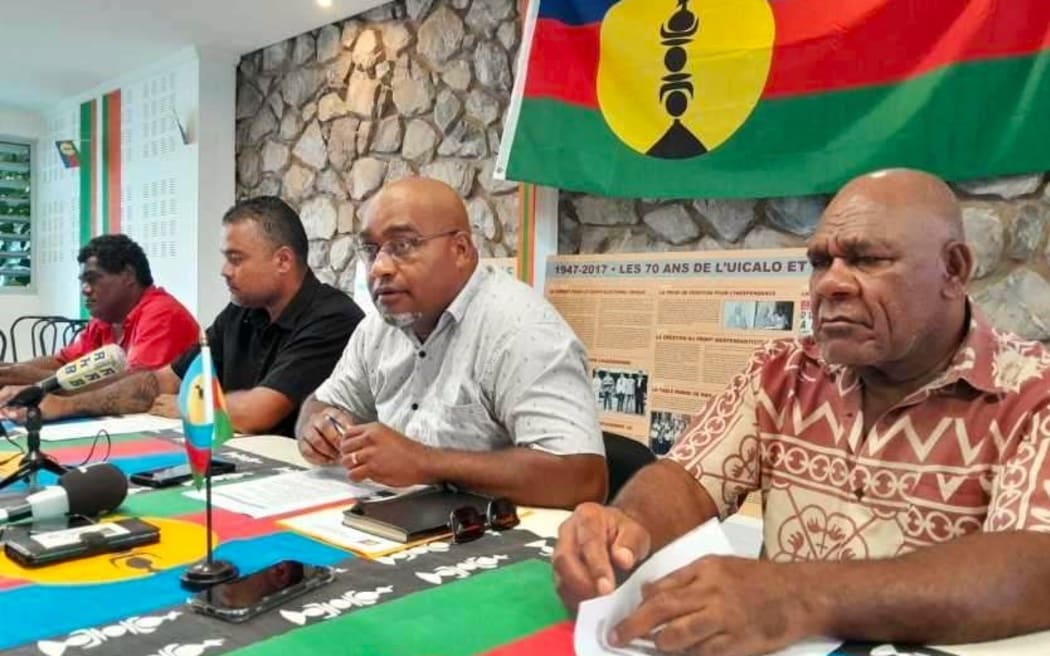
CCAT spokesman Christian Téin, Arnaud Chollet-Leakava (MOI), Dominique Fochi (UC) and Sylvain Boiguivie (Dus) during a press conference on Thursday at the Union Calédonienne headquarters. Image: LNC
Tight security to avoid a clash New Caledonia’s Southern Province vice-president and member of the pro-France party Les Loyalistes, Philippe Blaise, told Radio Rythme Bleu he had been working with security forces to ensure the two opposing marches would not come close at any stage.
“It will not be a long march, because we are aware that there will be families and old people,” he said.
“But we are not disclosing the itinerary because we don’t want to give bad ideas to people who would like to come close to our march with banners and whatnot.
“There won’t be any speech either. But there will be an important security setup,” he reassured.
Earlier this week, security forces intervened to lift roadblocks set up by pro-independence militants near Nouméa, in the village of Saint-Louis, a historical pro-independence stronghold.
The clash involved about 50 security forces against militants.
Tear gas, and stones Teargas and stones were exchanged and firearm shots were also heard.
On March 28, the two opposing sides also held two marches in downtown Nouméa, with tens of thousands of participants.
No incident was reported.
The UC-revived CCAT (Field Actions Coordination Cell, cellule de coordination des actions de terrain), which is again organising today’s pro-independence march to oppose the French Constitutional change, earlier this month threatened to boycott this year’s planned provincial elections.
CCAT head Christian Tein said they were demanding that the French Constitutional amendment be withdrawn altogether, and that a “dialogue mission” be sent from Paris.
“We want to remind (France) we will be there, we’ll bother them until the end, peacefully”, he said.
“Those MPs have decided to kill the Kanak (Indigenous) people . . . this is a programmed extermination so that Kanaks become like (Australia’s) Aborigines,” he told local media.
“Anyone can cause unrest, but to stop it is another story . . . now we are on a slippery slope,” he added.
War of words, images over MPs Pro-France leader Sonia Backès, during a the March 28 demonstration, had also alluded to “causing unrest” from their side and its ability to “make noise” to ensure their voices are heard back in the French Parliament.
“The unrest, it will come from us if someone tries to step on us,” she lashed out at that rally.
“We have to make noise, because unfortunately, the key is the image,” she said.
“But this little message with the ballot box and Eloi Machoro’s picture, this is provocation.
“I am receiving death threats every day; my children too,” she told Radio Rythme Bleu.
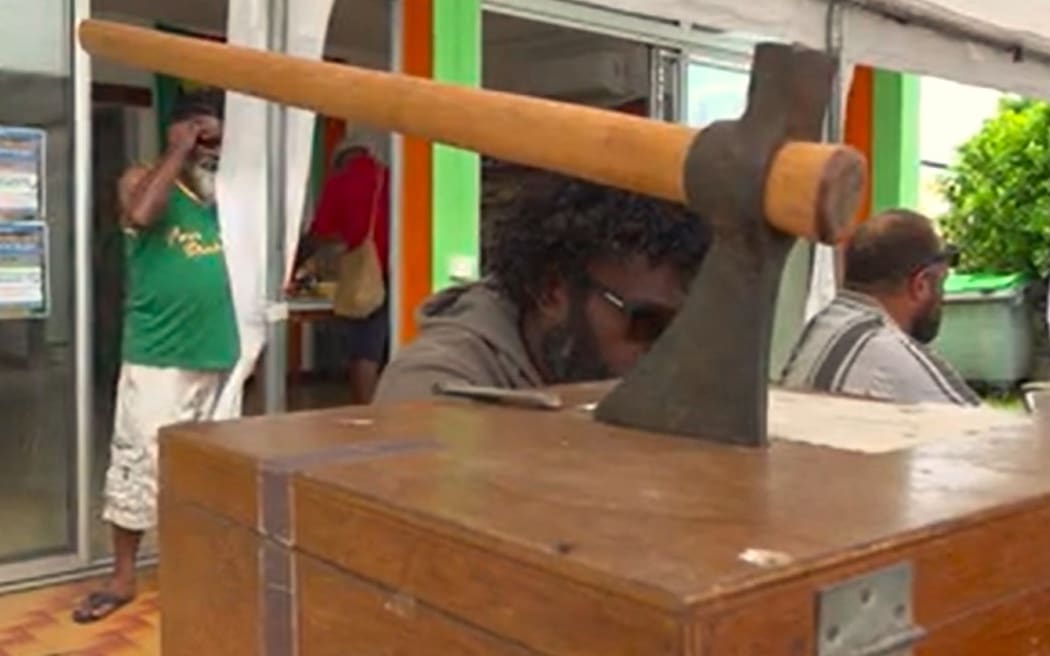
The CCAT movement is placing a hatchet on a ballot box, recalling the Eloi Machoro protest. Image: 1ère TV screenshot APR
Hatchet and ballot box – the ghosts of 1984 During the CCAT’s press conference earlier this month, a ballot box with a hatchet embedded was on show, recalling the famous protest by pro-independence leader Eloi Machoro, who smashed a ballot box with a hatchet to signify the Kanak boycott of the elections on 18 November 1984.
The iconic act was one of the sparks that later plunged New Caledonia in a quasi civil war until the Matignon Accords in 1988. Both pro-France leader Jacques Lafleur and Lanak leader Jean-Marie Tjibaou shook hands to put an end to a stormy period since described as “the events”.
On 12 January 1985, Machoro was shot by French special forces.
The territorial elections day in New Caledonia on 18 November 1984 when Eloi Machoro smashed a ballot box in the small township of Canala. Image: RNZ/File
This article is republished under a community partnership agreement with RNZ.
More videos appear to have been released by the West Papua National Liberation Army (TPNPB) showing New Zealand hostage Phillip Mehrtens.
The New Zealander was taken hostage more than a year ago on February 7 in Paro in the highlands of the Indonesian-ruled region of West Papua while providing vital air links and supplies to remote communities.
In the recent videos he is seen surrounded by armed men and delivers a statement, saying his “life is at risk” because of air strikes conducted by the Indonesian military.
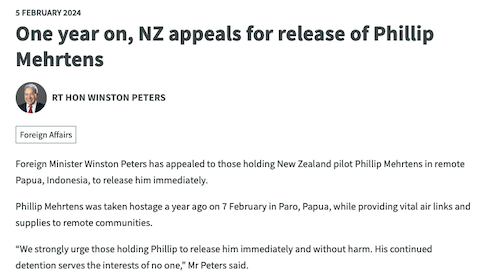
An appeal in February by Foreign Minister Winston Peters for the release of the New Zealand hostage pilot Phillip Mehrtens by his West Papuan rebel captors. Image: NZ govt
He asks Indonesia to cease airstrikes and for foreign governments to pressure Indonesia to not conduct any aerial bombardments.
RNZ has sought comment from the Ministry of Foreign Affairs and Trade.
Peters said his continued detention served no-one’s interests.
In the last year, a wide range of New Zealand government agencies has been working extensively with Indonesian authorities and others towards securing Mehrtens release.
The response, led by the Ministry of Foreign Affairs and Trade, has also been supporting his family.
This article is republished under a community partnership agreement with RNZ.
Facilitated by ABC International Development, and conducted by veteran journalist Scott Waide, the first-of-its-kind training in Papua New Guinea aims to plug the skills gaps identified in the last 10 years, especially with news journalists.
“While we have students graduating from the University of Technology, Divine Word, the Pacific Adventist University and the University of Papua New Guinea, training gaps still remain,” Waide told Lae media after the second day of the weeklong training on Tuesday.
“And some of those gaps are very basic and shouldn’t be that way.
“With the help of ABC, this template was developed and we had to go through the training ourselves.
“A trainer, Chris Kimball, tested it on us and we suggested changes — for local context — and then we took the training and tested it on Chris and all our participants to see if it worked.”
The training includes the definition of public interest journalism, what constitutes public interest, interviewing tips and tools, writing structures, characteristics of a good journalist and the difference between proactive and reactive journalism.
“It seems very basic but if you look at it, the content is very relevant,” said Waide.
“If a person is graduating from another course, another programme in university, and then goes into news journalism; we’ll take him or her through that course and give that person a broad understanding of what news is and what journalism is.
“Particularly in Papua New Guinea, it’s about public interest journalism.
“We can talk about the big things, like politics and economics, but if there’s no understanding of why we’re doing it and why people are important in public interest journalism then that journalism actually becomes useless and worthless.”
Seven Highlands-based NBC presenters and broadcasters are also part of the training, including members of Lae media.
On Friday, March 22, a video circulated of TNI (Indonesian military) soldiers torturing a civilian in Papua. In the video, the victim is submerged in a drum filled with water with his hands tied behind his back.
The victim was alternately beaten and kicked by the TNI members. The victim’s back was also slashed with a knife.
The video circulated quickly and was widely criticised.
Gustav Kawer from the Papua Association of Human Rights Advocates (PAHAM) condemned the incident and called for the perpetrators to be brought to justice.
This was then followed by National Human Rights Commission (Komnas HAM), Indonesian Human Rights Watch (Imparsial), the Diocese, the church and students.
Meanwhile, Cenderawasih/XVII regional military commander (Pangdam) Major-General Izak Pangemanan tried to cover up the crime by saying it was a hoax and the video was a result of “editing”.
This argument was later refuted by the TNI itself and it was proven that TNI soldiers were the ones who had committed the crime. Thirteen soldiers were arrested and accused over the torture.
The torture occurred on 3 February 2024 in Puncak Regency, Papua.
Accused of being ‘spies’ The victim who was seen in the video was Defianus Kogoya, who had been arrested along with Warinus Murib and Alianus Murib. They were arrested and accused of being “spies” for the West Papua National Liberation Army-Free Papua Organisation (TPNPB-OPM), a cheap accusation which the TNI and police were subsequently unable to prove.
Indonesia human rights: 13 soldiers arrested after torture video. Video: Al Jazeera
The three were arrested when the TNI was conducting a search in Amukia and Gome district. When Warinus was arrested, his legs were tied to a car and he was dragged for one kilometre, before finally being tortured.
Alianus, meanwhile ,was also taken to a TNI post and tortured. After several hours, they were finally handed over to a police post because there was not enough evidence to prove the TNI’s accusations.
Defianus finally fainted, while Warinus died of his injuries. Warinus’ body was cremated by the family the next day on February 4.
Defianus is still suffering and remains seriously ill. This is a TNI crime in Papua.
But that is not all. On 22 February 2022, the TNI also tortured seven children in Sinak district, Puncak. The seven children were Deson Murib, Makilon Tabuni, Pingki Wanimbo, Waiten Murib, Aton Murib, Elison Murib and Murtal Kurua.
Makilon Tabuni died as a result.
Civilians murdered, mutilated On August 22, the TNI murdered and mutilated four civilians in Timika. They were Arnold Lokbere, Irian Nirigi, Lemaniel Nirigi and Atis Tini.
The bodies of the four were dismembered: the head, body and legs were separated into several parts, put in sacks then thrown into a river.
Six days later, soldiers from the Infantry Raider Battalion 600/Modang tortured four civilians in Mappi regency, Papua. The four were Amsal P Yimsimem, Korbinus Yamin, Lodefius Tikamtahae and Saferius Yame.
They were tortured for three hours and suffered injuries all over their bodies.
Three days later, on August 30, the TNI again tortured two civilians named Bruno Amenim Kimko and Yohanis Kanggun in Edera district, Mappi regency. Bruno Amenim died while Yohanis Kanggun suffered serious injuries.
On October 27, three children under the age of 16 were tortured by the TNI in Keerom regency. They were Rahmat Paisel, Bastian Bate and Laurents Kaung. They were tortured using chains, coils of wire and water hoses.
The atrocity occurred in the Yamanai Village, Arso II, Arso district.
On 22 February 2023, TNI personnel from the Navy post in Lantamal X1 Ilwayap tortured two civilians named Albertus Kaize and Daniel Kaize. Albertus Kaize died of his injuries. This crime occurred in Merauke regency, Papua.
95 civilians tortured Between 2018 and 2021, Amnesty International recorded that more than 95 civilians had been tortured and killed by the TNI and the police. These crimes target indigenous Papuans, and the curve continues to rise year by year, ever since Indonesia occupied Papua in 1961.
These crimes were committed one after another without a break, and followed the same pattern. So it can be concluded that these were not the acts of rogue individuals or one or two people as the TNI argues to reduce their crimes to individual acts.
Rather, they are structural (systematic) crimes designed to subdue the Papuan nation, to stop all forms of Papuan resistance for the sake of the exploitation and theft of Papua’s natural resources.
The problems in Papua cannot be solved by increasing the number of police or soldiers. The problems in Papua must be resolved democratically.
This democratic solution must include establishing a human rights court for all perpetrators of crimes in Papua since the 1960s, and not just the perpetrators in the field, but also those responsible in the chain of command.
Only this will break the pattern of crimes that are occurring and provide justice for the Papuan people. A human rights court will also mean weakening the anti-democratic forces that exist in Indonesia and Papua — namely military(ism).
Garbage of history A prerequisite for achieving democratisation is to eliminate the old forces, the garbage of history.
The cleaner the process is carried out, the broader and deeper the democracy that can be achieved. This also includes the demands of the Papuan people to be given the right to determine their own destiny.
This is not a task for some later day, but is the task of the Papuan people today. Nor is the task of the United Liberation Movement for West Papua (ULMWP) political elite or political activists alone, but it is the task of all Papuan people if they want to extract themselves from the crimes of the TNI and police or Indonesian colonialism.
Independence can only be gained by the struggle of the ordinary people themselves. The people must fight, the people must take to the streets, the people must build their own ranks, their own alternative political tool, and fight in an organised and guided manner.
Sharon Muller is a leading member of the Socialist Union (Perserikatan Sosialis, PS) and a member of the Socialist Study Circle (Lingkar Studi Sosialis, LSS). Arah Juang is the newspaper of the Socialist Union.
References Gemima Harvey’s report The Human Tragedy of West Papua, 15 January 2014. This reports states that more than 500,000 West Papua people have been slaughtered by Indonesia and its actors, the TNI and police since 1961.
Veronica Koman’s chronology of torture of civilians in Papua. Posted on the Veronica Koman Facebook wall, 24 March 2024.
Among the critics emerging to find fault with Anthony Albanese’s interventionist industry policy, the one who gave the most damaging prick to the Prime Ministerial balloon was Danielle Wood, the new head of the Productivity Commission,
Wood, former chief of the Grattan Institute, a policy think tank, made extensive comments to the Australian Financial Review and The Australian on Thursday, the day of the PM’s speech.
She said that while the government was responding to a changing world (a point stressed by Albanese), “we shouldn’t pretend … that this is going to be costless”.
“If we are supporting industries that don’t have a long-term competitive advantage, that can be an ongoing cost,” she said. It meant workers and capital were diverted from other parts of the economy.
“We risk creating a class of businesses that is reliant on government subsidies, and that can be very effective in coming back for more.” An “exit strategy” was needed, where support was stepped back from or at least reviewed.
The Productivity Commission is well known for its free market approach. In that sense, the views of its current head were not just unexceptional but the sort of thing someone in the role would likely say. The commission, there to give advice to the government, is (up to a point) independent.
But two factors made Wood’s contribution both surprising and potent. She had been appointed by Treasurer Jim Chalmers. And she was being very forthright, immediately after its launch, about what is a major government economic and political initiative.
Where it can’t manage the messages the Albanese government likes to be able to anticipate where the counter-messages will come from.
It was blindsided by the Wood critique – not least because it was before the full detail of the policy, centred on a yet-to-be-released Future Made in Australia Act, are known.
While Wood going public might have been unexpected, the substance of what she said was not. Everything she’s argued in the past would have led you to think she wouldn’t be a fan of the Albanese policy.
By her strong comments, Wood has sent a clear signal that she is determined, on occasion, to have a public voice in the economic debate. That can only be a good thing.
Former treasurer and current ALP president Wayne Swan fired off a salvo, telling morning TV Wood was “completely out of touch with the international reality”. Swan said: “We need energy independence and to do that, we’ve got to make up for a lost decade”.
Chalmers held his tongue. He and Wood get on well personally. When he does publicly respond, you can be sure he’ll be a lot more diplomatic than his old boss Swan.
Chalmers, for all that he might be uncomfortable that Wood has spoken out, will know her remarks contain some significant warnings.
With the new interventionism the government is embarking on a risky (and expensive) strategy. It will be vital the policy, when fleshed out, contains whatever safeguards can be mustered to ensure if wrong decisions on support are made, they are spotted early and there is, indeed, an “exit strategy”. One of the prime dangers in interventionism is that it become a rort for the rent seekers.
Wood’s advice is important, even if it was delivered inconveniently for the government through a megaphone.
Michelle Grattan does not work for, consult, own shares in or receive funding from any company or organisation that would benefit from this article, and has disclosed no relevant affiliations beyond their academic appointment.
Among the critics emerging to find fault with Anthony Albanese’s interventionist industry policy, the one who gave the most damaging prick to the Prime Ministerial balloon was Danielle Wood, the new head of the Productivity Commission,
Wood, former chief of the Grattan Institute, a policy think tank, made extensive comments to the Australian Financial Review and The Australian on Thursday, the day of the PM’s speech.
She told the AFR that while the government was responding to a changing world (a point stressed by Albanese), “we shouldn’t pretend … that this is going to be costless”.
“If we are supporting industries that don’t have a long-term competitive advantage, that can be an ongoing cost,” she said. It meant workers and capital were diverted from other parts of the economy.
“We risk creating a class of businesses that is reliant on government subsidies, and that can be very effective in coming back for more.” An exit strategy was needed, where support was stepped back from or at least reviewed.
The Productivity Commission is well known for its free market approach. In that sense, the views of its current head were not just unexceptional but the sort of thing someone in the role would likely say. The commission, there to give advice to the government, is (up to a point) independent.
But two factors made Wood’s contribution both surprising and potent. She had been appointed by Treasurer Jim Chalmers. And she was being very forthright, immediately after its launch, about what is a major government economic and political initiative.
Where it can’t manage the messages the Albanese government likes to be able to anticipate where the counter-messages will come from.
It was blindsided by the Wood critique – not least because it was before the full detail of the policy, centred on a yet-to-be-released Future Made in Australia Act, are known.
While Wood going public might have been unexpected, the substance of what she said was not. Everything she’s argued in the past would have led you to think she wouldn’t be a fan of the Albanese policy.
By her strong comments, Wood has sent a clear signal that she is determined, on occasion, to have a public voice in the economic debate. That can only be a good thing.
Former treasurer and current ALP president Wayne Swan fired off a salvo, telling morning TV Wood was “completely out of touch with the international reality”. Swan said: “We need energy independence and to do that, we’ve got to make up for a lost decade”.
Chalmers held his tongue. He and Wood get on well personally. When he does publicly respond, you can be sure he’ll be a lot more diplomatic than his old boss Swan.
Chalmers, for all that he might be uncomfortable that Wood has spoken out, will know her remarks contain some significant warnings.
With the new interventionism the government is embarking on a risky (and expensive) strategy. It will be vital the policy, when fleshed out, contains whatever safeguards can be mustered to ensure if wrong decisions on support are made, they are spotted early and there is, indeed, an “exit strategy”. One of the prime dangers in interventionism is that it become a rort for the rent seekers.
Wood’s advice is important, even if it was delivered inconveniently for the government through a megaphone.
Michelle Grattan does not work for, consult, own shares in or receive funding from any company or organisation that would benefit from this article, and has disclosed no relevant affiliations beyond their academic appointment.
We all know about the carbon in Earth’s atmosphere, and probably about the carbon contained in plants and the bodies of animals. But a substantial fraction of the carbon in the planet’s land-based ecosystems is held in something so obvious we might overlook it: soil.
Even if we do think about carbon in soil, we are usually thinking of carbon in organic matter in the soil, such as plant litter, bacteria or animal waste. However, the inorganic, mineral component of soil also contains carbon.
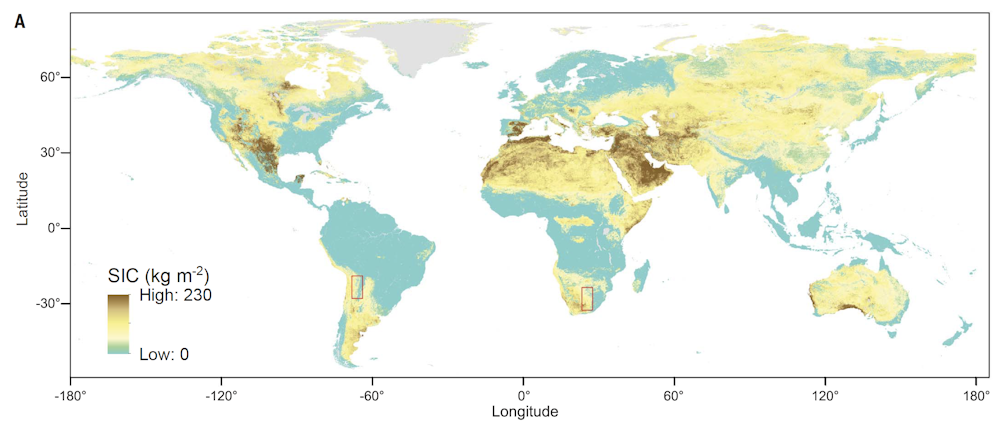
In a new study just published in Science, we show there is much more soil inorganic carbon than anybody realised – and that it may be a surprisingly big player in Earth’s carbon cycle.
We analysed more than 200,000 soil measurements from around the world to calculate that the top two metres of soil globally holds about 2.3 trillion tonnes of inorganic carbon. We estimate some 23 billion tonnes of this carbon may be released over the next 30 years, with poorly understood effects on Earth’s lands, waters and atmosphere.
What is soil inorganic carbon?
Inorganic carbon exists in soils in various forms. It can be trapped carbon dioxide gas, dissolved in water or other liquids, or it can be in solid form as carbonate minerals.
Most of the inorganic carbon by weight is solid carbonates, often calcium carbonate (a common substance found in materials such as limestone, marble and chalk). They give soil a whitish look, while organic carbon makes it dark.
Soil carbonates can come either from weathering of rocks or from the reaction of soil minerals with atmospheric carbon dioxide.
Inorganic carbon tends to build up more in soil in arid and semi-arid environments such as Australia. That’s because when water runs through soil it tends to carry away some of the carbonates with it.
Our estimates show the top two metres of Australia’s soil harbours some 160 billion tonnes of inorganic carbon. This makes Australia home to the fifth-largest pool of soil inorganic carbon in the world.
In wetter regions, soil carbonates may also be found along rivers and around lakes and coastal areas, in the form of calcium-rich alluvial deposits or calcareous rocks. Soils in karst regions – areas rich in rocks like limestone, and often characterised by caves and sinkholes – typically contain carbonate in rocks. In areas such as central Asia large deposits of wind-blown sediments (loess) contribute to the accumulation of carbonate minerals.
Why should we care?
This huge pool of carbon is affected by changes in the environment, especially soil acidification. Acids dissolve calcium carbonate, meaning the carbon dissolves in water or is released as carbon dioxide gas.
Soil in many regions of the globe (such as China and India) is becoming more acidic due to acid rain and other pollution from industrial activities and intense farming.
Scientists have viewed carbonates in soil as a relatively stable pool of carbon that changes only slowly over time. However, human activities have made soil inorganic carbon more mobile.
Irrigation and fertilisation of farmland speed up the rate at which soil inorganic carbon is dissolved and leaches out of the soil.
Inorganic carbon has accumulated in soil over vast periods of Earth’s history. Disturbances to this carbon will have a profound impact on soil health.
Disruption to this carbon compromises soil’s ability to neutralise acidity, regulate nutrient levels, foster plant growth, and stabilise organic carbon. Not only does soil inorganic carbon act as a store of carbon, it also supports soil’s many crucial functions in ecosystems.
In our research, we found that 1.13 billion tonnes of inorganic carbon are lost from soils each year to inland waters. This loss has profound yet often overlooked effects on carbon transport between the land, freshwater bodies, the atmosphere and the oceans.
What to do?
There is a growing recognition of the importance of soil carbon as a fundamental part of nature-based solutions to combat climate change. However, much of the focus so far has been on organic carbon. Our research shows inorganic carbon warrants equal attention.
Improved land practices can reduce disturbance to the global pool of soil inorganic carbon, and may even be able to make it bigger. In agriculture, making irrigation and fertilisation better adjusted to plant growth needs can reduce impact on inorganic carbon. In some soils, organic amendments such as compost and manure can protect against acidification, improve calcium levels and increase soil inorganic carbon.
Our research shows efforts to mitigate climate change by sequestering carbon in soil must incorporate inorganic carbon as well as organic.
Inorganic carbon in soil is linked to global changes such as climate change, industrial pollution and soil overuse in different ways from those of organic carbon. However, some strategies to lock up more carbon in soil – such as enhanced rock weathering, afforestation, and trapping organic carbon in soil minerals – might also serve to increase levels of inorganic carbon.
There are already international soil carbon programs like the 4 per mille initiative, which aims to increase soil carbon storage by 0.4% annually across the globe. These efforts could further increase their ambition by considering the critical role of inorganic carbon in achieving sustainable soil management and reaching climate targets.
Pep Canadell receives funding from the National Environmental Science Program – Climate Systems Hub
Yingping Wang receives funding from a GHG project from the Department of Climate Change, Energy, and Water.
Yuanyuan Huang does not work for, consult, own shares in or receive funding from any company or organisation that would benefit from this article, and has disclosed no relevant affiliations beyond their academic appointment.
Cooler temperatures are fading our memories of summer and reducing numbers of mosquitoes in southern parts of Australia. But up north, warmer temperatures and plenty of rain will keep mosquitoes active.
While their bites are annoying, more concerning is the diseases mosquitoes carry. Health authorities have recently warned local communities and travellers heading to the Kimberley and Pilbara regions of Western Australia to be vigilant to the risk of one particular mosquito-borne infection – Murray Valley encephalitis.
Which mosquito-borne diseases are a risk?
Australia is fortunate to be generally free of many of the world’s most dangerous mosquito-borne diseases.
Each year globally, malaria can cause hundreds of thousands of deaths and dengue infects hundreds of millions of people. While these two diseases aren’t a high risk in Australia, we do have a number of viruses spread by mosquitoes that can cause severe and potentially fatal illness.
Thousands of Australians are infected with Ross River or Barmah Forest virus each year, and while these diseases aren’t fatal, they can be debilitating. Symptoms can include fever, rash, joint pain and fatigue.
In recent years, we’ve seen increased activity of the Murray Valley encephalitis virus and the closely related Kunjin virus. This is due to explosions in mosquito numbers as a result of persistent flooding.
New mosquito-borne viruses have emerged in Australia, with widespread activity of Japanese encephalitis virus in southern regions of Australia recorded for the first time in 2021–22. This had significant impacts on human health, as well as economic consequences for the pork industry due to the reproductive losses resulting from infected pigs. The Australian government declared a communicable disease incident of national significance.
Mosquitoes carry a variety of diseases. Cameron Webb (NSW Health Pathology)
Why is Murray Valley encephalitis so dangerous?
Murray Valley encephalitis virus is one of the most dangerous pathogens spread by mosquitoes in Australia. The virus belongs to the flavivirus family alongside Japanese encephalitis, dengue, yellow fever and West Nile viruses; the most important mosquito-borne viruses on the planet.
The virus is only spread by mosquito bite (it doesn’t spread from person to person). Mosquitoes, most notably a common Australian species Culex annulirostris, transmit the virus to humans. This species is found in freshwater habitats and acquires the virus from biting a waterbird.
Most people infected don’t get sick – perhaps as few as one in 1,000 develop symptoms. For those who do, these can range from fever and headache to paralysis and encephalitis (swelling of the brain).
Symptoms are variable but fatality rates for people with symptomatic disease can be up to 30%, with up to 50% of people experiencing permanent neurological complications requiring life-long medical care.
From Australian X disease to Murray Valley encephalitis
While Murray Valley encephalitis virus can be found in many parts of Australia, outbreaks in south-eastern Australia have caused the most concern, especially throughout the Murray Darling Basin region, due to the high human population. That said, activity in other regions is still a worry.
The virus is thought to have been causing an illness known as “Australian X disease” since at least the early 1900s. The most significant outbreak was in 1974, resulting in 58 cases.
During the summer of 2022–23, the virus was detected in mosquito and sentinel chicken surveillance programs in NSW, Victoria and South Australia. A total of 26 human cases were reported across Australia in 2023 after only a handful of cases since 2011, which saw 16 cases.
There’s been no evidence that Murray Valley encephalitis virus is present along the east coast of Australia. Activity of the virus is generally limited to regions west of the Great Dividing Range.
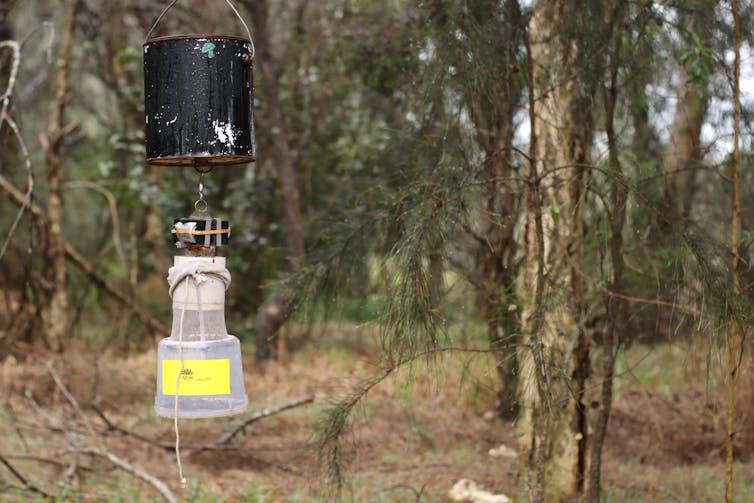
Health authorities across Australia use mosquito traps to help monitor viruses such as Murray Valley encephalitis. Cameron Webb (NSW Health Pathology)
What about northern Australia?
Murray Valley encephalitis is considered endemic in northern Australia. It’s detected almost every year in health surveillance programs in WA and the Northern Territory.
Human cases occur too. Although fewer people live in these regions, northern Australia (including tourists visiting the area) has accounted for most cases of Murray Valley encephalitis over the past 30 years.
Surveillance is critical to provide an early warning of elevated outbreak risk. In the north of WA, health authorities have detected Murray Valley encephalitis virus in local mosquito populations and their sentinel chicken surveillance program. This prompted the recent warnings for the Kimberley and Pilbara regions.
However, no cases of human infection have been reported this year.
How can the community and travellers protect themselves?
While activity of Murray Valley encephalitis virus across northern Australia should be expected every year, the recent warnings are a reminder of the potential health risk associated with mosquitoes.
With no vaccination available for Murray Valley encephalitis – and no cure – the only way to prevent becoming infected is to avoid mosquito bites. Wearing light, loose-fitting clothing, avoiding peak mosquito activity times around dawn or dusk, and using a suitable insect repellent containing DEET, picaridin or oil of lemon eucalyptus are effective ways to help prevent bites.
Andrew Jardine and Jay Nicholson from the Department of Health, Western Australia, contributed expert advice to this article.
Cameron Webb and the Department of Medical Entomology, NSW Health Pathology, have been engaged by a wide range of insect repellent and insecticide manufacturers to provide testing of products and provide expert advice on mosquito biology. Cameron has also received funding from local, state and federal agencies to undertake research into mosquito-borne disease surveillance and management.
It has been a big few weeks in the Australian live music scene. The cancellations of major festivals Groovin’ the Moo and Splendour in the Grass have ushered in a stream of news reports about the challenges affecting live music, and how current economies are making the sector unsustainable.
So far the focus has largely been on the big festival market. But I contend that without a healthy and sustainable grassroots economy, we can’t make a quality live music industry in Australia. The first step towards achieving this is bringing confidence back.
Presumably, the federal inquiry into Australia’s live music industry, announced just two days before Splendour in the Grass was cancelled, will aim for better governance of the sector, including at the grassroots.
According to John Wardle of the Live Music Office, local industries “have faced a range of continuing challenges for decades”. Wardle says local arts and cultural planning, urban renewal and government funding aren’t keeping pace with each other:
There are some good planning instruments available, such as zoning special entertainment precincts, but they aren’t being deployed to the degree in which they might.
A report by Creative Australia, based on a 2022 survey, indicates something shifted in Australia’s arts sector when COVID hit. For instance, while 97% of Australians said they engaged with the arts, and more than half (68%) attended live events, this attendance was less frequent than in pre-COVID times.
Another report released this week by the arts body found just 56% of Australian music festivals in the last financial year made a profit, citing impact from factors such as rising costs of insurance and policing.
We have reached a breaking point in the music industry and there needs to be a concerted effort to reorganise it.
Some argue what we’re seeing is a “market failure” – too many festivals, poor programming, high costs and low confidence – and is therefore a problem for businesses to repair. But the overwhelming public interest in this issue demonstrates just how important live music is to the fabric of our culture.
A collapse in market confidence
The live music sector has become increasingly disconnected from its customers. Audiences have evolved in what they want and expect from live music, while also discovering less complicated ways to be entertained. The industry must evolve with them if it wants to thrive.
Emerging and mid-tier artists all over Australia currently work in venues whose core business is “live music”, yet it’s common for musicians to be booked to play with no guaranteed income.
Araminta, 22, is an independent artist from Naarm (Melbourne) who regularly performs at venues across the city. She told me venues expected her to organise 100% of event promotion and ticket sales:
The venues almost act as hire-spaces rather than working together with artists to ensure a good turnout. We are all working two to three jobs to make ends meet and on top of that we treat our artistry like a full-time job.
Araminta is a folk-pop fusion singer and songwriter. Facebook/Araminta
If the confidence returns, so will the gigs
In 2024, it’s unethical for a three-piece band working in a professional live music venue to only be offered a percentage of the bar takings as payment, yet this happens.
One outcome from the inquiry could be a pilot program that financially and organisationally supports quality, ethical and sustainable live music business models. And this would ideally be done with an eye to creating self-sustaining venues and music models that can be replicated across cities and towns.
The sector should work with governments to develop artists, champion their value and pay them accordingly. There should also be incentives offered for venues that don’t exploit music creators’ work, or rely solely on gambling and alcohol sales to be sustainable.
Araminta says setting a standard minimum rate for venues to pay musicians would make a notable difference:
The main reason artists are hesitant to gig recently is the amount of profit uncertainty – especially artists that are independent without any financial assistance.
Making the most of the inquiry
The terms of reference for the federal inquiry indicate a thorough and holistic approach to improving the sector. This means addressing issues at every level, from local artist development and economic benefit, to sustainability and growth internationally.
In covering this much ground, it will be a challenge to not spread the outcomes too thinly, or focus on short-term fixes rather than meaningful long-term reform.
Wardle cautions that unless we see an increase in jobs for musicians offering fair pay and conditions, more big announcements simply won’t stack up:
Ensuring the voices across the sector are listened to is critical to guide priorities and investment. I’d like to see more artists’ voices and representative opportunities, and structures that ensure that people aren’t excluded because of their cultural background or the type of music they play.
The industry must guarantee the quality of its product and provide safe, accessible and valuable experiences for both customers and musicians. Once audiences and musicians come running, word of mouth will do much of the heavy lifting, and investors will follow suit.
Rod Davies is affiliated with the Media, Entertainment and Arts Alliance
Australia is a trading nation. Its economy relies on a strong and open global trade environment.
Australian governments have historically rejected protectionist industrial policies that undermine fair competition, and Canberra has long been a staunch advocate of the World Trade Organization, whose rules help “promote and protect the open global trading system”.
Yet Labor has just announced a major new industrial policy – the Future Made in Australia Act – that will break with Canberra’s historical aversion to large-scale economic intervention. It will also cost taxpayers billions to fund.
Prime Minister Anthony Albanese’s rationale for doing so is as succinct as it is paradoxical:
This is not old-fashioned protectionism or isolationism – it is the new competition … we must recognise that the partners we seek are moving to the beat of a new economic reality.
What is this “new reality”, and what does it mean for Australia’s economic future?
Australia joins the “geoeconomic game”
With this announcement, Australia has joined the great “geoeconomic game” currently transforming the world economy.
In a geoeconomic world economy, nations use economic relations as tools to achieve their strategic goals.
This could include coercing a country to change its policies by blocking their imports, as China has done to Australia. Or using export controls to prevent advanced technology reaching a strategic geopolitical rival, as the United States has applied to China to limit the flow of advanced semiconductors.
Under these conditions, relations between countries shift from win-win to zero-sum. The resulting risks and vulnerabilities can be leveraged by geopolitical foes. Growing concern over this shift is driving economic “ghettoisation” – countries that were already on friendly terms are trading more between themselves, and with those on less friendly terms, trading less.
Australia has already been participating in “friend-shoring” – the relocation of crucial supply chains to diplomatically friendlier countries.
New policies for a new business reality
Some countries have already established policies in recognition of the new realities of international business, speeding up the formation of these blocs.
Two major recent policies by the US – the Inflation Reduction Act and the CHIPS Act – aim to boost US electric vehicle and semiconductor manufacturing, respectively, with hundreds of billions of dollars in new government spending.
Japan is also spending big to bring more semiconductor production onshore.
These policies have also attracted vast sums of new private investment in relevant “strategic sectors” – totalling more than half a trillion dollars in the US alone.
Levelling the playing field or distorting the market?
This new economic approach by Washington and Tokyo almost certainly breaches the World Trade Organization’s rules, because it discriminates in determining who can access funds and where things have to be made.
China has already launched a dispute against the US Inflation Reduction Act on these very grounds. But China itself is also the biggest user of industrial policy by far.
On one hand, the new US and Japanese industrial policies will distort global markets, but – returning to Albanese’s “new competition” paradox – level the playing field on the other.
Jakarta applied an export ban – illegal under World Trade Organization rules – on unprocessed nickel in 2020, while attracting investment from China, where state-owned enterprises can access subsidised financing.
Combined with poor environmental and labour standards during production, the effect was extremely low-cost Indonesian nickel, which undercut global prices. As a result, some Australian mines could face closure.
This situation was not the product of free markets, but rather of state intervention. Canberra needs its own plan to counter such policies.
How should business leaders respond?
We still don’t know the full details of Labor’s strategy. But if the act is anything like Washington’s policies, it will aim to boost Australian firms with protectionist and discriminatory provisions. Awkwardly, this could well be in breach of the international trade rules Canberra has staunchly defended for so long.
Levelling the playing field implies sweeping changes in the dynamics of international commerce, with implications for Australian businesses, consumers and government.
In formulating strategy, Australian business leaders will increasingly need to think geopolitically. The world is no longer one big open economy.
Australian industries will certainly get a shot in the arm from Labor’s new policy.
There will be more downstream value-add processing in areas of existing strength, such as critical minerals.
Major investments in solar manufacturing will benefit regional Australia. These and other strategic sectors will enjoy higher levels of government support. But many non-strategic sectors could be left behind, facing new geoeconomic costs without extra funding.
For consumers, the era of getting the most competitively priced goods on the global market is coming to a close.
As the global economy fragments, Australians will have to pay more for the duplication of global supply chains, and additional costs of subsidised production.
However, they may also see better supply chain security, and a domestic jobs boom in advanced manufacturing. Governments and businesses can work to reduce the risk of any economic coercion effects.
Much like the Old Testament principle of an “eye for an eye”, the principle of a “tariff for a tariff” is foundational in international trade. As Australia joins the geoeconomic game, pressure will mount on countries not yet playing to join in, simply to stay competitive. Trade and industry measures will continue to proliferate globally, reinforcing the new dynamics of geoeconomic competition.
The Albanese government faces great risks in implementing its new industrial strategy. Yet in taking action, it may have avoided a much greater risk – doing nothing at all in the face of a historic global economic change.
Naoise McDonagh does not work for, consult, own shares in or receive funding from any company or organisation that would benefit from this article, and has disclosed no relevant affiliations beyond their academic appointment.
Around the world, the human rights of transgender people are under attack. Media reports of trans women being vilified, excluded and discriminated against are frequent, and the consequences of this rise in hatred towards trans people can be deadly.
In the United States, animosity towards trans people is reaching fever pitch with 42 of the 50 states introducing laws that seek to limit trans people’s access to healthcare, participation in sport, use of bathrooms and serving in the military, as well as censoring education about gender identity.
There is increasing concern that a US-style anti-trans campaign is underway in Australia. This week, a spotlight was shone on these issues in the Federal Court, where a trans woman, Roxanne Tickle, has taken a women-only social media platform to court for discrimination.
This case is providing the court with a rare opportunity to determine the extent to which the Sex Discrimination Act protects a trans woman from discrimination on the basis of their gender identity. Although the act was amended more than a decade ago to prohibit discrimination on such a basis, this is the first time these laws are being tested in court.
it is unlawful for a person who, whether for payment or not, provides goods or services, or makes facilities available, to discriminate against another person on the ground of the other person’s sex, sexual orientation, gender identity, intersex status, marital or relationship status, pregnancy or potential pregnancy, or breastfeeding […]
Tickle is asking the Federal Court to find that excluding her from the social networking app, Giggle for Girls, breached this section and another in the Sex Discrimination Act.
Tickle, whose birth certificate designates her sex as female, following her transition from male to female, downloaded the app, which is marketed as a platform exclusively for women to share experiences and speak freely in a “safe space”.
To access the app, Tickle had to upload a selfie. Artificial intelligence (AI) assessed the photo as being of a woman and Tickle was given access to the app.
However, seven months later, the chief executive of Giggle for Girls, Sally Grover, blocked Tickle from using the app on the basis that she was male. She stated:
I looked at the onboarding selfie and I saw a man. The Al software had let them through, thereby making a mistake that I rectified.
What legal issues are up for debate?
The case highlights the distinction between sex discrimination and gender identity discrimination.
“Sex” is not defined in the Sex Discrimination Act. It is a term that is used to refer to whether a person is male, female or another non-binary status. It is assigned at birth according to biological attributes that are primarily associated with physical and physiological features.
Although some people don’t agree, a person’s sex is not fixed and can be changed, as reflected in the language of section 32I of the NSW Births, Deaths and Marriages Registration Act. It states:
a person the record of whose sex is altered under this Part is, for the purposes of, but subject to, any law of New South Wales, a person of the sex as so altered.
Grover evidently sees a person’s sex as immutable. Tickle’s barrister put it to Grover that “a transgender woman who had a female birth certificate, hormone therapy, breasts, gender affirmation surgery, wore makeup and women’s clothes, had a woman’s hairstyle and used women’s facilities, […] is a woman in our society.” Grover replied “I don’t agree”.
Gender refers to a person’s personal and social identity; how they feel, present and are recognised within the community. It is a social construct, and varies between cultures.
A person’s gender may be reflected in outward social markers, including their name, outward appearance, mannerisms and dress. A trans person’s gender identity does not correspond with the gender expected of them by society, given the sex assigned to them at birth.
Tickle’s claim is that she was discriminated against on the basis of her gender identity. She asserts that she was treated less favourably than cisgender women (women whose gender identity corresponds with their sex assigned at birth), because of her gender identity. That is, because she is a trans woman.
Giggle for Girls and Grover are defending the proceedings on the basis their refusal to allow Tickle to use the app constituted lawful sex discrimination.
They say the app counts as a “special measure” under a different section of the Sex Discrimination Act, because it helps advance equality between men and women, and therefore they are allowed to exclude men. Since Grover perceives Tickle to be a man, she submits that excluding Tickle from the app was lawful as a special measure.
These arguments are contrary to the submissions made to the court by the Sex Discrimination Commissioner Anna Cody, who, as a “friend of the court”, was permitted to make submissions about how the act should be interpreted.
the Court need only conclude that, for a person to be of the female “sex”, it is sufficient if that sex is recorded on the person’s birth certificate and/or they have undergone gender affirming surgery to affirm their status as female.
That is the case for Tickle.
Cody also noted the Sex Discrimination Act was amended to prohibit discrimination on the basis of gender identity, to provide “maximum protection for gender diverse people”.
The evidence, as reported, suggests Tickle, as a trans woman, was treated differently to how the respondents treated people with a different gender identity, namely cisgender women. This is contrary to purpose of the act.
We will await the court’s decision with interest. Depending on the outcome, we may see Australia going down a very different path to the anti-trans trajectory the US is currently on.
Paula Gerber is Chair of Kaleidoscope Human Rights Foundation, a not-for-profit organisation that advocates for the rights of LGBTIQA+ people in the Asia Pacific region.
What is the significance of the Australian government signalling this week that it may finally recognise Palestinian statehood?
Though not universally popular, Foreign Minister Penny Wong’s diplomatic gesture towards Palestinian statehood has been welcomed in some quarters as a departure from Australia’s longstanding bipartisan consensus on the Middle East.
Formerly reluctant to interfere in the affairs of other nations, many countries have become frustrated by the lack of progress on a resolution to the decades-old question of Palestine and are moving to unilateral recognition of its statehood.
Why has this issue been so contentious for so long in Australia, and what could
its recognition of Palestinian statehood mean?
Australia’s role in the creation of Israel
Australia played a key role in preparing the groundwork for Israeli statehood in the early 20th century.
As a loyal servant of the British empire, the Australian army actively participated in the destruction of the Ottoman empire during the first world war. Battles in which Australian troops played a decisive role – such as the 1917 Charge of the Light Horse Brigade in Beersheba and the Allied capturing of Damascus in 1918 – are remembered in Australian and Israeli history as milestones in the achievement of Israeli statehood.
“Self-determination” was a watchword coined by Leon Trotsky and popularised by US President Woodrow Wilson towards the end of the first world war. However, in the postwar settlement, self-determination was unequally applied.
Zionist claims to self-determination were endorsed by the British government’s Balfour Declaration of 1917. But under the terms of the mandate of Palestine administered by Britain under the new League of Nations charter, indigenous Palestinian Arabs were catalogued among the “peoples not yet able to stand by themselves under the strenuous conditions of the modern world”.
Two decades later, Australia played a key role in the recognition of Israeli statehood at the United Nations. It is now well known that Australian Herbert Vere “Doc” Evatt, who presided over the UN Special Committee on Palestine, was instrumental in garnering international support for the proposed partition of Palestine. Australia was one of the first countries to recognise Israel in 1948.
Herbert Vere Evatt, president of the third regular session of the General Assembly of the United Nations. Wikimedia Commons, CC BY
So, why has it been so difficult for Australia to recognise Palestinian aspirations for statehood?
The emergence of the Palestine Liberation Organisation (PLO) in the 1960s under the leadership of Yasser Arafat thrust the Palestine question back into the spotlight. For mainstream Australian politicians, the PLO was akin to the African National Congress in South Africa, seen at the time as an irredeemable terrorist organisation.
Yet, unlike the bipartisan position later adopted against South African apartheid in Australia during the 1980s, no such revision has come with regard to Israel’s treatment of Palestinians, which manyobservers in Israel and internationally also consider to be apartheid.
One South African observer, Andrew Feinstein, the son of a Holocaust survivor and former colleague of Nelson Mandela, has described Israeli apartheid as “far more brutal than anything we saw in South Africa”.
In recent years, Australian politicians on both sides have recommitted to their unwavering support of Israel. This is part of a broader phenomenon that US historian Ussama Makdisi has described as “philozionism” (or love of Zionism).
While the Rudd-Gillard government repositioned Australia’s relationship with Israel in a more critical light, the country’s politicians soon returned to the former bipartisan consensus around Israel. Prime Minister Anthony Albanese was a cofounder of the Australian Parliamentary Friends of Palestine, though many have observed that his government has resiled from that affiliation. Prime ministers from both sides of the aisle have also had parks in Israel named in their honour.
The Palestine question has been a particularly tortured one for the Labor Party, as illustrated by Australia’s abstention in the 2012 vote at the United Nations to grant Palestinian observer status.
Though hubristic to imagine Australian diplomatic recognition will have any impact on Palestinian lives, the change in position of one of Israel’s historically staunch allies does coincide with a broader shift in the Western consensus.
Following Israel’s bombardment of Gaza during the 2014 Operation Protective Edge, lawmakers in Sweden and the United Kingdom voted to recognise the state of Palestine. These moves had little material impact but carried symbolic value.
Australia’s belated recognition of Palestinian statehood would be a welcome first step. It is the result of decades of grassroots activism by Palestinians and their allies in Australia. However, much work remains to be done if Australia is to be a constructive partner in the meaningful achievement of Palestinian self-determination.
Micaela Sahhar has signed numerous public statements in support of Palestinian self-determination.
Stephen Pascoe has signed numerous public statements in support of Palestinian self-determination.
Australia is a trading nation. Its economy relies on a strong and open global trade environment.
Australian governments have historically rejected protectionist industrial policies that undermine fair competition, and Canberra has long been a staunch advocate of the World Trade Organization, whose rules help “promote and protect the open global trading system”.
Yet Labor has just announced a major new industrial policy – the Future Made in Australia Act – that will break with Canberra’s historical aversion to large-scale economic intervention. It will also cost taxpayers billions to fund.
Prime Minister Anthony Albanese’s rationale for doing so is as succinct as it is paradoxical:
This is not old-fashioned protectionism or isolationism – it is the new competition … we must recognise that the partners we seek are moving to the beat of a new economic reality.
What is this “new reality”, and what does it mean for Australia’s economic future?
Australia joins the “geoeconomic game”
With this announcement, Australia has joined the great “geoeconomic game” currently transforming the world economy.
In a geoeconomic world economy, nations use economic relations as tools to achieve their strategic goals.
This could include coercing a country to change its policies by blocking their imports, as China has done to Australia. Or using export controls to prevent advanced technology reaching a strategic geopolitical rival, as the United States has applied to China to limit the flow of advanced semiconductors.
Under these conditions, relations between countries shift from win-win to zero-sum. The resulting risks and vulnerabilities can be leveraged by geopolitical foes. Growing concern over this shift is driving economic “ghettoisation” – countries that were already on friendly terms are trading more between themselves, and with those on less friendly terms, trading less.
Australia has already been participating in “friend-shoring” – the relocation of crucial supply chains to diplomatically friendlier countries.
New policies for a new business reality
Some countries have already established policies in recognition of the new realities of international business, speeding up the formation of these blocs.
Two major recent policies by the US – the Inflation Reduction Act and the CHIPS Act – aim to boost US electric vehicle and semiconductor manufacturing, respectively, with hundreds of billions of dollars in new government spending.
Japan is also spending big to bring more semiconductor production onshore.
These policies have also attracted vast sums of new private investment in relevant “strategic sectors” – totalling more than half a trillion dollars in the US alone.
Levelling the playing field or distorting the market?
This new economic approach by Washington and Tokyo almost certainly breaches the World Trade Organization’s rules, because it discriminates in determining who can access funds and where things have to be made.
China has already launched a dispute against the US Inflation Reduction Act on these very grounds. But China itself is also the biggest user of industrial policy by far.
On one hand, the new US and Japanese industrial policies will distort global markets, but – returning to Albanese’s “new competition” paradox – level the playing field on the other.
Jakarta applied an export ban – illegal under World Trade Organization rules – on unprocessed nickel in 2020, while attracting investment from China, where state-owned enterprises can access subsidised financing.
Combined with poor environmental and labour standards during production, the effect was extremely low-cost Indonesian nickel, which undercut global prices. As a result, some Australian mines could face closure.
This situation was not the product of free markets, but rather of state intervention. Canberra needs its own plan to counter such policies.
How should business leaders respond?
We still don’t know the full details of Labor’s strategy. But if the act is anything like Washington’s policies, it will aim to boost Australian firms with protectionist and discriminatory provisions. Awkwardly, this could well be in breach of the international trade rules Canberra has staunchly defended for so long.
Levelling the playing field implies sweeping changes in the dynamics of international commerce, with implications for Australian businesses, consumers and government.
In formulating strategy, Australian business leaders will increasingly need to think geopolitically. The world is no longer one big open economy.
Australian industries will certainly get a shot in the arm from Labor’s new policy.
There will be more downstream value-add processing in areas of existing strength, such as critical minerals.
Major investments in solar manufacturing will benefit regional Australia. These and other strategic sectors will enjoy higher levels of government support. But many non-strategic sectors could be left behind, facing new geoeconomic costs without extra funding.
For consumers, the era of getting the most competitively priced goods on the global market is coming to a close.
As the global economy fragments, Australians will have to pay more for the duplication of global supply chains, and additional costs of subsidised production.
However, they may also see better supply chain security, and a domestic jobs boom in advanced manufacturing. Governments and businesses can work to reduce the risk of any economic coercion effects.
Much like the Old Testament principle of an “eye for an eye”, the principle of a “tariff for a tariff” is foundational in international trade. As Australia joins the geoeconomic game, pressure will mount on countries not yet playing to join in, simply to stay competitive. Trade and industry measures will continue to proliferate globally, reinforcing the new dynamics of geoeconomic competition.
The Albanese government faces great risks in implementing its new industrial strategy. Yet in taking action, it may have avoided a much greater risk – doing nothing at all in the face of a historic global economic change.
Naoise McDonagh does not work for, consult, own shares in or receive funding from any company or organisation that would benefit from this article, and has disclosed no relevant affiliations beyond their academic appointment.
A man on Saipan has burned the official CNMI flag in protest, saying that it does not truly represent Indigenous people of the Commonwealth of the Northern Marianas (CNMI).
A public video of the flag-burning was posted by Raymond Quitugua that has stirred various negative reactions within the CNMI community.
Under the CNMI’s constitution, flag-burning is prohibited and those found to have breached the law can face up to one year in jail or fined up to US$500 (NZ$835).
The official CNMI flag . . . disputed by some Chamorro critics. Image: 123rf/RNZ
Quitugua said the true CNMI flag was the initial design presented back in the 1970s that featured a latte stone with a star in the front of it on a field of blue.
The current official flag of the US territory consists of a rectangular field of blue, a white star in the center, superimposed on a gray latte stone, surrounded by the traditional Carolinian mwáár.
But Quitugua claims the official flag does not accurately represent the Indigenous people of the CNMI, which he believes is the Chamorro community (not including the Carolinian community).
He added that he burned the flag as a form of protest and he intended to take the issue to court.
Disappointed, insulted Renowned elder in the CNMI community, Lino Olopai, as well as one of the many champions of the CNMI’s flag, expressed disappointment and insulted by Quitugua’s actions and said that warranted jail time.
Olopai said the basis of the current CNMI flag was indeed the Chamorro flag, but a group of Carolinians that included himself fought to have a mwáár on the flag as a representation of the Carolinian community as they believed they, too, were indigenous people of the CNMI.
He added that Quitugua’s flag-burning is a form of discrimination against the Carolinian community, which like the Chamorros, are the two recognised Indigenous people of the CNMI.
“Stop the racism. We are all part of the Pacific islands,” Olopai said.
“We should maintain peaceful attitude and spirit with one another. Not just between the Chamorro and Carolinian communities, but with other communities across the Pacific,” he said.
In a letter to the editor of the Saipan Tribune, former lawmaker Luis John Castro also criticised Quitugua’s flag-burning, saying there were other more constructive forms of protest.
“If something such as the flag does not jive with your beliefs, OK you don’t have to agree,” he said, adding “but there are many ways to resolve differences other than desecrating a cultural symbol”.
“Conduct an online poll, call into [a radio station] and make it a topic of discussion. Hold a town hall meeting with other concerned citizens, ask a legislator to draft bills or initiative to address its look, or file a certified question with the courts to get an answer to your concerns.
“Why do something like burn the flag? To seek attention? To get likes and shares on Facebook? To incite civil unrest?” he wrote.
This article is republished under a community partnership agreement with RNZ.
Beetroot has been in the news for all the wrong reasons. Supply issues in recent months have seen a shortage of tinned beetroot on Australian supermarket shelves. At one point, a tin was reportedly selling on eBay for more than A$65.
But as supplies increase, we turn our attention to beetroot’s apparent health benefits.
Is beetroot really vegetable Viagra, as UK TV doctor Michael Mosley suggests? What about beetroot’s other apparent health benefits – from reducing your blood pressure to improving your daily workout? Here’s what the science says.
Beetroot – alongside foods such as berries, nuts and leafy greens – is a
“superfood”. It contains above-average levels per gram of certain vitamins and minerals.
Beetroot is particularly rich in vitamin B and C, minerals, fibre and antioxidants.
Most cooking methods don’t significantly alter its antioxidant levels. Pressure cooking does, however, lower levels of carotenoid (a type of antioxidant) compared to raw beetroot.
Processing into capsules, powders, chips or juice may affect beetroot’s ability to act as an antioxidant. However, this can vary between products, including between different brands of beetroot juice.
The Romans are said to have used beetroot and its juice as an aphrodisiac.
But there’s limited scientific evidence to say beetroot improves your sex life. This does not mean it doesn’t. Rather, the vast number of scientific studies looking at the effect of beetroot have not measured libido or other aspects of sexual health.
When we eat beetroot, chemical reactions involving bacteria and enzymes transform the nitrate in beetroot into nitrite, then to nitric oxide. Nitric oxide helps dilate (widen) blood vessels, potentially improving circulation.
The richest sources of dietary nitric oxide that have been tested in clinical studies are beetroot, rocket and spinach.
Nitric oxide is also thought to support testosterone in its role in controlling blood flow before and during sex in men.
Beetroot’s ability to improve blood flow can benefit the circulatory system of the heart and blood vessels. This may positively impact sexual function, theoretically in men and women.
Therefore, it is reasonable to suggest there could be a modest link between beetroot and preparedness for sex, but don’t expect it to transform your sex life.
Beetroot has received increasing attention over recent years due to its antioxidant and anti-tumour effect in humans.
Clinical trials have not verified all beetroot’s active ingredients and their effects. However, beetroot may be a potentially helpful treatment for various health issues related to oxidative stress and inflammation, such as cancer and diabetes. The idea is that you can take beetroot supplements or eat extra beetroot alongside your regular medicines (rather than replace them).
There is evidence beetroot juice can help lower systolic blood pressure (the first number in your blood pressure reading) by 2.73-4.81 mmHg (millimetres of mercury, the standard unit of measuring blood pressure) in people with high blood pressure. Some researchers say this reduction is comparable to the effects seen with certain medications and dietary interventions.
Other research finds even people without high blood pressure (but at risk of it) could benefit.
There is scientific evidence to support positive impacts of consuming beetroot in whole, juice and supplement forms. So even if you can’t get hold of tinned beetroot, there are plenty of other ways you can get more beetroot into your diet. You can try:
raw beetroot – grate raw beetroot and add it to salads or coleslaw, or slice beetroot to use as a crunchy topping for sandwiches or wraps
cooked beetroot – roast beetroot with olive oil, salt and pepper for a flavour packed side dish. Alternatively, steam beetroot and serve it as a standalone dish or mixed into other dishes
beetroot juice – make fresh beetroot juice using a juicer. You can combine it with other fruits and vegetables for added flavour. You can also blend raw or cooked beetroot with water and strain to make a juice
smoothies – add beetroot to your favourite smoothie. It pairs well with fruits such as berries, apples and oranges
soups – use beetroot in soups for both flavour and colour. Borscht is a classic beetroot soup, but you can also experiment with other recipes
pickled beetroot – make pickled beetroot at home, or buy it from the supermarket. This can be a tasty addition to salads or sandwiches
beetroot hummus – blend cooked beetroot into your homemade hummus for a vibrant and nutritious dip. You can also buy beetroot hummus from the supermarket
grilled beetroot – slice beetroot and grill it for a smoky flavour
beetroot chips – slice raw beetroot thinly, toss the slices with olive oil and your favourite seasonings, then bake or dehydrate them to make crispy beetroot chips
cakes and baked goods – add grated beetroot to muffins, cakes, or brownies for a moist and colourful twist.
Compared to the large number of studies on the beneficial effects of beetroot, there is very little evidence of negative side effects.
If you eat large amounts of beetroot, your urine may turn red or purple (called beeturia). But this is generally harmless.
There have been reports in some countries of beetroot-based dietary supplements contaminated with harmful substances, yet we have not seen this reported in Australia.
Beetroot may give some modest boost to sex for men and women, likely by helping your circulation. But it’s unlikely to transform your sex life or act as vegetable Viagra. We know there are many contributing factors to sexual wellbeing. Diet is only one.
Lauren Ball receives funding from the National Health and Medical Research Council, Queensland Health and Mater Misericordia. She is a Director of Dietitians Australia, a Director of the Darling Downs and West Moreton Primary Health Network and an Associate Member of the Australian Academy of Health and Medical Sciences.
Next week, more than 100 green energy, technology, education and finance companies from Australia and Vietnam will gather in Ho Chi Minh City. The meeting is billed as the first “green economy summit” between the two nations.
So what’s on the agenda at this week’s meeting? And what are the prospects for success?
We are in Vietnam for the summit, drawing on our experience in economics, banking and finance to lead sessions on clean technology supply chains and green finance. This is the culmination of nine months of work with Australia’s National Centre for Asia Capability to increase regional prosperity while reducing emissions.
As Albanese has said, “Australia and Vietnam share an ambitious agenda across climate change and sustainability”. And there is “enormous potential to be realised through closer ties” between our two countries.
Both have net zero goals for 2050, both want to develop clean technology industries and minimise supply chain disruption. There are shared challenges around decarbonisation, as large agriculture and manufacturing sectors try to shift away from fossil fuels. And both know our broader Indo-Pacific region is extremely vulnerable to climate change.
Currently, global supply chains for clean energy technology and associated critical minerals are highly concentrated in China, especially for solar panels, wind and batteries. For electrolysers and heat pumps, the United States and the European Union play a larger role. But China still dominates the manufacturing and trade of these technologies.
This concentration of manufacturing in a limited number of countries highlights the need to diversify. As a global trade hub with progressive trade policies, Vietnam has an important role to play here. Vietnam is among the few countries outside China with existing significant solar PV manufacturing capabilities. This includes wafer production, cell manufacturing and module assembly.
Vietnam is well placed to support Australian companies in the green economy. It has policies for attracting green investment, along with an established regional supply chain and market for consumption. Then there’s the increasingly educated and skilled labour force. All will be useful in the commercialisation and scale-up of Australia’s latest solar research, as Australia begins to invest in manufacturing facilities in Vietnam.
Vietnam is also a strong export market for Australia, with the highest rate of solar uptake in Southeast Asia. Australia wants to export more solar panels to Vietnam and therefore compete with China for this export revenue.
Visitors from Vietnam and Indonesia toured the Latrobe Valley in Victoria as part of the Southeast Asia Just Energy Transition Fellowship program. Climateworks Centre
Tackling emissions across borders
Australian companies will soon need to account not only for their own direct greenhouse emissions and indirect emissions from electricity, but also indirect emissions from upstream and downstream activities (“scope 3 emissions”). These may come from materials sourced overseas or investments outside Australia.
This is part of Treasury’s proposed bill introduced to parliament in March. It will encourage large companies to invest in green technology and renewables, rather than polluting projects or products manufactured using fossil fuels.
Australia’s $2 billion investment includes plans to support companies to invest overseas, through regional “landing pads”.
The landing pads act as regional hubs to drive Australian technology exports and investment into the region. This is intended to help businesses scale up their technology and break into new markets. Ideally these companies will be able to use these opportunities to reduce their scope 3 emissions.
Lowering the cost of capital by reducing the perception of risks
So far, Australian companies have had limited involvement in clean energy projects in Vietnam. The most notable exception was Macquarie’s green investment group Corio Generation’s partnership with FECON, a Vietnamese company, to develop an offshore wind farm in the Bà Rịa-Vũng Tàu province.
The existing pool of investors in Vietnam’s renewable market is concentrated among Southeast Asian and East Asian companies, particularly from Thailand, the Philippines, Singapore and Japan.
It is unlikely this pool of investors will be sufficient to facilitate the significant volume of generation, transmission and storage infrastructure required to achieve Vietnam’s climate targets. This will provide opportunities for Australian investors.
Unfortunately many Australian investors are not yet familiar with overseas markets. This leads to higher costs of capital for renewables projects in many emerging markets.
The increase in cost due to perceived risks can stem from things such as:
a mismatch between clean energy project return profiles and investors return expectation
underdeveloped climate information architecture and market transparency measures
a lack of information or unclear policy signals related to renewable energy targets.
Increasing business-to-business connection and helping Australian investors understand this opportunity will help reduce perceived risks. This will in turn lower the cost of capital and help ignite green economy collaboration and investment into the future.
One of the authors, Trang Nguyen (far right), was part of a panel discussion on accelerating the clean energy transition at the recent ASEAN Special Summit in Melbourne. Penny Stephens/ASEAN
Governments play an important role
Having the right policy settings in place can help foster trade and investment around new technology. There is an opportunity here to nurture the emerging green economy in Southeast Asia.
Bringing businesses in green economy sectors together for the summit will provide a stronger case for both countries to decarbonise faster. This is crucial given Australia’s economy is still dependent on fossil fuel exports. Vietnam’s industrialised economy is grappling with growing energy demands.
As the world races towards net zero emissions, it’s clear Vietnam is poised to play a significant role in the region’s decarbonisation. Now is the time for Australia to strengthen its strategic relationship with Vietnam and the broader Southeast Asia region.
The article refers to research findings and activities that are part of the Australia Vietnam Green Economy Program, a joint initiative between Asialink and Climateworks Centre. The program is funded and supported by the Australian Government. Trang is the Southeast Asia Lead for Climateworks Centre, which receives funding from philanthropy and project-specific financial support from a range of private and public entities including federal, state and local government and private sector organisations and international and local non-profit organisations. Climateworks Centre works within Monash University’s Sustainable Development Institute. Trang is also an independent Board Member for Asian Australian for Climate Solutions.
Anna Skarbek is on the board of the Centre for New Energy Technologies, the Green Building Council of Australia, and the Asia-Pacific Advisory Board of the Glasgow Financial Alliance on Net Zero. She is a member of the Net Zero Economy Agency Advisory Board, the Grattan Institute’s energy program reference panel and the Blueprint Institute’s strategic advisory council. Anna Skarbek is CEO of Climateworks Centre which receives funding from philanthropy and project-specific financial support from a range of private and public entities including federal, state and local government and private sector organisations and international and local non-profit organisations. Climateworks Centre works within Monash University’s Sustainable Development Institute.
Infill development is an increasingly hot topic in Australian cities. It involves building on unused or underutilised land within existing urban areas.
City planners see infill development as essential. It’s a way to end urban sprawl and improve service delivery to a growing population at lower cost. Infill development has increased in popularity over several decades because it uses existing physical and social infrastructure, is close to amenities and enhances local economies.
Governments and planners have set infill development targets. However, these targets are not being met. Greenfield projects on undeveloped land continue to outpace infill development.
Infill targets aren’t being met for various reasons. These include:
opposition from some (but not all) local residents, because of increased noise and traffic disruptions
difficulty in assembling enough land to make the project feasibile
higher development costs due to land prices and higher densities
stronger market demand for greenfield housing
need to upgrade infrastructure for infill locations
complex and time-consuming planning approvals.
Greenfield development is popular with developers and consumers because it costs less up-front. However, such development may cost society more. These added costs include transport – both public transport and roads – as well as social, health and other government support services.
Governments have worked on increasing infill development for decades. One of the earliest attempts involved land development authorities. The idea originated with the Whitlam government in the early 1970s.
The Commonwealth Department of Urban and Regional Development encouraged states to establish these authorities in response to the “shortages of residential land and the accompanying rapid price rises that occurred in Sydney, as in the other major cities in Australia in the late 1960s and early 1970s”. Their purpose was “to acquire land for present and future urban development and other public uses to help moderate the housing market, stabilise land supply and support the development industry with homesite sales to be made at the lowest practicable price”.
Many states and territories have land development authorities or their equivalents. These bodies have undertaken a significant number of projects, but it’s small when considering population growth.
For example, LandCom in NSW has been involved with 220 projects and provided housing for 100,000 since it was set up. Sydney’s population has grown by more than 2 million people in this time.
While land development authorities have been around for almost 50 years they have not been as successful as hoped. One reason is that they have not focused solely on infill development. They also have tended to use land already owned by the government.
There are other issues too. Population growth has outpaced the authorities’ capacity to deliver housing. There are political sensitivities about the government taking away development opportunities from the private sector.
One reason for Australia’s housing problem is the length of time it takes to get a project approved. This is particularly true for infill development.
One attempt to overcome this obstacle was Queensland’s Priority Development Areas (PDAs), which took effect in 2012. According to Economic Development Queensland, “when a PDA is declared, Economic Development Queensland works closely with local government and other stakeholders to plan, assess and guide development within a PDA. This includes the preparation of a development scheme.” Many PDAs are urban infill projects.
Economic Development Queensland is developing Carseldine Village on a former QUT campus on Brisbane’s northside.
Another Queensland initiative announced last February is the A$350 million Incentivising Infill Fund. Its focus is to provide relief from infrastructure charges for “market-ready” private infill developments.
Governments at all levels are looking for ways to make more housing available and affordable. Infill development is a viable option, but it can be improved by making more use of mechanisms like land development authorities. They can provide co-ordinated planning and development at a scale that will improve our cities.
So, rather than looking for new solutions, we should make better use of existing ones that have proven effective.
Neil G Sipe has received funding from the Australian Research Council.
This year marks 70 years since Soviet diplomat Vladimir Petrov sensationally defected to Australia shortly before the 1954 election, beginning what came to be known as the “Petrov affair”. The defection itself is interesting – but what’s equally fascinating is how the Australian media covered the Petrov affair.
The story dominated press coverage for months. With little experience of international spying beyond the narratives of popular culture, the Australian media told the story of the Petrov affair using the familiar formulas of spy fiction and film. This coverage transformed Australia’s unsettling involvement in the world of international espionage into thrilling and sensational entertainment.
This framing – as an exciting but familiar drama – may have helped Australians manage their anxiety about the threat posed by Soviet espionage.
The key plot points of the Petrov affair are straightforward. After a carefully planned Australian Security Intelligence Organisation (ASIO) operation, Vladimir Petrov – a KGB officer based in the Soviet embassy in Canberra – was convinced to defect to Australia in 1954, providing information in exchange for political asylum.
From the beginning, the Australian press portrayed the events of the Petrov affair as entertainment for their eager readers.
As the Bulletin put it at the time, Australians had long read of espionage in Europe and
felt a vicarious thrill of horror as they have read of hairbreadth escapes across borders and of spy rings.
Now their own country was a world in which Hollywood spy drama had come to life.
In media reports Australians were promised the Petrov affair contained
all the elements of a spy thriller – undercover agents, secret service men, a spy ring, secret hiding places and bribery.
And it featured an all-star cast. As one report put it:
the actors of the moment seem larger than life; their actions wilder than in any of the most lurid spy thrillers.
Vladimir Petrov and Evdokia Petrov inside the safe house in which they were held following their defection to Australia. Photograph presented as evidence to the Royal Commission on Espionage. National Archives Australia
Mrs Petrov defects
The undoubted “star of our biggest real life spy story”, as one report called her, was Evdokia Petrova, Vladimir’s glamorous wife.
From her first interview, given the day after her husband’s defection, Evdokia looked the part of a classic Hollywood damsel in distress.
This effect was only increased days later, when Evdokia appeared to be forcibly dragged on to a plane to the Soviet Union by two armed guards.
Pictures of Evdokia’s distressed face as she was led toward the plane, one shoe lost in the scuffle, were plastered across every newspaper in the country.
When Evdokia herself decided to defect a few hours later, Australia rejoiced.
sheer breathtaking drama, no thriller writer has beaten the true story of how Mrs Petrov escaped the grim clutches of Moscow’s goon squad.
The show begins
Petrov’s claims of a Soviet spy ring in Australia prompted a royal commission soon after his defection.
The first hearings of this inquiry were as heavily anticipated as the opening of a Hollywood blockbuster.
Journalists spoke of the “the blood-chilling revelations” on offer, and of “the shadow of Moscow” that seemed to linger over the inquiry.
Journalist Hal Richardson set the scene for readers of the Melbourne Argus:
There were figures so shadowy in Albert Hall this week that when you walked out into the open they seemed to disintegrate in the fragile reality of Canberra’s winter sunshine. But they were real […] And you wondered whether it was the cold outside or the shadows inside that sent shivers through you.
The leading man
Although Vladimir Petrov was undeniably a main character in the drama, his appearance at the Royal Commission was something of a let-down.
Rather than the dashing and handsome secret agent the Australian public had expected, “the leading man, Petrov himself” was instead “no matinee idol”.
Those who attended the inquiry “expecting a chapter, or anyway a page or two, out of an Eric Ambler spy novel,” came away disappointed.
“Petrov looked nothing like a spy to me,” admitted one journalist.
Instead, one reporter opined, Petrov was “just a podgy man in a dark-blue suit”.
Others observed “Petrov would not fit any fictional portrayal of an international spy”.
That these writers felt they knew what a spy should look like highlights the strong influence of popular culture on public perceptions of the Petrov affair.
The familiarity of formula fiction eases anxiety
The Australian media coverage of these events transformed the country’s brush with the clandestine events of the Cold War into something closer to entertainment.
The Petrov affair was “the spy thriller [that] outdoes fiction” and the Australian public was its audience.
As my research outlines, the Australian press and public leveraged their knowledge of popular culture to interpret events, using the common formulas of espionage fiction to understand the startling revelations stemming from Petrov’s defection.
To some extent, this dynamic continues today and many Australians still view the work of intelligence agencies and their staff through the lens of popular culture.
The secrecy that surrounds intelligence means the representations of intelligence found in popular culture are often the only way that hidden activities can be known and understood.
Melanie Brand does not work for, consult, own shares in or receive funding from any company or organisation that would benefit from this article, and has disclosed no relevant affiliations beyond their academic appointment.
The future of New Zealand’s media landscape is becoming clearer by the day, with confirmation that it will no longer feature one of the country’s big two TV news networks.
Warner Bros. Discovery has revealed that all of Newshub’s operations will be shut down, effective July 5. That includes the flagship 6pm bulletin, The AM Show, and the Newshub website.
294 staff are set to lose their jobs.
It’s also been confirmed that TVNZ’s programme Sunday will be cancelled, following yesterday’s announcement that Fair Go, as well as both 1News at Midday and 1News Tonight, are being canned in their current format.
“The day the news axe fell” – a huge blow to New Zealand’s democracy. Image: Stuff screenshot APR
New Zealand’s media industry has been rocked by the bleeding obvious which is that their failed ratings system for legacy media was always more art than science.
The NZ radio ratings system is a diary that you fill in every 15 minutes — which no one ever fills in properly.
The NZ newspaper ratings are opinion polls and the NZ TV ratings system is a magical 180 boxes that limits choice to whoever had the TV remote.
When the sales rep told the advertiser that 300,000 people would read, see, hear their advert, it was based on ratings systems that were flattering but not real.
With the ruthlessness of online audience measurement, advertisers could see exactly how many people were actually seeing their adverts, and the legacy media never adapted to this new reality.
What we see now is hollowed out journalism competing against social media hate algorithms designed to generate emotional responses rather than Fourth Estate accountability.
New Zealand has NEVER had the audience size to make advertising based broadcasting feasible, that’s why it’s always required a state broadcaster — with no Fourth Estate who will hold this hard right racist climate denying beneficiary bashing government to account?
Minister missing in action Broadcasting Minister Melissa Lee has refused to support the Fair Digital News Bargaining Bill that Labour’s former minister Willie Jackson put forward that would at least force Google and Facebook to pay for the journalism they take for free.
Lee has been utterly hopeless and missing in action here — if “Democracy dies in darkness”, National are pulling the plug.
This government doesn’t want accountability, does it?
Instagram this year switched on a new filter to smother political debate and we know actual journalism has been smothered by the social media algorithms.
I don’t think that most people who get their information from their social media feeds understand they aren’t seeing the most important journalism but are in fact seeing the most inflammatory rhetoric to keep people outraged and addicted to doom scrolling.
When Deputy Prime Minister Winston Peters does his big lie that the entire mainstream media were bribed because of a funding note by NZ on Air in regards to coverage of Māori issues for the Public Interest Journalism fund — which by the way was quickly clarified by NZ on Air as not an editorial demand — he conflates and maliciously spins and NZ’s democracy suffers.
Muddled TVNZ Television New Zealand has always come across like a muddle. It aspires to be BBC public broadcasting yet has the commercial imperatives of any Crown Owned Enterprise. If Labour had merged TVNZ and RNZ and made TVNZ 1 commercial free so that the advertising revenue could cross over to Newshub, it would have rebuilt the importance of public broadcasting while actually regulating the broken free market.
When will we get a Labour Party that actually gives a damn about public broadcasting rather than pay lip service to it?
Ultimately Newshub’s demise is a story of ruthless transnational interests and geopolitical cultural hegemony.
Corporate Hollywood soft power wants to continue its cultural dominance as the South Pacific friction continues between the United States and China.
New Zealand is an important plank for American hegemony in the South Pacific and as China and American competition heats up, Warners Bros Discovery suddenly buying a large stake in our media was always a geopolitical calculation over a commercial one.
Cultural dominance doesn’t require nor want an active journalism, so they will keep the channel open purely as a means of dominating domestic culture without any of the Fourth Estate obligations.
That bitter angry feeling you have watching Warner Bros Discovery destroy our Fourth Estate is righteous.
Social licence trashed They bought a media outlet that has had a 35-year history of being a structural part of our media environment and dumping it trashes their social licence in this country.
That feeling of rage you have watching a multibillion transnational vandalise our environment is going to be repeated the millisecond you see the American mining interests lining up to mine conservation land with all their promises to repair anything they break.
Remember — the transnational ain’t your friend regardless of its pronouns.
That person they rolled in with the soft-glazed CEO face to do the sad, sad crying is disingenuous and condescending.
Now Warner Bros has killed Newshub off, we have no option as Kiwis but to boycott whatever is left of TV3 and water down Warner Bros remaining interests altogether.
They’ve burnt their bridges with us in New Zealand by walking away from their social contract, we should have no troubles returning the favour!
The only winners here are rightwing politicians who don’t want their counterproductive and corrupt decisions to be scrutinised.
We are a poorer and weaker democracy after these news cuts.
Why bother having a Minister of Broadcasting if all they do is fiddle while the industry burns?
Welcome to your new media future in Aotearoa New Zealand . . .
The appointment of former Labour finance minister Grant Robertson as vice-chancellor is a first for Otago University, which has never had a non-academic in the role. But it’s not hard to see why the university’s governing body made the decision.
Universities are navigating a difficult funding environment. The current government has commissioned a sector-wide review, but its instincts for thrift mean the challenges will likely continue for some time.
Combine this national predicament with Otago’s own specific financial problems, and the choice of new vice-chancellor makes strategic sense. Robertson’s public profile and political networks may be useful assets at this critical moment. Cometh the hour, cometh the former finance minister.
However, the appointment also raises a larger question, barely mentioned in the ensuing public coverage: should former politicians lead universities at all?
For a sector that trades in independent opinion, analysis and debate, it’s surprising the announcement of a senior politician to lead New Zealand’s oldest university produced so little public discussion.
Was this akin to a collective sigh of relief? After all, Robertson has a sympathetic stance towards his old university and towards the potential of public institutions in general.
Let’s consider a parallel universe, though, where a politician of a different stripe was appointed to lead a university after their parliamentary career. Were a former National or ACT Party minister to be hired, for example, would there be so little debate?
This hypothetical suggests we need principles that transcend individual cases in order to better assess appointments to executive roles within universities.
Otago University: New Zealand’s oldest university appoints its first non-academic vice-chancellor. Getty Images
Competence and corporatisation
The first area of principle is competence. Universities were traditionally led by academics. This was a product of their historical guild-like training and collegial governance.
This openness to appointing non-academics to executive roles has proceeded in step with New Zealand’s “corporatisation” of universities and their governing bodies.
For example, in 2015, legislative provisions were changed to reduce staff representation and give ministerial appointees greater weight on the governing bodies of New Zealand universities.
In 2021, the University of Sydney hired Mark Scott as its first non-academic vice-chancellor. Scott is a former director-general of the New South Wales Department of Education and former managing director of the Australian Broadcasting Corporation. Many universities around the world are breaking similar ground.
This is familiar territory in New Zealand. John Hood, for example, was a director of Fonterra and Fletcher Chellenge before starting his university leadership career in 1999. He served as vice-chancellor at the University of Auckland and later the University of Oxford.
Critics of non-academic appointments have pointed to a variety of potential problems, including a lack of knowledge about academic pursuits, academic work and the particularities of the university.
They also point to a growing separation between the careers of those “at the coalface” and those “in leadership”, and to a narrowing of the university’s civic mission by corporate and managerial mindsets.
History tells us, however, that non-academics can be at least as capable of leading universities as those trained as academics.
An academic vice-chancellor draws on deep experience within universities. They ought to know how these unusual institutions are run – and how they “tick” in a less formal sense.
But many of the skills required of a vice-chancellor — strategic thinking, diplomacy, stringent governance — have much in common with the role of a commercial CEO or director-general.
When it comes to competence, Grant Robertson clearly satisfied the University of Otago’s governing council. This might not be the case for every politician.
But the discussion should not be limited to issues of competence alone. It should also consider how the appointment of politicians to university leadership roles affects perceived and actual independence.
Universities began as elite institutions with a degree of separation from society. Shielded from commercial temptation, academics were able to pursue knowledge for its own sake. And shielded from political loyalties, they could ask questions of our social, political and economic systems, and those who create and benefit from them.
The university’s role as “critic and conscience of society” became seen as central to democracy. New Zealand went one step further than most countries by enshrining this in legislation.
Perceived independence
Robertson, of course, is not the first to move from politics to academic leadership. Former Labour education and social development minister Steve Maharey was vice-chancellor at Massey University from 2008 to 2016.
While that appointment was also met with little discussion at the time, Maharey had some claim to experience within universities, having previously taught at Massey.
Internationally, universities are increasingly hiring politicians and other non-academics for non-executive staff roles. There are legitimate concerns about these appointments, too.
But they are less acute than those associated with having politicians lead universities. Being seen as another state sector agency, or aligned to certain political parties, would seriously compromise the democratic function of the university.
In the United States, the university sector is extremely varied and there is a strong tradition of movement between careers in universities, business and government. Yet even there the appointment of politicians to lead universities is fairly rare.
Elsewhere, it’s rarer still. There is a recognition, at least implicitly, that the potential risk to the independence and distinctive societal role of universities requires frank discussion.
Tom Baker has received public research funding from the Marsden Fund.
The Australian High Commissioner to Papua New Guinea, John Feakes, has become the first foreign diplomat to visit the “valley of tears” in Wapenamanda, Enga, province.
Feakes braved fears of tribal warfare when he visited Australian government-funded projects at a tribal fighting zone on Wednesday.
The battlefields of Middle Lai, where more than 60 men lost their lives, fell silent after the signing of the landmark Hilton Peace Agreement last month in Port Moresby between the warring alliances.
The purpose of the Feakes tour was to visit Australian government-funded projects and one of those is the multimillion kina Huli Open Polytechnical Institute which is still under construction and is situated in the deserted fighting zone.
A few metres away from the perimeter fence, a pile of dead bodies had been loaded on police trucks that caught world news media headlines.
Feakes walked on the soil and chose Enga as his first to visit out of Port Moresby into the volatile Upper Highlands region.
His visit in this part of the region gives confidence to the international community and the general public that the Enga province still exists despite negative reports on tribal conflicts.
Education funding The Australian diplomat’s government has invested substantial funding in the province, essentially in education.
The Feakes tour to the project sites is to strengthen that Australian and Papua New Guinea relationship and to remain as a strong partner in promoting development aspirations in the country.
“My visit is to give confidence to the international community that the [Enga] province is not as bad as they may think when seeing reports in the media,” he said.
“Every community has its share of problems and Enga province is no different.”
Feakes and his first secretary, Tom Battams, visited more than five Australian government-funded projects after they were received by local traditional dancers, Enga Governor Sir Peter Ipatas, Provincial Administrator Sandis Tsaka, provincial assembly members, senior public servants and the general public at the Kumul Boomgate near the provincial border of Western Highlands and Enga provinces.
The projects visited were: Kumul Lodge, Mukuramanda Jail, Hela-Opena Technical College at Akom, Innovative University of Enga-Education Faculty Irelya campus and Wabag market.
A lot of bull exchanges and alleged killing of people took place recently near Hela Open-Technical College during the tribal conflict between Palinau and Yopo alliances but nothing happened on Wednesday as Feakes and the delegation drove through to visit the institution.
Convoy waved Instead, villagers stood peacefully along the roadsides starting from Kuimanda to Akom (areas treated as trouble zones) waving at the convoy of vehicles escorting the high commissioner.
Such gestures was described by many, including Tsak Local Level Government Council President Thomas Lawai and Provincial Law and Order director Nelson Leia, as a sign that the people were preparing to restore lasting peace in the affected areas.
Feakes also had the opportunity to talk to students at IUE campus where he told them to study hard to become meaningful contributors to growth of the country
Feakes was also visiting the new Enga Provincial Hospital, Enga College of Nursing, Enga Cultural Centre, Wabag Amphitheatre and Ipatas centre yesterday before returning to Port Moresby.
Australia’s weather bureau copped harsh criticism after El Niño failed to deliver a much-vaunted dry summer in eastern Australia. Parts of northern Queensland in the path of Tropical Cyclone Jasper had a record wet December and areas of central Victoria had a record wet January. Overall, the summer was 19% wetter than average for Australia as a whole.
This led to debate in the media and during senate estimates around the Bureau of Meteorology’s ability to make accurate predictions as the climate changes. The value of seasonal forecasting in particular has been called into question.
Weather prediction has actually improved in recent years. And there are exciting developments on the horizon involving artificial intelligence. But the effect of future climate change on weather and seasonal prediction is not yet well understood.
As climate scientists, we know 7–14-day forecasts and seasonal predictions stack up pretty well when it comes to the crunch. That’s because agencies such as the Bureau check the success of their forecasts against reality and make this information public. While it’s possible climate change may pose challenges to weather and seasonal prediction in some regions, we believe improvements in forecasting far exceed any losses in accuracy.
Ever since the UK physicist Lewis Fry Richardson first envisaged the possibility in a 1922 book, weather forecasting has been growing more accurate and powerful.
The science of meteorology took a great leap forward with the boom in computing capability.
Now, highly detailed satellite data and weather observations feed into multiple computer simulations. This makes 7-day forecasts pretty accurate across the globe, although less so in poorer areas of the world.
Satellite data allows us to observe the weather far better than in the past. This image was captured by the Japanese Himawari-8 satellite on March 18, 2024. The Bureau of Meteorology
As we can never know the state of the atmosphere perfectly at any given time, it is beneficial to run many simulations with slightly different starting conditions. This gives an idea of how the weather may change and how much confidence we have in those changes.
The same principles that govern weather forecasting also support seasonal climate forecasting. Models representing the atmosphere and ocean are cast forward in time to give a three-month outlook.
Beyond about ten days we’re not able to say with certainty what the weather will be like for a precise location at a specific time. But we can give an indication of the chances the weather will be significantly hotter, cooler, drier or wetter than the seasonal average.
Our ability to predict conditions over the coming season has greatly advanced in just the past 20 years. We now better understand how the various climate drivers influence our weather, and we have more computational power to run models.
However model-based seasonal forecasting – providing location-specific guidance on likely rainfall and temperature compared to the long-term average for months at a time – is still relatively new. It has further to go to provide reliable, usable information to decision-makers.
How do we measure how good a forecast is?
Meteorologists know whether their forecasts were right or wrong after the fact, because agencies such as the Bureau of Meteorology have entire teams dedicated to comparing their forecasts with what actually happened.
The table above shows a simple example of how scientists calculate how good a forecast is. From the number of hits, misses, false alarms and correct negatives we can calculate a range of scores.
This becomes more complex when we want to know not just whether the forecast correctly predicted it would rain, but also how much rain, and whether the quoted probability of rainfall was actually right.
Additionally, as models become more sophisticated and higher-resolution than they used to be, they can simulate more realistic-looking weather systems such as lines of thunderstorms. It’s like watching TV in high definition instead of grainy black and white. Assessing forecast capability gets more challenging at high resolutions because flaws we wouldn’t previously have seen are magnified too.
Overall, when we look at weather forecast skill over time, we see major improvements. These improvements are particularly large in the Southern Hemisphere, where there is less land for weather stations. In these remote areas, satellite data has vastly improved our knowledge of the state of the atmosphere – providing a better starting point for forecast simulations.
Seasonal forecasting capability is also improving, but there is less study of these changes. Skill of seasonal outlooks varies depending on the time of year and on whether major climate influences such as the El Niño-Southern Oscillation (the year-to-year swing between El Niño, neutral and La Niña phases) are active.
Seasonal forecasts are the best in spring when the El Niño-Southern Oscillation is at its peak and El Niño or La Niña is often providing a strong and predictable push to seasonal rainfall and temperatures. In contrast, seasonal forecasts are typically worse in autumn when the El Niño-Southern Oscillation transitions between phases and the drivers of wet or dry conditions are less predictable.
So is climate change affecting our ability to predict the weather?
Climate change is certainly changing our weather. But it’s not clear if that’s making weather harder to predict. There hasn’t been much research into this yet.
Some changes could affect predictability, particularly if more rain falls from isolated thunderstorms and less from larger-scale weather systems. This is the general expectation with climate change and already appears to be happening in parts of Australia. Such a change is not well understood but would likely make local rainfall totals harder to predict.
We already see lower seasonal prediction skill in summer when more rain falls in small-scale systems not strongly tied to the El Niño-Southern Oscillation. Changes in the strength of the relationship between climate influences, such as the El Niño-Southern Oscillation, and Australian climate could also make seasonal prediction easier or harder.
Given the rate of improvement in weather prediction has been so high, it’s unlikely anyone would notice any effect of climate change on weather forecast skill any time soon. As weather forecasting and seasonal prediction continue to improve due to scientific and technological advances this will likely drown out any climate change effect on prediction.
Andrew King receives funding from the National Environmental Science Program and the ARC Centre of Excellence for 21st Century Weather.
Kimberley Reid receives funding from the ARC Centre of Excellence for Climate Extremes.
Michael Barnes receives funding from ARC Centre of Excellence for Climate Extremes.
Nick Earl-Jones does not work for, consult, own shares in or receive funding from any company or organisation that would benefit from this article, and has disclosed no relevant affiliations beyond their academic appointment.
The Daily Telegraph and Herald Sun carried an exclusive story on Sunday headed “Half a million extra on welfare”. It was subheaded: NDIS blowing the budget.
The story said the number of Australians on welfare had leapt by 425,000 since 2018, with much of the increase coming from the National Disability Insurance Scheme.
It quoted the Institute of Public Affairs, which published its data on Monday.
Those data are incomplete. Only four of Australia’s income support payments are included: the Disability Support Pension, JobSeeker, Youth Allowance (Other) and Youth Allowance (Student and Apprentice), as well as the National Disability Insurance Scheme, which is not an income support payment.
This means the quoted data cover only about three-quarters of the working-age Australians receiving income support payments and none of the older Australians receiving the age pension.
40,500 more on benefits, not 425,000 more
Department of Social Services figures show the total count of people receiving the four payments in mid-2018 was 1.765 million, climbing to 1.805 million by mid-2023. That’s an increase of around 40,500, or just over 2% in a period in which Australia’s population grew by more than 5%.
The institute presents only a grand total for its (incomplete) list of the number of Australians receiving welfare, rather than a figure for each payment, but it is apparent that all but 40,500 of the claimed increase of 425,000 on welfare must have been in the one extra scheme – the National Disability Insurance Scheme.
But the NDIS isn’t welfare. While it is a very significant spending program, it doesn’t pay cash to its participants or help with their ordinary living costs. It provides services related to their disability.
Including the NDIS leads to double counting
Many NDIS participants most certainly are on welfare. About 70% get the Disability Support Pension. Others may get payments like JobSeeker.
This means the Institute of Public Affairs has counted these people twice.
Rather than being “welfare”, many NDIS programs are specifically designed to get people off welfare and into jobs. The share of NDIS participants on the Disability Support Pension fell from 77% to around 70% between 2018 and 2022.
The NDIS is also able get carers of people with disabilities into employment.
Also, many of the NDIS participants are children. More than 278,000 NDIS participants are aged 14 and below, and another 58,000 are aged 15 to 18. It is simply not correct to add children to the number of adults on benefits.
And the growth in the NDIS doesn’t tell us much about growth in the provision of disability services.
When the scheme was rolled out nationally in 2017, about 70% of the recipients were moved from services previously provided by state governments or the Commonwealth government.
What’s really happening
The table below sets out the Department of Social Services count for the four payments identified by the institute alongside what the institute says is the total including participants in the NDIS.
The institute’s totals are less than the department’s figures in the years leading up to 2018, and much more than the department’s figures from 2019 on.
While much of this is due to the national rollout of the NDIS from 2017, an oddity is that the institute’s totals suggest the NDIS had negative 69,100 participants in 2018, which it obviously didn’t.
As mentioned earlier, if we simply look at the number of people receiving the payments the institute deems important and don’t double-count NDIS participants, the increase since 2018 is about 40,500 rather than 425,000.
But much of even this increase is an artefact.
JobSeeker messed with the figures
In March 2020 the Newstart unemployment payment was renamed JobSeeker and broadened to replace seven more-minor payments that ceased to exist.
In 2018, about 30,000 people received these minor payments. By excluding them from its count before 2020 and including them (as part of JobSeeker) afterward, the institute might have helped create about three-quarters of the apparent increase of 40,100 in the number of Australians “on welfare”.
More importantly, the Age Pension age climbed from 65 to 67 from 2017.
The age increase means recipients now continue to receive the Disability Support Pension and JobSeeker until they are 67.
My calculations suggest that had it not been for the increase in the age pension age, the number of Australians on the benefits the institute includes in its numbers would have fallen by more than 50,000 rather than increased by 40,500.
This means the institute’s decisions about what to count and what not to count have masked a decline in the number of Australians on payments.
Excluding the age pension (which the institute wants to do), the share of the population aged 16 to 64 on all other payments slipped from 15.2% to 14.4%.
Including all income support payments, the share of the total population on payments fell from 24.6% to 23.4% between 2018 and 2023.
Including the age pension and all payments, around five million Australians receive some sort of income support. It’s a substantial proportion of the population, but it isn’t increasing.
Peter Whiteford receives funding from the Australian Research Council. He was an independent member of the Sustainability Committee of the Board of the National Disability Insurance Agency between 2014 and 2016. He is a member of the Interim Economic Inclusion Advisory Committee. The views expressed are his own.
I’ve been leafing through the catalogues from the first four decades of the 20th century (though Foy & Gibson printed catalogues for longer and plenty of other department stores distributed catalogues, too) to try to understand what attracted Australian customers to wearing wool – with goods so popular that Foy & Gibson spun an astonishing 8,100,000 miles of yarn by the end of the 1920s.
Foy & Gibson
Humans wore wool for thousands of years, driving a thriving wool trade before marketing emerged to help sell even more of the natural fibre.
As a major manufacturer of woollen cloths and clothes in Australia, Foy & Gibson’s “two miles of mills” dominated the inner-Melbourne suburb of Collingwood in the 20th century.
The wool spun in these mills was made into cloth and clothing for sale in Foy & Gibson’s flagship Smith Street store. Other stores opened in Melbourne’s city and suburbs, and further afield, including Perth, Brisbane and Adelaide.
Country customers used Foy & Gibson’s mail-order catalogues to help make their selections. Clothing dominated the pages, although dinner sets and dolls, hair lotions and horse harnesses, medicines and manchester, perambulators, pumps and plenty more appeared.
Women’s coats, with descriptions ranging from “practical” to “fashionable”, could be purchased in tweeds, velours and more. “Handsome” frocks were fashioned on the “smartest styles from abroad”.
Men’s ready-made or made-to-measure suits – the second accessible at a distance through the careful completion of a self-measurement form – were readily available. So were boys’ knickerbocker suits.
These and many more of Foy & Gibson’s clothes were made of wool, though other natural fibres – cotton, linen and silk – appeared in the catalogues. Rayon, the first “man-made” fibre, did too.
Foy & Gibson proudly promoted Australian made, with some goods called “Australian throughout – from greasy wool to finished article”. This wool, Foy & Gibson assured, was the “purest and best” available. It was the “finest Australian wool”.
Purity and quality were important when many wore wool directly against their skin.
Wool drew perspiration away from the body, he emphasised, while other cloths clung wetly – and unhealthily – to the body. Jaeger believed wearing wool from underwear through to outer layers allowed “noxious exhalations” from the skin to pass through.
Jaeger’s system stemmed from a longer history of pure, natural fibres linked to good health. Linen underwear had been worn for hygiene reasons for centuries, as people grappled with cleanliness and how often to wash the body.
Pure fibres and health remained tightly entangled in the 20th century. Foy & Gibson leapt on this trend and assured its customers of “better health” in wool. It kept the body “at a natural comfortable warmth”, transmitted fresh air, absorbed perspiration and prevented chills.
Some donned wool as combinations: underwear joined at the waist that extended from neck to ankle. Others preferred to wear wool “singlets” with long or half sleeves and a single row of buttons at the neck or made with a double-breasted front. Foy & Gibson sold singlets in fine, medium, heavy or extra heavy weights for different seasons.
Comfortable in wool
This experience of wool against the skin – and its healthy qualities – extended to costumes worn to the beach.
A growing interest in physical culture in the 20th century’s first decades saw ideas around fitness, vitality and beauty intersect. Exercising programs gained momentum and beach bathing grew in popularity.
Bathing costumes dramatically transformed. Australia’s beaches provided fresh sea air, invigorating water and warm sun rays that encouraged stripped-down, woollen-clad beachgoers to bare their bodies.
Foy & Gibson made swimsuits in any club colourway for lifesavers, just as they became a national icon.
These woollen swimsuits might have sagged when wet, or clung uncomfortably and unflatteringly, but makers like Foy & Gibson sought to improve fit, elasticity and comfort each year.
New swimsuits were styled for leisure or for active use. Foy & Gibson’s streamlined “Siren” swimsuit, launched in 1930, could be bought in a “speed” or “suntan” cut. Both, customers were told, gave “the close-fitting effect so desirable” while “allowing perfect freedom of movement”.
These costumes were comfortable in and out of the water.
And not just that. As the Foy & Gibson catalogues remind us, wool can be made into cloths and clothes of different weights and textures: some thin and light, and others making the warmest winter woollies.
Many Australians with disability feel on the edge of a precipice right now. Recommendations from the disability royal commission and the NDIS review were released late last year. Now a draft NDIS reform bill has been tabled. In this series, experts examine what new proposals could mean for people with disability.
The government’s recently introduced bill aims to get the National Disability Insurance Scheme (NDIS) “back on track”. Against a backdrop of concerns over the scheme’s cost, it sets out changes that should substantially reform the NDIS over the next few years.
There is a promised transformation in terms of how NDIS support packages are calculated. The new approach will prioritise evidence-based supports and hopefully allow more flexibility to participants in how they spend their budgets.
But the bill also introduces a definition of what constitutes an NDIS support. Holidays, groceries, payment of utility bills, online gambling, perfume, cosmetics, standard household appliances and whitegoods will not be funded, the bill’s explanatory notes specify.
Such exclusions could prove shortsighted, creating more inefficiencies within the scheme and mean disabled people lose opportunities for independence.
This will be supported by the use of functional assessment tools, removing some need for people to collect evidence from medical professionals.
“Your needs assessment will look at your support needs as a whole,” NDIS minister Bill Shorten said on the day the bill was tabled. “And we won’t distinguish between primary and secondary disabilities any longer.”
At the moment plans are made up of a number of categories of funding and line items that set out how plans should be spent. The NDIS review noted this process is often confusing for people and limits how they can spend funds. So the changes offer more spending flexibility.
But the bill’s new definition of NDIS support, aims to:
narrow the scope of […] constitutionally valid supports to those that are appropriately funded by the NDIS.
Whitegoods are one of the exclusions listed to clarify guidance on what supports people with disability can access through the NDIS.
At the moment, what an NDIS support is isn’t defined. Provided something is deemed reasonable and necessary and related to disability, it can be funded.
At first glance, whitegoods might not seem like important disability supports – and therefore a category ripe for constraining costs. But banning these NDIS supports will likely increase costs and could reduce independence for NDIS participants.
People with disability have long been at the cutting edge of technology, seeking to use different products and applications to support them in everyday tasks that many of us take for granted.
In modern terms, an example could be a person with a physical impairment that means they find it difficult to lift heavy items. This may mean they struggle to lift wet washing out of a machine or to hang it on a washing line.
So, a combination washer-dryer appliance could mean they are able to independently do their laundry. The alternative option would be to have a support worker to take clothes from the washing machine, hang them on a line and bring them in again once dry.
Having such an appliance allows a person to independently achieve household tasks their disability could prevent or make more difficult or dangerous.
It is also likely to be more cost-effective over the long term. The hourly rate for a support worker employed on weekdays is typically between A$40–$50 per hour. It doesn’t take many hours of support-worker time before purchasing a whitegood becomes more cost-effective.
For some people who struggle to navigate a kitchen and cook safely, a device like a Thermomix multicooker (that can chop, mix and cook) can mean they are able to independently prepare meals.
These are expensive at around $2,000. But again, this expense can be justified when compared with the cost of hiring a support worker to prepare meals. The Administrative Appeals Tribunal has previously overturned decisions by the National Disability Insurance Agency (which administers the NDIS) not to fund technologies like this on the basis these are disability related expenses.
The importance of early investment for independence
The NDIS was introduced in response to the deficiencies of the previous system. It is is meant to take a lifelong view of disability funding.
Unlike the previous crisis-driven system, the idea of the NDIS is to invest money in the short term to save money in the longer term. Investment in disability care improves social and economic participation and independence.
Narrowly defining disability supports could serve to reduce innovation within the scheme and result in poorer care outcomes. That would only add to cost pressures over the longer term.
Helen Dickinson receives funding from the Australian Research Council, National Health and Medical Research Council and Children and Young People with Disability Australia.
It is very common in Australian schools to “stream” students for subjects such as English, science and maths. This means students are grouped into different classes based on their previous academic attainment, or in some cases, just a perception of their level of ability.
Students can also be streamed as early as primary school. Yet there are no national or state policies on this. This means school principals are free to decide what will happen in their schools.
Why are students streamed in Australians schools? And is this a good idea? Our research on streaming maths classes shows we need to think much more carefully about this very common practice.
Why do schools stream?
At a maths teacher conference in Sydney in late 2023, I did a live survey about school approaches to streaming.
This survey was done via interactive software while I was giving a presentation. There were 338 responses from head teachers in maths in either high schools or schools that go all the way from Kindergarten to Year 12. Most of the teachers were from public schools.
In a sign of how widespread streaming is, 95% of head teachers said they streamed maths classes in their schools.
Respondents said one of the main reasons is to help high-achieving students and make sure they are appropriately challenged. As one teacher said:
[We stream] to push the better students forward.
But almost half the respondents said they believed all students were benefiting from this system.
We also heard how streaming is seen as a way to cope with the teacher shortage and specific lack of qualified maths teachers. These qualifications include skills in both maths and maths teaching.
More than half (65%) of respondents said streaming can “aid differentiation [and] support targeted student learning interventions”. In other words, streaming is a way to cope with different levels of ability in the classrooms and make the job of teaching a class more straightforward. One respondent said:
[we stream because] it’s easier to differentiate with a class of students that have similar perceived ability.
But while many schools and teachers assume streaming is good for students, this is not what the research says.
Our 2020 study, on streaming was based on interviews with 85 students and 22 teachers from 11 government schools.
This found streaming creates a “glass ceiling effect” – in other words, students cannot progress out of the stream they are initially assigned to without significant remedial work to catch them up.
As one teacher told us, students in lower-ability classes were then placed at a “massive disadvantage”. This is because they can miss out on segments of the curriculum because the class may progress more slowly or is deliberately not taught certain sections deemed too complex.
Often students in our study were unaware of this missed content until Year 10 and thinking about their options for the final years of school and beyond. They may not be able to do higher-level maths in Year 11 and 12 because they are too far behind. As one teacher explained:
they didn’t have enough of that advanced background for them to be able to study it. It was too difficult for them to begin with.
This comes as fewer students are completing advanced (calculus-based) maths.
If students do not study senior maths, they do not have the background for studying for engineering and other STEM careers, which we know are in very high demand.
On top of this, students may also be stigmatised as “low ability” in maths. While classes are not labelled as such, students are well aware of who is in the top classes and who is not. This can have an impact on students’ confidence about maths.
International research has also found streaming students is inequitable.
As a 2018 UK study showed, students from disadvantaged backgrounds are more likely to be put in lower streamed classes.
A 2009 review of research studies found that not streaming students was better for low-ability student achievement and had no effect on average and high-ability student achievement.
Streaming is also seen as a way to cope with teachers shortages, and teachers teaching out of their field of expertise. Vanessa Garcia/ Pexels, CC BY
Amid concerns about Australian students’ maths performance in national and international tests, schools need to stop assuming streaming is the best approach for students.
The research indicates it would be better if students were taught in mixed-ability classes – as long as teachers are supported and class sizes are small enough.
This means all students have the opportunity to be taught all of the curriculum, giving them the option of doing senior maths if they want to in Year 11 and Year 12.
It also means students are not stigmatised as “poor at maths” from a young age.
But to do so, teachers and schools must be given more teaching resources and support. And some of this support needs to begin in primary school, rather than waiting until high school to try and catch students up.
Students also need adequate career advice, so they are aware of how maths could help future careers and what they need to do to get there.
Elena Prieto-Rodriguez receives funding from the NSW Department of Education to work with out-of-field teachers in mathematics.
Commentators used to complain the Albanese government was being too cautious. That charge can’t easily be levelled now.
Take two totally different issues on which the government in recent days has defined itself by its robust stances.
One is the Israel-Hamas conflict. The other is the swing to a highly interventionist industry policy, spelled out by Prime Minister Anthony Albanese in a major address on Thursday. Let’s look at each.
The government has steadily ramped up its criticisms of Israel’s conduct in Gaza over the months, as civilian casualties have mounted into the tens of thousands, international opinion demanded proportionality, and Labor felt the pressure of pro-Palestinian opinion in some key seats.
But the April 1 killing of Australian Zomi Frankcom and other aid workers by an Israeli strike was a trigger point that has taken reaction to a new level.
This week the government named a former chief of the Australian Defence Force, Mark Binskin, as its adviser to examine the adequacy of the Israeli investigation of the attack.
Regardless of whether it was a good or bad move, that was an extraordinary action. It sent a clear message – Australia was not satisfied Israel’s account could be trusted without being checked.
It remains to be seen whether Binskin will get full access to all the data he needs. While he is probing the Israeli inquiry, rather than doing an inquiry of his own, for proper scrutiny he’ll presumably have to see quite sensitive military information. It’s difficult to believe the Israelis will be happy to hand over such material during a war.
The government’s move is likely to be well received domestically, however, given the appalling circumstances in which Frankcom and her colleagues died.
Meanwhile, this week Foreign Minister Penny Wong toughened, albeit cautiously, Australian policy. She floated the possibility of recognising a Palestinian state ahead of agreement on a two-state solution.
This course is being canvassed internationally, and could coincide with a vote on Palestinian membership at the United Nations before long. But Wong’s comments were denounced by sections of the Australian Jewish community and the opposition. Opposition Leader Peter Dutton accused Wong of “irreparably” damaging Australia’s relations with Israel “for a crass domestic political win”.
Wong justified raising Palestinian recognition by pointing to the fact other countries, including Britain, are discussing it. Albanese also invoked the wider world, when he said Australia has to “break with old orthodoxies” and embrace a more interventionist approach to industry policy.
Albanese argued that in a changed international situation, we need “sharper elbows” to follow our national interest. “We have to think differently about what government can – and must – do to work alongside the private sector to grow the economy, boost productivity, improve competition and secure our future prosperity”.
He highlighted a range of countries, from the United States to South Korea, pursuing activist government intervention. Most notably, the Biden administration, under its Inflation Reduction Act, has huge subsidies to attract investment for re-industralisation, with an emphasis on green energy.
Albanese insists the reburnished interventionism was “not old-fashioned protectionism”. We had to recognise “there is a new and widespread willingness to make economic interventions on the basis of national interest and national sovereignty.” To an extent, this a reaction to the pandemic, which spurred fears of blocked supply chains.
Albanese is extremely comfortable with the interventionist pivot. After all, it takes him back to his political roots, when as a young left-winger he was critical of Labor’s embrace of the free market. It also taps into a broad Labor pro-manufacturing strand, partly but not only based in the union movement. Remember Kevin Rudd saying “I never want to be prime minister of a country that doesn’t make things anymore”?
To a degree Albanese’s interventionism is driven by the acute needs of the energy transition – that requires a massive capital injection only realisable by tangible government encouragement (like its underwriting scheme and other incentives to come). Australia can’t compete with the US incentives but it will be trying a mini-me approach.
Albanese’s interventionism will be reflected in the May 14 budget but it will also stretch right up to the election, gathering together a wide range of current and future initiatives under a “Future Made in Australia Act”.
The obvious question is: what does Treasurer Jim Chalmers think of this? Treasury has traditionally been a manufacturer of free-market Kool-Aid, selling it to its political bosses where it can. So you’d expect Chalmers might be sceptical.
But the treasurer, while he might not be the interventionist zealot Albanese is, walks a separate path towards a similar destination.
More than a year ago, Chalmers set out his views in a major essay about “values-based capitalism”. This revolved around public-private co-investment and collaboration and renovating economic institutions and markets. He has been busy with the latter task: changes have been made to the Reserve Bank and reforms are under way to aspects of competition policy, including announcing a new merger regime this week.
Chalmers has also pointed approvingly to a speech delivered last year by Jake Sullivan, National Security Advisor in the Biden administration, in which Sullivan set out the US approach.
“A modern American industrial strategy identifies specific sectors that are foundational to economic growth, strategic from a national security perspective, and where private industry on its own isn’t poised to make the investments needed to secure our national ambitions,” Sullivan said.
“It deploys targeted public investments in these areas that unlock the power and ingenuity of private markets, capitalism, and competition to lay a foundation for long-term growth.”
While what the Australian Treasury bureaucrats (who are at the centre of the work) privately think of the Albanese interventionism is unclear, some of those working on free trade agreements in the Department of Foreign Affairs and Trade will be finding the approach challenging.
Many economists will welcome the plan. But some, like independent economist Saul Eslake, will be harsh critics.
Eslake says terms like “national sovereignty” and “national security” are “covers for bad policy” and a way of stifling questioning or criticism (“we can’t let grubby concepts of cost and benefit get in the way of ‘security’”). He recalls such talk when the Morrison government did not make enough efforts to get COVID vaccines from abroad because it had its eyes on local production, leading to delays.
Eslake also derides the “manufacturing fetish” that is one driver of interventionism. In Australia (unlike some other countries) manufacturing is an area of below-average labour productivity, he says – so shifting resources there lowers rather than increases productivity.
As for following other countries’ example, “as my mother used to say, just because your sister puts her head down the toilet doesn’t mean you should too”.
Wherever the economic wisdom lies, the focus groups are telling Labor it is likely to be on a winner with the new interventionism. People will warm to the sound of it, accompanied by the mantra of extra jobs. There are a lot of manufacturing fetishists about.
Michelle Grattan does not work for, consult, own shares in or receive funding from any company or organisation that would benefit from this article, and has disclosed no relevant affiliations beyond their academic appointment.
Pacific nations and smaller states are being urged to unite to avoid being caught in the crossfire of a possible nuclear conflict between China and the US.
On the cusp of a new missile age in the Indo-Pacific, a nuclear policy specialist suggests countries at the centre of the brewing geopolitical storm must rely on diplomacy to hold the superpowers accountable.
Carnegie Endowment for International Peace’s Ankit Panda said it was crucial smaller states and Pacific nations concerned about potential nuclear conflict “engage in meaningful risk reduction, arms control and broader diplomacy to reduce the possibility of war.”
“States [which] are not formally aligned with the United States or China were more powerful united,” and this “may create greater incentives for China and the United States to engage in these talks,” the think tank’s nuclear policy program Stanton senior fellow said.
North Korea and the United States have been increasing their inventories of short- to intermediate-range missile systems, he said.
“The stakes are potentially nuclear conflict between two major superpowers with existential consequences for humanity at large.”
The US military’s newest long-range hypersonic missile system, called the ‘Dark Eagle’, could soon be deployed to Guam, he said.
“Asia and Pacific countries need to put this on the agenda in the way that many European states that were caught in the crossfire between the United States and the Soviet Union were willing to do during the Cold War,” Panda said.
In 2022, North Korea confirmed it had test-launched an intermediate-range ballistic missile capable of reaching Guam.
Guam is a US Pacific territory with a population of at least 170,000 people and home to US military bases.
Guam’s unique position Panda said it could be argued that Guam’s unique position and military use by the US as a nuclear weapons base makes it even more of a target to North Korea.
He said North Korea will likely intensify its run of missile tests ahead of America’s presidential election in November.
“If [President] Biden is re-elected, they will continue to engage with China in good faith on arms control.
“But if [Donald] Trump gets elected then we can expect the opposite. We’ll see an increase in militarism and a race-to-arms conflict in the Indo-Pacific,” he said.
This article is republished under a community partnership agreement with RNZ.
The death of Australian Zomi Frankcom and other World Central Kitchen aid workers in Gaza in an Israeli strike has led to yet more intense and critical scrutiny over how Israel is prosecuting the war against Hamas.
This week Foreign Minister Penny Wong has floated the possibility of recognition of a Palestinian state ahead of a two-state solution. Her comments were condemned by Peter Dutton as “irreparably” damaging Australia’s relations with Israel.
To discuss the government’s position on this and the Middle East crisis, we’re joined by Labor MP Josh Burns, who represents the inner Melbourne seat of Macnamara, which has a significant Jewish community.
Josh Burns’ family history goes back to the early post-world war two days of Israel, when his grandfather settled there.
There was an incident that happened where there was some conflict between Israelis and local Palestinians, and it was really distressing to my grandfather. And he hated it. He hated the fact that there was conflict around him, he’d just lived through world war two, and he didn’t want to raise his family in a place where there was conflict. And he said he made one of the hardest decisions of his life to leave Israel and to go and start a new life in another country.
Burns reiterates his support for a two-state solution.
I desperately want to see a peace agreement signed between the Israelis and the Palestinians. I really, really went to see that in my lifetime; it will be a magnificent day for humanity where we can we can properly see this conflict that has been devastating for decades end.
As a person who is a part of the Jewish community, Burns explains why the recent months have been profoundly difficult.
I think this has been probably the most difficult period that I can think of in my lifetime to be a Jewish person in Australia. And I think that the Jewish community feels under immense pressure. It saddens me greatly that this has been such a difficult time for the Jewish community in Australia.
He stresses the importance of respectful communication with all sides of the issue, on which Muslim ministers Ed Husic and Anne Aly have been outspoken in bringing the intense Palestinian suffering to the fore.
I’ve been friends with Ed Husic for a long time, and Anne Aly is a dear friend of mine and Fatima Payman, the three Islamic members of our caucus I speak to regularly, and I admire them all very much. And I think it’s very important that we have a space where we can have these respectful dialogues and disagreement, which is okay.
Michelle Grattan does not work for, consult, own shares in or receive funding from any company or organisation that would benefit from this article, and has disclosed no relevant affiliations beyond their academic appointment.
The ’70s-throwback found-footage horror comedy, Late Night with the Devil, joins a long list of recent Australian horror success stories.
Framed as a tabloid-style retrospective, the film invites us to watch the newly discovered footage of an episode from a late-night talk show, Night Owls, broadcast live on Halloween 1977. On this night it all went wrong, and evil was beamed into America’s homes.
While the film has encountered controversy over the authenticity of some of its elements, this debate actually illuminates the most playful aspects of found-footage horror. Such films ask us to pretend what we’re watching is authentic, even as we take pleasure in all the ways it’s being faked.
It’s sweeps week and ambitious TV show host Jack Delroy, played with impeccable charm and subtlety by David Dastmalchian, is desperate to finally take out the #1 spot.
In a bid to boost ratings, Delroy hosts a range of occult guests. They include a psychic, a magician-turned-sceptic and a parapsychologist. But the most important guest is a sweet young woman named Lilly (Ingrid Torelli). She was rescued from a cult that worshipped the demon Abraxas, and is apparently possessed.
The film riffs on a range of targets, such as the satanic panic that started in 1970s, grimy Hollywood lore, the flattened aesthetic of live television, and the tonal absurdity of the late-night format.
The subplot suggests Jack made a deal with a sinister entity to boost his career. As the live broadcast goes from ordinary to odd to completely unhinged, we realise this is the night Jack’s infernal debts, and wishes, will come due.
The small-budget film was shot in Melbourne. Maslow Entertainment
Criticism over AI use
The film has encountered controversy after a review criticising its use of AI-generated imagery went viral. The directors have since confirmed they “experimented” with the technology for three title cards used during Night Owls’ commercial breaks.
Notably, this experimentation was done well before generative AI became a key issue in the guild strikes that ground Hollywood to a halt last year. Yet the backlash, which included negative review bombing and calls for a boycott, generated far more heat than light.
It’s unclear what good might come to filmmakers, distributors and audiences from punishing a low-budget Australian indie horror for its perceived transgressions. But an unexpectedly strong US box-office reception indicates this may have made little difference.
Questioning is part of the fun
Interestingly, the furore over AI speaks directly to some of the questions posed by found-footage and “haunted media” films.
They prompt us to ask: can we believe what we see? Where did the footage come from? How might we be affected (or even harmed) by it? And what counts as an “authentic” image anyway – especially in a film that uses contemporary technology to painstakingly recreate a 50-year-old entertainment form?
Found-footage films ask us to become knowing participants in the film’s fiction, which means engaging with these questions is part of the fun.
Late Night With the Devil places us as a willing audience who might question the veracity of what we’re seeing, but who might also be as hypnotised (perhaps literally) by the events taking place in front of the studio audience.
American actor David Dastmalchian plays Night Owls host Jack Delroy. Maslow Entertainment
The film speaks to historic fears about the place of technology in the home, including moral panic over the alleged harm television might bring to viewers. It also references the medium’s ability to bring actual horrors, such as images of war, into domestic living rooms.
Limits in marrying form and function
Like many films of the genre, Late Night with the Devil can’t always fulfil the significant constraints of the found-footage mode alongside the need to construct a compelling story arc.
This is especially obvious as we switch between the flat, impressively constructed multi-camera studio footage and additional verité-style black-and-white footage from behind the scenes. The latter charts the backstage panic and conflict very effectively, but there would be little reason for such archival footage to actually exist in the world of the film.
That said, the film maintains a sense of sly self-awareness, especially as the show descends into chaos. Delroy’s carefully calibrated “aw-shucks” Midwestern persona and his slick control of the show’s trajectory are hilariously destabilised as events unfold. His various offsiders can’t tell if the bizarre occurrences are real or a ratings stunt.
David Dastmalchian is joined by Laura Gordon as June Ross-Mitchell (left), Ingrid Torelli as Lilly and Ian Bliss as Carmichael Haig (right). Maslow Entertainment
Subtle forms of visual manipulation give way to gleefully abject body horror. Some sequences even recall the practical horror effects boom of the late 1970s and early ’80s, and seem perfectly geared to the dark comic sensibilities of a midnight madness-style film audience.
The AI issue aside, the film’s thorough craftsmanship rewards multiple viewings. Its parodic take on American television and pop culture and its in-on-the-joke manipulation of material authenticity are enormous fun.
Perhaps Jack Delroy will finally be a ratings smash and we’ll witness the television event of the century. As we’re told in the film – with the possessed Lilly grinning down the barrel of the camera – the devil does love an audience, and we do love to watch.
Erin Harrington does not work for, consult, own shares in or receive funding from any company or organisation that would benefit from this article, and has disclosed no relevant affiliations beyond their academic appointment.
Japanese Prime Minister Fumio Kishida’s state visit to the White House has already resulted in one of the most ambitious boosts to the United States-Japan alliance. This alliance is now at the core of American strategy to strengthen a regional coalition to counter China’s geopolitical rise.
in a joint press conference following a welcoming ceremony yesterday, US President Joe Biden announced a range of measures to intensify the already close defence and security co-operation between the US and Japan. This “new era” will also include the AUKUS partners and the Philippines.
Around 70 new defence co-operation agreements have now been made between Japan and the US, some of which will involve third-country partners. Prominent among these will be a networked missile defence system involving the US, Japan and Australia. This is expected to require Japan’s involvement in Pillar II of the AUKUS security alliance, particularly in development of AI and autonomous weapons.
The Japanese Self-Defence Force (SDF) plans to introduce a new joint command and control centre next year. This will further deepen interoperability with the US forces in Japan.
Plans are also proceeding to service and repair US navy vessels in Japanese civilian ports. This would form part of a joint council to encourage co-production of defence systems, including missiles and jet fighter training aircraft. The council would be part of a broadening of Japanese economic investment and collaboration with the US across a range of industries and technologies.
Trilateral military training exercises with the United Kingdom are also planned. Tomorrow’s first trilateral summit between the US, Japan and the Philippines adds to the trend of overlapping minilateralism. It follows a summit held at Camp David between the US, Japan and South Korea during Kishida’s visit last year.
Even before his current US visit, a joint naval exercise was held in the South China Sea for the first time involving warships from the US, Japan, Australia and the Philippines.
Tomorrow, a trilateral summit with Philippines President Ferdinand Marcos junior is expected to produce an agreement to maintain security and freedom of navigation in the South China Sea. This in turn will see such multilateral naval manoeuvres continue, challenging China’s territorial claims to the maritime area.
Diplomatic negotiations for a reciprocal access agreement between the Philippines and Japan will also proceed. This will allow Japanese forces to be hosted at Philippine military bases.
As Kishida began his trip, Australian Prime Minister Anthony Albanese played down the prospects of “JAUKUS”. He said Japan is likely to participate in Pillar II only on a “project by project” basis. There were no plans to have Japan formally join the AUKUS military alliance.
Kishida added at yesterday’s press conference that “nothing has been decided” regarding Japan’s direct co-operation with AUKUS. However, he reiterated that
the US foreign policy establishment has encouraged Japan to contribute to Pillar II, especially in undersea warfare, hypersonic missile development, and quantum and cyber technology.
Kishida will also make a rare joint address to Congress during this state visit. This echoes his predecessor Abe Shinzo, who used his 2015 address to Congress to promote his policy of reinterpreting Japan’s constitution to allow the SDF to engage in collective self-defence with its US ally.
Kishida’s state visit continues the diplomatic purpose of promoting bipartisan support for the US-Japan alliance. In doing so, it aims to pre-empt any diplomatic ructions that might emerge if Donald Trump were to win the November 2024 presidential election.
This major diplomatic achievement by Kishida may well be among his last as prime minister. His ruling Liberal Democratic Party (LDP) has been rocked by scandals in recent years. One of those was the revelation of the Unification Church’s influence on many party members, which came to light in the wake of Abe’s assassination in 2022.
But the scandals have not stopped there. In November 2023 came revelations that senior LDP politicians had failed to report the income from fundraising parties, instead channelling it to favoured Diet members. This was in violation of Japan’s campaign financing laws.
Kishida attempted to extinguish the scandal by punishing some LDP members and completely overturning the LDP’s faction system. This led to his own faction formally dissolving, along with the largest faction formerly led by Abe. However, this has done little to endear him to the long-disillusioned voting public.
However, voters remain similarly unimpressed with the divided opposition parties. Despite some recent successes in byelections, the main opposition Constitutional Democratic Party is still unlikely to defeat the LDP-Komeito ruling coalition in the next lower house election, due to be held by October next year.
Even if the unpopular Kishida is replaced as LDP leader in an upcoming party leadership vote due in September, Japan’s potential participation in AUKUS Pillar II is likely to continue. It is now strategically placed at the fulcrum of a US-led regional coalition to deter China, as well as North Korea and Russia, in this more adversarial geopolitical environment.
Craig Mark does not work for, consult, own shares in or receive funding from any company or organisation that would benefit from this article, and has disclosed no relevant affiliations beyond their academic appointment.
The Israeli army used a new artificial intelligence (AI) system to generate lists of tens of thousands of human targets for potential airstrikes in Gaza, according to a report published last week. The report comes from the nonprofit outlet +972 Magazine, which is run by Israeli and Palestinian journalists.
The report cites interviews with six unnamed sources in Israeli intelligence. The sources claim the system, known as Lavender, was used with other AI systems to target and assassinate suspected militants – many in their own homes – causing large numbers of civilian casualties.
According to another report in the Guardian, based on the same sources as the +972 report, one intelligence officer said the system “made it easier” to carry out large numbers of strikes, because “the machine did it coldly”.
As militaries around the world race to use AI, these reports show us what it may look like: machine-speed warfare with limited accuracy and little human oversight, with a high cost for civilians.
Military AI in Gaza is not new
The Israeli Defence Force denies many of the claims in these reports. In a statement to the Guardian, it said it “does not use an artificial intelligence system that identifies terrorist operatives”. It said Lavender is not an AI system but “simply a database whose purpose is to cross-reference intelligence sources”.
But in 2021, the Jerusalem Post reported an intelligence official saying Israel had just won its first “AI war” – an earlier conflict with Hamas – using a number of machine learning systems to sift through data and produce targets. In the same year a book called The Human–Machine Team, which outlined a vision of AI-powered warfare, was published under a pseudonym by an author recently revealed to be the head of a key Israeli clandestine intelligence unit.
Last year, another +972 report said Israel also uses an AI system called Habsora to identify potential militant buildings and facilities to bomb. According the report, Habsora generates targets “almost automatically”, and one former intelligence officer described it as “a mass assassination factory”.
The recent +972 report also claims a third system, called Where’s Daddy?, monitors targets identified by Lavender and alerts the military when they return home, often to their family.
Death by algorithm
Several countries are turning to algorithms in search of a military edge. The US military’s Project Maven supplies AI targeting that has been used in the Middle East and Ukraine. China too is rushing to develop AI systems to analyse data, select targets, and aid in decision-making.
Proponents of military AI argue it will enable faster decision-making, greater accuracy and reduced casualties in warfare.
Yet last year, Middle East Eye reported an Israeli intelligence office said having a human review every AI-generated target in Gaza was “not feasible at all”. Another source told +972 they personally “would invest 20 seconds for each target” being merely a “rubber stamp” of approval.
The Israeli Defence Force response to the most recent report says “analysts must conduct independent examinations, in which they verify that the identified targets meet the relevant definitions in accordance with international law”.
As for accuracy, the latest +972 report claims Lavender automates the process of identification and cross-checking to ensure a potential target is a senior Hamas military figure. According to the report, Lavender loosened the targeting criteria to include lower-ranking personnel and weaker standards of evidence, and made errors in “approximately 10% of cases”.
The report also claims one Israeli intelligence officer said that due to the Where’s Daddy? system, targets would be bombed in their homes “without hesitation, as a first option”, leading to civilian casualties. The Israeli army says it “outright rejects the claim regarding any policy to kill tens of thousands of people in their homes”.
Rules for military AI?
As military use of AI becomes more common, ethical, moral and legal concerns have largely been an afterthought. There are so far no clear, universally accepted or legally binding rules about military AI.
The United Nations has been discussing “lethal autonomous weapons systems” for more than ten years. These are devices that can make targeting and firing decisions without human input, sometimes known as “killer robots”. Last year saw some progress.
The UN General Assembly voted in favour of a new draft resolution to ensure algorithms “must not be in full control of decisions involving killing”. Last October, the US also released a declaration on the responsible military use of AI and autonomy, which has since been endorsed by 50 other states. The first summit on the responsible use of military AI was held last year, too, co-hosted by the Netherlands and the Republic of Korea.
Overall, international rules over the use of military AI are struggling to keep pace with the fervour of states and arms companies for high-tech, AI-enabled warfare.
Facing the ‘unknown’
Some Israeli startups that make AI-enabled products are reportedly making a selling point of their use in Gaza. Yet reporting on the use of AI systems in Gaza suggests how far short AI falls of the dream of precision warfare, instead creating serious humanitarian harms.
The industrial scale at which AI systems like Lavender can generate targets also effectively “displaces humans by default” in decision-making.
The willingness to accept AI suggestions with barely any human scrutiny also widens the scope of potential targets, inflicting greater harm.
Setting a precedent
The reports on Lavender and Habsora show us what current military AI is already capable of doing. Future risks of military AI may increase even further.
Chinese military analyst Chen Hanghui has envisioned a future “battlefield singularity”, for example, in which machines make decisions and take actions at a pace too fast for a human to follow. In this scenario, we are left as little more than spectators or casualties.
A study published earlier this year sounded another warning note. US researchers carried out an experiment in which large language models such as GPT-4 played the role of nations in a wargaming exercise. The models almost inevitably became trapped in arms races and escalated conflict in unpredictable ways, including using nuclear weapons.
The way the world reacts to current uses of military AI – like we are seeing in Gaza – is likely to set a precedent for the future development and use of the technology.
Protected areas have been the cornerstone of efforts to conserve nature for more than a century. Most countries have some form of protected areas, national parks being the best-known examples. A key element of protected areas is that they are dedicated, through legal or other effective means, to long-term conservation of nature.
Despite this progress, the Australian government has released new draft guidelines for other forms of area-based conservation, with potentially troubling implications. It suggests 25 years of “intention” to deliver biodiversity outcomes is enough for that land to count for the 30% protected area target.
Our newly published research has looked at what types of land use might qualify in line with international guidelines. We found two problems with the proposal to include 25-year plans for biodiversity outcomes.
First, such plans are non-binding, so protection can lapse at any time. Second, they do not satisfy international and Australian principles of long-term protection. Proceeding with this proposal would undermine the goal of long-term conservation in this country.
The new kid in town
In 2010, parties to the Convention on Biological Diversity added a new, slightly unwieldy term, “other effective area-based conservation measures”. These conservation areas (OECMs for short) complement protected areas in achieving global conservation targets. An OECM is a geographically defined area that is not already a protected area, “which is governed and managed in ways that achieve positive and sustained long-term outcomes for the in situ conservation of biodiversity”.
In 2022, the world lifted ambitions for protection and conservation to 30% of land and water areas by 2030 as part of the convention’s Global Biodiversity Framework. There’s been a surge of interest in OECMs to help meet that target.
International guidance on OECMs has been developed only relatively recently. This creates an urgent need for country-specific analysis.
In our peer-reviewed paper in the journal Conservation, we explore policy issues related to OECMs in Australia. We looked at what types of land use might qualify, with a focus on longevity.
These principles are largely in line with global guidance. However, a couple of significant deviations could compromise Australia’s leadership in area-based conservation.
The most notable deviation relates to the definition of “long-term”. It’s fundamental to whether a site meets the criteria for contributing to global targets. The proposed principles suggest 25 years of “intention” to deliver biodiversity outcomes is enough.
This is a problem for two reasons. First, “intention” does little for biodiversity if the landholder chooses to sell their property a few years after being recognised as an OECM and the new owner has no such conservation interest.
In contrast, conservation covenants are a tool that all states already use to counter against this very scenario. The covenants are attached to the land title and bind future landholders forever. For this reason, these are considered privately protected areas.
Second, a 25-year timeframe is at odds with long-established Australian policy for defining “long-term” for protected areas. A minimum timeframe of 99 years is required if permanent protection is not possible.
The proposal is also inconsistent with the 2023 Nature Repair Act. This law added provision for a 100-year agreement (in addition to its original 25-year agreement) during consultations. This change was based on feedback that 25-year agreements did not equate to long-term.
So where did the 25-year proposal come from? It seems to misinterpret global guidance for privately protected areas. Regardless, adoption of a 25-year “intention” would be a significant backslide for conservation policy in Australia.
So what other areas might count?
Defence land and protected water catchments on public land are often suggested as good candidates in Australia and overseas. Many contain large and significant ecosystem values. The primary use is often compatible with those values.
These areas are also usually permanent fixtures of the landscape, meeting a long-term public need. Thus they would likely qualify as OECMs.
Many local government reserves protect important areas of bushland and manage it for that purpose. Typically, they have not been classified as protected areas. Many are likely to qualify as OECMs.
On private land, it’s a little more challenging. Long-term carbon agreements and biodiversity offset agreements are likely to qualify – despite controversy at times over their primary use.
Land for Wildlife is a successful, high-profile program for engaging landholders with wildlife habitat on their property. Their distinctive blue-diamond-shaped signs adorn over 14,000 properties around the country.
However, these agreements are non-binding. A landholder could remove them at any time. This means they cannot be considered long-term or qualify as an OECM.
Regardless of the assessments above, each site would need to undergo an individual assessment to ensure it meets the criteria.
The importance of longevity
Ultimately, more land managed for conservation is good and all forms of area-based conservation should be encouraged. However, not all forms of area-based conservation qualify for inclusion in global biodiversity targets. Long-term outcomes are fundamental.
Australia has a proud history of innovative protected area policy and approaches. The development of OECM policy in Australia needs to complement and advance that, not erode the standards for long-agreed definitions of long-term.
James Fitzsimons is Senior Advisor, Global Protection Strategies with The Nature Conservancy, is a Councillor of the Biodiversity Council and a member of the Australian Land Conservation Alliance’s policy and government relations committee.
This week’s ABC Four Corners episode Pain Factory highlighted that our health system is failing Australians with chronic pain. Patients are receiving costly, ineffective and risky care instead of effective, low-risk treatments for chronic pain.
The challenge is considering how we might reimagine health-care delivery so the effective and safe treatments for chronic pain are available to millions of Australians who suffer from chronic pain.
One in five Australians aged 45 and over have chronic pain (pain lasting three or more months). This costs an estimated A$139 billion a year, including $12 billion in direct health-care costs.
The most common complaint among people with chronic pain is low back pain. So what treatments do – and don’t – work?
Treatments offered to people with chronic pain include strong pain medicines such as opioids and invasive procedures such as spinal cord stimulators or spinal fusion surgery. Unfortunately, these treatments have little if any benefit and are associated with a risk of significant harm.
Spinal fusion surgery and spinal cord stimulators are also extremely costly procedures, costing tens of thousands of dollars each to the health system as well as incurring costs to the individual.
Addressing the contributors to pain
Recommendations from the latest Australian and World Health Organization clinical guidelines for low back pain focus on alternatives to drug and surgical treatments such as:
education
advice
structured exercise programs
physical, psychological or multidisciplinary interventions that address the physical or psychological contributors to ongoing pain.
Two recent Australian trials support these recommendations and have found that interventions that address each person’s physical and psychological contributors to pain produce large and sustained improvements in pain and function in people with chronic low back pain.
The interventions have minimal side effects and are cost-effective.
In the RESOLVE trial, the intervention consists of pain education and graded sensory and movement “retraining” aimed to help people understand that it’s safe to move.
In the RESTORE trial, the intervention (cognitive functional therapy) involves assisting the person to understand the range of physical and psychological contributing factors related to their condition. It guides patients to relearn how to move and to build confidence in their back, without over-protecting it.
Why isn’t everyone with chronic pain getting this care?
While these trials provide new hope for people with chronic low back pain, and effective alternatives to spinal surgery and opioids, a barrier for implementation is the out-of-pocket costs. The interventions take up to 12 sessions, lasting up to 26 weeks. One physiotherapy session can cost $90–$150.
In contrast, Medicare provides rebates for just five allied health visits (such as physiotherapists or exercise physiologists) for eligible patients per year, to be used for all chronic conditions.
Private health insurers also limit access to reimbursement for these services by typically only covering a proportion of the cost and providing a cap on annual benefits. So even those with private health insurance would usually have substantial out-of-pocket costs.
Access to trained clinicians is another barrier. This problem is particularly evident in regional and rural Australia, where access to allied health services, pain specialists and multidisciplinary pain clinics is limited.
Higher costs and lack of access are associated with the increased use of available and subsidised treatments, such as pain medicines, even if they are ineffective and harmful. The rate of opioid use, for example, is higher in regional Australia and in areas of socioeconomic disadvantage than metropolitan centres and affluent areas.
We need to reform Australia’s health system, private and public, to improve access to effective treatments for chronic pain, while removing access to ineffective, costly and high-risk treatments.
Better training of the clinical workforce, and using technology such as telehealth and artificial intelligence to train clinicians or deliver treatment may also improve access to effective treatments. A recent Australian trial, for example, found telehealth delivered via video conferencing was as effective as in-person physiotherapy consultations for improving pain and function in people with chronic knee pain.
Advocacy and improving the public’s understanding of effective treatments for chronic pain may also be helpful. Our hope is that coordinated efforts will promote the uptake of effective treatments and improve the care of patients with chronic pain.
Christine Lin receives funding from various organisations including the National Health and Medial Research Council. She is a registered physiotherapist, a member of the Australian Physiotherapy Association, and a board member on the Journal of Physiotherapy.
Christopher Maher receives research funding from various government agencies such as the National Health and Medical Research Council and Medical Research Future Fund. He is a registered physiotherapist and member of the Australian Physiotherapy Association.
Fiona Blyth receives research funding from various government agencies such as the National Health and Medical Research Council and Medical Research Future Fund. She is a registered medical practitioner and Fellow of the Australasian Faculty of Public Health Medicine. She is currently a Council Member of the International Association for the Study of Pain.
James Mcauley receives funding from the Australian National Health and Medical Research Council and the Australian Medical Research Future Fund
Mark Hancock receives funding from various organisations including the National Health and Medial Research Council. He is a registered physiotherapist, a member of the Australian Physiotherapy Association, and a board member on the Journal of Physiotherapy.
Nothing excites law students like the idea of a free house. Or alternatively, enrages them. It depends on their politics. As a result, academics condemned to teaching property law find it hard to resist the “doctrine of adverse possession”. The fact that a person can change the locks on someone else’s house, wait 12 years, and claim it as their own, makes students light up in a way that the Strata Schemes Management Act never will.
The idea of “squatters’ rights” has received a lot of media attention recently amid the grim reality of the Australian housing market. It fuels commentators such as Jordan van den Berg, who critiques bad landlords on social media. Casting back to his days as a law student, he’s promoting the doctrine of adverse possession as a way of making use of vacant properties.
As interesting as the doctrine is, it has little relevance in modern Australia. While it is necessary to limit the time someone has to bring legal proceedings to recover land – typically 12 or 15 years, depending on which state you’re in – most people don’t need that long to notice someone else is living in their house. If a family member is occupying a home that someone else has inherited or a tenant refuses to vacate at the end of a lease, owners tend to bring actions to recover their land pronto.
So where did this doctrine come from, and what has it meant in practice?
In unusual circumstances, people can lose track of their own land.
Just before the second world war, Henry Downie moved out of his house in the Sydney suburb of Ashbury. Downie died a decade later, but his will was never administered. At the time of his death, a Mrs Grimes rented the house and did so for a further 50 years. Downie’s next of kin did not realise they had inherited the house or that they were Grimes’s landlord.
Grimes died in 1998 and Bill Gertos, a property developer, saw the house was vacant. He changed the locks, did some repairs, then leased the house and paid the rates for the next 17 years. He then made an application under NSW property laws to become the registered proprietor. At this point, Downie’s next of kin became aware they may have been entitled to the property and disputed Gertos’s claim.
The court held Gertos had been “in possession” of the property since the late 1990s. The next of kin had a legal right to eject him, but they had failed to do so within the statutory time limit of 12 years. Gertos had the best claim to the house. He promptly sold it for A$1.4 million.
Outrageous as this may seem, the law encourages caring for land. If you fail to take responsibility for your land, and someone else does, you can lose it.
An old English tradition
Gertos’s jackpot was unusual, and adverse possession has always been more relevant in a country like England.
First, for much of English history, many people did not have documentary title (deeds) to their land. People were illiterate, parchment was expensive, and documents could disappear in a puff of smoke in a house fire. The law often had to rely on people’s physical possession of land as proof of ownership.
Second, as a result of feudalism, vast swathes of England were owned by the aristocracy. They and their 20th-century successors in title, often local councils, had a habit of forgetting they owned five suburbs in London.
In the post second world war housing crisis, thousands of families, and later young people and students, squatted in vacant houses owned by public and private landlords who lacked the means or motivation to maintain them.
A sign of the times
In contrast, in Australia, for most of our settler history, governments of all political persuasions actively prevented the emergence of a landed class.
But now, courtesy of tax policies that encourage investment in residential real estate, we have a landlord class of Baby Boomer and Gen X investors. That has caused housing market stress as younger people cannot make the natural transition from being renters to homeowners. They are outbid by older, wealthier buyers whose tax benefits from negative gearing increase with every dollar they borrow to buy an investment property.
Money flowing into the market then means that landlords’ greatest benefit is capital gain rather than income, and thanks to John Howard, investors pay no tax on half of that gain.
Finally, an almost exclusive reliance by government on the private sector to provide new homes – which it will only do if it is making a profit – has left many people in deep housing stress.
While squatters in Australia are likely to find themselves swiftly subject to court orders for ejection, van den Berg’s rallying cry indicates just how inequitable the housing market has become. Baby Boomers and Gen X should be on notice – young people want their housing back.
Cathy Sherry does not work for, consult, own shares in or receive funding from any company or organisation that would benefit from this article, and has disclosed no relevant affiliations beyond their academic appointment.
This is why, in 1995, the anti-siphoning scheme was introduced to ensure sport “events of national importance and cultural significance” would not be captured exclusively by pay TV at the expense of free-to-air coverage.
There have been enormous changes in television since and this analogue-era legislation is increasingly out of step with the modern digital media landscape.
Critically, under current definitions, streaming services such as Netflix and Amazon fall outside a scheme restricting subscription broadcasters like Foxtel.
The Senate referred the bill to its Environment and Communications Legislation Committee. Its report has just been released and will help shape Australians’ access to sport media content.
The importance of prominence
“Prominence” refers to the discoverability of individual media applications, such as Netflix or 9Now, on the user homepage of smart televisions.
The federal government is troubled by overseas services like YouTube and Amazon being immediately visible on smart televisions through commercial licensing agreements, effectively “burying” Australian free-to-air TV.
Public service broadcaster SBS, for example, claimed during Senate hearings that one television manufacturer demanded both a placement fee and a 15% share of revenue to feature on the television’s homepage.
Prominence is crucial in sport because anti-siphoning legislation is based on the principle that, although in general decline, free-to-air TV is still the most effective, low-cost, readily-accessed vehicle for delivering premium sport to a majority of Australian households.
While often criticised by subscription media companies and many sports as anti-competitive, anti-siphoning legislation is significantly responsible for the continued abundance of free major sport on our televisions.
In a portent of the risks ahead, International Cricket Council World Cups will disappear from free-to-air television between 2024 and 2027, after the world governing body signed an exclusive four-year deal with streaming platform Amazon.
The AFL also reportedly met Amazon in 2022 as part of its media rights negotiations.
As Foxtel told the Senate hearing, both Nine (Stan) and Ten (Paramount+) are now hybrid networks, able to move acquired sports from free-to-air broadcast to behind a streaming paywall.
At present, free-to-air networks cannot be compelled to acquire the rights to any sport, broadcast them if they do, or refrain from on-selling them to a pay platform.
What are the implications for sport and other viewers?
The majority Senate report broadly supported the federal government’s existing exposure draft.
Regarding prominence, this means free-to-air channel “tiles” will be highly visible when you turn on a new smart TV. A 12-month phased implementation of a prominence framework was recommended by the committee – and would only apply to new televisions.
The committee also broadly accepted the draft bill’s anti-siphoning provisions, which will affect what and where sport is viewed by fans.
First, the listed events will be expanded by 30% and incorporate more women’s and parasports. They include the AFLW and NRLW finals, NRLW State of Origin, and the Summer Paralympic Games.
To provide counterbalancing benefits to subscription broadcasters, sport events not acquired by a free-to-air broadcaster will become more quickly available to subscription platforms (12 months before an event starts, rather than six months before). This provides subscription platforms with greater lead-in times to plan, organise and promote their content schedules.
The most controversial recommendation related to the scope of anti-siphoning laws, affecting how Australian viewers can access sport in the medium term.
It supported the government’s position, on grounds of excessive competitive advantage, that anti-siphoning should only apply to terrestrial broadcasting. This excludes digital rights for live streaming through broadcast video on demand apps such as 9Now, Seven+, iView and SBS On Demand.
Commercial free-to-air broadcasters called this a “nightmare scenario”, as they estimate 50% of households will be watching TV online by 2027.
For viewers without televisions connected to aerials, this could make major sport events on free-to-air TV unavailable. Although terrestrial TV is still the most universally available screen sport vehicle, aerials are no longer routinely installed in new housing developments.
Research by the Australian Communications and Media Authority, though, indicates that free-to-air network claims about disappearing TV aerials are somewhat exaggerated. Nonetheless, as modernisation was a central justification for the anti-siphoning reforms, the strategic compromise over broadcast video on demand apps will inevitably be scrutinised.
Notably, in a dissenting minority report, the Greens were unhappy the bill did not go far enough in either prominence or anti-siphoning. They reserved their right to reject it unless suitably amended to guarantee global corporations could not capture Australian sports rights.
The amended bill must pass through Parliament to become law, and its final shape and the fate of any amendments are as yet unknown.
While it is widely, though not universally, acknowledged action is needed to protect free screen sport viewing, intense disagreement remains among competing interest groups over what is to be done now and in the future.
To safeguard their viewing interests, Australian sport fans will need to watch these formidably technical debates as closely as their favourite sport contests.
David Rowe has received funding from the Australian Research Council to support research relating to this article: Struggling for Possession: The Control and Use of Online Media Sport (with Brett Hutchins, DP0877777); ‘A Nation of “Good Sports”? Cultural Citizenship and Sport in Contemporary Australia’ (DP130104502), and ‘Australian Cultural Fields: National and Transnational Dynamics’ (with Tony Bennett et al, DP140101970).
Hunter Fujak does not work for, consult, own shares in or receive funding from any company or organisation that would benefit from this article, and has disclosed no relevant affiliations beyond their academic appointment.