The founding members of the FijiFirst party, including former prime minister Voreqe Bainimarama and ex-attorney-general Aiyaz Sayed-Khaiyum, have resigned.
Sayed-Khaiyum confimed that party president Ratu Joji Satalaka, vice-president Selai Adimaitoga, acting general-secretary Faiyaz Koya and treasurer Hem Chand have also resigned from the party, according to local media reports.
Sayed-Khaiyum said the other vice-president Ravindran Nair and founding member Salesh Kumar have also resigned.
He said the resignation letters were given to the Registrar of Political Parties last Friday, June 7.
One FijiFirst MP, Ketal Lal, posted on Facebook: “Sad day for Fiji” after the news was made public.
Dialogue Fiji executive director Nilesh Lal said the “mass resignation of founding members and senior officials is probably one of the most ill-conceived moves on the part of the founding members of the FijiFirst party”.
Lal said the move will “severely weaken” the position of the two minor parties — Sodelpa and NFP — in the coalition government.
Minor parties losing ‘bargaining chip’ “It was always in the interests of NFP and Sodelpa that FijiFirst remained a strong, united and viable party, and with this latest development, this is clearly not the case any longer. Both Sodelpa and NFP lose their bargaining chip, with the demise of FijiFirst.”
RNZ Pacific has contacted the Registrar of Political Parties, Ana Mataiciwa, for comment.
Last week, FijiFirst confirmed that it had sacked 17 MPs after they voted for a pay rise — going against a party directive.
However, the expelled Fijifirst MPs said they were going to contest the decision and would remain parliamentary opposition, highlighting divisions within the largest single party in the Fijian Parliament.
Mataiciwa, who was also the Supervisor of Elections, said FijiFirst needed to amend its consitution by June 28 or risk deregistration.
She told local media the party’s constitution did not have guidelines on how internal party disputes were resolved, which was in breach of the Political Parties (Registration, Conduct, Funding and Disclosures) Act 2013.
This article is republished under a community partnership agreement with RNZ.
Overnight, we learned of the tragic passing of Michael Mosley, who went missing last week while on holiday on the Greek island of Symi.
The British celebrity doctor was a household name in many countries, including Australia. Mosley was well known for his television shows, documentaries, books and columns on healthy eating, weight management, physical activity and sleep.
During the days he was missing and once his death was confirmed, media outlets have acknowledged Mosley’s career achievements. He is being celebrated for his connection to diverse public audiences and his unrelenting focus on science as the best guide to our daily habits.
From medicine to the media
Mosley was born in India in 1957 and was sent to England at age seven to attend boarding school. He later studied philosophy, politics and economics at the University of Oxford. After a short stint in investment banking, Mosley opted to train in medicine at the Royal Free Hospital in London.
Rather than forging a career in clinical practice, Mosley started working at the BBC in 1985 as a trainee assistant producer. In the decades that followed, Mosley continued to work with the BBC as a producer and presenter.
Mosley became a popular public figure by applying his medical training to journalism to examine a breadth of health and wellbeing topics. In 1995, following his documentary on Helicobacter pylori, a bacterium that causes ulcers in the stomach, the British Medical Association named him medical journalist of the year.
Alongside his wife, Dr Clare Bailey Mosley, he recently embarked on a live theatre show tour, yet another vehicle to bring his key messages to audiences.
A trusted voice
Mosley became a trusted voice for health and wellbeing throughout his journalistic career. His television program Trust Me, I’m a Doctor drew on his medical qualifications to discuss health and wellbeing credibly on a public platform. His medical training also inferred credibility in examining the scientific literature that underpins the topics he was communicating.
At the same time, Mosley used simple terminology that captured the attention of diverse audiences.
For many of Mosley’s outputs, he used himself as an example. For instance, in his podcast series Just One Thing and companion book, Mosley self-tested a range of evidence-based behavioural habits (while also interviewing subject-matter experts), covering topics such as eating slowly, yoga, listening to music, cooking, gardening and drinking green tea.
At the most extreme end of the spectrum, Mosley infested himself with tapeworms in the pursuit of exploring their effects on the human body.
By using himself as a human guinea pig, he fostered a connection with his audience, showing the power of personal anecdotes.
Some controversies along the way
Despite his notable career achievements, Mosley received ongoing criticisms about his work due to differing opinions within the medical and scientific communities.
One key concern was around his promotion of potentially risky diets such as intermittent fasting and other restrictive diets, including the 5:2 diet and low-carb diets. While some evidence supports intermittent fasting as a way to improve metabolic health and enable weight management, Mosley was criticised for not fully acknowledging the potential risks of these diets, such as a potential to lead to disordered eating habits.
His promotion of low-carb diets also raised concerns that his work added to a diet-focused culture war, ultimately to the detriment of many people’s relationship with food and their bodies.
More broadly, in his efforts to make scientific concepts simple and accessible to the general public, Mosley was sometimes criticised for overgeneralising science. The concern was that he didn’t properly discuss the nuance and tension inherent in scientific evidence, thereby providing an incomplete synthesis of the evidence.
For example, Mosley conceptualised the blood sugar diet (a low-carbohydrate Mediterranean-style diet), which was criticised for lacking a strong grounding in scientific evidence. Similarly, associating his name with e-cigarettes may have drawn unhelpful attention to the topic, irrespective of the underlying details.
Overall, Mosley has been objectively successful in communicating scientific concepts to large, engaged audiences. Mosley showed us that people want to consume scientific information, whether through the news media, social media, podcasts or books.
His passion and persistence in using science to promote health and wellbeing have likely supported public health efforts across the globe.
Lauren Ball works for The University of Queensland and receives funding from the National Health and Medical Research Council, Queensland Health and Mater Misericordiae. She is a Director of Dietitians Australia, a Director of the Darling Downs and West Moreton Primary Health Network and an Associate Member of the Australian Academy of Health and Medical Sciences.
Kirsten Adlard works for The University of Queensland and has received funding from the National Health and Medical Research Council, Clinical Oncology Society of Australia, Australian Government Department of Foreign Affairs and Trade and Exercise and Sports Science Australia. She is a member of Exercise and Sports Science Australia.
Selwyn Manning and Paul G Buchanan deliver this episode of A View from Afar podcast S05 E03).
A View from Afar
PODCAST: A View from Afar - Post-Colonial Blowback and Global Conflict
/
RSS Feed
Share
Link
Embed
Today, political scientist Paul Buchanan and Selwyn Manning examine: At a micro level, how ‘Post-Colonial Blowback’ has impacted on New Caledonia, Gaza, South Africa, India and even New Zealand.
And at a macro level, Paul and Selwyn assess how ‘Post-Colonial Blowback’ is a power giving rise to the Global South and its worldwide influence in global geopolitics.
INTERACTION:
Paul and Selwyn encourage their live audience to interact while they are live with questions and comments.
RECOGNITION: The MIL Network’s podcast A View from Afar was Nominated as a Top Defence Security Podcast by Threat.Technology – a London-based cyber security news publication. Threat.Technology placed A View from Afar at 9th in its 20 Best Defence Security Podcasts of 2021 category.
You can follow A View from Afar via our affiliate syndicators.
New Zealand Order of Merit (MNZM) awardee Professor David Robie has called on young journalists to see journalism as a calling and not just a job.
Dr Robie, who is also the editor of Asia Pacific Report and deputy chair of the Asia Pacific Media Network, was named in the King’s Birthday Honours list for “services to journalism and Asia Pacific media education”.
He was named last Monday and the investiture ceremony is later this year.
The University of the South Pacific’s head of journalism Associate Professor Shailendra Singh told Wansolwara News: “David’s mountain of work in media research and development, and his dedication to media freedom, speak for themselves.
“I am one of the many Pacific journalists and researchers that he has mentored and inspired over the decades”.
Dr Singh said this recognition was richly deserved.
Dr Robie was head of journalism at USP from 1998 to 2002 before he resigned to join the Auckland University of Technology ane became an associate professor in the School of Communication Studies in 2005 and full professor in 2011.
Close links with USP Since resigning from the Pacific university he has maintained close links with USP Journalism. He was the chief guest at the 18th USP Journalism awards in 2018.
Retired AUT professor of journalism and communication studies and founder of the Pacific Media Centre Dr David Robie. Image: Alyson Young/APMN
He has also praised USP Journalism and said it was “bounding ahead” when compared with the journalism programme at the University of Papua New Guinea, where he was the head of journalism from 1993 to 1997.
He is a keynote speaker at the 2024 Pacific International Media Conference which is being hosted by USP’s School of Pacific Arts, Communications and Education (Journalism), in collaboration with the Pacific Island News Association (PINA) and the Asia-Pacific Media Network (APMN).
The editors will be inviting a selection of the best conference papers to be considered for publication in a special edition of the PJR or its companion publication Pacific Media.
Professor David Robie and associate professor and head of USP Journalism Shailendra Singh at the 18th USP Journalism Awards. Image: Wnsolwara/File
Referring to his recognition for his contribution to journalism, Dr Robie told RNZ Pacific he was astonished and quite delighted but at the same time he felt quite humbled by it all.
‘Enormous support’ “However, I feel that it’s not just me, I owe an enormous amount to my wife, Del, who is a teacher and designer by profession, and a community activist, but she has given journalism and me enormous support over many years and kept me going through difficult times.
“There’s a whole range of people who have contributed over the years so it’s sort of like a recognition of all of us, especially all those who worked so hard for 13 years on the Pacific Media Centre when it was going. So, yes, it is a delight and I feel quite privileged.”
Reflecting on his 50 years in journalism, Dr Robie believes that the level of respect for mainstream news media has declined.
“This situation is partly through the mischievous actions of disinformation peddlers and manipulators, but it is partly our fault in media for allowing the lines between fact-based news and opinion/commentary to be severely compromised, particularly on television,” he told Wansolwara News.
He said the recognition helped to provide another level of “mana” at a time when public trust in journalism had dropped markedly, especially since the covid-19 pandemic and the emergence of a “global cesspit of disinformation”.
Dr Robie said journalists were fighting for the relevance of media today.
“The Fourth Estate, as I knew it in the 1960s, has eroded over the last few decades. It is far more complex today with constant challenges from the social media behemoths and algorithm-driven disinformation and hate speech.”
He urged journalists to believe in the importance of journalism in their communities and societies.
‘Believe in truth to power’ “Believe in the contribution that we can make to understanding and progress. Believe in truth to power. Have courage, determination and go out and save the world with facts, compassion and rationality.”
Despite the challenges, he believes that journalism is just as vital today, even more vital perhaps, than the past.
“It is critical for our communities to know that they have information that is accurate and that they can trust. Good journalism and investigative journalism are the bulwark for an effective defence of democracy against the anarchy of digital disinformation.
“Our existential struggle is the preservation of Te Moana-nui-a-Kiwa — protecting our Pacific Ocean legacy for us all.”
Dr Robie began his career with The Dominion in 1965, after part-time reporting while a trainee forester and university science student with the NZ Forest Service, and worked as an international journalist and correspondent for agencies from Johannesburg to Paris.
In addition to winning several journalism awards, he received the 1985 Media Peace Prize for his coverage of the Rainbow Warrior bombing. He was on a 11-week voyage with the bombed ship and wrote the book Eyes of Fire about French and American nuclear testing.
Professor David Robie (second from right), and USP head of journalism Associate Professor Shailendra Singh, (left) with the winners of the 18th USP Journalism Awards in 2018. Image: Wansolwara/File
Geopolitics, climate crisis and decolonisation Dr Robie mentions geopolitics and climate crisis as two of the biggest issues for the Pacific, with the former being largely brought upon by major global players, mainly the US, Australia and China.
He said it was important for the Pacific to create its own path and not become pawns or hostages to this geopolitical rivalry, adding that it was critically important for news media to retain its independence and a critical distance.
“The latter issue, climate crisis, is one that the Pacific is facing because of its unique geography, remoteness and weather patterns. It is essential to be acting as one ‘Pacific voice’ to keep the globe on track over the urgent solutions needed for the world. The fossil fuel advocates are passé and endangering us all.
“Journalists really need to step up to the plate on seeking climate solutions.”
“In addition to many economic issues for small and remote Pacific nations, are the issues of decolonisation. The events over the past three weeks in Kanaky New Caledonia have reminded us that unresolved decolonisation issues need to be centre stage for the Pacific, not marginalised.”
According to Dr Robie concerted Pacific political pressure, and media exposure, needs to be brought to bear on both France over Kanaky New Caledonia and “French” Polynesia, or Māohi Nui, and Indonesia with West Papua.
He called on the Pacific media to step up their scrutiny and truth to power role to hold countries and governments accountable for their actions.
Monika Singhis editor-in-chief of Wansolwara, the online and print publication of the USP Journalism Programme. Published in partnership with Wansolwara.
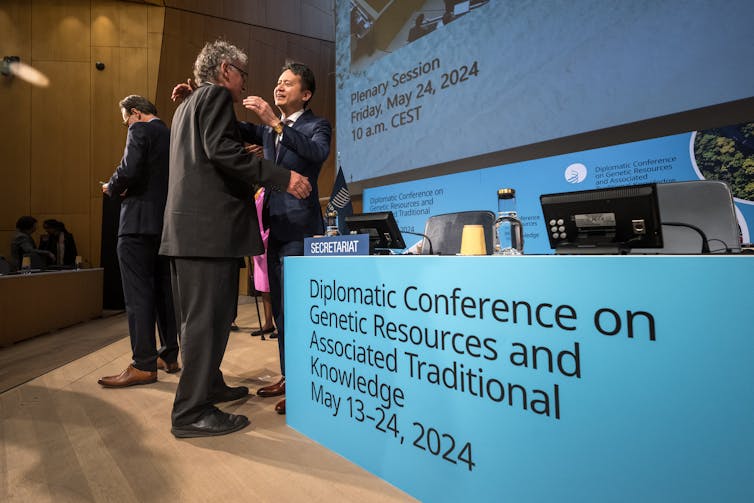
The problem of “biopiracy” – the misappropriation and patenting for profit of Indigenous knowledge – has been on the rise for some time. So a global treaty aimed at protecting traditional knowledge and genetic resources should be a welcome development.
More than 20 years in the making, it represents the culmination of negotiations between the 193 WIPO member states since 2000. And on the face of it, the treaty appears to be an important intervention to prevent biopiracy.
However, the new agreement is unlikely to lead to major changes to New Zealand law, or improve the rights of Māori to own or control their intellectual property and taonga (treasured possessions). Given the well-documented misappropriation of Māori knowledge and taonga, more substantive protections are still needed.
Disclosure of origin
Several studies have found instances of non-Māori businesses seeking patents and plant variety rights for the use of native plants similar to known Māori practices.
In these cases, several of which relate to mānuka, there is no evidence Māori were consulted or gave permission for their mātauranga (traditional knowledge) to be used.
The WIPO treaty introduces a “disclosure of origin” requirement. Where patent claims cover genetic resources, applicants must disclose the country of origin or source of those resources.
Furthermore, where the claimed invention is based on traditional knowledge, applicants must disclose which Indigenous peoples, local communities or other sources provided the knowledge.
While this has been heralded as a “historic” step forward, the Intellectual Property Office of New Zealand (IPONZ) already requires patent applicants to indicate whether their application involves traditional knowledge, or might conflict with Māori interests.
Not that new for NZ
IPONZ can then decide to send the application to the Patents Māori Advisory Committee, which advises on whether an invention is derived from Māori traditional knowledge or from indigenous plants or animals.
If it is, the committee also advises on whether the commercial exploitation of that invention might be contrary to Māori values. IPONZ then uses this advice to decide if an application should be rejected on the basis of “morality or public order”.
In other words, the disclosure-of-origin requirement is not such a historic step as some might imagine, at least for Aotearoa New Zealand. That said, the WIPO treaty will require appropriate measures to be implemented in domestic law to address any failure to provide the information.
The possible sanctions or remedies are limited, however. The treaty states that, unless there is fraudulent behaviour, a granted patent cannot be revoked, invalidated or rendered unenforceable due to a failure to disclose.
Still, this is better than the current situation, where there are no sanctions or remedies for failure to disclose.
WIPO Director General Daren Tang (right) celebrates the signing of the new treaty to combat ‘biopiracy’, Geneva, May 24. Getty Images
Earlier drafts went further
Arguably, the new treaty is notable more for what it does not do. In fact, earlier drafts of the treaty articles, released in 2023, went further than the eventual text does.
These included a framework under which traditional knowledge itself could be protected as the intellectual property of Indigenous peoples and local communities. This would have provided them with exclusive collective rights to control their traditional knowledge.
The draft articles also proposed Indigenous peoples and local communities would have the right to receive a fair and equitable share of benefits from the use of their traditional knowledge. They would also have the right of attribution, and the right to use their traditional knowledge in a manner that respects its integrity.
The final treaty does not include this form of positive protection for Indigenous knowledge. It also fails to protect “traditional cultural expressions” – the forms in which Indigenous peoples or local communities express their traditional cultural practices and knowledge, including music, dance, art and handicrafts.
Patent system sanctity
Compared with those earlier drafts, the concluded treaty is significantly narrower and less substantive.
It might help prevent the misappropriation of traditional knowledge in the patent system. But the treaty does not offer a positive form of protection for traditional knowledge itself, or traditional cultural expressions.
In fact, one could argue the treaty is more about ensuring the sanctity of the patent system, than it is about protecting Indigenous knowledge. After all, patent law requires inventions to be new and inventive compared to existing knowledge.
A requirement that applicants disclose the origin of genetic resources, and the knowledge relating to those resources, only improves the patent system.
Implementing the WIPO treaty in Aotearoa New Zealand will protect the patent system from granting bad patents. But it will not protect mātauranga Māori, or ensure Māori retain tino rangatiratanga (sovereignty) over their taonga, as guaranteed by te Tiriti o Waitangi (Treaty of Waitangi).
David Jefferson is the Secretary of the Knowledge of Oceania Society.
Jesse Pirini is the President of the Knowledge of Oceania Society.
Jessica C Lai does not work for, consult, own shares in or receive funding from any company or organisation that would benefit from this article, and has disclosed no relevant affiliations beyond their academic appointment.
In 2005 he dined with three journalists from the Canberra press gallery, during which he told them the Coalition government led by John Howard, and of which he was treasurer, could not win the election due in 2007 with Howard as leader.
Next morning, a member of his staff induced the three journalists to treat the conversation as off the record – that is, in confidence.
In what was to become known in the press gallery as “Costellogate”, a few months before the 2007 election, one of the journalists wrote that Costello had said he did not believe the Coalition could win under Howard. The subtext was that it could win under him.
Asked about this at a press conference, Costello said he didn’t know where journalists got this kind of information from, and that they made it up half the time.
Outraged by this slur on their colleague, the other two journalists then corroborated the report.
The episode added to the Coalition’s instability going into that election, which it subsequently lost.
Last Thursday there was the spectacle of Costello being confronted at Canberra airport by a reporter from News Corporation, Liam Mendes, asking him pointed but pertinent questions about the sex scandal engulfing the Nine Entertainment Company, of which he was chair.
The scandal follows the departure in March of Nine’s director of news and current affairs, Darren Wick, in the aftermath of which several women staff members have come forward with allegations of sexual misconduct against him.
So, Mendes asks Costello, did he support the way Nine’s chief executive Mike Sneesby was handling the Wick saga? Had Costello been aware of the allegations against Wick? Why would he not support Sneesby publicly?
Getting no answers, he says, “You have to answer the questions, Mr Costello.”
At this point Costello’s face fills the camera viewfinder, there is a jolting motion and the reporter falls on his back, saying, “You’ve just assaulted me”. Costello looks down at him and walks off.
Although Costello denied assaulting the journalist, at that point his position as chair of Nine, a company that employs hundreds of journalists who ask questions like this every day, became untenable. Three days later he was gone.
“Culture” and “renewal” have figured heavily in the Nine Entertainment Company’s public-relations efforts over the weekend to contain the damage.
On the extensive evidence published by The Australian newspaper and by the company’s own major newspapers, The Sydney Morning Herald, The Age and the Australian Financial Review in recent weeks, the need for cultural renewal is well overdue.
The announcement of Wick’s resignation in March was replete with references to long beach walks, longer conversations and his need for a rest after 13 years in the director’s chair.
There was no mention of the fact that his abrupt departure came after a formal complaint from a staff member about his behaviour.
Then in late May, with Wick gone, women began to speak out.
The Australian, Sky News and Nine’s own mastheads began carrying extensive accounts of his alleged predations.
Kate McClymont, the Sydney Morning Herald’s chief investigative reporter, wrote:
Darren Wick, the recently departed head of Channel Nine’s news and current affairs division, has been accused of engaging in drunken, lecherous behaviour in what furious staff say was “an open secret” for more than a decade.
Three women have now alleged to this masthead that Wick, the powerful news and current affairs chief for the past 13 years, brazenly groped them in public view of their colleagues.
A few days later, Wick’s successor, Fiona Dear, confronting a staff revolt, admitted there was a culture of power games at the network, telling the staff she “knows what it’s like” to encounter inappropriate behaviour in the workplace, and promised them “the power games stop today”.
Nine Entertainment subsequently admitted in a letter to staff that it realised they had experienced “trauma” following allegations of “misuse of power and inappropriate behaviour” among leadership in its newsrooms. “We recognise we need to do more.” The letter was co-signed by Costello, the chief people officer Vanessa Morley and Sneesby.
So it should have come as no surprise to someone as experienced in public life as Costello that he should be confronted by a journalist in a public space and asked difficult questions about these matters.
Yet instead of a dignified “no comment” there is an encounter that ends with the reporter flat on his back and Costello saying he fell over an advertising placard. The Nine board met the next day and by Sunday Costello was gone.
The circumstances of his departure, and that of Wick, indicate a culture of arrogance and entitlement at the top of Nine, and invites a question about whether such a culture can be changed while the chief executive, Sneesby, remains.
Reputational considerations affect share prices, and Nine Entertainment’s share price has fallen to $1.40, down 30% this calendar year. It fell 2% on Friday alone.
Former Nine Network chief executive Jeff Browne, who at one time was a candidate for the Nine board, was reported on the weekend as saying, “Not only has the business failed to achieve a culture of mutual trust and respect, it has failed to deliver any incremental value to shareholders.”
A larger question, which is ethical rather than financial, is whether it was right to have a former politician – and a federal treasurer at that – chairing the board of a media company in the first place.
No doubt Costello’s connections to the Coalition were an attractive attribute for Nine when he was appointed to the board in 2013, and particularly when he was appointed chair eight years ago.
It is a tribute to the integrity of the company’s journalists, especially on the newspapers, that their coverage of federal politics over that time has, on the whole, been fair.
But the point of principle remains. One of the crucial functions of the media in a democracy is to hold governments to account. The public’s trust in their ability to do so without fear or favour is central to the workings of democracy.
No law prevents a politician becoming chair of a media company, yet democracies work successfully only if their institutions respect not just the law but conventions – the guardrails of democracy. One such convention is that the media should be, and be seen to be, independent of party politics. For this reason, if for no other, the departure of Costello from the chair of Nine is welcome.
It is difficult at such close range to get a perspective on his legacy. Significant events occurred on his watch, in particular the acquisition by Nine of the old Fairfax newspapers, the SMH, The Age and the Australian Financial Review. We may learn more about the inner workings of the company when the cultural review commissioned by Nine from an external consultancy, Intersection, presents its report, and any vaunted “renewal” occurs.
Denis Muller does not work for, consult, own shares in or receive funding from any company or organisation that would benefit from this article, and has disclosed no relevant affiliations beyond their academic appointment.
Source: The Conversation (Au and NZ) – By Adrian Beaumont, Election Analyst (Psephologist) at The Conversation; and Honorary Associate, School of Mathematics and Statistics, The University of Melbourne
A national Newspoll, conducted June 3–7 from a sample of 1,232, had Labor and the Coalition tied at 50–50, a two-point gain for the Coalition since the post-budget Newspoll, three weeks ago. This is Labor’s worst position in Newspoll since last November, following the fallout from the defeat of the Voice referendum.
Primary votes were 39% Coalition (up two), 33% Labor (down one), 11% Greens (down two), 7% One Nation (steady) and 10% for all Others (up one). The drop for the Greens will be attributed to their stance on Gaza, but other polls below have the Greens at around 14%.
After recording a non-negative net approval for the first time since the Voice referendum last October in the previous Newspoll, Anthony Albanese’s net approval returned to a negative, with his satisfied rating down four to 43% and his dissatisfied up three to 50%, for a net approval of -7, down seven points.
Here is a graph of Albanese’s net approval in Newspoll this term. The plus signs are the data and a smoothed line has been fitted.
Peter Dutton’s net approval improved two points to -10. In the previous Newspoll, Albanese’s better PM lead over Dutton had blown out to 52–33. In this poll, his lead was drastically reduced to 46–38, Albanese’s lowest Newspoll margin this term.
It’s likely the previous Newspoll was a pro-Labor outlier, and this one may be too rosy for the Coalition. But last week’s YouGov poll alos had a 50–50 tie between Labor and the Coalition. I believe Labor’s struggles are primarily due to the cost of living issue.
YouGov poll remains tied at 50–50
A national YouGov poll, conducted May 31 to June 4 from a sample of 1,500, had Labor and the Coalition tied at 50–50, unchanged from the previous YouGov poll in mid-May. Primary votes were 38% Coalition (steady), 30% Labor (steady), 14% Greens (up one), 8% One Nation (steady) and 10% for all Others (down one).
Albanese’s net approval was steady at -12, with 53% dissatisfied and 41% satisfied. Dutton’s net approval fell seven points to -13. Albanese led Dutton as preferred PM by 47–36 (44–37 previously). By 84–16, respondents supported a right for workers to strike.
Essential poll tied at 48–48
A national Essential poll, conducted May 29 to June 2 from a sample of 1,160, had the Coalition and Labor tied at 48% each with 4% undecided (47–46 to the Coalition in mid-May). Primary votes were 36% Coalition (up two), 32% Labor (up one), 13% Greens (up three), 5% One Nation (down three), 3% UAP (up two), 8% for all Others (steady) and 4% undecided (down two).
Albanese’s net approval was up one point since April to -4, with 47% disapproving and 43% approving. Dutton’s net approval dropped four points to -1 after achieving a positive net approval in April.
On artificial intelligence (AI), 42% (down three since January) said it carries more risk than opportunity, 21% (steady) more opportunity than risk and 37% (up four) said risk and opportunity are about the same.
Respondents were asked whether children aged 10 to 18 should be able to do various things, then the age a respondent selected was averaged. For buying and consuming alcohol, voting and accessing pornography, the average age was about 17.5. For using social media, it was 15.4. For being held criminally responsible, it was 14.3.
By 68–15, respondents supported increasing the age limit on social media platforms from 13 to 16. By 62–16, respondents supported criminalising hate speech.
Morgan poll: Labor regains lead
A national Morgan poll, conducted May 27 to June 2 from a sample of 1,579, gave Labor a 52–48 lead, a 3.5-point gain for Labor since the May 20–26 Morgan poll that had given the Coalition its best position in this poll since the 2022 election.
Primary votes were 36% Coalition (down one), 31% Labor (up 2.5), 14% Greens (down one), 4.5% One Nation (down 1.5), 9% independents (steady) and 5.5% others (up one).
Redbridge Queensland poll: another big lead for the LNP
The Queensland state election will be held in October. A Redbridge poll, conducted in two waves in February and May from a sample of 880, gave the Liberal National Party a 57–43 lead, from primary votes of 47% LNP, 28% Labor, 12% Greens and 13% for all Others.
The “Labor government led by Steven Miles” had a net approval of -11, with 37% giving it a poor rating and 26% a good rating. The LNP opposition led by David Crisafulli had a +14 net approval (35% good, 21% poor).
Since Newspoll gave the LNP a 54–46 lead in March, Queensland polls have all suggested Labor faces a heavy defeat at the October election.
Victorian Redbridge poll: Labor still well ahead
A Victorian Redbridge poll, also conducted in February and May from a sample of 1,000, gave Labor a 55–45 lead, a one-point gain for Labor since a March Redbridge poll. Primary votes were 38% Coalition (steady), 35% Labor (down one), 14% Greens (up four) and 13% for all Others (down three).
The “Labor government led by Jacinta Allan” had a net approval of -7, with 37% giving it a poor rating and 30% a good rating. The Coalition opposition led by John Pesutto had a -15 net approval (34% poor, 19% good).
This poll contrasts with the Victorian Resolve poll that was conducted in April and May, which gave the Coalition a 37–28 primary vote lead over Labor.
Modi’s party loses majority at Indian election
I covered the June 4 vote counting after the seven-stage Indian election for The Poll Bludger. PM Narendra Modi’s BJP party lost 63 seats to lose its single-party majority, although allied parties won enough seats for Modi to be returned for a third successive term. It had been widely expected that Modi would win a landslide.
At the May 29 South African election, the African National Congress lost the majority it had held at every election since 1994. There was a second successive landslide for the left at the June 2 Mexican election.
I am covering the European parliament election, held from Thursday to Sunday, for The Poll Bludger. Labour remains over 20 points ahead of the Conservatives in UK national polls, with the election on July 4. In US national polls, Donald Trump still leads Joe Biden by about one point despite his May 30 conviction.
Adrian Beaumont does not work for, consult, own shares in or receive funding from any company or organisation that would benefit from this article, and has disclosed no relevant affiliations beyond their academic appointment.
New Ireland Governor and a former Papua New Guinea prime minister Sir Julius Chan told the PNG Post-Courier in a “last man standing” interview at the weekend that this “media crime” should stop.
He was responding to a fake press release allegedly released by New Ireland Deputy Governor Missen Semmie in Kavieng in the early hours of Saturday morning at 2.30am which claimed Sir J — as he is popularly known — had “succumbed to the call of nature” and passed on.
But Sir J, now 84, said it was “unbelievable” as Semmie was in his remote village where communication was a problem.
“I am used to it but some other people are not used to it,” Sir J told the Post-Courier.
“I am okay, yes, and . . . whether you like me or not, you better be ready because you’ll be going before me.”
Meanwhile, the Post-Courier reports that the ruling Pangu Pati parliamentary wing had resolved to dismiss the 12 MPs who had defected to the opposition.
The party also confirmed that party leader and Prime Minister James Marape and deputy leader and Deputy Prime Minister John Rosso would keep their positions.
This resolution was made during the Pangu caucus meeting at Parliament attended by Pangu MPs.
Four of the renegade Pangu MPs — Finschhafen MP Rainbo Paita, Moresby Northwest MP Lohia Boe Samuel, Goilala MP Casmiro Aia and Lagaip MP Amos Akem — were present.
“Those MPs who defected were asked to present their case, after which the meeting resolved that the 12 MPs be given seven days’ notice of their dismissal from the party,” Prime Minister Marape said.
“The Pangu Pati constitution gives them the choice to appeal if they do choose to appeal, for readmittance to the party.”
Gorethy Kenneth is a PNG Post-Courier reporter. Republished with permission.
Selwyn Manning and Paul G Buchanan deliver their podcast A View from Afar, S05 E01. A Moment of Friction.
The LIVE Recording of A View from Afar podcast will begin today at 12:45pm June 10, 2024 (NZST) which is Sunday evening, 8:30pm (USEST).
Today, political scientist Paul Buchanan and Selwyn Manning will examine:
At a micro level, how ‘Post-Colonial Blowback’ has impacted on New Caledonia, Gaza, South Africa, India and even New Zealand.
And at a macro level, Paul and Selwyn will assess how ‘Post-Colonial Blowback’ is a power giving rise to the Global South and its worldwide influence in global geopolitics.
Live Audience: Remember, if you are joining us live via the social media platforms, feel free to comment as we can include your comments and questions in this programme.
INTERACTION WHILE LIVE:
Paul and Selwyn encourage their live audience to interact while they are live with questions and comments.
RECOGNITION: The MIL Network’s podcast A View from Afar was Nominated as a Top Defence Security Podcast by Threat.Technology – a London-based cyber security news publication. Threat.Technology placed A View from Afar at 9th in its 20 Best Defence Security Podcasts of 2021 category.
You can follow A View from Afar via our affiliate syndicators.
Not only is the Australian military failing to achieve planned growth, it is actually shrinking, as Defence Chief General Angus Campbell told a Senate inquiry in February.
There are two fundamental reasons for the current recruitment impasse. One is economic – low unemployment and a perception of better opportunities, work conditions and future prospects in the private sector.
The other reason is cultural: a declining willingness of Gen Z to identify with – and fight to defend – their nation.
Either way, the key to the recruitment crisis lies in understanding the motivations of this generation, the main pool of potential recruits today.
We recently interviewed 19 serving Australian soldiers from a range of demographics (two were Gen Z) and across military branches in a study funded by the Australian Defence Force. We wanted to find out what makes Gen Z recruits tick, and what the force might do to persuade more of them to serve their country.
Researchers study every new generation as a guide to the future, from the baby boomers to Generation X (like the authors of this article), and millennials. None is more distinctive than generation Z, or Zoomers – people born roughly between 1997 and 2008.
They are the first generation to grow up with smartphones and social media. In his current bestseller, The Anxious Generation, social psychologist Jonathan Haidt outlines the cataclysmal effect: he claims a large increase in depression and anxiety in young people is the direct effect of unsupervised social media use during adolescence.
Zoomers’ mental health is a barrier to service, as US Marine Corps Lieutenant Matthew Weiss spells out in his book on Gen Z military recruitment.
The soldiers we spoke to said mental health is an issue for recruitment. On the one hand, they agreed that service is mentally challenging, and that younger soldiers are more psychologically vulnerable. On the other hand, interviewees said the force’s mental health support has been improving. This is a step in the right direction – it may well be that media coverage of veterans’ mental health issues worries Zoomers considering enlistment.
Weiss argues private sector jobs (and money) afford much more online currency than military service. The respondents in our interviews agreed younger recruits were very savvy about pay and conditions.
Waning national pride
But there may be another motivator: as shadow Defence Minister Andrew Hastie recently told the ABC:
People who join the Defence Force don’t just do it for economic reasons, they do it because they love their country.
This means if love of country falls from generation to generation, military recruitment falls too. Weiss suggests in the United States, low patriotism partly explains Gen Z’s reluctance to enlist.
Our interviewees said traditional nationalism played only a modest role for enlisting for young people. They thought a lesser sense of obligation and service is one reason. Another is the fact that the black-and-white picture of “my country right or wrong” has been muddied following media coverage of alleged Australian war crimes in Afghanistan.
The evidence confirms waning national pride among young Australians. We analysed publicly available data from the World Values Survey, a wide-ranging poll of people’s values around the globe conducted since 1981. It shows in 1981, 70.3% of Australians were “very proud” of their nationality. This fell to 60.8% in 2018, the first year to feature Gen Z members in the survey. That year, only 41.6% of twentysomethings (including some millennials) were very proud Australians – the lowest proportion of any Australian age group in any year since the survey began.
All else being equal, older adults tend to be more nationalistic, as surveys in different periods and countries show. But the nationalism gap between old and young has opened up further with Gen Z.
According to the survey data, in 1981, 69% of Australians in their twenties were willing to fight for their country. This was a slightly greater proportion than the 65% of over-70s. By 2018, this was reversed, with only 44% of Australians in their twenties willing to fight, compared with 59% of over-70s.
The moral imperative
Our interviewees suggested that if nationalist values motivate Zoomers, this is only in terms of “doing the right thing”. This offers an alternative opportunity for recruiters: the changing role of the military towards peacekeeping and disaster relief makes defence attractive to those with humanitarian values.
Zoomers fall into this category. Research shows, and our interviewees agreed, that Gen Z care about the environment, diversity, equity and inclusion.
This is reflected by their attitudes to work. Zoomers want a calling and not just a career (let alone merely a job). According to our interviewees, young recruits place greater importance on the intrinsic aspects of work, like learning skills, experiencing adventure and challenges.
So how do we boost recruitment?
Our own and other research suggests Gen Z is strongly motivated by things that support their own growth and wellbeing, both materially and spiritually, rather than service toward others. Researchers label these “pro-self” motivations.
Zoomers may be hard to recruit, especially given the increasing war for talent, but they have a great deal to offer the military. They may be the most success-orientated among recent generations. They have an unprecedented ability to handle digital technologies that are becoming increasingly important in the military.
The inaugural National Defence Strategy unveiled in April has conceded “the need for a fundamental transformation of defence’s recruitment and retention system”.
Our research suggests building a force that appeals to Gen Z’s social values and intrinsic motivations is the way forward. Recruitment strategies need to be tailored.
Robert Hoffmann receives funding from the Australian Department of Defence.
Maria Teresa Beamond receives funding from the Australian Department of Defence and from the not-for-profit group Australian Women in Security Network.
A First Nations child born in Australia today can expect to live eight to nine years less than a non-Indigenous child born on the same day.
During their life, they are more likely to have a heart attack, and would be on average 20 years younger than the non-Indigenous patient in the hospital bed next to them when they do. Acute rheumatic fever, a disease virtually non-existent among non-Indigenous Australians, may damage their heart valves. They are more likely to develop and die from cancer, diabetes, kidney failure and lung disease.
A First Nations Australian is also more likely to have a low household income, live in overcrowded housing, and is 14 times more likely to be imprisoned. We know socioeconomic inequalities like these create health inequalities. There’s also evidence that cultural factors and experiences of racism compound the problem.
Closing the health gap between First Nations peoples and non-Indigenous Australians is a national priority. One of the ways to reduce health disparities is by improving the care Aboriginal and Torres Strait Islander people receive when they’re admitted to hospital.
Staff at the Princess Alexandra Hospital in Brisbane could see first-hand that our health system wasn’t delivering the care First Nations patients needed. So they sought to develop a culturally informed model of care for First Nations patients with heart disease.
We have all worked with this model and were part of a study to trial it. Our results, published recently in The Lancet Global Health, indicate this culturally informed model of care eliminated the gap between First Nations patients and non-Indigenous patients when we looked at heart health outcomes after they left hospital.
Designing a culturally informed model of care
The model was developed for First Nations patients with acute coronary syndrome. This includes heart attacks and angina, which is chest pain due to disease in the arteries supplying blood to the heart.
The project was co-designed with First Nations stakeholders. Training was tailored and delivered to build cultural capability across the cardiology department and to increase staff knowledge of relevant services available to First Nations patients outside the hospital.
Staff formed formal partnerships with local Aboriginal and Torres Strait Islander community-controlled health organisations. They improved the hospital environment with First Nations artwork and uniforms (displaying First Nations flags and artwork).
They brought together a “Better Cardiac Care” team including an Aboriginal and Torres Strait Islander hospital liaison officer, a cardiac nurse and a pharmacist. This team visited First Nations patients at their bedside, providing additional support, advocacy, education and care co-ordination.
Patients could confidently ask questions and yarn about their diagnosis and treatment in their own words without feelings of shame or embarrassment.
The team was focused on the patient’s needs. For example, they could co-ordinate accommodation for a patient’s relative who was travelling to the hospital from far away. They could tell a patient’s doctor if the patient needed more time to talk or make a decision, or a better explanation. Before the patient left hospital, the team could co-ordinate with the patient’s local chemist to supply their medications and book a follow-up appointment with their GP.
How we tested the model
We investigated the impact of the model of care by looking at outcomes for First Nations and non-Indigenous patients admitted with heart attacks and angina before and after the model was implemented.
Specifically, we collected data on 199 First Nations patients and 440 randomly selected non-Indigenous patients treated in the 24 months before the project began and compared them with 119 First Nations patients and 467 non-Indigenous patients treated in the 12 months after.
We particularly wanted to know if patients died, had another heart attack, needed an unexpected stent or coronary artery bypass surgery, or had to urgently come back into hospital within 90 days of being discharged.
Before the model was introduced, 34% of First Nations patients had one of those negative outcomes, much higher than the rate of 18% in non-Indigenous patients. Afterwards, these events occurred in 20% of both First Nations and non-Indigenous patients. This was a significant improvement for First Nations patients and eliminated the gap between groups.
The most significant improvement was seen in urgent re-admissions, but there were also fewer heart attacks.
Fewer heart attacks and hospital admissions are good, but we also needed to ensure patients felt culturally safe, and that their social and emotional needs were being met.
A related project asked patients and their families about their experience with the model of care. The researchers identified that relationality or connectedness between patients and the team, particularly Aboriginal and Torres Strait Islander staff, may be key to its success.
A promising concept
Our study was not a randomised trial and the control group was historical. So it’s possible factors other than the model of care might have affected the outcomes. The study was also conducted only in a single hospital.
However, we demonstrated that a culturally informed model of care, developed with and for First Nations peoples, can improve clinical outcomes. Better Cardiac Care programs based on this concept have now spread to other Queensland hospitals.
We hope similar results can be replicated in many hospitals and in other medical specialities, because improving hospital outcomes is one of many important steps needed to close the health gap for First Nations peoples in Australia.
Dr Wang receives or has received research or project grants from MRFF, NHMRC, Metrosouth Health and the Queensland Government.
Danielle Harrop and Debra Pauza do not work for, consult, own shares in or receive funding from any company or organisation that would benefit from this article, and have disclosed no relevant affiliations beyond their academic appointment.
Source: The Conversation (Au and NZ) – By Samantha Ellen Andres, Postdoctoral Research Fellow, Hawkesbury Institute for the Environment, Western Sydney University
Rachael Gallagher
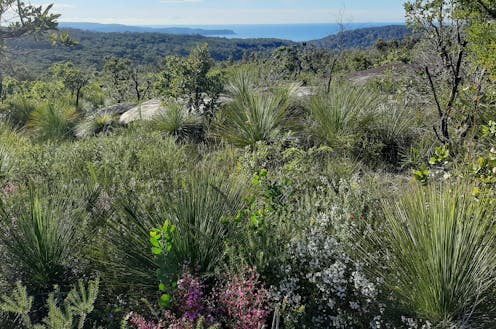
More than 52 million hectares of land across Australia is degraded. Degraded land lacks biodiversity and the natural balance of healthy ecosystems, making it unfit for wildlife or cultivation. This means we are losing the benefits that healthy ecosystems provide for nature and people.
To counter this threat, Australia signed the Global Biodiversity Framework in 2022, pledging to ensure 30% of degraded ecosystems are “under effective restoration” by 2030. That’s roughly 15.6 million hectares of land across the nation.
To kick-start ecosystem recovery, governments, environmental managers and landholders often plant a diverse mix of native species on degraded land. The crucial word here is diverse. Planting a wide variety of species makes ecosystems more resilent, laying the foundation of a healthy environment for wildlife.
The problem is we don’t have enough seeds from Australia’s endemic plants – species found only in this country (often with very limited distributions). Our new research shows both the quantity and diversity of native seed available for restoration are limited across the country. Only 10% of our native species are readily available for sale as seed.
Multiply this supply-and-demand issue on the scale needed to meet Australia’s ambitious goals for nature repair, and the seed shortages, are clearly critical.
Our research identifies gaps in the seed supply chain. We have developed a new method to optimise the biodiversity of plantings from these limited supplies. We also recommend ways to strengthen the seed supply chain.
The seeds from Australian flora are as varied as the plants they produce. Paige Lieurance
How well does supply match the need for diversity?
Our research explores two urgent questions:
Does the present supply of seed for restoration in Australia reflect the diversity of ecosystems where nature repair is intended?
Using seed that is readily available, can we achieve the diverse plantings that underpin resilient ecosystems?
We started by making an inventory of seeds from 32 commercial suppliers across Australia. We worked out what percentage of species can be bought immediately as seed across six major vegetation types, such as our eucalypt woodlands and rainforests.
We then compared the diversity of species available as seed to the total species diversity of each vegetation type.
Using this information, we developed a framework to maximise the different types of plant species (their “functional diversity”) used in seed mixes, taking into account supply constraints. The aim is to achieve a diverse mix of species with different plant traits – such as height, seed or leaf variety – from the available seed supply.
Seed supply is missing many ‘little guys’
Overall, only about 10% of Australia’s plant species, or 2,992 species, can be bought as seed. Of course, volunteers or contractors can directly collect seeds for more species out in the bush for restoration projects – if they have permits to do so. Even so, the 10% we found for immediate purchase indicates serious shortfalls in the diversity of our national supply.
When seed was available, it was more often for trees and shrubs. The seeds of ecologically important understorey species were often not available.
These missing “little guys” are mainly herbs and grasses. They are the source of most of the plant diversity in some of our most degraded ecosystems, such as grassy woodlands.
We also looked at changes in the stock from individual suppliers. As suppliers added more species to their list of offerings, the diversity tended to increase for trees and shrubs. These woody plants include species such as Acacia and Eucalyptus.
The increase in woody species’ seeds effectively “diluted” the contribution to diversity of herb and grass species, such as kangaroo grass, flannel flower and flax lily, that make up the understorey. The overall seed mix becomes less representative of the balance of species in native vegetation.
This shift in supply likely reflects the monumental demand for seeds from trees and shrubs. These woody species are favoured for projects focused on reforestation and carbon farming.
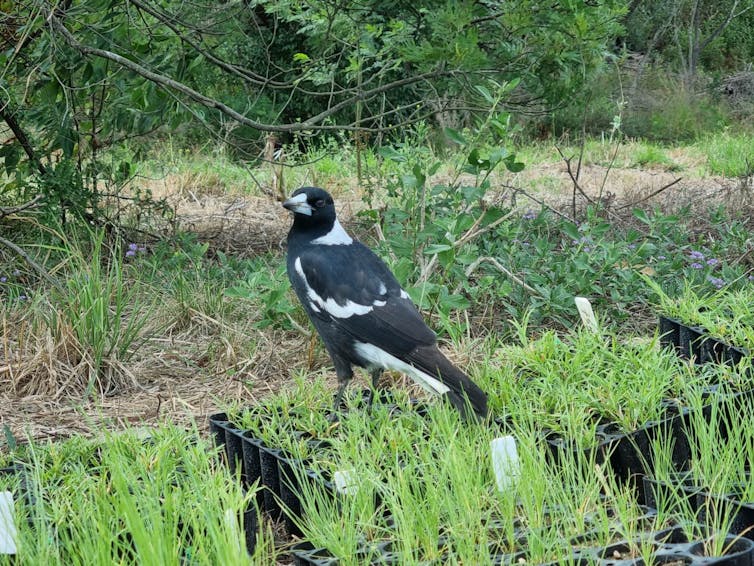
Seedlings ready to go in the ground at a restoration project near Mt Annan, New South Wales. Samantha Andres
How can we improve seed supply?
We show careful planning can make diverse plantings achievable from available seed stocks. It’s still worrying, though, that the seeds of almost 90% of our native plants are missing.
And, of the available 10%, the quantities in stock may not scratch the surface of what is needed to restore large areas of diverse vegetation.
This finding has serious implications for ecosystems where most of the diversity is in the understorey. One example is the critically endangered Cumberland Plain Woodland west of Sydney. In ecosystems like this, restoration is being proposed to offset development impacts.
To restore vegetation that provides good habitat for wildlife and resembles the natural bush we love, we need to get cracking on improving our national seed supply. We highlight the need for better policy and planning to support Australia’s native seed sector.
After delving into the constraints of seed supply, we recommend ways to improve supply by strengthening collaboration along all stages of the supply chain. That includes everyone from financiers to collectors to bush regenerators across the country.
We suggest increasing financial support to expand seed supply systems, particularly for small-scale suppliers. Expanding seed production areas, such as “seed orchards”, across the nation will help to bring more diverse and difficult-to-store seed on the market. It will also avoid compromising wild plant populations due to over-harvesting.
Good guidance on how to maximise a broad suite of different plant types with a wide range of traits might help avoid some of the consequences of poor seed supply. Selections from current limited supplies can be optimised to generate more diverse seed mixes for restoration.
Still, this takes lots of planning. It may be beyond the reach of the average landholder engaging in nature repair.
Ultimately, we need greater investment to improve the seed supply chain in an ethical and ecologically sustainable way. Only then will we have the tools to attempt to reinstate degraded ecosystems.
Joe Atkinson received funding from the Capital Landkeepers Trust and the Ecological Society of Australia for related work. He does not work for, consult, own shares in or receive funding from any company or organisation that would benefit from this article, and has disclosed no relevant affiliations beyond his postdoctoral position.
Rachael Gallagher receives funding from the Australian Research Council Linkage scheme for work related to this article. She does not work for, consult, own shares in or receive funding from any company or organisation that would benefit from this article, and has disclosed no relevant affiliations beyond her academic appointment.
Samantha Ellen Andres does not work for, consult, own shares in or receive funding from any company or organisation that would benefit from this article, and has disclosed no relevant affiliations beyond their academic appointment.
– ref. Only 10% of native plants can be bought as seed – a big problem for nature repair. Here’s how we can make plantings more diverse – tag:theconversation.com,2011:article/228899
Just before the May budget, the federal government made a surprise announcement: it will introduce caps on the number of international students in the country.
It is fair to say this plan is really worrying some Australian universities.
The sector argues cutting student numbers will see job losses and less money to do research. They also warn cuts will hurt their international reputation and place in global rankings.
This is because international education is a vital source of funding for Australia’s universities. Universities collected about A$8.6 billion from international students in 2022 – more than a quarter of all revenue.
Given the sums involved, the introduction of caps has the potential to have the most significant impact on Australia’s tertiary education system in decades. But a major unanswered question is what the caps will be and how they will be calculated.
Remind me, what did the government announce?
Education Minister Jason Clare introduced legislation to parliament on student caps almost immediately after the budget was released. This would provide ministerial powers to regulate international education in Australia by:
pausing the registration of new providers and new courses
limiting the enrolments of overseas students by provider, course or location, over a year
automatically suspending and cancelling courses.
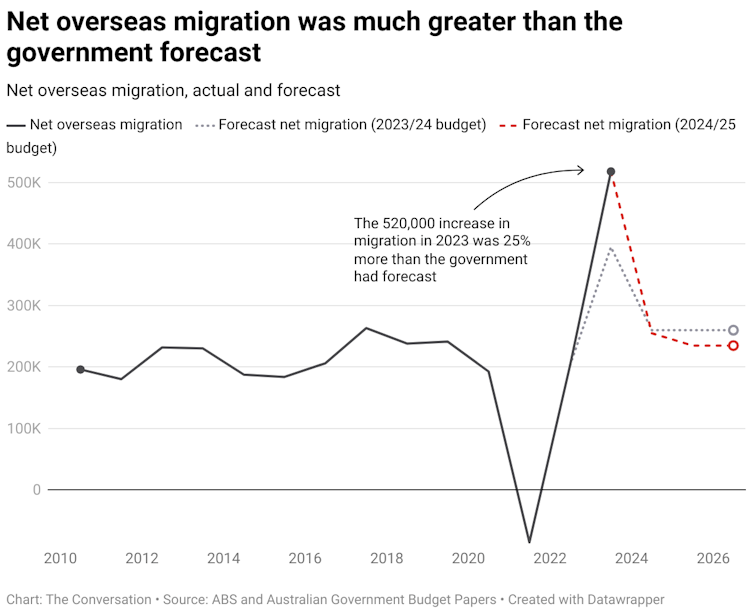
This comes as the government seeks to reduce net overseas migration (the increase in the number of people in Australia) to pre-pandemic levels of about 260,000 people per year.
It also follows similar moves in Canada and the United Kingdom, which have introduced changes to limit the number of international students in their countries.
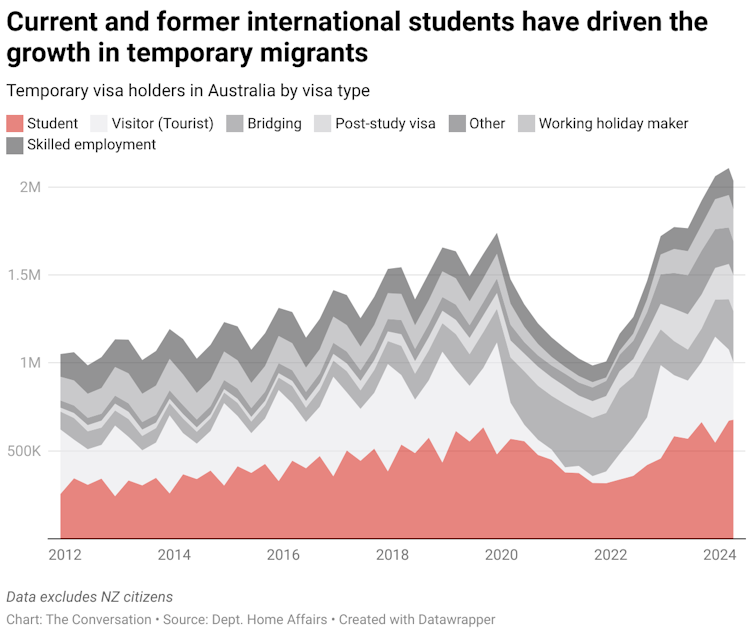
They are now at record levels, with about 870,000 current and former international students in Australia. They make up the largest part of the temporary migrant population.
During the pandemic, the number of international students in Australia more than halved. In December 2019, there were more than 630,000 international students in Australia. By December 2021, there were 315,000. Since Australia reopened its borders, the number of international students entering the country have rebounded much quicker than anticipated.
Now, amid dual housing and cost-of-living crises, international students have also become a political issue. Not only is the federal government looking to decrease net overseas migration but the opposition wants to go even further.
Who is affected by this change?
So far, the focus of the impact on international student caps has been on universities. But there could be much wider impacts in the economy and community if international student numbers are capped.
One thing that is often lost in the debate is the diversity of the international education sector. Universities only make up about 40% of current international student enrolments.
The remainder of students are in private colleges, English language schools and secondary schools.
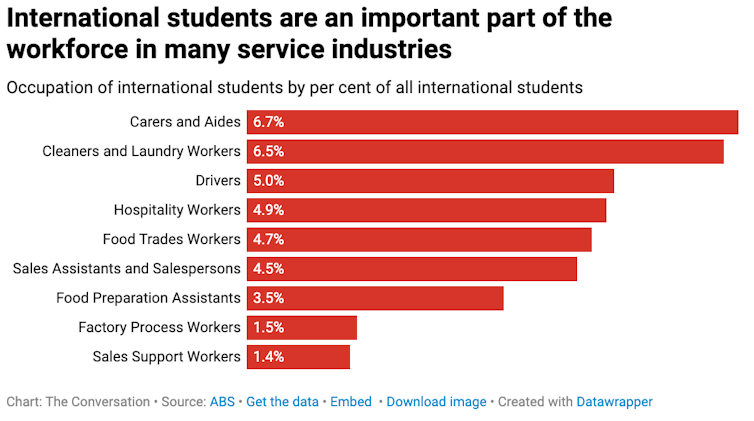
International students are also important parts of Australia’s workforce. The occupation with the largest number of international students is “carer and aides”. This means industries like aged care and disability support rely on an international student workforce.
In 2023, international education was also Australia’s fourth largest export valued at $48 billion. Of this, $17 billion was collected in course fees and the remaining $31 billion was spent in the broader economy.
This means any change to international student numbers could have an impact way beyond the campuses of Australia’s elite universities.
We still need detail
During his budget speech, Treasurer Jim Chalmers focused on housing as a central to how caps will be calculated.
As he told parliament:
[…] for too long, enrolments have grown without being matched by an increase in student housing supply.
We will limit how many international students can be enrolled by each university based on a formula, including how much housing they build.
But it is not yet clear how this will happen.
It is also unclear how much international students are impacting upon housing costs. Some research has shown the impact of international students on housing and rental prices is small.
One factor the government could consider here is how many domestic students are enrolled at a particular institution. This is so domestic students do not suffer from a cut that sees fewer resources where they study.
In Australia, it is certainly true the larger, more prestigious universities have the most international students. But they also enrol huge numbers of domestic students.
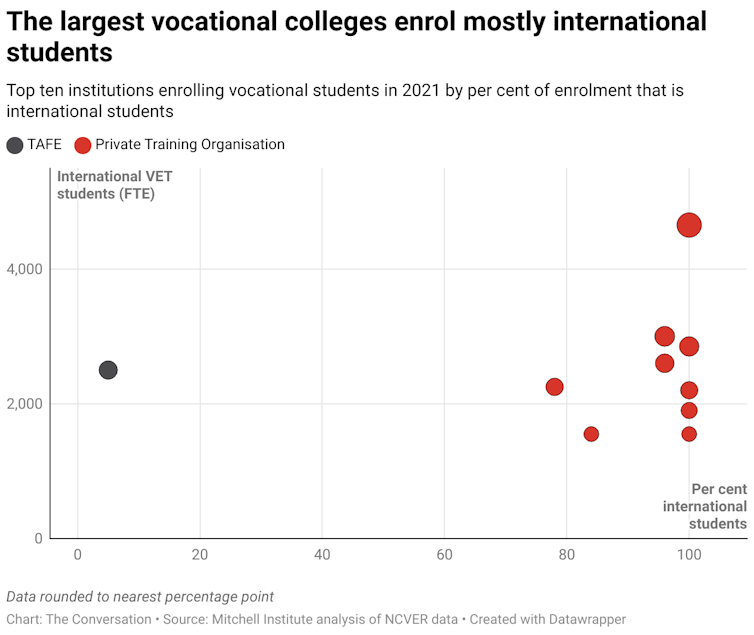
The largest private vocational colleges enrol almost exclusively international students, usually in courses like business and hospitality. As our analysis (below) shows, of the ten largest private providers, nine were private colleges where there were few domestic students.
It is important to note, this is the part of the international education sector identified as having the most problems with compliance and exploitation. This is what the government has been keen to crack down on when it talks about “shonky” providers.
What happens now?
The bill has been referred to the Senate’s education committee, which is due to report on August 15.
In many ways “too many students” is a good problem to have. It demonstrates Australia’s international education sector is strong.
But we have to watch out for unintended consequences. The diversity of the system – from elite, research universities educating both international and domestic students to private colleges largely educating international students – also needs to be taken into account.
And to adequately understand the impacts, we need more detail now from the government about how they plan to do it.
The authors do not work for, consult, own shares in or receive funding from any company or organisation that would benefit from this article, and have disclosed no relevant affiliations beyond their academic appointment.
– ref. International student caps are creating a huge headache for universities. But they could have an impact beyond elite campuses – tag:theconversation.com,2011:article/231804
The artificial intelligence (AI) revolution has begun, spreading to almost every facet of people’s professional and personal lives – including job recruitment.
While artists fear copyright breaches or simply being replaced, business and management are becoming increasingly aware to the possibilities of greater efficiencies in areas as diverse as supply chain management, customer service, product development and human resources (HR) management.
Soon all business areas and operations will be under pressure to adopt AI in some form or another. But the very nature of AI – and the data behind its processes and outputs – mean human biases are being embedded in the technology.
Our research looked at the use of AI in recruitment and hiring – a field that has already widely adopted AI to automate the screening of résumés and to rate video interviews by job applicants.
AI in recruitment promises greater objectivity and efficiency during the hiring process by eliminating human biases and enhancing fairness and consistency in decision making.
But our research shows AI can subtly – and at times overtly – heighten biases. And the involvement of HR professionals may worsen rather than alleviate these effects. This challenges our belief that human oversight can contain and moderate AI.
Magnifying human bias
Although one of the reasons for using AI in recruitment is that it is meant to be to be more objective and consistent, multiple studies have found the technology is, in fact, very likely to be biased. This happens because AI learns from the datasets used to train it. If the data is flawed, the AI will be too.
In interviews with 22 HR professionals, we identified two common biases in hiring: “stereotype bias” and “similar-to-me bias”.
Stereotype bias occurs when decisions are influenced by stereotypes about certain groups, such as preferring candidates of the same gender, leading to gender inequality.
“Similar-to-me” bias happens when recruiters favour candidates who share similar backgrounds or interests to them.
These biases, which can significantly affect the fairness of the hiring process, are embedded in the historical hiring data which are then used to train the AI systems. This leads to biased AI.
So, if past hiring practices favoured certain demographics, the AI will continue to do so. Mitigating these biases is challenging because algorithms can infer personal information based on hidden data from other correlated information.
For example, in countries with different lengths of military service for men and women, an AI might deduce gender based on service duration.
This persistence of bias underscores the need for careful planning and monitoring to ensure fairness in both human and AI-driven recruitment processes.
Can humans help?
As well as HR professionals, we also interviewed 17 AI developers. We wanted to investigate how an AI recruitment system could be developed that would mitigate rather than exacerbate hiring bias.
Based on the interviews, we developed a model wherein HR professionals and AI programmers would go back and forth in exchanging information and questioning preconceptions as they examined data sets and developed algorithms.
However, our findings reveal the difficulty in implementing such a model lies in the educational, professional and demographic differences that exist between HR professionals and AI developers.
These differences impede effective communication, cooperation and even the ability to understand each other. While HR professionals are traditionally trained in people management and organisational behaviour, AI developers are skilled in data science and technology.
These different backgrounds can lead to misunderstandings and misalignment when working together. This is particularly a problem in smaller countries such as New Zealand, where resources are limited and professional networks are less diverse.
Does HR know what AI programmers are doing, and vice versa? Getty Images
Connecting HR and AI
If companies and the HR profession want to address the issue of bias in AI-based recruitment, several changes need to be made.
Firstly, the implementation of a structured training programme for HR professionals focused on information system development and AI is crucial. This training should cover the fundamentals of AI, the identification of biases in AI systems, and strategies for mitigating these biases.
Additionally, fostering better collaboration between HR professionals and AI developers is also important. Companies should be looking to create teams that include both HR and AI specialists. These can help bridge the communication gap and better align their efforts.
Moreover, developing culturally relevant datasets is vital for reducing biases in AI systems. HR professionals and AI developers need to work together to ensure the data used in AI-driven recruitment processes are diverse and representative of different demographic groups. This will help create more equitable hiring practices.
Lastly, countries need guidelines and ethical standards for the use of AI in recruitment that can help build trust and ensure fairness. Organisations should implement policies that promote transparency and accountability in AI-driven decision-making processes.
By taking these steps, we can create a more inclusive and fair recruitment system that leverages the strengths of both HR professionals and AI developers.
The authors do not work for, consult, own shares in or receive funding from any company or organisation that would benefit from this article, and have disclosed no relevant affiliations beyond their academic appointment.
In his latest foray into the climate change debate, Peter Dutton has sown fresh confusion around the opposition’s policy, whether intentionally or by failing to spell out what he means.
It’s yet more frustration for potential investors in the energy and other clean industry sectors who crave greater certainty about where Australian policy could go over coming years.
In an interview with the Weekend Australian, Dutton claimed the Albanese government “just have no hope of achieving the targets and there’s no sense signing up to targets you don’t have any prospect of achieving”.
So presumably the Coalition goes to the election opposing the 43% emissions reduction target to which Australia is committed under the Paris climate agreement. But what does that actually mean?
Australia can’t simply rewrite its Paris target – which Labor also legislated – to reduce it. So, is Dutton saying that a government he led would leave the Paris Agreement?
No, says opposition energy spokesman Ted O’Brien.
“We are committed to Paris, the 2050 net zero target,” he said at the weekend.
But “the 43% by 2030 is unachievable. If you look at the centrepiece of Labor’s entire policy, it is 82% renewables by 2030. At best they’re running at half pace. This will not happen. And the more that Labor pretends to the Australian people and the international community, they set Australia up to fail,” O’Brien said.
Climate Change and Energy Minister Chris Bowen claims Australia is “on track” to meet the target, although there’s dispute about that, which is one reason gas is now being talked up by the government.
Dutton seems to be simply declaring a Coalition government would just ignore the target, paving the way to cut back Australia’s efforts to meet it.
“We’re not going to destroy agriculture. We’re not going to stifle investment. We’re already seeing investment being withdrawn,” he said in the interview. “We’re not going to create sovereign risk with our export partners, as Labor is doing with Japan and Korea.”
Once again, the Nationals are to the fore in wanting to apply the handbrake on climate action – this time on the accelerated rollout of renewables and the (often unpopular) power lines that carry them.
“What we’re saying is, let’s pause and let’s get this right,” Nationals leader David Littleproud said. He said it was “totally false” to believe failure to meet the 2030 target would “see us kicked out” of the Paris agreement. “We are committed to our 2050 target.” Helped, according to the Coalition, by the yet-to-be-unveiled nuclear power policy.
Some Nationals don’t like the 2050 target but the Coalition leadership is keeping the minority party locked to it. After all, 2050 is a long time away, in political terms. And Dutton walking away noisily from the 2030 target will help mollify the 2050 sceptics.
On the other hand, he will have given a fillip to the “teal” independents, for whom climate change ambition is a major issue. Kooyong MP Monique Ryan told the Guardian, “They’re just trying to keep the door open for as long as possible for coal and gas and they’ll say anything in the meantime”.
For Dutton, winning back teal seats comes behind the priority he gives to outer suburbia and the regions (although he has visited the teals seats of North Sydney and Curtin as well as Kooyong in recent weeks).
Leaving aside the domestic politics, vociferously rejecting a target to which Australia has committed would carry international consequences. Once again, Australia would be on the outer on climate issues. These days, with climate action written into various trade and security policies by other countries, that could carry significant economic costs, if not sovereign risk.
The 2030 target is not the only one on the medium term horizon. By February, the government has to produce a 2035 target. That is before the likely time for the election. It could be a challenge for Labor, especially if there is still a question mark over the pace at which we are moving to reach the 2030 commitment.
We can bet the house on the Coalition rejecting whatever Labor comes up with for 2035.
Labor will be pulled in different directions. Its rhetoric, plus the need to hold votes against inroads from the Greens, will push it towards ambition. But the need to appeal to the voters in the outer suburbs, where it is competing with the Coalition, could work against being too bold.
Most Australians want global warming tackled. But in tough times, many become more worried about the costs involved.
Michelle Grattan does not work for, consult, own shares in or receive funding from any company or organisation that would benefit from this article, and has disclosed no relevant affiliations beyond their academic appointment.
Peter Costello has resigned as chairman of the Nine Entertainment media company, days after the highly-publicised incident in which a journalist who was trying to ask him questions landed on the ground at Canberra airport.
The reporter from The Australian, Liam Mendes, immediately said Costello had “assaulted” him. Costello, who was in Canberra to open Nine’s new Parliament House studio, said he had not touched Mendes, claiming he had fallen over while walking backwards.
“As I walked past him, he walked back into an advertising placard and he fell over. I did not strike him. If he’s upset about that, I’m sorry,” Costello said. Costello made no effort to help Mendes up, or ask if he was all right.
The Thursday incident was captured on camera by Mendes.
It is believed Costello, who was appointed chairman in 2016 and had a couple of years still to run in his contract, wanted to tough things out. On Thursday night he rejected as “rubbish” any suggestion his chairmanship had been placed at risk.
Nine has been mired in a major scandal over revelations of complaints from staff about sexual harassment and toxicity in the workplace, especially for women. A senior news executive at Nine, Darren Wick, recently stepped down after a complaint about his past behaviour. Staff were further angered at reports Wick received a large payout. The scandal has put Nine’s chief executive officer Mike Sneesby under pressure.
Nine’s share price has also plummeting this year.
Costello is replaced by the Deputy Chair Catherine West.
Costello said in a long statement late Sunday: “After nearly eleven years on the Board of Nine Entertainment Company (NEC) and more than eight years as Chair, I had flagged retiring from the Board some time after the July Olympics and by the AGM in November at latest.
“Last year, the Company retained a Search Firm to identify new Directors. The work is well advanced.
“I have today informed the Board of NEC that I will pull forward that timing, stand down as Chair and resign as a Director.
“The Deputy Chair Catherine West has been working with the Search Firm and is well placed to Chair the company and conclude the process of refreshing the Board.
“The Board has been supportive through the events of the last month and last few days in particular. But going forward I think they need a new Chair to unite them around a fresh vision and someone with the energy to lead to that vision for the next decade.
“The new Chair will require full support from all Directors as this is an industry where there is fierce rivalry.
“I do not rate the attacks of a commercial rival. The threat to this industry comes externally from Trillion Dollar technology companies that are competing for its business. To stand still or hope to continue to do things as they always have been done is not an option.”
Costello said Sneesby “has always had my full support as CEO.
“The Company has set up a robust process to investigate historical complaints which has my full support. I believe it will get to the bottom of any unknown issues.”
He strongly defended the company’s record since he joined the board.
Michelle Grattan does not work for, consult, own shares in or receive funding from any company or organisation that would benefit from this article, and has disclosed no relevant affiliations beyond their academic appointment.
A “dialogue mission” set up by French President Emmanuel Macron when he visited New Caledonia last month has reportedly left the French Pacific territory.
The “mediation and work” mission consists of three high-level public servants — Eric Thiers, Frédéric Potier and Rémi Bastille — who have all been previously working on New Caledonian affairs.
Local media reported the trio had left New Caledonia mid-week to “report to Paris” on the progress of their mission. They said they were planning to return to New Caledonia shortly.
During the first two weeks of their stay, they are reported to have held meetings behind closed doors with about 100 political, economic and civil society leaders.
The pause in their work is believed to be in accordance with an announcement from pro-independence umbrella group FLNKS (Kanak Socialist National Liberation Front), which consists of several pro-independence parties, that it would hold its national Congress next Saturday.
Eight people have died in the unrest, including two French police officers.
The amendment aims at “unfreezing” New Caledonia’s electoral roll for local elections to allow any citizen having resided there for at least 10 years to cast their vote at provincial and Congress (Parliament) elections.
This was perceived by the pro-independence movement as likely to dilute indigenous votes and therefore weaken their political representation.
A state of emergency was lifted in the territory in late May but a security force of more than 3000 could remain until after the Paris Olympics.
Union Calédonienne refuses to meet dialogue mission In the face of an ever-widening rift within the FLNKS, one of its main components, the Union Calédonienne (UC), issued a release last Wednesday, saying it “did not wish to meet the dialogue mission . . . under the current circumstances”.
It said talks with the French dialogue mission may take place, but only after the FLNKS held its Congress and only if the final endorsement process for the constitutional amendment was dropped.
“Such an announcement, in our view, would be the only trigger that would allow to sustainably appease New Caledonia’s situation,” the group said.
The UC also called for the “unification” of the pro-independence movement.
FLNKS, in a more moderate stance, earlier sent a letter to the three French dialogue mission members saying that Macron should “clarify” his stance on the proposed constitutional amendment.
He earlier said it could be submitted to the French people by way of a referendum, which caused an uproar in New Caledonia.
Macron later said he was “only mentioning the options available under the French Constitution” and it was “merely a a reading of the law, not an intention”.
The FLNKS said Macron’s intentions were not clear enough and his statements were no guarantee that the reform would be dropped.
That confusion “prevents our militants being receptive to the appeal for calm and appeasement”, the group said.
Moderate Calédonie Ensemble leader Philippe Gomès has also called for an end to the legislative process in order for law and order to be restored.
The unrest had left the economy in “tatters”, he told local media.
This article is republished under a community partnership agreement with RNZ.
About 20,000 protesters marched through the heart of New Zealand’s largest city Auckland today demonstrating against the unpopular Fast Track Approvals Bill that critics fear will ruin the country’s environment, undermine the 1840 Treaty of Waitangi with indigenous Māori, and open the door to corruption.
Holding placards declaring the coalition government is “on the fast track to hell”, “Greedy lying racists”, “Preserve our reserves”, “Kill the bill”, “Climate justice now”, “I speak for the trees, for the trees have no tongues”, and other slogans such as “Ministers’ corruption = Nature’s destruction”, the protesters stretched 2km from Aotea Square down Queen St to the harbourside Te Komititanga Square.
One of the biggest banners, on a stunning green background, said “Toitu Te Tiriti: Toitu Te Taiao” — “Honour the treaty: Save the planet”.
Speaker after speaker warned about the risks of the draft legislation placing unprecedented power in the hands of three cabinet ministers to fast track development proposals with limited review processes and political oversight.
The bill states that its purpose “is to provide a streamlined decision-making process to facilitate the delivery of infrastructure and development projects with significant regional or national benefits”.
A former Green Party co-leader, Russel Norman, who is currently Greenpeace Aotearoa executive director, said the the draft law would be damaging for the country’s environment. He called on the protesters to fight against it.
“We must stop those who would destroy nature for profit,” he said.
“The vast majority of New Zealanders — nine out of 10 people, when you survey them — say they do not want development that causes more destruction of nature.”
Other protesters on he march against the “War on Nature” included Forest and Bird chief executive Nicola Toki and actress Robyn Malcolm.
RNZ News reports that Norman said: “Expect resistance from the people of Aotearoa. There will be no seabed mining off the coast of Taranaki. There will be no new coal mines in pristine native forest.
“We will stop them — just like we stopped the oil exploration companies. We disrupted them until they gave up.”
The government would be on the wrong side of history if it ignored protesters, Norman said.
The “Stop the Fast Track Bill” protest in Auckland today. Image: David Robie/APR
Protesters met at the Pukeahu National War Memorial for speeches before walking down to the waterfront.
Public Service Association spokesperson Fleur Fitzsimons told the crowd that everyone at the rally was sending a message of resistance, opposition and protest to the government.
She accused the coalition government of having an agenda against the public service, and said the union was seeing the destructive impact of government policies first hand.
“It is causing grief, anguish, stress, emotional collapse,” she said.
“It is deeply distressing to the workers who are losing their jobs. They are not only distressed for themselves, and their families, but they are deeply worried about what will happen to the important work they are doing on behalf of us all.”
A protester holds a “Fast track dead end” placard in Auckland’s Commercial Bay today. Image: David Robie/APRProtester Ruth reminds the NZ government “We are the people”. Image: David Robie/APRThe “villains” at today’s protest . . . Prime Minister Christopher Luxon (from left), Infrastructure Minister Chris Bishop and Regional Development Minister Shane Jones. Image: David Robie/APR
Papua New Guinea’s opposition leader James Nomane says Parliament needs to be recalled immediately as the gravity of Wednesday’s actions to adjourn Parliament to dodge no-confidence vote “is something that cannot be taken lightly and can’t be dismissed”.
“This is not a dictatorship but a democratic country,” he said.
“If you say you have the numbers, why didn’t you allow the Vote of No Confidence to go ahead and you test your numbers, because the minute that happens, the PM will be disposed and we will have a new PM,” Nomane said, addressing Prime Minister James Marape.
He said Papua New Guineans lived in a country governed by the rule of law — the most important law governing the country was the constitution.
After the constitution, there were Organic Laws, Acts of Parliament, and the rules and regulations.
“The constitution is supreme, the Vote of No Confidence comes from Section 145 of the Constitution and it comes from the supreme law. Members of Parliament and dealing with the [no-confidence vote] need to take it very seriously on both sides of the house.”
‘Completely rejected’ “You have already heard from the last couple of motions we have submitted and it has been completely rejected by this Private Business Committee comprising of members of Parliament,” Nomane said.
He said the PBC is checking if the ‘tees’ and the ‘ayes’ have been crossed
“They have been nitpicking,” Nomane said,
“We brought our numbers, the office of the Prime Minister belongs to the people of Papua New Guinea.
“It is not the private business of one province, one district.
“There is no accountability.”
The government, using its numerical strength, voted 69-0 to adjourn Parliament until September.
Miriam Zarrigais a PNG Post-Courier reporter. Republished with permission.
Kanak people in Aotearoa New Zealand are lamenting the loss of family and friends in Kanaky New Caledonia, following mass rioting and civil unrest since mid-May prompted by an electoral reform believed to threaten dilution of the indigenous voice.
A fono (meeting) at Māngere East Community Centre welcomed Kanak people who have been staying in Aotearoa since November last year and were here when the independence protests-turned-riots broke out on May 13.
The fono on the King’s Birthday holiday was in solidarity with the Kanak struggle for independence from France and drew connections between Kanaky, Aotearoa and Palestine.
A young Kanak spoke at the fono in French which was translated by a French speaker on the night.
Te Ao Māori News has chosen not to reveal the identity of these Kanaks.
“We’re here but we’re not really here because most of us are hurt,” a young Kanak man said.
“Young brothers and sisters are being killed but we know that our brothers and sisters don’t have weapons.”
“Some of our families have been killed,” said another young Kanak man whose brother had died.
“It’s difficult for us ‘cos we’re far from our land, from our home.”
Officially, seven people had died during the unrest, four of them Kanak and two police officers (one by accident). However, there have been persistent rumours of other unconfirmed deaths.
Tāngata whenua on mana motuhake for all Bianca Ranson (Ngāpuhi and Ngāti Kahu ki Whangaroa) was one of the speakers at the fono and spoke with Te Ao Māori News the following day.
Ranson is part of Matika mō Paretīnia, a solidarity group that organises in support of the Free Palestine Movement.
“One of the key messages that we were wanting to to get across or to be able to open up discussion around was settler colonialism . .. whether that’s for us as tangata whenua here, with the current government, the attack that we’re seeing on our health, on education, whether it’s our treaty, the environment,” she said.
“But also you know when you really look at the tip of the spear, and of settler colonial violence that’s happening in other places around the world, the people of Palestine and the people of Kanaky are really on the frontline.”
Tina Ngata has also linked the struggles between Aotearoa and Kanaky and the shared visions of self-determination for Kanak and tino rangatiratanga for Māori, the French government derailing their decolonisation process and the “assimilation policies” that threaten Māori tino rangatiratanga and the right the self-determination.
Palestinian activist Yasmine Serhan . . . “Any activism that we do in Aotearoa is essentially the extension of the manaaki of tangata whenua.” Image: Te Ao Māori News screenshot APR
Yasmine Serhan, a Palestinian raised in Aotearoa and speaker at the fono, said a highlight was Ranson inviting the Kanak community to her marae.
“I just thought that’s like the purest form of connection and solidarity to basically open your home up. Any activism that we do in Aotearoa is essentially the extension of the manaaki of tangata whenua,” she said.
“So seeing that in live action was really beautiful.”
The humanisation of resistance Serhan also drew the connection between Kanaky, Aotearoa, and Palestine through the shared experience of settler colonialism and violent land dispossession.
“The space was set up to make it clear that our indigenous struggles aren’t in isolation and they’re not coincidental. They’re all interconnected and the liberation of one of us will lead to the liberation of all of us,” Serhan said.
“People who spoke from the Kanak community shared that they’re resisting with their bare hands. Basically, that is against an armed military force that’s been sent by France.
“It’s very similar to what’s happening in occupied Palestine, where they’re sending armed, Israeli occupational forces and people are resisting with their bare hands — basically, for their homes to be safe for their kids, for their schools, for their hospitals.”
Serhan emphasised the importance of fighting for the humanisation of resistance.
“The humanisation of our resistance happens when we share our stories, and when we continue to exist and be present in spaces.
“As a Palestinian person, my people have been resisting our erasure for 76 plus years, and for the Kanaks, it’s 150 years of living under French colonial rule.
“And we’re still here. We are the grandchildren, the mokopuna of ancestors that they’ve tried to erase and haven’t been successful in erasing.
“So our existence and presence here today is a very firm standing in our resistance.”
The barricades and unarmed Kanaks One of the Kanaks who spoke at the fono said: “The French government has created organised militia. They have militias of local police to exterminate us.”
It was reported this week that France had deployed six more Centaures — armoured vehicles with tear gas and machine gun capabilities — to help police remove barricades.
However, a young Kanak at the fono said: “The barricades are built to protect the areas where people live. We got a video two days ago, 48 hours ago of the gendarmes, the French police, going into the suburbs where people live.
“They threw homemade gas bombs. People have found weapons from the militia, grenades, bombs and heavy artillery.”
Jessie Ounei, an Aotearoa-born Kanak woman told Te Ao Māori News there’s a lot of unchecked violence happening in Kanaky.
“It’s not being reported and the French forces are being left to their own devices.”
Ounei said there was a video released in the last few days of a young Kanak man who was going to the gas station and was shot in the face with a flash ball.
“There are right-wing civilians who see as a threat who want to . . . I guess exterminate us is the nicest way to put that.
“I just want to say that they’re not being stopped and they’re not being addressed. That’s part of the reason why we have all these checkpoints and barricades, to keep our families safe.
“To keep our people safe. We have seen that it’s not the French forces that are going to keep us safe. We have to keep ourselves safe.”
A Kanak flag and dancing on the Māngere East Community Centre marae in solidarity with the independence movement. Image: Kanaky-Aotearoa Solidarity screenshot APR
Nuclearisation and militarisation of the Pacific Ranson talked about imperialism regarding the extraction and exploitation of Kanaky resources that has directly benefitted the settlers and disregarded Kanak leadership or their care for the whenua.
Nickel mining in Kanaky started in 1864. Kanaks were excluded from the mining industry which has led to pollution, devastated forests, wetlands, waterways, and overall destruction of Kanaky’s biodiversity.
“There’s also the positioning of France in the wider Pacific,” Ranson said.
“We have to ask ourselves, why? Why is France in Kanaky? What does that serve in the overall agenda of the French colonial project.”
At the fono speakers made the connection between France and nuclearisation.
The French have undertaken nuclear tests in Fangataufa and Moruroa of French Polynesia which media had reported an estimated 110,000 people who had been affected by the radioactive fallout between the 1960s and 1990s.
In Aotearoa, Greenpeace was protesting the French nuclear tests in Moruroa with their protest fleet the flagship Rainbow Warrior was bombed by French spies in Opération Satanique which led to the death of Portuguese-Dutch photographer Fernando Pereira.
Ranson also mentioned the coalition government’s positioning of New Zealand.
“Whether it’s with AUKUS or strengthening our connections with US, there’s some serious, serious concerns that we as indigenous people have. The implications on tāngata moana throughout Te Moana Nui A Kiwa are immense if we are heading down the dangerous pathway of moving away from being a nuclear-free and independent Pacific.”
An article published by The Diplomat discussed New Zealand and France’s “shared vision for the Indo-Pacific”, which is the strategy launched by the Biden-Harris US administration in 2022 and has been more recently adopted by the French government.
The US has also conducted nuclear tests in the Pacific in the Bikini Atoll and the Marshall Islands, and is now part of the AUKUS security pact that will lead to nuclear proliferation in the Pacific and militarisation through advanced military technology sharing.
Opponents of AUKUS argue it compromises the Rarotongan treaty for a nuclear-free zone in the South Pacific.
Susanna Ounei, the late Kanak activist and mother of Jessie Ounei, has also made the connection between decolonisation and denuclearisation of the Pacific.
Susanna delivered a speech in Kenya 1985 as part of the United Nations Decade for women.
Ounei said the colonial government claimed there were 75,000 Kanaks when they arrived, but Kanaks said there were more than 200,000 and only 26,000 after French invaded. This indicated a mass genocide.
The future of Kanaky When asked about her dreams for Kanaky, Jessie Ounei said she wanted an independent Kanaky.
“I want our people to choose and thrive. I want our people to have the resources to discover their gifts and share it with the world. I don’t want our people to make 90 percent of the incarceration rates or 70 percent of poverty rates.”
At the end of the night, one of the young Kanaks said: “We just want our freedom. Thank you very much for your support, we all have the same fight.
Said another Kanak youth: “We are so happy that you have a thought for the young Kanaks here. That you are with us. We’re not feeling that we’re left alone because you are behind us.”
Although much of what was discussed was heavy and saddening for those in the crowd, the night ended with the crowd dancing and cheering together in solidarity with each other’s struggles and the strength to keep resisting.
Te Aniwaniwa Paterson is a digital reporter with Te Ao Māori News.
People in Kanaky New Caledonia are disappointed that the riots last month are now being overshadowed by the Parliament elections and the Olympic Games.
New Caledonia High Commissioner Louis Le Franc said the European elections tomorrow will take place, despite some local municipalities indicating that they are experiencing difficulties.
He said additional security will be deployed for the elections, public broadcaster La Première TV reported.
Local journalist Coralie Cochin said French media had stopped reporting on the territory.
“They used to do it maybe three weeks ago, but now [people in New Caledonia] feel abandoned because nobody talks about what is happening here anymore,” Cochin said.
She said it was because of the upcoming EU elections and Paris Olympics, but also because “the French government tried to overshadow the subject”.
“They really want to show a very positive image of [Emmanuel Macron’s] action in New Caledonia.”
People feeling angry, discouraged Cochin said people were feeling angry, discouraged and tired from the riots that broke out on May 13.
“They told us that they feel abandoned by the French government, okay Paris sent a lot of policemen on the ground, but those policemen didn’t manage to restore security outside after almost four weeks of riots.”
Cochin said from her count almost 10 houses were burned but more were damaged, while authorities did not have a figure.
She said the people who had homes destroyed or damaged moved in with friends and family.
They are blaming both the government and rioters for what happened, Cochin said.
“Some of them told me they were really disappointed by the authorities because they are supposed to help and make people feel secure but instead of that they had to flee their home and were not helped to find a new home.”
Cochin said people were concerned of losing their homes going forward but were most concerned of losing their job.
“I would say more than 6000 people lost their job already,” she said.
This article is republished under a community partnership agreement with RNZ.
Ni-Vanuatu protesters marching on the French Embassy in the Vanuatu capital of Port Vila yesterday. Image: VBTC News screenshot APR
New Zealand will make its annual payment of $1 million to the United Nations Relief and Works Agency (UNRWA) as scheduled.
Foreign Affairs Minister Winston Peters has confirmed the news in a tweet.
“This follows careful consideration of the UN’s response — including through external and internal investigations — to serious allegations against certain UNRWA staff being involved in the 7 October terrorist attacks on Israel,” he said.
“It also reflects assurances received from the UN Secretary-General about remedial work underway to enhance UNRWA’s neutrality.”
Prime Minister Christopher Luxon in January confirmed New Zealand would hold off on making the usual June payment until Peters was satisfied over accusations against the agency’s staff.
UNRWA is the UN’s largest aid agency operating in Gaza, but in January Israel levelled allegations that a dozen of UNRWA’s staff had been involved in the October 7 attack by Hamas fighters into southern Israel.
The attack left about 1139 people dead and about 250 Israeli soldiers and civilians were reported to have been taken hostage.
Never suspended Speaking from Fiji on the final day of his trip to the Pacific, Luxon said New Zealand had never suspended its payments as other countries had.
“Our funding is made once a year. It was due by the end of June. As I said at the time, they were serious allegations. The UN investigated then, the deputy prime minister and Foreign Minister Winston Peters also got assurances from the UN Secretary-General.
“We’re reassured that it’s a good investment and it’s entirely appropriate that we now make that payment.”
NZ Foreign Affairs Minister Winston Peters . . . “This follows careful consideration of the UN’s response.” Image: RNZ/Samuel Rillstone
The independent report commissioned by the UN into the agency concluded it needed to improve its neutrality, vetting and transparency, but Israel had failed to back up the claims which led many countries to halt their funding.
Secretary-General António Guterres said any UN employee found to have been involved in acts of terror would be held accountable, including through criminal prosecution.
Luxon said he was “absolutely” satisfied due diligence had been done on the matter, and New Zealand was “very comfortable” making the payments.
New Zealand will be making its annual payment of $1 million to the United Nations Relief and Works Agency (UNRWA) on schedule and in coming days. This follows careful consideration of the UN’s response – including through external & internal investigations – to serious…
$17m in other aid “Remember also that we’ve made $17 million worth of additional investments in aid to organisations like the World Food Programme, International Red Cross and others.
Source: The Conversation (Au and NZ) – By Joanna Mendelssohn, Honorary (Senior Fellow) School of Culture and Communication University of Melbourne. Editor in Chief, Design and Art of Australia Online, The University of Melbourne
In awarding this year’s Archibald Prize to Laura Jones’ portrait of the writer Tim Winton, the Trustees of the Art Gallery of New South Wales are doing what they do best: catapulting a relatively unknown artist to instant fame and possible fortune.
Her portrait of Winton is a study of a man in emotional pain, as he contemplates the possible futures of the world around him.
One of the great disadvantages of being a writer or an artist is that they can see what politicians do not: the long-term consequences of abusing the environment. Both Winton the subject and Jones the artist see our planet is on a path to environmental doom.
Jones met Winton when she was undertaking a residency to study the bleaching of the Great Barrier Reef, so it is appropriate the tones she has chosen as the background to his portrait are dull and muted like a degraded world.
Most of the painting is thinly painted with the exception of his face. This gives the portrait an extra impact.
Although Laura Jones has been a finalist in four previous Archibald Prize exhibitions and has exhibited widely, her profile indicates the only significant collection to hold her work is Artbank, the collection of the Australian government.
In what may be a coincidence, another exhibition on the same floor is a solo exhibition by a previous Archibald winner, Wendy Sharpe, whose painterly approach is similar to Jones.
Sharpe’s work not only relates to Jones’ painting in style, but also the circumstance of her winning the prize. In 1996, Sharpe was a relatively unknown artist when she too was awarded the Archibald Prize. The prize was the trigger for a career that has included a stint of being a Gallery Trustee.
The Archibald really does sprinkle fairy dust.
Djakaŋu Yunupiŋu wins the Wynne Prize
When the board president of the trustees, David Gonski, announced the Wynne Prize he took great joy in noting this year the majority of the entrants selected for hanging were Aboriginal artists.
Awarded to “the best landscape painting of Australian scenery in oils or watercolours or for the best example of figure sculpture by Australian artists”, this oldest of all Australian art prizes has come a long way from when it was dominated by paintings of gum trees in pastoral landscapes.
Djakaŋu Yunupiŋu’s painting, Nyalala gurmilili, is a celebration of sunrise in Miḏawarr (the harvest season following the wet) when sudden showers surprise during the day.
It is probably the largest bark painting to be exhibited in the gallery, a glorious undulating pattern of rhythms and shapes.
There is a special significance in this artist being awarded the prize for this work at this gallery.
Many years ago her father, Muŋgurrawuy Yunupiŋu, was one of a group of Yolngu elders who sat with the gallery’s assistant director, Tony Tuckson, and showed him the connection between painting and lore. Muŋgurrawuy Yunupiŋu’s bark paintings are among the treasures of the Art Gallery of NSW’s collection.
Naomi Kantjuriny wins the Sulman Prize
Unlike the Archibald and Wynne Prizes, which are judged by the trustees, the Sulman Prize for best subject painting, genre painting or mural project has a single judge, usually an artist.
This means every year the exhibition has a different flavour, reflecting the judge’s taste. This year’s judge, Tom Polo, selected an exhibition ranging from the traditional formalism of David Eastwood to the conceptual humour of Kenny Pittock.
He has awarded the prize to Naomi Kantjuriny for her painting Minyma mamu tjuta, from the Tjala Arts Centre. She has described her painting as being about the stories told and her culture.
It is a lively painting of spirits, good and bad, dancing in the land, gathering around people, always present.
In April 1941, a group of Japanese invading forces in China gang-raped Zhao Runmei in northern Shanxi province. The soldiers had first killed Zhao’s foster parents in front of her, stabbing her father’s throat with a bayonet and slashing the back of her mother’s head. And then the attack on her began.
Zhao was then taken to a blockhouse to be raped daily, a horror that lasted for more than 40 days. She was just 16 years old.
More than 80 years later, the children of 18 now-deceased Chinese “comfort women” – including Zhao’s family – have filed the first-ever lawsuit in China against Japan for alleged crimes committed during the second world war.
The plaintiffs are seeking financial compensation of up to two million Chinese yuan (around A$416,000) each and a formal public apology for the abuses the women allegedly endured, such as kidnapping, detention, rape, torture and the spreading of sexually transmitted diseases.
Aside from the legal and political implications of the case, it has also reopened a complex debate over identity and language. The term “comfort women” has long been used to describe these victim-survivors, but many reject the term and prefer what they believe is a more accurate description: sex slaves.
Rejecting ‘comfort women’ as a label
One thing we know for certain is the deceased women in Shanxi did not agree with being labelled “comfort women”, according to a book published by Zhang Shuangbing who has been campaigning for their justice for decades.
Another survivor of that time, Jan O’Herne, the daughter of a Dutch sugar plantation owner in Indonesia who was forced into a Japanese brothel during the war, likewise rejected the term “comfort women”. She advocated for the use of “sex slaves” or “war rape victims” instead.
While the term “sex slaves” may carry connotations of dehumanisation, many believe it is a more appropriate term for several reasons.
First, advocates in China and South Korea – the two countries believed to have the greatest number of wartime sex slaves – have increasingly used this term in their respective languages (xingnuli in Chinese and sŏngnoye in Korean).
In recent years, Su Zhiliang, a prominent professor of “comfort women”/sex slaves studies in China, has advocated for the use of the term because it more accurately conveys the nature of sexual abuse the women endured.
In recent times, the term sex slaves has also appeared more frequently in public discourse. The Chinese state news agency Xinhua uses the term because it reflects the “nature of the sin,” according to a statement reprinted by the State Council of China.
Similarly, the Korean Council, one of the most active NGOs seeking redress for Korean victims, also supports the use of the term sex slaves because it connotes “the essence of the crime of ‘slavery’”.
The term sex slaves (or sexual slavery victims) has also been widely adopted by the United Nations since its first investigative report on the issue in 1996. In the report, the special rapporteur on violence against women noted the Japanese government’s rejection of the term “slavery”, but added that she:
considers the case of women forced to render sexual services in wartime by and/or for the use of armed forces a practice of military sexual slavery.
Then-US Secretary of State Hillary Clinton concurred in 2012 when she reportedly said “enforced sex slaves” is a more appropriate description.
Lastly, and perhaps most importantly, the term sex slaves more accurately describes what these women experienced, as opposed to the misleading term “comfort women”.
The term “comfort women”, which comes from the Japanese word ianfu (慰安婦), which literally means “comforting, consoling woman”, papers over the true nature of the abuse.
The term sex slaves also feels more inclusive. It can be used to describe women from different cultural and national backgrounds with dramatically different experiences. It also broadens the scope of various types of sexual violence perpetrated against women during Japan’s colonisation and occupation of various parts of Asia.
The deceased Chinese women in the Shanxi lawsuit case illustrate this point. They did not fit neatly within the description of Korean “comfort women”. However, their experiences were similar – they were subjected to sexual abuse in military “blockhouses” and not permitted to leave. To escape, their impoverished relatives had to pay a ransom.
Debate is likely to continue
The Japanese government has vehemently rejected the use of the term “sex slave”, arguing
that claims such as ‘forceful taking away of comfort women by the Japanese military and government authorities,’ ‘several hundred thousands of comfort women existed’, and ‘sex slaves’ are not recognized as historical facts.
The Japanese government continues to use the phrase “comfort women” in its official statements.
In South Korea, the term “comfort women” also still predominates in official circles. The reasons are complex. For one, the term has become widely accepted in South Korea, making it difficult to change, and reaching an agreement with the surviving women on other terminology is not easy. It remains a topic of considerable debate.
As a scholar of modern East Asia and the former Japanese empire, I understand that each term carries unique connotations and historical baggage.
Regardless of how these women – and countless others who suffer wartime sexual violence today – are viewed, the issue will continue to resonate politically and historically. That, it seems, remains unchanged.
Ming Gao is affiliated with Australian Catholic University.
Can we imagine a world without fossil fuel advertising, let alone fossil fuels themselves? That was essentially the question posed by United Nations Secretary General António Guterres this week.
Calling the coal, oil and gas industries the “godfathers of climate chaos”, who had “shamelessly greenwashed” environmental issues through lobbying, legal action and advertising campaigns, he said:
I urge every country to ban advertising from fossil fuel companies.
When the head of the UN calls on your industry to take action to help prevent the catastrophic effects of climate change, it should be a wake-up call. The next question is, then, are the New Zealand advertising and public relations industries listening?
A movement gaining momentum
In 2022, France became the first country to ban fossil fuel ads, although critics say the law doesn’t go far enough, with natural gas and sponsorship of events exempt. Medical professionals in Canada and Australia have also called for bans on fossil fuel advertising.
The inquiry is due to report back at the end of this month. Meanwhile, Australian independent and Green MPs have endorsed Guterres’ call for an ad ban.
Local governments have gone even further. Last week, the City of Edinburgh Council passed a ban on “high-carbon products and services”. Air travel, airports, SUVs, cruises and fossil fuel companies are specifically excluded from advertising on council-owned sites.
Amsterdam was the first city to enact similar laws in 2021, and several smaller cities and regions in the United Kingdom and Europe have done the same.
Closer to home, the Fossil Ad Ban campaign, run by Australian creative industries lobby group Comms Declare, has seen 16 local councils, including the City of Sydney, sign on to cut fossil fuel advertising in their regions.
A display declaring the end of fossil products advertising in all Amsterdam metro stations, 2021. Getty Images
Targeting high-emissions industry
New Zealand’s largest fossil fuel company, Z Energy, has been taken to court by Consumer NZ, Lawyers for Climate Action NZ and the Environmental Law Initiative for claimed breaches of the Fair Trading Act.
The case is based on Z Energy’s 2022 advertising campaign claim that “we’re in the business of getting out of the petrol business”, while fuel sales have since increased.
According to research by the Sustainable Business Network, Z Energy (which is a member of the network) is among the companies “associated with sustainability among at least 50% of New Zealanders”.
Z Energy is also one of seven corporate defendants facing court action brought by iwi leader Mike Smith, who alleges “public nuisance, negligence and climate system damage”.
Alongside co-defendants Fonterra, Genesis Energy and New Zealand Steel, Z Energy is also a member of the Sustainable Business Council, whose work involves “championing our members to be at the leading-edge of sustainability”.
Under the pump: Z Energy’s sustainability claims are being tested in court. Getty Images
Advertising slow to change
To date, no local or regional councils in Aotearoa New Zealand have enacted any ad bans of the type seen elsewhere in the world. Similarly, no major advertising or PR firms have declared an intention to divest their fossil fuel clients.
Local initiative Ad Net Zero was launched last year to encourage decarbonisation within the advertising industry itself. Communications Council chief executive Simon Lendrum, who helped launch Ad Net Zero, said in a podcast interview last year there was a need for “collective systemic change”.
But he drew the line at suggesting agencies drop fossil fuel clients from their rosters. Ending fossil fuel advertising without wider support from industry and government, he said, would be “facile”.
Given the National-led coalition’s intention to revive oil and gas exploration, and its commitment to building more roads, it would seem unlikely Guterres’ call for an ad ban will gain much traction in Wellington.
An anxious industry
Within the advertising industry itself, however, there is support for what Guterres is saying. In my work as a teacher, I find students regularly raise concerns about these ethical conflicts as they look to start their careers.
Recent UK research shows climate anxiety is higher among those in the advertising industry than in the general public. MOre than half of industry respondents felt anxious about climate change, while almost 40% felt demoralised about it.
This should come as little surprise. The industry is filled with young, passionate, intelligent and creative people. Advertising is about connecting the dots – bringing together concepts or ideas that might seem unrelated but which create new understandings and emotional “pull”.
Perhaps advertising professionals simply made the connection between their own business and climate change sooner. The question is, will advertising agencies be bold enough to recruit and protect their future talent? Or will they continue to take the money, no matter the cost?
Source: The Conversation (Au and NZ) – By Brendan Wintle, Professor in Conservation Science, School of Ecosystem and Forest Science, The University of Melbourne
Shutterstock
Earth is facing a human-driven climate crisis, which demands a rapid transition to low-carbon energy sources such as wind and solar power. But we’re also living through a mass extinction event. Never before in human history have there been such high such rates of species loss and ecosystem collapse.
The biodiversity crisis is not just distressing, it’s a major threat to the global economy. More than half of global Gross Domestic Product (GDP) directly depends on nature. The World Economic Forum rates biodiversity loss in the top risks to the global economy over the next decade, after climate change and natural disasters.
Human-driven climate change damages nature – and loss of nature exacerbates climate change. So if humanity’s efforts to mitigate climate change end up damaging nature, we shoot ourselves in the foot.
Australia, however, must face up to an uncomfortable truth: we are putting renewable energy projects in places that damage the species and ecosystems on which we depend.
Wind turbines North Queensland. Australia is putting renewable energy projects in places that damage the species and ecosystems we depend on. Steve Nowakowski, Rainforest Reserves Australia
Environmentally damaging projects put another nail in the coffin of species and ecosystems already under immense pressure. Even those that affect a relatively small area contribute to nature’s “death by a thousand cuts”.
Take, for example, the proposed Euston wind farm in southwest New South Wales. It would entail 96 turbines built near the Willandra Lakes World Heritage area, potentially affecting threatened birds.
And in North Queensland, the Upper Burdekin wind farm proposal will remove 769 hectares of endangered species habitat relied on by Sharman’s wallabies, koalas and northern greater gliders. The cleared area would be almost 200 times bigger than the Melbourne Cricket Ground.
The simple overlay below, which we prepared, illustrates the problem in Queensland. The analysis, part of a research project funded by Boundless Earth, shows in stark detail the crossover between energy projects, transmission lines and nationally listed threatened species habitats and ecosystems.
Map of Queensland. Darker green indicates habitats for a larger number of species. Existing and proposed renewable energy projects are in bright red. Existing transmission infrastructure in blue. Source data – https://fed.dcceew.gov.au/datasets/9d313bb078b9421ebebc835b3a69c470/about. Source: Authors
The ‘fast-track’ can also be the good track
In their understandable haste to get more clean energy projects built, state and federal governments are promising to “streamline” approvals processes. Fast-tracked approvals will only provide net social benefit if they are based on good data, sound analysis and genuine community engagement.
Two successive reviews of our national environmental laws, most recently by Graeme Samuel, identified what’s needed to improve the efficiency of development approvals and get better outcomes for nature. The answer? Good planning at the regional scale, underpinned by good data.
At a minimum, we need to know the locations of threatened or culturally significant species and places, high-value agriculture and valuable natural areas. A proposed new federal body, Environmental Information Australia, would seek to centralise existing biodiversity data. But significantly more data are required to fill important knowledge gaps.
Good planning can create shared purpose and bring positive environmental and social outcomes, including certainty to developers and conservationists. In Queensland, the Great Barrier Reef Marine Park has enjoyed strong planning support based on good data and high community participation for more than 30 years, with some conservation success.
In contrast, poor planning polarises stakeholders and communities. It erodes trust between stakeholders, developers and government by reducing the integrity and quality of planning decisions. This leads to ongoing conflict over land use, as has been observed in Queensland.
A proposal to build a renewable energy microgrid in Queensland’s Daintree rainforest is a case in point. It is causing pain for local communities, pitting renewable energy advocates against conservation organisations.
When projects fail to gain community support and necessary approvals, the proponent’s money is wasted, and we lose precious time in the urgent transition to renewables.
Renewables projects should enhance nature
It’s surprising and disappointing how few proponents of Australian renewables projects actively seek to enhance the habitat values of the land their projects occupy.
In part, this is because planning regulations are still firmly focused on avoiding impacts to nature, and offsetting damage when it occurs.
In California, for example, a test project to grow native plants under solar panels is restoring prairie land and pollinator habitat at the site of a decommissioned nuclear power station. In Australia, there are occasional signs we may move in a similar direction.
It’s not hard to envisage a renewables rollout that prioritises projects on degraded, ex-agricultural land, avoiding damage to critical habitats and benefiting nature. Wind turbines should be built away from natural vegetation and migratory routes for birds and bats.
Our mapping for potential wind and solar projects in southern Queensland shows strong potential west of the Great Dividing Range for energy generation without the same level of land-use conflict with natural values and productive agriculture.
The wind capacity factor with infrastructure in red and blue. Bright yellow indicates high wind capacity. Authors with source data from Geoscience Australia: https://ecat.ga.gov.au/geonetwork/srv/api/records/0b2f1c73-0358-4ff0-9572-2d1ab5077566
A major challenge to energy project development in Queensland, as in some other parts of Australia, is a lack of transmission infrastructure, or “poles and wires”, in the places where renewable energy and nature could most happily coexist. This infrastructure should urgently be developed in a way that does not impact natural vegetation and species habitats.
Rapidly reaching net zero is not negotiable to avoiding the worst ravages of climate change. But doing so in a way that damages nature is self-defeating. We have the planning tools and data needed to create a nature-positive climate transition. Now we need adequate state and Commonwealth government investment, leadership and political will.
Brendan Wintle has received funding from The Australian Research Council, the Victorian State Government, the NSW State Government, the Queensland State Government, the Commonwealth National Environmental Science Program, the Ian Potter Foundation, the Hermon Slade Foundation, Boundless Earth Foundation and the Australian Conservation Foundation. Wintle is a Board Director of Zoos Victoria and a lead councillor of the Biodiversity Council. Thanks to Jaana Dielenberg for contribution to this article.
James Watson has received funding from the Australian Research Council, National Environmental Science Program, South Australia’s Department of Environment and Water as well as from Bush Heritage Australia, Queensland Conservation Council, Australian Conservation Foundation, The Wildnerness Society and Birdlife Australia. He serves on scientific committees for Subak Australia and BirdLife Australia and has a long-term scientific relationship with Bush Heritage Australia and Wildlife Conservation Society. He serves on the Queensland Government’s Land Restoration Fund’s Investment Panel as the Deputy Chair.
Michelle Ward has received funding from The Australian Research Council and the Commonwealth National Environmental Science Program. She was Science and Research Lead at WWF-Australia and is currently on a Technical Advisory Panel for a project run by the Wentworth Group of Concerned Scientists.
Sarah Bekessy receives funding from the Australian Research Council, the National Health and Medical Research Council, the Ian Potter Foundation and the European Commission. She is a lead councillor of the Biodiversity Council, a board member of Bush Heritage Australia, a member of WWF’s Eminent Scientists Group, a member of the Advisory Group for Wood for Good and a member of the Technical Working Group of the Living Future Institute of Australia.
Andrew Rogers does not work for, consult, own shares in or receive funding from any company or organisation that would benefit from this article, and has disclosed no relevant affiliations beyond their academic appointment.
Three players from the Macarthur FC A-League soccer team were recently charged by NSW police for allegedly trying to receive yellow cards on purpose so gamblers could make money on the actions.
The trio was arrested by the NSW Police Organised Crime Squad Gaming Unit. Since then, two other Macarthur FC players have been implicated in the scandal.
The controversy raises concerns about the ever-expanding range of betting options, both in terms of gambling problems and sports integrity.
Betting markets and sports integrity
Gambling-related sports integrity issues are not new.
Match-fixing requires a player or players to perform poorly on purpose, so people “in the know” can bet on the other team to win. There are obvious difficulties in arranging this, as every person who is approached to be in on the fix could change their mind and approach authorities.
But now there is a larger number of betting markets, including in-game contingencies such as gambling on yellow cards in football, so it is easier to get one or two players to do a particular thing at a preset time in a match without compromising the overall result.
This is known as spot-fixing and this is what the Macarthur FC players are alleged to have done.
It’s hard to fix certain things, like scoring a goal, because it’s an infrequent event and each player only has so much control over this. But it’s easier to deliberately receive a yellow card, without necessarily hurting your team’s chances of winning.
Sometimes, spot-fixing is relatively easy to detect. Former North Queensland player Ryan Tandy was found guilty of trying to increase the chances of a penalty goal being the first scoring point of a 2010 NRL game.
During his trial, TAB reported 95% of bets placed on the game’s first-scoring play were for a penalty goal, which was unusual and raised concerns about a possible fix.
Another example from 2010 was Pakistan cricketers Mohammad Asif and Mohammad Amir deliberately bowling no-balls by overstepping the crease. The evidence against them appeared straightforward, as they were overstepping the crease by so far to ensure the umpires saw the no-balls.
In 2010, cricket was rocked by a no-ball scandal involving Pakistan players in a Lord’s Test against England.
However, in contrast, the fast-paced and highly variable nature of the shorter Twenty20 form of cricket may make it easier to fix incidents that are harder to catch.
More and more betting opportunities
With the help of technology, sports betting has exploded in many countries around the world. According to a UN report, “this evolution has also facilitated the activities of those involved in competition manipulation”.
How has sports betting evolved?
Before sports betting became legal in Australia in 1983, you had to find an illegal bookmaker to place a bet. Betting options were limited, with bets typically placed on who would win and perhaps by how much.
When online gambling started in 1996, Australia took a conservative approach, only allowing certain forms of betting.
Pokies, which experts cite as the most problematic form of gambling in Australia, are not available to Australians online. One reason for this is the fast-paced nature of the betting. Each spin is a bet, and the outcome of the bet is known within seconds. But sports betting (at the time) was seen as slow-paced, with results often taking hours or even days to be determined.
Over time, sports betting companies greatly expanded the range of betting options. It is not uncommon for bookmakers to offer more than 100 different betting markets on matches, including bets on team outcomes, player statistics and in-game contingencies such as the number of yellow cards.
And that’s for every game, every round.
Since 2002, gamblers can also place bets after a game starts (live betting), although in Australia, these bets can’t be placed online and must be done via a phone call or in a venue.
Betting markets are now offered on very particular events in games, such as how many runs will be scored in the next over in cricket (microbetting), meaning bets can be determined in minutes or even seconds.
These fast-paced forms are often touted as the future of sports betting. But they’re problematic for two main reasons.
In fact, it’s not new. In 2012, a news report noted that Sportingbet sponsored an Eastern Football League club and offered bets on games involving the team, despite the club having no betting protocols.
It raises concerns about gambling-related corruption potentially reaching bog-standard amateurs like me and my friends when we play park cricket.
As wagering turnover in Australia continues to climb (despite a COVID dip) on the back of ever-increasing access, and more and more markets being available, gamblers can now bet anywhere, anytime, on seemingly anything.
It opens the door for gambling companies to find new and increasingly harder-to-detect ways of manipulating outcomes for betting.
Alex Russell mostly receives funding from government bodies, including Gambling Research Australia, the New South Wales Office of Responsible Gambling, the Victorian Responsible Gambling Foundation and others. He has previously (2016) analysed data on an industry-funded project to inform a casino operator about gambling and gambling problems amongst their employees, but no longer works on industry-funded projects. He presented to the Hawthorn Hawks player group about concerns relating to gambling products amongst professional athletes, with travel costs covered by the Hawthorn Hawks Players’ Association. These disclosures are declared in the interests of full disclosure and transparency.
So you’ve got yourself a gym membership or bought a set of home weights. Now what? With the sheer amount of confusing exercise advice out there, it can be hard to decide what to include in a weights routine.
It can help to know there are broadly two types of movements in resistance training (lifting weights): compound exercises and isolation exercises.
So what’s the difference? And what’s all this got to do with strength, speed and healthy ageing?
What’s the difference?
Compound exercises involve multiple joints and muscle groups working together.
In a push up, for example, your shoulder and elbow joints are moving together. This targets the muscles in the chest, shoulder and triceps.
When you do a squat, you’re using your thigh and butt muscles, your back, and even the muscles in your core.
It can help to think about compound movements by grouping them by primary movement patterns.
For example, some lower body compound exercises follow a “squat pattern”. Examples include bodyweight squats, weighted squats, lunges and split squats.
We also have “hinge patterns”, where you hinge from a point on your body (such as the hips). Examples include deadlifts, hip thrusts and kettle bell swings.
Upper body compounded exercises can be grouped into “push patterns” (such as weighted rows, or vertical barbell lifts) or “pull patterns” (such as chin ups or lat pull downs, which is where you use a pulley system machine to lift weights by pulling a bar downwards).
In contrast, isolation exercises are movements that occur at a single joint.
For instance, bicep curls only require movement at the elbow joint and work your bicep muscles. Tricep extensions and lateral raises are other examples of isolation exercises.
Many compound exercises mimic movements we do every day.
Hinge patterns mimic picking something off the floor. A vertical press mimics putting a heavy box on a high shelf. A squat mimics standing up from the couch or getting on and off the toilet.
That might sound ridiculous to a young, fit person (“why would I need to practise getting on and off a toilet?”).
Unfortunately, we lose strength and muscle mass as we age. Men lose about 5% of their muscle mass per decade, while for women the figure is about 4% per decade.
When this decline begins can vary widely. However, approximately 30% of an adult’s peak muscle mass is lost by the time they are 80.
The good news is resistance training can counteract these age-related changes in muscle size and strength.
So building strength through compound exercise movements may help make daily life feel a bit easier. In fact, our ability to perform compound movements are a good indicator how well we can function as we age.
Want to be able to get stuff down from high shelves when you’re older? Practising compound exercises like a vertical press could help. Galina_Lya/Shutterstock
What about strength and athletic ability?
Compound exercises use multiple joints, so you can generally lift heavier weights than you could with isolation exercises. Lifting a heavier weight means you can build muscle strength more efficiently.
One study divided a group of 36 people into two. Three times a week, one group performed isolation exercises, while the other group did compound exercises.
After eight weeks, both groups had lost fat. But the compound exercises group saw much better results on measures of cardiovascular fitness, bench press strength, knee extension strength, and squat strength.
If you play a sport, compound movements can also help boost athletic ability.
Squat patterns require your hip, knee, and ankle to extend at the same time (also known as triple extension).
Our bodies use this triple extension trick when we run, sprint, jump or change direction quickly. In fact, research has found squat strength is strongly linked to being able to sprint faster and jump higher.
Isolation exercises are still good
What if you’re unable to do compound movements, or you just don’t want to?
Don’t worry, you’ll still build strength and muscle with isolation exercises.
Isolation exercises are also typically easier to learn as there is no skill required. They are an easy and low risk way to add extra exercise at the end of the workout, where you might otherwise be too tired to do more compound exercises safely and with correct form.
In fact, both isolation and compound exercises seem to be equally effective in helping us lose body fat and increase fat-free muscle mass when total intensity and volume of exercises are otherwise equal.
Some people also do isolation exercises when they want to build up a particular muscle group for a certain sport or for a bodybuilding competition, for example.
A Pacific regional network has deplored what they call increasing brutality on Kanak youth in Kanaky New Caledonia and the deployment of thousands of troops.
New Caledonia has experienced a wave of violence with Nouméa the scene of riots, blockades, looting and deadly clashes since mid-May.
In a joint statement, endorsed by more than a dozen groups, including Pacific Elders’ Voice and Pacific Youth Council, the Pacific Network on Globalisation said “liberation” was the answer — not repression.
“The people of Kanaky New Caledonia have spoken, saying yet again, any and all attempts to determine the future relationship between France and the territory, by force, and without its people, will never be accepted,” the PANG statement said.
The group wants Paris to implement an impartial Eminent Persons Group (EPG) to resolve the crisis peacefully.
They also want Paris to withdraw the controversial electoral bill that prompted the violent turn of events in the territory.
“The Pacific groups, and solidarity partners therefore strongly support the affirmation of the FLNKS and other pro-independence groups — that responding to the current crisis in a political and non-repressive, non-violent manner is the only pathway towards a viable solution,” PANG said in a statement.
He promised dialogue would continue, “in view of the current context, we give ourselves a few weeks so as to allow peace to return, dialogue to resume, in view of a comprehensive agreement”.
Following his departure, FLNKS representatives and other pro-independence voices were neither convinced of the effectiveness of his visit nor of the genuineness of his intentions, the PANG statement went on to say.
RNZ Pacific has contacted the French Ambassador for the Pacific, Véronique Roger-Lacan, for comment.
Source: The Conversation (Au and NZ) – By Anthony Richardson, Senior Lecturer and Deputy Director, Te Puna Ako Centre for Tertiary Teaching and Learning, University of Waikato
Getty Images
It’s no secret New Zealand universities are at a crossroads. Financial constraints, a post-COVID hangover and sweeping staff layoffs have all made for testing times in the tertiary world.
So the government’s appointment of a University Advisory Group to “consider challenges and opportunities for improvement in the university sector” is more than timely.
The group is charged with assessing the financial challenges facing universities, their overall performance, and whether different funding models would help achieve better outcomes.
Public submissions have now closed. It will be fascinating to see the answers to the first and perhaps most important question on the submissions form: “What should be the primary functions of universities for a contemporary world?”
There is, of course, no single definitive answer. But there are several working definitions that might help. These often overlap and are sometimes contradictory. The challenge will be to find the right balance between the seven outlined below.
For example, the foundation of Canterbury College (later to become the university) was informed by the economic and social needs of a newly established colonial settlement. This role is compatible with an understanding of the university as a job factory (see below).
Governments regularly provide funding to universities to meet training and employment goals, such as the current plan to fund a new medical school at Waikato University.
2. Promoter of equity
The motto of Waikato University – Ko Te Tangata (For the People) – clearly states what (or who) a university is for. It offers employment opportunities that should not be restricted to a small minority.
The importance of university rankings, student recruitment marketing and student experience all flow from this business model. This aligns with another possible function of the university as preserving status and privilege (see below).
Certain institutions and degrees have always been markers of status for those who can afford them. This perception clearly underpins some arguments against taxpayer funding.
4. Job factory
Another stated purpose of the university is that it exists to reduce unemployment by training people for work (or at least removing them from unemployment statistics while they study).
A university’s success is measured by how employable its graduates are. This then feeds into criticism of certain degrees (usually in the “softer” humanities subjects) producing “unemployable” graduates.
a university is characterised by a wide diversity of teaching and research, especially at a higher level, that maintains, advances, disseminates, and assists the application of, knowledge, develops intellectual independence, and promotes community learning […]
This view of the university’s function also conflicts with the view they should be drivers of economic and social development (see above), which goes back to the country’s colonial origins.
In the words of John Macmillan Brown, one of three founding professors of Canterbury College:
God help me, what would be the good of Greek verse for pioneers in a new colony?
Their advertised role as incubators of intellectual inquiry and knowledge complements their other identities as job factory and for-profit business because only the wealthiest customers can afford the products they are selling.
But this is clearly in direct conflict with the understanding of universities as promoters of equity.
7. Social critic and instigator of revolutionary change
There is a long history of universities filling the role of “critic and conscience of society”, which generally complements those of promoter of equity and incubator of intellectual inquiry and knowledge.
At the same time, criticisms of universities as elitist ivory towers also have a long history.
Finally, all universities have to balance some or all of these purposes, whether complementary or contradictory. The answer to the University Advisory Group’s first question is not straightforward. Any useful answer lies in some mix of these various options.
Anthony Richardson does not work for, consult, own shares in or receive funding from any company or organisation that would benefit from this article, and has disclosed no relevant affiliations beyond their academic appointment.
From July this year, New Zealand nationals will be eligible to serve in the Australian Defence Force. From January 2025, so will Americans, Canadians and Brits. This raises a number of political and ethical issues that will need to be addressed in due course, but some of the early misgivings are unfounded.
Under the new rules, a foreign national from any of these countries need only live in Australia for one year before applying for admission. One might wonder whether this is enough time for any individual to become sufficiently socially bonded to Australia.
So, will these new recruits identify with the civilian population they are entrusted to protect? Maybe not. But why assume other members of the force are any different in this respect?
Us and them
In countries that rely on professional volunteers to populate their armed forces, the military and civilian worlds tend to drift apart and develop distinct (and often conflicting) sets of values, ideologies and attitudes.
Journalist Arthur Hadley once called this “The Great Divorce”. Sociologists today usually call it the “civil-military gap”. It tends to give rise to what I have elsewhere called “warrior-class consciousness”. This is where soldiers come to think of themselves as a distinct caste, rather than a sample of the general population from which they are drawn.
Over time, this feeling of being separate from one’s parent society can mutate into feelings of contempt and even hostility toward the civilian “other”.
US journalist Thomas Ricks found evidence of this among US Marines in the 1990s. At the time, he described it as their “private loathing for public America”. Even after a relatively short period of time in the service, Ricks noticed that Marines started looking at old non-military friends and colleagues with a certain disdain, to the point of avoiding social encounters with them as much as possible.
Eminent military historian Hew Strachan finds much the same among the UK armed forces. Its members are said to see British civilians “as mentally soft and physically feeble”. Military writer Carl Forsling coined the term “veteran superiority complex” to describe this phenomenon.
Should the US and UK expunge from their armed forces any member who is revealed to be insufficiently socially bonded to the civilian population? Would we do that? Unlikely.
But then it is not clear why we should be so bothered by the prospect of a foreign national joining the Australian Defence Force without yet feeling like “one of us”. Any professional soldier that spends enough time sequestered away from his or her parent society is liable to feel alienated from it to some degree.
Risk-averse recruits?
A related worry is that foreign nationals without deep-seated communal bonds will not be prepared to make the sacrifices necessary for effective military service.
A unique feature of the military profession is that it is governed by an “unlimited liability covenant”, so-called because there is no limit to the sacrifice a soldier can legitimately be asked to make.
Sociologists have long studied the civil-military gap. Shutterstock
An explanatory note on the Work Health and Safety Act, issued by the Chief of the Australian Defence Force, stated explicitly that (unlike civilian workers), force members “do not have the right to cease work where they are concerned about […] an immediate or imminent exposure to a hazard”.
Existing defence force personnel, most of whom are born and bred on our shores, may be willing to accept this “unlimited liability” for the sake of their homeland, but can we really expect a foreigner to knowingly give up their life for a country they hardly know?
The problem with this argument is that it makes a dubious assumption about why military personnel are willing to make the personal sacrifices they do.
When asked whether the soldiers who have died in Australia’s past wars should be thought of as “making a glorious sacrifice for their country”, General Sir Peter John Cosgrove had this to say:
It wasn’t like that […] at all. They were scared. When they got hit, they were calling for Mum. They were calling out in agony. They died horribly. And not a lot of them would have said, ‘I do this for Australia’. They were doing it because of that bonding moment between human beings, where they said, ‘Bill’s going over the top, and Tom’s going. I’ve got to go. I can’t have them thinking I’m weak’.
In other words, when soldiers sacrifice their lives or their limbs, they do it, usually, for their fellows-in-arms, not for their institution or their flag or for the people back home.
This explains why even members of profit-driven mercenary groups, or “private military contractors”, are often just as willing to make the ultimate sacrifice as national servicemen and women.
Consider the case of Executive Outcomes, a private firm whose activities in Sierra Leone helped to stabilise the country after years of civil war. Its employees are said to have “never shirked from combat”.
International relations researcher Scott Fitzsimmons describes one situation in which an Executive Outcomes contractor “charged through the hail of bullets and RPG rounds to drag their beleaguered colleagues to safety”.
This should allay any doubts we might have about the willingness of foreign nationals recruited into the Australian Defence Force to face danger with the same bravery as their native-born or already naturalised counterparts.
None of this is to suggest the defence force’s decision to open its doors to outsiders is entirely unproblematic. But if what we are worried about is our defence force admitting members who do not strongly identify with Australian society, or who are unwilling to make the sacrifices demanded by their role, we needn’t be.
Ned Dobos receives funding from the Australian Research Council and the Army Research Scheme
– ref. The defence force is allowing foreign recruits. Will soldiers be willing to die for a country they’ve only lived in for a year? – tag:theconversation.com,2011:article/231697
Source: The Conversation (Au and NZ) – By Lesley Russell, Adjunct Associate Professor, Menzies Centre for Health Policy and Economics, University of Sydney
The Albanese government and the Pharmacy Guild of Australia have this week signed the eighth Community Pharmacy Agreement, which will come into effect on July 1.
The government has touted the agreement as enabling people to continue to receive cheaper medicines and world-class health care from their local pharmacies.
There’s no question pharmacists are integral to delivering health care in the community. They are responsible for ensuring prescriptions are filled accurately and in a timely fashion, and for providing advice and guidance to their customers about the medicines they dispense.
But, once again, this agreement shows the power the Pharmacy Guild of Australia, which represents the owners of community pharmacies, wields in shaping policy and funding.
What’s in the agreement?
The Community Pharmacy Agreement was started in 1990 and is renegotiated every five years.
This eighth agreement delivers A$26.5 billion in funding over five years, a $3 billion boost over the previous agreement. This represents about one-quarter of the total cost of the Pharmaceutical Benefits Scheme (PBS).
Of the $26.5 billion, $22.5 billion is for the cost of dispensing prescriptions. The funding also includes $2.1 billion for a new Additional Community Supply Support Payment to address the pharmacy guild’s concern about the financial impact of 60-day prescribing.
This $1.2 billion also includes an increased Regional Pharmacy Maintenance Allowance, which aims to support access to PBS medicines and pharmacy services for people in rural areas. The program provides financial support to eligible pharmacy owners in regional, rural and remote settings. The new agreement increases funding for this allowance by $52 million. Some of the most remote pharmacies may be eligible to receive up to $95,000 per year in support.
Some funding is allocated to programs that help people manage their medications. Laurynas Me/Unsplash
Further, $484.4 million will cover the costs of a one-year freeze on the maximum PBS co-payment for everyone with a Medicare card and up to a five-year freeze for pensioners and other Commonwealth concession cardholders. These changes were announced in the recent federal budget.
These changes will require legislation for their enactment. When introduced, the bill should have further details of how this $484.4 million is distributed in costs to government and funding to pharmacies.
The power of the pharmacy guild
The Pharmacy Guild of Australia is recognised as a powerful lobbying organisation. It’s interesting that pharmacy business owners and not pharmacy professional groups are the key drivers of government policy. Indeed, one analysis has characterised the Community Pharmacy Agreements as industry policy benefiting pharmacy owners rather than health policy.
This latest agreement exemplifies the fact that the pharmacy guild usually gets what it wants. Last year the Albanese government announced the 60-day dispensing policy, which doubled the amount of medicine dispensed with some scripts from a 30-day to a 60-day supply. The pharmacy guild launched an emotional attack, claiming huge pharmacy losses would result.
The government subsequently offered an early renegotiation of the Community Pharmacy Agreement (not due until 2025). The guild eagerly accepted this offer.
In March, Health Minister Mark Butler announced an agreement had been reached between the government and the pharmacy guild. The next Community Pharmacy Agreement would contain an extra $3 billion in pharmacy funding.
This extra funding includes the $2.1 billion, via the new Additional Community Supply Support Payment, to offset presumed pharmacy losses. Pharmacists will receive an extra $4.80, on top of the usual $8.37 dispensing fee and a $4.62 handling fee, when they give out a 60-day script.
Plus there’s the guarantee, in place since 2020, that remuneration per script will increase year on year over the life of the Community Pharmacy Agreement.
The latest agreeement will boost support for pharmacies in rural and remote areas. Dragana Gordic/Shutterstock
Are the agreements effective?
A number of reports have been critical of the lack of data about the effectiveness of the community pharmacy programs supported by the Community Pharmacy Agreements.
A post-implementation review of the seventh agreement found that, in common with previous agreements, there was a lack of effective evaluation and assessment mechanisms for programs. The review said the scarcity and quality of available data for robust and meaningful analysis of health outcomes was a continuing concern.
The pharmacy guild says it has secured a 22% increase in funding under this agreement compared to the last one. No other part of the health-care system has seen that level of increase in funding support.
Such exceptionalism should demand greater transparency, accountability and scrutiny of the influence of the Pharmacy Guild of Australia on government policies.
Lesley Russell previously worked as a health policy staffer for the federal Australian Labor Party.
This article is part of The Conversation’s “Business Basics” series where we ask leading experts to discuss key concepts in business, economics and finance.
Popular Australian fast-food chain Guzman y Gomez has announced it will undergo an initial public offering or “IPO” later this month, listing itself on the Australian Stock Exchange (ASX). The move will value the company at A$2.2 billion.
An IPO – sometimes also called a company float – signifies the first time that a privately owned company lists its shares on a public stock exchange.
But it’s an expensive process, which also allows public investors to “look at the books” and scrutinise a company’s financial performance in detail.
So how do IPOs work, and why do companies do them?
Most companies are private, but all technically have shares
All companies technically have “shares”. These simply represent a stake of ownership in a company and its profits. A company might have one shareholder with a single 100% share, or thousands of them, all holding different percentages of the company.
The vast majority of companies are privately held, meaning their shares can’t be traded without private negotiations. When a company goes public, it means that anyone can now easily trade shares in it at their market price by placing an order on a stock exchange.
At a high level, the price of a share represents the relevant fraction of all future cash flows a company is expected to generate, expressed in terms of their value today (what we call a present value). We can’t know the future, so the value of a share changes as these expectations change.
While an IPO represents the first time a company’s shares become available for trading by the public, the majority of those shares typically already exist.
For example, Guzman y Gomez’s IPO prospectus (a heavily detailed report that to-be-listed companies are required to publish) says the company will have about 101.3 million shares on issue after the IPO. But this is only about 10% more than already currently exist.
Why do it?
Being a public company isn’t easy – it attracts the full scrutiny of a market of public investors that’s often criticised as being short-sighted and overly sensitive to short-term fluctuations in performance. So why float at all?
Asking chief financial officers who’ve been through the process typically reveals some common themes.
Near the top of the list, an IPO helps a company establish an accurate market price for itself.
Listing on a stock exchange allows the market to help decide a company’s value. Tima Miroshnichenko/Pexels
An unlisted company might have a pretty good idea as to what its assets are worth. But it’s not until it falls under the fickle lens of market scrutiny that it receives a more objective – and sometimes alarming – assessment of its true value.
One big benefit of knowing what a company is worth, and issuing new shares based on that valuation, is that its original owners can sell some of their shares through the offering.
This has twin benefits. It enables them to convert previously hard-to-sell company shares into cash, and provides the opportunity to diversify their personal investment portfolios.
But being listed also provides a firm with superior access to new sources of cash. It gets to enjoy some of these benefits immediately by fundraising in the IPO – selling shares to new investors. But the more rigorous disclosure regime under which listed companies have to operate also means the firm will likely benefit from better access to debt (such as corporate bonds) and equity (shares) markets in the future.
Looking a little more aggressively down the corporate track, a listed company might eventually want to acquire other firms. Being listed means a firm can use its publicly traded shares instead of cash to make an offer for another company, which is called a “scrip bid”.
Many of these common benefits are relevant to the case of Guzman y Gomez’s IPO, which is expected to raise $242.5 million by issuing 11.1 million shares.
About $42.5 million of these funds will go to existing shareholders cashing out their investment. The remaining $200 million raised is expected to be divided between covering the costs of the IPO ($17.4 million) and funding future expansion of the restaurant network in Australia and possibly internationally.
The company hopes to use some of the funds raised to expand it total store footprint. Nils Versemann/Shutterstock
The process isn’t cheap or easy
You can see that IPOs aren’t cheap transactions, with almost 9% of the $200 million raised being paid to various managers and advisers to the float.
So what does the firm get in return for their money? Two joint lead managers have been engaged on the Guzman y Gomez float – investment banks Barrenjoey Markets and Morgan Stanley.
To date, these firms will have delivered a lot of hands-on practical advice about structuring the deal – such as how to determine the number of shares available for sale to institutions, broker firms, employees and franchisees.
But crucially, they also advise on the offer price for those shares. Remember, Guzman y Gomez is in the Mexican food business, not the IPO business, so it is heavily reliant on its investment banking team to help set an appropriate price.
Set it too high and the shares may remain unsold. Too low, and the company will have “left money on the table” by passing up the opportunity to sell shares at their full value.
Fortunately, the leadership of Guzman y Gomez can get some sleep in the run-up to the listing. The joint managing investment banks have agreed, for a fee, to underwrite the deal, which means that they will step in and buy shares at a set price if any offered don’t sell.
But that’s not to say it’s all stress free. While the subscription price of the new shares has been set – and guaranteed – at $22 per share, this does not necessarily mean the share will continue to trade at $22 after it’s listed.
In Australia’s biggest IPO last year, chemical distributor Redox issued shares at $2.55, valuing it at $1.3 billion. But by the end of the first day, prices had fallen by about 5%.
That’s the great thing about public markets. You’ll get transparent objective feedback from day one, whether you like it or not!
Sean Pinder does not work for, consult, own shares in or receive funding from any company or organisation that would benefit from this article, and has disclosed no relevant affiliations beyond their academic appointment.
Source: The Conversation (Au and NZ) – By Ben Phillips, Associate Professor, POLIS@ANU Centre for Social Policy Research, Australian National University
A lot has happened to the economy since COVID struck, and reading the economic tea leaves has become more difficult.
Many of the gains for many Australians in 2020 and 2021 were artificial and didn’t last. The COVID Supplement temporarily doubled JobSeeker, for example. JobKeeper paid workers what their employers could not.
As these measures have been unwound, the gains have been unwound, making it more difficult than usual to separate the economic signal from the noise.
But in a study just published in the the ANU Centre for Social Policy Research journal POLIS@ANU we have made an attempt.
We wanted to find out which kinds of households are expected to be financially better off and which worse off five years on from the outbreak of COVID, comparing 2024 with 2019.
We’ve adjusted incomes for living costs
We have examined incomes after adjusting for changes in living costs. This means that if a household’s after-tax income increased by 20% but its cost of living also increased by 20%, we have regarded its financial living standard as unchanged.
The tool we used was the ANU PolicyMod model of the Australian tax and transfer system, Australian Bureau of Statistics data on employment, demographics and prices and wages, and government data on tax and payments.
We have also taken account of the income tax cuts and changes to payments that begin next month. Our estimates for December 2024 are projections based on the assumptions in the budget about incomes and prices.
We find overall living standards increased from 2019 to 2021 but then fell sharply in 2022 with a further small fall in 2023. Overall living standards were 0.6% lower in December 2023 than in December 2019.
This year they are expected to climb to be 1.3% higher than December 2019.
But it’s an overall picture that glosses over the full story.
Gains for high earners, low earners
The only groups whose living standards grew significantly over the period were households on the very lowest and the very highest incomes.
We divided households into five “quintiles”. The lowest-income fifth we called Quintile 1. The highest-income fifth we called Quintile 5.
The Quintile 1 living standard grew 3.5%. The Quintile 5 living standard grew 2.7%.
In contrast, the living standard of the second-lowest quintile barely grew, and the living standards of the middle and upper-middle quintiles actually fell.
The living standards of middle and upper-middle-income Australians were lower in early 2024 than they had been in 2019.
Low-income households did relatively well partly because their payments were indexed to inflation. High-income households did well partly because they had investments that did well.
Where middle earners did badly, it was in large measure because they had mortgages. Where they did well, it seems to have been because they were outright homeowners and had other sources of investment income.
Losses for the mortgaged middle
The living standards of mortgaged households fell 5.6% between 2019 and December 2024.
In contrast, the living standards of renters climbed 2.9%, while the living standards of outright owners climbed 8.5%
On sources of income, the living standards of households whose main source of income was “other” (including investments) grew an astounding 15.8%.
In contrast, the living standards of households that relied on wages and the standards of those that relied on government benefits changed little.
The living standards of households headed by employers fell almost 10%.
Possibly for related reasons, older Australians have done much better than working-aged Australians, and the youngest did better than the middle-aged.
We also tried dividing households by “financial wellbeing”, a measure made up of income, wealth, housing tenure, age, disability and family type based on their statistical associations with the Bureau of Statistics measure of “financial stress”.
The bureau’s measure includes inability to raise emergency funds within a week and to pay bills on time.
Again, we divided households into quintiles. We called the fifth with the least wellbeing Quintile 1; the fifth with the highest wellbeing Quintile 5.
The most well-off are better off
The households with the highest wellbeing did the best, finding themselves 6.2% better off by 2024.
Those who did the worst were those with the second-highest and middle wellbeings, who found themselves about 3% worse off.
Those with the least wellbeing were 2.8% better off.
Overall, we did not find that household living standards have dropped remarkably since the onset of COVID.
But we can understand why some Australians, particularly middle-income Australians with mortgages and middle-aged Australians, feel they have.
They did badly in 2022 and 2023 as mortgages rose. Less advantaged and more advantaged Australians did better.
The authors do not work for, consult, own shares in or receive funding from any company or organisation that would benefit from this article, and have disclosed no relevant affiliations beyond their academic appointment.
– ref. Who’s better off and who’s worse off four years on from the outbreak of COVID? The financial picture might surprise you – tag:theconversation.com,2011:article/231172
As the urgency of climate change ramps up, focus is increasing on digital currencies to address their environmental impact.
According to industry forecasts, the global cryptocurrency market is expected to surge to US$4.94 billion by 2030. But the process of mining digital currencies such as Bitcoin requires immense computational power – causing a significant drain on energy resources.
“Miners” use sophisticated hardware to solve complex mathematical puzzles, securing transactions and minting new coins. But this process, known as “proof of work” (PoW), is energy intensive.
Imagine a giant lock with a million combinations. Miners are all competing to find the right combination to unlock the block (a group of transactions) and earn rewards. The more computing power you have, the faster you can try different combinations.
But this computing power requires a lot of energy, similar to how a powerful car uses more petrol. So, miners are using a massive amount of electricity to run super-powered computers 24/7.
In 2021, police in the United Kingdom raided an industrial unit under suspicion it was housing an indoor marijuana growing operation. They were surprised to discover instead an extensive Bitcoin mining setup which was illegally siphoning electricity from a mains supply.
In 2021, Bitcoin mining consumed enough energy to rank 27th among nations, ahead of Pakistan with a population of over 230 million people. Just a year later, Bitcoin’s energy usage surpassed Finland’s national power consumption.
Alternatives have emerged to address the rampant energy consumption of cryptocurrency mining. But the question is, are these green currencies a viable alternative to the traditional options?
The emergence of green cryptocurrencies
Green cryptocurrencies use a less energy-intensive process known as “proof of stake” (PoS). Instead of needing a powerful computer, miners need to have a certain amount of the relevant cryptocurrency – kind of like a deposit.
If someone tries to cheat or mess with the system, they could lose some of their own cryptocurrency. This “skin in the game” keeps validators – those validating and verifying transactions – honest and secure.
A pivotal moment for those interested in green alternatives was cryptocurrency Ethereum’s migration to PoS in September 2022, through an update dubbed “The Merge”.
This shift led to a 99.9% drop in Ethereum’s energy use. Before the transition, Ethereum’s energy consumption was on par with Switzerland. Post-merge, its power usage was closer to that of a small town.
Challenges and the road ahead
In addition to Ethereum, several other cryptocurrencies are making significant strides in the realm of green finance. Notably, Cardano and Solana are gaining ground in the crypto market. They use significantly less energy, can handle larger numbers of transactions without slowing down, and claim to be secure.
Despite the benefits, the shift to green cryptocurrencies is fraught with challenges. Some users worry PoS might be less secure than PoW. And those with more coins have a higher chance of validating transactions. This could lead to a situation where a few people control the network.
Moreover, the initial distribution of coins in cryptocurrencies using PoS can be less democratic, often benefiting early adopters.
As a result, early adopters who accumulate a large number of coins can have a disproportionate influence on the network. This can be seen as less democratic because it gives more power to the wealthy, which goes against the decentralised ethos of cryptocurrencies.
Evolution of green currencies continues
PoS is not the only change attempting to address cryptocurrencies’ energy consumption. Sharding is another.
Sharding divides the network into smaller sections called “shards”, each handling its own set of transactions. This frees up individual computers on the network (called nodes) from processing everything at once, leading to significantly faster transaction speeds and lower costs.
This innovation goes beyond just efficiency. Sharding’s parallel processing approach minimises energy needs, potentially making cryptocurrencies more eco-friendly.
Ethereum’s upcoming upgrade, Ethereum 2.0, incorporates sharding to address the network’s current limitations on speed and transaction fees. By implementing sharding in phases, developers hope to ensure a smooth transition while maintaining the network’s security and decentralisation.
While sharding seems like a game-changer, it’s not without its own hurdles. Implementing it effectively requires careful planning and rigorous testing to safeguard the network’s integrity.
Overall, sharding offers a glimpse into a future where cryptocurrencies can process transactions faster, become more cost-effective and even reduce their environmental impact.
Green cryptocurrencies show how technology and finance can support ecological sustainability, providing a model for others to follow. But there is always a risk. And as they develop, green cryptocurrencies need to address concerns over security, network integrity and accessibility.
Dulani Jayasuriya does not work for, consult, own shares in or receive funding from any company or organisation that would benefit from this article, and has disclosed no relevant affiliations beyond their academic appointment.
Following the lead of countries like New Zealand and the United Kingdom, Australian states and territories are moving slowly towards improving the basic quality and performance of rental housing.
Victoria is leading the way in Australia. The state government this week proposed new minimum requirements for rental properties and rooming or boarding houses. These changes would be phased in from October 2025.
The new standards will greatly improve the quality and comfort of rental housing. They will also make it cheaper to live in.
It’s the most far-reaching response by any Australian government to the huge and well-documented problems of affordability and poor conditions in our rental housing.
The sector also has some of our poorest-quality housing. Many rental properties are energy-inefficient and poorly maintained.
The proposed standards are likely to help households by:
reducing energy bills to help manage the cost of living
improving health and wellbeing by providing more stable and comfortable temperatures in the home and reducing damp and mould
reducing environmental impacts by cutting energy use and moving away from gas appliances.
This government intervention is a step in the right direction. Market-based approaches to improving the quality and performance of private rental properties are failing to deliver.
State and local governments have increased financial support for retrofitting housing to improve its performance. However, research has found uptake by landlords has been limited.
Minimum standards have been successfully introduced overseas. In the UK, for example, landlords must ensure their properties achieve at least a level E energy performance certificate (A is best). The aim is to lift the bottom of the market to a new minimum standard over time.
What is being proposed?
This table shows the key changes proposed in Victoria.
A landlord would only be required to make these changes to the property at the start of a new lease or at the end of an appliance’s lifespan. This will help spread the costs over time. But it also means tenants might not see immediate improvements come October 2025.
The government estimates the average extra cost of delivering all requirements at A$5,519 per property. Of course, the cost impact will vary. Some homes will already meet some or all of the new standards.
Landlords who want to make improvements before October 2025 could get Victorian Energy Upgrade subsidies. But these are only available for voluntary activities. This financial support will not be available for landlords once the minimum standards become mandatory.
This table shows the estimated extra costs of the new standards compared to business as usual.
Victoria introduced minimum standards for rental properties in 2021. These include:
a fixed heater (not portable) in good working order in the main living area
a stovetop in good working order with two or more burners
inside rooms, corridors and hallways have access to light to make the areas functional
all rooms free from mould and damp caused by or related to the building structure
windows in rooms likely to be used as bedrooms or living areas fitted with curtains or blinds that can be closed, block light and provide privacy.
The aim of the proposed new changes is not just to deliver basic rental housing, but housing that is safe, comfortable and energy-efficient.
What challenges will these changes bring?
Potential challenges include:
many landlords are already financially stretched and may pass on improvement costs to tenants or exit the market, but research indicates the likely impact of these responses is low
changes will supercharge the retrofit industry, so strict governance will be needed to avoid issues with “cowboy” operators, as happened with schemes such as the Home Insulation Program – the so-called “pink batts” scheme
labour shortages across the construction industry mean more workers will have to be found to deliver these upgrades
we don’t yet know what the processes will be for checking compliance and providing recourse if upgrades fall short of requirements
tenants may hesitate to assert their rights because affordable rental housing is so hard to find
safeguards will be needed to protect tenants from rent increases
there is a risk of gentrification if landlords decide to comprehensively retrofit and renovate homes.
Finally, even though this is an important milestone, more needs to be done. For example, having only one heater in the living room means tenants will need to use portable electric heaters in bedrooms or run the risk of mould developing. Similarly, having only one air conditioner in the living room means people will suffer during hot summer nights unless they sleep in that room.
Renters in the rest of Australia are missing out on these important protections. Progress is urgently needed across the country if we, as a nation, are going to ensure renters have equal access to safe, cost-efficient, resilient and low-emission homes.
Trivess Moore has received funding from various organisations including the Australian Research Council (ARC), Australian Housing and Urban Research Institute (AHURI), Victorian government and various industry partners. He is a trustee of the Fuel Poverty Research Network.
Emma Baker receives funding from the ARC, AHURI and the National Health and Medical Research Council (NHMRC). She is a board member of Habitat for Humanity SA.
Lyrian Daniel receives funding from the ARC, NHMRC and AHURI.
Nicola Willand receives funding for research from various organisations, including the ARC, the Victorian state government, the Lord Mayor’s Charitable Foundation, the Future Fuels Collaborative Research Centre and the NHMRC. She is a trustee of the Fuel Poverty Research Network charity and affiliated with the Australian Institute of Architects.
All Australian teachers need to be able to teach their students about Aboriginal and Torres Strait Islander histories and cultures.
It is part of their professional standards and the curriculum requires First Nations content to be taught across all areas of learning.
But non-Indigenous teachers are often hesitant to include First Nations content. Some say they do not have the required knowledge because they did not grow up learning about it. Others are worried about teaching it incorrectly or causing offense.
Our new research shows three ways non-Indigenous teachers can overcome these concerns.
Why is First Nations content so important?
Research shows learning about Aboriginal and Torres Strait Islander histories and cultures benefits both Indigenous and non-Indigenous students.
As the Australian Curriculum explains, it is important for Aboriginal and Torres Strait Islander students to “see themselves, their identities and cultures” reflected in what they learn. All students also need to “engage in reconciliation, respect and recognition of the world’s oldest continuous living cultures”.
What are the requirements?
Responsibility for teaching Aboriginal and Torres Strait Islander curriculum content cannot rest solely with First Nations peoples. Reconciliation requires non-Indigenous teachers to walk alongside First Nations peoples in teaching this content.
The curriculum requires all teachers from the first year of schooling to Year 10 to teach Aboriginal and Torres Strait Islander histories and cultures.
It is labelled a “cross-curriculum priority” which means it needs to be included across different subjects, from English to maths, science, visual arts and history.
Understand and respect Aboriginal and Torres Strait Islander people to promote reconciliation between Indigenous and non-Indigenous Australians.
But there are no official consequences if this content isn’t included. It is up to individuals schools and teachers to make sure they meet these requirements.
Our research
So far, research has tended to focus on the reasons why non-Indigenous teachers do not include First Nations content in their teaching, such as fear of making a mistake or not feeling qualified.
In our study we took a different approach. We explored why some non-Indigenous teachers do include Aboriginal and Torres Strait Islander content and how they go about it.
Through our work as university educators, we identified four non-Indigenous education students who were including First Nations content in their lesson plans without being asked to do so.
We conducted in-depth interviews with these students to understand the factors that influenced their willingness to include First Nations content in their lesson plans and how they went about doing this.
Why did non-Indigenous teachers include First Nations content?
Interviewees said official requirements were was not a major factor in their thinking. Rather, they felt morally compelled to include this content.
This was driven by their own experiences with racism, sexism and understandings of power and privilege in society. Marissa* said she wanted to “make an impact” on society through education. Axxel wanted Australia to “be as fair as it can be” and for his students to “develop their critical thought process[es]”.
Tahnee spoke about the lack of diversity in her school, university and work experiences.
I think all of those experiences […] even in slight little ways, one on top of another just made me want to, do something about this.
Our interviewees used three main strategies to include First Nations content in their lessons.
1. Follow ethical protocols
Interviewees were highly concerned about the ethics of including Aboriginal and Torres Strait Islander content. This included cultural protocols “around inviting an Indigenous representative into the school”, correct terminology and avoiding false information and anything which may be offensive.
They described “doing their research” as being a crucial component to enacting ethical practices. As Marissa told us:
Because there’s just so many ways you can make it go wrong. And that was a big challenge for me, and the only way I over overcame it was through research, I was doing so much.
2. Be learners (not just teachers)
Interviewees kept seeing themselves as learners. They clearly identified the limitations of their knowledge and their outsider status. This allowed them to make mistakes, forgive themselves and learn from them.
As Jenny explained, if you
are willing to learn then even when you get it wrong, you can learn from this and so can the class if the teacher is transparent.
3. Put First Nations voices first
Our interviewees emphasised how they sought out and privileged First Nations voices in their research and preparation work. This included emailing local Aboriginal organisations and identifying resources that were created by First Nations peoples.
However, interviewees said they wanted more direct contact with Indigenous peoples themselves in their formal studies. As Marissa explained:
it’s hard to see when you access resources on the internet and whether the stuff you’re reading about […] Does it actually reflect what [Indigenous peoples] think?
Jenny added:
I haven’t had any Aboriginal [person] teaching in the Master of Teaching […] not even a lecture […]. I’ve never actually had any direct information from an Aboriginal person.
What next?
Our interviewees show how early career non-Indigenous teachers can approach and include Aboriginal and Torres Strait Islander content in their lessons. It involves research, being aware of ethical considerations and continuing to learn from and engage with Aboriginal and Torres Strait Islander peoples and cultures.
But they also highlight how much more can be done. Universities can do more to role model learning from, and working in partnership with, First Nations peoples.
At the moment, it is rare for university teaching programs to have budgets to employ First Nations peoples and non-western knowledge systems and credentials are not often recognised.
So learning is mostly confined to classrooms. While there are ways to help this (through videos and other digital materials), more First Nations-led learning experiences should be included.
One example of this is the Nowanup “bush university”. This is an immersive cultural learning experience, where students engage in On Country learning with Noongar Elders who teach about listening to the land and Noongar ways of knowing, being and doing.
*names have been changed
The authors do not work for, consult, own shares in or receive funding from any company or organisation that would benefit from this article, and have disclosed no relevant affiliations beyond their academic appointment.
– ref. ‘You can learn from this and so can the class’: 3 ways non-Indigenous teachers can include First Nations content in their lessons – tag:theconversation.com,2011:article/229917
Source: The Conversation (Au and NZ) – By Brienna Rutherford, PhD Student, National Centre for Youth Substance Use Research, The University of Queensland
Shutterstock
It’s a Friday night and you’re scrolling through Facebook, mindlessly thumbing past photos from friends, when a liquor advertisement catches your eye. It promises one-hour delivery and 30% off, and the next thing you know your Friday night has an entirely different trajectory.
It’s no secret the alcohol industry flocks to social media to promote its products. But to what extent is this really a problem?
Our research published today in Drug and Alcohol Review reveals that, on average, a large proportion of young social media users in Australia are exposed to alcohol ads more than every three minutes.
Regulations? What regulations?
In Australia, alcohol companies are responsible for regulating their own advertising behaviours. But there is no evidence this model successfully protects vulnerable populations, such as minors (under 18) and young adults, from exposure to alcohol ads, nor to potentially harmful messages regarding alcohol consumption.
This has resulted in an abundance of alcohol ads targeting young adults and even minors, without consequences from an overarching regulatory body.
And since social media ads reach millions of viewers, it’s no surprise 39% of 12–17-year-olds in Australia report having seen alcohol advertising online. The lack of regulation means there’s growing concern about the effects these ads may have on young people’s attitudes towards drinking.
We set out to determine how often Australians aged between 17 and 24 were exposed to alcohol-related ads on social media, as well as what advertising qualities were present in these ads.
To do this, we recruited 125 students from the University of Queensland to scroll through Facebook or Instagram for a 30 minutes, screenshotting any alcohol-related ads they encountered.
We found 71 of our participants encountered an alcohol-related ad during this period. Alarmingly, five were under the legal drinking age of 18. In total, our participants came across 796 ads, encountering one ad every two minutes and 43 seconds on average.
These ads often promoted products using sales incentives such as bonus samples, promotional codes, or special offers. They also commonly emphasised the “ease” with which the product could be purchased, such as through a subscription or home delivery service.
Almost every ad also included some form of call to action, whether that was a link to more information about the product, or to an online storefront to purchase it.
Youth drinking
Globally, we continue to see a gradual decline in drinking among young adults. Nonetheless, the National Drug Strategy Household Survey 2022–2023 found about 42% of people aged 18–24 engaged in risky levels of drinking. This figure was 5.5% for minors aged 14–17.
In this case, “risky” drinking was defined as having either more than ten standard drinks per week (on average) in the previous 12 months, or more than four drinks in a single day, at least once a month, over the previous 12 months.
While it’s hard to quantify the extent to which alcohol ads on social media translate to youth consumption, it’s not a stretch to suggest this content (which promotes the affordability and availability of alcohol) has some kind of impact.
In 2022–23, people aged 18–24 were the most likely to be victims of alcohol-related incidents, including physical and verbal abuse. So it’s important we monitor how alcohol is portrayed to this age group.
Thinking forward
Researchers recognise the need to investigate the impact of social media alcohol ads on young people’s drinking behaviours. However, research alone can’t minimise the risks.
In Europe, countries such as Finland, Norway and Sweden have implemented independent statutory bodies to ensure alcohol ads comply with their respective codes. Some have taken this even further, with Lithuania prohibiting alcohol companies from advertising online, and both Finland and Estonia prohibiting alcohol ads on social media.
In Australia, the introduction of an independent alcohol advertising administration would go a long way towards protecting minors and young adults from exposure to marketing that promotes underage or risky drinking.
Or, we could take a page from our neighbour’s book. The Association of New Zealand Advertisers offers a voluntary liquor advertising pre-vetting service to help alcohol companies comply with the country’s advertising code. A similar tool could be useful in Australia if it was mandated. Such a tool could hold both alcohol and social media companies accountable for targeting vulnerable people.
Gary Chung Kai Chan receives funding from the National Health and Medical Research Council, Australia.
Brienna Rutherford does not work for, consult, own shares in or receive funding from any company or organisation that would benefit from this article, and has disclosed no relevant affiliations beyond their academic appointment.
The president and board of the Protestant Church of Kanaky New Caledonia has appealed in an open letter to French President Emmanuel Macron to scrap the constitutional procedure to “unfreeze” the electorate, and to complete the “decolonisation project” initiated by the Nouméa Accords.
“If anyone can help us roll back the tombstone that is currently preventing any possible resurrection, it is you, Mr President,” said the letter.
The church’s message said a “simple word” from the President would end the “fear, resistance and despair” that has gripped Kanaky New Caledonia since the protests against the French government’s proposed electoral law change on May 13 erupted into rioting and the erection of barricades.
Opposition is mounting against the militarisation of the Pacific territory since the strife and the church wants to see the peaceful path over the past three decades resume towards “Caledonian citizenship”.
The letter said:
Open letter to Mr Emmanuel Macron President of the French Republic
The President and the Board of the Protestant Church of Kanaky-New Caledonia decided, this Wednesday 05/06/2024, to transmit to you the following Declaration:
God accepts every human being as they are, without any merit on their part. His Spirit manifests itself in us, teaching us to listen to each other. The Church owes respect to the political and customary authorities, and vice versa.
In the current context, which is particularly explosive for our country, the Church’s expression of faith and its fidelity to the Gospel challenge it to bear witness to and proclaim Christian hope.
God created us as free human beings, inviting us to live in trust with him. We often betray this trust because we are often confronted with a world marked by evil and misfortune.
But a breach was opened with Jesus, recognised as the Christ announced by the prophets God’s reign is already at work among us. We believe that in Jesus, the crucified and risen Christ, God has taken upon himself evil, our sin.
Freed by his goodness and compassion, God dwells in our frailty and thus breaks the power of death. He makes all things new!
Through his Son Jesus, we all become his children. He constantly lifts us up: from fear to confidence, from resignation to resistance, from despair to hope.
The Spirit of Pentecost encourages us to bear witness to God’s love in word and deed. He calls us, together with other artisans of justice and peace, whether political or traditional, to listen to the distress and to fight the scourges of all kinds: existential concerns, social breakdowns, hatred of others, discrimination, persecution, violence, refusal to accept any limits .. . God himself is the source of new things and possible gifts.
We testify that the truth that the Church lives by always surpasses it.
It is therefore with respect and humility, Mr President, that we ask you:
on the one hand, to officially record the end of the constitutional procedure for unfreezing the electorate and no longer to present it to the Versailles Congress; and
secondly, to pursue the decolonisation project initiated by the Nouméa Accords, which would lead to Caledonian citizenship.
If anyone can help us roll back the tombstone that is currently preventing any possible resurrection, it is you, Mr President of the Republic.
Don’t be afraid to revisit this legislative process that you have set in motion and that is placing the children of God of Kanaky New Caledonia in fear, resistance and despair.
With a simple word from you, these children of God in Kanaky New Caledonia can regain their confidence and hope.
To him who is love beyond anything we can express or imagine, let us express our respect and gratitude.
The letter was signed by the Protestant Church president, Pastor Var Kaemo.
Anthony Albanese recently told the Labor caucus his cabinet is preparing “an offer” to put to the Australian people at the election.
As it crafts its pitch, the biggest uncertainty looming over Labor is what sort of parliament a second term Albanese government would likely face.
The general expectation is for Labor to be returned. (Caveat: expectations can be wrong – who can forget 2019?) The question is: would it be a majority or minority government?
A May analysis of “The political landscape a year from the 2025 election”, prepared by the social and political research firms Accent Research and the RedBridge Group, concludes “a hung parliament or a Labor majority are almost equally likely outcomes” of the election.
“The likely range of seats won by Labor if an election were held during the fieldwork period [February to May] is estimated to have a low end of 71 and an upper range of 83,” the report says.
Ahead of a 2025 election, if Republican nominee Donald Trump wins in November’s US presidential election, that could affect the campaign climate. The world would change, with implications for Australia.
A federal election held in the shadow of the first days of a Trump presidency would elevate foreign policy issues. One obvious point of debate would be how either leader would potentially handle an unpredictable Trump.
A Trump presidency might favour Opposition Leader Peter Dutton’s national security focus. But an opposite view, held in Labor circles, is it could make people stick to the status quo. Trump’s triumph would also be fodder for the Greens in their attack on Labor’s closeness to the US. For its part, Labor would argue the Australia-US alliance is enduring regardless of individual US and Australian leaders and governments.
Because most observers discount the chance of a Dutton win, the thinness of Labor’s present majority (it has 78 seats in the 151 member House of Representatives) is often overlooked. It wouldn’t take much to slip into minority.
The polling suggests things haven’t moved significantly since the 2022 election, and history tells us governments can expect to go backwards at their first election. The 2025 election could be decided by a handful of seats – the days of huge swings and massive majorities seem behind us at least for now. We’re in an era of large crossbenches.
In its first term, this has been a “labour” government, but not a “radical” government. Some see its changes as incremental, but in economic terms, both unions and business see it as markedly re-tilting the playing field.
It has delivered heftily to the unions on industrial relations. It has committed to an interventionist industry policy. It has made modest improvements for those on social welfare. It has prosecuted the case for wage rises for the low paid, particularly women. These things have been combined with careful budget management that helped deliver two surpluses.
In what he puts to the people for another term, Albanese’s top priority will be trying to maximise his prospect of majority government. Policy adventurism in the election “offer” seems unlikely.
But that ties the government’s hands on what it can do in a second term – unless it is willing to trash promises post election. Yes, Albanese broke his word on the stage 3 tax cuts, without a backlash. But that doesn’t mean he’d want to make a habit of it – unless his hand was forced, for example, by the exigencies of minority government.
Albanese’s original strategy, it used to be said, was based on several terms, winning trust initially and moving to more robust initiatives later. Thus, many in the Labor base, and the wider left, would wish for a more radical second term program from the leader who made himself a small target in 2022.
For instance, Richard Denniss, head of The Australia Institute, a progressive think tank, says he would have on his wish list: attacking negative gearing and the capital gains tax discount; stopping the approval of new coal and gas mines; sweeping changes to environmental laws and introducing general public hearings at the National Anti-Corruption Commission.
But how brave/rash/out-of-character would such an “offer” be for Albanese as we observe him? He knows rocking the boat too hard would increase the chances of falling into the (minority government) drink.
Kos Samaras, a RedBridge director, former Labor official and political hardhead, says voters “just want to see a vision for the future, a plan for getting out of the mess – the mess on the housing issue, the stalemate on inflation. A vision that doesn’t scapegoat particular groups of Australians.”
Any “vision”, however, must have tangibles.
Rod Sims, former chief of the Australian Competition and Consumer Commission and now professor of public policy at the Australian National University’s Crawford School, homes in on a specific “vision” pitch.
The government should be expanding on the vision of Australia as an export-oriented green superpower. We can replace coal and gas exports with renewable energy-based exports. There’s an enormous vision there that needs to be further explained, and more policies need to be put around it.
This vision puts Australia at the heart of global emissions reduction, contributing up to a 10% reduction, and is “pro-productivity, pro-prosperity and pro-regions”, Sims says.
Within the ministry, differences bubble about what Labor should offer in the longer term. Industry Minister Ed Husic angered Treasurer Jim Chalmers when he recently suggested some future relief on company tax.
A senior Labor source points to child care and Medicare as likely policy priorities for the second term “offer”, as well as climate change, energy and the Future Made in Australia plan. Labor would describe this as a second term agenda to transform the economy through clean energy reforms and investment in manufacturing, skills and infrastructure, to create high skilled jobs in the regions and cities.
On climate change, the government’s ambition will be tested when it has to announce an emissions reduction target for 2035 in the next few months.
If it did go into minority government, the story of what Labor actually delivered in a second term might be complicated.
The Coalition likes to raise the spectre of the Greens tweaking a minority Labor government’s tail. But perhaps more likely, it might be the easier-to-deal with teals.
And that would be interesting. The teals are often seen as breakaways from the Liberal part of the spectrum. But some of them are policy radicals. If they had power to extract concessions from a minority Labor government, they’d be demanding about “process”. They’d want a lot more consultation, changes to parliament’s operations, more transparency, and beefed-up integrity measures.
On climate, they’d exert pressure against the fossil fuel industry (possibly making common cause with the Greens), and press for faster environmental action.
Sophie Scamps, independent member for the Sydney seat of Mackellar, says:
I will want to see genuine action to address climate change and real steps to wean us off fossil fuels, as well as concrete policy action to ensure we meet our international commitments to protect the environment.
While the teals would have some common demands, they also have their individual causes.
Of course, the teals have their own battles to secure re-election. In the campaign, they will be under strong pressure to say how they would exercise a balance of power role. They might avoid the question of who they’d support, but it would be harder to dodge specifics about what policies they’d want.
How great the challenge a minority government would be for Labor would depend on how many numbers the government required to pass its legislation in the lower house. It would be helped by the size and diversity of the crossbench (including among the teals).
Even so, it would be operating from a weaker position than in the first term. That would make it all the more important for it to have a clear second-term agenda for which it could then argue it had a mandate.
Michelle Grattan does not work for, consult, own shares in or receive funding from any company or organisation that would benefit from this article, and has disclosed no relevant affiliations beyond their academic appointment.