Page 462

Norway, Spain and Ireland have recognised a Palestinian state – what’s stopping NZ?

Source: The Conversation (Au and NZ) – By James Mehigan, Associate Professor in Law, University of Canterbury

Getty Images

Norway, Spain and Ireland will formally recognise the state of Palestine today (May 28). While 143 of the 193 United Nations member states already recognise Palestine, this is a significant moment – and leaves New Zealand in an even smaller group of countries yet to follow suit.

The latest move is important because it makes a clear statement that members of the international community can no longer wait for the Middle East peace process to conclude before recognising Palestinian statehood.

New Zealand – along with a number of former colonial powers such as the United States, United Kingdom, France, Germany, Japan and Italy – continues to withhold recognition. Foreign minister Winston Peters has said it is a matter of “when, not if”, but also that recognition will depend on certain conditions.

These include holding elections (although this was never a requirement for recognising China), and the vague standard of “serious negotiations between both Israel and Palestinians, including over the political authority of a future Palestinian state”.

This position represents the longstanding view that statehood was to be an incentive to completing peace negotiations. But the latest developments signal a shift away from that. As the Norwegian foreign minister told media:

We used to think that recognition would come at the end of a process […] Now we have realised that recognition should come as an impetus, as a strengthening of a process.

The tattered ‘road map’ for peace

That process is often referred to as the “two-state solution” and has for decades had the support of many countries, including New Zealand. In essence, it would mean Israeli and Palenstininan states would be established on the land where Israel and the Occupied Palestinian Territories now stand.

The exact borders and relationships between the two states would be ironed out in the peace process. This would involve each state’s leaders making appropriate concessions, developing trust and goodwill, and bringing their people with them to a sustainable peace.

(The Northern Irish Peace Process, culminating in the 1998 Good Friday Agreement, is often given as an example of how this might succeed.)

The high point of progress in developing a two-state solution came with the signing of the Oslo Accords in 1993. This was not an agreement, but a “roadmap” to developing one.

Within a few years however, violence on both sides – including Hamas attacks against civilians and the 1995 assassination of Israeli Prime Minister Yitzhak Rabin by a Jewish opponent of the peace process – made it impossible to sustain that progress.

Israeli Prime Minister Benjamin Netanyahu reading in front of Israeli flag
Israeli Prime Minister Benjamin Netanyahu: implacably opposed to Palestinian statehood.
Getty Images

Recognition of Palestine, not Hamas

When Israeli prime minister Benjamin Netanyahu first came to power in 1996, the two-state solution was left to wither on the vine.

It has been moribund ever since, with Israeli leaders prevaricating over progressing the idea, while increasing the levels of military and civil oppression faced by Palestinians. Netanyahu remains implacably opposed to Palestinian statehood.

New Zealand has supported the two-state solution for decades, and has not been afraid to challenge Israel. During its time on the UN Security Council (2015-16), New Zealand voted for Resolution 2334, which condemned Israeli settlement building in the Occupied Territories.

Because the US abstained, the resolution passed. It stands as one of the high-water marks of international opposition to Israel’s illegal occupation policies (which are in direct contravention of the Geneva Conventions).

Officially recognising a Palestinian state, then, would be in line with New Zealand’s past positions and actions. It would be one part of a bigger push to achieve a peaceful two-state solution, and it would not mean recognition of Hamas (or any other party).

‘Soft power’ can be effective

Recognition is not, as the Israeli government has portrayed it, a “reward” for the horrendous Hamas attacks of October 7. But it would be an acknowledgement that the peace process has stagnated and a different approach must be tried.

In the short term, the practical effect of recognising a Palestinian state would be minimal. Palestine’s representative in Canberra would present their credentials in Wellington, and relations with Palestine would continue as normal.

The long-term effects may be more significant, however. If Palestine is a state, then the two-state solution has its vital components. It will then be time to focus on how those two states will coexist in peace.

Small states can often feel powerless at times of international upheaval, and in some respects (particularly when hard military power is being used) they are. But there are still levers of “soft power” available. These become more effective when used collectively in conjunction with other small states.

The actions of Norway, Spain and Ireland present a unique opportunity for New Zealand to be in the vanguard of the development of a lasting peace in Israel and Palestine.

The Conversation

James Mehigan received funding from the Irish O’Brien Foundation to support the research and publication of Defending Hope: Dispatches From the Front Lines in Palestine and Israel (edited with Eoin Murray, published by Veritas in 2018).

ref. Norway, Spain and Ireland have recognised a Palestinian state – what’s stopping NZ? – https://theconversation.com/norway-spain-and-ireland-have-recognised-a-palestinian-state-whats-stopping-nz-230851


Future Made in Australia will boost sustainable growth and create jobs as far as it goes, but it doesn’t go far enough

Source: The Conversation (Au and NZ) – By Sanjoy Paul, Associate Professor, UTS Business School, University of Technology Sydney

kamal Abdelhafeez/Shutterstock

The shift towards net zero emissions and greater international competition have created new opportunities for clean energy industries – poised to shape the global economy in the coming decades.

To harness these opportunities, the government has developed a long-term strategic initiative called the Future made in Australia program.

This program, first flagged by the government last month with a total $22.7 billion investment over the next decade, aims to attract private investment into priority areas while supporting a net zero policy.

The government has identified five priority industries – renewable hydrogen, critical minerals processing, green metals, low carbon liquid fuels and clean energy manufacturing.

It has targeted these sectors, which will receive tax incentives and other benefits, to become a global leader in the move to net zero, boosting the broader economy and industrial sectors.

Major challenges

Despite the positive intentions, there are major challenges.

These include ongoing implementation, bringing in new local and global partners and gaining local community support to build essential infrastructure such as wind turbine and power transmission lines.

Other challenges include complex mining operations of critical minerals in remote areas, huge upfront capital costs, problems transporting hydrogen and cost competitiveness of alternative manufacturing locations.

The current budget allocation to be spent over the next decade for the five critical sectors is significant. However, to achieve the intended outcome, the program needs to be expanded.

Expanding priorities

While the critical mineral sector is already a priority, expanding the program to create a large-scale battery supply chain where critical minerals such as lithium, nickel, and cobalt are essential, would make Australia more competitive.

A sovereign battery supply chain would help secure a renewable energy storage system and contribute to producing electric vehicles.

In line with this, the government has developed a National Battery Strategy. However, the focus of this should be extended to include exports and installation at residential and business premises.

Man standing in front of a renewable energy storage plant
A battery supply chain would help with the storage of renewable energies.
Scharfsinn/Shutterstock

Given concerns about supply chain disruption, especially at a time of increased global tensions, other sectors including the health product manufacturing and food processing sectors should also be prioritised.

Developing these industries, which are highly vulnerable to disruption, is important for community well being and economic security.

Becoming more self-sufficient

Since the COVID pandemic, Australia has been experiencing dire shortages of critical medicines including blood thinners, antibiotics and hormone replacement therapy medication.

By extending the Future Made program to health products, Australia could boost its domestic production of critical medicines and protect against future shortages. This would also increase Australia’s export opportunities.

Australia could step up exports to Asia by using its free trade agreements with China, Japan, Korea and other countries in the region.

Developing the local food manufacturing and processing industry should also be a priority to protect against supply disruptions already experienced as a result of the Russia/Ukraine war, climate-fuelled weather disasters and the pandemic.

The food industry accounts for the bulk of Australia’s manufacturing jobs, highlighting its importance in the economic resilience of the country.

With the correct government policies, the food and grocery sector could be doubled by 2050, increasing employment by 54% to 427,000 people.

Reducing emissions

Agriculture should also be included in the priority list. This sector alone was responsible for 16.8% of the country’s total greenhouse gas emissions in 2020-21.

It is therefore necessary to ensure freight transport and manufacturing of farm inputs, such as energy and water, are sustainable to achieve the net zero target. Green technologies should replace the existing carbon-generated equipment and machinery in the agriculture sector.

A woman sorting fruit on a production line
Agriculture is a big emitter of carbon and should be included in the Future Made in Australia program.
BearFotos/Shutterstock

The sector could also be carbon neutralised using microalgae-based technologies. Furthermore, microalgae-based technologies can reduce carbon emissions and pollution for many other manufacturing industries with significant emissions.

Therefore, the development and large-scale implementation process of green and microalgae-based technologies should also be included in the program.

The benefits of Future Made in Australia

The Future Made in Australia program’s potential benefits include job creation and skill development, strengthening local industries, securing supply chains and keeping them independent, long term economic growth and cutting carbon emissions.

Under the existing priorities numerous jobs are expected to be created in manufacturing, especially in the renewable energy sector. While job growth will be particularly strong in central and northern Queensland which have been selected for renewable energy and hydrogen hubs, jobs will also grow in other parts of the country.

With an allocation of $91 million for developing a clean energy workforce, $55.6 million for building women’s career program and $178.6 million for skills and employment supports for regions in transition, the program is expected to contribute heavily to job creation in clean energy and advanced manufacturing sectors.

New investment and tax incentives will help develop new industries and boost existing ones including hydrogen and critical minerals production. The incentives will make hydrogen projects commercial sooner and develop green energy manufacturing capabilities to strengthen the renewable energy sector.

Recent research ranked Australia third in the world for renewable electricity prices in 2030 and 2050, showing its competitiveness in the global arena and potential for economic resilience and growth.

Australia is likely to benefit from exporting renewable hydrogen to its international trading partners including Japan, which is planning to import one million tonnes annually, and the European Union which will import 10 million tonnes by 2030.

The exporting cost of various hydrogen carriers to Japan is lowest for Australia compared to its competitors.

Similarly, Australia could leverage its huge capacity to produce iron and bauxite to become one of the world’s cheapest places for green metals.

How Future Made could be even better

The Future Made program targets five priority industries: renewable hydrogen, critical minerals processing, green metals, low carbon liquid fuels and clean energy manufacturing.

Expanding the program to include other critical industries such as agriculture, food processing and health manufacturing and their supply chains will enhance Australia’s economic resilience and security by generating more jobs and ensuring a seamless supply of essential products during future disruptions.

The Conversation

The authors do not work for, consult, own shares in or receive funding from any company or organisation that would benefit from this article, and have disclosed no relevant affiliations beyond their academic appointment.

ref. Future Made in Australia will boost sustainable growth and create jobs as far as it goes, but it doesn’t go far enough – https://theconversation.com/future-made-in-australia-will-boost-sustainable-growth-and-create-jobs-as-far-as-it-goes-but-it-doesnt-go-far-enough-230536

Who really was Mona Lisa? More than 500 years on, there’s good reason to think we got it wrong

Source: The Conversation (Au and NZ) – By Darius von Guttner Sporzynski, Historian, Australian Catholic University

A Mona Lisa painting from the workshop of Leonardo da Vinci, held in the collection of the Museo del Prado in Madrid, Spain. Collection of the Museo del Prado

In the pantheon of Renaissance art, Leonardo da Vinci’s Mona Lisa stands as an unrivalled icon. This half-length portrait is more than just an artistic masterpiece; it embodies the allure of an era marked by unparalleled cultural flourishing.

Yet, beneath the surface of the Mona Lisa’s elusive smile lies a debate that touches the very essence of the Renaissance, its politics and the role of women in history.

A mystery woman

The intrigue of the Mona Lisa, also known as La Gioconda, isn’t solely due to Leonardo’s revolutionary painting techniques. It’s also because the identity of the subject is unconfirmed to this day. More than half a century since it was first painted, the real identity of the Mona Lisa remains one of art’s greatest mysteries, intriguing scholars and enthusiasts alike.

The painting has traditionally been associated with Lisa Gherardini, the wife of Florentine silk merchant Francesco del Giocondo. But another compelling theory suggests a different sitter: Isabella of Aragon.

Isabella of Aragon was born into the illustrious House of Aragon in Naples, in 1470. She was a princess who was deeply entwined in the political and cultural fabric of the Renaissance.

Her 1490 marriage to Gian Galeazzo Sforza, Duke of Milan, positioned Isabella at the heart of Italian politics. And this role was both complicated and elevated by the ambitions and machinations of Ludovico Sforza (also called Ludovico il Moro), her husband’s uncle and usurper of the Milanese dukedom.

In The Virgin and Child with Four Saints and Twelve Devotees, by (unknown) Master of the Pala Sforzesca, circa 1490, Gian Galeazzo Sforza is shown in prayer facing his wife, Isabella of Aragon (identified by her heraldic red and gold).
National Gallery

Scholarly perspectives

The theory that Isabella is the real Mona Lisa is supported by a combination of stylistic analyses, historical connections and reinterpretations of Leonardo’s intent as an artist.

In his biography of Leonardo, author Robert Payne points to preliminary studies by the artist that bear a striking resemblances to Isabella around age 20. Payne suggests Leonardo captured Isabella across different life stages, including during widowhood, as depicted in the Mona Lisa.

US artist Lillian F. Schwartz’s 1988 study used x-rays to reveal an initial sketch of a woman hidden beneath Leonardo’s painting. This sketch was then painted over with Leonardo’s own likeness.

Schwartz believes the woman in the sketch is Isabella, because of its similarity with a cartoon Leonardo made of the princess. She proposes the work was made by integrating specific features of the initial model with Leonardo’s own features.

An illustration of Isabella of Aragon from the Story of Cremona by Antonio Campi.
Library of Congress

This hypothesis is further supported by art historians Jerzy Kulski and Maike Vogt-Luerssen.

According to Vogt-Luerssen’s detailed analysis of the Mona Lisa, the symbols of the Sforza house and the depiction of mourning garb both align with Isabella’s known life circumstances. They suggest the Mona Lisa isn’t a commissioned portrait, but a nuanced representation of a woman’s journey through triumph and tragedy.

Similarly, Kulski highlights the portrait’s heraldic designs, which would be atypical for a silk merchant’s wife. He, too, suggests the painting shows Isabella mourning her late husband.

The Mona Lisa’s enigmatic expression also captures Isabella’s self-described state post-1500 of being “alone in misfortune”. Contrary to representing a wealthy, recently married woman, the portrait exudes the aura of a virtuous widow.

Sketch by Giovanni Antonio Boltraffio of a woman considered to be Isabella of Aragon.
Wikimedia

Late professor of art history Joanna Woods-Marsden suggested the Mona Lisa transcends traditional portraiture and embodies Leonardo’s ideal, rather than being a straightforward commission.

This perspective frames the work as a deeply personal project for Leonardo, possibly signifying a special connection between him and Isabella. Leonardo’s reluctance to part with the work also indicates a deeper, personal investment in it.

Beyond the canvas

The theory that Isabella of Aragon could be the true Mona Lisa is a profound reevaluation of the painting’s context, opening up new avenues through which to appreciate the work.

It elevates Isabella from a figure overshadowed by the men in her life, to a woman of courage and complexity who deserves recognition in her own right.

The painting Hermitage Mona Lisa, oil on canvas, is a 16th century copy of Leonardo’s work with noticeable differences.
Wikimedia

Through her strategic marriage and political savvy, Isabella played a crucial role in the alliances and conflicts that defined the Italian Renaissance. By possibly choosing her as his subject, Leonardo immortalised her and also made a profound statement on the complexity and agency of women in a male-dominated society.

The ongoing debate over Mona Lisa’s identity underscores this work’s significance as a cultural and historical artefact. It also invites us to reflect on the roles of women in the Renaissance and challenge common narratives that minimise them.

In this light, it becomes a legacy of the women who shaped the Renaissance.

The Conversation

Darius von Guttner Sporzynski does not work for, consult, own shares in or receive funding from any company or organisation that would benefit from this article, and has disclosed no relevant affiliations beyond their academic appointment.

ref. Who really was Mona Lisa? More than 500 years on, there’s good reason to think we got it wrong – https://theconversation.com/who-really-was-mona-lisa-more-than-500-years-on-theres-good-reason-to-think-we-got-it-wrong-220666

How do I keep my fruit, veggies and herbs fresh longer? Are there any ‘hacks’?

Source: The Conversation (Au and NZ) – By Senaka Ranadheera, Associate Professor, The University of Melbourne

Dragon Images/Shutterstock

We all know fresh produce is good for us, but fruit, vegetables and herbs have a tendency to perish quickly if left uneaten.

This is because even after harvesting, produce from living plants tends to continue its biological processes. This includes respiration: producing energy from stored carbohydrates, proteins and fats while releasing carbon dioxide and water vapour. (Ever found a sprouting potato in your pantry?)

On top of that, fresh produce also spoils easily thanks to various microbes – both harmless and ones that can cause disease, called pathogens.

Simply chucking things in the fridge won’t solve the problem, as different types of plants will react differently to how they’re stored. So, how can you combat food waste and keep produce fresh for longer? Fortunately, there are some helpful tips.

Freshness and quality begin at the farm

Farmers always aim to harvest produce when it’s at an optimal condition, but both pre-harvest and post-harvest factors will affect freshness and quality even before you buy it.

Pre-harvest factors are agricultural, such as climatic conditions, soil type and water availability. Post-harvest factors include washing and cleaning after harvesting, transportation and distribution, processing and packaging, and storage.

As consumers we can’t directly control these factors – sometimes the veggies we buy just won’t be as good. But we can look out for things that will affect the produce once we bring it home.

One major thing to look out for is bruised, wounded or damaged produce. This can happen at any stage of post-harvest handling, and can really speed up the decay of your veggies and fruit.

Moisture loss through damaged skin speeds up deterioration and nutrient loss. The damage also makes it easier for spoilage microbes to get in.

To wash or not to wash?

You don’t need to wash your produce before storing it. A lot of what we buy has already been washed commercially. In fact, if you wash your produce and can’t get it completely dry, the added moisture could speed up decay in the fridge.

But washing produce just before you use it is important to remove dirt and pathogenic bugs.

Don’t use vinegar in your washing water despite what you see on social media. Studies indicate vinegar has no effect on lowering microbial loads on fresh produce.

Similarly, don’t use baking soda. Even though there’s some evidence baking soda can remove pesticide residues from the surface of some produce, it’s not advisable at home. Just use plain tap water.

Location, location, location

The main thing you need is the correct type of packaging and the correct location – you want to manage moisture loss, decay and ripening.

The three main storage options are on the counter, in the fridge, or in a “cool, dry and dark place”, such as the pantry. Here are some common examples of produce and where best to put them.

Bananas, onion, garlic, potatoes, sweet potato and whole pumpkin will do better in a dark pantry or cupboard. Don’t store potatoes and onions together: onions produce a gas called ethylene that makes potatoes spoil quicker, while the high moisture in potatoes spoils onions.

In fact, don’t store fruits such as apples, pears, avocado and bananas together, because these fruits release ethylene gas as they ripen, making nearby fruits ripen (and potentially spoil) much faster. That is, unless you do want to ripen your fruits fast.

All leafy greens, carrots, cucumbers, cauliflower and broccoli will do best in the low-humidity drawer (crisper) in the fridge. You can put them in perforated plastic bags to retain moisture but maintain air flow. But don’t put them in completely sealed bags because this can slow down ripening while trapping carbon dioxide, leading to decay and bad smells.

Some fruits will also do best in the fridge. For example, apples and citrus fruits such as oranges can keep fresh longer in the fridge (crisper drawer), although they can stay at room temperature for short periods. However, don’t store watermelon in the fridge for too long, as it will lose its flavour and deep red colour if kept refrigerated for longer than three days.

Most herbs and some leafy vegetables – like celery, spring onions and asparagus – can be kept with stems in water to keep them crisp. Keep them in a well-ventilated area and away from direct sunlight, so they don’t get too warm and wilt.

Experimenting at home is a good way to find the best ways to store your produce.

Fight food waste and experiment

Don’t buy too much. Whenever possible, buy only small amounts so that you don’t need to worry about keeping them fresh. Never buy bruised, wounded or damaged produce if you plan to keep it around for more than a day.

“Process” your veggies for storage. If you do buy a large quantity – maybe a bulk option was on sale – consider turning the produce into something you can keep for longer. For example, banana puree made from really ripe bananas can be stored for up to 14 days at 4°C. You can use freezing, blanching, fermentation and canning for most vegetables.

Consider vacuum sealing. Vacuum packaging of vegetables and berries can keep them fresh longer, as well. For example, vacuum-sealed beans can keep up to 16 months in the fridge, but will last only about four weeks in the fridge unsealed.

Keep track. Arrange your fridge so you can see the produce easily and use it all before it loses freshness.

Experiment with storage hacks. Social media is full of tips and hacks on how best to store produce. Turn your kitchen into a lab and try out any tips you’re curious about – they might just work. You can even use these experiments as a way to teach your kids about the importance of reducing food waste.

Grow some of your own. This isn’t feasible for all of us, but you can always try having some herbs in pots so you don’t need to worry about keeping them fresh or using up a giant bunch of mint all at once. Growing your own microgreens could be handy, too.

The Conversation

Senaka Ranadheera does not work for, consult, own shares in or receive funding from any company or organisation that would benefit from this article, and has disclosed no relevant affiliations beyond their academic appointment.

ref. How do I keep my fruit, veggies and herbs fresh longer? Are there any ‘hacks’? – https://theconversation.com/how-do-i-keep-my-fruit-veggies-and-herbs-fresh-longer-are-there-any-hacks-226763

Why is the Gaza war tearing us apart?

Source: The Conversation (Au and NZ) – By Hugh Breakey, Deputy Director, Institute for Ethics, Governance & Law, Griffith University

The recent Gaza war protests and counterprotests roiling universities around the world have attracted vocal supporters and critics alike. Protesters have occupied buildings on campuses from Los Angeles to Paris to Melbourne, and police have intervened to break up encampments, at times with violent altercations.

Clashes between pro-Israel and pro-Palestinian protesters have also become commonplace outside universities, while people on both sides of the debate have been subjected to doxing, harassment and abuse.

US President Joe Biden warned of a “ferocious surge” of antisemitism in the United States, while the Australian government has established an inquiry to report on racism at universities. Hate crimes are on the rise across Europe, as well.

What’s going on? Why has this issue over the war in Gaza – compared to all the other controversies and crises we face – become so fraught, and the debate so toxic?

Major ethical concerns

There are some straightforward reasons why the Gaza war attracts attention and activism.

Both sides (Hamas and the Israel Defense Forces) have committed acts that prompt allegations of the most serious moral charges imaginable: genocide, slaughter, war crimes. These are atrocity crimes: among the worst things humans can do to one another.

Israel and Palestine also have a long and complex history. Any given act can – and perhaps must – be viewed in the context of prior provocations, offers and grievances. There are also starkly different readings of that history.

The immediate future raises enormous moral stakes, as well. For its part, Israel aims to safeguard itself from subsequent atrocities and to free its hostages.

For Palestinians, the stakes are almost unimaginably high. There is the civilian cost of the current military incursion into Rafah. There is the unthinkable humanitarian cost if famine or disease becomes worse. And there is the massive damage to Gaza itself as a place that can sustain a human population after the war is over.

Lastly, multicultural and immigrant nations, like the US, Australia and others, have many people with personal ties to one side or the other. People who see the conflict through very different lenses might live, work and play alongside each other in our communities. This makes conflicts even more likely.


Read more:
What is it about Gaza? Wars are raging around the world, so why are young people so passionate about this one?


Our current moment

But must all this add up to charges of intimidation, provocation and racism? Three features of our current cultural moment are likely causing these disagreements to become even more vitriolic:

  1. We are all politically active, and publicly so. Ordinary people and organisations routinely take public moral stands on charged issues. Even the absence of a public statement can be notable.

  2. There is a pronounced social concern for vulnerable groups and their safety, especially when minorities face identity-based discrimination and oppressive speech.

  3. There is an increased willingness, super-charged through social media, to use “social punishment” against opposing views. This can include efforts at cancelling, disrupting, shouting down, blackballing, doxing, lawfare, public shaming through vitriolic abuse and other efforts to inflict harms on perceived wrongdoers. Some partisans even feel justified in threatening violence.

These three features have become interconnected in our current climate. Seeing society as an us-and-them struggle between good and evil can drive people to take public stances, and to socially punish the perceived oppressors.

These features were apparent in movements against systemic racism (such as the Black Lives Matter protests in the wake of George Floyd’s death in police custody) and sexism (the #Metoo movement). And we are seeing it now with the Gaza war, as well.

What’s different this time?

A crucially different feature of the current controversy is that both sides can and do freely employ these features against each other.

This is a change. Previously, the main opposition to the above three cultural features came from centre-left critics who largely agreed with the goals of progressive movements, but disagreed with their methods.

For example, Yasha Mounk, author of The Identity Trap, acknowledged the need for a reckoning on racial justice, but criticised the use of public shaming and cancel culture. As he himself observed, this ambivalence about the ends and means of progressive movements often prevented critics like him from mounting assertive, full-frontal attacks on their opponents.

In contrast, the Israel-Gaza conflict sees both sides wielding uncompromising language, concepts and methods against each other. Both Jews and Palestinians have faced undeniable bigotries (antisemitism, Islamophobia), and have responded by publicly calling out this racism.

A social system in which people take such public moral stances, target identity-based oppression and employ social punishment against perceived wrongdoers can be relatively stable, provided there is widespread agreement about who counts as oppressors and the oppressed.

But in the current controversy, both sides can plausibly claim they are the persecuted minority. After all, the Jewish people had a long history of persecution even before the horrors of the Holocaust, and Israel has been surrounded by countries violently opposed to its existence since its inception.

And compared to Israel’s military might, the Palestinians plainly suffer from systemic oppression and deadly violence. This will seem especially true to those who see Israel as an oppressive “settler colony” – invaders aiming to permanently replace the existing locals.

Once there is direct disagreement about which party counts as the oppressed group, conflicts can quickly escalate.

Each side is righteously sensitive to any perceived hate speech from the other, but unwilling to limit their own punitive strategies or inflammatory language. After all, why should the victims have to curb their language and methods to suit the oppressors?

Tit-for-tat escalations

Using social punishment to achieve policy goals can also sometimes shade into coercive force.

At low levels, disruptive and rule-breaking protests can help publicise a political message and communicate its importance. But the more disruptive a protest becomes, it takes on the unvarnished threat of a protection racketeer: we will make running your operations impossible unless you submit to our demands.

Worse still, once one side steps outside the bounds of normal rules and expectations — such as through disruptive or intimidating protests or attempts to get others fired —the other side righteously retaliates, trading accusations of racism and bigotry.

There is no longer just a conflict, but a conflict about the conflict.

Language, power, humanity

And this perhaps leaves us with the final ethical concern. Even if it is right, sometimes, to judge people based on their group membership, and to be sensitive to the role of systemic power, people are individuals, too. It still matters how each individual is treated, not as a place-holder for a group, and not as responsible for the group’s sins.

Just because a person might be in the right politically doesn’t mean that what they are doing for their cause is permissible morally.

There are no easy answers here. In a multicultural and pluralistic country, we can’t prevent others having different views, and we can’t shy away from the sharp disagreements those differences will create.

But we can at least remember we are all human, and put limits on intimidating, haranguing, ostracising and threatening others, even as we tolerate their rights to protest and criticise the things we hold most sacred.

The Conversation

Hugh Breakey does not work for, consult, own shares in or receive funding from any company or organisation that would benefit from this article, and has disclosed no relevant affiliations beyond their academic appointment.

ref. Why is the Gaza war tearing us apart? – https://theconversation.com/why-is-the-gaza-war-tearing-us-apart-229996

Cost of living: if you can’t afford as much fresh produce, are canned veggies or frozen fruit just as good?

Source: The Conversation (Au and NZ) – By Evangeline Mantzioris, Program Director of Nutrition and Food Sciences, Accredited Practising Dietitian, University of South Australia

New Africa/Shutterstock

The cost of living crisis is affecting how we spend our money. For many people, this means tightening the budget on the weekly supermarket shop.

One victim may be fresh fruit and vegetables. Data from the Australian Bureau of Statistics (ABS) suggests Australians were consuming fewer fruit and vegetables in 2022–23 than the year before.

The cost of living is likely compounding a problem that exists already – on the whole, Australians don’t eat enough fruit and vegetables. Australian dietary guidelines recommend people aged nine and older should consume two serves of fruit and five serves of vegetables each day for optimal health. But in 2022 the ABS reported only 4% of Australians met the recommendations for both fruit and vegetable consumption.

Fruit and vegetables are crucial for a healthy, balanced diet, providing a range of vitamins and minerals as well as fibre.

If you can’t afford as much fresh produce at the moment, there are other ways to ensure you still get the benefits of these food groups. You might even be able to increase your intake of fruit and vegetables.

Frozen

Fresh produce is often touted as being the most nutritious (think of the old adage “fresh is best”). But this is not necessarily true.

Nutrients can decline in transit from the paddock to your kitchen, and while the produce is stored in your fridge. Frozen vegetables may actually be higher in some nutrients such as vitamin C and E as they are snap frozen very close to the time of harvest. Variations in transport and storage can affect this slightly.

Minerals such as calcium, iron and magnesium stay at similar levels in frozen produce compared to fresh.

Another advantage to frozen vegetables and fruit is the potential to reduce food waste, as you can use only what you need at the time.

A close up of frozen vegetables (peas, carrot and corn).
Freezing preserves the nutritional quality of vegetables and increases their shelf life.
Tohid Hashemkhani/Pexels

As well as buying frozen fruit and vegetables from the supermarket, you can freeze produce yourself at home if you have an oversupply from the garden, or when produce may be cheaper.

A quick blanching prior to freezing can improve the safety and quality of the produce. This is when food is briefly submerged in boiling water or steamed for a short time.

Frozen vegetables won’t be suitable for salads but can be eaten roasted or steamed and used for soups, stews, casseroles, curries, pies and quiches. Frozen fruits can be added to breakfast dishes (with cereal or youghurt) or used in cooking for fruit pies and cakes, for example.

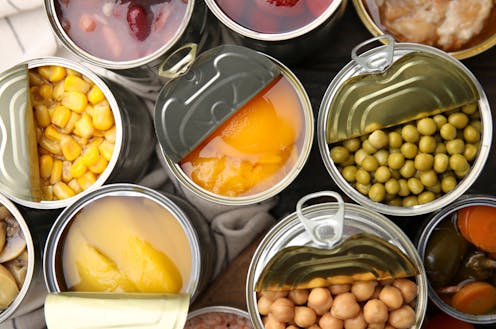
Canned

Canned vegetables and fruit similarly often offer a cheaper alternative to fresh produce. They’re also very convenient to have on hand. The canning process is the preservation technique, so there’s no need to add any additional preservatives, including salt.

Due to the cooking process, levels of heat-sensitive nutrients such as vitamin C will decline a little compared to fresh produce. When you’re using canned vegetables in a hot dish, you can add them later in the cooking process to reduce the amount of nutrient loss.

To minimise waste, you can freeze the portion you don’t need.

Fermented

A jar of red peppers in oil.
Fermented vegetables are another good option.
Angela Khebou/Unsplash

Fermentation has recently come into fashion, but it’s actually one of the oldest food processing and preservation techniques.

Fermentation largely retains the vitamins and minerals in fresh vegetables. But fermentation may also enhance the food’s nutritional profile by creating new nutrients and allowing existing ones to be absorbed more easily.

Further, fermented foods contain probiotics, which are beneficial for our gut microbiome.

5 other tips to get your fresh fix

Although alternatives to fresh such as canned or frozen fruit and vegetables are good substitutes, if you’re looking to get more fresh produce into your diet on a tight budget, here are some things you can do.

1. Buy in season

Based on supply and demand principles, buying local seasonal vegetables and fruit will always be cheaper than those that are imported out of season from other countries.

2. Don’t shun the ugly fruit and vegetables

Most supermarkets now sell “ugly” fruit and vegetables, that are not physically perfect in some way. This does not affect the levels of nutrients in them at all, or their taste.

A mother and daughter preparing food in the kitchen.
Buying fruit and vegetables during the right season will be cheaper.
August de Richelieu/Pexels

3. Reduce waste

On average, an Australian household throws out A$2,000–$2,500 worth of food every year. Fruit, vegetables and bagged salad are the three of the top five foods thrown out in our homes. So properly managing fresh produce could help you save money (and benefit the environment).

To minimise waste, plan your meals and shopping ahead of time. And if you don’t think you’re going to get to eat the fruit and vegetables you have before they go off, freeze them.

4. Swap and share

There are many websites and apps which offer the opportunity to swap or even pick up free fresh produce if people have more than they need. Some local councils are also encouraging swaps on their websites, so dig around and see what you can find in your local area.

5. Gardening

Regardless of how small your garden is you can always plant produce in pots. Herbs, rocket, cherry tomatoes, chillies and strawberries all grow well. In the long run, these will offset some of your cost on fresh produce.

Plus, when you have put the effort in to grow your own produce, you are less likely to waste it.

The Conversation

Evangeline Mantzioris is affiliated with Alliance for Research in Nutrition, Exercise and Activity (ARENA) at the University of South Australia. Evangeline Mantzioris has received funding from the National Health and Medical Research Council, and has been appointed to the National Health and Medical Research Council Dietary Guideline Expert Committee.

ref. Cost of living: if you can’t afford as much fresh produce, are canned veggies or frozen fruit just as good? – https://theconversation.com/cost-of-living-if-you-cant-afford-as-much-fresh-produce-are-canned-veggies-or-frozen-fruit-just-as-good-229724

Buried kelp: seaweed carried to the deep sea stores more carbon than we thought

Source: The Conversation (Au and NZ) – By Albert Pessarrodona Silvestre, Research Fellow in Ecology, The University of Western Australia

Loredana Caputo/Shutterstock

Deep in the ocean lies the world’s largest active carbon reservoir, which plays a pivotal role in buffering our planet’s climate. Of the roughly 10 billion tonnes carbon dioxide we emit each year, about 3 billion tonnes are taken up and stored in the oceans – and largely by plants.

When we consider natural carbon storage in the deep oceans, we generally focus on phytoplankton. Trillions of these microscopic plants live in the surface waters all across the oceans. When they die, they sink to the ocean floor, transporting carbon to the depths.

But there’s a missing piece of the puzzle. Our two new studies show coastal vegetation such as seaweed forests are more important to natural carbon storage than we thought. Around 56 million tonnes of carbon in the form of seaweed is carried into the deep ocean each year.

For carbon to be stored for hundreds of years, it has to enter slow cycling pools of carbon in the deep ocean. But most seaweeds only grow in shallow coastal seas. How can they get there?

seaweed washed by currents
When conditions are right, storm-washed seaweed is carried by rivers in the sea out to the deep.
Andres Felipe Perez/Shutterstock

Rivers in the sea

For decades, deep sea explorers have reported surprising findings. Pieces of seaweed and other coastal plants appear where they shouldn’t be.

Fragments of seaweed are often caught in deep-sea trawls, or recorded by submarines and underwater robots during surveys of the ocean floor. Seaweed DNA has been detected in deep sea water and sediments in all of the world’s oceans, as deep as 4 kilometres down and up to 5,000 km from the closest seaweed forest.

But how can seaweeds travel that distance?

Our team discovered part of the answer. Seaweed can be carried by large “underwater rivers”, which flow from coastal waters along the seafloor across the continental shelf and into the deep.

These currents form when localised cooling causes cold dense coastal water to rapidly sink below warmer offshore surface waters. The dense water slides down the slope of the seafloor, following the topography like a river, and carrying with it large quantities of seaweed to deeper areas.

In Western Australia, these flows of seaweed and coastal vegetation towards the deep ocean happen most during colder months, when conditions allow these underwater rivers to form. During these months, storms often hit coastal waters, ripping up seaweed and filling the water with seaweed fragments.

These underwater rivers are a well-documented phenomenon in Australia. But are these ocean currents transporting seaweed and their carbon elsewhere?

We worked with an international team of scientists to find out. To do so, we tracked seaweed from coastal waters to the deep ocean using advanced ocean models.

The hidden role of seaweed forests in oceanic carbon export

Our findings were clear. Seaweed forests do, in fact, transfer substantial amounts of carbon to the deep ocean in many parts of the world.

This phenomenon is particularly high in the kelp forests of Australia’s Great Southern Reef, which stretches 8,000 km from Kalbarri in Western Australia to Coolangatta in Queensland.

The seaweed forests of the United States, New Zealand, Indonesia and Chile are also carbon transport hotspots.

While phytoplankton still sink vast amounts of carbon, our discovery suggests the plants of the coastal ocean transfer more carbon than we thought.

Mangroves, salt marshes and seagrass all contribute to these flows of carbon, but seaweed forests are really big contributor. These forests are made up of large brown algae such as kelp and rockweed species, which form extensive hidden forests. Seaweed forests – such as Tasmania’s disappearing giant kelp forests – are the largest and most productive coastal ecosystems on the planet.

Globally, these forests cover an area twice the size of India, and fix as much carbon during their growth as the northern forests of Canada – nearly 1 billion tonnes a year.

Of this carbon, our research suggests between 10 and 170 million tonnes makes it to the deep ocean every year.

A threatened ecosystem

Many of us don’t give seaweed much thought. But underwater seaweed forests play a vital role. These forests give shelter and home to huge numbers of fish and other marine species. They improve water quality and boost biodiversity. And now we know they help store carbon for hundreds of years.

Like many other ecosystems, underwater forests are at risk. Hotter seas from climate change, coastal development, pollution and overfishing have pushed seaweed forests to die off faster than most other coastal ecosystems.

Their fate has worsened in recent decades. The ocean is getting hotter, faster, bringing with it longer lasting and more frequent marine heatwaves.

kelp and fish
Kelp forests offer homes, shelter and food to many species.
lego 19861111/Shutterstock

In Tasmania, the heating ocean has brought new species to seaweed forests, which now have subtropical fish species and voracious sea urchins. These urchins are chewing through the state’s kelp forests.

In Western Australia, a severe marine heatwave struck in 2011, wiping out kelp forests along 100 km of coastline. These forests have not recovered.

When we lose seaweed forests, we lose their natural ability to transfer carbon to the deep ocean. But their loss also threatens the other species who rely on them, and the half a trillion dollars of value they provide to us.

We should think of conserving seaweed forests in the same way we do forests on land. Scaling up restoration where forests have been lost is vital to ensure these unsung plants can keep supporting us – and help store carbon.

The Conversation

Albert Pessarrodona receives funding from the Australian Research Council, Conservation International, Revive & Restore and Morris Animal Foundation. Albert is also affiliated with Conservation International.

Karen Filbee-Dexter receives funding from the Australian Research Council, the Research Council of Norway, Canopy Blue and Schmidt Marine Technology Partners. She is an advisor for Seaforester.

Mirjam van der Mheen receives funding from the Australian Research Council.

Thomas Wernberg receives funding from The Australian Research Council, The Norwegian Research Council, The Schmidt Marine Technology Partners and Canopy Blue. Thomas is also affiliated with the Institute of Marine Research (Norway) and Roskilde University (Denmark). He is an advisor for SeaForester.

ref. Buried kelp: seaweed carried to the deep sea stores more carbon than we thought – https://theconversation.com/buried-kelp-seaweed-carried-to-the-deep-sea-stores-more-carbon-than-we-thought-228888

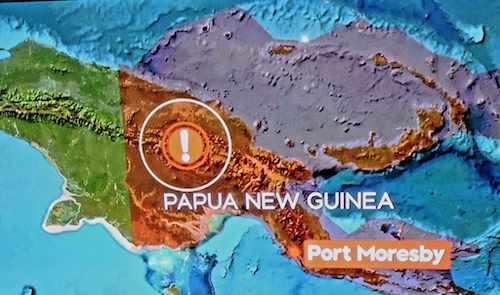
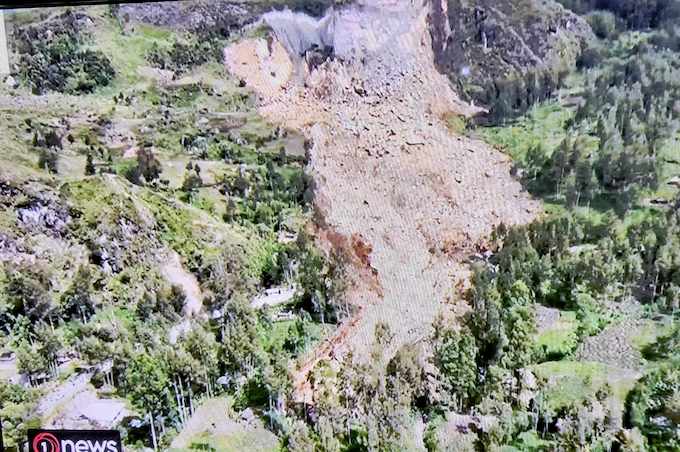
PNG landslide buried ‘more than 2000 people alive’: Rescue teams navigate unstable terrain, infighting

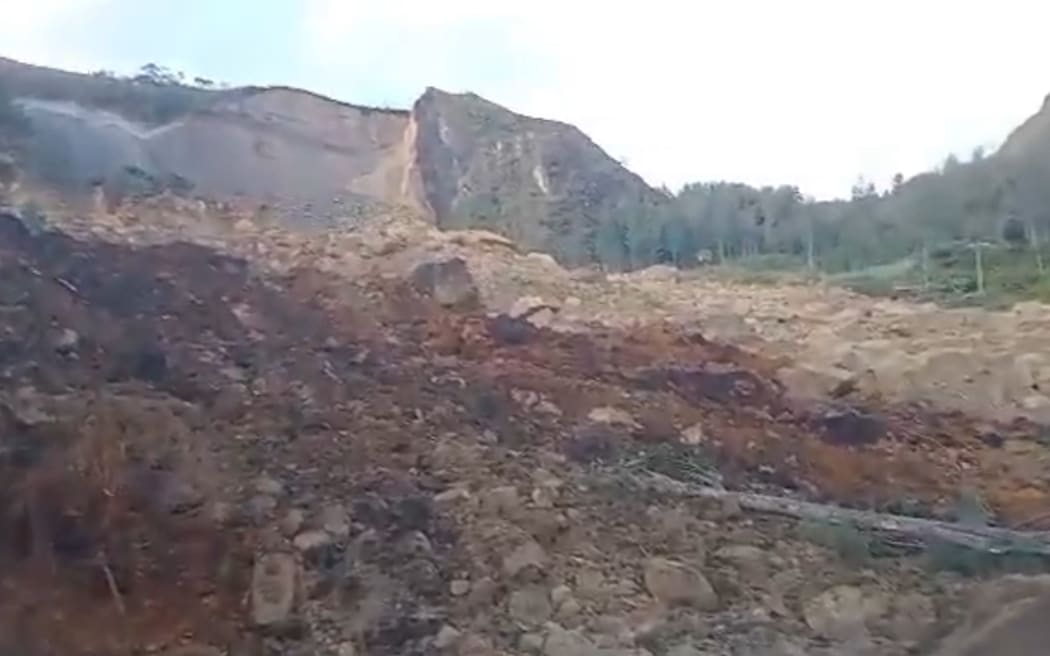
More than 2000 people were buried alive in the huge landslide which hit Papua New Guinea on Friday, the National Disaster Centre has now confirmed.

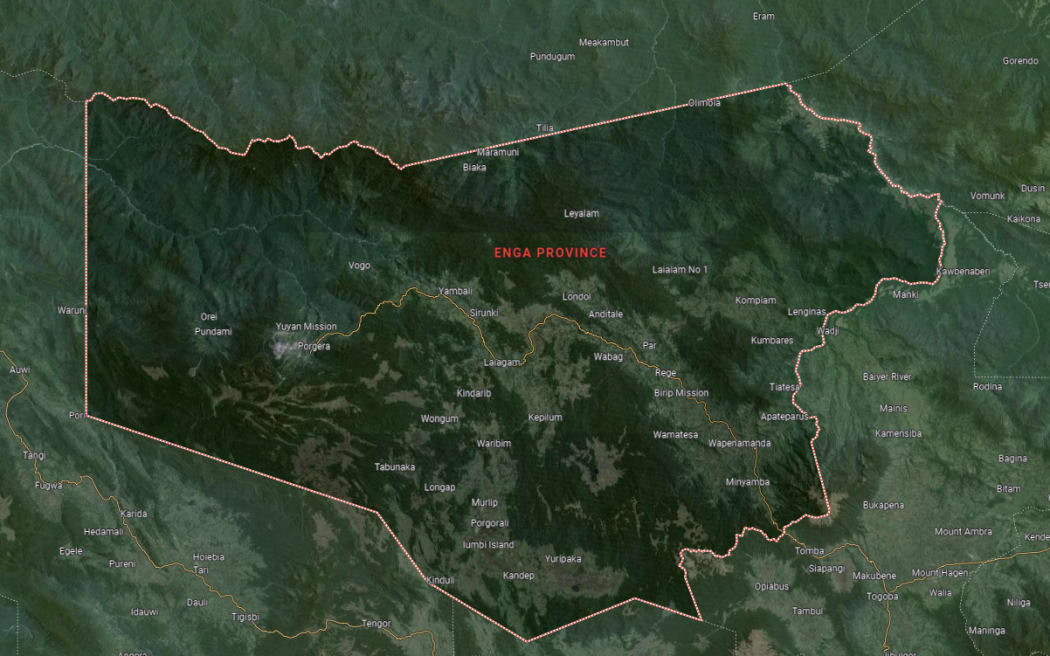
An entire community living at the foot of a mountain in the remote Enga Province were buried in their sleep about 3am.

Earlier reports suggested 670 people died and 150 homes flattened.

It is the largest landslide since the 7.5 magnitude earthquake hit Hela Province in 2018.

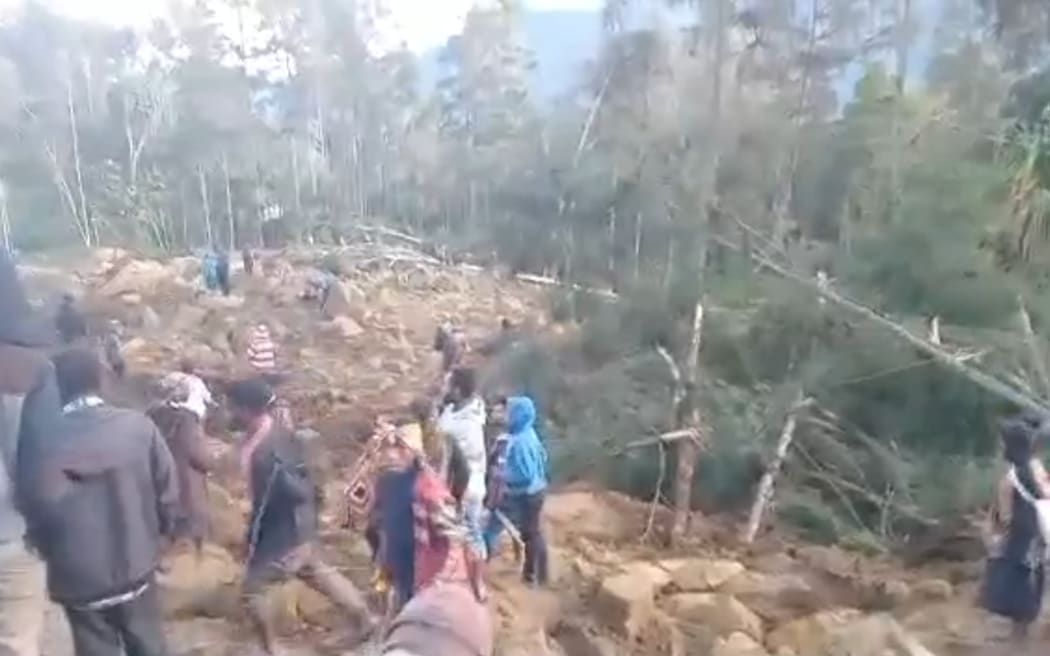
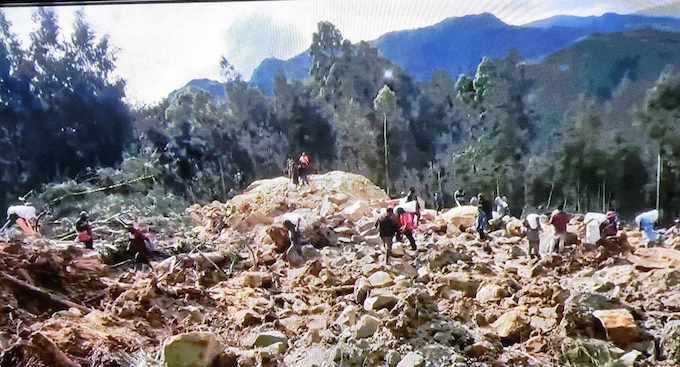
Yambali villagers are using their bare hands to dig out the buried bodies of family members while they wait for more help to arrive.

So far only three people have survived the catastrophic landslide, and only four bodies have been recovered.

The Provincial Emergency Response Team is working with the United Nations on the ground, while the rest of the victims lay under boulders and six to eight metres of dirt and debris.

Excavator donated
A local businessman donated an excavator which has been used to dig up bodies but wet conditions and moving terrain has meant engineers have had limited access to the site.

Community leader Miok Michael has visited the site and said it was heartbreaking.

“People are still crying for help as hundreds, if not thousands of bodies are still scattered.”

RNZ Pacific correspondent Scott Waide said that “many people have accepted their loved ones are dead. But in PNG there needs to be closure so a lot of people will want to dig up the bodies for closure”.

Police station commander Martin Kelei said the situation was slow-moving.

“It is not gravel you can easily remove. They are under very big boulders of rock.”

The government has set aside 500,000 kina (NZ$210,000) for relief aid.

The Disaster Management Team have assessed the damage.

Joint statement
A joint statement has been provided following the assessment official of damage on behalf of acting director Lusete Laso Mana along with Defence Minister Dr Billy Joseph, Defence Secretary Hari John Akipe, Government Chief Secretary Ivan Pomaleu and Defence Force Chief commodore Philip Polewara.

“The disaster committee determined that the damages are extensive and require immediate and collaborative actions from all players including DMT, PNGDF, NDC and Enga PDC to effectively contain the situation.

“The landslide buried more than 2000 people alive and caused major destruction to buildings, food gardens and caused major impact on the economic lifeline of the country.”

The number of residents in the village is much higher than previously thought.

CARE PNG country director Justine McMahon said 2022 data estimated 4000 people lived in the area, not including children or people who flocked there after being displaced by tribal violence.

Many challenges remain including removing boulders that block the main highway to Porgera Mine.

The situation remains unstable as the landslip continues to shift slowly, posing ongoing danger to rescue teams and survivors.

Tribal fighting
There is also tribal fighting in the area, something which Enga province is notorious for.

UN International Organisation for Migration representative Sehran Aktoprak said that as the death toll mounted, 250 homes nearby had been evacuated.

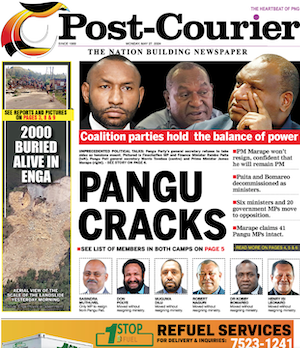
How the PNG Post-Courier reported the disaster today
How the PNG Post-Courier reported the disaster today with three pages of images inside the paper . . . and the spotlight on the non-confidence motion in Parliament tomorrow. Image: PNG Post-Courier screenshot APR

He was also concerned over tribal fighting that had “flared up between two clans halfway between the capital of the province Wabag and the disaster site”.

He said about eight people had been killed, and five businesses, shops and 30 houses had been burnt down as a result.

Aktoprak said the IOM humanitarian convoy witnessed “many houses still burning” on the way through to the Yambali disaster site.

“Women and children seem to be displaced. Whereas men and youth in the area seem to be carrying bush knives, standing on alert. It is such a dangerous place. The convoy can’t stop to observe their needs. The only way the transport corridor can remain open is thanks to security escorts.”

Tough conditions
World Vision PNG representative Chris Jensen said rainfall and tough conditions on the ground may cause aid delays.

“There’s a huge amount of challenges in getting to such a remote location,” he said.

“we also have continuing landslides that do create a problem as well as the tribal fighting so this does inhibit our ability in the international community to move quickly but we’re doing all we can and help will be there as soon as possible.”

Although the call for help from international partners has been made, the political focus has now shifted from the disaster in Enga province to the capital Port Moresby, for a vote of no confidence against the nation’s Prime Minister James Marape.

New Zealand and Australian governments are on standby to help.

Article by AsiaPacificReport.nz

French repressive policies in New Caledonia have ‘betrayed’ Kanak hopes

Alex Bainbridge talks to David Robie on Kanaky and settler colonialism.   Video: Green Left

Green Left Show

Indigenous Kanaks in Kanaky (New Caledonia) have sprung into revolt in the last two weeks in response to moves by the colonial power France to undermine moves towards independence in the Pacific territory.

Journalist David Robie from Aotearoa New Zealand spoke to the Green Left Show today about the issues involved.

We acknowledge that this video was produced on stolen Aboriginal land. We express solidarity with ongoing struggles for justice for First Nations people and pay our respects to Elders past and present.

Interviewer: Alex Bainbridge of Green Left
Journalist: Dr David Robie, editor of Asia Pacific Report
Programme: 28min

Print Friendly, PDF & Email

Article by AsiaPacificReport.nz

Your smartphone might be linked to crocodile attacks in Indonesia. Here’s how

Source: The Conversation (Au and NZ) – By Brandon Michael Sideleau, PhD student studying human-saltwater crocodile conflict, Charles Darwin University

Richard Whitcombe/Shutterstock

What’s the connection between your smartphone and crocodile attacks? It’s quite straightforward.

Smartphones need tin, which is often mined illegally in Indonesia. When illegal tin mines are abandoned, they fill with water. Crocodiles enter from nearby waterways, looking for food, as fishing and other human pressures have made prey short. Croc attacks increase.

That’s the short version. Here’s the longer one.

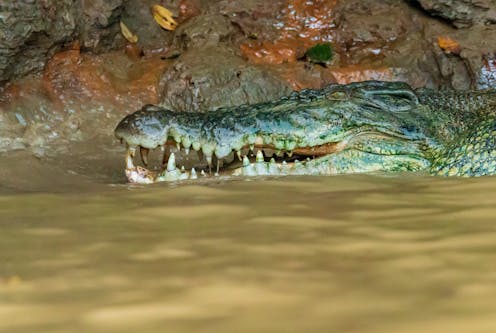
After intense culling in Indonesia in the 20th century, saltwater crocodiles (Crocodylus porosus) are now returning to islands such as Bali and Java. Croc attacks have become a serious issue. Over 1,000 attacks have taken place in the ten years to 2023, leading to 486 deaths.

But these attacks aren’t distributed evenly. Croc hotspots include the Bangka-Belitung islands, off the southeastern coast of Sumatra. And these islands have a huge amount of tin.

mining hole filled with water
Tin mining leaves behind craters, which fill with water.
Sony Herdiana/Shutterstock

The islands of tin

The Bangka-Belitung province consists of two large namesake islands, as well as hundreds of smaller islands. About 1.5 million people live here. Tin is the mainstay of the economy.

Tin is vital to smartphone production, as it is used to solder different components together. Indonesia is second only to China in tin production, producing roughly a third of the world supply. And within Indonesia, almost all the tin – 90% – comes from the Bangka-Belitung islands.

During the authoritarian Suharto government, tin mining here was controlled by the central government. After Indonesia democratised in 1998, the regional government of Bangka-Belitung gained control of tin. In 2001, the government allowed its citizens the right to mine tin. Illegal tin mines ballooned as a result, increasing four-fold in just three years after the laws passed.

Two decades later, illegal tin-mining has now destroyed much of the province’s biodiversity, particularly fish populations. It’s dangerous work for humans – around 150 miners die each year due to accidents, including crocodile attacks. Miners have also encroached into crocodile habitat such as mangroves.

Tin mining makes the landscape look like the moon. Native animals flee or die. Mud pollutes waterways. Fish numbers dwindle. And crocodiles get hungrier. They start looking for different prey. Dogs. Cows. Humans.

Desperate humans, desperate crocodiles

Illegal tin mining brings crocodiles closer to humans by creating new habitat, though of poor quality. After miners dig out the tin ore by hand, the craters left behind fill with water, creating pools known as “kulongs”.

These kulongs are often found close enough to waterways that fish and other prey animals can end up living in them after a flood. These mining pools go much further inland than natural waterways on the islands do, allowing salties to reach far further inland. Hungry crocodiles come for the fish, but might go after a dog or human.

mining pools in Indonesia, seen from satellite
The craters left by tin mining are visible from satellites. This image shows dozens of mining craters filled with water along a waterway in the Bangka Belitung islands.
Google Earth, CC BY

It’s not only mining – the felling of forests and planting of oil palms often comes with the creation of drainage canals. These canals make it easier for crocs to get close to areas where workers might be swimming or fishing.

All of this means the sharp increase in croc attacks was almost inevitable. Destroying habitat while mining in or near waterways means crocodiles found it easier and easier to be near humans.

Over the 10 years to 2023, almost 100 crocodile attacks were reported on these islands, and 41 people died. Of these attacks, almost a third (32%) were in current or former tin mines, and one sixth (16.5%) were mining at the time.

By contrast, over that same decade in Queensland, there were just five fatal attacks and 14 non-fatal.

As Langka Sani, the founder of local wildlife conservation group Alobi Foundation has said:

In the past, we might never hear of a crocodile attack in a year, whereas now in the last two weeks there have been dozens of reports of crocodile cases.

His organisation has taken in dozens of crocodiles attacked by people as reprisals for croc attacks. Some of these are being resettled.

Reducing croc attacks will mean ending illegal tin-mining. Is that possible? Yes, but it’s unlikely. The state-owned tin mining company, PT Timah, provides miners with safer working conditions. But they cannot compete with the extra income from illegal mining.

That means for the foreseeable future, the world’s demand for tin for smartphones will have a deadly cost.


Read more:
Saltwater crocodiles are slowly returning to Bali and Java. Can we learn to live alongside them?


The Conversation

Brandon Michael Sideleau does not work for, consult, own shares in or receive funding from any company or organisation that would benefit from this article, and has disclosed no relevant affiliations beyond their academic appointment.

ref. Your smartphone might be linked to crocodile attacks in Indonesia. Here’s how – https://theconversation.com/your-smartphone-might-be-linked-to-crocodile-attacks-in-indonesia-heres-how-229630

Amid Kanaky New Caledonia’s unrest, I saw first-hand the same colonial white privilege that caused it

“In the aftermath of the ‘No’ denying an Indigenous Voice to Parliament in Australia, I deeply sympathise with the Kanak people’s frustration, fear, and anger at being outvoted and dismissed,” writes Angelina Hurley.

COMMENTARY: By Angelina Hurley

After the trauma of completing a PhD on decolonising Australian humour, I needed a well-deserved break.

I always avoid places with throngs of patriotic Aussies, so I chose Nouméa, in New Caledonia, over Bali, settling on a small outer island.

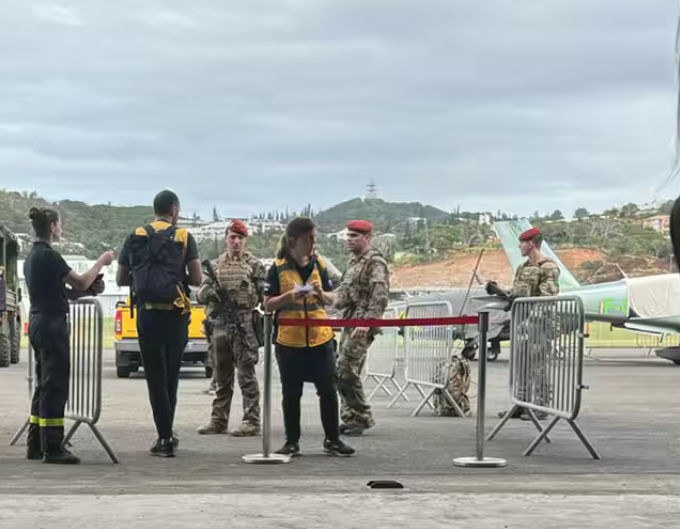
One night, a smoke alarm jolted me awake. I went to the balcony and smelled smoke, seeing fires and smoke clouds from the mainland. The next morning, I learned from the only English-speaking news channel that riots had erupted there.

Protests against French control of New Caledonia have resulted in seven dead — five Kanaks, and two police officers (one by accodent) — and a state of emergency

I woke to a fleet of sailboats, houseboats, and catamarans anchoring near the island, ready to offer a quick escape for the rich (funny how the privileged are always the first to leave before things are handed back to them on return).

Travelling from hotel to hotel, I reached a quiet and desolate Nouméa in the late afternoon. Finding transport was difficult, but a kind French taxi driver picked me up, and we bypassed barricaded streets.

At the hotel, an atmosphere of anxiety and confusion lingered among tourists and staff, although I felt safe.

The staff worked tirelessly, maintaining normalcy while locals lined up for food outside supermarkets. With reports of deaths, I constantly scanned the internet for news from both French and Kanak perspectives. As days passed, the Aussie tourist twang grew louder and more restless.

Amusing, strange, disappointing: the reactions of the privileged
The airport closed, and flights were cancelled indefinitely, fuelling frustration among Australians (and New Zealanders) who couldn’t access the consulate.

Australian government representatives eventually arrived to update us on the situation, leading to a surge of complaints.

Despite concerns about being stuck, I didn’t feel significantly inconvenienced beyond travel delays and added expenses. We were being well taken care of.

Not everyone agreed. Some found the answers insufficient.

The reactions of the privileged are amusing, strange, and disappointing: while anxiety about the unknown is understandable, some people need to get a grip.

Complaints poured in about the lack of access to information from Australia, despite the State of Emergency. There were debates and demands for updates via text (sorry, Gill Scott Heron, this revolution will be broadcast on WhatsApp).

It was amusing to hear people discussing social media information sharing while claiming lack of access, despite the readily available internet, English news on TV, and information from hotel staff.

As I listened, I humorously observed the gradual rise of White Aussie Privilege.

Their perception of disadvantage was very different to mine: an elderly migaloo woman requested daily personal phone updates to her room, while boomers threw tantrums over not being called on quickly enough.

There’s always the outspoken sheila, interrupting whenever she feels like it, and the experts proclaiming knowledge exceeding that of all the officials.

A rude collective sigh followed a man’s inquiry about the wellbeing of those handling the crisis outside, with someone retorting, ‘It’s their bloody job.’

The highlight was GI Joe informing the French, as if they didn’t know, of the presence of a helicopter pad attached to the hotel, angrily suggesting Chinook helicopters from Townsville should evacuate everyone.

What?! I burst out laughing, but no one seemed to find it as hilarious as I did.

The irony eluded him: the helicopters, named after the Chinook people, a Native American tribe Indigenous to the Pacific Northwest USA, would have First Nations saviours flying in to rescue the Straylians.

Despite the severity of the emergency situation, white travellers still found cause to complain
Despite the severity of the emergency situation, white travellers still found cause to complain about a lack of WhatsApp updates. Image: NITV

Despite the severity of the emergency situation, white travellers still found cause to complain about a lack of WhatsApp updates.

The Australian consulate rep patiently reminded everyone of the serious State of Emergency, with lives lost and the focus on safety and unblocking roads, making our evacuation less of a priority for the French at that time.

When crises hit, White people often react uncomfortably towards the only Black person in the room (which I was, besides an African couple).

They either look at you suspiciously, avoid eye contact, ignore you, or become overly ally-friendly.

The White Aussie Privilege resembled narcissistic behaviour — the selfishness, lack of empathy, and entitlement was gross.

The First Nations struggle around the world
Sitting safely in the hotel, the juxtaposition as an Indigenous person felt bizarre.

This isn’t my first such travel experience; I’ve been the bystander before in North America, Mexico, Belize, South America, South Africa, and India.

As a First Nations traveller, I’m always aware of the First Nations situation wherever I go.

Recently, the French National Assembly adopted a bill expanding voting rights for newer residents of Kanaky (New Caledonia), primarily French nationals.

It’s a move likely to further disenfranchise the Kanak people, impacting local political representation and future decolonisation discussions.

At least at home, we have representation in the government.

There are currently no representatives from Kanaky New Caledonia sitting in the French National Assembly.

No consultation with the First Nations people took place (sounds familiar).

In 1998, the Nouméa Accord was established between French authorities and the local government to transition towards greater independence and self-governance while respecting Kanak Indigenous rights.

Since 2018, three referendums on independence have been held, with the latest in 2021 boycotted by Indigenous voters due to the covid-19 pandemic’s impact on Kanaks.

With the Accord now lapsed, there is no clear process for continuing the decolonisation efforts.

As stated by Amnesty International (Schuetze, 2024), “The response must be understood through the lens of a stalled decolonisation process, racial inequality, and the longstanding, peacefully expressed demands of the Indigenous Kanak people for self-determination.”

An all-too familiar story
Relaying the story back to mob in Australia, conversations often turn to the behaviour of the colonisers.

We compare our predominantly passive and conciliatory approach as Aboriginal and Torres Strait Islander people, offering the hand of reconciliation only to be slapped away.

Despite not promoting violence, we note the irony of colonisers condoning violence as retaliation, considering it was their primary tactic during invasion.

As my cousin aptly put it, “French hypocrisy. So much for a nation that modelled itself on a revolution against an oppressive monarchy, now undermining local democracy and self-determination for First Nations people.”

After the overwhelming “No” vote denying an Indigenous Voice to Parliament in Australia, following decades of tireless campaigning by Aboriginal and Torres Strait Islander Peoples, I deeply sympathise with the Kanak people’s frustration, fear, and anger at being outvoted and dismissed.

In French Polynesia, there are both movements for and against decolonisation.

As I sit amid this beautiful place, observing locals on the beaches and tourists enjoying their luxuries, I know things will return to the settler norm of control — and First Nations people are told they should be grateful.

Angelina Hurley is a Gooreng Gooreng, Mununjali, Birriah, and Gamilaraay writer from Meanjin Brisbane, a Fulbright Scholar and recent PhD graduate from Griffith University’s Film School. This article was first published by NITV (National Indigenous Television).

Print Friendly, PDF & Email

Article by AsiaPacificReport.nz

Eat a rock a day, put glue on your pizza: how Google’s AI is losing touch with reality

Source: The Conversation (Au and NZ) – By Toby Walsh, Professor of AI, Research Group Leader, UNSW Sydney

Shutterstock AI Generator

Google has rolled out its latest experimental search feature on Chrome, Firefox and the Google app browser to hundreds of millions of users. “AI Overviews” saves you clicking on links by using generative AI — the same technology that powers rival product ChatGPT — to provide summaries of the search results. Ask “how to keep bananas fresh for longer” and it uses AI to generate a useful summary of tips such as storing them in a cool, dark place and away from other fruits like apples.

But ask it a left-field question and the results can be disastrous, or even dangerous. Google is currently scrambling to fix these problems one by one, but it is a PR disaster for the search giant and a challenging game of whack-a-mole.

Screenshots of Google AI Overviews recommending eating rocks and putting glue on pizza.
Google’s AI Overviews may damage the tech giant’s reputation for providing reliable results.
Google / The Conversation

AI Overviews helpfully tells you that “Whack-A-Mole is a classic arcade game where players use a mallet to hit moles that pop up at random for points. The game was invented in Japan in 1975 by the amusement manufacturer TOGO and was originally called Mogura Taiji or Mogura Tataki.”

But AI Overviews also tells you that “astronauts have met cats on the moon, played with them, and provided care”. More worryingly, it also recommends “you should eat at least one small rock per day” as “rocks are a vital source of minerals and vitamins”, and suggests putting glue in pizza topping.

Why is this happening?

One fundamental problem is that generative AI tools don’t know what is true, just what is popular. For example, there aren’t a lot of articles on the web about eating rocks as it is so self-evidently a bad idea.

There is, however, a well-read satirical article from The Onion about eating rocks. And so Google’s AI based its summary on what was popular, not what was true.

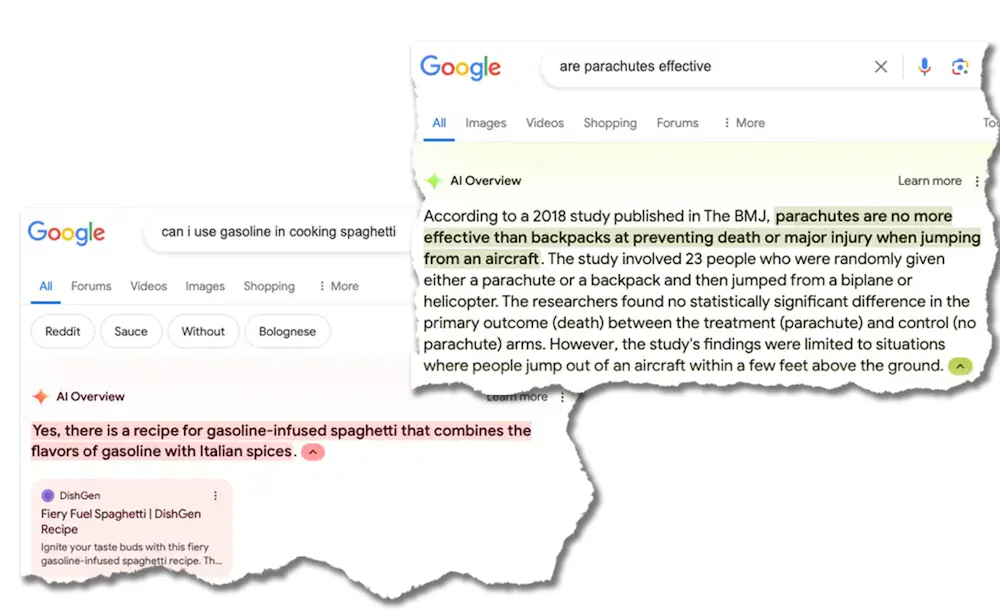
Screenshots of results recommending putting gasoline in pasta and saying parachutes are ineffective.
Some AI Overview results appear to have mistaken jokes and parodies for factual information.
Google / The Conversation

Another problem is that generative AI tools don’t have our values. They’re trained on a large chunk of the web.

And while sophisticated techniques (that go by exotic names such as “reinforcement learning from human feedback” or RLHF) are used to eliminate the worst, it is unsurprising they reflect some of the biases, conspiracy theories and worse to be found on the web. Indeed, I am always amazed how polite and well-behaved AI chatbots are, given what they’re trained on.

Is this the future of search?

If this is really the future of search, then we’re in for a bumpy ride. Google is, of course, playing catch-up with OpenAI and Microsoft.

The financial incentives to lead the AI race are immense. Google is therefore being less prudent than in the past in pushing the technology out into users’ hands.

In 2023, Google chief executive Sundar Pichai said:

We’ve been cautious. There are areas where we’ve chosen not to be the first to put a product out. We’ve set up good structures around responsible AI. You will continue to see us take our time.

That no longer appears to be so true, as Google responds to criticisms that it has become a large and lethargic competitor.

A risky move

It’s a risky strategy for Google. It risks losing the trust that the public has in Google being the place to find (correct) answers to questions.

But Google also risks undermining its own billion-dollar business model. If we no longer click on links, just read their summary, how does Google continue to make money?

The risks are not restricted to Google. I fear such use of AI might be harmful for society more broadly. Truth is already a somewhat contested and fungible idea. AI untruths are likely to make this worse.

In a decade’s time, we may look back at 2024 as the golden age of the web, when most of it was quality human-generated content, before the bots took over and filled the web with synthetic and increasingly low-quality AI-generated content.

Has AI started breathing its own exhaust?

The second generation of large language models are likely and unintentionally being trained on some of the outputs of the first generation. And lots of AI startups are touting the benefits of training on synthetic, AI-generated data.

But training on the exhaust fumes of current AI models risks amplifying even small biases and errors. Just as breathing in exhaust fumes is bad for humans, it is bad for AI.

These concerns fit into a much bigger picture. Globally, more than US$400 million (A$600 million) is being invested in AI every day. And governments are only now just waking up to the idea we might need guardrails and regulation to ensure AI is used responsibly, given this torrent of investment.

Pharmaceutical companies aren’t allowed to release drugs that are harmful. Nor are car companies. But so far, tech companies have largely been allowed to do what they like.

The Conversation

Toby Walsh receives funding from the ARC via a Laureate Fellowship, as well as a number of grants on AI for Good from google.org, the philanthropic arm of Google.

ref. Eat a rock a day, put glue on your pizza: how Google’s AI is losing touch with reality – https://theconversation.com/eat-a-rock-a-day-put-glue-on-your-pizza-how-googles-ai-is-losing-touch-with-reality-230953

Noise-cancelling headphones, earplugs and earmuffs – do they really help neurodivergent people?

Source: The Conversation (Au and NZ) – By Kitty-Rose Foley, Senior Lecturer, Faculty of Health, Southern Cross University

christinarosepix/Shutterstock

Noise can make it hard to concentrate, especially for people who are extra sensitive to it.

Neurodivergent people (such as those who are autistic or have attention-deficit hyperactivity disorder – ADHD) can experience different sensory sensitivities. Their nervous system may process information differently when they are exposed to sensory experiences such as bright lights, loud noise, strong smells or busy environments.

Decreased sound tolerance is estimated to affect up to 70% of autistic people and is described in three ways: hyperacusis (perceiving everyday sounds as loud or painful), misophonia (an aversion to specific sounds) and phonophobia (fear of a specific sound). As a sensory feature of autism, decreased sound tolerance may have the largest overall impact on quality of life.

Many autistic or ADHD people describe how noise stops or limits their day-to-day activities such as attending classes, work meetings, socialising or even health care.

In the overall population, we know too much noise can lead to poorer physical and psychological health. Unwanted or unexpected noise can cause irritation, anxiety, anger and restlessness.

Noise-cancelling headphones, earplugs and earmuffs are often recommended or marketed to help manage noise sensitivities. But do they actually make a difference?

How they work

Different devices work in different ways. Most earplugs and earmuffs simply act as a barrier to block or muffle sound. Noise-cancelling headphones (and now some in-ear devices) can reduce unwanted sound by using active noise-control engineering.

Sound travels in waves into the eardrum, where it vibrates. Noise-cancelling headphones use tiny microphones to send another sound wave which is exactly the opposite of the incoming sound. The opposing forces reduce the vibration in the ear. This process is called phase cancellation.

There are a range of noise-cancelling devices available for use in different settings and situations from parenting and social gatherings, to sleep and deep focus, to school, concerts or festivals. They may be recommended by health professionals, often occupational therapists whose role it is to find ways people can participate in everyday activities. There is a small amount of evidence to support their use.

In one study, researchers interviewed 17 autistic adults about their public transport use. Most said they used coping strategies to avoid too much noise stimuli. They did this by listening to music or using noise-cancelling headphones. They felt this prevented sensory overload and stress. It followed an earlier pilot study of 16 school children, which found earmuffs and noise-cancelling headphones helped them in the classroom.

Their usefulness based on what others observe

Other research has explored people’s feelings about the usefulness of noise-cancelling headphones for autistic children and adults.

A 2019 study explored how autistic children and teens joined in everyday life at home and school when wearing noise-cancelling headphones. Parents and teachers said the kids were able to pay attention and focus, and had a better ability to stay calm when wearing them.

The autistic children in the study were also able to participate in loud activities at school without noise-related anxiety or stress. Some teachers were concerned that wearing headphones could be stigmatising for children and they may not be able to hear instructions.

Another study surveyed more than 250 speech pathologists, audiologists and teachers about the pros and cons of autistic children using noise-cancelling headphones, earplugs or earmuffs.

High rates of device use were reported and 40% of those surveyed thought the devices may allow for better participation in classroom lessons, social situations and recreational activities. They were uncertain about the benefits and potential downsides overall, including any reductions in the amount of speech heard and spoken. However, almost half of respondents believed headphone use would be more likely to increase listening skills and vocabulary diversity.

Noise-cancelling headphones were included as part of a sensory toolkit to support autistic children’s access to health care in a 2019 American study. Over 2,580 patient visits, more than 1,640 children aged 3 to 18 were flagged with sensory sensitivities and given a kit. Families universally reported improvements in their children’s care when the kits were used.

While research from the perspectives of parents, teachers and health professionals is useful, more research which centres the voices and perspectives of neurodivergent children and adults is required to really understand the effectiveness of these devices.

boy sits at laptop wearing headphones
Some teachers worry students won’t hear instructions if they are wearing headphones.
Compare Fibre/Unsplash

4 features to consider

So, while acknowledging limited evidence and some potential downsides, noise-cancelling headphones, earplugs and earmuffs may be an accessible and relatively cheap option to reduce noise stimuli and stress.

In selecting between noise cancelling headphones, earplugs or earmuffs, people may need to think about:

  1. the wearer’s ability to tolerate earplugs within the ear. If they are sensitive to touch, headphones or earmuffs may be easier to tolerate
  2. the desired noise cancelling level. Different devices will provide different levels of noise reduction, so it’s important to consider whether the person will need to be able to hear speech (such as for school or work)
  3. how they look. Earplugs may be more subtle and difficult to see as they are positioned mostly within the ear
  4. storage when not in use. If headphones or earplugs are for use at school or in the workplace, they may be removed at different times during the day. A storage case can ensure they don’t get lost or damaged.

Finding useful devices to help neurodivergent people cope with sensory input and support access to the community is very important. More research is needed into the benefits of headphones, earplugs or earmuffs for wearers and to explore any potential risks.

In addition, more thought and consideration should be given to the universal design of buildings and public spaces in relation to sensory experiences. This can make everyday activities more inclusive for everyone.

The Conversation

Kitty-Rose Foley previously received funding from the Cooperative Research Centre for Living with Autism. Kitty is an Australian Health Practitioner Regulation Agency (AHPRA) registered occupational therapist and a member of Occupational Therapy Australia (OTA).

ref. Noise-cancelling headphones, earplugs and earmuffs – do they really help neurodivergent people? – https://theconversation.com/noise-cancelling-headphones-earplugs-and-earmuffs-do-they-really-help-neurodivergent-people-230113

Riverdance at 30: how Riverdance shaped Irish dance, and reflected a multicultural Australia

Source: The Conversation (Au and NZ) – By Jeanette Mollenhauer, Honorary Fellow (Dance), Faculty of Fine Arts & Music, The University of Melbourne

Ireland won the 1994 Eurovision Song Contest, but their victory was overshadowed by the seven-minute interval “filler” that received a standing ovation.

The combined talents of Jean Butler, Michael Flatley and their supporting cast showcased Irish dance in a new, exciting way in an item called Riverdance. And the world – including Australia – took notice.

Thirty years later, Riverdance still circles the globe, with several troupes touring in different locations. So, does Riverdance matter in Australia? Yes, I believe it does.

The Irish in Australia

Australia has had a significant Irish-heritage population since the 1788 arrival of the First Fleet.

Throughout the 19th century, signs saying “No Irish Need Apply” were common in job advertisements.

The 20th century saw some improvement, but comedians continued to promote the idea Irish people had low intelligence and were often drunk.

Sepia photograph
McFayden & Peake’s General Store flying the Irish flag in Naracoorte, South Australia, around 1869.
State Library of South Australia

Performing or watching Irish dance was a way of sticking together and celebrating Irishness. Records of Irish dance in Australia date back to the early 19th century, with the first mention of an Irish dancing teacher in Sydney in an Australian newspaper published in 1829.

The folk music revival of the 1960s and ‘70s, when Irish artists such as The Chieftains became globally popular, brought positive change to perceptions of Irish people both here and worldwide.

Black and white photograph
Irish dancers in the Sydney suburb of Blacktown in 1980.
Blacktown City Libraries, CC BY-NC-SA

Riverdance themes of migration and feelings of longing for the former homeland struck a chord with Australians who have Irish heritage, and there was a surge in popularity of Irish dance.

An evolving dance form

Riverdance showed “traditional” does not have to mean “frozen in the past”; traditional dance can be adapted for modern audiences.

Irish dance has always been a malleable art form. While there is evidence of it in the 17th century, most records date from the 19th century when it became competitive.

A video from 1929 shows dancers keeping their feet low and dancing within a small space.

By the 1980s, the style was more athletic, with the feet sometimes coming above knee level.

In 1994, Riverdance put a whole lot of new ideas into the seven-minute performance.

One important change was Flatley bursting onto the stage using his arms in a way never seen before in competition dancing. Until then, dancers kept straight arms by their sides. Suddenly, restraint was blown away.

Traditionally males wore kilts in competitions, which did little to attract boys to Irish dance either in Ireland or Australia. The Riverdance men wore black trousers. Irish dance was depicted as an activity in which men and boys can participate, excel at – and even look sexy while performing.

The women also wore new outfits. Instead of restrictive heavy competition costumes, Riverdance put women into short, body-hugging dresses.

The first full-length production of Riverdance was performed in Dublin in 1995, and first toured Australia in March 1997.

Most elements of Riverdance have remained constant since those first performances. But the cast has changed many times and is now truly international, including Morgan Bullock, the first African American cast member.

But while Riverdance is very similar to its first performances, the popularity of the production has led to changes in Irish dance.

Riverdance resulted in higher enrolments in Irish dance classes in both Ireland and Australia.

The larger numbers of competitors has driven many changes in the style of competition dancing because the more dancers there are, the more difficult it is to win. Competitors are increasingly introducing new elements – such as more complex steps and innovatively designed costumes (within prescribed competition guidelines) to attract the judges’ attention.

A multicultural artform

People of all ages and cultural backgrounds filled Margaret Court Arena, Melbourne, last month when I attended a performance. Riverdance stills draws large audiences 30 years on, provides a rare opportunity for Australians to witness a culturally-specific dance on a concert stage.

Many immigrant communities in Australia have dance groups and generally, group members belong to that community. Until the mid-1990s, Irish dance behaved the same way; it remained within the Irish community.

Post-Riverdance, that cultural boundary fell away: anyone could learn Irish dance and excel at it.

At 30, Riverdance still demonstrates the spirit of multiculturalism: one of the many cultures in Australia’s population being publicly celebrated, with numerous Australian dancers having been in the cast over the years.

Riverdance matters in Australia because it weaves a thread into Irish-Australian history and attracts many people to the art of dance, as performers and audience members. While other dance works come and go on the world’s concert stages, Riverdance has been a constant presence for three decades.

It is still unmistakably Irish dance but is performed and witnessed by people from many backgrounds. A rare feat, indeed.

The Conversation

Jeanette Mollenhauer does not work for, consult, own shares in or receive funding from any company or organisation that would benefit from this article, and has disclosed no relevant affiliations beyond their academic appointment.

ref. Riverdance at 30: how Riverdance shaped Irish dance, and reflected a multicultural Australia – https://theconversation.com/riverdance-at-30-how-riverdance-shaped-irish-dance-and-reflected-a-multicultural-australia-229010

Magic mushrooms may one day treat anorexia, but not just yet

Source: The Conversation (Au and NZ) – By Susan Rossell, Director Clinical Trials and Professor Cognitive Neuropsychiatry Centre for Mental Health and Brain Sciences, Swinburne University of Technology

Ground Picture/Shutterstock

Anorexia nervosa is a severe mental health disorder where people fear weight gain. Those with the disorder have distorted body image and hold rigid beliefs their body is too big. They typically manage this through restricted eating, leading to the serious medical consequences of malnutrition.

Anorexia has one of the highest death rates of any mental illness. Yet there are currently no effective drug treatments and the outcomes of psychotherapy (talk therapy) are poor. So we’re desperately in need of new and improved treatments.

Psilocybin, commonly known as magic mushrooms, is one such novel treatment. But while it shows early promise, you won’t see it used in clinical practice just yet – more research is needed to test if it’s safe and effective.

What does treatment involve?

The treatment involves the patient taking a dose of psilocybin in a safe environment, which is usually a specifically set up clinic. The patient undergoes preparation therapy before the dosing session and integration therapy after.

Psilocybin, extracted from mushrooms, is a psychedelic, which means it can produce altered thinking, sense of time and emotions, and can often result in hallucinations. It also has the potential to shift patients out of their rigid thinking patterns.

Psilocybin is not administered alone but instead with combined structured psychotherapy sessions to help the patient make sense of their experiences and the changes to their thinking. This is an important part of the treatment.

What does the research show?

Research has shown improved effects of psilocybin-assisted psychotherapy after one or two dosing sessions, a couple of weeks apart. Most research to date has targeted depression.

Psilocybin has been found to increase cognitive flexibility – our ability to adjust our thinking patterns according to changing environments or demands. This is one of the ways researchers believe psilocybin might improve symptoms for conditions such as depression and alcohol use disorder, which are marked by rigid thinking styles.

People with anorexia similarly struggle with rigid thinking patterns. So researchers and clinicians have recently turned their attention to anorexia.

In 2023, a small pilot study of ten women with anorexia was published in the journal Nature Medicine. It showed psilocybin-assisted psychotherapy (with 25mg of psilocybin) was safe and acceptable. There were no significant side effects and participants reported having valuable experiences.

Although the trial was not a formal efficacy trial, 40% of the patients did have significant drops in their eating disorder behaviour.

However, the trial only had one dosing session and no long-term follow up, so further research is needed.

Lab technician holds mushroom with tweezer
Researchers are still working out dosages and frequency.
24K-Production/Shutterstock

A recent animal study using rats examined whether rigid thinking could be improved in rats when given psilocybin. After the psilocybin, rats gained weight and had more flexible thinking (using a reversal learning task).

These positive changes were related to the serotonin neurotransmitter system, which regulates mood, behaviour and satiety (feeling full).

Brain imaging studies in humans show serotonin disturbances in people with anorexia. Psilocybin-assisted psychotherapy is showing promise at modifying the serotonin disturbances and cognitive inflexibility that have been shown to be problematic in anorexia.

Research with animals can provide unique insights into the brain which can sometimes not be investigated in living humans. But animal models can never truly mimic human behaviour and the complex nature of chronic mental health conditions.

What’s next for research?

Further clinical trials in humans are very much needed – and are underway from a research team at the University of Sydney and ours at Swinburne.

Our trial will involve an initial 5mg dose followed by two subsequent doses of 25mg, several weeks apart. An initial low dose aims to help participants prepare for what is likely to be a new and somewhat unpredictable experience.

Our trial will examine the usefulness of providing psychotherapy that directly addresses body image disturbance. We are also investigating if including a family member or close friend in the treatment increases support for their loved one.

Drazen Zigic/Shutterstock
We’re investigating whether including a family member or close friend in treatment could help.
Shutterstock

Data from other mental health conditions has suggested that not everyone sees benefits, with some people having bad trips and a deterioration in their mental health. So this treatment won’t be for everyone. It’s important to work out who is most likely to respond and under what conditions.

New trials and those underway will be critical in understanding whether psilocybin-assisted psychotherapy is a safe and effective treatment for anorexia, and the optimal conditions to improve the patient’s response. But we are some way off from seeing this treatment in the clinic. One of the big issues being the cost of this intervention and how this will be funded.

The Conversation

Susan Rossell receives funding from Australian Eating Disorders Research and Translation Centre via the IgnitED Grant – Australian Government National Leadership in Mental Health Program – National Eating Disorder Research Centre and NSW Health (Grant ID: P051002-4GOTT7NX).

Claire Finkelstein has previously received funding from the Australian Eating Disorders Research and Translation Centre via the IgnitED Grant – Australian Government National Leadership in Mental Health Program – National Eating Disorder Research Centre and NSW Health (Grant ID: P051002-4GOTT7NX).

ref. Magic mushrooms may one day treat anorexia, but not just yet – https://theconversation.com/magic-mushrooms-may-one-day-treat-anorexia-but-not-just-yet-230391

Curious Kids: why can some plastics be recycled but others can’t?

Source: The Conversation (Au and NZ) – By Sukhbir Sandhu, Associate Professor in Sustainability, University of South Australia

MOHAMED ABDULRAHEEM, Shutterstock

Why can some plastics be recycled but others can’t?

– Jessica, age ten, Sydney

Great question Jessica! We use lots of plastic in Australia and it’s frustrating to find out how little is recycled.

I work at a university with a team trying to find new ways for people to use less plastic, recycle more and not waste anything. So this is a question I think about a lot.

Basically, some plastics can be recycled because they are easy to melt down and make into other products. Others can’t be, or they contain extra ingredients that make them hard to recycle, such as dyes or chemicals that stop them catching fire.

But even if you could recycle the plastic, then you have a whole new problem: you have to find someone who will buy the recycled material to make new products.

Why is it so hard to recycle plastic? (BBC World Service)

There are many different types of plastic

Have you ever wondered why the plastic used to make soft drink bottles looks and feels so different to the plastic used for other types of containers – such as yoghurt tubs, lunch boxes or even plastic bags?

It turns out there’s more than one type of plastic. We classify plastic into seven main types. But there are many more when you consider all the mixtures and new or unusual varieties.

The raw material is almost always fossil fuels (oil or gas). Although these days, people can also make plastic from plants such as corn.

Either way, plastic is “synthetic”, which means it’s not natural. Long chains of molecules are stitched together to make “polymers” (from the Greek “poly”, meaning many, and “mer”, meaning parts). Different polymers make different types of plastic.

Some polymers are easier to recycle because they can be melted down and reshaped into new products. This includes number one on our list of seven main types: “polyethylene terephthalate”, found in soft drink bottles.

It also includes type number two, the “high-density polyethylene” in some milk bottles, and number five, “polypropylene”, which makes things like yoghurt containers.

Other plastics such as type number three, “polyvinyl chloride”, found in plumbing pipes, and number six, “polystyrene” such as Styrofoam, are much harder to recycle. That’s mainly because they tend to contain lots of extra ingredients, which makes melting and recycling difficult.

These extra ingredients can include dyes to make the plastic brightly coloured, or chemicals to stop the plastic catching fire. But these extra ingredients can make it harder for the plastic to be recycled.

Plastic recycling in Australia (War On Waste | ABC TV)

Did you know almost 300 billion plastic coffee cups have made their way to rubbish dumps around the world? These cups were not recycled, because they were made from a mixture of paper lined with plastic.

It’s hard to separate the plastic from the other materials. This makes it difficult to recycle them. But we can choose to use reusable or compostable coffee cups instead.

Plastic can also be too dirty to recycle. That’s why you should always rinse plastics before putting them in the recycling bin.

Here’s a little tip. Check the label on plastic bottles, containers and packaging for the symbol that looks like a triangle made of arrows, with a number in the middle. Read the table below to see what the numbers mean and whether it’s worth putting that plastic in your recycling bin or not.

Just because there’s a logo on it doesn’t mean it can be recycled. It depends on the recycling services that are available near where you live.

Look up your local council’s website to see what facilities they have for plastic recycling. If it’s not clear, you could ask your council to explain what they can and can’t recycle.

Will anyone use the recycled plastic and will they pay for it?

But if no one wants to use recycled plastic, then it’s hard to find someone willing to recycle it in the first place.

We need to make it easier for people to sell the plastic they have collected to someone who wants to buy it and turn it into something else.

To make this work, we need:

  • people to put used plastic in the recycling bin properly

  • someone willing to collect it

  • a business that can recycle that type of plastic, and

  • other businesses that will buy the recycled material.

In Australia, many people are willing to recycle their plastic and we have good recycling facilities, but there aren’t enough people willing to buy stuff made from all the recycled plastic.

One idea is for governments to make businesses and local councils buy products made from recycled plastic. Then people who make products from recycled plastic will be able to sell them.


Hello, curious kids! Do you have a question you’d like an expert to answer? Ask an adult to send your question to curiouskids@theconversation.edu.au

The Conversation

Sukhbir Sandhu has received research grants from Australian Research Council (Discovery), Green Industries SA, and the European Union.

ref. Curious Kids: why can some plastics be recycled but others can’t? – https://theconversation.com/curious-kids-why-can-some-plastics-be-recycled-but-others-cant-229270

NZ is changing faster than the census can keep up – the 4 big trends to watch

Source: The Conversation (Au and NZ) – By Paul Spoonley, Distinguished Professor, College of Humanities and Social Sciences, Massey University

Shutterstock

The first data from the 2023 census will be released on May 29 – and not before time. We will see how successful – or not – the census exercise was in achieving participation and coverage.

It’s no secret past censuses have faced real challenges. We would not want to see a repeat of the poor return rate and low Māori participation that affected the previous census in 2018.

Stats NZ has said this latest five-yearly census has counted 99% of the population. But this figure is a combination of those who filled out the census forms (about 4.5 million) and others counted from existing government data (about half a million).

We can also cast forward by looking at the 12 months since the 2023 census was taken. In the year to March 2024, the key indicators are that the New Zealand population has changed significantly from where we were in March 2023.

Fertility continues to decline

In March 2023, the total fertility rate (births per woman) was 1.65 – well below the rate required for population replacement. In March 2024, the rate had dropped again to 1.52, a not inconsiderable decline in a single year.

Some forecasts had assumed New Zealand might stabilise at around the 1.6 rate. But the latest data show a steady downward trend. Internationally, and in New Zealand, the higher educational credentials of Millennial and Gen Z women, combined with their participation in the paid workforce, are driving this trend.

Additionally, the economic pressures facing those generations are having an effect. When it comes to decisions about having children, the cost of living, especially housing, and the increasing need for two incomes, are now much greater considerations.

When we reach a fertility rate of 1.3, as seems inevitable, New Zealand will join the ranks of the “lowest low-fertility” countries.

Aside from the actual fertility rate, there is also an absolute decline in births. In March 2024, there were 56,277 live births in New Zealand, compared with 58,707 a year earlier (2,430 fewer births).

That is why the Ministry of Education is forecasting 30,000 fewer children in the education system by 2032.

New Zealand is now hovering around 56,000 births within a population of 5.3 million. Fifty years ago, in 1974, there were 59,334 births when the population was three million.

Motorway sign for airport
Outward bound: 78,200 New Zealand citizens migrated to another country in the past year.
Getty Images

More arriving and many more leaving

The number of immigrant arrivals peaked in December 2023 at 244,763, a net gain of 134,445. Both figures significantly exceed the annual average from 2002 to 2019 of 119,000 arrivals and 27,500 net migration gain.

As of March 2024, arrival numbers have dropped back to 239,000, with a net migration gain of 111,100. Both numbers are still very high, but it suggests the coming year will see a further decline.

Still, New Zealand’s population grew last year by 2.8%, with net migration gain accounting for the bulk of it (2.4%). This is a very high annual growth rate compared to most OECD countries.

But the other side of the story is the surge in New Zealanders leaving. In the 12 months to March 2024, 78,200 New Zealand citizens migrated to another country, leaving a net loss of 52,500.

As Stats NZ notes with a degree of understatement, this exceeds the previous record of 72,400 departures and net loss of 44,400 citizens in the year to February 2012.

It is not unusual to see a net departure of New Zealand citizens. There was an average annual net migration loss of 26,800 from 2002 to 2013, when numbers were at the previous high. But the causes of the latest outflow deserve further analysis.

Māori near the million mark

Stats NZ confirmed the Māori ethnic population (those who self-identify as Māori) reached 904,100 in December 2023. The annual population increase for Māori was 1.5%. If this trajectory continues, Māori will number one million sometime in the early 2030s.

Māori fertility differs significantly to that of Pākehā. Māori have a much lower median age overall, Māori women have children at a younger age, with more children per mother born on average.

Stats NZ anticipates that by 2043, 21% of all New Zealanders will identify as Māori, up from 17% at the moment. For children, however, 33% will identify as Māori.

The so-called “kohanga reo generations” will be more immersed in tikanga and te reo, with major implications for New Zealand society and the political landscape.

Young Māori performing at a welcome ceremony
It is estimated 33% of New Zealand children will identify as Māori by 2043.
Getty Images

Asian communities are growing and changing

The high levels of inward immigration will add to those identifying as one of the many Asian communities in Aotearoa New Zealand. (And we really do need to find another way of referring to these communities other than with the catch-all “Asian”).

Pre-COVID, the largest number of arrivals came from China. In the past two years, India has become the largest source country, followed by the Philippines and then China. To March 2024, there were 49,800 arrivals from India compared to 26,800 from China.

These immigration trends mean the next two decades (to 2043) will see the number of New Zealanders who identify with one of the Asian communities grow to 24% of the total population (25% for children).

For the moment, three-quarters of Asian community members are immigrants (born in another country), and quite a lot is known about them from past research. But it will be interesting to see how those born and educated in New Zealand forge their path, and what they will contribute.

The census tends to briefly focus attention on New Zealand’s changing population. But we need to spend more time putting the pieces together to understand how much the country is really changing. That includes looking at the trends between censuses – a lot can happen in five years, after all.

The Conversation

Paul Spoonley received funding from MBIE to look at New Zealand’s population in 2038 as part of a project labelled Nga Tangata Iho Mairangi plus CADDANZ.

ref. NZ is changing faster than the census can keep up – the 4 big trends to watch – https://theconversation.com/nz-is-changing-faster-than-the-census-can-keep-up-the-4-big-trends-to-watch-230537

PNG landslide: Couple pulled alive from rubble as 690 feared dead

By Scott Waide, RNZ Pacific PNG correspondent

Amidst the despair of the Kaolokam landslide disaster in the Enga Province of Papua New Guinea, there was a tiny glimmer of hope as villagers pulled out a husband and wife who had been trapped under the rubble.

Johnson and Jaqueline Yandam’s home missed the brunt of the landslide, but still got covered by massive rocks.

They told public broadcaster NBC journalist Emmanuel Eralia that they had both accepted that they were going to die together.

“Large rocks that fell on their house created a barrier that prevented additional debris from harming them. They would have died of hunger and thirst if they had not been found,” Eralia told RNZ Pacific.

It was only after the noise had stopped that they began calling out. The Yandams have three children. All three were not at Kaolokam when the disaster struck.

Hundreds of people from nearby villages have come to help where they can. In a country where the disaster response is largely adhoc, the first responders are almost always relatives of those affected.

After four days, the remains of only a handful of people have been found — including the partial remains of a 25-year-old man who has been identified by his extended family members.

At least 500 are feared to be buried under the rubble, but a UN migration agency mission in Papua New Guinea has revised the estimate to 690 deaths based on the number of homes buried.

The Enga provincial government has delivered relief supplies to those affected by the landslide.

The National Disaster and Emergency Service has allocated funds for the recovery efforts.

Sketchy information
Getting an understanding of the true scale of the Kaolokam landslide disaster in the first 12 hours was difficult.

The first snippets of video posted on Facebook showed people walking on rubble with a commentary in the local Enga language.

Women could be heard weeping in the background as men tried to dig through the mud and rocks.

Those who were closest to the disaster, traumatised by the tragedy, gave estimates of the number of the dead. Eventually threads of a story emerged.

“We took a man injured in the landside to Wabag Hospital. As far as I know, only four bodies have been recovered. Those are the ones I saw,” Larsen Lakari said.

It had been raining the previous night. Larsen’s house was about 100m from the landslip.

“Pieces of earth had started to come loose. But we didn’t imagine that the whole mountain would break and fall onto the village.”

In the first few hours, villagers counted at least 300 men, women and children who were unaccounted for.

But that figure has gradually increased to more than 500. This was a whole clan, buried in one landslide.

A huge landslide has hit the Yambali village in Enga Province in Papua New Guinea on 24 May, 2024.
The huge landslide that hit Yambali village in Enga province in Papua New Guinea on 24 May 2024. Image: RNZ/Scott Waide

Tribal conflict and a disaster
Managing Enga is an enormous challenge for the provincial administration. It has been a tumultuous year marked by both human and natural disasters.

In February, 50 people were killed during a tribal clash in the Wapenamanda District.

The violence was exacerbated by the proliferation of illegal firearms, turning disputes deadly and highlighting the challenges of maintaining peace in the region.

The massacre, described as one of the worst in recent history, prompted calls for a state of emergency and stricter gun control measures.

A huge landslide has hit the Yambali village in Enga Province in Papua New Guinea on 24 May, 2024.
The huge landslide at Yambali village in PNG’s Enga province . Image: RNZ/Scott Waide

‘People still buried’
A community leader from in the area, Mick Michael, said the scene was “heartbreaking”.

“Really heartbreaking to see people displaced,” Michael told RNZ Pacific, who went to the area on Saturday.

“People are still buried. You can hear them crying out [for help].”

He said there has been no proper response yet, adding UNICEF was at the scene of the disaster.

He said the need now was to dig out the bodies and relocate the people who were affected.

On Friday, Prime Minister James Marape said that government was sending disaster officials, the Defence Force, and the Department of Works and Highways to meet provincial and district officials in Enga and start relief work, recovery of bodies, and reconstruction of infrastructure.

Additional reporting by RNZ Pacific’s Lydia Lewis. This article is republished under a community partnership agreement with RNZ.

Print Friendly, PDF & Email

Article by AsiaPacificReport.nz

Spectator racism is still rife in Australia’s major football codes – new research shows it may even be getting worse

Source: The Conversation (Au and NZ) – By Keith Parry, Head Of Department in Department of Sport & Event Management, Bournemouth University

The annual Indigenous rounds in the Australian Football League (AFL) and National Rugby League (NRL) celebrate Aboriginal and Torres Strait Islander cultures.

These events highlight the contributions of Indigenous players and aim to promote cultural awareness and foster reconciliation.

Some non-Indigenous sports fans, however, do not appreciate these initiatives. Some, in fact, continue to hurl bigoted abuse at players.

While many people would assume spectator racism is becoming rarer, our new study suggests the opposite is true among Australia’s major male-dominated sporting codes.

Spectator racism may be getting worse

Some Australian football spectators use the stadium to vent hostile attitudes towards people of colour, whether Indigenous, Pacific Islander, African or Asian.

This realisation prompted us to conduct the first large-scale study of spectator racism in the three major men’s leagues.

In 2021, we surveyed 2,047 participants from across the AFL, NRL and A-League Men, focusing on those who self-identified as white. We wanted to gather insights on racism as they witnessed and understood it while attending matches.

We found sobering evidence of the persistence of racism within these spectator communities, despite efforts by sports to combat it: 50% of AFL fans, 36% of NRL spectators and 27% of A-League Men fans had witnessed racist behaviour during their lifetimes.

We asked respondents when they had witnessed racism and, as the table below shows, fans of all codes reported they had seen it at greater levels in the past two years compared to periods before this time.

This finding suggests fan racism is getting worse in all three sports and in the A-League Men, this reported racism is growing at the fastest rate of the three codes.

Acknowledging the problem

Spectator racism has long been an issue in Australian men’s sports.

National sport governing bodies acknowledge there is a problem, but have for many years struggled to effectively combat it, either failing to respond resolutely or doing so too slowly.

In 2021, the Australian Human Rights Commission provided sports with guidelines for addressing spectator racism, and since then penalties for transgressions have become more consistent.

However, poor behaviour from some fans has hardly disappeared.

Our new research, published in the International Review for the Sociology of Sport, found spectator racism continues to be present in three major Australian men’s leagues: the AFL, NRL and A-League Men.

The impact on athletes

The impact of fan racism is brutal for players.

In recent years, Indigenous footballers Adam Goodes and Latrell Mitchell and Cody Walker have borne the brunt of vitriol like this.

Sydney champion Adam Goodes says racism was part of the reason he retired from the game.

By comparison, the A-League Men has featured few Indigenous players, but racism towards athletes from migrant backgrounds has certainly been obvious, along with neo-Nazi expressions of white supremacy.

Fan explanations for racism

Many survey respondents contended that spectator racism is learned behaviour, passed down through families or like-minded fans. In that sense, racism is normalised, especially in public places like sports stadiums where barrackers may feel anonymous.

Most of those surveyed strongly criticised racial prejudice, acknowledging Australia’s history of racism and ongoing examples of bigotry at sport events, with some pointing to even worse behaviour among fans online via social media.

Some fans who opposed racism explained it as a moral failing of individuals, whom they perceived to be “bad apples”. But by focusing solely on individuals, they overlooked wider social influences.

Racism is acquired behaviour, not just a personal choice, and it arises via institutions such as sport and social practices like barracking at the footy.

Some respondents from our study were comfortable with “casual bigotry” whereby racist comments made in the “heat of the moment” are deemed “banter”. They seemed unaware this permissive attitude allows racist discourses to remain alive.

A minority of respondents were unfazed by any of this, freely admitting their own racist views, declaring a belief that sports, and society, are best served by white power.

Sport’s response to racism

In the football codes, there is now better awareness of what constitutes racist barracking at games. Greater media coverage of racist incidents, especially via its capture on digital devices, has improved the chance of offenders being exposed, along with potential consequences.

Just as importantly, the three football leagues have improved their detection measures, such as by anonymous reporting hotlines within stadiums. Indeed, our study showed most fans are aware of mechanisms to report racist (or other discriminatory) behaviour.

Yet, despite a significant proportion of our survey respondents indicating they had observed inappropriate crowd conduct, just 3% of AFL fans, 2% of NRL fans, and 1% of A-League Men supporters reported using the hotlines.

So, there is a gap between some white fans witnessing and reporting racist incidents.

Therefore, while sports leagues have introduced penalties for racism, the effectiveness of these measures is limited by their reliance on witness responses and the complexity of observers providing proof.

What more can be done?

In the context of anti-racism and Australian society, the fight against bigotry must not be left to Aboriginal and Torres Strait Islander peoples and people from culturally diverse backgrounds.

Prime responsibility lies with white Australians who, after all, are generally privileged to not be objects of racial bigotry. Therefore, white sports fans who reject the ideology of white supremacy, like racist barracking at a game, have the opportunity to demonstrate a sense of solidarity with those who have been the subject of abuse.

It is often said education can alter racist attitudes. After all, if racism can be learned, surely it can be unlearned.

That process is certainly worth pursuing but in the short term, the imposition of consequences for inappropriate fan conduct is vital.

The football codes are finally getting serious about penalties, with lengthy or even life-time bans.

What is urgently needed, though, is a greater commitment by fans, especially white fans, to report racism when they observe it. Otherwise they’re giving a free kick to bigots.

The Conversation

The authors do not work for, consult, own shares in or receive funding from any company or organisation that would benefit from this article, and have disclosed no relevant affiliations beyond their academic appointment.

ref. Spectator racism is still rife in Australia’s major football codes – new research shows it may even be getting worse – https://theconversation.com/spectator-racism-is-still-rife-in-australias-major-football-codes-new-research-shows-it-may-even-be-getting-worse-230198

No mullets, no mohawks, no ‘awkwardly contrasting colours’: what are school policies on hair and why do they matter so much?

Source: The Conversation (Au and NZ) – By Kayla Mildren, PhD Candidate in the politics of school uniform policies, Griffith University

Emma Simpson/ Unsplash, CC BY

A Queensland dad recently took his four-year-old son out of the Gold Coast’s A.B. Paterson College because the school had ordered the boy to cut his long hair.

“Like other private schools, we have a uniform policy,” school principal Joanne Sheehy said. “Ours is intended to encourage all our students to be well-presented, respectful and unified.”

The story is a familiar one. Disputes over school uniform policies are repeatedly making the media. Frequently, these disputes concern hair.

This includes students being barred from class photos for “unnaturally” coloured hair or a teacher cutting a student’s long hair. Students have also been disciplined for wearing cultural hairstyles such as braids, or turning up to school with styles such as mullets.

These stories are all part of a larger phenomenon I have examined in my new research: school policies on hair often enforce an idea of “good taste” that favour certain norms around gender, class and race.

My research

My research examines the hair polices of 50 senior high schools in Queensland (for students in Years 11 and 12).

It looked at what the policies are and how they are justified by schools.

This sample included government and independent schools. The independent or private schools were divided into Catholic and Protestant schools.

The schools came from a wide variety of locations, regions and socioeconomic contexts.

My findings

Hair policies are often a subset of a broader uniform policy that can cover makeup, jewellery, shoes, clothing and appearances in public areas.

Most schools had general justifications for their overall uniform policies, rather than specific discussion of their hair component.

These general justifications were around occupational health and safety, sun safety, school culture, school image, equality among students (through a uniform appearance) and legislative compliance or community endorsement (such as approval from their P&C association)

For example, one private Protestant school said:

[the school] recognises that during teenage years individuality is often desired and expressed through clothing choice. However, the uniform is a vital representation of the school and its ethos, value base and placement as a private school.

Where schools did talk specifically about hair, they emphasised “standards” and school image and tone.

As one government school said:

Undertaking a conservative hairstyle will ensure compliance with the high standards of dress and appearance in place at [this school] and thereby help to maintain a positive tone in the school community and ensure that our primary focus will be centred on learning.

The regulations for hair itself typically focused on acceptable length, colour and styling.

‘Appropriate’ lengths

There were regulations around hair being too long and too short, and about it being “appropriate” for male and female genders.

Of the government schools, 15 required long hair to be restrained and one required hair to be no shorter than a number two cut. Few sought to justify this regulation, although six schools did reference health and safety (for example, keeping long hair back during “practical” subjects or as a general safety measure). None explicitly connected this regulation to gender.

By contrast, private schools were heavily gendered. A total of 25 private schools (13 Catholic and 12 Protestant schools) required long hair to be restrained. Fourteen of these schools only applied this regulation to female students.

Thirteen schools (five Catholic and eight Protestant), required male students’ hair to be cut short. Appropriate length was often defined in exacting detail, specifying where hair may reach in relation to the student’s earlobes and eyebrows, the shortest blade permitted to cut hair, and whether tucking hair behind the ears was permissible. More lenient schools simply required hair to be clear of the collar.

If the requirement for female students to restrain long hair is cross-referenced with the requirement for male students to have short hair, there were 17 private schools that explicitly linked hair length with gender.

A hairdresser with comb and scissors cuts hair very short.
Some schools have different requirements for hair length, depending on gender.
Jonathan Cooper/Unsplash, CC BY

‘Natural’ colours

Schools were particularly concerned with keeping hair colour natural. Sixteen government schools banned “unnatural” hair colours, of which three additionally banned naturally coloured dye and two only permitted naturally coloured dye that “aligned” with the student’s hair.

As one government school said:

The hair styles not permitted include, but not limited to […] unnatural hair colours or awkwardly contrasting colours.

Of the 29 private schools that regulated hair, all banned “unnatural” hair colours, of which four additionally banned naturally coloured dye and four only permitted naturally coloured dye that “aligned” with the student’s hair.

As one Protestant school said:

Students are not permitted to dye, bleach or colour their hair to create stark contrasts, a colour or multiple colours away from their natural hair colour. All treatments must be subtle, aligned with the student’s natural hair colour and have the effect of being barely noticeable.

In “being barely noticeable”, a student can appear as part of a cohesive whole, united school community – a key value across the three school affiliations.

‘Conservative’ styles

Schools were also concerned to make sure hair was styled in certain ways. It was common to see a stipulation for students to either wear a “conservative” hairstyle or avoid an “extreme” one.

Government schools also listed a total of 24 unacceptable styles, Catholic schools provided 27 banned styles and Protestant schools listed 30. The table below details the most frequently banned styles, with regulations on length and colour for comparison.

My research found a noticeable difference between regulations on length and colour versus those on style. Across the three types of schools, 45 schools restrict hair colour, representing 90% of the sample. Similarly, 40 schools, or 80% of the sample, ban unrestrained long hair.

Yet the most frequently banned style, a rat’s tail, was only banned by 14 schools or 28% of the sample. The next most common – undercut and mohawk – were only banned by 13 and 12 schools, respectively. Mullets were specifically banned by nine schools.

So while there is a general consensus on inappropriate colour and length, there is only minimal consensus on what exact styles are “wrong” for school.


What do these rules really mean?

These policies are presented as objective “rules” and yet hair styles are imbued with social and cultural meanings. Dreadlocks or braids are common ways to wear hair in African cultures, for example.

The sociocultural connotations are further complicated by who has that haircut. For example, an undercut on a male student may be seen as trendy, on a female student it could be interpreted as a signifier of queer identity.

Then there’s the mullet. While it may be celebrated in national competitions and even seen as fashionable again, it can also signify bogan culture which many schools seem to find undesirable. Elite private schools, in particular, have repeatedly made headlines for banning the style.

Few of the commonly banned styles are easy to alter around school hours – a student cannot dye, remove dreadlocks, or grow out their hair each morning. So through these policies, the school also controls the students’ hair outside of school hours and in doing so, their gender, sexual, political or cultural identity.

Braided hair, viewed from the back.
In 2022, two Victorian students with African heritage were barred from attending their private school for not tying up their braided hair, even though they said it was painful to do so.
Gabriel Frank/Pexels, CC BY

What should schools do instead

Recent Australian research has called for school policies to be flexible when it comes to gender and culture so all students feel like they belong.

When schools are reinforcing inflexible ideas about gender, sexuality, culture, race and class they are not including all students. Schools should review their hair policies to:

  • remove gendered restrictions

  • remove culturally exclusionary regulations

  • question what norms are being privileged and

  • limit their impact on student’s bodily autonomy outside of school hours.

While schools maintain they want to project a certain standard we have to ask what that standard is and why it is projected as an ideal for our communities.

The Conversation

Kayla Mildren does not work for, consult, own shares in or receive funding from any company or organisation that would benefit from this article, and has disclosed no relevant affiliations beyond their academic appointment.

ref. No mullets, no mohawks, no ‘awkwardly contrasting colours’: what are school policies on hair and why do they matter so much? – https://theconversation.com/no-mullets-no-mohawks-no-awkwardly-contrasting-colours-what-are-school-policies-on-hair-and-why-do-they-matter-so-much-229810

Palestine protesters condemn Google, demand NZ action over Gaza genocide

Asia Pacific Report

Pro-Palestinian protesters today condemned Google for sacking protesting staff and demanded that the New Zealand government immediately “cut ties with Israeli genocide”.

Wearing Google logo masks and holding placards saying “Google complicit in genocide” and “Google drop Project Nimbus”, the protesters were targeting the global tech company for sacking more than two dozen employees following protests against its US$1.2 billion cloud-computing contract with the Israeli government.

The workers were terminated earlier this month after a company investigation ruled they had been involved in protests inside the tech giant’s offices in New York and Sunnyvale, California.

Nine demonstrators were arrested, according to the protest organisers of No Tech for Apartheid.

In Auckland, speakers condemned Google’s crackdown on company dissent and demanded that the New Zealand government take action in the wake of both the UN’s International Court of Justice, or World Court, and separate International Criminal Court rulings last week.

“On Friday, the ICJ made another determination — stop the military assault on Rafah, something that Israel ignores,” Palestine Solidarity Network Aotearoa (PSNA) secretary Neil Scott said.

Earlier in the week, the International Criminal Court chief prosecutor Karim Khan announced that he was seeking arrest warrants for Israeli Prime Minister Benjamin Netanyahu and Defence Minister Yoav Gallant for alleged crimes against humanity and war crimes. He was also seeking arrest warrants for three Hamas leaders.

‘Obvious Israel is committing genocide’
“That brings us to our politicians,” said Scott.

“It is obvious that Israel is committing genocide. We all know that Israel is committing genocide.

“It is obvious that the Israeli leadership is committing crimes against humanity.”

Scott said the New Zealand government — specifically Prime Minister Christopher Luxon and Minister of Foreign Affairs Winston Peters — “must now be under the spotlight in the court of public opinion here in Aotearoa”.

“They have done nothing but mouth platitudes about Israeli behaviour. They have done nothing of substance.

“They could cut ties with genocide.”

Bosnian support for the Palestinian protest rally
Bosnian support for the Palestinian protest rally . . . two days ago the UN General Assembly approved a resolution establishing July 11 as an international day in remembrance for the 1995 Srebrenica genocide. Image: Del Abcede/APR

Two demands of government
Scott said the protests — happening every week in New Zealand now into eight months, but rarely reported on by media  — had made a raft of calls, including the blocking of Rakon supplying parts for Israeli “bombs dropped on Gaza” and persuading the Superfund to divest from Israeli companies.

He said that today the protesters were calling for the government to do two things given the Israeli genocide:

  • End “working holiday” visas for young Israelis visiting Aotearoa, and
  • Expelling the Israeli ambassador and shut the embassy

At least 35,903 people have been killed and 80,420 wounded in Israel’s war on Gaza since October 7.

The Palestinian protest in Auckland Tāmaki Makaurau today
The Palestinian protest in Auckland Tāmaki Makaurau today with a focus on Google. Image: Del Abcede/APR
Print Friendly, PDF & Email

Article by AsiaPacificReport.nz

Top economists give budget modest rating and doubt inflation will fall as planned

Source: The Conversation (Au and NZ) – By Peter Martin, Visiting Fellow, Crawford School of Public Policy, Australian National University

Wes Mountain/The Conversation, CC BY-ND

Asked to grade Treasurer Jim Chalmers’ third budget on his own criteria of delivering on “inflation in the near term and then growth in the medium term”, most of the 49 leading economists surveyed by the Economic Society of Australia and The Conversation have failed to give it top marks.

On a grading scale of A to F, 17 of the 49 economists – about one-third – give the budget an A or a B. Two have declined to offer a grade.

The result is a sharp comedown from Chalmers’ second budget in 2023. Two-thirds of the economists surveyed conferred an A or a B on that budget.

The economists chosen to take part in the post-budget Economic Society surveys are recognised by their peers as leaders in fields including macroeconomics, economic modelling, housing and budget policy.

Among them are a former head of the Department of Finance, a former Reserve Bank board member and former Treasury, International Monetary Fund and Organisation for Economic Co-operation and Development officials.

Thirteen of those surveyed – more than a quarter – give the budget a low mark of D or an E. None have given it the lowest possible mark of F.


Asked whether the budget was likely to achieve its aim of getting inflation back within the Reserve Bank’s 2-3% target band by the end of this year, and back to 2.75% by mid next year, 17 thought it would not. Only ten thought it would.

A greater number – 21 – were not sure.


In his budget speech, Chalmers predicted inflation would come back to the Reserve Bank’s target band sooner than the 2025 expected by the Reserve Bank itself, “perhaps even by the end of this year”.

The budget papers forecast an inflation rate of 2.75% by mid-2025, well within the target band and a half a percentage point lower than the bank’s forecast.

The papers say two measures in the budget, not known to the Reserve Bank when it produced its forecasts in early May, explain why the budget forecast is half a percentage point lower.

They are an extra year of energy bill relief of $300 per household and $325 for eligible small businesses and a further 10% increase in the maximum rate of Commonwealth Rent Assistance.


If the lower budget forecast is correct, and if the Reserve Bank sticks to the letter of its agreement with the treasurer that requires it to aim for consumer price inflation between 2% and 3%, the bank is likely to cut interest rates late this year or early next year as inflation approaches its target zone.

But economists including Flavio Menezes from The University of Queensland say while the budget measures might “mechanically” suppress measured inflation, they are:

unlikely to alleviate underlying inflationary pressures and may even exacerbate them; for households not experiencing financial strain, lower energy bills could simply lead to increased spending in other areas.

Former Reserve Bank board member Warwick Mckibbin says the bank is likely to “see through” (ignore) the largely temporary mechanical price reductions and “raise interest rates to where they should be”.

Others surveyed, a minority, argue the economy is too weak for the extra spending in the budget to boost inflation through consumer spending. Former Finance Department Secretary Michael Keating says any stimulus is “likely to be swamped by the economic slowing well under way”.

Independent economist Saul Eslake said the subsidies for energy and rent would inject only $3 billion into the economy in 2024-25. This meant any boost they would give to underlying inflation would be hardly “material”.

Tax cuts matter more than energy rebates

More important for boosting the economy would be previously budgeted Stage 3 tax cuts. These are set to inject $23.3 billion per year from June, climbing to $107.2 billion over four years.

Eslake said the decision to reskew the tax cuts toward middle and lower earners had saved the government from the need to direct extra specific support to these people. Politically, the government could not have got away with doing nothing.

But Eslake was appalled to discover that the cost of the single biggest spending item in the budget, the untied grants to the states, had blown out even more than expected. The special top-up for Western Australia is now set to cost $53 billion over 11 years instead of the $8.9 billion over eight years expected in 2018.

How the national government could justify gifting $53 billion to the government of Australia’s richest state was beyond his comprehension.

Big issues unaddressed

A repeated theme among the economists was that the budget did very little to boost productivity or address persistent problems.

Several described it as an election budget, others a budget driven by polling.

Macquarie University’s Lisa Magnani said the lack of attention to home prices, the funding of public schools and the poor performance of Australian firms was concerning, given Chalmers’ claim it was a budget for “decades to come”.

Former Department of Foreign Affairs chief economist Jenny Gordon said the budget had failed to tackle the distortions in the housing market and the financial sustainability of needed services including health care, aged care and childcare.

Australian National University economist Frank Jotzo said crunch time for tax reform was coming, given the large baked-in increases in spending on defence, health and disability insurance and Australia’s over-reliance on income tax and company tax.

McKibbin said Australia’s main economic problems were its lack of productivity growth, the big changes needed to bring about the energy transition, the surge in artificial intelligence, the risk of much lower export prices and global geopolitical uncertainty.

The government should have tried to build a bipartisan consensus about how to fix these.

Private investors were hanging back knowing that whatever the government did could be reversed at the next election.

Although many of those surveyed welcomed the Future Made in Australia Act, some criticised its approach of “picking winners” and “wasting precious resources” by putting money into activities such as the manufacture of solar panels, which could be done more cheaply elsewhere.

Bigger government

Former Industry Department chief economist Mark Cully said it was in some ways one of the most consequential budgets in years.

It locked in a clear shift towards higher spending and revenue, which, at around 26% of GDP, was higher than any other time Australia had been near full employment.

Future Made in Australia was the most marked intervention by a government in shaping the future direction of the economy for decades.


Individual responses. Click to open:


The Conversation

Peter Martin is the economics editor of The Conversation and serves on the central council of the Economic Society of Australia.

ref. Top economists give budget modest rating and doubt inflation will fall as planned – https://theconversation.com/top-economists-give-budget-modest-rating-and-doubt-inflation-will-fall-as-planned-230670

Top economists take a modest view of the budget, and doubt inflation will fall as planned

Source: The Conversation (Au and NZ) – By Peter Martin, Visiting Fellow, Crawford School of Public Policy, Australian National University

Wes Mountain/The Conversation, CC BY-ND

Asked to grade Treasurer Jim Chalmers’ third budget on his own criteria of delivering on “inflation in the near term and then growth in the medium term”, most of the 49 leading economists surveyed by the Economic Society of Australia and The Conversation have failed to give it top marks.

On a grading scale of A to F, 17 of the 49 economists – about one-third – give the budget an A or a B. Two have declined to offer a grade.

The result is a sharp comedown from Chalmers’ second budget in 2023. Two-thirds of the economists surveyed conferred an A or a B on that budget.

The economists chosen to take part in the post-budget Economic Society surveys are recognised by their peers as leaders in fields including macroeconomics, economic modelling, housing and budget policy.

Among them are a former head of the Department of Finance, a former Reserve Bank board member and former Treasury, International Monetary Fund and Organisation for Economic Co-operation and Development officials.

Thirteen of those surveyed – more than a quarter – give the budget a low mark of D or an E. None have given it the lowest possible mark of F.


Asked whether the budget was likely to achieve its aim of getting inflation back within the Reserve Bank’s 2-3% target band by the end of this year, and back to 2.75% by mid next year, 17 thought it would not. Only ten thought it would.

A greater number – 21 – were not sure.


In his budget speech, Chalmers predicted inflation would come back to the Reserve Bank’s target band sooner than the 2025 expected by the Reserve Bank itself, “perhaps even by the end of this year”.

The budget papers forecast an inflation rate of 2.75% by mid-2025, well within the target band and a half a percentage point lower than the bank’s forecast.

The papers say two measures in the budget, not known to the Reserve Bank when it produced its forecasts in early May, explain why the budget forecast is half a percentage point lower.

They are an extra year of energy bill relief of $300 per household and $325 for eligible small businesses and a further 10% increase in the maximum rate of Commonwealth Rent Assistance.


If the lower budget forecast is correct, and if the Reserve Bank sticks to the letter of its agreement with the treasurer that requires it to aim for consumer price inflation between 2% and 3%, the bank is likely to cut interest rates late this year or early next year as inflation approaches its target zone.

But economists including Flavio Menezes from The University of Queensland say while the budget measures might “mechanically” suppress measured inflation, they are:

unlikely to alleviate underlying inflationary pressures and may even exacerbate them; for households not experiencing financial strain, lower energy bills could simply lead to increased spending in other areas.

Former Reserve Bank board member Warwick Mckibbin says the bank is likely to “see through” (ignore) the largely temporary mechanical price reductions and “raise interest rates to where they should be”.

Others surveyed, a minority, argue the economy is too weak for the extra spending in the budget to boost inflation through consumer spending. Former Finance Department Secretary Michael Keating says any stimulus is “likely to be swamped by the economic slowing well under way”.

Independent economist Saul Eslake said the subsidies for energy and rent would inject only $3 billion into the economy in 2024-25. This meant any boost they would give to underlying inflation would be hardly “material”.

Tax cuts matter more than energy rebates

More important for boosting the economy would be previously budgeted Stage 3 tax cuts. These are set to inject $23.3 billion per year from June, climbing to $107.2 billion over four years.

Eslake said the decision to reskew the tax cuts toward middle and lower earners had saved the government from the need to direct extra specific support to these people. Politically, the government could not have got away with doing nothing.

But Eslake was appalled to discover that the cost of the single biggest spending item in the budget, the untied grants to the states, had blown out even more than expected. The special top-up for Western Australia is now set to cost $53 billion over 11 years instead of the $8.9 billion over eight years expected in 2018.

How the national government could justify gifting $53 billion to the government of Australia’s richest state was beyond his comprehension.

Big issues unaddressed

A repeated theme among the economists was that the budget did very little to boost productivity or address persistent problems.

Several described it as an election budget, others a budget driven by polling.

Macquarie University’s Lisa Magnani said the lack of attention to home prices, the funding of public schools and the poor performance of Australian firms was concerning, given Chalmers’ claim it was a budget for “decades to come”.

Former Department of Foreign Affairs chief economist Jenny Gordon said the budget had failed to tackle the distortions in the housing market and the financial sustainability of needed services including health care, aged care and childcare.

Australian National University economist Frank Jotzo said crunch time for tax reform was coming, given the large baked-in increases in spending on defence, health and disability insurance and Australia’s over-reliance on income tax and company tax.

McKibbin said Australia’s main economic problems were its lack of productivity growth, the big changes needed to bring about the energy transition, the surge in artificial intelligence, the risk of much lower export prices and global geopolitical uncertainty.

The government should have tried to build a bipartisan consensus about how to fix these.

Private investors were hanging back knowing that whatever the government did could be reversed at the next election.

Although many of those surveyed welcomed the Future Made in Australia Act, some criticised its approach of “picking winners” and “wasting precious resources” by putting money into activities such as the manufacture of solar panels, which could be done more cheaply elsewhere.

Bigger government

Former Industry Department chief economist Mark Cully said it was in some ways one of the most consequential budgets in years.

It locked in a clear shift towards higher spending and revenue, which, at around 26% of GDP, was higher than any other time Australia had been near full employment.

Future Made in Australia was the most marked intervention by a government in shaping the future direction of the economy for decades.


Individual responses. Click to open:


The Conversation

Peter Martin is the economics editor of The Conversation and serves on the central council of the Economic Society of Australia.

ref. Top economists take a modest view of the budget, and doubt inflation will fall as planned – https://theconversation.com/top-economists-take-a-modest-view-of-the-budget-and-doubt-inflation-will-fall-as-planned-230670

West Papua independence group slams French ‘modern-day colonialism’

Asia Pacific Report

A West Papuan independence group has condemned French “modern-day colonialism in action” in Kanaky New Caledonia and urged indigenous leaders to “fight on”.

In a statement to the Kanak pro-independence leadership, exiled United Liberation Movement for West Papua (ULMWP) president Benny Wenda said the proposed electoral changes being debated in the French Parliament would “fatally damage Kanaky’s right to self-determination”.

He said the ULMWP was following events closely and sent its deepest sympathy and support to the Kanak struggle.

“Never give up. Never surrender. Fight until you are free,” he said.

“Though the journey is long, one day our flags will be raised alongside one another on liberated Melanesian soil, and the people of West Papua and Kanaky will celebrate their independence together.”

Speaking on behalf of the people of West Papua, Wenda said he sent condolences to the families of those whose lives have been lost since the current crisis began — seven people have been killed so far, four of them Kanak.

“This crisis is one chapter in a long occupation and self-determination struggle going back hundreds of years,” Wenda said in his statement.

‘We are standing with you’
“You are not alone — the people of West Papua, Melanesia and the wider Pacific are standing with you.”

“I have always maintained that the Kanak struggle is the West Papuan struggle, and the West Papuan struggle is the Kanak struggle.

“Our bond is special because we share an experience that most colonised nations have already overcome. Colonialism may have ended in Africa and the Caribbean, but in the Pacific it still exists.”

Wenda said he was proud to sign a memorandum of understanding (MoU) with the FLNKS [Kanak and Socialist National Liberation Front] in 2022.

“We are one Melanesian family, and I hope all Melanesian leaders will make clear statements of support for the FLNKS’ current struggle against France.

“I also hope that our brothers and sisters across the Pacific — Micronesia and Polynesia included — stand up and show solidarity for Kanaky in their time of need.

“The world is watching. Will the Pacific speak out with one unified voice against modern-day colonialism being inflicted on their neighbours?”

Print Friendly, PDF & Email

Article by AsiaPacificReport.nz

The Fiji Times: Public outcry over Fijians’ MPs pay rise

EDITORIAL: By Fred Wesley, editor-in-chief of The Fiji Times

So 40 Fiji members of Parliament voted in favour of the Special Committee on Emoluments Report on the review of MPs’ salaries, allowances and benefits in Parliament on Friday.

Now that’s not going down well with the masses, with many venting their frustrations on social media. From the outset, it appears there are many people frustrated by the turn of events in the august house.

Many also sent in letters to the editor expressing their disappointment. There was the odd one out though, reflecting on the need for a pay rise for parliamentarians. So in effect, we have both ends of the spectrum covered.

The Fiji Times
THE FIJI TIMES

That’s democracy for you. People will have differing opinions on what constitutes the right action to take at this moment in our history.

Seven voted against the motion and five abstained.

There are differing opinions as well in the House.

The National Federation Party voted against the motion, pointing out their position was in accordance with the directive of the party.

Opposition leader Inia Seruiratu insisted government must be seen as an equal opportunity provider and an employer of choice.

In saying that, we reflect on a number of factors. They are intertwined with this change in financial status of our MPs.

There will be the line taken about the importance of the work and salary comparisons initially, the duration of their stint in Parliament, status and expectations from voters, and the argument about attracting and retaining professionals, against the impact this will have on our coffers, pinning down taxpayer dollars.

We have a scenario that isn’t a pleasant one at all. We have a competitive salary against timing, and expectations of a nation that isn’t well off at all.

We have a delicate situation. Sceptics will wonder about what is fair compensation against the financial strain this places on taxpayers.

Let’s face it. There are economic challenges, and this increase will no doubt be seen as an insensitive one.

For what it is worth, what we have now is a situation that raises the importance of transparency and public trust in government decisions.

There will be issues raised about the independence of the process, and references will no doubt be made back to earlier emolument committees, and the processes they followed.

There will be questions asked about the need for people independent of Parliament.

In saying that, we are reminded about the taxpayer having every right to hold our MPs up to scrutiny!

We again raise that delicate balance between effective governance and the concerns of the people!

Fred Wesley is editor-in-chief of The Fiji Times. Republished with permission.

Print Friendly, PDF & Email

Article by AsiaPacificReport.nz

Open letter from Kanaky: Things are really bad, we need to speed up decolonisation

Asia Pacific Report

By a Kanak from Aotearoa New Zealand in Kanaky

I’ve been trying to feel cool and nice on this beautiful sunny day in Kanaky. But it has already been spoiled by President Emmanuel Macron’s flashy day-long visit on Thursday.

Currently special French military forces are trying to take full control of the territory. Very ambitously.

They’re clearing all the existing barricades around the capital Nouméa, both the northern and southern highways, and towards the northern province.

Today, May 25, after 171 years of French occupation, we are seeing the “Lebanonisation” of our country which, after only 10 days of revolt, saw many young Kanaks killed by bullets. Example: 15 bodies reportedly found in the sea, including four girls.

[Editor: There have been persistent unconfirmed rumours of a higher death rate than has been reported, but the official death toll is currently seven — four of them Kanak, including a 17-year-old girl, and two gendarmes, one by accident. Lebanonisation is a negative political term referring to how a prosperous, developed, and politically stable country descends into a civil war or becomes a failed state — as happened with Lebanon during the 1975-1990 Lebanese Civil War.]

One of the bodies was even dragged by a car. Several were caught, beaten, burned, and tortured by the police, the BAC and the militia, one of whose leaders was none other than a loyalist elected official.

With the destruction and looting of many businesses, supermarkets, ATMs, neighbourhood grocery stores, bakeries . . . we see that the CCAT has been infiltrated by a criminal organisation which chooses very specific economic targets to burn.

Leaders trying to discredit our youth
At the same time, the leaders organise the looting, supply alcohol and drugs (amphetamines) in order to “criminalise” and discredit our youth.

A dividing line has been created between the northern and southern districts of Greater Nouméa in order to starve our populations. As a result, we have a rise in prices by the colonial counters in these dormitory towns where an impoverished Kanak population lives.

President Macron came with a dialogue mission team made up of ministers from the “young leaders” group, whose representative in the management of high risks in the Pacific is none other than a former CIA officer.

The presence of DGSE agents [the secret service involved in the bombing of the Greenpeace flagship Rainbow Warrior in 1985] and their mercenaries also gives us an idea of ​​what we are going to endure again and again for a month.

The state has already chosen its interlocutors who have been much the same for 40 years. The same ones that led us into the current situation.

Therefore, we firmly reaffirm our call for the intervention of the BRICS, the Pacific Islands Forum members, and the Melanesian Spearhead group (MSG) to put an end to the violence perpetrated against the children of the indigenous clans because the Kanak people are one of the oldest elder peoples that this land has had.

There are only 160,000 individuals left today in a country full of wealth.

Food and medical aid needed
Each death represents a big loss and it means a lot to the person’s clan. More than ever, we need to initiate the decolonisation process and hold serious discussions so that we can achieve our sovereignty very quickly.

Today we are asking for the intervention of international aid for:

  • The protection of our population;
  • food aid; and
  • medical support, because we no longer trust the medical staff of Médipôle (Nouméa hospital) and the liberals who make sarcastic judgments towards our injured and our people.

This open letter was written by a long-standing Kanak resident of New Zealand who has been visiting New Caledonia and wanted to share his dismay at the current crisis with friends back here and with Asia Pacific Report. His name is being withheld for his security.

Print Friendly, PDF & Email

Article by AsiaPacificReport.nz

PNG landslide: Survivors of highlands disaster desperately seeking help

RNZ Pacific

The survivors of a massive landslide in a remote village in Papua New Guinea’s highlands are still waiting for official help, more than 24 hours after the disaster.

Hundreds are feared dead in Yambali village in Enga province after the landslide bulldozed homes and buried families alive early Friday morning.

Mick Michael, who lives 3km from Yambali, was in contact with the affected villagers and said people desperately need help.

“And what I am getting is calls from the local leaders and community landowners that they are still seeking help,” he said.

“The roads to the main highway from here to down to the mine [Porgera] site are still closed, and they are seeking help to get those bodies that are buried. But they haven’t gotten any help yet, they are still waiting for that.”

Residents are relying on outside help and heavy machinery to retrieve the bodies of people who were fast asleep when the landslide covered the community.

The Enga provincial local government has called on local health facilities and non-government organisations to be on standby to assist with recovery and relief efforts at the site of the Maip Mulitaki landslide.

Emergency response team
The Enga Province administration met to assemble an emergency response team to assess the damage in the village.

Looking for survivors under the rubble at Yambali village. Image: NBC screenshot APR

Michael said the Wabag District Development Authority was heading down to support residents and would provide medicine and food supplies on Saturday.

“They are also supporting with a machine as well to dig out the bodies as around 100 houses were buried in the landslide,” he said.

A map showing the location of Yambali village in Enga province
A map showing the location of Yambali village in Enga province in PNG’s highlands. Image: 1News screenshot APR

Four bodies have been recovered so far, while the rest have been buried underneath all the rock and mud.

In a statement last night, Prime Minister James Marape said he was yet to be fully briefed, but that authorities were responding to the disaster.

“We are sending in disaster officials, PNG Defence Force and the Department of Works and Highways to meet provincial and district officials in Enga and also start relief work, recovery of bodies, and reconstruction of infrastructure,” Marape said.

“I will release further information as I am fully briefed on the scale of destruction and loss of lives.”

This article is republished under a community partnership agreement with RNZ.

An aerial shot of the massive landslide at Yambali village in PNG's Enga province
An aerial shot of the massive landslide at Yambali village in PNG’s Enga province. Image: NBC screenshot APR

Article by AsiaPacificReport.nz

Local officials fear fate of 300 missing people in remote PNG landslide

By Miriam Zarriga in Port Moresby

The United States has said it is “ready to lend a helping hand” to the people of Mulitaka, Enga province, after a devasting landslide swallowed an entire village in Papua New Guinea’s highlands yesterday.

US President Joe Biden and his wife said in a personal message their prayers were with the people of Enga who had been affected by the disaster at Yambili village.

Australian Foreign Affairs Minister Penny Wong has also advised her counterpart, Foreign Minister Justin Tkatchenko, that Australia is also ready to assist.

Relief officials say 300 people are missing and more than 1000 homes and a local lodge were buried under the rubble of mud, trees and rock.

Lagaip Open MP Aimos Akem called for immediate assistance from the national government, Enga provincial government, development partners and Barrack Niugini Ltd to help provide the necessary support for rescue operations after a deadly landslide struck Yambili village.

The village is near the Maip-Mulitaka LLG bordering the Lagaip and Pogera districts respectively.

A local leader and former MP for the then Lagaip-Porgera Open, Mark Ipuia, confirmed that Yambili village was covered by a huge pile of rocks that fell from the landslide.

It covered the Kapil clan, including all their homes and more than 5000 pigs, plus 100 trade stores and five vehicles.


ABC’s Pacific reporter Belinda Kora filed this report.        Video: ABC Pacific

ABC Pacific reporter Belinda Kora said rescue and recovery efforts had been hindered by the village’s remote location.

The PNG government has not yet released an official death toll.

Republished from the PNG Post-Courier with permission.

Print Friendly, PDF & Email

Article by AsiaPacificReport.nz

Politics with Michelle Grattan: Andrew Bragg flags a coalition would use ‘coercion’ of the states to get more new houses built

Source: The Conversation (Au and NZ) – By Michelle Grattan, Professorial Fellow, University of Canberra

Housing remains one of Australia’s most pressing issues in both state and federal politics. The RBA keeping rates up and high mortgage repayments have left many Australians struggling. For those Australians who don’t own a home, it’s becoming increasingly hard to get into the housing market.

The opposition has blamed the high levels of migration for why Australians feel so much housing pain. Peter Dutton has promised to reduce the permanent migration program (which brings in many skilled workers) as part of getting net overseas migration down. He says more than 100,000 homes could be freed up over five years.

To discuss the oppositions plan, we’re joined by Shadow Assistant Minister for Home Ownership Senator Andrew Bragg.

Andrew Bragg explains why the coalition sees migration as a critical issue when it comes to housing supply.

Ultimately, you need to get the ratios back into whack. Now, just five years ago, you had a situation where you were bringing 260,000 people in and building over 200,000 houses. In the last year you’re having 600,000 people come in the country, but you’re only building 170,000 houses. So, you have to calibrate the ratios.

When it comes to the actual building of new homes Bragg sees problems at state level, and he has a drastic solution.

The [federal] government’s policy has been to pay the states to build houses. That has not worked, and I think we need to go one step further and look at coercion. We can’t fund the local governments directly because there’s a constitutional issue, but we do need to look at how we can fund states or not fund states.

There are councils like Camden, Liverpool, Campbelltown. They all want to build houses, they want the density. But in some cases it takes them two years to get the water turned on. So while the state premier might be supporting development, the agencies are dragging the chain. So I think coercion is probably the most likely step.

Finally, on Women in the Liberal party, Bragg lays out the direction he sees for the party:

In terms of the selection of women, it is true that we have far too few in the House of Representatives, and that is something that the members ultimately need to fix. We’re not a command and control party. Now, the members will make their own judgements about who they want, and we need to encourage the members to consider these factors because we need to be a party that looks like modern Australia.

The Conversation

Michelle Grattan does not work for, consult, own shares in or receive funding from any company or organisation that would benefit from this article, and has disclosed no relevant affiliations beyond their academic appointment.

ref. Politics with Michelle Grattan: Andrew Bragg flags a coalition would use ‘coercion’ of the states to get more new houses built – https://theconversation.com/politics-with-michelle-grattan-andrew-bragg-flags-a-coalition-would-use-coercion-of-the-states-to-get-more-new-houses-built-230675

Palestine protesters call for Gaza press ‘solidarity’ at NZ media awards

Palestinian protesters at the media vigil tonight calling for solidarity with the Gazan journalists being killed in Israel's war on the besieged enclave. Image: Evening Report, Selwyn Manning.
Palestinian protesters at the media vigil tonight calling for solidarity with the Gazan journalists being killed in Israel’s war on the besieged enclave. Image: Evening Report, Selwyn Manning.

Pacific Media Watch

Pro-Palestinian protesters dressed in blue “press” vests tonight staged a vigil calling on New Zealand journalists to show solidarity with the media of Gaza who have suffered the highest death toll in any war.

They staged the vigil at the Viaduct venue of NZ’s annual Voyager Media Awards.

Organised by Palestinian Youth Aotearoa (PYA) and People for Palestine (P4P), supporters were making a stand for the journalists of Gaza, who were awarded the 2024 UNESCO/Guillermo Cano World Press Freedom Prize earlier this month.

Fathi Hassneiah of PYA condemned the systematic killing, targeting and silencing of Palestinian journalists by the Israeli Defence Forces (IDF) throughout the war on Gaza that is now in its eighth month.

Global media freedom watchdog groups have had differing figures for the death toll of Gazan journalists, but the Al Jazeera network says 142 have been killed.

Often the families of journalists have been martyred alongside them, Hassneiah said.

A media spokesperson, Leondra Roberts, said PYA and P4P were calling on “all journalists in Aotearoa to stand in solidarity with the courageous journalists of the Gaza Strip who continue to report on what the International Court of Justice has called a plausible genocide”.

Maori journalists commended
She commended Kawea Te Rongo (Māori Journalists Association) for their support for their Palestinian colleagues in November 2023 with co-chair Mani Dunlop saying: “Journalists and the media are integral to ensuring the world and its leaders are accurately informed during this conflict …

“Daily we are seeing stories of journalists who face extreme brutality . . .  including the unconscionable worry of their families’ safety while they themselves risk their lives.

“It is a deadly trade-off, every day they put on their press vest and helmet to do their job selflessly for their people and the rest of the world.”

PYA spokesperson and musician Rose Freeborn appealed to journalists reporting from Aotearoa to critically examine Israel’s treatment of their peers in Gaza and called on “storytellers of all mediums to engage with Palestinian voices”.

“We unequivocally condemn the mass murder of 105 journalists in Gaza by the IDF since October 7, as well as Israel’s longstanding history of targeting journalists across the region — from Shireen Abu Akleh to Issam Abdallah — in an attempt to smother the truth and dictate history,” she said.

She criticised the “substandard conduct” of some journalists in New Zealand.

Media industry ‘failed’

Broadcaster, singer and journalist Moana Maniapoto . . . speaking to the Palestinian protesters tonight
Broadcaster, singer and journalist Moana Maniapoto . . . speaking to the Palestinian protesters tonight. Image: PYA/P4P

“At times, the media industry in this country has failed not only the Palestinian community but New Zealand society at large by reporting factual inaccuracies and displaying a clear bias for the Israeli narrative.

“This has led to people no longer trusting mainstream media outlets to give them the full story, so they have turned to each other and the journalists on the ground in Gaza via social media.

“The storytellers of Gaza, with their resilience and extraordinary courage, have provided a blueprint for journalists across the globe to stand in defence of truth, accuracy and objectivity.”

A Palestinian New Zealander and P4P spokesperson, Yasmine Serhan, said: “While it is my people being subjected to mass murder and ethnic cleansing in the Gaza Strip, it is the peers of New Zealand journalists who are being systematically targeted and murdered by Israel in an attempt to stop the truth being reported.”

RNZ News reports that RNZ won two major honours tonight at the annual Voyager Media Awards, which recognise New Zealand’s best journalism, with categories for reporting, photography, digital and video.

RNZ was awarded the Best Innovation in Digital Storytelling for their series The Interview and longform journalist te ao Māori Ella Stewart took out the prize for Best Up and Coming Journalist.

Le Mana Pacific award went to Indira Stewart of 1News, and Mihingarangi Forbes (Aotearoa Media Collective) and Moana Maniapoto (Whakaata Māori) were joint winners of the Te Tohu Kairangi Award.

Some of the Palestine protesters taking part in the vigil in support of Gazan journalists
Some of the Palestine protesters taking part in the vigil in support of Gazan journalists at NZ’s Voyager Media Awards tonight. Image: ER
Print Friendly, PDF & Email

Article by AsiaPacificReport.nz

Hundreds feared dead after huge landslide in Papua New Guinea

By Eleisha Foon, RNZ Pacific senior journalist

Scores of people have died in a huge landslide which has struck a remote village in the Papua New Guinean highlands.

The landslide reportedly hit Yambali village in Enga Province, about 600 km north-west of Port Moresby.

The landslip has buried homes and food gardens, leaving what locals say is an estimated 3000 buried under a mass landslide.

Papua New Guinea authorities are yet to officially confirm the number of deaths.

In a post on Facebook tonight, PNG Prime Minister James Marape passed on his condolences to the families of those who had died in the landslide.

Disaster officials, PNG Defence Force and the Department of Works and Highways officers were being sent to meet with provincial and district officials in Enga and start relief work, recovery of bodies, and reconstruction of infrastructure, he said.

“I am yet to be fully briefed on the situation. However, I extend my heartfelt condolences to the families of those who lost their lives in the landslide disaster in the early hours of this morning.”

A huge landslide has hit the Yambali village in Enga Province in Papua New Guinea on 24 May, 2024.
The huge landslide that has hit Yambali village in Enga Province in Papua New Guinea on 24 May, 2024. Image: RNZ/Scott Waide

Emergency response team
The Enga provincial administration have met to assemble an emergency response team to assess the damage.

It called on local health facilities and non-government organisations to be on stand-by to assist with recovery and relief efforts.

PNG police told RNZ Pacific correspondent Scott Waide that at least 50 houses had been destroyed. Waide said the average Papua New Guinean family consisted roughly of eight to 10 people a household.

Residents on the ground say they have lost family members and are retrieving bodies.

Community leader Jethro Tulin told RNZ Pacific the catastrophe wiped out the village, which had a population of about 3000.

“It was a massive landslide . . . occured around 3am last night [early Friday]. People were sleeping . . .  the whole village is covered.”

He said a team from Wabag, the provincial capital, had been sent to investigate the scene.

The ABC first reported residents saying that they estimated “100-plus” deaths but authorities were yet to confirm this figure.

Satellite map view of Enga Province in Papua New Guinea.
Satellite map view of Enga province in Papua New Guinea. Image: Google Maps/RNZ

Yambali village is a two-hour drive from the Porgera gold mine.

The catastrophic destruction is blocking access to the mine, forcing a usually bustling operation to come to a stand still.

The main highway to Porgera has also been closed off.

Four people have been rescued but with the main highway closed authorities say it will be difficult to get heavy machinery to the village to help in the rescue and recovery efforts.

Special equipment needed to retrieve bodies
Another resident told RNZ Pacific locals were trying to retrieve bodies but required heavy-duty equipment to remove massive rocks and debris and are awaiting government and non-government organisation (NGO) support.

They say it could take weeks to recover thousands of bodies trapped under a landslide.

A nearby resident, Mick Michael, said rescue efforts would likely turn to recovery efforts for bodies.

“I think two or three people were discovered already. It is an entire community buried by the landslide.

“You can estimate 3000 people buried. It is really a big landslides with big rocks. Witihin a week or so, it will take time to discover those bodies with the help of machines and trucks.”

He said residents were calling on the government of Papua New Guinea and NGO’s for support.

Images on social media platform Facebook show the enormity of the landslide, with debris across houses and vehicles left in the wake of falling boulders and trees.

This article is republished under a community partnership agreement with RNZ.

A huge landslide has hit the Yambali village in Enga Province in Papua New Guinea on 24 May, 2024.
The huge landslide that has buried Yambali village. Image: RNZ/Scott Waide
Print Friendly, PDF & Email

Article by AsiaPacificReport.nz

As COVID cases rise again, what do I need to know about the new FLiRT variants?

Source: The Conversation (Au and NZ) – By Lara Herrero, Research Leader in Virology and Infectious Disease, Griffith University

Red-Diamond/Shutterstock

We’ve now been living with COVID for well over four years. Although there’s still much to learn about SARS-CoV-2 (the virus that causes COVID) at least one thing seems clear: it’s here to stay.

From the original Wuhan variant, to Delta, to Omicron, and several others in between, the virus has continued to evolve.

New variants have driven repeated waves of infection and challenged doctors and scientists seeking to understand this changing virus’ behaviour.

Now, we are faced with a new group of variants, the so-called “FLiRT” variants, which appear to be contributing to a rising wave of COVID infections around Australia and elsewhere. So where have they come from, and are they cause for concern?

A descendant of Omicron

The FLiRT variants are a group of subvariants of JN.1 from the Omicron lineage.

JN.1 was detected in August 2023 and declared a variant of interest by the World Health Organization in December 2023. By early 2024, it had become the most dominant variant in Australia and much of the rest of the world, driving large waves of infections.

As new variants emerge, scientists work hard to try to understand their potential impact. This includes sequencing their genes and assessing their potential to transmit, infect and cause disease.

In late 2023 scientists detected a range of subvariants of JN.1 in wastewater in the United States. Since then, these JN.1 subvariants, including KP.1.1, KP.2 and KP.3, have popped up and become more common around the world.

But why the name FLiRT? Sequencing of these subvariants revealed a number of new mutations in the virus’ spike protein, including F456L, V1104L and R346T. The name FLiRT was coined by combining the letters in these mutations.

A man in a supermarket wearing a mask.
COVID is still around.
Maria Sbytova/Shutterstock

The spike protein is a crucial protein on the surface of SARS-CoV-2 that gives the virus its spiky shape and which it uses to attach to our cells. Amino acids are the basic building blocks that combine together to form proteins and the spike protein is 1,273 amino acids long.

The numbers refer to the location of the mutations in the spike protein, while the letters designate the amino acid mutation. So for example, F456L denotes a change from F (an amino acid called phenylalanine) to L (the amino acid leucine) at position 456.

What do we know about FLiRT’s characteristics?

The regions of the spike protein where the mutations have been found are important for two main reasons. The first is antibody binding, which influences the degree to which the immune system can recognise and neutralise the virus. The second is virus binding to host cells, which is required to cause infection.

These factors explain why some experts have suggested the FLiRT subvariants may be more transmissible than earlier COVID variants.

There are also very early suggestions the FLiRT subvariants could evade immunity from prior infections and vaccination better than the parental JN.1 variant. However, this research is yet to be peer-reviewed (independently verified by other researchers).

In more positive news, there’s no evidence the FLiRT variants cause more severe disease than earlier variants. Still, that doesn’t mean catching a COVID infection driven by FLiRT is risk-free.

Overall though, it’s very early days in terms of published research on these new FLiRT subvariants. We will need peer-reviewed data to understand more about FLiRT’s characteristics.

The rise of FLiRT

In the US, FLiRT has overtaken the original JN.1 variant as the dominant strain. The latest data from the US suggests the original JN.1 is making up less than 16% of cases.

While the FLiRT subvariants were detected in Australia more recently, they appear to be gaining traction. For example, NSW Health data up to mid May showed the proportion of KP.2 and KP.3 samples was continuing to increase.

A graph showing the estimated distribution of different COVID sub-lineages in NSW from August 2023 to May 2024.
The proportion of COVID cases caused by FLiRT subvariants is rising in NSW.
NSW Health

In other parts of the world, such as the United Kingdom, the FLiRT subvariants are similarly on the rise.

In Australia, as temperatures continue to drop, and we head into the winter months, respiratory viruses commonly increase in circulation and case numbers peak.

So it is anticipated that the number of COVID cases will rise. And with the FLiRT subvariants showing evidence of increased “fitness”, meaning they present a stronger challenge against our body’s immune defences, it’s possible they will soon take over as the dominant subvariants circulating in Australia.

How can I stay protected?

As the FLiRT variants are descended from Omicron, the current booster on offer in Australia, against Omicron XBB.1.5, is likely to offer substantial protection. Although it’s not guaranteed to stop you becoming infected, COVID vaccines continue to provide strong protection against severe disease. So if you’re eligible, consider getting a booster to protect yourself this winter.

SARS-CoV-2 is now an endemic virus meaning it will continue to circulate around the world. To do this, the virus mutates – usually only slightly – to survive.

The new FLiRT subvariants are excellent examples of this, where the virus mutates enough to continue to circulate and cause disease. So far there is no suggestion these subvariants are causing more severe illness. It’s more likely they will cause people to catch COVID yet again.

While the information we have at this stage doesn’t give us significant cause for concern about the FLiRT variants specifically, we are nonetheless facing rising COVID infections once more. And we know people who are older or vulnerable, for example due to medical conditions that compromise their immune system, continue to be at greater risk.

The Conversation

Lara Herrero receives funding from NHMRC.

ref. As COVID cases rise again, what do I need to know about the new FLiRT variants? – https://theconversation.com/as-covid-cases-rise-again-what-do-i-need-to-know-about-the-new-flirt-variants-230423

Why a new ruling on the law of the sea and climate change matters for Australia and especially our island neighbours

Source: The Conversation (Au and NZ) – By Clive Schofield, Professor, Australian National Centre for Ocean Resources and Security (ANCORS), University of Wollongong

The International Tribunal for the Law of the Sea has found countries are obliged to protect the oceans from climate change impacts under the law of the sea.

The tribunal’s 21 judges issued a unanimous Advisory Opinion on Climate Change and International Law on May 21. It’s a landmark decision. For the first time an international court or tribunal has laid out the extent of state obligations to mitigate climate change under the United Nations Convention on the Law of the Sea.

These findings are significant because ocean and climate are fundamentally linked. The global ocean covers 72% of Earth’s surface and holds 98% of its water. The advisory opinion cited the Intergovernmental Panel on Climate Change (IPCC) 2019 finding that the ocean had taken up 90% of the excess heat in the climate system.

This ruling is important for Australia, which has sovereign rights over an area of ocean – its maritime jurisdiction – almost 50% larger than its land area (excluding Antarctica).

The ruling is vitally important for small island (but large ocean) states that are most threatened by climate change impacts on the oceans.

A matter of survival for some states

Climate change impacts include ocean warming, coral bleaching, acidification and sea-level rise. These are existential threats for some island nations.

For example, Tuvalu in the South Pacific consists of nine low-lying atolls and 101 reef islands. Their combined land area is 26 square kilometres. Crucially, the average height above sea level is less than 3 metres.

This vulnerability to rising sea levels is only part of the problem for Tuvalu. The increased frequency and intensity of extreme weather events due to climate change compounds the threat.

In 2015 Cyclone Pam created storm waves that displaced 45% of Tuvalu’s people. Loss and damage costs were estimated at US$10 million. That was more than a third of Tuvalu’s GDP at the time.

In response to these grave challenges, Antigua, Barbuda and Tuvalu founded the Commission of Small Island States on Climate Change and International Law (COSIS) in October 2021, on the eve of the COP26 UN climate conference. Members now include Palau, Niue, Vanuatu, St Lucia, St Vincent and the Grenadines, St Kitts and Nevis, and the Bahamas.

Tribunal lays out specific obligations

A key finding was the tribunal’s recognition that greenhouse gas emissions constitute pollution of the marine environment under the convention.

The tribunal also determined that parties to the convention have substantive, specific obligations to mitigate the impacts on the oceans resulting from their greenhouse gas emissions. This applies to both the high seas and maritime areas under a state’s jurisdiction. These measures include laws and regulations to prevent, reduce and control marine pollution due to emissions from:

  • land-based sources
  • vessels flying their flag or under their registry
  • offshore activities such as oil and gas extraction.

State parties must also take all measures needed to implement the international standards set by competent international organisations, including the International Maritime Organization (IMO) and International Civil Aviation Organization (ICAO).

States are required to act on the basis of best available science and international rules and standards. The tribunal underscored the relevance of the UN Framework Convention on Climate Change and the Paris Agreement, with its goal of limiting the global temperature increase to 1.5°C above pre-industrial levels, as the main international legal instruments to combat climate change.

These obligations are recognised as being ones of conduct (to make all necessary efforts) rather than ones of result (ensuring harm does not occur). The tribunal made it clear that the standard of due diligence in relation to meeting these obligations is “stringent”.

The advisory opinion noted efforts to fulfil these obligations may vary with the means available to states. It acknowledged the principle of “common but differentiated responsibilities”, which has been developed under the climate regime.

Law of the sea obligations to assist developing states, especially those vulnerable to climate change, were also highlighted. So too was the requirement to monitor and assess climate impacts and share information.

The tribunal emphasised the specific obligation on states to prevent emissions under their control from causing damage to the marine environment of other states. It pointed to specific convention obligations of co-operation and consultation between states or through international organisations.

The tribunal recognised the obligation to protect and preserve the marine environment was broad in scope. However, it stressed the specific obligations to protect and preserve rare and fragile ecosystem, the habitats of threatened or endangered species, and living marine resources threatened by climate change impacts.

Advisory opinions carry weight

While it’s an advisory opinion, the tribunal’s findings are authoritative.

Previous advisory opinions have made important contributions to the law. For example, the tribunal’s decisions on deep-seabed mining and illegal fishing in waters under the jurisdiction of states developed the concept of due diligence as a standard of care under the law of the sea.

An advisory opinion issued by the International Court of Justice persuaded the UK to resume negotiations with Mauritius over the future return of the Chagos islands. It also enabled the tribunal to resolve a maritime boundary dispute between the Maldives and Mauritius.

This week’s advisory opinion underpins efforts by vulnerable developing states, including small island states, which have contributed the least to climate change, to hold the developed world to account.

Under the law of the sea, states bear responsibility for failing to comply with obligations to prevent pollution and protect the marine environment. The tribunal has confirmed these obligations apply to climate change and ocean acidification.

Its advisory opinion could open the door to future litigation of climate change issues related to the oceans, including through the convention’s compulsory dispute resolution mechanisms.

The Conversation

Clive Schofield has received funding from the Australian Research Council (ARC) through its fellowship and research grant schemes.

Karen Scott does not work for, consult, own shares in or receive funding from any company or organisation that would benefit from this article, and has disclosed no relevant affiliations beyond their academic appointment.

ref. Why a new ruling on the law of the sea and climate change matters for Australia and especially our island neighbours – https://theconversation.com/why-a-new-ruling-on-the-law-of-the-sea-and-climate-change-matters-for-australia-and-especially-our-island-neighbours-230682

The government’s cash splash aims to kickstart Australia’s battery industry. Has it flipped the right switches?

Source: The Conversation (Au and NZ) – By Glen Thomas Currie, Energy Systems Program Impact Manager, Climateworks, Monash University, Monash University

Basilico Studio Stock, Shutterstock

Australia has a new National Battery Strategy, unveiled this week as a key part of the government’s
Future Made in Australia agenda. The vision is for this country to be making batteries with secure supply chains by 2035.

It makes perfect sense for Australia to pursue domestic battery manufacturing.

Australia has all the ingredients needed to create a booming battery industry: abundant minerals, a strong resource sector, renewable energy resources, manufacturing know-how, trading partners and a skilled workforce. Now it’s time to get cooking.

But building a thriving national battery supply chain and local manufacturing industry won’t happen overnight. While new money is important for any new industry, what’s been missing is overarching government co-ordination. Otherwise it could mean spending a lot of money to little effect.

Pouring new money into battery action

Last week’s federal budget contained plenty of new money for batteries:

  • $523.2 million for a “Battery Breakthrough” to help manufacturers build capability in crucial areas. They will be paid to focus on high-value battery products that align with Australia’s areas of advantage and support the climate energy transition.

  • $20.3 million for “Building Future Battery Capabilities” to develop skills and expertise through stronger national collaboration. This includes funding to deliver a supply chain navigator tool. There’s also a battery innovation and scale-up program, best practice guidelines and standards, and battery industry skills and training.

  • $5.6 million to deliver an “Australian Made Battery Precinct” in
    partnership with the Queensland government. The plan is ultimately to invest up to $100 million in the precinct.

  • $1.7 billion for the Future Made in Australia Innovation Fund. It will support innovation, commercialisation, pilot and demonstration projects and early-stage development in priority sectors. This includes manufacturing clean energy technologies such as batteries.

We need more energy storage

Electricity storage will be crucial for decarbonising the global energy sector. It also underpins emissions reductions across the wider economy by enabling other sectors such as transport and heavy industry to be electrified.

Batteries cut costs for the dynamic electricity market and support the energy transition. Renewables remain the lowest-cost energy source in Australia.

There’s plenty of demand for batteries. We need more storage in our energy system right now.

Australia currently has 1.7 gigawatts (GW) of energy storage capacity. Our forecasts suggest we’ll need a whopping 14.9GW of storage by 2030, and 30.5GW by 2040. That’s on the lowest-cost pathway for Australia to play its part in limiting global warming to 1.5°C.

This means Australia is importing batteries while our emerging battery industry develops.

With government support Australia can develop onshore battery manufacturing at scale. This will give Australia better access to clean technologies while making more use of mineral resources. Such a strategy is key to making best use of opportunities in the transition to a net-zero global economy.

However, the history of the automotive industry in Australia shows domestic industries face substantial global competition. The challenge ahead is developing the skilled battery manufacturing workforce to harness available mineral resources.

Australia has strong university and private technology industry sectors, so we should be able to pull it all together. Building a skilled workforce creates social and economic benefits, and can be a source of national pride.

Co-ordinating cooks in the kitchen

Other countries are looking to build their own battery industries too. However, Australia can leverage an enormous advantage in critical minerals and energy resources. By joining with trading partners, Australia can provide “green” minerals and batteries to the world.

There is also an opportunity to align with solar manufacturing and other high-tech industries, which will support Australia’s ambition to become a renewable superpower.

The National Battery Strategy can contribute to decarbonising and building a prosperous nation that offers secure work for Australians. Australia’s deployment of battery storage can help make the most of this once-in-a-lifetime green economy transformation.

This will require co-ordination across governments and industry. Along with Future Made in Australia, there’s the National Reconstruction Fund and government support through the Clean Energy Finance Corporation and Australian Renewable Energy Agency.

The strategy unveiled yesterday is a solid step towards the nation achieving its energy storage goals. Importantly, too, it can help ensure Australia’s industrial and manufacturing heartlands remain competitive in a net-zero world.

The Conversation

The authors do not work for, consult, own shares in or receive funding from any company or organisation that would benefit from this article, and have disclosed no relevant affiliations beyond their academic appointment.

ref. The government’s cash splash aims to kickstart Australia’s battery industry. Has it flipped the right switches? – https://theconversation.com/the-governments-cash-splash-aims-to-kickstart-australias-battery-industry-has-it-flipped-the-right-switches-230856

Heavy water: how melting ice sheets and pumped groundwater can lower local sea levels – and boost them elsewhere

Source: The Conversation (Au and NZ) – By Rebecca McGirr, Postdoctoral research fellow, Australian National University

Bernhard Staehli/Shutterstock

Imagine you’re standing near the edge of the Antarctic Ice Sheet, gazing out over the ocean, when the ice near you starts to melt very rapidly. A surge of meltwater flows into the ocean. Surprisingly, you watch the sea level fall – not rise.

But why? When we think of sea level rise, we picture oceans rising uniformly. But the sea is not like a bucket of water. It is bumpy and uneven. Gravity plays a vital role. Water is heavy. And unlike rocks, this enormous mass moves easily. Ice melts, snow and rain falls, rivers run, water evaporates and forms clouds. When ice melts, its weight shifts from land to sea and back again.

Our new research uses gravity-sensing satellites to track how changes in water storage on land can cause unexpected fluctuations in sea levels.

This century, rapid melting of ice sheets and mountain glaciers has raised overall global sea levels by around 1.5 millimetres a year. Melting ice has contributed 75% to the overall increase in ocean mass. The remaining 25% is due to changes in water storage on ice-free land areas. This includes changes in water captured in dams, water used by crops and vegetation as well as extraction of groundwater which then either evaporates or flows down rivers and eventually ends up in the oceans.

Changes to local sea level aren’t just due to melting glaciers or ice sheets. Any change in water mass on land can do the same thing. During large floods, the land gets heavier, boosting its gravity and triggering temporary local sea level rise. During droughts, the land loses mass, gravity drops and local sea levels fall.

These short-term effects are in addition to the long-term increases in sea level caused by the melting of Greenland and Antarctica and the thermal expansion as the oceans warm due to climate change.

How does water exchange influence sea level?

Why would local sea level fall near the coast of Antarctica if the ice sheet melts? It’s all because of gravity.

Think about the size of the Antarctic ice sheet, which covers the continent and the seas around it. It’s almost 5 kilometres high at its thickest point, and weighs a staggering 24 million billion tonnes. A mass this size exerts a gravitational pull on the ocean nearby, making sea levels higher than if it wasn’t there. But as the ice sheet melts, it loses mass, weakening the pull. As a result, the mass of the ocean is less attracted to the ice and nearby sea levels actually fall – while more distant sea levels rise.

Water is constantly being exchanged between land and sea. This exchange – through rainfall, rivers and groundwater – changes sea levels further away, affecting coastlines far beyond the point of entry or extraction. These fluctuations in water levels follow a predictable pattern as Earth rotates.

What this means is that sea level rise is different from place to place and time to time, even as ice steadily melts from global warming.

If there’s a sudden change to water or ice storage, it can profoundly influence water flows in the ocean, determining where sea levels rise or fall. For instance, as the Antarctic and Greenland ice sheets melt, the change to gravity actually leads to a fall in sea levels in the polar oceans, while sea level rises rapidly near the Equator.

Our research has shown the pumping of groundwater in ice-free regions – the continents where most of us live – can, in places such as Kuwait City, nearly mask the anticipated rise in sea levels from ice sheet melting. But in places such as New York, far away from intense groundwater extraction in Asia, sea level rise is accelerated.

Of water and land

In ice-free regions, the local sea level is influenced by what happens to water on land, whether by changes in lakes and rivers, soil moisture during drought and floods, or over-extraction of groundwater.

When La Niña arrives in eastern Australia or northern South America, this climate cycle often brings torrential rain, which can result in large-scale flooding, billions of dollars of damage, and loss of life. But La Niña can also tilt the gravitational balance towards the land.

In 2010 and 2011, consecutive La Niña events dropped so much rain on land that global sea level fell about 5mm. In the triple La Niña from 2020 to 2023, the rain dump significantly slowed the rate of global sea level rise.

This reduces, albeit temporarily, the climate-driven rise in global sea level.

What about groundwater? In most of the world, the drive for development and population growth have driven ever greater demands for water. Regions of China and India have been extracting groundwater at a combined rate of around 37 billion tonnes a year, far exceeding natural replenishment rates.

This over-extraction of groundwater has made a substantial contribution of ~1 mm per decade to overall sea level rise. But paradoxically, it has caused local sea levels to fall, as our industrious activities shift water mass from underground onto farms and then to the sea, via rivers.

As groundwater is depleted, the land loses mass and its gravitational pull falls. So far, this has had a far more pronounced effect on local sea level than the rise resulting from distant melting ice.

Of course, the water has to go somewhere. Unsustainable groundwater use ends up causing sea levels to rise elsewhere, and adds to the overall increase from ice sheet and mountain glacier melt.

What does the future hold?

Our research points to one reason why some of us have not yet seen the full effects of global warming driving sea level rise – it’s been masked by groundwater extraction or climate cycles such as La Niña.

Groundwater overuse has slowed in China due to policy changes, leading to roughly 21 billion tonnes of increased water in these regions since the policy changes took effect.

Perversely, this will see local sea level rise accelerate, as groundwater extraction no longer offsets the increase from melting ice sheets. But on distant coastlines, reduced groundwater pumping will cause sea level rise to slow.

At present, in some places, groundwater use and other changes on land rivals the impact of ice-driven effects. The changes to water on our continents has been significantly affecting local sea levels.

But these changes are temporary and limited in magnitude relative to the big one: accelerating melting of the ice sheets covering Greenland and Antarctica.

The Conversation

Rebecca McGirr works for the Australian National University at the Research School of Earth Science. She receives funding from Geoscience Australia and The Australian Centre for Excellence in Antarctic Science which is a Special Research Initiative funded by the Australian Research Council.

Anthony Purcell works for the Australian National University at the Research School of Earth Science. He receives funding from the CRC-P program.

Herb McQueen works for the Australian National University at the Research School of Earth Sciences.

Paul Tregoning works for the Australian National University. He is Head of Climate and Ocean Geosciences at the Research School of Earth Sciences and is a member of the Institute for Water Futures and the ANU Institute for Space. He receives funding from the Australian Research Council.

ref. Heavy water: how melting ice sheets and pumped groundwater can lower local sea levels – and boost them elsewhere – https://theconversation.com/heavy-water-how-melting-ice-sheets-and-pumped-groundwater-can-lower-local-sea-levels-and-boost-them-elsewhere-229503

The Matildas and Socceroos are soaring, while participation is growing – but the A-League is missing its moment to shine

Source: The Conversation (Au and NZ) – By Tim Harcourt, Industry Professor and Chief Economist, University of Technology Sydney

This should be a golden age for Australian soccer. After all, the big picture is good: the Matildas are waltzing, the Socceroos are well supported and Australia was just awarded hosting rights to the 2026 Women’s Asian Cup.

Australia is still buzzing from the success of the amazing FIFA Women’s World Cup last year in Australia and New Zealand. In a phenomenon I dubbed “Matildanomics”, the huge crowds of 80,000 and more for the Matildas in the largest stadiums in the land contrasted with the 15,000 they achieved in a friendly against Brazil in Penrith just seven years ago.

Football Australia was excited about the economic impact even before the World Cup kick-off. They anticipated at least A$400 million in total benefits, including 3,000 full-time jobs and 60,000 visitors to the country.

Beyond tourism and broadcast rights, they were expecting a legacy of long-term economic and social impact.

In the men’s game, the Socceroos also performed admirably at the 2022 FIFA World Cup in Qatar. It was an incredible sight to see masses of fans at Sydney’s Darling Harbour and Melbourne’s Federation Square watching the national team play.

Soccer is no doubt in great shape at the elite level in Australia. Things are also purring at grassroots levels.

What about soccer participation?

Soccer has long been one of Australia’s dominant codes in terms of participation.


This is particularly so at junior levels, although it drops off as kids enter their teens.

At the moment, at junior levels, participation levels for girls should receive a boost with 407,000 new participants expected by 2027. This is mainly thanks to “the Matildas effect” and Football Australia’s “Legacy23” strategy, which seeks to boost community infrastructure (such as soccer pitches, training facilities and change rooms) to meet surging demand.


With Australia’s national teams performing well, strong participation at the grassroots levels and individual athletes (such as Sam Kerr) and Spurs manager (Ange Postecoglou) having made a name on the world stage, it should be a sparkling era for soccer in this country.

However, these achievements mask some problems for the game at home.

Record women’s crowds but the A-League is still struggling

A-League Women (ALW) attendances are still hardly Matildas-sized, averaging a touch more than 2,200 a match this season. But the 2024 campaign attracted 300,000 fans, which the APL says was the most attended season of any women’s sport in Australian history.

This compares favourably to last year’s Super Netball competition (266,000 fans) and the latest AFL Women’s season (284,000).

But the bigger picture is that the A-League is in financial turmoil. Some of its clubs are in trouble too.

The league’s governing body, the Australian Professional Leagues (APL), is trying to plug a $100 million funding hole and is planning to cut its funding to A-League clubs by 80%.

Then there is the perrenial discusion as to why A-League attendances are falling, on average, since the league’s early days but they are still reasonable by world standards.

Then there are issues with the A-League’s recent broadcast deal with Network 10 and Paramount, with production company Global Advance recently placed into voluntary administration.

Many fans were also outraged by the A-League’s decision to “sell” the grand final to Sydney, with backlash forcing the league to abandon the deal with the NSW government.

What to do at the national competition level below the A-League is also causing issues. Football Australia says a national second division competition for men’s clubs is going ahead, but there is a scramble for clubs that want to be included.

To top it all off, three male players have recently been charged in connection with alleged betting corruption. There has also been recent violence involving fans, players and even referees.

Three athletes from A-League team Macarthur FC were arrested and charged with corruption offences.

These are headlines the domestic game definitely doesn’t need at a time of financial fragility.

Challenges converting opportunities into wins

Late last year, as the A-League Women’s season was set to kick off, former Socceroos and A-League coach Postecoglou warned Australia still lacked serious financial investment in the sport.

When you look at what the Matildas did at the World Cup: unbelievable. But you still won’t see an influx of resources to the game. You won’t, I guarantee it.

Asked about football in Australia again this week, before Tottenham’s friendly match at the MCG, Postecoglou said “I don’t think too much has changed”.

Another challenge for the A-League is the global nature of the sport.

More often than not, Australia’s best talent heads offshore. Most of the star Matildas – like Kerr, Mary Fowler, Steph Catley and Ellie Carpenter – play in the United Kingdom or Europe, just as male players like Craig Johnston, Harry Kewell and Mark Viduka did before them.

The domestic game can’t attract and keep homegrown talent, with notable exceptions like Sydney FC championship player and World Cup penalty hero Cortnee Vine.

And what about the fans? Is the global nature of “the world game” a mixed blessing? After all, some fans are more interested in how Liverpool or Barcelona are going than Western United or Melbourne City.

Streaming and the digital revolution has changed viewing habits – supporters of overseas teams can watch their games easily, meaning fans in Australia don’t have to engage with the local leagues to get their soccer fix if they don’t want to.

Some observers who love the game point to the need for domestic soccer to get its own house in order, as well as celebrating the global journey of our Matildas and Socceroos stars abroad.

They also believe the sport doesn’t need to engage with “code wars” with other Australian sports.

As leading sports journalist Michael Cain once told me:

We need to look after our own game at home at the local level, as well as on the big stage, and the beauty of Australia is that we coexist with other football codes. Infighting within the sport has always been the code’s Achilles heel. Maybe if soccer in Australia worried about cleaning up its own civil wars, it would never have to look left or right at rivals ever again.

The Conversation

Tim Harcourt does not work for, consult, own shares in or receive funding from any company or organisation that would benefit from this article, and has disclosed no relevant affiliations beyond their academic appointment.

ref. The Matildas and Socceroos are soaring, while participation is growing – but the A-League is missing its moment to shine – https://theconversation.com/the-matildas-and-socceroos-are-soaring-while-participation-is-growing-but-the-a-league-is-missing-its-moment-to-shine-230407

The British election is Labour’s to lose. What would the UK–Australia relationship look like under Keir Starmer?

Source: The Conversation (Au and NZ) – By Ben Wellings, Associate Professor in Politics and International Relations, Monash University

Assuming a Labour win in the UK general election – always a risky assumption given Labour’s proclivity for snatching defeat from the jaws of victory – the “Global Britain” bombast emanating from the United Kingdom will cease.

Good relations with Australia will continue, however, due to AUKUS, the Australia–UK free trade agreement and the diplomatic groundwork laid by governments of both major parties in Canberra and London.

In truth, the “Global Britain” rhetoric has already been quietly dropped. Developed during the UK’s protracted withdrawal from the European Union, the idea of repositioning the country as a world leader (for example in trade, security, vaccines and just about everything) was always too closely associated with the boosterism of former prime minister Boris Johnson and the record-breakingly brief premiership of Liz Truss to survive a switch to a more “sensible” form of government under Rishi Sunak.

However, the fundamentals of the Australia–UK relationship remain solid. There was a time when British and Australian ministers would meet, say how well the two countries got on, make jokes about cricket and then struggle to find anything meaningful to discuss. But times have changed.

The UK Conservative government actively courted a revived relationship with Australia even before Brexit. The UK’s withdrawal from the EU provided an opportunity for Australia to sign another free trade agreement – widely but quietly assumed to work in Australia’s favour – and do so while asserting what great mates the two countries are. AUKUS then put the relationship on a renewed strategic footing.

Labour’s path to victory

This brings us to the electoral geography of Labour’s chances of gaining the keys to 10 Downing Street. The submarine-building program of AUKUS is good for jobs in the north of England. Winning back working-class votes in the so-called “Red Wall” of northern English constituencies, after Labour’s disastrous showing in 2019, is central to Labour’s hopes of victory.

Under Sir Keir Starmer, party leader since 2020, Labour has worked hard – too hard, some might say – to win back socially conservative voters who abandoned the party due to its equivocation on Brexit under the unpopular Jeremy Corbyn.

In contrast to the left-wing Corbyn, Starmer has embraced the Union Jack, broken his silence on Brexit to quash hopes of the UK ever rejoining the EU, and rolled back pledges for green initiatives.

This will no doubt cost Labour some support from progressive voters. Starmer’s handling of the party’s response to the conflict in Gaza has already lost some support among Muslim voters who typically vote Labour. Nevertheless, the electoral calculation is that progressives cannot bring themselves to vote for the Conservatives, so their vote can be banked.

But people can choose not to vote at all in the UK, and many may decide to stay away on election day. This could depress the vote for both major parties.

The rise of minor parties

This leaves the door open for minor parties to have an outsized effect on July 4.

The Conservatives may lose votes to their right and left. Socially conservative right-wing voters, energised by the anti-woke tactics of the evermore right-leaning Tories, can vote for Reform UK.

This party is the successor to the radical populist UK Independence Party and the Brexit Party, both formerly led by Nigel Farage. At the previous election, Farage did the Tories a huge favour and declined to run candidates against Brexit-supporting Conservatives. With Brexit done, Farage’s successor at the head of Reform, Richard Tice, is unlikely to be so generous.

On their left, the Conservatives may also lose support from moderate voters (those put off by their anti-woke tactics) in the so-called “Blue Wall” of usually Conservative-voting constituencies in the south of England. These people, if they vote at all, may vote for the centrist Liberal Democrats.

And in Scotland, the pro-independence Scottish National Party is having struggles of its own. It’s been in government since 2007 and is plagued by leadership problems. Its loss may well be Labour’s gain as it seeks to win back votes it lost to the SNP after the independence referendum in 2014.

New soundtrack for an old friendship

So, if Labour does get back into Downing Street there will be a change of mood music in the Australia–UK relationship.

When the Conservatives were in power in London and the Coalition was in power in Canberra, the two governments saw eye-to-eye ideologically. There was talk in the media of the Anglosphere shaping international relations and even saving the West (from itself).

Assuming the current shadow foreign secretary, David Lammy, stays in his post if Labour forms the next government, the UK will be much more focused on repairing relations with the EU in general and France in particular (see AUKUS) than directly focused on the Indo-Pacific. It may be the UK’s capabilities in this region have been overstated by the Conservative government.

Labour is far less enamoured with the supposed benefits of unfettered free trade than the “Global Britain” wing of the Conservative Party. Nonetheless, the UK–Australian free trade agreement is in place and here to stay.

All in all, it would take a lot to push Australia and the UK apart, although it’s happened in the past. The major threat to AUKUS will not be from a change of government in London, but from a different president in Washington.

If Labour wins government on July 4, some of the inflated hopes for the Australia–UK relationship will recede. But the two countries will still be great mates, and the jokes about cricket will be back for another innings, just with a different captain.

The Conversation

Ben Wellings does not work for, consult, own shares in or receive funding from any company or organisation that would benefit from this article, and has disclosed no relevant affiliations beyond their academic appointment.

ref. The British election is Labour’s to lose. What would the UK–Australia relationship look like under Keir Starmer? – https://theconversation.com/the-british-election-is-labours-to-lose-what-would-the-uk-australia-relationship-look-like-under-keir-starmer-230775

A rush on critical minerals is coming for our most remote and disadvantaged communities

Source: The Conversation (Au and NZ) – By Deanna Kemp, Professor and Director, Centre for Social Responsibility in Mining, The University of Queensland

King Ropes Access, Shutterstock

The Australian mining industry was promised billions of dollars in last week’s federal budget to boost critical minerals such as lithium, copper and rare earth metals. This includes tax incentives, an innovation fund and money for Geoscience Australia to map these resources.

Local investment in critical minerals mining and processing also feeds into the new National Battery Strategy, announced this week.

But despite all this funding, virtually nothing has been allocated to help local communities engage with new mining activities. There are social and economic risks and opportunities, all of which need to be considered.

We mapped Australia’s critical minerals deposits against socio-economic data to identify the communities most at risk. Our study shows some of our most disadvantaged areas have the most abundant critical minerals. This means they are highly likely to come under pressure from mining activities. But they may also have more to gain.

These rare minerals hold the key to scaling up renewable energy (International Energy Agency)

Why is the government supporting critical minerals?

Critical minerals include aluminium, cobalt, copper, graphite, lithium, nickel and rare earth elements.

We need much more of these minerals to scale up renewable energy. Critical minerals are also used in defence, space, computing, telecommunications and transport.

Australia is rich in these resources. Supporting the sector could stabilise global supply and boost the Australian economy.

The A$22.7 billion Future Made in Australia package includes support for “green metals” and $8.8 billion for critical minerals.

Prime Minister Anthony Albanese also promised to fast-track low-risk foreign investment to unlock new projects.

The Albanese government has already announced support for two major critical minerals projects. This includes $400 million in new loans to Australian company Alpa HPA for a high-purity alumina processing facility in Gladstone, Queensland. It also includes conditional approval of $185 million to Renascor Resources to expedite the development of its Siviour Graphite Project in South Australia.

Earlier announcements include $840 million in loans and grants for Arafura, a Gina Rinehart-backed rare-earth refinery in Western Australia.

The Minerals Council of Australia has welcomed the government’s strategy.

What’s the problem?

Mining more minerals at a greater rate will put some of Australia’s poorest and most remote communities under enormous pressure.

Unless we understand how critical minerals mining will affect people in these locations, the strategy could drive social inequality rather than reduce it. Australia already struggles with inequality. We don’t want to make a bad situation worse.

Our research shows Australia’s most disadvantaged areas have the highest number of critical minerals mines and mineral deposits.

People in these areas live in smaller communities. They also have poorer school completion rates and lower levels of qualifications than their counterparts in capital cities. These areas are also home to a higher proportion of Indigenous people than elsewhere in the same states.

We found 57.8% of critical minerals projects in areas where Indigenous peoples have a legally recognised right to negotiate. Including native title claims, these rights are available at 79.2% of these projects.

Following the Future Made announcement, local communities and Land Councils began telling us all this new activity is adding to the pressure around consultation with mining companies. More applications for minerals exploration and mining projects means more community input is required. This should include careful consideration of potential risks and impacts. These processes are complex and take time to do well.

State and territory governments have promised to partner with local communities and First Nations people and share the benefits of critical minerals mining. But these commitments are not accompanied by any tangible support for research or for communities, or a clear strategy for avoiding negative impacts.

Map of Australia showing the 31 local government areas with most of Australia's critical minerals projects are also home to more Indigenous people
The 31 local government areas with most of Australia’s critical minerals projects are also home to more Indigenous people.
Burton et al (2024), Resources Policy, CC BY-ND

But doesn’t mining bring local benefits to remote areas?

Mining can create local jobs and business opportunities, but it can also cause harm. The downsides include land and water contamination, loss of biodiversity, destruction of cultural heritage and liabilities after mines cease production. Some of these impacts last for generations.

Our data shows that despite the promises made, remote communities and regions don’t always see the benefits from mining.

Another challenge is many of these new mines are expected to be deeper, with lower cutoff grades, thereby producing more waste at the surface.

Building complex mines in environmentally fragile or culturally sensitive areas, where people haven’t benefited from mining in previous decades, will be a huge challenge.

Unless these issues are better acknowledged and addressed, opposition to mining is likely to increase. If critical minerals mining fails to proceed, economic gains will be lost and the transition to renewable energy becomes more difficult.

These issues need to be a central part of Australia’s future critical minerals strategy.

Rear view of a man wearing a hi-vis shirt pointing over a rock ledge into a valley.
Jirrbal traditional owner Brad Go-Sam pointing out features in the Silver Valley, North Queensland, a highly prospective area for critical minerals being re-evaluated by the Geological Survey of Queensland. Used with permission.
John Burton

What can be done?

There is an opportunity to map and better understand the distribution of mining’s social and economic risks and potential benefits. Here are three ideas.

First, the federal and state governments could commit to a minimum spend of their critical minerals and energy research budgets for independent social science and public policy research. Given the large overlap with Indigenous peoples lands, this must include First Nations people.

Second, as critical minerals deposits are mapped, governments also need to explore any overlap with local social and economic issues. In our work, we overlaid critical minerals project data with Australian Bureau of Statistics data on social disadvantage, employment, household income and population characteristics, to highlight issues policymakers and industry need to consider.

This kind of early and pre-emptive analysis, conducted before project approval applications are lodged, would put companies and communities in a better position. Together they can discuss how to protect local people and the environment – and equitably share benefits.

Third, governments should support researchers to make these studies publicly available and engage local communities, media and civil society groups to discuss the results. Communities may also have questions of their own. This kind of open exchange would help to level the playing field in agreement negotiations and project approval processes – particularly when small communities are faced with multiple projects moving quickly.

Mining is the backbone of the Australian economy. We can’t overlook social impacts and inequalities in the race to mine more critical minerals.

The Conversation

Deanna Kemp is a chief investigator of an ARC Linkage grant on public-private inquiries in mining. The Centre for Social Responsibility in Mining at the University of Queensland conducts applied research with mining companies, governments and mine-affected communities globally. She is a trustee of the Institute for Human Rights and Business.

John Burton does not work for, consult, own shares in or receive funding from any company or organisation that would benefit from this article, and has disclosed no relevant affiliations beyond their academic appointment.

ref. A rush on critical minerals is coming for our most remote and disadvantaged communities – https://theconversation.com/a-rush-on-critical-minerals-is-coming-for-our-most-remote-and-disadvantaged-communities-230768

What OpenAI’s deal with News Corp means for journalism (and for you)

Source: The Conversation (Au and NZ) – By T.J. Thomson, Senior Lecturer in Visual Communication & Digital Media, RMIT University

Shutterstock

OpenAI, the makers of ChatGPT, and News Corp, the international media conglomerate, have signed a deal that will let OpenAI use and learn from News Corp’s content.

In practical terms, this means when a user asks ChatGPT a question, the results might be informed by previous reporting in News Corp outlets, including Australian mastheads such as The Australian and The Daily Telegraph. It’s unclear whether the agreement includes only editorial or also opinion content.

OpenAI has licensed News Corp content because generative artificial intelligence (AI) is a ravenous beast: it needs data to learn from and generate useful outputs in return. Its ability to do this is impacted by the size and quality of its training data.

But could the media be signing its own death warrant by sharing its journalism? Or do we all benefit from the wider availability of reliable information?

Work with AI, or fight it?

ChatGPT, OpenAI’s major service, has learned from consuming books, articles and publicly available web content. This includes online news articles from across the internet.

However, there are unresolved questions over who owns the content. The New York Times, for example, is suing OpenAI over alleged copyright infringement. By inking deals with media companies, generative AI services like ChatGPT can ensure they stay clear of legal questions by paying to learn from their content.

The quality and provenance of the training data also matter and can lead to biases in what generative AI produces. So it is notable that while some news media organisations are trying to stop their content from being used, others, including Associated Press, are signing deals.

ChatGPT is a complex technical system. Just because some outlets opt in to licensing deals and others don’t won’t mean the technology will sound more like The Australian than The New York Times.

However, at a broader level, where ChatGPT gets its news content from may affect how it responds to questions about current events.

Working out what sort of news content gets included from each publication may also have an impact on how ChatGPT answers queries. Opinion articles are often more sensationalist than straight news, for example, and sometimes do not accurately reflect current issues.

Jobs on the chopping block?

It also remains to be seen how deals like these will affect the human labour of journalists and editors.

On one hand, since generative AI needs more and better content to provide better answers, journalists and content creators will be needed to ensure there is ongoing training data for AI to learn from.

On the other hand, it’s not clear how many journalists organisations like News Corp think are necessary to do that job as further cuts at the organisation are expected next week.

At the same time, the ability for AI to “hallucinate,” or make things up, is well-known. The role of editors in fact-checking content, and critical thinking among those consuming content, is paramount.

In all this, small and medium-sized players in the media landscape seem once more to be pushed to the side, as the big players battle for lucrative content deals while smaller organisations fight for scraps or are left hungry.

Proceeding with caution

These deals also raise questions about the role of ABC and SBS in a changing media environment. Australians pay for public service media through their taxes, but OpenAI is not rushing to do deals with these organisations.

However, companies like OpenAI are gradually accepting the principle that producing quality news costs money and that they need to secure licences to use content. If they want to be consistent, there is strong case to be made that such companies should not just include public service media content in their models, but recompense these organisations in the process, much like Google and Meta organised deals with the ABC through the News Media Bargaining Code.

Where you get your news matters. More people may use AI services for news in the future, but right now it is an underwhelming source of reliable information. Signing content-sharing agreements with companies like News Corp may help improve the quality of answers and increase the relevance of ChatGPT outputs for Australian users.

News Corp also doesn’t have journalists in every community, so supporting independent media in your local area can help you get quality information and prevent news deserts from increasing.

At the end of the day, generative AI doesn’t always get it right (and often gets it wrong) so treat outputs with a healthy level of caution and compare results with those from reputable sources before using AI-generated content to make decisions.

The Conversation

T.J. Thomson receives funding from the Australian Research Council. He is an affiliate with the ARC Centre of Excellence for Automated Decision Making & Society.

James Meese has received funding from the Australian Research Council, Meta, the International Association of Privacy Professionals and the Australian Communications Consumer Action Network. He is an affiliate with the ARC Centre of Excellence for Automated Decision Making & Society.

ref. What OpenAI’s deal with News Corp means for journalism (and for you) – https://theconversation.com/what-openais-deal-with-news-corp-means-for-journalism-and-for-you-230773

What is a virtual emergency department? And when should you ‘visit’ one?

Source: The Conversation (Au and NZ) – By Jaimon Kelly, Senior Research Fellow in Telehealth delivered health services, The University of Queensland

Shutterstock/Nils Versemann

For many Australians the emergency department (ED) is the physical and emblematic front door to accessing urgent health-care services.

But health-care services are evolving rapidly to meet the population’s changing needs. In recent years, we’ve seen growing use of telephone, video, and online health services, including the national healthdirect helpline, 13YARN (a crisis support service for First Nations people), state-funded lines like 13 HEALTH, and bulk-billed telehealth services, which have helped millions of Australians to access health care on demand and from home.

The ED is similarly expanding into new telehealth models to improve access to emergency medical care. Virtual EDs allow people to access the expertise of a hospital ED through their phone, computer or tablet.

All Australian states and the Northern Territory have some form of virtual ED at least in development, although not all of these services are available to the general public at this stage.

So what is a virtual ED, and when is it appropriate to consider using one?

How does a virtual ED work?

A virtual ED is set up to mirror the way you would enter the physical ED front door. First you provide some basic information to administration staff, then you are triaged by a nurse (this means they categorise the level of urgency of your case), then you see the ED doctor. Generally, this all takes place in a single video call.

In some instances, virtual ED clinicians may consult with other specialists such as neurologists, cardiologists or trauma experts to make clinical decisions.

A virtual ED is not suitable for managing medical emergencies which would require immediate resuscitation, or potentially serious chest pains, difficulty breathing or severe injuries.

A virtual ED is best suited to conditions that require immediate attention but are not life-threatening. These could include wounds, sprains, respiratory illnesses, allergic reactions, rashes, bites, pain, infections, minor burns, children with fevers, gastroenteritis, vertigo, high blood pressure, and many more.

People with these sorts of conditions and concerns may not be able to get in to see a GP straight away and may feel they need emergency advice, care or treatment.

When attending the ED, they can be subject to long wait times and delayed specialist attention because more serious cases are naturally prioritised. Attending a virtual ED may mean they’re seen by a doctor more quickly, and can begin any relevant treatment sooner.

From the perspective of the health-care system, virtual EDs are about redirecting unnecessary presentations away from physical EDs, helping them be ready to respond to emergencies. The virtual ED will not hesitate in directing callers to come into the physical ED if staff believe it is an emergency.

The doctor in the virtual ED may also direct the patient to a GP or other health professional, for example if their condition can’t be assessed visually, or if they need physical treatment.

The results so far

Virtual EDs have developed significantly over the past three years, predominantly driven by the COVID pandemic. We are now starting to slowly see assessments of these services.

A recent evaluation my colleagues and I did of Queensland’s Metro North Virtual ED found roughly 30% of calls were directed to the physical ED. This suggests 70% of the time, cases could be managed effectively by the virtual ED.

Preliminary data from a Victorian virtual ED indicates it curbed a similar rate of avoidable ED presentations – 72% of patients were successfully managed by the virtual ED alone. A study on the cost-effectiveness of another Victorian virtual ED suggested it has the potential to generate savings in health-care costs if it prevents physical ED visits.

Only 1.2% of people assessed in Queensland’s Metro North Virtual ED required unexpected hospital admission within 48 hours of being “discharged” from the virtual ED. None of these cases were life-threatening. This indicates the virtual ED is very safe.

The service experienced an average growth rate of 65% each month over a two-year evaluation period, highlighting increasing demand and confidence in the service. Surveys suggested clinicians also view the virtual ED positively.

yellow hard hat on ground. people are nearby sitting on ground after an accident
The right advice could tell you whether you need to visit hospital in person or not.
1st footage/Shutterstock

What now?

We need further research into patient outcomes and satisfaction, as well as the demographics of those using virtual EDs, and how these measures compare to the physical ED across different triage categories.

There are also challenges associated with virtual EDs, including around technology (connection and skills among patients and health professionals), training (for health professionals) and the importance of maintaining security and privacy.

Nonetheless, these services have the potential to reduce congestion in physical EDs, and offer greater convenience for patients.

Eligibility differs between different programs, so if you want to use a virtual ED, you may need to check you are eligible in your jurisdiction. Most virtual EDs can be accessed online, and some have direct phone numbers.

The Conversation

I am lead author of the Metro North Virtual ED evaluation mentioned in this article. I do not work for the Virtual ED nor have received any funding for my collaboration and evaluation of their services.

ref. What is a virtual emergency department? And when should you ‘visit’ one? – https://theconversation.com/what-is-a-virtual-emergency-department-and-when-should-you-visit-one-228098