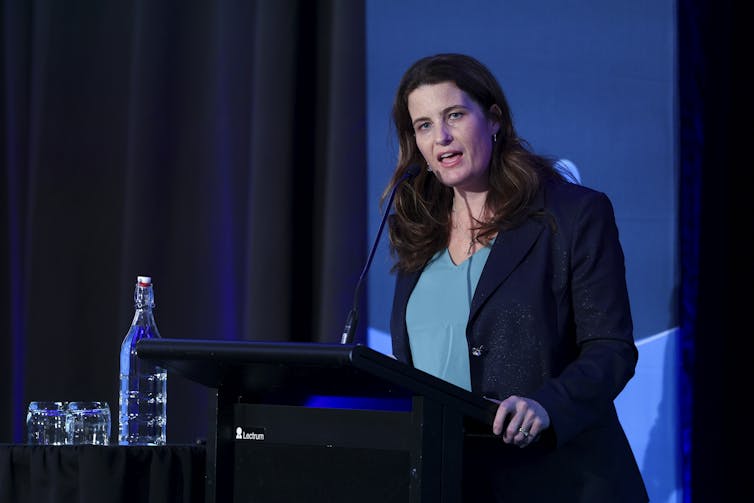
After beating a first-term South Australian Liberal government in 2022, Labor premier Peter Malinauskas has gone on to be a reform advocate on issues including social media and politcal donations.
His government is looking at a ban on children under 14 accessing social media accounts, with parental consent required for those 14 and 15.
Malinauskas is also proposing changes that would ban most political donations in South Australian politics.
On AUKUS, he is urging a greater national effort to prepare the Australian workforce for the demands for labour the agreement will bring, dirtectly and indirectly.
Peter Malinauskas joined the podcast to talk about these issues.
On political donation reform, he says politicians are spending far too much time raising money:
We want to get money out of politics. We believe that’s important for a number of reasons, but the least well-understood is the fact that fundraising is increasingly taking up the time of politicians, and we don’t want politicians to become professional fundraisers.
We want them to be developing thoughtful public policy and engaging with their constituents.
On a social media ban for young teens, Malinauskas says it’s worth doing even if some kids find a workaround:
Are there people under age who drink? Yes. Are there people underage who smoke? Yes. Are there people who speed every day on our roads? Yes.
But that doesn’t stop us from having limits on the provision of alcohol or cigarettes, that doesn’t stop us from having speed limits. Always there are going to be examples of people who circumvent the law or find a way around it, or choose to just not follow it. But the majority of people do and are better off for it.
So, if we didn’t put in place standards only on the basis of the fact that […] there might be one person out there that doesn’t follow them, then we’d never do any of it.
With South Australia heavily involved in the AUKUS submarine program, Malinauskas is a strong defender of the agreement:
The strategic value of nuclear submarines, the moment the AUKUS submarines enter the water, it completely recalibrate’s Australia’s negotiating position strategically in our region at a really important time.
The second element it goes to is cost. Well, of course, it’s expensive but it’s expensive because it is the most advanced capability of any defence platform that exists. I mean, it immeasurably recasts the way that any would-be adversary thinks about the defence of Australia, and that’s worth it.
On Peter Dutton’s nuclear power announcement this week which would place a small modular reactor near Port Augusta, Malinauskas says:
I believe that nuclear power is important in the global energy mix to achieve decarbonisation. I don’t think we achieve net zero by 2050 globally unless nuclear power is playing a role around the world. It’s safe and it produces zero carbon emissions.
So the question is how much more expensive is nuclear power going to make energy bills in Australia? And all the economists who actually know something about this, all of the scientists tell us it’ll make it more expensive unless there is a rapid change in the technology which there is no evidence of yet.
Now, the small modular reactors, I challenge anybody to demonstrate an example of where a small modular reactor exists that is providing civil nuclear power to a population of 1.7 million and is doing it cheaper than renewables.
Michelle Grattan does not work for, consult, own shares in or receive funding from any company or organisation that would benefit from this article, and has disclosed no relevant affiliations beyond their academic appointment.
Commonwealth Attorney-General Mark Dreyfus has announced that the Australian Law Reform Commission (ALRC) would review the Native Title Act to “rectify any inefficacy, inequality or unfairness”.
The purpose of the Native Title Act is to ensure traditional owners fully enjoy their native title rights. In the interests of equality, native title holders’ rights should receive the same protection as those of freehold land owners. Although native title determinations tend to make the news, the Native Title Act also regulates third party activity on native title land. Any future activities that would affect native title are referred to as “future acts”. Future acts may include, for example, grants of land, mining, agriculture, construction, and so on.
Future act processes happen routinely. They are a part of doing business in areas subject to native title or a native title determination. The Native Title Act gives procedural rights to traditional owners depending on the type of activity proposed and the extent of native title rights affected.
Procedural rights include: being informed of a future act, the right to be consulted and to comment on the proposal, and in some cases, a right to negotiate with the third parties involved.
The process establishes the terms on which the (future) act might be carried out. This may include, for example, requirements to obtain cultural heritage advice, or compensation paid to the traditional owner group. The act also allows for objections by any member of the native title group.
If an entity wishes to validly carry out activities that affect native title, they must enter into an indigenous land use agreement (ILUA) with the traditional owner group concerned, and register the agreement.
Although the future acts regime provides a structured interface between native title holders and other intending land users, there are some well-recognised problems with the system.
Limits of the future acts regime
The future acts regime does at least inform native title holders when their land rights are going to be interfered with (by a future act). It can also give native title holders an opportunity to negotiate the terms of use of native title land.
However, native title law generally prioritises other rights. Consequently, in practice, power remains largely with non-Indigenous parties at the expense of traditional owners.
For example, Aboriginal and Torres Strait Islander people do not have the right to refuse other activities on their land – even when they hold exclusive use rights. They often feel pressured to consent to future acts because if they do not, the other party will seek an arbitrated outcome that generally favours that party. In other words, the system works against traditional owners freely giving their consent.
In practice, ILUAs are confidential and often subject to non-disclosure provisions. These provisions prevent traditional owners from commenting publicly on matters affecting their land. The case study of Juukan Gorge illustrates the potential for disastrous outcomes where people are not able to speak up about activities on their land.
Further, over the years, commentators have observed that the courts have interpreted the future acts provisions to the detriment of traditional owners. The protection provided by the provisions has therefore been diminished, and a review is warranted.
Human rights considerations
The inquiry’s terms of reference require the ALRC to take account of the 2021 report by the former Joint Standing Committee on Northern Australia, “A Way Forward”. The report recommends review of the Native Title Act, including the future acts regime, protection of the right to free prior and informed consent, and prohibition of non-disclosure clauses in ILUAs. These recommendations have apparently informed the framing of the current ALRC review although its scope is broader than that of the report.
The failure of the 2023 Voice referendum leaves Australia without an entrenched mechanism for expression of First Peoples’ determination of their own affairs. However, we do have an existing native title framework and the future acts regime potentially provides First Peoples in Australia with one of the few opportunities for self-determination recognised by Australian law. This new review provides the chance to update the future acts framework to give expression to Australia’s obligations under UNDRIP by including a right to self determination and the associated right to free prior and informed consent on matters affecting land.
A commitment to the opportunity for traditional owners to engage fully in decisions affecting their land and to benefit fully from their land, would see a substantive overhaul of the existing legislation. The well-understood UNDRIP principles are a helpful place to start in re-balancing the dynamic of land negotiations.
Kate Galloway does not work for, consult, own shares in or receive funding from any company or organisation that would benefit from this article, and has disclosed no relevant affiliations beyond their academic appointment.
This morning I did something I seldom do, I looked at the Twitter newsfeed.
Normally I take the approach of something that I’m not sure is an American urban legend, or genuinely something kids do over there. The infamous bag of dog poo on the front porch, set it on fire then ring the doorbell so the occupier will answer and seeing the flaming bag stamp it out.
In doing so they obviously disrupt the contents of the bag, quite forcefully, distributing it’s contents to the surprise, and annoyance, of said stamper.
So that’s normally what I do. Deposit a tweet on that platform, then duck for cover. In the scenario above the kid doesn’t hang around afterwards to see what the resident made of their prank.
I’m the same with Twitter. Get in, do what you’ve got to do, then get the heck out of there and enjoy the carnage from a distance.
But this morning I clicked on the Home button and the first tweet that came up in my feed was about an article in The Daily Blog:
Surely not?
I know our government hasn’t exactly been outspoken in condemning the massacre of Palestinians that has been taking place since last October — but we’re not going to take part in training exercises with them, are we? Surely not.
A massacre — not a rescue A couple of days ago I was thinking about the situation in Gaza, and the recent so-called rescue of hostages that is being celebrated.
Look, I get it that every life is precious, that to the families of those hostages all that matters is getting them back alive. But four hostages freed and 274 Palestinians killed in the process — that isn’t a rescue — that’s a massacre.
Another one.
It reminds me of the “rescues” of the 1970s where they got the bad guys, but all the good guys ended up dead as well. According to some sources, and there are no really reliable sources here, the rescue also resulted in the deaths of three hostages.
While looking at reports on this training exercise, one statistic jumped out at me:
Israel has dropped more bombs on Gaza in eight months than were dropped on London, Hamburg and Dresden during the full six years of the Second World War. Israel is dropping these bombs on one of the most densely populated communities in the world.
It’s beyond comprehension. Think of how the Blitz in London is seared into our consciousness as being a terrible time — and how much worse this is.
Firestorm of destruction As for Dresden, what a beautiful city. I remember when Fi and I were there back in 2001, arriving at the train station, walking along the river. Such a fabulous funky place. Going to museums — there was an incredible exhibition on Papua New Guinea when we were there, it seemed so incongruous to be on the other side of the world looking at exhibits of a Pacific people.
Most of all though I remember the rebuilt cathedral and the historical information about the bombing of that city at the end of the war. A firestorm of utter destruction. Painstakingly rebuilt, over decades, to its former beauty. Although you can still see the scars.
The ruins of Dresden following the Allied bombing in February 1945 . . . about 25,000 people were killed. Image: www.military-history.org
Nobody will be rebuilding Gaza into a beautiful place when this is done.
The best case for the Palestinians at this point would be some sort of peacekeeping force on the ground and then decades of rebuilding. Everything. Schools, hospitals, their entire infrastructure has been destroyed — in scenes that we associate with the most destructive war in human history.
And we’re going to take part in training exercises with the people who are causing all of that destruction, who are massacring tens of thousands of civilians as if their lives don’t matter. Surely not.
It is outrageous in the extreme that the NZ Defence Force will train with the Israeli Defence Force on June 26th as part of the US-led (RIMPAC) naval drills!
Our military’s honour and mana is stained by rubbing shoulders with an Army that is currently accused of genocide and conducting a real time ethnic cleansing war crime.
It’s like playing paintball with the Russian Army while they are invading the Ukraine.
In 2024 there will be ships and personnel attending from 29 countries. The usual suspects you’d expect in the region — like the US, the Aussies, Canada, and some of our Pacific neighbours. But also countries from further abroad like France and Germany. As well of course as the Royal NZ Navy and the Israeli Navy.
Which is pretty weird. I know Israel have to pretend they’re in Europe for things like sporting competitions or Eurovision, with their neighbours unwilling to include them. But what on earth does Israel have to do with the Pacific Rim?
Needless to say those who oppose events in Gaza are not overly excited about us working together with the military force that’s doing almost all of the killing.
“We are calling on our government to withdraw from the exercise because of Israel’s ongoing industrial-scale slaughter of Palestinians in Gaza”, said Palestine Solidarity Network Aotearoa (PSNA) national chair, John Minto.
“Why would we want to join with a lawless, rogue state which has demonstrated the complete suite of war crimes over the past eight months?”
Whatever you might think of John Minto, he has a point.
Trade and travel embargo Personally I think we, and others, should be undertaking a complete trade and travel embargo with Israel until the killing stops. The least we can do is not rub shoulders with them as allies. That’s pretty repugnant. I can’t imagine many young Kiwis signed up to serve their country like that.
The PSNA press release said, “Taking part in a military event alongside Israel will leave an indelible stain on this country. It will be a powerful symbol of New Zealand complicity with Israeli war crimes. It’s not on!”
Aotearoa is not the only country in which such participation is being questioned. In Malaysia, for example, a group of NGOs are urging the government there to withdraw:
“On May 24, the ICJ explicitly called for a halt in Israel’s Rafah onslaught. The Israeli government and opposition leaders, in line with the behaviour of a rogue lawless state, have scornfully dismissed the ICJ ruling,” it said.
“The world should stop treating it like a normal, law-abiding state if it wants Israeli criminality in Gaza and the West Bank to stop.
“We reiterate our call on the Malaysian government to immediately withdraw from Rimpac 2024 to drive home that message,” it said.
What do you think about our country taking part in this event, alongside Israel Military Forces, at this time?
Complicit as allies To me it feels that in doing so we are in a small way complicit. By coming together as allies, in our region of the world, we’re condoning their actions with our own.
Valerie Morse of Peace Action Wellington had the following to say about New Zealand’s involvement in the military exercises:
“The depth and breadth of suffering in Palestine is beyond imagination. The brutality of the Israeli military knows no boundaries. This is who [Prime Minister] Christopher Luxon and Defence Minister Judith Collins have signed the NZ military up to train alongside.
“New Zealand must immediately halt its participation in RIMPAC. The HMNZS Aotearoa must be re-routed back home to Taranaki.
“This is not the first time that Israel has been a participant in RIMPAC so it would not have been a surprise to the NZ government. It would have been quite easy to take the decision to stay out of RIMPAC given what is happening in Palestine. That Luxon and Collins have not done so shows that they lack even a basic moral compass.”
The world desperately needs strong moral leadership at this time, it needs countries to take a stand against Israel and speak up for what is right.
There’s only so much that a small country like ours can do, but we can hold our heads high and refuse to have anything to do with Israel until they stop the killing.
Do you suffer from low back pain that recurs regularly? If you do, you’re not alone. Roughly 70% of people who recover from an episode of low back pain will experience a new episode in the following year.
The recurrent nature of low back pain is a major contributor to the enormous burden low back pain places on individuals and the health-care system.
In our new study, published today in The Lancet, we found that a program combining walking and education can effectively reduce the recurrence of low back pain.
The WalkBack trial
We randomly assigned 701 adults who had recently recovered from an episode of low back pain to receive an individualised walking program and education (intervention), or to a no treatment group (control).
Participants in the intervention group were guided by physiotherapists across six sessions, over a six-month period. In the first, third and fifth sessions, the physiotherapist helped each participant to develop a personalised and progressive walking program that was realistic and tailored to their specific needs and preferences.
The remaining sessions were short check-ins (typically less than 15 minutes) to monitor progress and troubleshoot any potential barriers to engagement with the walking program. Due to the COVID pandemic, most participants received the entire intervention via telehealth, using video consultations and phone calls.
The program was designed to be manageable, with a target of five walks per week of roughly 30 minutes daily by the end of the six-month program. Participants were also encouraged to continue walking independently after the program.
Importantly, the walking program was combined with education provided by the physiotherapists during the six sessions. This education aimed to give people a better understanding of pain, reduce fear associated with exercise and movement, and give people the confidence to self-manage any minor recurrences if they occurred.
People in the control group received no preventative treatment or education. This reflects what typically occurs after people recover from an episode of low back pain and are discharged from care.
What the results showed
We monitored the participants monthly from the time they were enrolled in the study, for up to three years, to collect information about any new recurrences of low back pain they may have experienced. We also asked participants to report on any costs related to their back pain, including time off work and the use of health-care services.
The intervention reduced the risk of a recurrence of low back pain that limited daily activity by 28%, while the recurrence of low back pain leading participants to seek care from a health professional decreased by 43%.
Participants who received the intervention had a longer average period before they had a recurrence, with a median of 208 days pain-free, compared to 112 days in the control group.
Overall, we also found this intervention to be cost-effective. The biggest savings came from less work absenteeism and less health service use (such as physiotherapy and massage) among the intervention group.
This trial, like all studies, had some limitations to consider. Although we tried to recruit a wide sample, we found that most participants were female, aged between 43 and 66, and were generally well educated. This may limit the extent to which we can generalise our findings.
Also, in this trial, we used physiotherapists who were up-skilled in health coaching. So we don’t know whether the intervention would achieve the same impact if it were to be delivered by other clinicians.
Walking has multiple benefits
We’ve all heard the saying that “prevention is better than a cure” – and it’s true. But this approach has been largely neglected when it comes to low back pain. Almost all previous studies have focused on treating episodes of pain, not preventing future back pain.
A limited number of small studies have shown that exercise and education can help prevent low back pain. However, most of these studies focused on exercises that are not accessible to everyone due to factors such as high cost, complexity, and the need for supervision from health-care or fitness professionals.
On the other hand, walking is a free, accessible way to exercise, including for people in rural and remote areas with limited access to health care.
Walking also delivers many other health benefits, including better heart health, improved mood and sleep quality, and reduced risk of several chronic diseases.
While walking is not everyone’s favourite form of exercise, the intervention was well-received by most people in our study. Participants reported that the additional general health benefits contributed to their ongoing motivation to continue the walking program independently.
Why is walking helpful for low back pain?
We don’t know exactly why walking is effective for preventing back pain, but possible reasons could include the combination of gentle movements, loading and strengthening of the spinal structures and muscles. It also could be related to relaxation and stress relief, and the release of “feel-good” endorphins, which block pain signals between your body and brain – essentially turning down the dial on pain.
It’s possible that other accessible and low-cost forms of exercise, such as swimming, may also be effective in preventing back pain, but surprisingly, no studies have investigated this.
Preventing low back pain is not easy. But these findings give us hope that we are getting closer to a solution, one step at a time.
Tash Pocovi received scholarships during her PhD candidature from both the NHMRC Low Back Pain Centre of Research Excellence (ANZBACK) and Macquarie University.
Christine Lin receives funding from the National Health and Medical Research Council. She is a member of the Australian Physiotherapy Association and serves on the editorial board of Journal of Physiotherapy.
Mark Hancock receives funding from National Health and Medical Research Council (NHMRC).
Simon French has received grant funding from the National Health and Medical Research Council.
Petra Graham does not work for, consult, own shares in or receive funding from any company or organisation that would benefit from this article, and has disclosed no relevant affiliations beyond their academic appointment.
All parties, including West Papuan pro-independence fighters who took Phillip Mehrtens hostage, want the New Zealand pilot released but freeing him is “complicated”.
In February 2023, Mehrtens, a husband and father from Christchurch, was working for Indonesian airline, Susi Air, when he landed his small Pilatus plane on a remote airstrip in Nduga Regency in the Papua highlands.
He was taken hostage by a faction of the West Papua National Liberation Army (TPNPB) commanded by warlord Eganius Kogoya.
The rebels, who also torched his aircraft, later claimed he had breached a no-fly order that they had issued for the area.
Sixteen months on, and despite failed attempts to either rescue or secure Mehrtens’ release, there’s been very little progress.
A Human Rights Watch researcher in Indonesia, Andreas Harsono, said it was a complex situation.
“It is complicated because there is no trust between the West Papuan militants and the Indonesian military,” he said.
Harsono said as far as he was aware Mehrtens was in an “alright physical condition” all things considered.
In a statement in February, the TPNPB high commander Terianus Satto said they would release Mehrtens to his family and asked for it to be facilitated by the United Nations secretary-general.
Failed rescue bid Harsono said the situation was made more difficult through a failed rescue mission that saw casualties from both sides in April.
“Some Papuans were killed, meanwhile on the Indonesian side more than a dozen Indonesian soldiers, including from the special forces were also killed. It is complicated, there is no trust between the two sides.”
United Liberation Movement for West Papua (ULMWP) executive secretary Markus Haluk — speaking through a translator — told RNZ Pacific space for all parties, including the West Papua National Liberation Army, needed to be made to discuss Mehrtens’ release.
“They never involve TPNPB as part of the conversation so that’s why that is important to create the space, and where stakeholders and actors can come together and talk about the process of release.”
Meanwhile, in a statement sent to RNZ Pacific, a spokesperson from the Ministry of Foreign Affairs and Trade said Mehrtens’ safety and wellbeing remained MFAT’s top priority.
“We’re doing everything we can to secure a peaceful resolution and Phillip’s safe release, including working closely with the Indonesian authorities and deploying New Zealand consular staff.
“We are also supporting Phillip’s family, both here in New Zealand and in Indonesia,” the spokesperson said.
RNZ has contacted the Indonesian Embassy in Wellington for comment.
This article is republished under a community partnership agreement with RNZ.
New Caledonia’s security forces have arrested eight people believed to be involved in the organisation of pro-independence-related riots that broke out in the French Pacific territory last month.
The eight include leaders of the so-called Field Action Coordinating Cell (CCAT), a group that was set up by the Union Calédonienne (UC), one of the more radical and largest party making up the FLNKS (Kanak and Socialist National Liberation Front) platform.
The large-scale dawn operation yesterday, mainly conducted by gendarmes at CCAT’s headquarters in downtown Nouméa’s Magenta district, as well as suburban Mont-Dore, is said to be part of a judicial preliminary inquiry into the events of May 13 involving the French anti-terrorist division.
The whole area had been cordoned off for the duration of the operation.
Public Prosecutor Yves Dupas said in a media release this inquiry had been launched on May 17.
“It includes potential charges of conspiracy in order to prepare the commission of a crime; organised destruction of goods and property by arson; complicity by way of incitement of crimes and murders or murder attempts on officers entrusted with public authority; and participation in a grouping formed with the aim of preparing acts of violence on persons and property.”
Dupas said that because some of the charges included organised crime, the arrested individuals could be kept in custody for up to 96 hours.
Téin among 8 arrested CCAT leader Christian Téin was one of the eight arrested leaders.
Dupas said the arrested men had been notified of their fundamental rights, including the right to be assisted by a lawyer, the right to undergo a medical examination, and the right to remain silent during subsequent interviews.
CCAT leader Christian Tein . . . one of the eight Kanak pro-independence leaders arrested yesterday. Image: NC la 1ère TV screenshot/RNZ
“Investigators and the public prosecution intend to conduct this phase of the inquiry with all the necessary objectivity and impartiality — with the essential objective being seeking truth,” Dupas said.
Dupas pointed out other similar operations were also carried out on Wednesday, including at the headquarters of USTKE union, one of the major components of CCAT.
The arrests come five weeks after pro-independence protests — against a proposed change to the rules of eligibility of voters at local elections — degenerated into violence, looting and arson.
Current estimates are that more than 600 businesses, and about 200 private residences were destroyed, causing more than 7000 employees to lose their jobs for a total cost of more than 1 billion euros (NZ$1.8 billion).
The unrest is believed to be the worst since a quasi civil war erupted in New Caledonia during the second half of the 1980s.
‘Stay calm’ call by the UC Pro-independence party Union Calédonienne swiftly reacted to the arrests on Wednesday by calling on “all of CCAT’s relays and our young people to stay calm and not to respond to provocation, whether on the ground or on social networks”.
UC, in a media release, said it “denounces” the “abusive arrests” of the CCAT leaders.
“The French State is persisting in its intimidation manoeuvres. Those arrests were predictable,” UC said, and also demanded “immediate explanations”.
UC president Daniel Goa is also calling on the removal of the French representative in New Caledonia, High Commissioner Louis Le Franc.
The Pro-France Loyalistes party leader and New Caledonia’s Southern province President, Sonia Backès, also reacted, but praised the arrests, saying “about time” on social networks.
Another pro-France politician from the same party, Nicolas Metzdorf, recalled that those arrests were needed before “a resumption of talks regarding the future of New Caledonia”.
“But all is not settled; the restoration of law and order, even though it now seems feasible, must continue to intensify.”
At the weekend, a Congress of the FLNKS was postponed, due to persisting differences between the pro-independence umbrella’s components, and the fact that UC had brought several hundred CCAT members to the conference, which local organisers and moderate FLNKS parties perceived as a “security risk”.
This article is republished under a community partnership agreement with RNZ.
Among some potentially positive changes in the amendment – such as the introduction of a pet bond – are rule changes that could cause real harm to renters. In particular, the proposed return of “no-cause” evictions is troubling.
Landlords will be able to give a 90-day termination notice to end any periodic tenancy, at any time, without giving a reason. Currently, landlords can evict someone for being more than three weeks late with rent, when the owner wants to live in the house themselves, or wants an employee to live on the property, amongst other grounds.
Landlords must provide the reason for the termination, and any notice can be disputed in the Tenancy Tribunal.
For renters, the proposed amendment could cause real problems. Submissions on the bill are open until July 3, so this is a good time to consider what this law will achieve and who it could potentially hurt.
Who loses with no-cause evictions?
Housing Minister Chris Bishop claimed last year that no-cause evictions were a “…progressive, pro-tenant move” requested by people who worked on the front line with the homeless (though subsequent reporting failed to find evidence supporting the claim).
It is hard to square how no-cause evictions could be pro-tenant. Renters will not know why they are being evicted, and they won’t be able to dispute it. They will just have to pack up and leave.
Additionally, tenants will incur all the costs involved in moving, plus the time needed to view rentals and apply for new properties. If the tenant has children, there may be a change of schools and related uniform costs.
Tenants will bear the full mental, physical and financial toll of being forced to move against their will.
The rule changes also mean renters will be reluctant to complain about problems with the property. A recent survey of tenants by the Ministry of Housing and Urban Development found 15% felt they had a bad relationship with their landlord.
These bad relationships were mainly caused by the dwelling not complying with health and fire regulations, issues with condensation, wet or cold homes, and a failure to repair or maintain the property.
How will these issues be addressed if tenants know complaining could result in their eviction? Tenants in Australia have reported eviction notices sometimes arrive after they’ve made complaints.
No-cause evictions have also become an election issue in the United Kingdom. Both the Conservative Party and Labour Party have pledged to abolish them if elected in July.
An unnecessary change
Reinstating no-cause evictions is problematic for three reasons.
Firstly, it lacks supporting evidence. According to the Ministry of Housing and Urban Development’s regulatory impact statement accompanying the proposed ammendment:
our analysis is constrained by limited evidence regarding the specific impacts the 2020 RTA changes had on the rental market and […] HUD does not have, and is not able to readily create, a market analysis model that would enable us to produce quantified estimates of the potential impact of regulatory changes on the operation of the market and intended outcomes.
In other words, there is no evidence bringing back no-cause terminations will help tenants, according to the Ministry of Housing and Urban Development.
Secondly, this is bad law because it will deny tenants one of the oldest legal rights – the right to natural justice. The idea of listening to the other side has been entrenched in British (and subsequently New Zealand) law since the Magna Carta was issued in 1215. That is, everyone has the right to a fair hearing.
To have your right to live in a rented home taken away without knowing the reason or having the chance to explain your side of the story goes against this fundamental legal principle.
Thirdly, no-cause evictions will hurt those who are most vulnerable in New Zealand society – those who cannot buy their own home and Māori. As outlined in the disclosure statement from the Ministry of Housing and Urban Development accompanying the proposed amendment:
Evidence suggests that the termination related proposals will negatively impact on actual and perceived security of tenure for many tenants compared to the status quo. These negative impacts are likely to disproportionately affect Māori, as Māori are more likely to live in rented accommodation, have a lower overall median income, and are more likely to experience discrimination than the general population
Any law that harms the most vulnerable should give lawmakers pause for reconsideration.
Bringing back no-cause evictions would give all the power to landlords and property managers – a profession that is still unregulated, who need no qualifications or training, and who are not accountable to any professional body. Property managers and landlords will hold all the power to determine whether a renter has somewhere to live.
And importantly, all the other grounds for evicting renters (being behind in rent, illegal or antisocial behaviour, for example) are still going to be available to landlords. The no-cause eviction would be in addition to those. So what exactly does the no-cause eviction amendment achieve?
Source: The Conversation (Au and NZ) – By Liam Byrne, Honorary Fellow, School of Historical and Philosophical Studies, The University of Melbourne
When British Prime Minister Rishi Sunak announced the UK general election outside 10 Downing Street in the pouring rain last month, the ignominy of the moment was compounded by the sound of a protester playing “Things Can Only Get Better” by D:Ream.
The song had been adopted by Tony Blair’s “New Labour” as its anthem during the 1997 election, which Labour won in a landslide. It was Labour’s last win from opposition in a general election.
The current Labour leader, Keir Starmer, is now looking to put an end to another extended period of Conservative Party rule in the July 4 election. Like Blair, he’s also promising change, but this is where the similarities with 1997 may end.
The meaning of the 1997 election
If the polling is correct, Labour will win the July election in a landslide. It is notable, however, that there is a distinct lack of excitement in the UK around this prospect.
This contrasts notably with the 1997 Blair-led landslide, which was widely seen as a defining event for the country.
Heading into that election, Britain had been governed by the Conservatives since 1979. Margaret Thatcher’s zealous pursuit of liberalisation had fundamentally recast the nation’s economy, its social relationships and the political map.
Uncertain how to respond, Labour had been consumed by internal factional warfare. When Labour lost the 1992 election to John Major amid high unemployment and recession, it sparked an existential crisis within the party about its future.
Blair believed a party born in the era of industrial capitalism in the early 1900s had to change to be relevant in the modern world. He sought to discard past shibboleths (such as Labour’s policies on nationalisation of industries) and dubbed his party “New Labour”.
Blair accepted the fundamental parameters of liberalisation, but not the inequities they had engendered. He was critiqued by many in the party for his embrace of the market, his emphasis on law and order and fiscal restraint, and his focus on the polls and obsession with political “spin”.
Blair and his supporters rebutted this criticism by emphasising their commitment to economic growth to create opportunity. He spoke often about the potentials of a new knowledge economy and the measures needed to ensure all Britons would thrive in it. The pillar of his 1997 campaign was “education, education, education”.
Tony Blair talks about education, education, education in 1997.
Against a worn-out and increasingly divided Conservative government, Blair promised renewal without disruption.
At the time, the economy was growing. Britain was a global power and member of the European Union. The Cold War and its ideological divisions were just a memory. It seemed as though a brighter future could be realised. Things could only get better.
Blair’s campaign soared by making a deft appeal to this sense of optimism. And at the election, Labour was rewarded with an additional 146 seats and government for the first time in 18 years.
1997 redux?
The Britain of 2024 is a strikingly different place from that of 1997. There is little hope and optimism for the country’s future. This is partially the result of long-term factors that have bred cynicism and disengagement.
Blair himself has some complicity in this. New Labour’s attempts to reconcile market-driven outcomes with greater social equality (which was successful by some significant measures) ran aground amid the global financial crisis. Blair’s decision to champion the US-led invasion of Iraq shredded his credibility.
Despite this divided legacy, Britian’s current malaise is largely the product of successive Conservative decisions – driven by ideology over good governance – that have inflicted unnecessary pain on the country.
Prime among these was the embrace of “austerity” as a guiding principle of the David Cameron-led minority government from 2010–2015, as well as the ramifications of Brexit.
The “austerity” program was framed as a necessary corrective to the excessive social spending of the New Labour years. Extensive analysis, however, has concluded that austerity was a deflationary exercise that predominantly served to cut vital services in areas where they were needed most. The effects of this contributed to inequality and social polarisation across the country.
The social and economic effects of austerity were then worsened by the self-inflicted wound of Brexit.
Combined with the pressures of the COVID pandemic and Russia’s war on Ukraine, the UK is now facing high inflation, stagnant wages, a lacerated state, a housing crisis, and no coherent path forward for the British economy – nor its increasingly polarised and cynical public.
Can things get better?
Keir Starmer is no Tony Blair, for good and ill. Starmer, the former director of public prosecutions, speaks like a lawyer. He lacks Blair’s energy and charisma. He also lacks Blair’s capacity to articulate a well-developed vision of the future.
However, Starmer’s electoral promises do, in some ways, echo Blair’s. He has promised probity and responsibility, to restore order, and to deliver an acceptable and moderated form of “change”.
The Conservative Party, which has delivered five prime ministers in 14 years (including three since the last election), has provided him ample ammunition.
Starmer has extended this promise of change to his own party – eagerly explaining at every opportunity that he has changed Labour to be almost unrecognisable to the party formerly led by Jeremy Corbyn.
Starmer has also made some significant policy offerings to enhance the National Health Service, create a new British energy agency, re-nationalise the failing railways, and make the minimum wage a “genuine living wage”. He has sought to emphasise Labour’s commitment to national security, including its nuclear future.
But it is striking that his main campaign theme is not what he will achieve, but what he will undo if he is elected: the chaos of the Conservative years.
What is lacking is a sense of cohesion to this vision – the capacity to do more than deliver effective crisis management, but to transform Britain for the better. This is not a criticism of Starmer the politician, though many have noted his lack of a coherent political outlook. Rather, it is a sign of just how deep Britain’s malaise has become – and how limited the political options are for redress.
Blair’s campaign was propelled by a conviction among many Britons that things could only get better. Today, the electorate largely seems simply to be hoping things won’t continue to get worse.
Liam Byrne does not work for, consult, own shares in or receive funding from any company or organisation that would benefit from this article, and has disclosed no relevant affiliations beyond their academic appointment.
Vehicles such as pickup trucks, large utes, minivans and SUVs tend to offer more protection to their occupants than smaller cars. This is largely due to their larger mass and the way their structures are designed to absorb impact. For the drivers and passengers, this can mean a lower risk of injury in multi-vehicle collisions.
But those same attributes increase the risks to occupants of smaller vehicles, pedestrians and cyclists. The height of the large vehicle’s front end can intrude into the passenger compartment of a smaller vehicle and its greater mass can lead to more forceful impacts.
The invincibility perception
Surveys show drivers believe larger vehicles are safer. This has a major influence on deciding which car to buy (among other factors such as prestige and off-road capabilities).
The perception of safety could potentially lower a driver’s sense of risk aversion, leading to riskier driving behaviours, such as adopting less cautious hand positions on the steering wheel. SUV drivers more frequently drive with one hand (as opposed to a “10-2 o’clock” hand position), suggesting they feel safer than other car drivers.
Impact on collisions
A study from the Netherlands found a significant increase in fatality risk with heavier vehicles.
This has also been seen in the United States, where a study found a 500 kilogram increase in vehicle weight, which could mean the difference between an SUV and a sedan, correlated with a 70% higher fatality risk.
The 2003 bumper height-matching standard aimed to reduce the severity of crashes between SUVs/pickup trucks and cars. By aligning the bumper heights of these vehicles, their bumpers would engage properly during a collision, improving the crash force distribution and better protecting occupants.
But it has had mixed results. It modestly decreased death risks in side-collisions but was less effective in head-on crashes. This suggests further safety improvements are needed to address vehicle-to-vehicle collision impacts effectively.
The likelihood of SUVs causing fatalities to drivers in other cars reduced from being 132% more likely for a collision with an SUV in the early 90s, to 28% more likely by 2016. Likely reasons for the decrease include implementation of the bumper height-matching standard, as well as improvements in vehicle design: the implementation of crumple zones, better side-impact protection and advanced safety features such as electronic stability control.
However, we haven’t seen similar improvements with pickup trucks, suggesting weight is a possible cause of the increased risk of fatalities.
What about pedestrians and cyclists?
Pedestrians are more likely to suffer fatal injuries in a collision with a large vehicle than a passenger car.
The design of these vehicles, particularly their higher front-ends, significantly elevates the risk. A mere 10 centimetre increase in front-end height can elevate the risk of pedestrian death by 22%, with impacts more likely occurring at critical injury points like the chest or head.
Higher front-ends are associated with greater risks for pedestrians. Iv-olga/Shutterstock
Studies have shown a correlation between the surge in larger vehicle sales, such as SUVs, and an increase in pedestrian fatalities in the United States between 2000 and 2019. Children are eight times more likely to die when struck by an SUV compared to lighter and smaller cars.
Computer simulations have examined the impact of car accidents on the human brain of pedestrians, comparing the effects of being struck by an SUV versus a sedan. SUVs exert twice as much force on the brain as sedans when moving at equivalent speeds, significantly increasing the risk of severe injuries, even before direct head contact occurs.
Cyclist injuries from SUV-related crashes have also been found to be notably more severe than those from car-related crashes, with a particular increase in the severity of head injuries for collisions involving SUVs.
This difference in injury severity is attributed to the design of SUVs, which are more likely to cause cyclists to hit the ground or to inflict injury.
Impact on driveway collisions
Large vehicles increase the risk of driveway accidents, particularly involving children aged under five, as their design often limits rear visibility.
An eight-year study from Utah identified 495 vehicle-pedestrian injuries, with 128 occurring in driveways. These accidents disproportionately involved larger vehicles such as SUVs, trucks and vans, due to their extensive blind spots.
The “Spot the Tot” public awareness campaign and similar initiatives aim to combat these incidents by promoting safety practices such as visual checks behind the vehicle before moving.
The emergence and adoption of technologies such as backup cameras and parking sensors has markedly improved visibility, reducing blind zones by around 90%.
Despite these advances, the need for heightened driver awareness and precaution remains critical.
Stopping the vehicle arms race
With more and more drivers opting for larger vehicles under the guise of personal safety, they may inadvertently compromise the safety of pedestrians and other road users. For every fatal accident avoided by someone inside a large vehicle, there are at least 4.3 additional fatal accidents involving others.
Changing the trend towards bigger cars requires strong policy and (dis)incentives.
There’s currently a discussion about imposing heavier taxes and/or registration fees on SUVs and larger cars, particularly for their safety implications on others.
In some places, such as Paris, heavier vehicles are discouraged by tripling parking rates for cars over a certain weight.
But given the popularity of large vehicles, such policy change won’t be easy.
Milad Haghani receives funding from the Australian Research Council.
Hadi Ghaderi receives funding from the iMOVE Cooperative Research Centre, Transport for New South Wales, Queensland Department of Transport and Main Roads, Victorian Department of Transport and Planning, Department of Infrastructure, Transport, Regional Development, Communications and the Arts, IVECO Trucks Australia limited, Innovative Manufacturing Cooperative Research Centre, Victoria Department of Education and Training, Australia Post, Bondi Laboratories, Australian Meat Processor Corporation, 460degrees and Passel.
Nearly a quarter of Māori reported unmet primary care needs over the past year, signalling deep cracks in the system.
It is important we understand these gaps in healthcare access and why healthcare remains out of reach for so many. Our earlier research suggests this is about more than cost and poor logistics.
To investigate the complex reasons behind unmet healthcare needs in Aotearoa New Zealand, we have launched a new research initiative, using the online platform Wāhi Kōrero to provide users with an anonymous space to share their experiences with the health system. Early results suggest systemic biases that prevent equitable access and stop some people from even seeking healthcare.
Examining barriers to healthcare
The project invites people to share their stories in response to the prompt “I felt too whakamā to go to the doctor”.
Whakamā refers to a feeling of embarrassment or shame that can deter people from seeking necessary healthcare. The research explicitly seeks to uncover these health service experiences as a way to improve health outcomes and reduce persistent health inequities.
The experiences of those who do not seek care tend to be absent from conventional health and consumer experience surveys. Rather than focusing on times when care was insufficient, our research invites people to anonymously share their stories of when care was not even sought.
This is a new approach to existing understandings of unmet need. Unlike healthcare service reviews, our research deliberately seeks the voices of people who forgo care.
The voices of people who forego healthcare are missing from conventional surveys. Getty Images
The telling of unmet need
The stories already submitted to Wāhi Kōrero expose the complexity of unmet needs and the multiple barriers preventing equitable access to healthcare.
One participant shared:
In my family, we’ve been taught to believe that you basically had to be dying before you’d even think about going to the doctors. There’s a GP shortage, they’re stressed and underfunded.
Another recounted a traumatic experience disclosing family violence and being dismissed by their GP:
She made it sound so easy. People are constantly told to talk about these things and reach out for help. But it can make it worse if professionals don’t actively help.
A trans participant described their experience of misgendering:
When I called to make an appointment with the GP I tried to give them some info so they didn’t misgender me. I told the lady on the phone my preferred name. She said that wasn’t possible, I had to go by my ‘real’ name. So I didn’t show up for the appointment.
The stories also shed light on the challenges people with invisible illnesses and neurodivergence face. One participant shared their struggle to receive an accurate diagnosis:
I’ve only just now received an ADHD diagnosis after years of being told I had major depression, including a three-day hospitalisation at a psychiatric ward.
Empowering voices and driving change
In addition to contributing their own stories, participants and readers can access and learn from the experiences shared by others on the Wāhi Kōrero platform. This collective storytelling fosters a sense of community, reduces feelings of isolation and promotes understanding of the diverse challenges people seeking healthcare face.
By reading these stories, people can see that they are not alone in their struggles. It can be empowering to know others have faced similar challenges and that there is a growing movement to address these systemic issues.
Our research is more than data collecting. It is an opportunity to build understanding that makes health systems more responsive to people’s realities. Behind the statistics are untold stories of people who feel whakamā and don’t access medical help, worsening symptoms and preventable emergency department visits.
Our research aims to generate insights that will guide policy and practice, ultimately improving health outcomes and reducing persistent inequities.
We are seeking more participants to share their stories, in response to the prompt “I felt too whakamā to go to the doctor”. For more information, please visit our Wāhi Kōrero site.
Chrissy Severinsen, Angelique Reweti and Mary Breheny received a Health Research Council Explorer Grant for this research.
Angelique Reweti and Mary Breheny do not work for, consult, own shares in or receive funding from any company or organisation that would benefit from this article, and have disclosed no relevant affiliations beyond their academic appointment.
Just last year, data suggested plug-in hybrid cars were on the way out in Australia. But they’re back. New data shows plug-in hybrids and conventional hybrids combined have overtaken battery electric vehicle sales in the first quarter of 2024. The trend continued during April and May.
In the first quarter last year, hybrids accounted for 6.8% of all car sales. In the same period this year, their share has almost doubled to 13%. Similar trends have been reported in international markets.
This is concerning. Although hybrids are cleaner than traditional petrol and diesel cars, they still burn fossil fuels and produce more emissions than their manufacturers claim. They’re no match for zero-emissions battery electric vehicles.
So why do consumers want hybrids? Let’s find out.
What makes a hybrid?
Two types of hybrid vehicles are proving to be popular with consumers.
Conventional hybrids: these combine an internal combustion engine with an electric motor and battery. They use regenerative braking to convert energy created from braking into electrical power to recharge the battery. You cannot plug them in – the only way to get energy into the car is by filling them up with petrol or diesel. The advantage is they drive further on a tank of petrol or diesel than a traditional car.
Plug-in hybrids: these vehicles also combine an internal combustion engine with a larger electric engine and a battery. The difference is you can charge their batteries directly using a power outlet. Plug-ins also use regenerative braking to recharge the battery. They can drive on battery power alone but the fuel engine kicks in when the battery level drops or if more power is required.
Hybrid versus plug-in hybrid.
Both types of hybrid are cleaner than traditional internal combustion counterparts. But they are not as clean as battery electric. They have been found to run more often on their petrol or diesel engines than their electric motors and produce substantial emissions.
By contrast, battery electric vehicles run only on an electric motor and batteries. They produce zero emissions while driving, and can – if charged off your solar array or green power – be extremely low emissions to charge. You never need to fill up at a petrol station. You can often charge them at home, or at public chargers.
Why are hybrids so popular right now?
It’s not by chance. Hybrids are being heavily promoted by carmakers as a transitional step to cut emissions from transport. Notably, Toyota, the world’s largest carmaker, is sceptical of battery electric vehicles and is instead focusing on hybrids until, it says, public chargers are widespread and electric cars are cheaper.
Plug-in hybrids are particularly popular in Europe. In 2022, they made up two-thirds of sales in Greece and more than half in Belgium, Spain, Italy, and Finland. The average across the European Union was 44%.
Hybrids have also become popular for a number of other reasons.
For one, they are cheaper than battery electric. They’re also cheaper to run than internal combustion vehicles.
But there are other factors at work. Hybrids reassure drivers worried about the range of electric cars. Drivers see the internal combustion engine as a backup. They also have stronger torque and acceleration than traditional cars.
This, for many drivers, is enough to offset their disadvantages, which include a higher purchase price than traditional cars. For plug-in hybrids, there’s another consideration – the large battery often means there’s less boot space, often resulting in no spare tyre. And then there’s the emissions.
Recent real-world tests on a sample of 123,740 plug-ins in Europe showed their carbon dioxide emissions were, on average, 3.5 times higher than the laboratory values reported by manufacturers. Why? Because in practice, plug-ins weren’t being charged and driven in electric mode as frequently as expected.
In the lab, average emissions for plug-ins was about 40 grams per kilometre. When experts tested new plug-in hybrids, they found average real-world emissions were vastly higher – 139 grams per kilometre. That means they’re only 23% lower than petrol and diesel cars, which emit an average of 180 grams per km.
European real world testing has shown plug-in hybrids run much more like fossil fuel vehicles than electric. WLTP refers to standardised laboratory testing. European Commission, CC BY
These test results also show large differences in average fuel consumption. The yearly cost of fuelling plug-ins was nearly double what manufacturers claimed, costing European plug-in drivers on average A$960 more a year on fuel.
In reality, this means plug-in hybrids are not being driven as electric cars – they’re largely driven as fossil-fuel burning vehicles.
What does this mean for Australian drivers?
Hybrids came under the spotlight in 2022, when the Greens and independent senator David Pocock jointly opposed the federal government’s Electric Car Discount Bill – because it included plug-in hybrids in the list of vehicles exempt from fringe benefits tax.
They argued plug-ins are effectively a fossil fuel technology which should not be subsidised. Labor eventually agreed to end the subsidies for plug-in hybrids from April next year.
Labor also committed $14 million to fund a local real-world fuel testing program for 200 models.
The testing began in the second half of 2023. Initial tests of five hybrid models have revealed similar trends to Europe, though not as extreme. Fuel consumption of these models is up to 12% higher than laboratory tests.
These are the early results from Australia’s real-world emissions and fuel consumption testing of hybrids. Grey shows laboratory (WTLP) results, yellow shows real world results. Australian Automobile Association, CC BY
The road ahead
Are hybrids a waste of time and resources? Not necessarily. Many drivers are sceptical of battery electric vehicles, find them too expensive, or are worried about being caught away from a charger. For these drivers, hybrids may make sense.
But we cannot spend too long on these transition vehicles. Electrifying our vehicle fleet alongside boosts to public transport, cycling and working from home can help rapidly cut emissions from transport – a sector whose emissions are steadily growing.
By 2030, the International Energy Agency forecasts the cost of most electric cars will be comparable to their petrol counterparts due to falling prices. Top Chinese brands such as BYD are already approaching this.
As we approach price parity and charging infrastructure becomes more common, it’s likely more and more drivers will feel comfortable leaving fossil fuels behind for good.
Hussein Dia receives funding from the Australian Research Council, the iMOVE Australia Cooperative Research Centre, Transport for New South Wales, Queensland Department of Transport and Main Roads, Victorian Department of Transport and Planning, and Department of Infrastructure, Transport, Regional Development, Communications and the Arts.
In 2009, the federal “small claims” court process was established in the Federal Circuit and Family Court of Australia. The idea was to give workers a simple and accessible forum to claim unpaid wages and entitlements from their employers – without needing a lawyer.
But our new research has found that in reality, this process is virtually impossible to use without legal support.
The Fair Work Act aims to ensure a “guaranteed safety net of fair, relevant and enforceable” minimum legal rights and entitlements. But without widespread government enforcement or an accessible wage claims process, this is a pipe dream for many migrants and other vulnerable workers in Australia.
Reforms are urgently needed to make the small claims process work better for everyone.
It’s just too hard to fight underpayment
Based on figures from a Grattan Institute study published last year, we estimate that between 490,000 and 1.26 million workers in Australia were paid less than the minimum wage in 2018.
Importantly, this figure does not include the many additional workers paid above the basic minimum wage but less than their full entitlements, who would also have substantial claims for unpaid wages.
There is no official data on the action taken by those workers. But our separate 2016 survey revealed that among more than 2,200 migrant workers who knew they were underpaid, nine out of ten took no action.
The majority of underpaid migrant workers do not launch formal action. gary yim/Shutterstock
For these people, the perceived risks and costs of taking action substantially outweighed the slim prospect of success.
Recent data confirms the very low number of workers using these processes. Only 137 people across Australia brought claims through the federal “small claims” process in 2022-23.
Through its compliance activities, the Fair Work Ombudsman recovered just over $150,000 for people who identified themselves as migrant workers in 2022-23 – a tiny slice of the $509 million recovered for underpaid workers in total that year.
Why is it so hard to use the small claims process?
Let’s use a fictional example to illustrate. An international student from Colombia works nights cleaning a local convenience store, and is paid a flat rate of $16 per hour (the national minimum wage is now $24.10 per hour).
After many months, she finds a better paying job and realises she’s been underpaid. She asks her employer to pay all of the money he owes – she thinks it could be more than $15,000. He laughs at the request. So she considers trying to get her wages back through the small claims process.
First, she must lodge an application in court, which includes identifying the formal business name of her employer (she only knows the shop name and never received a contract or payslips).
Then, she must precisely quantify her outstanding entitlements. This means accurately identifying her job classification and applicable wage rates under a modern award or enterprise agreement (she has never heard of these).
After this, she must produce complex spreadsheet calculations for every hour worked, factoring in overtime and the different pay rates for evenings, weekends and public holidays.
If she manages to correctly file an application, she must then formally serve documents on her employer, attend court and participate in an online hearing, complying with its various technical requirements.
The challenges do not stop there. An employer may disappear or refuse to pay even after a worker wins in court. The worker’s only option in that situation is to initiate enforcement proceedings – virtually impossible without legal assistance.
And if an employer can’t pay up, temporary visa holders are left without any safety net because they are ineligible for the Fair Entitlements Guarantee.
The free legal assistance programs currently on offer are highly limited by under-funding. And if workers use private lawyers to recover their wages, much of what they recover goes to paying their legal costs.
What needs to change?
If dishonest employers know migrants and other vulnerable workers are too afraid to report exploitation, they will continue to systemically underpay them.
Our report – All Work, No Pay –sets out a roadmap for the changes that are urgently needed.
First, the government should expand free and affordable legal services that are essential for migrant workers to bring claims. This should include:
a new free wages and superannuation calculation service
shifting costs so a worker who brings a successful claim can recover their legal expenses from the employer
increasing funding for community-based legal services and a new duty lawyer service to assist self-represented litigants on their day in court.
Second, court processes should be simplified and made more flexible. This could include:
creating a new jurisdiction to resolve wage claims within the Fair Work Commission, a more user-friendly forum that would dispense with the necessary formality of a court
increasing the accessibility of the current small claims process – such as by making application forms and rules of service simpler and offering stronger case management support.
Third, all workers should be guaranteed payment when they obtain a court order against their employer. This would mean:
creating a new government guarantee scheme to pay workers their wage judgement if their employer disappears or refuses to pay
extending the Fair Entitlements Guarantee to all workers in Australia, regardless of immigration status.
In July, the government will pilot new visa protections that will enable migrant workers to safely pursue wage claims without jeopardising their visa.
The government must further seize this historic opportunity and use its review to ensure that those migrant workers who are now willing to break their silence have an accessible process through which to enforce their rights and hold abusive employers to account.
Laurie Berg is co-executive director of the Migrant Justice Institute.
Bassina Farbenblum is co-executive director of the Migrant Justice Institute.
Source: The Conversation (Au and NZ) – By Robyn Schofield, Associate Professor and Associate Dean (Environment and Sustainability), The University of Melbourne
Communications companies such as Starlink plan to launch tens of thousands of satellites into orbit around Earth over the next decade or so. The growing swarm is already causing problems for astronomers, but recent research has raised another question: what happens when they start to come down?
When these satellites reach the end of their useful life, they will fall into Earth’s atmosphere and burn up. Along the way, they will leave a trail of tiny metallic particles.
According to a study published last week by a team of American researchers, this satellite rain may dump 360 tonnes of tiny aluminium oxide particles in the atmosphere each year. The aluminium will mostly be injected at altitudes between 50 and 85 kilometres, but it will then drift down to the stratosphere – home to Earth’s protective ozone layer.
What does that mean? According to the study, the satellite’s contrail could facilitate ozone-destroying chemical reactions. That’s not wrong, but as we will see the story is far from simple.
How does ozone get destroyed?
Ozone loss in the stratosphere is caused by “free radicals” – atoms or molecules with a free electron. When radicals are produced, they start cycles that destroy many ozone molecules. (These cycles have names Dr Seuss would admire: NOx, HOx, ClOx and BrOx, as all involve oxygen as well as nitrogen, hydrogen, chlorine and bromine, respectively.)
These radicals are created when stable gases are broken up by ultraviolet light, which there is plenty of in the stratosphere.
Nitrogen oxides (NOx) start with nitrous oxide. This is a greenhouse gas naturally produced by microbes, but human fertiliser manufacturing and agriculture has increased the amount in the air.
The HOx cycle involves hydrogen radicals from water vapour. Not much water vapour makes it into the stratosphere, though events like the Hunga Tonga–Hunga Ha’apai underwater volcanic eruption in 2022 can sometimes inject large amounts. Water in the stratosphere creates numerous small aerosol particles, which create a large surface area for chemical reactions and also scatter more light to make beautiful sunsets. (I will come back to both of these points later.)
How CFCs made the ‘ozone hole’
ClOx and BrOx are the cycles responsible for the most famous damage to the ozone layer: the “ozone hole” caused by chlorofluorocarbons (CFCs) and halons. These chemicals, now banned, were commonly used in refrigerators and fire extinguishers and introduced chlorine and bromine to the stratosphere.
CFCs rapidly release chlorine radicals in the stratosphere. However, this reactive chlorine is quickly neutralised and locked up in molecules with nitrogen and water radicals.
What happens next depends on aerosols in the stratosphere, and near the poles it also depends on clouds.
Aerosols speed up chemical reactions by providing a surface for them to occur on. As a result, aerosols in the stratosphere release reactive chlorine (and bromine). Polar stratospheric clouds also remove water and nitrogen oxides from the air.
So in general, when there are more stratospheric aerosols around we are likely to see more ozone loss.
An increasingly metallic stratosphere
The details of the specific injection of aluminium oxides by falling satellites would be quite complex. This is not the first study to highlight the growing stratospheric pollution from re-entering space junk.
In 2023, researchers studying aerosol particles in the stratosphere detected traces of metals from spacecraft re-entry. They found that 10% of stratospheric aerosols already contain aluminium, and predicted this will increase to 50% over the next 10–30 years. (Around 50% of stratospheric aerosol particles already contain metals from meteorites.)
The plume left by the re-entry of the Soyuz capsule in 2015, as photographed from the International Space Station. NASA / Scott Kelly
We don’t know what effect this will have. One likely outcome would be that the aluminium particles seed the growth of ice containing particles. This means that there would be more smaller, cold, reflective particles with more surface area on which chemistry can occur.
We also don’t know how aluminium particles will interact with the sulfuric acid, nitric acid and water found in the stratosphere. As a result, we can’t really say what the implications will be for ozone loss.
Learning from volcanoes
To really understand what these aluminium oxides mean for ozone loss, we need laboratory studies, to model the chemistry in more detail, and also look at how the particles would move around in the atmosphere.
For example, after the Hunga Tonga–Hunga Ha’apai eruption, the water vapour in the stratosphere quickly mixed around the southern hemisphere, and then moved toward the pole. At first, this extra water caused intense sunsets, but a year later, these water aerosols are well diluted across the whole southern hemisphere and we no longer see them.
The Hunga Tonga–Hunga Ha’apai eruption in 2022 injected huge amounts of water vapour into the stratosphere. NASA
A global current called the Brewer-Dobson circulation moves air up into the stratosphere near the equator and back down again at the poles. As a result, aerosols and gases can only stay in the stratosphere for at most six years. (Climate change is speeding up this circulation, which means the time that aerosols and gases are in the stratosphere is shorter.)
The famous eruption of Mt Pinatubo in 1991 also created beautiful sunsets. It injected more than 15 million tonnes of sulfur dioxide in to the stratosphere, which cooled the Earth’s surface by a little over half a degree Celsius for around three years. This event is the inspiration for geoengineering proposals to slow down climate change by deliberately putting sulfate aerosols into the stratosphere.
Many questions remain
Compared to Pinatubo’s 15 million tonnes, 360 tonnes of aluminium oxide seems like small potatoes.
However, we don’t know how aluminium oxides will behave physically under stratospheric conditions. Will it make aerosols that are smaller and more reflective – thus cooling the surface, much like stratospheric aerosol injection geoengineering scenarios?
We also don’t know how aluminium will behave chemically. Will it create ice nuclei? How will it interact with nitric and sulfuric acid? Will it release locked-up chlorine more effectively than current stratospheric aerosols, facilitating ozone destruction?
And of course, the aluminium aerosols won’t stay in the stratosphere forever. When they eventually fall to the ground, what will this metal contamination do in our polar regions?
All these questions need to be addressed. By some estimates, more than 50,000 satellites may be launched between now and 2030, so we had better address them quickly.
Robyn Schofield receives funding from ARC, NHMRC MRFF and RRAP. She is a member of International Ozone Commission, and a board member of the ACCESS-NRI.
In the ever-evolving online gaming landscape, one seemingly simple online game has captivated players. The free-to-play clicker Banana has amassed more than 850,000 concurrent players on the gaming platform Steam.
The game involves clicking on bananas to be rewarded every so often with “skins”. These are essentially virtual items that can be sold on the Steam marketplace for real money.
While most bananas skins are close to worthless, some rare ones may sell for much more (much like rare NFTs did at one point). The highest-recorded sales have raked in upwards of US$1,300 (about A$1,950).
Since its release on April 23, Banana has eclipsed major titles such as Baldur’s Gate 3 and Apex Legends, seemingly demonstrating mass appeal and the creation of a bustling virtual economy.
At the same time, however, most of the more than 850,000 “players” aren’t real people, according to the developers. They are bots, deployed in the masses to maximise earnings for their creators.
Some might consider Banana a new and counterintuitive phenomenon. But it actually ties into a probability puzzle that’s more than 300 years old.
This game highlights ongoing debates in behavioural economics about how people value future prospects and manage uncertainty – especially as these prospects come from increasingly complex and automated economic systems.
A game promising infinite amounts of money?
The renowned St. Petersburg paradox is likely the earliest known behavioural dilemma and is thought to have catalysed the development of “decision theory” as a scientific field.
The paradox was formulated by Nicolas Bernoulli in 1713 and later popularised by his cousin Daniel Bernoulli during his time in St. Petersburg, Russia.
It revolves around a theoretical coin game in which a player makes an initial offer (of their choosing) to play. Let’s imagine the game pool begins at a value of $2. The coin is repeatedly flipped and every time it lands on heads, the potential winnings double. But when it lands on tails, the player must leave with whatever sum is in the pool.
As such, the player has a ½ chance of winning $2 dollars, a ¼ chance of winning $4 dollars, and a 1/8 chance of winning $8 dollars, and so on. And as long as the coin theoretically keeps landing on heads, they could end up winning an infinite amount of money.
The “paradox” here is that despite the infinite theoretical winnings, practical offers to play the game for any amount higher than $2 are likely to remain low. And this highlights a fundamental inconsistency between expected values in theory and real world decision-making.
Connections to Banana
In Banana’s case, players face a situation similar to the St. Petersburg paradox in that the initial cost to join is minimal (merely the time spent clicking), but it comes with the potential to earn valuable skins (akin to the “theoretically infinite” winnings in the coin game).
However, unlike the St. Petersburg paradox in which high potential rewards fail to entice participants, playing Banana involves no monetary costs. The game’s appeal also lies in the tangible nature of the rewards (skins). These are easier for players to value and understand compared to the abstract payoffs in the paradox scenario.
Engagement with Banana can also be understood through the lens of something called “diminishing marginal utility” – a concept Swiss mathematician Daniel Bernoulli proposed as a resolution to the St. Petersburg paradox. It suggests the value of money decreases with increasing wealth. And this would explain why some players will invest their time in Banana (despite diminishing returns) – and others will not.
A cookie cutter formula
The St. Petersburg paradox fundamentally challenges our understanding of risk, value and decision-making amid uncertainty. And while the exact probabilities and mechanics of Banana differ from the St. Petersburg coin-flipping scenario, the underlying principle of weighing potential high rewards with initial low investment is relevant in both cases.
Both examples also highlight the importance of understanding specific probabilities in different reward structures.
Banana is not unique in its appeal. It’s part of a much broader trend of games tapping into basic human instincts. These games (including Cookie Clicker, Diamond Hunt, Adventure Capitalist, Clicker Heroes, Farmville) range from idle clickers to more complex simulations that exploit mechanisms allowing for “exponential growth” and the thrill of accumulating (real or virtual) wealth and items.
While various behavioural science explanations such as prospect theory, the fear of missing out and the sunk cost fallacy provide insights into player behaviour, the St. Petersburg paradox is key to understanding why these games are so captivating.
Bots and the new gaming economy
But there’s yet another catch: the integration of bots in games such as Banana represents a significant shift in how they are played and perceived. In fact, bots can influence the entire microeconomics of such a digital game.
The bots function as tools to maximise expected returns, much like algorithmic trading systems in real financial markets. They harness the game’s reward mechanisms to endlessly repeat tasks without fatigue and
inflate the number of transactions.
In doing so, they disrupt the game’s natural supply-demand equilibrium. This may result in inflationary spirals, where the value of rewards diminishes due to their abundance, or deflationary trends, where too much efficiency leads to undervaluation of routine tasks and rewards.
Bots also raise ethical questions. For instance, players who use them gain an unfair advantage over those who don’t by progressing at a faster rate. This can lead to a two-tier gaming environment that undermines the integrity and competitive nature of the entire gaming experience.
Developers should continuously update game mechanics to mitigate the advantages bots provide – much like how we have regulatory measures in financial systems to ensure fairness.
Banana’s developers are aware Banana’s minimal resource demands have made it an attractive target for exploitation. They’re working on adjusting the game to address the bot problem and have supposedly contacted Valve (Steam’s developer) to find solutions. But it’s hard to say when they will come, or what they will look like.
As we grapple with these issues, games like Banana continue to blur the lines between paradox, profit and play.
Ganna Pogrebna does not work for, consult, own shares in or receive funding from any company or organisation that would benefit from this article, and has disclosed no relevant affiliations beyond their academic appointment.
New ABC chair Kim Williams has said the public broadcaster should become a reimagined “National Campfire”, fostering a stronger sense of community togetherness and conversation in a world increasingly fragmented by social media.
Williams also said the ABC must understand its audiences better and warned against “self-congratulation”.
In his first speech as chair outlining his vision and priorities for the national broadcaster, Williams said the digital world had brought “a fragmentation and dislocation of effort at the ABC that was failing to deliver what we need”.
“It has altered the personality, chemistry and character of our national debates in sometimes, indeed often, negative ways. It is time for refreshed purpose,” he said, delivering the Redmond Barry Address at the State Library in Melbourne. “Our community and nation deserve better, renewed performance horizons.”
Williams said the ABC could be “an important source of national community and togetherness in a world in which social media increasingly drives a sense of singularity, self-focus and isolation”.
The ABC as a “national campfire” would be “a place where we all come together to share our ideas, dreams, friendship and our sense of common purpose to enable our country to face much of the darkness beyond, with confidence and strength.
“In this way, I see the ABC representing a ‘true north’ about ‘Australia’ and what ‘being an Australian’ means into the future.”
The fragmentation and dislocation needed to be replaced “with a common sense of purpose and a coherent sense of what sort of organisation we want to be”. This should be a “strong, confident, and modern national media enterprise”.
It should have a “consistent, well curated message and direction that will inspire conviction, grow audiences and attract committed, improved investment”.
The ABC must have a greater understanding of its audiences’ wants and behaviour and make some “tough assessments” about whether it was meeting their needs, interests and aspirations as well as it should.
Williams listed some of the priorities that stood out for him.
He said the ABC would always be first judged on the quality, integrity and reliability of its news and current affairs. “We need to be on a never ending quest to ensure those services are always striving to improve and remain as a relevant, stable ‘first partner ’ for Australians when it comes to objective reporting and thoughtful analysis and commentary on Australia and the world.”
Radio National should be a renewed standard bearer for the ABC’s “ethos, purpose and intellectual ambition”.
An increase in serious TV documentaries on national and international subjects of relevance was crucial for the ABC’s intellectual credibility and for meeting elements of its charter.
Expanded drama and comedy production and more coverage and coherent programming for the arts, expanded children and educational programming and more Australian content on iview were other priorities.
He also emphasised the importance of a revitalised ABC as “a respected agent of soft power diplomacy and programming in our region”.
“The continuing work of the ABC’s International Services team across the Pacific, in Indonesia and in other major Asian nations, is something of which all Australians can be proud.”
Williams warned against an excess of self-congratulation, which could take the place of “robust assessment of underperformance”.
“Well-run organisations must be honest about their performance. And if we’re honest, there are important areas for improvement.
“Therefore, I and my board colleagues believe strongly that the ABC must have a strong accountability framework that requires it to do better. We need to be tough-minded to achieve our goals and we need to measure performance reliably.”
Williams stressed that achieving goals would also take more investment. “I am confident that we at the ABC can make the case for it. The budgetary outlook is tight, however the rationale is plain,” he said.
He said that in addition to investment “we will need […] the courage to stand up for the principles and values that any great media or public organisation must possess.
“Those who would destroy liberal democracy always start by smashing
through the gates of institutions like ours: the media, the universities, the publishers, the libraries and other sources of democratic strength. It happens in every revolution and putsch. The digital technology revolution is no different.”
Michelle Grattan does not work for, consult, own shares in or receive funding from any company or organisation that would benefit from this article, and has disclosed no relevant affiliations beyond their academic appointment.
French police and gendarmes force were deployed around the political headquarters of the pro-independence Caledonian Union in Kanaky New Caledonia’s Nouméa suburb of Magenta in a crackdown today.
The public prosecutor confirmed that eight protesters had been arrested, including the leader of the CCAT action groups, Christian Téin, as suspects in a “criminal conspiracy” investigation, local media report.
Prosecutor Yves Dupas said that the Prosecutor’s Office “intends to conduct this phase of the investigation with all the necessary objectivity and impartiality”.
The arrests were made in Nouméa and in the nearby township of Mont-Dore.
This was part of the investigation opened by the prosecution on May 17 — for days after the rioting and start of unrest in New Caledonia.
The Caledonian Union (UC) is the largest partner in the pro-independence umbrella group FLNKS (Kanak and Social National Liberation Front).
Presidential letter Meanwhile, RNZ Pacific reports that French President Emmanuel Macron had written to the people of New Caledonia, confirming that he would not convene the Congress (both houses of Parliament) meeting needed to ratify the controversial constitutional electoral amendments.
Local media reports said Macron was also waiting for the “firm and definitive lifting” of all the roadblocks and unreserved condemnation of the violence — and that those who had encouraged unrest would have to answer for their action.
Macron had previously confirmed he had suspended but not withdrawn New Caledonia’s controversial constitutional amendment.
The changes would allow more people to vote with critics fearing it would weaken the indigenous Kanak voice.
In this letter, the President said France remained committed to the reconstruction of the Pacific territory, and called on New Caledonians “not to give in to pressure and disarray but to stand up to rebuild”.
The need for a return to dialogue was mentioned several times.
He wrote that this dialogue should make it possible to define a common “project of society for all New Caledonian citizens”, while respecting their history, their own identity and their aspirations.
This project, based on trust, would recognise the dignity of each person, justice and equality, and would need to provide a future for New Caledonia’s younger generations.
Macron’s letter ended with a handwritten paragraph which read: “I am confident in our ability to find together the path of respect, of shared ambition, of the future.”
‘Financial troubles’ Nicolas Metzdorf, a rightwing candidate for the 2024 snap general election, said he had contacted the President following this letter to tell him that it was “unsuitable given the situation in New Caledonia”.
New Caledonia’s local government Finance Minister Christopher Gygès said the territory was trying to get emergency money from France due to financial troubles.
One of the factors is believed to be the ongoing civil unrest that broke out on May 13, which prevented most of the public sector employees from being able to pay their social contributions.
This article is republished under a community partnership agreement with RNZ.
When women seeking financial help from the government-funded UNSW Tax and Business Advisory Clinic are asked whether they have ever been affected by family or domestic violence, most say they have.
In the past year this number has grown from 65% to over 80%.
And about 14% of the clinic’s clients say their tax debts are a result of intimate partner violence. These debts often arise from business debts, bankruptcy, corporate directorships and director penalty notices.
We know that economic abuse is a red flag for other forms of domestic violence. Economic abuse occurs in nearly all Australian domestic and family violence cases, affecting more than 2.4 million Australians and costing the economy an estimated A$10.9 billion a year.
Unfortunately, existing laws fall well short of protecting abuse victim-survivors from financial loss.
How violent partners weaponise tax
The perpetrators of violence can effectively weaponise the tax system by placing tax debts solely in the names of former partners, often because they have made them directors of companies or through family businesses operating through partnerships or trusts.
There is a policy assumption that family members benefit from family partnerships.
But this does not always hold in practice and can be problematic when there is economic abuse because Australian tax law requires victims report and pay tax on their “share” of the family partnership’s income.
The average tax debt at the tax clinic is about $90,000. This can result in debilitating financial burdens, exhausted savings, insecure housing and prolonged economic instability, well after abusive relationships end.
Change is needed
Australia has no specific strategy for relief of tax debts caused by financial abuse. There are “serious hardship” provisions in Australian taxation law, but these are outdated and in need of reform.
Abuse victims can end up being liable for massive tax debts. fizkes/Shutterstock
Usually people do not have the funds up front so the only way the Australian Taxation Office can collect debts from the abused partner is through (generally two-year) payment plans, offsetting future tax refunds, engaging external debt collectors and initiating bankruptcy proceedings.
To that end, the decision announced in this year’s budget to give the Tax Commissioner discretion not to offset against tax returns debts previously placed “on hold” is welcome.
It will provide short-term relief by enabling abuse victims to get their refunds instead of having it used by the Tax Office to reduce their debt.
Colleagues Christine Speidel, Leslie Book and I want this power extended to all forms of tax debts not just for tax debts that have been placed “on hold” especially where the taxpayer is known to have experienced financial abuse.
But this wouldn’t go far enough – the victim-survivors would still have the perpetrator’s tax debt hanging over them.
Where this happens, financial instability can drive women back into abusive relationships.
The US shows what can be done
Legislative reform to shift tax liability from abuse survivors to perpetrators is the key to helping solve the problem.
It is important to understand the US provisions apply because the country offers jointly filed “married” tax returns. In Australia tax returns are filed by individuals.
Australia’s laws would need to change to ensure abused women do not find themselves jointly liable. Any changes should also include debts incurred in the name of partnerships and company directors.
The US is the first and only country to do this, largely because of the advocacy of US low-income tax clinics over decades. Australia now has such clinics, funded as part of the Tax Office National Tax Clinic Program.
Australia’s adoption of US-style rules could provide a model for other jurisdictions, increase tax debt collection (as perpetrators are likely to have better capacity to pay than victims) and foster greater confidence in the Tax Office.
Most importantly, it would acknowledge that victim-survivors with tax debts should not bear responsibility for debts incurred by perpetrators.
For information and advice about family and intimate partner violence contact 1800 RESPECT (1800 737 732). If you or someone you know is in immediate danger, contact 000. The Men’s Referral Service (1300 766 491) offers advice and counselling to men looking to change their behaviour.
Ann Kayis-Kumar receives funding from the Australian Government’s Australian Taxation Office National Tax Clinic Program and the Ecstra Foundation’s Financial Capability Program.
In Australia, stroke is among the leading causes of death and permanent disability. Some 5% of deaths are due to stroke, while strokes cost the Australian health-care system A$6.2 billion annually.
Strokes occur when there’s a sudden loss of blood flow in the brain. This prevents the brain tissue from getting the oxygen and nutrients it needs, which can lead to damage to sections of the brain.
Timely stroke treatment can limit brain damage and improve outcomes for patients. But this depends on early recognition of the symptoms, which is not always easy.
Our team has developed a new smartphone app to screen a person’s facial expressions and detect whether they’ve had a stroke. We’ve recently published the results of a pilot study of this tool, and found it could identify if someone has had a stroke quickly and relatively accurately.
Scanning facial expressions
One of the earliest external symptoms of stroke can be found in facial expressions such as droop, where one side of the mouth is not activated when a person tries to smile.
However, paramedics responding to emergencies and hospital emergency department staff often miss stroke cases. Facial expressions are naturally different between people, and identifying subtle changes in a high-stress environment is challenging. This can become even more difficult if the patient is from a different ethnicity or cultural background.
With our smartphone app, a paramedic or other first responder asks the patient to try to smile, and “films” the patient’s face while they do so. An AI-based model then analyses the video recording, looking for similar signs as used by clinicians to identify stroke, namely the asymmetrical drooping of the mouth.
The app is designed for simplicity – the user just has to point the camera to the patient and press a button. To ensure the patient’s privacy, the video is analysed in real time and does not have to be stored. This device would only need a smartphone, so would be easy to deploy, and would be a cost-effective solution.
The idea is that first responders such as paramedics or nurses in the emergency department would have this app on their smartphones. When they first see a patient who has experienced a medical emergency, they can use the app to detect if the patient may have suffered a stroke in seconds. That way, treatment can be fast-tracked accordingly.
Our pilot study
We tested the tool on a small dataset, using video recordings of 14 people who had experienced a stroke, and 11 healthy controls.
We found it was 82% accurate, meaning it correctly identified a stroke 82% of the time. Our tool is not designed to replace comprehensive clinical diagnostic tests for stroke, but it could help identify people needing treatment much sooner and assist clinicians.
Dinesh Kumar explains the tool.
While these results are promising, we’re planning to continue to optimise the model. Our hope is the accuracy will improve as we build a bigger dataset, with recordings of more patients.
At this stage, the AI model has only been trained and developed on a small dataset, and the data lacks diversity in ethnicity and demographics. It will be essential to refine and test the app for people of different cultural and ethnic backgrounds.
Down the track, we plan to partner with clinicians, emergency departments and ambulance services to conduct clinical trials. We’ll need to test the effectiveness of this tool in the hands of the actual users, such as paramedics, to confirm it helps them look after their patients.
The authors do not work for, consult, own shares in or receive funding from any company or organisation that would benefit from this article, and have disclosed no relevant affiliations beyond their academic appointment.
This year’s Sydney Film Festival’s rich offerings of films more than compensated for the minor technical issues that led to some screenings being interrupted.
Out of the 40-odd films I saw, here are my top five, along with some notable mentions and three disappointments (including a genuine dud).
1. The Girl with the Needle
Cowritten and directed by Swedish filmmaker Magnus von Horn, The Girl with the Needle is loosely based on the story of notorious early-20th century serial killer Dagmar Overbye.
But this is no procedural true crime film, painstakingly attempting to recreate crimes with historical accuracy. It’s a stylish Danish nightmare dazzling with cinematic acrobatics right from the opening sequence, in which black and white faces hideously morph, looking at the viewer like deranged figures from a hellish circus. It is, indeed, one of the most terrifying films I’ve seen.
The narrative follows the struggles of new mother Karoline (Vic Carmen Sonne) as she gives her baby to Dagmar’s informal adoption agency and begins working with her as a wet nurse, unaware of what’s really going on.
Sonne is as self-assured as ever – and none of the actors put a foot wrong here. Seasoned Danish film star Trine Dyrholm is exceptional in bringing nuance to what could have become a caricaturishly evil role as Dagmar. And Besir Zeciri endows Peter, a war-wounded veteran who can only find employment in a circus freakshow, with an unexpected warmth and tenderness.
The Girl with the Needle features some of the most distressing sequences one could find in a commercial film. Its meticulously rendered shades of German expressionism never distract from its smorgasbord of horrors, offering an almost unbearably bleak vision of the world in the aftermath of the Great War. If only all films were this good!
2. Dying
I’d normally suppress a yawn if you told me I had to sit through a three-hour social realist drama about the everyday difficulties of a bourgeois German conductor and his family. Yet writer-director Matthias Glasner’s Dying is a near perfect film (no surprise it won four prizes at the German Film Awards).
The film is complex and engrossing – deeply sad in places and hysterical in others – formally controlled, but underpinned by an anarchic sensibility. It is life-affirming without any skerrick of sentimentality.
Lars Eidinger is astonishingly good as maestro Tom, who is trying to keep his career on track as his family life crumbles around him. He is matched by Lilith Stangenberg, mesmerising as his unhinged sister Ellen. Robert Gwisdek is equally exceptional as the highly strung composer and friend Bernard, while Corinna Harfouch anchors the film’s first section as Tom’s far from maternal mother, Lissy.
At one point, Ingmar Bergman’s 1982 period film Fanny and Alexander is playing on the TV (Tom watches it every Christmas). Even though Dying feels like a contemporary film committed to interrogating the difficulties of being in the modern world, there’s something of late Bergman here as it unfolds across its epic length.
It is a three-hour film about middle-class life, but like a great 19th-century novel, it never feels long. The fact that nothing particularly extraordinary happens is testament to how well-made the film is.
3. Kill
Director Nikhil Nagesh Bhat’s Indian action film Kill is cheesy, sentimental and at first seems remarkably silly.
Commando Amrit, played by beefy TV star Lakshya, is travelling to New Delhi by train with his buddy, fellow commando Viresh (Abhishek Chauhan). His true love Tulika (Tanya Maniktala) is also on board and has recently become engaged to another man through an arrangement by her wealthy father, Baldev Singh Thakur (Harsh Chhaya), who happens to own the train company. When a group of 30-plus bandits led by the charming but ice-cold Fani (Raghav Juyal) move to rob the train, Amrit must defend Tulika, her family and the rest of the passengers.
When the title card appears 40 minutes into the film, suddenly emblazoned on the screen, it seems like a distracting quirk at first. But it begins to make sense as the train rolls on. All of the violence and bone-crushing action of the first section is mere preamble, leading to a point of transition from an extremely violent but fun action film, to a much darker – and bloodier – revenge film.
Kill is an exceptionally well-wrought genre film. The kinetic and balletic action recalls the golden era of Hong Kong action cinema, but with hammers, daggers and sickles instead of guns and the frenetic staging of hand-to-hand combat instead of poetic slow-motion footage. It is also a great example of a film being more than the sum of its parts. No element is perfect, yet they come together to transcend these limitations, its flow reaching sublime levels by the end.
There’s also an undercurrent of sadness throughout. We see an India of haves and have-nots, of families of bandits struggling to survive and of the supreme violence sustaining the social and political order. As Fani says to Amrit near the end: “Who kills like this? I killed four of your people. You finished off 40 of my family. You’re not a protector. You’re a monster. A fucking monster.” The title says it all.
4. Super/Man: The Christopher Reeve Story
Biographical films about celebrities inevitably feel gossipy. Ian Bonhôte and Peter Ettedgui’s Super/Man: The Christopher Reeve Story is no exception. But it is so well made (and well-resourced, one would imagine, as it’s produced by DC) that it moves beyond its tabloid-like qualities.
Interviews with Reeve’s friends and colleagues, including Susan Sarandon, Glenn Close and Jeff Daniels, are interspersed with home footage shot by Reeve and his family throughout his career and during his recovery from the near-fatal riding accident that left him paralysed and breathing through a respirator for the rest of his life.
Reeve’s close friendship with “brother” Robin Williams assumes central importance, with the film implying the two men were so emotionally dependent on each other that Williams would probably still be alive if Reeve hadn’t died in 2004.
But the most interesting parts of the film involve carefully assembled archival footage looking at how Reeve’s decision to play Superman negatively impacted his career and personal life. He never starred in another profitable film, and his father and colleagues such as William Hurt loathed his decision to play a comic book character.
This is counterpointed with his post-accident career as a director and disability advocate. Interviews with Reeve’s children add a genuinely tragic sense of pathos to this slick, well-made and emotionally exhausting “true Hollywood” story. It’s everything one could want from such a documentary.
5. Kneecap
Cowriter-director Rich Peppiatt’s Kneecap is a riotous, irreverent biopic following the career of Belfast drug-dealers Móglaí Bap and Mo Chara as they team up with high school music teacher DJ Próvai to become the first Irish-language rap group, Kneecap.
The real Kneecappers cowrote the film and play themselves and, given none of them are actors, do so remarkably well. They’re joined by Irish heavyweights Josie Walker, playing the detective who has it in for them, and Michael Fassbender, playing Móglaí’s father, an old-school Irish radical who has been on the run for the past few decades.
The film depicts their hedonistic drug use and anarchic disregard for the law in the context of their radical political motivation to speak Irish against the colonial English. And while it may be a bit cartoonish in its presentation of Belfast’s history and the struggle to keep Gaelic alive, it is a music biopic after all.
Kneecap is violent, coarse and laced with infectiously good humour – a genuinely fun film, buoyed by its charismatic stars and lively style. Only the most stringent moralist wouldn’t enjoy this one!
Notable mentions
It’s extremely difficult to pick a top five when 15 or so of the films I saw were standouts. And this is testament to the quality of the festival’s selection.
It was a pleasure watching heavyweight Sean Penn go head-to-head with Dakota Johnson in writer-director Christy Hall’s Daddio, even if the story takes an uninteresting turn in the final third. Despite the banality of the premise – a New York cabbie chats with a passenger – and the inanity of some of the dialogue, this romantic ode to urban life in all its alienated, fluoro-lit techno glory is so well crafted that we happily go along for the ride.
Equally affective is the melancholic and beautifully performed Puan, a restrained comedy set in a University faculty in Buenos Aires. Puan could easily make my top five, as could André Téchiné’s My New Friends), an offbeat French melodrama starring Isabelle Huppert as a disillusioned police officer who becomes friends with an anti-cop activist in the suburbs.
Poor performers
Of the lot, I only found three films disappointing.
The first, Among the Wolves, is a Belgian-French documentary in which a photographer and illustrator lie waiting in a tiny, makeshift building to encounter wild wolves. While some of the footage is striking, the film is let down by its scientific inaccuracy, such as references to the “alpha male” wolf – a term and concept that has long been discredited. Such innacuracy is a cardinal sin for a documentary, which is supposed to inform the viewer.
Though critically acclaimed, Hollywood horror film The Substance – a story of an ageing entertainer who turns to a mysterious substance to stay young (with unsurprisingly horrific ramifications) – feels neither new nor particularly interesting. And while it’s great to see Demi Moore and Dennis Quaid back on the big screen, their caricaturish characters make the whole thing seem like a boring joke: an inflated short film that is both irritatingly silly and painfully didactic.
But rarely does a film so resolutely reaffirm a sense of the absurd hubris of humans as Francis Ford Coppola’s self-financed mega-flop, Megalopolis. This cartoonish, incoherent mess set in a dystopian version of the United States, “New Rome”, is howlingly bad in places.
Imagine the worst parts of The Hunger Games and Fellini Satyricon (1969) crossed with Ayn Rand’s Atlas Shrugged and The Fountainhead and you begin to get a sense of the kind of self-indulgent, heavy-handed nonsense that is Megalopolis.
Side-splittingly funny moments come courtesy of bad dialogue (“Utopias become dystopias,” actor Giancarlo Esposito says at one point with a straight face). And stilted acting by Adam Driver and Aubrey Plaza had the (remaining) audience in stitches. Megalopolis is like one of the great fiascos from days gone by – the 21st century’s Heaven’s Gate – and there is definitely something delightful about the existence of this US$120 million (roughly A$180 million) flop.
But as a dud, Megalopolis is the outlier. And in a year following Barbie, Oppenheimer, Napoleon and Poor Things (talk about heavy-handed cinema), much of the menu of this year’s Sydney Film Festival once again proves there are still good filmmakers out there making good films.
Ari Mattes does not work for, consult, own shares in or receive funding from any company or organisation that would benefit from this article, and has disclosed no relevant affiliations beyond their academic appointment.
In 1971 on a family holiday, my father drove us to look at a huge concrete slab at Jervis Bay, on the South Coast of New South Wales. Still visible today, it was the foundation for what would have been Australia’s first nuclear power plant. The project had just been cancelled by then-prime minister Billy McMahon who had recently replaced John Gorton. A Treasury analysis showed coal-fired power was much cheaper.
That long-ago episode is still relevant to Australia’s policy choices. Today, Opposition leader Peter Dutton revealed seven sites across Australia where the Coalition, if elected, would build nuclear power stations. Unsurprisingly, the plan has already run into opposition from state politicians, both Labor and the LNP.
The announcement answers a few basic questions about the Coalition’s nuclear plans. For example, Dutton said the plants would be Commonwealth-owned, and built at the site of decommissioned coal plants. But central issues remain unaddressed. Exactly what kind of reactors will be built? Who will build them? And how much they will cost?
As the Jervis Bay experience shows, nuclear energy can be a hard sell in Australia. Times have obviously changed since the 1970s, but significant political and economic barriers remain – and the problem of cost is still unsolved.
What the Coalition has revealed
The seven sites for nuclear power plants mooted by the Coalition are:
Tarong and Callide in Queensland
Liddell and Mount Piper in NSW
Port Augusta in South Australia
Loy Yang in Victoria
Muja in Western Australia.
At a press conference in Sydney, Dutton said:
We know the government has [a] renewables only policy which is not fit for purpose. No other country in the world can keep the lights on 24/7 with the renewables only policy.
We want to utilise existing assets that we have got […] new poles and wires that are used at the moment on the coal-fired power station sites can be utilised to distribute the energy generated from the latest generation nuclear reactors.
Under the Coalition plan, the federal government would own and pay for the plants. In this respect, Dutton is following the precedent set by the Snowy Scheme – and more recently, by the National Broadband Network.
This is a welcome acknowledgement of the reality that, whatever technology we adopt, private investment is likely insufficient to manage the transition away from coal and gas in the electricity sector – let alone the massive electrification in other sectors needed to meet Australia’s 2050 emissions targets.
The Coalition says it will develop two “establishment projects” using either small modular reactors or larger plants. It claims the small reactors will start producing electricity by 2035, and the larger plants by 2037.
These timeframes are at odds with analysis by the CSIRO, which recently found reactors could not be operational in Australia until 2040 at the earliest.
The same report found construction of a large-scale nuclear power facility would cost at least A$8.6 billion, and possibly up to $17 billion. It said the electricity produced would be about 50% more costly than renewable energy.
On Wednesday, Dutton refused to provide a price tag for the Coalition policy. But he claimed it would be a “fraction” of Labor’s renewable energy policy.
Lessons from Jervis Bay
Dutton this week ruled out Jervis Bay as a nuclear reactor location, should the Coalition win the next federal election. But the 1970s experience still holds valuable lessons.
The Jervis Bay territory was ruled directly by the federal government – circumventing any potential state opposition. The Coalition faces a different battle with regards to its proposed sites.
Queensland LNP Leader David Crisafulli on Wednesday said he did not support Dutton’s plan for a nuclear power station in Central Queensland, and has previously ruled out lifting a state ban on nuclear power if elected in October.
NSW Labor Premier Chris Minns says building a nuclear reactor in the Hunter Valley is impossible under existing laws, and would disrupt the renewable energy transition.
Dutton pledged to work with state premiers to resolve such issues, and suggested financial incentives would be offered.
It’s unclear whether existing coal plant owners, including state-owned generators, will be willing to sell the sites to the federal government. However, Dutton said on Wednesday that, according to legal advice, the government could compulsorily acquire the sites if needed.
When Jervis Bay was on the table as a nuclear site, there was no question the federal government would build, own and operate it. The idea that something as crucial as a nuclear power plant might be entrusted to a state government, let alone a foreign corporation, was never entertained.
The national government was at the postwar height of its power and confidence. It employed the best and brightest, and was expanding the scope and scale of its activity. The Snowy Mountains Scheme, a massive engineering endeavour built under the Commonwealth’s defence power, was nearing completion.
Dutton says the government will own the proposed nuclear plants, but form partnerships with nuclear companies to build and operate them. But which companies?
Internationally, about 60 nuclear plants are under construction, mostly in Asia. The vast majority are Chinese and Russian designs, built by Chinese and Russian firms. Presumably, for national security reasons, that is not an option for Australia.
The only real contenders for large modern projects in Australia are South Korea’s KEPCO, and Electricity de France (EDF).
KEPCO built four plants at Barakah, in the United Arab Emirates, between 2009 and 2024. But no new orders for KEPCO plants outside South Korea have been announced since 2009.
EDF is building a reactor at Flamanville in France and two at Hinkley Point in the United Kingdom. The projects have suffered massive delays and cost overruns. The UK government is also struggling to organise finance for an additional EDF reactor proposed at the existing Sizewell plant.
And what about the so-called small modular reactors suggested by Dutton? This term is applied to two types of technology.
First, there are reactors of less than 100 megawatt capacity, which would be built in a factory and shipped to the required site where they would be installed as individual modules.
The most promising contender was the NuScale Voygr design, however its pilot project has been abandoned. Similarly, Rolls Royce has spiked its plans for a factory in Wales that would have progressed technology used in small modular reactors.
The term is also applied to cut-down versions of existing large-scale designs: reactors of 300 to 500 megawatt capacity compared to the traditional 1,000 to 1,500 megawatts. These are “modular” only in the sense that most parts are built in factories and assembled onsite.
The government of Ontario in Canada has announced plans for four such reactors to be built by GE-Hitachi, but no final commitment has been made.
Meanwhile, the climate crisis continues
As the next federal election rolls closer, Dutton will come under pressure to reveal crucial details underpinning the Coalition’s nuclear plan – most importantly, how much it will cost.
Nothing announced by Dutton today changes the fact that nuclear energy is, according to reams of expert analysis, economically unfeasible in Australia. This is as true today as it was in the 1970s.
Meanwhile, the climate crisis continues to worsen. Solar panels, wind turbines and energy storage must be rolled out as rapidly as possible – and we must not allow Dutton’s policy detour to distract from the task.
John Quiggin is a former Member of the Climate Change Authority
Opposition leader Peter Dutton has announced seven sites for reactors, unveiling his long-awaited and highly-controversial policy for nuclear power with the claim it could start operating from the 2030s. .
The locations are the sites of former or current coal plants. They have the technical attributes needed for a nuclear plant, including transmission infrastructure, cooling water capacity and a skilled workforce, the opposition policy says.
The program would consist of two phases, starting with two establishment projects in the mid-2030s followed by a build of others through to 2050.
Most sites would have larger reactors, with two – in South Australia and Western Australia – having small modular reactors. All mainland states would eventually have reactors.
The proposed sites are
Liddell Power Station, New South Wales
Mount Piper Power Station, New South Wales
Loy Yang Power Stations, Victoria
Tarong Power Station, Queensland
Callide Power Station, Queensland
Northern Power Station, South Australia (small modular reactor only)
Muja Power Station, Western Australia (small modular reactor only)
Dutton said the generators would be owned by the Commonwealth government.
The first could begin operating in 2035 if small modular reactors are used, or 2037 “if modern larger plants are found to be the best option”, the opposition says.
This is much earlier than the CSIRO has estimated that an initial plant could begin.
The CSIRO said in its May assessment of generation technology costs for Australia, that “due to the current state of the development pipeline in Australia, that the earliest deployment would be from 2040”.
Dutton said he would be “very happy for the election to be a referendum on energy, on nuclear, on power prices, on lights going out, on who has a sustainable pathway for our country going forward”.
The opposition says the timeline for nuclear energy including building two establishment projects is ten to 12 years, “from the government making a decision until zero-emissions nuclear electricity first enters the grid”.
The Coalition policy says a key advantage of the nuclear energy plants was they could be plugged into existing grids. “This means they can effectively replace retired or retiring coal plants and avoid much of the new spending needed for Labor’s ‘renewables-only’ system, including new transmission poles and wires.”
The government would partner with nuclear companies from aboard on development and operation.
Each community around a site would receive a benefits package enshrined in legislation.
It would include:
multi-billion dollar facility guaranteeing high-paying jobs for generations to come
an integrated economic development zone attracting manufacturing, value-add and high-tech industry
a regional deal unlocking investment in modern infrastructure, services and community priorities
Establishing a civil nuclear programme would require an expanded Australian Radiation Protection and Nuclear Safety Agency to license and regulate the power stations, a Nuclear Energy Coordinating Authority, and a government business enterprise to be called Affordable Energy Australia.
Dutton could not give a cost for the nuclear plan, saying only it would be “a fraction” of the government’s energy transition plan costing $1.2 trillion to $1.5 trillion. He said the opposition would have more to say on cost “in due course”.
The opposition leader announced his plan at a news conference in Sydney, after a pre-budget announcement had been deferred. He was flanked by a bevy of colleagues including Nationals leader David Littleproud.
Treasurer Jim Chalmers said in a social media post: “With Australia’s advantages and opportunities, nothing could be more economically irrational or fiscally irresponsible” than the nuclear policy”.
Chalmers told the ABC: “Peter Dutton’s nuclear negativity is economic insanity, pure and simple. Nuclear takes longer, it costs more and it will squander Australia’s unique combination of advantages”.
Apart from a fierce campaign from federal Labor, Dutton faces attacks from the states. His plan is opposed by the Liberal-National opposition in Queensland where there is a state election within months.
Michelle Grattan does not work for, consult, own shares in or receive funding from any company or organisation that would benefit from this article, and has disclosed no relevant affiliations beyond their academic appointment.
Source: The Conversation (Au and NZ) – By Adrian Beaumont, Election Analyst (Psephologist) at The Conversation; and Honorary Associate, School of Mathematics and Statistics, The University of Melbourne
Redistributions are held to keep the number of enrolled voters in each seat roughly equal. In Australia, this equal population per seat is possible for a particular state or territory’s seats, but not for all seats in the House of Representatives.
ABC election analyst Antony Green said in June 2023 that all original states are entitled to at least five House seats, so Tasmania has five seats even though its population should only give it three.
Redistributions are needed when the population of a state increases or decreases relative to the overall Australian population, such that the state is entitled to either add a seat, or a seat is removed from that state.
A year after the first sitting of parliament following an election, the electoral commission determines state seat entitlements based on the latest available population data.
In June 2023, the Australian Bureau of Statistics published population estimates nationally and for all states. Green said these population estimates would require the loss of a seat in both Victoria and New South Wales, while Western Australia would gain a seat. The overall size of the House would fall from 151 to 150 seats since the 2022 election.
These changes occurred because, relative to Australia’s overall population, Victoria and NSW’s population decreased, mainly due to the COVID immigration shutdowns. WA’s population increased relative to Australia.
When states are to lose seats, lower-enrolment seats within that state are targeted for axing. States that gain seats have the new seat created in a high-enrolment area. Axing or creating seats causes knock-on effects to existing seats, which either have to absorb the axed seats, or pull back from created seats.
Redistributions also take place in states that haven’t had a change in House seat numbers for at least seven years, to correct inequalities in population dispersion within that state. There is currently a redistribution in progress for the Northern Territory, which has had two seats for a long time.
Changes from the Victorian, NSW and WA redistributions
The determination of state seat entitlements began the redistribution process in Victoria, NSW and WA. On May 31, the electoral commission released draft redistributions for Victoria and WA, and on June 14 the NSW draft redistribution was released. I covered the Victorian and WA redistributions on May 31 and the NSW redistribution on June 17.
These redistributions are drafts, and it is expected to take a few more months before they are finalised. Changes can occur from the draft redistributions to the final ones. Until finalisation, redistributions cannot be used at an election.
In Victoria, the Labor-held seat of Higgins was abolished, while the new seat of Bullwinkel was created in WA. In NSW, North Sydney, held by teal independent Kylea Tink, was abolished. This means that unless MPs in abolished seats can win a different seat or become a senator, they will not be in the next parliament.
Using booth data, election analysts are able to estimate new margins for seats after a redistribution. Sometimes this results in a seat currently held by one party becoming a notional seat for another party. For example, a marginal Liberal-held seat may now include strong Labor booths that were previously in another seat, so it becomes a notional Labor seat.
According to estimates from William Bowe (The Poll Bludger), the newly created WA seat of Bullwinkel is notionally Labor by a 52.9–47.1 margin against the Liberals. All other WA seats will be held by their previous party, with the biggest change a 4.7-point lift in Labor’s Hasluck margin to 60.7–39.3.
However, I previously wrote that Labor would be worried about a large swing to the Coalition in WA, as WA has been historically weak for Labor but had over a 10% swing to Labor to be Labor’s best state at the 2022 federal election. If there is a large swing to the Coalition at the next election, Bullwinkel and Tangney (also on a 52.9–47.1 Labor margin) are vulnerable.
In Victoria, while Labor-held Higgins was abolished, Liberal-held Menzies will be notionally Labor by 50.7–49.3 after Labor gained 1.3 points, and the Liberal-held Deakin lineball at 50.0–50.0 after Labor gained 0.2 points. But Labor’s margin in Chisholm was reduced to 52.8–47.2, a 3.6-point swing to the Liberals.
Teal independent-held seats of Goldstein and Kooyong now take in areas that did not have a teal candidate at the previous election. The Poll Bludger’s estimates imply that Kooyong (held by Monique Ryan) will be harder for the teal to retain than Goldstein (held by Zoe Daniel).
In NSW, Tink’s North Sydney was abolished. The Poll Bludger’s estimates say Bennelong was the only change in notional party alignment, with a 1.1% swing to the Liberals barely putting them ahead of Labor. In Bradfield, the Liberal margin over a teal independent was reduced to 52.5–47.5, a 1.8-point swing to a teal. The Liberal-held Hughes swung 3.7 points to Labor, with the Liberals still ahead by 53.3–46.7.
The redistribution’s impact on the next election
I don’t think the changes to the electoral map will have a major impact on the next election, due by May 2025. If Labor loses, it’s likely that anger over the continued high cost of living will be far more important than the redistributions.
Analyst Kevin Bonham, using the draft redistributions, said his seat model would give Labor 79 of the now 150 House of Representatives seats if there was no two-party swing from the 2022 election, which Labor won by 52.1–47.9. This would be a one-seat gain for Labor from the current House.
Assuming no changes to the crossbench, Labor would have an even chance of retaining its majority with a 51.1–48.9 national two-party win, about where polls are now. The Coalition would need a 51.3–48.7 two-party split in its favour to win more seats than Labor, and a 53.4–46.6 split to win a majority.
Adrian Beaumont does not work for, consult, own shares in or receive funding from any company or organisation that would benefit from this article, and has disclosed no relevant affiliations beyond their academic appointment.
Source: The Conversation (Au and NZ) – By Katelyn Jauregui, PhD Candidate and Clinical Pharmacist, School of Pharmacy, Faculty of Medicine and Health, University of Sydney
Opioids are commonly prescribed when you’re discharged from hospital after surgery to help manage pain at home.
These strong painkillers may have unwanted side effects or harms, such as constipation, drowsiness or the risk of dependence.
However, there are steps you can take to minimise those harms and use opioids more safely as you recover from surgery.
Which types of opioids are most common?
The most commonly prescribed opioids after surgery in Australia are oxycodone (brand names include Endone, OxyNorm) and tapentadol (Palexia).
In fact, about half of new oxycodone prescriptions in Australia occur after a recent hospital visit.
Most commonly, people will be given immediate-release opioids for their pain. These are quick-acting and are used to manage short-term pain.
Because they work quickly, their dose can be easily adjusted to manage current pain levels. Your doctor will provide instructions on how to adjust the dosage based on your pain levels.
Then there are slow-release opioids, which are specially formulated to slowly release the dose over about half to a full day. These may have “sustained-release”, “controlled-release” or “extended-release” on the box.
Slow-release formulations are primarily used for chronic or long-term pain. The slow-release form means the medicine does not have to be taken as often. However, it takes longer to have an effect compared with immediate-release, so it is not commonly used after surgery.
Controlling your pain after surgery is important. This allows you get up and start moving sooner, and recover faster. Moving around sooner after surgery prevents muscle wasting and harms associated with immobility, such as bed sores and blood clots.
Everyone’s pain levels and needs for pain medicines are different. Pain levels also decrease as your surgical wound heals, so you may need to take less of your medicine as you recover.
But there are also risks
As mentioned above, side effects of opioids include constipation and feeling drowsy or nauseous. The drowsiness can also make you more likely to fall over.
Opioids prescribed to manage pain at home after surgery are usually prescribed for short-term use.
But up to one in ten Australians still take them up to four months after surgery. One study found people didn’t know how to safely stop taking opioids.
Such long-term opioid use may lead to dependence and overdose. It can also reduce the medicine’s effectiveness. That’s because your body becomes used to the opioid and needs more of it to have the same effect.
Dependency and side effects are also more common with slow-release opioids than immediate-release opioids. This is because people are usually on slow-release opioids for longer.
Then there are concerns about “leftover” opioids. One study found 40% of participants were prescribed more than twice the amount they needed.
This results in unused opioids at home, which can be dangerous to the person and their family. Storing leftover opioids at home increases the risk of taking too much, sharing with others inappropriately, and using without doctor supervision.
Don’t stockpile your leftover opioids in your medicine cupboard. Take them to your pharmacy for safe disposal. Archer Photo/Shutterstock
How to mimimise the risks
Before using opioids, speak to your doctor or pharmacist about using over-the-counter pain medicines such as paracetamol or anti-inflammatories such as ibuprofen (for example, Nurofen, Brufen) or diclofenac (for example, Voltaren, Fenac).
These can be quite effective at controlling pain and will lessen your need for opioids. They can often be used instead of opioids, but in some cases a combination of both is needed.
Other techniques to manage pain include physiotherapy, exercise, heat packs or ice packs. Speak to your doctor or pharmacist to discuss which techniques would benefit you the most.
However, if you do need opioids, there are some ways to make sure you use them safely and effectively:
ask for immediate-release rather than slow-release opioids to lower your risk of side effects
do not drink alcohol or take sleeping tablets while on opioids. This can increase any drowsiness, and lead to reduced alertness and slower breathing
as you may be at higher risk of falls, remove trip hazards from your home and make sure you can safely get up off the sofa or bed and to the bathroom or kitchen
before starting opioids, have a plan in place with your doctor or pharmacist about how and when to stop taking them. Opioids after surgery are ideally taken at the lowest possible dose for the shortest length of time.
A heat pack may help with pain relief, so you end up using fewer painkillers. New Africa/Shutterstock
If you’re concerned about side effects
If you are concerned about side effects while taking opioids, speak to your pharmacist or doctor. Side effects include:
constipation – your pharmacist will be able to give you lifestyle advice and recommend laxatives
drowsiness – do not drive or operate heavy machinery. If you’re trying to stay awake during the day, but keep falling asleep, your dose may be too high and you should contact your doctor
weakness and slowed breathing – this may be a sign of a more serious side effect such as respiratory depression which requires medical attention. Contact your doctor immediately.
If you’re having trouble stopping opioids
Talk to your doctor or pharmacist if you’re having trouble stopping opioids. They can give you alternatives to manage the pain and provide advice on gradually lowering your dose.
You may experience withdrawal effects, such as agitation, anxiety and insomnia, but your doctor and pharmacist can help you manage these.
How about leftover opioids?
After you have finished using opioids, take any leftovers to your local pharmacy to dispose of them safely, free of charge.
Do not share opioids with others and keep them away from others in the house who do not need them, as opioids can cause unintended harms if not used under the supervision of a medical professional. This could include accidental ingestion by children.
For more information, speak to your pharmacist or doctor. Choosing Wisely Australia also has free online information about managing pain and opioid medicines.
Jonathan Penm receives funding from the Australian government (MRF2022763)
Shania Liu receives funding from the FIP Hospital Pharmacy Section, FIP Early Career Pharmacists Group, and Alberta Innovates (Postdoctoral Fellowship).
Asad Patanwala and Katelyn Jauregui do not work for, consult, own shares in or receive funding from any company or organisation that would benefit from this article, and have disclosed no relevant affiliations beyond their academic appointment.
Source: The Conversation (Au and NZ) – By Jonathan W. Marshall, Associate Professor & Postgraduate Research Coordinator, Western Australian Academy of Performing Arts, Edith Cowan University
Dan McCabe/PICA
Wall text outside the main gallery of the Perth Institute of Contemporary Art (PICA) identifies Shelley Lasica’s When I’m Not There as a “survey” exhibition, but this is somewhat misleading – at least from an audience perspective.
In 1992, cutting edge Australian contemporary choreographer Lasica became Australia’s first dance artist represented by a commercial gallery. She has since choreographed and performed more than 80 works both in galleries and in more conventional theatres.
When I’m Not There was developed as a test case in a research project which asked what it would mean to reference and exhibit more than 40 years of dance practice in a gallery.
Dancers perform daily throughout the duration of When I Am Not There in the spacious white void of PICA, moving alongside more than a dozen curious, colourful objects drawn from Lasica’s archive.
Dance among design
Netting hung with costumes drops from the roof – though the clothing can only be seen properly if removed and worn by the performers, which happens rarely (three times during my five hours of viewing).
There are panels of abstracted green trees painted on a blue background (by Tony Clark), a confusion of clear plastic tape recalling spaghetti (Anne-Marie May), a rolled out crash matt (uncredited), monochromatic plastic seats (Eero Aarnio), a wall of typed narrative sketches (Robyn MacKenzie), and so on, none of which have a clear relationship to the dance on offer.
The exhibition asks more questions than are answered. Dan McCabe/PICA
A close reading of the room sheet reveals each of these items have appeared in one of Lasica’s productions over the last 40 years. But no further details are offered.
It is all curious and provocative, asking more questions than are answered, even for dance aficionados with knowledge of Lasica. Because these remnants are only rarely activated in the space, they ultimately reside in different dimension to the live performance.
A generative archive
Lasica stated in the artist talk she did not want to mount a retrospective. Photographs and documentation have already been proffered to the public, including an an earlier exhibition at West Space gallery, in the catalogue, and on Lasica’s website.
Moments and gestures from previous productions do swim into view. Dan McCabe/PICA
Lasica states she used her archive in a “generative” fashion, producing a new, layered work. Lasica is adamant that, when working with dancers, she uses what emerges out of their particular responses to her tasks, scenarios and prompts.
As the dancers here do not, on the whole, have an extended history with Lasica, few gestures from earlier works are directly replicated, and where they do, they are widely dispersed across the days.
But moments and gestures from previous productions do swim into view – I thought I recognised some in one section led by Lasica in a beautifully lumpy, striped bodysuit.
Striking a new tone
Having seen a number of Lasica’s Behaviour and Situation works of the 1990s and 2000s, I was struck by the difference in tone.
Writing in 1998, RealTime critic Zsuzsanna Soboslay said Lasica and her peers sketched “odd combination[s] of extension and stasis […] squarish shapes, edgings, lifts and slides, steppings and rollings patterned into well-structured configurations” in which the dancers “exhibit a consistent and strange angularity”.
These qualities emerge sporadically in When I Am Not There, particularly odd “steppings and rollings”.
The show is dominated by a playful, deceptively ad-hoc-quality. Dan McCabe/PICA
At times, however, we seem closer to American dancer and choreographer Steve Paxton’s concept of Contact Improvisation, with dancers leaning against each other awkwardly, sometimes ending in messy piles.
Much of what I witnessed was dominated by a playful, deceptively ad-hoc-quality, producing a soft focus.
Consequently the fractured, almost Cubistic or Futurist geometry which I recall from Lasica’s earlier work seemed almost absent. Where Cubist influences were evident, it was less in the divided body of the dancer, and more in the divided viewpoints of audience members, each wandering the space on their own terms.
Also subsumed within the extended duration of the work is the exacting attention to corporeal minutiae which Lasica’s dancers previously tended to show, particularly Jo Lloyd and Deanne Butterworth.
In these previous works, Lloyd and Butterworth acknowledged each other’s proximity while maintaining an intense inward focus. Whatever guided these disciplined performances was deliberately withheld from the audiences, or as RealTime critic Philipa Rothfield said in 2010, Lasica “has left a lot unsaid and, in doing so, given space to the observer to meet the action”.
Art in the white cube
In his famous critique of the 20th century “white cube” art gallery, art critic Brian O’Doherty argued the stark openness of contemporary exhibition spaces often worked to render art almost sacred, floating ethereally above the mundanity of history, context, or the outside world.
This also created a space open to gestures which might rewrite or undermine art’s status as an elevated commentator on the world.
There is a lightness of touch from Lasica and her dancers. Dan McCabe/PICA
When I Am Not There is certainly alienating for many audiences in its refusal to disclose what lies behind it, but even these audiences might be brought onboard through the lightness of touch which Lasica and her dancers bring.
The performance is best enjoyed if one ignores the archival pretensions of the “survey” exhibition, and savours When I Am Not There as a series of interesting and often fun interactions in an odd space which, above all, work to retain their own mysterious distance from the audience.
Shelley Lasica’s When I Am Not There is at the Perth Institute of Contemporary Art until June 23.
Jonathan W. Marshall does not work for, consult, own shares in or receive funding from any company or organisation that would benefit from this article, and has disclosed no relevant affiliations beyond their academic appointment.
These days every word of every statement from the Reserve Bank Governor Michele Bullock is pored over in minute detail – as is every word uttered at her press conference after each Reserve Bank board meeting.
Desperate for signals about what the bank will do next, market economists examine every comma, every adjective, for a hidden meaning. It’s a bit like divination, the ancient practice of seeking meaning by examining the entrails (internal organs) of a sacrificed sheep or goat.
It’s an approach in which words are assumed to mean something different to what ordinary people think they mean. For example, one journalist at Tuesday’s post-meeting press conference asked Governor Bullock if the word “vigilant” in her statement meant a rate rise was coming.
Her reply was concise (at 21:30 on the video): “No”.
No secrets
The truth is there aren’t hidden secrets. The Governor has made what she knows and what will drive her board’s decision perfectly plain, not only at Tuesday’s press conference but also in her testimony to a Senate hearing a fortnight ago.
Australia’s consumer price index climbed 1% in the March quarter and 3.6% over the year to the March quarter.
That’s well down from the peak of 7.8% in late 2022, but it’s still well above the bank’s target of between 2% and 3%.
The bank’s written agreement with the treasurer requires it to aim for the midpoint of that target.
While there is room for debate over whether Australia could cope with a slightly higher target, there is at present no political appetite for a change.
This means the bank is obliged to keep interest rates high until it sees clear signs that inflation is headed back to within the target range.
Inflation has been driven by excess demand: too much spending relative to our ability to supply the things on which money has been being spent.
The bank is worried that if we come to expect inflation above its target band it’ll get stuck there as people adjust their spending and wage expectations to take account of it.
While the bank acknowledged this in its statement on Tuesday, it wasn’t enough to convince it to change course.
The May budget contained new spending on energy and housing aimed at reducing the measured rate of inflation. The government clearly hoped it would encourage the bank to loosen interest rates before the next election.
There was was little sign of that in Tuesday’s statement and press conference.
Inflation isn’t the bank’s only target. It is also committed to maintaining full employment “consistent with low and stable inflation”.
Uncertainties keep rates on hold
The bank is uncertain about many things: consumption growth, wages, the overseas outlook, and how long it will take the economy to respond to previous increases to interest rates.
It’s partly those uncertainties that are driving it to keep rates on hold.
There is even a chance it will increase rates.
Its statement said it would be “some time yet before inflation is sustainably in the target range”. Recent data had “reinforced the need to remain vigilant to upside risks to inflation”.
Little signal in the noise
What we don’t know, and can’t know until new data emerges, is how the uncertainties the bank has spelled out will be resolved.
Digging for portents in official statements, futile as it is for actually predicting interest rate movements, serves other purposes. It helps financial market economists communicate with bond traders and their clients who make (or lose) money by betting on what other traders think will happen to interest rates.
And it can get their firms free mentions in the newspapers. But it doesn’t make it useful for us. The real reason we don’t yet know what the Reserve Bank will do to interest rates is because the Reserve Bank doesn’t know. It would tell us if it did.
Stephen Bartos does not work for, consult, own shares in or receive funding from any company or organisation that would benefit from this article, and has disclosed no relevant affiliations beyond their academic appointment.
The spike in reports of women murdered by men this year has prompted widespread conversations across Australia about how we end gender-based violence. Much of this discussion has been about the importance of creating a more gender-equal society.
This then spurred conversations about the “Nordic paradox”. This theory questions why countries closer to achieving gender equality still report high rates of violence against women.
Countries such as Iceland elect more women to parliament, have more equitable parental leave policies and better pay parity, but have rates of violence similar to ostensibly less gender-equal countries.
At first glance, this seems an interesting contradiction. However, research informing Australian approaches is clear. These forms of gender parity are important, but they’re not enough to prevent violence against women on their own.
What is Australia doing?
In Australia, there’s a large focus on primary prevention, or stopping violence happening in the first place. This work happens alongside other prevention efforts that ensure perpetrators are helped to change their behaviour and keep survivors safe. This continuum is often talked about as fitting into three categories of effort: primary, secondary and tertiary prevention.
Primary prevention means changing the social conditions that allow gender-based violence to occur. This requires comprehensive effort across every setting where we live, work, play and learn, to address the gendered drivers of violence and the reinforcing factors that can make this violence more severe.
Secondary prevention, also called early intervention, aims to support people (predominantly men) who have used violence (or are at risk of doing so) from perpetrating further harm. Tertiary prevention is also referred to as crisis response. This category supports victim-survivors to get help, such as safe housing and emergency funds when escaping violence. It also includes men’s behaviour change programs and law and justice responses to perpetrators.
Work to address the gendered drivers of violence happens across all these categories. However, Australia’s National Plan to end violence against women rightly emphasises the importance of dedicated attention to primary prevention. Most primary prevention efforts in Australia draw on international evidence reviews, developed by Our Watch into a framework called Change the Story. This sets out four categories of gendered drivers of violence against women:
condoning of violence against women
men’s control of decision-making and limits to women’s independence in public and private life
rigid gender stereotyping and dominant forms of masculinity
male peer relations and cultures of masculinity that emphasise aggression, dominance and control.
Change the Story also highlights additional factors to consider, such as heavy alcohol use or backlash to gender equality.
Alone, these do not necessarily cause gender-based violence, but they do reinforce the likelihood that violence will occur or cause significant harm.
All these dynamics shape how gender-based violence is perpetrated and experienced by different cohorts of the community. Addressing these different needs, therefore, should be tailored and comprehensive.
Primary prevention calls on everyone to help change social norms, while not losing sight of the need for broader structural change.
The multifaceted nature of these strategies means measuring success based only on the data used to construct the Nordic paradox is like critiquing a theatre performance purely on the set design. It’s important, but you must also consider the efforts of the playwrights, actors and directors when deciding whether the play is a success.
Studies used to inform the Nordic paradox report on measures of gender equality where progress is easier to track across more countries. Measures include who is accessing education and health services, who is going to work, who is in parliament, how much people are paid, and what laws are in place.
Violence against women is a multifaceted issue. Shutterstock
These play an important role in progressing efforts on the ground. Reducing structural barriers to things like women’s financial security, for example, makes a tangible difference.
However, such broad metrics can’t tell us how individual people react to such changes. They don’t provide insight into how reforms are administered and taken up. They don’t reveal whether men think violence against women is a problem or how people think they should behave in intimate relationships. Nor do they say anything about how men think about consent or pornography, or how men talk to each other about women.
Piecing the puzzle together
In Australia, there are different studies that build a more nuanced picture of progress to address all the drivers. These exist alongside tracking progress towards gender parity across measures considered in the Nordic paradox.
We measure change over time in attitudes towards gender equality and violence against women across Australia. There’s also work considering how men’s endorsement of harmful masculine norms shapes their attitudes towards women and gender-diverse people. This research provides crucial insight into where change is happening at a national level.
We then need to bring all these separate pieces together to complete the puzzle. What’s the cumulative impact of all these programs and services, and how do they work together?
Ending gender-based violence requires complex strategies informed by an evolving evidence base. This must include more than high-level gender parity measures.
Stephanie Lusby is Research Manager with Respect Victoria.
French President Emmanuel Macron, who visited Kanaky New Caledonia last month in a largely failed bid to solve the French Pacific territory’s political deadlock, has called a snap election following the decisive victory of the rightwing bloc among French members of the European Parliament. Don Wiseman reports.
A group of 32 civil society organisations is writing to the French President Emmanuel Macron calling on him to change his stance toward the indigenous people of New Caledonia.
The group said it strongly supported the call by the FLNKS (Kanak and Socialist National Liberation Front) and other pro-independence groups that only a non-violent response to the crisis will lead to a viable solution.
And it said President Macron must heed the call for an Eminent Persons Group to ensure the current crisis is resolved peacefully and impartiality is restored to the decolonisation process.
Don Wiseman spoke with Joey Tau, of the Pacific Network on Globalisation (PANG), one of the civil society bodies involved.
Joey Tau: Don, I just want to thank you for this opportunity, but also it is to really highlight France’s and, in this case, the Macron administration’s inability of fulfilling the Nouméa Accord in our statements, in our numerous statements, and you would have seen statements from around the region — there have been numerous events or incidents that have led to where Kanaky New Caledonia is at in its present state, with the Kanaks themselves not happy with where they’re headed to, in terms of negotiating a pathway with Paris.
You understand the referendums — three votes went ahead, or rather, the third vote went ahead, during a time when the world was going through a global pandemic. And the Kanaks had clearly, prior to the third referendum, called on Paris to halt, but yet France went ahead and imposed a third referendum.
Thus, the Kanaks boycotted the third referendum. All of these have just led up to where the current tension is right now.
The recent electoral proposal by France is a slap for Kanaks, who have been negotiating, trying to find a path. So in general, the concern that Pacific regional NGOs and civil societies not only in the Pacific, but at the national level in the Pacific, are concerned about France’s ongoing attempt to administer Kanaky New Caledonia [and] its inability to fulfill the Nouméa Accord.
Don Wiseman: In terms of stopping the violence and opening the dialogue, the problem I suppose a lot of people in New Caledonia and the French government itself might argue is that Kanaks have been heavily involved in quite a lot of violence that’s gone down in the last few weeks. So how do you square that?
JT: It has been growing, it has been a growing tension, Don, that this is not to ignore the growing military presence and the security personnel build up. You had roughly about 3000 military personnel or security personnel deployed in Nouméa on in Kanaky within two weeks, I think . . .
DW: Yes, but businesses were being burned down, houses were being burned down.
JT: Well as regional civil societies we condemn all forms of violence, and thus we have been calling for peaceful means of restoring peace talks, but this is not to ignore the fact that there is a growing military buildup. The ongoing military buildup needs to be also carefully looked at as it continues to instigate tension on the ground, limiting people, limiting the indigenous peoples movements.
And it just brings you back to, you know, the similar riots that had [in the 1980s] before New Caledonia came to an accord, as per the Nouméa Accord. It’s history replaying itself. So like I said earlier on, it generally highlights France’s inability to hold peace talks for the pathway forward for Kanaky/New Caledonia.
In this PR statement we’ve been calling on that we need neutral parties — we need a high eminence group of neutral people to facilitate the peace talks between Kanaks and France.
DW: So this eminent persons to be drawn from who and where?
JT: Well the UNC 24 committee meets [this] week. We are calling on the UN to initiate a high eminence persons but this is to facilitate these together with the Pacific Islands Forum Secretariat. Have independent Pacific leaders intervene and facilitate peace talks between both the Kanak pro=independence leaders and of course Macron and his administration.
DW: So you will be looking for the Eminent Persons group perhaps to be centrally involved in drawing up a new accord to replace the Nouméa Accord?
JT: Well, I think as per the Nouméa Accord the Kanaks have been trying to negotiate the next phase, post the referendum. And I think this has sparked the current situation. So the civil societies’ call very much supports concerns on the ground who are willing, who are asking for experts or neutral persons from the region and internationally to intervene.
And this could help facilitate a path forward between both parties. Should it be an accord or should it be the next phase? But we also have to remember New Caledonia Kanaky is on the list of the Committee of 24 which is the UN committee that is listed for decolonisation.
So how do we progress a territory? I guess the question for France is how do they progress the territory that is listed to be decolonised, post these recent events, post the referendum and it has to be now.
DW: Joey, you are currently at the Pacific Arts Festival in Hawai’i. There’s a lot of the Pacific there. Have issues like New Caledonia come up?
JT: The opening ceremony, which launches [the] two-week long festival saw a different turn to it, where we had flags representing Kanaky New Caledonia, West Papua, flying so high at this opening ceremony. You had the delegation of Guam, who, in their grand entrance brought the Kanaky flag with them — a sense of solidarity.
And when Fiji took the podium, it acknowledged countries and Pacific peoples that are not there to celebrate, rightfully.
Fiji had acknowledged West Papua, New Caledonia, among others, and you can see a sense of regional solidarity and this growing consciousness as to the wider Pacific family when it comes to arts, culture and our way of being.
So yeah, the opening ceremony was interesting, but it will be interesting to see how the festival pans out and how issues of the territories that are still under colonial administration get featured or get acknowledged within the festival — be it fashion, arts, dance, music, it’s going to be a really interesting feeling.
This article is republished under a community partnership agreement with RNZ.
The Centre for Climate Crime and Justice at Queen Mary University of London will host a Permanent Peoples’ Tribunal on State and Environmental Violence in West Papua later this month.
A panel of eight tribunal judges will hear evidence on June 27-29 from many international NGOs and local civil society organisations, as well as testimonies from individuals who have witnessed human rights violations and environmental destruction, said a statement from the centre.
West Papua is home to the world’s third-largest rainforest, currently under threat from industrial development. Due to its global significance, the ongoing state repression and environmental degradation in the region have far-reaching impacts.
This tribunal aims to bring global attention to the need to protect this crucial rainforest by exploring the deep connection between democracy, state violence, and environmental sustainability in West Papua, said the statement.
“There are good reasons to host this important event in London. London-based companies are key beneficiaries of gas, mining and industrial agriculture in West Papua, and its huge gold and other metal reserves are traded in London,” said Professor David Whyte, director of the Centre for Climate Crime and Justice.
“The tribunal will expose the close links between state violence, environmental degradation, and profiteering by transnational corporations and other institutions.”
The prosecution will be led by Dutch Bar-registered lawyer Fadjar Schouten Korwa, who said: “With a ruling by the eminent Permanent Peoples’ Tribunal on the crimes against the Indigenous Papuan people of West Papua and the failure of the state of Indonesia to protect them from human rights violations and impunity, we hope for a future without injustice for West Papua.”
‘Long history of destruction’ A leading West Papuan lawyer, Gustaf Kawer, said: “The annexation of West Papua into the State of Indonesia is part of a long history of environmental destruction and state violence against Papua’s people and its natural resources.
“Our hope is that after this trial examines the evidence and hears the statements of witnesses and experts, the international community and the UN will respond to the situation in West Papua and evaluate the Indonesian state so that there can be recovery for natural resources and the Papuan people.”
The Permanent Peoples’ Tribunal on State and Environmental Violence in West Papua seeks to initiate a series of events and discussions throughout 2024 and 2025, aiming to engage the UN Human Rights Council and international civil society organisations.
The panel of judges comprises: Teresa Almeida Cravo (Portugal), Donna Andrews (South Africa), Daniel Feierstein (Argentina), Marina Forti (Italy), Larry Lohmann (UK), Nello Rossi (Italy), and Solomon Yeo (Solomon Islands).
We support Count Me In 2024. It is an important national census event for Papua New Guinea. It is supported by the government. And the people support it too.
The National Census will provide us with up-to-date live data on our population which is needed for planning now and into the next decade.
However, we are amazed that despite the public holiday yesterday, which was announced by Prime Minister James Marape to allow the public servants to have the day off so they can be counted, has become a failure.
PNG POST-COURIER
Why? Because most of the provinces including four heavily populated areas have yet to receive their full counting materials.
This amounts to poor planning, poor vision, and poor foresight on the part of the holiday-happy PM and his Administrative Minister Richard Masere.
They did not see that Count Me In is in for a long count when the material is late, training not completed, and the technology and gadgets don’t add up for this very important national event.
Meanwhile, taxpayers will pick up the cost of the extra holiday that Marape ubiquitously granted to his public servants yesterday.
Out in the field, members of the public noted that the tablets supplied for enumerators were not used. The counters were asked why. They responded that the tablets did not have the applications necessary for them to compile the information collated.
This is despite a K17 million (NZ$7 million) contract to Indian firm Max Industrials whose CEO Max Pandey said he has paid for and delivered 22,000 tablets to the National Statistical Office to carry out the work.
If the tablets were delivered, then why are these gadgets inoperable? What type of gadgets are these, where were these manufactured, were these tablets tested, and have they ever been used before in a census?
Are they from a recognised brand? This is a national census and we cannot afford to get it wrong. We have waited 14 years to hold this event.
It is therefore interesting to note that the contract for the supply of tablets was signed last week for a major event that started on Sunday this week.
Just like everybody, we are curious about this fiasco, why materials are late and tablets are not functioning?
The progress of events doesn’t make sense. Despite the Secretary for Finance and the Minister for Administrative Service giving their assurance that all processes were followed, it just does not add up.
We all want to be counted. We all want to be visible. We all want to be recognised as citizens of Papua New Guinea.
The population count has been outstanding since the last one in 2011. More babies have arrived, more heads, more mouths to feed in a country with rising costs of living, and extra turnover of migratory people of all walks of life, national and trans-national all over the country.
We hope that Count Me In will be concluded successfully, given the country’s rugged terrain and challenges, the far-flung coral islands and the lack of national road links.
Mental illnesses such as depression and anxiety disorders have become more prevalent, especially among young people. Demand for treatment is surging and prescriptions of some psychiatric medications have climbed.
These upswinging prevalence trends are paralleled by rising public attention to mental illness. Mental health messages saturate traditional and social media. Organisations and governments are developing awareness, prevention and treatment initiatives with growing urgency.
The mounting cultural focus on mental health has obvious benefits. It increases awareness, reduces stigma and promotes help-seeking.
However, it may also have costs. Critics worry social media sites are incubating mental illness and that ordinary unhappiness is being pathologised by the overuse of diagnostic concepts and “therapy speak”.
British psychologist Lucy Foulkes argues the trends for rising attention and prevalence are linked. Her “prevalence inflation hypothesis” proposes that increasing awareness of mental illness may lead some people to diagnose themselves inaccurately when they are experiencing relatively mild or transient problems.
Foulkes’ hypothesis implies that some people develop overly broad concepts of mental illness. Our research supports this view. In a new study, we show that concepts of mental illness have broadened in recent years – a phenomenon we call “concept creep” – and that people differ in the breadth of their concepts of mental illness.
Why do people self-diagnose mental illnesses?
In our new study, we examined whether people with broad concepts of mental illness are, in fact, more likely to self-diagnose.
We defined self-diagnosis as a person’s belief they have an illness, whether or not they have received the diagnosis from a professional. We assessed people as having a “broad concept of mental illness” if they judged a wide variety of experiences and behaviours to be disorders, including relatively mild conditions.
We asked a nationally representative sample of 474 American adults if they believed they had a mental disorder and if they had received a diagnosis from a health professional. We also asked about other possible contributing factors and demographics.
Mental illness was common in our sample: 42% reported they had a current self-diagnosed condition, a majority of whom had received it from a health professional.
People with greater mental health literacy and less stigmatising attitudes were more likely to report a diagnosis. Mental Health America/Pexels
Unsurprisingly, the strongest predictor of reporting a diagnosis was experiencing relatively severe distress.
The second most important factor after distress was having a broad concept of mental illness. When their levels of distress were the same, people with broad concepts were substantially more likely to report a current diagnosis.
The graph below illustrates this effect. It divides the sample by levels of distress and shows the proportion of people at each level who report a current diagnosis. People with broad concepts of mental illness (the highest quarter of the sample) are represented by the dark blue line. People with narrow concepts of mental illness (the lowest quarter of the sample) are represented by the light blue line. People with broad concepts were much more likely to report having a mental illness, especially when their distress was relatively high.
People with greater mental health literacy and less stigmatising attitudes were also more likely to report a diagnosis.
Two interesting further findings emerged from our study. People who self-diagnosed but had not received a professional diagnosis tended to have broader illness concepts than those who had.
In addition, younger and politically progressive people were more likely to report a diagnosis, consistent with some previous research, and held broader concepts of mental illness. Their tendency to hold these more expansive concepts partially explained their higher rates of diagnosis.
Why does it matter?
Our findings support the idea that expansive concepts of mental illness promote self-diagnosis and may thereby increase the apparent prevalence of mental ill health. People who have a lower threshold for defining distress as a disorder are more likely to identify themselves as having a mental illness.
Our findings do not directly show that people with broad concepts over-diagnose or those with narrow concepts under-diagnose. Nor do they prove that having broad concepts causes self-diagnosis or results in actual increases in mental illness. Nevertheless, the findings raise important concerns.
First, they suggest that rising mental health awareness may come at a cost. In addition to boosting mental health literacy it may increase the likelihood of people incorrectly identifying their problems as pathologies.
Inappropriate self-diagnosis can have adverse effects. Diagnostic labels may become identity-defining and self-limiting, as people come to believe their problems are enduring, hard-to-control aspects of who they are.
Second, unwarranted self-diagnosis may lead people experiencing relatively mild levels of distress to seek help that is unnecessary, inappropriate and ineffective. Recent Australian research found people with relatively mild distress who received psychotherapy worsened more often than they improved.
Third, these effects may be particularly problematic for young people. They are most liable to hold broad concepts of mental illness, in part due to social mediaconsumption, and they experience mental ill health at relatively high and rising rates. Whether expansive concepts of illness play a role in the youth mental health crisis remains to be seen.
Ongoing cultural shifts are fostering increasingly expansive definitions of mental illness. These shifts are likely to have mixed blessings. By normalising mental illness they may help to remove its stigma. However, by pathologising some forms of everyday distress, they may have an unintended downside.
As we wrestle with the mental health crisis, it is crucial we find ways to increase awareness of mental ill health without inadvertently inflating it.
Nick Haslam receives funding from the Australian Research Council.
Jesse Tse does not work for, consult, own shares in or receive funding from any company or organisation that would benefit from this article, and has disclosed no relevant affiliations beyond their academic appointment.
In recent months, Islamic State has escalated its calls to attack sporting events in Europe. Governments are increasingly concerned about the specific threat the terrorist group poses to the upcoming Paris Olympics and Paralympic Games.
But how concerned should we be? While definitive answers on the dangers posed by clandestine actors are inherently hard to get, there are three important factors to look at: intent, capability and opportunity.
Questions of intent
An attack on the Olympics would certainly offer the type of global impact few other targets could provide. But there’s still the question of whether Islamic State would want to devote the necessary resources to carrying it out.
There has also been a surge of Islamist extremist terror plots in Europe since the outbreak of the Gaza war in October 2023, several with apparent connections to IS-KP. One of these attacks targeted Swedish fans at a football stadium in Brussels.
Some recent Islamic State statements have hearkened back to the group’s 2015 Paris massacre that killed 130 people. The group has called on supporters to “recreate the glory of the Paris 2015 raid and subdue the Crusaders in masses”.
But while IS-KP is Islamic State’s most Western-focused affiliate, it prioritises targeting local regimes in Afghanistan, Pakistan, central Asian countries like Tajikistan, Uzbekistan and Kyrgyzstan, and regional powers like Iran, Russia and China.
Moreover, Islamic State is not in the same position as it was in 2014 and 2015. Back then, the group’s territorial expansion in Syria and Iraq had been impeded by a Western-led military coalition, which prompted it to treat attacks in Europe as one of its highest priorities.
This raises the question of whether Islamic State might instead try to generate panic around the Olympics as part of a broader strategy of exhausting its opponents.
There is a long history of Islamist extremist movements openly articulating a strategy of draining Western governments of resources by inducing exorbitant security measures to prevent potential attacks.
In 2010, for example, al-Qaeda planted two printer bombs on a cargo plane in a plot called “Operation Hemorrhage”. Although it failed, the group claimed it only cost around US$4,200 (A$6,350) to carry out, but would force the United States to spend billions on airline security upgrades.
Islamic State might decide on a similar strategy around the Paris Olympics, given that provocation and attrition of resources are both common terrorist strategies.
Questions of capability
There are also questions about whether Islamic State has the capability to directly organise an attack on the Olympics.
However, IS-KP’s capabilities should also not be overstated. Within Afghanistan, the movement may have been weakened since the US military withdrawal in 2021 and the Taliban’s return to power. The group’s claimed attacks in Afghanistan declined by more than 90% over two years – from 293 attacks in 2021 to 145 in 2022 to only 20 in 2023.
This helps to explain why IS-KP has shifted its focus overseas in recent years. This is also consistent with research showing that weaker insurgent organisations are more likely to engage in transnational terrorist acts. Their goal is often to offset local losses by broadening their struggle and demonstrating resolve.
IS-KP’s current capabilities, thus, remain unclear. Despite the attacks in Russia and Iran, it remains uncertain whether it could launch a large-scale attack in Europe when authorities are on high alert.
Questions of opportunity
Finally, there are questions of whether the Olympics would be perceived as a promising opportunity for an attack.
Islamist extremist propaganda has long emphasised the potential of sporting events as targets. In 2012, al-Qaeda’s Inspire magazine described “crowded sports arenas” as “very easy” targets. A 2014 issue of Inspire similarly recommended attacking sporting events with “dense crowds”, “visited by […] high profile people”, guaranteeing global media coverage.
As such, Islamic State supporters in Europe – either acting alone or in small groups – could see the Olympics as a good opportunity, with or without direct support from affiliates like IS-KP. French authorities recently arrested a teenager plotting such an “Islamic State-inspired” attack.
Even so, opportunities to strike sports mega-events have vastly declined in recent years due to the increasingly expansive security procedures that organisers have put in place.
According to one research report in 2014, the Olympics, in particular, “provide a glimpse into the most painstaking security planning outside of warfare”. Olympic hosts now routinely take exceptional measures to keep their games safe, including high-tech surveillance, intelligence gathering, extraordinary workforce allocation and the use of military forces to secure venues.
France, for instance, reportedly plans to deploy about 45,000 police and security forces, 20,000 private security personnel and around 15,000 military each day to protect the event.
These exceptional security and surveillance arrangements often remain long after an event and become normalised. This raises critical questions about both the financial and civil liberties cost of keeping the Olympics safe, and whether this “terrorism tax” could play into the strategy of groups to sow fear and compel governments to spend exorbitantly on security measures.
However, it is inherently difficult to know what a terror group is likely to perceive as an opportunity.
For example, Islamic State could decide to attack a softer target in France or elsewhere in Europe during the Olympics, seeing more opportunity in generating publicity from the timing rather than the location. Australia experienced a plot like this during the 2000 Sydney Olympics.
This also raises the question of who else might see the Olympics as an opportunity for terror. As historical research shows, threats to the Olympics are not limited to major groups like Islamic State. The bombing of the 1996 Atlanta Olympics by domestic American terrorist Eric Rudolph is a case in point.
Similar individuals or groups with varying motivations could also have harmful intentions in France next month, albeit with perhaps limited capability for mass violence.
Andrew Zammit’s research has received support from government entities including Victoria Police, the Department of Justice and Community Safety Victoria, and the Defence Science and Technology Group.
Ramon Spaaij receives funding from the Australian Research Council, Australian-New Zealand Counter-Terrorism Committee, and Victorian Health Promotion Foundation (VicHealth). His research in this area has also received funding from the U.S. National Institute of Justice, Dutch Ministry of Justice and Security, Department of Home Affairs, Defence Science and Technology Group, Victoria Police, and the Victorian government Department of Justice and Community Safety.
Source: The Conversation (Au and NZ) – By Beth Hands, Adjunct Senior Research Scholar, Institute for Health Research, University of Notre Dame Australia
International and national governing bodies, sports teams and athletes themselves are grappling with how to balance trans inclusion with safety and fairness for cisgender women.
The term “cisgender” (pronounced “sis-gender”) refers to people whose gender identity and expression matches the biological sex they were assigned when they were born.
Recently, though, international sports organisations for rugby, cricket, cycling, athletics, netball and swimming have tightened their rules, making trans women ineligible to compete in elite women’s competitions.
But why are these new rules in place and why do they only apply to trans women, but not to trans men?
New research by me and my colleagues might help explain.
The key is testosterone
Testosterone is a hormone that helps develop male reproductive organs and increases muscle and bone mass.
On average, adult males have about seven to eight times more testosterone than adult females.
After puberty, males typically have larger bones, more muscle mass with greater strength and power, stronger ligaments and tendons and larger hearts and lungs than females.
When trans women transition, they take hormone blockers to lower their testosterone levels and appear more feminine.
To compete with cisgender women in many sports, trans women athletes have to keep their testosterone levels below 10 nanomoles per litre (nmol/L) for a certain period – for example, USA Volleyball specifies 12 months prior to competition.
In some sports, the limit is now even lower at 2.5nmol/L, for example with World Rowing.
However, the advantages gained from male puberty cannot be completely erased, giving trans women a physiological edge over cisgender women.
Trans men in male sports do not have this performance advantage. Even with hormonal therapy to increase testosterone, they can rarely compete with the physical prowess of cisgender males, so they do not pose a threat to male sporting wins or records in many events.
Consequently, very few trans men have participated in elite male sports.
Can inclusion be fair and physically safe for women?
The science suggests that, for events that rely on speed, strength or power, it is not fair on cisgender women to include trans women competitors.
The male-female gap in current world records for many athletic and aquatic events is 4–16% in favour of males.
For example, in the 100m butterfly, champion US swimmer Missy Franklin is nine seconds slower than her male counterpart Ryan Lochte even though they are matched for height and arm span.
In weightlifting, the male world record is 30% higher than the female record for the same body weight. In the 100m sprint, about 10,000 males have a personal best time faster than the current female Olympic champion, Elaine Thompson.
Therefore, if a trans woman competes in female events, she might set records that cisgender women can never match.
This means there may be fewer opportunities for cisgender women athletes to be selected in a team, to represent their country internationally, or to emulate feats of female role models.
Our research has identified 53 trans women athletes winning podium places in 18 different sports in national or international championships worldwide. This figure is likely an underestimation due to privacy rights.
Sporting bodies are trying to balance fairness and inclusion in regards to transgender policies.
Physical safety may also be an issue
In sports where size, speed, power and force matter, smaller and weaker bodies are at a higher risk of injury. This is especially true in collision sports like rugby, or combat sports like boxing and martial arts.
In April this year, World Netball announced trans women couldn’t compete in international competitions for the same reasons.
However some Australian codes, such as women’s cricket permit trans participation at the elite level.
Other sports, such as the International Basketball Federation and soccer’s governing body, FIFA, are yet to publish their guidelines.
What about integrity?
Recently, Sebastian Coe, former Olympian and president of World Athletics, defended World Athletic’s science-based ban on trans women in elite female athletics by stating “(cisgender females) have to believe they are capable of going from the playground to podium with some protection”. He added:
if it’s a judgement between inclusion and fairness, we will always fall down on the side of fairness.
Those who side with Coe argue the integrity of many women’s events will be diminished if the outcome can be influenced by the biological advantage of a trans woman.
What’s the solution?
For sports where physical advantages such as physique, strength or power don’t matter (such as equestrianism), the athlete’s biology isn’t as important. Therefore trans men and women can safely and fairly compete against cisgender competitors.
But for most sports, female athletes should be able to compete on a level playing field.
This could be a way to include everyone while still protecting the integrity of women’s sports.
Maybe this is the answer.
The author acknowledges the equal contributions of Helen E. Parker and Elizabeth Rose to the research discussed in this article.
Beth Hands does not work for, consult, own shares in or receive funding from any company or organisation that would benefit from this article, and has disclosed no relevant affiliations beyond their academic appointment.
– ref. Many sports are tightening their transgender policies – can inclusion co-exist with fairness, physical safety and integrity? – tag:theconversation.com,2011:article/231597
The current visit to Australia by China’s Premier Li Qiang may have taken the heat out of recent tensions between the two nations. But Australia remains embroiled with China in a tussle for influence in the Pacific – a fight in which climate ambition is key.
That’s why, at a diplomatic level, we should be concerned about Opposition leader Peter Dutton’s suggestion the Coalition would abandon Australia’s 2030 emissions target should it win the next election. Such a move would be damaging on many levels. Not least, it would undermine Australia’s relations with our Pacific neighbours – nations that regard climate action as vital to their survival, and for whom Australia aims to be the security partner of choice.
Winding back Australia’s 2030 target – a 43% reduction in emissions, based on 2005 levels – would go against the spirit of the 2015 Paris Agreement. The deal requires countries to communicate national targets to cut emissions, and to set stronger targets every five years. No other country has wound back their climate targets.
Even if the Coalition wins office, Dutton is unlikely to have the Senate numbers to scrap the 2030 target. But the potential implications of such a move for our standing in the Pacific are well worth considering.
Renewables in China are booming – especially solar. China installed more solar capacity in 2023 than the whole world did in 2022, and is expected to install even more this year. China is also a world leader in electric vehicles. Battery and hybrid cars make up almost 40% of all new cars sold there.
Under its current Paris Agreement target, China plans to reach more than 1,200 gigawatts of installed wind and solar power by 2030. It’s on track to achieve the target next year – five years ahead of schedule.
China also pledged to reach peak emissions before 2030 and there are signs this target has already been met. Now, China has indicated it may strengthen its 2030 target, and at the same time will set a new 2035 target.
Such a move by China would help strengthen global cooperation on climate. All parties to the Paris Agreement are expected to set new, stronger, targets every five years and the next round of targets are due before the United Nations climate meeting, COP30, in Brazil next year.
China’s growing presence in the Pacific
At the same time as making good progress on its climate commitments, China has been expanding its presence in the Pacific. This has changed the dynamic of a region that has long been aligned with the West – notwithstanding concerns such as France’s role in New Caledonia and the impacts of nuclear testing in the Marshall Islands.
In recent years China has become a major provider of aid for Pacific island countries, especially for much-needed infrastructure projects.
China is also seeking new security arrangements in the Pacific. In April 2022, for example, it signed a security deal with Solomon Islands. The details were not made public. However, a leaked draft contains provisions allowing for Chinese military presence and ship resupply. China has also sought regional security arrangements with Pacific island countries.
Defence officials in Canberra are increasingly concerned about the prospect of China using infrastructure loans as leverage to secure a naval base in the Pacific, or even to station missiles in the region. This would critically undermine Australia’s long-held strategic interest in denying access to our maritime approaches for powers with interests different to our own.
For our Pacific neighbours, climate action is crucial
In light of all this, what would happen if Australia weakened its 2030 emissions targets? We would be isolated on the global stage and branded as a climate laggard. And island nations in our Pacific region would be paying close attention.
machine guns, fighter jets, grey ships and green battalions are not our primary security concern. Waves are crashing at our doorsteps, winds are battering our homes, we are being assaulted by this enemy from many angles.
In Australia, successive governments have expanded coal and gas exports and have been slow to cut emissions. For this reason, Canberra has struggled to convince our Pacific neighbours it is serious about regional security.
Since the current Labor government legislated a 2030 emissions target, there has been something of a rapprochement. However, Pacific leaders want a stronger target still, and remain concerned about the approval of new fossil fuel projects.
The Coalition’s foreign affairs spokesman, Simon Birmingham, knows climate ambition is important for our regional relations. During a tour of the Pacific in 2022, he said the Coalition should have heeded Pacific calls to set a stronger 2030 target while it was in office.
However Dutton, should he become prime minister, would have a tough time convincing Pacific leaders he is serious about their main security threat. Who could forget that low moment in 2015 when, as immigration minister, he was caught on a hot-mic making jokes about island nations disappearing beneath the waves?
Winding back Australia’s 2030 emissions target would undermine our standing in the Pacific, and damage Australia’s prospects of countering China’s influence.
Ultimately, Pacific island countries want both Australia and China to shift to renewables and move away from fossil fuels as fast as possible. Expectations are high that Australia will do its part. That’s only fair, if Australia wants to cement its place in the Pacific family.
Wesley Morgan is a senior researcher with the Climate Council.
Source: The Conversation (Au and NZ) – By Victoria Minson, Lecturer and Bachelor of Early Childhood Education (Birth to Five Years) (Accelerated) Course Coordinator, Australian Catholic University
There is a new push to make early education and care more affordable for Australian families. The Productivity Commission is due to hand a major report to the federal government at the end of June on how to give all children under five access to three days of early education a week.
But as the draft report notes, this goal “cannot be achieved” without addressing the critical need for more early childhood teachers and educators. At the moment, the sector is hampered by “relatively low pay and unattractive working conditions”.
The Fair Work Commission is examining the pay for early childhood workers, with hopes of a pay rise in the next 12 months.
But on top of not paying early childhood staff enough, research suggests we do not value the important work they do. The families who rely on early childhood education and care services will likely know the people who do this work are skilled and hardworking. Yet childhood education is often misrepresented as just “babysitting”.
What do early childhood workers do and what are the different qualifications and roles?
On top of the Productivity Commission’s work, most Australian states and territories are already rolling out free kindergarten or preschool for three and four-year-olds. This is fuelling huge demand for both early childhood teachers and educators, in an already stretched sector.
For example, the Victorian changes alone will create more than 11,000 new jobs.
At the same time, about one third of Australian families lie in “childcare deserts”, where there are more than three children per available long daycare place .
Who works in early education?
In your child’s preschool, kinder or long day care centre you will find early childhood teachers and early childhood educators.
The two work together, but there are differences in their training, education and job requirements.
Early childhood teachers
If your child attends a preschool or kinder or does a preschool program within a long daycare centre, this will be led by an early childhood teacher. This is a federal government requirement.
Early childhood teachers need a university qualification. Undergraduate degrees take between three and four years, depending on what prior study has been done. But there are accelerated programs which take 18 months to two years. Postgraduate qualifications (for those who have an undergraduate degree in another area) take one or two years.
Like primary and secondary teachers, early childhood teachers’ study topics including child development, numeracy, literacy, children’s literature, humanities, STEM, Aboriginal and Torres Strait Islander Knowledges and Cultures, the arts and how to teach. They also complete work placements in different early childhood services.
This provides them with specialist knowledge of child development and how to foster children’s wellbeing.
Early childhood educators
If your child attends a long daycare centre, many of the people working there will be early childhood educators. This includes room leaders as well as other staff.
They may also work in a preschool or kinder if there is also an early childhood teacher.
Early childhood educators either need a Certificate III or diploma in early childhood education and care. These courses are usually completed at TAFE or a vocational institution and can take between six to 12 months.
The units completed in a TAFE course have less theory and focus more on practical skills. For example, in a university degree, when learning about how to plan educational experiences for children, students study historical and contemporary theories about childhood, learning and teaching methods. In a diploma unit, students focus on how to plan and implement the education and care curriculum.
What do early childhood teachers and educators do?
Both educators and teachers work together to design and implement an early childhood education program in their service of preschool.
For example, they may notice children are particularly interested in footy, thanks to the AFL season. So they could help children measure both the distance and speeds of different balls when rolled on different surfaces and inclinations. The children could use a timer and a tape measure, to record how far and how quickly a wet tennis ball rolls across grass compared to a footy across a tiled pavement. The children could then plot their information on a graph, to help them test any theories they might have.
Teachers are educators also work with families to communicate where their children are up to and what they may need. And they make sure the centre is meeting regulatory needs around safety and education.
Often the typical days of educators and teachers are very similar, especially when it comes to the work parents and families see.
But the teacher leading the room would likely have more planning time and additional educational programming and administrative responsibilities.
Educators also have planning time, but they may be allocated certain children to plan or evaluate learning activities for. The teacher would then lead and oversee the education for all children.
Victoria Minson is the Course Coordinator for the Bachelor of Early Childhood Education (Birth to Five Years) (Accelerated) at Australian Catholic University, which is mentioned in this article.
The Victorian version of the course has received funding from the Victorian government and Victorian Department of Education.
Inside Out 2 invites us back into the mind of Riley, now a 13-year-old ice-hockey enthusiast on the cusp of high school – and puberty.
Literally overnight, her brain goes through a large-scale demolition and construction that sees Riley wrestling with four new emotions: anxiety, envy, ennui and embarrassment.
These emotions, along with the “core emotions” of joy, sadness, fear, disgust and anger, are now together operating a control panel hypersensitive to any and every emotion.
If this sounds like your household, you might be wondering how best to assist your child with these new emotions.
Much of Inside Out 2 is not only relatable but is also backed by science. As children enter adolescence, their brains go through rapid “construction”, with new wiring designed for seeking out and prioritising social relationships with peers.
Perhaps the most outward shift observed in adolescence is the broadening and deepening of emotional experience. Seemingly switched overnight, a once calm and content child now expresses novel and at times distressing emotions, with new levels of shifting intensity.
All of this “newness” can be overwhelming. So here is a quick guide to the emotions in the film, how to talk about them with your kids – and how to face them when they arise in your family.
Anxiety
The dominant “new” emotion for Riley is anxiety – a normal response to stress and challenge that “activates” us to engage in the tasks that move us towards our goals.
Ideally, anxiety encourages us to attend to activities that will reduce our stress long term, think encouraging us to prepare for an exam. However, when anxiety takes over with too much intensity, too often, and makes us believe we can not cope, it can stop us from behaving, thinking and feeling in healthy ways, and blocks us reaching our goals.
Parents can provide a frame of reference for anxiety – it is something we all need to feel sometimes, and it might be telling us something important to which we should attend.
However, it should not feel like it never leaves us alone, “bosses” us around, and keeps us away from the things or people that we care about.
Helping kids make healthy choices for their mental health can help reduce anxiety, such as regular exercise, prioritising sleep, and relaxation or mindfulness exercises. However, you know your child best. If you believe anxiety is frequently stopping them doing the things they want and need to do, it may be best to seek help from a mental health professional.
Envy
Envy is the emotion felt when we lack something we desire that is possessed by someone else.
This emotion is particularly relevant in adolescence due to teenagers increased capacity for self-awareness. With this new ability, we can feel painfully aware of what we don’t have, be it an object, social status, skill or achievement.
Rather than tell ourselves (or our kids!) to not feel that way – which can actually make the emotion more intense – we can encourage responding over reacting.
Non-judgemental acknowledging of the emotion can help kids tolerate the potential distress of wanting what others have, and can encourage them to hold true two things at once: I can accept who I am and how I feel, while still wanting to self-improve.
Ennui
Ennui is borrowed from French and is best described as a mix of boredom, weariness and angst.
Ennui is thought to be more prolific in adolescence, when young people feel disconnected and unclear about their role in mainstream society due to their status as no-longer-children but not-yet-adults.
Occasional experience of ennui can initiate a drive to explore novel experiences, a process fundamental to identity development. However, persistent feelings of meaninglessness – or worse, hopelessness – might indicate more severe mental health concerns in your child.
Understanding for how long, and how intensely, children feel the complex emotion of ennui can help, but parents should try to not take it personally if their child “can’t be bothered” (or are not yet able) to describe this complex state of being.
Even just letting our kids, and ourselves, know “there’s a word for that” is likely to increase our tolerance of the anguish of feeling bored and listless.
Embarrassment
In the movie, the emotions of embarrassment and sadness have an unspoken bond.
Memories that include these emotions are literally slingshot to the back of Riley’s mind, so that they do not get tangled up in Riley’s “sense of self” – who she is as a person.
Ultimately this backfires and we learn such emotions actually signal something important: the discomfort we feel when we’ve behaved in a socially unacceptable way can initiate us to repair our relationships (such as apologising!), helping us maintain our connection to others – a psychological need that motivates us all.
The instinct to protect children from discomfort is natural. However, showing our kids we can listen and empathise, without jumping in to “fix” how they feel, will assist with the ultimate goal of staying connected to us, even when they have done something they feel embarrassed about.
Facing growing up
Many moments from Inside Out 2 could help spark a conversation with your child about the complex emotions that are normal when growing up.
Changes to Riley’s “personality” islands sees “family” island becoming more distant, its position of importance replaced by “friendship” island. Anxiety both idolises yet works against joy. There is the poignant question of whether feeling less joy is just a part of growing up.
But, perhaps the best place to start is to adopt the mindset the core emotions adopt at the end of the film: make space for the good, the bad and that which seems to be a mix of both.
Modelling to your child you can tolerate and learn from two potentially contradictory feelings at once – in yourself and in them – will increase their capacity to do so, too, and is a hallmark of wellbeing.
And if that seems too complicated, take advice from joy: “New emotions are annoying at first, but they are good for Riley”.
Shawna Mastro Campbell does not work for, consult, own shares in or receive funding from any company or organisation that would benefit from this article, and has disclosed no relevant affiliations beyond their academic appointment.
Announcing her government’s plan to disestablish the Equal Pay Taskforce in May, Minister for the Public Service Nicola Willis argued the “process for settling pay equity claims has now matured” enough that the taskforce was no longer required.
Only a week earlier, New Zealand had praised the taskforce’s work in reducing pay gaps for women, Māori and Pacific people, during the United Nations’ five-yearly review of the country’s human rights record.
To maintain progress, the UN recommended New Zealand introduce “pay transparency” legislation. Essentially, this would require employers to openly share the pay or pay ranges of different jobs, making gender gaps harder to disguise and justify.
However, the government has just announced it will not introduce Labour’s pre-election promise to provide mandatory gender pay gap reporting. Instead, it plans a voluntary reporting system for businesses, despite studies showing mandates are more effective.
Increasing transparency and access to this information would mean employees can find out what others earn – and negotiate accordingly. Many governments are legislating for pay transparency through equal pay audits, pay gap reporting, and gender-neutral job classification systems.
To that end, the Labour opposition spokesperson for workplace relations and safety, Camilla Belich, has introduced the Employment Relations (Employee Remuneration Disclosure) Amendment Bill, aimed at supporting a path to pay transparency.
The bill has only had its first reading in parliament. But if enacted, it would stop employers using confidentiality agreements to prevent employees discussing their pay, and would ensure such information was available to challenge cases of pay discrimination.
Although this is a positive step, we need to be wary of assuming pay transparency on its own is a magic wand to fix the gender pay gap.
Minister for the Public Service Nicola Willis: pay equity process has ‘matured’. Getty Images
Gender not the only factor
New Zealand’s gender pay gap – the difference between the median hourly earnings of women and men – is comparatively small, but it is persistent.
In 2023, it was 8.6% overall, but is worse for Māori (28.6%), Pacific (31.3%) and Asian (34.1%) women. The Human Rights Commission and others have argued ethnicity should be included in pay transparency requirements.
The past few years did see some gains, however, with pay equity settlements for early childhood teachers, nurses and social workers (among others). The previous government’s 2023 budget also incorporated a “gender lens” to address structural inequalities.
But the National-led coalition’s first budget in May offered minimal support for gender equality, and was criticised for the impact this will have on women and minority groups.
However welcome pay transparency legislation might be, then, it has to be seen in the wider context. My research has found pay transparency is a complicated issue, and can only work as one element in a “toolbox” of related policies and actions.
This is because women face additional, compounding barriers to equality beyond just gender. Ethnicity and socioeconomic circumstances also overlap and intersect with one another to create a more complex picture of inequality.
Researchers sometimes refer to this as “intersectionality”. My findings suggest pay gaps need an “intersectional lens”, as well as a gender one, when addressing how a lack of pay equity affects different groups.
Why pay secrecy persists
As part of my research, I spoke to policy makers, policy analysts and human resource managers who were actively engaged in working on the gender pay gap. I asked whether pay transparency was key to closing the gap.
Overall, they thought pay transparency was a useful tool, but more complex in practice than people assume. Three main points emerged from the research:
pay transparency is an essential component of closing the gender pay gap
it is complicated by the many and varied forms of gender discrimination within societies and organisations
unless we make the deeper system changes required, pay transparency alone will not eliminate the pay gap.
In short, persistent pay gaps are underpinned by strong social, economic and historical forces. There is resistance to changing or challenging the status quo, benefiting already privileged and advantaged groups.
Pay transparency makes it harder to justify some of the biases inherent in this situation. Pay gaps exist, in part, because “pay secrecy” benefits organisations. When workers know what others are being paid, it is harder for employers to avoid addressing pay discrimination.
But pay secrecy is also enabled by the way organisations report remuneration levels. Real differences can be hidden behind pay “bands” or ranges, and through data manipulation.
Difficult, detailed problems like these make it likely progress on closing the gender pay gap will be slowed by the disestablishment of the Equal Pay Taskforce, and by removing the gender lens in government budgets.
In particular, attention needs to stay focused on the systemic gender pay gaps within businesses and other organisations. While change can come from within, it is clear progress is faster with the backing of government policy and enforcement.
The authors do not work for, consult, own shares in or receive funding from any company or organisation that would benefit from this article, and have disclosed no relevant affiliations beyond their academic appointment.
Source: The Conversation (Au and NZ) – By Gabriel Filippelli, Professor of Earth Sciences and Executive Director, Environmental Resilience Institute, Indiana University
As spring phases into summer across the U.S., kids are spending more time outdoors. Playing outside is healthy in all kinds of ways, but it also poses some risks. One that many families may not be aware of is exposure to lead in soil, which is still a serious problem, mainly in cities.
Children can be exposed to lead by swallowing or inhaling soil while they are playing. Young children often put their hands in their mouths and may have dirt on their hands. Kids and pets also can track lead dust from soil indoors. And anyone who eats fruit or vegetables grown in contaminated soil can ingest lead.
Early in 2024, the U.S. Environmental Protection Agency lowered the screening level for lead in residential soils from 400 parts per million – a standard that was more than 30 years old – to 200 parts per million. This more protective lower number reflects current understanding of soil as a significance source of lead exposure for children.
EPA officials said that at homes exposed to lead from multiple sources, the agency will generally use a more conservative 100 parts per million screening level.
This new level is not a cleanup standard; it’s a threshold at which the EPA will make site-specific decisions about how to protect people there. Actions may include providing information about soil lead, recommending ways to reduce exposure, or removing the leaded soil and replacing it with clean soil.
The standard is designed to guide EPA assessments of residential soils around polluted sites under two federal laws. The Superfund law addresses hazardous wastes that were improperly created or disposed of before 1976, while the 1976 Resource Conservation and Recovery Act governs hazardous waste generation and disposal from that year forward. More than 4,000 sites across the nation are currently being cleaned up under those two laws.
I study urban lead poisoning in children from soil and other sources, and I have worked with colleagues to analyze tens of thousands of soil samples collected from typical homes by research scientists and by citizens across the U.S.. This work is ongoing, but our newly published findings show that under the new EPA standard, potentially harmful lead exposure from soil is far more widespread than many people – including public officials – realize. Reducing this risk will be a very long-term effort.
Soil lead levels are a concern in private yards and public parks, and on school playgrounds.
A toxic legacy
Lead exposure has blighted communities across the U.S., particularly lower-income communities of color. Many factors have contributed, including lead in gasoline, water pipes and paint. In addition, redlining and other policies have trapped vulnerable families in substandard housing that often contains lead paint and is located in areas heavily polluted by traffic and industrial sources.
Since the federal government started severely limiting the production and use of lead in the 1970s, the share of children in the U.S. who are considered lead-affected, based on current standards, has fallen dramatically. This means that for tens of millions of U.S. children, the risk of being cognitively impaired by lead exposure is greatly reduced. In the 1970s, this figure was near 100%; today it is about 1%, which equates to some 500,000 children.
But many urban children are still exposed to lead at unsafe levels, and soil exposure isn’t addressed by laws that have reduced other lead sources. Lead in soil is the residue of degraded lead-based paint, pollution deposited by cars that burned leaded gasoline for decades, and emissions from factories and industrial facilities.
Lead in soil is a widespread risk
Our national analysis of samples collected from 16 cities found that out of 15,595 household soil samples, 12.3% – one in every eight – exceeded the old federal screening level of 400 parts per million. When the standard is adjusted down to the proposed level of 200 parts per million, 23.7% of households – nearly 1 in 4 – contain a lead hazard.
These samples were typically collected in sets, with one sample near the exterior walls of a home, where highest soil lead values are expected; another from the yard; and a third from near the street, which can also record elevated lead levels.
If our findings are extrapolated across the nation, they indicate that up to roughly 29 million households out of the 123.6 million that were recorded in the 2020 census could be exposed to soil lead hazards and should take steps to mitigate them. Applying the EPA’s aspirational goal of 100 parts per million, our analysis indicates that some 40.2% of households could be affected – equivalent to nearly 50 million households nationwide.
Not all communities in our research have similar risk profiles. In Chicago, for example, 52.8% of household soils that we tested contained more than 200 parts per million of lead. Samples from parts of several medium-sized cities, including Springfield, Massachusetts, and Chattanooga and Memphis, Tennessee, had comparable percentages.
It is difficult to fully assess city-specific soil lead burdens, for several reasons. First, the citizen science dataset that we used in our analysis was collected by private citizens using certain guidelines, not under the strict scientific protocols that the EPA would follow. Second, there is no other systematic, comprehensive measurement of household soil lead values across the U.S. that could be used to assess the accuracy of the community science samples.
Capping soil as a first step
Because so little data on lead soil values exists, it’s not yet possible to determine which particular households have the greatest potential risk. Without that information, the real cost of mitigating this problem is also unknown.
Full remediation, which involves removing contaminated soils and replacing them with clean soils, can cost from US$10,000 to $30,000 per household. Typically, the cost of this type of voluntary cleanup is borne by the homeowner, although some states may have assistance programs.
At this rate, the price tag for mitigating all households nationwide that we project to have soil above the new EPA standard would range from $290 billion to over $1.1 trillion. Household soil remediation involves many steps, including soil testing and monitoring dust levels. If it is done poorly, it can actually scatter lead-contaminated soils and dust beyond the mitigation site.
The Doe Run smelter in Herculaneum, Mo., processed lead from 1892 through 2013. In 2001, the EPA found lead concentrations up to 33,100 parts per million in local yard soils. The smelter closed after the EPA tightened limits on air emissions from lead smelters. Kbh3rd/Wikimedia, CC BY-SA
Given this projected price tag, my colleagues and I do not expect such a program to be proposed any time soon. However, there’s a faster and much cheaper strategy: capping existing soils with clean soil or mulch. This is an imperfect solution, but it solves the immediate lead exposure problem for children living in these settings.
Capping isn’t a permanent answer, since land cover can be disturbed, which would make lead-enriched soils an active risk once again. But even covering a contaminated site with clean soils will permanently dilute the site’s total lead concentration. Nearly all lead deposited from human activities is captured in the upper 10 inches of soils. Adding another 10 inches of clean soil on top would cut the soil lead concentration by half.
It’s a cliche but nonetheless true that the solution for pollution often is dilution. I see this simple strategy as an immediate way for cities to start addressing their new lead challenge.
Gabriel Filippelli receives funding from the US Department of Housing and Urban Development.
There’s something curious about the proposed merger between Chemist Warehouse and Sigma Healthcare.
Chemist Warehouse has about 550
retail pharmacies. Sigma has another 400.
Yet the law limits owners to just a handful of pharmacies per state. Queensland, New South Wales and Victoria allow just five, Western Australia and Tasmania allow four, and South Australia allows six.
The two families that control Chemist Warehouse initially enlisted spouses and cousins to run individual outlets. Once they ran out of relatives who were registered pharmacists and eligible to own pharmacies, they signed up franchisees using contracts that appear to give their head office a fair amount of control.
The Australian Competition and Consumer Commission describes its influence over its franchised stores as “likely particularly strong”.
Large conglomerates
If you don’t see that many Chemist Warehouse stores as you walk around each day, and you see even fewer Sigma, that could be because of the different storefront names they use, such as MyChemist, Amcal, Discount Drug Store and PharmaSave.
Chemist Warehouse isn’t even Australia’s biggest pharmacy group. That’s EBOS, which runs brands including Terry White, healthSAVE, Cincotta Discount Chemist, Mega Save Chemist, Max Value Pharmacy, BetterBuy Pharmacy, MyMedical Pharmacy and Good Price Pharmacy Warehouse.
And true competition is even harder to find than the presence of these conglomerates suggests.
What matters for genuine competition is who owns the chemists nearby.
When an independent inquiry examined pharmacy remuneration and regulation in 2017 it found instance after instance of all of the pharmacies in a town being owned by the same group, even where the branding was different and they seemed to be competing.
In Alice Springs all four were owned by the same group; in Karratha both were; in Broome the proportion was three out of the four.
“We turned up to the first and said we were going to the next one afterwards,” the inquiry’s chair Stephen King said at the time. “They said: Why are you doing that? We own that one as well.”
‘Location rules’ keep out competition
Stores owned by a single owner are unlikely to compete on service, hours or price.
And bizarrely complicated location rules agreed to by the government and the Pharmacy Guild of Australia make it all but impossible for a new owner to come into a suburb or town and seriously compete.
It’d be taking a risk to summarise the rules (the handbook runs to 62 pages) but they broadly prevent a pharmacy that wants to fill prescriptions from setting up within 200 metres, 1.5 kilometres or 10 kilometres of an existing pharmacy, depending on whether it’s in a shopping centre, suburb or town.
If a competitor can’t come in and all the pharmacies in a particular location don’t compete, there’s little reason to expect them to discount. And most don’t, even though for the past eight years they have been able to.
Discounts rare
Back when King produced his report and the government paid pharmacies an average of A$11.50 per prescription, King’s team reckoned their actual average dispensing costs were lower, for some as low as $7 per prescription.
So the health minister Sussan Ley allowed pharmacies to discount, passing on some of the fat to their customers, but only up to $1 per prescription.
Chemist Warehouse pharmacies discounted by the full dollar. Few others did.
(In New Zealand, where unlimited discounts are allowed, and the legislated payment per patient was NZ$5, Chemist Warehouse discounted prescriptions by the full $5, offering customers prescriptions for free.)
The Pharmacy Guild was unhappy about the right to discount and lobbied the government to phase it out, something it did in this year’s May budget.
Ripe for an ‘Uber’ moment
The peculiar rules governing pharmacies ought to make them particularly profitable, except that they don’t, because pharmacies cost so much to buy. The benefit is baked into the price. King calls it the “taxi licence” phenomenon. The owners who sell get rich as a result of the rules, not the owners who buy.
Which gives new owners an even greater incentive to keep startups out.
Australia produces 1,400 pharmacy graduates a year. Many would like to own pharmacies and to offer discounts. Most will never get the chance. They are wage slaves, and they want the rules changed.
That’s how it was for years with taxis. The price of rides was high and the service was limited because of rules that choked competition. Until Uber.
All that needs to happen for pharmacies to face their own Uber moment is a change in the rules to allow unlimited discounting. The government could do it now if it wasn’t worried about a backlash from existing owners.
All it would take would be one registered pharmacy developing a really good interface with near-instant delivery.
Machines can dispense medicines
A few years ago the Productivity Commission recommended the government move away from pharmacies as the vehicle for dispensing medicines and trial machines supervised by qualified staff.
They are ubiquitous in Canada. An Australian study found they work well within hospitals.
There would still be a role for pharmacists, but in primary health care, doing some of the work doctors now do.
The Australian Competition and Consumer Commission is wary about the proposed merger of Chemist Warehouse and Sigma Healthcare.
It says this is in part because they are also wholesalers and the combined group would have access to inside information on the pharmacists not in the group it supplied medicines to. It’ll decide by September.
Other decisions will matter more for service and prices. They concern discounting and location rules, and they’ll involve taking on existing owners.
Peter Martin is Economics Editor of The Conversation.
When asked to describe an ideal organisational leader, many people might be inclined to use quite serious adjectives such as solemn, determined or results-oriented.
Yet one trait is not only often overlooked, but also essential for managers.
Humour – whether it manifests as a funny anecdote, joke, performance or witty remark – is a crucial tool for good leadership.
When used well, humour can increase employees’ psychological empowerment, job performance and wellbeing, and also make people perceive their leaders as more effective.
But many managers are not humour-savvy. As a result, humour is often used ad hoc rather than as a tool. And because humour can be risky if misunderstood or misinterpreted, some leaders avoid using it at all.
Our recently published paper introduces a humour toolkit specifically for organisational leaders. Its primary goal is to deepen the understanding of the humour process. It’s about the “why”, “when” and “how” of using humour in a leadership context.
What is humour?
Most people have a good intuition for what humour is, but it can be a hard thing to put a finger on.
We define humour as “any form of communication that creates unexpected or surprising meanings, resulting in amusement for the listeners or audience”.
Leaders’ humour is therefore any message, verbal or nonverbal, shared by a leader which is – importantly – funny or amusing to the employee.
Effective use of humour by leaders can increase employee performance and satisfaction. RF._.studio/Pexels
Paul Malone’s seminal work on humour in the workplace called on leaders to use humour not just because it’s fun, but also as a tool to increase employees’ satisfaction and performance.
Where appropriate, this could include intentionally sharing a funny anecdote during a meeting, incorporating humour into an email, giving a funny pep talk to the sales team, or using amusing mimes to communicate instructions.
But leaders’ humour can also be unintentional, such as a sudden slip of the tongue during a presentation that makes the audience laugh. Both types of humour can help employees feel motivated, appreciated and less stressed at work.
Using humour effectively at work
At an academic level, there are two key elements of a “workplace humour event”: humour creation and humour appreciation.
It starts with a humour creator – in our case a leader – who, based on their intentions, delivers humour through a suitable channel (verbal or written) to an employee, and receives a response.
But the success of this interaction – humour appreciation – is influenced deeply by the quality of the relationship between the leader and employee and the context in which it occurs – the organisational culture, what an employee is doing and who else is present.
The employee’s characteristics, such as gender, cultural background and responsiveness to humour, are also important factors in how humour will be received.
Employees are more likely to appreciate leaders’ humour if:
they have a high-quality, trusting relationship with the leader
they perceive that the leader used humour with positive intentions
the humour is appropriate to the situation
the joke is inoffensive to them or others.
Delivering humour effectively is like any other storytelling. A leader must master the art of delivering a humorous message, using an appropriate tone of voice, stance, and range of facial and bodily expressions, with a particular emphasis on timing the punchline for maximum impact.
Leaders must also be able to listen and respond to their employees and stay attuned to the different emotional responses that different types of humour elicit from different employees.
Dos and don’ts for leaders when using humour
Using humour constructively in the workplace centres on paying close attention to relationships and effectively adjusting to different people and contexts. It should only be used with mutually constructive intentions.
Here are some general guidelines:
Dos:
Get to know employees and develop trusting relationships before using humour with them. This helps to match humour type with employee characteristics.
Regularly weave humour into interactions with employees to bring about desired work outcomes.
Allow employees to respond back with humour.
Don’ts:
Humour is counterproductive in instances where employees’ lives are threatened, or in dire or catastrophic situations.
Never use negative humour (such as sarcasm or aggressive humour) that bullies or belittles employees.
Don’t aim to be a stand-up comedian at work. Be natural and spontaneous.
Charmine Hartel receives funding from the Australian Research Council.
Nilupama Wijewardena and Ramanie Samaratunge do not work for, consult, own shares in or receive funding from any company or organisation that would benefit from this article, and have disclosed no relevant affiliations beyond their academic appointment.
Birds have been known to seek out pungent chemicals for various reasons. Some consume fermented fruits with gusto and suffer the ill effects. Others expose themselves to ants, but only the stinky kind. These ants produce useful antimicrobials and insect repellents.
In our recent research, my colleagues and I observed Norfolk Island green parrots applying chewed pepper tree bark and shoots to their feathers and skin during preening. We believe this is a rare example of a bird using plant matter to rid themselves of parasites. But there may be more to it. These birds do seem to be enjoying themselves.
For more than a century, scientists have puzzled over the purpose of anting. When birds engage in this behaviour, they either actively spread ants or simply allow ants to move through their feathers. In defence, the ants release formic acid. Could birds be getting high on the fumes?
Maybe pepper tree bark has more than medicinal effects too. It’s highly likely such self-medicating is stimulating.
Anointing behaviour in the green parrot (Luis Ortiz-Catedral)
Our green parrots appeared extra animated while they busily snipped, chewed and rubbed the pungent pepper tree bark and foliage through their plumage.
Almost a century ago, in 1931, Prussian naturalist Alfred Troschütz noted of anting “the formic acid must have an especially agreeable effect”.
Then, in 1957, US ornithologist Lovie Whitaker concluded the bird she was studying “appeared to derive sensual pleasure, possibly including sexual stimulation” from anting. Her views were quickly dismissed and anting declared “strictly functional”. But is it?
The apparent ecstatic state reached by some anting birds is well known. People often come across Australian magpies with their feathers fluffed, body contorted, perhaps staggering and seemingly unable to respond normally — that is, to flee.
In humans, piperine (the key ingredient in pepper) is mildly stimulating. And several potentially hallucinogenic or mind-altering substances, notably formic acid, have been isolated from ant toxins.
Formic acid has been used to tone the muscles, increase muscular energy and ease the sense of fatigue. In 17th-century Europe, it was the “secret” ingredient in a popular tonic believed to improve wellbeing, calm digestion and increase sexual appetite.
Indigenous groups across southern California used red harvester ants for medicinal purposes as well as religious rituals. The ants were ingested alive, in massive quantities, to induce prolonged catatonic states punctuated by hallucinogenic visions.
Green parrots on Norfolk Island appear to enjoy anointing themselves with chewed pepper tree bark. Neil Tavener
In 2021, about half a dozen drunk red-winged parrots were handed in to Broome Veterinary Hospital in Western Australia after feasting on overripe mangoes. Many more never made it to the clinic.
The drunken reputation of the Kereru saw it voted in as New Zealand’s Bird of the Year in 2018. This pigeon is known for occasionally becoming tipsy, even falling out of trees.
Inebriated kererū pigeons binge on fruit punch (Guardian News, 2018)
All of these pissed parrots and pigeons lend themselves to jokes about party animals, but there is a deeper evolutionary context to such behaviour.
As fruit ripens it becomes sweeter and more nutritious. At the same time, the sugar ferments and is converted into alcohol (ethanol). So the concentration of alcohol increases.
Volatile compounds (alcohols) produced during fermentation can be carried in the air, helping birds locate the rich food source. Ethanol is also a source of energy in its own right and stimulates the appetite.
Fruit eaters including birds, our human ancestors and other animals may have come to associate the presence of ethanol with a sugar hit and mild pleasure. In turn, the fruit eaters reward the fruit or nectar producing plants by dispersing seeds, or facilitating cross-pollination.
While some birds are inclined to imbibe, it seems most can handle their liquor. Like humans, their central nervous system may well reward moderate alcohol consumption, making them feel less fatigued, more relaxed and sociable.
Such pleasure-seeking may seem like an evolutionary dead end, but nature generally contrives to limit availability to alcohol. Stimulation is mild and cases of drunken excess are the exception. The latter often occur in situations where the fleshy fruits are in abundance, other food is scarce or conditions have produced unusually high sugar content, which yields an extra potent brew when it ferments. Often, the boozy casualties are young birds. Sound familiar? Just as well smart birds haven’t figured out how to distil alcohol.
Likening green parrots rubbing aromatic vegetation through their plumage to inebriated pigeons falling from trees may seem a stretch. But nature rewards behaviour that offers evolutionary advantage, often, it seems by tapping into animals’ pleasure centres. The pursuit of pleasure is an important, usually overlooked, aspect of animal behaviour, worthy of attention and further research.
Penny Olsen does not work for, consult, own shares in or receive funding from any company or organisation that would benefit from this article, and has disclosed no relevant affiliations beyond their academic appointment.