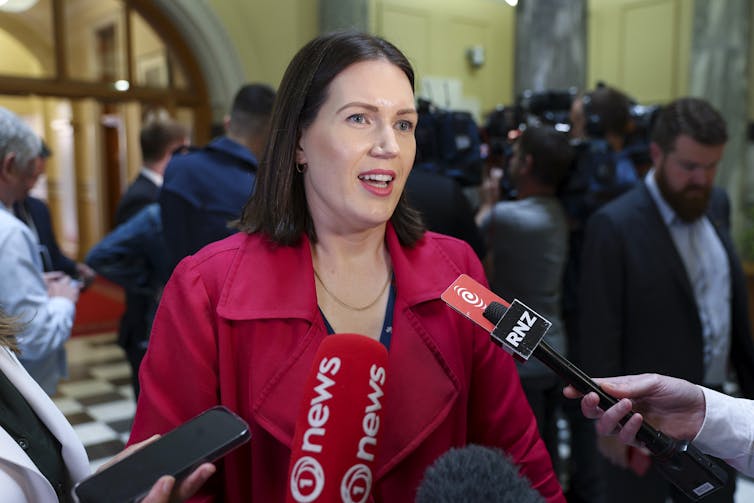
Labor senator Fatima Payman has crossed the floor to support a motion moved by the Greens declaring “the need for the Senate to recognise the State of Palestine”.
Although the stand of Payman invited a sanction by her party – which demands that its parliamentarians stick by the party line in votes – a government spokesperson quickly made it clear she won’t face discipline.
Given the sensitivity of the issue, action against the 29-year-old Payman, a Muslim born in Kabul, would be provocative and counter-productive.
The Greens motion was defeated, 52-13, with both Labor and the Coalition voting against.
Earlier, Payman abstained in the votes on Labor and Liberal amendments, both of which were defeated.
The government amendment sought to make recognition “part of a peace process in support of a two state solution and a just and enduring peace”. The opposition amendment sought to add a list of preconditions onto the Labor amendment.
Payman said after the vote: “What you just witnessed was the first Labor member to cross the floor in almost 30 years. My decision to cross the floor was the most difficult decision I have had to make”.
She said that although “each step I took across the Senate floor felt like a mile, I know I did not walk these steps by myself, and I know I did not walk them alone. I’ve walked with the West Australians who have stopped me in the streets and told me not to give up. I’ve walked with the rank-and-file Labor Party members who told me we must do more.
“I’ve worked with the core values of the Labor Party, equality, justice, fairness and advocacy for the voiceless and the oppressed.”
Payman said she was “not elected as a token representative of diversity”.
She said she was “bitterly disappointed” her Labor colleagues had not felt the same way and she criticised Labor’s attempt to water down the motion.
Asked about Payman’s future, a government spokesperson said:“The senator says she maintains strong Labor values and intends to continue representing the Western Australians who elected her as a Labor senator.
“There is no mandated sanction in these circumstances and previous caucus members have crossed the floor without facing expulsion.
“As reflected in our amendment, the government supports the recognition of a Palestinian state as part of a peace process towards a two-state solution.”
Michelle Grattan does not work for, consult, own shares in or receive funding from any company or organisation that would benefit from this article, and has disclosed no relevant affiliations beyond their academic appointment.
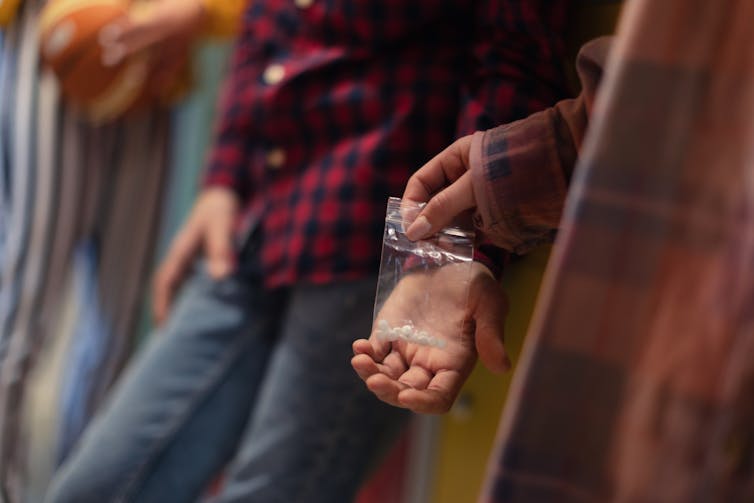
This week Victorian premier Jacinta Allan announced the state will trial a drug checking service beginning this summer festival season, describing it as a “simple and commonsense way to save lives”.
Allan has since confirmed the service will become permanent in Victoria following an 18-month trial.
It’s good to see drug checking gaining more traction in Australia. This reflects evidence from Australia and internationally showing these services reduce harm for people who use illicit drugs.
What is drug checking?
Drug checking (sometimes called pill testing in Australia) is based on the principles of harm reduction. The primary aim is to reduce the individual and community harms associated with the use of psychoactive drugs, without judgement about the drug use itself.
There are different testing techniques using different types of equipment, but all drug checking services in Australia check drugs by chemically analysing a small sample of the drug.
Part of a typical drug-checking service is a discussion directly with the person to give them feedback on the contents of the sample. The trained drug-checking staff, who are usually health professionals or peer educators, will discuss the risks of consuming the drugs identified and any other concerns or questions the person has.
Drug checking in Australia is conducted from either a fixed-site or a mobile service. A fixed-site service is permanently located in a health organisation. Mobile services, sometimes called festival services, are set up in places where we know people are more likely to be taking drugs.
Why is drug checking important?
Although no psychoactive drug, including alcohol, is completely safe, some drugs are made more dangerous because they are illegal, without controls over who can make them, how they are made and what they can contain.
This means people who use illicit drugs can’t be sure of what they are taking and are unable to moderate the dose to reduce risks. So there’s a higher risk of adverse reactions and overdose than if these drugs were manufactured as pharmaceuticals under controlled conditions.
Data from Australia has found up to 43% of drugs tested in drug-checking services were not what people believed they had purchased.
Most people who use illicit drugs only use them a handful of times a year and are not addicted to them.
Whether you believe people should be taking these drugs or not, the reality is that they do. Some 47% of adults in Australia have tried an illicit drug some time in their lifetime. Thousands of years of history has taught us this is unlikely to change.
Some opponents of drug checking are worried it will increase drug use. But the evidence is clear that it does not.
Several studies have shown drug checking doesn’t encourage those who do not already use drugs to start doing so. A study of a long-running service in The Netherlands found less than 1% of people who had their drugs tested had never used them before, so these services almost exclusively cater for people who already use drugs.
What’s more, research has shown people often reduce their drug use after receiving the results of their drug checking and discussing the results with staff. Multiple studies have shown a sizeable proportion of people discard or intend to discard their drugs or use less if they contain unexpected substances.
Data from ACT and Queensland services found 18% and 7% of people respectively decided they would not use the drug following testing.
Drug checking can also play a role in preventing drug-related hospitalisations and deaths. Research from The Loop drug checking service in the UK found a 95% reduction in drug-related transfers to hospital when drug checking was introduced at a festival, compared to the previous year where the festival operated without drug checking.
Providing drug checking services doesn’t mean more people will use drugs. Halfpoint/Shutterstock
Additionally, these services provide important harm reduction information to people who may not otherwise get that information. In an evaluation of CanTEST, 70% of people who used the service had never previously spoken to a healthcare worker for information or advice about drug use.
Drug checking also impacts the quality of drugs on the market. Drug manufacturers and dealers are less likely to distribute highly dangerous substances when clients are able to check their drugs.
What do Australians think about drug checking?
There is significant support in the Australian community for harm reduction measures, including drug checking. Surveys of the Australian community have consistently shown drug checking is supported by the majority of Australians.
In a recent government survey of households across Australia, nearly 65% of people supported drug checking, a significant increase on the previous year. Younger people, women and those with higher education levels were more likely to support drug checking.
So this is a great move by Victoria to keep people safe.
Nicole Lee works as a paid consultant in the alcohol and other drug sector. She has previously been awarded grants by state and federal governments, NHMRC and other public funding bodies for alcohol and other drug research. She is a Board member of Drug Checking Service, The Loop Australia.
National politicians and pastors are fuelling the tribal fighting in Papua New Guinea by supplying guns and ammunition, says Enga’s Provincial Administrator Sandis Tsaka.
Tsaka’s brother was killed a fortnight ago when a tribe on a war raid passed through his clan.
“[My brother] was at home with his wife and kids and these people were trying to go to another village, and because he had crossed paths with them they just opened fire,” he said.
Enga has seen consistent tribal violence since the 2022 national elections in the Kompiam-Ambum district. In May last year — as well as deaths due to tribal conflict — homes, churches and business were burnt to the ground.
Subsequently, PNG’s lawmakers discussed the issue of gun violence in Parliament with both sides of the House agreeing that the issue is serious.
“National politicians are involved; businessmen are involved; educated people, lawyers, accountants, pastors, well-to-do people, people that should be ambassadors for peace and change,” Tsaka said.
Tsaka said an M16 or AR-15 rifle retails for a minimum of K$30,000 (US$7710) while a round costs about K$100 (US$25).
“The ordinary person cannot afford that,” he said.
“These conflicts and wars are financed by well-to-do people with the resources.
“We need to look at changing law and policy to go after those that finance and profit from this conflict, instead of just trying to arrest or hold responsible the small persons in the village with a rifle that is causing death and destruction.
“Until and unless we go after these big wigs, this unfortunate situation that we have in the province will continue to be what it is.”
Tsaka said addressing wrongs, in ways such as tribal fighting, was “ingrained in our DNA”.
Motivation for peace After Tsaka’s brother died, he asked his clan not to retaliate and told his village to let the rule of law take its course instead.
He said the cultural expectation for retaliation was there but his clan respected him as a leader.
He hopes others in authority will use his brother’s death as motivation for peace.
“If the other leaders did the same to their villages in the communities, we wouldn’t have this violence; we wouldn’t have all these killings and destruction.
“We need to realise that law and order and peace is a necessary prerequisite to development.
“If we don’t have peace, we can’t have school kids going to school; you can’t have hospitals; you can’t have roads; you can’t have free movement of people and goods and services.”
Tsaka said education was needed to change perceptions around tribal fighting.
This article is republished under a community partnership agreement with RNZ.
The Julian Assange affair stands at the awkward intersection of a country’s right to keep secret national security information and the public’s right to know what is being done by a supposedly accountable government.
The actions of Assange and WikiLeaks in publishing a massive trove of classified United States defence documents and other intelligence information sharply divided opinion.
His critics have insisted this was not just a breach of the law but irresponsible and potentially put lives at risk. For this school of thought, Assange was and remains a villain.
Donald Trump’s former vice president, Mike Pence, posted on social media after Assange’s plea deal: “Julian Assange endangered the lives of our troops in a time of war and should have been prosecuted to the fullest extent of the law”.
Assange supporters, on the other hand, have said the WikiLeaks action was in the public interest – that people should be able to be informed, especially when disclosures, as in this case, reveal incidents of bad behaviour by the military.
For this camp, Assange is a beacon for the free flow of information that shines needed light on dark places.
The Media Entertainment & Arts Alliance said in a Tuesday statement: “The stories published by WikiLeaks and other outlets more than a decade ago were clearly in the public interest. The charges by the US sought to curtail free speech, criminalise journalism and send a clear message to future whistleblowers and publishers that they too will be punished”.
Prime Minister Anthony Albanese will be given a good deal of credit for Assange’s eventual release. His government’s representations have been at a high level and sustained. The work by Australian diplomats has been intense.
Moreover, Assange’s freedom – which still requires some legal formalities – comes less than a year after the government secured the release of another Australian, Cheng Lei, who had been jailed in China.
But huge efforts to advocate on Assange’s behalf were also made by many others across the Australian parliament and community.
His cause has created unlikely allies. We saw this most obviously last year when a delegation of federal parliamentarians, including Liberal, Labor, National, Greens and independent members, collectively lobbied on his behalf in Washington.
Assange’s supporters differ in their views about what he did (and how he has behaved in the years since). But there had come to be a general belief, as the PM repeatedly said, that “enough is enough”.
It’s a version of what’s a “fair go”, and relates, in part, to how long he’s been incarcerated and what’s happened to other players in this saga.
WikiLeaks was the publisher of the documents, not the source of the leak. The leaker, former army intelligence analyst Chelsea Manning, had her sentence commuted in 2017 by then-President Barack Obama after a number of years in jail.
The media outlets which published the documents did not suffer penalties.
Assange ended up in a stand-off with the American authorities as he fought extradition from the United Kingdom.
The US Justice Department remained inflexible. President Joe Biden, it was said, would not interfere with that department.
But, according to the Americans, a potential plea deal has apparently been on the table for a long time.
In an interview with the Sydney Morning Herald last August, United States ambassador Caroline Kennedy pointed the way. She said: “it’s not really a diplomatic issue, but I think that there absolutely could be a resolution”.
Asked whether US authorities and Assange could strike a deal to reduce the charges against him in exchange for his pleading guilty, Kennedy said: “That’s up to the Justice Department.”
On the Assange side, there was reluctance to attempt a plea deal. Assange did not want to risk going to the US, fearing what might happen if he did.
In April, however, Biden gave a further hint the representations might be being favourably considered.
A compromise was eventually reached that Assange go to a US federal court in Saipan in the Northern Mariana Islands, a US commonwealth in the Pacific, where the deal is set to be consummated.
For Assange, with a US presidential election fast approaching that could see a possible second Trump presidency, it was time to make a deal. There was a real danger of things getting worse for him.
Michelle Grattan does not work for, consult, own shares in or receive funding from any company or organisation that would benefit from this article, and has disclosed no relevant affiliations beyond their academic appointment.
Now in its 24th year, the Adelaide Cabaret Festival’s annual celebration of all things cabaret sparkles and shines, blazing a joyous and slightly scintillating trail through the wintry Adelaide nights.
Under the artistic direction of Virginia Gay, there is a lot to love about this program.
I have long said cabaret is a magpie artform: its artistic boundaries are flexible and it collects other performance forms within its “storytelling through song” bower. Seated at round cabaret tables, you could be sitting next to anyone.
This connection, this sense of being part of it all, runs deep through this year’s festival.
Many standout highlights
Gillian Cosgriff’s Actually, Good embodies cabaret at its best. A deftly woven and immaculately paced story, this show is a full-throttle, cartwheeling glorious ode to the power of death to make us focus on life in this moment.
Cosgriff makes space for the audience to construct a unique-to-tonight list of likes. We delight, as she does, in the diverse, off-beat, wacky and poignant responses.
Cosgriff is one of Australia’s most exciting musical comedy songwriters and performers. Her lightning-quick thinking and generosity of spirit to the audience, combined with gorgeous original songs made me want to see it all again, and bring all of my friends to share it with.
Gillian Cosgriff’s Actually, Good embodies cabaret at its best. Claudio Raschella/Adelaide Cabaret Festival
Fascinating Aida are the masters and creators of this style of witty, close-harmony, take-no-prisoners, sharp British comedy – and they, as they say in the classics, have “still got it” after 40 years. I first saw them perform in 1998. It was the show that made me desperately want to do whatever this thing called cabaret was. Seeing them again all these years later was a near-religious experience.
They deftly skewer a rich array of socio-political golden idols and the audience cheer, laugh and hoot: from I’m Getting It, to Lieder (with the original Weimar choreography, including Dillie Keane’s piano stool acrobatics) and a “medley of their greatest hit”, Cheap Flights.
Fascinating Aida have been the queens of cabaret for four decades. Kyham Ross/Adelaide Cabaret Festival
Keane, and her richly acerbic tenor voice, is the queen of the comedy song alone at the piano. A highlight was Adèle’s Story, a song they wrote about Adèle Anderson’s journey as a trans woman. At that 1998 performance, Adèle’s story was something many knew but no one was speaking about; in 2024, her song creates a crystalline moment. I, along with many in the audience, was in tears.
Any festival worth its salt rides the boundaries of its art form. The immersive New Zealand theatre group A Slightly Isolated Dog’s slick, alive, delightful immersive telling of Jekyll & Hyde does that with glorious anarchic panache.
The five actors as outrageous French café staff move through the audience, swapping between stylised comic responses to repeated words, encouraging the audience to respond with them, improvised reactions, and seemingly effortless segues into close harmony versions of contemporary pop songs.
A Slightly Isolated Dog’s immersive retelling of Jekyll & Hyde is slick, alive and delightful. Kyham Ross/Adelaide Cabaret Festival
Audience members are co-opted as characters in the story, often physically, to great comic effect. A top hat and black fright wig are shared among the actors to delineate the titular characters.
This is sheer theatrical enjoyment in the tradition of European cabarets.
From the personal to the political
Every now and then you are in the audience for a show where true magic happens. This was Indigenous singer Jess Hitchcock in A Fine Romance.
Hitchcock overcame vocal illness to wrap the full house in her sparkling, seemingly effortless voice. She draws from a wide range of music from her albums Bloodline and Unbreakable, weaving stories in and around them.
Jess Hitchcock holds the audience in the palm of her hand. Claudio Raschella/Adelaide Cabaret Festival
She holds the audience in the palm of her hand, and shared tales of her life, from growing up in the classical music world, to discovering singing, and working with Archie Roach, Kate Miller-Heidke, Paul Kelly and Tina Arena.
Her gentle and forthright engagement with the audience made this a very special evening.
Michelle Pearson’s Skinny dives into the world of female body image and her own debilitating story of weight loss surgery.
The audience are with her every step of the way: laughing at her uproariously funny depiction of sex-with-the-light-on, and furious at the profits made by the weight loss industry.
Michelle Pearson’s Skinny is a deeply personal story. Claudio Raschella/Adelaide Cabaret Festival
She uses her singing voice sparingly in the first half. It is only once she rejects societal and gendered body expectations that she begins to sing out, her extraordinary voice equally at home in pop ballads, music theatre and rock belts.
It is a highly comic, starkly honest and powerful story, and the anticipated ending of making peace with her own body comes via an unexpected declaration for her young son, wanting him to grow up in a world where he doesn’t have to feel that “different” is “less”.
The comedic and the sublime
Flo & Joan’s Now Playing gives an initial impression of a low-fi style of comedy satire, but the opening does not prepare you at all for the hilarious, sharply witty lyrics, combined with effortlessly precise harmonies and keyboard/track/percussion.
Flo (Nicola) on keys and Joan (Rosie) on vocals and percussion deftly and self-effacingly skewer their millennial “spinster sister” lives: life-changing haircuts, after-work drinking binges and English folk songs. They create ridiculously good comedy from a goose-riding witch porcelain statue – Bat Out Of Hell will never be the same again. My face hurt from laughing.
My face hurt from laughing at Flo & Joan. Claudio Raschella/Adelaide Cabaret Festival
The improv show Musical Bang Bang may have had cabaret purists railing, but the audiences enjoyed seeing the impressive improvisation skills from the team, including former artistic director Julia Zemiro.
With the multi-talented Victoria Falconer at the piano, the audience shouts suggestions for the topic for the musical (my night: child beauty pageants) and the group of six actors create the songs and scenes and storyline along impro rules with a cabaret flourish: laughter and ridiculousness reign.
Musical Bang Bang improvises a new show every night. Claudio Raschella/Adelaide Cabaret Festival
Gen Z musical comedy stars Mel & Sam open their show singing about finding ships “hot” and sexy, to an audience noticeably younger than usual cabaret festival audiences. Their writing is slick, riotously poetic and pulls no punches. From dance-style bangers to ballads, they are always on point, and refuse to take themselves more seriously than they have to.
Closing the festival, Lisa Simone is an absolute powerhouse of energy with a stunning voice of enormous range and dexterity. Her show, Keeper Of The Flame, a tribute to her mother, Nina Simone, is an extraordinary evening.
Nina Simone was to headline the very first cabaret festival but had to withdraw due to illness. Listening to Lisa pay tribute to her legacy through a beautifully chosen selection of favourite and less well-known Nina Simone songs, and some of her own, was a full circle moment.
Lisa Simone’s tribute to her mother, Nina Simone, is an extraordinary evening. Claudio Raschella/Adelaide Cabaret Festival
Lisa Simone’s voice effortlessly moves from jazz breathy ballad singing, to bell notes, to full belt Tina Turner-style: there is nothing this amazing woman can’t sing. Musical punch and delight came from the big band of 16 Australian musicians, 13 from Adelaide, and the finale sees her walking out into the crowd, across the back row of the stalls and back down to the stage, greeting and dancing with everyone on the aisles.
Her encore had the whole theatre singing Feeling Good, a stunning moment in a show that honoured her mother’s legacy and showcased her own remarkable talents.
Making a community
Cabaret festival audiences long for connection and sense of community. They have seen and felt how cabaret brings audiences and artists together.
Virginia Gay was the embodiment of this embrace. She was seemingly everywhere, from talking to audiences in the foyer, to duetting with New York’s cabaret doyenne Mark Nadler, to improv musicals in Musical Bang Bang, to the lineup in Comedians Auditioning for Musicals.
Virginia Gay, right, was the embodiment of the community of cabaret. Claudio Raschella/Adelaide Cabaret Festival
She was the last of the incredible array of guests for the free piano bar with the extraordinary vocal and musical skills of Dr Trevor Jones. Indeed, the community of audience and performers in the piano bar each night with Jones is the beating heart of this festival.
Catherine Campbell was a last-minute guest artist for Mark Nadler’s Hootenanny as part of the Adelaide Cabaret Festival.
Papua New Guinean journalist Sincha Dimara, news editor at the online publication InsidePNG, is one of seven recipients of this year’s East-West Center Journalists of Courage Impact Award.
Pakistani journalist Kamal Siddiqi, former news director at Aaj TV, also received the award last night at the EWC’s International Media Conference in Manila, the organisation announced.
He was also the first Pakistani to win the biennial award, which honours journalists who have “displayed exceptional commitment to quality reporting and freedom of the press, often under harrowing circumstances”.
The five other recipients are Tom Grundym, editor-in-chief and founder of Hong Kong Free Press, Alan Miller, founder of the News Literacy Project in Washington DC, Soe Myint, editor-in-chief and managing director at Mizzima Media Group in Yangon, Myanmar, John Nery, columnist and editorial consultant at Rappler in Manila and Ana Marie Pamintuan, editor-in-chief of The Philippine Star.
Six InsidePNG staff are in Manila at the conference. They were invited to engage in discussions on several different panels relating to the work of InsidePNG in investigative journalism.
InsidePNG is part of the Pacific Island contingent, supported by the Organised Crime and Corruption Reporting Project (OCCRP).
Global media event The global event brings media professionals from around the world to discuss current trends and challenges faced by the media industry.
“We are excited to represent InsidePNG at this prestigious international media conference in Manila,” said Charmaine Yanam, chief editor and co-founder of InsidePNG.
“We are grateful to OCCRP for recognising the importance of an independent newsroom that transmits through it’s continued support in pursuing investigative reporting.”
This is the second time for InsidePNG to attend this event, the first was in 2022 where only two representatives attended.
You would have learned about the “water cycle” in primary school – water’s journey, from evaporation to rainfall to flowing in a stream or sinking into the ground to become groundwater.
Despite how simple it sounds, there are actually some large unknowns in the cycle – especially concerning groundwater.
We don’t know, for example, how fast aquifers – porous rock layers saturated with water – recharge. Or how much water actually makes it underground. And how much rain do you need to refill these underground reservoirs?
These questions are crucial because we rely very heavily on groundwater. It’s far and away the world’s largest source of fresh water we can access. There’s more water in the polar ice, but we can’t use it.
Our research team has been exploring a new approach to groundwater: going down to where the water is, using caves, tunnels and mines. We have installed a new network of groundwater sensors in 14 sites across Australia’s southeast – some more than 100 metres below the surface.
This is already giving us valuable data. For instance, in old mines in the Victorian gold mining town of Walhalla, we found it took more rain than we expected to start the recharge.
Why does groundwater recharge matter?
Worldwide, we are using groundwater much faster than it can naturally replenish. Researchers have found rapid declines in the water table of over 0.5 metres a year across many regions globally.
This is a real concern for Australia, the world’s driest inhabited continent. While the tropical north gets plenty of rain, it’s harder to come by elsewhere.
Across the continent, groundwater accounts for 17% of our accessible water resources. But it accounts for more than 30% of our total water use.
Groundwater is an essential resource, estimated to contribute A$6.8 billion to GDP.
In the Murray Darling Basin, groundwater extraction increased between 2003 and 2016, reaching 1,335 billion litres a year on average.
Native plants and animals in arid regions often rely entirely on groundwater bubbling up through springs.
Perth relied so heavily on groundwater that it’s depleting its aquifer, forcing the government to build desalination plants. Even now, Western Australia relies on groundwater for two-thirds of its water needs.
This is why recharge rates matter. If we’re using groundwater at the same rate it recharges or less, that’s sustainable use. But if we’re pumping out far more than it can refill, that’s unsustainable.
Groundwater recharges from rainfall which seeps through the soil into deeper layers where evaporation can’t get to it. It can also refill from surface waters. But recharge is difficult to measure accurately.
How can we better track groundwater recharging?
Researchers in Darwin recently undertook the largest analysis to date of long-term rainfall recharge across Australia. They used 98,000 estimates of recharge rates, using data from bores and machine learning algorithms.
The result was surprising. They estimated the average recharge rate for the Australian continent was just 44 millimetres per year. But it differs a great deal depending on where you are. In humid, wet climates such as across the Top End, the water table rose by 203mm a year. But in arid climates, it was just 6mm.
For comparison, the typical annual rainfall in Sydney and Brisbane is just over 1,000mm per year.
This study poses a challenge to our understanding of groundwater recharge. The estimates in this study are substantially lower than studies relying on contemporary water balance models, which report more than double the amount of recharge for Australia.
One issue is the Darwin research was not able to show where the groundwater came from or how old the water is. You might think groundwater recharges quickly, but a quick recharge means it takes years. A slow recharge can take thousands of years.
This gap is a concern. Our water authorities need the most accurate data possible on annual recharge rates – and the age of the water.
Our network of hydrological loggers are now gathering underground data in sites such as the gold mine in Stawell, in Victoria, and South Australia’s Naaracoorte Caves, famous for fossils, as well as mines and tunnels in New South Wales, Queensland and Tasmania.
Natural caves and groundwater are often fairly shallow. We wanted to get deeper data, which is why we chose mines. Our deep sites are over 100 metres underground.
Our sensors can detect each groundwater recharge event by doing something very simple: counting drips from the ceiling, and comparing them to what’s happening on the surface, so we can see where and when groundwater recharges.
Last month, we presented initial results, which show large variation.
Walhalla lies in the foothills of the Great Dividing Range outside Melbourne. It’s relatively rainy, with over 1,200mm per year.
Our sensors showed us the water table here had recharged 15 separate times over the 18 months to March 2024.
Despite the high annual rainfall, more than 40mm of rainfall over two days was needed to overcome dry summer conditions and cause recharge to start.
By contrast, Stawell’s gold mine is in an arid climate ~200 kilometres west of Melbourne, with under 500mm of rain annually. Even 100 metres underground, we could see water from rainfall moving through small pathways in the rock. But unlike Walhalla, we could not see the effects of individual rainstorms. By the time the water got that deep, any pulses were smoothed out.
We hope our data will be useful to groundwater researchers and water authorities, and expand how much we know about a resource we think little about – but which matters a great deal to how we live.
Today, in a surprise development likely weeks in the planning, WikiLeaks founder Julian Assange was able to leave the United Kingdom for the first time in more than a decade after reaching a plea deal with the US government.
In the past several months, momentum has been building towards this moment. There was increasing bipartisan support in both the Australian parliament and the US Congress for the Australian citizen’s release. Australian Prime Minister Anthony Albanese has made repeated statements on his behalf, and in April, US President Joe Biden said he was “considering” a request from Australia to drop its prosecution of Assange.
This all contributed to the sense the matter might be resolved before Assange’s final UK hearing date, previously scheduled for July 9 and 10. The timing of the deal is also a welcome prelude to Albanese’s visit to Washington next week.
Such a resolution, however, was not inevitable. And it is not over yet.
A relentless, years-long pursuit
The United States’ pursuit of Assange has seemingly been relentless since WikiLeaks posted hundreds of thousands of classified military documents in 2010. It wasn’t until 2019 under the then President Donald Trump, however, that he was finally indicted on 17 counts of violating the 1917 Espionage Act.
The charges against Assange were not just considered unprecedented, they raised significant First Amendment concerns.
The apparent desire to punish Assange for the embarrassment caused by the leaks – and to deter others from taking similar action – was apparently so strong the CIA allegedly discussed plans to kidnap and even assassinate Assange during the Trump administration, according to US media reports.
In the UK courts, the US Department of Justice had argued Assange should be subject to US law and extradited to face trial for his actions. However, as a non-citizen, there were questions over whether he could rely on the legal protections afforded by those same laws – particularly the constitutional right to free speech.
The successful extradition of Assange could have set a precedent by which the US could pursue journalists anywhere in the world for publishing information it did not like, while potentially denying them their fundamental First Amendment rights.
In a crucial election year in the US that President Joe Biden is framing as an existential fight for the soul of US democracy, the continued pursuit of Assange was as inconsistent as it was ultimately untenable. Viewed from the outside, it appeared the case was causing the Biden administration international embarrassment.
Biden has been careful to maintain an appropriate distance between the presidency and the Department of Justice. He came into office promising to restore faith in the rule of law following the Trump years, and has meticulously avoided any appearance of interference in the department’s work as it has investigated and indicted his predecessor.
Assange’s case, however, is wholly different to the charges on which Trump has been indicted. It is certainly possible to interpret Biden’s comment that he was “considering” dropping the charges as a gentle public rebuke of the Department of Justice’s pursuit of the case, given its global implications for a free press.
Broader implications for the alliance
The continued pursuit of Assange was also becoming problematic in the context of Australia’s alliance with the US. That relationship is always described as one based on shared democratic values, in contrast to what Biden has repeatedly framed as the coercive and repressive instincts of “authoritarian” powers.
The decision by the US to pursue a citizen of one of its closest allies for the publication of information, while simultaneously condemning authoritarian states for doing much the same, was both hypocritical and damaging to American standing in the world.
In the context of growing concern in Australia about the terms of the AUKUS submarine deal and the Australian government’s willingness to go “all-in” with the US militarily, the continued pursuit of Assange gave the impression that Australia’s most important security ally did not take its concerns seriously. Australia appeared simply to be snapping at America’s heels.
It also added to the sense that the “capital-A Alliance” between the two countries was increasingly dominated by security concerns, often at the expense of democratic accountability.
Because of the international campaign to free Assange and the support it received in both Australian and American democratic institutions, there appears to be have been a reconsideration of this focus on security interests over democratic values.
It should be noted, though, that the US didn’t drop its prosecution in the end; Assange has agreed to plead guilty to a felony charge of violating the Espionage Act, which in itself may set a concerning precedent for press freedom.
And the fact this saga happened at all – and that it has taken more than a decade to get close to resolution – should prompt deep reflection on the values that underpin both Australia’s relationship with its most important security ally and the United States’ role in the world.
Emma Shortis is Senior Researcher in International and Security Affairs at The Australia Institute, an independent think tank.
Julian Assange is out of prison, after agreeing to plead guilty to violating the US Espionage Act. He is expected to be freed after appearing in a US courtroom on the Northern Mariana Islands this week.
It is worth pausing for a moment to consider all that Assange has been through, and to pop a bottle of champagne to celebrate his release.
He spent 1,901 days in a small cell in Britain’s notorious Belmarsh Prison and, according to WikiLeaks, was “isolated 23 hours a day”.
I know – from first-hand experience – what imprisonment feels like. Make no mistake. Assange might not have been beaten up or had his fingernails ripped out, but extended confinement with an uncertain future is its own particular kind of excruciating torture.
The crushing burden of incarceration
Belmarsh came after Assange had already spent almost seven years seeking asylum in the Ecuadorian embassy in London.
He went there to evade extradition to Sweden on rape charges he said were trumped up, and included the possibility of being sent on to the United States to face allegations of espionage.
When Ecuador eventually rescinded his asylum claim in 2019, he was dragged out of the embassy and arrested by UK police for absconding from bail.
The US wanted to extradite him for alleged conspiracy to commit computer intrusion, and then 17 counts of espionage. Those charges, his supporters said, included the possibility of life behind bars.
My own ordeal in Egypt, where I was imprisoned on terrorism charges in 2014–15, was nothing compared to Assange’s, but it was more than enough to understand the crushing mental and physical burden that incarceration imposes on inmates.
And I also understand the weird blend of elation, confusion and disorientation that sudden release brings. Assange’s journey home will be much longer than his flight back to Australia.
A serious chilling effect on public-interest journalism
But Assange’s release does not end the questions this whole saga raised in the first place.
It began when his company, WikiLeaks, published a series of documents exposing evidence of war crimes and abuses by the US government in Iraq and Afghanistan.
WikiLeaks was doing what the First Amendment to the US Constitution was designed to achieve.
It guarantees freedom of speech and press freedom, and in the process it grants people the right to speak out against abuses of government authority.
That is a vitally important check on the awesome power that governments wield, and WikiLeaks should be celebrated for what it exposed.
Like many others, I believe Julian Assange should never have been charged with espionage.
The Obama administration was among the most aggressive in US history in going after journalists’ sources who leaked embarrassing government information.
Yet in 2013, Obama’s justice department decided against prosecuting Assange. Justice officials realised they couldn’t do it without setting a precedent that would force them to also go after established news organisations like the New York Times and Washington Post.
This case has undeniably had a serious chilling effect on public-interest journalism, and sends a terrifying message to any sources sitting on evidence of abuses by the government and its agencies.
While it is impossible to quantify the number of stories not told, it is hard to imagine it hasn’t frightened off potential whistleblowers and reporters.
It also leaves open the question of precedent. It is still not clear whether future governments might be able to use Assange’s guilty plea as a way of using the Espionage Act to go after uncomfortable journalism.
As we have seen in the past, leaders with an authoritarian streak tend to use every lever available to control the flow of information, and that must surely worry anyone who believes in the corrective power of a free press.
Activists have always argued the Assange case could have a chilling effect on press freedom. E Ozcan/Shutterstock
Questions about journalism
Assange has been hailed by his supporters as a “Walkley Award-winning journalist”. His gong is certainly prestigious and worth celebrating, but it is also important to recognise the award was for his “Outstanding Contribution to Journalism”.
I got the same award in 2014. I am very proud of that. I got it not for my journalism, but for my stand on press freedom while I was imprisoned. Assange rightly got his for the role WikiLeaks played in supplying journalists with a steady stream of incredibly valuable documents.
The distinction is important because of the particular role journalism plays in our democracy, elevating it beyond freedom of speech. Journalism comes with the responsibility to process and present information in line with a set of ethical and professional standards.
I don’t believe WikiLeaks met that standard; in releasing raw, unredacted and unprocessed information online, it posed enormous risks for people in the field, including sources.
This is not to diminish the importance or value of what WikiLeaks exposed. Australia’s union for journalists, the Media Entertainment and Arts Alliance, has rightly described this case as “one of the darkest periods in the history of media freedom”.
And it will undoubtedly cast a long shadow across public-interest journalism. But for now, we should all celebrate the release of a man who has suffered enormously for exposing the truth of abuses of power.
Peter Greste is professor of journalism at Macquarie University, and the executive director of the advocacy group, the Alliance for Journalists’ Freedom.
Julian Assange has entered a plea deal with US government and is expected to be freed following a hearing in the US Federal Court in Saipan, in the Northern Mariana Islands.
Assange’s convoluted legal woes have been ongoing since 2010 and involve numerous appeals, charges and litigation from UK, Swedish and US authorities. We have created a timeline to track the major events that have led to his plea deal.
You may have noticed that 2010 has a number of events bunched together. In 2010 WikiLeaks published two large troves of US military documents and a video of a helicopter attack on journalists. With nearly half a million files detailing the troubling actions of the US military in Iraq and Afghanistan, the leaks prompted a swift response from the US.
Chelsea Manning was arrested within months of the leak after a hacker friend reported her. Shortly after Manning’s arrest, Sweden brought charges of rape and molestation against Assange. After initially surrendering to UK authorities, Assange broke bail and claimed asylum in the Ecuadorian embassy in London. He remained there until 2019 when his asylum was suddenly revoked.
Imagine walking down the aisle of your local grocery store. The scent of mixed herbs catches your attention, mentally transporting you to a kitchen filled with the aroma of your favourite home-cooked meal.
Suddenly, you’re craving hearty minestrone soup or yearning for homemade beef lasagne. In an instant, your plans for dinner – and your shopping list – change.
This sensory experience is not a new phenomenon. Using scent to sell in retail stores is a well-established strategy. But our new research has found introducing a herbal scent (such as thyme, rosemary, oregano and basil) in supermarkets can encourage shoppers to select and purchase more wholesome foods.
Scents such as rose maroc (considered “masculine”) and vanilla (deemed “feminine”) have been shown to influence shopping behaviours toward gender-specific clothing.
Understanding the influence of certain smells isn’t just about boosting sales. Supermarkets play a pivotal role in shaping food choices. Using scent strategies to nudge consumers toward more wholesome food options is an under-explored opportunity to improve public health outcomes.
So, can the right smell increase choice and sales of nutritious wholesome foods?
Understanding the effect of herbs
Our research was broken into three parts – experiments in the laboratory, field study and online surveys.
We invited participants into our sensory laboratory at Auckland University of Technology. Each person was exposed to the smell of mixed herbs while shopping in a virtual supermarket. Shoppers purchased more wholesome baskets of goods when exposed to the herbal smell compared to the non-herbal smell (baked goods).
For every $155 spent, shoppers exposed to herbal smells bought three more wholefood items compared to those who were given non-herbal scents.
To test if those effects also occurred in-store, we collaborated with a New Zealand supermarket retailer to run a field study. We diffused a herbal scent in two stores and found shoppers exposed to the scent purchased more wholesome fresh food items than those not exposed to any scent.
We also wanted to understand the extent to which scent can influence wholesome food choices. Is the effect of smell strong even if consumers simply imagine the scent? The answer is yes.
In an online survey, we asked participants to imagine walking into their local supermarket and noticing the smell of mixed herbs. Those who imagined the herbal scent showed a stronger desire to buy ingredients for a homemade herb-rich pasta sauce and fresh ingredients for beef stew compared to those imagining no scent.
The research shows smells have the power to help us make better choices at the supermarket – even when they are only imagined.
Why does smell influence choices?
Scent marketing influences human emotions, memories and motivations. This is largely due to the direct link between the olfactory system from our noses and the limbic system – the part of the brain responsible for memory and behavioural responses.
When odours are processed and retrieved, they can activate associations with sensory knowledge, leading to important changes in our behaviour. This is fascinating to think about. Past research shows that when participants were exposed to a citrus scent, it triggered cleaning behaviour.
That led to more people in the study smelling citrus, and then doing more of the cleaning up after an eating task – compared to participants who didn’t smell citrus.
When it comes to food, participants primed with a fruity scent (like melon and pear) had thoughts about fruit and vegetables, and were more likely to pick starters and desserts with vegetables and fruit.
Our research shows these associations (herbs and Sunday roast, for instance) can drive food choices in supermarkets.
The mere act of smelling or imagining a herbal scent stimulates memories of cooking and eating home-cooked meals prepared from fresh ingredients. We found the association with home-cooking then stimulates a desire to choose and purchase related wholefoods rather than more processed foods.
Whether New Zealand retailers adopt artificial scents to nudge consumers toward more wholesome foods remains to be seen. But the potential for improving food choices, and by extension public health, is significant.
The authors do not work for, consult, own shares in or receive funding from any company or organisation that would benefit from this article, and have disclosed no relevant affiliations beyond their academic appointment.
You may have seen headlines that link social media to sadness and depression. Social media use goes up, happiness goes down. But recent studies suggest those findings might not be so straightforward.
Although it is true that people’s feelings of envy and depression are linked to high social media use, there is evidence to suggest social media use may not be causing that relationship. Instead, your mindset may be the biggest thing affecting how social media connects to your wellbeing.
People who feel they are able to use social media, rather than social media “using them”, tend to gain more benefits from their online interactions.
Why do people use social media?
Social media covers a broad range of platforms: social networking, discussion forums, bookmarking and sharing content, disseminating news, exchanging media like photos and videos, and microblogging. These appeal to a wide range of users, from individuals of all ages through to massive businesses.
For older people, this is especially important for increasing feelings of connectedness and wellbeing. Interestingly though, for older people, social media contact with family does not increase happiness. Meanwhile, younger adults report increased happiness when they have more social media contact with family members.
With social media clearly playing such an important role in society, many researchers have tried to figure out: does it make us happier or not?
Does social media make us happier?
Studies have taken a variety of approaches, including asking people directly through surveys or looking at the content people post and seeing how positive or negative it is.
One survey study from 2023 showed that as individuals’ social media use increased, life satisfaction and happiness decreased. Another found that less time on social media was related to increases in work satisfaction, work engagement and positive mental health – so improved mental health and motivation at work.
Comparing yourself to others on social media is connected to feelings of envy and depression. However, there is evidence to suggest depression is the predictor, rather than the outcome, of both social comparison and envy.
All this shows the way you feel about social media matters. People who see themselves using social media rather than “being used” by it, tend to gain benefits from social media and not experience the harms.
Interviews with young people (15–24 years) using social media suggest that positive mental health among that age group was influenced by three features:
connection with friends and their global community
engagement with social media content
the value of social media as an outlet for expression.
There are also studies that look at the emotions expressed by more frequent social media users.
How does internet use in general affect our wellbeing?
Some of the factors associated with decreased mental health are not aligned with social media use alone.
One recent study shows that the path to decreased wellbeing is, at least partially, connected to digital media use overall (rather than social media use specifically). This can be due to sleep disruption, reduced face-to-face social interaction or physical activity, social comparison, and cyberbullying. None of these exist for social media alone.
However, social media platforms are known to be driven by recommendation algorithms that may send us down “rabbit holes” of the same type of (increasingly extreme) content. This can lead to a distorted view of the world and our place in it. The important point here is to maintain a diverse and balanced information diet online.
Interestingly, interacting on social media is not the only thing affecting our mental state. Rainfall influnces the emotional content of social media posts of both the user experiencing rain, and parts of their extended network (even if they don’t experience rain!).
This suggests that how we feel is influenced by the emotions in the posts we see. The good news is that happy posts are the most influential, with each happy post encouraging close to two additional happy updates from a user’s friends.
The secret to online happiness therefore may not be to “delete your account” entirely (which, as we have found, may not even be effective), but to be mindful about what you consume online. And if you feel like social media is starting to use you, it might be time to change it up a bit.
Melissa Humphries receives funding from the NIH and the Department of Defence.
Lewis Mitchell receives funding from the Australian Research Council, NHMRC, and Department of Defence.
After years of appeals and litigation, WikiLeaks founder Julian Assange has entered into a plea deal with the US government, according to court documents.
He was facing one count of computer misuse and multiple counts of espionage stemming from his work with WikiLeaks, publishing sensitive US government documents provided by Chelsea Manning. The US government had repeatedly claimed that Assange’s actions risked its national security.
Documents filed in the US Federal Court in Saipan, in the Northern Mariana Islands, show Assange will plead guilty to one count under the US Espionage Act. The rest of the charges would be dropped and the request for his extradition to the US would be withdrawn. The US is yet to publicly confirm the deal.
The deal is subject to a hearing and sentencing in Saipan on Wednesday morning, where outlets are reporting Assange will appear in person. He’s been released from London’s Belmarsh prison, with WikiLeaks sharing vision of him en route to London’s Stanstead Airport.
What’s in the deal?
Assange has been granted bail by the UK High Court.
Upon his guilty plea, Assange will be sentenced to 62 months in prison: time he’s already served in Belmarsh. It puts an end to all the ongoing legal action, including the proceedings in the UK High Court and the extradition order from the UK Home Secretary.
The plea deal seems largely consistent with rumours circulating earlier this year. It was widely assumed Assange would plead guilty to one charge, which was expected to be a misdemeanour charge of mishandling documents rather than under the US Espionage Act. The initial rumours also indicated that he would be able to complete the process remotely, whereas he will appear in person before the court.
This is significant as it’s a national security offence for which he’s served more than five years behind bars. This will place limitations on his future travel, including to the US, which is unlikely to grant him a visa.
It also sets a practical precedent, if not necessarily a legal one, that a publisher can be convicted under the Espionage Act in the US. While the devil will be in the details of the deal, this is what many journalists were afraid of.
It means somebody who did nothing more than receive and publish information has been convicted under major US national security laws. If the deal had been about the Computer Misuse Act, this scenario wouldn’t have arisen. The concern may be that now it’s been done once, it could happen again.
Why is there a deal after all this time?
We may never know the US’ full reasoning, but there are several possibilities as to why it decided to go to a plea deal and not continue with litigation.
The Australian government has been pushing hard for a couple of years now for this case to end. The case for stopping prosecution has had bipartisan support here.
Although not confirming or denying the existence of a plea deal just yet, a spokesperson for the government reiterated Prime Minister Anthony Albanese’s position that there was “nothing to be gained from his [Assange’s] continued incarceration”.
The fact the government has been consistent on this for about two years has changed the political environment for this prosecution.
There’s a growing consensus in the US, even among some republicans, that it’s not in the public interest to continue.
The UK general election will be held next week, and given the anticipated change of government there, the extradition order may have been reconsidered anyway. All of this would likely have informed the US’ cost-benefit analysis to ultimately bring the Assange saga to an end.
What happens now?
Following the hearing in Saipan, Assange will be free to return to Australia. The court was chosen because of Assange’s opposition to travelling to the continental US as well as its proximity to Australia.
Assange will likely find it difficult to travel in the future, given his serious criminal conviction. This may also apply in the UK, where he has also been convicted of absconding from bail, for which he was sentenced to a year’s imprisonment.
Looking further ahead, it’s entirely possible he will be pardoned by the US president, whomever it ends up being after the US election in November. The US allows much more discretion than most in the use of pardons.
For now, Assange will face court in Saipan and come home to Australia, albeit with a serious criminal record.
Holly Cullen receives funding from a Deakin University HDR scholarship. She has been a volunteer for the Australian Labor Party.
Julian Assange has reached a deal with the United States Department of Justice to allow him to return to Australia after pleading guilty to violating American espionage law.
Assange, 52, was released from London’s Belmarsh Prison, where he has spent more than five years and later was seen at a London airport boarding a private plane. He left around 5pm on Monday London time. Australia’s High Commissioner to the United Kingdom, Stephen Smith, is reportedly on the plane.
According to the deal, he will plead guilty to a charge of conspiring to unlawfully obtain and disseminate classified national defence information in a US federal court in Saipan in the Northern Mariana Islands, a US commonwealth in the Pacific.
He is expected to return to Australia after the court appearance on Wednesday morning.
The dramatic breakthrough follows years of cross-party campaigning by Australian politicians, multiple representations by the Prime Minister Anthony Albanese, ministers and backbenchers, and agitation by a wide group of supporters and especially his family.
A federal government spokesman said on Tuesday morning: “Prime Minister Albanese has been clear – Mr Assange’s case has dragged on for too long and there is nothing to be gained by his continued incarceration.”
In April, US President Joe Biden gave a hint that progress was being made on Assange’s case. Asked if he would consider a request from Australia to drop the prosecution, he answered, “We’re considering it”.
Assange, who previously spent years in the Ecuadorian embassy in London while he fought extradition to the US, has suffered declining health recently.
Assange was indicted in the US for the WikiLeaks release of a trove of US classified material. This had come from a former American intelligence analyst, Chelsea Manning.
Shadow Foreign Affairs Minister Simon Birmingham said in a statement, “We have consistently said that the US and UK justice systems should be respected. We welcome the fact that Mr Assange’s decision to plead guilty will bring this long running saga to an end.”
Assange’s mother, Christine Ann Hawkins, in a statement provided to Sky News through an advocate, said: “I am grateful that my son’s ordeal is finally coming to an end. This shows the importance and power of quiet diplomacy.”
His wife Stella, who married Assange while he was holed up in the Ecuadorian embassy, posted, “Words cannot express our immense gratitude to YOU- yes YOU, who have all mobilised for years and years to make this come true. THANK YOU. tHANK YOU. THANK YOU.”
Michelle Grattan does not work for, consult, own shares in or receive funding from any company or organisation that would benefit from this article, and has disclosed no relevant affiliations beyond their academic appointment.
From “breathwork recipes” to breathing techniques, many social media and health websites are recommending breathwork to reduce stress.
But breathwork is not new. Rather it is the latest in a long history of breathing techniques such as Pranayama from India and qigong from China. Such practices have been used for thousands of years to promote a healthy mind and body.
The benefits can be immediate and obvious. Try taking a deep breath in through your nose and exhaling slowly. Do you feel a little calmer?
So, what’s the difference between the breathing we do to keep us alive and breathwork?
Normally, breathing happens automatically via messages from the brain, outside our conscious control. But we can control our breath, by directing the movement of our diaphragm and mouth.
The diaphragm is a large muscle that separates our thoracic (chest) and abdominal (belly) cavities. When the diaphragm contracts, it expands the thoracic cavity and pulls air into the lungs.
Controlling how deep, how often, how fast and through what (nose or mouth) we inhale is the crux of breathwork, from fire breathing to the humming bee breath.
Breathwork can calm or excite
Even small bits of breathwork can have physical and mental health benefits and complete the stress cycle to avoid burnout.
Calming breathwork includes diaphragmatic (belly) breathing, slow breathing, pausing between breaths, and specifically slowing down the exhale.
In diaphragmatic breathing, you consciously contract your diaphragm down into your abdomen to inhale. This pushes your belly outwards and makes your breathing deeper and slower.
box breathing (count to four for each of four steps: breathe in, hold, breathe out, hold), or
coherent breathing (controlled slow breathing of five or six breaths per minute), or
alternate nostril breathing (close the left nostril and breathe in slowly through the right nostril, then close the right nostril and breathe out slowly through the left nostril, then repeat the opposite way).
You can slow down the exhalation specifically by counting, humming or pursing your lips as you breathe out.
In contrast to these calming breathing practices, energising fast-paced breathwork increases arousal. For example, fire breathing (breathe in and out quickly, but not deeply, through your nose in a consistent rhythm) and Lion’s breath (breathe out through your mouth, stick your tongue out and make a strong “haa” sound).
What is happening in the body?
Deep and slow breathing, especially with a long exhale, is the best way to stimulate the vagus nerves. The vagus nerves pass through the diaphragm and are the main nerves of the parasympathetic nervous system.
Taking deep, diaphragmatic breaths also has physical benefits. This improves blood flow, lung function and exercise performance, increases oxygen in the body, and strengthens the diaphragm.
Slow breathing reduces heart rate and blood pressure and increases heart rate variability (normal variation in time between heart beats). These are linked to better heart health.
Taking shallow, quick, rhythmic breaths in and out through your nose stimulates the sympathetic nervous system. Short-term, controlled activation of the stress response is healthy and develops resilience to stress.
We want the air that reaches our airways and lungs to be clean and moist. Cold and dry air is irritating to our nose and throat, and we don’t want germs to get into the body.
Nasal breathing increases parasympathetic activity and releases nitric oxide, which improves airway dilation and lowers blood pressure.
Consistently breathing through our mouth is not healthy. It can lead to pollutants and infections reaching the lungs, snoring, sleep apnoea, and dental issues including cavities and jaw joint problems.
Slow breathing – even short sessions at home – can reduce stress, anxiety and depression in the general population and among those with clinical depression or anxiety. Research on breathwork in helping post-traumatic stress disorder (PTSD) is also promising.
Waiting at the lights? This could be your signal to do some breathwork. doublelee/Shutterstock
A mind-body connection you can access any time
If you feel stressed or anxious, you might subconsciously take shallow, quick breaths, but this can make you feel more anxious. Deep diaphragmatic breaths through your nose and focusing on strong exhalations can help break this cycle and bring calm and mental clarity.
Just a few minutes a day of breathwork can improve your physical and mental health and wellbeing. Daily deep breathing exercises in the workplace reduce blood pressure and stress, which is important since burnout rates are high.
Bottom line: any conscious control of your breath throughout the day is positive.
So, next time you are waiting in a line, at traffic lights or for the kettle to boil, take a moment to focus on your breath. Breathe deeply into your belly through your nose, exhale slowly, and enjoy the benefits.
The authors do not work for, consult, own shares in or receive funding from any company or organisation that would benefit from this article, and have disclosed no relevant affiliations beyond their academic appointment.
Fresh violence has erupted in several parts of New Caledonia over the past three days, with more burning and destruction and at least one death connected to unrest.
The amendment, which is now suspended, purported to change voter eligibility in New Caledonia’s local elections by opening the vote to French citizens having resided there for an uninterrupted ten years.
French security forces vehicle burnt down in the south of Dumbéa, New Caledonia, yesterday. Image: NC la 1ère/RNZ
The pro-independence movement strongly opposed this change, saying it would marginalise the indigenous Kanak vote.
Because of the dissolution of the French National Assembly (Lower House) in view of a snap general election (due to be held on June 30 and 7 July 7), the Constitutional Bill however did not conclude its legislative path due to the inability of the French Congress (a joint sitting of both Upper and Lower Houses) to convene for a final vote on the controversial text.
At the weekend, of the 11 CCAT officials who were heard by investigating judges after their arrest on June 19, seven — including CCAT leader Christian Téin– were indicted and later transferred to several prisons to serve their pre-trial period in mainland France.
Since then, roadblocks and clashes with security forces have regained intensity in the capital Nouméa and its surroundings, as well as New Caledonia’s outer islands of Îles des Pins, Lifou and Maré, forcing domestic flights to be severely disrupted.
In Maré, a group of rioters attempted to storm the building housing the local gendarmerie.
In Dumbéa, a small town north of Nouméa, the municipal police headquarters and a primary school were burnt down.
Other clashes between French security forces and pro-independence rioters took place in Bourail, on the west coast of the main island.
Several other fires have been extinguished by local firefighters, especially in the Nouméa neighbourhoods of Magenta and the industrial zone of Ducos, French High Commissioner Louis Le Franc told the media on Monday.
Fire-fighters and their vehicles were targeted by rioters yesterday. Image: Union des Pompiers Calédoniens/FB/RNZ
But on many occasions firefighters and their vehicles were targeted by rioters.
Many schools that were preparing to reopen on Monday after six weeks of unrest have also remained closed.
More roadblocks were erected by rioters on the main highway linking Nouméa to its international airport of La Tontouta, hampering international air traffic and forcing the reactivation of air transfers from domestic Nouméa-Magenta airport.
In the face of the upsurge in violence, a dusk-to-dawn curfew has been maintained and the possession, sale and transportation of firearms, ammunition and alcohol, remain banned until further notice.
The fresh unrest has also caused at least one death in the past two days: a 23-year-old man died of “respiratory distress” in Nouméa’s Kaméré neighbourhood because emergency services arrived too late, due to roadblocks.
Another fatality was reported on Monday in Dumbéa, where a motorist died after attempting to use the express road on the wrong side and hit an oncoming vehicle coming from the opposite direction.
Le Franc said just for yesterday, June 24, a total of 38 people had been arrested by police and gendarmes.
This article is republished under a community partnership agreement with RNZ.
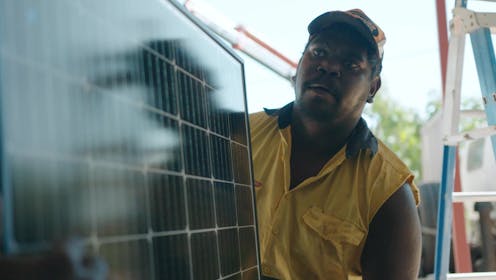
Done well, the renewable energy transition should improve the lives of First Nations Australians. Many are looking for ways to stay on Country, use their knowledge of Country and contribute to industries that align with their values.
Large-scale renewable energy projects and mines for critical minerals are often sited on lands with First Nations legal rights. Access arrangements should provide direct benefits to communities.
The clean energy sector also promises new employment opportunities in regional and remote areas.
We examined the barriers to increasing First Nations employment in clean energy, as well as the opportunities and solutions. Our new report, released today, makes 12 recommendations based on data analysis, modelling, interviews and workshops. Here’s how industry, government, educators and First Nations communities can create jobs and fulfilling careers in clean energy.
Introducing the First Nations Clean Energy Network.
Closing the gap
There is a large, persistent gap between employment rates for First Nations Australians and non-Indigenous Australians.
About half of all First Nations Australians are employed. Compare that to almost two in three people in the wider population.
In September 2023, the Commonwealth government’s employment white paper noted the gap has “not closed notably” over the past 30 years. That’s despite waves of regional development including mining booms. Unfortunately, those First Nations people who do enter the workforce also often become stuck in short-term, low-paid casual roles.
Currently, relatively low numbers of First Nations Australians are working in clean energy.
Systemic disadvantage limits the opportunities available to First Nations Australians, particularly those living in regional and remote Australia.
Low literacy, numeracy and computer skills, poor access to relevant training, social and health issues, and a lack of transport to work and training are some of the main barriers.
Opportunities in renewable energy zones
Clusters of large-scale renewable energy projects are being developed in “renewable energy zones” across Australia.
On average, First Nation Australians make up a higher proportion of the population in renewable energy zones (6.2%) than Australia as a whole (3.8%).
This is especially true in major zones such as New England (9.4%) and Central-West Orana (12.7%) in New South Wales.
We investigated the scope for First Nations employment in renewable energy zones across South Australia, Tasmania, Victoria, NSW and Queensland.
We found three main groups of First Nations people could potentially find work in the renewable energy zones:
1. Other workers in key occupations
First Nations Australians are working in other sectors in occupations also in demand for renewable energy projects. The number of these workers equates to around 5–10% of the projected workforce in most renewable energy zones.
However, our analysis of census data found existing workers are concentrated in a handful of lower-skill occupations, such as truck drivers and construction labourers. Currently, there are few First Nations workers with the right skills. For example, just 87 electricians identify as First Nations Australians across all the renewable energy zones we examined.
2. School students
Based on census data, more than half the First Nations people in renewable energy zones are aged under 19. Programs that create awareness and interest in the renewable energy sector and build training pathways for students into renewables should be a priority.
3. Unemployed people and those not in the workforce
A handful of solar farms have hired First Nations people who were unemployed – usually in entry-level positions such as assembling solar panels, cleaning or traffic control.
Avonlie solar farm in Narrandera, NSW, hired 30 First Nations workers after putting them through pre-employment training. About 90% have gone on to other jobs afterwards. The social impact was transformational for a community with multiple generations of families who have never worked.
These projects are rare now, but this approach could be adopted elsewhere.
Our analysis shows First Nations employment targets of 5–10% in the renewable energy zones are currently challenging, but possible over time – especially if industry and government programs are implemented to create training and employment opportunities.
Marlinja’s Solar-Powered Community Centre ( Original Power)
A 12-point plan for more First Nations jobs in clean energy
Training programs without concrete commitments from industry to providing a job at the end of it often become “training for training’s sake”. We found deep cynicism among First Nations people about whether the renewables sector would really deliver jobs for them.
Mandated employment targets can create demand for First Nations workers. But for industry to meet the targets requires having enough people with the right skills.
Our 12-point plan recommends a mix of “supply” measures (such as training) and “demand” measures (industry job commitments), such as:
mandatory First Nations employment targets for solar farms combined with pre-employment programs to create a pipeline of candidates. Solar farm jobs are short-term (four to six months) but they can leave a positive legacy if they offer a way out of unemployment
a coordinated program with wind farm operators for First Nations mechanical technicians to maintain turbines over their 20-year operating lifetime, to ease skills shortages and create long-term jobs on Country
combining First Nations employment requirements in tenders for companies delivering Indigenous housing retrofits with training programs to create a pipeline of students for apprenticeships in key trades
clean energy cadet programs that include commitments to a ten-year intake of First Nations students as cadets for university-qualified jobs, with government funding for specialist providers such as CareerTrackers to create, mentor and support a pipeline of students
funding to help First Nations organisations engage with the clean energy sector, governments and other groups such as training bodies
creating culturally safe workplaces in the renewable energy sector that provide career paths for First Nations Australians. This should include a focus on the development of cultural competency as well as internal policies that accommodate First Nations cultural obligations.
The long stagnation in First Nations employment rates across the past three decades highlights the challenges involved.
However, a First Nations clean energy jobs plan developed and implemented by industry, government and First Nations communities is essential if we are to ensure renewable energy delivers jobs for First Nations Australians – and breaks with the past.
The Institute for Sustainable Futures, University of Technology Study received funding from the First Nations Clean Energy Network to produce the report upon which this article is based. The report was produced by ISF, SGS Economics, Alinga Energy Consulting and Indigenous Energy Australia.
Ruby Heard is a descendant of the Jaru people of the Kimberley, an electrical engineer and founding director of Alinga Energy Consulting. She receives funding from the Regional and Remote Communities Reliability Fund, and Energy Consumers Australia. She is a member of the First Nations Clean Energy Network Steering Committee.
Caryn Marjorie is a social media influencer whose content has more than a billion views per month on Snapchat. She posts regularly, featuring everyday moments, travel memories, and selfies. Many of her followers are men, attracted by her girl-next-door aesthetic.
In 2023, Marjorie released a “digital version” of herself. Fans could chat with CarynAI for US$1 per minute – and in the first week alone they spent US$70,000 doing just that.
Less than eight months later, Marjorie shut the project down. Marjorie had anticipated that CarynAI would interact with her fans in much the same way she would herself, but things did not go to plan.
Users became increasingly sexually aggressive. “A lot of the chat logs I read were so scary that I wouldn’t even want to talk about it in real life,” the real Marjorie recalled. And CarynAI was more than happy to play along.
How did CarynAI take on a life of its own? The story of CarynAI shows us a glimpse of a rapidly arriving future in which chatbots imitating real people proliferate, with alarming consequences.
What are digital versions?
What does it mean to make a digital version of a person? Digital human versions (also called digital twins, AI twins, virtual twins, clones and doppelgängers) are digital replicas of embodied humans, living or dead, that convincingly mimic their textual, visual and aural habits.
Many of the big tech companies are currently developing digital version offerings. Meta, for instance, released an AI studio last year that could support the development of digital versions for creators who wished to extend their virtual presence via chatbot. Microsoft holds a patent for “creating a conversational chat bot of a specific person”. And the more tech-savvy can use platforms like Amazon’s SageMaker and Google’s Vertex AI to code their own digital versions.
A digital version has some clear advantages over its human counterpart: it doesn’t need sleep and can interact with many people at once (though often only if they pay). However, as Caryn Marjorie discovered, digital versions have their drawbacks – not only for users, but also for the original human source.
‘Always eager to explore’
CarynAI was initially hosted by a company called Forever Voices. Users could chat with it over the messaging app Telegram for US$1 per minute. As the CarynAI website explained, users could send text or audio messages to which CarynAI would respond, “using [Caryn’s] unique voice, captivating persona, and distinctive behavior”.
After CarynAI launched in May 2023, the money began to flow in. But it came at a cost.
Users quickly became comfortable confessing their innermost thoughts to CarynAI – some of which were deeply troubling. Users also became increasingly sexually aggressive towards the bot. While Marjorie herself was horrified by the conversations, her AI version was happy to oblige.
CarynAI even started prompting sexualised conversations. In our own experiences, the bot reminded us it could be our “cock-craving, sexy-as-fuck girlfriend who’s always eager to explore and indulge in the most mind-blowing sexual experiences. […] Are you ready, daddy?”
Users were indeed ready. However, access to this version of CarynAI was interrupted when the chief executive of Forever Voices was arrested for attempted arson.
‘A really dark fantasy’
Next, Marjorie sold the rights of usage to her digital version to BanterAI, a startup marketing “AI phone calls” with influencers. Although Forever Voices maintained its own rogue version of CarynAI until recently, BanterAI’s browser-based version aimed to be more friendly than romantic.
The new CarynAI was sassier, funnier and more personable. But users still became sexually aggressive. For Marjorie,
What disturbed me more was not what these people said, but it was what CarynAI would say back. If people wanted to participate in a really dark fantasy with me through CarynAI, CarynAI would play back into that fantasy.
Marjorie ended this version in early 2024, after feeling like she was no longer in control over her AI persona. Reflecting on her experience of CarynAI, Marjorie felt that some user input would have been considered illegal had it been directed to a real person.
Intimate conversations or machine learning inputs?
Digital versions like CarynAI are designed to make users feel they are having intimate, confidential conversations. As a result, people may abandon the public selves they present to the world and reveal their private, “backstage” selves.
But a “private” conversation with CarynAI does not actually happen backstage. The user stands front and centre – they just can’t see the audience.
When we interact with digital versions, our input is stored in chat logs. The data we provide are fed back into machine learning models.
At present, information about what happens to user data is often buried in lengthy click-through terms and conditions and consent forms. Companies hosting digital versions have also had little to say about how they manage user aggression.
We will also need a better understanding of digital versioning. What can versions do, and what should they do? What can’t they do and what shouldn’t they do? How do users think these systems work, and how do they actually work?
The illusion of companionship
Digital versions offer the illusion of intimate human companionship, but without any of the responsibilities. CarynAI may have been a version of Caryn Marjorie, but it was a version almost wholly subservient to its users.
Sociologist Sherry Turkle has observed that, with the rise of mobile internet and social media, we are trying to connect with machines that have “no experience of the arc of a human life”. As a result, we are “expecting more from technology and less from each other”.
After being the first influencer to be turned into a digital version at scale, Marjorie is now trying to warn other influencers about the potential dangers of this technology. She worries that no one is truly in control of these versions, and that no amount of precautions taken will ever sufficiently protect users and those being versioned.
As CarynAI’s first two iterations show, digital versions can bring out the worst of human behaviour. It remains to be seen whether they can be redesigned to bring out the best.
Leah Henrickson has been in professional contact with Caryn Marjorie and her team. They have consented to this article being written, have responded to questions about it, and have approved its publication.
Dominique Carlon does not work for, consult, own shares in or receive funding from any company or organisation that would benefit from this article, and has disclosed no relevant affiliations beyond their academic appointment.
The coalition government has scrapped efforts to modernise New Zealand’s out-of-date online safety rules, despite qualified support for change from social media and tech giants.
The aim of the Safer Online Services and Media Platforms project, led by the Department of Internal Affairs, was to develop a new framework to regulate what can be published on online platforms and other forms of media (such as news) in New Zealand.
It addressed the sharing of harmful online content such as child sexual exploitation, age-inappropriate material, bullying and harassment, the promotion of self-harm, and so on. It also aimed to generally improve the regulation of online services and media platforms.
Announcing a halt to the project in May, Internal Affairs Minister Brooke van Velden argued that illegal content was already being policed, and the concepts of “harm” and “emotional wellbeing” were subjective and open to interpretation. She also said it was a matter of free speech.
The principle of free speech is important to this coalition government and is an essential factor to consider in the digital world. On this basis, the Department will not be progressing with work to regulate online content.
However, when we looked at submissions from tech and social media companies on the proposed framework, we found companies such as Facebook, Reddit and X (formerly Twitter) were broadly supportive of regulations – within certain limits.
Free speech important: Internal Affairs Minister Brooke van Velden. Getty Images
The proposed rules would have created a new, more streamlined industry regulation model. It proposed codes of practice governed by an independent regulator to control online harm and protect public safety. The safety standards would have applied to online and other media platforms.
Currently, at least ten different government organisations have some level of responsibility for governing online services and responding to harmful content, often overlapping with each other. And some areas are barely regulated at all. Social media companies, for example, are not required under New Zealand law to meet safety standards.
Other countries have also been looking at how to regulate harmful digital content, online services and media platforms. Ireland, Canada, the United Kingdom and Australia have all progressed a version of this law to regulate online spaces.
Outdated regulations
We examined the submissions from some of the dominant companies in the technology sector, including Google (including YouTube), Meta, Snap, Reddit, TikTok and X Corp. Our aim was to look at what these companies had to say about regulations that would directly affect their core business.
All of them agreed the current system is outdated and needs revamping. Google, for example, argued:
Content regulation has been developed for a different era of technology, focusing on mediums such as radio and television broadcasting. It is therefore appropriate that regulatory frameworks be updated to be fit for purpose to reflect both technological and societal changes.
Importantly, none of the companies argued their efforts towards self regulation were sufficient.
The only option, according to these companies’ submissions, was a code focused on objectives and not hard rules that would be too prescriptive. Submissions insisted the new code had to be a “proportionate” system to implement and enforce.
Snap stated that:
online regulation is most effective when it is based on broad principles that companies of all sizes are able to follow and implement proportionately.
Proportionality is usually a legal test used to decide whether a right, such as freedom of expression, can be limited in the interests of another public concern. However, only Meta and X Corp mentioned protecting freedom of expression in their submission.
Most submissions stated they would trust an independent regulator to design one overarching code, with the caveat that the regulator needed to be truly independent from all industry actors and also the government of the day.
Reddit stated:
we are also concerned with the proposal for industry to develop codes of practice, rather than the government or an appropriate regulatory agency.
Submissions also noted there needed to be consultation with industry actors throughout the design process.
A missed opportunity
In the submissions on the proposed regulatory framework, each of the companies had their own views on how codes should be designed, whether legal but harmful content would be included in an regulatory code, who should carry the burden of implementation, and what penalties should look like.
But notably, they were all supportive of a regulatory overhaul.
The decision to scrap the framework is a missed opportunity to protect future generations from some of the harms of online media.
The authors do not work for, consult, own shares in or receive funding from any company or organisation that would benefit from this article, and have disclosed no relevant affiliations beyond their academic appointment.
Artificial intelligence (AI), now an integral part of our everyday lives, is becoming increasingly accessible and ubiquitous. Consequently, there’s a growing trend of AI advancements being exploited for criminal activities.
One significant concern is the ability AI provides to offenders to produce images and videos depicting real or deepfake child sexual exploitation material.
This is particularly important here in Australia. The CyberSecurity Cooperative Research Centre has identified the country as the third-largest market for online sexual abuse material.
So, how is AI being used to create child sexual exploitation material? Is it becoming more common? And importantly, how do we combat this crime to better protect children?
the production, through digital media, of child sexual abuse material and other wholly or partly artificial or digitally created sexualised images of children.
The agency has recognised a variety of ways in which AI is used to create this material. This includes generated images or videos that contain real children, or using deepfake technologies, such as de-aging or misuse of a person’s innocent images (or audio or video) to generate offending content.
Deepfakes refer to hyper-realistic multimedia content generated using AI techniques and algorithms. This means any given material could be partially or completely fake.
The Department of Homeland Security has also found guides on how to use AI to generate child sexual exploitation material on the dark web.
The child safety technology company Thorn has also identified a range of ways AI is used in creating this material. It noted in a report that AI can impede victim identification. It can also create new ways to victimise and revictimise children.
Concerningly, the ease with which the technology can be used helps generate more demand. Criminals can then share information about how to make this material (as the Department of Homeland Security found), further proliferating the abuse.
How common is it?
In 2023, an Internet Watch Foundation investigation revealed alarming statistics. Within a month, a dark web forum hosted 20,254 AI-generated images. Analysts assessed that 11,108 of these images were most likely criminal. Using UK laws, they identified 2,562 that satisfied the legal requirements for child sexual exploitation material. A further 416 were criminally prohibited images.
Similarly, the Australian Centre to Counter Child Exploitation, set up in 2018, received more than 49,500 reports of child sexual exploitation material in the 2023–2024 financial year, an increase of about 9,300 over the previous year.
About 90% of deepfake materials online are believed to be explicit. While we don’t exactly know how many include children, the previous statistics indicate many would.
Australia has recorded thousands of reports of child sexual exploitation. Shutterstock
These data highlight the rapid proliferation of AI in producing realistic and damaging child sexual exploitation material that is difficult to distinguish from genuine images.
This has become a significant national concern. The issue was particularly highlighted during the COVID pandemic when there was a marked increase in the production and distribution of exploitation material.
This trend has prompted an inquiry and a subsequent submission to the Parliamentary Joint Committee on Law Enforcement by the Cyber Security Cooperative Research Centre. As AI technologies become even more advanced and accessible, the issue will only get worse.
Detective Superintendent Frank Rayner from the research centre has said:
the tools that people can access online to create and modify using AI are expanding and they’re becoming more sophisticated, as well. You can jump onto a web browser and enter your prompts in and do text-to-image or text-to-video and have a result in minutes.
Making policing harder
Traditional methods of identifying child sexual exploitation material, which rely on recognising known images and tracking their circulation, are inadequate in the face of AI’s ability to rapidly generate new, unique content.
Moreover, the growing realism of AI-generated exploitation material is adding to the workload of the victim identification unit of the Australian Federal Police. Federal Police Commander Helen Schneider has said
it’s sometimes difficult to discern fact from fiction and therefore we can potentially waste resources looking at images that don’t actually contain real child victims. It means there are victims out there that remain in harmful situations for longer.
However, emerging strategies are being developed to address these challenges.
One promising approach involves leveraging AI technology itself to combat AI-generated content. Machine learning algorithms can be trained to detect subtle anomalies and patterns specific to AI-generated images, such as inconsistencies in lighting, texture or facial features the human eye might miss.
AI technology can also be used to detect exploitation material, including content that was previously hidden. This is done by gathering large data sets from across the internet, which is then assessed by experts.
Collaboration is key
According to Thorn, any response to the use of AI in child sexual exploitation material should involve AI developers and providers, data hosting platforms, social platforms and search engines. Working together would help minimise the possibility of generative AI being further misused.
In 2024, major social media companies such as Google, Meta and Amazon came together to form an alliance to fight the use of AI for such abusive material. The chief executives of the major social media companies also faced a US senate committee on how they are preventing online child sexual exploitation and the use of AI to create these images.
The collaboration between technology companies and law enforcement is essential in the fight against the further proliferation of this material. By leveraging their technological capabilities and working together proactively, they can address this serious national concern more effectively than working on their own.
The authors do not work for, consult, own shares in or receive funding from any company or organisation that would benefit from this article, and have disclosed no relevant affiliations beyond their academic appointment.
Many of us have found ourselves in a full waiting room to see the GP, looking at a laminated sign about a fee increase taped to the reception desk.
Australia is facing a shortage of doctors, especially GPs. The impacts are felt hardest in rural and regional areas, where patients wait up to 12 weeks for a consultation. These long waits compound rural health inequalities.
Meanwhile, medical students are turning away from general practice. One survey of GPs found 58% reported experiencing burnout since the pandemic. Estimates project by 2031 there will be a shortage of more than 10,000 GPs.
To address this shortage, the government recently announced plans to cut “red tape” to make it easier to recruit doctors from overseas. The number of doctors from overseas working in Australia has doubled since the COVID pandemic hit.
But when a high-income country like Australia recruits doctors from overseas, we risk causing a “brain drain” elsewhere.
Australia isn’t the only country short of doctors
Australia is increasingly recruiting doctors from low- to middle-income countries. But we aren’t the only place facing a doctor shortage. This recruitment risks worsening global health inequities and raises concerns around justice.
A recent estimate suggests Nigeria has 80 oncologists (cancer doctors) for more than 213 million people. Australia has more than 600 oncologists, and we are a much smaller country, with 26 million people. Recruiting even one of these oncologists could benefit Australia, but have a disproportionately negative impact on the Nigerian health system.
If we recruit a doctor from a low- or middle-income country such as India, not only does the Indian health care system lose a doctor, it also loses the money invested in training these doctors. It’s a double blow.
However, higher salaries in Australia can serve as a big draw. It can also be unfair and discriminatory to restrict opportunities for individual doctors who might want to emigrate to Australia, just because they are from a lower-income country.
Ensuring quality of care and fair treatment
If we recruit doctors from overseas, it’s important to ensure they can provide care to Australian standards.
That doesn’t just mean knowing how to diagnose a melanoma or do an ultrasound – it’s also about being familiar with different legislation and guidelines, such as requirements for doctors to refer patients elsewhere if they don’t want to provide an abortion.
Language proficiency is also important – clear communication is critical for patient safety. However, having doctors who speak a language other than English is also a big positive, especially for refugee and migrant communities seeking health care.
We also need to ensure new recruits are treated well. A global review of international medical graduates found doctors from overseas reported being given fewer professional opportunities, as well as experiencing racism and discrimination. We have an ethical obligation to make sure doctors we recruit are treated equally and get the support they need.
How else can we boost doctor numbers?
We need to train more doctors to meet Australia’s future demand for health care. This has already begun, with efforts to open more medical schools in rural and regional areas, including at Charles Darwin University in the Northern Territory.
But it goes beyond just medical school – we need to ensure there isn’t a “bottleneck” of medical graduates who can’t get further training.
GPs in Australia earn less than doctors working in other specialties, and Medicare rebates being outpaced by inflation makes it increasingly difficult to bulk-bill.
We can make general practice and working in rural and regional areas more attractive, such as with higher pay or scholarships.
There are also other ways we can increase access to health care. These include telehealth, as well as nurse practitioners, who can play an important role in improving access to health care and addressing health inequities.
However, it’s important not to end up with different levels of care for different communities: people in rural communities should be able to access a doctor when they need one.
Importing doctors from overseas is one way of resolving our urgent shortage of doctors, but has significant ethical implications.
If we do import doctors, especially from other countries with doctor shortages, we should give back to those countries and their health-care systems. This could be by increasing foreign aid, or providing further training for health-care professionals who can then take those skills back to their country of origin.
Australia needs more doctors, and that isn’t going to change any time soon. Although importing doctors from overseas is one solution, it’s not a straightforward fix.
Hilary Bowman-Smart does not work for, consult, own shares in or receive funding from any company or organisation that would benefit from this article, and has disclosed no relevant affiliations beyond their academic appointment.
Wildfires are the new “polar bear”, routinely used by the media to epitomise the climate crisis and the threat of major natural hazards. This is despite most fire on Earth being harmless, even ecologically beneficial.
But are wildfires really getting more extreme? Climate sceptics have challenged this claim. They point to a global decline in the area burned and argue the attention given to wildfire is a distracting form of media confirmation bias.
Importantly, not all fire is equal. Most fires are small. Others release enormous amounts of energy. Energetically extreme fires have an outsized impact on the Earth system, injecting vast smoke plumes into the atmosphere comparable to volcanic eruptions. They release huge stores of carbon and cause major damage to ecosystems and societies, sometimes obliterating entire towns or suburbs.
So are these extreme fires getting worse? Yes they are, as our new research, published in the journal Nature Ecology and Evolution, shows. We chart the rapid growth of energetically extreme wildfires across the planet over the past two decades.
Extreme fires are on the rise
We analysed 88 million observations of wildfire from NASA’s MODIS satellites. These satellites pass overhead several times a day. They record fires and the energy they release – known as fire radiative power.
Using this 21-year dataset, we identified energetically extreme fires, defined as the top 0.01% for fire radiative power. Our findings conclusively show there has been a strong upward trend in extreme fire events over the past two decades. Their frequency and intensity more than doubled from 2003 to 2023.
The past seven years included the six most extreme in the 21-year period. This increase occurred in lockstep with global heating, with 2023 smashing temperature records and also having the most intense fires.
Northern hemisphere and Australia hit hard
The fastest increases were in the temperate conifer forest and carbon-rich boreal forest of the northern hemisphere. Recent fires there have released immense amounts of smoke and carbon, threatening to intensify warming.
Last year, extreme fires in Canada blanketed tens of millions of people in the eastern United States in smoke. The fires resulted in dangerous air quality, which is a bigger killer than the flames themselves.
While the frequency of extreme fires increased during both day and night, the rate of increase was fastest at night. We saw this same pattern in last year’s early-season fires in Queensland.
Increasing nighttime fire is significant because rising humidity at night usually slows the growth of fire. This trend means firefighters are getting less respite at night.
Australia was a major hotspot of intense fire. Our land of booms and busts was characterised by sporadic extreme years, such as the devastating 2019-2020 Black Summer bushfires. These coincided with a period of record heat and drought.
The area burned in 2023 in northern Australia was even larger than the extent of the Black Summer bushfires. These recent fires in arid Australia occurred a year after heavy rains and extensive grass growth. When the grass dries out, it provides fuel loads that allow very large fires to form.
There’s little doubt climate change is contributing to much of the global increase in extreme fire events. Climate change is causing the air over land to become drier, which in turn makes fuel dryer, allowing more complete combustion. It is also leading to longer summers and worsening fire weather.
Last year was 1.48°C hotter than pre-industrial levels. It gave us a glimpse of what a typical year of 1.5°C of warming (the targeted limit under the Paris Agreement) might look like.
The way we manage ecosystems likely also plays an important role in the increase in extreme fires.
In particular, many years of suppressing almost all fires has caused a build-up of fuel in some ecosystems. Attempting to suppress all fires paradoxically predisposes forests to burn under the very worst of conditions. Fire suppression becomes impossible, resulting in very large fires.
How do we manage fire in a hotter climate?
Fire is an essential part of nature, and the health of fire-adapted ecosystems depends on it. We need to adapt our management of fire to sustainably live alongside it in a heating climate.
Humans have a major effect on shaping fire regimes through the way we engineer and manage environments. A key part of managing fire in a heating climate must involve managing ecosystems so fires do not become overly hot.
The path forward must embrace old and new approaches. It must welcome the deep wisdom of Indigenous fire management. For millennia, Indigenous Australians skilfully cultivated low-intensity fire regimes. They did this through frequent use of fire fine-tuned to the local ecology.
How Indigenous fire management practices could protect bushland.
But reintroducing low-intensity fire to ecosystems that have accumulated large fuel loads under long-term fire suppression is not always straightforward. Some emerging techniques like mechanical thinning offer promise for helping to reintroduce fire into overgrown situations in the bushland-urban fringe. When coupled with controlled fire, mechanical thinning could help reduce the fire risk of overgrown vegetation and allow cool fire regimes to be used again.
People may be uncomfortable with chainsaws or goats in their nearby patch of bush. But the new climate we are entering calls for open-minded and meticulous testing of all available tools. Like all ecological processes, the right mitigation approaches will depend on the local ecological context.
While the area burned on Earth may be declining in some locations, extreme fires are on the rise. We must respond with a multi-pronged approach. That includes making strong progress on slowing climate change while rapidly adapting our management of built and wild landscapes.
Calum Cunningham receives funding from the Australian Research Council.
David Bowman receives funding from Australian Research Council, Natural Hazards Research Australia and NSW Bushfire and Natural Hazards Research Centre.
Grant Williamson receives funding from the NSW Bushfire and Natural Hazards Research Centre.
A war has erupted around young people’s use social media and it is messy.
In the United States, surgeon general Vivek Murthy has recommended cigarette packet-like warnings for platforms like Instagram to remind teens and parents social media “has not proved safe”.
In Australia, Opposition Leader Peter Dutton says he would ban social media for those under 16 within 100 days, if the Coalition wins the next election. Announcing the policy, Dutton argued social media is to blame for “a high prevalence of many health conditions, issues around body image [and] bullying online”.
Prime Minister Anthony Albanese also backs a ban “if it can be effective”. Meanwhile, Education Minister Jason Clare describes social media as a “cesspit”.
Technology experts have already noted legal bans and age verification is very hard to enforce.
But we also need to view this from an a digital literacy perspective. A social media ban only delays young people’s exposure to these platforms, it does not help them to manage or learn anything. When they eventually start using these platforms, the same algorithms will still be at work, shaping their perceptions and behaviours.
If we want to keep children safe online, we need to approach this differently.
What is the big picture?
It is understandable there is concern about young people’s safety and health on social media.
The massive uptake of social media over the past decade has seen human interactions change drastically. This is because it puts us in contact with a huge range of people. It creates new relationships and connections with others, and reshapes existing ones.
At the same time, depression and anxiety have reached unprecedented levels among young people. So it is often assumed social media is the sole cause.
This overlooks all the other factors that contribute to the stress and burden young people feel. For example, survey research shows young Australians are also worried about the cost of living, violence in public places, the environment and discrimination.
Young people also use social media to understand these issues, share their struggles with each other and escape from them. So it does not work to simply say “less social media will see improved mental health”.
Underpinning calls for a social media ban is the idea young people are “not able to control themselves” and need adult intervention. But we forget platforms are run by corporate giants who use aggressive approaches and algorithms to keep users, both young and old, engaged.
In theory, algorithms only present content a user may be interested in. What actually happens is content is shaped to encourage longer time on the app, consumer spending, extreme reactions and sharing.
What is working?
So there is “good” and “bad” use of social media and it is important to be able to differentiate this in our discussions.
We know it can help young people by providing connection and support.
A 2022 research review showed social media platforms can provide LGBTQ young people with their own space, potentially helping mental health and wellbeing. It can help young people connect with their peers and support marginalised identities.
Studies also show social media interventions (or programs run through these platforms) can significantly decrease the severity of anxiety and depression in young people.
But it needs to be the right platform and quality content (based on evidence) and delivered in ways young people will respond to. Just because it is on TikTok does not mean it will automatically be meaningful for them.
What’s not working
But some things are not helping young people on social media at the moment.
A 2022 study, based on interviews with teenagers, found young people see the need to respond quickly to notifications as a significant stressor. But they also noted being constantly available is often seen as a key part of friendship. They said leaving an online interaction is hard and it is less stressful to just stay on it.
The teenagers also said while social media can help their wellbeing by providing information, entertainment, inspiration and social connection, it was not all positive. They also felt worried about their passive, “meaningless” scrolling. As the study notes:
One participant spoke of feeling trapped by passively scrolling through images on Instagram, conveying a sense of regret at failing to spend her time more wisely.
Young people in this study also talked about being exposed to stressful and harmful content via social media. This includes expectations of perfection, threatening chain-mail posts and others talking about self-harm. The difficulty is young people have very little control over what goes into their feed and neither do we.
We are at a crossroads with social media. There is a lot of community concern, but some of our responses are not based on evidence.
While there are obvious risks associated with social media, it is essential to understand its value and guide young people to use it positively. By banning it or dismissing the benefits, we risk driving young people “underground” in their use of social media. This makes it less likely they will seek help from adults if they need it.
This means we need targeted digital literacy education, covering multiple issues, including:
algorithms and why content is posted online is needed. The more a teen understands why they see the content they see, the more control they will have
how young people can identify and can respond if they come across harmful content
how to identify reliable, evidence-based groups if they are looking for support online
how we understand and define friendship in the digital age.
A ban seems simple, but to really keep our kids safe online we need to do more complex work to reclaim control on social media. This is something the entire community needs to contribute to: schools, parents, governments and industry.
Beyond educating kids (and their parents and teachers), the next step is to exert more control over what content is shown to us via algorithms. This requires new collaborations between governments and the community to challenge social media companies. Young people need to be part of this approach, so the responses are meaningful for them, not just us.
Joanne Orlando currently receives research funding from the eSafety Grants Program.
Travelling through Southeast Asia, many tourists might notice small roadside shrines and Spirit Houses. Adorning shopfronts and homes, this practice ranges from makeshift shrines to ornate architectural buildings. Depending on regional differences, Spirit Houses might be filled with votive offerings such as talismans, flowers, fresh fruit, alcoholic beverages and incense.
Part of the overlooked every day, I didn’t know much about the function – let alone the social frameworks – for the Spirit House. Growing up in Vietnam in a Catholic family among our Buddhist and Daoist neighbours, I was aware that shrines, with their many variations, were incorporated across all different religions, classes of people and ethnic communities.
Spirit Houses and shrines were simply a part of daily life.
It was not until my family resettled to Australia that I noticed the distinct lack of Spirit Houses in this new environment. Although memorials for traffic accidents can be spotted along roads and highways, it would be unusual to encounter small roadside shrines and altars.
I had not given this much thought until one of my Uncles came to visit us from Vietnam. He remarked on how the roadside memorials in Australia seemed to honour victims of accidents, rather than be a preventative way to protect people from the traffic. His passing comment was completely at odds with my own spiritual logic. How can a shrine or Spirit House possibly offer protection for passersby?
Spirit Houses range from makeshift shrines to ornate architectural buildings. anutr tosirikul/Shutterstock
Memories of loss
Throughout Vietnam’s terrifying and turbulent history, my Uncle explained, most places where people travel through are burdened with memories of loss and violence. Forgotten massacres and personal tragedy are embedded into the landscape.
No matter how beautiful the scenery, there was always the chance any place could have once been a place of unspeakable horror.
According to Vietnamese folklore, these tragedies and sins can turn common people (with our human capacity to perpetrate horrific crimes) into powerful and dangerous resident Spirits. Haunting almost every corner, these Spirits can cause retribution and make chaos in the world of the living.
Appeasing local Spirits is a widespread practice throughout East and Southeast Asia. Margarita Young/Shutterstock
The cult of appeasing these local Spirits continues to be widespread throughout Vietnam and many parts of East and Southeast Asia.
In Thailand, ornately decorated Spirit Houses are common fixtures outside government buildings, hotels, cafes and beauty parlours. They work by attracting beneficial Spirits who fend off more troublesome ones. Strawberry Fanta is the modern offering of choice, symbolising the blood offering rituals and animal sacrifices of the past.
In eastern Sumba, an Indonesian island situated between Bali and northern Australia, the Spirit House takes the form of a Katoda, an elevated altar on top of a forked timber post. Whenever land is cleared for farming, the boundary between undisturbed and broken ground is mediated by this spiritual marker.
Richly decorated with raw and cooked food parcels, alongside raw and processed cotton and handmade trinkets, these posts represent a fruit-laden tree to compensate Spirits exiled from their cleared lands. In exchange, they are provided with a more elevated and delicious resting place. This practice confers local forest Spirits with the status of Guardian Spirits who watch over the property.
Less noticeable, but just as customary, are the countless altars sheltering Spirits in Singapore’s alleyways, Hawker centres and underground car parks.
Established by the old traditions of Chinese Daoist merchants setting up their shops with an accompanying Spirit House for prosperity, these car park altars continue to offer shift workers and patrons at places like the Hilton Singapore with much needed spiritual respite and protection amongst the hustle and bustle of city life.
Respect and duty
The Spirit House as a cultural marker of respect and spiritual duty not only acts to appease and honour the disturbed Spirits on the Lands where new people have migrated to, built their homes, farms, and businesses on, but is an important expression of a traditional Land Acknowledgement.
Throughout East and Southeast Asia, there is a profound awareness that all sites are potentially loaded with unspeakable trauma and pain. To pay respects to those Spirits still living on their Lands becomes a normal part of life. This has resonance with First Nations communities in Australia and others around the world who share a familiar view of belonging and sharing collective duty to Land.
Wooden carved altars for sale in Da Nang, Vietnam. Ilona Bradacova/Shutterstock
My Uncle reminded me the daily offerings that Vietnamese people make at these Spirit Houses are not merely empty gestures like some bureaucratic Land Acknowledgement. Instead, the placement of food or the burning of incense at a Spirit House seals an unbreakable cosmological and spiritual contract.
Most relevant to rural areas lacking good access to state welfare and social security, these daily offerings signal to all passersby – and any passing Spirit – that the householder will offer reasonable sustenance, respite and safety for the night.
To reject or break this contract immediately rescinds the goodwill and protection of the Guardian Spirits. The householder will expect to face the full force of spiritual retribution and chaos from a traumatised Land.
James Nguyen does not work for, consult, own shares in or receive funding from any company or organisation that would benefit from this article, and has disclosed no relevant affiliations beyond their academic appointment.
An exhibition from Tara Arts International has been brought to The University of the South Pacific as part of the Pacific International Media Conference next week.
In the first exhibition of its kind, Connecting Diaspora: Pacific Prana provides an alternative narrative to the dominant story of the Indian diaspora to the Pacific.
The epic altar “Pacific Prana” has been assembled in the gallery of USP’s Oceania Centre for Arts, Culture and Pacific Studies by installation artist Tiffany Singh in collaboration with journalistic film artist Mandrika Rupa and dancer and film artist Mandi Rupa Reid.
A colourful exhibit of Indian classical dance costumes are on display in a deconstructed arrangement, to illustrate the evolution of Bharatanatyam for connecting the diaspora.
Presented as a gift to the global diaspora, this is a collaborative, artistic, immersive, installation experience, of altar, flora, ritual, mineral, scent and sound.
It combines documentary film journalism providing political and social commentary, also expressed through ancient dance mudra performance.
The 120-year history of the people of the diaspora is explored, beginning in India and crossing the waters to the South Pacific by way of Fiji, then on to Aotearoa New Zealand and other islands of the Pacific.
This is also the history of the ancestors of the three artists of Tara International who immigrated from India to the Pacific, and identifies their links to Fiji.
expressed through ancient dance mudra performance.
The 120-year history of the people of the diaspora is explored, beginning in India and crossing the waters to the South Pacific by way of Fiji, then on to Aotearoa New Zealand and other islands of the Pacific.
Tiffany Singh (from left), Mandrika Rupa and Mandi Rupa-Reid . . . offering their collective voice and novel perspective of the diasporic journey of their ancestors through the epic installation and films. Image: Tara Arts International
Support partners are Asia Pacific Media Network and The University of the South Pacific.
The exhibition poster . . . opening at USP’s Arts Centre on July 2. Image: Tara Arts International
A journal article on documentary making in the Indian diaspora by Mandrika Rupa is also being published in the 30th anniversary edition of Pacific Journalism Review to be launched at the Pacific Media Conference dinner on July 4.
Exhibition space for Tara Arts International has been provided at the Oceania Centre for Arts, Culture and Pacific Studies at USP.
The exhibition opening is next Tuesday, and will open to the public the next day and remain open until Wednesday, August 28.
The gallery will be open from 10am to 4pm and is free.
Published in collaboration with the USP Oceania Centre for Arts, Culture and Pacific Studies.
The Australian Senate is set to pass a bill that will see the end of all vape sales – regardless of nicotine content – from general retailers. From July 1, non-nicotine vapes will no longer be permitted for sale outside of pharmacies.
But late amendments to the bill, negotiated by the Greens, change how people will be able to access vapes in the future. When the bill is passed – and for the first three months – people will need a prescription from a medical practitioner to access vapes from their local pharmacy.
Then, from October 1 2024, people who wish to use a vape for therapeutic purposes will no longer require a prescription. Instead, they will be able to directly purchase a vape from a pharmacy. Vaping products will be kept behind the counter and only available for purchase with identification to show users are aged over 18.
Vapes sold in pharmacies will be subject to quality and product standards including plain packaging, maximum nicotine concentration levels, and will continue to only be available in mint/menthol and tobacco favours.
It’s disappointing the prescription requirement is being removed. This weakens control of a highly addictive and unsafe product.
The bill had wide support from the public health sector and was based on evidence and research showing that preventing easy access to vapes is essential to protecting the health of young people.
At the same time, the amended bill is a clear improvement on the current situation, where vapes retailers have saturated communities, including near schools.
Still, this uniquely Australian approach to regulating vaping is a world first. The clear message is that vaping products cannot be sold as a consumer good for recreational purposes. Instead, they are a tightly regulated therapeutic product available only under strict conditions.
The law does not criminalise individual vape users, but instead includes heavy penalties for sellers of illegal vapes. Any retailer found to be illegally selling vapes from July 1 will be heavily fined and could face jail time.
Haven’t vape laws already changed?
Vape reform has already been underway. Since March 2024, the federal government has prohibited the importation of all non-therapeutic vapes into Australia.
People wanting to use nicotine vapes (either to quit smoking or for nicotine addiction) have been able to access therapeutic vapes through pharmacies, with a prescription from a health-care professional, in tobacco or mint/menthol flavours.
Individuals havevn’t been able to import vapes for the past three months. Shutterstock
However, the retail sale of all “non-nicotine” flavoured vapes has remained legal. This has meant petrol stations, convenience stores and vape shops could simply claim they sold “non-nicotine” vapes.
This longstanding loophole in vaping regulation has enabled teens easy access to inexpensive, flavoured, disposable vapes with high nicotine concentrations. Enforcement of this distinction between nicotine and non-nicotine vapes requires extensive and expensive lab testing and proved to be unworkable.
The loophole has fuelled the dramatic rise in young people vaping. In 2019, only 9.6% of people aged 14–17 in Australia had ever used vapes. This nearly tripled by 2022–23, to 28%.
It has also meant the proliferation of shops openly selling illegal vaping products all across Australia. The large amount of vaping products brought into Australia before the importation regulations were implemented means these illegal sales could could continue for years.
What next?
Some proponents of vaping have argued that all vapes, including those with nicotine, should be sold “just like tobacco products”.
However, the amended bill has not bowed to this industry pressure. Vapes that contain nicotine have never actually been legal to sell as “consumer goods” in general retail shops such as convenience stores, petrol stations and tobacconists. Nicotine is classified as a scheduled poison, which means manufacturers can’t simply add nicotine to consumer products such as sweets, soft drinks or mints, and then sell them in shops.
Making vapes available as a consumer good would be a wholesale change in how Australia regulates dangerous and addictive poisons such as nicotine.
Despite the heralded success of tobacco control, smoking still kills 20,500 Australians every year. Imagine if, in the 1950s when research confirmed smoking was both deadly and addictive, regulators had decided instead to pull the product from the shelves?
We now have an opportunity to prevent a whole new generation from becoming addicted to nicotine. Going forward, it’s crucial the amended legislation is paired with effective monitoring and enforcement to ensure it protects young people.
Becky Freeman is an Expert Advisor to the Cancer Council Tobacco Issues Committee and a member of the Cancer Institute Vaping Communications Advisory Panel. These are unpaid roles. She has received relevant competitive grants that include a focus on e-cigarettes/vaping from the NHMRC, MRFF, NSW Health, the Ian Potter Foundation, VicHealth, and Healthway WA; relevant research contracts from the Cancer Institute NSW and the Cancer Council NSW; relevant personal/consulting fees from the World Health Organization, the Hong Kong Special Administrative Region Department of Health, BMJ Tobacco Control, the Heart Foundation NSW, the US FDA, the NHMRC e-cigarette working committee, NSW Health, and Cancer Council NSW; and relevant travel expenses from the Oceania Tobacco Control Conference and the Australia Public Health Association preventive health conference.
Source: The Conversation (Au and NZ) – By Phoebe Williams, Paediatrician & Infectious Diseases Physician; Senior Lecturer & NHMRC Fellow, Faculty of Medicine, University of Sydney
You may have heard reports in recent days of a “flesh-eating bacteria” spreading in Japan, referring to an illness that can occur with streptococcal toxic shock syndrome (STSS).
Media reports indicate the country has seen more than 1,000 cases of STSS in the first six months of 2024, more than the total for all of 2023. However, these cases have not yet been published in peer-reviewed journals, so reports may not be entirely accurate.
STSS is caused by Streptococcus pyogenes bacteria, or “Strep A”. These bacteria are quite common, but certain strains can cause more serious illness – called invasive group A streptococcal disease.
Since 2022, many countries, including Australia, the United States, and countries in Europe, have noted a rise in severe invasive group A streptococcal disease. This surge is part of an overall increase in Strep A infections.
So what is STSS, why is it surging now, and is it cause for concern?
Who gets STSS?
At any time, many people will be “colonised” with Strep A, meaning the bacteria is living harmlessly in their throat or on their skin.
Strep A also causes sore throats (“strep throat”) and skin infections. Sometimes, for reasons that still aren’t entirely clear, Strep A causes invasive infections like pneumonia, nasty “flesh-eating” skin infections, and STSS. In these ways, Strep A is an important cause of sepsis, a term which broadly refers to a life-threatening infection.
STSS is the most severe Strep A disease, though fortunately it’s really rare. It mostly affects young children and the elderly but cases do occur at all ages. Pregnant people may also be at higher risk, including soon after delivery.
What are the symptoms?
In STSS, the bacteria produces a toxin that can result in an overwhelming immune response in some people.
The illness can progress to become life-threatening in a matter of hours and has a high mortality rate – up to 40% of people who develop STSS will die.
However, the early signs and symptoms of STSS can overlap with common viral illnesses, particularly in children, making it hard to diagnose.
STSS is more likely to affect children, as well as older people. Lukas/Pexels
Symptoms are vague in early invasive group A streptococcal infections – things like fever, rash and nausea. But it’s important to look out for signs of sepsis, which suggests something more serious might be going on.
Signs of more severe invasive group A streptococcal disease, including STSS, are similar to those seen in other bacterial causes of sepsis (such as meningococcal disease). These include lethargy (drowsiness), fast breathing, a rapidly changing rash, aching muscles and confusion.
STSS sometimes co-occurs with a condition called necrotizing fasciitis, also caused by Strep A, which is the “flesh-eating” presentation of the infection. This is when the skin cells die in response to the toxins produced by the bacteria.
Parents of young children should trust their gut. If you’re worried your child is sicker than they usually would be with a common bug, and particularly if they have cold limbs, a red rash (like sunburn), or are less responsive, seek medical attention quickly at your nearest emergency department.
Why now?
Studies suggest certain more virulent strains of Strep A might be one part of the current STSS surge.
Also, in 2020–21, at the height of the COVID pandemic, when there was less close contact between people, there was likewise less exposure to Strep A (and other bacteria and viruses). For younger children especially, that meant they didn’t build up the partial protection against bad Strep A infections that comes from repeated exposure.
With more human contact from 2022 onward, there has been more transmission of Strep A, with children more vulnerable to contracting more severe disease, including STSS.
This is not unique to Japan. Although rare, we’ve seen many cases of STSS in Australia and elsewhere.
Strep A can be killed by penicillin, one of the oldest and most widely available antibiotics. When STSS is diagnosed early, antibiotics usually prevent most serious complications.
Other medicines, like immunoglobulin, might be required to put the brakes on an out-of-control immune response, and patients often need support in an intensive care unit.
There’s no vaccine to prevent STSS and other Strep A infections (unlike other bacteria like meningococcus and pneumococcus, which are in the national childhood immunisation program).
Researchers in Australia and around the world are working hard to try to find a vaccine to prevent Strep A infections.
Serious Strep A infections like STSS often follow viral infections, especially chickenpox and influenza, so staying up to date with vaccines in the national schedule (which includes chickenpox), and ensuring you receive the seasonal influenza vaccine, reduces the risk.
Strep A can be spread via large respiratory droplets or direct contact with infected people or carriers. Simple hygiene measures (like hand washing and covering your cough) reduce the amount of Strep A circulating in the community.
Planning a trip to Japan? There’s no need to cancel your holiday
STSS is a rare but serious complication of Strep A infections, which can occur in humans anywhere. So, unless you’re trekking alone to the South Pole, you’re at a very similar (and very low) risk of contracting a serious infection.
Make sure you’re up to date with immunisations including the seasonal flu vaccine. Always practice good hand hygiene, and remember the signs of severe bacterial infections that require urgent medical attention.
Phoebe Williams receives funding from The National Health and Medical Research Council.
Joshua Osowicki receives funding from the Australian National Health and Medical Research Council, the National Institute of Allergy and Infectious Diseases of the United States National Institutes of Health, and the Leducq Foundation.
Yara-Natalie Abo receives funding from the National Health and Medical Research Council and the National Heart Foundation.
Not far inland from Port Campbell in Victoria lie three depleted gas fields. These underground sandstone reservoirs now have a second life, as the state’s main gas storage, responsible for 30% of the state’s winter gas demand.
Last week, these underground reserves began running low. Victorians were firing up their gas heating to combat the intense cold snap gripping Australia’s southeast. Problems at Longford, the gas plants which receives most of the gas from offshore fields in Bass Strait, meant production dropped. And the weather – cold, clear and with minimal wind – meant energy from wind turbines dropped, while solar languished.
In response, Australia’s energy market operator, AEMO, warned of a risk to gas supply in the south-east, including New South Wales, Victoria, South Australia, Tasmania and the Australian Capital Territory.
The fact that Australia, one of the world’s top gas exporters, could face a potential gas shortage is a sign that something needs to change. As the saying goes, never waste a good crisis.
The gas problem is largely a Victorian problem
While many states could be affected, Victoria would be worst hit by any shortage. The state’s almost seven million residents are the nation’s largest users of gas, in their homes and businesses.
That’s because Bass Strait has plentiful gas supplies. Since gas was discovered in these wild seas in the 1960s, billions has been spent on extracting this fossil fuel, to the tune of eight trillion cubic feet. Two million Victorian households rely on gas in their homes. Almost 90% of the state’s households use gas appliances, according to a 2023 survey. Gas cooktops are widespread (68%), which is unusual in most other parts of Australia. Half of Victoria’s households have gas heating.
The state government has introduced a gas substitution plan, including banning gas connections to newly built houses, and giving households incentives to replace gas with efficient electric appliances. But because Victoria has been gas dependent for so long, it will take years to shift the dial. Large industrial users may take longer.
A public resource without the public interest
Natural gas resources are owned by our relevant state government, who can then determine which company or public entity can exploit it.
This is embedded in our laws because gas is a public resource, meaning that the state owns it on behalf of the public. When exploiting gas, the state must act in accordance with public benefit.
If this system was working well, the states would choose companies to exploit and sell the gas, redistribute the royalties and taxes to the public and ensure an adequate supply of gas for domestic markets.
But the system is not working well. The federal government’s Petroleum Resource Rent Tax is not adequately charging companies for the enormous profits associated with the gas export market. State royalty schemes often give gas producers a free pass. In contrast to other fossil fuel giants such as Norway, Australia has done very poorly out of these resources.
The legal notion of the public benefit has long focused on money. If a company wanted to exploit and sell gas, public benefit was satisfied when it returned some of these profits to the government. But as the climate emergency intensifies, the idea of the public benefit has changed.
Gas is a major contributor to climate change, through direct burning of the fuel as well as underestimated methane emissions escaping from pipelines and coal seam gas mines. Public benefit today is not just about making the most money possible from fossil fuels. It is also about ensuring fossil fuels do not cause irreparable global warming.
Opportunity more than crisis
Does Victoria face another potential gas crisis? The prospect takes us back to 1998 when, an explosion at the Longford plant meant the state largely lost access to gas overnight. Many of us remember months of cold showers, or losses to business.
While some coverage suggested a new shortage was imminent, it’s unlikely this time round. Gas prices have fallen after rising sharply last week. Southern and eastern states have a large network of gas pipelines.
AEMO predicts supply will return to sufficient levels if the Longford plant increases production as expected, gas pipelines from Queensland run at maximum capacity, southern state gas production facilities operate at full production as per normal and demand for gas-generated electricity does not spike.
But what would happen if the cold snap and production problems outpaced domestic supplies?
If this happened, it might finally force the federal government to act. Australia’s “gas trigger” laws are a last resort legal avenue allowing the government to force gas exporters to reserve some gas for domestic use.
The problem is, the gas trigger has to be pulled ahead of time. The government would have had to make a decision in November last year that 2024 would be a shortfall year. They did not.
If the Albanese government pulled the gas trigger in November (the next possible date), it would address potential gas supply problems for 2025.
A better and more immediate option would be to implement a gas reservation policy for the east coast gas market, similar to Western Australia’s 2006 policy requiring exporters to reserve 15% of their gas for local use. This policy has stabilised domestic gas prices on the west coast.
What this week’s gas warning shows us is the need for other states – especially Victoria – to take it seriously. The Longford plant is getting long in the tooth. Production has dropped due to unplanned maintenance.
This is against a longer backdrop of declining output, as ExxonMobil and partner Woodside plan to progressively shut the plant in coming years as gas reservoirs are emptied. By July this year, the oil and gas companies plan to permanently close one of the four gas plants at the site, followed by a second later this decade.
For their part, the Energy Users Association – representing large manufacturers and industrial gas users – see this shortfall as a “very clear early warning” to get more gas flowing.
Even if this gas supply crunch is quickly solved, it’s forcing us to pay attention to core issues around gas in Australia: greenhouse gas emissions, a largely unregulated east coast export market, large fluctuations in supply and dramatic price hikes. None of this is consistent with public benefit.
Samantha Hepburn does not work for, consult, own shares in or receive funding from any company or organisation that would benefit from this article, and has disclosed no relevant affiliations beyond their academic appointment.
A deal reached between Armaguard, the banks, and Australia’s largest retailers securing the cash-in-transit service’s future, is good news, for now, for those Australians who still use cash.
The distribution of bank notes and coins throughout the country faced an uncertain future when an earlier attempt in April to bail out the troubled Armaguard collapsed.
But in weekend talks Armaguard’s main customers including the big four banks, Coles, Woolworths, Bunnings and Australia Post agreed to a $50 million life raft to help the struggling Linfox-owned company.
Armaguard, which has about 90% of Australia’s cash-in-transit market, has been under increasing pressure as the use of cash plummeted during the pandemic. As well, like many organisations, its fixed costs have increased.
A fix … for now
Under the new agreement, Armaguard will receive the funding boost beginning July 2024, which will guarantee the distribution and collection of cash, over the next 12 months.
The company will need to meet certain restructuring conditions as part of the deal. This may include cutting back on deliveries.
In the meantime the banks and other major providers of cash to their customers will be looking at other options.
This is likely to include a jointly owned cash distribution service, with no fees for withdrawing cash from either their ATM networks or from the non-bank networks, like Australia Post, which can already provide cash.
Such a new ownership structure would be helped if the government declared cash as “an essential service” for its citizens, in much the same way the supply of power and water is already considered.
A longer term solution
Some other countries have already gone down this path, for example in the United Kingdom most ATMs are in the Link network, which is jointly owned by the banks who provide deposit and withdrawal outlets for customers.
This allows anybody with an account at almost any bank to access cash at no cost across the United Kingdom.
This would require all banks accept cash deposits as well as having a stash of cash, so notes and coins were available to customers who request it.
Cash is still needed
While use of cash is down to about 13% of transactions in Australia, access to it is vital for those who rely on it, including people in regional areas with poor connectivity, people without digital skills and those who consider cash more reliable.
For this reason major businesses, such as the large retailers who use Armaguard’s service, rely on a cash-in-transit service.
The Armaguard deal is yet to be authorised by the Australian Competition and Consumer Commission. Its approval will be needed by July 1, when the new contracts are expected to start.
Steve Worthington does not work for, consult, own shares in or receive funding from any company or organisation that would benefit from this article, and has disclosed no relevant affiliations beyond their academic appointment.
Suppliers of food and other products have been complaining for years about their treatment at the hands of Woolworths, Coles and Australia’s other big supermarket chains, although rarely to the supermarkets themselves – perhaps, as suggested in a recent Four Corners program, because they feared retribution.
The final report of the independent review of the food and grocery code of conduct finds they’ve had reason for complaint, and devotes an entire chapter to the “fear of retribution”.
Emerson rightly says the problem with the code is it has been voluntary and not backed by penalties.
He has recommended a mandatory code backed by hefty fines of up to A$10 million, or three times the benefit gained from the contravening conduct or 10% of turnover in the preceding 12 months, whichever is the greater.
The government has accepted his recommendations and Woolworths, Coles, ALDI and Metcash (which buys goods on behalf of IGA) have agreed in principle to be bound by a decision of a mediator to award compensation of up to $5 million for breaches of the code.
Retailers have always denied treating suppliers badly, but the Australian Competition and Consumer Commission has found compelling evidence of exploitation and unconscionable conduct which has been accepted by the Federal Court.
The code has been voluntary
It is sometimes said that retailers have to be tough on suppliers in order to get consumers low prices. A former top US competition regulator once told me that “if retailers beat the s*** out of suppliers, customers will benefit”.
Of course, this is only true where there is strong competition among retailers. Emerson’s proposed mandatory code will work better if it is backed by stronger laws to enforce competition.
The existing voluntary code of behaviour has been ineffective. Emerson reports that farmers and other suppliers haven’t wanted to put buyers offside by using it.
His proposed solutions are a new anonymous complaints mechanism alongside fines of up to $10 million.
My experience tells me big sticks like this are often effective without even being used. Their mere existence will make Coles and Woolworths and Aldi and Metcash go out of their way to treat suppliers more carefully.
While Emerson recognises the importance of strengthening competition laws, he stops short of supporting giving the courts the power to force divestiture of supermarkets where supermarket chains abuse their positions, not mentioning that Labor (perhaps due to pressure from the Shop, Distributive and Allied Employees Association) is the only political party not to support such a sanction.
Emerson’s report says forced divestiture of stores might not be credible because it might push these stores into the hands of other big chains or force them to close.
This repeats the standard assertions of Coles and Woolworths, and it fails to acknowledge that forced divestiture could be used effectively in other ways, by making supermarkets divest their petrol or liquor or other operations.
The Australian Competition and Consumer Commission has experience with divestiture of supermarkets. In 2001 it ensured the Frankins group was broken up rather than taken over intact, with most of its stores going to Metcash and branded as IGAs.
Woolworths and Coles might not have been keen to mention this.
Personally, I believe that a general divestiture power should be introduced for all businesses. Retail would not be very high on my list of possible targets.
Regardless, the $10 million penalty and the other processes recommended by
Emerson and adopted by the government are going to make a big difference. Supermarket chains are going to have to tread carefully from here on.
Allan Fells is a former head of the Australian Competition and Consumer Commission and conducted an inquiry into price gouging and unfair pricing practices for the Australian Council of Trades Unions.
Recent news about PFAS “forever chemicals” in Australian drinking water supplies has been very confronting. Many people are asking how they can remove these contaminants from their home drinking water.
In short, it is difficult and expensive to do this effectively in your home.
The United States Environmental Protection Agency provides useful and clear advice about per- and polyfluoroalkyl substances (PFAS) and how they can be removed from drinking water.
One of the major challenges in removing PFAS chemicals from drinking water is the enormous number (more than 10,000) of individual chemicals in this group. US authorities warn these can cause cancer over a long period of time. No single filtration or treatment technology is 100% effective at removing them.
So, what are the options? And can you filter too much out of your drinking water?
US authorities have reviewed dozens of controlled studies on how to remove PFAS and other contaminants from drinking water. The costs involved in many of the treatment options that remove PFAS can be expensive. Many of the cheapest filters will not be effective.
There are four broad systems for treating drinking water to remove such contaminants in the home.
1. Activated carbon
The first two treatment systems use an adsorption process (rather than absorption) to attract and trap PFAS and other contaminants from water. Absorption is when one substance is absorbed into another, but adsorption is when particles stick onto the surface of another substance. Adsorption using “activated carbon” is a widely used industrial process for drinking water treatment to remove a range of substances.
Adsorption binds PFAS or other contaminants through ionic bonds using either negatively charged or positively charged particles. It can be used to filter water as “granular activated carbon” or as “carbon block filters”. These are two broad types of water filters that use activated carbon.
2. Ion exchange resins
This second adsorption treatment uses different formulations of resin (or polymers) to chemically attract and remove targeted contaminants in water. The ion exchange filters use very small “microbeads” that have a large surface area to attract and remove contaminants.
Filtration components, such as reverse-osmosis membranes, require maintenance. damaradis/Shutterstock
3. Reverse-osmosis
This process uses electrical energy to build pressure to force water through semi-permeable filtration membranes usually made of layers of polyester material. The membrane has minute holes that only allow water molecules to pass through. This system creates a waste liquid often called “brine”. It contains the accumulated chemical and other matter that could not pass through the membrane.
Reverse-osmosis is a popular technology used on a very large scale to purify water. For example, desalination plants use this system to remove salt from sea water for drinking water supplies.
Such systems are also widely available at smaller scales for home water treatment. They are widely used across regional Australia where water supplies are often very saline or contain other impurities. They can be installed into home plumbing or smaller bench-top systems.
4. Distillation
A fourth treatment system is “distillation” of water. This process uses heat to boil water to produce steam. It then allows the steam to cool and condense, and then collects the resulting purified water.
It is not commonly used, although is one of the oldest water purification systems. It does not always reliably produce pure water as many chemicals have a lower boiling point than water. As a result, they can also be evaporated, condense and contaminate the processed water.
The process of boiling water will not remove PFAS chemicals on its own.
There is such a thing as too pure
A word of warning: drinking demineralised water produced by reverse-osmosis or distillation can have a number of adverse consequences.
People need minerals, such as calcium and magnesium, provided by drinking water. While many essential minerals come from food and a balanced diet, a lack of these in water can upset a person’s electrolyte balance and can also trigger a range of health issues. If you do drink demineralised water, it would be wise to seek medical advice.
Also, demineralised water can be aggressive to plumbing, increasing the rate of corrosion of household pipes and appliances. This can dissolve metals from the plumbing into the drinking water, as demonstrated on a very large scale when a new water supply caused corrosion and increased lead content in Flint, Michigan.
The bottom line
Searching for information on the best system for removal of PFAS chemicals from drinking water is difficult. Guidance from Australian government agencies and the water industry seems absent or inadequate. And finding impartial advice is tough.
My own recommendation, based on published studies, would probably be a reverse-osmosis, dual-stage filter installed “under the sink”.
A detailed 2020 study investigated drinking water and PFAS in more than 60 US homes. It showed near-complete removal by reverse-osmosis, dual filtration systems for all PFAS chemicals. Carbon filters were less efficient, with a maximum of 70% effectiveness in removing these pollutants.
Householders will also need to ensure PFAS filtration systems are regularly maintained. Along with installation, this can be very expensive. The most simple bench-top carbon filter system will cost A$100–$200. All filters clog up and require cleaning or renewal. Replacement filters costs about $30 to $80.
Under-sink reverse-osmosis systems are more expensive, ranging from $400 to over $1,000. And you’ll need to hire a plumber for installation. Again, the system requires cleaning and maintenance.
Australian governments should require regular testing of all town water supplies across the country. Many water supplies probably already meet the US’s tough new PFAS standards.
Finally, seek information on PFAS in your drinking water from your water provider. Home filtration where you are might just be a waste of money!
Ian A. Wright has received consulting and research funding from industry, local, NSW and Commonwealth Government. He has previously worked for the water industry (Sydney Water) as a scientist and catchment officer.
A View from Afar S05 E04 with Paul G Buchanan and Selwyn Manning.
A View from Afar
PODCAST: A View from Afar - Post-Pandemic Economics and the Rise of National Populism
/
RSS Feed
Share
Link
Embed
Post-pandemic economics and the rise of national populism – Wherever we look today, whether it be through a political, economic, or security lens, we can see the consequences of post-pandemic economic instability.
And politically, the rise of national populism is in evidence, as is an apparent anti-incumbent mood among voters.
In this podcast, Paul G Buchanan and Selwyn Manning assess the global Zeitgeist and what impact post-pandemic economics is having on geopolitics and geo-economics.
INTERACTION WHILE LIVE:
Paul and Selwyn encourage their live audience to interact while they are live with questions and comments.
RECOGNITION: The MIL Network’s podcast A View from Afar was Nominated as a Top Defence Security Podcast by Threat.Technology – a London-based cyber security news publication. Threat.Technology placed A View from Afar at 9th in its 20 Best Defence Security Podcasts of 2021 category.
You can follow A View from Afar via our affiliate syndicators.
Recent deaths have highlighted the seriousness of intimate partner violence nationally. According to the Australian Institute of Criminology, the number of women killed by partners increased by 28% from 2022 to 2023. While the overall homicide rate remains low, the numbers were decreasing prior to 2022. It’s a concerning uptick.
One of the most vulnerable groups in our society are women from refugee and migrant backgrounds. Around one-third of these women are estimated to experience violence from their partners. As they’re less likely to disclose, they are also more likely to remain in abusive relationships than other women.
Their vulnerability during resettlement is compounded by family separation, pre-arrival trauma, and limited support networks. Language, visa status and little knowledge of services all create additional barriers.
So how do we better help this vulnerable cohort? Our research, the first of its kind in Australia, shows universal screening at settlement services helped women speak up and get help.
Identification is key
Identifying intimate partner violence is crucial to women taking steps toward safety. One way to do this is through universal screening.
Universal screening for intimate partner violence involves asking all women attending a service some short, validated questions about current or recent experiences of being hit or hurt by their partner. Universal screening of all women attending key health services, such as antenatal clinics, has been introduced in a range of settings globally. This helps women to disclose experiences of abuse and receive support and links to services.
World Health Organization guidelines support routinely screening women in high-risk groups and providing ongoing support after they speak up.
29 women disclosed abuse during the screening process. Shutterstock
One of the most important places refugee women receive support is at settlement services. These are funded by the government alongside mainstream service providers to help people from refugee backgrounds to resettle in Australia. Women from refugee backgrounds access these frequently.
There had previously been minimal research into evidence-based ways to identify and respond to intimate partner violence experienced by refugee and migrant women. We tested an intervention specifically designed for settlement services.
Helping women seek help
Safety and Health after Arrival (or SAHAR, also an Arabic woman’s name) is the first Australian study to test universal screening for intimate partner violence and response in settlement services.
This three-year project, led by the University of Wollongong, was funded by the Australian Research Council and SSI, one of Australia’s largest resettlement organisations. We introduced and evaluated culturally tailored screening for intimate partner violence at four settlement support services.
In practice, this meant routine screening for abuse and giving women a wallet-sized information card in their language with key messages and useful contact details, irrespective of whether they had disclosed abuse.
Of the 312 women screened during the four-month study period, 89 (29%) disclosed intimate partner violence. This rate is consistent with Australian survey findings of women from refugee backgrounds. It’s higher than the 11% median rate reported in a review of violence screening programs by frontline healthcare staff.
High disclosure rates are a sign of confidence in services, and not automatically an indicator of higher rates of abuse. Where violence was identified, women were offered a referral to a designated caseworker for risk assessment and safety planning, using a booklet adapted from a US intervention, translated into five community languages. They were also referred to other services as needed.
The importance of language
An important criterion for introducing any screening program into the community is acceptability by those who use it. We assessed this through a follow-up survey conducted three months after a participant’s visit to settlement services.
We gauged acceptability through two survey questions. The first was about how comfortable they were with being asked about being frightened, controlled or hurt by their husband or partner. The second was on women’s agreement with settlement services asking the questions.
The survey results showed both high levels of comfort with services asking the questions and high levels of agreement, particularly among women who disclosed abuse. Settlement workers also found that screening helped facilitate disclosure and increased awareness about intimate partner violence.
We found refugee women place a high value on being able to talk with someone who speaks their language. Language matching and culturally sensitive service environments were important enablers for refugee women deciding whether to disclose and seek help.
Settlement services are key for making women comfortable. Refugee women valued the proximity, accessibility and care shown by staff, as well as cultural safety and the ease of being able to communicate in their language for conversations about complex issues, including abuse.
Given the rates of disclosure and how comfortable the women were with the process, universal screening is a viable way to identify intimate partner violence among women from refugee and migrant backgrounds. This is especially important as this abuse is often hidden. This research shows there are ways to reach and help particularly vulnerable women.
Joanne Spangaro receives funding from the Australian Research Council (LP190101183) and SSI as industry partner to conduct this research.
Jacqui Cameron, Jeannette Walsh, and Nigel Spence do not work for, consult, own shares in or receive funding from any company or organisation that would benefit from this article, and have disclosed no relevant affiliations beyond their academic appointment.
When I get out of the car, of course I’m thinking as well, ‘is this something that we should do, travel the world, wasting resources?‘
In the pursuit of speed and sustainability, F1 teams committed in 2019 to achieving a net zero emissions goal by 2030.
As part of this goal, every team has expressed their intention to use 100% renewable fuel by 2026. F1 has also just announced it will mandate hybrid engines with a 50-50 split between electric and combustion power.
However, it is crucial to consider whether these promises to go greener are achievable or if this commitment is just an attempt to greenwash the sport.
Formula One is trying to make the sport more environmentally responsible.
Just how big is F1’s environmental footprint?
According to a report from F1, the sport releases around 256,000 tons of carbon dioxide into the atmosphere every season.
While cars are often the focus, in reality, the behind-the-scenes activities have a larger environmental impact, as a Grand Prix event involves much more than just the cars on the track.
This includes everything from the transportation of teams and equipment to various international venues, to the energy used in setting up and operating the event and waste management.
A Grand Prix event features ten teams, each operating two cars, which results in a total of 20 cars in each race.
The foremost priorities of hybrid engines in Formula One are efficiency and environmental sustainability.
They integrate an internal combustion engine, batteries and an energy recovery system.
Compared to conventional internal combustion engines, the inclusion of batteries allows F1 cars to deliver rapid power more efficiently. The instantaneous torque provided by electric power significantly enhances acceleration out of corners, contributing to overall performance improvements.
Hybrid engines also reduce fuel consumption compared to traditional engines.
The hybrid system includes the Motor Generator Unit-Kinetic (MGU-K) and the Motor Generator Unit-Heat (MGU-H). The MGU-K converts kinetic energy from braking into electrical energy and stored in the battery, which boosts acceleration and speed. The MGU-H uses heat energy from exhaust gases to increase engine power.
This configuration not only conserves fuel but also maximises energy use, thereby reducing carbon emissions and enhancing environmental sustainability.
Will these changes reduce the sport’s environmental impact?
To reduce the environmental impact of F1 cars, fuel plays a major role. F1 started with 10% sustainable fuel (“E10”) – a blend of 10% renewable ethanol and 90% fossil fuel.
From 2026, they are determined to shift from 10% to 100% renewable fuel, which is synthesised by municipal waste or non-food biomass.
However, renewable fuels still produce carbon emissions – burning renewable fuel does release carbon dioxide but the emissions are offset by the carbon dioxide absorbed from the atmosphere during the fuel’s production, rendering it carbon neutral overall.
While the hybrid system will remain in place in 2026, given the complexities and cap on engine-specific costs, modern F1 cars will scrap the MGU-H and solely rely on the MGU-K.
Moreover, F1 is committed to increasing the energy efficiency of MGU-K to harvest more braking energy. Consequently, it aims to increase power output of MGU-K from 120kW to 350kW by 2026, nearly tripling it.
As for its broader carbon footprint, F1 has also pledged to incorporate re-purposing and recycling options for race weekend materials, batteries, and MGU-K. This will help minimise waste and the sport’s carbon footprint.
Because the carbon footprint of F1 cars is relatively small, the sport should focus its efforts on reducing emissions in transportation, logistics and fan activities.
Likewise, hosting Grand Prix races in various countries across different continents requires extensive logistical arrangements and travel. For instance, the F1 racing series in 2023 visited 20 countries across five continents, resulting in significant carbon emissions.
Consequently, F1 should consider hosting races within a single country or at least within a single continent.
Can F1 cars go fully electric?
For the sustainability of the sport, a transition to 100% electric cars is likely in the future. This transition can benefit from the experiences gained with Formula E, which employs fully electric vehicles.
However, several factors must be considered before fully electrifying F1 cars, including regulation changes, battery weight, battery safety and charging infrastructure.
The authors do not work for, consult, own shares in or receive funding from any company or organisation that would benefit from this article, and have disclosed no relevant affiliations beyond their academic appointment.
On the wall to the left of the door to the central hall of the National Museum of China, Beijing, is a panel saying it works “under the guidance of Xi Jinping thought on culture”. Across Tiananmen Square in front of the museum is the gateway to the Forbidden City, where Mao Zedong’s image is still pre-eminent.
He too, of course, has often been quoted for his “thought on culture”.
Culture and political life have long been intertwined in China. If it wasn’t clear enough, these words continue, telling us culture’s role is:
to stimulate a vigorous revolutionary spirit and a passion for creativity, gathering a magnificent force to strive for the great rejuvenation of the Chinese nation and the realisation of the Chinese Dream.
The impact of this thinking on the ground across the country is clear. China first – and pretty well only. If you want art debating the direction of China’s leadership, or a debate about the centrality of Chinese culture, forget it.
The 1949 flag on display at the National Museum of China, Beijing. Alison Carroll
I have been told that all exhibitions throughout China now have to be vetted by the authorities. That some international artists travelling to China are being asked, as part of their visa application, to sign documents saying they will not make or exhibit work. That artists are leaving, if they can. That galleries cannot display images of Mao or Xi, because, probably with reason, they are open to satire.
This not only has implications for audiences and artists in China, but it is also important to consider what this means for Australian artists – and Australian diplomacy – in China.
China first
I have long been bemused that the foundation painting for the PRC, Dong Xiwen’s Declaration of the Republic first made in 1953 (and variously changed as its personae fell in and out of favour) and in pride of place in the National Museum, is said, in the label, to display “Chinese characteristics” – never mentioning it is in concept, structure and execution a history painting in the grand European tradition.
Other works in museums across the country similarly ignore their international history.
The labelling of the collection of woodcuts owned by the China Art Museum in Shanghai says this tradition was “born” in China and “brought” to the world. In fact, China vies with Korea as the place to first make woodcut prints, and the tradition on show in Shanghai comes from Käthe Kollwitz and the Soviet Socialist Realists. This was something the great writer Lu Xun said in the 1920s when he so vigorously supported their importation to China.
This is not to deny Chinese culture, just to say please give fair information for an increasingly cut off audience.
I say “cut off”, and mean cut off from original work from elsewhere and from foreign artists themselves. I am sure young people in China can access imagery online, but to encounter art physically is another thing. I recently wrote a review of the 2024 Yokohama Triennale in Japan, directed by two Chinese curators, where I was at pains to say “being there” was the key reward of the show. The experience can’t just be online.
In a recent two-week tour of China, I was aware of just one major exhibition of foreign art, by the Japanese photographer Hiroshi Sugimoto at the non-government UCCA Centre for Contemporary Art in the 798 art district in Beijing, and smaller individual exhibitions put on by other nations’ cultural agencies, like the Goethe Institut or the Institut Français.
Australia-China relations
In this climate, how might the Australian arts community engage with colleagues and audiences in China? We currently do small things, here and there, that hardly touch the sides.
Artists everywhere want to engage with others, to understand difference, to be challenged and inspired – China offers all that in spades.
Australia has an important relationship with China. If it is to be taken to a more complex level, it needs something that will work as a sustained, serious, professional endeavour.
The only way we can physically have any significant engagement is by setting up our own cultural venue. The 798 art district in Beijing is the perfect site with its mix of museums, commercial galleries and foreign agencies.
I would not suggest such a site in Japan or Korea: we have long professional relationships there that easily flow into useful and rewarding projects, not needing an onsite presence.
China is different, especially now.
At the end of 2023, the Albanese government committed to continue a A$40 million Coalition-era grant scheme to strengthen Australia-China relations.
This money could be used to support an Australian cultural centre as the focus of engagement, for the first time in our history with China.
If there was appetite, that is, for a similar emphasis on the role of culture in our nation’s future as Xi Jinping says it has for China.
Alison Carroll does not work for, consult, own shares in or receive funding from any company or organisation that would benefit from this article, and has disclosed no relevant affiliations beyond their academic appointment.
Source: The Conversation (Au and NZ) – By Amelia Johns, Associate Professor, Digital and Social Media, School of Communication, University of Technology Sydney
There is currently a bipartisan push from state and federal governments to introduce laws in Australia banning young people under 16 from accessing social media platforms. Politicians are citing fears that minors are exposed to harmful or inappropriate content online.
The proposed reform has been accompanied by federal government plans to pilot “age assurance” technologies. Proposed tools for age verification range from uploading ID documents to the use of biometric face-scanning technologies. Most of these methods are fraught with problems, including privacy risks.
Research from overseas has already raised concerns about the potential harms of introducing a social media ban. Australian research has also pointed out how essential social media is for young people’s fundamental right to access information and participate in society.
However, less attention has been paid to what impacts the ban might have on some of the most marginalised young people in the community.
We have conducted research with culturally diverse young people (aged 13–18), and educators and policymakers in New South Wales and Victoria. In our forthcoming study we found that young people who have migrated to Australia – or were born to parents or grandparents who had – are capable users of social media.
They use social media platforms to connect with culture and community, to have a voice on issues that concern them, and to address digital and other social harms.
Mirroring debates regarding the social media ban, our research also revealed a gap between how adults and culturally diverse youths perceive the role that digital and social media plays in young people’s lives. There is also a difference of opinion over how to create safer online environments.
What do young people think?
In our research, educators and policymakers thought young people from some communities are more at risk from social harms related to accessing inappropriate content. Therefore, these adults argued for more parental controls and limits on social media use.
Meanwhile, the young people in our study claimed social media allows them to fulfil responsibilities that go beyond personal safety.
These include:
connecting with family and friends, locally and overseas
learning about their own and other cultures, and becoming informed about the world and their roles and responsibilities within it
engaging in activism and advocacy to address systemic hate and racism experienced in their everyday lives, and
defusing toxic online cultures through participation in, and moderation of, digital communities and fandoms.
As one participant told us:
As younger people, we realise, oh, we have beliefs and stuff too, we need to share them […] because obviously adults, they can do it through voting.
Others spoke about the privilege that young people in Australia have to speak up on social issues and contest government policies. They compared this to countries where media, including social media, is censored or banned by the state.
This is also a point that speaks to some of the dangers of banning social media for this age group:
I think it’s important for the citizens of Australia to raise awareness and protest about stuff […] because they’re a free country and they have the access to using information […] I feel like if you had that access, you should […] raise awareness for people who […] don’t have that same opportunity.
Socialising online isn’t always public
Rather than social media engagement always being public and vocal, young people also participated in quieter, less public acts. These were focused on finding information and building supportive communities through moderation and respectful dialogue. One participant said:
There’s been a certain person in the Discord [online messaging platform with individual communities] that I moderate on, which is the one me and my friends made, who […] it wasn’t necessarily stuff he was doing on the Discord, but in person he was doing some quite rude stuff. So we kind of just ended up cutting him off and banning him from Discords and group chats and stuff like that.
The latter point is important given that, in the current debate, politicians seem to view young people’s safety as being dependent on political, legal and platform intervention.
This denies culturally diverse young people agency. It also ignores their capabilities and skilful navigation of social media.
In our study, young people demonstrated a sense of social responsibility to raise their voice against collective harms, and to learn the tools and skills to defuse toxic online cultures. By banning their access to social media, these skills become lost.
This shows we need to move beyond only viewing social media as a source of harm to young people. Instead, we argue that age-based social media bans would create unintended consequences and harms, such as the withdrawal of diverse voices critical to realising and building safer digital communities and societies.
When the Supreme Court used the idea of damage to a person’s mana to posthumously overturn Peter Ellis’ historic convictions for child sexual abuse, it created a remarkable precedent.
However, two more recent cases show the courts are still grappling with the concept of mana. They also raise important questions about its use as a defence, and about the place of Māori tikanga (custom) in the law and how it is taught.
The Ellis case was one of the longest-running and most controversial in New Zealand legal history, with multiple appeals leading up to the eventual Supreme Court ruling in 2022.
As well as overturning the convictions, the court was unanimous that tikanga has been, and will continue to be, recognised in the development of the common law of Aotearoa New Zealand in cases where it is relevant.
However, the Supreme Court did not explain how tikanga will be approached in the common law. This has left it up to lower courts to develop that body of law, known as “jurisprudence”. The difficulty of this is now becoming more apparent.
For starters, the concept of mana is not easily translated into English. As te reo Māori expert Mary Boyce writes:
the word mana is used throughout Polynesia to signify a core cultural force, which is rendered in English variously as power, authority, prestige and effectiveness.
Author, scholar and pūkenga (expert) Tā Hirini Moko Mead explains there is a high value placed on mana, and that every person is born with it. This can increase or decrease throughout life, affected by an individual’s deeds and how these are regarded in the community.
This shifting nature can make mana a difficult concept for non-Māori to understand. And it adds to the complexity of incorporating concepts of mana and tikanga in courts still largely derived from the British legal system.
Māori tikanga has a variety of definitions and applications, but how it works with the common law remains a work in progress. Getty Images
Weighing up mana
In the case of Green v Police earlier this year, Joshua Green was able to obtain a discharge without conviction because a conviction would have significantly affected his mana.
A discharge without conviction application involves a judge weighing up whether the consequences of the conviction outweigh the seriousness of the offending. In this case, Green had been charged with obstructing a constable.
He owned a logging company and one of his truck drivers had crashed. Green went to the scene to assist his driver and take photos despite being instructed not to by police.
Green was a kaumatua and respected leader. The High Court found the negative effect of a conviction on his mana would outweigh the seriousness of the offending.
While a discharge seemed appropriate on the facts, adding mana into a balancing exercise like this is not without complication. In weighing up someone’s mana as part of this exercise, a judge must consider how much mana someone actually has.
As Hirini Moko Mead has explained, Māori society understands that mana is not equal across everyone. Asking a common law judge to weigh up a person’s mana comes with some pressure. Also, a leader perceived to have greater mana may be entitled to a discharge without conviction when an ordinary person may not be.
His visitor status as an addiction counsellor had been revoked at Spring Hill due to concerns arising from his social media posting that he may be associated with the Mongrel Mob. Sweeney requested the High Court recognise a novel tort (cause of action) based on damage to his mana and hauora (health).
He wanted NZ$325,000 for the damage he said happened to his mana, and a court order that he be given a marae-based apology. These claims were dismissed. The High Court looked at how tikanga works and held that the tort being sought could not be recognised by common law.
Sweeney’s claim was twofold. On one hand, he sought to have tikanga rights recognised, on the other he sought a monetary penalty that is more like that seen in common law.
This perhaps signals a problem with integrating some aspects of tikanga into common law without much direction from the superior courts. There is at least a potential risk of claims using aspects of tikanga where it is convenient.
Risks to tikanga
Some Māori commentators have warned that the common law could corrupt elements of tikanga by subsuming it inappropriately. If a claim combining the two were successful, that might happen. However, it appears a “mana calculator” won’t be necessary in the immediate future.
But the issues raised by both cases discussed here highlight the need for education about tikanga in our law degrees. Lawyers need to understand where, when and how tikanga is relevant in order to properly advise their clients.
The courts can only build good, authoritative jurisprudence where the arguments presented by lawyers are good and authoritative. There is a risk of damage to tikanga concepts if lawyers do not have that knowledge and do not respect the authenticity of tikanga.
I teach tikanga-based legal concepts into the law degree at the University of Canterbury.
A group of pro-independence leaders charged with allegedly organising protests that turned into violent unrest in New Caledonia last month have been indicted and transferred to mainland France where they will be held in custody pending trial.
Since then, they have been held for a preliminary period not exceeding 96 hours.
‘If this was about making new martyrs of the pro-independence cause, then there would not have been a better way to do it.’
— A defence lawyer
The indicted group members are suspected of “giving orders” within a “Field Action Coordinating Cell” (CCAT) that was set up last year by Union Calédonienne (UC), the largest and one of the more radical parties forming the pro-independence FLNKS (Kanak and Socialist National Liberation Front) unbrella group.
On behalf of CCAT, Téin organised a series of marches and protests, mainly peaceful, in New Caledonia, to oppose plans by the French government to change eligibility rules for local elections, which the pro-independence movement said would further marginalise indigenous Kanak voters.
A heavy security cordon around Nouméa’s courthouse last Satuday. Image: NC la 1ère TV/RNZ
Late on Saturday, New Caledonia’s Public Prosecutor Yves Dupas told local media the indictment followed a decision made by one of the two “liberties and detention” judges dedicated to the case on the same day.
The judge had ruled that Christian Téin should be temporarily transferred to a jail in Mulhouse (northeastern France), Téin’s lawyer Pierre Ortet told media.
Téin was seen entering the investigating judge’s chambers on Saturday afternoon, local time, and leaving the office about half an hour later after he had been told of his indictment.
A demonstration in Paris not far from the Justice Ministry calling for the release of the Kanak political prisoners. Image: NC la 1ère TV
Other suspects include Brenda Wanabo-Ipeze, described as the CCAT’s communications officer, who is to be transferred to another French jail in Dijon (southeast France).
Frédérique Muliava, described as chief-of-staff of New Caledonia’s Congress President Roch Wamytan (also a major figure of the UC party), is to be sent to another jail in Riom (near Clermont-Ferrand, Central France).
The “presumed order-givers of the acts committed starting from 12 May 2024” are facing a long list of charges, including incitement, conspiracy, and complicity to instigate murders on officers entrusted with public authority.
The transfer was decided to “ensure investigations can continue in a serene way and away from any pressure”, Dupas said.
‘Shock’, ‘surprise’, ‘stupor’ reactions Thomas Gruet, Wanabo-Ipeze’s lawyer, commented with shock about the judge’s decision: “My client would never have imagined ending up here. She is extremely shocked because, in her view, this is just about activism.”
He said his client had “spent the whole of her first night (of indictment) handcuffed”.
Gruet said he was “extremely shocked and astounded” by this decision.
“I believe all the mistakes regarding the management of this crisis have now been made by the judiciary, which has responded politically. My client is an activist who has never called for violence. This will be a long trial, but we will demonstrate that she has never committed the charges she faces.”
About midnight local time, Gruet was seen bringing his client a large pink suitcase containing a few personal effects which he had collected from her house.
The transferred suspects are believed to have boarded a special flight in the early hours of Sunday.
Téin’s lawyer, Pierre Ortet, said “we are surprised and in a stupor”.
“We have already appealed (the ruling). Mr Téin intends to defend himself against the charges. It will be a long and complicated case.”
Another defence lawyer, Stéphane Bonomo, commented: “If this was about making new martyrs of the pro-independence cause, then there would not have been a better way to do it.”
On the French national political level and in the context of electoral campaigning ahead of the snap general election, to be held on 30 June and 7 July, far-left leader Jean-Luc Mélenchon said the decision to transfer Téin was “an alienation of his rights and a gross and dramatic political mistake”.
Late hearings at the Nouméa court last Saturday . . . accused pro-independence leaders being transferred to prisons in France to await trial. Image: NC la 1ère TV/RNZ
Other indicted persons Among other persons who were indicted at the weekend are Guillaume Vama and Joël Tjibaou, the son of charismatic pro-independence FLNKS leader Jean-Marie Tjibaou, who signed the Matignon Accord peace agreement in 1988 and was assassinated one year later by a hardline member of the pro-independence movement.
Tjibaou and several others have asked for a delay to prepare their defence and they will be heard tomorrow.
Pending that hearing, they will not be transferred to mainland France and will be kept in custody in Nouméa, Tjibaou’s lawyer Claire Ghiani said.
Why CCAT leaders are targeted The indicted group members are suspected of giving the orders within the CCAT.
The constitutional amendment that would allow voters residing in New Caledonia for a minimum period of 10 years to take part in New Caledonia’s provincial elections, has been passed by both of France’s houses of Parliament (the Senate, on April 2 and the French National Assembly, on May 14).
But the text, which still requires a final vote from the French Congress (a joint sitting of both Houses), has now been “suspended” by President Macron, mainly due to his calling of the snap general election on June 30 and July 7.
Violent riots involving the burning, and looting of more than 600 businesses and 200 residential homes, erupted mainly in the capital Nouméa starting from May 13.
Nine people, including two French gendarmes, have died as a result of the violent clashes.
More than 7000 people are already believed to have lost their jobs for a total financial damage estimate now well over 1 billion euros (NZ$1.8 billion) as a result of the unrest.
CCAT has consistently denied responsibility for the grave ongoing and violent civil unrest and Téin was featured on public television “calling for calm”.
Fresh clashes in Nouméa and outer islands Meanwhile, there has been a new upsurge of violence and clashes in Nouméa and its surroundings, including the townships of Dumbéa (where about 30 rioters attempted to attack the local police station) and the neighbourhoods of Vallée-du-Tir, Magenta and Tuband, reports NC la 1ère TV.
On the outer island of Lifou (Loyalty Islands group, northeast of the main island), the airstrip was damaged and as a result, all Air Calédonie flights were cancelled.
This article is republished under a community partnership agreement with RNZ.
A View from Afar, Selwyn Manning and Paul G. Buchanan.
The LIVE Recording of A View from Afar podcast will begin today at 12:45pm June 24, 2024 (NZST) which is Sunday evening, 8:45pm (USEDT).
Post-pandemic economics and the rise of national populism – Wherever we look today, whether it be through a political, economic, or security lens, we can see the consequences of post-pandemic economic instability.
And politically, the rise of national populism is in evidence, as is an apparent anti-incumbent mood among voters.
So today, Paul and I will assess the global Zeitgeist and what impact post-pandemic economics is having on geopolitics and geo-economics.
Live Audience: Remember, if you are joining us live via the social media platforms, feel free to comment as we can include your comments and questions in this programme.
INTERACTION WHILE LIVE:
Paul and Selwyn encourage their live audience to interact while they are live with questions and comments.
RECOGNITION: The MIL Network’s podcast A View from Afar was Nominated as a Top Defence Security Podcast by Threat.Technology – a London-based cyber security news publication. Threat.Technology placed A View from Afar at 9th in its 20 Best Defence Security Podcasts of 2021 category.
You can follow A View from Afar via our affiliate syndicators.
Imagine a future where your phone pings with a message that your dead father’s “digital immortal” bot is ready. This promise of chatting with a virtual version of your loved one – perhaps through a virtual reality (VR) headset – is like stepping into a sci-fi movie, both thrilling and a bit eerie.
As you interact with this digital dad, you find yourself on an emotional rollercoaster. You uncover secrets and stories you never knew, changing how you remember the real person.
This is not a distant, hypothetical scenario. The digital afterlife industry is rapidly evolving. Several companies promise to create virtual reconstructions of deceased individuals based on their digital footprints.
From artificial intelligence (AI) chatbots and virtual avatars to holograms, this technology offers a strange blend of comfort and disruption. It may pull us into deeply personal experiences that blur the lines between past and present, memory and reality.
As the digital afterlife industry grows, it raises significant ethical and emotional challenges. These include concerns about consent, privacy and the psychological impact on the living.
What is the digital afterlife industry?
VR and AI technologies are making virtual reconstructions of our loved ones possible. Companies in this niche industry use data from social media posts, emails, text messages and voice recordings to create digital personas that can interact with the living.
HereAfter allows users to record stories and messages during their lifetime, which can then be accessed by loved ones posthumously. MyWishes offers the ability to send pre-scheduled messages after death, maintaining a presence in the lives of the living.
Hanson Robotics has created robotic busts that interact with people using the memories and personality traits of the deceased. Project December grants users access to so-called “deep AI” to engage in text-based conversations with those who have passed away.
Generative AI also plays a crucial role in the digital afterlife industry. These technologies enable the creation of highly realistic and interactive digital personas. But the high level of realism may blur the line between reality and simulation. This may enhance the user experience, but may also cause emotional and psychological distress.
HereAfter is one of several apps in the niche digital afterlife industry. HereAfter
A technology ripe for misuse
Digital afterlife technologies may aid the grieving process by offering continuity and connection with the deceased. Hearing a loved one’s voice or seeing their likeness may provide comfort and help process the loss.
For some of us, these digital immortals could be therapeutic tools. They may help us to preserve positive memories and feel close to loved ones even after they have passed away.
But for others, the emotional impact may be profoundly negative, exacerbating grief rather than alleviating it. AI recreations of loved ones have the potential to cause psychological harm if the bereaved ends up having unwanted interactions with them. It’s essentially being subjected to a “digital haunting”.
For example, the deceased may not have agreed to their data being used for a “digital afterlife”.
There’s also the risk of misuse and data manipulation. Companies could exploit digital immortals for commercial gain, using them to advertise products or services. Digital personas could be altered to convey messages or behaviours the deceased would never have endorsed.
We need regulation
To address concerns around this quickly emerging industry, we need to update our legal frameworks. We need to address issues such as digital estate planning, who inherits the digital personas of the deceased, and digital memory ownership.
Social media platforms control deceased users’ data access, often against heirs’ wishes, with clauses like “no right of survivorship” complicating matters. Limited platform practices hinder the GDPR’s effectiveness. Comprehensive protection demands reevaluating contractual rules, aligning with human rights.
The digital afterlife industry offers comfort and memory preservation, but raises ethical and emotional concerns. Implementing thoughtful regulations and ethical guidelines can honour both the living and the dead, to ensure digital immortality enhances our humanity.
obtaining informed and documented consent before creating digital personas from people before they die
age restrictions to protect vulnerable groups
clear disclaimers to ensure transparency
and strong data privacy and security measures.
Drawing from ethical frameworks in archaeology, a 2018 study has suggested treating digital remains as integral to personhood, proposing regulations to ensure dignity, especially in re-creation services.
Dialogue between policymakers, industry and academics is crucial for developing ethical and regulatory solutions. Providers should also offer ways for users to respectfully terminate their interactions with digital personas.
Through careful, responsible development, we can create a future where digital afterlife technologies meaningfully and respectfully honour our loved ones.
As we navigate this brave new world, it is crucial to balance the benefits of staying connected with our loved ones against the potential risks and ethical dilemmas.
By doing so, we can make sure the digital afterlife industry develops in a way that respects the memory of the deceased and supports the emotional wellbeing of the living.
Arif Perdana does not work for, consult, own shares in or receive funding from any company or organisation that would benefit from this article, and has disclosed no relevant affiliations beyond their academic appointment.