A brutal killing of three Papuan civilians in Puncak Jaya reveals that occupied West Papua is a ticking time bomb under Indonesian President-elect Prabowo Subianto, claims the leader of an advocacy group.
And United Liberation Movement for West Papua (ULMWP) Benny Wenda says the Melanesian region risks becoming “another East Timor”.
The victims have been named as Tonda Wanimbo, 33; Dominus Enumbi, and Murib Government.
Their killings were followed by riots in Puncak Jaya as angry indigenous residents protested in front of the local police station and set fire to police cars, said Wenda in a statement.
“This incident is merely the most recent example of Indonesia’s military and business strategy in West Papua,” he said.
“Indonesia deliberately creates escalations to justify deploying more troops, particularly in mineral-rich areas, causing our people to scatter and allowing international corporations to exploit the empty land – starting the cycle of bloodshed all over again.”
According to the ULMWP, 4500 Indonesian troops have recently been deployed to Paniai, one of the centres of West Papuan resistance.
An estimated 100,000 West Papuans have been displaced since 2018, while recent figures show more than 76,000 Papuans remain internally displaced — “living as refugees in the bush”.
Indonesia ‘wants our land’ “Indonesia wants our land and our resources, not our people,” Wenda said.
The Indonesian military claimed that the three men were members of the resistance movement TPNPB (West Papua National Liberation Army), but this has been denied.
Military spokesman Lieutenant Colonel Candra Kurniawan claimed one of the men had been sought by security forces for six years for alleged shootings of civilians and security personnel.
“This is the same lie they told about Enius Tabuni and the five Papuan teenagers murdered in Yahukimo in September 2023,” Wenda said.
“The military line was quickly refuted by a community leader in Puncak Jaya, who clarified that the three men were all civilians.”
Concern over Warinussy Wenda said he was also “profoundly concerned” over the shooting of lawyer and human rights defender Christian Warinussy.
Warinussy has spent his career defending indigenous Papuans who have expelled from their ancestral land to make way for oil palm plantations and industrial mines.
“Although we don’t know who shot him, his shooting acts as a clear warning to any Papuans who stand up for their customary land rights or investigates Indonesia’s crimes,” Wenda said.
Indonesia’s latest violence is taking place “in the shadow of Prabowo Subianto”, who is due to take office as President on October 20.
The Pacific Islands Forum hopes to send a high-level delegation to Kanaky New Caledonia to investigate the current political crisis in the French territory before the Pacific Islands Forum Leaders meeting in Tonga in August.
According to Pacnews, Forum Chair and Cook Islands Prime Minister Mark Brown confirmed this during an interview with journalists in Tokyo after the conclusion of the PALM10 meeting.
He said while it was a work in progress, there had been a request from the territorial government of New Caledonia for a high-level Pacific delegation.
Brown said the next step was to write a letter which would then need support from France.
“We will now go through the process of how we will put this into practice. Of course, it will require the support of the Government of France for the mission to proceed,” Brown said.
“We do have similar concerns. The third referendum was boycotted by the Kanak population because of the impacts of covid-19 and the respect for the mourning period. Therefore, the outcome of that referendum is not valuable,” he said.
The adviser to New Caledonia’s President Charles Wea, who is in Japan for talks on the sidelines of the PALM10 meeting, told RNZ Pacific the high level group would be made up of the leaders of Fiji, Cook Islands, Tonga and Solomon Islands.
New Caledonia government adviser Charles Wea . . . mission to New Caledonia would be made up of the leaders of Fiji, Cook Islands, Tonga and Solomon Islands. Image: RNZ Pacific/Kelvin Anthony
Fiji’s Prime Minister and Foreign Minister Sitiveni Rabuka announced he would lead the Forum’s fact-finding mission in New Caledonia.
“I have also been asked by many Pacific leaders to lead a group to conduct a fact-finding mission in Nouméa to understand the problems they are facing,” he said during a talanoa session with the Fijian diaspora in Tokyo.
Fiji Prime Minister and Foreign Minister Sitiveni Rabuka . . . leading a “fact-finding mission in Nouméa to understand the problems they are facing”. Image: RNZ/Giles Dexter
“Additionally, I will accompany Prime Minister James Marape to visit the President of Indonesia to discuss further actions regarding the people of West Papua.”
Source: The Conversation (Au and NZ) – By Sanjoy Paul, Associate Professor in Operations and Supply Chain Management, UTS Business School, University of Technology Sydney
Friday’s global IT outage – caused by a faulty software update from cybersecurity firm Crowdstrike – wrought havoc on business operations around the world.
Severe disruptions were reported in multiple countries, including Australia, New Zealand, Japan, India, the United States and the United Kingdom. Many businesses were unable to access critical systems and data, leading to significant delays and financial losses.
As the crisis struck, many of us would have been preoccupied with its immediate consumer impacts – hospital systems going down, some supermarkets operating cash-only, flights getting delayed, and news anchors reading from printed notes.
But it’s often forgotten that our supply chains – the complex networks that turn raw materials into finished products and get them where they’re needed – have also become deeply integrated with technology. They were hit hard too.
Over the past few decades, advanced IT systems have been adopted in supply chains to better manage inventory, coordinate shipping and logistics, make decisions and share information.
This technology has brought enormous benefits to supply chain management. But it has also introduced major new vulnerabilities, as we’ve just seen first hand. We need to be better prepared to face similar crises in future.
Supply chains depend on technology
Advanced IT systems now enable real-time tracking, automated inventory management, and seamless communication across global supply chains. This has made them more efficient, transparent and responsive.
But to achieve such precision and speed, they’ve also become highly interdependent. Making supply chains operate efficiently hinges on the timely success of everyone – and all the technology – involved.
We’ve now seen just how quickly things can come undone.
Transport systems in particular were hit hard. In the wake of the outage, both shipping companies and ports reported disruptions.
Many people have been directly affected by cancelled or delayed passenger flights. But Delivery firm Parcelhero has warned there could also be significant ripple effects for air freight:
Not only will slots for dedicated airfreight flights be disrupted, but many international goods and packages are transported not only in specially designed cargo planes but also in the cargo holds of passenger aircraft.
Other air freight experts have suggested a full recovery could take days or even weeks.
The finance and retail sectors also have an important role to play in supply chains, and faced their own disruptions.
Many Australian banks faced outages, as did major accounting software providers myob and Xero. Many retail operations, particularly those with extensive e-commerce platforms, saw customers face delays in order processing and delivery.
Some further impacts of the outage may not be visible immediately. We’ll only be able to see them as they propagate through supply chains over time.
How can companies be better prepared?
Any one of these disruptions in isolation would have been a significant incident. For them all to happen at once made Friday’s crisis strikingly rare. That doesn’t mean businesses shouldn’t be prepared. The question is when, not if, the next global IT outage will occur.
The nature of Friday’s outage made its impacts difficult to avoid. But not all IT threats are the same. To build more resilient supply chains, businesses within them need to have robust contingency plans in place – even if it means maintaining the ability to perform key processes manually and use paper records (as many did on Friday).
One strategy is for businesses to diversify their sources of key software and technology. This helps avoid over-reliance on what might become a single point of failure. Risks should be monitored proactively, with regular stress tests and audits.
Investing in cybersecurity measures can also often prevent and minimise the impact of many IT threats. This includes regularly updating software, training staff on best practices and employing relevant advanced security technologies.
Educating staff on identifying and responding to potential IT issues is also crucial to reducing human error. There also need to be clear communication channels in place during outages to maintain transparency and trust. These protocols should be updated regularly.
Don’t put all your eggs in one basket
One of the biggest things to account for in supply chain management is the risk a single “link” breaks – perhaps a key supplier becomes unable to produce a particular input, or it can’t be transported in time.
Having a wide range of supplier options can lower business risk. Yuri A/Shutterstock
On top of diversifying the software systems used for key tasks, businesses should also diversify their sources of key inputs and logistics needs.
Diversifying suppliers mitigates the risk of depending on a single source and means a business has alternative options. Ideally, this allows it to continue operations relatively smoothly when supply is disrupted.
Bringing manufacturing and logistics onshore or to a nearby country (nearshoring) can also help mitigate the risks from international disruptions. And shortening the supply chain by reducing the number of middlemen can reduce potential points of failure.
Recovering quickly is important
How quickly a supply chain can recover from an IT outage or other crisis depends on its preparedness and resilience. Many of the strategies we’ve discussed can significantly reduce recovery times and minimise operational disruptions, allowing businesses to get back to normal.
New technologies have been a boon for supply chain management, but they have also added huge new vulnerabilities. Taking a proactive approach to cybersecurity and contingency planning can’t prevent all disasters, but it remains a business’ best bet.
The authors do not work for, consult, own shares in or receive funding from any company or organisation that would benefit from this article, and have disclosed no relevant affiliations beyond their academic appointment.
The University of the South Pacific staff associations are up in arms about the sacking of a union leader and academic by the university’s chief executive.
In a joint press release, the Association of the University of the South Pacific (AUSPS) and the USP Staff Union (USPSU), this week claimed that USP vice-chancellor and president Pal Ahluwalia had “launched a vicious attack on the staff unions and freedom of speech” after he terminated the employment contract AUSPS president Dr Tamara Osborne-Naikatini on July 9.
They said Ahluwalia sacked Dr Osborne-Naikatini because she spoke to the media about the “flawed process” through which he was offered a renewal to his contract to lead the institution.
“The university’s claim of ‘gross misconduct’ stems from information Dr Osborne-Naikatini allegedly shared, as AUSP President, in an Islands Business interview reported in the March 2024 edition that revealed a flawed process in the review of the performance of Ahluwalia that subsequently led to a two-year renewal of contract,” they said in the release.
Dr Osborne-Naikatini was the staff representative on the the chief academic authority — the USP Senate — to the review committee, they added.
“Dr Osborne-Naikatini stood for the staff of USP and fought for good governance which ultimately led to her termination,” they said.
The staff unions say that by sacking the biology lecturer, Ahluwalia has “launched a vicious attack on the staff unions and freedom of speech” and are demanding her reinstatement.
RNZ Pacific had put these claims to the university.
Staff contracts ‘confidential’ “Please note that all staff contracts, including terminations, are confidential. The university is not at liberty to discuss staff information with third parties,” the USP said in an email statement.
The USP, the premier institution of higher learning for the region, has had to deal with a series of crisis in relation to the good governance practices and staff-management issues since the vice-chancellor first took the job in 2018.
Professor Pal Ahluwalia . . . deported from Fiji in 2019, but based in Nauru then Samoa. Image: RNZ Pacific
In 2019, Ahluwalia was deported from Fiji in a midnight raid carried out Fijian police and immigration officials, after he fell out of favour with the previous Bainimarama administration, for exposing allegations of corruption and financial mismanagement at the university under the leadership of his predecessor.
He led USP from exile, for some time from Nauru, before relocating to Samoa in 2021. In May this year, the USP Council voted for him to relocate back to Suva.
The staff unions reminded Ahluwalia of the 2019 saga in their joint statement, saying they “stood steadfast with him when he was victimised as the whistleblower. He seemed to have a short-lived memory”.
Earlier this year, the unions were at loggerheads with the management over salary disputes.
They had threatened to take strike action if the executive team failed to meet their demands, which they claimed has been neglected by Ahluwalia.
However, both sides reached an agreement last month, and the unions withdrew their strike action.
This article is republished under a community partnership agreement with RNZ.
This weekend’s global IT outage caused by a software update gone wrong highlights the interconnected and often fragile nature of modern IT infrastructure. It demonstrates how a single point of failure can have far-reaching consequences.
CrowdStrike has since fixed the problem on their end. While many organisations have been able to resume work now, it will take some time for IT teams to fully repair all the affected systems – some of that work has to be done manually.
How could this happen?
Many organisations rely on the same cloud providers and cyber security solutions. The result is a form of digital monoculture.
While this standardisation means computer systems can run efficiently and are widely compatible, it also means a problem can cascade across many industries and geographies. As we’ve now seen in the case of CrowdStrike, it can even cascade around the entire globe.
Modern IT infrastructure is highly interconnected and interdependent. If one component fails, it can lead to a situation where the failed component triggers a chain reaction that impacts other parts of the system.
As software and the networks they operate in becomes more complex, the potential for unforeseen interactions and bugs increases. A minor update can have unintended consequences and spread rapidly throughout the network.
As we have now seen, entire systems can be brought to a grinding halt before the overseers can react to prevent it.
How was Microsoft involved?
When Windows computers everywhere started to crash with a “blue screen of death” message, early reports stated the IT outage was caused by Microsoft.
In fact, Microsoft confirmed it experienced a cloud services outage in the Central United States region, which began around 6pm Eastern Time on Thursday, July 18 2024.
This outage affected a subset of customers using various Azure services. Azure is Microsoft’s proprietary cloud services platform.
The Azure outage had far-reaching consequences, disrupting services across multiple sectors, including airlines, retail, banking and media. Not only in the United States but also internationally in countries like Australia and New Zealand. It also impacted various Microsoft 365 services, including PowerBI, Microsoft Fabric and Teams.
As it has now turned out, the entire Azure outage could also be traced back to the CrowdStrike update. In this case it was affecting Microsoft’s virtual machines running Windows with Falcon installed.
What can we learn from this episode?
Don’t put all your IT eggs in one basket.
Companies should use a multi-cloud strategy: distributing their IT infrastructure across multiple cloud service providers. This way, if one provider goes down, the others can continue to support critical operations.
Companies can also ensure their business continues to operate by building in redundancies into IT systems. If one component goes down, others can step up. This includes having backup servers, alternative data centres, and “failover” mechanisms that can quickly switch to backup systems in the event of an outage.
Automating routine IT processes can reduce the risk of human error, which is a common cause of outages. Automated systems can also monitor for potential issues and address them before they lead to significant problems.
Training staff on how to respond when outages occur can manage a difficult situation back to normal. This includes knowing who to contact, what steps to take, and how to use alternative workflows.
How bad could an IT outage get?
It’s highly unlikely the world’s entire internet could ever go down due to the distributed and decentralised nature of the internet’s infrastructure. It has multiple redundant paths and systems. If one part fails, traffic can be rerouted through other networks.
However, the potential for even larger and more widespread disruptions than the CrowdStrike outage does exist.
The catalogue of possible causes reads like the script of a disaster movie. Intense solar flares, similar to the Carrington Event of 1859 could cause widespread damage to satellites, power grids, and undersea cables that are the backbone of the internet. Such an event could lead to internet outages spanning continents and lasting for months.
The global internet relies heavily on a network of undersea fibre optic cables. Simultaneous damage to multiple key cables – whether through natural disasters, seismic events, accidents, or deliberate sabotage – could cause major disruptions to international internet traffic.
Sophisticated, coordinated cyber attacks targeting critical internet infrastructure, such as root DNS servers or major internet exchange points, could also cause large-scale outages.
While a complete internet apocalypse is highly unlikely, the interconnected nature of our digital world means any large outage will have far-reaching impacts, because it disrupts the online services we’ve grown to depend upon.
Continual adaptation and preparedness are vitally important to ensure the resilience of our global communications infrastructure.
David Tuffley is a member of the Australian Computer Society (MACS).
The Pacific Island Forum could serve as a “constructive force” to find a “path forward” in Kanaky New Caledonia, New Zealand Foreign Affairs Minister Winston Peters says.
“The situation has reached an impasse, and one not easily navigated given the violence that broke out — the democratic injuries that have reopened old wounds and created new ones.”
Peters is in Japan representing New Zealand at the 10th Japan-Pacific Islands Leaders Meeting (PALM10) hosted by Prime Minister Fumio Kishida in Tokyo.
He delivered a speech titled “Pacific Futures”, pointing to increasing challenges in the Indo-Pacific as context.
The speech was an opportunity to outline New Zealand’s foreign policy shift, and the minister made renewed calls for “more diplomacy, more engagement, more compromise”, particularly in New Caledonia.
Peters also raised questions around the legitimacy of the 2021 referendum on independence due to a “vastly reduced, and therefore different, sample of voters” and the “obvious democratic injury”.
Among the reasons “Those two decisions were among the reasons, alongside growing inequalities and lack of prospects for the indigenous Kanak population, especially their youth, that led to the precarious situation that exploded into unrest in May.”
Though, he also understood the 25,000 potential voters may also feel “democratic injury” due to disenfranchisement.
NZ Foreign Minister Winston Peters’ full speech. Video: NZ Embassy, Tokyo
“We raise this crisis here because the situation in New Caledonia is a test of the effectiveness of our regional architecture in dealing with crisis response,” he said.
“It also creates a chance for the Pacific Islands Forum to serve as a constructive force, helping to bring the parties together for an essential democratic dialogue and the path forward.
“In this role, the Pacific Islands Forum needs to find an appropriate mechanism and the best person or people to help facilitate dialogue, engagement or mediation as a path forward between the different actors in New Caledonia.”
He pointed to recent discussions between President Emmanuel Macron and Prime Minister Christopher Luxon on New Caledonia on what role the Forum might play.
“Pacific Islands Forum countries by virtue of our locations and histories understand the large indigenous minority population’s desire for self-determination.
‘Deeply respect France’s role’ “We also deeply respect and appreciate France’s role in the region and understand France’s desire to walk together with New Caledonians towards a prosperous and secure future.”
The discussions come at a time where wider geopolitical implications are affecting the Pacific.
He said “Russia’s illegal invasion of Ukraine”, the “utter catastrophe still unfolding in Gaza”, and the risk of greater escalation in the Middle East were creating a more destabilised global security situation.
Peters said decision-makers should have their “eyes-wide open” to their country’s challenges, but also be “alert to opportunities that materially advance the prosperity and security of our citizens”.
“The call for renewed and vigorous diplomatic engagement provides the context for New Zealand’s foreign policy reset. The security environment has deteriorated sharply during the three years since last being foreign minister, accentuating an even longer-term deterioration of the rules-based order.”
Peters said New Zealand’s foreign policy reset is a response to “three big shifts underpinning the multi-faceted and complex challenges facing the international order” which he outlines:
From rules to power, a shift towards a multipolar world that is characterised by more contested rules and where relative power between states assumes a greater role in shaping international affairs;
From economics to security, a shift in which economic relationships are reassessed in light of increased military competition in a more securitised and less stable world; and
From efficiency to resilience, a shift in the drivers of economic behaviour, and where building greater resilience and addressing pressing social and sustainability issues become more prominent.
New Zealand foreign minister calls for ‘more compromise’ on New Caledonia https://t.co/uwLAXokXAd
Southeast Asian focus In response, Peters said the New Zealand government was “significantly increasing our focus and resources” to Southeast and North Asia, including Japan.
The government is also renewing engagement with “traditional like-minded partnerships” and supporting new groupings that “advance and defend our interests and capabilities”.
He mentions the IP4 and NATO as examples.
“We also knew we needed to give more energy, more urgency, and a sharper focus to three inter-connected lines of diplomatic effort: investing in our relationships, growing our prosperity, and strengthening our security.”
Peters will return to New Zealand on Saturday.
This article is republished under a community partnership agreement with RNZ.
Source: The Conversation (Au and NZ) – By Toby Murray, Associate Professor of Cybersecurity, School of Computing and Information Systems, The University of Melbourne
A massive IT outage is currently affecting computer systems worldwide. In Australia and Aotearoa New Zealand, reports indicate computers at banks, media organisations, hospitals, transport services, shop checkouts, airports and more have all been impacted.
Today’s outage is unprecedented in its scale and severity. The technical term for what has happened to the affected computers is that they have been “bricked”. This word refers to those computers being rendered so useless by this outage that – at least for now – they may as well be bricks.
The widespread outage has been linked to a piece of software called CrowdStrike Falcon. What is it, and why has it caused such widespread disruption?
What is CrowdStrike Falcon?
CrowdStrike is a US cyber security company with a major global share in the tech market. Falcon is one of its software products that organisations install on their computers to keep them safe from cyber attacks and malware.
Falcon is what is known as “endpoint detection and response” (EDR) software. Its job is to monitor what is happening on the computers on which it is installed, looking for signs of nefarious activity (such as malware). When it detects something fishy, it helps to lock down the threat.
This means Falcon is what we call privileged software. To detect signs of attack, Falcon has to monitor computers in a lot of detail, so it has access to a lot of the internal systems. This includes what communications computers are sending over the internet as well as what programs are running, what files are being opened, and much more.
In this sense, Falcon is a bit like traditional antivirus software, but on steroids.
More than that, however, it also needs to be able to lock down threats. For example, if it detects that a computer it is monitoring is communicating with a potential hacker, Falcon needs to be able to shut down that communication. This means Falcon is tightly integrated with the core software of the computers it runs on – Microsoft Windows.
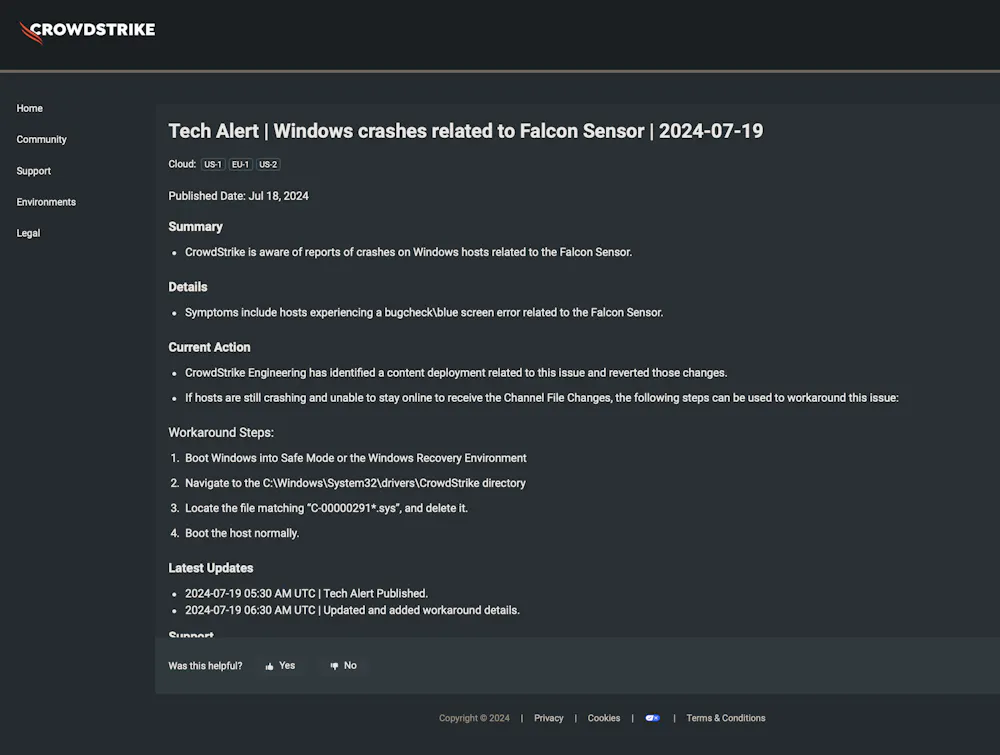
An update alert from the CrowdStrike website informing customers about the Windows crashes related to Falcon. The Conversation/Crowdstrike
Why did Falcon cause this problem?
This privilege and tight integration makes Falcon powerful. But it also means that when Falcon malfunctions, it can cause serious problems. Today’s outage is a worst-case scenario.
What we currently know is that an update to Falcon caused it to malfunction in a way that caused Windows 10 computers to crash and then fail to reboot, leading to the dreaded “blue screen of death” (BSOD).
This is the affectionate term used to refer to the screen that is displayed when Windows computers crash and need to be rebooted – only, in this case, the Falcon problem means the computers cannot reboot without encountering the BSOD again.
Why is Falcon so widely used?
CrowdStrike is the market leader in EDR solutions. This means its products – such as Falcon – are common and likely the pick of the bunch for organisations conscious of their cyber security.
As today’s outage has shown, this includes hospitals, media companies, universities, major supermarkets and many more. The full scale of the impact is yet to be determined, but it’s certainly global.
Why aren’t home PCs affected?
While CrowdStrike’s products are widely deployed in major organisations that need to protect themselves from cyber attacks, they are much less commonly used on home PCs.
This is because CrowdStrike’s products are tailored for large organisations in which CrowdStrike’s tools help them monitor their networks for signs of attack, and provide them with the information they need to respond to intrusions in a timely way.
For home users, built-in antivirus sofware or security products offered by companies such as Norton and McAfee are much more popular.
How long will this take to fix?
At this stage, CrowdStrike has provided manual instructions for how people can fix the problem on individual affected computers.
However, at the time of writing there does not yet appear to be an automatic fix for the problem. IT teams at some organisations may be able to fix this problem quickly by simply wiping the affected computers and restoring them from backups or similar.
Some IT teams may also be able to “roll back” (revert to an earlier version) the affected Falcon version on their organisation’s computers. It’s also possible some IT teams will have to manually fix the problem on their organisation’s computers, one at a time.
We should expect that in many organisations it may take a while before the problem can be resolved entirely.
What is ironic about this incident is that security professionals have been encouraging organisations to deploy advanced security technology such as EDR for years. Yet that same technology has now resulted in a major outage the likes of which we haven’t seen in years.
For companies like CrowdStrike that sell highly privileged security software, this is a timely reminder to be incredibly careful when deploying automatic updates to their products.
Toby Murray does not work for, consult, own shares in or receive funding from any company or organisation that would benefit from this article, and has disclosed no relevant affiliations beyond their academic appointment.
Computer systems across Australia and overseas have failed this afternoon after an update was pushed out by global security software provider CrowdStrike.
The software affected by the update appears to be the CrowdStrike Falcon platform, which is installed by businesses or other organisations on desktop computers and notebooks to provide security monitoring.
What’s happening?
The software failure has caused a major IT outage affecting organisations across Australia and around the world. The websites of the Commonwealth Bank, Telstra, the ABC and many others have been affected, according to crowdsourced outage reporting website DownDetector.
The Microsoft Windows ‘blue screen of death’ happens when the operating system cannot load correctly. Microsoft
The big four banks, Telstra and major media organisations including the ABC and Foxtel have had services go offline. Customers are not able to use EFTPOS to pay for goods and services in many businesses.
Telstra has reported that the Triple Zero Emergency Call service is still operating as normal.
How bad is it?
DownDetector currently shows that a large swathe of Australian businesses are experiencing some form of outage brought on by the software failure.
DownDetector is an online outage reporting tool provided by the global network intelligence and service provider Ookla.
A number of large Australian websites have reported IT outages. This list shows the increase in reports. DownDetector.com.au
The number of businesses that have ceased operation is staggering.
Major airlines, banks, shops, and many other businesses have been forced to suspend trading or providing services.
Thousands of people will now be stranded at airports around the nation on a Friday evening, and bus and train services will potentially be affected.
What exactly went wrong?
The problem appears to have been caused by a software update gone wrong. A newly released version of CrowdStrike’s cybersecurity software reportedly caused Windows computers to crash and display a “blue screen of death” – a standard error screen that happens when the operating system cannot load correctly.
Australia’s National Cyber Security Coordinator, Michelle McGuinness, said in a post on X (formerly Twitter) that “There is no information to suggest it is a cyber security incident.”
What is being done?
In a post to a Slack channel of computer administrators, a CrowdStrike representative said “the bleeding has been stopped”, indicating that computers that have not already been affected are unlikely to be hit in future.
Notifications from CrowdStrike are being sent out to customers or posted to support pages that can only be accessed with a login.
A screenshot from the CrowdStrike website showing an alert to customers about crashes related to the company’s Falcon cybersecurity software. CrowdStrike
However, the process of fixing affected computers might be very time-consuming. CrowdStrike advised customers that an affected machine needs to be booted into “safe mode”, and then a specific file will need to be deleted.
This process is likely to need to be done manually, so there is no easy fix that can be applied to many machines at once.
Source: The Conversation (Au and NZ) – By Michael Slack, Director, Scarp Archaelogy and Adjunct Associate Professor of Archaeology, James Cook University
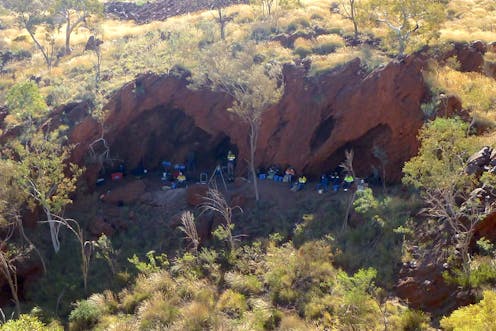
The excavation team at Juukan Gorge in 2014.Courtesy of Scarp Archaeology and PKKP Aboriginal Corporation
Aboriginal and Torres Strait Islander readers are advised this article contains an image of deceased people, which is used with permission from the Traditional Owners.
In May 2020, as part of a legally permitted expansion of an iron ore mine, Rio Tinto destroyed an ancient rockshelter at Juukan Gorge in Puutu Kunti Kurrama Country in the Pilbara region of Western Australia.
Working with the Traditional Owners, we had excavated the shelter – known as Juukan 2 – in 2014, six years before its destruction. We found evidence Aboriginal people first used Juukan 2 around 47,000 years ago, likely throughout the last ice age, through to just a few decades before the cave was destroyed.
The site held thousands of significant objects including an ancient plait of human hair, tools and other artefacts, and animal remains. The results of the excavation led to last-minute efforts to stop the destruction of the site, but they were unsuccessful.
The excavation team at Juukan 2 in 2014. Back, L–R: J. Ashburton (deceased), C. Ashburton (deceased), T. Smirke (deceased), Harold Ashburton, R.J. Mckay, Terry Hayes. Middle, L–R: Jarrod Brindley, Martin Cooper (deceased). Front, L-R: W. Boone Law, Michael Slack. Scarp Archaeology
Where is Juukan and what happened there?
Juukan is a gorge system with a series of caves in Puutu Kunti Kurrama Country, approximately 60 km north west of Tom Price, in the Pilbara region of Western Australia.
The Juukan 2 rockshelter is one of the caves that make up this system. It was once part of a deep gorge featuring fresh water holes, large camping areas surrounded by massive ironstone mountains and a large river that flowed at some times of the year and was dry at others.
Today the area is part of a Rio Tinto iron ore mine. As widely reported in May 2020, the Juukan 2 rockshelter was destroyed during mine expansion activities. While Rio Tinto held ministerial consent to destroy the heritage site, the action was against the wishes of the Traditional Owners.
The destruction led to widespread global condemnation and shone a spotlight on Western Australia’s substandard heritage protection legislation.
What is so significant about Juukan?
Juukan Gorge is named after a Puutu Kunti Kurrama ancestor. It is extremely significant both for cultural and scientific reasons.
For the Puutu Kunti Kurrama, Juukan is a deeply spiritual place that contains deep-time evidence of their presence and association with the landscape in their Traditional Country.
In terms of the scientific significance of Juukan 2, the site is one of the oldest known locations of Aboriginal settlement of Australia. While there are some sites that have been found to be older, such as Madjedbebe in Kakadu in the Northern Territory and off the Western Australian coast, there are only a few places as old as Juukan in inland Australia.
Juukan is about 500 kilometres from the coast today. Up until approximately 10,000 years ago, when sea levels rose, it was almost 1,000 kilometres inland.
This means people living around Juukan were adept at living in the desert. This is also shown by the fact they were able to continue to use the cave even during the last ice age (from around 28,000 to 18,000 years ago). Archaeologists have found very little direct evidence from this period at any other sites.
Often just a handful of artefacts is regarded as enough evidence to show people used an archaeological site. However, at Juukan 2 we found thousands of artefacts, including many that featured resin from spinifex grass, which was likely used as a kind of glue to hold together the pieces of composite tools.
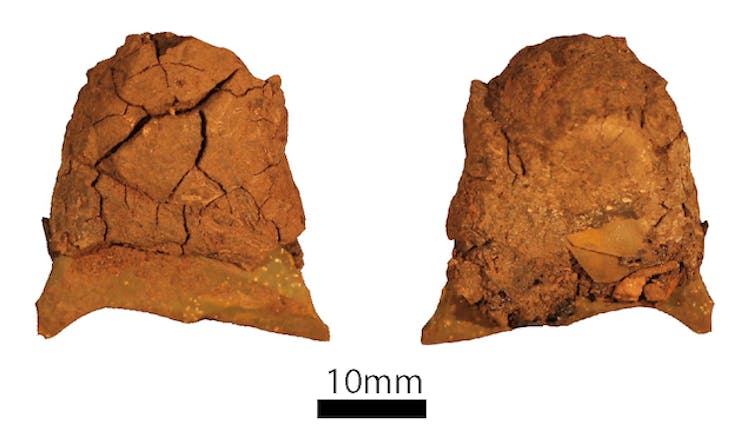
A shaped piece of stone that would likely have been glued to a handle with spinifex resin, excavated in 2014. Scarp Archaeology
Juukan 2 also held amazing evidence of animals over the ages. We found broken bones from animals that had died naturally, and also bones associated with people cooking and eating kangaroos, emus, and even echidnas at the site.
Among this material was a plait of human hair dated to around 3,000 years old. The hair was DNA tested and the results told us it was likely related to the Traditional Owners who were part of the excavation team.
The material we found was extremely well preserved. We even found a bone point made from a kangaroo’s shinbone around 30,000 years old with ochre on its end. We don’t know what this was used for, but the ochre may indicate a ritual function.
The sharpened kangaroo bone with ochre on the tip found in 2014. Michael Slack
What now?
After the blast in 2020, we began to re-excavate the site. Over the past two years we have removed about 150 cubic metres of rubble that was once the roof and back wall of the cave. Beneath the debris we found traces of organic material, and then remnants of the cave floor.
New excavations at Juukan 2 are now in progress. Terry Hayes
Excavations have now reached the original floor level throughout most of the site, and we are carefully digging and finding more incredible materials. This includes more plaited hair, shell beads we think were brought from the coast, and fragments from the jaw of a Tasmanian devil, an animal which has been extinct on mainland Australia for over 3,000 years.
The publication of these results from 2014 is just the next chapter in the archaeology of Juukan 2, a place special to the Traditional Owners, but also of immense significance to science and our understanding of cultural heritage of Australia.
The Puutu Kunti Kurrama and Pinikura Aboriginal Corporation is a co-author of this article and the associated research, recognised collectively according to their cultural preference.
Jordan Ralph is the Chief Heritage Officer at the PKKP Aboriginal Corporation.
Michael Slack and Wallace Boone Law do not work for, consult, own shares in or receive funding from any company or organisation that would benefit from this article, and have disclosed no relevant affiliations beyond their academic appointment.
At dawn on June 27, a journalist for Indonesia’s Tribrata TV, Rico Sempurna Pasaribu, was killed in a suspected arson attack at his home, along with his wife, son and grandchild.
Before his death, Rico investigated and reported on a gambling business in North Sumatra, which he alleged was backed by a member of the military. The police have arrested two suspects.
The incident is not the first suspected arson involving journalists in North Sumatra. On March 21, the house of Junaidi Marpaung, a journalist from Utama News, was also burned down by unknown individuals. Junaidi and his family narrowly escaped.
The attack happened after Junaidi reported on drug trafficking in the region and received several threats via social media.
Press freedom is increasingly under attack in Indonesia. The Indonesian Alliance of Independent Journalists (AJI) has recorded more than 1,000 cases of violence against journalists since 2006, with the single highest year coming in 2023 (87 incidents).
AJI’s 2023 report found that the journalists who were targeted largely reported on issues of public accountability, corruption, social and criminal issues, and environmental issues. And the attacks included verbal and physical threats (including torture, confinement and kidnappings), gender-based sexual harassment and assaults, terror and intimidation.
Police reports were only filed in 20 of the 87 incidents, and just seven cases were followed up. Two of those ended with convictions in a court, while four others led to arrests. One closed case was reopened for further investigation.
Given this, it should come as no surprise that Indonesia sits at a lowly number 111 out of 180 countries in Reporters Without Borders’ press freedom index this year.
Digital attacks and confiscated devices
Beyond this disturbing rise in violence and intimidation, journalists are also frequently forced by the authorities or sometimes even angry members of the public to delete their interview recordings, photos and videos, particularly when covering a highly controversial story or case in court.
Computers and cameras are often confiscated or destroyed. And journalists are routinely kicked out of the scenes of breaking news, or denied entry to facilities to cover the news.
Digital attacks against journalists are on the rise in Indonesia, too.
Those reporting on extremely sensitive topics, such as Indonesia’s oligarchs, often experience doxing, online harassment and the hacking of their social media accounts and electronic devices.
Media outlets are similarly targeted with malware attacks. Their websites have been defaced and had articles disappear, and their social media accounts have been hacked.
Two of the most prominent investigative media outlets in Indonesia, Tempo and Tirto, for example, were subject to such attacks during the height of the COVID pandemic. On one day in 2020, Tempo’s homepage was replaced with a black screen and the word “hoax”.
Concerning legal restrictions
In addition, media outlets are increasingly being targeted through legal channels.
In 1999, Indonesia passed a Press Law at the start of the post-Suharto “Reformasi” era that guaranteed the protection of the media, as well as citizens’ right to information.
Press freedom advocates say, however, that this law has been disregarded as journalists have been targeted through other laws, namely the Electronic Information and Transactions Law (ITE Law) and the criminal code.
Both the criminal code and ITE Law contain provisions that have been used to bring journalists and media outlets to court to face allegations of blasphemy, defamation, hate speech or spreading fake news. The definitions of these offences under the laws are vague and ambiguous, making them easy to deploy against critics.
The website SemuaBisaKena.jaring.id (Anyone Can Be Targeted), a joint initiative of civil society organisations to push back against the ITE Law, recorded 27 cases of journalists being targeted through this law from 2013 to 2024. In the last five years alone, three journalists have been sentenced to jail time.
In addition, Indonesia’s parliament has been considering concerning revisions to the country’s Broadcast Law.
Not only has the revision process been hidden from the public, therefore lacking transparency and meaningful public participation, the draft bill also contains provisions that could be very damaging to press freedom if it passes.
Perhaps the most onerous one would be a ban on broadcasting exclusive investigative journalism, which the country’s Press Council chairman said would “result in our press not being free and independent”. Reporting on the LGBTQI+ community would also be restricted.
The revision process has been halted for the moment amid widespread media and public condemnation. However, this is not the first time legislators have attempted to weaken the press – and it certainly will not be the last.
Why this matters
With democracy increasingly under threat in Indonesia, the role of an independent media has become even more crucial and pressing. Journalists are needed now more than ever to monitor a government that has adopted increasingly authoritarian practices, in addition to rising corruption and human rights violations.
And with the shrinking of civic space in Indonesia, the media is necessary as a platform to broadcast the voices of critics from civil society and academia.
Without them, the demise of Indonesian democracy would be imminent. As Nelson Mandela once said,
A critical, independent and investigative press is the lifeblood of any democracy […] It must enjoy the protection of the constitution, so that it can protect our rights as citizens.
Anita Wahid is affiliated with Public Virtue Research Institute, Masyarakat Anti-fitnah Indonesia (Indonesia Anti-hoax Society), and Gusdurian Network. She is the daughter of Indonesia’s former president, Abdurrahman “Gus Dur” Wahid.
Imagine you’re a fairywren living in a patch of scrub behind a schoolyard in the suburbs. It’s been pretty nice so far, but a recent increase in neighbourhood cats and the council’s insect control tactics mean it’s time to look for somewhere safer to live.
There’s a problem, though. You’re a small, bright blue bird that tends to make short flights from shrub to shrub, staying safe in the foliage. Beyond your little patch of habitat, there don’t seem to be any places you can easily access. On one side are wide-open sportsfields; on the other, a busy six-lane road. Where do you go?
It’s a bad situation for a fairywren, and for many other native species in cities. In ecology, we call this habitat fragmentation.
The map of suitable habitat for city-dwelling wildlife often looks like a scattering of islands in an inhospitable sea of other land uses. These species face threats or barriers such as roads, buildings, fences and feral predators. This poses several issues, such as barring access to feeding areas, increasing competition for nesting spaces within habitat patches and even reducing gene flow by making it hard to find mates.
Our newly published research shows how native species in our cities can benefit if we focus on creating strategically located green spaces to connect isolated patches of habitat.
Native species are at risk whenever they venture beyond the safety of urban habitat patches. MomentsForZen/Flickr, CC BY-NC-ND
Why we should care for urban species
Despite the myriad challenges facing plants, animals and insects in urban areas, cities are important places to take care of our native species. Urban areas still offer valuable nesting and feeding resources, especially for tree-dwelling mammals, canopy-feeding birds and water-adapted species.
But actively supporting native species hasn’t generally been the norm in many cities. The practice of planning and design to deliberately bring nature back into urban areas is still developing. Our open-access research paper in Landscape and Urban Planning offers insights into how we can tackle one aspect of the problem: habitat fragmentation.
Thami Croeser explains the research findings on how best to create links between fragmented wildlife habitat.
What did the study look at?
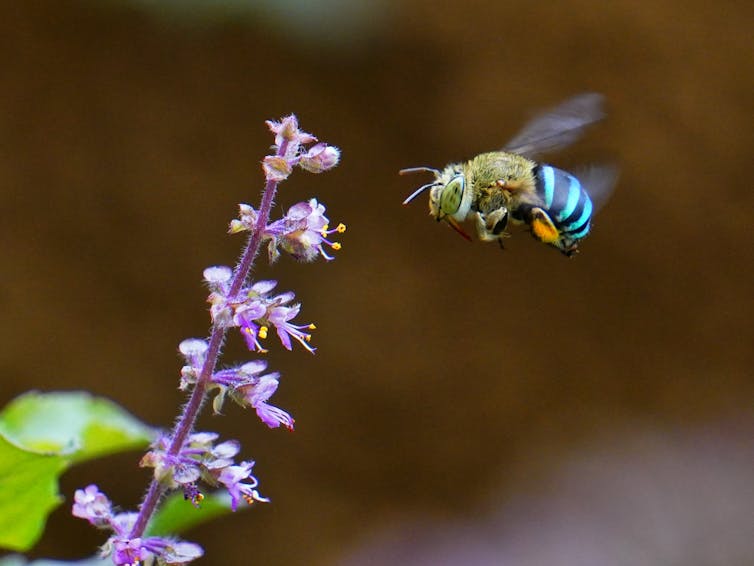
We examined how greening projects could best connect up habitat for New Holland honeyeaters (Phylidonyris novaehollandiae), blue-banded bees (Amegilla spp) and mole crickets (Gryllotalpa spp) in Melbourne, Victoria. These are all species that occur locally but experience some degree of habitat fragmentation.
We have a lot of greening to do for climate adaptation and to create open space for new residents in our growing cities. What if we could also do this greening in a way that boosts habitat for non-human residents too?
We compared a scenario where a large number of small green spaces (formerly parking spaces) were created mainly for climate adaptation purposes, to a pair of scenarios where a smaller number of green spaces were created exclusively in areas that had been identified as key links between habitat fragments.
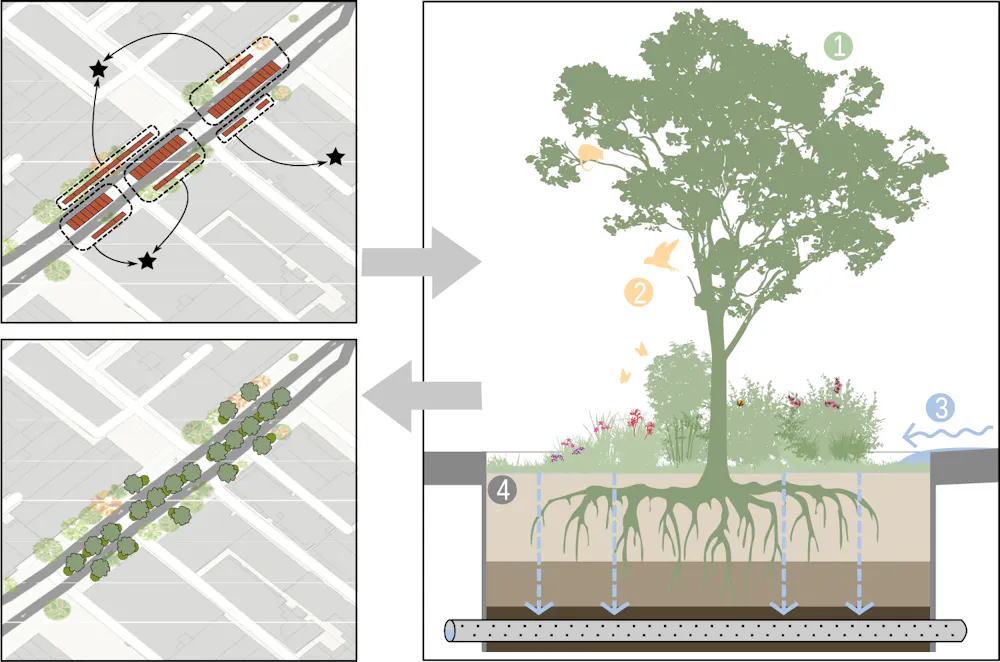
Maps showing the areas targeted for creating green spaces to link fragmented patches of habitat. T. Croeser et al 2024, CC BY
What were the findings?
In total, the benefit of each space in the targeted scenario was more than double that of the scenario where we placed green spaces for climate adaptation purposes, even with the same design of individual green spaces.
Here’s an image of the kind of green spaces we modelled in this study.
A biodiverse green space with a street tree (1), habitat resources such as understorey plants (2) and stormwater infiltration using a sunken ‘raingarden’ design (3) effectively de-paves the area of the parking space (4). T. Croeser et al 2022, CC BY
We found significant benefits for two of our three species when green spaces were located in a way that specifically targeted habitat connections.
Blue-banded bees and mole crickets did especially well. It is trickier for these small creatures to navigate the space between habitat patches. When these small green spaces provided “stepping stones” between bigger patches, they greatly increased the area of habitat a bee or cricket could reach.
Blue-banded bees greatly benefited from creating green spaces to connect isolated patches of habitat. AjayTvm/Shutterstock Mole crickets aren’t made for travelling long distances between areas of suitable habitat. Donald Hobern/Flickr, CC BY
Linking up habitats when we create new green spaces is one way to give native species a chance in our cities. It also gives us (and our kids) a better chance of having everyday nature experiences.
Of course, adding this “ecosystem connectivity” lens to our green space planning isn’t a biodiversity panacea. We’ll still need to deliver a lot of new greenery.
And we’ll have to design it carefully to support native animals while also providing cooling, reduced flood risk and recreational spaces. We also need to make sure we’re picking the right species to model our maps on, and then design our spaces for.
Still, if we get this right, that fairywren might just one day have small, green “stepping stones” to find their way around the city to a happy new home.
Thami Croeser receives funding from the Ian Potter Foundation.
Holly Kirk receives funding from the Australian Research Council and the Ian Potter Foundation.
Australian mining and energy giant Fortescue announced late on Wednesday that its ambitious green energy goal – to produce 15 million tonnes of renewable hydrogen annually by 2030 – will be placed on hold.
As part of a broader restructure, the company will also merge its mining and energy divisions, and slash 700 jobs across its business.
The news will disappoint those who’ve eagerly awaited the emergence of a green hydrogen sector in Australia. Fortescue’s executive chairman and founder, Andrew “Twiggy” Forrest, has been an outspoken supporter of the technology.
But since the announcement, Forrest has been quick to reject claims the company is walking back from its green hydrogen dreams more broadly, telling Nine Radio in Perth on Thursday:
We just have to work out now how to produce it cheaply enough.
Fortescue’s announcement reinforces the fact that one company can’t do it alone – Australia needs a coordinated approach to supporting future green industries – including renewable hydrogen.
Developing renewable hydrogen at scale – like any industry – will require both national and global action to build demand, by supporting new technologies and lowering the risk of investing in early projects. Over time, this will bring prices down.
Hydrogen has a role to play – if we can make it cheaply
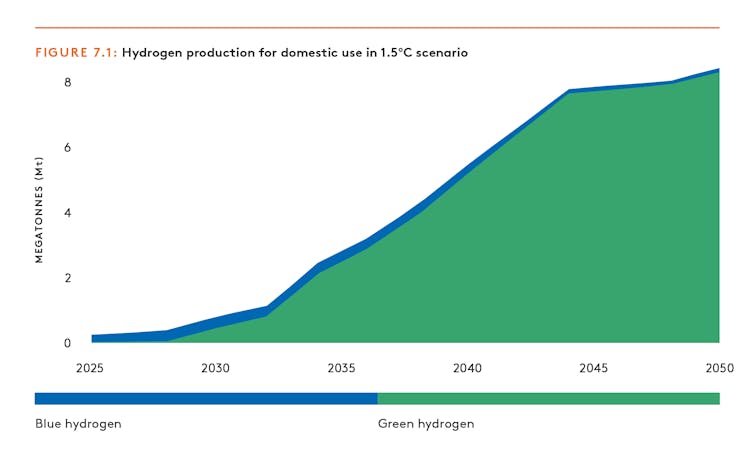
Green or renewable hydrogen is produced by “electrolysing” or splitting water into its component elements hydrogen and oxygen using renewable electricity.
This is in contrast to non-renewable “blue hydrogen” which is extracted from natural gas using steam in a process called ‘steam methane reforming’.
Renewable hydrogen’s current high cost of production has been a key element of the industry’s sluggish start.
At Climateworks Centre, we’ve modelled a range of different scenarios across the whole economy to work out how Australia can best reduce its emissions at the lowest cost.
Our modelling shows renewable hydrogen can indeed play a lead role in Australia’s energy future. It becomes particularly important for transitioning industries that can’t be electrified, such as ammonia and alumina production, and heavy transport. But only if it becomes commercially viable to produce.
Non-renewable ‘Blue hydrogen’ is extracted from natural gas using steam in a process called ‘steam reforming’ Author Supplied/Climateworks Centre – Decarbonisation Scenarios 2023
This is where the Future Made in Australia policy will serve as an important “net-zero” filter by setting out tests which must be passed to unlock targeted government investment.
The policy includes an economy-wide framework to determine which industries need government support to incentivise private investment at scale. But it acknowledges we can’t do everything, everywhere, all at once – we must prioritise our actions.
Renewable hydrogen has already been assessed by Treasury as an industry that requires support under the policy. This is because it meets two key net zero “tests” – it offers Australia a sustained comparative advantage in a future net zero global economy, and needs significant public investment to reduce emissions at an efficient cost.
This should come as no surprise. Australia has a clear comparative advantage in the production of renewable hydrogen, with a skilled workforce and abundant renewable resources and land.
Renewable hydrogen is also a foundational requirement for other products we can produce and export. Modelling by CSIRO and Climateworks for the Australian Industry Energy Transitions Initiative has explored these uses.
It found that in the short term, hydrogen could help decarbonise ammonia production (used for fertiliser and explosives), and potentially also mining haulage and alumina calcination – an important step in refining aluminium. Longer term, steelmaking and freight could also require significant volumes of hydrogen.
Slow out the gate
Despite this potential, the market for hydrogen has been slow to get started.
A number of factors have made private investment challenging. Limited data from current large scale green hydrogen projects means there’s some uncertainty on how quickly the cost of producing renewable hydrogen will come down.
Currently, there’s also limited access to the large amounts of low-cost renewable energy required to make hydrogen projects commercially viable.
Without established local and global demand, public investment is needed to kick start this industry at scale.
Fortescue’s announcement indicates it is likely experiencing some of these challenges. But the supports contained in the Future Made in Australia policy may eventually help alleviate some of these pressures on it and other companies in the emerging industry.
A$4 billion to bridge the the cost of producing renewable hydrogen and the market price with a hydrogen production credit via Hydrogen Headstart, plus a $2 per kilo hydrogen production tax incentive both aim to improve the investment outlook for green hydrogen projects.
By providing some price certainty for each kilo of renewable hydrogen produced, the government will share the risk with potential investors, making the projects more bankable. Both of these supports will be paid over a ten-year period.
Fortescue’s setbacks reinforce the need for support
Getting to net zero is complex and will require ambitious, coordinated action from government, industry, and finance.
Bold action on climate isn’t a choice, it’s an imperative. To do challenging things quickly, each part of the economy must step up. If we get this right, generations of Australians can work in and benefit from a net-zero nation run on renewable energy, with a thriving renewable hydrogen industry.
Fortescue has long taken much-needed first mover risks to drive attention and action in the global and Australian renewable hydrogen market. This week’s news is a setback, but shouldn’t be seen as a death knell for the nascent industry or for the government’s bold ambitions.
Rather, it highlights the gap that government support aims to fill by coordinating and unlocking finance, and funnelling it in the right direction.
Kylie Turner is an employee of Climateworks Centre which receives funding from philanthropy and project-specific financial support from a range of private and public entities including federal, state and local government and private sector organisations and international and local non-profit organisations.
Climateworks Centre works within Monash University’s Sustainable Development Institute.
Kylie Turner was most recently the program impact manager for the Australian Industry Energy Transitions Initiative funded by ARENA, philanthropy and industry participants, developing decarbonisation pathways to limit warming to 1.5℃.
Luke Brown does not work for, consult, own shares in or receive funding from any company or organisation that would benefit from this article, and has disclosed no relevant affiliations beyond their academic appointment.
In an early scene in Jack Clark and Jim Weir’s Birdeater, we catch a glimpse of a poster of Ted Kotcheff’s Wake in Fright (1971).
More than in any other film of the period, Kotcheff managed to capture something of the unhinged, deranged quality of homosociality in the Australian outback in a hallucinatory, nightmarish, nihilistically comedic romp.
As the epigraph of Kenneth Cook’s eponymous novel suggests: “May you dream of the devil and wake in fright.”
The Australian cinematic landscape seems primed for a return to this theme. Horror cinema is more popular now than it’s been for years, and more critically acclaimed than it’s ever been.
From the opening image, Birdeater feels like it’s going to be another entry in this New Wave, filtered through an anarchic Australian sensibility.
Irene (Shabana Azeez), an anxious English woman in a relationship with quintessential Aussie “nice guy” Louie (Mackenzie Fearnley), is coming along for Louie’s buck’s party.
In a rural location, only accessible via ferry, we sense a return to the perennial theme of Australian horror: the sinister experience for the foreigner or city dweller when going into the Australian bush and outback.
Think about backpacker Liz Hunter’s experiences in Wolf Creek (2005) as she comes under the eye of killer Mick Hunter, or Canadian Carl Winters from Razorback (1984) who comes to Australia in search of his missing wife and ends up fighting both local hoons and a killer pig. Or, indeed, the experience of urbanite schoolteacher John Grant (Gary Bond) in Kotcheff’s film as he is thrust into a bloody, two-up-and-alcohol-infused nightmare in the ‘Yabba.
There are, at the same time, echoes of Ari Aster’s critically acclaimed Midsommar (2019) here. Irene and Louie’s relationship isn’t exactly perfect – he keeps giving her glasses of water and she keeps taking pills – but the actual source of the menace is tantalisingly unclear.
They have some kind of toxic codependent relationship involving an accident he had, anchored around her desire to secure a visa so she can stay in Australia.
A stellar opening – and then it fizzles
When the friends reunite for the buck’s party, we immediately recognise their personality clashes, and sense things are going to get nasty quickly.
The core trio of old friends involves bungling, hen-pecked Christian virgin Charlie (Jack Bannister), loose cannon Dylan (Ben Hunter) and good guy control freak Louie.
Or, as Dylan notes in one of the great bad toast scenes in cinema – he’s trying to get his own back against Louie for refusing to take ketamine, refusing Dylan’s offer of a beer, and accusing Dylan of being a child – the smart one, the funny one and the nice one.
This is a ‘modern’ buck’s, so women are included too. Umbrella Entertainment
This is a “modern” buck’s, so women are included too. There’s Grace (Clementine Anderson), partner of Charlie, and, of course, Irene herself. When Irene’s ex (or is he?) Sam (Harley Wilson) turns up for the party, we sense the powder keg is full and, if Wake in Fright is anything to go by, things will get explosively and violently weird pretty quickly.
Alas, it never happens. After a stellar opening 40 minutes, it fizzles out.
All of the intrigue, all of the tension and all of the mystery of the opening seems to be little more than a ruse, a trick to keep us engaged with the film. It works at first, but for no real thematic purpose, with the result that, at the end of its two hours, Birdeater seems like little more than a really well-made music video or ad.
It’s all set-up, with little pay-off. The spare, elegant cinematography, the hypnotic score and sound design, the weird associative logic of the opening taper off into a dreary two hours. It becomes increasingly wordy and navel-gazing. Its cloak of mystery and intrigue comes off and instead of the rip-roaring, unsettling horror romp we were expecting we’re left with a Home and Away-level story.
The intrigue, the tension and the mystery of the opening unfortunately fall away. Umbrella Entertainment
The mystery is resolved along conventional psycho-dramatic lines. Even its attempts at delving into current buzzy concepts like gaslighting, coercive control and toxic codependency seem superficial, lacking psychological depth or any real acuity.
Let me be clear: Birdeater is brilliantly shot and edited, the sound design and music are exemplary (the best in Aussie cinema since 2011’s Snowtown) and the acting is absolutely first-rate (newcomer to the big screen Ben Hunter as Dylan is a standout, but Mackenzie Fearnley as Louie, a kind of cross between Joseph Gordon-Levitt and Ben Mendelsohn, is also exceptional).
Kudos for this to all involved in the film – it just works from the opening shot, following its own compulsive logic. The characterisations have the right level of caricature and nuance to be effective, and it perfectly sets up the kind of blokey Aussie nightmare scenario in which it’s an affront to not skull a beer. It’s also the first Australian film since Upgrade (2018) that actually feels like it should be seen in a movie theatre.
Newcomer to the big screen Ben Hunter is a standout as Dylan. Umbrella Entertainment
But it’s thematically threadbare and derivative and, ultimately, disappointing. Unlike Wake in Fright, once the haze clears, we’re left with little of substance, in a film with less conceptual depth than it seems to think it has.
Birdeater is worth seeing. It is undeniably better made than most new films, even if it plays far worse than many more old ones.
Birdeater is in cinemas now.
Ari Mattes does not work for, consult, own shares in or receive funding from any company or organisation that would benefit from this article, and has disclosed no relevant affiliations beyond their academic appointment.
The PANG media team at this month’s Pacific International Media Conference in Fiji caught up with independent journalist, author and educator Dr David Robie and questioned him on his views about decolonisation in the Pacific.
Dr Robie, editor of Asia Pacific Report and deputy chair of Asia Pacific Media Network (APMN), a co-organiser of the conference, shared his experience on reporting on Kanaky New Caledonia and West Papua’s fight for freedom.
He speaks from his 40 years of journalism in the Pacific saying the United Nations and the Pacific Islands Forum need to step up pressure on France and Indonesia to decolonise.
The leaders of the subregional bloc — from Fiji, FLNKS (Kanak and Socialist National Liberation Front of New Caledonia), Papua New Guinea, Solomon Islands and Vanuatu — met in Tokyo on the sidelines of the 10th Pacific Islands Leaders Meeting (PALM10), to specifically talk about New Caledonia.
They included Fiji’s Sitiveni Rabuka, PNG’s James Marape, Solomon Islands’ Jeremiah Manele, and Vanuatu’s Charlot Salwai.
In his interview with PANG (Pacific Network on Globalisation), Dr Robie also draws parallels with the liberation struggle in Palestine, which he says has become a global symbol for justice and freedom everywhere.
Asia Pacific Media Report’s Dr David Robie . . . The people see the flags of Kanaky, West Papua and Palestine as symbolic of the struggles against repression and injustice all over the world.
“I should mention Palestine as well because essentially it’s settler colonisation.
“What we’ve seen in the massive protests over the last nine months and so on there has been a huge realisation in many countries around the world that colonisation is still here after thinking, or assuming, that had gone some years ago.
“So you’ll see in a lot of protests — we have protests across Aotearoa New Zealand every week — that the flags of Kanaky, West Papua and Palestine fly together.
“The people see these as symbolic of the repression and injustice all over the world.”
PANG Media talk to Dr David Robie on decolonisation. Video: PANG Media
Source: The Conversation (Au and NZ) – By Lee Morgenbesser, Associate professor, School of Government and International Relations, Griffith University, Griffith University
Sportswashing – the act of aligning with an athlete, sports team, or event in order to distract from unethical practices elsewhere – is driven by authoritarian states and is just about everywhere.
In June, Russia held the BRICS games, an event involving 82 countries competing across 27 sports.
This week, the United States men’s basketball team is playing exhibition games against the national teams of Australia and Serbia, albeit in the United Arab Emirates.
Whereas sportswashing was once limited to a few isolated major events, such as the 1936 Summer Olympics in Berlin, it now pervades many aspects of international sport.
It may, however, be backfiring on the countries involved.
Saudi Arabia’s Crown Prince Mohammed bin Salman said he ‘doesn’t care’ about accusations of sportswashing.
How sportswashing impacts fans
Sportswashing affects consumers in a number of ways.
First, it can lead to heightened awareness of the problematic actions of authoritarian regimes. For example, when the Abu Dhabi United Group took over ownership of Manchester City Football Club in 2008, fans became aware of the poor human rights record of the United Arab Emirates, where the group is backed by the royal family.
However, this increased awareness is offset by fans’ enjoyment from engaging with the team or attending the sports event.
Another example is when sport fans were made more aware of human rights abuses in Qatar through its hosting of the 2022 FIFA men’s soccer World Cup. Data collected from international tourists who attended the event reported overall satisfaction with the experience, in part because it allowed them to enjoy the activities surrounding the event as well as to forget about daily problems.
This distraction is what sportswashers seek.
Second, the attention paid to, and the money spent on, sportswashed events can contribute to the view that fans are complicit in it.
They must grapple with their passions for an event, team, or sport while questioning the unethical or questionable behaviour underpinning those events, teams, and sports.
Fans can also recognise the lucrative opportunities (for the teams and leagues they support) typically associated with sportswashing.
Sometimes fans push back.
Newcastle United supporters formed a group (NUFC Against Sportswashing), and have repeatedly protested the club’s ties to the Saudi government. Since 2020, German club Bayern Munich’s fans have repeatedly unveiled banners critical of the club’s dealings with Qatar at matches.
Propaganda is the key
Propaganda is at the heart of sportswashing.
The prevailing research identifies two main forms: “soft” propaganda, which tries to persuade audiences using subtle manipulation of public attitudes, and “hard” propaganda, which attempts to dominate audiences through absurdity, dogma and pretentiousness.
“Propaganda,” the chief Nazi propagandist Joseph Goebbels wrote, “becomes ineffective the moment we are aware of it”.
For contemporary authoritarian regimes, a key challenge is deciding on the amount of propaganda and whether it is soft or hard. We argue sportswashing, which relies on the soft form, is highly sensitive to this difficult balancing act.
Why some authoritarian regimes don’t sportswash
When authoritarian states fail to host major sports events, own teams and purchase sponsorships rights, they forgo an opportunity to persuade audiences of an alternate reality about their human rights records.
Indeed, hard-nosed authoritarian regimes such as Cambodia, Cuba, Equatorial Guinea, Iran, and Turkmenistan are barely involved in the practice.
For some, the financial resources required to undertake regular sportswashing are too burdensome. For others, there are alternative “image management” strategies available to them.
Others make no attempt to cloak their authoritarian nature to international audiences.
With no sports to “wash” away their unethical practices internationally, authoritarian regimes risk having their abuses of political rights and civil liberties noticed.
Why sportswashing may be backfiring
When authoritarian states dominate the hosting, ownership and sponsorship of international sports, audiences become more aware they are being manipulated. In essence, the subtlety that soft propaganda depends on simply vanishes.
And by making sportswashing so ubiquitous, these sportswashers have actually increased awareness of how they infringe upon human rights and suffocate aspirations for democracy.
As the amount of sportswashing increases, authoritarian states may find themselves facing an uphill battle as many sport fans become increasingly socially conscious and more demanding of athletes, leagues, and teams.
Instead of limiting sportswashing to a few isolated major events on the international sporting calendar, its sheer pervasiveness now inadvertently empowers prospective consumers, apathetic onlookers and established critics.
So, as long as the world remains awash with sportswashing, more of it may backfire on the authoritarian regimes that perpetuate it.
The authors do not work for, consult, own shares in or receive funding from any company or organisation that would benefit from this article, and have disclosed no relevant affiliations beyond their academic appointment.
Source: The Conversation (Au and NZ) – By Dominic O’Sullivan, Adjunct Professor, Faculty of Health and Environmental Sciences, Auckland University of Technology, and Professor of Political Science, Charles Sturt University
Getty Images
Reports that Associate Minister of Health David Seymour has told Pharmac, the pharmaceutical purchasing agency, to “stop factoring Te Tiriti o Waitangi into its decisions” aren’t strictly accurate.
His five-page letter of expectations to Pharmac only gave the Treaty of Waitangi a few lines. Seymour said Pharmac should no longer follow the previous government’s instruction to “consider how it could contribute to embedding Te Tiriti o Waitangi across the health sector”.
In short, whatever “embedding” means, Pharmac shouldn’t consider it. Instead, he instructed:
Pharmac’s role should focus on delivering improved health outcomes underpinned by robust data and evidence, in accordance with its statutory responsibilities. This should serve all New Zealanders based on actual need, without assigning their background as a proxy of need.
Seymour later said: “We’ve got to be open about the fact that sometimes ethnicity’s a factor, sometimes it just isn’t.”
Genetic influences on illness and responsiveness to medicines are best left to those with the appropriate expertise. But the politics of the issue is another matter. The fact is, ethnicity (let alone “race”) is not mentioned in te Tiriti or in Pharmac’s own detailed Tiriti policy.
Te Tiriti and ethnicity
Notions of race – these days a debunked colonial concept – and ethnicity often accompany these debates. But serious interpretations of te Tititi’s relevance and importance don’t involve discussion of race.
Essentially, te Tiriti is about equality, including the idea that health policy should work as well for Māori as for anyone else.
On the other hand, Seymour’s interest in “robust data and evidence” is important. There is evidence from all over the world that culture and colonial experiences influence how people see health and wellbeing.
Te Tiriti might not tell Pharmac which of two drugs is the better treatment for a given disease. But if “robust data and evidence” show up the underfunding of a drug used to treat an illness disproportionately affecting Māori people, te Tiriti might help fix the problem.
This is because te Tiriti is an agreement concerned with how government actually works. It is about who makes decisions, how and why, and for whom.
Although Pharmac’s Tiriti policy might be criticised for being too long and vague in places, this is not uncommon in policy writing. But it does indicate Pharmac has seriously thought about how te Tiriti can improve health outcomes.
Te Tiriti can’t tell Pharmac which drugs will work best, but it can guide policy for equal access to the right drug. Getty Images
Substance of the Treaty
Pharmac is just one of many public agencies to use “critical Tiriti analysis” to guide its work.
This is a policy development and evaluation method developed by policy scholars Heather Came, Tim McCreanor and me to help policymakers (and anyone who wants to comment on policy) think beyond the vagueness of the treaty principles to the substance of the agreement.
The central argument is that the right to government conferred in article one of te Tiriti was never a right to do harm. The preamble to te Tiriti says the queen’s concern was to:
protect the chiefs and the subtribes of New Zealand and in her desire to preserve their chieftainship and their lands to them and to maintain peace and good order [and] establish a government so that no evil will come to Māori and European living in a state of lawlessness.
The preamble is a clear statement about the distribution of power, authority and responsibility. The powers of government were constrained by the rights and capacities of rangatiratanga in article two, which simply means Māori people making their own decisions.
The idea of government as an exclusive non-Māori power is dismissed by te Tiriti’s promise of citizenship grounded in equal tikanga, or cultural equality.
Te Tiriti and citizenship
Who buys which medicines for whom, and why, concerns Māori citizens as much as any others. How easily accessible those medicines are to which citizens, and why, also concerns them.
As critical Tiriti analysis suggests, it is reasonable to presume all public policy should show evidence of Māori participation and leadership, and acceptance of Māori worldviews and conceptions of wellbeing.
It’s also reasonable to say that when policies are supposed to benefit Māori people as much as everyone else, it is Māori who should be the judge of whether that is actually true.
There are robust data and evidence to show independence and voice – the ability of Māori experts to influence and make policy decisions – contribute to health outcomes. This is why te Tiriti can help.
Dominic O’Sullivan does not work for, consult, own shares in or receive funding from any company or organisation that would benefit from this article, and has disclosed no relevant affiliations beyond their academic appointment.
Many people are drinking less sugary soft drink than in the past. This is a great win for public health, given the recognised risks of diets high in sugar-sweetened drinks.
But over time, intake of diet soft drinks has grown. In fact, it’s so high that these products are now regularly detected in wastewater.
So what does the research say about how your health is affected in the long term if you drink them often?
The World Health Organization (WHO) advises people “reduce their daily intake of free sugars to less than 10% of their total energy intake. A further reduction to below 5% or roughly 25 grams (six teaspoons) per day would provide additional health benefits.”
But most regular soft drinks contain a lot of sugar. A regular 335 millilitre can of original Coca-Cola contains at least seven teaspoons of added sugar.
Diet soft drinks are designed to taste similar to regular soft drinks but without the sugar. Instead of sugar, diet soft drinks contain artificial or natural sweeteners. The artificial sweeteners include aspartame, saccharin and sucralose. The natural sweeteners include stevia and monk fruit extract, which come from plant sources.
Many artificial sweeteners are much sweeter than sugar so less is needed to provide the same burst of sweetness.
Diet soft drinks are marketed as healthier alternatives to regular soft drinks, particularly for people who want to reduce their sugar intake or manage their weight.
But while surveys of Australian adults and adolescents show most people understand the benefits of reducing their sugar intake, they often aren’t as aware about how diet drinks may affect health more broadly.
What does the research say about aspartame?
The artificial sweeteners in soft drinks are considered safe for consumption by food authorities, including in the US and Australia. However, some researchers have raised concern about the long-term risks of consumption.
People who drink diet soft drinks regularly and often are more likely to develop certain metabolic conditions (such as diabetes and heart disease) than those who don’t drink diet soft drinks.
The link was found even after accounting for other dietary and lifestyle factors (such as physical activity).
In 2023, the WHO announced reports had found aspartame – the main sweetener used in diet soft drinks – was “possibly carcinogenic to humans” (carcinogenic means cancer-causing).
Importantly though, the report noted there is not enough current scientific evidence to be truly confident aspartame may increase the risk of cancer and emphasised it’s safe to consume occasionally.
Will diet soft drinks help manage weight?
Despite the word “diet” in the name, diet soft drinks are not strongly linked with weight management.
In 2022, the WHO conducted a systematic review (where researchers look at all available evidence on a topic) on whether the use of artificial sweeteners is beneficial for weight management.
Overall, the randomised controlled trials they looked at suggested slightly more weight loss in people who used artificial sweeteners.
But the observational studies (where no intervention occurs and participants are monitored over time) found people who consume high amounts of artificial sweeteners tended to have an increased risk of higher body mass index and a 76% increased likelihood of having obesity.
In other words, artificial sweeteners may not directly help manage weight over the long term. This resulted in the WHO advising artificial sweeteners should not be used to manage weight.
Studies in animals have suggested consuming high levels of artificial sweeteners can signal to the brain it is being starved of fuel, which can lead to more eating. However, the evidence for this happening in humans is still unproven.
There is some early evidence artificial sweeteners may irritate the lining of the digestive system, causing inflammation and increasing the likelihood of diarrhoea, constipation, bloating and other symptoms often associated with irritable bowel syndrome. However, this study noted more research is needed.
High amounts of diet soft drinks have also been linked with liver disease, which is based on inflammation.
The consumption of diet soft drinks is also associated with dental erosion.
Many soft drinks contain phosphoric and citric acid, which can damage your tooth enamel and contribute to dental erosion.
Moderation is key
As with many aspects of nutrition, moderation is key with diet soft drinks.
Drinking diet soft drinks occasionally is unlikely to harm your health, but frequent or excessive intake may increase health risks in the longer term.
Plain water, infused water, sparkling water, herbal teas or milks remain the best options for hydration.
Lauren Ball works for The University of Queensland and receives funding from the National Health and Medical Research Council, Queensland Health and Mater Misericordia. She is a Director of Dietitians Australia, a Director of the Darling Downs and West Moreton Primary Health Network and an Associate Member of the Australian Academy of Health and Medical Sciences.
Emily Burch does not work for, consult, own shares in or receive funding from any company or organisation that would benefit from this article, and has disclosed no relevant affiliations beyond their academic appointment.
Exercising before bed has long been discouraged as the body doesn’t have time to wind down before the lights go out.
But new research has found breaking up a quiet, sedentary evening of watching television with short bursts of resistance exercise can lead to longer periods of sleep.
Adults spend almost one third of the 24-hour day sleeping. But the quality and length of sleep can affect long-term health. Sleeping too little or waking often in the night is associated with an increased risk of heart disease and diabetes.
Physical activity during the day can help improve sleep. However, current recommendations discourage intense exercise before going to bed as it can increase a person’s heart rate and core temperature, which can ultimately disrupt sleep.
Nighttime habits
For many, the longest period of uninterrupted sitting happens at home in the evening. People also usually consume their largest meal during this time (or snack throughout the evening).
Insulin (the hormone that helps to remove sugar from the blood stream) tends to be at a lower level in the evening than in the morning.
Together these factors promote elevated blood sugar levels, which over the long term can be bad for a person’s health.
Our previous research found interrupting evening sitting every 30 minutes with three minutes of resistance exercise reduces the amount of sugar in the bloodstream after eating a meal.
But because sleep guidelines currently discourage exercising in the hours before going to sleep, we wanted to know if frequently performing these short bursts of light activity in the evening would affect sleep.
Activity breaks for better sleep
In our latest research, we asked 30 adults to complete two sessions based in a laboratory.
During one session the adults sat continuously for a four-hour period while watching streaming services. During the other session, they interrupted sitting by performing three minutes of body-weight resistance exercises (squats, calf raises and hip extensions) every 30 minutes.
After these sessions, participants went home to their normal life routines. Their sleep that evening was measured using a wrist monitor.
Our research found the quality of sleep (measured by how many times they woke in the night and the length of these awakenings) was the same after the two sessions. But the night after the participants did the exercise “activity breaks” they slept for almost 30 minutes longer.
Identifying the biological reasons for the extended sleep in our study requires further research.
But regardless of the reason, if activity breaks can extend sleep duration, then getting up and moving at regular intervals in the evening is likely to have clear health benefits.
Time to revisit guidelines
These results add to earlier work suggesting current sleep guidelines, which discourage evening exercise before bed, may need to be reviewed.
As the activity breaks were performed in a highly controlled laboratory environment, future research should explore how activity breaks performed in real life affect peoples sleep.
We selected simple, body-weight exercises to use in this study as they don’t require people to interrupt the show they may be watching, and don’t require a large space or equipment.
If people wanted to incorporate activity breaks in their own evening routines, they could probably get the same benefit from other types of exercise. For example, marching on the spot, walking up and down stairs, or even dancing in the living room.
The key is to frequently interrupt evening sitting time, with a little bit of whole-body movement at regular intervals.
In the long run, performing activity breaks may improve health by improving sleep and post-meal blood sugar levels. The most important thing is to get up frequently and move the body, in a way the works best for a person’s individual household.
Jennifer Gale has received funding from the Health Research Council of New Zealand
Meredith Peddie has received funding from the Health Research Council of New Zealand.
If you listened to the Productivity Commission, you would think Australia was a pretty equal place in terms of income and wealth, and particularly good in terms of equality of opportunity.
Its major investigation released last week, entitled Fairly Equal?, found Australia’s income mobility is second only to Switzerland’s.
It’s a high-quality piece of work, created by linking personal income tax, social security and census records and also linking records across generations. This allows the commission to examine how children fare compared to their parents.
The Australian Financial Review welcomed the findings by declaring they “surprised everyone”, which certainly wasn’t true for researchers in the field.
But the report largely neglects something important that is likely to matter a lot for equality and equality of opportunity.
It’s the role of housing.
Imputed rent matters
There are many ways to define income. The Productivity Commission defines it conventionally but narrowly, excluding so-called imputed rent.
Imputed rent can be thought of as the income someone gets from themselves for something they own, usually a home.
It’s easy to see if you think about landlords. The rent they receive from their tenants is income. If they happen to be their own tenants, paying notional rent to themselves, it remains a benefit and remains income for the purposes of the national accounts.
The Bureau of Statistics calculates imputed rent by applying market rents to owner-occupied dwellings.
Imputed rent is often used in studies of inequality.
When it is, Australian incomes look moreequal than when it is not. This is because older people tend to have low cash incomes but high imputed rents.
But more importantly, and more so for Australia than for the United States or Germany, including imputed rent lowers estimates of intergenerational mobility.
So far, only one Australian study has examined this. It finds that including imputed rent cuts Australia’s intergenerational mobility by 22%.
Although this finding should be interpreted cautiously, on the Productivity Commission’s intergenerational mobility graph it would make Australia more like Canada than Switzerland.
Capital gains matter
The Productivity Commission has also paid scant attention to capital gains.
In recent years property price increases have been so large that some houses have earned more than their owners have.
A definition of income that includes changes in net worth may also show Australia was less equal and less generationally mobile than generally thought.
I am working on incorporating changes in the value of housing into measures of inequality and mobility. I don’t yet have results I can share, but they might turn out to matter a lot.
Wealth matters in its own right
If we are really interested in intergenerational mobility (what chance we’ve got of getting a different financial station in life to our parents) it’s worth considering how easy it is to get to a different place in the wealth distribution as well as the income distribution.
Here, the results are mixed, and perhaps concerning.
The commission relies on a study that finds wealth mobility is higher in Australia than in the United States.
But those findings are driven by children aged 20-39. In Australia, the correlation between parental wealth and children’s wealth appears to grow stronger when those children reach middle age.
Indeed, from age 40 onwards wealth mobility becomes lower in Australia than in other places including the US.
Again, there are reasons to interpret these findings cautiously. But they are enough – for now – to persuade us to be cautious in celebrating our apparently exceptional economic mobility.
And enough to encourage us to shift our focus from narrow measures of income towards broader measures of wellbeing, especially those that include housing.
Peter Siminski does not work for, consult, own shares in or receive funding from any company or organisation that would benefit from this article, and has disclosed no relevant affiliations beyond their academic appointment.
Source: The Conversation (Au and NZ) – By John Charles Ryan, Adjunct Associate Professor, Faculty of Business, Law and Arts, Southern Cross University
Shutterstock
There’s little else in the food world that brings about as much social turbulence as the durian. This so-called “king of all fruits” is considered a delicacy across its native Southeast Asia, where durian season is currently in full swing.
Global interest in the pungent food has also grown considerably in recent years. But despite this, the durian continues to be loathed as much as it is lauded. What’s behind its polarising nature?
Loved and loathed in equal measure
The international market for durians grew 400% last year. This is mainly due to China, where demand has expanded 12-fold since 2017.
Durians for sale at a store in Shenzhen, China. Shutterstock
And although heavy rain and heatwaves have resulted in lower yields, the projected growth for 2024 looks promising.
But not everyone is a devotee. The durian often becomes a prickly topic in my conversations with friends in Southeast Asia – with family members clashing over its loud presence in the kitchen.
Durian is even banned in various hotels and public spaces across Southeast Asian countries. In 2018, a load of durian delayed the departure of an Indonesian flight after travellers insisted the stinky cargo be removed.
Due to their smell, durians may be banned in some shared spaces. Shutterstock
The fruit’s taste and smell are notoriously difficult to pinpoint. One article touting its benefits describes its odour as a rousing medley of “sulfur, sewage, fruit, honey, and roasted and rotting onions”.
Cultural and historical perspectives
Regardless of its divisive qualities, the durian has a central role in Southeast Asian cuisine and cultures. For centuries, Indigenous peoples across the region have sustainably grown diverse species of the fruit.
At Borobudur, a ninth-century Buddhist temple in Java, Indonesia, relief panels depict durian as a symbol of abundance.
A 2016 celebration of the durian harvest at a village in central Java, Indonesia. Shutterstock
In Malaysia, it’s common to find courtyards full of durian trees in people’s homes. These trees are cherished, as they provide generations of family members with food, medicine and shelter.
The durian also features in creation stories. In one myth from the Philippines, it’s said that a cave-dwelling recluse named Impit Purok concocted a special fruit to help an elderly king attract a bride. But when the king failed to invite him to the wedding party, the furious hermit cursed his creation with a potent stench.
In the West, the durian was first recorded and observed in the early 15th century by Italian merchant and explorer Niccolò de’ Conti. De’ Conti acknowledged the fruit’s esteem throughout the Malay archipelago, but considered its odour nauseating.
Workers in Malaysia preparing durian for export. Shutterstock
Early Western illustrations of the fruit can be found in Dutch spy and cartographer Jan Huygen van Linschoten’s book Itinerario (1596). The author remarks that the durian smells like rotten onions when first opened, but that with time one can acquire a taste for it.
Another scientific account comes from the 1741 book Ambonese Herbal, by German botanist Georg Eberhard Rumphius. Rumphius identified the fruit’s tough outer skin as the source of its pungency, noting how the people of Indonesia’s Ambon Island had a habit of disposing of the noxious rinds on the shoreline.
A fruit of contradictions
In Southeast Asian film and literature, the durian exerts a powerful yet contradictory effect on the senses. Director Fruit Chan’s film Durian Durian (2000) homes in on these polarising tendencies.
Set in Hong Kong, the film traces the transformation of the characters’ attitudes towards the durian. While the fruit incites revulsion at first, it eventually becomes an object of affection among the family portrayed in the film.
Durian Durian follows the story of a young girl named Fan (Mak Wai-Fan) and her sex worker neighbour, Yan (Qin Hailu), in Hong Kong. IMDB
This acceptance of the durian doubles as an analogy, reflecting the family’s acceptance of one of the main characters’ life as a sex worker.
In contrast, the Singaporean film Wet Season (2019) by Anthony Chen highlights various traditional views of the fruit. For example, the illicit affair between a teacher and her student calls attention to a persistent belief in the durian’s ability to arouse sexual desire and boost fertility (although any aphrodisiac benefits remain scientifically unproven).
A number of literary works also probe the durian’s cultural complexity. Singaporean poet Hsien Min Toh’s poem, Durians, opens by referring to the fruit’s “unmistakeable waft: like garbage and onions and liquid petroleum gas all mixed in one”.
At the same time it frames the durian tree as a canny being, as it never allows falling fruit to harm the vulnerable humans spreading its seeds on the ground below.
Durian trees are a common sight in Malaysia. Shutterstock
US poet Sally Wen Mao attends to the enigma in her poem Hurling A Durian. She notes how on one hand the fruit nurtures desire, while on the other it purges memory like a poison. Mesmerised by its perplexing allure, the poet inhales its penetrating scent and strokes its rind until her fingers bleed.
The future and conservation
Although 30 species of durian are known to science (and more continue to be identified), only one species, Durio zibethinus, dominates the global market. Unfortunately, the growing demand for this one type is causing harm by displacing native forests, flora and even Indigenous communities.
In Indonesian Borneo, or Kalimantan, oil palm plantations threaten durian diversity by leaving less room for diverse species of durian to be cultivated. This imperils the cultural practices and beliefs linked to the durian tree.
It also impacts all the other animals that rely on the fruit. Elephants, orangutans and many other endangered fauna relish the durian, while bats and other pollinators help sustain its diversity. As such, effective conservation efforts must engage meaningfully with local people and species.
Perhaps, if past depictions of the durian helped shape its reputation, then new depictions could help conserve this king among fruits.
Durian is sold on the streets across several countries in South-East Asia. Shutterstock
John Charles Ryan does not work for, consult, own shares in or receive funding from any company or organisation that would benefit from this article, and has disclosed no relevant affiliations beyond their academic appointment.
The laws designed to protect the environment in New South Wales are completely ineffective, according to the scathing Henry Review in 2023.
In response, the state government this week announced a major overhaul of the Biodiversity Conservation Act, introduced in 2016. The Minns govermment has committed to introducing 49 of 58 recommendations made by the review, either in full or in part.
First up will be reform of biodiversity offsets – the easily gamed and largely ineffective requirement for developers to offset their destruction of vital habitat with gains elsewhere.
The state government is also promising to align reformed biodiversity laws with national and international goals, and set goals and targets to tackle threats, bring species back from the brink, and conserve landscapes at scale.
Good news? Certainly – especially given the federal government has delayed reforms to national biodiversity laws. But there are still big gaps – especially around how to actually stop land clearing, which is a major driver of species and ecosystem loss in the state.
These changes are essential, if we are to curb rapid and increasing rates of nature loss. Without them, around 500 species are predicted to become extinct in NSW over the next century and many nature-dependent industries – such as tourism, water supply and agriculture – will suffer.
How do you fix the offset problem?
Offsets are popular with governments because they offer the possibility of having your cake and eating it too. You want to develop a prime chunk of waterfront land, even though there are endangered koalas feeding in the trees? That’s fine, as long as you protect and improve koala habitat elsewhere to create an environmental gain equal to your destructive impact.
Well, that’s the theory. In reality, research has demonstrated offset projects rarely achieve their promise of enabling development with no net-loss of biodiversity.
Researchers have found biodiversity offsets in NSW are permitting major biodiversity losses to occur now in return for a “promise” of uncertain future gains.
The biodiversity value of 21,928 hectare of habitat already cleared under this policy in exchange for averting loss’ elsewhere is estimated to need 146 years to be regained.
The Minns government committed to reforming the biodiversity offsets scheme before winning the election. It will be the first nature law reform pushed through NSW parliament this year, while other reforms are not expected to reach state parliament until 2025.
So what are these proposed reforms? Key measures include:
requiring developers to take genuine steps to avoid and minimise impacts on biodiversity, before moving to offset their impact
making payments into a biodiversity conservation fund only as a last resort. At the moment, developers often just make a payment to the government fund to “balance” their impact
closing a loophole where mining companies can claim a “discount” against their environmental impact if they have plans to rehabilitate the mine site in future
increasing transparency through public reporting.
What else has the government promised?
Other important promises in the NSW government’s plan include:
bringing the state’s Biodiversity Conservation Act in line with national and international biodiversity conservation goals
introducing a new nature strategy with targets for tackling threats, recovering threatened species, conserving landscapes and working to restore and connect fragmented landscapes across public and private land
reviewing conservation programs to boost restoration efforts and support the goal of no new extinctions
increasing recognition of First Nations cultural values and connection to Country, including bringing traditional ecological knowledge into environmental assessment processes
expanding private land conservation agreements to recognise and protect Aboriginal cultural values and traditional ecological knowledge.
What was missed?
While these measures are positive, there’s one big gap – the failure to take stronger action against native vegetation clearing.
The speed at which intact natural habitat is being destroyed in NSW has actually increased since the current biodiversity laws were introduced in 2016.
The NSW Government’s own data show almost 100,000 hectares of native vegetation was cleared every year after the act was introduced.
This is equivalent to a strip of land the entire length of the NSW coastline and almost 1 kilometre wide being cleared – every year.
The lion’s share (83%) of the clearing was done for farming, though infrastructure claimed 10,000 hectares and forestry claimed more than 6,000 hectares a year.
This week’s announcements included a commitment to review vegetation clearing codes. This is a welcome step but much more needs to be done to stop the large scale loss of habitat for native animals and plants in the state.
Stopping the routine clearing of native vegetation will require both carrots and sticks – incentives and regulations.
Clashing laws
There’s another unresolved problem. The Henry Review found the effectiveness of the state’s biodiversity laws are being actively undermined by other state laws. When environmental conservation and economic growth clash, the economy usually wins.
While the environment minister can comment on major projects with environmental impact, such as mine sites, in many cases their concerns can be ignored by other ministers and the project can be approved even if the environment minister objects. This needs to change.
Genuinely protecting native species and ecosystems in NSW means the government has to elevate the environment as a priority with an equal seat at the table during decision making.
No-go zones for development
The Minns government announced it would increase the consideration of biodiversity in planning by producing maps which identify areas of current and future high biodiversity value.
This is a step in the right direction. But the government did not take up the review’s recommendation to institute development no-go zones around natural places of particular value, such as vital Ramsar-listed wetlands and critical habitat of threatened species.
No-go zones would provide clarity for developers and protect the habitat of our most critically threatened native species.
Progress – from a very low base
So how should we see these reforms? It’s progress, most certainly – but starting from a very low base.
The natural infrastructure (functioning ecosystems, habitats and species) that underpin the economy and wellbeing of NSW has been steadily eroding since European arrival. The health of 90% of Murray Darling Basin rivers is rated poor or worse. Some 78 species have been driven to extinction and at least 1,000 more risk the same fate.
Without major reform, half of these species are projected to go extinct over the next century, according to the Henry Review.
We often take biodiversity for granted. Trees, shrubs, mammals, birds, insects, fish – they’ll always be there. But the natural world can only take so much punishment. Humans are also part of the natural world. We rely much more on functioning ecosystems than we would like to think, to provide clean water and air, pollinate and grow our crops, and attract tourist dollars.
Hugh Possingham works for the University of Queensland, Accounting for Nature, and the Biodiversity Council. He currently receives grant funding from the Australian Research Council. He is affiliated with over 20 organisations providing pro-bono or limited renumeration, board or committee level advice. These include: BirdLife Australia (vice-President and board member), The University of Adelaide (Environment Institute Board Chair), various state and federal governments, the Terrestrial Ecosystem Research Network (Board Chair), AgForce, Conservation International, Queensland Trust for Nature, and several other NGOs. Most of his investments are in UniSuper – sustainable.
Carolyn Hogg receives funding from the Australian Research Council and the NSW Department of Climate Change, Energy, the Environment & Water. She is a member of the Biodiversity Council and the NSW Koala Expert Panel.
Jaana Dielenberg is a Charles Darwin University Fellow. She works for the Biodiversity Council and The University of Melbourne, and previously worked for the National Environmental Science Program Threatened Species Recovery Hub. James Trezise also contributed to this article.
Next month, we are expecting the results from the annual NAPLAN tests, which students in years 3, 5, 7 and 9 sat earlier this year.
Each year, the tests are widely promoted as a marker of student progress and are used to inform decisions about what is needed in Australian schools.
There has been increasing concern about students’ performance in these tests. For example, last year only two-thirds of students met the national standards, with headlines of “failed NAPLAN expectations”.
But what if students weren’t trying as hard as they could in these tests? Our research suggests that may be the case.
In our new study, Year 7 students were given small financial rewards if they reached personalised goals in their NAPLAN tests. We found this improved their results.
But we wanted to explore this to better understand students’ motivation and effort while taking a test.
In our study, we used data on real students doing NAPLAN tests. We selected this test because it is a national test where performance improvement is vitally important for schools, yet the stakes are low for students. NAPLAN results do not have an impact on their final grades.
We looked at three groups of Year 7 students, in 2016, 2017 and 2018. The number of tests observed for each year was 537, 637 and 730, respectively.
The students were at a coeducational public high school in South East Queensland and mostly came from socio-educationally disadvantaged backgrounds.
We looked at three groups of Year 7 students, from 2016 to 2018. Nik/Unsplash, CC BY
How were the students rewarded?
In each year, students sat four tests. Before each test, students were given a personalised target score, based on their Year 5 NAPLAN results. There was then a different approach for each test:
in the conventions of language (spelling, grammar and punctuation) test, students were given no incentive to reach their target score. This provided the benchmark for comparison in our study.
in the writing test, students were given a “fixed” incentive. This was a canteen voucher worth A$20 if they reached their target score.
in the reading and numeracy tests, students were either given a “proportional” incentive or a “social” incentive.
For the proportional incentive, they got a $4 voucher for every percentage point over and above their target score, up to a maximum of $20. For the social incentive, they were organised into groups of about 25. They would each get a $20 voucher if their group had the highest average gain in scores between Year 5 and Year 7 of all the groups.
To make sure any improvement in test scores could only occur through increased effort (and not increased preparation), the incentives were announced by the school principal in a prerecorded message, just minutes before the start of each test.
The rewards were handed out by the school 12 weeks after the exams, once results were released.
We found scores improved with rewards
Our research found scores improved when students were offered a reward, particularly for tests done in 2017 and 2018.
When compared with the gains in conventions of language test (where students were not given any incentive), the average scores improved by as much as 1.37% in writing, 0.81% in reading and 0.28% in numeracy.
While these may not seem like huge overall gains, our analysis showed the rewards led to gains that went above and beyond the gains seen at similar schools (that didn’t offer incentives). Our results are backed by strong statistical validity (or precision), which provides a very high level of confidence these gains were due to the reward.
We saw the largest impact when students had a fixed incentive, followed by the proportional incentive and then the group incentive.
This is perhaps not surprising, as the fixed incentive paid the highest reward for an individual’s effort. But it is interesting the biggest gain was in writing, given this is an area where Australian students’ performance has dropped over the past decade, with a “pronounced” drop in high school.
It is also surprising that students’ individual efforts still increased when the reward depended on other students’ performances. All the test takers were new to high school and would not have had long to establish the kind of group cohesion that typically makes group rewards effective.
Another surprise is the fact the rewards had an impact even when they came with a delay of 12 weeks. Previous research suggests rewards would need to be given to students immediately or soon after their efforts in order to have an effect.
What does this mean?
Our findings suggest students can be motivated to increase their test-taking effort in multiple subjects, by small monetary incentives.
This is not to say we should be paying students for their test performances more broadly. But it does suggest poor performance in low-stakes tests may reflect students’ efforts rather than their ability or their learning.
These findings raise questions about the extent to which we use tests such as NAPLAN – and whether parents, teachers and policy-makers need to look further if they are making important decisions based on these test results.
The authors do not work for, consult, own shares in or receive funding from any company or organisation that would benefit from this article, and have disclosed no relevant affiliations beyond their academic appointment.
Former leading Canberra press gallery journalist, Laurie Oakes, now retired, had a cut-through question about the government’s response this week to the CFMEU crisis.
“Bill Shorten tough and effective on CFMEU,” Oakes posted on social media after Shorten’s appearance on the ABC’s 7.30. “Why wasn’t it Albo taking the lead?”
The prime minister could point out he was in Queensland, campaigning, and unveiling candidates for the election. Regardless, Oakes’ question was spot on.
The PM wouldn’t have missed the sharp comparison with Shorten, the former Labor leader, who is always closely watched by the Albanese camp.
Albanese has answered questions about the CFMEU scandal all week. But despite the magnitude of the issue, he has left the public front-running to Workplace Relations Minister Tony Burke.
The government needed to cauterise the imbroglio as fast as possible. Hence the huge flurry of activity, centred on having the Fair Work Commission get underway the appointment of an administrator into the construction division in eastern Australia.
On Thursday the ALP’s national executive suspended the affiliation of the construction division to the NSW, Victorian, South Australian and Tasmanian branches of the Labor Party. This means the party won’t levy any affiliation fees or accept donations. Delegates won’t be able to attend ALP conferences.
(The construction division is almost all that is left of the union. The miners have left and the manufacturing division is on the way out. The only other division is the Maritime Union of Australia and no action has been taken against it.)
The desire to put the CFMEU issue behind it may have driven the government’s choice to have the Fair Work Commission apply to appoint the administrators, rather than doing so itself.
“What I’m wanting to do is make sure this is a process under the regulator and not a political process,” Burke said at his Wednesday news conference.
Burke has promised the government will play an active supportive role to the Fair Work Commission, even legislating if that becomes necessary. Still, it’s hard to avoid the conclusion the government’s aim is to keep the follow-through at a distance, especially in the run-up to the election. That’s likely to mean fewer media questions.
When he was workplace relations minister in the Gillard government, Shorten took a different course with the Health Services Union.
The HSU was even more scandal-ridden than the construction division of the CFMEU. In dealing with it, the government acted directly, itself applying to put in an administrator.
Shorten has a special interest in the CFMEU. The Australian Workers’ Union, which he formerly headed, has had years of conflict and competition with the CFMEU. Shorten retains his interest in industrial relations more broadly. Nevertheless it was notable to see him turn up in the high-profile 7.30 interview on the day of Burke’s announcement (albeit with approval from the PM’s Office).
Former leaders are always in a somewhat ambiguous position, given the levels of paranoia that characterisepolitical parties. Shorten mostly stays within his ministerial guardrails, but inside those he determines his own tactics.
At the moment, as Minister for the National Disability Insurance Scheme, he is pulling out all stops to try to get his legislation to reform the scheme through parliament. Recently this included holding a news conference with Pauline Hanson.
Shorten won’t have another chance at leadership, but he has a legacy to protect and advance. The NDIS grew out of his idea. It’s important to the government generally that the reforms are put on track before the election. It’s actually also in the Liberals’ long-term interests – it would be harder for a future Coalition government to rein in this scheme, which has run out of control.
Returning to the CFMEU, the week-long revelations have meant Labor has again found its post-July 1 “good news” on the cost of living totally overshadowed by domestic stories that are negative for it (never mind the drama in the United States). The first distraction, as the tax cuts were landing, was the resignation of Labor senator Fatima Payman from the party and speculation about whether a “Muslim vote” could harm Labor in western Sydney. Then came the union stories.
Labor will hope its quick response on the CFMEU issue will mean that in voterland it washes over fairly quickly.
Many people, one would expect, will be highly cynical about the reaction of political and union leaders who declare the revelations about criminality have come as “a shock”. While the extent and details may have been, the atrocious conduct of the construction union has been common knowledge.
The public would likely think the politicians protest too much. People’s general scepticism about their representatives was again highlighted by this week’s Essential poll that found three quarters of Australians think politicians enter into politics to serve their own interests.
It will take years to know whether industrial conduct in the construction industry can really be reformed. The deregistration of the Builders Labourers Federation in the 1980s failed to do the job.
The CFMEU’s Queensland/Northern Territory secretary, Michael Ravbar, a one-time member of the ALP national executive, flagged in a defiant statement that change will be fought by some. “Albanese has panicked and soiled himself over some unproven allegations in the media,” he said. “These gutless Labor politicians talk tough about affiliation fees and donations because that’s the only language they understand – money. The CFMEU is an industrial union, not a political outfit. Our strength has always come from our members on the shop floor, not from ladder-climbing politicians in the halls of power.”
After the ACTU suspended the construction division on Wednesday, ACTU staff were told to work from home as “a health and safety” measure. The CFMEU generates a level of fear in all sorts of places.
No doubt the administrators will clean out the union. But you’d be an optimist to feel confident that one collection of bad applies won’t eventually be replaced by another. Finding a way to stop the tree being blighted by yet more rotten fruit may be beyond any administrator. At the very least, it will require more rigorous regular spraying and pruning than we’ve seen in the past,
Michelle Grattan does not work for, consult, own shares in or receive funding from any company or organisation that would benefit from this article, and has disclosed no relevant affiliations beyond their academic appointment.
In August 1879, around 6,000 spectators lined the banks of the River Clyde in Glasgow, Scotland, to see two teenagers called Elizabeth and Minnie swim half a mile. Now, 145 years later, there’s a growing global movement to revive urban waterways – rivers, harbours and canals – as safe swimming spots for city dwellers.
For my PhD, I’m investigating the social and cultural history of swimming in Glasgow, Scotland, from 1850 to 1950. I’ve discovered a fascinating connection between the rich, and often unexplored, history of swimming in urban waterways and the modern open air swimming movement.
In Glasgow, as the city industrialised and the population grew to more than 1 million by 1912, the swimmers who used the main river – the Clyde – for washing, exercise and enjoyment were gradually squeezed out when the river was deepened to serve busy shipping routes and the water became a stinking repository for the city’s sewage and industrial effluents.
In the early 19th century, the Clyde was so shallow that you could wade across it and bathing was common at Glasgow Green where gentle grassy banks allowed for easy access to the water. Yet there were also dangerous plumb holes; drownings were not uncommon and the Glasgow Humane Society was founded in 1790 to rescue the unwary.
However, swimming was so popular that the city authorities installed diving boards at Glasgow Green and put up lifebuoys and safety notices. In August 1840, the Glasgow Swimming Society held races in the Clyde competing for National Swimming Society medals and the right of the winner to race in the Thames.
Clyde Swimming Club used the river for its competitions – its meeting in September 1860 attracted “a great number of spectators” to see Glasgow baker James Watson win the 900-yard race. Working class Glaswegian Walter Freer, looking back on the 1860s in his 1929 memoir, said, “swimming … became a sort of rage in the city”.
The swimmers, typically male, usually went into the water naked, so the Glasgow Police Act 1843 made it an offence for bathers to expose themselves near busy roads. By 1867, anyone caught swimming outside authorised places faced either a 20-shilling fine or seven days in jail.
The river was also becoming more polluted. Freer reminisced: “It is a wonder to me that we did not all die of disease, for the water was filthy … The wash from the print works coloured the water brown, and, looking back, I can almost believe that the very water was poisoned.”
These changes affected cleanliness and public health, provoking calls for indoor facilities where working people could both wash and swim.
Swimming clubs overcame legal restrictions and pollution to continue to use the Clyde for annual races where their leading swimmers battled it out for the right to be club captain.
From 1877, a swimming promoter called William Wilson organised a New Year’s Day race intended to prove that swimmers were willing to enter the water at all times to save a life, but that was abandoned in the 1890s. Wilson was also involved in that public swimming display when he arranged for Elizabeth, 15, and Minnie, 14, to go into the Clyde to dispel doubts that they didn’t have the sufficient skill to swim that distance following their swimming lessons from his wife Ruth.
Eventually, this era of Clyde swimming ended, especially after the introduction of public and private indoor swimming pools in the city.
Beyond the Clyde
Soon, the world’s top swimmers will dive into the River Seine for the Paris Olympics. It’s been an anxious wait to be sure that the river will be free from high levels of E coli bacteria.
Spectators are expected to line the course, which starts and ends at the Alexandre III bridge. Thanks to the €1.4 billion (£1.2 billion) public investment, three new public outdoor swimming venues will open on the river by 2025.
Swimming in the Seine has been banned since 1923 due to health risks from pollution, though that has not stopped some Parisians from illegal dips in the Seine and the canals, often at night.
This week, cultural institutions, community swimming groups, environmental campaigners and municipal leaders from 31 cities, including Paris, have signed the Swimmable Cities Charter in a push to create safe, healthy and swimmable waterways accessible to all.
Research confirms that access to urban blue spaces is associated with positive effects on our health and wellbeing, while cleaner water improves the quality of life for people living in town and cities.
In Glasgow, open air swimming facilities are now being offered at the once neglected Pinkston basin of the Forth and Clyde Canal while other special swimming events have taken place in former industrial waterways.
Other cities will share similar outdoor urban swimming histories. Knowing how past city dwellers exerted their rights to swim could help to shape the futures of urban waterways. By embracing the legacy of quays, harbours and docks, local communities can be empowered to develop urban swimming facilities that are inclusive, practical and beneficial to people and the environment.
Glasgow was once a place where ordinary citizens used the rivers for fun, exercise, life-saving skills and cleanliness. Cities can now manage urban waterways as places for recreation, health and wellbeing, environmental diversity and climate change resilience. Needs may have changed for city communities but urban swimming is part of the cultural heritage of many places like Glasgow. These hidden histories can inspire today’s urban communities to reimagine and renew their places as modern swimmable cities.
Lucy Janes is a member of the Arlington Baths Club in Glasgow.
Australians have a love affair with household appliances. The national household appliance market is projected to reach A$13 billion in 2024 – a figure that grows each year.
On average, Australian homes have five large appliances and up to ten smaller ones such as hair clippers and irons – not to mention numerous other electronic gadgets not included in this count, such as those operated by batteries. As you might expect, the most common appliances are refrigerators and washing machines, with vacuum cleaners, microwaves and toasters close behind.
But what happens when these appliances break? Unfortunately, broken appliances are unlikely to be repaired. It doesn’t have to be this way, however.
And if we fail to keep up with legal developments in other parts of the world, Australia could soon become a dumping ground for cheap and nasty appliances.
They don’t make them the way they used to
Just over a decade or so ago, when household appliances such as televisions or washing machines broke down, an appliance repair man could be called, spare parts obtained, and the problem fixed.
But getting large and small appliances repaired these days can be very challenging, if not impossible. Brands and retailers often discourage repair by offering replacement instead.
While it may be technically possible to repair modern white goods and appliances, it’s expensive. There are high call-out fees for service technicians, and spare parts are difficult to find.
And many appliances are designed in such a way that makes repairs impossible, or there are no spare parts available.
Most manufacturers, brands and retailers provide only a one- or two-year warranty. Often we are encouraged to pay extra for an extended warranty. But that shouldn’t be necessary, because consumer law requires the manufacturer or importer to provide spare parts and repair facilities for a reasonable time after purchase – longer than the manufacturer’s warranty.
Once the warranty has expired, Australian consumers with broken appliances can really only take the matter up with the Australian Competition and Consumer Commission as a breach of their consumer rights. Even then, as consumer advocates have repeatedly highlighted, there are no penalties for manufacturers that refuse to comply with our consumer rights by failing to offer repair over replacement.
What is Right to Repair, and Why is it Important? (iFixit)
A lack of consumer protection
Australia’s consumer law means we technically have a right to repair, refund or replacement for defective goods. However, manufacturers are not required to provide spare parts or repair services – so there’s no guarantee consumers can have their broken appliance fixed.
In contrast, both the United Kingdom and European Union have passed laws to ensure manufacturers that sell their goods in those markets support their products for longer than one or two years. A UK Right to Repair law was passed in 2021. This law requires manufacturers to make spare parts available to consumers and third-party companies, effectively extending the life cycle of a range of devices and appliances by up to ten years.
Similarly, in the EU, the new Right to Repair directive will require manufacturers to not only provide spare parts but also provide these details on their website, as well as offering spare parts to independent repairers at reasonable prices.
Consumers in France, and soon the EU more broadly, are also better informed about the “repairability” of their appliance.
Labels on appliances and packaging at the point of sale will reflect the ability to have an appliance repaired, as well as the spare parts and service support available. A repairability label helps educate consumers and encourages manufacturers to better design their products for longevity and disassembly now that they have to disclose more information at the point of sale.
It seems obvious that manufacturers required to comply with the right to repair laws, labelling and other sustainability requirements in the UK and EU should have to adhere to the same conditions in Australia. However, without similar law, this is simply not the case.
This means Australia could become a dumping ground for endless streams of poorly designed, low-quality, cheap imports that have no regulatory support for repair. Global e-waste is growing five times faster than the rate of recycling, so most appliances will never be recycled.
Only repair cafes are helping appliances last longer
Australians are increasingly taking their broken appliances to one of the nation’s 100 “Repair Cafes”. These are community-run events aimed at giving a new life to broken items that would otherwise be thrown away. Volunteer repairers help to fix broken items. They report commonly attending to small household electrical appliances such as stick vacuums, coffee machines, toasters, lights and kettles.
But these volunteer-run repair cafes cannot repair the thousands of broken appliances in our homes. The system must change.
Embracing the benefits of repair
Repairing appliances reduces waste, and saves energy, materials and emissions involved in making replacements. It also saves the emissions and road congestion associated with transporting replacement appliances to stores.
But if Australia is to take repair seriously, we need the infrastructure to support repair activity at scale.
Almost two years ago, Assistant Minister for Competition Andrew Leigh opened the Australian Repair Summit in Canberra, saying:
There are opportunities to further reduce barriers to repair for products in some markets, and the Australian Government wants to pursue reforms that are evidence‑based and target sectors where it will be most beneficial.
But little has changed. Australia is still lacking policies to require manufacturers to provide better long-term support for the appliances they make. This means Australians will continually struggle to keep their appliances going.
Repairing household appliances to keep them in use for just a couple more years would significantly reduce the amount of electronic waste being generated.
As is often cited, the best kettle, toaster or washing machine is the one you already have. Australia must create laws and incentives to extend product life through durability and repairability.
Leanne Wiseman receives funding from the Australian Research Council (ARC) Future Fellowship Scheme for her project, Unlocking Digital Innovation: Intellectual Property and the Right to Repair
Donald Trump narrowly survived an assassination attempt last weekend. Now Joe Biden has COVID, and is under ever-increasing pressure to stand aside as the Democratic candidate for November’s presidential election.
We’re joined on the podcast by former Australian Ambassador to Washington, Joe Hockey, who’s at this week’s Republican convention.
Summing up the convention’s mood, Hockey says:
Frankly, there’s an energy that I wasn’t expecting after last Saturday’s attempted assassination […] People are positive. They’re not aggressive, they’re just positive and they’re very energised.
The “enormous support” for Trump has been a marked contrast from the divisions Hockey witnessed at the 2016 Republican convention. Yet Hockey agrees the former US president seems unusually subdued this week.
People I’ve spoken with, who have spoken to him, say it is a different Donald Trump. He’s obviously had a near-death experience, and his hand has dampened a lot of the usual aggression that pervades Democrat and Republican conventions. So, I think there’s no doubt he’s been significantly affected by the attempted assassination.
Biden’s most likely replacement
On the calls for Biden to step aside as candidate, Hockey says that up until now, he thought the president would fight on and stay. But the Biden office’s push over the past 48 hours to speed up the confirmation process has backfired.
All that’s done is just hastened the demand of Democrat leaders to have Joe Biden step down. Now, how [do] they do it? It’s uncharted territory. Clearly in Australia, we know – with unfortunate regularity – how to bring down the leaders of our own parties. In America, they just don’t do it.
Biden’s COVID diagnosis, coupled with his declining performances, means it’s now looking more like the president will have to go.
I saw two interviews that he did where it’s just, it’s depressing. I think it’s really interesting that no one here is celebrating or dancing on Joe Biden’s ill-health. I mean, no one’s mentioning it. No one’s even talking about it because we’ve all had parents, grandparents, that have gone through this cognitive decline.
Who’s mostly like to replace Biden? Hockey says he would be “dumbfounded” if Vice President Kamala Harris didn’t step up – particularly because, as of today, she’s already out-polling Biden against Trump.
What it means for Australia
On Australia’s relationship with a possible second Trump term, Hockey lays out what Prime Minister Anthony Albanese should do on his first phone call.
Albanese should give him something in that call to show that we are serious. It could be the next down-payment on the submarines – to bring it forward. It could be something else. But Donald Trump is a person of action.
I think it’ll be important to remind him that we have already given a cheque for $3 billion to the US for Virginia subs, and we’re doing our heavy lifting. And look […] the starting point for Donald Trump is Australia is a great country and a great friend.
A divided America affects the world
On the trajectory of what is happening in the United States, Hockey says:
I think there’ll be plenty to worry about. I mean, America still, in my mind, represents the biggest sovereign risk to companies that are operating outside of Australia. And that’s because there is so much uncertainty in America, I mean, the key thing […] we’ve all got to understand is that in America, the political divide is chiselled on policy. There is a policy divide between the Republicans and the Democrats.
There are deep divisions from taxation, where there’s different tax rates between Trump and Biden, through to regulation and of course, climate change is a big one. […] So there are big, deep divisions between the parties, which is why the parties are so fired up about the election.
Michelle Grattan does not work for, consult, own shares in or receive funding from any company or organisation that would benefit from this article, and has disclosed no relevant affiliations beyond their academic appointment.
If US politics leading up to the 2024 presidential election was a Hollywood thriller, it would be a movie full of plot twists and surprises. The latest twist is President Joe Biden has COVID and is isolating at home.
Biden’s doctor says his symptoms are mild and include a runny nose, cough and generally feeling unwell. His temperature, oxygen levels and respiratory rate are said to be normal.
Biden, who has been diagnosed with COVID twice before, has received his COVID vaccine and booster shots, and has taken the first dose of the antiviral drug Paxlovid.
No doubt, Biden will be receiving the best of medical care. Yet, as much recent media coverage reminds us, he is 81 years old.
So let’s look at what it means for an 81-year-old man to have COVID in 2024. Of course, Biden is not just any man, but we’ll come to that later.
Luckily, it’s not 2020
If we were back in 2020, a COVID diagnosis at this age would have been a big deal.
This was a time before COVID vaccines, before specific COVID treatments and before we knew as much about COVID as we do today. Back then, being over 80 and being infected with the SARS-CoV-2 virus (the virus that causes COVID) represented a significant threat to your health.
It was very clear early in the pandemic that your chances of getting severe disease and dying increased with age. The early data suggested that if you were over 80 and infected, you had about a 15% likelihood of dying from the illness.
Also, if you did develop severe disease, we didn’t have a lot in the toolkit to deal with your infection.
Remember, former UK Prime Minister Boris Johnson ended up in the ICU with his COVID infection in April 2020, despite being 55 at the time. That’s a much younger age than Biden is now.
Former US President Donald Trump also had what was understood to be a very severe case of COVID in October 2020. He was 74 at the time.
How things have changed
So let’s wind the clock forward to 2024. A lot has happened in four years.
COVID is still a disease that needs to be taken seriously. And for some people with other health conditions (for instance, people with heart disease or diabetes) it poses more of a threat. And of course we know more about the well-publicised longer term effects of COVID.
But the threat COVID poses to an individual is far less now than it has ever been.
More of us have some immunity
First, most people have some immunity to COVID now, whether this has come from vaccination or prior infection, and for many both.
The fact that your immune system has had some exposure to the virus is transformative in how you respond to infection. Yes, there’s the ongoing problem of waning immunity over time and the virus mutating meaning you need to have regular booster vaccines. But as your immune system has “seen” the virus before it allows it to respond more effectively. This means the threat posed by infection has fallen drastically.
We know Biden has received his booster shots. Boosters have been shown to offer substantial protection against severe illness and death and are particularly important for older age groups.
Now we have antivirals
Second, we also have antiviral medicines, such as Paxlovid, which is effective in reducing the likelihood of severe illness from COVID if taken soon after developing symptoms.
In one study, if taken soon after infection, Paxlovid reduced the likelihood of severe illness or death by 89%. So it is highly recommended for those at higher risk of severe illness. As we know, Biden is taking Paxlovid.
Paxlovid has also been associated with rebound symptoms. This is when a person looks to have recovered from infection only to have symptoms reappear. Biden experienced this in 2022.
The good news is that even if this occurs in most instances the symptoms associated with the recurrence tend to be mild.
Biden would have the best care
The other factor of course is that Biden would have access to some of the world’s best medical care.
If his symptoms were to become more severe or any complications were to develop, you can be assured he would get the best treatment.
So is Biden’s diagnosis news? Well of course, given all the speculation about his health. But in terms of COVID being a major threat to Biden’s health, there are no indications it should be.
Hassan Vally does not work for, consult, own shares in or receive funding from any company or organisation that would benefit from this article, and has disclosed no relevant affiliations beyond their academic appointment.
Source: The Conversation (Au and NZ) – By Margaret Seares, Emeritus Professor and Senior Honorary Research Fellow, The University of Western Australia
Unsplash/The Conversation
Every election, state and federal, we can expect to see plenty of politicians wearing sporting scarves, attending footy games and posing with elite athletes.
But why don’t we tend to see them attending performances, galleries and posing with our leading actors, musicians, dancers and artists?
Perhaps it is partly due to differences in the way governments fund and engage with the two sectors.
Sports policies in Australia focus on increasing participation at the grassroots, understanding the benefits for both amateur individuals and for elite sports in Australia. By contrast, arts policies in Australia tend to talk not so much about participation, but about audiences.
Planning for Australians in sport
Sports funding in Australia is very focused upon participation, fostering the clubs and associations that engage millions.
There are very specific targets, such as reaching the goal of 47% of children aged 5–14 years participating in “at least two hours per week of organised sport outside of school hours”.
The Australian Sports Commission wants children aged 5–14 participating in two hours a week of sport outside of school. salajean/Shutterstock
The New South Wales Office for Sport has the goal “everyone in NSW [is] participating in sport and active recreation throughout their whole life”.
The New South Wales Office for Sport wants us to participate in active recreation throughout our whole life. pics five/Shutterstock
The top goal of Sport and Recreation Victoria is to ensure “greater access and opportunities for participation in sport and recreation by all Victorians”.
In Western Australia the aspiration is “to increase the number of Western Australians playing sport and enjoying active recreation”.
These models of participation which government sports departments talk to are quite different to the goals of most government arts departments.
Arts are about audiences
Looking to the arts, the emphasis shifts from participation towards audience engagement. Creative Australia’s corporate plan 2023–27 states they “[enable] artists and cultural organisations to expand their reach to audiences”.
The section of the plan titled “removing barriers to equity and participation” speaks of Australians being able to “participate as audiences, as creators, as workers and as leaders”. The key goals give primacy to more broadly engaging and enriching audiences.
Audience engagement is also reflected one way or another in the strategies of the states.
In a number of the states there is a strong emphasis on supporting professional artists and organisations, for the benefit of audiences. Arts South Australia describes one of its key roles as being to “encourage cultural and creative industries to thrive by providing targeted financial support to artists, arts organisations and events”.
Create NSW describes its role as being to “grow and support the arts, screen and cultural sectors in NSW for everyone to enjoy”.
In WA and Victoria support for the arts and culture sectors is increasingly complemented by an emphasis on economic benefits derived from the arts.
In WA, the Department of Local Government, Sport and Cultural Industries’ Strategic Plan 2024–29 talks of delivering an arts and culture strategy which “creates strong employment and economic growth in the creative industries”.
Fostering arts and culture activities community members participate in are absent from policy documents. David Fowler/Shutterstock
In a similar vein, Victoria’s Creative State 2025 “aims to engender stability, create opportunity and stimulate growth for Victoria’s creative workers, businesses and industries”.
Queensland’s arts policy, Creative Together, has a slightly broadened emphasis, noting:
Evidence […] shows the value of arts in developing skills in problem solving, risk taking, empathy, critical thinking and teamwork, especially in an education setting. Creative Together will support arts, cultural and creative engagement that drives positive change for Queenslanders and their communities.
Absent from most of these plans are explicit policies to foster the many arts and culture activities that community members participate in. Community theatre, choirs, bands, dance studios and local art classes operate under the radar and are little recognised in government bureaucracies. They are better known to local governments, which often provide cash or in kind support.
There are signs that this might be starting to change, with the latest state budget for SA going some way towards bridging this arts/sports gap: “sports vouchers” for young people to participate in extracurricular sports activities will now be expanded to include music lessons.
However, data over the crossover between community arts activities and the funded sector is in very short supply.
The community sector comprises a large grassroots cohort of potential arts advocates. Up to 44% of Australians say they “creatively participate” in the arts. This includes playing an instrument, writing creatively, engaging in visual arts and craft, and dancing, as well as being involved with community choirs and community theatre.
Up to 44% of Australians say they ‘creatively participate’ in the arts. BearFotos/Shutterstock
However, it is not clear how those data map onto the goals and strategies of Creative Australia or those of most of the states.
The sports sector has flourished under an organised system that connects data on sports participation through to its key goals and strategies, side by side with strong support for elite performance.
Is it time for the arts to do the same?
Margaret Seares was chair of the Australia Council, now known as Creative Australia, from 1997–2001.
The cost of hosting Paris 2024, the 33rd Olympics, is predicted to be more than A$14 billion.
So what’s in it for the French?
Will this oldest of sporting events shine for them, or as has happened with some previous Olympics, will it prove to be a massive white elephant?
The power of the five rings
The Olympic brand is massively powerful and gives the host nation a global platform to strengthen their international reputation and standing.
The Olympic brand heritage goes back 2,800 years to southern Greece, when games were held to honour the Greek god Zeus at Olympia. Starting in 776 BC, these ancient games were held every four years and continued for more than 1,000 years.
The Olympics began as part of a festival honouring Zeus in the rural Greek town of Olympia.
The modern Olympics began in 1896 in Athens. Since then, the games have been hosted in 23 cities and 20 countries.
It represents unity across the five continents (Africa, the Americas, Asia, Europe and Oceania).
It is this familiarity and positive Olympic brand associations – which include excitement, fairness and being elite – that some argue justifies the billions spent.
Host nations hope this Olympic sparkle rubs off on their nation’s reputation – but that’s not always the case.
Benefits of hosting an Olympics
Broadcast rights, sponsorships and advertising from organisations that want to be associated with the Olympic brand can generate huge revenue streams.
The Olympic brand adds considerable value for sponsors and advertisers, and there are also benefits that France (and the world) will gain long after the event.
The event also generates huge revenue from domestic and international tourism – 15 million spectators are anticipated for Paris 2024. Most are locals and domestic day trippers but around 3 million additional visitors are expected in Paris during the games.
Increased infrastructure and updated civil works as a result of the city getting ready for the Olympics provides many lifestyle benefits: a reinvigorated host city can benefit from upgraded transport, accommodation, hospitality, sports facilities and streetscapes.
Other significant benefits relate to strengthening the host country’s geographic and cultural brand. For France, this includes reinforcing and promoting many of its registered geographic indicator products that relate mainly to wine, agricultural products and foodstuffs, as well as spirits and beers.
Champagne is perhaps the most widely recognised geographic indicator product. It illustrates how connection to its place of origin assures consumers about regional and French cultural values and the products’ characteristics and quality.
What about the pitfalls?
Many Olympics have failed to turn a profit, meaning countries and citizens are left to pay off debts for decades after the event (for example, Rio, Montreal, Beijing and Athens).
Also, many cities are left with purpose-built infrastructure created specifically for the games but left idle afterwards, including athlete accommodation, aquatic centres and major stadiums.
What will determine the success of Paris 2024 and justify the massive investment in hosting the event?
Is hosting the Olympics worth the investment?
The success of the Olympics for the host is often determined by the financial revenue it can generate. The Olympic brand plays a significant role in generating this financial support.
However, the brand’s reputation can be tarnished by issues leading up to and during the games, which may reduce the positive impacts.
The Olympic brand’s reputation can be affected by issues like:
high-profile athletes and national teams cheating or doping
incompatible sponsors jumping on the Olympic bandwagon. For example, manufacturers of harmful products whose negative brand associations could tarnish the Olympic brand, such as soft drink and alcohol sponsors
negative publicity associated with unethical practices of host and participating countries with human rights issues. This includes others using the event to publicise these
other negative associated risks for the host city such as terrorism, heat waves, and civil unrest.
Fingers crossed for France
With close to half the world watching Paris 2024, France’s National Olympic Committee will be anxiously hoping for positive outcomes to ensure a strong return on the A$14 billion invested. But since Sydney 2000, virtually every games host has suffered significant financial blowouts.
For their sake, and the Olympics’ reputation, let’s hope the Paris games sparkle – or we may be left with a very limited number of potential future hosts with very deep pockets.
The authors do not work for, consult, own shares in or receive funding from any company or organisation that would benefit from this article, and have disclosed no relevant affiliations beyond their academic appointment.
Anyone who’s lived in a sharehouse knows it only takes one person to send the household off the rails. Everyone’s life is affected when one housemate leaves out food, plays loud music all night or routinely uses all the hot water. Sharing a home with someone means you’re intimately impacted by their best and worst behaviour.
But what about when your housemate’s actions cause everyone to owe money, or even put everyone at risk of eviction? Sharehouse renters can be held equally responsible if their housemates cause damage, don’t pay rent, or breach the tenancy agreement in another way.
These rules were made in a context where households were generally assumed to be a family. Choosing who you live with is typical for couple or family households, but sharehousing can involve living with people you don’t know well.
Our new research, published in the International Journal of Housing Policy, reveals how existing laws and advice on renting often aren’t fair or appropriate for sharehouse situations.
Sharehousing is becoming more crucial as the rental crisis rages on, and not just for young people. It’s time to consider different approaches; here are three changes that could help.
The risks of sharehousing
Our recent paper analysed government webpages that communicate rules, regulations and advice about sharehousing to private renters.
We looked for information from each state and territory government, as there are differences in tenancy law between jurisdictions.
Across the webpages we analysed (in 2022), we ended up identifying some key risks to renters in sharehouses. These included:
When someone co-rents, they can be held responsible for the actions of the other co-renters who are listed on the rental agreement. […] If your housemate is late paying their share of the rent for a few months, both of you will be “in arrears”, and could be told to leave the apartment, even though you have been paying your share on time.
Sometimes the advice acknowledged the risk but advised renters there was no help available for people in this situation.
These risks aren’t trivial. Owing money to the landlord or being evicted can be expensive and distressing, and can also damage your rental history so it’s harder to secure your next place.
And disagreements between housemates can go beyond chores and noise, with bullying and abuse possibilities that aren’t really considered in these regulations.
What changes could help?
Our research also identified three steps that would make housing policy fairer for people living in sharehouses. They are:
1. Create regulations that specifically address sharehousing. Recognising that sharehousing is different from family households – and the complications this can produce – is crucial. The ACT has started to do this.
It would be good if other jurisdictions followed, so regulations address the specific issues that can occur for sharehouses.
2. Have the option of being treated as individuals. Sharehouses can be communal and friendly. They can also be formed out of necessity by people who don’t actually want to share their lives. Housing policies that give people the option to have separate tenancy agreements – rather than one that holds them equally responsible – could increase fairness.
This is already possible in some places. In Western Australia, for example, sharehouse tenants are advised that separate tenancy agreements can “avoid common complications”. This could mean the other housemates wouldn’t be blamed if one tenant caused damage or didn’t pay rent.
Other states and territories could consider introducing similar provisions.
As it is, too many states allow other housemates to be blamed if one tenant causes damage. John Arehart/Shutterstock
3. Take inspiration from rental laws concerning domestic and family violence for sharehouses. In some states of Australia, victim-survivors are not liable for property damage if it was caused through an act of domestic violence. Replicating this acknowledgement in a way that is relevant for sharehouses would help people who are being victimised by a housemate who is not their intimate partner.
It is worth considering whether other rental laws around domestic and family violence could be emulated for sharehouses too, to acknowledge that some sharehouses can be unsafe.
As more people are likely to move into sharehousing, and perhaps share for longer, rental laws can respond by making sharehousing less risky.
Regulations can never fix all the problems in a sharehouse. But they can potentially address some of the issues that impact people’s housing and financial security in their current and future tenancies.
Below are some of the current government webpages about sharehousing (we did our analysis in 2022, so some webpages we analysed have been changed or updated):
Zoe Goodall has received funding from the Australian Housing and Urban Research Institute (AHURI), YWCA Australia, the Victorian government, Kids Under Cover and the Brian M. Davis Charitable Foundation. Zoe’s PhD (which this article is based on) has been supported by an Australian government Research Training Programme Scholarship and an Australian Housing and Urban Research Institute (AHURI) Postgraduate Top-Up Scholarship.
Wendy Stone receives funding from the Australian Housing and Urban Research Institute (AHURI), the Australian Research Council (ARC), Housing for the Aged Action Group (HAAG), YWCA Australia, Kids Under Cover and the Brian M. Davis Charitable Foundation and has previously received funding from the Victorian government and Victorian Lord Mayor’s Charitable Foundation (LMCF).
Every four years, the best athletes from around the globe converge to battle it out for top honours at the Olympic Games. Athletes go through the rigours of qualification, competing through injury and travel fatigue, with a wide variety of weather conditions, in order to secure their spot on the team.
Every millisecond or centimetre counts when it comes to getting on the podium or not at all, which means athletes and coaches are looking for any possible advantage over their competition.
As technology evolves, it pervades into all aspects of our lives. The sporting world is no exception.
But where do we draw the line when technological advances used in sports cross over into performance enhancement, sometimes referred to as “technological doping”?
What is technological doping?
Technological doping loosely refers to instances when technology enhances an athlete’s performance beyond their natural capabilities, potentially giving them an unfair advantage over other competitors.
However, it’s not easy to decide whether something is a natural technological advancement in a particular sport (such as carbon fibre canoes used in kayak sprint), or something that genuinely improves an athlete’s performance beyond their capabilities.
Suspecting placebo
Currently, around 500 million people across the world are wearing some form of wearable technology (such as a smart watch or ring). Many of us like this type of tech because it provides objective data related to our health or performance – how many steps we’ve walked, the number of hours slept, calories burned and so on.
Now, think about a high-level athlete and coach working together to prepare for the Olympics. Planning and preparation begins far in advance. During this time, they will be using a variety of objective measures to track and monitor their performance.
For example, a sprinter might measure ground contact time during maximum velocity efforts using smart insoles. Ground contact time and air times (when no foot is in contact with the ground) are similar measures to stride length and frequency, which determine how fast we can run:
stride length x stride frequency = running speed
Let’s say a new running shoe prototype has been given to the athlete to try out. During one of these maximum velocity efforts, their data show ground contact time has decreased while running speed has increased. In other words, the athlete ran faster. Is it the shoe? Is it placebo?
Unfortunately, that question is not an easy one to answer.
How can we check for technological doping?
Firstly, we have to look at the materials and components used to construct the shoe to see if there’s anything beyond the usual capabilities for the intended purpose. (For example, having a loaded spring mechanism that propels the athlete forward with each step.)
Once that has been given the all clear, scientists in biomechanics laboratories would then design an experiment to test the shoe against other shoes typically used by other competitors.
However, even if the shoe does perform better in the experiment than all the other shoes, it doesn’t mean it will be banned from competition.
For example, in October 2019, Kenyan runner Eliud Kipchoge broke the two-hour marathon record. The shoes Kipchoge wore – Nike Vaporflys – contain a thin carbon fibre plate integrated within a midsole composed of highly compressible, resilient and flexible plastic.
Researchers found Vaporflys did perform better than other shoes they tested, but couldn’t provide any biomechanical explanation as to why.
They concluded the shoe itself improves running economy, but some people seemed to perform better than others – and it was linked to specific foot fall patterns. This indicates the shoe may not uniformly improve all runners to the same level.
Taking into account these advances in shoe design, World Athletics have introduced some regulations to ensure fairness. These include:
a maximum allowable stack height (the distance between the foot and the ground) of 40mm for road racing shoes
shoes can only contain one carbon fibre plate or similar material
shoes must be available for purchase by the general public for at least four months before being used in competition.
Can we make it fair?
When it comes to technological doping, the major ethical issue we need to address is inequality.
If one athlete can have a performance gain over another due purely to wearable technology (which not everyone can afford), we run the risk of demeaning the true nature of sport. Affordability and accessibility should not be overlooked. Technological advancements should benefit the sport as a whole, not just individual gain.
To address this, all regulatory bodies, such as World Athletics and World Aquatics, need expert input to enable accurate classification of wearable technology. Many bodies already do this.
Additionally, we should conduct regular testing in biomechanical labs to evaluate the impact new technologies have on performance. This would work towards ensuring that advancements do not unfairly enhance athletic abilities.
By combining expert insights and rigorous testing, we can maintain a level playing field and preserve the integrity of competitive sports.
Shayne Vial does not work for, consult, own shares in or receive funding from any company or organisation that would benefit from this article, and has disclosed no relevant affiliations beyond their academic appointment.
Source: The Conversation (Au and NZ) – By Jennifer Power, Associate Professor and Principal Research Fellow, Australian Research Centre in Sex, Health and Society, La Trobe University
Sexual consent is about good communication between sexual partners before and during sex. Far from being a simple act of saying “yes” or “no” prior to sex, affirmative consent involves checking in with a sexual partner throughout a sexual encounter, and tuning into verbal and nonverbal responses.
When we talk about consent, however, we don’t always talk about what happens after sex.
Communication and care are important in sex. Even if someone has freely and enthusiastically consented, respectful treatment by a sexual partner matters. No one consents to feeling disregarded or uncared for. Respectful sex includes how we treat partners before and after sex.
It’s time to include sexual aftercare in the consent education discussion.
What is sexual aftercare?
Sexual aftercare refers to checking in with a partner after sex to make sure they are OK. It might also involve doing certain things to help someone feel safe and relaxed.
Aftercare can look like many things. It may involve making space for attending to physical concerns, such as rehydration or, for women, going to the toilet to avoid urinary tract infections. It may also involve spending time with a partner to help each other wind down or to tune into what else is happening in their life.
In some cases, aftercare might be a quick process of checking in and paying attention to how someone is going. In all cases, aftercare is about ensuring care and respect for a sexual partner extends throughout a sexual encounter.
The term “sexual aftercare” comes from the kink community. In kink-based sex, people may set up particular “scenes” that eroticise power dynamics and deliberately push physical and emotional boundaries; aftercare is about regrouping after the scene. It helps everyone settle into a comfortable emotional and physical place.
Within the kink community, negotiating a sexual scene ideally involves planning the sexual play as well as the aftercare. Asking someone what they are likely to need after sex is part of the process of arranging what people want to happen and negotiating boundaries and consent.
A new term for an old idea
Showing care for a person after sex is obviously not a new concept although the ways we speak about it vary. The terminology we are likely most familiar with is “cuddling” after sex. There is a lot of research which shows the importance of cuddling after sex when it comes to sexual and relationship satisfaction.
Beyond cuddling specifically, post-sex intimacy, affection and communication also supports relationship satisfaction and wellbeing.
Indeed, what happens after sex matters a lot to the quality of a sexual encounter and how someone feels after sex.
Aftercare refers to a considered (or planned) approach to connecting with a partner, and ensuring their wellbeing, after sex. For this reason, aftercare is becoming part of contemporary conversations about sexual communication, consent and pleasure.
Following the global #MeToo campaign and the rise of feminist digital activism, issues related to consent and resistance to sexual violence have achieved a high profile in online spaces. This has generated a large volume of online content in places like TikTok, X (formerly Twitter) and Instagram focused on consent and what respectful sex should look like.
This content encourages political action against sexual violence as well as personal reflection and learning. These creators challenge us to wonder: what do I need from a partner to feel safe? How do I tell a partner about my sexual needs?
Alongside this, the internet has created opportunities for people to tune into different sexual experiences and communities, such as kink communities. In recent decades, the language of “kink” and processes of sexual negotiation and consent that happen in kink communities have been adopted into the “mainstream” in part because they have become accessible online.
Consent is fundamentally about care and respect for another person. It is about tuning into what someone is comfortable with, checking in with them and ensuring they feel safe throughout a sexual encounter.
Introducing the concept of sexual aftercare into consent education facilitates a focus on consent as an ongoing dialogue. It provides practical guidelines for people to talk to sexual partners about what they need when it comes to sex and how they want to feel. How do you want to feel after sex? What will help with that?
Bringing discussion about aftercare into the negotiation of sexual consent encourages deeper conversations about what people want and need for safe, respectful and pleasurable sex.
Jennifer Power receives funding from the Australian Research Council and the Australian Department of Health and Aged Care.
The cracks beneath US President Joe Biden’s feet continue to widen.
While the shock of the assassination attempt on former President Donald Trump seemed like it might relieve some of the pressure on Biden, the story of his viability as both president and candidate continues to feed on itself.
Ever since his disastrous debate performance against Trump on June 27, the 81-year-old incumbent has been dogged by relentless questions about whether he should be running for a second term as the Democratic nominee.
And this week, the pressure has continued to mount. Senate Majority Leader Chuck Schumer, one of the most senior members of the party, “forcefully made the case” for Biden to step aside in a one-on-one conversation, according to reports. (Schumer’s spokesperson has called the reporting “idle speculation”.) Another top Democrat, Adam Schiff, has publicly called for him to exit the race, as well.
As if things couldn’t get any worse, the White House announced today that the president has COVID.
It is all getting very hard to watch.
Biden and his team need to realise there is no way for him to allay these concerns over his decline simply because he cannot get younger. He cannot prove he is not too old because he istoo old.
As such, there is no good way for Biden and his campaign to approach the problem – it is, largely, unsolvable. And it is hard not to argue the efforts of the president and his surrogates to persuade the public he is still a viable candidate have only made things worse.
A growing sense of betrayal
Biden and his team have blamed his debate performance on a cold and the effects of jet lag from an overseas trip 12 days earlier. But if a president is hit so hard by a mere cold and jet lag, of course questions will be asked about his capacity to continue to lead, not just now but over the next four years.
Being the president of the United States is arguably the hardest job in the world. The person who does it, fairly or not, needs to be able to push through when they are tired and sick.
Perhaps all of this would have been eventually surmountable, though, if Biden’s political appeal – as opposed to his personal one – had any traction.
Over the last several weeks, however, Biden’s message appears to have degenerated into simply pointing out that he is not Trump. The entire point of his candidacy now appears to be a negative one – to beat Trump.
Yes, beating Trump is critical to Democrats. But Biden appears to have lost the ability to persuade Americans he can stop the deepening divisions that still plague the US and cause many to fear it is splitting apart. It is not clear what Biden’s vision for the future is or what he is offering other than another temporary stay in a much longer historical catastrophe.
This was evident at Biden’s “big boy” press conference at the end of the NATO Summit in Washington. Biden spoke at length and in great detail about foreign policy, an area he and his supporters have long considered one of his greatest strengths. But his vision for the United States’ role in the world was muddled and included some misleading comments and gaffes.
His comments on Israel, too, highlighted a much deeper problem on the electoral horizon. A day after the press conference, The New York Times published a video montage of voters explaining they cannot vote for Biden because of his administration’s support of Israel’s war in Gaza.
To these voters and others, it is hard to underestimate the depth of Biden’s betrayal, both political and personal.
In 2020, Biden’s successful pitch to the American people centred on his own compassion, his ability to see the suffering of other people, really feel and share it, and then to work to ameliorate it. He promised to both listen and to be a generational bridge. He has done neither.
His support among Democratic voters continues to decline. In a new survey this week, in fact, two-thirds of Democrats now believe he should withdraw from the race.
A party historically wary of division
Succession planning should be a critical part of any president’s job. And yet Biden – the oldest sitting president in American history – has no obvious successor, not even his own vice president, Kamala Harris. And no one else in the Democratic Party has any authority to lead until and unless he steps aside.
Everything now becomes a matter of risk calculations for a party not good at making them.
For decades, Democrats have been scarred by the inherited “lessons” of the 1968 contested convention. This was a tumultuous meeting of party members to choose a nominee for that year’s presidential election, which revealed deep divisions over the Vietnam War. The Democratic nominee, Hubert Humphrey, went on to lose the election to Richard Nixon.
Since then, Democrats have been very wary of public conflict. So it is entirely possible Biden will remain the candidate in this year’s election, that Democrats will kick the figurative can down the road until November.
However, given the stakes, they may also decide – either individually or collectively – that the risk Biden poses for “down-ballot” races (those Democrats running for the House and Senate) might outweigh the risk of ditching him so late in the campaign.
For some, this will be a question of personal risk to political careers; for others, it is a question of small-“d” democratic survival. Ensuring the Democrats do not lose both houses of Congress is widely regarded as critical to stymieing Trump’s anti-democratic agenda, should he beat Biden.
If more high-profile Democrats continue to put pressure on Biden, which appears likely, he may eventually be persuaded to step aside of his own accord, for Harris or someone else. Biden is, if nothing else, loyal to his party. This would leave time to choose another candidate and revamp the campaign.
But American politics is often wildly unpredictable. It is entirely possible there is a circuit breaker on the horizon. A candidate no one expected may emerge to unite the party, Harris may step up, or some outside event may change everything in an instant (such as the attempted assassination on Trump).
The current crisis embroiling the Democratic Party was entirely foreseeable and avoidable. But nothing is inevitable.
Emma Shortis is Senior Researcher in International and Security Affairs at The Australia Institute, an independent think tank.
The government’s changes to the Ka Ora, Ka Ako-Healthy School Lunches Programme – designed to save NZ$107 million a year – have understandably aroused passions in those closest to the issue.
Associate Education Minister David Seymour argues a “smarter” approach will still feed children in need, but at a lower cost per child “by embracing innovation and commercial expertise”.
Critics have focused on the new lunches probably being less nutritious by relying more on packaged and processed foods, and hot meals being off the menu from next year.
What also appears to have slipped off the table is any deeper exploration of how an expanded food programme – one that takes a “whole school” approach and responds to Aotearoa New Zealand’s now diverse food cultures – could make a real difference to schools and their communities.
Like ripples in a pond
In the current political climate, expanding the school lunch programme might seem idealistic. But research last year showed strong support for doubling the number of schools covered by Ka Ora, Ka Ako.
The links between good nutrition and better educational outcomes are also well established. So, extending a lunch programme to include the entire school population – students, teachers and principal – also makes sense.
This removes any stigma attached to participation. There is no shame when the school sits together to enjoy the lunch provided. It helps forge strong social bonds and encourages a culture of healthy eating and gratitude towards those preparing the meals.
Beyond the school gates, this can build connections with whanau and family, and with local growers and food suppliers. As professor of population nutrition Boyd Swinburn puts it:
It’s like dropping a rock in the pond and getting all these ripples that go out from the child to their family, to the school to the community and the local food system.
Learning on the menu
There are already working examples of this approach. Ross Intermediate School in Palmerston North prepares hot meals for pupils in an on-site kitchen. Tailoring supply to the numbers present on the day significantly reduces food waste.
Any excess food is redirected to families in need or picked up by community food rescue organisations. Leftovers are composted and used to enrich the school gardens. It’s a tidy, end-to-end, zero-waste food loop in action.
Similarly, at Dannevirke High, the wharekai (kitchen and dining area) has become the heart of the school and a source of whanaungatanga (sense of connection) between the school and its community.
The national Kura Kai initiative aims to build on such models, raising funds to donate chest freezers to supported high schools. Volunteers stock the freezers with nutritious meals, which the schools then distribute to food-insecure families.
In some cases, students help prepare the meals and identify where they are needed. Interventions like this extend beyond feeding the hungry. They build social connections, and tap into the leadership potential of young people.
Developing Ka Ora, Ka Ako further in these directions would integrate lunch preparation with classroom teaching and learning. The menu would become part of the curriculum at appropriate levels, and include teaching opportunities around:
preparation of hot meals
developing school gardens to supply the kitchen, along the lines of the existing Enviroschools programme
earning food technology credits at intermediate and high school level through involvement in meal preparation
menu planning and barista training that would support hospitality careers.
Building a better system
Currently, Ka Ora, Ka Ako offers a range of delivery models based on supplier partnerships and on-site meal preparation. But our examination of sustainable food production and consumption suggests the system could better coordinate local food producers and caterers as spokes of a local food economy.
A recent evaluation of iwi and hapū as suppliers highlighted the importance of fostering partnerships that build local capabilities. And an earlier project that followed small growers in Taranaki showed the importance of short supply chains in community food systems.
Combined with our review of international scholarship on school food programmes, these local studies indicate the right policies can enable schools to become hubs that build and sustain local economies.
If Ka Ora, Ka Ako realised its full potential, it would support experiential learning, build practical skills, strengthen communities and nurture local food production.
As Boyd Swinburne has also said, Ka Ora, Ka Ako is the “largest nutrition intervention in Aotearoa New Zealand in decades”. It deserves to grow.
Sita Venkateswar receives funding from Our Land and Water, National Science Challenge, for the Aotearoa Food Cultures project. She has also received funding from the Bashford Nicholls Trust for the Farming to Flourish project.
Derrylea Hardy receives funding from Our Land and Water, National Science Challenge, for the Aotearoa Food Cultures project.
Heidi McLeod has received funding from the Bashford Nicholls Trust for the Farming to Flourish project.
Nitha Palakshappa receives funding from Our Land and Water, National Science Challenge, for the Aotearoa Food Cultures project. She has also received funding from the Bashford Nicholls Trust for the Farming to Flourish project.
Access to nature is essential for our health and wellbeing. However, as our cities become increasingly crowded, it becomes more and more challenging to find ways to connect with nature in urban spaces.
We know urban parks are key places to engage with nature. However, our research suggests informal green spaces – despite being unplanned, untended and often overlooked – are equally important. We have found people use informal green spaces, such as vacant lots and vegetated areas along railway lines, to engage with nature just as much as in formal green spaces.
This raises the question: should we be doing more to embrace these neglected spaces?
The vegetation growing along railway lines throughout our cities is an important example of informal green space. Jason Vanajek/Shutterstock
Being connected with nature is good for us
People living in cities are increasingly disconnected from nature. This has potentially far-reaching consequences.
People who do not interact regularly with nature have been shown to be less likely to engage with broader environmental issues. It’s a worrying trend, given the environmental crises we are facing.
Despite the known benefits, interacting with nature is becoming increasingly difficult for people in cities. Urban areas are becoming more densely populated, increasing pressure on accessible green spaces.
At the same time, the amount of green space in many cities is declining. This is due to rising urban density as well as changing housing trends. Traditional backyards are shrinking in countries such as Australia.
In light of this, there is a growing need to use the green space available to us more effectively.
Population growth and increasing density are putting pressure on green spaces in our cities. POC/Shutterstock
The neglected value of informal green spaces
Informal green spaces are the overlooked areas of vegetation scattered throughout our cities and towns. Think of the tangle of greenery thriving along railway lines, flowers growing on vacant lots, or the unmown grassy patches under power lines. These areas are not usually recognised or managed as part of a city’s official green infrastructure, but provide a unique type of green space.
People report liking these spaces for their wild, unmanaged nature, in contrast to more neatly manicured parks. We know people use these spaces for a range of activities, from taking shortcuts or dog walking to creating community gardens. However, the extent to which people use informal green space to engage with nature has not been well understood until now.
Our recent study sheds light on the importance of informal green space for access to nature in urban areas. We analysed data from citizen science apps such as iNaturalist.
This enabled us to study how often people recorded sightings of animal and plant species in informal green spaces compared to their more formal counterparts, such as parks. It provided a measure of their interaction with nature. We found people use informal green spaces to engage with nature just as much as formal green spaces.
Areas along railway lines and utility corridors were most popular. This may be due to their fixed land tenure. It allows people to become familiar with them and gives nature a better chance to establish on these sites.
Street verges were also important. The data suggest they are as popular as private gardens for connecting with nature.
While parks remain crucial, these findings highlight the important role of informal green spaces in giving people access to nature in cities.
People often connect with nature in informal green space, such as this land left vacant after old homes were demolished in Perth. Purple Wyrm/Flickr, CC BY-NC-SA
Rethinking how we manage green space in cities
Our works shows the need to expand our thinking about how to improve people’s connection to nature in cities. It’s important to start recognising informal green spaces as a legitimate part of urban green space networks.
We can then begin to consider how best to manage these spaces to support biodiversity while encouraging public use. This will present its own challenges. We’ll need to balance the needs of people with the need to leave enough quiet spaces for nature to thrive.
A majority of the world’s people already live in cities. As urban populations continue to grow, so will the need for accessible green space.
Formal parks will always be important to ensure people have regular, meaningful interactions with nature for the sake of their health and wellbeing. But we need to broaden our perspective to include a more diverse selection of green spaces. By valuing and integrating informal green spaces better into existing green space networks, we can ensure nature remains part of urban life.
Allowing urban residents to connect with nature will promote healthier, happier and more environmentally engaged communities.
Holly Kirk receives funding from the Australian Research Council and Ian Potter Foundation.
Hugh Stanford does not work for, consult, own shares in or receive funding from any company or organisation that would benefit from this article, and has disclosed no relevant affiliations beyond their academic appointment.
Though the Bureau of Meteorology originally predicted temperatures would be higher than the average this winter, those living on Australia’s east coast may beg to differ.
Social media sites are increasingly attracting comments, images and videos featuring their users lamenting the frigid turn in the weather.
One notable strand of these posts typically presents a user more familiar with a northern European winter coming to terms with the fact that Australian houses and apartments aren’t insulated or heated as well as those in colder climates.
In an age before central heating, Europeans too suffered through the dilemma of how to keep warm in winter. People experienced the cold extremely differently depending on factors such as socio-economics or the region in which they lived and what materials were available there.
The greatest struggle with the cold often happened at night, and strategies for keeping warm in bed were varied and innovative.
Knowing some of the ways people in pre-industrialised Europe dealt with cold weather may provide comfort through this current bout of chilly weather – either practically, or by comparison with what often were much harsher experiences of the cold.
There were ten in the bed
One of the simplest ways to stay warm for those of relatively modest means was to huddle together.
In Early Modern Europe and colonial America, the quality of bedding materials varied greatly and would likely not have been enough to keep the cold at bay in the depths of winter.
Historian Carole Shammas has revealed it was common for bedding to be made from straw, and even woollen flock was considered a luxury only available to the prosperous.
Fluffy plant downs, such as the seed heads of the thistle, cattail or bulrush were commonly used. But even such humble materials were costly.
As historian A. Roger Ekirch has shown, bedding was so expensive it might equate to up to a quarter of the value of a modest household, explaining why commodities like pillows were reserved for those with some great need, like women during childbirth. For most, some other form of bolster was used, like a log.
Recently, Holly Fletcher has outlined Early Modern attempts to regulate the bedding industry in order to secure comfort and health to a wider segment of society.
Yet, the cost and general quality of bedding meant that other strategies for keeping warm persisted.
It was typical for groups of people of different genders, ages and relationship statuses to sleep in the same bed together to keep one another warm. These groups may have even included employees and employers – though sleep may also have happened in shifts, so groupings were kept appropriate according to social and cultural mores.
Bedding down
Finer quality bedding materials were available, but they came at a prohibitive financial cost and could be difficult to source.
In his diary entry of September 9 1665, the great English writer and naval official Samuel Pepys (1633–1703) wrote:
I lay the softest I ever did in my life, with a downe bed, after the Danish manner.
Various downs had been used in Europe since the 7th century, and a down mattress would often be laid over one of stiffer material – like straw – to provide more support and even better insulation.
The most coveted down came from the Eider duck, of which there are various species. Eider ducks live along the northern coasts of Europe, North America and Siberia. Eiderdown is the down a female Eider duck pulls from her body to make a nest and has very high insulating properties as well as lightness, cohesion and resilience.
In places like Iceland, the production and trade of this valuable down had been controlled and protected by law since at least the 13th century, indicating its great worth to the wider Icelandic economy.
Eiderdown only became available in places like England and France in the 17th century, such was its rarity. Its impact was pronounced, and it attracted devotees. Letters relaying the latest political news were interspersed with advice on how to best sew down into a coverlet.
But not all those encountering eiderdown for the first time found it compelling or even necessary.
The dog Gelert guards the daughter of Prince Llewellyn after saving her from the attack of a wolf. Engraving by W.H. Mote after D. Maclise. Wellcome Collection
Elizabeth Charlotte, duchesse d’Orléans (1652–1722), was the sister-in-law of king Louis XIV of France (1638–1715). Upon sleeping with eiderdown for the first time, she wrote to a relative to explain she much preferred her usual method of keeping warm in bed.
That is, as the mother of an assortment of small dogs, to whom she was devoted, she simply tucked them around herself in her bed, under her covers, and slept comfortably through the night, warmed by her furry companions.
Vittore Carpaccio, The Dream of St Ursula, circa 1495–1500. Wikimedia Commons
Whether pursuing multiple sleeping companions, sewing quilted down duvets or snuggling with willing pets, managing cold weather was a common preoccupation in Early Modern Europe, one which required careful consideration by individuals, industry and state regulators, with varying degrees of success.
At least in the 21st century, logs no longer have a place at the head of a mattress – whatever comfort that knowledge may bring.
Mark De Vitis does not work for, consult, own shares in or receive funding from any company or organisation that would benefit from this article, and has disclosed no relevant affiliations beyond their academic appointment.
About 1.8 million people worldwide are bitten by snakes each year. Of those, up to 138,000 die and another 400,000 end up with permanent scarring and disability.
Many cobras have tissue-damaging venoms that can’t be treated with current antivenoms. We have discovered that cheap, readily available blood-thinning medications can be repurposed as antidotes for these venoms.
Using CRISPR gene-editing technology we learned more about how these venoms attack our cells, and found out that a common class of drugs called heparinoids can protect tissue from the venom. Our research is published today in Science Translational Medicine.
Snakebites are a serious problem
Snake venoms are made up of many different compounds. Generally, they target the heart, nervous system or tissue at the exposure site (such as the skin and muscle).
Much snakebite research understandably focuses on the most deadly venoms. As a result, venoms that are less deadly but still cause long-term problems – such as cobra venoms – have received less attention.
In the regions where cobras live, serious snakebites can have devastating effects such as amputation, leading to life-changing injuries and a loss of livelihood. The World Health Organization has declared snakebite a “Category A” neglected tropical disease and hopes to reduce the burden of snakebites by half by 2030.
The only current treatments for snakebites are antivenoms, which are made by exposing non-human animals to small amounts of the venom and harvesting the antibodies they produce in response.
Antivenoms save lives, but they have several drawbacks. Each one is specific to one or more species of snake, they are prohibitively expensive (when they are available at all), they need cold storage, and they must be administered via injection in a hospital.
What’s more, antivenoms can’t prevent local tissue damage. This is mainly because the antibodies that make up antivenoms are too large to reach peripheral tissue, such as a limb.
How cobra venom kills cells
Our team – at the University of Sydney in Australia, the Liverpool School of Tropical Medicine in the United Kingdom and Instituto Clodomiro Picado in Costa Rica – set out to look for other options to treat snakebites.
First, we wanted to try to understand how these venoms worked. We started with cobras, which are found across Africa and South Asia.
We took venom from the African spitting cobra, which is known to cause tissue damage, and performed what is called a whole genome CRISPR screen.
The Mozambique spitting cobra (Naja mossambica). Wolfgang Wüster
We took a large mixture of human cells and used CRISPR gene-editing technology to disable a different gene from across the whole human genome in each cell. CRISPR technology uses a special enzyme to remove or change specific parts of the DNA in a cell.
Then we exposed all the cells to the cobra venom, and looked at which ones survived and which ones died.
Cells that survived must have been missing whatever it is that the venom needs to hurt us, so we could quickly identify what these features were.
We found various cobra venoms need particular enzymes to kill human cells. These enzymes are responsible for making long sugar molecules called heparan and heparin sulfate.
Heparan sulfate is found on the surface of human and animal cells. Heparin sulfate is released from our cells when our immune systems respond to a threat.
The importance of these molecules intuitively made sense. Snake venoms have evolved alongside their targets, and heparan and heparin have changed very little throughout evolution. The venoms have therefore hijacked something common to animal physiology to cause damage.
How heparin decoys reduce tissue damage
Heparin has been used as a blood-thinning medication for almost 100 years.
We tested this drug on human cells to see if flooding the system with free heparin could be used as a decoy target for the venom. Remarkably, this worked and the venoms no longer caused cell death, even when the heparin was added to cells after the venom.
We also tested heparin against venoms from distantly related Asian cobras and it had the same protective effect. We also showed that injecting a smaller synthetic version of heparin called tinzaparin could reduce tissue damage in mice with an artificial “snakebite”.
To figure out how heparin was blocking the venom, we separated the venom into its major components. We found that heparin inhibits “cytotoxic three-finger toxins”, which are a major cause of tissue injury. Until now there were no drugs known to work against these toxins.
The next step will be to test the effects of heparin in people.
Cheaper, more accessible snakebite treatment
Our goal is to make a snakebite treatment device containing heparin-like drugs called heparinoids, which would be similar to the EpiPen adrenaline injectors often carried by people at risk of severe allergic reactions. These devices could be distributed to people who face a high risk of cobra bites.
Heparinoids are already inexpensive essential medicines used to prevent blood clots. The US Food and Drug Administration has approved them for self-administration in humans which may reduce the time required for the lengthy process of getting a drug to market. Heparinoids are also stable at room temperature, meaning the drugs can be more accessible in remote regions and delivered faster in the field.
Other studies have also confirmed the usefulness of repurposing drugs for treating snakebites. These drug combinations could herald a new age for snake venom treatment that doesn’t solely rely on costly antivenoms.
Our lab has previously used CRISPR screening to investigate box jellyfish venom and we’re currently looking at other venoms closer to home from bluebottles to black snakes. Our screening technique lets us uncover a wealth of information about a venom.
It’s early days, but we are finding many venoms rely on overlapping targets to attach to our cells. This research all feeds into the more lofty goal of making universal and broad-acting venom antidotes.
Tian Du’s work is supported by grants from the NHMRC and ARC.
A provisional patent has been submitted by the authors based on these results.
Greg Neely receives funding from the ARC and NHMRC. A provisional patent application (‘A new broad acting antidote for venom-induced injury including local tissue damage and/or skin irritation’, application number: 2024900779) has been submitted by the authors.
The Construction, Forestry and Maritime Employees Union (CFMEU) is in crisis. Amid the headlines and allegations of standover tactics, thuggery and kickbacks, the construction division of the union has been placed in administration.
The peak body for unions, the Australian Council of Trade Unions, has also resolved to suspend the construction arm of the CFMEU.
Some have welcomed the union’s overhaul, and the resignation of Victorian Branch Secretary John Setka, as a good thing for women in the sector.
But in an industry notorious for its blokey culture, administrators are unlikely to be able to get big improvements for women in construction. Gender discrimination is baked into the sector’s practices and norms. It is perpetuated by a culture of denial and resistance from business, government and unions.
Women sent packing
The construction sector is a valuable economic sector in the Australian economy and is highly political. It is also the most male-dominated employment sector in the country.
The drivers behind gender inequality in construction are multifaceted and structural. How we work in construction, what stories are told, and what behaviours are valued and revered all work to maintain gender inequality. It’s the product of a historical gender legacy.
Take work practices, for example. Construction contractors are incentivised by their public and private sector clients to deliver projects quickly. As a result, construction workers are financially incentivised to work long work hours, often over a six- or seven-day work week. On average, tradespeople and construction workers work more than 60 hours per week, exceeding the national employment standards of 38 hours per week and International Labour Organisation recommended maximum threshold of 48 hours per week.
On top of the work hours on site, my research finds workers travel long distances, in some cases three hours a day, to get to construction sites. Workers who adhere to these practices are valued. This is despite abundantevidence that these work practices harm men’s health. Construction workers experience higher-than-average levels of suicide and report poor physical and mental health and greater substance abuse.
For women, who undertake the bulk of society’s care work, fitting in care responsibilities with construction’s existing work practices is almost impossible. It sends women packing. It was one of the reasons I left the sector 12 years ago. I worked as a construction project manager for almost two decades in Australia and the Middle East.
In terms of behaviour, it’s not unusual to see aggressive behaviour on site, where swearing is the norm and punctuates sentences. When I shadowed construction workers for my research, I experienced this behaviour and pushback first-hand, not from CFMEU representatives, but from construction professions (such as project managers and supervisors).
When I politely asked to interview him, one manager raised his fist and screamed “what the fuck” at me across the open-plan office. I found in our research, he wasn’t the only man or group of men to make me feel like a stranger spoiling a good time.
When my male colleague, with whom I conducted the research, and I compared notes, we were treated differently. He was made to feel like one of the boys. He was given a nickname and men swore freely in front of him without filter. He wasn’t subjected to any pushback.
Yet both of us were exposed to the sexualisation of women. This included sexualised commentary, sexist and pornographic graffiti. Our 2018 research found a widespread tolerance of sexism and sexist behaviour in construction. The Australian Human Rights Commission’s Respect@Work report also found there is a high prevalence of sexual harassment and discrimination towards women in both trade and professional roles.
Yet despite this, the sector has moved at a glacial pace to prevent and respond to sexual harassment on construction sites.
A bigger problem than the CFMEU
There is much work to do in making the construction sector a safer and more inclusive place for all workers. For example, it’s essential that government and construction clients recognise how they procure and build projects has unintended consequences on gender equality and worker wellbeing in construction.
The construction sector needs to move to a five-day working week. Research found it resulted in better wellbeing for workers and their families.
Working conditions in the construction industry don’t offer women enough support. Shutterstock
Sounds like a simple suggestion, but there remains resistance from business groups, government and trade unions including the CFMEU. The sector needs to adopt and enforce the evidence-based Culture Standard that is focused on improving diversity, wellbeing and time for life.
There also needs to be a greater focus by the trade unions, business and government on the needs of women in construction, especially those working within small to medium size companies.
For example, moves to support tradespeople and construction workers – men and women – taking parental leave, are important. A 2024 Victorian CFMEU survey found more than 70% of members supported parental leave allowances and levies. The sector should consider a “long-service leave” type levy that supports workers on parental leave.
However, these provisions must be extended to tradeswomen navigating pregnancy too. Construction work during a time when the body is undergoing dramatic change requires more support.
For too long the trade union and business groups have shaped policy and practice around the perceived needs of their members, who are, for the most part, men. To shift gender equality in construction and make it a place where parents will encourage their daughters to pursue a career, and where women want to work and will thrive, we must focus on the needs of a future workforce: women.
Natalie Galea consults to construction companies and the Victorian Government. She has received research funding from the NSW Government and the Australian Research Council.
In a country like Australia, we all expect that when we get old, we’ll be able to rely on a robust aged care system. But aged care providers can’t find staff and a crisis is brewing.
If the problem isn’t fixed, there are serious risks to quality and access to services for older people who need support. There are also broader social, economic and political consequences for undervaluing the rapidly expanding health and social assistance workforce.
Aged care employs around 420,000 people. Around 80% of those are front line staff providing care and demand for them is increasing rapidly.
Australians are ageing
The number of people aged 80 and over is projected to double by 2050. At the same time, informal family care is becoming less available. In the next 25 years, twice as many aged care staff will be needed.
Currently, about 1.4 million older people receive aged care services, including basic and more intensive home care and residential care.
Health care and social support job vacancies and ads are the highest of any industry. Between 30,000 and 35,000 additional direct aged care workers a year are already needed. By 2030 the shortfall is likely to be 110,000 full time equivalent workers.
Why don’t enough people want to work in aged care?
Despite recent pay increases, it is difficult to attract and retain aged care workers because the work is under-valued.
The Australian workforce is undergoing profound change. A generation ago, manufacturing made up 17% of the workforce. Today it has fallen to 6%. By contrast, the health care and social assistance workforce has doubled from 8% to 16%.
The manufacturing workforce has declined, while health, aged care and social assistance has risen. ABS 6291.0.55.001 Labour Force, Australia.
Manufacturing jobs were mainly secure, full-time, reasonably paid jobs dominated by male workers.
By contrast, jobs in aged care are often insecure, part-time and poorly paid, dominated by women, with many workers coming from non-English speaking backgrounds.
Since moving to take over aged care in the 1980s, the federal government has over-emphasised cost constraint through service privatisation, activity-based funding and competition, often under the cover of consumer choice.
The result is a highly fragmented and poorly coordinated aged care sector with almost 3,200, often small and under-resourced providers centrally funded and regulated from Canberra.
This has led to high levels of casualisation, low investment in training and professional development, and inadequate supervision, particularly in the home care sector.
Aged care is facing a perfect storm. Demand for care and support staff is increasing dramatically. The sector is poorly coordinated and difficult to navigate. Pay and conditions remain poor and the workforce is relatively untrained. There are no minimum standards or registration requirements for many front-line aged care staff.
What are the consequences?
An understaffed and under-trained aged care workforce reduces access to services and the quality of care and support.
Aged care providers routinely report it is difficult to attract staff and they can’t meet the growing demand for services from older people.
Staff shortages are already having an impact on residential care occupancy rates falling, with some regional areas now down to only 50% occupancy.
That means older people either don’t get care or they are at increased risk of neglect, malnutrition, avoidable hospital admissions and a poorer quality of life.
Inevitably, lack of aged care workers puts pressure on hospital services when older people have nowhere else to go.
What needs to be done?
Addressing these challenges requires a multifaceted approach. Australia will need a massive increase in the number of aged care workers and the quality of the care they provide. Wages have to be competitive to attract and retain staff.
But better pay and conditions is only part of the story. Unless aged care becomes a career the community recognises, values and supports, it will continue to be difficult to train, attract and retain staff.
To date the federal government’s aged care workforce initiatives have been underwhelming. They are a limited and piecemeal rather than a coherent workforce strategy.
In the short term, skilled migration may be part of the solution. But progress to bring in skilled aged care workers has been glacial. Currently only about 1% of providers have agreements to bring in staff from overseas. At best, overseas migration will meet only 10% of the workforce shortfall.
Registration, qualifications and training for direct care work have to become mandatory to make sure care standards are met.
Much more significant and systematic incentives and support for training will be needed. Supervision, career progression and staff development will also have to be dramatically improved if we are to attract and retain the workforce that is needed.
“Learn and earn” incentives, including scholarships and traineeships for aged care, are needed to attract the future workforce.
At the same time, a much broader investment in upskilling the entire workforce through continuing professional development and good quality supervision is necessary.
Like manufacturing a generation ago, aged care needs to become valued, skilled, secure and well-paid employment if it is going to attract the staff that are needed to avoid a looming crisis.
Hal Swerissen is the Deputy Chair of the Bendigo Kangan Institute.
Source: The Conversation (Au and NZ) – By Christopher Hudson, Lecturer in the Institute of Education, Arts and Community, Federation University Australia
Students enrolled in state secondary schools missed an average of 5.6 weeks in Victoria last year, up from just 3.5 weeks in 2018. Absences were particularly high for Year 9 students, who missed an average of 6.5 weeks in 2023, up from 4.6 weeks in 2018.
This is part of a broader trend of Australian students missing more school. While national school attendance rates for years 1 to 10 improved slightly between 2022 and 2023, overall they have dropped from 92.7% in 2014 to 88.6% in 2023. Year 9 is also traditionally seen as a particularly difficult year.
Why is this so and what can parents and teachers do to help keep students engaged?
What is different about Year 9?
Year 9 often represents a difficult time for teachers and students. It has been described as a “lost year” where a student leaves junior school and moves toward senior school.
So Year 9 students are often confusingly thought of as what they are not – not a child, not an adult. But there is a lot going on for young people at this stage. Their bodies and brains are going through rapid changes.
As they start to form adult identities, they can test boundaries and challenge authority. There is also a propensity to engage in more risk taking behaviour. This can be both negative (where they threaten their safety and the safety of those around them) or adaptive (where they try new things and master challenges).
Adaptive risk taking allows young people to develop their sense of self.
What’s happening with school?
Many schools in Australia do not offer opportunities for Year 9 students to engage in adaptive risk taking.
The school day is typically organised into arbitrary blocks of time spent on different, isolated subjects.
If you notice your child losing interest in school, here are some things that may help:
1. Start with the basics
Teenagers aged 14–17 need between eight and ten hours of sleep each night for healthy growth, mental health and their capacity to learn. Research suggests around one-quarter of Australian 12–15-year-olds do not get enough sleep on school nights.
Check if your child is getting the recommended amounts and try and help them set up a better sleep routine if not. This may require limiting technology use before bed.
2. Take an active interest in what’s happening at school
Decades of research has shown parental engagement with a child’s learning can increase their engagement and achievement at school. This can be as simple as regular family discussions about the experience of Year 9, as well as your child’s expectations, goals and future aspirations.
3. Focus on their passions
Try and take a strengths-based approach, where you support existing strengths, rather than focus on problems. This means concentrating on what your child is passionate about.
This may be sport or technology, or perhaps they really love reading. Use what you know about your child to find connections between their passions and their relationship with school and those within it. This can help motivate them. For example, “If you keep building your skills in maths, you might go on to study engineering at university”.
Try and develop a strategy with your child’s teacher/s, so it can be supported both at home and at school.
In a strengths-based approached, you focus on what your child is already good at and enjoys. Cottonbro Studio/ Pexels, CC BY
What can schools do?
A growing number of schools are taking different approaches to Year 9 that focus on opportunities outside the standard curriculum.
This includes learning through experiences, as well as developing skills to prepare students for the workplace. It also has a focus on building strong relationships between teachers and Year 9 students, so teachers can proactively address academic and wellbeing issues.
Some schools have the advantage of generous budgets supported by student fees, which can fund special camps, excursions and activities beyond the classroom. But many schools are not as fortunate.
Regardless of budgets, here are some proven strategies schools could consider:
1. Restructure timetables
Schools can allow teachers who specialise in Year 9 to blend subjects. For example, one teacher might have the same students for science, and health and physical education. Students could use movement skills to journey to a nearby creek and then examine the ecological health of the area.
2. Make learning more meaningful
Schools should also try to connect Year 9 students with their local community. This might involve volunteers coming into the school or students going out into the community to learn. For example, students might spend time in their local aged care facility, helping to run activities for residents and interviewing them to then write life stories for English.
3. Give students more choice
This could be related to projects, offering more and different electives, or even how Year 9 students might structure their day. More choice will give students more autonomy as they are growing up and help them feel like school is more meaningful to them.
Josh Ambrosy is a volunteer director of Outdoors Victoria.
Christopher Hudson does not work for, consult, own shares in or receive funding from any company or organisation that would benefit from this article, and has disclosed no relevant affiliations beyond their academic appointment.