If you ask someone where plastic ends up, they will usually say the ocean. It’s not a surprising answer because we have known since the 1970s that plastic is accumulating in the subtropical oceans, far from land.
Most people have heard of the “great garbage patch”, a region of the North Pacific between Hawaii and California, where plastic is accumulating. Images of remote plastic-covered beaches often appear in the media.
Most must be ending up elsewhere, and the most likely places are along coastlines – either in estuaries, where rivers meet the sea, or along the open coast, where waves can push floating debris ashore.
We set out to investigate just how much plastic is retained in an estuary. The results of our research astonished us.
Using the main harbour of Auckland, the Waitematā estuary, as our study site, we made floating plastic packets using GPS receivers inside mobile phone pouches and tracked where they went over several tidal cycles.
Most ended up on the shoreline and none were able to move the relatively short distance needed to exit the estuary.
Tracks of buoyant plastics as they drift during spring tides in the Waitematā estuary from starting points where fresher water enters. The connection between the estuary and the ocean is at the far right. The colours show their speed in metres per second. Zheng Chen
The speed of the drifters varied between tides, as shown in the animations above (spring tide) and below (neap tide).
The tracks of buoyant plastics drifting during neap tides in the Waitematā estuary, with speed (in metres per second) shown by the colours. Zheng Chen
Currents in estuaries trap plastic
When we repeated the experiment with computer simulations, trying a wide range of freshwater flows and tides, we found the same thing. Anywhere from 60% to 90% of buoyant material was retained in the estuary over ten tidal cycles.
Surprisingly, when we increased the river flow in the model, the percentage of plastic retained in the estuary was very similar. Although the buoyant material moved towards the ocean, it became trapped before it reached the mouth.
Currents within the estuary trapped the buoyant material by “pumping” it towards land when the tide was coming in and pushing it towards the sides when the tide was going out, leading to more plastic grounded along the shore.
This movement on the incoming tide leads to the long lines of foam and debris you often see along the channel of an estuary, sometimes extending over many kilometres. On the outgoing tides, floating debris is pushed towards the sides of the channel where it accumulates.
We know these types of flows are happening in many estuaries around the world. Studies measuring plastic waste in estuaries in France, Germany and Vietnam also suggest much of plastic entering estuaries is being retained.
These findings show that removing plastic waste from the shorelines of our estuaries and coasts (and the rivers and creeks that flow into them) is a very effective way to prevent it from entering the ocean.
The most recent international study found the numbers do agree if one takes into account that plastic waste is trapped and retained along coasts.
Changing perspectives about plastic
This shift in the way we think about where plastic ends up has many implications.
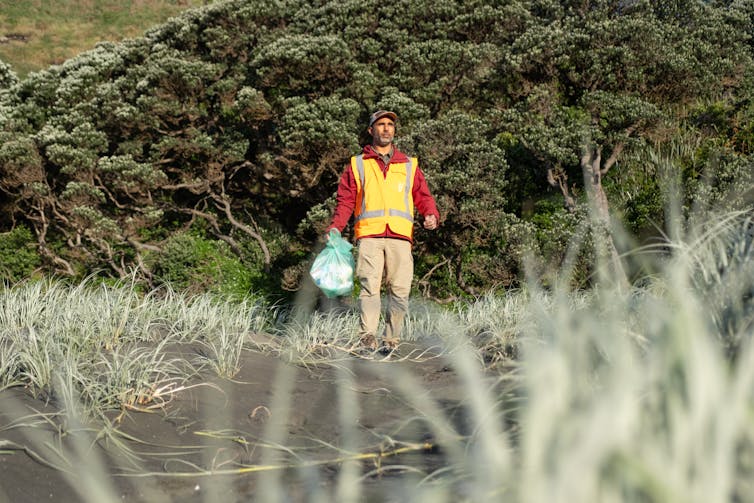
For most places in the world, much of the plastic waste emitted locally stays close by. Collecting this plastic waste will keep most of it out of the ocean, which means local community clean-ups can make a difference in controlling marine pollution.
Collecting plastic rubbish from beaches and river banks makes a difference. Getty Images
It also means, given the long lifetime of plastic, that shorelines have been accumulating this waste for many decades and are acting as plastic “reservoirs”. Much of the plastic pollution may be hidden from view as it degrades to micro- and nanometre-sized particles.
Efforts are underway in communities and within nations to reduce the use of plastic and remove it from the environment. An international treaty to mitigate plastic pollution is expected to be in place by the end of 2024.
The aim of the treaty will be to curb the emission of 53 million metric tonnes per year of new plastics that would otherwise enter the aquatic environment by 2030. But we will need to continue cleaning up plastic for many decades to undo the legacy of our consumption.
Melissa Bowen receives funding from the Ministry for Business, Innovation and Employment Endeavour project AIM2 (Aoteoroa Impacts and Mitigation of Microplastics).
Gaoyang Li receives funding from the Ministry for Business, Innovation and Employment Endeavour project AIM2 (Aoteoroa Impacts and Mitigation of Microplastics).
Giovanni Coco receives funding from the Ministry for Business, Innovation and Employment.
Zheng Chen receives funding from the Ministry for Business, Innovation and Employment Endeavour project AIM2 (Aoteoroa Impacts and Mitigation of Microplastics).
Reports in The Australian suggesting Treasurer Jim Chalmers has shelved his budget wellbeing framework, known as Measuring What Matters, are incorrect.
The framework is alive and well, and making steady (if slow) progress.
Also reported was the Coalition’s intention to scrap the framework if it wins the next election, with its treasury spokesman Angus Taylor quoted as saying the government should instead focus on “lower inflation and lower interest rates”.
The idea that we shouldn’t be thinking about broader measures of progress because we need to concentrate on what’s in front of us impoverishes our view of what’s possible.
It’s important to measure what matters
The cost of living is certainly paramount. But if all we ever do is address the issue immediately in front of us, we will forever stumble from one crisis to the next.
Actually, if we had had a wellbeing framework in place before the current cost of living crisis, it might have been less likely to develop.
Most of us would agree that the things in the government’s Measuring What Matters framework matter, such as security, prosperity and cohesiveness.
But some of the information in last year’s statement was dated, some dating back to the years before COVID.
The framework has two parts: a measurement dashboard and a statement.
The dashboard presents data on 50 “key indicators” the treasury believes should supplement (although not replace) the standard measures of economic progress.
The statement is a report of the outcomes presented in the dashboard and of government progress toward embedding the framework in decision-making.
Last month Treasurer Chalmers announced responsibility for the dashboard would move from the treasury to the Bureau of Statistics and that the Bureau would get extra funding to run an expanded general social survey every year to improve the quality and timeliness of the data.
The statement would remain the responsibility of the treasury but would be released only every three years instead of annually. The next would be published in 2026 incorporating the first results from the bureau’s new survey.
Framework already kicking goals
Discovering we don’t collect regular and timely data on these important measures and then funding the Bureau of Statistics to do so is a demonstration that the framework is already having an impact.
The critical test will be how it is used to improve decision-making.
It hasn’t yet resulted in any radical change, but the ambition is substantial.
Shifting the way governments make decisions and allocate resources is hard, and it was was never going to be accomplished in a single year.
By handing over the data side of things to the Bureau of Statistics, the treasury will now, hopefully, be able to focus more on embedding the framework into decisions, including budget decisions.
Prioritising prevention
One of the things the treasury team is working on is how to better prioritise early intervention and prevention programs for Australians at risk. Such measures are hard to justify under the old budget rules, but can they can improve outcomes and save the government money in the long run.
International and Australian studies have identified four key ways of ensuring the government is working to deliver the kinds of outcomes we expect from it:
1. holistic thinking and breaking down silos between types of wellbeing
2. a long-term focus that includes consideration of future generations
3. emphasis on prevention to tackle the root causes of problems
4. including the people most likely to be affected by decisions in their design.
They are directed towards delivering the kind of society we want to live in and to do it smartly and efficiently within a budget context.
According to the framework, that’s a society that is healthy, secure, sustainable, prosperous and cohesive. The government remains on the case.
Warwick Smith is a Program Director at the Centre for Policy Development and the Chair of the Castlemaine Institute.
Iron ore is the key ingredient in steel production. One of the fundamental resources for the Australian economy, it contributes A$124 billion in national income each year.
This is not surprising, considering Western Australia is home to some of Earth’s largest iron ore deposits, and 96% of Australia’s iron ore comes from this state. Yet despite the metal’s significance, we still don’t know exactly how and when iron deposits formed within the continent.
We found that several of Western Australia’s richest iron deposits – such as Mt Tom Price and Mt Whaleback – are up to 1 billion years younger than previously understood. This redefines how we think about iron deposits at all scales: from the mining site to supercontinents. It also provides clues on how we might be able to find more iron.
Punurrunha or Mt Bruce, part of the Hamersley Range in the Pilbara, Western Australia. Julie Burgher/Flickr, CC BY-NC
Where does iron ore come from?
Billions of years ago, Earth’s oceans were rich in iron. Then early bacteria started photosynthesising and rapidly introduced huge amounts of oxygen into the atmosphere and oceans. This oxygen combined with iron in the oceans, causing it to settle on the sea floor.
Today, these 2.45-billion-year-old sedimentary rock deposits are called banded iron formations. They represent a unique archive of the interactions between Earth’s continents, oceans and atmosphere through time. And, of course, banded iron formations are what we mine for iron ore.
These sedimentary deposits have distinctive, rhythmic bands of reddish iron and paler silica. They were alternately laid down on the sea floor seasonally. Such remarkable rocks can be visited today in Karijini National Park, WA.
The iron content of these banded iron formations is generally less than 30%. For the rock to become economically viable to mine, it must be naturally converted by later processes to around 60% iron.
The nature of this rock conversion is still debated. In simplest terms, a fluid – such as water – will both remove silica and introduce more iron during an “upgrading” process which transforms the rock’s original makeup.
The geochronology (age dating) of this chemical transformation and upgrading is not well understood, largely because the tools required to directly date the iron minerals have only recently become available.
Previous age estimates for the Pilbara iron deposits were indirect but suggested they were at least 2.2 billion years old.
What did we find out?
You may think of iron ore as rusty, red-coloured dust. However, it’s typically a hard, heavy, steely-blue material. When crushed into a fine powder, iron ore turns red. So the red landscape we see across the Pilbara today is a result of the weathering of iron minerals from beneath our feet.
1.3-billion-year-old steel blue iron ore extracted from Hamersley Province, Western Australia. Liam Courtney-Davies
We extracted microscopic scale “fresh” iron minerals from drill core samples at several of the most significant Western Australian iron deposits.
Leveraging recent advancements in radiometric dating, we measured naturally occurring radioactive elements in the rocks. In particular, the ratio of uranium to lead isotopes in a sample can reveal how long ago individual mineral grains crystallised.
Using the newly generated iron mineral age data, we constructed the first-ever timeline of the formation of Western Australia’s major iron deposits.
We discovered that all major iron ore deposits in the region formed between 1.4 and 1.1 billion years ago, making them up to 1 billion years younger than previous estimates.
These deposits formed in conjunction with major tectonic events, especially the breakup and reemergence of supercontinents. It shows just how dynamic our planet’s history is, and how complex the processes are that led to the formation of the iron ore we use today.
Now that we know that giant ore deposits are linked to changes in the supercontinent cycle, we can use this knowledge to better predict the places where we are more likely to discover more iron ore.
Liam Courtney-Davies completed this research while at John de Laeter Centre, Curtin University.
Liam Courtney-Davies received funding for this research through the MRIWA 557 Project and the Australian Research Council.
Humidity forecasts over North America and the northeast Pacific Ocean.Kochov et al. / Nature
A new system for forecasting weather and predicting future climate uses artificial intelligence (AI) to achieve results comparable with the best existing models while using much less computer power, according to its creators.
In a paper published in Nature today, a team of researchers from Google, MIT, Harvard and the European Centre for Medium-Range Weather Forecasts say their model offers enormous “computational savings” and can “enhance the large-scale physical simulations that are essential for understanding and predicting the Earth system”.
The NeuralGCM model is the latest in a steady stream of research models that use advances in machine learning to make weather and climate predictions faster and cheaper.
What is NeuralGCM?
The NeuralGCM model aims to combine the best features of traditional models with a machine-learning approach.
At its core, NeuralGCM is what is called a “general circulation model”. It contains a mathematical description of the physical state of Earth’s atmosphere, and it solves complicated equations to predict what will happen in the future.
However, NeuralGCM also uses machine learning – a process of searching out patterns and regularities in vast troves of data – for some less well-understood physical processes, such as cloud formation. The hybrid approach makes sure that the output of the machine learning modules will be consistent with the laws of physics.
Google researchers explain the NeuralGCM model.
The resulting model can then be used for making forecasts of weather days and weeks in advance, as well as looking months and years ahead for climate predictions.
The researchers compared NeuralGCM against other models using a standardised set of forecasting tests called WeatherBench 2. For three- and five-day forecasts, NeuralGCM did about as well as other machine-learning weather models such as Pangu and GraphCast. For longer-range forecasts, over ten and 15 days, NeuralGCM was about as accurate as the best existing traditional models.
NeuralGCM was also quite successful in forecasting less-common weather phenomena, such as tropical cyclones and atmospheric rivers.
Why machine learning?
Machine learning models are based on algorithms that learn patterns in the data they are fed with, then use this learning to make predictions. Because climate and weather systems are highly complex, machine learning models require vast amounts of historical observations and satellite data for training.
The training process is very expensive and requires a lot of computer power. However, after a model is trained, using it to make predictions is fast and cheap. This is a large part of their appeal for weather forecasting.
The high cost of training and low cost of use is similar to other kinds of machine learning models. GPT-4, for example, reportedly took several months to train at a cost of more than US$100 million, but can respond to a query in moments.
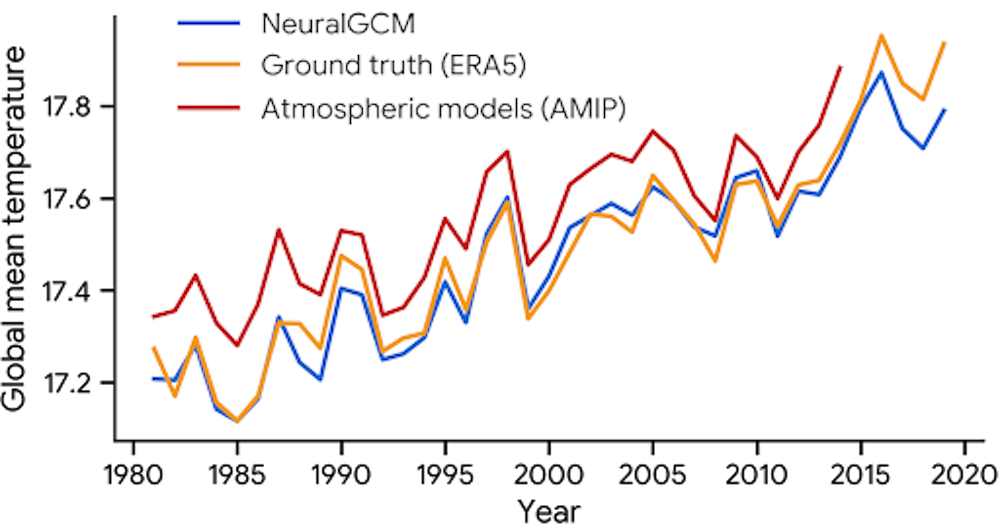
A comparison of how NeuralGCM compares with leading models (AMIP) and real data (ERA5) at capturing climate change between 1980 and 2020. Google Research
A weakness of machine learning models is that they often struggle in unfamiliar situations – or in this case, extreme or unprecedented weather conditions. To do this, a model needs to be able to generalise, or extrapolate beyond the data it was trained on.
NeuralGCM appears to be better at this than other machine learning models, because its physics-based core provides some grounding in reality. As Earth’s climate changes, unprecedented weather conditions will become more common, and we don’t know how well machine learning models will keep up.
Nobody is actually using machine learning-based weather models for day-to-day forecasting yet. However, it is a very active area of research – and one way or another, we can be confident that the forecasts of the future will involve machine learning.
Sanaa Hobeichi does not work for, consult, own shares in or receive funding from any company or organisation that would benefit from this article, and has disclosed no relevant affiliations beyond their academic appointment.
Reports in The Australian suggesting Treasurer Jim Chalmers has shelved his budget wellbeing framework, known as Measuring What Matters, are incorrect.
The framework is alive and well, and making steady (if slow) progress.
Also reported was the Coalition’s intention to scrap the framework if it wins the next election, with its treasury spokesman Angus Taylor quoted as saying the government should instead focus on “lower inflation and lower interest rates”.
The idea that we shouldn’t be thinking about broader measures of progress because we need to concentrate on what’s in front of us impoverishes our view of what’s possible.
It’s important to measure what matters
The cost of living is certainly paramount. But if all we ever do is address the issue immediately in front of us, we will forever stumble from one crisis to the next.
Actually, if we had had a wellbeing framework in place before the current cost of living crisis, it might have been less likely to develop.
Most of us would agree that the things in the government’s Measuring What Matters framework matter, such as security, prosperity and cohesiveness.
But some of the information in last year’s statement was dated, some dating back to the years before COVID.
The framework has two parts: a measurement dashboard and a statement.
The dashboard presents data on 50 “key indicators” the treasury believes should supplement (although not replace) the standard measures of economic progress.
The statement is a report of the outcomes presented in the dashboard and of government progress toward embedding the framework in decision-making.
Last month Treasurer Chalmers announced responsibility for the dashboard would move from the treasury to the Bureau of Statistics and that the Bureau would get extra funding to run an expanded general social survey every year to improve the quality and timeliness of the data.
The statement would remain the responsibility of the treasury but would be released only every three years instead of annually. The next would be published in 2026 incorporating the first results from the bureau’s new survey.
Framework already kicking goals
Discovering we don’t collect regular and timely data on these important measures and then funding the Bureau of Statistics to do so is a demonstration that the framework is already having an impact.
The critical test will be how it is used to improve decision-making.
It hasn’t yet resulted in any radical change, but the ambition is substantial.
Shifting the way governments make decisions and allocate resources is hard, and it was was never going to be accomplished in a single year.
By handing over the data side of things to the Bureau of Statistics, the treasury will now, hopefully, be able to focus more on embedding the framework into decisions, including budget decisions.
Prioritising prevention
One of the things the treasury team is working on is how to better prioritise early intervention and prevention programs for Australians at risk. Such measures are hard to justify under the old budget rules, but can they can improve outcomes and save the government money in the long run.
International and Australian studies have identified four key ways of ensuring the government is working to deliver the kinds of outcomes we expect from it:
1. holistic thinking and breaking down silos between types of wellbeing
2. a long-term focus that includes consideration of future generations
3. emphasis on prevention to tackle the root causes of problems
4. including the people most likely to be affected by decisions in their design.
They are directed towards delivering the kind of society we want to live in and to do it smartly and efficiently within a budget context.
According to the framework, that’s a society that is healthy, secure, sustainable, prosperous and cohesive. The government remains on the case.
Warwick Smith is a Program Director at the Centre for Policy Development and the Chair of the Castlemaine Institute.
Associate Health Minister David Seymour’s recent letter of expectations to drug buying agency Pharmac could fundamentally change the way the organisation makes decisions. Some of these changes could also make Pharmac’s job harder and its decisions more unpopular.
The letter has received considerable coverage due to the minister’s expectation that Pharmac pay less attention to embedding te Tiriti o Waitangi in the health sector. This has already seen the departure of one director.
But some of Seymour’s other expectations have received less scrutiny than they deserved.
Pharmac currently has one core job (its statutory objective): to secure the best health outcomes within the amount of funding provided.
Seymour’s letter calls for a reform of the funding model to account for “positive fiscal impacts”. This would require a change in Pharmac’s statutory objective and could end up hurting more than helping some New Zealanders.
Considering productivity
Pharmac evaluates new medicines by looking at their cost and any savings they might make to the rest of the health system. This is then compared with the additional health gains of the new medicine.
Currently, a medicine is funded when it delivers sufficient value and there is the budget for it. If the medicine doesn’t deliver enough value, or if Pharmac can’t currently afford it, it goes on their options for investment list.
In his letter, Seymour asked Pharmac to ensure it:
Updates its decision-making and evaluation models to include the wider fiscal impact of funding or not funding a medicine or medical device to the whole of government, and has tools to consider the wider societal impact.
Pharmac is being asked to consider a drug’s impact on economic productivity. This means assessments would consider whether a medicine helps people remain at work because they don’t get sick, or helps return them to work after an illness.
Globally, 60% of drug agencies consider the broader impacts of medicines to varying degrees, but there’s no clear agreement on the best approach. Some countries include the costs and health outcomes of caregivers or parents while others look at time away from work.
Time away from work – lost productivity – can be measured using a “friction cost” approach (which counts the hours not worked until another employee takes over a sick person’s work), or a “human capital” approach (where the indirect cost is the amount of time lost due to illness, valued at the market wage).
But there is a risk those who aren’t considered “productive” and those in low-wage jobs could be deemed less important to treat. This could include older people, those with disabilities and their carers, those with conditions that mean they might never work, and those facing discrimination in the workplace (women, Māori and Pasifika, for example).
If Pharmac is to consider productivity, then the government needs to acknowledge this could exacerbate existing inequities.
But in his letter of expectations, Seymour says he expects Pharmac to do more to involve patient groups and whānau participation in the decision-making process.
This sounds positive, but it could trigger more involvement from the pharmaceutical industry. Many patient advocacy groups receive funding from industry organisations. A recent Australian study found AU$34 million had been provided to patient organisations by pharmaceutical companies over a four-year period, often when the companies’ drugs were under review for public reimbursement.
These sorts of conflict of interest will need to be managed, particularly in a country with a very active lobbying sector and few safeguards, even at the highest levels of government.
Separation of roles
Pharmac is also asked to consider separating the roles of value assessment and procurement. According to the minister:
The organisation might […] benefit from a more functionally separate procurement process.
Having both roles allows Pharmac to negotiate more effectively with the pharmaceutical industry – something unique to New Zealand. Separating them potentially risks Pharmac’s ability to negotiate, by limiting how information about value can be used.
Currently, Pharmac actively manages the pharmaceutical schedule in their role as a purchaser. They use a range of pricing and negotiation strategies.
Many of the less cost-effective treatments go on the options for investment list in the hope that a deal can be worked out later. Pharmac negotiates deals to fund these slightly lower-value medicines by getting a better deal on other treatments.
This might involve bundling products from the same pharmaceutical company or negotiating a lower price for an upcoming tender for a more widely-used drug.
If assessment is separated from procurement, these sorts of deals are unlikely to happen. This means Pharmac will need to say “no” to funding a given item more often due to its limited budget, and each of these decisions risks causing more problems for the government.
The part of Pharmac (or another agency) doing the value assessment would no longer be able to ask if a treatment is affordable. Instead, it will have to decide how much each year of healthy life is worth, and use this in its decision making.
Companies will increase the price of new drugs to match this new figure, which makes even the better-value drugs more expensive, and increases pressure on the limited pharmaceutical budget.
Paula Lorgelly consults to Pharmac and has in the past consulted to the pharmaceutical industry. She receives funding from the Ministry of Health and the EuroQol Foundation. Paula is a member of the EuroQol Group which owns the EQ-5D instrument which is widely used in health technology assessments.
Richard Edlin consults to Pharmac and has in the past consulted to the pharmaceutical industry.
Vaping is in your news feed for its regulation, impact on public health and effects on young people.
So with growing awareness of the effects of vaping on health plus recent reforms to limit availability of vapes to pharmacies in Australia, many people will be thinking about quitting. They will also need support to do so.
That’s partly because so many vapes contain nicotine. Some 73% of Australians who currently vape said their last vape contained nicotine. This tends to be high-strengthnicotine.
Mental health is another factor closely linked to vaping – whether people with mental health symptoms are likely to start vaping in the first place, how they fare when vaping, and whether they need additional support when trying to quit.
Here’s what we know about how mental health is connected to vaping and where to go for support to quit.
How are mental health and vaping linked?
An estimated 4.3 million Australians reported a mental health problem in the past 12 months. This includes anxiety and mood disorders (such as depression), which typically begin in adolescence to early adulthood.
We know vaping and mental health (including anxiety and depression) are linked. People who vape frequently are twice as likely to have a depression diagnosis compared with people who have never vaped.
Australia’s National Drug Strategy Household Survey also shows people with more mental distress related to anxiety and depression were four times as likely to have vaped than were those with low distress.
And for those already with a mental health problem, vaping is related to worse depression symptoms and physical health.
The relationship between nicotine-containing vapes and mental health is complicated. People in mental distress can be more likely to start vaping and people who vape are more likely to have mental health problems. What this doesn’t tell us is which comes first. So we need longer-term studies to find out more.
What about self-medicating with vapes?
Some people link using nicotine-containing vapes with managing mental health or stress. For instance, in an Australian survey including questions about the expected benefits of vaping:
61% of young adults who vaped feel it helps people calm down when tense or stressed
57% said it cheers people up when in a bad mood
50% said it helps people feel better if they’ve been feeling down.
But rather than addressing these symptoms, vaping can increase them.
For instance, a study in the United States found vaping dependence was linked with increased symptoms of depression. We also know from smoking research that quitting can improve mental health.
But we know stigma plays a role in both experiences of mental health and addiction, which may make asking for help to quit even more difficult.
We also know having a mental health condition can increase the odds of relapsing after trying to quit vaping.
So what works to quit?
We have little evidence and guidance for the best way to support people who vape to quit, generally. There’s even less evidence on how to support people with mental health conditions to quit.
There are quit vaping programs for people with mental health conditions. And as receiving mental health support does boost the odds of success in quitting tobacco smoking, this may also hold promise for quitting vaping.
Although the evidence is still growing, experts recommend quit plans consider someone’s severity of mental illness, the impact of nicotine use and withdrawal, and whether medications for their mental illness interact with ones used to help them quit vaping.
Cognitive behavioural therapy is a type of psychological therapy that looks at how thoughts, behaviours and emotions are connected. This is an effective approach to support people to quit smoking and its principles can be combined with quit medications to help people quit vaping. People with a mental health condition who vape can be offered cognitive behavioural therapy to help them quit, though specific evidence is still needed to show how well this works.
Psychologists and counsellors can also use motivational interviewing to highlight discrepancies between someone’s actions and values. For instance, this might be used to highlight the discrepancy between someone who wants to be healthy for their family (their value) but who vapes regularly (their action). This, combined with education, may motivate people to act and see a future without vaping.
Health providers and counsellors can offer brief advice on how to quit, extrapolating from what works for quitting smoking. Services such as Quitline can also help mental health providers deliver quit support.
How do I find out more?
If you or someone you know wants to quit vaping, whether or not there are mental health concerns, resources include:
More reading on the impact of vaping on adolescent mental health is also available.
If this article has raised issues for you, or if you’re concerned about someone you know, call Lifeline on 13 11 14.
Joshua Trigg is supported by funding from the National Health and Medical Research Council, the Medical Research Future Fund, and the Flinders Foundation. He has previously received funding support from The Australian Prevention Partnership, SA Health, Cancer Council SA and Cancer Council NT. No other funding sources or consultancy are declared, including from tobacco, e-cigarette or pharmaceutical companies.
Lavender Otieno is supported by funding from the Medical Research Future Fund and partially from the National Health and Medical Research Council. No other funding sources or consultancy are declared, including from tobacco, e-cigarette or pharmaceutical companies.
Anthony Venning does not work for, consult, own shares in or receive funding from any company or organisation that would benefit from this article, and has disclosed no relevant affiliations beyond their academic appointment.
If not the root of all evil, chemical pollution is surely responsible for a good chunk of it. At least, that’s how it feels sometimes when reading the news and the latest research.
So it’s not surprising many people feel chemicals are intrinsically bad, though that’s not the case. But how worried should we really be, and can we reduce the risks?
In the air we breathe
Globally, pollution is a serious problem – particularly air pollution.
Portable air monitors can measure air quality in real time. These readings were taken at Melbourne’s Southern Cross Station in July 2024. Oliver Jones
The burden of disease falls heavily on developing countries, but even in Australia air pollution causes significant harm.
Fortunately, we can monitor air pollution, even at home. We know what levels are dangerous, and how to reduce exposure. But what about things we can’t monitor, or know less about?
The water we drink
In June, the Sydney Morning Herald implied tap water throughout Australia was contaminated with alarming levels of PFAS. But the levels detected fall within Australia’s drinking water guidelines. They just happen to exceed the United States’ new safety thresholds, which don’t come in for five years.
Chemical structures of PFOS and PFOA, two types of PFAS. Oliver Jones
PFAS (Per- and polyfluoroalkyl substances) are a group of highly persistent chemicals characterised by carbon-fluorine bonds.
Although PFAS in your water sounds awful, we don’t know if water is the main route of exposure or what the actual risks are.
What is generally missing from both research papers and news reports is context – details on the dose and duration of exposure needed to cause such effects.
The levels of PFAS needed to cause health effects tend to be orders of magnitude higher than those typically found in the environment. So while it’s not great that we’ve polluted the entire planet with these compounds, the health risks for most of us are likely to be low.
New technologies are being developed to reduce PFAS in water and soil.
Discarded pesticide container in Werribee, Victoria. Oliver Jones
The usual suspect, glyphosate, is usually claimed to cause non-Hodgkin lymphoma. But this is a catch-all term covering more than 60 different types of lymphoma, which can vary significantly.
Small amounts of pesticide residue are permitted on our food, but concentrations are in the parts per trillion (for reference, a trillion seconds is 31,710 years).
The evidence suggests parts per trillion of pesticides do not increase the risk of cancer in people. But if you want to reduce your exposure anyway, washing and cooking vegetables and washing fruit is a good way to go.
Microplastics are everywhere
Microplastics (plastic particles less than 5mm in diameter) are now found everywhere from the top to the bottom of the planet.
Again, it sounds scary – but several reports of microplastics in food and blood have been firmlycriticised by other scientists. The widely (mis)reported claim that we eat a credit card’s worth of microplastic each week was debunked by YouTuber Hank Green.
The World Health Organization recently concluded evidence of the health effects of microplastics is insufficient. However, they also make the point that this is not the same as saying microplastics are safe. We need more data to understand the risks.
We need new recycling technology to reduce plastic waste. Ultimately, we may need to wean ourselves off plastic entirely.
Where to from here?
I am not suggesting we should not worry about pollution – we should. But just because something is present does not automatically mean it is causing harm. To my mind, air pollution is the biggest worry so far, with more proven health effects than microplastics or PFAS.
We must understand relative exposure and the nuances of risk assessment. We need sensible debate, evidence-based approaches and new techniques for monitoring and assessing the impacts of, low (parts per trillion) pollutant concentrations.
This should help prevent and mitigate potentially harmful exposures in future.
Oliver A.H. Jones receives funding from the Australian Research Council, various water utilities, EPA Victoria and the Defence Science Institute for research into environmental pollution, including PFAS.
Art offers us different, and sometimes challenging, perspectives to consider in our lifelong relationship with the human form.
Since they were babes in arms I have taken my two children to museums and galleries. Because of this frequent exposure to art, seeing representations of nude bodies is normal for them.
But if this is not your experience with the little people in your life, you might be wondering where you might start to talk about nudity and art.
Nudity in art can stimulate meaningful and necessary conversations about all sorts of topics, from what different bodies look like, to body image, to what it means to be human.
Here are some questions your children might have about the bodies they’re seeing – and some tips and resources to help you answer them.
What are we going to see at the gallery?
Art galleries provide opportunities for parents, carers and educators to have deep discussions with children about history, politics, the environment – the list goes on.
As well as coming across new and sometimes challenging concepts, the art gallery can also be a place where children may be confronted with unclothed bodies in a public space for the first time. It’s understandable this might provoke a nervous giggle or gasp.
The Gallery of Greater Victoria suggests before you visit, show your child some of the works they will see to help them prepare and talk about the tradition of nudes in art and what they can symbolise, such as privacy, innocence, bravery and vulnerability.
Why is that giant pregnant lady not wearing any clothes?
Art can help us empathise with other people’s perspectives. As a high school art teacher I took a group of students for an excursion to the National Gallery of Australia.
The first artwork we stopped at was Ron Mueck’s monumental and hyper-real sculpture Pregnant Woman (2002). I was heavily pregnant at the time and noticed the students looking at me and then the sculpture and back to me again and then quickly looking away, maybe a little embarrassed (or maybe I was).
It was a funny moment and offered an excellent opportunity to talk about what being pregnant feels like and how art can express emotions and make us think about other people’s perspectives.
Mueck’s Pregnant Woman is currently on display at the Maitland City Art Gallery, and throughout the year the work will interact with their collection and exhibitions, curated to foster “different conversations and ideas to emerge related to family (in all its diverse forms), motherhood, birth and the marvel of humanity”.
Exploring the history of nudes in art reveals how past societies have shaped our current self-perceptions. Galleries provide an excellent opportunity to see how different cultures and eras have viewed the human body.
Children might be curious as to why there are so many nudes in the gallery. Alex Segre/Shutterstock
Why did the artist choose to make a work like that?
Head of National Learning Georgia Close from the National Gallery of Australia told me:
It’s important to have conversations about nudity and representation in artwork. Bringing it back to the artist’s words is always a useful strategy to provide cultural or conceptual context, and seeing what students think about what the artist has said.
Model researching the artist’s intentions, read the label or artist statement, find the artist speaking about their work on the internet, show your child how finding out the story behind the artwork can help to understand it better.
My practice is focused on bodies and relationships; the relationships between people and other creatures, between people and our bodies, between creatures and the environment, between the artificial and the natural.
Viewing Piccinini’s work with this statement in mind brings an informed understanding of her artistic intentions.
What is that?!
Walking through the gallery can become a fun anatomy lesson.
When asked how is it best to respond to children when they are curious about bodies they see in the gallery, lecturer in educational psychology and clinical neuropsychologist Karen Oakley says:
the key thing I would discuss would be appropriate labelling of the parts of the human body, talking about bodies, how they look, how they change, and with whom and when it is OK to be naked.
The art gallery might be the first time children see naked bodies in public. Akimov Igor/Shutterstock
If this raises further questions about puberty, body image or more challenging topics, Raising Children has a range of resources and age-appropriate strategies that can help you talk to your children.
Visual arts can be challenging. Like other forms of art, such as writing or film, sometimes works are not intended or suitable for children. This is why it’s good to research your trip before you go, or talk to gallery staff for guidance on the collection.
Art can help us explore complex topics with our children and gain insights into what they are thinking, ourselves and the wider world.
Naomi Zouwer does not work for, consult, own shares in or receive funding from any company or organisation that would benefit from this article, and has disclosed no relevant affiliations beyond their academic appointment.
Today, Montgomery’s population is almost 60% Black. The poverty rate among Black residents is 30.8%, compared to 10.6% among white residents. The city’s infrastructure is deteriorating, and its tax base is shrinking.
Cities with histories of segregation tend to suffer more from systemic racism that remains in the veins of their planning laws and policies. As a scholar of urban design and planning, I wanted to know more about how Montgomery’s history affected access to parks and public spaces there. My research explains how the city’s history still influences modern planning and creates unequal access to parks.
Racial inequality is deeply embedded in Montgomery’s history. Today the city is working to revitalize itself without obscuring its past.
Separate and unequal parks
In the Jim Crow era, from the 1870s through the mid-20th century, Southern cities enforced segregation in schools, transportation, recreational facilities and parks to prevent racial mixing. The Civil Rights Act of 1964 outlawed such practices, but they had lingering effects.
In 1957, Montgomery adopted an ordinance that made it a misdemeanor for any person to use public parks or other places except those assigned to their race. Four of the city’s 14 parks were designated as Black-only and 10 as white-only, although the population was almost 44% black.
Parks for Black residents were in much worse condition than those for white residents. Some white-only parks, such as Oak Park, were located in Black neighborhoods, but Black residents were subject to arrest for entering them.
During the segregated era, Oak Park offered white visitors football fields, tennis courts, playgrounds, picnic areas, swimming and wading pools and a zoo. Following a federal court order to desegregate, the park was closed in 1959. It reopened in 1965 with universal access, but moved its recreational facilities and zoo elsewhere. Binita Mahato, CC BY-ND
Tacitly maintaining segregation
In 1958, Black Montgomery residents filed a class action lawsuit challenging the park segregation policy. Montgomery officials responded by closing all city parks, although they continued to maintain them.
After a federal court in Alabama ruled for the plaintiffs in 1959, the city reopened some parks, but gave private segregated schools exclusive use of certain sites. It also renamed the Parks and Recreation Department as the Recreation Department, which enabled it to steer funding toward recreational facilities such as swimming pools that restricted access by requiring paid memberships.
Plaintiffs reopened the desegregation case in 1970, and it reached the Supreme Court in 1974. There, Justice Harry Blackmun described the city’s response to the 1959 ruling as “an elaborate subterfuge to anticipate and circumvent the court’s order.”
In the following years, desegregation laws spurred white flight to the suburbs. As Montgomery lost white residents and their tax payments, it annexed surrounding areas. This left the central city and its existing parks mainly to Black residents, while white residents resettled in suburbs with new parks.
Urban renewal initiatives in the 1950s and 1960s demolished, privatized or repurposed some of Montgomery’s high-quality parks. For example, Interstate Highway 85 was routed through Oak Park, a Black middle-class neighborhood. Urban planning scholar Rebecca Retzlaff calls this a deliberate effort to displace civil rights leaders and middle-class Black households. Building highways through Black neighborhoods in Montgomery and elsewhere also exposed these areas to increased noise and air pollution.
Montgomery’s parks today
Today, Black residents of Montgomery have unrestricted access to the city’s 65 parks. However, in a 2019 report, Montgomery’s Recreation Department stated that while “overt and systemic regulatory structures based on race or ethnicity have been eliminated, the legacy of this framework can still be seen in many ways.”
To investigate current park resources in Montgomery, I surveyed 63 city parks using five criteria to measure access, quality and park conditions.
– Accessibility: the number of residents living within a half-mile walk of a park
– Recreational facilities: features like playing fields, playgrounds and swimming pools
– Other amenities: non-sporting facilities, such as picnic tables and rest rooms
– Natural features: landscaped areas, flower beds and ponds
– Incivility: the presence of trash, graffiti, noise or evidence of drug or alcohol use, such as empty liquor bottles and used needles
I found that 36 of the parks I assessed were within half a mile of majority-Black neighborhoods. This increased access partly reflects the growth of the city’s Black population as white residents moved to the suburbs.
However, my scoring ranked 83% of parks catering to Black residents as poor quality, with only 8% of mediocre quality and 9% of good quality. For parks catering to white residents, the comparable figures were 50% of poor quality, 31% of mediocre quality and 19% of good quality. The key factor behind this disparity was maintenance, as measured by the amount of trash, noise, vandalism and evidence of illegal activities.
Park size also matters. Most Black Montgomery residents live close to small neighborhood parks, which my survey found were in the most distressed condition. Larger community parks generate revenue from community and sports events, so city officials tend to steer more money to these sites.
Park access and environmental justice
Research shows that access to nature is important for people’s physical and mental health. This makes public parks vital resources, especially in urban areas. Poor people and people of color often have less access to parks, which tend to be in areas with high housing prices.
My research shows how systematic disinvestment can perpetuate unequal park access in cities with histories of segregation. With limited funding, cities such as Washington, D.C., and Philadelphia have tended to invest in large community parks. Many small neighborhood parks, which are crucial for equal access, need improvement.
Montgomery’s comprehensive plan, Envision Montgomery 2040, calls for upgrading parks and recreation facilities and maintaining them more effectively. Involving residents in setting priorities for park projects could help make these investments more equitable – especially if they target small parks in distressed neighborhoods, where the legacy of segregation still lingers.
Binita Mahato does not work for, consult, own shares in or receive funding from any company or organization that would benefit from this article, and has disclosed no relevant affiliations beyond their academic appointment.
In the West Bank, one in three Palestinians has experienced one or more incarcerations during their life since 1967, or 35 percent of the population, while in Kanaky, the Nouméa prison, known as Camp Est, is populated by 95 percent Kanaks, while they represent only 39 to 43 percent of the Caledonian population.
SPECIAL REPORT:Samidoun
On Friday, July 5, France announced the continued provisional detention on mainland France of 5 Kanak defendants, out of seven pro-independence “leaders” who had been deported from Kanaky New Caledonia on June 23.
The subsequent announcements of the arrest of 11 pro-independence activists, including 9 provisional detentions (including Joël Tjibaou and Gilles Jorédié, incarcerated in Camp Est) and 7 incarcerations in mainland France (Christian Tein, Frédérique Muliava, Brenda Wanabo-Ipeze, Dimitri Tein Qenegei, Guillaume Vama, Steve Unë and Yewa Waethane), more than 17,000 kilometres from their homeland, revived the mobilisations that had begun a month earlier as part of the fight against the plan to “unfreeze” the Kanaky electoral body.
Suspended after President Emmanuel Macron announced the dissolution of the National Assembly, this project actually aims to reverse the achievements of the Nouméa Accords signed in 1998.
It is part of the strategy of strengthening French colonialism in Kanaky by extending the ability to vote on local matters, including independence referandums, to an even greater number of settlers, making the indigenous Kanaks a de facto minority at the ballot box.
On July 11, 10 Centaur armoured vehicles, 15 fire trucks, a dozen all-terrain military armoured vehicles and numerous army trucks were landed by ship in Kanaky, where the population remains under curfew.
This entire sequence bears witness to the manner in which France, through its colonial administration, deploys a repressive security arsenal that on the one hand protects the settlers on the land and their reactionary militias, and on the other, attempts to destroy the country’s Kanak independence movement.
Imprisonment and incarceration are a weapon of choice in this overall colonial strategy.
Imprisonment is one of the key weapons of choice in colonial strategies to try to stifle independence and national liberation struggles, from the Zionist regime in Palestine to allied imperialist countries and colonial empires such as France.
While the figures are incomparable due to differences between the populations and conditions, in the West Bank, according to Stéphanie Latte Abdallah, one in three Palestinians has experienced one or more incarcerations during their life since 1967, or 35 percent of the population, while in Kanaky, the Nouméa prison, known as Camp Est, is populated by 95 percent Kanaks, while they represent only 39 to 43 percent of the Caledonian population.
Camp Est Prison in Nouville, on the outskirts of Nouméa. Image: Samidoun
Nicknamed “the island of oblivion” by the prisoners, the Camp Est prison locks up many young Kanaks excluded from the economic, educational and health systems, and symbolises the French colonial continuum, especially as the building partly occupies the space of the former French penal colony imposed there.
Silence of sociologists Few studies exist of this over-incarceration of the Kanak population, and as Hamid Mokadem reminds us:
“The silence of sociologists and demographers on ethno-cultural inequalities is inversely proportional to the chatter of anthropologists on Kanak customs and culture.”
The incarceration rate is significantly higher than in mainland France, so much so that a new prison has been built.
The Koné detention center, and a project to replace Camp Est was announced in February 2024 by the Minister of Justice. He promised a 600-bed facility (compared to the 230 cells available at Camp Est) that would emerge after a construction project estimated at 500 million euros (NZ$908 million).
This is the largest investment by the French state on Kanak soil, a deadly promise that at the same time reaffirms France’s imperialist project in the Pacific, driven by its financial and geopolitical interests to retain its colonial properties there.
While waiting for this large-scale prison project, new cells have been fitted out in containers on which a double mesh roof has been installed, many without windows, and where the conditions of incarceration are even harsher than in the other sections of the prison, including those for men, women and minors, pre-trial detainees and those who have been convicted and sentenced.
The over-representation of the Kanak population has only increased, since incarceration has been one of the mechanisms through which the French government attempts to stem the movement against the plan to “unfreeze” and expand the electoral body, with 1139 arrests since mid-May.
The penalty of deportation Local detention was supplemented by another penalty directly inherited from the Code de l’Indigénat: the penalty of deportation.
On June 23, after the announcement of the arrest of 7 Kanak independence activists in metropolitan France, the population learned that they were going to be deported 17,000 km from their homes.
A plane was waiting to transfer them to metropolitan France during their pretrial detention, all seven of them dispersed across the prisons of Dijon, Mulhouse, Bourges, Blois, Nevers, Villefranche and Riom.
This deportation of activists in the context of pre-trial detention directly recalls the events of 1988, and more broadly the way in which prison and removal were used in a colonial context.
From the 19th century and the deportation of Toussaint Louverture of Haiti to France, thousands of Algerians arrested during the uprisings against the French colonisation of Algeria at the same time as the detention of the prisoners of the Paris Commune in 1871, the Vietnamese of Hanoi in 1913, were deported to Kanaky or other colonies such as Guyana.
More recently, the Algerian revolutionaries, were massively incarcerated in metropolitan colonial prisons. From a principle inherited from the indigénat, and although today we have moved from an administrative decision to a judicial decision, the practice of deportation remains the same.
Particularly used in the context of anti-colonial resistance movements, the deportation of Kanak prisoners to metropolitan colonial prisons has been used on this scale since 1988 in Kanaky.
Ouvéa cave massacre After the massacre of 19 Kanak independence fighters who had taken police officers prisoner in the Ouvéa cave, activists still alive were imprisoned, then deported, then released as part of the Matignon-Oudinot Accords.
Twenty six Kanak prisoners came to populate the prisons of the Paris region while they were still in preventive detention — while awaiting their trials and therefore presumed innocent, as is the case today for the CCAT activists currently incarcerated.
In the 1980s, French prisons were shaken by major revolts, particularly against the racism of the guards, who were mostly affiliated with the then-nascent Front National (FN), and more broadly against the penal policy of the Mitterrand left and the massively expanding length of sentences imposed at the time.
In 1988, as former prisoners wrote afterwards, some made a point of showing their solidarity with the Kanaks by sharing their clothes and food with them.
Because many of the activists were transferred in T-shirts, shorts and flip-flops, in trying conditions, with their hands cuffed during the 24-hour journey, underhand repression techniques of the Prison Administration that are still in force.
Similar deportation conditions were described by Christian Téin, spokesperson for the CCAT incarcerated in the isolation wing of the Mulhouse-Lutterbach Penitentiary Center. The shock of incarceration is all the more violent.
CCAT leader Christian Téin, organiser of a series of marches and protests, mainly peaceful . . . he was deported and transferred to prison in Mulhouse, north-eastern France, to await trial. Image: NZ La 1ère TV screenshot APR
Added to this is the pain of the forced separation of parents and children, which is found not only in the current situation in metropolitan France but also in Palestine. Also there is great difficulty in finding loved ones, in attempting to find out which prisons they are in, or even if they are currently detained, continually encountering administrative violence, with the absence of information and the cruelty of official figures.
Orchestrated psychological impact All this is orchestrated so that the psychological impact, in the long term, aims to induce the prisoners and also their families to stop fighting.
At the time of the events in Ouvéa, the uprooting of independence activists from their lands to lock them up in mainland France was commonplace, and the Kanak detainees joined those from the Caribbean Revolutionary Alliance such as Luc Reinette and Georges Faisans, incarcerated in Île-de-France during the 1980s alongside Corsican and Basque prisoners.
Since then, this had only happened once, in the context of the uprisings in Guadeloup in 2021, where several local figures, mostly community activists, had been deported and then incarcerated in mainland France and Martinique in an attempt to stifle the revolts in which a large number of Guadeloupean youth were mobilised.
Here again, we could draw a parallel with Palestine. As Assia Zaino points out, since the 2000s, the incarceration of Palestinians has systematically been synonymous with being torn away from their families and loved ones.
Zionist prisons, located within the Palestinian territories colonised in 1948, “are integrated into the civil prison system [. . . ] and entry bans on Israeli soil are frequently imposed on the families of detainees for security reasons,” which in fact aims to attack the relatives of detainees and destabilise the national liberation struggle.
Ahmad Saadat, Ahed Abu Ghoulmeh and their comrades in detention – date and location unknown. Image: Samidoun
From prison, the struggle continues This mass incarceration is confronted by the powerful presence of prisoners as symbols of courage and resistance.
We know that in Palestine, as during the Algerian war of national liberation, incarceration is an opportunity to learn from one’s people, to forge national revolutionary consciousness but also to continue the struggle, very concretely, by mobilising against incarceration.
Because the Palestinian prisoners’ movement has transformed the colonial prison into a school of revolution: each political party has a prison branch whose political bureau or leadership is made up of imprisoned leaders.
These branches have real weight in the decisions taken outside the walls, and they are the ones responsible for leading the struggle in the colonial prisons, in particular by declaring collective hunger strikes and developing alliances of struggle that can mobilise several thousand prisoners, but also for organising the daily life of revolutionaries in prison.
It was this movement of prisoners that played a major role in driving the Palestinian resistance groups to unite under a unified command with the total liberation of historic Palestine as their compass, and to overcome internal contradictions.
Historically, the prisoners also constituted a significant part the most radical elements of the Palestinian revolution, notably by massively refusing any negotiation with the Zionist state at the time when the disastrous Oslo Accords were being prepared.
Resistance in colonial prisons can also take cultural forms, as illustrated by the very rich Palestinian prison literature, composed of literary works written in secret and smuggled out by prisoners to bear witness to the outside world of the vitality of their ideals, their struggle and the conditions of detention.
Courage of the children An example is Walid Daqqah, a renowned writer and one of the longest-held Palestinian prisoners, who was martyred on 7 April 2024 during his 38th year of detention in colonial prisons.
In short, from the children and adolescents who wear courageous smiles as they leave their trials surrounded by soldiers, to the women of Damon prison who heroically stand up to their jailers, to the resistance of the prisoners who fight by putting their lives and health at risk while having a central role in the Resistance outside, it is the daily struggle of the prisoners’ movement that makes detention a place where resistance to the colonial regime is organised, continuing even inside detention.
As Charlotte Kates, Samidoun’s international coordinator, said:
“Despite the intention to use political imprisonment to suppress Palestinian resistance and derail the Palestinian liberation movement, Palestinian prisoners have remained political leaders and symbols of steadfastness for the struggle as a whole.”
In Kanaky, it was the announcement of the incarceration of CCAT activists on June 23 that relaunched the movement, who became the driving forces behind this new round of mobilisation.
On May 13, while the population was setting up roadblocks on the main roads of Nouméa, a mutiny broke out in the Camp Est prison in reaction to the plan to unfreeze the electoral body.
The prison was therefore directly part of the mobilisation, and three guards were taken hostage on this first day of struggle. They were quickly released after the RAID (French national police tactical unit) intervened.
But during the night of May 14-15, another revolt took place in the prison, rendering no fewer than 80 cells unusable.
It is therefore in this context of uprising and intifada throughout Kanaky, both in prisons and outside, that the announcement of the deportation of the 7 Kanak leaders took place.
In addition to these highly publicised deportations, there were also dozens of similar cases of transfers from Camp Est.
Completely ignored by the government, these took place both before May 23 and during the month of July, including participants in the prison uprisings as well as long-term prisoners transferred to relieve congestion in the Kanak prison.
Silence which masks the scale of these colonial deportations only intends to make the task of the families and political supporters of the Kanaks even more difficult in their attempt to show solidarity with the prisoners.
Furthermore, upon their arrival in mainland France, the CCAT activists were separated into 7 different prisons, directly recalling the policy of dispersion already at work in Spain at the end of the 1980s against ETA prisoners, in reaction to the effectiveness of their prison organising.
Today as yesterday, the colonial power dispatches prisoners throughout the mainland to prevent a collective counter-offensive. The prisoners’ connections with one another, but also with the outside, are consequently largely hampered.
This isolation directly aims to break the movement by tearing off its “head” and preventing any form of common struggle against this confinement. We therefore know that the momentum of struggle outside seems to respond to a hardening of detention conditions inside prisons, as evidenced by the isolation in which the CCAT activists are kept.
Likewise in Palestine, where since last October 7, mass arrests have escalated to the development of military concentration camps characterised by inhumane conditions of incarceration where severe torture is a daily, routine occurrence.
Currently, both for the more than 9300 Palestinian prisoners detained in the 19 Zionist colonial prisons, and for the thousands of prisoners from Gaza arrested during the genocidal offensive of the occupying forces on the Strip incarcerated in military camps, the conditions of detention have deteriorated significantly.
If in the colonial prisons Palestinian prisoners suffer hunger, collective isolation, overcrowding, violence and physical and psychological torture, conditions which have led to the martyrdom of at least 18 prisoners since October 7, in the military detention camps the situation is even more extreme.
The thousands of prisoners from Gaza held there are handcuffed and blindfolded 24 hours a day, forced to kneel on the ground, motionless for most of the day, raped and sexually assaulted and tortured daily, which leaves the released prisoners with enormous trauma.
Sick prisoners are crammed in naked, equipped with diapers, on beds without mattresses or blankets, in military airplane hangars and warehouses and without any medical care.
In all cases, isolation reigns, in prisons as in military detention centers, and the Zionist regime aims to cut off the Palestinian prisoners — and their collective movement — from the outside world.
A “Freedom Brigade” Palestinian prison escape poster. Image: Samidoun
Stories of prison escapes Beyond the heroic prison uprisings, many stories of escapes from colonial prisons also fuel resistance and demonstrate the resilience of prisoners.
In Palestine, to cite a recent example, we recall the “Freedom Tunnel” operation, where six Palestinian prisoners freed themselves from the Zionist-occupied Gilboa high-security prison by digging a tunnel using a spoon.
The six Palestinians — Mahmoud al-Ardah, Mohammed al-Ardah, Yaqoub Qadri, Ayham Kamamji, Munadil Nafa’at and Zakaria Zubaidi — became Palestinian, Arab and international symbols of Palestinian resistance and the will for freedom.
While they were all rearrested, their escape exposed the weaknesses under the colonial myth of “impenetrable Israeli security”, plunging the occupation’s prison system into an internal crisis.
In France, the CRAs (Administrative Detention Centres) represent an ultra-violent manifestation of racism and the management of exiles. People are locked up in terrible and therefore deadly conditions.
Thus, faced with colonial management of populations, particularly from former French colonies, resistance is being organised.
For example, on the night of Friday, June 21 to Saturday, June 22, 14 people held at the CRA in Vincennes managed to escape (only one person has been re-arrested since).
This follows the escape of 11 detainees in December from this same place of confinement. However, these detention centres are often recent and very well equipped.
From Palestine to the Hegaxone and the colonial prisons in Kanaky, the resistance fighters fight day by day within the prison system itself, and the escapes and uprisings in the prisons are events that weaken the colonial propaganda and its myth of invincibility and total superiority.
A “Freedom for the Kanaky CCAT comrades” banner. Image: Image: Samidoun
Resistance continues Despite the tightening of detention conditions and the security arsenal that is deployed against liberation movements, it is clear that the resistance is not stopping and that, on the contrary, organizing is becoming even more vigorous.
In Kanaky, new blockades in solidarity with the prisoners have spread well beyond Nouméa since June 23, demanding their immediate release and repatriation to Kanaky, since “touching one of them is touching everyone”.
In mainland France, numerous gatherings have also taken place since Monday at the call of the MKF (Kanak Movement in France), and among others led by the Collectif Solidarité Kanaky in front of the Ministry of Justice in Paris, and also in front of the prisons where the activists are still incarcerated.
Their prison numbers have been made public so that it is possible to write to them and so that broad and massive support can be communicated to them in order to provide them with the strength necessary for this fight from metropolitan France.
From now on, tributes to the Kanak martyrs who fell under the bullets of the colonial militias and the French State are joined by banners for the freedom of the prisoners.
Marah Bakir, a representative of Palestinian women prisoners, arrested at the age of 15 by the colonial army and imprisoned for 8 years, made these comments during her first interview given upon her release on 24 November 2023:
“It is very difficult to feel freedom and to be liberated in exchange for the blood of the martyrs of Gaza and the great sacrifices of our people in the Gaza Strip.”
The Kanaky ‘martyrs’: Stéphanie Nassaie Doouka, 17, and Chrétien Neregote, 36, shot in the head on May 20 by a business manager.
Djibril Saïko Salo, 19, shot in the back on May 15 by loyalist settlers at a roadblock.
Dany Tidjite, 48, killed by an off-duty police officer who tried to impose a roadblock.
Joseph Poulawa, 34, killed on May 28 by two bullets in the chest and shoulder by the GIGN (the elite police tactical unit of the National Gendarmerie of France)
Lionel Païta, 26, killed on June 3 by a bullet to the head by a police officer at a roadblock.
Victorin Rock Wamytan, known as “Banane”, 38 years old, father of two children, killed on July 10 by a shot in the chest by the GIGN on customary lands
In Kanaky, the names of these martyrs, just like the 19 of the Ouvéa cave, will remain forever in the memory of the activists and people, and as one could read on another banner in Noumea: “The fight must not cease for lack of a leader or fighters, this direction remains forever. Kanaky”
This article, by Samidoun Paris Banlieue, was published first in French at: https://samidoun.net/fr/2024/07/la-question-carcerale-dans-la-colonisation-de-la-kanaky-a-la-palestine/. During the protests in Kanaky in May and ongoing, French military forces targeted demonstrators, imposed a countrywide ban on TikTok, and have seized multiple political prisoners from the Kanak independence movement. This article is republished from Samidoun.
As war continues to devastate Gaza and its people, we learnt last week that a variant of poliovirus has been detected in the region. The virus was isolated in six sewage samples collected in late June from Khan Younis and Deir al Balah.
Most infections with poliovirus don’t cause symptoms, but a minority of those who contract the virus develop paralysis (paralytic polio).
No cases of paralytic polio have been reported in Gaza. But detecting the virus in wastewater is concerning nonetheless.
There are different types of polio
The cases of polio we’ve seen historically have generally been caused by “wild poliovirus”. For centuries, wild poliovirus affected both poor and wealthy countries, including Australia. The deployment of effective vaccines in the 1960s led to a dramatic decrease in cases in the following decades among those countries that could afford the vaccines.
The introduction of the Global Polio Eradication Initiative in 1988 enabled more equitable vaccination. There were only 12 cases of paralysis caused by wild poliovirus in 2023, in just two countries: Pakistan and Afghanistan.
However, as the number of wild poliovirus cases decreased there was an increase in cases of vaccine-derived poliovirus causing paralysis.
There are two types of polio vaccines: one is given orally, and the other by injection (the type used in Australia). The oral polio vaccine is based on a weakened virus – so it doesn’t cause disease, but can still reproduce. Vaccine-derived poliovirus emerges when people vaccinated with the oral polio vaccine excrete the vaccine virus in their stool and it spreads to other people.
Over time, it may mutate to become a virus that circulates and causes paralysis in populations with low levels of immunity. In 2023, there were 524 polio cases in 32 countries caused by vaccine-derived poliovirus.
It’s a strain of vaccine-derived poliovirus that has been detected in the wastewater in Gaza – type 2.
High vaccination coverage is key, but not always enough
The most important indicator of eradicating polio, both wild and vaccine-derived, is vaccine coverage. This is usually measured as the percentage of children under five who have received at least four vaccine doses, ideally 95%.
High vaccination coverage has been achieved by a combination of routine immunisation in early childhood plus national or local catch-up vaccination campaigns, particularly in areas where the virus pops up.
However, high vaccination coverage is not always enough to eliminate the virus.
Early in the 21st century, India and Nigeria were reporting the highest number of polio cases in the world. After an accelerated immunisation campaign in India, vaccine coverage rates were high by 2007 and cases were decreasing. But many cases continued to be reported in impoverished districts of western Uttar Pradesh (a state in northern India), where access to clean water and sanitation was poor.
Research shows a high level of pathogens in children’s intestines can make the absorption of the oral vaccine less effective, while unsanitary conditions make it easier for the virus to spread. After a sanitation and hygiene project began in 2007, the last case of polio in Uttar Pradesh occurred in 2010, and the entire country eradicated polio in 2014.
An Indian child receives polio vaccine drops on National Immunisation Day in Guwahati. Talukdar David/Shutterstock
Wild polio was eradicated from Gaza more than 25 years ago. But it’s possible the re-emergence of vaccine-derived poliovirus is due to a combination of poor hygiene and sanitation, as we saw in Uttar Pradesh, and reduced vaccine coverage.
Polio vaccination coverage in the Palestinian territories was 99% in 2022. By the end of 2023, coverage had dropped to 89%. However, the data were not separated by each of the territories (the West Bank, East Jerusalem and Gaza), so coverage may be lower in Gaza.
Recent outbreaks
We saw the detection of a similar strain of poliovirus in wastewater in Jerusalem, London and New York in early 2022.
Parts of these cities have high concentrations of ultra-Orthodox Jews, which may have lower rates of vaccination than the overall population. In Rockland County, 65 kilometres north of New York City, a young, unimmunised Orthodox Jewish man became the first case of polio transmitted locally in the United States in 30 years.
There’s no evidence of vaccination hesitancy among Ultra-Orthodox Jews in Australia. However, there are other communities where vaccination rates are low, including some shires in the Northern Rivers district of New South Wales.
Communities with low vaccination rates, whatever the reason, are vulnerable to infectious diseases such as polio.
So where did this virus come from?
The oral vaccine used in Gaza has not contained type 2 since 2016, so it must have come from elsewhere.
In 2023, most outbreaks of type 2 vaccine-derived poliovirus were in the Democratic Republic of Congo, Yemen, Nigeria, Sudan and Somalia. There was also one case in Egypt, which borders on Gaza. Egypt could be the source of this virus, but we’ll need further investigation.
It’s unlikely to have come from Israel as there have been no detections of poliovirus in wastewater there since 2022.
What can the world learn?
First, we must not forget that poliovirus can cross borders and maintaining high vaccination rates in Australia and elsewhere is the most effective protective strategy. It’s also crucial to contain the virus inside Gaza. UNICEF and partners are preparing for a vaccination campaign focusing on young children.
Second, it’s important to maintain wastewater surveillance for polio, which is an early warning mechanism that can initiate public health action before symptomatic cases occur.
In 2022, Victoria was the only Australian state conducting routine polio wastewater surveillance until NSW adopted the practice when the outbreaks in Jerusalem, New York and London occurred. Wastewater surveillance is worthwhile in all states and territories.
Third, but not least, this should be a wake-up call highlighting the need to cease hostilities and provide unrestricted access by aid agencies to improve the provision of clean water, sanitation and effective health services throughout Gaza. This is an urgent global health priority.
Michael Toole receives funding from the Australian National Health and Medical Research Council.
Will his decision to step aside seal Joe Biden’s legacy as US president?
Three weeks ago, Biden suffered a political catastrophe. Biden’s team had been surprised that Donald Trump had agreed to an early presidential debate in late June, and under rules that favoured Biden: no studio audience, just the two candidates, and muted microphones.
Biden urgently needed to change the trajectory of the race. He was at best tied with Trump nationally, but slipping in the key swing states that determined the 2016 and 2020 presidential elections. He wanted to show that Trump was extreme, unhinged and unfit for office – a profound threat, in his eyes, to America’s democracy.
Trump wanted to prove that Biden was physically and mentally infirm and unable to fulfill a second term in office, much less his existing one.
Then Biden froze, lapsed, drifted and muttered. Trump was able to execute his game plan perfectly.
The CNN presidential debate between President Joe Biden and former President Donald Trump.
In the days that followed, Biden immediately began haemorrhaging support from Democrats more than worried – terrified – that Biden would be unable to defeat Trump, and could cause the Democrats to lose the House and Senate, as well. Democrats were peering into an abyss.
Until Sunday morning in the United States, the Biden team was consistently and fiercely pushing back against calls for him to drop out. They insisted he would not be dissuaded from his view that he was the strongest person to go after Trump and defeat him. Reports emerged that Biden was deeply hurt, angry and resentful of being challenged from within the party, and that he was not at all convinced by the polls showing him losing more key states than he won in 2020.
Biden saw no legitimacy in being denied the nomination when he won millions of votes in the Democratic primaries this year and virtually all the votes of the convention delegates. He vowed to resume campaigning after his bout of COVID.
It would take discussions with the most consequential leaders in the party to eventually persuade him to change course. These figures included former presidents Barack Obama and Bill Clinton, former House Speaker Nancy Pelosi, House Democratic Leader Hakeem Jeffries, Senate Majority Leader Chuck Schumer, and Jim Clyburn, a senior Black member of the House, whose endorsement of Biden helped seal his nomination for the presidency in 2020.
By Sunday morning, it was becoming clear to most everyone in the political world – including Trump and his campaign team – that Biden was terminal, and that he would surely lose if he did not leave the field.
Hours later, Biden stood aside. He finally got it. He said:
And while it has been my intention to seek re-election, I believe it is in the best interests of my party and the country to stand down and focus solely on fulfilling my duties as president for the remainder of my term.
A courageous, statesmanlike decision
Had Biden not retreated, and had he been defeated by Trump in the November election, he would have been excoriated for being so self-centred, hubristic and arrogant to believe he was more important than the cause of defeating Trump.
He would have been adjudged as a failed one-term president because Trump would be able to enter office and destroy all the Biden programs and initiatives that came into existence during his presidency.
Indeed, Biden was regarded – and loved – by so many across the Democratic Party and the country because of what they saw in his half century of public service: his profound decency, his love for the country, his reverence for the military, and his determination to stop Trump and his assault on democracy.
Obama captured Biden’s legacy as president in his letter to the country on Sunday.
Since taking office, President Biden has displayed that character again and again. He helped end the pandemic, created millions of jobs, lowered the cost of prescription drugs, passed the first major piece of gun safety legislation in 30 years, made the biggest investment to address climate change in history, and fought to ensure the rights of working people to organise for fair wages and benefits.
Internationally, he restored America’s standing in the world, revitalised NATO, and mobilised the world to stand up against Russian aggression in Ukraine.
If Vice President Kamala Harris now earns the Democratic nomination and then defeats Trump, Biden’s decision to step back at a most critical moment in US history will be seen as both courageous and statesmanlike.
No presidential candidate from any major party has withdrawn from a campaign so late in the election cycle. What Biden did was truly unprecedented.
History will be the final judge
When it comes to assessing Biden’s legacy, there will be much analysis and reflection on issues not cited by Obama. There will be criticism of the inflation that was unleashed post-COVID, and the ensuing interest rate rises that resulted in profound insecurity for tens of millions of Americans facing cost-of-living pressures.
The border between the US and Mexico was allowed, for much too long, to get out of control, fuelling sentiment towards Trump’s most explosive issue: immigration and crime.
There was also one profound crisis that hurt Biden’s standing as an effective leader in foreign affairs and protecting America’s national security.
In early 2021, Biden announced the US would withdraw its troops by September of that year. The ensuing collapse of the Afghanistan government and the takeover of the country by the Taliban forced a chaotic evacuation of American personnel and Afghans who worked on behalf of the US.
The deaths of 13 US service members and horrific scenes at Kabul’s airport shook public confidence in Biden and his foreign policy mastery.
Biden’s approval slipped to 43% – his lowest mark since taking office – and it has declined steadily ever since.
This event was a precursor to a very challenging environment for Biden’s re-election chances in 2024. This was only compounded further by the persistent questions about his age and viability to run for a second term, particularly after last month’s debate performance.
Historians judge great presidents by whether their ideals, policies and programs endure. The verdict on whether Biden has been a great president will begin to be written the day after the November 5 election.
Bruce Wolpe is affiliated with the United States Studies Centre. He worked on the Democratic staff of the US House of Representatives, most recently during President Obama’s first term.
Source: The Conversation (Au and NZ) – By Michael J. Davern, Professor of Accounting & Business Information Systems, The University of Melbourne
In the wake of the widespread chaos we saw on Friday, one old adage perhaps feels even truer now than when it was first coined in the 1960s:
To err is human, but to really foul things up you need a computer.
As the world continues to assess the fallout of what has been called “the largest IT outage in history”, industry and government leaders will naturally be pondering how exactly this all could have happened.
Most tragically, the company at the heart of all this – cybersecurity firm CrowdStrike – is explicitly meant to protect the IT systems across our hyperconnected global economy. Is CrowdStrike to blame or were they just unlucky? Could this happen again?
For businesses, these are risk management questions as much as they are technical IT questions. Risk is unavoidable in business and life. We can never completely escape it, but we can proactively manage it.
Many big companies hate thinking about and preparing for so-called “black swan” events – major catastrophes that are hard to predict. Friday’s events have shown just how important it is that they do.
Risk isn’t a choice
Businesses face many different types of risks. Of these, Friday’s IT outage was an example of an operational risk event. Operational risk is broadly defined as:
the risk of loss as a result of ineffective or failed internal processes, people, systems, or external events.
In simpler terms, it’s the risk that something goes wrong in the way a business runs.
Friday’s outage instantly wrought havoc on a wide range of technology integrated businesses. It might feel like the kind of event that’s impossible to predict.
But was this operational risk event foreseeable? In general terms – yes! An event like this was inevitable. And it will happen again. Let’s explore some reasons why.
The networked economy
We benefit daily from our networked world, which enables our economy to function at a speed undreamed of decades ago. We depend now on technology for virtually every aspect of our lives.
But this network and speed of activity means when things go wrong, they can go wrong fast, and everywhere. It’s a trade-off decision. If we want the benefits of our data-driven, networked economy, we must accept some risk here.
The trade-off decision extends to the choices made by providers of the upstream software and services we rely upon. This painful lesson was learned by some businesses that had never heard of CrowdStrike last Friday but soon found out key software relied on it. Choosing upstream providers means accepting the risks of their trade-off decisions.
Competition is good, but so are network effects
A fundamental tenet of economics is that competition is good. Yet in technology markets, we often see only a few players dominate. This is in part due to what economists call network externalities.
Positive network externalities arise when increasing the number of users of a product or service increases its value.
Microsoft’s software underpins much of the digital infrastructure used by businesses around the world. David Irlweg/Shutterstock
Microsoft Windows, for example, is ubiquitous because it has a critical mass of users. Many people know how to use it, which attracts many developers to provide useful applications. Network externalities drive market dominance.
Friday’s events were so wide-reaching because Microsoft and CrowdStrike are dominant players in their respective markets.
Though it wasn’t a Microsoft incident, the company estimated that the outage affected about 8.5 million Windows devices around the world. This is less than 1% of all Windows machines. Microsoft said while this percentage may seem small:
the broad economic and societal impacts reflect the use of CrowdStrike by enterprises that run many critical services.
We have benefited tremendously from the network externalities of these companies’ dominance, at the price of exposing ourselves to the risk of such narrow dependencies.
How to think about risk
Such vulnerabilities don’t mean we can’t still manage these risks. Effective risk management entails the interplay between three factors:
risk appetite – how much risk we are willing to accept
understanding the risks we face – keeping an organisational risk register
investing in risk treatments to keep risks within our appetite.
Risk appetite and understanding varies significantly across different businesses, so too does the extent of investment in treatments.
But the risk of an outage like Friday’s should have been on the risk register of the affected organisations. We can choose our risk appetite and accordingly invest in risk treatments to keep the identified risks within it.
For example, investing in fully redundant systems as a treatment could have limited some of the damage of Friday’s events. Many systems that weren’t using CrowdStrike weren’t directly impacted. Some organisations were able to revert to paper-based systems.
In the UK, some doctors managed the disruption by handwriting prescriptions. DC Studio/Shutterstock
But redundancy in systems is very expensive, and there is always the risk that multiple systems will fail at once.
Risk management is complex. CrowdStrike itself is a risk treatment – for the risk of cyberattacks. Friday’s outage resulted in part from fast patching – a rapid roll out of an update to treat a specific cyberattack risk. In treating one risk, we can expose ourselves to new risks.
Given the consequences of black swan events, effective risk management for such possibilities would seem essential. But businesses can’t prepare for every contingency and so are reluctant to invest now to protect against a future risk event of unknown impact.
It’s a matter of perspective: we need to take a systemic view as we evaluate the trade-offs in our networked economy. Or as Nassim Taleb, author of “The Black Swan” aptly said: “let’s not be turkeys”.
Michael J. Davern has received research grant funding in the past from the Australian Research Council (LP130100106 & LP100100068) in conjunction with National Australia Bank and Great Southern Bank for research in operational risk management practices.
Giving is in a tough spot in Australia. A declining proportion of us donate to charities, and fewer of us are registering as formal volunteers than in 2018.
Charities Minister Andrew Leigh has deemed this a civic crisis and set a target of doubling philanthropic giving by 2030.
To achieve this, Leigh and Treasurer Jim Chalmers asked the Productivity Commission to conduct a once-in-a-generation 15-month review of philanthropy, which was published last Thursday.
Leigh said he would consider all of the recommendations but one – that donations to school building funds no longer be tax deductible.
Why allow tax deductions for school building donations?
The Productivity Commission is a big supporter of tax deductions as a means of encouraging giving, and recommended changes that would make more charities eligible for tax-deductible gift recipient status.
But it said there was currently “no coherent policy rationale” for why some charities got deductible gift recipient status and others missed out.
A rationale was needed because tax-deductible status effectively renders taxpayers co-investors with donors in the entities given such status.
The Commission wanted decisions about which activities were eligible to be guided by three principles:
Will the activity generate community-wide benefits and otherwise be undersupplied?
Is subsidising donations the best way to support this activity?
Could donations be unjustly converted into private benefits for donors?
Using these principles, the Commission recommended that while many more charities should receive access to deductible gift recipient status, some should have their status withdrawn, among them school building funds.
School buildings arguably met the first of the Commission’s tests. They might be said to generate community benefits that could otherwise be undersupplied.
There were better ways to support them with government funding, and there was a “material risk” that donors could convert tax‑deductible donations into private benefits, as donations may “substitute for fees”.
Backlash swift and fierce
When the Commission suggested this in its draft report, released in November, the backlash was swift and fierce.
The National Catholic Education Commission called it a “direct attack” on faith communities. Others said it would erode
“Judeo-Christian values”.
Although overblown, such reactions proved effective in threatening to drag a sober reform into a tiresome “culture war”.
Deductible contributions to school building funds were introduced in 1954 as a pragmatic response to rapid growth in enrolments.
A more regressive system ‘hard to imagine’
Leading tax scholar Professor Ann O’Connell observed that they enabled governments to indirectly support private schools without being perceived as propping them up at the expense of the public system.
This was pragmatic and sensible at the time. But 70 years later, Australia’s 3,500 private school building funds have become a key driver of shameful disparities in educational facilities.
The reasons are obvious enough. The typical donors are parents and alumni, and the wealthiest among them are the best-equipped to exploit the concession. This directs the biggest benefits to the highest-fee (usually most “elite”) schools.
The Commission finds the richest 1% of school building funds get 36% of total donations. The top 10% get 83%.
A more regressive mechanism is hard to imagine. Taxpayer subsidies for private school buildings now approach A$100 million per year.
Sydney Church of England Grammar School Shore Physical Education Centre. TTW Engineering
Tax concessions reflect what we value
In rejecting the Commission’s recommendation as soon as he released its report, Leigh said a “world-class education system is essential to tackling inequality”.
It’s a pity he didn’t decide to use the “once in a generation” opportunity to tackle inequality within education aided by distorted giving incentives.
For what it’s worth, Leigh is an excellent charities minister, genuinely committed to his portfolio. I also suspect he knows the status quo is both ethically and fiscally indefensible.
But that’s precisely what makes the response so disheartening.
It’s not simply about the waste inherent in directing public funds to places that don’t much need them. It’s also about the moral injury of witnessing something manifestly unfair.
Such injustices undermine the social solidarity Leigh says he wants to rebuild .
An opportunity squandered
If even such modest reforms are electorally “too hard”, what hope is there for more meaningful reforms?
Even ones as modest as taking away the tax exemptions granted to the Australian Football League and National Rugby League.
put evaluation evidence at the heart of policy design and decision-making, so the Australian government can have confidence its programs and policies are delivering better outcomes for Australians and achieving value for money.
It sounds great, but what’s the point if you disregard advice from an already-established evidence-evaluation body?
Leigh and colleagues have squandered an opportunity to fix a festering issue that will only worsen over time.
Matthew Wade does not work for, consult, own shares in or receive funding from any company or organisation that would benefit from this article, and has disclosed no relevant affiliations beyond their academic appointment.
Analysis by Keith Rankin. Interest Rates and Increasing Prices: The Facts
Chart by Keith Rankin.Chart by Keith Rankin.
The first chart above challenges the received view that inflation in New Zealand remains stubbornly high, and that it is therefore appropriate for the Reserve Bank’s official cash rate (OCR) to be held for at least a few more months at its damagingly high level of 5.5%.
The second chart suggests that inflation in New Zealand was already dead in 2023, and that – inasmuch as there was ever an argument for high interest rate monetary policies – those high interest rates should have come down sharply during 2023.
The first chart uses a measure of CPI inflation appropriate to the problem at hand. When the CPI data was released on 17 July, the only figure really mentioned was the 3.3% headline annual figure. This was calculated by comparing prices in April-June 2024 with prices in April-June 2023. The problem is that most of that 3.3% occurred in 2023, not 2024. The first chart above uses a CPI inflation measure that compares April-June 2024 to October-December 2023. (Then it annualises – ie scales up that measure – to make it fit the convention that both interest and inflation rates should be quoted in the form of annual rates.)
The actual increase in prices during 2024 so far is 1.0%, which annualises to 2.1%. The monetary policy target band for CPI inflation is between one percent and three percent, with a midpoint of two percent. The CPI inflation data now sits right in the centre-point of that target range. The CPI inflation rate is now precisely on target, so there should be no anti-inflation policy in place.
Further, in the first three months of 2024 – as the first chart shows – the CPI inflation rate was 2.25%. This means that the Reserve Bank, focussing on CPI inflation, should have reduced the OCR in April. Yet it still has not done so, despite this month reviewing its interest rate.
The first chart shows a number of other things, as well. The bout of so-called inflation starting early in 2021 was in fact a cost-escalation arising from the pandemic disruption to global supply chains. By early 2022 those cost increases had been largely factored in by the world markets; there was no epidemic of inflation expectations, which was the pretext for the policy ratcheting-up of interest rates. Unfortunately, in 2022 there was another supply-cost shock, in the form of the Russia-Ukraine war. Again, no epidemic of inflationary expectations; just a second ‘spike’ in the CPI chart.
Looking at the whole of the twenty-first century, we see that CPI-inflation has been mainly a set of ‘spikes’, and not processes that ever needed the economic equivalent of chemotherapy. (The spike early in 2011 was the increase in the GST rate from 12.5% to 15%.) Further, and despite the alleged concerns of the monetary hawks during the 2010s, the historically low interest rates of that decade did not ignite an inflationary process.
The first chart reveals just one inflationary process, from 2004 to 2008 (albeit with a dip early in 2007, due to a sharp appreciation of the New Zealand dollar); a process that seems to have been exacerbated by rather than relieved by the then policy of raising interest rates.
The first chart also shows something that is very important to note. It shows a perceived norm, from 2000 to 2008, of interest rates being persistently three percentage points above the CPI inflation rate. Much needs to be said about that false normality, but not here. What should be noted here though is that this 2000-2008 pattern of substantial ‘real interest rates’ – a pattern also prevalent in other western capitalist countries – was the real cause of the 2008/09 Global Financial Crisis. The strong suggestion is that monetary-policy hawks favour high interest rates for reasons other than inflation suppression.
(We should also note that the 2000 to 2008 situation occurred under the watch of a ‘progressive’ Labour government. The Left, at least since 1984, has been particularly weak in critiquing interest rate policies most associated with Margaret Thatcher and her virulent battle against the working class in 1980s’ United Kingdom.)
The second chart uses two other measures of inflation – arguably better measures than the CPI – and also a slightly different version of the CPI measure used in the first chart.
The other two measures may be called ‘PPI inflation’, where PPI means ‘producers price index’. Probably the PPI Outputs index is the best measure of prices that we have; the inputs’ measure is probably too sensitive to movements in the New Zealand dollar exchange rate.
We note that the PPI Outputs’ measure shows clearly that the pandemic effects and the Ukraine war effects were nothing more than ‘cost spikes’; and were not at all indicative of inflation processes. We also note that the PPI inflation measures show that the 2004 to 2008 period was a more dramatic inflationary process than the CPI reveals. And we note that the period 2017 to 2019 was one of a degree of PPI inflation that didn’t feed into the CPI. From the first chart, it looks like the main reason that the CPI did not rise in those three years was because interest rates were cut to then record lows. The way to suppress inflation then was to reduce interest rates, not to raise them.
Technical Note
When \there is a new quarterly CPI or PPI release, there are five annualised measures of inflation that can be calculated.
One. The most up-to-date measure is to just take the increase over the previous three months, and then to annualise it (ie scale it up). For the CPI, in this measure, the result for the June 2024 quarter is 1.6% and for the March 2024 quarter it is 2.6%. The PPI outputs measure for March 2024, on this basis, is 3.5%; indeed the PPI shows that prices have bottomed out, and are now on the rise.
Two. The measure I used in the first table gives an annualised CPI inflation rate of 2.1% for June 2024 and 2.25% for March 2024. The PPI Outputs measure, on this calculation, is 3.2%.
Three. There is another six-monthly measure, which is the one used in the second chart. It’s a bit less sensitive to the most recent datapoint, but also less likely to be distorted by any ‘noisy’ or ‘rogue’ elements in any particular datapoint. This measure averages the two most recent datapoints (in this case the two 2024 data items) and compares with an average of the previous two datapoints. It yields CPI inflation measures of 2.16% (June) and 3.41% (March). This PPI Outputs measure for March 2024 is 3.14%. (Economic historians prefer less noisy measures, whereas financial markets and journalists should be focussing on the latest news.)
These measures, based on quarterly or six-monthly change, may be subject to ‘seasonal noise’. But generally the CPI is much less subject to substantial seasonal influences than is production, trade or employment data.
Four. There are also two annual measures. One, the noisier one, is the measure most commonly quoted in the media, and appears to be the measure most used by policymakers. It takes the most recent three-monthly datapoint (ie April to June 2024) and compares it with the data for the same three months of the previous year. This is ‘noisy’ because it is over-influenced by ‘one-off’ events in that part of either last year or this year. It is not subject to any averaging out.
For this ‘official measure’, the most recent CPI inflation rate is 3.3% and the March CPI rate was 4.0%. The PPI outputs rate for the March quarter was 2.6%, within the monetary policy target range of between 1% and 3%. Inflation was nothing like the problem in 2023 that it was presented as being; though the cost of living was (and still is) a problem, because the major cost problem that affects many people – directly or indirectly – is high interest rates (which are excluded from CPI or PPI inflation measures).
Five. The final measure of CPI or PPI inflation is the least noisy, and best for economic historians. Its disadvantage is that it’s the least current measure. It is the method that’s applied to production data to calculate the economic growth rate. This method averages the four most recent quarters of data, and compares that average with the average for the previous four quarters.
Under this historical final measure, the most recent CPI inflation rate is 4.4% and the previous rate was 5.1%. The most recent (March 2024) PPI Outputs inflation rate is 2.4%. This last figure is highly significant. It will tell discerning future historians that the supposed inflation problem of 2022 was already over early in 2023.
*******
Keith Rankin (keith at rankin dot nz), trained as an economic historian, is a retired lecturer in Economics and Statistics. He lives in Auckland, New Zealand.
Will his decision to step aside seal Joe Biden’s legacy as US president?
Three weeks ago, Biden suffered a political catastrophe. Biden’s team had been surprised that Donald Trump had agreed to an early presidential debate in late June, and under rules that favoured Biden: no studio audience, just the two candidates, and muted microphones.
Biden urgently needed to change the trajectory of the race. He was at best tied with Trump nationally, but slipping in the key swing states that determined the 2016 and 2020 presidential elections. He wanted to show that Trump was extreme, unhinged and unfit for office – a profound threat, in his eyes, to America’s democracy.
Trump wanted to prove that Biden was physically and mentally infirm and unable to fulfill a second term in office, much less his existing one.
Then Biden froze, lapsed, drifted and muttered. Trump was able to execute his game plan perfectly.
The CNN presidential debate between President Joe Biden and former President Donald Trump.
In the days that followed, Biden immediately began haemorrhaging support from Democrats more than worried – terrified – that Biden would be unable to defeat Trump, and could cause the Democrats to lose the House and Senate, as well. Democrats were peering into an abyss.
Until Sunday morning in the United States, the Biden team was consistently and fiercely pushing back against calls for him to drop out. They insisted he would not be dissuaded from his view that he was the strongest person to go after Trump and defeat him. Reports emerged that Biden was deeply hurt, angry and resentful of being challenged from within the party, and that he was not at all convinced by the polls showing him losing more key states than he won in 2020.
Biden saw no legitimacy in being denied the nomination when he won millions of votes in the Democratic primaries this year and virtually all the votes of the convention delegates. He vowed to resume campaigning after his bout of COVID.
It would take discussions with the most consequential leaders in the party to eventually persuade him to change course. These figures included former presidents Barack Obama and Bill Clinton, former House Speaker Nancy Pelosi, House Democratic Leader Hakeem Jeffries, Senate Majority Leader Chuck Schumer, and Jim Clyburn, a senior Black member of the House, whose endorsement of Biden helped seal his nomination for the presidency in 2020.
By Sunday morning, it was becoming clear to most everyone in the political world – including Trump and his campaign team – that Biden was terminal, and that he would surely lose if he did not leave the field.
Hours later, Biden stood aside. He finally got it. He said:
And while it has been my intention to seek re-election, I believe it is in the best interests of my party and the country to stand down and focus solely on fulfilling my duties as president for the remainder of my term.
A courageous, statesmanlike decision
Had Biden not retreated, and had he been defeated by Trump in the November election, he would have been excoriated for being so self-centred, hubristic and arrogant to believe he was more important than the cause of defeating Trump.
He would have been adjudged as a failed one-term president because Trump would be able to enter office and destroy all the Biden programs and initiatives that came into existence during his presidency.
Indeed, Biden was regarded – and loved – by so many across the Democratic Party and the country because of what they saw in his half century of public service: his profound decency, his love for the country, his reverence for the military, and his determination to stop Trump and his assault on democracy.
Obama captured Biden’s legacy as president in his letter to the country on Sunday.
Since taking office, President Biden has displayed that character again and again. He helped end the pandemic, created millions of jobs, lowered the cost of prescription drugs, passed the first major piece of gun safety legislation in 30 years, made the biggest investment to address climate change in history, and fought to ensure the rights of working people to organise for fair wages and benefits.
Internationally, he restored America’s standing in the world, revitalised NATO, and mobilised the world to stand up against Russian aggression in Ukraine.
If Vice President Kamala Harris now earns the Democratic nomination and then defeats Trump, Biden’s decision to step back at a most critical moment in US history will be seen as both courageous and statesmanlike.
No presidential candidate from any major party has withdrawn from a campaign so late in the election cycle. What Biden did was truly unprecedented.
History will be the final judge
When it comes to assessing Biden’s legacy, there will be much analysis and reflection on issues not cited by Obama. There will be criticism of the inflation that was unleashed post-COVID, and the ensuing interest rate rises that resulted in profound insecurity for tens of millions of Americans facing cost-of-living pressures.
The border between the US and Mexico was allowed, for much too long, to get out of control, fuelling sentiment towards Trump’s most explosive issue: immigration and crime.
There was also one profound crisis that hurt Biden’s standing as an effective leader in foreign affairs and protecting America’s national security.
In early 2021, Biden announced the US would withdraw its troops by September of that year. The ensuing collapse of the Afghanistan government and the takeover of the country by the Taliban forced a chaotic evacuation of American personnel and Afghans who worked on behalf of the US.
The deaths of 13 US service members and horrific scenes at Kabul’s airport shook public confidence in Biden and his foreign policy mastery.
Biden’s approval slipped to 43% – his lowest mark since taking office – and it has declined steadily ever since.
This event was a precursor to a very challenging environment for Biden’s re-election chances in 2024. This was only compounded further by the persistent questions about his age and viability to run for a second term, particularly after last month’s debate performance.
Historians judge great presidents by whether their ideals, policies and programs endure. The verdict on whether Biden has been a great president will begin to be written the day after the November 5 election.
Bruce Wolpe is affiliated with the United States Studies Centre. He worked on the Democratic staff of the US House of Representatives, most recently during President Obama’s first term.
Source: The Conversation (Au and NZ) – By Rodrigo Praino, Professor & Director, Jeff Bleich Centre for Democracy and Disruptive Technologies, Flinders University
Joe Biden has announced he will no longer contest the 2024 US presidential election. He has thrown his support instead behind his vice president, Kamala Harris.
In most countries, including Australia, such a decision would trigger a meeting of party number-crunchers behind closed doors, where the party would select a new candidate and announce the decision to the rest of the country.
Not in America.
How nominees are selected
American political parties arguably have the most transparent system to select candidates running for office in the world. This very transparency, which many cherish as an additional democratic feature of the American political system, makes the next steps a bit more complicated today than some may be acknowledging.
In brief, any party member who wants to run for president of the United States run for “primary” elections. Each party holds their own primaries — or caucuses — and whoever wins those becomes the party’s candidate at the general election.
The process, however, is indirect: when voters vote for a candidate during a primary election, their vote actually triggers the selection of a party delegate who is pledged to vote for that candidate during the party convention. The party’s nominee is then formally selected at the convention.
The Democratic party has around 4,700 delegates. Of these, around 3,800 delegates were pledged to nominate Biden for president and are now essentially free agents. Biden’s endorsement of Harris might convince some of them to support her bid, but they are under no obligation to do so.
This situation is unprecedented in modern US elections. The current presidential nominating system based on widespread primary elections took shape in the 1970s. Since then, it has worked virtually flawlessly, with candidates from both parties collecting pledged delegates during the primary season and receiving the nomination during each party’s convention.
The last time that any of the two major American parties held an “open convention” – that is, a convention where there is no individual with enough pledged delegates to be considered the presumptive party nominee and instead the delegates choose the candidate with a free vote – was the Democratic National Convention of 1968. Nothing like this has happened since.
So what happens now?
Harris is definitely running to secure the party’s nomination. Several prominent Democrats have also endorsed her candidacy. But she is not the official Democratic candidate yet, and has some way to go in order to secure the nomination.
According to the party rules, at this stage any member of the Democratic party can gather signatures from at least 300 delegates from a minimum of six states to run for the top spot on the Democratic ticket. This means, theoretically, that there could be up to 15 people seeking the Democratic nomination, including Harris, although it is highly unlikely that such a large number of contenders will enter the field now.
So far, no other potential candidate has expressed a clear intention to run. Should there be more than one candidate, the party rules state that each candidate has the right to give a 20-minute speech in front of the convention, before the delegates vote on the nominee. If a small number of contenders emerged, such a process could be managed effectively. If a large number of contenders were to emerge, however, then the process could quickly become messy, resulting in multiple ballots before a candidate is selected.
From August 19-22, Democrats will gather in Chicago for their national convention. Interestingly, Chicago was also the city where the Democrats gathered during the last properly contentious convention in 1968.
That year, President Lyndon Johnson announced on March 31 that he was not going to run for re-election. A few days later, on April 4, Martin Luther King Jr. was assassinated in Memphis. Then on June 6, right after winning the California primary election during his presidential bid, Robert F. Kennedy was assassinated.
When the Democratic delegates gathered in Chicago, they nominated the vice president, Hubert Humphrey, who had not run in any of the primary elections and caucuses that took place that season. Anti-Vietnam war protests also triggered a number of riots and protests around Chicago, so the process was extremely volatile.
We don’t know yet if 2024 is going to be an open convention or not. But we know that many have been arguing that, if Biden stepped down, there should not be a “coronation” of Harris, but rather a democratic process that selects the next candidate.
Harris has also stated that she wants to “earn and win” the nomination. Donations also appear to have been flowing in record numbers towards the Democratic cause since Biden’s announcement.
There is now a very delicate balancing act unfolding between keeping the democratic nature of the nominating process intact and ensuring that the Democratic party is quickly united if it has any chance of beating Donald Trump in November.
Rodrigo Praino receives funding from the Australian Research Council, the Australian Department of Defence, and SmartSat Collaborative Research Centre. He has also received funding in the past from the United Nations and the US Department of State.
At first glance, Netflix’s popular Japanese animation Delicious in Dungeon is a strangely food-obsessed dungeon-crawler fantasy tale.
Upon a closer look, however, it reveals itself as a striking parody of the popular “gourmet genre”. The series invites us to think critically about how food traditions are created and conformed to.
It also reminds us that food is highly political and that the “culinary nationalism” we see around the world – and particularly in Japan – is more complicated than most people realise.
Delicious in Dungeon is a ‘seinen’ anime. These productions are usually targeted at young Japanese men. Netflix
A culinary high fantasy
Delicious in Dungeon was initially released as a comic book in 2014, before being adapted for TV by Japanese animation studio Trigger. Its distribution by Netflix this year has given the seinen (meaning “youth”) anime a global audience.
Despite being a dungeon crawler, the series has an unusually explicit focus on food. Our group of heroes must keep themselves fed while on their epic quest. Specifically, they must embrace (with varying degrees of enthusiasm) danjon meshii: slaying monsters and eating them.
The show’s creators use a range of visual and narrative tropes borrowed from the Japanese “gourmet” genre. Typically, works in this genre (including books, movies, shows, comics and more) feature a careful discussion of ingredients, a demonstration of their preparation and an evaluation on the final product.
The order in which this happens can vary depending on the specific work. For example, the popular Netflix show Midnight Diner typically provides the full recipe at the end of each episode.
Although the ingredients and method of preparation shown in Delicious in Dungeon are … unusual … the show still follows this pattern to a T. Whether the characters are making a mandrake and bat meat kakiage, or a basilisk egg omelette, they discuss the ingredients, prepare the meal and react as they eat it.
Even the characters who are the most uncomfortable with having to eat monsters have moments of eye-watering happiness when they taste the delicious flavours.
The show falls within the ‘gourmet genre’, all the while dissecting and poking fun at it. Netflix
Conversations about food
By talking explicitly and consistently about food taboos (such as “must you eat the monsters you kill?”) and food values (such as “food should be shared with others”), Delicious in Dungeon draws our attention to a number of ideas that usually hide beneath the surface.
What is “natural” to eat? Why are some food practices considered taboo? And who gets to decide?
Our “foodways” – our cultural and social practices regarding the creation and consumption of food – are where community, connection and in-group/out-group dynamics are formed.
Food is constantly at the centre of battles of authenticity, tradition and values (never mind issues of scarcity and sustainability). As described by Japanese literature academic Tomoko Aoyama in her book Reading Food in Modern Japanese Literature:
the seemingly simple and ordinary may turn out to be surprisingly complex, once we pay attention to it […] Food has been discovered, invented, classified, and scrutinised, as well as enjoyed, consumed and devoured.
Policing tradition and authenticity
Since the early 2000s, various arms of the Japanese government have been on a quest to define (and protect) “authentic” Japanese food.
Perhaps the most significant change in Japanese food tradition was the successful UNESCO Intangible Heritage bid of 2013, which saw washoku enshrined as a “traditional dietary culture”.
The term washoku (“wa” meaning Japanese and “shoku” meaning food) emerged during the modern Meiji period (1868–1912) to describe food from Japan alongside a sudden influx of European foods. But it was an everyday term of no special significance; there was no uniform opinion of what “Japanese” food was.
After the bid, a previously undefined range of food practices carried out by millions of people was reduced to a single meal which includes a serve of white rice with multiple side dishes.
Although washoku has been enshrined as ‘traditional Japanese food’, it wasn’t popularised until relatively recently. Nullumayulife/Flickr, CC BY
Washoku is essentially an “invented tradition” that was only recently awarded cultural significance and repackaged for an international audience. As Japanese culinary scholar Eric Rath explains:
Washoku is an idealised dietary lifestyle focusing on food popularised from the 1960s onwards, meant to impress audiences outside Japan and guide domestic eating habits.
In fact, many elements of modern Japanese cuisine didn’t become mainstream until the past 100 years. For instance, the vast majority of Japan’s population rarely ate pure white rice before the 1950s. It was the rice rationing of the wartime government that introduced white rice into people’s daily fare.
Before this period, there was massive variation in food practices and the types of food eaten depended on the region and climate. Generally speaking, however, a “traditional” Japanese diet from pre-modern times included single-pot meals combining millet and barley (sometimes mixed with rice) and local vegetables.
Another example of a dish considered purely Japanese, but which isn’t, is ramen.
Ramen is the result of immigration and cultural intermingling. Shutterstock
Ramen was developed in the early 1900s by Chinese immigrants in Japan, to serve to blue-collar workers. It underwent several changes and adjustments before it became the rich dish we know and love today.
Eating with your eyes
Regardless of the historical reality, our shared imagination of “Japanese food” continues to thrive in fictional worlds and the gourmet genre.
The first pre-Netflix Midnight Diner season premiered in 2009. The anthology was acquired by Netflix Japan in 2016. Netflix
A number of novels translated from Japenese to English such as The Kamogawa Food Detectives by Hisashi Kashiwai can also be understood as part of this trend.
When we see the characters in Delicious in Dungeon debate how to best prepare their dishes, or gasp in pleasure at the wonders on their palates, we’re actually seeing a parody of the gourmet genre and a critique of culinary nationalism.
So the next time you encounter the words “traditional” next to food, you might want to ask yourself: what is this person trying to sell me – and why?
Laura Emily Clark does not work for, consult, own shares in or receive funding from any company or organisation that would benefit from this article, and has disclosed no relevant affiliations beyond their academic appointment.
Foreign Minister Winston Peters has “hung . . . out to dry” Fiji’s suspended New Zealand Director of Public Prosecutions (DPP) who wrote to him seeking assistance, a former Fiji government advisor-cum-critic says.
“The sudden cessation of my salary at the eleventh hour whilst I am in the middle of instructing legal counsel in Fiji to defend myself against charges brought by the Fijian government is a denial of natural justice that has left me with little choice but to seek your assistance,” Pryde said in a five-page letter to the minister.
A spokesperson from Peters’ office told RNZ Pacific today: “This is a matter between Mr Pryde and the government of Fiji. It is not a matter for the minister to comment on.”
However, according to the Fiji Sun, Peters — in an exclusive interview with the newspaper — said that “he was not happy” with the New Zealander’s “approach to seek assistance from him”.
“He (Pryde) wrote to everybody and sent me a copy,” he was quoted as saying in a frontpage news story with the headline ‘Winston slams Pryde’s email action for help’.
“He sent me a copy? He wrote me a letter and sent it to everyone else at the same time!. What do you think about somebody that wrote to you — asking for help and then sent it to everyone else at the same time? What would you think?,” the newspaper reported.
‘Bereft of principle’ The Deputy Prime Minsiter’s comments reported in the Fijian daily have been labelled by a former Fiji government communications advisor and Grubsheet blog publisher, Graham Davis, as “highhanded and bereft of principle”.
“Winston Peters has clearly hung Christopher Pryde out to dry,” Davis said.
“His dismissive attitude to suspended DPP Pryde now being unable to defend himself against a false charge of misbehaviour because his salary has been severed is . . . highhanded and bereft of principle.
“And it sends an ominous message to every New Zealander working in the Pacific or contemplating doing so that if they fall foul of their host governments, Winston [Peters] will cut them loose. They are on their own.”
NZ Foreign Minister Winston Peters . . . told the Fiji Sun he was “not happy” with Pryde’s letter to him appealing for NZ help. Image: RNZ/Samuel Rillstone
Fiji Prime Minister Sitiveni Rabuka told local media that Pryde was entitled to receive all salaries until he was removed from office.
The Kiwi lawyer was suspended 15 months ago after he allegedly “spent about 30 to 45 minutes conversing alone” with former Attorney-General Aiyaz Sayed-Khaiyum at a public event hosted by the Japanese Embassy in the capital Suva.
In April last year, Rabuka said people in high office needed to be “very aware of who is watching what we do”.
‘Fraternising’ with person under investigation “For the DPP [Pryde] to be seen to be fraternising with high profile person under investigation would not be the right thing for the DPP to [have] done.”
Pryde, who has held the top prosecutor’s role since 2011, warned other New Zealand citizens who have taken up positions in Fiji’s criminal justice system “may potentially be adversely impacted if the Fijian government is permitted to ignore due process and the rule of law”.
“The NZ government provides substantial aid to Fiji in support of the rule of law which is being undermined,” he wrote to Peters.
The Fiji Law Society and the New Zealand Law Society (NZLS) have expressed concerns on the issue.
NZLS president Frazer Barton has encouraged “respect for and compliance . .. of the rule of law”.
This article is republished under a community partnership agreement with RNZ.
After three weeks of pained debates in the media and within the Biden administration itself, the 61% of Americans who wanted Joe Biden to step aside have had their wish granted.
Only a few minutes after announcing he would no longer be seeking re-election, Biden made clear he endorsed Vice President Kamala Harris to succeed him, while major Democratic Party stalwarts – including the Congressional Black Caucus as well as Bill and Hillary Clinton, though notably not Barack Obama – quickly followed suit.
Democratic National Committee Chair Jaime Harrison has promised a “transparent and orderly process” to select Biden’s successor, though further details have yet to be made available.
Regardless, the significant endorsements for Harris’ candidacy – combined with the Democratic fear of weakening a presumed nominee in the face of what they deem to be an existential threat in Donald Trump’s candidacy – makes Harris the most likely to be the next presidential nominee.
Who is Kamala Harris?
Harris’ ascent from the first Black woman and Asian American to be vice president to now likely to be the first to lead a major party ticket is historic, to say the least.
The daughter of immigrants from India and Jamaica, Harris began her career as a prosecutor, spending almost three decades in law enforcement. She started as a local prosecutor, then became district attorney of San Francisco before being elected California attorney-general in 2011. Her 2003 district attorney race saw her win more votes than any other candidate running for a city-wide office that year in her defeat of a two-term incumbent.
Her first run for statewide office in 2010 was not called until weeks after election day, and Harris won by less than a percentage point (but was against a favourite).
To this day, Harris has never lost a general election, including her Senate run in 2017. Only the second ever Black woman elected to the US Senate, Harris won her seat under unique circumstances: for the first time since California began voting directly for seats in 1914, no Republican placed in the state’s electoral runoff for the Senate seat. In other words, Harris only had to defeat another Democratic candidate to win.
A Senate stint and her first electoral loss
Once in the Senate, Harris was appointed to the homeland security and intelligence committees and later the Senate Judiciary Committee, which gave her a platform to grill Trump’s judicial nominees. Whether it be questioning then-Supreme Court nominee Brett Kavanaugh on whether the government had ever made laws related to the male body, or the Mueller investigation’s of the Trump campaign’s collusion with Russia, Harris became known for using her prosecutorial experience to advance Democratic priorities.
Yet as much as some of her Senate performances became well-known among political pundits, her most well-known moment in the national spotlight before being elected vice president. And it was at Biden’s expense during her campaign to be the Democratic presidential nominee in 2020.
She had already caught the country’s attention with a heavily publicised launch in Oakland, California – this was near where she was born, her parents had worked and she had worked as a district attorney. But at the first Democratic Party debate, Harris directly targeted the then-former vice president, criticising Biden for positive comments he had made about pro-segregation politicians with whom he had served in his 36 years in the US Senate.
While Biden had long postured that his willingness to work with diverse politicians was a political and legislative strength, Harris countered that
You also worked with them to oppose bussing. And, you know, there was a little girl in California who was part of the second class to integrate her public schools, and she was bussed to school every day. And that little girl was me.
As compelling as her launch and debate performance was, Harris’ 2020 presidential campaign was widely reported to be beset with disorganisation and the absence of compelling policy proposals. Sliding polls and funding numbers led to her suspending her campaign months before the Iowa caucuses, and long before a single vote was cast in Democratic primaries.
Nonetheless, her viral debate performance established her as a formidable politician and debate opponent – such skills were particularly well-reviewed when she deployed them against then vice president Mike Pence in their 2020 debate.
Biden’s vice president
While Harris vacated her Californian senate seat after assuming vice presidential duties in 2021, a Senate split 50-50 between Democrats and Republicans saw Harris spend much of her first two years in office back with her Senate colleagues as a decisive tiebreaker on key legislation supported by the Biden-Harris administration.
But outside of her senatorial duties, Biden decided to give Harris a few key portfolios to carry out. This most notably included immigration – a particularly challenging issue that remains a key electoral weakness for Democratic candidates across the country. That the issue remains challenging is telling of Harris’ performance. She has been widely criticised for her ineffective efforts trying to address the “root causes” of the record-breaking immigration influx into the United States.
Harris has found more success in championing other political causes, most notably in relation to abortion. An issue that Biden, a practising Catholic, notoriously felt uncomfortable with, Harris in many ways led the administration’s efforts on the topic after the Supreme Court in 2022 overturned the Roe v Wade ruling that had legalised abortion for decades beforehand.
Lingering concerns
The Democratic embrace of the vice president has not come without concern.
After his first nine months in office – and most notably, the controversial US pullout from Afghanistan in September 2021 – Biden’s approval ratings never eclipsed 45%. While Democrats in the 2022 midterm elections fared far better than predicted and continued to outperform Republicans in special elections around the country, Biden’s approval rating has generally only trended in one direction. This was particularly so after his June 27 debate performance.
As low as Biden’s ratings sank in the three and a half years prior to June 27, Harris’ approval ratings fared consistently fared worse, making her one of the least popular vice presidents in US history. Over the past year alone, her approval rating has fallen from an average of around 41% in July 2023 to around 38% in June and July 2024.
Yet polling released in July 2024 indicated, for the first time, that she eclipsed Biden (now at 38%) in approval ratings. Most importantly for Democrats, polling in key swing states also indicated she would likely fare significantly better at the top of the Democratic ticket than Biden against Trump. In other words, Harris is the heir apparent to Biden not because she started looking better, but because Biden kept looking worse.
The challenging road ahead
On many fronts, the road ahead for Harris remains uncertain. While the office of the vice president is often perceived as a stepping stone to the presidency, Biden, George H.W. Bush, and Richard Nixon are the only former vice presidents to have successfully won office through an election in nearly a century and a half. A total of 17 vice presidents have sought the office but only five have succeeded.
Harris will soon name her own vice presidential running mate – widely anticipated to be a moderate male figure who will be used to reassure voters concerned that she is more progressive than Biden. The effort to reassure sceptical conservative voters will also see her likely regularly referring to her many years as a “top cop” should she end up winning the Democratic nomination.
While Harris does not have an official lock on the nomination, her hours-old campaign will certainly make it look like she does. Similar to how the now-suspended Biden campaign fought off the prospect of intra-party challengers in the 2024 Democratic primaries, the Harris campaign will portray Democratic resistance to her as not only futile but also unnecessarily damaging to the candidate ahead of the general election against Trump.
Should she win the Democratic nomination, we can expect Harris to make a forceful counterargument to a Trump campaign that is so confident in its prospects in November that it named a running mate whom polling found is unlikely to boost Trump’s electoral prospects. Such forceful counterarguments were already on display in her media and campaign appearances in the aftermath of Biden’s lacklustre debate performance, in which she passionately defended the administration’s record while also highlighting the threats she deems a second Trump administration poses.
Given that Harris’ first comments to the nation after being endorsed by Biden saw her pledging to “unite the Democratic Party — and unite our nation — to defeat Donald Trump and his extreme Project 2025 agenda”, we can expect the 2024 race will continue to be one defined by negative partisanship. With the vice president doing only marginally better than Biden in head-to-head matchups against Trump, Harris has a lot to do in a exceptionally short amount of time.
As a senator prosecuting political opponents, a presidential aspirant questioning Biden’s fitness for office, and a vice president rallying voters on abortion rights, Harris has clearly performed well in the past. At this point, she will have to do far more and far better than ever.
Jared Mondschein does not work for, consult, own shares in or receive funding from any company or organisation that would benefit from this article, and has disclosed no relevant affiliations beyond their academic appointment.
President Joe Biden’s decision to step aside as the Democratic nominee in this year’s presidential election certainly had a sense of inevitability about it.
Yet, it is still unprecedented in the modern era for a sitting president to drop out of a presidential race this late in the process. We are really in uncharted waters for American politics.
So, how where does the race go from here – and what does it mean for both the Democrats and Donald Trump, the Republican nominee?
Will the Democrats now unite behind Kamala Harris?
Biden has endorsed his vice president, Kamala Harris, as the nominee, which I believe he was always going to do. Not anointing Harris as his successor would have been politically unthinkable for Biden simply because it would have undermined his own decision-making when he chose her to be his running mate before the 2020 election.
His endorsement will also have a big impact on the decision-making of the Democratic Party as a whole. Anybody who challenges Harris now might well be taking on the establishment of the party. And the party would be wary of increasing perceptions of disunity at this point.
So, it certainly seems the Democrats will unite behind her as the candidate.
That said, it’s not out of the realm of possibility that she could be challenged by another presidential hopeful. This may well depend on her performance – and the broader reactions to her – in the next couple of days.
Potential rivals will have political ambitions of their own – we can’t discount that.
There will also be significant calculations about whether Harris can do the job – if she can win a national election campaign against Trump. Unfortunately, there’s a lot of wariness in the United States about what it would mean to be have a Black woman running against Trump, and how that would be received.
And lastly, there is a lot of very real angst within the Democratic Party – and more broadly – about what a Trump victory would mean for the country. In many people’s views, the best way to avert what Democrats see as a potential catastrophe is to nominate the candidate with the best chance of beating him. Whether or not the party settles on Harris as that person remains to be seen.
What are the potential risks and rewards for the Democrats?
The risks are quite obvious. There’s a real wariness about the unprecedented nature of this decision and how it will rattle the party.
One risk is Harris turns out not to be the right candidate and that the presidential race would be difficult for her to win, especially given how badly her first campaign for the presidency went in 2020.
The risks to American politics more broadly are also quite serious, given the level of vitriol and hatred that will be directed at the Democratic Party if a Black woman is the head of the ticket.
But I think it’s also entirely possible this is the circuit breaker the Democrats needed. The party had been slipping into a morass of despair after Biden’s debate performance against Trump last month and the subsequent assassination attempt against the former president. In a recent poll, two-thirds of Democrats said they believed Biden should withdraw from the race.
Given that both Biden and Trump are so disliked by the American population, Harris (and her running mate) could represent a huge opportunity for the Democrats.
A key strength of Harris is on the critical issue of reproductive rights. She has owned this issue in the campaign so far because Biden has difficulty with abortion politically as a devout Catholic – and we saw how he struggled with the messaging on this issue in the debate.
It’s entirely possible it will be a hugely mobilising factor in this year’s election, as it was in the 2022 midterm elections. As such, Harris would have a significant advantage in persuading the Democratic base to turn out to vote on that issue, in addition to other voters.
How would this change the calculations for Trump?
Assuming Harris does become the nominee, Trump’s pick of J.D. Vance as his vice presidential running mate may turn out to have been a mistake. Like much of the movement that supports Trump, Vance is virulently anti-abortion and committed to further regulations on reproductive rights.
This could be a significant vulnerability for Trump, who doesn’t perform as well with women voters compared to men.
And it seems the Trump campaign knows this, which is why it has been campaigning against Harris even before it was clear Biden was going to drop out.
The attacks on Harris from the right have been very brazen in their misogyny and racism. For example, the New York Post published a column earlier this month saying Harris would be the country’s first “DEI president”, referring to diversity, equity and inclusion. This is a way of dismissing anybody who’s not white and not a man as not being worthy of the position they’ve earned.
Trump rose to national prominence prosecuting the same kind of racist campaign against the presidency of Barack Obama.
I think we can expect there to be a push for the Trump campaign not to go down that road any further. But we’ve seen in the past how Trump completely ignores that kind of conventional wisdom, and just how much that incites his base.
This remains a dangerous and unpredictable era in American politics. There are no rules for what happens next.
Emma Shortis is Senior Researcher in International and Security Affairs at The Australia Institute, an independent think tank.
President Joe Biden’s decision to step aside as the Democratic nominee in this year’s presidential election certainly had a sense of inevitability about it.
Yet, it is still unprecedented in the modern era for a sitting president to drop out of a presidential race this late in the process. We are really in uncharted waters for American politics.
So, how where does the race go from here – and what does it mean for both the Democrats and Donald Trump, the Republican nominee?
Will the Democrats now unite behind Kamala Harris?
Biden has endorsed his vice president, Kamala Harris, as the nominee, which I believe he was always going to do. Not anointing Harris as his successor would have been politically unthinkable for Biden simply because it would have undermined his own decision-making when he chose her to be his running mate before the 2020 election.
His endorsement will also have a big impact on the decision-making of the Democratic Party as a whole. Anybody who challenges Harris now might well be taking on the establishment of the party. And the party would be wary of increasing perceptions of disunity at this point.
So, it certainly seems the Democrats will unite behind her as the candidate.
That said, it’s not out of the realm of possibility that she could be challenged by another presidential hopeful. This may well depend on her performance – and the broader reactions to her – in the next couple of days.
Potential rivals will have political ambitions of their own – we can’t discount that.
There will also be significant calculations about whether Harris can do the job – if she can win a national election campaign against Trump. Unfortunately, there’s a lot of wariness in the United States about what it would mean to be have a Black woman running against Trump, and how that would be received.
And lastly, there is a lot of very real angst within the Democratic Party – and more broadly – about what a Trump victory would mean for the country. In many people’s views, the best way to avert what Democrats see as a potential catastrophe is to nominate the candidate with the best chance of beating him. Whether or not the party settles on Harris as that person remains to be seen.
What are the potential risks and rewards for the Democrats?
The risks are quite obvious. There’s a real wariness about the unprecedented nature of this decision and how it will rattle the party.
One risk is Harris turns out not to be the right candidate and that the presidential race would be difficult for her to win, especially given how badly her first campaign for the presidency went in 2020.
The risks to American politics more broadly are also quite serious, given the level of vitriol and hatred that will be directed at the Democratic Party if a Black woman is the head of the ticket.
But I think it’s also entirely possible this is the circuit breaker the Democrats needed. The party had been slipping into a morass of despair after Biden’s debate performance against Trump last month and the subsequent assassination attempt against the former president. In a recent poll, two-thirds of Democrats said they believed Biden should withdraw from the race.
Given that both Biden and Trump are so disliked by the American population, Harris (and her running mate) could represent a huge opportunity for the Democrats.
A key strength of Harris is on the critical issue of reproductive rights. She has owned this issue in the campaign so far because Biden has difficulty with abortion politically as a devout Catholic – and we saw how he struggled with the messaging on this issue in the debate.
It’s entirely possible it will be a hugely mobilising factor in this year’s election, as it was in the 2022 midterm elections. As such, Harris would have a significant advantage in persuading the Democratic base to turn out to vote on that issue, in addition to other voters.
How would this change the calculations for Trump?
Assuming Harris does become the nominee, Trump’s pick of J.D. Vance as his vice presidential running mate may turn out to have been a mistake. Like much of the movement that supports Trump, Vance is virulently anti-abortion and committed to further regulations on reproductive rights.
This could be a significant vulnerability for Trump, who doesn’t perform as well with women voters compared to men.
And it seems the Trump campaign knows this, which is why it has been campaigning against Harris even before it was clear Biden was going to drop out.
The attacks on Harris from the right have been very brazen in their misogyny and racism. For example, the New York Post published a column earlier this month saying Harris would be the country’s first “DEI president”, referring to diversity, equity and inclusion. This is a way of dismissing anybody who’s not white and not a man as not being worthy of the position they’ve earned.
Trump rose to national prominence prosecuting the same kind of racist campaign against the presidency of Barack Obama.
I think we can expect there to be a push for the Trump campaign not to go down that road any further. But we’ve seen in the past how Trump completely ignores that kind of conventional wisdom, and just how much that incites his base.
This remains a dangerous and unpredictable era in American politics. There are no rules for what happens next.
Emma Shortis is Senior Researcher in International and Security Affairs at The Australia Institute, an independent think tank.
Source: The Conversation (Au and NZ) – By Adrian Beaumont, Election Analyst (Psephologist) at The Conversation; and Honorary Associate, School of Mathematics and Statistics, The University of Melbourne
The United States election will be held on November 5. On Sunday US time, President Joe Biden withdrew from the presidential election contest and endorsed his vice president, Kamala Harris.
It’s not certain, but very likely Harris will now be the Democratic candidate to face former Republican president Donald Trump in November. During the Democratic presidential primaries held early this year, Biden won about 95% of all delegates to the August 19–22 Democratic convention. These delegates are likely to support Harris given Biden’s endorsement.
Since the debate with Trump on June 27 that was widely thought to have been a disaster for Biden, he has faced pressure to withdraw. In an Ipsos poll for US ABC News that was released before Biden’s withdrawal on Sunday, Democratic voters wanted Biden to withdraw by 60–39.
Following the assassination attempt against Trump on July 13 and the Republican convention from July 15–18, Trump’s lead over Biden in the FiveThirtyEight aggregate of national polls had increased to 3.2 points from 1.9 points on July 13, the largest margin since the aggregate began in March. Vote shares were 43.5% Trump, 40.2% Biden and 8.7% for Robert F. Kennedy Jr.
I’ve written previously that the presidency is not decided by the national popular vote. Instead each state has a certain amount of Electoral Votes (EVs), mostly based on population, with each state awarding their EVs winner takes all. It takes 270 EVs to win. The EV system is likely to skew to Trump, so Biden was further behind than in the national polls.
Biden will continue as president until his term ends in January 2025. His net approval in the FiveThirtyEight aggregate is -17.7, with 56.2% disapproving and 38.5% approving. His net approval is worse than other previous presidents at this point in their term, except George Bush Sr and Jimmy Carter.
Trump’s net favourability in the FiveThirtyEight aggregate is -12.0, with 53.7% unfavourable and 41.7% favourable. His ratings are relatively unchanged since April. Unfortunately, FiveThirtyEight has no favourability ratings for Harris.
Will Harris win?
It’s too soon to analyse Harris vs Trump polls. Harris had not been a presidential candidate before today and name recognition of Biden explains his often better numbers than Harris. A recent national YouGov poll for CBS News gave Trump a five-point lead over Biden and a three-point lead over Harris.
There are two things that should advantage Harris. One is that economic data has improved, with inflation dropping and real earnings up. The other is that, while Biden would have been almost 82 by the election, Harris will only be 60 by then. Trump is 78, so the age split that was unfavourable to Biden will be favourable to Harris.
Nevertheless, nominating a candidate who has not been battle-tested in the primaries is very risky. When Harris ran for president in 2020, she withdrew from the contest in December 2019, before any primaries.
However, with Biden’s age of great concern to voters, and with him already behind Trump, switching to a new candidate could prove a sensible move for the Democrats. Changes in prime minister have worked for Australian parties in the past, with Malcolm Turnbull winning the 2016 federal election after replacing Tony Abbott, and Scott Morrison winning in 2019 after replacing Turnbull.
While Biden has been losing, US Senate polls in the presidential swing states of Pennsylvania, Nevada, Wisconsin, Michigan and Arizona suggest the Democratic candidates are winning, and doing much better than Biden. So perhaps Democrats just have a Biden problem.
US earnings up
In June, headline inflation dropped 0.1% after being unchanged in May and 12-month inflation dropped to 3.0%, the lowest it has been since June 2023. Core inflation was up 0.1% in June after increasing 0.2% in May and has increased 3.3% in the last 12 months, the smallest increase since April 2021.
The low inflation in May and June has boosted real (inflation-adjusted) earnings in those months, with real hourly earnings up 0.9% for May and June and real weekly earnings up 0.7%. In the 12 months to June, real hourly earnings are up 0.8% and real weekly earnings up 0.6%.
In June, a net 206,000 jobs were added, but the unemployment rate increased 0.1% to 4.1%. This is the highest unemployment rate since November 2021.
Adrian Beaumont does not work for, consult, own shares in or receive funding from any company or organisation that would benefit from this article, and has disclosed no relevant affiliations beyond their academic appointment.
Papua New Guinea’s Chuave District Development Authority is condemning an attack on a priest and his team in Chimbu province.
Father Ryszard Wajda (SVD), three nurses, two doctors from Mingende hospital, and two Catholic education officers returned on a four-day foot patrol to Kiari in Nomane sub-district when they were attacked at Dulai village by villagers from Nomane.
The few villagers who fixed a damaged section of the Nomane feeder road demanded K1000 (NZ$425) from Father Wajda and his team and attacked them after alleging that they had missed out on disaster money given by Prime Minister James Marape to the province.
Father Wajda, who is the parish priest of Wangoi in Chuave district, said that his team gave K200 (NZ$85) but the Dulai villagers refused this.
“The villagers directed violent abusive language to me and more to my team members,” he said.
He said that one of the education officers was punched several times, and others were violently pulled out of my parish vehicle.
“I stayed in the car, and nobody touched me physically,” he said.
Teacher intervened Father Wajda said that they were allowed to travel after a teacher from the area intervened and assured the villagers that he would pay K1000 when he received his fortnightly pay.
He said that he had helped the local teacher last Friday to pay K1000 demanded by the villagers.
“It took us one day to walk and cross Waghi to visit my new Catholic community in remote Kiari at their request and spend four days with them addressing different issues,” he said.
Father Wajda said the nurses and doctors treated 200 patients during the three days working from 8am-11am every morning. He said the two education officers inspected the education institution.
“It took us 12 hours to walk back to Dulai and another village a few kilometres further up when my parish vehicle waited and picked us up,” he said.
He said that that the attack was unfortunate and local community leaders were negotiated fr a peace reconciliation.
Chief executive officer Francis Aiwa of Chuave District Development Authority (CDDA) said the attack on Father Wajda’s group was “uncalled for”.
He said that the perpetrators must be arrested and put behind bars.
The Catholic Church played an important role in the lives of everyone and such attack and killing of a priest are uncalled for and must not be repeated, Aiwa said.
Republished from the Post-Courier with permission.
A greener games? Certainly that is what Paris promised when it made environmental sustainability, innovation and leadership central to its successful bid to host the 2024 Olympic and Paralympic Games.
To achieve this, Paris will cut carbon emissions across travel, construction and operations such as catering and accommodation. All Olympic sites will connect to the public electricity grid, avoiding diesel electricity generation.
To enhance social, economic and environmental sustainability, new construction has been minimised by using existing and temporary venues.
All laudable objectives that align with the International Olympic Committee (IOC) goal of using the games to “inspire sustainable futures around the world”. Despite the bold claims, however, the way Paris has delivered its surfing event in Tahiti illustrates just how challenging it is to turn rhetoric into reality.
Tahiti’s southwestern coast makes a spectacular backdrop for the Olympic surfing events. Getty Images
Olympic surfing on a Pacific atoll
Surfing debuted at the Tokyo Olympics in 2020-21. But an international surfing event is challenging to organise and run, and few cities can guarantee quality waves and ideal weather conditions for the duration.
While the Tokyo surfing ran smoothly, the wave quality on the Japanese east coast was not ideal for high-performance competition.
Initial reports suggested Paris was building an artificial wave pool. But such an energy intensive and costly facility would have been difficult to align with the host’s sustainability goals.
France’s Atlantic coast then became the favoured venue, but was later supplanted by
Teahupo’o in Tahiti, French Polynesia, almost 16,000 kilometres from Paris.
While the IOC has been committed to a “one host city” model, recent policy changes in its Agenda 2020+5 allow for increased flexibility. Hosting the Olympics can now involve several cities and even regions or countries.
And it’s not hard to see why Teahupo’o became the preferred option. One of the world’s most challenging and dramatic surf breaks, it is already part of the pro surfing world circuit (although until recently it was deemed too dangerous for women, who were excluded from 2006 till 2022).
In 2024 it will showcase the spectacular, athletic nature of modern surfing against a stunning Polynesian island backdrop. Holding the event in Tahiti, it was claimed, would “bring a sense of belonging to overseas French territories”.
In the end, however, the choice of surfing venue has proved highly controversial, causing local and international protest.
Local versus global
Teahupo’o is a small settlement on the main island of Tahiti’s southwestern coast. Locals first became alarmed when leaked plans for an Olympic village revealed vast new infrastructure.
This included two-lane roads, a car bridge, electricity groundwork, coastal embankments, a floating pontoon for spectators and scaffolding for 200 officials.
Residents and environmental groups quickly responded, raising media attention and demanding greater transparency and public participation. As Teahupo’o mayor Roniu Poaru stated:
Our population accepts the Olympic Games, but that comes with conditions […] the goal is to preserve our environment.
Compromises were eventually reached. New infrastructure would be kept to a minimum, with competitors living on a cruise ship. Olympic staff, press and officials would be housed with residents or in local guesthouses.
With limited capacity for live spectators, viewing screens will be set up in the local town and in the capital, Papeeti.
‘It’s a spiritual belief’ – Vahine Fierro during the women’s final of the Tahiti Pro competition at Teahupo’o earlier this year. Getty Images
Tower of trouble
The greatest concern, however, has been over the construction of a new aluminium judging tower to replace the existing structure, which was deemed unsafe by the Olympic organisers.
This involved drilling into the delicate coral reef, which scientists say could have dire consequences for the reef ecosystems.
A global petition was launched to stop the new tower. The International Surfing Association, which is responsible for developing and running Olympic surfing, said it would not support any new construction on the reef.
Despite this, the head of the Paris organising committee and President of French Polynesia were said to be “in lockstep together” and “united in their desire to see the judging tower built”. And so it was, albeit a scaled back version.
But many Tahitians remain upset at what they saw as a disrespectful process. Tahitian surfer Vahiné Fierro, who is representing France in the event, described the reef environment as “our temple”:
It’s a spiritual belief, living incarnation of our heritage, and our ancestral land.
Ironically, as our earlier research revealed, such beliefs express the very essence of surfing’s Polynesian origins, which the IOC has been so keen to showcase through surfing’s inclusion in the Olympics.
‘Greenwashing gold’
The controversy surrounding the surfing event at the Paris Olympics highlights the many challenges in delivering sustainable mega-events.
Many scholars and activists remain unconvinced by the IOC’s environmental claims, and have questioned whether the organisation is really “greenwashing gold”.
Indeed, the IOC continues to be highly selective about how it measures its operations to support various Utopian projections and environmental promises. And research evaluating Olympic sustainability between 1992 and 2020 has shown it has declined over time.
According to Georgina Grenon, the environmental excellence director for Paris 2024:
We want to show that another model is possible and create a legacy for major sporting events. We don’t claim to be perfect, but we want to show that we can do things differently.
Hosting the surfing event in Tahiti is certainly doing things differently. But it raises yet more questions about the IOC’s claims of leadership in environmental sustainability.
Belinda Wheaton has received funding from the IOC Advanced Research Programme.
Holly Thorpe has received funding from the IOC Advanced Research Programme.
Source: The Conversation (Au and NZ) – By Adrian Beaumont, Election Analyst (Psephologist) at The Conversation; and Honorary Associate, School of Mathematics and Statistics, The University of Melbourne
A national Newspoll, conducted July 15–19 from a sample of 1,258, gave Labor a 51–49 lead, unchanged from the previous Newspoll, three weeks ago. Primary votes were 38% Coalition (up two), 33% Labor (up one), 13% Greens (steady), 6% One Nation (down one) and 10% for all Others (down two).
Both Anthony Albanese and Peter Dutton gained on net approval, with Albanese up four points to -7, with 51% dissatisfied (down two) and 44% satisfied (up two). Dutton’s net approval was up eight points to -8. Albanese led Dutton as better PM by 46–39 (46–38 three weeks ago).
Here is a graph of Albanese’s net approval in Newspoll. The data are marked with plus signs with a smoothed line fitted. After a bad result last Newspoll, Albanese’s ratings have returned to their normal run since the October 2023 Voice referendum.
Dutton’s -8 net approval is the best for him since October 2022, and his seven-point better PM deficit is a record high.
While Newspoll has Labor ahead, other polls have Labor behind. As long as the cost of living is dominating voters’ concerns, it’s likely the incumbent government will struggle.
Asked about preferred Labor leader, 28% selected Albanese, 13% Tanya Plibersek, 10% Bill Shorten and 8% Jim Chalmers. Among Labor voters, Albanese was way ahead with 59%. Dutton was preferred as Coalition leader by 28%, with Jacinta Price on 12%, with Dutton on 54% with Coalition voters.
Freshwater poll: Coalition gains lead
A national Freshwater poll for The Financial Review, conducted July 19–21 from a sample of 1,003, gave the Coalition a 51–49 lead by respondent allocated preferences, a one-point gain for the Coalition since June. Primary votes were 40% Coalition (steady), 31% Labor (down one), 13% Greens (steady) and 16% for all Others.
Albanese’s net approval fell two points to -14, with 48% unfavourable and 34% favourable. Dutton’s net approval improved two points to -3. Albanese led Dutton as preferred PM by 45–39 (43–41 in June). By 50–21, voters believed the economy would worsen in the next 12 months, rather than improve.
The cost of living was rated one of the most important issues by 73%, with housing on 42%, managing the economy and health at 26% each and crime at 25%. The Coalition led Labor by 12 points on cost of living, with this lead up three points since June. They led on housing by two points, a three-point improvement for Labor.
Essential poll: Coalition leads by 48–46
A national Essential poll, conducted July 10–14 from a sample of 1,122, gave the Coalition a 48–46 lead including undecided (47–46 in late June). Primary votes were 33% Coalition (steady), 29% Labor (down one), 13% Greens (up one), 8% One Nation (up one), 3% UAP (up two), 9% for all Others (down one) and 6% undecided (down one).
Since early April, Labor has only led once in Essential. This is partly because Essential’s respondent allocated preferences have been weak for Labor. Analyst Kevin Bonham said in the current Essential, Labor had just 53% of all preferences.
By 37–30, voters were satisfied with democracy, but they were dissatisfied with federal parliament by 43–29. By 75–25, voters thought most politicians enter politics to serve their own interest, rather than the public interest. By 42–38, they thought a single-party majority government was better than negotiating with other parties or independents to form government.
On political engagement, 7% said they actively participate in politics, 42% closely follow politics, 37% had little interest and 15% no interest. For sport, 15% participated in sport, 37% closely follow sport, 29% had little interest and 19% no interest.
The most popular sports to watch were the Olympics (48%), AFL (40%), tennis (36%), cricket (33%), rugby (33%) and soccer (28%). On sports betting advertising, 43% (down three since August 2023) said it should be banned outright, 25% (steady) allowed, but not during sports events and 17% (up one) allowed at all times.
On the upcoming Olympics, 64% (up 11 since the 2021 Olympics) thought Australia winning gold medals important, while 30% (down 11) said it was not important. This implies expectation management could be a problem.
By 54–16, voters supported Labor granting more freedom to its parliamentarians to vote against the party, with Labor voters supporting by 54–14. By 41–29, voters thought Fatima Payman should resign from the Senate to make way for a Labor senator over staying on as an independent.
Queensland YouGov poll: Labor doomed at election
The Queensland state election will be held on October 26. A YouGov poll for The Courier Mail, conducted July 8–15 from a sample of 1,019, gave the Liberal National Party a 57–43 lead over Labor, a one-point gain for the LNP since April. Primary votes were 43% LNP (down one), 26% Labor (down one), 14% Greens (down one), 13% One Nation (up three) and 4% for all Others (steady).
Labor Premier Steven Miles’ net approval jumped nine points to -13, with 44% dissatisfied and 31% satisfied. LNP leader David Crisafulli’s net approval improved three points to +17. Crisafulli continued to lead as better premier by 40–29 (40–27 in April).
Since a March Newspoll gave the LNP a 54–46 lead, all Queensland polls have been ugly for Labor, and it’s virtually certain they will lose the October election, ending almost ten years of Labor state government.
Victorian Resolve poll: Coalition has large primary vote lead
A Victorian Resolve poll for The Age, conducted with the federal June and July Resolve polls from a sample of “more than 1,100”, gave the Coalition 37% of the primary vote (steady since May), Labor 27% (down one), the Greens 15% (up two), independents 15% (down one) and others 6% (steady).
Resolve does not usually include a two-party estimate, but Resolve director Jim Reed said Labor and the Coalition would be “extremely close” in a two-party contest. This poll was done before the revelations of alleged corrupt behaviour by the CFMEU.
Labor incumbent Jacinta Allan led the Liberals’ John Pesutto by 31–28 as preferred premier (31–26 in May). By 57–22, voters supported the Victorian government’s plan to increase the number of homes by 2 million by 2051.
However, voters were opposed by 57–28 to the state government’s plan to lift the age of criminal responsibility from 10 to 12 years old, and further increase it to 14 years old in 2027.
Adrian Beaumont does not work for, consult, own shares in or receive funding from any company or organisation that would benefit from this article, and has disclosed no relevant affiliations beyond their academic appointment.
The 2024 Summer Olympics, kicking off in Paris on July 26, will be novel for more than just the first inclusion of breakdancing. The event will also be the first instalment of the quadrennial sportsfest since the International Olympic Committee (IOC) unveiled its Olympic AI Agenda.
You might be wondering why the Olympics – founded in 1896 in imitation of the famous athletic contest of ancient Greece – needs an “AI agenda”. What can computers do to help the human body’s quest to reach higher, faster and stronger?
The answer, according to the IOC, is quite a lot. The committee’s far-reaching agenda envisions a world in which AI systems aid athletes in reaching their peak performance, help to ensure fair play, optimise event operations, and transform the spectator experience.
The goal, according to IOC president Thomas Bach, is “to set the course for the AI future of sport with responsible leadership by embracing the change while preserving the Olympic values”.
Spotting talent, training athletes, rehabilitating injuries
Most of what the IOC has in mind is quite specific to sport, but some of it is the kind of AI applications that could be used by organisations in many fields.
Chief among sport-focused uses of AI are those that focus on individual athletes. By evaluating huge data sets based on performance, physical traits, and skills, AI systems can make it easier to spot talent. These systems could operate on a large scale and might identify people who are currently being missed.
AI could also play a role in helping talented individuals become world-class athletes. We are already seeing AI systems designed to support coaches by providing personalised training plans.
Optimising training and uncovering hidden patterns in the behaviour of individuals or groups of athletes is another promising application of AI models. Coaches can use these models to adapt training strategies continuously through feedback.
AI training systems can be more affordable and accessible than traditional coaching. There are also AI tools that can analyse video of movements such as a tennis swing in real time and provide feedback – and some need no more equipment than a smartphone.
Organisations such as Swimming Australia are already using AI tools to interpret athlete data using natural language.
AI-powered tools are also changing injury prevention and rehabilitation. By analysing biomechanical data, training logs and medical records, AI can identify injury risk factors and provide personalised recommendations to avoid them.
For instance, AI models can analyse an athlete’s movement patterns to detect imbalances, suggesting targeted exercises and corrective techniques to reduce injury risk and enhance recovery. Research also shows AI technologies can identify knee injuries with accuracy comparable to physicians, potentially reducing the need for specialised medical practitioners.
Refereeing and judging
The IOC also believes another key use for AI is to help make sport more fair.
Technological aids for officials are not new. Think of cricket’s decision review system, the NRL’s bunker, and electronic line calling in tennis. The FIFA World Cup’s “semi-automated” offside technology uses AI.
AI-powered semi-automated offside technology was successfully used at the 2022 FIFA World Cup. FIFA
AI judging is also coming to gymnastics. For casual viewers, it can be hard to understand why one gymnast gets a higher score than another.
In a bid to make judging more transparent, a judging support system was employed across all apparatus at the 2023 world championships. This AI-based tool strictly matches gymnast movements to the rulebook, and may make the sport more accessible for viewers.
Viewing experience
New technologies and digital innovations also make the Olympic Games more accessible for fans.
During the 2020 Tokyo games (actually held in 2021 due to the COVID pandemic), digital engagement doubled compared to the Rio games of 2016, with Australia being one of the top countries for consuming digital content.
A recent survey showed Australian audiences generally oppose AI-produced political news, but they are more accepting of AI-generated sports content.
More recent research from IBM showed 55% of global tennis fans surveyed believe AI will positively impact sports. This sentiment reflects a growing acceptance of AI’s role in enhancing the experience for fans.
The IOC wants to use AI to create “more personalised fan experiences”, but we don’t yet know exactly what those will be.
Improving efficiency
Away from the sport itself, AI will also be used in an effort to improve efficiency, reduce costs and enhance sustainability in the Olympics. This will be for things such as optimising transportation, workforce training, logistics and ticket sales.
The IOC plans to share the knowledge gained from this year’s games with other sports organisers to help them create more engaging and cost-effective events.
AI technology will be used to safeguard athletes and officials from social media abuse. An expected half a billion social comments will be monitored during the 2024 Paris Olympics, with abusive posts automatically erased to protect athletes.
Change or be changed
In sport as in the rest of society, it will be crucial to establish guidelines for safe and responsible implementation of AI. An important first step is to ensure data fed to AI systems is secure, accurate, fair and inclusive.
In 2014, the IOC launched a program of reform in a fast-moving world with the motto “change or be changed”. This imperative has taken on a new urgency with the rapid progress of AI technologies in recent years.
As we have seen, AI is making inroads at this year’s games, and we can expect to see even more of it at the Los Angeles games due in 2028 and the 2032 games booked for Brisbane. Are we ready to embrace it?
The authors do not work for, consult, own shares in or receive funding from any company or organisation that would benefit from this article, and have disclosed no relevant affiliations beyond their academic appointment.
The Strengthening Australian Democracy report released by Home Affairs Minister Clare O’Neil this week provides a sophisticated diagnosis of the challenges facing democratic governance around the world. The report also offers a broad prescription of how Australia might meet those challenges.
The Strengthening Democracy Taskforce, established by O’Neil in 2023, prepared the report, which is based on wide consultation and deep research. It positions Australia as a global leader and innovator in democratic practice.
The report argues we need to recognise and safeguard against our own vulnerability to anti-democratic headwinds and regard the defence of democracy as an issue of vital international importance. We don’t want to become “an island of democracy in a sea of autocracy”.
The threat to democracy
The scale of the global threat to democracy is well-recognised. We are seeing the erosion of democratic institutions and conventions such as a free press and judicial independence around the world, including in Brazil, Venezuela, Hungary, Poland, the Czech Republic, Turkey, India and Indonesia.
In the United States, the politician who has already shown he is prepared to disregard democratic norms, in a nation that trumpets itself as the bastion of democracy, may well be re-elected as president. “Strongman” populists in the style of Donald Trump, armed with simplistic and potentially dangerous solutions to extremely complex problems, are — in the words of O’Neil— “replicating at an exponential rate”.
The Strengthening Australian Democracy report conceives Australian democracy expansively, as a community-wide project. Community consent through the electoral system gives licence and legitimacy to our elected politicians.
Our democratic practice includes not only those electoral and political systems, but vital elements such as judicial independence, anti-corruption bodies, publicly owned media and civil society.
Australia is in a stronger position than many other countries. However, there are alarming signs of democratic decay in rising levels of polarisation and distrust in our democratic system. This is particularly so among the young and less advantaged.
The report also details the threat to Australian democracy posed by foreign actors through various means. These include the use of human commentators by a surprisingly high number of overseas governments — 47 in the year to May 2023 — to distort online debate and seed conspiracy theories. It also includes the deployment of AI technology to spread distrust in government.
The threats presented by AI, social media and the internet more generally are also home-grown. These technologies can act as tools for innovation and even democratisation. But they are also used to rapidly spread disinformation and misinformation, and polarise communities far more effectively than analogue technologies.
To its credit, the report does not dwell on external or technology-driven threats at the expense of the endemic social and economic causes of declining trust in democratic governance.
While social connection — “a vibrant civic society” — is vital to democratic wellbeing, loneliness and isolation are increasing. Membership of political, religious, sporting, political and trade union communities has declined.
Crucially, those who feel shut out of opportunities such as home ownership and employment, or suffer from mental ill-health and forms of complex disadvantage, are more likely to feel disillusioned and distrustful.
The risk of complacency about our democracy
The report’s claim that “every generation has discovered that their democracy cannot be taken for granted” doesn’t square with the unique circumstances of the current situation, nor our history of civic indolence.
Indeed, Australians are notoriously complacent about their democracy. The late historian John Hirst commented on the “strange gap” between Australia’s democratic achievements and our lack of attachment to them. We are much more likely to derive national pride from sporting achievements or Anzac commemoration than from Federation or other significant democratic achievements.
Previous generations have sought to educate children about our system of government. Crucially, though, this was never in circumstances in which that system was threatened existentially.
The civics and history curriculum taught in schools until the 1950s was designed to inculcate children into the “sacred rites” of British race patriotism. Then, in the mid-1990s, then prime minister Paul Keating revived civics education.
This came amid much fuss about the extent of our civic ignorance — “What kind of country would forget the name of its first prime minister?” asked a television advertisement for the centenary of Federation. The civics program was part of Keating’s broader plan to make Australia a republic by the end of the decade.
John Howard maintained the civics education program when he became prime minister in 1996. It survives, albeit in a moth-eaten form, to this day.
Data collected by the Australian Curriculum Assessment Authority indicates civics education is ineffective. Just 38% of students finish Year 10 with the required standard of knowledge.
Importance of democracy education
It’s heartening the government is encouraging informed debate about our democratic future. But the big question is whether O’Neil can win support within Cabinet for funding to introduce concrete measures that complement the work done by security agencies against foreign and domestic threats.
As the report notes, democracy works when people share a feeling of common purpose, which motivates them to work co-operatively and constructively. The widening wealth inequality gap and diminution of public services continue to erode this feeling of common purpose. These issues are not easily tackled given the entrenched and powerful interests that continue to block efforts at reform.
A more immediate option for the government is to commit to a widespread education initiative. This must be creative and innovative, and conceived around the concept of democracy itself, rather than civics, with its more abstract, less exciting connotations. Australia has plenty of material with which to build pride in its democratic history — for instance, early introduction of the secret ballot and enfranchisement of white women, Saturday voting, preferential voting, compulsory voting and an independent electoral commission.
The school-based aspect of democracy education will inevitably be a thorny issue, given the need to wrangle the federation, find room within an already overcrowded curriculum and ask more of an overburdened teaching profession.
The Australian Electoral Commission could make good use of more funding to expand its community outreach. This could include engaging with and educating voters on election days. The importance of election-day voting rituals, not least the “democracy sausage” and community cake stall, in fostering a sense of pride and inclusion in our democracy must not be underestimated.
Similarly, the government could increase funding for the Parliamentary Education Office, for Parliament’s school visits program and for the excellent Museum of Australian Democracy at Old Parliament House.
The Australian War Memorial has been extravagantly funded in its role as the national shrine to Anzac commemoration. Why isn’t Old Parliament House, a magnificently warm and intimate building, adequately funded to become the shrine to Australians’ most important ideal — democracy?
Carolyn Holbrook receives funding from the Australian Research Council
For nearly 200 years, the notion of American political exceptionalism has had currency in the United States: it is an idea rooted in the nation’s status as the first modern republic. As we watch from afar, disturbed yet mesmerised by the latest chapter of violent political division in America, the country seems less a paragon than a symbol of democratic pathology.
America’s certainty in its political uniqueness is symptomatic of a brash national chauvinism. By way of contrast, Australia is prone, if anything, to undue bashfulness about its democratic credentials. How else can we explain that this month marks the centenary of the most extraordinary feature of the country’s democratic architecture, and yet the anniversary is slipping by with neither comment nor reflection. I refer to compulsory voting, which was legislated in the federal parliament in July 1924.
Compulsory voting is not unique to Australia. Calculating how many countries abide by the practice is notoriously difficult, since in around half the nations where compulsory voting exists in name it is not enforced. Most estimates, however, put the figure in the vicinity of 20 to 30.
If not unique, Australia’s experience of compulsory voting is highly distinctive for a number of reasons.
First, its emergence in the early 20th century was consistent with the nation’s larger tradition of innovation and experimentation when it came to electoral institutions and practices. This record is typically traced back to the pioneering in the 1850s of the secret ballot (sometimes called the “Australian ballot”) in a number of the Australian colonies and the embrace of other advanced democratic measures in the second half of the 19th century.
These included manhood suffrage, payment of MPs and the extension of the franchise to women, beginning in South Australia in 1894. The innovations continued in the 20th century with such things as preferential voting and non-partisan bureaucratic electoral administration.
Second, Australia is alone in embracing compulsory voting among the Anglophone democracies to which it typically compares itself. The electoral systems of Britain, Canada, New Zealand and the United States are all based on voluntary voting.
Third, unlike many other compulsory voting countries, Australia does not pay lip service to its operation. Electoral authorities enforce compulsory voting, albeit leniently. It has been strongly upheld by the courts and is backed by a regime of sanctions for non-compliance.
Fourth, compulsory voting has been consistently and unambiguously successful in achieving high voter turnout. Though there has been a slight downward trend in turnout at the past five national elections (it hit a low of 90.5% in 2022), it has not fallen below 90% since the adoption of compulsory voting a century ago.
This is around 30% higher than the recent average turnout in countries with voluntary voting. It is also well above the recent average in countries with compulsory voting systems.
Fifth, the public has strongly and consistently backed the practice. Evidence from more than half a century of opinion polls and election study surveys shows support hovering around the 70% mark.
An impregnable practice
Perhaps the most singular aspect of the nation’s experience of compulsory voting, however, is how seemingly impregnable is the practice if measured by its durability, the dearth of controversy over it, the consistency of its enforcement by authorities and the way citizens have dutifully complied with and supported it. Together these things make Australia an exemplar of compulsory voting internationally.
This is not to say compulsory voting has been a sacred cow in Australia. In the final decades of the 20th century and first decade of this century, there was a concerted push to end the practice emanating principally from within the Liberal Party.
The torchbearer of the agitation for voluntary voting was the avowed libertarian South Australian senator, Nick Minchin. For Minchin, compulsory voting was anathema:
[…] in relation to the most important single manifestation of democratic will, the act of voting, I profoundly detest Australia’s denial of individual choice. It seems to me that an essential part of a liberal democracy should be the citizen’s legal right to decide whether or not to vote. The denial of that right is an affront to democracy.
Minchin had a number of like-minded supporters of voluntary voting in the Liberal Party. Among them, importantly, was John Howard, whose prime ministership coincided with the mobilisation to abolish compulsory voting.
Howard had been on record as an opponent of the practice since his entry to the federal parliament in 1974. The Liberal Party campaign against compulsory voting manifested in, among other things:
the party’s federal council resolving in favour of voluntary voting
shadow cabinet endorsing a recommendation for a change of policy to voluntary voting being placed before the joint Liberal-National party parliamentary room
the introduction in the South Australian parliament of two bills to repeal compulsory voting by successive Liberal state governments
Coalition members of the Joint Standing Committee on Electoral Matters repeatedly recommending the abolition of the practice.
In the end, these agitations achieved nought. The most fundamental reason was that the opponents of compulsory voting failed to generate community resentment towards the system. Howard, while restating his preference for voluntary voting, admitted as much in 2005 when shutting down debate on the issue in his government:
As I move around the country, I don’t get people stopping me in the street and saying, “You’ve got to get rid of compulsory voting.”
Indeed, election survey data suggests the Liberal campaign coincided with a firming of public support for compulsory voting. In the two decades since, opposition has been dormant. For the foreseeable future, Australia’s compulsory voting regime is secure.
An Australian democratic exceptionalism?
As noted above, compulsory voting has kept voter turnout at elections above 90% for the past century. Kindred democracies marvel at, and envy, this level of participation. It affords legitimacy to election outcomes in this country. Significantly, it also produces a socially even turnout.
Compare this to the situation in this month’s United Kingdom election. Turnout is estimated to have slumped to a record low 52%. There was a clear pattern of the “haves” exercising much greater say at the ballot box than the “have nots”. Those who stayed away from the polls were predominantly less well-off, non-homeowners, the young, the lower-educated and of minority ethnic background.
Australia cannot be complacent in this regard. Low and declining turnout in remote electorates with high Indigenous populations is the most worrying chink in the performance of compulsory voting. In 2022, turnout in the Northern Territory seat of Lingiari fell to 66.8%. Even so, the practice largely succeeds in achieving inclusive voter participation across the country.
Crucially, compulsory voting is also recognised as one reason the political centre holds better in Australia than in many comparable nations. It exercises a moderating influence because it ensures it is not only impassioned partisans at either end of the political spectrum who participate in elections. This in turn means they are not the chief focus of governments and political parties.
Under a compulsory voting system, middle-of-the-road citizens and their concerns and sensibilities count. This inhibits the trend towards polarisation and grievance politics evident in other parts of the globe. It helps explain why Australia has been less receptive to the aggressive conservative populism that has taken root in the United States and Europe.
Compulsory voting also goes hand in hand with other institutional bulwarks of the nation’s democracy. While there is plenty of evidence in Australia of increasing disaffection with politics, one thing that helps bolster faith in the democratic system is the politically independent national electoral authority, the Australian Electoral Commission.
The AEC’s trusted impartial administration of the electoral system lends integrity to the democratic process. So do the many procedures it manages to facilitate voting. To name a few: Saturday election days, assistance for the ill, aged and those from non-English-speaking backgrounds, mobile polling stations, postal, absentee and early voting, and active and regular updating of registration.
Indeed, Australia has been described as “the most voter-friendly country in the world”. Compulsory voting encourages this accessibility: if citizens are obliged to vote, then it becomes incumbent to smooth the path to them participating. The ease of voting in Australia contrasts with what goes on elsewhere, for example, the rampant state-based voter-suppression practices in the United States.
Dare we suggest, then, that compulsory voting is a mainstay of an Australian democratic exceptionalism? That we little note, let alone extol, the practice is perhaps not only a product of an inherent national modesty but because it is second nature after 100 years. Habituated to being compelled to participate in elections, we are inured to its specialness.
Let’s hope this casual familiarity does not induce apathy rather than vigilance when next the system is challenged.
In the past, Paul Strangio receives funding from the Australian Research Council.
Census data show at least 60,000 people are employed as welders in Australia. Welders work in a variety of industries, including construction, manufacturing and mining.
Welding is a method used to join metals together by heating them to a high temperature and then allowing them to cool, forming a strong join. This process creates fumes.
Welding fumes are a complex mixture of very fine metal dusts, gases and other particles. These fumes have been associated with health harms including cancer, respiratory diseases and neurological disorders.
But little is known about the level of exposure to welding fumes, or the use of control measures to prevent or reduce this exposure, in Australian workplaces.
In our study published today, we surveyed 634 workers involved in welding from around Australia, across a range of ages and industries. We found most Australian welders are being exposed to high levels of dangerous, carcinogenic fumes. And we’re not doing enough to protect them.
The health risks of welding
Welding fumes were classified as a known carcinogen by the International Agency for Research on Cancer in March 2017. This was based on evidence that showed exposure to welding fumes increased the risk of lung and possibly kidney cancer. This risk was apparent regardless of the type of welding or the metals being welded.
There’s also some evidence suggesting exposure to welding fumes can cause respiratory diseases such as chronic obstructive pulmonary disease and asthma, as well as respiratory symptoms such as cough and wheeze.
There is limited evidence that welding fumes containing manganese might be related to neurological disorders such as Parkinson’s disease.
The exposure limit for welding fumes has recently been lowered in Australia, from 5 milligrams of fumes per cubic metre of air (5 mg/m³) to 1 mg/m³. This brings us into line with exposure limits in countries such as the Netherlands and Germany.
In our study, we asked the workers about the tasks they did in a regular working week to understand their level of exposure to welding fumes. We also asked about the environment they worked in and the safety measures used in their workplaces. Participants responded via an online survey.
We found most welding workers (91%) were exposed to welding fumes. And worryingly, a large proportion (76%) of those were exposed at a high level, likely above new exposure limits. This is a level known to be associated with serious health harms and indicates many welding workers are not using effective protective measures.
When we apply this to the number of Australians employed as welders, this means more than 40,000 workers could be exposed to high levels of welding fumes at work.
We also know many other people – such as farmers, plumbers and mechanics – may do some welding as part of their jobs. There are also other people who work in the same areas as welders who may be exposed to welding fumes.
One limitation of our research is that we didn’t go out and measure levels of exposure to welding fumes in the workplace. Instead, we used software that assigns exposures based on the participant’s work tasks. This method has been used to assess workplace exposures in other studies in Australia and internationally.
What about protection?
The levels of protection reported were generally low. Less than 20% of participants said their workplace had some form of effective ventilation. Around 60% of those who worked in non-ventilated areas also reported they didn’t use personal respiratory protection in the form of an air-supplied welding helmet. In a recent study, wearing these helmets was found to prevent around 60% of exposure to welding fumes.
We also found the welders were performing their work tasks in ways that could increase their exposure. Many reported welding in confined or restricted spaces, which is associated with higher levels of exposure. Around 86% of welders also reported leaning over the welding area while welding, which can put their breathing zone directly in line of the fumes.
May welders appear to be carrying out their work without adequate protection. Pixabay/Pexels
Our findings show more needs to be done to protect our workers. Employers must consider work design and provide effective exhaust systems that can remove the fumes at the source, before the welder can breathe them in.
The United Kingdom has introduced tighter regulations around the control of welding fumes. These regulations mean all indoor welding tasks need to use local exhaust ventilation, which removes the fumes from the workplace air (away from workers). This is to be supplemented by adequate respiratory protection. We would like to see these regulations enforced in Australia.
Under current Australian regulations, businesses need to take all reasonably practicable steps to eliminate or minimise exposure to welding fumes. We have the technology available in the form of effective ventilation and air-supplied welding helmets to prevent or reduce exposure – we just need to make sure we are using these controls consistently. State and territory workplace safety regulators will have a role to play in making sure these regulations, and the exposure limits, are enforced.
We’ve recently seen increased attention being paid to occupational hazards, in particular with the decision to ban engineered stone and tighter regulation of silica exposure. We need to continue this momentum to ensure all of our workers are protected from harm in the workplace.
Renee Carey received funding through the Centre for Work Health and Safety New South Wales for the work described in this article.
The extent to which renewables should dominate Australia’s energy grids is a major issue in science and politics. Solar and wind are clearly now the cheapest form of electricity. But limits to these technologies can undermine the case for a renewables-only electricity mix.
The challenges posed by solar and wind generators are real. They are inherently variable, producing electricity only when the sun is shining and the wind is blowing. To ensure reliable energy supplies, grids dominated by renewables need “firming” capacity: back-up technology that can supply electricity on demand.
Some, including the Albanese government, argue gas-fired generators are needed to fill the gap. Others, such as the Coalition, say renewables can’t “keep the lights on” at all and Australia should pursue nuclear energy instead.
But a new way to firm up the world’s electricity grids is fast developing: sodium-ion batteries. This emerging energy storage technology could be a game-changer – enabling our grids to run on 100% renewables.
Sodium-ion batteries: pros and cons
Energy storage collects excess energy generated by renewables, stores it then releases it on demand, to help ensure a reliable supply. Such facilities provide either short or long-term (more than 100 hours) storage.
At present, lithium-ion batteries are the primary storage technology but are best for short-term storage. Sodium-ion batteries are now almost ready to fill the long-term storage gap.
As the name suggests, sodium-ion batteries contain sodium (symbol Na), an element found in salt. The technology involves the movement of sodium ions between positive and negative poles, which creates a charge.
The technology used in sodium-ion batteries is similar to that of lithium-ion batteries. In fact, as others have noted, factories currently producing lithium batteries could easily and cheaply move to sodium batteries.
And sodium is a far more abundant material than lithium, and potentially cheaper to extract.
Some types of lithium mining require a lot of water and energy and have led to local pollution, such as in South America’s alpine lakes. The pollution issues are far fewer, however, in Australian hard-rock lithium.
The recycling and disposal of lithium batteries is challenging – though much easier than recycling carbon from fossil fuels.
In terms of performance, sodium batteries hold their charge for much longer than lithium batteries.
But as with any technology, sodium-ion batteries present challenges. Sodium ions are bigger and heavier than lithium ions. This means the batteries are less energy-dense than their lithium counterparts, and so require more space and material to store the same amount of charge.
This is improving, however. According to one analysis, the energy density of sodium-based batteries in 2022 was equal to that of lower-end lithium-ion batteries a decade earlier.
And ongoing research and development means their energy-density continues to increase.
Getting to market
As with all promising technologies, a key question for sodium-ion batteries is when they might become widely commercialised.
To answer that, we may look to recent analysisbased on a method developed by the Massachusetts Institute of Technology. It suggests sodium-ion batteries are becoming increasingly competitive on cost – and so may enter the global market as early as 2027.
The analysis suggested sodium-ion batteries would soon match the cost of using gas-fired power as a firming energy source.
Similarly, an assessment by the United States energy department in September last year found sodium-ion batteries are “expected to adopt a significant market share by 2030”.
It said the technology could become a competitive replacement for lead-acid or lithium-iron phosphate batteries in both small-scale vehicle electrification and “behind-the-meter” applications such as backing up home solar panel systems.
The analysis found current and planned manufacturing of sodium-ion batteries was concentrated in China and Europe, and several large battery producers were “projecting large-scale manufacturing facilities in the near future”.
They include Chinese electric motor vehicle company BYD, which has reportedly started constructing a sodium-ion battery facility in Xuzhou.
In Australia, United Kingdom-based battery company Faradion installed small stationary modules in Victoria’s Yarra Valley in 2022.
Keeping our options open
A recent plan by the Australian Energy Market Operator (AEMO) suggests coal-fired power will be phased out by 2035. But the plan suggests a significant amount of gas will remain in the grid.
The AEMO analysis did not look at the potential for long-duration energy storage to compete with gas. However, the development of technologies such as sodium-ion batteries suggests we should question AEMO’s assumed need for gas in future.
Disruptive innovations grow quickly and exponentially. We need only look to the annual growth rates for existing clean energy technologies such as solar (29%), wind (14%), electric vehicles (54%) and battery storage (52%).
The Climate Change Authority is currently assessing Australia’s potential technology transition and emission pathways as we head towards net-zero emissions by 2050. Within the review’s scope is to examine which technologies may be deployed in each sector to support emissions reductions.
The potential of sodium-ion batteries suggests policies put forward by the authority should not lock in polluting options for the electricity sector, such as gas-fired power. Cleaner alternatives are likely to be commercial in a few years – and the stability of our climate depends on planning for them.
Peter Newman received funding from the Australian Government to attend IPCC author meetings over the past 15 years.
As Year 12 students begin term 3, they will be thinking increasingly about what to do next year. Throughout August, many universities have have open days as students investigate different courses and options for study.
This is a significant time for young people as they navigate study pressures with decisions about what to do beyond school.
If you are still making up your mind (and there is still plenty of time!), here are six things to consider.
1. There are lots of options
Your personal interests and ability are some of the most important factors to consider when choosing a university degree.
So your Year 12 subjects can help steer what you study after school. Many high school students will be familiar with the careers “bullseye” posters which help you see the links between school study, possible careers and what kind of study you need to get there. These posters cover a huge range of subjects, from biology to food studies, languages and physical education.
For example, if you love maths, you may want to consider studying data analytics, engineering, economics or architecture.
Meanwhile, most careers can be done in a whole range of ways. For example, many archaeologists may not be excavating tombs in Egypt, but undertaking heritage site surveys for construction projects.
If you have a specific idea in mind – or even just a general area of interest – talk to your careers adviser at school. At uni open days, talk to subject-area specialists about what they do in their courses.
You will find a lot of careers related to certain subjects you did at school. Yan Krukov/Pexels, CC BY
2. High school subjects are not quite the same as uni
Keep in mind the subject you love at school is likely to be a little different at university level, or may go by a different name.
For example, high school English is much broader than English literature at university. So if you love creative writing or essay writing at school, you may want to consider a creative writing or journalism course rather than English literature at uni.
To better understand what you might study, look at the specific subjects involved in possible degrees and talk to academics (the people who research and teach at uni) and current university students at open days.
3. Think about your uni as well as your course
On top of your studies, make sure you look at any additional opportunities that may be offered by a university.
Do they have opportunities to do study tours or a semester abroad? Do their degrees include industry experience? Do they have social or sporting clubs you would like to join?
4. Don’t forget there are options with how you study
Along with the subject matter you will also be thinking about where you are studying and how you are getting there.
Not all students live close to their chosen university, where it’s a simple commute to campus. Relocating can be expensive and we know this is made all the more difficult by housing and cost-of-living crises.
Full-time study might be supported by Youth Allowance or ABSTUDY for First Nations students.
A full-time study load is usually eight courses a year. But many universities now offer flexible enrolment patterns that allow you to spread your study over the year by studying fewer courses across more study periods.
Another option is studying part-time. Your degree will take longer to complete, but this might allow you to better manage your work and study commitments.
Don’t forget you can also investigate doing degrees online, and make sure you check out any scholarship opportunities for which you may be eligible. Each university will advertise its own scholarships on its website, and some organisations also offer scholarships for study in particular fields.
5. The ATAR is not everything
There can be a lot of pressure on students to get a certain ATAR. But missing out on ATAR (Australian Tertiary Admissions Rank) entry for a certain course does not mean university study is out of reach.
Many students also use non-ATAR pathways to get to university, including vocational, diploma or bridging studies to get to uni.
6.It’s OK to change your mind
Starting a degree and finding it isn’t quite the right fit is a common experience. In almost all cases, you will be able to transfer to another degree or another major within your current degree, and sometimes get credit for the study you have already completed.
Alison Bedford does not work for, consult, own shares in or receive funding from any company or organisation that would benefit from this article, and has disclosed no relevant affiliations beyond their academic appointment.
Migrant mothers face a confusing and frustrating time when it comes to navigating New Zealand’s healthcare system, new research has found. But there are ways to make the process easier.
The Asian population is the fastest growing ethnic group in New Zealand, currently making up 15% of the total population. Three-quarters are migrants.
One recent study found that while pregnant Asian mothers were more likely to see a doctor than New Zealand European mothers, they were less likely to have their first-choice lead maternity caregiver (LMC).
Speaking with migrant mothers from China and India, our research identified overarching themes describing their experiences with healthcare in New Zealand. The interviewees also outlined ways their needs could be better integrated into the health system.
But that uniqueness can cause problems for migrant mothers. Most of the research participants said they were not aware of the different health services available to them and their children.
As one Indian mother said:
[I had] a pretty hard time to find a good midwife because when I was pregnant for the first time, I didn’t know anything, and New Zealand is a new country. And I didn’t have anyone, didn’t know anyone, and had no family and no friends.
Having to manage a language barrier was another challenge. At times, this prevented the mothers from accessing the care they needed.
As one Chinese mother explained:
For any kind of appointment including GP and doctor, the first thing is to make an appointment. No matter how much time it takes, I have to use translation. And I need to ask others to help make the call every time… Sometimes I don’t want to bother others, so I would rather not see the doctor.
Another barrier mentioned by the mothers we spoke to was that their child’s access to some services – such as Plunket – depended on their visa status.
One mother we spoke with sent their young toddler back to India to live with family when the cost of care became too much:
[W]e were spending a lot of money for [my daughter’s] daycare because she was under three years, so she wasn’t getting any free hours for daycare. So, we were spending more than $60 per day for her daycare, so it was quite expensive for us. So that’s why me and my husband decided to leave her with my mum and dad [in India].
Going home rather than waiting
Many of the mothers we spoke with said doctors in New Zealand were friendly. But the research participants also expressed a general lack of trust of the GPs.
One mother spoke of how a New Zealand doctor used the internet to search for information regarding their symptoms. This undermined her trust and confidence in the doctor.
Many of the research participants were also frustrated by the lack of diagnostic tests. They reported feeling dismissed when they asked for them.
These factors contributed to them travelling back to their home country to receive care. As a Chinese mother recounted:
My kid had an extra teeth [sic] when she was three-years-old and we have been waiting for the dentist. Now two years have gone, and we are still in the line … When we went back to China, we paid ourselves and extracted the tooth.
The migrant mothers also spoke about a lack of support systems. In India, new mothers and their child were cared for by their family members. That support structure, however, was absent in New Zealand.
As one Indian mother explained:
when I got home, I was on borderline depression, so postpartum depression, and when I asked my midwife… I really didn’t receive any like, ‘Oh, you’ve got this, you can ask your GP to assess you, and then we can give you some mental wellbeing support’. It just seemed very difficult to ask for help in terms of postpartum.
Improving care
The responses from the migrant mothers highlighted the importance of a system that is inclusive of migrants’ needs. This includes wider access to translation and orientation services that help migrants navigate the different facets of life in New Zealand.
It’s not out of the realm of possibility. One Chinese mother explained how she had seen this model of migrant care while working in Japan:
In the first week when we arrived in Japan, they provided a whole week training including the national system, rubbish recycling, and medical system… Some basic trainings, for example, how and where to register GP, the process for seeing a doctor when you are sick, the emergency number, etc. These would be valuable for people that are new to New Zealand, especially those that cannot speak English.
New initiatives, such as the Healthy Mother Healthy Future, have been implemented to help Asian mothers during pregnancy.
But New Zealand also needs to address issues of access to childhood services, particularly for children whose parents are on work visas.
This research was completed with the assistance of Dr. Hongxia Qi. This research was funded by a grant from the Health Research Council (19/263).
Anjali Bhatia received funding from the Health Research Council.
Nadia Charania receives/has received funding from the Health Research Council, Te Whatu Ora, Manatū Hauora, MBIE, ESR, Natural Hazards Commission, and the Canadian Institutes of Health Research.
Source: The Conversation (Au and NZ) – By Myles David Sergeant, Assistant Clinical Professor, Department of Family Medicine, McMaster University
Keeping people in cities healthy, especially in poorer neighbourhoods, is challenging. One simple, effective and scientifically proven prescription for better health is planting more trees.
The idea of planting more trees in urban environments is so simple, affordable and effective that it’s hard to understand why we aren’t applying it more urgently, especially with mountains of evidence to show how much good trees can do.
Environmental epidemiologist Mark J. Nieuwenhuijsen provided an easy way to remember how important they are: the 3-30-300 rule, which suggests that for optimal health, everyone should be able to see at least three trees from home, live under a neighbourhood canopy of at least 30 per cent tree cover and within 300 metres of a green space of at least one hectare.
Trees and urban health
While trees are beautiful and certainly benefit the environment, the most practical argument for planting more is that they provide a demonstrable public health benefit, both in the preventive and therapeutic sense.
As a physician and researcher, that’s something I say with the confidence of experience, but there is also powerful evidence behind the assertion.
Here are 10 ways planting more trees in cities makes people healthier:
Trees promote healing. A study in a Pennsylvania hospital compared post-surgery outcomes for gallbladder patients who recovered in rooms with a treed view to patients in rooms facing a brick wall. Those with a treed view had shorter stays and needed fewer pain medications overall.
Trees improve mental well-being. A published study showed that people who walked 90 minutes in a natural setting experienced less repetitive negative thinking, or rumination, which is corrosive to mental health. Spending time in natural environments has also been shown to be helpful in alleviating the symptoms of post-traumatic stress disorder, anxiety, depression and anger disorder.
My medical practice includes serving vulnerable patients through the Shelter Health Network and at a chronic-care hospital, both in central Hamilton, Ont. At the former, I work mainly with men coping with homelessness, addiction and, typically, mental health issues such as major depression, post-traumatic stress disorder and anxiety.
At St. Peter’s Hospital, I work with frail elderly people and other patients whose continuing health-care needs are too great for residential facilities.
When patients arrive at the facility and see the treed courtyard and the forested face of the nearby Niagara Escarpment, they often tell me they feel better already.
Just blocks away, though, it’s all too easy to find desolate tracts of sun-bleached pavement and bleak, nearly treeless vistas where people live, work and go to school.
In 2012, biologist Lorraine Ironside and I started Trees for Hamilton and our charitable organization continues to advocate for, and assist with, planting trees on the grounds of medical-care facilities, such as our long-term project to plant 70 trees on the inner-city grounds of Hamilton General Hospital.
The idea is that when patients can’t get to trees, we bring trees to them by planting what we call a health-care forest.
So far, the group has co-organized 80 events and planted 5,000 trees with the help of more than 500 volunteers. Our members have made presentations to community and academic groups about the benefits of trees and organizing similar projects.
Using the knowledge and experience we have developed there, we have since started a related national effort called Canadian Health Care Forests, partnering health-care professionals with tree-planting charities across the country to get more trees planted on the grounds of hospitals and clinics.
These organizations are, in turn, associated with several groups that advocate and raise money for tree planting, or which plant trees directly.
Trees in Canadian cities
It’s not always easy to find urban places to plant more trees. We have found that a surprising number of homeowners, for example, are not interested in having trees in their yards, because they drop leaves, twigs, cones and bud covers — stuff that needs to be cleaned up. We try to show them how it’s more than worth the trouble.
Parks and parkettes downtown could use more trees, but sometimes communities don’t want them because they’re worried about providing cover for crime. That could maybe be true for bushes and evergreens, but deciduous trees don’t obstruct the view in a meaningful way.
Even after urban trees are planted, it can be challenging to protect them. “Weed-whacking” is a distinct threat to tender young trunks, especially on public property, as is the lack of watering. These problems are simple to solve, though, compared to the human problems that a healthy tree canopy helps to address.
In Hamilton, we have about 20 per cent urban tree cover overall — only half as much in the most challenged neighbourhoods — with a goal to reach 40 per cent by 2050, aided by free trees from municipal and non-profit programs. Getting there would require planting about one million new trees.
Nature Canada’s September 2022 report, Bringing the Canopy To All, found a range of coverage in other Canadian cities, including 20 per cent in Montréal, 28 per cent in Toronto, 23 per cent in Vancouver and eight per cent in Calgary.
Bringing these numbers up to 30 or 40 per cent will be challenging, but it’s far from impossible to reach such a goal.
If people in every city could make a priority of planting more trees, the benefits for all would be lasting and apparent, far exceeding the cost.
Myles David Sergeant is affiliated with Trees for Hamilton and the Canadian Coalition for Green Health Care
Family members keep silent on the issue of violence in Fiji and individuals continue to be the victims, according to Jonathan Veitch, the UN Children’s Fund (UNICEF) representative to the South Pacific.
While raising his concern on the issue at Nasinu Gospel Primary School on Friday, he said 83 percent of children in Fiji had reported some level of violence, either in their family or in school over the past six months.
“This 83 percent rate is far too high, and it’s not acceptable,” he said.
“The problem is that when the violence is happening, there’s kind of a curtain of silence.”
Visiting UNICEF executive director Catherine Russell said although legal processes should be ensured, it was also important to acknowledge the rehabilitation process for the victim to deal with the trauma.
Speaking during a student-led press conference at Nasinu Gospel Primary School, Veitch expressed his concern about the alarming rate of violence against women and children in Fiji, whether physical or sexual.
“You (Fiji) do have high rates of violence against children,” Veitch said.
“This (83 percent rate) is far too high, and it’s not acceptable.
‘Curtain of silence’ “The problem is that when the violence is happening, there’s kind of a curtain of silence.”
He said it was common in Fiji for family members to keep silent on the issue of violence while individuals continued to be victimised.
“If that particular person has to be stopped, we have to deal with it in our village.
“So, it’s not just UNICEF and the Government; it’s also the village itself.”
Veitch said significant pillars of communities must be involved in key conversations.
“We really need to talk about it in our churches on Sundays; we have to have an honest conversation about it.
“These kids shouldn’t be hurt; they shouldn’t be punished physically.”
Multifaceted approach He said the issue should be dealt with through a multifaceted approach.
Visiting UNICEF executive director Catherine Russell expressed similar concerns and called for a change in norms.
“It requires government leadership and good laws,” she said.
“It requires the government to come together and say that this is a priority where violence against children is unacceptable.”
She said conversations regarding the matter needed to focus on changing the norms of what was acceptable and unacceptable in a community.
“A lot of times this issue is kept in the dark and not talked about, and I think it’s very important to have those conversations.”
She said although legal processes should be ensured, it was also important to acknowledge the rehabilitation process for the victims to deal with the trauma.
She added that society played a role in condemning violence against women and ensuring they were safe in their homes and in their communities.
Russell said while most cases were directed at men, there was a need to train the mindset of young boys to change their perspective of using violence as a solving mechanism.
Sainimili Magimagiis a Fiji Times reporter. Republished with permission.
French Polynesia’s veteran politician, 93-year-old Gaston Flosse, announced last week he is stepping down from his position as president of his Amuitahiraa o te Nunaa Maohi party.
Flosse, known locally as “the old lion”, has been President of French Polynesia on several occasions over a span of more than 30 years.
Once known as the strongman of the French Pacific territory, he was also a member of the French government with the portfolio of Minister of State in charge of overseas territories, during the second half of the 1980s under then Prime Minister Jacques Chirac.
He was also the President of French Polynesia when, once elected President, Chirac resumed nuclear testing at the atolls of Moruroa and Fangataufa (until 1996).
The resumption triggered riots at the time in the capital Pape’ete.
With his party, then known as the Tahuiraa Huiraatia, he was a strong advocate of French Polynesia remaining a part of France, under an “autonomy” status, but over the past few years became in favour of France obtaining a new status in “association” with France.
Flosse said he was stepping down for health reasons, but he still believes he is fit to keep contributing to his party.
“Now health is the priority. The doctor had already told me to stop at least 4 days a week, now he tells me I must stop completely,” he told journalists.
“But apart from that, I feel very good, physically and intellectually.”
The date of September 28 has been earmarked for the election of a new party president. One of the candidates is his wife, Pascale Haiti-Flosse.
This article is republished under a community partnership agreement with RNZ.
A brutal killing of three Papuan civilians in Puncak Jaya reveals that occupied West Papua is a ticking time bomb under Indonesian President-elect Prabowo Subianto, claims the leader of an advocacy group.
And United Liberation Movement for West Papua (ULMWP) Benny Wenda says the Melanesian region risks becoming “another East Timor”.
The victims have been named as Tonda Wanimbo, 33; Dominus Enumbi, and Murib Government.
Their killings were followed by riots in Puncak Jaya as angry indigenous residents protested in front of the local police station and set fire to police cars, said Wenda in a statement.
“This incident is merely the most recent example of Indonesia’s military and business strategy in West Papua,” he said.
“Indonesia deliberately creates escalations to justify deploying more troops, particularly in mineral-rich areas, causing our people to scatter and allowing international corporations to exploit the empty land – starting the cycle of bloodshed all over again.”
According to the ULMWP, 4500 Indonesian troops have recently been deployed to Paniai, one of the centres of West Papuan resistance.
An estimated 100,000 West Papuans have been displaced since 2018, while recent figures show more than 76,000 Papuans remain internally displaced — “living as refugees in the bush”.
Indonesia ‘wants our land’ “Indonesia wants our land and our resources, not our people,” Wenda said.
The Indonesian military claimed that the three men were members of the resistance movement TPNPB (West Papua National Liberation Army), but this has been denied.
Military spokesman Lieutenant Colonel Candra Kurniawan claimed one of the men had been sought by security forces for six years for alleged shootings of civilians and security personnel.
“This is the same lie they told about Enius Tabuni and the five Papuan teenagers murdered in Yahukimo in September 2023,” Wenda said.
“The military line was quickly refuted by a community leader in Puncak Jaya, who clarified that the three men were all civilians.”
Concern over Warinussy Wenda said he was also “profoundly concerned” over the shooting of lawyer and human rights defender Christian Warinussy.
Warinussy has spent his career defending indigenous Papuans who have expelled from their ancestral land to make way for oil palm plantations and industrial mines.
“Although we don’t know who shot him, his shooting acts as a clear warning to any Papuans who stand up for their customary land rights or investigates Indonesia’s crimes,” Wenda said.
Indonesia’s latest violence is taking place “in the shadow of Prabowo Subianto”, who is due to take office as President on October 20.
The Pacific Islands Forum hopes to send a high-level delegation to Kanaky New Caledonia to investigate the current political crisis in the French territory before the Pacific Islands Forum Leaders meeting in Tonga in August.
According to Pacnews, Forum Chair and Cook Islands Prime Minister Mark Brown confirmed this during an interview with journalists in Tokyo after the conclusion of the PALM10 meeting.
He said while it was a work in progress, there had been a request from the territorial government of New Caledonia for a high-level Pacific delegation.
Brown said the next step was to write a letter which would then need support from France.
“We will now go through the process of how we will put this into practice. Of course, it will require the support of the Government of France for the mission to proceed,” Brown said.
“We do have similar concerns. The third referendum was boycotted by the Kanak population because of the impacts of covid-19 and the respect for the mourning period. Therefore, the outcome of that referendum is not valuable,” he said.
The adviser to New Caledonia’s President Charles Wea, who is in Japan for talks on the sidelines of the PALM10 meeting, told RNZ Pacific the high level group would be made up of the leaders of Fiji, Cook Islands, Tonga and Solomon Islands.
New Caledonia government adviser Charles Wea . . . mission to New Caledonia would be made up of the leaders of Fiji, Cook Islands, Tonga and Solomon Islands. Image: RNZ Pacific/Kelvin Anthony
Fiji’s Prime Minister and Foreign Minister Sitiveni Rabuka announced he would lead the Forum’s fact-finding mission in New Caledonia.
“I have also been asked by many Pacific leaders to lead a group to conduct a fact-finding mission in Nouméa to understand the problems they are facing,” he said during a talanoa session with the Fijian diaspora in Tokyo.
Fiji Prime Minister and Foreign Minister Sitiveni Rabuka . . . leading a “fact-finding mission in Nouméa to understand the problems they are facing”. Image: RNZ/Giles Dexter
“Additionally, I will accompany Prime Minister James Marape to visit the President of Indonesia to discuss further actions regarding the people of West Papua.”
Source: The Conversation (Au and NZ) – By Sanjoy Paul, Associate Professor in Operations and Supply Chain Management, UTS Business School, University of Technology Sydney
Friday’s global IT outage – caused by a faulty software update from cybersecurity firm Crowdstrike – wrought havoc on business operations around the world.
Severe disruptions were reported in multiple countries, including Australia, New Zealand, Japan, India, the United States and the United Kingdom. Many businesses were unable to access critical systems and data, leading to significant delays and financial losses.
As the crisis struck, many of us would have been preoccupied with its immediate consumer impacts – hospital systems going down, some supermarkets operating cash-only, flights getting delayed, and news anchors reading from printed notes.
But it’s often forgotten that our supply chains – the complex networks that turn raw materials into finished products and get them where they’re needed – have also become deeply integrated with technology. They were hit hard too.
Over the past few decades, advanced IT systems have been adopted in supply chains to better manage inventory, coordinate shipping and logistics, make decisions and share information.
This technology has brought enormous benefits to supply chain management. But it has also introduced major new vulnerabilities, as we’ve just seen first hand. We need to be better prepared to face similar crises in future.
Supply chains depend on technology
Advanced IT systems now enable real-time tracking, automated inventory management, and seamless communication across global supply chains. This has made them more efficient, transparent and responsive.
But to achieve such precision and speed, they’ve also become highly interdependent. Making supply chains operate efficiently hinges on the timely success of everyone – and all the technology – involved.
We’ve now seen just how quickly things can come undone.
Transport systems in particular were hit hard. In the wake of the outage, both shipping companies and ports reported disruptions.
Many people have been directly affected by cancelled or delayed passenger flights. But Delivery firm Parcelhero has warned there could also be significant ripple effects for air freight:
Not only will slots for dedicated airfreight flights be disrupted, but many international goods and packages are transported not only in specially designed cargo planes but also in the cargo holds of passenger aircraft.
Other air freight experts have suggested a full recovery could take days or even weeks.
The finance and retail sectors also have an important role to play in supply chains, and faced their own disruptions.
Many Australian banks faced outages, as did major accounting software providers myob and Xero. Many retail operations, particularly those with extensive e-commerce platforms, saw customers face delays in order processing and delivery.
Some further impacts of the outage may not be visible immediately. We’ll only be able to see them as they propagate through supply chains over time.
How can companies be better prepared?
Any one of these disruptions in isolation would have been a significant incident. For them all to happen at once made Friday’s crisis strikingly rare. That doesn’t mean businesses shouldn’t be prepared. The question is when, not if, the next global IT outage will occur.
The nature of Friday’s outage made its impacts difficult to avoid. But not all IT threats are the same. To build more resilient supply chains, businesses within them need to have robust contingency plans in place – even if it means maintaining the ability to perform key processes manually and use paper records (as many did on Friday).
One strategy is for businesses to diversify their sources of key software and technology. This helps avoid over-reliance on what might become a single point of failure. Risks should be monitored proactively, with regular stress tests and audits.
Investing in cybersecurity measures can also often prevent and minimise the impact of many IT threats. This includes regularly updating software, training staff on best practices and employing relevant advanced security technologies.
Educating staff on identifying and responding to potential IT issues is also crucial to reducing human error. There also need to be clear communication channels in place during outages to maintain transparency and trust. These protocols should be updated regularly.
Don’t put all your eggs in one basket
One of the biggest things to account for in supply chain management is the risk a single “link” breaks – perhaps a key supplier becomes unable to produce a particular input, or it can’t be transported in time.
Having a wide range of supplier options can lower business risk. Yuri A/Shutterstock
On top of diversifying the software systems used for key tasks, businesses should also diversify their sources of key inputs and logistics needs.
Diversifying suppliers mitigates the risk of depending on a single source and means a business has alternative options. Ideally, this allows it to continue operations relatively smoothly when supply is disrupted.
Bringing manufacturing and logistics onshore or to a nearby country (nearshoring) can also help mitigate the risks from international disruptions. And shortening the supply chain by reducing the number of middlemen can reduce potential points of failure.
Recovering quickly is important
How quickly a supply chain can recover from an IT outage or other crisis depends on its preparedness and resilience. Many of the strategies we’ve discussed can significantly reduce recovery times and minimise operational disruptions, allowing businesses to get back to normal.
New technologies have been a boon for supply chain management, but they have also added huge new vulnerabilities. Taking a proactive approach to cybersecurity and contingency planning can’t prevent all disasters, but it remains a business’ best bet.
The authors do not work for, consult, own shares in or receive funding from any company or organisation that would benefit from this article, and have disclosed no relevant affiliations beyond their academic appointment.