A media studies professor at Qatar’s Doha Institute for Graduate Studies has completed empirical studies examining Western media coverage of Israel’s war on Gaza — and his findings have been highly critical.
Professor Mohamad Elmasry found that Western media have failed to do much more than “parrot Israeli propaganda regarding al-Shifa Hospital [in Gaza City] and the war more generally”.
Western news outlets, such as BBC, CNN, Sky News, MSNBC, Fox News — and others that are frequent sources of news in New Zealand — “tended to rely overwhelmingly on Israeli and pro-Israeli sources,” he told Al Jazeera.
“Palestinian sources were mostly neglected as were pro-Palestinian sources.
“It’s not a conspiracy; it’s not as though journalists are showing up to work and saying, ‘we’re really going to make the Israelis look good today’.
“But there is a structural problem [in the media] today,” Dr Elmasry added.
“Western news organisations simply do not get Israel-Palestine right.”
US ‘scoffs’ at international law In a separate interview yesterday, Dr Elmasry blamed the United States for ignoring international law to lead the world to “where we are” over the ongoing Gaza genocide with no end in sight.
“About 95 percent of Israel’s weapons come from the United States and Germany, so as long as those countries scoff at the idea of international law, we won’t get anywhere with the calls for an arms embargo against Israel,” Dr Elmasry said.
Professor Mohamad Elmasry on why there is a stalemate over Gaza genocide. Video: Al Jazeera
“There has been a suggestion that there might be a draft resolution put forward at the United Nations Security Council,” he added.
“There is no question in my mind that nearly all of the countries on the Security Council would support that resolution”.
All countries except for the US, Dr Elmasry added.
“There is also no question in my mind that the United States would veto it, so one of the reasons why we are where we are is because of the United States.”
A West Papuan advocacy group for self-determination for the colonised Melanesians has appealed to the United Kingdom government to cancel its planned reception for new Indonesian President Prabowo Subianto.
“Prabowo is a blood-stained war criminal who is complicit in genocide in East Timor and West Papua,” claimed an exiled leader of the United Liberation Movement for West Papua (ULMWP), Benny Wenda.
He said he hoped the government would stand up for human rights and a “habitable planet” by cancelling its reception for Prabowo.
Prabowo, who was inaugurated last month, is on a 12-day trip to China, the United States, Peru, Brazil, and the United Kingdom.
“Prabowo has also restarted the transmigration settlement programme that has made us a minority in our own land. He wants to destroy West Papua,” the UK-based Wenda said in a statement.
‘Ghost of Suharto’ returns “For West Papuans, the ghost of Suharto has returned — the New Order regime still exists, it has just changed its clothes.
“It is gravely disappointing that the UK government has signed a ‘critical minerals’ deal with Indonesia, which will likely cover West Papua’s nickel reserves in Tabi and Raja Ampat.
“The UK must understand that there can be no real ‘green deal’ with Indonesia while they are destroying the third largest rainforest on earth.”
Wenda said he was glad to see five members of the House of Lords — Lords Harries, Purvis, Gold, Lexden, and Baroness Bennett — hold the government to account on the issues of self-determination, ecocide, and a long-delayed UN fact-finding visit.
“We need this kind of scrutiny from our parliamentary supporters more than ever now,” he said.
Prabowo is due to visit Oxford Library as part of his diplomatic visit.
“Why Oxford? The answer is clearly because the peaceful Free West Papua Campaign is based here; because the Town Hall flies our national flag every December 1st; and because I have been given Freedom of the City, along with other independence leaders like Nelson Mandela,” Wenda said.
This visit was not an isolated incident, he said. A recent cultural promotion had been held in Oxford Town Centre, addressed by the Indonesian ambassador in an Oxford United scarf.
The people of West Papua have spoken.
Just today (15/11/24), rallies against Indonesia’s settler-colonial Transmigration plan were held in:
Takeover of Oxford United “There was the takeover of Oxford United by Anindya Bakrie, one of Indonesia’s richest men, and Erick Thohir, an Indonesian government minister.
“This is not about business — it is a targeted campaign to undermine West Papua’s international connections. The Indonesian Embassy has sponsored the Cowley Road Carnival and attempted to ban displays of the Morning Star, our national flag.
“They have called a bomb threat in on our office and lobbied to have my Freedom of the City award revoked. Indonesia is using every dirty trick they have in order to destroy my connection with this city.”
Wenda said Indonesia was a poor country, and he blamed the fact that West Papua was its poorest province on six decades of colonialism.
“There are giant slums in Jakarta, with homeless people sleeping under bridges. So why are they pouring money into Oxford, one of the wealthiest cities in Europe?” Wenda said.
“The UK has been my home ever since I escaped an Indonesian prison in the early 2000s. My family and I have been welcomed here, and it will continue to be our home until my country is free and we can return to West Papua.”
15/11/24 Jayapura, West Papua
Another angle showing that the rally against Transmigration was peaceful, but the police forcibly dispersed it.
Thousands of people have joined the national hīkoi opposing the Treaty Principles Bill as it progresses south, with supporters lining State Highway 10 as it passes through Kerikeri en route to Kawakawa.
Leaders of a hīkoi against David Seymour’s Treaty Principles Bill have rejected the ACT party leader’s offer of a meeting as they set off for Wellington.
A dawn karakia at Te Rerenga Wairua launched the national hīkoi today.
Hīkoi mō te Tiriti participants gathered for a dawn blessing ahead of a nine-day journey to Wellington. Police are preparing for 25,000 people to join, while organisers are hoping for as many as 40,000.
Meanwhile, leaders of the hīkoi rejected the ACT party leader’s offer of a meeting as they set off for Wellington.
The hīkoi arrives in Whangārei, on Monday evening, after the first day of travel towards Wellington. Image: RNZ/Layla Bailey-McDowellHow The New Zealand Herald featured the Hīkoi today. Image: NZH screenshot APR
This article is republished under a community partnership agreement with RNZ.
With Donald Trump returning to the White House, the relationship between the US and Iran could change significantly.
Trump’s unconventional foreign policy led to a period of heightened confrontation with Iran during his first term in office. However, the regional dynamics have evolved over the past four years, and Trump’s approach to Iran may shift as a result.
Tensions are running high between the two adversaries. Last Friday, the US Department of Justice unveiled federal charges in what it said was a thwarted Iranian plot to assassinate Trump. Iranian Foreign Minister Abbas Araghchi dismissed the allegations as “fabricated”.
In a report in the Wall Street Journal, Iranian officials also told the US government in a secret exchange last month that the country wouldn’t seek to kill Trump.
So, will these tensions continue in a second Trump term? Or might there be an opportunity for Iran and the US to actually improve relations?
How did the ‘maximum pressure’ policy work?
During his first term, Trump enacted a so-called “maximum pressure” policy aimed at curbing Iran’s growing influence in the Middle East.
Iran had grown much stronger after sanctions were lifted as part of the 2015 nuclear deal known as the Joint Comprehensive Plan of Action (JCPOA), negotiated by the Obama administration.
Trump withdrew from this agreement in 2018. The US re-imposed severe sanctions on Iran and an embargo on its oil exports. This had severe impacts on Iran’s economy and contributed to social unrest within the country.
Over the past four years, there have been substantial shifts in Iran’s relationships with Arab states in the region.
Most significantly, Iran and its chief rival, Saudi Arabi, resumed diplomatic relations in March 2023, marking a historic end to a long period of hostility.
Relations between the two nations quickly progressed to a level of co-operation unthinkable just years ago. And as Israel’s wars in Gaza and Lebanon have continued, Saudi Arabia has drifted away from Israel and closer to its biggest foe, Iran.
Although some scepticism remains, the foreign ministers of both countries met last month in Riyadh, followed by a meeting this week between the general chief of staff of Saudi Arabia’s armed forces and his counterpart in Tehran.
And at a summit of regional leaders in Riyadh this week, Saudi Crown Prince Mohammed bin Salman urged Israel to respect Iranian sovereignty and accused Israel of “collective genocide” in Gaza. The summit resolution also warned of the danger of Israel’s “expansion of aggression” against Iran and other regional countries.
The latest confrontations between Iran and Israel have underscored both nations’ destructive capabilities. A war between them would likely trigger a catastrophic broader conflict that could draw in the United States, Russia and other players. Such a scenario would have profound economic and security repercussions worldwide.
Trump’s stance towards Iran
In his campaign for a second term, Trump has consistently spoken out against prolonged US involvement in wars. He also signalled a more conciliatory approach to Iran. Rejecting the idea of US-driven regime change in Tehran, he remarked:
I would like to see Iran be very successful. The only thing is, they can’t have a nuclear weapon.
He further expressed a hope for improved relations: “I’m not looking to be bad to Iran, we’re going to be friendly, I hope.”
Elon Musk, the tech billionaire closely allied with Trump, also met with Iran’s ambassador to the United Nations earlier this week in a bid to defuse tensions in the next administration, The New York Times reported.
However, other reports indicate that Trump’s top advisers are planning to reinstate the “maximum pressure” campaign against Iran. It would include increasing sanctions again and choking off Iran’s oil income by “going after foreign ports and traders who handle Iranian oil”.
Trump’s unpredictable policymaking style suggests it is too early to know what approach he might take.
Iran’s stance toward a second-trump Term
Iran is now led by a reformist government (by Iranian standards), whose tenure would overlap with much of Trump’s second term.
President Masoud Pezeshkian’s administration has voiced its desire to improve relations with the West and resume nuclear talks. And contrary to previous reformist governments in Iran, it generally enjoys the support of Supreme Leader Ayatollah Ali Khamenei, who has the ultimate power in the country.
Despite its military strength, Iran faces deep economic challenges, with public dissatisfaction growing. Therefore, Iran may seek to prioritise diplomatic solutions with the new Trump administration, knowing any escalation could destabilise the region.
In a sign of openness towards Trump, Iran’s vice president for strategic affairs, Mohammad Javad Zarif, has urged him to reassess the policy of “maximum pressure”, saying: “Trump must show that he is not following the wrong policies of the past.”
In the same vein, Araghchi, the foreign minister, has sent positive signals to Trump, saying:
The path forward is also a choice. It begins with respect […] Confidence-building is needed from both sides. It is not a one-way street.
He also emphasised that Iran is “NOT after nuclear weapons”.
Iran has yet to respond to Israel’s latest direct attack in late October. Though Iran has launched two direct attacks of its own on Israel this year, it may seek to de‑escalate tensions. In a statement in late October, Iran’s military said a ceasefire in the Gaza and Lebanon conflicts is more important than retaliation against Israel.
If a ceasefire were to occur, the region could enter a period of relative calm after a year of heightened tensions. This would present a valuable opportunity for the US to work with Israel, Arab states and potentially Iran towards a more permanent regional peace framework.
Ali Mamouri does not work for, consult, own shares in or receive funding from any company or organisation that would benefit from this article, and has disclosed no relevant affiliations beyond their academic appointment.
A former New Zealand prime minister, Dame Jenny Shipley, has warned the ACT Party is “inviting civil war” with its attempt to define the principles of the 1840 Te Tiriti o Waitangi in law.
National has said its MPs will vote against it at the second reading, after only backing it through the first as part of the coalition agreement with ACT.
Voting on the bill was interrupted when Te Pāti Māori’s Hauraki Waikato MP Hana-Rāwhiti Maipi-Clarke tore up a copy of the bill and launched into a haka, inspiring other opposition MPs and members of the public gallery to join in.
Dame Jenny, who led the National Party from 1997 until 2001 and was prime minister for two of those years, threw her support behind Maipi-Clarke.
“The Treaty, when it’s come under pressure from either side, our voices have been raised,” she told RNZ’s Saturday Morning.
“I was young enough to remember Bastion Point, and look, the Treaty has helped us navigate. When people have had to raise their voice, it’s brought us back to what it’s been — an enduring relationship where people then try to find their way forward.
“And I thought the voices of this week were completely and utterly appropriate, and whether they breach standing orders, I’ll put that aside.
“The voice of Māori, that reminds us that this was an agreement, a contract — and you do not rip up a contract and then just say, ‘Well, I’m happy to rewrite it on my terms, but you don’t count.’
Te Pāti Māori MP Hana-Rāwhiti Maipa-Clarke led a haka in Parliament and tore up a copy of the Treaty Principles Bill at the first reading in Parliament on Thursday . . . . a haka is traditionally used as an indigenous show of challenge, support or sorrow. Image: RNZ/Samuel Rillstone
“I would raise my voice. I’m proud that the National Party has said they will not be supporting this, because you cannot speak out of both sides of your mouth.
“And I think any voice that’s raised, and there are many people — pākeha and Māori who are not necessarily on this hikoi — who believe that a relationship is something you keep working at. You don’t just throw it in the bin and then try and rewrite it as it suits you.”
Her comments come after Prime Minister Christopher Luxon called the bill “simplistic” and “unhelpful”, and former Treaty Negotiations Minister Chris Finlayson — who negotiated more settlements than any other — said letting it pass its first reading would do “great damage” to National’s relationship with Māori.
The Treaty Principles Bill reading vote. Video: RNZ News
Dame Jenny said past attempts to codify Treaty principles in law had failed.
“While there have been principles leaked into individual statutes, we have never attempted to — in a formal sense — put principles in or over top of the Treaty as a collective. And I caution New Zealand — the minute you put the Treaty into a political framework in its totality, you are inviting civil war.
“I would fight against it. Māori have every reason to fight against it.
“This is a relationship we committed to where we would try and find a way to govern forward. We would respect each other’s land and interests rights, and we would try and be citizens together — and actually, we are making outstanding progress, and this sort of malicious, politically motivated, fundraising-motivated attempt to politicise the Treaty in a new way should raise people’s voices, because it is not in New Zealand’s immediate interest.
“And you people should be careful what they wish for. If people polarise, we will finish up in a dangerous position. The Treaty is a gift to us to invite us to work together. And look, we’ve been highly successful in doing that, despite the odd ruction on the way.”
She said New Zealand could be proud of the redress it had made to Māori, “where we accepted we had just made a terrible mess on stolen land and misused the undertakings of the Treaty, and we as a people have tried to put that right”.
“I just despise people who want to use a treasure — which is what the Treaty is to me — and use it as a political tool that drives people to the left or the right, as opposed to inform us from our history and let it deliver a future that is actually who we are as New Zealanders . . . I condemn David Seymour for his using this, asking the public for money to fuel a campaign that I think really is going to divide New Zealand in a way that I haven’t lived through in my adult life. There’s been flashpoints, but I view this incredibly seriously.”
‘Equal enjoyment of the same fundamental human rights’ In response, David Seymour said the bill actually sought to “solve” the problem of “treating New Zealanders based on their ethnicity”.
“Te Pāti Māori acted in complete disregard for the democratic system of which they are a part during the first reading of the bill, causing disruption, and leading to suspension of the House.
“The Treaty Principles Bill commits to protecting the rights of everyone, including Māori, and upholding Treaty settlements. It commits to give equal enjoyment of the same fundamental human rights to every single New Zealander.
“The challenge for people who oppose this bill is to explain why they are so opposed to those basic principles.”
On Thursday, following the passing of the bill’s first reading, he said he was looking forward to seeing what New Zealanders had to say about it during the six-month select committee process.
“The select committee process will finally democratise the debate over the Treaty which has until this point been dominated by a small number of judges, senior public servants, academics, and politicians.
“Parliament introduced the concept of the Treaty principles into law in 1975 but did not define them. As a result, the courts and the Waitangi Tribunal have been able to develop principles that have been used to justify actions that are contrary to the principle of equal rights. Those actions include co-governance in the delivery of public services, ethnic quotas in public institutions, and consultation based on background.
“The principles of the Treaty are not going away. Either Parliament can define them, or the courts will continue to meddle in this area of critical political and constitutional importance.
“The purpose of the Treaty Principles Bill is for Parliament to define the principles of the Treaty, provide certainty and clarity, and promote a national conversation about their place in our constitutional arrangements.”
He said the bill in no way would alter or amend the Treaty itself.
“I believe all New Zealanders deserve tino rangatiratanga — the right to self-determination. That all human beings are alike in dignity. The Treaty Principles Bill would give all New Zealanders equality before the law, so that we can go forward as one people with one set of rights.”
The Hīkoi today was in Hastings, on its way to Wellington, where it is expected to arrive on Monday.
This article is republished under a community partnership agreement with RNZ.
The head of the National Anti-Corruption Commission. Paul Brereton, has rejected calls he resign after a finding of “officer misconduct”, declaring to do so would harm the NACC.
In a spirited defence of his digging in, Brereton argued if he was to be “deterred from discharging my duties by adverse publicity, the important independence if the commission would be undermined.
“It would be a statement that our yardstick should be popularity, not integrity.
“It would say that we should avoid making difficult decisions, lest they be unpopular.
“From there it is a short path to becoming an architect of oppression and vehicle of vengeance, rather than an instrument of integrity.”
Brereton was found by the Inspector of the NACC to have committed “officer misconduct” because he only partially, rather than adequately, excused himself during the NACC’s consideration of whether the body should investigate six people the royal commission into Robodebt referred to it.
He delegated the actual decision-making in the matter to a deputy commissioner because he had had a professional relationship with one of the people, but he took part extensively in the process of consideration.
Whether there should be an investigation into the conduct of the six is now to be reconsidered by an independent person to be appointed by the NACC.
Brereton said that after the “stinging finding” by the Inspector, some had called for his resignation, while one commentator even posted that it was ‘revolver in the library time’, which was “liked” by 1700 followers.
Brereton’s detailed defence of his actions comes ahead of a meeting this month of the parliamentary committee with oversight of the NACC.
Speaking to the National Public Sector Governance Forum, he explained why he had remained involved in the process when the Robodebt matter was being considered.
He accepted his judgement had been found to be mistaken when viewed through the legal prism of “apprehended bias” but said “the legal lens is not the only one”.
He said the referrals were received in the first week of the NACC’s operation, when it was just establishing its processes, policies and procedures, including the scope of its jurisdiction and the meaning of “corrupt conduct” under its act.
“I considered that it would have been irresponsible and negligent to abandon any involvement, to provide no guidance on these issues.”
In the circumstances he considered “an appropriate balance” could be achieved by delegating the decision to a deputy commissioner and excusing himself when it was made, while continuing to provide input on issues of general application.
“There was a balance to be struck between my responsibility as a leader for managing the affairs of the commission and issues that would have lasting implications for it on the one hand, and avoiding the perception that my prior professional relationship with one of the referred persons might influence the decision on the other.”
He accepted he had got the balance wrong.
Brereton said the NACC had amended its conflict of interest provision so a person with a declared conflict who wasn’t the ultimate decision-maker did not take part in the process.
Michelle Grattan does not work for, consult, own shares in or receive funding from any company or organisation that would benefit from this article, and has disclosed no relevant affiliations beyond their academic appointment.
Te Pāti Māori’s extraordinary display of protest — interrupting the first vote on the Treaty Principles Bill — has highlighted the tension in Aotearoa New Zealand between Māori tikanga, or customs, and the rules of Parliament.
When called on to cast Te Pāti Māori’s vote, its MP Hana-Rawhiti Maipi-Clarke instead launched into a haka, ripping a copy of the legislation in half.
She was joined by other opposition MPs and onlookers, prompting Speaker Gerry Brownlee to temporarily suspend Parliament and clear out the public gallery.
Brownlee subsequently censured Maipi-Clarke, describing her conduct as “appallingly disrespectful” and “grossly disorderly”.
Maipi-Clarke was named and suspended, barring her from voting or entering the debating chamber for a 24-hour period. She also had her pay docked.
The Ngāti Toa haka performed in Parliament was the well-known “Ka mate, Ka mate,” which tells the story of chief Te Rauparaha who was being chased by enemies and sought shelter where he hid. Once his enemies left he came out into the light.
Ngāti Toa chief executive and rangatira Helmut Modlik told RNZ the haka was relevant to the debate. He said the bill had put Māori self-determination at risk – “ka mate, ka mate” – and Māori were reclaiming that – “ka ora, ka ora”.
Haka was not governed by rules or regulation, Modlik said. It could be used as a show of challenge, support or sorrow.
“In the modern setting, all of these possibilities are there for the use of haka, but as an expression of cultural preferences, cultural power, world view, ideas, sounds, language – it’s rather compelling.”
Modlik acknowledged that Parliament operated according to its own conventions but said the “House and its rules only exist because our chiefs said it could be here”.
“If you’re going to negate . . . the constitutional and logical basis for your House being here . . . with your legislation, then that negates your right to claim it as your own to operate as you choose.”
He argued critics were being too sensitive, akin to “complaining about the grammar being used as people are crying that the house is on fire”.
“The firemen are complaining that they weren’t orderly enough,” Modlik said. “They didn’t use the right words.”
Robust response expected Modlik said Seymour should expect a robust response to his own passionate performance and theatre: “That’s the Pandora’s Box he’s opening”.
Following the party’s protest yesterday, Te Pāti Māori co-leader Rawiri Waititi told reporters “everyone should be proud to see [the haka] in its true context.”
“We love it when the All Blacks do it, but what about when the ‘blackies’ do it?” he said.
Today, speaking to those gathered for the Hīkoi mō te Tiriti in Rotorua, Waititi said the party used “every tool available to us to use in the debates in that House”.
“One of those tools are the Māori tools we take from our kete, which is haka, which is waiata, which is pōkeka — all of those things that our tīpuna have left us. Those are natural debating tools on the marae.”
What does Parliament’s rulebook have to say? Parliament is governed by its own set of rules known as Standing Orders and Speakers’ Rulings. They endow the Speaker with the power and responsibility to “maintain order and decorum” in the House.
The rules set out the procedures to be followed during a debate and subsequent vote. MPs are banned from using “offensive or disorderly words” or making a “personal reflection” against another member.
MPs can also be found in contempt of Parliament if they obstruct or impede the House in the performance of its functions.
Examples of contempt include assaulting, threatening or obstructing an MP, or “misconducting oneself” in the House.
Under Standing Orders, Parliament’s proceedings can be temporarily suspended “in the case of any grave disorder arising in committee”.
The Speaker may order any member “whose conduct is highly disorderly” to leave the chamber. For example, Brownlee ejected Labour MP Willie Jackson when he refused to apologise for calling Seymour a liar.
The Speaker may also “name” any member “whose conduct is grossly disorderly” and then call for MPs to vote on their suspension, as occurred in the case of Maipi-Clarke.
Members of the public gallery can also be required to leave if they interrupt proceedings or “disturb or disrupt the House”.
‘Abusing tikanga of Parliament’ Seymour has previously criticised Te Pāti Māori for abusing the “the tikanga of Parliament,” and on Thursday he called for further consequences.
“The Speaker needs to make it clear that the people of New Zealand who elect people to this Parliament have a right for their representative to be heard, not drowned out by someone doing a haka or getting in their face making shooting gestures,” Seymour said.
Former Speaker Sir Lockwood Smith told RNZ the rules existed to allow rational and sensible debate on important matters.
“Parliament makes the laws that govern all our lives, and its performance and behaviour has to be commensurate with that responsibility.
“It is not just a stoush in a pub. It is the highest court in the land and its behaviour should reflect that.”
Sir Lockwood said he respected Māori custom, but there were ways that could be expressed within the rules. He said he was also saddened by “the venom directed personally” at Seymour.
This article is republished under a community partnership agreement with RNZ.
The LDR programme funds local authority coverage at various publications and is managed and funded by RNZ with support from NZ On Air.
It covers most regions, apart from Waikato, Hawke’s Bay, the Kāpiti Coast, Otago, and parts of Manawatū-Whanganui and Canterbury.
Local Government NZ, a body representing most councils, said the programme should be expanded to all communities.
“Community newspapers have long played a key role in councils sharing what’s happening locally — from roading, parks and emergency management to big decisions about the future of their region,” LGNZ president Sam Broughton said in a statement.
Broughton was concerned NZME’s plan to shut 14 papers would have a devastating impact on a combined 850,000 readers.
“We are concerned that a move like this could have a negative impact on turnout in next year’s local elections.”
Isolating rural communities Central Hawke’s Bay mayor Alex Walker said the lack of news coverage would isolate rural communities.
“The axeing of the 14 newspapers would mean that communities like Hawke’s Bay are left with a single subscription-only news outlet, that’s focused more on urban areas,” she said.
“These newspapers are also an effective two-way communication tool between council and the people they serve; particularly our older or more remote population who do not always have access to electronic media.”
The group suggested that the LDR programme’s scope be expanded to cover the rest of the country.
This article is republished under a community partnership agreement with RNZ.
An estimated 10,000 people have marched through Rotorua today as part of Hīkoi mō te Tiriti protesting against the controversial Treaty Principles Bill.
Due to the size of the group, Fenton Street was blocked temporarily as the Hīkoi went through, police said.
It is anticipated that this afternoon the main Hīkoi will travel via Taupō to Hastings, where participants will stay overnight.
Meanwhile, in Gisborne, a smaller hīkoi of around 80 people left Te Poho-O-Rāwiri Marae this morning heading south, accompanied by several vehicles.
There have been no problems reported at any of these locations.
Tuesday, November 19 will mark day 10 of the Hīkoi mō te Tiriti and kotahitanga o Ngā Iwi ki Waitangi Park — everyone will meet at Waitangi Park on Wellington’s waterfont before walking to the steps of the parliamentary Beehive.
This article is republished under a community partnership agreement with RNZ.
Hīkoi treaty bill protest heads south from Rotorua. Video: RNZ News
As government representatives gather at the COP29 international climate summit in Azerbaijan, the impact of climate change on young people’s mental health needs to be an urgent priority.
As psychiatrists working with children and adolescents, we’re so concerned that we’re sharing our research at the summit on the link between higher temperatures and suicidal thoughts and behaviours.
Our recent study shows young people are more likely to present at the emergency department for suicidal thoughts and behaviours in hotter weather.
Here’s what we found and why one of us (Cybele Dey) is presenting our findings at COP29.
Climate change is here, and its effects are already damaging young people’s mental health. Extreme weather events – such as Australia’s devastating Black Summer bushfires in 2019 and storms and floods since – disrupt children’s schooling, force displacement and cause trauma, anxiety and stress.
Our study is showing another, less talked about dimension.
Suicidal behaviour risk increases with hotter weather
Small increases in average temperatures can mean a large rise in the number of hot days each year. In 2019, for example, Australia had 33 days averaging over 39°C – more than the total number of the preceding 59 years.
Given suicide is a major health issue for young people – it is the leading cause of death for Australians aged 15-24 – we wanted to investigate this link.
Young people are already being directly affected by climate change, through events such as the Black Summer bushfires. Joachim Zens/Shutterstock
Our recent study looked at all emergency department presentations in New South Wales for suicidal thoughts and behaviour by people aged 12-24, during the warmer months (November to March) between January 2012 and December 2019.
We looked at these warmer months to focus on daily average temperature and heatwaves, rather than compare between seasons.
We found for every 1°C rise in average daily temperature, emergency department visits by young people for suicidal thoughts and behaviour increased by 1.3%. For example, presentations were 11% higher on days averaging 30°C, compared to days with an average 21.9°C. The risks also increased significantly even on days that were average temperature (not extreme heat), when compared to mild, cool days during the warmer months.
A study like this can only show an association between heat and suicidal thoughts and behaviour, rather than a direct cause. But the relationship was very strong. This means there was a steady and predictable worsening as ambient temperatures rose.
We also analysed heatwaves, meaning three or more very hot days in a row. Interestingly, presentations increased as much on the first hot day as on later days of a heatwave. That means each single hot day is as bad as another.
Heat and inequality
Our study also found young people in regions with some of Australia’s most disadvantaged suburbs had a higher risk of presenting at emergency for suicidal thoughts and behaviours than those in more advantaged areas, even at the same temperature.
This is significant because previous research has shown socioeconomic disadvantage in itself does not increase risk for suicidal thoughts and behaviour in young people.
But disadvantage can mean people are more vulnerable to the harms of hot weather. For example, this could be through lack of cool shelter or inability to pay for air conditioning or other cooling, as well as a lack of transport and access to trees and water.
Complex interactions for mental health
Understanding mental health impacts of climate change means examining complex interactions between multiple factors, and over time. Simple, linear “cause and effect” models do not capture this.
Anxiety about climate change does also play a role in young people’s mental health. But children and teenagers who show high levels of distress may be expressing a healthy response to an unhealthy reality, rather than a mental disorder.
Inadequate action and dismissive responses by those in authority, including governments, worsens their distress.
Young people’s distress is exacerbated when governments dismiss their concerns about climate change. Ben Wehrman/Shutterstock
What we’ll be telling COP29
At COP29, leaders must understand youth mental health is already seriously affected by insufficient action on climate change, from increasing extreme weather, heat, forced migration and disruption to school, work and health care.
Our research suggests this may help reduce youth suicide and suicidal thoughts and behaviours, and improve mental health more broadly.
How can we adapt?
If we are to adapt to climate change, we need to prepare the mental health system at national, state and local levels.
Public health messaging about heat should also consider the risks of single hot days, not just heatwaves. It should target young people and include information about mental health as well as physical health.
This information should also be part of how health professionals are trained. The current National Health and Climate Strategy includes two recommendations on mental health, focusing on community resilience and building a workforce trained in climate change and mental health. These need to go from policy into action.
Sensible public health measures – such as improving rental standards and equipping bus shelters for extreme heat – are needed now. We must plan for increases in mental health-care needs, including access to primary mental health care and evidence-based, local and culturally-appropriate treatments for children and young people.
If this article has raised issues for you, or if you’re concerned about someone you know, call Lifeline on 13 11 14. In an emergency, call 000.
Cybele Dey is a member of Doctors for the Environment, Australia, the Climate and Health Alliance, Psychology for a Safe Climate and chairs the NSW Royal Australian and New Zealand College of Psychiatrists’ Climate Psychiatry Group. She is a conjoint lecturer and researcher at UNSW Sydney and works for Sydney Children’s Hospitals Network, where she is a clinical sustainability lead.
Iain Perkes works for UNSW Sydney and the Sydney Children’s Hospital Network. He is an Associate Editor at the Australian and New Zealand Journal of Psychiatry where the original research article featured here was published.
Kay Wilhelm is a member of Doctors for the Environment.
It’s one of the most thrilling sequences in Ridley Scott’s new film Gladiator II, the long-awaited sequel to the 2000 Oscar-winning blockbuster.
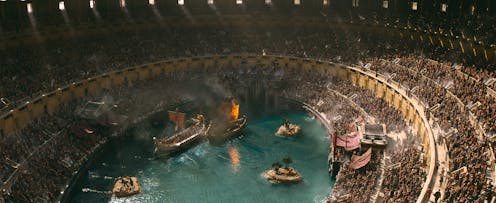
Water gushes from the Colosseum’s fountains and floods the arena. A crew of men led by the film’s hero, Lucius Verus (played by Paul Mescal), row a warship while firing arrows at another ship. Sharks loom in the surrounding water, while the Emperor Caracalla (Fred Hechinger) watches on laughing.
Gladiator II trailer.
It’s Hollywood’s first re-enactment of an ancient Roman naval battle – and it’s spectacular. The special effects from this sequence will have been a major component of the film’s reported US$310 million budget.
But is there much history to be found here, especially given Ridley Scott’s disdain for historical realities in his films? Did the Romans watch naval battles as entertainment?
Whatever is viewed in the circus and the amphitheatre […] let this be the only sea fight known to posterity.
– Martial in Liber Spectaculorum, book 28
War on the water
The term “naumachia” refers to both the staging of naval battles for mass entertainment and the structure or natural feature in which these recreations took place. Naumachiae did exist. And while they seem to have been rare, the death rates would have been high.
Much of what we know of them (and what is written in this article) comes from writing from a handful of historians, including Suetonius, Dio Cassius and Tacitus.
The earliest known naumachia was hosted by Julius Caesar in 46 BCE. Suetonius describes a basin dug near the Tiber river, in Rome’s Campus Martius area, which was large enough to host ships with more than 2,000 combatants and 4,000 rowers – all prisoners of war.
An even grander event was held in 2 BCE by the emperor Augustus for the inauguration of the Temple of Mars Ultor. It was held on an artificial lake, or “stagnum”, spanning more than 530 metres by 350 metres. An estimated 270,000 cubic metres of water would have been required to fill it.
This naumachia featured the reenactment of a naval battle between the “Athenians” and “Persians”. According to Augustus himself, more than 3,000 men fought in 30 vessels.
The largest recorded naumachia came some years later. This reenactment of battle between the “Rhodians” and “Sicilians” was staged by Claudius in 52 CE on the natural lake in Abruzzo, Italy. The event consisted of 100 naval ships and 19,000 combatants – all prisoners who had been condemned to death.
According Dio Cassius, the condemned men saluted Claudius with the phrase Ave imperator, morituri te salutant, or “Hail emperor, those who are about to die salute you”. Although this phrase is now commonly and erroneously assumed to have been spoken by gladiators prior to combat, this remains the only recorded example of its use.
Naumachiae were commonly presented as historical or pseudo-historical reenactments of real naval conflicts. Claudius’ spectacle, for instance, was between fleets representing the “Rhodians” and the “Sicilians”.
Naumachiae in amphitheatres
A new development took place in the 1st century CE: naumachiae began being performed in amphitheatres. The earliest recorded event took place in 57 CE under the rule of emperor Nero, in a wooden structure thought to have been located in the Campus Martius.
For the inauguration of the Flavian amphitheatre (the Colosseum) in 80 CE, Emperor Titus presented two naumachiae: one in Augustus’ stagnum and the other in the Colosseum itself. Titus’ successor, Domitian, is also said to have flooded the Colosseum to host a naumachia circa 85 CE.
The term naumachiae became less frequent in historical literature after the Flavian era (69–96 CE). There’s no evidence the Colosseum was hosting naumachiae as late as the 3rd century, when Gladiator II is set.
Other water spectacles across the Empire
There is some better-preserved evidence of aquatic spectacles on a smaller scale outside of Rome. In Spain, ampitheatres at Verona and Mérida feature central basins connected to water supply and drainage channels.
However, only modest naumachiae would have been possible in these – the arenas presumably covered with wooden floorboards when not used for this purpose.
The ampitheatre at Mérida, Spain, with a sunken basin visible in the centre of the arena. Wikimedia, CC BY-SA
Water was also used in other forms of entertainment, such as to display marine animals. For instance, in 2 BCE 36 crocodiles were released in a flooded arena and hunted. It was also common for female swimmers to portray Nereids (water nymphs) in flooded arenas, similar to modern artistic swimming.
Just as there is evidence of older Roman theatres being converted for gladiator contests and beast hunts, there is also strong evidence of theatres having been modified for aquatic spectacles. This includes theatres in the Greek cities of Corinth and Argos, as well as in Ostia, Italy.
Recent investigations by University of Sydney archaeologists have revealed further evidence of such modifications at the site of Paphos in Cyprus.
They’ve found evidence of the Paphos theatre’s orchestra being converted for water spectacles in the mid-third century – its floor covered with a cement and coloured stone. With an estimated capacity of 310 cubic metres, this theatre was likely too small to host naumachiae, but would have been ideal for displaying animals or water nymphs.
A semicircular containment wall about one metre high separated the audience from the action, while drains and terracotta pipes indicate the flow of water from a large reservoir excavated behind the theatre. Analysis of the plaster on the floor has also confirmed it was waterproof.
The site provides a valuable contribution to our understanding of Roman water spectacles.
In this photo of the Paphos theatre, you can see the semi-circular containment wall surrounding the orchestra. This wall acted as abarrier between the arena and the audience in the third century CE. Photo by Bob Miller/Paphos Theatre Archaeological Project, CC BY-SA
So when you’re watching the naval battle in Gladiator II, it’s worth remembering how the ancient Romans viewed this spectacle in much the same way. Just like back then, a lot of money was spent to bring this entertainment to life.
Luckily, nobody had to die this time around.
I am the director of the Paphos Theatre Archaeological Project which is discussed in this paper.
Source: The Conversation (Au and NZ) – By Kathryn Henne, Professor and Director, School of Regulation and Global Governance, Australian National University
Police departments around the world are increasingly using body-worn cameras in an attempt to improve public trust and accountability. But this has created huge amounts of data, about 95% of which is never reviewed or even seen.
Enter companies such as Axon, Polis Solutions and Truleo. These companies market artificial intelligence (AI) tools for analysing the data generated by body-worn cameras and other policing technologies.
Some police departments in the United States previously launched trials of these tools before abandoning them because of concerns about privacy.
Truleo told The Conversation that police in Australia were now using its technology, but did not name any specific department. However, when The Conversation asked Australian police departments if they were using or considering using Truleo’s software, all except the Queensland Police Service said they were not.
In a statement, a Queensland Police Service spokesperson said it is currently conducting an AI trial with “a variety of technology” as part of its work tackling domestic and family violence. The spokesperson added: “Once the trial is completed, a detailed evaluation will be undertaken before the QPS considers future options for using the technology”.
But AI will not solve the challenges facing police – at least, not by itself.
The unfulfilled promise of body-worn cameras
The increased use of body-worn cameras by law enforcement agencies in recent years follows a number of high-profile cases involving police using force. In Australia, for example, a police officer is currently on trial for the manslaughter of a 95-year-old great-grandmother by using a taser.
There is debate about whether body-worn cameras actually make police officers’ behaviour more transparent and accountable.
The study examined the use of body-worn cameras in response to domestic and family violence in Australia. It acknowledged their potential utility but showed how data from these technologies might not be used to support victim-survivors. This is because of more foundational problems with how police engage with victim-survivors.
AI’s many uses in policing
Police have been using AI as part of their work for a long time.
For example, in 2000, New South Wales Police launched a program that used data analytics to predict which people were at risk of committing a crime, to enhance police supervision.
A report from the Law Enforcement Conduct Commission later revealed the program disproportionately targeted Indigenous youth, who subsequently faced heightened surveillance and increased arrests for minor crimes. This led to NSW Police ending the program in 2023.
The Queensland Police Service has also proposed a program using AI technologies to predict risk of domestic and family violence.
Companies such as Truleo, which provides police with AI tools to analyse body-worn camera footage, say these tools improve police “professionalism”. However, it is not clear if what is being measured and assessed as “professionalism” correlates with officers’ core duties and responsibilities.
In fact, the Seattle Police Department in the US ended its contract with Truleo despite acknowledging it was a “promising” trial.
It did so after finding a case of unprofessional conduct in which the police union cited the use of camera footage as infringing on the police officer’s privacy.
About 95% of all body-worn camera footage isn’t reviewed or even seen. John Gomez/Shutterstock
The need for structural reform
AI tools could help police manage and analyse body-worn camera data. Their value depends on several conditions.
First, police must thoroughly evaluate any AI tools to ensure they are fit for purpose in a local context. Many of these technologies are developed overseas and trained on data that have linguistic features such as accents, inflections and insults that are not common in Australia.
Second, police – and the companies that offer AI data analysis tools – must also be transparent about how they use body worn camera footage. In particular, they must share where, how and by what arrangements data is processed and stored.
Finally – and most importantly – the use of AI technologies by police should not supersede organisational and structural reforms.
Police need to examine the impact of behaviours and processes that have resulted in inequitable surveillance practices. AI technologies are not solutions to these underlying dynamics.
Without an understanding of the systemic structures that sustain disparities in the criminal legal system, police will not be prepared to address the implications of integrating AI technologies into their work. If they do not, these technologies are more likely to exacerbate existing injustices and inequalities.
In short, the questions about AI shouldn’t be simply about technology but about police legitimacy.
Kathryn Henne’s research is supported by funding from the Australian Research Council, Consortium of Humanities Centers and Institutes, Google Academic Research Awards Program, National Endowment for the Humanities and Social Sciences and Humanities Research Council.
Charles Gretton receives funding from Australian government agencies. Charles’ research has also been supported by Oracle for Research. Charles is a Fellow Member of Engineers Australia, a member of the Association for the Advancement of Artificial Intelligence, and an Associate Member of the Australian Information Industry Association.
Kanika Samuels-Wortley receives funding from the Social Science and Humanities Research Council, Canada Research Chair Program.
Source: The Conversation (Au and NZ) – By Imraan Valodia, Pro Vice-Chancellor, Climate, Sustainability and Inequality and Director, Southern Centre for Inequality Studies, University of the Witwatersrand
Since the Industrial Revolution, country after country has turned to fossil fuels to power their transport and industry.
Now the bill is coming due. Huge volumes of long-buried carbon are in the atmosphere, warming the planet. Climate disasters are arriving more often and getting worse.
But the pain from climate change is not distributed fairly. Developing nations are suffering the worst, despite emitting far fewer greenhouse gases. To date, two regions – Europe and North America – have contributed fully 60% of the world’s total emissions. This has made them much richer, but at a cost borne largely by those of us in the Global South.
This injustice will be in the spotlight this week, as leaders and diplomats gather in Baku, Azerbaijan, for the yearly United Nations climate talks. Climate finance is high on the agenda – specifically, the vexed question of who pays.
Who is responsible for climate change?
Historically, North America and Europe are the highest emitters.
Asia’s emissions have grown sharply in recent decades, due to its high population size, sustained economic growth in China and high emitting, oil-reliant Gulf states.
By contrast, Africa and South America are each only responsible for 3% of the world’s total emissions over time.
This is a necessarily simplistic picture. It hides, for instance, which companies and organisations emitted most in Europe and North America, as well as which income groups emit most.
But even at this level, it is increasingly clear the wealthiest people in the world are the highest emitters – including the rich who live in the Global South.
This unequal distribution of emissions gave rise to the principle of “common but differentiated responsibilities” in international environmental law in the 1990s.
This phrase speaks to the common responsibility to tackle climate change, the fact some nations have contributed less to the problem and some much more, and that some can respond more easily to the threat.
The idea was first articulated in the 1992 Rio Declaration on sustainable development. It was featured in the 1996 Kyoto Protocol on climate change and the 2015 Paris Agreement.
Pain for the poor
Until very recently, economic growth went hand in hand with using ever more fossil fuels.
The problem is the benefits were localised (an industry booms, a country gets wealthier), the environmental cost was deferred until later, and the damage would be borne more widely.
If fast-growing countries like Ethiopia, and Indonesia took the same route, climate change would get even worse and the world would blow through its shrinking carbon budget.
This is just one of many cruel twists of fate. As the damage done by climate change intensifies, developing countries have to spend more of their budgets on maintaining the status quo – repairing broken bridges, keeping farmers afloat – and less on improving the lives of their citizens.
Climate change also poses major financial risks to developing nations. To cope with more and worse disasters, governments have to borrow more. More of their budgets have to go towards servicing debt, leaving less for everything else.
Right now, millions are going hungry in southern Africa, after an unprecedented drought devastated crops. Zimbabwe has lost 80% of its crops, Zambia 70%.
In 2022, catastrophic floods in Pakistan forced almost 8 million people to leave their homes and forced another 20 million to seek immediate humanitarian aid.
These disasters are bad enough. But they can also disrupt national climate efforts. The hydroelectric Kariba Dam has long provided low-carbon power to Zambia and Zimbabwe. But the water level has dropped sharply due to the drought. In September, the dam stopped generating electricity – and brought power cuts across both nations. In response, the governments have looked to solar and even coal.
The Kariba dam between Zambia and Zimbabwe has been turned off, as water levels were too low to generate power. Keith Syse/Shutterstock
Who pays for loss and damage?
Adapting to climate change can only go so far. In response, nations in the Global South have sought recognition of the disproportionate loss and damage they were suffering.
It took a decade of negotiation, stalling and delay before agreement was reached to create the Loss and Damage Fund at last year’s COP climate talks. It will be hosted in the World Bank at first. No funds have yet flowed.
This year’s COP meeting has been dubbed the “finance COP”. On the table will be how to structure this fund. One challenge will be securing funding, given contributions are voluntary and the Green Climate Fund and Adaptation Fund are also seeking funding for mitigation and adaptation projects.
In 2009, nations agreed to fund climate change adaptation and mitigation at $100 billion a year. This figure has now been reached.
The top item at this year’s climate talks will be setting a bigger goal for these climate funds. We don’t know yet whether loss and damage will be included alongside adaptation (living with it) and mitigation (preventing it). Leaders and activists in the Global South have called for a much larger sum for loss and damage, starting at $724 billion per year.
Climate change is already costing poor nations a great deal of money, estimated at $100 to $500 billion in damage each year.
If this year’s COP is to correct this injustice, funding must be in line with expected costs. Funding should flow largely as grants, rather than loans. And wealthy nations should also contribute towards the loss and damage already being suffered.
Unfortunately, we’re unlikely to see this happen if history is any guide. The COP discussions will be overshadowed by the election of Donald Trump, who has promised to give fossil fuel companies free rein.
Even so, these talks offer an important way to get wealthy nations to pay attention to the very real damage done by climate change, far from the headlines. Persistence and advocacy may still pay off.
Imraan Valodia receives fundings from a large number of South Africa and international funding agencies that support academic research at universities.
Julia Taylor receives funding from various South African and international funding agencies that support academic research at universities.
Katrina Lehmann-Grube receives funding from various South African and international funding agencies that support academic research at universities.
Language trends change quickly at the hands of social media users. They explode into our screens, rather than slowly evolve. This can change the ways we talk about diagnoses such as autism and concepts like neurodiversity.
But before we use a term, we should look at how it came to be and what it means to people.
So where does the new word “neurospicy” come from? And why do some people embrace it, while others reject it?
First, let’s unpack ‘neurodiversity’
The term neurodiversity evolved collectively in the mid-1990s in an online space dedicated to autistic people.
The term refers to the neurological diversity found across the human species. It is a way to include brains and minds that diverge from what society considers neurologically typical or “neurotypical”.
Australian sociologist Judy Singer first used the term in academia in her 1998 honours thesis and it made its way to mainstream media the same year.
The terms neurodivergent and neurotypical are now well studied and well defined by academics and the neurodiversity movement. Outside of this, though, language can change meaning.
The neurodiversity movement promotes equality
The neurodiversity movement came from the autism rights movement, and for many, the term neurodivergent is associated with autism.
The concept of neurodivergence has broadened over time to include people with conditions such as intellectual disability, mental illness, attention deficit hyperactivity disorder (ADHD), dyslexia and acquired brain injury.
However, a person cannot be diagnosed as neurodivergent. A person can only be diagnosed with a condition that indicates neurodivergence.
The neurodiversity movement is a disability rights movement that focuses on equal rights for neurodivergent people.
Advocates say people with conditions such as autism and ADHD should be accepted rather than “cured”. They argue an inclusive society should ensure equal access to ethical care and support to everyone, including neurodivergent people.
This movement began at a time when most of the autism research focused on finding a cure.
Some argue it doesn’t represent people with high support needs
One of the main criticisms of the neurodiversity movement is it doesn’t address the complex needs of many autistic people.
An autistic person can be non-speaking, have intellectual disability and severe anxiety, requiring a lot of daily support. The people who advocate on behalf of autistic people with complex needs are parents and concerned clinicians.
To these advocates, an acceptance of neurodiversity and an equal rights campaign is not enough. Some argue that neurodivergence, particularly autism, is a medical problem that needs “treatment”.
But both groups want to highlight the care and support needs of this part of the autistic population.
Why do some people favour the term ‘neurospicy’?
Words like neurodiverse, neuro-inclusive, neuro-affirming and neurospicy are neologisms (new words) related to neurodiversity.
These words don’t come from the original group in the 1990s or from medical professionals. They come from a large online community of neurodivergent people.
Neurospicy is a way of describing a person who experiences multiple forms of neurodivergence, or a collective, such as a family that has many neurodivergent members.
For some, the use of neurospicy avoids disclosure of a diagnosis.
Others feel it’s a creative way of pushing back against medical terms such as “mild autism”.
Neurospicy embodies the richness, the zest, and the profound depth that characterise our unique neurological makeup. It’s a celebration of the vibrant, sometimes intense, facets of our identities.
Why do some people dislike it?
The use of neologisms like neurospicy is controversial inside and outside the neurodivergent community.
Some parent advocates feel that terms associated with neurodiversity erase the profound difficulties of autistic people.
Speaking of her son Zack, author Whitney Ellenby says:
Blurring his identity under the indistinct banner of “neurodiverse” erases Zack’s lived history – all that he has endured and overcome to get here.
Neurodivergent people have also had some strong reactions to the word neurospicy. Neurodivergent podcaster Danielle Sullivan asks if neurospicy is just a cute, quirky word or a way to avoid saying disabled.
Some argue we should abandon words such as neurospicy and “neurosparkly” and be clear that we’re talking about disability:
So it seems that some neurodivergent people and people who support the medical model of autism agree about refocusing on disability.
So is it OK to say neurospicy?
Before picking up a new language trend, consider the history and the power of words.
Moving forward, we can ask individuals and families how they refer to themselves and their diagnosis. We will find a variety of responses including neurospicy, autistic, disabled, neurodivergent, has autism or ADHD, or my disability doesn’t define me.
Asking about people’s preferences gives us an opportunity to provide an affirming environment for all, and a space to continue to explore this conversation.
Katharine Annear is affiliated with Autism CRC Ltd
Source: The Conversation (Au and NZ) – By Evangeline Mantzioris, Program Director of Nutrition and Food Sciences, Accredited Practising Dietitian, University of South Australia
Just as a Formula 1 team wouldn’t use shoddy fuel for their cars, elite athletes shouldn’t eat poorly as they try to get the best out of themselves.
Nutrition is crucial for fuelling athletes for training, performance and recovery.
Carbohydrates provide energy – they fuel the body for exercise and help to sustain performance, and then aid recovery after exercise. Protein is important to repair and build muscles after exercise.
Athletes’ nutrient requirements for carbohydrates and protein will depend on the type, intensity, and duration of the exercise they complete and their body weight.
Individual requirements vary: athletes will need more carbs through the day if they exercise at greater intensities for longer periods. Also, the more the athlete weighs, the more carbs and protein they will require.
Although research in this area has grown and there is increased focus on education, it seems many elite athletes still find it difficult to fuel their bodies.
What did we look at?
The AFLW is an emerging sport, and we were interested to see if these elite women footballers met the recommendations for daily protein and carbohydrate intake as well as during competition.
We asked AFLW players from one team to tell us what they ate across the season by filling out electronic food diaries.
We were also interested in what they ate on match days.
In addition to filling out a diary at home, we videoed and directly observed what they ate when they were at the football ground.
What did we find?
We found more than 80% of these athletes did not consume enough carbohydrates across pre-season and in-season competition.
On match days, only 18% met their daily carbohydrate requirements.
We also found they did not eat carbohydrates at the right time to fuel their performance – which is before (pre-game) and during a game. Interestingly, when the games were scheduled later in the day, athletes were more likely to meet the pre-game recommendations.
All athletes ate enough carbohydrates after a game.
When it came to protein, all the athletes in our study met their requirements across the season, including on match days.
This isn’t new
Unfortunately, these findings are not unusual for women athletes.
In a systematic review that combined 20 studies of field-based women athletes across different sports, many athletes had low energy and carbohydrate intakes. This was also found in women soccer and volleyball players, and individual sport athletes such as gymnasts.
On average across these studies, less than 50% of the women athletes typically met the recommended daily amount of carbohydrates.
Why is this a problem?
While low energy and carbohydrate intakes can negatively impact an athlete’s performance, it also impacts on their general health.
Athletes who consistently fail to eat enough energy and carbohydrates over a long period of time may be at risk of low energy availability. This can result in physical and mental health problems, a syndrome known as relative energy deficiency in sport REDs.
In addition to poor sports performance outcomes, REDs can result in mood disturbances, reduced sleep quality, impaired growth and development, reduced cardiovascular function and impaired bone health.
Reduced performance during exercise could include decreased muscle strength, endurance, power, ability to recover and reduced motivation.
Why do women athletes avoid carbohydrates?
It’s hard to know exactly why an athlete would consume so few carbs but one reason could be due to the messaging on social media spruiking low-carb and keto diets.
It may also be due to the increased time demands for semi-professional athletes: many AFLW athletes are still working while training.
Sports dietitians promote a food-first approach, which focuses on using everyday foods to meet athletes’ daily energy and nutrient needs before considering sports foods.
While our research focused on elite women athletes, it is relevant for all women involved in sport.
Regardless of your level of competition, or even if you are a weekend warrior, it is important to meet your energy goals with adequate carbohydrate intake for your activity.
Here are some examples of foods and drinks you can eat to help increase your carbohydrate (and energy) intake for improved performance:
Evangeline Mantzioris is affiliated with Alliance for Research in Nutrition, Exercise and Activity (ARENA) at the University of South Australia. Evangeline Mantzioris has received funding from the National Health and Medical Research Council, and has been appointed to the National Health and Medical Research Council Dietary Guideline Expert Committee.
Alison M. Hill and Chloe Otte do not work for, consult, own shares in or receive funding from any company or organisation that would benefit from this article, and have disclosed no relevant affiliations beyond their academic appointment.
With the protest hīkoi from the Far North moving through Rotorua on its way to Wellington, it might be said ACT leader David Seymour has been granted his wish of generating an “important national conversation about the place of the Treaty in our constitutional arrangements”.
Timed to coincide with the first reading of the contentious Principles of the Treaty of Waitangi Bill yesterday — it passed with a vote of 68-55, the hīkoi and other similar protests are a response to what many perceive as a fundamental threat to New Zealand’s fragile constitutional framework.
With no upper house, nor a written constitution, important laws can be fast-tracked or repealed by a simple majority of Parliament.
As constitutional lawyer and former prime minister Geoffrey Palmer has argued about the current government’s legislative style and speed, the country “is in danger of lurching towards constitutional impropriety”.
Central to this ever-shifting and contested political ground is te Tiriti o Waitangi/Treaty of Waitangi. For decades it has been woven into the laws of the land in an effort to redress colonial wrongs and guarantee a degree of fairness and equity for Māori.
There is a significant risk the Principles of the Treaty of Waitangi Bill would undermine these achievements, as it attempts to negate recognised rights within the original document and curtail its application in a modern setting.
But while the bill is almost guaranteed to fail because of the other coalition parties’ refusal to support it beyond the select committee, there is another danger. Contained in an explanatory note within the bill is the following clause:
The Bill will come into force if a majority of electors voting in a referendum support it. The Bill will come into force 6 months after the date on which the official result of that referendum is declared.
Were David Seymour to argue his bill has been thwarted by the standard legislative process and must be advanced by a referendum, the consequences for social cohesion could be significant.
The referendum option While the bill would still need to become law for the referendum to take place, the option of putting it to the wider population — either as a condition of a future coalition agreement or orchestrated via a citizens-initiated referendum — should not be discounted.
One recent poll showed roughly equal support for and against a referendum on the subject, with around 30 percent undecided. And Seymour has had success in the past with his End of Life Choice Act referendum in 2020.
He will also have watched the recent example of Australia’s Voice referendum, which aimed to give a non-binding parliamentary voice to Indigenous communities but failed after a heated and divisive public debate.
The lobby group Hobson’s Pledge, which opposes affirmative action for Māori and is led by former ACT politician Don Brash, has already signalled its intention to push for a citizens-initiated referendum, arguing: “We need to deliver the kind of message that the Voice referendum in Australia delivered.”
The Treaty and the constitution ACT’s bill is not the first such attempt. In 2006, the NZ First Party — then part of a Labour-led coalition government — introduced the Principles of the Treaty of Waitangi Deletion Bill.
That bill failed, but the essential argument behind it was that entrenching Treaty principles in law was “undermining race relations in New Zealand”. However, ACT’s current bill does not seek to delete those principles, but rather to define and restrain them in law.
This would effectively begin to unpick decades of careful legislative work, threaded together from the deliberations of the Waitangi Tribunal, the Treaty settlements process, the courts and Parliament.
would reduce the constitutional status of the Treaty/te Tiriti, remove its effect in law as currently recognised in Treaty clauses, limit Māori rights and Crown obligations, hinder Māori access to justice, impact Treaty settlements, and undermine social cohesion.
If this Bill were to be enacted, it would be the worst, most comprehensive breach of the Treaty/te Tiriti in modern times. If the Bill remained on the statute book for a considerable time or was never repealed, it could mean the end of the Treaty/te Tiriti.
Social cohesion at risk Similar concerns have been raised by the Ministry of Justice in its advice to the government. In particular, the ministry noted the proposal in the bill may negate the rights articulated in Article II of the Treaty, which affirms the continuing exercise of tino rangatiratanga (self-determination):
Any law which fails to recognise the collective rights given by Article II calls into question the very purpose of the Treaty and its status in our constitutional arrangements.
The government has also been advised by the Ministry of Justice that the bill may lead to discriminatory outcomes inconsistent with New Zealand’s international legal obligations to eliminate discrimination and implement the rights of Indigenous peoples.
All of these issues will become heightened if a referendum, essentially about the the removal of rights guaranteed to Māori in 1840, is put to the vote.
Of course, citizens-initiated referendums are not binding on a government, but they carry much politically persuasive power nonetheless. And this is not to argue against their usefulness, even on difficult issues.
But the profound constitutional and wider democratic implications of the Principles of the Treaty of Waitangi Bill, and any potential referendum on it, should give everyone pause for thought at this pivotal moment.
The yet-to-be-named proposed law, set to be introduced to parliament by the end of the year, refers to a range of stalking behaviours, including the “use of technology in modern stalking methods”.
If passed, the new law will make “cyberstalking” illegal, bringing New Zealand in line with other countries, including the United Kingdom and Australia.
But while the legislation is welcome, there are still issues to be addressed to ensure the law is relevant to where the technology is now – and where it could develop in the future.
Using technology to hurt others
Cyberstalking is the repeated use of digital tools to harass, coerce, frighten or intimidate another person. It can include using social media, GPS tracking or spyware tools to covertly monitor someone’s location or conversations.
It also includes sending repeated unwanted messages or threats, posting someone’s personal information online (also known as “doxxing”), setting up fake social media accounts to spread false information about someone, or sharing intimate images or videos of someone without consent.
Although it often coincides with stalking offline, cyberstalking is unique in that perpetrators do not need to share the same physical space as the victim to harm them.
Because of the central role technology plays in our lives, cyberstalkers can create such a sense of omnipresence that their victims feel they cannot escape them.
But the proposed legislation would also cover incidents of cyberstalking by strangers. This would give police more options when it comes to helping public figures who experience significant cyberstalking and online harassment.
Overlapping rules
The complete text of the proposed legislation hasn’t been released yet. But from what has been announced, there is some potential overlap with offences under the Harmful Digital Communications Act 2015 (HDCA).
Under the HDCA, it is an offence to post a harmful digital communication with an intent to cause serious emotional distress. It is also a crime to post an intimate visual recording without consent.
These offences cover some aspects of cyberstalking, such as threatening messages, harassment or revenge porn. But they do not cover others such as monitoring or tracking someone, or locking someone out of their social media accounts.
The maximum sentence for these offences is two years imprisonment or a fine of up to NZ$50,000.
The new stalking offence “will capture patterns of behaviour, being three specified acts occurring within a 12-month period”, and will have a maximum sentence of five years imprisonment.
This signals that cyberstalking will be treated as more serious than offences under the HDCA.
Limits of the new law
The focus of the new offence is on patterns of behaviour over a period of time, transforming acts that might be captured under the HDCA into something more serious because of their repetition.
Given the gendered nature of cyberstalking, taking women’s fear seriously in this way is positive and significant. But the government also needs to review the HDCA to ensure there are no unintentional gaps between the two laws.
As well, it’s unclear whether the offence will require proof the victim feared for their safety. As victims advocate Ruth Money has noted, requiring proof of emotional harm forces the victim to give evidence about their experience.
Instead, the offence should require proof that a “reasonable person” would fear for their safety, Money has argued.
But given the gendered nature of cyberstalking, there are limitations with this, too. The “reasonable person” standard does not easily incorporate the gendered aspects of abuse – the specific ways in which women are targeted.
To address this, the new law could include a list of factors to provide guidance on what would lead a reasonable person to fear for their safety.
Finally, any stalking offence must be defined in a way that is future-proofed as “any stalking facilitated by technology”.
Emerging technologies will undoubtedly introduce new ways to cyberstalk and harass. For example, AI advances are already facilitating non-consensual image manipulation or generation.
The blending of virtual and augmented realities introduces new challenges for addressing harassment in what is often called the “metaverse”.
A blunt instrument
Overall, the proposed law is a step in the right direction for addressing aspects of online abuse.
But it is important to note that criminalisation is a blunt instrument to control behaviour, and often does not coincide with deterrence of that behaviour. The HDCA, for example, has done little to stop the rise of online harassment.
To really address cyberstalking, the government needs to examine the root causes behind the behaviour – including pervasive sexism in the technology development industry and elsewhere.
Cassandra Mudgway does not work for, consult, own shares in or receive funding from any company or organisation that would benefit from this article, and has disclosed no relevant affiliations beyond their academic appointment.
Black holes don’t have many identifying features. They come in one colour (black) and one shape (spherical).
The main difference between black holes is mass: some weigh about as much as a star like our Sun, while others weigh around a million times more. Stellar-mass black holes can be found anywhere in a galaxy, but the really big ones (known as supermassive black holes) are found in the cores of galaxies.
These supermassive behemoths are still quite tiny when seen in cosmic perspective, typically containing only around 1% of their host galaxy’s mass and extending only to a millionth of its width.
However, as we have just discovered, there is a surprising link between what goes on near the black hole and the shape of the entire galaxy that surrounds it. Our results are published in Nature Astronomy.
When black holes light up
Supermassive black holes are fairly rare. Our Milky Way galaxy has one at its centre (named Sagittarius A*), and many other galaxies also seem to host a single supermassive black hole at their core.
Under the right circumstances, dust and gas falling into these galactic cores can form a disk of hot material around the black hole. This “accretion disk” in turn generates a super-heated jet of charged particles that are ejected from the black hole at mind-boggling velocities, close to the speed of light.
When a supermassive black hole lights up like this, we call it a quasar.
How to watch a quasar
To get a good look at quasar jets, astronomers often use radio telescopes. In fact, we sometimes combine observations from multiple radio telescopes located in different parts of the world.
Using a technique called very long baseline interferometry, we can in effect make a single telescope the size of the entire Earth. This massive eye is much better at resolving fine detail than any individual telescope.
As a result, we can not only see objects and structures much smaller than we can with the naked eye, we can do better than the James Webb Space Telescope.
Black holes are millions of times smaller than galaxies, yet make jets that are pointed in the same direction as the entire galaxy. Optical image: NASA, ESA, R.M. Crockett (University of Oxford, U.K.), S. Kaviraj (Imperial College London and University of Oxford, U.K.), J. Silk (University of Oxford), M. Mutchler (Space Telescope Science Institute, Baltimore, USA), R. O’Connell (University of Virginia, Charlottesville, USA), and the WFC3 Scientific Oversight Committee. Top right: MOJAVE Collaboration, NRAO/NSF. Bottom right: Event Horizon Telescope / ESO (same as before) CC BY-SA
This is the technique that was used to make the first “black hole image” in 2019, showing the halo of light generated around the supermassive black hole hosted by the galaxy M87.
Quasar jets that can be detected using very long baseline interferometry can be millions of light years long and are almost always found in elliptical galaxies. Using very long baseline interferometry, we can observe them all the way down to a few light years or so from their black hole of origin.
The direction of the jet near its source tells us about the orientation of the accretion disk, and so potentially the properties of the black hole itself.
Connection to the host galaxy
What about the host galaxies? A galaxy is a three-dimensional object, formed of hundreds of billions of stars.
But it appears to us (observed in optical or infrared) in projection, either as an ellipse or a spiral. We can measure the shape of these galaxies, tracing the profile of starlight, and measure the long axis and short axis of the two-dimensional shape.
In our paper, we compared the direction of quasar jets with the direction of this shorter axis of the galaxy ellipse, and found that they tend to be pointing in the same direction. This alignment is more statistically significant than you would expect if they were both randomly oriented.
This is surprising, as the black hole is so small (the jets we measure are only a few light years in length) compared to the host galaxy (which can be hundreds of thousands or even millions of light years across).
It is surprising that such a relatively small object can affect, or be affected by, the environment on such large scales. We might expect to see a correlation between the jet and the local environment, but not with the whole galaxy.
How galaxies form
Does this have something to say about the way galaxies form?
Spiral galaxies are perhaps the most famous kind of galaxy, but sometimes they collide with other spirals and form elliptical galaxies. We see these three-dimensional egg-shaped blobs as two-dimensional ellipses on the sky.
The merger process triggers quasar activity in ways we don’t fully understand. As a result, almost all quasar jets that can be detected using very long baseline interferometry are hosted in elliptical galaxies.
The exact interpretation of our results remains mysterious, but is important in the context of the recent James Webb Space Telescope discovery of highly massive quasars (with massive black holes), which have formed much earlier in the universe than expected. Clearly, our understanding of how galaxies form and how black holes influence that needs to be updated.
David Parkinson receives funding from the Korea Astronomy and Space Science Institute.
Jeffrey Hodgson receives funding from the National Research Foundation of Korea.
Former winner of TV show Alone Australia Gina Chick was diagnosed with breast cancer just days after finding out she was pregnant. She describes in her recent book her experience with chemotherapy and what followed.
Thankfully, cancer diagnoses during pregnancy and in the year following the birth are rare. But such cases are becoming more common in parts of the world, including Australia. Researchers aren’t exactly sure why.
Here’s what researchers know so far, and the options for treatment.
Gina Chick tells ABC TV’s Australian Story about life, loss and Alone Australia.
How rare is it?
A New South Wales study found that in 1994 there were about 94 cancer diagnoses during pregnancy or within one year of birth per 100,000 women giving birth. That rose to about 163 per 100,000 in 2013. Although these statistics are more than ten years old, these are the most recent and rigorous data available in Australia.
A 2023 Swedish study of pregnancies in 1973-2017 had similar findings.
Both studies found about one-quarter of pregnancy-associated cancers are diagnosed before birth, with the rest diagnosed in the year after birth.
What type of cancers are we talking about?
The United Kingdom’s first comprehensive assessment of cancer during pregnancy looked at diagnoses in 2016-2020.
This study, the NSW study, and others, have found breast and skin cancers (often melanoma) were the most common pregnancy-associated cancers. There were also high rates of thyroid, gynaecological (particularly cervical and ovarian) and blood cancers in this group.
The UK study found about 92% of cancers were new diagnoses and about 82% had symptoms. The majority (81%) were treated with the aim to cure and about 82% of pregnancies associated with a cancer diagnosis resulted in a live birth.
However, 20% of mothers died by the end of the five year study period. Gastrointestinal (gut) cancers were particularly concerning. They had the highest mortality rate at about 46% and were associated with diagnosis at a more advanced stage of cancer.
This may be because many symptoms of gastrointestinal cancers such as abdominal pain, fatigue and acid reflux overlap with those of pregnancy. In other words, some cancer symptoms can be mistaken for pregnancy symptoms, “masking” or delaying a cancer diagnosis.
The broad range of cancers presenting during and after pregnancy suggests a variety of contributing factors.
In high socioeconomic countries women are having children later in life and the biggest risk factor for many cancers is increasing age. However, the evidence for age being a major factor in pregnancy-related cancer is inconclusive. This may account for some but not all cases.
Another factor may be the rising use of prenatal genetic screening tests in early pregnancy. These analyse DNA derived from the mother’s blood to detect chromosomal abnormalities in the developing fetus. But these tests can also give information about the mother’s chromosomes. This has led to diagnoses of Hodgkin disease, breast and colorectal cancer in pregnant women without symptoms.
Oestrogen and progesterone are two hormones important for growth and development of breast tissue and to support other aspects of a healthy pregnancy. These may also contribute to cancer development, particularly breast cancer. However, it’s not clear whether this is linked to rising rates of pregnancy associated cancers.
Other cancers, such as skin cancer, are associated with environmental factors such as UV exposure. Notably, melanoma was the leading pregnancy-associated cancer in the NSW study, reflecting the high rate of skin cancer in the local population. Other environmental factors, such as smoking and human papillomavirus, are associated with cervical cancer. Again we’re not sure whether such factors are linked with rising rates of pregnancy associated cancers.
Pregnancy complicates a cancer diagnosis, as any potential treatment for the mother may risk the health and viability of the fetus. So some aspects of treatment may need to be adjusted.
Surgery can usually be undertaken during any trimester depending on where the cancer is located.
Radiotherapy needs careful planning because the impact of radiation on the fetus depends on the developmental stage, where the radiation is applied to the body, and the dose.
Chemotherapy should be avoided in the first trimester due to potential toxic effects on the fetus. But it can usually be given in the second and third trimester. Chemotherapy should be avoided within three weeks of the birth to reduce the chance of bleeding and infection in the newborn, who may also have a weakened immune system from the chemo.
More targeted immunotherapies are generally given to the mother after she’s given birth. Depending on the treatment, she may be advised not breastfeed. That’s because the medicine can pass from the mother via breastmilk to the baby.
What happens to the babies?
Reassuringly, the NSW data found no increase in the rate of babies dying around the time of birth if they were born to mothers with a pregnancy-associated cancer.
However, there were more planned preterm births. This is because women are offered an induction of labour and/or a caesarean to facilitate cancer treatment for the mother, while reducing treatment-related risks to the unborn child.
There were also higher rates of babies born with a low birth weight and low Apgar scores (indicators of a baby’s condition shortly after birth) – possibly related to being born pre-term.
What do researchers want to know?
We have much to learn about what’s behind the increasing rates of pregnancy-associated cancers, and what women diagnosed with these cancers can expect.
We also need to combine cancer and obstetric data in national databases. This would allow us to see which areas to prioritise for further research, inform clinical guidelines to screen for cancers during and after pregnancy, and would help evaluate responses to screening programs or therapies in the future.
Sean Seeho receives funding from the National Health and Medical Research Council and the Ramsay Hospital Research Foundation. He is the chair of Stillbirth Foundation Australia.
Sarah Sasson does not work for, consult, own shares in or receive funding from any company or organisation that would benefit from this article, and has disclosed no relevant affiliations beyond their academic appointment.
Source: The Conversation (Au and NZ) – By David Smith, Associate Professor in American Politics and Foreign Policy, US Studies Centre, University of Sydney
Former Malaysian Prime Minister Mahathir Mohamad is famous for his forthright statements to other world leaders. In March 1989, Mahathir wrote a letter to then UK Prime Minister Margaret Thatcher that was blunt even by his standards. Unlike a lot of his angry letters, this one wasn’t published.
Mahathir’s letter was about Salman Rushdie’s controversial book, The Satanic Verses. He wrote:
I do not think I am a Muslim fanatic. Yet I find I cannot condone the writings of Salman Rushdie in his book […] And I find the attitude of the “Western Democracies” most patronising, arrogant and insensitive.
In 2019, the UK government declassified many of its Foreign and Commonwealth Office (FCO) files on the diplomatic upheaval over the novel. Mahathir’s letter to Thatcher is one of hundreds of unpublished diplomatic documents I have seen in visits to the UK National Archives since then.
My full analysis of this letter, and Thatcher’s response to it, has just been published in the Review of International Studies. It is part of a larger project I am working on about The Satanic Verses crisis and what it tells us about the place of religion in international relations.
‘The strangest and rarest crisis in history’
The Satanic Verses, published in late 1988, was met with protests throughout the Muslim world, beginning in South Asian communities in Britain. Many Muslims felt Rushdie had insulted the Prophet Muhammad for the entertainment of Western audiences.
Portrait of Ruhollah Khomeini in 1981. Wikimedia Commons
Khomeini, who was seeking to strengthen Islamic hardliners in Iran, urged “all zealous Muslims” to carry out his fatwa.
No other leader of a majority Muslim country supported the death sentence, which blatantly violated Britain’s sovereignty and international law. But Mahathir and others felt Western powers should ban The Satanic Verses to maintain good relations with the Muslim world.
Defending Rushdie’s life was, as Thatcher put it, “a simple matter”. Her government would not tolerate an Iranian incitement to murder a British citizen on British soil.
Defending his book, however, was more complicated. The British government would not ban it, but also wanted nothing to do with it.
An unusually strong and personal letter
On March 15 1989, Thatcher and Mahathir met in London to discuss matters such as arms deals and airport privatisation. The Satanic Verses issue came up only briefly, when Thatcher thanked Mahathir for his government’s “moderate” stance on the book. She explained that while she could understand the offence the book had caused, the “great religions” could withstand such attacks.
Mahathir reassured Thatcher his government would take no action beyond banning the book. He said he had set out his personal views on the affair in a letter, which he handed to Thatcher.
When her private secretary opened the letter later that day, he found it was “cast in exceptionally strong language that was not reflected in Dr Mahathir’s demeanour at the meeting itself”, according to another archival letter.
Mahathir was having none of the argument that Muslims should behave more like Christians when it came to tolerating insults to their faith. He wrote:
It is well to remember that Islam has been around only 1,400 years. The faith and fervour of the Muslims are as strong as the faith and fanaticism of the Christians of the 15th century.
Of course, our behaviour is also influenced by the mores of the time. We are more tolerant than the 15th century Christians. We do not have inquisitions, we do not burn heretics at the stake, we do not torture those who blaspheme, we do not hound the new Muslim sects as you did the Protestants, and we do not indulge in pogroms. Our behaviour is more civilised than Christians when Christianity was 1,400 years old.
Mahathir’s letter was very unusual for a diplomatic correspondence in that it did not mention either Malaysia or Britain. The “we” of his letter referred to Muslims, while the “you” referred to the West.
And the West, for Mahathir, was a Christian world, though he believed Christianity was enfeebled and decaying within it. He did not want Islam to suffer the same fate.
The West controls the world media and denies others access to it. The power is, of course, abused. […] The Muslims are a particular target. They are made out to be cruel brutes given to all kinds of savagery.
While the West claimed to believe in freedom of expression, according to Mahathir, it did not allow Muslims to defend themselves against what they considered “scurrilous misrepresentation”. Rushdie’s book was the final straw.
Your belief in this so-called ‘freedom of expression’ for one disillusioned and misguided man is stronger than your belief in the value of good relations with 1 billion souls.
In that case, he reasoned, the West could hardly blame Muslims for defending their own principles.
“Prime Minister,” he concluded, “I am much saddened.”
A disconnect between two world views
In another archival letter, Thatcher’s private secretary noted that British officials were “rather rocked by the severity” of Mahathir’s letter.
Thatcher instructed FCO officers to draft a “reasoned response” on her behalf. David Gillmore, former high commissioner to Malaysia, warned they must try to address Mahathir’s points or the reply would sound “condescending and supercilious”.
Written in Thatcher’s voice, the letter said she was “well aware of the distress” the book had caused Mahathir and many in the Islamic world. The reply avoided creating a perception the government was responsible for it.
I must emphasise that the British Government do not in any way condone or endorse Mr Rushdie or the content of this book.
Although freedom of speech was a principle of major importance, Thatcher insisted Britain was not seeking to impose its values on the Muslim world. The issue had “nothing to do with relations between Christians and Muslims”. Rather, it was one of national sovereignty and international law.
When it came to the heart of Mahathir’s complaint, Thatcher’s response resorted to language that was polite, firm and vague:
I was especially saddened to hear you suggest that the Western-controlled media made a particular target of the Muslim world. I cannot agree that this is the case. I believe that this century has seen a growing understanding between the nations, cultures and religions of the world. We must continue to work to improve that understanding.
The British government’s view was that states in the modern age could overcome differences once caused by religion. As such, Thatcher’s response would only represent Britain, not Christendom, despite the many symbolic and even legal ways the British state was still tied to Christianity.
This was one of the reasons Thatcher and Mahathir were doomed to talk past each other. For Western leaders, political authority had superseded religious authority in the 17th century. In diplomacy today, the things that mattered were sovereign states.
The leaders of Muslim countries also viewed sovereign states as important –they were the basis of their own legitimacy. And they had to defend the state against religious radicals who wanted to remake the world along classical Islamic lines.
But for leaders like Mahathir, who grew up in a British colony, religion was still a vital force in diplomatic relations. He viewed the Western insistence on a secular world order as a continuation of colonial dominance over the Muslim world.
The legacy of The Satanic Verses
We can see from this exchange how the British government wanted to distance itself from The Satanic Verses, even as it sought to protect Rushdie.
While many fellow writers, including Muslims like Naguib Mahfouz, leapt to the defence of Rushdie and The Satanic Verses, the book had few defenders in the British government. (One exception was Rushdie’s local MP, the future Labour leader, Jeremy Corbyn.)
In his recent memoir, Knife, Rushdie notes that he got a far more sympathetic response when he was nearly murdered in 2022 than when the fatwa was issued in 1989.
Despite the British government’s notable lack of support for Rushdie’s book, Muslims in Britain and around the world felt the political and cultural power of the West was aligned against them.
This continues to be important for understanding controversies around derogatory images of the Prophet Muhammad in the West. They are never just about the images. They are also about a global imbalance of power that goes back to colonialism.
Mahathir and Thatcher were mutual admirers of each other – and both can claim to have been their countries’ most transformative leaders of the past 50 years. Mahathir, now 99, is still active in Malaysian politics despite recurring health issues.
Mahathir’s anger in this letter did not reflect personal animus against Thatcher. It foreshadowed his future emergence as a global advocate of Islamist causes. His modernist brand of Islamism may well outlast Khomeini’s, despite the violent legacy of Khomeini’s fatwa against Rushdie.
David Smith does not work for, consult, own shares in or receive funding from any company or organisation that would benefit from this article, and has disclosed no relevant affiliations beyond their academic appointment.
So how are these national treasures faring? To find out, we undertook the first comprehensive assessment of Australia’s freshwater fish species. We examined extinction risks and drivers of decline, before reviewing existing conservation measures.
Our results paint an alarming picture. More than one-third (37%) of our freshwater fish species are at risk of extinction, including 35 species not even listed as threatened. Dozens of species could become extinctbefore children born today even finish high school.
The study also reveals Australia has been putting its eggs in the wrong basket for conservation by taking actions that don’t address immediate threats, such as pest species and changes in stream flows. Our research points to more effective solutions if governments are willing to step up their efforts.
The Angalarri grunter is currently not on Australia’s threatened species list but is recommended for listing as endangered. It is declining due to degraded habitat and water quality caused by livestock and feral animals. Michael Hammer
Identifying species at risk
Recognising when species are in trouble is the first step in preventing their extinction.
Before this study, the extinction risk of most freshwater fish species had never been assessed. The group had never been looked at overall.
We began our assessments by gathering a team of 52 Australian freshwater fish experts for a five-day workshop in 2019. These experts came from universities, research organisations, museums, state government agencies, natural resource management, consultancies and non-government groups.
Together, we used information from scientific publications, museum databases, Atlas of Living Australia records, government datasets, citizen science data, and our own knowledge of freshwater fish as it applied to the task.
We identified dozens of freshwater fish species that were in trouble, but had not been recognised as threatened. This brings the proportion of our freshwater fishes at risk of extinction to a third.
Some species have declined to the extent that they could disappear after a single disturbance, such as ash washed into streams after a bushfire or the arrival of an invasive non-native fish such as trout.
We also found one New South Wales species, the Kangaroo River perch, is now extinct.
Native fish enemy #1. A brown trout caught in NSW. Invasive fish such as brown and rainbow trout are the biggest driver of native fish loss. Lee Georgeson/iNaturalist, CC BY
Get them on the list
At present, 63 freshwater fish species are on Australia’s national list of species declared as threatened under federal environmental law.
We identified 35 more species that should be listed, based on the available evidence. They include:
ornate rainbowfish and longnosed sooty grunter (vulnerable on the IUCN Red List, the global list of threatened species)
The southwest ‘Vic’ blackfish is currently not on Australia’s threatened species list but is recommended for listing as endangered. Tarmo Raadik
Maintaining an accurate threatened species list is important. When species are in trouble but not listed, they miss out on basic protections and are unlikely to receive any conservation attention.
We also identified 17 already listed species that should be reassessed by the government as their risk categories need to be changed.
One sliver of good news is the fact that the Murray cod, a favoured sport fish across eastern Australia, is now doing better and could be assessed to be removed from Australia’s threatened species list.
To prevent species extinctions, you need to address the causes of their declines. That might seem breathtakingly obvious, yet our review found a spectacular mismatch between the major threats to species at risk and the most common conservation actions.
The top three drivers of decline are invasive fish (which threaten 92% of threatened freshwater fish species), modified stream flows and ecosystems (82%), and climate change and extreme weather (54%).
For example, Australia has 40 galaxiid species, scaleless native fish shaped like slender sausages that grow to less than 15cm. But 31 of these are threatened with extinction – and rainbow and brown trout, two introduced predators, have been the biggest driver of their loss.
Australia’s southern states are greatly adding to the problem by releasing millions of trout into waterways each year for recreational fishers.
The endangered eastern freshwater cod has dwindled in part due to historic fish kills linked to dynamite blasting and pollution from mines and agriculture. It remains threatened by changes to river flows, removal of woody snags, and other damage to its habitat.
The endangered blackstriped dwarf galaxias is being stressed by the changing climate in southwest WA. Warmer and drier conditions are resulting in lower water levels and warmer water.
A waterfall has so far saved the critically endangered stocky galaxias from extinction by preventing trout from reaching its last refuge. Tarmo Raadik
The other major threats facing native fish are agriculture and aquaculture (38%), pollution (38%), hunting and fishing (19%), energy production and mining (17%), and urban development (13%).
For example, the endangered Utchee rainbowfish is struggling due to habitat loss and water pollution from farms surrounding the small number of north Queensland streams where it lives.
In contrast, the most common conservation action was simply the fact that the species occurred in a protected area (88%) or conservation area (55%).
Sadly, invasive species and climate change don’t recognise or stop at protected area boundaries.
Prevention and control of invasive species has occurred for only 21% of affected threatened species, mostly in Tasmania.
The Utchee rainbowfish is currently not on Australia’s threatened species list but is recommended for listing as endangered. It is struggling due to habitat loss and water pollution from agriculture surrounding the small number of streams where it occurs in north Queensland. ANGFA Qld
A blueprint to end extinctions
Without a major funding commitment to address the actual drivers of native fish losses, species will continue to decline, and extinctions will soon follow.
The most important conservation actions for native freshwater fish are:
update the national threatened species list to include all at-risk species
tackle invasive species such as trout, gambusia and redfin perch
identify, establish and protect additional invasive-fish-free refuge sites for species that currently occur only in a small number of locations and could be wiped out by a single event such as a bushfire
halt ongoing habitat loss and improve habitats that have been damaged
improve freshwater flows to maintain habitats such as wetlands and streams, improve water quality and give fish the natural cues they need to breed.
In 2022, the Australian government made a commitment to end extinctions. Our study provides a blueprint for how to do that for our overlooked native freshwater fish.
This waterfall in NSW has protected the native galaxias fish above it from trout. To prevent extinctions we need to find or create more invasive-fish-free refuges for native fish. Mark Lintermans
Mark Lintermans was a member of the ACT Scientific Committee and the NSW Fisheries Scientific Committee, a previous convener of the Australian Society for Fish Biology Threatened Fishes Committee, and the Alien Fishes Committee. He now provides research, monitoring and advice for threatened freshwater fish management as director of a small consultancy company. He receives funding from New South Wales and national government departments for threatened fish projects.
Jaana Dielenberg was employed by the now-ended Threatened Species Recovery Hub of the Australian Government’s National Environmental Science Program, which led an earlier stage of this research. She is a Charles Darwin University Fellow and is employed by the University of Melbourne and the Biodiversity Council.
Nick Whiterod works for the Goyder Institute for Water Research, Coorong, Lower Lakes and Murray Mouth Research Centre, which is funded by the national government to delivery research in the region. He is a member of the New South Wales Fisheries Scientific Committee.
Pupil-free or student-free days may seem like an extra holiday for students and an inconvenience for parents, who are juggling work and family.
This week, some parents in New South Wales expressed frustration about the “burden” of these days.
It may even seem like they are “easy” days for teachers without classrooms to run and regular teaching duties.
The name, unfortunately, suggests students are not the focus for these days. But nothing could be further from the truth.
How many days do schools get?
The number of pupil-free days and exactly when these occur varies between states and school sectors.
For example, Queensland government schools have five, NSW has set aside eight pupil-free days, and Victoria is considering doing the same number.
Why do we have them?
Research consistently shows teachers do not have the time to do all the things they need to do in their working weeks.
A 2022 Monash University survey of primary and high school teachers found only 41% intended to stay in the profession. One of the main reasons cited was heavy workloads.
Teachers regularly report they do not have enough time to prepare lessons. DGL Images/ Shutterstock
Teachers’ work involves much more than teaching in the classroom. It also includes planning, assessments and ever-increasing demands for data collection, administrative work and extra-curricular activities.
On top of this, they need to meet with or talk to parents about what is happening with their child and make sure they are meeting the needs of each individual student.
This means they already work more than they are paid for, either during the week or during school holidays.
When teachers are teaching, they need to keep their focus fully on their students and their families. But on top of this, they also need to fit in professional development to maintain and build on their skills, and meet annual registration requirements.
What kind of development is involved?
Pupil-free days allow teachers to stay up-to-date with curriculum changes and the latest approaches to teaching, including technological developments. This may involve training with outside experts, and importantly, opportunities to work together as a staff to share effective teaching ideas.
It also allows schools to improve what they do in the classroom and work on longer-term, school-wide strategies. For example, a schools’ anti-bullying or inclusive education policy.
Pupil-free days provide crucial breathing room for teachers to focus on their professional learning and keep their approaches to teaching current. But they also ensure schools are teaching and supporting students as well as they can.
The authors do not work for, consult, own shares in or receive funding from any company or organisation that would benefit from this article, and have disclosed no relevant affiliations beyond their academic appointment.
This article is part of The Conversation’s “Business Basics” series where we ask experts to discuss key concepts in business, economics and finance.
Thanks to the decisive victory of US President-elect Donald Trump, we’re now set to hear a whole lot more of his favourite word.
It’s something of a love affair. On the campaign trail in October, he said:
To me, the most beautiful word in the dictionary is tariff.
Previously, he’s matched such rhetoric with real policies. When he was last in office, Trump imposed a range of tariffs.
Now set to return to the White House, he wants tariffs of 10-20% on all imports to the US, and tariffs of 60% or more on those from China.
Most of us understand tariffs are some kind of barrier to trade between countries. But how exactly do they work? Who pays them – and what effects can they have on an economy?
An import tariff – sometimes called an import duty – is simply a tax on a good or service that is imported into a country. It’s collected by the government of the country importing the product.
How exactly does that work in practice?
Imagine Australia decided to impose a 10% tariff on all imported washing machines from South Korea.
If an Australian consumer or a business wanted to import a $1,200 washing machine from South Korea, they would have to pay the Australian government $120 when it entered the country.
Tariffs are charged by the government of an importing country, and usually paid by the importer. Cara Siera/Shutterstock
So, everything else being equal, the final price an Australian consumer would end up paying for this washing machine is $1,320.
If a local industry or another country without the tariff could produce a competing good at a similar price, it would have a cost advantage.
Other trade barriers
Because tariffs make imports more expensive, economists refer to them as a trade barrier. They aren’t the only kind.
One other common non-tariff trade barrier is an import quota – a limit on how much of a particular good can be imported into a country.
Governments can also create other non-tariff barriers to trade.
China suspended imports of beef from many Australian suppliers back in 2020, citing labelling and health certification problems. William Edge/Shutterstock
These include administrative or regulatory requirements, such as customs forms, labelling requirements or safety standards that differ across countries.
What are the effects?
Tariffs can have two main effects.
First, they generate tax revenue for the government. This is a major reason why many countries have historically had tariff systems in place.
Borders and ports are natural places to record and regulate what flows into and out of a country. That makes them easy places to impose and enforce taxes.
Second, tariffs raise the cost of buying things produced in other countries. As such, they discourage this action and encourage alternatives, such as buying from domestic producers.
Protecting domestic workers and industries from foreign competition underlies the economic concept of “protectionism”.
The argument is that by making imports more expensive, tariffs will increase spending on domestically produced goods and services, leading to greater demand for domestic workers, and helping a country’s local industries grow.
Tariffs may increase the employment and wages of workers in import-competing industries. However, they can also impose costs, and create higher prices for consumers.
True, foreign producers trying to sell goods under a tariff may reduce their prices to remain competitive as exporters, but this only goes so far. At least some of the cost of any tariff imposed by a country will likely be passed on to consumers.
Simply switching to domestic manufacturers likely means paying more. After all, without tariffs, buyers were choosing foreign producers for a reason.
Because they make selling their products in the country less profitable, tariffs also cause some foreign producers to exit the market altogether, which reduces the variety of products available to consumers. Less foreign competition can also give domestic businesses the ability to charge even higher prices.
Lower productivity and risk of retaliation
At an economy-wide level, trade barriers such as tariffs can reduce overall productivity.
That’s because they encourage industries to shift away from producing things for which a country has a comparative advantage into areas where it is relatively inefficient.
In addition, the tariffs introduced in 2018 and 2019 failed to increase US employment in the sectors they targeted, while the retaliatory tariffs they attracted reduced employment, mainly in agriculture.
Economists’ verdict
Tariffs can generate tax revenue and may increase employment and wages in some import-competing sectors. But they can also raise prices and may reduce employment and wages in exporting sectors.
Do the benefits outweigh the costs? Economists are nearly unanimous – and have been for centuries – that trade barriers have an overall negative effect on an economy.
But free trade does not benefit everyone, and tariffs are clearly enjoying a moment of political popularity. There are interesting times ahead.
Scott French does not work for, consult, own shares in or receive funding from any company or organisation that would benefit from this article, and has disclosed no relevant affiliations beyond their academic appointment.
Headlines following Donald Trump’s election victory focused largely on the influence of personalities, such as Elon Musk or Robert Kennedy junior, and single issues, such as how US tariff hikes would affect New Zealand’s exports.
But this oversimplifies and diverts attention from the more systemic challenges a second Trump presidency will pose for Aotearoa New Zealand’s economy.
Yes, Trump is an unpredictable authoritarian and an economic disruptor. But his policies are not novel and need to be understood in a broader context.
Many of Trump’s trade policies are an extension of recent US-centric strategies to dismantle the global free trade model. Ironically, the US largely created this model, but it no longer serves US objectives.
The international trade regime, and the neoliberal model of free trade in general, now face an existential crisis that New Zealand cannot ignore.
Free trade backlash
Trump’s tool of choice for trade policy is high tariffs or border taxes, which make imports more expensive. His agenda is driven by two factors:
increasing production and jobs in the US domestic economy and incentivising foreign firms to invest within the US border to avoid tariffs
geopolitically, using super-tariffs to undercut China’s rise as a competing power.
Neither objective is new. The tariffs Trump imposed in his previous term, especially on China, were largely continued under Joe Biden. They were part of a broader backlash against free trade agreements in the US.
Trump withdrew the US from the Trans-Pacific Partnership Agreement (TPPA). The Biden administration did not rejoin and eschewed the Democrats’ traditional approach to free trade.
Biden’s Indo-Pacific Economic Framework (IPEF) promoted non-tariff strategies designed to boost US industrial, investment and security interests in Asia. Its “friend-shoring” approach aimed to strengthen economic and foreign policy alliances, including with New Zealand, while eroding China’s influence, especially over critical supply chains in the region.
Interestingly, Trump condemned the IPEF (incorrectly) as a reincarnation of the TPPA, so its fate remains uncertain.
WTO in crisis
There has been a similar cross-party convergence on US challenges to the “rules-based” international trade regime. Both Democrat and Republican administrations have systematically undermined the World Trade Organization (WTO), claiming it no longer serves US interests.
Successive US administrations, starting with Barack Obama’s, have paralysed the WTO’s two-tier dispute system by refusing to appoint new Appellate Body members. This means they can break the WTO rules with impunity – including by imposing unilateral tariff sanctions.
At this year’s WTO Public Forum in September, people were openly discussing the existential crisis in the organisation and possible responses if the US disengages completely.
Bipartisan agreement: Joe Biden continued trade policies enacted during the first Trump presidency. Getty Images
Breakdown of rules
This is just one part of the WTO’s institutional disintegration. The Doha Development Round, launched in 2001, had effectively collapsed by 2008.
In large part, this was over the Agreement on Agriculture. Its foundations were laid in 1993 by the so-called Blair House Accord, which ensured the US and European Union did not have to reduce (and could continue to increase) subsidies for their farmers. They insisted that continue.
Meanwhile, the US and EU stymied demands from developing countries for alternative “safeguard” and “public stockholding” arrangements to support their farmers and ensure food security.
The US, EU and others blocked a waiver of intellectual property rights that would have ensured affordable access to vaccines, diagnostics and supplies during the COVID-19 (and future) pandemics.
Subsets of members, including New Zealand, have ignored the WTO’s own rules to negotiate plurilateral agreements without a mandate, and seek to dilute the “consensus” rule to have them adopted. Ironically, the main opponents, India and South Africa, are labelled the “blockers” for standing up for the WTO rules.
New Zealand’s challenge
So, the crises in the international trade regime (and the neoliberal model of free trade) predate Trump’s first term.
But successive New Zealand governments have put all their eggs in the “free trade” basket of the WTO and regional and bilateral trade agreements.
Current Trade Minister Todd McClay seems determined to secure new agreements as rapidly as possible, illustrated by the 100-day negotiation of a recent deal with the United Arab Emirates under strict secrecy and with minimal scrutiny.
The previous Labour government pragmatically engaged in the IPEF more as a geopolitical alliance with the US than as a trade forum, despite New Zealand’s export dependency on China and the lack of any clear economic benefits.
So far, the reaction to Trump’s re-election from government ministers, business, farmers and news media has given an impression of business as usual, albeit with the threat of unhelpful US tariffs. But what is really needed is a far-reaching debate about the risks of a failing international trade system.
New Zealand’s export share of GDP has not changed meaningfully over the past few decades, despite more than two-thirds of New Zealand’s exports being covered by free trade agreements. The primary problem is not a lack of markets, but rather firms’ export capability, weak innovation, and an over-reliance on low-value-added commodities.
The now-disbanded Productivity Commission’s work on improving economic resilience urged New Zealand to tackle head-on the challenges of an increasingly uncertain and volatile economic and geopolitical world.
That apparently fell on deaf ears. But Trump’s re-election is an opportunity to open that debate and confront those challenges.
Jane Kelsey is an adviser to a number of governments and international organisations on international trade issues.
Rohingya activists, advocates and health organisations in Australia have been frustrated by the lack of support provided to displaced Rohingya people.
This ethnic minority group called Myanmar home for centuries before being made stateless by the government in 1982, persecuted due to both their race and majority Muslim religion.
While a few hundred Rohinhya refugees have resettled in Australia since 2008, at least a million continue to live in desperate circumstances in the world’s largest refugee camp: Cox’s Bazar, Bangladesh. There are many horrifying stories of displaced Rohingya facing physical and sexual violence and dire health conditions.
In August, the Refugee Council of Australia council called on the government to remain steadfast on its 2023 pledge to increase resettlement places and provide aid to those still living in camps, but we’ve yet to see substantive action.
As such, local advocates are turning to more creative ways to raise awareness, such as hosting events focused on Rohingya art, culture and resistance. These projects help strengthen local Rohingya communities, while educating the public.
For my research, I’ve investigatedhow activist groups use creativity and pleasure to encourage broader participation in their efforts.
This work led me to local Rohingya community members and their allies at the Creative Advocacy Partnership, (cofounded by four Australians with Rohingya community leaders). They told me traditional advocacy could increase feelings of oppression and “othering”.
Through interviews with them, I found creative advocacy projects can serve several empowering purposes, including preserving culture (and elevating culture over suffering), honouring ancestors and balancing power dynamics between aid workers and displaced people.
Building bridges to Cox’s Bazar
Last year, Creative Advocacy Partnership cofounders Tasman Munro and Arunn Jegan (who is also a Médecins Sans Frontières emergency coordinator) travelled to Cox’s Bazar to create artworks in collaboration with Rohingya artists, children and storytellers. One outcome was a sculpted bamboo story panel based on a Rohingya folktale.
Munro described the experience to me:
we sat with [Rohingya creators] Nuru Salam and Nurus Safar, in the front room of their shelter and talked about the project. We saw each other’s work, discussed the tools we needed, the time we had and how flexible the bamboo was […] already, there was a common language and understanding. Over two weeks we had the chance to make together, to learn the artful process of stripping bamboo, figuring out the cane-glass technique, listening to Rohingya folktales and collaborating with talented kids to design and make the story panel.
In 2023, Tasman Munro worked alongside Rohingya artist to create the ‘Two Crows’ bamboo mural in Kutapalong, Cox’s Bazar. Victor Caringal for MSF
This project was shared back on Gadigal land in an exhibition curated by the Creative Advocacy Partnership, Médecins Sans Frontières and Rohingya youth leader Asma Nayim Ullah. It provided ways to engage with both the refugee crisis and Rohingya culture through a photo exhibition, film screening, and live video call set up with Jegan, who was still stationed in Cox’s Bazar, and a Rohingya storyteller named Rezwan.
A live video link was established between Cox’s Bazar in Bangladesh and Join The Dots in Marrickville as part of the ‘Two Crows’ exhibition. Victor Caringal for MSF
Jegan has lived the difference between traditional advocacy methods (such as focus groups or clinical rounds in refugee camps) and arts-focused projects. He is passionate about shifting the power dynamics of aid so that local voices are heard and disadvantage isn’t perpetuated.
He said that, outside of these creative approaches, he’d noticed dynamics that held aid workers in higher regard than the disenfranchised communities they served:
The arts has been ‘the great leveller’ for me. It places the community as experts, where their skills and crafts are centred, and their stories, plight, and are story-told through them, rather than through simply their misery, disease, or their service user-ship (usage). I’ve found that by using arts, I’ve created a stronger, more equal relationship.
Creative advocacy can change discourse
Here on Gadigal land, prominent Rohingya activist and cofounder/director of the Rohingya Maìyafuìnor Collaborative Network, Noor Azizah, told me millions of Rohingya continue to face extreme hardship:
With 2.8 million Rohingya worldwide, only 1% live in freedom while 99% remain in refugee camps, in hiding, in exile, or trapped in Arakan, Burma. Cox’s Bazar alone hosts nearly one million Rohingya refugees and the situation there remains dire. We need to ensure their voices are heard as this protracted crisis prevents Rohingya from thriving.
In August, to mark the seventh anniversary of the Rohingyas’ 2017 mass displacement from Myanmar, Azizah co-hosted an event called the Rohingya Social. She described it as an
opportunity to amplify voices and remind everyone that the fight for dignity, rights, and justice continues for those who remain displaced.
The public were invited to share in celebrating Rohingya cuisine, culture and survival over an authentic three-course meal. The event featured stories from survivors and Médecins Sans Frontières workers, poetry by a local Year 11 student and colourful paper decorations created by displaced Rohingya children in Malaysia.
Rohingya Social, held on Gadigal land in August 2024, was co-presented by the Creative Advocacy Partnership, Médecins Sans Frontières and the Rohingya community. Victor Caringal for MSF
The night was full of generosity of spirit. As Azizah wrote on her social media:
Cooking Rohingya food for family and friends is more than just preparing a meal. It’s about honouring our ancestors who passed down these recipes, supporting our people currently facing struggles, and preserving our culture despite the challenges we face.
The author does not work for, consult, own shares in, or receive funding from any company or organisation that would benefit from this article. Relevant affiliations beyond their academic appointment are with the following climate justice and worker’s rights organisations: Community Environmental Monitoring (co-founder), Workers for Climate Action (member), National Tertiary Educators Union (member), National Association for Visual Arts (member).
The Albanese government aims to rush through legislation within a fortnight for political donation and spending caps, after in-principle support from the opposition.
The new regime, to be unveiled by Special Minister of State Don Farrell on Friday, would impose a $20,000 “gift cap” on what any recipient could obtain from a particular donor in one calendar year.
The cap on the total amount a donor could give in a year, covering multiple recipients, is expected to be more than $600,000.
That cap is set high, both to stop donors getting around it and to head off a successful High Court challenge on the grounds of limiting freedom of communication.
There would be multiple spending caps for election campaigns.
These include a national $90 million cap per party, state caps for senate campaigns which would vary between states, and a $800,000 cap per candidate in an individual seat.
The regime will also lower the threshold for publicly declaring donations, and provide for real-time – or close to real-time – disclosure of donations.
The threshold for disclosure – currently $16,900 (which is indexed) – would come down to $1,000. Indexation would only be applied once after each election.
Between elections, donations would have to be disclosed monthly, and would be published by the Australian Electoral Commission.
During campaigns, there would be weekly disclosure. In the final week, it would be daily, and that would continue for a week after the election to limit the opportunity for the requirement to be circumvented.
The changes will include an increase in the public subsidy to $5 a vote. It is now $3.346 per eligible vote.
Also, there will be some modest funding for “administration” for parties and independent parliamentarians – $30,000 for members and $15,000 for senators.
Penalties for non-compliance with the new provisions will be substantial.
The legislation will be introduced to the House of Representatives early next week, and put through by week’s end. It will be debated in the Senate the following week – the final parliamentary week this year.
If passed, the new rules will not come into effect until July 1 2026, with a six-month transition period to allow the AEC and political parties to prepare themselves before the full regime starts in 2027.
The package will also include provision for truth in advertising, based on the South Australian model. But Farrell does not have enough support to get this through and it won’t be passed with the other measures. It is strongly opposed by the AEC (which doesn’t want to have to police such a regime) as well as by the opposition.
Labor has long been committed to donation and spending reform but has been particularly galvanised by the huge spending of Clive Palmer, who outlaid $123 million at the last election.
Farrell said: “Years of inquiries and evidence from multiple elections show us that the biggest weakness to our electoral system is big money influencing our political system.
“Over the last decade we have seen billionaires repeatedly attempt to sway our elections, not through policy or participation, but through money and misinformation.
“This significant package of reforms has been drafted to tackle big money in our electoral system and protect our democracy into the future.”
Michelle Grattan does not work for, consult, own shares in or receive funding from any company or organisation that would benefit from this article, and has disclosed no relevant affiliations beyond their academic appointment.
The government is standing by Kevin Rudd, albeit with gritted teeth, in the face of calls for him to be replaced as Australia’s ambassador to Washington. But the row is an unhelpful and potentially damaging distraction for a prime minister beset by problems and under the shadow of an approaching election.
Rudd was always set to be controversial if Donald Trump returned, so Anthony Albanese’s appointing him was a gamble.
Moreover, Rudd doesn’t help himself. For example, why didn’t he delete his social media posts graphically disparaging Trump as soon as he was named for the post? Instead, he did so last week, after Trump’s election. His accompanying personal statement announcing the fact just drew fresh attention to the comments, producing a story in the New York Times.
The controversy around Rudd can only intensify with Trump’s naming of Dan Scavino as his deputy chief of staff. Scavino this week posted an hourglass on social media linked to Rudd’s statement.
Although the government is perennially anxious about the risk of some unfortunate fresh “Ruddism”, there is wide agreement he has been effective in building contacts on both sides of US politics.
Those pressing for his replacement are showing scant concern for Australia’s national self-respect. In effect, they are anticipating Trump will bully Australia and advocating we get in first and act the supplicant. That is not what an ally and middle power should do.
Or, in some cases, the attackers just want to damage the Albanese government as the election approaches. The Liberals have backed Rudd, but on Thursday Opposition Leader Peter Dutton was using dog-whistling language.
I want to make sure that we can have an ambassador who can work effectively with the government, whether that’s the US or wherever an ambassador might be appointed.
The general uncertainty of the looming early days of Trump’s presidency adds to Albanese’s challenges as he gets closer to the federal election, the skirmishing for which has already been raging for months.
If, as is likely, Trump moves quickly to install his tariffs regime, the Albanese government will be under pressure to secure an exemption for Australia, as the Turnbull government did during the first Trump presidency.
This might need some difficult direct lobbying by the prime minister, who says he has already discussed trade in his phone call with the president-elect last week.
I pointed out that […] the United States has a trade surplus with Australia. So it’s in the United States’ interest to trade fairly with Australia.
This week, Albanese’s options for timing the election were thrown into relief when Western Australian Premier Roger Cook revealed he had sought advice about the possibility of moving the March 8 (fixed date) WA election, in the event of a clash with the federal poll.
While possible, a March federal election is considered the least likely of Albanese’s options. Not only would there be overlap with a WA campaign, but the government would probably want more time to hang out for a reduction in interest rates.
Those suggesting (or advocating) an April election argue this would avoid the government having to bring down a budget, currently scheduled for March 25. A budget would show deficits into the distant future, they say, which would give ammunition to the opposition.
This point is undermined, however, by the fact that early in the election campaign, the bureaucracy produces the Pre-election Economic and Fiscal Outlook, which is a budget update that contains these figures.
The advantage of a budget is it can give a government a good launchpad.
The third option is for Albanese to wait until May, with the last date May 17 (so the result can be finalised for a July 1 start for the new Senate).
Some in Labor circles believe the prime minister will want to wait as long as possible. On the other hand, others note that when time is running out, it becomes harder for the government to get clear air and it has no flexibility to delay if the unexpected arises.
Albanese this week told journalists the election “will be called April or before” – in other words, he told them nothing.
Meanwhile, the government is announcing a host of things it says it “will” do – but not this term. They amount to election promises. The big one is forgiving one-fifth of people’s HELP debt – that will only be delivered if the government is re-elected.
Next week, parliament sits for its final fortnight of the year, with a big agenda – much of which will be crowded out. A high priority will be given to changing the electoral funding and spending regime, which the government expects to pass before parliament rises for Christmas (although the new provisions would not apply to this election).
Albanese, in South America for the APEC and G20 summits, will miss the first of these weeks. How the government, which sets the parliamentary timetable, had parliament’s sitting coinciding with his absence is a mystery. These final weeks of the year are times of legislative argy bargy and uncertainty.
At home, Treasurer Jim Chalmers, who has been busy with a round of major speeches, will next Wednesday deliver in parliament a statement on the economy.
On his trip, Albanese has multiple bilateral meetings, but of course not the crucial one he needs – with Trump. However, suggestions from the opposition he should fly to the US on his way home were political point-scoring. Just at the moment, the president-elect is busy with organising his new team.
As he tours the country, Dutton, encouraged by the Trump victory, is asking voters – in a version of Trump’s election question – “do you feel better off today than you did when Mr Albanese was first elected?”
Labor, in turn, will try to focus the election on what alternative plans are being presented for the future. Over the coming months it will announce big policies (like the debt forgiveness one) for a second-term agenda.
Labor’s aim is to push back on Dutton’s question with another question: “Who is going to make you better or worse off over the next three years?”
Michelle Grattan does not work for, consult, own shares in or receive funding from any company or organisation that would benefit from this article, and has disclosed no relevant affiliations beyond their academic appointment.
As thousands take to the streets this week to “honour” the country’s 1840 Treaty of Waitangi, the largest daily newspaper New Zealand Herald says the massive event is “redefining activism”.
The Hīkoi mō te Tiriti has been underway since Sunday, with thousands of New Zealanders from all communities and walks of life traversing the more than 2000 km length of the country from Cape Reinga to Bluff and converging on the capital Wellington.
The marches are challenging the coalition government Act Party’s proposed Treaty Principles Bill, introduced last week by co-leader David Seymour.
The Bill had its first reading in Parliament today as a young first time opposition Te Pāti Māori MP, Hana-Rawhiti Maipi-Clarke, was suspended for leading a haka and ripping up a copy of the Bill disrupting the vote, and opposition Labour Party’s Māori Development spokesperson Willie Jackson was also “excused” from the chamber for calling Seymour a “liar” against parliamentary rules.
After a second attempt at voting, the three coalition parties won 68-55 with all three opposition parties voting against.
In its editorial today, hours before the debate and vote, The New Zealand Herald said supporters of Toitū te Tiriti, the force behind the Hīkoi, were seeking a community “reconnection” and described their kaupapa as an “activation, not activism; empowerment, not disruption; education, not protest”.
“Many of the supporters on the Hīkoi don’t consider themselves political activists. They are mums and dads, rangatahi, professionals, Pākehā, and Tauiwi (other non-Māori ethnicities),” The Herald said.
‘Loaded, colonial language’ “Mainstream media is often accused of using ‘loaded, colonial language’ in its headlines. Supporters of Toitū te Tiriti, however, see the movement not as a political protest but as a way to reconnect with the country’s shared history and reflect on New Zealand’s obligations under Te Tiriti.
“While some will support the initiative, many Pākehā New Zealanders are responding to it with unequivocal anger; others feel discomfort about suggestions of colonial guilt or inherited privilege stemming from historical injustices.”
“Seymour argues he is fighting for respect for all, but when multiculturalism is wielded as a political tool, it can obscure indigenous rights and maintain colonial dominance. For many, it’s an unsettling ideology to contemplate,” the newspaper said.
“A truly multicultural society would recognise the unique status of tangata whenua, ensuring Māori have a voice in decision-making as the indigenous people.
“However, policies framed under ‘equal rights’ often silence Māori perspectives and undermine the principles of Te Tiriti.
“Seymour’s proposed Treaty Principles Bill prioritises Crown sovereignty, diminishing the role of hapū (sub-tribes) and excluding Māori from national decision-making. Is this the ‘equality’ we seek, or is it a rebranded form of colonial control?”
Te Pāti Māori MP Hana-Rawhiti Maipi-Clarke . . . led a haka and tore up a copy of Seymour’s Bill in Parliament. Image: TVNZ screenshot APR
Heart of the issue The heart of the issue, said The Herald, was how “equal” was interpreted in the context of affirmative action.
“Affirmative action is not about giving an unfair advantage; it’s about levelling the playing field so everyone has equal opportunities.
“Some politicians sidestep the real work needed to honour Te Tiriti by pushing for an ‘equal’ and ‘multicultural’ society. This approach disregards Aotearoa’s unique history, where tangata whenua hold a constitutionally recognised status.
“The goal is not to create division but to fulfil a commitment made more than 180 years ago and work towards a partnership based on mutual respect. We all have a role to play in this partnership.
“The Hīkoi mō te Tiriti is more than a march; it’s a movement rooted in education, healing, and building a shared future.
“It challenges us to look beyond superficial equality and embrace a partnership where all voices are heard and the mana (authority) of tangata whenua is upheld.”
The first reading of the bill was advanced in a failed attempt to distract from the impact of the national Hikoi.
RNZ reports that more than 40 King’s Counsel lawyers say the Bill seeks to “rewrite the Treaty itself” and have called on Prime Minister Christopher Luxon and the coalition government to “act responsibly now and abandon” the draft law.
The Palestine Solidarity Network Aotearoa (PSNA) has written to the Minister for Space Judith Collins and Rocket Lab CEO Peter Beck to warn that satellites being launched from the Māhia Peninsula are “highly likely” to conduct surveillance for Israel.
And also to assist in the commission of war crimes in Gaza and in Lebanon, said PSNA national chair John Minto.
“Three companies are of particular concern to us: BlackSky Technology, Capella Space, and HawkEye 360,” Minto said in a statement.
“In particular, BlackSky has a US$150 million contract to supply high temporal frequency images and analysis to Israel,” Minto said.
“We believe it is highly likely that BlackSky provides data to Israel which it uses to target civilian infrastructure across Gaza and Lebanon.”
Minto said that PSNA understood that Rocket Lab had launched satellites for BlackSky since 2019.
The advocacy group also aware that by the end of 2024, Rocket Lab was expected to begin deploying BlackSky’s constellation of next generation earth observation satellites, with improved capability.
Asking for suspension “We are asking the minister and Rocket Lab to suspend all further satellite launches for BlackSky, full stop,” Minto said.
“For Capella Space and HawkEye 360, we are asking that the minister suspend satellite launches from the Māhia Peninsula until an investigation has taken place to assure New Zealanders that further launches will not put us in breach of our commitments under international law.
“New Zealanders don’t want our country used to support war crimes committed by Israel or any other country”, he said.
“If we are serious about our responsibilities under international law, including the Genocide Convention, then we must act now.”
Stopping the satellite launches was the “least we can do”.
A PSNA support lawyer, Sam Vincent, said: “New Zealand has solemn responsibilities under international law which must trump any short-term profit for Rocket Lab or the convenience of our government.”
He said that all three companies were sponsors of a geospatial intelligence conference in Israel taking place in January 2025 [Ramon GeoInt360], of which the Israel Ministry of Defence and BlackSky were “leading partners” and HawkEye 360 and Capella Space were sponsors.
Minto added: “All the alarm bells are ringing. These companies are up their eyeballs in support for Israel.”
The well-documented history of Asian mass migration to modern Australia dates from the gold rush era in the mid-19th century. With a history that is longer a century and a half, breaking down stereotypes deeply ingrained over generations remains a task.
This year’s OzAsia festival’s programming continues to challenge against these old narratives, celebrating the diverse voices and stories Asian-Australians bring to the cultural landscape of Australia.
Australian-ness from an Asian lens
Although the festival focuses on Asia, it also offers opportunities to view Australia.
In Rising out of Water, three Adelaide writers (Danielle Lim, Elvy-Lee Quichi, Matt Hawkins) offered new compelling scripts in development.
Matt Hawkins’ Typhoon, which delves into the “first world” mindset of an Australian banker in Hong Kong, was possibly the most confronting. Written by an Australian of non-Asian heritage, it asks if Australians are fair to Asians.
Hawkins suggests colonial attitudes linger through exploring a conflict between the banker and a Filipino nanny. While both love their respective daughters, the banker is “time-poor”, while the nanny is “money-poor.”
When a typhoon strikes Manila, the nanny pleads to return home to search for her daughter. The banker insists she stay in Hong Kong. Although the banker had previously shown a willingness to help the nanny’s daughter by funding her tuition, the banker prefers the nanny to continue doing domestic duties rather than looking for the missing daughter.
This story challenges Australians to query how we relate to our Asian neighbours. Do we genuinely see them equally, or only support them when it suits us?
Breaking the model minority stereotype
Is it difficult for parents of Asian heritage to let their children pursue their own paths?
The “model minority” stereotype of Asian-Australians – mirroring that of Asian-Americans – is they are “intellectually and financially successful, deferential to authority, and highly competent”.
Qin Qin spoke to her decision to step away from the path set out for her. Hachette Australia
This “success” is often attributed to strict “tiger parenting”.
Among the many established and emerging authors presenting at this year’s Weekend of Words, two stood out through their focus on memoir.
Qin Qin, who went by the adopted English name Lisa until last year (drawn from Lisa Simpson, who, like Qin Qin, would panic if teachers go on strike), embodied the model minority stereotype in her educational achievements. As a child, she attended Kumon classes and took piano lessons. Later, she studied law, earned a postgraduate scholarship to Harvard, and worked with UNESCO.
Qin Qin spoke to her decision to step away from this path, rediscovering her love of books and beginning to write. In the United States, tiger parenting is already declining, a trend likely to take hold in Australia as well.
I wonder how many more Asian-Australians will follow her lead and free themselves from parental expectations.
Do Asians need to be minorities?
Asian-Australians are a minority in Australia. I am aware of the discrimination that historically excluded Asians in this country, including the harsh treatment against those with Japanese backgrounds during the Second World War.
At ABC RN’s Stop Everything! Live, hosted by Beverly Wang with comedian guests Benjamin Law and Urvi Majumdar, I found myself reflecting on whether “Asian-ness” matters in the discussion of current issues.
The live broadcast, held on the festival’s final Sunday, covered two major topics of the previous week: Raygun’s retirement from competitive breakdancing, and the US election.
For the latter, they discussed how pop stars’ endorsements hold less sway than the financial moves of Elon Musk. This was a conversation where cultural or ethnic backgrounds did not define the discussion.
Closing my eyes, I could not sense any division between the Asian-Australian presenters and the largely white audience. In that room, we were all simply Australians.
The play follows the emotional journey of 12-year-old Chi, who identifies as a Japanese-Vietnamese-Australian.
While coping with the recent loss of her beloved Vietnamese father, Chi’s overprotective Japanese mother tries to “help” by arranging additional support from Chi’s school teacher. The mother’s actions put Chi on edge and offer no comfort.
Is this dynamic specific to “Asian parenting,” or is it simply a universal challenge of adolescence?
The Story of Chi explores what it means to be an adolescent in Australia. Adelaide Festival Centre
For Chi, the growing distance from her mother is a natural part of her coming of age – a time marked by both physical changes and the emotional turbulence of moving from childhood to adulthood.
Adolescents often view their parents as “annoying”, a response that can be intensified by grief.
The play incorporates some elements unique to Eastern culture, such as the spiritual belief in a 49-day period before the soul is judged and sent to heaven or hell.
However, Chi’s experience resonates universally. Her coming-of-age story is not necessarily bound by cultural expectations.
Ultimately, The Story of Chi reminds us Asian-Australians are, above all, simply Australians, navigating the complexities of growing up.
Pop culture’s universal language
For younger Australians, Asian culture might simply be part of their cultural fabric.
Japanese manga and animation feel familiar rather than foreign, as they have been a part of their lives growing up.
AnimeGO shows the deep connections to Asian pop culture in Australia. Xplorer Media/Adelaide Festival Centre
While literature and theatre are often viewed as “high culture” and may not resonate with the broader public, pop culture offers accessible entry points into Asian culture, just like food as I highlighted in my article on last year’s festival.
At this year’s festival, two key events reflected pop culture: AnimeGo and the Aussie K-poppers United Concert. The latter, a free event, proved especially popular based on audience size and enthusiasm.
Groups such as KM United, Monochrome and ABK Crew delivered dynamic, well-choreographed dancing on the outdoor stage at the Lucky Dumpling Market where everybody could freely walk in.
SeoulVibe performing at the the Aussie K-poppers United Concert. Adelaide Festival Centre
Having observed members of local dancers of ABK Crew practising in Rundle Mall, I felt their spirited, inspirational performances were more at home on the streets than on stage. Yet, performing on stage offers a benefit too. Held on a Sunday afternoon as a free outdoor event there are older people as well as many young families. It gathers a broader audience beyond dedicated K-pop fans, creating an opportunity to introduce Asian pop culture to the broader community.
Asians are funny
Despite the growing normalisation of Asian pop culture and cuisine in Australia, certain stereotypes about Asians persist.
Comedians Jason Chong, Lawrence Leung and Urvi Majumdar took the stage for the Asians are Funny showcase, acknowledging when they began performing, the presence of Asian comedians was rare. All three shared the scepticism they faced around whether Asians could be funny.
Later, these three comedians joined the festival’s closing mock-debate, Chinese Food vs Indian Food. The debate was hilarious and witty, showing individual and collective comedic talents and defying outdated expectations around Asian-ness.
Being Asian-Australian should mean no more than and no less than being Australian. Asian-Australians are new to Australia, but as said by Bruce Woodley and Dobe Newton, “I am, you are, we are Australian”. I am Tets Kimura. I am Australian.
Tets Kimura does not work for, consult, own shares in or receive funding from any company or organisation that would benefit from this article, and has disclosed no relevant affiliations beyond their academic appointment.
New Zealand’s controversial Treaty Principles Bill passed its first reading in Parliament today and will now go to the Justice Committee for consideration as the national Hīkoi continued its journey to the capital.
Opposition Te Pati Māori’s Hana-Rawhiti Maipi-Clarke was suspended from the House following a haka.
Maipi-Clarke interrupted the vote on the Bill’s first reading with the Ka Mate haka taken up by members of the opposition and people in the public gallery.
A huge crowd earlier stopped traffic in Hamilton as the national Hīkoi made its way through the city.
During the haka by Maipi-Clarke, Speaker Gerry Brownlee rose to his feet.
When it finished, he suspended Parliament and asked for the public gallery to be cleared.
First vote attempt disrupted It caused enough disruption that the Speaker suspended Parliament during the vote on the first reading.
Labour’s Māori Development spokesperson Willie Jackson was ejected from the House after calling the Bill’s sponsor ACT leader David Seymour a “liar” — breaking parliamentary rules.
When the House returned, Brownlee said Maipi-Clarke’s behaviour was “grossly disorderly”, “appallingly disrespectful”, and “premeditated”.
The government parties voted in favour of the Bill, with opposition parties voting against.
The bill passed its first reading in spite of the opposition Greens calling for its MPs to be allowed to vote individually on their conscience.
This article is republished under a community partnership agreement with RNZ.
Labour MP Willie Jackson “excused” from the House. Video: RNZ
The players in this debate include academics, mental health organisations, advocacy groups and digital education providers. Few step back to look at the entire research landscape.
Social media has become integral to everyday life. Not many teens want to be extensively researched, so studies are pragmatic, require consent and findings are limited. As a result, we tend to hear that the effects are small or even inconclusive.
For the public it’s crucial to understand all research studies have limitations, and must be interpreted within the context in which the data was collected. To understand any report, we must scrutinise the details.
When it comes to the potential negative impact of social media, several mechanisms are at play. To unpack them, data is needed from many angles: examining mood while online, examining mental health over several years, school relationships, even brain scans, to name just a few.
Despite all this complexity, the public tends to mostly hear about it through splashy headlines. One example is the “small and inconsistent” result from an umbrella study of several meta-analyses totalling 1.9 million children and teenagers. However, it’s important to recognise this umbrella study included many research papers from an earlier time when researchers couldn’t measure social media use as accurately as they can now.
One influential data set asked people to leave out time spent “interacting with friends and family” when they estimated their time on social media. Yet in 2014 to 2015, sharing photos, following, and interacting with people you knew was the main use of social media. The findings appeared within a larger study a few years later, resulting in one headline that stated: “screen time may be no worse for kids than eating potatoes”.
With so many sources of error, it’s no wonder there is vigorous debate among researchers over the extent of social media harm. Limitations are par for the course. Worse, researchers are often not given full access to data from social media companies. That’s why we need to pay more attention to big tech whistleblowers who have inside access.
Focusing on debates between researchers is a misdirection and makes us complacent. There is enough evidence to demonstrate excessive social media use can be harmful to young people.
The research landscape might be complex, but that doesn’t mean there is no evidence for harm. Jacky Watt/Unsplash
Here’s what the evidence shows
One argument you may hear a lot is that it’s not clear whether depression and anxiety cause higher screen time use, or higher screen time causes more depression and anxiety. This is known as a bidirectional effect – something that goes both ways.
But that’s no reason to ignore potential harms. If anything, bidirectional effects matter more, not less, because factors feed into one another. Unchecked, they cause the problem to grow.
Understanding the intricacies of how every aspect of modern life affects mental health will take a long time. The work is difficult, particularly when there is a lack of reliable data from tech companies on screen time.
Yet there is already enough reliable evidence to limit children’s exposure to social media for their benefit.
Instead of debating the nuances of research and levels of harm, we should accept that for young people, social media use is negatively affecting their development and their school communities.
In fact, the government’s proposed ban of children’s social media use has parallels with banning phones in schools. In 2018, some critics argued that “banning smartphones would stop children gaining the knowledge they needed to cope online”.
Yet evidence now shows that smartphone bans in schools have resulted in less need for care around mental health issues, less bullying, and academic improvements – the latter especially for socio-economically disadvantaged girls.
It’s time to agree that the harms are there, that they are damaging our community, and that we need strong, thoughtful regulation of social media use in young people.
Danielle Einstein has supported the 36 Months Campaign to raise the age of teens who can use social media. She has published a book with Judith Locke called “Raising Anxiety: Why our good intentions are backfiring on children (and how to fix it)”.
The government has embarked on a raft of new online safety measures aimed at protecting Australians from the excesses of misinformation and social harm online.
However, these policies have been met with backlash. Experts criticise the plan to enforce an age limit of 16 on social media access. Both the federal opposition and several crossbenchers have come out against Labor’s misinformation bill.
At the same time, the government has to produce its long-anticipated changes to gambling advertising.
On this podcast episode we’re joined by shadow communications minister David Coleman to discuss these issues.
On the government’s proposed misinformation and disinformation reforms, Coleman is trenchant in his criticism:
The fundamental problem here is it gives the digital platforms an immense financial incentive to censor the free speech of Australians because if ACMA [Australian Communications and Media Authority], the regulator, decides that a digital platform isn’t doing enough in the eyes of ACMA to censor misinformation, they’re up for massive fines.
So, what’s a digital platform going to do in that circumstance? It’s going to say we don’t want big fines. We care about our profits. They don’t care about the free speech of Australians. So, the sensible thing for them to do economically is err on the side of caution and censor a whole lot of material.
I think it is literally one of the worst bills ever put forward by a government. And whilst it’s changed a bit since the first version, it actually hasn’t changed all that much, and the fundamental problems remain, and it’s just utterly unacceptable.
On the move to age limit access to social media, which the opposition advocated head of the government, Coleman advocated action as quickly as possible:
We’d like to get it through the parliament this year. And then in terms of implementing it. It should be implemented as soon as it possibly can because this needs to happen. These platforms, for far too long, have got away with basically abrogating their responsibility towards children. There is no question that the very significant rises in mental health conditions that we’ve seen in the past decade – there is a strong link between that and social media.
We cannot trust the social media platforms to do the right thing, and it is appropriate that we put in place rules to require them so that they can’t just let an eight-year-old child on their platforms with impunity as they do today.
On gambling, Coleman outlines what a future coalition government would do and contrasts the lack of movement so far from the government:
We put legislation back in June-July last year to implement the ban on gambling advertising during live sport. The government walked into the Senate chamber and blocked that legislation. Now, if that legislation had gone through, we would now be in a situation where kids would not be seeing that gambling advertising during live sport. We would be better off as a community as a consequence, and the government is just dragging the chain to a dramatic degree on this topic, and it needs to be resolved.
Minister Rowland, who ultimately is responsible, just needs to do something, frankly, because this has gone on for far too long.
Michelle Grattan does not work for, consult, own shares in or receive funding from any company or organisation that would benefit from this article, and has disclosed no relevant affiliations beyond their academic appointment.
Does your superannuation fund also provide you with insurance? Many of us are automatically enrolled without even realising. Now, the way super funds handle such claims has been thrust into the spotlight.
Australia’s corporate watchdog – the Australian Securities and Investments Commission (ASIC) – has put our $3.9 trillion superannuation sector on notice, launching legal action against one of the country’s largest industry super funds.
On Tuesday, ASIC alleged that Cbus – which manages more than $85 billion on behalf of more than 900,000 Australians – was too slow to process millions of dollars in death and disability payouts, leaving many families in prolonged financial uncertainty.
ASIC Deputy Chair Sarah Court said in a statement:
We allege Cbus failed its members and claimants at their most vulnerable time, and we are taking this case to protect all those vulnerable Australians trying to access the financial support to which they are entitled.
In response, Cbus apologised for the delays and announced a new compensation program for affected members.
But at a press conference on Wednesday, Court said the way claims are handled remains a “broader issue” in the superannuation industry. She indicated the regulator may take further actions against other funds early next year.
If true, this raises some urgent questions. Are Australia’s big super funds doing enough to protect and look after their members at the times it matters most? And what are your rights?
ASIC’s allegations centre on Cbus’s handling of a number of death benefits and total and permanent disability (TPD) insurance claims.
The regulator alleges that since September 2022, more than 10,000 members were impacted by significant delays in processing and payment of claims – 6,000 of whom by more than a year.
This allegedly resulted in a financial loss to members of about $20 million.
ASIC also alleges that the trustee for Cbus – United Super – failed to report the situation to ASIC within the 30-day timeframe required by law, and didn’t “take all reasonable steps” to ensure its reports were not materially misleading.
The case comes at a bad time for Cbus. The superannuation giant’s high senior staff turnover, links to embattled union CFMEU, and other governance concerns have led some analysts, such as those at Morningstar, to raise questions about whether Cbus is equipped to manage the complex needs of its members effectively.
A safety net at risk
Many Australians are automatically enrolled in life and disability insurance through their superannuation. This is designed to offer a financial safety net for members and their families in times of hardship.
These benefits can provide crucial support if a member dies, faces terminal illness, or becomes unable to work due to disability. For those counting on this support, delayed claims can cause immense financial and emotional distress, particularly during already vulnerable times.
ASIC’s scrutiny of Cbus signals a deeper problem – the risk that some funds are prioritising administrative convenience and cost savings over timely management of claims.
Many Australians are enrolled in income protection, injury and life insurance through their super funds. Media_Photos/Shutterstock
A wake-up call for the industry
ASIC’s lawsuit against Cbus underscores a critical point: that super funds must act in the best interests of their members at every stage, from managing contributions to paying out insurance claims.
Super policy reform discussions often centre on encouraging members themselves to save more for retirement. That approach is too one-sided.
If a broader regulatory crackdown goes ahead, it could become a turning point. Funds will be prompted to re-evaluate their governance practices, reinforce their claims management procedures, and make sure they operate with more transparency and accountability.
For superannuation members, it serves as a reminder to stay informed and engaged with their super funds, understanding their rights and expectations.
What should I know about my rights?
If you have insurance through your super, understanding your entitlements and the claims process is crucial.
Here are some key steps to ensure a smoother claims experience:
Review your coverage: Super funds usually offer life, total and permanent disability (TPD), and income protection insurance. Check your super statement or fund portal to confirm your coverage details. If unclear, contact your fund for a breakdown of benefits.
Understand the claims process: Each fund has its own procedures for handling claims, often involving medical assessments, proof of death, or evidence of disability. Knowing what documentation is required in advance can help prevent delays.
Ask for clear timelines: Request an estimated timeline when you submit a claim. Although funds must process claims within a reasonable time, delays can happen. A responsive fund should provide updates on your claim’s progress.
Escalate delays if necessary: If your claim is taking longer than expected, contact your fund’s claims team. If their response is unsatisfactory, consider filing a formal complaint. For unresolved issues, you can escalate to the Australian Financial Complaints Authority (AFCA), which assists in mediating disputes.
Hold your fund accountable: As a super member, you have the right to prompt and fair treatment. ASIC’s action against Cbus highlights the importance of regulatory oversight, but members also play a role in holding their funds accountable. Don’t hesitate to advocate for your rights if you feel your claim is mishandled.
Natalie Peng does not work for, consult, own shares in or receive funding from any company or organisation that would benefit from this article, and has disclosed no relevant affiliations beyond their academic appointment.
Source: The Conversation (Au and NZ) – By Lisa M. Given, Professor of Information Sciences & Director, Social Change Enabling Impact Platform, RMIT University
In an escalation of its battle with big tech, the federal government has announced it plans to impose a “digital duty of care” on tech companies to reduce online harms.
The announcement follows the government’s controversial plans to legislate a social media ban for young people under 16 and impose tighter rules on digital platforms such as Google, Facebook, Instagram, X and TikTok to address misinformation and disinformation.
In a speech last night, Minister for Communications Michelle Rowland explained why the government was planning to introduce a digital duty of care:
What’s required is a shift away from reacting to harms by relying on content regulation alone, and moving towards systems-based prevention, accompanied by a broadening of our perspective of what online harms are.
This is a positive step forward and one aligned with other jurisdictions around the world.
What is a ‘digital duty of care’?
Duty of care is a legal obligation to ensure the safety of others. It isn’t limited to just not doing harm; it also means taking reasonable steps to prevent harm.
The proposed digital duty of care will put the onus on tech companies such as Meta, Google and X to protect consumers from harm on their online platforms. It will bring social media platforms in line with companies who make physical products who already have a duty of care to do their best to make sure their products don’t harm users.
The digital duty of care will require tech companies to regularly conduct risk assessments to proactively identify harmful content.
This assessment must consider what Rowland called “enduring categories of harm”, which will also be legislated. Rowland said these categories could include:
harms to young people
harms to mental wellbeing
the instruction and promotion of harmful practices
As well as placing the onus on tech companies to protect users of their platforms, these acts also put the power to combat harmful content into the hands of consumers.
For example, in the EU consumers can submit online complaints about harmful material directly to the tech companies, who are legally obliged to act on these complaints. Where a tech company refuses to remove content, users can complain to a Digital Services Coordinator to investigate further. They can even pursue a court resolution if a satisfactory outcome cannot be reached.
The Human Rights Law Centre in Australia supports the idea of a digital duty of care. It says “digital platforms should owe a legislated duty of care to all users”.
The government’s proposal will put the onus on tech companies such as Facebook to proactively remove harmful material online. Gil C/Shutterstock
Why is it more appropriate than a social media ban?
Several experts – including myself – have pointed out problems with the government’s plan to ban people under 16 from social media.
For example, the “one size fits all” age requirement doesn’t consider the different levels of maturity of young people. What’s more, simply banning young people from social media just delays their exposure to harmful content online. It also removes the ability of parents and teachers to engage with children on the platforms and to help them manage potential harms safely.
The government’s proposed “digital duty of care” would address these concerns.
It promises to force tech companies to make the online world safer by removing harmful content, such as images or videos which promote self-harm. It promises to do this without banning young people’s access to potentially beneficial material or online social communities.
A digital duty of care also has the potential to address the problem of misinformation and disinformation.
The fact Australia would be following the lead of international jurisdictions is also significant. This shows big tech there is a unified global push to combat harmful content appearing on platforms by placing the onus of care on the companies instead of on users.
This unified approach makes it much more likely for tech companies to comply with legislation, when multiple countries impose similar controls and have similar content expectations.
How will it be enforced?
The Australian government says it will strongly enforce the digital duty of care. As Minister Rowland said last night:
Where platforms seriously breach their duty of care – where there are systemic failures – we will ensure the regulator can draw on strong penalty arrangements.
Exactly what these penalty arrangements will be is yet to be announced. So too is the method by which people could submit complaints to the regulator about harmful content they have seen online and want to be taken down.
A number of concerns about implementation have been raised in the UK. This demonstrates that getting the details right will be crucial to success in Australia and elsewhere. For example, defining what constitutes harm will be an ongoing challenge and may require test cases to emerge through complaints and/or court proceedings.
And as both the EU and UK introduced this legislation only within the past year, the full impact of these laws – including tech companies’ levels of compliance – is not yet known.
In the end, the government’s turn towards placing the onus on the tech companies to remove harmful content, at the source, is welcome. It will make social media platforms a safer place for everyone – young and old alike.
Lisa M. Given receives funding from the Australian Research Council. She is a Fellow of the Academy of the Social Sciences in Australia and the Association for Information Science and Technology.
Your landlord has just raised your rent by 10% and your mind starts running the numbers – should you cop it sweet or look to move?
It’s a familiar scenario in today’s unpredictable housing market.
Understanding the real costs of staying versus moving is essential for making informed choices: renters must consider hidden expenses such as moving costs, deposits and changing rental rates, giving them tools to handle rising rent pressures more effectively.
A grim time for many renters
National median market rents have hit record highs, reaching $627 per week, with an average annual growth rate of 9.1% during the past three years, according to real estate giant CoreLogic.
CoreLogic also reported annual rental changes (houses and units) in regional Australia are not far off from the big cities: annual rent changes were 9.4% for combined capital cities, 6.4% for combined regional areas, and 8.5% nationally.
So, is it better to stay or move if your rent is raised by 10%? Let’s examine the costs and benefits of each option.
A breakdown of typical moving costs
We’ll start with the most obvious expense: moving costs.
Professional moving services aren’t cheap. For example, moving a three-bedroom house in the Gold Coast costs $1,095.25 on average, with an hourly rate of $158.26.
In a bigger city like Melbourne, the cost is slightly higher at about $1,118.46.
The moving costs between states or cities will be more expensive if you move further away.
You could choose to handle packing yourself and hire some help with a truck – a common option with businesses such as “Two Men and a Truck”, which typically costs around $100 per hour.
Be aware, though, that the hourly rate often starts from the moment the truck leaves the company’s warehouse until it returns. Alternatively, you can rent a van for a lower price, such as $87 for a 24-hour Handivan rental at Bunnings.
Don’t forget the cost of moving boxes, too: Bunnings’ 52 litre moving cartons cost $2.66 each.
End-of-lease or bond cleaning is another common expense.
For a typical three-bedroom property, internal cleaning can range from $365 to $500.
If you have pets, or kids who love drawing on the walls, your cleaning costs might be a bit higher.
Now, let’s look at utility connection expenses that can catch people by surprise.
Cancelling your internet service can be costly if you don’t meet the exit or cancellation policies. With Telstra Home Internet, for example, if you cancel within the first 24 months, you must return your modem within 21 days to avoid a $400 non-return fee.
Most providers charge a cancellation fee or require final device repayments, typically ranging from $100 to $500, depending on the remaining contract period. As a renter, it might be wise to choose a no-lock-in contract plan to avoid these fees if you need flexibility.
Electricity and gas connection and disconnection fees are usually minor but can add up, often costing about $40 to $60 for connection and disconnection fees for electricity alone. If your house uses gas for hot water or cooking, you may have to pay additional fees for setting up service.
However, there are also non-financial costs, like the time spent searching for a new home, attending inspections, and putting in applications.
Moving takes effort and energy for packing, transporting and unpacking.
Some people feel emotionally attached to their current home, which can make leaving harder.
Older renters seem to draw strength from their familiarity with, attachment to, and enjoyment of their place and community. This is something to be considered.
The clear benefit of staying is avoiding the hassle of relocating.
Staying means saving on moving expenses and avoiding the time spent searching for a new place, packing and unpacking.
This may also save some people from needing to take time off work.
Changing and updating an address is also another tedious task that can be avoided by staying.
Moving can hit the hip pocket with “after moving costs” that people may not initially consider.
For instance, a new location might mean a longer commute. If each trip adds just 15 extra minutes, that could amount to an additional 11 hours per month over 22 workdays.
For drivers, increased fuel and parking expenses might also come into play.
Is the current or new location closer to a supermarket, hospital, and school? This proximity could be beneficial or detrimental, depending on the surrounding environment and available services.
To move or not to move?
One point to note is that overall, moving costs are likely to be similar between big cities and regional areas if you get moving supplies or rent a van from a large company such as Bunnings.
In the end, moving costs will be around $2,000 based on the figures above, and it can be around $800 to $1,000 cheaper if you opt to rent a van instead of using a full-service moving company.
Therefore, if the current rent is $600 per week and is about to increase by 10% to $660, the additional cost would be $3,120 per year.
So is it cheaper to move or stay when your rent increases by 10%?
The answer is moving may save about $1,000 to $2,000, but comes with the hassle and emotional toll of relocation. Staying will be more expensive, but with less hassle and emotional strain.
The right choice depends on your situation.
The authors do not work for, consult, own shares in or receive funding from any company or organisation that would benefit from this article, and have disclosed no relevant affiliations beyond their academic appointment.
Are you one of these people who loathes spending time outdoors at dusk as the weather warms and mosquitoes start biting?
Female mosquitoes need blood to develop their eggs. Even though they take a tiny amount of our blood, they can leave us with itchy red lumps that can last days. And sometimes something worse.
So why does our body react and itch after being bitten by a mosquito? And why are some people more affected than others?
What happens when a mosquito bites?
Mosquitoes are attracted to warm blooded animals, including us. They’re attracted to the carbon dioxide we exhale, our body temperatures and, most importantly, the smell of our skin.
Once the mosquito has made its way to your skin, things get a little gross.
The mosquito pierces your skin with their “proboscis”, their feeding mouth part. But the proboscis isn’t a single, straight, needle-like tube. There are multiple tubes, some designed for sucking and some for spitting.
Once their mouth parts have been inserted into your skin, the mosquito will inject some saliva. This contains a mix of chemicals that gets the blood flowing better.
There has even been a suggestion that future medicines could be inspired by the anti-blood clotting properties of mosquito saliva.
A common pest mosquito around the world, Culex quinquefasciatus. Cameron Webb (NSW Health Pathology), CC BY
It’s not the stabbing of our skin by the mosquito’s mouth parts that hurts, it’s the mozzie spit our bodies don’t like.
Are some people allergic to mosquito spit?
Once a mosquito has injected their saliva into our skin, a variety of reactions can follow. For the lucky few, nothing much happens at all.
Occasionally, the reaction can cause pain or discomfort. Then comes the itchiness.
Some people do suffer severe reactions to mosquito bites. It’s a condition often referred to as “skeeter syndrome” and is an allergic reaction caused by the protein in the mosquito’s saliva. This can cause large areas of swelling, blistering and fever.
The chemistry of mosquito spit hasn’t really been well studied. But it has been shown that, for those who do suffer allergic reactions to their bites, the reactions may differ depending on the type of mosquito biting.
We all probably get more tolerant of mosquito bites as we get older. Young children are certainly more likely to suffer more following mosquito bites. But as we get older, the reactions are less severe and may pass quickly without too much notice.
There are many myths and home remedies about what works. But there is little scientific evidence supporting their use.
The best way to treat mosquito bites is by applying a cold pack to reduce swelling and to keep the skin clean to avoid any secondary infections. Antiseptic creams and lotions may also help.
It’s particularly tough to keep young children from scratching at the bite and breaking the skin. This can form a nasty scab that may end up being worse than the bite itself.
Applying an anti-itch cream may help. If the reactions are severe, antihistamine medications may be required.
To save the scratching, stop the bites
Of course, it’s better not to be bitten by mosquitoes in the first place. Topical insect repellents are a safe, effective and affordable way to reduce mosquito bites.
Covering up with loose fitted long sleeved shirts, long pants and covered shoes also provides a physical barrier.
There’s another important reason to avoid mosquito bites: millions of people around the world suffer from mosquito-borne diseases. More than half a million people die from malaria each year.
Cameron Webb and the Department of Medical Entomology, NSW Health Pathology, have been engaged by a wide range of insect repellent and insecticide manufacturers to provide testing of products and provide expert advice on mosquito biology. Cameron has also received funding from local, state and federal agencies to undertake research into mosquito-borne disease surveillance and management.
Your hot shower or bath uses 15-30% of your household’s total energy, second only to the heating and cooling of air.
More than half of all Australian households rely on electric water heaters with a storage tank. These act like thermal batteries and often store more energy than a home battery. Traditionally, these heaters operated during off-peak hours overnight when power demand was low. This practice also helps maintain stability for coal power stations.
But there’s a better option: cheap heating at daytime. More than 40% of freestanding Australian houses now have solar. Switching water heaters to charge during the day can soak up solar power going to waste – known as curtailment – and make sure electricity supply and demand match.
In our new real world trial, we put this technique to the test and found it works.
The smart meter rollout is complete in Victoria, while other states are following suit. ARVD73/Shutterstock
From propping up coal to soaking up solar
Electric water heaters have traditionally be set to operate off-peak. On your electricity bill, it would be listed as a “controlled load” item. Switching from night to day isn’t as easy as flicking a switch. It’s often hardwired.
The solution: use smart meters. Almost all Victorian households (99.6%) and most Tasmanian (79%) have smart meters, while other states sit around 35-40%, according to the Australian Energy Regulator. By 2030, every Australian household is projected to have one.
Smart meters can do more than just monitoring use – they can remotely control appliances such as electric water heaters.
Electricity retailers or distribution network operators could offer to change the times of hot water heating via smart meters. Consumers could approve this change and it could be done remotely.
For this to become a reality, the method has to be tested in trials like ours.
Why does this matter?
In October this year, rooftop solar met 18% of Australia’s electricity demand.
One problem with the rooftop solar boom is matching supply with demand. Solar power peaks in the middle of the day but household demand is highest in the afternoon and evening, as people return from work and school.
When there’s more solar power than a household can use, it returns to the grid. Scaled up, this creates new challenges, such as minimum network demand, where floods of cheap solar can destabilise the grid or overload its voltage, forcing authorities to temporarily stop or reduce households sending their solar power back to the grid. That’s where heating water could help – by soaking up excess solar.
South Australians have taken up solar enthusiastically. The next step: use solar for heating water. myphotobank.com.au/Shutterstock
What did we learn?
To do real-world testing, we enrolled 18,000 South Australian households with smart meters and electric water heaters. The trial was funded by the Australian Renewable Energy Agency and led by metering company PLUS ES in collaboration with energy retailer AGL and the University of New South Wales.
Over the course of a year, the retailer shifted close to 50% of the water heating from night to day. Most householders reported no noticeable change to their hot water. Only 0.3% of households opted out. Participating households cut their emissions from water heaters by about 15%.
Energy retailers buy power at wholesale prices from generators. Nighttime power used to be cheapest. But daytime rates are falling as solar floods the grid. In the trial, the retailer’s use of daytime power produced savings of A$63 per household. We would expect these savings to increase as more renewables enter the grid.
At present, these savings go to the retailer. But as cheap solar pushes out other forms of power, we are seeing this ripple through to cheaper daytime rates which should be offered by retailers to consumers. This will allow households to take direct advantage of savings.
DIY water heating has a cost for the grid
At present, most people can’t directly use rooftop solar to heat water. Solar and hot water are generally installed on different circuits, even in households with smart meters.
But about 25% of Australian households have already taken matters into their own hands and opted out of controlled load circuits so they could use rooftop solar to heat water.
This appeals to some consumers, as it can significantly cut their water heating bill, but the extra cost of installing timers or diverters may put others off. Some diverters can also worsen the quality of the power on the grid.
By contrast, if the smart meter method gains traction, retailers and energy authorities would be better able to manage the grid as more renewables enter.
What’s in it for consumers? If retailers pass on savings from cheaper wholesale rates, households would be more likely to take the automated smart-meter control option.
Rooftop solar can lead to household voltage increasing slightly, which makes it harder to export solar and can reduce the lifespan of some appliances. That’s because household inverters need to push voltages higher than the grid to be able to push solar onto the network.
But if water heaters run during the day, they soak up more of the output from rooftop solar and keep voltages lower. Voltage levels in trial households dropped by an average of 2.6V, or up to 3.4V for homes regularly experiencing high voltages.
The trial also showed water heating demand could be predicted very accurately, benefiting network operators in day-ahead planning and operations.
What’s next?
Now that we have real-world evidence this method works, authorities can think bigger.
If smart meters were taken up across Australia’s main grid, the National Electricity Market, we could shift 3.8 terawatt hours of electricity use from night to day. That would represent 1.4% of our current electricity consumption of 273 TWh.
At present, about 2.3 TWh worth of utility-scale solar is curtailed annually. Far better to use it to heat water at daytime.
Would this approach work for heat pumps? Yes, with caveats. Heat pumps use electricity to heat water much more efficiently than older heaters. They do, however, require longer heating times. Our trial suggests heat pumps are largely compatible with smart meter control, but they may need different control strategies.
As ever more renewables enter the grid and more Australian households go electric, many of us will ditch gas hot water systems. These trends mean heating water during the day will be even more valuable.
Baran Yildiz receives funding from the Australian Renewable Energy Agency (ARENA) and RACE for 2030, an industry-led cooperative research centre
Hossein Saberi receives funding from the Australian Renewable Energy Agency (ARENA) and RACE for 2030, an industry-led cooperative research centre
Hundreds of former employees of Israel lobbying groups such as AIPAC, StandWithUs and CAMERA are working in top newsrooms across the United States, writing and producing America’s news — including on Israel-Palestine, reports a new investigation.
These outlets include MSNBC, The New York Times, CNN and Fox News, says the MintPress News inquiry written by Alan MacLeod.
“Some of these former lobbyists are responsible for producing content on Israel and Palestine — a gigantic and undisclosed conflict of interest,” MacLeod writes.
“Many key US newsroom staff were also formerly Israeli spies or intelligence agents, standing in stark contrast to journalists with pro-Palestine sentiments, who have been purged en masse since October 7, 2023.”
This MintPress News investigation is part of a series detailing Israel’s influence on American media.
An earlier report exposed the former Israeli spies and military intelligence officials working in US newsrooms.
“The fight for control over the Israel-Palestine narrative has been as intense as the war on the ground itself,” writes MacLeod.
Criticised for ‘distinct bias’ “US media have been widely criticised for displaying a distinct bias towards the Israeli perspective.”
However, MacLeod said this new investigation had revealed “not only is the press skewed in favour of Israel, but it is also written and produced by Israeli lobbyists themselves”.
“This investigation unearths a network of hundreds of former members of the Israel lobby working at some of America’s most influential news organisations, helping to shape the public’s understanding of events in the Middle East.
“In the process, it helps whitewash Israeli crimes and manufacture consent for continued US participation in what a wide range of internationalorganisations have described as a genocide.”
The report author, Alan MacLeod, is senior staff writer for MintPress News. After completing his PhD in 2017, he published two books, Bad News From Venezuela: Twenty Years of Fake News and Misreporting and Propaganda in the Information Age: Still Manufacturing Consent and writes for a range of publications.
The resurgence of nationalism across the globe is not just a political issue. It’s emerging as a powerful force that multinational companies cannot afford to ignore.
Recent events such as Brexit, Russia’s war in Ukraine and the United States election can have far-reaching implications for businesses.
These events can influence investor confidence and alter government restrictions on foreign companies.
Managers are increasingly faced with a key question: should they push forward with new initiatives targeting international markets or hang on and wait for acceptance from those local communities?
There is ongoing debate over whether going global can directly help a company’s ability to innovate. Entering international markets can allow a business to gain new knowledge through connecting global production networks, accessing global talent and creating diversified global teams.
But what happens when a company’s plans to go global clash with nationalist sentiment – either at home or abroad?
Our research looked at how two factors – a country’s focus on technological progress, and its nationalist sentiment – can affect companies’ decisions when it comes to expanding into the global market.
These factors are particularly important when it comes to the spread of new technology that might be perceived to go against national interests.
While it may be obvious that companies need to take the political temperature of a new market, our research highlights the complexity of national sentiments – and how these can alter internal business decisions.
Different reactions
In our study of companies from 27 countries, we found multinationals react differently to nationalist attitudes in their home country versus nationalism in the foreign countries where they operate.
We identified four broad scenarios.
There are more opportunities for a business to adopt innovative strategies when there is little to no competition over who gets the new technology first. This lack of nationalist sentiment allows the company to innovate using ideas from both countries.
When nationalist sentiment is strong in a company’s home country, a company’s technological development efforts tend to align with its government’s priorities.
In foreign countries with strong nationalist sentiments, managers often struggle with bringing new technologies to the market. This is, in part, due to difficulties in gaining acceptance in the local community.
Where nationalism is strong in both a company’s home country and the country it wants to enter, it becomes harder to successfully introduce new technologies. This is often due to local resistance as well as conflicts between nationalist groups and others.
Progress vs national identity
Over the past two decades, there have been several examples of companies struggling to make inroads due to nationalist sentiment – either at home or abroad. There have also been a few success stories.
While we examined companies from multiple countries, China’s political relations with other nations provide several examples of why considering nationalism is important to multinational companies.
Aluminium company Chinalco, for example, failed in it’s bid to buy Australia’s Rio Tinto in 2008. The Chinese company encountered significant resistance due to concerns surrounding its status as a state-owned enterprise.
China’s Huawei has also faced difficulties in its efforts to expand its 5G technology. This is, in part, due to nationalist sentiment in concerns in countries such as the US and Australia over threats to national security and the need for technological sovereignty.
Our study also found that when nationalism and technological advances are combined, they can create a sense of techno-nationalism (when a country prioritises technological progress to enhance its global power). This can further influence a multinational company’s decision to stay or expand in a particular market.
Volkswagen, for example, was once a major player in China’s electric vehicle market. It now faces barriers to maintaining its market share in the country. The Chinese government is, instead, focusing on nurturing and supporting domestic manufacturers – sidelining the German company.
Similarly, Intel has responded to the US government’s push for semiconductor self-sufficiency by boosting domestic production, aiming to reduce reliance on foreign partners.
These examples highlight how the combination of nationalism and technological development goals can affect multinational companies.
Gaining local and global acceptance
Throughout our research, we found that to gain acceptance in a foreign market, multinational companies need to build a positive public image and foster genuine relationships.
Partnering with local businesses and non-governmental organisations can help them increase the credibility of their new ideas and acquire support support for developing new projects based on local needs.
When expanding overseas, companies also need to reduce the perception of excessive government involvement or political motives. Increasing transparency can help ease local and global concerns about the development and spread of new technology.
The authors do not work for, consult, own shares in or receive funding from any company or organisation that would benefit from this article, and have disclosed no relevant affiliations beyond their academic appointment.