Cash usage has fallen off a cliff in Australia, but the federal government says it must have a future. So, it’s going to mandate one.
The Australian government will require businesses to accept cash for essentials such as groceries and fuel. Some (yet to be determined) small businesses will be exempt.
According to Treasury, losing cash as a means of payment would leave too many people behind:
Around 1.5 million Australians use cash to make more than 80% of their in‑person payments. Cash also provides an easily accessible back‑up to digital payments in times of natural disaster or digital outage.
In its announcement on Monday, Treasury pointed to what had already been achieved with similar schemes in other countries such as Spain and Norway, and a range of US states.
It’s an honourable cause. There are, however, some aspects of life in Australia that will present unique challenges for achieving it.
Some merchants in Australia already refuse to accept cash as a means of payment. That means relying entirely on digital payment methods such as bank cards and mobile wallets.
It mightn’t be immediately obvious why some businesses don’t like cash. But for many, it’s the most costly payment method to accept. While cash transactions don’t come with a surcharge fee like bank cards, they do carry a wide range of other hidden costs.
Businesses typically need to keep a “float” of cash in their tills overnight, so that next day’s early customers can be given change if needed. This float needs to be regularly updated and rebalanced with appropriate currency so the correct change can always be given.
Maintaining a cash ‘float’ can be time consuming and tedious work. simez78/Shutterstock
Businesses also have to make sure no cash goes missing during their opening hours, count their cash take at the end of each day, make sure it is secure on their premises, and make periodic physical deposits into their bank account.
Both maintaining a float and making deposits can involve unpredictable trips to a bank branch or post office throughout the week.
Things are getting harder
For individuals and businesses, getting cash into and out of a bank account is becoming more of a challenge. And if you’re in regional or remote Australia, the nearest location where you can do so may be an hours-long drive away.
The most recent figures from the Australian Prudential Regulation Authority (APRA) show that across Australia since 2017, the number of ATMs has fallen by about 60% and the number of bank branches by 41%.
Many remaining bank branches have reduced their hours, and some have even stopped dealing in cash entirely, especially in rural and regional areas.
Moving cash around the country isn’t getting any easier or cheaper.
The dominant provider of cash-in-transit services, Armaguard, has been under sustained financial pressure in recent years.
Earlier this year, it secured a deal with Australia’s big four banks and some of its other major customers to receive a $50 million bailout.
Some countries facing similar situations – including the UK – have persuaded their banks to fund the idea of “banking hubs”.
Typically under this model, a location is identified in a regional community and banks collectively share the space, with each bank having one day a week in residence so that nobody is excluded from these services.
Could a regional branch levy help?
Also this month, Treasury proposed a new regional services levy, to support what should be the minimum level of banking services in regional areas.
Banks with a relatively large regional presence would be cross subsidised by a proportional levy on banks with relatively fewer services in these areas or none at all.
This funding would help banks sustain the number of branches, their opening hours and their ATMs. Under the proposal, banks that fell short of baseline requirements could purchase credits from others that did.
The reasoning behind these measures is that like Australia Post, banks should have a formal community service obligation. That is, a baseline of minimum services that must be provided.
Questions still to answer
In its media release, Treasury only gave a big picture view of what they wanted to achieve. There are still many questions that need to be resolved before any of its plans can become legislation.
Some concern where and how to target support. If regionally focused, how should regional be defined? Which areas and towns prioritised?
How should the banks and other financial services providers be required to help support cash use?
Exactly which businesses will be affected – and which exempt – must also be clearly defined, along with any enforcement measures.
And there is likely to be robust debate over what exactly constitutes the “essentials” for which merchants will be mandated to accept cash payment.
Steve Worthington does not work for, consult, own shares in or receive funding from any company or organisation that would benefit from this article, and has disclosed no relevant affiliations beyond their academic appointment.
More than 35,000 people today gathered as Aotearoa New Zealand’s Hīkoi mō te Tiriti overflowed from Parliament’s grounds and onto nearby streets in the capital Wellington Pōneke.
Eru Kapa-Kingi told the crowd “Māori nation has been born” today and that “Te Tiriti is forever”.
ACT leader David Seymour was met with chants of “Kill the bill, kill the bill” when he walked out of the Beehive for a brief appearance at Parliament’s forecourt, before waving to the crowd and returning into the building.
The Hikoi at Parliament today. Video: RNZ News
The Treaty Principles Bill architect, Seymour, said he supported the right to protest, but thought participants were misguided and had a range of different grievances.
Interviewed earlier before Question Time, Prime Minister Christopher Luxon said it was up to Parliament’s justice committee to decide whether the select committee process on the Treaty Principles Bill should be shortened.
The select committee will receive public submissions until January 7, and intends to complete hearings by the end of February.
Waitangi Day uncertainty It means the Prime Minister will head to Waitangi while submissions on the bill are still happening.
Luxon was asked whether he would prefer if the bill was disposed of before Waitangi Day commemorations on February 6
“It’ll be what it will be.
“Let’s be clear — there is a strong depth of emotion on all sides of this debate.
“Yes, [the bill] is not something I like or support, but we have come to a compromise.”
This article is republished under a community partnership agreement with RNZ.
For decades it seemed Alan Jones was unassailable.
A finding against him of professional misconduct by the Australian Broadcasting Authority (2000); a finding that he incited hatred, serious contempt and severe ridicule of Lebanese Muslims (2009); propositions of violence against two women prime ministers (2011 and 2019); verdicts against him and his employer amounting to millions of dollars in defamation actions (most notably one for $3.75 million in 2018): none of these ended his career.
Quite the reverse. Only weeks after the Australian Broadcasting Authority found in its “cash for comments” inquiry that Jones and others had misled their listeners by presenting paid endorsements as editorial opinion, he was hosting an event for then prime minister John Howard.
Howard was to become a fixture on the Jones program throughout the 11 years of his prime ministership.
The day after the Australian Communications and Media Authority found Jones was likely to have encouraged violence and vilification of Australians of Lebanese and Middle Eastern background, Howard described him as “an outstanding broadcaster”. “I don’t think he’s a person who encourages prejudice in the Australian community, not for one moment, but he is a person who articulates what a lot of people think.”
By 2001, Jones had become a kind of on-air policy-maker for the New South Wales government. In November that year, he dined with the then Labor premier, Bob Carr. They discussed a range of government policies, particularly policing. At that time, Jones was a relentless critic of the NSW police.
The following week, Carr dispatched his police minister-designate, Michael Costa, to Jones’s home to discuss policing policy.
In 2011 he said Julia Gillard, then Australia’s prime minister, should be taken out to sea and dumped in a chaff bag. In August 2019 he said Scott Morrison, who was then Australia’s prime minister, should “shove a sock” down the throat of his New Zealand counterpart Jacinda Ardern.
He was an outspoken climate-change denier, and these grotesqueries were part of his campaign against political recognition of this reality.
Jones’s power, which made him so apparently untouchable, came from his weaponising of the microphone for conservative political ends in ways that resonated with his vast and rusted-on audience of largely working-class older people across Sydney’s sprawling western suburbs.
These suburbs contain many marginal state and federal electorates where the fates of governments can be decided. Their populations provide fertile ground for seeding by right-wing radio shock jocks, of whom Jones and his rival John Laws were pre-eminent examples.
In Australia, this is a peculiarly Sydney phenomenon. It is not seen to the same degree in any other capital city, even though they too have large areas of socioeconomic disadvantage like western Sydney.
Why that should be so is a complex question, but there are aspects of Sydney life that mark it out as different. It is really two cities. One is the largely prosperous and scenically dazzling east and north. The other, much larger, consists of dreary tracts of increasingly crowded housing stretching for many kilometres to the west and southwest.
In Sydney argot, the inhabitants of these respective worlds are called “silvertails” and “fibros”, the latter referring to the cladding of the homes that proliferated in western Sydney between and after the two world wars.
This two-cities effect makes the gap between the “haves” and the “have-nots” highly visible in a way that has no parallel in other Australian capitals. It engenders deep-seated grievance and cynicism, which the likes of Jones, who lives in a multimillion-dollar apartment on Circular Quay, have relentlessly exploited.
Jones coined the term “Struggle Street” to encapsulate the hardships of his listeners’ lives.
To these powerless people, Jones and Laws gave a voice, and as their audiences grew, prime ministers and premiers courted and feared them.
In the end, Jones’s impregnability was breached by not the power elite turning on one of their own, but by the journalism of a redoubtably tenacious Sydney Morning Herald investigative reporter, Kate McClymont.
In December 2023, she claimed Jones had used his position of power, first as a teacher and later as the country’s top-rating radio broadcaster, to allegedly prey on a number of young men.
In response to McClymont’s work, the NSW police set up Strike Force Bonnefin, run by the State Crime Command’s Child Abuse Squad, to conduct an investigation into Jones.
On November 18 2024, Jones was arrested at his Circular Quay home and charged initially with 24 sexual offences against eight males. The following day, two additional charges were laid involving a ninth male.
Through his lawyers, Jones has denied the charges and was bailed to appear in Sydney’s Downing Centre Local Court on December 18. He was ordered to surrender his passport and not to contact or harass the alleged victims.
The charges relate to offences alleged to have been committed by Jones between 2001 and 2019, the youngest alleged victim being 17 at the time.
Those dates coincide almost exactly with Jones’s most influential years, from 2002 to 2020.
McClymont has spoken about the reluctance of some of her interviewees to speak, for fear of what Jones might do:
People were too afraid to take on Alan Jones. Once a couple of people came forward, and some people were happy to be publicly named, that gave confidence for other people to come forward.
Denis Muller does not work for, consult, own shares in or receive funding from any company or organisation that would benefit from this article, and has disclosed no relevant affiliations beyond their academic appointment.
Imagine being questioned about complex technical knowledge in front of your peers, supervisors, and members of the public – knowing that a wrong answer could lead to public ridicule.
This is the reality for many medical students, with up to 90% of medical students experiencing public humiliation during their training.
Our research looked at teaching by humiliation. This is when medical trainees are intentionally shamed or humiliated in front of peers, other health-care staff, and sometimes even patients.
This can create doctors who are anxious, less confident and may be more likely to make errors. Despite that, we found teaching by humiliation remains common in medical training.
What we did and what we found
First, we (Wendy Li and Carolyn Heward) conducted a systematic review looking at what the research says on public humiliation in different settings such as schools, the police force, social media, medical training and so on.
We analysed 33 studies involving more than 40,000 people. We found that, on average, 34.9% of people experience public humiliation. However, we found teaching by public humiliation was astonishingly common in medical education settings.
These concerning findings led to a focused follow-up study, published recently in the journal Medical Science Educator and led by one of us (Luisa Wigg). This study looked specifically at teaching by humiliation in medical education.
This follow-up research analysed 28 published studies involving nearly 35,000 medical trainees across multiple countries.
The results showed that, on average, 57% of medical students and junior doctors reported that they experienced teaching by humiliation, although there were large differences between various medical schools and health-care settings.
Astonishingly, one US study revealed that 90.8% of graduating medical students experienced teaching by humiliation at some point during their training.
Surveys from the Association of American Medical Colleges have also shown public humiliation is consistently reported as the most common form of mistreatment experienced by medical students.
What teaching by humiliation looks like
Teaching by humiliation typically happens when an educator embarrasses a trainee in public teaching spaces such as hospital wards, operating rooms, or medical conferences.
Some common examples are:
when students are aggressively questioned about medical knowledge
when wrong answers are mocked
when people make derogatory comments about a student’s capabilities in front of others.
These incidents most commonly occur in operating theatres and during hospital rounds (when doctors visit patients, often in the mornings).
Senior doctors are often the ones who teach by humiliation. However, the research showed a concerning pattern where nurses, fellow students and even junior doctors also do it.
This suggests people who experience humiliation might later perpetrate it themselves, because they view it as a normal part of medical culture.
Teaching by humiliation may drive some trainee doctors to leave the workforce altogether. Halfpoint/Shutterstock
How does this affect patient care?
For patients, the implications of this practice are concerning.
Most people want any doctor treating them to be knowledgeable but also confident and emotionally stable.
The research has shown doctors who have experienced teaching by humiliation often develop mental health problems. One study showed they were almost eight times more likely to report burnout and almost four times more likely to report symptoms of anxiety and depression.
Many doctors become reluctant to ask questions or seek help when they are uncertain about something.
This is exactly the opposite of what most patients want in a medical professional making crucial decisions about their care.
The research also showed medical trainees who experience humiliation often become isolated from their peers and disengaged from learning.
Some end up leaving medicine altogether, which contributes to shortages in the health-care workforce.
Those who remain in medicine might perpetuate the cycle, because they have internalised the belief humiliation is a normal part of medical education.
Teaching by humiliation can affect patient care; nobody wants a doctor reluctant to seek help when unsure. namtipStudio/Shutterstock
A deeply hierarchical culture
The medical profession has a deeply hierarchical structure. Senior doctors hold significant power over the education and future careers of their trainees. This hierarchical culture may contribute to the problem of teaching by humiliation.
Many educators simply want to maintain high standards through rigorous questioning. The research shows, however, that this can all-too-easily cross the line into harmful humiliation.
Some argue teaching by humiliation prepares doctors for high-pressure situations or helps maintain professional standards.
The evidence, however, shows it achieves the opposite effect. It creates doctors who are anxious and less confident, who might be more likely to make errors and less likely to work effectively with their colleagues.
For change to occur, medical schools and hospitals need to acknowledge this problem exists and implement clear policies to prevent teaching by humiliation.
This doesn’t mean lowering standards. Instead, it means finding better ways to maintain excellence while supporting the wellbeing of trainees.
Alternative teaching methods – such as structured feedback sessions, simulation-based training, and constructive mentorship programs – can help maintain high standards.
The way doctors are trained affects how they will treat their patients.
With the health-care system under pressure and workforce shortages common, we cannot afford to damage medical staff through outdated and harmful teaching practices.
Patients have the right to be treated by health-care professionals who have received their training in supportive, psychologically safe environments.
Carolyn Heward co-authored the initial systematic review on public humiliation. This piece draws on that work and subsequent research by colleagues examining teaching by humiliation in medical education.
Luisa Wigg and Wendy Li do not work for, consult, own shares in or receive funding from any company or organisation that would benefit from this article, and have disclosed no relevant affiliations beyond their academic appointment.
From revolutionary Geelong ruckman Graham “Polly” Farmer, to the electrifying Krakouer brothers (Phil and Jim) at North Melbourne, through to modern stars such as Charlie Cameron, Adam Goodes, Lance Franklin and Eddie Betts, Indigenous athletes have long shone brightly on Australian Football League (AFL) fields.
However, there has recently been a worrying drop in Aboriginal and Torres Strait Islander players and draft picks.
It’s an issue the AFL is concerned about, with a steady decline of Indigenous players over the past four years in the men’s and women’s leagues.
In 2024, 70 men and 21 women players identified as Aboriginal and/or Torres Strait Islander.
This is a decrease of 17% since a high of 109 in 2020. The number of draftees also declined to just four in last year’s men’s draft.
Ahead of this week’s AFL draft, it is not just the number of draftees in isolation that’s worrying, rather the environments into which Aboriginal and Torres Strait Islander players enter the AFL system.
A distinct lack of consistency, support and genuine cultural understanding remains part of an ecosystem that doesn’t fully understand the value of including cultural knowledges in sport.
The AFL admits it is concerned by the decline of Indigenous player numbers in the league.
Culture is crucial
Culture is a vital, inherent aspect of life for Aboriginal and Torres Strait Islander people.
It takes many forms, from learning language and performing activities, to understanding familial connections and learning about histories.
It is an individual right that is vitally important on a personal level.
Understanding this connection and the role of culture in daily life is a crucial step in reconciliation in Australia. It has also proven to be a critical element of recruiting, retaining and developing Indigenous players.
Club sources have identified this as a key to success but often, clubs don’t or can’t find ways to support Indigenous players.
One club source told us, anonymously:
There’s a gap between our expectations of young Indigenous players and the realities of their lives.
Funding queries
The AFL developed the Next Generation Academy program in 2017 for young Indigenous and multicultural people aged 11–18 to encourage participation and provide access to expert coaching and elite pathways into AFL.
These academies are zone-based, and while they provide an opportunity for clubs to engage and connect with local communities, they are not without criticism.
Some critics believe a lack of adequate resources results in ad-hoc and sporadic engagement. This, in turn, limits effective engagement with Indigenous families and communities.
The impact of COVID resulted in cuts to resources across the AFL landscape and development programs felt these immensely, particularly the Indigenous pathways.
Club sources also told us the success of Indigenous-specific talent pipelines – such as the Flying Boomerangs and Woomeras, which historically have developed many current AFL players – are at risk in the current climate.
Recruiting isn’t one-size-fits-all
Pathway programs into the AFL have a strong focus on getting athletes “AFL ready”. This means getting 15- to 18-year-olds performing in ways that satisfy recruiters.
The nuanced challenges of life, particularly for young Indigenous people, do not always align with performing in such ways and to such expectations.
Development occurs at varying levels and times, but potential draftees are expected to reach standardised markers to prove their talent and abilities.
This narrow view of talent development, combined with the rigid mainstream talent pathways, have a way to go to be culturally safe and accessible.
Some potential solutions
So, what might be done to help reverse the decline of Aboriginal and Torres Strait Islander players?
The AFL should consider new and innovative ways to work with state and regional associations that actively engage remote communities with football activity.
It may also be beneficial to engage talent scouts from a range of backgrounds and to rethink the talent pathways.
Proud Wiradjuri man, Professor John Evans, the pro vice-chancellor of Indigenous engagement for Swinburne University of Technology, rightly points out concerns about “colonialised” club cultures and the resulting systemic racism. Recent alleged cases include Hawthorn and Collingwood.
While efforts are being made to address aspects of systemic racism, issues continue to arise. This indicates more needs to be done.
Also, recent research demonstrates the need for greater authenticity in leadership pathways for Indigenous players. There are currently only three coaches working across the AFL men’s competition and two development coaches in the women’s competition who are Indigenous.
There are no Indigenous head coaches or CEOs. As of 2023, only eight clubs have Indigenous representation on the board.
Clubs that demonstrate ongoing commitment and connections with community tend to also have higher retention of Indigenous players and staff.
It isn’t enough to simply draft an Indigenous player and hope they thrive on the field.
Increased cultural education at all levels can help shift current thinking.
Placing culture at the forefront of club activity can help provide appropriate, engaged and informed support to young Indigenous players who exemplify everything we love about football, and provide club-wide benefits both on and off the field.
Chelsey Taylor has previously received research funding from various sporting organisations and currently works alongside sport in the not-for-profit sector.
Andrew Peters does not work for, consult, own shares in or receive funding from any company or organisation that would benefit from this article, and has disclosed no relevant affiliations beyond their academic appointment.
While many factors contribute to childhood obesity – such as diet, physical activity and genetics – one often-overlooked factor is screen time.
Children are constantly surrounded by devices such as TVs, tablets and smartphones, and screen time has become a normal part of daily life.
The World Health Organization and the American Academy of Paediatrics both suggest preschool-aged children should have no more than one hour of screen time daily.
But many young children in New Zealand and overseas are spending significantly more time on screens, with many regularly surpassing these guidelines.
Our new study explored how simple family screen time rules could reduce childhood obesity risk. Our work revealed ways parents and policymakers can tackle this growing challenge.
Additionally, screen time is associated with snacking, as children often eat while watching shows or playing games. These snacks are typically high in sugar and fat, contributing to weight gain over time.
Advertisements for high-calorie foods are also common in children’s media, increasing cravings for unhealthy snacks.
Moreover, screens emit blue light, which can disrupt sleep cycles if used close to bedtime. Poor sleep has been shown to increase hunger and cravings for high-calorie foods, making children more susceptible to weight gain.
Noticeable benefits from limits
Our research used data from the Growing Up in New Zealand study, which followed over 5,700 children and their families. We examined how family screen time rules established at the age of two influenced obesity risk by the time the children were four-and-a-half.
The results were eye-opening. We found families who set and implemented clear rules about screen use saw noticeable benefits.
These rules indirectly helped reduce obesity risk by supporting better sleep habits and limiting excessive screen use – two factors strongly linked to healthier weight.
While the study didn’t find a direct link between screen time rules and a reduced obesity rate, it did show how these rules can prevent behaviours associated with weight gain.
For example, children in families with screen time rules slept longer and spent less time on screens, both of which are critical for maintaining a healthy weight.
The most effective screen time strategies covered three main areas:
Quality: deciding what type of shows or apps children can use. Previous research recommend prioritising educational or calming media over fast-paced or violent shows, as intense content can overstimulate children, making it harder for them to relax and sleep well.
Quantity: setting a limit on how much time children spend on screens each day.
Timing: establishing rules on when screens are allowed. For instance, avoiding screen time right before bed can help prevent sleep disruption from blue light exposure.
The findings suggest setting all three types of screen rules can make a big difference in helping children form healthier habits. When families combine these rules, it doesn’t just reduce screen time; it also supports better sleep, which is vital for children’s overall health.
Over time, these small but consistent rules can have a lasting, positive impact on children’s physical and mental wellbeing, reducing the risk of developing unhealthy weight.
Other factors
It’s worth noting that screen time habits don’t exist in a vacuum. The study also highlighted how socioeconomic factors can affect screen time and, subsequently, childhood obesity.
Families in financially disadvantaged situations often have fewer resources to manage screen time effectively. These families might rely more on screens to entertain or occupy children due to limited access to alternative activities or safe outdoor spaces.
Additionally, food insecurity – a lack of access to affordable, nutritious food – can increase reliance on inexpensive, unhealthy food options, further contributing to childhood obesity.
When we accounted for factors such as poverty and food insecurity, the link between screen time and obesity became less direct. This suggests that tackling childhood obesity effectively requires addressing these underlying socioeconomic factors alongside screen time habits.
Guiding parents
For families, the key advice is to implement and maintain rules that address the quality, quantity and timing of screen use.
These rules encourage children to balance their screen time with other activities, like physical play and adequate sleep, which are essential for healthy growth and development and reduce obesity risk.
Policymakers can also play a role by supporting initiatives that assist families in lower-income brackets.
Policies which reduce poverty, make healthy food more affordable and accessible, and create safe and attractive neighbourhood spaces would all make it easier for parents to establish and follow screen time rules.
With rates of childhood obesity rising and long-term health consequences becoming more apparent, tackling this issue requires coordinated action from families, communities and policymakers alike.
This research was completed with Maryam Ghasemi, Deborah Schlichting, Maryam Pirouzi and Cameron Grant.
The authors do not work for, consult, own shares in or receive funding from any company or organisation that would benefit from this article, and have disclosed no relevant affiliations beyond their academic appointment.
State and territory elections held in 2024 have not delivered the electoral and legislative gains the Greens would have hoped for or expected.
Of the elections conducted this year, the Greens’ performance was, at best, a mixed bag. At worst, it was flat. As the table below shows, the party experienced either slight declines or only modest growth in their first preference vote.
Heading into an election next year, there are potential portents for the federal Greens too.
A poll by Resolve Political Monitor for the Sydney Morning Herald found the party’s net likeability has declined from –11% in December 2023 to –19% in November 2024. Moreover, its national leader Adam Bandt is rated the third most unlikeable federal politician.
The 2022 Australian Election Study (AES) found Bandt ranked highly on trust. It is conceivable that voters can trust someone they don’t like, but this seems unlikely.
The Greens get a lot of attention – but is it turning voters off?
The Greens have been a particularly assertive presence in the 47th federal parliament. This, of course, is not without its rewards, if rewards are measured in terms of free media coverage. What is less clear is whether the events that have attracted media attention are to the Greens’ electoral advantage.
Take the cases of the Greens senators walking out of the chamber and holding up placards during Senate questions over the Albanese government’s decision not to call for an immediate ceasefire in Gaza.
While such acts might appeal to the base and younger voters, other segments of the electorate may regard such action as stunts, and behaviour unbecoming of a serious parliamentary party.
Consider also the Greens’ decision in June 2024 to delay the passage of the Albanese government’s Housing Fund, even after the government’s offer of an extra $2 billion in spending on social housing.
The Greens had several concerns about the house funding proposal, key among them its consequences for renters. They said they would not support the bill until Prime Minister Anthony Albanese managed to get the states and territories to agree to a rent freeze.
However, laws for renters are a state matter, not a federal concern. And while some economists agreed the Housing Fund may result in unintended effects for renters, polling suggested the initiative was popular, including among Greens voters.
By September, the Greens announced they would support the bill. The risk for the Greens is that the time it took to secure concessions, and the argy-bargy that surrounded negotiations, supported Labor’s narrative of the party being “inflexible” or a “party of protest”, which is code for “radical”.
With the final parliamentary session for 2024 underway, the Greens are keen to restart negotiations with the Albanese government over housing and the stalled Nature Positive bill.
However, they might have overplayed their hand by holding out for as long as they have. It is possible the party could secure additional concessions from the Albanese government in exchange for their support, but they also might not. In that case, the Greens would have to decide whether to vote down one or more bills, or capitulate. However it ends, and whether fairly or not, the Greens might have squandered any claim to being a constructive and responsible balance-of-power player.
The limits of a party as movement
The Greens’ approach to politics is consistent with the party’s movement origins, grounded in a more expressive and disruptive style of political action, both within and outside of parliament.
The question is whether that approach is an incongruous and counterproductive fit for a party that is now a longstanding fixture of the political establishment, and has made clear its desire (and intention) to be an alternative party of government.
The Greens must grow their support if they are to realise their ambitions to form government. There is significant opportunity for the party to expand its vote share. There has been persistent decline in voter support for the major parties, and upwards of 22% of voters claimed no partisanship or allegiance to any party in 2022.
The question for the Greens is whether they are positioning the party to take advantage of evident discontent with the major parties, and the growth in non-party identifiers.
The Greens may well succeed in growing their support among younger voters, but are they building too narrow an electoral coalition, and alienating a wider range of progressive voters? Around 18% of enrolled voters are aged 18–29, and the party already attracts strong support among younger voters.
The Greens should also expect that more community independents (such as the Teals) will contest an even more diverse range of seats at the 2024 election. Why does this matter? The most recent Australian Election Study found that Teal voters were more likely to be “tactical voters who see their preferred party as nonviable in the electorate and use this information to defeat the most viable party”.
The Greens cannot take for granted that disaffected major party voters, and more specifically disaffected Labor voters, will necessarily choose them.
Narelle Miragliotta does not work for, consult, own shares in or receive funding from any company or organisation that would benefit from this article, and has disclosed no relevant affiliations beyond their academic appointment.
Source: The Conversation (Au and NZ) – By Jonine Jancey, Academic and Director Collaboration for Evidence, Research and Impact in Public Health, Curtin University
Last week, the federal government announced a plan to roll out an anti-vaping program in schools across the country.
The education program, called OurFutures, aims to prevent young people taking up vaping. It has been developed by experts from the University of Sydney’s Matilda Centre for Research in Mental Health and Substance Use with input from educators and young people.
So why do we need this program, what will it involve, and will it be an effective way to stop young people taking up vaping? Let’s take a closer look.
This represents a significant increase over time, with rates of both lifetime (ever) vaping and vaping in the past month more than doubling since 2017.
However, since this data were collected, new laws to control the supply of and access to vapes have been introduced, which aim to reduce the prevalence of vaping.
Evidence showing the harmful effects of vaping is mounting. A 2022 review found vaping was linked to a range of negative health outcomes including poisoning, addiction, burns to the face, hands and thighs, lung injury, and an increased likelihood of taking up tobacco smoking.
Vapes, or e-cigarettes, have been found to contain a number of chemicals known to cause cancer, including formaldehyde, acetone, and heavy metals such as nickel and lead. This means young vapers are breathing in chemicals found in nail polish remover, plastics, weed killer and industrial glues.
Although we don’t yet understand the longer-term health effects of vaping, the evidence we have so far indicates it’s vital to stop as many people taking up this habit as possible.
What will the program entail?
OurFutures is designed for children in years 7 and 8 based on research evidence. Students are guided through four online lessons, each of which uses a variety of activities and resources to educate them about the harms of vaping. Lessons also cover information on the impact of social media, assertive communication, and how and where to seek help.
The government says the program will be able to reach more than 3,000 schools across Australia.
Our research and that of others indicates this is an optimal age to reach young people, as it’s a time when they are starting to experiment and take up vapes.
This program is also extremely timely, as young people have told us they want vaping prevention messages in their schools to help them make informed decisions. These young people recognise there’s a lack of credible information available.
Equally, school professionals (such as principals and teachers) recognise they are unable to deal with the issue of vaping among students on their own, and have been calling for support.
The OurFutures program is currently being trialled in 40 schools across New South Wales, Queensland and Western Australia.
Initial results have been positive. Just after students had completed the program, they knew more about the harms of vaping, and they reported reduced intentions to vape.
However, to our knowledge, full results from the trial have yet to be released. It’s also unclear whether these results will be maintained in the longer term.
A review of school-based vaping prevention programs found that although many interventions improved knowledge, attitudes and intentions around vaping in the short term, these effects were not always maintained.
However, this review also suggested programs delivered over multiple sessions, as is the case with OurFutures, were effective in preventing young people taking up vaping over longer periods.
An important element of any public health program is its capacity to be tailored to different populations. Australia is a culturally and linguistically diverse country, with urban, regional, and remote populations. It’s currently not clear if and how the program will take these differences into account.
The program should be part of a broader approach
Providing evidence-based, rational information in this way should help many young people doing this program better understand the potential health risks of vaping, and in turn think twice about doing it.
However, school-based education programs are only one strategy in a suite of strategies needed to address youth vaping. Relying solely on young people to change their behaviour is unrealistic and not best practice.
Young people operate in communities, influenced by family, social norms, and societal structures. Education is great, but we need to stop the exposure and access to these harmful products.
Fortunately, Australia’s crackdown on vaping is world-leading. We welcome recently announced vaping reforms, including stopping the importation of vapes, selling them solely behind the pharmacy counter, and restricting flavours, which limit their accessibility and appeal for school students.
Since these vape regulations were introduced the Australian Border Force has stopped hundreds of thousands of vapes entering Australia.
The recent Public Health (Tobacco and Other Products) Act 2023 also restricts the advertising and promotion of vapes, including on social media. This means the same bans that apply to tobacco advertising now also apply to vapes.
Our research shows vaping has been widely promoted to young people on social media. Social media companies must ensure the health of their users is prioritised over commercial interests.
Just last week the government called for a “digital duty of care”, which would require social media companies to take steps to create a safer online environment for all Australians.
Ultimately, the national vaping prevention program for Australian school students is a positive step. But it needs to be complemented by a range of strategies and continued government investment to support our young people to avoid or stop vaping.
Jonine Jancey receives funding from the Western Australian Health Promotion Foundation to undertake research into e-cigarettes.
Renee Carey has worked on commissioned research on e-cigarette use in young people for the Cancer Council of Western Australia. This work is not related to the contents of this article.
If you’re buying a house near a river or on a floodplain, you will likely come up against the question of flood risk. We usually talk about this in terms of chance.
Houses close to the river might be at risk of a 1-in-100 year flood, meaning there’s a 1% chance a flood could hit in any given year. Houses further back might be at risk of a 1-in-500 year flood (0.2% chance). Truly extreme floods might be 1-in-1,000 or even 10,000 years. This way of thinking about flood risk is technically known as an Annual Exceedance Probability (AEP).
What does flood risk translate to? Our recent research found houses in the New South Wales town of Richmond with an AEP of 100 – meaning a 1-in-100 year flood – come at a discount of almost 11% compared to similar homes without the risk. We are prepared to pay less for houses we think might flood.
But what’s really interesting is how quickly this discount drops off. A house in an AEP 500 zone (1-in-500 years) has a 4.4% discount. There’s no discount for houses in an AEP 1,000 zone, at risk from a 1-in-1,000 year flood. People simply ignore this risk as if it doesn’t exist. But it does. The floods which devastated Lismore in 2022 were roughly 1-in-1,000 year floods – so extreme we think it won’t happen. But it can and does.
When we assess the risk of natural disasters, we often ignore or underestimate events with a low probability but high severity. But as climate change makes floods worse and worse, this is a problem. The lethal floods in Spain came after a year’s worth of rain fell in a few hours in some areas. We underestimate floods at our peril.
What a flood-prone town tells us about risk
When we think of the risk of natural disasters such as bushfires, floods and earthquakes, our perceptions tend to be bounded by thresholds. We focus on the most likely threats and tend to ignore or play down the risk of severe events with low probability.
This may have made sense historically. But this approach won’t cut it in the future. Climate change is already making severe floods more likely, including flash floods and rivers breaking their banks.
For authorities tasked with managing flood risk, this poses a major challenge. The gap between how we see these risks and the actual threat they pose could lead to major losses of lives and property. Our research suggests people stop assessing risk beyond 1-in-500 year floods (AEP 500).
In our research, we looked at Richmond, a flood-prone town of about 14,500 people in the Hawkesbury-Nepean Valley in New South Wales, and surrounding areas. This area has a long history of significant and dangerous flooding.
In the last few years, it has had five major floods, in February 2020, March 2021 and March, April and July 2022. Major floods here indicate the river has risen over 12 metres.
We used home sales data and the region’s digital flood maps to gauge how people were assessing risk in flood-prone areas.
Digital flood maps are widely used to assess the risk of flood at a specific location. In 2019, the NSW government conducted a regional flood study for the 500 square kilometre Hawkesbury-Nepean Valley, capitalising on advances in flood modelling and changes to the floodplain. These maps were updated in 2023. We used both of these maps so we could verify our findings and see how changes in the updated version changed people’s perception of risks.
These maps are very influential, as they directly shape how people see the risk of floods near them. We found these maps have strengthened residents’ perceptions of flood risk.
Digital flood maps of the Hawkesbury-Nepean Valley have been influential in showing residents the areas at risk – but low probability high severity floods are a blind spot. NSW State Emergency Service, CC BY-NC-ND
For instance, houses with the same flood risk levels across both 2019 and 2023 flood maps saw greater drops in price compared to houses where the risk level had changed or was unclear.
In recent years, insurers have jacked up flood insurance premiums, which could mean affected residents underinsure themselves in the future. In 2023, Richmond’s median house price was A$825,000. But if it was in the 1-in-100 AEP 100 flooding zone, our research suggests it would be discounted by about 11% ($89,100).
But while the upfront cost may be less, owners of these homes will have to pay substantially higher insurance premiums as long as they own it. Getting insurance in a AEP 100 flood zone can be much more expensive than people think.
For authorities, these maps help identify areas most vulnerable to extreme flood events, such as over a 1-in-500 year flood.
As we prepare for more severe floods hitting more often, authorities need to give people as much notice as possible.
Ahead of a major rain event, we suggest authorities should release digital flood maps of areas likely to be affected – including different AEP levels. If a extreme flood (1-in-500 years or more) is likely, people living in areas with little or no flooding in their lifetimes will be affected. They need to know.
The authors do not work for, consult, own shares in or receive funding from any company or organisation that would benefit from this article, and have disclosed no relevant affiliations beyond their academic appointment.
The Egyptian queen Cleopatra is often associated with glamorous beauty routines, deadly snake bites, lavish banquets and torrid affairs with some of the most notorious men in Roman history.
One such (very public) affair was with Roman leader Julius Caesar.
But their “situationship” was complex. This doomed romance ended abruptly in 44 BCE when Caesar was quite literally stabbed in the back (and from all sides) by his enemies in Rome. And she pretty soon hooked up with one of his closest allies.
Queen meets consul
When Caesar met Cleopatra, he was was 52 and had a wife back in Rome. But something about the 21-year-old Cleopatra caught his eye.
Perhaps it was her charming banter and impressive mind. The ancient author Plutarch reports Cleopatra was an irresistible conversation partner, and fluent in nine languages.
A statue of a Ptolemaic queen, perhaps Cleopatra VII, shows the young royal in her finery and holding a cornucopia. The Metropolitan Museum of Art
Things really got started when Caesar got involved in a family feud involving Cleopatra and her royal relatives.
Cleopatra came from a long line of dramatic and ruthless kings and queens, which we now call the Ptolemies.
The Ptolemies had ruled Egypt since about 305 or 304 BCE. They didn’t always get along but they were very close. As in, genetically close.
The Ptolemies had practised brother-sister marriages (and other in-the-family marriages as well) for several generations.
According to this tradition, Cleopatra was probably married to her ten-year-old brother Ptolemy XIII when their father died and they became co-rulers of Egypt.
So in pursuing Caesar, you might say Cleopatra was going against the family trend by dating outside her siblings.
Cleopatra’s union with her little brother was not a happy one: the young Ptolemy, alongside his advisors, had managed to run Cleopatra out of Egypt, wanting to rule the kingdom without her interfering.
While Cleopatra was busy raising an army to reclaim her place on the throne, Caesar arrived at the royal palace at Alexandria in 48 BCE.
Caesar had his own political woes. He was in the middle of a civil war, and was pursuing his rival Gnaeus Pompey (also known as Pompey the Great) after defeating his army in Greece.
Ptolemy, completely misreading the situation, greeted Caesar with a gruesome and unexpected gift: Pompey’s severed head.
Outraged and disgusted, Caesar demanded Cleopatra and her brother reconcile, but Cleopatra had other plans.
Plutarch says she hid herself in a bed sack and got smuggled into the palace to meet and charm Caesar.
Was it true love?
The young Cleopatra was ambitious, and there’s no denying a connection with Caesar was politically advantageous.
Caesar also had plenty of other affairs, including one with another queen, Eunoë of Mauretania.
But there may well have been a true connection with Cleopatra. Caesar, after all, was also very well educated and ruthlessly ambitious, and the ancient author Suetonius states Cleopatra was Caesar’s most passionate love affair.
But whatever sparks flew, Cleopatra couldn’t fully escape her family responsibilities.
Caesar put her back on the throne but arranged for her to marry her youngest brother, Ptolemy XIV after her previous brother-husband (Ptolemy XIII) drowned.
Nothing spells romance like your lover ordering you to marry your 12-year-old brother, but Cleopatra needed Caesar’s help to secure her position on the throne.
Being older and ambitious, she seemingly had no trouble taking the lead in running their kingdom, pushing Ptolemy XIV to one side.
This painting, by Pietro de Cortone, depicts Caesar giving Cleopatra the throne of Egypt. Museum of Fine Arts of Lyon
A luxurious cruise down the Nile
Some sources say Cleopatra and Caesar celebrated their success at smoothing things over in Alexandria by taking a luxurious cruise down the Nile, accompanied by 400 ships.
This promoted their partnership and alliance, and by this time there was something else to celebrate: Cleopatra was pregnant with Caesar’s son, something she wanted to advertise as the future of her dynasty.
Cleopatra and Caesar’s son was nicknamed Caesarion, meaning “little Caesar”, although he is also known as Ptolemy Caesar or Ptolemy XV.
Caesarion’s existence was a bit of a problem. Caesar probably acknowledged the boy as his son, but Roman law did not, because Roman men were not allowed to marry foreign women.
There was also of course the matter that Caesar was still married at the time, to a Roman woman named Calpurnia.
The fiercely republican Romans of this era did not have much love for monarchy, and Caesar’s dalliance with Cleopatra probably made his fellow Romans even more suspicious about his own grand plans.
When in Rome
Despite many Romans disapproving of the relationship, the Egyptian queen spent about 18 months living on Caesar’s estate in Rome.
While there, Caesar seems to have done nothing to dispel the rumours about his situationship with Cleopatra, and he may have even dedicated a golden statue of Cleopatra as Venus in the temple of Venus Genetrix.
After Caesar’s assassination, Cleopatra returned to Egypt.
But she soon began a love affair with Marc Antony, Caesar’s right hand man and would-be successor to his power, if 19-year-old Octavian (who would eventually become the first emperor Augustus) had not been named heir in Caesar’s will.
Antony and Cleopatra’s relationship flourished, but ended in tragedy when Octavian’s political rivalry with Antony intensified, and Octavian used their relationship as fuel for anti-Antony propaganda.
The lovers were eventually pursued and defeated by Octavian’s forces. Both took their own lives – he by stabbing himself with a sword and she, according to one version of the tale, by compelling a snake to bite her.
The authors do not work for, consult, own shares in or receive funding from any company or organisation that would benefit from this article, and have disclosed no relevant affiliations beyond their academic appointment.
On November 12, United States president-elect Donald Trump announced he would appoint Elon Musk, the world’s richest man, to lead a newly constituted Department of Government Efficiency alongside fellow tech billionaire and former presidential candidate Vivek Ramaswamy. The new department will be tasked with reining in government bureaucracy, curbing government spending, and reducing regulation.
Musk has been outspoken in his support of Trump’s campaign, which included potentially illegal financial “giveaways” to voters. Although Musk’s direct involvement in electoral politics is new, attempts by technology companies and their leaders to reshape public policy and governance have a long history, from transport and housing to town planning.
By looking more closely at some of these initiatives, we may be able to get a preview of what Musk’s Department of Government Efficiency will attempt to do, what government-by-tech may look like, and what might go wrong.
Replacing public services
In 2013, Musk himself proposed a new form of public transport called the “hyperloop” to connect Los Angeles and San Francisco. And Musk’s SpaceX is his attempt to out-compete the publicly funded NASA in building rockets.
But other tech companies have had similar ambitions.
Uber has made a series of attempts to replace public transportation. Companies such as Sidewalk Labs (a subsidiary of Google’s parent company, Alphabet) have made efforts to substitute for urban infrastructure by building so-called “smart cities” that collect and analyse data about people’s behaviour in order to make decisions about providing services.
An economist has even suggested that Amazon bookstores might replace public libraries. Tech companies have challenged public offerings in fields as diverse as education, identity verification and housing.
The limits of disruption
One thing many government-by-tech projects have in common is a belief that government is fundamentally inefficient, and that (unregulated) technology can provide better solutions.
Silicon Valley tech companies have long espoused “disruption”, the idea of overthrowing a moribund status quo with innovation. Unlike public bureaucracies, the argument goes, companies can “move fast and break things” to find new and more efficient ways to deliver services and value.
Tech companies following this philosophy have certainly offered services that benefit many of us in our day-to-day lives, and made huge amounts of money. But this doesn’t mean the Silicon Valley model makes sense for public administration. In fact, the evidence suggests something more like the opposite.
A history of failure
Tech’s forays into the provision of public services have had mixed results.
In 2017, the Canadian town of Innisfil replaced all its public transit with Uber. The result was spiralling costs for the city (in fees paid to Uber), more cars on the road, and higher transportation costs for low-income residents.
Sidewalk Labs’ smart-city experiment in Toronto was abandoned in 2021 after running into objections related to privacy and planning.
In the case of housing, the tech industry disruption has made existing problems worse, with Airbnb and other short-term rental companies contributing to the housing crisis.
Narrow solutions for narrow problems
Technology companies also tend to focus on a relatively narrow range of problems. Silicon Valley has helped us to find a taxi, pick a restaurant for dinner, navigate efficiently around a city, transfer cash to our friends, and search for the best rental for our vacation.
It has provided fewer solutions for finding low-income housing, providing care for the aged, or reducing our energy consumption. There are important reasons for this: tech companies want to generate revenue by tapping upper-middle class consumers with disposable income.
But these gaps also reflect the lack of diversity in Silicon Valley itself. Tech remains mostly white, mostly male, mostly upper-middle class, mostly highly educated. This impacts the kinds of problems Silicon Valley sees and the kinds of solutions it produces.
All this is bad enough for the private sector. But the job of the government is not merely to look after shareholders or customers (or even just those who voted for it), but rather to look after all its citizens.
Services for the few
The concern here is that the kinds of solutions and “efficiencies” that Silicon Valley produces may end up serving the few at the expense of the many. Some “inefficiencies” of public services arise from the fact they are designed to take as many people into account as possible. Provisions and protections for older people, for those with disabilities, for those who may not speak English as a first language, for example, all create the need for more bureaucracy and more regulation.
Musk has said public transit is a “pain in the ass” where you have to stand next to potential serial killers. Of course, in many places public transport carries no such stigma. What’s more, many of those who might like to commute in private jets (or even Teslas) may have little choice but to subject themselves to the vagaries of a public bus.
One of SpaceX’s goals is to reduce the cost of a trip to Mars to under $US1 million. This would be a remarkable achievement, but it means that Musk’s imagined Mars colony would remain incredibly elite. Spaceships and hyperloops are woefully inadequate as public policy.
Unsexy necessities
While the philosophy of disruption tries to downplay the importance of existing infrastructure and institutions, the tech industry itself relies on them. Uber depends on cars and roads (including the governments that maintains them), Airbnb depends on brick-and-mortar buildings (and the labour that builds them), and Amazon and eBay depend on transportation infrastructure and postal services.
All tech companies rely on established and enforced systems of finance, property, and taxation. These old infrastructures and institutions may be unsexy and even inefficient.
However, these so-called inefficiencies have often evolved in ways aligned with fairness, justice, and inclusivity. The record of Silicon Valley tech companies does not suggest that they share such values.
Hallam Stevens has received funding from the Ministry of Education (Singapore), the National Heritage Board (Singapore), the National Science Foundation (USA) and the Wenner-Gren Foundation.
Source: The Conversation (Au and NZ) – By Jessica Russ-Smith, Associate Professor, Social Work and Assistant Deputy Head of School, School of Allied Health, Australian Catholic University
It doesn’t have to be this way. In fact, AI can address many of the problems facing the world today.
One way to ensure this is by centring Wiradyuri (an Indigenous nation in central New South Wales) and other sovereign First Nations ways of knowing and being with the world and technology.
These examples reflect how First Nations cultures have long developed technology to help care for and enhance all life – including Country. This is a very different approach to technology to the one we find in settler colonial cultures.
Aboriginal fish traps in Brewarrina in New South Wales are an example of First Nations technology. John Carnemolla/Shutterstock
A logic of destruction
Settler colonialism is where people from one country settle permanently on land where others already reside. The intention of the colonisers is to destroy what isn’t wanted (including Country and First Nations cultures), take what is desired and replace the existing social structure.
Modern nations such as the United States and Australia are examples of settler colonies.
With the US leading AI research and development, the dominant forms of contemporary technology are perpetuating the settler-colonial logic of destroying and replacing culture, Country and communities. This AI-driven settler-colonialism is occurring at a speed and reach far greater than in the past.
For example, during last year’s referendum on whether or not to create an Indigenous “Voice to Parliament” in Australia, AI was used to spread misinformation and appropriate Indigenous art in support of the “No” vote.
Time to transform
For lead author Jess, a sovereign Wiradyuri Wambuul woman, her understanding of AI draws from the Wiradyuri cosmology which teaches us that everything is related. This simple yet profound concept is encapsulated by the Wiradyuri concept “Wayanha”.
Loosely translated to English, Wayanha means transformation. It teaches that everything always exists, and has always existed. In this way a person, thing or place never simply begins or ends. Instead, it transforms.
This is as true of AI as it is of humans. Just as humans have the DNA which are the biological elements of those that came before us, so too does AI have the technological and cultural elements of what came before it.
Looking at AI this way highlights that this technology – and its impact on our world – isn’t a recent phenomenon, as some suggest. While dominant forms of AI may be different from technologies of the past, its harm on the world around us echoes that of all prior technology-aided settler-colonial violence.
For example, there is the Lakota Language Learning Model project that is using a locally developed AI to preserve the native Lakota language in North America. There is also the Indigenous AI Abundant Intelligences research program that is exploring how to develop technology grounded in First Nations ways of knowing that “recognise the abundant multiplicity of ways of being intelligent in the world”.
You can trace the lineage of these examples back thousands of years to those ancient fish traps and other forms of sovereign First Nations technologies.
They show that technology doesn’t have to be harmful to people and Country in the way the dominant AI transformation currently is. Instead, by being First Nations-led, local, contextualised, purpose-built and sustainable, AI can help care for and preserve people and Country.
Jessica Russ-Smith is affiliated with the Australian Association of Social Workers where she is a non-executive Board Director.
Michelle Lazarus does not work for, consult, own shares in or receive funding from any company or organisation that would benefit from this article, and has disclosed no relevant affiliations beyond their academic appointment.
When media company NZME proposed the closure of 14 community newspapers last week, the so-called “news desert” encroached a little further into the local information landscape.
The term refers to those many regions in both town and country where newspapers that for generations have kept their citizens informed – and local politicians and planners (mostly) honest – have been shut down.
As a metaphor, the desert evokes a sense of arid emptiness and silence. But it also suggests a featureless place where we lose a sense of direction. Many of these papers were their community’s central or only source of verified local news.
Research from the United States has shown the death of a local newspaper leaves citizens struggling for information about community events, and feeling more isolated. People worry about a loss of community pride and identity. Volunteers struggle to fill the void.
Among the NZME titles facing closure for being unprofitable is the Te Awamutu Courier, which has been publishing for more than a century. It and its stablemates may well soon join the 28 local papers Stuff sold or closed in 2018.
Between those two headline events many other little papers have gone, financial burdens on their owners in an age of online advertising and shifting consumption habits. Those that still exist, at least the ones owned by major news publishers, are often shadows of their former selves.
The power of a local press
The effect of this trend, of course, is to remove a kind of media town square. Affected communities are left to the perils of community social media, which are not professionally moderated, can be defamatory, and which post largely unverified content.
The Te Awamutu Courier has survived more than a century.
For all the faults that come with local newspapers – and most journalists can tell you about an editor who was too vulnerable to influence, or a publisher who meddled in the newsroom – these news organisations connect their communities to their cultural, physical and human geographies.
Good ones – and there have been many – identify the social issues that unite and divide their communities, and then represent and champion their readers or play the role of moderator.
Authorities are put on notice when local coverage amplifies the complaints and demands of residents and ratepayers. When enough pressure on politicians and officials is exerted in this way, things have even been known to change.
Readers will rally behind a paper that gets behind them, and a collective voice of sorts emerges. A community’s struggles – be they over housing, employment or the environment – help define its identity, building knowledge and resilience.
A training ground for good journalism
In telling these stories, young journalists (many of whom are destined for metropolitan newsrooms later in their careers) learn how government is meant to work – and how it actually works in practice.
It’s where they learn how to report without fear or favour, how to find reliable sources, and where official information can be accessed – the nuts and bolts of journalism, in other words.
It’s also often where journalists first experience the powers of the bureaucracy and the executive. There’s nothing like a bully on a local board or a vindictive council official to help a young reporter up their game.
Of course, local politics are now often conveyed via social media in disordered, fragmented and incendiary ways. Politicians and other powerful players can reach voters directly, telling their own stories, effectively unchallenged.
Yet this persuasive power, and the prevalence of misinformation and disinformation, only underscore the need for political information to be ordered and moderated by accountable community journalists.
Digital solutions struggle
Newspapers do seem anomalous today, it’s true. Growing pine forests to share news is, frankly, quite ridiculous.
But online-only ventures in community news have largely struggled. Crux, a Central Otago site for robust community journalism since 2018, was proposed as a model for a network of regional news sites, but it has recently gone into hibernation.
According to its founder, journalist Peter Newport, Crux had “tried, tested and implemented every single type of digital publishing innovation”. Newport has instead taken to Substack, where freelancers can build paying newsletter audiences, to publish his brand of investigative community journalism.
With Google now threatening to stop promoting New Zealand news content if the government goes ahead with the Fair Digital News Bargaining Bill, the plight of local papers is in danger of being overshadowed by a wider crisis. Whole television news networks have closed, and others are being hugely downsized.
Elsewhere, philanthropists such as the American Journalism Project are recognising the risk to democracy and social unity from the loss of local news sources, and are funding attempts to restore it. As yet, however, a sustainable model has yet to rise.
In Aotearoa New Zealand, there are now calls from local councils themselves to strengthen existing government support for local-democracy reporting. This and more should be done. The longer we wait, the closer the news desert creeps every day.
Greg Treadwell is affiliated with the Journalism Education Association of New Zealand. He was previously a community newspaper editor.
A vast network of ocean currents nicknamed the “great global ocean conveyor belt” is slowing down. That’s a problem because this vital system redistributes heat around the world, influencing both temperatures and rainfall.
The Atlantic Meridional Overturning Circulation funnels heat northwards through the Atlantic Ocean and is crucial for controlling climate and marine ecosystems. It’s weaker now than at any other time in the past 1,000 years, and global warming could be to blame. But climate models have struggled to replicate the changes observed to date – until now.
Our modelling suggests the recent weakening of the oceanic circulation can potentially be explained if meltwater from the Greenland ice sheet and Canadian glaciers is taken into account.
Our results show the Atlantic overturning circulation is likely to become a third weaker than it was 70 years ago at 2°C of global warming. This would bring big changes to the climate and ecosystems, including faster warming in the southern hemisphere, harsher winters in Europe, and weakening of the northern hemisphere’s tropical monsoons. Our simulations also show such changes are likely to occur much sooner than others had suspected.
The Atlantic Meridional Overturning Circulation (AMOC): what is it and why is it so important? (National Oceanography Centre)
Changes in the Atlantic Meridional Overturning Circulation
The Atlantic ocean circulation has been monitored continuously since 2004. But a longer-term view is necessary to assess potential changes and their causes.
There are various ways to work out what was going before these measurements began. One technique is based on sediment analyses. These estimates suggest the Atlantic meridional circulation is the weakest it has been for the past millennium, and about 20% weaker since the middle of the 20th century.
Since 2002, Greenland lost 5,900 billion tonnes (gigatonnes) of ice. To put that into perspective, imagine if the whole state of New South Wales was covered in ice 8 metres thick.
This fresh meltwater flowing into the subarctic ocean is lighter than salty seawater. So less water descends to the ocean depths. This reduces the southward flow of deep and cold waters from the Atlantic. It also weakens the Gulf Stream, which is the main pathway of the northward return flow of warm waters at the surface.
The Gulf Stream is what gives Britain mild winters compared to other places at the same distance from the north pole such as Saint-Pierre and Miquelon in Canada.
Our new research shows meltwater from the Greenland ice sheet and Arctic glaciers in Canada is the missing piece in the climate puzzle.
When we factor this into simulations, using an Earth system model and a high-resolution ocean model, slowing of the oceanic circulation reflects reality.
Our research confirms the Atlantic overturning circulation has been slowing down since the middle of the 20th century. It also offers a glimpse of the future.
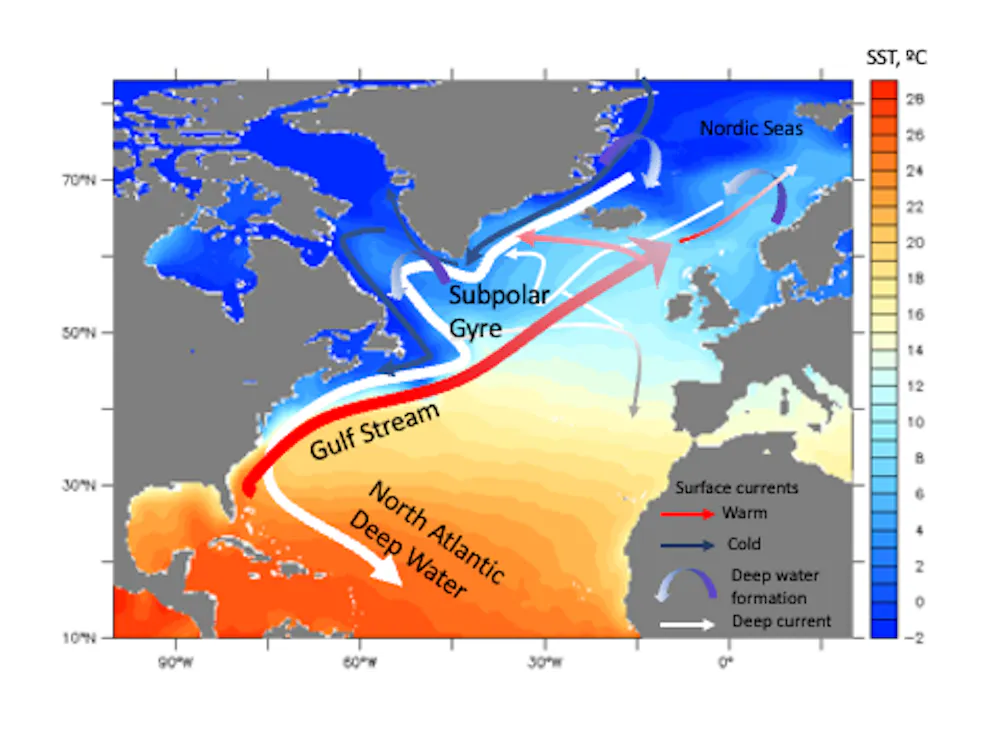
As they travel northwards, the Gulf Stream and North Atlantic Current cool as they lose heat to the atmosphere. The waters then become dense enough to sink to depth and form North Atlantic deep water, which travels southward at depth and feeds the other ocean basins. Modified from Nature Reviews Earth & Environment (2020)
Connectivity in the Atlantic Ocean
Our new research also shows the North and South Atlantic oceans are more connected than previously thought.
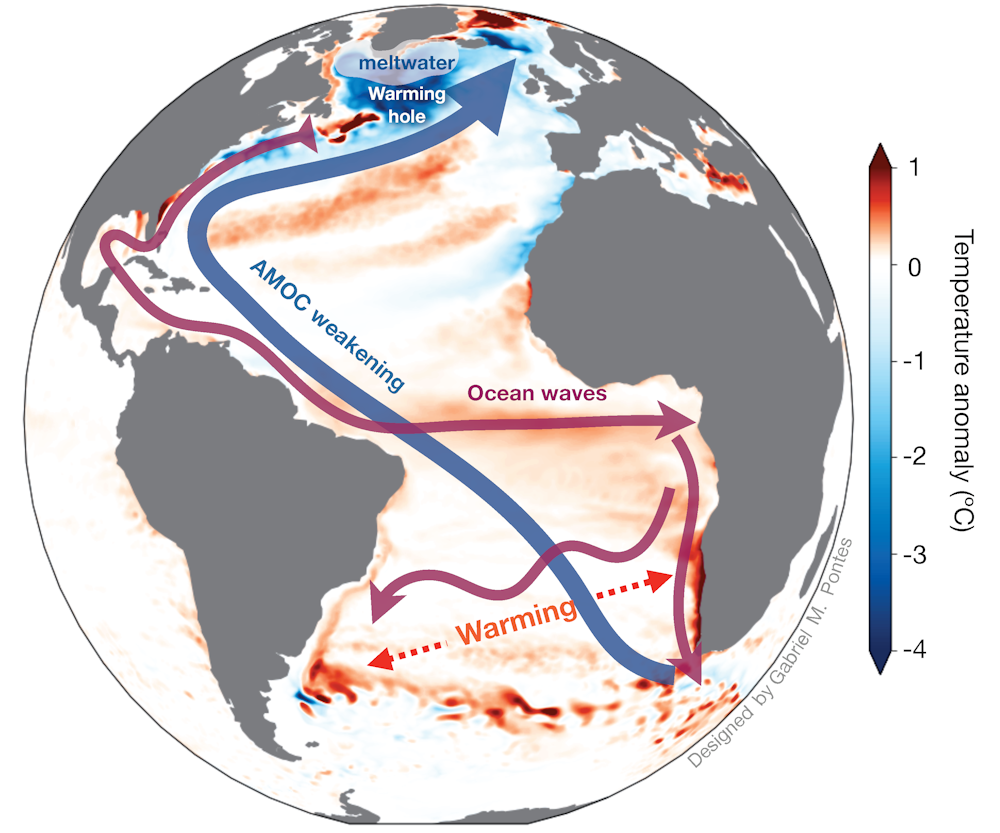
The weakening of the overturning circulation over the past few decades has obscured the warming effect in the North Atlantic, leading to what’s been termed a “warming hole”.
When oceanic circulation is strong, there is a large transfer of heat to the North Atlantic. But weakening of the oceanic circulation means the surface of the ocean south of Greenland has warmed much less than the rest.
Reduced heat and salt transfer to the North Atlantic has meant more heat and salt accumulated in the South Atlantic. As a result, the temperature and salinity in the South Atlantic increased faster.
Our simulations show changes in the far North Atlantic are felt in the South Atlantic Ocean in less than two decades. This provides new observational evidence of the past century slow-down of the Atlantic overturning circulation.
The addition of meltwater in the North Atlantic leads to localised cooling in the subpolar North Atlantic and warming in the South Atlantic. https://www.nature.com/articles/s41561-024-01568-1
What does the future hold?
The latest climate projections suggest the Atlantic overturning circulation will weaken by about 30% by 2060. But these estimates do not take into account the meltwater that runs into the subarctic ocean.
The Greenland ice sheet will continue melting over the coming century, possibly raising global sea level by about 10 cm. If this additional meltwater is included in climate projections, the overturning circulation will weaken faster. It could be 30% weaker by 2040. That’s 20 years earlier than initially projected.
Such a rapid decrease in the overturning circulation over coming decades will disrupt climate and ecosystems. Expect harsher winters in Europe, and drier conditions in the northern tropics. The southern hemisphere, including Australia and southern South America, may face warmer and wetter summers.
Our climate has changed dramatically over the past 20 years. More rapid melting of the ice sheets will accelerate further disruption of the climate system.
This means we have even less time to stabilise the climate. So it is imperative that humanity acts to reduce emissions as fast as possible.
Laurie Menviel receives funding from the Australian Research Council.
Gabriel Pontes receives funding from the Australian Research Council.
We go now to Deir al-Balah in Gaza, where we’re joined by Arwa Damon, founder of INARA, a nonprofit currently providing medical and mental healthcare to children in Gaza. She previously spent 18 years at CNN, including time as a senior international correspondent.
Thanks so much for being with us, Arwa. This is your fourth trip back to Gaza since October 7, 2023. Tell us what you see there:
ARWA DAMON: You know, Amy, you think you can’t get worse, and then it does. You think people, quite simply, could never cope with these deteriorating conditions, and yet somehow they do. It’s a situation that they have been forced into.
Arguably, the conditions when it comes to access of humanitarian organisations and our ability to distribute aid, aid actually getting into the strip, we’re talking about the lowest levels yet. And this is exactly during the timeframe that the US had given to Israel to actually improve the situation. We’ve seen it getting significantly worse.
We’re not just talking about a shortage in things like flour, food, water, fresh vegetables, you know, hygiene kits. We’re also talking about shortages in what’s available on the commercial market. So, even if you somehow had money to be able to go buy what you need, it quite simply isn’t here.
These hospitals that we keep talking about as being partially functioning, what does that actually mean? It means that if you show up bleeding, someone inside is going to try to stop the bleed, but do they actually have what they need to save your life? No. I was inside visiting some kids here at Al-Aqsa earlier today and over the weekend.
There’s a little 2-year-old boy here whose brain you can see pulsing through his skin. His skull bone was removed. This little boy was not stabilising properly because the ICU was missing a pediatric-sized tracheostomy tube. Now, luckily, we were able to, you know, source some of them, and he has now stabilised, and he is off the ventilator.
Palestinians feel they are being ‘slowly exterminated’. Video: Democracy Now!
But this really gives you an idea of just how serious the situation here is.
People are gathering to demonstrate for things like flour, for bread, for whatever it is that you can imagine. Winter is coming. The rains are coming. This means flooding is coming.
And on top of just, you know, water flooding, we’re also anticipating that the sewage sites are going to be flooding, as well. Aid organizations need to be able to have the capacity and the ability to, you know, shift those sites to areas where they’re not going to pose even more of a health hazard to the community.
So, I mean, it’s a complete and total nightmare. It’s beyond being a nightmare.
AMY GOODMAN: If you can talk about this latest report? The special UN committee says Israel’s actions in Gaza are “consistent with the characteristics of genocide,” coming at the same time as a Human Rights Watch report, and UNRWA talks about famine being imminent in northern Gaza.
ARWA DAMON: So, if we’re talking specifically about the north, the northern province of Gaza, this is an area where Israel launched its military operation there nearly four weeks ago. We have seen people repeatedly being forcibly displaced from their homes. There is very little access to medical assistance there.
There has been absolutely no humanitarian assistance delivered there for about the last month. People are starving. They are dying. And it’s not just bombs that are killing people, it’s also disease.
‘Bombs kill quickly, but disease and starvation, they are slow killers. And that is what a lot of people are facing here.’
— Arwa Damon, founder of INARA,
So, when we look at the nature of what is happening in Gaza, you can’t spend a day here, Amy, and not come away with the notion that you are witnessing a population that is being slowly exterminated. And I say “slowly” because, yes, bombs kill quickly, but disease and starvation, they are slow killers. And that is what a lot of people are facing here.
And talk to anybody in Gaza, and there’s absolutely no doubt in their mind that, one, they are living through their own annihilation, and, two, what Israel is doing in the northern part is going to be repeated elsewhere.
And this is also part of why you see a reluctance among the population to want to evacuate, because Gazans know, Palestinians know that when they leave, they’re not going to be able to go back home. This is what history has taught them.
And there is this very real, ingrained fear among the population here right now that what they’re going through at this moment is not the end. There is actually a real sense that the worst is yet to come.
And they feel completely and totally abandoned by the international community, by global leaders, not to mention the United States. And everyone is convinced that right now Israel is going to have even more free rein to do whatever it is that it wants here.
When you talk to people about what it is that they’re going through, they do feel as if every single aspect of trying to survive here has been carefully orchestrated by Israel so that it is able to sort of meet America’s bare minimum of standards, to allow America sufficient cover to say, “Oh, no, there’s improvement that’s happening.”
And yet, actually, at the core of it is just another way to continue to kill the population.
AMY GOODMAN: And as you talk about the United States, which has given tens of billions of dollars in military aid to Israel, they did recently set a 30-day deadline to increase the flow of food and humanitarian aid into Gaza, but the US has decided to keep arming Israel despite this and despite the number of officials in the State Department and other parts of the US government who have quit over this.
ARWA DAMON: Yeah, and let’s just look at the numbers. Let’s just look at what happened when the US started the clock for that 30-day deadline to improve humanitarian assistance. We saw, very shortly afterwards, the number of trucks accessing Gaza dip significantly, down to 30 a day, keeping in mind that one of the key demands that the US had was that aid be increased to at least 350 trucks.
So we saw this, you know, decrease consistent of roughly 30 trucks a day for most of the month of October. Now, in November, that number did go up to around 60-70, but we’re still talking about, you know, falling extraordinarily short, providing barely 20% of what it is that the population here needs.
We saw less access to these besieged areas in the north, where people are effectively trapped or having to basically risk their lives. We’ve had numerous instances where aid has been delivered to the Kamal Adwan Hospital in the north, for example, where, shortly after medical evacuation teams have arrived there, there have been strikes.
You have this very ingrained fear that exists among people right now, especially in the north, where some of them are saying, “Don’t deliver anything, because right after you’re delivering, strikes are happening.”
And just to illustrate how it is that we try to move, so if we’re moving from south to north, for example, or even if we’re moving within the northern areas, those movement requests have to be approved by Israel. And aid organisations are increasingly wary of moving around with what we call soft-skin cars, which is basically your normal vehicle that we use to move around in, because of the increasing frequency of instances at Israeli checkpoints where aid convoys have been shot at by IDF troops after receiving the green light.
The OK to cross through, which means that for a lot of aid organizations, movement is limited to those who have access to armoured vehicles, vehicles that are more secure. And those don’t really exist in Gaza in high numbers at all. And we’re not allowed to bring in more to sort of beef up our capacity to be able to move around safely.
I mean, no matter which way you look at it, Amy, you’re constantly faced by numerous obstacles that don’t need to be there. It feels very deliberate, not to mention the complete and total breakdown of security. Now we have numerous looting instances of aid trucks.
We’ve repeatedly asked the Israeli side to be able to use alternative routes, to be able to use secured routes. Those requests are not being met.
I mean, it’s just — it’s such an impossible situation to operate in. I feel like I keep saying the same thing over and over and over again each time I come in. And the words to demonstrate how much worse it’s getting, quite simply, lack in our vocabulary.
AMY GOODMAN: You also wrote a piece recently, “The Devastation of Lebanon,” for New Lines. And we had this headline, The Washington Post reporting a close aide to Netanyahu told Donald Trump and his son-in-law Jared Kushner that Israel is rushing to advance a ceasefire deal in Lebanon as a gift to Trump ahead of his January inauguration. Your response to the significance of Trump’s election and what it means to the people of Lebanon and Gaza?
ARWA DAMON: You know, first of all, anyone who lives in the Middle East and anyone who’s kind of been focusing on the Middle East knows very well that it really doesn’t matter who’s in the White House. Whether it’s Republican or Democrat, that really is not going to change significantly US policy towards this region.
But the thing that we’ve been hearing, specifically when it comes to the re-election of Donald Trump, is at least he’s not lying to us. At least whatever America is going to let Israel do, it’s going to be done faster. So, if our end is coming, at least it’s going to come faster.
Whereas when it comes to, you know, specifically the Biden administration, the sense is that the Democrats are far more willing to allow this slower, more painful death. But the end result, no matter who it is, people are fully convinced, is exactly the same.
And all people really want right now is for this to end. People are suffocated. They’re crushed. They cannot keep going like this. And they very much feel as if, you know, no matter what it is, no matter who it is, Arabs are viewed by the United States and by the Western world as somehow being less than . . . their lives are not that valuable.
You constantly hear people in Gaza — and we were hearing the same thing in Lebanon — making comments like, “Well, you know, America, it doesn’t care if we live or die. It doesn’t care how much we suffer. Our lives don’t matter to them.” And that is not really a perspective that changes all that much, no matter who is sitting in Washington.
AMY GOODMAN: We just have 30 seconds, Arwa. Why did you give up journalism for humanitarian work? What do you think you can accomplish at INARA that you couldn’t do as a journalist?
ARWA DAMON: There’s a certain sort of privilege of being able to spend extensive periods of time with people and really get to know who they are. And I feel as if, you know, moving around in the humanitarian sphere, I’m getting a different understanding of sort of people’s emotional journeys, what it actually takes to be able to provide them with assistance.
And it’s provided me a different way of being able to continue to sort of share people’s stories and experiences, but also be able to immediately at least try to provide assistance. You know, the challenge that we have when we’re out in the field as journalists is that you don’t always see the impact.
But when you’re in the humanitarian space, there’s a certain kind of magic when you’re able to just bring a smile to a child’s face. And I needed that.
AMY GOODMAN: Arwa Damon, we thank you so much for being with us. Stay safe. An award-winning journalist, she was with CNN for 18 years but now has founded INARA, a nonprofit currently providing medical and mental healthcare to children in Gaza, speaking to us from Deir al-Balah in Gaza outside Al-Aqsa Hospital.
This article is republished under a Creative Commons Attribution-Noncommercial-No Derivative Works 3.0 United States Licence.
In a surprise move, the Coalition has announced it will vote against Labor’s bill to cap international student numbers. This follows previous Coalition comments saying it would work with universities to “put a cap on foreign students”.
The Greens opposed caps from the start. Between them, the Coalition and the Greens have a Senate majority, which means the Albanese government’s plan to cap international students seems dead.
For universities, TAFEs, private colleges and potential international students, this news will be cause for relief, but not celebration.
There are multiple other measures still in place to reduce international student numbers. The Coalition has also previously committed to capping international student numbers in the major cities.
So while the Coalition has now opposed Labor’s student caps, it is not opposed to the idea of caps altogether.
For 2025, the caps would have applied to enrolments that were new to the education provider.
Apart from students in exempt categories (such as postgraduate research students), vocational and higher education providers would have been allocated 270,000 commencing enrolments between them.
Exemptions make it difficult to compare the proposed 2025 cap with previous years, but during a Senate hearing earlier this month, the government gave 323,000 commencing enrolments as a comparable 2023 figure.
Separate formulas were going to apply for international student places in public universities, private universities and non-university higher education providers as well as vocational education institutes. The impact of Labor’s caps would have been uneven. This includes a small overall cut for public universities compared to 2023, with bigger reductions for other education providers.
The Coalition has been critical of the bill
During Senate hearings into the bill, and in their subsequent comments in the Senate inquiry report, Liberal senators attacked the disproportionate effects of the proposed caps on private education providers.
For some, their financial viability would be threatened. The Coalition highlighted a pilot training academy that could not survive with its capped number of international students. It would have to break contracts with international airlines.
Vocational and higher education regulators also shared their concerns about the impact on providers’ finances.
Education providers going out of business would put pressure on the Tuition Protection Service. This is a government-run but education provider-funded scheme that finds new courses for students of failed education providers or pays refunds.
While affected international students eventually get a new course or their money back, provider collapses can cause them significant stress and delay.
What might the Coalition do instead?
The Coalition’s Senate inquiry report also gives some guidance about how they would approach caps if they won the 2025 federal election.
It singled out the “excessive number” of international students flowing into Australia’s most prestigious universities, especially in Sydney and Melbourne.
“We respectfully suggest”, their comments say, “a number of Group of Eight universities have lost sight of their core mission”. The Coalition says that core mission is providing Australian students with high value tertiary qualifications.
The Coalition favourably quoted Deakin University (not a Group of Eight member), which voluntarily capped international students at 35% of total enrolments. Deakin talked about “getting the balance right” between local and overseas students.
This approach may signal a future Coalition policy for capping public universities. It tackles total international student numbers – with their affect on Australia’s population and consequent pressures on accommodation and other services – and more specific concerns about the student experience when international students dominate classes.
The Coalition has also signalled it may restrict visas for the partners and children of students.
What will Labor do now?
Labor had said if the caps bill passed it would repeal “ministerial direction 107”, a decision by former Home Affairs Minister Clare O’Neil in December 2023 on the processing of student visa applications. Now this repeal will not happen.
Ministerial direction 107 repurposed an existing risk rating, which determined how much evidence must be provided with a student visa application. Under the direction, visa applications for students from low-risk providers – whose students have low rates of visa refusals or cancellations or subsequent overstays in Australia – received visa processing priority. In practice, ministerial direction 107 favoured the more prestigious universities.
The government could also reduce the total resources it devotes to processing student visas, which would slow the inflow of students for all providers. As my analysis shows the number of visas processed between January and August 2024 (including both grants and rejections) were only 5% lower than pre-COVID in 2019. This could be cut further.
But it does not change their overall policy goal of restricting international student numbers. They could cap enrolments in a different way. Labor has not completed its announced reforms to international education and may find other ways to reduce student numbers.
There is more to come in international education policy, whichever party wins the 2025 federal election.
Andrew Norton works for the Australian National University, which has announced significant job cuts partly due to caps on international student enrolments.
Melbourne Theatre Company’s My Brilliant Career is a musical re-imagining of Miles Franklin’s classic 1901 novel of the same name. It follows a young woman, Sybylla Melvyn, as she chafes against her rural constraints to seek creative freedom.
A headstrong young woman, Sybylla dreams of becoming a writer despite her family’s poverty and society’s expectations of marriage. She ultimately rejects a marriage proposal from wealthy squatter Harold Beecham, choosing her independence and artistic aspirations over conventional romance and security. But this decision comes at a personal cost.
With libretto by Sheridan Harbridge and Dean Bryant, music by Mathew Frank, lyrics by Bryant and musical direction and arrangements by Victoria Falconer, this new, contemporary take on the book was developed over five years (initially supported by the NEXT STAGE writers’ program).
Born from a shared experience of the writers’ rural upbringings, the production is an example of what can happen when shows and artists are afforded the time to develop works organically and with care.
The show’s actors double as its instrumentalists. Pia Johnson
A fine ensemble
In the Sumner Theatre, the music begins before the show starts.
Initially, a small trio plays on stage while the audience enters. Over time, other musicians drift on, joining in on violin, keys, drums, cello and more. These actor-musicians, all dressed in period costume with long skirts and cinched-in waists, are multi-instrumentalists who also play the show’s characters.
At first I’m a little discombobulated by the playful and intense energy: I have a thorough crush on Franklin’s original novel, and no less affection for the 1979 film starring Judy Davis. Once I let go of my attachments, however, I’m able to settle into – and thoroughly enjoy – this delightful musical.
The fine ensemble is competent, physical and highly skilled, with a wonderfully spirited complicité. The clarity of character and relationship between the cast members is testament to Anne-Louise Sarks’ expert direction.
Versatility and panache
Kala Gare plays the role of Sybylla Melvyn – who just wants art and music and books – with a precocious, teenage ebullience.
Gare is a versatile actor and indie musician and her effervescent performance is undercut with a good dose of raucous feminist sass. She totally grows on me, comically framing her joyful portrayal of Sybylla with wry asides to the audience: (“I am being overwhelmed by my hot untamed spirit!”).
Kala Gare delivers a sassy, high-energy performance as Sybylla Melvyn. Pia Johnson
Gare readily shifts through performance styles – from poignant piano ballads, to thrashing hard rock, to cheeky all-singing, all-dancing numbers, with panache.
Her singer/songwriter vocal delivery is quite different to some of the other ensemble members, who happily dwell in the “belter” musical theatre category. Nonetheless, the voices are integrated well.
Other standouts include Raj Labade as the smooth-voiced, charismatic Harry/Harold, and the delightful Cameron Bajraktarevic-Hayward as Frank, who brings the house down with a brilliantly over-the-top number You’re Better Than a Beauty, Baby: You’re a Brick.
Raj Labade plays Harry, Sybylla’s love interest. Pia Johnson
Precise and choreographed physicality
Amy Campbell’s choreography makes the most of the ensemble’s physicality. Rather than being confined to the orchestra pit or relegated backstage, the performers inhabit the space with embodied and grounded presence. They move fluidly through and around the stage with precise, choreographed synchronicity.
I love to see performers who are confident in movement. In this instance the choreography shines, with many fine moments of comic physical timing and still tableaux with bodies and props.
Marg Horwell’s set is full of lushly delivered surprises. It features sparkling chandeliers, brightly coloured ribboned backdrops and spectacular flower cascades.
The costumes are similarly plush, with high Victorian-era necklines, extreme ruffles, outlandish winged cravats and fitted bodices rendered larger than life by the use of oversized shoulder pads.
The magic of the theatre is hilariously disrupted as straight-faced stage managers wittingly walk onto the stage to help dress actors, or supplying new props, in the midst of the action.
Melbourne Theatre Company puts a contemporary spin on Miles Franklin’s 1901 novel. Pia Johnson
Smart, funny and thoroughly entertaining
Some of the show’s musical numbers are more successful than others. The “Australian larrikin” vibe is occasionally a bit overcooked, or undermined by unnecessarily saccharine phrases. The second act also doesn’t quite maintain the exuberant energy of the first.
That said, the overall production guarantees audiences a smart, funny and thoroughly entertaining experience that doesn’t lessen the impact of Franklin’s story.
My Brilliant Career is a refreshing reinvention of a timeless classic. The production’s success lies in its ability to honour the source material while infusing it with contemporary energy and wit.
It’s a wonderful reminder of what can be achieved when creative labour is properly resourced and carefully considered.
Kate Hunter does not work for, consult, own shares in or receive funding from any company or organisation that would benefit from this article, and has disclosed no relevant affiliations beyond their academic appointment.
It’s a universally acknowledged truth that a geriatric millennial in possession of a Scholastic book club catalogue and a television must have been a fan of Paul Jennings back in the 1980s and ‘90s.
I devoured Jennings’ short story collections, particularly the Un and Gizmo series. They were the perfect mix of silly and subversive, and always captured the awkwardness of being a kid.
After school, my brother and I would curl up and turn the TV dial to Channel 2, SAO crackers with butter and Vegemite in hand, and watch the Twist family get into all sorts of scrapes. I was particularly fond of Pete and his floppy blonde bowl cut.
So, when I found out there was a Round The Twist stage show in development – a musical, no less – I knew it would be for me.
I was, however, interested in how much the material would translate for a new generation. Would it just be a nostalgic trip to the lighthouse for the recently middle-aged, or would Generation Alpha get on board? In the interest of research, I borrowed a ten-year-old (my nephew Hugo) for the evening and off we went to the theatre.
Round the Twist ran from 1990 to 2001, eventually becoming an Aussie children’s television staple. Lyndon Mechielsen
Meeting the Twist gang
I needn’t have been concerned. Paul Hodge’s book and music, and Simon Phillips’ direction, have perfectly captured the heart of the original material in its sense of humour, its uniquely Australian sensibility, its focus on community and its downright weirdness.
We meet the Twist Family – dad Tony (Matt Hetherington) and kids Pete (Hanlon Innocent), Linda (Charly Oakley) and Bronson (played at opening by Edison Ai) as they arrive in the fictional town of Port Niranda, seeking a sea change and some “fresh air” (although Bronson’s flatulence soon puts an end to that).
The central characters put me at ease. They are earthy, charming and immediately read as a family shaped by both love and tragedy.
The young Edison Ai (centre) shines in the role of Bronson Twist, the youngest child in the family. Lyndon Mechielsen
We soon meet the locals, including the lighthouse keeper with secrets, Nell Rickards (Christen O’Leary), and the mayoral power couple Harold and Mrs Gribble (played with high camp by David James and Tarita Botsman).
We also meet Bronson’s teacher Fay James (Liz Buchanan). Fay walks straight into Tony’s life and heart, but are the kids ready to accept a new stepmum? This storyline provides the emotional heft of the play, with Bronson’s resistance and Fay’s vulnerability authentically portrayed by Ai and Buchanan respectively.
We also meet the kids of Port Niranda. The local gang includes James Gribble (an athletic Nic Van Lits) and his offsiders, the mouth-breathing Rabbit (Carlo Boumouglbay) and the scrappy Tiger (Carla Beard).
Rounding out the cast are the objects of the two elder Twists’ affection, Fiona (Taylah Johns) and Andrew (Alex Tye). While these two actors are a little underused, both have enormous charm.
Dazzling design and musically brilliant
What separates Round The Twist from just another charming Aussie dramedy, however, is the supernatural, spooky and silly phenomena for which Jennings is famous.
The central mystery of the play includes mysterious music emanating from the lighthouse, a missing painting, a circus troupe, a pissed-off mermaid (Laura Raineri), a poltergeist pooch and a toilet ghost (one of Bryan Probets’ numerous roles).
The Twist kids sing and dance their way to solving the mystery, while navigating school crushes, evading property developers, enduring embarrassing encounters and battling their foes with the power of foot odour (up the pong!).
All this is enhanced by Renee Mulder’s brilliant design work and Craig Wilkinson’s video design. Projected images are essential to the magical realism of the piece. They resemble the animation style of Terry Gilliam, but never lose their distinctly Australian flavour.
The music is both catchy and clever, with the original theme tune also made part of the plot. Lyndon Mechielsen
The music is catchy and the lyrics clever. In general, the high-energy, comic pieces work better than the ballads. That said, Linda (Oakley) and Andrew’s (Tye) duet in act two is genuinely moving.
There were a couple of moments where young Bronson (Ai) missed a musical cue, but he was well-supported by the cast and the (excellent) band to find his place and carry on. It should be noted Bronson carries much of the play on his young shoulders. Ai is an absolute standout in the role.
And if you, like me, are a fan of the earworm that is the TV series theme tune (composed by Andrew Duffield), never fear! It is not only included, but is integral to the plot.
Old stories through new eyes
But what did the ten-year-old nephew think? He laughed until he cried at Pete’s (Innocent) predicament towards the end of act one, which I won’t spoil here. He gasped and bounced in his seat and praised the “smart writing”. I can only hope he will now discover and devour Jennings’ original books.
My nephew Hugo laughed, gasped and bounced in his seat at the spectacles on stage. Lyndon Mechielsen
For me, the joy was in seeing so many young professionals in the cast holding their own with veterans of Australia’s theatre scene. Hearing them sing so authentically in their own voices, while telling a story that is so quintessentially Australian, reiterated to me how important it is for local arts companies to invest in and champion homegrown musical theatre.
And aside from that, it was the most fun I’ve had at the theatre all year!
Kate Schirmer works for Queensland Conservatorium Griffith University (QCGU) and the Queensland Academy of Excellence in Musical Theatre (QAEMT). Griffith University is a production partner of Queensland Theatre, and participated in the development of this work. The work also features several alumni.
You know that feeling you get when you take a breath of fresh air in nature? There may be more to it than a simple lack of pollution.
When we think of nutrients, we think of things we obtain from our diet. But a careful look at the scientific literature shows there is strong evidence humans can also absorb some nutrients from the air.
In a new perspective article published in Advances in Nutrition, we call these inhaled nutrients “aeronutrients” – to differentiate them from the “gastronutrients” that are absorbed by the gut.
We propose that breathing supplements our diet with essential nutrients such as iodine, zinc, manganese and some vitamins. This idea is strongly supported by published data. So, why haven’t you heard about this until now?
Breathing is constant
We breathe in about 9,000 litres of air a day and 438 million litres in a lifetime. Unlike eating, breathing never stops. Our exposure to the components of air, even in very small concentrations, adds up over time.
To date, much of the research around the health effects of air has been centred on pollution. The focus is on filtering out what’s bad, rather than what could be beneficial. Also, because a single breath contains minuscule quantities of nutrients, it hasn’t seemed meaningful.
For millennia, different cultures have valued nature and fresh air as healthful. Our concept of aeronutrients shows these views are underpinned by science. Oxygen, for example, is technically a nutrient – a chemical substance “required by the body to sustain basic functions”.
We just don’t tend to refer to it that way because we breathe it, rather than eat it.
How do aeronutrients work, then?
Aeronutrients enter our body by being absorbed through networks of tiny blood vessels in the nose, lungs, olfactory epithelium (the area where smell is detected) and the oropharynx (the back of the throat).
The lungs can absorb far larger molecules than the gut – 260 times larger, to be exact. These molecules are absorbed intact into the bloodstream and brain.
Drugs that can be inhaled (such as cocaine, nicotine and anaesthetics, to name a few) will enter the body within seconds. They are effective at far lower concentrations than would be needed if they were being consumed by mouth.
In comparison, the gut breaks substances down into their smallest parts with enzymes and acids. Once these enter the bloodstream, they are metabolised and detoxified by the liver.
The gut is great at taking up starches, sugars and amino acids, but it’s not so great at taking up certain classes of drugs. In fact, scientists are continuously working to improve medicines so we can effectively take them by mouth.
Many of the scientific ideas that are obvious in retrospect have been beneath our noses all along. Research from the 1960s found that laundry workers exposed to iodine in the air had higher iodine levels in their blood and urine.
More recently, researchers in Ireland studied schoolchildren living near seaweed-rich coastal areas, where atmospheric iodine gas levels were much higher. These children had significantly more iodine in their urine and were less likely to be iodine-deficient than those living in lower-seaweed coastal areas or rural areas. There were no differences in iodine in their diet.
This suggests that airborne iodine – especially in places with lots of seaweed – could help supplement dietary iodine. That makes it an aeronutrient our bodies might absorb through breathing.
Manganese and zinc can enter the brain through the neurons that sense smell in the nose. Manganese is an essential nutrient, but too much of it can harm the brain. This is seen in welders, who are exposed to high levels from air and have harmful levels of manganese buildup.
The cilia (hair-like structures) in the olfactory and respiratory system have special receptors that can bind to a range of other potential aeronutrients. These include nutrients like choline, vitamin C, calcium, manganese, magnesium, iron and even amino acids.
Research published over 70 years ago has shown that aerosolised vitamin B12 can treat vitamin B12 deficiency. This is super important for people who have high B12 deficiency rates, such as vegans, older people, those with diabetes and those with excessive alcohol intake.
If we accept aeronutrients, what next?
There are still a lot of unknowns. First, we need to find out what components of air are beneficial for health in natural settings like green spaces, forests, the ocean and the mountains. To date, research has predominantly focused on toxins, particulate matter and allergens like pollen.
Next, we would need to determine which of these components can be classified as aeronutrients.
We need to study these potential aeronutrients in controlled experiments to determine dose, safety and contribution to the diet. This is particularly relevant in places where air is highly filtered, like airplanes, hospitals, submarines and even space stations.
Perhaps we will discover that aeronutrients help prevent some of the modern diseases of urbanisation. One day, nutrition guidelines may recommend inhaling nutrients. Or that we spend enough time breathing in nature to obtain aeronutrients in addition to eating a healthy, balanced diet.
Flávia Fayet-Moore is the CEO of FOODiQ Global and co-founder of Food is Cool.
Stephen R. Robinson does not work for, consult, own shares in or receive funding from any company or organisation that would benefit from this article, and has disclosed no relevant affiliations beyond their academic appointment.
ACT leader David Seymour has spoken out on Hana-Rawhiti Maipi-Clarke’s haka in Parliament as a Hīkoi against his controversial Treaty Principles Bill converges on Wellington.
Seymour told reporters the haka “was designed to get in other people’s faces”, to stop the people who represent New Zealanders from having their say, particularly because those doing it left their seats.
The action was a serious matter, and if a haka was allowed one time, it left the door open for other disruptions in Parliament at other times.
Labour’s vote against the decision to suspend Maipi-Clarke from the House was an indication it thought such behaviour was appropriate.
People should be held accountable for their actions, Seymour added.
Asked by reporters if Seymour should speak to the Hīkoi, Te Pāti Māori co-leader Debbie Ngarewa-Packer said his voice had already been heard, and described Māori feeling “a sense of betrayal”.
The bill should never have come into the House, she said.
A ferry carrying protesters from the South Island is now on its way across the Cook Strait as final preparations are made in the capital for tomorrow’s gathering at the Beehive.
In Wellington, commuters are being warned to allow extra time for travel, and add one or even two hours to their trips to work on Tuesday even as extra buses and train carriages are put on.
Māori Queen to join Hīkoi A spokesperson for the Kiingitanga movement said although this was a period of mourning in the wake of the death of her late father, the Māori Queen would be joining the Hīkoi in Wellington.
Te Arikinui Kuini Nga Wai Hono i te Po confirmed late last night she planned to be at Parliament tomorrow.
Speaking to RNZ’s Midday Report, spokesperson Ngira Simmonds said while it was uncommon for a Māori monarch to break the period of mourning, Kuini Nga Wai Hono i te Po would be there to advocate for more unity between Māori and the Crown.
This article is republished under a community partnership agreement with RNZ.
The way people living with dementia experience the world can change as the disease progresses. Their sense of reality or place in time can become distorted, which can cause agitation and distress.
One such strategy is the use of dolls as comfort aids.
What is ‘doll therapy’?
More appropriately referred to as “child representation”, lifelike dolls (also known as empathy dolls) can provide comfort for some people with dementia.
Memories from the distant past are often more salient than more recent events in dementia. This means that past experiences of parenthood and caring for young children may feel more “real” to a person with dementia than where they are now.
Hallucinations or delusions may also occur, where a person hears a baby crying or fears they have lost their baby.
Providing a doll can be a tangible way of reducing distress without invalidating the experience of the person with dementia.
For those who do become attached to a therapeutic doll, they will treat the doll as a real baby needing care and may therefore have a profound emotional response if the doll is mishandled.
It’s important to be guided by the person with dementia and only act as if it’s a real baby if the person themselves believes that is the case.
The introduction of a therapeutic doll needs to be done in conjunction with careful observation and consideration of the person’s background.
Empathy dolls may be inappropriate or less effective for those who have not previously cared for children or who may have experienced past birth trauma or the loss of a child.
Be guided by the person with dementia and how they respond to the doll.
Are there downsides?
The approach has attracted some controversy. It has been suggested that child representation therapy “infantilises” people living with dementia and may increase negative stigma.
Further, the attachment may become so strong that the person with dementia will become upset if someone else picks the doll up. This may create some difficulties in the presence of grandchildren or when cleaning the doll.
The introduction of child representation therapy may also require additional staff training and time. Non-pharmacological interventions such as child representation, however, have been shown to be cost-effective.
While some studies have shown positive outcomes, including reduced agitation, others show no improvement in cognition, behaviour or quality of life among people with dementia.
Advances in artificial intelligence are also being used to help support people living with dementia and inform the community.
Viv and Friends, for example, are AI companions who appear on a screen and can interact with the person with dementia in real time. The AI character Viv has dementia and was co-created with women living with dementia using verbatim scripts of their words, insights and experiences. While Viv can share her experience of living with dementia, she can also be programmed to talk about common interests, such as gardening.
These companions are currently being trialled in some residential aged care facilities and to help educate people on the lived experience of dementia.
How should you respond to your loved one’s empathy doll?
While child representation can be a useful adjunct in dementia care, it requires sensitivity and appropriate consideration of the person’s needs.
People living with dementia may not perceive the social world the same way as a person without dementia. But a person living with dementia is not a child and should never be treated as one.
If using an interactive doll, ensure spare batteries are on hand.
Finally, it is important to reassess the attachment over time as the person’s response to the empathy doll may change.
Nikki-Anne Wilson is affiliated with the University of New South Wales and Neuroscience Research Australia (NeuRA). She is also currently a contributor to the Ageing Advisory Committee facilitated by the Hon Kylea Tink MP. She has previously received funding from the Australian Association of Gerontology and the UNSW Ageing Futures Institute.
Source: The Conversation (Au and NZ) – By Penny van Oosterzee, Adjunct Associate Professor James Cook University and University Fellow Charles Darwin University, James Cook University
Australia is a world-leader in species extinction and environmental decline. So great is the problem, the federal government now wants to harness money from the private sector to pay for nature repair.
Under the government’s new “nature repair market”, those who run projects to restore and protect the environment are rewarded with biodiversity credits. These credits can be sold to private buyers, such as corporations wanting to meet environmental goals.
The nature repair market is similar in many ways to Ausralia’s existing carbon credit scheme. So, examining the extent to which carbon projects actually protect biodiversity is important as the government sets up the nature repair market. This was the focus of our new research.
Alarmingly, we found Australia’s carbon credit scheme largely fails to protect threatened species, despite assumptions to the contrary. The findings provide cautionary lessons for the nature repair scheme.
Spotlight on the carbon credit scheme
Australia’s carbon credit scheme encourages activities that reduce carbon. They include planting trees, reducing animal grazing on vegetation, or retaining vegetation instead of cutting it down.
Project proponents earn credits for carbon reduction, which can then be sold on a carbon market.
The scheme also purports to offer “non-carbon” benefits. These include increasing biodiversity and expanding habitats for native species. Indeed, biodiversity conservation has underpinned the carbon credit scheme since it began in 2011.
But does the carbon scheme actually benefit biodiversity?
To answer this question, we overlaid the locations of carbon-reduction projects with the locations of habitat for threatened plants and animals species. We then scored the level of degradation of each habitat, and identified the processes imperilling the threatened species.
So what did we find? Threatened species most in need of habitat restoration are the least likely to have their habitat restored under the carbon credit scheme.
Projects under the scheme are primarily located in arid parts of Australia not suitable for growing crops – mostly vast cattle grazing leases. Carbon projects here involve inexpensive activities such as removing some cattle or managing weeds.
These areas support habitat for only 6% of Australia’s threatened species. In other words, vegetation loss here generally doesn’t threaten species’ survival.
In contrast, just 20% of carbon projects take place on productive agricultural land which supports nearly half of Australia’s threatened species. In these areas, property values are high and landholders can earn good money from farming. That means carbon-reduction projects are often less financially attractive than other land uses, so their number and size is limited.
So what’s the upshot? Australia’s carbon projects are concentrated in areas containing little threatened species habitat, rather than where threatened species live and most need protecting.
Government policies enable this perverse outcome, by giving preference to projects that can reduce carbon for the lowest cost. This has skewed projects towards unpopulated, relatively unproductive lands.
There’s an upside
It’s not all bad news, however. We found the carbon credit scheme may protect threatened species in some cases.
Almost one-third (or 525) of Australia’s threatened species live in habitat that overlaps with projects under the scheme.
In addition, five species whose habitat is not safeguarded in Australia’s protected areas, such as national parks, may also occur on land where carbon projects take place. A further 270 species with too-little protected habitat also overlap with the projects.
The potential for positive benefits can be seen by looking at the two regions with the largest concentration of carbon projects in Australia.
In the Murchison bioregion in Western Australia, a quarter of species rely on habitat that is not adequately protected elsewhere. In the Mulga bioregion in New South Wales and southwest Queensland, two-thirds of species rely on habitat inadequately protected elsewhere.
The Mulga bioregion, one of two in Australia where the carbon credit scheme may protect threatened species. Shutterstock
Our findings provide important lessons for this market. Most importantly, they show a lowest-cost approach to generating credits is unlikely to benefit biodiversity. It will drive projects to marginal areas that do not overlap the ranges of species threatened by habitat loss.
If nature repair investment is to prevent species extinctions, the Australian government must ensure taxpayer funds actually achieve these outcomes. The best way to do that is to speed up the progress of promised environmental law reform.
Likewise, as global conservation increasingly looks to private finance and biodiversity markets, we must ensure funds are delivered to where they are most needed.
Penny van Oosterzee is a Director of the Thiaki Rainforest Research Project, which generates Australian Carbon Credit Units as part of a restoration and research project in the Wet Tropics of Australia. Penny van Oosterzee has been a partner for two Australian Research Council projects.
Jayden Engert receives funding from the Australian Commonwealth Government through an Australian Government Research Training Program Scholarship.
After nearly a year without basic income and support services, 42 refugees and asylum seekers remaining in Papua New Guinea will soon begin receiving a meagre allowance of 900 kina (A$338) per week from the Australian government.
These men are former Manus Island detainees who were released in 2016 after the PNG Supreme Court ruled that Australia’s offshore detention facility was unconstitutional.
Most of the refugees and asylum seekers were then transferred to the capital, Port Moresby, where the Australian government began providing them with accommodation, meals, medical, health care and settlement services
However, in November 2023, that assistance was suddenly cut off without any explanation from the Australian government.
A year later, the men were informed this month that the support would be reinstated if they vacated their current homes, though the payments would be at a much lower level than before.
The demand that the men source their own accommodations is concerning, as many are too unwell to navigate a competitive and expensive rental market. Many are at risk of homelessness.
These low payments will also make medical care unaffordable, so the threat to health and life will continue to grow more serious.
Trying to restart lives in PNG
The refugees and asylum seekers were sent to PNG under the government’s Operation Sovereign Borders policy in 2012 and 2013.
The policy, which remains in place today, requires the mandatory offshore detention of people attempting to reach Australia by sea.
From the outset, the filthy conditions of detention on Manus Island were considered so harsh that only men were sent there. Families, women and children were held on Nauru.
Manus was also the site of deadly riots in 2014. In 2017, the Australian government paid A$70 million in compensation to refugees there – the largest out-of-court settlement for a human rights case.
On the closure of the detention centre a month later, most refugees and asylum seekers were moved to Port Moresby. A few men have since managed to rebuild their lives, set up businesses and begin families, but others have struggled.
In addition, many have been victims of violent crime and resentment from the local community.
Deal behind closed doors
In a secret deal signed by the Morrison government and PNG in late 2021, Australia agreed to provide ongoing funding for services to the remaining refugees and asylum seekers in the country.
The agreement was, and remains, confidential. We have no way of knowing what support was promised, for how long, and to whom.
This support assisted the men with accommodation, security, health care, transport services, food and grocery vouchers, immigration advice and a small stipend of 700 kina (A$268) per week or 1,200 kina (A$460) for families).
When the funding was suddenly stopped a year ago, PNG’s chief migration officer said the remaining men would be resettled within weeks. The majority were to go to New Zealand.
Local businesses, citing breach of contract and shortfalls of tens of millions of dollars, withdrew all services.
Rapid health decline
In the year since, the 42 remaining refugees have faced evictions, financial precarity, threats to their safety, and a rapid and alarming decline in their mental and physical health.
Of the people the Asylum Seeker Resource Centre (ASRC) is currently in contact with, 20% are so unwell their lives are at imminent risk, 88% reported severe mental health conditions, and 100% reported physical health conditions.
Financial stress is a major cause of deteriorating mental health. One refugee who wished to remain anonymous reported:
the inflation is going higher day by day and it’s hard to manage everything, like clothes, food, electricity, other basic life necessity things […] life is like a jail […] what is our crime that we are still here?
In the last year, basic humanitarian aid has come through crowdfunding organised by Sister Jane Keogh of the Brigidine Sisters. However, this community-driven lifeline is not sustainable.
As Keogh explained to us:
Their physical conditions allied with their mental trauma means that they’re not able to cope with their lives […] many have surpassed the ability to ever lead a normal life due to their mental health.
Out of harm’s way
Since 2013, Australia has stuck with its policy that refugees subject to offshore processing would never be allowed in Australia. The United States and New Zealand have resettled most of the refugees and asylum seekers from PNG and Nauru, but these options are now uncertain for the remaining 42.
Resettlement in New Zealand requires a medical report, which is expensive and difficult for the refugees to acquire.
Without intervention by the Australian government, the consequences for the remaining refugees is dire.
As Qabil Hussain, who has been stuck in PNG for 12 years, told us:
We’ve been brought by Australia here [to PNG] and they just left us stranded here and our support was withdrawn […] I want Australia to take responsibility.
From 2018-2022, Amy Nethery was a partner in Comparative Network of Refugee Externalisation Policies (CONREP), which was co-funded by the European Union under the Erasmus+ Programme – Jean Monnet Activities (599660 EPP-1-2018-1-AU-EPPJMO-NETWORK).
Jemima McKenna is affiliated with the Asylum Seeker Resource Centre as a volunteer caseworker for their Detention Rights and Advocacy Program (DRAP). She has volunteered for the ASRC since December 2018 and has been with DRAP since March 2021. She is the caseworker for the refugees and asylum seekers quoted in this article. Jemima’s PhD is funded by the Australian Government Research Training Program (RTP).
Gambling harms – including financial, emotional, social and psychological costs – extend to loved ones, peers and co-workers and the community. And some communities are impacted differently to others.
Many migrants, including those in the NT, experience financial, social, and emotional pressures, which sometimes lead them to gambling as a means of socialisation or stress relief. Our research explores why and what might limit the risks and harms.
Published earlier this year, our lived experience study explored the pressures that make gambling appealing to migrant communities.
For example, scarce recreational options in Darwin mean gambling fills a social gap. As one person we spoke to said,
It’s kind of the entertainment for us in Darwin […] there’s not much to do, so we go to the casino for fun with friends.
Gambling can become a way to socialise in the absence of other affordable, culturally relevant options.
But what begins as a casual activity can quickly lead to personal strain. Some participants in our study described family tensions.
My sister and brother-in-law got into fighting […] she said, ‘Why do you have to spend a lot of money on gambling?’ but he said, ‘That’s my hobby.’
Another person revealed how gambling impacts family dynamics:
My husband not being present most of the time because he is out gambling has really impacted me […] the kids are missing their dad. I’m missing my husband.
‘Sometimes you can win some money’
Financial stress is a significant factor increasing gambling risks, especially among migrants on temporary visas who face job and visa uncertainties.
Some migrants view gambling as a potential escape from financial pressures, as an international student explained to us,
It is common for international students to stake their tuition fees at the casino […] sometimes you can win some money.
However, gambling losses often exacerbated financial hardship, trapping individuals in cycles of debt and loss.
‘I never gambled until I came to Australia’
The NT’s legal and accessible gambling environment also plays a role, especially for migrants from countries where gambling is restricted.
A participant from Bangladesh shared,
In my country, gambling is not a good thing […] I never gambled until I came to Australia.
Another believed that
Betting on soccer is an easy way to make money […] but in Africa, I didn’t have access to as much funds as I have here [in Australia].
The perceived ease of earning money through gambling adds to the temptation, particularly in times of financial uncertainty.
Migrants in the NT told us there wasn’t much to do there for fun. Gambling was a social opportunity. PhotopankPL/Shutterstock
‘I feel shameful talking about it’
Another critical factor is the reluctance to seek help, often due to cultural stigma or language barriers. Many migrants prefer to manage gambling issues privately. One participant stated,
In my culture, gambling is seen as a bad behaviour […] I just feel shameful talking about it.
Others expressed scepticism toward counselling, viewing it as ineffective. This reluctance can lead to isolation, with individuals and families managing gambling harms in private, often unaware of local support options.
The impacts of gambling extend to mental health, with participants describing cycles of guilt, shame and financial stress. A participant explained how online gambling worsened their addiction
My gambling problem grew worse […] I started spending more money than I had any right to be spending […] we always ended up going back to the casino or poker site until our bank account was empty.
Culturally sensitive approaches are needed
Our research shows culturally sensitive approaches are essential to address gambling harms effectively. This is includes raising awareness about gambling risks in a way that resonates with diverse communities.
Further, our research participants reported higher rates of gambling among Filipino, East Asian and African communities, with the issue anecdotally more common among women in certain Asian groups.
Expanding culturally relevant recreational opportunities could help provide a healthier alternative to gambling.
Language-specific counselling and culturally competent resources could encourage migrants to seek help. Policymakers could consider revising gambling advertising and venue availability to reduce exposure, especially in vulnerable communities.
Addressing gambling harms among migrants, including those in NT, requires collective efforts from policymakers, community leaders and local organisations.
Himanshu Gupta receives funding from Attorney General and Justice Department, Northern Territory government.
Devaki Monani is the current Chair of the Minister’s Advisory Council for Multicultural Affairs (MACMA), Northern Territory
James Smith is a member of the Strategic Advisory Group for the National Centre for Education and Training in Addiction, deputy chair of the Association for Alcohol and Other Drugs Agencies NT and a fellow and life member of the Australian Health Promotion Association.
Noemi Tari-Keresztes receives funding from NT government community benefit funding. She is an Honorary Member of the NT Lived Experience Network.
By Georgia Brown, Queensland University of Technology
Fijian newsrooms are under pressure to adapt as audiences shift away from traditional media such as newspapers, radio, and television, in favour of Facebook and other social media platforms.
Radio and television still exceeded Facebook, but surveys during the pandemic reveal the increasing significance of Facebook and other social media, such as Twitter, YouTube and TikTok as widely used sources of news, particularly for Fijians younger than 45.
A survey revealed that of Fiji’s 924,610 population, 551,000 were social media users in January 2023. Facebook, the country’s most popular platform, limits access to people aged 13 and older. Of those eligible in Fiji to create an account in 2023, 71 percent used Facebook.
Australian National University researcher Jope Tarai attributes the rise in social media usage in the 2010s to the 2006 coup and subsequent change in Fijian leadership, suggesting it “cultivated a culture of self-censorship”.
“The constrained political context saw the emergence of blogging as a means of disseminating restricted information that would have conventionally informed news reporting,” Tarai says.
Tarai says concerns about credibility of blogs meant this avenue was replaced by Facebook, “which was more interactive, accessible via handheld devices and instantaneous”.
Increased media freedom With the increased media freedoms that have arisen following Fiji’s change in government at the end of 2022, newspapers and other traditional newsrooms should be poised to reassert themselves, but they face significant challenges due to the global shift in how people consume information.
As audiences migrate to newer digital platforms, newsrooms that have traditionally depended on physical newspaper sales and advertising revenue are now under increasing pressure to adapt.
Fiji Times editor-in-chief Fred Wesley says news outlets are struggling to capture the attention of younger audiences through conventional formats, prompting a shift towards social media platforms to enhance audience engagement and boost traffic.
“Young people are not going to news websites or reading physical papers,” he says. “Young people are getting their news from social media.”
The University of the South Pacific’s technical editor and digital communication officer, Eliki Drugunalevu, says he has observed a growing preference among the general Fijian population for receiving news through social media as opposed to traditional outlets.
“When people refer to a certain news item that came out that day or even the previous day, they just go to their social media pages and search for that news item or even go to the social media page of that particular news outlet to read/access that story,” he says.
Drugunalevu identifies two contributors to this shift.
‘At your fingertips’ “Everything is just at your fingertips, easily accessible,” he says. “Internet charges in Fiji are affordable now so that you can pretty much be online 24/7.”
Newsrooms across Fiji are not oblivious to this shift. Editors and journalists are recalibrating their strategies to meet the demands of a digital audience.
Islands Business managing editor Samantha Magick says the abundance of readily available online content has resulted in young people refraining from paying for it.
“I think there’s a generational shift. My daughter would never pay for any news, would never buy a newspaper to start with. She would probably never think about paying for media, unless its Netflix,” she says.
However, Magick believes social media can be leveraged to fulfil evolving audience demands while offering fresh advantages to her organisation.
“Social media for us is a funnel to get people to our website or to subscribe,” she says. “Facebook is still huge in the region, not just in Fiji [and] that’s where a lot of community discussions are happening, so it’s a source as well as a platform for us.”
Magick says incorporating social media in her organisation requires her to stay more vigilant on analytics, as it significantly influences her decision-making processes.
‘Understanding content’s landing’ “There’s all that sort of analytic stuff that I feel now I have to be much more across whereas before it was just generating the content. Now it’s understanding how that content’s landing, who’s seeing it, making decisions based on that,” she says.
Fiji TV digital media specialist Edna Low says social media data analytics like engagement and click-through rates provide valuable insight into audience preferences, behaviours and demographics.
“Social media platforms often dictate what topics are trending and what content resonates with audiences, which can shape editorial decisions and coverage priorities,” she says.
Fiji TV’s director of news, current affairs and sports, Felix Chaudhary, echoes this.
“We realise the critical importance of engaging with our viewers and potential viewers via online platforms,” he says. “All our new recruits/interns have to be internet and social media savvy.”
Transitioning his organisation to a fully online model is the path forward in the digital era, Chaudhary says.
“Like the world’s biggest news services, we are looking in the next five to ten years to transitioning from traditional TV broadcast to streaming all our news and shows,” he says. “The world is already moving towards that, and we just have to follow suit or get left behind.”
It is clear that newsrooms and journalists must either navigate the evolving digital trends and preferences of audiences or risk becoming old news.
Catrin Gardiner contributed research to this story.Georgia Brown and Catrin Gardiner were student journalists from the Queensland University of Technology who travelled to Fiji with the support of the Australian Government’s New Colombo Plan Mobility Programme. This article is published in a partnership of QUT with Asia Pacific Report, Asia Pacific Media Network (APMN) and The University of the South Pacific.
The original idea for the world wide web emerged in a flurry of scientific thought around the end of World War II. It began with a hypothetical machine called the “memex”, proposed by US Office of Scientific Research and Development head Vannevar Bush in an article entitled As We May Think, published in the Atlantic Monthly in 1945.
The memex would help us access all knowledge, instantaneously and from our desks. It had a searchable index, and documents were linked together by the “trails” made by users when they associated one document with another. Bush imagined the memex using microfiche and photography, but conceptually it was almost the modern internet.
The true value in this early idea was the links: if you wanted to explore more, there was an easy, built-in way to do that. Anyone who has spent hours following random links on Wikipedia and learning about things they never knew interested them will recognise this value. (There is of course a Wikipedia page about this phenomenon.)
Links have made the web what it is. But as social media platforms, generative AI tools and even search engines are trying harder to keep users on their site or app, the humble link is starting to look like an endangered species.
The laws of links
Modern search engines were developed in the shadow of the memex, but at first they faced unexpected legal issues. In the early days of the internet, it was not clear whether “crawling” web pages to ingest them into a search engine index was a violation of copyright.
It was also not clear whether, in linking to information that might help someone build a bomb, defraud someone, or carry out some other nefarious activity, search engines or website hosts were “publishers”. Being publishers would make them legally liable for content they hosted or linked to.
The issue of web crawling has been dealt with by a combination of fair use, country-specific exemptions for crawling, and the “safe harbour” provisions of the US Digital Millenium Copyright Act. These permit web crawling as long as the search engines do not alter the original work, link to it, only use it for a relatively short term, and don’t profit from the original content.
The issue of problematic content was addressed (at least in the very influential US jurisdiction) via legislation called Section 230. This offers immunity to “providers or users of interactive computer services” who deliver information “provided by another content provider”.
Without this law, the internet as we know it couldn’t exist, because it is impossible to manually check every page linked to or every social media post for illegal content.
This doesn’t mean the internet is a complete Wild West, though. Section 230 has been successfully challenged on the basis of illegal discrimination, when a mandatory questionnaire about housing asked for race. More recently, a case brought against TikTok has suggested platforms are not immune when their algorithms recommend specific videos.
The web’s social contract is failing
All of the laws that have created the internet, though, have relied on links. The social contract is that a search engine can scrape your site, or a social media company can host your words or pictures, as long as they give you, the person who created it, credit (or discredit if you’re giving bad advice). The link isn’t just the thing you follow down a Wikipedia rabbit hole, it’s a way of giving credit, and allowing content creators to profit from their content.
Large platforms, including Google, Microsoft and OpenAI, have used these laws, and the social contract they imply, to keep ingesting content at industrial scale.
The provision of links, eyeballs and credit, though, is falling as AI does not link to its sources. To take one example, news snippets provided in search engines and social media have displaced the original articles so much that tech platforms now have to pay for these snippets in Australia and Canada.
Large tech companies value keeping people on their sites as clicks can be monetised by selling personalised ads.
Another problem with AI is that it typically relearns infrequently and holds onto dated content. While the latest AI-powered search tools claim to do better on this front, it is unclear how good they are.
And, as with news snippets, large corporates are reluctant to give credit and views to others. There are good people-centred reasons for social media companies and search engines to want you to not have to leave. A key value of ChatGPT is providing information in a single, condensed form so you never have to click a link – even if one is available.
Copyright and creativity
Is the sidelining of links a good thing, though? Many experts argue not.
Summarising information, without linking out to original sources, reduces people’s ability to fact check, is prone to bias, and may reduce the learning, thought and creativity supported by browsing many documents. After all, Wikipedia would be no fun without the rabbit hole, and the internet without links is just an online book written by a robot.
AI backlash looms
So what does the future hold? Ironically, the same AI systems that have made the link problem worse have also increased the likelihood that things will change.
The copyright exemptions that apply for crawling and linking are being challenged by creatives whose work has been incorporated into AI models. Proposedchanges to Section 230 law may mean that digital platforms are safer to link to material than replicate it.
We have power for change, too: where links exist, click on them. You never know where following a trail might take you.
Dana McKay has in the past received funding from Google and the Australian Research Council
George Buchanan receives funding from the Australian Research Council, and has previously received research support from Google.
This is now the fifth iteration of the COVID vaccines, which have been updated regularly to keep up with the rapidly evolving virus, SARS-CoV-2.
But nearly five years into the pandemic, you may be wondering, why do we need yet another type of COVID booster? And do we still need to be getting boosters at all? Here’s what to consider.
Targeting the spike protein
Pfizer’s JN.1 booster (and Moderna’s, though the TGA has not approved this one at this stage) is based on mRNA technology. This technology instructs our cells to produce a specific protein – in this case SARS-CoV-2’s spike, a protein on the surface of the virus that allows it to attach to our cells.
This helps the immune system produce antibodies that recognise the spike protein and interfere with the virus getting into our cells.
In response to our strengthened immune responses from vaccinations and previous infections (called immune pressure), SARS-CoV-2 has continued to evolve over the course of the pandemic, modifying the shape of its spike protein so our antibodies become less effective.
Most recently we’ve faced a soup of Omicron sub-variants, including JN.1. Since JN.1 was first detected in August 2023, this Omicron sub-variant has spawned a variety of further sub-variants, such as KP.2 (known as FLiRT), KP.3 (known as FLuQE) and XEC.
The spike protein is made up of 1,273 amino acids, a bit like molecular building blocks. Mutations to the spike protein change individual amino acids.
Certain amino acids are important for allowing neutralising antibodies to bind to the spike protein. This means changes can give the virus an edge over earlier variants, helping it evade our immune response.
Scientists keep updating the COVID vaccines in an effort to keep up with these changes. The better matched the vaccine “spike” is to the spike protein on the surface of the virus trying to infect you, the better protection you’re likely to get.
So who should get vaccinated, and when?
Updating vaccines to deal with mutating viruses is not a new concept. It has been happening for the flu vaccine since around 1950.
We’ve become accustomed to getting the annual flu vaccine in the lead-up to the winter cold and flu season. But, unlike influenza, COVID has not settled into this annual seasonal cycle. The frequency of COVID waves of infection has been fluctuating, with new waves emerging periodically.
COVID is also more transmissible than the flu, which presents another challenge. While numbers vary, a conservative estimate of the reproduction number (R0 – how many people will one person will go on to infect) for JN.1 is 5. Compare this to seasonal flu with an R0 of about 1.3. In other words, COVID could be four times more transmissible than flu.
Add to this immunity from a COVID vaccination (or a previous infection) begins to wane in the months afterwards.
So an annual COVID booster is not considered enough for some more vulnerable people.
For adults aged 65 to 74, a booster is recommended every 12 months, but they’re eligible every six months. For adults over 75, a shot is recommended every six months.
Adults aged 18 to 64 are eligible every 12 months, unless they have a severe immune deficiency. Many conditions can cause immunodeficiency, including genetic disorders, infections, cancer, autoimmune diseases, diabetes and lung disease, as well as having received an organ transplant. For this group, it’s recommended they receive a shot every 12 months, but they’re eligible every six.
Regular COVID boosters are recommended for people who are over 65 or medically vulnerable. AYO Production/Shutterstock
Making sense of the advice
A vaccine that targets JN.1 should provide good protection against the Omicron sub-variants likely to be circulating in the coming months.
A few things need to happen before the JN.1 shots become available, such as the Australian Technical Advisory Group on Immunisation providing guidance to the government. But we can reasonably expect they might be rolled out within the next month or so.
If they hit doctors’ offices and pharmacies before Christmas and you’re due for a booster, the holiday period might be added impetus to go and get one, especially if you’re planning to attend lots of family and social gatherings over summer.
In the meantime, the XBB.1.5 vaccines remain available. Although they’re targeted at an earlier Omicron sub-variant, they should still offer some protection.
While young, healthy people might like to wait for the updated boosters, for those who are vulnerable and due for a vaccination, whether or not to hold out may be something to weigh up with your doctor.
The advice on COVID boosters in Australia, with stronger wording (“recommended” versus “eligible”) used for more vulnerable groups, reflects what we know about COVID. People who are older and medically vulnerable are more likely to become very unwell with the virus.
For young, healthy people who may be wondering, “do I need a COVID booster at all?”, having one annually is sensible. Although you’re less likely to get very sick from COVID, it’s possible. And, importantly, vaccines also reduce the risk of developing long COVID.
While COVID vaccines do a very good job of protecting against severe disease, they don’t necessarily stop you becoming infected. Evidence on whether they reduce transmission has been mixed, and changed over time.
We’ve come to appreciate that vaccination is not going to free us of COVID. But it’s still our best defence against severe illness.
Nathan Bartlett does not work for, consult, own shares in or receive funding from any company or organisation that would benefit from this article, and has disclosed no relevant affiliations beyond their academic appointment.
Source: The Conversation (Au and NZ) – By Carly Randall, Senior Research Scientist, Benthic and Restoration Ecology, Australian Institute of Marine Science
The Great Barrier Reef, which supports an estimated 64,000 jobs and has a social and economic value of around A$6.4 billion, is under threat due to human-induced climate change.
Scientists have begun “biobanking”, which involves gathering coral sperm from the reef during annual spawning. These samples are held in special repositories and can be used in future to create baby corals via “coral IVF”.
Until now, much of this research has been done without consultation with, or permission from, the traditional custodians of the sea Countries of origin.
But our recent research looked at how we can do things in a different and more respectful way by involving traditional custodians in decision-making and action.
What we did and what we found
More than 70 groups of First Nations peoples are traditional custodians of the Great Barrier Reef.
In the summer of 2022, scientists and First Nations peoples gathered on Konomie (North Keppel Island) in Woppaburra sea Country in Central Queensland. We were there for the annual mass coral spawning.
Scientists from the Australian Institute of Marine Science (AIMS) and Taronga Conservation Society trained the Woppaburra people and neighbouring Indigenous Rangers in gathering coral spawn, larval rearing and cryopreservation methods for biobanking.
During the training, it became clear the current scientific approach overlooked some key cultural considerations.
Woppaburra people believe all things living and non-living, including coral samples, are spiritually connected to Country and people.
By sending these samples to a land-based facility, the “biobanking” process removes them from Country, breaking this vital connection. (The samples are held in biorepositories at Taronga CryoDiversity Bank sites on Cammeraygal and Wiradjuri lands, in New South Wales).
Holding samples from another group’s Country also creates cultural concerns for the traditional custodians of the lands on which the samples are stored, and for First Nations staff and visitors to those sites.
As traditional custodians, Woppaburra people are charged with looking after Country. Maintaining an enduring link to these samples is vital for cultural safety.
This realisation led to collaborative brainstorming about the ways in which these goals could be met. We wanted biobanking samples to support reef resilience while also maintaining links to the samples’ rightful custodians.
It also raised new questions, such as:
which group(s) hold custodianship over corals bred via IVF, using sperm and eggs from two different sea Countries?
what if those corals are seeded to a third sea Country?
how can we do this work more respectfully?
A different approach
We don’t have all the answers. But we started by drafting new protocols to guide the custodial stages. This includes:
how we gather coral spawn for scientific use
how we eventually return coral larvae to Country
how we transfer custodianship of samples to other parties.
We are also building cross-cultural, cross-institutional collaborations to continue working together towards the same goals. These include protecting, preserving and supporting adaptation of corals in the face of climate change.
In a world first, the Woppaburra people worked with the Taronga Cultural Programs team, the AIMS Indigenous Partnerships Team, and Gamay traditional custodians, to transfer custodianship of cryopreserved coral samples.
The Woppaburra and Gamay peoples share the same totem, the humpback whale, and are seen as sister clans. This made the ceremony accompanying the acceptance especially meaningful.
While the samples will always be part of Woppaburra Country, cultural custodianship and guardianship has been transferred to the Gamay Rangers.
By working together, Western science and Indigenous knowledge were shared and new traditions were born.
An unexpected and profound outcome that emerged during the nights of spawning was a new cultural practice whereby rather than simply being discarded, the gametes remaining after sperm were sampled were combined in a small bucket and fertilised.
At the end of the night, the Woppaburra women released these early embryos and leftover gametes into the receiving waters around Konomie to ensure their return to Country.
The purpose of this practice was to respect the life potential of these embryos and gametes, either as future coral recruits on surrounding reefs or simply as part of the biocultural ecosystem of Country.
Getting it right is in everyone’s best interests
Traditional owners are increasingly re-asserting their role in managing sea Country.
As climate change continues to affect the Great Barrier Reef and new methods for reef restoration are developed, this blueprint will ensure that cultural safety remains at the forefront of restoration activities.
This UN declaration sets out the processes for how traditional custodians engage with other parties in their sea Countries, for reef research and restoration.
New practices such as the protocols set out in this project give the Woppaburra people confidence their traditional cultural values are being considered and applied in a respectful manner and will remain so, into the future.
Sadly, the reef is under immense pressure from ocean warming and human-induced stress. Better partnerships between scientists, resource managers and traditional custodians of sea Countries are in everyone’s best interests.
Carly Randall works for the Australian Institute of Marine Science, a publicly funded research agency that receives funding from the Australian government, state government departments, foundations and private industry. She receives funding from the Reef Restoration and Adaptation Program, a partnership between the Australian government’s Reef Trust and the Great Barrier Reef Foundation, the Australian Coral Reef Resilience Initiative, which is a partnership between AIMS and BHP, and the G20 Coral Research and Development Accelerator Platform (CORDAP).
Bob Muir works for the Australian Institute of Marine Science, a publicly funded research agency that receives funding from the Australian government, state government departments, foundations and private industry. He receives funding from the Australian Coral Reef Resilience Initiative, a partnership between AIMS and BHP, and is a Woppaburra traditional owner.
Bryce Liddell works for the Gamay Rangers, an Indigenous Ranger team that cares for Country within coastal Sydney. Their work consists of working collaboratively with scientific institutions. The team is funded predominately by the federal government. He also sits on the Sydney Harbour Federation Trusts First Nations Advisory Group.
Harry Van Issum is affiliated with Woppaburra TUMRA Aboriginal Corporation.
Jonathan Daly receives funding from the Reef Restoration and Adaptation Program (RRAP), a partnership between the Australian government’s Reef Trust and the Great Barrier Reef Foundation, the G20 Coral Research and Development Accelerator Platform (CORDAP), and Taronga Conservation Society Australia.
It’s that time of year when students are waiting for school and university results that could change the course of their lives.
Uncertain waiting periods are among our most emotionally challenging experiences. In fact, research shows students are more stressed while waiting for their results than after finding out they have failed. This is because dealing with an uncertain situation is more stressful than dealing with a known negative outcome.
In our new research, we investigated how students can best approach this often agonising time.
Our research
We followed 101 university psychology students in Belgium receiving results that determined whether they could continue their degree.
We surveyed students ten times a day over two periods. We surveyed for two and a half days before they had their results, because previous research suggests uncertainty is hardest immediately before finding out outcomes. We then surveyed for six and a half days after results were received, because strong emotional responses can last several days.
We used a method called “experience sampling”, which involves sending short surveys repeatedly each day. These were done via smartphone.
Every survey, students used a slider scale to tell us how strongly they were feeling four positive (for example, “proud”, “happy”) and six negative (for example, “disappointed”, “anxious”) emotions. We asked questions such as: “right now, how anxious do you feel about your results?”.
Students also used a slider scale to indicate how much they used six common strategies to manage their feelings (for example, distracting yourself, accepting your feelings, or rethinking the situation). We then tested which strategies predicted better emotional outcomes both during the wait, and after results were known.
Waiting for results can be a really stressful time for students finishing school or during university. Veja/ Shutterstock
What to avoid
We found there are strategies students should avoid while they wait for results. These strategies are associated with stronger negative emotion when used in the waiting period. Two takeaway findings include:
1. Don’t reframe the situation before you know what it is
When managing stress, one generally helpful strategy is reappraisal, which involves rethinking an emotional situation to reduce its impact. For example, a student might interpret failure as a learning opportunity.
Surprisingly, we found the more students reappraised while they waited, the worse they felt. For example, a student thinking “if I fail, I can learn from it”.
But we found the more students reappraised after they received their grades, the better they felt. Reappraisal seems to only help after knowing your grades, when there is a concrete outcome to rethink.
2. Take care with how you share
When feeling bad, people often share their emotions with others. For example, a student might share their worries with a friend.
But the more students in our study shared their emotions with others while waiting for their results, the worse they felt. This may be because students are sharing to vent or complain, leading to a downward spiral. It also could be that students share with friends who are also worried, and their friends’ feelings compound their anxiety.
What can you do instead?
We found students who accepted their emotions as they were, without judgement, felt more positive during the wait. This strategy also worked well after students learned their results, regardless or what they were. This suggests acceptance is a consistently helpful approach.
Research suggests when we accept our emotions, they lose their power. In accepting our emotions, we confront the reality of the situation and let our feelings run their natural course, rather than swimming against the tide.
We found students who just accepted their emotions as they were seemed to cope better with results stress. Look Studio/ Shutterstock
1.notice and label your feelings. For example, “I’m feeling anxious” or “angry” or “ashamed”
2.experience these feelings fully, even if they are negative. Don’t try to control, diminish, or avoid them
3.don’t judge these feelings. Recognise they are normal and valid. For example, you might think, “I feel really anxious about my results, but that’s reasonable and OK”.
Acceptance may feel counterintuitive, but our research shows it can help students navigate that long and anxious wait for results.
Elise Kalokerinos receives funding from the Australian Research Council.
Ella Moeck receives funding from the Australian Research Council.
Working practices in the construction industry have been labelled a relic of a bygone era – 64% of employees work more than 50 hours per week.
Long working hours can pose significant risks to people’s physical and mental health, relationships, workplace productivity and safety.
Construction is also struggling to attract and retain women. In New South Wales, about one-third of companies with fewer than 200 employees have no female employees at all.
These are serious problems for an industry under pressure to deliver 1.2 million new homes and A$230 billion of infrastructure over the next five years. Clearly, something needs to change.
One proposal is to mandate a five-day week across the sector. On face value, it may seem like common sense. Making the construction sector a more attractive place to work could attract more talent and, by doing so, alleviate other pressures.
Our research questions this assumption, highlighting that without careful design, such a proposal could have significant unintended negative consequences.
To investigate the potential impacts of a shorter work week on work–life balance, we surveyed 1,475 people and conducted interviews with 111 people from across the NSW building and construction industry. We also examined leading international peer-reviewed studies.
We found that the relationship between a healthy work–life balance and a shorter working week is much more nuanced than the current debate suggests.
There certainly was evidence of unhealthy working hours in some parts of the industry. Of the people we surveyed, 39.8% consistently worked more than five days per week.
We also found 26.1% worked more than 55 hours per week, and 36.7% more than ten hours per day.
But we should be careful not to generalise. Young people, those in relatively junior roles and workers on sites – especially salaried managers and supervisors – were found to be doing the heavy lifting in terms of hours and days worked.
This was especially true on large inner-city commercial, residential and infrastructure projects.
Across all respondents, people worked an average of 50–55 hours per week, and just over five days. More than 60% said they had satisfactory, good or very good work–life balance.
Different needs
We also found that not everyone’s work–life balance will benefit from simply reducing working hours.
For construction workers, this depends on a wide range of factors, such as:
age
caring and family responsibilities
financial circumstances
how easily a particular job can be done in five days
personal attitudes towards work.
It’s also not clear whether a shorter working week would increase female participation.
Across men and women surveyed, high salaries were widely regarded as adequate compensation for the high hours worked. Some research has even shown women might be less likely to leave the industry than men.
Our findings suggested women who take on the weight of family responsibilities could be especially disadvantaged, if they were forced to work even longer hours during the week to make up for the lost weekend.
However, most respondents saw the delineation between men and women as increasingly irrelevant and based on outdated assumptions. Most argued that the industry needs to be made more appealing to both men and women.
Not surprisingly, we found strong support for a shorter working week. However, it’s a bit of a leading question.
We found that few people were willing or able to take a pay cut, work longer hours or lift their productivity during the week.
Many people were also worried about potential impacts on their projects, employers and colleagues. Few employers and clients said they were able or willing to absorb the costs of a shorter working week.
Impact on projects
Depending on a wide range of factors identified in our report, the consequences of moving the industry to a five-day week varied.
We found it could increase the time it takes to complete projects by 5–25%, and costs by 0.4–4%.
The current “hard five-day week” model being advocated for the industry – where sites are shut down on weekends – involved the greatest potential costs.
Importantly, we found subcontractors were currently underpricing five-day-week projects by as much as 20%, because they could spread the costs across other six-day projects.
A move to a hard five-day week could increase costs for subcontractors. Mikael Blomkvist/Pexels
If a five-day week were mandated across the entire industry, this cost increase could be added to the costs estimates above.
The jury is out
The jury is still out on the pros and cons of a mandatory five-day week in construction.
We found that a healthy work-life balance for everyone is most effectively achieved by providing people with greater flexibility and control over when, where, how and how long they work.
If flexibility can be improved for everyone in the industry, then there is no need to incur the potential risks of a mandatory five-day week to individuals, employers and clients of the industry.
If we insist on adopting a five-day week, then a soft five-day week where sites are flexibly kept open on weekends may be the better option.
This research was supported by funding from the Master Builders Association of NSW (MBA NSW).
Methodology was designed to ensure the research’s complete independence. It was conducted by University of Technology Sydney (UTS) researchers Martin Loosemore and Suhair Alkilani and received full UTS ethics clearance.
Source: The Conversation (Au and NZ) – By Daniel Ghezelbash, Associate Professor and Director, Kaldor Centre for International Refugee Law, UNSW Law & Justice, UNSW Sydney
The Albanese government is looking to introduce laws that would give it unprecedented powers to forcibly remove non-citizens from Australia. The newly introduced Migration Amendment Bill, expected to be debated in parliament this week, would:
allow the government to send more people to third countries
give the government immunity from being sued by people harmed when deported
expand its powers to revisit protection findings, meaning people previously found to be refugees could be returned to their home country, and
impose harsh visa conditions on some of those who stay.
The government says the measures are designed to protect the Australian community.
But the sweeping new removal powers are not restricted to the non-citizens with criminal histories who feature so prominently in political speeches and media reports.
They could be used to deport a wide group of people, including refugees and people seeking asylum who have lived in and contributed to the Australian community for years. It could separate families and communities, devastating Australian citizens and permanent residents who are left behind. The bill is already causing widespread fear in affected communities.
How did we get here?
This bill was introduced in response to the High Court’s judgement in the case YBFZ v Minister for Immigration earlier this month.
YBFZ (the pseudonym given to the plaintiff, a 36-year-old stateless refugee) is the latest in a series of cases decided by the High Court after its landmark decision in a separate case, NZYQ v Minister for Immigration, in November 2023.
In that case, the court found the government’s indefinite immigration detention policy was unlawful because it was a form of punishment, which under the Constitution can only be imposed by courts. The ruling led to the release of 224 people from detention.
The government responded to that decision with legislation authorising monitoring conditions, including ankle bracelets and curfews, for many of the people released. Any breach of those conditions could lead to criminal charges and imprisonment.
The YBFZ case challenged these visa conditions. The High Court ruled that they also amounted to punishment in breach of the Constitution.
The government introduced the Migration Amendment Bill a day later.
The new powers in the bill could impact a far larger group of people than those released as a result of the NZYQ case. And the bill’s concerning provisions could be overturned in further court challenges.
There is an urgent need for parliamentary scrutiny of this bill so its full consequences, including any possible unconstitutional elements, can be examined publicly before legislators vote.
Expanding powers to send people offshore
The bill creates new powers to forcibly deport non-citizens to unspecified third countries – without a need to show they pose a risk to the community.
The new provisions would mean certain visas would automatically cease as soon as a person has permission to “enter and remain in” another country that has a “third country reception arrangement” with Australia. They could immediately be put in detention in Australia until they could be removed.
Currently, asylum seekers who reach Australia by boat can be sent to Nauru. The new provisions extend this power to “bridging visa R” (BVR) holders. These visas are issued to people in detention where there is no reasonable prospect of their removal from Australia. This could be because they have been found to be owed protection, they are stateless, or their home country refuses to take them back.
This was the visa given to people released from detention as the result of the NZYQ decision. However, there is nothing stopping the government from issuing the visa to a much broader cohort in the future. Many people living in the community on other bridging visas, for instance, could be moved to this visa and sent offshore.
Some may be genuine refugees whose claims were not properly assessed. This includes those refused protection through the flawed fast-track process, which limited their ability to provide crucial information to the decision makers reviewing their protection claims.
The bill could allow for people to be held in foreign countries with no safeguards to ensure they are treated humanely, at Australian government expense. They could be detained there, potentially indefinitely, and nothing in the bill requires that a lasting solution be found for them.
The harms of Australia’s offshore regime on Nauru and Manus Island are well documented.
The offshore processing system has also come at a great financial cost to Australian taxpayers.
Evading accountability
The bill attempts to indemnify the government from being sued for any actions taken to facilitate the removal of a person from Australia or their treatment in a third country.
For example, dozens of refugees have secured court orders to be brought to Australia to access urgent, lifesaving treatment unavailable in Nauru or Manus Island.
Many have also sued the government for damages. In 2017, the largest human rights settlement to date was agreed between Manus Island detainees and the federal government, following a claim of unlawful detention and negligence. Other cases are ongoing.
By shutting the door to future legal challenges, the government would effectively remove one of the few proven checks on its power in this area.
Sending refugees back to harm
In addition, there are no safeguards preventing people sent to a third country later being returned to their home country where they may face persecution or other serious harm.
And the bill expands the government’s powers to revisit protection findings, meaning people previously found to be refugees could also be returned to their home country.
This power already exists in the Migration Act in relation to people who do not hold a visa. The bill seeks to expand it to people who hold certain bridging and other visas that can be specified later through regulations. This would include people who have been living in the Australian community for years.
Refugee status should be a stable and enduring protection, not something that can be easily revoked or altered based on the government’s changing policies.
Reimposing ankle monitoring and curfews
The bill and associated regulations also seek to reimpose visa conditions, such as curfews and ankle monitoring.
These conditions could be used where the immigration minister is satisfied a non-citizen poses a substantial risk of harming the Australian community by committing a serious offence.
the government to make assumptions about people’s future behaviour and continue imposing punitive conditions that limit people’s freedom and bodily integrity.
It is unclear whether the changes meet the requirements set down by the High Court in the YBFZ case, given restrictions would continue to be imposed without court involvement.
The bill is the latest in a series of attempts to rush through migration legislation without time for public debate.
This approach places a substantial burden on the court system, where rushed legislation is tested and the Commonwealth often loses.
It is essential these issues are thoroughly examined and debated to ensure that Australia’s immigration policies remain fair, just, humane and legal.
Daniel Ghezelbash receives funding from the Australian Research Council and the NSW government. He is a member of the management committee of Refugee Advice and Casework Services and Wallumatta Legal, and a Special Counsel at the National Justice Project.
Anna Talbot receives funding from the Australian government as a PhD scholar and Strategic Litigation Network Coordinator at the Kaldor Centre for International Refugee Law, University of NSW, Sydney,
Source: The Conversation (Au and NZ) – By Dominic O’Sullivan, Adjunct Professor, Faculty of Health and Environmental Sciences, Auckland University of Technology, and Professor of Political Science, Charles Sturt University
The hīkoi (march) to protest NZ’s Treaty Principles Bill crosses Auckland Harbour Bridge, November 13.Getty Images
With the ACT Party’s Principles of the Treaty of Waitangi Bill having its first reading in parliament last week, the debate and protests have been – understandably – focused on the local historical and political landscape.
But New Zealand isn’t alone in struggling with ideas about the truth of colonialism and its impacts, and how these should influence policy debates and legislation.
Similar debates are playing out in British Columbia in Canada and Queensland in Australia. In both cases, the question of colonialism’s relevance when thinking about social, political and economic equality has become politically contentious.
ACT leader David Seymour says his Treaty principles bill aims to promote equality by limiting the influence of te Tiriti o Waitangi/Treaty of Waitangi in public life – because, he argues, it is too often interpreted to give Māori more say in decision-making than others.
The counter arguments have been well canvassed: that te Tiriti does, in fact, protect Māori rights to authority over their own affairs and to participate in public life with a distinctive cultural voice; and that these are essential components of equality.
But in New Zealand, as in Canada and Australia, there is still no general consensus on colonialism’s role in the poor and often violent relationship between the state and Indigenous peoples. And because the truth of these relationships remains contested, so does the possibility of genuine equality.
The New Democratic Party government was narrowly returned, but Conservative leader John Rustad claimed the UN declaration “was established for conditions in other countries, not Canada”.
Like the declaration itself, however, the British Columbian law didn’t create any new rights for Indigenous peoples. The declaration simply said human rights belong to them as much as to anybody else, and apply to their cultures, languages and land.
Australia, Canada and New Zealand were three of just four UN member states to vote against the declaration in the first place (in 2007), but all later changed their positions. In 2021, Canada passed federal legislation to implement the declaration.
In 2010, New Zealand’s then prime minister, John Key, said the UN declaration “both affirms accepted rights and establishes future aspirations”. Under the current National-NZ First coalition agreement, however, the same declaration is no longer being considered for legal ratification in New Zealand.
Meanwhile, British Columbia’s law requires annual reporting to parliament on progress towards things such as “ending Indigenous-specific racism and discrimination” and “social, cultural and economic wellbeing”.
The aim is to require accountability and strengthen evidence-based (“truthful”) policymaking as part of a democratic process that works equally well for everybody.
Truth-telling in Queensland
Queensland’s newly elected Liberal National Party government recently confirmed its promise to close down the state’s Truth-Telling and Healing Inquiry and repeal its Path to Treaty Act.
“Truth-telling,” according to the inquiry’s official statements, “is an accurate and inclusive account of Queensland’s history.” In particular, it acknowledges that good public policy, which works equally well for everyone, can’t be based on an assumption that everyone’s experiences, values and expectations are the same.
The then Australian prime minister, Scott Morrison, admitted this in 2020 when he said Indigenous policy failed because:
We perpetuated an ingrained way of thinking, passed down over two centuries and more, and it was the belief that we knew better than our Indigenous peoples. We also thought we understood their problems better than they did. We don’t.
In other words, solutions to the problem Morrison identified require an explicit commitment to public institutions that work equally well for everyone. And better outcomes for everyone are a measure of genuine political equality.
Open societies thrive on debate and evidence
The Principles of the Treaty of Waitangi Bill would require a referendum to become law were it to pass.(That’s unlikely, given the coalition partners won’t support it beyond the select committee stage.)
But referendums reduce complex questions to a simple yes-no binary. Ideas that are simply wrong can have as much weight as any other. In fact, the absence of knowledge, or sheer emotion, can decide an issue with profound impacts on people’s lives.
“If you don’t know, vote no” was the successful slogan (borrowed from elsewhere) used in Australia’s referendum last year on an Aboriginal and Torres Strait Islander Voice to Parliament. Ultimately, truth becomes a casualty when “don’t know” prevails.
Open societies thrive on press freedom, vigorous debate, and evidence-based policymaking. While liberal democracies do not always live up to this ideal, the understanding that this is how things should work […] is the source of their strength.
Liberal democracy means we are all entitled to our opinions, but our fellow citizens also deserve our considered judgment on important issues.
This means bringing truth into the arguments for New Zealand’s Treaty Principles Bill, critiquing British Columbia’s Indigenous rights legislation based on an honest account of what the legislation does, and recognising that genuine equality in Queensland requires truth-telling.
Without truth we can’t know what equality looks like. This remains the challenge for all societies responding to colonialism.
Dominic O’Sullivan does not work for, consult, own shares in or receive funding from any company or organisation that would benefit from this article, and has disclosed no relevant affiliations beyond their academic appointment.
The Albanese government, anxious to prevent a dash from cash by businesses, says it will mandate that they must accept it for essential items.
Treasurer Jim Chalmers and Assistant Treasurer Stephen Jones outlined the move in a statement, and are also releasing a plan to make the phasing out of cheques as orderly as possible.
Small businesses in general will be exempted from the cash requirement.
Treasury will consult on what businesses will be affected. They are expected to include supermarkets, those supplying basic banking services, those selling pharmaceuticals, petrol stations, utilities and healthcare services.
Through the consultations the government will consider the size of businesses that must accept cash, for example in the supermarket sector whether it would apply only to the largest supermarkets.
The question of distance will be relevant – what would be a reasonable distance for a person to have to travel to find a business that took cash.
The regime would likely be established through regulation, so it could be adjusted over time.
The ministers said although people increasingly use digital methods to pay, about 1.5 million Australians use cash for more than 80% of their in-person payments.
“Cash also provides an easily accessible back-up to digital payments in times of natural disaster or digital outage,” the ministers said.
They said up to 94% of businesses still accept cash “and we want to see cash acceptance continue particularly for essentials”.
The consultations would consider the needs of people relying on cash, including those in regional areas and those unable to use digital payments, as well as the impact on businesses especially small businesses, the ministers said.
The details of the mandate would be announced next year and it is proposed it start from January 1 2026.
Cash mandates are in place in countries including Spain, France, Norway and Denmark and in some American states.
Under the cheque transition plan, cheques will only stop being issued by June 30, 2028 and stop being accepted on September 30, 2029.
Cheque use has fallen by 90% in the last decade. Many banks and other financial institutions are ending providing cheque books for new customers.
The ministers said the government was acting to give customers and businesses the help they needed to switch to other payment methods. Banks also had a responsibility to support users in a smooth transition.
Chalmers has written to the CEOs of the four major banks outlining what is expected of them.
Parliament begins frantic last fortnight for the year
Parliament is commencing its final fortnight sitting for the year with much more legislation on the agenda than it can deal with.
Among its priorities will be the caps on international students for universities which are set to start next year. The caps will cost some universities large amounts of income, and have also come under attack from the retail and hospitality sectors.
The government is also anxious to have passed before the end of the year its aged care reforms, with the opposition agreed in principle but a wealth of detail to be considered.
There is as well legislation for the indexation of HELP student loans and for new school funding.
On Monday the government will introduce its sweeping changes to election donations and spending, with the aim of passing the legislation by the end of next week.
Other legislation includes restricting the age of access to social media to 16 and over, with the bill to be introduced this week. The opposition supports this move, and indeed advocated it before the government, so this has a good prospect of passage this year.
But the bill for controls on misinformation and disinformation appears at this stage to be unlikely to pass, with Fatima Payman, who defected from Labor, among the crossbenchers who has expressed opposition.
The Greens are looking for negotiations to be reopened on the housing legislation they have been holding up.
Greens spokesman Max Chandler-Mather has written to Housing Minister Clare O’Neil with a list of demands on the Build to Rent and Help to Buy bills, saying the Greens would pass the bills if the government “agrees to make progress” on their points.
With the election fast approaching and housing a central issue, it would seem in the interests of both Labor and Greens to strike a deal.
Michelle Grattan does not work for, consult, own shares in or receive funding from any company or organisation that would benefit from this article, and has disclosed no relevant affiliations beyond their academic appointment.
National Federation Party president Parmod Chand has described Fiji Labour Party leader Mahendra Chaudhry as a “self-professed champion of the poor” and criticised him over “hallucinating” about the country.
Chand made the comment when responding to remarks made by Chaudhry during FLP’s Annual Delegates Conference in Nadi on Saturday.
Chaudhry described Fiji’s coalition government leadership as self-serving and lacking integrity, transparency and accountability.
“As the un-elected Finance Minister in the regime of Frank Bainimarama after the 2006 coup, [Chaudhry] famously stated that people must learn to live with high prices of basic food items essentials,” said Chand.
“The coalition government has been for the past 23 months re-establishing the foundation for genuine democracy, accountability, transparency and good governance dismantled firstly by the regime that Chaudhry was an integral part of for 18 months”.
“The likes of Mahendra Chaudhry can continue hallucinating”.
The current Coalition Finance Minister is Professor Biman Prasad, who is leader of the NFP.
Thousands of supporters were then welcomed at Takapūwāhia Marae, in Porirua, north of Wellington.
They will have a rest day in Porirua today before gathering at Wellington’s Waitangi Park on tomorrow morning, and converging on Parliament.
“There is likely to be some disruption to roads and highways,” the council said in a statement.
‘Plan ahead’ call “Please plan ahead if travelling by road or rail on Tuesday, November 19, as delays are possible.”
The Hīkoi will start at 6am, travelling from Porirua to Waitangi Park, where it will arrive at 9am.
It will then depart the park at 10am, travelling along the Golden Mile to Parliament, where it will arrive at midday.
The Hīkoi will return to Waitangi Park at 4pm for a concert, karakia, and farewell.
State Highways 1 and 2 busier than normal.
Police said no significant issues had been reported as a result of the Hīkoi.
A traffic management plan would be in place for its arrival into Wellington, with heavier than usual traffic anticipated, particularly in the Hutt Valley early Tuesday morning, and on SH2 between Lower Hutt and Wellington city.
Anyone living or working in the city should plan accordingly, Wellington District Commander Superintendent Corrie Parnell said.
Police ‘working with Hikoī’ “Police have been working closely with iwi and Hīkoi organisers, and our engagement has been positive.
“The event as it has moved down the country has been conducted peacefully, and we have every reason to believe this will continue.
“In saying that, disruption is expected through the city centre as the hīkoi makes its way from Waitangi Park to Parliament.
“We’ve planned ahead with NZTA, Wellington City Council, Greater Wellington Regional Council, local schools, retailers and other stakeholders to mitigate this as best possible, but Wellingtonians should be prepared for Tuesday to look a little different.”
Riders on horseback have joined the Hīkoi along the route. Image: RNZ/Pokere Paewai
Wellington Station bus hub will be closed, with buses diverted to nearby locations.
Metlink has also added extra capacity to trains outside of peak times (9am-3pm).
Police said parking was expected to be extremely difficult on Tuesday, especially around the bus hub, Lambton Quay and Parliament grounds.
Wellingtonians were being to exercise patience, particularly on busy roads, Parnell said.
“We ask you to allow more time than normal to get where you are going. Plan ahead by looking at how road closures and public transport changes might affect you, and expect that there will be delays at some point throughout the day.”
PM: ‘We’ll wait and see’ Prime Minister Christopher Luxon said he was playing his approach to the Hīkoi “by ear”.
He has been at his first APEC meeting in Peru, but will arrive back in New Zealand today.
He said he was open to speaking with members of the Hīkoi on Tuesday, but no plans had been made as yet.
“We haven’t made a decision. We’ll wait and see, but I’m very open to meeting, in some form or another.
“It’s obviously building as it walks through the country and gets to Wellington, and we’ll just wait and see and take it as it comes.”
This article is republished under a community partnership agreement with RNZ.
Source: The Conversation (Au and NZ) – By Adrian Beaumont, Election Analyst (Psephologist) at The Conversation; and Honorary Associate, School of Mathematics and Statistics, The University of Melbourne
Twitter
A byelection occurred on Saturday in the South Australian Liberal-held state seat of Black. With all election day votes counted, Labor gained Black by a 60.6–39.4 margin over the Liberals, a 13.3% swing to Labor since the 2022 state election. Primary votes were 46.5% Labor (up 8.4%), 32.3% Liberals (down 17.8%), 15.6% Greens (up 3.8%) and 5.6% Australian Families (new).
SA doesn’t allow pre-poll and postal votes to be counted on election night, so the count is only up to 42% of enrolled voters. ABC election analyst Antony Green expects the large number of pre-poll and postal votes to reduce Labor’s lead, but Labor will still win easily. These votes will be counted from Monday.
This is the second time the SA Labor government has gained a seat from the opposition at a byelection. In March, Labor gained Dunstan, the seat of former SA Liberal premier Steven Marshall. This was the first time in a century that a SA government had gained from the opposition at a byelection.
This byelection was held owing to the resignation of former Liberal leader David Speirs, who became leader after the 2022 election. SA Labor has now gained two former Liberal leaders’ seats.
I don’t think this result is due to a backlash against Donald Trump’s election as US president, as the latest federal polls have been ordinary for Labor.
There’s only been one poll since the 2022 election of SA state voting intentions. That poll, taken in August, gave Labor a 60–40 lead. A very popular Labor government is the most likely explanation for this byelection result.
Australian economic data
The Australian Bureau of Statistics said wages grew 0.8% in the September quarter, the same as in the June quarter, but 12-month wage growth dropped to 3.5% from 4.1%. With headline inflation up 0.2% in the September quarter and up 2.8% in the previous 12 months, real (inflation-adjusted) wages were up 0.6% in the September quarter and up 0.7% in the previous 12 months.
Real wages have increased in the last four quarters, but they fell for the two years until September 2023, with the fall peaking in December 2022 at above a 4% real wage drop.
The ABS said the October unemployment rate was unchanged from September at 4.1%, with 15,900 jobs added. The employment population ratio (the percentage of eligible Austalians who are employed) remained at 64.4%, an equal record high.
Federal Morgan poll: Coalition retains narrow lead
A national Morgan poll, conducted November 4–10 from a sample of 1,665, gave the Coalition a 50.5–49.5 lead, a 0.5-point gain for Labor since the October 28 to November 3 Morgan poll.
Primary votes were 37.5% Coalition (down 0.5), 30.5% Labor (steady), 12.5% Greens (down 1.5), 6.5% One Nation (up 0.5), 8.5% independents (up one) and 4.5% others (up 0.5).
The headline figure uses respondent preferences. By 2022 election flows, Labor led by an unchanged 51–49.
Additional Resolve questions
Support for the Greens was down one to 11% in the November national Resolve poll for Nine newspapers, their lowest since February. Newspoll and Morgan have also shown a drop for the Greens.
Greens leader Adam Bandt’s net likeability was -15 in Resolve, equal with October as his lowest net likeability since February. The Greens’ net likeability was -19, their worst since August.
Other politicians and parties’ net likeability was -40 for Lidia Thorpe, -23 for Pauline Hanson, -15 for Bob Katter, -10 for Albanese, -4 for Labor, -1 for Dutton and +7 for the Liberals.
On flight upgrades, 36% said MPs should get upgrades for work but not personal flights,, 25% wanted no upgrades and 23% wanted them always allowed. By 45–39, voters thought MPs should continue to accept airline lounge memberships as long as they declare it.
On Albanese’s acceptance of benefits, 35% said he should not have accepted them for personal flights, but it was OK for official travel, 30% said it was OK to accept them and 24% said he should not have accepted benefits for either work or personal flights.
WA state and federal polls
The Western Australian state election will be held in March 2025. The Poll Bludger reported on November 13 that a DemosAU poll, conducted October 30 to November 4 from a sample of 948, gave Labor a 56–44 lead.
Primary votes were 41% Labor, 34% Liberals, 4% Nationals, 12% Greens and 9% for all Others. Labor incumbent Roger Cook had a 42–29 lead over the Liberals’ Libby Mettam as preferred premier.
The federal version of this poll gave Labor a 52–48 lead in WA, a 3% swing to the Coalition from the 2022 federal election. Primary votes were 38% Coalition, 34% Labor, 14% Greens, 6% One Nation and 8% for all Others. Albanese led Dutton as preferred PM by 40–33. A federal WA Redbridge poll gave Labor a 54.5–45.5 lead.
Victorian Resolve poll: Pesutto now preferred premier
A Victorian state Resolve poll for The Age, conducted with the federal October and November Resolve polls from a sample of over 1,000, gave the Coalition 38% of the primary vote (up one since September), Labor 28% (up one), the Greens 13% (down one), independents 14% (down one) and others 7% (steady).
Resolve doesn’t usually give a two-party figure, but The Poll Bludger estimated a Coalition lead by 50.5–49.5. Liberal leader John Pesutto led Labor incumbent Jacinta Allan as preferred premier by 30–29, a reversal of a 30–29 lead for Allan in September. It’s the first time Pesutto has led on this measure.
By 42–37, voters supported the building of more high-density housing near train and tram stations in their area.
US election late counting
I continue to follow United States election late counting for The Poll Bludger. Republicans have a 52–47 lead over Democrats in called Senate races, and are likely to win the final uncalled contest in Pennsylvania.
In the House of Representatives, Republicans have a 218–212 lead in called races with five uncalled. I expect Republicans to win two of the uncalled races, Democrats two and one is still undecided.
Adrian Beaumont does not work for, consult, own shares in or receive funding from any company or organisation that would benefit from this article, and has disclosed no relevant affiliations beyond their academic appointment.
Pacific delegates fear the implications of a Trump presidency and breach of the 1.5 degree Celsius warming target will overshadow negotiations on climate finance at the UN’s annual COP talks that have started in Azerbaijan this week.
At the COP29 summit — dubbed the “finance COP” — Pacific nations will seek not just more monetary commitment from high-emitting nations but also for the funds to be paid and distributed to those countries facing the worst climate impacts.
With the US as one of the world’s largest emitters, it is feared Trump’s past withdrawal from the Paris Agreement could foreshadow diminished American involvement in climate commitments.
“We have our work cut-out for us. We are wary that we have the Trump administration coming through and may not be favourable to some of the climate funding that America has proposed,” Samoan academic and COP veteran Salā George Carter told BenarNews.
“We will continue to look for other ways to work with the US, if not with the government then maybe with businesses.”
President’s Scientific Council member Salā Dr George Carter (right) at the Alliance of Small Island States (AOSIS) preliminary meeting in Baku, Azerbaijan. Image: Dylan Kava/PICAN
This year, for the first time, a COP President’s Scientific Council has been formed to be actively involved in the negotiations. Carter is the sole Pacific representative.
Past COP funding promises of US$100 billion annually from developed countries to support vulnerable nations “has never been achieved in any of the years,” he said.
Disproportionate Pacific burden Pacific nations contribute minimally to global emissions but often bear a disproportionate burden of climate change impacts.
Pacific Island Climate Action Network regional director Rufino Varea argues wealthier nations have a responsibility to support adaptation efforts in these vulnerable regions.
“The Pacific advocates for increased climate finance from wealthier nations, utilizing innovative mechanisms like fossil fuel levies to support adaptation, loss and damage, and a just transition for vulnerable communities,” Varea told BenarNews.
COP29 is being held in the capital of Azerbaijan, the port city of Baku on the oil and gas rich Caspian Sea, once an important waypoint on the ancient Silk Road connecting China to Europe.
The country bordering Russia, Iran, Georgia and Armenia is now one of the world’s most fossil fuel export dependent economies.
About 40,000 delegates will attend COP29 from all the U.N. member states including political leaders, diplomats, scientists, officials, civil society organizations, journalists, activists, Indigenous groups and many more.
All nations are party to the 1992 United Nations Framework Convention on Climate Change (UNFCCC) and most signed up to the 2015 Paris Climate Agreement and the 1.5 degree target.
Priorities for Pacific Pacific Islands Forum Secretary General Baron Waqa in a statement yesterday said “the priorities of the Pacific Islands countries, include keeping the 1.5 degree goal alive.”
“The outcomes of COP 29 must deliver on what is non-negotiable – our survival,” he said.
Delegates of Alliance of Small Island States (AOSIS) formulated their negotiating strategies at preliminary meetings in Baku, the capital of Azerbaijan, in preparation for COP29 talks. Image: Dylan Kava/PICAN
Ahead of COP29, the 39 members of the Alliance of Small Island States (AOSIS) — representing the Pacific, Caribbean, African, Indian, and South China Sea — met in Baku to discuss negotiation priorities to achieve the 1.5 degree target and make meaningful progress on climate finance.
Pacific negotiators have historically found COP outcomes disappointing, yet they continue to advocate for greater accountability from major polluters.
“There have been people who have come to COP and refuse to attend anymore,” Carter said. “They believe it is a waste of time coming here because of very little delivery at the end of each COP.”
Papua New Guinea is not attending in Baku in an official capacity this year, citing lack of progress, but some key PNG diplomats are present to support the Pacific’s goals.
Climate data last week from the Europe Union’s Copernicus Climate Change Service predicted 2024 will be the hottest year on record, and likely the first year to exceed the 1.5 degree threshold set in Paris.
Science becoming marginalised Delegates worry science is becoming marginalised in climate negotiations, with some “arguing that we have reached 1.5, why do we continue to push for 1.5?,” Carter said.
“Although we have reached 1.5 degrees, we should not remove it. In fact, we should keep it as a long-time goal,” he said.
Carter argues for the importance of incorporating both scientific evidence and “our lived experience of climate change” in policy discussions.
The fight for the Paris target and loss and damage funding has been central to Pacific advocacy at previous COPs, despite persistent resistance from some countries.
The 1.5-degree target is “a lifeline of survival for communities and people in our region and in most island nations,” Varea said.
He stressed the need for “a progressive climate finance goal based on the needs and priorities of developing countries, small island developing states (SIDS), and least developed countries (LDC) to enable all countries to retain the 1.5 ambition and implement measures for resilience and loss and damage (finance).”
“As Pacific civil society, we obviously want the most ambitious outcomes to protect people and the planet.”
Pacific negotiators include prominent leaders, such as President Hilde Heine of the Marshall Islands, Vanuatu’s Special Envoy Ralph Regenvanu, Tuvalu’s Climate Change Minister Maina Talia and negotiators Anne Rasmussen from Samoa and Fiji’s Ambassador Amena Yauvoli.
Indonesia’s plan to convert over 2 million ha of conservation and indigenous lands into agriculture will cause long-term damage to the environment, create conflict and add to greenhouse gas emissions, according to a feasibility study document for the Papua region mega-project.
The 96-page presentation reviewed by Radio Free Asia was drawn up by Sucofindo, the Indonesian government’s inspection and land surveying company.
Dated July 4, it analyses the risks and benefits of the sugar cane and rice estate in Merauke regency on Indonesia’s border with Papua New Guinea and outlines a feasibility study that was to have been completed by mid-August.
Though replete with warnings that “comprehensive” environmental impact assessments should take place before any land is cleared, the feasibility process appears to have been a box-ticking exercise. Sucofindo did not respond to questions from RFA, a news service affiliated with BenarNews, about the document.
Even before the study was completed, then-President Joko “Jokowi” Widodo participated in a ceremony in Merauke on July 23 that marked the first sugar cane planting on land cleared of forest for the food estate, the government said in a statement.
Jokowi’s decade-long presidency ended last month.
Excavators destroy villages In late July, dozens of excavators shipped by boat were unloaded in the Ilyawab district of Merauke where they destroyed villages and cleared forests and wetlands for rice fields, according to a report by civil society organisation Pusaka
Hipolitus Wangge, an Indonesian politics researcher at Australian National University, told RFA the feasibility study document does not provide new information about the agricultural plans.
But it makes it clear, he said, that in government there is “no specific response on how the state deals with indigenous concerns” and their consequences.
The plan to convert as much as 2.3 million ha of forest, wetland and savannah into rice farms, sugarcane plantations and related infrastructure in the conflict-prone Papua region is part of the government’s ambitions to achieve food and energy self-sufficiency.
Previous efforts in the nation of 270 million people have fallen short of expectations.
Echoing government and military statements, Sucofindo said increasingly extreme climate change and the risk of international conflict are reasons why Indonesia should reduce reliance on food imports.
Taken together, the sugarcane and rice projects represent at least a fifth of a 10,000 square km lowland area known as the TransFly that spans Indonesia and Papua New Guinea and which conservationists say is an already under-threat conservation treasure.
Military leading role Indonesia’s military has a leading role in the 1.9 million ha rice plan while the government has courted investors for the sugar cane and related bioethanol projects.
The likelihood of conflict with indigenous Papuans or of significant and long-term environmental damage applies in about 80 percent of the area targeted for development, according to Sucofindo’s analysis.
The project’s “issues and challenges,” Sucofindo said, include “deforestation and biodiversity loss, destruction of flora and fauna habitats and loss of species”.
It warns of long-term land degradation and erosion as well as water pollution and reduced water availability during the dry season caused by deforestation.
Sucofindo said indigenous communities in Merauke rely on forests for livelihoods and land conversion will threaten their cultural survival. It repeatedly warns of the risk of conflict, which it says could stem from evictions and relocation.
“Evictions have the potential to destabilize social and economic conditions,” Sucofindo said in its presentation.
If the entire area planned for development is cleared, it would add about 392 million tons of carbon to the atmosphere in net terms, according to Sucofindo.
That is about equal to half of the additional carbon emitted by Indonesia’s fire catastrophe in 2015 when hundreds of thousands of acres of peatlands drained for pulpwood and oil palm plantations burned for months.
Then-President Joko “Jokowi” Widodo participates in a sugar-cane planting ceremony in the Merauke regency of South Papua province in July. Image: Indonesian presidential office handout/Muchlis Jr
Indonesia’s contribution to emissions that raise the average global temperature is significantly worsened by a combination of peatland fires and deforestation. Carbon stored in its globally important tropical forests is released when cut down for palm oil, pulpwood and other plantations.
In a speech last week to the annual United Nations climate conference COP29, Indonesia’s climate envoy, a brother of recently inaugurated president Prabowo Subianto, said the new administration has a long-term goal to restore forests to 31.3 million acres severely degraded by fires in 2015 and earlier massive burnings in the 1980s and 1990s.
Indonesia’s government has made the same promise in previous years including in its official progress report on its national contribution to achieving the Paris Agreement goal of keeping the rise in average global temperature to below 2 degrees Celsius.
“President Prabowo has approved in principle a program of massive reforestation to these 12.7 million hectares in a biodiverse manner,” envoy Hashim Djojohadikusumo said during the livestreamed speech from Baku, Azerbaijan.
“We will soon embark on this programme.”
Prabowo’s government has announced plans to encourage outsiders to migrate to Merauke and other parts of Indonesia’s easternmost region, state media reported this month.
Critics said such large-scale movements of people would further marginalise indigenous Papuans in their own lands and exacerbate conflict that has simmered since Indonesia took control of the region in the late 1960s.
A media studies professor at Qatar’s Doha Institute for Graduate Studies has completed empirical studies examining Western media coverage of Israel’s war on Gaza — and his findings have been highly critical.
Professor Mohamad Elmasry found that Western media have failed to do much more than “parrot Israeli propaganda regarding al-Shifa Hospital [in Gaza City] and the war more generally”.
Western news outlets, such as BBC, CNN, Sky News, MSNBC, Fox News — and others that are frequent sources of news in New Zealand — “tended to rely overwhelmingly on Israeli and pro-Israeli sources,” he told Al Jazeera.
“Palestinian sources were mostly neglected as were pro-Palestinian sources.
“It’s not a conspiracy; it’s not as though journalists are showing up to work and saying, ‘we’re really going to make the Israelis look good today’.
“But there is a structural problem [in the media] today,” Dr Elmasry added.
“Western news organisations simply do not get Israel-Palestine right.”
US ‘scoffs’ at international law In a separate interview yesterday, Dr Elmasry blamed the United States for ignoring international law to lead the world to “where we are” over the ongoing Gaza genocide with no end in sight.
“About 95 percent of Israel’s weapons come from the United States and Germany, so as long as those countries scoff at the idea of international law, we won’t get anywhere with the calls for an arms embargo against Israel,” Dr Elmasry said.
Professor Mohamad Elmasry on why there is a stalemate over Gaza genocide. Video: Al Jazeera
“There has been a suggestion that there might be a draft resolution put forward at the United Nations Security Council,” he added.
“There is no question in my mind that nearly all of the countries on the Security Council would support that resolution”.
All countries except for the US, Dr Elmasry added.
“There is also no question in my mind that the United States would veto it, so one of the reasons why we are where we are is because of the United States.”
A West Papuan advocacy group for self-determination for the colonised Melanesians has appealed to the United Kingdom government to cancel its planned reception for new Indonesian President Prabowo Subianto.
“Prabowo is a blood-stained war criminal who is complicit in genocide in East Timor and West Papua,” claimed an exiled leader of the United Liberation Movement for West Papua (ULMWP), Benny Wenda.
He said he hoped the government would stand up for human rights and a “habitable planet” by cancelling its reception for Prabowo.
Prabowo, who was inaugurated last month, is on a 12-day trip to China, the United States, Peru, Brazil, and the United Kingdom.
“Prabowo has also restarted the transmigration settlement programme that has made us a minority in our own land. He wants to destroy West Papua,” the UK-based Wenda said in a statement.
‘Ghost of Suharto’ returns “For West Papuans, the ghost of Suharto has returned — the New Order regime still exists, it has just changed its clothes.
“It is gravely disappointing that the UK government has signed a ‘critical minerals’ deal with Indonesia, which will likely cover West Papua’s nickel reserves in Tabi and Raja Ampat.
“The UK must understand that there can be no real ‘green deal’ with Indonesia while they are destroying the third largest rainforest on earth.”
Wenda said he was glad to see five members of the House of Lords — Lords Harries, Purvis, Gold, Lexden, and Baroness Bennett — hold the government to account on the issues of self-determination, ecocide, and a long-delayed UN fact-finding visit.
“We need this kind of scrutiny from our parliamentary supporters more than ever now,” he said.
Prabowo is due to visit Oxford Library as part of his diplomatic visit.
“Why Oxford? The answer is clearly because the peaceful Free West Papua Campaign is based here; because the Town Hall flies our national flag every December 1st; and because I have been given Freedom of the City, along with other independence leaders like Nelson Mandela,” Wenda said.
This visit was not an isolated incident, he said. A recent cultural promotion had been held in Oxford Town Centre, addressed by the Indonesian ambassador in an Oxford United scarf.
The people of West Papua have spoken.
Just today (15/11/24), rallies against Indonesia’s settler-colonial Transmigration plan were held in:
Takeover of Oxford United “There was the takeover of Oxford United by Anindya Bakrie, one of Indonesia’s richest men, and Erick Thohir, an Indonesian government minister.
“This is not about business — it is a targeted campaign to undermine West Papua’s international connections. The Indonesian Embassy has sponsored the Cowley Road Carnival and attempted to ban displays of the Morning Star, our national flag.
“They have called a bomb threat in on our office and lobbied to have my Freedom of the City award revoked. Indonesia is using every dirty trick they have in order to destroy my connection with this city.”
Wenda said Indonesia was a poor country, and he blamed the fact that West Papua was its poorest province on six decades of colonialism.
“There are giant slums in Jakarta, with homeless people sleeping under bridges. So why are they pouring money into Oxford, one of the wealthiest cities in Europe?” Wenda said.
“The UK has been my home ever since I escaped an Indonesian prison in the early 2000s. My family and I have been welcomed here, and it will continue to be our home until my country is free and we can return to West Papua.”
15/11/24 Jayapura, West Papua
Another angle showing that the rally against Transmigration was peaceful, but the police forcibly dispersed it.