Australia’s drug regulator has issued a safety warning over the medicine Phenergan and related products containing the antihistamine drug promethazine.
The Therapeutic Goods Administration said the over-the-counter products should not be given to children under six due to concerns of serious side effects including hyperactivity, aggression and hallucination. Breathing can also become slow or shallow, which can be fatal.
When high doses are given, young children may also experience difficulties in learning and understanding, including reversible cognitive deficit and intellectual disability, the TGA said.
The latest alert follows international and Australian concerns about the medicine in young children, which is commonly used to manage conditions such as hay fever and allergies, travel sickness and for short-term sedation.
What is promethazine?
Promethazine is a “first generation” antihistamine that has been sold over the counter at pharmacies in Australia for decades for a range of conditions.
Unlike many other drugs, first generation antihistamines can cross the blood-brain barrier. This means they affect brain chemistry, resulting in people feeling drowsy and sedated.
In adults this may be useful to bring on sleep. But in children, these drugs can have serious side effects on the nervous system, including those listed in this week’s safety alert.
We’ve known about this for a while
We’ve known about the serious side effects of promethazine in young children for some time.
Advice about 20 years ago in the United States was not to use the drug in children under two years of age. In 2022, the Australian Advisory Committee on Medicines issued its own recommendation to increase the age to six. New Zealand issued a similar warning and advice in May this year.
Over the past ten years, 235 cases of severe side effects to promethazine in both children and adults have been reported to the TGA. From the 77 reported deaths, one was a child under six.
The reported side effects for both adults and children included:
13 cases of accidental overdose (which resulted in 11 deaths)
eight cases of hallucination
seven cases of slow or shallow breathing (which resulted in four deaths)
six cases of lowered consciousness (which resulted in five deaths).
The TGA’s safety alert comes after an internal investigation by the manufacturer of Phenergan, Sanofi-Aventis Healthcare. This investigation was prompted by the 2022 advice from the Advisory Committee on Medicines. The company has now updated its information for consumers and health professionals.
What can you use instead?
For allergies or hay fever in young children, non-sedating antihistamines such as Claratyne (loratadine) or Zyrtec (cetirizine) are preferred. They offer relief without the risks of sedation and the other worrying side effects of promethazine.
For cold or cough symptoms, parents should be reassured these typically get better with time, fluids and rest.
Saline nasal sprays, adequate hydration, a humidifier, or elevating the child’s head can alleviate congestion associated with hay fever. Oral phenylephrine products, marketed for nasal congestion, should be avoided, as evidence shows they are ineffective, but nasal spray formulations of the drug are fine to use.
For fever or discomfort, paracetamol remains a safer choice.
What else can I do?
If you have a bottle of Phenergan or a related product, avoid tipping the medicine down the sink or throwing the bottle in the bin, as this can harm the environment. Instead, return it to the pharmacy for safe and responsible disposal.
A pharmacist can also advise on choosing the most appropriate treatments for your child, and knowing when to seek medical attention.
If your child has concerning side effects from taking promethazine, or any other medicine, call the Poisons Information Centre immediately on 13 11 26. In an emergency in Australia, call 000.
Nial Wheate in the past has received funding from the ACT Cancer Council, Tenovus Scotland, Medical Research Scotland, Scottish Crucible, and the Scottish Universities Life Sciences Alliance. He is a fellow of the Royal Australian Chemical Institute, a member of the Australasian Pharmaceutical Science Association and a member of the Australian Institute of Company Directors. Nial is the chief scientific officer of Vaihea Skincare LLC, a director of SetDose Pty Ltd (a medical device company) and was previously a Standards Australia panel member for sunscreen agents. Nial regularly consults to industry on issues to do with medicine risk assessments, manufacturing, design, and testing.
Associate Professor Tina Hinton has previously received funding from the Schizophrenia Research Institute (formerly Neuroscience Institute of Schizophrenia and Allied Disorders). She is currently a Board member of the Australasian Society of Clinical and Experimental Pharmacologists and Toxicologists.
Jasmine Lee does not work for, consult, own shares in or receive funding from any company or organisation that would benefit from this article, and has disclosed no relevant affiliations beyond their academic appointment.
Jack Maggs is a delight and a homage to theatrical storytelling in Australia.
Based on Peter Carey’s bestselling novel, Jack Maggs follows the ex-convict as he lands back in London and sets out to find his “son”. Adapted by Samuel Adamson for the State Theatre Company of South Australia, Adamson’s layered play tells the story of Maggs’ return through the eyes and perspective of Mercy Larkin, the maid.
Carey’s novel is a retelling of Dickens’ Great Expectations, so the resonances telescope further and further as we are brought into the world of Dickensian London, and its brutal counterpart in New South Wales.
Brilliantly directed by Geordie Brookman, the world he creates is lively, physically inventive and glorious. With a nod to early Australian theatre, Georgian London footlights and grime, the worlds of Sweeney Todd and Oliver Twist, Brookman’s ensemble are comic, heartbreaking, immersed and transformative.
We are never allowed to forget, however, that this is a story and in the telling, the world is all smoke and mirrors.
The world is all smoke and mirrors. Matt Byrne/STCSA
Brookman and Adamson centre our focus on the idea of “home” and the search for that sense of homecoming within ourselves. Every person in the audience who has ever longed to go back to “the mother country”, whatever that is for them, shared in Maggs’ determination to shake off his convict past and embrace his home. Maggs however finds his home is a chimera, where he is reviled, tricked, cornered and shut out.
Actors as storytellers
The play begins with the actors as storytellers: we enter the theatre to find actors, wearing 18th century white(ish) well-worn underwear, warming up and wandering the stage.
They transform into the characters by putting on a costume item or two, tell the story, and return at the end to speak to us as actors.
By reframing the narrative as Mercy Larkin’s story, which ends up in colonial Australia, we are reminded of how many of colonial “success stories” had brutality at their start.
Ahunim Abebe is theatre magic as Mercy Larkin. Matt Byrne/STCSA
The ensemble appear suddenly to give melodic voice to the horrors in ex-convict Maggs’ head, to sing colonial ballads and to create unsettling or comic street scenes. Brookman has them changing scenes in choreographed or cheeky movements, creating sound effects from the sides, singing in harmony, creating set pieces and staging shadow puppet plays to help tell the gothic parlour stories contained in Maggs’ story.
Ahunim Abebe is theatre magic as Mercy Larkin. She shines, sparkles and charms, moving effortlessly from knockabout nosy maid to stillness and sorrow, directly addressing the audience. Then, in a heartbeat, sitting within an intimate monologue.
Mark Saturno’s Maggs is mesmerising, unsettling and enigmatic, and one of his best performances from an impressive list of credits. His slow revelation of the layers of love and hurt beneath the formidable exterior, peeled away by Mercy’s insistence, is thrilling to watch.
Mark Saturno (centre) as Jack Maggs is mesmerising, unsettling and enigmatic. Matt Byrne/STCSA
Theatre icon Jacqy Phillips is wonderful as Old Mercy, Ma Britten and Mrs Halfstairs. She revels in the physicality and vocal qualities of each character. You can’t take your eyes off her; it is a joy to see her on stage.
Dale March, Nathan O’Keefe, Rachel Burke and Jelena Nicdao are all excellent, multitalented performers. They find depth, humour, pathos and comedy in their contrasting characters, seamlessly moving from scene to scene and story to story. O’Keefe’s physical comedy as the spineless Percy Buckle is masterful.
As the Dickens figure Tobias Oates, James Smith revels in the desperate and social-climbing writer, thoroughly enjoying the morally murky depths of Carey’s “story thief”. His “mesmerist” scenes with Maggs, where he records the convict’s story without his knowledge, are horrific while entrancing. The writer’s obsession is palpable.
The use of what’s to hand
Dominating the stage is a massive patched curtain, reminiscent of a much-mended sail from a tall ship. Raised on command at the beginning of the play, it creates backdrops for rooms, walls of streets and houses, and the shadow puppet screen.
The use of “what is to hand” to make costumes, sets and character reminds us Australian theatre itself started with convicts (a production of The Recruiting Officer in 1789).
Ailsa Paterson’s detailed design is a symphony of the “mend and make do” reality of both the penal colony and of theatre: old, patched once-grand costumes are hitched, tied, bunched and tacked on in a delicious riot of theatrical invention.
Ailsa Paterson’s detailed design is a symphony of ‘mend and make do’. Matt Byrne/STCSA
The audience willingly colludes in the suspension of disbelief to create the characters’ finery and the set: hanging garments from a large Georgian furniture frame become curtains in a coach, cupboard doors become front doors, desks and chairs whisk past stationary characters to show the passing of time.
Nigel Levings’ detailed and rich lighting design wonderfully invokes the grimy, fog-filled streets, Maggs’ sudden pain and nightmare voices, storms, stuffy genteel houses, and candlelit drawing rooms.
Nigel Levings’ lighting design wonderfully invokes the grimy, fog-filled streets. Matt Byrne/STCSA
Music elements are woven throughout, expertly set and arranged by Hilary Kleinig. The use of colonial ballad-style singing, using words from Maggs’ story as lyrics, is inspired.
Opening night of Jack Maggs was on International Men’s Day. The juxtaposition of a play about a man by a man, based on a book by a man, in response to a book about a man, by a man, meant centring the story as Mercy Larkin’s – without developing her story or character except in relation to Maggs’ – wasn’t quite enough to address gender imbalance in this particular story.
It is nonetheless an impressive production. Jack Maggs is energised, playful, multi-layered theatre; so thoroughly enjoyable that, at interval, I wanted to go back in and see the first half again.
Jack Maggs is at the State Theatre Company of South Australia until November 30.
Catherine Campbell does not work for, consult, own shares in or receive funding from any company or organisation that would benefit from this article, and has disclosed no relevant affiliations beyond their academic appointment.
Source: The Conversation (Au and NZ) – By Daniel Angus, Professor of Digital Communication, Director of QUT Digital Media Research Centre, Queensland University of Technology
The federal government today introduced into parliament legislation for its social media ban for people under 16 years.
Communications Minister Michelle Rowland said:
This is about protecting young people, not punishing or isolating them, and letting parents know we’re in their corner when it comes to supporting their children’s health and wellbeing.
Up until now details of how the ban would actually work have been scarce. Today’s bill provides a more complete picture.
But many ambiguities – and problems – still remain.
It introduces a new definition for an “age-restricted social media platform” whose sole or significant purpose is to enable users to post material online and interact socially with other users.
This includes platforms such as Facebook, Instagram, TikTok and Snapchat, but also many more minor platforms and services. It includes an exclusion framework that exempts messaging apps such as WhatsApp, online gaming platforms and services with the “primary purpose of supporting the health and education of end-users” (for example, Google Classroom).
The bill will attempt to force owners of newly defined age-restricted platforms to take “reasonable steps” to prevent people under 16 from having a user account. This will include young people who have an existing account. There are no grandfather provisions so it is unclear how platforms will be required to manage the many millions of existing users who are now set to be excluded and deplatformed.
The bill is also vague in specifying how social media platforms must comply with their obligation to prevent under 16s from having an account – only that it “will likely involve some form of age assurance”.
Oddly, the bill won’t stop people under 16 from watching videos on YouTube or seeing content on Facebook – it is primarily designed to stop them from making an account. This also means that the wider ecology of anonymous web-based forums, including problematic spaces like 4chan, are likely excluded.
Age-restricted platforms that fail to prevent children under 16 accessing their platforms will face fines of nearly A$50 million.
However, the government acknowledges that it cannot completely stop children under 16 from accessing platforms such as Instagram and Facebook.
Australia should be prepared for the reality that some people will break the rules, or slip through the cracks.
The legislation will take effect “at least” 12 months after it has passed parliament.
How did we get to this point?
The government’s move to ban under 16s from social media – an idea other countries such as the United Kingdom are now considering – has been heavily influenced by News Corp’s “Let Them Be Kids” campaign. This campaign included sensitive news reports about young people who have used social media and, tragically, died by suicide.
The New South Wales and South Australian governments last month held a summit to explore the impact of social media on the mental health of young people. However, Crikey today revealed that the event was purposefully set up to create momentum for the ban. Colleagues who attended the event were shocked at the biased and unbalanced nature of the discussion.
The announcement and tabling of the bill today also preempts findings from a parliamentary inquiry into the impact of social media on Australian society. The inquiry only tabled its report and recommendations in parliament this week. Notably, it stopped short of recommending a ban on social media for youth.
There are evidence-based alternatives to a ban
The government claims “a minimum age of 16 allows access to social media after young people are outside the most vulnerable adolescent stage”.
However, multiple experts have already expressed concerns about banning young people from social media platforms. In October more than 140 experts, me included, wrote an open letter to Prime Minister Anthony Albanese in which we said “a ‘ban’ is too blunt an instrument to address risks effectively”.
The Australian Human Rights Commission has now added its voice to the opposition to the ban. In a statement released today it said:
Given the potential for these laws to significantly interfere with the rights of children and young people, the Commission has serious reservations about the proposed social media ban.
In its report, the parliamentary inquiry into the impact of social media on Australian society made a number of recommendations to reduce online harm. These included introducing a “duty of care” onto digital platforms – a measure the government is also moving ahead with, and one which is more in line with best evidence.
The inquiry also recommended the government introduce regulations which ensure users of social media platforms have greater control over what content they see. This would include, for example, users having the ability to change, reset, or turn off their personal algorithms.
Another recommendation is for the government to prioritise the creation of the Children’s Online Privacy Code. This code will better protect the personal information of children online.
Taken together, the three measures above manage the risks and benefits of children’s digital media. They build from an evidence base, one that critically includes the voices and perspectives of children and parents. The concern then is how a ban undermines these efforts and possibly gives platforms a hall pass to avoid obligations under these stronger media policies.
Daniel Angus receives funding from Australian Research Council through Discovery Projects DP200100519 ‘Using machine vision to explore Instagram’s everyday promotional cultures’, DP200101317 ‘Evaluating the Challenge of ‘Fake News’ and Other Malinformation’, and Linkage Project LP190101051 ‘Young Australians and the Promotion of Alcohol on Social Media’. He is a Chief Investigator with the ARC Centre of Excellence for Automated Decision Making & Society, CE200100005.
The United States has vetoed a UN Security Council ceasefire resolution — for the fourth time — in Israel’s war on Gaza, while Hezbollah demands a complete ceasefire and “protection of Lebanon’s sovereignty” in any deal with Israel. Amid the death and devastation, Joe Hendren reflects on his time in Lebanon and examines what the crisis means for a small country with a population size similar to Aotearoa New Zealand.
SPECIAL REPORT:By Joe Hendren
Since the Israeli invasion of Lebanon I can’t help but think of a friend I met in Beirut.
He worked at the Regis Hotel, where I stayed in February 2015.
At one point, he offered to make me a Syrian dish popular in his hometown of Aleppo. I have long remembered his kindness; I only wish I remembered his name.
At the time, his home city was being destroyed. A flashpoint of the Syrian Civil War, the Battle of Aleppo lasted four long years. He didn’t mention this of course.
I was lucky to visit Lebanon when I did. So much has happened since then.
Economic crisis and a tragic port explosion Mass protests took over Lebanese streets in October 2019 in response to government plans to tax WhatsApp calls. The scope of the protests soon widened, as Lebanese people voiced their frustrations with ongoing economic turmoil and corruption.
A few months later, the covid-19 pandemic arrived, deepening the economic crisis and claiming 10,000 lives.
On 4 August 2020, the centre of Beirut was rocked by one of the largest non nuclear explosions in history when a large amount of ammonium nitrate stored at the Port of Beirut detonated. The explosion killed 218 people and left an estimated 300,000 homeless. The government of Hassin Diab resigned but continued in a “caretaker” capacity.
Tens of thousands of protesters returned to the streets demanding accountability and the downfall of Lebanon’s political ruling class. While some protesters threw stones and other projectiles, an Al Jazeera investigation found that security forces violated international standards on the use of force. The political elite were protected.
“The Lebanon financial and economic crisis is likely to rank in the top 10, possibly top three, most severe crises episodes globally since the mid-nineteenth century. This is a conclusion of the Spring 2021 Lebanon Economic Monitor (LEM) in which the Lebanon crisis is contrasted with the most severe global crises episodes as observed by Reinhart and Rogoff (2014) over the 1857–2013 period.
“In fact, Lebanon’s GDP plummeted from close to US$ 55 billion in 2018 to an estimated US$ 33 billion in 2020, with US$ GDP/capita falling by around 40 percent. Such a brutal and rapid contraction is usually associated with conflicts or wars.”
The Lebanon Poverty and Equity Assessment, produced by the World Bank in 2024, found the share of individuals in Lebanon living under the poverty line more than tripled, rising from 12 percent to 44 percent. The depth and severity of poverty also increased over the decade between 2012 and 2022.
To make matters worse, the port explosion destroyed Lebanon’s strategic wheat reserves at a time when the war in Ukraine drove significant increases in global food prices. Annual food inflation in Lebanon skyrocketed from 7.67 percent in January 2019 to a whopping 483.15 percent for the year ending in January 2022. While food inflation has since declined, it remains high, sitting just below 20 percent for the year ending September 2024. The World Bank said:
“The sharp deterioration of the Lebanese pound, which lost 98 percent of its pre-crisis value by December 2023, propelled inflation to new heights. With imports constituting about 60 percent of the consumption basket (World Bank, 2022), the plunging currency led to triple-digit inflation which rose steeply from an annual average of 3 percent between 2011 and 2018, to 85 percent in 2019, 155 percent in 2020, and 221 percent in 2023 . . .
“Faced with falling foreign exchange reserves, the government withdrew subsidies on medication, fuel, and wheat further fuelling rising costs of healthcare and transport (Figure 1.2). Rapid inflation acted effectively as a highly regressive tax, striking hardest at the poor and those with fixed, lira-denominated incomes.”
The ongoing crisis of the Lebanese economy has amplified the power of Hezbollah, a paramilitary group formed in 1982 in response to Israel’s invasion and occupation of Lebanon.
“Hezbollah is famous for entrenching its power in an elaborate social infrastructure of Islamic welfare. The social grip of those structures and services is increased by the ongoing crisis of the Lebanese economy. When the medical service fails, desperate families turn to the Hezbollah-run health service,” says Adam Tooze
As banks imposed capital controls, many Lebanese lost confidence in the financial system. The financial arm of Hezbollah, the al-Quad al-Hassan Association (AQAH), experienced a significant increase in clients, despite being subject to US Treasury sanctions since 2007.
The US accuses Hezbollah of using AQAH as a front to manage its financial activities. When a 28-year-old engineer, Hassan Shoumar, was locked out of his dollar accounts in late 2019, he redirected his money into his account at AQAH: “What I care about is that when I want my money, I can get it.”
While Hezbollah portrays itself as “the resistance”, as a member of the governing coalition in Lebanon, it also forms an influential part of the political elite. Adam Tooze gives an example of how the political elite is still looking after itself:
“[T]he Lebanese Parliament in a grotesque act of self-dealing in January 2024 passed a budget that promised to close the budget deficit of 12.8 of GDP by raising regressive value-added tax while decreasing the progressive taxes levied on capital gains, real estate and investments.
“For lack of reforms, the IMF [International Monetary Fund] is refusing to disburse any of the $3bn package that are allocated to Lebanon.”
While the protest movement called for a “technocratic” government in Lebanon, the experiences of Greece and other countries facing financial difficulties suggest such governments can pose their own risks, especially when they involve unelected “experts” in prominent positions.
One example is the political reaction to the counterproductive austerity programme imposed on Greece by the European Commission, European Central Bank and IMF in the aftermath of the 2007-2008 financial crisis. This demonstrates how the demands of international investors can conflict with the needs of the local population.
Lebanon carries more than its fair share of refugees Lebanon currently hosts the largest number of refugees per capita in the world, despite its scarce resources. This began as an overflow from the Syrian conflict in 2011, with nearly 1.2 million ‘displaced’ Syrians in Lebanon registered with UNHCR by May 2015.
When I visited Lebanon in 2015, I tried to grasp the scale of the refugee issue. In terms of population, Lebanon is comparable to New Zealand, with both countries having just over 5 million people.
I imagined what New Zealand would be like if it attempted to host a million refugees in addition to its general population. Yet in terms of land area Lebanon is only 10,400 square kilometres — about the size of New Zealand’s Marlborough region at the top of the South Island.
Now, imagine accommodating a population of over 5 million in such a small space, with more than a fifth of them being refugees.
While it was encouraging to see New Zealand increase its refugee quota to 1500 places in July 2020, we could afford to do much more in the current situation. This includes creating additional visa pathways for those fleeing Gaza and Lebanon.
#BREAKING United States VETOES Security Council draft resolution that would have demanded an immediate, unconditional and permanent ceasefire in Gaza, and the release of all hostages
On top of all that – Israeli attacks and illegal booby traps Since the Hamas attack on Israel on October 7, 2023, and the ongoing Israeli invasion of Gaza, Israel and Hezbollah have exchanged fire across Lebanon’s southern border.
Israel makes much of the threat of rocket attacks on Israel from Hezbollah. However, data from US based non-profit organisation Armed Conflict Location and Event Data (ACLED) shows Israel carried out 81 percent of the 10,214 attacks between between the two parties from October 7, 2023, and September 20, 2024.
These attacks resulted in 752 deaths in Lebanon, including 50 children. In contrast, Hezbollah’s attacks, largely centred on military targets, killed at least 33 Israelis.
Hezbollah continues to offer an immediate ceasefire, so long as a ceasefire also applies to Gaza, but Israel has refused these terms.
While the Israeli Defence Force (IDF) disputed these figures as an “oversimplification”, the IDF do not appear to dispute the reported number of Lebanese casualties. Hezbollah continues to offer an immediate ceasefire, so long as a ceasefire also applies to Gaza, but Israel has refused these terms.
In a further escalation, thousands of handheld pagers and walkie-talkies used in both civilian and military contexts in Lebanon and Syria suddenly exploded on September 17 and 18.
Israel attempted to deny responsibility, with Israeli President Isaac Herzog claiming he “rejects out of hand any connection” to the attack. However, 12 defence and intelligence officials, briefed on the attack, anonymously confirmed to The New York Times that Israel was behind the operation.
Israeli Prime Minister Benjamin Netanyahu later boasted during a cabinet meeting that he had personally approved the pager attack. The New York Times described the aftermath:
“Powered by just a few ounces of an explosive compound concealed within the devices, the blasts sent grown men flying off motorcycles and slamming into walls, according to witnesses and video footage. People out shopping fell to the ground, writhing in agony, smoke snaking from their pockets.”
The exploding devices killed 42 people and injured more than 3500, with many victims losing one or both of their hands or eyes. At least four of the dead were children.
Lebanese Prime Minister Najib Mikatri called the explosions “a serious violation of Lebanese sovereignty and a crime by all standards”.
While around eight Hezbollah fighters were among the dead, most of those killed worked in administration roles and did not take partin hostilities. Under international humanitarian law targeting non-combatants is illegal.
Additionally, the UN Protocol on Mines, Booby-Traps and Other Devices also prohibits the use of “booby-traps or other devices in the form of apparently harmless portable objects which are specifically designed and constructed to contain explosive material”. Israel is a signatory to this UN Protocol.
Israel’s decision to turn ordinary consumer devices into illegal booby traps could backfire. While Israel frequently stresses the importance of its technology sector to its economy, who is going to buy technology associated with Israel now that the IDF have demonstrated its ability to indiscriminately weaponise consumer devices at any time?
International industry buyers will source elsewhere. Such a “silent boycott” could give greater momentum to the call from Palestinian civil society for boycotts, divestments and economic sanctions against Israel.
The booby trap pagers are also likely to affect the decisions of foreign airlines to service Israel on the grounds of safety. Since the war began in October 2023, the number of foreign airlines calling on Ben Gurion Airport in Israel has fallen significantly. Consequently, the cost of a round-trip ticket from the United States to Tel Aviv has risen sharply, from approximately $900 to $2500.
Israel targets civilian infrastructure in Lebanon Israel has also targeted civilian organisations linked to Hezbollah, such emergency services, hospitals and medical centres operated by the Islamic Health Society (IHS). Israel claims Hezbollah is “using the IHS as a cover for terrorist activities”. This apparently includes digging people out of buildings, as search and rescue teams have also been targeted and killed.
Israel accuses the microloan charity AQAH of funding “Hezbollah’s terror activities”, including purchasing weapons and making payments to Hezbollah fighters. On October 20, Israel attacked 30 branches of AQAH across Lebanon, drawing condemnation from both Amnesty International and the United Nations.
Ben Saul, UN Special Rapporteur on Human Rights and Counter-terrorism maintains AQAH is not a lawful military target: “International humanitarian law does not permit attacks on the economic or financial infrastructure of an adversary, even if they indirectly sustain its military activities.”
Where the author ate his Za’atar man’ousheh – Pigeon’s Rock, Corniche, Beiruit. Image: Joe Hendren
On top of all that — an Israeli invasion In 1982, Israel attempted to use war to alter the political situation in Lebanon, with counterproductive results, including the creation of Hezbollah. In 2006, Hezbollah used the hilly terrain of southern Lebanon to beat Israel to a stalemate. Israel risks similar counterproductive outcomes again, at the cost of many more lives.
Yet on 1 October 2024, Israel launched a ground invasion of Lebanon, alongside strikes on Beirut, Sidon and border villages. The IDF confirmed the action on Twitter/X, promising a “limited, localised and targeted” operation against “Hezbollah terrorist targets” in southern Lebanon. One US official noted that Israel had framed its 1982 invasion as a limited incursion, which eventually turned into an 18-year occupation.
Israeli strikes have since expanded all over the country. According to figures provided by the Lebanese Ministry of Public Heath on November 13, Israel is responsible for the deaths of at least 3365 people in Lebanon, including 216 children and 192 health workers. More than 14,000 people have been wounded, and more than one million have been displaced from their homes.
Since September 30, 47 Israeli troops have been killed in combat in Southern Lebanon. Around 45 civilians in northern Israel have died due to rocket fire from Lebanon.
So, on top of an economic crisis, runaway inflation, unaffordable food, increasing poverty, the port explosion and covid-19, the Lebanese people now face a war that shows little signs of stopping.
Analysts suggest there is little chance of a ceasefire while Israel retains its “maximalist” demands, which include a full surrender of Hezbollah and allowing Israel to continue to attack targets in southern Lebanon.
A senior fellow at the Carnegie Middle East Center in Beirut, Mohanad Hage Ali, believes Israel is feigning diplomacy to push the blame on Hezbollah. The best chance may come alongside a ceasefire in Gaza, but Israel shows little signs of negotiating meaningfully on that front either.
On September 26, the Lebanese Foreign Minister Abdallah BouHabib summarised the mood of the country in the wake of the pager attack:
“[N]obody expected the war to be taken in that direction. We Lebanese—we’ve had enough war. We’ve had fifteen years of war. . . .We’d like to live without war—happily, as a tourist country, a beautiful country, good food—and we are not able to do it. And so there is a lot of depression, especially with the latest escalation.”
In Aotearoa New Zealand, the Māori phrase “Kia kaha” means “stand strong”. If I could send a message from halfway across the world, it would be: “Kia kaha Lebanon. I look forward to the day I can visit you again, and munch on a yummy Za’atar man’ousheh while admiring the view from the beautiful Corniche Beirut.”
Joe Hendren holds a PhD in international business from the University of Auckland. He has more than 20 years of experience as a researcher, including work in the New Zealand Parliament, for trade unions and on various research projects. This is his first article for Asia Pacific Report. His blog can be found at http://joehendren.substack.com
Where I ate my Za’atar man’ousheh – Pigeon’s Rock, Corniche Beiruit
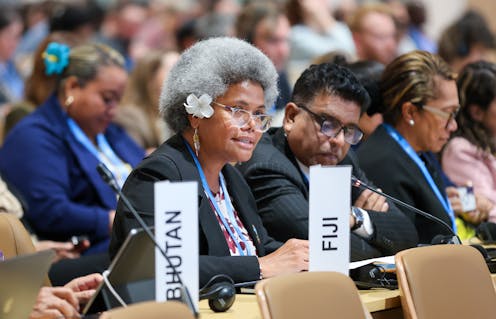
Lenora Qereqeretabua, the deputy speaker of Fiji’s Parliament, at the COP29 climate summit.IISD/ENB/Mike Muzurakis, CC BY-SA
As this year’s UN climate summit reaches its final stage of negotiations, Pacific scholars are calling on world leaders to improve the dispersal system of climate finance to support people living in small island nations.
Last week, we presented the Conference of the Parties (COP29) with a report from the largest Pacific climate adaptation study. The Pacific Ocean Climate Crisis Assessment (POCCA) amplifies voices of people with lived experience. It collates data and case studies about climate impacts island nations are already facing and local adaptation strategies they are already practising.
The report shows that climate finance has been mainstreamed into global financial structures which follow the same patterns as development aid.
This means the main global financial institutions, including the World Bank and the International Monetary Fund, become the “accredited” institutions involved in dispersing funds, adding loan components and making direct access difficult for Pacific nations.
Loading recipient countries with more debt
As a result, some 72% of the money is in the form of loans by the time it reaches people on the ground. The real beneficiaries are private contractors in developed countries who are brought in to build climate-resilient infrastructure.
What may have started off as a humanitarian gesture has ended up loading recipient countries in the Global South, particularly in the Pacific, with more debt.
Recent research shows extreme weather is already costing vulnerable island nations US$141 billion each year. Estimates suggest this will rise to $1 trillion annually by 2030.
Last year’s climate summit in Dubai agreed to establish a new fund to compensate developing countries for losses and damages from natural disasters caused by climate change. This diplomatic effort was spearheaded by a group of small island developing states and it is important this fund fills the gaps in current climate finance.
However, closing the gap between the funds currently available and the money needed is only one aspect. We must also transform the process of dispersal to make sure money directly benefits people who already face climate impacts on a daily basis.
Our report also highlights a range of climate adaptation strategies, including relocating households and villages, already employed by Pacific peoples across the region.
As descendants of great navigators and oceanic settlers who traversed the world’s largest ocean for millennia, Pacific peoples have long developed sophisticated adaptive capacities. Despite living in some of the planet’s smallest and most environmentally challenging places, they have been responding to change in locally relevant and innovative ways for centuries.
This includes traditional building techniques which produce more flexible houses that are easier to rebuild and coastal protections against sea-level rise and beach erosion.
Adaptation practices used in Pacific Islands are mostly based on community Indigenous knowledge and skills passed down over generations. For example, in French Polynesia, the traditional practice of building elevated houses with floors 1.5m above ground level is now subsidised by the government as part of risk prevention.
Pacific peoples are intrinsically connected to the ocean and have developed systems of social and ecological resilience which allows them to bounce back quickly from disruption.
Many Pacific people are indeed affected by climate change. But the
constant narrative of vulnerability is problematic. It undermines the very idea of Indigenous and local Pacific agency and resilience.
The complexity of climate impacts requires us to look at what is happening on the ground, especially when applying science-based models and their inherent uncertainties to inform local adaptation decisions.
The report recommends enabling pathways that combine Indigenous knowledge, contemporary science methods and government decision tools to safeguard a balance between ground-up and top-down approaches to adaptation and resilience.
Pacific Island communities have always lived on islands affected by drought, tsunami and tropical cyclones. They had to survive on islands with limited resources.
Over millennia, Pacific peoples developed local knowledge, including cultural
principles and social structures, to thrive in these circumstances. Given existential threats and challenges, especially those facing atoll island communities, we need to draw on climate-related Indigenous knowledge and practices.
In contrast to narratives of vulnerability, legacies of resilience are key to successful climate adaptation.
Steven Ratuva does not work for, consult, own shares in or receive funding from any company or organisation that would benefit from this article, and has disclosed no relevant affiliations beyond their academic appointment.
Source: The Conversation (Au and NZ) – By Jordan Peter Anthony Pitt, Associate Dean of Indigenous Strategy and Services (Faculty of Science), University of Sydney
An enduring challenge facing science around the world is how to best include and engage Indigenous communities.
Leading Indigenous academics from all three nations attended the summit. They gave talks on topics such as the United Nations Declaration on the Rights of Indigenous Peoples, Indigenous leadership in academic institutions and the role of Indigenous engagement in expanding and improving research and education.
Many of the issues Indigenous academics raised at the summit were common to all three nations.
We heard of structural issues such as lack of recognition and protection of Indigenous Cultural Intellectual Protocols. We also heard about the problem of research being about us but without us and the barriers to increasing the number of Indigenous academics.
One of these barriers is the historical erasure and suppression of Indigenous cultures and their associated knowledges. Another is the education pipeline: only 68% of Aboriginal and Torres Strait Islanders aged 20–24 have completed Year 12 or equivalent. A third barrier is the cultural safety for both university students and staff.
These barriers were highlighted by deeply personal stories shared throughout the summit, including from residential school survivors and academics who had experienced racism in their workplace.
Fundamentally these issues are all rooted in the same thing: the significant power imbalance between Indigenous communities and the academic community seeking to engage them.
This has resulted in previous engagement being a purely extractive process. Researchers have taken knowledge from Indigenous communities, without giving anything back. This has eroded trust.
There is movement to improve engagement by moving from projects done “on us” to projects done “with us” and “by us”. But achieving this goal will require long-term, strategic engagement of Indigenous communities to move from merely nice-to-have representation to genuine partnership.
But even though it may take time, this is worthwhile work.
For communities with genuine partnership and benefit sharing, engagement with academia and the learned academies could meaningfully uplift communities.
For example, Indigenous-led organisation Trioda Wilingi employs Indigenous people at all levels and is working with scientists from the University of Queensland to produce medical gels from spinifex grass. These gels can treat painful conditions such as arthritis.
As the summit began, we heard of the passing of the First Nations Canadian politician and lawyer the Honourable Murray Sinclair. His presence looms large in matters of Indigenous engagement – he chaired the Indian Residential Schools Truth and Reconciliation Commission in Canada.
Thanks to his extensive work in this area, his presence and words echoed through every talk and panel. The most notable are two quotes from his time chairing the commission. One describes the commission’s work:
We have described for you a mountain. We have shown you the way to the top. We call upon you to do the climbing.
The second quote reflects on the role of education in reconciliation:
Education got us into this mess, and education will get us out of it.
These are statements that reverberate across the three nations that took part in the summit. They highlight the ongoing issues in the engagement of the learned academies and academia more broadly with Indigenous peoples.
Transformational education
There is still a mountain to climb – and education remains key.
But to overcome history, education must be developed in the communities’ interests with their voices at the table to create genuinely transformational education.
Hampering the climb is easy, but it doesn’t make the mountain disappear.
The summit in Vancouver was supported by the Royal Society of Canada, the Australian Academy of Science, and the Royal Society Te Apārangi (Aotearoa New Zealand). There will be another summit next year in Aotearoa New Zealand. The final one will be in 2026 in Australia.
Jordan Peter Anthony Pitt is Associate Dean Indigenous Strategy and Services of the University of Sydney. The Australian Academy of Science funded Dr Pitt’s attendance at the Summit. Dr Pitt is the Chair of the Early and Mid-career Researcher Forum, which is affiliated with and supported by the Australian Academy of Science.
Cricket originated in England, but has been spread worldwide by British soldiers and settlers in the past few hundred years.
It is now the second most popular sport in the world in terms of number of fans, after soccer.
This spread has been most successful in the Indian sub-continent, which is now considered the epicentre of world cricket.
This region includes countries such as Bangladesh, India, Pakistan and Sri Lanka.
According to the International Cricket Council (ICC), 90% of the world’s cricket fans are from the sub-continent.
History of cricket in the Indian sub-continent
Cricket was introduced to the Indian sub-continent by sailors and traders from the East India Company in the early 18th century.
The first recorded cricket match in this region was played between British sailors in western India in 1721.
Introducing English sports and traditions was intended to assert British dominance and cultural superiority. However, Indian elites embraced cricket as a way to gain favour with their rulers.
Over time, cricket became popular with the entire population.
Cricket matches between India and Pakistan are considered one of the biggest sporting events in the world, and are regularly watched by nearly half a billion fans.
While cricket is also very popular in other successful cricketing nations such as Australia, South Africa and the United Kingdom, it does not enjoy the same unrivalled status as it does in the Indian sub-continent.
It has the ability to cut across regional, ethnic, social class and religious divides, and unitecountries in a way no other sport or cultural institution can.
Indeed, cricket has been described as a religion, particularly in India where it brings people of all faiths and backgrounds together.
It even has the power to temporarily stop civil wars. In 2007, the Tamil Tigers militant group declared a ceasefire with the government of Sri Lanka for the duration of the Cricket World Cup.
Why is cricket so popular?
Cricket can be played anywhere. In large South Asian cities, it is often played in cramped spaces such as rooftops, markets and busy streets.
Variations such as “tape ball cricket” and “street cricket” mean players can simply use a rubbish bin, milk crate, or marks on a wall as the wickets.
The bat can be a stick, and a rubber or tennis ball can be taped to ensure it deviates in the air to make things more challenging for a batter.
Games of cricket can be seen just about anywhere on the Indian sub-continent.
This softer ball means equipment such as pads and helmets are not needed.
Many of South East Asia’s cricket legends such as Wasim Akram and Sachin Tendulkar first honed their skills in chaotic street games that required quick reflexes and improvisation.
Winning the Cricket World Cup in 1983 (India), 1992 (Pakistan), 1996 (Sri Lanka) and 2011 (India) made cricketers heroes and role models for new generations.
A lack of success in other sports – except India and Pakistan in hockey, particularly during the 20th century – means cricket has little competition for the hearts of sports fans in the region.
Media momentum
Huge media coverage and sponsorship across the sub-continent has ensured significant money and resources have been invested back into cricket.
For instance, the Board of Control for Cricket in India (BCCI) has previously earned billions of dollars over a five year period from lucrative television rights.
Much of this money is from the Indian Premier League – a Twenty20 competition that has quickly become the biggest cricket league in the world.
Similar successful (but not as profitable) T20 competitions have been set up in countries such as Bangladesh, Pakistan and Sri Lanka.
The majority of the ICC’s revenue now comes from India. Consequently, the BCCI has increasing control over the ICC and its decisions.
Additionally, India will be given 38.5% of the ICC’s profits in the 2024-2027 cycle – 105 nations will share the other 61.5%.
While these investments help build future cricket pathways and facilities for the next generation of aspiring Indian cricketers, the ICC profit split has been criticised for making the richest countries richer and missing the chance to grow the game in other countries.
What about women’s cricket?
Cricket has the potential to be even more popular in the region if it embraces gender equality. One example of this would be Afghanistan, if the Taliban lifts its currentban on women playing cricket.
Countries such as Australia have refused to play men’s cricket matches against Afghanistan until conditions for women and girlsimprove.
However, the success of women’s teams has resulted in increased acceptance of women’s cricket in the Indian sub-continent in recent years.
Notable recent initiatives include the BCCI launching a successful women’s T20 competition in 2023. The recent ICC T20 World Cup was the first time women received the same prize money as their male counterparts.
These decisions align with the ICC prioritising the growth of the women’s game.
Continued popularity and growth
The deep passion for the game and continued success of teams from the Indian sub-continent is likely to ensure cricket’s continued popularity.
Cricket is also growing in popularity in countries like the United States, thanks to large Indian communities – in fact, the US co-hosted the 2024 T20 World Cup.
The addition of cricket to the Los Angeles Olympic program in 2028, should ensure that sub-continent cricket fans support the popularity of cricket in the years ahead.
The authors do not work for, consult, own shares in or receive funding from any company or organisation that would benefit from this article, and have disclosed no relevant affiliations beyond their academic appointment.
As America takes stock after Donald Trump’s re-election to the presidency, it’s worth highlighting the AI-generated fake photos, videos and audio shared during the campaign.
A slew of fake videos and images shared by Trump and his supporters purported to show his opponent, Kamala Harris, saying or doing things that did not happen in real life.
Of particular concern are deepfake videos, which are edited or generated using artificial intelligence (AI) and depict events that didn’t happen. They may appear to depict real people, but the scenarios are entirely fictitious.
Russian actors continue to create AI-enhanced deepfake videos about Vice President Harris. In one video, Harris is depicted as allegedly making derogatory comments about former President Donald Trump. In another […] Harris is accused of illegal poaching in Zambia. Finally, another video spreads disinformation about Democratic vice president nominee Tim Walz, gaining more than 5 million views on X in the first 24 hours.
If left unchallenged, political deep fake videos could have profound impacts on Australian elections.
It’s getting harder to spot a deepfake
Images have stronger persuasive power than text. Unfortunately, Australians are not great at spotting fake videos and images.
The prevalence of deepfakes on social media is particularly concerning, given it is getting harder to identify which videos are real and which are not.
AI-based methods for detection are marginally better than humans. However, these methods become less effective when videos are compressed (which is necessary for social media).
As Australia faces its own election, this technology could profoundly impact perceptions of leaders, policies, and electoral processes.
Without action, Australia could become vulnerable to the same AI-driven political disinformation seen in the US.
Deepfakes and disinformation in Australia
When she was home affairs minister, Clare O’Neil warned technology is undermining the foundations of Australia’s democratic system.
Senator David Pocock demonstrated the risks by creating deepfake videos of both Prime Minister Anthony Albanese and Opposition Leader Peter Dutton.
The technology’s reach extends beyond federal politics. For example, scammers successfully impersonated Sunshine Coast Mayor Rosanna Natoli in a fake video call.
We’ve already seen deepfakes already in Australian political videos, albeit in a humorous context. Think, for example, of the deepfake purporting to show Queensland premier Steven Miles, which was released by his political opponents.
While such videos may seem harmless and are clearly fabricated, experts have raised concerns about the potential misuse of deepfake technology in future.
As deepfake technology advances, there is growing concern about its ability to distort the truth and manipulate public opinion. Research shows political deepfakes create uncertainty and reduce trust in the news.
The risk is amplified by microtargeting – where political actors tailor disinformation to people’s vulnerabilities and political views. This can end up amplifying extreme viewpoints and distort people’s political attitudes.
Not everyone can spot a fake
Deepfake content encourages us to make quick judgments, based on superficial cues.
Studies suggest some are less susceptible to deepfakes, but older Australians are especially at risk. Research shows a 0.6% decrease in deepfake detection accuracy with each year of age.
Younger Australians who spend more time on social media may be better equipped to spot fake imagery or videos.
But social media algorithms, which reinforce users’ existing beliefs, can create “echo chambers”.
Research shows people are more likely to share (and less likely to check) political deepfake misinformation when it shows their political enemies in a poor light.
With AI tools struggling to keep pace with video-based disinformation, public awareness may be the most reliable defence.
Deepfakes are more than just a technical issue — they represent a fundamental threat to the principles of free and fair elections.
The authors do not work for, consult, own shares in or receive funding from any company or organisation that would benefit from this article, and have disclosed no relevant affiliations beyond their academic appointment.
Source: The Conversation (Au and NZ) – By Kira Morgan Hughes, PhD Candidate in Allergy and Asthma, School of Life and Environmental Sciences, Deakin University
When spring arrives, so do warnings about thunderstorm asthma. But a decade ago, most of us hadn’t heard of it.
So where did thunderstorm asthma come from? Is it a new phenomenon?
In 2016, the world’s most catastrophic thunderstorm asthma event took Melbourne by surprise. An increase in warnings and monitoring is partly a response to this.
But there are also signs climate change may be exacerbating the likelihood of thunderstorm asthma, with more extreme weather, extended pollen seasons and a rise in Australians reporting hay fever.
A landmark catastrophe
The first time many Australians heard of thunderstorm asthma was in November 2016, when a major event rocked Melbourne.
During a late night storm, an estimated 10,000 people were rushed to hospitals with severe asthma attacks. With thousands of calls on emergency lines, ambulances and emergency departments were unprepared to handle the rapid increase in people needing urgent medical care. Tragically, ten of those people died.
This was the most catastrophic thunderstorm asthma event in recorded history and the first time deaths have ever occurred anywhere in the world.
In response, the Victorian Department of Health implemented initiatives, including public awareness campaigns and improvements to health and emergency services, to be ready for future thunderstorm asthma events.
A network of pollen monitoring stations was also set up across the state to gather data that helps to predict future events.
A problem for decades
While this event was unexpected, it wasn’t the first time we’d had thunderstorm asthma in Australia – we’ve actually known about it for decades.
Melbourne reported its first instance of thunderstorm asthma back in 1984, only a year after this phenomenon was first discovered in Birmingham in the United Kingdom.
Thunderstorm asthma has since been reported in other parts of Australia, including Canberra and New South Wales. But it is still most common in Melbourne. Compared to any other city (or country) the gap is significant: over a quarter of all known events worldwide have occurred in Melbourne.
Why Melbourne?
Melbourne’s location makes it a hotspot for these kinds of events. Winds coming from the north of Melbourne tend to be dry and hot as they come from deserts in the centre of Australia, while winds from the south are cooler as they come from the ocean.
When hot and cool air mix above Melbourne, it creates the perfect conditions for thunderstorms to form.
Northern winds also blow a lot of pollen from farmlands into the city, in particular grass pollen. This is not only the most common cause of seasonal hay fever in Melbourne but also a major trigger of thunderstorm asthma.
Why grass pollen?
There’s a particular reason grass pollen is the main culprit behind thunderstorm asthma in Australia. During storms there is a lot of moisture in the air. Grass pollen will absorb this moisture, making it swell up like a water balloon.
If pollen absorbs too much water whilst airborne, it can burst or “rupture,” releasing hundreds of microscopic particles into the air that can be swept by powerful winds.
Normally, when you breathe in pollen it gets stuck in your upper airway – for example, your nose and throat. This is what causes typical hay fever symptoms such as sneezing or runny nose.
But the microscopic particles released from ruptured grass pollen are much smaller and don’t get stuck as easily in the upper airway. Instead, they can travel deep into your airways until they reach your lungs. This may trigger more severe symptoms, such as wheezing or difficulty breathing, even in people with no prior history of asthma.
A grass pollen rupturing. Kira Hughes/Supplied, CC BY
So who is at risk?
You might think asthma is the biggest risk factor for thunderstorm asthma. In fact, the biggest risk factor is hay fever.
Up to 99% of patients who went to the emergency department during the Melbourne 2016 event had hay fever, while a majority (60%) had no prior diagnosis of asthma.
Every single person hospitalised was allergic to at least one type of grass pollen. All had a sensitivity to ryegrass.
Is thunderstorm asthma becoming more common?
Thunderstorm asthma events are rare, with just 26 events officially recorded worldwide.
However there is evidence these events could become more frequent and severe in coming years, due to climate change. Higher temperatures and pollution could be making plants produce more pollen and pollen seasons last much longer.
Extreme weather events, including thunderstorms, are also expected to become more common and severe.
In addition, there are signs rates that hay fever may be increasing. The number of Australians reporting allergy symptoms have risen from 15% in 2008 to 24% in 2022. Similar trends in other countries has been linked to climate change.
What happens to your clothes after you don’t want them any more? Chances are, you will donate them to op shops run by a charity organisation.
There are more and more clothes in circulation, and they are getting cheaper and lower quality. That means the clothes you give away are worth less and less. For charities, this means donated clothes are less gift, more rubbish.
Our new research explores what happens to clothes and other textiles after we don’t want them across nine cities in Europe, North America and Australia. The pattern was the same in most cities. The sheer volume is overwhelming many shops. In Geneva, donations to charity shops have surged 1,200% in three decades, from 250 tonnes in 1990 to 3,000 tonnes in 2021. Worldwide, we now dump 92 million tonnes of clothes and textiles a year, double the figure of 20 years earlier.
There’s less and less value in managing these clothes locally. As a result, charities are forced to send more clothes to landfill – or sell bale after bale of clothing to resellers, who ship them to nations in the Global South.
Local governments usually handle other waste streams. But on clothes and textiles, they often leave it to charitable organisations and commercial resellers. This system is inherited from a time when used clothing was a more valuable resource, but the rising quantity of clothing has pushed this system towards collapse.
From January, all EU states have to begin rolling out collection services for used textiles. But in Australia and the United States there are no moves to do the same – even though these two countries consume the most textiles per capita in the world. As we work towards creating circular economies, where products are continually reused, this will have to change.
Textile waste is a new problem
Historically, textiles were hard to make and hence valuable. They were used for as long as possible and reused as rags or other purposes before becoming waste. These natural fibres would biodegrade or be burned for energy.
But synthetic fibres and chemical finishings have made more and more clothes unable to biodegrade. Fast fashion – in which high fashion trends are copied and sold at low cost – is only possible because of synthetic fibers such as polyester.
These clothes are often worn for a brief period and then given or thrown away.
What happens to this waste? To find out, we looked at textile waste in Amsterdam, Austin, Berlin, Geneva, Luxembourg, Manchester, Melbourne, Oslo and Toronto. In eight of these cities, charities and commercial resellers dealt with the lion’s share of clothing waste. But in Amsterdam, local governments manage the problem.
Across the nine cities, most donated clothes go not to charity shops shelves but to export. In Oslo, 97% of clothes are exported.
The flood of clothes is producing strange outcomes in some places. In Melbourne, charities are now exporting higher quality secondhand clothes to Europe. But we found this forces independent secondhand clothing outlets to import similar clothes back from Europe or the US.
Charity organisations usually export the clothes across the Global South. But shipping container loads of secondhand clothes and textiles can do real damage environmentally. Clothing that can’t be sold becomes waste. In Ghana, there are now 20-metre-high hills made of clothing waste. Synthetic clothes clog up rivers, trap animals and spread plastics as they break apart. This practice has been dubbed “waste colonialism”.
Uganda has recently banned imports. The secondhand clothing export industry provides work, but its social and environmental impacts have been devastating.
What should we do?
At present, charities and resellers are struggling with managing the rising volume of donations, but they have little room to change. Exporting excess clothing is getting less profitable, but moving to local sorting and resale would be even less so due to higher costs and too many clothes collected relative to demand for secondhand items.
These clothes are disposed of by consumers who live in cities in wealthier countries. The actions city leaders take can reduce the problem globally, such as encouraging residents to buy fewer new clothes and boosting local reuse, repair and recycling efforts.
We are already seeing seeing grassroots initiatives emerging in all nine studied cities promoting local reuse and repair, with some receiving government support and others operating independently.
To make real change, municipal governments will have to take on a larger role. At present, municipal governments in most of the cities we studied have limited roles, ranging from sending clothing waste to landfill to sharing data on clothing recycling bins, letting charities and resellers set up collection points and supporting repair and swapping.
Here are three ways local governments could take the lead:
1. Curb overconsumption
Dealing with waste is a major role for municipal governments, and comes with major costs. To reduce clothing waste, cities could launch campaigns against overconsumption by focusing on the environmental damage done by fast fashion – or even banning ads for clothing retailers in city centres.
2. Boost reuse
Local governments could stop charging charities for the right to collect clothing and instead offer compensation for every kilo of collected textiles to help replace the money they get from sending clothing bales to resellers for export. Cities can also train and support circular economy practitioners, such as those involved in repair and upcycling.
3. Reduce exports of clothing waste
City leaders could reduce textile exports by recognising them as a waste stream and including textiles in their waste management planning.
One thing is certain – if we keep going as we are, flows of clothing waste will only grow, leading to more waste locally – and greatly increase the waste problem overseas.
The authors do not work for, consult, own shares in or receive funding from any company or organisation that would benefit from this article, and have disclosed no relevant affiliations beyond their academic appointment.
Prime Minister Anthony Albanese didn’t see this coming. At the global COP29 climate talks in Baku, the Australian government was indirectly criticised by two allies, the United States and the United Kingdom, over its refusal to sign onto the goal of tripling nuclear power globally by 2050.
The UK’s original press release said Australia was “expected” to sign on to the nuclear push, under the umbrella of a long-running nuclear research pact known as the Gen IV Forum. Australia signed up to this pact in 2016, under a previous government, and in 2021 signed onto the AUKUS security pact to procure nuclear submarines from the US. This is perhaps why UK leaders assumed Australia would back the broader push to promote nuclear power around the world.
Not so. While Australia has signed up for nuclear submarines, it has not made any effort to adopt nuclear power. But nuclear power is shaping up as a major election issue, with the Coalition pushing for Australia to go nuclear and Labor pointing out the improbable economics of nuclear in a sun and wind rich country.
“As Australia does not have a nuclear energy industry, and nuclear power [is] illegal domestically, we will not be signing up to this agreement,” a government spokesperson said.
Nuclear or solar? Australia’s calculations are different to other nations. Yuri Hoyda/Shutterstock
What exactly is this nuclear initiative?
The US and UK initiative announced at Baku is intended to supersede the Generation IV Forum set up in 2001 to produce designs for fourth-generation nuclear reactors and eventually replace the Gen III designs currently running in many countries. More than 20 years later, there is only one prototype Gen IV reactor, which began operating in China this year. Plans for a larger successor appear to have been shelved for the moment.
The US and UK have had nuclear power since the late 1950s. But the goal of tripling nuclear capacity in 25 years is wildly unrealistic, certainly as far as the US and UK are concerned.
In 2023, about 9% of the world’s electricity came from the roughly 400 nuclear reactors producing power. In recent years, nuclear growth has been concentrated in Asia – especially China, which has 30 reactors under construction – followed by Russia and Eastern Europe. Tripling the world’s nuclear power output would be a herculean feat.
Since the US completed the Vogtle plant in 2023, years behind schedule and billions over budget, there have been no commercial nuclear plants under construction in the country. A handful of proposals approved during the much-touted “nuclear renaissance” of the early 2000s could in theory be commenced, but there is no sign of that happening. The idea of building any substantial number of plants by the mid 2030s, as is proposed in the US strategy, is a fantasy.
The UK has two nuclear reactors under construction at Hinkley Point, both massively overdue and over-budget. A number of other projects announced in the early 2000s have been abandoned, leaving only the Sizewell C plant, a 3.2-gigawatt power station proposed in England.
Sizewell C was officially approved in November 2022 but financing has proved problematic. The UK government has repeatedly deferred a final decision, currently planned for early next year. Assuming a positive outcome, Sizewell C might be in operation by 2035. After that, there are no large-scale plants in the pipeline.
With no large-scale nuclear on the horizon, attention has switched to the idea of “small modular reactors”, ranging from 70 to 300MW in size. This category includes truly modular designs, built in a factory and shipped to the construction site, as well as cut-down versions of existing large reactors. A notable example is the Westinghouse AP300, which is based on the AP1000 used at Vogtle.
Although no SMRs have yet been constructed (or perhaps precisely because there have been no real-world tests of ambitious claims), advocates suggest they can be constructed in five to seven years at a lower cost per megawatt than existing large models. But in Australia, CSIRO modelling suggests power from SMRs will actually be more expensive than large nuclear – which is much more expensive than renewables firmed with storage and transmission.
There has been a recent burst of enthusiasm for the idea of using SMRs to power data centres for cloud and AI systems.
But a closer look suggests caution. Big tech giants such as Amazon, Google and Microsoft have announced plans for delivery in the early 2030s, but in each case, the proposed capacity is 1GW or less.
As a result, it’s highly unlikely they will amount to more than 5GW of new capacity over five years.
By contrast, renewables are only gaining strength. In the second half of 2024 alone, the US is expected to install more than 40 GW of utility-scale capacity, including 10GW of battery storage. China is installing renewables at truly prodigious rates, with around 330 GW installed or under way.
Doesn’t the AUKUS deal pave the way to nuclear power?
Many commentators have this week drawn a line between this nuclear announcement and AUKUS. But this contradicts previous assurances that the submarine deal was not linked to the legalisation of nuclear energy
When the nuclear submarine pact was first announced, even strong nuclear advocates moved to distinguish between nuclear subs and nuclear plants. As Liberal-National MP Ted O’Brien said in 2021, the AUKUS deal was not related to nuclear power:
They are two entirely different offerings. The nuclear-propelled submarines do not require a change in Australian law. So legally they are completely different issues for the parliament to deal with. There is no moratorium that needs to be lifted
The US and UK proposal to triple nuclear power involves a large amount of wishful thinking and very little reality.
But that doesn’t help the Albanese government much. Opposition Leader Peter Dutton, whose party now has a platform of creating a domestic nuclear power industry in Australia, can fairly claim that his ideas are consistent with the announced positions of our AUKUS allies.
The government is also open to attack from the Greens and other critics of AUKUS. With a recently announced decision to store AUKUS-related nuclear waste at submarine shipyards, it’s becoming increasingly arguable that, contrary to earlier assurances, participation in AUKUS will lock Australia into the full nuclear fuel cycle, potentially including reprocessing and nuclear energy generation.
Then there’s the Trump factor. Donald Trump’s return as US President could render all these calculations irrelevant. Although Trump is strongly pro-nuclear in his rhetoric, he is likely to abandon the green industrial policy of Biden’s Inflation Reduction Act which provides US government support for nuclear power. And, if the AUKUS deal begins to look troublesome, he will have no hesitation in repudiating it or demanding a renegotiation on unfavourable terms.
John Quiggin does not work for, consult, own shares in or receive funding from any company or organisation that would benefit from this article, and has disclosed no relevant affiliations beyond their academic appointment.
Stan’s new Christmas film Nugget is Dead is a colourful production that follows the rules of the seasonal genre film to a tee – with an Aussie twist and a dash of queer multiculturalism thrown in for good measure.
Most screenwriters refer to the Hallmark Channel as the generic yardstick of Christmas films. The US cable network pumps out dozens of tinsel-tinged offerings each year.
But what exactly are the rules of a Christmas movie? And how does Nugget is Dead fit in with the rest?
A cast stuffed with homegrown talent
Christmas movie screenwriting blogger and podcaster Caryn McCann has laid out the steps of the Christmas film formula, which can be applied to the case in point.
Step 1: choose a cute regional location situated a good distance from the big smoke. Christmas in Australia is, of course, in summer, so no snow-covered Midwest town for us. Instead, what better than an unnamed seaside location reminiscent of a less desirable version of Home and Away’s Summer Bay?
Step 2: find a key character who’s down on love. Enter struggling bisexual registrar Steph Stool (played by Vic Zerbst, who also cowrote the film). Steph’s swanky millennial boyfriend (Alec Snow) has it all, including a double-barrelled surname and an overbearing mum (Tara Morice) from Sydney’s North Shore. But their relationship is floundering at this crucial time of year.
Steph’s zany family, on the other hand, are on the more bogan end of the Australian social order. Notable mention goes to Steph’s OTT (over-the-top), recently separated parents, Jodie and John Stool (Gia Carides and Damien Garvey).
Vic Zerbst plays Steph Stool, with Gia Carides as her mother Jodie Stool. Lisa Tomasetti
Meanwhile, cowriter Jenna Owen hurls herself into the fun role of ditzy eshay cousin Shayla, who probably gets the most laughs as a foil to Zerbst’s uptight Steph.
The film mostly plays out in the Stool brood’s hometown, but crosscuts to Steph’s boyfriend’s affluent family’s celebrations.
Comedy doubling as class commentary
When Steph is called back home to attend to her dying dog, the titular Nugget, she encounters Step 3: the love interest. In this case, the attractive distraction appears in the form of her poor pooch’s new vet, Ella Lander (Priscilla Doueihy), who quickly becomes enmeshed in the Stool way of life.
Steps 4 and 5 of the form involve the careful balancing of cheerful Christmas traditions alongside drama aplenty. True to form, Nugget is Dead has more than enough fruity pavlova, Christmas crackers and sizzling snags on the barbie.
There are no shortage of Christmas tropes in this film. Lisa Tomasetti
These elements serve as a vital backdrops to several hectic – and silly – family barneys. I tip my festive headwear to emerging director Imogen McCluskey and director of photography Kate Cornish for capably managing dialogue-heavy scenes that include a large ensemble cast.
The humour in these sections comes from mix of comedic voices, as well as by contrasting ocker “realness” (and groan-worthy dad jokes) with urban upper-middle-class vapidity.
Director Imogen McCluskey experlty handles dialogue-heavy scenes featuring a large ensemble cast. Lisa Tomasetti
Out with the old
The final steps of the Christmas movie formula come down to the hero, heroine or non-binary protagonist embracing the true spirit of the holiday season – and restoring his, her or their reliance on romance and family values. On this front, Nugget is Dead does not deviate.
The film has an endearing core message about being accepting of poeple’s differences, which helps to extend it away from the genre’s norm.
The film’s core message is about accepting poeple’s differences. Julia Firak
In an Australian context, the film dabbles in the dreaded cultural cringe. I wasn’t sure if this was a deliberate wink to those in the know, or the result of trying to write for a wider audience and becoming a bit reductive in the process.
Nugget is Dead demonstrates the many ways in which our Christmas customs are becoming less white-bread and heteronormative.
Nugget is Dead is streaming on Stan from November 21.
Phoebe Hart does not work for, consult, own shares in or receive funding from any company or organisation that would benefit from this article, and has disclosed no relevant affiliations beyond their academic appointment.
Source: The Conversation (Au and NZ) – By Biswa Das, Associate Professor of Community and Regional Planning and Extension Economist, Iowa State University
Young families with children are a shrinking part of the U.S. population in many areas. The decline is especially pronounced in major urban centers, including Boston, San Francisco, New York, Minneapolis, Chicago, Los Angeles, Detroit, Seattle, Philadelphia, San Jose and Washington, D.C.
During the COVID-19 pandemic shutdown, many families with children moved to suburban or rural areas in search of more space. From mid-2020 through mid-2022, populations of young children fell by 10% in large urban counties that make up metro New York City, San Francisco, Los Angeles and Chicago.
This trend has continued: Americans ages 25 to 44 – the years when people typically start families – are increasingly moving to rural counties and small metro areas.
From my research in economic development and public finance, I have observed unique local factors that influence this trend, but also recurring themes. Here are some reasons why major cities are losing young families, and the effects that follow.
What young families contribute to cities
Families form the backbone of thriving communities. Their presence positively affects city infrastructure, local economies and overall quality of life.
Some people may wonder how this can be true when school districts within cities have to spend money on public schools. In fact, along with property tax payments, young families contribute to the economy by spending on housing, groceries, child care, health care, recreation and education. They create demand for family-oriented goods and services, which helps generate stable jobs in sectors such as education, health care, retail and hospitality.
By participating in local events, volunteering and connecting with their neighbors, young families help create lively communities. This kind of engagement fosters a sense of belonging and helps strengthen cities’ social fabric.
Young families help cities maintain or increase their population, which can counter urban shrinkage and decline. They are important advocates for high-quality public services such as schools, parks and libraries, and recreational amenities such as swimming pools and playing fields.
Families often advocate for features that promote healthy living, and for cleaner environments with lower pollution levels and reduced traffic congestion. Neighborhoods with young families tend to have lower crime rates due to parents’ investment in their children’s safety and well-being.
Together, these drivers make many cities less attractive environments for families. Many families are choosing suburban or rural locales where they perceive a better quality of life for raising children.
Declining birth rates also help to explain why the number of households with children continues to shrink in major cities. For many reasons, including concerns about the future as well as current economic conditions, younger Americans are having fewer children, which is reducing household size.
High living costs are a major factor driving young families out of many large U.S. cities.
Cities without kids
When cities lose significant numbers of young families, there can be far-reaching social, economic and demographic impacts. Declining numbers of students can lead to school consolidations or closures.
Reduced demand for family-sized homes and rental properties may depress property values. The city’s labor force can shrink, affecting its local economy and tax base.
As young families leave, declining property and sales tax revenues can make it harder to fund services and maintain infrastructure. Since schools and youth organizations often are hubs for community engagement, residents’ sense of community may weaken over time.
Where the kids are
Some cities are bucking this trend. For example, Austin, Texas, has become a major tech hub in recent years, with many companies relocating or expanding there and creating jobs. Austin’s relatively low cost of living, strong public school system and abundant parks and recreational activities make it a destination that’s often highly rated for families.
Raleigh, North Carolina, is another popular draw for young families with children. It offers a strong job market in technology, health care and education; affordable housing; high-quality schools; and a growing population of young professionals and families.
Other “baby boomtowns” currently attracting young families include Dallas-Fort Worth, Charlotte, Boise, Salt Lake City, Orlando and Nashville.
Attracting young families
Overall, families with children consider many factors in choosing a place to live. Affordable and family-friendly housing is usually a top priority. Cities seeking to attract families could prioritize developing affordable single-family homes, townhomes and apartments with family-friendly features, such as common play spaces.
Developers may require incentives to build two- to four-bedroom units, instead of the studios and one-bedroom units that typically are marketed to young professionals. Creating mixed-income housing developments is a way to foster diverse, vibrant communities and avoid gentrification.
Another priority for attracting and retaining young families is well-funded public schools with excellent teachers, resources and extracurricular activities. School systems may be able to collaborate with local colleges and universities to offer family-friendly programs, dual enrollment for high school students and continuing education for parents. Working families also need access to affordable, high-quality preschools and day care centers.
Investing in community policing strategies, neighborhood watch programs and youth engagement initiatives can help to build a sense of safety. Adopting traffic-calming measures by constructing more pedestrian crossings and providing safe routes to schools can reduce the risk of accidents and make streets safer for families.
Recreation is another important area for investment. Creating and maintaining safe parks, with playgrounds, picnic areas and sports facilities, will serve residents of all ages. Walkable neighborhoods, with bike paths and green spaces that promote active lifestyles, are also very appealing to young families.
Parks can build community by offering recreational programs, sports leagues, cultural events, summer camps, art classes and holiday celebrations. Activities like these can help make cities feel like welcoming places. Cities can host events such as farmers markets, outdoor movie nights and seasonal festivals, and promote community sharing to create a sense of belonging.
Most cities don’t have the resources to pursue all of these goals at once. But to attract and retain young families, I believe picking one or two as targets is a good way to move forward.
Biswa Das receives funding from the National Science Foundation and the U.S. Department of Agriculture
The Albanese government has rewritten the mandate of the Future Fund – the nation’s sovereign wealth fund – to urge it to direct investment into the “national priorities” of housing, the energy transition and infrastructure, where the risk and returns are acceptable.
Treasurer Jim Chalmers and Finance Minister Katy Gallagher said a new “investment mandate” and “statement of expectations” would modernise, refresh and renew the fund so it played “an enduring and prominent role” in the economy.
The ministers said the Australian economy faced big structural shifts coming from the global net zero transformation as well as technological and demographic changes and global fragmentation.
The $230 billion fund, which is independent in its investment decisions, is headed by former Labor minister Greg Combet.
The new investment mandate “will require the fund to consider Australia’s national priorities in its investment decisions, where possible, appropriate and consistent with strong returns”.
These priorities are:
boosting the housing supply
supporting Australia’s energy transition
delivering improved infrastructure including economic resilience and security infrastructure
The government stresses the new mandate does not mean the fund would be making riskier or less profitable investments.
To provide certainty to the fund, the government says it would not start any draw-dwns until at least 2032-33. By then, the fund is expected to reach a worth of $380 billion, from its present $230 billion.
“The government remains committed to the Fund’s independence and commercial focus,” the ministers said.
“Its primary objective will continue to be to maximise returns, the benchmark return rate will remain at between 4% and 5% above CPI per annum over the long term, and there will be no change to the expected risk profile.
“The Fund will provide the same strong returns to the government’s balance sheet while supporting national priorities where it can.”
No legislation is needed for the changes.
The Future Fund said in a statement that the government’s announcement was an endorsement of its work over 18 years to deliver a “demanding investment mandate of CPI+ 4-5% a year over the long term”.
It said delivering this investment target remained the fund’s focus under the new investment mandate. The fund’s Board of Guardians “will continue to make investment decisions independent of the government with the priority of generating commercial returns”.
The fund said the priorities it had now been given aligned with its thinking.
It also noted various investments it presently has in infrastructure and the energy transition. It plans to appoint an executive director, energy transition, to help with efforts in this area.
Social media age ban: companies face fines up to $50 million
The government on Thursday will introduce its legislation to ban minors under 16 from accessing social media, with companies facing fines of up to $50 million for breaches.
Under the legislation, the onus will be on the plaforms, not the parents or children, who will not face penalties.
The penalties of up to $50 million will be for companies that systematically breach the law as well as for violations of enforceable industry codes and standards.
The bill also allows the minister to exclude specific classes of services that support the health and benefit of children.
It contains privacy provisions including that platforms ring-fence and destroy any information collected.
Michelle Grattan does not work for, consult, own shares in or receive funding from any company or organisation that would benefit from this article, and has disclosed no relevant affiliations beyond their academic appointment.
Two Australian teenagers are severely ill in hospital in Thailand after experiencing suspected methanol poisoning while they were travelling in Laos.
The pair are reportedly among several foreign nationals to become ill after unknowingly consuming alcoholic drinks containing methanol in the south-east Asian country.
So what is methanol, and how does it make people sick?
The difference is in how methanol is metabolised, or broken down in our bodies.
Ethanol is metabolised into a chemical compound called acetaldehyde. Acetaldehyde is toxic, but is rapidly converted to acetate (also known as acetic acid, found in vinegar). Generating an acid may sound bad, but acetate actually produces energy and makes important molecules in the body.
By contrast, methanol is metabolised into formaldehyde (a chemical used in industrial glues and for embalming corpses, for example) and then to formic acid (the chemical in some ant bites that makes them hurt so much).
Unlike acetate, which the body uses, formic acid poisons the mitochondria, the powerhouses of the cells.
As a result, a person exposed to methanol can go into severe metabolic acidosis, which is when too much acid builds up in the body.
Methanol poisoning can cause nausea, vomiting, and abdominal pain. The acidosis then causes depression of the central nervous system which can cause people with methanol poisoning to fall unconscious and go into a coma, as well as retinal damage leading to vision loss. This is because the retinas are full of active mitochondria and sensitive to them being damaged.
Death is not inevitable if only a small amount of methanol has been consumed, and rapid treatment will greatly reduce damage.
However, permanent vision damage can occur even at non-lethal doses if treatment is not administered quickly.
What does treatment involve?
Treatment is mainly supportive care, such as intubation and mechanical ventilation to help the patient to breathe.
But it can also involve drugs such as fomepizole (which inhibits the generation of toxic formic acid) and dialysis to remove methanol and its metabolites from the body.
Methanol poisoning can cause serious illness and death. NATNN/Shutterstock
How does methanol get into alcoholic drinks?
Methanol can turn up in any alcoholic beverage, but it’s most likely in beverages with higher alcohol content, such as spirits, and traditionally brewed drinks, such as fruit wines.
Methanol can get into alcoholic beverages in a number of ways. Sometimes it’s added deliberately and illegally during or after manufacturing as a cheaper way to increase the alcohol content in a drink.
Traditional brewing methods can also inadvertently generate methanol as well as ethanol and produce toxic levels of methanol depending on the microbes and the types of plant materials used in the fermentation process.
We don’t yet know how the Australian teenagers came to be poisoned in this tragedy. But it is a good idea when travelling (particularly in areas with traditionally fremented drinks, such as south-east Asia, the Indian subcontinent and parts of Africa) to always be careful.
The Australian government’s Smartraveller website advises that to avoid methanol poisoning you should be careful drinking cocktails and drinks made with spirits, drink only at reputable licensed premises and avoid home-made alcoholic drinks.
Drinking only mass-produced commercial brews can be safer, though understandably people often want to try locally made drinks as part of their adventure.
Ian Musgrave has received funding from the National Health and Medical Research Council to study adverse reactions to herbal medicines and has previously been funded by the Australian Research Council to study potential natural product treatments for Alzheimer’s disease. He has collaborated with SA Water on studies of cyanobacterial toxins and their implication for drinking water quality.
The government says it will take “big money” out of election campaigns – or, more realistically, curb it – with its legislation imposing donation and spending caps and real-time disclosure.
But crossbenchers and other critics are up in arms, about the effect on small players and the fact the package is being rushed through parliament in a fortnight.
On this podcast we are talking with Special Minister of State Don Farrell about the bill and the criticisms.
Why the rush? Farrell argues people knew what was coming:
Nothing in this bill is a surprise to anybody who’s been involved in the process that has taken place over the last two and a half years. We went to the last election saying we were going to reduce the disclosure threshold, saying that we were going to introduce real-time disclosure of donations, saying that we were going to introduce caps on spending and donations. And that’s exactly what we’ve done in this legislation and there’s now been two Senate inquiries into this legislation. And all of the parties have absolutely adequate time to have looked at the recommendations.
Why do we need to get it through so quickly? Well, these are significant changes to the electoral system. They’re probably the most significant changes to the Australian electoral system in decades. And it’s going to take time to set up the systems that are going to be required to implement this.
Farrell has introduced truth-in-advertising provisions but he won’t push them this time, given a lack of bipartisan support. They will be a matter for another term:
We’ve had truth in political advertising in South Australia. We had a [state] byelection in South Australia last weekend and that legislation was used to clarify some statements that the opposition were claiming against the state government. So I think it’s a good provision. I’ve said all along that I want to get the maximum support for any piece of legislation in the electoral space.
Just at the moment, we haven’t been able to convince enough people that the legislation is worth their support. But I’m going to be continuing to work on that and one day we will get legislation through for truth in advertising.
Labor’s changes have also been criticised for not disallowing certain groups and industries from donating, such as those associated with the gambling industry. Farrell says:
If we were to do what you’re suggesting there, and then ban some companies, I think we would run into exactly the issues that [constitutional expert] Anne Twomey was talking about in her article in The Guardian Australia. One thing that would guarantee a challenge and perhaps a successful challenge is if we started to pick which companies in this country could donate. The cap that we’re applying, $20,000, really does limit the ability of any company, or any union for that matter, or any other party, or any individuals to dramatically influence the outcome.
We’re seeing Clive Palmer putting at the last election, $117 million dollars into the electoral process. I don’t think that’s what Australians want to want to see. But if I was to ban, say, the companies I don’t like from donating, I think that would result in a challenge to this legislation.
When asked if he intends to serve out the rest of his term as a senator (which isn’t due to end until 2028) Farrell says
Yes.
I love my job. I’ve got three terrific portfolios trade, tourism and special minister of state. I enjoy all of them equally. I think I can continue to contribute to political debate in this in this country. Just in my trade space: we started with $20 billion worth of trade impediments from China. We’ve managed to get that removed, or certainly by the end of the year to get that removed.
I think I can look back on a number of things in the tourism space – we’ve pretty much got back to where we were pre-COVID.
I like being involved in politics. I enjoy the process. And I’d like to continue doing it.
Michelle Grattan does not work for, consult, own shares in or receive funding from any company or organisation that would benefit from this article, and has disclosed no relevant affiliations beyond their academic appointment.
An overview for our international readers of Asia Pacific Report.
BACKGROUNDER:By Sarah Shamim
A fight for Māori indigenous rights drew more than 50,000 protesters to the New Zealand Parliament in the capital Wellington yesterday.
A nine-day-long Hīkoi, or peaceful march — a Māori tradition — was undertaken in protest against a bill that seeks to “reinterpret” the country’s 184-year-old founding Treaty of Waitangi, which was signed between British imperial colonisers and the Indigenous Māori tangata whenua (people).
Some had also been peacefully demonstrating outside the Parliament building for nine days before the protest concluded yesterday.
On November 14, the controversial Treaty Principles Bill was introduced in Parliament for a preliminary first reading vote. Māori parliamentarians staged a haka (a traditional ceremonial dance) to disrupt the vote, temporarily halting parliamentary proceedings.
So, what was the Treaty of Waitangi, what are the proposals for altering it, and why has it become a flashpoint for protests in New Zealand?
Thousands of marchers protesting government policies that affect the Māori cross the Auckland Harbour Bridge on day three of the nine-day journey to Wellington. Image: AJ
Who are the Māori? The Māori people are the original residents of the two large main islands now known as New Zealand, having lived there for several centuries.
The Māori came to the uninhabited islands of New Zealand from East Polynesia on canoe voyages betweemn 1200 and 1300. Over hundreds of years of isolation, they developed their own distinct culture and language. Māori people speak te reo Māori and have different tribes, or iwi, spread throughout the country.
The two islands were originally called Aotearoa by the Māori. The name New Zealand was adopted by the colonisers who took control under the Treaty of Waitangi in 1840.
While Dutch explorer Abel Tasman was the first European to “discover” New Zealand in 1642, calling it Staten Land, three years later Dutch cartographers renamed the land Nova Zeelandia after the Dutch province of Zeeland.
British explorer James Cook later anglicised the name to New Zealand.
New Zealand became a “dominion” under the British crown in 1907 after being a colony.
It gained full independence from Britain in 1947 when it adopted the Statute of Westminster.
However, for a century the Māori people had suffered mass killings, land grabs and cultural erasure at the hands of colonial settlers.
There are currently 978,246 Māori in New Zealand, constituting around 19 percent of the country’s population of 5.3 million. They are partially represented by Te Pāti Māori — the Māori Party — which currently holds six of the 123 seats in Parliament.
New Zaland Māori demographics. Graphic: AJLabs/Al Jazeera/CC
What was the Treaty of Waitangi? On February 6, 1840, the Treaty of Waitangi, also called Te Tiriti o Waitangi or just Te Tiriti in te reo, was signed between the British Crown and around 500 Māori chiefs, or rangatira. The treaty was the founding document of New Zealand and officially made New Zealand a British colony.
While the treaty was presented as a measure to resolve differences between the Māori and the British, the English and te reo versions of the treaty actually feature some stark differences.
The te reo Māori version guarantees “rangatiratanga” to the Māori chiefs. This translates to “self-determination” and guarantees the Māori people the right to govern themselves.
However, the English translation says that the Maori chiefs “cede to Her Majesty the Queen of England absolutely and without reservation all the rights and powers of Sovereignty”, making no mention of self-rule for the Maori.
The English translation does guarantee the Māori “full exclusive and undisturbed possession of their Lands and Estates Forests Fisheries”.
“The English draft talks about the British settlers having full authority and control over Māori in the whole country,” Kassie Hartendorp, a Māori community organiser and director at community campaigning organisation ActionStation Aotearoa, told Al Jazeera.
Hartendorp explained that the te reo version includes the term “kawanatanga”, which in historical and linguistic context “gives British settlers the opportunity to set up their own government structure to govern their own people but they would not limit the sovereignty of Indigenous people”.
“We never ceded sovereignty, we never handed it over. We gave a generous invitation to new settlers to create their own government because they were unruly and lawless at the time,” said Hartendorp.
In the decades after 1840, however, 90 percent of Māori land was taken by the British Crown. Both versions of the treaty have been repeatedly breached and Māori people have continued to suffer injustice in New Zealand even after independence.
In 1975, the Waitangi Tribunal was established as a permanent body to adjudicate treaty matters. The tribunal attempts to remedy treaty breaches and navigate differences between the treaty’s two texts.
Over time, billions of dollars have been negotiated in settlements over breaches of the treaty, particularly relating to the widespread seizure of Māori land.
However, other injustices have also occurred. Between 1950 and 2019, about 200,000 children, young people and vulnerable adults were subjected to physical and sexual abuse in state and church care, and a commission found Māori children were more vulnerable to the abuse than others.
On November 12 this year, Prime Minister Christopher Luxon issued an apology to these victims, but it was criticised by Māori survivors for being inadequate. One criticism was that the apology did not take the treaty into account.
While the treaty’s principles are not set in stone and are flexible, it is a significant historical document that upholds Māori rights.
Generation Kohanga Reo . . . making a difference at the Hīkoi. Image: David Robie/APR
What does the Treaty Principles Bill propose? The Treaty Principles Bill was introduced by Member of Parliament David Seymour, leader of the libertarian ACT Party, a minor partner in New Zealand’s rightwing coalition government. Seymour himself is of Māori heritage.
The party launched a public information campaign about the bill on February 7 this year.
The ACT Party asserts that the treaty has been misinterpreted over the decades and that this has led to the formation of a dual system for New Zealanders, where Māori and pākehā (white) New Zealanders have different political and legal rights. Seymour says that misinterpretations of the treaty’s meaning have effectively given Māori people special treatment.
The bill calls for an end to “division by race”.
Seymour said that the principle of “ethnic quotas in public institutions”, for example, is contrary to the principle of equality.
The bill seeks to set specific definitions of the treaty’s principles, which are currently flexible and open to interpretation. These principles would then apply to all New Zealanders equally, whether they are Māori or not.
According to Together for Te Tiriti, an initiative led by ActionStation Aotearoa, the bill will allow the New Zealand government to govern all New Zealanders and consider all New Zealanders equal under the law.
Activists say this will effectively disadvantage indigenous Māori people because they have been historically oppressed.
Many, including the Waitangi Tribunal, say this will lead to the erosion of Māori rights. A statement by ActionStation Aotearoa says that the bill’s principles “do not at all reflect the meaning” of the Treaty of Waitangi.
Why is the bill so controversial? The bill is strongly opposed by political parties in New Zealand on both the left and the right, and Maori people have criticised it on the basis that it undermines the treaty and its interpretation.
Gideon Porter, a Maori journalist from New Zealand, told Al Jazeera that most Maori, as well as historians and legal experts, agree that the bill is an “attempt to redefine decades of exhaustive research and negotiated understandings of what constitute ‘principles’ of the treaty”.
Porter added that those critical of the bill believe “the ACT Party within this coalition government is taking upon itself to try and engineer things so that Parliament gets to act as judge, jury and executioner”.
In the eyes of most Maori, he said, the ACT Party is “simply hiding its racism behind a facade of ‘we are all New Zealanders with equal rights’ mantra”.
The Waitangi Tribunal released a report on August 16 saying that it found the bill “breached the Treaty principles of partnership and reciprocity, active protection, good government, equity, redress, and the … guarantee of rangatiratanga”.
Another report by the tribunal seen by The Guardian newspaper said: “If this bill were to be enacted, it would be the worst, most comprehensive breach of the Treaty … in modern times.”
Treaty Principles Bill . . . submissions. Image: APR screenshot
What process must the bill go through now? For a bill to become law in New Zealand, it must go through three rounds in Parliament: first when it is introduced, then when MPs suggest amendments and finally, when they vote on the amended bill. Since the total number of MPs is 123, at least 62 votes are needed for a bill to pass, David MacDonald, a political science professor at the University of Guelph in Canada, told Al Jazeera.
Besides the six Māori Party seats, the New Zealand Parliament comprises 34 seats held by the Labour Party; 14 seats held by the Green Party of Aotearoa; 49 seats held by the National Party; 11 seats held by the ACT Party; and eight seats held by the New Zealand First Party.
“The National Party leaders including the PM and other cabinet ministers and the leaders of the other coalition party [New Zealand] First have all said they won’t support the bill beyond the committee stage. It is highly unlikely that the bill will receive support from any party other than ACT,” MacDonald said.
When the bill was heard for its first round in Parliament last week, Māori party lawmaker Hana-Rawhiti Maipi-Clarke tore up her copy of the legislation and led the haka.
Is the bill likely to pass? The chances of the bill becoming law are “zero”, Porter said.
He said the ACT’s coalition partners had “adamantly promised” to vote down the bill in the next stage. Additionally, all the opposition parties will also vote against it.
“They only agreed to allow it to go this far as part of their ‘coalition agreement’ so they could govern,” Porter said.
New Zealand’s current coalition government was formed in November 2023 after an election that took place a month earlier. It comprises the National Party, ACT and New Zealand First.
While rightwing parties have not given a specific reason why they will oppose the bill, Hartendorp said New Zealand First and the New Zealand National Party would likely vote in line with public opinion, which largely opposes it.
Why are people protesting if the bill is doomed to fail? The protests are not against the bill alone.
“This latest march is a protest against many coalition government anti-Māori initiatives,” Porter said.
Many believe that the conservative coalition government, which took office in November 2023, has taken measures to remove “race-based politics”. The Māori people are not happy with this and believe that it will undermine their rights.
These measures include removing a law that gave the Maori a say in environmental matters. The government also abolished the Maori Health Authority in February this year.
Despite the bill being highly likely to fail, many believe that just by allowing the bill to be tabled in Parliament, the coalition government has ignited dangerous social division.
For example, former conservative Prime Minister Jenny Shipley has said that just putting forth the bill is sowing division in New Zealand, and she warned of potential “civil war”.
Sarah Shamim is a freelance writer and assistant producer at Al Jazeera Media Network, where this article was first published.
The Northern Territory and Australian Capital Territory have won bragging rights for having the fastest growing economies within Australia.
Their growth was highlighted in annual data on gross state product, released by the Australian Bureau of Statistics on Wednesday.
The ABS defines GSP as the total market value of goods and services produced in a state or territory after the costs of goods and services used in production are deducted.
Unsurprisingly, New South Wales and Victoria, the most populous states, have the largest GSP. They account for 31% and 23% of our national economy.
But the Australian Capital Territory, with a population of 473,000, has a larger GSP than Tasmania despite the Apple Isle’s bigger population of 576,000.
Where the growth occurred
The fastest growing economy in 2023-2024 was the NT, which expanded by 4.6% followed by the ACT, whose GSP was up by 4.0%. These figures, given in real terms, exclude the impact of inflation. Unlike many recent years, the figures are not distorted by the impact of the COVID lockdowns.
The ABS attributes the NT’s strong growth in 2023-24 to
a bounce back in mining production which was hampered by maintenance work and plant shutdowns in 2022-23.
The ACT economy was boosted by “the expansion of government agencies”.
The bronze medal went to Queensland, but it was well behind the territories. Its economy grew by 2.1%, helped by increased coal production.
The laggard was Western Australia, whose economy grew by only 0.5%. Mining and oil and gas production fell due to weather disruptions.
Tasmania’s economy expanded by the national average of 1.4%. But given population growth has been much less there, Tasmania was the only state (along with the territories) whose economy expanded in per person terms.
The recession-proof economy?
Collection of the GSP data started in 1989-1990. Since then the fastest average growth has been recorded by Queensland and the ACT, an annual average of 3.6%.
Last year, the ACT could claim the unique status of being the only state or territory never to have economic activity contract in any of these years. The statisticians have now revised the 1995-96 number (the year the Howard government came in with plans to cut the public service) to a minuscule -0.1% contraction.
But it is still the case that being more services-based makes the ACT economy less volatile.
Growth is down but WA still the wealthiest
The state with the highest level of real GSP per person is Western Australia. It has led in every year the data have been compiled. Real GSP per person has been lowest every year in Tasmania.
WA’s GSP per person is more than double that in Tasmania. This means WA has GSP per person higher than global leaders such as Norway and Switzerland.
Tasmania’s is more like that in Poland. To put it another way, the real GSP per person in Tasmania is only now where the rest of Australia was in 1999.
What causes the differences?
One important cause of these differences is the different structure of industry in the various states.
WA (and the Northern Territory) benefits from its mineral resources. Mining accounts for almost half of WA’s income. Mining is no longer the labour intensive activity it was when men were swinging a pick “down the pit”. It now takes few people to generate a lot of mining revenue.
Tasmania has the smallest proportion of its population working (58% compared to a national average of 64%). One reason is that more than a fifth of Tasmanians are aged over 65. This is the highest proportion of any state.
Furthermore, only a quarter of Tasmanians hold a university degree compared to almost half of Canberrans.
These data on economic performance do not mean the quality of life or wellbeing is lower in Tasmania.
GSP does not reflect factors like the world’s cleanest air being found in Tasmania, for example.
John Hawkins is a former senior economist with the Australian Treasury. He lives in the ACT.
Next month’s federal budget update is expected to revise down company tax receipts for the first time since 2020, amid continued low economic growth in the near term.
In his Wednesday ministerial statement on the economy, the forecasts remained subdued but Treasurer Jim Chalmers emphasised the upside.
Chalmers said any growth was welcome, given many countries’ economies have gone backwards. Treasury was expecting a gradual recovery “driven by rising real incomes thanks to our cost-of-living relief, jobs growth and progress bringing inflation down,” he said.
Consumer confidence was already showing a modest recovery and households were feeling more confident about the next year, Chalmers said.
“This is the soft landing we have been planning for and preparing for,” he said. “Inflation coming back to band, an economy still growing and unemployment with a 4 in front of it.”
Chalmers said while there was still data to come, including on the national accounts and tax collection, before the December budget update (titled the Mid-Year Economic and Fiscal Outlook), the Treasury’s current estimate was that any revenue upgrade would be a “sliver” of Labor’s earlier budget updates.
In each of Labor’s earlier budget updates, revenue upgrades averaged $80 billion.
But this trend is diminishing with the labour market softening, and problems in the Chinese economy hitting commodity prices. Iron ore prices are down more than 30% since the start of the year.
Treasury’s latest inflation forecasts are generally in line with the May budget.
“Treasury expected inflation to be back in the [Reserve Bank’s target band of 2–3%] by the end of this year, and that’s what happened,” Chalmers said.
He said government spending wasn’t the main driver of prices and the government’s budget surpluses were assisting the fight against inflation – “points Governor Bullock has repeatedly made”.
With wages growing and inflation falling, “real wages are growing again. They were going backwards by 3.4% when we came to office,” Chalmers said.
“Real wages grew by 0.7% in the year to September – the largest annual increase in over four years, and there’s now been four consecutive quarters of real wages growth.
“The average full-time worker is now earning $159 more per week since we came to office. For women it’s $173 per week more. Since we came to government, wages in industries dominated by women have risen by more than 8%,” Chalmers said.
In his reply, Shadow Treasurer Angus Taylor said there was “nothing soft” about the landing.
He said prices were still rising, and “there is nothing soft about the pain Australians are feeling”.
“On nearly every metric, Australians are not better off than they were almost three years ago,” Taylor said.
Labor had added $315 billion of spending, boosting inflation. “That is $30,000 per household of extra spending,” he said. “The RBA has said extra government spending is making their job harder.”
Michelle Grattan does not work for, consult, own shares in or receive funding from any company or organisation that would benefit from this article, and has disclosed no relevant affiliations beyond their academic appointment.
Source: The Conversation (Au and NZ) – By Jessica Ison, Senior Lecturer and Deputy Director, Reducing Gender-Based Violence Research Group, La Trobe University, La Trobe University
Schoolies season is here – and with it, warnings about staying safe while partying. For girls and women, this often means being told to watch their drinks while out at a bar or club to avoid them being spiked.
We tend to imagine drink spiking as a male stranger adding drugs to a woman’s drink at a bar without her knowing, usually with the aim of sexually assaulting her.
This is certainly a risk. But the full picture of drink spiking is more complex and can involve intimate partners, at home, as the recent horrific case of Gisèle Pelicot in France has made clear.
Yet public messaging about drink spiking continues to focus on what women should “watch out for”. Our research shows this makes them entirely responsible for their own safety, reinforcing blame and shame if it happens. It also erases perpetrators – and why they do it – from the story.
What do we know about drink spiking?
We recently reviewed the global literature on sexual violence facilitated by alcohol and other drugs.
We looked at 53 studies – mostly involving US university students – and found there was inconsistent data about how common it was. Most studies focused on victim-survivors with limited attention paid to perpetration.
But we found in most cases, the perpetrator was male and knew the victim-survivor.
The most common substance used to “spike” drinks is alcohol. For example, the perpetrator might buy double shots instead of single ones, without the victim-survivor knowing.
Sexual violence facilitated by drugs and alcohol was most likely to happen in a private residence, not a public venue. That could be at a house party or after a date or party, when the victim-survivor may already be intoxicated and the perpetrator gets them alone.
In some cases the perpetrator has a premeditated plan. This is known as “proactive” drug and alcohol facilitated violence, and is what most people imagine when we talk about drink spiking.
But sexual violence facilitated by drugs and alcohol is often opportunistic. This means exploiting someone’s impairment and inability to consent, for example if they are already very drunk.
‘It’s not us who should feel shame’
In interviews we did with eight victim-survivors across Victoria, those who were sexually assaulted talked about the shame they experience and how this impacts them.
Some of those we spoke to were actually able to get to safety after becoming incapacitated. While they weren’t sexually assaulted, they told us the spiking itself had a significant impact on their lives, including difficulty leaving the house.
In Pelicot’s case, her husband is on trial along with dozens of men who he allegedly invited to rape while she was drugged without her knowing. (He has pleaded guilty but some of the men have denied the charges.) While this is an extreme example, her story shows how sexual violence facilitated by drugs can be used in intimate partner abuse.
Importantly, Pelicot’s bravery, in deciding for the trial to be public, has highlighted the need to foreground the perpetrator’s actions, rather than the victim-survivors. She has said, “It’s not us who should feel shame, it’s them”.
Women forced to do the work to stay safe
Yet perpetrators are rarely talked about with drink spiking. Instead, the focus is on what women should do to stay safe.
They are often forced to think about their actions when in public, constantly engaging in “safety work”. This may include being hyper-vigilant of their drinks and surroundings or sharing their location with friends.
As our research shows, this is partly in response to media reporting, which often blames victims – for example, highlighting whether they were drunk. This reinforces rape myths that suggest women are to blame for the violence done to them.
Even listing what women should do to keep themselves safe (or promoting drug-detecting gadgets) can perpetuate this.
As our research shows, we need to change misconceptions around drink spiking, and alcohol and other drug facilitated sexual violence more broadly.
This includes shifting the focus to a culture of men’s entitlement and power, as well as addressing harmful alcohol cultures.
What to do if you suspect someone’s drink has been spiked
We don’t adhere to narratives that simply tell women to “keep themselves safe”. But we know women are nevertheless doing this safety work, particularly at events such as schoolies.
It’s important to know how to support people who may have had their drink spiked. We’ve developed a resource for bar staff to help patrons to get home safely.
It encourages them to identify the risks, such as the most common perpetrator being a friend or date. And it involves believing and listening to the victim and responding to their needs. This could include helping arrange safe transport home or calling an ambulance if necessary.
This information may also be useful for friends and bystanders. But the real action needed is cultural change that challenges men’s sexual entitlement and encourages respect for women’s consent.
What else is needed?
Research has tended to focus on young heterosexual women who frequent bars and clubs. But we know this happens in other settings and to other groups, such as older people, in the LGBTQ+ community and between intimate partners.
We need nationwide data that listens to the experiences of victim-survivors and gives a broader understanding of who it affects.
The diversity of victim-survivors needs to be better researched. More difficult, but crucial, is to understand who perpetrates this violence and why.
Jessica Ison receives funding from the Crime Prevention Innovation Fund, Victorian Government.
This project was a collaboration between the La Trobe Rural Health School, the Judith Lumley Centre, The Centre for Alcohol and Policy Research, the Singapore Institute of Technology, the Centre Against Sexual Assault Central Victoria and the Bendigo Community Health Service.
Ingrid Wilson receives funding from the Crime Prevention Innovation Fund, Victorian Government. She also receives funding from the Singapore Institute of Technology Ignition Grant for research on transnational marriages and family violence in Singapore.
Leesa Hooker receives funding from the Crime Prevention Innovation Fund, Victorian Government.
Ten years ago, a late-night cigarette started a fire that spread rapidly up 13 storeys on the Lacrosse apartment building in Melbourne. The November 24 fire caused more than A$5.7 million in damages, but thankfully no lives were lost.
Investigators found Lacrosse was covered in flammable cladding. It’s a building defect that increases serious fire risk.
Ten years on, has enough changed to reduce such defects, or is there more to do?
Our research finds progress is being made, but the construction industry has a long way to go. For example, even the basic work of identifying which buildings have flammable cladding is not complete in many locations. We have identified four key areas – design and construction, regulation and compliance, quality assurance and consumer protection – where changes are still needed.
What has happened since Lacrosse?
The Lacrosse fire prompted the Victorian Building Authority to investigate the use of flammable cladding in the CBD and inner city. Its findings revealed a high rate of non-compliance with building standards for external wall cladding materials. Yet it was deemed that, aside from one building, the safety of occupants was not at risk.
The following year (2017), 72 lives were lost in the Grenfell Tower disaster in the UK. The state government then formed the Victorian Cladding Taskforce. The taskforce found “significant public safety issues, which are symptomatic of broader non-compliance across a range of areas within the industry”.
Other reports followed in Australia and overseas. Among these were the 2018 Hackitt report (UK) and 2018 Shergold and Weir report (Australia) that identified systemic failings across the design and construction sectors. These reports found there were ongoing challenges, despite the earlier building fires, and a history of dangerous defects such as asbestos and structural building issues.
In Australia, changes to the National Construction Code have followed. Flammable aluminium composite panels and the use of rendered expanded polystyrene as external wall cladding were banned.
More than 3,000 residential buildings in Australia were identified as having flammable cladding. Making these buildings safe has been costly. It has had major impacts on the finances, health and wellbeing of apartment owners.
A decade on from the Lacrosse fire, it is time to reflect on what we have learned. Beyond creating fire-safe buildings, we need to think about how to avoid the next deadly housing defect.
The construction industry has systemic issues that stand in the way of ensuring it designs and constructs buildings that are liveable, defect-free, high-quality and sustainable.
The focus on costs over quality means limited consideration is given to what happens to buildings once they have been handed over to owners. The industry must take greater responsibility for delivering buildings that meet the needs of occupants now and into the future. If we build right to begin with, we can avoid many defect issues.
2. Regulation and compliance
Regulation is typically slow to change. The construction industry often resists reforms. There have also been too many grey areas and “gaps” in regulation that have been open to interpretation.
Stronger regulations need to be enforced. There must be significant consequences for non-compliance. This will better protect consumers and ensure the industry, at the very least, is meeting minimum standards.
Construction companies should strive to go beyond these standards and demonstrate corporate social responsibility, especially towards the people who occupy their buildings. Corporate greed and unethical practices, such as falsifying fire tests, have contributed to the loss of life.
3. Quality assurance systems
Cladding fires and other defects exposed gaps in building material safety checks.
Materials used in construction need to be recorded in a central and accessible repository. The work of finding where flammable cladding is located is still not complete in many locations because we do not know what materials are in which buildings.
Building material passports offer an example of how materials could be located efficiently and in a transparent way. This is where information of the materials and technologies used in a development (including their location and other relevant information such as maintenance requirements) are stored in one place – typically an online platform. This solution is being explored in other countries.
More than four years after the Lacrosse fire, another cladding fire broke out in Melbourne at the Neo200 apartment building.
4. Consumer protection and support
Building warranties have not protected consumers from defects, unlike other industries. Consumers have often found that, even within the warranty period, they cannot get remedial work done as builders and others know how to “play the system”.
Stronger and enforceable warranties are essential. Companies must also not be allowed to “phoenix” – closing one company and starting up another – to escape their responsibilities.
Also needed are clearer processes for households, industry and government to follow when dangerous defects emerge. These should include providing safe temporary housing and other support after a fire or other disaster.
Ten years on from Lacrosse, we still see flammable cladding fires around the world. Progress on recommendations from key reports on the construction industry’s issues has been limited. We remain at risk of another deadly defect emerging.
And, importantly, design and construction still do not adequately consider the protection of the building’s future occupants. We can do much more to improve residential construction. It will require further systemic changes, beyond banning flammable cladding.
Trivess Moore has received funding from various organisations including the Australian Research Council (ARC), Australian Housing and Urban Research Institute (AHURI), Victorian government and various industry partners. He is a trustee of the Fuel Poverty Research Network.
David Oswald has received funding from various organisations including the Association of Researchers in Construction Management and the Australian Housing and Urban Research Institute. Through Associate Editor journal duties, he is affiliated with both The Institute of Civil Engineers and the National Safety Council.
Periods can feel like an unwanted guest for many women and gender diverse people who menstruate, bringing cramps, mood swings and exhaustion.
But how do you know if what you are experiencing is standard premenstrual syndrome (PMS), or something more severe?
Premenstrual dysphoric disorder (PMDD) and the premenstrual exacerbation of an existing mental illness can also occur in the lead up to your period.
What’s the difference?
Premenstrual syndrome
This is an umbrella term for mild to moderate emotional and physical symptoms that start a few days before your period. This includes bloating, mood swings, irritability and fatigue. Up to 98% of women experience PMS during their reproductive years.
While many PMS symptoms are uncomfortable, most women can effectively manage them without much issue. You might feel cranky or tired, but you can still manage daily tasks.
Premenstrual dysphoric disorder
This is a more severe form of PMS, occurring in 3–9% of women. Symptoms include extreme mood changes, anxiety, anger and even depression in the days leading up to a period.
Premenstrual dysphoric disorder symptoms are more severe than PMS. Mood changes can feel overwhelming and make even small daily tasks feel much more challenging. Symptoms can be so intense, it can be hard to go to school, work, or to socialise.
Premenstrual exacerbation
This is a similar premenstrual condition, where symptoms of existing mental health conditions noticeably worsen in the days leading up to a period.
If you already experience an anxiety condition, for example, premenstrual exacerbation could see your anxiety heightened in the days leading up to your period.
What causes these conditions?
These conditions are linked to the natural rise and fall of hormones during the menstrual cycle.
Two key hormones – estrogen and progesterone – shift throughout the month, particularly in the second half of the cycle (luteal phase) when progesterone increases, and estrogen decreases.
Hormone levels change throughout the cycle. Shutterstock
These changes can affect brain chemicals such as serotonin, which help regulate mood, leading to irritability, mood swings and low energy.
Not all women experience these symptoms in the same way. Some are more sensitive to hormonal changes, which may be influenced by factors such as genetics, past trauma, or pre-existing mental health conditions. These differences help explain why some women have more severe or distinct symptoms compared to others.
How are these conditions diagnosed?
GPs and mental health practitioners such as psychiatrists and psychologists play a key role in identifying potential issues by understanding what is classified as normal premenstrual symptoms for each woman.
But menstrual history is often overlooked in mental health assessments.
For a correct diagnosis, GPs and mental health practitioners should ask detailed questions about both physical and emotional symptoms across the menstrual cycle, such as:
do you experience mood swings, irritability, or feelings of sadness at specific times in your cycle?
do you have physical symptoms such as bloating, breast tenderness or headaches?
how do these symptoms affect your daily life or relationships?
do the symptoms disappear completely once your period starts or shortly after?
Clinicians can diagnose PMS and premenstrual dysphoric disorder. But premenstrual exacerbation is not a formal diagnosis: it describes the worsening of existing mental health conditions. This may require referral to a mental health professional for further assessment.
Premenstrual exacerbation can mimic mood swings seen in bipolar disorder, so it’s important your GP and/or mental health provider make detailed inquiries about menstrual patterns and symptoms to avoid misdiagnosis.
Clinicians should ask about both physical and emotional symptoms. Claudia Wolff/Unsplash
Diagnosing premenstrual dysphoric disorder can be a lengthy process, as it requires patients to track their symptoms over at least two menstrual cycles and keeping daily records.
Symptoms must meet specific thresholds, including at least five out of 11 key symptoms listed in diagnostic criteria (such as marked mood swings, irritability, or physical discomfort) and demonstrate significant interference with daily life.
Symptoms must be tracked for two full menstrual cycles to confirm these patterns and rule out other conditions, such as depression or anxiety, that may not follow a cyclical pattern.
What are the treatment options?
If your GP suspects you have PMS, premenstrual dysphoric disorder or premenstrual exacerbation of an existing mental health condition, treatment options can include:
Lifestyle changes
Regular exercise, a balanced diet and good sleep hygiene can help manage PMS symptoms, but not premenstrual dysphoric disorder or premenstrual exacerbation.
Medication
Hormonal treatments can effectively manage premenstrual dysphoric disorder or premenstrual exacerbation symptoms, as both are linked to hormone fluctuations. Hormonal contraceptives, for instance, can help stabilise hormone levels and reduce the intensity of emotional and physical symptoms.
My (Jayashri) recent research has shown the oral contraceptive Zoely, which contains bioidentical hormones, is effective in treating the mood symptoms of premenstrual dysphoric disorder. Bioidentical hormones are chemically identical to those the body naturally produces, so they may cause fewer side effects than synthetic hormones.
Antidepressants, particularly selective serotonin reuptake inhibitors (SSRIs), are another option for premenstrual dysphoric disorder, either taken continuously or for seven to ten days before menstruation.
For women with premenstrual exacerbation, adjusting existing medications or adding hormone treatments during the premenstrual period can be beneficial.
Therapy
Cognitive behavioural therapy (CBT) and dialectical behaviour therapy (DBT) have been shown to help women manage the emotional impacts of worsening mental health symptoms before a period.
CBT targets negative thought patterns and behaviours to improve emotional regulation, while DBT builds skills like mindfulness and distress tolerance to manage intense emotions and relationships.
Supplements
Some women may find relief with over-the-counter supplements such as calcium or magnesium for PMS, but not premenstrual dysphoric disorder or premenstrual exacerbation.
Don’t just put up with it
The lingering stigma surrounding discussions about periods and menstrual health still leads many women to feel like they must just put up with their symptoms or worry that their experiences aren’t “bad enough” to warrant discussion. This results in unnecessary suffering.
Even when women notice these symptoms, convincing health care practitioners can be challenging, as the link between menstrual hormone fluctuations and mental health is poorly understood.
It’s crucial women are able to discuss these issues openly and are empowered to get the help they need.
Jayashri Kulkarni receives funding from NHMRC, and has received honoraria from Servier , Janssen, Lundbeck pharmaceutical industries. She has also received two honoraria from Swisse, H&H companies.
Eveline Mu does not work for, consult, own shares in or receive funding from any company or organisation that would benefit from this article, and has disclosed no relevant affiliations beyond their academic appointment.
International media coverage of Aotearoa New Zealand’s national Hīkoi to Parliament has largely focused on the historic size of the turnout in Wellington yesterday and the wider contention between Māori and the Crown.
Some, including The New York Times, have also pointed out the recent swing right with the election of the coalition government as part of the reason for the unrest.
The Times article said New Zealand had veered “sharply right”, likening it to Donald Trump’s re-election.
“New Zealand bears little resemblance to the country recently led by Jacinda Ardern, whose brand of compassionate, progressive politics made her a global symbol of anti-Trump liberalism.”
The challenging of the rights of Māori was “driving a wedge into New Zealand society”, the article said.
“However, it has prompted widespread anger among the public, academics, lawyers and Māori rights groups who believe it is creating division, undermining the treaty, and damaging the relationship between Māori and ruling authorities,” it said.
‘Critical moment’ Turkey’s public broadcaster TRT World said New Zealand “faces a critical moment in its journey toward reconciling with its Indigenous population”.
🇳🇿 New Zealand MP Hana-Rawhiti Maipi-Clarke performed a haka in a powerful speech during her first appearance in parliament.
Maipi-Clarke is Aotearoa’s youngest MP since 1853 and is seen as representing the ‘kohanga reo’ generation of young Māori. pic.twitter.com/sWwbS1FsBI
While Al Jazeera agreed it was “a contentious bill redefining the country’s founding agreement between the British and the Indigenous Māori people”.
The Washington Post pointed out that the “bill is deeply unpopular, even among members of the ruling conservative coalition”.
“While the bill would not rewrite the treaty itself, it would essentially extend it equally to all New Zealanders, which critics say would effectively render the treaty worthless,” the article said.
The Hīkoi, and particularly the culmination of more than 42,000 people at Parliament, was covered in most of the mainstream international media outlets including Britain’s BBC and CNN in the United States, as well as wire agencies, including AFP, AP and Reuters.
Across the Ditch, the ABC headline called it a “flashpoint” on race relations. While the article went on to say it was “a critical moment in the fraught 180-year-old conversation about how New Zealand should honour the promises made to First Nations people when the country was colonised”.
Source: The Conversation (Au and NZ) – By Ayesha Scott, Adjunct Senior Lecturer, AUT Business School, Auckland University of Technology and Senior Lecturer in Finance & Financial Planning, Griffith University
Economic harm – restricting access to, sabotaging or exploiting another person’s financial resources, and impeding their economic autonomy – is increasingly recognised as a form of family violence. And it can happen to anyone.
According to our ongoing research and previous studies, one in seven New Zealanders has experienced economic harm in their intimate relationships.
Like other forms of family violence, economic and financial harm affects victims’ physical and mental health, and increases housing instability and financial insecurity.
To understand how widespread economic harm is in New Zealand, we surveyed 993 people aged 18 and over. We asked if they had experienced a list of 19 harmful financial behaviours during the previous 12 months – and how often.
The prevalence of financial abuse
The vast majority of studies on wider intimate partner violence ask between three and five questions about money while measuring other types of violence. Instead, we focused only on capturing a wide range of financial behaviours and economic harm.
Examples of what we looked at included withholding financial information, using household money for other nonessential purchases, and intentionally paying bills late to hurt a partner’s credit rating.
Some behaviours were more prevalent than others. Across all 19 behaviours, an average of one in seven respondents (15.1%) reported experiencing a given behaviour at least half the time during their relationship in the preceding 12-months. One in seven said they had experienced at least ten of the behaviours.
While caution is needed when comparing different studies, our findings are similar to research in New Zealand and elsewhere, including from the United Kingdom.
Among the most prevalent behaviours experienced was action to “withhold or hide financial information or money from you” (17.6%). This was followed by “intentionally paying bills late or not paying bills that were in your name or in both your names” (17%).
Approximately one in five respondents reported their partner using their “money or household money for excessive gambling or alcohol/drug consumption”. A similar number said their partner used “online banking or banking apps (bank technology) to “pressure, coerce or threaten” them.
The use of online platforms such as banking apps and transactions as a tool to cause harm has led an increasing number of banks in New Zealand and Australia to explicitly name economic harm as inappropriate customer conduct in their terms and conditions.
The “historical” prevalence of economic harm (behaviours experienced in a previous relationship, more than 12 months ago) was much higher than that experienced by a current or former partner within the past 12 months.
We interpret this as evidence of money being a leading cause of relationship breakdown. This finding suggests individuals may be better able to identify their experience as abuse, or disclose harmful behaviours after the relationship has ended.
Invisible to outsiders
Economic harm rarely appears obvious to outsiders, and household income or individual earning power is not always indicative of access to financial resources. Unsafe and harmful behaviours hide behind cultural taboos around money.
Victims may also not immediately realise they are being harmed. They are unlikely to have the financial independence or agency to make decisions an outsider thinks they can or should.
Importantly, one in four survey respondents also reported knowing of someone they believed was being financially harmed. Given our general lack of understanding and awareness of economic harm, this finding offers hope.
Continual advocacy, backed by research and the many organisations and corporates working to improve knowledge and toolkits for survivors, will keep financial safety on the agenda.
As well as the often devastating personal experiences of financial harm, the cost to the broader economy is high. While figures are unclear for New Zealand, the economic impact on Australia in 2020 was estimated to be AUD$5.2 billion in lost productivity and mental health costs.
Changing the law
In the Asia-Pacific, the World Bank’s International Finance Corporation has launched the “Empower Finance” programme to help financial institutions identify and address financial harm across the region.
Family violence agencies, advocates, and financial organisations have called for New Zealand’s Family Violence Act to name economic harm as a standalone type of violence, rather than a subcategory of psychological abuse.
Such a move would bring New Zealand in line with the United Kingdom and Australia. In Queensland and New South Wales, non-physical patterns of abuse, such as economic harm, are criminalised under new coercive control laws.
While New Zealand waits for legislative change, everyone can work to understand the behaviours that cause economic harm. This can include breaking down the taboos around talking about money, particularly in relationships.
Source: The Conversation (Au and NZ) – By Katharine Kemp, Associate Professor, Faculty of Law & Justice; Lead, UNSW Public Interest Law & Tech Initiative, UNSW Sydney
New research reveals serious privacy flaws in the data practices of new internet connected cars in Australia. It’s yet another reason why we need urgent reform of privacy laws.
Modern cars are increasingly equipped with internet-enabled features. Your “connected car” might automatically detect an accident and call emergency services, or send a notification if a child is left in the back seat.
But connected cars are also sophisticated surveillance devices. The data they collect can create a highly revealing picture of each driver. If this data is misused, it can result in privacy and security threats.
A report published today analysed the privacy terms from 15 of the most popular new car brands that sell connected cars in Australia.
This analysis uncovered concerning practices. There are enormous obstacles for consumers who want to find and understand the privacy terms. Some brands also make inaccurate claims that certain information is not “personal information”, implying the Privacy Act doesn’t apply to that data.
Some companies are also repurposing personal information for “marketing” or “research”, and sharing data with third parties.
What is a connected car? How does it transmit data?
Connected cars sold in Australia can transmit data about the car, its driver and passengers in real time via the internet. The data can go to the overseas vehicle manufacturer and other businesses.
Manufacturers often require the owner or driver to download and use an app to make use of various “connected services”.
Depending on the brand and model, these may include the ability to remotely:
heat, cool, lock or unlock the car
locate the parked car, including through remote use of headlights and horn
check fuel level and tyre pressure, or
use the car’s internal and external cameras to view its surroundings and interior.
How connected cars transmit data. Katharine Kemp, based on Dept of Infrastructure, Telecommunications Legislation and Connected Vehicles Discussion Paper, 2023, Figure 2
The introduction of connected models in Australia has lagged behind the European Union and the United States. Some popular brands in Australia – for example, Subaru and Isuzu – still offer no connected models.
However, Austroads predicts that by 2031, 93% of new car sales in Australia will be connected cars.
Why do we need data privacy?
Personal information collected by your car can be misused in various ways. It could be disclosed to insurers or data brokers without your consent. It can facilitate crimes, including domestic violence, stalking and robbery.
Such data also presents the risk of unjustified police or government surveillance, and even national security risks.
In 2023, Mozilla Foundation researchers analysed connected car privacy terms in the United States, calling it a “privacy nightmare on wheels”. This was revealing, but not directly useful for Australian consumers.
This new report analyses the privacy terms of new connected cars sold by the 15 most popular car brands in Australia. The goal was to find out how car brands approach customer privacy and potential risks, and whether consumers can make decisions about their data privacy before buying the car.
To avoid comparing apples with oranges, this analysis only included brands that currently offer connected cars in Australia. “Unconnected” cars don’t offer consumers the same features via the internet (although they may still collect data to some extent, and can still present privacy risks).
Privacy terms aren’t easy to find
There are massive obstacles to consumers who want to read and understand the relevant privacy terms.
This includes brands referring consumers to multiple, lengthy documents. Consumers are directed to an average of three documents totalling around 14,000 words per brand to discover the applicable privacy terms.
There can also be further privacy notices in the vehicle, the user manual or the purchase contract.
Other hurdles for consumers included missing privacy terms, unhelpful interfaces, and significant errors in published privacy policies.
What counts as personal information?
Several major brands fail to recognise the full scope of personal information protected by the Privacy Act.
But this can, in fact, be personal information about a reasonably identifiable individual.
For example, on its own, a map of your precise location throughout the day may not identify you. But once matched with your home and work address, or location history on your mobile phone, it can be linked to you.
Using data for unrelated purposes
Given the intimate and often sensitive nature of the information, car companies should not use it for unrelated purposes without consent. Any consent to use it should be active, opt-in, express, unequivocal and fully informed.
However, most of the brands in our report say they will use the information collected from connected cars for undefined “marketing” or “research” purposes. In some cases they say they will use it for making predictions about the individual’s behaviour – all without requiring express consent.
Several of the brands also have broad data sharing arrangements with digital platforms, advertising technology companies, data brokers or artificial intelligence developers.
Most of the privacy terms also make vague references to providing personal information to insurance companies, without specifying limits on these disclosures to ensure insurance companies don’t repurpose this information against consumers’ interests.
To improve privacy protections in connected cars, we must update definitions of “personal information” and “consent”. We also need a “fair and reasonable” test for data practices. It’s not enough for consumers to technically consent to a practice, the practice itself should be fair when its consequences are fully understood.
In the meantime, the data practices surrounding connected cars need immediate attention and guidance from the privacy regulator.
Customers should be able to easily find and understand the privacy terms and choices of the cars they want to buy. Businesses should recognise the full extent of personal information collected by the car and adequately protect it.
Katharine Kemp is a member of the Expert Advisory Panel of the Consumer Policy Research Centre.
Australia’s gender pay gap has been shrinking year by year, but is still over 20% among Australia’s private companies, a new national report card shows.
But that gender gap is even bigger at 25% among chief executive officers, according to figures collected for the first time in 2023–24.
And the widest gap of all is among older workers, with women in their late 50s typically earning $53,000 less each year than men the same age.
The release of the scorecard coincides with the federal government announcing it will introduce legislation this week requiring employers to set gender targets for boards, for narrowing the pay gap and for providing flexible work hours.
These and other measures will apply to companies with 500 or more employees. They build on legislative changes that enables the Workplace Gender Equality Agency to publish the size of their gender pay gaps, which came into effect this year.
Tracking Australia’s gender pay gap
Each year, the gender equality agency measures the gender equality performance of all private sector employers with 100 or more employees. This adds up to more than 7,000 employers and 5 million employees nationally.
Drawing on data collected in the annual employer census, the agency looks at several key indicators including gender composition of the workforce, gender balance of boards and governing bodies and equal pay for equal work.
One important indicator is the gender gap in average total remuneration. This is calculated for all employees – full-time, part-time and casual – by converting employees’ pay into a full-time annualised equivalent.
The gap continued to shrink in the past year to 21.1%. This has been largely fuelled by growth in the pay of the lowest-earning women in the workforce.
This came about, in part, because in June 2023, the Fair Work Commission awarded a 15% minimum pay rise to several aged care awards, where women hold 80% of jobs. Raises were also given to the retail trade, accommodation and food services sectors, also large employers of women.
Another reason the gap narrowed was because the remuneration of women managers rose by 5.9% from 2022-2023, compared to men’s which increased by 4.4% over the same period.
A bigger gap among high earners
The increase was particularly significant for high earning women (up 6.3%) compared to high earning men (4.1%). However, men still outnumber women in management, holding 58% of positions.
For the first time in 2023-24, the agency collected CEO salaries. The gender gap in CEO total remuneration was 25%.
Just one in four CEOs are women, and the gender pay gap for these key roles is the largest of all management roles. Women CEOs are paid, on average, $158,632 less total remuneration than men.
When CEO salaries are added into the mix, the overall gender pay gap stretches to 21.8%.
Little change for women on boards
The gender agency knows that women’s representation on governing boards matters for steering organisational change towards gender equality, monitoring these changes on the scorecard.
However the overall percentage of women on boards has hardly budged in recent years, at around one-third.
And about one-quarter of companies have no women on their governing board at all. This share is even higher in male-dominated industries, such as construction where the boards of 55% of companies are all men.
Women in their late 50s face the biggest pay gap
In dollars, it means Australian women are earning, on average, $28,425 less each year than their male colleagues.
This gap widens further among older workers. At its widest point, women aged 55 to 59 years are earning $53,000 less each year than men – a gap of 32.6%.
One of the big drivers of this pay gap are gender patterns in different industries and occupations.
The gender agency’s scorecard shows that half of all private sector employees work in an industry that is either male-dominated or female-dominated, meaning its workforce least 60% of a single gender.
It’s been a longstanding feature of the workforce that male-dominated industries outstrip the average earnings are female-dominated industries of education and training, and health care and social assistance.
How supportive are employers?
The workplace gender agency also measures employers’ policies supporting work and family balance, such as flexible hours and extra paid parental leave on top of minimal government provisions.
The finding that more employers are offering paid parental leave, rising from 63% to 68% in the past year, is a tick on the scorecard.
Men’s involvement in caregiving has a direct impact, enabling women’s involvement in the workforce. The proportion of parental leave being taken by men is up from 14% to 17%.
These improvements are set to increase under the government’s new legislation.
Providing a safe workplace
The final indicator on the scorecard looks at employers’ actions to prevent and respond to sexual harassment and discrimination in their workplace, as required under new Respect@Work laws.
Almost all (99%) of employers report having a policy in place. But there is scope for improvement in other ways.
Almost half (40%) don’t monitor the outcomes of sexual harassment and discrimination complaints and half don’t review the policy and consult with employees. As well, about 25% don’t incorporate inclusive and respectful behaviour into regular performance evaluation.
How reporting can drive change
As with any report card, there are marks for effort.
In the last year, 75% of companies reported they had analysed their own organisation’s gender pay gap and had made changes. This was up from 60% the previous year.
The gender agency attributes this to the publication of individual organisation’s gender pay gaps for the first time earlier this year.
Almost half (45%) of employers are now setting goals to improve gender equality. This includes targets to boost the number of women in management, reduce the gender pay gap and to achieve a gender-balance in their governing body.
These higher aspirations are likely to also be a response to plans to make target-setting part of the requirements for bidding for government contracts.
These changes show how incentives can bring about improvements. They arose from the 2021 Review to the Workplace Gender Equality Act that used research-based insights, data and community consultation to develop practical steps to reduce the gap and improve conditions for women.
Leonora Risse receives research funding from the Trawalla Foundation and the Women’s Leadership Institute Australia. She has previously undertaken commissioned research for the Workplace Gender Equality Agency. She is a member of the Economic Society of Australia and the Women in Economics Network. She serves as an Expert Panel Member on gender pay equity for the Fair Work Commission.
Even before the COVID pandemic, which added significant pressure to the health-care workforce, Australian doctors experienced poor mental health at higher rates than the overall population.
The risk is particularly high for medical students, junior doctors and female doctors. A recent review of data from 20 countries found suicide was 76% more likely among female physicians compared to the general female population.
All this is a problem for the doctors themselves, and often for their loved ones. But it’s also a problem because we rely on doctors to provide high-quality health care for the population. If they’re burnt out, or experiencing anxiety, depression, or other mental health issues, this can affect their capacity to look after us.
Our new study published today in BMJ Open explores how doctors’ workplaces and working conditions affect their mental health.
What we did
We interviewed and then “work shadowed” 14 doctors while they were on shift in a public hospital in South Australia between June and October 2021. The doctors who took part were from varying cultural backgrounds, genders, sub-specialties, and at different stages of their careers (junior and senior).
We asked doctors about their roles, duties they perform, training requirements, and hospital regulations or standards that affect their experiences of their work.
We then watched the same doctors working at different times of the day, observing:
features of their working environments (such as pace and demands)
Among several challenges participants reported in their day-to-day work, the burden of administrative processes (such as completing paperwork and gaining approvals required for referrals) was a particularly strong theme.
One doctor said “the hospital processes are more stressful than clinical scenarios”.
The administrative burden required on top of clinical care left doctors feeling disenfranchised and negatively affected their satisfaction with service delivery. One said:
If the [patient’s] outcome is poor because they’ve had a terrible accident or got a terrible illness, I can rationalise that. But if they’ve had a poor outcome because we’ve not been able to deliver them a good service that feels a lot worse.
Workforce and rostering shortages
Doctors also described under-staffing and fragmented teams, which often required them to absorb pressure to provide high-quality care. This, compounded by the effects of shift work, led to exhaustion and took a toll on their mental health.
Despite this, doctors described feeling unable to refuse shifts or take leave for fear of losing professional credibility among colleagues or with senior staff who might control future job opportunities. One participant said:
We just keep taking it, keep taking it, keep taking it […] until we can’t. And I think, particularly doctors who don’t want to be seen as causing trouble or rocking the boat […] or seen as weak. You don’t want to be the one to admit that actually, this is impossible for one person to do.
Doctors in our study were highly trained, motivated and proficient in providing clinical care relative to their career stage.
However, their medical practice occurred within work environments characterised by high patient loads, time constraints, geographical challenges (services dispersed across sites) and administrative burdens. As one participant explained:
I think that just bubbles over years and it just makes this horrible feeling of injustice. Which is why I think doctors just feel burnt out, tired, frustrated, because they’re trying to do the right thing, and they’re trying to be better, and the system just doesn’t allow it.
The combination of competing pressures often collided with ambitions of being “a good doctor”. As one junior doctor explained:
In addition to all that knowledge and actual competence that you need to have, it is so important to convey to others that you are this rational, measured human being who is there to get the job done in an efficient way, in the right way. You just have to step up to that role and fulfil all these different tasks, and different expectations within this one job.
What next?
Our study was conducted only in South Australia’s public hospital system, so our findings can’t be generalised to other hospitals or other health-care settings where doctors might work.
But to our knowledge, ours is the first study of doctors’ mental health where, alongside interviews, researchers entered participants’ workplaces to observe their working conditions. In this way, it provides unique insights on the organisation and system-level factors which influence doctors at all career stages.
Our findings indicate doctors’ working conditions can have a direct impact on their mental health.
Protecting doctors’ mental health often focuses on how individual doctors can build resilience and increase their capacity to manage stress, for example through employee assistance programs.
While these approaches are important, they place ultimate responsibility for mental health on the individual doctor. This will not be enough, because doctors’ working conditions are largely outside of their control.
Programs are also not always accessible, for example due to stigma, workplace and professional culture, concerns about confidentiality or perceived risks to registration.
Protecting doctors’ mental health will require system-level changes, including addressing workforce shortages and restructuring leave provisions so that staff feel able to take time off. These changes are a crucial starting point to better look after our doctors, so they can look after us.
If this article has raised issues for you, or if you’re concerned about someone you know, call Lifeline on 13 11 14.
Belinda Lunnay has previously received funding from the Women’s Health Research Translation Network via the MRFF, the Flinders Health and Medical Research Institute, College of Medicine and Public Health and the Flinders Foundation. She is affiliated with the Australian Health Promotion Association, Australia’s peak health promotion body as Board Director.
Kristen Foley has previously received a scholarship from the National Health and Medical Research Council, and research funding from the Flinders Medical Health Research Institute. She is a clinical council member for the Adelaide Primary Health Network.
Paul Ward does not work for, consult, own shares in or receive funding from any company or organisation that would benefit from this article, and has disclosed no relevant affiliations beyond their academic appointment.
If parents have a choice, the decision about where to send a child to school and what will be best for them can be a really difficult one.
One question that comes up frequently in media reporting is whether single-sex or co-ed schools are better for students. There is ongoing debate about this for both private and public schools.
There has been community outcry over some schools’ plans to go co-ed. So it may surprise parents to know this isn’t a key question for many education researchers.
As someone who studies gender, social justice and schools, there are other questions I consider to be more important, such as: does a school give students equal opportunities for education and future life success? And how do we make sure all our schools do this?
There is also a widespread view it’s good for boys to be with girls, but better for girls to be on their own. But again, there is little comprehensive research evidence to support this premise.
These debates are also dominated by a belief that girls and boys learn differently. There is no strong basis for this in educational research.
Looking only at gender differences between boys and girls at school can mean we ignore other important factors that impact on students’ educational success such as social class, race, school location and funding.
This is why, instead of getting stuck in old debates about single-sex vs co-ed schools, we should be asking more important questions:
do schools support all students?
do they create an environment that gives every student a fair chance to succeed?
US philosopher Nancy Fraser has a helpful framework for us to think about these questions. Her framework provides guidance about what schools and schooling systems should focus on to provide a fair and quality education.
This includes three elements: economic, cultural and political justice. These elements support not only students’ academic and social learning but also their physical, social and emotional wellbeing.
If we just look at gender differences we can ignore other important components of school success. Jacob Lund/ Shutterstock
What about funding?
Economic justice is about fair access to resources. In Australia, reforms like the Gonski model aim to do this by focusing on student needs, such as location, Indigenous background, disability and language support. The idea is schools in needier areas should get more government funding and support.
However, there’s still a long way to go for funding equity. Public schools that serve the most disadvantaged students remain underfunded compared to private schools, which receive substantial government support.
This funding gap limits students’ access to the resources, safe spaces and support they need to thrive.
Respecting all backgrounds
But money alone isn’t enough. Schools need to respect and value the different backgrounds and experiences students have.
In Australia, with its rich multicultural makeup, it’s important schools focus on cultural justice by recognising and challenging discrimination based on gender, sexuality, race, ethnicity, religious background and ability.
They can do this by, for example, including Indigenous perspectives across the curriculum, teaching gender respect in relationships and setting up classrooms where cultural differences are valued. This helps create a welcoming and supportive school environment for everyone.
This is not about reducing identities to stereotypes. It is about supporting a deep understanding of different cultures that goes beyond labels and addresses the issues that keep certain groups marginalised.
Schools also need to foster political justice. Good schools provide opportunities for all voices — especially those from marginalised communities — to be heard and be part of decision-making.
This is something that can easily be obscured in debates about single sex or co-ed schools being better for one gender. For example, while single-sex schools may try to address gender-specific needs, they often reinforce stereotypes and can exclude non-binary and transgender students.
Schools can foster political justice by creating ways for all students, families, and communities to have a real say in policies and practices.
Inclusive decision-making helps students, families, and the school community feel connected and valued.
Schools should allow all students to contribute to decisions and policy. DGL Images/ Shutterstock
What can you look for in a school?
Parents interested in whether a school is working to give all its students opportunities to succeed, could ask questions such as:
how does the school allocate resources to support disadvantaged students and ensure equal access to facilities and opportunities?
does the curriculum include diverse perspectives, celebrate cultural differences, and address issues like racism, sexism, and ableism?
are teachers trained to respond to diverse student needs?
how does the school ensure students, families and communities have a voice in decision-making?
finally, does the school’s staff reflect the diversity of its student body and if not, are there steps to rectify this?
Amanda Keddie receives funding from the Australian Research Council
Drag Race Down Under is back for a fourth season, only this time something is different. The Australasian franchise is no longer helmed by the eponymous RuPaul. Instead, this season the main judge and host is RuPaul’s long-term “best Judy” Michelle Visage, a woman from New Jersey who came to fame in the late 1980s as a member of dance-pop group Seduction.
Visage has worked as a panellist and judge on all US variations of Drag Race since 2011, and on the UK and “Down Under” (Australia-New Zealand) spinoffs.
On Down Under, Visage has now become the authority who determines who sashays and who stays in the fierce contest between ten queens.
This promotion has significance far beyond Visage’s own career. Importantly, it has prompted debate in drag communities that brings to light tensions across queer gender politics, and also reveals shifts in drag culture – for which Drag Race’s huge global popularity is largely responsible.
The mother of queens
On one hand, Visage’s elevation to host can be seen as a milestone for cisgender women in the world of drag, a culture long dominated by cisgender gay men such as RuPaul himself.
Along with the rising mainstream profile of drag over recent years, a growing number of cis women have identified and performed as drag queens (a category sometimes called “bioqueens”).
In 2021, UK Drag Race contestant Victoria Scone made headlines as the first cis woman to compete on a Drag Race franchise.
More recently, runaway pop sensation Chappell Roan – famous for elaborate costumes and makeup – has claimed the mantle of drag queen. Cis women have also performed as drag kings for decades, though “kinging” remains comparatively marginal and under-resourced.
Visage taking the reins is something categorically different: a position of power and authority within the drag world conferred by no less than RuPaul, the world’s preeminent drag artist.
It’s one thing for a cis woman to self-identify as a drag artist; it is quite another to be anointed as a drag gatekeeper by the individual who almost single-handedly brought this queer artform to the mainstream.
Although notoriously reluctant to allow trans women to compete in Drag Race, RuPaul has no qualms about extending queendom to Visage. In the foreword to Visage’s 2015 memoir The Diva Rules, RuPaul wrote Visage “knows the world of drag (she’s a drag queen herself)”.
Not so long ago, cisgender heterosexual women in gay culture were often dismissed as “fag hags”, a sometimes misogynistic (and also homophobic) label that reduced them to mere hangers-on.
Now, Visage is in the spotlight. The season’s blocking, editing, wardrobe and dialogue all position Visage as direct successor and equal to RuPaul.
There can be no doubt: on Drag Race Down Under, this cis woman is now the mother of all queens.
More than an ally
Since Visage was announced as host, Drag Race fandom has been alight with debate, with many concluding Visage lacks necessary credentials.
Online disputes among Drag Race fans flared on Reddit, asking if “they couldn’t find an Aussie?” and questioning whether Visage could legitimately be considered a drag queen herself.
Most conspicuously, Willam – a US Drag Race celebrity alum – was indignant “a drag ally is the host of a drag show”.
On the podcast Race Chaser, Willam said:
Why would you have someone who is not a drag queen hosting a drag show? […] It’s like someone who is coeliac hosting a baking competition.
But Willam seems to have missed some new developments, as well as certain histories, in drag culture.
Visage and RuPaul first met in New York’s ballroom scene, a subculture established in the mid-20th century by Black and Latinx queers, especially trans women (or “femme queens”) in response to racism in white-dominated drag spaces.
In ballroom, individuals are adopted into Houses, who then compete in categories such as “Vogue” (a dance style inspired by fashion modelling) or “Face” (a beauty category that focuses on the contestant’s face) at regular balls. Ballroom and drag are not synonymous, but ballroom has been a strong influence on contemporary drag culture and Drag Race.
Visage entered the ballroom world in the late 1980s, adopted into the House of Magnifique, becoming a top vogue dancer. As she said in her memoir, she was a “wild drag child”.
As a white, cisgender heterosexual woman, Visage was an outlier in ballroom but, nonetheless, the community became her “surrogate family”. During these years Visage created her drag persona. Born and raised as Michelle Shupack, she changed her named to Visage (French for “face”) after winning the Face category at many balls.
Drag and ballroom were once necessarily peripheral. They were spaces marginalised queer people carved out for themselves where they could celebrate, empower and compete, setting their own rules.
Yet, in the past decade, the global Drag Race phenomenon and social expansions of gender categories have changed how people engage with these previously underground subcultures.
All drag is valid
In this new drag-world order, Visage can ascend to a rightful place as a bona fide drag queen – a status she claims with “drag queen” tattooed on her upper thigh.
For Visage, all genders have equal claim to the artform:
I think that trans women do drag just like biological women do drag, just like trans men do drag […] all drag is valid, and all drag is welcome.
As the drag artist Michelle Visage, her name has become synonymous with a distinctive aesthetic: leopard print, exaggerated make-up, big hair, long nails and (until recently) artificial DD breasts – a high-camp nod to her New Jersey roots.
Michelle Visage’s elevation to Drag Race Down Under host is a milestone for cis women in drag. Stan
“This is my shield, my superhero costume,” Visage explains. “When I put on my makeup, my drag, I feel like I can take on the world.”
She may not yet have conquered the world, but this queen has certainly conquered Drag Race, forging a new frontier for cis women in drag culture.
The authors do not work for, consult, own shares in or receive funding from any company or organisation that would benefit from this article, and have disclosed no relevant affiliations beyond their academic appointment.
Source: The Conversation (Au and NZ) – By Kathy Holloway, Associate Professor, Director of the School of Nursing, Midwifery and Health Practice, Te Herenga Waka — Victoria University of Wellington
The global shortage of trained nurses has been described as a health emergency by the International Council of Nurses.
In response, Australia and other countries have developed nursing workforce strategies to protect their health systems. But there has been no response to calls for a similar approach in New Zealand.
Registered nurses make up the largest proportion of the healthcare workforce, in New Zealand and elsewhere. A sustainable supply of culturally and clinically competent nurses is fundamental to a safe health system. But because of funding constraints, New Zealand is grappling with both a nursing shortage and an oversupply.
Earlier this year, hundreds of experienced international nurses registered to work in New Zealand struggled to find jobs. At the same time, nurses continue to report being short-staffed, with no back-filling for staff on leave or off sick.
It is difficult to respond to rapid changes in demand because the time it takes to train a nurse creates a significant supply lag. But not maximising nursing investment makes little strategic sense and I argue New Zealand urgently needs a workforce strategy.
Investing in growing our own
Preparing a registered nurse for practice requires significant investment. It takes three years of full-time undergraduate or two years of full-time postgraduate study.
The study pathway is intensive, with at least 1,000 hours spent in clinical learning across multiple health settings in primary and community care, mental health and hospital services. This includes undertaking rostered and rotating shift work as preparation for registered nursing practice.
The Tertiary Education Commission investment in undergraduate nursing represents around a third of all undergraduate health funding and 7% of all undergraduate funding in the tertiary sector.
In 2023, 1,784 new New Zealand-educated registered nurses were available for employment in the system. This represents a cumulative national investment of around $70 million.
“Cost-containment” cuts previously led Te Whatu Ora Health New Zealand to freeze employment of graduate nurses into the hospital system. This risks not only losing these valuable new health professionals but also reducing new enrolments into nursing programmes.
Nursing programmes are financially challenging. Many nursing graduates incur considerable debt related to their tuition fees (around NZ$30,000 across the whole programme), plus the additional costs associated with the clinical learning requirements (immunisations, clinical equipment, uniforms and travel).
Recent announcements in Australia of financial support for health students to address placement poverty (financial hardship during unpaid clinical placements) have been welcomed. There are no plans for similar initiatives in New Zealand.
Potential triple impact on nursing
Addressing the financial barriers to nursing students completing their education and subsequent employment is critical to achieving equitable access to healthcare and universal health coverage.
Creating a sustainable nursing workforce has a triple impact in supporting better health outcomes, the economic growth of communities and gender equality.
The latest government policy statement on health sets an objective for a culturally competent and homegrown workforce that reflects the population of New Zealand.
According to the Nursing Council’s 2023 annual report, New Zealand’s current nursing workforce is making slow progress toward better reflecting the population it serves. But we have a solution within the current body of nursing students.
Of the 8,885 students enrolled in nursing bachelor programmes in 2023, 18% identified as Māori, 15% as one or more Pacific ethnicities, and 25% as Asian. This student body (if retained) will have a positive impact on the current profile of nursing in New Zealand.
There is also an international expectation that developed countries reduce their reliance on the recruitment of qualified nurses from less developed countries, which places their health systems in peril. New Zealand ranked second in the OECD in having the lowest proportion of domestically educated nurses in 2021, at just 70.1%.
Most other OECD countries in that year reported that 90-95% of their nurses were domestically educated. Australia is an outlier at 82%.
But now New Zealand’s proportion of domestically-trained nurses has declined even further to only 53.7%. Our current reliance on internationally qualified nurses is not a sustainable strategy and risks not delivering on government workforce policy and equity targets for Māori.
Where to from here
Registered nurses are critical to the sustainability of health systems globally. New Zealand will not be able to continue to pull from overseas jurisdictions. We need to grow and keep our own domestic nursing graduates to meet government targets around the health workforce.
The are some potential solutions already in place. The current voluntary bonding scheme could start in the final year of the pre-registration programme to address some of the placement poverty issues.
Te Whatu Ora Health New Zealand could explore models such as the New South Wales state government’s GradStart approach which provides a job with the option of metro-to-rural or rural-to-rural employment exchanges offered through a supported central system.
There is a critical need for the development and resourcing of a New Zealand nursing workforce strategy that considers recruitment (growing our own) and retention (keeping them). Both are critical elements of a sustainable workforce plan informed by Te Tiriti o Waitangi.
This would support the system to proactively plan for and resource a more sustainable approach to protect the investment we have already made in nursing education.
Kathy Holloway does not work for, consult, own shares in or receive funding from any company or organisation that would benefit from this article, and has disclosed no relevant affiliations beyond their academic appointment.
Aotearoa New Zealand’s capital Wellington Pōneke turned into a sea of black, white and red today, as more than 42,000 people supporting te Hīkoi mō te Tiriti overflowed Parliament’s lawn and onto the streets.
Supporters then headed to Waitangi Park, where a post-hīkoi concert took place.
Thousands of supporters already at Parliament greeted the hīkoi when it entered the gates, with haka and the sound of the pūtātara (Māori shell trumpet) ringing out across the lawn.
42,000 people at Parliament during Hīkoi. Video: RNZ News
Among the dignitaries towards the front of the hīkoi was Māori Queen Nga wai hono i te po, who stood alongside Hone Harawira, Tuku Morgan and Te Pati Māori MP Hana-Rāwhiti Maipi-Clarke.
Fireworks were let off several times at Parliament.
One kuia told RNZ she was happy the Hīkoi stayed peaceful and did not end up like the anti-mandate protest at Parliament more than two years ago.
Horomona Horo travelled from Waikato in opposition to the Treaty Principles Bill.
“The purpose of it is to stand up against the atrocities of not just this government, but governments of the past as well, and the discrepancies that have happened over the years.”
When asked what he thought of Treaty Principles Bill architect David Seymour’s short appearance on the forecourt, Horo said the day was not about him, but more about everyone coming together and uniting.
The national Hīkoi converges at Parliament Grounds. Image: Reece Baker/RNZ
“At the end of the day, if you speak for your people, you need to show up. And not show up to blink an eye or two, but to actually show up in good times and bad times and in celebration as well as in times like today, where he knows he’s done wrong and he knows the things that need to happen.
“He cannot turn his words back on what he’s already said,” Horo said.
The Hikoi against the Principles of the Treaty of Waitangi Bill reaches Parliament. Image: VNP/Phil Smith
‘Kill the Bill!’ Seymour and his caucus were escorted by several police officers when they briefly ventured out to Parliament’s forecourt, and were greeted by the crowd chanting “kill the Bill”.
The ACT Party leader said yesterday that he would assess the mood of the crowd first before deciding whether or not to engage with them.
Te Pati Māori co-leader Rawiri Waititi was speaking to the crowd at the time Seymour came out and encouraged them to chant “kill the Bill” to give a clear message for the ACT leader.
After five minutes, Seymour turned and headed back inside the building.
Later this afternoon, the official ACT instagram page posted a video with Seymour saying this was a speech he had hoped to deliver to Hīkoi supporters who had marched from all across the motu.
“They’d see that I’m actually a New Zealander like them — in fact, one who is whakapapa Māori, who would like to see a better world with more homes being built, more infrastructure, better jobs, better health and education.
“That would be a constructive discussion to have, but sadly not one that is possible when you see New Zealand as a compact of two collectives defined by ancestry.
“It may be that we find New Zealand is not mature enough to have this discussion, I suspect that’s wrong,” Seymour said.
In response to the crowd chanting “kill the Bill”, he said he encouraged Hīkoi supporters to read the Bill.
Prime Minister Christopher Luxon was asked before Question Time whether he would prefer the bill to be disposed of before Waitangi Day commemorations in Feburary.
“[The bill] is not something I like or support, but we have come to a compromise.
“Now, it’s in the hands of Parliament, it’s now in the hands of the select committee, they work through the timing from here on through, as they should.”
Meanwhile, Deputy Prime Minister Winston Peters called the Hīkoi a “waste of time” as the Treaty Principles Bill was “dead on arrival”.
The Bill was fatally flawed and never going to work, he said, and Hīkoi attendees should know that.
‘I’m not worried about sales’ While the Hīkoi made its way to Parliament, business owners and staff watched and filmed from their doorways as the masses went past.
The Hīkoi protesting against the Treaty Principles Bill in Wellington on 19 November 2024. Image: RNZ/Reece Baker
Every store RNZ visited at the time the Hīkoi was passing through was empty, but several business owners on Willis Street said they did not mind the disruption and supported the cause.
Capricorn Spirit owner Susan Cameron said the Hīkoi was for a good cause.
“I’m not worried about sales,” she said. “We’ve got to tell Parliament as a whole country that we do not stand for this.”
To those on the Hīkoi, she said: “Good on you. Well done. I wish I could be with you, but at this moment I can’t, I need to be here, but I support everything you’re standing for here.”
Meanwhile, Dixon Street coffee shop Swimsuit had to call in back-up as customer numbers were similar to the store’s busiest Saturdays.
Barista Sarah Green said five staff were on deck for 320 orders — many of which were for multiple coffees.
Flags fly high in Waitangi Park The meeting point for the hīkoi this morning was at Waitangi Park, which was dominated by either tino rangatiratanga flags, toitu te tiriti flags or the flag for the United Tribes.
RNZ spoke to a few people on their thoughts about Seymour’s Treaty Principles Bill.
“I think he’s a very arrogant man, at the end of the day he says he’s got Māori in him, he still uses white rules to try and rule the rest of the country. Well, it ain’t his land, it belongs to us. We were the first ones here so we own it. And our tipuna, they were good people but now he’s trying to do this to us and it’s not fair,” said Kathleen Mihaere.
“I don’t like him, okay? He needs to wake up and realise this is our whenua, we own this. You fellas are visitors and if you are one of us, be one of us,” said Sheena Tonihi.
“What’s good for Māori is good for everyone, we come here as peace, we love everyone no matter who you are, where you come from. But yeah, what’s good for Māori is good for everyone,” said Henare Karepe.
Before the hīkoi got underway, singer Stan Walker also went out and sang for the crowd.
The hīkoi later returned to the park from Parliament for an evening concert.
Marching before dawn More than 2000 people set off from the Hutt Valley at about 4am this morning and met with another group coming from Porirua on Wellington’s waterfront before they marched to Parliament.
Some Hīkoi participants arriving on horseback. Image: RNZ/Pokere Paewai
When the hīkoi reached a third of the way through the 14km journey to Wellington train station, it was met with lots of toots from passing traffic, mostly trucks at that time of the morning.
People on a passing train were videoing the hīkoi as it went by.
There were babies and elderly and hundreds of tino rangatiratanga flags flying.
Damian from Naenae said today’s hīkoi was hugely significant.
He said even though the Treaty Principles Bill was unlikely to make it past the second reading, the fact it was before Parliament at all was an injustice, and people felt that in their wairua.
This article is republished under a community partnership agreement with RNZ.
Treasurer Jim Chalmers will announce on Wednesday a package of reforms to the retirement phase of the superannuation system, to make it easier to navigate and consumer friendly.
In a speech to the industry, Chalmers will point out the superannuation system is reaching “a pivotal moment”, with more than 2.5 million people expected to retire in the next decade.
Over the next four decades, superannuation drawdowns are estimated to increase from 2.4% of GDP to 5.6%.
The changes are aimed at helping people make their superannuation go further, as well as providing “peace of mind” for retirees.
The reforms fall into four areas.
The government will expand resources on the Moneysmart website, so retirees have easy access to independent and reliable information on their options. The Australian Securities and Investments Commission (ASIC) will lead a consumer education campaign for those approaching or in retirement.
Support for innovation in “quality retirement products” will provide more options to meet people’s needs. Updated regulations will begin from mid-2026. The changes will include allowing the funds to offer features such as money-back guarantees, and instalment payments instead of an upfront lump sum.
A new set of “best practice principles” will be introduced, with consultation on draft principles starting next year. These will guide the industry in designing modern, high quality products for retirement.
A new reporting framework will bring greater transparency and understanding of the system. A “retirement reporting framework” will begin from 2027, with data to be collected and published annually.
In his speech, released ahead of delivery, Chalmers says the superannuation system is a “great strength of the Australian economy and a great source of security for Australians, building wealth and wellbeing in retirement”. But it still needs more work, he says.
Michelle Grattan does not work for, consult, own shares in or receive funding from any company or organisation that would benefit from this article, and has disclosed no relevant affiliations beyond their academic appointment.
Can you see three trees from your home, school or workplace? Is there tree canopy cover shading at least 30% of the surrounding neighbourhood? Can you find a park within 300 metres of the building?
These three simple questions form the basis of the “3+30+300 rule” for greener, healthier, more heat tolerant cities. This simple measure, originally devised in Europe and now gaining traction around the world, sets the minimum standard required to experience the health benefits of nature in cities.
We put the rule to the test in eight global cities: Melbourne, Sydney, New York, Denver, Seattle, Buenos Aires, Amsterdam and Singapore.
Most buildings in these cities failed to meet the 3+30+300 rule. We found canopy cover in desperately short supply, even in some of the most affluent, iconic cities on the planet. Better canopy cover is urgently needed to cool our cities in the face of climate change.
iFrames are not supported on this page.
Explore all three interactive maps, zoom in or out and search by address or place, hit the “i” button for more detail. Source: Cobra Groeninzicht
Shady trees are good for health and wellbeing
People are more likely to suffer from depression, anxiety, obesity and heatstroke in places with fewer trees, or limited access to parks. But how much “green infrastructure” do we need to stay healthy and happy?
Dutch urban forestry expert Professor Cecil Konijnendijk set the standard when he introduced the 3+30+300 rule in 2022. This benchmark is based on his wide-ranging review of the evidence linking urban nature to human health and wellbeing.
While the rule is still relatively new to Australia, it is gaining momentum internationally. Cities in Europe, the United States and Canada are using the measure, formally or informally, in their urban forestry strategies and plans. These cities include Haarlem in the Netherlands, Malmö in Sweden, Saanich in Canada, and Zürich in Switzerland.
Achieving 100% canopy cover is possible over streets, even in built-up areas. Thami Croeser
Putting the rule to the test
We applied the 3+30+300 rule to a global inventory of city trees that collates open source data from local governments. We selected cities with the most detailed data for our research, aiming for at least one city on every continent. Unfortunately no suitable data could be identified for cities in Africa, mainland Asia or the Middle East.
Our final selection of eight cities features several regarded as leaders in urban forestry and green space development. The City of Melbourne is renowned for its ambitious Urban Forest Strategy. New York is home to successful projects such as MillionTreesNYC and The Highline. Singapore is known for lush tropical greenery including standout sites such as Gardens by the Bay and Bishan-Ang Mo Kio Park.
Analysis of Melbourne and Sydney was restricted to central areas only, based on limitations in the data, while the other six analyses covered whole cities.
Most buildings across the eight cities met the three trees requirement but fell short on canopy cover. In contrast, three in four (75%) buildings passed the 30% canopy benchmark in Singapore and almost one in two (45%) passed in Seattle.
Just 3% of buildings in Melbourne had adequate neighbourhood canopy cover, despite 44% having views of at least three trees.
Central Sydney fared better, although only 17% of city buildings were shaded enough despite 84% having views of at least three trees.
Access to parks was also patchy. Cities such as Singapore and Amsterdam scored well on parks, while Buenos Aires and New York City scored poorly.
Since completing this study, we partnered with Dutch geospatial firm, Cobra Groeninzicht to map ten extra cities in Europe, the US and Canada. We found similar results in these cities.
Singapore was the only city to receive a pass mark on all three components of the 3+30+300 rule. Croeser et al., 2024.
Too small and spaced out
We were surprised to discover so many buildings around the world had views to at least three trees but still had inadequate neighbourhood canopy cover. This seemed contradictory – are there enough trees, or not?
The issue comes up in other studies too. For example, the city of Nice in France recently revealed 92% of residents have views to three trees, but only 45% had adequate neighbourhood canopy.
When we looked into this issue, we found those three trees, visible as they may be, are often too small to create decent shade.
Planting density was an issue too. When a city did have large trees, they tended to be very spaced out.
Explore all three interactive maps, zoom in or out and search by address or place, hit the “i” button for more detail. Source: Cobra Groeninzicht
City living is tough for trees
Many of our roads and footpaths sit on a base of compacted crushed rock, topped by impermeable asphalt or paving. This means very little water reaches tree roots, and there isn’t much space for the roots to grow. As a result, street trees grow slowly, die young, and are more susceptible to pests, disease and heat stress.
Above ground, trees face further challenges. Power companies have legal powers to demand sometimes excessive amounts of pruning. Residents and developers frequently request tree removals, often successfully.
This trifecta of high removal rates, heavy pruning and tough growing conditions mean large, healthy canopy trees are rare.
Planting new trees is surprisingly difficult too. Engineering standards often act against tree planting by requiring large clearances from driveways, underground pipes, or even parking spaces.
Instead of managing potential conflicts, trees are often simply deleted from streetscape plans. Sparse planting is the result.
Conservative powerline clearance rules requiring intense pruning of street trees are being challenged by urban forestry experts. Thami Croeser
Finding solutions to nurture tree canopy
Fortunately, there are solutions to all of these issues.
Legal reforms to put trees on equal footing with other infrastructure would be a great place to start. Trees do come with risks as well as benefits, but we need to manage those risks rather than settling for hot, desolate streets.
Better planting standards will be important too. Technology already exists to create larger soil volumes under footpaths and roads. Clever asphalt-like materials (often called “permeable paving”) allow rain to infiltrate soils. These approaches cost more, but they work very well. Not only do they potentially double tree growth rates trees, but they also help reduce flood risks and minimise issues such as roots blocking drains or causing bumpy footpaths.
Our study is a clear call to action for cities to expand, maintain and protect their urban forests and parks to prepare for climate change. With another record-breaking summer predicted, hot on the heels of the world’s hottest year, growing tree canopy has never been more urgent. We must push forward with these reforms and ensure our urban populations have all the green infrastructure they need to protect them into the future.
Trees planted in specialised soil volume systems grow much faster, as do trees with proper access to water. In this trial, the tree on the right was planted in a soil vault, while the tree on the left (planted at the same time) was not. CityGreen
Thami Croeser receives grant funding from Hort Innovation and The Ian Potter Foundation. He has previously received funding from the Australian Research Council and the European Union.
An alleged plot involving firearms and threatening the life of New Zealand pilot Philip Mehrtens when held hostage in Papua this year is being investigated by the Australian Federal Police.
The case involves “advancing a political cause by the separation of West Papua from Indonesia . . . with the intention of coercing by intimidation the governments of New Zealand and Indonesia”.
Named in the AFP search warrant seen by MWM is research scholar Julian King, 63, who has studied and written extensively about West Papuan affairs.
He has told others his home in Coffs Harbour, Queensland, was raided violently earlier this month by police using a stun grenade and smashing a door.
During the search, the police seized phones, computers and documents about alleged contacts with the West Papua rebel group Organisasi Papua Merdeka, OPM (Free Papua Organisation) and a bid to seek weapons and ammunition.
However, no arrests are understood to have been made or charges laid.
King, a former geologist and now a PhD student at Wollongong University, has been studying Papuan reaction to the Indonesian takeover since 1963. He has written in a research paper titled “A soul divided: The UN’s misconduct over West Papua” that West Papuans:
‘live under a military dictatorship described by legal scholars and human rights advocates as systemic terror and alleged genocide.’
Also named in the warrant alongside King is Amatus Dounemee Douw, confirmed by MWM contacts to be Australian citizen Akouboo Amatus Douw, who chairs the West Papua Diplomatic and Foreign Affairs Council, an NGO that states it seeks to settle disputes peacefully.
Risk to Australia-Indonesia relations The allegations threaten to fragment relations between Indonesia and Australia.
It is widely believed that human rights activists and church organisations are helping Papuan dissidents despite Canberra’s regular insistence that it officially backs Jakarta.
Earlier this year, Deputy PM Richard Marles publicly stressed: “We, Australia, fully recognise Indonesia’s territorial sovereignty. We do not endorse any independence movement.”
When seized by armed OPM pro-independence fighters in February last year, Mehrtens was flying a light plane for an Indonesian transport company.
He was released unharmed in September after being held for 593 days by the West Papua National Liberation Army (Tentara Pembebasan Nasional Papua Barat – TPNPB), the military wing of the OPM.
AFP is investigating alleged firearms plot which threatened the life of New Zealand pilot Philip Mehrtens when held hostage in West Papua this year #auspolhttps://t.co/8ZXFIB1fre
Designated ‘terrorist’ group, journalists banned OPM is designated as a terrorist organisation in Indonesia but isn’t on the Australian list of proscribed groups. Jakarta bans foreign journalists from Papua, so little impartial information is reported.
After Mehrtens was freed, TPNPB spokesman Sebby Sambom alleged that a local politician had paid a bribe, a charge denied by the NZ government.
However, West Papua Action Aotearoa spokesperson Catherine Delahunty told Radio NZ the bribe was “an internal political situation that has nothing to do with our government’s negotiations.”
Sambom, who has spent time in Indonesian jails for taking part in demonstrations, now operates out of adjacent Papua New Guinea — a separate independent country.
Australia was largely absent from the talks to free Mehrtens that were handled by NZ diplomats and the Indonesian military. The AFP’s current involvement raises the worry that information garnered under the search warrants will show the Indonesian government where the Kiwi was hidden so that locations can be attacked from the air.
At one stage during his captivity, Mehrtens appealed to the Indonesian military not to bomb villages.
It is believed Mehrtens was held in Nduga, a district with the lowest development index in the Republic, a measure of how citizens can access education, health, and income. Yet Papua is the richest province in the archipelago — the Grasberg mine is the world’s biggest deposit of gold and copper.
OPM was founded in December 1963 as a spiritual movement rejecting development while blending traditional and Christian beliefs. It then started working with international human rights agencies for support.
Indigenous Papuans are mainly Christian, while almost 90 percent of Indonesians follow Islam.
Chief independence lobbyist Benny Wenda lives in exile in Oxford. In 2003 he was given political asylum by the UK government after fleeing from an Indonesian jail. He has addressed the UN and European and British Parliaments, but Jakarta has so far resisted international pressure to allow any form of self-determination.
Questions for new President Prabowo Indonesian President Prabowo Subianto is in the UK this week, where Papuans have been drumming up opposition to the official visit. In a statement, Wenda said:
‘Prabowo has also restarted the transmigration settlement programme that has made us a minority in our own land.’
“For West Papuans, the ghost of (second president) Suharto has returned — (his) New Order regime still exists, it has just changed its clothes.”
Pleas for recognition of Papuan’s concerns get minimal backing in Indonesia; fears of balkanisation and Western nations taking over a splintered country are well entrenched in the 17,000-island archipelago of 1300 ethnic groups where “unity” is considered the Republic’s foundation stone.
Duncan Graham has a Walkley Award, two Human Rights Commission awards and other prizes for his radio, TV and print journalism in Australia. He now lives in Indonesia. He has been an occasional contributor to Asia Pacific Report and this article was first published by Michael West Media.
Political funding in Australia has long been shrouded in secrecy. It is also dominated by large donations and unrestrained spending, courtesy of laissez-faire federal political finance laws.
The Albanese government has proposed the Electoral Legislation Amendment (Electoral Reform) Bill. According to the government, the bill “seek(s) to remove the influence of big money in politics”. The Teal MPs and Clive Palmer have, however, denounced it as “a major party stich-up”.
Where does the truth lie?
The bill will reduce the influence of big money in politics, but it does not go far enough in curbing large donations and excessive spending. Its scorecard on promoting fair elections is mixed: it will make elections fairer in key respects, but also unduly favour the major parties, political parties with wealthy candidates, and those with investment income.
A wholesale reform
The bill proposes significant changes to the two pillars of current federal laws (disclosure and public funding), while adding another two (caps on gifts and caps on electoral expenditure). This is the most ambitious reform of federal political finance laws attempted since the current regime was established four decades ago.
Substantial “hidden money” has resulted from the weaknesses of current laws. These include a high disclosure threshold, a lack of timeliness, and weak penalties.
The bill provides a comprehensive response to these weaknesses by:
• reducing the disclosure threshold to $1,000
• requiring expedited disclosure
• providing penalties based on the amounts not disclosed.
Risk of corruption is reduced, but there are significant loopholes
A small minority of large donors dominate the funding of federal political parties and candidates.
All this illustrates what the High Court has described as “clientelism” corruption. This means corruption that
arises from an office-holder’s dependence on the financial support of a wealthy patron to a degree that is apt to compromise the expectation, fundamental to representative democracy, that public power will be exercised in the public interest.
The bill tackles such corruption through all four pillars. Robust disclosure will aid through “sunlight as disinfectant”. A ceiling on spending through expenditure caps will reduce the pressure to fundraise. An increase in public funding for campaigns has a similar effect.
Gift caps are the principal way in which the bill seeks to prevent large donations. The million-dollar donations made by Pratt, Keldoulis and mining companies would be illegal under these caps, which limit donations to each political party to $20,000 a year.
However, these caps also have major loopholes. Exclusions from the caps allow for disguised donations: membership and affiliation fees to associated entities are not caught by the caps. While there is a principled basis for exempting membership and affiliation fees to political parties (including trade union affiliation fees), the bill allows for inflation of these fees by leaving the exemptions uncapped (unlike NSW laws).
Most significantly, the caps do not apply to donations made by candidates to the party that endorsed them. They would not, for example, prevent Clive Palmer from continuing to donate millions to the United Australia Party. They would also not prohibit donations such as the $1.75 million Malcolm Turnbull gave to the Liberal Party in 2016–17.
The ‘arms race’ is contained but big spending will continue
The problem here is twofold: high spending increases fundraising pressure and the risk of corruption associated with large donations; and high spending itself undermines fairness of elections. The High Court has referred to “war-chest” corruption where “the power of money may also pose a threat to the electoral process itself”.
The bill’s federal cap of $90 million will reduce levels of spending (the Coalition, United Australia and Labor each spent more than $100 million in the last election) and prevent further increases.
Nevertheless, the cap is set too high. Analysis by the Centre for Public Integrity shows the federal cap is disproportionately high compared to the state caps. For example, it will allow more than double a maximum spend per elector compared to the New South Wales cap on spending.
The $11.25 million cap on third-party spending shares the same weakness. While this high level was presumably adopted to lessen the prospect of a successful constitutional challenge to the cap (as occurred with the NSW cap), the scale has been tilted too far.
As it stands, the third-party cap will not prevent campaigns such as the $22 million advertising campaign by mining companies against the Rudd government’s resource super-profits tax, which contributed to the ousting of Kevin Rudd as prime minister.
Caps promote fairness but some still get a free pass
Gift caps promote fair elections by reducing the need for large donations in order for candidates to run a meaningful campaign. They also level the playing field by reducing the spending advantage of the better-resourced parties and candidates.
In both cases, candidates such as the Teals, who rely on large donations and high spending, will clearly be constrained. But it is the major parties that will be most affected (disadvantaged), as they are the main beneficiaries of the laissez-faire status quo (together with Palmer’s United Australia Party).
On the negative side, the loophole with candidate donations will favour parties with wealthy candidates. Parties will also be able to register their investment vehicles as “nominated entities” and receive income outside of the gift caps, a boon for the major parties and probably Palmer’s UAP.
Major parties further benefit from the narrow scope of Division and Senate caps which leave out considerable party spending directed at these contests. Broadening their scope along the lines of [Canadian] and UK spending limits will help address the Teals’ concern that spending caps allow the major parties to game the caps by shifting spending from safe and unwinnable seats to marginal ones.
Public funding can be fairer
The bill seeks to increase public funding based on first preference votes (election funding) and the number of seats (administrative assistance funding). This is a measure for fairness: together with gift caps, it means funding is increasingly determined by the level of popular support rather than the ability to attract large donations.
The major parties will receive substantial increases in public funding due to their share of votes and seats. But this is not a credible argument that such funding is “biased”.
However, as funding criteria are based on the outcomes of the past election, public funding does favour incumbents. This could can be offset by a start-up fund for new parties and candidates (such as the New South Wales’ New Parties Fund).
The government should be congratulated for grasping the nettle of reform in an area where disagreement and self interest run deep. It should now follow through with a proper parliamentary process – including a parliamentary inquiry with adequate time for scrutiny. Otherwise, it may miss the opportunity for enduring change.
Joo-Cheong Tham has received funding from the Australian Research Council, the Australian Council of Trade Unions, European Trade Union Institute, International IDEA, the New South Wales Electoral Commission, the New South Wales Independent Commission Against Corruption and the Victorian Electoral Commission. He is a Director of the Centre for Public Integrity; Expert Network Member of Climate Integrity; and the Victorian Division Assistant Secretary (Academic Staff) of the National Tertiary Education Union.
Hardware giant Bunnings breached the privacy of “likely hundreds of thousands” of Australians through its use of facial recognition technology, the Privacy Commissioner ruled today.
“Individuals who entered the relevant Bunnings stores at the time would not have been aware that facial recognition technology was in use and especially that their sensitive information was being collected, even if briefly,” the commissioner Carly Kind said.
The ruling is the culmination of a two-year investigation. Bunnings claimed it is “deeply disappointed” by the decision, and is seeking a review.
The commissioner did not seek to impose a fine on Bunnings for the breach of privacy.
If the ruling stands, it could have big implications for Australian shoppers and retailers. It also strengthens the case for removing a significant loophole in Australia’s privacy law.
Right now, that loophole allows businesses to collect your biometric information without your explicit consent by simply putting up signs.
Bunnings ran a trial of a facial recognition technology system between January 2019 and November 2021 in at least 62 stores in Victoria and New South Wales. This followed an earlier two-month trial in one store, which started in November 2018.
The system was incorporated into security cameras and captured the facial image of every person who entered a store. The system then analysed these images to create a searchable database of facial images.
The person’s file could be assigned to a range of categories. These included:
non-threatening
individuals who had engaged in “actual or threatened violence” to Bunnings’ staff or members of the public
individuals who had demonstrated “violent, threatening or other inappropriate behaviour”
individuals who had engaged in “serious cases of theft”
individuals who were reasonably suspected of committing “organised retail crime”.
Bunnings stated its “sole and clear intent” in conducting the trial was to keep team members and customers safe and prevent unlawful activity.
The commissioner acknowledged the potential of facial recognition technology to reduce violence and theft. However, she added:
any possible benefits need to be weighed against the impact on privacy rights, as well as our collective values as a society.
In this case, the commissioner found Bunnings’ use of facial recognition technology breached Australian privacy law because the company did not obtain consent from its customers nor inform them it was collecting their biometric information.
The commissioner ordered Bunnings not to continue or repeat the practice in the future. She also ordered Bunnings to destroy all of the personal and sensitive information of its customers it still holds (after 12 months), and to publish a statement about the ruling online within 30 days.
However, the commissioner has not applied to the Federal Court to impose a financial penalty on Bunnings for the privacy breach. If she had done so, as a “body corporate” Bunnings could have faced a maximum fine of $50 million.
Australian retailers are now on notice
Despite the lack of a fine against Bunnings, this ruling may still have a number of significant implications for Australian shoppers and retailers.
First, it could lead to a more thoughtful and ethical use of technology in retail environments. Alongside the ruling, the commissioner’s office released clear guidance on the application of the Privacy Act to facial recognition technology in the hope it will help companies follow the letter of the law.
Second, the ruling reinforces a broad definition of biometric information introduced by the privacy commissioner last year, in a case against facial recognition company Clearview AI.
In this case against Bunnings, the privacy commissioner has applied that definition. This puts retailers on notice. They will no longer be able to hide behind claims that they “just collect video information but not biometric data”. Any image of a face is a potential source of biometric data and therefore should be protected under privacy law.
We need to fix this legal loophole
The ruling against Bunnings also strengthens the case for a more thorough update to Australian privacy law.
At present, the law doesn’t specifically require businesses to obtain express consent when collecting biometric information. It only requires them to obtain “consent”.
This assumes that implied consent is valid, which is achievable, for example, by erecting signs informing customers upon entry that there is a facial recognition camera on the premises. This suggests that if you enter, you agree for your facial information to be collected.
This loophole was overlooked in the proposed privacy reforms released by the federal government earlier this year.
The Bunnings case clearly demonstrates the need for an updated and clear legal definition of consent to protect peoples’ privacy. It also demonstrates the need for additional legal tools to protect biometric information, such as a technical standard for facial recognition technology.
This standard could then be enforced by a statutory authority, which would issue licences to businesses wanting to use facial recognition technology, as well as conduct regular audits and checks to ensure the standard is being upheld.
Margarita Vladimirova does not work for, consult, own shares in or receive funding from any company or organisation that would benefit from this article, and has disclosed no relevant affiliations beyond their academic appointment.
Humans have been turning wild animals into pets for thousands of years. Pets – animals kept for companionship, not for food or work – were widespread in ancient Egypt.
In Australia, First Nations groups favoured dingoes, a naturalised canine arriving perhaps 5,000 years ago. “Dingo” is derived from din-gu, the Dharug word for domesticated dog – wild dingoes were known as “warrigal”.
To begin with, early colonial settlers often saw native wildlife as competitors to livestock. But over time, some began keeping native animals as pets. In the early 20th century, officials began warning people not to take animals such as koalas from the wild to become pets. Over the next few decades, state and territory governments restricted the practice.
A few common native species such as budgies can be kept without a license regardless of where you live. But having a pet koala is either banned outright or heavily restricted.
In recent years, states such as South Australia have moved to liberalise native wildlife ownership laws. Could this be good for threatened species? That depends. Turning threatened species into pets may keep the species alive – but unable to survive without us.
White (leucistic) sugar gliders occur naturally, but the colour has been selected for in captivity to attract human owners. I Wayan Sumatika/Shutterstock
What wildlife can be kept as pets in Australia?
These days, most Australian pet owners have a dog or a cat and wouldn’t think to consider a native pet other than a budgie. Is it even legal, you might wonder. Well, it depends where you live.
In South Australia you can keep most native animals as a pet, though you might need a permit depending on the type.
Residents keep animals such as fat-tailed dunnarts, sugar gliders, rufous bettongs, and a long list of reptiles and birds – even emus. But there are rules – native pets have to be sourced from captive populations, not the wild.
In Queensland you can keep species such as black-throated finches, types of rainbowfish and crimson rosellas without a licence. A standard licence opens the door to bird-eating spiders, tree frogs, land mullet and bearded dragons.
Other states and territories list a few dozen common species which you don’t need a license to keep.
In the Northern Territory residents can keep species such as spinifex hopping mice without a permit.
In Victoria residents have to get a license for all native species bar 45 common ones such as king quail, blue-tongue lizards and spinifex hopping mice.
In New South Wales residents have a similar list of 41 common species and license requirements for others.
In Western Australia, residents can keep any invertebrate as a pet, as well as 12 bird species. A standard license opens the door to dozens of bird and reptile species.
Tasmania is more restrictive. Rainbow lorikeets, turtles, snakes and ferrets are banned as pets. The island state wants to avoid issues with introduced species – and even native species such as sugar gliders can do real damage once they’re introduced.
The rules can be quite different overseas. The sugar glider is largely restricted to permit-holders in Australia, but is commonly kept as a pet in the United States without restrictions. Similarly, you can buy a kangaroo as a pet in some US states.
Wild pets can be hard work
Cute, furry gliding marsupials like sugar gliders make for great social media content. But sugar gliders are nocturnal and have specialised diets. They’re not an easy pet.
Most Australian species will pose similar challenges. Special diets. Different waking hours. The need for specific types of enclosures and enrichment.
If a native pet is fed the wrong food, such as fruits high in sugar, they can quickly become overweight, ill and have dental problems.
Some species like gliders also have complex social structures which can be tricky to manage, and without suitable companions may become stressed or depressed.
Could domestication help conservation?
It’s not uncommon to hear people asking whether keeping threatened native species as pets could help bring them back from the brink.
Conservationists have long used captive breeding to boost dwindling populations and reintroducing captive-born individuals back to the wild. Not long ago, the eastern barred bandicoot was extinct in the wild in Victoria. But a sustained captive breeding and release program on fox-free islands has been remarkably successful.
But conservation projects like this are done carefully. They need strict breeding, genetic and health management, alongside significant funding and planning commitments. Some animals undergo antipredator training to give them a better chance in the wild.
Using native pets for conservation is a different story.
When animals are domesticated, their anatomy and appearance begins to change. We select pets for a range of appealing traits, resulting in a wide variety of coat colours, body shapes and temperaments. This is how we ended up with hundreds of varieties of dogs.
In Russia, foxes bred in captivity ended up with floppy ears and different coat patterns. The budgerigar is one of the world’s most popular pet birds. But captive breeding over 150 years has produced pet budgies generally larger and slower than wild individuals.
What if we had pet quolls not cats?
Conservationists have floated the idea of having pet quolls rather than pet cats. Quolls are attractive, carnivores with unique coats, similar in size to cats. But all four species of these native marsupials are under pressure.
If we bred quolls for pet shops, we would likely see them change, as our preferences change how they look and behave. Bitey or drab quolls wouldn’t get to mate. This selection process has already happened to sugar gliders – you can now buy gliders with pure white coats. That’s good for humans – but not for the species.
Substitute a pet quoll for a cat? It would come with risks to the health of the species. MindStorm
Within 13 captive-bred generations, the northern quoll loses its wariness and other defences against predators. Animals bred for pets would likely find it hard or impossible to survive the wild.
Making animals into pets doesn’t mean wild populations will increase. Around 5,000 tigers now live in captivity in the US, more than those remaining in the wild. But “pet” tigers are rarely reintroduced back to the wild. So wild tiger populations keep falling even while domesticated tiger numbers grow.
So yes, keeping native species as pets could safeguard against complete extinction. But it’s hard to see how owning a pet quoll or other native species would help the species overall.
Meg Edwards receives funding from the Queensland Department of the Environment, Tourism, Science and Innovation and is a member of the Australian Mammal Society and Ecological Society of Australia.
The lifting of US restrictions on the use of ATACMS ballistic missiles by Ukraine may help it repel Russian forces trying to retake Russian territory seized by Ukraine earlier this year. It could also strengthen Ukraine’s hand ahead of US President-elect Donald Trump’s arrival in the White House in January.
It may, however, be another case of too little, too late in Western support for Ukraine.
This week, the Biden Administration lifted restrictions on Ukraine’s use of US-supplied missiles known as ATACMS (Army Tactical Missile Systems). ATACMS have a range of around 300 kilometres. Previously, the US has told Ukraine only to use them against Russian forces on Ukrainian territory.
This has been a source of huge frustration to Ukraine, particularly as it could not use them against bases inside Russia that have launched ceaseless missile and drone assaults on Ukrainian cities.
Russian attacks on Ukraine in October killed 183 civilians and wounded another 903, according to the UN.
Precise details of the change in US policy have not been announced publicly. The New York Times reports that permission to hit Russian territory will only apply initially to attacking Russian forces massing in the Kursk region.
Russia wants to recapture more than 500 square kilometres of territory captured by Ukraine in a bold thrust in August. Western agencies believe the 50,000 troops massing on the Russian side include several thousand North Korean soldiers.
North Korea’s involvement may be the main reason prompting the removal of limits on the ATACMS. Apart from strengthening Ukraine’s chances of keeping its foothold inside Russian territory, the move may also discourage North Korea from sending more troops.
The North Korean presence also provides some justification for the US decision, allaying concerns it could be framed by Russia as an escalation.
Careful decision-making by the West
Fears of escalation and the possibility of direct conflict between Russia and NATO have been a major reason for the US caution thus far.
This has been fuelled in part by Russian nuclear sabre-rattling. Russian President Vladimir Putin upped the ante in September, warning that allowing Western weapons to hit Russia would constitute NATO’s “direct participation” in the war.
Russia claims, apparently without foundation, that such weapons need Western crews to man them. Russia also claims the missiles may require Western intelligence to ensure accurate targeting.
The Kremlin has reacted predictably to the US announcement this week, saying it would add “fuel to the fire” of the war.
However, ATACMS have already been used against Russian targets inside Ukrainian sovereign territory, notably in Crimea, which Moscow illegally annexed a decade ago.
Some Biden administration sources have told the media that fears of retaliation via sabotage also have shaped its wariness about allowing ATACMS to hit Russia. Russian intelligence services have mounted a substantial sabotage campaign in Europe during the past year.
Aversion to such risk has been evident from the beginning of Russia’s full-scale invasion of Ukraine in 2022. Western countries have shown concern at every step about crossing Putin’s supposed “red lines”.
They initially baulked at supplying different types of equipment – be it tanks, fighter jets, short-range missiles or long-range missiles. They then put restrictions on where and how they could be used.
Will it help Ukraine?
The US restrictions on using ATACMS led Britain and France to place similar limits on Ukraine’s use of Storm Shadow and SCALP missiles, which have a range of 250 kilometres. It seems likely the US move will now enable the UK and France to follow suit in relaxing those limits.
Another boost to Ukraine’s arsenal could come from Germany, where the Greens, Social Democrats and the opposition Christian Democrats support green-lighting delivery of Taurus cruise missiles to Ukraine, which have a range of 500 kilometres.
Chancellor Olaf Scholz has to date blocked it, but elections are now scheduled for February.
Washington officials have recently claimed that ATACMS would now be of limited use because Russia has moved much of its key weaponry, particularly jet fighters, outside their range.
However, some military analysts believe there are still plenty of military targets within range, perhaps numbering in the hundreds.
These include command and communications posts, logistics hubs, arms depots, missile units and helicopter detachments. Moving equipment further back from the front lines would make life difficult for Russian operations, stretching their supply lines and adding to the time for air support to arrive.
Russia’s support has grown
Allowing a sovereign state that’s been illegally invaded to use weapons against military targets inside the aggressor country is hardly escalatory.
Moreover, as US-based Russian scholar Sergei Radchenko points out, it would be extremely risky for Russia, which has so woefully underperformed on the battlefield in Ukraine, to attack NATO in response.
Russian warnings about escalation seem even more preposterous given the huge amount of weaponry and ammunition Russia has received from its own supporters, even before the entry of North Korean soldiers.
Iran has supplied Russia with thousands of Shahed drones, drone production technology, ammunition and short-range missiles.
And China sells Russia around US$300 million (A$460 million) each month in dual-use equipment necessary for weapons production, from machine tools to microchips. Russia may even have set up a military drone factory in China.
What could Trump’s arrival mean?
The Biden White House may further reduce restrictions on using ATACMS inside Russia, for example, allow their use beyond the Kursk region, in an effort to leave Ukraine in as strong a position as possible before Trump takes office.
Some Ukrainians fear Trump may cut support for Ukraine in his effort to end the war quickly. However, others believe Trump may be just as helpful as the Biden administration, given the latter’s caution, and the need for Trump to be seen as a credible dealmaker, rather than selling Ukraine down the river.
Some in Trump’s new team, notably incoming National Security Advisor Mike Waltz, have spoken, albeit equivocally, of using the prospect of more robust support for Ukraine as leverage in pushing Putin to negotiate.
But optimism on this score must be offset by the strong presence in his new Cabinet and inner circle of those who have been strong critics of aid to Ukraine or even downright apologists for Russia.
There is also a strong chance the Trump administration could rescind the decision to lift the restrictions on ATACMS use.
Jon Richardson does not work for, consult, own shares in or receive funding from any company or organisation that would benefit from this article, and has disclosed no relevant affiliations beyond their academic appointment.
The Albanese government has been put on the spot by a new agreement – which it has declined to join – signed by the United Kingdom and the United States to speed up the deployment of “cutting edge” nuclear technology.
The original version of the British government’s press release announcing the agreement said Australia, among a number of other countries, was expected to sign it.
But the reference was removed from the statement.
The UK Energy Secretary Ed Miliband and the US deputy Secretary of Energy David Turk signed the agreement in Baku during COP29.
The agreement promotes nuclear technology to help decarbonise industry and boost energy security.
A spokesperson for Energy Minister Chris Bowen, who is at the COP meeting, said: “Australia is not signing this agreement as we do not have a nuclear energy industry.
“We recognise that some countries may choose to use nuclear energy, depending on national circumstances.
“Our international partners understand that Australia’s abundance of renewable energy resources makes nuclear power, including nuclear power through small modular reactors, an unviable option for inclusion in our energy mix for decarbonisation efforts.”
Australia would remain as observers to the agreement to continue to support its scientists in other nuclear research fields, the spokesperson said.
Opposition leader Peter Dutton said “Australia is starting to become an international embarrassment under Chris Bowen and Mr Albanese”.
In parliament, acting Prime Minister Richard Marles said for Australia to pursue a path of nuclear energy would add $1200 to the bills of each household in this country.
The statement from the British government said the agreement “will help pool together billions of pounds worth of nuclear research and development – including the world’s leading academic institutions and nuclear innovators”.
New technologies such as advanced modular reactors could help decarbonise heavy industry including aviation fuel, and hydrogen or advanced steel production, the statement said.
Nuclear power is at the heart of the Dutton opposition’s energy policy. The Coalition has identified seven sites around the country for proposed nuclear power plants.
Michelle Grattan does not work for, consult, own shares in or receive funding from any company or organisation that would benefit from this article, and has disclosed no relevant affiliations beyond their academic appointment.
Cash usage has fallen off a cliff in Australia, but the federal government says it must have a future. So, it’s going to mandate one.
The Australian government will require businesses to accept cash for essentials such as groceries and fuel. Some (yet to be determined) small businesses will be exempt.
According to Treasury, losing cash as a means of payment would leave too many people behind:
Around 1.5 million Australians use cash to make more than 80% of their in‑person payments. Cash also provides an easily accessible back‑up to digital payments in times of natural disaster or digital outage.
In its announcement on Monday, Treasury pointed to what had already been achieved with similar schemes in other countries such as Spain and Norway, and a range of US states.
It’s an honourable cause. There are, however, some aspects of life in Australia that will present unique challenges for achieving it.
Some merchants in Australia already refuse to accept cash as a means of payment. That means relying entirely on digital payment methods such as bank cards and mobile wallets.
It mightn’t be immediately obvious why some businesses don’t like cash. But for many, it’s the most costly payment method to accept. While cash transactions don’t come with a surcharge fee like bank cards, they do carry a wide range of other hidden costs.
Businesses typically need to keep a “float” of cash in their tills overnight, so that next day’s early customers can be given change if needed. This float needs to be regularly updated and rebalanced with appropriate currency so the correct change can always be given.
Maintaining a cash ‘float’ can be time consuming and tedious work. simez78/Shutterstock
Businesses also have to make sure no cash goes missing during their opening hours, count their cash take at the end of each day, make sure it is secure on their premises, and make periodic physical deposits into their bank account.
Both maintaining a float and making deposits can involve unpredictable trips to a bank branch or post office throughout the week.
Things are getting harder
For individuals and businesses, getting cash into and out of a bank account is becoming more of a challenge. And if you’re in regional or remote Australia, the nearest location where you can do so may be an hours-long drive away.
The most recent figures from the Australian Prudential Regulation Authority (APRA) show that across Australia since 2017, the number of ATMs has fallen by about 60% and the number of bank branches by 41%.
Many remaining bank branches have reduced their hours, and some have even stopped dealing in cash entirely, especially in rural and regional areas.
Moving cash around the country isn’t getting any easier or cheaper.
The dominant provider of cash-in-transit services, Armaguard, has been under sustained financial pressure in recent years.
Earlier this year, it secured a deal with Australia’s big four banks and some of its other major customers to receive a $50 million bailout.
Some countries facing similar situations – including the UK – have persuaded their banks to fund the idea of “banking hubs”.
Typically under this model, a location is identified in a regional community and banks collectively share the space, with each bank having one day a week in residence so that nobody is excluded from these services.
Could a regional branch levy help?
Also this month, Treasury proposed a new regional services levy, to support what should be the minimum level of banking services in regional areas.
Banks with a relatively large regional presence would be cross subsidised by a proportional levy on banks with relatively fewer services in these areas or none at all.
This funding would help banks sustain the number of branches, their opening hours and their ATMs. Under the proposal, banks that fell short of baseline requirements could purchase credits from others that did.
The reasoning behind these measures is that like Australia Post, banks should have a formal community service obligation. That is, a baseline of minimum services that must be provided.
Questions still to answer
In its media release, Treasury only gave a big picture view of what they wanted to achieve. There are still many questions that need to be resolved before any of its plans can become legislation.
Some concern where and how to target support. If regionally focused, how should regional be defined? Which areas and towns prioritised?
How should the banks and other financial services providers be required to help support cash use?
Exactly which businesses will be affected – and which exempt – must also be clearly defined, along with any enforcement measures.
And there is likely to be robust debate over what exactly constitutes the “essentials” for which merchants will be mandated to accept cash payment.
Steve Worthington does not work for, consult, own shares in or receive funding from any company or organisation that would benefit from this article, and has disclosed no relevant affiliations beyond their academic appointment.